WBBSE Solutions For Class 6 School Science Chapter 9 Common Machines MCQs

Chapter 9 Common Machines Review Questions Environment Review Questions MCQs

Question 1. Something that makes a job easier ________________.

  1. A machine
  2. A simple machine
  3. A compound machine
  4. A work

Answer: 1. A machine

Question 2. A combination of simple machines is known as ________________.

  1. A machine
  2. A simple machine
  3. A compound machine
  4. A work

Answer: 3. A compound machine

Read And Learn More: WBBSE Solutions For Class 6 School Science

Question 3. Something that converts one kind of movement to another is ________________.

  1. A machine
  2. A simple machine
  3. A compound machine
  4. A work

Answer: 1. A machine

Question 4. How many simple machines are there?

  1. Four
  2. Five
  3. Six
  4. Seven

Answer: 3. Six

Question 5. Which of the following is not considered a simple machine?

  1. Wedge
  2. Pulley
  3. Lever
  4. Bicycle

Answer: 4. Bicycle

WBBSE Solutions For Class 6 Geography WBBSE Solutions For Class 6 History WBBSE Solutions For Class 6 Maths
WBBSE Class 6 Geography Notes WBBSE Class 6 History Notes
WBBSE Class 6 Geography Multiple Choice Questions WBBSE Class 6 History MCQs WBBSE Notes For Class 6 School Science


Question 6. Which is an example of someone using a simple machine to do work?

  1. A boy walking along the footpath
  2. A girl eats a sandwich
  3. A mother pushing a drum up a ramp into a building
  4. A father reading a newspaper

Answer: 3. A mother pushing a drum up a ramp into a building

Question 7. The mechanical advantage of a machine is the number of times a machine increases

  1. The distance an object is moved
  2. The height to which the object is raised
  3. The change in direction
  4. The force exerted on the machine

Answer: 4. The force exerted on the machine

Question 8. How can a cricket bat be considered a machine?

  1. It multiplies force
  2. It multiplies distance
  3. Both 1 and 2
  4. It acts as a wedge

Answer: 3. Both 1 and 2

Question 9. Most of the machines in a human body consisting of bones and muscles are called ________________.

  1. Wedges
  2. Levers
  3. Pulley
  4. Complex machines

Answer: 2. Levers

Question 10. Which is not a type of simple machine?

  1. Spring
  2. Screw
  3. Pulley
  4. Wedge

Answer: 1. Spring

Question 11. One example of a complex machine is a ________________.

  1. Door
  2. Pliers
  3. Scissors
  4. Shovel

Answer: 3. Scissors

WBBSE Class 6 Simple Machines MCQs

Question 12. The fixed point that a lever pivots around are called the ________________.

  1. Axle
  2. Pulley
  3. Gear
  4. Fulcrum

Answer: 4. Fulcrum

Question 13. Which body part acts as the fulcrum of levers?

  1. Muscles
  2. Bones
  3. Joints
  4. Tendons

Answer: 3. Joints

Question 14. A wheelbarrow is an example of a ________________ class lever.

  1. Fourth
  2. Third
  3. Second
  4. First

Answer: 3. Second

Question 15. Which part of the lever supplies the force to move something?

  1. Load
  2. Fulcrum
  3. Effort
  4. Axle

Answer: 3. Effort

Question 16.

WBBSE Solutions for school science class 6 chapter 9 common machines effort

  1. The above figure is an example of
  2. Complex machine
  3. Lever
  4. Screw Inclined plane

Answer: 2. Complex machine

Question 17. In the above figure which of the following statements is true?

  1. AB is the effort arm and BC is the load arm
  2. AC is the effort arm and BC is the load arm
  3. BC is the effort arm and AC is the load arm
  4. BC is the effort arm and AB is the load arm

Answer: 4. BC is the effort arm and AB is the load arm

Question 18. Which of these is an example of a third-class lever?

  1. Scissors
  2. Fishing pole
  3. Pliers
  4. Nutcracker

Answer: 2. Fishing pole

Practice MCQs on Work and Energy in Machines

Question 19. A simple lever has

  1. One load and load-bearing arm
  2. One load arm and an effort arm
  3. One effort arm and a fulcrum
  4. One load arm, one effort arm, and a fulcrum

Answer: 4. One load arm, one effort arm, and a fulcrum

Question 20. Which of the following machines does not have a fulcrum?

  1. Inclined plane
  2. Nutcracker
  3. Scissors
  4. Spade

Answer: 1. Inclined plane

Question 21. Which is not a double lever among the following

  1. Nail clipper
  2. Spoon
  3. Nutcracker
  4. Scissors

Answer: 2. Spoon

Question 22.

WBBSE Solutions for school science class 6 chapter 9 common machines third class lever 2

The above figure is a class lever.

  1. First
  2. Second
  3. Third
  4. Complex

Answer: 3. Third

Question 23. The wedge, screw, and lever are all

  1. Simple machines
  2. Complex machines OF
  3. Found in the human body
  4. None of this eval bris

Answer: 1. Simple machines

Question 24. Study the pictures below. In which case does the effort move through a shorter distance than the load?

WBBSE Solutions for school science class 6 chapter 9 common machines shorter distance

  1. An only
  2. C only
  3. A and C only
  4. B only

Answer: 3. A and C only

Question 25. If the mechanical advantage of a simple machine is 3, then

  1. The output force is 3 times the effort
  2. The effort is 3 times the output force
  3. The work output is 3 times the work input
  4. None of the above

Answer: 1. Output force is 3 times the effort

Question 26. A porter prefers to lift a load on the deck of a truck with a ________________.

  1. Lever
  2. Wheel
  3. Pulley
  4. Inclined plane

Answer: 4. Inclined plane

Question 27. Modern luggage is easy to handle because it is fitted with ________________.

  1. Pulleys
  2. Axle
  3. Wheels and long handle
  4. Screws

Answer: 3. Wheels and long handle

Question 28. Which of the following machines has a fulcrum at its one end?

  1. A pair of scissors
  2. A nutcracker
  3. A pair of tongs
  4. Both 2 and 3

Answer: 4. Both 2 and 3

Question 29. Which simple machine does a flagpole make use of?

  1. Screw
  2. Inclined plane
  3. Pulley
  4. Lever

Answer: 3. Pulley

Question 30. The wedge may be used to ________________.

  1. B balance a plank
  2. Join two planks
  3. Lift a plank
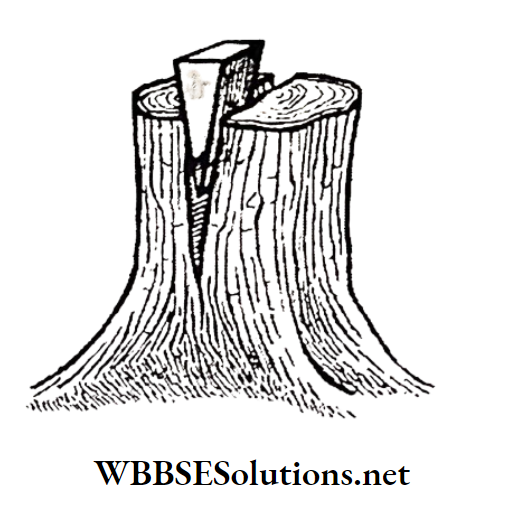
  4. Split a plank

Answer: 4. Split a plank

Common MCQs on Mechanical Advantage

Question 31. What are two examples of an inclined plane?

  1. Screw and wedge
  2. Lever and screw
  3. Edge and lever
  4. Wheel and axle

Answer: 1. Screw and wedge

Question 32. A wheel with a groove in its rim in which to place a rope is a ________________.

  1. Screw
  2. Pulley
  3. Fulcrum
  4. Lever

Answer: 2. Pulley

Question 33. A ________________ is a simple machine used to hold two objects together.

  1. Pulley
  2. Lever
  3. Screw
  4. Inclined plane

Answer: 4. Inclined plane

Question 34. Which simple machine would stairs be an example of?

  1. A wedge
  2. A lever
  3. A pulley
  4. An inclined plane

Answer: 4. An inclined plane

Question 35. Which of these is an example of a wedge?

  1. A skateboard
  2. A broom
  3. Stairs
  4. A butter knife

Answer: 3. Stairs

Question 36. A screw is made up of ________________  wrapped around a rod.

  1. Treads
  2. Springs
  3. Threads
  4. Strings

Answer: 3. Threads

Question 37. Which type of simple machine would be found on the bottom of a wagon?

  1. Pulley
  2. Screw
  3. Wedge
  4. Wheel and axle

Answer: 4. Wheel and axle

Question 38. The mechanical advantage of an incline depends on the ________________.

  1. Mass of the incline
  2. The slope of the incline
  3. Height of the incline
  4. Length of the incline

Answer: 2. Slope of the incline

Question 39. Rust prevention in machine parts can be done by

  1. Cleaning only
  2. Lubrication only
  3. Cleaning followed by proper painting
  4. None of the above

Answer: 3. Cleaning followed by proper painting

Question 40. When a screw is turned once around, it advances a distance equal to the ________________.

  1. Pitch
  2. Diameter of the screw head
  3. Load arm
  4. Effort arm

Answer: 1. Pitch

Question 41. The human forearm works as

  1. First-class lever
  2. Second class lever
  3. Third class lever
  4. A combination of all

Answer: 3. Third-class lever

Question 42. A zipper of a bag is a

  1. Pulley
  2. Wedge
  3. Screw
  4. Wheel and axle

Answer: 2. Wedge

Question 43. The oar of a boat is an example of a

  1. First-class lever
  2. Second class lever
  3. Third class lever
  4. None of the above

Answer: 2. Second-class lever

Chapter 9 Common Machines Fill In The Blanks

Question 1. To open the lid of a can a spoon acts as a __________.
Answer: Lever

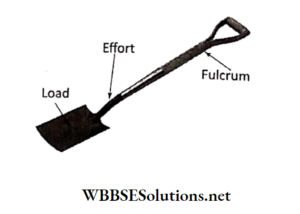
Question 2. The fulcrum of the spade is situated at its __________.
Answer: Far end of the handle

Question 3. The arm that extends from the fulcrum to the point of application of effort is known as the __________
Answer: Effort arm

Question 4. In __________ class lever the fulcrum is placed between the load and the effort.
Answer: First

Question 5. A roller skate could be an example of __________.
Answer: Wheel and axle

Question 6. A machine that utilizes two or more simple machines is called a __________.
Answer: Complex machine

Question 7. A ramp in a parking garage is an example of __________.
Answer: Inclined plane

Question 8. A chef sometimes holds the tip of a knife stationary when chopping food. Held this way, the knife is a complex machine made up of a wedge and a __________.
Answer: Second-class lever

Question 9. Lengthening a ramp will __________ its mechanical advantage.
Answer: Increase

Question 10. As you bite an apple, your front teeth act as a simple machine called a __________.
Answer: Wedge

Question 11. Using energy a machine can change the amount, speed, or __________ of a force to perform an intended action.
Answer: Direction

Question 12. Leverage depends on __________ of the lever.
Answer: Length

Question 13. A __________ pulley is a combination of fixed and movable pulleys.
Answer: Compound

Question 14. An __________ is a rod centered in the wheel.
Answer: Axle

Question 15. The angle of incline is an __________ angle.
Answer: Acute

Question 16. Machines may be employed in __________ environment where it is difficult for a man to work.
Answer: Hazardous

Question 17. A regular __________ after every use can increase the longevity and performance of a machine.
Answer: Cleaning

Question 18. A jar lid is a type of simple machine called __________.
Answer: Screw

Question 19. A wedge has two __________. which meet at a sharp edge.
Answer: Inclined planes

Question 20. A __________ pulley remains fastened to the load itself.
Answer: Movable

Question 21. A lever has a fulcrum and load at the two ends.
Answer: Third class

Question 22. Gears are a form of __________.
Answer: Wheel and axle

Question 23. The distance between two neighboring __________ of a screw is called its pitch.
Answer: Threads

Question 24. There are __________ classes of levers.
Answer: Three

Question 25. A twisted inclined plane wrapped around a rod or pole is a __________.
Answer: Screw

Chapter 9 Common Machines Identify As True Or False

Question 1. A washing machine is a simple machine.
Answer: False

Question 2. Pulley changes the direction of the applied force.
Answer: True

Question 3. Less effort is used to climb a steep inclined plane.
Answer: False

Question 4. In the first class lever, the load is in the center.
Answer: False

Question 5. A nail holds things more firmly than a screw.
Answer: False

Question 6. It is easier to get a screw with a bigger pitch into a piece of wood than a screw with a smaller pitch.
Answer: False

Question 7. Both wheel and axle have a common axis of rotation.
Answer: True

Question 8. An inclined plane reduces the amount of work done compared to pulling something straight up.
Answer: False

Question 9. The axle is a smaller wheel fastened to the wheel at its center.
Answer: True

Question 10. The human arm works as a third-class lever.
Answer: True

Question 11. Using more than one pulley at a time, we get more advantages.
Answer: True

Question 12. There can be levers without a fulcrum.
Answer: False

Question 13. A pair of scissors work as a single lever.
Answer: True

Question 14. The lid of the laptop is connected to the keyboard by a lever.
Answer: True

Question 15. The deployment of machines has led to advantages only in the history of mankind.
Answer: False

Question 16. Complex machines are the building blocks of simple machines.
Answer: False

Question 17. How much load the effort can lift, depends on how many times the wheel is larger than the axle.
Answer: True

Question 18. A leaning ladder is an example of an inclined plane.
Answer: True

Question 19. Pulleys are employed in window blinds.
Answer: True

Question 20. The mechanical advantage of all classes of the lever is the same.
Answer: False

Question 21. In the second class lever, the effort arm is always longer than the load arm.
Answer: True

Question 22. Machines undergo wear and tear as they are put to use on a regular basis.
Answer: True

Question 23. A pulley does not have an axle.
Answer: False

Question 24. Machines reduce the amount of work needed to do a job.
Answer: False

Question 25. To lift a huge block of stone through a certain height, one should choose a crowbar.
Answer: False

Question 26. Decreasing the slant of an inclined plane increases its mechanical advantage.
Answer: True

Question 27. While a screwdriver is used to insert a screw, it acts as a wheel and axle.
Answer: True

Question 28. Machines employ moving parts only.
Answer: False

Question 29. Wheel, axle, and rope or chain make a pulley.
Answer: True

Question 30. When you raise your leg, the knee acts as a fulcrum for the upper leg.
Answer: False

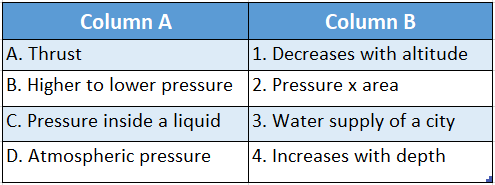
Chapter 9 Common Machines Match The Columns

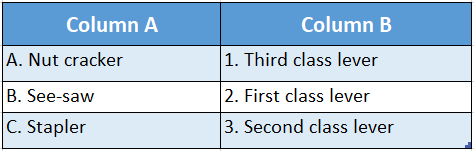
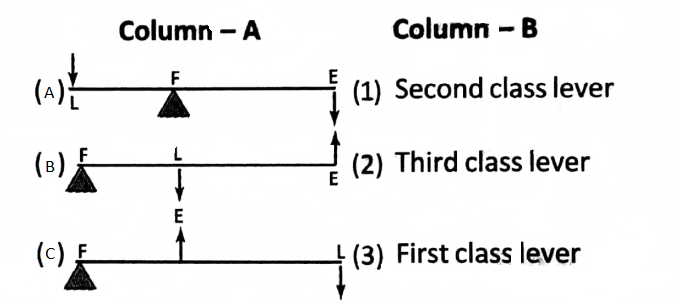
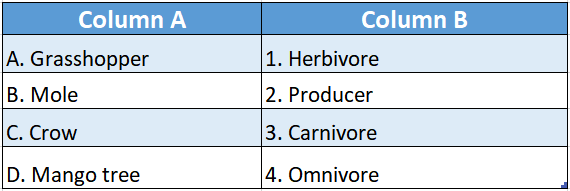
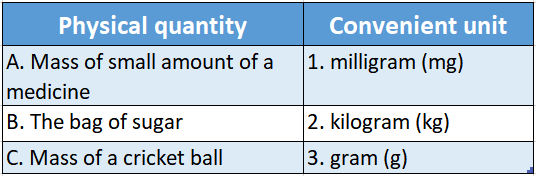
WBBSE Solutions for school science class 6 chapter 9 common machines match the columns table 1
Answer: A-3,B-2,C-1


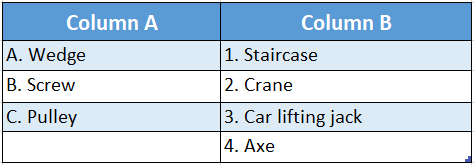
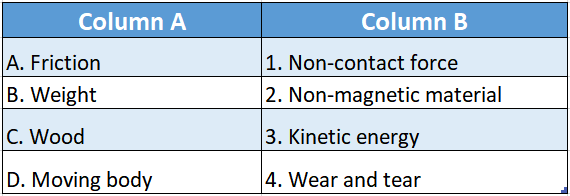
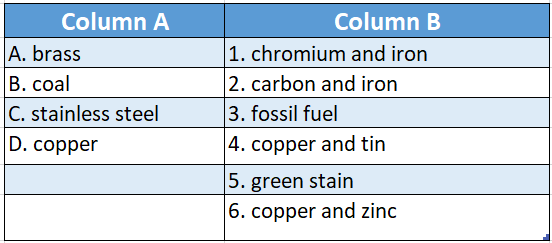
WBBSE Solutions for school science class 6 chapter 9 common machines match the columns table 2
Answer: A-3,B-1,C-2

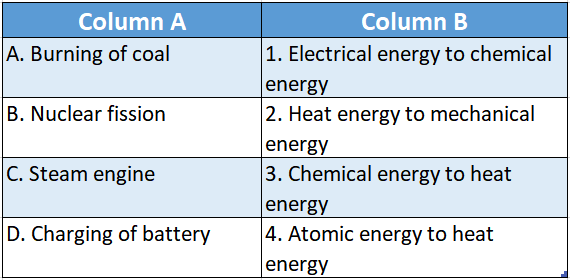
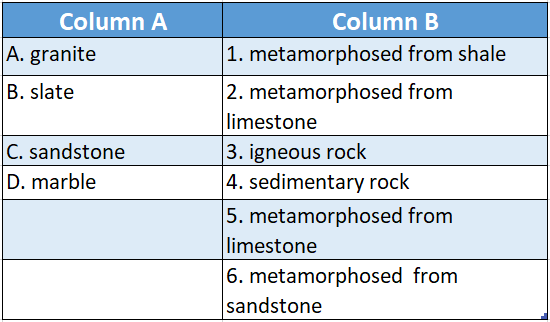
WBBSE Solutions for school science class 6 chapter 9 common machines match the columns table 3
Answer: A-4,B-3,C-2

Chapter 9 Common Machines Answer In Words Or A Sentence

Question 1. What sort of angle an inclined plane makes with the ground?
Answer: An acute angle with the ground.

Question 2. Who invented simple machines?
Answer: The Greek philosopher Archimedes.

Question 3. In which class of lever is the direction of the input force opposite to the direction of the output force?
Answer: First class lever.

Question 4. Give three examples of complex machines commonly found in the kitchen.
Answer: A toaster, mixer-grinder, and microwave oven.

Question 5. What type of machine is a pencil sharpener?
Answer: Wheel and axle.

Question 6. Which simple machine turns a Ferris wheel?
Answer: Wheel and axle.

Question 7. A screw is actually another simple machine. Which one?
Answer: Inclined plane.

Question 8. Mention one similarity between second-class and third-class levers.
Answer: Both have a fulcrum at one end.

Question 9. You want to raise a load by using a pulley. In which direction should your pull be to raise it?
Answer: Directed downward.

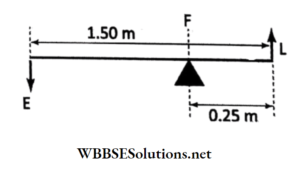
Question 10. The diagram below shows a crowbar. Calculate the length of the effort arm.
Answer: 

WBBSE Solutions for school science class 6 chapter 9 common machines length of effort arm


EF=(1.50-O.25)m=1.25m

Question 11. How does the advantage of using an inclined plane increase?
Answer: The advantage associated with an inclined plane increases as the length of the inclined edge increases compared to its height making the angle of incline or the slope lesser and lesser.

Question 12. Mention the name of a simple machine that is used by your mother while cooking in the kitchen.
Answer: Tongs.

Question 13. Find out the odd one Screw, ladder, electric vibrator, pulley.
Answer: Electric vibrator: It is a complex machine but others are simple machines.

Question 14. Mention the name of a human body part that acts as a wedge.
Answer: Teeth When we eat, we put our bottom teeth into the middle of the food and break it apart with our top teeth.

Question 15. Mention the name of a part of a bicycle that acts as a simple machine.
Answer: Pedals, back wheel and axle (wheel and axle), or Pedals and chain (Pulley).

Question 16. What is to be applied to a machine to minimize the damage caused by sliding friction between its moving parts?
Answer: Lubricating oil or grease.

Chapter 9 Common Machines Short Answer Type Questions

Question 1. Pens are class-3 levers-justify.
Answer: Pens are class-3 levers since by pivoting them on our hands and holding them in the middle, we get much more control over the nib or the ballpoint.

Question 2. Mention certain disadvantages associated with the use of machines.
Answer: The disadvantages that are associated with the use of machines may be loss of human skill, over-dependence, monotony, destruction, etc.

Question 3. How does the location of the fulcrum influence the working of a lever?
Answer: The closer the fulcrum is to the load being lifted (meaning a shorter load arm compared to an effort arm), the higher shall be the load that the person can lift.

Thus the location of the fulcrum actually influences the mechanical advantage of a lever.

Question 4. What is the purpose of lubrication?
Answer: Movable parts of the machine undergo extensive wear and tear, especially on the surfaces which come in contact while the machine runs.

This leads to the generation of heat. Lubrication cools the parts, makes movements easy, and reduces wear and tear.

Question 5. Why is a screw called a twisted inclined plane?
Answer: The sharp spiral ridges on the body of a screw make an inclined plane. It allows movement from a lower to a higher position but at the same time, it moves in a circle.

Question 6. What is a compound pulley?
Answer: A compound pulley consists of a combination of fixed and movable pulleys.

Question 7. What type of simple machine can you find on the floor of a bathtub?
Answer: The floor of a bathtub slopes towards the drain. This allows water to flow out with the force of gravity. Hence it acts as an inclined plane.

Question 8. Explain the action of the pulley used on flag-poles.
Answer: A fixed pulley is used on flagpoles. The flag is tied to a rope that goes around the pulley. The pulley remains fixed to the top of the flag pole.

By pulling the other end of the rope downwards, the flag is raised.

Short Answers on Types of Simple Machines

Question 9. When we bite with our front teeth, our jaw acts as a third-class lever. As we chew with our back teeth, our jaw acts as a second-class lever. Explain how our jaw can act as two different classes of levers.
Answer: The fulcrum of our jaw is located slightly below and in front of our ears. The input force is at the side of the cheek. When we bite, the output force is located in front of the mouth.

The output distance is greater than the input distance. Thus the jaw acts as a third-class lever. When chewing, the output force is near the back of the jaw and the input distance is greater than the output distance.

Hence now the jaw acts as a second-class lever. As a second-class lever, the jaw multiplies force, allowing us to chew and grind food more easily.

Question 10. Why roads on the hills are made winding?
Answer: A road up a hill is an inclined plane. An inclined plane makes work easier along a gradual slope. Hence it becomes easier to ascend a hill on a zigzag road than on a steep road.

The length of the incline or slant length of a zigzag road is more in length compared to a steep road of the same height. Thus the mechanical advantage of a zigzag road is more than that of a steep road.

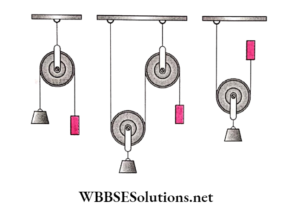
Question 11. In the following pulley systems, identify the fixed pulleys.
Answer:
WBBSE Solutions for school science class 6 chapter 9 common machines identify the fixed pulleys

Out of the four pulleys shown, pulleys A and C are fastened to the ceiling by means of hooks. Hence these are fixed pulleys.

Question 12. A lever is working as shown in Figure.
What would happen to the mechanical advantage of the lever if the load was moved farther from the fulcrum?
Answer:

WBBSE Solutions for school science class 6 chapter 9 common machines advantages of the lever

If the load was moved farther from the fulcrum, the length of the load arm increased whereas the effort arm remains the same as before. Hence the mechanical advantage of the lever would decrease.

Question 13. Define the fulcrum.
Answer: The point on the lever that does not move while the lever does the work is called the fulcrum (F). Hence it acts as a fixed point of support for the lever.

Question 14. Explain why wedges and screws are actually
Answer: types of inclined plains. A wedge is shaped like a double-inclined plane meeting at a sharp edge. A screw is an inclined plane wrapped around a cylinder to form a spiral.

Like an inclined plane, the wedge and the screw multiply the input force by having it move a greater distance along a sloping edge.

Question 15. Give two examples of a wedge being used in day-to-day life.
Answer: Kitchen knives and razor blades are examples of wedges being used in day-to-day life.

Question 16. In a lever, if the load is moved farther from its fulcrum, how is the effort going to change to lift the load?
Answer: In a lever, if the load is moved farther from the fulcrum, the length of the load arm increases. Thus to lift the same load, the effort shall need to be increased since the effort arm remains the same as before.

Question 17. Explain the actions of the following as levers

1. a fishing rod

2. a nutcracker

3. a spade.
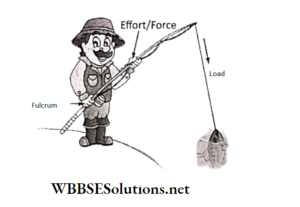
Answer: 1. A fishing rod has a load and the fulcrum on either side of the effort as shown. Hence it acts as a third-class lever.

WBBSE Solutions for school science class 6 chapter 9 common machines has load the fulcrum

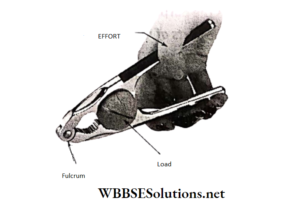
2. A nutcracker has a fulcrum at one end, effort or force applied at the other end 50 and the force is produced in the middle of the lever. Hence the load is placed between the ep fulcrum and effort. Thus it acts as a second-class lever.

WBBSE Solutions for class 6 school science chapter 9 common machines a nut cracker

3. A spade is held at the far end which therefore acts as the fulcrum. Effort is given at the center of the handle with the other hand. The blade of the spade works as the load. Thus it acts as a third-class lever.

WBBSE Solutions for class 6 school science chapter 9 common machines a spade

Question 18. Why is it easier to fix planks using screws rather than nails?
Answer: The sharp spiral-edged ridges on the body of a screw act to hold the planks together.

Nails do not have sharp ridges and so, there is a possibility of slippage under a severe blow in some circumstances leading to separation of the component members. Hence screws are preferred over nails in carpentry.

Question 19. Why is a staircase made like an incline?
Answer: An inclined plane makes work easier when somebody needs to go from a lower place to a higher place.

It actually extends the distance to be traveled horizontally in order to achieve the desired elevation change or rise.

Thus the 913 effort needed as input force becomes smaller for a person while climbing up the stairs. SageIt is worthwhile to mention here that it is easier sv to climb up the stairs if the slope of the incline is less.

Hence, in a house where elderly people reside, the staircase is to be built with less slope or it should be less steep.

Question 20. How is the mechanical advantage of a complex machine determined?
Answer: The mechanical advantage of a complex noho machine is just the product of the mechanical advantages of the simple machines of which it is composed.

Let a complex machine be built with a lever and a pulley with mechanical advantages of 3 and 2 respectively. So the mechanical advantage of the complex machine, so built, shall be 3×2 or 6.

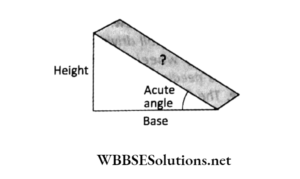
Question 21. Place the correct word in place of? in the figure. Give one example.
Answer: ?= Inclined surface or slant surface.
Example: Wheelchair ramp or slides for children in the playground.

WBBSE Solutions for class 6 school science chapter 9 common machines inclined surface or slant surface

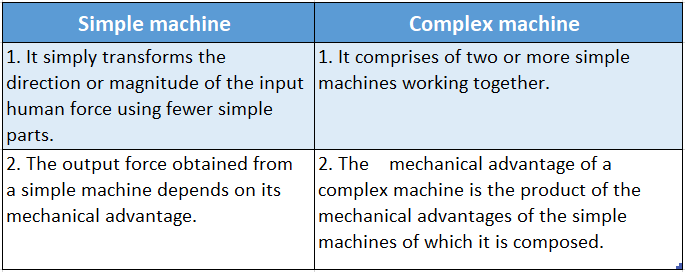
Question 22. Write two differences between simple and complex machines.
Answer:

WBBSE Solutions for school science class 6 chapter 9 common machines simple machine and complex machine

23. Give two examples of inclined planes as found in our home.
Answer:
1. Ramp in the main gate/door

2. Stairs or

3. Slanted roof

Chapter 9 Common Machines Long Answer Type Questions

Question 1. Discuss some of the utilities of using machines.
Answer:

Utilities Of Machine

We cited quite a few examples of machines in the previous section. All these machines have one thing in common when you apply a force to them, they increase their size and apply a greater force somewhere else.

You can’t cut meat with your hand alone, but if you push down on a knife, the long handle and the sharpened blade magnify the force you apply with your hand, and the meat slices effortlessly.

When you pound a nail with a hammer, the handle increases the force you apply.

And because the head of the hammer is bigger than the head of the nail, the force you apply is exerted over a smaller area with much greater pressure and the nail easily enters the wood.

Try pushing in a nail with your finger and you’ll appreciate the advantage a hammer gives you.

Living in a world without machines is now almost impossible to imagine. Without even the simplest machines, many tasks that we do every day would be almost impossible.

Machines make it easier for humans to perform everything from the simplest to the most complicated of tasks.

A washing machine, for instance, saves a lot of time as we can do other things while the clothes are being washed.

Vacuum cleaners save a lot of time and energy in cleaning the floors or carpets. A sewing machine is also a very useful machine. Sewing by hand is a very slow job requiring a lot of patience.

Using a sewing machine helps to stitch clothes quickly and neatly. Let us now learn about the advantages of the use of machines.

Question 2. What is a simple machine? How many types of simple machines are there? Name them.
Answer:

The following are the advantages of the use of machines :

1. Use of natural forces:

Machines have made it possible to harness the forces of nature in

Simple machine:

in earlier times when a human being needed to move something heavy, he or she probably picked up a long stick, stuck it under the edge of the heavy object and stuck it under the edge of the heavy object, and then pushed it down on the other end of the stick.

The service of man. Man can fly in airplanes, he can connect continents in seconds, and electricity can be generated from sunrays, waterfalls, winds, etc. All these have been made possible with the aid of machines.

2. Heavy and delicate work made simple :

Tasks that are too heavy or too delicate for human muscles to do can be done easily by a machine. A crane can lift loads beyond the human capacity. Without the aid of machines, such jobs would not have been done.

3. Faster and more accurate work :

Only machines are capable of mass production, that too accurately, without a break and for a continuous duration.

While man can make only a few articles in a day by himself, machines employed in factories can make thousands per day for years together with extreme accuracy.

A human being, for example, can not paint exactly the same picture twice. But a machine can turn out thousands of identical articles. This has also resulted in the availability of durable articles at a much cheaper price.

4. More employment:

The introduction of machines in the modern society has created many new occupations. It has thus widened the scope of employment.

5. Hazardous work environment:

Human beings are relieved of all disagreeable and unpleasant jobs in hazardous environments by suitably deploying machines to do the same.

However, it must be remembered that machines are also associated with certain evils. These may be loss of human skill, over-dependence, monotony, destruction, and so on.

Examples of Real-Life Applications of Simple Machines

Question 3. Define lever. What is meant by First class, Second class, and Third class levers? Explain with diagrams.
Answer:

Idea of Lever

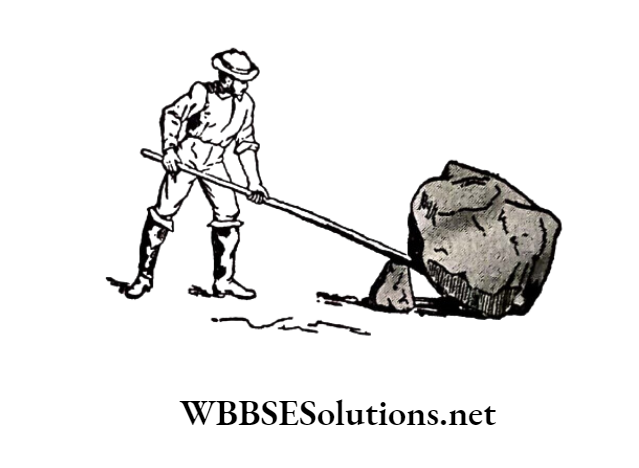
Levers were probably the first machines used by human beings. It is a long tool such as a pole or a rod put under an object to lift it.

Levers are all around us. The handle of the spoon is a lever since it makes it easier for us to open the lid of a can. The lever becomes more efficient when combined with a fulcrum.

WBBSE Solutions for school science class 6 chapter 9 common machines idea of lever

The fulcrum is another object, maybe a rock, used to give alginate Lana to tone support or brace under the long tool. This gives the long pole something to push down against.

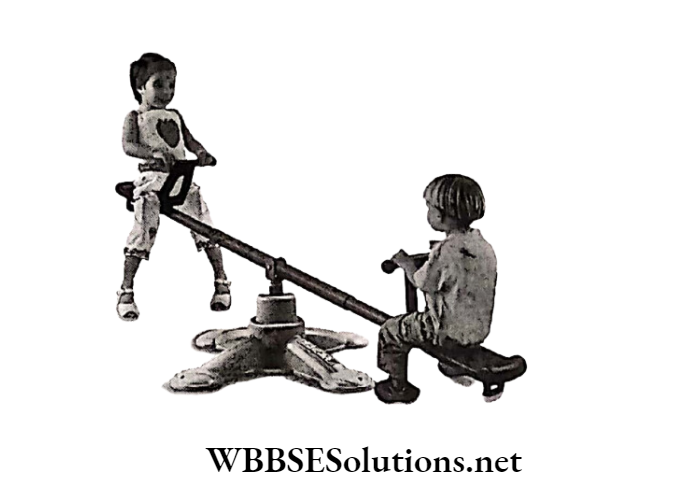
Let us take another example to get the matter clear. When you sit on a see-saw, you have probably found out that you need to sit further from the balance point if the person at the opposite end is heavier than you.

The balance or pivot point acts as the fulcrum here. The further away from the fulcrum you sit, the more you can multiply the force of your weight.

If you sit a long way from the fulcrum, you can even easily lift a much heavier person sitting at the other end provided of course they sit very close to the fulcrum on their side.

The force you apply with your weight is called the effort. The fulcrum produces a bigger force to lift the load (here it is the weight of the other person).

The words “effort” and “load” are associated with the working of the lever. However, the important thing fo to remember about levers is that the force you produce (which drives the load) is bigger than the force you apply as effort.

Some examples of levers are:

Door handles the claws of a hammer (for removing nails), light switches, bottle openers, tongs, knives, screwdrivers, wrenches, scissors, and hinges.

WBBSE Solutions for school science class 6 chapter 9 common machines effort and load

WBBSE Solutions for class 6 school science chapter 9 common machines door handles

The force that is used on the lever is called the effort (E).

The weight that is moved or lifted by the lever is called the load (L).

The point on the lever that does not move while the lever does the work is called the fulcrum (F). Hence it acts as a fixed point of support for the lever.

Classes of Lever

All levers give leverage, but not all of them work the same way. There are actually three different kinds of levers (sometimes known as classes).

The class of a lever depends on the relative positions of the efforts, load, and fulcrum.

First-class or Class-1 levers

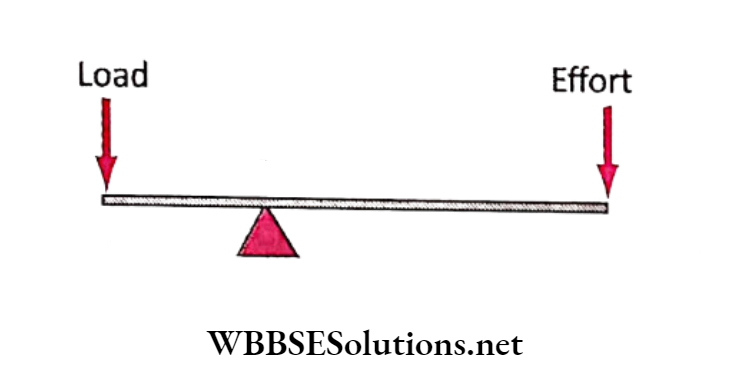
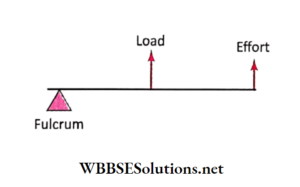
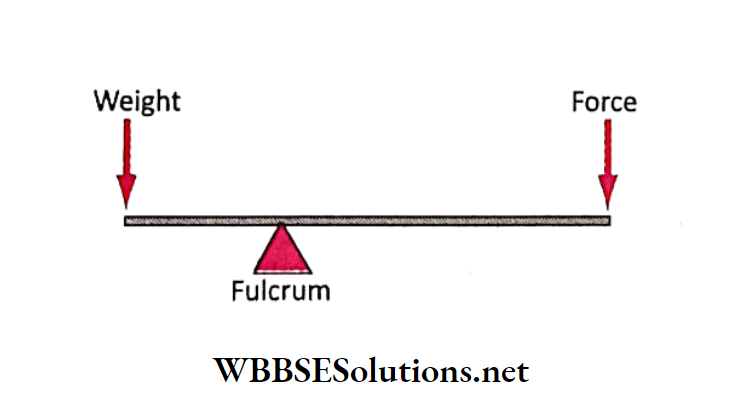
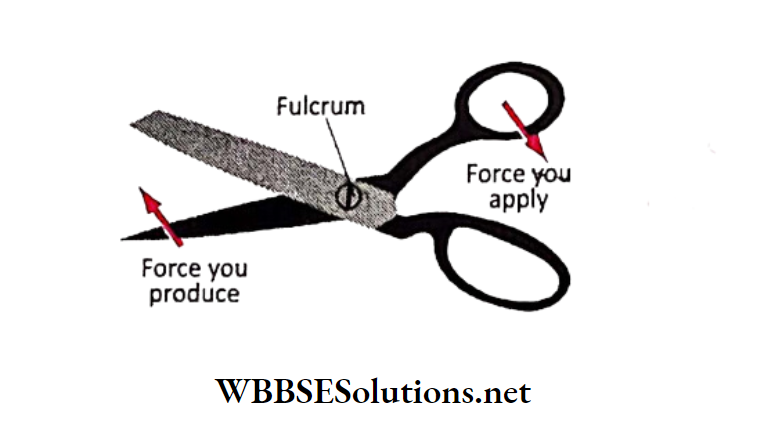
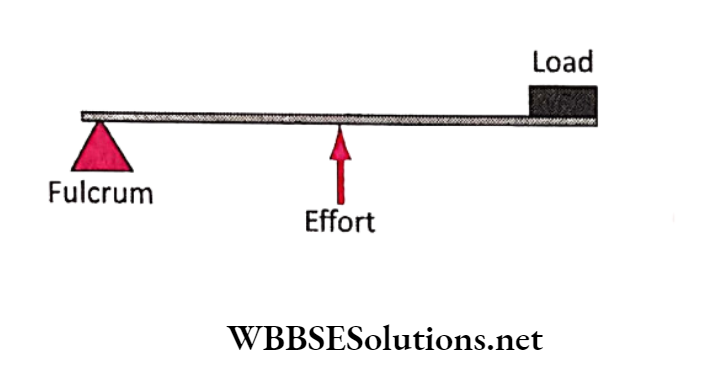
In a First class lever, the effort or force we apply is on the opposite side of the fulcrum to the force the lever produces.

Hence the fulcrum is placed between the effort and the load. See-saw, beam balance, and scissors are all first-class levers.

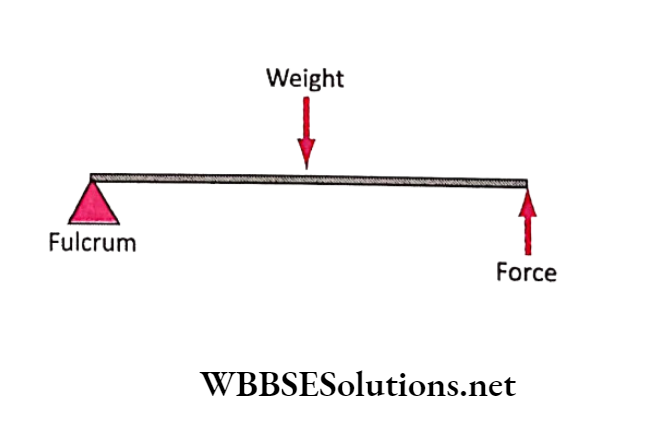
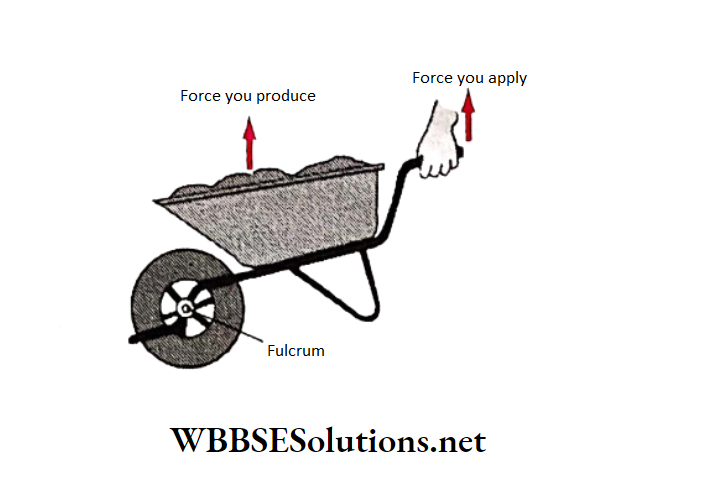
Hence the load is placed between the fulcrum and the effort. Nutcrackers, bottle openers,s, and wheelbarrows are all examples of Second class levers.

WBBSE Solutions for school science class 6 chapter 9 common machines first class levers

WBBSE Solutions for school science class 6 chapter 9 common machines scissor 2

Second-class or Class-2 levers

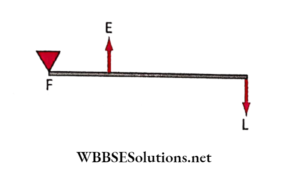
A Second class lever is arranged in a different way, with the fulcrum at one end. The effort or force is applied at the other end and the force is produced in the middle of the level.

WBBSE Solutions for class 6 school science chapter 9 common machines a second class lever

WBBSE Solutions for school science class 6 chapter 9 common machines wheel barrows

Third-class or Class-3 levers

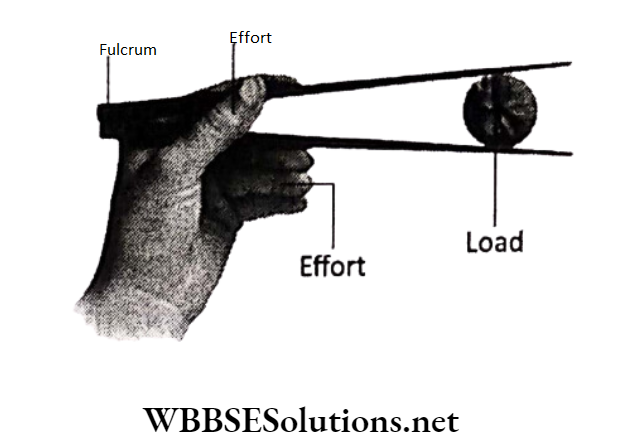
A Third class lever, like a Second class lever, has the fulcrum at one end.

But the two forces switch around. Hence the effort or force is applied at the middle and the force is produced at the opposite end. Thus the effort is placed between the fulcrum and the load.

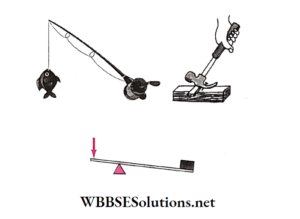
Third Class levers reduce the force you apply, giving you much greater control. Stapler, fishing
rod and tongs are examples of Third Yowlega pro-class levers.

WBBSE Solutions for school science class 6 chapter 9 common machines third class lever

WBBSE Solutions for school science class 6 chapter 9 common machines road and tongs

Question 4. What is an inclined plane? How is it useful?
Answer:

Inclined Plane

The inclined plane is simply a ramp whose one end is higher than the opposite end. This allows things to go from a low place to a higher place without much effort.

But the load has to be moved over a longer distance as compared to pulling it up vertically. Whether the inclined plane is long or short, the amount of work done shall be the same.

Thus an inclined plane does not decrease work but makes it easier. On the other hand, gravity makes it easier to move an object down a ramp than up that ramp.

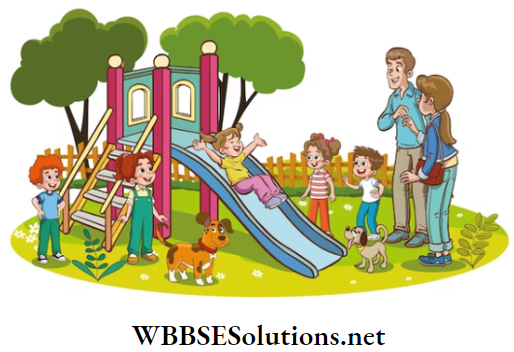
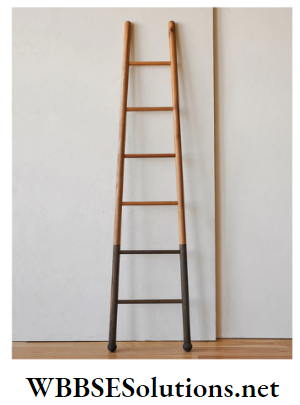
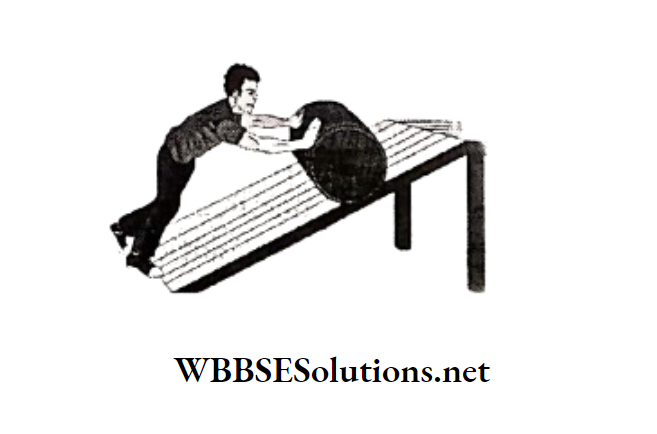
A slide in the children’s park, a d-leaning ladder, a staircase, and a sloping wooden plank (Fig. 9.22) are examples of inclined planes.

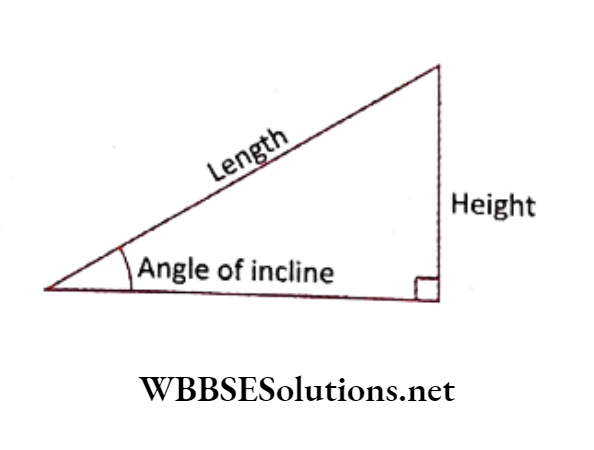
The acute angle that the inclined plane makes with the ground is called the angle of incline (Fig. 9.23) or slope.

If the slope of the inclined plane is low meaning that a smaller angle between the ground and the plane, then it is easier to climb up.

The mechanical advantage of an inclined. the plane is linked to the slope or angle of the incline.

WBBSE Solutions for school science class 6 chapter 9 common machines children park

WBBSE Solutions for school science class 6 chapter 9 common machines leaning ladder

WBBSE Solutions for school science class 6 chapter 9 common machines sloping wooden plank

WBBSE Solutions for school science class 6 chapter 9 common machines angle of incline

The mechanical advantage \(=\frac{\text { Length }}{\text { Height }}\)

It is apparent that the length of the inclined plane is greater than its height. Hence, by applying a small effort, the big load may be raised. The inclined plane has a mechanical advantage always greater than 1.

Uses of the inclined plane

  1.  As loading ramps to load and unload goods on trucks, ships, planes, etc. FEAR
  2. As wheelchair ramps for aged, invalid persons and patients.
  3.  As staircase and escalators.
  4. As conveyor belts.

Question 5. What is a pulley? How is a fixed pulley different from a movable pulley? Explain with diagrams.
Answer:

The Pulley

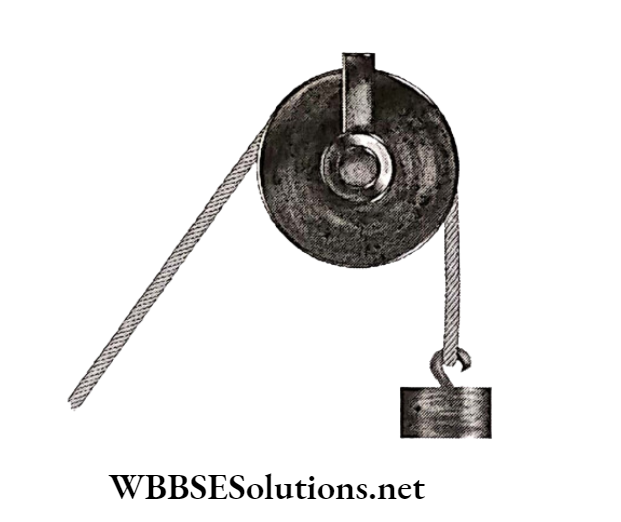
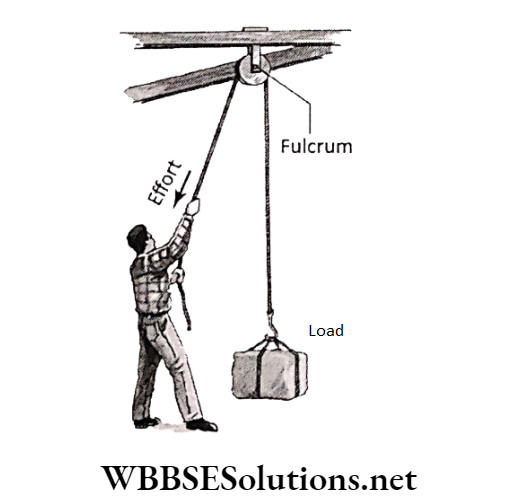
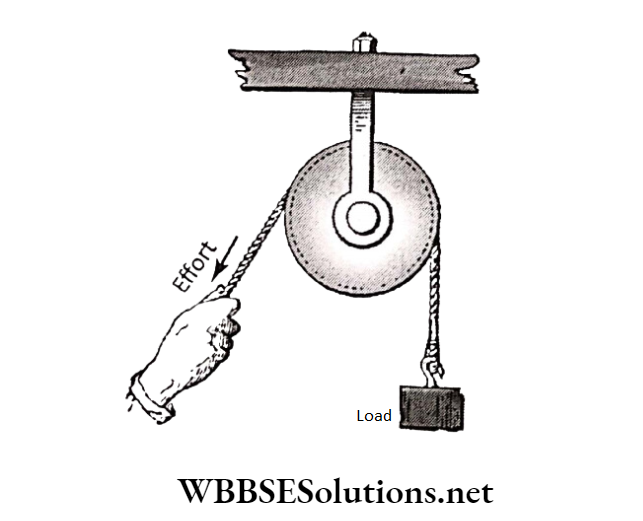
The pulley is actually a modified version of a wheel and axle that is combined with a rope, chain or other cord passing through a groove to allow moving something up and down or back and forth.

The rod that passes through the center of the pulley is called the axle. The pulley rotates freely about the axle.

The pulley can be combined with other pulleys to reduce the amount of work necessary to lift huge amounts of weight or to lower them down.

WBBSE Solutions for school science class 6 chapter 9 common machines break something

It can also make moving something such as a flag up the pole convenient to do from the ground. It changes the direction of the applied force necessary to do the work.

You pull down on the rope, but the flag goes up. Pulleys are used in window blinds and drapery to move them up and down or back and forth.

Pulleys are also used on ships to raise and lower sails, in the industry to raise and lower heavy cargo, or on cranes for use in moving construction equipment.

Elevators also use pulleys to move the car up and unban down from floor to floor.

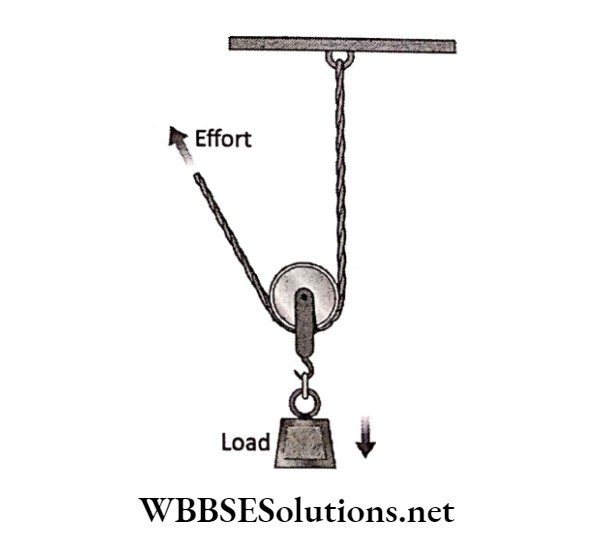
There are three types of pulleys-fixed, movable, and compound. A fixed pulley is fastened to some support by means of a hook.

WBBSE Solutions for class 6 school science chapter 9 common machines the pulley

WBBSE Solutions for school science class 6 chapter 9 common machines center of the pulley called the axle

Real-Life Scenarios Involving Inclined Planes and Wedges

A very common use of a single fixed pulley is in lifting water from wells. A movable pulley is one that remains fastened to the load itself. This type of pulley is free to move up and down.

Examples of movable pulleys include construction cranes, modern elevators, and some types of weight-lifting machines at the gym.

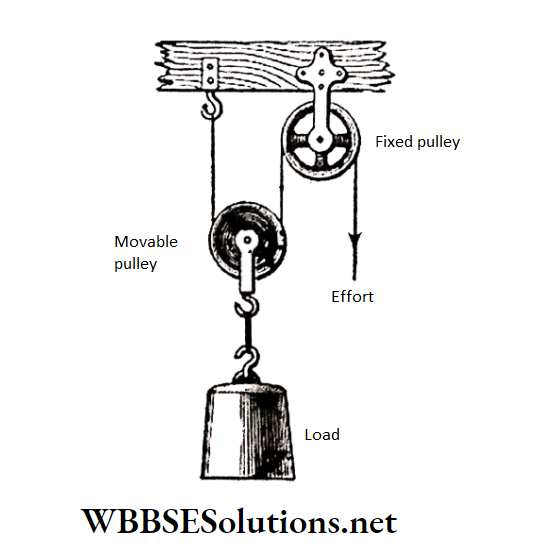
The third type of pulley is the compound pulley, which consists of combinations of fixed and movable pulleys.

WBBSE Solutions for school science class 6 chapter 9 common machines a fixed pullry

WBBSE Solutions for class 6 school science chapter 9 common machines movable pully

WBBSE Solutions for school science class 6 chapter 9 common machines compound pulley

Conceptual Questions on the Functionality of Simple Machines

Question 6. Why do machines require maintenance? Elaborate a few simple steps to follow for the maintenance of machines.
Answer:

Maintenance Of Machines

Machines undergo wear and tear as they are put to use on a regular basis.

If not taken care of properly, this may lead to permanent damage to the component parts, discoloration or rusting, malfunctioning, decreased efficiency, and above all, serious danger to the person operating the machine.

Hence regular upkeep and maintenance on the overall functionality and condition of machines are a must to keep the continuity of what is expected and the standard performance of the machines.

Simple steps to follow for maintenance of machines :

1. Keep it routine:

Just like the annual check-up with a physician, a regular check-up has to be made to inspect the conditions of the parts of a machine in order to ensure desired performance it.

This is an absolute emergency for heavy and complex machines.

2. Cleaning:

Routine cleaning after every use increases the longevity and performance of a machine many times.

3. Lubrication:

Lubrication of moving parts using grease or oil is an important part of regular machine maintenance. The lubrication procedure may be repeated in line with the degree of usage.

4. Rust prevention:

Metallic parts of a machine shall be protected from rusting caused by moisture ingress by suitably applying an anti-rust synthetic enamel paint or oil paint.

5. Don’t overwork the machine:

It is always advisable that the stated performance of a machine should not be exceeded at any point in time.

Overwork leads to greater wear and tear and finally to the shorter life span of the machine under consideration.

Question 7. The sewing machine is a complex machine- explain.
Answer: A sewing machine has several parts such as the main driving wheel, small driving wheel, needle, foot pedal, etc. which are made up of many simple machines such as wheel and axle, wedge, lever, and screw.

The main driving wheel and the small driving wheel work on the basis of wheel and axle. A sewing machine’s needle works on the basis of the wedge. The foot pedal works on the basis of the lever.

Also, a sewing machine employs a number of screws which play a vital role in its functioning. Thus it is a complex machine made up of many simple machines.

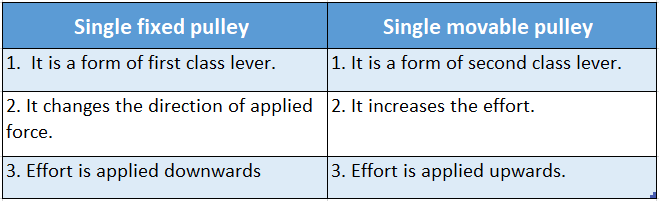
Question 8. Compare a single fixed pulley with a single movable pulley.
Answer: Comparison of the single fixed pulley and single movable pulley

WBBSE Solutions for school science class 6 chapter 9 common machines single flxed pulley and single movable pulley

Question 9. Explain what is meant by the Two ramps shown in the figure. Which ramp would be more convenient to use to move a heavy barrel up into a truck?

1. mechanical advantage 1

2. mechanical advantage > 1 and

3. mechanical advantage <1 for a simple lever.

Answer:

WBBSE Solutions for class 6 school science chapter 9 common machines mechanical advantage

⇒ \(\text { mechanical advantage }(M A)=\frac{\text { Load }}{\text { Effort or Input force }}\)

If MA=1, the input force to be applied to the lever has to be the same as the load.

If MA>1, less input force needs to be applied to the lever compared to the load to be driven. Thus the work becomes easier.
If MA<1, more or greater magnitude of input force is required to be put into the lever to drive the load.

Ramp (a) has a more mechanical advantage compared to ramp (b) since for the same height, the length of the slant surface of ramp (a) is more than that of ramp (b).

Thus for some elevation changes, the distance to be traveled horizontally is more in the case of ramp (a). Thus the effort or force needed to push the barrel up is lesser in the case of ramp (a).

WBBSE Solutions For Class 6 School Science Chapter 8 The Human Body MCQs

Chapter 8 The Human Body Heart Review Questions Environment Review Questions MCQs

Question 1. An example of a system is

  1. Blood
  2. Nerve
  3. Cardiovascular
  4. Cell

Answer: 3. Cardiovascular

Question 2. The __________ is responsible for pumping blood throughout our body.

  1. Heart
  2. Kidney
  3. Lymph node
  4. Brain

Answer: 1. Heart

Read And Learn More: WBBSE Solutions For Class 6 School Science

Question 3. The heart is located in the middle of

  1. Blood vessels
  2. Lungs
  3. Organs
  4. Chest

Answer: 4. Chest

WBBSE Solutions For Class 6 School Science Chapter 8 The Human Body mcqsWBBSE Solutions For Class 6 School Science Chapter 8 The Human Body mcqs

Question 4. The number of chambers in our heart is

  1. 2
  2. 3
  3. 4
  4. 5

Answer: 3. 4

WBBSE Class 6 Human Body MCQs

Question 5. When the heart is situated on the right side of the chest, the condition is known as

  1. Dextrocardia
  2. Cardiac muscle
  3. Illness
  4. Pathology

Answer: 1. Dextrocardia

WBBSE Solutions For Class 6 Geography WBBSE Solutions For Class 6 History WBBSE Solutions For Class 6 Maths
WBBSE Class 6 Geography Notes WBBSE Class 6 History Notes
WBBSE Class 6 Geography Multiple Choice Questions WBBSE Class 6 History MCQs WBBSE Notes For Class 6 School Science


Question 6. The membrane surrounding the heart is known as

  1. Myocardium
  2. Pericardium
  3. Cardium
  4. Endocardium

Answer: 2. Pericardium

Question 7. The heart of a normal the rate of about adult human beats at the rate of about __________ per minute.

  1. 90
  2. 72
  3. 60
  4. 100

Answer: 2. 72

Question 8. The two top chambers of the heart are called the

  1. Atrium
  2. Ventricle
  3. Atria
  4. None of the above

Answer: 3. Atria

Question 9. Running down the middle of the heart is a thick wall of muscle called the

  1. Septum
  2. Membrane
  3. Both ‘a’ and ‘b’ correct
  4. None of the above

Answer: 1. Septum

Understanding Human Anatomy

Question 10. Mitral valves are

  1. Tricuspid
  2. Aortic
  3. Semilunar
  4. Bicuspid

Answer: 4. Bicuapid

Question 11. The __________ side of your heart sends oxygen-rich blood out to the body.

  1. Right
  2. Anterior
  3. Left
  4. Posterior

Answer: 3. Left

Question 12. The heart receives blood from the upper body through

  1. Superior vena cava
  2. Inferior vena cava
  3. Arteries
  4. Veins

Answer: 1. Superior vena cava

Question 13. Sino-atrial node is situated in the

  1. Left ventricle
  2. Left atrium
  3. Right ventricle
  4. Right atrium

Answer: 4. Right atrium

Question 14. Arteriosclerosis means the arteries become thickened and are no longer properly

  1. Dependable
  2. Flexible
  3. Reliable
  4. Controllable

Answer: 2. Flexible

Question 15. A blood clot or other blockage cuts blood flow to a part of the heart and causes

  1. Anaemia
  2. Hemorrhage
  3. Heart attack
  4. All the above

Answer: 3. Heart attack

Common MCQs on Organs and Their Functions

Question 16. A bicuspid valve is present in

  1. Left atrium
  2. Right atrium
  3. Aorta
  4. Sinus venous

Answer: 1. left atrium

Question 17. In between arterioles and venules there lies

  1. Aorta
  2. Heart
  3. Superior vena cava
  4. Capillaries

Answer: 4. Capillaries

Question 18. Relaxation of the heart is termed as

  1. Polystole
  2. Systole
  3. Diastole
  4. Tryastole

Answer: 3. Diastole

Chapter 8 The Human Body Heaet Fill In The Blanks

Question 1. An __________ is an organization of several different kinds of tissues so arranged that together they can perform a special function.
Answer: Organ

Question 2. The circulatory system consists of the heart __________, blood vessels, arteries, and veins.
Answer: Blood

Question 3. Your heart beats around 100000 times a __________.
Answer: Day

Class 6 Science Question Answer WBBSE

Question 4. The __________ is responsible for pumping blood throughout our body.
Answer: Heart

Question 5 Heart is made up of __________ muscles.
Answer: Cardiac

Question 6. In 99% of the cases, the heart is located the on __________ side of the chest.
Answer: Left

Question 7. __________ fluid prevents friction between the pericardium and the heart.
Answer: Pericardial

Question 8. The heart wall consists of the myocardium and the __________ endocardium.
Answer: Epicardium

Question 9. The __________ side of your heart receives blood from the body and pumps it to the lungs.
Answer: Right

Question 10. The heart of a normal adult human beats at the rate of about __________ per minute.
Answer: 72

Question 11. The __________ are the chambers that fill with the blood returning to the heart from the body and lungs.
Answer: Atria

Question 12. The two chambers on the bottom are called the __________
Answer: Ventricles

Question 13. Heart valves all work to keep the blood flowing __________
Answer: Forward

Question 14. The movement of the blood through the heart and around the body is called __________.
Answer: Circulation

Question 15. A healthy heart makes a __________ sound with each beat.
Answer: Lub-Dub

Question 16. From the right atrium, the blood descends into the __________ right ventricle through the, valve.
Answer: Tricuspid

Class 6 WBBSE Science Question Answer

Question 17. __________ is an irregular or abnormal heartbeat.
Answer: Arrhythmia

Question 18. __________ Heart disease is a type of birth defect that causes problems with the heart at birth.
Answer: Congenital

Chapter 8 The Human Body Heart Identify As True Or False

Question 1. Organs are more complex units than tissues.
Answer: True

Question 2. The job of the circulatory system is to break down and absorb food.
Answer: False

Question 3. The kidneys are responsible for pumping blood throughout our body.
Answer: False

Question 4. Red blood cells carry oxygen around the body.
Answer: True

Question 5. It takes about 20 seconds for a red blood cell to circle the whole body.
Answer: True

Question 6. The heart is located a little to the left of the middle of your chest, and it is about the size of your fist.
Answer: True

Question 7. The heart is surrounded by a membrane called the myocardium.
Answer: False

Question 8. The heart of a normal adult human beats at the rate of about 72 per minute.
Answer: True

Class 6 WBBSE Science Question Answer

Question 9. The heart has two left ventricles and a right ventricle.
Answer: False

Question 10. Two of the heart valves are the bicuspid valve and the mitral valve.
Answer: False

Question 11. The movement of the blood through the heart and around the body is called circulation.
Answer: True

Question 12. A healthy heart makes a lub-dub sound with each beat.
Answer: True

Question 13. The human circulatory system is really a two-part system whose purpose is to bring oxygen-bearing blood to all the tissues of the body.
Answer: True

Question 14. From the right atrium, the blood descends into the right ventricle through the tricuspid valve.
Answer: True

Question 15. People with angina feel pain in the chest which means the brain isn’t getting enough blood.
Answer: False

Chapter 8 The Human Body Heart Match The Columns

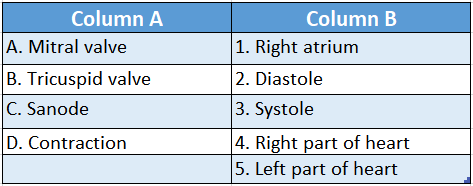
Question 1.
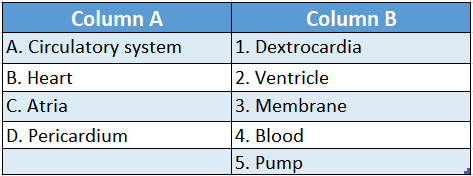
WBBSE Solutions for class 6 chapter 8 the human body match the columns 1 heart table 1


Answer: A-4,B-5,C-2,D3

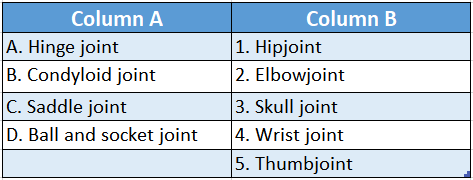
Question 2.

WBBSE Solutions for class 6 chapter 8 the human body match the columns 1 heart table 2
Answer: A-5,B-4,C-1,D-3

Chapter 8 The Human Body Heart Answer In Words Or A Sentence

Question 1. What are the functions of the circulatory system? The job of the circulatory system is to
Answer: move blood, nutrients, oxygen, carbon dioxide, and hormones, around the body.

Question 2. State the function of the heart in our body.
Answer: The heart is responsible for pumping blood throughout our body.

Question 3. What type of muscle makes the heart?
Answer: Cardiac Muscle.

Class 6 WBBSE Science Question Answer

Question 4. How many chambers are there in our hearts?
Answer: Four chambers.

Question 5. Name the middle layer of the heart wall.
Answer: It is the myocardium.

Question 6. Name the valve present between the right atrium 20h and the right ventricle.
Answer: Tricuspid valve.

Question 7. Write the full form of the AV node.
Answer: atrioventricular node.

Question 8. What are systole and diastole ?
Answer: The term systole refers to contraction and the term diastole refers to relaxation.

Question 9. What is arteriosclerosis?
Answer: It is a diseased condition caused by the hardening of arteries.

Question 10. What is a heart attack?
Answer: It is an abnormal condition when a blood clot or other blockage cuts blood flow to a part of the heart.

Chapter 8 The Human Body Heart Short Answer Type Questions

Question 1. Write the functions and components of the circulatory system.
Answer: The job of the circulatory system is to move blood, nutrients, oxygen, carbon dioxide, and hormones around the body. It consists of the heart, blood, and blood vessels, arteries-veins and capillaries.

Question 2. State the location of the heart in our body.
Answer: The heart is located a little to the left of the middle of our chest and it is about the size of our fist. It sits behind our ribs on the left side of our body just next to our sternum.

Question 3. What are the four chambers of our heart?
Answer: The human heart is divided into 4 chambers or parts: the two ventricles (lower parts) and two atria (upper parts).

WBBSE Class 6 Science Question Answer

Question 4. What is dextrocardia?
Answer: Normally, the heart is located on the left side of the chest. However, in rare cases, the heart can also be found on the right side of the chest; this condition is known as dextrocardia.

Short Questions on Human Body Systems

Question 5. What are the components of the heart wall?
Answer: The heart wall consists of the epicardium (outer layer), the myocardium (middle layer comprised of cardiac muscle tissue), and the endocardium (inner lining of the myocardium that covers the heart valves).

Question 6. What are heart sounds?
Answer: A healthy heart makes a lub-dub sound with each beat. This sound comes from the valves shutting on the blood inside the heart.

The first sound (the lub) happens when the mitral and tricuspid valves close.

The next sound (the dub) happens when the aortic and pulmonary valves close after the blood has been squeezed out of the heart.

Question 7. What is a pulse?
Answer: A pulse represents the tactile arterial palpation of the heartbeat by trained fingertips.

The pulse may be palpated in any place that allows an artery to be compressed against a bone, such as at the neck (carotid artery), on the inside of the elbow (brachial artery), at the wrist (radial artery), etc.

Question 8. What is heart muscle?
Answer: Cardiac muscle (heart muscle) is an involuntary, striated muscle that is found in the walls and histological foundation of the heart, specifically the myocardium.

Question 9. What is a systemic loop of circulation?
Answer: In the systemic loop, the blood circulates into the body’s systems, bringing oxygen to all its organs, structures, and tissues and collecting carbon dioxide waste.

Question 10. What is a pulmonary loop of circulation?
Answer: In the pulmonary loop, the blood circulates to and from the lungs, to release the carbon dioxide and pick up new oxygen.

Question 11. What is atherosclerosis?
Answer: It is a build-up of cholesterol and fat that makes the arteries narrower so less blood can flow through. Those build-ups are called plaque.

Question 12. What is arrhythmia?
Answer: Arrhythmia is an irregular or abnormal heartbeat. This can be a slow heartbeat (bradycardia), a fast heartbeat (tachycardia), or an irregular heartbeat.

Question 13. Your friend suffers from breathing trouble while playing and therefore, prefers to
Answer: Sit idle. What may be his disease in your opinion He may be suffering from either congenital heart disease or asthma.

Chapter 8 The Human Body Heart Long Answer Type Questions

Question 1. Write about the electrical conduction system of the heart.
Answer: 

Conduction system:

An electrical impulse travels through the heart and initiates contractions in the chambers.

The heart’s “spark plug” is an area of specialized heart tissue called the sino- atrial node (SA node), which is located in the right atrium.

Each time the SA node “fires”, an electrical impulse is generated, that travels through the right and left atria, signaling these chambers to contract and pump blood into the ventricles.

WBBSE Class 6 Science Question Answer

Isidore to The impulse then travels into another area of specialized heart tissue called the atrioventricular node (AV node), which is located between the atria and the ventricles.

The 2 electrical impulses are conducted through the AVA node and wire-like pathways (Bundle of His and d Purkinje fibers) to the ventricles, signaling the ventricles to contract and pump blood into the lungs and throughout the body.
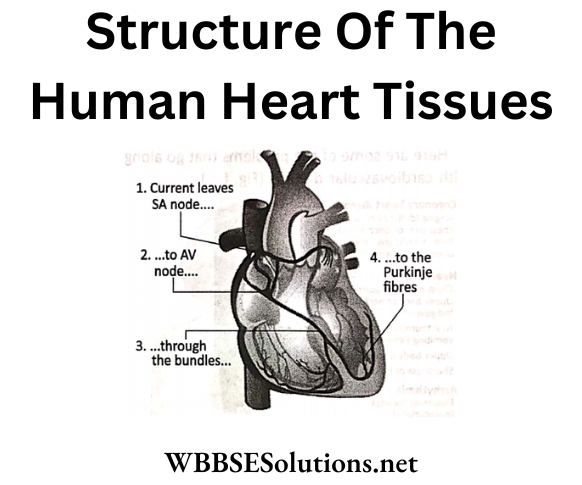
WBBSE Solutions For Class 6 School Science Chapter 8 Human Body Structure Of the Heart tissues

As the SA node maintains the pace of the heartbeat, it is also known as a natural pacemaker. If it does not function, an artificial pacemaker has to be implanted.

The normal sequence of electrical activation of the chambers of the heart is called sinus rhythm. It occurs each time the heart beats, usually about 60 to 80 times every minute.

In a normal heartbeat, the atria contract simultaneously while the ventricles relax. Then, the ventricles relax, and the atria contract.

The term systole refers to contraction and the term diastole refers to relaxation. A heartbeat consists of the systole and diastole of the atria and the systole and diastole of the ventricles.

Problems of the Heart: You know how important your heart is, so it is no wonder people worry when they hear someone has heart problems.

Heart disease, also called cardiovascular disease, mainly affects older. people and means that there are problems with the heart and blood vessels.

You might know someone who has cardiovascular disease because several people in our society have some form of it.

This disease includes a variety of problems, including high blood pressure, hardening of the arteries, chest pain, heart attacks, and strokes.

Milanese te The heart is the center of the cardiovascular system. Through the body’s blood vessels, the d heart pumps blood to all of the body’s cells.

WBBSE Class 6 Science Question Answer

The blood carries oxygen, which the cells need. Cardiovascular disease is a group of problems that occur when the heart and blood vessels are not working the way they should.
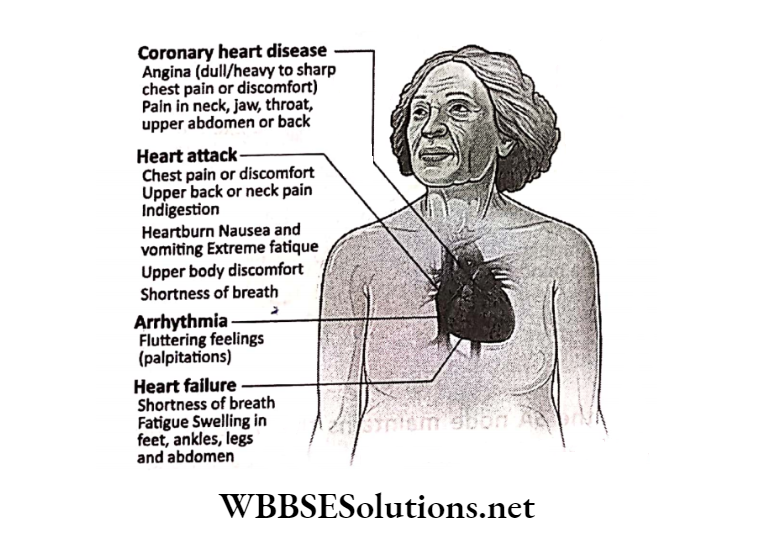
WBBSE Solutions for class 6 chapter 8 the human body congenital heart dissease

Here are some of the problems that go along with cardiovascular disease:

1. Arteriosclerosis:

Also called hardening of the arteries, arteriosclerosis means the arteries become thickened and are no longer flexible.

2. Atherosclerosis:

A buildup of cholesterol things a risk factor. Some of these risk factors a and fat which makes the arteries narrower, so less blood can flow through. Those buildups are called plaque.

3. Angina:

People with angina feel pain in the chest which means the heart muscle is not getting enough blood and oxygen.

4. Arrhythmia:

It is an irregular or abnormal er heartbeat. This can be a slow heartbeat en (bradycardia), a fast heartbeat (tachycardia), or an irregular heartbeat.

5. Heart attack:

When a blood clot or other blockage cuts blood flow to a part of the heart.

6. Ischemic heart disease:

A pathological condition of the heart muscle caused by lack of oxygen supply marked by pain and discomfort.

7. Heart valve disease:

It occurs when one or more of the four valves in the heart are not working properly. Heart valves help to ensure that the blood being pumped through the heart keeps flowing forward.

A disease of the heart valves (e.g., stenosis, mitral valve prolapse) makes it difficult for the heart to work efficiently.

WBBSE Class 6 Science Question Answer

8. Congenital heart disease:

It is a type of birth defect that causes problems with the heart at birth and occurs in about one out of every 100 live births.

Some of the most common types of congenital heart disease include atrial septal defects (ASD) and ventricular septal defects (VSD).

which occurs when the walls that separate the right and left chambers of the heart are not completely closed and consequently, there is a hole in the wall.

Babies born with congenital heart disease (ASD) may not have symptoms. When they grow up, adults may notice symptoms such as shortness of breath, heart palpitations, fatigue, swelling in the legs, feet, or abdomen, etc.

Symptoms of VSD include a bluish tinge to the skin, lips, and fingernails, along with poor feeding, poor weight gain, and fast breathing.

Heart disease is not contagious-we cannot catch it like we can the flu or a cold. Instead, certain things increase a person’s chances of getting cardiovascular disease.

Doctors call these people who can’t do anything about are like being older and having other people in the family who have had the same problems.

But people do have control over some risk factors smoking, having high blood pressure, being overweight, and not exercising can increase the risk of getting cardiovascular disease.

Question 2. State the importance of systemic and pulmonary loops of circulation.
Answer:

The circulation of blood:

The human circulatory system is really a two-part system whose purpose is to bring oxygen-bearing blood to all the tissues of the body.

When the heart contracts it pushes the blood out into two major loops or cycles.

In the systemic loop, the blood circulates into the body’s systems, bringing oxygen to all its organs, structures, and tissues and collecting carbon dioxide waste.

In the Pulmonary loop, the blood circulates to and from the lungs, to release the carbon dioxide and pick up new oxygen.

The systemic cycle is controlled by the left side of the heart, and the pulmonary cycle by the right side of the heart. Let’s look at what happens during each cycle.

The systemic loop begins when the oxygen-rich blood coming from the lungs enters the upper left chamber of the heart, the left atrium.

As the chamber fills, the blood flows down through the mitral valve into the relaxing left ventricle. When the ventricles contract during a heartbeat, the blood on the left side is forced into the aorta.

This largest artery of the body is an inch wide. The blood leaving the aorta brings oxygen to all the body’s cells through the network of ever-smaller arteries and capillaries.

The used blood from the body returns to the heart through the network of veins. All of the blood from the body is eventually collected into the two largest veins the superior vena cava.
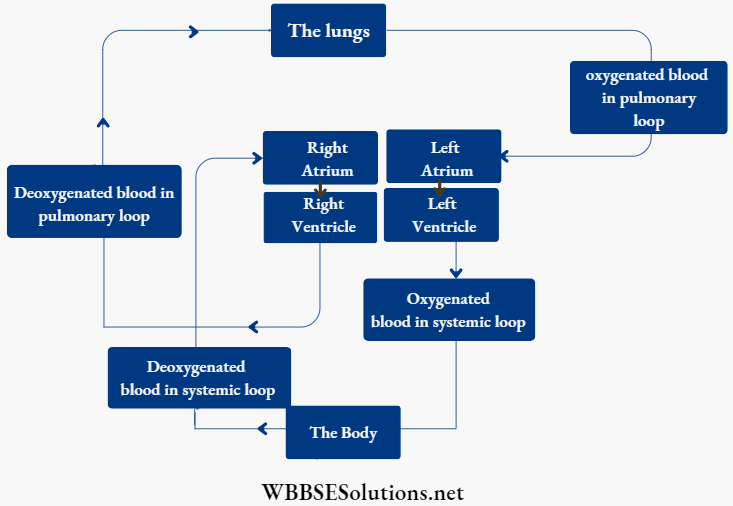
WBBSE Solutions For Class 6 School Science Chapter 8 Human Body circulatiomn Of Blood Through Lungs

Which receives blood from the upper body, and the inferior vena cava, which receives blood from the lower body region. Both venae cavae empty the blood into the right atrium of the heart.

From here the blood begins its journey through the pulmonary cycle. From the right atrium, the blood descends into the right ventricle through the tricuspid valve.

When the ventricles contract, the blood in the right ventricle is pushed into the pulmonary artery that branches into two main parts one going to the left lung, and one to the right lung.

The fresh, oxygen-rich blood returns to the left atrium of the heart through the pulmonary veins.

Although the circulatory system is made up of two cycles, both happen at the same time. The contraction of the heart muscle starts in the two atria, which push the blood into the ventricles.

Then the walls of the ventricles squeeze together and force the blood out into the arteries: the aorta to the body and the pulmonary artery to the lungs.

Afterward, the heart muscle relaxes, allowing blood to flow in from the veins and fill the atria again.

In healthy people, the normal (resting) heart rate is about 72 beats per minute, but it can go much higher during strenuous exercise.

Scientists have estimated that it takes about 30 seconds for a given portion of the blood to complete the

Entire cycle:

from lungs to heart to body, back to the heart, and out to the lungs.

Conduction system:

An electrical impulse travels through the heart and initiates contractions in the chambers.

The heart’s “spark plug” is an area of specialized heart tissue called the sino- atrial node (SA node), which is located in the right atrium.

Each time the SA node “fires”, an electrical impulse is generated, that travels through the right and left atria, signaling these chambers to contract and pump blood into the ventricles.

Isidore to The impulse then travels into another area of specialized heart tissue called the atrioventricular node (AV node), which is located between the atria and the ventricles.

The 2 electrical impulses are conducted through the AVA node and wire-like pathways (Bundle of His and d Purkinje fibers) to the ventricles, signaling the ventricles to contract and pump blood into the lungs and throughout the body.

WBBSE Solutions For Class 6 School Science Chapter 8 Human Body Structure Of the Heart tissues

As the SA node maintains the pace of the heartbeat, it is also known as a natural pacemaker. If it does not function, an artificial pacemaker has to be implanted.

The normal sequence of electrical activation of the chambers of the heart is called sinus rhythm. It occurs each time the heart beats, usually about 60 to 80 times every minute.

In a normal heartbeat, the atria contract simultaneously while the ventricles relax. Then, the ventricles relax, and the atria contract.

The term systole refers to contraction and the term diastole refers to relaxation. A heartbeat consists of the systole and diastole of the atria and the systole and diastole of the ventricles.

Problems of the Heart: You know how important your heart is, so it is no wonder people worry when they hear someone has heart problems.

Heart disease, also called cardiovascular disease, mainly affects older. people and means that there are problems with the heart and blood vessels.

You might know someone who has cardiovascular disease because several people in our society have some form of it.

This disease includes a variety of problems, including high blood pressure, hardening of the arteries, chest pain, heart attacks, and strokes.

Milanese te The heart is the center of the cardiovascular system. Through the body’s blood vessels, the d heart pumps blood to all of the body’s cells.

The blood carries oxygen, which the cells need. A cardiovascular disease is a group of problems that occur when the heart and blood vessels are not working the way they should.

Question 3. What are congenital heart diseases?
Answer:

Problems of the Heart:

You know how important your heart is, so it is no wonder people worry when they hear someone has heart problems. Heart disease, also called.

Cardiovascular disease: 

Mainly affects older. people and means that there are problems with the heart and blood vessels.

You might know someone who has cardiovascular disease because several people in our society have some form of it.

This disease includes a variety of problems, including high blood pressure, hardening of the arteries, chest pain, heart attacks, and strokes.

Milanese te The heart is the center of the cardiovascular system. Through the body’s blood vessels, the d heart pumps blood to all of the body’s cells.

The blood carries oxygen, which the cells need. Cardiovascular disease is a group of problems that occur when the heart and blood vessels are not working the way they should.

Here are some of the problems that go along with cardiovascular disease:

1. Arteriosclerosis:

Also called hardening of the arteries, arteriosclerosis means the arteries become thickened and are no longer flexible.

2. Atherosclerosis:

A buildup of cholesterol things a risk factor. Some of these risk factors a and fat which makes the arteries narrower, so less blood can flow through. Those buildups are called plaque.

3. Angina:

People with angina feel pain in the chest which means the heart muscle is not getting enough blood and oxygen.

4. Arrhythmia:

It is an irregular or abnormal er heartbeat. This can be a slow heartbeat en (bradycardia), a fast heartbeat (tachycardia), or an irregular heartbeat.

5. Heart attack:

When a blood clot or other blockage cuts blood flow to a part of the heart.

6. Ischemic heart disease:

A pathological condition of the heart muscle caused by lack of oxygen supply marked by pain and discomfort.

7. Heart valve disease:

It occurs when one or more of the four valves in the heart are not working properly. Heart valves help to ensure that the blood being pumped through the heart keeps flowing forward.

A disease of the heart valves (e.g., stenosis, mitral valve prolapse) makes it difficult for the heart to work efficiently.

8. Congenital heart disease:

It is a type of birth defect that causes problems with the heart at birth and occurs in about one out of every 100 live births.

Some of the most common types of congenital heart disease include atrial septal defects (ASD) and ventricular septal defects (VSD).

which occurs when the walls that separate the right and left chambers of the heart are not completely closed and consequently, there is a hole in the wall.

Babies born with congenital heart disease (ASD) may not have symptoms. When they grow up, adults may notice symptoms such as shortness of breath, heart palpitations, fatigue, swelling in the legs, feet, or abdomen, etc.

Symptoms of VSD include a bluish tinge to the skin, lips, and fingernails, along with poor feeding, poor weight gain, and fast breathing.

Heart disease is not contagious-we cannot catch it like we can the flu or a cold. Instead, certain things increase a person’s chances of getting cardiovascular disease.

Doctors call these people who can’t do anything about are like being older and having other people in the family who have had the same problems.

But people do have control over some risk factors smoking, having high blood pressure, being overweight, and not exercising can increase the risk of getting cardiovascular disease.

Chapter 8 The Human Body Blood Review Questions Environment Review Questions MCQ

Question 1. Blood is a type of

  1. Tissue
  2. Organ
  3. Cell
  4. System

Answer: 1. Tissue

Question 2. Red blood cells are created inside

  1. Heart
  2. Kidney
  3. Bone marrow
  4. Liver

Answer: 3. Bone marrow

Question 3. The average blood volume in the adult body is about

  1. 2 liters
  2. 3 liters
  3. 5 liters
  4. 1 liter

Answer: 3. 5 liters

Question 4. Oxygen is transported throughout the body

  1. White blood cells
  2. Red blood cells
  3. Platelets
  4. Plasma

Answer: 2. Red blood cells

Question 5. The color of our plasma is

  1. Reddish
  2. Greenish
  3. Bluish
  4. Yellowish

Answer: 4. Yellowish

Question 6. The color of RBC is due to

  1. Chlorophyll
  2. Haemocyanin
  3. Haemoglobin
  4. None of the above

Answer: 2. Haemocyanin

Question 7. WBC is also called

  1. Neutrophil
  2. Basophil
  3. Leucocyte
  4. Erythrocyte

Answer: 3. Leucocyte

Question 8. Platelets help in

  1. Blood clotting
  2. Controlling blood sugar
  3. Immunity
  4. Oxygen carriage

Answer: 1. Blood clotting

Question 9. A lower-than-normal number of red cells in the

  1. Malaria
  2. Leukemia
  3. AIDS
  4. Anaemia

Answer: 4. Anaemia

Question 10. The function of WBC is

  1. To carry O2 from the lungs to different parts of
  2. to build up immunity
  3. to coagulate blood
  4. none of these

Answer: 2. to build up immunity

Chapter 8 The Human Body Blood Fill in the Blanks

Question 1. _________ blood cells fight infections.
Answer: White

Question 2. _________ is a yellowish liquid that carries nutrients and proteins throughout the body.
Answer: Plasma

Question 3. Bone marrow makes the _________ cells.
Answer: Blood

Question 4. Red blood cells are also known as _________
Answer: Erythrocytes

Question 5 Granulocytes may be of 3 different types Neutrophil, _________ and Basophil.
Answer: Eosinophil

Question 6. There are two types of lymphocytes _________ cells and T cells.
Answer: B

Question 7. Rh protein was first found in _________ monkeys.
Answer: Rhesus

Question 8. _________ are cancers of the cells that produce WBCs.
Answer: Leukaemia

Chapter 8 The Human Body Blood Identify As True Or False

Question 1. Bone marrow makes blood cells.
Answer: True

Question 2. Plasma is a type of blood cell.
Answer: False

Question 3. Mature RBCs of our body are multinucleated.
Answer: False

Question 4. While blood cells are bigger than red blood cells.
Answer: True

Question 5. Platelets are cell fractions.
Answer: True

Question 6. Plasma is yellowish in color.
Answer: True

Question 7. Getting blood of the wrong type can make a person sick.
Answer: True

Question 8. Anaemia is accompanied by an increase in the amount of hemoglobin present in the blood.
Answer: False

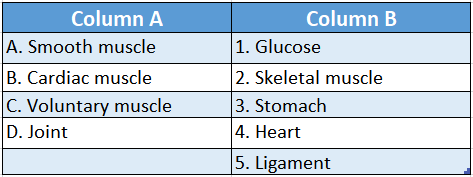
Chapter 8 The Human Body Blood Match the Column

Question 1.
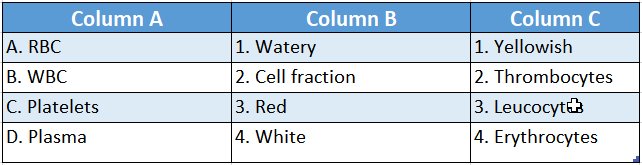
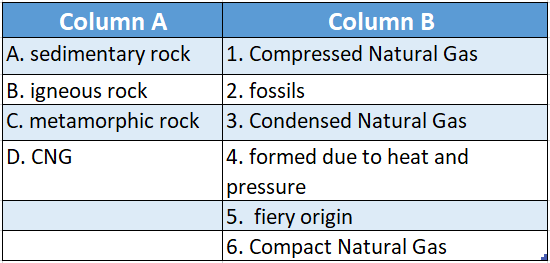
WBBSE Solutions for class 6 chapter 8 the human body match the columns 1 heart table 2
Answer: 1-C-4,2-D-3,3-B-2,4-A-1

Chapter 8 The Human Body Blood Answer In Words Or A Sentence

Question 1. Where in our body, blood cells are produced?
Answer: From bone marrow.

Question 2. Which organ pumps blood in our body?
Answer: Heart.

Question 3. Which of our blood cells is non-nucleated?
Answer: RBC or Erythrocytes.

Question 4. What are granulocytes?
Answer: These are WBC with granular cytoplasm.

Question 5. What are the types of lymphocytes?
Answer: Lymphocytes are of two types – B and T lymphocytes.

Question 6. State the function of platelets.
Answer: To help blood clotting.

Chapter 8 The Human Body Blood Short Answer Type Questions

Question 1. What are RBCs?
Answer: Red blood cells (RBCs), also called erythrocytes, are the most common type of blood cell and are the principal means of delivering oxygen (O2) to the body tissues- via blood flow through the circulatory system.

Question 2. What are WBCs?
Answer: White blood cells (WBCs), also called leucocytes, are the cells of the blood that are involved in protecting the body against infectious diseases caused by foreign invaders.

Question 3. What are monocytes?
Answer: Monocytes are white blood cells that fight infection by surrounding and destroying bacteria and viruses.

Question 4. What is blood plasma?
Answer: Blood plasma is the pale straw (yellow) colored liquid component of blood that normally holds the blood cells in whole blood in suspension; this makes plasma the extracellular matrix of blood cells.

It makes up about 55% of the body’s total blood volume.

Question 5. What is anemia?
Answer: The most common condition affecting the red blood cells of teens is anemia, a lower-than-normal number of red cells in the blood.

Anaemia is accompanied by a decrease in the amount of hemoglobin present in the blood.

Chapter 8 The Human Body Blood Long Answer Type Questions

Question 1. Write about the components of blood.
Answer:

Components of blood:

It is not made in a kitchen, but blood has ingredients, just like a recipe. To make blood, your body needs to mix:

  1. Red blood cells, which carry oxygen throughout the body,
  2. White blood cells, which fight infections,
  3. Platelets, which are cell fragments that help you stop bleeding if you get a cut, and
  4. Plasma is a yellowish liquid that carries nutrients, hormones, and proteins throughout the body.
  5. Your body does not go to the store to buy those ingredients. It makes them. Bone marrow, which is goopy stuff inside your bones, makes the red blood cells, the white blood cells, and the platelets.

Plasma is mostly water, which is absorbed from the intestine from what you drink and eat, with the liver supplying important proteins.

Put all these ingredients together and you have blood- an essential part of the circulatory system.

Thanks to your heart (which pumps blood) and your blood vessels through which blood travels throughout your body from your head to your toes. Let’s find out more about each ingredient.

1. Red blood cells (RBCs)

Red blood cells (also called erythrocytes) look like flattened basketballs. Most of the cells in the blood are red blood cells.

They carry around an important chemical called hemoglobin that gives blood its red color. Blood and breathing go hand in hand.

How? The hemoglobin in blood delivers oxygen, which you get from the air you breathe to all parts of your body. Without oxygen, your body couldn’t keep working and stay alive.

2. White blood cells (WBCs)

White blood cells (also called leukocytes) are bigger than red blood cells. There are usually not a whole lot of white blood cells floating around in your blood when you are healthy.

Once you get sick, your body makes some more to protect you. There are different types of white blood cells that do different things to keep you well.
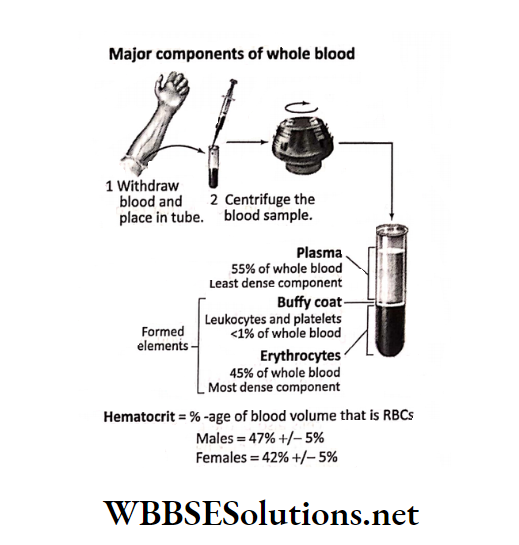
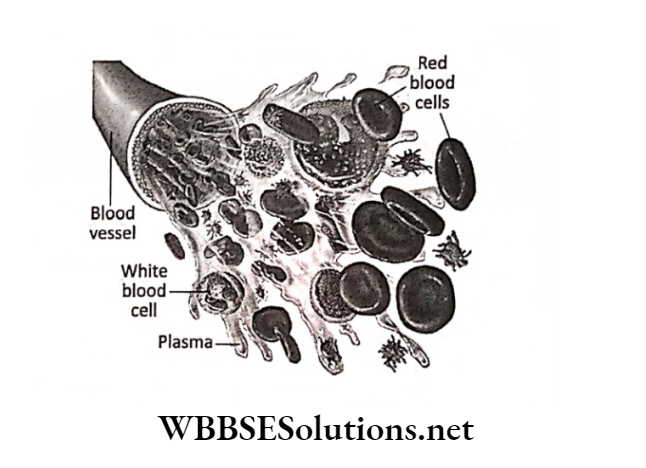
WBBSE Solutions for class 6 chapter 8 the human body major components of whole blood

WBBSE Solutions for class 6 chapter 8 the human body blood vessel

Granulocytes:

Do you know how your skin gets a little red and swollen around a cut or scrape? That means the granulocytes are doing their jobs.

They have a lot to do with how your body cleans things up and helps wounds heal after an injury.

Granulocytes also help to prevent infection by surrounding and destroying things that aren’t supposed to be in your body and by killing germs.

Granulocytes may be of three different types-Neutrophil, Eosinophil, and Basophil.

Agranulocytes: These are of two types- Lymphocytes and Monocytes.

1. Lymphocytes:

There are two types of lymphocytes:

B cells and T cells. B cells help make special proteins called antibodies that recognize stuff that should not be in your body, like bacteria or a virus you get from a sick friend.

Antibodies are, very specific, and can recognize only a certain type of germ. Once the antibody finds it, it gets rid of the germ so it cannot hurt you.

The really cool part is that even after you are better, B cells can become memory cells that remember how to make the special antibody so that if the same germ infects you again, it can kill the germ even faster.

T cells also battle germs that invade the body, but instead of making antibodies, they work by making special chemicals that help to fight the infection.

2. Monocytes:

Monocytes are white blood cells that fight infection by surrounding and destroying bacteria and viruses.

3. Platelets:

Platelets, also called thrombocytes, are tiny round cell fractions that help to make sure you do not bleed too much once you get a cut or scrape.

Cuts and scrapes break blood vessels. If a platelet reaches a blood vessel that’s been broken open, it sends out a chemical signal that makes other nearby platelets to stick together inside the vessel.

After the platelets form this plug, they send out more chemical signals that attract clotting factors.

These clotting factors work together to make a web of tiny protein threads within which other blood cells too (RBCs and WBCs) are entangled.

The platelets and this web of protein together with other blood cells make a blood clot. The clot keeps your blood inside the vessel while the break in the blood vessel heals up.
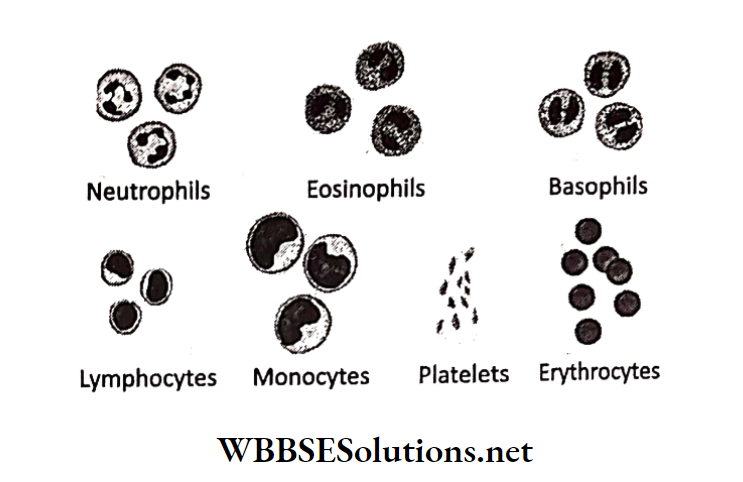
WBBSE Solutions for class 6 chapter 8 the human body break in the blood vessel heals

4. Plasma:

Plasma is a yellowish liquid that is mostly. water. But it also carries important nutrients, hormones, and proteins throughout the body.

Nutrients are chemicals from the food you eat that gives your body energy and other things your body’s cells need to do their work and keep you healthy.

Many proteins in plasma are really important to your body, like the clotting factors that help you stop bleeding if you get a cut or a scrape.

Plasma also carries away cell wastes- chemicals that the cell doesn’t want anymore.

Nutrients, hormones, proteins, and waste are dissolved in the plasma-kind of like the cocoa mix that dissolves in a cup of hot water. What are marshmallows? The blood cells-they float in the plasma.
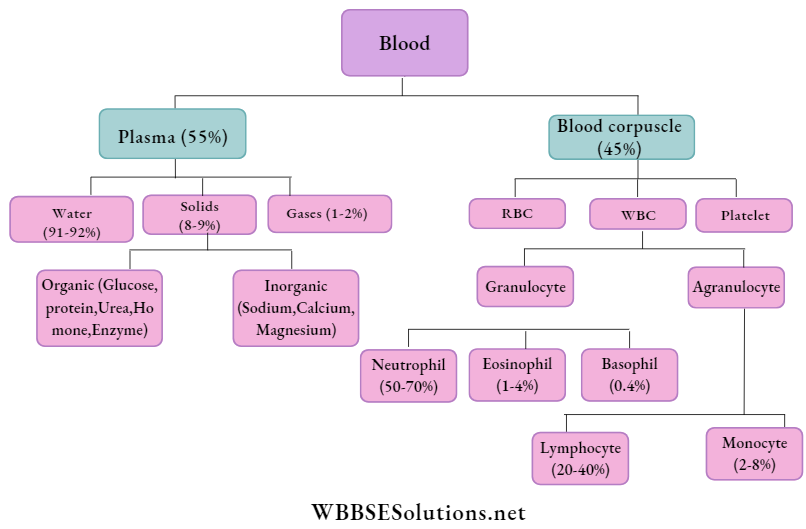
WBBSE Solutions for class 6 chapter 8 the human body blood

Examples of Real-Life Applications of Anatomy

Question 4. Write about the major functions of blood.
Answer:

Functions of blood:

  1. Transport of nutrients, hormones, and enzymes to various parts of the body.
  2. Transport of respiratory gases and waste products.
  3. Protection against microbes
  4. Maintenance of water balance and acid-base balance.
  5.  Antibody formation.

Chapter 8 The Human Body Lungs Review Questions Environment Review Questions MCQ

Question 1. Lungs are a part of __________ system.

  1. Circulatory
  2. Respiratory
  3. Digestive
  4. Nervous

Answer: 2. Respiratory

Question 2. Beneath the lungs is the

  1. Heart
  2. Stomach
  3. Lungs
  4. Trachea

Answer: 3. Lungs

Question 3. Lungs help us in

  1. Bronchi
  2. Talking
  3. Lungs
  4. Breathing

Answer: 4. Breathing

Question 4. During inhalation the diaphragm

  1. Relax
  2. Contract
  3. Plays no role
  4. Undulates

Answer: 2. Contract

Question 5. Bronchioles end in

  1. Alveoli
  2. Lungs
  3. Trachea
  4. Capillaries

Answer: 1. Alveoli

Question 6. Capillaries are small

  1. Blood vessels
  2. Trachea
  3. Arteries
  4. Veins

Answer: 1. Blood vessels

Question 7. Tiny hairs called cilia move gently to keep mucus and dirt out of the

  1. Heart
  2. Blood
  3. Lungs
  4. Air

Answer: 3. Lungs

Question 8. The ultimate branches of the trachea are

  1. Bronchi
  2. Alveoli
  3. Lings
  4. Bronchioles

Answer: 4. Bronchioles

Question 9. Lungs are covered by

  1. Air
  2. Blood
  3. Mucus
  4. Pleural membranes

Answer: 4. Pleural membranes

Question 10. Larynx is

  1. Brainbox
  2. Voice box
  3. Membranous
  4. Tracheal

Answer: 2. Voicebox

Question 11. Asthma is a problem of _________ system.

  1. Respiratory
  2. Circulatory
  3. Lungs
  4. Tracheal

Answer: 1. Respiratory

Chapter 8 The Human Body Lungs Fill In The Blanks

Question 1. Lungs work as a part of our _________ system.
Answer: Respiratory

Question 2. Lungs are located inside _________.
Answer: Chest

Question 3. At the end of each bronchiole is a special air sac called _________.
Answer: Chest

Question 4. Beneath the lungs is the _________ a dome-shaped muscle.
Answer: Diaphragm

Question 5. Lungs are covered by _________ membranes.
Answer: Qleural

Question 6. Our voice is produced from _________
Answer: Larynx

Question 7. Illnesses like bronchitis and _________ hard for air to get into the alveoli.
Answer: Pneumonia

Chapter 8 The Human Body Lungs Identify As True Or False

Question 1. Breathing air is necessary for keeping us alive.
Answer: True

Question 2. Lungs are protected by the heart.
Answer: False

Question 3. Above the lungs is the diaphragm.
Answer: False

Question 4. The trachea divides into bronchioles.
Answer: False

Question 5. Each alveolus has a mesh-like covering of very small blood vessels called capillaries.
Answer: True

Question 6. As we inhale or breathe in, our diaphragm contracts and flattens out.
Answer: True

Question 7. During exhalation, the diaphragm relaxes and moves down.
Answer: False

Question 8. Our voice box is called the larynx.
Answer: True

Question 9. Exhalation is bad for the lungs.
Answer: False

Question 10. Asthma is a neurological problem.
Answer: False

Chapter 8 The Human Body Lungs Match the Column

Question 1.
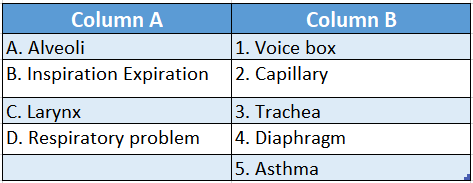
WBBSE Solutions for class 6 chapter 8 the human body match the columns lungs table 1
Answer: A-2,B-4,C-1,D-5

Chapter 8 The Human Body Lungs Answer In Word Or A Sentence

Question 1. Name the principal organ of respiration.
Answer: Lungs.

Question 2. How many pairs of ribs form the rib cage?
Answer: 12 pairs.

Question 3. Name the dome-shaped structure located beneath the lungs.
Answer: Diaphragm.

Question 4. What is the name of the respiratory windpipe?
Answer: Trachea.

Question 5. What is the name of the air sacs situated in our lungs?
Answer: Alveoli.

Question 6. Name the organ responsible for talking.
Answer: Larynx.

Question 7. Name any two respiratory problems.
Answer: Asthma/Bronchitis / Pneumonia (any two to be mentioned).

Question 8. Find out the odd one: bronchus, alveoli, artery, nasal passage.
Answer: Artery.

Chapter 8 The Human Body Lungs Short Answer Type Questions

Question 1. What are lungs?
Answer: Lungs are the pair of organs situated within the ribcage, consisting of elastic sacs with branching passages into which air is drawn so that oxygen can pass into the blood and carbon dioxide be removed.

Question 2. What is a trachea?
Answer: The trachea, colloquially called the windpipe, is a tube that connects the pharynx and larynx to the lungs, allowing the passage of air.

Question 3. What are pulmonary alveoli?
Answer: The pulmonary alveoli are the terminal ends of the respiratory tree which are sites of gas exchange with the blood.

Question 4. What is the diaphragm?
Answer: It is a dome-shaped muscular partition separating the thorax from the abdomen in mammals.

It plays a major role in breathing, as its contraction increases the volume of the thorax and so inflates the lungs.

Question 5. What is asthma?
Answer: Asthma is a chronic (long-term) lung disease that inflames and narrows the airways.

Asthma causes recurring periods of wheezing (a whistling sound when you breathe), chest tightness, shortness of breath, and coughing.

Question 6. Fill up the gap: Environment→ 1 → Pharynx and larynx →2→ bronchi→ 3→ 4
Answer:

  1. Nostrils
  2. trachea
  3.  bronchioles
  4. alveoli

Chapter 8 The Human Body Lungs Long Answer Type Questions

Question 1. Describe the location and structure of the lungs.
Answer:

Location of lungs :

Your lungs are in your chest, and they are so large that they take up most of the space there. You have two lungs, but they aren’t of the same size as your eyes or nostrils.

Instead, the lung on the left side of your body is a bit smaller than the lung on the right. This extra space on the left leaves room for your heart.

Your lungs are protected by your rib cage, which is made up of 12 sets of ribs.

These ribs are connected to your spine in your back and go around your lungs to keep them safe.

Beneath the lungs is the diaphragm, a dome-shaped muscle that works with your lungs to allow you to inhale (breathe in) and exhale (breathe out) air.

You can’t see your lungs, but it’s easy to feel them in action: Put your hands on your chest and breathe in very deeply. You will feel your chest getting slightly bigger.

Now breathe out the air, and feel your chest returning to its regular size.

Structure of lungs :

From the outside, the lungs are pink and a bit squishy, like a sponge. At the bottom of the trachea, or windpipe, there are two large tubes.

These tubes are called the main stem bronchi, and one heads left into the left lung, while the other heads right into the right lung.

Each main stem bronchus is the name for just one of the bronchi-then branches off into tubes, or bronchi, which get smaller and even smaller still, like branches on a big tree.

The tiniest tubes are called bronchioles, and there are about 30,000 of them in each lung. Each bronchiole is about the same thickness as a hair.

At the end of each bronchiole is a special area, that leads into clumps of tiny air sacs called alveoli.

There are about 600 million alveoli in our lungs and if we stretch them out, they would cover an entire tennis court.

Each alveolus-what we call just one of the alveoli- has a mesh-like covering of very small blood vessels called capillaries.

These capillaries are so tiny that the cells in your blood need to line up a single file just to march through them.
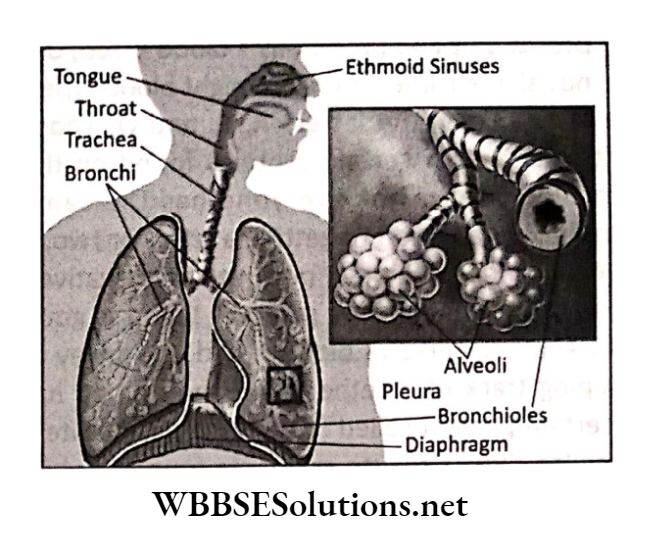
WBBSE Solutions for class 6 chapter 8 the human body lungs

Question 2. Write the mechanism of breathing.
Answer:

Functioning of lungs:

When you are walking with your pet, cleaning your room, or playing football, you probably do not think about inhaling (breathing in)-you have got other things on your mind.

But every time you inhale air, dozens of body parts work together to help get that air in there without you ever thinking about it.

As you inhale or breathe in, your diaphragm contracts and flattens out. This allows it to move down, so your lungs have more room to grow larger as they fill up with air.

“Move over, diaphragm, I’m filling up!” is what your lungs would say. And the diaphragm is not the only part that gives your lungs the room they need.

Your rib muscles also lift the ribs up and outward to give the lungs more space. At the same time, you inhale air through your mouth and nose, and the air heads down your trachea or windpipe.

On the way down the windpipe, tiny hairs called cilia move gently to keep mucus and dirt out of the lungs.

The air then goes through the series of branches in your lungs, through the bronchi and the bronchioles.

The air finally ends up in the 600 million alveoli. As these millions of alveoli get filled up with air, the lungs get bigger. It’s the alveoli that allow oxygen from the air to pass into your blood.

All the cells in the body need oxygen every minute of the day. Oxygen passes through the walls of each alveolus into the tiny capillaries that surround it.

The oxygen enters the blood in the tiny capillaries, hitching a ride on red blood cells and traveling through layers of blood vessels to the heart.

The heart then sends the oxygenated (filled with oxygen) blood out to all the cells in the body.

When it’s to exhale (breathe out), everything happens in reverse. Now it’s the diaphragm’s turn to say, “Move it!” Your diaphragm relaxes and moves up, pushing air out of the lungs.

Your rib muscles become relaxed and your ribs move in again, creating a smaller space in your chest.

By now your cells have used the oxygen they need, and your blood is carrying carbon dioxide and other wastes that must leave your body.

The blood comes back through the capillaries and the wastes enter the alveoli.

Then you breathe them out in the reverse order of how they came in the air goes through the bronchioles, out the bronchi, out the trachea, and finally out through your mouth and nose.
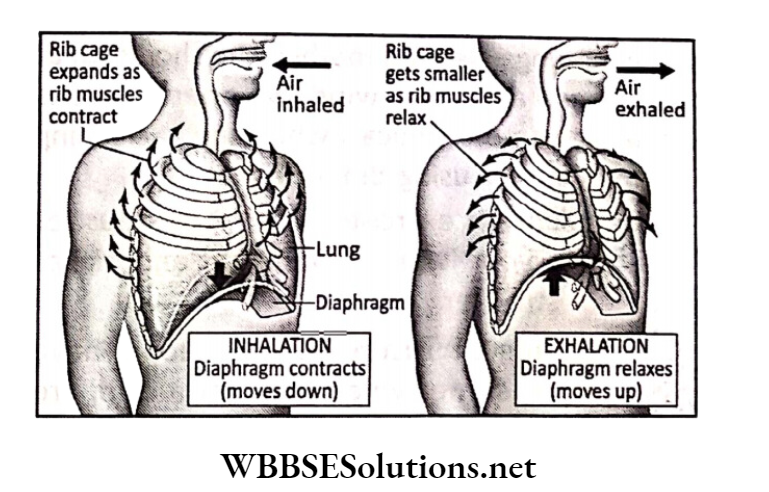
WBBSE Solutions for class 6 chapter 8 the human body inhalation diaphragm contracts moves down and exhalation diaphragm relaxes moves up

The air that you breathe out not only contains waste and carbon dioxide, but it’s warm too art balls and to me Sequence As air travels through your body, it picks up heat along the way.

You can feel this heat by putting your hand in front of your mouth or nose as you breathe out. With all this movement, you might be wondering why things don’t get stuck as the lungs fill and empty.

Luckily, your lungs are covered by two really slick special layers called pleural membranes.

These membranes are separated by a fluid that allows them to slide around easily while you inhale and exhale.

Question 3. How lungs can be taken care of?
Answer:

Your lungs are important for breathing and also for talking. Above the trachea (windpipe) is the larynx, which is sometimes called the voice box.

Across the voice box are two tiny ridges called vocal cords, which open and close to make sounds. When you exhale air from the lungs, it comes through the trachea and larynx and reaches the vocal cords.

If the vocal cords are closed and the air flows between them, the vocal cords vibrate and a sound is made.

The amount of air you blow out from your lungs determines how loud a sound will be and how long you can make the sound.

Very deeply and saying the names of all the kids in your class-how far can you get without taking the next breath? The next time you’re outside.

Try shouting and see what happens- shouting requires lots of air, so you’ll need to breathe in more frequently than you would if you were only saying the words.

Take care of your lungs :

  1. Do not smoke and keep away from others who smoke. Lungs do not like cigarette smoke, it can damage them, and cause disease and even death.
    Stay out of the workshop if someone is using chemicals, as some chemicals can damage your lungs.
  2. Remind mother, she should wear a mask and have windows open if she is using some chemicals when she is cleaning the oven or using drain cleaner.
  3. Get plenty of exercise. It makes the muscles around your lungs work harder and makes them stronger.

Problems of lungs:

Some people have asthma. Sometimes when they get a cold, are in contact with something they are allergic to, or exercise hard, the tiny tubes in their lungs get tighter and there is a lot more mucus.

This makes it hard to get air into the alveoli. They can become very short of breath and need medication to help their lung work well.

Illnesses like bronchitis and pneumonia also make it hard for air to get into the alveoli.

When the lungs do not work well, that means there is not enough oxygen getting around to all the cells of the body, and the body systems do not work as well as usual and you feel short of breath.

People affected with Tuberculosis spit blood while coughing, and suffer from mild fever (especially at night), respiratory trouble, and chest pain.

Severe weakness is felt and loss of body weight takes place rapidly.

Question 4. Write about the common respiratory
Answer:

Problems of lungs:

Some people have asthma. Sometimes when they get a cold, are in contact with something they are allergic to, or exercise hard, the tiny tubes in their lungs get tighter and there is a lot more mucus.

This makes it hard to get air into the alveoli. They can become very short of breath and need medication to help their lung work well.

Illnesses like bronchitis and pneumonia also make it hard for air to get into the alveoli.

When the lungs do not work well, that means there is not enough oxygen getting around to all the cells of the body, and the body systems do not work as well as usual and you feel short of breath.

People affected with Tuberculosis spit blood while coughing, and suffer from mild fever (especially at night), respiratory trouble, and chest pain.

Severe weakness is felt and loss of body weight takes place rapidly.

Chapter 8 The Human Body Bones Bone-Joints And Muscles Review Questions Environment Review Questions MCQ

Question 1. Bones are the parts of

  1. Skeletal system
  2. Locomotory system
  3. Movable system
  4. Joints

Answer: 1. Skeletal system

Question 2. Our ribs protect the

  1. Heart
  2. Lungs
  3. Both ‘a’ and ‘b’ correct
  4. Kidneys

Answer: 3. Both ‘a’ and ‘b’ correct

Question 3. The number of bones in the adult human body is

  1. 200
  2. 206
  3. 300
  4. Variable

Answer: 2. 206

Question 4. Bones are largely made of

  1. Calcium
  2. Iron
  3. Zinc
  4. Minerals

Answer: 1. Calcium

Question 5. The outside part of the bone is called the

  1. Involuntary
  2. Voluntary
  3. Cancellous
  4. Periosteum

Answer: 4. Periosteum

Question 6. The skull is like a natural helmet that protects the

  1. Eyes
  2. Ears
  3. Brain
  4. Face

Answer: 3. Brain

Question 7. The number of cervical vertebrae is

  1. 5
  2. 7
  3. 10
  4. 12

Answer: 2. 7

Question 8. The last 2 pairs of ribs are called the

  1. Floating ribs
  2. Flying ribs
  3. True ribs
  4. False ribs

Answer: 1. Floating ribs

Question 9. The bone between our shoulder and the elbow is

  1. Femur
  2. Humerus
  3. Collar bone
  4. Coccyx

Answer: 2. Humerus

Question 10. The study of joints is called

  1. Biology
  2. Anthology
  3. Arthrology
  4. Astrology

Answer: 3. Arthrology

Question 11. Synovial joints are

  1. Movable
  2. Contain fluid
  3. Fixed
  4. Both ‘a’ and ‘b’ correct

Answer: 4. Both ‘a’ and ‘b’ correct

Question 12. The elbow is an example of

  1. Hinge joint
  2. Saddle joint
  3. Condyloid joint
  4. Ball and socket joint

Answer: 1. Hinge joint

Question 13. Smooth muscles are

  1. Involuntary
  2. Voluntary
  3. Cardiac
  4. Skeletal

Answer: 1. Involuntary

Question 14. The muscle that makes up the heart is called

  1. Smooth muscle
  2. Visceral muscle
  3. Cardiac muscle
  4. Skeletal muscle

Answer: 3. Cardiac muscle

Question 15. Muscles get most of their energy from

  1. Food
  2. Blood
  3. Joints
  4. Glucose

Answer: 4. Glucose

Question 16. Immovable joints can be seen in

  1. knee
  2. thumbs
  3. skull
  4. shoulder

Answer: 3. skull

Question 17. A partly movable joint can be found in

  1. skull
  2. wrist
  3. sternum
  4. shoulder

Answer: 3. sternum

Question 18. The number of bones in a newborn baby is

  1. 206
  2. 300
  3. 500
  4. nil

Answer: 2. 300

Chapter 8 The Human Body Bones Bone-Joints And Muscles Fill In The Blanks

Question 1. Muscles connect the to __________ the bones.
Answer: Joints

Question 2. __________ make up the framework of our bodies.
Answer: Bones

Question 3. The adult human body has __________ bones.
Answer: 206

Question 4. The center of the bone, or __________ is where your blood is created.
Answer: Marrow

Question 5 The outside part of the bone is called the __________.
Answer: Periosteum

Question 6. The __________ make a shield around our lungs and heart.
Answer: Ribs

Question 7. There are __________ pairs of ribs in the human body.
Answer: 12

Question 8. The arm has 3 bones-the humerus, the radius, and the __________
Answer: Ulna

Question 9. The __________ is the largest bone in our body.
Answer: Femur

Question 10. __________ is a degenerative joint disease that middle-aged and older adults experience.
Answer: Osteoarthritis

Question 11. The study of joints is called __________
Answer: Arthrology

Question 12. Synovial joints have __________ to prevent excessive movement.
Answer: Ligaments

Question 13 A __________ joint can move in the axis at a right angle to the joints involved.
Answer: Hinge

Question 14. Ball and socket joints are perhaps the most versatile __________ joints.
Answer: Synovial

Question 15. We have three different types of muscles smooth Muscle, __________ muscle, and skeletal muscle
Answer: Cardiac

Question 16. Skeletal muscles are held to the bones with the help of __________
Answer: Tendons

Question 17. Muscles work by __________ and contracting.
Answer: Expanding

Question 18. Muscles get most of their energy from __________.
Answer: Glucose

Chapter 8 The Human Body Bones Bone-Joints And Muscles Identify As True Or False

Question 1. The bones that make up our skeletal system provide shape and protection.
Answer: True

Question 2. Wherever two bones meet, there is a blood vessel to hold them together and allow them to move.
Answer: False

Question 3. Bones are living, growing, and changing parts of our bodies.
Answer: True

Question 4. Bones are largely made of calcium and other minerals.
Answer: True

Question 5. The spine has 26 bones which are like circles with wings on the sides and back.
Answer: True

Question 6. We have 7 thoracic vertebrae.
Answer: False

Question 7. At the front of the body, the top 7 ribs are attached to the sternum.
Answer: True

Question 8. The femur is the bone between your shoulder and the elbow.
Answer: False

Question 9. Asthma is a rheumatic disease that has symptoms of pain and limited movement.
Answer: False

Question 10. Joints are places where bones meet.
Answer: True

Question 11. In the skull, the synovial joints are called sutures.
Answer: False

Question 12. Hinge joints only allow rotation.
Answer: False

Question 13. Joints form the connections between ligaments.
Answer: False

Question 14. Smooth muscles are sometimes also called involuntary muscles.
Answer: True

Question 15. The muscle that makes up the heart is called cardiac muscle.
Answer: True

Question 16. Muscles have long, thin cells that are grouped into bundles.
Answer: True

Question 17. When you exercise a lot, your muscles get refreshed.
Answer: False

Chapter 8 The Human Body Bones Bone-Joints And Muscles match The Columns

Question 1.
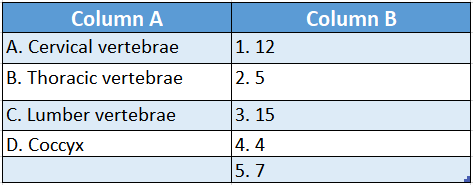
WBBSE Solutions for class 6 chapter 8 the human body match the columns bones, bone joint and muscles table 1
Answer: A-5,B-1,C-2,D-4

Question 2.

WBBSE Solutions for class 6 chapter 8 the human body match the columns bones, bone joint and muscles table 2
Answer: A-2,B-4,C-5,D-1

Question 3.

WBBSE Solutions for class 6 chapter 8 the human body match the columns bones, bone joint and muscles table 3
Answer: A-3,B-4,C-2D-5

Chapter 8 The Human Body Bones Bone-Joints And Muscles Answer In Words Or A Sentence

Question 1. How many bones are there in the adult human body?
Answer: Adults have 206 bones.

Question 2. Name the outer layer of a bone
Answer: Periosteum.

Question 3. Where is bone marrow located?
Answer: In the inner cavity of long bones.

Question 4. Where is our brain enclosed?
Answer: Inside the skull.

Question 5. Name two organs enclosed within ribs.
Answer: Heart and lungs.

Question 6. How many cervical vertebrae are there in the human body?
Answer: They are 7 in number.

Question 7. How many floating ribs are there in our body?
Answer: Two.

Question 8. Name the bone forming the shoulder blade.
Answer: Scapula.

Question 9. Name the bone between your shoulder and the elbow.
Answer: Humerus.

Question 10. How many bones are there in each hand of
ours?
Answer: 19

Question 11. Name the largest bone in our body.
Answer: Femur.

Question 12. Name the two long bones below the knee.
Answer: Tibia and fibula.

Question 13. What is arthrology?
Answer: It is the study of joints.

Question 14. Give an example of the hinge joint.
Answer: Elbow joint.

Question 15. Give an example of a saddle joint.
Answer: Thumb joint.

Question 16. What type of joint is the shoulder joint?
Answer: Ball and socket joint.

Question 17. How many types of muscles are there in our body?
Answer: Three types.

Question 18. What type of muscle is found in our intestine?
Answer: Smooth muscles.

Question 19. Name the structure joining bone and skeletal muscle.
Answer: Tendon.

Question 20. What is myocardium?
Answer: It is the bulk of the heart muscle.

Chapter 8 The Human Body Bones Bone-Joints And Muscles Short Answer Type Questions

Question 1. What are bones? State their functions.
Answer: A bone is a rigid organ that constitutes part of the vertebrate skeleton.

Bones give mechanical support to the body and protect the various organs of the body, produce red and Answer: white blood cells, store minerals, and also enable mobility.

Question 2. What are bone joints?
Answer: A joint or articulation (or articular surface) is the location at which bones connect.

They are constructed to allow movement (except for skull, sacral, sternal, and pelvic bones) and provide mechanical support, and are classified structurally and functionally.

Question 3. How many bones are there in the human body? Babies skeletons are made up of more than 300 Answer: parts, but by the time we become adults we only have 206 bones.

It is just that some of our baby bones are made, partly or completely, of cartilage. As we grow bigger and heavier, cartilage is slowly replaced by harder bone.

Some smaller bones join together to make one bigger bone.

Question 4. State the functions of the skull and spine (vertebral column).
Answer:

  1. The skull is like a natural helmet that protects the brain.
  2. The spine protects the nerves in the spinal column.

Question 5. What are the first two regions of our vertebral column?
Answer:

  1. The top 7 are called the cervical vertebrae and they support your head and neck.
  2. The next 12 are called the thoracic vertebrae. These hold one end of your ribs.

Question 6. Which regions of our vertebral column have fused vertebrae?
Answer:

  1. The sacrum is a large bone that is actually made of 5 vertebrae fused (joined) together.
  2. At the bottom of the spine is the coccyx, which is one bone made of 4 small vertebrae fused together.

Question 7. What are true ribs?
Answer: The first seven ribs attached to the sternum (the breast bone) in the front are known as true ribs (or sternal ribs).

Question 8. What are false ribs and floating ribs?
Answer: The lower five ribs do not directly connect to the sternum and are known as false ribs.

The upper three false ribs connect to the costal cartilages of the ribs just above them.

The last two false ribs, however, usually have no ventral attachment (no anchor at all in front) and are called floating, fluctuating or vertebral ribs.

Question 9. What is arthritis?
Answer: Arthritis is a form of joint disorder that involves inflammation in one or more joints. There are several different forms of arthritis.

The most common form of arthritis is osteoarthritis, a result of trauma to the joint, infection of the joint, or age.

Question 10. How many types of joints are there in the human body?
Answer: There are three main types of joints; Fibrous (immovable), cartilaginous (partially movable), and synovial (freely movable) joints.

Question 11. What are the functions of joints?
Answer: Joints are functional junctions between two or more bones. Joints bind the skeleton together to give structure and allow muscles to move bones to perform certain tasks such as running, reaching, and grasping.

Question 12. What are fibrous joints?
Answer: These joints have no joint cavity and are connected via fibrous connective tissue. The skull bones are connected by fibrous joints.

Sutures are found between the bones of the skull. In fetal skulls, the sutures are wide to allow slight movement during birth.

Question 13. What are synovial joints?
Answer: These are bone joints characterized by the presence of synovial fluid within a space that encapsulates the articulating surface (surfaces that touch each other) of the joint.

The synovial capsule reduces the friction between the bones allowing more smooth movement.

Question 14. What are ball and socket joints?
Answer: These are a type of synovial bone joint. They are multiaxial joints, which means they can move in many axes. One bone has a ball and the other one has a socket.

Question 15. What are smooth muscles?
Answer: Smooth muscle is an involuntary, non-striated muscle. Smooth muscles are usually in sheets or layers, with one layer of muscle behind the other.

We can’t control this type of muscle. Our brain and body tell these muscles what to do without you even thinking about it. Examples-muscles of the stomach.

Question 16. What is myocardium?
Answer: The myocardium is the muscular wall of the heart or the heart muscle. It contracts to pump blood out of the heart and then relaxes as the heart refills with returning blood.

Question 17. What is a tendon?
Answer: A tendon is a tough band of fibrous connective tissue that usually connects muscle to bone and is capable of withstanding tension. Tendons are similar to ligaments.

Question 18. Mention two differences between bones and muscles.
Answer: 1. Bones are hard and composed of osteocytes. Muscles are made of contractile tissue.
2. Bones form the skeleton of the body. Muscles keep the bones in place and play a significant role in their movement.

Chapter 8 The Human Body Bones Bone-Joints And Muscles Long Answer Type Questions

Question 1. Write about the parts of bones.
Answer:

The cartilage, muscles, ligaments, and tendons, all work as one, holding bones together and letting joints move. Muscles connect the joints to the bones.

Flexing of the muscles and the ability to bend at the joints moves the bones to accomplish skilled body motions.

1. Bones

Bones make up the framework of our bodies. We call this framework the skeleton. Bones are living, growing, and changing parts of our bodies.

Baby skeletons are made up of more than 300 parts, but by the time we become adults we only have 206 bones. No, we don’t lose any.

It’s just that some of our baby bones are made, partly or completely, of cartilage. As we grow bigger and heavier, cartilage is slowly replaced by harder bone.

Some smaller bones are joined together to make one bigger bone.

Bones are largely made of calcium and other minerals. They are hard enough to support our weight and daily stress. Bones protect our major organs and give our bodies shape.

Bones are actually living tissue. The center of the bone, or marrow, is where your blood is created.

Parts of bones:  Most bones have 4 parts:

  1. The outside part of the bone is called the periosteum. This is a thin but very dense layer that has the nerves and blood vessels which nourish the bone.
  2.  Compact bone is next. It is smooth and very hard.
  3. Cancellous bone comes next and this looks a bit like a sponge but is much stronger.
  4. On the very inside of many bones is the bone marrow. It looks a bit like a jelly and it makes new blood cells for the body.

Functions of bones:

  1. The bones of the skeleton give us our shape and our posture. Without our spine (backbone) and leg bones, we would be unable to stand erect. Bones also protect the softer parts of our bodies.
  2. The skull is like a natural helmet that protects the brain.
  3. The spine protects the nerves in the spinal column.
  4. The rib makes a shield around our lungs and heart.
  5. They act as a base for muscles, ligaments, and tendons. Ligaments connect bones to bones and tendons connect muscles to bones.
  6. They all work together to help us move around.
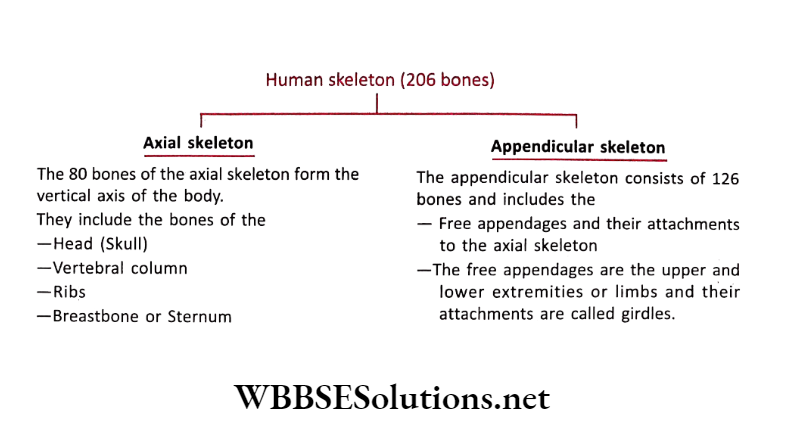
WBBSE Solutions for class 6 chapter 8 the human body human skeleton

Different major bony parts of our body

  1. Some bones protect the brain. You can feel the bone at the back of your head and forehead.
  2. Some bones make the framework for your face. You can feel the bones around your eyes.
  3. Some bones in the middle part of your ear carry sound from your eardrum to the inner De ear.
  4. You can feel the jawbone under your chin and where it hinges just under your ear. It is the only bone in your skull that you can move.

2. Spine (Vertebral Column)

The spine has 26 bones which are like circles with wings on the sides and back. They are called vertebrae. There are small discs made of cartilage between each vertebra.

They act like shock absorbers and stop the bones from rubbing against each other. There is also a hole through each of the vertebrae where the spinal cord goes.

  1. The top 7 are called the cervical vertebrae and they support your head and neck.
  2. The next 12 are called the thoracic vertebrae. These hold one end of your ribs.
  3. The next 5 are the lumber vertebrae.
  4. The next, the sacrum, is a large bone that is actually made of 5 vertebrae fused (joined) together.
  5. At the bottom of the spine is the coccyx, which is one bone made of 4 small vertebrae fused together.
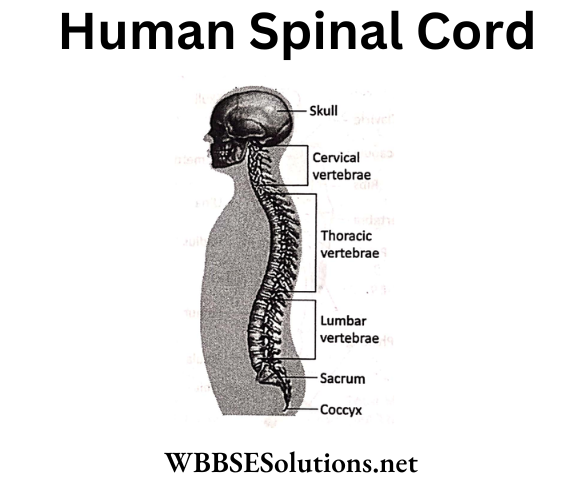
WBBSE Solutions For Class 6 School Science Chapter 8 Human Body Spinal Chord

3. Ribs

Ribs make a protective cage around your lungs and heart. There are usually 12 pairs of ribs, each pair attached to the spine at the back.

Each rib is attached to the ribs above and below it by muscles and ligaments.

  1. At the front of the body, the top 7 ribs are attached to the sternum (or breast bone).
  2. The next 3 pairs are joined to the ribs above and to the sternum, by cartilage.
  3. The last 2 pairs of ribs are called the ‘floating’ ribs. They are called floating because they are attached only to the vertebrae and not to the sternum. They don’t have sharp edges sticking out.

4. Arms

Each arm is fastened to the scapula (the shoulder blade) at the back, (which is a triangle-shaped bone near the top of the ribs) and to the clavicle at the front (the collar bone).

The arm has 3 bones-the humerus, the radius, and the ulna. The humerus is the bone between your shoulder and the elbow.

The radius and ulna bones go from the elbow to the wrist. At the end of the radius and ulna is your wrist. Your wrist has 8 small bones, so it is really flexible. In each hand, there are 19 bones.

5. Legs

Your legs are fastened to your pelvis at the hips. The pelvis is shaped like a bowl and supports the contents of your tummy.

  1. Legs need to be large and strong to support something to pull them. This job is done by the rest of the body.
  2. The femur is the largest bone in the body and it goes from the pelvis to the knee.
  3. Another bone called the patella, or kneecap covers the knee joint to protect it.
  4. Below the knee, there are 2 bones. These are the tibia and the fibula. They join up to a large bone in the ankle called the talus.
  5. There are 6 other bones here so you can move your ankle around but you cannot move it as much as you can move your wrist. Your feet and ankles have a total of 52 bones in them.
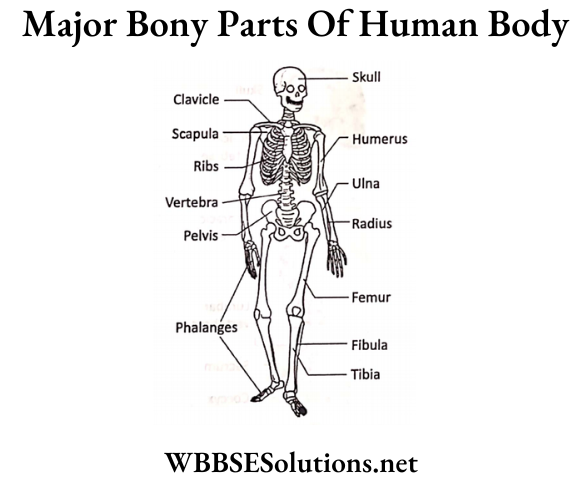
WBBSE Solutions For Class 6 School Science Chapter 8 Human Body Major Bony Parts of Our Body

Question 2. Write about the functions of bones.
Answer:

What are the functions of your joints:

Aside from smooth movement, joints also have other functions. They allow you to grow. When your brain grows, the sutures in your skull accommodate.

The primary cartilaginous joints of your knees and elbows allow you to grow to your full height. Joints also serve to minimize friction and cushion the bones against impact.

Joints are very important areas in your body. They give you space for growth and allow you to move the way you want.

What are the classifications of joints:

Joints can be classified according to what material unites the bones. The three main types of joints are fibrous joints, cartilaginous joints, and synovial joints.

Fibrous joints are joined by fibrous tissue cartilaginous joints are united by cartilage or a mix of cartilage and fibrous tissue; synovial joints are connected by a synovial membrane that surrounds the joint cavity.

1. Fibrous joints:

The movement allowed by these joints is dependent on the length of the fibrous tissue connecting the bones. In the skull, these joints are called sutures.

Sutures are connected by strong connective tissues and allow very little or no movement in adults. These are known as immovable joints.
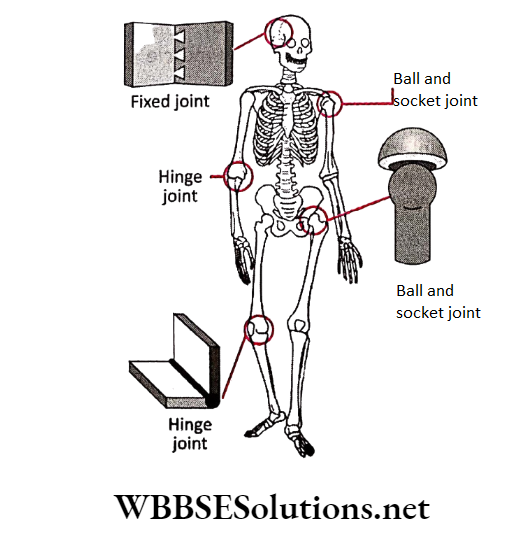
WBBSE Solutions for class 6 chapter 8 the human body joints

2. Cartilaginous joints:

These joints can be primary cartilaginous joints and secondary cartilaginous joints. Primary cartilaginous joints are connected by cartilage temporarily, early in life.

An example is your knee joint. Later on, the cartilage becomes bone. Secondary cartilaginous joints. consist of bones with the ends covered by cartilage and connected with fibrous. tissue.

These joints are found in the vertebral column and allow slight movement. These are known as partly movable joints.

3. Synovial joints:

These joints are present in the shoulder, hip, knee, ankle, toes, elbow, and the joints of the limbs including the loot fingers.

Their name is derived from the fact sling that they have synovial fluid and is du enclosed within a synovial capsule.

joints allow considerable movement but have ligaments to prevent excessive movement. These are known as movable lee joints.

What are the types of synovial joints?

Synovial joints can be categorized into six types based on the movement they allow. The first type, a plane joint, allows gliding or sliding movement, and the bones involved usually have flat surfaces.

An example of a plane joint is found in the shoulder, between the shoulder blade (acromion of the scapula) and the clavicle.

A hinge joint can move in the axis at a right angle to the joints involved. An example is the elbow joint, which connects the humerus and the ulna.

The movement allowed by this joint includes flexion (bending) and extension (straightening) of your elbow.
The third type of synovial joint is the condyloid joint.

In Greek, “condyloid” means knuckle-like. This type of joint allows movement in two axes. Therefore you can bend it, straighten it, move it from side to side, and rotate it.

An example is your wrist joint. song yen send scrawled The fourth synovial joint type is the saddle joint.
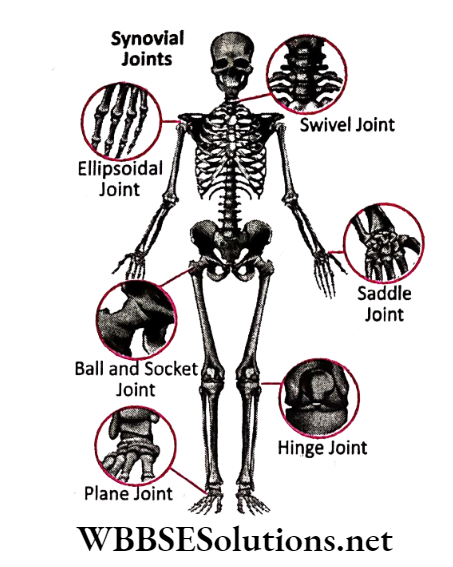
WBBSE Solutions for class 6 chapter 8 the human body joints

This joint is so-named because the opposing surfaces of the involved bones look like a saddle-one has a convex surface, while the other has a concave surface.

The thumb joint, which can also move in two axes, is a good example of this joint.

Ball and socket joints are perhaps the most versatile synovial joints. They are multi-axial joints, which means they can move in many axes. One joint has a ball and the other joint has a socket.

The shoulder joint and the hip joints are examples of this type. In the hip joint, the ball is the head of the leg bone (femur) while the socket is the acetabulum of the hip (pelvis).

Try to experiment with the kinds of movement you can make with your hip joint. You can bend, flex, open, close, rotate and circularly move your legs.

These movements of the hip joint are very important for ballerinas and dancers who have complex leg routines.

The last type of synovial joint is the pivot joint. These joints only allow rotation. One bone serves like a ring while the other bone has a rounded process rotating within the ring.

This type is found in your neck, particularly in your first two cervical bones called the atlas (the ring) and the dens (the rounded process). This allows you to rotate your head.

Question 3. Write about different types of ribs of our body.
Answer:

3. Ribs

Ribs make a protective cage around your lungs and heart. There are usually 12 pairs of ribs, each pair attached to the spine at the back.

Each rib is attached to the ribs above and below it by muscles and ligaments.

  1. At the front of the body, the top 7 ribs are attached to the sternum (or breast bone).
  2. The next 3 pairs are joined to the ribs above and to the sternum, by cartilage.
  3. The last 2 pairs of ribs are called the ‘floating’ ribs. They are called floating because they are attached only to the vertebrae and not to the sternum. They don’t have sharp edges sticking out.

4. Arms

Each arm is fastened to the scapula (the shoulder blade) at the back, (which is a triangle-shaped bone near the top of the ribs) and to the clavicle at the front (the collar bone).

The arm has 3 bones-the humerus, the radius, and the ulna. The humerus is the bone between your shoulder and the elbow.

The radius and ulna bones go from the elbow to the wrist. At the end of the radius and ulna is your wrist. Your wrist has 8 small bones, so it is really flexible. In each hand, there are 19 bones.

5. Legs

Your legs are fastened to your pelvis at the hips. The pelvis is shaped like a bowl and supports the contents of your tummy.

  1. Legs need to be large and strong to support something to pull them. This job is done by the rest of the body.
  2. The femur is the largest bone in the body and it goes from the pelvis to the knee.
  3. Another bone called the patella, or kneecap covers the knee joint to protect it.
  4. Below the knee, there are 2 bones. These are the tibia and the fibula. They join up to a large bone in the ankle called the talus.
  5. There are 6 other bones here so you can move your ankle around but you cannot move it as much as you can move your wrist. Your feet and ankles have a total of 52 bones in them.

Question 4. What are the components of our vertebral column?
Answer:

2. Spine (Vertebral Column)

The spine has 26 bones which are like circles with wings on the sides and back. They are called vertebrae. There are small discs made of cartilage between each vertebra.

They act like shock absorbers and stop the bones from rubbing against each other. There is also a hole through each of the vertebrae where the spinal cord goes.

  1. The top 7 are called the cervical vertebrae and they support your head and neck.
  2. The next 12 are called the thoracic vertebrae. These hold one end of your ribs.
  3. The next 5 are the lumber vertebrae.
  4. The next, the sacrum, is a large bone that is actually made of 5 vertebrae fused (joined) together.
  5. At the bottom of the spine is the coccyx, which is one bone made of 4 small vertebrae fused together.

Question 5. Describe the bony components of our legs.
Answer:

Legs

Your legs are fastened to your pelvis at the hips. The pelvis is shaped like a bowl and supports the contents of your tummy.

  1. Legs need to be large and strong to support something to pull them. This job is done by the rest of the body.
  2. The femur is the largest bone in the body and it goes from the pelvis to the knee.
  3. Another bone called the patella, or kneecap covers the knee joint to protect it.
  4. Below the knee, there are 2 bones. These are the tibia and the fibula. They join up to a large bone in the ankle called the talus.
  5. There are 6 other bones here so you can move your ankle around but you cannot move it as much as you can move your wrist. Your feet and ankles have a total of 52 bones in them.

WBBSE Solutions For Class 6 School Science Chapter 8 Human Body Major Bony Parts of Our Body

Question 6. Write about any three orthopedic problems.
Answer:

Common orthopedic problems:

Anything that is concerned with muscles, ligaments, and joints is considered orthopedic. Some common problems are

  1. Arthritis is a rheumatic disease that has symptoms of pain, limited movement, swelling, and pain in connective tissues.
  2. Osteoarthritis is a degenerative joint disease that middle-aged and older adults experience. The joint cartilage breaks down with the progress of your age and it can occur in the hands, knees, spine, or hips.
  3. Rheumatoid arthritis is a disease listed in the orthopedic section that causes severe inflammation of the joints. joints. The inflammation is so severe that the functioning of the extremities becomes severely limited.
  4. Fractures are definite orthopedic problems.
  5. Low back pain is an orthopedic condition that affects one in ten people. Low back pain presents from mild and annoying to persistent and severe.
  6. Neck pain can come from injuries or damage to the muscles and ligaments of the neck, a herniated cervical disk of arthritis.

2. Bone Joints

The human body moves in many different ways. You can bend, stretch, turn, and twist. You can move because your bones move at your joints, places where your bones meet.

But your bones can’t move by themselves-they need muscles, which are joined to your bones in order to move them.

There are many joints that help your body move. When you turn your head, bend your knees, or twist your wrists, your joints are in action. Some joints, such as those in your skull, do not move.

These are called fixed joints. Each of the other kinds of joints does a specific type of movement.

What are joints? Joints are places where bones meet. The study of joints is called “arthrology”, which is derived from the Greek words “Atheros” meaning joint, and “logos” meaning study.

One bone can have two or more joints. An example is your jaw or mandible. It is connected to the temporal bones on either side of your skull.

You can feel these joints when you place your hands on the junction of your cheeks and your ears and simulate chewing motions.

Question 7. Classify joints according to the material of their union.
Answer:

Bones, Bone-Joints, and Muscles

Every time you move your body from place to place, your bones, muscles, and joints are working together. The bones that make up your skeletal system provide shape and protection.

Your skull protects your brain, your backbones protect your spinal cord and your ribs protect your heart and lungs.

Wherever two bones meet, there is a joint to hold them together and allow them to move, but there would be no movement without the 650 muscles that make up your muscular system.

Bones form the structural framework for our body, while muscles are responsible for pulling the joints, allowing us to move.

The cartilage, muscles, ligaments, and tendons, all work as one, holding bones together and letting joints move. Muscles connect the joints to the bones.

Flexing of the muscles and the ability to bend at the joints moves the bones to accomplish skilled body motions.

1. Bones

Bones make up the framework of our bodies. We call this framework the skeleton. Bones are living, growing, and changing parts of our bodies.

Baby skeletons are made up of more than 300 parts, but by the time we become adults we only have 206 bones. No, we don’t lose any.

It’s just that some of our baby bones are made, partly or completely, of cartilage. As we grow bigger and heavier, cartilage is slowly replaced by harder bone.

Some smaller bones are joined together to make one bigger bone.

Bones are largely made of calcium and other minerals. They are hard enough to support our weight and daily stress. Bones protect our major organs and give our bodies shape.

Bones are actually living tissue. The center of the bone, or marrow, is where your blood is created.

Parts of bones:  Most bones have 4 parts:

  1. The outside part of the bone is called the periosteum. This is a thin but very dense layer that has the nerves and blood vessels which nourish the bone.
  2.  Compact bone is next. It is smooth and very hard.
  3. Cancellous bone comes next and this looks a bit like a sponge but is much stronger.
  4. On the very inside of many bones is the bone marrow. It looks a bit like a jelly and it makes new blood cells for the body.

Functions of bones:

  1. The bones of the skeleton give us our shape and our posture. Without our spine (backbone) and leg bones, we would be unable to stand erect. Bones also protect the softer parts of our bodies.
  2. The skull is like a natural helmet that protects the brain.
  3. The spine protects the nerves in the spinal column.
  4. The rib makes a shield around our lungs and heart.
  5. They act as a base for muscles, ligaments, and tendons. Ligaments connect bones to bones and tendons connect muscles to bones.
  6. They all work together to help us move around.

WBBSE Solutions for class 6 chapter 8 the human body human skeleton

Different major bony parts of our body

  1. Some bones protect the brain. You can feel the bone at the back of your head and forehead.
  2. Some bones make the framework for your face. You can feel the bones around your eyes.
  3. Some bones in the middle part of your ear carry sound from your eardrum to the inner De ear.
  4. You can feel the jawbone under your chin and where it hinges just under your ear. It is the only bone in your skull that you can move.

2. Spine (Vertebral Column)

The spine has 26 bones which are like circles with wings on the sides and back. They are called vertebrae. There are small discs made of cartilage between each vertebra.

They act like shock absorbers and stop the bones from rubbing against each other. There is also a hole through each of the vertebrae where the spinal cord goes.

  1. The top 7 are called the cervical vertebrae and they support your head and neck.
  2. The next 12 are called the thoracic vertebrae. These hold one end of your ribs.
  3. The next 5 are the lumber vertebrae.
  4. The next, the sacrum, is a large bone that is actually made of 5 vertebrae fused (joined) together.
  5. At the bottom of the spine is the coccyx, which is one bone made of 4 small vertebrae fused together.

WBBSE Solutions For Class 6 School Science Chapter 8 Human Body Spinal Chord

3. Ribs

Ribs make a protective cage around your lungs and heart. There are usually 12 pairs of ribs, each pair attached to the spine at the back.

Each rib is attached to the ribs above and below it by muscles and ligaments.

  1. At the front of the body, the top 7 ribs are attached to the sternum (or breast bone).
  2. The next 3 pairs are joined to the ribs above and to the sternum, by cartilage.
  3. The last 2 pairs of ribs are called the ‘floating’ ribs. They are called floating because they are attached only to the vertebrae and not to the sternum. They don’t have sharp edges sticking out.

4. Arms

Each arm is fastened to the scapula (the shoulder blade) at the back, (which is a triangle-shaped bone near the top of the ribs) and to the clavicle at the front (the collar bone).

The arm has 3 bones-the humerus, the radius, and the ulna. The humerus is the bone between your shoulder and the elbow.

The radius and ulna bones go from the elbow to the wrist. At the end of the radius and ulna is your wrist. Your wrist has 8 small bones, so it is really flexible. In each hand, there are 19 bones.

5. Legs

Your legs are fastened to your pelvis at the hips. The pelvis is shaped like a bowl and supports the contents of your tummy.

  1. Legs need to be large and strong to support something to pull them. This job is done by the rest of the body.
  2. The femur is the largest bone in the body and it goes from the pelvis to the knee.
  3. Another bone called the patella, or kneecap covers the knee joint to protect it.
  4. Below the knee, there are 2 bones. These are the tibia and the fibula. They join up to a large bone in the ankle called the talus.
  5. There are 6 other bones here so you can move your ankle around but you cannot move it as much as you can move your wrist. Your feet and ankles have a total of 52 bones in them.

WBBSE Solutions For Class 6 School Science Chapter 8 Human Body Major Bony Parts of Our Body

Common orthopedic problems:

Anything that is concerned with muscles, ligaments, and joints is considered orthopedic. Some common problems are

  1. Arthritis is a rheumatic disease that has symptoms of pain, limited movement, swelling, and pain in connective tissues.
  2. Osteoarthritis is a degenerative joint disease that middle-aged and older adults experience. The joint cartilage breaks down with the progress of your age and it can occur in the hands, knees, spine, or hips.
  3. Rheumatoid arthritis is a disease listed in the orthopedic section that causes severe inflammation of the joints. joints. The inflammation is so severe that the functioning of the extremities becomes severely limited.
  4. Fractures are definite orthopedic problems.
  5. Low back pain is an orthopedic condition that affects one in ten people. Low back pain presents from mild and annoying to persistent and severe.
  6. Neck pain can come from injuries or damage to the muscles and ligaments of the neck, a herniated cervical disk of arthritis.

2. Bone Joints

The human body moves in many different ways. You can bend, stretch, turn, and twist. You can move because your bones move at your joints, places where your bones meet.

But your bones can’t move by themselves-they need muscles, which are joined to your bones in order to move them.

There are many joints that help your body move. When you turn your head, bend your knees, or twist your wrists, your joints are in action. Some joints, such as those in your skull, do not move.

These are called fixed joints. Each of the other kinds of joints does a specific type of movement.

What are joints? Joints are places where bones meet. The study of joints is called “arthrology”, which is derived from the Greek words “Atheros” meaning joint, and “logos” meaning study.

One bone can have two or more joints. An example is your jaw or mandible. It is connected to the temporal bones on either side of your skull.

You can feel these joints when you place your hands on the junction of your cheeks and your ears and simulate chewing motions.

What are the functions of your joints:

Aside from smooth movement, joints also have other functions. They allow you to grow. When your brain grows, the sutures in your skull accommodate.

The primary cartilaginous joints of your knees and elbows allow you to grow to your full height. Joints also serve to minimize friction and cushion the bones against impact.

Joints are very important areas in your body. They give you space for growth and allow you to move the way you want.

What are the classifications of joints:

Joints can be classified according to what material unites the bones. The three main types of joints are fibrous joints, cartilaginous joints, and synovial joints.

Fibrous joints are joined by fibrous tissue cartilaginous joints are united by cartilage or a mix of cartilage and fibrous tissue; synovial joints are connected by a synovial membrane that surrounds the joint cavity.

1. Fibrous joints:

The movement allowed by these joints is dependent on the length of the fibrous tissue connecting the bones. In the skull, these joints are called sutures.

Sutures are connected by strong connective tissues and allow very little or no movement in adults. These are known as immovable joints.

WBBSE Solutions for class 6 chapter 8 the human body joints

2. Cartilaginous joints:

These joints can be primary cartilaginous joints and secondary cartilaginous joints. Primary cartilaginous joints are connected by cartilage temporarily, early in life.

An example is your knee joint. Later on, the cartilage becomes bone. Secondary cartilaginous joints. consist of bones with the ends covered by cartilage and connected with fibrous. tissue.

These joints are found in the vertebral column and allow slight movement. These are known as partly movable joints.

3. Synovial joints:

These joints are present in the shoulder, hip, knee, ankle, toes, elbow, and the joints of the limbs including the loot fingers.

Their name is derived from the fact sling that they have synovial fluid and is du enclosed within a synovial capsule.

joints allow considerable movement but have ligaments to prevent excessive movement. These are known as movable lee joints.

What are the types of synovial joints?

Synovial joints can be categorized into six types based on the movement they allow. The first type, a plane joint, allows gliding or sliding movement, and the bones involved usually have flat surfaces.

An example of a plane joint is found in the shoulder, between the shoulder blade (acromion of the scapula) and the clavicle.

A hinge joint can move in the axis at a right angle to the joints involved. An example is the elbow joint, which connects the humerus and the ulna.

The movement allowed by this joint includes flexion (bending) and extension (straightening) of your elbow.
The third type of synovial joint is the condyloid joint.

In Greek, “condyloid” means knuckle-like. This type of joint allows movement in two axes. Therefore you can bend it, straighten it, move it from side to side, and rotate it.

An example is your wrist joint. song yen send scrawled The fourth synovial joint type is the saddle joint.

WBBSE Solutions for class 6 chapter 8 the human body joints

This joint is so-named because the opposing surfaces of the involved bones look like a saddle-one has a convex surface, while the other has a concave surface.

The thumb joint, which can also move in two axes, is a good example of this joint.

Ball and socket joints are perhaps the most versatile synovial joints. They are multi-axial joints, which means they can move in many axes. One joint has a ball and the other joint has a socket.

The shoulder joint and the hip joints are examples of this type. In the hip joint, the ball is the head of the leg bone (femur) while the socket is the acetabulum of the hip (pelvis).

Try to experiment with the kinds of movement you can make with your hip joint. You can bend, flex, open, close, rotate and circularly move your legs.

These movements of the hip joint are very important for ballerinas and dancers who have complex leg routines.

The last type of synovial joint is the pivot joint. These joints only allow rotation. One bone serves like a ring while the other bone has a rounded process rotating within the ring.

This type is found in your neck, particularly in your first two cervical bones called the atlas (the ring) and the dens (the rounded process). This allows you to rotate your head.

Problems of bone joints:

Joints form the connections between bones. They provide support and help you move. Any damage to the joints from disease or injury can interfere with your movement and cause a lot of pain.

Joint pain can be caused by injury affecting any of the ligaments, bursae, or tendons surrounding the joint. Injury can also affect the ligaments, cartilage, and bones within the joint.

Many different conditions can lead to painful joints including osteoarthritis, rheumatoid arthritis, bursitis, gout, strains, sprains, and other injuries. Joint pain is extremely common.

Joint pain can range from mildly irritating to debilitating. It may go away after a few weeks (acute), or last for several weeks or months (chronic).

Even short-term pain and swelling in the joints can affect your quality of life. Whatever the cause of joint pain, you can usually manage it with medication, physical therapy, or alternative treatments.

3. Muscles

Did you know you have more than 600 muscles in your body? They do everything from pumping blood throughout your body to helping you lift your heavy backpack.

You control some of your muscles, while others–like your heart- do their jobs without you thinking about them at all.

Muscles are all made of the same material, a type of elastic tissue (sort of like the material in a rubber band). Thousands or even tens of thousands of small fibers make up each muscle.

Types of muscles:

You have three different types of muscles in your body: smooth muscle, cardiac muscle, and skeletal muscle.

1. Smooth muscles or Involuntary muscles

Smooth muscles-sometimes also called involuntary muscles-are usually in sheets, or layers, with one layer of muscle behind the other. You cannot control this type of muscle.
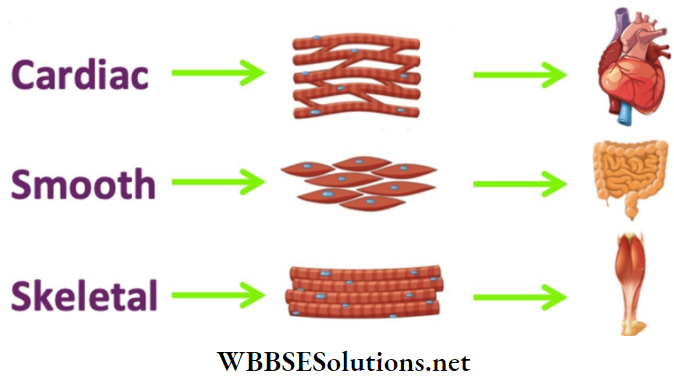
WBBSE Solutions for class 6 chapter 8 the human body smooth muscles or involutary muscles

Your brain and body tell these muscles what to do without you even thinking about it. But smooth muscles are at work all over your body.

In your stomach and digestive system, they contract (tighten up) and relax to allow food to make its journey through the body. Smooth muscles are also found in your bladder.

When they are relaxed, they allow you to hold in urine until you can get to the bathroom. Then they contract so that you can push the urine out.

2. Cardiac muscles

The muscle that makes up the heart is called cardiac muscle. It is also known as the myocardium. The thick muscles of the heart contract to pump blood out and then relax to let blood in after it has circulated through the body.

Just like smooth muscle, cardiac muscle works all by itself with no help from you. A special group of cells within the heart are known as the pacemaker of the heart because it controls the heartbeat.

3. Straited muscles or Voluntary muscles

Now, let’s talk about the kind of muscle you think of when we say “muscle”-the ones that show how strong you are and let you boot a soccer ball into the goal.

These are your skeletal muscles-sometimes called striated muscles because the light and dark parts of the muscle fibers make them look striped. are voluntary muscles, which means you can control what they do.

Your leg will not bend to kick the soccer ball unless you want it to. These muscles help to make up the musculoskeletal system-the combination of your muscles and your skeleton, or bones.

Skeletal muscles are held to the bones with the help of tendons Tendons are cords made of tough tissue, and they work as special connector pieces between bone and muscle.
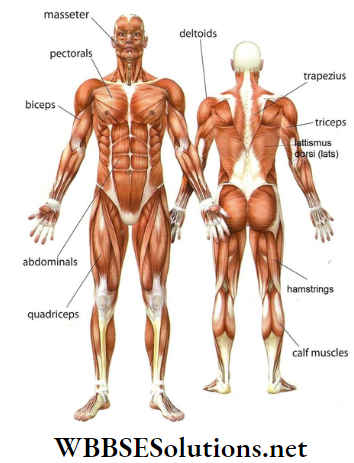
WBBSE Solutions for class 6 chapter 8 the human body smooth muscles or involuntary muscles

The tendons are attached so well that when you contract one of your muscles, the tendon and bone move along with it.

Skeletal muscles also give your body the power it needs to lift and push things. Muscles in your neck and the top part of your back aren’t as large, but they are capable of some pretty amazing things.

Try rotating your head around, back and forth, and up and down to feel the power of the muscles in your neck. These muscles also hold your head high.

How do muscles work? Muscles work by expanding and contracting. Muscles have long, thin cells that are grouped into bundles.

When a muscle fiber gets a signal from its nerve, proteins, and chemicals release energy to either contract the muscle or relax it.

When the muscle contracts, this pulls the bones it’s connected to, closer together. Many of our muscles come in pairs. An example of this is the biceps and triceps in our arms.

When the biceps contract the triceps will relax, which allows our arm to bend. When we want to straighten our arm back out, the biceps will relax and the triceps will contract.

Muscle pairs allow us to move back and forth. Caring muscles Muscles get most of their energy from glucose.

Glucose is made from several types of carbohydrates such as sucrose (which is usually called sugar), lactose (from milk), or fructose (from fruits).

When muscles need to get energy from glucose they do this by changing the glucose into other chemicals such as water and carbon dioxide which release the energy.

We sometimes call this ‘burning’ glucose. They use the oxygen being carried in the blood to help them do this.

Muscles need to move to remain healthy and strong. You can help your muscles stay strong and healthy by exercising every day and using moms have different sets of muscles when they exercise.

When you exercise a lot, your muscles become tired from all the contracting and relaxing. Your muscles might get hurt then.

Have you ever had a cramp? This is when your muscles seem to lock up, and you have a pain in your foot or your leg, or a ‘stitch’ in your side.

This happens when one or more of your muscles contract and will not relax again (called a spasm).

Sweating and not drinking enough on a hot day may mean that you are more likely to get a muscle cramp.
Try drinking water, and stretching and massaging the muscle that hurts and it will get better.

Diseases that can affect muscles: Polio is a virus that attacks the spinal cord. The brain can’t send messages to the muscles and they stop working.

Not long ago a lot of kids would catch this illness, but nowadays not many people get poliomyelitis (that’s its full name) because kids are given an immunization against it.

WBBSE Solutions for class 6 chapter 8 the human body smooth muscles or involuntary muscles.

Tetanus also affects muscles and kids have already had ‘shots’ to stop them from getting this too. There are some other diseases that can affect muscles.

If a person spends long hours in front of a computer then he may sustain injuries from occupational poor posture. The most common such injuries are

  1. Mouse shoulder.
  2. Computer back
  3. Lumbar strains and sprains
  4. Disc injuries
  5. Tennis elbow.

Question 8. Describe the synovial joint.
Answer:

Bones, Bone-Joints, and Muscles

Every time you move your body from place to place, your bones, muscles, and joints are working together. The bones that make up your skeletal system provide shape and protection.

Your skull protects your brain, your backbones protect your spinal cord and your ribs protect your heart and lungs.

Wherever two bones meet, there is a joint to hold them together and allow them to move, but there would be no movement without the 650 muscles that make up your muscular system.

Bones form the structural framework for our body, while muscles are responsible for pulling the joints, allowing us to move.

The cartilage, muscles, ligaments, and tendons, all work as one, holding bones together and letting joints move. Muscles connect the joints to the bones.

Flexing of the muscles and the ability to bend at the joints moves the bones to accomplish skilled body motions.

1. Bones

Bones make up the framework of our bodies. We call this framework the skeleton. Bones are living, growing, and changing parts of our bodies.

Baby skeletons are made up of more than 300 parts, but by the time we become adults we only have 206 bones. No, we don’t lose any.

It’s just that some of our baby bones are made, partly or completely, of cartilage. As we grow bigger and heavier, cartilage is slowly replaced by harder bone.

Some smaller bones are joined together to make one bigger bone.

Bones are largely made of calcium and other minerals. They are hard enough to support our weight and daily stress. Bones protect our major organs and give our bodies shape.

Bones are actually living tissue. The center of the bone, or marrow, is where your blood is created.

Parts of bones:  Most bones have 4 parts:

  1. The outside part of the bone is called the periosteum. This is a thin but very dense layer that has the nerves and blood vessels which nourish the bone.
  2.  Compact bone is next. It is smooth and very hard.
  3. Cancellous bone comes next and this looks a bit like a sponge but is much stronger.
  4. On the very inside of many bones is the bone marrow. It looks a bit like a jelly and it makes new blood cells for the body.

Functions of bones:

  1. The bones of the skeleton give us our shape and our posture. Without our spine (backbone) and leg bones, we would be unable to stand erect. Bones also protect the softer parts of our bodies.
  2. The skull is like a natural helmet that protects the brain.
  3. The spine protects the nerves in the spinal column.
  4. The rib makes a shield around our lungs and heart.
  5. They act as a base for muscles, ligaments, and tendons. Ligaments connect bones to bones and tendons connect muscles to bones.
  6. They all work together to help us move around.

WBBSE Solutions for class 6 chapter 8 the human body human skeleton

Different major bony parts of our body

  1. Some bones protect the brain. You can feel the bone at the back of your head and forehead.
  2. Some bones make the framework for your face. You can feel the bones around your eyes.
  3. Some bones in the middle part of your ear carry sound from your eardrum to the inner De ear.
  4. You can feel the jawbone under your chin and where it hinges just under your ear. It is the only bone in your skull that you can move.

2. Spine (Vertebral Column)

The spine has 26 bones which are like circles with wings on the sides and back. They are called vertebrae. There are small discs made of cartilage between each vertebra.

They act like shock absorbers and stop the bones from rubbing against each other. There is also a hole through each of the vertebrae where the spinal cord goes.

  1. The top 7 are called the cervical vertebrae and they support your head and neck.
  2. The next 12 are called the thoracic vertebrae. These hold one end of your ribs.
  3. The next 5 are the lumber vertebrae.
  4. The next, the sacrum, is a large bone that is actually made of 5 vertebrae fused (joined) together.
  5. At the bottom of the spine is the coccyx, which is one bone made of 4 small vertebrae fused together.

WBBSE Solutions For Class 6 School Science Chapter 8 Human Body Spinal Chord

3. Ribs

Ribs make a protective cage around your lungs and heart. There are usually 12 pairs of ribs, each pair attached to the spine at the back.

Each rib is attached to the ribs above and below it by muscles and ligaments.

  1. At the front of the body, the top 7 ribs are attached to the sternum (or breast bone).
  2. The next 3 pairs are joined to the ribs above and to the sternum, by cartilage.
  3. The last 2 pairs of ribs are called the ‘floating’ ribs. They are called floating because they are attached only to the vertebrae and not to the sternum. They don’t have sharp edges sticking out.

4. Arms

Each arm is fastened to the scapula (the shoulder blade) at the back, (which is a triangle-shaped bone near the top of the ribs) and to the clavicle at the front (the collar bone).

The arm has 3 bones-the humerus, the radius, and the ulna. The humerus is the bone between your shoulder and the elbow.

The radius and ulna bones go from the elbow to the wrist. At the end of the radius and ulna is your wrist. Your wrist has 8 small bones, so it is really flexible. In each hand, there are 19 bones.

5. Legs

Your legs are fastened to your pelvis at the hips. The pelvis is shaped like a bowl and supports the contents of your tummy.

  1. Legs need to be large and strong to support something to pull them. This job is done by the rest of the body.
  2. The femur is the largest bone in the body and it goes from the pelvis to the knee.
  3. Another bone called the patella, or kneecap covers the knee joint to protect it.
  4. Below the knee, there are 2 bones. These are the tibia and the fibula. They join up to a large bone in the ankle called the talus.
  5. There are 6 other bones here so you can move your ankle around but you cannot move it as much as you can move your wrist. Your feet and ankles have a total of 52 bones in them.
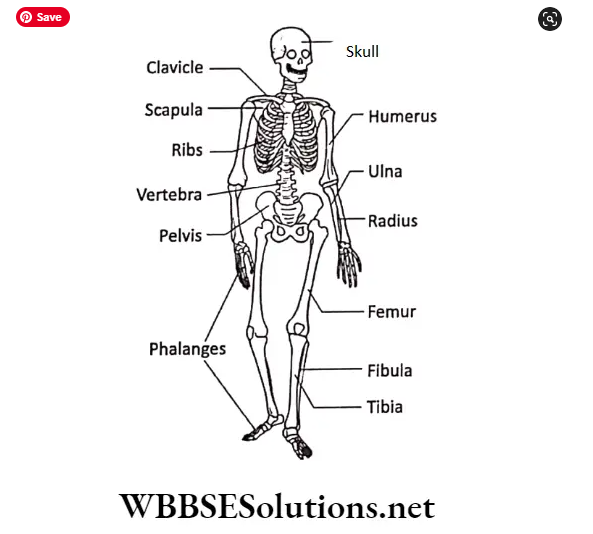
WBBSE Solutions for class 6 chapter 8 the human body legs pelvis at the hips

Common orthopedic problems:

Anything that is concerned with muscles, ligaments, and joints is considered orthopedic. Some common problems are

  1. Arthritis is a rheumatic disease that has symptoms of pain, limited movement, swelling, and pain in connective tissues.
  2. Osteoarthritis is a degenerative joint disease that middle-aged and older adults experience. The joint cartilage breaks down with the progress of your age and it can occur in the hands, knees, spine, or hips.
  3. Rheumatoid arthritis is a disease listed in the orthopedic section that causes severe inflammation of the joints. joints. The inflammation is so severe that the functioning of the extremities becomes severely limited.
  4. Fractures are definite orthopedic problems.
  5. Low back pain is an orthopedic condition that affects one in ten people. Low back pain presents from mild and annoying to persistent and severe.
  6. Neck pain can come from injuries or damage to the muscles and ligaments of the neck, a herniated cervical disk of arthritis.

2. Bone Joints

The human body moves in many different ways. You can bend, stretch, turn, and twist. You can move because your bones move at your joints, places where your bones meet.

But your bones can’t move by themselves-they need muscles, which are joined to your bones in order to move them.

There are many joints that help your body move. When you turn your head, bend your knees, or twist your wrists, your joints are in action. Some joints, such as those in your skull, do not move.

These are called fixed joints. Each of the other kinds of joints does a specific type of movement.

What are joints? Joints are places where bones meet. The study of joints is called “arthrology”, which is derived from the Greek words “Atheros” meaning joint, and “logos” meaning study.

One bone can have two or more joints. An example is your jaw or mandible. It is connected to the temporal bones on either side of your skull.

You can feel these joints when you place your hands on the junction of your cheeks and your ears and simulate chewing motions.

What are the functions of your joints:

Aside from smooth movement, joints also have other functions. They allow you to grow. When your brain grows, the sutures in your skull accommodate.

The primary cartilaginous joints of your knees and elbows allow you to grow to your full height. Joints also serve to minimize friction and cushion the bones against impact.

Joints are very important areas in your body. They give you space for growth and allow you to move the way you want.

What are the classifications of joints:

Joints can be classified according to what material unites the bones. The three main types of joints are fibrous joints, cartilaginous joints, and synovial joints.

Fibrous joints are joined by fibrous tissue cartilaginous joints are united by cartilage or a mix of cartilage and fibrous tissue; synovial joints are connected by a synovial membrane that surrounds the joint cavity.

1. Fibrous joints:

The movement allowed by these joints is dependent on the length of the fibrous tissue connecting the bones. In the skull, these joints are called sutures.

Sutures are connected by strong connective tissues and allow very little or no movement in adults. These are known as immovable joints.

WBBSE Solutions for class 6 chapter 8 the human body joints

2. Cartilaginous joints:

These joints can be primary cartilaginous joints and secondary cartilaginous joints. Primary cartilaginous joints are connected by cartilage temporarily, early in life.

An example is your knee joint. Later on, the cartilage becomes bone. Secondary cartilaginous joints. consist of bones with the ends covered by cartilage and connected with fibrous. tissue.

These joints are found in the vertebral column and allow slight movement. These are known as partly movable joints.

3. Synovial joints:

These joints are present in the shoulder, hip, knee, ankle, toes, elbow, and the joints of the limbs including the loot fingers.

Their name is derived from the fact sling that they have synovial fluid and is du enclosed within a synovial capsule.

Joints allow considerable movement but have ligaments to prevent excessive movement. These are known as movable lee joints.

What are the types of synovial joints?

Synovial joints can be categorized into six types based on the movement they allow. The first type, a plane joint, allows gliding or sliding movement, and the bones involved usually have flat surfaces.

An example of a plane joint is found in the shoulder, between the shoulder blade (acromion of the scapula) and the clavicle.

A hinge joint can move in the axis at a right angle to the joints involved. An example is the elbow joint, which connects the humerus and the ulna.

The movement allowed by this joint includes flexion (bending) and extension (straightening) of your elbow.
The third type of synovial joint is the condyloid joint.

In Greek, “condyloid” means knuckle-like. This type of joint allows movement in two axes. Therefore you can bend it, straighten it, move it from side to side, and rotate it.

An example is your wrist joint. song yen send scrawled The fourth synovial joint type is the saddle joint.

WBBSE Solutions for class 6 chapter 8 the human body joints

This joint is so-named because the opposing surfaces of the involved bones look like a saddle-one has a convex surface, while the other has a concave surface.

The thumb joint, which can also move in two axes, is a good example of this joint.

Ball and socket joints are perhaps the most versatile synovial joints. They are multi-axial joints, which means they can move in many axes. One joint has a ball and the other joint has a socket.

The shoulder joint and the hip joints are examples of this type. In the hip joint, the ball is the head of the leg bone (femur) while the socket is the acetabulum of the hip (pelvis).

Try to experiment with the kinds of movement you can make with your hip joint. You can bend, flex, open, close, rotate and circularly move your legs.

These movements of the hip joint are very important for ballerinas and dancers who have complex leg routines.

The last type of synovial joint is the pivot joint. These joints only allow rotation. One bone serves like a ring while the other bone has a rounded process rotating within the ring.

This type is found in your neck, particularly in your first two cervical bones called the atlas (the ring) and the dens (the rounded process). This allows you to rotate your head.

Problems of bone joints:

Joints form the connections between bones. They provide support and help you move. Any damage to the joints from disease or injury can interfere with your movement and cause a lot of pain.

Joint pain can be caused by injury affecting any of the ligaments, bursae, or tendons surrounding the joint. Injury can also affect the ligaments, cartilage, and bones within the joint.

Many different conditions can lead to painful joints including osteoarthritis, rheumatoid arthritis, bursitis, gout, strains, sprains, and other injuries. Joint pain is extremely common.

Joint pain can range from mildly irritating to debilitating. It may go away after a few weeks (acute), or last for several weeks or months (chronic).

Even short-term pain and swelling in the joints can affect your quality of life. Whatever the cause of joint pain, you can usually manage it with medication, physical therapy, or alternative treatments.

3. Muscles

Did you know you have more than 600 muscles in your body? They do everything from pumping blood throughout your body to helping you lift your heavy backpack.

You control some of your muscles, while others–like your heart- do their jobs without you thinking about them at all.

Muscles are all made of the same material, a type of elastic tissue (sort of like the material in a rubber band). Thousands or even tens of thousands of small fibers make up each muscle.

Types of muscles:

You have three different types of muscles in your body: smooth muscle, cardiac muscle, and skeletal muscle.

1. Smooth muscles or Involuntary muscles

Smooth muscles-sometimes also called involuntary muscles-are usually in sheets, or layers, with one layer of muscle behind the other. You cannot control this type of muscle.

WBBSE Solutions for class 6 chapter 8 the human body smooth muscles or involutary muscles

Your brain and body tell these muscles what to do without you even thinking about it. But smooth muscles are at work all over your body.

In your stomach and digestive system, they contract (tighten up) and relax to allow food to make its journey through the body. Smooth muscles are also found in your bladder.

When they are relaxed, they allow you to hold in urine until you can get to the bathroom. Then they contract so that you can push the urine out.

2. Cardiac muscles

The muscle that makes up the heart is called cardiac muscle. It is also known as the myocardium. The thick muscles of the heart contract to pump blood out and then relax to let blood in after it has circulated through the body.

Just like smooth muscle, cardiac muscle works all by itself with no help from you. A special group of cells within the heart are known as the pacemaker of the heart because it controls the heartbeat.

3. Straited muscles or Voluntary muscles

Now, let’s talk about the kind of muscle you think of when we say “muscle”-the ones that show how strong you are and let you boot a soccer ball into the goal.

These are your skeletal muscles-sometimes called striated muscles because the light and dark parts of the muscle fibers make them look striped. are voluntary muscles, which means you can control what they do.

Your leg will not bend to kick the soccer ball unless you want it to. These muscles help to make up the musculoskeletal system-the combination of your muscles and your skeleton, or bones.

Skeletal muscles are held to the bones with the help of tendons Tendons are cords made of tough tissue, and they work as special connector pieces between bone and muscle.

WBBSE Solutions for class 6 chapter 8 the human body smooth muscles or involuntary muscles

The tendons are attached so well that when you contract one of your muscles, the tendon and bone move along with it.

Skeletal muscles also give your body the power it needs to lift and push things. Muscles in your neck and the top part of your back aren’t as large, but they are capable of some pretty amazing things.

Try rotating your head around, back and forth, and up and down to feel the power of the muscles in your neck. These muscles also hold your head high.

How do muscles work? Muscles work by expanding and contracting. Muscles have long, thin cells that are grouped into bundles.

When a muscle fiber gets a signal from its nerve, proteins, and chemicals release energy to either contract the muscle or relax it.

When the muscle contracts, this pulls the bones it’s connected to, closer together. Many of our muscles come in pairs. An example of this is the biceps and triceps in our arms.

When the biceps contract the triceps will relax, which allows our arm to bend. When we want to straighten our arm back out, the biceps will relax and the triceps will contract.

Muscle pairs allow us to move back and forth. Caring muscles Muscles get most of their energy from glucose.

Glucose is made from several types of carbohydrates such as sucrose (which is usually called sugar), lactose (from milk), or fructose (from fruits).

When muscles need to get energy from glucose they do this by changing the glucose into other chemicals such as water and carbon dioxide which release the energy.

We sometimes call this ‘burning’ glucose. They use the oxygen being carried in the blood to help them do this.

Muscles need to move to remain healthy and strong. You can help your muscles stay strong and healthy by exercising every day and using moms have different sets of muscles when they exercise.

When you exercise a lot, your muscles become tired from all the contracting and relaxing. Your muscles might get hurt then.

Have you ever had a cramp? This is when your muscles seem to lock up, and you have a pain in your foot or your leg, or a ‘stitch’ in your side.

This happens when one or more of your muscles contract and will not relax again (called a spasm).

Sweating and not drinking enough on a hot day may mean that you are more likely to get a muscle cramp.
Try drinking water, and stretching and massaging the muscle that hurts and it will get better.

Diseases that can affect muscles: Polio is a virus that attacks the spinal cord. The brain can’t send messages to the muscles and they stop working.

Not long ago a lot of kids would catch this illness, but nowadays not many people get poliomyelitis (that’s its full name) because kids are given an immunization against it.

WBBSE Solutions for class 6 chapter 8 the human body smooth muscles or involuntary muscles.

Tetanus also affects muscles and kids have already had ‘shots’ to stop them from getting this too. There are some other diseases that can affect muscles.

If a person spends long hours in front of a computer then he may sustain injuries from occupational poor posture. The most common such injuries are

  1. Mouse shoulder.
  2. Computer back
  3. Lumbar strains and sprains
  4. Disc injuries
  5. Tennis elbow.


Question 10. Describe the methods of caring for muscles.
Answer:

Bones, Bone-Joints, and Muscles

Every time you move your body from place to place, your bones, muscles, and joints are working together. The bones that make up your skeletal system provide shape and protection.

Your skull protects your brain, your backbones protect your spinal cord and your ribs protect your heart and lungs.

Wherever two bones meet, there is a joint to hold them together and allow them to move, but there would be no movement without the 650 muscles that make up your muscular system.

Bones form the structural framework for our body, while muscles are responsible for pulling the joints, allowing us to move.

The cartilage, muscles, ligaments, and tendons, all work as one, holding bones together and letting joints move. Muscles connect the joints to the bones.

Flexing of the muscles and the ability to bend at the joints moves the bones to accomplish skilled body motions.

1. Bones

Bones make up the framework of our bodies. We call this framework the skeleton. Bones are living, growing, and changing parts of our bodies.

Baby skeletons are made up of more than 300 parts, but by the time we become adults we only have 206 bones. No, we don’t lose any.

It’s just that some of our baby bones are made, partly or completely, of cartilage. As we grow bigger and heavier, cartilage is slowly replaced by harder bone.

Some smaller bones are joined together to make one bigger bone.

Bones are largely made of calcium and other minerals. They are hard enough to support our weight and daily stress. Bones protect our major organs and give our bodies shape.

Bones are actually living tissue. The center of the bone, or marrow, is where your blood is created.

Parts of bones:  Most bones have 4 parts:

  1. The outside part of the bone is called the periosteum. This is a thin but very dense layer that has the nerves and blood vessels which nourish the bone.
  2.  Compact bone is next. It is smooth and very hard.
  3. Cancellous bone comes next and this looks a bit like a sponge but is much stronger.
  4. On the very inside of many bones is the bone marrow. It looks a bit like a jelly and it makes new blood cells for the body.

Functions of bones:

  1. The bones of the skeleton give us our shape and our posture. Without our spine (backbone) and leg bones, we would be unable to stand erect. Bones also protect the softer parts of our bodies.
  2. The skull is like a natural helmet that protects the brain.
  3. The spine protects the nerves in the spinal column.
  4. The rib makes a shield around our lungs and heart.
  5. They act as a base for muscles, ligaments, and tendons. Ligaments connect bones to bones and tendons connect muscles to bones.
  6. They all work together to help us move around.


WBBSE Solutions for class 6 chapter 8 the human body human skeleton


Different major bony parts of our body

  1. Some bones protect the brain. You can feel the bone at the back of your head and forehead.
  2. Some bones make the framework for your face. You can feel the bones around your eyes.
  3. Some bones in the middle part of your ear carry sound from your eardrum to the inner De ear.
  4. You can feel the jawbone under your chin and where it hinges just under your ear. It is the only bone in your skull that you can move.

2. Spine (Vertebral Column)

The spine has 26 bones which are like circles with wings on the sides and back. They are called vertebrae. There are small discs made of cartilage between each vertebra.

They act like shock absorbers and stop the bones from rubbing against each other. There is also a hole through each of the vertebrae where the spinal cord goes.

  1. The top 7 are called the cervical vertebrae and they support your head and neck.
  2. The next 12 are called the thoracic vertebrae. These hold one end of your ribs.
  3. The next 5 are the lumber vertebrae.
  4. The next, the sacrum, is a large bone that is actually made of 5 vertebrae fused (joined) together.
  5. At the bottom of the spine is the coccyx, which is one bone made of 4 small vertebrae fused together.

Real-Life Scenarios Involving Body Functions

WBBSE Solutions For Class 6 School Science Chapter 8 Human Body Spinal Chord


3. Ribs

Ribs make a protective cage around your lungs and heart. There are usually 12 pairs of ribs, each pair attached to the spine at the back.

Each rib is attached to the ribs above and below it by muscles and ligaments.

  1. At the front of the body, the top 7 ribs are attached to the sternum (or breast bone).
  2. The next 3 pairs are joined to the ribs above and to the sternum, by cartilage.
  3. The last 2 pairs of ribs are called the ‘floating’ ribs. They are called floating because they are attached only to the vertebrae and not to the sternum. They don’t have sharp edges sticking out.

4. Arms

Each arm is fastened to the scapula (the shoulder blade) at the back, (which is a triangle-shaped bone near the top of the ribs) and to the clavicle at the front (the collar bone).

The arm has 3 bones-the humerus, the radius, and the ulna. The humerus is the bone between your shoulder and the elbow.

The radius and ulna bones go from the elbow to the wrist. At the end of the radius and ulna is your wrist. Your wrist has 8 small bones, so it is really flexible. In each hand, there are 19 bones.

5. Legs

Your legs are fastened to your pelvis at the hips. The pelvis is shaped like a bowl and supports the contents of your tummy.

  1. Legs need to be large and strong to support something to pull them. This job is done by the rest of the body.
  2. The femur is the largest bone in the body and it goes from the pelvis to the knee.
  3. Another bone called the patella, or kneecap covers the knee joint to protect it.
  4. Below the knee, there are 2 bones. These are the tibia and the fibula. They join up to a large bone in the ankle called the talus.
  5. There are 6 other bones here so you can move your ankle around but you cannot move it as much as you can move your wrist. Your feet and ankles have a total of 52 bones in them.


WBBSE Solutions For Class 6 School Science Chapter 8 Human Body Major Bony Parts of Our Body


Common orthopedic problems:

Anything that is concerned with muscles, ligaments, and joints is considered orthopedic. Some common problems are

  1. Arthritis is a rheumatic disease that has symptoms of pain, limited movement, swelling, and pain in connective tissues.
  2. Osteoarthritis is a degenerative joint disease that middle-aged and older adults experience. The joint cartilage breaks down with the progress of your age and it can occur in the hands, knees, spine, or hips.
  3. Rheumatoid arthritis is a disease listed in the orthopedic section that causes severe inflammation of the joints. joints. The inflammation is so severe that the functioning of the extremities becomes severely limited.
  4. Fractures are definite orthopedic problems.
  5. Low back pain is an orthopedic condition that affects one in ten people. Low back pain presents from mild and annoying to persistent and severe.
  6. Neck pain can come from injuries or damage to the muscles and ligaments of the neck, a herniated cervical disk of arthritis.

2. Bone Joints

The human body moves in many different ways. You can bend, stretch, turn, and twist. You can move because your bones move at your joints, places where your bones meet.

But your bones can’t move by themselves-they need muscles, which are joined to your bones in order to move them.

There are many joints that help your body move. When you turn your head, bend your knees, or twist your wrists, your joints are in action. Some joints, such as those in your skull, do not move.

These are called fixed joints. Each of the other kinds of joints does a specific type of movement.

What are joints? Joints are places where bones meet. The study of joints is called “arthrology”, which is derived from the Greek words “Atheros” meaning joint, and “logos” meaning study.

One bone can have two or more joints. An example is your jaw or mandible. It is connected to the temporal bones on either side of your skull.

You can feel these joints when you place your hands on the junction of your cheeks and your ears and simulate chewing motions.

What are the functions of your joints:

Aside from smooth movement, joints also have other functions. They allow you to grow. When your brain grows, the sutures in your skull accommodate.

The primary cartilaginous joints of your knees and elbows allow you to grow to your full height. Joints also serve to minimize friction and cushion the bones against impact.

Joints are very important areas in your body. They give you space for growth and allow you to move the way you want.

What are the classifications of joints:

Joints can be classified according to what material unites the bones. The three main types of joints are fibrous joints, cartilaginous joints, and synovial joints.

Fibrous joints are joined by fibrous tissue cartilaginous joints are united by cartilage or a mix of cartilage and fibrous tissue; synovial joints are connected by a synovial membrane that surrounds the joint cavity.

1. Fibrous joints:

The movement allowed by these joints is dependent on the length of the fibrous tissue connecting the bones. In the skull, these joints are called sutures.

Sutures are connected by strong connective tissues and allow very little or no movement in adults. These are known as immovable joints.


WBBSE Solutions for class 6 chapter 8 the human body joints


2. Cartilaginous joints:

These joints can be primary cartilaginous joints and secondary cartilaginous joints. Primary cartilaginous joints are connected by cartilage temporarily, early in life.

An example is your knee joint. Later on, the cartilage becomes bone. Secondary cartilaginous joints. consist of bones with the ends covered by cartilage and connected with fibrous. tissue.

These joints are found in the vertebral column and allow slight movement. These are known as partly movable joints.

3. Synovial joints:

These joints are present in the shoulder, hip, knee, ankle, toes, elbow, and the joints of the limbs including the loot fingers.

Their name is derived from the fact sling that they have synovial fluid and is du enclosed within a synovial capsule.

Joints allow considerable movement but have ligaments to prevent excessive movement. These are known as movable lee joints.

What are the types of synovial joints?

Synovial joints can be categorized into six types based on the movement they allow. The first type, a plane joint, allows gliding or sliding movement, and the bones involved usually have flat surfaces.

An example of a plane joint is found in the shoulder, between the shoulder blade (acromion of the scapula) and the clavicle.

A hinge joint can move in the axis at a right angle to the joints involved. An example is the elbow joint, which connects the humerus and the ulna.

The movement allowed by this joint includes flexion (bending) and extension (straightening) of your elbow.
The third type of synovial joint is the condyloid joint.

In Greek, “condyloid” means knuckle-like. This type of joint allows movement in two axes. Therefore you can bend it, straighten it, move it from side to side, and rotate it.

An example is your wrist joint. song yen send scrawled The fourth synovial joint type is the saddle joint.


WBBSE Solutions for class 6 chapter 8 the human body joints


This joint is so-named because the opposing surfaces of the involved bones look like a saddle-one has a convex surface, while the other has a concave surface.

The thumb joint, which can also move in two axes, is a good example of this joint.

Ball and socket joints are perhaps the most versatile synovial joints. They are multi-axial joints, which means they can move in many axes. One joint has a ball and the other joint has a socket.

The shoulder joint and the hip joints are examples of this type. In the hip joint, the ball is the head of the leg bone (femur) while the socket is the acetabulum of the hip (pelvis).

Try to experiment with the kinds of movement you can make with your hip joint. You can bend, flex, open, close, rotate and circularly move your legs.

These movements of the hip joint are very important for ballerinas and dancers who have complex leg routines.

The last type of synovial joint is the pivot joint. These joints only allow rotation. One bone serves like a ring while the other bone has a rounded process rotating within the ring.

This type is found in your neck, particularly in your first two cervical bones called the atlas (the ring) and the dens (the rounded process). This allows you to rotate your head.

Problems of bone joints:

Joints form the connections between bones. They provide support and help you move. Any damage to the joints from disease or injury can interfere with your movement and cause a lot of pain.

Joint pain can be caused by injury affecting any of the ligaments, bursae, or tendons surrounding the joint. Injury can also affect the ligaments, cartilage, and bones within the joint.

Many different conditions can lead to painful joints including osteoarthritis, rheumatoid arthritis, bursitis, gout, strains, sprains, and other injuries. Joint pain is extremely common.

Joint pain can range from mildly irritating to debilitating. It may go away after a few weeks (acute), or last for several weeks or months (chronic).

Even short-term pain and swelling in the joints can affect your quality of life. Whatever the cause of joint pain, you can usually manage it with medication, physical therapy, or alternative treatments.

3. Muscles

Did you know you have more than 600 muscles in your body? They do everything from pumping blood throughout your body to helping you lift your heavy backpack.

You control some of your muscles, while others–like your heart- do their jobs without you thinking about them at all.

Muscles are all made of the same material, a type of elastic tissue (sort of like the material in a rubber band). Thousands or even tens of thousands of small fibers make up each muscle.

Types of muscles:

You have three different types of muscles in your body: smooth muscle, cardiac muscle, and skeletal muscle.

1. Smooth muscles or Involuntary muscles

Smooth muscles-sometimes also called involuntary muscles-are usually in sheets, or layers, with one layer of muscle behind the other. You cannot control this type of muscle.

WBBSE Solutions for class 6 chapter 8 the human body smooth muscles or involutary muscles

Your brain and body tell these muscles what to do without you even thinking about it. But smooth muscles are at work all over your body.

In your stomach and digestive system, they contract (tighten up) and relax to allow food to make its journey through the body. Smooth muscles are also found in your bladder.

When they are relaxed, they allow you to hold in urine until you can get to the bathroom. Then they contract so that you can push the urine out.

2. Cardiac muscles

The muscle that makes up the heart is called cardiac muscle. It is also known as the myocardium. The thick muscles of the heart contract to pump blood out and then relax to let blood in after it has circulated through the body.

Just like smooth muscle, cardiac muscle works all by itself with no help from you. A special group of cells within the heart are known as the pacemaker of the heart because it controls the heartbeat.

3. Straited muscles or Voluntary muscles

Now, let’s talk about the kind of muscle you think of when we say “muscle”-the ones that show how strong you are and let you boot a soccer ball into the goal.

These are your skeletal muscles-sometimes called striated muscles because the light and dark parts of the muscle fibers make them look striped. are voluntary muscles, which means you can control what they do.

Your leg will not bend to kick the soccer ball unless you want it to. These muscles help to make up the musculoskeletal system-the combination of your muscles and your skeleton, or bones.

Skeletal muscles are held to the bones with the help of tendons Tendons are cords made of tough tissue, and they work as special connector pieces between bone and muscle.

WBBSE Solutions for class 6 chapter 8 the human body smooth muscles or involuntary muscles

The tendons are attached so well that when you contract one of your muscles, the tendon and bone move along with it.

Skeletal muscles also give your body the power it needs to lift and push things. Muscles in your neck and the top part of your back aren’t as large, but they are capable of some pretty amazing things.

Try rotating your head around, back and forth, and up and down to feel the power of the muscles in your neck. These muscles also hold your head high.

How do muscles work? Muscles work by expanding and contracting. Muscles have long, thin cells that are grouped into bundles.

When a muscle fiber gets a signal from its nerve, proteins, and chemicals release energy to either contract the muscle or relax it.

When the muscle contracts, this pulls the bones it’s connected to, closer together. Many of our muscles come in pairs. An example of this is the biceps and triceps in our arms.

When the biceps contract the triceps will relax, which allows our arm to bend. When we want to straighten our arm back out, the biceps will relax and the triceps will contract.

Muscle pairs allow us to move back and forth. Caring muscles Muscles get most of their energy from glucose.

Glucose is made from several types of carbohydrates such as sucrose (which is usually called sugar), lactose (from milk), or fructose (from fruits).

When muscles need to get energy from glucose they do this by changing the glucose into other chemicals such as water and carbon dioxide which release the energy.

We sometimes call this ‘burning’ glucose. They use the oxygen being carried in the blood to help them do this.

Muscles need to move to remain healthy and strong. You can help your muscles stay strong and healthy by exercising every day and using moms have different sets of muscles when they exercise.

When you exercise a lot, your muscles become tired from all the contracting and relaxing. Your muscles might get hurt then.

Have you ever had a cramp? This is when your muscles seem to lock up, and you have a pain in your foot or your leg, or a ‘stitch’ in your side.

This happens when one or more of your muscles contract and will not relax again (called a spasm).

Sweating and not drinking enough on a hot day may mean that you are more likely to get a muscle cramp.
Try drinking water, and stretching and massaging the muscle that hurts and it will get better.

Diseases that can affect muscles: Polio is a virus that attacks the spinal cord. The brain can’t send messages to the muscles and they stop working.

Not long ago a lot of kids would catch this illness, but nowadays not many people get poliomyelitis (that’s its full name) because kids are given an immunization against it.

WBBSE Solutions for class 6 chapter 8 the human body smooth muscles or involuntary muscles.

Conceptual Questions on Nutrition and Digestion

Tetanus also affects muscles and kids have already had ‘shots’ to stop them from getting this too. There are some other diseases that can affect muscles.

If a person spends long hours in front of a computer then he may sustain injuries from occupational poor posture. The most common such injuries are

  1. Mouse shoulder.
  2. Computer back
  3. Lumbar strains and sprains
  4. Disc injuries
  5. Tennis elbow.

Chapter 8 The Human Body The Growth And Development Of The Human Body Review Questions Environment  Review Questions MCQ

Question 1. Rapid growth occurs during

  1. Adulthood
  2. Infancy
  3. Puberty
  4. Old age

Answer: 3. Puberty

Question 2. The head is proportionally large during

  1. Childhood
  2. Adulthood
  3. Old age
  4. None are correct

Answer: 1. Childhood

Question 3. When the rate of growth increases rapidly it is called a growth

  1. Spurt
  2. Age
  3. Maximum
  4. Final

Answer: 1. Spurt

Question 4. The peak of the growth spurt occurs at about the age of 12 for

  1. Boys
  2. Human
  3. Animals
  4. Girls

Answer: 4. Girls

Question 5. The peak of the growth spurt occurs at about the age of 14 for

  1. Animals
  2. Boys
  3. Girls
  4. Human

Answer: 2. Boys

Question 6. When a child takes the first step on his or her own, he or she is called a

  1. Infant
  2. Toddler
  3. Teenager
  4. Adult

Answer: 2. Toddler

Question 7. With age, children grow both in weight and

  1. Maturity
  2. Adulthood
  3. Height
  4. All above are correct

Answer: 3. Height

Question 8. Endocrine glands in our body produce chemical messengers called

  1. Hormones
  2. Enzymes
  3. Food
  4. Proteins

Answer: 1. Hormones

Question 9. The pituitary gland produces growth

  1. Substances
  2. Materials
  3. Enzymes
  4. Hormones

Answer: 4. Hormones

Question 10. Failure to thrive may happen when a child simply doesn’t get enough to

  1. Eat
  2. Drink
  3. Enjoy
  4. Run

Answer: 1. Eat

Question 11. The BMI is defined as the body mass divided by the square of the body

  1. Weight
  2. Height
  3. Growth
  4. None of the above

Answer: 2. Height

Question 12. Body mass index is universally expressed in units of

  1. Kg/m2
  2. Mg/cm
  3. G/cm2
  4. Height/Weight

Answer: 1. kg/m2

Chapter 8 The Human Body The Growth And Development Of The Human Body Fill In The Blanks

Question 1. There are clear stages that children pass through from _________ to adult.
Answer: Birth

Question 2. Children grow in size at a very _________ rate.
Answer: Fast

Question 3. _________ growth occurs during puberty.
Answer: Rapid

Question 4. The _________ proportions of the body at birth are very different from those of the adult.
Answer: Physical

Question 5. When the rate of growth increases rapidly it is called a growth _________.
Answer: Spurt

Question 6. The growth spurt and puberty occur at _________ ages for girls and boys.
Answer: Different

Question 7. Most babies double their birth weight at _________ months.
Answer: 5

Question 8. Glands in our body produce chemical messengers called _________.
Answer: Hormones

Question 9. _________ is the stage of your life when sexual development happens.
Answer: Puberty

Question 10. Growth hormone is produced by _________ gland.
Answer: Pituitary

Question 11. BMI stands for Body Mass _________.
Answer: Index

Question 12. BMI is a crude method to estimate _________.
Answer: Obesity

Chapter 8 The Human Body The Growth And Development Of The Human Body Identify As True Or False

Question 1. There are clear stages that children pass through from birth to adulthood.
Answer: True

Question 2. Girls generally mature before boys.
Answer: True

Question 3. At birth, infants are only about half of their adult height.
Answer: False

Question 4. Rapid slowing down of growth occurs in adolescence until adult height is reached.
Answer: True

Question 5. When the rate of growth decreases rapidly it is called a growth spurt.
Answer: False

Question 6. The growth spurt and puberty occur at different ages for girls and boys.
Answer: True

Question 7. The changes in size and proportion are easily observed signs of development.
Answer: True

Question 8. Everyone grows and matures at the same rate.
Answer: False

Question 9. Hormones play a major role in growth.
Answer: True

Chapter 8 The Human Body The Growth And Development Of The Human Body Match The Column

Question 1.
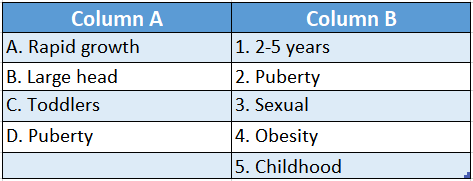
WBBSE Solutions for class 6 chapter 8 the human body match the columns the growth and development of the human body table 1
Answer: A-2,B-5,C-1,D-3

Chapter 8 The Human Body The Growth And Development Of The Human Body Answer in words or a sentence

Question 1. What type of growth occurs during infancy and childhood?
Answer: Rapid growth.

Question 2. When, during growth, legs are proportionately short?
Answer: During Childhood.

Question 3. What is the term used to denote the rate of rapid increase of growth during puberty?
Answer: Growth spurt.

Question 4. What is the period of infancy?
Answer: Birth to 2 years.

Question 5. Who are toddlers?
Answer: Children between the ages of 2-5 years.

Question 6. Name the gland which secretes growth hormone.
Answer: Pituitary gland.

Question 7. What is the full form of FTT?
Answer: Failure to Thrive.

Question 8. What is the full form of BMI?
Answer: Body Mass Index.

Chapter 8 The Human Body The Growth And Development Of The Human Body Short Answer Type Questions

Question 1. What is human development?
Answer: Human development is a lifelong process of physical, behavioral, cognitive, and emotional growth and change.

In the early stage of life- from babyhood to childhood, childhood to adolescence, and adolescence to adulthood- enormous changes take place.

Question 2. What is growth?
Answer: Growth refers to a positive change in size, and/ or maturation, often over a period of time. Growth can occur as a stage of maturation or a process toward fullness or fulfillment.

Question 3. What is a growth spurt?
Answer: When the rate of growth increases rapidly it is called a growth spurt. The most important growth spurt is the one that occurs at puberty. This spurt produces a rapid increase in both weight and height.

Question 4. How is the growth spurt of boys and girls different?
Answer: The growth spurt and puberty occur at different ages for girls and boys. Girls usually start and finish the stages of puberty and adolescence earlier than boys.

Question 5. What is psychological development?
Answer: Psychological development is the development of human beings’ cognitive, emotional, intellectual, and social capabilities and functioning over the course of the life span, from infancy through old age.

Question 6. What is adolescence?
Answer: It is the period following the onset of puberty during which a young person develops from a child into an adult.

Question 7. What is meant by growth disorder?
Answer: Growth disorders are problems that prevent children from developing normal height, weight, sexual maturity, or other features.

Question 8. What is BMI?
Answer: The body mass index (BMI) is a value derived from the mass (weight) and height of an Individual. The BMI is defined as the body mass divided by the square of the body height and is universally expressed in units of kg/m2.

Question 9. Calculate the BMI of your friend whose weight and height are 40kg and 4 feet respectively. Answer: What is your inference?
Answer:

BMI=\(\frac{Weight in kg}{(height in m)2}\)

Height = 4 feet = (4×0.305) m1.22 m

Since the BMI falls in the range of 25-29.9, my friend belongs to the overweight category. He should carry out a little bit of exercise to control his body weight in proportion to his height.

Chapter 8 The Human Body The Growth And Development Of The Human Body Long Answer Type Questions

Question 1. Write about the patterns of human growth.
Answer:

The Growth And Development Of The Human Body

There are clear stages that children pass through from birth to adulthood. These stages are the same for boys and girls, but girls generally mature before boys. This is clearly shown in the diagram below.

Physical development:

Physical growth is obviously important to performance. We will start by looking at how the body changes during development.

There are important changes in body size and proportions. These changes affect the way where children can perform different skills and activities. our gas Patterns of growth ou mot varans

1. Changes in size

Children grow in size at a very fast rate. At birth, infants are only about a quarter of their adult height.

This final adult height is usually reached at about twenty years of age. There are four characteristic stages of growth from birth to adulthood.

  1. Rapid growth in infancy and early childhood
  2. Slow, steady growth in middle childhood
  3. Rapid growth during puberty bow sort
  4. Gradual slowing down of growth in adolescence until adult height is reached. Both sexes are of comparable shape and size during infancy and childhood.
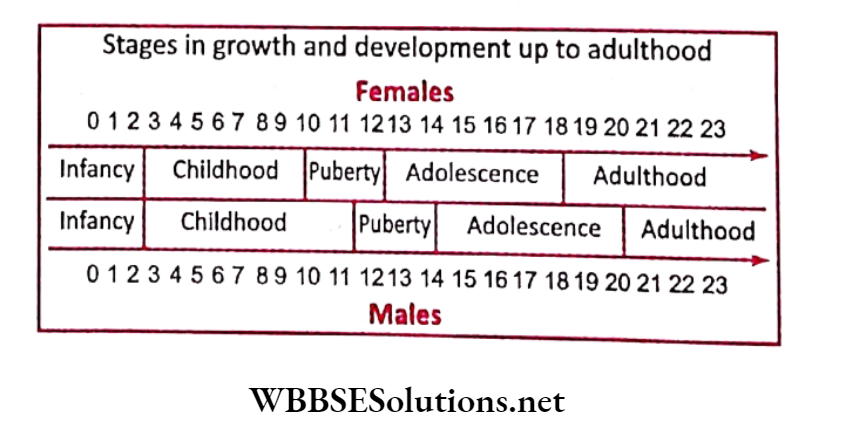
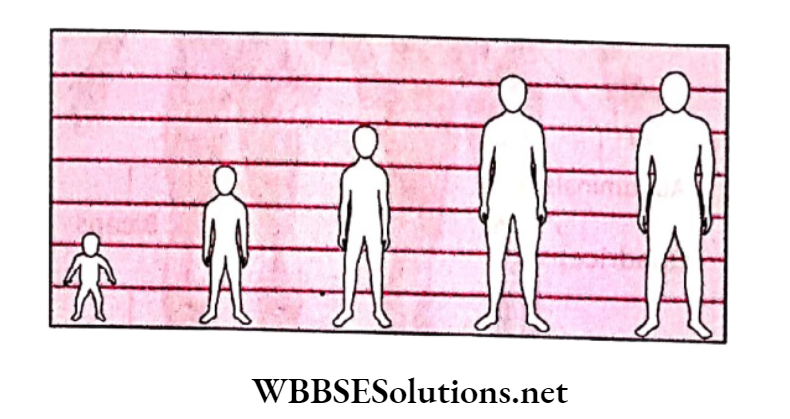
WBBSE Solutions for class 6 chapter 8 the human body females and malesWBBSE Solutions for class 6 chapter 8 the human body the increase in body size from birth to adult

2. Changes in proportions

The physical proportions of the body at birth are very different from those of the adult. Some body parts grow more than others during g development to each of the final adult proportions.

The illustration shows the relative size of body parts at different ages. The head is proportionally large and the legs are proportionally short during childhood.

At birth, the head is one-quarter of the length of the body compared with about one-sixth in the adult. The legs are about one-third the length of the body at birth and one-half in the adult.

Because the body proportions change this means that not all of the body segments grow by the same amount.
Changes in the size and shape of the body. are caused by different segments growing at different times.

These changes in body proportions will have a great influence on how skills will be performed.
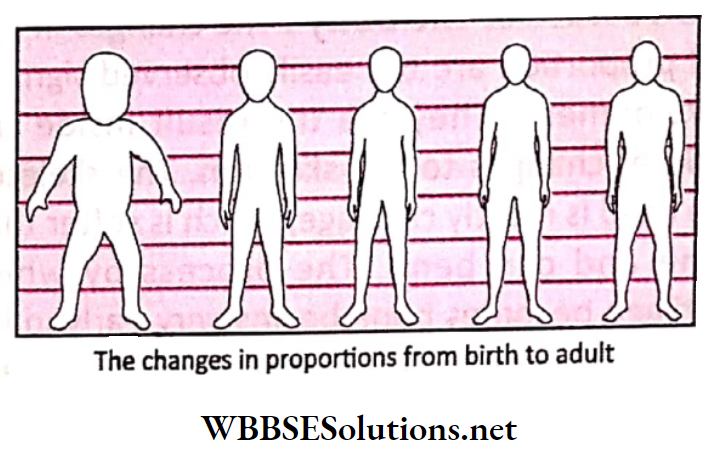
WBBSE Solutions for class 6 chapter 8 the human body the chages in proportions from birh to adult

For example, changes in the relative size of the head in childhood affect the balance of the body during movement and the relative shortness of the legs at a very young limit running ability.

At the beginning of puberty, children have long arms and legs. They are better suited for running but the rapid growth may make them appear to be clumsy and to have difficulty in coordination.

Nous Growth spurts:

When the rate of growth increases rapidly it is called a growth spurt. The most important growth spurt is the one that occurs at puberty. This spurt produces a rapid increase in both weight and height.

The peak of this growth spurt occurs at about age 12 for girls and age 14 for boys. Before this growth spurt, there are no important differences between boys and girls in weight and height.

During growth spurts, most of the child’s energy is used for growing.

Children will be easily tired and may not be able to keep up their usual Birth to 1 year to puberty Adolescence growth of trunk growth of legs growth of trunk Areas of growth volume or intensity of training.

Light training will stimulate bodily growth if the child has enough energy.
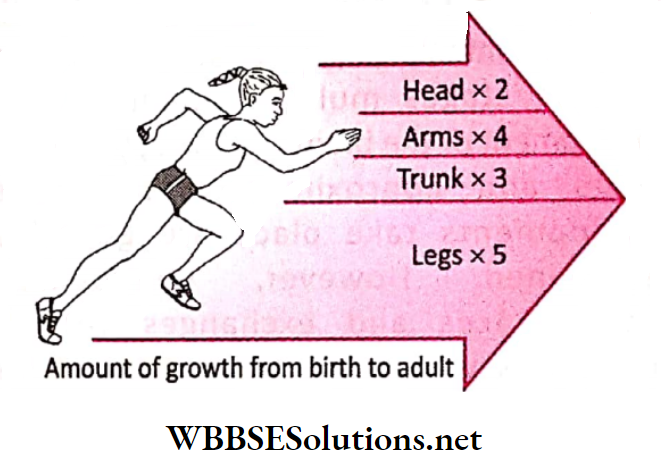
WBBSE Solutions for class 6 chapter 8 the human body amount of growth from birth adult

WBBSE Solutions for class 6 chapter 8 the human body birth to growth of trunk

Difference between boys and girls:

The growth spurt and puberty occur at different ages for girls and boys. Girls usually start and finish the stages of puberty and adolescence earlier than boys.

The characteristic differences between boys and girls occur at puberty in response to changes in hormones produced by shoulders and little change in hip width in boys’ bodies.

Typically, this results in broader and broader hips and little change in shoulder width in girls.

Structure of the body:

The changes in size and proportion are easily observed signs of development. They are the result inside the body of changes to the skeleton.

The skeleton of a child is mostly cartilage, which is softer than bone and can bend. The process by which cartilage becomes bone begins very early in life in special growth areas in the bones.

These special growth areas are called growth plates.

Psychological development:

Children go through distinct periods of development as they move from infants to young adults. During each of these stages, multiple changes in the development of the brain are taking place.

What occurs and approximately when these developments take place are genetically determined.

However, environmental circumstances and exchanges with key individuals within that environment have a significant influence on how each child benefits from each development event.

Ages and stages is a term used to broadly outline key periods in the human development timeline.

During each stage growth and development occur in the primary developmental domains including physical, intellectual, language, and social-emotional.
WBBSE Solutions for class 6 chapter 8 the human body development ,language and growth social emotional

1. Infants/Babies (0-2 years)

This is a time for developing the bonds that will last a lifetime providing the child with the inner resources to develop self-esteem and the ability to relate positively with others.

2. Toddlers/Pre-schoolers (2-5 years)

When a child takes the first step on his or her own, a new phase in development begins. At this stage, children are now free to roam around the world.

It is a time for active exploration of their environment.

Language development takes major leaps which leads to learning the names of objects of interest, the ability to ask for things, and as they discover their independent nature.

During this developmental stage, a major challenge is developing what psychologists call emotional regulation.

This is also a stage of rapid physical and intellectual development preparing these children for starting school which includes interacting cooperatively with peers while at the same time being able to compete physically and intellectually.

3. School-age children (6-12 years)

While toddlers and pre-schoolers need constant supervision, school-age children become gradually ready for more independence.

However, learning to make good choices and exercise self-discipline does not come easily for many. Parents need to impart a moral code that the child gradually internalizes.

As children struggle with these important tasks parents must be able to provide praise and encouragement for achievement but parents must also be able to allow them to sometimes experience the natural consequences for their behavior or provide logical consequences to help them learn from mistakes.

4. Adolescents/Teenagers (13-18 years)

It is a time to really begin defining one’s self and realistically contemplating the future. Skill development is accelerated to prepare for college or job training programs.

Talents are perfected. Social skills are honed and relationships take on more of a serious nature. Peer pressure is at its maximum and in today’s teen society there are more tempting sidetracks than ever.

During adolescence, kids need their parents more than ever.

With age, children grow both in weight and height. Their rates of growth are not uniform throughout the whole of childhood.

Growth in the first few years of life is very rapid, and then it slows down later.

Another spurt of growth their birth weight at 5 months and treble it at 1 takes place in adolescence. Most babies have a double year.

While the average length of the baby at birth is about 50 cm (20 inches), it rises to 75 cm (30 inches) at 1 year, i.e., one and a half times more than at birth.

Boys, even in infancy, tend to be taller, heavier and grow faster than girls do. There is a lot of difference in height and weight of children at different ages.

There are also significant variations in the height and weight of children from different regions and communities in a vast and diverse country like India.

The expected average weight and height of Indian children of different ages are given below:
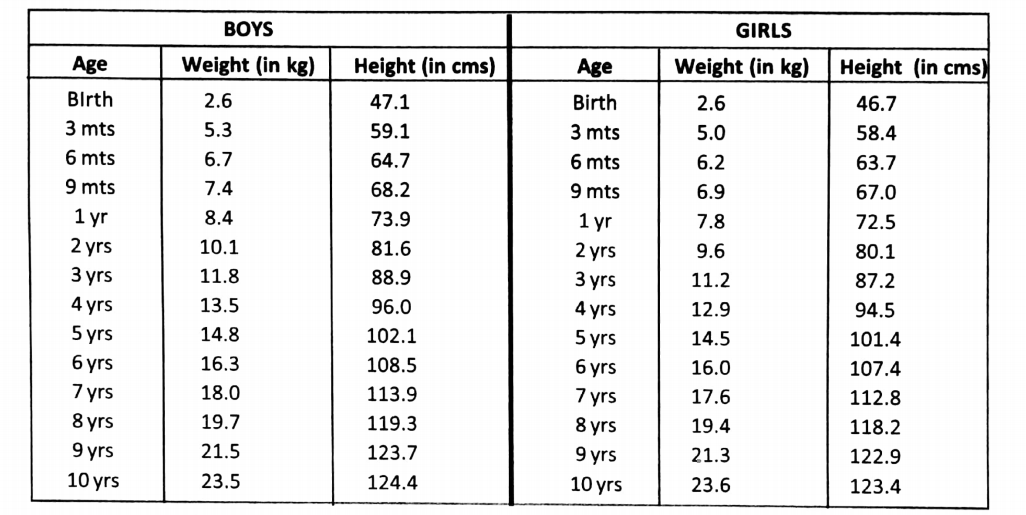
WBBSE Solutions for class 6 chapter 8 the human body boys and girls

Abnormal development:

Fairy tales are filled with stories of giants and little people. The stories were written hundreds of years ago, and they sometimes tried to explain why these people looked different from others around them.

These old-fashioned fairy tales might have been different if the writers had known what today’s doctors have learned about growth.

What is Growth Disorder? Everyone grows and matures differently. You may be taller than your best friend in fourth grade. But then in sixth grade, your best friend may be an inch taller than you.

Usually, this is totally normal. A growth disorder, however, means that a kid has abnormal growth-for example, growing a lot slower or a lot faster than other kids at the same age.

What is Normal Growth? If growth is not the same for all kids, how do doctors know what is normal? By feet and inches (or meters and centimeters).

Over the years, lots of height and weight measurements have been taken for lots of children of different ages.

These measurements have been put together in what is called a standard growth chart, which tells doctors about how most kids grow.

From the time you were a baby; your doctor has weighed and measured you whenever you have had a checkup.

Because kids grow differently, your doctor checks your height against the standard growth chart.

If you are in the 50th percentile on the growth chart, it means half of the kids of your age are taller than you are and half are shorter.

If you fall in the 25th percentile that means 75% of the kids of your age are taller and 25% are shorter, and so on.

But some children who are under the 3rd percentile or over the 97th percentile, or who are growing a lot slower or faster than most other kids, may have a growth problem. In this situation, the doctor will usually want to check things out.

One thing your doctor will want to know is how tall your mother and father are and how they grew when they were children.

You may have inherited short or tall genes from them. You may also have inherited the tendency to have your growth spurt earlier or later than most other kids do.

Problems with puberty:

Glands in your body produce chemical messengers called hormones. Normal increases in the amounts of some of these hormones being produced trigger the changes your body goes through during puberty.

Puberty is the stage of your life when sexual development happens, like breast development and menstrual periods in girls and growth of the penis and testicles in boys.

One of the body changes that happen during puberty is a big increase in your rate of growth-a growth spurt.

When these changes happen before the age of 7 or 8 in girls or 9 in boys, it’s called precocious or early puberty.

At first, these kids may be taller than their friends. Later, however, they may stop growing sooner than most other kids do, and they may not become as tall when they are adults as they might have been otherwise.

Usually, kids with precocious puberty can be treated with medications that help correct this problem.

Delayed or late puberty occurs when the hormonal and body changes that should happen with puberty take place later than normal, or sometimes not at all.

Girls who have not begun puberty by age 13 and boys who have not begun by age 15 have delayed puberty and are sometimes called late bloomers.

When puberty finally occurs, either by itself or with treatment, these teens have a growth spurt and tend to catch up to their peers. Sometimes they even grow to be taller than their friends.

Hormones and Growth Disorders:

One of the glands in your body is called the pituitary gland. It’s found at the bottom of your brain and is shaped like a peanut. It may be small in size, but it’s pretty big in importance.

One of the chemical messengers the pituitary gland sends out to your body is called growth hormone, which is essential for growth.

When the pituitary gland doesn’t make enough growth hormone and sometimes other pituitary hormones as well, the condition is called hypopituitarism. This can slow down a kid’s growth.

Special tests can find out if kids don’t produce enough growth hormone. If they don’t, daily shots of growth hormone can often help them grow to be normal-sized adults.

Another gland that produces hormones important for growth is your thyroid. You may be able to feel it if you press gently with your fingers across the front of your neck, just under your Adam’s apple (elevated throat region of males).

It is shaped like a butterfly and moves up and down when you swallow.

Your thyroid makes a hormone called thyroxin. If it makes too little, the condition is called hypothyroidism.

Having too little thyroxin makes a kid grow more slowly. Doctors can do a simple blood test for hypothyroidism. If it’s needed, a kid can take the missing hormone as a pill.

Other reasons why kids might not grow normally:

Hormones play a major role in growth, but kids might not grow normally for other reasons, including:

1. Chronic diseases:

These include heart and kidney problems, cystic fibrosis, juvenile rheumatoid arthritis, and sickle cell anemia, which may slow growth in some cases.

2. Complications during pregnancy:

One of the reasons a pregnant woman is warned not to smoke or drink is because it may slow down her baby’s growth. A baby may be too small when it’s born and some remain small for life.

Some infections during pregnancy, other pregnancy problems, and certain. genetic diseases can also cause this problem.

3. Failure to thrive :

Some babies do not grow and gain weight normally after they are born. This is called failure to thrive (FTT). FTT may happen when a child simply doesn’t get enough to eat.

Some babies may have an illness that needs to be treated, but most will grow normally after they start

4. Genetic conditions:

Some genetics eating enough food. conditions can also cause children to not grow as they should.

Many of these growth disorders can be successfully treated today. With help, kids who might once have ended up very short can grow up more like other children.

Body Mass Index (BMI):

The body mass index (BMI) or Quetelet index is a value derived from the mass (weight) and height of an individual.

The BMI is defined as the body mass divided by the square of the body height and is universally expressed in units of kg/m2, resulting from mass in kilograms and height in meters.

The BMI is an attempt to quantify the amount of tissue mass (muscle, fat, and bone) in an individual, and then categorize that person as underweight, normal weight, overweight, or obese based on that value.

However, there is some debate about where on the BMI scale the dividing lines between categories should be placed.

The body mass index (BMI) is a statistic developed by Adolphe Quetelet in the 1900s for evaluating body mass.

It is not related to gender and age. It used the same formula for men as for women and children.

The body mass index is calculated based on the following formula:

BMI=\(\frac{Weight in Kilograms}{height in Metre2}\)

Example for 175 cm height and 70 kg weight: BMI-70/(1.75 × 1.75) = 22.86

The result is in kilograms by meter square, or kg/m2. BMI is a crude method to estimate obesity. Body Mass Index (BMI) is one of the ways to determine when extra fat accumulates.

Translates into health risks. Body mass index is a measure that takes into account a person’s weight and height to gauge total body fat in adults.

The higher the body mass index, the greater the risk of developing additional health problems. The following chart describes the various categories of obesity based on body mass index.
WBBSE Solutions for class 6 chapter 8 the human body weight categoories as per bmi calculaton

BMI < 15 (Excessively low weight)

BMI 16-18 (Low weight)

BMI 19-24.9 (Desirable)

BMI 25-29.9 (Overweight)

BMI30-34.9 (Obese, category 1)

BMI 35-39.9 (Obese, category 2)

BMI > 40 (Severe obesity)

Heart disease, diabetes, and high blood pressure are all linked to being overweight and obese.

Interesting Facts About Human Body

The human body is made up of a head, a neck, a torso (trunk), two arms, and two legs. The average height of an adult human is about 5 to 6 feet.

The human body is made to stand erect, walk on two feet, use the arms to carry and lift, and have opposable thumbs (able to grasp).

The adult body is made up of 100 trillion cells, 206 bones, 650 muscles, and 22 internal organs.

Every square inch of the human body has about 19 million skin cells.

In every hour about 1 billion cells in the human body must be replaced.

The average human head has about 100,000 hairs.

The average adult takes over 20,000 breaths a day.

The circulatory system of arteries, veins, and capillaries is about 60,000 miles long.

The heart beats more than 2.5 billion times in an average lifetime.

There are about 9,000 taste buds on the surface of the tongue, in the throat, and on the roof of the mouth.

The strongest (powerful) muscle in the body is the tongue.

The human heart creates enough pressure when it pumps out to the body to squirt blood bo 30 feet.

You blink over 10,000,000 times a year.

The human brain weighs about 3 pounds.

The brain uses over a quarter of the oxygen used by the human body.

Your heart beats around 100000 times a day, 36500000 times a year, and over a billion times if you live beyond 30.

Red blood cells carry oxygen around the body. They are created inside the bone marrow of your bones.

The color of human skin is determined by the level of pigment melanin that the body produces. Those with a small amount of melanin have light skin while those with a large amount have dark skin.

Adult lungs have a surface area of around 70 square meters.

Humans have a stage of sleep that features rapid eye movement (REM). REM sleep makes up around 25% of total sleep time and is often when you have your most vivid dreams.

Most adults have 32 teeth.

The smallest bone found in the human body is located in the middle ear. The stapes (or stirrup) bone is only 2.8 millimeters long.

Infants blink only once or twice a minute while adults average around 10.

As well as having unique fingerprints, humans also have unique tongue prints.

The left side of your body is controlled by the right side of your brain while the right side of your body is controlled by the left side of your brain.

Antibiotics are only effective against bacteria; they do not help in fighting off a virus.

It takes about 12 hours to completely digest eaten food.

Your sense of smell is around 10000 times more sensitive than your sense of taste.

It takes about 20 seconds for a red blood cell to circle the whole body.

One-fourth of the bones in your body are in your feet.

The blood processing in the kidneys amounts to some 1.25 liters a minute, or 1800 liters a day (1.25 × 60 × 24 = 1800), which is about 400 times the total blood volume and roughly one-fourth the volume pumped each day by the heart.

Every 24 hours, 170 liters of water is filtered from the bloodstream into the renal tubules; and by far the greater part of this- some 168.5 liters of water together with salts dissolved in it is reabsorbed by the cells lining the tubules and returned to the blood.

In a 24-hour period, an average man eliminates only 1.5 liters of water, containing the waste products of metabolism, but the actual volume varies with fluid intake and occupational and environmental factors.

WBBSE Solutions For Class 6 School Science Chapter 7 Statics and Dynamics Of Fluid MCQs

Chapter 7 Statics And Dynamics Of Fluid Liquid And Gas Review Questions Environment Review Questions MCQs

Question 1. SI unit of pressure is

  1. Newton
  2. Pascal
  3. Bar
  4. Newton/Metre

Answer: 2. Pascal

Question 2. Pressure = Force/Area. With reference to this formula state which principle is applied in nail The to increase its pressure

  1. Area is increased
  2. Both area and force are increased
  3. Area is decreased
  4. Force is reduced

Answer: 3. Area is decreased

Read And Learn More: WBBSE Solutions For Class 6 School Science

Question 3. Liquid flows from

  1. Lower pressure to higher pressure
  2. Higher pressure to lower pressure
  3. All of the above
  4. None of the above

Answer: 2. Higher pressure to lower pressure

WBBSE Class 6 Fluid Mechanics MCQs

Question 4. As the depth of water increases

  1. Only downward pressure would increase
  2. Only upward pressure would increase
  3. Only lateral pressure would increase
  4. Pressure in all directions would increase

Answer: 4. Pressure in all directions would increase

Question 5. Faster the rate of airflow, the ____________ the pressure.

  1. Higher
  2. Lower
  3. Same
  4. None of the above

Answer: 2. Lower

WBBSE Solutions For Class 6 Geography WBBSE Solutions For Class 6 History WBBSE Solutions For Class 6 Maths
WBBSE Class 6 Geography Notes WBBSE Class 6 History Notes
WBBSE Class 6 Geography Multiple Choice Questions WBBSE Class 6 History MCQs WBBSE Notes For Class 6 School Science


Question 6.If more force is applied on a certain surface area, pressure

  1. Increases
  2. Decreases
  3. Remains the same
  4. None of the above

Answer: 1. Increases

Question 7. The lower portion of a dam’s wall is

  1. Thinner
  2. Same throughout
  3. Broader
  4. None of the above

Answer: 3. Broader

Question 8. The three surfaces of brick have an area of 50 sq. cm, 30 sq. cm, and 20 sq. cm respectively. The brick is released on mud in three ways so that its different surfaces come in contact with mud. The penetration of the brick inside the mud shall be maximum when it falls with its hot

  1. 50 sq. cm surface facing the mud
  2. 30 sq. cm surface facing the mud
  3. 20 sq. cm surface facing the mud
  4. Same in all of above

Answer: 3. 20 sq. cm surface facing the mud

Question 9. Fluid means

  1. Gas only
  2. Liquid only
  3. None of them
  4. Both of them

Answer: 4. Both of them

Question 10. The following is an airplane wing. Which of the following statements is true?

WBBSE Solutions for class 6 chapter 7 Statics and dynamic of fluid(liquid and gas) volocity of moving air

  1. V is greater than V, but P is smaller than P2
  2. V is smaller than V, but P is greater than P2
  3. V1 is greater than V2 and P, is greater than P2
  4. V is smaller than V, and P is smaller than P2

Answer: 1. V is greater than V, but P is smaller than P2

Question 11. The pressure exerted by a fluid depends on

  1. Quantity of the liquid
  2. Depth of the liquid
  3. The shape of the vessel
  4. The volume of the liquid

Answer: 2. Depth of the liquid

Understanding Statics and Dynamics of Fluids

Question 12. Pressure Force/Area In the light of this formula state which principle is applicable in the design of a camel’s feet.

  1. Area is increased
  2. Both area and force are increased
  3. Area is decreased
  4. Force is reduced

Answer: 1. Area is increased

Question 13. Application of Bernoulli’s theorem can be seen

  1. In making an airplane wing
  2. When tornados cause upliftment of roofs
  3. In a spray atomizer in a perfume bottle
  4. All of these

Answer: 4. All of these

Question 14. According to Bernoulli’s principle, a moving fluid has

  1. No pressure
  2. More pressure where speed is more
  3. Less pressure where speed is more
  4. Constant pressure irrespective of speed

Answer: 3. Less pressure where speed is more

Question 15. 1 kilo Pascal =

  1. 1000 Pascal
  2. 1000 Newton per m2
  3. 0.1 Newton per cm2
  4. All of these

Answer: 4. All of these

Question 16. The ground floor water tap of a building shows a pressure of 100 kPa. What will be the pressure in a tap on the tenth floor of the building?

  1. 100 kPa
  2. More than 100 kPa
  3. Less than 100 kPa
  4. None of these

Answer: 3. Less than 100 kPa

WBBSE Class 6 Science Question Answer

Chapter 7 Statics And Dynamics Of Fluid Liquid And Gas Fill In The Blanks

Question 1. 1-kilo Pascal= __________ Pascal.
Answer: 1000

Question 2. The pressure of water __________ with the increase in depth of a well.
Answer: Increases

Question 3. Force = Pressure x __________
Answer: Area

Question 4. All __________ and __________ are regarded as fluids.
Answer: Liquids, Gases

Question 5. A moving fluid has less pressure at the place where its speed is __________
Answer: More

Question 6. The lower portion of a dam is made __________ than its upper portion.
Answer: Broader

Question 7. Fluid flows from a place with a __________ pressure to a place with a __________ pressure.
Answer: Higher, Lower

WBBSE Class 6 Science Question Answer

Question 8. The top of the wings of an airplane is somewhat __________ while the bottom is __________.
Answer: Curved, flat

Question 9. A force of __________ produces a pressure of 20 kPa when it acts on a surface having an area of 10 sq.m.
Answer: 200 kN

Question 10. A sharp knife generates __________ pressure at its cutting surface than a blunt knife.
Answer: More

Question 11. \(\frac{1 N}{1 sp.m}\) = ?
Answer: 1 Pa

Question 12. The pressure which a fluid exerts on the sides of the containing vessel below the free surface is called __________ __________.
Answer: Lateral Pressure

Chapter 7 Statics And Dynamics Of Fluid Liquid And Gas Identify As True Or False

Question 1. Pressure in liquid decreases with depth.
Answer: False

Question 2. Thrust Pressure x Area
Answer: True

Question 3. Gases diffuse from a place of higher pressure to a place of lower pressure.
Answer: True

Class 6 WBBSE Science Question Answer

Question 4. A rubber sucker works on the principle of atmospheric pressure.
Answer: True

Question 5. Fluids do not exert pressure.
Answer: False

Question 6. Pressure is different at all points in a horizontal plane at a given depth within a liquid.
Answer: False

Question 7. Storms flow away thatched roofs of huts when inside pressure exceeds that in the outside.
Answer: True

Question 8. A pointed nail goes easily inside a wooden plank after hammering.
Answer: True

Question 9. Bernoullis’ principle has more application with regard to airflow than liquid flow.
Answer: False

Question 10. Increasing the applied force on the same area decreases the pressure.
Answer: False

Question 11. A blunt knife is more useful for cutting than a sharp knife.
Answer: False

Question 12. 1 kilo Pascal = 1000 Newton per square meter.
Answer: True

Chapter 7 Statics And Dynamics Of Fluid Liquid And Gas Match The Columns

Question 1.

WBBSE Solutions for class 6 chapter 7 Statics and dynamic of fluid(liquid and gas) match the columns table 1
Answer: A-4,B-2,C-3,D-5

Question 2.

WBBSE Solutions for class 6 chapter 7 Statics and dynamic of fluid(liquid and gas) match the columns table 2
Answer: A-2,B-3,C-4,D-1

Chapter 7 Statics And Dynamics Of Fluid Liquid And Gas Answer In Words Or A Sentence

Question 1. If the area is doubled keeping the applied force the same, what would be the change in pressure?
Answer: Pressure becomes half the previous.

Question 2. How does pressure change with the speed of moving liquid?
Answer: The pressure of liquid decreases with an increase in the speed of moving liquid.

Class 6 WBBSE Science Question Answer

Question 3. In which direction does air flow?
Answer: From a place of higher pressure to that of lower pressure.

Question 4. What are the units to express atmospheric pressure?
Answer: Atmosphere (atm), Pound per square inch (psi), and Bar (bar).

Question 5. In which direction does a liquid exert pressure at any point below its free surface?
Answer: In all directions.

Question 6. What is the pressure acting at the free surface of a liquid?
Answer: Atmospheric pressure.

Short Questions on Properties of Fluids

Question 7. What is the principle applicable behind the flight of a bird?
Answer: Bernoulli’s principle.

Question 8. If 100 N force is applied on a surface of 25 sq. m area, what is the applicable pressure?
Presure=\(\frac{Force}{Area}\)=\(\frac{100 N}{25 sq.m}\)=4 pa

Question 9. Which one is difficult to penetrate inside a block-a sharp-ended nail or a blunt-ended nail?
Answer: Blunt-ended nail.

Question 10. How does air pressure vary at a hill station compared to that of a plane landing at sea level?
Answer: Air pressure at the hill station is lesser than that at sea level.

Question 11. Flags flutter while there is a breeze-which principle does this phenomenon follow?
Answer: Bernoulli’s Theorem on fluid flow and pressure.

Class 6 WBBSE Science Question Answer

Question 12. On what factors does a pressure of a liquid depend?
Answer: At a certain place the pressure at a point inside a liquid increases with the depth from the free surface of the liquid.

Chapter 7 Statics And Dynamics Of Fluid Liquid And Gas Short Answer Type Questions

Question 1. A boy weighing 30 N falls on the sand. The area of his feet is 0.001 sq. m. What is the pressure exerted on sand?
Answer: 

Pressure=\(\frac{Force}{Area}\)=\(\frac{100 N}{0.001 sq.m}\)

Question 2. Why is it difficult to hold a school bag having a strap made of a thin and strong string? Pressure = Force/Area.
Answer: Thus as the area decreases, pressure increases. Since the contact surface area of a thin string strap is very small, it exerts large pressure on the shoulder making it difficult to carry.

Question 3. What makes house lizards stick to the wall when they crawl?
Answer: Lizards have hollow cavities inside the soles of their feet which help suck out the small pockets of air from the spots where they stand.

The higher atmospheric pressure helps them to stick to the surface of walls and ceilings.

4. Why are dams broader at the base than at the top?
Answer: Pressure at a point inside the liquid increases with the depth from the free surface of the liquid.

This lateral pressure multiplied by the area of the dam gives the force exerted by the water on the walls of the dam. The force at the base is higher than at the top.

Hence dams are constructed with a broader base to prevent the development of cracks.WBBSE Solutions for class 6 chapter 7 Statics and dynamic of fluid(liquid and gas) free surface of the liquid

Examples of Real-Life Applications of Fluid Dynamics

Question 5. If force remains the same, how can pressure be increased?
Answer: If the area decreases, pressure increases when the force remains the same.

Question 6. Why does a capped plastic bottle filled with steaming hot water get deformed when it is allowed to cool?
Answer: As the steaming water in the bottle begins to cool, the pressure inside the bottle reduces.

However, the pressure outside the bottle remains the same. This excess outside pressure deforms the bottle.

Question 7. How is water supplied in cities?
Answer: The dependence of pressure in liquids on depth is made used in supplying water to different parts of a city. Water is stored in big tanks which are placed at great heights.

From these tanks, water is sent to different parts of the city through pipes.

Class 6 Science Question Answer WBBSE

As the water tanks are placed at great heights, the pressure in the water, being very large, forces the water to rise in multi-storied buildings.

Question8. The figure shows a container filled with water. At which point is the pressure highest?
Answer: Point C is at maximum depth from the free surface of the water. Hence lateral pressure of water is highest at C

WBBSE Solutions for class 6 chapter 7 Statics and dynamic of fluid(liquid and gas) A B C points is maximum depth from thr free surface of the water

Question 9. Three vessels are shown in the following figure. The volume of water is the same in all of them. Arrange the
Answer: vessels in the order of increasing pressure at the base of each vessel.

WBBSE Solutions for class 6 chapter 7 Statics and dynamic of fluid(liquid and gas) A B C minimum in vessel

Conceptual Questions on Bernoulli’s Principle

The height of the water column is maximum in vessel B and minimum in vessel C. Accordingly pressure at the base shall be maximum in vessel B and minimum in vessel C.

Thus when arranged in the order of increasing pressure at the base, the vessels shall be Vessel C< Vessel A < Vessel B.

Question10. A liquid seeks its own level-explain it.
Answer: A liquid, irrespective of the shape of the container of a communicating vessel in which it is poured, attains its own level because the pressure applied at the bottom of each container remains the same.

The surface of the liquid in every container is found to be horizontal at rest. This fact is often known as liquid finding its own level.

Question 11. Why do flags flutter when air is blowing?
Answer: When air is blowing, the air layers are moving with unequal velocity on the two faces of the flag.

Class 6 Science Question Answer WBBSE

According to Bernoulli’s theorem, the air layers flowing at a slower speed have higher pressure while those flowing at a faster speed have lower pressure.

Thus a difference of pressure is created on both sides of the flag which results in fluttering of the flag.

Question 12. On what factors does the thrust exerted by a liquid on the base of a vessel depend?
Answer: Thrust or force exerted by a liquid on the base of a vessel depends upon

  1. the height of the liquid column in the vessel. More the height, the greater the thrust, and vice versa.
  2.  the area of the base of the vessel. For a certain height of the liquid column, more thrust will be there on the base of the vessel having a bigger base area.

Chapter 7 Statics And Dynamics Of Fluid Liquid And Gas Long Answer Type Questions

Question 1. What is pressure? What is its unit in the Sl system? When somebody walks on pebbles, he feels greater pain than walking on a flat floor explain.
Answer:

Pressure:

Force per unit area of surface is your whole foot, much more of the pressure is called pressure.
Pressure Force/Area.

The SI unit of force and area are Newton and square metres respectively. Hence SI unit of pressure shall be Newton per square meter.

It is also called Pascal or Pa. Multiple of Pascal is kilo Pascal.

1 kilo Pascal = 1000 Pascal = 1000 Newton per square metre.

Now we shall go back to the previous example and try to analyze what causes more pain to walk on pebbles than on sand and how is it related to pressure.

This is because of the applied to the small area that is actually touching the pebble. So, more pressure applied on a given area of your foot causes more pain.

Let us take another example. Try to hit two nails-one having a blunt end and another having a sharp end into a wooden block by a hammer.

You would observe that the sharp-ended nail penetrates the block more easily than the blunt-ended one.

Class 6 Science Question Answer WBBSE

Since the area of the sharp-ended nail is less compared to the blunt-ended one, it generates more pressure for penetration than the other nail and thus penetrates relatively easily.

Question 2. What is Bernoulli’s principle? Why are people warned to move away from the edge of a platform when a fast-moving train comes?
Answer: You know the behavior of a river in a wide, unconstricted region, it flows slowly, but if its flow is narrowed by canyon walls (for instance), then it speeds up dramatically.

Now imagine that fluid moves from a wider pipe to a narrower one. Certainly, the volume of that fluid that moves a given distance in a given time period does not change.

But since the width of the narrower pipe is smaller, the fluid must move faster in order to achieve that result.

Bernoulli’s principle states that a slow-moving fluid exerts more pressure than a fast-moving fluid.

Since “fluid” in this context applies equally to liquids and gases, the principle has as many applications with regard to airflow as to the flow of liquids.

We shall illustrate the above principle with another example. Suppose there is a room full of children.

If each child is asked to run at top speed, children will start bouncing off each other and the walls resulting in a number of collisions.

Now if those same children are taken out of the room and again asked to run down a wide hall at top speed, they would be all said? running together.

This time all collisions between children are much more gentle than before since they are all running in the same direction.

Hence Bernoulli’s conclusion The slower the rate of flow of a fluid, the higher the pressure, and the faster the rate of flow, the lower the pressure.

Take a piece of folded paper and hold them. in front of your mouth. Blow air in between the. papers, as shown in The papers, come.

closer instead of going apart. When air moves faster in between the papers (due to blowing), the pressure decreases in that region. The force.

exerted by air outside the papers act perpendicular to the outer surface of the two sheets and push them together.

One of the most common everyday applications of Bernoulli’s principle is in air flight. The main way that Bernoulli’s principle works in air flight has to do with the architecture of the wings of the plane.

In an airplane wing, the top of the wing is somewhat curved, while the bottom of the wing is totally flat. While in the sky, air travels across both the top and the bottom of the wing concurrently.

Because the top part and the bottom part of the wing are designed differently, this allows for the air on the bottom to move slower, which creates more pressure on the bottom, and allows for the air on the top to move faster, which creates less pressure.

This is what creates a lift, which allows planes to fly.

WBBSE Solutions for class 6 chapter 7 Statics and dynamic of fluid(liquid and gas) fast moving and slow moving

A person standing near the railway track is pulled towards the train when a fast-moving train passes close to him. The fast-moving train decreases the pressure between the person and the train.

Question 3. Define the lateral pressure of the liquid. Explain with a diagram what happens when three holes are made at varying heights in a bottle filled with water.
Answer: Any substance which has no fixed shape and can flow is called fluid. All liquids and gases are regarded as fluids.

Do fluids exert pressure? Does it also depend on the area on which the force acts? We have seen that a solid exerts pressure on another surface on account of its weight.

Real-Life Scenarios Involving Hydrostatic Pressure

Similarly, a fluid has weight and hence, it exerts pressure on the walls of the container in which it is kept or enclosed.

It may be demonstrated as shown in means that they need to reduce their Dit pressure on the ground. Large feet mean a large area of contact and thus less pressure.

A piece of thin and good quality rubber sheet may be tied tightly over at one end of a long glass tube.

While holding the glass tube in the middle and in an upright condition, some water may be poured into the tube.

It would be seen that the rubber sheet would bulge out indicating that Statics and Dynamics of Fluid (Liquid and Gas) water exerts pressure.

WBBSE Solutions for class 6 chapter 7 Statics and dynamic of fluid(liquid and gas)rubber sheet and long glass

While walking down the streets you must have come across situations. where fountains of water are seen to come out of the leaking joints or holes in municipal water pipes supplying water to the city.

This happens due to the pressure exerted by the water on the walls of the pipes. When you inflate a balloon, you have to tightly close the mouth immediately or else the balloon deflates rapidly leaking out all the air.

There are certain laws of liquid pressure. These are as follows:

  1. Pressure at a point inside the liquid increases with the depth from the free surface of the liquid.
  2. Pressure is the same at all points in a horizontal plane at a given depth within the liquid.
  3. A liquid flows from a place of higher pressure to a place of lower pressure.
  4. A liquid seeks its own level.

Now we would explain one after another with simple demonstrations. Let us take the first law which states that pressure increases with the depth of a liquid from the free surface.

Let us prove it with the following example. A plastic bottle filled with water may be taken similar to the one shown earlier.

Three holes shall be made in the bottle one above another from top to bottom in a line.

It would be found that the flow of water from the bottommost hole travels furthest because the pressure exerted at this point is the highest since this hole is situated at maximum depth from the free surface of the water.

Class 6 Science Question Answer WBBSE

Question 4. Why do we not feel tremendous atmospheric pressure? Why does a rubber sucker require a large force to pull it off a surface?
Answer: The envelope of air surrounding us is called the atmosphere. It extends up to many kilometers above the surface of the earth. The pressure exerted by this column of air is known as atmospheric pressure.

If we imagine a unit area on our head as shown in and a very long cylinder standing on it filled with air, then the weight of air belonging to this cylinder shall be the atmospheric pressure.

The reason we are not crushed under this weight of the air column is that the pressure inside our bodies is also equal to the atmospheric pressure and it cancels the pressure from outside.

Why do some passengers suffer from nose bleeding in pressurized aircraft cabins? As the altitude increases.

the air pressure decreases around passengers and therefore this can cause nose bleeding in some cases since the pressure inside the human body becomes more than that at the outside at higher altitudes.

The cabin is pressurized but not as much as it is at sea level. Therefore, it’s common among many people to have nose bleeding and is not usually a serious problem.

WBBSE Solutions for class 6 chapter 7 Statics and dynamic of fluid(liquid and gas) long cylinder standing on it filled with air

There are certain laws of liquid pressure. These are as follows:

  1. Pressure at a point inside the liquid increases with the depth from the free surface of the liquid.
  2. Pressure is the same at all points in a horizontal plane at a given depth within the liquid.
  3. A liquid flows from a place of higher pressure to a place of lower pressure.
  4. A liquid seeks its own level.

Now we would explain one after another with simple demonstrations. Let us take the first law which states that pressure increases with the depth of a liquid from the free surface.

Let us prove it with the following example. A plastic bottle filled with water may be taken similar to the one shown earlier.

Three holes shall be made in the bottle one above another from top to bottom in a line.

It would be found that the flow of water from the bottommost hole travels furthest because the pressure exerted at this point is the highest since this hole is situated at maximum depth from the free surface of the water.

Question 5. Draw a diagram to show how thatched roofs are blown away by high winds or tornadoes.
Answer:

WBBSE Solutions for class 6 chapter 7 Statics and dynamic of fluid(liquid and gas) normal atmospheric pressure inside and result is uplift and detachment of roof

WBBSE Solutions For Class 6 School Science Chapter 6 Primary concept Of Force and Energy MCQs

Chapter 6 Primary Concept Of Force And Energy Review Questions Environment Review Questions MCQs

Question 1. SI unit of force is

  1. Dyne
  2. Kg
  3. Newton
  4. None of these

Answer: 3. Newton

Question 2. Magnet attracts

  1. Iron nails
  2. Eraser
  3. A plastic scale
  4. Wooden pencil

Answer: 1. Iron nails

Read And Learn More: WBBSE Solutions For Class 6 School Science

Question 3. Force can change a body.

  1. Mass
  2. Weight
  3. Density
  4. Shape

Answer: 4. Shape

Question 4. SI unit of weight is

  1. Gram
  2. Dyne
  3. Density
  4. Shape

Answer: 4. Shape

WBBSE Class 6 Force and Energy MCQs

Question 5. An object that has kinetic energy must be

  1. Lifted above the earth’s surface
  2. In motion
  3. At rest
  4. None of the above

Answer: 2. In Motion

WBBSE Solutions For Class 6 Geography WBBSE Solutions For Class 6 History WBBSE Solutions For Class 6 Maths
WBBSE Class 6 Geography Notes WBBSE Class 6 History Notes
WBBSE Class 6 Geography Multiple Choice Questions WBBSE Class 6 History MCQs WBBSE Notes For Class 6 School Science


Question 6. As height increases, so does

  1. Thermal energy
  2. Chemical energy
  3. Atomic energy
  4. Potential energy

Answer: 4. Potential energy

Question 7. _________ is a non-magnetic substance.

  1. Wood
  2. Cobalt
  3. kg
  4. Newton

Answer: 1. Wood

Question 8. Which is the major advantage of using sources such as sunlight, wind, and running water instead of fossil fuels, such as coal and natural gas?

  1. Sunlight, wind, and running water are much more efficient than fossil fuels
  2. Sunlight, wind, and running water are renewable and available indefinitely
  3. Sunlight, wind, and running water are much less expensive to use than fossil fuels
  4. Sunlight, wind, and running water can be used at any geographical location

Answer: 2. Sunlight, wind, and running water are renewable and available indefinitely

Question 9. When a boat sail forward, it uses

  1. The frictional force of air
  2. The potential energy of air
  3. The kinetic energy of air
  4. The chemical energy of air

Answer: 4. Chemical energy of air

Question 10. Man is ___________ but cow is

  1. Herbivore, omnivore
  2. Omnivore, herbivore
  3. Carnivore, herbivore
  4. Omnivore, carnivore

Answer: 2. Omnivore, herbivore

Understanding Force and Energy Concepts

Question 11. If a football is rolled on the field, it stops after traveling through a certain distance. The responsible factor for this incident is

  1. Mass of the ball
  2. The shape of the ball
  3. Force of friction
  4. Force of gravity

Answer: 3. Force of friction

Question 12. Which of the following food chain is not correct?

  1. Grass Grasshopper→→Toad→Snake Mongoose
  2. Leaf of plant→→→Locust→→Myna
  3. Leaf of plant->Rabbit->Hawk T2300
  4. Grass Dear→Giraffe

Answer: 4. Grass Dear→Giraffe

Question 13. The food you eat and fossil fuels are both examples of this form of energy.

  1. Atomic energy
  2. Thermal energy
  3. Chemical energy
  4. Mechanical energy

Answer: 3. Chemical energy

Practice MCQs on Newton’s Laws of Motion

Question 14. What device among the following converts chemical energy to mechanical energy?

  1. Human
  2. Car
  3. Jetski
  4. All of these

Answer: 4. All of these

Question 15. Which of the following is the best example of increasing an object’s potential energy?

  1. Rolling a bowling ball
  2. Turning on a light bulb
  3. Dropping a light bulb
  4. Stretching a rubber band

Answer: 4. Stretching a rubber band

Question 16. Which one is a primary consumer?

  1. Grass
  2. Goat
  3. Tiger
  4. Vulture

Answer: 2. Goat

Question 17. Energy flow in an ecosystem is

  1. Unidirectional
  2. Bidirectional
  3. Multidirectional
  4. Reversible

Answer: 1. Unidirectional

Common MCQs on Types of Forces

Question 18. On which surface will a toy sled travel the furthest?

  1. Rock
  2. Carpet
  3. Polished wood
  4. Ice

Answer: 4. Ice

Question 19. Energy transfer from one trophic level to another in a food chain is

  1. 1%
  2. 10%
  3. 2%
  4. 20%

Answer: 2. 10%

Question 20. Potential energy is

  1. Stopped energy
  2. Thermal energy
  3. Stored energy
  4. Moving energy

Answer: 3. Stored energy

Question 21. All forms of energy which are available on earth have their origin from

  1. The chlorophyll
  2. The sun
  3. The nuclear fission
  4. The tides

Answer: 2. The sun

Question 22. The beating of a drum with sticks produces ___________ from ___________

  1. Sound energy, mechanical energy
  2. Mechanical energy, sound energy
  3. Sound energy, electrical energy
  4. Sound energy, heat energy

Answer: 1. Sound energy, mechanical energy

Question 23. Magnetic attraction is a type of

  1. Frictional force
  2. Gravitational force
  3. Contact force
  4. Non-contact force

Answer: 4. Non-contact force

Class 6 WBBSE Science Question Answer

Question 24. In an ecosystem, if there are 40,000 kg of producers, how many kg of tertiary consumers are there?

  1. 4 kg
  2. 40 kg
  3. 400 kg
  4. 4000 kg

Answer: 2. 40 kg

Question 25. What type of energy is produced at the time of clapping?

  1. Sound energy
  2. Chemical energy
  3. Magnetic energy
  4. All of these

Answer: 1. Sound energy

Question 26. Between two balls weighing 10 kg and 20 kg, which one would experience more friction?

  1. 10 kg ball
  2. 20 kg ball
  3. Same for both
  4. None of the above

Answer: 2. 20 kg ball

Question 27. Kicking a football is

  1. Pull
  2. Push
  3. Impulse
  4. Throw

Answer: 3. Impulse

Question 28. An example of a renewable source of energy is

  1. Coal
  2. Natural gas
  3. Petroleum
  4. Tidal energy

Answer: 4. Tidal energy

Question 29. Blowing of electric horn involves the transformation of

Short MCQs on Work, Power, and Energy

  1. Mechanical energy to sound energy
  2. The heat energy to sound energy
  3. Electrical energy to sound energy
  4. Chemical energy to sound energy

Answer: 3. Electrical energy to sound energy

Question 30. An example of force without touch is

  1. Nuclear force
  2. Magnetic attraction
  3. electrostatic repulsion
  4. all of these

Answer: 4. All of these

Chapter 6 Primary Concept Of Force And Energy Fill In The Blanks

Question 1. Cobalt and magnet __________ each other.
Answer: Attract

Question 2. Coal, petroleum, and natural gases are known as __________ energy.
Answer: Non-renewable

Question 3. The gravitational force acting on a body is called it’s __________
Answer: Weight

Question 4. While closing the zip of your school bag, you apply __________ force.
Answer: Pulling

Question 5 The smoother the surface, the less the __________
Answer: Friction

Question 6. Energy flow in the ecosystem is __________
Answer: Unidirectional

Question 7. Interconnected food chains are called __________ __________.
Answer: Food web

Question 8. Only __________ % of energy is taken at each trophic level of the energy pyramid.
Answer: 10

Class 6 WBBSE Science Question Answer

Question 9. Complete the food chain Paddy Rat→ __________ →Hawk.
Answer: Snake

Question 10. The object which changes its position with respect to time is called a ______________object.
Answer: Moving

Question 11. The capacity of a body to do work is called __________.
Answer: Energy

Question 12. __________ and __________ energy are forms of mechanical energy.
Answer: Potential, Kinetic

Question 13. __________ converts solar energy into electrical energy.
Answer: Solar Photovoltaic Cells

Question 14. During photosynthesis, __________ energy is transformed into energy.
Answer: Light, Chemical

Question 15. The lowest trophic level of the food pyramid is composed of __________
Answer: Producers

Chapter 6 Primary Concept Of Force And Energy Identify As True Or False

Question 1. Aluminum and copper are magnetic substances.
Answer: False

Question 2. Friction acts in the same direction as the impressed force which causes motion.
Answer: False

Question 3. Wind and tidal energy are renewable sources of energy.
Answer: True

Question 4. In the Sl system, a unit of force is done.
Answer: False

WBBSE Class 6 Science Question Answer

Question 5. Friction is associated with disadvantages only.
Answer: False

Question 6. Most forms of energy can be converted into other forms of energy.
Answer: True

Question 7. Green plants belong to the tertiary trophic level of the food chain.
Answer: False

Question 8. Running water produces hydel energy.
Answer: True

Question 9. The description of motion is independent of the location of the viewer.
Answer: False

Question 10. Push can act through the non-rigid connector.
Answer: False

Question 11. There are 8 forms of energy prevalent in nature.
Answer: True

Question 12. Push and pull are contact forces.
Answer: True

Question 13. The apex of the food pyramid involves more energy than the base.
Answer: False

Question 14. Wood is a type of non-renewable source of energy.
Answer: True

Chapter 6 Primary Concept Of Force And Energy Match The Columns

Question 1.

WBBSE Solutions Class 6 School Science Chapter 6 Primary Concept Of Force and Energy Math the Columns
Answer: A-1,B-3,C-4,D-2

Question 2.

WBBSE Solutions Class 6 School Science Chapter 6 Primary Concept Of Force and Energy Math the Columns table 2
Answer: A-4,B-1,C-2,D-3

Question 3.

WBBSE Solutions Class 6 School Science Chapter 6 Primary Concept Of Force and Energy Math the Columns table 3
Answer: A-3,B-4,C-2,D-1

Question 4.

WBBSE Solutions Class 6 School Science Chapter 6 Primary Concept Of Force and Energy Math the Columns table 4
Answer: A-5,B-1,C-2,D-4

Chapter 6 Primary Concept Of Force And Energy Answer In Words Or A Sentence

Question 1. What % of energy is absorbed in each trophic level?
Answer: 10% energy.

Question 2. Does friction depend on the area of the surface in contact with each other?
Answer: No.

Question 3. How is each food level in a food pyramid known?
Answer: Trophic level.

WBBSE Class 6 Science Question Answer

Question 4. Who formulated the concept of the 10 percent law?
Answer: Raymond Lindemann.

Question 5. What is the unit of weight in the CGS system?
Answer: Dyne.

Question 6. Which one is more stable-food chain or the food web?
Answer: Food web.

Question 7. Give an example where chemical energy is transformed into heat, light, and sound energy.
Answer: Bursting of cracker.

Question 8. Give two examples of fossil fuels.
Answer: Coal and petroleum.

Question 9. What type of force is involved while we take out a drawer?
Answer: Pull.

Question 10. What do the animals which live on plants known as?
Answer: Herbivores.

Question 11. Choose the odd one out-tiger, dog, cow, leopard.
Answer: Cow (herbivores); others are carnivores.

Question 12. Sort out the magnetic substance-wood, plastic, kerosene, cobalt.
Answer: Cobalt.

Question 13 Mention two devices that convert solar energy.
Answer: Solar cooker and solar lantern.

Question 14. What is the SI unit of friction?
Answer: The SI unit of friction is Newton.

Question 15. State the type of energy transfer that occurs when window panes break due to an explosion.
Answer: Chemical energy to mechanical energy.

Question 16. State the type of energy transfer that occurs when we hear a radio broadcast of a cricket match.
Answer: Electrical energy to sound energy

Question 17. Which organisms come last in each trophic level?
Answer: Detrivores and decomposers (ex: Dung beetles, fungi, bacteria, etc.)

Question 18. Which trophic level consists of the greatest number of organisms?
Answer: First trophic level or Producers.
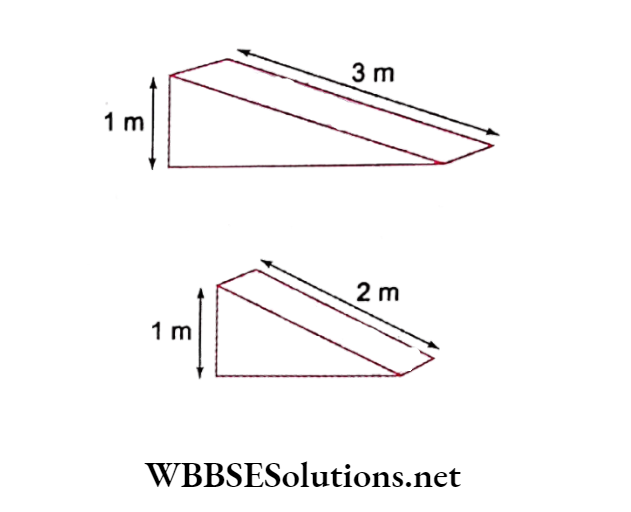
Question 19. What is the force that is responsible for wearing out of bicycle tires?
Answer: Frictional force of road.

Question 20. What is the direction of the force of friction acting on a moving object?
Answer: Opposite to the direction of motion.

Chapter 6 Primary Concept Of Force And Energy Short Answer Type Questions

Question 1. Arrange in order: rain, water, cloud, vapor.
Answer: Water vapour→ cloud→rain.

Question 2. Give an example where the force of friction is advantageous to us and explain it.
Answer: Friction helps us in walking. When a man walks, he lifts one leg up, leans forward, and with the other leg presses the ground in a slightly inclined fashion in the backward direction.

The pressing of the leg is balanced by the frictional force of the ground, otherwise, he will slip and fall forward on his face. Thus friction prevents him from slipping.

Examples of Real-Life Applications of Force

Question 3. Current is drawn from the following devices(a) a Generator and (b) A dry cell. State the energy transformation taking place in each case.
Answer:

  1. In a generator, mechanical energy changes into electrical energy.
  2. A dry cell converts the stored chemical energy into electrical energy.

Question 4. How do contact forces act?
Answer: Contact forces are to be applied through something rigid or non-rigid. Push is applied through something rigid while a pull can act through a non-rigid connector, such as a rope or a wire.

Question 5. What is mechanical energy?
Answer: Kinetic and potential energies are together known as mechanical energy. It is the energy associated with the motion and position of an object.

Question 6. What is the water cycle?
Answer: The water cycle is the cycle of processes by which water circulates between the earth’s water bodies, atmosphere, and land involving evaporation, transpiration, condensation, and precipitation.

Question 7. What are the causes of the energy crisis?
Answer: The causes of the energy crisis may be briefly summarised as

  1.  Increase in population and rapid urbanization leading to overconsumption
  2.  Increase in automobiles
  3. Growing needs of industries and mechanized agriculture.
  4. The decline of stored fossil fuels.
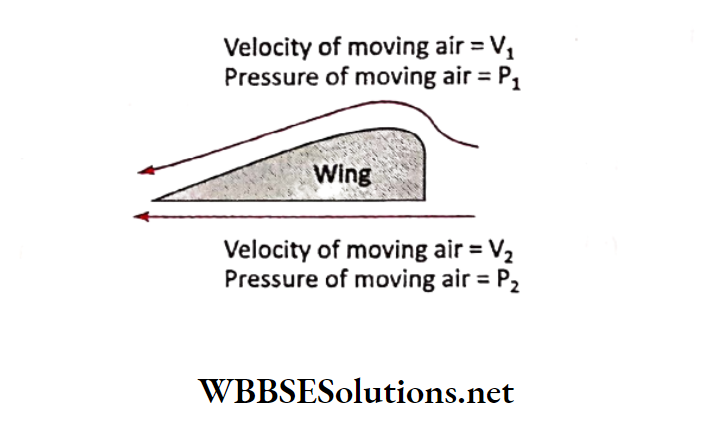
  5. Poor infrastructure, flaws in the distribution network, and wastage
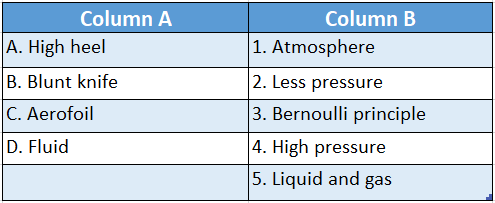
  6. Miscellaneous factors like war, natural calamities, etc

Question 8. What are magnetic substances?
Answer: Materials that can be magnetized and which are strongly attracted to a magnet are called magnetic substances. These include iron, cobalt, lodestone, etc.

Question 9. Arrange the following organisms in the correct sequence from producer to secondary consumer
Kingfisher-algae-fish.
Answer: The correct sequence shall be-
algae (producer) fish (primary consumer) → kingfisher (secondary consumer).

Question 10. Suppose you are traveling in a bus or train. When the bus or train is in motion, which objects would appear to be at rest to you?
Answer: When an observer is inside a moving train, then the compartment itself along with its fixed components (such as berths, seats, window frames, etc.) and the passengers who are seated inside the compartment shall appear stationary to the observer.

Question 11. Name a force that causes the dissipation of energy. On what factors does this force depend?
Answer: Friction causes the dissipation of energy in the form of heat.

The factors on which friction depends are:

  1. Friction depends on the material and the nature of the surfaces in contact and their state of polish.
  2. Friction depends upon the mass of the body because that in turn determines how the surfaces in contact are pressed together.

Conceptual Questions on Mechanical Advantage

Question 12. Friction is independent of area. But brakes of very small contact areas are not used. Why?
Answer: It is true that friction does not depend on the area of contact but it causes a lot of wear and tear.

WBBSE Class 6 Science Question Answer

Thus brakes have to be built with appreciable contact areas to avoid wear and tear and to increase the life span of the brake shoe or pad.

Chapter 6 Primary Concept Of Force And Energy Long Answer Type Questions

Question 1. Define force. What is its unit in the Sl system? State any two effects of force.
Answer: A force may be defined as an external cause that changes or tends to change the state of rest or of the uniform motion of a body in a straight line.

In the Sl system, the unit of force is called Newton. Two effects of force are

1. It can set a stationary body into motion.
A railway engine can move a stationary train by applying a pull or push.

2. It can stop a moving body.
A speeding car is stopped by the application of brakes.

Question 2. ‘Sun is the ultimate source of all energies available on earth’ discuss.
Answer: When a man walks, he lifts one leg up, leans forward, and with the other leg presses the ground in a slightly inclined fashion in the backward direction.

Question 3. What is a pyramid of energy? Why is there the highest amount of energy at the base and the lowest at the apex of an energy pyramid?
Answer: The Push is applied through something rigid while a pull can act through a non-rigid connector, such as a rope or a wire.

Question 4. What is friction? Give examples (one each) of the following
1. friction produces heat
2. friction causes wear and tear of mating surfaces.
Answer:

1. Friction produces heat:

  1. When two palms are rubbed together, they become warm.
  2. If a stone is rubbed on a metallic surface for some time, the metal becomes hot.
  3. When we want to ignite a matchstick, we rub the stick on the rough surface of a matchbox.

The rough surface of the matchbox and the head of the matchstick both contain gunpowder on them. Rubbing causes the temperature to increase and heat is produced which ignites the matchstick.

2. Friction causes erosion of contact surfaces:

1. The tires of cars or cycles get eroded after a long run.

Real-Life Scenarios Involving Friction and Gravity

Question 5. State the differences between renewable and non-renewable sources of energy.
Answer:

WBBSE Solutions Class 6 School Science Chapter 6 Primary Concept Of Force and Energy Renewable source and Non-renewable source

Question 6. Explain the 10 percent law in connection with the energy pyramid.
Draw a food chain with respect to energy flow in a commonly formed ecosystem formed of the organisms named below
(1) Hawk (2) Grasshopper (3) Grass (4) Snake (5) Toad.
Answer: According to the 10 percent law, about 10% of total energy is transmitted during energy flow through several trophic levels to be used up for building the body mass, and rest is dissipated as heat energy.

For example, 100 kg biomass in the grass will make 10 kg biomass for herbivorous animals (ex. deer) and 1 kg Primary Concept of Force and Energy Grass Grasshopper→Toad Snake→Hawk.

Question 7. When a ball is thrown vertically upward, how do its potential and kinetic energy change?
Answer: At the moment when the ball is thrown, it has only kinetic energy due to an upward velocity. As it attains height, it loses kinetic energy because its velocity decreases and gains potential energy.

WBBSE Class 6 Science Question Answer

At the highest point of ascent, the ball stops momentarily possessing potential energy only. During descent, it loses potential energy and gains kinetic energy as its velocity increases with time.

Just before touching the ground, the ball possesses kinetic energy only.

Question 8. A solar cooker is turned ON. Which type of energy conversion is taking place here? Name two possible measures to mitigate the global energy crisis.
Answer: When a solar cooker is turned ON, light energy is converted into heat energy.
Two steps to mitigate the global energy crisis:

1. Higher utilization of renewable types of energy in a planned manner.

2. Prevention of wastage of energy in daily urban life.

Question 9. How does the transfer of energy take place in the water cycle?
Answer: Solar energy causes surface water to undergo evaporation to become water vapor. As the water vapor attains height it gains potential energy.

Once water vapor is in the upper part of the atmosphere, it releases heat to the surrounding colder air to either condense into liquid or form ice crystals.

Air currents move the clouds across the planet. The water droplets in clouds collide with other droplets to form larger droplets and undergo precipitation as rain or snowfall under the influence of gravity.

As it falls it gains kinetic energy. Kinetic energy drives runoff water that flows downhill through streams, rivers, and lakes.

Some of the water eventually reaches the oceans and again participates in the water cycle.

Thus it is self-renewing and continuous and the sun provides all the energy to cause the change of states through the processes of melting, sublimation, evaporation, freezing, condensation, and deposition.

WBBSE Solutions For Class 6 School Science Chapter 5 Measurement MCQs

WBBSE Class 6 Science Chapter 5 Measurement Solutions

Chapter 5 Measurement Review Questions Environment Review Questions MCQs

Question 1. The SL system has a number of elementary fundamental units.

  1. 6
  2. 7
  3. 8
  4. 9

Answer: 2. 7

Question 2. An example of a fundamental quantity is

  1. Volume
  2. Velocity
  3. Height
  4. Area

Answer: 3. Height

WBBSE Class 6 Science Chapter 5 Measurement Solutions

Read And Learn More: WBBSE Solutions For Class 6 School Science

Question 3. The SI unit of volume is

  1. cm/s
  2. m/s2
  3. cc
  4. cubic metre

Answer: 4. cubic metre

Question 4. Which of the following physical quantities does not have a unit?

  1. Mass
  2. Specific gravity
  3. Volume
  4. Current

Answer: 2. Specific gravity

WBBSE Solutions For Class 6 Geography WBBSE Solutions For Class 6 History WBBSE Solutions For Class 6 Maths
WBBSE Class 6 Geography Notes WBBSE Class 6 History Notes
WBBSE Class 6 Geography Multiple Choice Questions WBBSE Class 6 History MCQs WBBSE Notes For Class 6 School Science


Question 5. Which among the following is not a fundamental quantity?

  1. Temperature
  2. Mass
  3. Intensity of light
  4. Density

Answer: 4. Density

WBBSE Class 6 Measurement MCQs

Question 6. The quantity of atoms or molecules has the unit of

  1. kg
  2. cc
  3. mole
  4. g

Answer: 3. mole

Question 7. The biggest unit of length is

  1. Parsec
  2. Angstrom
  3. Kilometre
  4. Micron

Answer: 1. Parsec

Question 8. A light year is a unit of

  1. Time
  2. Intensity of light
  3. Temperature
  4. Density

Answer: 4. Density

WBBSE Class 6 Science Chapter 5 Measurement Solutions

Question 9. Common balance measures

  1. Weight
  2. Mass
  3. Density
  4. Volume

Answer: 2. Mass

Question 10. The most accurate model of the timekeeper is

  1. Stop-watch
  2. Atomic clock
  3. Wrist-watch
  4. Digital clock

Answer: 2. Atomic clock

Question 11. The common instrument employed to measure the growth of plants is

  1. Stop-watch
  2. Centimetre scale.
  3. Measuring cylinder
  4. Auxanometer

Answer: 4. Auxanometer

Question 12. A measuring cylinder can be used to measure the volume of

  1. Liquid only
  2. Solid only
  3. Both liquid and solid
  4. None of the above

Answer: 3. Both liquid and solid

Practice MCQs on Conversion of Units

Question 13. 1 mean solar day =.minutes.

  1. 1440
  2. 24
  3. 60
  4. 86400

Answer: 1. 1440

Question 14. The smallest division of a metre scale is

  1. 1 m
  2. 1 cm
  3. 1 dm
  4. 1mm

Answer: 4. 1mm

WBBSE Class 6 Science Question Answer

Question 15. Time is defined as

  1. Starting an event
  2. Ending of an event
  3. The interval between two events
  4. None of the above

Answer: 3. Interval between two events

Question 16. The volume of 1 L of water is

  1. Less than 1 cubic decimetre
  2. Greater than 1 cubic decimetre
  3. Equal to 1 cubic decimetre
  4. Equal to 100 cubic centimetres

Answer: 3. Equal to 1 cubic decimetre

Class 6 Science Chapter 5 Measurement MCQs WBBSE 

Question 17. Which is not a unit of area?

  1. Square cm
  2. Square metre
  3. M/S
  4. Square km

Answer: 3. M/S

Question 18. Your body weight is 30 kg, i.e.ing.

  1. 300
  2. 3000
  3. 30,000
  4. 3

Answer: 3. 30,000

Question 19. Hour is a

  1. Fundamental unit
  2. Derived unit
  3. Number
  4. None of the above events of short duration

Answer: 2. derived unit

Common MCQs on Measuring Length and Weight

Question 20. Time pertaining to an

  1. Wrist-watch
  2. Sundial
  3. Wall clock
  4. Stop-watch

Answer: 4. Stop-watch

Question 21. Angstrom is the unit of

  1. Mass
  2. Length
  3. tTme
  4. Current

Answer: 2. length

Class 6 Science Chapter 5 Measurement MCQs WBBSE 

Question 22. The rate of growth is

  1. Growth/time
  2. Time/growth
  3. Growth x time
  4. Time

Answer: 1. Growth/time

Question 23. A standard unit should be

  1. Of convenient size to use
  2. Fixed under any conditions of space and time
  3. Defined without doubt
  4. All of the above

Answer: 4. All of the above

Question 24. The area of the rectangular surface is

  1. Length x  Breadth
  2. Length +  Breadth
  3. Length/Breadth
  4. 2 x (Length + Breadth)

Answer: 1. Length x Breadth

WBBSE Solutions for Class 6 Science Chapter 5 

Question 25. In MKS system, K stands for

  1. Kelvin
  2. Kilometre
  3. Kilogram
  4. None of the above

Answer: 2. Kilometre

Understanding Measurement Units

Question 26. A glass is filled to the brim with water. When you immerse one of your fingers into it, some amount of water is spilt out. Which parameter among the following is the same for the water that is spilt out and the immersed portion of the finger?

  1. mass
  2. length
  3. weight
  4. volume

Answer: 3. volume

Question 27. Using a digital stop-watch, we can measure time upto

  1. 0.1s
  2. 0.01s
  3. 0.2s
  4. 0.02s

Answer: 2. 0.01s

Question 28. To express your weight, which unit among the following should you use?

  1. quintal
  2. mg
  3. kg
  4. g

Answer: 3. kg

Question 29. An incorrect estimate is

  1. Overestimate
  2. Underestimate
  3. Both
  4. None

Answer: 3. both

Class 6 WBBSE Science Question Answer

Question 30. Among the following, the pair having the same unit is

  1. Energy and work
  2. Volume and density
  3. Force and energy
  4. Work and power

Answer: 1. Energy and work

Measurement Chapter MCQs for Class 6 Science WBBSE 

Chapter 5 Measurement Fill In The Blanks

Question 1. The space occupied by any substance is called ___________
Answer: Volume

Question 2. Mass/Volume= ___________
Answer: Density

Question 3. 1 litre = ___________ CC.
Answer: 1000

Question 4. SI unit of time is ___________
Answer: Second

Question 5. To measure the length of your classroom you may use ___________
Answer: Measuring tape

Measurement Chapter MCQs for Class 6 Science WBBSE 

Question 6. Everything which can be measured is called a ___________
Answer: Physical quantity

Question 7. Sl unit of temperature is ___________
Answer: Kelvin

Question 8. A scale having a length of one metre is called a ___________ scale.
Answer: Metre

Question 9.  Cubic centimetre is the unit of ___________
Answer: Volume

Question 10.  An estimate that exceeds the actual is called an ___________
Answer: Overestimate

Class 6 WBBSE Science Question Answer

Question 11.  Growth is attended by ___________ in weight.
Answer: Increase

Question 12. 1 second = ___________ part of an hour.
Answer: 1/3600

Question 13. The volume of liquid is usually expressed in ___________
Answer: Litre

Question 14. Temperature is a ___________ physical quantity.
Answer: Fundamental

Question 15. 10 dm is equal to ___________ metre.
Answer: 1

Measurement Chapter MCQs for Class 6 Science WBBSE 

Question 16. The unit of mass in the FPS system is ___________
Answer: Pound

Question 17. Velocity is a ____________unit.
Answer: Derived

Question 18. ___________units are a combination of one or more fundamental units.
Answer: Derived

Question 19. The height of a person is measured with ___________
Answer: Centimetra scale

Question 20. An informal estimate when very little information is available is called a ___________
Answer: Guesstimate

Question 21. If the area is sq. cm, then ___________ → century.
Answer: Time

Question 22. If length scale, the volume of liquid → ___________.
Answer: Measuring cylinder

Question 23. To measure the purity of gold, ___________ is used.
Answer: Carat

Question 24. The interval between the start of an event and its completion is called ___________
Answer: Time

Question 25. There are ___________ elementary or fundamental units in Sl system of measurement.
Answer: Seven

Class 6 WBBSE Science Question Answer

Chapter 5 Measurement Identify As True Or False

Question 1. A light year is a fundamental unit
Answer: True

Question 2. Precise measurement is not very important in our daily lives.
Answer: False

Question 3. The surface area of a sphere = × diameter x diameter.
Answer: True

Question 4. We can use a stopwatch instead of a wristwatch to see the time.
Answer: False

Question 5. Length, mass and time are derived units.
Answer: False

Question 6. Growth in animals takes place throughout life.
Answer: False

Question 7. Estimation is an approximation.
Answer: True

Class 6 WBBSE Science Question Answer

Question 8. A common balance gives a direct measurement of mass.
Answer: False

Question 9. Millimetre is a sub-multiple of Metre.
Answer: True

Question 10. All the physical quantities have separate units.
Answer: False

Question 11. The fundamental unit of current is Ampere in the SI system.
Answer: True

Question 12. Derived physical units are more number than fundamental units.
Answer: True

Question 13. Bamboo shoots grow rapidly.
Answer: True

Question 14. The area is a fundamental quantity.
Answer: False

Question 15. 1 Mean solar day = 86400 seconds.
Answer: True

Question 16. Direct measurement of the volume of liquid can be done by using a measuring cylinder.
Answer: True

Question 17. All the systems of units have a common unit of time.
Answer: True

WBBSE Class 6 Science Chapter 5 Multiple Choice Questions 

Question 18. In the MKS system, M stands for milligram.
Answer: False

Question 19. There are 7 derived physical quantities in the SI system.
Answer: False

Question 20. One litre of milk is equivalent to 1000 cc of milk.
Answer: True

Question 21. Velocity = Distance/Time.
Answer: True

Class 6 Science Question Answer WBBSE

Question 22. Atomic weight has no unit.
Answer: True

Question 23. A cubit is a standard unit.
Answer: False

Question 24. Growth is accompanied by a reversible change of structure or form.
Answer: False

Question 25. A scale may have different lengths.
Answer: True

Chapter 5 Measurement Match The Columns

Question 1.

WBBSE Solutions Class 6 School Science Chapter 5 Measurement Match the columns table 1
Answer: A-2,B-4,C-1,D-3

Question 2.

WBBSE Solutions Class 6 School Science Chapter 5 Measurement Match the columns table 2
Answer: A-4,B-3,C-1,D-2

Question 3.

WBBSE Solutions Class 6 School Science Chapter 5 Measurement Match the columns table 3
Answer:

WBBSE Class 6 Science Chapter 5 Multiple Choice Questions 

Question 4.

WBBSE Solutions Class 6 School Science Chapter 5 Measurement Match the columns table 4
Answer:

Chapter 5 Measurement Answer In Words Or A Sentence

Question 1. Mention two physical quantities which have the same unit.
Answer: Work and energy.

Question 2. What is the unit associated with the measurement of the mass of a molecule?
Answer: Mole.

Question 3. What is the relation between hectometre and metre?
Answer: 1 hm = 100 m.

Question 4. Which unit is used to measure sub-atomic distances?
Answer: Fermi is used.

Class 6 Science Question Answer WBBSE

Question 5. How does a mason give us measurements of things he needs before starting any construction work?
Answer: By estimation.

Question 6. What is the instrument employed to measure the growth of animals?
Answer: The centimetre scale is used to measure the growth of animals.

Question 7. How many seconds are there in a mean solar day?
Answer: 1 mean solar day = 86400 seconds.

WBBSE Class 6 Science Chapter 5 Multiple Choice Questions 

Question 8. Which unit would you prefer to use to measure the distance between two cities-kilometre or metres?
Answer: Kilometre.

Question 9. How many fundamental physical quantities are there as per the Sl system?
Answer: Seven fundamental physical quantities are there as per the Sl system.

Question 10. What type of quantity is the intensity of light?
Answer: Fundamental physical quantity.

Question 11. I am a derived unit. In order to compute my value, mass is to be divided by volume. Who am I?
Answer: Density(\(=\frac{Mass}{Volume}\))

Question 12. Find the odd one out Length, time, volume, mass.
Answer: Volume: It is a derived quantity while others are fundamental quantities.

Question 13. Give an example where one has to necessarily take the help of estimation to do work.
Answer: Getting hold of a cricket ball by a fielder when he jumps near the boundary line.

Question 14. What type of measuring device would you use to measure the girth of a tree?
Answer: A measuring tape.

Question 15. What is the biggest unit of time?
Answer: Century = 100 years.

WBBSE Class 6 Science Chapter 5 Multiple Choice Questions 

Chapter 5 Measurement Short Answer Type Questions

Question 1. A body measures 25 m. State the unit and the magnitude of the unit in the statement.
Answer: The statement of a physical quantity (length) shows that the unit is the metre and the magnitude is 25.

Question 2. Define fundamental unit. Name the fundamental units of mass, length, time, current and temperature.
Answer: There are some physical quantities which do not depend on other physical quantities, e.g. length, mass, time, etc.

Short Answer Questions on Measurement Concepts

These physical quantities are called fundamental physical quantities and the units associated with them are called fundamental units. These are independent of any other units.

WBBSE Solutions Class 6 School Science Chapter 5 Measurement physical quantity and unit

Question 3. Why is the unit of volume a derived unit?
Answer: Volume = length x breadth x height.
The fundamental unit of length appears thrice in the formula of volume i.e. volume is the cube of length. Hence it is a derived unit.

Question 4. Name the convenient unit you would use to measure-
Answer:

  1. length of a hall
  2. width of a book
  3. diameter of a hair
  4. distance between two cities

WBBSE Solutions Class 6 School Science Chapter 5 Measurement Physical convenient unit .

WBBSE Class 6 Science Chapter 5 Multiple Choice Questions 

Question 5. Define time. Express minute as a part of a mean solar day.
Answer: The interval between any two incidents is called time.

1 minute = 1/1440 mean solar day.

Question 6. What do we measure with the help of a thermometer?
Answer: We measure the temperature of a substance with the help of a thermometer.

Question 7. What is a metre scale?
Answer: If the length of the scale is one metre it is called a metre scale.

Question 8. What do the longer and shorter arms of a stopwatch measure?
Answer: The longer hand of a stopwatch records time in seconds with fractions and the shorter one in minutes.

Examples of Real-Life Applications of Measurement

Question 9. State the units in which mass is measured in (i) the CGS system and (ii) the Sl system.
Name the most convenient unit of mass you will use to measure-
Answer:

  1. Mass of a small amount of medicine.
  2. The bag of sugar.
  3. Mass of a cricket ball.
  4. The CGS unit of mass is gram (g) and that in the SI system is the kilogram (kg).

WBBSE Class 6 Science Chapter 5 Multiple Choice Questions 

WBBSE Solutions Class 6 School Science Chapter 5 Measurement physical quantity and convenient unit 2

Question 10. Do ratios have units?
Answer: Ratios do not have units. They are unitless physical quantities.

Question 11. Give one example for each of the derived physical quantities having one or two fundamental physical quantities.
Answer: Area (length x breadth) has one fundamental physical quantity.
Velocity (distance/time) has two fundamental physical quantities.

Question 12. Can the volume of a lump of sugar candy be measured with water in a measuring cylinder?
Answer: The lump of sugar would gradually dissolve in water when it is dipped inside water in a measuring cylinder. Hence its volume can not be measured with water.

Question 13. You are given a flexible wire of 10 cm in length. How would you measure a length of 1 m 5 cm with that?
Answer: 1 m is a multiple of 10 cm, since 1 m= 100 cm. Hence, 10 times the full length of the wire measures 1 m.

Since the length of the wire is 10 cm, if it is folded to half, the length of folded wire equals 5 cm. So the measurement involves 10 full lengths of the wire and one-half length of the wire.

Question 14. A bottle of juice holds 750 ml of juice. Can two such bottles be poured into a jar measuring 2000 cc?
Answer: One bottle holds 750 ml.
.: Two bottles hold (750×2) ml =1500 ml = 1500 cc
Since the capacity of the jar is 2000 cc, hence the two bottles can be poured into it.

Question 15. A 30cm scale has one end broken. The mark at
the broken end is 2.6 cm. While measuring the length of a pencil, one end is touched with a 2.6 cm mark and the other end touches the 18.1 cm mark. What is the length of the pencil?
Answer: Length of pencil = (18.1-2.6) cm= 15.5 cm = 155 mm

Question 16. What are the components of the bar on which ‘metre’ is depicted?
Answer: The bar is made of an alloy consisting of 90 per cent platinum and 10 per cent iridium.

WBBSE Class 6 Science Chapter 5 Multiple Choice Questions 

Chapter 5 Measurement Long Answer Type Questions

Question 1. Define measurement. What is the unit? Do all physical quantities have units?
Answer: The average of the varying solar days over a period of 365 days is called the mean solar day.

Question 2. How would you measure the length of a curved line with a thread and an ordinary ruler?
Answer: A piece of thread is taken. A required portion of the thread is very carefully laid over the given curved line such that the thread completely hides the whole stretch of the line.

Now the length of the straightened part of the thread that was used just to cover up the given line is measured with the help of the ruler which gives the length of the given curved line.

Question 3. How will you measure the rate of plant growth?
Answer: A required portion of the thread is very carefully laid over the given curved line such that the thread completely hides the whole stretch of the line.

Question 4. What is Mean Solar Day? How would you derive the concept of second from it?
Answer: The average of the varying solar days over a period of 365 days is called the mean solar day. When the average or mean solar day is divided by 24, we get 1 hour.

Similarly, dividing 1 hour by 60 we get 1 minute and further dividing this 1 minute by 60, we get 1 second.
Thus,
1 Mean solar day = 24 hours = 24 x 60 minutes = 1440 minutes = 1440 x 60 seconds
= 86400 seconds.
This second is the SI unit of time equal to
1/86,400 of a mean solar day.

WBBSE Class 6 Science Chapter 5 Multiple Choice Questions 

Conceptual Questions on Measuring Instruments

Question 5. Explain how a stopwatch work.
Answer: A stopwatch is used to note the time of an event of short duration. It can record 1/5th or even 1/ 10th of a second.

The longer hand records time in seconds with fractions and the shorter one in minutes. There is a press button which, when pressed, starts the watch and if pressed for the second time, stops the watch.

If again the button is pressed, the second and the minute hands return to their own zero mark.

Thus this watch can be started or stopped by pressing its press button just at the beginning and at the end of an event like a race in sports.

Question 6. How would you measure the mass of a substance?
Answer: The mass of a substance is measured indirectly with the help of common balance.

The substance of unknown mass is to be kept on the left scale pan of the common balance and standard known masses in the right scale pan.

When the pointer comes to equilibrium, the mass of the substance is measured as equal to the known standard masses.

Question 7. How can you find the thickness of a single strand of hair?
Answer: Take a single strand of hair and twist it around a pencil very closely together say 30 times. Measure the length of the total number of twists with a scale.

If the length is x cm, then the thickness of a single strand shall be =x/30 cm.

Question 8. You have got a common balance, a kg weight and a sack of rice. How can you measure the mass of 250 g of rice with the help of the common balance and the one kg weight?
Answer: First we measure 1 kg of rice with the help of one kg weight.

Then one kg weight is removed from the right scale pan and the 1 kg rice from the left scale pan is distributed equally among the right and left scale pans till the pointer comes to equilibrium.

At this point, we have 500 g of rice on both scale pans.

Next rice from one scale pan is to be removed and the above process is to be repeated once again to get 250 g of rice in each of the scale pans.

WBBSE Class 6 Science Chapter 5 Multiple Choice Questions 

Real-Life Scenarios Involving Measurement Accuracy

Question 9. If two boys measure the length of the classroom with their hands, will they get the same result? The water level in a measuring cylinder shows a reading of 12.4 ml. A marble is placed inside it and the reading shows 20.2 ml. What is the volume of the marble?
Answer: Handspan or cubit cannot be used as a standard unit of length. The cubit could vary considerably due to the different sizes of handspan of people.

This results in inaccurate values which is the biggest limitation. Thus the two boys would get different results depending on their handspans.

They should use a measuring tape to correctly measure the length of their classroom.

When completely immersed in water, the marble shall dispense a volume of water which is equal to its own volume. 1st reading = 12.4 ml 2nd reading = 20.2 ml
.: Volume of marble=(20.2-12.4) ml 7.8 ml

Question 10. Mention two significances of estimation. Mention three examples from our daily life where we are forced to adopt estimation. Significances of estimation.
Answer: 1. Estimation helps to obtain approximate knowledge about quantities when other resources are not available.
2. it helps to plan ahead and obtain approximate knowledge about the quantities which are otherwise very difficult to measure precisely.

Instances in our daily life where we estimate:

1. While measuring and adding spices, oil etc into food matters during cooking

2. While touching somebody’s forehead to

WBBSE Solutions For Class 6 School Science Chapter 4 Rocks and Minerals MCQs

Class 6 Science Question Answer WBBSE Chapter 4 Rocks And Minerals Review Questions Environment Review Questions MCQs

Question 1. The first formed rock on the earth’s surface is

  1. Sedimentary rock
  2. Igneous rock
  3. Metamorphic rock
  4. None of these

Answer:  2. Igneous rock

Question 2. When the earth was created it was made up of

  1. Molten rock
  2. Solid rock
  3. Gas
  4. None of these

Answer: 1. Molten rock

Read And Learn More: WBBSE Solutions For Class 6 School Science

Question 3. The rock that is formed by the cooling and solidification of lava or magma is called

  1. Metamorphic rock
  2. Sedimentary rock
  3. Igneous rock
  4. None of these

Answer: 3. Igneous rock

Question 4. The hot molten rock material found deep inside the earth is called

  1. Lava
  2. Magma
  3. Pyroclast
  4. None of these

Answer: 2. Magma

WBBSE Solutions For Class 6 Geography WBBSE Solutions For Class 6 History WBBSE Solutions For Class 6 Maths
WBBSE Class 6 Geography Notes WBBSE Class 6 History Notes
WBBSE Class 6 Geography Multiple Choice Questions WBBSE Class 6 History MCQs WBBSE Notes For Class 6 School Science


Question 5. When magma comes out of a crater or vent of a volcano, it is called

  1. Magma
  2. Lava
  3. Ash
  4. All of these

Answer: 2. Lava

WBBSE Class 6 Rocks and Minerals MCQs

Question 6. As we go deeper into the earth’s crust the temperature and pressure

  1. Increase
  2. Decrease
  3. Remain same
  4. Decrease suddenly

Answer: 1. Increase

Question 7. An example of igneous rock is

  1. Sandstone
  2. Marble
  3. Limestone
  4. Granite

Answer: 4. Granite

Question 8. The stone found near the railway tracks is

  1. Granite
  2. Basalt
  3. Marble
  4. Pumice

Answer: 2. Basalt

Question 9. When bubbling foam at the top of hot magma

  1. Granite
  2. Basalt
  3. Pumice
  4. Sandstone

Answer: 3. Pumice

Question 10. The deposition and subsequent cementation of sediments within water bodies help to form

  1. Igneous rock
  2. Sedimentary rock
  3. Metamorphic rock
  4. None of these

Answer: 2. Sedimentary rock

Question 11. An example of sedimentary rock is

  1. Pumice
  2. Sandstone
  3. Slate
  4. Basalt

Answer: 2. Sandstone

Question 12. Fossils are found in

  1. Sedimentary rocks
  2. Igneous rocks
  3. Metamorphic rocks
  4. All of these

Answer: 1. Sedimentary rocks

Question 13. Marble is a type of metamorphic rock formed from

  1. Granite
  2. Sandstone
  3. Limestone
  4. Basalt

Answer: 2. Sandstone

Practice MCQs on Geological Time Scale

Question 14. The metal that develops a red-coloured rust, if it remains exposed to air and moisture is

  1. Copper
  2. UIron
  3. Aluminium
  4. None of these

Answer: UIron

Question 15. A metal that is found as a compound in nature is

  1. Mica Es
  2. Gold
  3. Copper
  4. None of these

Answer: 3. Copper

Question 16. When metals are found as compounds mixed with sand and soil in nature, they are called

  1. Rocks
  2. Minerals
  3. Non-metals
  4. None of these

Answer: 2. Minerals

Question 17. The type of mineral from which metals can be extracted easily and profitably is called its

  1. Ore
  2. Alloy
  3. Atom
  4. Extract

Answer: Ore

Question 18. An ore of iron is

  1. Bauxite
  2. Copper glance
  3. Haematite
  4. Augite

Answer: 3. Haematite

Question 19. Bronze is a mixture of

  1. Copper and zinc
  2. Copper and iron
  3. Copper and tin
  4. Copper and gold

Answer: 3. Copper and tin

Question 20. Chromium mixed with iron forms

  1. Bronze
  2. Stainless steel
  3. Brass
  4. Bell-metal

Answer: 2. Stainless steel

Question 21. The impressions or rocky remains of once-living organisms are called

  1. Fossils
  2. Minerals
  3. Metals
  4. None of these

Answer: 1. Fossils

Question 22. The materials that are burnt to produce heat are called

  1. Rocks
  2. Minerals
  3. Fuels
  4. None of these

Answer: 3. Fuels

Question 23. Coal, petroleum and natural gas are called

  1. Fossil fuels
  2. Black fuel
  3. Rock fuels
  4. None of these

Answer: 1. Fossil fuels

Common MCQs on Rock Formation

Question 24. When coal is heated at high temperatures in the absence of oxygen, a substance is produced called

  1. Rock oil
  2. Coke
  3. Coal tar
  4. None of these

Answer: 2. Coke

Question 25. The full form of LPG is

  1. Liquid Petroleum Guard
  2. Liquefied Petroleum Gas
  3. Less Polluted Gas
  4. None of these

Answer: 2. Liquefied Petroleum Gas

Question 26. Which one is not a fossil fuel?

  1. Coal
  2. Natural gas
  3. Petroleum
  4. Hay

Answer: 4. Hay

Question 27. Find the odd one among

  1. Granite
  2. Pumice
  3. Limestone
  4. Basalt

Answer: 3. Limestone

Question 28. Refining means

  1. Extracting natural gas
  2. Separation of various fractions of petroleum
  3. Burning of coal
  4. Sedimentation of fossil fuel

Answer: 2. Separation of various fractions of petroleum

Question 29. Fossil fuels are derived from which of the following sources?

  1. Organic matter trapped in sedimentary rock
  2. Non-organic matter trapped in
  3. Organic matter trapped in igneous rock
  4. Organic matter on the crust surface

Answer: 1. Organic matter trapped in sedimentary rock

Class 6 WBBSE Science Question Answer

Question 30. For fossils to form, the organic remains must be covered quickly by

  1. Scavengers
  2. Lava
  3. Water
  4. Sediment

Answer: 4. Sediment

Chapter 4 Rocks And Minerals Fill In The Blanks

Question 1. __________ rocks are formed by the cooling and solidification of lava on the earth’s crust or magma under the earth’s crust.
Answer: Igneous

Question 2. __________ is a type of igneous rock.
Answer: Granite

Question 3. When magma comes out of the __________ of a volcano it is called lava.
Answer: Crater

Question 4. __________ are found in sedimentary rocks.
Answer: Fossils

Question 5. The __________ rocks are found under the earth’s surface and their original character and appearance are greatly altered.
Answer: Metamorphic

Class 6 WBBSE Science Question Answer

Question 6. __________ is the metamorphosed form of granite.
Answer: Gneiss

Question 7. __________ and __________ in nature. are found as compounds
Answer: Iron, aluminium

Question 8. Metals found as compounds mixed with sand and soil are known as __________
Answer: Minerals

Question 9. The process of separating metals from the minerals is known as __________ __________.
Answer: Metal extraction

Question 10. The type of mineral from which metals can be extracted easily and economically is called it’s __________.
Answer: Ore

Question 11. A __________ takes place in the process of metal extraction.
Answer: Chemical change

Question 12. __________ and carbon are mixed to obtain steel.
Answer: Iron

Question 13. Brass is formed when __________ and __________ combine.
Answer: Copper, zinc

Question 14. Alloys are much more __________ than a single metal.
Answer: Stronger

Question 15. Alloy is made by __________ two or more
Answer: Melting

Question 16. __________ are the impression or rocky remains of once-living organisms.
Answer: Fossils

Class 6 WBBSE Science Question Answer

Question 17. __________, __________ and __________ are called fossil fuels.
Answer: Coal, petroleum, natural gas

Question 18. Coal is burnt to generate heat which in turn produces __________
Answer: Electricity

Question 19. LPG cylinders mainly contain liquid __________.
Answer: Propane

Question 20. Natural gas usually occurs in the __________ part of an oil trap.
Answer: Uppermost

Chapter 4 Rocks And Minerals Identify As True Or False

Question 1. The full form of CNG is Common Natural Gas.
Answer: False

Question 2. The principal constituent of Natural Gas is methane.
Answer: True

Question 3. Bitumen or Tar is produced from Iron.
Answer: False

Question 4. The naturally occurring sticky mixture of various organic compounds, water and soil is called coal.
Answer: False

Question 5. LPG is commonly known as Liquefied Petroleum Gas.
Answer: True

Question 6. Wood, paper, and hay are not fossil fuels.
Answer: True

Question 7. Fossils are seen in metamorphic rocks.
Answer: False

Question 8. Gold, solder, and electric fuse are common alloys.
Answer: True

WBBSE Class 6 Science Question Answer

Question 9. Alloys are more resistant to corrosion than single metals.
Answer: True

Question 10. Copper glance is the ore of Iron.
Answer: False

Question 11. Bauxite is the ore of aluminium.
Answer: True

Question 12. When a copper utensil is left unused for a long time it develops a red stain on it.
Answer: False

Question 13. Slate is the metamorphosed form of shale.
Answer: True

Question 14. Pumice has holes in it.
Answer: True

Question 15. Magma is the molten rock material found on the earth’s surface.
Answer: False

Chapter 4 Rocks And Minerals Match The Columns

Question 1.


Answer: A-6,B-3,C-1,D-5

Question 2. 

WBBSE Solutions Class 6 School Science Chapter 4 Rocks and Minerals extrusive igneous rocks Match the Columns Table 2
Answer: A-3,B-1,C-4,D-2

Question 3.

WBBSE Solutions Class 6 School Science Chapter 4 Rocks and Minerals extrusive igneous rocks Match the Columns Table 3
Answer: A-2,B-5,C-4,D-1

Question 4.

WBBSE Solutions Class 6 School Science Chapter 4 Rocks and Minerals extrusive igneous rocks Match the Columns Table 4
Answer: A-5,B-4,C-6,D-1

Chapter 4 Rocks And Minerals Answer In Word Or A Sentence

Question 1. What are the major types of rocks?
Answer: Igneous rock, sedimentary rock and metamorphic rock.

Question 2. What are igneous rocks?
Answer: Igneous rocks are those which have a fiery origin.

Question 3. How is igneous rock formed?
Answer: Igneous rocks were formed by the cooling and solidification of molten magma under the earth’s crust or lava on the earth’s crust.

Question 4 Name two igneous rocks.
Answer: Granite and Basalt.

Question 5. How can we identify the igneous rock pumice?
Answer: We can see holes in the igneous rock pumice.

Question 6. What are sedimentary rocks?
Answer: Sedimentary rocks are formed by the deposition and subsequent cementation of sediments within the bodies of water like seas, lakes etc.

Important Questions Related to Rocks and Minerals

Question 7. What are the sediments made up of?
Answer: The sediments are actually broken fragments derived from the erosion of primary igneous rocks.

Question 8. How are the layers of sediments compacted to form sedimentary rocks?
Answer: Due to the increase of heat and pressure of the overlying sediments, the underlying sediments get cemented and compacted to form sedimentary rocks.

Question 9. Name two sedimentary rocks.
Answer: Sandstone and Shale.

Question 10. What do we find in the sedimentary rocks?
Answer: Fossils or the rocky remains of dead plants and animals.

Question 11. What causes igneous or sedimentary rocks to change into metamorphic rocks?
Answer: Due to excessive heat and pressure igneous and sedimentary rocks undergo physical and chemical changes to form metamorphic rocks.

Question 12. What are minerals?
Answer: Minerals are naturally occurring solid inorganic, crystalline substances with a definite chemical composition.

Question 13. What is metal extraction?
Answer: The process of separating metals from the mineral (ore) is known as metal extraction.

Question 14. What is an ore?
Answer: The type of mineral from which a metal can be extracted easily and profitably (economically) is known as its ore.

Question 15. What are alloys?
Answer: The homogeneous mixture or combination of different metals or metals with non-metals in a fixed ratio (especially to give strength) is called an alloy. For example, stainless steel is an alloy of chromium and iron.

Question 16. Mention two important characteristics of an alloy.
Answer: Alloys are much stronger than single metals and do not easily respond to chemical reactions.

Question 17. How is an alloy made?
Answer: An alloy is made by melting of two or more elements together, one of which is a metal. The mixture is then cooled to obtain a solid substance called an alloy.

WBBSE Class 6 Science Question Answer

Question 18. What is a fossil?
Answer: The impressions or the rocky remains of once-living organisms are called fossils.

Question 19. Write two uses of fossils.
Answer: Fossils are useful tools for dating rocks and also for showing the long history of life on Earth.

Question 20. Why are coal, petroleum or natural gas called fuels?
Answer: Coal, petroleum and natural gas are called fuels as when they are burnt they produce heat and power.

Question 21. Write one use of coal.
Answer: Coal is burnt to generate heat which in turn produces electricity.

Question 22. Write one use of petroleum.
Answer: Petroleum is widely used as a fuel for automobiles like cars, lorries, motorcycles etc.

Question 23. What is the full form of CNG?
Answer: Compressed Natural Gas.

Question 24. Name the full form of LPG.
Answer: Liquefied Petroleum Gas.

Question 25. What is amalgam?
Answer: An alloy of mercury metal with one or more other metals is known as amalgam. For example, Sodium amalgam is composed of sodium and mercury.

Chapter 4 Rocks And Minerals Qshort Answer Type Questions

Question 1. What is magma?
Answer: Deep inside the earth due to increasing temperature and pressure the rocks remain in a molten state as magma.

Question 2. What is lava?
Answer: When the magma comes out of the cracks of the crust or through the crater (vent) of a volcano it is called lava.

Question 3. How are igneous rocks formed under the earth’s crust?
Answer: Deep inside the earth due to increasing temperature and pressure the rocks remain in a molten state as magma. This magma rises to the surface through cracks of the crust.

While coming out it undergoes changes in temperature and pressure that causes it to cool, solidify and crystalize beneath the surface of the Earth’s crust to form intrusive igneous rocks, e.g. Granite.

Question 4. How are igneous rocks formed above the earth’s crust?
Answer: The magma when it comes out of the cracks of the crust or through the crater (vent) of a volcano is called lava.

This lava cools and solidifies on the earth’s surface quickly to form another kind of igneous rock, known as extrusive igneous rocks, e.g. Basalt.

Question 5. Why are holes seen on the igneous rock pumice?
Answer: Pumice is formed when there is rapid cooling and depressurization.

Holes are usually seen on the pumice stone. These holes are formed when the dissolved gases of the hot magma escape into the air and the froth at the top of the hot magma quickly cools and solidifies.

Question 6. How do the softer sediments under the sea turn into sedimentary rocks?
Answer: Sediments derived from igneous rocks are eroded and transported by the agents of denudation (rain, wind, river, glacier, etc.) and are deposited in layers in the sea. When sedimentation continues the older rock layers become buried deeper.

Over a long period, due to the increase in heat and pressure of the overlying sediments the underlying sediments get compacted and cemented and turn into sedimentary rocks.

Question 7. How do minerals differ from ores? or Why “all ores are minerals but all minerals are not ores”?
Answer: If a metal has more than one mineral form, then it is not necessary that all of them are ores.

For every mineral deposit, there is a set of conditions, such as the level of concentration of the metal and the size of the deposit that the deposit may be worked at a profit.

If a mineral deposit is sufficiently rich to be worked at a profit, it will then be called an ore deposit otherwise not. So, all ore deposits are mineral deposits, but the reverse is not true.

Short Answer Questions on Minerals and Their Uses

Question 8. Why do metals after extraction look different from their ores?
Answer: Metals, after they are extracted from ores, look different from their ores. This is because a chemical change takes place in the process of metal extraction.

Question 9. Why are most of the metals used today in the form of alloys?
Answer: Today, more than 90% of metals used are in the form of alloys. This is because alloys have many advantages that a single metal does not have.

Alloys are much stronger than a single metal, has the ability to withstand heavy weight, do not readily respond to chemical reactions and are resistant to corrosion.

Question 10. How did the dead bodies of animals come inside the rock and become fossils?
Answer: Millions of years ago the fish, the snail and the sea star were all alive. After the death of these animals, their bodies got buried under water or under the surface of the earth.

The soft fleshy parts of their bodies decayed in the course of time. Soon after the initial decay process, the remains of their bodies got covered with sediments.

The remains after undergoing a variety of physical and chemical changes, got transformed into rocks then. The impressions or rocky remains of once-living organisms are called fossils.

Question 11. What are fossil fuels?
Answer: The materials such as coal, gas or oil that are burnt to produce heat and power are called fuels. Coal, gas and oil are obtained from the remnants or dead remains of plants and animals that lived a long time ago.

These dead remains had undergone changes for millions of years and were transformed into fossils. Hence, coal, petroleum (oil) and natural gas are known as fossil fuels.

Question 12. Why are coal, petroleum and natural gas called fossil fuels?
Answer: Coal, petroleum and natural gas are fuels formed from the dead remains of ancient plants and animals which had undergone changes for millions of years and were transformed into fossils.

Hence, they are called fossil fuels.

Question 13. How is metallurgical Coke produced?
Answer: Coke is produced when coal is heated at a high temperature (about 1100°C) in the absence of oxygen.

Examples of Real-Life Applications of Minerals

Question 14. What is CNG and why is it used widely in our country?
Answer: Compressed Natural Gas or CNG is made when purified natural gas is compressed (put under pressure) and stored in a cylinder and used as fuel.

In our country as well as in many other countries CNG is used to run public transport, especially buses, because it causes less pollution than other commonly used fuels like diesel or petrol.

It is also used as fuel for cooking and power generation.

Question 15. Mention three differences between LPG and
Answer:

WBBSE Solutions Class 6 School Science Chapter 4 Rocks and Minerals extrusive igneous rocks LPG and CNG

WBBSE Solutions For Class 10 Life Science And Environment Chapter 5 Environmental Pollution

Chapter 5 Topic 2 Environmental Pollution Summary

WBBSE Class 10 Environmental Pollution Overview

  • The unwanted change of the biosphere of the environment through the introduction of harmful, poisonous substances in the environment is called pollution and the substances causing pollution are called pollutants.
  • Different types of greenhouse gases, like CO2, CH4, etc. are the main causes of air pollution. Except these, some suspended particulate matter (SPM) also can cause air pollution. Acid rain and various diseases of the respiratory tract (COPD) are the main harmful effects of air pollution.
  • The major causes of water pollution are agricultural waste, microbes, etc. One of the notable harmful effects of water pollution is eutrophication which is caused by excessive plant and algal growth due to the addition of excessive levels of inorganic and organic nutrients in the water bodies.

Read and Learn More WBBSE Solutions for Class 10 Life Science And Environment

  • Due to this phenomenon, the quality of the water gets deteriorated. Cholera and typhoid are some of the diseases caused by the water pollution.
  • Microbes and chemical fertilisers, chemical pesticides induce soil pollution. From the polluted soil, these pollutants can directly enter in to a human body. Non-biodegradable pollutants get accumulated in the environment and may cause in bioaccumulation and biomagnification.
  • Bioaccumulation is the accumulation of pollutants in an organism and biomagnification is the increase in concentration of pollutants along the successive higher trophic levels in a food chain.
  • Various types of sounds from industries and vehicles are the major causes which contribute to noise or sound pollution. Noise pollution causes hearing impairment, cardiac diseases, stress, sleep disturbance, etc. Sound intensity is measured by the unit decible (dB).

Environmental Pollution Summary

Chapter 5 Topic 2 Environmental Pollution Long Answer Type Questions

Question 1. ‘A lot of indiscriminate activities of humans pollute environment-Support the statement by giving three examples in favour of it.
Mention the different types of pollution.

Answer:

Three examples in favour of the statement:

A lot of indiscriminate activities of human beings pollute the environment in large scale. These are-

  1. Combustion of fossil fuels causes an excessive increase in the level of greenhouse gases which in turn result in global warming.
  2. Excessive use of chemical fertilisers and pesticides causes soil pollution.
  3. Industrial sewage, oil spill, etc. create water pollution. These examples justify the statement correctly.

WBBSE Solutions For Class 10 Life Science And Environment Chapter 5 Environmental Pollution

Different types of pollution:

Based on the nature of the environmental resources, pollution can be classified into four types. These are-

  1. Air pollution,
  2. Water pollution,
  3. Soil pollution and
  4. Noise pollution.
WBBSE Solutions for Class 10 History WBBSE Solutions for Class 10 Geography and Environment
WBBSE Class 10 History Long Answer Questions WBBSE Solutions for Class 10 Life Science And Environment
WBBSE Class 10 History Short Answer Questions WBBSE Solutions for Class 10 Maths
WBBSE Class 10 History Very Short Answer Questions WBBSE Solutions for Class 10 Physical Science and Environment
WBBSE Class 10 History Multiple Choice Questions


Question 2. What is air pollution? Mention the causes of air pollution.

Answer:

Air pollution:

Air pollution is the natural or man-made undesirable change in the atmosphere, with the addition of harmful, hazardous substances in such higher concentrations that these exert toxic effects on vegetation and animal life with a degradation of biotic and abiotic resources.

Air pollution results in the accumulation of harmful smoke, gases, vapour, suspended particulate matter, etc. in the atmosphere beyond admissible level.

Causes of air pollution

Main causes of air pollution are-Greenhouse Gases (GHG) and Suspended Particulate Matters (SPM).

1. Greenhouse gases:

Various gases present in the atmosphere, like carbon dioxide (CO2), methane (CH4), ozone (O3), chlorofluorocarbon (CFC), nitrous oxide (N2O), etc. prevent the dissipation of heat from earth surface and make the atmosphere warmer.

These gases are called greenhouse gases. By different human activities or natural processes, these gases get accumulated in the atmosphere. The sources of a few greenhouse gases are as follows-

Carbon dioxide:

Combustion of fossil fuel, forest fires, burning of organic matter, furnaces of factories, etc. add CO2, in the atmosphere.

Chlorofluorocarbon:

This gas is liberated from air conditioners and refrigerator factories, jet engine exhausts. It is also present in aerosol sprays and deodorants.

Nitrogen oxides:

It is released from nitrogenous fertilisers and chemical factories. Lightning naturally produces nitrogen oxides in the atmosphere.

2. SPM:

Different light and fine particulate matters remain suspended in the air. These are called suspended particulate matter, which causes air pollution. These matters include particles below 10 μ in diameter, denoted as PM-10.

Smaller particles below 2.5 μ are marked as PM-2.5. Besides these, there are very fine particles of aerosols, which are below 1u in diameter. Important SPMs are dust particles, pollen grains, ash, smoke, etc.

Types of Environmental Pollution Explained

Question 3. Name five air pollutants and mention their sources and harmful effects.

Answer:

Names, sources and harmful effects of five air pollutants

WBBSE Solutions For Class 10 Life Science And Environment Chapter 5 Topic 2 Environmental Pollution Names, sources and harmful effcets of five air pollutants

Question 4. Name different greenhouse gases and mention their sources and effects.

Answer:

Sources and effects of different greenhouse gases

WBBSE Solutions For Class 10 Life Science And Environment Chapter 5 Topic 2 Environmental Pollution Sources and effcets of different greenhouse gases

Question 5. Briefly describe any five measures to reduce the effect of greenhouse gases.

Answer:

Measures to reduce the effect of greenhouse gases

Five different measures to reduce the greenhouse effect are discussed below.

1. Reducing the use of fossil fuels:

By reducing the use of fossil fuels like coal, petrol, diesel, etc., the production of CO2 can be minimised.

2. Reducing the use of CFC-producing devices:

CFC is liberated from refrigeration industries and different aerosol sprays like perfumes, deodorants, etc. Reducing the use of CFC in these products may reduce the CFC-created greenhouse effect.

3. Afforestation:

Plants consume CO2 from the atmosphere. By planting of more trees, the area of forests can be widened and this practice can reduce the CO2 content of the atmosphere.

4. Use of non-conventional sources of energy:

The use of non-conventional sources of energy like solar energy, geothermal energy, wind energy, etc. can bring down the use of fossil fuels and thereby, reduce the chances of production of greenhouse gases.

5. Processing of sewage:

Proper processing of sewage before disposal can reduce the possibility of the production of methane. Thus the occurrence of the greenhouse effect can be lessened.

Causes of Environmental Pollution

Question 6. What is acid rain? Mention the cause of acid rain.

Answer:

Acid rain:

Atmospheric pollutants like sulphur dioxide and nitrogen dioxide react with water vapour present in the atmosphere to produce secondary air pollutants like sulphuric acid and nitrous or nitric acids.

These acids come down to earth with rainwater, dew or snowfall and cause serious environmental and health hazards. This is called acid rain. The pH of acid rain goes down below 5.

Cause of acid rain:

The principal cause of acid rain is air pollution. These pollutants are generated from different human activities. Chemical factories release huge quantities of sulphur dioxide (SO2). Automobile exhaust releases nitrogen dioxide (NO2).

Sulphur dioxide reacts with oxygen present in nature to produce sulphur trioxide (SO3). SO, and NO, react with atmospheric moisture and produce sulphuric acid (H2SO4), nitrous (HNO2) and nitric acid (HNO3).

The following reactions take place in the atmosphere when these acids are generated.

2NO2 + H2O → HNO3 + HNO2

2SO2 + O2 →2SO3, SO3 + H2O H2SO4

Finally, these acids come down on earth with rainwater as acid rain.

Question 7. Briefly explain the effects of acid rain on the environment.  Mention two damages as a result of acid rain.

Answer:

Effects of acid rain on the environment:

Various harmful effects of acid rain on different components of the environment can be seen.

1. Effect on animals and plants:

Acid rain acidifies water bodies and as a result, fishes die. If the pH of a water body goes below 4 due to acid rain, all types of aquatic animals and plants die.

Acid rain damages the leaves of plants. In terrestrial habitats, several agricultural crops are severely damaged due to acid rain.

2. Effect on soil:

Acid rain makes the soil acidic. As a result of this, fertile soil gradually loses fertility. The productivity of crops also drops radically. Many beneficial micro and macroorganisms die due to the acidification of soil.

3. Effect on forests:

Acid rain may damage wide area of forestland. The leaves get bleached and burnt. Finally, a large number of trees dry up. A similar effect can be observed on corp plants. As a result of this, crop productivity also decreases drastically.

4. Effect on human health:

Acid rain has very moderate harmful effects on human beings. The mostly first splash of acid rain causes damage to human hair and skin. Prolonged intake of acidified water may cause serious gastrointestinal problems.

5. Effect on marble architecture:

Marble and limestone are composed of calcium carbonate, Acids present in acid rain react with this to produce calcium nitrate and calcium sulphate. Because of this chemical change, marble gets corroded and becomes rough and porous.

This is popularly known as ‘stone leprosy’ or ‘stone cancer. Several marble monuments such as the Taj Mahal, and Victoria Memorial have faced the adverse effect of acid rain.

Effects of Air Pollution on Health

Question 8. Briefly mention different types of lung diseases caused due to air pollution.

Answer:

Different types of lung diseases caused due to air pollution:

Polluted air, when enters in to the lungs through a respiratory path, causes various diseases. These are

  1. Air pollutants like CO2 and different oxides of nitrogen may cause several lung diseases like asthma, bronchitis, pneumonia, pharyngitis and even lung cancer.
  2. Workers of metallurgical industries, chemical factories, etc. may develop different lung diseases caused by different air pollutants.
  3. Over the time, cool miners get exposed to coal dust. Due to this, their lungs become black. Hence, this disease is called black lung disease.
  4. Workers of asbestos and silicon factories are exposed to airborne fine asbestos fibres and silicon dust. These often develop asbestosis and silicosis respectively.
  5. Due to smoking and inhaling various air pollutants, the trachea becomes narrow. As a result, numerous individuals suffer from COPD or Chronic Obstructive Pulmonary Disease.

Question 9. ‘Luxurious and comfortable lifestyle is one of the major reasons of air pollution’-Support the statement with arguments. How does the amount of methane increase in the atmosphere?

Answer:

Explanation to support the statement:

‘Luxurious and comfortable lifestyle is one of the major reasons of air pollution-this statement can be well supported and explained by the facts, like-

  1. CFC used in refrigerators and air conditioners caused global warming, destroys the ozone layer and renders the harmful effects of UV rays on the environment to increase.
  2. Methane gas produced during natural gas extraction causes global warming.
  3. Different oxides of sulphur, nitrogen and smoke from agricultural and industrial field enhances the chances of acid rain and causes different respiratory disorder.

Reason of the increase of methane in the atmosphere:

Methane is produced due to the partial combustion of certain organic matters, putrefaction of dead plants and animals in wetlands and emission from coal mines. These processes increase the percentage of methane in the atmosphere.

Question 10. State the causes of water pollution. Make your opinion based on your experiences how the sources of fresh water become polluted.

Answer:

Causes of water pollution:

Different causes of water pollution are-

1. Agricultural wastes:

During heavy showers, the toxic materials like insecticides, herbicides, etc. are washed away from the agricultural fields and mixed in the water bodies in order to make the water polluted.

This runoff also contains nitrate-rich, phosphate-rich chemical fertilisers, etc. which increase the nutrient level of water bodies and result into algal bloom. This phenomenon is called eutrophication. This increases the BOD of the water body and makes it unsuitable for living for aquatic animals.

WBBSE Solutions For Class 10 Life Science And Environment Chapter 5 Topic 2 Environmental Pollution Water pollution by sewage disposal

2. Domestic and industrial sewage:

Domestic wastes contain several organic matters, detergents, excreta, etc. On the other hand, industrial sewage contains boiling water (produced by thermal power plants) and numerous toxic chemicals.

Sewage also carries numerous pathogenic germs. These materials when disposed of in streams, rivers and seas, cause massive water pollution.

Life Science Class 10 Wbbse

3. Oil spill:

Mineral oils often spill from large oil vessels.These oils make a thin film over the surface of sea and cause seawater pollution.

WBBSE Solutions For Class 10 Life Science And Environment Chapter 5 Topic 2 Environmental Pollution Oil spill

4. Heavy metals:

Chemical factories dispose of waste matter in streams, which contain many harmful metals like lead, cadmium, nickel, mercury, etc. Due to excessive use of underground water, the water level goes down.

As a result, the amount of certain toxic elements like arsenic, and fluorine increases. All these elements cause water pollution and turn potable water unfit for human use.

5. Indiscriminate use:

The pond water in village areas is used indiscriminately for washing, and bathing purposes for both man and domestic animals. This practice makes the water polluted.

Moreover, animal wastes, viz.-faecal matters of both livestock and human beings, and urine disposed of in open areas can create huge environmental hazards.

Water Pollution Sources and Solutions

Question 11. Mention the types of water pollution. Explain the effects of water pollution on human health.

Answer:

Types of water pollution:

Based on the source, water pollution can be classified into five categories. These are-

  1. Underground water pollution,
  2. Marine water pollution,
  3. River water pollution,
  4. Lake water pollution and
  5. Pond water pollution.

Effects of water pollution on human health:

1. The harmful effects of using polluted or contaminated water while drinking, cooking, bathing, washing hands, rinsing mouth, etc. are mentioned in the next table.

WBBSE Solutions For Class 10 Life Science And Environment Chapter 5 Topic 2 Environmental Pollution Types of pathogens and the name of diseases

Life Science Class 10 Wbbse

2. Different elements like mercury, cadmium, lead, copper, nickel, arsenic, iron, chlorine, etc. cause moderate to severe nervous, gastroenteric, blood and skin-related diseases.

Excess fluorine in drinking water causes allergy, renal impairment, bone deformity and form a permanent brown layer on teeth.

Question 12. What is soil pollution? State three causes of soil pollution.

Answer:

Soil pollution:

The undesirable change in the land, is caused mainly by human activities, resulting in to the mixing of non-biodegradable or partially degradable harmful materials, like-chemical fertilisers, pesticides, herbicides, solid industrial wastes, etc.

Into it, making it infertile and unsuitable for living of soil- dwelling organisms, is called soil pollution or land pollution.

Causes of soil pollution:

Soil pollution may occur in different ways. Out of those, only three causes are mentioned below.

1. Edaphic microbes:

Municipality sewage, medical wastes and domestic wastes contain numerous pathogenic germs. Several of these can survive over the soil surface for a certain period of time.

If these pathogens are transferred directly or with the help of flies, rats, cats or any other vectors to the human body, many diseases may occur.

WBBSE Solutions For Class 10 Life Science And Environment Chapter 5 Topic 2 Environmental Pollution Medical waste

2. Chemical fertilisers and pesticides:

To increase crop production, farmers use to apply fertilisers much more than the recommended dose. This indiscriminate use of chemical fertilisers makes the soil acidic. Similar is in the case of pesticides and herbicides.

The leftover of these toxic chemicals makes the soil toxic. In lower pH and high toxicity, several beneficial microbes die, making the soil infertile.

WBBSE Solutions For Class 10 Life Science And Environment Chapter 5 Topic 2 Environmental Pollution Pesticides

Soil Pollution: Causes and Effects

3. Increased salinity:

Excessive pumping out of underground water increases the salinity of the soil. But a more prominent incidence has also been observed in recent days that many of the artificially irrigated crop fields are losing their fertility gradually as a result of excessive irrigation.

Question 13. Describe the harmful effects of soil pollution.

Answer:

Harmful effects of soil pollution:

Different harmful effects of soil pollution are mentioned below.

1. Effect on human health:

Soil pollution has many harmful effects on human health. These are as follows-

Infection by pathogens:

Number of pathogens increases faster in polluted soil. These pathogens can enter into human body directly or by any vector like flies, cockroaches, rats, etc. Clostridium tetani is an edaphic pathogen that causes tetanus.

Clostridium perfringens enter in to the human body through wounds to cause gas-gangrene. Spores of Aspergillus sp., cause a disease called aspergillosis.

Life Science Class 10 Wbbse

Decrease in productivity of food:

The fertility of soil is inversely proportional to the pollution level of the soil, i.e. as soil becomes more polluted, its fertility decreases. Therefore, soil pollution is one of the most noteworthy causes of food scarcity.

2. Biomagnification:

Gradual increase in the content of any pollutant through the food chain from the lower to upper trophic level is called biomagnification. It occurs in the following two ways-

Bioaccumulation:

Certain non-biodegradable pollutants can’t be metabolised within the animal body. Instead, these are accumulated in the adipose tissues of those animals. In the course of time, the content of these pollutants reaches a fatal limit. This is called bioaccumulation.

The flow of pollutants through trophic level:

Prey and predators remain interconnected in a food chain. The pollutant accumulated in any trophic level is transferred to the next higher trophic level through the food chain.

By this process, the maximum quantity of pollutants reaches the topmost trophic level. The biomagnification of DDT is mentioned in the following flowchart as an example.

WBBSE Solutions For Class 10 Life Science And Environment Chapter 5 Topic 2 Environmental Pollution The biomagnification of DDT

Question 14. Briefly state the harmful effects of water pollution.

Answer:

Harmful effects of water pollution:

The harmful effects of water pollution are mentioned below.

1. Occurence of diseases:

Polluted water is a breeding area for several disease-causing microbes. Germs of typhoid, cholera, hepatitis (A and E), amoebiasis, giardiasis, gastroenteritis, etc. contaminate the polluted water. Intake of this water may lead to these diseases.

2. Skin diseases:

Polluted water containing sulphur, copper, mercury, etc. may cause different skin diseases. Arsenic in water causes incurable black foot disease.

WBBSE Solutions For Class 10 Life Science And Environment Chapter 5 Topic 2 Environmental Pollution Black foot disease

3. Eutrophication:

Detergent and runoff water from crop fields contain various nutrients like phosphates and nitrates. These nutrients facilitate the formation of algal bloom. This process is known as eutrophication.

The water of eutrophic pools becomes odorous and it has very low oxygen content. Moreover, the algae release neurotoxins in those water bodies. Therefore, aquatic animals cannot survive in eutrophic ponds and lakes.

4. Soil infertility:

If polluted water containing toxic chemicals percolates in soil, several soil-dwelling beneficial bacteria and animals like earthworms die. In the long run, it also may be the cause of soil infertility.

5. Decline in fish production:

Most fishes prefer to live in clear, unpolluted, oxygen-rich water. The addition of pollutants in water results in their death and thus, decreases fish population.

WBBSE Solutions For Class 10 Life Science And Environment Chapter 5 Topic 2 Environmental Pollution Death of fish due to water pollution

Question 15. Evaluate the effects of the following pollutants on the environment and human health.

  1. Non- biodegradable insecticide,
  2. Pollen grain,
  3. Chemical fertilisers containing phosphate and nitrate,
  4. Wastes containing pathogens originated from health centres and
  5. Chlorofluorocarbon.

Answer:

Effects of Pollutants on environment and human health

WBBSE Solutions For Class 10 Life Science And Environment Chapter 5 Topic 2 Environmental Pollution Effects of pollutants on environment and human health

Thermal Pollution and Its Impact

Question 16. What is noise pollution? Mention a few causes of noise pollution.

Answer:

Noise pollution:

Any undesirable and disturbing high-frequency or high-intensity noise, that is harmful for human health as well as for wildlife, is called noise pollution.

Causes of noise pollution:

Noise pollution is caused by different agents, which are as follows.

1. Motor vehicles:

The number of motor vehicles increases in accordance with the global population. We see a huge concentration of traffic especially in urban areas. The sound created by horns and engines of motor vehicles such as motorcycles, cars, buses, lorries, trams, tempo, etc., taking off and landing of aircraft, etc.

well exceeds the permissible noise limit of 65 dB in commercial areas by the Central Pollution Control Board (CPCB).

2. Industrial factories:

The friction of different instruments, the sound of engines, and the hammering of metals create very high-intensity sound. CPCB has fixed the sound intensity at an average of a maximum 75 dB for 8 hours in a day for industrial zones.

Whereas, much more sound is created by different factories and mechanical workshops resulting in noise pollution.

3. Electrical appliances:

Different domestic electrical appliances like mixture grinders, vacuum cleaners, washing machines, and power generators create high-intensity sound.

Besides these, loudspeakers, high-watt sound systems, radio, TV, etc. can generate harsh sound above the permissible limit of noise of 55 dB in residential areas and create noise pollution.

WBBSE Solutions For Class 10 Life Science And Environment Chapter 5 Topic 2 Environmental Pollution Different causes of noise pollution

4. Firecrackers:

As a powerful firecracker burst, it suddenly creates a very high-intensity sound reaching up to 150 dB or above. This type of polluting sound may damage the cochlea of the inner ear and can develop permanent deafness, called acoustic trauma.

Question 17. Mention the adverse effects of noise pollution on humans and other animals. What are the harmful impacts of sound pollution can exert on the ears and heart in a human body?

Answer:

Adverse effects of noise pollution on man:

The adverse effects of noise pollution on humans are mentioned below.

1. Effect on the ear:

  1. Hearing a high-frequency sound for a prolonged period causes the sound-sensory cells of the organ of Corti inactive. In this case, the person may gradually become deaf. Drivers of metro rail face similar problem.
  2. A sudden sound of more than 150 dB may rupture the eardrums and may damage the cochlea to cause permanent deafness. Survivors of bomb blasts often face similar consequences.

2. Effect on heart:

  1. Hearing high-intensity noise causes excitement which in turn increases heartbeat.
  2. Continuous hearing a noise above 90 dB increases systolic pressure.
  3. Prolonged listening to a sound above 60 dB may cause myocardial infarction to the listener.
  4. Hearing high-intensity sounds for some time increases the chance of a heart attack.

3. Other effects:

  1. Noise pollution leads to mental depression.
  2. High-intensity sound causes a lack of concentration.
  3. It may lead to insomnia.
  4. Noise curtails physical ability and enhances fatigue.
  5. A person may become ill-tempered with the effect of noise pollution.

Adverse effects of noise pollution on animals

The adverse effects of noise pollution on animals are mentioned below.

1. Deafness:

A high-intensity sound may cause deafness in animals.

2. Hampered reproduction:

Noise changes the reproductive behaviour of many animals. The population of birds and several other animals has shrunk significantly due to noise pollution.

3. Effect on foetal growth:

It is experimentally proved that high-intensity sound restricts foetal development in rats. Speculate the probable causes of each of the following phenomena

Question 18. Speculate the probable causes of each of the following phenomena.

  1. Insomnia, high blood pressure, partial or complete deafness,
  2. Decrease in the concentration of dissolved oxygen in the water and floating of dead fishes,
  3. Decrease in the number of crocodiles,
  4. Inflammation in the respiratory tract of lungs and
  5. Decrease in the number of pollinating insects.

Answer:

Probable causes of different phenomena

WBBSE Solutions For Class 10 Life Science And Environment Chapter 5 Topic 2 Environmental Pollution Probable cause of different phenomena

Chapter 5 Topic 2 Environmental Pollution Short Answer Type Questions

Question 1. What is meant by environmental pollution?
Answer:

Environmental pollution:

The state of the environment, when different materials, harmful for the normal existence of plants and animals, reach beyond the admissible level, is called environmental pollution. Presently this is the most alarming environmental issue all over the world.

Question 2. What is meant by pollutants?
Answer:

Pollutants:

The substances which cause undesirable changes in the environment by harming the biosphere are called pollutants. The huge amount of pollutants on earth is the main cause of environmental pollution.

Example-Sand particles, CO2, NO2, SO2, lead, mercury, pollen grains, etc.

Question 3. Into how many types did environmentalist EP Odum classify the environmental pollutants?
Answer:

E P Odum, the famous environmentalist, classified environmental pollutants into two main types. These are

  1. Biodegradable pollutants and
  2. Non-biodegradable pollutants.

Question 4. What is meant by biodegradable pollutants?
Answer:

Biodegradable pollutants:

There are certain complex polluting compounds, which are degraded easily into. simple compounds by biological decomposition with the help of bacteria and other microbes. These are known as biodegradable pollutants.

Example-Household organic wastes.

Question 5. What is meant by non-biodegradable pollutants?
Answer:

Non-biodegradable pollutants:

There are certain complex, polluting substances which do not degrade easily into simple compounds by biological decomposition. These compounds are recycled in the food chain for a very long time. These are known as non-biodegradable pollutants.

Example-DDT, polythene.

Question 6. What are primary air pollutants?
Answer:

Primary air pollutants:

The air pollutants, which are produced directly by natural processes or man-made ones and mix in the atmosphere to cause air pollution, are called primary air pollutants.

Example-CO2, SO2, suspended particulate matter, ozone, etc.

Question 7. What are secondary air pollutants?
Answer:

Secondary air pollutants:

Several primary air pollutants present in the atmosphere undergo reactions among each other in the presence or absence of sunlight to produce more harmful polluting substances. These are called secondary air pollutants.

Example-Sulphuric acid, nitrous acid, smog, peroxyacetyl nitrate, etc.

Question 8. What is meant by polluted air?
Answer:

Polluted air:

The air, which contains pollutants like carbon monoxide, sulphur dioxide, different oxides of nitrogen, dust particles, hydrogen sulphide, etc. beyond the admissible limit is called polluted air.

It has harmful effects on human beings, animals and plants. Polluted air is a major issue of health concern in all developing countries.

Question 9. What is meant by pollution-free air?
Answer:

Pollution-free air:

The air, which is either pollutant-free or may contain a few of it well below the admissible limit, is called pollution-free air. Pollution-free air is abundant in seacoasts and hilly areas.

Question 10. What is an ozone hole?
Answer:

Ozone hole:

Chlorofluorocarbon (CFC), halone, etc. released due to human activities break the ozone gas of the ozonosphere into O2, making holes in the ozone layer. It is called an ozone hole. The decrease of concentration of the ozone layer is called ozone depletion.

Question 11. Write the harmful effects of the ozone hole.
Answer:

Some of the harmful effects of ozone hole are-

  1. The UV ray of sunlight easily enters into the earth through the ozone hole. This UV ray causes skin cancer, cataract, etc.
  2. UV ray destroys certain good bacteria of soil and air causing loss of crop production.

Question 12. How is PAN produced in the atmosphere?
Answer:

PAN produced in the atmosphere As Follows:

In the presence of sunlight, nitrogen dioxide reacts with hydrocarbons in the atmosphere to produce a colourless gas called PAN or peroxyacetyl nitrate. PAN is a secondary air pollutant causing irritation in eye, and inflammation in the respiratory system, especially in the trachea, etc.

Question 13. How does automobile exhaust cause air pollution?
Answer:

Automobile exhaust cause air pollution:

Automobile exhaust contains various harmful gases like carbon monoxide, carbon dioxide, nitrogen oxides, etc. All these gases cause air pollution. About 40% of total air pollution occurs due to the gases released from automobiles.

Question 14. What is the greenhouse effect?
Answer:

Greenhouse effect:

Accumulation of gases like carbon dioxide, nitrous oxide, methane, chlorofluorocarbon, water vapour, etc. creates a gaseous layer in the atmosphere. This layer does not allow heat to escape from Earth.

Instead, it is reflected back to the earth’s surface continuously. This heat increases the temperature of the earth’s atmosphere. This is known as the greenhouse effect.

WBBSE Solutions For Class 10 Life Science And Environment Chapter 5 Topic 2 Environmental Pollution Green house effect

Question 15. What are the different components of SPM? Or, Give some examples of common SPM.
Answer:

The different components of SPM

SPM are very fine, amorphous particles, that are light enough to be suspended in air. These include pollen grains, fly ash, coal dust, soil dust, metal oxide particles, asbestos particles, unburnt carbon particles or soot, etc.

Question 16. Mention various sources of SPM.
Answer:

Various sources of SPM:

Some common sources of SPM in the atmosphere are automobile exhaust, emissions from factory chimneys, soil dust, dust from agricultural fields, carbon dust from oil refineries, and pollen grains from forests.

Question 17. What are the harmful effects of SPM?
Answer:

Different harmful effects of SPM are as follows-

  1. SPM lesser than 10 μm can enter into the bloodstream and can cause cancer.
  2. SPM cause harm to the nasal passage, pharynx, trachea and lungs. These substances cause bronchitis, laryngitis, tuberculosis, black lung disease, lung cancer, etc.
  3. Changes in heart rate and heart attack are some of the severe harmful effects of SPM.
  4. SPM also creates smog which in turn reduces visibility and causes acid rain.

Question 18. What is aerosol?
Answer:

Aerosol:

Several very fine, colloidal, solid particles, and microdroplets of volatile liquids and vapours remain suspended in the air. These are called aerosols. These particles have a diameter of less than lu. Dust, smoke, etc. are some examples of aerosols.

Question 19. What is smog?
Answer:

Smog:

In the presence of sunlight, air-borne hydro-carbons undergo a photochemical reaction with nitrogen oxides that have been released especially by automobiles to produce a smoky gaseous substance in the atmosphere.

This smoky gas mixes with atmospheric moisture to make a greyish misty surrounding which blurrs our vision. This is called smog. Simply we can say that smog is a mixing of fog and smoke.

Question 20. Mention two causes of an increase in carbon dioxide levels in the atmosphere.
Answer:

Two causes of the increase in carbon dioxide levels in the atmosphere are as follows-

  1. Excessive burning of different fossil fuels like coal, petroleum, mineral oils, natural gases, etc.
  2. Indiscriminate deforestation also increases carbon dioxide levels in the atmosphere.

WBBSE Solutions For Class 10 Life Science And Environment Chapter 5 Topic 2 Environmental Pollution Deforestation

Question 21. How does acid rain cause damage to the Taj Mahal and other marble architecture?
Answer:

The chief component of marble is calcium carbonate (CaCO3). When these marble objects are exposed to nitric acid and sulphuric acid of acid rain, calcium carbonate reacts with these acids to form calcium nitrate and calcium sulphate respectively.

As a result, the marble gets corroded and loses its lustre. This is called ‘stone leprosy’ or ‘stone cancer.

Question 22. Name two devices used to remove air pollutants.
Answer:

Devices used to remove air pollutants

Certain instruments are now used to remove various pollutants from the air. Two of the common air pollution-controlling devices are electrostatic precipitators and catalytic converters.

WBBSE Solutions For Class 10 Life Science And Environment Chapter 5 Topic 2 Environmental Pollution Catalytic converter

Question 23. What is water pollution?
Answer:

Water pollution:

Water pollution is the contamination of water bodies (example-lakes, rivers, oceans, underground water, etc.). It occurs when pollutants are directly or indirectly discharged into waterbodies without adequate treatment to remove harmful
compounds from water.

Consumption of this polluted water causes various health hazards in different organisms including human beings.

Question 24. Mention two causes of water pollution.
Answer:

Two causes of water pollution are-

  1. Mixing of agricultural wastes including fertilisers, pesticides, herbicides, etc.
  2. Mixing of industrial wastes including various toxic chemicals, boiling water, radioactive wastes, etc. in waterbodies.

Question 25. What is meant by physical pollution of water?
Answer:

Physical pollution of water:

The pollution, in which water of any waterbody becomes turbid, foul-smelling with a bad taste due to the accumulation of different polluting substances, is called physical pollution of water.

Physical pollution makes water unsuitable for drinking and survival of several aquatic species.

Question 26. What is algal bloom?
Answer:

Algal bloom:

The process or situation in which a large and excessive growth of algae on or near the surface of fresh and saline waterbodies naturally or as a result of the oversupply of nutrients from organic pollution.

Harmful effects of algal bloom are blocking of sunlight, depletion of oxygen levels and sceretion of toxins in the water. Thus algal bloom very often results into the eutrophication of waterbodies.

Question 27. What is eutrophication?
Answer:

Eutrophication:

Water pollutants often contain inorganic phosphates and nitrates, which, when get mixed to any stagnant waterbody increase the nutrient level of the water.

In this nutrientrich water bodies, different phytoplanktons grow very fast, which results into the deterioration of water quality and oxygen levels. This condition is called eutrophication.

Question 28. Mention a few characteristic features of eutrophic water bodies.
Answer:

A few characteristic features of eutrophic waterbodies are as follows-

  1. Presence of excess nutrients in water and development of algal bloom. This turns the colour of the water into the green.
  2. Eutrophic waterbodies have a reduced level of dissolved oxygen which causes the death of aquatic animals, mainly fishes.
  3. The decomposition of algal bodies produces a substance) which reduces biodiversity in aquatic toxic substances, viz, strychnine (a toxic ecosystem.

Question 29. Why does oxygen level decrease in eutrophic waterbodies?
Answer:

In eutrophic waterbodies, the algal bloom occurs very fast. After the death of these algae and other plankton, a huge amount of organic matter decompose and accumulate in the floor.

A large quantity of dissolved oxygen is consumed during this decomposition process by decomposing bacteria and that is why, the oxygen level decreases in eutrophic waterbodies.

Question 30. Name the pollutants present in crop field wastes.
Answer:

The pollutants present in crop field wastes are

  1. Insecticides like DDT, BHC, etc.,
  2. Nitrate and phosphate-containing different inorganic fertilisers.

Question 31. What does agricultural runoff mean?
Answer:

Agricultural runoff:

The excess fertilisers, pesticides, crop remnants, soil particles, etc. are washed off from the crop fields during heavy rain or overflooding of irrigation water. This is called agricultural runoff. Agricultural runoff is one of the most principal agents of water pollution.

Question 32. What does BOD or biological oxygen demand mean?
Answer:

BOD:

After mixing of industrial wastes in any waterbody, the population of plankton and microorganisms increases. For respiration, these organisms absorb excess oxygen from the water body.

As a result, a need for dissolved oxygen increases in the water which is called BOD or Biological Oxygen Demand.

Question 33. What is COD? What is its significance?
Answer:

COD:

The Chemical Oxygen Demand or COD is an indicative measure of the available amount of oxygen consumed during a reaction in a definite measured solution. SI unit of COD is mg/L.

Significance:

COD is a measure of water and wastewater quality. It helps in deciding the disposal of organic and inorganic effluents of domestic and industrial origin.

Question 34. How does infection of cholera occur? Mention its symptoms.
Answer:

Infection of cholera:

Cholera is a bacterial disease. Its causative agent, Vibrio cholerae is a water-borne bacterium. The person may get infected with cholera when consuming water directly or indirectly contaminated with Vibrio cholera.

Symptoms:

The symptoms of cholera are severe diarrhoea, vomiting followed by extreme dehydration and even death.

Question 35. How does Infection of typhoid occur? Mention its symptoms.
Answer:

Infection of typhoid:

Typhoid is a bacterial disease. The causative agent is a water-borne bacterium, Salmonella typhi. The person may get infected with typhoid when intakes water contaminated with Salmonella typhi.

Symptoms:

The symptoms of typhoid are high fever with headache, abdominal pain and diarrhoea.

Question 36. Mention two main causes of soil pollution.
Answer:

Two main causes of soil pollution are as follows-

  1. Pathogenic germs-The medical wastes and municipal wastes contain thousands of germs, which pollute soil.
  2. Chemicals- Chemical fertilisers, pesticides, industrial and household wastes contain different harmful non-biodegradable chemicals that cause ‘soil pollution.

Question 37. How does atomic pollution occur in soil?
Answer:

After atomic explosion or by dumping of byproducts from atomic reactors and atomic power plants, different radioactive substances mix in soil. By this process, atomic pollution occurs in soil.

Question 38. Which type of pesticides causes maximum soil pollution?
Answer:

Organochlorine pesticides, like DDT, BHC, aldrin, etc. cause maximum soil pollution. These are highly stable compounds, which retain their harmful effect for a long time within the soil. without any degradation.

WBBSE Solutions For Class 10 Life Science And Environment Chapter 5 Topic 2 Environmental Pollution Spraying of Pesticide

Question 39. Which metallic elements cause soil pollution?
Answer:

Different metallic elements and their salts, released through industrial wastes, cause serious type of soil pollution. These elements include lead, mercury, cadmium, nickel, zinc, copper, etc.

Question 40. Which metallic elements mix with soil from pesticides?
Answer:

Various pesticides contain metallic elements, like copper, arsenic, cadmium, mercury, etc. as compounds. During the application of such pesticides, these elements get mixed in soil and result in soil pollution.

Question 41. What are the effects of soil pollution?
Answer:

The effects of soil pollution are as follows-

  1. Diseases like tetanus, gas-gangrene, and aspergillosis occur.
  2. Bioaccumulation of non-biodegradable pollutants takes place in an animal body. Their quantity gets increased with time, that finally causes toxicity.

Question 42. What is meant by edaphic pathogens?
Answer:

Edaphic pathogens:

Certain soil-dwelling microbes those cause numerous health hazards are called edaphic pathogens. Example-Bacillus anthracis, the causative agent of anthrax disease, is an edaphic pathogen.

Question 43. What is meant by rodenticides?
Answer:

Rodenticides:

There are certain chemicals that are used to kill rodents, especially the field rats. These are called rodenticides.

Example-Endrin, phosphide compounds, etc.

Question 44. What is meant by biomagnification?
Answer:

Biomagnification:

The process by which various biodegradable chemical substances relentlessly into different trophic levels through the food chain and gradually increase their quantity in different living organisms at higher trophic level is called biomagnification.

DDT is one of those chemicals, which undergoes biomagnification.

Question 45. What is meant by bioaccumulation?
Answer:

Bioaccumulation:

Bioaccumulation is the net accumulation of harmful substances in an organism from all the resources, like water, air or food. Certain pollutants, enter into animal bodies through food and do not undergo metabolic changes.

Without being excreted, these compounds accumulate in certain animal tissues, especially the adipose tissues. In the course of time, the quantity of these compounds increases in many folds in the animal bodies causing bioaccumulation.

Question 46. How does fly ash cause environmental pollution?
Answer:

Fly ash causes environmental pollution in two ways, which are as follows-

  1. Soil pollution- Fly ash does not contain any nutrients. If this dust is piled to fill up a low land, the soil underneath it becomes infertile.
  2. Air pollution-The particles of fly ash are very light. Hence are flown away by the wind. As a result, it adds SPM in the air.

Question 47. Differentiate between biomagnification and bioaccumulation.
Answer:

Differences between biomagnification and bioaccumulation-

WBBSE Solutions For Class 10 Life Science And Environment Chapter 5 Topic 2 Environmental Pollution Differences between biomagnification and bioaccumulation

Question 48. List the harmful effects of the following pollutants-

  1. Greenhouse gas,
  2. SPM,
  3. chemical fertilisers used in agriculture,
  4. Non- biodegradable insecticides.

Answer:

The harmful effects of some pollutants are as follows-

WBBSE Solutions For Class 10 Life Science And Environment Chapter 5 Topic 2 Environmental Pollution Harmful effects of some pollutants

Question 49. What is meant by audible sound?
Answer:

Audible sound:

The sound with a frequency ranging between 20 Hz to 20000 Hz is audible to the human ear. This is called an audible sound. The human ear is unable to detect any sound with a frequency below or above this range.

Question 50. What is meant by acoustic trauma?
Answer:

Acoustic trauma:

A sudden sound of very high intensity may cause permanent damage to the cochlea of the internal ear which may results in complete hearing loss. This is called acoustic trauma.

Question 51. What is bel and decibel?
Answer:

Bel and decibel:

Bel and decibel are the units to measure the intensity of sound. Decibel (dB) is one-tenth of a bel which is popularly used to measure sound intensity. The term bel is coined to honour the great scientist Alexander Graham Bell.

WBBSE Solutions For Class 10 Life Science And Environment Chapter 5 Topic 2 Environmental Pollution Catalytic converter.

Preventive Measures for Environmental Pollution

Question 52. Which home appliances may cause noise pollution?
Answer:

Washing machines, vacuum cleaners, mixer grinders, high-wattage music systems, etc. are a few common home appliances, which cause noise pollution.

Question 53. What is meant by auditory fatigue?
Answer:

Auditory fatigue:

When sound waves of high frequency are received by our ear for a prolonged period, the sensory cells of the ear become temporarily inactive. This situation is called auditory fatigue. A sound, with an intensity higher than 90 dB can cause such distress.

Question 54. What is meant by PM-10 and PM-2.5?
Answer:

PM-10 and PM-2.5:

PM-10 indicates the larger suspended particulate matter in air, which are less than 10 μ in diameter. Dust particles, asbestos fibres etc. belong to PM-10.

Whereas, PM-2.5 denotes the diameter of smaller air-borne particulate matter, which are less than 2.5 μ in diameter. PM-2.5 includes diesel particulate matter that are released through the exhaust of diesel engines.

Question 55. Mention the harmful effects of PM-10 -10 what are the harmful effects of PM-2.5?
Answer:

Harmful effects of PM-10:

These suspended particulate matters cause cough, burning sensation in the throat, breathing distress, asthma, etc.

Harmful effects of PM-2.5:

These finer particulate matter can reach the alveoli of the lungs. Therefore, these are more harmful than PM-10. These may cause asthma, blood-related diseases, lung cancer, etc.

Question 56. What is the masking effect?
Answer:

Masking effect:

The masking effect is noise pollution in which any undesired noise of higher intensity hinders the impact of other desired sounds.

Example-In a noisy class, students cannot listen to the teacher properly.

Question 57. What is a silence zone?
Answer:

Silence zone:

The Central Pollution Control Board (CPCB) has decided that the maximum sound intensity should be 50 dB during the day near hospitals, schools, courts, etc. This zone is called the silence zone.

Chapter 5 Topic 2 Environmental Pollution MCQs

Question 1. The main greenhouse gas is—

  1. Oxygen
  2. Ozone
  3. Carbon dioxide
  4. Chlorofluorocarbon

Answer: 3. Carbon dioxide

Question 2. The gas emitted from refrigerator and air- condition industries is—

  1. N2O
  2. SO2
  3. CFC
  4. H2O2

Answer: 3 CFC

Question 3. The normal amount of atmospheric carbon dioxide is about—

  1. 0.1%
  2. 0.01%
  3. 0.03%
  4. 0.3%

Answer: 3. 0.03%

Question 4. Which of the following is not a greenhouse gas?

  1. Methane
  2. Oxygen
  3. Carbon dioxide
  4. Nitrogen dioxide

Answer: 2. Oxygen

Question 5. The main source of methane in the environment is—

  1. Anaerobic respiration by microorganisms in marshy land
  2. Bacterial decomposition in hot springs
  3. Volcanic eruption
  4. Lightning

Answer: 1. Anaerobic respiration by microorganisms in marshy land

Question 6. Which of the following is fossil fuel?

  1. Methane
  2. Mineral oil
  3. Coal
  4. Both 2 and 3

Answer: 4. Both 2 and 3

Question 7. Gas produced by the incomplete oxidation of fossil fuel is—

  1. Nitric oxide
  2. Hydrogen sulphide
  3. Carbon monoxide
  4. Chlorofluorocarbon

Answer: 3. Carbon monoxide

Question 8. A poisonous breath-choking gas is—

  1. Carbon dioxide
  2. Nitrogen
  3. Oxygen
  4. Carbon monoxide

Answer: 4. Carbon monoxide

Question 9. The ozone layer is present in the—

  1. Troposphere
  2. Stratosphere
  3. Exosphere
  4. Mesosphere

Answer: 2. Stratosphere

Question 10. The gas that causes maximum damage to the ozone layer is—

  1. Carbon dioxide
  2. PAN
  3. Chlorofluorocarbon
  4. Carbon monoxide

Answer: 3. Chlorofluorocarbon

Question 11. CFC gas is emitted from—

  1. Oil refineries
  2. Refrigerator factories
  3. Automobiles
  4. Smog

Answer: 2. Refrigerator factories

Question 12. The microorganisms of wetlands produce—

  1. Methane
  2. Aerosol
  3. Elinver
  4. Butane

Answer: 1. Methane

Question 13. The pollutant emitted from foam, mattress factories is—

  1. PAN
  2. Lead
  3. CFC
  4. NO

Answer: 3. CFC

Question 14. The plant part responsible for air pollution is—

  1. Flower
  2. Fruit
  3. Leaves
  4. Pollen grains

Answer: 4. Pollen grains

Question 15. The full form of PAN is

  1. Para acetyl nitrate
  2. Peroxyacetyl nitrate
  3. Peroxy acid nitrate
  4. Para acidic nitrogen

Answer: 2. Peroxyacetyl nitrate

Question 16. CO2, SO2 and NO are

  1. Primary pollutant
  2. Secondary pollutant
  3. Tertiary pollutant
  4. None of the above

Answer: 3. Tertiary pollutant

Question 17. PAN, SO3, HNOX are

  1. Primary pollutant
  2. Secondary pollutant
  3. Portial polutant
  4. Not polllutant

Answer: 2. Secondary pollutant

Question 18. An example of SPM is

  1. Lead
  2. Pollen grain
  3. Aerosol
  4. Plastic

Answer: 2. Pollen grain

Question 19. Which type of pollution is caused by SPM?

  1. Air pollution
  2. Soil pollution
  3. water pollution
  4. Sand pollution

Answer: 1. Air pollution

Question 20. The diameter of aerosol is—

  1. Less than 1μ
  2. 1.5μ
  3. 5-15μ
  4. More than 15μ

Answer: 1. Less than 1μ

Question 21. The main components of acid rain are—

  1. Hydrochloric acid and hydrofluoric acid
  2. Maleic acid and formic acid
  3. Sulphuric acid and nitric acid
  4. Citric acid and tartaric acid

Answer: 3. Sulphuric acid and nitric acid

Question 22. The gas which is abundant in industrial area is—

  1. Oxygen
  2. Argon
  3. Sulphur dioxide
  4. Neon

Answer: 3. Sulphur dioxide

Question 23. A harmful effect of sulphur dioxide is—

  1. Inflammation of the respiratory tract
  2. Black spots on the skin
  3. Pancreatic disease
  4. Gastric ulcer

Answer: 1. Inflammation of the respiratory tract

Question 24. Natural source of sulphur dioxide is—

  1. Waterbodies
  2. Lightning
  3. Volcanoes
  4. Chemical factories

Answer: 4. Chemical factories

Question 25. Which of the following is the main source of sulphur dioxide in the air?

  1. Thermal power plants
  2. Hydropower plants
  3. Atomic power plants
  4. Chemical industries

Answer: 1. Thermal power plants

Question 26. Due to acid rain, maximum damage occurs to

  1. Wooden houses
  2. Glasswares
  3. Marble sculptures
  4. Porcelain articles

Answer: 3. Marble sculptures

Question 27. The diseases associated with air pollution

  1. Diarrhoea, typhoid, hepatitis
  2. Hepatitis, bronchitis, deafness
  3. Bronchitis, asthma, lung cancer
  4. Lung cancer, polio, malaria

Answer: 3. Bronchitis, asthma, lung cancer

Question 28. In underdeveloped countries, water pollution is caused mainly due to—.

  1. LIuman and cattle wastes
  2. Thermal power plants
  3. Industrial by-products
  4. Atomic power plants

Answer: 1. LIuman and cattle wastes

Question 29. An example of a biochemical water pollutant is—

  1. Brick
  2. Sand
  3. Stone
  4. Detergent

Answer: 4. Detergent

Question 30. A water-insoluble pollutant is—

  1. Hydrogen sulphide
  2. Salt
  3. Arsenic
  4. Plastic

Answer: 4. Plastic

Question 31. The component of detergent that causes maximum water pollution is—

  1. Alkali
  2. Sulphate
  3. Phosphate
  4. Nitrate

Answer: 2. Sulphate

Question 32. The metallic particles, which cause maximum water pollution, are—

  1. Lead and mercury
  2. Sodium and potassium
  3. Iron and copper
  4. Magnesium and silver

Answer: 1. Lead and mercury

Question 33. Living water pollutants are—

  1. Wood pieces
  2. Pebbles
  3. Worms, protozoans, aquatic insects
  4. Insecticides and detergents

Answer: 3. Worms, protozoans, aquatic insects

Question 34. Maximum water pollution is caused by—

  1. Mineral plants
  2. Paper and leather industries
  3. Electronic Industries
  4. Steel Industries

Answer: 2. Paper and leather industries

Question 35. The recommended pH of drinking water is—

  1. 3.5 to 5.5
  2. 6.5-8.5
  3. 9.5-11.5
  4. 15.5-13.5

Answer: 2. 6.5-8.5

Question 36. The dissolve O2 (DO) of normal water is—

  1. 1 ppm
  2. 3 ppm
  3. 8 ppm
  4. 10 ppm

Answer: 3. 8 ppm

Question 37. The full form of COD is—

  1. Common Oxygen Demand
  2. Common Oxygen Development
  3. Chemical Oxygen Demand
  4. Chemical Oxygen Development

Answer: 3. Chemical Oxygen Demand

Question 38. COD is measured to know the level of—

  1. Water pollution
  2. Air pollution
  3. Soil pollution
  4. Noise pollution

Answer: 1. Water pollution

Question 39. BOD is used to measure—

  1. Demand of CO2
  2. Demand of hydrogen
  3. Demand of oxygen
  4. Demand of nitrogen

Answer: 3. Demand of oxygen

Question 40. An increase in BOD of water indicates—

  1. Distilled water
  2. Water pollution
  3. Drinking water
  4. Presence of excess minerals in the water

Answer: 2. Water pollution

Question 41. With the increase in BOD, the amount of dissolved oxygen in water—

  1. Decreases
  2. Increases
  3. Remains unchanged
  4. All of these

Answer: 1. Decreases

Question 42. The bacterium used as a bio-indicator of water pollution is—

  1. Bacillus subtilis
  2. Thiobacillus denitrificans
  3. E. coli
  4. Rhizobium leguminosarum

Answer: 3. E. coli

Question 43. A water-borne disease is—

  1. Measles
  2. Hepatitis
  3. pox
  4. Malaria

Answer: 2. Hepatitis

Question 44. Cholera is a type of—

  1. Air-borne disease
  2. Soil-borne disease
  3. Water-borne disease
  4. Protozoan disease

Answer: 3. Water-borne disease

Question 45. The harmful toxin released by algae is—

  1. Neurotoxin
  2. Phyllotoxin
  3. Oxytocin
  4. Coli

Answer: 1. Neurotoxin

Question 46. A protozoon present in waterbodies is

  1. Ebtamoeba histolytica
  2. Salmonella typhi
  3. Vibrio cholera
  4. E. coli

Answer: 1. Ebtamoeba histolytica

Question 47. Amoebiasis and giardiasis are caused by—

  1. Protozoa
  2. Bacteria
  3. Viruses
  4. Algae

Answer: 1. Protozoa

Question 48. The source of underground water pollution is—

  1. Mercury
  2. Cadmium
  3. Arsenic
  4. Fluorine

Answer: 3. Arsenic

Question 49. The acceptable limit of arsenic in drinking water is—

  1. 0.15 ppm
  2. 0.05 ppm
  3. 0.20 ppm
  4. 0.09 ppm

Answer: 2. 0.05 ppm

Question 50. Black foot disease is caused by which of the pollutant?

  1. Arsenic
  2. Lead
  3. Mercury
  4. Cadmium

Answer: 1. Arsenic

Question 51. The event of rapid reproduction and growth of phytoplanktons in a waterbody is called—

  1. Fungal bloom
  2. Bacterial bloom
  3. Algal bloom
  4. Protozoal bloom

Answer: 3. Algal bloom

Question 52. Eutrophication results in the increase of—

  1. Algae
  2. Fungi
  3. Mosses
  4. Ferns

Answer: 1. Algae

Question 53. An increase in nutrient levels in water bodies is known as—

  1. Biomagnification
  2. Eutrophication
  3. Nutrition
  4. Nitrification

Answer: 2. Eutrophication

Question 54. A large amount of eutrophication is caused by—

  1. Carbon compounds
  2. Sulphate compounds
  3. Phosphate compounds
  4. Nitrate compounds

Answer: 3. Phosphate compounds

Question 55. Which of the following effect is the result of water pollution?

  1. Global warming
  2. Eutrophication
  3. Deafness
  4. Bronchitis

Answer: 2. Eutrophication

Life Science Class 10 Wbbse

Question 56. Among the following, excessive soil pollution is caused by—

  1. Iron, copper and silver
  2. Lead, arsenic and cadmium
  3. Calcium, magnesium and sodium
  4. Calcium, potassium and magnesium

Answer: 2. Lead, arsenic and cadmium

Question 57. The organism which is mostly affected due to soil pollution is—

  1. Crab
  2. Fish
  3. Earthworm
  4. Microbes

Answer: 3. Earthworm

Question 58. The waste matter from a thermal power plant that causes soil pollution is—

  1. Mineral oil
  2. Radioactive matters
  3. Fly ash
  4. Hot water

Answer: 3. Fly ash

Question 59. The cause of soil pollution is—

  1. Increase in pH
  2. Increase in salinity
  3. Droppings of birds
  4. Both 1 and 2

Answer: 4. Both 1 and 2

Question 60. A non-biodegradable substance is—

  1. Leather
  2. Wood
  3. Plastic
  4. Paper

Answer: 3. Plastic

Question 61. Use of ammonium nitrate fertiliser causes—

  1. Increase in soil acidity
  2. Increase in soil fertility
  3. Decrease in soil acidity
  4. Decrease in soil salinity

Answer: 1. Increase in soil acidity

Question 62. A human disease caused by nitrogenous fertilisers is—

  1. Pneumonia
  2. Anaemia
  3. Methemoglobinemia
  4. Scurvy

Answer: 3. Methemoglobinemia

Question 63. Soil acidity increases—

  1. Due to the plantation of the eucalyptus plant
  2. Due to the plantation of evergreen plants
  3. Due to the cultivation of vegetable plants
  4. Due to the cultivation of paddy plants

Answer: 1. Due to the plantation of the eucalyptus plant

Question 64. The best way to prevent soil pollution is by

  1. Performing chemical farming
  2. Performing organic farming
  3. Using tractor
  4. Performing inorganic farming

Answer: 2. Performing organic farming

Question 65. The fertiliser that reduces soil acidity is

  1. Potassium-containing fertiliser
  2. Urea-containing fertiliser
  3. Phosphorus-containing fertiliser
  4. Sulphur-containing fertiliser

Answer: 1. Potassium-containing fertiliser

Question 66. The water retention capacity of soil is increased by using—

  1. Chemical fertilisers
  2. Organic manures
  3. Insecticides
  4. Weedicfdes

Answer: 2. Organic manures

Life Science Class 10 Wbbse

Question 67. Which type of plants increases soil fertility by nitrogen fixation?

  1. Leafy vegetables
  2. Leguminous crops
  3. Paddy plants
  4. Wheat plants

Answer: 2. Leguminous crops

Question 68. Parallel cultivation of Azolla in paddy fields increases the quantity of—

  1. Potassium
  2. Phosphate
  3. Sulphur
  4. Nitrogen

Answer: 4. Nitrogen

Question 69. Application of urea fertilisers supplements the need of—

  1. Copper
  2. Phosphorus
  3. Sulphur
  4. Nitrogen

Answer: 4. Nitrogen

Question 70. An insecticide available from plants is—

  1. Malathion
  2. BHC
  3. Lindane
  4. Pyrethin

Answer: 4. Pyrethin

Question 71. DDT is a type of—

  1. Organic manure
  2. Insecticide
  3. Inorganic fertiliser
  4. Biofertiliser

Answer: 2. Insecticide

Question 72. The insecticide that undergoes maximum biomagnification is—

  1. Carbamate
  2. Organophosphate
  3. Chlorinated hydrocarbon
  4. Organosulphate

Answer: 3. Chlorinated hydrocarbon

Question 73. Decide which of the following if remains for a long time in the environment, the probability of its biomagnification increases—

  1. Newspaper
  2. Faecal matters of animals
  3. Rotten leaves
  4. Chlorinated insecticide

Answer: 4. Chlorinated insecticide

Question 74. Which of the following is associated with biomagnification—

  1. Phosphate
  2. Detergent
  3. DDT
  4. CFe

Answer: 3. DDT

Life Science Class 10 Wbbse

Question 75. Gradual increase in the quantity of pollutants in the food chain is called—

  1. Bioaccumulation
  2. Biomagnification
  3. Biodiversity
  4. Acidification

Answer: 2. Biomagnification

Question 76. The unit of measuring sound intensity with respect to noise pollution is—

  1. Millibel
  2. Centibel
  3. Decibel
  4. Decibel

Answer: 4. Decibel

Question 77. The sound intensity of the electric air horn is about—

  1. 40 dB
  2. 70 dB
  3. 140 dB
  4. 100 dB

Answer: 3. 140 dB

Question 78. The intensity of sound that causes the physiological disorder is—

  1. 35-45 dB
  2. 45-55 dB
  3. 80-90 dB
  4. 60-70 dB

Answer: 3. 80-90 dB

Question 79. By using earplugs, the intensity of sound can be reduced up to—

  1. 45-60 dB
  2. 10-45 dB
  3. 60-75 dB
  4. 50-100 dB

Answer: 2. 10-45 dB

Question 80. The most harmful effect of noise pollution is—

  1. Partial loss of hearing
  2. Complete loss of hearing
  3. Tremor of hands and legs
  4. Cardiac palpitations

Answer: 2. Complete loss of hearing

Question 81. Hearing high-intensity sound for a long time causes—

  1. A tremor in hands and legs
  2. Auditory fatigue
  3. Nervous disorder
  4. Anaemia

Answer: 2. Auditory fatigue

Life Science Class 10 Wbbse

Question 82. The part of the ear which is affected the most due to noise pollution is—

  1. Retina
  2. Valve
  3. Organ of Corti
  4. Auditory nerve

Answer: 3. Organ of Corti

Question 83. The type of disease caused due to noise pollution is—

  1. Only physical disease
  2. Only mental disease
  3. Both physical and mental disease
  4. Dental disease

Answer: 3. Both physical and mental disease

Question 84. The decrease in the number of birds in the urban area is due to—

  1. Water pollution
  2. Soil pollution
  3. Air pollution
  4. Noise pollution

Answer: 4. Noise pollution

Question 85. The intensity of sound that increases systolic pressure, is more than—

  1. 65 dB
  2. 85 dB
  3. 90 dB
  4. 110 dB

Answer: 3. 90 dB

Question 86. To prevent noise pollution, cars are fitted with—

  1. Silencer
  2. Condenser
  3. Converter
  4. Compressor

Answer: 1. Silencer

Question 87. Educational institutions and hospitals are considered as silence zones up to a periphery of—

  1. 50 m
  2. 100 m
  3. 300 m
  4. 400 m

Answer: 2. 100 m

Question 88. To protect ears from noise pollution, one should use—

  1. Eardrum
  2. Earplug and earmuff
  3. Hearing aid
  4. Gloves

Answer: 2. Earplug and earmuff

Chapter 5 Topic 2 Environmental Pollution VSAQs

Question 1. Which substances cause maximum air pollution?
Answer: Automobile exhausts and gases emitted from chemical industries cause maximum air pollution.

Question 2. Name two greenhouse gases.
Answer:

Two greenhouse gases

Chlorofluorocarbon (CFC) and methane (CH4) are two greenhouse gases.

Question 3. Which are the main sources of air polluting hydrocarbons?
Answer: Combustion of fossil fuel and emission from chemical factories are the main sources of air polluting hydrocarbons.

Question 4. Which are the two main air pollutants in urban cities?
Answer: Hydrocarbons and aerosols are the two main air pollutants in urban cities.

Question 5. What is the main cause of air pollution in metro cities?
Answer: Automobile emission is the main cause of air pollution in metro cities.

Question 6. What is fly ash?
Answer:

Fly ash

Fine solid particles of ashes, dust and soot produced from burning fossil fuels, like- coal, mineral oils in thermal power plants or paper are called fly ash.

Role of Legislation in Controlling Pollution

Question 7. What is the name of the gas responsible for the Bhopal gas tragedy?
Answer: The gas which is responsible for the Bhopal gas tragedy is methyl isocyanate.

Question 8. Name the fine particulate matter liberated due to the incomplete combustion of petroleum from oil refineries.
Answer: Petcoke dust are the fine particulate matter liberated due to the incomplete combustion of petroleum from oil refineries.

Question 9. How do SPM cause harm to human respiration?
Answer: The SPM, suspended in air, cause irritation in the pharynx and breathing distress.

Question 10. Which pollutant of automobile exhaust prevents haemoglobin formation in blood?
Answer: Lead, liberated from automobile exhaust prevents haemoglobin formation in blood.

Question 11. Name a symbiotic association that acts as a bio-indicator of air pollution.
Answer: Lichen is a symbiotic association that acts as bio-indicator of air pollution.

Question 12. Which pollutant reduces chlorophyll content in green plants?
Answer: Sulphur dioxide

Life Science Class 10 Wbbse

Question 13. Name two gases responsible for acid rain.
Answer: Two gases responsible for acid rain are sulphur dioxide and nitrogen dioxide.

Question 14. Name two famous architectures in India, which are vulnerable to acid rain.
Answer: The Taj Mahal of Agra and the Victoria Memorial of Kolkata are two famous. architectures in India, which are vulnerable to acid rain.

Question 15. Which gas is emitted during a volcanic eruption?
Answer: Sulphur dioxide

Question 16. What is the full form of COPD?
Answer: The full form of COPD is Chronic Obstructive Pulmonary Disease.

Question 17. Mention two adverse effects of carbon monoxide on human health.
Answer: Two adverse effects of carbon monoxide on human health are breathing distress and fatal blood toxicity.

Question 18. Name a gas which causes lung cancer.
Answer: Sulphur dioxide gas causes lung cancer.

Question 19. Name the harmful component that enters in to the lungs during smoking.
Answer: During smoking, the harmful component named chlorobenzene enters into lungs.

Question 20. Which disease often occurs among the miners of coal mines?
Answer: Black-lung disease often occurs among the miners of coal mines.

Question 21. Name three main types of insecticides.
Answer: Organochlorine, organophosphate carbamate

Question 22. What is the full form of DDT?
Answer: The full form of DDT is dichloro- diphenyltrichloroethane.

Question 23. Name two organochlorine insecticides.
Answer: Two organochlorine insecticides are DDT (Dichlorodiphenyltrichloroethane) and BHC (Benzene hexachloride).

Question 24. Name two water-insoluble bio-pollutants.
Answer: Dry leaves and algae

Question 25. What is sewage?
Answer:

Sewage

The domestic waste matters and human excreta, which are discharged through municipal waste disposal systems, are collectively Answer: called sewage.

Question 26. Name two water-borne viral diseases.
Answer:

Two water-borne viral disease

Hepatitis A and polio

Question 27. Name two water-borne bacterial diseases.
Answer: Cholera and bacillary dysentery are two water-borne bacterial diseases.

Question 28. Name two water-borne protozoan diseases.
Answer: Amoebiasis and giardiasis are two water-borne protozoan diseases.

Question 29. Name two water-borne helminthic diseases.
Answer: Taeniasis and ascariasis are two water-borne helminthic diseases.

Question 30. Name the bacterium which causes typhoid.
Answer: Salmonella typhi

Wbbse Class 10 Life Science Solutions

Question 31. Name the bacterium which causes cholera.
Answer: Vibrio cholera

Question 32. Name two harmful toxins produced by algae.
Answer: Neurotoxin and hepatotoxin

Question 33. What depth of a tube well is unlikely to contain arsenic?
Answer: A tube well with a depth of 500-600 ft is unlikely to contain arsenic.

Question 34. What is the acceptable limit of fluorine in drinking water in India?
Answer: The acceptable limit of fluorine in drinking water in India is less than 1.2 mg/L.

Question 35. Which salt is predominant in seawater?
Answer: Sodium chloride is predominant in seawater.

Question 36. With which type of pollution is arsenic concerned?
Answer: Arsenic is concerned with water pollution.

Question 37. When does eutrophication occur?
Answer: When excess amounts of nutrients mix in waterbodies by the addition of various water pollutants, eutrophication occurs.

Question 38. What happens to the level of dissolved oxygen in case of eutrophication?
Answer: In the case of eutrophication, the level of dissolved oxygen is decreased in water bodies.

Question 39. Name two types of fertilisers responsible for eutrophication.
Answer: Phosphate and nitrate-containing fertilisers

Question 40. What is the accumulation of pollutants in a trophic level known as?
Answer: The accumulation of pollutants in a trophic level is known as bioaccumulation.

Question 41. In which animal tissue generally bioaccumulation occurs?
Answer: Generally, in the adipose tissue of animals bioaccumulation occurs.

Question 42. Which disease is caused due to cadmium pollution?
Answer: Itai-itai

Question 43. What is commonly meant by land pollution?
Answer: Land pollution is commonly meant by soil pollution.

Question 44. Which worms are released from infected human body that contaminate soil?
Answer: Roundworms and hookworms

Question 45. Which method is applied to burn pollutants to cut down the chance of soil pollution?
Answer: To cut down the chance of soil pollution, pollutants are burnt by the incineration method.

Wbbse Class 10 Life Science Solutions

Question 46. What happens when excess nitrogenous fertilisers are added to fields?
Answer: Adding excess nitrogenous fertilisers to fields increases the acidity of the soil.

Question 47. What happens when excessive irrigation is done on a crop field?
Answer: The soil becomes saline if excessive irrigation is done on a crop field.

Question 48. Name the worm which causes ascariasis.
Answer: The roundworm named lumbricoides causes ascariasis.

Question 49. Name the sound-receiving structure in the ear.
Answer: The sound-receiving structure in the ear is the organ of Corti.

Question 50. Which disease may occur as an adverse effect of noise pollution?
Answer: Myocardial infarction may occur as an adverse effect of noise pollution.

Question 51. In India, what is the acceptable intensity of sound during the daytime?
Answer: In India, the acceptable intensity of sound during the daytime is 65 dB.

Question 52. What is the admissible limit of motor vehicle-generated sound, fixed by the Central Pollution Control Board in India?
Answer: The admissible limit of motor vehicles- generated sound, fixed by the Central Pollution Control Board in India is 70 dB.

Question 53. What is the full form of NIHL?
Answer: The full form of NIHL is Noise Induced Hearing Loss.

Question 54. Which measures should we take to avoid the adverse effects of noise pollution?
Answer: To avoid the adverse effects of noise pollution, we must use earplugs and earmuffs.

Chapter 5 Topic 2 Environmental Pollution Fill In The Blanks

Question 1. From refrigeration industry, ________ is evolved.
Answer: CFC

Question 2. ________ is a nitrogenous greenhouse gas.
Answer: Nitrous(N2O)

Question 3. By the combustion of fossil fuels, a greenhouse gas named ________ the atmosphere.
Answer: CO2

Question 4. An inflammable greenhouse gas produced from paddy fields is ________.
Answer: Metliane (CH4)

Question 5. The fine droplets of smoke, ashes, dust, pollen grains, etc. suspended in air collectively called ________, which cause various lung diseases.
Answer: Suspended particulate matters (SPM)

Question 6. The air-borne particulate matters less than a diameter of ________ are called aerosols.
Answer:

Question 7. ________ gas is produced due to the decomposition of garbage.
Answer: Methane

Question 8. The pH of water bodies ________ after acid rain.
Answer: Reduces

Question 9. The architecture built of ________ and limestone are damaged by acid rain.
Answer: Marble

Wbbse Class 10 Life Science Solutions

Question 10. The ________ present in marble reacts with acid rain to produce sulphate and nitrate.
Answer: Calcium carbonate

Question 11. SO2, NOX, etc. increase the occurrence of ________ among people living in industrial area.
Answer: Asthma

Question 12. A respiratory disease caused due to air pollution is ________.
Answer: Bronchitis/Asthma

Question 13. The miners of coal mines often develop ________ diseases.
Answer: Black lung

Question 14. The disease caused due to squeezing of the trachea is called ________.
Answer: COPD

Question 15. Pollution due to silica fibres is responsible for ________ disease.
Answer: Silicosis

Question 16. DDT is an ________ pesticide.
Answer: Organic

Question 17. ________ is a toxic material released by algae.
Answer: Neurotoxin

Question 18. Salmonella typhi causes ________ disease.
Answer: Typhoid

Question 19. Cholera is caused by the ________ bacterium.
Answer: Vibrio cholera

Question 20. The pathogen causing amoebiasis is ________.
Answer: Entamoeba histolytica

Question 21. Mixing of arsenic with groundwater causes ________ disease.
Answer: Arsenicosis

Question 22. In ________ disease, blisters and black marks are seen on palms and feet.
Answer: Arsenicosis

Question 23. To produce the bottled cold drinks widely sold in the market, a lot of ________ water is wasted.
Answer: Fresh

Question 24. The soil-dwelling microbes are called ________ microbes.
Answer: Edaphic

Question 25. To kill field rats, ________ insecticide is used.
Answer: Endrin

Question 26. Paris green is an ________ pesticide.
Answer: Inorganic

Question 27. Sodium arsenite is a ________.
Answer: Weedicide

Wbbse Class 10 Life Science Solutions

Question 28. ________ is an insecticide that causes soil
Answer: DDT

Question 29. Soil pollutants enter into the human body by direct ________.
Answer: Touch

Question 30. Fungal spores of Aspergillus mostly affect the ________ system of humans and poultry.
Answer: Respiratory

Question 31. Aspergillus causes a lung disease called ________.
Answer: Aspergillosis

Question 32. Clostridium tetani is a/an ________ bacterium that causes tetanus.
Answer: Edaphic

Question 33. ________ is a disease caused due to soil pollution.
Answer: Tetanus

Question 34. A soil-dwelling worm is ________.
Answer: Ascaris sp.

Question 35. The pathogen of anthrax is a/an ________ bacteria.
Answer: Edaphic

Question 36. In India, the admissible level of intensity of sound in an industrial area is ________.
Answer: 90 dB

Question 37. Hearing a sound beyond ________ for a prolonged period may cause myocardial infarction.
Answer: 60 dB

Question 38. High intensity sound ________ heart rate.
Answer: Increases

Chapter 5 Topic 2 Environmental Pollution State True Or False

Question 1. Methane is a greenhouse gas.
Answer: True

Question 2. O3, is used in aerosol spray.
Answer: False

Question 3. In SPM disease, the trachea is inflamed.
Answer: True

Question 4. Acid rain is caused by SO2, and NO2 gases formed due to air pollution.
Answer: True

Question 5. The Taj Mahal is adversely affected by acid rain.
Answer: True

Question 6. Black lung disease is a water-borne disease.
Answer: False

Question 7. A decrease in pH of waterbodies hampers the ecological balance.
Answer: True

Question 8. Aldrin is an inorganic pesticide.
Answer: False

Question 9. High fever is a significant symptom of cholera.
Answer: False

Question 10. Arsenicosis is caused due to mercury pollution.
Answer: False

Question 11. In the case of eutrophication, the colour of the water bodies becomes bluish.
Answer: False

Question 12. Amoebiasis is caused by the infection of Entamoeba.
Answer:True

Question 13. Neurotoxin is usually secreted by fungi.
Answer: False

Wbbse Class 10 Life Science Solutions

Question 14. Algal bloom indicates the high growth of algae.
Answer: True

Question 15. A degradable pollutant is responsible for biomagnification.
Answer: False

Question 16. Bacillus anthracis is a water-borne bacterium.
Answer: False

Question 17. Echinococcus.is a type of fungus.
Answer: False

Question 18. Ascaris is a type of roundworm.
Answer: True

Question 19. Toxic pollutants generally accumulate in the adipose tissue of animals.
Answer: True

Question 20. The unit, used to measure air pollution is decibel.
Answer: False

Question 21. Noise pollution is the second most dangerous polluting hazard.
Answer: True

Question 22. CPCB has laid down the permissible sound intensity level at 40 dB for motor vehicles.
Answer: False

Question 23. If sound intensity reaches beyond 90 dB, it may cause a rise in systolic pressure.
Answer: True

Question 24. A sound of more than 150 dB caused by firecrackers may lead to acoustic trauma.
Answer: True

Question 25. Myocardial infarction is caused due to water pollution.
Answer: False


Chapter 5 Topic 2 Environmental Pollution Match The Columns

Question 1.

WBBSE Solutions For Class 10 Life Science And Environment Chapter 5 Topic 2 Environmental Pollution Match The columns 1

Answer: 1-B; 2-E; 3-A; 4-C; 5-D; 6-G

Question 2.

WBBSE Solutions For Class 10 Life Science And Environment Chapter 5 Topic 2 Environmental Pollution Match The columns 2

Answer: 1-D; 2-A; 3-B; 4-E; 5-G; 6-C

Question 3.

WBBSE Solutions For Class 10 Life Science And Environment Chapter 5 Topic 2 Environmental Pollution Match The columns 3

Answer: 1-C; 2-D; 3-A; 4-E; 5-F; 6-B

Question 4.

WBBSE Solutions For Class 10 Life Science And Environment Chapter 5 Topic 2 Environmental Pollution Match The columns 4

Answer: 1-D, 2-C, 3-E, 4-B, 5-A, 6-G

Chapter 5 Topic 2 Environmental Pollution Find The Odd One Out

Question 1. SPM, CO2, N2O, CH4
Answer: SPM

Question 2. Corrosion of marble structures, Acidification of soil, Acidification of water, Breathing distress
Answer: Breathing distress

Question 3. Nitrous oxide, Ammonia, Carbon dioxide, Methane
Answer: Ammonia

Question 4. Emphysema, Asthma, Amoebiasis, Bronchitis
Answer: Amoebiasis

Question 5. Taenia solium, Bacillus anthracis, BHC, PAN
Answer: PAN

Question 6. Arsenic, Bioaccumulation, Lead, PAN
Answer: PAN

Question 7. Eutrophication, Algal bloom, Gastrointestinal infection, COPD
Answer: COPD

Question 8. O3,SO2,CH4, CO2
Answer: SO2

Question 9. Metal Particle, Rain, Pollen grains, Dust particle
Answer: Rain

Question 10. Refrigeration industry, CFC, Aerosol spray,CH4
Answer: CH4

Chapter 5 Topic 2 Environmental Pollution Fill In The Blanks By Looking At The First Pair

Question 1. CFC: Greenhouse effect:: Sulphur dioxide: _________
Answer: Acid rain

Question 2. SPM: Air pollution:: Algal bloom: _________
Answer: Water pollution

Question 3. Carbon monoxide Air pollution:: DDT: _________
Answer: Biomagnification.

Question 4. Lead: Dyslexia:: Mercury: _________
Answer: Minamata

Question 5. Eutrophication: Water pollution:: Bronchitis: _________
Answer: Air pollution

Question 6. Clostridium tetani: Soil pollution:: Entamoeba histolytica: _________
Answer: Water pollution

Question 7. Myocardial infarction: Sound pollution:: Typhoid: _________
Answer: Water pollution

Chapter 5 Topic 2 Environmental Pollution Among The Four Concepts Given Three Of Them Belong To One Find That

Question 1. Emphysema, Air pollution, Asthma, Eye irritation
Answer: Air pollution

Question 2. SPM, Air pollution, Greenhouse gas, Lung disease
Answer: Air pollution

Question 3. Acid rain, H2SO4, HNO3, H2O
Answer: Acid rain

Question 4. Eutrophication, Water pollution, Algal bloom, Detergent
Answer: Water pollution

Question 5. Pesticides used in agriculture, Typhoid, Water pollution, Liquid wastes from factories
Answer: Water pollution

Question 6. Entamoeba sp., Water pollution, Vibrio choleriae, Arsenic contamination
Answer: Water pollution

Question 7. Arsenic, Copper, Cadmium, Bioaccumulation
Answer: Bioaccumulation

Question 8. DDT, BHC, Urea, Soil pollution
Answer: Soil pollution

Question 9. Deafness, Myocardial infarction, Noise pollution, Increased heart rate
Answer: Noise pollution

WBBSE Solutions for Class 9 Physical Science and Environment


WBBSE Solutions For Class 8 History

WBBSE Solutions For Class 8 History

WBBSE Solutions For Class 8 Maths

Arithmetic

Algebra

Geometry