WBBSE Solutions For Class 8 History Chapter 1 The Idea Of History

WBBSE Class 8 History Chapter 1 The Idea Of History Long Answer Questions

Question 1. Discuss the chief characteristics of the Modern Age.
Answer: Modern Age Introduction

The Modern Age began in Europe in 1453 with the fall of Constantinople. A considerable change could be noticed in the social, political, and economic spheres during this period and these changes became the chief characteristics of the Modern Age.

Chief Characteristics Of The Modern Age-

  1. Rationalism:
    • Rationalism is the doctrine in which nothing is taken for granted but everything is scientifically judged by reason. Rationalism began to spread in Europe after the 18th century AD.
  2. Rise of capitalism:
    • A commercial revolution took place in Western countries in the 15th and 16th centuries as a result of geographical discoveries. The merchants began to invest their surplus income in different industries.
    • As the Indus tries progressed a social system based on capitalism grew up in England and America.
  3. Development of industry and trade:
    • The introduction of highly developed techniques of production and the invention of modern machinery led to an increase in industrial production.
    • The merchants became rich by selling the finished products.
    • The geographical discoveries of the 15th and 16th centuries and the invention of instruments like the compass, shuttle, and spinning the wheel facilitated commercial development.
  4. Decline of feudalism:
    • The feudal system began to decline in the 12th century. Many feudal lords were killed in the Crusades or Holy Wars.
    • As industry and trade expanded the farmers left the manors and sought employment in the growing industries.
    • All these reasons led to the collapse of the feudal setup.
  5. Liberal democracy:
    • When an administrative system chosen by the people of the state works for the welfare of the people it becomes a liberal democracy.
    • Such a system developed in England through the Glorious Revolution and the Levellus Movement.
  6. Socialism:
    • The control of production and distribution of income based on the idea of collective ownership rather than personal ownership is called socialism or communism.
    • The main idea of this doctrine is to establish economic equality among the different classes and groups in society.

Read and Learn More WBBSE Solutions For Class 8 History

Question 2. What is history? How does ancient Indian literature give us an idea of history?
Answer:  Ancient Indian Literature Introduction:

  1. Source:
    • The term ‘History’ has been derived from the Greek word ‘Historia’ and the Latin Word ‘History’.
  2. Meaning:
    • The Greek word ‘Historia’ means to ‘investigate’ and the Latin word ‘History’ means knowledge. Combining the two meanings we can say that history means ‘knowledge obtained through investigation.’
    • History is chiefly concerned with the investigation of the past and takes only significant events into account. In a broad sense history also means investigation, research, discovery, and information.

The Idea of History In Ancient Literature –

  1. Mahabharata:
    • The Indian epic ‘The Mahabharata’ mentions the events of the past, which convey the message of obtaining a perfect life through religion, wealth, lust, and liberation and also provide instructions for the same. These are accepted within the purview of history.
  2. Puranas:
    • According to the Puranas, history is a knowledge that, like a lamp, removes the darkness of illusion from a human mind and illuminates the intellectual realm of a man with the light of truth.
  3. Vedic literature:
    • The Vedic literature includes Puranas, old ballads, stories, folktales, and anecdotes. The stories of ‘Devakiand Shantanu’ and ‘Bishwakarman Bhauban’ of the Nirukti composed by Yask are included in history.

WBBSE Class 8 History Chapter 1 Modern Indian History

Question 3. Discuss the sources of modern Indian history.
Answer: Modern India History Introduction

The sources of modern Indian history are no longer confined to literary and archaeological elements. Nowadays pictures, photographs, maps, administrative documents, autobiographies, and newspapers are also included among the sources of history.

Sources of Modern Indian History

  • Photographs and maps:
    • The photographs and maps give us an account of the past as well as contemporary events. The photographs generally provide information about some person, thing, or event. Again, we come to know about some special areas or entire regions from the maps.
    • Since much information about the social, economic, religious, and political history of a place can be obtained from maps and pictures they are regarded as authentic and important sources of history.
  • Official or administrative documents:
    • Much historical information can be obtained from official documents. We get an idea of the administrative rules and regulations, agenda, and economic policies from these papers.
    • Besides, the role, as well as the attitude of the government or the administrative authority, can also be understood by them.
  • Autobiographies:
    • An autobiography gives information about personal experiences, outlooks, and achievements. the writer as well as about the society to which he belongs.
    • The various events in the autobiography help us to know about the social and political conditions, beliefs, thoughts, and relationships that existed during that period. However, these are personal accounts and cannot be regarded as dependable sources of history.
  • Newspapers:
    • Old newspapers are also used as an important source of history. These were published in various languages and contain many events along with photographs. The historians sort out the necessary data from these newspapers.
  • Postage stamp:
    • Postage stamps are an important resource for the history of modern India. We get an idea of events and personalities from them.
    • They are quite reliable resources because they present contemporary events. Again, they have higher reliability since they are issued by the government.
  • Drawbacks:
    • These sources of modern history are, however, not flawless. Historians have to examine them thoroughly before using Sometimes photographs of the same event may be different and this can create confusion.
    • However, such faults are not found in the case of maps. The views of the author in an autobiography are biased and arbitrary. 3 The official documents are not evaluated properly in all cases.
    • For instance, the anti-British movements like the Munda or Santhal rebellion and Farazi movements have been marked as disturbances in the official papers of the British government but they are parts of a struggle against the colonial powers.

WBBSE Class 8 Idea of History Notes

WBBSE Class 8 History Chapter 1 Read History

Question 4. Why do we read history?
Answer:

Read History:-

History means a record of the past. However, it is an important branch of study and provides a wide scope for an investigation. We need to study this subject for various reasons which are stated below

  • Knowledge of the evolution of man:
    • History tells us how man has slowly evolved from his primitive, brutish stage to today’s civilized stage.
    • We not only come to know about the physical changes but also about the gradual development of human intellect over the ages.
  • Helps in the comparative study:
    • History makes us aware of the different societies, cultures, and civilizations that have flourished through the ages. Therefore, we can compare the different civilizations that developed at the same time.
    • We can also compare the political, economic, and social systems that exist today with those of the past and calculate the progress of mankind.
  • Links the past with the present:
    • History arouses a spirit of curiosity and guides us toward the origin of things. The instruments that we use today are only more complicated and modified forms of the simplest tools of the past.
    • The policies followed by modern governments are, to a large extent, derived from the policies introduced by illustrious kings of the past.
    • So we automatically try to find out the links between the present and the past.
  • Serves as a lesson:
    • History tells us about the rise and fall of empires as well as about the responsibilities of the rulers in this context. We learn from the mistakes of our forefathers and refrain from repeating such errors.
    • At the same time, we receive inspiration from the lives of great personalities from the past and follow their ideals in our struggles in life.
  • Art, architecture, and literature:
    • History provides us with elaborate information about the different forms of art that developed in different countries at different ages and are being cultivated today.
    • We come to know about paintings, sculpture, architecture, clay and metal works, and other crafts that still compel our wonder.
    • We also learn about different writers and their works from the accounts of history. Thus History provides us with a detailed account of the achievements of different ages.
WBBSE Solutions For Class 8 School Science Long Answer Type Questions WBBSE Solutions For Class 8 School Science Short Answer Type Questions
WBBSE Solutions For Class 8 School Science Very Short Answer Type Questions WBBSE Solutions For Class 8 School Science Review Questions
WBBSE Solutions For Class 8 School Science Solved Numerical Problems WBBSE Solutions For Class 8 School Science Experiments Questions
WBBSE Solutions For Class 8 Maths WBBSE Class 8 History Notes
WBBSE Class 8 History Multiple Choice Questions WBBSE Solutions For Class 8 History
WBBSE Solutions For Class 8 Geography


WBBSE Class 8 History Chapter 1 Chronological Division Or Periodization

Question 5. Give an idea of the chronological division or periodization in history.
Answer: Chronological Division or Periodization Introduction

Indian history, like European history, has been divided into some phases or ages. However, such chronological divisions in India are controversial.

Periodization In Indian History –

  1. Ancient Age:
    • According to some people, the period from the remote past to 1206 constitutes the ancient period in India.
    • Others think that the period from the remote past to the 6th century AD till the decline of the Gupta empire is called the ancient period.
    • The social system was based on chaturanga. During this period the Harappan civilization, the Vedic civilization, and the religious protest movements like Buddhism, Jainism, and Aajivika originated and developed.
    • Great dynasties like Mauryas, Kushanas, and Guptas ruled over India during this period.
  2. Middle Age:
    • The post-Gupta period the period from the 6th to the middle of the 17th century is referred to as the medieval period or the Middle Ages.
    • The recent trend is to divide the Middle Ages into two divisions-early and later Middle Ages.
    • Historians like Ram Sharan Sharma, Brajadulal Chattopadhyay, and Nihar Ranjan Roy regard the period from 600 to 1206 as an early medieval period and 1206 to 1757 as a later medieval period.
    • Some people also regard 1707, the year of Aurangzeb’s death, as the end of the medieval period.
  3. Modern Age:
    • The Modern Age began in 1757 (1707 according to some) and is continuing. The Europeans started coming to India during this period.
    • Taking advantage of the weakness of the Mughal Empire the British East India Company gradually established its power in India.
    • Afterward, the reins of the government went directly into the hands of the Crown, i.e., the Queen of England. Then the struggle for freedom began.
    • On August 15, 1947, India gained independence but became divided into two separate states-India and Pakistan. Now India’s onward march as an independent republic began.

WBBSE Solutions For Class 8 History Chapter 1 The Idea Of History Question And Answers

Understanding Historical Sources

Question 6. How did James Mill make the chronological division of Indian history on a communal basis? Why was such periodization objectionable?
Answer: Mills Periodisation

The British historian James Mill has divided the history of India into Hindu, Muslim, and British eras. His main intention was to prove that the British period was much more progressive in comparison to the earlier periods and there was considerable development in the social, political, and economic spheres.

According to James MIII, the time from the primitive age to 1206 is termed the Hindu Era, the time from 1206 to 1707, till the death of Mughal emperor Aurangzeb is called the Muslim Era, and the period following 1707, is referred to as the British Era.

Reasons For Objection –

  1. Importance of other religions in the so-called Hindu era:
    • It is not that in the so-called Hindu era, only Vedic Hinduism was prevalent and only Hindu kings ruled. In this period we come across the glorious reins of Jain rulers like Chandragupta Maurya and Buddhist rulers like Ashoka and Kaniskha.
    • Since the ages Hinduism has undergone several changes, many foreign rulers following some other religion had ruled, and Buddhism and Jainism have become much more popular. So we should call this period, the ‘ancient age’ rather than the ‘Hindu era’.
  2. Importance of other religions in the so-called Muslim era:
    • Similarly the term ‘Muslim era’ is not justified. In this age, many Hindu kings and kingdoms co-existed with the Muslim kingdoms.
    • For example, the kingdoms of Orissa, Rajputana, Madhya Pradesh, Assam, Chotanagpur, Kerala, and Vijaynagar in Deccan had been continuously resisting Muslim invasions and could maintain their independent existence with full prestige and glory.

WBBSE Class 8 History Chapter 1 Work Of Historians

Question 7. Discuss the work of historians.
Answer: Work of Historians Introduction

In modern research on the history, there is a controversy over the work of historians. Their main task is to present data and analyze them.

Work Of Historians-

Data Presentation:

  1. Supporters:
    • Modern historians like Rankeand Markblokh think that the task of the historian is to present data.
    • Opinions:
  2. View of Ranke:
    • Ranke thinks that the main task of a historian is to present data honestly and impartially. They cannot impose their biased interpretation of data on the readers.
    • So they must present the data honestly before the readers and the readers would interpret them by themselves.
  3. View of Mark Bloch:
    • Mark Bloch also thought that historians should only present data and not interpret them. A historian would transgress his limits if he tried to analyze them. This is because a historian is not a judge and has no right to judge past incidents.

Key Concepts in History Chapter 1 Notes

Data Analysis

  1. Supporters:
    • The supporters of this theory are in the modern age—the significance of massive Thucydides and Berkley.
  2. Opinions:

View of Thucydides:

  • According to the Greek historian Thucydides, historians are responsible to society and so they should be truthful.
  • The historian ought to be given the right to interpret data so that he can fulfill his duties toward society.

View of Berkley:

  • Berkley compared the earlier and later events and showed their similarities by analyzing the social events.
  • According to him the task of the historian is to analyze social trends. Simple data collection is only a cut-and-paste method.

WBBSE Class 8 History Chapter 1 Periodization In European History

Question 8. Focus on the periodization in European history.
Answer: Periodization In European History Introduction

  • Periodization chronological division is an important part of history. The history of any country is generally divided into ancient age, middle age, and modern age.

Periodisation In Europe

  • In the European history

Ancient Age:

  • The period from times immemorial to 476 AD is referred to as the Ancient Age,

Middle Age:

  • The period from the dethroning of the Roman emperor Romulus by the German general Odoacer in 476 to the fall of Constantinople in 1453 is termed the Middle Age and

Modern Age:

  • The period from 1453 is continuing as the Modern Age.

Dispute over periodization:

  • There is much dispute among historians regarding the periodization of European history,

Dispute over the termination of the Middle Ages:

  • Some scholars regard 1453, the time of the fall of Constantinople (the capital of the Eastern Roman Empire) as the termination point of the middle ages and the starting point of the modern age.
  • Others regard 1492 when America was discovered or the time of the Reformation in Europe in the 16th century to be the end of the Middle Ages and the beginning of the modern age

Significance of massive the transformation in periodization:

  • We must remember that periodization is done after noticing particular changes in the thought processes and concepts of man.
  • The chief features of the modern age are the elimination of feudalism and serfdom.
  • From this point of view, the medieval period still prevailed in some European countries. Feudalism was uprooted in France in 1789 when the French Revolution took place. The serfdom in Prussia was eradicated at the beginning of the 19th century.
  • In Russia, it ended in 1861. Again, the Middle Ages lingered longer in Asia than in Europe.

Short Notes on Periodization in History

Question 9. What is imperialism? How did British imperialism begin in India?
Answer: Imperialism

  • Imperialism is a policy by which a country or a nation extends its empire by occupying other countries and establishing its supremacy over those lands and the people living there.

Beginning Of British Imperialism In India

  • Through the European traders entering India for commercial purposes, they took advantage of the weakness of the later Mughals, the absence of a central administration, and political chaos and tried to establish their colonies here.
  • The English defeated Siraj ud-daullah in the Battle of Plassey in 1757 and the combined forces of Mir Qasim (the Nawab of Bengal), Sujah-ud-daulah (the Nawab of Oudh), and the Mughal Emperor Shah Alam II in the Battle of Buxar in 1764.
  • The British East India Company established its domination not only in Bengal, Bihar, and Orissa but also in Ayodhya and Delhi.
  • They also defeated two more colonial powers-the French in the Third Carnatic War (1756-63) and the Dutch in the Battle of Bidara (1759).
  • Then they occupied Mysore (1799) Ayodhya (1856) and other kingdoms and thus extended their empire. By 1857, almost the whole of India came under British rule.

WBBSE Class 8 History Chapter 1 Establishment Of Colonies

Question 10. What were the reasons behind the establishment of colonies?
Answer: Establishment Of Colonies Introduction

Whenever any country occupies the territory of another country, then these areas are referred to as colonies. The more powerful countries set up their colonies in the comparatively weaker countries for various reasons.

Reasons Behind Colonization –

  1. Aspiration for power:
    • The European countries tried to become more resourceful by conquering lands with economic riches.
    • Countries like England, France, Spain, and Portugal began to colonize different countries to establish commercial and military power.
  2. Surplus capital:
    • The capitalist groups began to pressure their respective governments for colonization.
    • The swelling of capital indirectly created the background for the rise of colonialism. The Industrial Revolution and the emergence of capitalism aided the process.
  3. Development of capitalism:
    • The importance of a capitalistic economy increased due to the Industrial Revolution which spread all over Europe.
    • More and more investors began to be made in the industries both within the country and abroad. So colonization was necessary for the development of capitalism.
  4. Endeavor to increase military power:
    • The colonizers often formed armies with the residents of the occupied areas.
    • Again, an army was also necessary to administer the colonies properly. So the desire to increase military power encouraged colonization.
  5. Import-export:
    • The industrialized nations began to look for colonies to import necessary raw materials and export finished products.

Question 11. What were the motives behind imperialism?
Answer: Imperialism Introduction

Imperialism refers to the policy of extending a country’s empire by occupying other territories and establishing its supremacy there.

Motives-

  1. Economic resources:
    • In the ancient period, Rome tried to establish its empire over the Mediterranean region to profit from the trade. Later on, Naval powers like England, France, Spain, and Portugal followed the imperialistic policy to import raw materials for their industries and to export finished products.
  2. Development of nationalism:
    • One nation may feel self-satisfaction by establishing linguistic and cultural domination over another country.
    • Again, a ruler might build a vast empire to prove his valor. Again, imperialism may also arise from an attempt to increase national power.
  3. National security:
    • Sometimes some countries try to extend their frontiers in the plea of ensuring the safety of their nations. With this purpose, they bring other countries under their domination.
  4. Rehabilitation of population:
    • As the population of a country increases, it tries to Occupy other territories to rehabilitate its people.
    • Countries like Germany, Japan, and Italy carried on their imperialistic policies under such pretexts.
  5. Spread the ideals of religion and civilization:
    • Since ancient times the European Jesuits and Christian priests went to unknown lands to spread Christianity and other ideals of European civilization.
    • Later on, the merchants and political leaders followed them and carried on their imperialistic policies.

Practice Questions on Historical Evidence

WBBSE Class 8 History Chapter 1 Colonial Rule

Question 12. How did the British government create racial differences by colonial rule?
Answer: Colonial Rule Introduction

The British ruled over the Indians who were dark-complexioned people. The Britishers tried to utilize this racial difference as well as the existing caste discrimination to consolidate their colonial rule.

Racial Discrimination In British India –

  1. In administration:
    • The Indian officials were deliberately humiliated in public.
    • This racial discrimination became quite common in all departments of the government. The British even preached racial discrimination or discriminatory ideas openly.
  2. In the judicial system:
    • Separate courts were set up to judge the dark-skinned Indians but they were completely dominated by white people.
    • The British government used these colonial courts to serve its interests. The white people were acquitted with a minimum fine.
  3. In the economic sphere:
    • Racial discrimination could be most poignantly felt in the economic sphere.
    • The white people always got more facilities in trade and commerce than the Indians. They also formed trade associations and unions.
    • They organized associations related to jute, tea, and minerals which served their interests. The main intention of the British was to make the Indians economically weak.
  4. In the social sphere:

Reservation:

  • Seats were reserved for the Europeans in railway waiting rooms, parks, clubs, steamers, and hotels.
  • If a European occupied a compartment in a train, then no Indian was allowed to enter it despite possessing a valid ticket.

Humiliation:

  • Ordinary Indian citizens as well as eminent Indian personalities were insulted by the British now and then and they could never seek redress.
  • No Indian could ride on a horse or an elephant or travel in a palanquin in front of the British officers.
  • Even Raja Rammohan Roy was taken to task for traveling in a palanquin. Ishwar Chandra Vidyasagar was not allowed to enter the Calcutta Museum wearing slippers.

WBBSE Class 8 History Chapter 1 Nationalism

Question 13. What were the reasons for the rise of nationalism in India?
Answer: Nationalism Introduction

  • The period from 1858 was the development of nationalism in India.
  • 1885 is generally regarded as the period of increasing exploitation and oppression on the part of British imperialism led to the emergence and development of nationalism in India.

Important Definitions Related to History

Reasons for the Rise of Indian Nationalism-

  1. Clash of mutual interest:
    • The main reason for the rise of Indian nationalism was the clash of interests between the British government and the Indians.
    • When the British government deprived the Indians of their due rights and prestige, nationalistic feelings grew among the Indians.
  2. Racial malice:
    • The British people regarded themselves to be racially superior to the Indians. They always detested and neglected the dark-complexioned Indians.
    • This arrogant and discriminatory behavior of the white people aroused nationalistic sentiment among the Indians.
  3. Economic exploitation:
    • The British carried on continuous economic exploitation after winning the Battle of Plassey. The Indian economy collapsed due to the despotic land revenue system, the excessive burden of taxes, and the destruction of indigenous industries. All these led to the emergence of nationalistic feelings.
  4. Oppressive laws and policies:
    • The Subsidiary Alliance of Wellesley, Dalhousie’s Doctrine of Lapse, the Jury Act of Amherst, the Pitt’s India Act, the Municipality Act of Curzon, the Dramatic Performance Restriction Act of Northbrook, the Vernacular Press Act and Arms Act of Lytton helped to spark nationalistic ideals among the Indians.

WBBSE Class 8 History Chapter 1 Tribal Revolts

Question 14. What were the reasons behind the peasant and tribal revolts in the first decade of British rule?
Answer: Tribal Rovolts Introduction

Several peasant and tribal uprisings took place against British rule and the exploitation carried out by them. The discriminatory policies followed by the British after 1757 struck the interests of the peasants and the tribals adversely. This led to successive revolts by the peasants and the tribals.

Reasons Behind Peasant And Tribal Revolts

  1. High rate of revenue:
    • The British began to extract huge revenue from the peasants after receiving ‘Diwani’ in 1765 to increase their wealth. This made it difficult for the peasants to maintain their existence.
  2. Exploitations by Zamindars and Officials:
    • As the Zamindars and English officials collected rent and revenue from the peasants forcibly they were compelled to take loans from the money lenders at a high rate of interest. In this way, they got entrapped in a vicious web of debt and became bankrupt.
  3. Evil result of the land reforms:
    • As a result of the introduction of the permanent settlement, Ryotwari system, and Mahulwari system the company officials, Zamindars, landlords and leaseholders forcibly collected revenue and evicted the farmers from their lands.
  4. The compulsion to grow cash crops:
    • The peasants and tribals rose in revolt when they were forced to grow cash crops like indigo, tea, jute, cotton, and rubber instead of food crops to ensure the supply of raw materials for the industries.
  5. Seizure of the rights of the tribals:
    • The tribals usually lived in forested areas and carried on cultivation by clearing forests. When the company’s rule was established all over India the rate of revenue collected from the tribal regions was raised.
    • Their prevalent social system, judicial system, and economy also collapsed. So they rose into revolt to express their grievances

WBBSE Class 8 History Chapter 1 The Idea Of History Short Answer Questions

Examples of Historical Research Methods

Question 1. Discuss the views of Rabindranath and Bankim Chandra on ‘The History of India’.
Answer:

  1. Rabindranath’s View on Indian History:
    • According to Rabindranath Tagore, the story of Indian history is a ‘nightmare’. It is the story of bitter and fatal fights between father and son or brothers over the accession to the throne.
    • This nightmare became more complicated with the arrival of the Pathans, Mughals, Portuguese, French, and English. Rabindranath thinks that the actual essence of India cannot be seen through the thick curtain of this blood-smeared nightmare. So this history is not the history of the Indians.
  2. Bankim Chandra’s view of Indian history:
    • Bankim Chandra Chattopadhyay also felt the need for a proper historical account. He has said, “We need the history of the Bengalees. The Bengalees must know their past or there is no way out.
    • “He thought that the foreigners’ account of Bengal is erroneous and so the Bengalees must reconstruct their history.
    • So he invited all Bengalees to join hands together in this task.
    • Ashim Dasgupta has written in the context of Bankim Chandra’s awareness of history “History occupied a special place in Bankim’s thoughts.
    • He had tried to create awareness of history. Historical knowledge and such historical awareness are quite different”.
  3. Arguments Against:
    • There are mental differences between history and science.
    • Science arrives at a definite conclusion after much observation and experiment but there is no such scope for experiments in history.
    • Again, science can hint towards the future but history cannot. Therefore, history is not pure science. We can rather call it a social science.

Question 2. Can we regard history as a science?
Answer:

Arguments for and against regarding history as a science

There is a controversy as to whether history can be regarded as a science. Darwin was the first person to accept history as a science.

Arguments For:

  • Just as in the case of modern scientific research, emphasis is given to data collection in the case of historical studies.
  • Again, archaeologists use scientific methods and apparatus to examine the relics. Therefore, we can regard history as a science.

Arguments Against:

  • There are fundamental differences between history and science.
  • Science arrives at a definite conclusion after much observation and experiment but there is no such scope for experiments in history.
  • Again, science can hint towards the future but history cannot. Therefore, history is not a pure science, we can rather call it a social science.

Question 3. Why is there a lack of historical studies in India?
Answer:

Ancient Age:

  • We do not get many written accounts of the history of the Ancient Age. There were no detached historians except Kalhan.
  • He had advised historians to give up emotions and prejudices and write accurately and impartially. Unfortunately, this ideal was missing in the historical works of the subsequent ages.

Medieval Age:

In medieval India, only a few historians like Zia-ud-din Barni could write history accurately and impartially.

Modern Age:

  • Most modern historians could not shake off the British influence and, therefore, failed to write history impartially.
  • Thus the non-availability of reliable accounts has weakened the propensity for studying history in India.

Conceptual Questions on the Role of Historians

Question 4. How was the foundation of British rule laid in India?
Answer:

Foundation Of British Rule Laid In India:-

  1. Dastak or permission for free trade:
    • The British East India Company had come to India for trade purposes. In 1717 they obtained ‘data’ or passes for free trade from the Mughal emperor Farrukhsiyar.
  2. Victory in the Battles of Plassey and Buxar:
    • The British established their domination in India after defeating Siraj ud-daullah, the Nawab of Bengal, in the Battle of Plassey (1757) and Mir Qasim in the Battle of Buxar.
  3. Grant of Diwani:
    • The British East India Company received the Diwani or the right to collect revenue in 1765 and laid the foundation of British imperialism in India.

Question 5. How did Mrityunjay Vidyalankar make the periodization of Indian history at the beginning of the 19th century?
Answer:

Mrityunjay Vidyalankar’s The Periodization Of Indian History At The Beginning Of The 19th Century As Follows:-

  • Mrityunjay Vidyalankar was a member of the literary committee of Fort William College. He wrote a book on history named ‘Rajabali’ in 1808. In this book, he has mentioned the different ages of Indian history.
  • According to him, the history of India begins with the reign of King Yudhishtira of Mahabharata. In this book, he described the establishment of the company’s rule in Bengal.

Question 6. How did Bankim Chandra make a periodization of the history of Bengal?
Answer:

Bankim Chandra Makes a Periodization Of The History Of Bengal:-

The eminent Bengali litterateur Bankim Chandra Chattopadhyay wanted to write the history of Bengal but ultimately could not do so. However, he divided the history of Bengal into some phases

  1. The period till the conquest by the Turks,
  2. The period till the conquest by the Mughals,
  3. The period till the victory of the English and
  4. The period following the English victory.

Bankim Chandra has written separate novels with the backdrop of each of these phases. For example, he wrote ‘Mrinalini’ on the backdrop of the Turkish conquest, ‘Durgesnandini’ on the backdrop of the Mughal conquest, ‘Sitaram’ on the downfall of the Mughals, and ‘Anandamath’ on the English conquest.

WBBSE Class 8 History Chapter 1 The Partition Of The Country

Question 7. Mention some of the significant events of modern Indian history.
Answer:

Some Of The Significant Events Of Modern Indian History:-

Some significant events of history and amassed the wealth of their respective of modern India are as follows

  1. Battle of Plassey:
    • The Battle of Plassey took place between Siraj ud-daullah, the Nawab of Bengal, and the British East India Company in 1757.
  2. Grant of Diwani:
    • The East India Company got the ‘Diwani’ or the right to collect revenue from the states of Bengal, Bihar, and Orissa in 1765.
  3. Sepoy Mutiny:
    • The Indian soldiers rose in Ans. rebellion against the British in 1857.
  4. Non-violent movements under the leadership of Gandhiji:
    • The mass movements led by Gandhiji were the Noncooperation Movement (1920), the Civil Disobedience Movement (1930), and the Quit India Movement (1942).
  5. India’s independence:
    • Indiaindependent on August 15, 1947.

Question 8. How pathetic and agonizing was the memory of the partition of the country?
Answer: Pathetic And Agonizing Was The Memory Of The Partition Of The Country:-

  • Partition of the country brought a great crisis to the nation.
  • Cruel fratricidal riots, plunder, and persecution of women began in both parts of Punjab and Bengal. Massacres led to the loss of many lives and many people became homeless.
  • Partition of land, food crisis, unemployment, and refugee problems made the situation of the Indians pathetic and agonizing.

Question 9. What is the significance of imperialism?
Answer: Significance Of Imperialism:-

  • The rise of imperialism was a significant event in world history.
  • First, the European countries expanded their culture and civilization over the countries of Asia, Africa, and Latin America by following an imperialistic tendency.
  • Second, imperialism arose out of the intention of reaping benefits through economic exploitation.
  • The European countries exploited and amassed the wealth of their respective colonies.
  • They also imported raw materials from and exported finished products to these colonies
  • Third, the European countries came into conflict with each other while extending their empire through colonialism.

The conflict between Japan and Russia took place when Japan advanced to check Russian aggression.

WBBSE Class 8 History Chapter 1 Colonialism

Question 10. What is meant by colonialism?
Answer: Colonialism:-

  1. Meaning:
    • The term ‘colony’ comes from the word ‘colonialism’, which has again been derived from the Latin word ‘colonial’ which implies a huge property or estate.

Definition: 

  • It is generally said that if any country occupies land or a region and establishes its domination there then that region is called a colony.
  • The Encyclopedia of Social Science says colonialism means the establishment of a country’s domination over the geographical area of another land and then gradually bringing its economy, politics, culture, and civilization under its control.

Real-Life Applications of Historical Understanding

Question 11. Focus on the recent dispute regarding the periodization of Indian history.
Answer: The Recent Dispute Regarding The Periodization Of Indian History:-

1. Dispute:

  • There is a dispute over extending the time limit of the ancient period to 1206.
  • Some people think that the period from 606 (death of Harshavardhana) to 1206 should be regarded as the early medieval period.
  • A new political era was ushered in after Harshavardhana’s death.
  • The social unity was destroyed and separate kingdoms were set up by the Pratiharas in north and west India, the Palas in east India, the Rashtrakutas in the Deccan, and the Cholas in the far south.
  • The Tripartite struggle between the Palas, the Pratiharas, and the Rashtrakutas continued for two hundred years.
  • Revolutionary changes also took place in the social, cultural, and economic spheres. So this sort of age division or periodization is not unanimous.

2. Conclusion:

Anyway, the period from 1206 to 1707 is called the medieval period and the period following 1707 is called the modern period in Indian history.

Chapter 1 The Idea Of History Strikes Very Short Questions And Answers

Question 1. King, Emperor, Badshah, Prime Minister
Answer: Prime Minister

Question 2. Portuguese, French, Guptas, British
Answer: Guptas

Question 3. Imperialism, C, Colonialism, Nationalism
Answer: Marxism

Question 4. Mrityunjay Vidyalankar, Rabindranath Tagore, Bankim Chandra Chattopadhyay, James Mill
Answer: James Mill

Question 5. Noor Jahan, Raziya, Nefertiti,Rani Durgawati
Answer: Nefertiti

Question 6. Ashoka, Iltutmish, Akbar, Napoleon
Answer: Napoleon

Question 7. Newton, Aryabhatta, Varahamihir, Brahmagupta
Answer: Newton

Question 8. Sri Chaitanyadeva, Jesus Christ, Gautama Buddha, Guru Nanak
Answer: Jesus Christ

Question 9. Mahatma Gandhi, Mountbatten, Subhas Chandra Bose, Jawaharlal Nehru
Answer: Mountbatten

Question 10. Spartacus, Titu Mir, Birsa Munda, Sidhu
Answer: Spartacus

Question 11. Who divided Indian history into three periods, Muslim, and British?
Answer: James Mill divided Indian history into three periods, Musli,m and British

Question 12. What is imperialism?
Answer: Imperialism is a process by which a stronger country subjugates a weaker country.

Question 13. “You and I and everyone together will write our history”–Who said this?
Answer: Bankim Chandra Chattopadhyay said this.

Question 14. Who is the biographer of Allan Octavian Hume?
Answer: William Wedderburn is the biographer of Allan Octavian Hume.

Chapter 1 The Idea Of History State Whether The Following Statements Are True Or False

Question 1. Rabindranath felt that those countries who find their names in history are fortunate.
Answer: True

Question 2. Bankim Chandra Chattopadhyay said, “We want the history of the Bengalees.”
Answer: True

Question 3. The Battle of Plassey took place before the Kalinga War.
Answer: False

Question 4. The term ‘adhunik’ (modern) has come from the word ‘sadhana’.
Answer: True

Question 5. The Kalinga War took place after the Battle of Panipat.
Answer: False

Question 6. Indian history became more modern overtime after 1757.
Answer: True

Question 7. James Mill has divided the history of India into three ages-Hindu, Muslim, and British.
Answer: True

Question 8. Subhas Chandra Bose was elected president of the Haripura Congress in 1938.
Answer: True

Chapter 1 The Idea Of History Fill In The Blanks By Selecting The Appropriate Expressions From The Brackets

Question 1. ______(Literature/ History/Politics) is not merely the names of kings and emperors, dates and descriptions of wars.
Chandra
Answer: History

Question 2. ________ (Rabindranath Tagore/Bankim Chattopadhyay/Mrityunjay Vidyalankar) has said, ‘The history of Bengalees written by foreigners is erroneous’.
Answer: Bankim Chattopadhyay

Question 3. ‘Rajabali’ was written by ________ (Bankim MrityunjayChandra Chattopadhyay/ Vidyalankar/ Rabindranath Tagore).
Answer: Mrityunjay Vidyalankar

Question 4. ‘History of British India’ was written by ________ (Vincent Smith/ James Mill/Alexander Cunningham).
Answer: James Mill

Question 5. The Battle of Plassey took place between Sirajuddaullah ________ (Siraj uddaullah/Mir Jafar / MiradQasim) and the British.
Answer: Siraj ud-Abdallah

Question 6. The Battle of _______ (Kalinga/Panipat/ Haldighat) exerted much influence on the life of the Mauryan emperor Ashoka.
Answer: Kalinga

Question 7. ‘Nil Darpan’ was written by ________ Michael Madhushudan Dutta/Dinobandhu Mitra/ Bankim Chandra Chattopadhyay).
Answer: Dinobandhu Mitra

Question 8. Sidhu and Kanhu were the two leaders of the ________ (Shel/Munda/Santhal) rebellion.
Answer: Santhal

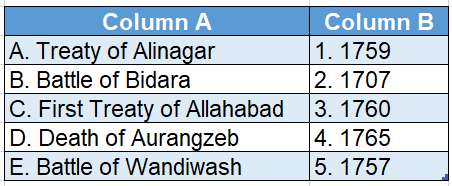
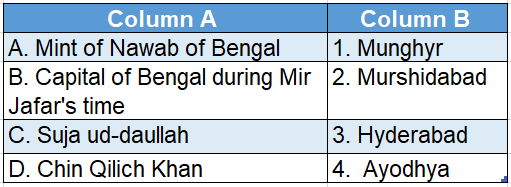
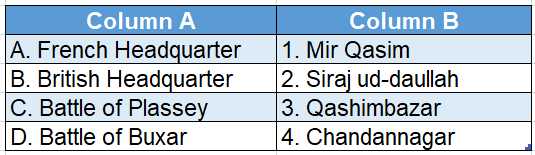
Chapter 1 The Idea Of History Match The Columns
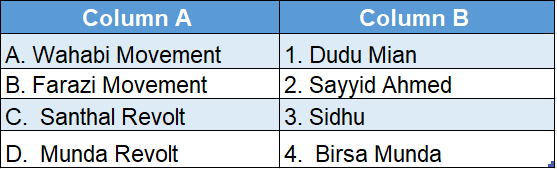
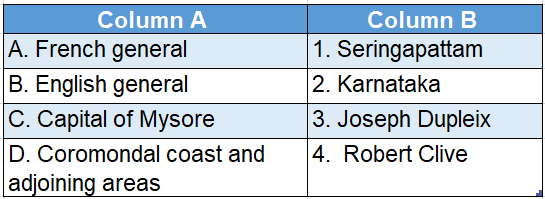
Wbbse Solutions For Class 8 History Chapter 1 The Indian Of History Match The Following Question tabla 1

A-4, B-3, C-1, D-2

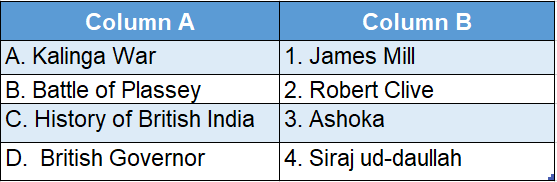
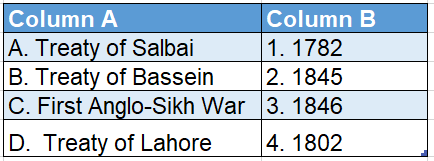
Wbbse Solutions For Class 8 History Chapter 1 The Indian Of History Match The Following Question tabla 2

A-2, B-1 ,C-3, D-4,

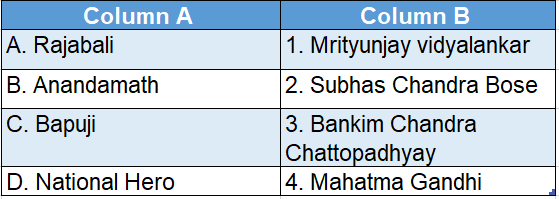
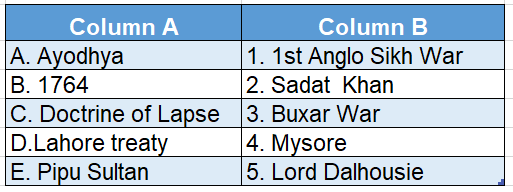
Wbbse Solutions For Class 8 History Chapter 1 The Indian Of History Match The Following Question tabla 3

 A-3, B-4, C-1, D-2,

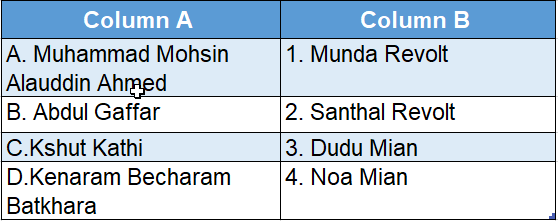
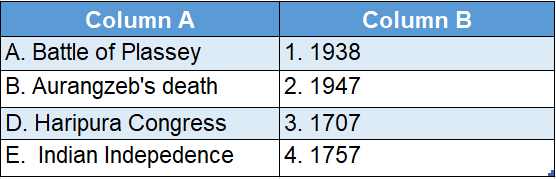
Wbbse Solutions For Class 8 History Chapter 1 The Indian Of History Match The Following Question tabla 4

A-1, B-3,C-4, D-2

Wbbse Solutions For Class 8 History Chapter 1 The Indian Of History Match The Following Question tabla 5

A-3, B-4, C-1, D-2

WBBSE Solutions For Class 8 History Chapter 3 Establishing The Colonial Authority Topic B New Education Land Survey and Revenue Fixation

WBBSE Chapter 3 Establishing The Colonial Authorishing Topic B New Education, Lan Survey An Revenue Fixation Descriptive Questions

Question 1. Describes the education policy from the Company’s rule to the British period.
Answer: Education Policy in the British Period Introduction:

  • The native education system was mainly based on Tols and Marasas due to the indifference of the government at the beginning of the British period.
  • This system of education was obsolete and undeveloped. On observing the miserable condition of education in Inia,
  • The British tried to develop it by enacting laws and setting up education commissions.

Read and Learn More WBBSE Solutions For Class 8 History

British Education Policy:

1. Charter of 1813:

  • By the Charter of 1813, the Company decides to spend money to elevate its status among the masses.
  • A public education committee called the General Committee of Public Instruction was set up.

2. Hunter Commission:

Lor Ripon set up a commission under the chairmanship of William Hunter in 1882 to investigate on the spot how far governmental measures had been effective in the liberalization of education.

This Commission called the Hunter Commission, recommended that

  1.  Primary education should be contacted by the municipal and strict boars,
  2. more emphasis should be given to higher education,
  3. colleges should be given government grants,
  4. private entry prices should be welcome in the sphere of education and government control over the education system should be relaxed.

3. Macaulay Minutes:

  • Thomas Babington Ewar Macaulay, the Education Secretary of Lor Bentinck, criticizes the oriental education system and recommends Western education in his famous ‘Macaulay Minutes’, On
  • the basis of his recommendation, the Calcutta Medical College (1835) Hooghly Mohsin College (1836), as well as some schools, were established during the time of Lor Bentinck and Lord Haringe.

WBBSE Class 8 New Education System Notes

4. Woo’s despatch:

  • Charles Woo, the President of the ‘Boar of Control’ of Englan, submitted his famous report called Woo’s Dispatch regarding
  • the development and expansion of primary, secondary, and higher secondary education.
  • To Accoring this despatch, three universities were established in Kolkata, Bombay a Maras in 1857.

5. Raleigh Commission:

Lord Curzon set up an education commission in 1892 under the chairmanship of Thomas Raleigh. This commission recommends

  1. That the universities should strictly enforce
  2. The necessary rules and regulations are upon the colleges affiliated with them.
  3. The different universities should be structurally renovated. The University Act was passed based on these recommendations.

6. Saler Commission:

  • The Saler Commission was set up in 1917 under the chairmanship of Michael Saler, the Vice Chancellor of the Lees University of Britain.
  • The two Indian members of this commission were Ashutosh Mukhopadhyay and Ziauin Ahme.
  • This commission recommends that a Board of Secondary Education should be established and a 3-year graduation course should be introduced.

WBBSE Solutions For Class 8 History Chapter 3 Establishing The Colonial Authority

Land Survey Methods Introduced by British Notes

Question 2. discusses the contribution of the Christian Missionaries to the spread of Western education in India.
Answer:

Contribution Of The Chris-Tian Missionaries To The Spread Of Western Education In India:-

Introduction:

  • The Christian Missionaries made a notable contribution to the spreading of Western education in India.
  • Though they established various educational institutions in different parts of India to spread Christianity, the spread of Western education was greatly influenced and facilitated by their activities.

Contribution Of Christian Missionaries-

1. Contribution of Baptist Missionaries:

  • The Baptist Mission was founded by William Carey, Marshman, and William War in 1800 in Sreerampur.
  • The Bible was translated into Bengali and other 26 Indian languages through their effort.
  • They established about 126 schools where almost 10,000 students could avail themselves of Western education.

Important Definitions Related to Land Survey and Revenue

2. Contribution of Lonon Missionaries:

  • Robert May, the founder of Lonon Missionary, established a school at Chinsura to impart education in the Bailey method.
  • Charles Grunt and Wilber Force, two eminent members of the Clapham group of Lonon campaigned for the spread of English education in Inia.
  • They tried to prove through facts and arguments that the introduction of English education and the spread of Christianity were necessary
  • To remove superstitions from Indian society and prevent the Indians from lagging in all spheres.

3. Contribution of Church Scottish and Scottish Missionaries:

  • The Church Missionary Society established some English medium schools. Alexaner uff, a stuent of St.
  • The Andrews University of Scotland came to Kolkata and established an English medium school named General Assembly Institution (present Scottish Church College) in 1830 in the house of Firingi Kamal Bose.

4. Contribution of the Jesuit Missionaries:

  • The Jesuit Missionaries established St. Xavier’s College in 1860. The Jesuits of Belgium built the Loreto House College.
  • The way the Christian missionaries built schools and colleges has brought about a high tie in the spread of English education.

Question 3 Write a note on Macaulay Minutes.
Answer:

Macaulay Minutes:-

Introduction:

  • The report submitted by Macaulay on 2 February 1835 recommending the replacement of oriental education by Western education was popularly known as ‘Macaulay Minutes’.
WBBSE Solutions For Class 8 School Science Long Answer Type Questions WBBSE Solutions For Class 8 School Science Short Answer Type Questions
WBBSE Solutions For Class 8 School Science Very Short Answer Type Questions WBBSE Solutions For Class 8 School Science Review Questions
WBBSE Solutions For Class 8 School Science Solved Numerical Problems WBBSE Solutions For Class 8 School Science Experiments Questions
WBBSE Solutions For Class 8 Maths WBBSE Class 8 History Notes
WBBSE Class 8 History Multiple Choice Questions WBBSE Solutions For Class 8 History
WBBSE Solutions For Class 8 Geography


1. Establishment of Public Instruction Committee:

  • Bentinck set up the ‘Committee of Public Instruction’ under the chairmanship smoothly. Macaulay is at educating
  • The Macaulay spread Western education to Indians through the medium of English and acquainted them with European philosophy, literature, and science.

2. Effects:

Macaulay submitted his report or proposal as the Chairman of the Committee of Public Instruction to the Governor General on February 2, 1835. He recommends that

  1. Western education should first be spread education spread among the upper and mile among the upper mile classes.
  2. If English classes then it would spread among the masses through the theory of downward filtration.
  3. Only English education could illuminate the ignorant and superstitious Indians.

The conflict between Orientalism and Anglicism:

  • The members of the Public Instruction Committee were divided among themselves over the spread of Western education in India.
  • Orientalists like Wilson, Colbrook, and H. J Princep wanted Indian literature and philosophy to be developed.
  • However, Anglicists like Alexander, Saners a Kelvin wanted to spread Western education in India.

Results:

Macaulay has recommended that all oriental educational institutions including Sanskrit College should be proposal was not accepted.

However, Bentinck declared English education as a part of government policy on March 7, 1835, based on Macaulay’s report. Then

  1. The Medical College of Roorki and the Elphinston College of Bombay were established.
  2. English was introduced in the government colleges instead of Persian in 1837.
  3. It was clear that those who were experts in English would be given priority in all government jobs.
  4. As more emphasis was put on the English language the vernacular languages were neglected.

Revenue Fixation Systems in Colonial India

Question 4 Write a note on Wood’s despatch.
Answer:

Wood’s Despatch Introduction:

  • Charles’s despatch has been regarded as a milestone in the spread of Western education in India. He formed an education committee with the members of the Board of Control.
  • The recommendation of the committee regarding the educational policy of the government submitted on 19th July 1854 came to be known as Wood’s dispatch.
  • Woo took up a project for the smooth development of primary, secondary a higher education in Inia.

1. Main Idea:

  • The main idea of Woo’s despatch was that the motive of education in the Company’s rule would be the spread of Western education.
  • The main subjects would be European art, philosophy, literature, and science. It would also be necessary to maintain
  • the secular nature of the education system to benefit all classes of society.

2. Wood’s despatch Various recommendations:

The recommendations concerning education in Woo’s despatch were as follows

  1. Establishment of three universities in Kolkata, Bombay, and Maras where subjects like Law, Medicine, and Engineering should be taught.
  2. Need for a separate education department to run the schools properly and for the progress of the education system.
  3. Need for training schools for the teachers.
  4. Grants should be given to the schools by the government.
  5. More primary and English medium schools. should be established.
  6. The government should take the initiative for the spread of women’s education
  7. English should also be taught in high schools along with the mother tongue.
  8. The government schools and colleges ought to be renovated.
  9. The meritorious students ought to be given scholarships.

3. Wood’s despatch Consequences:

According to the recommendations of Sir Charles Wood

  1. Three universities were established in Kolkata, Bombay, and Maras in 1857. Later on, two more universities were founded in Lahore and Allahabad.
  2. The Education Department or Directorate of Public Instruction was established in 1855.
  3. The number of primary schools all over Inia increased from 3916 in 1881-82 to 5124 in 1900-02
  4. The Indian Education Service was formed in 1896 to conduct administrative activities in
    the field of education.
  5. The Hunter Commission (1882- 83), the Raleigh Commission (1902-04), and the Saler Commission (1917-19) were set up to expand education.

4. Woo’s despatch Drawbacks:

  • Since the Western education schemes were mainly confined to the cities the villages were deprived of their benefits.
  • As Western education was mainly imparted through the medium of English the common people of Inia do not show much interest in it.

Impact of New Education on Indian Society Notes

Question 5 Give a comparative account of the Governmental and private initiatives in the spread of Western education in India.
Answer: Governmental And Private Initiatives In The Spread Of Western Education In India:-

Sprea Of Western Education In Colonial Inia-

Government Initiative:

1. Recommendation of Charles Grant:

  • Charles Grant, the President of the Board of directors of the Company, was the first to speak about the spread of Western education in India.
  • In the journal ‘Observation’ he wrote that it was necessary to introduce Western education to remove the vices of Indian society and prevent moral degradation.
  • According to the Charter of 1813, the Company decides to spend one lakh rupees annually for the spread of education in India. However, an issue arose among
  • The Orientalists and the Anglicists over the way of spending this, i.e., whether it would be spent on Oriental education or for Western education.

2. Bentinck’s contribution:

  • Lord Bentinck accepted Thomas Babington Macaulay’s proposals on the spread of Western education in India. Macaulay also spoke of the ‘Filtration Theory’.
  • This theory indicates that Western education would reach the masses through a handful of educated upper-class members.
  • After accepting the proposals in ‘Macaulay’s Minutes’ Bentinck declared English education as a governmental policy on March 7, 1835. Therefore,
  • Calcutta Medical College, Engineering College, and many schools grew up.

3. Dalhousie’s contribution:

  • Lord Dalhousie also tried to spread Western education in India. Sir Charles Woo, the Chairman of the Board of Control, produced his famous speech on July 19, 1854. So a separate
  • the education department was created to foster primary, secondary, and higher secondary as well as women’s education.
  • About 79 English medium Higher Secondary schools and 140 Mile Schools were established. Apart from these, three universities were established in Kolkata, Bombay, and Madras.

Private Initiative:

1. Contribution of Christian Missionaries:

  • The various missionary organizations. like the Baptist Missionary Society, London Missionary Society,
  • Church Missionary Society, Scottish Missionary Society a Jesuit mission remarkable contributions to the spread of Western education.
  • The Baptist Mission in Sreerampur (1800), Shibpur Bishop College (1820), General Assembly Institution (present Scottish Church Collegiate, 1830),
  • Wilson College in Bombay (1832), St. Xavier’s College in Maras (1837), and about 126 schools were set up due to the efforts of the missionaries.

Short Notes on Land Revenue Policies

2. Eneavour of Europeans and Anglo Indians:

  • David Hare founded the Hare School, an English medium school in Kolkata.
  • He also helped to establish the Calcutta School Book Society. Davi summons and finds the Harmatolla Academy.
  • Two more English schools were established in Bhawanipur and Chinsura.

3. Eneavour of Europeans and Indians:

  • Ram Mohan Roy founded the Anglo-Hindu school in Kolkata and helped Sir Hye East establish the Hindu College. Gourmohan Auy founded the Oriental Seminary in 1828.
  • Sir Sye Ahme established an English School at Ghazipur in UP in 1818. Viyasagar helpe Bethune to establish Calcutta Female School in 1849.
  • In this way, many English medium schools were found in Bengal, Kolkata, Delhi, Agra, and other parts of India under the initiative of educated Indians.

Question 6. Suppose you are a resident of Kolkata in the middle of the 19th century. How do you feel about the British initiative of spreading Western education? Express your feelings through a diary entry.
Answer:

November 30, 1854:

  • We, the Indians, are being oppressed and deprived of all sites under British rule. The only ray of hope for us is the positive attitude of the government in the matter of education.
  • So far we have been following the Tol and Marasa-based traditional education system. This system will probably now education become more modernized.
  • A retired official of the company Charles Grant has made the introduction of modern education.
  • Governor General Warren Hastings and later on Lor Wellesley emphasized the modernization of education.
  • The Christian missionaries have also come forward to spread modern education. As a result the Kolkata Marasa, Asiatic Society, Fort William College, Baptist Mission, and St.
  • Xavier College has been established. The Hindu College, Calcutta School Book Society a Sanskrit College have grown due
  • To the efforts of eminent Indian and foreign educationists like Rammohan Ray, David Hare, and Rahakanta a Warakanath Tagore.
  • Bentinck’s Secretary of Education has published his famous Macaulay Minutesaccoringto which, initiatives have been taken to foster Western education.

Class 8 WBBSE History Question Answer

  • Charles Woo, the Chairman of the Board of Control vehemently supported the need for Western education in his famous ‘Woo’s despatch.
  • Attempts are being made to modernize the Indian education system according to the guidelines of the despatch.
  • Now I think many of us will get the opportunity to avail of an English education.
  • We will be able to learn about Western society, culture, civilization, science, and learning. We may become more modern a rational in the future by imbibing Western ideas.

WBBSE Chapter 3 Establishing The Colonial Authorishing Topic B New Education, Lan Survey An Revenue Fixation Short Answer Questions

Question 1. Write a note on Hunter Commission.
Answer: Hunter Commission Organization:

  • The Hunter Commission was formed in 1882 under the chairmanship of William Hunter.

Hunter Commission Motives:

The chief motives of the Commission were as follows

  1. make an investigation into the progress of higher education in Inia,
  2.  examine the education system after implementing the recommendations of Woo’s dispatch,
  3. instruct the government to pay more attention to the space of primary education,
  4. arrange for various facilities required to foster women’s education.

Hunter Commission Recommendations:

  1. Put an end to governmental authority over schools and colleges,
  2. Provide grants to the colleges,
  3.  entrust the municipal and district boars with the responsibility of primary education,
  4.  Set up a library in every school with the help of the government ai and preserve it.

Question 2 What was the Company’s motive in spreading Western education in India?
Answer:

Company’s Motive In Spreading Western Education In Inia:-

Practice Questions on Revenue Collection Systems

1. Creating clerks well versed in English:

  • It was becoming quite difficult to run the work of the governmental departments with the help of Indians who knew only Arabic and Persian.
  • Even ordinary employees have to be hired from Englan. So the Company authorities tried to create some clerks who knew English well.

2. Appointment of educated Indians in the administration:

  • The Indian Mile class gradually became interested in Western education, knowledge, and science. The British authorities want to utilize them in administrative work after providing them ue training through English education. So they began to think of introducing Western education in India.

Question 3 How far I the British try to develop the indigenous education system?
Answer:

The British Try To Develop The Indigenous Education System:-

1. Initial condition:

  • At the beginning of British rule, a system of native education was mainly centered around tolls and maracas.

2. British endeavor:

  • The British tried to improve the indigenous system of education through the Charter of 1813, Macaulay’s Minutes (1835), Woo’s Dispatch (1834) Hunter’s Commission (1882), and Saler Commission (1897).
  • A dispute over the educational policy between the Orientalists (supporters of the East) and the Anglicists (supporters of the West).
  • Finally, the modern education system in India developed according to the recommendations of Woo’s despatch.

Question 4. What do you understand by the dispute between the Orientalists and the Anglicists?
Answer:

Dispute Between The Orientalists And The Anglicists:-

A dispute arose between the Orientalists and the Anglicists in the 19th century over the appropriate educational system to be implemented in India.

1. Orientalism:

Philosophers like Colebrook a Wilson held the opinion that education should be imparted through the Eastern method only.

2. Anglicism:

Alexander a Saners opposes the Orientalist view and advocates the introduction of Western methods for the spread of education in India. So a dispute followed between the two groups.

Question 5 Discuss the role of the Christian missionaries in the spread of Western education in India.
Answer:

Role Of The Christian Missionaries In The Spread Of Western Education In India:-

1. Sreerampore missionary:

William Carey established the Sreerampore Baptist Mission in 1800. He then started an English school and a press and ran them with the help of Marshman a William War.

Later on, the Baptist missionaries of Sreerampore established many schools and printing presses all over India.

Examples of Educational Institutions Established by British

2. Scottish Missionary:

Alexan Er Duff played an important role in spreading English education.

The General Assembly Institution established by him came to be known as Scottish Church College later on.

Question 6 Under whose initiative was the Hindu College established?
Answer: Estabilisation Hindu College:-

The Hindu College was established in Kolkata in 1817 under the initiative of the then Chief Justices of the Supreme Court Sir Hye East, Vaiyanath Mukhopadhyay, Rahakanta Dev, and David Hare.

Some people think that Raja Ram Mohan Roy was also associated with this college.

It soon earned a good reputation and reached the climax of popularity. At present it is known as Presidency University.

Question 7 What do you mean by Filtration Theory?
Answer: Filtration Theory:-

Pioneer:

Thomas Babington Macaulay, the Secretary of Law during the time of the Lord. William Bentinck, ha mentioned the Filtration theory in his ‘Macaulay Minutes”.

Main theory:

If some Indians were provided Western education through the medium of English, then they could, in turn, help other people to avail themselves of Western education.

English education or Western education would thus filter through a handful of Indians and spread among the entire masses. This theory was popularly known as the Filtration Theory.

Question 8 Write a note on Macaulay.
Answer: Macaulay:-

Introduction:

  • Thomas Macaulay was the Education Secretary of Lor William Bentinck. He was also appointed the President of the General Committee of Public Instruction by Bentinck.
  • He endeavored to develop the standard of education of the Indians as well as to spread education among the masses.

Conceptual Questions on Changes in Land Ownership

1. Macaulay Minutes:

Macaulay presented the proposal before Lor Bentinck in 1835 regarding the spread of education through the medium of English.

This proposal is popularly known as ‘Macaulay Minutes’. In this proposal, Macaulay stated

  1. The civilization of the East was corrupt, undeveloped, and lacking scientific awareness,
  2. The culture and civilization of the East could be developed only with the aid of Western education.

WBBSE Chapter 3 Establishing The Colonial Authorishing Topic B New Education, Lan Survey An Revenue Fixation State Whether The Following Statements Are True Or False

Question 1. Wood’s despatch was prepared in 1854.
Answer: True

Question 2. The Calcutta Marasa College was established in 1780.
Answer: True

Question 3. The Asiatic Society was founded by Canning.
Answer: False

Question 4. Calcutta University was established in 1857.
Answer: True

Question 5. The Baptist mission was founded in Sreerampur by William Carey, Marshman, and William Ward.
Answer: False

Question 6. The Sreerampur College was established in 1819.
Answer: False

Question 7. The General Committee of Public Instruction or Janshiksha Committee was formed in 1823 to determine educational policies.
Answer: True

Question 8. Thomas Babington Macaulay, the Secretary of Education during the regime of Bentinck, declared his ‘Macaulay’s Minutes concerned with the spread of education on 7th March 1835.
Answer: True

Question 9. The Sreerampur Baptist Mission was founded in 1800.
Answer: True

Question 10. The Hindu College was founded in 1817.
Answer: True

Class 8 History Solution WBBSE

Question 11. English was accepted as an official language in 1835.
Answer: True

Question 12. The Medical College was established in 1835.
Answer: True

Question 13. The Hunter Commission was formed in 1880.
Answer: False

WBBSE Chapter 3 Establishing The Colonial Authorishing Topic B New Education, Lan Survey An Revenue Fixation Fill In The Blanks By Selecting The Appropriate Expressions From The Brackets

Question 1. Calcutta Madrasa was established in ________ 2(1772/1781/1783).
Answer: 1781

Question 2. The Asiatic Society was founded in ________ (1780/1784/1788).
Answer: 1784

Question 3. The Varanasi Sanskrit College was established in ________ (1790/1791/1792).
Answer: 1791

Question 4. The Sereerampur Baptist Mission was founded in ________ (1800/1805/1809).
Answer: 1800

Question 5. The Hindu College was established in ________ (1815/1816/1817).
Answer: 1817

Question 6. The Hare School in Kolkata was established in ________ (1817/1820/1823).
Answer:1817

Question 7. The Sanskrit College was founded in Calcutta in ________ (1824/1825/1826).
Answer: 1824

Class 8 WBBSE History Question Answer

Question 8. The Calcutta School Book Society was founded in ________ (1810/1817/1824).
Answer: 1817

Question 9. The General Assembly Institution in Calcutta was founded in ________ (1827/1830/1833).
Answer: 1830

Question 10. The General Committee Instruction was formed of Public ________ (1823/ 1824/1825).
Answer: 1823

Question 11. The Calcutta Medical College was established in ________ (1830/1835/1840).
Answer: 1835

Question 12. The St. Xavier’s College in Kolkata was founded in ________ (1832/1838/1860).
Answer: 1860

Question 13. The Elphinston College in Bombay was founded in ________ (1836/1837/1856).
Answer: 1856

Question 14. The despatch of Charles Wood was formulated in ________ (1850/1854/1858).
Answer: 1854

Question 15. Calcutta University was founded in  ________ (1857/1858/1859).
Answer: 1857

Class 8 WBBSE History Question Answer

Question 16. One of the members of the Saler Commission was  ________ (Surenranath Banerjee/ Ashutosh Mukherjee/Guruas Banerjee).
Answer: Ashutosh Mukherjee

Question 17. The Raleigh Commission was formed in ________ (1901/1902/1903).
Answer: 1901

Question 18.  ________ (Canning/Bentinck/Dalhousie) appointed his secretary of Law Thomas Babington Macaulay the President of the Public Instruction Committee.
Answer:

Question 19. The Hunter Commission was formed to investigate the educational coed of ________ (Charle Wood/Macaulay/Hunter).
Answer: Charle Wood

Class 8 History Solution WBBSE

WBBSE Chapter 3 Establishing The Colonial Authorishing Topic B New Education, Lan Survey An Revenue Fixation Answer In A Complete Sentence

Question 1. Who wrote ‘A Grammar of the Bengal Language’?
Answer: Nathaniel Brassey Halhe wrote ‘A Grammar of the Bengal Language’.

Question 2. Who set up the Calcutta Marasa?
Answer: Governor General Lor Warren Hastings set up the Calcutta Marasa.

Question 3. Why the Asiatic Society was found?
Answer: The Asiatic Society was founded to translate ancient Sanskrit text into English.

Question 4. Where does William Carey teach?
Answer: William Carey taught at Fort William College.

Question 5. What was the aim of the Sanskrit College at Calcutta?
Answer: The Sanskrit College at Calcutta aimed to cultivate Sanskrit literature and spread Western education.

Question 6. Who was Charles Woo?
Answer: Charles Woo was the president of the Board of Control, who was famous for his despatch.

Question 7. Who took the initiative to spread education during the Maras Presidency?
Answer:
Christian Missionaries took the initiative to spread education in the Madras Presidency.

Question 8. Who completes the unfinished survey work of Franklin?
Answer: Hog Cameron completed the unfinished survey work of Franklin.

WBBSE Solutions For Class 8 History Chapter 3 Establishing The Colonial Authority Topic A Reformations Of Warren Hastings and Lord Cornwallis

WBBSE Chapter 3 Establishing The Colonial Authority Topic A Reformations Of Warren Hastings An Lorcornwallis Long Answer Questions

Question 1. Discusses the Regulating Act (1773) briefly.
Answer: Regulating Act (1773):-

Motive:

  1. The British government passed the Regulating Act in 1773 to strengthen their control over the British East Inia Company in Inia.
  2. An attempt was made to rectify some organisational laws of the company through this Act.

1. Two Facets of the Act:

  1. The two sides or facets of the Act were the central organisation of the English Company and the administration of the Company in India.
  2. This act led to the foundation of a centralised British administration in India for the first time.

2. Provisions:

  1. The administrative responsibility of the subated of Bengal was entrusted to the Governor-General and his council of four members.
  2. The four members would be appointed by the Board of Directors of the Company. The opinion of the majority would generally be accepted while making any decision.
  3. The Governor General and his council would exercise control over the matters of peace and war in the Bombay and Madras Presidencies.
  4. A Supreme Court was established in Inia with a Chief Justice and three subordinate judges
  5. Warren Hastings would be appointed as the first Governor General of Bengal.
  6. The Board of Directors would have the right to exercise complete authority over the activities, policies, foreign policies as well as trade commerce of the company.

Read and Learn More WBBSE Solutions For Class 8 History

Drawbacks:

  1. There was a lack of specification regarding the division of power between the Governor-General and the Council so disputes often arose.
  2. Again there was no specification regarding the range of authority or jurisdiction of the Supreme Court and so complications arose when the Supreme Court began to interfere in the affairs of the native courts.

Significance:

  1. The British tried to build up a constructive administrative system in India by passing the Regulating Act.
  2. Through this Act, the British authority in Lonon tried to impose their control over the Company rules in India.

WBBSE Class 8 Warren Hastings Reforms Notes

Question 2 What were the features of Pitt’s Inia Act?
Answer:

Features Of Pitt’s Inia Act:-

Introduction:

  1. The British Parliament passed the East India Company Act in 1784 to remove the flaws of the Regulating Act of 1773.
  2. However, it is better known as Pitt’s Inia Act after the name of William Pitt, the then Prime Minister of Britain.

1. Authority of the British government:

  1. The British government established its authority over the Company’s administrative activities for the first time under this Act.
  2. The monarch of Englan formed a committee called the ‘Boar of Control’ with six members to establish control over the company’s rule.
  3. The Boar preserve the right to examine any document related to the Indian administration.

2. Declaration of national policy:

  1. This Act stated that conquest of territory imperialism was against the national policy of England and the company would not wage any wars in India except for self-defence.

3. Power of the Governor-General:

  1. The Governor General’s powers have been specified in this Act. The number of members of the Governor’s council was reduced to only three.
  2. The Governor General and his Council were given absolute power over matters of war, peace and other matters concerning Bombay and Maras Presidencies.

4. Instructions to officials:

  1. The Act also tried to put an end to the corruption prevailing among the company officials like accepting bribes and gifts.
  2. The officials were also instructed to submit an account of their incomes and the amount of money they were taking back to Englan after the termination of their services.

5. Setting up of special courts:

  1. This Act also contained a provision for setting up a special court which would try the guilty officials of the Company.
  2. Pitt’s Inia Act helped to foster the task of centralising the administration of the Company in Inia to a considerable extent.

Lord Cornwallis Administrative Reforms Overview

Question 3. Discusses the administrative reforms of Warren Hastings.
Answer:

Administrative Reforms Of Warren Hastings:-

Introduction:

  1. Warren Console ate the Company’s rule over Bengal as well as Inia, whose foundation was laid by Lor Clive, by his skilful administration.
  2. Sir Alfre Loyal thinks that Hastings possessed fundamental talent in matters of administration.

1. End of dual government:

  • Hastings put an end to the dual government system in India by issuing an order in 1772 and took the right to collect revenue directly into the Company’s hands. He was appointed as the first Governor General of India.
WBBSE Solutions For Class 8 School Science Long Answer Type Questions WBBSE Solutions For Class 8 School Science Short Answer Type Questions
WBBSE Solutions For Class 8 School Science Very Short Answer Type Questions WBBSE Solutions For Class 8 School Science Review Questions
WBBSE Solutions For Class 8 School Science Solved Numerical Problems WBBSE Solutions For Class 8 School Science Experiments Questions
WBBSE Solutions For Class 8 Maths WBBSE Class 8 History Notes
WBBSE Class 8 History Multiple Choice Questions WBBSE Solutions For Class 8 History
WBBSE Solutions For Class 8 Geography


2. Abolishing the post of Nayeb Subah:

  • The post of Nayeb-Subah was abolished and the two tyrants of the dual government, i.e., Reza Khan and Sitab Roy were exposed.

3. Reduction in Nawab’s annuity:

  • The annual pension Nawab has been reduced from rupees 32 lakhs to rupees 16 lakhs.

4. Transfer of responsibilities:

  • Initially the responsibility of maintaining law and order. was vested in the Faujar’s hands but thus often led to nepotism.
  • So the power of maintaining law and order was transferred to officials who held the rank of magistrates.

5. Transfer of headquarters:

  • The treasury was transferred from Murshidabad to Kolkata which became the Company’s chief centre of activity. So the importance of Kolkata now began to increase.

Key Changes Introduced by Warren Hastings

Question 4. What were the judicial reforms of Warren Hastings?
Answer:

Judicial Reforms Of Warren Hastings:-

Introduction:

  • The judicial system almost collapsed towards the end of the Mughal age due to the tyranny and oppression carried on by the Company officials.
  • So Warren Hastings introduced some fundamental reforms in the judicial system.

Judicial System:

  • The reforms introduced by Hastings in the judicial system were as follows

Establishment of civil criminal counts:

  • Established a civil and criminal court in every district. The civil cases were tried by the collectors and the criminal cases were tried by the native judges.

2. Establishment of chief civil and chief criminal court:

  • The chief civil court and the chief criminal court were established in Kolkata to review the cases tried by the district courts.
  • The Governor General and two of his council members acted as judges in the chief civil court while the Chief Justice of the criminal court was nominated by the Nawab.

3. Purity in the judicial system:

  • Warren Hastings stopped all the malpractices of taking bribes and gifts by the judges and made arrangements to give them a regular salary.

4. Establishment of Supreme Court:

  • The Supreme Court of India was established during the tenure of Hastings in 1774 by the provisions of the Regulating Act (1773).

5. Other reforms:

  • Hastings made some arrangements for the improvement of the judicial system
  • He arranges for the documentation of all court activities,
  • He fixed up a time for filing allegations;
  • He abolished fines like ‘Chauth’ and ‘guru’, and 4he instructed ten Hindu scholars to compile the Hindu code of law.

Impact of Cornwallis Code on British Administration

Question 5 What kind of reforms I Lor Cornwallis introduce in the police administration?
Answer: Kinds Of Reforms I Lor Cornwallis Introduce In The Police Administration:-

Introduction:

  • Cornwallis tried to cleanse the police department of all sorts of corruption. He increases the salary of the employees of the department.
  • He tried to make them honest, skilful and sincere by putting an end to illegal ways of earning.

Cornwallis’ Police Reform Measures:

  • Cornwallis initiated a new police system in the Indian administration.

1. Responsibility of law and order:

  • The duty of maintaining law and order, in the villages initially lay with the village Zaminars. Cornwallis abolished the existing system and placed the responsibility on and well-organised police force.

2. Creation of the post of Commissioner:

  • Cornwallis created the post of police. Commissioner to maintain law and order in Kolkata.

3. Establishment of police stations:

  • Some police stations were established in the districts. An officer-in-charge and some constables were appointed in each police station.
  • The activities of the officers in charge were supervised and controlled by the district magistrates.

4. Creation of the post of superintendent:

Creation of Some posts of police superintendent were created in the cities to maintain law and order and their expenses were borne by the government.

Short Notes on Dual System Abolition

5. Appointment of Chawkiars:

A Chawkiar was appointed in every village and his responsibility was to inform the officer in charge about the law and order situations.

6. Cash rewards:

If an officer-in-charge could succeed in rescuing any property or resources he was given 10% of the value. If he could catch robbers he was given a certain amount of money as a reward.

Question 6 discusses the administrative and judicial reforms of William Bentinck.
Answer:

Administrative And Judicial Reforms Of William Bentinck:-

Introduction:

The tenure of William Bentinck constitutes a glorious chapter of the British period in India. He was the first to introduce administrative and judicial reforms which were beneficial for the people of Inia.

Administrative Reforms Of Bentinck:

1. Appointment of Indians to high posts:

During the time of Cornwallis only Europeans were appointed to high administrative posts. Bentinck abolished the system and began to appoint Indians to high posts on low remuneration.

2. Setting up the Boar of Revenue:

Bentinck set up a separate revenue department called ‘Boar of Revenue’ to collect the revenue from the North West frontier region accurately and regularly.

3. Combining the posts of collector and Magistrate:

Bentinck was the first Governor General to unify the two separate posts of the district Collector and the District Magistrate into a single one.

4. Increase in members of the Governor General’s Council:

Bentinck increased the number of lawyers in the Governor-General’s Council. The first expert of law appointed by him was Macaulay.

5. Creation of Commissioner’s Post:

Bentinck creates a new post of Commissioner in the division’s form by a group of districts taken together.

The Commissioner’s duty was to supervise the work of district magistrates, judges and the police.

Class 8 History Solution WBBSE

Judicial Reforms Of Bentinck:

  1. Reforms in Courts:
    • Bentinck abolished the provincial courts of appeal and the mobile courts. He also increases the power of the rural courts.
  2. Change in the title of district judges:
    • The district judges now came to be known as Sessions judges. They were now entrusted with the task of adjudicating both civil and criminal cases.
  3. Use of different language:
    • Bentinck initiates the use of the English language instead of Persian in the higher courts and the use of local languages in the lower courts.
  4. Establishment of the highest Supreme Civil and Criminal Court:
    • Lord Bentinck established the Supreme Civil and Criminal Court in Allahabad.
  5. Appointment of Indian judges in civil courts :
    • Bentinck decided to appoint Indian judges to try civil cases and raise their remuneration and prestige.

Question 7. Discusses briefly the police system in British India.
Answer:

Police System In British India:-

Introduction:

The British implement te an efficient police system during colonial rule. The police system played an important role in establishing, securing and consolidating British rule in India.

1. Motive behind Implementation:

  • The police force was first used to protect British traders and enable them to carry on trade smoothly. Later on, the police were employed to maintain peace and help in continuing the colonial rule of exploitation.
  • Bentinck, while pressing the police force, said that they were such shepherds who were more ferocious than the wolves.

2. Police system in Hastings’ time:

  1. Benga and Bihar were divided into 10 and 8 districts respectively. A police station was established in each district under the supervision of an Indian officer in charge.
  2. The chief police officer was entrusted with the task of maintaining law and order in the district.
  3. In every district 20 sepoys and 10 policemen were installed a jail was constructed.

Practice Questions on Colonial Reforms in India

4. Police system in Cornwallis’ time:

Structure:

  1. Article 22 of Cornwallis Coe says that
  2. Every district would be divided into areas under particular police stations.
  3. There would be an officer in charge in each police station under the supervision of the district magistrate.
  4. There would be at least 20 sepoys in each police station.
  5. The jurisdiction of a police station would extend over an area of 20-30 square miles.

2. Reforms in the police system:

  1. The police force was established in 28 districts.
  2. There were rewards to encourage the police force.
  3. A new post of Police Commissioner was created for the security of Kolkata.
  4. An officer-in-charge or a superintendent of police was appointed in each police station.
  5. The officer-in-charge was entrusted with the task of conveying an offender to the magistrate.

Question 8. discusses the military system of British India.
Answer:

Military System Of British India:-

Introduction:

  • The British East India Company has come to India for trade. This training company emerged as a political power within 100 years of the Battle of Plassey and the army had an important part to play in it.

Army In The British Administration Formation:

1. First British army:

  1. Formation of security forces:
    • Major Stringer Lawrence came to trade in India with the first navy. He endeavoured to organise the first security force on the European model in 1747.
    • He organises this force with the native people to protect the main training centre of the company.
  2. Bengal native regiment:
    • Just before the Battle of Plassey in 1757. Lor Clive built up the Bengal native regiment with 300-400 Indians. It was popularly called ‘The Re Platoon’.

2. Company’s process of organising the army:

  • The Company built up its army with three categories of soldiers
  • Army consisting of select Indian soldiers,
  • Army consisting of select European soldiers,
  • The Royal British forces. Initially, there were separate forces for Kolkata, Bombay a Maras Presidencies and they were led by separate commanders.
  • Later on, the Bengal Army was transformed into the Central Army. The commissions of 1859 and 1879 ha emphasised some points regarding the recruitment in the army third of
  • The army should consist of white people. The artillery should be under the control of the Europeans.

3. Nature of the army:

  • The army consisted of the British, other Europeans and Indians as well. The English soldiers were chiefly appointed at higher posts.
  • The other Europeans and the Indians were never given high posts even if they had the same eligibility. The highest post of
  • The Indian soldiers were subpar. The Indian soldiers include the Muslims, the Telengis, the Rajputs, the Marathas and the Tamils.

Important Definitions Related to Colonial Authority

4. Activities:

The task of the first security force was to safeguard the chief British training centres. Later on, when the standard army was built, it had three tasks

  • To capture the Indian states.
  • To resist foreign invasions an
  • To suppress the sporadic internal revolts in different parts of India.

Question 9 Give an idea of the introduction of Civil Service in India.
Answer:

An Idea Of The Introduction Of Civil Service In India:-

Introduction:

  • The members of the aristocratic families in Lonon were appointed to high posts in the colonial empire. This recruitment was done by the ‘Board of Directors in Lonon.
  • However, these officials got low remuneration and became corrupt. So the British authority introduced the system of recruitment through the Civil Service Examination by the Charter of 1853.

Endeavour For Civil Service:

1. Lor Cornwallis’contribution:

  • Lord Cornwallis introduced the Civil Service in Inia
  • He arranges for the training of revenue officials to increase their efficiency.
  • He forbade private trade and acceptance of gifts or bribes to stop corruption among the officials.
  • The salary of the higher officials was raised to enable them to lead a smooth life.
  • The appointment of Indians to high governmental posts was forbidden.

2. Role of Wellesley:

  • Wellesley felt that the English youths who would join the Civil Services in Inia would have to familiarise themselves with
  • the language, social norms, emotions and traditions of the plan. So he founded Fort William College in 1800 to train such youths.

3. Training Centres:

  • Fort William College I not continue for long because the Company’s directors feared that the new administrators would be more loyal to Kolkata than to Lonon.
  • Fort William College was closed in 1802 and Hertford Inia College was established in 1805 and shifted to Haileybury in 1809.


WBBSE Solutions For Class 8 History Chapter 3 Establishing The Colonial Authority Topic A Reformations Of Warren Hastings and Lord Cornwallis

Indian Civil Service:

  • The first Civil Service Examination was held in Lonon in 1856. It was called the Indian Civil Service or ICS.
  • Through this examination, Indians began to be appointed as Joint Magistrate, deputy Collector and Sub-Juge.

Question 10. What do you mean by ‘Rule of Law’? I the British implement the ‘Rule of Law’ properly in Inia? What do they think of ‘Equality before the law”?
Answer:

Rule Of Law:

1. Introduction: ‘Rule of Law’ refers to the administrative system which was conducted by implementing the laws properly.

  • There was no such rule of law in colonial India during the rule of the East India Company. Now the measures are taken by
  • the British government in England, like the Regulating Act and the Inia Government Act, of 1784, to terminate the Company’s rule a administer Inia according to law, was called the ‘Rule of Law’.

Class 8 History Solution WBBSE

2. Features:

  • In the ‘Rule of Law’ the rights and duties of the ruler and the rule were specifically mentioned.
  • This amine tractive system was not dependent on the whims of the ruler.
  • Here the democratic form of administration was put into operation.

3. Justification:

  • The administrative system of the British East India Company was faulty and corruptive. So the measures taken by
  • the British authority in England to rule following the law was quite justified but not completely flawless.
  • This was because they could not safeguard the interests of the Indians and rather, destroyed their independence.

Equality Before Law:

  • The Company tries to establish the concept of ‘equality before the law’. It was clear that the same laws would apply to everyone irrespective of caste, religion and race.
  • However, the declaration never materialises. Separate laws were made to judge the Europeans and separate courts were established for them.

WBBSE Chapter 3 Establishing The Colonial Authority Topic A Reformations Of Warren Hastings An Lor Cornwallis Short Answer Questions

Question 1. How I the Maras Presidency develop?
Answer: Maras Presidency Develop As Follows:-

The British East Inia Company made Masuliputtam and Surat their chief training centres in 1611 and 1612 respectively and carried on their commercial activities from these centres.

The company set up another training centre in Maras in 1639 and constructed St. George Fort there in the following year. The Maras Presidency or the St.

George’s Presidency gradually grew around the city of Maras and St. George Fort.

Question 2. What were the regions included in the Maras Presidency?
Answer: The Regions Included In The Maras Presidency:-

The Maras Presidency includes a large part of South India like Tamil Nau, the Malabar coast of North Kerala, parts of Andhra Pradesh, southern Orissa and Karnataka. In summer the chief administrative centre was Ootacamun and in winter it was Maras.

Question 3. How I the Bombay Presidency develop?
Answer: Bombay Presidency Develop As Follows:-

The Bombay Presidency was a province of British India. The setting up of a British training centre in Surat in the 17th century le to the birth of the Bombay Presidency Later on, western and central India as well as the regions on the coast of the Arabian Sea together came to constitute the Bombay Presidency.

Conceptual Questions on Governance Changes Under Cornwallis

Question 4. Which regions were included in the Bombay Presidency?
Answer: Regions Were Included In The Bombay Presidency:-

The Bombay Presidency was initially called the Western Presidency. The Sinh province of Pakistan was also included in it.

This Presidency covered Gujarat, two-thirds of western Maharashtra and north-west Karnataka. While the importance of Surat as a commercial centre began to decline, Bombay became the main training centre in about 1687 and the Company began to expand its activities from there.

Question 5. How I the Bengal Presidency develop?
Answer: Bengal Presidency Develop As Follows:-

The Company began to establish its authority over Bengal in 1765 when it was granted the want of Bengal, Bihar and Orissa. The Company also got the Nizamat in 1772.

Thus they established absolute power after getting both the rights of wanting a Nizamat. A Presidency grew up around Bengal and included Bengal, Bihar, Orissa, Assam and Tripura.

Question 6 Which regions constitute the Bengal Presidency?
Answer: The Regions that Constitute The Bengal Presidency are given Below:-

Besides Bengal, Bihar, Orissa, Assam and Tripura, the Bengal Presidency also includes Punjab, north of central Inia in the basins of Ganga and Brahmaputra.

A fort named Fort William was constructed like St. George Fort in Maras. So the Bengal Presidency was also called the Fort William Presidency.

Question 7. Why was the Regulating Act passed by the Parliament?
Answer: Regulating Act Passed By The Parliament:-

The British Parliament formulated and passed the Regulating Act in 1773 to reorganise the company’s administrative structure in India.

According to the Act, the Parliament of Britain could interfere in the activities of Maras, Bombay and Bengal Presidencies. A new post of the Governor General was created.

The Governor of Bengal was appointed as the Governor General for five years. A council of four members would assist him in the administration. Calcutta became the capital of British rule in India.

Examples of Judicial Reforms by Hastings

Question 8. Why was Pitt’s Inia Act Passe?
Answer: Pitt’s Inia Act Passe:-

Pitt’s Inia Act was introduced in the British Parliament in 1784 by then-Prime Minister William Pitt. It was passed to rectify the flaws of the Regulating Act of 1773 and to organise and consolidate the Company’s rule in India. This Act was put into action on 1st January 1785 and by this Act, the British Parliament got the right to supervise the activities of the East Inia Company.

Question 9. Write a note on the Charter of 1813.
Answer: Charter Of 1813:-

Terms and conditions of the Charter of 1813:

WBBSE Solutions For Class 8 History Chapter 3 Establishing The Colonial Authority Topic A

WBBSE Chapter 3 Establishing The Colonial Authoring Topic A Reformation Of Warren Hastings An Cornwallis State Whether The Following Statements Are True Or False

Question 1. The Supreme Court was established in Kolkata in 1774 through the Regulating Act.
Answer: False

Question 2. Warren Hastings established the Police department in India.
Answer: True

Question 3. Cornwallis introduced the mobile court.
Answer: True

Question 4. Warren Hastings appointed the Amini Commission in 1776.
Answer: True

Question 5. Lord Cornwallis suppressed the Thugees.
Answer: False

Question 6. The Bengal Presidency consists of Bengal, Bihar, Orissa, Assam and Tripura.
Answer: True

Question 7. The Regulating Act a Pitt’s Inia Act was passed in 1773 and 1784 respectively.
Answer: True

WBBSE Chapter 3 Establishing The Colonial Authoring Topic A Reformation Of Warren Hastings An Cornwallis Fill In The Blanks

Question 1. The Penal Coe was formulated during the regime of ________ (Warren Hastings/William Bentinck/Wellesley).
Answer: William Bentinck

Question 2. Fort William College was established in _________ (1800/1802/1804).
Answer: 1800

Question 3. A regular police force was built up by _________ (Dalhousie/Wellesley/Cornwallis).
Answer: Cornwallis

Question 4. The Charter was passed in the British Parliament in _________ (1812/1813/1814).
Answer: 1813

Class 8 History Solution WBBSE

WBBSE Chapter 3 Establishing The Colonial Authoring Topic A Reformation Of Warren Hastings An Cornwallis Very Short Answer Questions

Question 1. When I the Company obtain the Nizamat rights of Bengal?
Answer: The Company obtained the Nizamat rights of Bengal in 1772.

Question 2. When was the Regulating Act passed?
Answer: The Regulating Act was passed in 1773.

Question 3. Why was the Regulating Act passed?
Answer: The Regulating Act was passed so that Britain could exert its direct authority over Company traders, officials and servants in India.

Question 4. Who suppressed the Thuggees in northern and central India in Bentinck’s time?
Answer: Colonel Sleeman suppressed the Thuggees in northern and central India in Bentinck’s time.

Question 5. Who compiled a code of laws in 1793?
Answer: Lor Cornwallis compiled a code of laws in 1793.

Question 6. When I the Company starting a new judicial system?
Answer: The Company started a new judicial system in 1772.

Question 7. Who was William Pitt?
Answer: William Pitt was the Prime Minister of Britain.

WBBSE Solutions For Class 8 History Chapter 2 Rise Of Regional Powers Topic C Miscellaneous

Chapter 2 Rise Of Reginal Power Topic C Miscellaneous Strike The Odd One Out

Question 1. Jahangir, Aurangzeb, Shah Jahan, Murshid Quli Khan.
Answer: Murshid Quli

Question 2. Cornwallis, Dalhousie, Bentinck, Alivardi Khan.
Answer: Alivardi Khan

Question 3. Murshid Quli Khan, Furrukhsiyar, Alivardi Khan, Siraj ud-daullah.
Answer: Faruksiyar

Question 4. Umichand, Khoja Wajid, Jagat Seth, Sadat Khan.
Answer: Sadat Khan

Question 5. Sadat Khan, Chin Qilich Khan, Mubariz Khan, Asaf Jah.
Answer: Sadat Khan

Read and Learn More WBBSE Solutions For Class 8 History

Question 6. Suja ud-daullah, Chin Qilich Khan, Sadat Khan, Safdar Jung.
Answer: Chin Khan Qilich

Question 7. Mir Jafar, Mir Qasim, Siraj ud-daullah, Suja ud-daullah.
Answer: Suja daullah

Question 8. Battle of Plassey, Battle of Buxar, Carnatic War, Seven Year’s War.
Answer: Seven Year’s War

Question 9. Treaty of Lahore, Treaty of Salbai, Treaty of Poona, Treaty of Allahabad.
Answer: Treaty

Question 10. Aurangzeb, Tipu Sultan, Ranjit Singh, Siraj ud daullah.
Answer: Aurangzeb

WBBSE Solutions For Class 8 History Chapter 2 Rise Of Regional Powers Topic C Miscellaneous

WBBSE Class 8 Miscellaneous Notes on Regional Powers

Chapter 2 Rise Of Reginal Power Topic C Miscellaneous Match The Columns

History class 8 Rise of regional powers table 1

Answer: A-5,B-1,C-4,D-2,E-3

Wbbse Solutions For Class 8 History Chapter 2 Rise Of Regional Powers Match The Columns table 2

Answer: A-2,B-1,C-4,D-3

Wbbse Solutions For Class 8 History Chapter 2 Rise Of Regional Powers Match The Columns table 3

Answer: A-4,B-1,C-2,D-1

Wbbse Solutions For Class 8 History Chapter 2 Rise Of Regional Powers Match The Columns table 4

Answer: A-3,B-4,C-1,D-2

Wbbse Solutions For Class 8 History Chapter 2 Rise Of Regional Powers Match The Columns table 5

Answer: A-1,B-4,C-2,D-3

Wbbse Solutions For Class 8 History Chapter 2 Rise Of Regional Powers Match The Columns Awith B

Answer: A-2,B-3,C-5,D-1,E-4

Chapter 2 Rise Of Reginal Power Topic C Miscellaneous Fill In The Blanks With The Correct Alternative

Question 1. During Aurangzeb’s Ruls, Murshid Quli Khan Was The ________ of Bengal (Diwan/Faujdar/Nawab).
Answer: Diwan

Question 2. Ahmed Shah Abdali was ________ (Maratha/Afghan/Parsi).
Answer: Afghan

Understanding Regional Powers in India

Question 3. Alinagar treaty was concluded between ________ (Mir Jafar and British Company/Siraj and British Company/Mir Qasim and British Company).
Answer: Siraj and the British Company

Question 4. The Diwani rights of Bengal, Bihar, and Orissa were given to the British Company by ________ (Emperor Shah Alam II/EmperorFaruksiyar/Emperor Aurangzeb).
Answer: Emperor Shah Alam II

Question 5. Subsidiary Alliance was willingly accepted by ________ (Tipu Sultan/Sadat Khan/Nizam).
Answer: Nizam

WBBSE Class 8 History Chapter 2 Topic C Miscellaneous Questions And Answers

Question 1. What was the importance of Faruksi Yar’s firman?
Answer: Importance Of Faruksi Yar’s Firman:-

Faruksiyar’s significance in the history of Bengal as well as India. Through this firman, the British East India Company got data that brought some important changes in the trade of Bengal.

  1. Deterioration of the relationship between the English and the Nawab:
    • The Company officials began to misuse the data for personal interest and this destroyed the relationship between the English and the Nawabs of Bengal.
  2. Legal right to trade:
    • After receiving Faruksiyar’s Firman the English Company got legal recognition for trading in India.
  3. Advantages over other European companies:
    • The British East India Company got much more advantages, power, and prestige than other European and Indian trading companies in commercial competitions by the dastans. So Dr. Sukumar Bhattacharya has referred to Faruksiyar’s Firman as the Great Charter or the Magna Carta of British trade in Bengal

Key Terms Related to Regional Powers Notes

Question 2 When, how, and by whom was Hyderabad established as a regional power?
Answer: Hyderabad Established As A Regional Power:-

Foundation:

  • After the death of Aurangzeb in 1707 the central administration of the Mughals became quite slack. Taking advantage of
  • the situation Mir Qamaruddin Khan Siddiqi (Chin Qilich Khan) established an independent kingdom in Hyderabad in 1724.

Procedure:

  • Mir Qamaruddin ceremony- only accepted the Mughal authority and kept the Mughal structure of administration intact. However, he performed all
  • the tasks of administration independently and so Hyderabad came to be established as an independent province under the Mughal rule.

Question 3. What is known as the ‘Plassey Plunder?
Answer: Plassey Plunder:-

  • From their victory in the Battle of Plassey till the middle of the 19th century the British East India Company amassed huge wealth, commodities, and manufactured goods from Bengal and other parts of India and been referred to by historians and critics as smuggled them to England.
  • This incident has Drained of Resources or Drain of Wealth or Economic Drain. This is regarded as plunder because
  • the British did not drain these resources in exchange for gold, silver, or any other goods. Brooke Adams referred to this economic drain as Plunder of Plassey or Plassey plunder or Plassey loot.

Question 4 What is ‘dual government’?
Answer: Dual Government:-

  • After obtaining Diwani in 1765 the East India Company got the economic authority and right to collect revenue in Bengal. On the other hand, the Nawab had to conduct
  • the administration and maintain law and order. So the Company got real power and the Nawab became a titular head. This sort of double government in the same place was called diarchy.
  • By this system, the Company enjoyed power without any responsibilities and the Nawab had no power but was compelled to fulfill the responsibilities.

Important Events in the Rise of Regional Powers

Question 5. What was the job of British residents?
Answer: Job Of British Residents:-

Introduction:

  • The British Company carried on virtual or indirect administration in some regions of the Indian subcontinent.
  • The trading company sent their representatives to the royal court to safeguard their interests. These representatives were called residents.

Work:

  • The residents carried on the work of supervision on behalf of the Company authority to adopt aggressive measures. They also tried to lure the Company to occupy these regions which provided commercial opportunities.
WBBSE Solutions For Class 8 School Science Long Answer Type Questions WBBSE Solutions For Class 8 School Science Short Answer Type Questions
WBBSE Solutions For Class 8 School Science Very Short Answer Type Questions WBBSE Solutions For Class 8 School Science Review Questions
WBBSE Solutions For Class 8 School Science Solved Numerical Problems WBBSE Solutions For Class 8 School Science Experiments Questions
WBBSE Solutions For Class 8 Maths WBBSE Class 8 History Notes
WBBSE Class 8 History Multiple Choice Questions WBBSE Solutions For Class 8 History
WBBSE Solutions For Class 8 Geography


WBBSE Class 8 History Chapter 2 Topic C Miscellaneous Write Your Own

Question 1. Do You think it was the incompetence of the Mughals that led to the rise of regional powers? Give reasons for your answers.
Answer: Incompetence Of The Mughals Which Led To The Rise Of Regional Powers:-

Introduction:

  • Aurangzeb’s successors were weak, incapable, ineligible, and inefficient. Quite several regional powers raised their heads due to
  • the inefficiency of rulers like Bahadur Shah, Jahandar Shah, Faruksiyar, Muhammad Shah, and Ahmad Shah.

Reasons:

1. Failure to control administration:

  • The Mughal emperors up to Aurangzeb could maintain a strong hold over the administration. However, the later rulers were weak so their control over
  • the central administration was slack. Several regional powers emerged taking advantage of the situation.

2. Effect of war of succession:

  • The Mughal princes tried to grab the throne forcefully without passing through any criteria of eligibility.
  • The war of succession which ensued after the death of each emperor could not affect the unity and integrity of the empire till the time of Aurangzeb.
  • However, this unity and integrity were adversely affected during the reign of the later Mughals and this helped the regional powers to raise their heads.

Impact of Regional Powers on British Expansion Notes

3. Failure to control the aristocracy:

  • The inefficient Mughal rulers were unable to control the power of the aristocrats. The emperor became a puppet in the hands of the greedy and ambitious elite.
  • They paid more importance to their interests rather than to the interests of the empire.

4. Failure to collect revenue from the provinces:

  • The Mughal emperors failed to collect revenue from the different parts of the empire. The provincial rulers were quite negligent in paying the revenue on time but
  • the emperors could not take any strong action against them. The provincial rulers made use of the weakness of the Mughal emperors and asserted their independence.

Question 2. Between the Battle of Plassey and Buxar which do you think was more important for British expansion? Give reasons for your answer.
Answer: Introduction:

The foundation of British power was laid in India with their victory in the Battle of Plassey. Now the victory in the Battle of Buxar established their authority.

Greater Significance Of Buxar Over Plassey:

1. Decisive Battle:

  • The Battle of Buxar was decisive in India. If the result would have been reversed then the history of India would have been different.

2. Consolidation of colonial rule:

  • The victory in the Battle of Buxar placed the colonial rule on a firm foundation.

3. Authority over Bengal:

  • The victory march of the British in Bengal had begun with the Battle of Plassey but after winning the Battle of Buxar they became an unrestricted power since no ruler was there to resist them.

4. Expansion of British power over North Bengal:

  • After winning the Battle of Buxar the British now paid attention to the expansion of their power over north India.
  • The Nawab of Ayodhya Suja ud-daullah and the Mughal emperor became puppets and dependent upon the grace of the British. Thus the authority of the Company spread all over north India.

Short Notes on Decline of Mughal Authority

5. Beginning of economic exploitation:

  • The Company tried to control the economy of Bengal after the Battle of Plassey. Now, after winning the Battle of Buxar they established complete authority over
  • the trade and economy of Bengal and carried on unrestricted economic exploitation.

Question 3. What role had the private trade of Company officials played in the conflict between Mir Qasim and the British Company? What effect did the dual government have on Bengal?
Answer:

1. Independent spirit of Mir Qasim:

  • Mir Qasim tried to strengthen the economic and military departments to build up an independent kingdom in India.
  • Again, he shifted his capital from Murshidabad to Munghyr to get rid of the British influence and rule independently. This action created a conflict between him and the English.

2. Economic measures:

  • Mir Qasim imposed some additional taxes on the landlords and also raised the rate of revenue.
  • He suppressed these landlords and officials who were loyal to the British.
  • He punished the officials who appropriated the revenue and also confiscated their property.
  • He forcibly took away the savings of the families of Alivardi Khan and Mir Jafar.

WBBSE Solutions For Class 8 History Chapter 2 Rise Of Regional Powers Topic C Mir Qasim

3. Military organization:

  • Mir Qasim attempted to build up a well-trained and well-equipped army. He adopted the European strategy of warfare and also recruited the Afghans, Tartars, Persians, and Armenians of
  • the northwest frontier province in his army. He also set up an arsenal factory in Munghyr with the help of Armenian artisans.
  • The military strategy of Mir Qasim offended the British and a conflict became inevitable.

Practice Questions on Regional Powers and Their Influence

4. Dispute over taxes:

  • The Company officials began to misuse the data for personal trade. This harmed the interest of the native traders and also deprived the Nawab of his due revenue.
  • So Mir Qasim exempted the native traders from taxation which brought him into conflict with the Company.

Question 4 How would you analyze the change in policy from Subsidiary Alliance to the Doctrine of Lapse in the context of the expansion of the Company’s power in India?
Answer: Analyzing The Change In Policy From Subsidiary Alliance To The Doctrine Of Lapse In The Context Of The Expansion Of The Company’s Power In India:-

States accepting the policy:

The states that accepted the Subsidiary Alliance were Tanjore (25th October 1799), Surat (1800), Hyderabad (1800), Karnataka (25th July 1801), Malwa, Udaipur, Jodhpur, Jaipur, Gaikwad, and Bundelkhand.

Moreover, the Nawab of Ayodhya and Peshwa Baji Rao II also accepted it.

Significance:

1. Native states:

Economic loss:

  • On entering the alliance the native states had to bear the expenses of the British army. This drained the wealth of the native states.
  • Lack of security: Since the responsibility of defending the native states went into the Company’s hands the native armies became useless.

2. The British:

Class 8 History Solution WBBSE

Emergence as a sovereign power:

The British East India Company became more powerful and resourceful by using this policy and the Company now emerged as a sovereign power.

Expansion of the British Empire:

The British expanded their ins empire by utilizing this policy. They kept annexing the native states one by one and finally formed a large empire in India.

WBBSE Solutions For Class 8 History Chapter 2 Rise Of Regional Powers Topic C Lord Dalhousie

3. Extinction of native states:

  • In the Doctrine of Lapse it was said that in the state created by the Company, the adopted heir would not ascend the throne.
  • The kings of the dependent states should seek the permission of the Company before adopting a child. The existence of the native states was now at stake due to such rigid inheritance policies.

4. Expansion of the empire:

  • The Doctrine of Lapse introduced by Lord Dalhousie helped in the expansion of the British empire in India.
  • He used this doctrine to annex Satara (1848), Sambalpur and Jaunpur (1849), Udaipur (1852), Jhansi (1853) Nagpur (1854), and Karnataka (1856) and thus expanded the British empire.

5. Detrimental to native kings and their dynasties:

  • The British not only occupied the native kingdoms but also amassed the properties, wealth, and ornaments of the royal families through this doctrine.
  • Again, many kings were deposed, humiliated, and deprived of their allowances.

Question 5 What was the relationship between Bengal and the Mughal administration during the role of Murshid Quli Khan and Alivardi Khan?
Answer:

Relationship Between Bengal And The Mughal Administration During The Role Of Murshid Quli Khan And Alivardi Khan:-

Murshid Quli Khan And The Mughals

1. Relationship with the Diwan of Bengal:

  • The Mughal emperor Aurangzeb appointed Muhammad Hadi as the Diwan of Bengal. He was given the title of Murshid Quli Khan for his outstanding achievements as a diwan.
  • He dexterously collected the revenue of Bengal and deposited it in the Mughal treasury.

WBBSE Solutions For Class 8 History Chapter 2 Rise Of Regional Powers Topic C Murshid Quli Khan And Alivardi Khan

2. Relationship as the subedar of Bengal:

  • After the death of Aurangzeb, the next emperor Bahadur Shah first transferred Murshid Quli Khan to the Deccan but after two years reappointed him as the diwan of Bengal.
  • Emperor Faruksiyar appointed him as the Nawab Subedar of Bengal in 1713 and the very next year he was also appointed the Subedar of Orissa.
  • Then in 1717, he became the subedar of Bengal. So he held the posts of the Subedar and Diwan of Bengal and the Subedar of Orissa by maintaining a cordial relationship with the Mughal emperor.

Class 8 History Solution WBBSE

Alivardi Khan And The Mughals:

1. Relationship as a Faujdar:

  • The early name of Alivardi Khan was Mirza Muhammad. He worked under Azam Shah, the son of Aurangzeb. After Azam Shah’s death, he went to Orissa and secured a job under Shuja ud din.
  • When Shuja ud din became the Nawab of Bengal Mirza Muhammad became the Faujdar. He was given the title of Alivardi Khan by Shuja ud Din who was satisfied with his work.

2. Relationship with Naib Nazim:

  • Alivardi Khan became the Naib Najm of Bihar when Bihar
  • was added to Bengal. He suppressed the rebellious zamindars and established law and order.
  • As an assistant administrator, he maintained a cordial relationship with the Mughals and showed much skill in collecting revenue.

WBBSE Solutions For Class 8 History Chapter 2 Rise Of Regional Powers Topic C Alaverdi Khan

Imagine and write

Question 1. Suppose you are a common man during Alivardi Khan’s rule, who faced a ‘Bargi’ attack. Write a conversation between you and your neighbor regarding the ‘barge’ attack.
Answer:

Ram:

Oh, Bipin! What news?

Bipin:

  • What can be the news, brother? The Bargis have stripped us of everything. Everything has been destroyed. No food or other necessities are available in the area.
  • None of the places in Bengal including Murshidabad, Nawab Alivardi Khan’s capital, have been able to escape the attack.

Ram:

  • There has been massive damage to our crops due to this attack. These bandits have let loose all sorts of torture upon the farmers.
  • Even now small balls made of iron and burnt clay can be found on digging in Howrah and Midnapur regions.
  • It is said that the Bargis wounded the farmers and their family members by hurling such balls at them.

Conceptual Questions on Governance in Regional States

Bipin:

It’s not only farmers, Ram. All the weavers of the weaver colony have fled. Now the handloom industry of Bengal will also be destroyed. Even Katwa and Burdwan have become bankrupt.

Ram:

I’m thinking about how we will be able to survive now. The prices of things are soaring high. Nothing is available in the shops.

Bipin:

It seems as if the Bargis have tucked everybody to sleep by scaring them. People are making rhymes on the Bargis.

Ram:

Why, even the poet Gangaram has written the Maharastra Purana on them.

Bipin:

I heard that the Bargis are afraid of the cannons of the British and so they have not gone near Kolkata. I think I will move there with my family.

We can’t find peace in Alivardi Khan’s territory anymore.

Ram:

You are right. These rogues have turned our prosperous Bengal into a graveyard.

Bipin:

Brother, this is one of the most disgraceful chapters in the history of Bengal.

Class 8 History Solution WBBSE

Question 2. Suppose you are an English Company official. What experience would you have had roaming across Bengal during the famine of ’76? What advice can you give to the Company about helping the people during the famine?
Answer:

Experience:

  • The main reason behind the famine is the lack of rainfall. As it did not rain for two successive years all the canals, ponds, and lakes of Bengal dried up.
  • The cereals in the fields have turned into straw. Entire Bengal is enveloped in the silence of the crematorium.
  • The farmers are not interested in cultivation. Most of them have died of hunger while others have turned into beggars. The Zamindar families have also been effaced under the burden of excessive revenue.
  • There are funeral processions on all sides. One-third of the population of rural Bengal has died of epidemics like cholera and smallpox.
  • There are carcasses everywhere and the air is infested with a foul odor. There is no food and people are dying of starvation in large numbers.
  • The tyranny of the Company in extorting revenue has rendered the farmers bankrupt.

Examples of Alliances Among Regional Powers

Suggestions:

My suggestions to the Company to provide relief to the famine-stricken people are as follows

  1. The Company should make a self-assessment and do penance by forming an investigation board
  2. Arrangements should be made to send food and medicine to all the affected areas as soon as possible.
  3. Extortion of revenue should be completely stopped and the rate should be kept within the grasp of the people for some successive years.
  4. The dishonest, opportunist, and tyrannical officials should be dismissed from service.
  5. The Company should cooperate with the farmers so that they can start farming again. They should be provided loans, seeds, fertilizers, and other things needed for cultivation.

WBBSE Solutions For Class 8 History Chapter 2 Rise Of Regional Powers Topic A Rise Of Regional Powers Hyderbad Ayodhya And Bengal And The Battle Of Plassey

WBBSE Chapter 2 Topic A Rise Of Regional Powers Hyderbad Ayodhya And Bengal And The Battle Of Plassey Short Answer Questions

Question 1. How did the Mughal administrative system face a crisis in the period between the death of Aurangzeb (1707) and the Battle of Plassey (1757)?
Answer: The Mughal Administrative System faced a Crisis In The Period Between The Death Of Aurangzeb (1707) And The Battle Of Plassey (1757):-

  1. Court conflicts:
    • The aristocrats of the Mughal court were divided into three groups-Irani, Turani, and Hindustani. The inner conflict among these groups became quite acute in the period following Aurangzeb’s death.
    • The weakness of the later Mughals and the conflicts among the nobles in the court weakened the very foundation of the empire.
  2. Peasant unrest:
    • The immense pressure created upon the farmers due to the agricultural crisis resulted in general unrest. The Jat rebellion and the Satnami revolt took place in 1669 and 1672 respectively. The Sikh farmers also rose in rebellion and these successive revolts brought about the downfall of the Mughal empire.

Read and Learn More WBBSE Solutions For Class 8 History

Question 2. How did the regional powers emerge toward the end of the Mughal rule?
Answer: Regional Powers Emerge Toward The End Of The Mughal Rule:-

  1. Internal weakness of the Mughals:
    • Many regional powers and semi-independent kingdoms arose taking advantage of the internal conflicts of the Mughals.
    • Some such kingdoms were Hyderabad under Nizam-ul-Mulk, Ayodhya under Sadat Khan, and Bengal under Murshid Quli Khan.
  2. Pretentious loyalty:
    • Though the regional and semi-independent kingdoms formally pretended to be loyal to the emperor, their wilful actions encouraged separation.

Question 3. How did Alivardi Khan try to resist the attack of the Marathas?
Answer: Alivardi Khan Try To Resist The Attack Of The Marathas:-

  1. Resistance:
    • The Maratha cavalry attacked Bengal during the reign of Alivardi Khan and carried on plunder in different areas. Alivardi Khan faced them with his army and compelled them to retreat.
  2. Treaty:
    • A treaty was signed between Alivardi Khan and the Marathas in 1751.
    • According to this treaty, the Marathas would never attack Bengal and would not cross the border of the subah of Bengal which extended up to the Subarnarekha river near Jaleshwar in Orissa.
    • Thus, the Nawab tried to resist the Marathas from attacking Bengal at any cost.

WBBSE Class 8 Idea of History Notes

Question 4. State the relationship between the first three Nawabs of Bengal and the British East India Company.
Answer: The Relationship Between The First Three Nawabs Of Bengal And The British East India Company:-

The relationship between the British and the first three Nawabs i.e., Murshid Quli Khan, Shuja-ud-din, and Alivardi Khan was not cordial.

  1. Relation with Murshid Quli Khan:
    • Murshid Quli Khan prohibited the British East India Company from carrying on free trade and ordered them to pay the same taxes as the other European trading companies.
  2. Relation with Shuja-ud-din:
    • Shuja-ud-din took stringent measures to stop the misuse of dastans by the British East India Company. Again, he also forced them to pay salt tax.
  3. Relation with Alivardi Khan:
    • Alivardi Khan often extorted money from the British East India Company and never provided them any opportunity to participate in the administration or politics of Bengal.

WBBSE Solutions For Class 8 History Chapter 2 Rise Of Regional Powers Topic A

Short Notes on Periodization in History

Question 5. How far was Siraj ud-daullah responsible for the conflict with the English?
Answer: Siraj Ud-Daullah Responsible For The Conflict With The English:-

Some historians have shown in their recent research that Siraj ud Abdallah was also responsible for the conflict with the British to some extent.

  1. Ambition:
    • Siraj was highly ambitious and wanted absolute power. He tried to curb the powers of the aristocrats who were quite powerful and influential during Alivardi’s time.
    • So a conspiracy was hatched against him by the aristocrats with the help of the British which culminated in a conflict between the British and the Nawab.
  2. Extortion of money:
    • Siraj forcibly took money from the English as well as other European trading companies. He extorted maximum money from the English Company and also tried to interfere with their trading rights.
    • So an inevitable conflict with them resulted.

Question 6. What were the terms of the Treaty of Alinagar?
Answer: Terms Of The Treaty of Alinagar:-

Signing the treaty:

  • The Treaty of Alinagar was signed between Nawab Siraj ud- daullah of Bengal and the English on 9th February 1757.

Terms and conditions:

  1. The Nawab would not interfere in the fort construction by the Company.
  2. The Nawab would accept the Company’s right to free trade.
  3. The Nawab would pay compensation for the loss incurred by the Company due to his attack on Kolkata
  4. The Company would get the right to set up its mint and manufacture its coins

Question 7. What do you mean by Black Hole Tragedy?
Answer:

Black Hole Tragedy:

  • When Siraj ud-daullah occupied Fort William on 20th June 1756 Drek, the Governor of Kolkata, and many English people fled but some of them were caught and imprisoned.
  • Hallowell, a British official reported that there were about 146 English people in the fort then. Siraj stuffed all of them in an eighteen-foot-long and fourteen-foot-ten-inch wide room for the entire night.
  • 123 of them died due to intense heat and suffocation. Hollowell referred to this incident as the Black Hole Tragedy.

Practice Questions on Historical Evidence

Question 8. What is meant by ‘Dastak’?
Answer:

Dastak:-

  • Dastak was the permission to carry on tax-free trade. The Mughal emperor Farruksiyar gave the British East India Company the right to use data by issuing a firman in 1717.
  • The British could carry on free trade in Bengal by using this data. However, the misuse of the data brought the British and the Nawab into conflict with each other.

WBBSE Chapter 2 Topic A Rise Of Regional Powers Hyderbad Ayodhya And Bengal And The Battle Of Plassey State Whether The Following Statements Are True Or False

Question 1. The treaty of Alinagar was signed between Siraj ud-daullah and the English East India Company.
Answer: True

Question 2. Mohanlal was the general of Siraj ud Abdallah.
Answer: False

Question 3. The Battle of Bidara took place between the Dutch and the English.
Answer: True

Question 4. Dastak implies the right to tax-free trade.
Answer: True

Question 5. The Battle of Plassey took place on 23rd June 1757.
Answer: True

WBBSE Solutions For Class 8 School Science Long Answer Type Questions WBBSE Solutions For Class 8 School Science Short Answer Type Questions
WBBSE Solutions For Class 8 School Science Very Short Answer Type Questions WBBSE Solutions For Class 8 School Science Review Questions
WBBSE Solutions For Class 8 School Science Solved Numerical Problems WBBSE Solutions For Class 8 School Science Experiments Questions
WBBSE Solutions For Class 8 Maths WBBSE Class 8 History Notes
WBBSE Class 8 History Multiple Choice Questions WBBSE Solutions For Class 8 History
WBBSE Solutions For Class 8 Geography


Question 6. Narayan Das was the personal emissary of Nawab Siraj ud Abdallah.
Answer: True

Question 7. Muzaffar Jung was the grandson of Nizam ul Mulk.
Answer: True

Question 8. Nasir Jung was the son of Nizam ul mulk.
Answer: True

Question 9. Suja ud daullah was the Nawab of Ayodhya or Oudh.
Answer: False

Question 10. The first independent Nawab of Bengal was Murshid Quli Khan.
Answer: True

Question 11. Nizam-ul-Mulk was the founder of the independent kingdom of Hyderabad.
Answer: True

WBBSE Chapter 2 Topic A Rise Of Regional Powers Hyderbad Ayodhya And Bengal And The Battle Of Plassey Fill In The Blanks

Question 1. The English East India Company received Faruksiyar’s Firman in ________ (1717/1719 /1721).
Answer: 1717

Question 2. The independent kingdom of Hyderabad was established by ________(Qaramuddin Shah/Chin Qilich Khan / Mubariz Khan).
Answer: Chin Qilich Khan

Question 3.________(Verelst / Robert Clive / Canning) was the first Governor of Bengal.
Answer: Robert Clive

Question 4. The independent kingdom of Bengal was founded by ________ (Murshid Quli Khan /Alivardi Khan/Shuja ud din Khan).
Answer: Murshid Quli Khan

Question 5. The Katara Masjid was built by ________ (Murshid Quli Khan / Alivardi Khan / Shuja-ud-din Khan) in Murshidabad.
Answer: Murshid Quli Khan

Question 6. ________ (Umichand / Manikchand / Fateh chand) got the title of Jagat Seth from the Mughal emperor.
Answer: Fateh Chand

Question 7.________ (Drek / Clive / Wellesley) was the British Governor when Siraj attacked Kolkata.
Answer: Drek

Question 8. The Persian invasion of India was led by ________ (Ahmad Shah Abdali / Nadir Shah /Timur Lung).
Answer: Nadir Shah

Question 9. The Mughal emperor Aurangzeb died in ________ (1707/1710/1714)
Answer: 1707

Class 8 History Solution WBBSE

WBBSE Chapter 2 Very Short Answer Questions

Question 1. Who got the power to rule Bengal after Murshid Quli?
Answer: Alivardi Khan got the power to rule Bengal after Murshid Quli.

Question 2. Who had the economic control of Suba Bengal during the reign of Murshid Quli?
Answer: During the reign of Murshid Quli, the royal treasury and mint of Suba Bengal were under the indirect control of Jagat Seth.

Question 3. Why Murshid Quli could not defy the Faruksiyar’s Farman?
Answer: Though Murshid Quli ruled independently in Bengal, he had remained within the fold of the Mughal Empire, and for this, he could not defy the Faruksiyar’s Farman.

Question 4. What is the former name of Dhaka?
Answer: Jahangirnagar is the former name of Dhaka.

Question 5. Who was Khoja Wajid?
Answer: Khoja Wajid was an Armenian merchant of Suba Bengal in the 18th century.

Conceptual Questions on the Role of Historians

Question 6. How much money did Alivardi Khan demand from the British Company during the Maratha Attack of 1744?
Answer: During the Maratha Attack of 1744, Alivardi Khan demanded 30 lakh rupees from the British Company.

Question 7. Who got the title ‘Jagan Seth’ from the Mughal Emperor?
Answer: Fatehchand got the title ‘Jagat Seth’ from the Mughal Emperor.

Question 8. When did Alivardi Khan die?
Answer: Alivardi Khan died in 1756.

Question 9. Through which treaty the English Company got back its trading rights?
Answer: The English Company got back its trading rights through the Alinagar treaty.

Question 10. Who was Chin Qulich Khan?
Answer: One of the powerful aristocrats in the Mughal Court and founder of the Hyderabad Kingdom was Mir Qamar Ud-din Khan Siddiqi, whom emperor Aurangzeb gave the title of Chin Qilich Khan.

WBBSE Solutions For Class 8 History Chapter 2 Rise Of Regional Powers Topic B Battle Of Buxar And British Resident System

WBBSE Chapter 2 Rise Of Regional Powers Topic B Battle Of Buxar And British Resident System Long Answer Questions

Question 1 Discuss the significance of the Battle of Buxar.
Answer: Significance Of The Battle Of Buxar:-

Battle of Buxar Introduction:

  • The combined forces of Nawab Mir Qasim of Bengal, Nawab Suja ud daulCompany had started establishing its rule over India after winning the Battle of Plassey but after winning the Battle of Buxar they placed their colonial rule on a firm foundation.
  • Lah of Ayodhya and Mughal emperor Shah Alam II was defeated by the British army led by Robert Clive in the Battle of Buxar in 1764.
  • Through this victory, the Company went a step ahead in establishing its political domination over India.

Results Of The Battle Of Buxar-

  1. Consolidation of colonial rule:
    • The Company had started establishing its rule over India after winning the Battle of Massey but after winning the Battle of Bexar they placed their colonial rule on a firm foundation.
  2. Establishment of British superiority:
    • The armies of the Nawab as well as the British had staked their utmost strength in the Battle of Buxar. The victory of the British in the war helped to prove their superiority.
  3. Establishment of authority in North India:
    • The victory in the Battle of Buxar initiated the authority of the British over north India. Both Suja ud daullah of Ayodhya and Mughal emperor Shah Alam II became puppets in the hands of the British Company and were forced to owe allegiance to them.
  4. Receipt of Diwani:
    • The Company got the power of Diwani over Bengal, Bihar, and Orissa from Mughal emperor Shah Alam II. So the Company established its legal authority in the administrative and economic spheres.
  5. Decisive battle:
    • The Battle of Buxar was decisive in the history of India. If the English forces would have been defeated then history would have been different.

Battle of Buxar Conclusion:

  • The victory in the Battle of Buxar abolished Nawab’s rule and led to the rise of British power. According to James Stephens, Buxar is regarded as the originating point of British rule in India.

Read and Learn More WBBSE Solutions For Class 8 History

Question 2 Discuss how the British East India Company got the right of Diwani.
Answer: British East India Company Introduction:

  • The British East India Company had come to India for trade like other European companies. However, successive victories in the Battle of Plassey and Battle of Buxar turned the Company from a trading institution to a political power. So they tried to obtain the right to Diwani from the Mughal emperor to get legal recognition.

Wbbse Solutions For Class 8 History Chapter 2 Rise Of Regional Powers Receipt of Diwani by british east india Company

WBBSE Class 8 Battle of Buxar Notes

Background Of Obtaining Diwani

WBBSE Solutions For Class 8 History Chapter 2 Rise Of Regional Powers Topic B

Conceptual Questions on Decline of Nawabs After Buxar

Question 3. Discuss the significance of the receipt of Diwani by the British East India Company.
Answer: Significance Of The Receipt Of Diwani By The British East India Company:-

Diwani Introduction:

  • The British Company established its authority over Indian politics after obtaining the Diwani or the right to collect revenue from Bengal,
  • Bihar and Orissa on 12th August 1765. According to Percival Spear, responsible power begins from this time.”

Significance Of Diwani:

  • The receipt of Diwani by the British was an important event from both political and economic points of view.

Political significance:

  1. Increase in power and influence:
    • After getting the Diwani the British East India Company exerted much more power and influence than the other European trading companies
  2. Real controller of politics:
    • When Najm ud Beulah, the Nawab of Bengal declared by a treaty that the person nominated by the Company would get the administrative post, the Company became the real controller of the throne of Bengal.
  3. Change in the form :
    • The Company’s form changed after obtaining the diwani. It changed from a trading institution to a political institution.

Beginning of quasi-imperialism:

  • As a consequence of obtaining Diwani, the Company got irresponsible power and the Nawab got powerless responsibility. Historian P. J. Marshal called this quasi-imperialism.

2. Economic significance:

  1. Rise influence of the company:
    • After obtaining Diwani, the company began to collect revenue at random, which led to a massive increase in its affluence.
  2. A drain of resources:
    • The amount of wealth and resources that were being dispatched to England after the Battle of Plassey increased manifold after the obtaining of Diwani.
  3. The decline of Indigenous industries:
    • After receiving Diwani, the British destroyed Bengal’s cottage and handicraft industries as a part of their imperialistic policy.
  4. Decay of native resources:
    • After receiving immense wealth from Diwani, the English stopped importing silver coins (bullion) and used Indian coins only.
    • So the economic resources of India decayed when all the expenses began to be incurred in the Indian currency.
WBBSE Solutions For Class 8 School Science Long Answer Type Questions WBBSE Solutions For Class 8 School Science Short Answer Type Questions
WBBSE Solutions For Class 8 School Science Very Short Answer Type Questions WBBSE Solutions For Class 8 School Science Review Questions
WBBSE Solutions For Class 8 School Science Solved Numerical Problems WBBSE Solutions For Class 8 School Science Experiments Questions
WBBSE Solutions For Class 8 Maths WBBSE Class 8 History Notes
WBBSE Class 8 History Multiple Choice Questions WBBSE Solutions For Class 8 History
WBBSE Solutions For Class 8 Geography


Question 4. How did the dual government end in Bengal?
Answer: The Dual Government End In Bengal:-

Introduction:

  • Clive initiated the dual government system in Bengal after receiving Diwani in 1765 but Warren Hasting did away with this system.

Termination Of Dual Government

  1. Background for termination of dual government:
    • The Company retained the power to collect revenue while the Nawab was entrusted with the task of running the administration.
    • The Company appointed Reza Khan and Sitab Roy as Naib Nazim to collect revenue. The Company became so greedy for wealth after receiving Diwani that the two Naibs could not satisfy them even after exploiting the peasants to the utmost level.
    • The British also started interfering with the work of the Nawab and this created much chaos in the administration. Again, the famine of 1770 took a toll on lives.
    • In such a situation Warren Hastings was sent as the Governor-General of Bengal in 1772 with instructions to put an end to the dual government system and take the administrative power directly into the Company’s hands.
  2. Measures are taken to terminate the system:
    • Hastings adopted some measures to end the system of dual government He annulled all the treaties signed between the British and the Nawab of Bengal and also the emperor of Delhi.
    • Sitab Roy and Reza Khan were removed from their posts and the right to collect revenue and the responsibilities of running the administration became concentrated in the Company’s hands.
    • An English collector was appointed in every district to collect revenue and he was assisted by a native diwan.
    • A revenue board was set up to supervise the revenue collection. The headquarters of the Company was shifted from Murshidabad to Kolkata.
    • The adoption of all these measures by Hastings helped to solve the chaos in Bengal to some extent.

Examples of Real-Life Effects of British Policies

Question 5. Discuss the Subsidiary Alliance.
Answer: Subsidiary Alliance Introduction:

Lord introduced Wellesleypolicy in 1798 by which he compelled native states to accept the Company’s overlordship to supposedly protect them from external invasions. This was a Subsidiary Alliance.

Subsidiary Alliance Conditions:

  1. The terms and conditions of the Subsidiary Alliance were
  2. The states that allied would be protected by the Company from external attacks and internal disorder.
  3. The state had to maintain a standing army led by an English general.
  4. The bigger states had to cede a portion of their territory to station the soldiers.
  5. The smaller states could pay in cash instead of ceding a part of their land.
  6. These states needed the Company’s consent to carry on any foreign policy.
  7. They needed the Company’s consent to get involved in any war.
  8. They needed the Company’s consent to recruit Europeans in their armies.

States accepting the policy:

The states that accepted the Subsidiary Alliance were Tanjore (25th October 1799), Surat (1800), Hyderabad (1800), Karnataka (25th July 1801), Malwa, Udaipur, Jodhpur, Jaipur, Gaikwad Bundelkhand.

Moreover, the Nawab of Ayodhya and Peshwa Baji Rao II also accepted it.

Class 8 History WBBSE

Subsidiary Alliance Significance:

1. Native states:

  1. Economic loss:
    • The native states had to bear the expenses of the British army. This drained their wealth.
  2. Lack of security:
    • As the responsibility of defending the native states was the Company’s, native armies became useless.

2. The British:

  1. Emergence as a sovereign power: The Company gained more power and emerged as a sovereign power.
  2. Expansion of British Empire: The British kept annexing native states one by one and expanded their empire.

Question 6 What do you know about the Doctrine of Lapse?
Answer: Doctrine of Lapse Introduction:

The Doctrine of Lapse was a remarkable policy of Lord Dalhousie to extend the British empire. Introduced in 1848, this stated that if any ruler of a state under British protection died without a natural heir then his state would be annexed to the empire.

Doctrine Of Lapse:

Method of implementation: Dalhousie had implemented the policy of restricting adoption declared by the Board of Directors in 1834. Before that, he categorized the native states into The right of an adopted heir would not be three independent native states. States created by the Company and state under the Company’s protection.

Doctrine of Lapse Terms and Conditions:

The main terms and conditions of the policy were as follows

  1. The king of a state created by the Company could not adopt any child if he had no son and in that case, the state would directly be included in the British empire after his death.
  2. The king of a state under British protection should seek the permission of the Company before adopting a child, otherwise, the state would be annexed to the British empire after his death.
  3. The British would not interfere in the matters of independent states.

Application of the Doctrine of Lapse policy:

Dalhousie first used the policy against Kolba (1840). After that, he annexed Satara (1848), Sambalpur and Jaunpur (1849), Bhagat (1850), Udaipur (1852), Jhansi (1853), Nagpur (1854) and Karnataka (1856) by using the policy of Doctrine of Lapse.

Criticism: Much confusion arose in implementing the policy in three different categories of states. So, in some cases, the doctrine was misused.

Though Udaipur was not a state created by the British yet it had to suffer under the Doctrine of Lapse.

Important Definitions Related to the Battle of Buxar

Question 7. State the significance of the Doctrine of Lapse in the expansion of the British empire.
Answer:

Significance Of The Doctrine Of Lapse In The Expansion Of The British Empire:-

Doctrine of Lapse in the Expansion of the Empire Introduction:

Lord Dalhousie had declared in the Doctrine of Lapse that the native states which were dependent on the grace of the British would be annexed to the British Empire if the King died without a natural heir. The right of the adopted heir would not be recognized.

Significance of the Doctrine of Lapse in the Expansion of the Empire:

Beginning of the Sepoy Mutiny:

  • The doctrine of Lapse had indirectly sparked off the Sepoy Mutiny. The vehemence with which Dalhousie used
  • the policy and annexed so many states to the British Empire created terror among the other native states.
  • The annexation of Nagpur and Ayodhya and the plunder of the palace of Ayodhya antagonized the people.
  • A strong reaction was felt when Nana Saheb’s allowance was stopped. All these subsequently led to the outbreak of the mutiny.

Question 8. Discuss the causes of Anglo-French rivalry in South India over the expansion of power in India.
Answer:

Causes Of Anglo-French Rivalry In South India Over The Expansion Of Power In India:-

Anglo-French Rivalry in South India  Introduction:

  • The English and the French entered into a mutual conflict in South India over the establishment of commercial and political authority in India.
  • This is termed as Anglo-French rivalry which led to three wars First Carnatic War (1746-48), Second Carnatic War (1749-54), and Third Carnatic War (1756-63).

Anglo-French Rivalry

1. Inequal trade:

  • The British East India Company and French East India Company were the most powerful among the European trading companies.
  • Initially, there was equality among them for trade but soon the English outstripped the French and so the rivalry became inevitable.

2. Attempt for political domination:

  • The British and the French came to India for commercial purposes but soon they tried to establish their domination over the political sphere.
  • The British and the French tried to establish their authority over Bengal and the Deccan respectively.
  • When the British tried to interfere in the politics of Karnataka they came into conflict with the French.

3. War of succession in Austria:

  • A war of succession took place between Austria and Prussia, in which, England supported the former and France supported the latter.
  • The legacy of this war could be felt in the Anglo-French rivalry in India.

4. Building commercial centers:

  • The British were more advanced than the French in building commercial centers in Bengal as well as in India When Nawab built
  • their chief trading centers and ports in places other than Chandannagar, they came into direct conflict with the English.

Practice Questions on Regional Powers and Buxar

Question 9. Give an account of the Anglo-French Wars.
Answer:

Anglo-French Wars Introduction: 

The English and the French entered into a rivalry in South India to establish commercial and political authority. This was known as the Anglo-French rivalry.

Anglo-French Rivalry:

1. First Carnatic War:

The British had set up commercial and military headquarters in Madras which was then ruled by Anwar Uddin. British admiral Camdor Barnet captured some of the French warships during the war of succession in Austria. When the French Governor of Mauritius La Bourdonnais appeared at Madras with eight warships at the request of Dupleix,

the English fled from there. The English now sought the help of Anwaruddin to recapture Madras. As Anwaruddin was quite offended at the cunning of Dupleix, he began to fight against the French. The Nawab was defeated in the battle of Mylapur or St. Thome in 1764. When the war ended in Europe with the treaty of Ai-la-Chapelle (1748 AD) the English got back Madras and thus the First Carnatic War came to an end.

2. Second Carnatic War:

When Nawab Nizam ul Mulk of Hyderabad died, a conflict arose between his son Nasir Jung and grandson Muzaffar Jung over the accession to the throne.

Here Dupleix supported Muzaffar Jung. Again, he supported Chanda Saheb in the conflict between Anwaruddin and Chanda Saheb over the post of the Nawab in Karnataka. Anwaruddin was defeated and killed in the Battle of Amber (1749) by the combined forces of Dupleix, Muzaffar Jung, and Chanda Saheb.

When Chanda Saheb became the Nawab of Karnataka the English became quite worried and tried to place Nasir Jung and Muhammad Ali (son of Anwaruddin) as the Nawabs of Hyderabad and Karnataka respectively. So the Second Carnatic War.

Started between the English and the French in 1749. The war ended when both parties returned their occupied areas to each other through a treaty in 1755.

Short Notes on Subsidiary Alliance Policy

3. Third Carnatic War:

When the Seven Years’ War began in Europe the Third Carnatic War started in India. The British captured the French headquarters at Chandannagar in 1757.

British General Eyre Coote defeated the French army led by Count de Lali in the Battle of Wandiwash in 1760. In this battle, the French lost Pondicherry, Mahe, and Jinjhi. The Third Carnatic War ended when the Seven Years’ War ended in Europe through the Treaty of Paris (1763).

Question 10. What were the causes of the failure of the French in the Carnatic Wars?
Answer:

Causes Of The Failure Of The French In The Carnatic Wars:-

The Failure of the French in the Carnatic Wars Introduction:

  • The Anglo-French rivalry that took place in Europe over the War of Succession in Austria also affected the Anglo-French relationship in South India.
  • These two nations got involved in three successive wars known as the Carnatic Wars. The French were finally defeated in the Wars.

Causes Of The Failure Of The French In The Anglo-French Conflicts:

  1. Faulty war policy:
    • The war policies followed by the French were highly defective. They did not unify their forces in the Deccan. Again, the army was employed in Hyderabad and Trichinopoli simultaneously. All these measures were faulty.
  2. Internal conflict among the French:
    • The French army was weakened by the internal rivalry of the generals. The non-cooperation at Pondicherry and La Bourbonnais left India over the occupation of Madras destroyed the spirit and enthusiasm of the French army.
  3. Lack of efficient leadership:
    • The French generals like Lali and Dupleix were not as efficient as the English generals like Clive, Stringer Lawrence, Eyre Coote, and Sanders.
  4. Lack of forces and resources:
    • Since France was involved in the Seven Years’ War, the French government could not help the French East India Company with much force or resources. So the French were too weak to win the Carnatic Wars.
  5. Weakness of the Navy:
    • The British used their strong naval forces on the Western Coast to gather their necessary resources. On the other hand, the French did not have such a powerful navy and were unable to collect their resources even from their only naval base, i.e., Pondicherry.
  6. Failure of foreign policy:
    • During the Seven Years’ War British Prime Minister Pitt himself interfered to protect the English colonies but the French were not at all bothered about their colonies. The French government took no initiative to help or defend the French colonies in India.

Question 11. What were the results of the Great Famine of 1770?
Answer: Results Of The Great Famine Of 1770:-

Great Famine of 1770 Introduction:

  • A great famine occurred in Bengal in 1770 (1176 according to the Bengali calendar due to the long absence of rain and the massive destruction of crops. The administrative policy of the Company was largely responsible for this famine.

Results Of The Great Famine:

  1. Socio-economic disaster:
    • The social and economic life of Bengal was very badly affected by the Famine of 1770. Almost one-third of the population died of starvation and the rural areas became almost depopulated. We get a very pitiful picture of the viciousness of the incident from the novel Anandamath by Bankim Chandra Chattopadhyay.
  2. Agro-industrial and commercial crisis:
    • The farmers, weavers, carpenters, potters, and other laborers died on a large scale because there was a lack of adequate labor in agriculture and industry. So the trade of most of the products had almost come to a standstill. One such example is the ruin of the handloom industry in Bengal.
  3. Deterioration of law and order:
    • The scarcity of food and money compelled the people to lose their morality and become corrupt. As a result, theft, robbery, and plunder became widespread. There was a total collapse of law and order and public security.
  4. Termination of dual government:
    • The British authority in England was greatly affected by the Great Famine in Bengal. So they abolished the dual government system and took up the administration of India directly under the Crown. In 1772 Warren Hastings was sent as the Governor General of India by the British government in England to manage the situation.
  5. Abolition of the Zamindari system:
    • Many Zamindar families faced ruin due to the famine. The whole system collapsed due to increased taxes and scarcity of food.

Impact of the Battle of Buxar on India Notes

Question 12. Justify the statement ‘The trader’s measuring rod became the scepter of the King’.
Answer:

The trader’s measuring rod became the scepter of the King;-

Introduction:

  • India had trade relations with European countries since ancient times. The Portuguese, Dutch, French, and English traders had come to India for trading purposes.
  • Among them, only the English established a colonial rule here. So it is said that the measuring rod of the trader got transformed into the King’s scepter.

Transformation Of Trader’smeasuring Rod Into King’s Sceptre-

1. Obtaining Faruksiyar’s Firman:

Murshid Quli Khan, the Nawab of Bengal, prohibited the British Company from carrying on free trade. As a protest against Nawab’s orders, the Company sent a delegation to emperor Faruksiyar in Delhi under the leadership of John Surman. Faruksiyar issued a Firman in favor of the Company in 1717 giving them data or the right to tax-free trade. They also got some additional commercial facilities. So the British Company became much more powerful than the other European trading companies.

They also made greater advances toward establishing their political authority in India.

2. Victory in the Anglo-French Wars:

Among the various trading companies that came to India, the English, and the French companies came into conflict with each other (1740- 1763) to protect their existence.

The French were defeated and lost all trading rights by a treaty and the English established their monopoly over Indian trade.

3. Victory in the Battle of Plassey:

The British put an end to the power of the independent Nawab by defeating Siraj ud Daullah in the Battle of Plassey on 23rd June 1757.

They now became the real power in Bengal. This. The battle paved the way for British domination in India.

Class 8 History Solution WBBSE

4. Victory in the Battle of Buxar:

In the Battle an antagonist of Hyder Ali. Again, the Buxar the British, under the generalship of Hector Munro defeated the combined forces of Mir Qasim, Suja ud Abdallah, and Shah Alam II on 2nd October 1764.

This victory enabled them to extend their power beyond Bengal up to Delhi.

5. Obtaining Diwani:

The English Company got the right to Diwani over Bengal, Bihar, and Orissa from the Mughal emperor Shah Alam in exchange for the provinces of Kara and Allahabad and an annual tax of 26 lakh rupees. When the English thus got the right to collect revenue they became a sovereign power.

The Company got irresponsible power and the Nawab got powerless responsibility. All these events together turned the English trading power into a ruling power.

Question 13. What was the relationship between the English and Hyder Ali?
Answer:

Relationship Between The English And Hyder Ali:-

Hyder Ali Introduction:

Hyder Ali started his career as a cavalry soldier but later became the ruler of Mysore due to his exceptional talent. At. First, he did not possess an anti-British attitude but wanted to maintain a friendly relationship with them.

Relationship Between The British And Hyder Ali:

Deterioration of relationship:

The relationship between the British Company in Madras and Hyder Ali deteriorated when the British developed a cordial relationship with Muhammad Ali, the Nawab of Arcot, who was

Wbbse Solutions For Class 8 History Chapter 2 Rise Of Regional Powers Hyder Ali

British turned against Hyder because he established a close relationship with the French. Ultimately an enmity grew between Hyder Ali and the British.

1. First Anglo-Mysore War:

The First Mysore War began when Hyder Ali attacked Muhammad Ali, the Nawab of Karnataka who was under British protection.

At first, Hyder had to retreat but his sudden attack on Madras scared the Company and they were compelled to sign the Treaty of Madras in 1769.

According to the treaty both parties had to exchange prisoners as well as the captured territories. Moreover, it was also decided that the British would help Hyder Ali if he was attacked by any external power.

Class 8 WBBSE History Question Answer

2. Second Anglo-Mysore War:

It was agreed by the Treaty of Mysore that the English would help Hyder Ali if he was attacked by any external power.

However, they did not help Hyder in the battle against Peshwa Madhav Rao. When the British captured Guntur, Hyder understood that they were the actual enemy of Mysore.

So when the Anglo-Maratha War started in 1775, Hyder took the opportunity and formed the Mysore-Maratha alliance. He also involved the Nizam with them.

Now the Second Anglo-Mysore War broke out in 1780 and Hyder died of cancer during the War.

Question 14. Discuss the relationship between the English and Tipu Sultan.
Answer:

Relationship Between The English And Tipu Sultan:-

Tipu Sultan Introduction:

Tipu Sultan was an independent spirited ruler. So his relationship with the English was bitter from the very beginning.

Relationship Between The British And Tipu Sultan:

Anglo-Mysore Rivalry:

Tipu Sultan regarded the English as his enemy. He turned out to be the deadliest enemy of the British at that time.

He tried to resist the rapid expansion of the British empire in South India. He also sought the help of the French emperor and the Turkish Sultan to rout out the British.

The conflict between Tipu and the English:

Tipu understood that the British would try to attack and capture Mysore again. So he secretly started to strengthen his army by seeking and receiving foreign aid.

1. Third Anglo-Mysore War:

The British sent a proposal to the Nizam to ally the Anglo-French rivalry but they neglected Tipu. He was deeply offended and attacked Travancore in 1790.

Lord Cornwallis allied with the Nizam and the Marathas and proceeded against Tipu. So the Third Anglo-Mysore war broke out in which Tipu was defeated and had to sign the Treaty of Seringapattam in 1792.

By this treaty, he had to pay rupees 3,30,00,000 and pledge his two sons as security to the British.

Class 8 WBBSE History Question Answer

2. Fourth Anglo-Mysore War:

Tipu once again tried to fight against the British and sought the help of France and Mauritius. Wellesley sent an ultimatum to Tipu instructing him to accept the Subsidiary Alliance. When Tipu refused to accept the terms the Fourth Anglo-Mysore War broke out.

The combined forces of the British under the leadership of Wellesley, the Marathas, and the Nizam proceeded against Tipu who fought with great valor. However, he was defeated in the battles of Seedaseer and Mallavally and sought shelter in Seringapattam.

Then the enemy seized the capital, Tipu died in the ensuing struggle.

WBBSE Chapter 2 Rise Of Regional Power Topic B Battle Of Buxar And British Resident System Short Answer Questions

Question 1. Was dual government introduced in India or did the English Company establish a single government?
Answer:

  1. Constitutional mask:
    • In the dual government system, the Company got Diwani, i.e., the right to collect revenue and
    • The Nawab got Nizamat, i.e., the responsibility to maintain law and order. However, the dual government system was merely a constitutional mask.
    • This is because the responsibility given to the Nawab was not fulfilled. Nawab Najm ud-daulah delegated all his powers to his chief rent collector Reja Khan who was completely under the influence of the English Company.
  2. Imaginary arrangement:
    • The Company was also given the right to collect revenue from Reza Khan. Since Reza Khan was virtually a puppet of the Company, both the powers of Nizamat and Diwani went into the hands of the company. So the dual government system was a farce or an imaginary arrangement.

Question 2. What were the results of the dual government system?
Answer: The results of the dual government system are-

  1. Ruin of industry and trade:
    • Through the introduction of the dual government system, the British East India Company used its right to free trade and established its monopoly in the trade of Bengal. This ruined the indigenous industries and trade.
  2. The misery of the farmers aggravated:
    • The ljaradars or the revenue collection officials of the Company began to collect revenues from the peasants at very high rates. This increased the misery of the farmers.
  3. Spread of corruption:
    1. The officers of the Company became highly corrupt and began to exploit the people on the pretext of the Bill of Exchange and the construction of roads, dams, and bridges.
  4. Great Famine of Bengal:
    • The Great Famine that occurred in Bengal in 1770 was an outcome of maladministration in the name of the dual government.

Key Events of the Battle of Buxar Notes

Question 3. What were the main achievements of Verelst and Cartier who succeeded Clive?
Answer: Main Achievements Of Verelst And Cartier Who Succeeded Clive:-

Achievement of Harry Verelst:

  • After receiving Diwani Robert Clive returned to England in 1767 and Harry Verelst succeeded him. His regime saw the climax of the evil effects of the dual government system.
  • There was widespread corruption among officials including bribery and personal tax-free trade. So he appointed some English supervisors to control the situation.

Wbbse Solutions For Class 8 History Chapter 2 Rise Of Regional Powers British Governor Verelst

Achievement of John Cartier:

After Verelst, John Cartier became the Governor in 1769. He abolished the Amildari System and appointed more supervisors to check corruption. He also tried to restrict the power of Reja Khan. However, he failed to combat the Great Famine that engulfed Bengal in 1770.

Wbbse Solutions For Class 8 History Chapter 2 Rise Of Regional Powers British Govemor Cartier

Question 4. Give an account of Najm ud-daulah.
Answer: Najm ud-Beulah:-

Accession to the throne:

Najm ud-daulah was the son of Mir Jafar and his youngest wife Mani Begum. After the death of Mir Jafar on February 5, 1765, his minor son Najm ud-daulah became the Nawab of Bengal. The British Company compelled the young Nawab to sign a treaty on February 20, 1765, through which they received the Diwani of Bengal.

Class 8 WBBSE History Question Answer

Partner in dual government:

  • The Company established its authority over the politics of Bengal after receiving the Diwani.
  • Only Nizamat (responsibility of maintaining law and order and conducting administration) remained in the hands of the Nawab.
  • The dual government began to operate and being a partner of the system, the Nawab was unable to evade his responsibility.

Question 5. Discuss how the Lord Dalhousie category raised the native kingdoms in India.
Answer:

  1. Provinces created by the Company:
    • If the kings of these provinces died without heirs then such kingdoms would pass on to the Company. Moreover, these kings could not adopt anybody as their legal heirs.
  2. Provinces dependent on the Company (Karad):
    • The kings of these provinces could adopt their heirs with the permission of the Company. If the Company did not grant such permission then the provinces would be included in the British Empire after the King’s death.
  3. Independent native provinces:
    • The independent Indian kings could adopt heirs according to their own will and the Company would never interfere in this matter.

WBBSE Chapter 2 Rise Of Regional Power Topic B Battle Of Buxar And British Resident System State Whether The Following Statements Are True Or False

Question 1. Mir Qasim shifted his capital to Munghyr.
Answer: True

Question 2. The French East India Company won the Battle of Buxar.
Answer: False

Question 3. The First Carnatic War took place in 1746.
Answer: True

Question 4. Mir Jafar became the Nawab of Bengal after Mir Qasim.
Answer: True

Question 5. Najm ud-daulah became the Nawab of Bengal after the death of Mir Qasim.
Answer: True

Question 6. The first Treaty of Allahabad was signed between Nawab Suja ud-daullah and the British East India Company.
Answer: True

Question 7. The second Treaty of Allahabad was signed between the Mughal emperor Shah Alam II and the British.
Answer: True

Question 8. The right to collect revenue or Diwani was granted to the British East India Company by the Mughal Emperor of Delhi, Shah Alam II.
Answer: True

Question 9. Surman was the messenger of the French East India Company.
Answer: False

WBBSE Chapter 2 Rise Of Regional Power Topic B Battle Of Buxar And British Resident System Fill In The Blanks By Selecting The Appropriate Expressions From The Brackets

Question 1. The East India Company received the power of Diwani in __________ (1765/1768/ 1771).
Answer: 1765

Question 2. _________(Najm ud daulah/ Mir Jafar / Mir Qasim) was the Nawab of Bengal during the Famine of Seventy-six.
Answer: Najm ud Beulah

Question 3. _________ (Cartier / Verelst / Clive) was the Governor of Bengal during the Famine of Seventy-Six.
Answer: Cartier

Understanding British Resident System

Question 4. The Battle of Buxar was fought in _________ (1760/1764/1768).
Answer: 1764

Question 5. The Nawab of Bengal at the time of the grant of Diwani was _________ (Najm ud Beulah/ Mir Jafar / MirQasim).
Answer: Najm ud Beulah

Question 6. The Nawab of Bengal during the Battle of Buxar was _________ (Mir Jafar / Mir Qasim / Najm ud daulah).
Answer: Mir Jafar

WBBSE Chapter 2 Rise Of Regional Power Topic B Battle Of Buxar And British Resident System Very Short Answer Questions

Question 1. When was the Second Treaty of Allahabad signed?
Answer: The second treaty of Allahabad was signed in 1765.

Question 2. When did the great famine of ’76 happen?
Answer: The great famine of ’76 happened in 1770 (1176 in the Bengali calendar).

Question 3. Where was the capital of Mysore?
Answer: The capital of Mysore was Srirangapattam.

Question 4. Who was known as the ‘Tiger of Mysore’?
Answer: Tipu Sultan was known as the ‘Tiger of Mysore.

Question 5. What did Suja ud-daullah get through the treaty of Allahabad?
Answer: Through the treaty of Allahabad, Suja ud-daullah regained the throne of Awadh upon payment of 50lakh rupees to East India Company

Question 6. Who signed the Treaty of Bassein in 1802?
Answer: The treaty of Bassein between Peshwa Baji Rao II and the British East India Company in 1802.

Question 7. Which region did the British gain control of by the treaty of Lahore?
Answer: The British gained control over the Jalandhar Doab region by the treaty of Lahore.

WBBSE Solutions For Class 8 History

WBBSE Solutions For Class 8 History