WBCHSE Class 11 Physics Change Of State Of Matter Short Answer Questions

Unit 7 Properties Of Bulk Matter Chapter 8 Change Of State Of Matter Short Answer Type Questions

Short Answer Questions on Change of State of Matter

Question 1. Tea gets cooled when sugar is added to it. Why?
Answer:

Tea gets cooled when sugar is added to it.

When sugar is added to tea, it melts. For this purpose, the required latent heat is collected by sugar from tea, thereby cooling the tea.

Question 2. The water equivalent of a calorimeter is 10 g and it contains 50 g of water at 15 °C. Some amount of ice, initially at -10°C is dropped in it and half of the ice melts till equilibrium is reached. What was the initial amount of ice that was dropped (when specific heat of ice = 0.5 cal · g-1 · °C-1, specific heat of water = 1.0 cal · g-1 · °C-1 and latent heat of melting of ice = 80 cal · g-1)?

  1. 10g
  2. 18 g
  3. 20 g
  4. 30 g

Answer:

Given

The water equivalent of a calorimeter is 10 g and it contains 50 g of water at 15 °C. Some amount of ice, initially at -10°C is dropped in it and half of the ice melts till equilibrium is reached.

Let, ice of m g is dropped in the calorimeter.

m x 0.5 x 10 + m/2 x 80 =60x 1 x 15

or, m = 20 g

The option 3 is correct.

Change Of State Of Matter

Question 3. Steam at 100°C is passed into 20 g of water at 10°C. When water acquires a temperature of 80 °C, the mass of water present will be [Take specific heat of water = 1 cal · g-1 · °C-1 and latent heat of steam = 540 cal · g-1]

  1. 24 g
  2. 31.5 g
  3. 42.5 g
  4. 22.5 g

Answer:

Given

Steam at 100°C is passed into 20 g of water at 10°C.

Let m g of steam is passed into 20 g of water at 10° C.

Total heat released by the steam

= m x 540 + m( 100-80) =560/72 cal

Total heat absorbed by the water = 20(80-10) = 1400 cal

∴ 560m = 1400 or, m = 2.5 g

Now, mass of water present = 20 + 2.5 = 22.5 g.

The option 4 is correct.

Class 11 Physics Class 12 Maths Class 11 Chemistry
NEET Foundation Class 12 Physics NEET Physics

Question 4. A piece of ice falls from a height h so that it melts completely, Only one-quarter of the heat produced is absorbed by the ice and all energy of ice gets converted into heat during its fall. The value of h is [latent heat of ice is 3.4 x 15 J/kg and g = 10N/kg]

  1. 544 km
  2. 136 km
  3. 68 km
  4. 34 km

Answer:

Given

A piece of ice falls from a height h so that it melts completely, Only one-quarter of the heat produced is absorbed by the ice and all energy of ice gets converted into heat during its fall.

Heat produced = mgh [ m = mass of ice]

According to the question,

1/4 (mgh) = mL (L = latent heat of fusion of ice]

or, \(h=\frac{4 L}{g}=\frac{4 \times 3.4 \times 10^5}{10}=13.6 \times 10^4 \mathrm{~m}=136 \mathrm{~km}\)

The option 2 is correct.

Latent Heat: Short Answer Questions

Question 5. A copper block of mass 2.5 kg is heated in a furnace to a temperature of 500°C and then placed on a large ice block. What is the maximum amount of ice that can melt? (specific heat of copper = 0.39 J · g-1 · K-1; heat of fusion of water = 335 J · g-1)
Answer:

Given

A copper block of mass 2.5 kg is heated in a furnace to a temperature of 500°C and then placed on a large ice block.

The ice block is at 0°C.

So the heat released by the copper block = 2500 x 0.39 x (500 – 0) = 25 x 39 x 500 J

The maximum amount m of ice would melt if the entire amount of heat released by the copper block is used up as latent heat of fusion of ice.

∴ m = \(\frac{25 \times 39 \times 500}{335}\) = 1455 g =1.455 kg

Unit 7 Properties Of Bulk Matter Chapter 8 Change Of State Of Matter Integer Type Question And Answers

In this type, the answer to each of the questions is a single-digit integer ranging from 0 to 9.

Practice Short Answer Questions on States of Matter

Question 1. A piece of ice (heat capacity =2100 J • kg-1 • °C-1 and latent heat = 3.36 x 10⁵ J • kg-1) of mass m g is at -5°C at atmospheric pressure. It is given 420 J of heat so that the ice starts melting. Finally, when the ice-water mixture is in equilibrium, it is found that 1 g of ice has melted. Assuming there is no other heat exchange in the process, what will be the value of m?
Answer: 8

Question 2. 2 kg of ice at -20 °C is mixed with 5 kg of water 20 °C in an insulating vessel having a negligible heat capacity. Calculate the final mass (in kg) of water remaining in the container. It is given that the specific heat of water and ice are 1 kcal · kg-1 · °C-1 and 0.5 kcal · kg-1 · °C-1 respectively while the latent heat of fusion of ice is 80 kcal · kg-1.
Answer: 6

Question 3. In an industrial process, 10 kg of water per hour is to be heated from 20°C to 80°C. To do this steam at 150°C is passed from a boiler into a copper coil immersed in water. The steam condenses in the coil and is returned to the boiler as water at 90°C. How many kg of steam is required per hour? (specific heat of steam = 1 cal · g-1 · °C-1, steam = 540 cal · g-1)
Answer: 1

Question 4. A bullet of mass 10 x 10-3 kg moving with a speed of 20 m • s-1 hits an ice block (0°C) of 990 g kept at rest on a frictionless floor and gets embedded in it If ice takes 50% of KE lost by the system, the amount of ice melted (in grams) approximately is n x 10-3. Find the value of n.(J = 4.2 J • cal-1, latent heat of ice = 80 cal • g-1)
Answer: 3

Unit 7 Properties Of Bulk Matter Chapter 8 Change Of State Of Matter Comprehension Type Question And Answers

Read the following passages carefully and answer the questions at the end of them.

Question 1. An immersion heater, in an insulated vessel of negligible heat capacity brings 10 g of water to the boiling point from 16°C in 7 min. The water is replaced by 200 g of alcohol, which is heated from 16°C to the boiling point of 78 °C in 6 min 12 s, 30 g are vaporised in 5 min 6 s.

1. Power of heater is nearly

  1. 8.4 x 10³ J · s-1
  2. 84 W
  3. 8.4 x 10³ cal · s-1
  4. 20 W

Answer: 2. 84 W

2. The specific heat of alcohol is

  1. 0.6 J · kg-1 ·°C-1
  2. 0.6 cal · g-1 · °C-1
  3. 0.6 cal · kg-1· °C-1
  4. 0.6 J · °C-1

Answer: 2. 0.6 cal · g-1 · °C-1

3. The latent heat of vaporization of alcohol is

  1. 854 J · kg-1
  2. 854 x 103 J · kg-1
  3. 204 cal · g-1
  4. 204 cal · kg-1

Answer: 2. 854 x 103 J · kg-1

Real-Life Applications of Phase Changes: Short Answers

Question 2. In a physics practical examination, a student puts heat into a 500 g sample (solid) at the rate of 10 kJ · min-1, while recording its temperature as a function of time. He collects the data and plots the graph depicted. Assume no heat is lost.
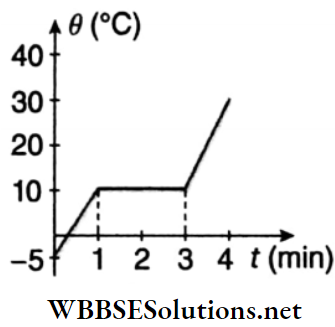
Class 11 Physics Unit 7 Properties Of Matter Chapter 8 Change Of State Of Matter Graph

1. What is the latent heat of fusion?

  1. 35 kJ · kg-1
  2. 70 kJ · kg-1
  3. 25 kJ · kg-1
  4. 30 kJ · kg-1

Answer: 4. 30 kJ · kg-1

2. What is the specific heat of the substance in liquid phase?

  1. 1 kJ · kg-1 · K-1
  2. 1.5 kJ · kg-1 · K-1
  3. 6.67 kJ · kg-1 · K-1
  4. None of these

Answer: 1. 1 kJ · kg-1 · K-1

3. What is the specific heat of the substance in solid phase?

  1. \(\frac{4}{3} \mathrm{~kJ} \cdot \mathrm{kg}^{-1} \cdot \mathrm{K}^{-1}\)
  2. \(\frac{3}{4} \mathrm{~kJ} \cdot \mathrm{kg}^{-1} \cdot \mathrm{K}^{-1}\)
  3. \(\frac{40}{3} \mathrm{~kJ} \cdot \mathrm{kg}^{-1} \cdot \mathrm{K}^{-1}\)
  4. \(1 \mathrm{~kJ} \cdot \mathrm{kg}^{-1} \cdot \mathrm{K}^{-1}\)

Answer: 1. \(\frac{4}{3} \mathrm{~kJ} \cdot \mathrm{kg}^{-1} \cdot \mathrm{K}^{-1}\)


WBCHSE Class 11 Physics Change Of State Of Matter Long Answer Questions

Unit 7 Properties Of Bulk Matter

Chapter 8 Change Of State Of Matter Long Answer Type Questions

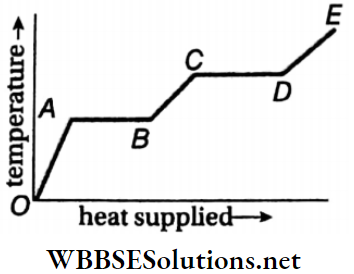
Question 1. A solid is heated at a constant rate. Temperature of the specimen changes. Study the graph and answer the following questions.

  1. What do the horizontal parts, AB and CD In the graph, represent?
  2. If CD = 2AB, what inference can be drawn?
  3. What does the slope of DE indicate?
  4. The slope of OA is more than the slope of BC. What is the inference?

Answer:

Given

A solid is heated at a constant rate. Temperature of the specimen changes.

1. Horizontal parts AB and CD represent respective quantities of heat absorbed for the changes of state at respective constant temperatures.

Class 11 Physics Unit 7 Properties Of Matter Chapter 8 Change Of State Of Matter Temperature Of Specimen Changes Graph

AB represents melting and CD represents the vaporisation of the substance.

2. CD = 2AB indicates that, latent heat of vaporisation is twice the latent heat of fusion, for the material in question.

3. From the slope of DE, the reciprocal of thermal capac¬ity of the specimen in vapour state can be calculated.

4. The slope of OA is greater than that of BC. It shows that the specific heat in liquid state is more than that in solid state.

Read and Learn More Class 11 Physics Long Answer Questions

Physics Change Of State Of Matter

Question 2. Why Is ice at 0°C more effective in cooling of a body than an equal amount of water at 0°C?
Answer:

Ice Is at 0°C more effective in cooling of a body than an equal amount of water at 0°C

When 80 cal of heat is extracted from 1 g of water at 0°C, it changes to 1 g of ice at 0°C. Hence, 1 g ice can absorb 80 cal more heat than 1 g water at 0°C. Thus, to cool a body, ice at 0°C is a more effective than an equal amount of water at 0°C.

WBCHSE Class 11 Physics Change Of State Of Matter laqs

Long Answer Questions on Change of State of Matter

Question 3. Water at 100 C and Meant of the same amount at 100 C— which one can release more heat? Which will cause more severe burns?
Answer:

Water at 100 C and Meant of the same amount at 100 C

An addition of 540 cal of heat to 1 g of water at J00°C produces steam at 100°C and therefore, the steam tan release more heat than water at 100°C. Thus, steam produces more severe burns than water of the same mass at 100°C.

Question 4. Some water is kept In a hole drilled into a melting Ice block. Will the water freeze to ice?
Answer:

Some water is kept In a hole drilled into a melting Ice block.

Water will not freeze to ice. The melting ice block is at 0°C. Water, if initially at a higher temperature, gives heat to the ice block at the hole, melting more ice.

Once water reaches 0°C, thermal equilibrium is established between the block and water and so heat exchange stops. The water can not transform into ice as it does not release any latent heat.

Question 5. State whether water in a beaker can be made to boil with a flow of steam at normal pressure.
Answer:

Water in the beaker will not boil. Steam is at 100°C under normal pressure. Steam condenses to water by delivering the latent heat of condensation and the water in the beaker absorbs it to rise up to 100°C.

Heat exchange stops at this stage. Hence, water in the beaker cannot take any latent heat of vaporisation from the steam. So, water will remain at 100°C but will not boil.

Latent Heat: Fusion and Vaporization Explained

Question 6. An astronaut carried some water at 20°C in a thermoflask and on the moon he poured it into a beaker. Comment on what happens to the water.
Answer:

An astronaut carried some water at 20°C in a thermoflask and on the moon he poured it into a beaker.

Moon has no atmosphere and hence no air pressure acts there. With the lowering of pressure on a liquid surface, its boiling point decreases and the rate of vaporisation becomes very high.

Thus, water from the flask at 20°C starts boiling and vaporises very fast collecting the necessary latent heat from the rest of the mass. Hence, the temperature of the rest of the water decreases and ultimately it changes to ice in the beaker.

Question 7. Why is a cooling effect produced due to evaporation?
Answer:

Cooling effect produced due to evaporation because

When a liquid changes to its vapour state it requires latent heat. If no heat is supplied from outside then the liquid takes the required latent heat from its own body and from its surroundings. As a result, the liquid and its surroundings become cooler. So, a cooling effect is produced due to evaporation.

Question 8. Melting point of ice decreases on increasing the pressure on ice, but melting point of wax increases with the Increase in pressure. Explain with reasons.
Answer:

Melting point of ice decreases on increasing the pressure on ice, but melting point of wax increases with the Increase in pressure.

For solids which contract on melting, like ice, the melting point decreases on increase of the pressure on it (as increased pressure helps contraction). But for solids which expand on melting, like wax, an increase in pressure opposes the expansion and the melting point increases.

Question 9. Why does it take comparatively more time to completely convert some water to its vapour state than to attain boiling point from 0°C, by supplying heat continuously at the same rate?
Answer:

To convert 1 g of water from 0°C to 100°C, 100 cal of heat is required. But 1 g of water at boiling point takes 537 cal to change to its vapour state. So, time taken to change the state of 1 g of water at 100°C to its vapour form is 5.37 times the time taken to change the temperature of lg of water from 0°C to 100°C.

Question 10. Water boils at a lower temperature in vacuum and its temperature decreases during boiling. Why?
Answer:

Water boils at a lower temperature in vacuum and its temperature decreases during boiling.

We know that a decrease in the pressure on a liquid results in a decrease in its boiling point. So, water boils at a lower temperature in vacuum. If no heat is supplied externally then water takes the latent heat from the remaining water. That is why the temperature of boiling water decreases.

Applications of Phase Changes in Real Life

Question 11. What will happen if we pour a few drops of ether on the bulb of a thermometer? Also, what will be the consequence if the bulb of a thermometer is kept completely immersed in a bottle of ether?
Answer:

As ether is volatile, the drops of ether will vaporise fast on contact with air. During vaporisation, it will take the necessary latent heat from the bulb of the thermometer.So, the reading of the thermometer will drop.

  • However, when the bulb is kept completely immersed in a bottle of ether, it does not come in contact with air.
  • So, the ether in contact with the bulb does not evaporate, nor is any latent heat absorbed from the thermometer so the reading does not drop. The reading of the thermometer, in this case, gives the temperature of the ether in the bottle.

Question 12. What is the function of the energy supplied by latent heat of fusion or of vaporisation?
Answer:

Change of a solid to its liquid state involves breaking of the crystal structure of the solid. Latent heat of fusion provides the energy for this. Similarly, to change a liquid to its vapour state, intermolecular separations need to be so increased that there remains practically no attraction between the molecules the latent heat of vaporisation supplies the required energy for this.

Question 13. Why is a fuse wire in electrical lines made up of an alloy and not of pure metals?
Answer:

Melting point of an alloy is always less than the melting point of each of the constituent pure metals. So, a fuse wire made of an alloy can melt before the current in the circuit reaches a danger level and hence can break the circuit. Thus the other parts of the circuit remains safe.

Question 14. More work has to be done to vaporise a substance than to melt it. Explain.
Answer:

More work has to be done to vaporise a substance than to melt it.

In melting, the crystal structure of the molecules of a solid breaks down. For this, in most cases, the intermolecular separation changes very little. So, the work done against the intermolecular force is comparatively low. During vaporisation, the intermolecular separation increases by a lot more. So, more work has to be done against the intermolecular force.

Question 15. Boiling point of water at Darjeeling is usually less than 100°C. Explain why?
Answer:

Boiling point of water at Darjeeling is usually less than 100°C.

Air pressure decreases as altitude increases. Lower pressure on a liquid lowers its boiling point. Darjeeling being at a higher altitude, has a low air pressure and therefore water has a lower boiling point; so water begins to boil at a temperature below 100°C.

Class 11 Physics Class 12 Maths Class 11 Chemistry
NEET Foundation Class 12 Physics NEET Physics

Question 16. Water boils at nearly 120°C in a pressure cooker. Why?
Answer:

Water boils at nearly 120°C in a pressure cooker.

Boiling point increases with the increase in pressure on a liquid. Pressure on a liquid in a pressure cooker rises to about 2 atm and so the boiling point of water at that pressure is nearly 120°C.

Question 17. At 100°C, during boiling, what is the specific heat of water?
Answer:

Heat gained during boiling (H) = latent heat of vaporisation

Rise in temperature t = 0

Now, H = mst

So, specific heat, s = \(\frac{H}{mt}\).

According to this equation, the value of specific heat is infinite.

Question 18. Why does a liquid evaporate even at a temperature below its boiling point?
Answer:

The air around any liquid has a tendency to become saturated with the vapour of the liquid. A certain mass of air has a capacity of holding a certain maximum amount of the vapour.

  • When that maximum amount is present, air is said to be saturated with that vapour. But in most cases, the air surrounding a liquid is unsaturated. So, in order to saturate the surrounding air, molecules on the surface of a liquid continuously transform into vapour molecules that mix with air, whatever the temperature of the liquid be.
  • This is the principle of evaporation of a liquid at all temperatures. However, when air attains saturation or near saturation, the rate of evaporation becomes negligibly small.
  • That is why wet clothes do not dry up easily in rainy season. When the temperature of air becomes very low in winter, the atmosphere often becomes supersaturated with water vapour. Then the vapour turns back into water particles, thus forming dews and fogs.

Detailed Explanation of Phase Changes in Matter

Question 19. Sometimes why does a layer of ice stick to the heel of j a shoe during walking on ice?
Answer:

Under the pressure of the heel of a shoe on ice, its melting point decreases and ice melts. Now on raising the shoe above, the pressure on ice diminishes and its melting point increases. So water again freezes into ice which stick to ihe heel of the shoe.

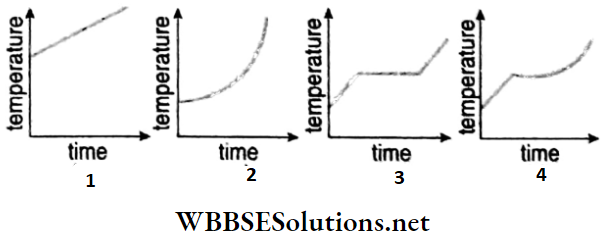
Question 20. Liquid oxygen at 50 K is heated to 300 K at a constant pressure of 1 atm. The rate of heating is constant. Which of the following graphs represents the variation of temperature with time?

Class 11 Physics Unit 7 Properties Of Matter Chapter 8 Change Of State Of Matter Variation Of Temperature With Time

Answer:

Given

Liquid oxygen will undergo a change of state when heated from 50K to 300K. During the change of state, the temperature will not change until all the liquid aw gen has changed to gaseous state.

After that, the temperature will increase because the rate of heating is constant. Hence the correct graph is (c).

Examples of Phase Changes with Explanations

Question 21. The melting point of ice in vacuum is 0.0073°C What do you mean by the statement?
Answer:

Given

The melting point of ice in vacuum is 0.0073°C

Melting point of ice reduces due to application of pressure on it. It has been found that the melting point of ice reduces by 0.0073°C for one-atmosphere increase of pres¬sure. Conversely, if the pressure is decreased by one atmosphere, i.e., if the pressure is nil. then ice will melt at 0.0073°C instead of at 0°C. So it can be said that the melting point of ice in vacuum will be 0.0073°C.

WBCHSE Solutions For Class 12 Maths

Relations and Functions

Algebra

Differential Calculus

WBCHSE Solutions For Class 12 Maths

Integral Calculus

Differential Equations

Vector Algebra

3D Geometry

Probability

Linear Programming

NEET Foundation Notes

Biology

NEET Foundation Notes

Chemistry

Physics


NEET Foundation Short Answer Questions

Biology

Chemistry

NEET Foundation Short Answer Questions

Physics

NEET Foundation Long Answer Questions

Biology

NEET Foundation Long Answer Questions

Chemistry

Physics

NEET Foundation Multiple Choice Questions

Biology

NEET Foundation MCQs

Chemistry

Physics


WBBSE Class 10 History Multiple Choice Questions

WBBSE Class 10 History Multiple Choice Questions


WBBSE Class 10 History Very Short Answer Questions

WBBSE Class 10 History Very Short Answer Questions

WBBSE Class 10 History Short Answer Questions

WBBSE Class 10 History Short Answer Questions