WBBSE Solutions For Class 8 School Science Review Questions

WBBSE Solutions For Class 8 School Science Review Questions

WBBSE Solutions For Class 8 School Science Review Questions

WBBSE Solutions For Class 8 School Science Very Short Answer Type Questions

WBBSE Solutions For Class 8 School Science Very Short Answer Type Questions

WBBSE Solutions For Class 8 School Science Very Short Answer Type Questions

WBBSE Solutions For Class 8 School Science Short Answer Type Questions

WBBSE Solutions For Class 8 School Science SAQs


WBBSE Solutions For Class 8 School Science Short Answer Type Questions

WBBSE Solutions For Class 8 School Science Long Answer Type Questions

WBBSE Solutions For Class 8 School Science LAQs

WBBSE Solutions For Class 8 School Science Long Answer Type Questions

WBBSE Notes For Class 8 School Science

WBBSE Notes For Class 8 School Science

WBBSE Notes For Class 8 School Science

WBBSE Class 8 School Science Chapter 11 Plant Kingdom And The Environment Around Us SAQs

Chapter 11 Plant Kingdom And The Environment Around Us SAQs

Question 1. Why plants are important?
Answer:

Plants Are Important Because :

Plants are the backbone of all life on Earth and an essential resource for human well-being. Plants are essential to the balance of nature and people’s lives.

Green plants, i.e., those possessing chlorophyll, manufacture their food and give off oxygen in the process called photosynthesis, in which water and carbon dioxide are combined by the energy of light.

Plants are the ultimate source of food and metabolic energy for nearly all animals, which cannot manufacture their food, Besides foodies.g., grains, fruits, and vegetables), plant products vital to humans include wood and wood products, fibers, drugs, oils, latex, pigments, and resins. Coal and petroleum are fossil substances of plant origin.

Question 2. Write a short note on bamboo.
Answer:

Bamboo:

Bamboo is a tribe of flowering perennial evergreen plants in the grass family. In bamboo, the internodal regions of the stem are hollow and the vascular bundles in the cross section are scattered throughout the stem instead of in a cylindrical arrangement.
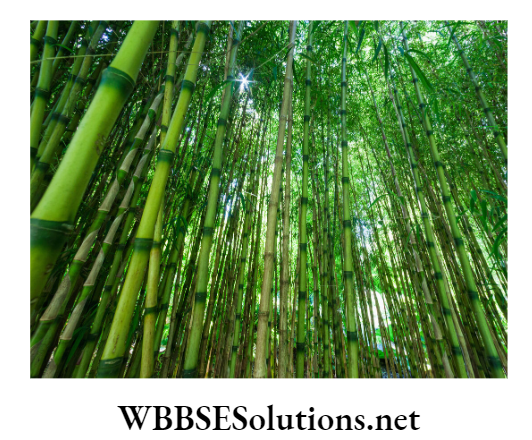
Bamboos are some of the fastest-growing plants in the world, due to a unique rhizome-dependent system. Bamboo are of notable economic and cultural significance in South Asia,

Southeast Asia and East Asia, are used for building materials, as a food source, and as versatile raw products. Bamboo has a higher compressive strength than wood, brick, or concrete and a tensile strength that rivals steel.

Read And Learn More WBBSE Solutions For Class 8 School Science Short Answer Type Questions

Question 3. Write the economic and ecological consequences of mass flowering and fruiting of bamboo.
Answer:

Economic And Ecological Consequences Of Mass Flowering And Fruiting Of Bamboo:

Flowering is very irregular in bamboo. In general, plants utilize all their energy for flowering when bamboo trees face environmental constraints.

Death ensues as soon as flowering stops. Mass fruiting also has direct economic and ecological consequences. The huge increase in available fruit in the forests often causes a boom in rodent populations, leading to increases in disease and famine in nearby human populations.

The death of the bamboo plants following their fruiting means the local people lose their building material, and the large increase in bamboo fruit leads to a rapid increase in rodent populations.

WBBSE Class 8 School Science Chapter 11 Plant Kingdom And The Environment Around Us SAQs

As the number of rodents increases, they consume all available food, including grain fields and stored food, sometimes leading to famine. These rats can also carry dangerous diseases, such as typhus, typhoid, and bubonic plague, which can reach epidemic proportions as the rodents increase in number.

Question 4. Mention the utilities of bamboo as a food item.
Answer:

Bamboo

Bamboo is a tribe of flowering perennial evergreen plants in the grass family with solid nodes and hollow internodes. In bamboo, the vascular bundles in the cross section are scattered throughout the stem instead of in a cylindrical arrangement.

WBBSE Solutions For Class 8 School Science Chapter 11 Plant Kingdom and The Environment Around Us Bamboo

WBBSE Class 8 Plant Kingdom short answer questions

Bamboos are some of the fastest-growing plants in the world, due to a unique rhizome-dependent system. Bamboos are of notable economic and cultural significance in South Asia, Southeast Asia, and East Asia, being used for building materials, as a food source, and as a versatile raw product.

WBBSE Solutions For Class 8 School Science Chapter 11 Plant Kingdom and The Environment Around Us Bamboo grove

Bamboo has a higher compressive strength than wood, brick, or concrete and a tensile strength that rivals steel. The word bamboo comes from the Kannada term bambu, which was introduced to English.

Ecology: Bamboo is one of the fastest-growing plants on Earth, with reported growth rates of 250 cm (98 in) in 24 hours.

However, the growth rate is dependent on local soil and climatic conditions, as well as species and a more typical growth rate for many commonly cultivated bamboos in temperate climates is in the range of 3—10 centimeters (1.2—3.9 in) per day during the growing period.

Primarily growing in regions of warmer climates during the late Cretaceous period, vast fields existed in what is now Asia.

Some of the largest timber bamboos can grow over 30 m (98 ft) tall and be as large as 1520 cm (5.9-7.9 in) in diameter.

However, the size range for mature bamboo is species-dependent, with the smallest bamboo reaching only several inches high at maturity.

Unlike all trees, individual bamboo stems, or culms, emerge from the ground at their full diameter and grow to their full height in a single growing season of three to four months.

Over the next 2-5 years (depending on species), the fungus begins to form on the outside of the culm, which eventually penetrates and overcomes the culm.

Around 5-8 years later (species and climate dependent), the fungal growths cause the culm to collapse and decay.

Mass flowering: Most bamboo species flower infrequently. Many bamboos only flower at intervals as long as 65 or 120 years.

These taxa exhibit mass flowering (or gregarious flowering), with all plants in a particular cohort flowering over a several-year period.

The lack of environmental impact on the time of flowering indicates the presence of some sort of “alarm clock” in each cell of the plant which signals the diversion of all energy to flower production and the cessation of vegetative growth.

This mechanism, as well as the evolutionary cause behind it, is still largely a mystery.

Mass fruiting also has direct economic and ecological consequences, however. The huge increase in available fruit in the forests often causes a boom in rodent populations, leading to increases in disease and famine in nearby human populations.

For example, devastating consequences occur when the Melocanna bambusoides population flowers and fruits once every 30-35 years around the Bay of Bengal.

The death of the bamboo plants following their fruiting means the local people lose their building material, and the large increase in bamboo fruit leads to a rapid increase in rodent populations.

As the number of rodents increases, they consume all available food, including grain fields and stored food, sometimes leading to famine.

These rats can also carry dangerous diseases, such as typhus, typhoid, and bubonic plague, which can reach epidemic proportions as the rodents increase in number.

In any case, flowering produces masses of seeds, typically suspended from the ends of the branches. These seeds will give rise to a new generation of plants that may be identical in appearance to those that preceded the flowering,

or they may produce new cultivars with different characteristics, such as the presence or absence of striping or other changes in the coloration of the culms.

General Uses for Bamboo: Bamboo has been used for many applications, from a food source to a building material.

1. Decorations: From picture frames to room dividing screens, bamboo can make some elegant and exotic decorations for the home,

2. Building materials: More and more furniture, flooring, and even homes are being built with bamboo. Bamboo is a popular building material in South and East Asia and in South Pacific Islands.

Bamboo stems have also been extensively used to construct numerous footbridges over canals and streams.

3. Fabrics and clothing: a fabulous trend right now is bamboo fibers being used in fabrics and clothing since the diameter of bamboo fibers measures less than 3 mm.

Bedding made of bamboo fibers is as soft as or softer than most cotton beddings and drapes with the look of silk without the expense.

Food items and Cooking:

The young stem, basal part of the stem, and leaves of bamboo are chief food items of the Giant panda of China, the Red panda of Nepal and India, and the Lemur of Madagascar. Gorillas primarily eat bamboo. It is also the food of elephants and chimpanzees.

After extracting toxic substances, various delicious dishes have been prepared in different Asian countries by using the soft young stems of bamboo.

Certain beverages are also prepared from these young stems. A type of insect grows at the base of bamboo plants growing in the Yunan provinces of China and in countries like Laos, Myanmar, and Thailand. They feed on the young stems of bamboo. The local people use the larva of these insects as their food.

Cooking with bamboo is nothing new in Asian culture. Hollow stems of bamboo have been used in different places in South Africa for warming soups and as pots for cooking rice.

Bamboo-made utensils are also used extensively for cooking purposes. Bamboo cutting boards are notoriously good for not dulling blades or knives as quickly, while bamboo utensils like wooden spoons are excellent for not scratching the bottoms of expensive nonstick cookware.

Short answer questions on environment for Class 8

Medicine: Tabashir, a medicine for asthma, colds and cough, and other infectious diseases, is made from silicon dioxide and silicic acid derived from the internodes of a bamboo species called Bambusa arundinacea.

Agriculture: Bamboo started out as a natural plant in most places, but has become a large part of agriculture. From being the main crop of a farm to be harvested for other uses, or as the channel linings for irrigation systems, bamboo fits naturally into agriculture.

Weapons: While this is rarely seen anymore, bamboo was once used to make many different types of weapons. From blow guns to archery bows and arrows, bamboo was used to make light but strong weapons for many centuries.

Instruments: Hollow tubes make excellent instruments, whether it is a flute or a drum, and bamboo is one of the best bases for instruments.

Question 5. Write about the need and strategies for the conservation of bamboo:
Answer:

Need and strategies for conservation:

With the increasing population pressure, natural stands of bamboo are being indiscriminately cut for fuel wood, and furniture.

The common practice of ‘jhum’ (a form of shifting cultivation) cultivation in the northeastern states has resulted in the genetic erosion of several bamboo species; overexploitation of some species for fuel wood and for the cottage industry has endangered others.

Large areas where bamboo occurs have been declared as National Bamboo Reserve areas and provenances in the natural habitats are being maintained.

Considering the limitation in seed supply, vegetative methods for ex-situ conservation and tissue culture work have been started in Asian countries.

Question 6. Why is water hyacinth considered an invasive species?
Answer:

Water Hyacinth:

Water hyacinth (Eichhornia crassipes), is an aquatic plant native to the Amazon basin and is often considered a highly problematic invasive species outside its native range.

Description: Water hyacinth is a free-floating perennial aquatic plant (or hydrophyte) native to tropical and sub-tropical South America.

With broad, thick, glossy, ovate leaves, water hyacinth may rise above the surface of the water as much as 1 meter in height.

The leaves are 10-20 cm across and float above the water’s surface. They have long, spongy, and bulbous stalks. The feathery, freely hanging roots are purple-black.

An erect stalk supports a single spike of 8-15 conspicuously attractive flowers, mostly lavender to pink in color with six petals.

One of the fastest growing plants known, water hyacinth reproduces primarily by way of runners or stolons, which eventually form daughter plants.

Each plant can produce thousands of seeds each year, and these seeds can remain viable for more than 28 years. Some water hyacinths were found to grow up to 2 to 5 meters a day in some sites in South-East Asia.

The common water hyacinth [Eichhornia crassipes) are vigorous growers known to double their population in two weeks.

Invasive species: Water hyacinth has been widely introduced in North America, Asia, Australia, Africa, and New Zealand. In many areas, it has become an important and pernicious invasive species.

In New Zealand, it is listed on the National Pest Plant Accord which prevents it from being propagated, distributed, or sold. In large water areas such as Louisiana, the Kerala Backwaters in India, Tonle Sap in Cambodia, and Lake Victoria it has become a serious pest.

When not controlled, water hyacinth will cover lakes and ponds entirely; this dramatically impacts water flow, blocks sunlight from reaching native aquatic plants, and starves the water of oxygen, often killing fish (or turtles).

The plants also create a prime habitat for mosquitos, the classic vectors of disease, and a species of snail known to host a parasitic flatworm that causes schistosomiasis (snail fever).
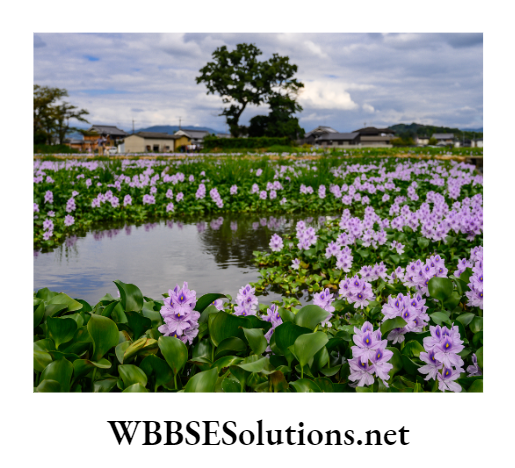
WBBSE Solutions For Class 8 School Science Chapter 11 Plant Kingdom and The Environment Around Us Water hyacinth

WBBSE Chapter 11 plant kingdom short answer solutions

Question 7. Write about the uses of water hyacinth in water purification.
Answer:

Phytoremediation, wastewater treatment:

The roots of Eichhornia crassipes naturally absorb pollutants, including lead, mercury, and strontium-90, as well as some organic compounds believed to be carcinogenic, in concentrations 10,000 times that in the surrounding water Water hyacinths can be cultivated for wastewater treatment.

Water hyacinth is reported for its efficiency to remove about 60-80 % nitrogen and about 69% of potassium from water. The roots of water hyacinth were found to remove particulate matter and nitrogen in a natural shallow eutrophicated wetland.

Polluted water from gold mine areas can be treated by vegetables in Taiwan. Javanese sometimes cook and eat the green parts and inflorescence.

Medicinal use: In Kedah (Java), the flowers are used for medicating the skin of horses. The species is a “tonic.”

In the Philippines, Thailand, and Vietnam stems of water hyacinth are used for the purpose of embroidery and as fiber for the garment industry.

  1. The dry stem is used to manufacture baskets and furniture. Fibers of the plant are also used to make paper.
  2. Water hyacinth is a good source of biogas as it contains appreciable amounts of nitrogen.
  3. Since water hyacinth contains a high amount of protein and nitrogen, it is also used as fodder. But excess use can lead to toxicity.

Control: Water hyacinth control is difficult. The most effective method of control depends on prevention. Make sure to control the nutrient levels in your pond or lake to prevent rapid and explosive growth.

Do not introduce water hyacinths to new ponds unless you are willing to monitor them and take action if their growth gets out of control.

It is advised that you only introduce water hyacinth to your own personal ornamental water gardens. Introducing it into natural water bodies invites trouble.

When harvesting or otherwise removing water hyacinth, do not discard it in the natural waterway, instead put it into a compost pile.

Question 8. Write about the uses of three different parts of a Sal tree.
Answer:

Sal:

Sal (Shorea robusta) is a large sub-deciduous tree. It is up to 30 meters high. Sal tree is seldom completely leafless. It has large leathery leaves and yellowish flowers.

They have a tough texture. Young trees have a linear crown, which becomes rounder and flatter with aging. The sapwood is whitish in color, thick, and less durable.

The heartwood becomes dark brown to black in color on exposure. The wood pores are filled with resin.

Distribution and description: This tree is native to the Indian subcontinent, ranging south of the Himalayas, from Myanmar in the east to Nepal, India, and Bangladesh.
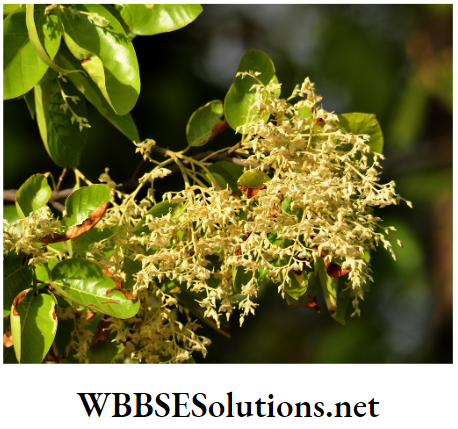
WBBSE Solutions For Class 8 School Science Chapter 11 Plant Kingdom and The Environment Around Us sal Shrea robusta

In India, it extends from Assam, Bengal, Odisha, and Jharkhand west to the Shivalik Hills in Haryana, east of the Yamuna. The range also extends through the Eastern Ghats and to the eastern Vindhya and Satpura ranges of central India.

Sal is moderate to slow growing and can attain heights of 30 to 35 m and a trunk diameter of up to 2-2.5 m. The leaves are 10-25 cm long and 515 cm broad.

In wetter areas, it is evergreen; in drier areas, it is dry-season deciduous, shedding most of the leaves between February to April, and leafing out again in April and May.

Uses:

Wood: Sal is one of the most important sources of hardwood timber in India, with hard, coarse-grained wood that is light in color when freshly cut, but becomes dark brown with exposure.

The wood is resinous and durable, and is sought-after for construction, although not well suited to planning and polishing.

The wood is especially suitable for constructing frames for doors and windows, floors of boats, jetties of ships,s, and footbridges over streams.

Leaves: The dry leaves of sal are a major source for the production of leaf plates called paravail and leaf bowls in northern and eastern India.

The leaves are also used fresh to serve ready-made paan (betelnut preparations) and small snacks such as boiled black grams, golgappa, etc.

The used leaves/plates are readily eaten by goats and cattle that roam the streets freely. The tree has therefore protected northern India from a flood of styrofoam and plastic plates that would have caused tremendous pollution. The leaves are also used in rural areas as fuel.

Resin: Sal tree resin is used as an astringent in Ayurvedic medicine, and to make spirit and varnish.

Seeds: Sal seeds and fruit are a source of lamp oil and vegetable fat. Shorea robusta seed oil is extracted from the seeds and used as cooking oil after refining.

Tannin: Tannin derived from sal bark finds application in the leather industry.

Sal tree is worshipped among the Buddhists and Hindus in India. It is mentioned in many scriptures that the Buddha was born and died under the Sal tree.

The Sal tree has special significance in the festivals and marriages of Adivasi. A pole of the Sal tree is considered very important and unless the bridegroom sits on the altar made of the tree of Sal, the marriage has no meaning.

It also holds great value in the lives of the indigenous populace of the Chotanagpur plateau. It is the main attraction of the festival of Sarhul, which means the Sal Blossoms Festival. The whole festival revolves around the Sal tree.

Short answers on plant kingdom concepts for Class 8

Question 9. Briefly describe the Sundri tree.
Answer:

Sundri tree:

Sundri is small to a medium-sized evergreen tree, which grows occasionally to a height of about 25 meters, typically with a twisted, stunted stem, and thin, wavy buttresses.

The bark of this tree is grey in color and it is longitudinally furrowed. The leaves of Sundri are simple, ovate, oblong, or elliptic, and are 12.5 to 20 centimeters long and 5 to 10 centimeters wide, coriaceous, glabrous, shining above, silvery, and scaly beneath. The petioles are stout and are 0.5 to 2 centimeters long.

The flowers of Sundri are small, orange-colored, unisexual, and up to 18 centimeters long. The fruit is ellipsoid, 2.5 centimeters long, with a rudder-like ridge, glabrous and glossy.

Question 10. Differentiate between herbs and spices.
Answer:

Differentiate between herbs and spices:

Herbs and spices are both obtained from plants. Herbs and spices are used primarily for adding flavor and aroma to food. And both are best used fresh but can be saved by drying.

While there are similarities, there also are subtle differences between herbs and spices. Herbs are obtained from the leaves of herbaceous (non-woody) plants.

They are used for savory purposes in cooking and some have medicinal value. Herbs often are used in larger amounts than spices.
Spices are obtained from roots, flowers, fruits, seeds, or bark.

Spices are native to warm tropical climates and can be woody or herbaceous plants. Spices often are more potent and stronger flavored than herbs; as a result, they typically are used in smaller amounts. Some spices are used not only to add taste but also as a preservative.

Question 11. Write the health benefits of black pepper.
Answer:

Black pepper:

Black pepper (Piper nigrum) is a flowering vine cultivated for its fruit, which is usually dried and used as a spice and seasoning.

The fruit, known as a peppercorn when dried, is approximately 5 millimeters (0.20 in) in diameter, dark red when fully mature, and, like all drupes, contains a single seed.

Peppercorns, and the ground pepper derived from them, may be described simply as pepper, or more precisely as black pepper (cooked and dried unripe fruit), green pepper (dried unripe fruit), and white pepper (ripe fruit seeds).

Black pepper is native to south India and is extensively cultivated there and elsewhere in tropical regions. Currently, Vietnam is the world’s largest producer and exporter of pepper.
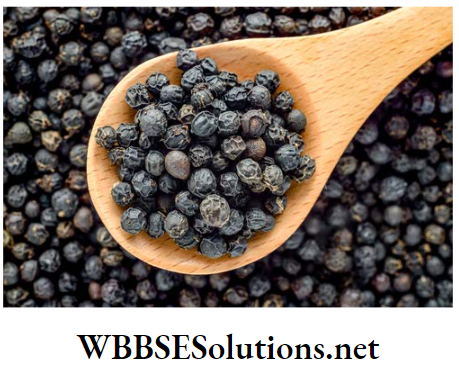
WBBSE Solutions For Class 8 School Science Chapter 11 Plant Kingdom and The Environment Around Us black pepper

Uses:

Dried ground pepper has been used since antiquity for both its flavor and as a traditional medicine. Black pepper is the world’s most traded spice.

It is one of the most common spices added to European cuisine and its descendants. The spiciness of black pepper is due to the chemical piperine. It is ubiquitous in the modern world as a seasoning and is often paired with salt.

Apart from spicy value, black pepper is also used as a preservative for meat and other perishable food items.
The health benefits of black pepper include relief from respiratory disorders, coughs, the common cold, constipation, indigestion, anemia, impotency, muscular strains, dental disease, pyorrhea, diarrhea, and heart disease.

Black pepper (Piper nigrum)stimulates the taste buds in such a way that an alert is sent to the stomach to increase hydrochloric acid secretion, thereby improving digestion.

Hydrochloric acid is necessary for the digestion of proteins and other food components in the stomach. Black pepper has long been recognized as a carminative,

(a substance that helps prevent the formation of intestinal gas), a property likely due to its beneficial effect of stimulating hydrochloric acid production.

In addition, black pepper has diaphoretic (promotes sweating), and diuretic (promotes urination) properties.

Question 12. What are the health benefits of cinnamon?
Answer:

Health Benefits of cinnamon:

Besides using it in cooking, cinnamon is also thought to have health benefits. The naturally sweet taste may help some people reduce their sugar intake.

In Ayurveda, cinnamon is used as a remedy for diabetes, indigestion, and colds. Volatile oil prepared from cinnamon provides relief in arthritic pain.

WBBSE Class 8 Science practice short answer questions on environment

Question 13. Write about the medicinal uses of Turmeric.
Answer:

Turmeric:

Turmeric (Curcuma longa) is a rhizomatous herbaceous perennial plant of the ginger family. It is native to southwest India and needs temperatures between 20 and 30°C (68 and 86’F) and a considerable amount of annual rainfall to thrive.

Plants are gathered annually for their rhizomes and propagated from some of those rhizomes in the following season. India, a significant producer of turmeric, has regional names based on language and country.

WBBSE Solutions For Class 8 School Science Chapter 11 Plant Kingdom and The Environment Around Us Tumeric

When not used fresh, the rhizomes are boiled for about 30-45 minutes and then dried in hot ovens, after which they are ground into a deep-orange-yellow powder commonly used as a spice in Indian cuisine and curries, for dyeing, and to impart color to mustard condiments.

One active ingredient is curcumin, which has a distinctly earthy, slightly bitter, slightly hot peppery flavor and a mustardy smell.

Turmeric plants reach up to 1 m tall. Highly branched, yellow to orange, cylindrical, aromatic rhizomes are found. The leaves are alternate and arranged in two rows.

They are divided into leaf sheath, petiole, and leaf blade. From the leaf sheaths, a false stem is formed. The petiole is 50 to 115 cm long.

The simple leaf blades are usually 76 to 115 cm long and rarely up to 230 cm. They have a width of 38 to 45 cm and are oblong to an elliptic narrowing at the tip.

Uses:

We probably know turmeric as the main spice in curry. It has a warm, bitter taste and is frequently used to flavor or color curry powders, mustards, butter, and cheeses.

But the root of turmeric is also used widely to make medicine. In food and manufacturing, the essential oil of turmeric is used in perfumes, and its resin is used as a flavor and color component in foods.

It has been known as poor man’s saffron because it offers a less expensive alternative yellow coloring. Turmeric is mostly used in flavored milk drinks, cultured milk, and desserts to obtain lemon and banana colors in dairy.

ln turmeric, curcumin is the primary pigment and is generally used in various food industries as a food color. Turmeric is added at higher levels to sausages, pickles, relishes, sauces, dry mixes, and fish due to its original usage as a spice.

Due to the presence of a compound called curcumin in turmeric, it has the ability to kill microbes. Turmeric keeps the liver healthy. It is effective in controlling anemia due to the presence of a good amount of iron in it. Turmeric also controls blood cholesterol levels.

Turmeric is used for arthritis, heartburn (dyspepsia), stomach pain, diarrhea, intestinal gas, stomach bloating, loss of appetite, jaundice, liver problems, and gallbladder disorders.

It is also used for headaches, bronchitis, colds, lung infections, fibromyalgia, leprosy, fever, menstrual problems, and cancer. Other uses include depression. Alzheimer’s disease, water retention, worms, and kidney problems.

Some people apply turmeric to the skin for pain, ringworm, bruising, leech bites, eye infections, inflammatory skin conditions, soreness inside of the mouth, and infected wounds.

Women in India apply turmeric before taking bath as its antibacterial property protects the skin from infects and protects it from harsh sunlight.

WBBSE Solutions For Class 8 School Science Chapter 11 Plant Kingdom and The Environment Around Us turmeric plant

Understanding plant kingdom short answers for Class 8

Question 14. What is Garam Masala composed of?
Answer:

Garam Masala:

Garam masala contains black and white peppercorns, cloves, cinnamon or cassia bark, nutmeg, black and green cardamom pods, bay leaf, caraway, etc.

Question 15. What are the medicinal uses of Ginger?
Answer:

Ginger:

Ginger [Zingiber officinale) is a flowering plant whose rhizome, ginger root, or simply ginger, is widely used as a spice or a medicine.

It is a herbaceous perennial that grows annual stems about a meter tall bearing narrow green leaves and yellow flowers.

Ginger is indigenous to southern China and was spread eventually to other parts of Asia and subsequently to West Africa and the Caribbean. India is now the largest producer of ginger.


WBBSE Solutions For Class 8 School Science Chapter 11 Plant Kingdom and The Environment Around Us ginger


Uses:

Ginger produces a hot, fragrant kitchen spice, vinegar, or sherry as a snack or cooked as young ginger rhizomes are juicy and fleshy with ingredients in many dishes.

They can be steen-ea very mild taste. They are often pickled in boiling water to make ginger tea, to which honey is often added; sliced orange or lemon fruit may be added.

Ginger can be made into candy or ginger wine. Mature ginger rhizomes are fibrous and nearly dry. The juice from ginger roots is often used as a spice.

In Indian recipes and is a common ingredient in Chinese, Korean, Japanese, Vietnamese, and many South Asian cuisines for flavoring dishes such as seafood, meat, and vegetarian dishes. The rhizome (underground stem) is used as a spice and also as a medicine.

It can be used fresh, dried, and powdered, or as a juice or oil. Ginger is commonly used to treat various types of stomach problems, including motion sickness, morning sickness, colic, upset stomach, gas, diarrhea, nausea caused by cancer treatment, nausea, and vomiting after surgery, as well as loss of appetite.

Other uses include pain relief from arthritis or muscle soreness, upper respiratory tract infections, cough, and bronchitis.

Ginger is also sometimes used for chest pain, low back pain, and stomach pain. Some people pour fresh juice on their skin to treat burns. The oil made from ginger is sometimes applied to the skin to relieve pain.

Question 16. Write the general uses of Neem.
Answer:

Neem:

Neem (Azadirachta indica), is a tree in the mahogany family. It is one of two species in the genus Azadirachta and is native to India and the Indian subcontinent including Nepal, Pakistan, Bangladesh, and Sri Lanka.

WBBSE Solutions For Class 8 School Science Chapter 11 Plant Kingdom and The Environment Around Us neem tree

Neem is a fast-growing tree that can reach a height of 15-20 meters (49-66 ft), rarely 35-40 meters (115— 131 ft). It is evergreen, but in severe drought, it may shed most or nearly all of its leaves.

The branches are wide and spreading. The fairly dense crown is roundish and may reach a diameter of 15-20 meters (49-66 ft) in old, freestanding specimens.

General uses:

  1. Neem leaves are dried in India and placed in cupboards to prevent insects from eating the clothes and also while storing rice in tins.
  2. Neem leaves are dried and burnt in tropical regions to keep away mosquitoes as Ayurveda herb. Neem is also used in baths.
  3. Neem contains chemicals that might help reduce blood sugar levels, heal ulcers in the digestive tract, prevent conception, kill bacteria, and prevent plaque formation in the mouth.
  4. The tender shoots and flowers of the neem tree are eaten as a vegetable in India. In West Bengal, young neem leaves are fried in oil with tiny pieces of eggplant (brinjal).
  5. The dish is called nim begun and is the first item during a Bengali meal that acts as an appetizer. It is eaten with rice

Key short answer questions about the environment for Class 8

Question 17. Why are spices used in cooking?
Answer:

We use spices in cooking because:

  1. it brings taste to the food item being cooked.
  2. it helps in digestion by increasing salivation.
  3. it keeps the mouth cavity germ free
  4. it also acts as a preservative.

Question 18. Write a few health benefits of Amlaki.
Answer:

Emblica (Amlaki):

Phyllanthus emblica, also known as emblic, amlaki, or amla from Sanskrit Amalia, is a deciduous tree. It is known for its edible fruit of the same name.

The tree is small to medium in size, reaching 8 to 18 m in height, with a crooked trunk and spreading branches. The branchlets are glabrous or finely pubescent, 10-20 cm long, and usually deciduous;

the leaves are simple, subsessile, and closely set along branchlets, light green, resembling pinnate leaves. The flowers are greenish-yellow.

The fruit is nearly spherical, light greenish yellow, quite smooth, and hard on appearance, with six vertical stripes or furrows.

Ripening in autumn, the berries are harvested by hand after climbing to the upper branches bearing the fruits. The taste of Indian gooseberry (amla) is sour, bitter, and astringent, and it is quite fibrous.

In India, it is common to eat gooseberries steeped in salt water and turmeric to make sour fruits palatable.

WBBSE Solutions For Class 8 School Science Chapter 11 Plant Kingdom and The Environment Around Us emblica

Medicinal use:

The nutritional facts of Amlaki include bioflavonoids, flavones, polyphenols, and carotenoids. It is the richest natural source of vitamin C available on this planet.

The unique thing about amlaki fruit is the ascorbic acid found is nearly indestructible even by burning or drying it. This makes the richest bio-availability of Vitamin C in this fruit which plays a significant role in the synthesis of neurotransmitters.

It is also required for collagen and carnitine synthesis, important molecules that produce energy from the fat cells whenever required.

  1. Health Benefits of Amlaki
  2. Amlaki inhibits the aging process and prevents the common cold.
  3. Amlaki is a nutritional powerhouse and is hence used to boost immunity and restore the body’s vitality.
  4. Amlaki provides energy to vital organs and is hence used in chronic illness recovery.
  5. Amlaki helps in regulating blood glucose levels in diabetic patients.
  6. Amlaki facilitates the absorption of iron in the body and improves hemoglobin levels. Amlaki possesses potent anti-inflammatory action and is hence used in various gastrointestinal tract inflammation such as gastritis.
  7. Amlaki contains natural digestive enzymes and is hence used in indigestion.
  8. Amlaki promotes spermatogenesis.
  9. Amlaki reduces serum cholesterol and high blood pressure.
  10. In Chinese traditional therapy, this fruit is used to treat throat inflammation.

Other use:

Popularly used in inks, shampoos, and hair oils, the high tannin content of Indian gooseberry fruit serves as a mordant for fixing dyes in fabrics.

Amla shampoos and hair oil are traditionally believed to nourish the hair and scalp and prevent premature grey hair.

Examples of plant kingdom short answer questions for Class 8

Question 19. What is Triphala?
Answer:

Triphala:

Literally meaning “three fruits”, Triphala is a traditional Ayurvedic herbal formulation consisting of three fruits native to the Indian subcontinent Amlaki (Emblica officinalis), Bibhitaki or Bahera (Terminalia bellirica) and Haritaki (Terminalia chebula).

Triphala is most commonly known for its use as a gentle bowel tonic, helpful in digestion and supporting regular bowel movements.

The combination of the three fruits has a synergistic effect to bolster many other systems as well. In addition to the Gl tract, Ayurveda uses Triphala to support healthy respiratory, cardiovascular, urinary, reproductive, and nervous systems.

Triphala has also been shown to be a powerful antioxidant, protecting cells from the damaging effects of free radicals

Question 20. Name two alkaloids found in Nayantara.
Answer:

Raubasine and Vincristine.

Question 21. Write a few uses of mint oil.
Answer:

Uses of mint oil:

Menthol from the mint essential oil (40-90%) is an ingredient of many cosmetics and some perfumes. Menthol and mint essential oil are also used in aromatherapy which may have clinical use to alleviate post-surgery nausea.

Mint oil is also used as an environmentally friendly insecticide for its ability to kill some common pests such as wasps, hornets, ants, and cockroaches.

WBBSE Chapter 11 exercises short answer solutions

Question 22. What are the uses of Aloe vera?
Answer:

Aloe vera:

Aloe vera (Ghritakumari) is a succulent plant species. The species is frequently cited as being used in herbal medicine since the beginning of the first century AD.

Extracts from Aloe vera are widely used in the cosmetics and alternative medicine industries, being marketed as variously having rejuvenating, healing, or soothing properties.

Aloe is one of the great healing agents among herbs. Indian aloe or Ghritkumari is a form of cactus. Aloes have long been in use for a host of diseases, particularly those connected with the digestive system and skin disorders.

it contains enzymes, polysaccharides, and nutrients that exhibit antibacterial and antifungal action. Aloe vera is useful in liver and spleen disorders, skin problems (scars, pimples, dermatitis, minor wounds or burns, etc.), external sores, hair problems, and eye troubles.

It is used as a flavoring agent in many culinary preparations.

Other Uses:

The leaf, fresh or dried, is the culinary source of mint. Fresh mint is usually preferred over dried mint when storage of the mint is not a problem.

The leaves have a warm, fresh, aromatic, sweet flavor with a cool aftertaste, and are used in teas, beverages, jellies, syrups, candies, and ice creams.

Mint essential oil and menthol are extensively used as flavorings in breath fresheners, drinks, antiseptic mouth rinses, toothpaste, chewing gum, desserts, and candies, such as mint (candy) and mint chocolate.

The substances that give the mints their characteristic aromas and flavors are menthol and pulegone. Mint was originally used as a medicinal herb to treat stomach aches and chest pains.

There are several uses in traditional medicine and preliminary research for possible use in treating irritable bowel syndrome.

Menthol from the mint essential oil (40-90%) is an ingredient of many cosmetics and some perfumes. Menthol and mint essential oil are also used in aromatherapy which may have clinical use to alleviate post-surgery nausea.

Mint oil is also used as an environmentally friendly insecticide for its ability to kill some common pests such as wasps, hornets, ants, and cockroaches, and has small white teeth.

The flowers are produced in summer on a spike up to 90 cm (35 in) tall, each flower being pendulous, with a yellow tubular corolla 2-3 cm (0.8-1.2 in) long.

Medicinal Uses:

Aloe vera is used in traditional medicine as a multipurpose skin treatment. Aloe vera is used on facial tissues where it is promoted as a moisturizer and anti-irritant to reduce chafing of the nose.

Cosmetic companies commonly add sap or other derivatives from Aloe vera to products such as makeup, tissues, moisturizers, soaps, sunscreens, incense, shaving cream, or shampoos.

Aloe vera gel is effective in treating psoriasis, seborrhea, dandruff, minor burns, and skin abrasions, as well as radiation-induced skin injuries.

Aloe vera juice (also called latex) taken by mouth is a powerful laxative. Aloe vera gel taken orally (by mouth) seems to help people with diabetes by lowering blood sugar levels.

It may also help to lower cholesterol. Extracts of aloe vera leave contain vitamins, minerals, amino acids, and fatty acids.

It is used to reduce acidity, and inflammation of bone joints, and to reduce fever (antipyretic to reduce mental stress and tension.

WBBSE Solutions For Class 8 School Science Chapter 11 Plant Kingdom and The Environment Around Us Alovera

Question 23. Mention a few detrimental consequences associated with mass flowering in bamboo.
Answer:

Detrimental effects:

  1. Increase in rodent population leading to plague etc.
  2. local people losing building materials.


WBBSE Class 8 School Science Chapter 11 Plant Kingdom and The Environment Around Us VSAQs

WBBSE Chapter 11 Plant Kingdom And The Environment Around Us VSAQs

Question 1. State the source of coal and petroleum.
Answer:

Source of coal and petroleum:

Coal and petroleum are fossil substances of plant origin.

Question 2. Which chemical is responsible for the spiciness of black pepper?
Answer:

Piperine.

Question 3. Is bamboo a flowering plant?
Answer:

Yes, bamboo is a tribe of flowering perennial evergreen plants.

Question 4. Mention two uses of bamboo.
Answer:

Two uses of bamboo:

Bamboo is used in decorations, building construction, clothing, cooking, etc.

Question 5. Name an invasive aquatic plant species.
Answer:

Water hyacinth is an invasive aquatic plant species.

Read And Learn More WBBSE Solutions For Class 8 School Science Very Short Answer Type Questions

Question 6. Write the botanical name of the sal tree.
Answer:

Botanical name of the sal tree:

The botanical name of the sal tree is Shorea robusta.

Question 7. Name one of the most important sources of hardwood timber in India.
Answer:

Sal is one of the most important sources of hardwood timber in India.

WBBSE Class 8 School Science Chapter 11 Plant Kingdom and The Environment Around Us VSAQs

Question 8. What is the origin of the name “Sundarban”?
Answer:

The origin of the name “Sundarban”:

The name Sundarbans is supposed to be derived from the name of the plant Sundari.

WBBSE Class 8 Plant Kingdom very short answer questions

Question 9. Name a mangrove tree.
Answer:

Sundari is a mangrove tree.

Question 10. Name a disease of the Sundari plant.
Answer:

Top-dying disease of Sundari trees.

Question 11. Name a spice obtained from a flower bud.
Answer:

Cloves are obtained from flower buds.

Question 12. Where vanilla is obtained?
Answer:

Vanilla is obtained from the undeveloped fruit of an orchid.

Very short answer questions on environment for Class 8

Question 13. Write one important use of cinnamon.
Answer:

Important Use of cinnamon:

Cinnamon bark is widely used as a spice.

Question 14. Write the scientific name of the turmeric plant.
Answer:

Scientific Name Of the turmeric plant:

Curcuma longa is the scientific name of the turmeric plant.

Question 15. Which compound present in garlic possesses antimicrobial properties?
Answer:

Allicin.

Question 16. Name two medicinal uses of turmeric.
Answer:

Two Medicinal uses of turmeric:

Turmeric is used for arthritis, heartburn (dyspepsia), stomach pain, diarrhea, intestinal gas, stomach bloating, loss of appetite, jaundice, liver problems, and gallbladder disorders.

Question 17. What are the main types of cardamom?
Answer:

Main types of cardamom:-

Two main types – green and black.

Question 18. Name two ingredients of “Garam Masala”.
Answer:

Ingredients of “Garam Masala”:

A typical Indian version of garam masala contains- black and white peppercorns, cloves, cinnamon or cassia bark, nutmeg and mace, black and green cardamom pods, Bay leaf, caraway, etc.

WBBSE Chapter 11 plant kingdom quick answer solutions

Question 19. Write the scientific name of garlic.
Answer:

Scientific Name Of Garlic:

The scientific name of garlic is Allium sativum.

Question 20. What is ethnobotany?
Answer:

Ethnobotany:-

Ethnobotany is the study of traditional human uses of plants.

WBBSE Solutions For Class 8 School Science Long Answer Type Questions WBBSE Solutions For Class 8 School Science Short Answer Type Questions
WBBSE Solutions For Class 8 School Science Very Short Answer Type Questions WBBSE Solutions For Class 8 School Science Review Questions
WBBSE Solutions For Class 8 School Science Solved Numerical Problems WBBSE Solutions For Class 8 School Science Experiments Questions
WBBSE Solutions For Class 8 Maths WBBSE Class 8 History Notes
WBBSE Class 8 History Multiple Choice Questions WBBSE Solutions For Class 8 History
WBBSE Solutions For Class 8 Geography


Question 21. What toiletries can be prepared from neem oil?
Answer:

Neem oil is used for preparing cosmetics such as soap, shampoo, balms, and creams as well as toothpaste.

Question 22. Name a fruit used as a purgative.
Answer:

Bael fruit is used as a purgative.

Question 23. Mention one health benefit of Amalaki
Answer:

Health Benefit Of Amalaki:

Amlaki inhibits, the aging process and prevents the common cold.

Question 24. What are the constituents of Triphala?
Answer:

Constituents of Triphala:

Amlaki, Behera, and heritage.

Question 25. Write the botanical name of Ghritakumari.
Answer:

Botanical name of Ghritakumari:

Aloe year is the botanical name of Ghritakumari.

Question 26. What is the health benefit of Curcumin?
Answer:

Health Benefit Of Curcumin:

A compound called curcumin is found in turmeric. Due to its presence, turmeric has the ability to kill microbes (antimicrobial property).

Question 27. Mention the scientific name of the plant from which Tabashir is obtained.
Answer:

Bambusa arundinacea.

WBBSE Class 8 Science practice very short answer questions on environment

Question 28. Find the odd one out:
Answer:

Curcumin, Allicin, Piperine, Raubasine Piperine, since it is. responsible for the hot taste of black pepper. The other three chemicals have medicinal (antimicrobial or anti-bacterial) properties.

Question 29. Which component of Bael, apart from mucilage, helps to remove constipation?
Answer:

Pectin.

Question 30. Who is known as the “queen of spices” and why?
Answer:

Queen of spices:

Small cardamom is referred to as the “queen of spices” because of its very pleasant aroma and taste.

Question 31. Name a sweet dish in which cardamom is used
Answer:

Milk custard.

Question 32. Which is known as the “king of spices”?
Answer:

King of spices:

Black pepper, since it is the world’s most traded spice.

Question 33. Name the two types of roots found in the sundry plant.
Answer:

Types of roots found in the sundry plant:

Breathing root: pneumatophores Supporting adventitious root: stilt roots.

Environmental concepts summary with very short answers for Class 8

Question 34. Where is the center for Conservation of the Sundri plant located?
Answer:

Jharkhali of Sunderban

Question 35. Why does raw garlic have a pungent odor?
Answer:

Raw garlic contains Allin, a sulfur-containing compound. Allin gets converted into Allicin in contact with the enzyme called alliinase. This is responsible for the pungent odor of garlic.

WBBSE Class 8 School Science Chapter 2 Element Compound And Chemical Reaction VSAQs

WBBSE Chapter 2 Element Compound And Chemical Reaction VSAQs

Question 1. In photosynthesis, which form of energy is converted into chemical energy?
Answer:

In photosynthesis, light energy is converted into chemical energy.

Question 2. What is required to initiate a chemical reaction?
Answer:

Energy is required to initiate a chemical reaction.

Question 3. Mention a reaction which is induced/initiated by light.
Answer:

Photosynthesis is a reaction which is induced/initiated by light. Here, green plants can utilize solar energy (in the form of visible light) to produce glucose from carbon dioxide and water. The process can be represented in a simplified way as follows:

⇒ \(6 \mathrm{CO}_2+6 \mathrm{H}_2 \mathrm{O} \stackrel{\text { light }}{\longrightarrow} \mathrm{C}_6 \mathrm{H}_{12} \mathrm{O}_6+6 \mathrm{H}_2 \mathrm{O}\)

Question 4. Give one example, where a chemical reaction is initiated by applying pressure.
Answer:

In crackers, a mixture of potassium chlorate and sulphur explodes when pressure is applied to them, Give one example, where a chemical reaction is initiated by electricity.

WBBSE Solutions For Class 8 School Science Chapter 2 Element Compound And Chemical Reaction Vsaqs

Read And Learn More WBBSE Solutions For Class 8 School Science Very Short Answer Type Questions

Question 5. Give one example, where a chemical reaction is initiated by electricity.
Answer:

When an electric spark is passed through a mixture of hydrogen and oxygen gas, water will be formed. If no current is passed through it, no chemical change will take place.

⇒ \(2 \mathrm{H}_2+\mathrm{O}_2 \rightarrow 2 \mathrm{H}_2 \mathrm{O}\)

Question 6. What do you mean by a catalyst?
Answer:

Catalyst:

A substance which can alter the rate of a chemical reaction without undergoing any net change in its chemical composition at the end of the chemical reaction is called a catalyst.

Question 7. Write the name and formula of baking soda. Baking soda is sodium bicarbonate.
Answer:

Its formula is NaHCO3.

Question 8. Give an example of a catalyzed reaction. During the preparation of ammonia (NH3) from nitrogen and hydrogen gas, finely divided iron powder is used as a catalyst. So this is an example of a catalyzed reaction.
Answer:

⇒ \(\mathrm{N}_2+3 \mathrm{H}_2 \rightarrow 2 \mathrm{NH}_3 (Finely divided iron powder used as catalyst)\)

Question 9. What catalyst is used during the industrial process of manufacture of sulphuric acid?
Answer:

Industrially sulphuric acid is prepared by the reaction of sulphur dioxide and oxygen in the presence of a vanadium pentoxide (V2O5) catalyst.

⇒ \(2 \mathrm{SO}_2+\mathrm{O}_2 \rightarrow 2 \mathrm{SO}_3
\left\{\right. catalyst: Vanadium pentoxide \left.\left(\mathrm{V}_2 \mathrm{O}_5\right)\right\}\)

Question 10. Give an example of an enzyme-catalyzed reaction.
Answer:

Example Of An Enzyme-Catalyzed Reaction:

Urease is an enzyme. It catalyzes the hydrolysis of urea into ammonia and carbon dioxide.

⇒ \(\mathrm{NH}_2 \mathrm{CONH}_2+\mathrm{H}_2 \mathrm{O} \rightarrow 2 \mathrm{NH}_3+2 \mathrm{CO}_2\)

Question 11. Write the name of an enzyme which is found in our stomach.
Answer:

Pepsin is an enzyme which is found in our stomach.

Question 12. What do you mean by an exothermic reaction?
Answer:

Exothermic Reaction: Chemical reactions which proceed with the evolution of heat energy are called exothermic reactions.

Question 13. What do you mean by an endothermic reaction?
Answer:

Endothermic Reaction: Chemical reactions which proceed with the absorption of heat energy are called endothermic reactions.

Question 14. Give an example of an exothermic reaction.
Answer:

Example Of An Exothermic Reaction:

The combustion of methane is an example of an exothermic reaction.

⇒ \(\mathrm{CH}_4+2 \mathrm{O}_2 \rightarrow \mathrm{CO}_2+2 \mathrm{H}_2 \mathrm{O}+\text { heat }(\mathrm{Q})\)

WBBSE Solutions For Class 8 School Science Long Answer Type Questions WBBSE Solutions For Class 8 School Science Short Answer Type Questions
WBBSE Solutions For Class 8 School Science Very Short Answer Type Questions WBBSE Solutions For Class 8 School Science Review Questions
WBBSE Solutions For Class 8 School Science Solved Numerical Problems WBBSE Solutions For Class 8 School Science Experiments Questions
WBBSE Solutions For Class 8 Maths WBBSE Class 8 History Notes
WBBSE Class 8 History Multiple Choice Questions WBBSE Solutions For Class 8 History
WBBSE Solutions For Class 8 Geography


Question 15. Give an example of an endothermic reaction.
Answer:

Example Of An Endothermic Reaction:

Passage of steam over heated coke produces carbon monoxide and hydrogen. Heat is absorbed during the process. This is an endothermic reaction.

⇒ \(\mathrm{C}+\mathrm{H}_2 \mathrm{O} \rightarrow \mathrm{CO}+\mathrm{H}_2-\text { heat }(\mathrm{Q})\)

Question 16. When ammonium chloride is dissolved in water in a test tube, what type of change is occurred?
Answer:

When ammonium chloride is dissolved in water, heat is absorbed and as a result, droplets of water condense in the outer surface of the test tube which becomes cold. But this is a physical change and not a chemical change.

Question 17. Name a gas which is used in welding.
Answer:

Acetylene (C2H2) is used for welding.

Question 18. Name one gaseous oxidizing agent and one gaseous reducing agent.
Answer:

Oxygen is an oxidizing agent and hydrogen is a reducing agent.

Question 19. Name the oxidant and reductant in the reaction Fe + Cu2+ = Fe2+ + Cu.
Answer:

⇒ \(\mathrm{Fe}-2 \mathrm{e} \rightarrow \mathrm{Fe}^{2+}:\)This is oxidation and Fe is the reductant

⇒ \(\mathrm{Cu}^{2+}+2 \mathrm{e} \rightarrow \mathrm{Cu}:\)This is the reduction and Cu2+ is the oxidant

Question 20. Name an enzyme that can decompose peroxide compounds.
Answer:

Catalase enzyme.

Question 21. \(\mathrm{Sn}^{2+} \rightarrow \mathrm{Sn}^{4+}+2 \mathrm{e} \rightarrow\) Is this oxidation or reduction reaction?
Answer:

Since the loss of electron means oxidation hence \(\mathrm{Sn}^{2+} \rightarrow \mathrm{Sn}^{4+}+2 \mathrm{e} \rightarrow\) is an oxidation reaction. Sn2+ is the reducing agent.

Question 22. What do you mean by rancidity?
Answer:

Rancidity:

The condition produced by aerial oxidation of fats and oils in food marked by unpleasant smell and taste is called rancidity.

Question 23. Name 1. a reducing agent that contains oxygen and 2. an oxidizing agent that does not contain oxygen.
Answer:

  1. Sulphur dioxide (SO2 )
  2. Ferric chloride (FeCl3)

Question 24. What is autocatalysis?
Answer:

Autocatalysis:

In certain reactions, one of the products acts as a catalyst. This phenomenon is known as autocatalysis.

Acetic acid (CH3COOH) and ethyl alcohol (C2H5OH) are produced in the hydrolysis of ethyl acetate (CH3COOC2H5). This reaction is initially very slow but acetic acid acts as an auto-catalyst in the reaction and gradually increases the rate of the reaction.

⇒ \(\mathrm{CH}_3 \mathrm{COOC}_2 \mathrm{H}_5+\mathrm{H}_2 \mathrm{O} \rightarrow \mathrm{CH}_3 \mathrm{COOH}+\mathrm{C}_2 \mathrm{H}_5 \mathrm{OH} .\)

Question 25. Give an example of exothermic physical change.
Answer:

Example Of Exothermic Physical Change:

When some concentrated sulphuric acid is added to water taken in a beaker, the acid dissolves with the evolution of heat. This is an example of exothermic physical change.

Question 26. Mention two simple household methods to prevent the rancidity of food.
Answer:

The development of rancidity of food can be prevented by:

  1. keeping food in a refrigerator
  2. storing food away from light

WBBSE Solutions For Class 8 School Science Chapter 11 Plant Kingdom and The Environment Around Us Review Questions

Chapter 11 Plant Kingdom And The Environment Around Us Review Questions

Question 1. Playing a vital role in the world health care system, a group of plants is known as “local heritage with global importance.”

  1. Flowering
  2. Medical
  3. Ornamental
  4. Cereal

Answer: 1. Medical

Question 2. Plants regulate the

  1. Water cycle
  2. Carbon cycle
  3. Both and are correct
  4. None is correct

Answer: 3. Both and are correct

Question 3. Oxygen produced by plants is a byproduct of

  1. Chemosynthesis
  2. Photosynthesis
  3. Solar radiation
  4. Transpiration

Answer: 2. Photosynthesis

Question 4. Bamboos belong to the

  1. Grass family
  2. Shrub family
  3. Tree Family
  4. Herb family

Answer: 1. Grass family

Question 5. Bamboo grows

  1. Very fast
  2. Very slow
  3. Moderately
  4. None of these

Answer: 1. Very fast

Read And Learn More WBBSE Solutions For Class 8 School Science Review Questions

Question 6. Bamboo flowers are observed

  1. Frequently
  2. Annually
  3. Rarely
  4. Monthly

Answer: 3. Rarely

Question 7. Bamboo shoots are used as

  1. Food
  2. Poison
  3. Rarely
  4. Monthly

Answer: 1. Food

Question 8. Water hyacinth is an aquatic plant native to the

  1. Gangetic plains
  2. Antarctica
  3. Amazon basin
  4. Decan plateau

Answer: 3. Amazon basin

WBBSE Class 8 Plant Kingdom review questions

Question 9. Water hyacinth reproduces primarily by way of

  1. Seeds
  2. Runners or stolons
  3. Flowers
  4. Buds

Answer: 2. Runners or stolons

WBBSE Solutions For Class 8 School Science Chapter 11 Plant Kingdom and The Environment Around Us Review Questions

Question 10. Water hyacinth may

  1. Be invasive species
  2. Form breeding ground for mosquitoes
  3. Block water flow
  4. All of these

Answer: 4. All of these

Question 11. Sal tree is large and

  1. Subdeciduous
  2. Coniferous
  3. Non-flowering
  4. Evergreen

Answer: 1. Subdeciduous

Question 12. Sal tree is native to the

  1. Europe
  2. America
  3. Indian subcontinent
  4. South America

Answer: 3. Indian subcontinent

Question 13. Sundari is a/an

  1. Edible plant
  2. Mangrove plant
  3. Aquatic plant
  4. Orchid

Answer: 2. Mangrove plant

Review questions on environment for Class 8 Science

Question 14. Sundari plants belong to the genus

  1. Mangifera
  2. Ficus
  3. Heritiera
  4. None of these

Answer: 3. Heritiera

WBBSE Solutions For Class 8 School Science Long Answer Type Questions WBBSE Solutions For Class 8 School Science Short Answer Type Questions
WBBSE Solutions For Class 8 School Science Very Short Answer Type Questions WBBSE Solutions For Class 8 School Science Review Questions
WBBSE Solutions For Class 8 School Science Solved Numerical Problems WBBSE Solutions For Class 8 School Science Experiments Questions
WBBSE Solutions For Class 8 Maths WBBSE Class 8 History Notes
WBBSE Class 8 History Multiple Choice Questions WBBSE Solutions For Class 8 History
WBBSE Solutions For Class 8 Geography


Question 15. The pigment curcumin is found in

  1. Turmeric
  2. Cardamom
  3. Ginger
  4. Garlic

Answer: 1. Turmeric

Question 16. Herbs are obtained from the leaves of

  1. Herbaceous plants
  2. Herbivores
  3. Sal plants
  4. Cactus

Answer: 1. Herbaceous plants

Question 17. Triphala contains plenty of

  1. Vitamin a
  2. Vitamin b
  3. Vitamin d
  4. Vitamin c

Answer: 4. Vitamin c

Question 18. Black pepper is native to

  1. North Bengal
  2. South India
  3. Sikkim
  4. Jammu & Kashmir

Answer: 2. South India

WBBSE Chapter 11 environmental science review questions

Question 19. Cinnamon is a spice obtained from the

  1. Seeds
  2. Inner bark
  3. Roots
  4. Fruits

Answer: 2. Inner bark

Question 20. Cinnamon bark is widely used as a

  1. Spice
  2. Food
  3. Medicine
  4. Pigment

Answer: 1. Spice

Question 21. Turmeric (Curcuma longa) is a plant of the

  1. Ginger family
  2. Bamboo family
  3. Grass family
  4. None of these

Answer: 1. Ginger family

Question 22. The chemical substance that is present in clove and has antibacterial properties is
known as

  1. Allicin
  2. Piperine
  3. Eugenol
  4. Vinblastine

Answer: 3. Eugenol

Question 23. There are two main types of cardamom

  1. Red and green
  2. Green and black
  3. Black and red
  4. Sweet and sour

Answer: 2. Green and black

Question 24. Garam masala is

  1. Spice mixture
  2. Syrup
  3. Food
  4. Medicine

Answer: 1.

Question 25. Ginger is indigenous to

  1. India
  2. Europe
  3. Southern china
  4. America

Answer: 3. Southern china

Environmental concepts summary and review questions for Class 8

Question 26. Garlic is a species in the

  1. Onion genus
  2. Paddy genus
  3. Medicinal genus
  4. Grass genus

Answer: 1. Onion genus

Question 27. Garlic flavor is

  1. Sweet
  2. Pungent
  3. Bitter
  4. Chilly

Answer: 2. Pungent

Question 28. Garlic contains

  1. Allicin
  2. Alium
  3. Aluminium
  4. Piperin

Answer: 1. Allicin

Question 29. The medicine Bashir is prepared from

  1. Water hyacinth
  2. Aloe vera
  3. Turmeric
  4. Bamboo

Answer: 4. Bamboo

Question 30. Neem is a tree in the

  1. Mahogany family
  2. Grass family
  3. Plant family
  4. Shrub family

Answer: 1. Mahogany family

Question 31. Bael is a species of tree native to

  1. Europe
  2. South america
  3. India
  4. Africa

Answer: 3. India

Question 32. Amlaki is the richest natural source of

  1. Vitamin a
  2. Vitamin c
  3. Vitamin d
  4. Vitamin b complex

Answer: 2. Vitamin c

Question 33. The three fruits of Triphala are

  1. Amlaki, amla and neem
  2. Amlaki, bael and haritaki
  3. Amlaki, haritaki and bahera
  4. Bael, haritaki and neem

Answer: 3. Amlaki, haritaki and Behera

Question 34. Menthol is found from

  1. Mint
  2. Methanol
  3. Methi
  4. Mustard

Answer: 1. Mint

Question 35. The anti-pyretic component is present in

  1. Nayantara
  2. Emblica
  3. Emblica
  4. Aloe vera

Answer: 4. Aloe vera


Chapter 11 Plant Kingdom And The Environment Around Us Fill In The Blanks

Question 1. Everything we indirectly from eat comes directly or indirectly from __________
Answer: Plants

Question 2. __________ is produced by plants, as a by-product of photosynthesis.
Answer: Oxygen

Question 3. __________ is a tribe of flowering perennial evergreen plants in the grass family.
Answer: Bamboo

Question 4. Many __________ only flowers at intervals as long as 65 or 120 years.
Answer: Bamboos

Question 5. Bamboo __________ are a common food in some part of the world.
Answer: Shoots

Question 6. Water hyacinth is often considered a highly problematic __________ plant species.
Answer: Invasive

Question 7. When not controlled, water __________ will cover lakes and ponds entirely.
Answer: Hyacinth

Question 8. Sal is a large sub __________ tree.
Answer: Deciduous

WBBSE Class 8 Science practice review questions on environment

Question 9. Sundri is a medium-sized evergreen tree which __________
Answer: Mangrove

Question 10. __________is found in the forests in India.
Answer: Sundarbans

Question 11. The name __________ is supposed to be derived from the name of the plant, Sundari. A is a dried seed, fruit, root, bark, or vegetable substance primarily used for flavoring, coloring, or preserving food.
Answer: Spice

Question 12. Herbs and spices are obtained from __________.
Answer: Plants

Question 13. Black __________ is a flowering vine cultivated for its fruit.
Answer: Pepper

Question 14. Cinnamon is a __________ obtained from the inner bark of several trees.
Answer: Spice

Question 15. Turmeric is a rhizomatous herbaceous perennial plant of the __________ family.
Answer: Ginger

Question 16. There are two main types of cardamom-green and __________.
Answer: Black

Question 17. Ginger is a flowering plant whose __________ is widely used as a spice or a medicine.
Answer: Rhizome

Question 18. The source of garlic’s distinctive odor is __________
Answer: Allicin

Question 19. __________leaves are dried in India and placed in cupboards to prevent insects from eating the clothes and also while storing rice in tins.
Answer: Neem

Question 20. Beal is also known as __________ apple.
Answer: Stone

Question 21. The nutritional facts of __________ include bi of flavonoids, flavones, polyphenols, and carotenoids.
Answer: Amalaki

Question 22. __________ or Sadabahar is an evergreen subshrub or herbaceous plant.
Answer: Nayantara

Question 23. Pudina leaf, fresh or dried, is the culinary source of __________.
Answer: Mint

Question 24. Mint oil is also used as an environmentally friendly __________ for its ability to kill some common pests.
Answer: Insecticide

Question 25. Aloe vera is a __________ plant species.
Answer: Succulent

Question 26. Aloe vera is used in traditional medicine as a multipurpose __________treatment.
Answer: Skin


Chapter 11 Plant Kingdom And The Environment Around Us Identify as True Or False

Question 1. Green plants give off oxygen in the process called photosynthesis.
Answer: True

Question 2. Coal and petroleum are fossil substances of plant origin.
Answer: True

Question 3. Plants directly regulate the Nitrogen cycle.
Answer: False

Question 4. Bamboo is a non-flowering plant.
Answer: False

Question 5. Most bamboo species flower infrequently.
Answer: True

Question 6. Flutes are made of bamboo.
Answer: True

Question 7. Water hyacinth is often considered a highly problematic invasive species.
Answer: True

Examples of plant kingdom review questions for Class 8

Question 8. When not controlled, water hyacinths will cover lakes and ponds entirely.
Answer: True

Question 9. Water hyacinth control is very easy.
Answer: False

Question 10. Sal tree is seldom completely leafless.
Answer: False

Question 11. Sundri is one of the most important sources of hardwood timber in India.
Answer: False

Question 12. The name of the plant Sundari is supposed to be derived from the name Sundarbans.
Answer: False

Question 13. A spice is a dried seed, fruit, root, bark, or vegetable substance primarily used for flavoring, coloring or preserving food.
Answer: True

Question 14. Herbs and spices are obtained from industry.
Answer: False

Question 15. Black pepper is a flowering vine cultivated for its
Answer: True

Question 16. Black pepper is native to South Bengal.
Answer: False

Question 17. Black pepper has long been recognized as a sedative.
Answer: False

Question 18. Cinnamon is a spice that is used in both sweet and savory foods.
Answer: True

Question 19. Turmeric is a rhizomatous herbaceous perennial plant.
Answer: True

Question 20. Cardamom is a spice made from the seeds of several plants in the genera Curcuma.
Answer: False

Question 21. Turmeric has antifungal properties.
Answer: False

Question 22. There are three main types of cardamom- green, black, and red.
Answer: False

Question 23. Black cardamom is also known as Nepal cardamom.
Answer: True

WBBSE Chapter 11 exercises review solutions

Question 24. Ginger produces a hot, fragrant kitchen spice.
Answer: True

Question 25. Garlic is a species of the ginger genus.
Answer: False

Question 26. Neem (Azadirachta indica), is a tree in the mahogany family.
Answer: True

Question 27. Sal oil is used for preparing cosmetics such as soap, shampoo, balms and creams as well as toothpaste.
Answer: False

Question 28. In traditional Indian medicine, dried and fresh fruits of the plant Amlaki are used.
Answer: True

Question 29. Nayantara has long been cultivated for herbal medicine and as an ornamental plant.
Answer: True

Question 30. Dried mint is usually preferred over fresh mint when storage of the mint is not a problem.
Answer: False

Question 31. Ghritakumari is a succulent plant species
Answer: True


Chapter 11 Plant Kingdom And The Environment Around Us Match The Columns


WBBSE Solutions For Class 8 School Science Chapter 11 Plant Kingdom and The Environment Around Us match the following
Answer: A-2, B-1,C-4,D-3

WBBSE Solutions For Class 8 School Science Chapter 11 Plant Kingdom and The Environment Around Us match the following.2
Answer: A-4, B-3,C-1,D-2

WBBSE Solutions For Class 8 School Science Chapter 11 Plant Kingdom and The Environment Around Us match the following.3
Answer: A-1, B-3,C-2,D-4

WBBSE Solutions For Class 8 School Science Chapter 11 Plant Kingdom and The Environment Around Us match the following.4
Answer: A-5, B-2,C-6,D-1,E-3


WBBSE Notes For Class 8 School Science Chapter 11 Plant Kingdom and The Environment Around Us

Chapter 11 Plant Kingdom and The Environment Around Us


Introduction-Why Plants are Important?

Plants are the backbone of all life on Earth and an essential resource for human well-being. Just think about how your everyday life depends on plants.

Plants are essential to the balance of nature and people’s lives. Green plants, i.e., those possessing chlorophyll, manufacture their food and give off oxygen in the process called photosynthesis, in which water and carbon dioxide are combined by the energy of light.

Plants are the ultimate source of food and metabolic energy for nearly all animals, which cannot manufacture their food. Besides foods (e.g., grains, fruits, and vegetables), plant products vital to humans include wood and wood products, fibers, drugs, oils, latex, pigments, and resins. Coal and petroleum are fossil substances of plant origin.

Thus plants provide people not only sustenance but shelter, clothing, medicines, fuels, and the raw materials from which innumerable other products are made.

Read And Learn More WBBSE Notes For Class 8 School Science

Some significant plants in our surroundings are briefly described below.

Bamboo

Bamboo is a tribe of flowering perennial evergreen plants in the grass family with solid nodes and hollow internodes. In bamboo, the vascular bundles in the cross section are scattered throughout the stem instead of in a cylindrical arrangement.

WBBSE Solutions For Class 8 School Science Chapter 11 Plant Kingdom and The Environment Around Us Bamboo

Bamboos are some of the fastest-growing plants in the world, due to a unique rhizome-dependent system. Bamboos are of notable economic and cultural significance in South Asia, Southeast Asia, and East Asia, being used for building materials, as a food source, and as a versatile raw product.

WBBSE Solutions For Class 8 School Science Chapter 11 Plant Kingdom and The Environment Around Us Bamboo grove

Bamboo has a higher compressive strength than wood, brick, or concrete and a tensile strength that rivals steel. The word bamboo comes from the Kannada term bambu, which was introduced to English.

Ecology: Bamboo is one of the fastest-growing plants on Earth, with reported growth rates of 250 cm (98 in) in 24 hours.

However, the growth rate is dependent on local soil and climatic conditions, as well as species and a more typical growth rate for many commonly cultivated bamboos in temperate climates is in the range of 3—10 centimeters (1.2—3.9 in) per day during the growing period.

Primarily growing in regions of warmer climates during the late Cretaceous period, vast fields existed in what is now Asia.

Some of the largest timber bamboos can grow over 30 m (98 ft) tall and be as large as 1520 cm (5.9-7.9 in) in diameter.

However, the size range for mature bamboo is species-dependent, with the smallest bamboo reaching only several inches high at maturity.

Unlike all trees, individual bamboo stems, or culms, emerge from the ground at their full diameter and grow to their full height in a single growing season of three to four months.

Over the next 2-5 years (depending on species), the fungus begins to form on the outside of the culm, which eventually penetrates and overcomes the culm.

Around 5-8 years later (species and climate dependent), the fungal growths cause the culm to collapse and decay.

WBBSE Class 8 Plant Kingdom notes

Mass flowering: Most bamboo species flower infrequently. In fact, many bamboos only flower at intervals as long as 65 or 120 years.

These taxa exhibit mass flowering (or gregarious flowering), with all plants in a particular cohort flowering over a several-year period.

The lack of environmental impact on the time of flowering indicates the presence of some sort of “alarm clock” in each cell of the plant which signals the diversion of all energy to flower production and the cessation of vegetative growth.

This mechanism, as well as the evolutionary cause behind it, is still largely a mystery.

Mass fruiting also has direct economic and ecological consequences, however. The huge increase in available fruit in the forests often causes a boom in rodent populations, leading to increases in disease and famine in nearby human populations.

For example, devastating consequences occur when the Melocanna bambusoides population flowers and fruits once every 30-35 years around the Bay of Bengal.

The death of the bamboo plants following their fruiting means the local people lose their building material, and the large increase in bamboo fruit leads to a rapid increase in rodent populations.

As the number of rodents increases, they consume all available food, including grain fields and stored food, sometimes leading to famine.

These rats can also carry dangerous diseases, such as typhus, typhoid, and bubonic plague, which can reach epidemic proportions as the rodents increase in number.

In any case, flowering produces masses of seeds, typically suspended from the ends of the branches. These seeds will give rise to a new generation of plants that may be identical in appearance to those that preceded the flowering,

or they may produce new cultivars with different characteristics, such as the presence or absence of striping or other changes in the coloration of the culms.

General Uses for Bamboo: Bamboo has been used for many applications, from a food source to a building material.

1. Decorations: From picture frames to room dividing screens, bamboo can make some elegant and exotic decorations for the home,

2. Building materials: More and more furniture, flooring, and even homes are being built with bamboo. Bamboo is a popular building material in South and East Asia and in South Pacific Islands.

Bamboo stems have also been extensively used to construct numerous footbridges over canals and streams.

3. Fabrics and clothing: a fabulous trend right now is bamboo fibers being used in fabrics and clothing since the diameter of bamboo fibers measures less than 3 mm.

Bedding made of bamboo fibers is as soft as or softer than most cotton beddings and drapes with the look of silk without the expense.

Food items and Cooking:

The young stem, basal part of the stem, and leaves of bamboo are chief food items of the Giant panda of China, the Red panda of Nepal and India, and the Lemur of Madagascar. Gorillas primarily eat bamboo. It is also the food of elephants and chimpanzees.

After extracting toxic substances, various delicious dishes have been prepared in different Asian countries by using the soft young stems of bamboo.

Certain beverages are also prepared from these young stems. A type of insect grows at the base of bamboo plants growing in the Yunan provinces of China and in countries like Laos, Myanmar, and Thailand. They feed on the young stems of bamboo. The local people use the larva of these insects as their food.

Cooking with bamboo is nothing new in Asian culture. Hollow stems of bamboo have been used in different places in South Africa for warming soups and as pots for cooking rice.

Bamboo-made utensils are also used extensively for cooking purposes. Bamboo cutting boards are notoriously good for not dulling blades or knives as quickly, while bamboo utensils like wooden spoons are excellent for not scratching the bottoms of expensive nonstick cookware.

Medicine: Tabashir, a medicine for asthma, colds and cough, and other infectious diseases, is made from silicon dioxide and silicic acid derived from the internodes of a bamboo species called Bambusa arundinacea.

Agriculture: Bamboo started out as a natural plant in most places, but has become a large part of agriculture. From being the main crop of a farm to be harvested for other uses, or as the channel linings for irrigation systems, bamboo fits naturally into agriculture.

Weapons: While this is rarely seen anymore, bamboo was once used to make many different types of weapons. From blow guns to archery bows and arrows, bamboo was used to make light but strong weapons for many centuries.

Instruments: Hollow tubes make excellent instruments, whether it is a flute or a drum, and bamboo is one of the best bases for instruments.

Need and strategies for conservation: With the increasing population pressure, natural stands of bamboo are being indiscriminately cut for fuel wood, and furniture.

The common practice of ‘jhum’ (a form of shifting cultivation) cultivation in the northeastern states has resulted in the genetic erosion of several bamboo species; overexploitation of some species for fuel wood and for the cottage industry has endangered others.

Large areas where bamboo occurs have been declared as National Bamboo Reserve areas and provenances in the natural habitats are being maintained.

Considering the limitation in seed supply, vegetative methods for ex-situ conservation and tissue culture work have been started in Asian countries.

Water Hyacinth

Water hyacinth (Eichhornia crassipes), is an aquatic plant native to the Amazon basin and is often considered a highly problematic invasive species outside its native range.

Description: Water hyacinth is a free-floating perennial aquatic plant (or hydrophyte) native to tropical and sub-tropical South America.

With broad, thick, glossy, ovate leaves, water hyacinth may rise above the surface of the water as much as 1 meter in height.

The leaves are 10-20 cm across and float above the water’s surface. They have long, spongy, and bulbous stalks. The feathery, freely hanging roots are purple-black.

An erect stalk supports a single spike of 8-15 conspicuously attractive flowers, mostly lavender to pink in color with six petals.

Plant Kingdom and Environment summary

One of the fastest growing plants known, water hyacinth reproduces primarily by way of runners or stolons, which eventually form daughter plants.

Each plant can produce thousands of seeds each year, and these seeds can remain viable for more than 28 years. Some water hyacinths were found to grow up to 2 to 5 meters a day in some sites in South-East Asia.

The common water hyacinth [Eichhornia crassipes) are vigorous growers known to double their population in two weeks.

Invasive species: Water hyacinth has been widely introduced in North America, Asia, Australia, Africa, and New Zealand. In many areas, it has become an important and pernicious invasive species.

In New Zealand, it is listed on the National Pest Plant Accord which prevents it from being propagated, distributed, or sold. In large water areas such as Louisiana, the Kerala Backwaters in India, Tonle Sap in Cambodia, and Lake Victoria it has become a serious pest.

When not controlled, water hyacinth will cover lakes and ponds entirely; this dramatically impacts water flow, blocks sunlight from reaching native aquatic plants, and starves the water of oxygen, often killing fish (or turtles).

The plants also create a prime habitat for mosquitos, the classic vectors of disease, and a species of snail known to host a parasitic flatworm that causes schistosomiasis (snail fever).

WBBSE Solutions For Class 8 School Science Chapter 11 Plant Kingdom and The Environment Around Us Water hyacinth

Uses

Phytoremediation, wastewater treatment: The roots of Eichhornia crassipes naturally absorb pollutants, including lead, mercury, and strontium-90, as well as some organic compounds believed to be carcinogenic, in concentrations 10,000 times that in the surrounding water Water hyacinths can be cultivated for wastewater treatment.

Water hyacinth is reported for its efficiency in removing about 60-80 % nitrogen and about 69% of potassium from water. The roots of water hyacinth were found to remove particulate matter and nitrogen in a natural shallow eutrophicated wetland.

Polluted water from gold mine areas can be treated by vegetables in Taiwan. Javanese sometimes cook and eat the green parts and inflorescence.

Medicinal use: In Kedah (Java), the flowers are used for medicating the skin of horses. The species is a “tonic.”

In the Philippines, Thailand, and Vietnam stems of water hyacinth are used for embroidery and as fiber for the garment industry.

  1. The dry stem is used to manufacture baskets and furniture. Fibers of the plant are also used to make paper.
  2. Water hyacinth is a good source of biogas as it contains appreciable amounts of nitrogen.
  3. Since water hyacinth contains a high amount of protein and nitrogen, it is also used as fodder. However excess use can lead to toxicity.

Control: Water hyacinth control is difficult. The most effective method of control depends on prevention. Make sure to control the nutrient levels in your pond or lake to prevent rapid and explosive growth.

Do not introduce water hyacinths to new ponds unless you are willing to monitor them and take action if their growth gets out of control.

It is advised that you only introduce water hyacinths to your ornamental water gardens. Introducing it into natural water bodies invites trouble.

When harvesting or otherwise removing water hyacinth, do not discard it in the natural waterway, instead put it into a compost pile.

Sal

Sal (Shorea robusta) is a large sub-deciduous tree. It is up to 30 meters high. Sal trees is seldom completely leafless. It has large leathery leaves and yellowish flowers.

They have a tough texture. Young trees have a linear crown, which becomes rounder and flatter with aging. The sapwood is whitish in color, thick, and less durable.

The heartwood becomes dark brown to black on exposure. The wood pores are filled with resin.

Distribution and description: This tree is native to the Indian subcontinent, ranging south of the Himalayas, from Myanmar in the east to Nepal, India, and Bangladesh.

WBBSE Solutions For Class 8 School Science Chapter 11 Plant Kingdom and The Environment Around Us sal Shrea robusta

Understanding Plant Kingdom for Class 8

In India, it extends from Assam, Bengal, Odisha, and Jharkhand west to the Shivalik Hills in Haryana, east of the Yamuna. The range also extends through the Eastern Ghats and to the eastern Vindhya and Satpura ranges of central India.

Sal is moderate to slow growing and can attain heights of 30 to 35 m and a trunk diameter of up to 2-2.5 m. The leaves are 10-25 cm long and 515 cm broad.

In wetter areas, it is evergreen; in drier areas, it is dry-season deciduous, shedding most of the leaves between February to April, and leafing out again in April and May.

Uses:

Wood: Sal is one of the most important sources of hardwood timber in India, with hard, coarse-grained wood that is light in color when freshly cut, but becomes dark brown with exposure.

The wood is resinous and durable, and is sought-after for construction, although not well suited to planning and polishing.

The wood is especially suitable for constructing frames for doors and windows, floors of boats, jetties of ships,s, and footbridges over streams.

Leaves: The dry leaves of sal are a major source for the production of leaf plates called paravail and leaf bowls in northern and eastern India.

The leaves are also used fresh to serve ready-made paan (betelnut preparations) and small snacks such as boiled black grams, golgappa, etc.

The used leaves/plates are readily eaten by goats and cattle that roam the streets freely. The tree has therefore protected northern India from a flood of styrofoam and plastic plates that would have caused tremendous pollution. The leaves are also used in rural areas as fuel.

Resin: Sal tree resin is used as an astringent in Ayurvedic medicine, and to make spirit and varnish.

Seeds: Sal seeds and fruit are a source of lamp oil and vegetable fat. Shorea robusta seed oil is extracted from the seeds and used as cooking oil after refining.

Tannin: Tannin derived from sal bark finds application in the leather industry.

Sal tree is worshipped among the Buddhists and Hindus in India. It is mentioned in many scriptures that the Buddha was born and died under the Sal tree.

The Sal tree has special significance in the festivals and marriages of Adivasi. A pole of the Sal tree is considered very important and unless the bridegroom sits on the altar made of the tree of Sal, the marriage has no meaning.

It also holds great value in the lives of the indigenous populace of the Chotanagpur plateau. It is the main attraction of the festival of Sarhul, which means the Sal Blossoms Festival. The whole festival revolves round the Sal tree.

Sundri

Sundri is a small or medium-sized evergreen tree that is found in the inland zone of mangrove forests in India. The Botanical name of Sundri is Heritiera fomes.

The name Sundarbans is supposed to be derived from the name of the plant, Sundari. It is adapted to flourishing high tides once dominated in the forest, and to the low saline and freshwater zone.

The other species of Sundari, H. littoral, is mostly found in the western part of the Sundarbans. Sundri is small to a medium-sized evergreen tree, which grows occasionally to a height of about 25 meters, typically with a twisted, stunted stem, and thin, wavy buttresses.


WBBSE Solutions For Class 8 School Science Chapter 11 Plant Kingdom and The Environment Around Us Sundri small or medium sized evergreen tree

Plant classification for Class 8 students

The bark of this tree is grey in color and it is longitudinally furrowed. The leaves of Sundri are simple, ovate, oblong, or elliptic, and are 12.5 to 20 centimeters long and 5 to 10 centimeters wide, coriaceous, glabrous, shining above, silvery, and scaly beneath.

The flowers of Sundri are small, orange-colored, unisexual, and up to 18 centimeters long. The fruit is ellipsoid, 2.5 centimeters long, with a rudder-like ridge, glabrous and glossy.

Sundri is distributed widely in the Old World tropics, in eastern Africa, and from India eastwards throughout Southeast Asia to tropical Australia, Hawaii, and New Caledonia.

In India, this tree is found, never commonly, in the inland zone of mangrove forests along the coasts of peninsular India, the Sundarbans in West Bengal state, and the Andaman Islands it is often planted in gardens.

Uses:

Fruits and seeds: The fruits of Sundri are considered stomachic and tonic. A decoction of the seeds of this medicinal plant of India is given to relieve dysentery and diarrhea. The twigs are used as toothbrushes and the seeds of Sundri are edible.

Timber: The tree is the chief source of timber among the people of the surrounding districts of the Sundarbans; the annual production is about 250,000 cu ft; wood is hard, red in color, used mostly in boat building, and in making hardboard, furniture, etc; wood also yields good quality charcoal. They are a common source of fuel also.

The Sundari plants are declining because of overexploitation, and also due to top-dying diseases; about 50 percent of the trees suffer from top-dying diseases; increased salinity is also considered responsible for the decline.

Spices and Plants

A spice is a dried seed, fruit, root, bark, or vegetable substance primarily used for flavoring, coloring, or preserving food.

Many spices have antimicrobial properties. This may explain why spices are more commonly used in warmer climates, which have a more infectious disease, and why the use of spices is prominent in meat, which is particularly susceptible to spoiling.

A spice may have other uses, including medicinal, religious ritual, cosmetics or perfume production, or as a vegetable. For example, turmeric roots are consumed as a vegetable, and garlic as an antibiotic.

The spice trade developed throughout South Asia and the Middle East in around 2000 BCE with cinnamon and pepper, and in East Asia with herbs and pepper.

Indian spices include a variety of spices grown across the Indian subcontinent (a sub-region of South Asia). With different climates in different parts of the country, India produces a variety of spices, many of which are native to the Subcontinent, while others were imported from similar climates and have since been cultivated locally for centuries.

We often use the words herb and spice interchangeably. Herbs and spices are obtained from plants. Herbs and spices are used primarily for adding flavor and aroma to food.

And both are best used fresh but can be saved by drying. While there are similarities, there also are subtle differences between herbs and spices.

Herbs are obtained from the leaves of herbaceous (non-woody) plants. They are used for savory purposes in cooking and some have medicinal value. Herbs often are used in larger amounts than spices.

Spices are obtained from roots, flowers, fruits, seeds, or bark. Spices are native to warm tropical climates and can be woody or herbaceous plants.

Spices often are more potent and stronger flavored than herbs; as a result, they typically are used in smaller amounts. Some spices are used not only to add taste but also as a preservative.

Examples of Spices:

  1. Cinnamon – the bark of the cinnamon tree
  2. Ginger-root
  3. Cloves – flower bud
  4. Saffron – stigma (female reproductive part) of Saffron crocus
  5. Nutmeg – seed
  6. Vanilla – undeveloped fruit of an orchid
  7. Cumin – seed

Black pepper: Black pepper (Piper nigrum) is a flowering vine cultivated for its fruit, which is usually dried and used as a spice and seasoning.

The fruit, known as a peppercorn when dried, is approximately 5 millimeters (0.20 in) in diameter, dark red when fully mature, and, like all drupes, contains a single seed.

Peppercorns, and the ground pepper derived from them, may be described simply as pepper, or more precisely as black pepper (cooked and dried unripe fruit), green pepper (dried unripe fruit), and white pepper (ripe fruit seeds).

Black pepper is native to south India and is extensively cultivated there and elsewhere in tropical regions. Currently, Vietnam is the world’s largest producer and exporter of pepper.

WBBSE Solutions For Class 8 School Science Chapter 11 Plant Kingdom and The Environment Around Us black pepper


Uses:

Dried ground pepper has been used since antiquity for both its flavor and as a traditional medicine. Black pepper is the world’s most traded spice.

It is one of the most common spices added to European cuisine and its descendants. The spiciness of black pepper is due to the chemical piperine. It is ubiquitous in the modern world as a seasoning and is often paired with salt.

Apart from spicy value, black pepper is also used as a preservative for meat and other perishable food items.
The health benefits of black pepper include relief from respiratory disorders, coughs, the common cold, constipation, indigestion, anemia, impotency, muscular strains, dental disease, pyorrhea, diarrhea, and heart disease.

Black pepper (Piper nigrum)stimulates the taste buds in such a way that an alert is sent to the stomach to increase hydrochloric acid secretion, thereby improving digestion.

Hydrochloric acid is necessary for the digestion of proteins and other food components in the stomach. Black pepper has long been recognized as a carminative,

(a substance that helps prevent the formation of intestinal gas), a property likely due to its beneficial effect of stimulating hydrochloric acid production.

In addition, black pepper has diaphoretic (promotes sweating), and diuretic (promotes urination) properties.

Cinnamon: Cinnamon is a spice obtained from the inner bark of several trees from the genus Cinnamomum that is used in both sweet and savory foods.

The inner bark of a tropical evergreen tree, harvested during the rainy season when pliable and then dried into curls sold as sticks or ground into a powder. With its warm, sweet flavor, cinnamon is one of the biggest workhorses on the spice shelf.
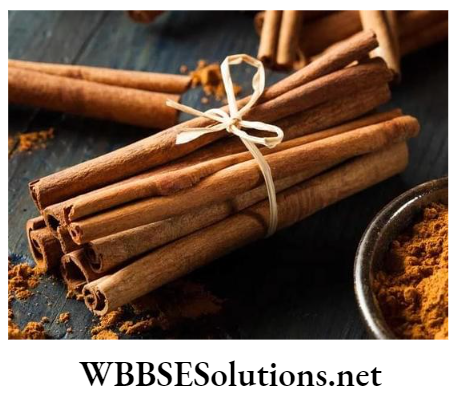
WBBSE Solutions For Class 8 School Science Chapter 11 Plant Kingdom and The Environment Around Us Cinnamon


Uses:

Cinnamon bark is widely used as a spice. It is principally employed in cookery as a condiment and flavoring material.
It is used in the preparation of chocolate, especially in Mexico, which is the main importer of cinnamon.

It is also used in many dessert recipes, such as apple pie, doughnuts, and cinnamon buns as well as spicy candies, coffee, tea, hot cocoa, and liqueurs.
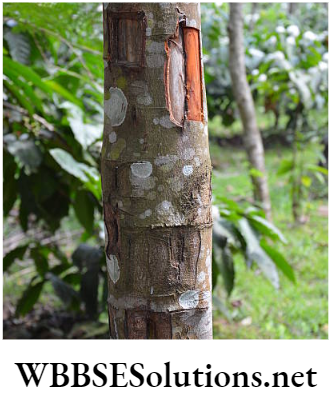
 

WBBSE Solutions For Class 8 School Science Chapter 11 Plant Kingdom and The Environment Around Us Cinnamon Bark

Medicinal plants and their uses Class 8

In the Middle East, cinnamon is often used in savory dishes of chicken and lamb. In the United States, cinnamon and sugar are often used to flavor cereals, and bread-based dishes, such as toast, and fruits, especially apples; a cinnamon-sugar mixture is even sold separately for such purposes.

It is also used in Turkish cuisine for both sweet and savory dishes. It can also be used in pickling. Cinnamon powder has long been an important spice in enhancing the flavor of Persian cuisine, used in a variety of thick soups, drinks, and sweets.

It has been prized for its medicinal properties for thousands of years. Besides using it in cooking, cinnamon is also thought to have health benefits.


The naturally sweet taste may help some people reduce their sugar intake. In Ayurveda, cinnamon is used as a remedy for diabetes, indigestion, and colds. Volatile oil prepared from cinnamon provides relief for arthritic pain.

Turmeric: Turmeric (Curcuma longa) is a rhizomatous herbaceous perennial plant of the ginger family. It is native to southwest India and needs temperatures between 20 and 30°C (68 and 86’F) and a considerable amount of annual rainfall to thrive.

Plants are gathered annually for their rhizomes and propagated from some of those rhizomes in the following season. India, a significant producer of turmeric, has regional names based on language and country.
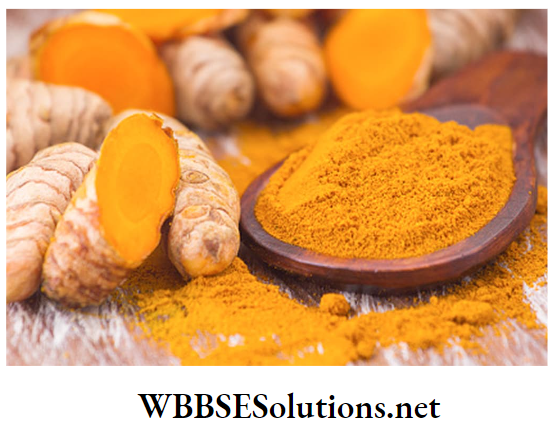
WBBSE Solutions For Class 8 School Science Chapter 11 Plant Kingdom and The Environment Around Us Tumeric

When not used fresh, the rhizomes are boiled for about 30-45 minutes and then dried in hot ovens, after which they are ground into a deep-orange-yellow powder commonly used as a spice in Indian cuisine and curries, for dyeing, and to impart color to mustard condiments.

One active ingredient is curcumin, which has a distinctly earthy, slightly bitter, slightly hot peppery flavor and a mustardy smell.

Turmeric plants reach up to 1 m tall. Highly branched, yellow to orange, cylindrical, aromatic rhizomes are found. The leaves are alternate and arranged in two rows.

They are divided into leaf sheath, petiole, and leaf blade. From the leaf sheaths, a false stem is formed. The petiole is 50 to 115 cm long.

The simple leaf blades are usually 76 to 115 cm long and rarely up to 230 cm. They have a width of 38 to 45 cm and are oblong to an elliptic narrowing at the tip.

Uses:

We probably know turmeric as the main spice in curry. It has a warm, bitter taste and is frequently used to flavor or color curry powders, mustards, butter, and cheeses.

But the root of turmeric is also used widely to make medicine. In food and manufacturing, the essential oil of turmeric is used in perfumes, and its resin is used as a flavor and color component in foods.

It has been known as poor man’s saffron because it offers a less expensive alternative yellow coloring. Turmeric is mostly used in flavored milk drinks, cultured milk, and desserts to obtain lemon and banana colors in dairy.

ln turmeric, curcumin is the primary pigment and is generally used in various food industries as a food color. Turmeric is added at higher levels to sausages, pickles, relishes, sauces, dry mixes, and fish due to its original usage as a spice.

Due to the presence of a compound called curcumin in turmeric, it has the ability to kill microbes. Turmeric keeps the liver healthy. It is effective in controlling anemia due to the presence of a good amount of iron in it. Turmeric also controls blood cholesterol levels.

Turmeric is used for arthritis, heartburn (dyspepsia), stomach pain, diarrhea, intestinal gas, stomach bloating, loss of appetite, jaundice, liver problems, and gallbladder disorders.

It is also used for headaches, bronchitis, colds, lung infections, fibromyalgia, leprosy, fever, menstrual problems, and cancer. Other uses include depression. Alzheimer’s disease, water retention, worms, and kidney problems.

Some people apply turmeric to the skin for pain, ringworm, bruising, leech bites, eye infections, inflammatory skin conditions, soreness inside of the mouth, and infected wounds.

Women in India apply turmeric before taking bath as its antibacterial property protects the skin from infects and protects it from harsh sunlight.
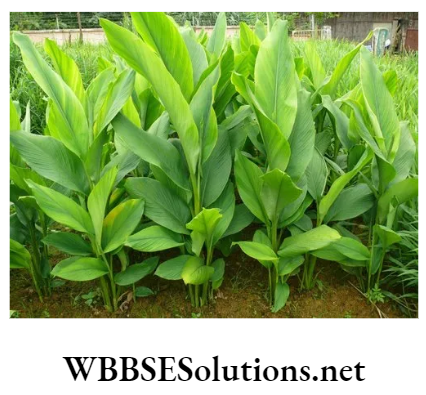
WBBSE Solutions For Class 8 School Science Chapter 11 Plant Kingdom and The Environment Around Us turmeric plant


Cardamom: Cardamom is a spice made from the seeds of several plants in the genera Elettaria and Amomum. Both genera are native to India, Pakistan, Nepal, and Bhutan; they are recognized by their small seed pods, triangular in cross-section and spindle-shaped, with a thin, papery outer shell and small black seeds.

There are two main types of cardamom:

True or green cardamom (or, when bleached, white cardamom comes from the species Elettaria cardamomum and is distributed from India to Malaysia.

Black cardamom, also known as brown, greater, longer, or Nepal cardamom, comes from two species, Amomumcostatum and Amomum subulatum, which are distributed mainly in Asia and Australia.

Uses: Both forms of cardamom are used as flavorings and cooking spices in both food and drink and as medicine.

Besides being used as flavourant and spice in foods, cardamom-flavored tea, also flavored with cinnamon, is consumed as a hot beverage in Bangladesh, India, and Pakistan.

Cardamom has a strong, unique taste, with an intensely aromatic, resinous fragrance. Black cardamom has a distinctly smokey, though not bitter, aroma, with a coolness some consider similar to mint.
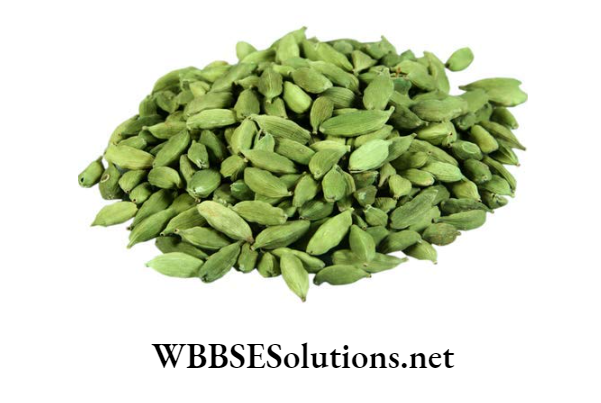
WBBSE Solutions For Class 8 School Science Chapter 11 Plant Kingdom and The Environment Around Us elachi

Green cardamom is one of the most expensive spices by weight but little is needed to impart flavor. It is best stored in pod form because once the seeds are exposed or ground, they quickly lose their flavor.

It is a common ingredient in Indian cooking and is often used in baking in Nordic countries, in particular Sweden and Finland.

In the Middle East, green cardamom powder is used as a spice for sweet dishes, as well as a traditional flavoring in coffee and tea. Cardamom is used to a wide extent in savory dishes.

‘In Asia, both types of cardamom are widely used in both sweet and savory dishes, particularly in the south. Both are frequent components in spice mixes, such as Indian and Nepali masalas and Thai curry pastes.

Green cardamom is often used in traditional Indian sweets and in masala chai (spiced tea). Both are also often used as a garnish in basmati rice and other dishes. Individual seeds are sometimes chewed and used in much the same way as chewing gum.

Green cardamom is broadly used in South Asia to treat infections in teeth and gums, to prevent and treat throat troubles, congestion of the lungs and pulmonary tuberculosis, inflammation of eyelids, and digestive disorders.

It also is used to break up kidney and gall stones and was reportedly used as an antidote for both snake and scorpion venoms.

Amomum is used as a spice and as an ingredient in traditional medicine systems of the traditional Chinese medicine in China, in Ayurveda in India, Pakistan, Japan, Korea, Nepal, and Vietnam.

Among other species, varieties, and cultivars, Amomum villosum cultivated in China, Laos, and Vietnam is used in traditional Chinese medicine to treat stomach problems, constipation, dysentery, and other digestion problems.

Garam masala, which literally means hot (garam) spice (masala), is a popular spice blend used throughout India and neighboring countries too.

It is a powder made of several types of spices and is added in small quantities at the end of the cooking process, or along with the tempering.

A typical Indian version of garam masala contains- black and white peppercorns, cloves, cinnamon or cassia bark, nutmeg and mace, black and green cardamom pods, Bay leaf, caraway, etc. Garam masala can be used alone or along with other seasonings and spice powders.

Ginger: Ginger [Zingiber officinale) is a flowering plant whose rhizome, ginger root, or simply ginger, is widely used as a spice or a medicine.

It is a herbaceous perennial that grows annual stems about a meter tall bearing narrow green leaves and yellow flowers.

Ginger is indigenous to southern China and was spread eventually to other parts of Asia and subsequently to West Africa and the Caribbean. India is now the largest producer of ginger.
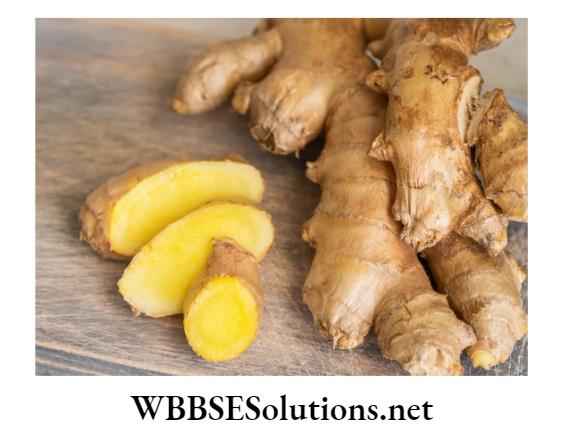
 

WBBSE Solutions For Class 8 School Science Chapter 11 Plant Kingdom and The Environment Around Us ginger


Uses:

Ginger produces a hot, fragrant kitchen spice, vinegar, or sherry as a snack or cooked as young ginger rhizomes are juicy and fleshy with ingredients in many dishes.

They can be steen-ea very mild taste. They are often pickled in boiling water to make ginger tea, to which honey is often added; sliced orange or lemon fruit may be added.

Ginger can be made into candy or ginger wine. Mature ginger rhizomes are fibrous and nearly dry. The juice from ginger roots is often used as a spice.

In Indian recipes and is a common ingredient in Chinese, Korean, Japanese, Vietnamese, and many South Asian cuisines for flavoring dishes such as seafood, meat, and vegetarian dishes. The rhizome (underground stem) is used as a spice and also as a medicine.

It can be used fresh, dried, and powdered, or as a juice or oil. Ginger is commonly used to treat various types of stomach problems, including motion sickness, morning sickness, colic, upset stomach, gas, diarrhea, nausea caused by cancer treatment, nausea, and vomiting after surgery, as well as loss of appetite.

Other uses include pain relief from arthritis or muscle soreness, upper respiratory tract infections, cough, and bronchitis.

Ginger is also sometimes used for chest pain, low back pain, and stomach pain. Some people pour fresh juice on their skin to treat burns. The oil made from ginger is sometimes applied to the skin to relieve pain.

Garlic: Allium sativum, commonly known as garlic, is a species in the onion genus. With a history of human use of over 7,000 years, garlic is native to central Asia and has long been a staple in the Mediterranean region, as well as a frequent seasoning in Asia, Africa, and Europe.

It was known to Ancient Egyptians and has been used for both culinary and medicinal purposes. Allium sativum is a bulbous plant.

It grows up to 1.2 m (4 ft) in height. It produces hermaphrodite flowers. Pollination occurs by bees and other insects.
The garlic plant’s bulb is the most commonly used part of the plant.

With the exception of the single clove types, garlic bulbs are normally divided into numerous fleshy sections called cloves.

Garlic cloves are used for consumption (raw or cooked) or for medicinal purposes. They have a characteristic pungent, spicy flavor that mellows and sweetens considerably with cooking.

Other parts of the garlic plant are also edible. The leaves and flowers (bulbils) on the head (spathe) are sometimes eaten.
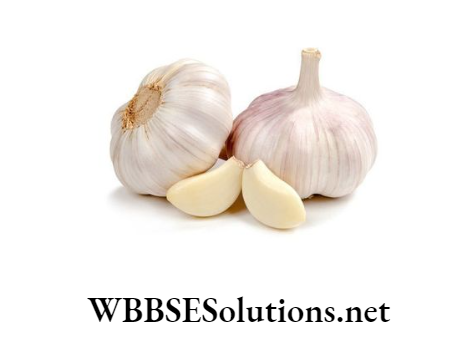
 

WBBSE Solutions For Class 8 School Science Chapter 11 Plant Kingdom and The Environment Around Us garlic

WBBSE Environmental Science Plant Kingdom guide

Uses:

Garlic is widely used around the world for its pungent flavor as a seasoning or condiment. Garlic may be applied to different kinds of bread, usually in a medium of butter or oil, to create a variety of classic dishes, such as garlic bread, garlic toast, etc.

Garlic is a herb. It is best known as a flavoring for food. But over the years, garlic has been used as a medicine to prevent or treat a wide range of diseases and conditions.

Fresh cloves or supplements made from the clove are used for medicine. Garlic contains a compound called Allicin. It has antimicrobial properties.

Garlic is used for many conditions related to the heart and blood system. These conditions include high blood pressure, high cholesterol, coronary heart disease, heart attack, and hardening of the arteries (atherosclerosis).

Some of these uses are supported by science. Garlic actually may be effective in slowing the development of atherosclerosis and seems to be able to modestly reduce blood pressure.

Some people use garlic to prevent colon cancer, rectal cancer, stomach cancer, breast cancer, prostate cancer, and lung cancer. It is also used to treat prostate cancer and bladder cancer.

Garlic has been tried for treating an enlarged prostate (benign prostatic hyperplasia; BPH), diabetes, osteoarthritis, hayfever (allergic rhinitis), traveler’s diarrhea, high blood pressure late in pregnancy (pre-eclampsia), cold, and flu.

It is also used for building the immune system, preventing tick bites, and preventing and treating bacterial and fungal infections.

Other uses include the treatment of fever, coughs, headache, stomach ache, sinus congestion, gout, rheumatism, hemorrhoids, asthma, bronchitis, shortness of breath, low blood pressure, Jow blood sugar, high blood sugar, and snakebites.

It is also used for fighting stress and fatigue and maintaining healthy liver function. Some people apply garlic oil to their skin to treat fungal infections, warts, and corn.

There is some evidence supporting the topical use of garlic for fungal infections like ringworm, jock itch, and athlete’s foot; but the effectiveness of garlic against warts and corn is still uncertain.

Some people apply garlic oil to their skin to treat fungal infections, warts, and corn. There is some evidence supporting the topical use of garlic for fungal infections like ringworm, jock itch, and athlete’s foot; but the effectiveness of garlic against warts and corn is still uncertain.

Medicinal Plants

Medicinal plants have been identified and used throughout human history. Plants have the ability to synthesize a wide variety of chemical compounds.

They are used to perform important biological functions to defend against attack from infectious and disease-causing microorganisms and also detoxification and well-being of the body.

At least 12,000 such compounds have been isolated so far; a number estimated to be less than 10% of the total. Chemical compounds in plants.

Mediate their effect on the human body through processes identical to those already well understood for the chemical compounds in conventional drugs; thus herbal medicines do not differ greatly from conventional drugs in terms of how they work.

The use of plants as medicines predates written human history. Ethnobotany(the study of traditional human uses of plants) is recognized as an effective way to discover future medicines.

The use of herbs to treat disease is almost universal among non-industrialized societies and is often more affordable than purchasing expensive modern pharmaceuticals.

The World Health Organization (WHO) estimates that 80 percent of the population of some Asian and African countries presently uses herbal medicine for some aspect of primary health care.

In India, Ayurveda medicine has used many herbs such as turmeric possibly as early as 1900 BC.

Earliest Sanskrit writings such as the Rig Veda, and Atharva Veda are some of the earliest available documents detailing the medical knowledge that formed the basis of the Ayurveda system.

Many other herbs and minerals used in Ayurveda were later described by ancient Indian herbalists such as Charaka and Sushruta during the 1st millennium BC.

The Sushruta Samhita attributed to Sushruta in the 6th century BC describes 700 medicinal plants, 64 preparations from mineral sources, and 57 preparations based on animal sources.

A brief account of Indian medicinal plants is mentioned below.

Neem

Neem (Azadirachta indica), is a tree in the mahogany family. It is one of two species in the genus Azadirachta and is native to India and the Indian subcontinent including Nepal, Pakistan, Bangladesh, and Sri Lanka.
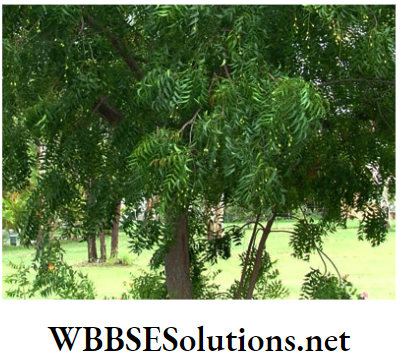
WBBSE Solutions For Class 8 School Science Chapter 11 Plant Kingdom and The Environment Around Us neem tree

Neem is a fast-growing tree that can reach a height of 15-20 meters (49-66 ft), rarely 35-40 meters (115— 131 ft). It is evergreen, but in severe drought, it may shed most or nearly all of its leaves.

The branches are wide and spreading. The fairly dense crown is roundish and may reach a diameter of 15-20 meters (49-66 ft) in old, freestanding specimens.

General uses:

  1. Neem leaves are dried in India and placed in cupboards to prevent insects from eating the clothes and also while storing rice in tins.
  2. Neem leaves are dried and burnt in tropical regions to keep away mosquitoes as Ayurveda herb. Neem is also used in baths.
  3. Neem contains chemicals that might help reduce blood sugar levels, heal ulcers in the digestive tract, prevent conception, kill bacteria, and prevent plaque formation in the mouth.
  4. The tender shoots and flowers of the neem tree are eaten as a vegetable in India. In West Bengal, young neem leaves are fried in oil with tiny pieces of eggplant (brinjal).
  5. The dish is called nim begun and is the first item during a Bengali meal that acts as an appetizer. It is eaten with rice


Medicinal property: Neem products are believed to be anthelmintic, antifungal, antidiabetic, antibacterial, antiviral, contraceptive, and sedative.

Neem oil Is used for pain in the ear, gum, and tooth. Neem seed is used in viral epidemics and arthritis. The bitter tasted tonic made from the bark of the root and stem is useful in breaking periodic sequences of fevers (like malaria).

Neem oil is used for healthy hair, to improve liver function, detoxify the blood, and balance blood sugar levels. Neem leaves have been used to treat skin diseases like eczema, psoriasis, etc. The juice of neem leaves is useful for diabetes.

Other uses

Toiletries: Neem oil is used for preparing cosmetics such as soap, shampoo, balms, and creams as well as toothpaste.

Toothbrush: Traditionally, slender neem twigs (called datum are first chewed as a toothbrush and then split as a tongue cleaner.

Tree: Besides its use in traditional Indian medicine, the neem tree is of great importance for its anti-desertification properties and possibly as a good carbon dioxide sink.

Cosmetics: Neem is perceived in India as a beauty aid. Powdered leaves are a major component of at least one widely used facial cream. Purified neem oil is also used in nail polish and other cosmetics.

Bird repellent: Neem leaf boiled in water can be used as a very cost-effective bird repellent, especially for sparrows.

Lubricant: Neem oil is non-drying and it resists degradation better than most vegetable oils. In rural India, it is commonly used to grease cart wheels.

Fertilizer: Neem has demonstrated considerable potential as a fertilizer. Neem cake is widely used to fertilize cash crops, particularly sugarcane and vegetables.

Honey: In parts of Asia neem honey commands premium prices, and people promote apiculture by planting neem trees.

Soap: 80% of India’s supply of neem oil is now used by neem oil soap manufacturers. Additionally, it is antibacterial and antifungal, soothing, and moisturizing. It can be made with up to 40% neem oil.

Against pox viruses: In Tamilnadu, people who are affected by pox viruses are generally made to lie in a bed made of neem leaves and branches. This prevents the spreading of pox virus to others and has been in practice since the early centuries.

Bael

Aegle marmelos, commonly known as bael, Bengal quince, golden apple, stone apple, and wood apple, is a species of tree native to India.

It is present throughout Southeast Asia as a naturalized species. The tree is considered to be sacred by Hindus. Its fruits are used in traditional medicine and as a food throughout its range.

The bael fruit has a smooth, woody shell with a green, gray, or yellow peel. It takes about 11 months to ripen on the tree and can reach the size of a large grapefruit or pomelo, and some are even larger.

The shell is so hard it must be cracked with a hammer or machete. The fibrous yellow pulp is very aromatic. It has been described as tasting of marmalade and smelling of roses. Numerous hairy seeds are encapsulated in slimy mucilage.
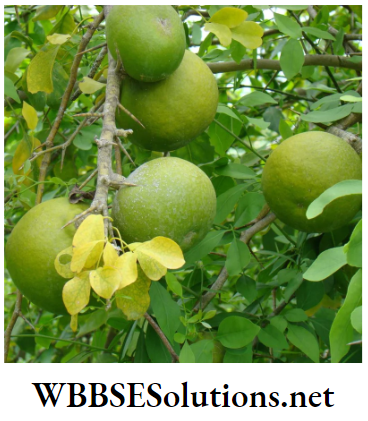
WBBSE Solutions For Class 8 School Science Chapter 11 Plant Kingdom and The Environment Around Us bael

Importance of plants in the environment for Class 8

Medicinal use:

Bael fruit contains pectin and mucilage. The fruit is usually sliced and sun-dried. The hard leathery slices are then immersed in water.

They are prescribed for a number of diseases such as gastrointestinal diseases, piles, edema, jaundice, vomiting, obesity, pediatric disorders, gynecological disorders, urinary complaints, and as a rejuvenation.

Juice of Bael fruit is good for diarrhea patients. Unripe or partly ripe fruit increases appetite and digestive power. Bael leaves, fruit, and roots have antibiotic power.

Other Uses;

The fruit is eaten fresh or dried. If fresh, the juice is strained and sweetened to make a drink similar to lemonade. It can be made into sharbat (Hindi) or belpana, a refreshing drink made of pulp with water, sugar, and lime juice, mixed, left to stand for a few hours, strained, and put on ice.

One large bael fruit may yield five or six liters of sharbat.

The plant and its certain parts (leaves and fruits) are of religious importance since the tree is regarded as one of the sacred trees of Indian heritage.

Emblica (Amlaki)

Phyllanthus emblica, also known as emblic, amlaki, or amla from Sanskrit Amalia, is a deciduous tree. It is known for its edible fruit of the same name.

The tree is small to medium in size, reaching 8 to 18 m in height, with a crooked trunk and spreading branches. The branchlets are glabrous or finely pubescent, 10-20 cm long, and usually deciduous;

the leaves are simple, subsessile, and closely set along branchlets, light green, resembling pinnate leaves. The flowers are greenish-yellow.

The fruit is nearly spherical, light greenish yellow, quite smooth, and hard on appearance, with six vertical stripes or furrows.

Ripening in autumn, the berries are harvested by hand after climbing to the upper branches bearing the fruits. The taste of Indian gooseberry (amla) is sour, bitter, and astringent, and it is quite fibrous.

In India, it is common to eat gooseberries steeped in salt water and turmeric to make sour fruits palatable.
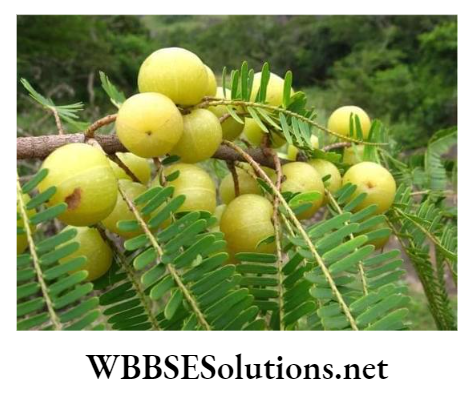
WBBSE Solutions For Class 8 School Science Chapter 11 Plant Kingdom and The Environment Around Us emblica

Medicinal use:

The nutritional facts of Amlaki include bioflavonoids, flavones, polyphenols, and carotenoids. It is the richest natural source of vitamin C available on this planet.

The unique thing about amlaki fruit is the ascorbic acid found is nearly indestructible even by burning or drying it. This makes the richest bio-availability of Vitamin C in this fruit which plays a significant role in the synthesis of neurotransmitters.

It is also required for collagen and carnitine synthesis, important molecules that produce energy from the fat cells whenever required.

  1. Health Benefits of Amlaki
  2. Amlaki inhibits the aging process and prevents the common cold.
  3. Amlaki is a nutritional powerhouse and is hence used to boost immunity and restore the body’s vitality.
  4. Amlaki provides energy to vital organs and is hence used in chronic illness recovery.
  5. Amlaki helps in regulating blood glucose levels in diabetic patients.
  6. Amlaki facilitates the absorption of iron in the body and improves hemoglobin levels. Amlaki possesses potent anti-inflammatory action and is hence used in various gastrointestinal tract inflammation such as gastritis.
  7. Amlaki contains natural digestive enzymes and is hence used in indigestion.
  8. Amlaki promotes spermatogenesis.
  9. Amlaki reduces serum cholesterol and high blood pressure.
  10. In Chinese traditional therapy, this fruit is used to treat throat inflammation.

Other use:

Popularly used in inks, shampoos, and hair oils, the high tannin content of Indian gooseberry fruit serves as a mordant for fixing dyes in fabrics.

Amla shampoos and hair oil are traditionally believed to nourish the hair and scalp and prevent premature grey hair.

Triphala: Literally meaning “three fruits”, Triphala is a traditional Ayurvedic herbal formulation consisting of three fruits native to the Indian subcontinent Amlaki (Emblica officinalis), Bibhitaki or Bahera (Terminalia bellirica) and Haritaki (Terminalia chebula).

Triphala is most commonly known for its use as a gentle bowel tonic, helpful in digestion and supporting regular bowel movements.

The combination of the three fruits has a synergistic effect to bolster many other systems as well. In addition to the Gl tract, Ayurveda uses Triphala to support healthy respiratory, cardiovascular, urinary, reproductive, and nervous systems.

Triphala has also been shown to be a powerful antioxidant, protecting cells from the damaging effects of free radicals

Nayantara

Nayantara (Catharanthus) Nayantara or Sadabahar or Periwinkle or Madagascar rosy periwinkle is an evergreen subshrub or herbaceous plant. This plant grows 1 m tall.

The leaves are oval to oblong, 2.5-9 cm long and 1-3.5 cm broad, glossy green, hairless, with a pale midrib and a short petiole 1-1.8 cm long; they are arranged in opposite pairs.

The flowers are white to dark pink with a darker red center, with a basal tube 2.5-3 cm long and a corolla 2-5 cm diameter with five petal-like lobes.

The fruit is a pair of follicles 2-4 cm long and 3 mm broad. In the wild, it is an endangered plant; the main cause of decline is habitat destruction by slash-and-burn agriculture.

It is also however widely cultivated and is naturalized in subtropical and tropical areas of the world.
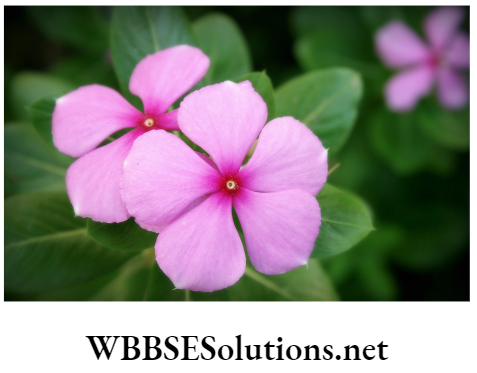
WBBSE Solutions For Class 8 School Science Chapter 11 Plant Kingdom and The Environment Around Us nayantara catharanthus

Medicinal Uses:

In traditional Chinese medicine, extracts from it have been used against numerous diseases, including diabetes, malaria, and Hodgkin’s lymphoma.

The leaf of Catharanthus is a good medicine for diabetes. The plant has dysentery and hemorrhage-resistant properties. The alkaloid Raubasine found in the root of the plant helps to remove obstacles in blood circulation.

Two other alkaloids called Vincristine and Vinblastine are found in the plant and are used to treat blood cancer and other types of cancers.

Its alkaloids are hypotensive, sedative and have tranquilizing properties, and are anti-cancerous. It helps in relieving muscle pain, depression of the central nervous system, and wasps stings.

Other Uses:

As an ornamental plant, it is appreciated for its hardiness in dry and nutritionally deficient conditions, popular in subtropical gardens where temperatures never fall below 5°C to 7°C, and as a warm-season bedding plant in temperate gardens.

It is noted for its long flowering period, throughout the year in tropical conditions, and from spring to late autumn, in warm temperate climates. Full sun and well-drained soil are preferred.

Mint (Pudina)

Mentha (also known as mint) is a genus of plants in the mint family. The species are not clearly distinct and estimates of the number of species vary from 13 to 18.

Hybridization between some of the species occurs naturally. Many other hybrids, as well as numerous cultivars, are known in cultivation.

While the species that make up the Mentha genus are widely distributed and can be found in many environments, most grow best in wet environments and moist soils.
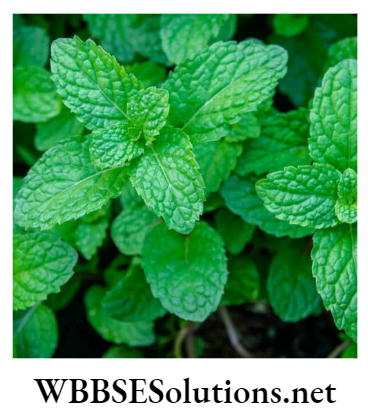
WBBSE Solutions For Class 8 School Science Chapter 11 Plant Kingdom and The Environment Around Us Mint

Mints will grow 10-120 cm tall and can spread over an indeterminate area. Due to their tendency to spread unchecked, some mints are considered invasive.

Mints are aromatic, almost exclusively perennial, rarely annual, herbs. They have wide-spreading underground and overground stolons and erect, square, branched stems.

The leaves are arranged in opposite pairs, from oblong to lanceolate, often downy, and with a serrated margin. Leaf colors range from dark green and gray-green to purple, blue, and sometimes pale yellow when dry they are usually dark green or green.

The flowers are white to purple and produced in false whorls called verticillasters. The corolla is two-lipped with four subequal lobes, the upper lobe usually the largest. The fruit is a nutlet, containing one to four seeds.]

Medicinal Uses:

  1. Pudina is used as a carminative and an expectorant.
  2. The plant is highly effective in treating headaches, rhinitis, cough sore throat, colic, and vomiting.
  3. It serves as a good blood cleanser since it is antiseptic and anti-bacterial.
  4. Pudina plays a significant role in alleviating swollen gums, mouth ulcers, and toothaches.
  5. Crushed and bruised pudina leaves are used in treating insect bites.
  6. The decoction and infusion of its leaves and stems help in fever, stomach aches, dysmenorrheal, and diuresis.
  7. Fresh leaves of pudina are crushed and sniffed for dizziness. Crushed leaves are also applied on the forehead and temple, to cure headaches.
  8. The menthol extracted from the plant is used in preparing balms.

Aloe Vera

Aloe vera (Ghritakumari) is a succulent plant species. The species is frequently cited as being used in herbal medicine since the beginning of the first century AD.

Extracts from Aloe vera are widely used in the cosmetics and alternative medicine industries, being marketed as variously having rejuvenating, healing, or soothing properties.

Aloe is one of the great healing agents among herbs. Indian aloe or Ghritkumari is a form of cactus. Aloes have long been in use for a host of diseases, particularly those connected with the digestive system and skin disorders.

it contains enzymes, polysaccharides, and nutrients that exhibit antibacterial and antifungal action. Aloe vera is useful in liver and spleen disorders, skin problems (scars, pimples, dermatitis, minor wounds or burns, etc.), external sores, hair problems, and eye troubles.

It is used as a flavoring agent in many culinary preparations.

Other Uses:

The leaf, fresh or dried, is the culinary source of mint. Fresh mint is usually preferred over dried mint when storage of the mint is not a problem.

The leaves have a warm, fresh, aromatic, sweet flavor with a cool aftertaste, and are used in teas, beverages, jellies, syrups, candies, and ice creams.

Mint essential oil and menthol are extensively used as flavorings in breath fresheners, drinks, antiseptic mouth rinses, toothpaste, chewing gum, desserts, and candies, such as mint (candy) and mint chocolate.

The substances that give the mints their characteristic aromas and flavors are menthol and pulegone. Mint was originally used as a medicinal herb to treat stomach aches and chest pains.

There are several uses in traditional medicine and preliminary research for possible use in treating irritable bowel syndrome.

Menthol from the mint essential oil (40-90%) is an ingredient of many cosmetics and some perfumes. Menthol and mint essential oil are also used in aromatherapy which may have clinical use to alleviate post-surgery nausea.

Mint oil is also used as an environmentally friendly insecticide for its ability to kill some common pests such as wasps, hornets, ants, and cockroaches, and has small white teeth.

The flowers are produced in summer on a spike up to 90 cm (35 in) tall, each flower being pendulous, with a yellow tubular corolla 2-3 cm (0.8-1.2 in) long.

Medicinal Uses:

Aloe vera is used in traditional medicine as a multipurpose skin treatment. Aloe vera is used on facial tissues where it is promoted as a moisturizer and anti-irritant to reduce chafing of the nose.

Cosmetic companies commonly add sap or other derivatives from Aloe vera to products such as makeup, tissues, moisturizers, soaps, sunscreens, incense, shaving cream, or shampoos.

Aloe vera gel is effective in treating psoriasis, seborrhea, dandruff, minor burns, and skin abrasions, as well as radiation-induced skin injuries.

Aloe vera juice (also called latex) taken by mouth is a powerful laxative. Aloe vera gel taken orally (by mouth) seems to help people with diabetes by lowering blood sugar levels.

It may also help to lower cholesterol. Extracts of aloe vera leave contain vitamins, minerals, amino acids, and fatty acids.

It is used to reduce acidity, and inflammation of bone joints, and to reduce fever (antipyretic to reduce mental stress and tension.
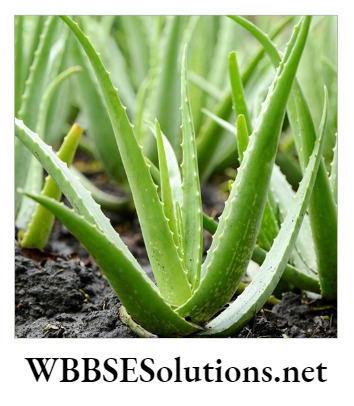

WBBSE Solutions For Class 8 School Science Chapter 11 Plant Kingdom and The Environment Around Us Alovera