WBBSE Class 8 Geography Chapter 2 Topic A Plate Tectonics

WBBSE Chapter 2 Unstable Earth Synopsis

The movement of lithospheric plates is responsible for natural events like earthquakes, volcanic activities, mountain-building processes, landslides, avalanches etc.

Alfred Wegener propounded the Continental Drift Theory. He assumed that all landmasses of the world had formed from one supercontinent, called Pangea, about 300 million years ago.

The Plate Tectonic Theory had evolved in the 1960s on the basis of the Continental Drift Theory and Seafloor Spreading Theory.

Scientists such as Le Pichon, Wilson, McKenzie, Parker and Morgan elaborated the various aspects of Plate Tectonics.

Read and Learn More WBBSE Solutions For Class 8 Geography

All lithospheric plates are floating on the asthenosphere. These plates are on an average 70km-150km thick.

6 major and 20 minor plates have been identified in the world.The major plates are Eurasian Plate, Indo-Australian Plate, American Plate, Pacific Plate, African Plate and Antarctic Plate.

WBBSE Class 8 Plate Tectonics Overview

When two tectonic plates move apart from each other, a Divergent or Constructive plate boundary is formed.

Earthquakes: and volcanic eruptions can occur here.

When two plates move towards each other and collide, a Convergent or Destructive plate boundary is formed. Earthquakes, volcanic eruptions and folds can occur here. ons and folds can occur here.

When two tectonic plates slide or glide past each other, a Conservative or Neutral plate boundary is formed. Earthquakes and faults can occur here. The San Andreas Fault in California is an example of a neutral plate boundary.

The fold mountains formed about 10-25 million years ago are known as young fold mountains. The Rockies, the Andes and the Himalayas are young-fold mountains.

The fold mountains formed more than 200 million years ago are known as the old fold mountains. The Urals, the Appalachians and the Aravallis are classic examples of this category.

According to Plate Tectonic Theory, plates move horizontally at different speeds. The Pacific Plate is moving about 10cm towards the west annually, while the American Plate is moving towards the same direction at a speed of just 2-3cm/year.

Class 8 Geography Chapter 2 Plate Tectonics Notes

Volcanism is the process of upwelling of viscous magma, gas, and water vapour from the interior of the earth to the surface through cracks, joints or weak points of the lithosphere and the solidification of lava on the earth’s surface.

Viscous, molten rock materials in the earth’s interior is known as magma.

When magma comes out onto the earth surface through cracks, joints or weak points of the lithosp of the lithosphere, it is known as lava.

Active volcanoes are the volcanoes which have been erupting continuously or frequently since their formation. Example-Etna in Sicily, Barren in India.

The volcanoes which have remained inactive for a long period after one. the eruption, but suddenly erupt violently are called dormant volcanoes. Example- Fujiyama in Japan, Narcondam in India.

Volcanoes are considered to be extinct or dead when there are no indications of future eruptions. Example-Mt. Popa in Myanmar.

The dense and viscous lava ejected from volcanoes is known as A’a lava and the comparatively less viscous or highly fluid lava, which spreads like thin sheets, is known as Pahoehoe lava in the Hawaiian language.

The place in the interior of the earth where an earthquake originates is the focus of the earthquake. These are located at a depth of about 50km-100km under the surface.

The point on the earth’s surface vertically above the focus of an earthquake is known as its epicentre.

WBBSE Class 8 Geography Chapter 2 Topic A Plate Tectonics

Class 8 Geography Solution WBBSE

The different types of waves generated due to the earthquake are called seismic waves.

Seismic waves are of three types

  1. P-wave
  2. S-wave and
  3. L-wave.

The seismograph is an instrument that records seismic waves, focus and the epicentre of an earthquake.

Richter Scale measures the magnitude or intensity of energy released during an earthquake. The number indicating an earthquake’s intensity on the Richter scale ranges from 0-10.

Seismogram is a graph output that we get using a seismograph. It is a record of the ground motion during an earthquake. The science that deals with seismic waves, is called Seismology.

Most of the active volcanoes in the world flank the Pacific Ocean and form a ring around it. This is called the Pacific Ring of Fire. Krakatau in Indonesia, Cotopaxi in Ecuador, etc., belong to this belt.

Class 8 Geography Solution WBBSE

Predicting an earthquake is very difficult. However, different measures can be adopted to mitigate the hazardous effects of earthquakes, such as constructing earthquake-resistant buildings, monitoring radon gas emissions, etc.

WBBSE Chapter 2 Topic A Plate Tectonics Analytical Type Questions

Question 1. What are plates? Discuss the Plate Tectonic Theory.
Answer:

Plates:

The rigid lithospheric slabs including SIAL and SIMA, or the solid crustal layer including oceanic and continental crust are called plates.

These are relatively mobile in nature. The whole mechanism of the evolution, nature and motion of plates and the resultant reaction is known as plate tectonics.

Plate Tectonic Theory:

The Plate Tectonic Theory came into light mainly in the 1960s. It was able to explain clearly and scientifically the causes and effects of most of the geo-tectonic phenomena.

divergent movement (the plates move away from each other), convergent movement (the plates move towards each other) and neutral movement (the plates slide past each other).

Chief propounder:

In 1965, J.T. Wilson, a Canadian geophysicist, first used the term ‘Plate. McKenzie and Parker, too discussed about the movement of the plates in 1967. Later on, French geophysicists Le Pichon and Jason Morgan established a dependable theory from this base.

WBBSE Solutions For Class 8 School Science Long Answer Type Questions WBBSE Solutions For Class 8 School Science Short Answer Type Questions
WBBSE Solutions For Class 8 School Science Very Short Answer Type Questions WBBSE Solutions For Class 8 School Science Review Questions
WBBSE Solutions For Class 8 School Science Solved Numerical Problems WBBSE Solutions For Class 8 School Science Experiments Questions
WBBSE Solutions For Class 8 Maths WBBSE Class 8 History Notes
WBBSE Class 8 History Multiple Choice Questions WBBSE Solutions For Class 8 History
WBBSE Solutions For Class 8 Geography


Basic Concept:

The Plate Tectonic Theory is based on two concepts-

  1. Continental Drift and
  2. Seafloor Spreading. According to this theory, the lithosphere consists of some plates which continuously glide over the weak asthenosphere due to the action of internal convection currents. It drives the plates to move away from or towards each other.

Major plates of the world:

There are 6 major and 20 minor plates in the world. The major plates are

  1. Eurasian Plate
  2. Indo- Australian Plate
  3. American Plate
  4. Pacific Plate
  5. African Plate and
  6. Antarctic Plate.

Movement of the plates:

The plates are mobile in nature. Plate movement can be of three types

  1. Divergent movement (the plates move away from each other),
  2. Convergent movement (the plates move towards each other) and
  3. Neutral movement (the plates slide past each other)

Causes of plate movement:

Plates move due to

  1. upwelling of magma along the plate boundary
  2. gravitational force
  3. buoyancy
  4. convection current
  5. increasing temperature due to radioactivity within the earth.

Impact of plate tectonics:

Understanding Plate Tectonics for Class 8

The impact of plate tectonics includes the following

  1. Formation of new landmasses along the divergent plate boundaries.
  2. Volcanic eruptions and earthquakes along the subduction zone.
  3. Formation of young fold mountains along the convergent plate boundaries example, the Alps, Himalayas, Rockies and Andes.
  4. Formation of faults and rift valleys along the boundary where the plates slide past each other.


WBBSE Solutions For Class 8 Geography Chapter 2 Unstable Earth Topic A Plate Tectonics Tectonic Plates


Question 2. Explain the formation of different types of landforms due to plate movement.
Answer:

Formation Of Different Types Of Landforms Due To Plate Movement:-

Due to plate movement, different types of landforms are formed. The three kinds of plate movement and their related landforms are discussed below-

1. Divergent plate movement:

The upwelling of the internal convection current in reverse direction forces the plates to move away from each other and is known as divergent plate movement.

Landforms Due To Divergent Plate Movement :

  1. The emergence of the magma forms mid-oceanic ridges and rift valleys along this plate boundary.
  2. Formation of faults on the earth’s crust occurs and lava erupts along this zone.

WBBSE Solutions For Class 8 Geography Chapter 2 Unstable Earth Topic A Plate Tectonics Divergent plate movement


2. Convergent plate movement:

The movement of the plates towards each other is called convergent plate movement.

WBBSE Class 8 Geography Plate Boundaries

Landforms Due To Divergent Plate Movement :

  1. Geosynclines, oceanic trenches and young fold mountains may form along the ocean-continent convergent plate boundary
  2. Island arcs may form along the ocean-ocean convergent plate boundary.
  3. Fold mountains form along the continent-continent convergent plate boundary.


WBBSE Solutions For Class 8 Geography Chapter 2 Unstable Earth Topic A Plate Tectonics Convergent plate movement


3. Neutral plate movement:

The boundary along which the plates slide or glide past each other is called a conservative plate boundary and the movement is called neutral plate movement.

Class 8 Geography WBBSE

Landforms Due To Divergent Plate Movement :

  1. There is no formation of new landforms.
  2. Along this plate boundary, long cracks and faults may be found and this zone is earthquake-prone.


WBBSE Solutions For Class 8 Geography Chapter 2 Unstable Earth Topic A Plate Tectonics Neutral plate movement


Question 3. Discuss the origin of fold mountains in light of the Plate Tectonic Theory.
Answer:

Origin Of Fold Mountains In Light Of The Plate Tectonic Theory:-

Recently, the Plate Tectonic Theory has been accepted unanimously to discuss the origin of fold mountains

1. Continent-continent plate collision:

In this case, the two continental plates move towards each other and there exists a narrow and shallow sea in between. Due to this movement, the plates create pressure on the deposited sediments of the intra- plate ocean and give rise to, fold mountains.

Example-the Himalayas were formed in this way. The Eurasian Plate and the Indian Plate collided with each other and the Indian Plate got subducted under the Eurasian Plate.

Consequently, the sediments of the intra-plate Tethys sea got folded to form the Himalayan mountain range.

Plate Tectonics Concepts for Class 8 Students

2. Ocean-continent plate collision:

The heavier oceanic plate subducts under the lighter continental plate along this plate boundary. This creates pressure, due to which a long crack forms in front of the continental plate and that crack turns into synclines.

Increasing movement of the plates leads to the folding of sediments and thus fold mountains are formed. Example-formation of the Andes and the Alps mountains.

WBBSE Solutions For Class 8 Geography Chapter 2 Unstable Earth Topic A Plate Tectonics Convection current and cell

WBBSE Chapter 2 Topic A Plate Tectonics Short Analytical Type Questions

Question 1. Write a short note on Pangea.
Answer:

Pangea:-

Alfred Wegener propounded in his Continental Drift Theory that in the pre-Carboniferous period, around 300 million years ago, all the present-day landmasses were part of a single landmass or supercontinent, which he named Pangea, a Greek word meaning ‘all lands.

In the Triassic period, there was a geosyncline named Tethys in the middle of the Pangea. The northern and southern parts of the Pangea were known as Laurasia and Gondwanaland respectively.

Wegener envisaged that Pangea began to break apart in the Mesozoic era and the present landmasses and waterbodies originated due to drifting apart of the fragments of Pangea by differential gravitational force, buoyancy and tidal force.

Question 2. What is plate movement?
Answer:

Plate Movement:-

In geology, plate refers to a rigid and solid lithospheric slab. Even the SIAL and SIMA are plates. There are 6 major and 20 minor plates in the world. The plates are moving very slowly in the slippery asthenosphere due to various causes.

They can move towards each other or away from each other. They can even slide past each other. This continuous movement of the
plates is known as plate movement.

WBBSE Class 8 Geography Chapter 2 Questions

Question 3. Why do the tectonic plates move?
Answer: Tectonic plates move due to the following reasons

1. Upwelling of magma:

Plates move away from each other at divergent plate boundaries due to upwelling of magma. Again, the formation of dykes at the divergent plate boundaries causes the drifting of plates.

2. Gravitational force:

Volcanic activities lead to the formation of oceanic ridges at the divergent plate boundaries and the plates begin to move away from each other due to gravitational force.

3. Convection current:

According to Holmes, the viscous and lubricating materials of asthenosphere act as the medium of heat transfer, which gives rise to convection current. This causes the rigid plates to drift apart on the fluid mantle.

Question 4. What do you mean by convection current and convection cell?
Answer:

Convection Current And Convection Cell:-

Convection currents play an important role in the movement of the plates. According to Holmes, viscous and lubricating materials of the asthenosphere act as the medium of heat transfer, which generate convection currents.

As the materials move upwards with the current, they move away from each other just beneath the surface of the earth and this creates convection cells.

Two consecutive cells cause the plates to drift away on the fluid mantle. Similarly, downward currents cause two plates to come towards each other.

Question 5. What is a divergent plate boundary?
Answer:

Divergent Plate Boundary:-

When two tectonic plates move apart from each other, a divergent or constructive plate boundary is formed. The upwelling magma coming out through the intra-plate crack develops new landforms along this boundary.

Along this plate boundary, the sea floor spreads due to the prevalence of upwelling magma and forms MOR (Mid-Oceanic Ridges), e.g., Mid-Atlantic Ridge. Thus, a divergent plate boundary is also called constructive plate boundary.

Question 6. What is a convergent plate boundary?
Answer:

Convergent Plate Boundary:-

When two plates move towards each other and collide, a convergent plate boundary is formed. The collisions form fold mountains and subducted parts begin to melt due to the high temperature of the interior of the earth.

WBBSE Class 8 Geography Chapter 8 Question Answer

Due to the loss of parts of the earth’s crust, it is also called destructive plate boundary.

Question 7. How is the altitude of the Himalayas increasing due to the movement of the plates?
Answer:

Altitude Of The Himalayas Increasing Due To The Movement Of The Plates:-

The Himalayan mountain is located at the convergent plate boundary between the Indian and Eurasian Plates. The Indian Plate is subducting under the Eurasian Plate at a high rate every year.

As a result, folding and upheaving of the sediments of the Tethys Geosyncline due to high pressure is increasing the altitude of the Himalayan range further. As long as the plates continue to move, the height of the Himalayas will go on increasing.

Question 8. Most fold mountains are formed due to collision of the continental plates- Why?
Answer:

Most Fold Mountains Are Formed Due To Collision Of The Continental Plates:-

A geosyncline usually occurs between the continental plates which meet along a boundary. As these plates get closer to each other, the geosyncline becomes narrower and the sediments of the geosyncline crumble.

This way, the upheaval of the sediments leads to the birth and development of fold mountains through plate collisions. Hence, most of the fold mountains form as a result of the collision of continental plates.

Question 9. What do you mean by Mid-World exogenic and endogenic forces. Processes that Mountain Belt?
Answer:

Mid-World Exogenic And Endogenic Forces:-

Mid-World Mountain Belt is the young fold mountain belt extending over Eurasian Plate, Indo-Australian Plate and African Plate. It has two knots- Pamir and Armenian.

The mountains like Himalayas, Karakoram, Kunlun, Altyn Tagh and Arakan Yoma are located on the east and Hindu Kush, Suleiman, Elburz, Zagros, Pontic, Taurus and Alps are located on the west of this belt.

Question 10. What do you mean by endogenic force?
Answer:

Endogenic Force:-

The earth is always in an unstable condition and changes occur on it due to both are caused by forces from within the earth are called endogenic forces. The endogenic processes are generally of two types

Slow and continuous processes, which include orogenic and epeirogenic movement.

Rapid processes, like earthquakes, volcanism etc.

Types of Plate Boundaries for Class 8

Question 11. Compare among divergent, convergent and neutral plate boundaries.
Answer: A comparison between divergent, convergent and neutral plate boundaries includes the following which are mentioned in the table below

WBBSE Solutions For Class 8 Geography Chapter 2 Unstable Earth Topic A Plate Tectonics Compare the boundaries

Question 12. Write the differences between a continental plate and a oceanic plate.
Answer: The differences between a continental plate and a oceanic plate are

WBBSE Solutions For Class 8 Geography Chapter 2 Unstable Earth Topic A Plate Tectonics Continental and oceanic plate

WBBSE Chapter 2 Topic A Plate Tectonics Short Answer Type Questions

Question 1. What is Continental Drifting?
Answer:

Continental Drifting:-

According to Alfred Wegener, drifting of the fragments of Pangea towards different directions due to tidal force, buoyancy and differential gravitational force is known as Continental Drifting.

Question 2. What do you know about convection current and plate movement?
Answer:

Convection Current And Plate Movement:-

According to Arthur Holmes, hot, viscous and molten lava produces convectional current through heat transfer under the surface of the earth.

Upwelling molten lava move in opposite directions just beneath the earth’s crust. Due to that convection current, the plates begin to drift apart.

Short Answer Questions on Plate Tectonics for Class 8

Question 3. Why is the convergent plate boundary are called destructive plate boundary?
Answer: After the collision between the two plates along a convergent plate boundary, the heavier plate gets subducted under the lighter one. Consequently, the subducted parts begin to melt due to the high temperature of the interior of the earth.

Due to this loss of the earth’s crust, a convergent plate boundary is also called a destructive plate boundary.

Question 4. Name the major plates of the earth.
Answer:

Major Plates Of The Earth:-

According to Le Pichon, there are 6 major plates on the Earth.

These are

  1. American Plate
  2. Antarctic Plate
  3. Indo- Australian Plate
  4. Eurasian Plate
  5. Pacific Plate and
  6. African Plate.

Question 5. Write the names of the continental plates and an oceanic plate.
Answer:

The continental plates are

  1. American Plate
  2. Antarctic Plate
  3. Indo- Australian Plate
  4. Eurasian Plate and
  5. African Plate.

The Pacific Plate is an oceanic plate.

Question 6. How is the area of the Pacific plate decreasing due to the plate tectonic movement?
Answer:

Area Of The Pacific Plate Decreasing Due To The Plate Tectonic Movement As Follows:-

The tectonic plates are constantly drifting. The American plate is moving eastwards while the Eurasian plate is moving north-eastwards. As a result, the area of the Pacific plate is decreasing gradually.

The trenches bordering the Pacific Ocean are regions where the Pacific plate is sinking.

Question 7. Which plates are responsible for the formation of the Himalayas?
Answer: The movement of the Indian plate and the Eurasian plate towards each other caused a collision between them. Consequently, the Eurasian plate overrode the other one.

Thus, the formation of the Himalayan mountains started. So, the Indian Plate and the Eurasian Plate are responsible for the formation of the Himalayas.

WBBSE Class 8 Geography Study Guide on Plate Tectonics

Question 8. Why are young fold mountains called so?
Answer:

young fold mountains called so:-

The age of the earth is 4600 million years. The old fold mountains had been formed 200 million years ago while the young fold mountains have developed only 10-25 million years ago.

Formation and development of the young fold mountains is still ongoing. With respect to the geological time scale from the origin of the earth to the present, 10-25 million years is a very short span. Thus these mountains are called ‘young’ fold mountains.

Question 9. What do you mean by geological time?
Answer:

Geological Time:-

The entire span of time, starting from the origin of the earth to the present, is known as geological time, i.e., Pre-Cambrian, Holocene, etc.

Question 10. Define Suture Line.
Answer:

Suture Line:-

Suture Line is a transitional line along which two continental plates collide with each other. One of the prominent examples of suture line is found in the Himalayan mountainous region.

Question 11. Why can we not feel the plate movement? Or, Can we feel the plates moving?
Answer: The plates of the earth’s crust are in continuous motion on the asthenosphere. However, their movement is too slow to be felt by us. As per information collected from GPS (Global Positioning System), the plates move at a rate of 2-10 cm/year.

To cite an example, the American Plate is moving westward at a rate of 2-3cm/year, whereas, the Pacific Plate is moving westward at a rate of 10cm/year.

Therefore, the movements of the plates are very slow in terms of human pace and hence, we cannot feel their movement.

WBBSE Chapter 2 Topic A Plate Tectonics Multiple Choice Questions

Choose the correct option

Question 1. Continental Drift Theory was propounded by-

  1. Le Pichon
  2. Kober
  3. McKenzie
  4. Alfred Wegener

Answer: 4. Alfred Wegener

Question 2. The term ‘Plate’ was first used by-

  1. Le Pichon
  2. McKenzie
  3. J.T. Wilson
  4. Alfred Wegener

Answer: 3. J.T. Wilson

Question 3. Plate Tectonic Theory was successfully applied by-

  1. Le Pichon
  2. Kober
  3. Alfred Wegener
  4. McKenzie

Answer: 1. Le Pichon

WBBSE Class 8 Geography Plate Movement Explanation

Question 4. Two plates that move away from each other are called-

  1. Convergent plates
  2. Neutral plates
  3. Divergent plates
  4. None of these

Answer: 3. Divergent plates

Question 5. Two plates that move towards each other are called-

  1. Convergent plates
  2. Neutral plates
  3. Divergent plates
  4. None of these

Answer: 1. Convergent plates

Question 6. The boundary between two convergent plates is known as-

  1. Destructive plate boundary
  2. Constructive plate boundary
  3. Neutral plate boundary
  4. Indefinite plate boundary

Answer: 1. Destructive plate boundary

Question 7. The highest fold mountain of the world is the-

  1. Appalachian
  2. Andes
  3. Alps
  4. Himalayas

Answer: 4. Himalayas

Question 8. The longest fold mountain of the world is the-

  1. Appalachian
  2. Andes
  3. Alps
  4. Himalayas

Answer: 2. Andes

Question 9. The San Andreas Fault is an example of-

  1. Convergent plates
  2. Divergent plates
  3. None of these
  4. Neutral plate

Answer: 4. Neutral plate

WBBSE Chapter 2 Topic A Plate Tectonics Fill In The Blanks

Question 1. All the continents of the world existed together as a united landmass named ________, about 300 million years ago.
Answer: Pangea

Question 2. The tectonic plates move due to the ________ currents of the asthenosphere.
Answer: Convection

Question 3. The drifting away of the American and African Plates from each other along the ________ Ridge has led to the formation of the Atlantic Ocean.
Answer: Mid-Atlantic

Question 4. ________ of the Pacific Ocean is the deepest oceanic trench in the world.
Answer: Mariana Trench

Question 5. The Himalayas were formed due to the collision of the ________ Plate and the Eurasian Plate.
Answer: Indian

Question 6. The Pacific Ocean plate is moving at a rate of ________ /year.
Answer: 2-3cm

Question 7. The Greek word ‘Tekton’ means ________.
Answer: To from

WBBSE Chapter 2 Topic A Plate Tectonics Write True or False

Question 1. The Continental Drift Theory was propounded by Le Pichon.
Answer: False

Question 2. The continental plate is thicker than the oceanic plate.
Answer: False

Question 3. There are 6 minor plates in the world.
Answer: False

Question 4. Many volcanoes and volcanic islands are formed along a submerged plate boundary.
Answer: True

Question 5. The plates drifting on an upward divergent current between two consecutive convection cells move away from each other.
Answer: True

Question 6. The depth of the plates is less than their area.
Answer: True

Question 7. The boundary where the plates move parallel to each other is called the transform plate boundary.
Answer: True

Question 8. The Himalayan mountain was formed due to the collision of the African and the Eurasian Plates.
Answer: False

Question 9. A convergent plate boundary is earthquake earthquake-prone area.
Answer: True

Question 10. The mechanism of convection of heat is also active on other planets apart from the earth.
Answer: True

Question 11. Aravalli is an old fold mountain.
Answer: True

Question 12. Plates move apart along the mid-oceanic ridges.
Answer: True

WBBSE Chapter 2 Topic A Plate Tectonics Match The Columns

1.WBBSE Solutions For Class 8 Geography Chapter 2 Unstable Earth Topic A Plate Tectonics Match the following

Answer: 1. C, 2. D, 3. E, 4. A, 5. B


WBBSE Chapter 2 Topic A Plate Tectonics Answer In One Or Two Words

Question 1. Who propounded the concept of Plate Tectonics?
Answer: J.T. Wilson.

Question 2. What do the tectonic plates float on?
Answer: Asthenosphere.

Question 3. How many major plates are there in the world?
Answer: 6.

Question 4. Along which type of plate boundary are volcanoes formed?
Answer: Convergent plate boundary.

Question 5. Along which type of plate boundary, does volcanism occur without any explosion or scattering?
Answer: Divergent and neutral plate boundaries.

Question 6. Which plates are responsible for the genesis of the Himalayan mountain range?
Answer: Eurasian and Indian Plates.

Question 7. What do you call the boundary where there is neither any destruction nor any construction of landforms?
Answer: Neutral or conservative plate boundary.

WBBSE Class 8 Geography Chapter 2 Topic B Volcanism

WBBSE Chapter 2 Topic B Volcanism Analytical Type Questions

Question 1. What are the causes of volcanism? Or, How does volcanism take place?
Answer:

Causes Of Volcanism:-

There are various causes of volcanism.

These are

1. Presence of cracks in the earth’s crust:

At the time of the formation of the earth’s crust, there might have been some cracks, joints or any weak parts which helped in the eruption of lava and induced volcanism.

2. Presence of molten rocks:

With the increase in depth, the temperature and pressure of the rock layer increase. Naturally, rocks are supposed to melt at 2000°C temperature in the mantle. Due to high pressure, the rocks show elasticity.

WBBSE Class 8 Volcanism Overview

But, with the unloading of pressure due to some reasons, the elasticity of the rocks is destroyed and the rocks begin to melt. This molten rock is more voluminous. As a result, it tries to gush out immediately through cracks.

Read and Learn More WBBSE Solutions For Class 8 Geography

3. Occurence of water into the earth’s interior:

Water from the oceans reaches the earth’s interior through cracks, joints, etc. It turns into vapour due to proximity with hot rocks and this helps in the upwelling of magma.

4. Plate tectonics:

There are 6 major and 20 minor plates in the world. Volcanism occurs along the boundaries of these plates.

WBBSE Class 8 Geography Chapter 2 Topic B Volcanism

Question 2. Classify volcanoes based on their nature and duration.
Answer:

Classification of Volcanoes based on Their Nature And Duration:-

The volcanoes may be classified into three categories based on their nature and duration.

1. Active volcano:

Active volcanoes are volcanoes which have been erupting continuously or frequently since their origin.

They are of two types

Incessant volcano:

Lava erupts continuously from this type of volcano.

Example-Vesuvius in Italy.

Class 8 Geography Chapter 2 Volcanism Notes

Intermittent volcano:

Lava erupts from this volcano after certain intervals.

Example-Etna in Sicily Island, Mauna Loa in Hawaii Islands, and Barren in India. Volcanic activities were recorded last in Barren in 2017.

2. Dormant volcano:

The volcanoes which remain inactive for a long period, but suddenly erupt violently and cause much damage are called dormant volcanoes.

Example-Fujiyama in Japan, Krakatau in Indonesia, and Narcondam in India.

3. Extinct volcano:

Volcanoes are considered to be extinct when there are no indications of future eruptions. The crater is filled up with water and lakes are formed.

Examples- are Mt. Popa in Myanmar, and Mauna Kea in Hawaii Island. (It may be pointed out that no volcano can be declared permanently dead, as what is happening below the earth’s surface, is still unknown to us).


WBBSE solutions For Class 8 Geography Chapter 2 Unstable Earth Topic B Volcanism Classification of volcanoes


Question 3. What are the effects of volcanic eruptions on the earth’s surface?
Answer:

Effects Of Volcanic Eruptions On The Earth’s Surface

The effects of volcanic eruptions on the earth’s surface can be discussed under two broad categories

Destructive effects:

The destructive effects of volcanic eruptions are

1. Earthquakes:

Volcanic eruptions are accompanied by earthquakes, which cause the destruction of life and property.

WBBSE Class 8 Geography Chapter 8 Question Answer

2. Tsunamis:

Volcanic activities in the seabed give rise to tsunamis, which causes widespread destruction.

3. Pollution:

Volcanic eruptions often emit poisonous gases, which cause air pollution. Forest fires: When lava flows through. forests, it causes forest fires.

Constructive effects:

The constructive effects of volcanic eruptions are

1. Formation of soil:

Black soil is formed by the rock particles ejected during volcanic eruptions. This soil is suitable for cultivating crops like cotton.

2. Minerals:

Volcanic activities often cause minerals to rise near the surface of the earth.

3. Formation of landforms:

The lava that comes out from volcanoes solidifies on the earth’s surface, giving rise to plateaus, plains and even mountains.

4. Formation of islands:

Lava solidifies on the seabed, forming islands, for example, Barren Island.

5. Others:

Hot springs, geysers, etc., are also formed due to volcanic eruptions.

WBBSE Chapter 2 Topic B Volcanism Short Analytical Type Questions

Question 1. What is a volcano? How does an igneous mountain form?
Answer:

Volcano:-

During volcanism, the lava flows around the crater, cools and solidifies in the shape of a conical hill. Then it is called a volcano.

Formation of Igneous Mountain:

According to the scientist McDonald, this mountain is formed due to the upwelling of magma in the following ways- along a convergent plate boundary, along the weak part along a divergent plate boundary, from the hotspots by convection currents.

WBBSE solutions For Class 8 Geography Chapter 2 Unstable Earth Topic B Volcanism Volcano


Question 2. The atmospheric temperature of the earth is controlled by volcanism.— Explain.
Answer:

The Atmospheric Temperature Of The Earth Is Controlled By Volcanism:-

The surface temperature of the earth decreases in course of time due to radiation. Later on, ash, cinder, volcanic dust, and various gases mix with the atmosphere due to volcanic activities.

This helps to increase the temperature of the earth by trapping insolation in the long run. In this way, the temperature is indirectly regulated by volcanism. Greater incidences of volcanism in recent times is one of the primary causes of global warming.

Understanding Volcanism for Class 8 Students

Question 3. What is a Fissure Eruption?
Answer:

Fissure Eruption:-

When the magma from the earth’s interior oozes out through some small or big cracks on the earth’s surface without any explosion, it is called a fissure eruption. Example-Deccan Trap of South India.

Fissure Eruption Characteristics:

  1. No craters are formed in this type of eruption.
  2. The cracks are long.
  3. Lava flows out without any explosion.
  4. It is basic (non-acidic) and liquid in nature.
WBBSE Solutions For Class 8 School Science Long Answer Type Questions WBBSE Solutions For Class 8 School Science Short Answer Type Questions
WBBSE Solutions For Class 8 School Science Very Short Answer Type Questions WBBSE Solutions For Class 8 School Science Review Questions
WBBSE Solutions For Class 8 School Science Solved Numerical Problems WBBSE Solutions For Class 8 School Science Experiments Questions
WBBSE Solutions For Class 8 Maths WBBSE Class 8 History Notes
WBBSE Class 8 History Multiple Choice Questions WBBSE Solutions For Class 8 History
WBBSE Solutions For Class 8 Geography


Question 4. Does volcanism occur along all types of plate boundaries?
Answer:

Most of the plate boundaries have volcanoes located on them, but there may not be any volcanism due to the variance of the speed of plate movement and thickness of the plates. For example, The Himalayan mountain region has no volcanoes.

About 80% volcanoes of the world are located along convergent plate boundaries while divergent and neutral plate boundaries have only 15% and 5% of volcanoes located on there respectively.

Question 5. Is there any relationship between volcanism and plate boundaries?
Answer:

Relationship Between Volcanism And Plate Boundaries:-

There is a close relationship between volcanism and plate boundaries because most of the active volcanoes are located along the plate boundaries.

Divergent plate boundaries:

Divergent movement causes the plates to move away from each other. As a result, the upwelling magma coming out through the intra-plate crack develops new landforms along this boundary, for example, mid-oceanic ridges.

Convergent plate boundaries:

Convergent movement causes the plates to move towards each other and collide. The heavier plate margin is subducted beneath the lighter plate margin. The subducted plate, after reaching the mantle, melts and the magma is forced to ascend as a volcanic eruption.

Example-Circum- Pacific Belt and Mid-Continental Belt.

Neutral plate boundaries:

Two plates slide past each other without any collision and result in faults and volcanoes.

Question 6. Why are dormant volcanoes extremely dangerous?
Answer:

dormant volcanoes are extremely dangerous:-

The volcanoes which remain inactive for longer periods but suddenly erupt violently, causing enormous damage, are known as dormant volcanoes. It is quite impossible to understand whether these volcanoes are dormant or extinct.

At any time, these volcanoes can erupt again and cause severe damage.

WBBSE Class 8 Geography Types of Volcanoes

Example-Pinatubo volcano in the Philippines caused severe damage in 1991. Krakatau volcano in Indonesia suddenly became active after 200 years and destroyed three cities in the recent past.

Question 7. What is the Pacific Ring of Fire?
Answer:

Pacific Ring Of Fire:-

Around 70% of the active volcanoes of the world encircle the Pacific Ocean. There are about 106 active volcanoes on the east of the Pacific Ocean from Cape Horn in South America to Andes, Rocky and Alaska to the north.

The volcanoes include Popocatepetl, St. Helens, Cotopaxi, Aconcagua, etc. Again there are about 340 volcanoes from Bering Strait, Aleutian Islands, Kamchatka, Japan, Philippines in the east to the Indian archipelago in the west.

These include Fujiyama, Krakatau, Pinatubo, etc. Together they form a ring around the Pacific Ocean, known as the Pacific Ring of Fire.

WBBSE solutions For Class 8 Geography Chapter 2 Unstable Earth Topic B Volcanism Pacific ring of fire

Question 8. What are the disastrous effects of volcanoes?
Answer:

Disastrous Effects Of Volcanoes:-

Volcanoes have many disastrous effects such as They can destroy settlements, forests and even civilisation. The ash, cinder and poisonous gases lead to the formation of smog, which can adversely affect our respiratory system.

These gases reach the atmosphere and damage the ozone layer of the stratosphere. The ash, smog and cinder create an atmospheric barrier that prevents sunlight from reaching us and consequently, the temperature decreases in the short term.

They can also cause massive destruction of life and property, for example, the destruction of the city of Pompeii due to the eruption of Mt. Vesuvius.

Volcanic Eruptions Causes and Effects for Class 8

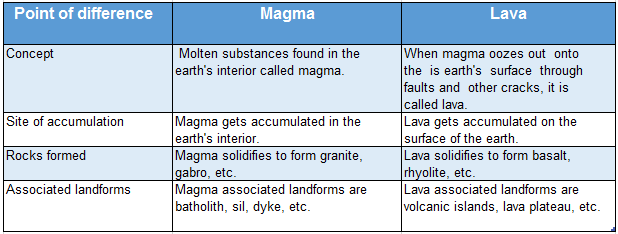
Question 9. Point out the differences between magma and lava.
Answer:

The differences between magma and lava are as follows-

WBBSE solutions For Class 8 Geography Chapter 2 Unstable Earth Topic B Volcanism Differences between magma and lava


Question 10. What are the differences between acidic lava and basic lava?
Answer:

The following differences can be found between acidic lava and basic lava-

WBBSE solutions For Class 8 Geography Chapter 2 Unstable Earth Topic B Volcanism Differences between Acidic lava and Basiclava


Question 11. Write down the differences between A’a lava and Pahoehoe lava.
Answer:

The differences between A’a lava and Pahoehoe lava are as follows-

WBBSE solutions For Class 8 Geography Chapter 2 Unstable Earth Topic B Volcanism Differences between Aa lava Pahoehoe lava


Question 12. What do you mean by a hot spring?
Answer:

Hot Spring:-

A natural spring whose water is substantially warmer than the air temperature of the surrounding region is known as a hot spring. When the groundwater reaches the hotter regions below the earth’s crust, the temperature of the water increases due to the contact with the hot magma.

WBBSE Class 8 Geography Chapter 2 Questions on Volcanism

This water comes out through the cracks on the earth’s surface. As this discharges warm or hot water, we call it a hot spring. Examples of hot springs of Bakreshwar in West Bengal, Rajgir in Bihar and Manikaran in Himachal Pradesh.

Question 13. Write a short note on the geyser.
Answer:

Geyser:-

A Geyser is a hot spring that spouts hot water and steam from the interior of the earth at fixed intervals of time.

The Old Faithful Geyser at Yellowstone National Park in the USA spouts hot water at regular intervals.

Geyser Origin:

When groundwater comes into contact with hot magma, it begins to boil and produces steam, which then erupts along with the hot water.

Due to the upwelling of hot water and steam, the pressure of the water vapour in the outlet of the geyser decreases and the cool water enters there and warms up again.

Question 14. What are hotspots?
Answer:

Hotspots:-

Radioactivity in the earth’s interior leads to an increase in temperature at some places and from here, magma comes out because of the upward movement of the convection current in the asthenosphere. These are known as hotspots.

Example-Tibesti, Hogger, and Jebel Marra of mid-Sahara are examples of hotspots along the continental plate boundary.

Hotspots Characteristics:

  1. Volcanoes may be located in hotspots.
  2. The relative movements of the hotspot volcanoes are equal to the spreading of the sea floor.
  3. There are 21 officially recorded hotspots in the world.

WBBSE Chapter 2 Topic B Volcanism Short Answer Type Questions

Question 1. Define volcanism.
Answer:

Volcanism:-

Volcanism defined as the may be a combination of the processes of upwelling of magma from the interior of the earth to the surface through cracks, joints or weak parts of the crust and the solidification of lava on the earth’s surface.

Question 2. Why is volcanism called a geo-tectonic process?
Answer:

Volcanism Called A Geo-Tectonic Process:-

Eruption of magma due to volcanism causes fragmentation, displacement and folding of rocks. Solidified lava also forms new landforms on the surface of the earth. Thus volcanism is also called a geo-tectonic process. Caldera is a result of tectonic activities.

Question 3. What do you mean by an extinct or dead volcano?
Answer:

Extinct Or Dead Volcano:-

Volcanoes are considered to be extinct when there are no indications of future eruptions. The craters of such volcanoes are filled with water forming lakes. Example- Mt. Popa in Myanmar.

Question 4. What is A’a lava?
Answer:

A’a Lava:-

The dense, sticky and viscous lava ejected from volcanoes is known as A’a lava in Hawaiian language.
This lava spreads over a distance slowly. It has thick layers fragmented into jagged blocks.

Characteristics of Volcanism for Class 8

Question 5. What is Pahoehoe lava?
Answer:

Pahoehoe Lava:-

Comparatively less viscous or highly fluid lava which spreads like sheets, is called Pahoehoe lava. It looks like twisted ropes due to rapid solidification.

Question 6. Why is volcanic eruption described as a land-building process?
Answer:

Volcanic Eruption Described As A Land-Building Process:-

Although volcanoes can cause catastrophic damage, they are also important for the formation of land. Volcanic eruptions cause fragmentation and disintegration of rocks, give rise to folds on the earth’s crust and thus create different landforms. They also give us new fertile soil.

Example-Caldera

which is a huge basin-like crater formed as a result of volcanic activities.

Question 7. What is a plume?
Answer:

Plume:-

If the temperature of the convergent boundary is higher than that of the neighbouring places, then that intra-plate region is called a hotspot. The upwelling of hot and molten magma through the asthenosphere to the hotspot is known as a plume.

WBBSE Chapter 2 Topic B Volcanism Multiple Choice Questions Choose The Correct Option

Question 1. The force that causes volcanism is

  1. Sudden endogenic
  2. Slow endogenic
  3. Sudden exogenic
  4. Slow exogenic

Answer: 1. Sudden endogenic

Question 2. Fissure eruption is found at plate boundaries that are

  1. Convergent
  2. Neutral
  3. Indefinite
  4. None of these

Answer: 2. Neutral

WBBSE Class 8 Geography Study Guide on Volcanism

Question 3. Stromboli in Lipari is a volcano that is-

  1. Active
  2. Extinct
  3. Dormant
  4. Super active

Answer: 1. Active

Question 4. The only active volcano in India is the

  1. Barren
  2. Aravallis
  3. Narcondam
  4. Nilgiris

Answer: 1. Barren

Question 5. Mt. Popa in Myanmar is a volcano that is-

  1. Dormant
  2. Extinct
  3. Active
  4. Super active

Answer: 2. Extinct

Question 6. In the Hawaiian language, the dense viscous materials that erupt from the volcanoes of Indonesia are called-

  1. Pahoehoe
  2. Poe Pa
  3. A’a
  4. Hoe-hoe-ah-ah

Answer: 3. A’a

Question 7. The predominant mineral in acidic lava is-

  1. Silica
  2. Aluminium
  3. Iron
  4. Gold

Answer: 1. Silica

Question 8. The state of basic lava is-

  1. Liquid
  2. Solid
  3. Semi-Solid
  4. Gaseous

Answer: 1. Liquid

Multiple choice Questions on Volcanism for Class 8

Question 9. Hotspots are formed in the

  1. Earth’s Crust
  2. Core
  3. Mantle
  4. seafloor

Answer: 3. Mantle

Question 10. A highly explosive volcano is called-

  1. Hawaiian type
  2. Etna type
  3. Plinian type
  4. Iceland type

Answer: 3. Plinian type

WBBSE Chapter 2 Topic B Volcanism Very Short Answer Type Questions Fill In The Blanks

Question 1. Rocks begin to melt at  ______________ °C in the mantle.
Answer: 2000

Question 2. With the upward rise of magma, the pressure and melting point ______________.
Answer: Decreases

Question 3. The eruption of the ______________  volcano destroyed the city of Pompeii in ancient Rome.
Answer: Vesuvius

Question 4. Acidic lava is more ______________ than basic lava.
Answer: Viscous

Question 5. Old Faithful of Yellowstone National Park in the USA is an example of a ______________.
Answer: Geyser

WBBSE Chapter 2 Topic B Volcanism Chapter 2 Topic B Volcanism Write True or False

Question 1. Krakatau is an active volcano.
Answer: False

Question 2. Volcanism is a type of geo-tectonic process.
Answer: True

Question 3. There is no indication of future eruption from a dormant volcano.
Answer: False

Question 4. The peak of an igneous mountain is flat.
Answer: False

Question 5. There is a hot spring in Sandeshkhali in the Sundarbans.
Answer: False

WBBSE Chapter 2 Topic B Volcanism Match The Columns

1.WBBSE solutions For Class 8 Geography Chapter 2 Unstable Earth Topic B Volcanism Match the following

Answer: 1. C, 2. B, 3. D, 4. A

WBBSE Chapter 2 Topic B Volcanism Answer In One Or Two Words

Question 1. Name one volcano in Europe.
Answer: Stromboli in Lipari island, Italy.

Question 2. What is volcanism along long cracks known as?
Answer: Fissure eruption.

Class 8 Geography WBBSE

Question 3. Which plateau in India is a result of a fissure eruption?
Answer: Deccan Plateau or Deccan Trap.

Question 4. Name an igneous mountain.
Answer: Kilauea in the Hawaiian Islands.

Question 5. Name a dormant volcano.
Answer: Fujiyama in Japan.

Question 6. Name an extinct volcano.
Answer: Paricutin in Mexico.

Question 7. Which type of lava is responsible for the formation of a conical volcano?
Answer: Acidic lava.

Question 8. Where does most of the volcanic activity of the world take place?
Answer: Pacific Ring of Fire.

WBBSE Class 8 Geography Chapter 1 Topic B Layers In The Interior Of The Earth

WBBSE Chapter 1 Topic B Layers In The Interior Of The Earth Analytical Type Questions

Question 1. What do you know about the major layers in the interior of the earth? Give a detailed account of the crust.
Answer:

Major Layers in the interior of the earth:

The region from the crust to the core, which is equal to the average radius of the earth, i.e., 6370km, is called the interior of the earth. Below the earth’s surface, the density of materials goes on increasing.

Read and Learn More WBBSE Solutions For Class 8 Geography

The interior of the earth can be divided into three layers

  1. Core
  2. Mantle and
  3. Crust.

WBBSE Solutions For Class 8 Geography Chapter 1 Interior Of The Earth Topic B Layers In The Interior Of The Earth Structure of the earth's interior


Crust:

The layer of rocks above the mantle is known as the earth’s crust. This layer is made up of lighter materials like silicon, aluminum, and magnesium, which has hardened due to differences in temperature and pressure.

WBBSE Class 8 Layers of the Earth

Constituents:

The crust is generally formed of igneous rocks like granite and basalt. The rocks of the crust are rich in various minerals. Soil lies on top of the crust.

The oxygen content of the earth’s crust is 47%, which is more than the amount present in the atmosphere. It can be found in the earth’s crust in different chemical compounds. Silicon is the second chief constituent of the earth’s crust.

Depth:

The depth of the crust is around 5km beneath the oceans and 60 km beneath the continents. So, the average depth of the crust is taken as 30km.

Temperature:

Of all the earth’s layers, the crust is the coolest.

Mobility:

An increase in temperature gives rise to a convection current in the asthenosphere, which makes the crust composed of lithospheric plates, move or drift.

WBBSE Solutions For Class 8 Geography Chapter 1 Interior Of The Earth Topic B Layers In The Interior Of The Earth The Earth's Crust


Divisions of the crust:

The crust can be divided into two parts- SIAL and SIMA.

Class 8 Geography Chapter 1 Layers Explanation

SIAL:

It is composed of silicon (Si) and aluminum (Al). It is basically the continental crust which is absent beneath the oceans and is composed of lighter rock materials like granite. It is, at places, 60 km deep. It is lighter than SIMA and is discontinuous.

SIMA:

The comparatively heavy part of the crust is called SIMA. It is formed of silicon (Si) and magnesium (Mg). The entire sea bed extends all over SIMA and so this is the oceanic crust.

This layer is mainly composed of basalt. The SIMA layer is 5 km deep with an average density of 2.9 grams/cubic cm.

WBBSE Class 8 Geography Chapter 1 Topic B Layers In The Interior Of The Earth

Question 2. Give a detailed account of the mantle of the earth.
Answer:

Mantle Of The Earth:-

The layer just below the crust, which has the same density, is known as the mantle. It consists of iron, chromium, silicon, magnesium, etc. It lies just above the core.

Divisions of the mantle:

Mantle has been divided into two parts- Nifesima or inner mantle and Crofesima or outer mantle. The inner mantle is named after its components— nickel (Ni), iron (Fe), silicon (Si), and magnesium (Mg).

Similarly, the outer mantle also gets its name from its constituent materials-chromium (Cr), iron (Fe), silicon (Si), and magnesium (Mg).

Interior of the Earth Layers for Class 8

Density:

The density of this layer ranges between 3.4-5.6 gram/cubic cm.

Depth:

The entire mantle extends up to a depth of 2900 km. The outer mantle lies between 30- 700km while the inner one lies between 700- 2900km.

Temperature:

The average temperature of the mantle is about 2000°C-3000°C.


Question 3. Give a detailed account of the earth’s core.
Answer:

Earth’s Core:-

The innermost layer which encircles the earth’s center and is after the crust and the mantle is known as the core. Due to the gravitational pull of the planet, heavier and denser materials gathered around its center.

This layer is also called the centrosphere of the earth. The core is mainly made up of very heavy metals like nickel and iron and so it is called Nife (Ni-Fe).

Divisions of the core:

The core has been divided into two layers, based on temperature, pressure, and density.

These are

  1. The inner core and
  2. The outer core.

Inner core is the layer that lies surrounds the centre of the earth and the layer which encircles the inner core is called the outer core.

Class 8 Geography Solution WBBSE

The materials present in the outer core are semi-solid, while those in the inner core are solid due to tremendous overlying pressure. The density of the inner core is much greater than that of the outer one.

The outer core rotates around the axis of the earth in a semi-solid state. Ferrous elements in this layer, being in the viscous state, develop an electromagnetic field due to very high velocity. This has led to the formation of the magnetism of the earth.

Depth:

The depth of the core is 2900km- 6370 km, out of which the outer core is nearly 2900 km-5100km deep while the inner core is nearly 5100km-6370km deep.

Temperature:

The core records about 5000°C temperature. However, the temperature does not remain uniform throughout the core.


WBBSE Solutions For Class 8 Geography Chapter 1 Interior Of The Earth Topic B Layers In The Interior Of The Earth Core of the earth


Density:

Although the density is not uniform throughout the core, the average density ranges from 9.1-13.1 grams/cubic cm.

WBBSE Class 8 Geography Earth’s Layers Questions

Question 4. Compare the three layers of the earth’s interior.
Answer: A comparative study of the layers there of the earth’s interior is given in the following table

WBBSE Solutions For Class 8 Geography Chapter 1 Interior Of The Earth Topic B Layers In The Interior Of The Earth Layers there of the earth's interior


WBBSE Chapter 1 Topic B Layers In The Interior Of The Earth Short Analytical Type Questions

Question 1. Write the differences between SIAL and SIMA.
Answer: The differences between SIMA and SIAL are

WBBSE Solutions For Class 8 Geography Chapter 1 Interior Of The Earth Topic B Layers In The Interior Of The Earth Differences between SIMA, SIAL


Question 2. Give a short account of the lines of discontinuity between various layers of the earth’s interior.
Answer:

The Lines Of Discontinuity Between Various Layers Of The Earth’s Interior:-

The place of separation where the seismic waves change their velocity from the crust to core, is called a line of discontinuity.

Understanding Earth’s Interior Layers for Class 8

There are five such lines

  1. Gutenberg Discontinuity: This exists between the core and mantle.
  2. Mohorovicic Discontinuity: This exists between the mantle and the crust.
  3. Conrad Discontinuity: This exists between the SIAL and SIMA layers.
  4. Lehman Discontinuity: between the inner core and the outer core.
  5. Repetti Discontinuity: This exists between the Nifesima and the Crofesima.

Question 3. What do you know about the asthenosphere?
Answer:

Asthenosphere:-

Asthenosphere is a definite layer that lies on the upper part of the mantle consisting of substances that are molten and soft in nature. The major plates of the earth float on this layer.

Scientists have not yet been able to define the uppermost or the lowest borders of the asthenosphere. They have developed some idea about it only after doing research on P and S waves and their movements.

It is expected that the asthenosphere can extend up to a depth of about 100-250km. P and S waves slow down here and so it is called a ‘slow layer.


WBBSE Solutions For Class 8 Geography Chapter 1 Interior Of The Earth Topic B Layers In The Interior Of The Earth Asthenosphere


Question 4. Write the differences between the outer core and the inner core.
Answer:

The differences between the outer and inner core are

WBBSE Solutions For Class 8 Geography Chapter 1 Interior Of The Earth Topic B Layers In The Interior Of The Earth Differences between Out and Inner Core

Question 5. Though the mantle and the core have nearly the same thickness, the mantle occupies 84% of the total volume of the earth. Can you say how this has happened?
Answer:

Though the mantle and the core have nearly the same thickness, the mantle occupies 84% of the total volume of the earth.

The mantle extends to about 2900 km below the earth’s crust. Below the mantle, the core covers a region which is about 3500km in radius. The core contains the heaviest metals of the earth-iron and nickel.

As they have very high density, they remain compact. On the other hand, the constituents of the mantle (Cr, Fe, Si, Mg) are less dense, and hence they spread over a larger area. So, the mantle makes up about 84% of the earth’s volume.

WBBSE Solutions For Class 8 School Science Long Answer Type Questions WBBSE Solutions For Class 8 School Science Short Answer Type Questions
WBBSE Solutions For Class 8 School Science Very Short Answer Type Questions WBBSE Solutions For Class 8 School Science Review Questions
WBBSE Solutions For Class 8 School Science Solved Numerical Problems WBBSE Solutions For Class 8 School Science Experiments Questions
WBBSE Solutions For Class 8 Maths WBBSE Class 8 History Notes
WBBSE Class 8 History Multiple Choice Questions WBBSE Solutions For Class 8 History
WBBSE Solutions For Class 8 Geography


Earth’s Discontinuity

Question 6. Why does density vary in different layers of the Interior of the Earth?
Answer:

Density Vary In Different Layers Of The Interior Of The Earth:-

We all know that the different layers of the earth have different densities. For example, the upper layer of the crust has an average density of 2.9 grams/cubic cm, the average density of mantle is 3.4-5.6 gram/cubic cm and that of the core is 9.1-13.1 gram/cubic cm.

The main causes behind this varying densities are as follows

WBBSE Class 8 Geography Chapter 1 Notes on Layers

Heavier materials gather in the centre of the earth, while lighter materials move away due to the rotation of the earth.

The earth is gradually cooling and in this process, the heavier materials are slowly settling down towards the centre of the earth.

Question 7. Explain the convection current in the asthenosphere with the help of a simple experiment.
Answer:

Convection Current In The Asthenosphere

The substances of the asthenosphere are in a molten state. These move up and down by the process of convection. The tectonic plates floating on the asthenosphere drift apart due to this process. This can be proved by a simple experiment.

Earth’s Discontinuity

WBBSE Solutions For Class 8 Geography Chapter 1 Interior Of The Earth Topic B Layers In The Interior Of The Earth Convection Process

Experimental procedure:

A wide glass beaker full of water is taken and two light wooden blocks are placed in the beaker. The entire setup is then put on a stove and after a while, it is seen that, water gets heated and starts rising up from the bottom.

As the water gradually gets heated up, the pieces of wood move away from their previous positions along the edge of the beaker.

Inference:

Similarly, the process of convection goes on in the asthenosphere which ultimately makes the plates move.

Question 8. Draw a diagram showing the layers of the earth’s interior.
Answer: The diagram showing the layers of the earth’s interior is given below


WBBSE Solutions For Class 8 Geography Chapter 1 Interior Of The Earth Topic B Layers In The Interior Of The Earth Layers of The Earth interior


WBBSE Chapter 1 Topic B Layers In The Interior Of The Earth Short Answer Type Questions

Question 1. Why do the matters lying close to the earth’s centre have greater density?
Answer:

Matters Lying Close To The Earth’s Centre Have Greater Density:-

The core of the earth is composed of heavy metals like iron and nickel. During the formation of the earth, hot and denser matter moved towards the earth’s centre due to its gravitational pull.

The lighter materials, on the other hand, like silicon ad aluminium stayed afloat and later solidified to form the crust. So, all the denser materials are lying close to the earth’s centre.

Question 2. What do you mean by crust of the earth?
Answer:

Crust Of The Earth:-

The layer of rocks above the mantle is known as the earth’s crust. Its main constituents are silicon, aluminium, and magnesium. It is a very thin layer with an average depth of 30km.

Short Answer Questions on Earth’s Layers for Class 8

Question 3. What do you mean by SIMA?
Answer:

SIMA:-

The oceanic crust is a comparatively heavy layer and mainly consists of igneous rocks like basalt. It is composed of silicon (Si) and magnesium (Mg). This layer is thus known as SIMA. The average density of this layer is 2.9 grams/cubic cm.

Question 4. What do you mean by SIAL?
Answer:

SIAL:-

The uppermost part of the crust which forms the base of the continents, is the lightest of all the layers. It mainly consists of granite. It is composed of silicon (Si) and aluminum (Al).

Hence, this layer is known as SIAL. It is a discontinuous layer and is also lighter than SIMA.

Question 5. What are lines of discontinuity?
Answer:

Lines Of Discontinuity:-

The places between the crust and the core where the seismic waves change their velocity, are called lines of discontinuity. There are several lines of discontinuity such as, Conrad discontinuity, Mohorovicic discontinuity, etc.

Question 6. Define Crofesima.
Answer:

Crofesima:-

The mantle extends from 30km-2900km, out of which, the upper part of the mantle extends from 30km-700km. This layer constitutes of chromium, iron, silicon, magnesium, etc., and hence, it is called Crofesima (Cro+Fe+Si+Ma).

Question 7. Define Nifesima.
Answer:

Nifesima:-

The lower part of the mantle, extending from about 700km-2900 km, is called Nifesima (Ni+Fe+Si+Ma), since it constitutes of nickel, iron, silicon, and magnesium.

Question 8. What are the constituents of the various layers of the earth’s interior?
Answer: The constituents of the various layers of the earth’s interior are as follows

WBBSE Solutions For Class 8 Geography Chapter 1 Interior Of The Earth Topic B Layers In The Interior Of The Earth Layers


WBBSE Chapter 1 Topic B Layers In The Interior Of The Earth Multiple Choice Questions

Choose The Correct Option

Question 1. The hard outer surface of the earth is called

  1. Plate
  2. Nife
  3. Crust
  4. Soil

Answer: 3. Crust

Question 2. The principal rock that forms the oceanic crust is

  1. Mudstone or shale
  2. Basalt
  3. Granite
  4. Dolorite

Answer: 2. Basalt

Question 3. The SIAL layer is made up of

  1. Granite
  2. Limestone
  3. Basalt
  4. Mudstone/Shale

Answer: 3. Basalt

Question 4. ________ is seen in between SIAL and SIMA layers.

  1. Gutenberg discontinuity
  2. Conrad discontinuity
  3. Moho discontinuity
  4. Lehman discontinuity

Answer: 4. Lehman discontinuity

Question 5. The distance of the mantle from the crust is about

  1. 6371km
  2. 2900km
  3. 5100km
  4. 2500km

Answer: 2. 2900km

Class 8 Geography Chapter 8 Question Answer

Question 6. The temperature of the mantle is about

  1. 1000°C-2000°C
  2. 2000°C-3000°C
  3. 5000°C-6000°C
  4. 6000°C-7000°C

Answer: 2. 2000°C-3000°C

Question 7. The upper part of the mantle (30km- 700km) is known as

  1. Nifesima
  2. Nife
  3. Crofesima
  4. SIAL

Answer: 3. Crofesima

Question 8. The lower layer of the mantle (700km- 2900km) is called

  1. Nifesima
  2. SIMA
  3. Crofesima
  4. SIAL

Answer: 1. Nifesima

Question 9. The depth of the lithosphere is about

  1. 200km
  2. 100km
  3. 50km
  4. 20km

Answer: 2. 100km

Question 10. The innermost layer of the earth is the

  1. Core
  2. Nifesima
  3. Mantle
  4. Crofesima

Answer: 1. Core

Question 11. The average density of the core is

  1. 1-5.5 gram/cubic cm
  2. 5.5-9.7 gram/cubic cm
  3. 9.1-13.1 gram/cubic cm
  4. 8.5-16.2 gram/cubic cm

Answer: 3. 9.1-13.1 gram/cubic cm

Question 12. Due to extreme heat and pressure, the materials of the inner core remain

  1. In a liquid state
  2. In a dense and elastic state
  3. In a solid state
  4. In a gaseous state

Answer: 3. In a solid state

Question 13. The distance of the core from the crust or the earth’s surface is

  1. 2900km
  2. 100km
  3. 6370km
  4. 4000km

Answer: 3. 6370km

Question 14. The depth of the core is about

  1. 4000km
  2. 3470km
  3. 2800km
  4. 99km

Answer: 2. 3470km

Question 15. The radius of the earth from the centre to the surface is about

  1. 6400km
  2. 6434km
  3. 6370km
  4. 6390km

Answer: 3. 6370km

Question 16. The radius of the core is about

  1. 2895km
  2. 3500km
  3. 3470km
  4. 6720km

Answer: 3. 3470km

Question 17. The outer core and the inner core are separated by

  1. Conrad discontinuity
  2. Gutenberg discontinuity
  3. Lehman discontinuity
  4. Mohorovicic discontinuity

Answer: 3. Lehman discontinuity

Question 18. 84% of the total area of the earth is occupied by the

  1. Core
  2. Mantle
  3. Lithosphere
  4. Hydrosphere

Answer: 2. Mantle

Class 8 Geography Chapter 8 Question Answer

WBBSE Chapter 1 Topic B Layers In The Interior Of The Earth Very Short Answer Type Questions Fill In The Blanks

Question 1. The oceanic floor, formed of silica and magnesium, is called ________.
Answer: SIMA

Question 2. The crust below the continents has a depth of ________ km.
Answer: 60

Question 3. The average depth of the earth’s crust is about ________ km.
Answer: 30

Question 4. The layer between the core and the crust of the earth is called ________.
Answer: Mantle

Question 5. The mantle extends up to a depth of ________ km from the surface of the earth.
Answer: 2900

Question 6. The outer part of the mantle is called ________.
Answer: Crofesima

Question 7. Nifesima is the ________ part of the mantle.
Answer: Inner

Question 8. The surface of separation between the mantle and the crust of the earth is called ________ Discontinuity.
Answer: Mohorovicic

Question 9. The lithosphere has a depth of ________ km.
Answer: 100

Question 10. The core is formed of ________ and ________.
Answer: Nickel, ferrous(iron)

Question 11. The approximate temperature of the centrosphere is about ________ °C.
Answer: 5000

Question 12. The average density of the core ranges from ________ gram/cubic cm.
Answer: 9.1-13.1

Question 13. The surface of separation between the core and the mantle is called ________ Discontinuity.
Answer: Gutenberg

Question 14. The constituents of the core are in a molten state but those of the mantle are in a ________ state.
Answer: viscous

Question 15. The distance between the crust and the core of the earth is ________ Km.
Answer: 6370

Question 16. The centrosphere is also known as ________.
Answer: Core/Nife

WBBSE Write True Or False

Question 1. The distance between the centre and the surface of the earth is the same as the radius of the earth.
Answer: True

Question 2. The average temperature inside the earth is about 115°C.
Answer: False

Question 3. The primary constituents of the core are silicon and magnesium.
Answer: False

Question 4. A portion of the earth’s crust (47%) constitutes of nitrogen.
Answer: False

Question 5. Convection currents in the asthenosphere cause the movement of the crustal plates.
Answer: True

Question 6. A weak layer called the asthenosphere lies just above the core.
Answer: False

Question 7. The Conrad Discontinuity separates SIAL and SIMA.
Answer: True

Question 8. The Mohorovicic Discontinuity separates Crofesima and Nifesima.
Answer: False

Question 9. The SIAL layer is basically formed of igneous rocks like granite.
Answer: True

Question 10. The SIAL is actually the oceanic crust.
Answer: False

Question 11. The crust lies above all other layers of the interior of the earth.
Answer: True

Question 12. The approximate temperature at a depth of 30km from the surface of the earth will be 760°C.
Answer: False

Question 13. The SIAL is made up of silicon, aluminum, and iron.
Answer: False

Question 14. The crust comprises of oxygen, silicon, aluminium, etc.
Answer: True

Question 15. The approximate temperature of the mantle is about 15000°C.
Answer: False

Question 16. The earth’s crust is hard and solid and the outer core is semi-solid.
Answer: True

Question 17. The core consists of metals like iron and nickel and so the earth has magnetic property.
Answer: True

Question 18. The SIMA layer is also called the asthenosphere.
Answer: False

Question 19. The radius of the earth’s core is about 3470km.
Answer: True

Question 20. The mantle is basically composed of nickel, chromium, magnesium, iron, and silicon.
Answer: True


WBBSE Chapter 1 Topic B Layers In The Interior Of The Earth Match The Columns

1. WBBSE Solutions For Class 8 Geography Chapter 1 Interior Of The Earth Topic B Layers In The Interior Of The Earth Match the Following 1

Answer: 1. B, 2. E, 3. D, 4. C, 5. A

2. WBBSE Solutions For Class 8 Geography Chapter 1 Interior Of The Earth Topic B Layers In The Interior Of The Earth Match the Following 2

Answer: 1. E, 2. C, 3. A, 4. D, 5. B


Answer In One Or Two Words

Question 1. How many layers are there in the interior of the earth and what are they?
Answer: Three layers-core, mantle and crust.

Question 2. What does oceanic crust mainly consist of?
Answer: Basalt.

Question 3. What is continental crust made up of?
Answer: Granite.

Question 4. Which one is heavier magnesium or aluminum?
Answer: Aluminium (Density of aluminium > Density of magnesium).

Question 5. Name the layer that lies above the core and below the crust.
Answer: Mantle.

Question 6. What are the divisions of the mantle?
Answer: Nifesima and Crofesima.

Question 7. What is the depth of the lithosphere?
Answer: 100km.

Question 8. In which sphere of the earth’s interior do seismic waves have the lowest velocity?
Answer: Asthenosphere.

Question 9. Where does the Lehman Discontinuity exist?
Answer: Between inner and outer core.


Choose The Correct Option

Question 1. The layer between Conrad discontinuity and Mohorovicic discontinuity is called-

  1. Sial
  2. Inner core
  3. Sima
  4. Outer core

Answer:  3. Sima

Question 2. Aesthenosphere originates from a-

  1. Greek word
  2. German word
  3. Russian word
  4. Italian word

Answer: 1. Greek word

Question 3. Convection currents in magma is found in-

  1. Sial
  2. Lower mantle
  3. Upper mantle
  4. Inner core

Answer: 3. Upper mantle

Question 4. Diameter of the earth is about-

  1. 6370km
  2. 3185 km
  3. R 6371km
  4. 12740km

Answer:  4. 12740km


Fill In The Blanks

Question 1. The plane of separation between the inner core and the outer core is the _________ discontinuity.
Answer: Lehman

Question 2. The main constituents of the core are __________ and _________.
Answer: Nickle, iron


Write True or False

Question 1. Different discontinuities are named after the person who discovered them.
Answer: True

Question 2. We know more about the mantle and the core than the earth’s crust.
Answer: False


Answer In One Or Two Words

Question 1. Which layer inside the earth is also known as the ‘zone of low velocity’?
Answer: Asthenosphere

Question 2. Who first coined the terms SIAL and SIMA?
Answer: Edward suess

Question 3. Write the name of a layer present inside the earth which can deflect seismic waves.
Answer: Outer core

Question 4. What does oceanic crust mainly consist of?
Answer: Basalt


Answer The Following Questions

Question 1. What do you mean by a line of discontinuity?
Answer:

Line Of Discontinuity:-

The places between the crust and the core where the seismic waves change their velocity, are called lines of discontinuity. There are several lines of discontinuity such as, Conrad discontinuity, Mohorovicic discontinuity, etc.

Question 2. Why does the earth have a magnetic field?
Answer:

The Earth Have A Magnetic Field:-

Due to immense heat and pressure, the outer core is in a semi-solid condition. It rotates around the axis of the earth. Ferrous elements of this layer being in develops electromagnetic field due to high velocity which, in turn, forms the magnetism of the earth.

Question 3. Differentiate between Crofesima and Nifesima.
Answer:

Differentiate Between Crofesima And Nifesima:-

WBBSE Solutions For Class 8 Geography Chapter 1 Interior Of The Earth Topic B Layers In The Interior Of The Earth Difference between Crofesima and Nifesima

WBBSE Class 8 Geography Study Guide on Layers

Question 4. Write the characteristics of the core of the earth.
Answer:

The characteristics of the core are

  1. It is almost 3500 km thick,
  2. It is composed of very heavy metals like Nickel (Ni) and Iron (Fe). Thus, it is also known as Nife.
  3. The average density of this layer ranges from 9.1-13.1 gram/ cubic cm.
  4. Average temperature of this layer is about 5000°C.
  5. Density, temperature, and pressure do not remain uniform throughout the core.


Chapter 1 Topic B Layers In The Interior Of The Earth Conceptual Questions And Answers


Who am I?


Question 1. ‘I lie below the oceans and at the base of the continents for about 5km-60km. I am composed of Si, Mg, Al, etc.-Who am I?
Answer: Crust of the earth

Question 2. ‘I am an oceanic crust, formed of silica and magnesium. I am mainly basaltic in nature.’ -Who am I?
Answer: SIMA

Question 3. I am the surface of separation between SIAL and SIMA. After studying S and P waves, an Austrian geologist had proved my existence.’ Who am I?
Answer: Conrad Discontinuity

Question 4. I am the central part of the earth, made up of Ni and Fe, and having an average temperature of 5000°C.’-Who am I?
Answer: Core of the earth


Scrambled Words

1. R D C N O A
2. S E H A N T S E O E R P H
3. N R I N E C R E O
4. I C M G A E N T
5. T R E N H S O C R E P E

Answers:

  1. CONRAD
  2. ASTHENOSPHERE
  3. INNER Core
  4. MAGNETIC
  5. CENTROSPHERE


Fill Up The Blanks In The Knowledge Hive

Question 1. Fill up the blanks in the knowledge hive with information on the Mantle.

WBBSE Solutions For Class 8 Geography Chapter 1 Interior Of The Earth Topic B Layers In The Interior Of The Earth Fill up the blanks

Answers:

  1. It extends till 2900km under the earth’s crust.
  2. The upper layer of the mantle is called asthenosphere.
  3. The density of this layer is 3.4- 5.6 gram/cubic cm.
  4. It can be further divided into two layers-Crofesima and Nifesima.
  5. The temperature of this layer is about 2000°C-3000°C.


Answer With Reference To The Illustration

Question 1. The layers of the earth’s interior are given in the diagram below. Write the name of each layer marked 1, 2, 3, 4.

WBBSE Solutions For Class 8 Geography Chapter 1 Interior Of The Earth Topic B Layers In The Interior Of The Earth earth layers

Answers:

  1. Crofesima
  2. Nifesima
  3. Outer core
  4. Inner core

2. Write the names of the different layers of the earth and the lines of discontinuity in the given diagram.


WBBSE Solutions For Class 8 Geography Chapter 1 Interior Of The Earth Topic B Layers In The Interior Of The Earth Different Layers of the earth

Answers:

  1. SIAL
  2. Conrad Discontinuity
  3. SIMA
  4. Mohorovicic Discontinuity
  5. Gutenberg Discontinuity
  6. Lehman Discontinuity
  7. Upper mantle
  8. Lower mantle
  9. Outer core
  10. Inner core


Crossword

WBBSE Solutions For Class 8 Geography Chapter 1 Interior Of The Earth Topic B Layers In The Interior Of The Earth Crossword

CLUES

Down:

1. Upper layer of the earth’s crust.
3. Hot and molten material below the crust that forms lava on cooling.

Across:

2. Lower layer of the earth’s crust.
4. Layer between the earth’s crust and the outer core.
5. One of the chief constituents of the SIAL layer.

Answers:

Down:

1. SIAL
3. MAGMA

Across:

2. SIMA
4. MANTLE
5. ALUMINIUM


Chapter 1 Topic B Layers In The Interior Of The Earth Advanced Questions And Answers

Question 1. Discuss the mechanism of capturing geothermal energy and also state the advantages and disadvantages of this energy.
Answer:


Mechanism Of Capturing Geothermal Energy:

Heat generated and stored inside the earth is called geothermal energy. This energy can be used to generate electrical energy which can be used for various purposes.

Earth Discontinuity

In areas of hot springs and volcanic regions, wells are dug to obtain the rising hot water and steam. This steam is then used to rotate a turbine which, in turn, is connected to a generator that generates electricity.

Capturing Geothermal Energy Advantages:

  1. It is a renewable and non-exhaustible form of energy.
  2. It does not cause environmental pollution.
  3. There is no wastage of energy and the maintenance cost is also very low.

Capturing Geothermal Energy Disadvantages:

  1. The initial cost of setting up the necessary infrastructure is very high.
  2. Per unit cost of production is also high.
  3. It can only meet the needs of the locally situated consumers.

Class 8 Geography Interior of the Earth Overview

Question 2. Why is the asthenosphere also known as a ‘Low-Velocity Zone’?
Answer:

The Asthenosphere Also Known As A ‘Low-Velocity Zone’:-

Immediately beneath the lithosphere, at a depth of 100km-250 km, a definite soft and molten layer is present. This is known as the asthenosphere.

This layer lies on the upper mantle. Seismic waves (P and S waves) pass relatively slowly through this layer, as compared to the overlying lithosphere. Thus, this layer is called a ‘Low-velocity Zone’ (LVZ).

Question 3. Why is the asthenosphere called a sphere of agitation or eruptions?
Answer:

Asthenosphere Called A Sphere Of Agitation Or Eruptions:-

The asthenosphere lies on the upper part of the mantle and is composed of substances that are soft and molten in nature. Magma originates in this layer due to changes in temperature and pressure in the interior of the earth.

This magma erupts through the weaker regions or faults on the surface. Landforms also change after these eruptions and so this is called a sphere of agitation or eruptions.

Chapter 1 Topic B Layers In The Interior Of The Earth Formative

Participation

This segment will indicate how much the students have actively participated and taken initiative during the class.

The interior of the Earth is made up of several layers. With reference to this, answer the following:

Question 1. How can we know about the interior of the earth?
Answer: By analysing seismic waves/ Lava from volcanic craters/…….

Question 2. How do we know that the interior of the earth is hot?
Answer: From volcanic eruptions/ Water coming out from hot springs/…

Question 3. What are the different types of seismic waves?
Answer: P wave/ S wave /…

Question 4. What are the different divisions in the interior of the earth?
Answer: The crust/ The mantle/ The core.

Question 5. Name some seismologists who discovered various discontinuities inside the earth.
Answer: Conrad/ Gutenberg/ Lehman/…

Question 6. What are the major elements present in the interior of the earth?
Answer: Iron/ Oxygen/ Silicon/…..

Question 7. How does pressure and temperature change as we proceed to the interior of the earth?
Answer: Pressure increases as we proceed further inside the earth/ Temperature increases as we proceed further inside the earth.

Interpretation And Application

This segment will test whether the students have understood the topics, or whether they are just mugging up.

Question 1. Take an iron plate and an aluminium plate of same dimension on your hand and see which one weighs heavier and why?
Answer: The iron plate weighs heavier than the aluminium plate due to greater density of the iron plate. Density of iron is 7.873 gram/cubic cm whereas that of aluminium is 2.70 gram/cubic cm.

This is the reason why an iron plate weighs more than an aluminium plate of same dimension.

Question 2. Imagine how thin the skin is with respect to the whole apple. Which portion of the apple is compared with the mantle? Which part of an apple resembles the core?
Answer:

  1. The skin of the apple can be compared to the Earth’s crust
  2. The flesh of the apple can be compared to the mantle
  3. The core of the apple, where the seeds lie can be compared to the earth’s core.


WBBSE Solutions For Class 8 Geography Chapter 1 Interior Of The Earth Topic B Layers In The Interior Of The Earth Apple

Physical Characteristics of Earth’s Layers for Class 8

Question 3. You have an idea about the exterior and interior of the earth. Which one attracts you more and why?
Answer: We live on the earth’s surface. We regularly get to see different kinds of landforms, flora and fauna. We see the lofty mountains, deserts, oceans and seas and diversity among the plants and animals.

We also get to see different human races and cultures of the world. All these things are known to us. In comparison to the exterior of the earth, the interior of the earth is quite unknown.

Nobody has been able to penetrate to the centre of the earth. We have to depend on the indirect sources to know about the interior of the earth. So, the exterior of the earth is more fascinating.

Question 4. If temperature increases by 1°C for every 33m increase in depth inside the earth, what will be the temperature of the Robinson Deep? [Average temperature on the earth’s surface = 15°C]
Answer: Depth of the Robinson Deep = 3km = 3000m
We know, for every 33m of depth, temperature increases by 1°C
∴ For every 1m of depth, temperature increases by 1/33°C
∴ For every 3000m of depth, temperature increases by 3000/33°C = 90.90°C
∴ Temperature of the Robinson Deep = 90.90°C + 15°C 105.90°C

Question 5.Find out the density of the compounds (Silicon, Aluminium, Magnesium, Iron, Chromium, Nickel) available in different layers of the earth. If required, you can take help from your teacher or your Geography book. Make a list of these compounds according to their density. Check that your list matches the division of layers of the interior of the earth.
Answer:


WBBSE Solutions For Class 8 Geography Chapter 1 Interior Of The Earth Topic B Layers In The Interior Of The Earth compounds


Surface of the earth:

It has two layers

  1. SIAL is composed of silicon and aluminium, even though aluminium’s density is more than that of magnesium.
  2. SIMA is composed of silicon and magnesium and is present beneath the SIAL. The elements in this layer have some impurities, which lead to the increase in their densities as compared to the elements of the SIAL layer.

These two layers are light, i.e., their average density is 2.2-2.9 gram/cubiccm. Thus, they form the outermost layer of the interior of the earth.

The mantle:

The outer mantle consists of silicon, magnesium, iron, and chromium. The inner mantle consists of silicon, magnesium, iron, and nickel.

The core:

It is composed of only the heaviest metals-nickel and iron. Thus, this layer is situated at the center of the earth.

Aesthetics And Creativity

This segment will check the aesthetic sense and creativity of the students.

Question 1. Make a collage by collecting incidents of volcano, earthquakes, hot springs in West Bengal or India.
Answer: A collage is made by collecting incidents of volcano, earthquakes, and hot springs in West Bengal and India-

WBBSE Solutions For Class 8 Geography Chapter 1 Interior Of The Earth Topic B Layers In The Interior Of The Earth incidents of valcano, earthquakes

Question 2. Take some cobbles, stones, and soil. Fill half a glass with water. Pour all those materials into the glass, stir them, and see what happens.
Answer:

Experimental procedure:

A clean, transparent glass with half filled water is taken. Some cobbles, stones, and soil are put into the glass and stirred thoroughly.

Observation:

The glass is left undisturbed for more than 10 minutes so that the contents in it may settle down. It is seen that the cobbles are in the bottom layer of the glass, while the stones are in the middle layer, and the soil sits at the top. Above all a layer of clear water is seen.

Conclusion:

It is understood from this experiment that cobbles are the heaviest and densest. So the bottom part of the glass is occupied by them. Next is the stone layer which occupies the middle part.

Soil particles are the lightest and so they appear at the top. Thus, it can be said that denser materials settle at the bottom due to gravitational pull while lighter materials float on the top.

WBBSE Solutions For Class 8 Geography Chapter 1 Interior Of The Earth Topic B Layers In The Interior Of The Earth Set up of The experiment

Resemblance with the earth’s structure:

Different constituents of the earth’s interior are also arranged according to their density from the earth’s crust to the centre of the earth.

Similar to the observation of the above experiment, the denser materials (iron and nickel) are found near the earth’s core whereas the lighter materials (aluminium and silicon) are found near the earth’s crust.

Question 3. Make a model of the earth’s interior with the help of a thermocol.
Answer:

1. Thermocol Materials required:

Thermocol, knife, colours, brushes, chart papers, scissors, and glue.

WBBSE Solutions For Class 8 Geography Chapter 1 Interior Of The Earth Topic B Layers In The Interior Of The Earth A model Of the earth interior


2. Thermocol Procedure:

  1. A spheroidal thermocol is taken and  from the surface.
  2. The edges are left uneven to make it similar with the surface of the earth.
  3. Next, lines are drawn to demarcate different layers of the earth’s interior on the inner side of the spheroid.
  4. These are then painted individually.
  5. Finally, labellings are done on the chart papers and stuck on the model.

WBBSE Class 8 Geography Chapter 1 Topic A Sources And Evidences About The Interior Of The Earth

WBBSE Chapter 1 Interior Of The Earth

The radius of the earth is 6370 km.

Robinson Deep is the world’s deepest mine (3-4km deep). It is a gold mine located in South Africa.

The temperature of the earth increases at a rate of about 1°C per 33 meter depth.

The deepest artificial hole dug on the surface of the earth is in the Kola Peninsula in north-western Russia. It is 12km deep.

Magma is a substance of the earth’s interior that remains in a molten and viscous state due to tremendous heat and pressure, mixed with gas and vapour.

Read and Learn More WBBSE Solutions For Class 8 Geography

When molten magma reaches the surface of the earth through any weak region or a fault, it is known as lava.

Temperature increases with depth in the result, the interior of the earth. As a tremendous heat is generated which remains stored inside the earth and is called geothermal energy.

WBBSE Class 8 Interior of the Earth Sources

The measure of mass content in a unit volume of a substance is known as its density.

The average density of the earth is only 2.6-3.3 grams/cubic cm. The average density of the matter near the earth’s interior is 11 grams/cubic cm which can increase up to 13-14 grams/cubic cm at the center. The average density of the earth is 5.5 grams/ cubic cm with respect to artificial satellites.

Seismic waves reveal information about the interior of the earth.

P waves can travel through both solids and liquids.

S waves cannot travel through liquid or semi-liquid materials.

The earth’s interior has three layers.

The layer of rocks above the mantle is called the earth’s crust. It can be further divided into SIAL and SIMA.

The oceanic crust is a heavier layer composed of silicon and magnesium. This layer is known as SIMA.

The uppermost part of the crust which forms the base of the continents is composed of silicon and aluminum. Hence, this layer is known as SIAL.

The place of separation where seismic waves change their velocity, from the crust to the core, is called a line of discontinuity.

Conrad’s discontinuity lies between SIAL and SIMA.

The layer just below the crust having the same density is known as the mantle. The mantle can be further divided into two layers-Crofesima and Nifesima.

WBBSE Solutions For Class 8 Geography Chapter 1 Interior Of The Earth Topic A Sources And Evidences About The Interior Of The Earth

Class 8 Geography Chapter 1 Evidence of Earth’s Interior

The mantle extends from about 30km- 2900km, out of which the upper part of the mantle extends from 30km-700km. It is mainly composed of chromium, iron, silicon, and magnesium, and hence, it is called Crofesima (Cro+Fe+Si+Ma).

The lower part of the mantle extending from about 700km-2000km is called Nifesima (Ni+Fe+Si+Ma) because it constitutes of nickel, iron, silicon, and magnesium.

The Mohorovicic discontinuity lies between the crust and the mantle.

The Repetti discontinuity lies between Crofesima and Nifesima.

The asthenosphere is a definite layer that lies on the upper part of the mantle consisting of substances that are molten and soft in nature.

Lithosphere is formed of the earth’s crust and upper part of the mantle.

The innermost layer which encircles the centre of the earth and is subsequent to the crust and the mantle is known as the core. It can further be divided into the inner core and the outer core.

The layer surrounding the centre of the earth is known as inner core. The layer which encircles the inner core is called outer core.

The Gutenberg discontinuity lies between the mantle and the core.

The Lehman discontinuity lies between the inner and the outer core.

WBBSE Chapter 1 Topic A Sources And Evidence About The Interior Of The Earth Short Analytical Type Questions

Question 1. By what means has man got so much knowledge about the earth’s interior?
Answer:

Man Got So Much Knowledge About The Earth’s Interior:-

We have come to know about the interior of the earth from two types of sources.

These are discussed below

Direct sources:

  1. Deep cavities, bored on the crust to take out rock materials for research
  2. Analysis of the emitted lava
  3. Research on mineral content, chemical properties, and temperature of water from hot springs.

2. Indirect sources:

  1. Analysis of the speed of seismic waves.
  2. Besides this, the gravitational force proposed by Newton has already proved that the heavier and denser materials will be found as we move toward the centre of the earth.

Question 2. Why are we unable to reach the centre of the earth?
Answer:

We Unable To Reach The Centre Of The Earth:-

We cannot reach the centre of the earth due to the following reasons

Excessive temperature:

Temperature increases with increasing depth from the earth’s surface at about 1°C/33 meter, soaring as high as 5000°C at the core.

WBBSE Class 8 Geography Interior of the Earth Questions

Enormous pressure:

Pressure also increases with increasing depth. Due to the tremendous pressure and weight of the overlying materials, we can’t reach the center of the earth.

Lack of oxygen:

If we move from the crust to the earth’s core, there is a shortage of oxygen due to the non-existence of the atmosphere.

Question 3. Why do we not get any direct information about the earth’s interior?
Answer:

We Not Getting Any Direct Information About The Earth’s Interior:-

We have been able to gather information about the earth’s interior to some limited extent. A 12km deep hole is the deepest extent to which we have been able to reach the earth’s interior directly.

However, this depth is too negligible compared to the depth of the earth (6370 km). Beyond this accessed limit, we fail to gather knowledge about the earth’s interior directly due to enormous temperature and massive pressure inside the earth.

Thus, we have to depend on the indirect sources to know about the earth’s interior.

Question 4. What is geothermal energy?
Answer:

Geothermal Energy:-

Temperature increases with depth in the interior of the earth. Usually, temperature increases at a rate of 1°C per 33 m. This tremendous heat generated and stored inside the earth is called geothermal energy.

When electricity is generated using this geothermal energy, it is called geothermal power. This power is now utilised by many nations. For example, Iceland produces 30% of its total electricity using geothermal energy.

The USA is the leading producer of electricity from geothermal energy in the world.

Sources of Information about Earth’s Interior for Class 8

Question 5. The outer surface of the earth is cool, but the earth is hot inside. Why?
Answer:

The Outer Surface Of The Earth Is Cool, But The Earth Is Hot Inside

The earth came into existence about 460 crore years ago. It was a very hot ball of fire at that stage. With time, it gradually cooled developing a hard covering all around called the crust.

However, the innermost part of the earth is still hot. The temperature there is about 5000°C. This temperature and the tremendous pressure from the overlying layers have kept the centre of the earth in a solid state.

Question 6. What are the differences between magma and lava?
Answer:

Differences Between Magma And Lava:-

The differences between magma and lave are as follows

WBBSE Solutions For Class 8 Geography Chapter 1Interior Of The Earth Topic A Differences Between Magma And Lava


Chapter 1 Topic A Sources And Evidence About The Interior Of The Earth Short Answer Type Questions

Question 1. What lies underneath the hard surface on which we stand?
Answer: We stand on the hard surface of the earth, which is known as the crust. Just below the crust, there are hot, malten, semi-solid, and solid materials, up till the centre of the earth. These form the mantle and the core.

Beneath the surface on which we stand, there lies a layer of groundwater also.

Differentiate Between Magma And Lava

Question 2. Has anyone ever seen the interior of the earth?
Answer: Man has penetrated up to a depth of 12km into the earth’s interior. Beyond this limit, it is not possible for man to directly reach the interior of the earth due to enormous pressure and temperature.

Class 8 Geography Evidence for Earth’s Layers

Thus, nobody has directly ever seen the interior of the earth.

Question 3. How much one has to dig up to see the centre of the earth?
Answer: To reach the centre of the earth, one has to dig a tunnel equal in length to the radius of the earth, i.e., 6370 km. Man’s greatest endeavour has been a 12km deep tunnel in the Kola Peninsula of north-western Russia. It is the longest artificial tunnel.

Question 4. How far has it been possible to know about the interior of the earth?
Answer: It is not possible to reach the interior of the earth directly in order to gather information about it. However, several branches of science such as Physics, Mathematics, Seismology have contributed greatly in studying the characteristics of the earth’s interior.

Question 5. What is magma?
Answer:

Magma:-

Magma is a substance of the earth’s interior that remains in a molten and viscous state due to tremendous heat and pressure, mixed with gas and vapour. The space under the crust that contains magma is called the magma chamber.

Question 6. What is lava?
Answer:

Lava:-

When molten magma reaches the surface of the earth through any weak region or a fault, it comes out in the form of lava. Thus, lava is actually an external appearance of magma on earth.

Question 7. Why is hot and molten lava ejected out of the crater of a volcano?
Answer:

Hot And Molten Lava Ejected Out Of The Crater Of A Volcano because:-

In the interior of the earth, temperature increases with increasing depth, soaring as high as 5000°C in the inner core. The pressure in this region is very high as well. Due to this, the rocks and minerals remain in a molten and viscous state.

By any chance, if there is a release of pressure, these hot and molten rock materials gush out through a vent in the form of lava which we term as a volcano.

Differentiate Between Magma And Lava

Question 8. What is a hot spring?
Answer:

Hot Spring:-

The groundwater stored in different layers of the earth gets heated and starts to boil when it comes in contact with geothermal heat.

When this hot and boiling water gushes out from underground through any weak zone or a crack on the earth’s surface, it is called a hot spring.

WBBSE Class 8 Geography Chapter 1 Notes

Question 9. Why does boiling water come out of hot springs?
Answer:

Boiling Water Come Out Of Hot Springs:-

Temperature in the interior of the earth increases with depth and so, groundwater starts boiling under extreme heat. This water comes out through the faults on the earth’s surface as hot springs. For example- Manikaran in Himachal Pradesh has such a hot spring.

Question 10. Try to know about geothermal power stations located in different parts of India.
Answer: The geothermal power stations of India are

  1. Manikaran, Himachal Pradesh
  2. Puga Valley. Ladakh
  3. Tatapani, Chhattisgarh.

Question 11. What is your idea about the density of the earth?
Answer:

Idea About The Density Of The Earth:-

The measure of mass content in a unit volume of a substance is known as its density. Hence, the density of matter is the quantity of mass present in it, in an area of one cubic cm.

Similarly, the total mass content in the entire volume of the earth is known as the earth’s density. The average density of the earth is 5.5 grams/ cubiccm with respect to artificial satellites.

Question 12. What are the different types of seismic waves produced by earthquakes?
Answer:

Different Types Of Seismic Waves Produced By Earthquakes:-

There are three types of seismic waves produced by earthquakes

  1. Por primary waves
  2. S or secondary waves and
  3. L or surface waves.

Question 13. What do you mean by P wave?
Answer:

P Wave:-

The P or primary wave is the wave that can pass through both solid and liquid materials. It is the fastest wave to reach the epicenter of an earthquake.

Question 14. What is S wave?
Answer:

S Wave:-

The S or secondary wave travels through solid materials only. It cannot travel through liquid or semi-liquid materials. It reaches the epicenter of an earthquake just after P wave.

Question 15. What do you know about the interior of the earth?
Answer:

Interior Of The Earth:-

The interior of the earth refers to the layers of the earth that lie below its surface. It can be divided into three layers

  1. The core
  2. The mantle and
  3. The crust.

Question 16. What is a crater?
Answer:

Crater:-

The topmost outlet of a volcano through which lava is ejected is called a crater. Usually, a volcano has one main crater and several sub-craters.

Understanding Earth’s Interior for Class 8 Students

Question 17. What do you mean by L wave?
Answer:

L Wave:-

L wave is a surface wave moving parallel to the crust from the epicenter of an earthquake. Although it is slower than the P and S waves, it is the most destructive and violent of all the waves.

WBBSE Solutions For Class 8 School Science Long Answer Type Questions WBBSE Solutions For Class 8 School Science Short Answer Type Questions
WBBSE Solutions For Class 8 School Science Very Short Answer Type Questions WBBSE Solutions For Class 8 School Science Review Questions
WBBSE Solutions For Class 8 School Science Solved Numerical Problems WBBSE Solutions For Class 8 School Science Experiments Questions
WBBSE Solutions For Class 8 Maths WBBSE Class 8 History Notes
WBBSE Class 8 History Multiple Choice Questions WBBSE Solutions For Class 8 History
WBBSE Solutions For Class 8 Geography


Chapter 1 Topic A Sources And Evidence About The Interior Of The Earth Multiple Choice Questions

Choose the correct option

Question 1. Robinson Deep is located in

  1. Australia
  2. Germany
  3. South Africa
  4. Argentina

Answer: 3. South Africa

Question 2. The deepest mine in the earth is a

  1. Coal Mine
  2. Diamond Mine
  3. Copper Mine
  4. Gold Mine

Answer: 4. Gold Mine

Question 3. The approximate age of the earth is

  1. 220 crore years
  2. 460 crore years
  3. 370 crore years
  4. 550 crore years

Answer: 2. 460 crore years

Multiple choice Questions on Earth’s Interior for Class 8

Question 4. The average density of the earth’s surface is

  1. 2.6-3.3 gram/cubic cm
  2. 5.0-5.5 gram/cubic cm
  3. 11.0 gram/cubic cm
  4. 13-14 gram/cubic cm

Answer: 1. 2.6-3.3 gram/cubic cm

Question 5. The seismic wave that can penetrate all the layers in the interior of the earth, is the

  1. P wave
  2. L wave
  3. S wave
  4. R wave

Answer: 1. P wave

Question 6. Who wrote the book ‘Journey to the Centre of the Earth’?

  1. Agatha Christie
  2. H. G. Wells
  3. Jules Verne
  4. A. Huxley

Answer: 3. Jules Verne

Question 7. At present, the approximate age of the universe is about

  1. 1300 crore years
  2. 1500 crore years
  3. 1400 crore years
  4. 1600 crore years

Answer: 3. 1400 crore years

Class 8 Geography Sources and Evidence of Earth’s Layers

Question 8. The most destructive surface is the- wave on the earth’s

  1. P wave
  2. S wave
  3. L wave
  4. X wave

Answer: 3. L wave

Chapter 1 Topic A Sources And Evidence About The Interior Of The Earth Fill In The Blanks

Question 1. Temperature increases by about 1°C for every ________ m increase in depth from the surface of the earth.
Answer: 33

Question 2. Geothermal energy produces approximately ________ % of the electricity in Iceland.
Answer: 30

Question 3. The degree of compactness of a substance is known as its ________.
Answer: Density

Question 4. The main source which provides knowledge about the interior of the earth is ________.
Answer: Seismic waves

Question 5. An important geothermal power plant of India is located in the state of ________.
Answer: Himachal Pradesh

Question 6. With the increase of temperature, the volume of a material ________.
Answer: Increases

Question 7. With the increase of pressure, the volume ________.
Answer: Decreases

Chapter 1 Topic A Sources And Evidence About The Interior Of The Earth Write True Or False

Question 1. The hot and molten material found inside the earth is called lava.
Answer: False

Question 2. Bakreshwar in West Bengal has a cold spring.
Answer: False

Question 3. The S wave can pass through both liquids and semi-solids.
Answer: False

Question 4. The P wave is the fastest among all the seismic waves.
Answer: True

Question 5. The P wave cannot probe into the core of the earth.
Answer: False

Question 6. Eruption of lava provides us with knowledge about the earth’s interior.
Answer: True

Class 8 Geography Solutions WBBSE

Question 7. The S wave can pass through the core of the earth.
Answer: False

Question 8. Immense heat inside the earth can generate geothermal energy.
Answer: True

Question 9. Seismology is the study of earthquakes.
Answer: True

Question 10. The velocity of seismic waves depends on the density of the materials present inside the earth.
Answer: True

Question 11. The velocity of all types of seismic waves is the same.
Answer: False

Chapter 1 Topic A Sources And Evidence About The Interior Of The Earth Match The Columns

WBBSE Solutions For Class 8 Geography Chapter 1Interior Of The Earth Topic A Match the columns

Answer: 1. D, 2. A, 3. B, 4. C

Chapter 1 Topic A Sources And Evidence About The Interior Of The Earth Answer In One Or Two Words

Question 1. Where is the deepest artificial borehole of the world located?
Answer: Kola Peninsula in north-western Russia.

Question 2. At what rate does the temperature inside the earth increase?
Answer: 1°C per 33m of depth.

Question 3. Name the hot molten material found inside the earth.
Answer: Magma.

Class 8 Geography Solutions WBBSE

Question 4. Which country in the world produces the maximum amount of electricity from geothermal energy?
Answer: The United States of America.

Question 5. Which waves help us to learn about the interior of the earth?
Answer: Seismic waves.

Question 6. Which waves can travel through any and every medium?
Answer: P waves.

Question 7. Which waves can pass only through solid medium?
Answer: S waves.

Question 8. Give another name for L waves.
Answer: Surface waves.

Chapter 1 Topic A Sources And Evidence About The Interior Of The Earth Choose The Correct Option

Question 1. The average density of the earth is

  1. 5.9gram/cubic cm
  2. 6.9 gram/cubic cm
  3. 5.5 gram/cubic cm
  4. 7.5 gram/cubic cm

Answer: 3. 5.5 gram/cubic cm

Question 2. Which of the following provides us with knowledge about the interior of the earth?

  1. Precipitation
  2. Wind velocity
  3. Human settlement
  4. Seismic waves

Answer: 4. Seismic waves

Chapter 1 Topic A Sources And Evidence About The Interior Of The Earth Fill In The Blanks

Question 1. S waves cannot penetrate the ________ of the earth.
Answer: Core

Question 2. Bakreswar in West Bengal has ________.
Answer: Hot springs

Chapter 1 Topic A Sources And Evidence About The Interior Of The Earth Write True Or False

Question 1. The inner part of the earth is easily accessible to man.
Answer: False

Question 2. Temperature decreases with the increase in depth inside the earth.
Answer: False

Chapter 1 Topic A Sources And Evidence About The Interior Of The Earth Answer The Following Questions

Question 1. What are the different types of seismic waves?
Answer:

Different Types Of Seismic Waves:-

There are three types of seismic waves produced by earthquakes

  1. Por primary waves
  2. S or secondary waves and
  3. L or surface waves.

WBBSE Class 8 Geography Chapter 1 Study Guide

Question 2. What are the different sources for acquiring knowledge about the earth’s interior?
Answer:

Different Sources For Acquiring Knowledge About The Earth’s Interior:-

The sources which provide us with knowledge about the earth’s interior are

  1. Volcanic eruptions
  2. Water from hot springs
  3. Digging boreholes and deep mining
  4. Nature of seismic waves.

WBBSE Solutions For Class 8 Geography

WBBSE Solutions For Class 8 Geography