Class 11 Chemistry Some Basic Concepts Of Chemistry

Some Basic Concepts Of Chemistry Introduction

Chemistry is an important branch of science. It deals with the source, composition, structure, and properties of matter with special reference to the physical and chemical changes that matter undergoes under different conditions.

With time, the greatest discoveries of chemistry have made human life more comfortable and have facilitated its advancement as well In the last few decades, a tremendous change in the field of chemistry has been observed.

It has become significantly vast and complex. For the convenience of research and a better understanding of the subject, it has been divided into several branches

Class 11 Chemistry Some Basic Concepts Of Chemistry Difference Branches Of Chemistry

Laws Of Chemical Combination, Atomic And Molecular Theory, Equivalent Weight

Importance And Scope Of Chemistry

Chemistry plays amajorrolein science and is often intertwined with different branches of science such as physics, biology, geology, etc. It has made many contributions to human civilization.

Principles of chemistry are found to be very useful in diverse areas such as weather patterns, biochemical processes, functioning of brains, operations of computers, etc.

Chemistry helps to fulfill human needs for food, health care products, and other materials required for improving the quality of life.

Read and Learn More WBCHSE Class 11 Chemistry

Some of the major contributions of chemistry are given below:

  1. Chemistry In Agriculture And Preservation Of Food
  2. Several chemical fertilizers like urea, ammonium sulfate, calcium nitrate, superphosphate of lime, etc. are used for better production of crops.
  3. By hydrogenation of edible oil, artificial fats (such as vanaspati) are prepared.
  4. It helps to protect crops from the harmful effects of insects and bacteria by the use of effective insecticides (such as gammexane, aldrin, parathion, etc.), herbicides, and fungicides.
  5. The use of preservatives {Example sodium benzoate, salicylic acid, potassium nitrate, sodium chloride, etc.) has helped to preserve food materials. like jam, jelly, butter, squashes, fish, offer, etc., for longer periods of time.
  6. Different chemical methods are available to indicate the presence of adulterants in order to ensure the supply of pure foodstuff.

Chemistry In Health Care And Sanitation

  1. Analgesics (For example aspirin, analgin, etc.) are used to give relief from different types of pain.
  2. Antipyretics (For example paracetamol, ibuprofen, etc.) are used to bring down body temperature during fever.
  3. Antiseptics such as Dettol, savlon, tincture of iodine, etc. are used to stop infection of wounds.
  4. Antibiotics (For example penicillin, cephalosporin, tetracycline, streptomycin, chloramphenicol) are used to curb infection and cure diseases like pneumonia, bronchitis, typhoid, tuberculosis, etc.
  5. Tranquilizers such as barbituric acid, veronal, valium, reserpine, etc. are prescribed to patients suffering from mental diseases to reduce their tension or anxiety.
  6. Anesthetics like chloroform, cocaine, novocaine, etc. are applied to patients to make surgical operations painless.
  7. Today dysentery and pneumonia have become curable by the use of penicillin and sulpha drugs.
  8. The widely used drug quinine has now been replaced by some more effective antimalarials like chloroquine, primaquine, etc.
  9. As a preventive measure against various types of diseases, vaccines are found to be used widely Example tetanus toxoid (for tetanus), TABC (for typhoid, paratyphoid A, B, and cholera), oral polio (for polio), etc.
  10. Nowadays life-saving drugs such as taxol and cisplatin are used in cancer therapy; Azidothymidine (AZT) is used for AIDS victims.
  11. Synthetic vitamins and tonics have significant contributions towards the better health of human beings.
  12. Bleaching powder, potassium permanganate, ozone gas, low concentration of chlorine, etc. are used for sterilization of water to make it suitable for drinking.
  13. Disinfectants like phenol and cresols are used to kill the micro-organisms present in drains, toilets, floors, etc.

Chemistry In Comforts, Pleasures And Luxuries

  1. The contribution of chemistry towards the betterment of human society is widely acknowledged by all and it has a profound influence on our daily life.
  2. Synthetic fibers such as terylene, nylon, rayon, dacron, orlon, etc., are used to prepare clothes that are more comfortable, durable, attractive, and easy to wash.
  3. Polythene is used for making toys, bottles, tubes, pipes, kitchen and domestic appliances, sheets for packing materials, and coated wires and cables.
  4. PVC is used for making rain-coats, hose pipes, conveyor belts, radio and TV components, insulating material for wires, cables, and other electrical goods, gramophone records, safety helmets, refrigerator components, bi-cycle, and motor-cycle mudguards, etc.
  5. Phenol-formaldehyde resin and bakelite are used for making combs, fountain pen barrels, electrical goods (switches and plugs), heater handles, telephone parts, cabinets for radio and television, etc. Films used in cameras are made of celluloid coated with suitable chemicals.
  6. Cosmetics such as cream, lipstick, sunscreen lotion, face powder, talcum powder, perfume, toothpaste, nail polish, shampoo, hair dye, etc., are all chemical substances.
  7. Soaps and detergents used for cleaning clothes are chemical substances. Bio-degradable detergents are now in use to avoid environmental pollution.
  8. Paint, varnishes, and lacquer are applied on walls, wooden furniture, and metallic articles to make them more attractive, durable, and resistant to corrosion.
  9. Articles made of iron are electroplated by nickel, chromium, silver, gold, etc., so as to prevent them from rusting and to make them more attractive and durable.
  10. Ammonia, liquid sulfur dioxide CFC, etc. are used as refrigerants in refrigerators and air-conditioners.
  11. Cement, steel, iron, etc., are widely used m the construction of multi-storeyed buildings, dams, and bridges.
  12. LPG and natural gas having high calorific value are used as smokeless fuels for cooking. Compressed natural gas (CNG) is now used as a fuel in public vehicles in metropolitan cities.

Chemistry In Industry

  1. Chemistry plays an important role in the development and growth of a number of industries. Some important examples of manufacturing processes are
  2. Extraction of metals such as iron, aluminum, zinc, copper silver, gold, etc.
  3. Refining of petroleum to produce petroleum ether, gasoline (petrol), kerosene, diesel, paraffin oil, lubricating oil, solvent naphtha, liquid paraffin, petroleum jelly, paraffin wax, etc.
  4. Plastics such as polyethylene, PVC, bakelite, polyurethanes, Teflon, etc.
  5. Synthetic fibers such as nylon, terylene, rayon, etc.
  6. Paints, varnishes, lacquer, and synthetic dyes.
  7. Cement, glass, and ceramic materials.

The dark side of chemistry: Chemistry plays a pivotal role in our daily lives and luxuries. However improper use of chemistry has a negative impact on human society. In modern times, atomic energy is mainly used in chemical warfare.

Different chemical weapons and explosives like RDX are used for terrorist activities. Drugs like cocaine, LSD, and heroin have adverse effects on the youths.

Nature Of Matter

Anything which has mass occupies some space and can be felt by one or more of our senses is called matter.

Everything around us such as aspen, pencil, wood, water, milk, air, etc., and all living beings are composed of matter.

Classification of matter: Matter can be classified in two different ways—Physical classification and Chemical classification.

Physical classification of Matter: At ordinary temperature and pressure, matter can exist in three physical states viz., solid, liquid, and gas. The constituent particles of matter in the three states can be represented as shown in.
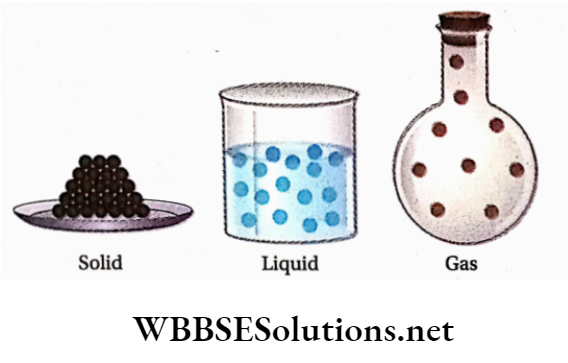
Class 11 Chemistry Some Basic Concepts Of Chemistry Arrangement Of Particles In solid, Liquid And Gaseous State

The essential points of differences between the three states of matter are given in the following table:
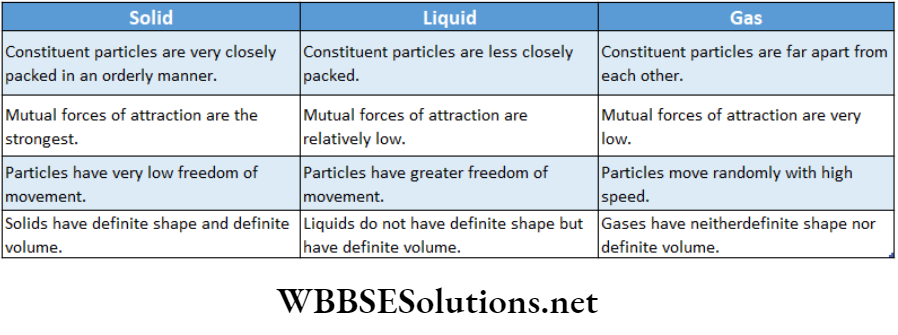
Class 11 Chemistry Some Basic Concepts Of Chemistry Soild liquid and center

A given substance can be made to exist in the solid, liquid, or gaseous state by changing the conditions of temperature and pressure.
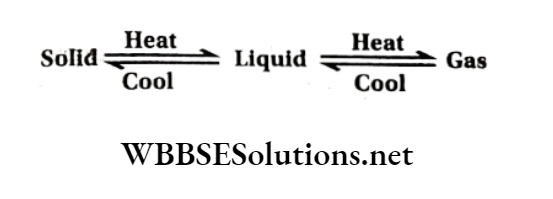
Class 11 Chemistry Some Basic Concepts Of Chemistry Soild liquid or gaseous ,temperature and pressure

Chemical classification of Matter : On the basis of chemical composition, matter can be classified into two major categories such as

  1. Mixtures and
  2. Pure substances.

These can be further subdivided as follows:

Class 11 Chemistry Some Basic Concepts Of Chemistry Matter of Mixture

A mixture is made up of two or more substances (present in any ratio) which are called its components. For example, a sugar solution consists of two components i.e., sugar and water.

In a homogeneous mixture, the components completely mix with each other and its composition remains uniform throughout.

The components of such a mixture cannot be seen even under a microscope. Some examples are air, glucose solution, seawater, petrol, etc.

In contrast to this, in heterogeneous mixtures, the composition is not uniform throughout, and sometimes the different components can be seen even by the naked eye.

For example, the mixtures of sugar and salt, sand, and iron filings are heterogeneous mixtures. The components of such mixtures can be separated by using physical methods such as filtration, crystallization, distillation, chromatography, etc.

Pure substances have characteristics different from that of the mixtures. They have fixed composition throughout the entire mass. Some examples are iron, copper, silver, gold, water, sucrose, etc.

Sucrose contains carbon, hydrogen, and oxygen in a fixed ratio and hence it has a fixed composition.

The constituents of pure substances cannot be separated by simple physical methods. Pure substances are further classified into elements and compounds.

Class 11 Chemistry Some Basic Concepts Of Chemistry

Element: An element consists of only one type of particle. The constituent particles may be atoms or molecules.

Oxygen, nitrogen, sodium, copper, silver, etc., are some examples of elements. They all contain atoms of one type.

The smallest particles (having independent existence) present in metallic elements such as sodium, potassium, etc. are called atoms.

On the other hand, the smallest possible particles (having independent existence) of some other elements (such as oxygen, nitrogen, phosphorus, etc.) are called molecules, which consist of two or more atoms.

Thus, two atoms of oxygen and four atoms of phosphorus combine separately to form molecules of oxygen and phosphorus respectively.
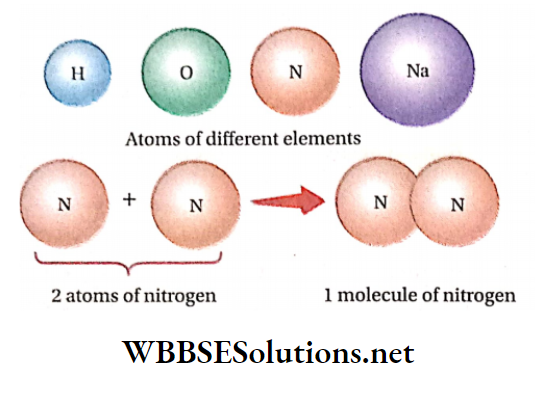
Class 11 Chemistry Some Basic Concepts Of Chemistry Representation of atoms and molecules

Two or more atoms of different elements combine together to form the molecule of a compound.

Examples of some compounds are water, carbon dioxide, ammonia, etc. The molecules of carbon dioxide and water are depicted in.
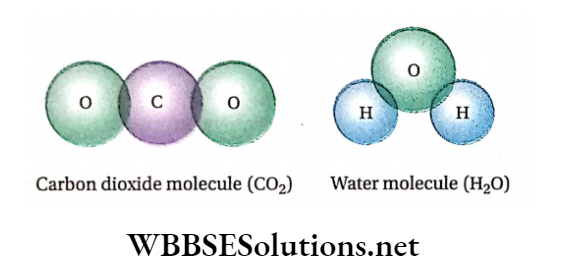
Class 11 Chemistry Some Basic Concepts Of Chemistry Structure of carbon dioxide and water molecule

A carbon dioxide molecule consists of one carbon atom and two oxygen atoms. Similarly, a molecule of water is composed of two hydrogen atoms and one oxygen atom.

It is thus seen that the atoms of different elements are present in a compound in a fixed ratio and this ratio is the characteristic of a particular compound.

It is needless to mention that the properties of a compound are completely different from those of the constituent elements.

For example, hydrogen and oxygen are gaseous substances while the compound (water) formed by their combination is a liquid at ordinary temperature.

The constituents of a compound cannot be separated by physical methods. They can, however, be separated by chemical methods.
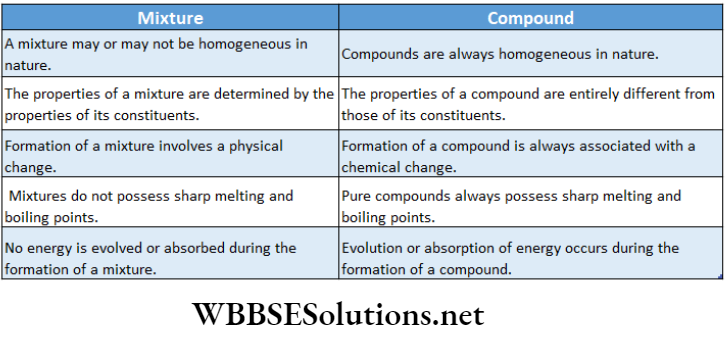
Class 11 Chemistry Some Basic Concepts Of Chemistry Difference between mixture and compound

Physical Quantities

Characteristics of matter that can be examined as a measurable quantity are called physical quantities. Example length, mass, time, temperature, area, volume, velocity, acceleration, force, etc.

Units For Measurement Of Physical Quantities

A unit is defined as the standard of reference chosen for the measurement of any physical quantity.

Example: Suppose the length of a bench is 2 meters. Here length is the physical quantity andmetre is the unit length.

The numerical magnitude ‘2’ implies that the length of the bench is two times that of the value of 1 meter (which is the standard of reference chosen for the measurement of length).

Class 11 Physics Class 12 Maths Class 11 Chemistry
NEET Foundation Class 12 Physics NEET Physics

Fundamental Units Used In Different Systems 
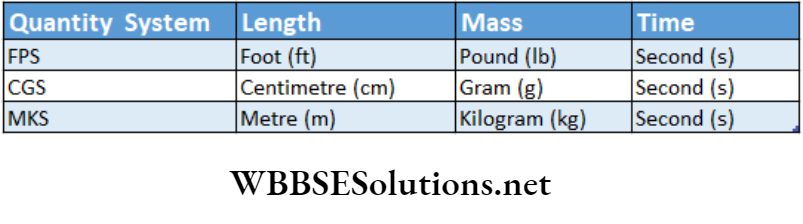
Class 11 Chemistry Some Basic Concepts Of Chemistry Fundamental Units used in different systems

 Basic physical quantities and their units in the SI system
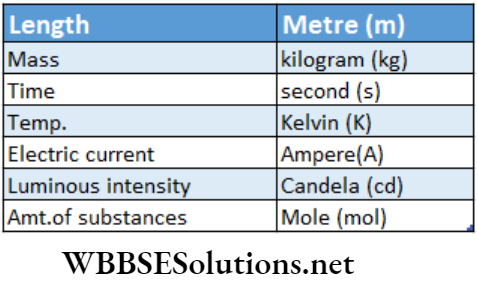
Class 11 Chemistry Some Basic Concepts Of Chemistry basic physical quantities and their units in SL System

Some Common Derived Units In CGS And SL System 
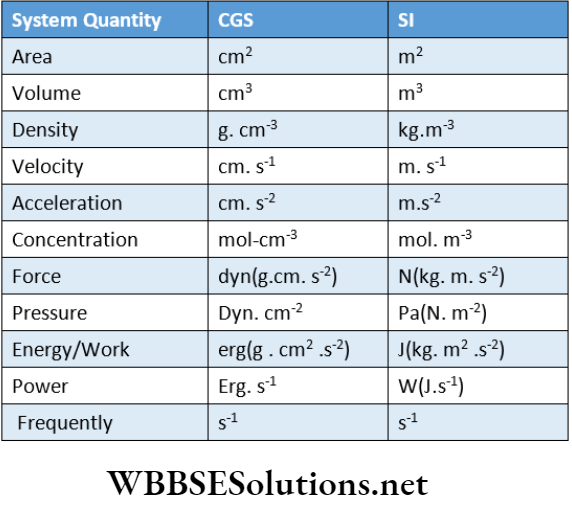
Class 11 Chemistry Some Basic Concepts Of Chemistry Some Common Dervied Units in CGS and S1 System

  • The volume of liquids is commonly measured in a liter (L) but this is not a SI unit. 1 L = 1000 mL = 1000 cm3 = 1 dm3
  • Wavelength is expressed in angstrom (A). 1A = 10-10 m

Some Commonly Used Prefixes In CGS And SI Systems 
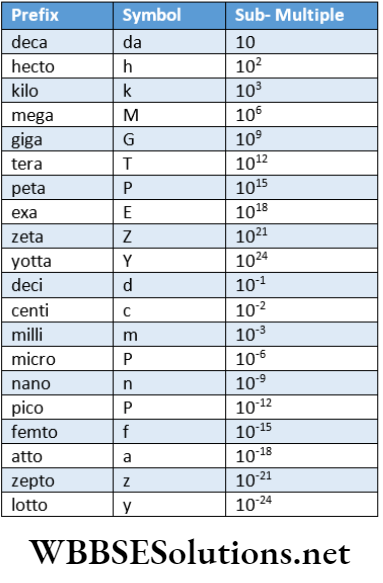
Class 11 Chemistry Some Basic Concepts Of Chemistry Some Common used prefixed in CGS And SI system

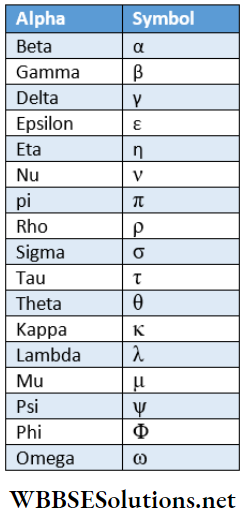
Frequently Used Greek Letters 

Class 11 Chemistry Some Basic Concepts Of Chemistry Frequently Used Greek Letters

Important points regarding the use of SI units:

  1. No dot (•) can be used in between the letters or at the end of the letters used for abbreviations of basic units. Thus, the symbol for centimeter is cm (it is neither c.m. nor cm.)
  2. Abbreviations of units do not have a plural ending. Thus, it is incorrect to write 5 ems or 12 gms. These should be 5 cm and 12 gm respectively.
  3. The abbreviations of units named after scientists start with capital letters and not with small letters. Some examples are Newton (N), Joule (J), Pascal (Pa), Ampere (A), etc. If the names are used in full instead of abbreviations then these start with small letters Example Newton, ampere, Pascal, etc.
  4. Abbreviations of other units such as meter (m), kilogram (kg), second (s), etc., start with small letters.
  5. The temperature in the kelvin scale should not be roprosonled with a degree (°). So, It Is proper to say 290K but not 2H- K.
  6. The derived units such as square meter and cubic centimeter are denoted ns m2 (but not sqm) and cm9 (but not cc) respectively.
  7. To indicate divisions, it is better to use inverse sign. However, the ‘/’ symbol can be used blit once only. One example is Kg-1.K-1 but not J/(Kg . K) or, J/Kg/K.

Conversion of physical quantities in different units involves the following steps:

1. Firstly, we have to determine a unit conversion factor, then

2. The given magnitude of the physical quantity in question, is multiplied by a suitable unit conversion factor such that all units are canceled out leaving behind only the required units.

This is illustrated by the following examples:

To express the length of a wooden pencil (say, 4 inches long) in cm: 

We know, 1 inch = 2.54 cm

∴ \(\frac{1 \mathrm{inch}}{2.54 \mathrm{~cm}}=1=\frac{2.54 \mathrm{~cm}}{1 \mathrm{inch}}\)

Here, both the ratios \(\frac{1 \mathrm{inch}}{2.54 \mathrm{~cm}} \text { and } \frac{2.54 \mathrm{~cm}}{1 \text { inch }}\) and are equal to

‘1’ because the lengths 1 inch and 2.54 cm are exactly equal to each other. Either of these ratios is called unit conversion factor or simply unit factor.

The magnitude of any quantity will remain unchanged when it is multiplied by a suitable unit conversion factor.

Based on these rules, the length of the given wooden pencil can be expressed in cm as follows:

4 inch = 4 inch x 1 (unit factor)

⇒ \(=4 \mathrm{inch} \times \frac{2.54 \mathrm{~cm}}{\text { linch }} 4 \times 2.54 \mathrm{~cm}=10.16 \mathrm{~cm}\)

Here, the quantity inch’ is multiplied by a particular unit conversion factor so that the unit ‘inch’ gets canceled out.

To express the length of an iron rod (say, 30.48 cm long)in inches:

Here, 30.48 cm = 30.48 cm x 1 (unit conversion factor)

⇒ \(=30.48 \mathrm{~cm} \times \frac{1 \mathrm{inch}}{2.54 \mathrm{~cm}}=\frac{30.48}{2.54} \mathrm{inch}=12 \mathrm{inch}\)

In this case, the given length is multiplied by the particular unit conversion factor so that the unit ‘cm’ is canceled out from the numerator and the denominator.

To express a given volume (say, 51) of water in m³

Wo know, 1 L = 1000 cm³

Again, 1m = 100 cm \(\frac{1 \mathrm{~m}}{100 \mathrm{~cm}}=1=\frac{100 \mathrm{~cm}}{1 \mathrm{~m}}\)

⇒ \(\text { So, }\left(\frac{1 \mathrm{~m}}{100 \mathrm{~cm}}\right)^3 \approx 1^3=\left(\frac{100 \mathrm{~cm}}{1 \mathrm{~m}}\right)^3\)

⇒ \(\text { So, }\left(\frac{1 \mathrm{~m}}{100 \mathrm{~cm}}\right)^3=1^3=\left(\frac{100 \mathrm{~cm}}{1 \mathrm{~m}}\right)^3\)

⇒ \(\text { or, } \frac{1 \mathrm{~m}^3}{10^6 \mathrm{~cm}^3}=1=\frac{10^6 \mathrm{~cm}^3}{1 \mathrm{~m}^3}\)

Now, 5L =(5×1000)(5×1000)cm³=5000 cm³

=5000 cm³x1(unit factor)

⇒ \(=5000 \mathrm{~cm}^3 \times \frac{1 \mathrm{~m}^3}{10^6 \mathrm{~cm}^3}\)

⇒ \(=\frac{5000}{10^6} \mathrm{~m}^3=5 \times 10^{-3} \mathrm{~m}^3\)

Accuracy And Precision

The accuracy of a measurement is the agreement of the measured value to the true value. As the difference between the measured value and the true value decreases, the accuracy of the measurement increases.

The degree of accuracy of any measurement depends upon

  1. The accuracy of the measuring device used and
  2. The skill of the operator. The difference between the measured value and the true value is called the absolute error.

Precision refers to the closeness of the results of various measurements for the same quantity.

Good precision does not necessarily mean good accuracy because various measurements may involve the same mistake repeatedly. This can be understood from the given illustration.

Let, the true value for a measurement be 2.00 g. Four different cases may arise when the actual measurements are carried out by different observers A, B, C, and D.
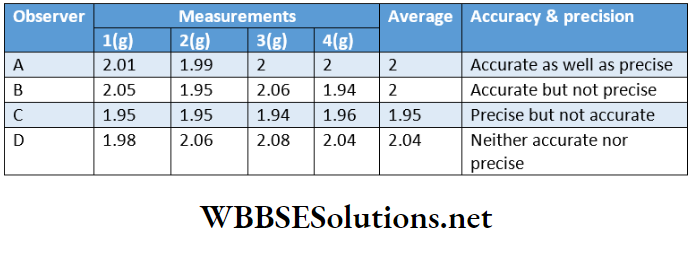
Class 11 Chemistry Some Basic Concepts Of Chemistry Accurancy And Precision

Significant Figures Definition

The total number of digits present in a number (starting from the first non-zero digit) including the last digit whose value is uncertain is called the number of significant figures.

Explanation: Suppose a student is asked to measure the length of a pencil with the aid of a meter scale (in which the closest distance between two successive marks is 0.1 cm). The student reports his experimental result as 15.4 cm.

Here the last digit (i.e., 4) of the reported result is not absolutely correct because there are two possibilities:

  • The length of the pencil may be greater than 15.3 cm but slightly smaller than 15.4 cm or
  • Its length may be much smaller than 15.5 cm but slightly greater than 15.4 cm.
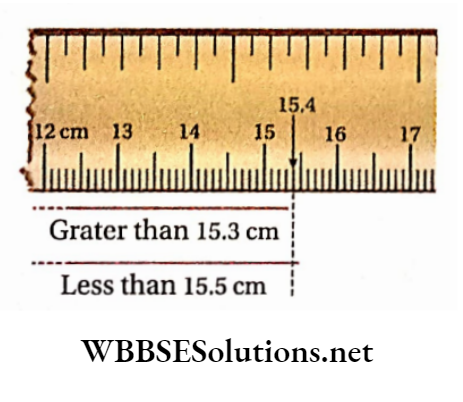
Class 11 Chemistry Some Basic Concepts Of Chemistry Signidficant mirrors

From the above discussion, it can be stated that in the above-reported value (i.e., 15.4cm) there are three significant figures [the first two digits (1 and 5) are certain and the last digit (4) is uncertain].

Example: Suppose the mass of an object measured by an analytical balance is reported to be 12.4567 g. If the accuracy of the balance is 0.0001 g, the actual mass of the object will be (12.4567 ± 0.0001 )g i.e., the value lies between 12.4566g and 12.4568g.

Thus in the reported mass, the first five digits (1,2,4,5 and 6) are certain while the last digit (7) is uncertain. This means that there are significant figures in the reported mass.

Determination of the number of significant figures: The following rules are applied in determining the number of significant figures in a measured quantity.

All non-zero digits are significant.

Examples:

  1. There are two significant figures in the number 57.
  2. In 64.5 cm, there are three significant figures.
  3. In 0.4361g, there are four significant figures.
  4. 2. Zeros between two non-zero digits are significant.

Examples:

  1. There are four significant figures in the number 8005.
  2. 12.032 g has five significant figures.
  3. Zeros to the left of the first non-zero digit are not considered to be significant.

Examples:

  1. 0.53 mL has two significant figures (5 and 3).
  2. 0.0724 kg has three significant figures (7, 2 and 4).
  3. 0.009035 has four significant figures (9, 0, 3 and 5).
  4. If a number ends with one or more zeros and these zeros are to the right of the decimal point then these zeros become significant.

Examples:

  1. 4.0 has two significant (4 and 0).
  2. 2.500 has four significant (2, 5, 0, and 0).
  3. 0.040g has two significant (4 and 0).
  4. 0.4000 km has four significant (4, 0, 0 and 0).

5. If a number ends with one or more zeros but these zeros are not to the right of a decimal point, then these zeros may or may not be significant.

Examples: 10700 g may have three, four, or five significant figures. The ambiguity can be removed by expressing the value in an exponential form of the type N x 10n, where n = an integer and N = a number with a single non-zero digit to the left of the decimal point.

Now, the number, 10700 can be expressed (in scientific notations) in three different exponential forms, thereby indicating the presence of three, four, or five significant figures in the number.

10700 = 1.07 X 10⁴ (Three significant)

= 1.070 X 10⁴ (Four significant)

= 1.0700 X 10⁴ (Five significant)

In these exponential terms, the significant figures of only the first factor {i.e., 1.07 1.070, or 1.0700) are to be counted (remembering that all zeros to the right of a decimal point are significant).

There are three significant in each of the numbers,1.54 x 10-2  and 1.54 x10⁻⁶  Similarly, there are four significant in Avogadro’s number 6.022 x 10²³.

If a whole number ends with one or more zeros then these zeros are not considered while counting the number of significant. Thus there are only three significant 43700.

If however, the said number expresses the result of any experimental measurement, then such zeros are taken into consideration while counting the number of significant. Thus, if the measured distance between two places is 3200m (taking lm as the least measurable distance) then the number of significant figures in the measured distance is four.

Exactintegralnumbers such as the number of pencils in a dozen the number of grams in a kilogram or the number of centimeters in a meter do not have any uncertainty associated with them and hence these numbers have an infinite number of significant figures.

Examples:

  • A number of pencils in a dozen = 12.0000. has an infinite number of significance.
  • The number of grams in a kilogram = 1000.0000. number of significant.

Rules For Determination Of The Number Of Significant Figures In Final Results Involving Calculations

The observed results of various measurements may have different precisions. Thus, the results obtained at various stages of the calculation are to be rounded off because the final result cannot be more precise than that of the least precise measurement.

Rounding off: The following rules are employed foregrounding offa numbers to the desired number of significant.

1. If the digit, next to the last digit to be retained, is less than 5, the last digit to be retained is left unchanged and all other digits on its right are discarded.

Example: Suppose the result of a measurement is 2.73484. This can be rounded off to give—(a) 2.7348 (for reporting the result upto four decimal places) or, (b) 2.73 (for reporting the result upto two decimal places).

If the digit, next to the last digit to be retained, is greater than 5, the last digit to be retained is increased by 1 and all other digits on its right are discarded.

Example: Suppose the result of a measurement is 2.73687. This can be rounded off to give

2.7369 (for reporting the result upto four decimal places) or, (b) 2.74 (for reporting the result upto two decimal places).

3. If the digit, next to the last digit to be retained, is equal to 5, the last digit is kept unchanged if it is even, and is increased by 1 if it is odd.

Example: Suppose the result of a measurement is 12.63585. This be rounded off to given—(a) 2.6358 (for reporting the result upto four decimal places) or, (b) 2.64 (for reporting the result upto two decimal places).

5. Calculations involving addition and subtraction: The result of an addition or subtraction should be reported to the same number of decimal places as are present in the number having the least number of decimal places. The number of significant figures of different numbers does not play any role.

5. Calculations involving multiplication and division: The result of a multiplication or division should be reported to the same number of significant figures as possessed by the least precise term involved in the calculation.

6. Calculations involving multiple operations: If a calculation involves both multiplication and division, the result should be reported with the same number of significant figures as that of the least precise number involved, other than the integral number.

Leaving the integral number 4, the least precise number 0.62 has only two significant figures. So, the final result should be reported as 0.74 (two significant figures).’

Numerical Examples

Question 1. The density of a metallic substance is 7.2 g- cm-3. Find its density in the SI unit.
Answer:

Given:

The density of a metallic substance is 7.2 g- cm-3.

⇒ \(d=\frac{7.2 \mathrm{~g}}{1 \mathrm{~cm}^3}=\frac{\frac{7.2}{1000} \mathrm{~kg}}{\left(10^{-2}\right)^3 \mathrm{~m}^3}=\frac{7.2}{1000 \times 10^{-6}}\)

= 7.2×103=7200 kg.m-3

Density in the SI unit =7200 kg.m-3

Question 2. The wavelength of radiation is 643.5 nm. Find its wavelength in the SI unit.
Answer:

Given:

The wavelength of radiation is 643.5 nm.

We know, and = 10-9m

⇒ \(\text { Unit conversion factor }=\frac{10^{-9} \mathrm{~m}}{1 \mathrm{~nm}}\)

So, the wavelength of the radiation = 643.5 nm

⇒ \(=643.5 \mathrm{~nm} \times \frac{10^{-9} \mathrm{~m}}{1 \mathrm{~nm}}=6.435 \times 10^{-7} \mathrm{~m}\)

[Here, we choose the conversion factor that has nm in the denominator]

Question 3. In diamond, the average distance between two carbon atoms is 1.54A. Express the distance between two C-atoms in the SI unit.
Answer:

Given:

In diamond, the average distance between two carbon atoms is 1.54A.

1A = 10-7m

⇒ \(\text { Unit conversion factor }=\frac{10^{-10} \mathrm{~m}}{1}\) [Here, we choose the conversion factor that has Ain the denominator]

So, the average distance between two carbon atoms

⇒ \(=1.54=1.54\times \frac{10^{-10} \mathrm{~m}}{1}=1.54 \times 10^{-10} \mathrm{~m}\)

Question 4. The atomic mass of nitrogen is 14.00674u. Find out the mass of one nitrogen atom (up to 3 significant figures).
Answer:

Given:

The atomic mass of nitrogen is 14.00674u.

Mass of 6.022 x 10²³ no. of-atoms = 14.00674g

⇒ \(\text { Mass of } 1 \mathrm{~N} \text {-atom }=\frac{14.00674}{6.022 \times 10^{23}} \mathrm{~g}=2.3259 \times 10^{-23} \mathrm{~g}\)

=2.32 x 10⁻²³g

Question 5. If the density of water is Ig/mL, then find the number of H-atoms in 45 mL water (up to 3 significant figures).
Answer:

Given:

The density of water is Ig/mL

Mass of 45 mL water = 45 g [ density of water= Ig/mL]

Number of water molecules in 18 g of water = 6.022 x 10²³

Number of-atoms in 18 g ofwater= 2 x 6.022 x 1023

[ 1 molecule of H2O contains 2 H-atoms]

Number of atoms in 45g of water

⇒ \(=\frac{2 \times 6.022 \times 10^{23} \times 45}{18}=3.011 \times 10^{24}=3.01 \times 10^{24}\)

[After after rounding up to 3 significant figures]

Question 6. The dimension of an iron block is 4.6in X 3.0in X 1.9in and the density of iron is 7.87g/cm3. Find out the mass of the iron block. [Given 1 in = 2.54 cm]
Answer:

Given:

The dimension of an iron block is 4.6in X 3.0in X 1.9in and the density of iron is 7.87g/cm3.

Mass of the iron block

⇒ \(\begin{aligned} =\left(4.6 \mathrm{in} \times \frac{2.54 \mathrm{~cm}}{1 \mathrm{in}}\right) \times(3.0 \mathrm{in} & \left.\times \frac{2.54 \mathrm{~cm}}{1 \mathrm{in}}\right) \\ & \times\left(1.9 \mathrm{in} \frac{2.54 \mathrm{~cm}}{1 \mathrm{in}}\right) \times\left(\frac{7.87}{1 \mathrm{~cm}^3}\right) \end{aligned}\)

= 3.381 x 10³g = 3.4 X 10³g [Afterrounding off]

Mass of the iron block = 3.4 X 10³g

Question 8. Express 2.64 km distance in inches. [Given 1km = 1000m, lm – 1.094 yd, 1 yd = 36 in]
Answer:

\(264 \mathrm{~km}=2.64 \mathrm{~km} \times \frac{1000 \mathrm{~m}}{1 \mathrm{~km}} \times \frac{1.094 \mathrm{yd}}{1 \mathrm{~m}} \times \frac{36 \mathrm{in}}{1 \mathrm{yd}}\)

= 1.0397 x 10⁵in = 1.04 X 10⁵in

[After rounding off up to 3 significant figures]

Laws Of Chemical Combination

Two or more substances react to form new substances. Such chemical reactions take place according to certain laws called the laws of chemical combination. These are

  1. Law of conservation of mass
  2. Law of constant proportions
  3. Law of multiple proportions
  4. Law of reciprocal proportions

Gay Lussac’s law of gaseous volumes. The first four laws deal with mass relationships while the fifth deals with the volumes of the reacting gases and products involved in the reaction.

Law Of Conservation Of Mass

Postulated by: French chemist, A. Lavoisier 1774.

Law Of Conservation Of Mass Statement

In any physical or chemical change, the total mass of the reactants is equal to that of the products,

Law Of Conservation Of Mass Explanation: Suppose two substances A and B react together to form two new substances C and D. According to the law, the sum of the masses of A and B will be equal to the sum of the masses of C and D.

Thus there will be no increase or decrease in the total mass of matter during a chemical reaction or a physical change.

So, the law can alternatively be stated as—Matter can neither be created nor be destroyed. Hence, the law is also known as the law of indestructibility matter.

Law Of Conservation Of Mass Example: Aqueous solutions of sodium chloride and silver nitrate are taken in two separate conical flasks and the flasks are weighed together in a balance.

Then, the contents of the flasks are mixed together. Consequently, a curdy white precipitate is found to be formed due to the following chemical reaction.

⇒ \(\mathrm{NaCl}+\mathrm{AgNO}_3 \rightarrow \mathrm{AgCl} \downarrow+\mathrm{NaNO}_3\)

The flasks along with the contents are again weighed together and it is noticed that there is no change in mass. This justifies the law of conservation of mass.

Law Of Conservation Of Mass Limitations:

Modification of the law of conservation of mass: According to Einstein’s theory of relativity, mass and energy are interconvertible. Mass (m) gets converted into energy (E) according to Einstein’s equation, E = me2 (where c = velocity of light).

In ordinary chemical reactions, the amount of energy released is very small and hence the law of conservation of mass holds good. In nuclear reactions, however, the change in mass is quite significant because a tremendous amount of energy is released during these reactions. So, the law of conservation of mass does not hold good.

In such cases, the total sum of mass and energy remains constant. Thus, the law of conservation of mass has been modified and the modified law is known as the law of conservation of mass energy.

The law states that mass and energy are interconvertible but the total sum of mass and energy of a system before and after any physical or chemical change remains constant.

Law Of Constant Proportions Or Definite Proportions

Postulated: French chemist, Louis Proustin 1799.

Statement A pure chemical compound always consists of the same elements (irrespective of their sources & method of preparations) combined together in the same definite proportions by mass.

Law Of Constant Proportions Explanation: Suppose compound AB is prepared by two different methods. In one method, x gram of A combines a co with y gram of B while in the other method m gram of A combines with n gram of B to form the compound AB. According to the law of constant proportions,

⇒ \(x: y=m: n, \text { or, } \frac{x}{y}=\frac{m}{n}\)

Law Of Constant Proportions Example: Pure water obtained from any natural source (For example well, river, lake, etc.) or prepared artificially (For example bypassing H2 gas over heated CuO) is always found to be made up of only two elements i.e., hydrogen and oxygen combined together in the same definite ratio of 1: 8 by mass.

The converse of the law of constant proportion is not always true: The converse of the law of constant proportions can be stated as—”When the same elements combine in a constant proportion by mass, the same compound will always be formed.”

This statement is not always correct, especially for isomeric compounds. Although the isomeric compounds have the same molecular formula, their properties are not similar. For example,

Combination of carbon, hydrogen, and oxygen in the ratio of 12: 3: 8 by mass may produce either ethyl alcohol (C2H5OH) or dimethyl ether (CH3OCH3) under different experimental conditions. But their properties are different.

A combination of carbon, hydrogen, nitrogen, and oxygen in the ratio of 12: 4: 28: 16 by mass may produce two different compounds urea (NH2CONH2) and ammonium cyanate (NH4CNO) under different experimental conditions. These two compounds have different properties.

Again, the converse of the law of constant proportion is not true for monomers and polymers. Thus, acetylene (C2H2) on polymerization gives benzene (C6H6). These two compounds contain carbon and hydrogen in the same ratio by mass (12: 1) but have different properties.

Imitations of the law of constant proportions:

If two or more isotopes of an element take part separately in the formation of a particular compound, then the same compound will contain different proportions by mass of Ihe elements depending upon its isotopic mass.

For example, In 12CO2, the ratio of the masses is C:0 = 12:32 whereas in 14C02, the ratio of the masses is C.0 = 1 4: 32.

This shows different sources of carbon dioxide may contain carbon and oxygen present in different mass ratios.

There are some compounds that have variable molecular compositions. The law of constant proportions is not applicable to such compounds.

For example, cuprous sulfide may have a molecular composition from and titanium oxide may have a composition. Such compounds are called non-stoichiometric compounds.

WBBSE Class 11 Basic Concepts of Chemistry Questions and Answers

Numerical Examples

Question 1. Analysis of 30g of compound D was found to contain 10g of element A and 20g of element IS. Again analysis of 45 g of another compound E was found to contain 15g of element B and 30g of element C. Calculate the amounts of D and E formed if 15g of A, 60g of B, and 15g of C are mixed together and allowed to react with each other. Also, calculate the total mass of the mixture after the completion of the reaction. Assume that no other reaction is possible except the reaction of B with A and separately. State which laws of the chemical combination can be utilized in the calculation.
Answer:

In compound D, mass-ratio of A to B = 10: 20 =1: 2

In compound E, the mass ratio of C = 15: 30 =1:2

Now applying the law of constant proportions we have, 15g of A combined with 2 x 15 = 30 g of B to form (15 + 30) = 45 g compound D.

Similarly, 15g of C combines with x 15 = 7.5 g of B to form (15 + 7.5) = 22.5 g compound E

∴ Amount of B remaining unreacted in the mixture

= [60 -(30+7.5)] = 22.5 g

The total mass of the mixture after completion of the reaction = Mass of D + Mass of + Mass of remaining unreacted

= 45 + 22.5 + 22.5 = 90 g.

Concepts of the law of mass action and the law of constant proportions are utilized in the calculations.

Question 2. 5g of pure MgO (obtained by reaction of metallic magnesium with oxygen) contains 3g of Mg. Again 8.5 g of pure MgO (obtained by heating MgCO3) contains 5.1g of Mg. Show that these results are in accordance with the law of constant proportions.
Answer:

Given

5g of pure MgO (obtained by reaction of metallic magnesium with oxygen) contains 3g of Mg. Again 8.5 g of pure MgO (obtained by heating MgCO3) contains 5.1g of Mg.

In the first variety of MgO, the ratio of masses of Mg to O = 3 : (5-3) = 3: 2

In the second variety of MgO, the ratio of the masses of Mg to O

= 5.1: (8.5 -5.1) =5.1 : 3.4 = 3: 2

So independent of its source, MgO always contains Mg and O in the mass ratio of 3: 2 and this is in accordance with the law of constant proportions.

Law Of Multiple Proportions

Postulated by: John Dalton in 1803.

Law Of Multiple Proportions Statement

when two elements combine with each other to form two or more compounds, then the different masses of one of the elements which combine with a fixed mass of the other, bear a simple whole number ratio (Example1: 2,1 : 2: 3,1: 3: 4 etc.).

Law Of Multiple Proportions Explanation:

Let a fixed mass of the element X combine separately with a, b, and c parts by masses of another element Y to form three different compounds A, B, and C.

So according to the law of multiple proportions, the ratio a: b: c will be a simple whole number ratio.

Law Of Multiple Proportions Example: Carbon and hydrogen combine with each other to form ethane (C2Hg), ethene (C2H4), and ethyne (C2H2).

In the formation of these three compounds, 24 parts by mass of carbon combine separately with 6 parts, 4 parts, and 2 parts by masses of hydrogen respectively.

Thus, the ratio of the masses of hydrogen which combine separately with the fixed mass of carbon (24 parts) in these compounds is =6:4:2 =3:2:1 which is a simple whole number ratio.

Exception of the law of multiple proportions: in case of simple hydrocarbons—methane (CH4), ethane (C2H6), propane (C3H8), butane (C4H10), etc., the ratio of different masses of hydrogen which combines separately with 12 parts by masses of carbon is 4: 3: 2.67: 2.5. This is not a simple whole number ratio.

Numerical Examples

Question 1. Two compounds A and B consist of tin and oxygen. Compound A contains 78.77% of tin and 21.23% of oxygen while compound B contains 88.12% of tin and 1 1.88% of oxygen. Show that these data illustrate the law of multiple proportions.
Answer:

Given

Two compounds A and B consist of tin and oxygen. Compound A contains 78.77% of tin and 21.23% of oxygen while compound B contains 88.12% of tin and 1 1.88% of oxygen.

In the formation of compound B, 11.88 parts by mass of oxygen combine with 88.12 parts by mass of tin.

21.33 parts by mass of oxygen combined with \(\frac{88.12 \times 21.23}{11.88}=157.47\) parts by mass of tin.

Thus, the ratio of the masses of tin which combine separately with fixed mass (21.33 parts) of oxygen to form the compounds A and B is given by = 78.77: 157.47 = 1:2 (approx) which is a simple whole number ratio. So, the given data illustrates the law of multiple proportions.

Question 2. Two oxides of a metal, M were heated separately in hydrogen. The water obtained in each case was carefully collected and weighed. It was observed that— O 0.725 g of the first oxide gives 0.18 g of water and 2.86 g of the second oxide gives 0.36 g of water. Show that these results are in accordance with the law of multiple proportions.
Answer:

Given

Two oxides of a metal, M were heated separately in hydrogen. The water obtained in each case was carefully collected and weighed. It was observed that— O 0.725 g of the first oxide gives 0.18 g of water and 2.86 g of the second oxide gives 0.36 g of water.

The amount of water obtained by the reduction of the first oxide =0.18 g.

Now, 18 g water contains = 16 g of oxygen

∴ 0.18g of water contains = 0.16 g of oxygen.

∴ 0.725g of the first oxide contains = 0.16 g of oxygen

So, the mass of metal in the first oxide = (0.725- 0.16)

= 0.565 g

∴ The mass of oxygen which combines with 0.565g of metal, M =0.16g.

Again, 0.36 g of water is obtained by a reduction of 2.86 g of the second oxide.

Now, 0.36 g ofwater contains \(=\frac{16 \times 0.36}{18}=0.32 \mathrm{~g}\) oxygen.

So, the amount of metal in the second oxide

=(2.86-0.32) =2.54 g

The mass of the oxygen winch combines with 2.54g of metal, M = 0.32 g.

The mass of oxygen which combines with 0.565 g of metal, \(\mathrm{M}=\frac{0.32 \times 0.565}{2.54}=0.071 \mathrm{~g}\)

Thus, the ratio of the masses of oxygen which combine separately with a fixed mass (0.565 g) of the given metal to form two different oxides is given by =0.16: 0.071 = 2:1 (approx), which is a simple whole number ratio. So, the given data are in accordance with the law of multiple proportions.

Law of reciprocal proportions

Postulated by: Richter 1792

Law of reciprocal proportions Statement

When two different elements combine separately with a fixed mass of a third element, then the ratio of their masses is either the same or some simple whole number multiple of the ratio in which they combine directly with each other.

Law of reciprocal proportions Explanation:

Suppose parts by mass of the element A and b parts by mass of the element B combine separately with a fixed mass of the element C to form the compounds X and Y respectively.

Thus, the ratio of the masses of the elements A and B which combine separately with the fixed mass of C is given by a: b. Now according to the law of reciprocal proportions, if the elements A and B combine with each other, the ratio of their masses in the resulting compound will be either a: b or xa:yb (where x andy are simple whole numbers).

Law of reciprocal proportions Example: The elements, carbon and oxygen combine separately with the third element, hydrogen to form methane (CH4) and water (H2O) respectively. Analysis shows that

1. in methene (CH4), 4 parts by mass of hydrogen combines with 12 parts by mass of carbon i.e., 1 part by mass of hydrogen combines with 3 parts by mass of carbon;

2. in water (H2O), 2 parts by mass of hydrogen combined with 16 parts by mass of oxygen i.e.,1 part by mass of hydrogen combined with 8 parts by mass of oxygen.
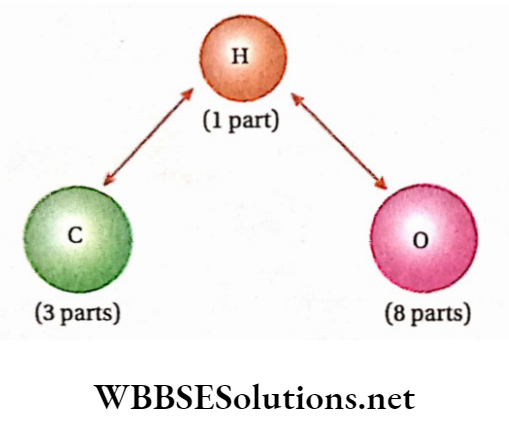
Class 11 Chemistry Some Basic Concepts Of Chemistry law of reciprocal proportions

Thus, the masses of carbon and oxygen, which combine separately with a fixed mass (1 part) of hydrogen are in the ratio of 3:8.

So, according to the law of reciprocal proportions, if carbon and oxygen combine directly with each other, the ratio of their masses in the resulting compound will be 3: 8 or some simple whole number multiple of it.

Again, carbon and oxygen directly combine to form carbon dioxide (CO2). Analysis shows that in this compound, the ratio of the masses of C to 0 is = 12: 32 = 3: 8.

This ratio is found to be the same as that has been predicted earlier. Thus, the law of reciprocal proportions is illustrated.

Again, C and 0 directly combine with each other to form another compound called carbon monoxide (CO).

Analysis shows that the ratio of the masses to O in this compound is 12: 16 = 3: 4. This is a simple whole number multiple of the ratio 3: 8 as predicted earlier, 3:4 = (3×2:8xl)

Numerical Examples

Question 1. Show that the following experimental data are in agreement with the law of reciprocal proportions :

  1. 0.46 g of Mg on burning in air forms 0.76 g of MgO.
  2. 0.41 g of Mg in reaction with excess acid produces 380 cm³ of H2 at STP.
  3. 0.16 g of H2 reacts with excess oxygen to produce 1.45g of water.

Answer:

1. Mass of oxygen 0.76 g of MgO = (0.76- 0.46) = 030g

∴ Mass of oxygen combining within of Mg \(=\frac{0.30}{0.46}\) =0.652g

2. Mass of 22400 cm³ of H2 gas (atSTP)=2g

∴ Mass of 380 cm³ of H2 gas (at STP) =\(\frac{2 \times 380}{22400}=0.034 \mathrm{~g}\)

So, the amount of H2 gas produced by 0.41g of Mg=0.034 g

Amount of H2 gas produced by lg of Mg \(=\frac{0.034}{0.41}=0.083 \mathrm{~g}\)

From (1) and (2), it is found that the masses of hydrogen and oxygen combined with or replaced by a fixed mass are in the ratio, 0.083: 0.652 1: 8 Now, according to the law of reciprocal proportions, if the elements H and O combine, the ratio of their masses in the resulting compound will be either 1: 8 or any simple multiple of it.

0.16 g of hydrogen reacts with excess oxygen to form 1.45 g of water.

∴ Mass of oxygen combined with hydrogen

= 1.45- 0.16 = 1.29 g

So, the mass ratio of H to O in water

= 0.16: 1.29=1: 8

This is the same ratio as predicted earlier.

Thus, the given data are in agreement with the law of reciprocal proportions.

Question 2. Ammonia contains 17.65% of hydrogen, water contains 11.11% of hydrogen and nitrous oxide contains 36.36% of oxygen. Show that these data illustrate the law of reciprocal proportions.
Answer:

Given

Ammonia contains 17.65% of hydrogen, water contains 11.11% of hydrogen and nitrous oxide contains 36.36% of oxygen.

In ammonia, the amount of 11 = 17.65 %.

Amount of = (100- 17.65) = 82.35 %.

So, the mass of N that combines with 1 part by the mass of H

⇒ \(=\frac{82.35}{17.65}=4.66 \text { parts. }\)

In water, the amount of present =11.11 %,

Amount of C-present = (100- 11.11) = 88.89 %

So, the mass of O that combines with part by the mass of H

⇒ \(=\frac{88.89}{11.11}=8 \text { parts. }\)

So, according to the law of reciprocal proportions, if the elements, N and O combine together, the ratio of their masses in the die compound so formed will be either 4.66: 8 (=0.5825: 1) or any simple multiple of it.

Now in nitrous oxide, the amount of present = 36.36 %,

amount of present = (100- 36.36) = 63.64 %

So, die mass-ratio of N to O in nitrous oxide

= 63.64: 36.36 = 1.75: 1 = 3 X 0.5825: 1

It is a simple multiple of the ratio, 0.5825:1 as predicted earlier. So, the given data illustrate the law of reciprocal proportions.

Gay-Lussac’s law of gaseous volumes

Postulated by: French chemist, Gay-Lussacin 1808.

Gay-Lussac’s law of gaseous volumes Definition

When gases react with each other, they always do so in volumes that bear a simple whole number ratio to one another and to the volumes of the products, if these are also gaseous, provided all volumes are measured under similar conditions of temperature and pressure.

The volumes of gaseous reactants and products are considered to be at constant temperature and pressure because the volumes of Gay-Lussac’s gases are dependent on both temperature and pressure.

So, GayLussac’s law will not be valid if volumes are not measured under the same conditions of temperature and pressure.

Gay-Lussac’s law of gaseous volumes may be considered the law of definite proportions in terms of volume.

The law of definite proportions, discussed earlier, was with respect to mass. Gay-Lussac’s law was justified theoretically by Avogadro in 1911.

Gay-Lussac’s law of gaseous volumes Example: 1 has been experimentally found that under the same conditions of temperature and pressure, 2 volumes of hydrogen reacts with 1 volume of oxygen to form 2volume of steam. So, the volumes of the reactants (H2 and O2) and the product (steam i.e., H2O) measured under identical conditions of temperature and pressure are in the proportion of 2: 1: 2 which is a simple ratio.

It has been experimentally observed that 1 volume of hydrogen gas reacts with 1 volume of chlorine gas to form 2volume of hydrogen chloride.

So, under identical conditions of temperature and pressure, the ratio of the volumes of gaseous hydrogen, chlorine, and hydrogen chloride is 1: 1: 2, which is a simple ratio.

Characteristics of Lussac’s law of gaseous volumes:

The other laws of chemical combinations interpret the chemical combinations in terms of masses of reactants and products.

But, Gay-Lussac’s law of gaseous volumes establishes the relation between the gaseous reactant(s) and product(s) in terms of their volumes.

This law cannot be explained with the help of Dalton’s atomic theory whereas the other laws of chemical combination can be successfully explained by this theory.

Numerical Examples

Question 1. 2 volumes of 03 produce 3 volumes of O2 on complete decomposition. 40 mL of a mixture of O3 and O2 is heated at first and then brought back to the previous temperature and pressure.

The volume of the gaseous mixture is now found to be 42 mL. Find the percentage composition of Og in the gas mixture by volume.

The volume of all gases is measured under the same conditions of temperature and pressure.

Answer: Let, the volume of O3 present in the mentioned gas mixture is x mL. Volume of O2 in the gas mixture = (40- x) mL. Now, the decomposition of O3 can be represented as

⇒ \(2 \mathrm{O}_3 \longrightarrow 3 \mathrm{O}_2\)

⇒ \(\begin{array}{ll}
2 \text { volume } & 3 \text { volume } \\
2 \mathrm{~mL} & 3 \mathrm{~mL} \\
1 \mathrm{~mL} & 3 / 2 \mathrm{~mL}
\end{array}\)

Hence, x mL of 03 yields (3/2)xml of O2.

So,the total volume of O2 = \((40-x)+\frac{3}{2} x=\left(40+\frac{x}{2}\right) \mathrm{mL}\)

According to the question, 03 is completely decomposed.

So, \(40+\frac{x}{2}=42\) Or,x=4

Amount of O3 in the initial mixture =4×100/40=10%

Question 2. What is the minimum volume of oxygen that must be mixed with 100mL of carbon monoxide to convert it completely into carbon dioxide in an explosion? Find the volume of carbon dioxide formed at the same temperature and pressure. The volume of all gases is measured under the same conditions of temperature and pressure.
Answer: The formation of CO2 by the explosion of a mixture of CO and O2 follows the equation given below:

⇒ \(2 \mathrm{CO}+\mathrm{O}_2 \longrightarrow 2 \mathrm{CO}_2\)

2 volume 1 volume 2 volume

(under identical conditions of pressure and temperature)

The above equation shows that under similar conditions of pressure and temperature, 2 volumes of CO react with 1 volume of02 to produce 2 volumes of C02

According to Gay-Lussac’s law of gaseous volumes, the ratio of the volumes of CO, 02, and C02 is:

2: 1: 2 = 2 x 50: 1 X 50: 2 X 50 = 100: 50: 100

Hence, 50 mL of 02 must be muted with 100 mL of CO so that CO2 formed as a result of the reaction will be 100 mL.

Question 3. Under the same pressure and temperature, a mixture of 100 mL of water gas and 100 mL of 02 is subjected to explosion. Find the composition of the gas mixture formed by an explosion under the same conditions as AllS. pressure water gas and is temperature.
Answer: Water is gas and is a temperature. m DALTON’S ATOMIC THEORY (mixture of the same volume of CO and H2 ).

So, 100 mL of water gas contains 50 mL each of CO and H2. The reactions caused by the explosion are:

⇒ \(2 \mathrm{CO}+\mathrm{O}_2 \longrightarrow 2 \mathrm{CO}_2 \cdots[1] \quad 2 \mathrm{H}_2+\mathrm{O}_2 \longrightarrow 2 \mathrm{H}_2 \mathrm{O}\)

From equation

1. it is seen that under the same conditions of temperature and pressure, 1 Volume of 02 reacts with 2 vols. of CO to form 2 vols. of CO2.

So, under the same conditions of temperature and pressure, the volume of 02 required for 50 mL of CO = 25 in and the volume of CO2 formed = 50 mL.

According to equation [2], under the same conditions of temperature and pressure, the volume of 02 required to react with 50 mL of H2 = 25 mL and the volume of water vapor, produced by the reaction = 50 mL.

Total volume of 02 used up in the two reactions = (25 + 25) = 50 mL.

Hence after explosion, both the volumes of CO2 and H20 produced is 50 mL while the volume of unreacted 02 =(100-50) = 50 ml

Understanding the Mole Concept: Questions and Answers

Dalton’s Atomic Theory

Atoms are the building blocks of matter. John Dalton developed the concept of the atom and put forward a scientific theory regarding the constitution of matter called Dalton’s atomic theory.

The theory is based on some postulates. [A postulate means a statement accepted without proof.]

Postulates Of Dalton’s Atomic Theory

  1. Matter is composed of very tiny particles called atoms.
  2. The smallest particles of an element were termed ‘simple atoms’ and that of a chemical compound were called ‘compound atoms’.
  3. Atoms are indivisible and cannot be divided by any physical or chemical means.
  4. Atoms can neither be created nor destroyed.
  5. Atoms of the same element are identical in all respects i.e., in mass, size, and other properties.
  6. Atoms of different elements are different in all respects.

Atoms take part in chemical reactions. During chemical reactions, they combine with one another in simple whole-number ratios such as 1: 1, 1: 2, 2 : 3, etc to form compound atoms (nowadays called molecules). [When we say ‘atom,’ we imply a simple atom.]

Postulates Of Dalton’s Atomic Theory Definition

The smallest indivisible, indestructible, and discrete particle of an element that retains all the physical and chemical properties of that element and takes part in chemical reactions is called an atom.

Importance of Dalton’s atomic theory

  1. According to this theory, an atom is the ultimate building block of matter. It is the first scientific approach toward the constitutional aspects of matter.
  2. The idea that all atoms of the same element are identical in mass helped to determine the atomic masses of elements.
  3. It successfully explains the laws of chemical combinations involving masses.
  4. The idea that atoms combine with one another in a simple ratio helped to determine the formulae of chemical compounds and to express chemical reactions in the form of balanced chemical equations.
  5. The idea of the indivisibility of atoms has made chemical calculations easier. Still now, in all chemical calculations, the atom is considered an indivisible unit.
  6. This theory helped Avogadro to formulate the concept of molecules and to propose molecular theory.

Limitations Of Dalton’s Atomic Theory

  1. Dalton’s atomic theory did not make any distinction between the smallest particle of the elements and that of the chemical compounds having free existence.
  2. So, this theory created confusion regarding the nature of the ultimate particles of matter.
  3. Later this confusion was dispelled by Avogadro when he first introduced the concept of molecules in the substances.
  4. According to Dalton’s atomic theory, the atom is indivisible. However, after some fundamental scientific discoveries, it has been found that an atom is composed of sub-atomic particles like electrons, protons, neutrons, etc., i.e., the atom cannot be regarded as Indivisible.
  5. In the opinion of Dalton, the atom can neither be created nor be destroyed. But this proposition is not correct as an atom of an element can be transformed artificially into an atom of another element by nuclear reactions.
  6. According to Dalton, atoms of the same element are identical in all respects while atoms of different elements are different. This postulate was proved wrong after the discoveries of isotopes and isobars.
  7. Isotopes are the atoms of the same element having different atomic masses and physical properties while isobars are the atoms of different elements having the same atomic mass.
  8. During the formation of a chemical compound, the atoms unite together in simple whole-number ratios.
  9. This statement is not valid in all cases. In the case of compounds like protein, starch, cellulose, etc.,
  10. The atoms combine In the ratio of whole numbers but the ratios are not simple. Besides, in Berthollide compounds, the atoms do not combine in the die ratio of whole numbers.
  11. Gay-Lussac’s law of gaseous volumes cannot be explained due to the absence of molecular concepts in Dalton’s atomic theory.
  12. Compounds in which die atoms of the constituent elements are present in a simple ratio of their numbers are called Daltonide compounds. For example, CO2, H2O, FeO etc.
  13. There are certain compounds in which atoms of the constituent elements do not exist in a simple ratio of their numbers. These are known as Berthollide compounds such as Cu, 7S, TI07SO, etc.

Modified Form Of Dalton’s Atomic Theory

Atom is no longer considered to be indivisible. With the discovery of radioactivity, cathode rays, etc., it has been well established that atoms are composed of minute sub-atomic particles like electrons, protons, neutrons, etc.

Atoms of an element with similar chemical properties may possess different physical properties and masses ( For Example  Isotopes).

Atoms of different elements with dissimilar properties may have Identical masses (For example Isobars such as 40Ca and 40Ar).

During the formation of a chemical compound, atoms of different elements may not combine in the ratio of simple whole numbers (e.g., sucrose: C2H22O).

Atom is no longer Indestructible. With the discovery of artificial radioactivity has been possible to convert atoms of one element into atoms of another element. For example

\({ }_7^{14} \mathrm{~N}+{ }_2^4 \mathrm{He} \rightarrow{ }_8^{16} \mathrm{O}+{ }_1^2 \mathrm{H}\)

This is called a nuclear reaction. However, the chemical reactions fail to effect any such change.

According to Dalton’s atomic theory, atoms take part in chemical reactions—which is true even today.

But, now it has been slightly modified and it is established that the electrons in the outermost shell of an atom take part in chemical reactions.

Concept Of Molecules And Avogadro’s Hypothesis

In order to correlate Dalton’s atomic theory and Gay-Lussac’s law of gaseous volumes, Berzelius, a Swedish chemist made a generalization known as Berzelius’ hypothesis.

It states that, under the same conditions of temperature and pressure equal volumes of all gases contain the same number of atoms. Application of this hypothesis to some gaseous reactions leads to the conclusion that atoms are divisible.

This is In direct conflict with DaJton’s atomic theory, which states that atoms are the smallest particles of elements and are indivisible.

Hence, scientists discarded Berzelius’ hypothesis. While Investigating the cause of the failure of Berzelius’ hypothesis an Italian scientist Amadeo Avogadro (1811) announced that it would be possible to correlate Gay-Lussac’s law of gaseous volumes with DaJton’s atomic theory if the existence of another type of minute particle, besides atom, was conjectured.

He named this minute particle a molecule. By applying this concept of molecule, he introduced the molecular theory wherein the distinction between ‘atom’ and ‘molecule’ was mentioned explicitly. In Avogadro’s opinion—

The building blocks of matter are of two kinds—one is the atom as mentioned by Dalton while the other ultimate particle molecule as mentioned by Avogadro.

A molecule refers to the ultimate particle of a substance (element or compound) that has free existence and possesses all the characteristic properties of that substance.

An atom is the ultimate particle of an element, which takes part in a chemical reaction and may or may not exist in a free state.

Molecules may be of two types viz., elementarymolecule and compoundmolecule. Elementarymolecule is formed by atoms of the same element On the other hand, atoms of different elements form a compound molecule.

Unlike an atom, a molecule may be divided into its constituent atoms which take part in any chemical reaction.

Avogadros hypothesis

Avogadros hypothesis Statement: The same conditions of temperature and pressure, equal volumes of all gases (element or compound) contain the same number of molecules.

Avogadro’s hypothesis Explanation: If ‘n’ is the number of molecules presenting 1L of hydrogen at pressure P and temperature T, then at the temperature and pressure, 1L of carbon dioxide or 1L of any other gas will also contain the ‘ri number of molecules.
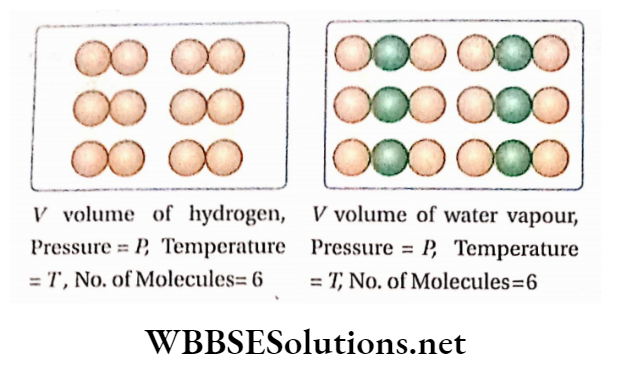
Postulates Of Dalton’s Atomic Theory

The converse statement of Avogadro’s hypothesis: All gases containing the same number of molecules will occupy the same volume under the same temperature and pressure.

Hence, if the ‘n ‘ number of hydrogen molecules occupy V volume under certain conditions of temperature and pressure, then the ‘n ‘ number of molecules of nitrogen, carbon dioxide, or ammonia will also occupy the same volume ( V), provided the temperature and pressure remain the same.

Elementary Molecule And Compound Molecule

Elementary molecule: Molecules composed of atoms of the same element are known as elementary molecules or homoatomic molecules. For example, hydrogen (H2) oxygen (O2), chlorine (Cl2), etc.

There are some solid non-metals whose molecules are composed of a single atom; example carbon (C), silicon (Si), etc., and thus monoatomic. Gases like O2, Cl2, H2, etc., are diatomic.

Again, molecules of some non-metals contain more than two atoms viz., phosphorus (P4), sulfur (S0), etc., which are polyatomic.

Compound molecule: Molecules that are composed of atoms of two or more different elements are called compound molecules or heteroatomic molecules.

For example, a water (H2O) molecule consists of 2 atoms of hydrogen and 1 atom of oxygen. Again, the sulphuric acid (H2SO4) molecule is composed of 2 atoms of hydrogen, 1 atom of sulfur, and 4 atoms of oxygen.

The number of atoms present in an elementary molecule is called the atomicity of the molecule. Thus the atomicities of argon, nitrogen, and phosphorus are 1, 2, and 4 respectively.

Correlation between Dalton’s atomic theory and Gay-Lussac’s law of gaseous volumes

Avogadro’s hypothesis helps to correlate Dalton’s atomic theory with Gay-Lussac’s law of gaseous volumes.

Formation of hydrogen chloride from hydrogen and chlorine gases: From actual experiments, it is known that under the same conditions of temperature and pressure, 1 volume of hydrogen (H2 ) combines with the volume of chlorine (Cl2) to produce 2 volumes of hydrogen chloride (HC1) gas; i.e., 1 volume of H2 +1 volume of Cl2 = 2 volume of HCl
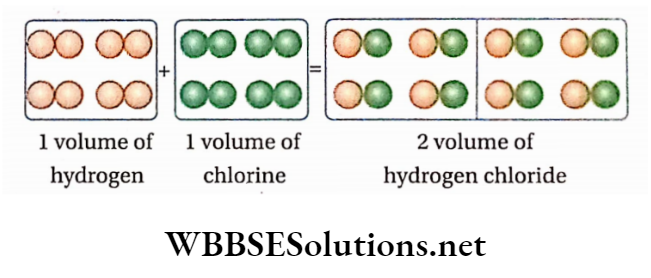
Class 11 Chemistry Some Basic Concepts Of Chemistry At the same T and P, 1 volume of hydrogen reacts with 1 volume of cholorine to form 2 volume of hydrogen choloride

If under the experimental conditions of temperature and pressure, 1 volume of H2 contains the ‘n’ number of molecules, then according to Avogadro’s hypothesis, at the same temperature and pressure, 1 volume of Cl2 and 2 vols. of HC1 will contain ‘n ’ number of chlorine molecules and 2n number of hydrogen chloride molecules respectively

So, ‘n’ molecules of H2 +’n’ molecules of Cl2 = 2n molecules of HC1

or, 1 molecule of H2 +1 molecule of Cl2 = 2 molecules of HC1

i.e.,1/2 molecule of H2 molecule of Cl2 =1 molecule of HC1.

It has been later proved by Avogadro’s hypothesis and other experiments that elementary gases such as hydrogen, chlorine, nitrogen, oxygen, etc. are diatomic, i.e., each molecule of these gases contains two atoms only.

Therefore, 1/2 molecule of hydrogen =1 atom of hydrogen and, 1/2 molecule of chlorine = 1 atom ofchlorine Thus, the combination of one atom of hydrogen with an atom of chlorine yields one molecule of hydrogen chloride.

This deduction does not. contradict Dalton’s atomic theory because an atom is indivisible but a molecule may be divisible.

Indeed, during the chemical reaction, the molecules of hydrogen and chlorine split into their respective atoms and these atoms combine in a simple ratio to form a hydrogen chloride molecule.

Again, when Gay-Lussac’s law is applied to this gaseous reaction, the ratio of the volume of the reactants and the product becomes, H2: Cl2: HC1 =1:1: 2—it is a simple whole number ratio.

Thus in the case of the above chemical reaction, it is seen that Avogadro’s hypothesis successfully correlates Gay-Lussac’s law of gaseous volumes with Dalton’s atomic theory.

Deduction of Gay-Lussac’s law of gaseous volumes with the help of Avogadro’s hypothesis

Gay-Lussac’s law of gaseous volumes can be deduced with the help of Avogadro’s hypothesis in the following way.

Let, a molecules of a gas A, react with b molecules of another gas B, to form c molecules of another gas C at a particular temperature and pressure, where a, b, and c are small whole numbers.

Now, let’s assume that under the experimental conditions of temperature and pressure, the unit volume of gas A contains n number of molecules. So, according to Avogadro’s hypothesis, at the same temperature and pressure, the unit volume of each of the gases B and C will also contain n number of molecules.

Let n number of molecules of gas A occupy1 volume.

A number ofmolecules of gas A occupy \(\frac{a}{n}\) volume.

Similarly, b number of molecules of gas B occupy \(\frac{b}{n}\) volume.

and c number ofmolecules ofgas C occupy \(\frac{c}{n}\) volume.

Thus, the ratio of the volumes of the reacting gases, A and B to that of the gaseous product, \(C=\frac{a}{n}: \frac{b}{n}: \frac{c}{n}=a: b: c\) which is a simple ratio because a, b and c are small whole numbers.

Thus, it is observed that under the same conditions of temperature and pressure, the reacting gases combine in a simple proportion by volume and the volumes of the ga product(s) also maintain a simple ratio with the volumes of the gaseous reactants.

Therefore, the law of gaseous volumes as expressed by Gay-Lussac is established.

Modified Form of Dalto’s atomic theory based on Avogadro’s hypothesis: Molecular concept of matter.

With the introduction of Avogadro’s concept, modification of the atomic concept of matter became unavoidable.

The modified concept came to be known as the molecular concept or atomic-molecular concept of matter.

The newly embodied concept regarding the constitution of matter and its related properties is summarised below.

  1. The smallest particles of an element that take part in chemical reactions are known as atoms. Atoms may or may not have independent existence.
  2. The ultimate particles of a substance, element, or compound that can exist in the free state and possess all the physical and chemical properties of that substance are called molecules.
  3. Generally, molecules are composed of two or more atoms. Atoms of the same element form elementary’ molecules (For example H2 Cl2, N2, etc.) while atoms of different elements constitute a compound molecule (for example; H2O HNO3, etc.).
  4. Molecules are divisible.
  5. Molecules ofthe same substance are identical in mass and properties but the molecules of different substances differ in mass and properties.
  6. During chemical reactions, the participating molecules react in a simple ratio of their numbers to form molecules of new substances. However, the molecules do not react directly. At first, the reacting molecules split into their respective atoms which in turn combine mutually in a simple ratio to form molecules of a new substance.
  7. The formation of HCI gas by the combination of HCl2 is shown below pictorially.
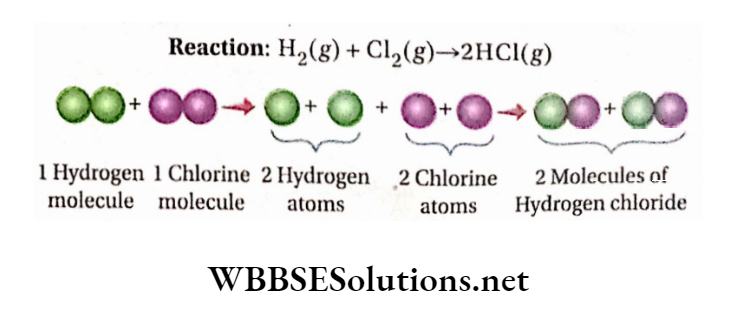
Class 11 Chemistry Some Basic Concepts Of Chemistry At the same T and P, 1 molecucule of H2 combines with 1 molecule of CL2 to form 2 Molecules of HCL

Definition of molecule on the basis of Avogadro’s hypothesis

The ultimate particle of a substance (element or compound) that can exist in the free state and possesses all the properties of that substance is called the molecule of that substance.

Can Avooadro’s hypothesis be considered as a law?

Avogadro’s hypothesis originated from mere imagination. Even till now, it has not been verified by any direct experiment But the validity of this hypothesis has been well established indirectly with the help of various experiments.

The conclusions resulting from the application of this hypothesis have always been proved errorless.

No experimental results ever challenged the validity of this hypothesis. That is why, Avogadro’s hypothesis is, nowadays, called Avogadro’s law.

Atomic Mass Or Atomic Weight

The absolute mass of an atom of any element is so small that it cannot be weighed directly with the help of a chemical balance.

Moreover, it is inconvenient to express such a small mass. Thus, the mass of an atom of an element is expressed in terms of relative mass and this relative mass is called atomic mass.

Different Scales Of Atomic Mass

  • In order to determine the relative mass of an atom of any element, it is necessary to take an element as a standard of reference.
  • For this purpose, elements like hydrogen, and carbon are considered as the standard elements.

Hydrogen scale: At first, hydrogen was regarded as the standard element for determining the atomic masses of elements.

Hydrogen scale Definition The Atomic mass of an element may be defined as a relative number that shows how many times an atom of the element is heavier than one atom of hydrogen, taking the mass of hydrogen as unity.

⇒ \(\text { Atomic mass of an element }=\frac{\text { mass of } 1 \text { atom of the element }}{\text { mass of } 1 \text { atom of hydrogen }}\)

Example: The statement ‘atomic mass of sodium is 23 signifies that one atom of sodium is 23 times heavier than one atom of hydrogen.

Oxygen scale: Later on, instead of hydrogen, oxygen was considered the standard. In the oxygen scale, the atomic mass of an element is defined as follows.

Oxygen scale Definition The Atomic mass of an element is a relative number that denotes how many times an atom of the element is heavier than the l/16th part of the mass of an oxygen atom.

\(\begin{aligned}
\text { Atomic mass of an element } & =\frac{\text { mass of } 1 \text { atom of the element }}{\frac{1}{16} \times \text { mass of } 1 \text { atom of oxygen }} \\
& =\frac{\text { mass of } 1 \text { atom of the element }}{\text { mass of } 1 \text { atom of oxygen }} \times 16
\end{aligned}\)

Example: The statement ‘the atomic mass of nitrogen is 14’ implies that an atom of nitrogen is 14 times heavier than 1/16 the part of the mass of an oxygen atom.

Reasons for taking oxygen as standard Instead of hydrogen:

  1. Most of the elements, metals, in particular, react with oxygen compared to hydrogen to form stable compounds.
  2. As hydrogen is the lightest of all elements, slight experimental errors in the determination of atomic masses in the H-scale become erroneous.
  3. Atomic masses of elements determined in the O-scale are mostly whole numbers compared to the fractional values as obtained from H -the scale.

Carbon (12C) scale: At present, carbon has been accepted as the standard element. This scale has been approved by the international organization 1UPAC.

On the die scale, the mass of one 12C atom is taken as 12. [On this basis the relative mass of hydrogen comes out to be 1,008 and that ofoxygen is 15.994 (or roughly 16).

Carbon (12C) scale Definition: The atom’s mass of an element is a relative number which denotes how many times an atom of that particular element is heavier than l/12th part of the mass of one 12 C atom.

That is the atomic mass of an element

⇒ \(\begin{aligned}
& =\frac{\text { mass of } 1 \text { atom of the element }}{\frac{1}{12} \times \text { mass of } 1 \text { carbon }\left({ }^{12} \mathrm{C}\right) \text { atom }} \\
& =\frac{\text { mass of } 1 \text { atom of the element }}{\text { mass of } 1 \text { carbon }\left({ }^{12} \mathrm{C}\right) \text { atom }} \times 12
\end{aligned}\)

Since the atomic mass of an element is the ratio of two Atomic masses of some elements in different scales masses, it is in fact relative atomic mass, it has no unit and is expressed as a pure number.

Physical and chemical scales of atomic mass: Natural oxygen consists of 3 isotopes:leO (99.759%),170 (0.037%) and 180 (0.204%). So, the true atomic mass i.e., the average atomic mass of natural oxygen

= 16×0.99759 +17×0.00037 +18 X 0.00204 = 16.00204

But the atomic mass ofthe most abundant isotope (160) of natural oxygen = 16. Chemists take the average atomic mass of natural oxygen as the standard of reference to prepare the chemical scale of atomic mass and physicists take the atomic mass of the most abundant isotope of natural oxygen as the standard of reference to prepare the physical scale of atomic mass.

Almost all elements have isotopes, therefore, in place of ‘mass of atom; ‘average mass of an atom’ is to be used.

The chemical scale of atomic mass: The scale of atomic mass, which is obtained by taking the average mass of an atom of natural oxygen as 16.0000, is called the chemical scale of atomic mass and the atomic mass, as obtained by this scale, is known as the chemical atomic mass of that element.

Physical scale of atomic mass: The scale of atomic mass, which is obtained by taking the mass of a lsO isotope in natural oxygen as 16.0000, is called the physical scale of atomic mass and the atomic mass, as obtained by this scale, is known as physical atomic mass.

According to the physical scale, the average atomic mass of natural oxygen = 16.00447. However according to the chemical scale, the average atomic mass of natural oxygen = 16.0000. So, 16.0000 units in the chemical scale = 16.00447 units in the physical scale.

1 unit in chemical scale =16.00447/16.0000=1.0002794 in physcial Scale.

Thus, the magnitude of the average atomic mass of an element on the chemical scale is slightly less than that of the mass of an atom ofthe element’s physical scale of atomic mass.

1.0002794 is the conversion factor that is used to convert the chemical atomic mass of an element to its physical atomic mass and vice-versa.

Atomic mass on a physical scale = 1.0002794 x Atomic mass on a chemical scale.
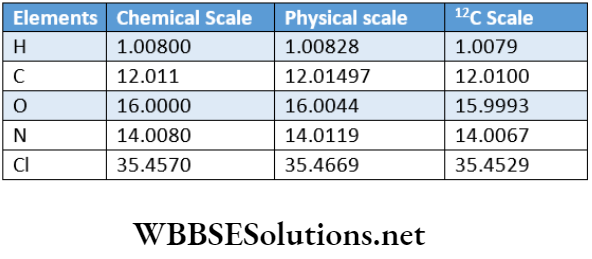
Class 11 Chemistry Some Basic Concepts Of Chemistry Atomic Masses Of Some elements In Different Scales

Atomic mass unit (AMU)

The atomic mass of an element is a relative number and it has no unit. So, the atomic mass of an element does not stand for the absolute or actual mass of an atom of that element order to express the actual mass of an atom, scientists introduced another unit. This unit is termed an atomic mass unit (AMU).

Atomic mass unit Definition: The unit with respect to which the actual atom of any element is expressed and whose value is equal to the mass of l/12th part of the mass of one 12C atom is called the atomic mass unit.

Atomic mass unit= \(\frac{1}{12}\) x actual mass of one C atom.

Mathematical expression: Actual mass of 6.022 x 10²³ atoms of 12C isotope = 12 g.

⇒ \(\begin{aligned}\quad \text { Actual mass of one }{ }^{12} \mathrm{C} \text { atom } & =\frac{12}{6.022 \times 10^{23}} \mathrm{~g} \\
\text { So, atomic mass unit }(1 \mathrm{amu}) & =\frac{1}{12} \times \frac{12}{6.022 \times 10^{23}} \mathrm{~g} \\
& =1.6605 \times 10^{-24} \mathrm{~g}
\end{aligned}\)

1 amu = 1.6605×10⁻²⁴g=1.6605×10⁻²⁷kg

The actual mass of an atom: Atomic mass of an element

⇒ \(\begin{aligned}
& =\frac{\text { mass of } 1 \text { atom of the element }}{\text { mass of } 1 \text { carbon }\left({ }^{12} \mathrm{C}\right) \text { atom } \times \frac{1}{12}} \\
& =\frac{\text { mass of } 1 \text { atom of the element }}{1 \mathrm{amu}}
\end{aligned}\)

The actual mass of an atom of an element
= atomic mass ofthe element x 1 amu
= atomic mass ofthe element x 1.6605 x 10
100-24g

Thus, the atomic mass of an element, multiplied by 1 amu gives the actual mass of an atom of that element.

Examples: 1 Actual mass of atom of hydrogen

= 1.008 amu = 1.008 x 1.6605 x 10-24 g

2. Actual mass of atom of nitrogen

= 14 amu = 14 x 1.6605 x 10-24 g

The actual mass of an atom of oxygen

= 16 amu = 16 x 1.6605 x 10-24 g

In recent times, a new symbol ‘u’ (which signifies unified mass) is used in place of amu (Le., atomic mass unit)

Therefore Mass of1 H-atom = 1.008u (le., 1.008 amu)

The atomic mass of an element and the actual mass of an atom of an element are completely different: The atomic mass of an element indicates how many times an atom of that element is heavier than 1/12 part of an atom of a C isotope. It is a relative number and it has no unit.

The actual mass of an atom of an element indicates the exact mass of an atom of that element and has definite units (for example 8kg).

Example: Atomic mass of oxygen is 16 but the actual mass of an atom ofoxygen is 16 x 1.6605 x 10-24g = 2.656 X 10⁻²³g

Average Atomic Mass

Atomic masses of most of the elements are fractional numbers because they actually represent their average atomic masses. In nature, most of the elements exist as a mixture of two or more isotopes.

The relative abundance of the isotopes of particular natural elements is more or less fixed. The atomic mass of any element is determined by taking the average of the atomic masses obtained on the basis of the abundance of various isotopes of the element in nature.

Thus, the estimated atomic mass ofthe element is a fractional value although the atomic masses of different isotopes are whole numbers.

Average atomic mass

⇒ \(=\frac{\Sigma(\text { natural abundance of isotope }(\%) \times \text { its atomic mass })}{100}\)

Let the natural abundance of the three isotopes of an element be x %, y%, and z % and their atomic masses be a, b, and c respectively.

The atomic mass (average atomic mass) of the element

⇒ \(=\frac{x \times a+y \times b+z \times c}{x+y+z}=\frac{x \times a+y \times b+z \times c}{100}\)

Example: Natural chlorine contains 2 isotopes: 35C1 and 37C1 as a mixture of 75% and 25% respectively. The atomic masses of these isotopes are 35 and 37 respectively, both of which are whole numbers. But the atomic mass ofchlorine.

⇒ \(=\frac{(35 \times 75)+(37 \times 25)}{(75+25)}=35.5, \text { which is a fraction. }\)

Gram-atomic mass and gram-atom

Gram-atomic Mass Definition The Gram-atomic mass of an element is defined as the atomic mass expressed in grams.

Atomic mass has no unit while the unit of gram-atomic mass is gram. For example, the atomic masses of nitrogen and oxygen are 14 and 16 respectively but the gram-atomic masses of these elements are 14 grams and 16 grams respectively.

The gram atomic mass is best defined as the mass in grams of an element that contains the same number of atoms as 12 presenting 12 grams of C atom.

Gram-atom: One gram-atom of an element is defined as the quantity in gram which is numerically equal to its atomic mass. For example, one gram-atom of nitrogen means 14 g of nitrogen and one gram-atom of oxygen signifies 16 g of oxygen.

One gram-atom of an element also referred to as the mass in gram of the element contains 6.022 x 10²³ number (Avogadro number) of atoms.

A number of gram-atom: The given mass of an element expressed in gram, when divided by its gram-atomic mass, gives the number of gram-atoms present in that quantity ofthe element.

Therefore, the number of gram-atom of the element

⇒ \(=\frac{\text { mass of the element }(\mathrm{g})}{\text { gram-atomic mass of that element }}\)

Examples: Number of gram-atom in 42 g of N2 \(=\frac{42 \mathrm{~g}}{14 \mathrm{~g}}=3\)

Number of gram-atom in 64 g of O2 \(=\frac{64 \mathrm{~g}}{16 \mathrm{~g}}=4\)

The discussion done till now about atomic mass indicates the relative atomic mass of an element.

However, according to IUPAC, the atomic mass of any element is the mass of one atom of that element expressed in the atomic mass unit (u).

The mass of 1 atom of any element with respect to the mass of 1 atom of 12C isotope as 12u is considered as the atomic of the corresponding element.

The atomic mass of different elements can be precisely determined by using a mass spectrograph.

According to the 12C scale, atomic masses of different elements are tabulated below—
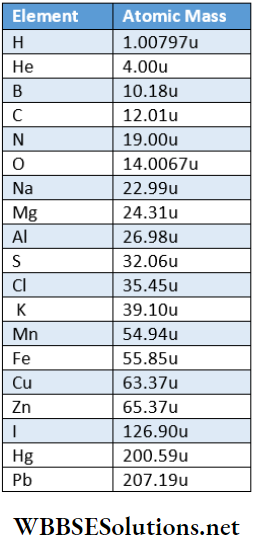
Class 11 Chemistry Some Basic Concepts Of Chemistry Gram atomic mass and gram atom

Short Answer Questions on Dalton’s Atomic Theory

Numerical Examples

Question 1. The atomic weight of ordinary hydrogen is 1.008. Ordinary hydrogen contains two isotopes JH and 11H. What is the weight percentage of 21H in ordinary hydrogen?
Answer:

Given

The atomic weight of ordinary hydrogen is 1.008. Ordinary hydrogen contains two isotopes JH and 11H.

Let in ordinary hydrogen, 11H = X%

Percentage of 21H = 100- x

Atomic mass of ordinary hydrogen \(=\frac{x \times 1+(100-x) \times 2}{100}\)

As per given data, \(\frac{x+(100-x) \times 2}{100}=1.008\)

or, 200-x = 1.008 x =99.2

∴ Ordinary hydrogen contains 99.2% of 11H and (100-99.2) = 0.8 % of 21H.

Question 2. Chlorine occurs in nature in the form of two isotopes with atomic masses 34.97 and 36.97 respectively. The relative abundance of the isotopes are 0.755 and 0.245 respectively Find the atomic mass of chlorine.
Answer:

Given

Chlorine occurs in nature in the form of two isotopes with atomic masses 34.97 and 36.97 respectively. The relative abundance of the isotopes are 0.755 and 0.245 respectively

Atomic mass of chlorine

⇒ \(=\frac{34.97 \times 0.755+36.97 \times 0.245}{0.755+0.245}=35.46\)

Question 3. Determine the mass of1 F-atom in gram (F = 19)
Answer: Gram-atomic mass of fluorine = 19 g. The mass of1 gram-atom of fluorine= 19 g Number of atoms in 1 gram-atom fluorine = 6.022 x 10²³ Mass of 6.022 x 10²³ atoms of fluorine = 19g

Hence, the mass of1 atom of fluorine = \(\frac{19}{6.022 \times 10^{23}} \mathrm{~g}\)

=3.1550×10⁻²³g

Question 4. Calculate the atomic volume of sodium (atomic weight = 23 ). Density of sodium=0.972 g rnL-1.
Answer: In the case of monatomic elements (like Na), the volume of 1 gram-atom is called its atomic volume.

1 gram-atomNa =23gofNa(v atomic mass of Na = 23)

Atomic volume of sodium = \(\begin{aligned}
& =\frac{\text { gram-atomic mass }}{\text { density }} \\
& =\frac{23 \mathrm{~g}}{0.972 \mathrm{~g} \cdot \mathrm{mL}^{-1}}=23.66 \mathrm{~mL}
\end{aligned}\)

Question 5. Find out the highest and lowest masses from the following:

  1. 25.6g oxygen (atomic mass = 16)
  2. 2.86 gram-atom of sodium (atomic mass = 23)
  3. 0.254 gram-atom of iodine (atomic mass = 127

Answer: Mass of 2.86 gram-atom of sodium = 2.86 x 23 = 65.78g

Mass of 0.254 gram-atom ofiodine = 0.254 x 127 = 32.258g

∴ Oxygen has the lowest and sodium has the highest mass.

Question 6. A compound contains 28% of nitrogen and 72% of metal by weight. In the compound, 3 atoms of metal remain combined with 2 atoms of nitrogen. What is the atomic mass of the metal?
Answer:

Given

A compound contains 28% of nitrogen and 72% of metal by weight. In the compound, 3 atoms of metal remain combined with 2 atoms of nitrogen.

Each molecule of the compound contains 3 atoms of metal and 2 atoms of nitrogen. If the symbol ofthe metal is M, then the molecular formula ofthe compound will be M3N2.

Molecular mass ofthe compound = 3a + 2 X 14 = 3a + 28

[where a is the atomic mass ofthe metal]

∴ Quantity of nitrogen in the compound \(=\frac{28}{(3 a+28)} \times 100 \%\)

Now, according to the problem, \(\frac{28}{3 a+28} \times 100=28\)

or, 3a +28= 100 or, a= 24

Molecular Mass Or Molecular Weight

A molecule is the smallest particle ofthe substance (element or compound) which has independent existence. Molecules are formed by the combination of atoms of the same or different elements.

So, like the atomic mass, some standard should be taken to express the molecular mass. At present, the 12C isotope is taken as the standard to express both the atomic mass and molecular mass.

Molecular mass with respect to 12 C-atoms

The molecular mass of a substance (element or compound) is a relative number that denotes how many times a molecule of the substance is heavier than the l/12th part of the mass of a 12C -atom.

∴ Molecular mass

⇒ \(\begin{aligned}
& =\frac{\text { mass of } 1 \text { molecule of the element or compound }}{\frac{1}{12} \times \text { mass of } 1 \text { carbon }\left({ }^{12} \mathrm{C}\right) \text { atom }} \\
& =\frac{\text { mass of } 1 \text { molecule of the substance }}{\text { mass of } 1 \text { carbon }\left({ }^{12} \mathrm{C}\right) \text { atom }} \times 12
\end{aligned}\)

On the carbon scale, molecular masses of nitrogen and oxygen are 28.013 and 31.998 respectively. It means that one molecule of each of nitrogen and oxygen is respectively 28.0 til and 31.990 times heavier than 1/12 the part of the mass of one,2C -atom.

Determination of the molecular mass of an element and a compound: The molecular mass of a substance (element or compound) can be determined by adding the atomic of all the atoms present in a molecule of the substance (element or compound).

The molecular mass of an element: Let us consider, the molecular formula of an element to be A,(, where n = Atomicity (i.e., no. of atoms present in the molecule of the element). Therefore, in the case of an element molecular mass = atomic, mass ofthe element x its atomicity.

  1. In the case of monoatomic elements (n = 1), molecular mass and atomic mass will be the same. Most of the metal elements and noble gas elements belong to this group.
  2. In the case of diatomic elements (n =2), the molecular mass is twice its atomic mass. Most ofthe gaseous elements (H2, N2, O2, Cl2, etc.) belong to this group.
  3. In the case of triatomic elements (n =3), the molecular mass is thrice its atomic mass. For example, ozone (O3 ).
  4. In the case of tetra-atomic elements(n = 4), the molecular mass is ( four times its atom mass. For example, phosphorus (P4).

The molecular mass of the compound: Let, the molecular formula of a compound be A2 C2, where the number of atoms of A, B, and C in a molecule of the compound are x, y,z respectively.

If the atomic masses are a, b, and c respectively, then the molecular mass ofthe compound =axx+bxy+cxz.
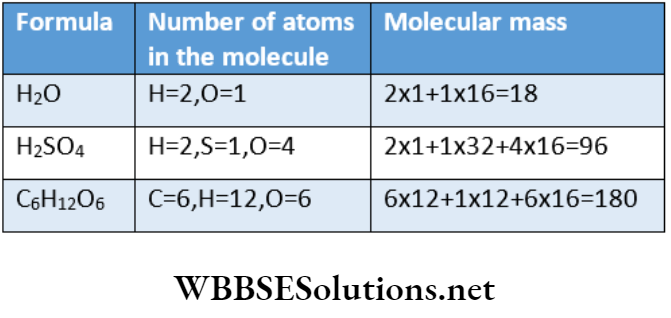
Class 11 Chemistry Some Basic Concepts Of Chemistry Molecular Mass Of Some Compounds

Molecular Mass Of Some Elements And Compounds In Unified Scale 
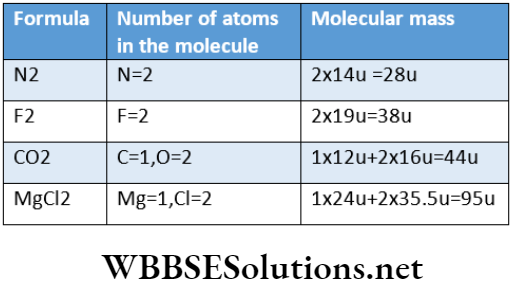
Class 11 Chemistry Some Basic Concepts Of Chemistry Molecular Mass Of Some Element And Compounds In Unified Scale

Formula Mass Or Formula Weight

Formula mass represents the sum of atomic masses of the Number of gram-molecule or gram-mole: The given present in the formula with which a substance is expressed. For example, the formula mass of sodium chloride, gram-molecular mass, gives the number of gram-mole or NaCl= (23 + 35.5) = 58.5.

Molecular mass and formula mass are not always synonymous: Molecular mass can be determined from the formula of an element or compound.

So sometimes, the formula mass is called the molecular mass. But these two terms are not always synonymous.

When a substance contains discrete molecules, then only these two terms can be used in the same sense.

Again, there are certain substances which do not exist as molecules. For example, the compound sodium chloride is represented by the formula NaCl but the existence of discrete molecules of this compound is conspicuously absent from the crystal of sodium chloride,

Na+ and Cl- ions exist in a state of aggregation where one Na+ ion is surrounded by six Cl- ions and one Cl- ion is similar and pressure, molar volumes of all gases are the same and it does surround by six Na+ ions to give rise to an octahedral not depend on the nature of the molecular mass ofthe gas.

As a result, there is no existence of Gram-molecular volume or molar Thus the statement—”the molecular mass of sodium chloride is 58.5″—has no logical basis because sodium chloride never forms a molecule.

The correct statement should be—”The formula mass of sodium chloride is 58.5″ Usually the term formula mass’ is applied to ionic compounds that do not exist as discrete molecules even in the solid state while the term ‘molecular mass’ is applied to the case of covalent compounds which remain in the molecular state even in aqueous solutions.

Gram-molecular mass

Gram-molecular mass: Molecular mass. of an element or compound expressed in gram is called gram-molecular N2 28 g 56 g —5628 = 2 2 x 22.4 = 44.8 L mass or gram-mole.

Unlike molecular mass molecular mass has a unit. For example, the gram-molecular masses of nitrogen and carbon dioxide are 28 g and 44 g respectively.

Gram-molecule or gram-mole: The quantity of a substance (element or compound), expressed in gram, which is numerically equal to its molecular mass, represents one gram-molecule or one gram-mole of that substance.

For example, 28 g of nitrogen, 32 g of oxygen, and 18 g of water represent gram-molecule or 1 gram-mole of each of the respective compounds.

Several gram-molecule or gram-mole: The given present in the formula with which a substance is expressed in gram when divided by its Therefore, number of gram-mole of substance.

⇒ \(=\frac{\text { mass of the substance }(\mathrm{g})}{\text { gram-molecular mass of that substance }}\)

Examples: 1. Number of gram-mole in 88 g of C02 \(=\frac{88 \mathrm{~g}}{44 \mathrm{~g}}=2\)

Number of gram-molein 45 g of H2O \(=\frac{45 \mathrm{~g}}{18 \mathrm{~g}}=2.5\)

Gram-molecular volume or molar volume at STP: The volume occupied by the gram-mole of all gases at STP (standard temperature and pressure) is 22.4L.

Example: Each of 2g hydrogen, 28 g nitrogen, 44 g carbon dioxide, and 18 g water vapor occupy a volume of 22.4L at STP. Conversely, it can be stated that 22.4 L of any gas at STP contains 1 gram-mole of that gas.

Volumes of different amounts of gases at STP
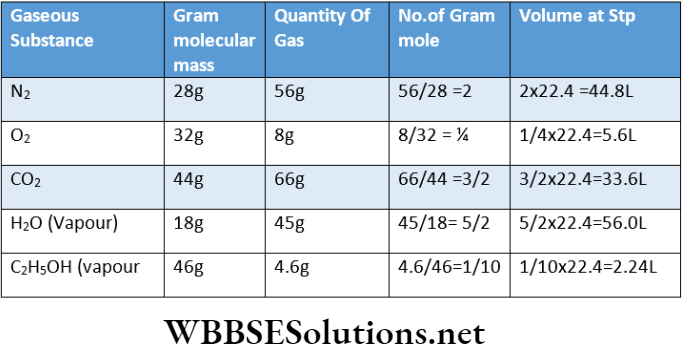
Class 11 Chemistry Some Basic Concepts Of Chemistry Volumes of different amount of gases at STP

Numerical Examples

Question 1. Calculate the number of gram-molecules present in 14.7gH2SO4.
Answer: Number of gram-molecules of a substance

⇒ \(=\frac{\text { given mass }(\text { in } \text { g) }}{\text { gram-molecular mass }}=\frac{14.7}{98}=0.15\)

Question 2. Calculate the mass of 1.5 gram-molecule of glucose.
Answer: Gram-molecular mass of glucose(C6H12O6)

= 6X12 + 12X1 + 6X16 = 180g

Mass of 1.5 gram-molecule of glucose = 1.5 x 180 = 270g

Question 3. If the number of gram-molecules present in 4.8g of oxygen and rg of nitrogen are equal, calculate the value of x.
Answer:

Given

If the number of gram-molecules present in 4.8g of oxygen and rg of nitrogen are equal

Gram-molecular mass of oxygen (O2 ) and nitrogen (N2 ) are 32 g and 28g respectively.

Number of gram-molecule of oxygen in 4.8g = 4.8/32 and number of gram-molecules of nitrogen in xg = \(\frac{x}{28}\)

⇒ \(\text { Given, } \frac{x}{28}=\frac{4.8}{32} \text { or, } x=4.2\)

Question 4. Calculate the volume of 3.6 g of water vapor at 273 K temperature and 1 atm pressure.
Answer: Molecular mass of water vapor (H2O) =18 No. of gram-molecule in 3.6g water vapor =3.6/18 At STP (273K, late), the volume of gram-molecule of water vapour= 22.4L

At STP, the volume of 0.2 gram-molecule of water vapor = 0.2X22.4 = 4.48L

Question 5. If the density of water at 273K is i.0g-cm-3, calculate its molar volume at that temperature.
Answer: Density of water at 273K = 1.0 g-cm Gram-molecular mass of water = 18g Hence, at 273K the molar volume of water.

\(=\frac{\text { gram-molecular mass }}{\text { density }}=\frac{18 \mathrm{~g}}{1.0 \mathrm{~g} \cdot \mathrm{cm}^{-3}}=18 \mathrm{~cm}^3\)

Question 6. How many moles of water molecules are present in 1.8 ml of water?
Answer:

At ordinary temperature, the density of water =1g mL 1.

Mass of 1.8 mL ofwater = 1.8 X 1 = 1.8 g.

Now, 1.8 g of H2O =\(\frac{1.8}{18}\)=0.1 mol H2O

Question 7. Calculate the number of moles and the volume at STP of 0.53g of acetylene.
Answer: Gram-molecular mass of acetylene is 26g.

Number of gram-mole present in 0.52g of acetylene

= 0.52/26g = 0.02

At STP, 26 g of acetylene occupies a volume of 22.4 L.

At STP, 0.52g of acetylene occupies a volume of

⇒ \(=\frac{22.4 \times 0.52}{26} \mathrm{~L}=0.448 \mathrm{~L}\)

Question 8. At STP, the volume of lg of a gaseous substance is 280 mL. Find its relative molar mass.
Answer: At STP, the mass of 22400 mL of the gas \(=\frac{1}{280} \times 22400=80 \mathrm{~g}\) Now, on the basis of Avogadro.s hypothesis, 22400mL (at STP) of any gas contains1 gram-mole ofthe substance.

The molar mass of the gas = 80

Question 9. The volume of one atom of a metal M is 1.66x 10⁻²³ cm3. Find the atomic mass of M (Given: density of M = 2.7 g.cm-3).
Answer: Volume of 6.022 x 10²³ atoms of the metal, M

= 6.022 X 1023 X 1.66 X 10-23 =9.99652 cm3

Mass of 6.022 x 10²³ atoms of the metal M

= density x volume = 2.7 x 9.99652 = 26.990 g

= gram-atomic mass ofthe metal M

Hence, the atomic mass ofthe metal = 2.990.

Question 10. Haemoglobin was found to contain 0.335% iron (Atomic weight of Fe = 56). The molecular weight of haemoglobin is 1.67 X 10⁴. Find the number of iron atoms in hemoglobin.
Answer: Molecular mass of hemoglobin = 1.67 x 10⁴

∴ 1 gram-mole of hemoglobin = 1.67 x 10⁴ g.

Here, Fe -content haemoglobin = 0.335%

∴ Fe-content 1.67 x 10⁴ g of haemoglobin

⇒ \(=\frac{0.335 \times 1.67 \times 10^4}{100}=55.945 \mathrm{~g} .\)

Hence, the number of gram-atom of Fe present in haemogobin= \(=\frac{55.945}{56} \approx 1\)

The atomic weight of =

∴ In 1 gram-mole of hemoglobin, the number of gram atoms of Fe =1

So, 1 mol of hemoglobin contains only one atom of Fe.

Question 11. The mass of 0.1 mol of X2Y is 4.4 g and the mass of 0.05 of XY2 is 2.3g. Find the Atomic mass of X and Y.
Answer:

Mass of 0.1 mol of X2Y = 4.4 g.

∴ Mass of 1 mol of X2Y \(=\frac{4.4}{0.1}=44 \mathrm{~g}\)

Similarly, mass of 1 mol of XY2 =2.3/0.05 =46g

So, the molecular mass of X2Y and XY2 are 44 and 46 respectively. Let, the atomic masses of X and Y be a and b respectively. So, the molecular mass of X2Y = (2a + b) and the molecular mass of XY2 =(a + 2b).

According to the question, 2a + b =44 and a + 2b = 46.

By solving the equations, a = 14 and b = 16.

∴ The atomic masses of X and Y are 14 and 16 respectively.

Question 12. A plant virus is found to consist of uniform cylindrical particles whose diameter is 150A and length is 5000A. The specific volume of the virus is 0.75cm³/g. If the virus is considered to be a single particle, then find its molecular mass.
Answer:

Given

A plant virus is found to consist of uniform cylindrical particles whose diameter is 150A and length is 5000A. The specific volume of the virus is 0.75cm³/g. If the virus is considered to be a single particle,

Volume ofthe virus =nr2 xl

⇒ \(=3.14 \times\left(\frac{150}{2} \times 10^{-8}\right)^2 \times 5000 \times 10^{-8}=0.884 \times 10^{-16} \mathrm{~cm}^3\)

⇒ \(\begin{aligned}
\text { Mass of single virus } & =\frac{\text { volume }}{\text { specific volume }} \\
& =\frac{0.884 \times 10^{-16}}{0.75}=1.178 \times 10^{-16} \mathrm{~g}
\end{aligned}\)

The molar mass of virus = Mass of single virus x NA

= 1.78 x 10-16x 6.023 x 1023 =7.095 x 10 7

Avogadro’s number

Avogadro’s number Definition: Avogadro’s number may be defined as the number of molecules present in one gram-mole of any substance, or element Similarly, mass of  1 mol of XY2 =2.3/0.05 =46g or compound (solid, liquid, or gas).

Avogadro’s number is usually denoted by the letter ‘N’ or ‘Na’- and its value is 6.022 x 10²³. R. A. Millikan determined its value by the oil drop experiment’ in 1913.

Example: 28 g of N2, 32 g of O2, 18 g of H2O, or 100 g of CaCO3 —each indicates 1 gram-mole of substance containing 6.022 x 10²³ number of molecules.

The value of Avogadro’s number does not depend on temperature and pressure because the mass and the number of molecules do not change with the variation in temperature and pressure.

Alternative definition of Avogadro’s number: The number of atoms present in the gram-atom of an elementary substance is called Avogardro’s number.

Example: 16 g O2 contains 6.022 x 10²³ number atoms and in 12g carbon, the number of constituent atoms is 6.022 x 10²³.

As 1 gram-mole of any gaseous substance (element or compound) occupies a volume of 22.4 L at STP, Avogadro’s number can further be expressed as—the number of molecules present in 22.4 I. of any gaseous substance (element or compound) at STP is called Avogadro’s number.

Modern Definition Of Avogadros Number

The Number of Od atoms Present In exactly 12 g carbon (12C) is designated as Avogadro’s number.
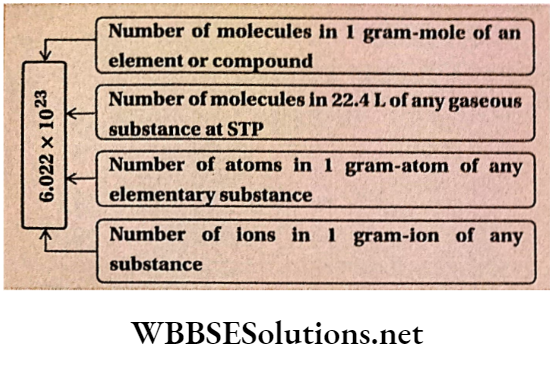
Class 11 Chemistry Some Basic Concepts Of Chemistry Modern Definition of Avogadros number

Airogadro’s constant: ‘Avogadro’s number/mole’ is called Avogadro’s constant i.e., ‘6.022 X 10²³ ‘.

Avogadro’s number has no unit. But Avogadro’s constant has the unit ‘per mole’ or mol-1.Itis auniversal constant.

Definition of Gram-mole, Gram-atom, Molecular mass, Atomic mass in terms of Avogadro’s number.

Gram-mole: The quantity of a substance (element or compound) expressed in gram which contains 6.022 x 10²³ molecules is defined as 1 gram of that substance.

Gram-atom: The quantity of an element expressed in gram which contains 6.022 x 10²³ atoms is called 1 gram-atom of that element.

Molecular mass: The molecular mass of a substance (element or compound) may be defined as the number which when expressed in grams contains 6.022 x 10²³ number of molecules that substance.

Atomic mass: The atomic mass of an element indicates the number which when expressed in grams contains 6.022 x 10²³ atoms of that element.

Applications of avocados number

Calculation of actual mass of a molecule: if the molecular mass of a substance is known, the actual mass of one molecule of that substance can be calculated in the following way: Let, the molecular mass of a substance be M.

∴ 1 gram-mole ofthe substance =M g of that substance. Now, we know that 1 gram-mole of a substance contains Avogadro’s number of molecules.

∴ Mass of 6.022 x 10²³ molecule M g.

∴ Mass of 1 molecule = \(\frac{M}{5.022 \times 10^{23}} \mathrm{~g}\)

∴ The actual mass of a molecule of any substance

⇒ \(=\frac{\mathrm{gram}-\text { molecular mass of the substance }}{\text { Avogadro’s number }}\)

Examples: Actual muss of a molecule of oxygen: The molecular mass of oxygen = 32.

∴ Actual mass of I oxygen molecule

⇒ \(\begin{aligned}
=\frac{\text { Gram-molecular mass of oxygen }}{\text { Avogadro’s number }} & =\frac{32 \mathrm{~g}}{6.022 \times 10^{23}} \\
& =5.313 \times 10^{-23} \mathrm{~g} .
\end{aligned}\)

Actual mass of 1 molecule of water:

The molecular mass of water = 18.

∴ Actual mass of I molecule of water

⇒ \(=\frac{18 \mathrm{~g}}{6.022 \times 10^{23}}=2.989 \times 10^{-23} \mathrm{~g}\)

Calculation of actual mass of an atom: From the known value of the atomic mass of an element, the actual mass of an atom of that element can be determined in the following way: Let, the atomic mass of an element = A.

1 gram-atom of that element = A g.

We know, 1 gram-atom of an element contains Avogadro’s number of atoms, i.e., 6.022 x 10²³ atoms.

Mass of 6.022 x 10²³ atoms =A g.

∴ Actual mass of 1 atom of an element

= \(=\frac{\text { gram-atomic mass of the element }}{\text { Avogadro’s number }}\)

Example 1. The actual mass of 1 atom of nitrogen:

Atomic mass ofnitrogen = 14.

∴ The actual mass of 1 atom of nitrogen:

⇒ \(\begin{aligned}
& =\frac{\text { gram-atomic mass of nitrogen }}{\text { Avogadro’s number }} \\
& =\frac{14 \mathrm{~g}}{6.022 \times 10^{23}}=2.324 \times 10^{-23} \mathrm{~g}
\end{aligned}\)

An alternative method for determination of the actual mm of an atom: Let the molecular mass of a substance= M 1 gram-molecule ofthe substance = Mg.

Now, 1 gram-molecule of any substance contains

Avogadro’s number of molecules.

Hence, mass of 6.022 x 10²³ molecules =M g

Mass of 1 molecule \(=\frac{M}{6.022 \times 10^{23}} \mathrm{~g} .\) If the atomicity of the element is n, then one molecule ofthe element consists of n number of atoms.

Hence, the mass of n atoms of the element \(=\frac{M}{6.022 \times 10^{23}} \mathrm{~g}\) and the mass of I atom of the element \(\frac{M}{n \times 6.022 \times 10^{23}} g\)

Hence, the actual mass of an atom of the element

⇒ \(=\frac{\text { gram-molecular mass of the element }}{\text { atomicity of a molecule of the element } \times \text { Avogadro’s number }}\)

Example: Determination of the actual mass of a nitrogen atom—Gram-molecular mass of nitrogen = 28 and atomicity of a nitrogen molecule =2. Hence, the actual mass of a nitrogen atom.

⇒ \(=\frac{\text { gram-molecular mass of nitrogen }}{\text { atomicity of a nitrogen molecule } \times \text { Avogadro’s number }}\)

⇒ \(=\frac{28 \mathrm{~g}}{2 \times 6.022 \times 10^{23}}=2.324 \times 10^{-23} \mathrm{~g}\)

Number of molecules in a definite mass of a substance: Let, the mass of a certain amount of an element or a compound = W gram and its gram-molecular mass M gram. Now, the number of molecules presenting M gram of the substance = 6.022 X 10²³.

W gram ofthe substance will contain \(=\frac{W}{M} \times 6.022 \times 10^{23}\) number of molecules.

Some important relations: If Avogadro’s number =NA and gram-molecular mass of an element or a compound =M, then—

Mass of 1 atom of an element \(=\frac{\text { gram-atomic mass }}{N_A}\)

Mass of 1 molecule of the substance \(=\frac{M}{N_A}\)

No. of molecules in W gram ofthe substance \(=\frac{W \times N_A}{M}\)

Number of molecules present in V L of gas at STP \(=\frac{V \times \mathrm{N}_{\mathrm{A}}}{22.4}\)
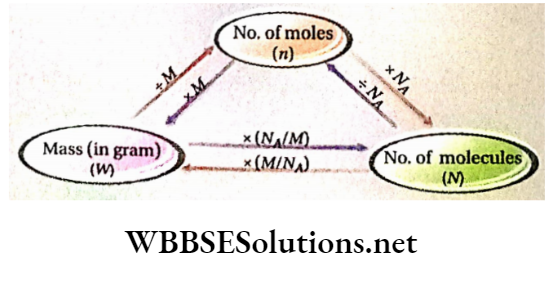
Class 11 Chemistry Some Basic Concepts Of Chemistry Number of molecules

No. of molecules in n mole of any substance = n x NA

lu (or, 1 amu)=\(\frac{1}{N_A}\)– g. = 1.6605 x lO-24 g (This amount is called 1 program or 1 dalton)

1 gram-mole of any substance contains the same number of molecules:

1. Let, the actual mass of atom hydrogen =x g

∴ Actual mass of a molecule hydrogen -2xg hydrogen is diatomic]

∴ Now,1 gram-mole ofhydrogen = 2 g ofhydrogen

∴ Number of molecules present in 1 gram-mole (or 2g) ofhydrogen= 2/2x = l/x

The molecular mass of oxygen = 32

2. A molecule of oxygen is 32 times heavier than 1 atom of hydrogen.

If the actual mass of an atom of hydrogen is xg, then the actual mass of 1 molecule ofoxygen will be 32x g.

Now,1 gram-mole ofoxygen =32 g of oxygen.

∴ Number of molecules present in 1 gram-mole (or 32g) of oxygen of oxygen

⇒ \(=\frac{32}{32 x}=\frac{1}{x}\)

Let, the molecular mass of a substance be M. Therefore, a molecule of that substance will be M times heavier than an atom of hydrogen.

If the actual mass of 1 atom of hydrogen is x g, then the actual mass of 1 molecule of that substance will Now, be 1 gram-mole of that substance =M g Number of molecules constituting 1 gram-mole of the substance = \(=\frac{M}{M \times x}=\frac{1}{x}\)

Therefore, it can be concluded that 1 gram-mole of any substance contains the same number of molecules.

The ratio of the number of molecules present In equal masses of two different substances (solid, liquid, or gas) with different molecular masses: Let the molecular masses of two substances A and B be MA and MB respectively and the mass of each of them be = W g.

1 gram-mole of any substance contains = 6.022 x 10²³ number of molecules.

∴ Number of molecules present in MA g of A = 6.022 x 10²³ Number of molecules presentin’ W g of \(A=\frac{6.022 \times 10^{23} \times W}{M_A}\)

Similarly, the number of molecules present in Wg of B \(=\frac{6.022 \times 10^{23} \times W}{M_B}\)

The ratio of the number of molecules present in equal masses of A and B

⇒ \(=\frac{6.022 \times 10^{23} \times W}{M_A}: \frac{6.022 \times 10^{23} \times W}{M_B}=M_B: M_A\)

Thus, the ratio of the number of molecules in equal masses of two different substances Is equal to the inverse ofthe ratio of their molecular masses.

Mole Concept

Mole is a Latin word meaning quantity, heap, or collection. In the SI system, mole (symbol: mol) was introduced as the seventh base quantity for the amount of a substance.

Mole Concept Definition: A mole is defined as the number of particles (like atoms, molecules, ions, or radicals) that is exactly equal to the number of 12C atoms present in 0.012kg of carbon.

Mole Concept Explanation: 0.012kg of 12C atoms contains Avogadro’s number of carbon atoms. So, 1 mol of any substance i.e., molecule, atom, ion, or radical contains Avogadro’s number of the specified species.

Irrespective of the ultimate particles, one mole always contains the same number of constituent particles i.e., 6.022 x 10²³.

Number of molecules in 1 mol of molecule 1

= Number of atoms in 1 mol of the atom
= Number of mol of ion
= Number ofradicalsin1 mol of radical
= 6.022 X 10²³

Mole Concept Discussion: While using the word ‘mole’, the name and nature (i.e., molecule, atom, ion, or radical) should be mentioned.

For example, the number of molecules in 1 mol of an oxygen molecule is equal to the number of atoms present in 1 mol of oxygen atom and in both cases, this number is 6.022 x 10²³.

But oxygen is diatomic and hence the number of oxygen atoms in a 1 mol oxygen molecule is double the number of oxygen atoms in a 1 mol atom of oxygen.

So, the statement “1 mol oxygen” may lead to unnecessary confusion because it indicates both 1 mol of oxygen molecule and 1 mol of oxygen atom. But quantitatively they are altogether different although the number of ultimate particles in both cases is the same.

Often, quantity of substance are expressed in decimole, centimole or millimole where, 1 decimol = 10-1 mol, 1 centimol = 10-2 mol,1 millimol = 10~3 mol.

‘ Mole’ is also used in the case of electrons e.g., 1 mol electron = 6.022 X 10²³ electrons and 1 millimol electron =6.022 X 10²⁰ electrons.

Useful relations used in the mole-related calculation

Relation between ‘1 mol’ molecule and gram-mole: Mol molecule of any substance (element or compound) denotes 6.022 x 10²³ molecules of that substance.

Again, the mass of 6.022 x 10²³ molecules = 1 gram molecular mass or 1 gram-mole.

Hence, 1 mol molecule of an element or compound — 1 gram-mole of that substance.

Mole Concept Examples:

l mol nitrogen molecule = 6.022 x 10²J nitrogen molecules= 28 g nitrogen (=1 gram-mole of nitrogen)

1 mol carbon dioxide molecule = 6.022 x 1 023 carbon dioxide molecules= 44 g carbon dioxide (= 1 gram-mole carbon dioxide)

1 million oxygen molecule = 10~3 mol oxygen molecule = 10-3 X 6.022 x 1023 oxygen molecules = 10~3 X 32 g oxygen = 3.2 x 10⁻² g of oxygen

1 mol sodium chloride = 6.022 X 10²³ formula units of sodium chloride

Relation between ‘1 mol’ atom And gram-atomic mass or gram-atom: 1 mol of an element denotes = 6.022 x 10²³ atoms.

Again, a mass of 6.022 x 10²³ atoms =1 gram-atomic mass (or, 1 gram-atom) So,1 mol atom of an element = 1 gram-atom of that element.

Mole Concept Examples:

  • l mol oxygen atom = 6.022 x 10²³ oxygen atoms =16 g oxygen (=1 gram-atom ofoxygen)
  • 1 mol sodium atom = 6.022 x 10²³ sodium atoms =23 g sodium(=1 gram-atom of sodium)
  • Relation between ‘1 mol’ ion and gram-ion: 1 mol ion indicates 6.022 x 10²³ ions.
  • Again, number ofionsin1 gram-ion = 6.022 x 10²³. 1 million =1 gram-ion (gram-formula mass of)

Examples:

l mol Cl- ion = 6.022 x 10²³ Cl- ions

= 35.5 g Cl- ions (=1 gram-ion of Cl-) (v mass of an electron is negligible)

1 mol \(\mathrm{SO}_4^{2-}\) ion = 6.022 x 10²³ \(\mathrm{SO}_4^{2-}\) ions = 96 g

\(\mathrm{SO}_4^{2-}\)  ions (=1 gram-ion of \(\mathrm{SO}_4^{2-}\) )

1 mol Al3+ ion = 6.022 x 10²³ Al3+ ions =27 g Al3+ ions (=1 gram-ion of Al3+)

The volume occupied by the ‘1 mol’ molecule of a gas at STP: For any substance, 1 mol molecule stands for 6.022 x 10²³ number of molecules. Moreover, 22.4 L of any gas at STP contains 6.022 x 10²³ molecules.

Hence, the volume occupied by 1 mol molecule of any gaseous substance at STP = 22.4 L.

Examples: 1 mol oxygen molecule = 6.022 x 10²³ oxygen molecules =22.4L of oxygen at STP

1 mol carbon dioxide molecule= 6.022 x 10²³ carbon dioxide molecules =22.4 L ofcarbon dioxide at STP.

Various relationships regarding the mole concept
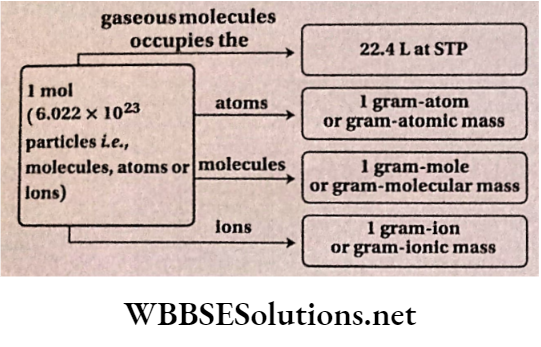
Class 11 Chemistry Some Basic Concepts Of Chemistry Various relationships regrading mole concepts

Number of electrons in terms of mol: 6.022 x 10²³ number of electrons are present in 1 mol of the electron. The charge carried by 1 mol electron is 96500 coulomb or faraday.

Calculation of mole number

In the case of monatomic elements: 23 g sodium (1 gram atom sodium) = 1 mol sodium

W g sodium = mol\(=\frac{W}{23}\) sodium

Mole number monatomic element

⇒ \(=\frac{\text { mass of the element }(\mathrm{g})}{\text { gram-atomic mass of the element }}\)

In the case of ions: 35.5 g (1 gram-ion) of Cl =1 mol Cl.

Wg Cl- ions\(=\frac{W}{35.5}\) mol CP ions.

Similarly, 96 g (1 gram-ion) of \(\mathrm{SO}_4^{2-}\) ions = 1 mol \(\mathrm{SO}_4^{2-}\)

W g \(\mathrm{SO}_4^{2-}\) ions \(=\frac{W}{96}\) mole \(\mathrm{SO}_4^{2-}\) Ions

Mole number of ion = \(=\frac{\text { mass of ion (g) }}{\text { mass of } 1 \text { gram-ion }}\)

2. In case of any gas: 22.4 L of any gas at STP =1 mol of gaseous molecules.

VL of any gas at STP =\(=\frac{V}{22.4}\) mol of gaseous molecules.

In case of any gas: 22.4 L of any gas at STP =1 mol of
gaseous molecules.

VL of any gas at STP = mol of gaseous molecules.

Mole number of gaseous molecule

⇒ \(=\frac{\text { volume of the gas at STP (L) }}{22.4 \mathrm{~L}}\)

Calculation of mass of substance from mole number

Mass of monoatomic element = mole number of molecule or atom of the element X gram-atomic mass of the element.

Mole number of gaseous molecules

⇒ \(=\frac{\text { volume of the gas at STP }(\mathrm{L})}{22.4 \mathrm{~L}}\)

Calculation of mass of substance from mole number

1. Mass of monoatomic element = mole number of molecule or atom of the element X gram-atomic mass of the element.

For example, 0.5 mol of Na = ( 0.5 x 23) = 11.5 g Na

2. Mass of polyatomic substance (element or compound) = mole number of the substance X gram-molecular mass of that substance

For example, 0.5 mol H2SO4 =(0.5 x 98) = 49g H2SO4

Mass of ions = mole number of Ions x mass of 1 gram-ion or gram-ionic mass

For example, 0.5 mol SO2-4 =(0.5 x 96) =48 gSO2- ion

Determination of the volume of a gas from mole number:

The volume of any gas at STP (L) = a number of moles of gaseous molecules x 22.4 L.

Determination of number of particles (molecules, atoms, or ions): Number of particles (molecule, atom, or ion) = mole number x 6.022 x 10²³.

Advantages of the mole concept

Chemical calculations can be worked out in a much simpler way by using mole numbers instead of the masses or volumes of the reactants and products. To be more specific, (2 x 2.016) g of 112 react with 32 g of O2 to form (2 x 18.016) g of water (H2O). If the reaction is expressed in terms of mole, then we will say that 2 mol of hydrogen molecules combine with 1 mol of oxygen molecules to produce 2 mol of water molecules.

⇒ \(2 \mathrm{H}_2+\mathrm{O}_2 \rightarrow 2 \mathrm{H}_2 \mathrm{O}\)

Valuable Information like the number of molecules, atoms, or ions present In a certain amount of any substance is represented by the number of moles.

The word ‘mole’ finds extensive use in expressing the quantity of molecules, ions, or other tiny particles present in the solution.

If the mole number of molecules of a gaseous substance is known, then its volume at STP can be determined.

Numerical Examples

Question 1. If we spend 10 lakh rupees per second then how much time will be required to spend an amount of money which is equal to Avogardo’s number?
Answer: 10000000 rupee will be spent in 1 sec

6.022x 10²³ rupees will be spend in ,\(\frac{1 \times 6.022 \times 10^{23}}{10^6} \text { sec. }\)

⇒ \(=\frac{6.022 \times 10^{17}}{60 \times 60 \times 24 \times 365} \text { years }=1.91 \times 10^{10} \text { years }\) years = 1.91×10 10 years

Question 2. Find the weight of 12.046 X 1025 number of ammonia molecules.
Answer: 1 gram-mole ammonia = 17 g of ammonia.

∴ Number of molecules contained in 1 gram-mole of ammonia = 6.022 X 10²³.

Hence, 6.022 x 10²³ molecules weigh 17 g

∴ 12.046 X 1025 molecules weight

⇒ \(=\frac{17 \times 12.046 \times 10^{25}}{6.022 \times 10^{23}}=3400 \mathrm{~g}=3.4 \mathrm{~kg}\)

Question 3. What is the quantity of charge carried by 1 mol of electron?
Answer: 1 mol electron =6.022×10²³ number of electrons

Charge carried by 1 electron =1.6x 10⁻¹⁹ coulomb

The total charge carried by 1-mole electron

=(6.022x 1023×1.6×10-19)= 96352 coulomb.

Question 4. Calculate the number of molecules left when 1021 molecules of CO2 are removed from 200 mg of CO2.
Answer: 200mg of CO2 =0.2 g of (Gram – molecular mass of CO2=44g). 44g CO2 Contains 6.022×10²³ molecules.

∴ 0.2g CO2 Contains \(\begin{aligned}
& =\frac{6.022 \times 10^{23} \times 0.2}{44} \text { molecules } \\
& =2.7372 \times 10^{21} \text { molecules }
\end{aligned}\)

On removing 1021 molecules, number of C02 molecules remaining = 2.7372 X 10²¹ – 1 x 1021 = 1.7372 X 10²¹

Question 5. Find the number of atoms of hydrogen and oxygen present in one spherical drop of water with radius I mm at 4°C.
Answer:

The volume of one spherical drop of water

⇒ \(=\frac{4}{3} \times \pi \times(0.1)^3=\frac{4}{3} \times \frac{22}{7} \times 10^{-3}=4.19 \times 10^{-3} \mathrm{~cm}^3\)

Further, the density of water at 4°C = lcm-3

Mass of 4.19 x 10⁻³cm3 water at 4°C =4.19 x 10~3 g.

Now, the mass of 1 gram-molecule of water = 18 g.

∴ Number of molecules in 18g water =6.022 x 10²³

∴ Number of molecules present in 4.19 x 10⁻³ g of water

⇒ \(=\frac{6.022 \times 10^{23} \times 4.19 \times 10^{-3}}{18}=1.4017 \times 10^{20}\)

1 molecule of water contains 2 hydrogen and 1 oxygen atom.

∴ The number of hydrogen atoms in 1.4017 x 10²⁰

∴ Molecules of water = 2 x 1.4017 x 1020 = 2.803 x 10²⁰

So, the number of oxygen atoms present in 1.4017 x 10²⁰

molecules of water = 1.4017 x 10²⁰

Question 6. Find the number of electrons in a drop of sulphuric acid weighing 4.9 x 10⁻³ mg [assume it to be cent percent pure].
Answer: 4.9 X 10⁻³ mg = 4.9 X 10⁻⁶ g Molecular mass of H2S04 = 98 Its gram-molecular mass = 98 g. Number of molecules in 98 g of H2S04 = 6.022 x 10²³ So, number of molecules in 4.9 x 10⁻⁶ g of H2S04

⇒ \(=\frac{6.022 \times 10^{23} \times 4.9 \times 10^{-6}}{98}=3.011 \times 10^{16}\)

Atomic numbers of H, S, and O are 1, 16, and 8 respectively. So, the number of electrons in them is 1, 16, and 8.

Total number of electrons present in 1 molecule of H2SO4 =(2×1=1×16=4×8)=50

3.011 x 10¹⁶ number of H2S04 molecules contain = 3.011 X 1016 x 50 = 1.5055 X 10¹⁸ electrons.

Thus, 4.9 x 10⁻³ mg of H2S04 has a 1.5055 X 10¹⁸ number of electrons.

Question 7. Find the number of 0 atoms and 0 molecules present in 1 g of oxygen.
Answer: 1 g oxygen= gram-mole ofoxygen [v = 32 ]

Number of moleculesin1 g ofoxygen = 6.022 x 10²³ x — = 1.882 x 10²²

As oxygen molecule is diatomic, the number of atoms present

in 1g of oxygen = 2 X 1.882 X 1022 = 3.764 X 10²²

Question 8. Calculate the number of O-atoms present in 112 L of COz gas at STP.
Answer: At STP, the number ofmoleculespresentin 22.4 L of C02 gas
= 6.022 x l023

Number of molecules present in 112L of C02 gas =112. x 6.022 X 1023 = 5 X 6.022 X 1023 22.4

Now, each molecule of C02 contains 2 atoms of oxygen.

Number ofO-atoms presenting 112L of C02 gas (at STP)

= 2 X 5 X 6.022 X 1023 = 6.022 X 1024

Question 9. Find the number of neutrons present in 5 x 10⁴ mol of 14 C Isotope.
Answer: Atomic number of carbon = 6

Number of neutrons in one C atom =14-6 = 8.

Now, in 1 mol of 14C, the number of atoms = 6.022 x 10²³

In 5 x 10 4 mol of C, the number of atoms

= (6.022 X 1023 x 5 X 10-4) = 3.011 X 10²⁰ 14

Again, one C atom contains 8 neutrons.

3.011 x 10²⁰ number of atoms of 14C contain

= (8 x 3.011 x 1020) =2.4088 x 10²¹ neutrons.

Number of neutrons in 5 x 10⁻⁴ mol of 14C =2.4088 x 10²¹.

Question 10. Find the number of hydrogen and oxygen atoms present in 0.09 g of water.
Answer: -09 g water =\(=\frac{0.09}{18}\) =5×10 3 gram-mole ofwater [ Molecular mass ofwater = 18

Number of molecules in 1 gram-mole water = 6.022 x 10²³

Number of molecules in 5 x 10⁻³ gram-mole water

⇒ \(=6.022 \times 10^{23} \times 5 \times 10^{-3}=3.011 \times 10^{21}\)

The number of hydrogen and oxygen atoms in 1 molecule of water (H2O) are 2 and 1 respectively.

The number of hydrogen atoms in 3.011 x 10²¹ number

of water molecules = 2 x 3.011 x 1021 =6.022 x 10²¹

The number ofoxygen atoms =1 x 3.011 x 1021

= 3.011 X 10²¹

Question 11. What is the mass of 1 millimol of ammonia? Also, find the number of ammonia molecules presenting it.
Answer: 1 millimol = 10-3 mol.

Mass of1 mol of ammonia = 17 g

Mass of 10-3 mol of ammonia = 17 x 10-3g

Again, the number of ammonia molecules present in 1 mol of ammonia = 6.022 x 10²³

The number of ammonia molecules in 10-3 mol of ammonia = 6.022 x TO23 x 10-3 = 6.022 x 10²⁰

Hence, the number of ammonia molecules present in millimolar of ammonia =6.022 X 10²⁰

Question 12. What will be the number of

  1. Moles of ethylene,
  2. Molecules of ethylene,
  3. Atoms of carbon and

Atoms of hydrogen in 0.28 g of ethylene contained in a cylinder?

Answer: 0.28 g of ethylene \(=\frac{0.28}{28}\) = 011 gram-mole ethylene [since molecular mass of ethlene= 28]

Quantity of ethylene in the cylinder= 0.01 mol.

1 gram-mole contains 6.022 x 10²³ ethylene molecules.

1 gram-mole contains 6.022 x 10²³ ethylene molecules.

1 gram-mole contains 6.022 x 10²³ ethylene molecules.

1 gram-mole contains 6.022 x 10²³ ethylene molecules.

2 x 6 022 X 1°21 carbon atoms

So, the number of carbon atoms present in the cylinder

⇒ \(=2 \times 6.022 \times 10^{21}=1.2044 \times 10^{22}\)

1 molecule of ethylene contains 4 atoms of hydrogen.

Number of hydrogen atoms in 6.022 x 10²¹ ethylene molecules = 4 x 6.022 x 1021 =2.4088 X 10²² Thus, the number of hydrogen atoms present in the cylinder = 2.4088 x 10²².

Question 13. Find the number of moles and quantifying gram, contained in 100 m of ammonia at STP.
Answer: At STP, the volume of gram-mole of ammonia = 22.4L

∴ Number of the in 100 of ammonia \(=\frac{1 \times 100}{22.4}=4.464\)

Now 1 gram-mole of ammonia = 17 g of ammonia [since the molecular mass of ammonia = 17 ]

∴ 4.464 gram moles of ammonia = (17 x 4.464) =75.888g of ammonia

Thus, 100 l of ammonia at STP contained = 75.888g

Question 14. Suppose the human population of the world is 3 X 10¹⁰. If 100 molecules of sugar are distributed per head, what is the total quantity of sugar required for distribution?
Answer: Gram-molecular mass of sugar

=(12×12+22×1+16×11)=(144+22+176)= 342g

Number of molecules in 342 g of sugar =6.022×10²³

∴ Mass of 100 molecules of sugar \(\begin{aligned}
& =\frac{342 \times 100}{6.022 \times 10^{23}} \\
& =5.679 \times 10^{-20} \mathrm{~g}
\end{aligned}\)

So, 5.679 x 10⁻²⁰ g of sugar will be required per head.

For 3 x 10¹⁰ number of people, the quantity of sugar

required =5.679 x 10-20 X 3 x 1010 = 1.7037 X 10⁻⁹ g.

Question 15. Find the number of atoms of nitrogen in 1 grantmole of NO and 0.5 gram-mole of N02. Which one will be heavier—1 gram-mole of NO or 0.5 gram-mole of N02?
Answer: Number of molecules present 1 gram-mole of NO = 6.022 X 10²³.

Each molecule of NO contains a nitrogen atom.

therefore 6.022×10²³ No molecules will contain 6.022×10²³ atoms of nitrogen.

Again, the number of N02 molecules present in 0.5 gram-mole of N02 =\(=\frac{1}{2} \times 6.022 \times 10^{23}\) x 6.022 x 1023 =3.011 X 10²³

Again, 1 gram-mole NO2= 30g of NO [∴ MNO = 30]

∴ 0.5 gram-mole of NO2 = 0.5×46 =23g NO2 [since M NO2=46]

So, 1 gram- mole NO2 is heavier than 0.5 Gram mole NO2.

Question 16. A mixture contains 02 and N2 in the proportion of 1: 4 by weight. What will be the ratio of the number of molecules of 02 and N2 in the mixture?
Answer:

Given

A mixture contains 02 and N2 in the proportion of 1: 4 by weight.

Let, the mass ofthe mixture be W g

In the mixture, mass of 02 =\(\frac{W}{5} \mathrm{~g}\) and mass of N2 \(=\frac{4 W}{5} \mathrm{~g}\)

Number of gram-mole \(\mathrm{N}_2=\frac{4 W / 5}{28}=\frac{4 W}{140}\)

So, number of gram-mole of \(=\frac{4 W / 5}{28}=\frac{4 W}{140}\)

So, number of 002 molecules = \(=\frac{W}{160} \times 6.022 \times 10^{23}\)

number of N2 molecules = x 6.022 x 10²³

The ratio of the number of molecules of 02 to the number of molecules of N2 in the mixture

⇒ \(=\frac{W \times 6.022 \times 10^{23}}{160}: \frac{4 W \times 6.022 \times 10^{23}}{140}\)

⇒ \(=\frac{1}{160}: \frac{4}{140}=14: 64=7: 32 \text {. }\)

Common Questions on Laws of Chemical Combination

Question 17. A young man has given ills bride a tin engagement ring containing a 0.50-carat diamond. How many atoms of carbon are present in that ring? |1 carat = 200 mg).
Answer:

Given

A young man has given ills bride a tin engagement ring containing a 0.50-carat diamond.

1 carat = 200 mg = 0.2 g. So,0.5 carat = 0.5 x 0.2 = 0.1 g Diamond is composed of only carbon atoms

i.e., 0.1 g diamond = 0.1 g carbon

Number of carbon atoms in 12 g of carbon = 3.022 x 10²³

[ since Atomic mass of carbon = 12 ]

Number of carbon atoms in 0.1 g of carbon

⇒ \(=\frac{6.022 \times 10^{23}}{12} \times 0.1=5.018 \times 10^{21}\)

Therefore, the young man gave his bride-to-be 5.0018×10²¹ atoms of carbon

Question 18. What is the number of O-atoms present in 44.8 L of Ozone gas at STP?
Answer:

At STP, the number of molecules present in 22.4 L of ozone gas = 6.022 X 10²³

Number of molecules present in 44.8 L of ozone gas at

⇒ \(\mathrm{STP}=\frac{6.022 \times 10^{23} \times 44.8}{22.4}=2 \times 6.022 \times 10^{23}\)

∴ Number of oxygen atoms present in the given volume of ozone gas = 3 X 2 X 6.022 X 1023 = 3.6132 X 1024

[Since each molecule of ozone contains 3 O-atoms]

Applications Of Avogadro’s Hypothesis

The following important corollaries which are of great significance in chemistry have been established by the application of Avogadro’s hypothesis:

Molecules complementary gases (e.g., hydrogen, oxygen, etc.) except inert gases are diatomic.

The molecular mass of a gaseous substance (element or compound) is twice its vapor density.

The gram-molecular volume of any gaseous substance (element or compound) at STP is 22.4L.

The molecular formula of any gaseous compound can be determined from its volumetric composition.

The atomic masses of elements can be determined from the value of their vapor density.

All elementary gases are diatomic except inert gases

1. Hydrogen and chlorine molecules are diatomic: From experiments, it is observed that under the same conditions of temperature and pressure, 1 volume of hydrogen combines chemically with 1 volume of chlorine to form 2 volume of hydrogen chloride gas.

∴ 1 volume of hydrogen + 1 volume ofchlorine = 2 volumes of hydrogen chloride Let, ‘n’ be the number of hydrogen molecules in 1 volume of hydrogen gas under the experimental condition.

According to Avogadro’s hypothesis, at the same temperature and pressure, 1 volume of chlorine and 2 volumes of hydrogen chloride will contain ‘n’ molecules of chlorine and ‘2n’ molecules of hydrogen chloride respectively.

Therefore, ‘n ‘ molecules of hydrogen +’n’ molecules ofchlorine = 2n molecules of hydrogen chloride. or, 1 molecule of hydrogen +1 molecule ofchlorine = 2 molecules of hydrogen chloride.

molecule ofhydrogen +i molecule of chlorine =1 molecule ofhydrogen chloride.

Hence, 1/2 molecule of hydrogen and 1/2 molecule of chlorine are present molecules of hydrogen chloride.

We know, a molecule of hydrogen chloride is composed of hydrogen and chlorine atoms only.

Therefore, 1 molecule of hydrogen chloride must contain at least 1 atom of hydrogen and 1 atom of chlorine because the atom is indivisible.

Thus 1 atom of hydrogen and 1 atom of chlorine must have come from 1/2 molecule of hydrogen and 1/2 molecule of chlorine respectively i.e., 1/2 molecule of hydrogen and 1/2 molecule of chlorine contain one hydrogen atom and one chlorine atom respectively.

So, two atoms of hydrogen and two atoms of chlorine are present in hydrogen and chlorine molecules respectively i.e., hydrogen and chlorine molecules are diatomic.

2. Nitrogen molecule is diatomic: Actual experiments show that under the same conditions of temperature and pressure, 3 volumes of hydrogen and 1 volume of nitrogen combine chemically to produce 2 volumes of ammonia.

1 vol. of nitrogen + 3 vol. hydrogen = 2 vol. of ammonia If under the experimental conditions of temperature and pressure 1 volume of nitrogen contains ‘n’ nitrogen molecules, then according to Avogadro’s hypothesis, at the same temperature and pressure 3 volumes of hydrogen and 2 volume of ammonia will also contain ‘3n’ and ‘2n’ molecules of hydrogen and ammonia respectively.

‘n’ molecules ofnitrogen +’ 3n’ molecules ofhydrogen = ‘2n’ molecules ofammonia

i.e.,1 molecule ofnitrogen + 3 molecules ofhydrogen = 2 molecules of ammonia

or, 1/2 molecule ofnitrogen + 3/2 molecules ofhydrogen =1 molecule ofammonia.

Now, at least 1 atom of nitrogen must be present in 1 molecule of ammonia and this atom of nitrogen must come from 1/2 molecule of nitrogen.

So, in a molecule of nitrogen, the number of nitrogen atoms must be at least 2 i.e., the nitrogen molecule is diatomic.

3. Oxygen molecule is diatomic: From actual experiments, it has been found that under identical conditions of temperature and pressure, 2 volumes of hydrogen react with 1 volume ofoxygen to give 2 volumes of steam.

2 vol. of hydrogen +1 vol. ofoxygen = 2 vol. of steam If at the experimental conditions of temperature and pressure, 1 volume of oxygen gas contain ‘n ‘ molecules, then according to Avogadro’s hypothesis, at that temperature and pressure 2 volume of each of hydrogen and steam must contain’ 2n’ molecules each. Therefore, ‘ 2n’ molecules of hydrogen +’n’ molecules of oxygen

= ‘2n’ molecules of steam or, 2 molecules of hydrogen +1 molecule of oxygen

= 2 molecules of steam.

According to Dalton’s atomic theory, the atom is indivisible. Therefore, at least one atom of oxygen must be present in one molecule of steam and this atom of oxygen must come from 1/2 molecule of oxygen,

So, the number of oxygen atoms present in one molecule of oxygen is two. Hence, oxygen molecules are diatomic.

The molecular Mass Of A Gas Is Twice Its Vapour Density

Absolute density of a gas: The mass (in grams) of L of a gas at a certain temperature and pressure is called its absolute density at that temperature and pressure. Absolute density changes with temperature and pressure.

The normal density of a gas: The normal density of a gas may be defined as the mass (in grams) of 1 L of the gas at STP; e.g., the normal density of hydrogen is 0.089 g- L-1.

Relative density or vapor density of a gas: The vapor density of a gas is a relative value that shows how many times it is heavier than the equal volume ofthe lightest gas i.e., hydrogen under similar conditions of temperature and pressure. Its value is independent of temperature and pressure.

Relative density or vapor density of a gas Definition: Vapour density or relative density of a gaseous substance is defined as the ratio of the mass of a certain volume of the gas to the mass of the same volume of hydrogen, measured under the same conditions of temperature and pressure.

Relation between normal density & relative density of a gas: For any gas, relative density of a gas: for any gas, relative density

⇒ \(\begin{aligned}
& =\frac{\text { mass of } V \text { volume of the gas at STP }}{\text { mass of } V \text { volume of } \mathrm{H}_2 \text { gas at STP }} \\
& =\frac{\text { mass of } 1 \mathrm{~L} \text { of the gas at STP }}{\text { mass of } 1 \mathrm{~L} \text { of } \mathrm{H}_2 \text { gas at STP }} \\
& =\frac{\text { normal density of the gas }}{\text { normal density of } \mathrm{H}_2 \text { gas }}=\frac{\text { normal density of the gas }}{0.089} \\
& \quad\left[\text { Normal density of } \mathrm{H}_2 \text { gas }=0.089 \mathrm{~g} \cdot \mathrm{L}^{-1}\right]
\end{aligned}\)

Thus for any gas, normal density = 0.089 x relative density

Relation between molecular mass and vapor density (D):

Vapour density of a gas \(=\frac{\text { mass of } V \text { volume of a gas }}{\text { mass of } V \text { of } \mathrm{H}_2 \text { gas }}\)

[At same temperature and pressure]

According to Avogadro’s hypothesis, under the conditions of temperature and pressure, equal volumes of all gases contain the same number of molecules.

So, If the V volume of a gas under certain conditions of temperature and pressure contains ‘n ‘ molecules, then at the same temperature and pressure, the V volume of hydrogen gas will also contain ‘n’ number of molecules.

Vapor density of a gas(D)

⇒ \(\begin{aligned}
& =\frac{\text { mass of ‘ } n \text { ‘ molecules of a gas }}{\text { mass of ‘ } n \text { ‘ molecules of hydrogen }} \\
& =\frac{\text { mass of } 1 \text { molecule of a gas }}{\text { mass of } 1 \text { molecule of hydrogen }}
\end{aligned}\)

⇒ \(\begin{aligned}
& =\frac{\text { mass of } 1 \text { molecule of a gas }}{\text { mass of } 2 \text { atoms of hydrogen }}[\text { hydrogen is diatomic }] \\
& =\frac{1}{2} \times \frac{\text { mass of } 1 \text { molecule of a gas }}{\text { mass of } 1 \text { atom of hydrogen }}
\end{aligned}\)

Now by definition, the molecular mass (M) of a substance

⇒ \(=\frac{\text { mass of } 1 \text { molecule of the substance }}{\text { mass of } 1 \text { atom of hydrogen }}\)

Therefore, vapour density of a gas (D) = \(=\frac{1}{2} x\)

its molecular mass (M) i.e., D= M/2 Or, M=2D

So, the molecular mass of any gas is twice its vapor density. [If the atomic mass of hydrogen is taken as 1.008, molecular mass (M)’= 2.016 x vapor density (D) ]

Effect of temperature and pressure on the vapor density of a gas: The absolute density of a gas depends on both temperature and pressure.

This is because even though the mass of gas is kept fixed, the volume changes with variations in temperature and pressure.

But the vapor density of a gas is independent of temperature and pressure because it is a ratio ofmass of a certain volume of gas to the mass of the same volume of hydrogen at a fixed temperature and pressure.

Thus, vapor density is a mere number. Temperature or pressure has no effect on it.

Vapor density of a gas with respect to another gas: Let MA and MB be the molecular masses of the gases A and B respectively. So, the vapor density of gas A with respect to gas B, t(DA)B] is given by

⇒ \(\left(D_A\right)_B=\frac{M_A}{M_B}\)

Examples: Vapour density of 02 with respect to N2

⇒ \(=\frac{\text { molecular mass of } \mathrm{O}_2}{\text { molecular mass of } \mathrm{N}_2}=\frac{32}{28}=1.14\)

Vapor density of NH3 with respect to air

⇒ \(=\frac{\text { molecular mass of } \mathrm{NH}_3}{\text { average molecular mass of air }}=\frac{17}{29}=0.59\)

The gram-molecular volume of any (JASOOIIS substance (element or compound) at STP Is 22.4 L

With the help of Avogadro’s hypothesis, It can be deduced that the molar volume of any gaseous substance at STP Is 22.4 L

Vapour density (D) of any gas \(=\frac{\text { mass of } V \text { volume of the gas }}{\text { mass of } V \text { volume of } \mathrm{H}_2 \text { gas }}\)

If the gas is kept at STP, then the vapor density (D) of the gas

⇒ \(\begin{aligned}
& =\frac{\text { mass of } V \text { volume of the gas at STP }}{\text { mass of } V \text { volume of } \mathrm{H}_2 \text { gas at STP }} \\
& =\frac{\text { mass of } 1 \mathrm{~L} \text { gas at STP }}{\text { mass of } 1 \mathrm{~L} \mathrm{H}_2 \text { gas at STP }}=\frac{\text { mass of } 1 \mathrm{~L} \text { gas at STP }}{0.089 \mathrm{~g}} \\
& \qquad\text { Mass of } 1 \mathrm{~L} \text { of } \mathrm{H}_2 \text { gas at STP }=0.089 \mathrm{gl}
\end{aligned}\)

Mass of L of the gas at STP =D x 0.009 g

According to Avogadro’s hypothesis, D= M/2

[where, M = molecular mass of the gas]

Mass of1 L ofthe gas at STP = \(=\frac{M \times 0.089}{2} \mathrm{~g}\)

Or, Volume occupied by \(\frac{M \times 0.089}{2}\)g of the gas at STP =1l

Volume occupied by M gram gas at STP = \(=\frac{2}{0.089}\)= 22.4 L

The exact atomic mass of hydrogen on a 12 C -scale is 1.008.

Thus, the true molecular mass of hydrogen is 2.016.

For an accurate result, the correct value of the normal density of hydrogen i.e., 0.09 g-L-1 is to be considered.

Therefore, the volume occupied by M gram of the gas at
g of the gas at STP \(=\frac{2.016}{0.09} \mathrm{~L}=22.4 \mathrm{~L}.\)

So,1 gram-mole ofthe gas occupies 22.4L at STP.

Thus, it is proved that the molar volume of any gaseous substance at stp =22.4 l.

The molar volume of all gases Is same under the identical Conditions of temperature and pressure: On the basis of

Avogadro’s hypothesis, this important corollary can established in the following way:

Let, the actual mass of 1 atom of hydrogen = x g.

Mass of1 hydrogen molecule = 2x g [hydrogen is diatomic] Now, 1 gram-mole hydrogen =2 g of hydrogen

Number of hydrogen molecules in 1 gram-mole (or 2g) of hydrogen \(=\frac{2}{2 x}=\frac{1}{x}\)

The molecular mass of oxygen = 32

So, the actual mass of ] molecule of oxygen = 32 x actual

mass of1 atom ofhydrogen = (32 X x)g

Now, I gram-mole oxygen 32 % oxygen

Number of oxygen molecule* in J gram-mole for 32 g oxygen = \(=\frac{32}{32 x}=\frac{1}{x}\)

let, the molecular: m of any gaseous substance = M

Therefore, the I molecule of the above gas is A/ times heavier than the I atom of hydrogen.

So, the actual mass of the molecule of the gas

= M x actual mass of hydrogen atom =(M x x)g

Now, I gram-mole of the gas =M g

Number of molecules in 1 gram- mole of the gaseous substance = \(=\frac{M}{M x}=\frac{1}{x}\)

Thus, it shows that 1 gram-mole of any gaseous substance contains the same number of molecules.

Again according to Avogadro’s law, at the same temperature and pressure, the volume occupied by this same number of molecules Is the same.

Hence, under identical conditions of temperature and pressure, the volume occupied by 1 gram-mole of all gaseous substances. i.e., the molar volume of all gases is the same.

Volume ovmple At STP,l gram-mole of any gas occupies a volume of 22.4L Again, 1 gram-mole of any gas contains 6.022 x 10²³ molecules.

1 molecule occupies the voulume of \(\frac{22.4}{5.022 \times 10^{23}} \mathrm{~L}\)

1 molecule occupies the volume of \(\frac{22.4}{6.022 \times 10^{23}} \mathrm{~L}\) = 3.719 x 10⁻²³ l at STP.

Determination of the molecular formula of any gaseous compound from its volumetric composition

If the volumetric compositions ofthe constituent elements and the vaPour density of the gaseous compound are known, the the molecular formula of the compound can easily be determined by the application of Avogadro’s hypothesis.

Determination of molecular formula of hydrogen chloride: From experiments, it is found that at a certain temperature and pressure, 1 volume of hydrogen combines with 1 volume of chlorine to form 2 volumes of hydrogen chloride.

If under the experimental conditions of temperature and pressure, ‘n ‘ molecules of hydrogen are present in its I volume, then according to Avogadro’s law, under the same conditions of temperature and pressure, ‘n ‘ molecules ofchlorine and ‘2n’ molecules of hydrogen chloride will be present in 1 volume of chlorine and 2 volumes of hydrogen chloride respectively.

‘ n ‘ molecules ofhydrogen+’n’ molecules ofchlorine

= ‘2n’ molecules of hydrogen chloride

or, 1 molecule of hydrogen + 1 molecule ofchlorine

= 2 molecules of hydrogen chloride

or, I molecule of hydrogen + 1/2 molecule ofchlorine

= 1 molecule of hydrogen chloride

According to Avogadro’s law, both hydrogen and chlorine are diatomic.

atom of hydrogen +1 atom of chlorine

=1 molecule of hydrogen chloride

The molecular formula of hydrogen chloride =HC1.

The molecular mass, determined from the deduced formula =1 + 35.5 = 36.5

[ V Atomic masses of hydrogen and chlorine are 1 and 35.5 respectively]

Again, the vapor density of hydrogen chloride = 18.25

Thus, the molecular mass of hydrogen chloride = 2X18.25 =36.5

So, the molecular mass, determined from the deduced formula of hydrogen chloride is exactly the same as calculated from the measured vapor density of hydrogen chloride.

Therefore, it is proved that the molecular formula of hydrogen chloride is HCl.

2. Determination of molecular formula of carbon dioxide: Carbon dioxide is made up of carbon and oxygen.

From experiments, it is found that under similar conditions of temperature and pressure, a certain volume of carbon dioxide dissociates to give an equal volume of oxygen.

So, the volume of carbon dioxide contains the volume of oxygen.

If at a certain temperature and pressure, 1 volume of carbon dioxide contains an ‘n’ number of molecules, then according to Avogadro’s law, at that temperature and pressure, 1 volume of oxygen also contains an ‘n’ number of molecules.

So, 1 molecule of carbon dioxide contains 1 molecule of oxygen or 2 oxygen atoms (as oxygen is diatomic).

Let, the molecular formula of carbon dioxide be Cx02 where x stands for the number of carbon atom(s) present in 1 molecule of carbon dioxide.

Now, Molecular mass of CxO2 =12X x+16X2 =(12x+32)

[since atomic masses of and O are 12 and 16 respectively]

Further, the vapor density of earphone dioxide is 22, and hence its molecular mass = 2 x 22 = 44 Therefore, 12x + 32 = 44 or, x =

The molecular formula of carbon dioxide is CO2

3. Determination of molecular formula of ammonia:

Experimental observations show that under similar conditions of temperature and pressure, 1 volume of nitrogen and 3 volumes of hydrogen combine chemically to produce 2 volumes of measure, the number of molecules present in 3 volummonia.

Let, under experimental conditions of temperature and pressure, ‘n’ be the number of molecules present In I volume of nitrogen.

Then according to Avogadro’s law, under the same conditions of temperature and pressure of hydrogen, 2 volumes of ammonia will be 3n and 2n respectively.

‘n’ molecules of nitrogen + ‘3n ‘ molecules of hydrogen.

= ‘2n’ molecules of ammonia

i.e.,1/2 molecule of nitrogen +3/2 molecules of hydrogen

=1 molecule of ammonia

or, 1 atom of nitrogen + 3 atoms of hydrogen = 1 molecule of ammonia [v hydrogen and nitrogen are diatomic So, 1 molecule of ammonia is composed of 1 atom of nitrogen and 3 atoms of hydrogen.

The molecular formula of ammonia =NH3

The molecular mass calculated from the deduced formula = 14 +(1×3) = 17

[ since Atomic masses of and H are 14 and 1 respectively]

Again, the vapor density of ammonia = 8.5

therefore Molecular mass of ammonia = 8.5 x 2 = 17

So, the molecular mass determined from the deduced formula of ammonia is exactly the same as the molecular mass calculated from the value of the vapor density of ammonia.

Hence, it is proved that the molecular formula of ammonia is NH3

Determination of the atomic mass of a gaseous element from its vapor density

If the vapor density of a gaseous element is known then its atomic mass can be estimated with the help of Avogadro’s law.

The molecular mass of a gaseous element = atomic mass of the element x atomicity of its molecule.

The atomic mass of the gaseous element.

⇒ \(\begin{aligned}
& =\frac{\text { molecular mass of gaseous element }(M)}{\text { atomicity }} \\
& =2 \times \frac{\text { vapour density of gaseous element }(D)}{\text { atomicity }}[\quad M=2 D]
\end{aligned}\)

Example: Vapour density and atomicity of oxygen are 16 and 2 respectively.

Therefore Atomic mass of oxygen \(=2 \times \frac{16}{2}=16\)

Importance of Avogadro’s hypothesis

The contributions of Avogadro’s hypothesis towards the development of chemistry are mentioned below:

This hypothesis made a clear distinction between the ultimate particle of matter (atom) and the smallest particle having independent existence (molecule).

This hypothesis modified the drawbacks of Dalton’s atomic theory and proposed the molecular theory.

This theory successfully explained Gay-Lussac’s law of gaseous volumes.

The different corollaries derived from this hypothesis served as important tools for the purpose of chemical calculations.

Determination of the atomic mass of an element, the molecular formula of a gaseous compound, and the expression of a chemical reaction by an equation was made possible with the help of this hypothesis.

Numerical Examples

Question 1. The vapor density of a gaseous element is 5 times that of oxygen. If the element is triatomic, find its atomic mass.
Answer: Vapour density of oxygen \((D)=\frac{M}{2}=\frac{32}{2}=16\)

Therefore Vapour density of the gaseous element = 5×16 =80

Therefore Molecular mass of the gaseous element = 80 x 2 =16

So, atomic mass of the element \(\frac{\text { molecular mass }}{\text { atomicity }}\)

=160/3=53.33

Question 2. 100 mL of ay weighs 0.144 g at STP. What is the vapor density of the gas?
Answer: Mass of 1 00mL of the gas at STP = 0.144 g

therefore 22400mL ofthe gas at STP weighs \(=\frac{0.144 \times 22400}{100}\)

= 32.256 g

Hence, the molecular mass of the gas = 32.256 g

Vapour density of the gas = \(\frac{\text { molecular mass }}{2}\)

⇒ \(=\frac{32.256}{2}=16.128\)

Question 3. The vapor density of sulfur relative to nitrogen gas at STP is 9.143. Determine the molecular formula of sulfur vapor
Answer: If the molecular masses of two gases are M1 and M2 then
the vapor density of the first gas, relative to the second gas [(D1)2]=M1/M2

So, vapor density of sulfur vapor relative to nitrogen gas \(=\frac{\text { molecular mass of sulfur vapor}}{\text { molecular mass of nitrogen gas }}\)

∴ Molecular mass of sulphur vapour = 9.143×28 =256.004

Now, the atomic mass of sulfur = 32

∴ Atomicity of sulphur vapour= \(=\frac{256.004}{32} \approx 8\)

Hence, the molecular formula of sulfur vapor =S8

Question 4. At STP, 250 cm3 of a gas weighs 0.7317 g. If the density of H2 gas at STP is 0.08987 g L”1 then what will be the vapor density of the gas? Determine the molecular mass of the gas.
Answer: Mass of250 cm3 of H2 gas at STP
⇒ \(=\frac{0.08987 \times 250}{1000} \mathrm{~g}=0.0224 \mathrm{~g}\)

[since At STP, the density of H2 gas = 0.08987 g.L-1 1

∴ The vapor density of the gas

⇒ \(=\frac{\text { mass of } 250 \mathrm{~cm}^3 \text { gas at STP }}{\text { mass of } 250 \mathrm{~cm}^3 \mathrm{H}_2 \text { gas at STP }}=\frac{0.7317}{0.0224}=32.66\)

Thus, its molecular mass = 2×32.66 =65.32.

Question 5. Volumes of N2 and 02 in any gas mixture are 80% and 20% respectively. Determine the average vapor density of the gas mixture.
Answer: Vapour density of N2 \(=\frac{M_{\mathrm{N}_2}}{2}=\frac{28}{2}=14 \text { and }\)

Vapour density of 02 \(=\frac{M_{\mathrm{O}_2}}{2}=\frac{32}{2}=16\)

Since the Average vapor density of the gas mixture

⇒ \(\begin{aligned}
& =\frac{80 \times \text { vapour density of } \mathrm{N}_2+20 \times \text { vapour density of } \mathrm{O}_2}{100} \\
& =\frac{80 \times 14+20 \times 16}{100}=14.4
\end{aligned}\)

Question 6. At 26.7°C, the vapor density of a gaseous mixture containing N2O4 and N2O4 is 38.31. Calculate the number of moles of N2O4 in 100g of that mixture.
Answer: Let the amount of N02 in 100 g of the mixture x g

Therefore Amount of N204 = (100 -x) g

Therefore Number of moles ofN02 in mixture \(=\frac{x}{46}\)

And number of moles of N90i( in mixture \(=\frac{(100-x)}{92}\)

since MNO2 = 46 MN2O4=92]

Total number ofmoles ofN02 and N204 in the mixture \(=\frac{x}{46}+\frac{100-x}{92}=\frac{100+x}{92} \cdots(1)\)

Now,molecular mass ofthe mixture = (2 x 38.3) = 76.6

Total number of moles of the mixture \(=\frac{100}{76.6}\)

Now from 1 and 2 \(\frac{100+x}{92}=\frac{100}{76.6} \quad \text { or, } x=20.1\)

So, number of moles of N02 in mixture \(=\frac{20.1}{46}=0.4369\)

Question 7. The vapor density of a gas, relative to air is 1.528. What is the mass of 2L of the gas at 27°C temperature and 750 mm Hg pressure? [Vapour density of air, relative to hydrogen = 14.4.]
Answer: Vapour density of a gas \(=\frac{\text { mass of certain volume of a gas }}{\text { mass of same volume of } \mathrm{H}_2 \text { gas }}\)
Therefore Vapour density of the gas

⇒ \(=\frac{\text { mass of } V \mathrm{~cm}^3 \text { of gas }}{\text { mass of } V \mathrm{~cm}^3 \text { of air }} \times \frac{\text { mass of } V \mathrm{~cm}^3 \text { of air }}{\text { mass of } V \mathrm{~cm}^3 \text { of } \mathrm{H}_2 \text { gas }}\)

[at same temperature and pressure]

=1.528×14.4 =22

Therefore Molecular mass ofthe gas = 2 x vapour density = 44
Again, volume of1 gram-mole of any gas at STP = 22.4 L
So, mass of22.4L of given gas at STP = 44 g
Now, let the volume ofthe gas be V L at STP. i.e.,

P1 = 750 mm; P2 = 760 mm; Vx = 2L; V2 = VL;

Tx =27 °C =(27 + 273) =300 K; T2 = 273 K

⇒ \(\quad \frac{750 \times 2}{300}=\frac{760 \times V}{273} \quad \text { or, } V=\frac{750 \times 2 \times 273}{300 \times 760}=1.796 \mathrm{~L}\)

Now,mass of 22.4 L ofthe gas at STP = 44 g

Therefore Mass of 1.796l of the gas at stp \(=\frac{44 \times 1.796}{22.4}=3.528 \mathrm{~g}\)

Hence, the mass of the gas= 3.258g.

Question 8. Under the same conditions of temperature and pressure, complete combustion of the volume of a gaseous hydrocarbon produces 3 volumes of carbon dioxide and 4 volumes of steam. What is the die formula of die hydrocarbon?
Answer: Volume ofhydrocarbon+ 02 =3 volumes of C02 +4 volumes of H.,0 (steam) [under same conditions of temperature and pressure]

If 1 volume of hydrocarbon contains ‘n’ molecules, then under identical conditions of temperature and pressure 3 volumes of C02 will contain ‘3n’ molecules and 4 volumes of steam will contain ‘4n’ molecules.

Therefore, ‘n’ molecules hydrocarbon = ‘3n’ molecules C02 + ‘4n’ molecules H2O Now, 3 molecules of C02 = 3 atoms of C

[ ∴ 1 atom of C is present in 1 molecule of C02 and 4 molecules of H2O = 8 atoms of H [v 2 atoms of I-I are presentin1 molecule of H2O

So, 1 molecule of hydrocarbon contains 3 atoms of C and 8 atoms of H.

Molecular formula of the hydrogen = C3H8

Question 9. Under the same conditions of temperature and pressure, a gaseous hydrocarbon contains hydrogen which is twice its volume. If the vapor density of that hydrocarbon is 14, then what will be its molecular formula?
Answer: According to a problem, at the same conditions of temperature and pressure, 1 volume of gaseous hydrocarbon contains 2 volumes of hydrogen.

Since n molecules of gaseous hydrocarbon contain 2n molecules of hydrogen or, 1 molecule of gaseous hydrocarbon contains 2 molecules of hydrogen =4 atoms of hydrogen.

(According to Avogadro’s hypothesis)

Therefore Molecular formula hydrocarbon is CXH4

[Where x stands for the number of c-atoms]

The molecular formula of hydrocarbon is CXH4 = 12xx+4

[since the atomic mass of C=12, H=1]

Again, the vapor density of the hydrocarbon = 14

So, molecular formula of the hydrocarbon = 2 x 14 = 28

CxH4 = 14 x 2

therfore, 12x+4=28 or, x=2

The molecular formula hydrocarbon is C2H4.

Question 10. The weight of 350mL of a diatomic gas at 0°C temperature and 2 atm pressure is lg. Calculate the weight of its own atom.
Answer: According to the given condition, the volume of diatomic gas at 0°C and 2 atm pressure = 350 mL.

Let, the volume ofthe gas at 0°C and atm pressure be V mL

Now, according to Boyle’s law, P1 V1 =P2 V2

or, 2 X 350 =1 X V V = 700 mL

i.e, mass of 700mL of the gas at 0°C and 1 atm pressure =1 g

∴ Mass of 22400mL ofthe gas at 0°C and 1 atm pressure

⇒ \(=\frac{22400}{700} \times 1=32 \mathrm{~g}\)

Molar volume of all gases at STP = 22400 mL.

Hence, the gram-molecular mass ofthe given gas = 32 g.

So, the mass of 6.022 x 10²³ molecules ofthe given gas= 32 g.

Therefore, the mass of 2 x 6.022 x 1023 atoms ofthe gas= 32 g
[since the gas is diatomic]

Thus, the mass of 1 atom of the given gas

⇒ \(=\frac{32}{2 \times 6.022 \times 10^{23}}=2.656 \times 10^{-23} \mathrm{~g} .\)

Question 11. For complete combustion, 24g of a solid element requires 44.8L of 02 at STP. The gaseous oxide produced in combustion occupies a volume of 4.8 L at STP. What is the molecular mass of the produced gaseous oxide?
Answer: Molar volume of any gas at STP = 22.4L.

∴ 22.4L of 02 at STP =1 gram-molecule of 02 = 32 g 02

∴ Mass of 44.8L of 02 at STP \(=\frac{32}{22.4}\) 44.8 = 64 g 02

Now, 24 g of solid element reacts completely with 64 g of
02 to produce a gaseous oxide.

In this case, the total mass ofthe reactants = (24 + 64) =88 g.

Now According to the law of constant proportion (in the case) an oxide is only formed) or the law of conservation ofmass, the total mass ofthe product will be 88 g.

∴ Mass of 44.8 L ofthe gaseous oxide formed at STP = 88 g.

∴ Mass of22.4L ofthe gaseous oxide at STP = y = 44 g.

Hence, the gram-molecular mass of the gaseous oxide formed = 44 g

∴ The molecular mass ofthe gaseous oxide formed = 44.

Question 12. A sample of hard water contains 20 mg of Ca2+ ions per liter. How many millimoles of Na2C03 would be required to soften the L of the sample? Also, calculate the mass of.Na2C03
Answer: Reaction \(\mathrm{Ca}^{2+}+\mathrm{Na}_2 \mathrm{CO}_3 \rightarrow \mathrm{CaCO}_3+2 \mathrm{Na}^{+}\)

Number of moles ofNa2C03 molecules

= Number of moles of Ca2+ ion \(=\frac{20 \times 10^{-3}}{40}=5 \times 10^{-4}\)

∴ Number of millimoles of Na2C03 required to soften 1L of the sample = 5 x 10-4 x 103 = 0.5

∴ Mass of Na2C03 =5xl0-4xl06 =0.05g

Valency

Valency Definition: The capacity with which an atom of an element combines chemically with the atom(s) of another element is called the combining capacity or valency of the element.

It is determined by the number of hydrogen atoms that combine with an atom of the element or are displaced from a hydrogenated compound by one atom of that element.

There are some elements that do not combine directly with hydrogen or can’t displace hydrogen from any hydrogenated compound.

In such cases, the valency of an element can be determined by the number of atoms ofthe element that combine with an element of known valency.

Elements with different valencies are mentioned in the following table
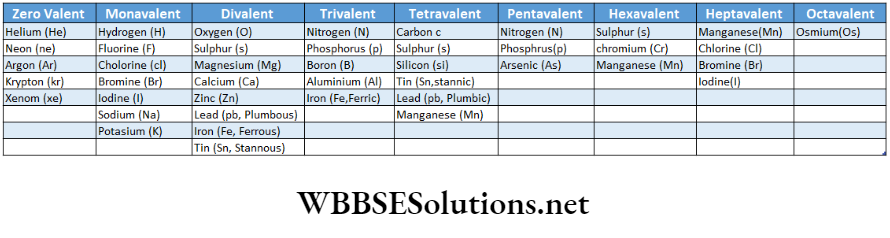
Class 11 Chemistry Some Basic Concepts Of Chemistry Elements With Different Valencies

Valency of radicals: Like an element, the valency of a radical can also be explained in the same way.

Valency of radicals Definition: Valency of a radical refers to the number of hydrogen atoms with which a radical can combine.

Thus, the valency of nitrate radical (NOJ) is because combines with 1 atom of hydrogen to produce an HN03 molecule. Similarly, sulfate (SO1-) and phosphate (PO1-) radicals exhibit di and tri valencies respectively.

This is because they combine with 2 and 3 atoms of hydrogen to form H2S04 and H3P04 molecules respectively.

Except NH+, other radicals behave like nonmetals. NH+ behaves like a monovalent metal. Like elements, radicals may also be monovalent, divalent, trivalent, etc.

Some Radicals And Their Valencies
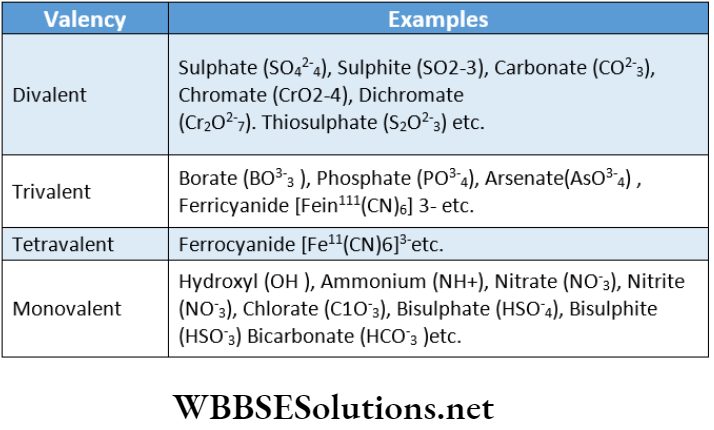
Class 11 Chemistry Some Basic Concepts Of Chemistry Some Radicals And Their Valencies

In the case of a binary compound, the ratio of the number of atoms of the constituent elements is the inverse of the ratio of their valencies.

Let, x atoms of element A combine with y atoms of element B to form a compound and the valencies of A and B are a and b respectively.

So, the total valency of A in the compound =xa [For x atoms] and that often that compound =yb [For y -atoms

Now, in the case of a compound composed of two elements, the total valency of one element is equal to that ofthe other.

⇒ \(x a=y b \quad \text { or, } \frac{x}{y}=\frac{b}{a}\)

Thus, the tint formula of the compound formed by the elements A and I will be A;(Hrt.

So, It In evident that In a molecule of a binary compound, the ratio of (lie number of atoms of the constituent elements is Inverse of the ratio of their valencies.

Equivalent Weight Or Equivalent Mass Or Chemical Equivalent Of An Element

Equivalent Weight Definition: The equivalent weight or mass of an element Is the number of parts by mass of the element which combines with 1.008 parts by mass of hydrogen or 8 parts by mass of oxygen or 35.5 ports by mass of chlorine or can displace the same amount of hydrogen, oxygen or chlorine respectively from their compounds.

Thus, the equivalent mass of an element

⇒ \(\begin{aligned}
& =\frac{\text { mass of the element }}{\text { mass of hydrogen combined or displaced }} \times 1.008 \\
& =\frac{\text { mass of the element }}{\text { mass of oxygen combined or displaced }} \times 8 \\
& =\frac{\text { mass of the element }}{\text { mass of chlorine combined or displaced }} \times 35.5
\end{aligned}\)

The equivalent mass is a ratio of two masses. So it is a Pure number and has no unit.

Alternative Definition: The equivalent weight of an element may be defined as the number of parts by weight of the element which combines with 11.2L of hydrogen or 5.6L of oxygen or 11.2L of chlorine (at STP) or displaces the above-mentioned volume of hydrogen or oxygen or chlorine (at STP) from any compound.

Hence, the Equivalent mass of an element

⇒ \(\begin{aligned}
& =\frac{\text { mass of the element }(\text { in gram })}{\text { volume of hydrogen combined }} \times 11.2 \\
& \text { or displaced (in L) at STP } \\
& =\frac{\text { mass of the element }(\text { in gram })}{\text { volume of oxygen combined }} \times 5.6 \\
& \text { or displaced (in L) at STP } \\
& =\frac{\text { mass of the element }(\text { in gram })}{\text { volume of chlorine combined }} \times 11.2 \\
& \text { or displaced ( In L) at STP } \\
&
\end{aligned}\)

Gram-equivalent mass (or weight) and gram-equivalent: The equivalent mass of a substance (element, radical, or compound) expressed in gram is called gram-equivalent mass. This particular amount represents 1 gram equivalent of the corresponding substance (element, radical, or compound)

Gram-equivalent mass (or weight) and gram-equivalent Example: The equivalent masses of Na and Mg are 23 and 12 respectively, so their gram-equivalent masses are 23 g and 12 g respectively. Again, 1 gram-equivalent of Na= 23g and 1 gram-equivalent of Mg= 24g.

The number of grams- the equivalent of an element

⇒ \(=\frac{\text { mass of the element (in gram) }}{\text { gram-equivalent mass of the element }}\)

Law of equivalent proportions: Elements combine with one another or displace the other from their compounds in the ratio of their respective equivalent mass or in simple multiples of their equivalent masses.

The law of equivalent proportions Is a direct corollary ofthe type of reciprocal proportions: Both calcium and chlorine combine separately with oxygen to form calcium oxide (CaO) and chlorine monoxide (C120) respectively.

In calcium oxide (CaO), 16 parts by mass of O combine with 40 parts by mass of Ca.

∴ 8 parts by mass of O combine with 20 parts by mass of a. So, equivalent mass of Ca= 20 In chlorine monoxide (C120), 16 parts by mass of O combines with (2 X 35.5) parts by mass of Cl.

∴ 8 parts by mass of nO combines with 35.5 parts by mass of Cl.

So, the equivalent mass ofchlorine = 35.5 From the above data, it is clear that 8 parts by mass of oxygen combine separately with 20 parts by mass of Ca and 35.5 parts by mass of Cl.

So according to the law of reciprocal proportion, if the elements Ca and Cl combine together, the ratio of their masses in the resulting compound will be either 20: 35.5 or any simple multiple of it.

Again according to the law of equivalent proportion, Ca and Cl will combine with each other in the ratio of their equivalent masses i.e., in the ratio of 20: 35.5 (because their equivalent masses are 20 and 35.5 respectively) In practice, it is also found that Ca and Cl combine with each other in the mass-ratio of 20: 35.5 to form calcium chloride (CaCl2).
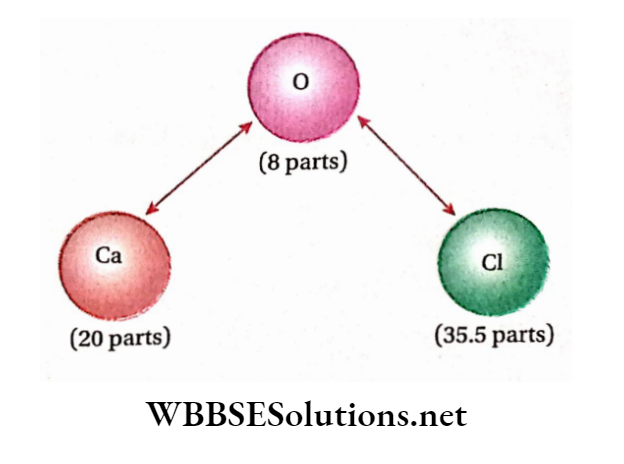
Class 11 Chemistry Some Basic Concepts Of Chemistry Law of Equivalent Proportions Is a direct corollary

It is thus seen that by using the law of reciprocal proportions and the law of equivalent proportions arrive at the same conclusion regarding the chemical combination of two or more elements. So, these two laws are different versions ofthe same proposition.

Relation Between Equivalent Mass And Atomic Mass Of An Element

Let, the atomic mass of an element =A, its equivalent mass

=E and its valency = V.

We know that the valency of an element indicates the number of hydrogen atoms that combine with one atom of that particular element.

∴ V atoms of hydrogen combine with the atom ofthe element. So, V X 1.008 parts by mass of hydrogen combine with A parts by mass of that element.

∴ 1.008 parts by mass of hydrogen combined with

⇒ \(\frac{A \times 1.008}{V \times 1.008}=\frac{A}{V}\) parts by mass of that element.

Thus, according to the definition of equivalent mass, A/v stands for the equivalent mass ofthe element.

⇒ \(E=\frac{A}{V} \quad \text { or, } \quad A=E \times V\)

The atomic mass of an element = equivalent mass of that element x its valency

If the valency of an element (V) =1, then A = E.

∴ For monovalent elements, atomic mass and equivalent mass are equal.

Example: Atomic mass of Na = 23. As Na is monovalent, the value of its equivalent mass will also be 23.

The equivalent mass of an element can never be more than that of its atomic mass: From equation number (1), A = E=a/v From this equation, it is clear that if the value of E exceeds that of A then the value of V will be less than 1. But valency is always a whole number and its value can never be less than 1.

∴ The equivalent mass of an element can never be more than its atomic mass.

The equivalent mass of an element can never be zero:

  1. From equation no. (1), E = A/v
  2. Now, E will be zero only when A = 0.
  3. But the atomic mass of an element can never become zero.
  4. Hence, the equivalent mass of an element can never be zero.

The equivalent mass of an element is inversely proportional to its valency:

⇒ \(=\frac{\text { atomic mass of the element }(A)}{\text { its valency }(V)}\)

But, for a given element, A = constant.

⇒ \(E=\frac{\text { constant }}{V} \text { or, } E \propto \frac{1}{V}\) Therefore Equivalent mass of an element varies inversely with its valency.

Equivalent Mass Of An Element May Vary

Equivalent mass of an element= \(=\frac{\text { atomic mass of the element }}{\text { valency of that element }}\)

The atomic mass of an element has a fixed value. However, the element may have variable valencies. In such cases, the equivalent mass ofthe elements may vary.

Thus, while mentioning the equivalent mass of an element having variable valencies, the compound that contains the element or the reaction in which the element participates must be mentioned.

Examples: Copper exhibits more than one valency; For Example in cuprous compounds (e.g., Cu20), the valency of Cu is 1 while in cupric compounds (For example CuO), the valency of Cu is 2.

Therefore, the equivalent mass of copper in cuprous compounds

⇒  \(=\frac{\text { atomic mass of } \mathrm{Cu}}{\text { valency }}=\frac{63.5}{1}=63.5\)

And the equivalent mass of copper in cupric compounds

⇒ \(=\frac{\text { atomic mass of } \mathrm{Cu}}{\text { valency }}=\frac{63.5}{2}=31.75\)

Similarly, the valency of metallic iron in ferrous compounds such as FeO, FeCl2, etc., is 2 while in ferric compounds such as Fe203, FeCl3, etc., is 3.

∴ Equivalent mass of Fein ferrous compounds \(=\frac{\text { atomic mass of } \mathrm{Fe}}{\text { valency }}=\frac{55.85}{2}=27.925\)

And the equivalent mass of Fein ferric compounds \(=\frac{\text { atomic mass of Fe }}{\text { valency }}=\frac{55.85}{3}=18.616\)

The equivalent mass of the elements that exhibit variable equivalent masses can be determined if the reactions in which they participate are known.

For example, in the reaction of Fe with HC1, ferrous chloride and H2 gas are produced.

⇒ \(\begin{aligned}
& \mathrm{Fe}+2 \mathrm{HCl} \longrightarrow \mathrm{FeCl}_2+\underset{2 \times 1.008 \text { parts by mass }}{+\mathrm{H}_2} \\
& 55.85 \text { parts by mass } \\
&\text { Equivalent mass of } \mathrm{Fe}=\frac{55.85 \times 1.008}{2 \times 1.008}=27.925
\end{aligned}\)

Again, red-hot Fe reacts directly with Cl2 to form FeCl3.

⇒ \(\begin{aligned}
& 2 \mathrm{Fe}+3 \mathrm{Cl}_2 \quad \rightarrow \quad 2 \mathrm{FeCl}_3 \\
& 2 \times 55.85 \text { parts by mass } \quad 3 \times 71 \text { parts by mass } \\
& \text { Here, equivalent mass of } \mathrm{Fe}=\frac{2 \times 55.85 \times 35.5}{3 \times 71}=18.616 \\
&
\end{aligned}\)

Examples of some other elements having variable equivalent mass are Sn, Pb, Hg, Cr, Mn, As, etc. Elements like Na, K, Mg, Ca, etc., are not characterized by variable valencies, and hence their equivalent masses are always fixed.

Thus while mentioning the equivalent masses of such elements, it is not necessary to mention the compound containing the element or the reactionin which the element participates.

Equivalent mass of radicals, acids, bases, salts, oxidants, and reductants

Equivalent mass of radicals: Equivalent mass of a radical denotes the number of parts by mass of a radical which combine with 1.008 parts by mass ofhydrogen, 8 parts by mass of oxygen, or 35.5 parts by mass of chlorine, or one equivalent of any other element or a radical.

Examples:

In HN03, 1.008 parts by mass of hydrogen combine with 62 parts by mass of nitrate (N03) radical, and hence the equivalent mass of nitrate (N03 ) radical = 62. 0 In H2S04, 2 x 1.008 parts by mass of hydrogen remain associated with 96 parts by mass of sulfate (SO2-4) radical.

Hence the equivalent mass of sulphate (SO2-4) radical= =\(\frac{96 \times 1.008}{2 \times 1.008}=48\)

⇒ \(\text { Equivalent mass of a radical }=\frac{\text { formula mass of the radical }}{\text { valency of the radical }}\)

Equivalent mass of an acid: The equivalent mass of an acid is defined as the number of parts by mass of the acid which contains 1.008 parts by mass irreplaceable hydrogen.

⇒ \(\begin{aligned}
\text { Equivalent mass of an acid } & =\frac{\text { molecular mass of the acid }}{\begin{array}{l}
\text { no. of replaceable } \mathrm{H} \text {-atoms } \\
\text { present per molecule of the acid }
\end{array}} \\
& =\frac{\text { molecular mass of the acid }}{\text { basicity of the acid }}
\end{aligned}\)

Examples:

Equivalent mass of HN03 = 63/1 = 63

Equivalent mass of H2S04 =98/2 = 49

Basicity of HN03 and H2S04 are1 and 2 respectively]

Equivalent mass of a base (or alkali): The equivalent mass of a base (or alkali) is defined as the number of parts by mass of the base (or alkali) which requires one equivalent mass of an acid for complete neutralization.

Equivalent mass of a base (or alkali)

⇒ \(=\frac{\text { molecular mass or formula mass of the base }}{\text { acidity of the base }}\)

Examples: Equivalent mass of NaOH =40/1= 40

Equivalent mass of CaO =56/2=28

[∴ Acidity of  NaOH and CaO are1 and 2 respectively]

Equivalent mass of salt: The equivalent mass of a normal salt denotes the number of parts by mass of that salt which contains one equivalent mass of active cation or anion.

The equivalent mass of a slat

⇒ \(\begin{aligned}
& =\frac{\text { molecular mass or formula mass of the salt }}{\text { (number of cations or anions present per molecule }} \\
& \text { of the salt } \times \text { valency of that cation or anion) } \\
& =\frac{\text { molecular mass or formula mass of the salt }}{\text { total valency of the cation or anion in one molecule of the salt }} \\
& =\frac{\text { molecular mass or formula mass of the salt }}{\text { total charge of the cation or anion in one molecule of the salt }}
\end{aligned}\)

Example: In A12(S04)3, the valency of Al3+ =3

∴ Equivalent mass of A12(S04)3 \(=\frac{342}{2 \times 3}=57\)

Similarly, in A12(S04)3, valency of SO2-4 = 2

∴ Equivalent mass of A12(S04)3 \(=\frac{342}{3 \times 2}=57\)

The equivalent mass of salt is also defined as the stun of the equivalent masses ofthe radicals present in that salt

∴ Equivalent mass of ofsalt= equivalent mass of cation + equivalent mass opinion

Examples: 1. Equivalent mass of Na2S04 = Equivalent mass of Na+ + Equivalent mass of SO2-4 =23 + 48 =71

Equivalent mass of A12(S04)3 = equivalent mass of Al3+ +Equivalent mass of SO2-4 =9 + 48 =57

Equivalent mass of Ca3(P04)2

= Equivalent mass of Ca2+ + Equivalent mass ofPO3-4

= 20 + 31.67 =51.67

Equivalent maw of oxidant and reductant: Equivalent muss of oxidant turd reductant tilth In determined by the following two methods. These are:

Electronic method:

⇒ \(\begin{aligned}
& \text { Equivalent mass of an oxidant } \\
& =\frac{\text { molecular mass or formula mass of the oxldant }}{\text { mumber of electron( } \mathrm{s}) \text { gained per molecule }}
\end{aligned}\)

Examples: Equivalent mass of KMnO4:0 Acidic medium, KMn04 Is reduced by suitable reductant to manganous (Mn2+) salt.

Reactions \(\mathrm{MnO}_4^{-}+8 \mathrm{H}^{+}+5 e \rightarrow \mathrm{Mn}^{2+}+4 \mathrm{H}_2 \mathrm{O}\)

∴ In an acidic medium, the equivalent mass of KMn04

⇒ \(=\frac{\text { molecular mass of } \mathrm{KMnO}_4}{\text { number of electrons gained }}=\frac{158.1}{5}=31.6\)

In a neutral medium, KMn04 Is reduced by a suitable reductant to Mn02.

Reaction: \(\mathrm{MnO}_4^{-}+2 \mathrm{H}_2 \mathrm{O}+3 e \rightarrow \mathrm{MnO}_2+4 \mathrm{OH}^{-}\)

∴ In a neutral medium, the equivalent mass of KMn04 Is reduced by a suitable reductant to Mn02.

In a strongly alkaline medium, KMn04 is reduced to K2Mn04.

Reaction: \(\mathrm{MnO}_4^{-}+2 \mathrm{H}_2 \mathrm{O}+3 e \rightarrow \mathrm{MnO}_2+4 \mathrm{OH}^{-}\)

Therefore In a neutral medium, the equivalent mass of KMn04

⇒ \(=\frac{158.1}{3}=52.7\)

In a strongly alkaline medium, KMn04 is reduced to K2Mn04.

Reaction: \(\mathrm{MnO}_4^{-}+e \rightarrow \mathrm{MnO}_4^{2-}\)

In strongly alkaline medium,

Equivalent mass of KMn04 \(=\frac{158}{1}=158\)

Equivalent mass of K2Cr207: K2Cr207 on reduction by a suitable reductant produces chromic salt (Cr3+).

Reaction: \(\mathrm{Cr}_2 \mathrm{O}_7^{2-}+14 \mathrm{H}^{+}+6 e \rightarrow 2 \mathrm{Cr}^{3+}+7 \mathrm{H}_2 \mathrm{O}\)

Equivalent mass of K2Cr207 \(=\frac{294.18}{6}=49.03\)

Equivalent Mass Of A Reductant

⇒ \(=\frac{\text { molecular or formula mass of the reductant }}{\text { number of electron(s) lost per molecule }}\)

Examples: In the presence of a suitable oxidizing agent, FeS04 gets oxidized to Fe2(S04)3.

Reaction: \(\mathrm{Fe}^{2+} \rightarrow \mathrm{Fe}^{3+}+e\)

Equivalent mass of FeS04 \(=\frac{151.85}{1}=151.85\)

In the presence of a suitable oxidizing agent, oxalic acid (C2H204 2H20) is oxidized to C02.

Reaction: \(\mathrm{C}_2 \mathrm{O}_4^{2-} \rightarrow 2 \mathrm{CO}_2+2 e\)

Here, the molecular mass of C2H204.2H20 = 126 and number of electrons lost = 2

∴ Equivalent mass of oxalic acid \(=\frac{126}{2}=63\)

Oxidation Mass of oxidant \(=\frac{\text { molecular or formula mass of the oxidant }}{\text { change in oxidation number }}\)

Examples: In the presence of d .H2S04, KMnCO4 Is reduced to manganous sulplutto (MnS04).

∴ \(\stackrel{+7}{\mathrm{KMnO}_4 \rightarrow} \stackrel{+2}{\mathrm{MnSO}_4}\)

Here, change In oxidation number of Mn in KMn04 = 7-2 = 5 units and molecular mass or formula mass of KMn04 =150.

Equivalent mass of KMn04 \(=\frac{158}{5}=31.6\)

In presence of dil. H2S04, K2Cr207 is reduced by a suitable reductant to Cr2(S04)3.

\(\mathrm{K}_2 \stackrel{+6}{\mathrm{Cr}_2 \mathrm{O}_7} \stackrel{+3}{\mathrm{Cr}_2}\left(\mathrm{SO}_4\right)_3\)

Here, change in oxidation number of 2 Cr -atoms in K2Cr2O7 =2x(+6)-2x(+3)=6 units.

Since the Equivalent mass of k2crO7 = 294/6=49

Equivalent mass of a reductant \(=\frac{\text { molecular or formula mass of the reductant }}{\text { change in oxidation number }}\)

Examples: 1 FeS04 is oxidized by an oxidant to Fe2(S04)3.

⇒ \(\stackrel{+2}{\mathrm{FeSO}_4} \stackrel{+3}{\rightarrow} \mathrm{Fe}_2\left(\mathrm{SO}_4\right)_3\)

Here, the change in oxidation number of Fe in FeS04 = 3-2 = 1 unit

∴ Equivalent mass of FeS04 \(=\frac{151.85}{1}=151.85\)

Sodium thiosulphate (Na2S203-5H20) is oxidized by an oxidant to sodium tetrathionate (Na2S406)

⇒ \(2 \mathrm{Na}_2 \stackrel{+2}{\mathrm{~S}_2} \mathrm{O}_3 \rightarrow \mathrm{Na}_2 \mathrm{~S}_4 \mathrm{O}_6+2 \mathrm{Na}^{+}\)

Here, changein oxidation number of4 S-atoms in Na2S203 = 4 X (+2.5)- 4 x (+2) = 18- 8 = 2 units.

∴ Changes in oxidation number for two S-atoms =1 unit Now, molecular mass of Na2S203.5H20 = 248

Equivalent mass of Na2S203-5H20 \(=\frac{248}{1}=248\)

In any chemical reaction, the number of equivalent or gram-equi-valent of reactants and products are always equal: In the chemical reaction, the reacting substances unite together in accordance with their equivalent masses. By analyzing the chemical reaction, it has been observed that the number of equivalents or gram-equivalents of constant(s) and produces) are always equal.

Example 1 \(\begin{aligned}
& \text { (1) } \underset{56 \mathrm{~g}}{\mathrm{Fe}}+\underset{2 \times 36.5 \mathrm{~g}}{2 \mathrm{HCl}} \longrightarrow \underset{129 \mathrm{~g}}{\mathrm{FeCl}_2}+\underset{2 \mathrm{~g}}{\mathrm{H}_2} \\
& 2 \text { gram-eqv. } 2 \text { gram-eqv. } 2 \text { gram-eqv. } 2 \text { gram-eqv. } \\
&
\end{aligned}\)

Generally, if in the case of the reaction, A + B-+C +D, the gram-equivalent of A reacts with .v gram-equivalent of B then, the gram-equivalent of C and .v gram-equivalent of D will be produced.

Methods for the determination of the atomic mass of an element:

Determination of atomic mass by Dulong and Petit’s law: At ordinary temperature, the atomic heat of all the solid elements (except C, B, Si, and Be) is always the same and numerically equal to 6.4 (approximately). The product of atomic mass and specific heat is known as atomic heat.

Hence, atomicmass x specific heat = 6.4 (approx) Approximate atomic mass \(=\frac{6.4}{\text { specific heat }}\)

The approximate atomic mass so obtained is divided by the equivalent mass ofthe element to get its valency. Since the atomic mass is not accurate, the value of valency may be fractional.

So, the nearest whole number should be considered as its valency which on multiplication with equivalent mass gives accurate atomic mass.

Determination of atomic mass of an element by applying Mitscherlich’s law of isomorphism: Let, a salt of an element E be isomorphous with K2S04, and the salt contains a % of E.

The atomic mass of E is to be determined. Let, the atomic mass of E be r. Since the salt of E is isomorphous with K2S04, the formula of the salt, according to Mitscherlich’s law, would be K2E04. Now, the molecular mass of K2E04

= 2×39+x + 4x 16 = 78+X + 64 = 142 + x

∴ Percentage of E in the salt \(=\frac{x}{142+x} \times 100\)

By the above assumption \(\frac{100 x}{142+x}=a\)

As ‘a’ is known, x can easily be calculated.

An alternative method (hy Isomorphous replacement): Experimental results show that different key dementia (l.a, the elements which are different) forming an Isomorphous compound can replace each other, atom for atom, without changing the crystal structure.

Let A and li be the key elements (having atomic masses a and respectively) In a pair of isomorphous compounds.

If W g of 1 is replaced hy W2 g of, then according to the law oflsomorphlsm.

⇒ \(W_1 / a=W_2 / b \text { or, } W_1 / W_2=a / b\)

⇒ \(\text { i.e., } \frac{\text { mass of the substituted element, } A}{\text { mass of the substituting element, } B}=\frac{\text { atomic mass of } A}{\text { atomic mass of } B}\)

This relation can be used to determine the atomic mass of A if that of B is known or vice versa.

Two compounds having the following characteristics are said to be isomorphous crystals:

  1. Both have similar external crystalline structures.
  2. They together can form mixed crystals.
  3. One can form overgrowth on the other if a small crystal of the latter is placed in the saturated solution of the former.

The property by virtue of which isomorphous crystals are formed is called isomorphism (iso: similar, morph: form).

Examples of isomorphous crystals:

White vitriol (FeS04-7H20), Epsom salt (MgS04- 7H20), green vitriol (FeS04-7H20)

Potassium permanganate (KMn04), potassium perchlorate (KC104)

Potash alum [K2S04-A12(S04)3-24H20]; chrome alum [K2S04-Cr2(S04)3-24H20]

It is observed from the formulae of isomorphous crystals that the total number of atoms in their molecules is the same.

Mitscherlich’s law of isomorphism: The same number of atoms combine in the same way to produce isomorphous crystals.

The crystalline form of these crystals depends only on the number of atoms in their molecules and the way by which they combine but is independent of their chemical properties.

Question 1. The atomic mass & equivalent weight of an element are 27 & 9 respectively. Find the formula of its chloride
Answer: Valency of element \(=\frac{\text { atomic mass }}{\text { equivalent weight }}=\frac{27}{9}=3\)

∴ Formula of its chloride = MC13 [since valency of Cl =1]

Question 2. x gram of an element forms y gram of its chloride. Calculate the equivalent weight of the element.
Answer: Mass ofthe chloride =y g and mass of element = x g

Mass of chlorine =(y- x) g

So, (y- x) g of chlorine combines with x g of the element.

∴ 35.5 g ofchlorine combines with \(\frac{35.5 \times x}{y-x} g\)

∴ Equivalent weight ofthe element \(=\frac{35.5 x}{y-x}\)

Example 3. Calculate the relative equivalent weight (£) of copper in cuprous oxide.
Answer: Formula of cuprous oxide = Cu20

∴ 16 g of oxygen combined with 2 x 63.5 g of Cu

So, 8 g ofoxygen combines with 63.5 g of Cu

∴ Equivalent weight (E) = 63.5

Example 4. A metallic oxide contains 60% metal. Calculate the equivalent weight of the metal.
Answer: 100 g of metallic oxide contains 60 g of metal. 100 g of metallic oxide contains (100 – 60) = 40 g of oxygen So, 40 g of oxygen combines with 60 g of metal.

8 g of oxygen combines with \(\frac{60 \times 8}{40}\)

Therefore, the equivalent weight of the metal = 12

Stoichiometry Practice Questions for Class 11

Question 5. 0.56 g of metallic oxide contains 0.16 g of oxygen. Determine the equivalent weight of that metal.
Answer: Mass of metallic oxide = 0.56 g and mass of oxygen = 0.16 g

So, mass ofmetalin the metallic oxide = (0.56- 0.16) g = 0.40 g

Equivalent weight of the metal

⇒ \(=\frac{\text { mass of the metal }}{\text { mass of combined oxygen }} \times 8=\frac{0.40 \times 8}{0.16}=20\)

Question 6. Determine the equivalent weight of O carbonate radical Ferrous Sulphate [Fe = 56]
Answer: Formula mass of carbonate radical =12 + 3×16 = 60

Therefore Equivalent weight of carbonate radical

⇒ \(=\frac{\text { formula mass }}{\text { valency }}=\frac{60}{2}=30\)

Formula mass of ferrous sulphate =56 + 32 + 64 = 152

Therefore Equivalent weight formula of ferrous mass sulphate

⇒ \(\begin{aligned}
& =\frac{\text { formula mass }}{\text { total valency of cation or anion per molecule }} \\
& =\frac{152}{2}=76
\end{aligned}\)

Question 7. When 0.3 g of a metal is dissolved in dilute IIC1 the volume of H2 gas liberated is 1 10mL at 17°C and 755 35.5 g ofchlorine combined with g ofthe element Hg of pressure. [Aqueous tension at 17°C = 14.4 Hg] Determine the equivalent mass of the metal.
Answer: Pressure of dry hydrogen gas= 755.14.4

If the volume of H2 gas produced at STP is VmL, then

⇒ \(\frac{110 \times 740.6}{(273+17)}=\frac{V \times 760}{273}\)

So, \(V=\frac{110 \times 740.6 \times 273}{290 \times 760} \mathrm{~mL}=100.91 \mathrm{~mL}\)

Now,mass of22400 mL of H2 at STP = 2x 1.008g

Mass of100.91 mL of H,2 at STP \(=\frac{2 \times 1.008 \times 100.91}{22400} \mathrm{~g}\)

=0.00908g

So, 0.00908 g of H2 is displaced by 0.3 g of metal.

1.008 g of H2 is displaced by \(\frac{0.3 \times 1.008}{0.00908}\) =33.3 g of mental

Therefore Equivalent mass of the mental=33.3

Question 8. The equivalent mass of a metal is 11.6. When 0.177g of that metal is allowed to react completely with dilute HC1, what will be the volume of H2 gas liberated at 12°C and 766mm Hg pressure?
Answer: The equivalent mass ofthe metal is 11.6.

∴ 11.6 g metal displaces 11200 mL of H2 at STP

0.177 g metal displaces \(\frac{11200 \times 0.177}{11.6}\)=170.89 ml of H2

Let volume by V at 12°C and 760 mm Hg pressure

∴ \(\frac{V \times 766}{(12+273)}=\frac{170.89 \times 760}{273}\)

Or, \(V=\frac{170.89 \times 760}{273} \times \frac{285}{766}=177.0 \mathrm{~mL}\)

Question 9. 20 g of a metal reacts with dilute H2S04 to liberate 0.504 g of H2 gas. Calculate the amount of metal oxide formed from 2.0 g of the metal.
Answer: 0.504 g of H2 is liberated by 20 g of the metal

∴ 1.008 g H2 is liberated by \(\frac{20 \times 1.008}{0.504}\)

So, the equivalent mass ofthe metal = 40

∴ 40 g of metal combined with 8 g of oxygen

So, 2.0 g metal combines with \(=\frac{8 \times 2}{40} g=\) 0.4 of oxygen

∴ Amount of metal oxide = mass of metal + mass of oxygen

= (2.0 4-0.4) = 2.4 g

Question 10. 3.26 g of zinc reacts with acid to liberate 1.12L of hydrogen gas (H2) at STP. Calculate the relative equivalent weight of zinc.
Answer: 1-12L of H2 (at STP) is liberated by 3.26 g of zinc, therefore, 11.2L Of H2 is Liberated By \(\frac{3.26 \times 11.2}{1.12}\) =32.6g of Zinc.

So, the equivalent weight of zinc = 32.6

Question 11. 15 g of an element reacts completely with 30 g of We know, A =Ex V A = 9.02 x V another element. Calculate the specific equivalent weight of A if that of B is 60.
Answer: We know that two elements A and B will react with each other in the ratio of their equivalent weight (EA and EB).

So, in the reaction between A and B Or, 15/30 = Ea/Eb

∴ Ea=1/2 X Eb =1/2 X 60 =30

So, the equivalent weight of A = 30

Question 12. 0.362g of metal is added to an aqueous solution of AgNOs. Consequently, 3.225 g of silver is precipitated. What is the equivalent mass of the metal? [Atomic mass of Ag = 108, valency = 1]
Answer: Equivalent mass of Ag \(=\frac{\text { mass of the metal }}{\text { mass of } \mathrm{Ag}}\) =108/1 =108

Now, the displacement of Ag by the metal from a compound of the metal occurs in proportion to their equivalent masses.

So, \(\frac{\text { equivalent mass of the metal }}{\text { equivalent mass of } \mathrm{Ag}}=\frac{\text { mass of the metal }}{\text { mass of } \mathrm{Ag}}\)

Let the equivalent mass of the metal be E

According to the problem \(\frac{E}{108}=\frac{0.362}{3.225}\)

Or, E=12.12

∴ Equivalent mass ofthe metal =12.12

Question 13. A metallic oxide contains 53% neutral. The vapor density of the chloride of the metal is 66. Find the atomic weight of the metal.
Answer: The metallic oxide contains 53% metal.

∴ The metallic oxide contains (100-53) = 47 % oxygen.

Hence, the equivalent weight (£) of the metal.

⇒\(=\frac{\text { mass of the metal }}{\text { mass of oxygen combined }} \times 8=\frac{53 \times 8}{47}=9.02\)

As given, vapour density of the metallic chloride = 66 Molecular weight ofthe chloride = 2 x 66 =132

since M=2xD

Let, the molecular formula of the metallic chloride be MCIv [where, V = valency of the metal]

∴ Molecular weight of MClv = A 4- 35.5 V [where, A = atomic weight of the metal]

We know, A =Ex V A = 9.02 x V

Hence, 9.02 X V4- 35.5 x V = 132 or, V \(=\frac{132}{44.52} \approx 3\)

So, atomic weight ofthe metal =ExV = 9.02 X 3 = 27.06

Question 14. A metallic chloride contains 20.2% by mass of metal (M). If the atomic mass of the metal is 27. What is the molecular formula of the metallic chloride?
Answer: Metal content in metallic chloride = 20.2 %

∴ Amount ofchlorine in the metallic chloride=(100- 20.2) = 79.8%

So, 79.8 parts by mass of chlorine combined with 20.2 parts by mass of the metal (M)

∴ 35.5 parts by mass of chlorine combined with \(\frac{20.2 \times 35.5}{79.8}\) = 8.986 Parts by mass of the mental.

Hence, the Equivalent mass of mental (M)=8.986

\(\quad V=\frac{A}{E}=\frac{27}{8.986}=3 \text { (approx.) }\)

So, the valency of the metal in the metallic chloride = 3

∴ The molecular formula of the metallic chloride = MC13

[Therefore Valency of chlorine =1]

Question 15. 8.08g of metallic oxide on being reduced by H2, produces 1.8g of water. Find the quantity of Oz In the above oxide and the equivalent mass of the metal.
Answer: Amount of oxygen present in 18 g of water = 16 g

Amount of oxygen present 1.8 g of water = 1.6 g

Oxygen content in 8.08 g ofthe metallic oxide = 1.6 g

[since all of this oxygen comes from the metallic oxide]

Hence, the amount ofthe metal present in that oxide =(8.08-1.6)=6.48g

∴ 1.6g of O2 COmbine with 6.48g of mental

Or, 8g Of O2 Combine with \(\left(\frac{6.48}{1.6} \times 8\right)\) g of the mental

Therefore, the equivalent mass of the metal = \(=\frac{6.48}{1.6} \times 8=32.4\)

Question 16. In the following reaction, determine the equivalent
weight of H3P04.
\(\begin{array}{r} \mathrm{Ca}(\mathrm{OH})_2+\mathrm{H}_3 \mathrm{PO}_4 \rightarrow \mathrm{CaHPO}_4+2 \mathrm{H}_2 \mathrm{O} \\{[\mathrm{Ca}=40 ; \mathrm{P}=31] \text { [II 82] }} \end{array}\)
Answer: In this acid-base neutralization reaction, 2 hydrogen atoms of H3P04 are replaced by atoms of calcium.

Equivalent weight of H3P04

⇒ \(\begin{aligned}
& =\frac{\text { molecular mass of } \mathrm{H}_3 \mathrm{PO}_4}{\text { number of displaced hydrogen atoms }} \\
& =\frac{3 \times 1.008+31+4 \times 16}{2}=49.012
\end{aligned}\)

Question 17. A metallic bromide weighing 1.878 g is heated in a current of hydrogen chloride. Consequently, 1.0 g of metallic chloride is obtained. What is the equivalent mass of the metal?
Answer:

Let the equivalent mass ofthe metal be the Equivalent mass ofthe metallic bromide =E+ 80

[∴ Equivalentmass ofbromine = 80 ] Equivalent mass ofmetallic chloride =E + 35.5

[∴ Equivalent mass ofchlorine = 35.5]

So, the number of gram-equivalent of metallic bromide and metallic chloride is \(\frac{1.878}{E+80} \text { and } \frac{1.0}{E+35.5}\) Respectively.

Now, in any chemical reaction, the gram-equivalents of the reactant and the product are equal.

So, in the reaction, the gram-equivalent of metallic bromide is equal to the gram-equivalent of metallic chloride.

∴ \(\frac{1.878}{E+80}=\frac{1.0}{E+35.5}\)

or, E(1.878-1) = 80-35.5X 1.78 =80-66.669

or, 0.878 x £ = 13.331 or, E= 15.18

∴ Equivalent Mass of mental = 15.18

Question 18. The hydride of element A contains 25% of hydrogen by mass. The percentages of oxygen in two oxides of that element are 57.1 and 72.7 respectively. If the atomic mass of the element is 12 determine the formula of the hydride and the two oxides.
Answer: The quantity of the element A in the hydride of element
A =(100-25)% = 75%

So, in the hydride of element A, 25 parts by mass ofhydrogen combine with 75 parts by mass element A.

∴ 1.008 parts by mass of hydrogen combined with

75/25 X 1.008 = 3.024 Parts by mass of element A

∴ Equivalent mass of ‘A’ anhydride = 3.024
∴ Quantity of A in the first oxide = (100- 57.1) % = 42.9 %

and in the second oxide = (100- 72.7) % = 27.3 %

So, in the first oxide, 57.1 parts by mass ofoxygen combine with

42.9 parts by mass of A

In the first oxide, 8 parts by mass of oxygen combine with

⇒ \(\frac{42.9}{57.1} \times 8\)=60.1 parts of mass of A.

Similarly, in the second oxide, 8 parts by mass of oxygen react with \(\frac{27.3 \times 8}{72.7}=\) = 3 parts by mass of A.

∴ The valency of A in the first hydride.

⇒ \(=\frac{\text { atomic mass of } \mathrm{A}}{\text { equivalent mass of } \mathrm{A} \text { in the hydride }}=\frac{12}{3.024}=4\)

Formula of the hydride = AH4

Valency of A in the first oxide

⇒ \(=\frac{\text { atomic mass of } \mathrm{A}}{\text { equivalent mass of } \mathrm{A} \text { in the first oxide }}\)

=12/6.01 =2

Formula of first oxide = AO [Therefore Valency of oxygen =2]

Valency of A in the second oxide

⇒ \(=\frac{\text { atomic mass of } \mathrm{A}}{\text { equivalent mass of } \mathrm{A} \text { in the second oxide }}\)

=12/3=4

therefore Formula ofthe second oxide = AO2

Question 19. The specific equivalent weight of a solid element is 17.8 and its specific heat is 0.124 cal .K-1. g-1. Find its valency and correct specific atomic mass.
Answer: As perDoulong and Petit’s law, the approximate atomic mass
ofthe solid element = \(\frac{6.4}{\text { specific heat }}=\frac{6.4}{0.124}=51.61\)

therefore Valency of element = \(=\frac{\text { atomic mass (approx) }}{\text { equivalent weight }}=\frac{51.61}{17.8} \approx 3\)

Therefore Correct atomic mass ofthe element

= equivalent weight X valency = 17.8 X 3 = 53.4

Question 20. The specific heat of magnesium is 0.262 and magnesium chloride contains 25.5% by weight of magnesium. Determine the atomic mass, valency of magnesium, and also the formula of magnesium chloride.
Answer: Percentage of magnesium chloride= 25.5

∴ Percentage of chlorine in the salt = 74.5

∴ Equivalent weight of magnesium

⇒ \(=\frac{\text { mass of magnesium }}{\text { mass of chlorine }} \times 35.5\)

⇒ \(=\frac{25.5}{74.5} \times 35.5=12.15\)

According to Dulong and Petit’s law,

Atomic mass ofthe metal x specific heat = 6.4 (approx)

So, approximate atomic mass of magnesium \(=\frac{6.4}{0.62}=24.42\)

∴ Valency of Mg \(=\frac{\text { approximate atomic mass }}{\text { equivalent weight }}\)

Therefore, the atomic mass of magnesium = equivalent weight x valency = 12.15×2 = 24.30, and the formula of magnesium chloride is MgCl2.

Question 21. An aqueous solution contains 0.22 g of metallic chloride. 0.51 g of AgNOa is required for the complete precipitation of chloride from that solution. If the specific heat of the metal is 0.057 then what will be the correct atomic mass of that metal? What is the formula of that metallic chloride?
Answer: S. Let the equivalent mass ofthe metal be E.
Equivalent mass of the metallic chloride =E + 35.5 [ v Equivalent mass ofchlorine = 35.5 ]

Equivalentmass of AgN03

= Equivalent mass of Ag+ + Equivalent mass of N03

= 108 + 62 =170.

In any chemical reaction, the reactants combine together in the proportion of their equivalent masses.

⇒ \(\text { So, } \quad \frac{E+35.5}{170}=\frac{0.22}{0.51} \quad \text { or, } E=37.83\)

Determination of atomic mass ofthe metal: According to Dulong and Petit’s law, the approximate atomic mass of metal

⇒ \(=\frac{6.4}{\text { specific heat }}=\frac{6.4}{0.057}=112.28\)

Therefore Valency of the metal \(=\frac{\text { approx. atomic mass of the metal }}{\text { equivalent mass }}\)

⇒ \(=\frac{112.28}{37.83}=2.968 \approx 3\)

Therefore, the correct atomic mass of M =37.83×3 = 113.49

So, the molecular formula of chloride salt = MC13.

Question 22. The percentage by weight of chromium in green-colored chromium oxide (chromic oxide) is 68.43 and it is isomorphous with ferric oxide. Estimate the = 74.5— X35.5 = 12.15 correct atomic weight of chromium.
Answer: Chromium oxide is isomorphous with Fe203. So, according to Mitscherlich’s law of isomorphism, the formula chromium oxide will be Cr203.

Since the valency of Fe in Fe203 is 3 the valency of Cr in Cr203 will also be 3.

Now, the quantity of chromium in chromium oxide = 68.43 % Quantity of oxygen =(100-68.43) = 31.57 % Equivalent weight of chromium

⇒ \(=\frac{\text { weight of chromium }}{\text { weight of combined oxygen }} \times 8=\frac{68.43}{31.57} \times 8=17.34\)

Hence, the correct atomic weight chromium

= equivalent weight x valency = 17.34 x 3 = 52.02

Question 23. Potassium manganate and potassium chromate (K2Cr04) Percentage of manganese by mass present in potassium manganate is 27.86. Determine the atomic mass of manganese.
Answer: Potassium chromate (K2Cr04) is isomorphous with potassium manganate. So according to Mitscherlich’s law of isomorphism, the formula of potassium manganate should be K2Mn04.

Suppose, the atomic mass of Mn = a

Molecular mass of K2Mn04 = 2×39 + a + 4xl6 = a + 142

Therefore Percentage of Mn in K2Mn04 \(=\frac{a}{a+142} \times 100\)

As given in the question \(\frac{a \times 100}{a+142}=\)

Therefore Atomic mass of manganese = 54.84

Question 24. An element (X) reacts with KOH to form a salt. The salt is isomorphous with potassium permanganate (KMn04). The oxide of the element X contains 61.2% of oxygen. Determine the formula of the oxide and atomic mass of X.
Answer: Percentage of oxygen in the oxide of X = 61.2

Therefore Percentage of X in the oxide of X = (100- 61.2) = 38.8

Therefore \(\text { Equivalent mass of } \mathrm{X}=\frac{\text { mass of } \mathrm{X}}{\text { mass of combined oxygen }} \times 8\)

⇒ \(=\frac{38.8}{61.2} \times 8=5.07\)

In reaction with KOH, the element X produces a salt that is isomorphous with KMn04. Since the valency of Mn in KMn04 is 7, according to Mitscherlich’s law, a formula of the salt produced will be KX04 where the valency of X is 7.

Therefore Atomic mass of X = equivalent mass x valency

∴ = 5.07X7 = 35.49.

∴ The formula of the oxide would be X207

Question 25. Oxides of two metals A and B are isomorphous. The atomic weight of B is 43.5 and the vapor density of its chloride is 75. The amount of oxygen present in 1.02g ofthe oxide of A is 0.48g. Determine the atomic weight of A.
Answer: Determination of equivalent weight of A: Quantity of oxygen present 1.02g of the oxide of A = 0.48 g

So, the quantity of A in that oxide = (1.02- 0.48) = 0.54 g

Equivalent weight of the metal A

\(=\frac{\text { mass of } \mathrm{A} \times 8}{\text { mass of combined oxygen }}=\frac{0.54 \times 8}{0.48}=9\)

Determination of valency of B: Vapour density ofthe chloride metal B = 75

Molecular mass ofthe chloride of metal B = 2 x 75 = 150 If the valency of B is x, then the formula of the chloride

of B = BC1X

Molecular mass ofthe compound BC1X = 43.5 + 35.5 X x

Therefore 43.5 + 35.5 X x = 150 or, x = 3

Therefore Valency of B = 3 and the formula of its oxide is B203

Determination of valency of A: Oxides of A and B are isomorphous. So according to the law of isomorphism, the formula ofthe oxide of A is A203 and the valency of A is 3. Hence, the atomic mass of A.

= equivalent weight x valency = 9×3 = 27

Quantity of water associated with 1 11 g or 1 mol of the anhydrous salt \(=\frac{1.48 \times 111}{1.52}=108.07 \mathrm{~g}\)

Therefore, the quantity of water associated with 1 mol of anhydrous CaCl2 is 108.07g.

Percentage Composition Empirical And Molecular Formula

Percentage Composition

The percentage composition of a compound means the parts by mass of each of the constituent elements in every 100 parts by mass of that compound.

Chemical analysis of water reveals that in every 100 parts by mass of water, 11.1 parts by mass of hydrogen, and 88.9 parts M1 Gram-formula mass of Ca3(P04)2 by mass of oxygen is present the percentage composition of water is: hydrogen (H) = 11.1 % and oxygen (O) = 88.9%.

Hence, it is clear that the percentage composition of the = [3 X 40 + 2(31 + 64)] = 310g
Ca3(P04)2 can be regarded as constituent elements in a compound independent of the Gram-molecular mass of P205 = (2 X 31 + 5 x 16) = 142g quantity of the compound taken.

For example, irrespective of the quantity of water taken % of P2O5 in calcium phosphate = x 100 = 45.8 (say 4g or 18g or 50g, etc.), the percentage of hydrogen and
oxygen by mass will always be 11.1 and 88.9 respectively.

Percentage composition from the molecular formula:

  1. The molecular mass or formula mass of the compound is first calculated from its molecular formula.
  2. The mass of each element or radical present in 1 gram ofthe compound is then calculated separately.
  3. Finally, the percentage of the mass of each element present in the compound is computed separately.

% of an element or radical present in the compound

\(\begin{aligned}
& \text { mass of the element or radical in } 1 \text { gram-mole } \\
& =\frac{\text { of the compound }(\mathrm{g})}{\text { gram-molecular mass or gram-formula mass }} \times 100 \\
& \text { of the compound (g) } \\
&
\end{aligned}\)

Question 1. 3 g of hydrated calcium chloride yields 1.52 g of the anhydrous salt on heating. What is the percentage of water present in the hydrated salt? Find the quantity of water associated per mole ofthe anhydrous salt.
Answer: Amount of water present in 3g of hydrated calcium chloride =(3- 1.52) =1.48g

∴ Percentage of water in hydrated salt= \(\frac{1.48}{3} \times 100\) 100 = 49.33 

Gram-formula mass of any. CaCl2 =(40 + 2 x 35.5) = 392 = 111g

Quantity of water associated with 1. 52g anhydrous =1.48g

∴ Quantity of water associated with 1 11 g or 1 mol of the anhydrous salt \(=\frac{1.48 \times 111}{1.52}=108.07 \mathrm{~g}\)

∴ The quality of water associated with 1 month 1 mol of anhydrous CaCl2 is 108.07g

Question 2. What is the percentage of P205 in calcium phosphate [Ca3(PO4)2]?
Answer: Gram-formula mass of Ca3(P04)2 = [3 X 40 + 2(31 + 64)] = 310g

Ca3(P04)2 can be regarded as [3CaO P205]

Gram-molecular mass of P205 = (2 X 31 + 5 x 16) = 142g

∴ % of P2O5 in calcium phosphate \(=\frac{142}{310} \times 100=45.8\)

Question 3. A compound contains 28% of nitrogen and 72% of metal mass. In the compound, 3 atoms of the metal remain combined with two atoms of nitrogen. Find the atomic mass of the metal.
Answer: The formula of the compound is M3N2. [metal =M]

∴ Molar mass of M3N2 =3a + 28 [a = atomic mass ofM]

So, percentage of metal in the compound \(=\frac{3 a}{3 a+28} \times 100\)

∴ \(\left(\frac{3 a}{3 a+28}\right) \times 100=72 \text {, or } a=24\)

Therefore, the atomic mass of the metal = 24

Question 4. Give the percentages of ammonium and sulfate radicals in Mohr salt [(NH4)2S04 -FeS04 -6H20 ].
Answer: Molecular mass of Mohr salt = (2 X 18) + 96 + 56 + 96 + (6 x 18) =392

In each mole of Mohr salt, the amount of ammonium

⇒\(\left(\mathrm{NH}_4^{\oplus}\right)\)

radical=2×18 =36g and amount of sulphate \(\left(\mathrm{SO}_4^{2-}\right)\) radical

= 2×96 = 192g

∴ Percentage of ammonium \(\left(\mathrm{NH}_4^{\oplus}\right)\) radical in mohar salt.

\(=\frac{36 \times 100}{392}=9.18\)

Percentage of sulphate \(\left(\mathrm{SO}_4^{2-}\right)\) radical in Mohr Salt \(=\frac{192 \times 100}{392}=48.98\)

Question 5. Haematite (Fe203) contains some water in addition to Fe203. 4.0 kg of this mineral contains 2.5 kg of iron. Find the purity of Fe2Os in the mineral.
Answer: Gram-molecular mass of Fe203 =2×55.85 + 3×16 =159.7g

Now, (2 x 55.85) g Fe= 159.7 g Fe2O3

∴ 2500g Fe = \(\frac{159.7 \times 2500}{2 \times 55.85} \mathrm{~g} \mathrm{Fe}_2 \mathrm{O}_3=3574 \mathrm{~g} \mathrm{Fe}_2 \mathrm{O}_3\)

So, 4000 g mineral contains 3574 g of pure Fe203.

∴ Purity of Fe203 in haematite \(=\frac{3574 \times 100}{4000}=89.35 \%\)

Empirical And Molecular Formula

Empirical formula: The empirical formula of a compound indicates the number of atoms of different elements present in a molecule of the compound, expressed in a simple whole number ratio.

The empirical formula merely indicates the ratio of the atoms of elements constituting the molecule of a compound. Thus, this formula may not represent the actual number of atoms in the molecule of a compound.

Example: The empirical formula of glucose is CH2O. This shows that in the molecule of glucose, C, H, and O-atoms are present in the simplest ratio of 1:2: 1.

Molecular formula: The molecular formula of a compound indicates the actual number of atoms of various constituent elements present in a molecule of the compound.

The molecular formula represents the actual formula of the molecule of a compound as it gives the actual number of atoms constituting the molecule.

Example: The molecular formula of glucose is C6H1206. This shows that a molecule of glucose consists of six C-atoms, twelve H-atoms, and six O-atoms.

However, in certain cases, the empirical formula and the molecular formula may be identical. For example, formaldehyde has both empirical and molecular formula CH20.

Relation between empirical formula and molecular formula: The molecular formula of a compound is a whole number multiple ofthe empirical formula of that compound.

Molecular formula of a compound = (empirical formula)n

[where n = 1, 2, 3, etc. are simple whole numbers]

Example: The empirical formula of glucose is CH20 while its molecular formula is C6H1206 or CH12O6 When n — 1, both the empirical formula and the molecular formula will be the same.

In the case of formaldehyde, the empirical formula i.e., CH20 and the molecular formula [i.e., CH20 (HCHO)] are the same.

The sum of the atomic masses of the constituent elements present in the molecular formula of a compound indicates the molecular mass of that compound.

On the other hand, the sum of the atomic masses of the constituent elements present in the empirical formula of a compound indicates the empirical formula mass of that compound.

The molecular formula of a compound is either equal to or is a simple multiple of its empirical formula mass Molecular mass of a compound =n x empirical formula mass.

Now, if n is 1, i.e., molecular mass = empirical formula mass of a compound, then the empirical formula and the molecular formula ofthe compound would be identical.

Basis of determination of the empirical formula of a compound: Let the molecular mass of a compound, composed of two elements A and B, is M and the percentage composition by mass of A and B in that compound are x and y respectively.

Therefore Amount of A in M gram i.e., 1 gram-mole compound \(=\frac{x \times M}{100}\) gram. Similarly, the amount of B in Mgram i.e., 1 gram-mole ofthe compound gram.

Let, the atomic masses of A and B be a and b respectively.

∴ Number of gram-atoms of A in 1 gram-mole of the \(=\frac{x \times M}{100 \times a} .\)atoms of B in1 gram-mole of the compound \(=\frac{x \times M}{100 \times a}: \frac{y \times M}{100 \times b}=\frac{x}{a}: \frac{y}{b}\)

In 1 molecule of the compound, the ratio of the number of atoms of A and B

Hence, in a molecule of the compound, the ratio of the number of atoms of A to the number of atoms of B \(=\frac{\text { mass of } \mathrm{A} \text { in the compound }(\%)}{\text { atomic mass of } \mathrm{A}}: \frac{\text { mass of } \mathrm{B} \text { in the compound }(\%)}{\text { atomic mass of } \mathrm{B}}\)

Similarly, the number of grams of A in the compound(%). mass of B in the compound(%) atomic mass of A atomic mass of B

Therefore, the ratio of the quotients, obtained by dividing the percentage mass of each constituent element by its corresponding atomic mass, gives the ratio of the atoms of the elements present in a molecule of that compound. From this ratio, the empirical formula can be determined.

Determination of the empirical formula of a compound: The empirical formula ofany compound can be determined the following steps

The percentage by mass of each element in the compound is accurately evaluated by suitable methods.

The percentage by mass of each element is divided by its atomic mass in order to get the relative number of different types of atoms present in the molecule.

Each of the numbers obtained is divided by the smallest of these numbers to get the simplest ratio of atoms.

In determining the ‘simplest ratio of atoms; the ‘rule of approximation’ is followed. For example, if the quotient is 2.99 or 4.01, then the nearest whole numbers, i.e., 3 or 4 respectively are accepted as the required quotient.

But when the ‘rule approximation’ cannot be applied, e.g., if any quotient is 1.5 or 1.6, each of the quotients obtained is to be multiplied with a suitable factor so as to convert all the quotients into lowest whole numbers.

The ratio, thus obtained, expresses the ratio of the number of atoms of the elements constituting a molecule and thus gives the empirical formula of the compound.

Example: In an acetic acid molecule, constituent atoms are C, H, and O. The ratio of the number of atoms is 1:2:1 as determined by the preceding steps. Thus, the empirical formula acetic acid will be CH20.

Method of determination of molecular formula:

  1. The empirical formula of a compound is first determined. by the method described above.
  2. The molecular mass of the compound is determined experimentally.
  3. In the case of volatile compounds, the molecular mass is evaluated using the equation, M = 2D, where D = experimentally determined value of the vapor density of the compound.
  4. [It is to be noted that the equation, M = 2D is applicable only in the case of those stable compounds that do not undergo dissociation or decomposition reaction in the vapor state.
  5. From the empirical formula of the compound, the empirical formula mass is calculated.
  6. The empirical formula mass of any compound is the sum of the atomic masses of atoms of different elements represented by the empirical formula.
  7. The molecular mass of the compound. n x empirical formula mass
  8. So, in order to evaluate ‘n ’, the molecular mass of the compound is to be divided by its empirical formula
  9. Finally, the empirical formula ofthe compound multiplied by n ’, gives the molecular formula of the compound.

Numerical Examples 

Question 1. A compound of carbon, hydrogen, and oxygen contains 40% of carbon and 6.67% of hydrogen. The vapor density of the compound, when vapourised, is 2.813 times the vapor density of oxygen. Determine the empirical formula and molecular formula of the compound.
Answer: 

Given

A compound of carbon, hydrogen, and oxygen contains 40% of carbon and 6.67% of hydrogen. The vapor density of the compound, when vapourised, is 2.813 times the vapor density of oxygen.

In the compound, C = 40%, H = 6.67% and thus O = [100 -(40 + 6.67)]% =53.33%

Now, the ratio of the number of atoms of C: H:O in the compound, \(\mathrm{C}: \mathrm{H}: \mathrm{O}=\frac{40}{12}: \frac{6.67}{1}: \frac{53.33}{16}\)

Therefore Atomic masses of C, H, and O are 12, 1, and 16 respectively]

= 3.33: 6.67: 3.33 as 1: 2: 1

[dividing by the lowest number 3.33 ]

Therefore Empirical formula ofthe compound = CH20.

Molecular formula =(CH20) n [where n is an integer]

∴ Molecular mass ofthe compound=(12 + 2 + 16)n =30 n.

Again, the vapor density (D) of the compound

= vapour density of oxygen x 2.813 = 16 x 2.813 = 45.008

∴ The molecular mass of the compound =2 x D

= 2×45.008 =90.016

Hence, 30n= 90.016 i.e., n=3

∴ Molecular formula =(CH20)3 = C3Hg03.

Question 2. A gaseous hydrocarbon contains 75% carbon by moss, 100 cm3 of this gas at STP weighs 0.072 g. What is the molecular formula of the hydrocarbon? [Weight of litre hydrogen at STP = 0.09 g]
Answer:

Given

A gaseous hydrocarbon contains 75% carbon by moss, 100 cm3 of this gas at STP weighs 0.072 g.

Hydrocarbon consists ofhydrogen and carbon only.

Let, in the hydrocarbon, the mass of carbon = 75 g The mass ofhydrogen = ( 100- 75) g = 25 g Ratio of the number of carbon (C) atoms and hydrogen (H) atoms in the compound, C: H \(=\frac{75}{12}: \frac{25}{1}\)

or, C: H =6.25: 25 =1:4

∴ The empirical formula of the hydrocarbon = CH4

∴ Its molecular formula = (CH4)n

Molecular mass of hydrocarbon = (12 + 4)n = 16n

Vapor density (D) of hydrocarbon

\(=\frac{\text { mass of } 100 \mathrm{~cm}^3 \text { hydrocarbon at STP }}{\text { mass of } 100 \mathrm{~cm}^3 \text { hydrogen at STP }}\) \(=\frac{0.072}{0.009}=8\)

Molecular mass hydrocarbon =2×0 =2×8 =16

So, 16n = 16 or, n = 1

Molecular formula ofthe hydrocarbon = (CH4)1 = CH4

Question 3. A compound on analysis gives the following percentage composition: K=31.83, CI= 28.98, and 0=39.19. Find the molecular formula of the compound if its molecular mass is 122.5
Answer:

Given

A compound on analysis gives the following percentage composition: K=31.83, CI= 28.98, and 0=39.19.

Empirical formula of the compound = KC103, molecular formula =(KC103)n

Molecular mass = n X (39 + 35.5 + 48) = 122.5 x n 122.5 x n = 122.5 or, n = 1

So, the molecular formula ofthe compound = KC103.

Question 4. 0.93 g of a compound containing C, H, and N, on C : H: N = burning, produces 2.64 g C02 and 0.63 g HzO. In another experiment, 0.186 g of that compound yields 24.62 cm3 of nitrogen at 1 atmospheric pressure at 27°C. Molecular weight ofthe compounds 93. What is its molecular formula?
Answer:

Given

0.93 g of a compound containing C, H, and N, on C : H: N = burning, produces 2.64 g C02 and 0.63 g HzO. In another experiment, 0.186 g of that compound yields 24.62 cm3 of nitrogen at 1 atmospheric pressure at 27°C. Molecular weight ofthe compounds 93.

Molecular masses: C02 =44 and H20 = 18

Quantity of carbon in 44g of C02 = 12 g

Quantity ofcarbon in 2.64g of C02= \(=\frac{12 \times 2.64}{44}=0.72 \mathrm{~g}\)

Again, quantity of H2 in 18g of H20 =2g

Quantity of H2 in 0.63g of H2O \(=\frac{2}{18} \times 0.63=0.07 \mathrm{~g}\)

Therefore, 0.93g ofthe compound contains 0.72g carbon and 0.07g hydrogen.

In another experiment, it was found that the volume of N2 produced at 1 atm pressure and 27°C temperature from 0.186g of that compound is 24.62 cm3.

Let, the volume ofthe gas at STP be V2 cm3.

As given in the question,

P1 = 1 atm, Kj = 24.62cm3, P2 = 1 atm

T1 = (273 + 27) = 300 K, T2 = 273 K, V2 = ?

we know \(\frac{P_1 V_1}{T_1}=\frac{P_2 V_2}{T_2}\)

∴ \(V_2=\frac{P_1 V_1 T_2}{P_2 T_1}=\frac{1 \times 24.62 \times 273}{1 \times 300}\) = 22.4 cm3

1 mol or 22400 cm3 of nitrogen at STP weighs 28 g

∴ 22.4 cm3 of nitrogen at STP weighs \(\frac{28 \times 22.4}{22400}\) = 0.08g

So, the mass of nitrogen obtained from 0.186 g of the compound = 0.028 g

∴ Mass of nitrogen obtained from 0.93 g of compound

⇒ \(=\frac{0.028 \times 0.93}{0.186}=0.14 \mathrm{~g}\)

Hence, the mass of C, H, and N in 0.93 g of the compound is 0.72, 0.07, and 0.14 g respectively.

In the given compound,

Percentage of C by mass =(0.72/0.93) x 100 =77.42,

percentage of by mass = (0.07/0.93) X 100 = 7.52,

percentage ofN by mass = (0.14/0.93) x 100 = 15.05 .

The ratio of the number of atoms of C, H, and N,

⇒ \(C: H: N=\frac{77.42}{12}: \frac{7.52}{1}: \frac{15.05}{14}\)

= 6.451:7.52:1.075 =6:7:1 [dividing by the lowest number 1.075 ]

∴ Empirical formula compound = C6H7N

∴ Molecular formula =(C6H2N)n [where n is an integer]

∴ Molecular mass = (6 X 12 + 7 x 1 + 1 x 14)/t = 93 n

According to the given condition, 93n = 93 n = 1

Therefore Molecular formula of compound =(C6H7N)1 = CgH7N

Question 5. A compound composed of carbon, hydrogen, and chlorine contains C = 10.04% and Cl = 89.12%. The vapor density of the compound is 59.75. Determineitsmolecular formula.
Answer:

Given

A compound composed of carbon, hydrogen, and chlorine contains C = 10.04% and Cl = 89.12%. The vapor density of the compound is 59.75.

Amount of hydrogen in the compound = 100- (10.04 + 89.12) = 0.84% Ratio of number of atoms of carbon (C), hydrogen (H) and chlorine (Cl) in the compound,

\(\begin{aligned}
\mathrm{C}: \mathrm{H}: \mathrm{Cl} & =\frac{10.04}{12}: \frac{0.84}{1}: \frac{89.12}{35.5} \\
& =0.836: 0.84: 2.510 \approx 1: 1: 3
\end{aligned}\) dividing by the lowest number 0.836 ]

∴ Empirical formula compound = CHC13

∴ Molecular formula ofthe compound = (CHC13)n

Molecular mass ofthe compound = (12 +l + 3x 35.5)n = 119.5n

Again, vapour density (D) ofthe compound =59.75

Molecular mass (Af) = 2 x D = 2 x 59.75 = 119.5

Hence, 119.5n = 119.5

∴ n = 1

Molecular formula of compound = (CHC13)1 = CHC13

Question 6. lg of phosphorus on combustion produces 1.77g oxide. What is the empirical formula of the compound? If the vapour density ofthe compound is 110, what is its molecular formula?
Answer: Quantity of phosphorus (P) in 1.77g of oxide =1 g The percentage-mass of phosphorus in its oxide

⇒ \(=\frac{1}{1.77} \times 100\) = 46.49 and that of oxygen in the oxide

= 100-56.49 =43.51

The ratio of the number of atoms of P and O in 1 molecule of the oxide
\(P: O=\frac{56.49}{31}: \frac{43.51}{16}\)

=1.822: 2.719

=1: 1.492 [dividing by the lowest number]

=2:3 [to get the lowest whole number, the

the ratio is multiplied by 2]

1.24 X 100

= 40%

∴ The empirical formula of compound = (P203)n, where n is an integer.

So, molecular mass of compound =(2 x 31 + 3 X 16)n = 110 n

Now, the vapour density (D) ofthe oxide = 110

Therefore The molecular mass (M) ofthe oxide = 2 X D

= 2 x 110 = 220

So, HOn = 220

∴ n =2

Thus, molecular formula ofthe compound = (P203)2 or P4Og

Question 7. The empirical formula of a gaseous compound is CH2C1.0.12 g ofthe compound occupies 37.20 cm3 at 105°C 12 1 16 Empirical formula of compound = CH20 temperature and 768 mmHg pressure. Find the molecular formula of the compound.
Answer:

Given

The empirical formula of a gaseous compound is CH2C1.0.12 g ofthe compound occupies 37.20 cm3 at 105°C 12 1 16 Empirical formula of compound = CH20 temperature and 768 mmHg pressure.

The volume of 0.12 g of the compound is 37.20 cm3 at 105°C and 768 mm pressure. Let, the volume of 0.12 g ofthe compound be V cm3 at STP.

⇒ \(\text { So, } \frac{768 \times 37.20}{(273+105)}=\frac{760 \times V}{273} \quad \quad V=27.15 \mathrm{~cm}^3\)

Again, mass of 27.15 cm3 of gaseous compound at STP = 0.12 g

Therefore Mass of 22400 cm3 i.e., 1 mol ofthe compound at STP

⇒ \(=\frac{0.12 \times 22400}{27.15}=99 \mathrm{~g}\)

[Since the volume of 1 gram-mole of gas at STP = 22400 cm3 ] The molecular mass ofthe compound = 99 Now, the empirical formula ofthe compound = CH2C1.

The molecular formula of the compound = (CH2Cl)n.

[where n is a whole number]

Its molecular mass = (12+1×2 + 35.5)n = 49.5n

So, 49.5n = 99 or, n = 2

Molecular formula ofthe compound =(CH2C1)2 = C2H4C12

Question 8. An organic compound contains C, H, and O as its constituents. On heating in the absence of air, 3.10 g of this compound, produces 1.24g of carbon. But if 0.5 g of the compound is burnt in the presence of air, 0.3 g of H2O is formed. 0.05 gram-mole of the compound contains 4.8 g of oxygen. What is the molecular formula ofthe compound?
Answer:

Given

An organic compound contains C, H, and O as its constituents. On heating in the absence of air, 3.10 g of this compound, produces 1.24g of carbon. But if 0.5 g of the compound is burnt in the presence of air, 0.3 g of H2O is formed. 0.05 gram-mole of the compound contains 4.8 g of oxygen.

3.10 g of the compound when heated in the absence of air, produces 1.24 g of carbon.

∴ Carbon content of the compound \(=\frac{1.24 \times 100}{3.1}=40 \%\)

Again, 0.5 g ofthe compound yields 0.3 g of H20

Now, amount of hydrogen in 18 g of H20 = 2 g

∴ 0.3 g of H2O contains,\(=\frac{2 \times 0.3}{18}\) = 0.033 g

∴ Hydrogen content ofthe compound \(=\frac{0.033 \times 100}{0.5}=6.6 \%\)

∴ Oxygen content ofthe compound = 100- (40 + 6.6) = 53.4%

The ratio of the number of atoms of C, H, and O in a molecule ofthe compound

⇒ \(\begin{aligned}
& =\frac{40}{12}: \frac{6.6}{1}: \frac{53.4}{16} \\
& =3.33: 6.6: 3.33=1: 2: 1
\end{aligned}\)

∴ The empirical formula of the compound = CH2O

Let, the molecular formula of the compound be (CH2O)n, where n is an integer.

So, molecular mass of the compound = (12 + 2 + 16)n =30n

∴ Its gram-molocular mass = 30n g

Mass of O2 present In 1 gram-mole ofthe compound = 16n g. Now, most of 02 In 0.05 gram-mole ofthe compound =4.0 g. Mass of 02 in 1 gram-mole of compound = 96 g.

Hence, 16 n – 96 i.e., n = 6.

∴ Molecular formula = (CH20)G = C6H1206.

Question 9. A hydrocarbon contains 10.5 g of carbon and lg of hydrogen. The weight of 1 liter of the hydrocarbon at 127°C and atm pressure is 2.8 g. Determine the molecular formula ofthe compound.
Answer:

Given

A hydrocarbon contains 10.5 g of carbon and lg of hydrogen. The weight of 1 liter of the hydrocarbon at 127°C and atm pressure is 2.8 g.

Let, V Lbe the volume of the gas at STP

Thus \(\frac{1 \times 1}{(273+127)}=\frac{V \times 1}{273}\)

therefore V=0.6825l

Now, the mass of 0.6825 L of hydrocarbon at STP = 2.8 g

Therefore Mass of 22.4 L of hydrocarbon at STP= \(\frac{2.8 \times 22.4}{0.6825}=91.9 \mathrm{~g}\)

Therefore Molecular mass ofthe compound = 91.9

The ratio of the number of atoms of C and H in a molecule of the compound \(=\frac{10.5}{12}: \frac{1}{1}\) = 0.875:1 =1:1.143 =7:8

[subsequently dividing by the smallest number and then multiplying by 7]

∴ The empirical formula ofthe compound = C7H8

∴ Molecular formula ofthe compound = (C7H8)n

∴ Molecular mass = (7 X 12 + 8 x l)n =92 n

Hence, 92n = 91.9 \(\text { or, } n=\frac{91.9}{92} \approx 1\)

Molecular formula of the compound =(C7H8)1 = C7H8

Question 10. Combustion of 0.2 g of a monobasic organic acid produces 0.505 g C02 and 0.0892 g HzO. 0.183 g of the above acid requires 15 cm3 of (N/10) NaOH solution for complete neutralization. Determine the molecular formula ofthe organic acid.
Answer:

Given

Combustion of 0.2 g of a monobasic organic acid produces 0.505 g C02 and 0.0892 g HzO. 0.183 g of the above acid requires 15 cm3 of (N/10) NaOH solution for complete neutralization.

15 cm3 0.1(N)NaOH= 0.183g of acid

Therefore 1000 cm3 1(N) NaOH \(\equiv \frac{0.183 \times 1000}{15 \times 0.1}\) =122 g of acid.

So, the equivalent mass of acid = 122

As the acid is monobasic, its molecular mass will be equal to its equivalent mass.

∴ The molecular mass ofthe acid =122

Again, 0.2 g of the acid on combustion produces 0.505 g of C02 and 0.0892 g of H20.

∴ 0.505 g of C02 contains = \(=\frac{12 \times 0.505}{44}\) = 0.1377g carbon

[ 44 g of C02 contains 12 g carbon] and the amount of hydrogen present in 0.0892 g of \(\mathrm{H}_2 \mathrm{O}=\frac{2 \times 0.0892}{18}\)

= 9.911 X 10⁻³ g [ V 18 g of H20 contains 2 g of H2].

Therefore 0.2 g of the acid contains 0.1377 g of carbon and 9.911 x 10⁻³ g of hydrogen.

Therefore In the acid, mass percent of C \(=\frac{0.1377 \times 100}{0.2}\) = 68.85

and mass percent of H \(=\frac{9.911 \times 10^{-3} \times 100}{0.2}=26.2\)

Therefore Percentage of O in the acid = 100- (68.25 + 4.95) = 26.2

∴ The Ratio of the number of atoms of C, H, and O in 1 molecule ofthe acid, C : H: O
\(=\frac{68.85}{12}: \frac{4.95}{1}: \frac{26.2}{16}\)

= 5.7375 : 4.95: 1.6375

= 3.5: 3.02: 1 a: 7: 6: 2

[Multiplication by 2 gives whole numberration]

Therefore Empirical formula ofthe acid = C7Hg02

Let the molecular formula of the acid be (C7H602)

Molecular mass ofthe acid =(7xl2 +6xl + 2x 16)n

= 122 n

Therefore 122n = 122/122 or, n = = 1

∴ Molecular formula of the acid = (C7H602)1 = C7H602

Chemical Calculations Based On Chemical Equations: Stoichiometry Calculations based on the quantitative relationship between the reactants [substance(s) participated in a chemical reaction] and products [substance(s) produced in the chemical reaction] in terms of their mole numbers, masses, and volumes in any chemical transformation, are known as stoichiometry.

Now, the quantity of reactants or products is expressed in terms of mass or volume (if gaseous). Thus in any chemical reaction, there exists three types of relationship between the reactants and the products, viz.

  1. Mass-mass
  2. Mass-volume and
  3. Volume volume.

Naturally, there can be three possible modes of calculations on the basis of chemical equations. These are

Calculations involving mass-mass relationship: In these calculations, the mass of product(s) formed from a given; mass of reactant(s) or the mass of reactant(s) required to produce a certain mass of product(s) can be determined. For example, carbon burns produce carbon dioxide gas.

⇒ \(\mathrm{C}(12 \mathrm{~g})+\mathrm{O}_2(32 \mathrm{~g}) \rightarrow \mathrm{CO}_2(44 \mathrm{~g})\)

Evidently, 44 parts by mass of C02 are produced from 12 parts by mass of C, or in other words, 12 parts by mass of C is to be burnt to obtain 44 parts by mass of C02.

Calculations involving mass-volume relationship: In these calculations, any unknown volume of product that is produced from a given mass of reactant or any unknown mass of reactant required to obtain a known volume of product can be determined. For example, when KC103 is heated, oxygen gas (O2) is liberated.

⇒ \(\underset{245 \mathrm{~g}}{2 \mathrm{KClO}_3} \longrightarrow 2 \mathrm{KCl}+\underset{3 \times 22.4 \mathrm{~L} \text { (at STP) }}{30_2}\)

So, 67.2 L of 02 at STP is produced from the decomposition of 245 g of KC103, or in other words, 245 g of KCIO3 is required to yield 67.2 L of Oz at STP.

Calculations involving volume-volume relationship: If both the reactants and products are in the gaseous state, such calculations are done.

For example, carbon monoxide on burning produces carbon dioxide.

⇒ \(\underset{2 \text { volume }}{2 \mathrm{CO}}+\underset{\text { 1 volume }}{\mathrm{O}_2} \longrightarrow \underset{2 \text { volume }}{2 \mathrm{CO}_2}\)

The above equation shows that under the same conditions of temperature and pressure, 2 volumes of CO combine with 1 volume of O2 to produce 2 volumes of CO2.

Some Significant Information Regarding Chemical Calculations

During chemical reactions, reactant molecules interact with each other in a simple ratio of whole numbers.

The product molecules also bear a simple whole-number ratio with the reactant molecules.

The whole numbers representing the moles of reactants and products involved in a chemical equation are called stoichiometric coefficients.

The simplest whole number ratio of moles reactants and products involved in the reaction is called stoichiometric ratio.

Density (d)= \(\frac{\text { mass of the substance }(\mathrm{m})}{\text { volume of the substance }(\mathrm{V})}\)

Relative Density \(=\frac{\text { mass of the substance }}{\text { mass of equal volume of water at } 4^{\circ} \mathrm{C}}\)

In the CGS unit, relative density or specific gravity of the substance = density of the substance So in the CGS unit, the mass of a substance

=relative density of the substance x the volume of the substance

Mass of 1 L hydrogen gas at STP = 0.089 g

Molecular mass (M) of any gas =2 X vapor density (D)

Mass of 1 L of any gas at STP

= vapour density ofthe gas x mass of1 L ofhydrogen gas

at STP = vapour density of the gas x 0.089 g

Percentage: The percentage of a constituent in a mixture refers to the amount of that constituent by parts present in 100 parts of the mixture.

For a solid mixture, percentage denotes percentage by mass. For example, an alloy of copper contains 70% copper. It means that 70 parts by mass of copper are present in 100 parts by mass ofthe alloy.

For a liquid mixture or solution, the percentage is expressed in terms of mass or volume. In other words, the percentage indicates parts by mass of the substance dissolved in 100 parts by mass or 100 cm3 of the liquid or solution. For example, 10% H2S04 by mass means.

10g of H2S04 is dissolved in 100 g of H2S04 solution. Again, 10% H2S04 by volume means 10g of H2S04 is dissolved in 100 cm3 of H2S04 solution.

For a gas mixture, percentage means the percentage by volume.

In all chemical calculations, similar types of units are used.

The general method of calculation on the basis of chemical equations involves the following steps:

A balanced chemical equation is to be written first.

The relative number of moles of the relative masses (gram-atomic or gram-molecular masses) of gaseous reactants and products are written below their formulae.

Relative volumes (in multiples of 22.4 L at STP) of gaseous reactants and products are written below their formulae.

Unitary methods applied for calculations.

Mass-mass calculations

At the time of calculations involving masses, the points mentioned below should be kept in mind.

A properly balanced equation of the corresponding chemical reaction should be written.

The respective relative masses (sometimes gram-mole or mole-number) of each of the reactants and products that appear in the equation should be written below their corresponding formulae.

The molecular mass of the reactant or product when multiplied by gram-mole or mole number, gives their relative mass.

For monoatomic substances, atomic mass when multiplied by the number of gram-atoms gives the relative mass.

From the relative masses or gram-moles of the reactants and the products in the equation, a quantitative relationship between the reactants and the products is obtained. From this relationship and the given data, the desired mass can be calculated.

Limiting reagent: Sometimes in chemical reactions, one ofthe participating reactants is taken in excess of the stoichiometric requirement according to the balanced chemical equation to ensure the completion of the reaction. In such cases, the amount ofthe product formed is divided by the reactant which is present in the least amount (i.e., the reactant which is consumed completely during the reaction).

This reagent is called the limiting reagent. It is so-called since it makes the participation of the other reactants and also the amount of products formed in the reaction limited. The reactants that are taken in excess are partially left behind at the end of the reaction.

Limiting reagent Definition: The Reagent that is present in the least proportionate amount (in the reaction mixture) and hence gets completely consumed in the chemical reaction under consideration, is called the limiting reagent.

On the basis of the amount of the limiting reagent, the product and the reactant left unreacted can be quantitatively estimated.

Example: N2 and H2 gases react to form NH3 gas.

The corresponding reactions: N2 + 3H2→NH3 According to the above equation, 1 mol of N2 reacts with 3 mol of H2 to produce 2 mol of NH3.

Now, let us consider that the reaction has been initiated by taking 2 mol of N2 and 4 mol of H2. According to the above equation, for 2 mol of N2, 6 mol of H2 is required.

Here, only 4 mol of H2 has been used. So, the limiting reagent, in this case, is H2.

Here, the amount ofthe product is to be calculated on the basis ofthe amount of H2. According to the equation, 4 mol of H2 given \(\left(\frac{2}{3} \times 4\right)=\frac{8}{3}\) mol of NH3.

Again, 4/3 mol of H2 combine with| mol of N2.

∴ At the end of the reaction, amount of N2 left unreacted \(=\left(2-\frac{4}{3}\right)=\frac{2}{3} \mathrm{~mol} \text {. }\)

Numerical Examples 

Question 1. How many grams of carbon is to be burnt to produce 33g of CO2?
Answer: Carbon burns in oxygen to produce C02 gas.

Reaction: C (12g) + O2 (32g)→CO2 (44g)

The reaction shows that for the production of44g of CO2,

Amount of carbon required = 12 g

∴ For the production of 33 g of CO2, the amount of carbon required

⇒ \(=\frac{12 \times 33}{44}=9 \mathrm{~g}\)

Question 2. Find the mass of CaO obtained by heating 100 g of a reactant which sample of CaC03 is 95%pure.
Answer: The thermal decomposition of CaCO3 into CaO and CO2 can be represented by the equation—

∴ \(\begin{array}{cc}
\mathrm{CaCO}_3(s) & \mathrm{CaO}(s) \\
(40+12+48) \mathrm{g} & (40+16) \mathrm{g} \\
=100 \mathrm{~g} & =56 \mathrm{~g}
\end{array}\)

According to the given condition, CaCO3 is 95% pure. So, 100 g of the sample contains 95 g of pure CaCO3.

The above reaction shows that the amount of CaO that can be obtained from 100 g of pure CaCO3 = 56 g

Amount of CaO that can be obtained from 95 g pure

⇒ \(\mathrm{CaCO}_3=\frac{56}{100} \times 95=53.2 \mathrm{~g}\)

∴ A sample of 100 g of CaC03 which is 95% pure, on heating, produces 53.2 g of CaO.

Question 3. Calculate the volume of C02 (at STP) that can be obtained from 2kg CaC03.
Answer:

CaC03 decomposes as follows:

⇒ \(\begin{array}{cc}
\mathrm{CaCO}_3(s) \longrightarrow & \mathrm{CaO}(s)+\mathrm{CO}_2(\mathrm{~g}) \\
100 \mathrm{~g} & 22.4 \mathrm{~L}(\text { at STP) }
\end{array}\)

So at STP volume of C02(at STP) obtained from 2 kg or 2000 g of CaC03
\(=\frac{22.4}{100} \times 2000=448 \mathrm{~L}\)

Question 4. How much KC103 must be heated to produce as much oxygen as that would be obtained from 200g of HgO? [Hg= 200.5,K= 39]
Answer: HgO when heated produces O2

⇒ \(\underset{(2 \times 216.5) \mathrm{g}}{2 \mathrm{HgO} \longrightarrow 2 \mathrm{Hg}}+\underset{\mathrm{O}_2}{32 \mathrm{~g}}\)

Therefore Amount of 02 obtained from 200g of HgO \(=\frac{32 \times 100}{2 \times 216.5} \mathrm{~g}\)

Preparation of O2 from KC103 \(\begin{aligned}
& 2 \mathrm{KClO}_3 \\
& (2 \times 122.5) \mathrm{g}
\end{aligned} \longrightarrow 2 \mathrm{KCl}+{ }_{96 \mathrm{~g}}^{3 \mathrm{O}_2}\)

96 g 02 is obtained by heating 2 x 122.5 g of KC103

therefore \(\frac{32 \times 200}{2 \times 216.5} \text { g O }_2\) O2 Is obtained by heating

⇒ \(\frac{2 \times 122.5}{96} \times \frac{32 \times 200}{2 \times 216.5} \mathrm{~g}=\) 37.72g of KCLO3

Question 5. A solution of nitric acid contains 60% nitric acid. The specific gravity of the solution is 1.46. How many grams of HN03 solution will be required to dissolve 5 g of copper oxide?
Answer:

The reaction between CuO and HN03 takes place as per the following equation—

⇒ \(\begin{aligned}
& \mathrm{CuO}+2 \mathrm{HNO}_3 \longrightarrow \mathrm{Cu}\left(\mathrm{NO}_3\right)_2+\mathrm{H}_2 \mathrm{O} \\
& (63.5+16)=79.5 \mathrm{~g} \quad 2(1+14+48)=126 \mathrm{~g} \\
&
\end{aligned}\)

∴ Amount of HN03 required to dissolve 79.5 g CuO = 126g

∴ Amount of HNO3 required to dissolve 5 g of CuO

⇒ \(=\frac{126}{79.5} \times 5=7.924 \mathrm{~g}\)

As given in the problem, 100 cm3 HNO is a solution containing 60 g of pure HN03.

The specific gravity of IIN03 = 1.46

Mass of100 cm3 HN03 solution = 100 x 1.46 = 146 g

Thus, 60 g of HN03 is present in 146 g IINO., solution.

∴ 7.924 g HN03 is present in \(\frac{146 \times 7.924}{60} \mathrm{~g}\) g of HNO3 solution /.e., 19.282 g ofHN03 solution.

19.282 g HN03 solution will be required for the dissolution of 5 g of CuO

Question 6. How much water will be produced when the electric spark is passed through a mixture of 20 g ofhydrogen and 200g of oxygen? What amount of oxygen will remain unreacted?
Answer: The corresponding reaction is:

⇒ \(2 \mathrm{H}_2+\mathrm{O}_2 \longrightarrow 2 \mathrm{H}_2 \mathrm{O}\)

In this reaction, 4 g of H2 produces 36 g of water.

⇒ 20 g of H2 will produce \(\frac{36 \times 20}{4}\)= 180 g of water

Again, 4 g of H2 reacts with 32 g of 02

20 g of H2 reacts with \(\frac{32 \times 20}{4}\) = 160 g of 02

⇒ Amount of O2 left unreacted = (200- 160)g = 40 g

Question 7. An astronaut needs 34 g of sucrose per hour to maintain his physical strength. What quantity of oxygen should he carry if he has to stay 1 day in the spacecraft?
Answer:

Given

An astronaut needs 34 g of sucrose per hour to maintain his physical strength.

The energy obtained due to the oxidation of sucrose serves as the source of energy for the astronaut. The oxidation reaction of sucrose is-

\(\begin{gathered}
\mathrm{CaCO}_3+2 \mathrm{HCl} \longrightarrow \mathrm{CaCl}_2+\mathrm{CO}_2+\mathrm{H}_2 \mathrm{O} \\
2 \mathrm{~mol} \\
2(1+35.5)=73 \mathrm{~g}
\end{gathered}\)

Amount of sucrose required per day =34×24 = 816g

[since Requirement of sucrose per hour= 34 g]

According to the reaction, the amount of 02 required for the oxidation of 342 g of sucrose = 384 g Amount of 02 required for the oxidation of 816 g of sucrose
\(=\frac{384 \times 816}{342}=916.2 \mathrm{~g}\)

Therefore, the astronaut will have to carry 916.2 g of 02 if he has to stay in the spacecraft for 1 day.

Question 8. 25.4g of I2 and 14.2g of Cl2 react together to form a mixture of IC1 and IC13. What is the ratio of the number of moles of IC1 and IC13 in the product mixture?
Answer:

Given

25.4g of I2 and 14.2g of Cl2 react together to form a mixture of IC1 and IC13.

25.4 g of I2 \(=\frac{25.4}{254}=\) 0.1 mol and 14.2 g of Cl2 \(=\frac{14.2}{71}\)

= 0.2 mol [ v = 254, = 71 ]

The reaction between, and Cl2 is—

⇒ \(\underset{1 \mathrm{~mol}}{\mathrm{I}_2}+\underset{2 \mathrm{~mol}}{2 \mathrm{Cl}_2} \longrightarrow \underset{1 \mathrm{~mol}}{\mathrm{ICl}}+\underset{1 \mathrm{~mol}}{\mathrm{ICl}_3}\)

The reaction indicates that 1 mol of I2 and 2 mol of Cl2 react together to form 1 mol of each IC1 and ICI3.

So, 0.1 mol of, and 0.2 mol of Cl2, will react together to form 0.1 mol of IC1 and 0.1 mol of IC13.

The ratio of number of moles of IC1 and IC13 in the resultantmixture= 0.1: 0.1 =1:1

Question 9. 1L of a sample of hard water contains 1 mg of each of CaCÿ and MgCl2. Express the hardness of the sample in ppm, in terms of CaC03.
Answer:

⇒ \(\begin{aligned}
1 \mathrm{mg} \mathrm{CaCl}_2 & \equiv \frac{1 \times 10^{-3}}{111} \mathrm{~mol} \mathrm{CaCO}_3 \\
& =\frac{10^{-3} \times 100}{111} \mathrm{~g}=0.9009 \times 10^{-3} \mathrm{~g} \mathrm{CaCO}_3 \\
1 \mathrm{mg} \mathrm{MgCl}_2 & \equiv \frac{1 \times 10^{-3}}{95} \mathrm{~mol} \mathrm{CaCO}_3=\frac{10^{-3} \times 100}{95} \mathrm{~g}^2
\end{aligned}\)

∴ Amount of CaC03 equivalent to (1 mg of CaCl2 + 1 mg ofMgCl2) = (0.9009 + 1.052) x 10-3 g = 1.9529 X 10⁻³ g

Hardness of water \(=\frac{1.9529 \times 10^{-3}}{1000} \times 10^6=1.9529 \mathrm{ppm}\)

(1 Lwater = 1000 g water; density of water =lg-mL-1)

Question 10. What amount of calcium oxide will react with 852g of P4 O10?
Answer: The reaction of P4O10 with CaO is

⇒ \(\begin{aligned}
& 6 \mathrm{CaO}+\mathrm{P}_4 \mathrm{O}_{10} \longrightarrow 2 \mathrm{Ca}_3\left(\mathrm{PO}_4\right)_2 \\
& 6 \times 56 \mathrm{~g} \quad 284 \mathrm{~g}
\end{aligned}\)

284 g P4O10 reacts with 6 x 56 g of CaO

So, 852 g P4 O10 reacts with \(\frac{6 \times 56 \times 852}{284}\) =1008 g of CaO.

Question 11. What percent by mass of lead nitrate [Pb(N03)2] is reduced when heated strongly?
Answer:

⇒ \(\begin{array}{cl}
2 \mathrm{~Pb}\left(\mathrm{NO}_3\right)_2 \longrightarrow & 2 \mathrm{PbO}+4 \mathrm{NO}_2 \uparrow+\mathrm{O}_2 \uparrow \\
2(207+2 \times 14+6 \times 16) & 2(207+16) \\
=662 \mathrm{~g} & =446 \mathrm{~g}
\end{array}\)

On strong heating, Pb(N03)2 loses its mass as N02 and 02 escape out as gases, and only PbO is left behind as solid residue (yellow colored).

The above equation shows that 446 g of PbO is left behind as residue when 662 g of Pb(N03)2 is strongly heated.

∴ Loss in mass = (662- 446) g = 216 g.

∴ Percentage of loss by mass \(=\frac{216}{662} \times 100=32.62\)

Question 12. When a mixture of KI and KC1 is heated repeatedly with H2S04, iodine escapes completely and K2S04 is produced quantitatively. In the case of such a mixture, it is observed that the mass of K2S04 is equal to the mass of the mixture of K3 and KC1 taken. What is the ratio ofthe masses of KI and KC1 in this mixture?
Answer: Let, the masses of KI and KC1 in the mixture be x g and y g respectively. Now, the reactions ofKI and KC1 with H2S04 are as follows

⇒ \(\begin{aligned}
& 2 \mathrm{KI}+2 \mathrm{H}_2 \mathrm{SO}_4 \longrightarrow \mathrm{K}_2 \mathrm{SO}_4+\mathrm{I}_2+\mathrm{SO}_2+2 \mathrm{H}_2 \mathrm{O} \\
& 2 \times(39+127) \quad 174 \mathrm{~g} \\
& =332 \mathrm{~g} \\
&
\end{aligned}\)

Therefore \(x \mathrm{~g} \text { KI produces }\left(\frac{174}{332} \times x\right) \text { g of } \mathrm{K}_2 \mathrm{SO}_4\)

⇒ \(\begin{aligned}
& \underset{2 \times(39+35.5)}{2 \mathrm{KCl}}+\mathrm{H}_2 \mathrm{SO}_4 \longrightarrow \underset{2}{\mathrm{~K}_2 \mathrm{SO}_4+2 \mathrm{HCl} \uparrow} \\
& =149 \mathrm{~g}
\end{aligned}\)

∴ y g KC1 produces \(\left(\frac{174}{149} \times y\right)\)g of K2SO4

∴ Total amount of K2S04 produced from x g of KI and y g of KCl

\(=\frac{174 \times x}{332}+\frac{174 \times y}{149}\)

As given in the question \(\frac{174 x}{332}+\frac{174 y}{149}=x+y\)

\(\text { or, } \quad \frac{158}{332} x=\frac{25}{149} y \text { or, } \frac{x}{y}=\frac{25 \times 332}{158 \times 149} \text { or, } x: y=1: 2.836\)

∴ The ratio ofthe masses of KI and KCl in the mixture is 1: 2.836

Question 13. How much of 5% impure NaN03 and 98% H2S04 will be required to produce 7.5kg nitric acid by the chemical reaction between them?
Answer:

The reaction between NaN03 and H2S04 is—

⇒ \(\begin{aligned}
& 2 \mathrm{NaNO}_3+\mathrm{H}_2 \mathrm{SO}_4 \rightarrow \mathrm{Na}_2 \mathrm{SO}_4+2 \mathrm{HNO}_3 \\
& 2(23+14+48)=170 \mathrm{~g} \quad(2+32+64)=98 \mathrm{~g} \quad(2 \times 63)=126 \mathrm{~g} \\
&
\end{aligned}\)

7.5 kg or 7500 g HN03 is produced from

⇒ \(\frac{170}{126}\) X 7500 = 10119 g ofpure NaN03

Therefore Amount of impure NaN03 required to produce

7.5kg HN03 = 10119 =10651 g = 10.651 kg

7.5 kg or 7500 g HN03 is produced from

7500 =5833.33 g ofpure H2S04.

∴ Amount of 98% H2S04 required to produce 7.5 kg of HN03 =\(\frac{100}{98} \times\) 5833.33 g = 5952 g = 5.952 kg

Question 14. 3 g of HCl is present per liter of gastric juice produced in the human body. If a person produces 2.5 L gastric juice per day, then how many antacid tablets are required to neutralize HCI produced per day? [Assume that each tablet contains 400mg of Al(OH)3]
Answer:

Given

3 g of HCl is present per liter of gastric juice produced in the human body. If a person produces 2.5 L gastric juice per day,

1 L gastric juice contains 3 g of HCI Molecular mass of P4Og = 4 x 31 + 6 X 16

Therefore 2.5 L gastric juice contains (3 X 2.5)g = 7.5HCL

The reaction between Al(OH)3 and HCI is as follows—

⇒ \(\begin{array}{cc}
\mathrm{Al}(\mathrm{OH})_3 & +3 \mathrm{HCl} \\
\begin{array}{c}
1 \mathrm{~mol} \\
(27+3 \times 17)=78 \mathrm{~g}
\end{array} & \begin{array}{c}
3 \mathrm{~mol} \\
(3 \times 35.5)
\end{array}=106.5 \mathrm{~g}
\end{array}\)

Evidently, 106.5gofHCI is neutralised by78gof Al(OH)3

Therefore 7.5 g HCI is neutralised by \(\frac{78 \times 7.5}{106.5}\) = 5.493 g

= 5493 mg AL(OH)3

Now, 400 mg of Al(OH)3 is present in 1 tablet.

Therefore 5493 mg Al(OH)3 will be present in \(=\frac{1 \times 5493}{400}\)

=13.73 14 tables.

∴ 14 tablets are needed to neutralize HCI produced per day.

Question 15. (C2P4)n is a polymeric substance where n is a large number. It is prepared by polymerization in the presence of a sulfur catalyst. The final product is found to contain 0.012% of S. Find the value of n if the polymeric molecule contains three S-atoms.
Answer:

Given

(C2P4)n is a polymeric substance where n is a large number. It is prepared by polymerization in the presence of a sulfur catalyst. The final product is found to contain 0.012% of S.

Since 1 molecule of the polymer contains 3 atoms of S, 1 gram-mole of the polymer should contain 3 gram-atoms or 3 x 32 g of sulfur.

Now, 0.01 2 g of sulfur is present in 100 g of polymer.

therefore 3 x 32 g of sulphur is present in \(\frac{100 \times 3 \times 32}{0.012}\)

= 8 x 10s g of polymer

Therefore Molecular mass of the polymer = 8 x 10⁵

Again, the molecular formula of the polymer = (C2F4)n

∴ Molecular mass =n(2 x 12 + 4 x 19) = 100n

or, 100n =8 x 10⁵

∴ n = 8000

Question 16. Calculate the number of moles of NaOH required to neutralize the solution produced by dissolving l.lg P406 in water. Use the following reactions:
Answer:

⇒ \(\begin{aligned}
& \mathrm{P}_4 \mathrm{O}_6+6 \mathrm{H}_2 \mathrm{O} \rightarrow 4 \mathrm{H}_3 \mathrm{PO}_3 \\
& 2 \mathrm{NaOH}+\mathrm{H}_3 \mathrm{PO}_3 \rightarrow \mathrm{Na}_2 \mathrm{HPO}_3+2 \mathrm{H}_2 \mathrm{O}
\end{aligned}\)

Molecular mass of P4Og = 4 x 31 + 6 X 16 = 124 + 96 = 220 g-mol-1

Number of moles of P4Og \(=\frac{1.1 \mathrm{~g}}{220 \mathrm{~g} \cdot \mathrm{mol}^{-1}}=\frac{1}{200}\)

4 mol H3PO3 is produced by 1/200 mol P4O6

1 mol H3PO3 is produced by \(=4 \times \frac{1}{200}=\frac{1}{50} \mathrm{~mol} \mathrm{P}_4 \mathrm{O}_6\)

1/200 mol P4O6 Produce 4x 1/200 mol H3PO3

Also, 1 mol of H3PO3 requires 3 mol of NaOH.

1/50 mol H3PO3 requires = 2x 1/50 =1/25 = 0.04 mol NaOH

Mass-volume calculations

In a chemical reaction, if any substance (reactant or product or both) exists in the gaseous state, then the following procedure of calculation is considered.

Important points, relevant to this type of calculation, are given below—

A properly balanced equation representing the chemical reaction should be written first.

The relative mass (or mole number) ofthe solid reactant or product is to be written under each formula.

Molecule mass multiplied by mole number gives the relative mass. In the case of monoatomic substances, relative mass is the product of atomic mass and the number of gram-atoms.

The amount of a gaseous substance is generally expressed by its volume. If the volume at STP is not given, then the volume at STP can be calculated as follows-

⇒ \(\frac{P_1 V_1}{T_1}=\frac{P_2 V_2}{T_2}\)

The volume of 1 gram-mole or molar volume of any gas at STP = 22.4L.

If the conditions of the gaseous reaction (i.e., temperature and pressure) are not mentioned, then the reaction is assumed to have occurred at STP.

Mass of 1 L of gas at STP = 0.089 g.

Mass of 1L of a gas at STP = vapor density x 0.089 g.

At any given temperature and pressure, the mass of a certain volume of gas, or the volume ofthe gas from its mass, can be calculated with the help ofthe equation:

Where w and M are the mass and molecular mass ofthe gas respectively. The relation between the volume or mass of the reactant and the volume or mass ofthe products can be determined from a chemical equation. The value of an unknown quantity can also be determined from this obtained data.

Numerical Examples 

Question 1. A balloon of 1000 L capacity is to be filled up with hydrogen gas at 30°C and 750mm pressure. What amount of iron will be required to generate the required volume of hydrogen?
Answer:

Given

A balloon of 1000 L capacity is to be filled up with hydrogen gas at 30°C and 750mm pressure.

Let 1000 L H2 gas which is required to fill up the balloon of 1000L capacity occupy V L at STP (at given condition).

∴ \(\frac{750 \times 1000}{(273+30)}=\frac{760 \times V}{273}\)

∴ \(V=\frac{750 \times 1000 \times 273}{760 \times 303}=889.13 \mathrm{~L}\)

Generally, H2 gas is produced by reacting iron with steam (H20). (Consumption of Fe will be more acid is used).

⇒ \(\begin{gathered}
3 \mathrm{Fe}+4 \mathrm{H}_2 \mathrm{O} \rightarrow \mathrm{Fe}_3 \mathrm{O}_4+4 \mathrm{H}_2 \\
(3 \times 55.85)=167.55 \mathrm{~g}
\end{gathered}\)

The reaction shows 4×22.4L of H2 gas at STP is produced from 167.55 g of Fe.

889.13L of H2 gas at STPis produced from

⇒ \(\frac{167.5}{4 \times 22.4} \times 889.13=1662.15 \mathrm{~g} \text { of } \mathrm{Fe}\)

1662.15 g Fe is required to produce the desired volume of H2.

Question 2. The volume of oxygen liberated at 26°C and 714mm pressure due to the thermal decomposition of xg of KC103 and collected over water is 760mL. What is the value of x? [Given that aqueous tension at 26°C = 26mm; K = 39;Cl =35.5; O =16]
Answer:

Given

The volume of oxygen liberated at 26°C and 714mm pressure due to the thermal decomposition of xg of KC103 and collected over water is 760mL.

Actual pressure of 02 =(714- 26) = 688mm.

Let the volume ofthe given oxygen gas at STP be V L.

⇒ \(\quad \frac{688 \times 760}{(273+26)}=\frac{760 \times V}{273}\)

Or, \(V=\frac{688 \times 760 \times 273}{299 \times 760}\)

= 628.17mL = 0.62817L

The reaction of thermal decomposition of KC103 is—

⇒ \(\begin{array}{cc}
2 \mathrm{KClO}_3 \longrightarrow 2 \mathrm{KCl} & +3 \mathrm{O}_2 \\
2 \mathrm{~mol} & 3 \mathrm{~mol} \\
2(39+35.5+48)=245 \mathrm{~g} & 3 \times 22.4 \mathrm{~L}(\mathrm{STP})
\end{array}\)

Now, the mass of KC103 required to produce 3 x 22.4 L

of 02 at STP =245 g

⇒ At STP, KCIO3 is required to produce 0.62817 L of 02

⇒ \(=\frac{245 \times 0.62817}{3 \times 22.4}=2.29 \mathrm{~g}\)

⇒ x= 2.29

Question 3. What volume of gas will be formed at 523K and 1 atm pressure by the explosive decomposition of 5g of ammonium nitrate, according to the given equation? 2NH4N03(s) = 2N2(g) + O2(g) + 4H2Q(g)
Answer:

⇒  \(\begin{array}{cccc}
2 \mathrm{NH}_4 \mathrm{NO}_3(s) & 2 \mathrm{~N}_2(g) & \mathrm{O}_2(g) & +4 \mathrm{H}_2 \mathrm{O}(\mathrm{g}) \\
2 \mathrm{~mol} & 2 \mathrm{~mol} & 1 \mathrm{~mol} & 4 \mathrm{~mol} \\
2(14+4+14+48) & 2 \times 22.4 \mathrm{~L} & 22.4 \mathrm{~L} & 4 \times 22.4 \mathrm{~L} \\
=160 \mathrm{~g} & \text { (at STP) } & \text { (at STP) } & \text { (at STP) }
\end{array}\)

⇒ Total volume ofthe gases produced by the decomposition Of 160g of NH4NO3 = 7 X 22.4 L at STP.

Let, 7 x 22.4 L ofthe gas at STP occupy a volume of V L at 523K and 1 atm pressure.

⇒ \(\frac{1 \times(7 \times 22.4)}{273}=\frac{1 \times V}{523}\)

⇒ \(V=\frac{1 \times 7 \times 22.4 \times 523}{1 \times 273}=300.39 \mathrm{~L}\)

Thus, at 523K and 1 atm pressure, 160 g of NH4N03 produces 300.39L of gas.

At 523 K and1 atm pressure, 5 g ofNH4N03 produces

⇒ \(=\frac{300.39 \times 5}{160}=9.387 \mathrm{~L} \text { of gas. }\)

Question 4. Ignition of a wooden match stick involves the combustion of P4S3 in the oxygen of the air to produce a white smoke of P4O10 and gaseous sulfur dioxide (S09). Calculate the volume of SO., formed at 27°C and 770mm Hg pressure from the combustion of 0.0546 g of P4S3. [P= 31, S = 32, 0 = 16]
Answer:

Given

Ignition of a wooden match stick involves the combustion of P4S3 in the oxygen of the air to produce a white smoke of P4O10 and gaseous sulfur dioxide (S09).

The equation for combustion reaction:

⇒ \(\mathrm{P}_4 \mathrm{~S}_3+8 \mathrm{O}_2 \rightarrow \mathrm{P}_4 \mathrm{O}_{10}+3 \mathrm{SO}_2\)
The molecular mass of P4S3 = 4×314-3×32 = 220.

Now, 220 g of P4S3 produces 3 x 22.4 L of S09 at STP.

At STP, 0.0546g of P4S3 produces \(\frac{3 \times 22.4}{220} \times 0.0546\)

= 0.0166L of S02

Let. 0.0166 L of S09 at STP occupy a volume of PL at 27°C and 770 mmHg pressure.

⇒ \(\frac{770 \times V}{(273+27)}=\frac{760 \times 0.0166}{273} \text { or, } V=\frac{760 \times 0.0166 \times 300}{770 \times 273}\)

V = 0.018 L

Therefore, the volume of S09 formed from the combustion of 0.0546 g of P4S3 at 27°C and 770 mm Hg is 0.018 L

Question 5.5 g of a pure sample of FeS reacts with dil. H9S04. H9S gas produced is then completely burnt in the air. Find the volume of SO, thus obtained, measured at 25°C and 750mm pressure of Hg.
Answer: FeS reacts with H9S04 to liberate HH2S gas—

⇒ \(\begin{array}{cc}
\mathrm{FeS}+\mathrm{H}_2 \mathrm{SO}_4 \longrightarrow \mathrm{FeSO}_4+\mathrm{H}_2 \mathrm{~S} \\
1 \mathrm{~mol} \\
\begin{array}{c}
1 \mathrm{~mol} \\
(55.85+32)=87.85 \mathrm{~g}
\end{array} & 22.4 \mathrm{~L}(\text { at STP })
\end{array}\)

Now, 87.85 g of FeS produces 22.4 L of H2S at STP.

⇒ 5.5 g of FeS produces \(\frac{22.4 \times 5.5}{87.85}\) = 1.402 L of H2S at STP.

Reaction takes place when H and S burn in the air.

So at STP, 2 x 22.4 L of H2S produces 2 x 22.4 L of S02.

At STP, 1.402 L of H9S produces 1.402 L of S02.

Let, 1.402 L of S02 at STP occupies a volume of VL at 25°C and 750 mm pressure of Hg.

Thus, \(\frac{V \times 750}{(273+25)}=\frac{1.402 \times 760}{273}\)

Hence, at 25°C and 750 mm pressure, the volume of S02 produced = 1.550 L.

Question 6. 1.78 L of chlorine gas at STP is prepared by using 40% HC1 by weight according to the following reaction— Mn02 + 4HCl→MnCl2 + 2H20 + Cl2. Find the volume of hydrochloric acid and mass of Mn02 required to produce this amount of chlorine gas. [Specific gravity of the HC1 solution= 1.12]
Answer: The corresponding ingreaction is:

⇒ \(\begin{array}{ccr}
\mathrm{MnO}_2+4 \mathrm{HCl} \longrightarrow \mathrm{MnCl}_2+2 \mathrm{H}_2 \mathrm{O}+\mathrm{Cl}_2 \\
1 \mathrm{~mol} & 4 \mathrm{~mol} & 1 \mathrm{~mol} \\
(54.94+32) & 4 \times 36.5 & 22.4 \mathrm{~L} \\
=86.94 \mathrm{~g} & =146 \mathrm{~g} & \text { (at STP) }
\end{array}\)

According to the reaction, the amount of Mn09 required for the production of 22.4 L of Cl9 at STP = 86.94 g.

Since Amount of Mn02 required for production of 1.78 L of Cl2 at STP \(=\frac{86.94 \times 1.78}{22.4}\)

Similarly, the amount of HC1 required for the preparation of 22.4L of Cl9 gas at STP = 146 g.

⇒ Amount of HC1 required for the preparation of 1.78 L of Cl9 gas at STP \(=\frac{146 \times 1.78}{22.4}=11.6 \mathrm{~g}\)

Now, 100 g HC1 solution contains 40 g of HC1.

∴ 11.6 g HC1 solution contains \(\frac{100 \times 11.6}{40}=29 \mathrm{~g} \text { of } \mathrm{HCl}\)

The specific gravity of the HC1 solution =1.12

Required volume ofthe HC1 solution

⇒ \(=\frac{\text { mass of acid solution }}{\text { specific gravity }}=\frac{29}{1.12}=25.89 \mathrm{~mL}\)

Question 7. If a particular HCl solution contains 22% of the acid by weight, then how much quantity of this acid solution will be required to produce 1L C02 gas at 27°C & 760mmpressure from pure CaC03?
Answer: Reaction between CaC03 and HCI is given by:

⇒ \(\begin{gathered}
\mathrm{CaCO}_3+2 \mathrm{HCl} \longrightarrow \mathrm{CaCl}_2+\mathrm{CO}_2+\mathrm{H}_2 \mathrm{O} \\
2 \mathrm{~mol} \\
2(1+35.5)=73 \mathrm{~g}
\end{gathered}\)

If the volume of 1L of C02 at27°C and 760 mm pressure is VLatSTP, the

⇒ \(\frac{760 \times 1}{(273+27)}=\frac{760 \times V}{273}; V=\frac{760 \times 273}{760 \times 300}=0.91 \mathrm{~L}\)

Now at STP, 22.4L of C02 is produced by 73 g of

At STP, 0.91L C02 is produced from \(\frac{73 \times 0.91}{22.4}=2.965 \mathrm{~g}\) of HCI solution.

Now, 22gHCI is present in lOOg of the given HCI solution

2.965 g ofHCI will be present in \(\frac{100 \times 2.965}{22}\) =13.48 g of HCL. solution.

So, 13.48 g ofthe given acid solution will be required.

Question 8. 1.5g of a mixture of CaC03 and MgCOs, ignition produces 360 mL of C02 at STP. Calculate the percentage composition of the mixture.
Answer: Let the mixture contains xg of CaC03 and (1.5- x) g of MgC03

The decomposition reactions involved are—

⇒ \(\underset{100 \mathrm{~g}}{\mathrm{CaCO}_3(s)} \underset{22400 \mathrm{~mL}(\mathrm{STP})}{\longrightarrow} \mathrm{CaO}(s)+\mathrm{CO}_2(g)\)

⇒ \(\begin{gathered}
\mathrm{MgCO}_3(s) \longrightarrow \mathrm{MgO}(s)+\mathrm{CO}_2(g) \\
84 \mathrm{~g} \\
22400 \mathrm{~mL} \text { (at STP) }
\end{gathered}\)

Volume of CO2 (at STP) Produced From xg OF CaCO3 \(=\frac{22400}{100} \times x=224 x \mathrm{~mL}\)

The volume of COz (at STP) produced from (1.5- x) g of

⇒ \(\mathrm{MgCO}_3=\frac{22400}{84}(1.5-x)=266.66(1.5-x)\)

Now according to the given data,

224x + 266.66(1.5- x) = 360 or, x = 0.9376

So, the given mixture contains: CaC03 = 0.9376 g

and MgC03 = 1.5- 0.9376 = 0.5624 g

In the mixture,

Percentage of CaC03 \(=\frac{0.9376}{1.5} \times 100=62.5 \text { and }\)

Percentage of MgCO3 \(=\frac{0.5624}{1.5} \times 100=37.5\)

Question 9. Air contains 21% of oxygen by volume. What volume of that air at 27°C and 750mm pressure of Hg will be required for the complete combustion of 60 g of a candle? The candle contains 80% of carbon and 20% of hydrogen by mass.
Answer: Amount of Cin 60 g of a candle \(=\frac{80}{100} \times 60=48 \mathrm{~g}\)

Therefore Amount of H \(=\frac{20}{100} \times 60=12 \mathrm{~g}\)

During the combustion of the candle, C and present are oxidized to give C02 and H20. The relevant reactions are

⇒ \(\begin{aligned}
& \mathrm{C}+\mathrm{O}_2 \longrightarrow \mathrm{CO}_2 ; \mathrm{H}_2+\frac{1}{2} \mathrm{O}_2 \longrightarrow \mathrm{H}_2 \mathrm{O} \\
& 12 \mathrm{~g} \begin{array}{c}
22.4 \mathrm{~L} \\
\text { (at STP) }
\end{array} \quad 2 \mathrm{~g} \quad \frac{1}{2} \times 22.4 \mathrm{~L} \text { (at STP) } \\
&
\end{aligned}\)

Therefore At STP, the volume of 02 required for combustion of 48 g of c \(=\frac{22.4 \times 48}{12}=4 \times 22.4 \mathrm{~L}\)
and volume of oxygen required for combustion of 12 g of hydrogen = \(\frac{22.4 \times 12}{2 \times 2}=3 \times 22.4 \mathrm{~L}\)

The volume of 02 at STP required for combustion of 60 g of candle = (4 x 22.4 + 3 x 22.4) = 156.8L.

Let, 156.8 L of 02 at STP occupy V volume at 27°C and 750mm pressure.

⇒ \(\quad \frac{V \times 750}{300}=\frac{156.8 \times 760}{273} \text { or, } \quad V=174.6 \mathrm{~L}\)

Volumetrically air contains 21% of 02.

Therefore Volume of air containing 174.60 of O2 =\(=\frac{100}{21} \times 174.60\)

Hence, for complete combustion of 60 g of a candle, 831.42L of air will be required at 27°C and 750mm pressure.

Volume-volume calculations

This type of calculation finds application in gaseous reactions. The reaction in which both the reactants and the products are in the gaseous state is called a gaseous reaction.

Eudiometry: A calculation involving the volumes of gases participating in a reaction is called eudiometry.

Eudiometry furnishes the following information:

  1. Volumetric relationship between the reactants and the products in any gaseous reaction.
  2. Volumetric composition of different constituents of the gas mixture produced in a gaseous reaction.
  3. The molecular formula of gaseous substances, particularly that of hydrocarbons.

Principle Of eudiometry: The principle of eudiometric calculations is based on Gay-Lussac’s law of gaseous volumes and Avogadro’s hypothesis. Now let us see how Gay-Lussac’s law of gaseous volumes and Avogadro’s hypothesis can be utilized in eudiometric calculations.

Example: In the reaction between hydrogen and chlorine gas, hydrogen chloride (HC1) gas is produced.

The reaction is:  H2 + Cl2→2HC1

According to the equation, 1 molecule of H2 and 1 molecule of Cl2 react to form 2 molecules of HC1 gas, or 1 gram-mole of H2 and 1 gram-mole of Cl2 combine together to produce 2 gram-moles of HC1 gas.

If the volumes are measured at STP, 2 x 22.4 L HC1 gas is produced by the combination of 22.4 L of H2 and 22.4 L of Cl2 [ v molar volume of any gas at STP = 22.4 L].

The reaction can be expressed in terms of molecule gram-mole or volume in the following way:

⇒ \(\begin{array}{ccc}
\mathrm{H}_2 & \mathrm{Cl}_2 & 2 \mathrm{HCl} \\
1 \text { molecule } & 1 \text { molecule } & 2 \text { molecules } \\
1 \text { gram-mole } & 1 \text { gram-mole } & 2 \text { gram-mole } \\
1 \text { volume }(22.4 \mathrm{~L}) & 1 \text { volume }(22.4 \mathrm{~L}) & 2 \text { volume }[2 \times 22.4 \mathrm{~L}(\mathrm{STP})]
\end{array}\)

The ratio ofthe number ofmolecules or gram-mole of H2, Cl2 and HC1 is given by: H2: Cl2: HC1 =1:1:2 At STP, the ratio of the volumes of H2, Cl2 and HC1 = 22.4:22.4:2×22.4 =1:1:2

Hence, in the gaseous reaction, the ratio of the number of gram-moles (or molecules) of the reactants and products is the same as the ratio of their volumes, measured under the same conditions of temperature and pressure.

In order to compare the volumes of different appearing in the equation of gaseous reaction, the volume of 1 gram-mole of gas is often taken volume.

The actual value of volume is 22.4L at STP.

Eudiometer:

An eudiometer is an apparatus that can be used to carry out gaseous reactions and to measure the volumes of gaseous reactants and their products.

This apparatus consists of a U-shaped glass tube one end of which is closed and the other end is kept open.

Two platinum wires are fused inside the closed end of the tube and these are used for electric sparking which brings about the required reaction between the gaseous reactants.

The reaction usually occurs with a little explosion. For measuring the volumes of gases, the arm with closed end is graduated.

Before starting the experiment, the tube is filled with mercury. Then the reacting gas is introduced into the closed end through the open end of the tube by the displacement of mercury.
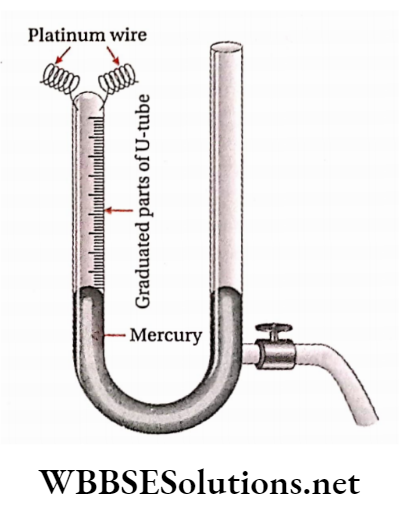
Class 11 Chemistry Some Basic Concepts Of Chemistry Eudiometer

There is a stop-cock towards the lower part of the limb with an open end.

By removing mercury with the help of this stop-cock, the levels of mercury in both the limbs are made equal and the volume of the gas collected in the graduated closed limb is measured.

Similarly volume of each of the reacting gases, introduced one after another in the closed limb, is recorded.

Then these gases are made to react by passing an electric spark through the platinum wires. After the completion of the reaction, the tube is cooled down to room temperature.

If there is any contraction in volume due to cooling, the observed volume is recorded from the graduations in the closed limb. This contraction is known as the first contraction.

If there is a suitable absorbent for any gas in the gas mixture (For example KOH for C02, alkaline pyrogallate for 02, etc.), then it is introduced into the gas mixture.

As a result, the gas involved gets absorbed and the mixture again suffers contraction in volume. This is called a second contraction.

Tills contraction is recorded from the graduation of the From these experimental data regarding volume, audiometric calculation is done.

In this context, it is to be noted that all volumetric measurements are always made at the same temperature and pressure.

Some important points regarding calculations of audiometry:

A properly balanced equation of the gaseous reaction Is to be used.

Under similar conditions of temperature and pressure, the ratio of the volumes and number of gram-moles of gaseous reactant(s) and product(s) must be the same.

At STP, the volume of mole of any gas is equal to 22.4 L. At the time of comparing the volumes of gases, the volume of 1 gram-mole of any gas is considered to be 1 volume. At STP, ) volume = 22.4 L

The mass of 22.41. of a gas at STP expressed in grains is equal to the gram-molecular mass of the compound.

The volume of any solid or liquid reactant or product Involved in the gaseous reaction is considered to be zero.

In the absence of drastic conditions, nitrogen present in air generally does not take part in the gaseous reaction.

During eudiometric calculations, air Is considered to be a mixture of ()2 and N2 gases. (02 = 21% ; N2 = 79% )

In most cases, contraction in volume occurs on cooling the gas mixture produced In the eudiometer tube, to mom temperature. Expansion in volume may also occur ill some cases. Further, in some reactions, no perceptible.

limb, if there is any residual gas in the eudiometer rube after the first and second contraction, the volume of the gas left Is also recorded Change in volume is observed.

In the following table, some relevant observations have been recorded—
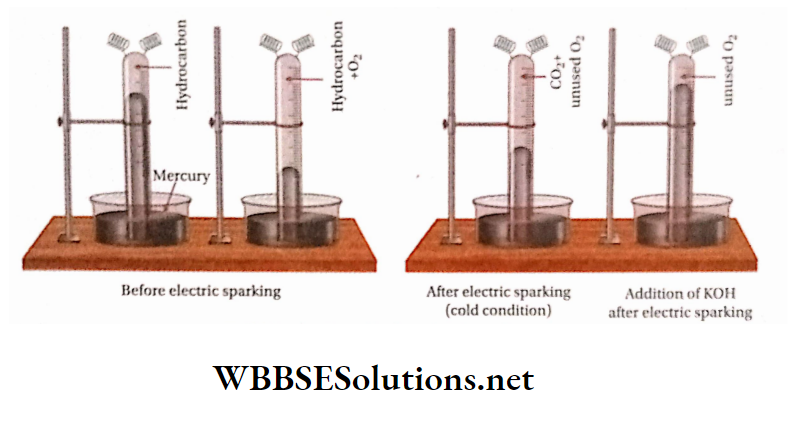
Class 11 Chemistry Some Basic Concepts Of Chemistry Combustion Of Hydrocarbon in ediometer

If the addition of an absorbent to u gas mixture produced in the gaseous reliction causes contraction In volume, then the gas can be Identified from the nature of the absorbent used and the volume of the gas may be determined from the magnitude of contact.

For this reason, prior to the addition of absorbent, the volume of the mixture is measured, if there is any contraction In volume after the addition of absorbent, then the volume of the gas mixture is again measured.

Ibe difference between the two readings gives the volume of the gas absorbed.

In this way, different gaseous constituents are removed one after another from the gas mixture by the successive addition of suitable absorbents and as a result, the contraction in volume in each case gives the measure of the volume of the absorbed gas concerned.

Numerical Examples 

Question 1. 60 mL of a mixture of CO and H2, mixed with 40 ml, of 02, are subjected to explosion in a eudiometer tube. On cooling the gas mixture after the end of the reaction, the volume is reduced to 30 mL.

Determine the composition of the gas mixture Initially taken. [All volumes arc measured at the same temperature and pressure.

Answer: Let the volume of CO in the initial mixture = x mL

Volume of H2 = (60- x) mL

Reactions taking place in the eudiometer tube—

⇒ \(\underset{\substack{2 \text { volume } \\ x \mathrm{~mL}}}{2 \mathrm{CO}}+\underset{\substack{1 \\ \text { volume } \\ \frac{x}{3} \mathrm{~mL}}}{\mathrm{O}_2} \longrightarrow \underset{x \mathrm{~mL}}{2 \text { volume }} \underset{x \mathrm{CO}_2}{\longrightarrow}\)

Therefore Contraction in volume \(=\left(x+\frac{x}{2}-x\right)=\frac{x}{2} \mathrm{~mL}\)

⇒ \(\begin{array}{ccc}
2 \mathrm{H}_2 & +\mathrm{O}_2 & \underset{2}{2} \mathrm{H}_2 \mathrm{O} \\
2 \text { volume } & 1 \text { volume } & 2 \text { volume } \\
(60-x) \mathrm{mL} & \frac{1}{2}(60-x) \mathrm{mL} & 0
\end{array}\)

[as water vapor on cooling gets condensed, its volume is taken as zero]

Contraction in volume \(\begin{aligned}
& =\left[(60-x)+\frac{1}{2}(60-x)-0\right] \\
& =\frac{3}{2}(60-x) \mathrm{mL}
\end{aligned}\)

Before the reaction, the volume of the mixture = volume of the mixture of CO and Il2 + volume of 02 = (60 + 40) = 100 mL Volume of the mixture after the reaction = 30 mL.

Therefore Contraction in volume in the reaction =100- 30 = 70 mL

From reactions 1 and 2, the total contraction in volume.

⇒ \(\left[\frac{x}{2}+\frac{3}{2}(60-x)\right]=(90-x) \mathrm{mL} \quad \text { or, } 90-x=70 x=20 \mathrm{~mL}\)

In the initial mixture, volume of CO = 20 mL and volume of H2 =(60-20) = 40mL.

Question 2. 30 mL of a mixture of CO and C02, mixed with 10 mL of oxygen, was exploded by an electric spark. The gas mixture produced was mixed with KOH solution and thoroughly shaken.

5mL of oxygen was left behind. What was the composition of the original mixture? [Volume was measured at STP.
Answer: Let. the volume of CO in 30 ml, in the mixture = xmL.

∴ Volume of carbon dioxide (C02) = (30 – x) ml.

⇒ \(\begin{aligned}
& \text { Reaction involved- } \mathrm{CO}+\frac{1}{2} \mathrm{O}_2 \longrightarrow \mathrm{CO}_2 \\
& 1 \text { volume } \frac{1}{2} \text { volume } 1 \text { volume } \\
& x \mathrm{~mL} . \quad \frac{x}{2} \mathrm{~mL} . \quad x \mathrm{~mL} . \\
&
\end{aligned}\)

The reaction shows that the volume of ()., used \(=\frac{x}{2}\) mL

Volume of O2 used = volume of O2 taken – volume of O2 unused =(10-5) = 5ml..

Therefore \(\frac{x}{2}=5\)

Hence, the volume of CO in the original mixture = 10 ml.

Volume of C02 in the mixture = (30- 10) = 20 ml.

Question 3. 1 L of a mixture of CO and C02, when passed through a red hot tube containing charcoal, tire volume becomes 1.6L. All volumes are measured under the same conditions of temperature and pressure. Find the Composition of the mixture.
Answer: Volume of the mixture of CO and CO., 11.

Let, the volume of CO= xl

∴ Volume of CO2= (l-x)I.

The reaction involved CO2 +C→2CO

The volume of the mixture after passing over carbon = 1.6 L

∴ Total volume of CO =[x + 2(1 – x) ) = (2- v)L

According to the given data, 2 -x = 1.6 or, x = 0.4

∴ Volume Of Co In1 L Mixture = 0.4 L = 400 Ml And Volume

Of CO2 In 1 L Mixture = 0.6 L = 600 Ml.

Question 4. A mixture contains CO, CH4, and nitrogen. 25 cm3 of the mixture on oxidation in the presence of excess oxygen, resulted in a decrease in volume by 16 cm3. A further contraction of 17 cm3 was observed when the residual gas was treated with a KOH solution. What was the composition of the original gaseous mixture of 25 cm3 volume? [All volumes are measured at the same temperature and pressure.]
Answer: In the oxidation reaction, CO2 is obtained from CO while CH4 produces CO2 and water vapor but N2 remains unaffected by the process.

Let, the volume of CO in the original mixture = x cm3 and the volume of CH4 in the original mixture =y cm3

∴ Volume of N2 = [25- (x + y)] cm3

The reactions involved in this case are

⇒ \(\begin{aligned}
& \mathrm{CO}+\frac{1}{2} \mathrm{O}_2 \longrightarrow \mathrm{CO}_2 \\
& 1 \text { volume } \frac{1}{2} \text { volume } 1 \text { volume } \\
& x \mathrm{~cm}^3 \quad \frac{x}{2} \mathrm{~cm}^3 \quad x \mathrm{~cm}^3 \\
&
\end{aligned}\)

Therefore Contraction in volume \(=\left[\left(x+\frac{x}{2}\right)-x\right]=\frac{x}{2} \mathrm{~cm}^3\)

⇒ \(\begin{aligned}
& \mathrm{CH}_4+2 \mathrm{O}_2 \longrightarrow \mathrm{CO}_2+2 \mathrm{H}_2 \mathrm{O} \\
& 1 \text { volume } 2 \text { volume } 1 \text { volume } 0 \\
& y \mathrm{~cm}^3 \quad 2 y \mathrm{~cm}^3 \quad y \mathrm{~cm}^3 \quad 0 \\
&
\end{aligned}\)

[Water vapor condenses to liquid on cooling. So, its volume is taken as zero.]

Contraction in volume this reaction = (y + 2y- y) = 2y cm3 Total contraction in volume =\(=\left(\frac{x}{2}+2 y\right) \mathrm{cm}^3\)

This contraction is equal to the first contraction i.e., \(\frac{x}{2}+2 y=16\)

The second contraction resulted from treatment with a KOH

volume of CO2 produced by the oxidation process -gift

= 17cm3. The total volume of CO2 produced by the first and second reactions = (x + y)cm3 i.e., x + y = 17 By solving [1] & [2] we have, x = 12 and y = 5.

Volume of CO in 25 cm3 of the mixture = 12cm3 and

volume of CH4 = 5cm3

∴ Volume of N2 = [25- (12 + 5)] = 8cm3

Question 3. 100 cm3 of a mixture of CO, C2H6, and N2 is exploded in the presence of excess O2. On cooling, the observed contraction in volume and the volume of C02 formed are both equal to the volume of the original mixture. Find the volumetric composition of the original mixture.
Answer: Let, the volumes of CO, C2Hg, and N2 be x, y, and z mL respectively in the mixture.

Reactions due to explosion—

⇒ \(\begin{array}{ccc}
\mathrm{CO} & +\quad \frac{1}{2} \mathrm{O}_2 & \longrightarrow \mathrm{CO}_2 \\
\text { 1volume } & 1 / 2 \text { volume } & 1 \text { volume } \\
x \mathrm{~mL} & x / 2 \mathrm{~mL} & x \mathrm{~mL}
\end{array}\)

⇒ Contration in volume \(\left(x+\frac{x}{2}-x\right)=\frac{x}{2} \mathrm{~mL}\)

Contraction in volume in volume = \(\left(y+\frac{7 y}{2}-2 y\right)=\frac{5 y}{2} \mathrm{~mL}\)

N2 remains unaffected by the explosion.

⇒ total contraction in volume \(=\left(\frac{x}{2}+\frac{5 y}{2}\right) \mathrm{mL}\)

After the explosion, the volume of C02 produced = (x + 2y) mL. According to the given condition, observed contraction in volume after explosion = volume of the original mixture.

⇒ \(\text { i.e., } \frac{x}{2}+\frac{5 y}{2}=x+y+z\)

Volume of C02 produced due to explosion = volume of the original mixture i.e.,x + 2y = (x + y + z) or, y = z

Substituting y = z in'[l] we have,\(\frac{x}{2}+\frac{5 z}{2}\) (x + z + z)

or, x + 5z = (2x + 4z) or, x = z. Hence, x = y = z

⇒ In the mixture, vol. ofCO = vol. of C2H6 = vol. of N2.

⇒ % of each constituent in the mixture = 100/3 = 33.3

Question 6. A gaseous mixture contains 50% of H2, 40% of CH4, and 10% of 02. What additional volume of 02 at STP will be required to completely burn 200 cc of this -[2] gaseous mixture at 27°C and 750mm pressure?
Answer: In 200 cm3 of gaseous mixture, volume of H2 ,\(=\frac{50}{100} \times 200=100 \mathrm{~cm}^3 \text {; }\)

Volume of CH4 \(=\frac{40}{100} \times 200=80 \mathrm{~cm}^3 \text { and }\)

Volume Of O2 \(=\frac{10}{100} \times 200=20 \mathrm{~cm}^3\)

Now, relictions due to combustion—

⇒ \(\begin{aligned}
& 2 \mathrm{H}_2+\mathrm{O}_2 \longrightarrow 2 \mathrm{H}_2 \mathrm{O} \text { and, } \\
& 2 \text { volume } \quad \begin{array}{l}
\text { I volume } \\
100 \mathrm{~cm}^3 \\
50 \mathrm{~cm}^3
\end{array}
\end{aligned}\)

⇒ \(\begin{aligned}
& \mathrm{CH}_4+2 \mathrm{O}_2 \longrightarrow \mathrm{CO}_2+2 \mathrm{H}_2 \mathrm{O} \\
& 1 \text { volume } 2 \text { volume } \\
& 80 \mathrm{~cm}^3 \quad 160 \mathrm{~cm}^3 \\
&
\end{aligned}\)

Volume of the 02 required for complete burning of II2 and (111,| =(50+160) = 210cm3 Again, the volume of the 02 present in the mixture at 27C(! and 750 mm pressure = 20cm3.

Therefore, the additional volume of 02 required for complete combustion = (210- 20) = 190cm3.

Let, the volume ofadditional 02 he V cm3(atSTP)

⇒ \(\quad \frac{750 \times 190}{(273+27)}=\frac{760 \times V}{273}\)

Or, \(V=\frac{750 \times 190 \times 273}{300 \times 760}=170.625 \mathrm{~cm}^3\)

Therefore, the additional volume of 02 required at STP will he = 170.625cm3

Question 7. 25 ml, of a mixture containing nitrogen and nitric oxide is passed over heated copper. The volume of the gaseous mixture becomes 20mL. What is the percentage composition of the original mixture. [All volumes are measured at the same temperature and pressure.]
Answer: When the mixture of N2 and NO is passed over heated copper, NO is reduced to N2 but N2 remains unaffected in the reaction.

Let, the volume of NO in the original mixture =rmL

∴  The volume of N2 in the original mixture = (25- x) mL

⇒ \(\begin{array}{cc}
\mathrm{Cu}+ & \mathrm{NO} \longrightarrow \mathrm{CuO} \\
\begin{array}{c}
1 \text { volume } \\
x \mathrm{~mL}
\end{array} & \frac{1}{2} \mathrm{~N}_2 \\
& 1 / 2 \text { volume } \\
& x / 2 \mathrm{~mL}
\end{array}\)

Volume of the gas mixture at the end ofreduction = volume of N2 produced by reduction of NO + volume of N2 already present in the mixture \(=\left(\frac{x}{2}+25-x\right)=\left(25-\frac{x}{2}\right) \mathrm{mL} .\)

According to the given data, volume of the gaseous mixture at the end ofreduction =20 mL.

∴ \(\quad 25-\frac{x}{2}=20 \quad \text { or, } x=10\)

In the original mixture, the volume of NO = 10 ml, and the volume of N2 = (25- 1 0) =15 mL.

In the original mixture, percentage of NO \(=\frac{10}{25} \times 100=40\)

Therefore In the original mixture, percentage \(\mathrm{NO}=\frac{10}{25} \times 100=40\) and percentage of N2 \(=\frac{15}{25} \times 100=60 .\)

Question 8. Combustion of 1 volume of a compound (contains of C,H and N)In air produces 3 volumes of C02 and 4.5 volumes water vapour and 0.5 volume of N2. Calculate the molecular formula of the compound. [All volumes are measured at same temperature and pressure].
Answer: Let the formula of the compound be CxHyNz. It undergoes combustion according to the following equation

⇒ \(\begin{aligned}
& \mathrm{C}_x \mathrm{H}_y \mathrm{~N}_z+\left(x+\frac{y}{4}\right) \mathrm{O}_2 \longrightarrow x \mathrm{CO}_2+\frac{y_2}{2} \mathrm{H}_2 \mathrm{O}+\frac{z}{2} \mathrm{~N}_2 \\
& 1 \text { volume }\left(x+\frac{y}{4}\right) \text { volume } x \text { volume } \quad \frac{y_2}{2} \text { volume } \frac{z}{2} \text { volume }
\end{aligned}\)

∴ x = 3,y=9,z=l

So, formula of the compound is: C3H9N

Determination of molecular formula of gaseous hydrocarbons from eudiometry

A known volume of the gaseous hydrocarbon is mixed with an excess of oxygen and exploded by sparking inside the closed limb of an eudiometer tube.

As a result, the hydrocarbon suffers oxidation to produce carbon dioxide (C02) and steam (H2O ).

As the combustion is completed, the gas mixture is cooled down to room temperature under atmospheric pressure.

As a result, steam condenses to water (liquid) but gaseous C02 and unused Oz remain unchanged.

At this stage, there usually occurs a contraction in volume of the gas mixture. This is called first contraction.

Such contraction in volume is due to two reasons—

On coolingdown the reaction mixture, steam condenses to water (having negligible volume).

Due to reaction between hydrocarbon and oxygen, the entire amount of the hydrocarbon and a majorportion of the oxygen disappear.

Then cone. KOH (or NaOH) solution is added to the reaction mixture. As a result, a second contraction in volume takes place because the whole amount of C02 is absorbed by the KOH solution.

∴ \(2 \mathrm{KOH}+\mathrm{CO}_2 \rightarrow \mathrm{K}_2 \mathrm{CO}_3+\mathrm{H}_2 \mathrm{O} .\)

The second contraction in the volume is equal to the volume of C02 produced by the combustion of the hydrocarbon.

Now, the unused oxygen is the only gas left in the eudiometer. The volume of unused oxygen is measured by absorbing it with alkaline pyrogallatc solution.

If the above experiment is carried out with a compound composed of carbon, hydrogen and nitrogen instead ofa hydrocarbon, then the gas left in the eudiometer after second contraction consists ofnitrogen (N2) and unused oxygen (O2).

Volumes of all gases are measured at the same temperature and pressure.

The empirical formula of the hydrocarbon is determined

From the knowledge of the following quantities:

  1. initial volume of the gas mixture
  2. magnitude of first contraction and
  3. Magnitude Of Second Contraction.

It should be remembered that the volume of 02 consumed is equal to the volume of C02 produced.

Furthermore, the volume of hydrogen required to form water is twice the volume of 02 consumed. This hydrogen originates from die hydrocarbon.

Calculation: Volume of hydrocarbon + volume of 02 taken volume of C02 + volume of unused 02 + H20 (becomes liquid on cooling)

First contraction in volume =Total volume of gas mixture before electric sparking-total volume of gas mixture (under cold condition) after electric sparking.

= (Volume of hydrocarbon + volume of 02 taken) – (volume of C02 generated by oxidation + volume of unused oxygen) [volume ofwater (liquid) is taken as zero].

= Volume of hydrocarbon + (volume of 02 takenvolume ofunused oxygen)- volume of C02 generated by the oxidation = (Volume of hydrocarbon + volume of oxygen consumed) -volume of C02 generated.

Again, second contraction in volume = volume of C02 generated by oxidation.

So, first contraction = (volume of hydrocarbon + volume of 02 consumed)- second contraction.

1st contraction + 2nd contraction = volume of hydrocarbon + volume of 02 consumed or, volume of 02 consumed = 1st contraction + 2nd contraction- volume ofhydrocarbon.

Example Let the formula of a hydrocarbon is Cxliy. The oxidation reaction ofthe hydrocarbon is represented as—
Answer:

⇒ \(\begin{array}{ccc}
\mathrm{C}_x \mathrm{H}_y+\left(x+\frac{y}{4}\right) \mathrm{O}_2 & x \mathrm{CO}_2+\frac{y_{\mathrm{H}_2} \mathrm{O}}{2} \\
\text { 1 volume } \quad\left(x+\frac{y}{4}\right) \mathrm{mol} & x \mathrm{~mol} & \frac{y}{2} \mathrm{~mol} \\
\text { 1volume } \quad\left(x+\frac{y}{4}\right) \text { volume } & x \text { volume } & 0 \\
v \text { volume } v\left(x+\frac{y}{4}\right) \text { volume } & v x \text { volume } & 0
\end{array}\)

[The volume ofwaterin the liquid state = 0 ] Hence, volume of 02 required for complete combustion of v volume ofthe hydrocarbon \(=v\left(x+\frac{y}{4}\right)\)

Now, the volume of 02 used= (firstvolume contraction + second volume contraction)-volume ofthe hydrocarbon therefore \(v\left(x+\frac{y}{4}\right)\) = first volume contraction =second volume contraction)-V

Volume of the C02 produced by complete combustion of v volume of the hydrocarbon —vx= second contraction.

Therefore, if first volume contraction and second volume contraction as well as the volume of the gaseous hydrocarbon are known, x and y may be evaluated from equations 1 and 2 and hence the formula of the hydrocarbon (CxHy) can be determined easily.

Sometimes in the determination ofmolecular formula of a gaseous hydrocarbon by eudiometric method, the empirical formula ofthe compound is obtained from the experimental results.

In such a case, the molecular formulais determined by ascertaining the vapour density or molecular mass ofthat compound.

General equations for combustion reaction of different compounds.

The problems related to determination of molecular formula of gaseous hydrocarbons with the help of eudiometry are of three types. These are explained separately with examples.

Type-1: When first and second contractions and volume of mixed oxygen are known.

Question 1. 20cm3 of a hydrocarbon mixed with 66cm3 of oxygen is exploded. After cooling the gaseous mixture, the volume becomes 56cm3. The volume of this mixture when shaken with KOH solution reduces to 16cm3. Determine the formula of the hydrocarbon. [All volumes are measured at the same temperature andpressure.
Answer: Let, the formula ofthe hydrocarbonis. The reaction takes place due to explosion—

⇒ \(\begin{aligned}
& \mathrm{C}_x \mathrm{H}_y+\left(x+\frac{y}{4}\right) \mathrm{O}_2 \longrightarrow x \mathrm{CO}_2+\frac{y_2}{2} \mathrm{H}_2 \mathrm{O} \\
& \begin{array}{llll}
1 \text { volume } & \left(x+\frac{y}{4}\right) \text { volume } & x \text { volume } & 0 \\
20 \mathrm{~cm}^3 & 20\left(x+\frac{y}{4}\right) \mathrm{cm}^3 & 20 x \mathrm{~cm}^3 & 0
\end{array} \\
&
\end{aligned}\)

since the volume ofwaterin the liquid state is zero.

∴ First contractionin this reaction \(=\left[20+20\left(x+\frac{y}{4}\right)-20 x\right]\)

As given, first contraction = (20 + 66)- 56 = 30 cm3.

(20 + 5y) = 30 or, y = 2

Now, second contraction = (56- 16) = 40cm3 = volume of C02 produced. Therfore 20x = 40 or, x = 2

∴ The formula ofthe hydrocarbon is C2H2.

Type-2: When first and second contractions are known but volume ofmixed oxygen is unknown.

Question 2. 20cm3 ofa gaseoushydrocarbon mixed with excess of oxygen is exploded. A contraction in the volume of 30cm3 takesplace. On treating theproduced gaseous mixture with KOH solution, it suffers a further contraction of 40cm3. Determine the molecular formula of the hydrocarbon. [All volumes are measured at the same temperature andpressure.]
Answer: Let the formula ofthe gaseous hydrocarbon = Cxliy. The reaction involvingits oxidation

⇒ \(\begin{aligned}
& \mathrm{C}_x \mathrm{H}_y+\left(x+\frac{y}{4}\right) \mathrm{O}_2 \rightarrow x \mathrm{CO}_2+\frac{y_2}{\mathrm{H}_2 \mathrm{O}} \\
& \begin{array}{llll}
1 \text { volume } & \left(x+\frac{y}{4}\right) \text { volume } & x \text { volume } & 0 \\
20 \mathrm{~cm}^3 & 20\left(x+\frac{y}{4}\right) \mathrm{cm}^3 & 20 x \mathrm{~cm}^3 & 0
\end{array} \\
&
\end{aligned}\)

since water occupies negligiblevolume., i.e., zero]

In this reaction, contractionin volume.

⇒ \(\begin{aligned}
& =\left[20+20\left(x+\frac{y}{4}\right)-20 x\right] \\
& =(20+5 y) \mathrm{cm}=\text { first contraction }
\end{aligned}\)

According to the given data, first contraction = 30 cm3
20 + 5y = 30 or y=2

Again, second contraction = 40cm3 = volume of CO,. Now, from the equation, it can be seen that volume of C02 evolved = 20x cm3.

therefore 20x = 40

therefore x=2

Hence, formula ofthe hydrocarbon is C2H2.

Type-3: When first contraction and vapour density of hydrocarbon are knownbut second contraction and volume ofmixed oxygen areunknown.

Question 3. 3cm3 of a gaseous hydrocarbon is exploded with excess of oxygen. On cooling the mixture, the observed contraction is found to be 6cm3. Vapour density of the hydrocarbon is 14. What is the molecular formula ofthehydrocarbon?
Answer: Let the formula ofthe hydrocarbon be Reaction due to explosion—

⇒ \(\begin{aligned}
& \mathrm{C}_x \mathrm{H}_y+\left(x+\frac{y}{4}\right) \mathrm{O}_2 \rightarrow x \mathrm{CO}_2+\frac{y_2}{2} \mathrm{H}_2 \mathrm{O} \\
& \text { 1 volume }\left(x+\frac{y}{4}\right) \text { volume } x \text { volume } \quad 0 \\
& \begin{array}{llll}
3 \mathrm{~cm}^3 & 3\left(x+\frac{y}{4}\right) \mathrm{cm}^3 & 3 x \mathrm{~cm}^3 & 0
\end{array} \\
&
\end{aligned}\)

Therefore On cooling, water vapour is condensed to liquid (water) whose volume is assumed to be zero.]

∴ Contractionin this reaction = \(\begin{aligned}
& =\left[3+3\left(x+\frac{y}{4}\right)-3 x\right] \\
& =3+\frac{3 y}{4} \mathrm{~cm}^3=1 \text { st contraction }
\end{aligned}\)

∴ \(3+\frac{3 y}{4}=6\) or y=4

Its molecular mass = 2 x 14 =28

since V.D = 14

The molecular formula ofthe hydrocarbon = CXH4.

Its molecular mass =(12x+ 4)

Hence, 12x+ 4 = 28 or, x = 2

Therefore, formula of the hydrocarbon is C2H4.

Question 1. A gaseous hydrocarbon of volume 10mL at STP is mixed with 80mL of 02 and burnt completely. As a result, the volume of the gaseous mixture was reduced to 70mL. On treating the obtained gaseous mixture with KOH solution, the volume becomes 50mL. Determine the molecular formula of the hydrocarbon.
Answer:

Given

A gaseous hydrocarbon of volume 10mL at STP is mixed with 80mL of 02 and burnt completely. As a result, the volume of the gaseous mixture was reduced to 70mL. On treating the obtained gaseous mixture with KOH solution, the volume becomes 50mL.

At STP, 10 mL ofa gaseous hydrocarbon mixed with 80 mL
of 02 is burnt completely. The following reaction takes place—

⇒ \(\begin{aligned}
& \mathrm{C}_x \mathrm{H}_y+\left(x+\frac{y}{4}\right) \mathrm{O}_2 \rightarrow x \mathrm{CO}_2+\frac{y_2}{2} \mathrm{H}_2 \mathrm{O} \\
& \text { 1 volume }\left(x+\frac{y}{4}\right) \text { volume } x \text { volume } \quad 0 \\
& 10 \mathrm{~mL} \quad 10\left(x+\frac{y}{4}\right) \mathrm{mL} \quad 10 x \mathrm{~mL} \quad 0 \\
&
\end{aligned}\)

since volume of water in the liquid state is assumed to be zero.

therefore volume contraction in this reaction

⇒ \(=10+10\left(x+\frac{y}{4}\right)-10 x=10+2.5 y \mathrm{~mL}=\text { first contraction }\)

In this case, first contraction =[(10 + 80)- 70] = 20 mL

∴ 10 + 2.5y = 20 or, y = 4.

Again, second contraction= volume of C02 produced.

So, second contraction = (70- 50) mL = 20 mL 10x = 20 i.e., x = 2 Hence, the formula ofthe hydrocarbonis C2H4.

Question 2. Volume of a gaseous hydrocarbon is 1.12L at STP. Whenitis completelyburntin air, 2.2 gof C02 & 1.8 g of water are formed. Find the volume of required at STP and also mass of the compound taken. Give the molecular formula of hydrocarbon.
Answer: Let the formula of the hydrocarbon be CzUy.

The concerned reaction of combustion is—

⇒ \(\begin{aligned}
& \mathrm{C}_x \mathrm{H}_y+\left(x+\frac{y}{4}\right) \mathrm{O}_2 \longrightarrow x \mathrm{CO}_2+\underset{2}{\chi_2} \mathrm{H}_2 \mathrm{O} \\
& 1 \mathrm{~mol} \quad\left(x+\frac{y}{4}\right) \mathrm{mol} \quad x \mathrm{~mol} \quad y_2 \mathrm{~mol} \\
&
\end{aligned}\)

Now, the volume of the hydrocarbon = 1.12 L.

No. ofmoles ofhydrocarbon in 1.12L at STP \(P=\frac{1 \times 1.12}{22.4}=0.05\)

From reaction it is found that 1 mol of gaseous hydrocarbon produces x mole of C02 and y/2 mole of H20.

therefore 0.05mol ofhydrocarbon produces 0.05x mol of C02 and \(\frac{0.05 y}{2}\) mol of H2O. Now 0.05x mol of C02= 0.05* x 44g= 2.2xg of C02 and \(\frac{0.05 y}{2}\) X 18g = 0.45g mol H2O

According to the given data, 2.2x = 2.2 , 0.45y =1.8 y = 4 and x = 1; the formula ofthe hydrocarbon = CH4 ixnoi Now at STP, 1.12L ofhydrocarbon =0.05 mol

Mass ofthe hydrocarbon taken = (0.05 x 16) = 0.8 g [ v Molecular mass ofhydrocarbon, CH4 = 16]

Again, the amount of 02 required for the combustion of 1 mol of hydrocarbon \(=\left(x+\frac{y}{4}\right) \mathrm{mol}=\left(1+\frac{4}{4}\right) \mathrm{mol}=2 \mathrm{~mol}\)

O2 required for combustion of 0.05 mol ofhydrocarbon = (0.05 x 2) = O.lmol

Now, Volume of1 mol of 02 at STP = 22.4 L

Therefore Volume of 0.1 mol of 02 at STP = 2.24 L. So, the volume

of 02 required for combustion ofhydrocarbon is 2.24 L.

Question 3. 5 mL of a gas composed of hydrogen and carbon is mixed with 30mL of oxygen and exploded with electric sparking. The volume of the gas mixture, obtained by explosion is found to be 25 mL. KOH is then added to the mixture and as a result, its volume is reduced to 15 mL. The residual gas is purely oxygen. All volumes have been measured at STP. Whatis the molecular formula ofthe gas?
Answer: Assuming the formula ofthe gas to be CÿHÿ, the reaction occured during explosion is represented as

⇒ \(\begin{aligned}
& \mathrm{C}_x \mathrm{H}_y+\left(x+\frac{y}{4}\right) \mathrm{O}_2 \longrightarrow x \mathrm{CO}_2+\frac{y_2}{2} \mathrm{H}_2 \mathrm{O} \\
& \begin{array}{cccc}
1 \text { volume } & \left(x+\frac{y}{4}\right) \text { volume } & x \text { volume } & 0 \\
5 \mathrm{~mL} & 5\left(x+\frac{y}{4}\right) \mathrm{mL} & 5 x \mathrm{~mL} & 0
\end{array} \\
& {[\text { volume of water (liquid) }=0 \text { ] }} \\
&
\end{aligned}\)

since volume of water liquid)=0]

First contraction \(=\left[5+5\left(x+\frac{y}{4}\right)-5 x\right]=(5+1.25 y) \mathrm{mL}\)

As per given data, first contraction = (5 + 30)- 25 =10 mL

Therefore 5 + 1.25y = 10 or, 1.25y = 5

Second contraction = volume of the C02 formed = 5x mL According to the given condition, second contraction = (25- 15) = 10 mL.

Therefore, 5x = 10 or, x = 2

Thus, formula oftire gaseous compound = C2H

Question 4. 10 mL of a gaseous organic compound composed of carbon, hydrogen and oxygen is mixed with 100 mL of oxygen and subjected to explosion. Volume of tire mixtureproducedby explosion when cooledbecomes 90mL. On treatment with KOH, the volume is reduced by 20mL. Mass of1 L ofgaseous organic compound is 2.053 g at STP. Determine the molecular formula.
Answer: Let, the formula ofthe organic compound =

The mass of 1 L ofgaseous organic compound at STP = 2.053 g

Mass of 22.4L ofgaseous organic compound at STP = (2.053X22.4) =45.9872 g.

The reaction involved is as follows—

⇒ \(\begin{aligned}
& \mathrm{C}_x \mathrm{H}_y \mathrm{O}_z+\left(x+\frac{y}{4}-\frac{z}{2}\right) \mathrm{O}_2 \rightarrow x \mathrm{CO}_2+\frac{y_2}{2} \mathrm{H}_2 \mathrm{O} \\
& 1 \text { volume. }\left(x+\frac{y}{4}-\frac{z}{2}\right) \text { volume } x \text { volume } 0 \\
& 10 \mathrm{~mL} \quad 10\left(x+\frac{y}{4}-\frac{z}{2}\right) \mathrm{mL} \quad 10 x \mathrm{~mL} \quad 0 \\
&
\end{aligned}\)

In the reaction, volume contraction= 10 + 10 \(\left(x+\frac{y}{4}-\frac{z}{2}\right)-10 x\)

= (10 + 2.5y- 5z) mL = first contraction x mL

In this case, first contraction = [(10 + 100)- 90] = 20 mL.

Therefore, 10 + 2.5y-5z = 20 or, 2.5y-5z =10 – [l]

Again, the second contraction in the mixture =20mL

= the volume of the C02 formed. From the equation, it is observed that the volume ofthe C02 produced = lOx.

Therefore, lOx = 20 or, x = 2

Now, the molecular mass of CxHy02 =(12x+ y+ 16z)

12.v+ y + 16z =45.9072 or, 12×2+y+16z =45.9872

or, y + 16z = 21.9072

Solving equations 1 & 3 we have, y = 6 and z = 1

Therefore The formula ofthe organic compound is C2H60.

Question 5. When 3 volume of a gaseous organic compound of carbon, hydrogen & sulphur mixed with excess oxygen is exploded, 3 volumes of carbon dioxide, 3 volumes of sulphur dioxide and 6 volumes of water vapour arc produced. What is the formula of the compound?
Answer: Let, the formula of the organic compound is On combustion, the following reaction takes place—

⇒ \( \mathrm{C}_x \mathrm{H}_y \mathrm{~S}_z+\left(x+\frac{y}{4}+z\right) \mathrm{O}_2 \rightarrow x \mathrm{CO}_2+\frac{y_2}{2} \mathrm{H}_2 \mathrm{O}+z \mathrm{SO}_2\)

⇒ \(1 \text { volume }\left(x+\frac{y}{4}+z\right) \text { volume } x \text { volume } \frac{y}{2} \text { volume } z \text { volume }\)

⇒ \(3 \text { volume } 3\left(x+\frac{y}{4}+z\right) \text { volume } 3 x \text { volume } \frac{3 y}{2} \text { volume } 3 z \text { volume }\)

According to the given condition, 3x = 3 or, x = 1; \(\frac{3 y}{2}\)

= 6 or, y = 4 and 3z = 3 or, z = 1

The formula ofthe organic compound = CH4S.

Question 6. When an acetylenic hydrocarbon, in presence of excess oxygen is exploded, it shows a contraction in volume by 50mL. A further contraction of 75mL is observed when the obtained gas mixture comes in contact with KOH solution. Determine the molecular formulaofthe compound.
Answer: Let the formula be CnH2 and its volume = x mL

Reaction of the acetylenic compound with O2

⇒ \(\begin{aligned}
& \mathrm{C}_n \mathrm{H}_{2 n-2}+\left(\frac{3 n-1}{2}\right) \mathrm{O}_2 \longrightarrow n \mathrm{CO}_2+(n-1) \mathrm{H}_2 \mathrm{O} \\
& 1 \text { volume }\left(\frac{3 n-1}{2}\right) \text { volume } n \text { volume } 0 \\
& x \mathrm{~mL} \quad x\left(\frac{3 n-1}{2}\right) \mathrm{mL} \quad n x \mathrm{~mL} \quad 0 \\
&
\end{aligned}\)

Contraction in volume in this reaction

⇒ \(=x+x\left(\frac{3 n-1}{2}\right)-n x=\frac{x+n x}{2}=\frac{x(1+n)}{2} \mathrm{~mL}\)

This volume contraction is equal to the first contraction of the mixture. Therefore, \(\frac{x(1+n)}{2}\) = 50 or, x+nx=100

As per given data, the second contraction of the mixture = 75 mL =the volumeofthe C02 formed. So, nx= 75

From equations 1 and 2 we have, x = 25 and from equation 2 putting x = 25 we have, n = 3.

Formula ofthe acetylenic compound = C3H6-2 = C3H4

Determination Of Molecular Formula Of Other Gaseous Compounds With The Help Of Eudiometry

Type-1: When two elementary gases of known atomicity react together to form a gaseous compound, the molecular formula of that compound may be ascertainedif the volumes of the reacting gases and the product at STP are known.
Let, 1 L of A2 gas (diatomic) and 1 L of B2 gas (diatomic) react to produce 2L of a gaseous compound X at STP. So,

⇒ \(\begin{array}{ccc}
\mathrm{A}_2 & \mathrm{~B}_2 & 2 \mathrm{X} \\
1 \mathrm{~L} & 1 \mathrm{~L} & 2 \mathrm{~L} \text { (at STP) } \\
n \text { molecules } & n \text { molecules } & 2 n \text { molecules } \\
1 \text { molecule } & 1 \text { molecule } & 2 \text { molecules } \\
1 \text { atom } & 1 \text { atom } & 1 \text { molecule } \\
& \text { [according to Avogadro’s hypothesis] }
\end{array}\)

Hence, in 1 molecule of X, 1 atom of each A2 and B2 are present.

∴ The molecular formula of the compound is AB.

Suppose, 1 L of X2 gas (diatomic) and 2L of Y2 gas (diatomic) react to produce1 L of Z gas at STP. So,

⇒ \(\begin{gathered}
\mathrm{X}_2 \\
1 \mathrm{~L}
\end{gathered}+\underset{2 \mathrm{~L}}{2 \mathrm{Y}_2} \longrightarrow \mathrm{Z} \underset{\mathrm{L}(\text { at STP) }}{\mathrm{Z}}\)

⇒ \(\begin{array}{ccc}
n \text { molecules } & 2 n \text { molecules } & n \text { molecule } \\
1 \text { molecule } & 2 \text { molecules } & 1 \text { molecule } \\
2 \text { atoms } & 4 \text { atoms } & 1 \text { molecule }
\end{array}\)

Therefore in 1 molecule of Z gas, 2 atoms of X2 and 4 atoms of Y2 are present.

Molecular formula of Z gas is X2Y4.

Type 2. If the atomicity of the elementary gases produced by the decomposition of any gaseous compound and also the volumes of the reactants and the products at STP are known, the molecular formula of the gaseous compound maybe determined.
Example: Suppose at STP, 2 L of a gaseous compound decomposes to form1 L of A2 gas and 3 L of B2 gas (both A2 and B2 are diatomic).

∴ \(\begin{gathered}
2 \mathrm{X} \\
2 \mathrm{~L}
\end{gathered} \longrightarrow \underset{1 \mathrm{~L}}{\mathrm{~A}_2}+\underset{3 \mathrm{~L}}{3 \mathrm{~B}_2}\)

∴ \(\begin{array}{ccc}
\text { 2n molecules } & \text { n molecules } & 3 \text { n molecules } \\
2 \text { molecules } & 1 \text { molecule } & 3 \text { molecules } \\
1 \text { molecule } & \frac{1}{2} \text { molecules } & \frac{3}{2} \text { molecules } \\
1 \text { molecule } & 1 \text { atom } & 3 \text { atoms }
\end{array}\)

since A2 and B2 are diatomic]

So,1 molecule of X gas contains1 atom of A2 and 3 atoms of B2 gas. Hence, the molecular formula of X gas is AB3.

Numerical Examples 

Question 1. At high temperature, gaseous compound, S4N4 decomposes to produce N2 and sulphur vapour. 1 vol. of S4N4 on decomposition gives 2.5 vol. of gaseous mixture at STP. Determine formula of sulphur.
Answer: Thermal decomposition: S4N4→2N2 + sulphur vapour 1 vol. of S4N4 produces 2.5 vol. of gaseous mixture.

From the equation,itis observed that 2 volumes of N2 are produced from 1 volume of S4N4 at STP. So, during thermal decomposition at STP, volume of the sulphur vapour produced = (2.5- 2) = 0.5 volumes. At STP, decomposition of 1 volume S4N4 results in evolution of2volumes N2 and 0.5 volumes sulphur vapour.

or, 1 molecule of S4N4 on decomposition gives 2 molecules of N2 and 0.5 molecules of sulphur.

1 molecule of S4N4 produces 4 N-atoms and 4 S-atoms.

∴ In 0.5 molecule ofsulphur, number of S-atoms = 4

∴ In 1 molecule of sulphur, number ofS-atoms = 8

Therefore Formula of sulphur = S8.

Question 2. When 100mL of ozonised oxygen is shaken with turpentine oil, volume decreases by 20mL. When lOOmL of the same sample is heated, the mixture occupies a volume of 110mL. Determine the molecular formula of ozone. [All volumes are measuredunder same temperature andpressure.]
Answer: Turpentine oil when added to ozonised oxygen, absorbs ozone and oxygen is leftbehindin the mixture.

∴ Volume of ozone in 100mL ofozonised oxygen = 20 mL.

∴ Volume of oxygenin 100 mL of ozonised oxygen = 80 mL

When Ozone Mixed With O2 is heated, it undergoes thermal decomposition to produce 02.

Volume of the gas obtained by heating 100mL of ozonised oxygen 110mL of this gas, (110-80) = 30 mL of 02 have been obtained by decomposing 20 mL of ozone.

Under the same conditions of temperature and pressure, 20mL ozone produces 30mL of 02.

i.e., 2 volumes of ozone produce 3 volumes of 02.

So, 2 molecules ofozone produce 3 molecules of  O2 .

∴ 1 molecule of ozone produces 3/2 molecule of oxygen or [ v oxygen is diatomic]

Hence,1 molecule ofozone contains 3 oxygen atoms.

∴ Molecular formula of ozone is 03.

Calculations Involving Reactions Occurring In Solution

Methods of expressing concentration of solutions

A solution is a homogeneous mixture of two or more substances which do not react chemically with each other.

A solution consisting of only two components is called a binary solution. Some important modes of expressing concentration ofsolutions are indicated below.

Percentage strength It is defined as the amount of solute in grams presentin lOOg of the solution.

⇒ \(\%(W / W)=\frac{\text { mass of solute }(\mathrm{g})}{\text { mass of solution }(\mathrm{g})} \times 100\)

Example: Percentage strength (W/W) of a glucose solution is 10 indicates that lOg glucose is presentin lOOg ofsolution.

Strength in gram per litre: The strength of a solution is defined as the amount of the solute in grams present per litre ofthe solution.

Unit: g/L or g/dm3, i.e., g-L-1 or g-dm-3.

Example: If 4.0g of sodium carbonate is dissolved in 1L of sodium carbonate solution, the strength of the solution willbe 4.0 g-L-1 or 4.0 g-dm-3 Temperature, strengthin g-L 1 depends on temperature.

Mole fraction: The mole fraction of any componentin the solution is equal to the number of moles of that component dividedby the total number ofmoles of all the components.

Let us consider, n2 moles of a solute dissolvedin n 4 moles of a solvent.

Mole fraction of the solute and mole fraction ofUie solvent in the solution respectively.

⇒ \(x_2=\frac{n_2}{n_1+n_2} \& x_1=\frac{n_1}{n_1+n_2}\)

⇒ \(\text { Now, } x_1+x_2=\frac{n_1}{n_1+n_2}+\frac{n_2}{n_1+n_2}=\frac{n_1+n_2}{n_1+n_2}=1\)

The sum of mole fractions ofthe components is equal to 1.

Therefore mole fraction ofthe solvent, xx = l-x2

mole fraction of the solute, x2 = 1- x1

Effect of temperature: As mole fraction is a number, it is independent oftemperature.

PPm (partspermillion): The concentration ofvery dilute solution is expressed in terms of parts of the solute by mass present in million parts by mass of the solution (or ppm), i.e., ppmx \(=\frac{\text { mass of } x}{\text { Mass of solution }} \times 10^6\)

Pollution of the atmosphere is also expressed in terms of ppm but in that case we use volumes in place of masses i.e., volume (in cm3) of the harmful gases (i.e., S02 etc.) presenti n 106 cm3 ofthe air.

Molarity (M): It is a defined as the number ofgram-moles ofthe solute presentin1 L (or, 1000 mL) of the solution.

⇒ \(\begin{aligned}
& \text { Molarity }(\mathrm{M}) \text { of solution }=\frac{\text { number of moles of solute }}{\text { volume of the solution (in } \mathrm{L})} \\
& =\frac{\text { mass of the solute }(\mathrm{g})}{\text { gram-molecular mass of solute } \times \text { volume of solution (in } \mathrm{L})}
\end{aligned}\)

Example: If three different solutions are such that1 L of each of these solutions contain 1 mol, 0.5 mol and 0.1 mol of a dissolved solute then the molarity of the solutions will be 1, 0.5 and 0.1 respectively. Similarly, if 5L of a glucose solution contains 4 gram-moles of glucose then molarity ofthe solution will be,

⇒ \(\frac{\text { number of moles of glucose }}{\text { volume of the solution }(\mathrm{L})}=\frac{4}{5}=0.8(\mathrm{M})\)

Units ofmolarity: moles perlitre (mol-L-1 ) or moles per cubic decimetre (mol-dm’3 ) [1L = 1000 cm3 = 1dm3 ]

Molar solution: A molar solution is defined as a solution, 1 L ofwhich contains 1 gram-mole ofthe solute.

Example: 1L of sulphuric acid (H2S04) solution containing 98 g (i.e., 1 gram-mole) of H2S04 is called 1(M) H2S04 solution.

Similarly, 1 L of1(M) Na2C03 solution contains 106 g (i.e., 1 gram-mole) ofsodium carbonate. Molar, semi-molar, deci-molar and centi-molar solutions are denoted by1(M

⇒ \(\left(\frac{\mathrm{M}}{2}\right),\left(\frac{\mathrm{M}}{10}\right) \text { and }\left(\frac{\mathrm{M}}{100}\right)\) respectively.

Effect of temperature on the molarity of a solution: The mass of solute is independent of temperature but the volume of solution is dependent on temperature and hence the molarity of a solution depends on temperature.

Formality (F): It is defined as the number of gramformula mass of the dissolved solute present per litre of the solution.

⇒ \(\begin{aligned}
& \text { Formality }(F)=\frac{\text { number of gram-formula mass of solute }}{\text { volume of the solution (in } \mathrm{L} \text { ) }} \\
& =\frac{\text { mass of the solute }(\mathrm{g})}{\text { gram-formula mass of solute } \times \text { volume of solution (in } \mathrm{L})}
\end{aligned}\)

Example: If1 L of a magnesium chloride solution contains 190 g of MgCl2 then this solution is said to be 2.0 formal solution (t.e., 2.0 F solution) because the formula mass of MgCl2 is 95.

Formal solution: It is defined as a solution, 1 L of which contains 1 gram-formula mass of the solute.

Example: 1 L of 1(F) solution of calcium chloride (CaCI2) contains lllg {i.e., 1 gram-formula mass) of calcium chloride.

Effect of temperature on the formality of solution: The mass of a solute is independent of temperature but the volume of solution is dependent on temperature and hence the formality of a solution depends on temperature.

Molality (m): The molality of a solution is defined as the number of gram-moles of the solute dissolved in 1000 g {i.e., 1 kg) ofthe solvent.

⇒ \(\begin{aligned}
& \text { Molality }(\mathrm{m}) \text { of solution } \\
& =\frac{\text { number of moles of dissolved solu }}{\text { mass of the solvent }(\mathrm{kg})} \\
& =\frac{\text { number of moles of solute } \times 10}{\text { mass of the solvent }(\mathrm{g})} \\
& =\frac{\text { mass of solute }(\mathrm{g}) \times 1000}{\text { gram-molecular mass of solute } \times \text { mass of solvent }(\mathrm{g})}
\end{aligned}\)

Example: If 40 g of NaOH [i.e., 1 g-mole NaOH) is dissolved in lOOOg of water, then the resulting solution is said to be 1 molal solution [i.e., l(m) solution] of NaOH. Again, dissolution of 4g ofNaOH {i.e., 0.1 g-mole NaOH) in 1000 g water gives 0.1 molal [i.e., 0.1 (m)] solution of NaOH.

Unit of molality: moles perkilogram ( mol-kg-1)

Effect of temperature on molality of a solution: As the masses of substances are independent of temperature, so the molality ofa solution does not depend on temperature.

Molal solution: A molal solution is defined as a solution, which is prepared by dissolving 1 gram-mole of solute in 1000 g of solvent.

Example: If 98 g(i.e., 1 gram-mole) ofsulphuric acid is dissolved in 1000 g of water, then a molal solution of H2S04 [i.e., l(m) H2S04 solution] is o btained.

Molal, semimolal, deci-molal and centi-molal solutions denoted by l(m)

⇒ \(\left(\frac{\mathrm{m}}{2}\right),\left(\frac{\mathrm{m}}{10}\right) \text { and }\left(\frac{\mathrm{m}}{100}\right)\)

Normality (N): Normality of a solution is defined as the number ofgram-equivalents of the solute presentin1 L (or 1000 mL) of the solution.

⇒ \(\begin{aligned}
& \text { Normality }(\mathrm{N}) \text { of a solution } \\
& =\frac{\text { number of gram-equivalents of solute }}{\text { volume of solution }(\mathrm{L})} \\
& =\frac{\text { mass of the solute }(\mathrm{g})}{\text { gram-equivalent mass of solute } \times \text { volume of solution (L) }}
\end{aligned}\)

If 1 L of H2S04 solution contains 2 gram-equivalent (i.e.,98 g) of pure H2S04 the strength of the solution will be 2(N).

Similarly, if 1 L of Na,C03 solution contains 0.1 gram-equivalent (i.e., 5.3 g) of Na2C03 the strength of the solution will be 0.1(N).

Effect of temperature on normality ofa solution: Mass of solute is independent of temperature but volume of a solution depends on it. So, normality of a solution is dependent on temperature.

Normal solution: A normal solution is defined solution, 1 L (or 1000 mL) of which contains 1 equivalent of the solute.

Examples: 1 L of a normal solution of H,S04 contains 1 gramequivalent or 49 g H2SO4 . 1 L of a normal solution of NaOH contains 1 gram-equivalent or 40 g NaOH.

Normality Equation

Let Vx mL of a solution of normality A/j be diluted to V2 mL so that its normality changes to N2. Since number of gram-equivalents of solute before and after dilution is ame, we can write, V1 X N1 =V2XN2. This is called normality equation.

Let V1 mL of a solution of compound ‘ A ’ having normality Nx reacts completely with V2 mL of a solution of compound ‘B’ having normality N2. Since the ompounds react with each other in equivalent amounts we can write, V1 X N1 = V2XN2 This is another normality equation.

Molarity equation

Let V1 mL of a solution of molarity M1 be diluted to V2 mL so that its molarity changes to M2.

Since number of gram-moles of solute before and after dilution is same, we can write, V1 X M1 = V2 X M2 This is molarity equation.

Let V1 mL of a solution of molarity be mixed with V2 mL ofanother solution (complex ofsame components) having molarity M2. If M be the molarity of the mixed solution, (V1 + V2 ) M=V1 x M1 + V2 X M2

This is a second molarity equation.

Let V1 mL of a solution of compound ‘A ‘ having molarity M2 reacts completely with V2 mL of another solution of compound having molarity M2 according to the equation: xA(aq) + yB(aq)pC(aq) + qD(aq)

It can be shown that \(\frac{V_1 \times M_1}{x}=\frac{V_2 \times M_2}{y}\)

This is a thirdmolarity equation.

Relationship between molarity and normality of the solution ofan acid ora base: Normality of solution of an acid =Molarity x Basicity ofthe acid.

Normality of a base = Molarity x Acidity ofthe base. e.g., 1 (M) H2S04 Solution = 2 (N) H2S04 solution 1 (M) Ca(OH)2 solution = 2 (N) Ca(OH)2 solution.

Normality= No. ofg- eq L-1 = Number ofmilli eq mL-1 Molarity of a solution = Number ofmoles perlitre = Number of millimoles per litre.

Numerical Examples

Question 1. NaOH is dissolved in water and the solution is madeupto 500mL. Find themolarity of solution.
Answer: Number ofmoles of NaOH = \(\frac{\text { given mass }}{\text { molecular mass }}=\frac{8}{40}=0.2\)

∴ Molarity(M) = \(=\frac{\text { number of moles of } \mathrm{NaOH}}{\text { volume of solution }(\mathrm{L})}=\frac{0.2}{0.5}=0.4\)

Question 2. The density of 3(M) solution ofNaCl is 1.25 g • cm 3. Calculate themolarityofthe solution.
Answer: Amount ofNaN03 in 1L solution=3 mol=3×58.5g

Mass of 1 L solution= 1000 x 1.25 g = 1250 g

Mass of the solvent [i.e., water) in 1L ofthe solution

= (1250-175.5)= 1074.5g

∴ Molality \(=\frac{\text { no. of moles of solute }}{\text { mass of solvent }(\mathrm{kg})}=\frac{3}{1.0745}=2.79(\mathrm{M})\)

Question 3. Calculate the volume of 0.5(M) H2S04 solution required to dissolve 0.5 g ofcopper(2) carbonate.
Answer: Reaction \(\underset{1 \mathrm{~mol}}{\mathrm{CuCO}_3}+\underset{1 \mathrm{~mol}}{\mathrm{H}_2 \mathrm{SO}_4} \rightarrow \mathrm{CuSO}_4+\mathrm{CO}_2+\mathrm{H}_2 \mathrm{O}\)

∴ 1 mol CuC03 = 63.5 + 12 + 48 = 123.5 g

∴ 1 mole of H2S04 is required to dissolve 123.5 g of CuC03

∴ Amount of H2S04 required to dissolve 0.5 g of CuC03

⇒ \(=\frac{1 \times 0.5}{123.5}=0.004 \mathrm{~mol}\)

Now, 0.5 mol of H2S04 is present in 1000 mL solution.

∴ 0.004 mol H2SO4 is present \(\frac{1000 \times 0.004}{0.5}\) = 8ml. given H2S04 solution. So, volume of H2S04 required= 8 mL.

Question 4. Calculate the volume of H2 gas (at STP) liberated by thereaction ofexcessZnwith 500mL 0.5(N) H2S04.
Answer: Reaction involved \(\mathrm{Zn}+\underset{98 \mathrm{~g}}{\mathrm{H}_2 \mathrm{SO}_4} \rightarrow \underset{22400 \mathrm{~mL}}{\mathrm{ZnSO}_4}+\underset{\mathrm{H}_2}{\mathrm{H}_2}\)

H2S04 presentin 1000 mL of0.5(N) H2S04 =0.5 g-eqv.

∴ Amount of H2S04 present in 500 mL of 0.5(N) H2S0 solution \(=\frac{0.5 \times 500}{1000}\) g-equiv \(=\frac{0.5 \times 500 \times 49}{1000} \mathrm{~g}=12.25 \mathrm{~g}\)

98gH-,S04 reacts withZn to liberate 22400mLH, (STP).

∴ 12.25 g H,S04 reacts with zinc to liberate \(\frac{22400 \times 12.25}{98}=2800 \mathrm{~mL} \mathrm{H}_2 \text { (at STP) }\)

Density of 3 molal NaOH solution is 1.110 g mL-1. Calculate themolarity ofthe solution.

3 molal NaOH solution means 3 moles of NaOH are dissolvedin1 kg solvent. So, the mass ofsolution = 1000g solvent + 120g NaOH =1120g [v Molar mass of NaOH =(23 + 16 + 1) =40]

Volume of solution = \(=\frac{\text { Mass of solution }}{\text { Density of solution }}\)

or, Volume of solution \(=\frac{1120}{1.110 \mathrm{~g} \cdot \mathrm{mL}^{-1}}=1009 \mathrm{~mL}\)

∴ \(=\frac{\text { Mole of solute } \times 1000}{\text { Vol. of solution }(\mathrm{mL})}=\frac{3 \times 1000}{1009}=2.973(\mathrm{M})\)

Question 6. If 4 g of NaOH dissolvesin 36g of H2O, then calculate the mole fraction of each component in the solution. Also, determine the molarity of the solution (specific gravityofsolutionis1 g.mL-1 ).
Answer: \(n_{\mathrm{NaOH}}=\frac{4}{40}=0.1 \mathrm{~mol} ; n_{\mathrm{H}_2 \mathrm{O}}=\frac{36}{18}=2 \mathrm{~mol}\)

⇒ \(x_{\mathrm{NaOH}}=\frac{0.1}{0.1+2}=0.0476 ; x_{\mathrm{H}_2 \mathrm{O}}=\frac{2}{0.1+2}=0.9524\)

Total mass ofsolution= (4 + 36) = 40 g

Volume of solution \(=\frac{40 \mathrm{~g}}{1 \mathrm{~g} \cdot \mathrm{mL}^{-1}}=40 \mathrm{~mL}\)

Molarity \(=\frac{\text { Mole of solute } \times 1000}{\text { Vol. of solution }(\mathrm{mL})}\)

⇒ \(=\frac{0.1 \times 1000}{40}=2.5(\mathrm{M})\)

Question 7. 1L ofa (N/2) HC1 solution was heated in a beaker and it was observed that when the volume of solution got reduced to 600 mL, 3.25 g of HC1 was lost. Calculate the the normality of the resulting solution.
Answer: Normality \(\frac{\text { Mass of } \mathrm{HCl}}{\text { Equivalent mass } \times \text { Volume of solution (L) }}\)

⇒ \(\text { or, } \quad 0.5 \mathrm{eqv} \cdot \mathrm{L}^{-1}=\frac{\text { Mass of } \mathrm{HCl}}{36.5 \mathrm{~g} \cdot \mathrm{eqv}^{-1} \times 1 \mathrm{~L}}\)

Mass of HCl=0.5 eqv L-1 X 36.5 g – eqv-1 x 1L= 18.25g

Mass of HC1 left after heating = 18.25- 3.25 = 15.0 g

Volume of the resulting solution = 600ml \(=\frac{600}{1000}=0.6 \mathrm{~L}\)

therefore normality \(=\frac{15.0 \mathrm{~g}}{36.5 \mathrm{~g} \cdot \mathrm{eqv}^{-1} \times 0.6 \mathrm{~L}}=0.685\)

Long Question And Answers

Question 1. Two substances A are B are of equal masses and = 29.28 their molecular masses are in the proportion of 2:3. What is the ratio of the numbers of their molecules?
Answer:

Given

Two substances A are B are of equal masses and = 29.28 their molecular masses are in the proportion of 2:3.

From the question, MA: = 2:3; where MA and MB are the molecular masses of A and B respectively. Now, let the mass of A = mass of B = W g

Number of molecules present in gram-mole of any substance

= 6.022 x10²³

Number of molecules in w g of A \(A=\frac{W}{M_A}\)= x 6.022 x 10²³ and that in W g of B \(=\frac{W}{M_B}\)= x 6.022 x 10²³

∴ \(\frac{\text { Number of molecules in } W \mathrm{~g} \text { of } A}{\text { Number of molecules in } W \mathrm{~g} \text { of } B}\)

\(=\frac{W}{M_A} \times 6.022 \times 10^{23} \div \frac{W}{M_B} \times 6.022 \times 10^{23}=\frac{M_B}{M_A}=\frac{3}{2}\)

Question 2. Show that, the ratio ofthe masses of equal volumes of two gases at the same temperature and pressure is directly proportional to the ratio of their molecular masses.
Answer:

Let the molecular masses of two gases, A and B be MA and MB respectively, and WA, and WB be their respective masses.

Now, number of moles of gas A = WA/MA

Number ofmoleculesin gas A = \(A=\frac{W_A}{M_A} \times\) x 6.022 x 10²³

Again, number ofmoles ofgas B = WB/MB

Number of molecules in gas B = x 6.022 x 10²³

Since the gases (having equal volumes) are at the same temperature and pressure, according to Avogadro’s hypothesis they will contain the same number of molecules.

∴ \(\frac{W_A}{M_A} \times 6.022 \times 10^{23}=\frac{W_B}{M_B} \times 6.022 \times 10^{23} \text { i.e., } \frac{W_A}{W_B}=\frac{M_A}{M_B}\)

Question 3. Which are heavier and lighter than air: O2, CO2, CH4, NH3, Cl2 ? [Volumetric composition of air N2 = 74%, O2 = 24%, CO2=2%
Answer:

Vapour density of a gas \(=\frac{\text { molecular mass of gas }}{\text { molecular mass of air }}\)

Volumetric composition of air: \(=\frac{(28 \times 74)+(32 \times 24)+(2 \times 44)}{100}=29.28\)

Therefore, concerning air, vapor densities of

⇒ \(\begin{aligned}
& \mathrm{O}_2=\frac{32}{29.28}>1 ; \mathrm{CO}_2=\frac{44}{29.28}>1 ; \mathrm{CH}_4=\frac{16}{29.28}<1 ; \\
& \mathrm{NH}_3=\frac{17}{29.28}<1 \text { and } \mathrm{Cl}_2=\frac{71}{29.28}>1
\end{aligned}\)

Therefore Gases lighter than air are CH4 and NH2 whereas gases heavier than air are O2, CO2, and CI2.

Question 4. The mass of a sulfur atom is twice that of an oxygen atom. Hence, the vapor density of sulfur will be twice that of the vapor density of oxygen—justify’.
Answer:

Given

The mass of an S-atom is twice that of an O-atom. So, the atomic mass of sulfur is twice that of oxygen.

Now, Molar mass =n x atomic mass [n = atomicity ofmolecule] and vapor density

⇒ \(=\frac{\text { molecular mass }}{2}=\frac{n \times \text { atomic mass }}{2}\)

Therefore Vapour density of sulphur \(=\frac{n \times \text { atomic mass of sulphur }}{2}\)

Vapour density of oxygen \(=\frac{2 \times \text { atomic mass of oxygen }}{2}\)

since atomicity of oxygen molecule =2

⇒ \(\quad \frac{\text { Vapour density of sulphur }}{\text { Vapour density of oxygen }}\)

⇒ \(=\frac{n \times \text { atomic mass of sulphur }}{2 \times \text { atomic mass of oxygen }}=\frac{n}{2} \times 2=n\)

since the atomic mass of sulfur is twice of that of oxygen] or, Vapour density of sulfur =n x vapor density of oxygen.

Thus, it is quite logical to conclude that depending on the atomicity (n), the vapor density of sulfur maybe 2, 4, 6, or 8 times the vapor density of oxygen.

Question 5. How many significant figures are there in each of the following numbers:

  • 0.437
  • 935100
  • 2.158 x 10⁴
  • 0.00839
  • 207.39
  • 17.00
  • 2.0100 x 10⁴
  • 6.0 x 10²³
  • 0.00070

Answer:

  1. 3 significant figures (4, 3, 7);
  2. 4 significant figures (9, 3, 5, 1);
  3. 4 significant figures (2, 1, 5, 8);
  4. 3 significant figures (8, 3, 9);
  5. 5 significant figures (2, 0 7, 3, 9);
  6. 4 significant figures (1, 7, 0, 0);
  7. 5 significant figures (2, 0, 1, 0, 0);
  8. 2 significant figures (6, 0);
  9. 2 significant figures (7,0)

Question 6. Express the following up to three Significant figures:

  • 4.309251
  • 49.793500
  • 0.005728
  • 7000
  • 2.67876 x 10³
  • The decimal equivalent of 2/3,
  • one-millionth of one.

Answer: The digit in the second decimal place is increased by 1 unit and the remaining digits after that are dropped. Hence the number obtained is 4.31.

The digit in the first decimal place is increased by 1 unit and the remaining digits are dropped. The number obtained is 49.8.

The digit in the fifth decimal place is increased by 1 unit and the remaining digits are dropped. The number obtained is 0.00573.

The given no. is first expressed in the exponential form i.e. 7000 = 7.000 X 10³. Then the third digit after the decimal point of the tire’s first factor is dropped. Thus the number obtained is 7.00 X 10³.

The given number is in the exponential form. Thus the digit at the second decimal place is increased by 1 and all other digits of its right side are dropped. Thus the number obtained is 2.68 x 10³.

The given fraction is first expressed in the decimal form. The digit at the third decimal place is increased by 1 and all other digits on its right side are dropped. This gives the number as 0.667.

The given number is first expressed in the exponential form. Then all the digits after the second decimal place are dropped. This gives the number 1.00 x 10~6, which has three significant.

Question 7. On heating of 4.9 g of KC103, 1.92g of 02 is evolved and 2.97 g of KC1 is obtained as a residue. Show that these data illustrate the law of conservation of mass.
Answer: ,\(\text { Reaction: } 2 \mathrm{KClO}_3 \rightarrow \quad \begin{gathered}
12 \mathrm{KCl}+3 \mathrm{O}_2 \uparrow \\
4.9 \mathrm{~g}
\end{gathered} \quad \begin{gathered}
2.97 \mathrm{~g} \quad 1.92 \mathrm{~g}
\end{gathered}\)

Total mass ofthe products 02 + KC1 = (1.92 + 2.97)g

= 4.89g

Difference in mass between the reactant and products

= (4.9 -4.89)g =0.01g.

This small difference is due to experimental error. Otherwise, these data illustrate the law of conservation of mass.

Question 8. 10.1 g o/HCl is mixed with 6.3 g of NaHC03. Calculate the mass ofCO2 released if the residual mixture is found to weigh 12.1 g
Answer: \(\text { Reaction: } \mathrm{HCl}+\mathrm{NaHCO}_3 \rightarrow \underset{10.1}{6.3 \mathrm{~g}} \rightarrow \underset{12.1 \mathrm{~g}}{\mathrm{NaCl}+\mathrm{H}_2 \mathrm{O}}+\mathrm{CO}_2\)

According to the law of conservation of mass, the mass of
(HC1 + NaHC03) = mass of(NaCl + H20 + C02)

or, (10.1 + 6.3)g = mass of(NaCl + H20 + C02)

or, 16.4g = 12.1g + mass of C02 /. massofC02 = 4.3g

Question 9. Calculate the number of gram-atom present in 2.1 g of nitrogen and 0.23 g of sodium.
Answer: One gram-atom of nitrogen means 14g of nitrogen.

No. of g-atom present in 2.1 g of nitrogen \(=\frac{2.1}{14}=0.15\)

Again, One g-atom of sodium means 23g of sodium

No. of g-atom present in 0.23g of Na \(=\frac{0.23}{23}=0.01\)

Question 10. Give an example of a tetra-atomic element and calculate its molecular mass.
Answer:

Tetra-atomic element: P4 molecular mass of P4 = atomic mass of P x its atomicity

= 31 x4 = 124

Question 11. ‘1-mole oxygen = 2 gram-atom oxygen’—justify.
Answer:

1 g-atom of oxygen means 16g of oxygen

∴ 2 g-atom of oxygen = 32g

∴ 1 mol oxygen = 2 g-atom oxygen [proved].

Question 12. Which one is the volume of 2.8g of ethylene gas at STP?

  • 2.24L
  • 22.4L
  • 224 L
  • 0.224 L.

Answer:  Gram-molecular mass of ethylene gas = 28g

∴ At STP 28g of ethylene gas occupies a volume of 22.4 L

∴ At STP, 2.8g ethylene gas occupy \(\frac{22.4 \times 2.8}{28}=2.24 \mathrm{~L}\)

∴ The volume of 2.8g of ethylene gas at STP is 2.24L

Question 13. Which one is the volume of lg of oxygen gas at STP?

  1. 0.7 L
  2. 4.8 L
  3. 1.4L
  4. 1.2 LW.

Answer: Gram-molecular mass ofoxygen gas at STP is 32g

At STP, volume 32 g ofoxygen gas = 22.4L

At STP volume of1 g of oxygen gas \(=\frac{22.4}{32} \mathrm{~L}=0.7 \mathrm{~L}\)

Question 14. Calculate the number of O-atoms in 0.5 mol of S02.
Answer: No. ofmolecules presentin1 mol S02 = 6.022 x 10²³.

Number of molecules present in 0.5 mol S02

= 0.5 x 6.022 x 1023 =3.011 x 10²³

2 oxygen atoms are present in each S02 molecule.

∴ The number of oxygen atoms present in 0.5mol of S02

= 3.011 X 1023 X 2 = 6.022 X 10²³

Question 15. Calculate the mass o/lmol of electrons if the mass of one electron be 9.11 x 10⁻³¹ kg.
Answer: 1 mol of electrons = 6.022 x 10²³ number of electrons.

Mass of one electron = 9.11 x 10⁻³¹kg

therefore The mass of 1 mol of electrons

= 6.022 x 1023 x 9.11 x 10-31kg = 5.486 x 10⁻⁷kg

Question 16. At a temperature of 273 K and 1 atm pressure, 1 L of a gas weighs 2.054 g. Calculate its molecular mass.
Answer:

Given

At a temperature of 273 K and 1 atm pressure, 1 L of a gas weighs 2.054 g.

22.4L of any gas at STP contains 1 mol of that gas.

1L of a gas weighs 2.054g

∴ 22.4L ofthe gas weighs = 2.054 X 22.4g = 46g

∴ Molecular mass ofthe gas is 46

Question 17. At the same temperature & pressure, two flasks of equal volume contain NH3 & S02 gas respectively. Identify the flask having a greater number of molecules of gaseous substance with greater mass and a greater number of atoms.
Answer:

Given

At the same temperature & pressure, two flasks of equal volume contain NH3 & S02 gas respectively.

According to Avogadro’s hypothesis, at temperature and pressure equal volume of all gases contains an equal number of molecules.

At the same temperature & pressure, two flasks having equal vol. contain equal no. of NH3 & S02 molecules.

(H) NH3 = 17 and S02 = 64.

The flask containing S02 gas has a greater mass.

NH3 is a tetra-atomic and S02 is a triatomic molecule.

So, the flask with NH3 contains a greater no of atoms.

Question 18. Choose the correct options: The vapor density of carbon dioxide is—

  1. 22
  2. 22g.cm3
  3. 22g.l-1
  4. 44

Answer: Vapour density of a gas =1 /2 x its molecular mass

∴ Vapour density of C02 =(1/2) x 44 =22

Question 19. The equivalent mass of an element can never be zero explained.
Answer: Vapour density ofoxygen (D) = 32/2 = 16.

∴ Vapour density ofthe gaseous element =5×16 = 80.

∴ Molecular mass ofthe gaseous element = 2 x 80 = 160.

Relative atomic mass ofthe element

⇒ \(=\frac{\text { molecular mass of the element }}{\text { its atomicity }}=\frac{160}{2}=80\)

Question 20. Calculate the percentage composition (by mass) of the constituent elements of sodium sulfate (Na2S04).
Answer: Gram-molecular mass of Na2SO4 = 142g

mass% of Na in Na2SO4 = \(\frac{2 \times 23}{142} \times 100=32.39\)

mass % of S in Na2SO4 =\(\frac{32}{142}\) x 100 = 22.54

∴ mass % of O in Na2SO4 = \(\frac{64}{142}\)x 100 = 45.07

Question 21. An oxide of iron is found to contain 69.9% iron and 30.1% dioxygen (02) by mass. Calculate its empirical formula.
Answer: Fe = 69.9% and 02 = 30.1%. Now, the ratio of the number of atoms of Fe and Oin the compound, \(\text { Fe }: O=\frac{69.9}{55.85}: \frac{30.1}{16}=1.25: 1.88=1: 1.5=2: 3\)

Its empirical formula is Fe203.

Question 22. Calculate the amount of sodium hydroxide present in 100 mL of 0.1(M) NaOH solution.
Answer: 1000 ml 1 (M) NaOH solution contains 40gNaOH

Therefore 100mL 0.1 (M) NaOH solution contains

⇒ \(\frac{40 \times 100 \times 0.1}{1000} \mathrm{~g} \text { of } \mathrm{NaOH}=0.4 \mathrm{~g} \text { of } \mathrm{NaOH}\)

Question 23. 100 mL of 3 (N) Na2C03 solution is diluted to 300 mL by adding water. Calculate the normality of this solution.
Answer: Let S be the normality of the diluted solution. As given in the question, 100 x 3 = 300 x S S = 1

Question 24. Find the volume (in mL) of 0.2 (N) NaOH solution required to neutralize 25mL of 0.2(N) H2S04 solution.
Answer: Volume of H2SO4 solution V1 =25mL Normality of H2S04 solution S1 =0.2(N) Volume of NaOH solution = xmL Normality of NaOH solution S2 = 0.2(N) Now, V1S1 = V2S2 or, 25 X 0.2 = x x 0.2

∴ x =25

Question 25. Give the relation between normality & molarity of a solution.
Answer: Normality of an acid = Molarity x Basicity ofthe acid.

  • Normality of a base = Molarity x Acidity of the base.
  • Solution Of Warm Up Exercises
  • Mixture (homogeneous);
  • Mixture (homogeneous);
  • Mixture (homogeneous);
  • Compound;
  • Mixture (heterogeneous);
  • Element;
  • Mixture (homogeneous);
  • Mixture (heterogeneous);
  • Compound;
  • Mixture (homogeneous);
  • Mixture (heterogenous)

Answer: Normality of an acid = Molarity x Basicity ofthe acid. Normality of a base = Molarity x Acidity of the base.

Question 26. The reactant which is entirely consumed in any reaction is known as the limiting reagent. In the reaction, 2A + 4B → 3C + 4D, if 5 moles of A react with 6 moles of B, then

  • Which is the limiting reagent?
  • Calculate the amount of C formed.

Answer: Reaction: 2A + 4B → 3C + 4D

  • Here, 2 moles of A reacts with 4 moles of B.
  • Therefore, 5 moles of A reacts with= \(\frac{4}{2} \times 5=10\) moles of B.
  • But, we have 6 moles of B participating in the reaction.
  • It means B is the limiting reagent.
  • 4 moles of produce 3 moles of C.
  • Hence, 6 moles ofB gives =(3/4) x 6 = 9/2 = 4.5 moles of C.

Question 27. A granulated sample of aircraft alloy (Al, Mg, Cu) weighing 8.72 g was first reacted with alkali and then with very dilute HC1, which left behind a residue. The residue after boiling with alkali weighed 2.10 g and the acid-insoluble residue weighed 0.69 g. What is the composition of the alloy?
Answer: Let us suppose, the amount of Al, Mg, and Cu in the sample box, y, and z g respectively.

Reactions:

⇒ \(2 \mathrm{Al}+2 \mathrm{NaOH} \stackrel{2 \mathrm{H}_2 \mathrm{O}}{\longrightarrow} 2 \mathrm{NaAlO}_2+3 \mathrm{H}_2\)

⇒ \(\mathrm{Mg}+2 \mathrm{HCl} \rightarrow \mathrm{MgCl}_2+\mathrm{H}_2, \mathrm{Cu}+\mathrm{HCl} \rightarrow \text { No reaction }\)

i.e., only Al reacts with NaOH and only Mg reacts with HC1.

Therefore + y+ z = 8.72 andy+ z = 2.10 (Residue left after alkali treatment)
z = 0.69 (Residue left after acid treatment)

therefore x = 6.62 g and y = 2.10- 0.69 = 1.41 g

∴ \(\% \text { of } \mathrm{Al}=\frac{6.62}{8.72} \times 100=75.9\)

⇒ \(\% \text { of } \mathrm{Mg}=\frac{1.41}{8.72} \times 100=16.2\)

⇒ \(\% \text { of } \mathrm{Cu}=\frac{0.69}{8.72} \times 100=7.9\)

Question 28. The equivalent mass of metal M is E and the formula of its oxide is MxOy. Show that the valency and atomic mass of metal M are 2y/x and 2yE/x respectively.
Answer:

Given

The equivalent mass of metal M is E and the formula of its oxide is MxOy.

Let the atomic mass ofthe metal M be a

So, the molecular mass ofthe compound, MxOy = ax + 16y

Therefore Equivalent mass (E) ofthe metal M in the compound

⇒ \(\mathrm{M}_x \mathrm{O}_y, \mathrm{E}=\frac{a x}{16 y} \times 8=\frac{a x}{2 y}\)

∴ Atomic mass of M (a) = 2yE/x

Hence, valency of M = \(\frac{\text { atomic mass }}{\text { equivalent mass }}\)

∴ \(=\frac{\frac{2 y E}{x}}{E}=\frac{2 y}{x}\)

The valency of an element in its oxide = 2 x the number of oxygen atoms combined with 1 the atom ofthe element.

In atoms of M combine with y no. of O-atoms.

With 1 atom of, no. of oxygen atoms combined = y/x

Valency of M = 2 x (y/x) = 2y/x

Question 29. Two gases, A and B having equal mass are kept in two separate vessels under identical conditions of temperature and pressure. If the ratio of their molecular masses is 2 : 3, find the ratio of the volumes of the vessels.
Answer:

Given

Two gases, A and B having equal mass are kept in two separate vessels under identical conditions of temperature and pressure. If the ratio of their molecular masses is 2 : 3,

Let, MA &Mfi be the molasses of A Ik B respectively.

As per given data, MA: MB =2:3

therefore \(M_A=\frac{2}{3} \times M_B\)

Here, mass of A = mass of B = Wg (say)

Therefore In Wg of each A and B, the ratio number of moles,

⇒ \(n_A: n_B=\frac{W}{M_A}: \frac{W}{M_B}=\frac{M_B}{M_A}=\frac{M_B}{\frac{2}{3} \times M_B}=\frac{3}{2}=3: 2\)

Question 30. Since under the identical conditions of temperature and pressure, the volumes of gases are directly proportional to their number of moles, [because according to Avogadro’s law, V at the same temperature and pressure.] the ratio of volumes of two gases, i.e., the ratio of volumes of two vessels, \(V_A: V_B=n_A: n_B=3: 2.\)
Answer: Here, 1 L of X combines with 2L of Y to form 1L of a gaseous compound.

Let, n be the number of molecules present per liter ofthe gas under the same temperature and pressure.

So according to Avogadro’s hypothesis, n molecules of X react with 2n molecules of Y to form n molecules of gaseous product.

i.e., 1 molecule of X + 2 molecules of Y =1 molecule of the gaseous productor, 2 atoms of X + 4 atoms of Y =1 molecule of the gaseous compound [since the reactants are diatomic]

Molecular formula ofthe compounds X2Y4.

Question 31. The vapor density of a gas at 25°C is 25. What will be its vapor density at 50°C?
Answer: Vapour density of gas \(=\frac{\text { mass of certain volume of gas }}{\text { mass of equal volume of } \mathrm{H}_2 \text { gas }}\)

[under similar conditions of temperature and pressure]

Now, an increase in temperature will result in a proportionate increase in the volume of both hydrogen and the given gas as all gases expand equally due to an equal rise in temperature irrespective of their chemical nature.

So, the vapor density ofthe gas does change with any change in temperature.

Thus, the vapor density of the gas at 50° C will be equal to the vapor density measured at 25°C. So, the vapour density ofthe gas at 50°C will also be 25.

Question 32. Do 1 mol 02 and 1 mol O signify the same quantity?
Answer: 1 mol 02 and 1 mol O do not signify the same quantity.

  1. 1 mol 02 =1 gram-mole 02
  2. = 2 gram-atom O =2×16 = 32 g oxygen.
  3. 1 mol O =1 gram-atom O =1 x 16 = 16 g oxygen.

Question 33. The experimental values of the vapor density of either NHÿCl or PCI- is less than that obtained from the equation D = M/2. Explain.
Answer: At the experimental temperature, both NHÿCl and PC15 undergo thermal dissociation.

⇒ \(\begin{aligned}
\mathrm{NH}_4 \mathrm{Cl}(\text { vap }) & \rightleftharpoons \mathrm{NH}_3(g)+\mathrm{HCl}(g) \\
\mathrm{PCl}_5(\text { vap }) & \rightleftharpoons \mathrm{PCl}_3(g)+\mathrm{Cl}_2(g)
\end{aligned}\)

Due to such dissociation, the number of molecules in NH4C1 vapor or PC15 vapor increases.

This causes an increase in volume because, at a certain temperature and pressure, the volume of a gas is proportional to die number of molecules. As die mass is fixed, an increase in volume causes a decrease in the value of vapor density measured experimentally.

Question 34. There are two natural isotopes of hydrogen ( 1H > 99 %; 2H < 1 ). Chlorine also has two natural isotopes (35C1 = 75%; 37C1 = 25%). How many different molecules of HC1 are possible? Arrange them in the decreasing order of their relative abundance.
Answer: The possible HC1 molecules are 1H35Cl,2H35C1, 1H37CI and 2H37CI. Since the abundance of the 1IT isotope of 35 hydrogens and ‘ Cl isotope of chlorine are maximum, the 1 35 1 abundance of IT Cl will also be Since the abundance of 2H and 37C1 isotopes is much less, 2I I37C1 will be the least abundant.

So, the order of different molecules of HC1 arranged in the decreasing order of their relative abundance will be—

\({ }^1 \mathrm{H}^{35} \mathrm{Cl}>{ }^1 \mathrm{H}^{37} \mathrm{Cl}>{ }^2 \mathrm{H}^{35} \mathrm{Cl}>{ }^2 \mathrm{H}^{37} \mathrm{Cl}\)

Question 35. At the same temperature and pressure, a gaseous hydride contains twice of Its own volume of hydrogen. The vapor density of the hydride is 14. What is its molecular formula?
Answer: Let, at the same temperature and pressure, 2 volume of hydrogen is present in 1 volume of hydride.

According to Avogadro’s hypothesis, at the same temperature and pressure, if no. of molecules is present in 1 volume of hydride, the no. of hydrogen molecules in this hydride is 2n.

Therefore 4 hydrogen atoms or 2 molecules of hydrogen are present in 1 hydride molecule,| v hydrogen is diatomic.

Let, the number of carbon atoms in a hydride molecule he x. Therefore, the molecular formula of the hydride is CX.H4.

Molecular mass of the hydride = 2 x 14 = 28

Now, the molecular mass of CVH,1 = 12x + 4

Therefore, 12x + 4 = 28 or,x=2

Therefore Molecular formula of the hydride C2H4.

Question 36. According to Avogadro’s hypothesis, at the same temperature and pressure equal volume of all guscs contains an equal number of molecules. Can it be concluded from the given statement that all molecules have equal volume”?
Answer: Avogadro’s hypothesis states that dial equal volumes of all gases under similar conditions of temperature and pressure, contain equal numbers of molecules. This does not signify that the actual volumes of one molecule of different gases are the same.

Experimental studies have shown that the molecular diameters of different gases differ from each other depending on the molecular composition of the gas.

in fact, the total volume of any gas (i.e., the volume of the container in which the gas is enclosed) is equal to the sum of the volume of all gas molecules and the volume of the empty space which is available for free movement of the gas molecules.

Question 37. A mixture of formic acid and oxalic acid is heated with concentrated H2SO4. The gas evolved is collected and treated with KOH solution. The volume of the solution decreases by 1/H th of Its original volume. Find the molar ratio of the two acids in the original mixture.
Answer: Let, the mixture of a moles of oxalic acid and b moles of formic acid be heated with concentrated H2S04.

The concerned reactions are as follows :

⇒ \(\begin{aligned}
& (\mathrm{COOH})_2 \stackrel{\mathrm{H}_2 \mathrm{SO}_4 / \text { heat }}{\longrightarrow} \mathrm{CO}(\mathrm{g})+\mathrm{CO}_2(\mathrm{~g})+\mathrm{H}_2 \mathrm{O}(I) \\
& a \mathrm{~mol} \quad a \mathrm{~mol} \quad a \mathrm{~mol} \\
&
\end{aligned}\)

⇒ \(\underset{b \mathrm{~mol}}{\mathrm{HCOOH}} \stackrel{\mathrm{H}_2 \mathrm{SO}_4 / \text { heat }}{\longrightarrow} \underset{b \mathrm{~mol}}{\mathrm{CO}}(g)+\mathrm{H}_2 \mathrm{O}(l)\)

Total number of moles ofthe gaseous mixture

= number of moles of CO + number of moles of C02
=(a + b) mol + a mol = (2a + b) mol

Now, KOH absorbs only moles of C02, and the volume

ofthe solution decreases by l/6th of its initial volume.

According to Avogadro’s law

⇒ \(\frac{\text { number of moles of } \mathrm{CO}_2}{\text { number of moles of gas mixture }}=\frac{a}{(2 a+b)}=\frac{1}{6}\)

or, 6a = 2a + b or, 4a – b or, b/a = 4

Therefore Molar ratio of formic acid and oxalic acid =4:1

Question 38. Taking N2 and 02 as the main components of air (79% N2, 21% 02 by volume), find the average molecular mass of air.
Answer: For a mixture of different gases, the average molecular mass ofthe mixture is taken as—

Average molecular mass = \(\Sigma x_{\mathrm{i}} M_{\mathrm{i}}=x_{\mathrm{N}_2} M_{\mathrm{N}_2}+x_{\mathrm{O}_2} M_{\mathrm{O}_2}\)

where xN and xQ are mole fractions of N2 and 02 and MNÿ and MQ are their molecular masses.

At the same temperature and pressure, equal volumes of all gases contain an equal number of moles, and their molar ratio is the same as the ratio of their volumes.

Therefore XN2 = 0.79,xO2 = 0.21, Also MN2 = 28u, MO2= 32u

ATherefore Average molecular mass ofair = (0.79 x 28 + 0.21 x 32)u
= (22.12 + 6.72)u = 28.84U

Question 39. A gaseous hydrocarbon needs 6 times more volume of oxygen (02) than itself for complete oxidation. It produces 4 times more C02 (by volume) than it’s own. What is the formula of the hydrocarbon?
Answer: Equation of combustion:

⇒ \(\mathrm{C}_x \mathrm{H}_y+\left(x+\frac{y}{4}\right) \mathrm{O}_2 \rightarrow x \mathrm{CO}_2+\frac{y_2}{2} \mathrm{H}_2 \mathrm{O}\)

1 volume ofhydrocarbon reacts with \(\left(x+\frac{y}{4}\right)\) volumes of oxygen to produce 2x volumes of C02.

Now, x + y/4=6 or, 4x+y=24

Given, x = 4. Therefore, y = 8

∴ The formula of the hydrocarbon is C4H8.

Question 40. What is the equivalent mass of KH(I03)2 oxidant in the presence of 4.0 (N) HC1 when IC1 becomes the reduced form? [where K = 39.0 andI = 127.0]
Answer: 103 is present in KH(I03)2 as I03

Let, the oxidation state of i be x.

Therefore x-6 = -l or, x = +5. \(\begin{array}{cc}
+5 & +1 \\
\mathrm{KH}\left(\mathrm{IO}_3\right)_2 & 2 \mathrm{ICl}
\end{array}\)

Therefore Decreasein oxidation state =(10-2) = 8

Equivalent mass of KH(103)2 \(=\frac{\text { molecular mass }}{8}\)

= 390/8= 48.75

Question 41. Pb(NO2)2 on strong heating loses 32.6% of its mass. Calculate the relative atomic mass of Pb.
Answer:  Let, the relative atomic mass of Pb = x

⇒ \(\underset{\substack{x+2(14+3 \times 16) \mathrm{g} \\=(x+124) \mathrm{g}}}{\mathrm{Pb}\left(\mathrm{NO}_3\right)_2 \stackrel{\Delta}{\longrightarrow}} \underset{(x+16) \mathrm{g}}{\mathrm{PbO}}+2 \mathrm{NO}_2+\mathrm{O}_2\)

On dissociation of (x+124)g of Pb(N03)2, the weight decreases = (x+ 124- x- 16)g = 108g So, for lOOg Pb(N03)2, the weight decreases

⇒ \(=\left(\frac{108 \times 100}{x+124}\right) \mathrm{g} \text { As, } \frac{100 \times 108}{x+124}=32.6\)

Or, x= 207.3

Question 42. Find the molecular formula of the compound. [All volumes are measured under identical conditions of temperature and pressure] Fill in the blank: Equivalent weight of Min MC13 is E. Relative atomic mass of M is

  • 0.7l
  • 4.8l
  • 1.4l
  • 1.2l

Answer:  3E

Volume of lg of 02 at STP \(\frac{22.4}{32}\)= 0.7L

Question 43. What does 1 mol of electron signify?
Answer: 1 mol of electron signifies, 6.022 x 10²³ number of electrons. The total charge of these electrons is 96500 C or F.

5. Find the number of neutrons in 5 x 10⁻⁴ mol of 14C isotope.

1.0 g of metal (A) displaces 1.134g of metal (B) from its salt. Determine the equivalent weights of(A) and (B). 2

Equivalent weight of A \(Equivalent weight of A \)

Equivalent weight of B \(=\frac{1.134 \times 28.006}{1}=31.7588\)

Question 44. 5 g of an impure sample of common salt on treatment with an excess of AgNO3 solution yields 9.812 g of AgCl. What is the percentage impurity of that sample?
Answer: NaCl(58.5g) + AgNO3 = NaNOg + AgCU(143.5g)

143.5g AgCl is obtained from 58.5gNaCl

Therefore 1 g ofAgCl is obtained from \(\frac{58.5}{143.5} \mathrm{~g} \mathrm{NaCl}\)

Therefore 9.812g of AgCl is obtained from \(\frac{58.5 \times 9.812}{143.5}=4 \mathrm{~g} \mathrm{NaCl}\)

Percentage of purity in the sample is \(=\left(\frac{4}{5} \times 100\right)=80 \%\)

Therefore So, percentage impurity = (100- 80)% = 20%

Find the number of neutrons in 5 x 10⁻⁴ mol of 14C isotope.

The chloride of a metal (A) contains 55.90% of chlorine.

10g of metal (A) displaces 1.134g of metal (B) from its salt. Determine the equivalent weights of(A) and (B). 2 6. 5 g of an impure sample of common salt on treatment with an excess of AgN03 solution yields 9.812 g of AgCl. What is the percentage impurity of that sample?

Question 45. A gaseous hydrocarbon contains 75% C by weight. 1L of this gas at STP weighs 0.72 g. What is the molecular formula of the hydrocarbon? [weight of 1L ofhydrogen at STP = 0.09 g]
Answer: D\(\frac{0.72}{0.09}\) 8; Molecular weight (M) = 2 x 8 = 16 = 3.0115 X 10²¹.

⇒ \(\mathrm{C}: \mathrm{H}=\frac{75}{12}: \frac{25}{1}=6.25: 25=1: 4\)

Empirical formula:CH4; molecular formula:(CH4)n.

Molecular weight = (12 + 4xl)n

As, 16n = 16

⇒ n = 1. So, the actual formulais CH4.

Question 46. 84 g of a mixture of.CaCO3 and MgCO. were heated to a constant weight. The constant weight of the residue was found to be 0.96 g. Calculate the percentage composition of the mixture. (Relative atomic masses of Ca and Mg arc 40 and 24 respectively)
Answer: Let, CaC03 = xg, MgC03 = (1.84 -x)g

∴ \(\mathrm{CaCO}_3(100 \mathrm{~g}) \stackrel{\Delta}{\longrightarrow} \mathrm{CaO}(56 \mathrm{~g})+\mathrm{CO}_2\)

∴ \(x \mathrm{~g} \mathrm{CaCO}_3 \longrightarrow \frac{56 x}{100} \mathrm{~g} \mathrm{CaO}\)

∴ \(\mathrm{MgCO}_3(84 \mathrm{~g}) \stackrel{\Delta}{\longrightarrow} \mathrm{MgO}(40 \mathrm{~g})+\mathrm{CO}_2\)

∴ \((1.84-x) \mathrm{g} \mathrm{MgCO}_3 \longrightarrow \frac{40}{84}(1.84-x) \mathrm{g} \mathrm{MgO}\)

∴ \(\text { As, } \frac{56 x}{100}+\frac{40}{84}(1.84-x)=0.96 \quad \text { or, } x=1 \text {. }\)

∴ \(\mathrm{CaCO}_3=\frac{1}{1.84} \times 100=54.35 \% ; \mathrm{MgCO}_3=45.65 \%\)

Question 47. 10 mL of a mixture of CH4, C2H4, and CO2 was exploded with excess oxygen. After the explosion, there was a contraction of 17 mL on cooling and there was a further contraction of 14 mL on treatment with KOH. Find out the composition of the mixture.
Answer: Let, CH4 = x mL, C2H4 = y mL, CO2 = z mL
∴ x+ y+ z = 10

⇒ \(\begin{aligned}
& \mathrm{CH}_4+2 \mathrm{O}_2 \rightarrow \mathrm{CO}_2(\mathrm{~g})+2 \mathrm{H}_2 \mathrm{O}(l) \\
& \begin{array}{lccc}
1 \mathrm{~mL} & 2 \mathrm{~mL} & 1 \mathrm{~mL} & 0 \mathrm{~mL} \\
x \mathrm{~mL} & 2 x \mathrm{~mL} & x \mathrm{~mL}
\end{array} \quad \\
&
\end{aligned}\)

Contraction of volume =(x+2x-x)mL = 2xmL

Produced CO2 = xmL

⇒ \(\begin{array}{cccc}
\mathrm{C}_2 \mathrm{H}_4(\mathrm{~g}) & +3 \mathrm{O}_2(\mathrm{~g}) \longrightarrow & 2 \mathrm{CO}_2(\mathrm{~g}) & +2 \mathrm{H}_2 \mathrm{O}(l) \\
1 \mathrm{~mL} & 3 \mathrm{~mL} & 2 \mathrm{~mL} & 0 \mathrm{~mL} \\
y \mathrm{~mL} & 3 y \mathrm{~mL} & 2 y \mathrm{~mL} &
\end{array}\)

Contraction of volume = (y + 3y- 2y)mL = 2ymL Produced CO2 = 2ymL but the quantity of CO2 produced = z mL.

Contraction of total volume = (2x+ 2y+ 0)mL and total quantity of C02 = (x+ 2y+ z)mL

According to the problem, 2x+ 2y – 17 x+ 2y+ z = 14

From, [3]- [l] we get, y = 4mL

Putting y = 4 inequation [2], x = 4.5mL

Putting y = 4mL and x = 4.5mL we get z = 1.5mL  from equation [3].

So, CH4 = 4.5mL, C2H4 = 4mL and CO2 = 1.5mL.

Question 48. Which of the following will have the largest no. of atoms?

  1. 1 gAu (g)
  2. 1g Na(s)
  3. 1g li(s)
  4. 1g of cl2 (g)

Answer: We know that, the number of atoms of an element

= number of moles x NA x atomicity

⇒ \(=\frac{\text { mass of the element }(\mathrm{g})}{\text { gram-atomic mass of element }} \times N_A \times \text { atomicity }\)

  1. No. atoms present in lg of Au = \(\frac{1}{197}\) 6.022 x 10²³ (since Gram-atomic mass of Au= 197)
  2. No. atoms presenting lg of Na \(\frac{1}{23} \times 6.022 \times 10^{23}\)
  3. No. atoms present in lg of Li \(=\frac{1}{7} \times 6.022 \times 10^{23}\)
  4. No. of atoms present in lg of Cl2

⇒ \(=\left(\frac{1}{71} \times 6.022 \times 10^{23}\right) \times 2=\frac{1}{35.5} \times 6.022 \times 10^{23}\)

(Since 2 cl atoms are present in 1 molecule of Cl2) Therefore, in lg ofLi will have the largest no. atoms.

Question 49. Calculate the molarity of a solution of ethanol in water in which the mole fraction of ethanol is 0.040 (assume the density of water to be one)
Answer: The number of moles of ethanol present in 1 L of aqueous
solution indicates the molarity of the solution.

Let, 1L water be present in 1 L ethanol solution [since the solution is dilute.

Therefore the amount of water present in 1 L of water

⇒ \(n_{\mathrm{H}_2 \mathrm{O}}=\frac{1000 \mathrm{~g}}{18 \mathrm{~g} \cdot \mathrm{mol}^{-1}}=55.55 \mathrm{~mol}\)

For binary solutions, the mole fraction of the first component  + the Mole fraction ofthe second component= 1.

Therefore, in this case, CH2o + xC2H5OH=1

Or, \(x_{\mathrm{H}_2 \mathrm{O}}=1-x_{\mathrm{C}_2 \mathrm{H}_5 \mathrm{OH}} \quad \text { or, } x_{\mathrm{H}_2 \mathrm{O}}=1-0.040=0.96\)

Again, XH20 \(=\frac{n}{n_{\mathrm{H}_2 \mathrm{O}}+n_{\mathrm{C}_2 \mathrm{H}_5 \mathrm{OH}}} \text { or, } 0.96=\frac{55.55}{55.55+n_{\mathrm{C}_2 \mathrm{H}_5 \mathrm{OH}}}\)

Or, 53.328 + 0.96nc2h5OH = 55.55

Therefore nC2H5OH \(=\frac{2.222}{0.96}\) =55.55

Therefore \(n_{\mathrm{C}_2 \mathrm{H}_5 \mathrm{OH}}=\frac{2.222}{0.96}=2.3146 \mathrm{~mol}\)

Therefore Molarity ofthe solution = 203146 mol-L-1.

Question 50. The following data are obtained when dinitrogen and dioxygen react together to form different compounds:

Which law of chemical combination is obeyed by the above experimental data? Give its statement.

Fill in the blanks in the following conversions:

  1. 1km =……….mm=………..pm
  2. 1mg=…………kg = ……….ng
  3. 1ml= …………l=………….dm3

Answer: The ratio of different masses of dioxygen which combine separately with a fixed mass (28g) of dinitrogen.

=32: 64:32: 80 = 2:4:2:5 which is a simple whole numberratio.

Therefore, the obtained result supports the law of multiple proportions.

⇒ \(\begin{aligned}
1 \mathrm{~km} & =1 \mathrm{~km} \times \frac{1000 \mathrm{~m}}{1 \mathrm{~km}} \times \frac{100 \mathrm{~cm}}{1 \mathrm{~m}} \times \frac{10 \mathrm{~mm}}{1 \mathrm{~cm}} \\
& =10^6 \mathrm{~mm}
\end{aligned}\)

⇒ \(1 \mathrm{~km}=1 \mathrm{~km} \times \frac{1000 \mathrm{~m}}{1 \mathrm{~km}} \times \frac{1 \mathrm{pm}}{10^{-12} \mathrm{~m}}=10^{15} \mathrm{pm}\)

Therefore 1km = 106mm = 1015pm

⇒ \(1 \mathrm{mg}=1 \mathrm{mg} \times \frac{1 \mathrm{~g}}{1000 \mathrm{mg}} \times \frac{1 \mathrm{~kg}}{1000 \mathrm{~g}}=10^{-6} \mathrm{~kg}\)

⇒ \(1 \mathrm{mg}=1 \mathrm{mg} \times \frac{1 \mathrm{~g}}{1000 \mathrm{mg}} \times \frac{1 \mathrm{ng}}{10^{-9} \mathrm{~g}}=10^6 \mathrm{ng}\)

Therefore long = 10~6kg = 106ng

⇒ \(1 \mathrm{~mL}=1 \mathrm{~mL} \times \frac{1 \mathrm{~L}}{1000 \mathrm{~mL}}=10^{-3} \mathrm{~L}\)

⇒ \(\begin{aligned}
1 \mathrm{~mL}=1 \mathrm{~cm}^3 & =1 \mathrm{~cm}^3 \times \frac{1 \mathrm{dm} \times 1 \mathrm{dm} \times 1 \mathrm{dm}}{10 \mathrm{~cm} \times 10 \mathrm{~cm} \times 10 \mathrm{~cm}} \\
& =10^{-3} \mathrm{dm}^3
\end{aligned}\)

Therefore 1ml = 10-3l =10-3dm3

Question 51 . In a reaction A + B2AB2. Identify the limiting reagent, if any, in the following reaction mixtures.

  • O 300 atoms of A + 200 molecules of B 0
  • 2 mol A + 3 mol B
  • 100 atoms of A + 100 molecules of B
  • 5 mol A + 2.5 mol B 0 2.5 mol A + 5 mol B

Answer:  According to the given reaction, 1 atom of A reacts

88K with 1 molecule of B. Therefore, 200 atoms of A react with 200 molecules of B, and 100 no. of A atoms remain unused. In this case, B is the limiting reagent, as A is present in excess.

According to the reaction, 1 mol of A reacts with 1 mol of B. Thus, 2 mol of A reacts with 2 mol of B. Thus, A is the limiting reagent and B will remain in excess.

As per the reaction, 1 atom of A reacts with 1 molecule of B. So, 100 atoms of A reacts with 100 molecules of B. Thus, in this case, there is no limiting reagent.

Here, 2.5 mol of A reacts with 2.5 mol of B. Therefore, B is the limiting reagent and A remains in excess.

As per the reaction, 2.5 mol A reacts with 2.5 mol B. Thus, A is the limiting reagent, and B remains in excess.

Question 52. N2 and H2 react to produce ammonia according to the equation: N2(g) + H2(g)→2NH3(g) Calculate the mass of ammonia produced if 2.00 x 10³g N2 reacts with 1.00 X 10³ g of H2. Will any of the two reactants remain unreacted? If yes, which one and what would be its mass?

⇒ \(\begin{gathered}
\text { Reaction: } \mathrm{N}_2(\mathrm{~g}) \\
1 \mathrm{~mol}=28 \mathrm{~g}
\end{gathered} \quad+\quad \begin{gathered}
3 \mathrm{H}_2(\mathrm{~g}) \longrightarrow \\
2 \mathrm{~mol}=6 \mathrm{~g}
\end{gathered} \quad \begin{array}{r}
2 \mathrm{NH} \\
2 \mathrm{~mol}=34 \mathrm{~g}
\end{array}\)

28g of nitrogen reacts with 6g of hydrogen.

Therefore lg nitrogen reacts with (6/28)g of hydrogen.

Therefore 2000g of nitrogen reacts with \(\frac{6}{28} \times 2000\) =428.57g of hydrogen. therefore nitrogen is the limiting reagent and an excess amount ofhydrogen is present. 28g of nitrogen produces 34g of NH3

Therefore 2000g of N2 produces 34/28 x 2000 = 2428.57g of NH3

Yes, excess hydrogen does not take part in the reaction and remains unchanged.

Amount of hydrogen that does not take part in the reaction = (1000- 428.57) = 571.43g

Question 53. Calculate the number of atoms in each of the following

  • 52 moles of Ar
  • 52u of He
  • 52 g of He

Answer: 1 molAr = 6.022 x 10²³ no. of-atoms

∴ 52mol Ar = 52 X 6.022 x 1023 Ar-atoms

= 3.131 x 1025 no Ar-atoms

Mass of 1 He-atom = 4u

Therefore, 4u = mass of1 He-atom

Therefore 52uHe = mass of \(\frac{52}{4}\) He-atoms = mass of13 He-atoms

1 mol He-atoms = 6.022 x 10²³ He-atoms = 4gHe

Hence, 4g He = 6.022 x 10²³ He-atoms

∴ 52gHe \(=\frac{6.022 \times 10^{23} \times 52}{4}=7.8286 \times 10^{24} \mathrm{He} \text {-atoms }\)

Significant Figures: Questions and Answers

Question 54. A welding fuel gas contains carbon & hydrogen only. Burning a small sample of it in oxygen gives 3.38 g of C02, 0.690 g of H20, and no other products. A volume of 10.0L (at STP) of this welding gas is found to weigh 11.6g. Calculate the empirical formula, the molar mass of the gas, and the molecular formula.
Answer: Mass of carbon in 44g of C02 = 12g

∴ Mass of Cin 3.38g of C02 \(=\frac{12}{44} \times 3.38 \mathrm{~g}=0.9218 \mathrm{~g}\)

Similarly,18 g H2O = 2g hydrogen

Therefore, the mass of hydrogen in 0.690g of H20

=(2/18) x 0.690g = 0.0767g

therefore Total mass of fuel gas = (0.9218 + 0.0767) = 0.9985g

Therefore % amount ofC in the gas \(=\frac{0.9218}{0.9985} \times 100\) = 92.32

Therefore % amount of H in the gas \(=\frac{0.0767}{0.9985} \times 100=7.68\)

Determination of the empirical formula of the fuel gas

Therefore, the empirical formula ofthe fuel gas = CH

As given the question,

Mass of 10L gas at STP = 1 1.6g

∴ Mass of22.4L gas at STP = \(\frac{11.6 \times 22.4}{10}=25.984 \mathrm{~g}\)

Therefore Molecular mass = 25.984= 26

Mass of the empirical formula (CH) = 12+1 = 13.

Let, the molecular formula of the compound be (CH)n

Again, n = \(\frac{\text { molecular mass }}{\text { mass of empirical formula }}\)

∴ n = 26/13 =2

Therefore formula of fuel gas = (CH)n=(CH)2=C2H2

∴ n = 26/13=2

∴ Formula Of Fuel gas = (CH)n = (CH)2 = C2H2

Question 55. Calcium carbonate reacts with aqueous HC1 to give CaCl2 and CO2 according to the reaction. What mass of CaCO3 is required to react completely with 25 mL of 0.75(M) HC1?
Answer: Gram-molecular mass ofHC1 (solute) = (1 + 35.5) = 36.5g We know that the molarity ofthe solution (M)

⇒ \(=\frac{\text { mass of the solute (in gram) }}{\text { gram-molecular mass of solute } \times \text { vol. of solution }(\mathrm{L})}\)

Or, 0.75 \(\frac{\text { mass of } \mathrm{HCl}}{36.5 \times 25 \times 10^{-3}}\) So, mass of HCl = 0.6844g

⇒ \(\underset{100 \mathrm{~g}}{\mathrm{CaCO}_3(s)+2 \mathrm{HCL}(a q)} \underset{2 \times 36.5=73 \mathrm{~g}}{\rightarrow \mathrm{CaCl}_2(a q)+\mathrm{CO}_2(g)+\mathrm{H}_2 \mathrm{O}(l)}\)

73g ofHC1 reacts completely with 100g of CaCO3

Therefore 0.6844g of HC1 reacts completely with \(\frac{100 \times 0.6844}{73} \mathrm{~g}\)

= 0.9375g of CaCO3

Question 56. Chlorine is prepared in the laboratory by treating manganese dioxide (MnOz) with aqueous HC1 according to the reaction.

⇒ \(4 \mathrm{HCl}(a q)+\mathrm{MnO}_2(s)-\mathrm{2H}_2 \mathrm{O}(l)+\mathrm{MnCl}_2(a q)+\mathrm{Cl}_2(g)\) How many grams of HC1 react with 5.0g of MnO2?

Answer: The given reaction,

⇒ \(4 \mathrm{HCl}(a q)+\mathrm{MnO}_2(s) \rightarrow 2 \mathrm{H}_2 \mathrm{O}(l)+\mathrm{MnCl}_2(a q)+\mathrm{Cl}_2(g)\)

(4 x 36.5)g (55 + 32) = 87 g

According to the equation,

87g of Mn02 reacts with (4 x 36.5)g of HCl

therefore 5g of mnO2 reacts with ,\(\frac{4 \times 36.5 \times 5}{87}=8.39 \mathrm{~g} \text { of } \mathrm{HCl}\)

Question 57. Classify the following as pure substance, homogeneous mixture, heterogeneous mixture, element, and compound:

  • Milk
  • Air
  • Petrol
  • Distilled water
  • Common salt
  • Graphite
  • Tap-water
  • Smoke
  • Dry ice
  • Cold drinks
  • Gun powder.

Answer:

  1. Mixture (homogeneous);
  2. Mixture (homogeneous);
  3. Mixture (homogeneous);
  4. Compound;
  5. Mixture (heterogeneous);
  6. Element;
  7. Mixture (homogeneous);
  8. Mixture (heterogeneous);
  9. Compound; Mixture (homogeneous);
  10. Mixture (heterogenous

 Short Question And Answers

Question 1. Is the statement correct or incorrect— ‘35.5g of chlorine contains 6.022 x 10²³ molecules’?
Answer: The statement is incorrect. 35.5g (lg-atom) of chlorine  contains 6.022 x 10²³ no. of atoms.

Question 2. Calculate the number of molecules in 0.52g of acetylene.
Answer: Gram-molecular mass of acetylene = 26g.

Number of molecules present in 0.52g of acetylene

∴ \(=\frac{6.022 \times 10^{23} \times 0.52}{26}=1.2044 \times 10^{22}\)

Question 3. Find the number of molecules in l milli mole of C02.
Answer:  milli mol of C02 molecule = 10-3 mol of C02 Hence, number of molecules presentin1 millimole of

\(=10^{-3} \times 6.022 \times 10^{23}=6.022 \times 10^{20}\)

Question 4. The equivalent mass of iron in ferrous oxide is 28. Calculate its equivalent mass in ferric oxide.
Answer: Considering ferrous oxide (where valency of iron = 2),

Atomic mass of iron, A = £xF=28×2 = 56

Now, considering ferric oxide (where valency of iron = 3 ),

equivalent mass ofiron, E = A/ V = 56/3 = 18.67.

Question 5. Differentiate between accuracy and precision.
Answer:

Difference between accuracy and precision

Cu Precision refers to the closeness of the set of values obtained from identical measurements of a quantity.

  1. Whereas accuracy means how measurements obtained experimentally agree with the exact value.
  2. A measurement may have good accuracy but poor precision as different measurements may yield a correct average.
  3. Similarly, good precision does not mean good accuracy as the same mistake may occur repeatedly.
  4. The accuracy of a measurement depends on the— skill ofthe examiner& precision of the instrument.

Question 6. “Two different elements may combine together in a definite proportion by mass to form two different compounds. Again two different elements may combine together in different proportions by mass to produce two different compounds” Comment on this.
Answer: Two different elements may combine in a definite proportion by mass to form two isomeric compounds having different properties.

Thus, C and H may combine in the ratio of 12: 1 by mass to form a pair of isomeric compounds, acetylene (C2H2) and benzene (C6H6).

Again, C and H may combine in the mass ratio of 3: 1 to form methane (CH4) and in the mass ratio of 4: 1 to form ethane (C2H6). So, the given statements are quite justified.

Question 7. Why does Dalton’s atomic theory fail to explain GayI.ussac’s law of gaseous volumes?
Answer:

AflB.Dalton’s atomic theory could not explain Gay-Lussac’s law of chemical combination of gaseous substances in terms of their volumes.

This is because Dalton did not make any distinction between the smallest particle of an element (atom) and that of a compound (molecule).

Question 8. Show that the equivalent mass of a certain element varies inversely with its valency.
Answer: Equivalent mass \(=\frac{\text { atomic mass of the element }}{\text { valency }}\)

For a particular element, atomic mass = constants(say)

∴ Equivalent mass of the element \(=\frac{K}{\text { valency }}\)

∴ Equivalent mass of a certain element \(\propto \frac{1}{\text { valency }}\)

Question 9. The mass of one 12C atom is 1.99236 X 10⁻²³ g. Express the value of 1 amu in grams.
Answer: 1 amu is 1 /12 th ofthe mass of one 12C atom.

⇒ \(1 \mathrm{amu}=\frac{1.99236 \times 10^{-23}}{12} \mathrm{~g}=1.6605 \times 10^{-24} \mathrm{~g}\)

Question 10. An element forms two compounds X and Y in which the element exhibits the valency of 2 and 3 respectively. What is the ratio of the equivalent masses of the element in the two compounds?
Answer: \(=\frac{\text { atomic mass of the element }}{\text { valency of the element in the compound } X}=\frac{a}{2}\)

Similarly, the equivalent mass of that element in the compound, Y = a/3. So, the ratio of the equivalent masses of the element the compounds X and Y = a/2: a/3 =3:2

Question 11. An element produces X, Y&Z compounds. Equivalent masses of that element in the compounds X, Y & Z are in the ratio of 1:2:3. In which of the three compounds, does the element exhibit its maximum valency?
Answer: We know, equivalent mass \(\propto \frac{1}{\text { valency }}\)

Hence, the compound in which the equivalent mass of that element is minimum exhibits the maximum valency ofthe element.

Since the equivalent mass of that element is minimum in compound X, the valency ofthe element in X is maximum.

Question 12. Out of Cl2 and O2, which one will have greater mass when taken in equal volumes at the same temperature and pressure?
Answer: Let the volume of Cl2 and O2 gas be VmL. At the same temperature and pressure, each gas contains n number of molecules.

Mass of n molecules of Cl2 = 71 xn g Mass of n molecules of O2 = 32 x n g Therefore, under the same conditions of temperature and pressure, the mass of Cl2 will be more than that of 02 when taken in equal volumes.

Question 13. At the same temperature and pressure, 1 volume of gas A reacts with 1 volume of gas B to produce 2 volumes of gas C. If the atomicity of the gases A, B, and C are x, y, and z respectively, then show that both x and y will be either odd or even numbers.
Answer: According to the given problem, 1 volume of A + 1 volume of B = 2 volumes of C Let the number of molecules present in 1 volume of A at a certain temperature and pressure be n.

So according to Avogadro’s hypothesis, n molecule of A + n molecule of B = 2n molecule of C or,1 molecule of A +1 molecule of B = 2 molecules of C or, x atoms of A + y atoms of B = 2z atoms of C

[since, x, y and z are the number ofatoms present in1 molecule of A, B and C gases respectively]

According to Dalton’s atomic theory, the no. of atoms before and after a reaction must be the same. So, x+ y = 2z. Since 2z is an even number, (x + y) will also be even.

Now the sum of x and y will be an even number if x and y are separately even numbers or x and y are separately odd numbers.

If between x and y, one is an even number and the other is an odd number, then the value of(x + y) will be odd. But it is not possible because 2z always represents an even number. Hence, both x & y will be either even or odd numbers.

Question 14. Calculate the number of hydrogen atoms present in 90 amu of ethane.
Answer: Molecular mass of ethane (C2Hg) = 2 x 12 + 6 = 30

Therefore Mass of1 molecule of ethane = 30 amu

Therefore Number of molecules in 90 amu of ethane = 90/30 = 3

Thus, no.of H-atoms present in 90 amu of ethane  3X6 =18

Question  15. “What is the equivalent mass of an element?” Is the question correct? If yes, then explain your answer.
Answer: The question isn’t correct because the equivalent masses of all the elements are not constant.

The equivalent mass of an element depends on particular reactions. If the element utilizes its different valencies in different reactions then its equivalent mass will also be different for different reactions.

For example, the equivalent mass of Cu in Cu2O is 63.5 whereas in CuO, it is 31.75. Because, in Cu2O, the valency of Cu is 1 and in CuO, the valency of Cu is 2.

According to the relation, equivalent mass = (atomic mass -e- valency’), equivalent mass changes with valency.

So, the compound in which the element under consideration is present should be mentioned while calculating the equivalent mass ofthe element.

Question 16. 21 molecules of C02 were expelled from 220 mg of C02. How many molecules of C02 were left?
Answer: No. of molecules in 220 mg of CO2

\(=\frac{220 \times 6.022 \times 10^{23}}{44000}=3.0115 \times 10^{21} \text {. }\)

As, 1021 molecules of CO2 were expelled, so no. of

molecules left = (3.0115 x 10²¹- 1021) = 2.0115 x 10²¹.

Question 17. Calculate the percentage composition of the compound having the molecular formula of C6H12(LI = 1 C = 12, O = 16).
Answer: Molecular mass of C6H1206 =180

\(\% \text { of } C=\frac{72}{180} \times 100=40 ; \% \text { of } H=\frac{12}{180} \times 100=6.67 \%\)

Percentage of = (100- 40- 6.67) = 53.33%.

Question 18. Between 100mL C02 and lOOmL NH3, which one has greater mass at constant temperature and pressure?
Answer: Molecular mass of CO2 = 12+16 x 2 = 44g

At, STP, mass of 22400 mol of CO2 is 44g

Mass of 100 mL of CO2 is \(\frac{44 \times 100}{22400} \mathrm{~g}=0.196 \mathrm{~g}\)

At STP, Molecular mass of NH3 = 17g [N = 14, H = 1]

Mass of 100 mL of NH3 is \(\frac{17 \times 100}{22400} \mathrm{~g}=0.0759 \mathrm{~g}\)

Question 19. Write the no. of molecules present in a millimole of S02.1
Answer: 1 million = 10 3 mol

10-3 mol of SO2=6.022 X 1023 x 10-3 molecules of SO2

Therefore 1 million of SO2 = 6.022 x 10²⁰ molecules of SO2

Question 20. How many electrons are present in 1 millimole of methane?
Answer: Number of electrons present in each molecule of methane (CH2) = 6 + 4 = 10

∴ Total no. of electrons in 1 millimole or 10-3 mole of methane
\(=\left(6.022 \times 10^{23}\right) \times 10^{-3} \times 10=6.022 \times 10^{21}\)

Question 21. 2.7 grams of metal after reaction with excess acid produces 3.6 liters of H2 at NTP. What is the equivalent weight ofthe metal?
Answer: 3.36L H2 (NTP) is displaced from acid by 2.7g of metal

∴ 11.2Lof H2 (at NTP) is displaced from acid by

⇒ \(=\frac{2.7 \times 11.2}{3.36} \mathrm{~g}=9.0 \mathrm{~g} \text { of metal }\)

∴ Equivalent weight ofthe metal =9

Question 22. In two compounds of hydrogen and oxygen, hydrogen is present in 42.9% and 27.3% respectively. Show that the data supports the law of multiple proportions.
Answer: Let the given compounds be denoted by A and B respectively.

In A, 42.9ghydrogen combines with (100- 42.9) = 57.1g oxygen

In B, 27.3g of hydrogen combines with (100- 27.9)

= 72.7g oxygen

∴ B, 42.9 ofhydrogen combines with \(\frac{72.7 \times 42.9}{27.3}\)

=114.2g oxygen

So the masses of oxygen which combine with 42.9 g of hydrogen in the given compounds (A&B) are respectively 57.1g and 114.2g. These masses are in the ratio.

57.1: 114.2 =1:2

Since this is a simple ratio, the given data supports the law of multiple proportions.

Question 23. Calculate the molar mass: H2O, CO2, CH4
Answer: The sum of the atomic masses of all the atoms present in a molecule of a compound is known as the molecular mass.

  • Molecular mass of HaO = 2 X 1.008u + 16.00u = 18.016u
  • Molecular mass of CO2 = 12.01u + 2 x 16.00u = 44.01u
  • Molecular mass of CH4 = 12.01u + 4 x 1.008u=16.042u

Question 24. Calculate the mass percent of different elements present in sodium sulfate (Na2S04) Mass % of an element

⇒ \(=\frac{\text { mass of the element present in the compound }}{\text { molecular mass of the compound }} \times 100\) The molecular mass of the compound

  • Molecular mass of Na2S04 =(2 x23) + 32+ (4×16) = 142
  • Mass percent of Na =(46/142) x 100 = 32.39
  • Mass percent of S =(32/142) x 100 = 22.54
  • Mass percent of O =(64/142) x 100 = 45.07

Answer: 3. Mass percent of S =(32/142) x 100 = 22.54

The weight of oxalic acid in 10CC mL CN (N/20) oxalic acid solution =1/20 gram – equivalent = 63g/20

Question 25. Determine the empirical formula of an oxide of iron which has 69.6% iron and 30.1% dioxygen by mass.
Answer: ∴ The empirical formula of the given iron oxide =Fe2O3

\(\mathrm{Cr}_2 \mathrm{O}_7^{2-}+14 \mathrm{H}^{+}+6 e \rightarrow 2 \mathrm{Cr}^{3+}+7 \mathrm{H}_2 \mathrm{O}\)

Therefore Equivalent weight of K2Cr2O7

⇒ \(=\frac{\text { molecular mass of } \mathrm{K}_2 \mathrm{Cr}_2 \mathrm{O}_7}{\mathrm{no} \text {. of electrons gained by one ion }}=\frac{\mathrm{M}}{6}\)

Question 26. Calculate the amount of carbon dioxide that could be produced when O 1 mole of carbon is burnt in the air.

1 mole of carbon is burnt in 16g of dioxygen.
2 moles of carbon are burnt in 16 g of dioxygen.

Answer:

⇒  \(\underset{1 \mathrm{~mol}}{\mathrm{C}(s)}+\underset{1 \mathrm{~mol}(32 \mathrm{~g})}{\mathrm{O}_2(\mathrm{~g})} \rightarrow \underset{1 \mathrm{~mol}(44 \mathrm{~g})}{\mathrm{CO}_2(g)}\)

According to the equation, 44g of CO2 is produced on complete combustion of 1 mol of carbon in air. According to the equation, 32 g of dioxygen is required for the combustion of mol of carbon.

However, only 16g of dioxygen is present in the reaction mixture which reacts with 0.5 mol of carbon. Therefore, dioxygen is the limiting reagent in this reaction. So, 22g of CO2 is produced in this reaction.

Again, in this case, dioxygen is the limiting reagent. Therefore, 16g of dioxygen completely reacts with 0.5 mol of carbon to produce 22g of CO2.

Word Problems Related to Percentage Composition

Question 27. Calculate the mass of sodium acetate (CH3COONa) required to make 500 mL of 0.375 molar solution. The molar mass of sodium acetate is 82.0245 g mol-1.
Answer:

⇒  \(\text { Molarity }=\frac{\text { mass of the solute (in g) }}{\mathrm{g} \text {-molecular mass } \times \text { vol. of the solution }(\mathrm{L})}\)

As given in the question, 0.375 = \(\frac{\text { mass of the solute }}{82.0245 \times 500 \times 10^{-3}}\)

∴ 500 ml =500 x 10-3l

Or, Mass of the solute \(\frac{0.375 \times 82.0245 \times 500}{1000} \approx 15.38 \mathrm{~g}\)

Therefore, 15.38g of sodium acetate (CH3COONa) is required to make 500 mL of 0.375 molar aqueous solutions.

Question 28. Calculate the concentration of nitric acid in moles per liter in a sample that has a density of 1.4 gml-1 and the mass percent of nitric acid in it being 69%.
Answer: Molecular mass of nitric acid = 1.008 + 14 + (3 x 16) ~ 63

Therefore Number of moles present in 69g of HNO3 \(=\frac{69}{65}=1.095\)

Given, a 69g mass of HNO3 is present in 100g of HNO3.

Vol. of 100g HNO3 solution \(=\frac{100 \mathrm{~g}}{1.41 \mathrm{~g} \cdot \mathrm{mL}^{-1}}=70.92 \mathrm{~mL}\)

= 70.92×10⁻³l

Concentration of nitric acid \(=\frac{1.095 \mathrm{~mol}}{70.92 \times 10^{-3} \mathrm{~L}}\)

=15.44 mol.L-1

Question 29. How much copper can be obtained from 100g of copper sulfate (CuO4)?
Answer: Molecular mass of CuSO4 \(\begin{aligned}
& =63.5+32+(4 \times 16) \\
& =159.5 \mathrm{~g} \cdot \mathrm{mol}^{-1}
\end{aligned}\)

Amount of Cu present in 159.5g of CuSO4 = 63.5g

Therefore, Cu presenting 100g of CuSO4 \(=\frac{63.5 \times 100}{159.5}=39.81 \mathrm{~g}\)

Question 30. Determine the molecular formula of an oxide of iron in which the mass percent of iron and oxygen are 69.9 and 30.1 respectively.
Answer: To determine the empirical formula of the oxide of iron

Empirical formula ofthe compound = Fe2O3

Let, molecular formula ofthe compound be (Fe2O3)w Molecular mass ofthe compound

=n X [2 x 55.85 + 3 x 16.00] = 159.7n

As given in the question, n x 159.7 = 159.8 or, n = 1.

The molecular formula ofthe compound is Fe2O3.

Question 31. Calculate the atomic mass (average) of chlorine using the following data:
Answer: Fractional abundance of Cl isotope = 0.7577

Atomic mass = 34.9689

Fractional abundance of 37 Cl isotope = 0.2423

Atomic mass = 36.9659

∴ The average atomic mass of chlorine

⇒ \(=\frac{34.9689 \times 0.7577+36.9659 \times 0.2423}{0.7577+0.2423} \approx 35.4528\)

Question 32. In three moles of ethane (C2H6) calculate the following: Number of moles of carbon atoms.

  1. Number of moles of hydrogen atoms.
  2. Number of molecules of ethane.

Answer: Number of moles of C-atoms present in 1 mol of ethane (C2H6) = 2

∴ Number of moles of C-atoms present in 3 mol of ethane (C2Hg) = (2 x 3) = 6

(5) Number of moles of H-atoms present in 1 mol of ethane (C2Hg) = 6

∴ Number of moles of H-atoms present in 3 mol of ethane (C2Hg) = (3 x 6) = 18

(3) 1 mol ethane = 6.022 x 10²³ no. of ethane molecules

∴ 3 mol ethane = 3x 6.022 x I023 = 1.8066 x 1024 no. of ethane molecules.

Question 33. What is the concentration of sugar (C12H22Ou) in mol.L-1 if its 20g is dissolved in enough water to make a final volume of up to 2L?
Answer: Molecular mass of sugar (C12H22On)

= (12 X 12) + (22 X 1.008) + (11 X 16.00) = 342

⇒ \(\text { Molarity }=\frac{\text { mass of the solute (in g) }}{\text { gram-molecular mass of the solute }} \times\)

or, Molarity ofthe solution, (M) = \(\frac{20}{342 \times 2}=0.0293\) = 0.0293

Concentration = 0.0293 mol L-1 or 0.293 (M).

Question 34. The density of methanol is 0.793 kg-L-1. What is the volume needed for making 2.5L of its 0.25(M) solution?
Answer: Molecular mass ofmethanol (CH3OH) = 32

No. of moles ofmethanolpresentin 1L 0.25 (M) solution = 0.25

Number of moles of methanol present in 2.5L 0.25(M)

Solution = 0.25 X 2.5 = 0.625

Mass of 0.625 mol CH3OH = 0.625×32 = 20g

Density of CH3OH = 0.793kg L-1

or, 0.793 X 10³g-L-1

Hence, the required volume of methanol

⇒ \(=\frac{\text { mass of methanol }}{\text { density of methanol }}=\frac{20 \mathrm{~g}}{0.793 \times 10^3 \mathrm{~g} \cdot \mathrm{L}^{-1}}\)

= 0.02522L = 25.22mL

25.22mL of methanolic required.

Question 35. Pressure is determined as force per unit area of the surface. The SI unit of pressure, Pascal is as shown below: IPa = IN m-2. If the mass of air at sea level is 1034 g cm-2, calculate the pressure in Pascal.
Answer: Weight= mg

Pressure = Weight per unit area \(=\frac{1034 \times 9.8 \mathrm{~m} \cdot \mathrm{s}^{-2}}{\mathrm{~cm}^2}\)

\(=\frac{1034 \mathrm{~g} \times 9.8 \mathrm{~m} \cdot \mathrm{s}^{-2}}{\mathrm{~cm}^2} \times \frac{1 \mathrm{~kg}}{1000 \mathrm{~g}} \times \frac{100 \mathrm{~cm} \times 100 \mathrm{~cm}}{1 \mathrm{~m} \times 1 \mathrm{~m}}\) \(\times \frac{1 \mathrm{~N}}{\mathrm{~kg} \cdot \mathrm{m} \cdot \mathrm{s}^{-2}} \times \frac{1 \mathrm{~Pa}}{1 \mathrm{~N} \cdot \mathrm{m}^{-2}}\)

= 1.01332 x 10⁵Pa

Question 36. A sample of drinking water was found to be severely contaminated with chloroform. Is supposed to be carcinogenic in nature. His level of contamination was IB ppm (by mass). Kxpress this In percent by mass. Determine the molality of chloroform In the water sample.
Answer: 15ppm Indicates 15 parts in 106 parts.

∴ Mass percent \(=\frac{15 \times 100}{10^6}=1.5 \times 10^{-3}\)

Molar massof CHGl2 = 12+ 1 .008 + (3 x 35,5) =1 19,5

Amount of mass equal to 1,5 x 10⁻³% means 1.5 x 10⁻³g present in the 100g sample.

Amount of ChCl3 present in 1 kg sample =1.5 x 10⁻²g

Hence, no, of moles of CHC3 presenting 1kg sample

\(=\frac{1.5 \times 10^{-2}}{119.5}=1.255 \times 10^{-4}\)

Therefore Molality = 12.55 x 10⁻⁴

Question 37. A metallic oxide contains 60% of metal. Calculate the equivalent weight of the metal
Answer:

60 g of the metal combined with (100-60) =40g of oxygen

Therefore 8g oxygen combines with \(\frac{60 \times 8}{40}\)= 12g of the mental

So, the equivalent weight of the metal = 12

Question 19. Calculate the equivalent weight of phosphate radical.
Answer: Equivalent weight phosphate radical (PO34-)

⇒ \(=\frac{\text { formula weight of phosphate radical }}{\text { valency }}\)

⇒ \(\frac{31 \times 4 \times 16}{3}=31.67\)

Question 38. A polymer contains 0.16% of sulfur by weight. What is the minimum molecular weight of the polymer?
Answer: Each molecule of the given polymer must contain at least one S-atom.

In other words, each gram-mole of the polymer must contain at least 32g of sulfur.

But, 0.16g sulfur is present in 100g of the polymer.

Therefore 32g sulfur is present in \(\frac{100 \times 32}{0.16}\) =20000g of the polymer.

Thus, the minimum molecular weight of the polymer is 20,000.

Question 39. The empirical formula of an organic compound is CH2O and its molecular weight is 180. What is the molecular formula of the compound? (H =1, C =12, 0 = 16)
Answer: Let the molecular formula be (CH2O)n

So its molecular weight =nx(12 + 2 + 16) = 30n 30n = 180 i.e., n = 6

Thus, the molecular formula of the compound is C6H12O6.

Question 40. How many neutrons are present in 5 X 10⁻⁴ moles of \({ }_6^{14} \mathrm{C}\)?
Answer: Each atom of \({ }_6^{14} \mathrm{C}\) contains (14-6) =8 neutrons

∴ No. of neutrons presenting 5 x 10~4 moles of \({ }_6^{14} \mathrm{C}\)

⇒ \(=\left(5 \times 10^{-4}\right) \times\left(6.022 \times 10^{23}\right) \times 8=2.4088 \times 10^{21}\)

Question 41.  Mass percent of hydrogen in water (H2O) \(=\frac{2 \times 100}{18}=11.11\)

Mass percent of oxygen in water (H2O)

⇒ \(=\frac{16 \times 100}{18}=88.89\)

Question 42. What is the SI unit of mass? How is it defined?
Answer:

SI unit of mass

The SI unit of mass is kilogram (kg). It is equal to the mass of the international prototype of the kilogram. It is defined as the mass of a platinum-iridium (Pt-Ir) cylinder stored in an air-tight jar at the International Bureau of Weights and Measures in France.

Question 43. Match the following prefixes with their multiples
Answer: micro = 10-6

  1. Deca = 10
  2. mega = 106
  3. giga = 109
  4. femto =10-15

Question 44. Express the following In the scientific notation:

  1. 0.0048
  2. 234, 000
  3. 8008
  4. 500.0
  5. 6.001

Answer:

  1. 4.0 X 10⁻³
  2. 2.34 X 10s
  3. 8.008 X 1.03
  4. 5.000 X 10²
  5. 6.0012 X 10°

Question 45. How many significant figures are present:

  1. 0.0025
  2. 208
  3. 5005
  4. 120,0000 500.0
  5. 2.0034

Answer:

  1. 2
  2. 3
  3. 4
  4. 3
  5. 4
  6. 5

Question 46. Round up the following upto three significant figures:

  1. 34.210
  2. 10.41070
  3. 0.04507
  4. 2808

Answer:

  1. 34.2
  2. 10.4
  3. 0.0460
  4. 2810

Question 47. If the speed of light is 3.0 x 10⁸m s-I, calculate the distance covered by light in 2.00 ns
Answer: 2.00ns = 2.00 x 10⁹s

Therefore, distance traversed = velocity x time

3.0 x 10⁸m. s-1 X 2.0 X 10-9s =0.6m

Question 48. How are 0.5mol Na2CO3 and 0.5(M) Na2CO3 different?
Answer: Molar mass of Na2CO3 = (2 x 23) + 12 + (3 x 16) = 106
0.50 mol Na2CO3 = 0.50 x 106 = 53gNa2C03

0.50 (M) Na2CO3 means 53g of Na2CO3 is presentin 1L sodium carbonate solution.

Question 49. If ten volumes of dihydrogen gas react with five volumes of dioxygen gas, how many volumes of water vapor would be produced?
Answer: \(\begin{aligned}
& 2 \mathrm{H}_2(g)+\mathrm{O}_2(g) \rightarrow 2 \mathrm{H}_2 \mathrm{O}(g) \\
& 2 \text { volume } 1 \text { volume } 2 \text { volume }
\end{aligned}\)

According to Gay Lussac’s law of gaseous volumes, 2 volumes ofhydrogen reacts with 1 volume of oxygen to produce 2 volumes of water vapor under the same conditions of temperature and pressure.

Therefore, the 10 volumes of hydrogen react with 5 volumes of oxygen to produce 10 volumes of water vapor at the same temperature and pressure.

Question 50. Convert the following into basic units: O 28.7 pm 0 15.15 pm 0 25365 mg
Answer: \(28.7 \mathrm{pm} \times \frac{10^{-12} \mathrm{~m}}{1 \mathrm{pm}}=2.87 \times 10^{-11} \mathrm{~m}\)

\(15.15 \mathrm{pm} \times \frac{10^{-12}}{1 \mathrm{pm}}=1.515 \times 10^{-11} \mathrm{~m}\) \(25365 \mathrm{mg} \times \frac{1 \mathrm{~g}}{1000 \mathrm{mg}} \times \frac{1 \mathrm{~kg}}{1000 \mathrm{~g}}=2.5365 \times 10^{-2} \mathrm{~kg}\)

Question 51. How many significant figures should be present in the answer to the following calculations?
⇒ \(\frac{0.02856 \times 298.15 \times 0.112}{0.5785}\)

  1. 5 x 5.364
  2. 0.0125 + 0.7864 + 0.0215

Answer: In the given problem, the least precise(0.112) has 3 significant. Therefore, the answer should have three significant.

Leaving the whole no. (5), the second has 4 significant figures. Hence, the answer should have 4 significant figures.

Here, the least number of decimal places in the term is Hence, the answer should have 4 significant.

Question 52. What is kg-mol? Calculate the total number of electrons present in 1 kg-mol of N2.
Answer: One kg-mol (or one kilomole) is the molecular mass ofthe substance expressed in kilogram. In the CGS system, 1 gram-mol of a substance contains Avogadro’s number of particles (6.022 x 10²³).

In SI systems lkg-mol of a substance contains Avogadro’s number of particles but its value is 6.022 x 10²³.

Thus, 1 kg-mol of N2 will contain 6.022 x 1026 molecules and hence, 14 x 6.022 x 1026 =8.4308 x 1027 electrons.

Multiple Choice Questions

Question 1. 2 g of metal carbonate is neutralized completely by 100 mL of 0.1(N)HC1. The equivalent weight of metal carbonate is—

  1. 50
  2. 100
  3. 150
  4. 200

Answer: 4. 200

No.of gram -equivalent of HCl in 100 ml 0.1(N) solution \(=\frac{100 \times 0.1}{100}=0.01\)

Question 2. The weight of oxalic acid that will be required to prepare a 1000 mL (N/20) solution is—

  1. \(\frac{126}{100} \mathrm{~g}\)
  2. \(\frac{63}{40} \mathrm{~g}\)
  3. \(\frac{63}{20} \mathrm{~g}\)
  4. \(\frac{126}{20} \mathrm{~g}\)

Answer: \(\frac{63}{20} \mathrm{~g}\)

The weight of oxalic acid in 1000 mL (N/20 oxalic acid solution= gram-equivalent=\(\frac{1}{20}\) gram-equivalent \(=\frac{63}{20} g\)

Question 3. The equivalent weight of K2Cr207 in an acidic medium is expressed in terms of its molecular weight (M) as—

  1. \(\frac{\mathrm{M}}{3}\)
  2. \(\frac{\mathrm{M}}{4}\)
  3. \(\frac{\mathrm{M}}{6}\)
  4. \(\frac{\mathrm{M}}{7}\)

Answer: 3. \(\frac{\mathrm{M}}{6}\)

Question 4. The number of hydrogen ions present in the 10 millionth part of 1.33 cm3 of pure water at 25°C is—

  1. 6.023 million
  2. 60 million
  3. 8.01 million
  4. 80.23 million

Answer: 3. 8.01 million

Question 5. The volume of ethyl alcohol (density 1.15g/cc) that has to be added to prepare 100cc of 0.5M ethyl alcohol solution in water is—

  1. 1.15 cc
  2. 2cc
  3. 2.15 cc
  4. 2.30 cc

Answer: 2. 2cc

Question 6. The system that contains the maximum no. of atoms is—

  1. 4.25g of NH3
  2. 8g of 02
  3. 2g of H2
  4. 4g of He

Answer: 3. 2g of H2

Question 7. In a flask, the weight ratio of CH4(g) and SO2(g) at 298IC and 1 bar is 1:2. The ratio of the number of molecules of SO2(g) and CH4(g) is—

  1. 1:4
  2. 4:1
  3. 1:2
  4. 2:1

Answer: 3. 1:2

Question 8. What will be the normality of the salt solution obtained by neutralizing xmL y(N) HC1 with ymL x(N) NaOH, and finally adding (x + y)mL distilled water—

  1. \(\frac{2(x+y)}{x y} \mathrm{~N}\)
  2. \(\frac{x y}{2(x+y)} \mathrm{N}\)
  3. \(\left(\frac{2 x y}{x+y}\right) \mathrm{N}\)
  4. \(\left(\frac{x+y}{x y}\right) \mathrm{N}\)

Answer: 2. \(\frac{x y}{2(x+y)} \mathrm{N}\)

Question 9. 0.126g of acid is needed to completely neutralize 20mL

  1. 53
  2. 40
  3. 45
  4. 63

Answer: 4. 63

Question 10. You are supplied with 500mL each of 2(N) HC1 and 5(N) HC1. What is the maximum volume of 3(M) HC1 that you can prepare using only these two solutions—

  1. 250mL
  2. 500mL
  3. 750mL
  4. 1000mL

Answer: 3. 750mL

Question 11. A metal M (specific heat =0.16) forms a metal chloride with 65% chlorine present in it. The formula of the metal chloride will be—

  1. MCI
  2. MC12
  3. MC13
  4. mci4

Answer: 2. MC12

Question 12. How many moles of electrons will weigh one kilogram

  1. \(6.022 \times 10^{23}\)
  2. \(\frac{1}{9.108} \times 10^{31}\)
  3. \(\frac{6.023}{9.108} \times 10^{54}\)
  4. \(\frac{1}{9.108 \times 6.023} \times 10^8\)

Answer: 4. \(\frac{1}{9.108 \times 6.023} \times 10^8\)

Question 13. A 5.2 molal aqueous solution of methyl alcohol is supplied. What is the mole fraction of methyl alcohol in the solution—

  1. 0.190
  2. 0.086
  3. 0.050
  4. 0.100

Answer: 2. 0.086

Question 14. The density of a solution prepared by dissolving 120 g of urea (mol. mass = 60u) in 1000 g of water is 1.15 g-mL-1. The molarity of this solution is—

  1. 1.78 M
  2. 1.02 M
  3. 2.05 M
  4. 0.50M

Answer: 3. 2.05 M

Question 15. A gaseous hydrocarbon gives upon combustion 0.72 g water and 3.08 g C02. The empirical formula of the hydrocarbon—

  1. C2H4
  2. C2H4
  3. C6H5
  4. C7H8

Answer: 4. C7H8

Question 16. A compound with a molecular mass of 180 is acylated with CH3COCl to get a compound with a molecular mass of 390. The number of amino groups present per molecule of the former compound is—

  1. 4
  2. 5
  3. 2
  4. 6

Answer: 2. 5

Question 17. The molarity of a solution obtained by mixing 750 mL of 0.5(M) HCI with 250 mL of 2(M) HCI will be—

  1. 0.875 M
  2. 1.00M
  3. 1.75M
  4. 0.975 M

Answer: 1. 0.875 M

Question 18. The ratio of masses of oxygen and nitrate in a particular gaseous mixture is 1:4. The ratio of the number of their molecules is—

  1. 3:16
  2. 1: 4
  3. 7:32
  4. 1: 8

Answer: 3. 7:32

Question 19. 3g of activated charcoal was added to 50 mL of acetic acid solution (0.06N) In a flask. After an hour was filtered and the strength of the filtrate was found to be 0.042 (N). The amount of acetic acid adsorbed (per gram of charcoal) is—

  1. 54 mg
  2. 36 mg
  3. 42 mg
  4. 18 mg

Answer: 3. 42 mg

Question 20. The molecular formula of a commercial resin used for exchanging Ions in water softening is C8H7SO3 Na (mol. wt. 206). What would be the maximum uptake of Ca2+ ions by the resin when expressed in mole per gram resin

  1. \(\frac{2}{309}\)
  2. \(\frac{1}{412}\)
  3. \(\frac{1}{103} 150\)
  4. \(\frac{1}{209}\)

Answer: 2. \(\frac{1}{412}\)

Question 21. At 300K and 1 atm, 15mL of gaseous hydrocarbon requires 375mL air containing 20% 02 by volume for complete combustion. After combustion, the gases occupy 330mL. Assuming that the water formed is in liquid form and the volumes were measured at the same temperature and pressure, the formula ofthe hydrocarbon is—

  1. C3H6
  2. C3H8
  3. C4H8
  4. C4H10

Answer: 2. C3H8

Question 22. The most abundant elements by mass in the body of a healthy human adult are oxygen (61.4%), carbon (22.9%), hydrogen (10.0%), and nitrogen (2.6%). The weight that a 75kg person would gain if all 1H -atoms were replaced by 2H atoms is

  1. 7.5kg
  2. 10kg
  3. 15kg
  4. 37.5kg

Answer: 1. 7.5kg

Question  23. 1 gram of a carbonate (M2C03) on treatment with excess HC1 produces 0.01186 mol of CO2. The molar mass of M2CO3 in g-mol-1 is—

  1. 118.6
  2. 11.86
  3. 1186
  4. 84.3

Answer: 4. 84.3

Question 24. The mole fraction of the solute in 1.00 molal aqueous solution is—

  1. 0.1770
  2. 0.0177
  3. 0.0344
  4. 1.7700

Answer: 2. 0.0177

Question 25. Which has the maximum number of molecules among the following—

  1. 44g CO2
  2. 48g O3
  3. 8g H2
  4. 64 g SO2

Answer: 3. 8g H2

Question 26. How many grams of concentrated nitric acid solution should be used to prepare 250 mL of 2.0 (M) HNO3? The concentrated acid is 70% HNO3

  1. 45.0 g cone. HN03
  2. 90.0 g cone. HN03
  3. 70.0 g cone. HNOa
  4. 54.0 g cone. HN03

Answer: 1. 45.0 g cone. HNO3

Question 27. 1.0 g of magnesium is burnt with 0.56 g 02 in a dosed vessel. Which reactant is left in excess and how much (At wt. Mg = 24, 0 = 16)—

  1. Mg, 0.16g
  2. O2,0.16g
  3. Mg, 0.44g
  4. O2,0.28g

Answer: 1. Mg, 0.16g

Question 28. When 22.4 litres of H2(g) is mixed with 11.2 litres of Cl2(g), each at STP, the moles of HCl(g) formed is equal to

  1. 1 mol of HCl(g)
  2. 2 mol of HCl(g)
  3. 0.5 mol ofHCl(g)
  4. 1.5 mol of HCl(g)

Answer: 1. 1 mol of HCl(g)

Question 29. Equal masses of H2, 02, and methane were taken in a container of volume V at a temperature of 27°C in identical conditions. The ratio of the volumes of gases H2: O2: methane would be

  1. 8:16:1
  2. 16:8:1
  3. 16:1:2
  4. 8:1:2

Answer: 3. 16:1:2

Question 30. If Avogadro’s number is changed from 6.022 x 10²³ mol 1 to 6.022 X 10²⁰ mol-1, this would change—

  1. The definition of mass in units in grams
  2. The mass of one mole of carbon
  3. The ratio of chemical species, to each other in a balanced equation
  4. The ratio of elements to each other in a compound

Answer: 2. The mass of one mole of carbon

Question 31. The number of water molecules is maximum—

  1. 18 molecules of water
  2. 1.8 g of water
  3. 18g of water
  4. 18 moles of water

Answer: 4. 18 moles of water

Question 32. 20.0g of a magnesium carbonate sample decomposes on heating to give carbon dioxide and 8.0g of magnesium oxide. What will be the percentage purity of magnesium  carbonate in the sample (Mg- 24)

  1. 75
  2. 96
  3. 60
  4. 84

Answer: 4. 84

Question 33. What is the mass of precipitate formed when 50 mL of 16.9% solution of AgN03is mixed with 50 mL of 5.8% NaCl solution (Ag = 107.8, N = 14, O = 16, Na = 23 cl = 35.5)

  1. 28g
  2. 3.59
  3. 7g
  4. 14g

Answer: 3. 7g

Question 34. What is the mole fraction ofthe solute in a 1.00 m aqueous solution—

  1. 0. 177
  2. 1.770
  3. 0.0354
  4. 0.0177

Answer: 4. 0.0177

Question 35. Suppose the elements X and Y combine to form two compounds XY2 and X3Y2. When 0.1 mol of XY2 weights lOg and 0.05mol of X3Y2 weights 9g, the atomic weights of x and y are-

  1. 40,30
  2. 60, 40
  3. 20,30
  4. 30,20

Answer: 1. 40,30

Question 36. Which of the following is dependent on temperature

  1. Molarity
  2. Mole Fraction
  3. Weight Percentage
  4. Molality

Answer: 1. Let, the tire weight of X and Y be a and b. Mole no of X \(=\frac{\text { weight }}{\text { molecular mass }}\)

Therefore \(0.1=\frac{10}{a+2 b} \text { or, } a+2 b=100\)

mole no. of X3Y2 = \(\frac{\text { weight }}{\text { molecular mass }}\)

⇒ \(0.05=\frac{9}{3 a+2 b} \text { or, } 3 a+2 b=180\)

Question 37. In which case is the number of molecules of water maximum

  1. 10-3 mol of water
  2. 18mL of water
  3. 0.00224L of water vapours at1atm and 273K
  4. 0.18g of water

Answer: 1. 10-3 mol of water

Molality depends on the mass of the solvent whereas molarity is related to the volume of the solvent which is dependent on the temperature. Thus molarity depends on temperature.

Question 38. A mixture of 23 g formic acid and 43g oxalic acid is treated with a cone. H2SO4. The evolved gaseous mixture is passed. through KOH pellets. The weight (in g) of the remaining product at STP will be

  1. 4.4
  2. 1.4
  3. 2.8
  4. 3.0

Answer: 3.

⇒ \(\begin{array}{cl}
\mathrm{HCOOH} \stackrel{\text { conc. } \mathrm{H}_2 \mathrm{SO}_4}{\longrightarrow} & \mathrm{CO}(g)+\mathrm{H}_2 \mathrm{O}(l) \\
46 \mathrm{~g}=1 \mathrm{~mol} & 1 \mathrm{~mol} \\
2.3 \mathrm{~g}=\frac{1}{20} \mathrm{~mol} & \frac{1}{20} \mathrm{~mol}
\end{array}\)

⇒ \(\begin{array}{ccc}
\mathrm{COOH} \text { conc. } \mathrm{H}_2 \mathrm{SO}_4 & \\
\mathrm{I} & \mathrm{CO}(\mathrm{g}) & \mathrm{CO}_2(g)+\mathrm{H}_2 \mathrm{O}(l) \\
90 \mathrm{~g}=1 \mathrm{~mol} & 1 \mathrm{~mol} & 1 \mathrm{~mol} \\
4.5 \mathrm{~g}=\frac{1}{20} \mathrm{~mol} & \frac{1}{20} \mathrm{~mol} & \frac{1}{20} \mathrm{~mol}
\end{array}\)

When the gas mixture is passed KOH pellets, only C02 gets absorbed. Hence, the amount of residue

⇒ \(\mathrm{CO}=\left(\frac{1}{20}+\frac{1}{20}\right) \mathrm{mol}=\frac{1}{10} \mathrm{~mol}=\frac{1}{10} \times 28=2.8 \mathrm{~g}\)

Question 39. In which case is the number of molecules of water maximum

  1. 10-3 mol of water
  2. 18mL of water
  3. 0.00224L of water vapours at1atm and 273K
  4. 0.18g of water

Answer: 2.  Molecules of water

= number of moles x NA – 10-3NA

[ZA = Avogadro number]

Mass of water = volume x density = 18 x lg = 18g

Therefore molecules of water

= number of moles x NA \(=\frac{18}{18} \times N_A=N_A\)

Number of moles of water \(=\frac{0.00224}{22.4}=10^{-4}\)

Molecules of water

⇒ \(=\text { number of moles } \times N_A=10^{-4} N_A\)

Molecules of water

⇒ \(=\text { number of moles } \times N_A=\frac{0.18}{18} N_A=10^{-2} N_A\)

Question 40. How much amount of CuSO4-5H20 is required for the liberation of 2.54g of I2 when titrated with KI—

  1. 2.5g
  2. 4.99g
  3. 2.4g
  4. 1.2g

Answer: 2. 4.99g

⇒ \(\begin{array}{r}
2 \mathrm{CuSO}_4 \cdot 5 \mathrm{H}_2 \mathrm{O}+4 \mathrm{KI} \longrightarrow \\
\mathrm{Cu}_2 \mathrm{I}_2+2 \mathrm{~K}_2 \mathrm{SO}_4+\mathrm{I}_2+10 \mathrm{H}_2 \mathrm{O}
\end{array}\)

Question 41. The compound that does not exist as a hydrate form

  1. Ferrous Sulphate
  2. Copper Sulphate
  3. Magnesium sulphate
  4. Sodium chloride

Answer: 4. Sodium chloride

Ferrous sulphate →FeS04-7H20

Copper sulphate→CuS04-5H20

Magnesium sulphate →MgSo4-7H20

Sodium chloride→NaC

Question 42. The number of atoms in 52g of He is—

  1. 78.299 x 1024 atoms
  2. 7.820 X 10⁻²⁴ atoms
  3. 7.829 x 1024 atoms
  4. 78.234x 12025 atoms

Answer: 3. 7.829 x 1024 atoms

⇒ \(\text { Number of atoms }=\frac{N_A \times \text { mass }}{\text { at. mass }}\)

Question 43. How many significant figures representing 0.0000135

  1. 7
  2. 8
  3. 4
  4. 3

Answer: 4. Zeros to the left of the first non-zero digit in a number are not significant.

Question 44. The amount of BaS04 precipitated on mixing BaCl2  (0.5M) with H2S04 (1M) will correspond to—

  1. 0.5mol
  2. 1.0mol
  3. 1.5mol
  4. 2.0mol

Answer: 1. 0.5mol

⇒ \(\begin{gathered}
{\left[\mathrm{Ba}^{2+}\right]=0.5 \mathrm{~mol} \cdot \mathrm{L}^{-1} ;\left[\mathrm{SO}_4^{2-}\right]=1 \mathrm{~mol} \cdot \mathrm{L}^{-1}} \\
\mathrm{Ba}^{2+}(a q)+\mathrm{SO}_4^{2-}(a q) \rightleftharpoons \mathrm{BaSO}_4(s)
\end{gathered}\)

0.5mol of Ba2+ would react with 0.5mol of SO2-4 ions to form 0.5 mol of BaS04.

Question 45. 10mL of liquid carbon disulfide (specific gravity 2.63) is burnt in oxygen. Find the volume of the resulting gases measured at STP—

  1. 23.25L
  2. 22.26L
  3. 23.60L
  4. 202.08L

Answer: 1. 23.25L

1 mL of CS2 weights 2.63 g

10mL of CS2 will weigh 26.3

⇒ \(\mathrm{CS}_2+3 \mathrm{O}_2 \rightarrow \mathrm{CO}_2+2 \mathrm{SO}_2
\begin{gathered}
12+(2 \times 32) \\
76 \mathrm{~g}
\end{gathered} \quad 22.4 \mathrm{~L} \underbrace{44.8 \mathrm{~L}}_{67.2 \mathrm{~L}}\)

Question 46. A mixture of two bivalent metals A and B having a mass of 2g when dissolved in HC1 at STP, 2.24L H2 is evolved. What is the mass of A present in the mixture (Atomic mass of A = 15u, B = 30u)

  1. 1g
  2. 1.5g
  3. 0.5g
  4. 0.75g

Answer: 1. 1g

⇒ \(\begin{aligned}
& \mathrm{A}+2 \mathrm{HCl} \rightarrow \mathrm{ACl}_2+\mathrm{H}_2 \\
& \text { Mole: } \frac{x}{15}>\frac{x}{15} \\
& \mathrm{~B}+2 \mathrm{HCl} \rightarrow \mathrm{BCl}_2+\mathrm{H}_2 \\
& \text { Mole: } \frac{2-x}{30} \quad \frac{2-x}{30} \\
&
\end{aligned}\)

Question 47. The normality of 10% H2S04 solution having density 1.1 g/cc is

  1. 2.05N
  2. 1.25N
  3. 3.45N
  4. 2.24N

Answer: 4. 2.24N

Weight of H2SO4= l0g

Weight of solution l00

⇒ \(\text { Volume of solution }=\frac{\text { mass of solution }}{\text { density of soution }}\)

⇒ \(\text { Normality }=\frac{n_{\mathrm{H}_2 \mathrm{SO}_4} \times 1000}{\text { volume of solution }(\text { in } \mathrm{mL})}\)

⇒ \(=\frac{w_{\mathrm{H}_2 \mathrm{SO}_4} \times 1000}{\text { gram-equivalent mass of } \times \text { Volume of solution (in mL) }}\)

⇒ \(=\frac{10 \times 1000}{\left(\frac{98}{2}\right) \times 90.91}=2.24 \mathrm{~N}\)

Question 48. A hydrate of Na2S03 completely loses 22.2% of water by mass on strong heating. The hydrate is—

  1. Na2SO3- 4H2O
  2. Na2SO3- 4H2O
  3. Na2SO3-  H2O
  4. Na2SO3- 2H2O

Answer: 4. Na2SO3- 2H2O

Question 49. 20g of an acid furnishes 0.5 moles of H30+ ions on complete ionization in its aqueous solution. The value of 1 g eq of that acid will be—

  1. 40g
  2. 20g
  3. 10g
  4. 100g

Answer: 1. 40g

Question 50. Fe2S3 →FeSO2 + SO2; in this reaction the equivalent weight of Fe2S3 (assuming Sin -2 oxidation state) is—

  1. \(\frac{M}{4}\)
  2. \(\frac{M}{16}\)
  3. \(\frac{M}{22}\)
  4. \(\frac{M}{20}\)

Answer: 4. \(\frac{M}{20}\)

Question 51. The equivalent mass of iron in the reaction is

⇒ \(2 \mathrm{Fe}+3 \mathrm{Cl}_2 \rightarrow 2 \mathrm{FeCl}_3\)

  1. Half of its molecular mass
  2. One third its molecular mass
  3. Same as its molecular mass
  4. One fourth its molecular mass

Answer: 2. One-third of its molecular mass

Question 52. A sample of Na2C03 -H20 weighing 0.62g is added to 100ml of. JN H2S04.The resulting solution will be—

  1. Acidic
  2. Basic
  3. Neutral
  4. Amphoteric

Answer: 3. Neutral

Question 53. The normality of 10% (weight/volume) acetic acid is—

  1. IN
  2. 10N
  3. 1.66N
  4. 0.83N

Answer: 3. 0.83N

Question 54. If the equivalent weight of an element is 32, then the % of oxygen in its oxide is—

  1. 16
  2. 40
  3. 32
  4. 20

Answer: 4. 20

Question 55. I- reduces \(\mathrm{SO}_4^{2-}\) to H2S in acidic medium as per the reaction, \(8 \mathrm{KI}+5 \mathrm{H}_2 \mathrm{SO}_4 \rightarrow 4 \mathrm{~K}_2 \mathrm{SO}_4+4 \mathrm{I}_2+\mathrm{H}_2 \mathrm{~S}+4 \mathrm{H}_2 \mathrm{O}\) To produce 34.0g H2S, volume of 0.20(M) H2S04 required is—

  1. 25.0L
  2. 12.5L
  3. 10. OL
  4. 5.0L

Answer: 1. 25.0L

Question 56. A mixture containing 1 mol of ethane and 4 moles of oxygen is ignited in a sealed container at 100. The reaction occurring is shown in the equation

⇒  \(\mathrm{C}_2 \mathrm{H}_4(g)+3 \mathrm{O}_2(g) \rightarrow 2 \mathrm{CO}_2(g)+2 \mathrm{H}_2 \mathrm{O}(g)\)

Calculate the total no. of mole of gas at the end of the reaction—

  1. 2
  2. 3
  3. 4
  4. 5

Answer: 4. 5

Question 57. The mass ratio of Na2SO3 and H2O in Na2SO3 x H20 is 1: 1 thus the ratio of their mole number is—

  1. 1:1
  2. 1:3
  3. 1:7
  4. 7:1

Answer: 3. 1:7

Question 58. When 0.273g Mg is heated strongly in a nitrogen (N2) atmosphere, 0.378 of the compound is formed. Hence the compound formed is—

  1. Mg3N2
  2. Mg3N
  3. mg2N3
  4. MgN

Answer: 1. Mg3N2

Question 59. NH3 is formed in the following steps:

  1. \(\mathrm{Ca}+2 \mathrm{C} \rightarrow \mathrm{CaC}_2 50 \% \text { yield }\)
  2. \(\mathrm{CaC}_2+\mathrm{N}_2 \rightarrow \mathrm{CaCN}_2+\mathrm{C} 100 \% \text { yield }\)
  3. \(\mathrm{CaCN}_2+3 \mathrm{H}_2 \mathrm{O} \rightarrow 2 \mathrm{NH}_3+\mathrm{CaCO}_3 50 \% \text { yield }\)

To obtain 2 moles of NH3, calcium required is—

  1. 1 mol
  2. 2 mol
  3. 3 mol
  4. 4 mol

Answer: 4. 4 mol

Question 60. Silver ions react with chloride ions

⇒ \(\mathrm{Ag}^{+}(a q)+\mathrm{Cl}^{-}(a q) \rightarrow \mathrm{AgCl}(s)\)

5cm3 of a 0.1mol/cm3 solution of the chloride of metal X needs 10cm3 of 0.1mol/cm3 silver nitrate for complete reaction. What is the formula ofthe chloride—

  1. XCl4
  2. XCl2
  3. XCl
  4. X2Cl

Answer: 2. XCl2

Question 61. An equal volume of H2S & SO2 reacts at NTP to form H2O and 2S + SO2→2H2O + 3S. In this reaction,

  1. H2s is the limit reactant
  2. S02 is the limit ingreactant
  3. Sulfur formed is three times of s02 reacted
  4. Sulfur formed is 1.5 times of H2s reacted

Select the correct statements(s).

  1. All except 1
  2. All except 2
  3. All except 3
  4. All except 2,4

Answer: 2. All except 2

Question 62. \(\mathrm{NaI}+\mathrm{AgNO}_3 \rightarrow \mathrm{AgI}+\mathrm{NaNO}_2\)

⇒ \(\begin{gathered}
\mathrm{AgI}+\mathrm{Fe} \rightarrow \mathrm{FeI}_2+\mathrm{Ag} \\
\mathrm{FeI}_2+\mathrm{Cl}_2 \rightarrow \mathrm{FeCl}_2+\mathrm{I}_2
\end{gathered}\)

(Atomic mass of Ag = 108,I = 127, Fe = 56, N = 14, Cl = 35.5 ). The above reaction is carried out by taking 75kg of Nal and 255kg of AgNO3. Therefore, the number of moles of iodine formed is

  1. 0.5
  2. 500
  3. 250
  4. 0.25

Answer: 3. 250

Question 63. The mole fraction and molarity of 46% (by weight) aqueous solution of ethanol is

  1. 0.25,18.52
  2. 0.75,1.0
  3. 0.46,18.52
  4. 0.54,1.0

Answer: 1. 0.25,18.52

Question 64. The mole fraction and molarity of 46% (by weight) aqueous solution of ethanol is

  1. 4/5 mol
  2. 3/5 mol
  3. 1m
  4. 2/5mol

Answer: 4. 2/5mol

Question 65. A sphere of radius 7 cm contains 56% iron. If the density of the sphere is 1.4g/cm3, then the approximate amount of iron present is—

  1. 20
  2. 10
  3. 15
  4. 25

Answer: 1. 20

Question 66. When 800g of a 40% solution by weight was cooled, 100g of solute was precipitated. The percentage composition of the remaining solution is

  1. 31.4%
  2. 20.0%
  3. 50%
  4. 25%

Answer: 1. 31.4%

Question 67. 0.70g mixture of (NH2)2SO4 was boiled with 100ml of 0.2N NaOH solution till all the NH3(g) evolved and get dissolved to 250mL and lOmL of this solution was neutralized by using 10mL of a 0.1N H2SO4 solution. The percentage purity ofthe (NH4)2S04 sample is—

  1. 94.3
  2. 50.8
  3. 47.4
  4. 79.8

Answer: 1. 94.3

Question 68. A blood sample is to be analyzed for calcium content If J 20mL of 0.001 (M) KMn04 solution is required to react with 10 mL of blood sample (containing calcium oxalate) then the concentration of calcium ion (in ppm)in the blood is—

  1. 50 ppm
  2. 100 ppm
  3. 150 ppm
  4. 200 ppm

Answer: 4. 200 ppm

Question 69. If in a solution NaCl is present as 5.85g per 500 of the solution, then the molarity of the solution will be

  1. 4 mol-.L-1
  2. 20 mol.L-1
  3. 2 mol.L-1
  4. 0.2 mol.L-1

Answer: 4. 0.2 mol.L-1

Question 70.  KC104 can be prepared by the following reactions:

⇒ \(\begin{gathered}
\mathrm{Cl}_2+2 \mathrm{KOH} \rightarrow \mathrm{KCl}+\mathrm{KClO}+\mathrm{H}_2 \mathrm{O} \\
3 \mathrm{KClO} \rightarrow 2 \mathrm{KCl}+\mathrm{KClO}_3 ; 4 \mathrm{KClO}_3 \rightarrow 3 \mathrm{KClO}_4+\mathrm{KCl}
\end{gathered}\)

To prepare 200g KC1O4, the required amount of Cl2 is equivalent to—

  1. 8.95 equivalent H2SO4
  2. 129.02L O2 at STP
  3. 11.52 mol oxygen
  4. 410.1g Chlorine

Answer: 4. 410.1g Chlorine

Question 71. 103- , oxidises SOf- to SO2- in acidic medium 100mL solution containing 2.14g of KI03 reacts with 60mL of 0.5(N) Na2S03 solution. The final oxidation state of iodine in reduced species is—

  1. +5
  2. +3
  3. -1
  4. +1

Answer: 3. +1

Question 72. The concentration of both Na2CO3 and NaHCO2 is 5.2 x 10⁻³ mol in their mixture. The amount of 0.1(M) HC1 required to neutralise this mixture completely—

  1. 1.56L
  2. 1.57L
  3. 15.7L
  4. 156.0mL

Answer: 4. 156.0mL

Question 73. 0g of pyrolusite on reaction with cone. HC1 liberated 0.1 equivalent of Cl2. Percentage purity of pyrolusite sample—

  1. 87.0%
  2. 43.5%
  3. 21.75%
  4. 100%

Answer: 2. 43.5%

Question 74. 100mL of30%[mlv) NaOH solution is mixed with lOOmL of 90% (m/v) NaOH solution then the molarity of the final solution will be

  1. 1.3
  2. 13
  3. 1/5
  4. 15

Answer: 4. 15

Question 75. 5.3g of M2CO3 is dissolved in 150mL of 1(N) HC1. Unused acid required 100mL of 0.5(N) NaOH. Hence the equivalent weight of M is—

  1. 23
  2. 12
  3. 24
  4. 13

Answer: 1. 23

Question 76. Methane was burnt in an incorrectly adjusted burner. The methane was converted into a mixture of carbon dioxide and carbon monoxide in the ratio of 99 : 1, together with water vapor, what will -be the volume of oxygen consumed when y dm3 of methane is burnt—

⇒ \(\left(2 y-\frac{0.02}{2} y\right) \mathrm{dm}^3\)

(2y-0.01y)dm³

⇒ \(\left(y-\frac{0.01}{2} y\right) \mathrm{dm}^3\)

(y-0.0ly)dm3

Answer: 1. \(\left(2 y-\frac{0.02}{2} y\right) \mathrm{dm}^3\)

Question 77. The equivalent weight of MnS04 is half of its molecular mass when it is converted to—

  1. Mn2O3
  2. MnO2
  3. MnO-4
  4. MnO2-4

Answer: 2. MnO2

Question 78. The mass percent of the carbon in carbon dioxide—

  1. 0.034
  2. 27.27
  3. 3.4
  4. 28.7

Answer: 2. 27.27

Question 79. If the concentration of glucose in the blood is 0.9g-L_1, then its molarity will be—

  1. A
  2. 50
  3. 0.005
  4. 0.5

Answer: 3. 0.005

Question 80. In an experiment, 4g M2Ox oxide was reduced to 2.8g of the metal. If the atomic mass of the metal is 56g – mol-1, the number of-atoms in the oxide is

  1. 1
  2. 2
  3. 3
  4. 4

Answer: 3. 3

Question 81. The specific volume of a cylindrical virus particle is 6.02 x 10_2cc-g_1 whose radius and length are 7A & 10A respectively. Molecular mass (kg.mol-1 ) of the virus—

  1. 15.4
  2. 1.54 X 10⁴
  3. 3.08 X 10⁴
  4. 3.08 x 10³

Answer: 1. 15.4

Question 82. 10mL of CS2 (Specific gravity 2.63) is burnt in oxygen. The volume ofthe resulting gases at STP will be

  1. 23.25L
  2. 22.26L
  3. 23.50L
  4. 20.08L

Answer: 1. 23.25L

Question 83. An element X has the following isotopic composition— X: 90%, X: 8.9%,202X: 1.1% . The weighted average atomic mass ofthe naturally occurring element X is

  1. 201
  2. 202
  3. 199
  4. 200

Answer: 4. 200

Question 84. At room temperature, the no of molecules present in a drop of water (volume 0.0018mL and density lg/cc) is—

  1. 6.02 X 10²³
  2. 1.084 X 10¹⁸
  3. 4.84 X 10 17
  4. 6.02X 10¹⁹

Answer: 4. 6.02X 10¹⁹

Question 85. If a signature contains mg of C-atom then the number of C-atom in the signature is—

  1. 6.02 X 10 20
  2. 0.502 X 10²⁰
  3. 5.02 X 10 23
  4. 5.02 X10²⁰

Answer: 2. 0.502 X 10²⁰

Question 86. No. of valence electron present in 4.2g nitride ion is —

  1. 2.4NA
  2. 4.2NA
  3. 1.6NA
  4. 3.2NA

Answer: 1. 2.4NA

Question 87. An element forms four compounds A, B, C & D. The Ratio of the equivalent weight of the compounds is 1: 2: 3: 4 . The compound in which the element has the highest valency is

  1. A
  2. B
  3. C
  4. D

Answer: 1. A

Question 88. In which of the following compounds M has the highest equivalent weight—

  1. MO
  2. MO2
  3. M2O3
  4. M20

Answer: 1. MO

Question 89. The atomic mass of two compounds A and B is 30 and 60 respectively. If Xg of A contains Y atoms then no of atoms present in 2Xg of is

  1. 2Y
  2. Y
  3. 4Y
  4. Y/2

Answer: 2. Y

Question 90. Density (in g-mlr1) of a 3.60 (M) H2S04 solution that is 29% H2S04 (Molar mass = 98g mol-1 ) by mass will be—

  1. 1.64
  2. 1.45
  3. 1.22
  4. 1.88

Answer: 3. 1.22

Question 91. Polyethylene can be produced from CaC2 according to the following sequence of reactions.

⇒ \(\begin{aligned}
& \mathrm{CaC}_2+\mathrm{H}_2 \mathrm{O} \rightarrow \mathrm{Ca}(\mathrm{OH})_2+\mathrm{C}_2 \mathrm{H}_2 \\
& n \mathrm{C}_2 \mathrm{H}_2+n \mathrm{H}_2 \rightarrow+\mathrm{CH}_2-\mathrm{CH}_2-{ }_n
\end{aligned}\)

The mass of polyethylene, which can be produced from 20kg of CaC2 is—

  1. 6.75Kg
  2. 7.75kg
  3. 9.75kg
  4. 8.75kg

Answer: 4. 8.75kg

Question 92. The weight of one molecule of a compound C6OH12 is—

  1. 1.3 X 10⁻²⁰ g
  2. 1.4 x 10⁻²¹ g
  3. 1.9924 X 10⁻²⁴ g
  4. 5.01 X 10⁻²¹ g

Answer: 2. 1.4 x 10⁻²¹ g

Question 93. A 2.0g mixture of Na2C03 and NaHCOa suffered a loss of 0.12g on heating. Percentage of Na2CO3 in the mixture

  1. 83.8
  2. 16.2
  3. 38.8
  4. 61.2

Answer: 1. 83.8

Question 94. Which of the following does not have the same percentage of carbon as ethene(C2H4 )—

  1. C4H8
  2. C6H12
  3. C6H10
  4. C5H10

Answer: 3. C6H10

Question 95. xL of nitrogen at STP contains 3 x 10²² molecules. The number of molecules in \(\frac{x}{2} \mathrm{~L}\) of ozone at STP will be—

  1. 3 x 10²²
  2. 1.5 x 10 22
  3. 1.5 X 10 21
  4. 1.5 X 10 11

Answer: 2. 1.5 x 10 22

Question 96. A sample of A1F3 contains 3 X 1025P” Ions. The number of Al3+ in the sample would be

  1. 3X1025
  2. 1X1025
  3. 1.5 X 1025
  4. 2X1025

Answer: 2. 1X1025

Question 97. X and Y are the two elements that form X2Y3 and X3Y4. 0.2 mol of X2Y3 weighs 32g and 0.4mol of X3Y4 weighs 92.8g. The atomic masses of and Y respectively are—

  1. 16u and 56u
  2. 8u and 28u
  3. 56u and 16u
  4. 28u and 8u

Answer: 3. 56u and 16u

Question 98. The percentage of Sc (atomic weight = 78.4) in peroxidase anhydrase enzyme is 0.5% by weight the minimum molecular weight of peroxidase anhydrase enzyme is—

  1. 1.568 x 10⁴
  2. 1.568 X 10³
  3. 15.618 X10⁸
  4. 2.136 X10⁴

Answer: 1. 1.568 x 10⁴

Question 99. How many moles of magnesium phosphate will contain 0.25 mol of oxygen atoms

  1. 0.02
  2. 3.125 x 10⁻²
  3. 1.25 X 10⁻²
  4. 2.5 X 10⁻²

Answer: 2. 3.125 x 10⁻²

Question 100. The amount of calcium oxide required, when it reacts with 852g of P4O10 is

  1. 100g
  2. 1008g
  3. 108g
  4. 1050g

Answer: 2. 1008g

Question 101. 25.3g of Na2CO3 is dissolved in enough water to make 250 ml of solution. If sodium carbonate dissociates completely, the molar concentration of sodium ion, Na+ and carbonate ions, \(\mathrm{CO}_3^{2-}\) are respectively—

  1. 0.955 (M) and 1.910 (M)
  2. 1.910 (M) and 0.955 (M)
  3. 1.90 (M) and 1.910 (M)
  4. 0.477 (M) and 0.477 (M)

Answer: 1. 0.955 (M) and 1.910 (M)

Question 102. How many moles of lead (II) chloride will be formed from a reaction between 6.5g of PbO and 3.2g HC1

  1. 0.011
  2. 0.029
  3. 0.044
  4. 0.333

Answer: 2. 0.029

Question 103. Which ofthe following exist together—

  1. NaOH + NaCl
  2. NaOH + NaHCO3
  3. SnCl2 + PbCl4
  4. Na2CO3 + NaOH

Answer: 1. NaOH + NaCl

Question 104. In 46% (by weight) aqueous solution of ethanol—

  1. The mole fraction of ethanol is 0.25
  2. The mole fraction of water is 0.75
  3. The mole fraction solvent (as water solvent) is 18.52
  4. Molarityis l0.00 mol-l-1

Answer: 1. The Mole fraction of ethanol is 0.25

Question 105. A 110% sample of oleum contains—

  1. 44.4% of SO2
  2. 55.6% of sulphuric acid
  3. 55.6% of SO3
  4. 44.4% of sulphuric acid

Answer: 1. 44.4% of SO3

Question 106. The volume of CO2 formed when a mixture of 2mol NaHCO3 and 1 mol Na2CO3 at STP, is—

  1. 2 equivalent H2 gas
  2. 6 equivalent O3 gas
  3. 4 equivalent O2 gas
  4. 2 equivalent Cl2 gas

Answer: 1. 2 equivalent H2 gas

Question 107. A and B are two elements which form AB2 and A2B3. If 0.18 mol of AB2 weighs 10.6g and 0.18 mol of A2B3 weighs 17.8g then—

  1. The atomic mass of a is 20.05
  2. The atomic mass of b is 20.05
  3. The atomic mass of a is 18.8
  4. The atomic mass of b is 18.8

Answer: 1. The Atomic mass of a is 20.05

Question 108. 100mL of the mixture of CO & CO2 is mixed with 30mL of oxygen and sparked in an eudiometer. The volume of residual gas after treatment with aqueous KOH was 10rnL, which remains unchanged when treated with alkaline pyrogallate. Which ofthe following is correct—

  1. The volume of CO2 absorbedbykoh is 90ml
  2. The volume of co initially was 70ml
  3. The volume initially present was 50
  4. The volume of CO2 absorbed by koh is 80

Answer: 1. The volume of CO2 absorbedbykoh is 90ml

Question 109. Which ofthe following pairs have the same no. of atoms—

  1. 16g of O2(g) and 4g of H2(g)
  2. 16g of O2(g) and 44g of CO2(g)
  3. 28g of N2(g) and 32g of O2(g)
  4. 12g of C(s) and 23g of Na(s)

Answer: 3. 28g of N2(g) and 32g of 02(g)

Question 110. 0.6 moles of K2Cr2O7 can oxidize—

  1. 3.6 mol of FeSO2 to Fe2(SO4)3
  2. 0.1mol of FeSO4 to Fe2(SO4)3
  3. 0.05 mol of Sn+2 to Sn+4
  4. 1.8 mol of Sn+2 to Sn+4

Answer: 1. 3.6 mol of FeS04 to Fe2(S04)3

Question 111. The sulfate of metal A contains 20% of M. This sulfate is isomorphic with ZnS04 7H20. Which ofthe following are true about metal M—

  1. The atomic mass of metal is 24
  2. Metal is bivalent
  3. Eq. Wt. Of metal is 12
  4. The salt of metal is mgs04 7H2O

Answer: 1. Atomic mass of metal is 24

Question 112. lol BaF2 + 2 mol H2SO4— mixture will be completely neutralized by—

  1. 1mol of KOH
  2. 2 mol of Ca(OH)2
  3. 4 mol of KOH
  4. 2 mol of KOH

Answer: 2. 2 mol of Ca(OH)2

Question 113. The reaction between H2SO4 and NaOH is given below

⇒ \(\mathrm{H}_2 \mathrm{SO}_4+2 \mathrm{NaOH} \rightarrow \mathrm{Na}_2 \mathrm{SO}_4+2 \mathrm{H}_2 \mathrm{O}\)

The amount and molarity of the Na2S04 produced when 0.1(M) 1L H2SO4 reacts with 0.1(M) 1L NaOH will be

  1. 7.10g
  2. 3.55g
  3. 0.025mol.L-1
  4. 0.1mol.L-1

Answer: 1. 7.10g

Question 114. If the density of air is 0.001293g/cm3 at STP then—

  1. The vapor density of air is 14.48
  2. The molecular mass of air is 28.96
  3. The vapor density of air is 0.001293g/cm3
  4. Vap. Density &mol. The mass of air cannot be determined

Answer: 1. Vapour density of air is 14.48

Question 115. You are provided with 1 (M) solution of NaNO3 whose density is 1.25g/mL. So, in the solution—

  1. The percentage by mass of nan O3 = 6.8
  2. The percentage of H2O = 93.2
  3. The molality of the solution is 10.72
  4. The solution has 0.2mol of nanO3

Answer: 1. The percentage by mass of nanO3 = 6.8

Question 116. 4.4 g CO2 signifies—

  1. 0.1 mol CO2
  2. 6.02 x 10²² molecules of CO2
  3. 8.8g of oxygen atom
  4. 1120mL CO2 at STP

Answer: 1. 0.1 mol CO2

Question 117. Which ofthe following have equal concentration—

  1. 200mL solution of 20gNaOH
  2. 100mL solution of 40gNaOH
  3. 200 mL solution of 0.5 mol KC1
  4. 200 mL solution of 20g KOH

Answer: 1. 200mL solution of 20gNaOH

Question 118. 8g of O2 has the same number of molecules as—

  1. 7gCO
  2. 14gN2
  3. llgCO2
  4. 16gSO2

Answer: 1. 7gCO

Question 119. At the same temperature and pressure, 10cc of an organic compound in the gaseous state was sparked with an excess of O2. 20cc of CO2 and 5cc of N2 were obtained among the products. Which of the following molecular formulas would fit these data—

  1. C2H7N
  2. C2H3N
  3. O2H6N2
  4. CH5N

Answer: 1. C2H7N

Question 120. Which of the following concentration-related terms are not affected by the change In temperature

  1. Molality
  2. molality
  3. Normality
  4. Mole function

Answer: 2. Molality

Question 121. The equivalent weights of sulfur in its oxides are—

  1. 32
  2. 8
  3. 24
  4. 5.33

Answer: 2. 8

Question 122. Two oxides of metal contain 50% and 40% metal (M) respectively. The formula of the oxides are

  1. M2O
  2. MO2
  3. MO3
  4. M2O2

Answer: 2. MO2

Question 123. Pairs of species having the same percentage of carbon are

  1. CH3COOH & C6H12O
  2. CH3COOH & C2H5OH
  3. HCOOH6 & C4H8O4
  4. C6H12O6 and C12H2O2

Answer: 1. CH3COOH and C6H12O

Question 124. Which of the following sets of compounds correctly follows the law of reciprocal proportions—

  1. N2O5,NH3,H2O
  2. N2O,NH3,H2O
  3. P2O3,PH3,H2O
  4. CH4, H2O, CO2

Answer: 3. N2O5,NH3,H2O

Question 125. Which ofthe following weigh 32g—

  1. 1 mol oxygen molecules
  2. 1 mol oxygen atoms
  3. 1 mol CO molecules
  4. 22.4L oxygen molecules (STP)

Answer: 1. 1 mol oxygen molecules

Very Short Question And Answers

Question 1. Give the relation between units of pressure in CGS & SI systems.
Answer: 1 dyne cm-2 = O.lPa

Question 2. Which quantity is measured by the ‘Angstrom’ unit?
Answer: Length

Question 3. Which quantity is measured in the ‘Pascal’ unit?
Answer: Louis Pressure

Question 4. Who proposed the law of definite proportion?
Answer: Proust

Question 5. Give an example where the law of infinite proportion fails.
Answer: Cu1.7 S

Question 6. Which law of chemical combination was proposed by Richter?
Answer: Law of reciprocal proportion

Question 7. Which measurement is more precise, 4.0 g or 4.00 g?
Answer: 4.00g

Question 8. Who is known as the father of atomic theory?
Answer: Dalton

Question 9. Give an example of a berthollide compound.
Answer: Cu1.7S

Question 10. Which scale is approved by IUPAC for measuring atomic mass?
Answer: 12 C scale

Question 11. Express1 amuin gram.
Answer: 1.66×10⁻²⁴g

Question 12. What is the actual mass of a C -atom?
Answer: 12 amu

Question 13. What is the volume of 1 mol of any gas at STP?
Answer: 22.4L

Question 14. For which type of compounds, “formula mass” is used?
Answer: Ionic Compounds

Question 15. What is the mass of 1L ofhydrogen gas at STP?
Answer: 0.089g

Question 16. Who determined the value of Avogadro’s number?
Answer: Millikan

Question 17. What is the number of ions present in “1 mol ion”?
Answer: 6.022×10²³

Question 18. How is the relative density of a gas related to its normal density?
Answer: Normal density = vapour deputy x 0.089

Question 19. Which type of elements have fixed equivalent masses?
Answer: Elements having a single valency.

Question 20. Divide the unit of volume (cm3) by the unit of area (m2) and then indicate the resulting unit.
Answer: The resulting unit is cm. [Here, m2 is first converted to cm2 and then the division is carried out.

Question 21. Give an example of one antibiotic drug and a tranquilizer.
Answer: Tetracycline (antibiotic) and barbituric acid (tranquilizer)

Question 22. Use the data given in the following table to calculate the molar mass of naturally occurring argon isotopes.
Answer: Average molar mass of argon = (0.00337 x 35.96755) +(0.00063 X 37.96272) + (0.99600 X 39.9624) = 39.948.

Question 23. Is moist air heavier than dry air? Explain.
Answer: Dry air is heavier than moist air because dry air contains mainly N2 and O2 whose vapor densities are higher than the vapor density of H2O present in moist air. [Vapour densities of N2, O2 and H2O are 14, 16 and 9 respectively]

Question 28. What will be the mass of one l2C atom in g?
Answer: Mass of one 12C atom = \(=\frac{12 \mathrm{~g}}{6.022 \times 10^{23}}=1.9927 \times 10^{-23} \mathrm{~g}\)

Question 24. Which is the limiting reagent in the combustion of methane and why is called so?
Answer: Methane is the limiting reagent in this case because the other reagent is atmospheric 02 which is always present in excess amount.

Thus, the amount of C02 and H20 formed will depend upon the amount of CH4 undergoing combustion.

Question 25. A box contains some identical red balls, labeled as A, each weighing 2 grams. Another box contains identical blue balls, labeled as B, each weighing 5 grams. Considering the combinations as AB, Alt., A2B, and A2B3, show that the law of multiple proportions is applicable to this case.
Answer: table-

Masses of B which combine separately with the fixed mass of A (say 4g) will be 10g, 20g, 5g, and 15g, i.e., they are in the ratio 2: 4: 1 : 3 which is a simple whole number ratio. Hence, the law of multiple proportions is applicable to this case.

Question 26. Convert 7.62 cm in inches using unit conversion factor.
Answer: 1 inch= 2.54 cm

⇒ \(\frac{\text { linch }}{2.54 \mathrm{~cm}}\)= 1 (unit conversion factor)

Therefore, 7.62 cm = 7.62 cm \(\times \frac{1 \text { inch }}{2.54 \mathrm{~cm}}\) = 3.

Question 27. The mass of a body determined by an analytical balance ( accuracy O.OOOlg) was reported to be 10.0008 g. Find the no. of significant figures in reported mass.
Answer: It has 6 significant figures (the first 5 digits are certain and the last digit is uncertain. Zeros between non-zero digits are significant figures).

Question 28. The length of a table measured by a meter scale (having an accuracy of 0.1cm) was reported to be 76.8 cm. What is the actual length of the table?
Answer: Actual length ofthe table = (76.8 ±0.1) cm

Question 29. Express the fraction 3/8 in a decimal system having two significant figures
Answer: 3/8 = 0.375 = 0.38 (rounded off to two significant figures); [Here, the rightmost digit to be deleted is 5 and the preceding digits odd. So, the preceding digit is increased by one unit.

Question 30. Is the volume of 1 gram-mole of COz greater than or equal to or less than 22.4L at 300K and 1 atm?
Answer: The volume is greater than 22.4L because the volume of 1 gram-mole of C02 at 273K and 1 atm is exactly 22.4L and this volume increases with temperature.

Question 31. Give the names ofone analgesic and antipyretic drug
Answer: Aspirin (analgesic) and paracetamol (antipyretic).

Question 32. Express 0.00340 cm in exponential form.
Answer: 0.00340 cm = 3.40 X 10⁻³ cm.

Question 33. Express the mass of one molecule of water in the unit of unified mass.
Answer: Mass ofonemolecule ofwater= (2×1.008+ 16)u= 18.016u.

Question 34. Calculate the no. of electrons in 2 mol of electrons.
Answer: Number ofelectrons = 2 x 6.022 x 1023 = 1.2044 x 1024.

Question 35. Calculate the mass of a diamond that will contain the same number of C-atoms as that in 0.1 g of graphite.
Answer: Both graphite and diamond are the allotropes of carbon So, 0.1 g of diamond will contain the same number of carbon atoms as that in O.lg of graphite.

Question 36. what 110 do you understand by the statement—Molecular mass of ammonia is 17 amu”?
Answer: This statement indicates that the actual mass of one molecule of ammonia is 17 x 1.6605 x 10-24g

Question 37. What do you mean by semimolar Na OH solution?
Answer: The solution in which 40/100 or 0.4g of NaOH remains dissolved in 1L solution is called semimolar NaOH solution.

Question 38. Are the species, N3 and N3 different? Justify’
Answer: N3 denotes an azide ion having one unit of negative charge while N3- denotes a nitride ion having three units of negative charge.

Question 39. 02 and N2 were present in a mixture in a ratio of 1: 7 by weight. Calculate the ratio of the number of molecules
Answer:

⇒ \(\mathrm{O}_2: \mathrm{N}_2=\frac{1}{32}: \frac{7}{28}=1: 8\)

Question 40. What is A heated compound, will strongly be the change in analysis oxygen of shows(Mgwhen=C 24)
Answer: \(2 \mathrm{Mg}(48 \mathrm{~g})+\mathrm{O}_2 \rightarrow 2 \mathrm{MgO}(80 \mathrm{~g})\)

Question 41. A compound, on analysis, shows C=40%, H=6.67% and O=53.33%. Determine the empirical formula of the compound. if the molar mass of the compound is 30g mol-1, what is its molecular formula?
Answer: \(\mathrm{C}: \mathrm{H}: \mathrm{O}=\frac{40}{12}: \frac{6.67}{1}: \frac{53.33}{16}=3.33: 6.67: 3.33=1: 2: 1\)

Question 42. Mention a compound where the constituent atoms are not present in a simple ratio.
Answer: C12H22011.In this compound, C, H, and O atoms are not
combined in a simple whole-number ratio.

Question 43. Mention the actual mass of 12C -atom.
Answer: 12 amu.

Question 44. What do you mean by ‘the mass of an H-atom is 1.008 u’? Calculate this mass in grams.
Answer:  1 amu orlu = 1.6605 x 10⁻²⁴g.

Question 45. The element, boron has two isotopes ( 10B and 11B ). Calculate the natural abundance ofthe isotopes of boron if the atomic mass ofthe element is 10.8.
Answer: Let us consider the natural abundance of 10B is x%

\(\mathrm{B}=\frac{x \times 10+(100-x) \times 11}{100} \quad10.8=\frac{1100-x}{100}\)

Question 46. What is the magnitude of 1 amu?
Answer: 1 amu = 1.6605 x 10⁻²⁴g

Question 47. How will you separate the constituents of a sample of gunpowder?
Answer: Gunpowder is a mixture of charcoal (carbon), sulfur, and niter (KN03). The constituents are separated on the basis of their solubility in different solvents.

Nitre (KN03) is soluble in water. Sulfur is insoluble in water but soluble in carbon disulfide (CS2). Charcoal is insoluble in both water and CS2.

Question 48. How will you separate the components from a mixture of common salt and niter?
Answer: The mixture is dissolved in water and the resulting solution is concentrated. Then the components of the mixture are separated by the fractional distillation process.

Question 49. Explain why is air sometimes considered a heterogeneous mixture.
Answer: When dust or smoke is mixed with air, it is considered a
heterogeneous mixture.

Question 50. State whether a mixture or a compound is formed when cone. H2S04 is added slowly to water.
Answer: Slow addition of cone. H2S04 to water results in the formation of a mixture.

Question 51. Name two drugs that cause intoxication when consumed.
Answer: LSD (Lysergic acid diethylamide) and heroin

Fill In The Blanks

Question 1. The number of significant figures in 2.500 is ___________________.
Answer: 4

Question 2. The law of multiple proportion was postulated by dm3 ___________________.
Answer: Dalton

Question 3. 1L= ___________________dm3
Answer: 1

Question 4. Dalton’s atomic theory can not explain the law of ___________________.
Answer: Gaseous Volumes

Question 5. The sum of2.3 and 6.54 should be reported as ___________________.
Answer: 8.8

Question 6. Quinine is an___________________ drug.
Answer: Antimalalerial

Question 7. Cu1.7 is a___________________
Answer: Bertholide

Question 8. The atomicity ofozone molecule is ___________________
Answer: 3

Question 9. Molecular mass of heliumon the___________________ drug.
Answer: 2

Question 10. ___________________ mass of sodium chloride is 58.5.
Answer: Formula

Question 11. 1 millimole = ___________________mole
Answer: 10-3

Question 12. Mass of1 gram-atom of oxygen is ___________________g.
Answer: 16

Question 13. The physical scale of atomic mass was proposed by ___________________.
Answer: Aston

Question 14. Mass of ___________________atoms(s) of nitrogen is 14 amu.
Answer: One

Question 15. Molecular mass of heavy water is___________________
Answer: 20.

Question 16. The equivalent mass of copper in CuO is___________________
Answer: 31.75

Question 17. Equivalent mass of an element varies___________________ valency.
Answer: inversely

Question 18. Law of isomorphism was postulated by___________________
Answer: Mitscherlich

Question 19. The empirical formula of glucose is ___________________
Answer: CH2O

Question 20. The S.I. unit ofmolar concentration is___________________.
Answer: mol.m-3

Question 21. The converse of the law of___________________  true for isomeric compounds.
Answer: Definite

Question 22. The equivalent mass of oxidants and reductants depends on the ___________________ of the reaction medium.
Answer: pH

Question 23. ___________________concentration of a solution doesnot depend on temperature.
Answer: Molal

Question 24.  Atomic mass = X valency.
Answer: Equivalentmass

Numerical Problems

Question 1. Chlorine and oxygen form different compounds. One of them contains 81.6%’ chlorine and the other contains 59.7% chlorine. Which law of chemical combination supports these observations?
Answer:

Given

Chlorine and oxygen form different compounds. One of them contains 81.6%’ chlorine and the other contains 59.7% chlorine.

In the 1st and 2nd compound percentages of oxygen are 18.4 and 40.31 respectively. The ratio of the masses of oxygen that combine separately with a fixed mass of carbon (81.6 parts) in these compounds is

⇒ \(=18.4: \frac{40.3 \times 81.6}{59.7}=18.4: 55.08 \approx 1: 3\)

So, the observation supports the law of multiple proportions.

Question 2. Two oxides of a metal (M) contain 22.53% and 30.38% of oxygen. If the second oxide is M2O3, find the formula of the first oxide.
Answer:

Given

Two oxides of a metal (M) contain 22.53% and 30.38% of oxygen. If the second oxide is M2O3,

Let us consider, the atomic mass of M is a

Amount of oxygen in M2O3 \(=\frac{48}{2 a+48} \times 100=30.38 \%\)

Or, a=55

Let us consider, the formula of the first oxide Is M2O3

Amount of oxygen in M2 Ox \(=\frac{16 x}{2 a+16 x} \times 100=22.53 \%\)

⇒ \(\text { or, } \frac{16 x}{110+16 x}=0.2253 \%\)

∴ \(x \approx 2\)

∴ The formula of the first oxide is M2O3 or MO

Question 3. Three elements X, Y, and Z form three different compounds XY, YZ, and XZ. If XY contains 75% X, XZ contains 72.76% Z, and YZ contains 11.11% Y, then show that these results illustrate the law of reciprocal proportion.
Answer:

Given

Three elements X, Y, and Z form three different compounds XY, YZ, and XZ. If XY contains 75% X, XZ contains 72.76% Z, and YZ contains 11.11% Y,

In XY compound, the mass of X: mass of Y = 75: 25 = 3: 1

In the XZ compound, the mass of X: mass of Z = 27.24: 72.76 = 3:8

Therefore If the elements Y and Z combine, the ratio of their masses in the compound YZ will be 1: 8 or any simple multiple of. But in the compound YZ, the mass of Y: mass of Zs 11.11: 88.89 =1:8

Therefore These results illustrate the law of reciprocal proportion.

Question 4. Calculate the volume of oxygen that will react with hydrogen produced by the decomposition of 50 cm3 of ammonia. Both the reactions occur at 18°C & 76 cm of Hg.
Answer: Reaction: \(\left.2 \mathrm{NH}_3(2 \text { vol. }) \rightarrow \mathrm{N}_2 \text { (1 vol. }\right)+3 \mathrm{H}_2(3 \mathrm{vol} .)\)

In 18°Cand 76 cm Hg pressure, the volume of hydrogen produced by the decomposition of 50cm3 ammonia = 50 X (3/2) =75cm³

Reaction: \(\mathrm{H}_2(1 \mathrm{vol} .)+\frac{1}{2} \mathrm{O}_2\left(\frac{1}{2} \text { vol. }\right) \rightarrow \mathrm{H}_2 \mathrm{O}(1 \mathrm{vol} .)\)

At 18°C and 76 cm Hg pressure, the volume of oxygen that reacts with 75 cm³ of hydrogen = 75/2 = 37.5 cm3.

Question 5. Calculate the number of (a) CH4 molecules (b) C -atoms and (c) H-atoms in 25 g of CH4 gas.
Answer: 25g CH4 \(=\frac{25}{16} \mathrm{~mol} \mathrm{CH}_4\)

since the molecular mass of Ch4 is 16 g

Therefore Number of molecules in \(\frac{25}{16} \mathrm{~mol} \mathrm{CH}_4\)

⇒ \(=6.022 \times 10^{23} \times \frac{25}{16} \mathrm{CH}_4=9.41 \times 10^{23}\)

Question 6. Calculate: 1. mass, 2. volume at STP, 3. number of molecules present in 0.5 mol of CO2.
Answer: No. of C-atoms in one CH4 molecule = 1 No. ofC-atoms in 9.41 X 10²³CH4 molecules = 9.41 X 10²³ c) No. of H-atoms in one CH4 molecule = 4 No. of H-atoms in 9.41 X 10²³ CH4 molecule.

⇒ \(=4 \times 9.41 \times 10^{23}=3.764 \times 10^{24}\)

1 mol CO2 = 44g of CO2

0.5 mol CO2 = 44 x 0.5 = 22g of CO2

At STP, volume of1 mol CO2 gas =22.4l

At STP, volume of0.5mol CO2 gas = 22.4 x 05L = 11.2L

(Number of molecules in 1 mol CO2 = 6.022 x 10²³

Number of a molecules in 0.5mol CO2 = 3.011 x 10²³

Question 7. Find the mass of carbon that contains the same number of atoms as contained by 560 g of iron (atomic mass = 56).
Answer: No. Fe-atoms presentin1 mol or 56g of

Fe = 6.022 x 10²³

Therefore Number of ofFe-atoms present 560 g of Fe

⇒ \(=6.022 \times 10^{23} \times \frac{560}{56}=6.022 \times 10^{24}\)

Mass of 6.022 x 10²³ number ofC-atoms = 12g

Mass of 6.022 x 1024 number of-atoms= 120g

Question 8. The atomic mass of a metallic element is 54.94. If its density is 7.42 g cm-3, find its atomic volume.
Answer: Atomic Volume \(\frac{\text { g-atomic mass }}{\text { density }}\)

⇒ \(=\frac{54.94 \mathrm{~g}}{7.42 \mathrm{~g} \cdot \mathrm{cm}^{-3}}=7.404 \mathrm{~cm}^3\)

Question 9. Calculate the number of O -atoms in 88 g of C02. Also, calculate the mass of CO which will contain the number of O -atoms.
Answer: 88g CO2 \(=\frac{88}{44}=2 \mathrm{~mol} \mathrm{CO}_2\)

1 mol of CO2 contains 2 x 6.022 x 1023 no. of oxygen atoms.

2 mol of C02 contains 4 X 6.022 X 1023

= 2.4088 x 1024 number of oxygen atoms.

Number of oxygen atoms in1 mol CO = 6.022 x 10²³

Therefore 2.4088 x 1024 number of oxygen atoms present in

⇒ \(=\frac{2.4088 \times 10^{24}}{6.022 \times 10^{23}}\) mol of CO = 2mol of CO

= 4 x 28g of CO = 112g of CO

Question 10. At STP, how many moles of CO2 are present in 5.6L of CO2?
Answer: Number of moles present in 22.4L CO2 = 1

Number of moles present in 5.6L CO2 \(=\frac{5.6}{22.4}=\frac{1}{4}\)

Question 11. 1L of air contains 21% of oxygen by volume at STP. What is the number of moles of oxygen in 1L of air?
Answer: At STP, the volume of 02 present L air is 0.21L.

At STP, the number of moles present is 22.4L02 = 1

At STP, no. of mole present in 0.21L 02 \(=\frac{0.21}{22.4}\)

= 9.375 xlO-3

At STP, no.of moles of 02 present in 1L air = 9.3375 X 10⁻³

Question 12. The mass of 1 mL of H2 gas at STP is the same as the mass of 9.68 x 10¹⁷ atoms of iron. Find the atomic mass of iron.
Answer: At STP, the mass of 22400 mL H2 gas = 2g

Therefore At STP, mass of1 mL H2 gas \(=\frac{2}{22400}=\frac{1}{11200} \mathrm{~g}\)

At STP, the mass of 1ml. H2 mass of 9.68 x 10¹⁷ na of Fe atoms.

mass of 9.68 x 10¹⁷ number of-atoms =1/11200g or, mass of 6.022 x 10²³ number of Fe-atoms

⇒ \(=\frac{6.022 \times 10^{23}}{9.68 \times 10^{17} \times 11200} \mathrm{~g}=55.55 \mathrm{~g}\)

Therefore Atomic mass of iron is 55.55

Question 13. Find the ratio of the masses of equal volumes of CH4, C2H4, and C2H2 gases under the same temperature and pressure.
Answer: Under the same conditions of temperature and pressure.
the ratio of the number of moles present in equal volumes of
CH4, C2H4 and C2H2 is \(\mathrm{CH}_4: \mathrm{C}_2 \mathrm{H}_4: \mathrm{C}_2 \mathrm{H}_2=1: 1:\) Ratio of their masses—

⇒ \(m_{\mathrm{CH}_4}:{ }^m \mathrm{C}_2 \mathrm{H}_4:{ }^m \mathrm{C}_2 \mathrm{H}_2=1 \times 16: 1 \times 28: 26\)

=8: 14: 13

Question 14. The atomic mass of an element is 24. Find the actual mass of one atom of that element. If the atomic number of the element is 11, then find out the number of neutrons present in 0.1 gram-atom.
Answer: \(M_{\text {atom }}=\frac{\text { g-atomic mass }}{N_A}=\frac{24}{6.022 \times 10^{23}}=3.985 \times 10^{-23}\)

Number of neutrons present in an atom whose atomic mass is 24 and atomic number is 11 = 24-11 = 13

Number of atoms present in 1 gram-atom – 6.022 x 10²³

Therefore Number of atoms present in 0.1 gram-atom = 6.022 x 10²²

Therefore Number of neutrons present in 6.022 x 10²² number of atoms or 0.1 gram-atom

⇒ \(=6.022 \times 10^{22} \times 13=7.829 \times 10^{23}\)

Question 15. Chlorophyll contains 2.68% of magnesium metal by mass. Calculate the number of Mg atoms present in 2.0 g of chlorophyll.
Answer: Amount of Mg present in 2g of chlorophyll

⇒ \(=\frac{2.68}{100} \times 2=0.0536 \mathrm{~g}\)

Gram-atomic mass ofMg = 24 g

Therefore Number of atoms in 24 g = 6.022 x 10²³

Therefore Number of atoms present in 0.0536g of Mg

⇒ \(=\frac{6.022 \times 10^{23}}{24} \times 0.0536=1.345 \times 10^{21}\)

Question 16. At 27°C and 780 mm pressure, 1 L of a gas weighs 1.125 g. Find its vapor density-
Answer: Let, at 27°C temperature and 780 mm Hg pressure the the volume of 1L of a gas at STP be VL, then

⇒ \(\frac{760 \times V}{273}=\frac{780 \times 1}{273+27}\left[\frac{P_1 V}{T_1}=\frac{P_2 V_2}{T_2}\right] \quad V=0.934 \mathrm{~L}\)

Therefore At STP, mass of0.934L ofthe gas = 1.125g

Therefore At STP, mass of22.4L ofthe gas \(=\frac{1.125}{0.934} \times 22.4=26.98 \mathrm{~g}\)

Therefore Molecular mass = 26.98 and density \(=\frac{26.98}{2}=13.49\)

Question 17. The vapor density of mercury with respect to air is 6.92. Calculate the number of atoms present in each molecule of mercury vapor. (Given: Hg = 200 and relative density of air = 14.5)
Answer: Vapour density of mercury = 6.92 X 14.5 = 100.34

The molecular mass of mercury vapor

= 2 x 100.34 = 200.60 = atomic mass of mercury number of atoms in each molecule mercury vapor = 1

Question 18. At STP, volumes occupied by 1.0 g ofhydrogen and 9.6786 g of air are 11.2 L and 0.525L respectively. Calculate the vapor density of air concerning hydrogen.
Answer: Vapour density of air concerning hydrogen

⇒ \(=\frac{\text { average molecular mass of air }}{\text { molecular mass of } \mathrm{H}_2}\)

⇒ \(=\frac{\text { mass of } 22.4 \mathrm{~L} \text { of air at STP }}{\text { mass of } 22.4 \mathrm{~L} \text { of } \mathrm{H}_2 \text { at STP }}=\frac{\frac{0.6786}{0.525} \times 22.4}{\frac{1}{11.2} \times 22.4}=14.47\)

Question 19. At a certain temperature, the vapor density of sulfur concerning nitrogen is 9.15. Find the number of atoms present in each molecule of sulfur vapor.
Answer: V.D. sulfur vapour= vapor density of sulfur with
respect to nitrogen x vapor density of nitrogen = 9.15 X (28/2) = 120.1
The molecular mass of sulfur vapour = 2xvapour density = 256.2/32 =8

Question 20. 10 L of a gas at 0°C and 760 mm pressure weighs 13.39g. Under identical conditions of temperature and pressure, of10 L ofhydrogen is 0.8928 g. What is the molecular mass ofthe gas?
Answer: Vapour density

⇒ \(=\frac{\text { at } 0^{\circ} \mathrm{C} \text { and } 1 \mathrm{~atm} \text { pressure mass of } 10 \mathrm{~L} \text { of a gas }}{\text { at } 0^{\circ} \text { and } 1 \text { atm pressure mass of } 10 \mathrm{~L} \mathrm{H}_2 \text { gas }}\)

⇒ \(=\frac{13.39}{0.8928}=15\)

Question 21. 5 g of metal on ignition in air forms 9.44 g of its oxide. Calculate the equivalent mass of the metal.
Answer: Metal present in 9.44g of its oxide = 5g

Therefore Oxygen present in 9.44g oxide = (9.44- 5)g = 4.44

Therefore Equivalent mass of the metal \(=\frac{5 \times 8}{4.44}=9\)

Question 22. The equivalent mass of a metal is 20. How much of the metal will react with chlorine to give 5.9 g of metallic chloride?
Answer:

Equivalent mass of the metal = 20

20g of metal reacts with 35.5g of chlorine.

If 20g of metal reacts with 35.5g of chlorine, then the amount of metallic chloride (35.5+20)g = 55.5g

∴ 55.5g metallic chloride =20g metal

∴ 5.0g metallic chloride \(\equiv \frac{20 \times 5}{55.5} \mathrm{~g} \text { metal }\)

= 1.8018g mental

Therefore 1.8018g metal reacts with chlorine to give 5.0g metallic chloride.

Question 23. The equivalent mass of calcium in calcium oxide is 20. Find the percentage composition of calcium oxide.
Answer: Equivalent mass of calcium in calcium oxide = 20

∴ 20g calcium combines with fig oxygen in calcium oxide.

∴ Amount of calcium In calcium oxide \(=\frac{20}{(20+8)} \times 100\)

Amount of oxygen in calcium oxide

⇒ \(=\frac{8}{(20+8)} \times 100=28.57 \%\)

Question 24. An iron rod of 20 g is kept immersed for some time in an aqueous solution of CuSO4. Then the rod is taken out from the solution and weighed. The observed mass is found to be reduced to 13.84 g. On the other hand, this chemical reaction displaces 6.985 g of copper. If the equivalent mass of iron is 28, what will be the equivalent mass of copper?
Answer: DecreaseIn the mass of Fe = (20- J3.84)g =6.16g

Therefore Amountofdissolved Fe = 6.16g  \(=\frac{6.16}{28} \text { gram-equivalent }\)

Amount of displaced = 6.985g.

Therefore \(\frac{6.985}{E}=\frac{6.16}{28} \text { or, } E=31.75\)

Question 25. 5.249 g of metallic carbonate on being strongly heated liberates 1309.28mL of CO2 at 27°C and 750mm pressure of Hg. Find the equivalent mass ofthe metal.
Answer: Let, at 27°C temperature and 755 mmHg pressure, a volume of 1309.28 mL C02 gas at STP be VmL, then

⇒ \(\frac{755 \times 1309.28}{(273+27)}=\frac{760 \times V}{273}\)

⇒ \(\left[\frac{P_1 V_1}{T_1}=\frac{P_2 V_2}{T_2}\right]\)

∴ r, V = 1183.6 mL

At STP, mass of 22400 mL CO2 gas = 44g

At STP, 1183.6 mL CO2 gas \(=\frac{44}{22400} \times 1183.6=2.325 \mathrm{~g}\)

⇒ \(\frac{\text { mass of metallic carbonate }}{\text { mass of } \mathrm{CO}_2 \text { produced }}\)

⇒ \(=\frac{\text { equivalent mass of metallic carbonate }}{\text { equivalent mass of } \mathrm{CO}_2}\)

⇒ \(\text { or, } \frac{5.249}{2.325}=\frac{E+30}{22}[E=\text { equivalent mass of the metal }]\)

⇒ \(\text { Equivalent mass of } \mathrm{CO}_3^{2-}=\frac{60}{2}=30\)

⇒ \(\text { [Equivalent mass of } \frac{44}{2}=22 \text { ] }\)

∴ \(E=19.66 \approx 20\)

Question 26. 1.224 g of metallic oxide can be obtained from 1.872 g of the metallic hydroxide. Find the equivalent mass of metal.
Answer: \(\frac{\text { mass of the metallic hydroxide }}{\text { mass of the metallic oxide }}\)

\(=\frac{\text { equivalent mass of the metallic hydroxide }}{\text { equivalent mass of the metallic oxide }}\) \(\frac{1.872}{1.224}=\frac{E+17}{E+8}\) \(\left[E_{\mathrm{OH}^{-}}=17, E_{\mathrm{O}}=8\right]\)

Question 27. 1.256 g of metal contains 0.376g of oxygen. If the specific heat of the metal is 0.124 cal .°C-1 .g-1, find the formula of its oxide.
Answer: Amount of metal present = (1.256 – 0.376) g = 0.88 g

Therefore Equivalent mass of the metal \(=\frac{0.88}{0.376} \times 8=18.72\)

Approximate atomic mass ofthe mental = \(=\frac{6.4}{0.124}=51.61\)

∴ Valency of the metal \(=\frac{51.61}{18.72}=2.75 \approx 3\) [nearest wholenumber]

Therefore Formula ofthe metallic oxide is M2O3.

Question 28. 0.111 g of metallic chloride requires 0.34 g of AgNO3 for complete precipitation of chlorine. The specific heat of the metal is 0.152cal °C-1 g_1. Determine the formula of metallic chloride.
Answer: \(0.34 \mathrm{~g} \mathrm{AgNO}_3=\frac{0.34}{170}\)

[Molecular mass of AgNO3 = 170]

= 2 x 10⁻³ mol of AgNO3.

1 mol of AgNO3 reacts with1 mol of Cl- ions

therefore 2x 10⁻³mol of AgNO3 reacts with 2x 10⁻³mol of Cl- ions

2 X 10⁻³ mol of Cl- ion = 2 X 10-3 X 35.5

= 0.071g of Cl- ions

Therefore Amount of metal present= (0.111 – 0.071) g= 0.04g

Therefore Equivalent mass of the metal \(=\frac{0.04}{0.071} \times 35.5=20\)

Approximate atomic mass of the metal = \(=\frac{6.4}{0.152}=42.1\)

Valency ofthe metal in the chloride compound

∴ \(=\frac{42.1}{20}=2\)

=42.1/20=2

Question 29. Silver sulfide and cuprous sulfide are isomorphous compounds. Silver sulfide contains 12.94% of sulfur while cuprous sulfide consists of 20.14% sulfur. Determine the equivalent mass of copper.
Answer: Valency of Ag in silver sulfide (Ag2S) = 1. As cuprous sulfide and silver sulfide are isomorphous compounds, so valency of copper cuprous sulfide is 1. 20.14g sulfur combined with (100-20.14) g = 79.86g of

Equivalent mass of Cu \(=\frac{79.86}{20.14} \times 16=63.44\) [Es =16]

Question 30. A sulfate of a metal is isomorphous with ZnS04 7H20. In this salt, the percentage of the metal is 9.75. What is the atomic mass ofthe metal?
Answer: The metallic sulfate is isomorphous with ZnS04-7H20

Let, the atomic mass ofthe metal be x.

molecular mass of = x + 32 + 64 + 126 = x + 222

Metal present in MSO4-7H2O is 9.75%

∴ \(\frac{x}{x+222} \times 100=9.75\)

∴ x= 23.98

Question 31. Determine the percentage by mass of oxygen and Sb in the compound, Sb2O5.[Sb = 121.77]
Answer: Molecular mass of Sb2O5 = 2 x 121-77 + 5X 16 = 323.54

Therefore Amount of oxygen present= \(=\frac{5 \times 16}{323.54} \times 100=24.73 \%\)

Amount of Sb-present = \(=\frac{2 \times 121.77}{323.54} \times 100=75.27 \%\)

Question 32. 9.7 g dehydrated copper sulfate on heating loses 3.5 g of water. What is the percentage of water in crystallization?
Answer: Let, the formula of hydrated copper sulfate be CuSO4.xH2O

CUS04.XH2O = 63.5 + 32 + 64 + 18x = (159.5 + 18x)g

Amount of water presenting CUS04-XH2O = 18x g

Therefore Amount of water produced from (159.5 + 18x)g of hydrated copper sulphate on heating = 18x g

Therefore Amount of water produced from 9.7g of hydrated copper sulfate on heating \(=\frac{18 x \times 9.7}{159.5+18 x} \mathrm{~g}\)

As given in the question \(\frac{18 x \times 9.7}{159.5+18 x}=3.5 \text { or, } x=5\)

∴ The molecular formula of hydrated copper sulfate: CUSO2.5H2O

CUSO4.5H2O = (63.5 + 32 + 64 + 5 X 18)g =249.5

Therefore Amount of water present \(=\frac{5 \times 18}{249.5} \times 100=36.07 \%\)

Question 33. Determine the percentage by mass of chromium, sulfate radical, and water of crystallization in chrome alum [K2SO4-Cr2(SO4)3-24H2O]. (Cr = 52)
Answer: Gram-formula mass of K2SO4-Cr2(SO4)3-24H2O

=[(2 X 39 + 96) + (2 X 52 + 3 X 96) + 24 X 18]g = 998g

Therefore Amount of Cr in chrome alum \(=\frac{2 \times 52}{998} \times 100=10.42 \%\)

Amount of sulphate radicals \(=\frac{4 \times \text { gram-formula mass of } \mathrm{SO}_4^{2-}}{998} \times 100=38.48 \%\)

Therefore Amount of H2O \(\frac{24 \times 18}{998} \times 100=43.29 \%\)

Question 34. Percentage composition of a salt is: K = 8.23%, A1 = 5.70%, S04 = 40.51% and H2O = 45.5%. What is the empirical formula of the compound? The molecular mass of the compound is 948. What is its molecular formula?
Answer: In the compound ratio of, Al, \(\mathrm{SO}_4^{2-}\) radicals and H2O

⇒ \(\mathrm{K}: \mathrm{Al}: \mathrm{SO}_4: \mathrm{H}_2 \mathrm{O}=\frac{8.23}{39}: \frac{5.7}{27}: \frac{40.51}{96}: \frac{45.5}{18}\)

= 0.211 : 0.211 : 0.422: 2.527 =1: 1 : 2 : 12

∴ Empirical formula ofthe compound

[KA1(SO24)2(H2O)12) and molecular formula

[KA1(SO4)2(H2O)12]X

therefore Molecular mass = [39 + 27 + 3 x 96 + 12 x 18] x x =570 x x

As given the question, 570 x x = 948

∴ \(x\approx 2\)

∴ Molecular formula ofthe compound:

⇒ \(\mathrm{K}_2 \mathrm{SO}_4 \cdot \mathrm{Al}_2\left(\mathrm{SO}_4\right)_3 \cdot 24 \mathrm{H}_2 \mathrm{O}\)

Question 35. An organic compound consists of C, H, and N. 0.5 g of the compound, on combustion, forms 1.44 g of C02 and 0.3785 g of water. Find the molecular formula of the compound that fits the vapor density is 5.35.
Answer: Molecular mass of the compound = 2 x vapour density of the compound = 2 x 53.5 = 107

As given in the question, 0.5g of the compound, on combustion, forms 1.44g of CO2 and 0.3785g of water.

Therefore CO2 produced on combustion \(=\frac{1.44}{0.5} \times 107=308.16 \mathrm{~g}\)

Therefore H2O produced on combustion \(=\frac{0.3785}{0.5} \times 107=81 \mathrm{~g}\)

No. of moles of C-atoms in 308.16g of \(\mathrm{CO}_2=\frac{1 \times 308.16}{44}=7\)

No. of moles of H-atoms present in 81g of \(\mathrm{H}_2 \mathrm{O}=\frac{2 \times 81}{18}=9\)

Therefore Number of C and H-atoms present in each molecule of the compound are 7 and 9 respectively.

Let, the number of N-atoms in each molecule of the compound be JC, and then the molecular mass

= 7 X 12 + 9 X 1 + JC X 14 = 93 + 14x

Therefore 93 + I4x = 107 or, x =1

Therefore Molecular formula ofthe compound: is C7HgN

Question 36. The percentage composition of a mineral is CaO = 48%, P2O5 = 41.3%, and CaCl2 = 10.7%. Determine the formula of that mineral.
Answer: The ratio of the number of CaO, P2Os, and CaCl2 molecules present in a molecule ofthe mineral is \(\mathrm{CaO}: \mathrm{P}_2 \mathrm{O}_5: \mathrm{CaCl}_2\)

⇒ \(=\frac{48}{40+16}: \frac{41.3}{(2 \times 31+5 \times 16)}: \frac{10.7}{(40+2 \times 35.5)}\)

= 0.8571 : 0.2908 : 0.0964 = 8.9 : 3.0 : 1 =9:3:1

therefore Formula of the mineral: is 9Ca0-3P2O5-CaCl2

Question 37. An organic compound, consisting of carbon, hydrogen, nitrogen, and oxygen contains 40.67% of carbon and 8.47% of hydrogen. 0.5 g of that compound gives 94.91 mL of nitrogen at STP. What is the empirical formula of that compound?
Answer: Mass of 94.91 mLnitrogen at STP

Question 38. What amount of magnesium sulfide (MgS) will be produced from 1 g of Mg and 1 g of S?
Answer:

⇒ \(\begin{array}{lcc}
\mathrm{Mg} & +\mathrm{S} & \mathrm{SgS} \\
24 \mathrm{~g} & 32 \mathrm{~g} & 56 \mathrm{~g} \\
0.75 \mathrm{~g} & 1 \mathrm{~g} & 1.75 \mathrm{~g}
\end{array}\)

As given in the question, the Mass of both Mg and S taking part in the reaction is 1 g. So, in this case limiting reagent is S because lg of S reacts completely with 0.75g of Mg. So according to the above equation, Ig of S and 0.75g ofMg react to produce 1.75g ofMgS

Question 39. How much Na2SO4 will be required for complete precipitation of 7.336 g BaCl2 dissolved in water? What will be the mass of BaSO4 precipitated? [Ba = 137.36]
Answer:

⇒ \(\begin{array}{ccc}
\mathrm{BaCl}_2+ & \mathrm{Na}_2 \mathrm{SO}_4 \rightarrow \mathrm{BaSO}_4+2 \mathrm{NaCl} \\
(137.36+2 \times 35.5) & (2 \times 23+32+64) \mathrm{g} & (137.36+32+64) \\
=208.36 \mathrm{~g} & =142 \mathrm{~g} & =233.36 \mathrm{~g}
\end{array}\)

Now, 208.36g BaCI2 3 142gNa2S04 = 233.36gBaSO4

⇒ 7.336gBaCl2 = 5gNa2SO4 = 8.216g BaSO4

Therefore 5g of Na2SO4 will be required for complete precipitation of 7.336g BaCl2 and the mass of BaSO4 precipitate is 8.216g.

Question 40. What amount of CaC03 will be sufficient to produce 1 L of C02 at 27° C and 760 mmHg pressure? Determine the quantity of pure carbon required to yield the same amount of C02.
Answer: Let, at 27°C and 760 mm Hg pressure volume of1L C02 gas at STP be VL, then

⇒ \(\frac{V \times 760}{273}=\frac{1 \times 760}{(273+27)}\left[\frac{P_1 V_1}{T_1}=\frac{P_2 V_2}{T_2}\right]\)

therefore \(V=\frac{273}{300}=0.91 \mathrm{~L}\)

Mass of 0.91L of CO2 gas at STP \(=\frac{44}{22.4} \times 0.91=1.7875 \mathrm{~g}\)

∴ \(\underset{100 \mathrm{~g}}{\mathrm{CaCO}_3(s) \rightarrow \mathrm{CaO}(s)}+\underset{44 \mathrm{~g}}{\mathrm{CO}_2(\mathrm{~g})}\)

⇒ \(\underset{100 \mathrm{~g}}{\mathrm{CaCO}_3(s) \rightarrow \mathrm{CaO}(s)}+\underset{44 \mathrm{~g}}{\mathrm{CO}_2}(\mathrm{~g})\)

therefore 44g C02= 100g CaCO3 or, 1.7875g CO2 = 4.0625g CaCOg

Therefore At 27°C and 760 mm Hg pressure 4.0625g CaCOg is required to produce 1L C02 gas at STP.

⇒ \(\underset{12 \mathrm{~g}}{\mathrm{C}(s)}+\mathrm{O}_2(\mathrm{~g}) \rightarrow \underset{44 \mathrm{~g}}{\mathrm{CO}_2(g}\)

∴ 44g CO2 = 12g C or, 1.7875 g CO2 = 0.4875g C

Question 41. A HN03 solution (specific gravity = 1.46) contains 75% HN03. How much of this acid will be needed to dissolve 5g of CuO?
Answer: Mass of100mL HNOg solution = 100 x 1.46 = 146g

⇒ \(\begin{aligned}
& \mathrm{CuO}(s)+2 \mathrm{HNO}_3(a q) \rightarrow \mathrm{Cu}\left(\mathrm{NO}_3\right)_2(a q)+\mathrm{H}_2 \mathrm{O}(l) \\
& (63.5+16) \mathrm{g} \quad 2 \times 63 \mathrm{~g} \\
& =79.5 \mathrm{~g} \quad=123 \mathrm{~g}
\end{aligned}\)

79.5g CuO = 126g HNO3

Therefore 5g CuO = 7.92g HNOg

75g HNOg is present in 146g solution.

Therefore 7.92g HNO3 is present in \(\frac{146 \times 7.92}{75}=15.417 \mathrm{~g}\) solution.

Therefore 15.417g acid will be required to dissolve 5g of cupric oxide.

Question 42. Calculate the amount of Cl2 produced by the reaction between 1 g of each of MnO2 and HC1.
Answer: \(\begin{aligned}
& \mathrm{MnO}_2(s)+4 \mathrm{HCl}(a q) \rightarrow \mathrm{MnCl}_2(a q)+\mathrm{Cl}_2(g)+\mathrm{H}_2 \mathrm{O}(l) \\
& (55+2 \times 16) \quad 4 \times 36.5 \quad 71 \mathrm{~g} \\
&
\end{aligned}\)

Therefore 0.4863g of Cl2 is produced from lg of each of MnO2 and HC1

Question 43. When a mixture of NaCl and NaBr is heated with H2SO4, the halogen components are liberated as their hydracids leaving Na2S04 as the residue. In an experiment, the mass of Na2SO4 left is equal to the mass of(NaCl + NaBr) taken at the beginning of the experiment. Calculate the percentages of NaCl and NaBrin in the given mixture.
Answer: Let, the masses of NaCl and NaBr in the mixture are xg and y g respectively.

⇒ \(x \mathrm{~g} \mathrm{NaBr}=\frac{x}{23+80}=\frac{x}{103} \mathrm{~mol} ;\)

⇒ \(y \mathrm{gNaCl}=\frac{y}{23+35.5}=\frac{y}{58.5} \mathrm{~mol}\)

2NaBr(aq) + H2SO4(a<7) Na2SO4(ag) + 2HBr(aq)

Therefore 2 mol NaBr= lol Na2SO4

Therefore \(\frac{x}{103} \mathrm{~mol} \mathrm{NaBr}=\frac{x}{206} \mathrm{~mol} \mathrm{Na}_2 \mathrm{SO}_4\)

Therefore 2mol NaCls lmol Na2SO4

Therefore \(\frac{y}{58.5} \mathrm{~mol} \mathrm{NaCl} \equiv \frac{y}{117.0} \mathrm{~mol} \mathrm{Na}_2 \mathrm{SO}_4\)

Therefore Amount of Na2SO4 produced

∴ \(=\left(\frac{x}{206}+\frac{y}{117}\right) \times \text { gram-formula mass of } \mathrm{Na}_2 \mathrm{SO}_4\)

∴ \(=\left(\frac{x}{206}+\frac{y}{117}\right) \times 142 \mathrm{~g}\)

As given, x+ y = \(\left(\frac{x}{206}+\frac{y}{117}\right) 142=0.6893 x+1.2136 y\)

or, 0.3107x = 0.2136y

Therefore y= 1.455x

Therefore Amount of NaBr \(\begin{aligned}
=\frac{x}{x+y} \times 100 & =\frac{x}{x+1.455 \mathrm{x}} \times 100 \\
& =40.73 \%
\end{aligned}\)

Therefore Amount of Nacl = \(=\frac{y}{x+y} \times 100\)

∴ \(=\frac{1.455 x}{x+1.455 x} \times 100=59.27 \%\)

Question 44. H2 gas liberated in the reaction of 13 g of zinc with dilute H2S04 is separately passed over 1. 10 g and 2. 20g of dry cupric oxide. What is the amount of residue remaining in each case?
Answer:

⇒ \(\begin{array}{cc}
\mathrm{Zn}(s) & +\mathrm{H}_2 \mathrm{SO}_4(a q) \rightarrow \mathrm{ZnSO}_4(a q)+\mathrm{H}_2(g) \\
65 \mathrm{~g} & 2 \mathrm{~g} \\
13 \mathrm{~g} & 0.4 \mathrm{~g}
\end{array}\)

In this case, 10 g CuO is the limiting reagent, so it reacts

completely with 0.25 g of H2 gas and produces 7.99g of Cu.

⇒ \(\begin{aligned}
20 \mathrm{gCuO} \equiv \frac{2}{79.5} \times 20=0.503 \mathrm{gH}_2 & \equiv \frac{63.5}{79.5} \times 20 \\
& =15.97 \mathrm{gCu}
\end{aligned}\)

In this case, H2 is limiting reagent, so 0.4g H2 reacts completely with CuO and produce ,\(\frac{15.97 \times 0.4}{0.503}=12.7 \mathrm{~g}\) of Cu.

therefore Amount of remaining CUO = \(20-\frac{20 \times 0.4}{0.503}=4.09 \mathrm{~g}\)

Question 45. 1 g of a mixture containing Na2CO3 and NaHCO3 in equal amounts is heated until a constant mass is obtained. Find the volume of C02 gas liberated at STP.
Answer: Amount of NaHCOg in the mixture = 0.5g

On heating NaHCOg dissociates to give Na2CO3, CO2, and H2O, and Na2CO3 remains unchanged.

⇒ \(\begin{gathered}
2 \mathrm{NaHCO}_3(s) \rightarrow \mathrm{Na}_2 \mathrm{CO}_3(s)+\mathrm{CO}_2(\mathrm{~g})+\mathrm{H}_2 \mathrm{O} \\
2 \times 84 \mathrm{~g} \\
22400 \mathrm{~mL}[\mathrm{STP}]
\end{gathered}\)

therefore \(168gNaHCOg= 22400mL C02(STP)\)

Therefore 0.5g NaHCOg = 66.67mL; So, CO2 liberated at STP = 66.67 mL

Question 46. 2 g of a mixture of CaCO3 and MgCO3 being treated with dilute HC1 gives 536.84 mL of CO2 at 27° C and 750 mm of Hg pressure. What is the composition of the mixture?
Answer: Let, at 27°C and 750 mm Hg pressure volume of 536.84 mL CO2 gas at STP be VmL.

⇒ \(\frac{750 \times 536.84}{(273+27)}=\frac{760 \times V}{273}\left[\frac{P_1 V_1}{T_1}=\frac{P_2 V_2}{T_2}\right]\)

Therefore V = 482.10 mL

Let, CaCO3 in the mixture :xg; Amount of MgCO2 = (2-x)g

⇒ \(\begin{array}{cc}
\mathrm{CaCO}_3(s)+2 \mathrm{HCl}(a q) \rightarrow \mathrm{CaCl}_2(a q)+\mathrm{CO}_2(g)+\mathrm{H}_2 \mathrm{O}(l) \\
100 \mathrm{~g} & 22400 \mathrm{~mL}(\mathrm{STP}) \\
x \mathrm{~g} & 224 \times x \mathrm{~mL}(\mathrm{STP})
\end{array}\)

⇒ \(\begin{array}{cc}
\mathrm{MgCO}_3(s)+2 \mathrm{HCl}(a q) \rightarrow \mathrm{MgCl}_2(a q)+\mathrm{CO}_2(g)+\mathrm{H}_2 \mathrm{O}(l) \\
84 \mathrm{~g} & 22400 \mathrm{~mL}(\mathrm{STP}) \\
(2-x) \mathrm{g} & \frac{22400 \times(2-x)}{84} \\
& =266.67(2-x) \mathrm{mL}(\mathrm{STP})
\end{array}\)

As given the question,

224 X x + 266.67(2 —x) = 482.10

or, 42.67 x x = 51.24

therefore x = 1.2

therefore CaCO3 \(=\frac{1.2}{2} \times 100=60 \% \text {; }\)

MgCO3 \(=\frac{2-1.2}{2} \times 100=40 \%\)

Question 47. What will be the amounts of NH3 (excess) and Cl required to produce 1L N2 gas at 27 °C and 750mm pressure?
Answer: Let us suppose, at 27°C and 755mm Hg pressure volume of N, gas at STP be VmL.

⇒ \(\frac{755 \times 1}{(273+27)}=\frac{760 \times V}{273}\left[\frac{P_1 V_1}{T_1}=\frac{P_2 V_2}{T_2}\right] \quad V=0.904 \mathrm{~L}\)

[Mass of 0.904L of, gas at STP \(=\frac{28}{22.4} \times 0.904=1.13 \mathrm{~g}\)]

⇒ \(\begin{array}{ccc}
8 \mathrm{NH}_3(\mathrm{~g}) & +3 \mathrm{Cl}_2(\mathrm{~g}) \rightarrow & \mathrm{N}_2(\mathrm{~g}) \\
8 \times 17 \mathrm{~g} & 3 \times 71 \mathrm{~g} & 28 \mathrm{~g} \\
\frac{8 \times 17}{28} \mathrm{~g} & \frac{3 \times 71}{28} \mathrm{~g} & 1 \mathrm{~g} \\
\frac{8 \times 17}{28} \times 1.13 \mathrm{~g} & \frac{3 \times 71 \times 1.13}{28} \mathrm{~g} & 1.13 \mathrm{~g}
\end{array}\)

Therefore Amounts of NH3 and Cl, gas are 5.488g and 8.596 g respectively.

Question 48. Calculate the volume of 02 gas required for the complete burning of 10 L of acetylene gas. Also, calculate the volume of C02 produced. All volumes are measured at the same temperature and pressure.
Answer:

The volume of O, gas required for complete burning of 10L of acetylene gas= 25

therefore The volume of CO, gas produced for the complete burning of 10 of acetylene gas = 20LThe volume of O, gas required for the complete burning of 10L of acetylene gas= 25

Therefore The volume of CO, gas produced for complete burning
of10L of acetylene gas = 20L

Question 49. A gas mixture having 1200mL volume at 27°C and 1 atm pressure consists of 80% methane & 20% CO. What amount of KC1O3 on thermal decomposition produces the same quantity of oxygen as needed for complete combustion of that mixture?
Answer: Let, the volume ofthe gas mixture at STP be V mL.

⇒ \(\frac{1 \times V}{273}=\frac{1 \times 1200}{300}\left[\frac{P_1 V_1}{T_1}=\frac{P_2 V_2}{T_2}\right]\)

Therefore Volume of CH4 in the mixture \(=1092 \times \frac{80}{100}=873.6 \mathrm{~mL}\)

and volume of CH4 in the human = \(=1092 \times \frac{20}{100}=218.4 \mathrm{~mL}\)

⇒ \(\begin{array}{rl}
\mathrm{CH}_4(\mathrm{~g}) & +2 \mathrm{O}_2(\mathrm{~g}) \rightarrow \mathrm{CO}_2(\mathrm{~g})+2 \mathrm{H}_2 \mathrm{O}(\mathrm{g}) \\
1 \mathrm{~mL} & 2 \mathrm{~mL} \\
873.6 \mathrm{~mL} & 2 \times 873.6 \mathrm{~mL}=1747.2 \mathrm{~mL}
\end{array}\)

⇒ \(\begin{array}{rl}
\mathrm{CO}(\mathrm{g}) & +\frac{1}{2} \mathrm{O}_2(\mathrm{~g}) \rightarrow \mathrm{CO}_2(\mathrm{~g}) \\
1 \mathrm{~mL} & 0.5 \mathrm{~mL} \\
218.4 \mathrm{~mL} & 218.4 \times 0.5=109.2 \mathrm{~mL}
\end{array}\)

therefore At STP, a volume of 02 is required for the complete combustion of gas mixture = (1747.2 + 109.2)mL = 1856.4mL

Therefore At STP, 3 x 22400mLO, = 2mol KC1O3 = 245gKC1O3

∴ \(1856.4 \mathrm{~mL} \mathrm{O} \mathrm{O}_2 \equiv \frac{245}{3 \times 22400} \times 1856.4 \equiv 6.766 \mathrm{~g}\)

Therefore 6.768g of KC1O3 is required for complete combustion.

Question 50. The volume ofthe gas mixture obtained bypassing 400 mL C02 over red hot coke was measured to be 600 mL. Find the composition of the gas mixture.
Answer: Reaction: C(s)4- CO,(g)→2CO(g). Let us consider.

400mL CO, gas reduction produces x mL CO gas.

According to the above equation, xmL CO, = 2xmLCO Volume of residual CO, in the mixture= (400—x) mL Total volume ofthe mixture.

= (400- x+ 2x)mL= (400+ x)mL

As given the question, 400 + x = 600

∴ x= 200

200 mL of CO, and 2 x 200mL = 400mL of CO are present

Question 51. 100 mL mixture of CO, CH4, and C2H4 was ignited with 300 mL O2 gas using an electric spark. On cooling the volume of the mixture becomes 285 mL. Adding KOH to the mixture 205 mL O2 remains in the mixture. Find out the volume of CO, CH4 and H2 in the gas mixture, [CO: 50 mL, CH4: 30 mL H2: 20]
Answer: Let, the volume of CO and CH4 in the mixture be x and y respectively.

Volume ofH, in the mixture = [100 — (x — y)]mL

⇒ \(\begin{array}{c|c}
\mathrm{CO}+\frac{1}{2} \mathrm{O}_2 \rightarrow \mathrm{CO}_2 & \mathrm{CH}_4+2 \mathrm{O}_2 \rightarrow \mathrm{CO}_2 \div 2 \mathrm{H}_2 \mathrm{O} \\
x \mathrm{~mL} 1 / 2 x \mathrm{~mL} x \mathrm{~mL} & y \mathrm{~mL} 2 y \mathrm{~mL} \quad y \mathrm{~mL}
\end{array}\)

On cooling volume of the mixture is 285 mL and on adding KOH to the mixture 205mL O, remains in the mixture. The first contraction in the mixture Volume of the gas mixture- Volume ofthe gas mixture after ignition.

⇒ \(\begin{aligned}
=x+\frac{x}{2}+y+2 y+100 & -(x+y) \\
& +\frac{1}{2}[100-(x+y)] \mathrm{mL}-(x+y) \mathrm{mL}
\end{aligned}\)

⇒ \(=\left[\frac{x}{2}+2 y-\frac{x}{2}-\frac{y}{2}+150-x-y\right] \mathrm{mL}=\left(\frac{y}{2}-x+150\right) \mathrm{mL}\)

⇒ \(\text { As given, }\left(\frac{y}{2}-x+150\right) \mathrm{mL}=[(100+300)-285] \mathrm{mL}\)

⇒ \(\mathrm{O}_2 \text { used }=\frac{x}{2}+2 y+\frac{1}{2}[100-(x+y)]=\left(\frac{3}{2} y+50\right) \mathrm{mL}\)

⇒ \(\text { As given, } \frac{3}{2}+50=300-205=95 \text { or, } \frac{3}{2} y=45\)

Therefore y =30

Putting y = 30 in equation [1] 2x= 100

Therefore x=50

Volume of CO, CH4 and H2 are 50mL, 30mL and [100- (50 + 30)]mL = 20 mL respectively

Question 52. 10 mL of a gaseous hydrocarbon is completely combusted with 60 mL of oxygen by passing an electric spark. The volume of the gaseous mixture thus yielded on cooling becomes 46mL. If the vapor density of the compound is 15, what will be its molecular formula? [All volumes were measured under the same conditions of temperature and pressure.] explosion
Answer: Let, the molecular formula ofthe hydrocarbon: CxHy

  1. Molecular mass -2 x 15 = 30
  2. Therefore 12x + y =30

⇒ \(\begin{aligned}
& \mathrm{C}_x \mathrm{H}_y+\left(x+\frac{y}{4}\right) \mathrm{O}_2 \rightarrow x \mathrm{CO}_2+\frac{y_2}{2} \mathrm{H}_2 \mathrm{O} \\
& 10 \mathrm{~mL} \quad 10\left(x+\frac{y}{4}\right) \mathrm{mL} \quad 10 x \mathrm{~mL} \\
&
\end{aligned}\)

Ignoring the volume of water, construction in the volume of the mixture \(=\left[10+10\left(x+\frac{y}{4}\right)-10 x\right] \mathrm{mL}\) ml. As given in the question

or.\(10+10\left(x+\frac{y}{4}\right)-10 x=[(60+10)-45] \mathrm{mL}\)

therefore \(10+\frac{10}{4} y=25\)

Therefore y=6; y=6 Again, 12x=y =30 or, 12x +6 =30

Therefore x=2

∴ The formula of the hydrocarbon: is C2H6.

Question 53. 2 volume CJCHyNz + 7volume02 4 volume C02+ 6 volume water vapor + 2volume N2 Determine the values of x, y, and z. [All volumes were measured at the same temperature and pressure.]
Answer:

⇒ \(\begin{aligned}
& \mathrm{C}_x \mathrm{H}_y \mathrm{~N}_z+\mathrm{O}_2 \rightarrow \mathrm{CO}_2+\mathrm{H}_2 \mathrm{O}+\mathrm{N}_2 \\
& \begin{array}{ccccc}
\text { 2volume } & 7 \text { volume } & 4 \text { volume } & 6 \text { volume } & 1 \text { volume } \\
2 \text { molecules } & 7 \text { molecules } & 4 \text { molecules } & 6 \text { molecules } & 7 \text { molecules }
\end{array} \\
&
\end{aligned}\)

Therefore 2 molecules of C2 = 4 molecules of CO2 = 6 molecules of H2O = 2 molecules of N2

Number of C-atoms in 2 molecules of compound = Number ofC-atoms in 4 molecules of C02

Therefore 2x =4 or, x =2

Number of H -atoms in 2 molecules of CxHyNz  compound = Number ofH-atoms in 6 molecules of H2O 2y = 6x2ory = 6

In the same way, in the case of N, 2z – 2 x 2 or z= 2

Therefore 2y = 6 and z = 2

Question 54. Calculate the strength in—percentage (W/V), moles per litre or molarity, number of gram equivalents of the solute, and normality ofthe following solutions —

  • 9.125 g of HC1in 200 mL of aqueous solution
  • 60 g of NaOH in 3 L of its aqueous solution
  • 14.7 g H2SO4 in 500mL of its aqueous solution
  • 296 g Ca(OH)2 in 10 L of its aqueous solution

Answer: Strength (IV/ V) of this solution

⇒ \(=\frac{9.125}{200} \times 100=4.56 \%\)

Molar strength \(=\frac{9.125}{36.5} \times \frac{1000}{200}=1.25(\mathrm{M})\)

Gram-equivalent of the solute \(=\frac{9.125}{36.5}=0.25\)

[since Equivalent mass of HC1 = gram-molecular mass]

Normal strength \(=\frac{9.125}{36.5} \times \frac{1000}{200}=1.25(\mathrm{~N})\)

Strength(W/ V)of this solution \(=\frac{60}{3000} \times 100=2 \%\)

Molar strength \(=\frac{60}{40} \times \frac{1}{3}=0.5(\mathrm{M}) \text {; }\)

Gram-equivalent \(=\frac{60}{40}=1.5\)

[ since Equivalent mass of HCl = Gram-molecular mass]

Normal strength \(=\frac{60}{40} \times \frac{1}{3}=0.5(\mathrm{~N})\)

⇒ \(14.7 \mathrm{gH}_2 \mathrm{SO}_4=\frac{14.7}{98}=0.15 \mathrm{molH}_2 \mathrm{SO}_4=0.3 \mathrm{~g} \text {-eqv. }\)

[MH2S04 = 98 and EH2SO4 = 49]

Strength \(\left(\frac{W}{V}\right)\) of the solution \(=\frac{14.7}{500} \times 100=2.94 \%\) =2.94%

Molar strength \(=\frac{0.15}{500} \times 1000=0.3(\mathrm{M})\)

Number of gram-equivalent of the solute = 0.3

Normal strength \(=\frac{0.3}{500} \times 1000=0.6(\mathrm{~N})\)

Strength \(\left(\frac{W}{V}\right)\) of this solution \(=\frac{296}{10 \times 10^3} \times 100=2.96 \%\)

Molar strength \(\frac{296}{74} \times \frac{1}{10}=0.4(\mathrm{M})\); Gram-equivalent ,\(=\frac{296}{37}\)

Normality strength \(=\frac{8}{10}=0.8(\mathrm{~N})\)

Question 55. Calculate the molality of a solution prepared by equal volumes of a 40% H2SO4 solution (W/V) (density 1.5 g-cm-3) and 60% H2SO4 solution ( W/V) (density 1.8 gems “3).
Answer: Amount of H2SO4 in 40% H2S04 solution = 40g

Mass of 100 mL solution = 100 x 1.5 = 150g

Amount of H2SO4 in 60% \(\left(\frac{W}{V}\right)\) H2SO4 solution = 60g

Mass of 100mL solution =100×1.8=180

Total mass of the solution mixture =(150 + 180)g =330g

The total mass of H2SO4 in the solution mixture

= (40 + 60)g

= 100 g and mass ofwater = (330- 100)g = 230g

∴ Number of moles of H2SO4 in the solution mixture = \(=\frac{100}{98} \mathrm{~mol}\)

Molality ofthe solution mixture = X \(=\left(\frac{100}{98}\right) \times\left(\frac{1000}{230}\right)\)

= 4.436(m)

Question 56. An impure sample of (NH4)2S04 is supplied to a laboratory. 3.6 g of the supplied (NH4)2S04 salt on heating with NaOH forms NH3 gas. 100mL of 0.5(N)H2SO4 is required for the complete neutralisation of the libarated NH3 gas. Calculate the percentage purity of the impure sample. Let us assume, that the impurity of the sample is insoluble in NaOH.
Answer:

⇒ \(\mathrm{H}_2 \mathrm{SO}_4(a q)+2 \mathrm{NH}_3(a q) \rightarrow\left(\mathrm{NH}_4\right)_2 \mathrm{SO}_4(a q)\)

According to this equation— 1000 mL 1 (N) H2SO4= 17gNH3

100 mL 0.5 (N)H2SO4 \(\equiv \frac{17 \times 100 \times 0.5}{1000}=0.85 \mathrm{~g} \mathrm{NH}_3\)

34gNH3=132g(NH4)2S04

0.85gNH3 = X 0.85 EE 3.3g(NH4)2SO

⇒ \(0.85 \mathrm{gNH}_3 \equiv \frac{132}{34} \times 0.85 \equiv 3.3 \mathrm{~g}\left(\mathrm{NH}_4\right)_2 \mathrm{SO}_4\)

Question 57. A sample of 3.95g of 60% pure chalk (impurities in the chalk are insoluble in HC1), is dissolved in 250 mL of 0.2(M) HC1. What volume (cm3) of 0.01 (N) NaOH is required to neutralize the excess acid?
Answer:

Amount Of CaCO3 \(=\frac{60 \times 3.95}{100}=2.37 \mathrm{~g}\)

⇒  \(2.37 \mathrm{~g} \mathrm{CaCO}_3 \equiv \frac{2.37}{100} \equiv 2.37 \times 10^{-2} \mathrm{~mol} \mathrm{CaCO}_3\)

⇒  \(\mathrm{CaCO}_3+2 \mathrm{HCl} \rightarrow \mathrm{CaCl}_2+\mathrm{H}_2 \mathrm{O}+\mathrm{CO}_2\)

⇒  \(1000 \mathrm{~mL} 2(\mathrm{M}) \mathrm{HCl} \equiv 1 \mathrm{~mol} \mathrm{CaCO}_3\)

2.37 X 10_2mol CaC03 = (1000 X 2.37 X 10_2)mL 2(M)HC(1)

= 23.7mL 2(m)HCl = 237mL 0.2(M)HC1

Amount of HC1 remained = (250- 237)mL 0.2(M)HC1 =13mL0.2(M)HCl

If Vml of 0.01 (N) or 0.01 (M) NaOH solution is required to neutralize the excess acid, then

⇒ \(13 \times 0.2=V \times 0.01\left[\mathrm{~V}_1 S_1=V_2 S_2\right]\)

∴ V=200 ML

Question 58. 500 mL of a mixed solution of KOH and Na2C03 was first titrated using phenolphthalein as an indicator. 20 mL of 0.2(M) HC1 was required to reach the endpoint. Methyl orange indicator was then added and a further 10 mL of the same HC1 was required to reach the next endpoint. Find out the composition of the given mixture.
Answer: 

Let, the amount of KOH and Na2CO3 in the mixture be x and y mol. Reaction occurred in the first titration,

⇒ \(\begin{aligned}
& \mathrm{KOH}+\mathrm{HCl} \rightarrow \mathrm{KCl}+\mathrm{H}_2 \mathrm{O} \\
& \mathrm{Na}_2 \mathrm{CO}_3+\mathrm{HCl} \rightarrow \mathrm{NaHCO}_3+\mathrm{NaCl}
\end{aligned}\)

HC1,in 20mL 0.2 (M) solution= \(=\frac{0.2}{1000} \times 20\) 10-3mol.

According to equation [1] 1 mol KOH Jmol HCl

∴ x mol KOH=x mol HC1

According to equation [2] 1 mol Na2CO3= lol HC1

∴ y mol Na2C03 = ymolHCl

∴ x + y = 4 X 10⁻³ (HC1 required in first titration)

Reaction occurred in the second titration,

\(\mathrm{NaHCO}_3+\mathrm{HCl} \rightarrow \mathrm{NaCl}+\mathrm{CO}_2+\mathrm{H}_2 \mathrm{O}\)

10 mL 0.2 (M) HC1 is required in this reaction. Amount of HC1in 10 mL 0.2 (M) HC1 = X 10 = 2 X 10⁻³mol

According to the equation [2], y mol of NaHCO3 will be produced from a symbol of Na2CO3

According to the equation [4], y mol NaHCO3 symbol HC1

∴  2 X 10⁻³ mol HC1= 2 X 10⁻³ mol NaHCO3

∴ y = 2 x 10⁻³mol; Putting y in equation

x = 2 x 10⁻³mol

∴  Amount of KOHin the mixture = 2 x 10⁻³mol

= 2 X 10-3 x 56g = 0.112g and amount of

Na2C03 = 2 x 1-3mol = 2 x 10~3 x 10⁶g = 0.212g

Question 59. 50 mLofa solution of NaHCO3 and Na2CO3 requires 10 mL 0.2(N)H2SO4 for neutralisation purpose in presence of phenolphthalein indicator. 50 mL of the same 0.2(N)H2SO4 can neutralize the supplied 50 mL NaHCO3 andNa2CO3 solution completely in the presence of methyl orange as an indicator. Find out the strength of the mixture gL-1.
Answer:

Let, the amount of NaHCO3 and Na2CO3 in 50 mL solution be x and ymol. Reactioninpresence of phenolphthalein indicator,

⇒ \(2 \mathrm{Na}_2 \mathrm{CO}_3+\mathrm{H}_2 \mathrm{SO}_4 \rightarrow 2 \mathrm{NaHCO}_3+\mathrm{Na}_2 \mathrm{SO}_4\)

10 mL 0.2 (N) H2SO4= 10mL0.1(M)H2SO4

H2S04 in 10 mL 0.1 (M) solution

\(=\frac{0.1}{1000} \times 10=10^{-3} \mathrm{~mol}\)

From equation [1]

⇒ \(10^{-3} \mathrm{~mol} \mathrm{H}_2 \mathrm{SO}_4 \equiv 2 \times 10^{-3} \mathrm{~mol} \mathrm{Na}_2 \mathrm{CO}_3\)

From equation [1],

⇒ \(10^{-3} \mathrm{~mol} \mathrm{H}_2 \mathrm{SO}_4 \equiv 2 \times 10^{-3} \mathrm{~mol} \mathrm{Na}_2 \mathrm{CO}_3\)

∴ y = 2 x 10⁻³mol

Reactions in the presence of methyl orange indicator,

⇒\(\begin{aligned}
& 2 \mathrm{NaHCO}_3+\mathrm{H}_2 \mathrm{SO}_4 \rightarrow \mathrm{Na}_2 \mathrm{SO}_4+2 \mathrm{CO}_2+2 \mathrm{H}_2 \mathrm{O} \\
& \mathrm{Na}_2 \mathrm{CO}_3+\mathrm{H}_2 \mathrm{SO}_4 \rightarrow \mathrm{Na}_2 \mathrm{SO}_4+\mathrm{CO}_2+\mathrm{H}_2 \mathrm{O} \\
& \mathrm{H}_2 \mathrm{SO}_4 \text { in } 50 \mathrm{~mL} 0.1(\mathrm{M}) \text { solution } \\
& =\frac{0.1 \times 50}{1000}=5 \times 10^{-3} \mathrm{~mol}
\end{aligned}\)

Amount of Na2CO3 In The Solution Forming By the Combination combination of NaHCO2 and Na2CO3 = 2x 10⁻³mol

According to equation [3], 2 x 10⁻³ mol of H2SO4 is required to neutralise 2 x 10⁻³mol of Na2CO3

Remaining (5 x 10⁻³- 2 x 10⁻³) = 3 x 1(T3 mol of H2SO4 is required to neutralise NaHCO3.

According to equation [2], 3 x 10⁻³molof H2SO4 is required to neutralise 2 x 3 x 10-3 = 6 x 10⁻³ mol NaHC03.

x = 6 x 10⁻³mol

5.8 X 1000

In 50 mL solution, amounts of NaHCO3 and Na2CO3 are (6 X 10~3 X 84)g = 0.504g And (2 x 10-3 x 106)g = 0.212g respectively.

Concentration of NaHC03 in g/L unit = 10.08 g/L and concentration of Na2C03 in g/Lunit = 4.24 g/L.

Question 60. 1L each of three samples of H2O2 labeled as 10 volume, 20 volume, and 30 volume are mixed and then diluted to 5L using water. Find out the relative strength of the resultant solution.
Answer:

Given:

1L each of three samples of H2O2 labeled as 10 volume, 20 volume, and 30 volume are mixed and then diluted to 5L using water.

At STP, lOmL 02 = 1 mL H2O2 solution

22400 mL O2 = 2240mL H2O2 solution

∴ \(\begin{gathered}
2 \mathrm{H}_2 \mathrm{O}_2 \rightarrow 2 \mathrm{H}_2 \mathrm{O}+\mathrm{O}_2 \\
68 \mathrm{~g} \quad 22400 \mathrm{~mL} \text { (at STP) }
\end{gathered}\)

∴ Amount of H2O2 in 2240 mL H2O2 solution = 68 g

∴ H202 in 1000 mL H2O2 solution \(=\frac{68 \times 1000}{2240}=30.36 \mathrm{~g}\)

In the same way, amount of H2O2 in 1000 mL 20 volume solution \(=\frac{68 \times 1000}{1120}=60.72 \mathrm{~g}\) and amount of H2O2 in 1000 mL 30 volume solution \(=\frac{68 \times 1000}{746.67}=91.07 \mathrm{~g}\)

Total amount of H2O2 in 5 L or 5000 mL solution mixture.

= (30.36 + 60.72 + 91.07)g = 182.15g

182.15g H2O2 = 5000mLH202 solution

⇒ \(68 \mathrm{gH}_2 \mathrm{O}_2 \equiv \frac{5000 \times 68}{182.15} \equiv 1866.6 \mathrm{mLH}_2 \mathrm{O}_2 \text { solution }\)

At STP, 22400mL of O2 is produced from 68g H20 68gof H2O2 is present in 18.66mL O2 (at STP)

∴ lmL H2O2 solution \(\equiv \frac{22400}{18.66} \equiv 12 \mathrm{~mL} \mathrm{O}_2(\text { at STP })_{\mathrm{s}}\)

∴ strength of the resultant solution = 12 volume

Question 61. The mass of an empty LPG cylinder is 14.8 kg and when it is filled with n -n-butan gas, the mass is 29.0 kg and the internal pressure is 2.5 atm. After a few days mass of the filled gas cylinder decreased to 23.2 kg. Calculate the volume of gas used in m3 (at 27 °C &1 atm).
Answer:

Given:

The mass of an empty LPG cylinder is 14.8 kg and when it is filled with n -n-butan gas, the mass is 29.0 kg and the internal pressure is 2.5 atm. After a few days mass of the filled gas cylinder decreased to 23.2 kg.

Mass of the used n -butane = (29.0- 23.2)kg = 5.8 kg

∴ Number of moles of the gas \(=\frac{5.8 \times 1000}{58}=100\)

∴ Volume ofthe gas, \(V=\frac{n R T}{P}=\frac{100 \times 0.0821 \times(27+273)}{1.0}\)

= 2463L = 2.463 m3 [since lm3=103L]

Question 62. 0.3g of a metal reacts with dilute acid and produces 110 mL of H2 which is collected above water at 17°C temperature and 755 mm Hg pressure. Find the equivalent mass of the metal. [Pressure of water vapor at 17°C = 14.4 mmHg).
Answer:

Given:

0.3g of a metal reacts with dilute acid and produces 110 mL of H2 which is collected above water at 17°C temperature and 755 mm Hg pressure.

Actual pressure of H2 gas = (755-14.4) = 740.6mmHg

Let, the volume of H2 gas at STP be VmL, then

\(\frac{110 \times 740.6}{(273+17)}=\frac{V \times 760}{273}\)

At STP, mass of 100.91mL H2

\(=\frac{2 \times 1.008 \times 100.91}{22400}=0.00908 \mathrm{~g}\)

∴ 1.008g H2 replaces \(\frac{0.3 \times 1.008}{0.00908}=33.3 \mathrm{~g}\) = 33.3g metal \(E_{\text {metal }}=33.3\)

Question 63. Find the volume of ammonia gas (at STP) which on passing through 30mL 1.0 (N) H2S04 solution, the acidity of the solution decreases to 0.2 (N).
Answer:

Let, Wg NH3gas will be passed through the acid solution. Amount of H2S04 in 30mL 1 (N) solution

= 30 X 1 = 30 meq

Amount of H2S04 on passing Wg of NH3 gas through

the solution = 30 x 0.2 = 6 milli gram-equivalent

∴ Amount of neutralised H2S04 = 30-6 = 24 milligramequivalent. Now, 17gNH3 = 1 gram-equivalent

\(W \mathrm{~g} \mathrm{NH}_3=\frac{W}{17} \text { g-eqv. }=\frac{W \times 1000}{17} \text { milligram-equivalent }\) \(\frac{W \times 1000}{17}=24 \text { or, } W=\frac{17 \times 24}{1000}=0.408 \mathrm{~g}\)

Volume of 17g NH3 at STP = 22.4L

Therefore Volume of0.408g of NH3 at STP

\(=\frac{22.4 \times 0.408}{17}=0.538 \mathrm{~L}\)

Question 64. A hole is formed on a 0.1 mm thick aluminum sheet by pouring of1 mL 12 (M) HC1. If HC1 is completely used, then find the area (cm2) of the hole. (Density of A1 is 2.7g/cm3).
Answer:

Given:

A hole is formed on a 0.1 mm thick aluminum sheet by pouring of1 mL 12 (M) HC1. If HC1 is completely used

HC1in 1ml I2 (M) HC1 solution

= 12 millimpl = 12 x 10 3 mol

2Al(2mol = 54g) + 6HCl(6mol) 2AlCl3 + 3H2

Mass of A1 dissolved by 12 x 10~3mol of HCl.

\(=\frac{54 \times 12 \times 10^{-3}}{6} \mathrm{~g}\)

Let, the area of the hole on the Al-sheet be x cm2.

∴ Volume of A1 dissolved by HC1 = (0.01 x x)cm3 and mass of this amount of’Al = (0.01 x xx 2.7)

⇒ \(\begin{aligned}
& 0.01 \times x \times 2.7=\frac{54 \times 12 \times 10^{-3}}{6} \\
& x=\frac{54 \times 12 \times 10^{-3}}{6 \times 0.01 \times 2.7}=4 \mathrm{~cm}^2
\end{aligned}\)

Question 65. 52.5 millimol LiAlH4 reacts with 15.6g (210 millimol) tertbutyl alcohol. In the following reaction, 157.5 millimol H2 is produced.
Answer:

Given:

52.5 millimol LiAlH4 reacts with 15.6g (210 millimol) tertbutyl alcohol.

⇒ \(\mathrm{LiAlH}_4+3\left(\mathrm{CH}_3\right)_3 \mathrm{COH} \rightarrow 3 \mathrm{H}_2+\mathrm{Li}\left[\left(\mathrm{CH}_3\right)_3 \mathrm{O}_3 \mathrm{AlH}\right.\)

On adding extra methanol or alcohol in the above reaction, displacement of the 4th hydrogen atom LiAlH4 will be observed by the following reaction.

⇒ \(\begin{aligned}
\mathrm{Li}\left[\left(\mathrm{CH}_3\right)_3 \mathrm{O}_3 \mathrm{AlH}+\mathrm{CH}_3 \mathrm{OH} \longrightarrow\right. & \mathrm{H}_2+\mathrm{Li}\left[\left(\mathrm{CH}_3\right)_3 \mathrm{O}_3\left[\mathrm{CH}_3\right] \mathrm{Al}\right.
\end{aligned}\)

How much H2 will evolve on adding methanol?

Answer: 1 mol of H2 will be produced from 1 mol of L(CH3)aCO]3AlH.

1 mol of Llt(CM3)3O]3 AIM will be produced from 1 mol of 1,1AIM,

From second equation, 1 mol of Ll[(CH3)3CO] A1H will produce 1 mol of H2 52.5 mmol of Li[(CM3)3CO]3AlH will react with excess of CH4 to produce 52.5 million of H2

Question 66. 0.19g of an impure H202 sample is dissolved in a 20 mL solution. 0.316 g of the solution reacts completely with KMn04 in the presence of H2SO4. Find the purity of the H2O2 sample.
Answer:

Given : 0.19g of an impure H2O2 sample is dissolved in a 20 mL solution. 0.316 g of the solution reacts completely with KMn04 in the presence of H2S04.

\(\begin{aligned}
& 2 \mathrm{KMnO}_4+5 \mathrm{H}_2 \mathrm{O}_2+3 \mathrm{H}_2 \mathrm{SO}_4 \longrightarrow \\
& 2 \times 15 \mathrm{Bg} \quad 5 \times 34 \mathrm{~g} \quad \mathrm{~K}_2 \mathrm{SO}_4+2 \mathrm{MnSO}_4+5 \mathrm{O}_2+8 \mathrm{H}_2
\end{aligned}\)

H2O2 is required to react completely

\(=\frac{(5 \times 34) \times 0.316}{2 \times 158} \mathrm{~g}=0.17 \mathrm{~g}\)

∴ Percentage purity of H2O2 sample \(=\frac{0.17 \times 100}{0.19}=89.47\)

Question 67. 20 mL of CH3COOH reacts with 20.1 mL of C2H5OH and produces CH3COOC2H5 according to the following reaction [density of CH3COOC2H5 is 0.902g/mL].

⇒ \(\mathrm{CH}_3 \mathrm{COOH}+\mathrm{C}_2 \mathrm{H}_5 \mathrm{OH} \rightarrow \mathrm{CH}_3 \mathrm{COOC}_2 \mathrm{H}_5+\mathrm{H}_2 \mathrm{O}\) Which one is the limiting reagent in this reaction?

If 27.5 mL of pure CH3COOC2H5 is produced, then find the percentage amount of production [density of CH3COOH and C2H2OH are 1.05g/mL and 0.789g/mL respectively]
Answer: CH3COOH + C2H5OH→CH3COOC2H5 + H2

⇒ \(\begin{aligned}
& \mathrm{CH}_3 \mathrm{COOH}=\frac{20.2 \times 1.05}{60}=0.353 ; \\
& \mathrm{C}_2 \mathrm{H}_5 \mathrm{OH}=\frac{20.1 \times 0.789}{46}=0.344
\end{aligned}\)

CH3COOH and C2H5OH react in a ratio of 1:1.

As the number of moles of C2H5OH is less than CH3COOH. So, C2H5OH is the limiting reagent.

If C2H5OH is the limiting reagent, then several moles of CH3COOC2H5 = 0.3447(theoretical) Experimentally, CH3COOC2H5 formed.

\(=\frac{27.5 \times 0.902}{88}=0.2819 \mathrm{~mol}\)

Percentage amount of CH3COOC2H5

⇒ \(=\frac{0.2819}{0.3447} \times 100=81.78\)

Question 68. How much H2 will evolve on adding methanol? W. 0.19g of an impure H202 sample is dissolved in a 20 solution. 0.316 g of the solution reacts completely with KMn04 in the presence of H2SO4. Find the purity of the H2O2 sample.
Answer:

⇒ \(n_{\mathrm{CO}}=\frac{P V}{R T}=\frac{750 \times 20}{760 \times 0.0821 \times 300 \times 1000}=8.01 \times 10^{-4}\)

⇒ \(\mathrm{CO}+\frac{1}{2} \mathrm{O}_2 \rightarrow \mathrm{CO}_2, n_{\mathrm{CO}^{\prime} / n_{\mathrm{O}_2}}=2\)

∴ Moles of O2 required (nO2) \(=\frac{n_{\mathrm{CO}}}{2}=\frac{8.01 \times 10^{-4}}{2}\)

Reaction involved: \(2 \mathrm{KClO}_3 \rightarrow 2 \mathrm{KCl}+3 \mathrm{O}_2\)

3 mol O2 is produced by 2 mol KC1O3.

∴ \(\mathrm{O}_2 \text { formed }=\frac{2}{3} \times \frac{8.01 \times 10^{-4}}{2}=2.66 \times 10^{-4} \mathrm{~mol}\)

∴ Weight of KC103 = 2.66 X 10-4 x 122.5 g = 3.27 x 10²-2g

∴ % of KCIO2 in the mixture \(=\frac{3.24 \times 10^{-2}}{0.5} \times 100=65.4\)

Question 69. A metal M of atomic mass 54.94 has a density of 7.42g/cm3. Calculate the volume occupied and the radius ofthe atom of this metal assuming it to be a sphere.
Answer: 

Given:

A metal M of atomic mass 54.94 has a density of 7.42g/cm3.

We know, the volume of atom x its density

\(=\frac{\text { atomic weight. }}{\text { Avogadro Number }}\)

Ionic radius of atom =r, its volume \(=\frac{4}{3} \pi r^3\)

\(\frac{4}{3} \pi r^3 \times 7.42=\frac{54.94}{6.023 \times 10^{23}}\)

therefore 1.432 x 10⁻⁸ cm

Volume \(=\frac{4}{3} \pi r^3=\frac{4}{3} \pi \times\left(1.432 \times 10^{-8}\right)^3\)

= 1.23 x 10⁻²³cm3

WBBSE Solutions For Class 10 Geography And Environment Chapter 6 India- Economic Environment Topic 2

Chapter 6 India- Economic Environment Topic 2 Industries In India Long Answer Type Questions

Question 1. Discuss the factors which influence the location of industries. OR, Which factors should be considered before choosing a location for setting up an industry?
Answer:

Industries cannot be established anywhere and everywhere on the earth.

The factors which must be considered before setting up an industry are discussed below—

1. Raw materials: The location of the industry primarily depends upon the type of raw materials that are being used in that particular industry. Raw materials are of two types—

2. Pure raw materials: The raw materials which do not lose weight during their processing into finished products are called pure raw materials.

Examples—Cotton and jute. One tonne of cotton or jute will produce one tonne of cotton fabric or jute goods. Thus, industries dependent on pure raw materials can be established anywhere between the source of raw materials and the market, as the transportation cost remains the same.

3. Impure raw materials: The raw materials which lose weight during their processing into finished products are called impure raw materials. For example, Sugar manufactured from sugarcane has less weight than the raw material. So, to reduce transportation costs, industries dependent on impure raw materials are established in the vicinity of the source of the raw material.

2. Water: Availability of water is essential for all industries for the industrial processes as well as for the workers. So, industries are usually set up near waterbodies like rivers and lakes. Example—The iron and steel plant at Durgapur has been established near the Damodar River in West Bengal.

3. Power: Power is extremely important for the proper functioning of industry, especially thermal and hydroelectric power resources. For this reason, many industries in Europe and America have grown up centring the coalfields. In India, there are many industries which have been built close to thermal and hydropower plants.

4. Transport: A well-connected transport system is required for sourcing the raw materials, taking the finished products to the nearby market or port (for importing and exporting purposes) and movement of labourers and other people associated with the industry. It is best to set up an industry at a location where the cost of transportation is minimal.

5. Availability of labour: The establishment of an industry requires an abundant supply of skilled and cheap labour. Availability of labour is such an important factor that Bangladesh has progressed in the cotton textile industry only due to the presence of abundant labour although an adequate amount of cotton is not grown in this country.

6. Market: An industry develops depending on the market demand for a certain product. Wherever there is a demand for a particular product, industries based on that product are generally set up.

Example—Although cotton is not cultivated in West Bengal, the cotton textile industry has flourished in the Hooghly region because of the large population which led to the high demand for cotton clothes.

7. Capital: Huge capital investments are essential for setting up an industry. An adequate amount of capital is required to buy the plot, set up the industry, buy equipment and raw materials, establish factory shade, pay the wages of labourers and provide a continuous power supply

For example, The cotton textile industry has flourished to a great extent in western India due to huge capital investment by Gujarati and Parsi businessmen.

India Economic Environment Class 10 Topic 2 notes

Question 2. Explain briefly the factors responsible for the development of the cotton textile industry in Western India. OR, Discuss the causes of the concentration and cotton textile industries in the Mumbai-Ahmedabad region. OR, Justify the concentration of cotton in the textile industry in the black soil region of Western India.

Answer:

At present, there are many cotton textile mills concentrated in the western region of India (in the black soil region of western India), mainly in Maharashtra, including the districts of Mumbai, Pune, Nagpur, Sholapur, Akola and Jalgaon and Gujarat, including the districts of Ahmedabad, Surat, Bharuch, Vadodara and Rajkot.

The causes behind the concentration of cotton textile industries in Western India are discussed below—

1. Best cotton-producing region: The black soil region of Maharashtra and Gujarat is extremely suitable for cotton cultivation. Hence, the raw materials (i.e., cotton) for the cotton textile industry are readily available in this region.

2. Humid climate: Hot and humid climate of this region due to its proximity to the Arabian Sea is favourable for cutting the yarn.

3. Power resources: Hydroelectric power plants in Ukai, Kadana (Gujarat) and Bhivpuri, Khopoli, Koyna (Maharashtra); thermal power plants in Trombay and Nasik (Maharashtra) provide the necessary power to the cotton textile mills.

4. Nearness to ports: Three important ports of India-Mumbai, Kandla and NhavaSheva (Jawaharlal Nehru port) and other smaller ports namely Surat and Porbander are located in this region. These ports help in the export of cotton fabric and the import of raw materials and necessary equipment.

5. Well-connected transportation system: The Western, Central and Konkan railways as well as the National Highways 3, 4, 6, 7 and 8 pass over this region thereby forming a well-connected transportation system. This transport network helps in acquiring f raw materials and sending the finished products to different parts of the country.

6. Capital: Wealthy Gujarati, Parsi and Bhatia businessmen have invested huge capital in the cotton textile industry. Apart from this, Mumbai being the ‘financial capital’ of India is advantageous in terms of acquiring capital for the cotton textile industry.


WBBSE Solutions Class 10 geography and environment chapter Chapter 6 India Economic Environment Cotton textile industry in western india


7. Easy availability of labour: Abundant supply of skilled and cheap labour is found in the Mumbai-Ahmedabad region as this region is densely populated.

8. Infrastructure: Suitable infrastructure required for the development of the cotton textile industry is available here which has helped the industry flourish.

9. High demand: There is a huge demand for cotton clothes in our country because of the large population. Also, the high demand for cotton fabric in foreign markets has helped this industry grow.

Question 3. Discuss the problems of the cotton textile industry in India and their remedial solutions.
Answer:

The problems of the cotton textile industry are discussed below—

1. Lack of raw materials: Long staple cotton (suitable for making the best quality cotton fabric) is not available in adequate quantities in India.

2. High cost of production: Long staple cotton is imported from different countries which have led to an increase in the production cost.

3. Old machinery: Most of the cotton textile industries have old and outdated machinery which produces low-quality fabric. This has ultimately led to a high cost of production.

4. Stiff competition in the global market: The sale of cotton fabrics from India is limited in European countries. India also faces stiff competition from other countries in selling cotton fabric to the global market.

5. Competition with synthetic fibres: Synthetic fibres such as rayon, nylon, polyester, and acrylic are popularly used nowadays to make different fabrics. This has, to some extent, decreased the demand for cotton fabric.

6. Irregular power supply: Sometimes inadequate power supply to the cotton textile mills hampers production.
The remedial solutions to the problems faced by the cotton textile industry in India are as follows—

1. Modernisation of the industry: The Government of India has set up the Textile Modernisation Fund which will help in replacing old and outdated machinery with advanced ones and implement modern technologies in the production process.

2. Cultivation of long-staple cotton: To reduce the import of long-staple cotton from other countries, it is being cultivated in the northwestern region of India with the help of irrigation.

3. Reduction in excise duty: As per the recommendation of the Joshi Committee, the government has reduced the excise duty on cotton-based commodities.


WBBSE Solutions Class 10 geography and environment chapter Chapter 6 India Economic Environment Cotton textile industry


4. Use of automated power looms: Fully automated power looms are being nowadays in order to increase the rate of production and reduce the price of the finished product.

5. Establishment of the cotton textile export promotion council: The cotton Textile export promotion council has been established in order to facilitate the export of cotton-based commodities.

6. Establishment of research institutes: Many research institutes like Ahmedabad Textile Research Association, Mumbai Textile Research Association and South India Textile Research Association have been set up to focus on the betterment of cotton fabrics.

7. Establishment of the National Textile Corporation: The National Textile Corporation (NTC) has been established to revive the sick cotton industries by introducing new machinery and advanced technology.

Question 4. Briefly discuss the causes that have influenced the development of the cotton textile industry in India.
Answer:

The cotton textile industry in India is a flourishing industry and there are at present, many cotton textile mills distributed all over the country.

Cotton textile industries in India can be divided into four categories on the basis of their location—

1. Western region,
2. Southern region,
3. Northern region and
4. Eastern region.

The causes that have influenced the development of cotton textile industries in these regions are discussed below—

1. Availability of raw materials: Adequate amount of cotton is grown in the black soil region of India which is used as the raw material in the cotton textile industry. Apart from this, the southern states of India have taken initiative to start the cultivation of long and very long staple cotton.

2. Humid climate: Hot and humid climate prevails in the states of peninsular India, especially the southern states which are highly favourable for cotton cultivation. This type of climate also helps in cutting the yarns. Nowadays, a humid atmosphere is artificially created in factories using humidifiers.

3. Easy power supply: A number of thermal power plants and hydel power plants have been established in this region in post-independent India.

These power plants supply the requisite power to the cotton and textile industries. Examples—Ukai, Koyna in western India; Hirakud, Talcher, Bandel in eastern India; Bhakra-Nangal, Rihand, Bhatinda in northern India; Mettur, Sivasamudram, Nagarjunasagar in southern India.

4. Proximity to ports: The raw materials are imported and the finished products are exported through the various ports situated close to the cotton textile mills. Example— Mumbai, Kandla (west coast of India); New Mangalore, Kochi, Chennai (south coast of India); Visakhapatnam, Kolkata, Haldia (east coast of India).

5. Well-connected transport system: Numerous railway lines, national highways and other important roads have been linked in such a way that a well-connected transport system has developed in India. Thus, it has become easy to collect raw materials from different parts of the country and distribute the finished products all over the country.

6. Capital: Wealthy businessmen from the Parsi, Bhatia and Gujarati communities as well as several government and non-governmental organisations have invested huge capital in the cotton textile industries of India.

7. Cheap labour: India is a highly populated country. Thus the availability of cheap and skilled labour is a favourable factor that promotes the development of cotton textile industries in India.

8. High demand: There is a huge demand for cotton fabrics in both national and international markets. This has helped in the development of the cotton textile industry in India.

Question 5. Discuss the locational advantages of any two large-scale iron and steel plants in India.
Answer:

Two large-scale iron and steel plants in India are the Indian Iron and Steel Company (Kulti-Burnpur) and Durgapur Steel Plant (Durgapur).

The locational advantages of these two large-scale iron and steel plants in India are discussed below—

1. Indian Iron and Steel Company (IISCO), Kulti’Burnpur

Location: This iron and steel plant is located on the banks of the river Damodar in Paschim Bardhaman district of West Bengal and is connected by the Eastern Railway. The steel plant partially lies in both Kulti and Burnpur.

Establishment: The iron and steel plant at Kulti was established in 1870 and that at Burnpur was established in 1919 under private enterprise. In 1973, these two plants were brought under the control of the government of India.

Locational advantages behind the establishment of IISCO

1. Raw materials: The raw materials needed for this iron and steel plant and the places from where they are acquired are given in the following table—


Raw material Place
Coal Raniganj (West Bengal) and Jharia (Jharkhand).
Iron ore Gua; Noamundi (Jharkhand); Bolani, Gorumahisani, Badampahar (Odisha).
Limestone Gangpur and Birmitrapur (Odisha).
Dolomite Gangpur (Odisha).
Manganese Gangpur (Odisha).


2. Availability of water: The nearby rivers, Damodar and Barakar meet the demand for water required for this iron and steel plant.

3. Refractory bricks: Refractory bricks sourced from coal mines at Raniganj are used in this plant.

4. Location of power plants: Power supply from the nearby thermal power plants at Durgapur, Dishergarh and Mejia provides the necessary power to the iron and steel plant.

5. Cheap labour: Cheap and skilled labourers from the nearby densely populated regions of Bihar, Jharkhand and West Bengal meet the demand of labourers required for this plant.

6. Well-connected transport system: National Highway 2 and the Eastern Railway help in transporting raw materials and finished products.

7. Proximity to ports: The ports at Haldia and Kolkata are within 230km of this plant. This helps in the export and import of goods necessary for this plant.

8. Demand: The rise in the demand for iron and steel in India as well as in other countries has created a good market for iron and steel-based products both in national and international markets.

2. Durgapur Steel Plant, Durgapur:

Location: This iron and steel plant is located on the eastern side of the Raniganj coal mines, beside the Eastern railway track on the banks of the Damodar river. Establishment: Established by government enterprise in 1956, but production started in 1962.

Locational advantages behind the establishment of the Durgapur Steel Plant:

1. Raw materials: The raw materials needed for this iron and steel plant and the places from where they are acquired are given in the following table—


Raw material  Place
Coal  Raniganj (West Bengal) and Jharia (Jharkhand).
Iron ore Gua, Noamundi (Jharkhand); Gorumahisani, Badampahar (Odisha).
Limestone Gangpur and Birmitrapur (Odisha).
Manganese Gangpur (Odisha).


Location of power plants: Durgapur thermal power plant provides the power necessary for the functioning of the plant and provides the water required for this plant

1. Cheap labour: Cheap and skilled labourers from Bihar, Jharkhand and West Bengal meet the demand of labour required for this plant.

2. Well-connected transport system: National Highway 2 and the Eastern Railway help in transporting raw materials and the finished products

3. Proximity to ports: Nearness of this plant to the Kolkata port (160km away) and the Haldia port (250 km away) provides opportunities for the import and export of goods.

4. Cheap labour: Cheap and skilled labourers from Bihar, Jharkhand and West Bengal meet the demand of labour required for this plant.

5. Well-connected transport system: National Highway 2 and the Eastern Railway help in transporting raw materials and the finished products

6. Proximity to ports: Nearness of this plant to the Kolkata port (160km away) and the Haldia port (250 km away) provides opportunities for the import and export of goods.

7. Demand: The establishment of heavy engineering industries in the eastern region of India as well as the high demand for iron and steel all over the world have created a good market for the finished products.


WBBSE Solutions Class 10 geography and environment chapter Chapter 6 India Economic Environment 3
WBBSE Class 10 Geography Topic 2 summary

Question 6. Discuss the locational advantages of two iron and steel plants in India—one under the public sector and the other under the private sector.
Answer:

The locational advantages of two iron and steel plants in India

Two iron and steel plants in India, one under the public sector and the other under the private sector are—Bhilai Steel Plant at Bhilai and Tata Iron and Steel Company at Jamshedpur.

1. An iron and steel plant under the public sector—Bhilai Steel Plant

Location: The Bhilai Steel Plant is the largest iron and steel plant in India and is located at Bhilai in the Durg district of Chhattisgarh.

Establishment: This iron and steel plant was a government of India initiative and had a collaboration with erstwhile Soviet Russia. It was established in the year 1956. However, the plant became fully operational in 1959.


WBBSE Solutions Class 10 geography and environment chapter Chapter 6 India Economic Environment location of iron and steel plant at bhilai


Locational advantages behind the establishment of Bhilai Steel Plant:

1. Raw materials: The raw materials needed for this iron and steel plant and the places from where they are acquired are given in the following table—


Raw material Place 
Coal Korba (Chhattisgarh); Jharia (Jharkhand).
Iron ore Dalli-Rajhara (Chhattisgarh).
Limestone Nandini and Bilaspur (Chhattisgarh).
Dolomite Hirri, Baradwar (Chhattisgarh).
Manganese Balaghat (Madhya Pradesh); Bhandara (Maharashtra).


2. Availability of water: The Tendula reservoir situated close by supplies water to this plant.

3. Power resources: Bhilai Power Plant and Korba Thermal Power Station supply power to this plant.

4. Cheap labour: Cheap and skilled labourers from the nearby region are easily available. This is because the industry provides employment as there is a minimum scope of employment in the agricultural sector.

5. Well-connected transport system: The South-Eastern railway connects the steel plant to Mumbai and Kolkata whereas National Highway 6 connects the plant to other parts of the country.

6. Proximity to the port: The Visakhapatnam port is only 570km away from this plant. This facilitates the import of raw materials and the export of finished products.

7. Demand: High demand for iron and steel in central and western India, especially for the development of heavy engineering industries in western India has helped in the growth of this iron and steel plant.

2. An iron and steel plant under the private sector—Tata Iron and Steel Company (TISCO)

Location: The Tata Iron and Steel Company is located at Jamshedpur in the East Singbhum district of Jharkhand at the confluence of the Subarnarekha and Kharkai rivers. This is the largest of all the iron and steel plants in the private sector in India.

WBBSE Solutions Class 10 geography and environment chapter Chapter 6 India Economic Environment location of iron and steel plant at jamshedpur


Establishment: TISCO was founded by pioneer industrialist Jamsetji Tata in the year 1907 at Jamshedpur.

Locational advantages behind the establishment of Tata Iron and Steel Company:

1. Raw materials: The raw materials needed for this iron and steel plant and the places from where they are acquired are given in the following table—


Raw material Place 
 Coal Jharia, Bokaro (Jharkhand); Raniganj (West Bengal).
Iron ore Bolani, Barsua (Odisha); Gua, Meghahatuburu, Kiriburu (Jharkhand).
Limestone Gangpur, Birmitrapur (Odisha); Purnapani (Chhattisgarh).
Dolomite Sambalpur (Odisha); Baradwar (Chhattisgarh).
Manganese Gangpur, Kalahandi (Odisha).


2. Availability of water: Ample supply of water is available from the river Subarnarekha and its tributary Kharkai.

3. Power resources: This steel plant has its own thermal power station which provides the necessary power resource.

4. Cheap labour: The highly populated regions of Jharkhand and Odisha are a source of cheap and skilled labour. As agricultural practices are not prevalent here, many people look for employment in the iron and steel industry.

5. Well-connected transport system: The industry is well-connected to the rest of the country by the South-Eastern Railway, and the National Highways 2, 23, 31, 33.

6. Proximity to port: The Kolkata port which is about 280 km away from this plant helps in the import of raw materials and export of finished products.

Establishment: The Bokaro Steel Plant was a government of India initiative and had a collaboration with erstwhile Soviet Russia. The plant was established in the year 1964 but it became fully operational in 1972.


Question 7. Discuss the geographical factors that have influenced the development of the Bokaro Steel Plant.
Answer:

Location: The Bokaro Steel Plant is located near the Bokaro coal mines in the Bokaro district of Jharkhand.


WBBSE Solutions Class 10 geography and environment chapter Chapter 6 India Economic Environment location of iron and steel plant at steel plant


Establishment: The Bokaro Steel Plant was a government of India initiative and had a collaboration with erstwhile Soviet Russia. The plant was established in the year 1964 but it became fully operational in 1972. The geographical factors that have influenced the development of the Bokaro Steel Plant are discussed below—

1. Raw materials: The raw materials needed for this iron and steel plant and the places from where they are acquired are given in the following table—

Raw Material  Place
Coal  Bokaro, Jharia (Jharkhand).
Iron ore Chiria, Gua, Meghahatuburu, Kiriburu (Jharkhand).
Limestone Bhawanathpur, Daltonganj (Jharkhand); Birmitrapur (Odisha).
Dolomite Bilaspur (Chhattisgarh)
Manganese Ganpur (Odisha)


2. Availability of water: Adequate amount 3 of water is collected from the Tenughat reservoir constructed over the Damodar river.

3. Power resources: The power required for this plant is sourced from the Bokaro and Patratu thermal power stations.

4. Cheap labour: Cheap and skilled labourers from Jharkhand form the majority of the workforce in this plant. As agricultural practices are not prevalent here, many people look for employment in the iron and steel industry.

5. Well-connected transport system: This iron and steel plant is connected to the rest of the country by the South-Eastern Railways and National Highways 2, 23, 31, and 33.

6. Proximity to port: The Kolkata port, located 320km away from this plant facilitates the import of raw materials and export of finished products.

7. Demand: The establishment of heavy engineering industries in Jamshedpur, Ranchi and adjacent areas has created a huge demand for the finished goods of this plant.


Question 8. Discuss the factors behind the development of iron and steel plants at Rourkela and Visakhapatnam.
Answer:

Rourkela Steel Plant

Location: The Rourkela Steel Plant is located on the banks of the Brahmani river in the Sundargarh district of Odisha, along the SouthEastern Railway track.

Establishment: The Rourkela Steel Plant was established in the year 1956. It was a government of India initiative in collaboration with the German company Krupps and Demag. The steel plant became fully functional in the year 1959.


WBBSE Solutions Class 10 geography and environment chapter Chapter 6 India Economic Environment location of Rourkela and steel plant


The factors that have influenced the development of the iron and steel plant at Rourkela are discussed below—

1. Raw materials: The raw materials needed for this iron and steel plant and the places from where they are acquired are given in the following table—


Raw material Place
Coal Jharia, Bokaro (Jharkhand); Raniganj (West Bengal).
Iron ore Bolani, Barsua (Odisha); Gua, Meghahatuburu, Kiriburu (Jharkhand).
Limestone Gangpur, Birmitrapur (Odisha); Purnapani (Chhattisgarh).
Dolomite Sambalpur (Odisha); Baradwar (Chhattisgarh).
Manganese Gangpur, Kalahandi (Odisha).


2. Availability of water: Adequate amount of water for the steel plant is available from the Brahmani and Sankha rivers as well as from the reservoirs of south Koyel and Mandira.

3. Power resources: The power required for this plant is sourced from the Hirakud hydel power station.

4. Cheap labour: Cheap and skilled labourers from the nearby region are easily available because there is very less scope for employment in the agricultural sector.

5. Well-connected transport system: The South-Eastern Railways; East Coast Railways and several National Highways connect this steel plant to metropolitan cities like Kolkata, Mumbai and other parts of the county.

6. Proximity to port: The Paradeep port located 400 km away and the Kolkata port located 510 km away help in the import of raw materials and export of finished products.

7. Demand: The development of heavy engineering industries in eastern India has created a high demand for the iron and steel industry.

Visakhapatnam Steel Plant Location: This steel plant is located on the eastern coast of India in Visakhapatnam in the state of Andhra Pradesh.

Establishment: The Visakhapatnam Steel Plant was established in 1982 and became fully functional in 1990. This is the largest iron and steel plant in the southern region of India.

The factors that have influenced the development of the iron and steel plant at Visakhapatnam are discussed below—

1. Raw materials: The raw materials needed for this iron and steel plant and the places from where they are acquired are given in the following table—


Raw material Place
 Coal  Singareni (Telangana); Talcher (Odisha).
Iron ore Kadapa, Nellore, Kurnool (Andhra Pradesh); Bailadila (Chhattisgarh).
Limestone Jaggayyapeta (Andhra Pradesh); Badnapur, Katni (Madhya Pradesh).


2. Availability of water: India-Economic Environment water is available from the reservoir situated over river Yeleru in the East Godavari district of Andhra Pradesh.

3. Power resources: The power required for this plant is sourced from the Ramagundam thermal power station.

4. Cheap labour: Cheap and skilled labour is easily available from nearby areas.

5. Well-connected transport system: The East Coast Railways and different roadways connect this steel plant with the rest of the country.

6. Proximity to port: The Visakhapatnam port is situated very close to this steel plant and even the Paradeep port is just 550km away from here. This helps in the import of raw materials and the export of finished products.

7. Demand: The development of heavy engineering industries in Andhra Pradesh and Odisha has created a good market for the finished products of this industry.

Question 9. Discuss the locational advantages of the Visvesvaraya Iron and Steel Limited (Bhadravati Iron and Steel Plant).
Answer:

Visvesvaraya Iron and Steel Limited (Bhadravati Iron and Steel Plant)

Location of the Visvesvaraya Iron and Steel Limited: The Visvesvaraya Iron and Steel Plant is located in Bhadravati on the banks of river Bhadra in northern Karnataka.


WBBSE Solutions Class 10 geography and environment chapter Chapter 6 India Economic Environment location of Visvesvaraya Steel plant


Establishment: This plant was established in the year 1918, but it became fully operational in 1923. In 1962, the Government of India and the state government of Karnataka took charge (400km away) to help in the import of raw materials and export of finished products.

Locational advantages behind the establishment of Visvesvaraya Iron and Steel Limited:

1. Raw materials: The raw materials needed for this iron and steel plant and the places from where they are acquired are given in the following table—


Raw material Place 
 Iron ore  Kemmanugundi, Bababudan hills (Karnataka).
Dolomite Bhundiguda (Karnataka).
Limestone Bhundiguda (Karnataka).
Manganese Shimoga, Chitradurga (Karnataka).


2. Availability of water: The river Bhadra is the main source of water for this plant.

3. Power resources: The Mahatma Gandhi and Sharavati Valley hydroelectric power plants over the Jog waterfalls supply the required power to this plant.

4. Cheap labour: Skilled and cheap labour is easily available from the nearby densely populated regions of Karnataka.

5. Proximity to port: The New Mangalore port (210km away) and the Mormugao port

6. Well-connected transport system: The Southern and South-Central Railway and well-developed roadways help this plant to connect with the rest of the country.

7. Demand: The development of heavy engineering industries in western southern India has led to high demand for the finished products of this industry.

Understanding India’s Economic Environment Class 10

Question 10. What are the geographical factors behind the development of the iron and steel industry in West Bengal?
Answer:

The geographical factors behind the development of the iron and steel industry in West Bengal

There are two large-scale iron and steel plants in West Bengal—Durgapur Steel Plant in Durgapur and Indian Iron and Steel Company in Kulti-Burnpur. Apart from these, there is the Alloy Steel Plant in Durgapur which focuses on the production of special steels.

The geographical causes behind the development of the iron and steel industry in West Bengal are discussed below—

1. Raw materials: The raw materials needed for the iron and steel industry located in West Bengal and the places from where they are acquired are given in the following table—


Raw material Place
 Coal  Raniganj, Andal, Mejia, Dishergarh (West Bengal); Jharia (Jharkhand).
Iron ore Gua, Noamundi (Jharkhand); Gorumahisani, Badampahar, Bolani (Odisha).
Limestone Birmitrapur (Odisha).
Dolomite Gangpur (Odisha).
Manganese Gangpur (Odisha).


2. Availability of water: Adequate amount of water is available from the nearby Damodar and Barakar rivers.

3. Power resources: Thermal power stations at Durgapur, Mejia and Dishergarh provide power to the iron and steel plants.

4. Well-connected transport system: The Eastern Railways, the Grand Trunk Road and the navigable canals constructed under the supervision of Damodar Valley Corporation connect the plants with the Hooghly industrial belt and the Kolkata port. This helps in importing raw materials and exporting and selling the finished products.

5. Proximity to ports: The ports at Haldia and Kolkata help in importing raw materials needed for the iron and steel industry and in exporting the finished products.

6. Cheap labour: Cheap and skilled labourers from the densely populated regions of Jharkhand and West Bengal are easily available.


Question 11. Explain the major factors responsible for the development of the Iron and Steel industry in Eastern and Central India
Answer:

There is a concentration of iron and steel plants in east and central India namely at Durgapur, Kulti-Burnpur, Jamshedpur, Rourkela and Bokaro (in the eastern region) and at Bhilai in central India). Apart from these, approval has been granted for a few more iron and steel plants in this region.


WBBSE Solutions Class 10 geography and environment chapter Chapter 6 India Economic Environment Location of iron and steel plants of eastern and centeral india


The factors responsible for the concentration of iron and steel industry in east and central India are plants in this region discussed below—

1. Raw materials: The raw materials needed for the iron and steel plants in east and central India and the places from where they are acquired are given in the following table—


Raw materials  place 
Coal East India: Raniganj (West Bengal); Jharia, Bokaro, Giridih, Karanpura (Jharkhand); Talcher (Odisha)

Central India: Korba, Sonhat (Chhattisgarh), Singrauli, Umaria (Madhya Pradesh).

Iron ore East India: Gua, Noamundi, Chiria, Kiriburu (Jharkhand); Bonai; Gorumahisani, Badampahar, Sulaipat, Bolani (Odisha)

Central India: Bailadila, Dalli Rajhara (Chattisgarh).

Limestone East India: Birmitrapur, (Odisha); Bhawanathpur, Daltonganj (Jharkhand); Purnapani (Chhattisgarh)

Central India: Satna, Kuteshwar, Katni (Madhya Pradesh).

Dolomite East India: Sambalpur, Gangpur, Sundargarh (Odisha), Hirri (Chhattisgarh).

Central India: Katni (Madhya Pradesh).

Manganese East India: Gangpur, Bonai (Odisha).


2. Availability of water: Water required for this industry is available from the rivers Damodar, Barakar, Subarnarekha, Kharkai, Shankha and Brahmani. The Tendula water reservoir is also a major source of water.

3. Power resources: There are many large-scale coal-based thermal power plants in east and central India which supply the power necessary for the functioning of these iron and steel plants such as power stations at Durgapur, Mejia, Dishergarh, Wariya (West Bengal); Patratu, Bokaro (Jharkhand), Talcher (Odisha) in east India and Korba (Chhattisgarh) and Vindhyachal (Madhya Pradesh) in central India. Apart from these the Hirakud and Sileru hydel power plants also provide power resources to this industry.

4. Well-connected transport system: The presence of eastern and south-eastern railways and roadways like NH-2, 6, 23, 31, and 33 have allowed the iron and steel industry in this region to have good connections with the rest of the country. Thus, the transport of goods has become easier.

5. Proximity to ports: The Kolkata, Haldia, Visakhapatnam and Paradeep ports which are quite close to the iron and steel plants, have helped in the export and import of goods.

6. Abundance of cheap labour: Abundant cheap and skilled labourers are available from the eastern states of Bihar, West Bengal, Jharkhand, and Odisha as well as from the states of central India namely Madhya Pradesh and Chhattisgarh.

7. Demand: The development of heavy engineering industries in east and central India has generated a huge demand and hence, a good market for the finished products of these industries.

Questions 12. Discuss the problems faced by the iron and steel industry in India.
Answer:

The problems faced by the iron and steel industry in India are as follows—

1. Lack of high-quality coking coal: Although India has good reserves of iron ore, there is a lack of high-quality coking coal, which is one of the most important raw materials required for the iron and steel industries.

2. Lack of capital: There is a serious lack of capital investment which is required for setting up new iron and steel plants and modernising and expanding the existing ones.

3. Problem of acquiring land: There is a dearth of land required for constructing new steel plants. There are also various problems relating to the acquisition of land.

4. Lack of advanced machinery: New and improved machinery have not been implemented yet in the existing iron and steel plants. This has led to an increase in the cost of production.

5. Lack of skilled labourers: Although cheap labourers are available, skilled labourers are not abundantly available. So the production rate per labourer is quite low

6. Problems of transportation: Lack of roads at par with international standards have posed problems in transporting raw materials and finished products.

7. Reduced demand in the national market: Demand for iron and steel is not always high in the national market. Hence, the iron and steel industries have to depend on the international market.

8. Dumping of iron and steel products: Many foreign countries dump iron and steel goods manufactured by them in India at cheap rates. Thus, companies in India are forced to sell their products at low rates, thereby incurring severe losses. This ultimately creates a financial loss.

9. Lack of refractory bricks: Availability of refractory bricks is not so easy and this has led to problems in establishing and maintaining furnaces and walls of the production units.

Question 13. Give a short account of the petrochemical industry in India.
Answer:

Petrochemical industry in India

The petrochemical industry nowadays is popularly called the ‘giant industry of the modern world’. Each and every product and by-product produced in this industry is useful for mankind either directly or indirectly. Many allied industries have grown up centring the petrochemical industry which is known as ‘downstream industries’.

Commencement: The petrochemical industry in India was initially started by Union Carbide (India) Limited in the year 1966 in Trombay. In 1977 a petrochemical industry was established at Hazira in Surat, Gujarat and in 2001 the Haldia petrochemical industry (at Haldia, West Bengal) first started its commercial production.

Raw materials: The by-products obtained while refining crude oil and natural gas are primarily the raw materials of the petrochemical industry, i.e., naphtha, methane, ethane, propane, butane, hexane, benzol, butadiene, ethanol, propylene, etc.


Finished products:

  1. Chemicals— benzene, ethylene, propylene, carbon black etc.;
  2. Different kinds of solvents;
  3. Synthetic fibres— acrylic fibre, nylon filament yarn, polyester filament yarn etc.;
  4. Polymers-Polyethylene, Polypropylene, polyvinyl chloride etc.;
  5. Plastic; fibre intermediates—acrylonitrile, mono ethylene glycol etc.;
  6. Synthetic rubber.


Question 14. Discuss the factors that favour the growth of the petrochemical industry at a particular location.
Answer:

The factors that favour the growth of the petrochemical industry at a particular location

The petrochemical industry nowadays is known as the ‘giant industry of the modern world’. It produces numerous products that are used as raw materials in other industries.

Thus, it helps in the development of the subsidiary industries. Petrochemical industries are largely concentrated in the western and eastern regions of India. The finished products manufactured by this industry are—synthetic rubber, synthetic fibres, plastic, polythene, paints, life-saving drugs, pesticides, fertilisers, cosmetics and many more.

The factors favouring the growth of petrochemical industries at a particular location are discussed below—

1. Location of oil refineries: Petrochemical industries acquire their raw materials from the by-products obtained while refining crude oil and natural gas. Thus, the petrochemical industries develop in the vicinity of the oil refineries. The chief raw material of this industry is naphtha, based on which the downstream industries grow close to the oil refineries.

2. Availability of power resources: Easy availability of power facilitates the growth of the petrochemical industry.

3. Capital: A huge capital is required for the growth of the petrochemical industry. So huge capital investments are being made by the state and central governments as well as by rich industrial groups.

4. Advanced technology and technical skills: Advanced technology and proper technical skills help in the development o the petrochemical industry and increase the product output.

5. Demand: High demand for petrochemical products in the internal as well as international markets have boosted the development of this industry.

6. Skilled labourers: Skilled labour is essential for this industry for executing the production process.

7. Efficient transport system: Close proximity to the ports, well-developed roadways and railways help in the development of the petrochemical industry as import, export and distribution of goods become easier.

For all the above-mentioned reasons, the petrochemical industry has developed to a great extent in the western region (Trombay, Koyali and Vadodara) as well as in the eastern region (Haldia) of India.

Question 15. Briefly discuss the regional distribution of the petrochemical industry in India.
Answer:

The petrochemical industry in India is concentrated in four regions surrounding the oil The regional distribution of the petrochemical industry in India is discussed below—


Region      Place     Important facts
 Western Nagothana (Maharashtra); Vadodara, Koyali, Hazira in Surat, Dahej, Jamnagar (Gujarat). Crude oil from the Cambay and Ankleshwar region, Mumbai High region and imported from the countries of the Middle East are sent to the refineries.

These refineries, in turn, supply the requisite raw materials to the petrochemical industries.

Eastern Bongaigaon (Assam); Haldia (West Bengal). Naphtha obtained from the oil refineries in Bangaigaon, Noonmati, Digboi and Numaligarh in Assam is used as raw material in the petrochemical industry at Bongaigan.

Naphtha from the Haldia oil refinery is used as a raw material in the petrochemical industry at Haldia. Naphtha is also imported from other countries as well.

The petrochemical industry in Haldia has developed due to the joint initiatives taken by the government and private enterprises.

Southern Tuticorin, Manali (Tamil Nadu); Mangalore (Karnataka). The petrochemical industry in Manali was established in 1986. It mainly manufactures and exports propylene glycol and polyols.

The petrochemical industry at Mangalore was established in 1988.

Northern Payal, Panipath (Haryana); Auraiya (Uttar Pradesh). These petrochemical industries have been established separately over about 5000 acres of land with the assistance of the India Oil Corporation Limited (IOCL).


WBBSE Class 10 Geography Topic 2 questions and answers

Question 16. Discuss the problems and prospects of the automobile industry in India.
Answer:

The problems of the automobile industry in India are discussed below—

1. High production cost: The production cost of automobiles are quite high due to the use of old technologies and outdated machinery.

2. Increase in the cost of fuel: The poor quality of the roads in India as well as not-so-advanced automobile engines had led to an increase in fuel costs. This poses a major problem for the automobile industry. Apart from this, recent diesel and petrol price hike has led to a decrease in the demand for automobiles.

3. Changing government policies: The frequent changes in the different policies implemented by the government cause a major hindrance in the production process and expansion of the automobile industries.

4. Labour disputes: Production is often disrupted due to labour disputes and lockouts of the factories.

The prospects of the automobile industry in India are discussed below-

1. Open economy and license system: The introduction of an open economy in 1991, abolition of the Industrial Licensing, and the scope of 100% investment by foreign investors have facilitated the growth and development of the automobile industry.

2. Economic benefits: According to the Automotive Mission Plan (AMP) implemented by the government of India, tax is exempted for investments which are more than 225000 dollars. Rapid approval and processing of investment procedures and other economic benefits have positively impacted the growth of the automobile industry.

3. Low production cost: Investment by different foreign investors has facilitated the use of advanced and modern technologies in the production process. This has considerably reduced production costs which have led to a decrease in the price of automobiles. Different models of automobiles are being also manufactured.

4. Increase in the purchasing power of the people: The income levels of people in India (especially in urban areas) have considerably increased over the past few years. Thus, it is predicted that people will now invest their money in buying automobiles as their purchasing power has increased.

5. Development of industries manufacturing spare parts of automobiles: The development of ancillary industries manufacturing spare parts of automobiles like engines, suspensions, clutch etc., has helped in the development and expansion of the automobile industry.

Question 17. List the automobile and rail coach manufacturing units of India.
Answer:

The different automobile manufacturing units of India are listed in the following table—


Company  Manufacturing
Tata Motors Limited  units Sanand (Gujarat); Jamshedpur (Jharkhand); Pantnagar (Uttarakhand); Pune (Maharashtra); Dharwad (Karnataka); Lucknow (Uttar Pradesh).
Mahindra and Mahindra India Limited Nasik, Kandivali [near Mumbai] (Maharashtra); Haridwar (Uttarakhand); Bengaluru (Karnataka); Zaheerabad (Telangana).
Maruti Suzuki India Limited Manesar, Gurgaon (Haryana).
Ford India Private Limited Maraimalai Nagar near Chennai (Tamil Nadu).
Bajaj Auto Limited Chakan near Pune, Waluj (Maharashtra); Pantnagar (Uttarakhand).
Ashok Leyland Ennore, Hosur (Tamil Nadu); Pantnagar (Uttarakhand); Alwar (Rajasthan).


  1. The difference rail coach manufacturing units of inia are
  2. Perambur near Chennai, Tamil Nadu(Integral coach factory);
  3. Mangalore in Karnataka ( Bharat Earth Movers limited);
  4. Dumdum near Kolkata, West Bengal ( Jessop and company limited) and
  5. Kapurthala, Punjab (Integral coach factory).


WBBSE Solutions Class 10 geography and environment chapter Chapter 6 India Economic Environment Auto mobile manufacturing units of india

Class 10 Geography Economic Environment important points

Question 18. Account for the concentration of engineering industries in the Hooghly industrial belt?
Answer:

The causes for the concentration of engineering industries in the Hooghly industrial belt are discussed below—

1. Initiative was taken by the British: During British rule, Kolkata was the capital of India till the year 1911. Hence, the British were concerned with the industrial growth in and around Kolkata for their own interests. Thus, different engineering industries started developing in the Hooghly industrial belt due to the introduction of modern technology from the west.

2. Capital: Kolkata emerged as a prominent banking and trading centre in eastern India. Thus, the requisite capital could be easily acquired from different financial organisations which led to the development of the engineering industry.

3. Cheap labour: Cheap labour is easily available from the densely populated regions along the banks of river Hooghly.

4. Availability of raw materials: The chief raw materials required for engineering industries are iron, steel and coal. These raw materials are acquired from the following locations—


Raw materials Location of the industry
 Iron and steel  Iron and steel plants in Kulti-Burnpur and Durgapur (West Bengal) and in Jamshedpur (Jharkhand).
Coal Raniganj, Asansol (West Bengal).


5. Availability of water: The river Hooghly provides an adequate amount of water required for the engineering industries.

6. Availability of power: Sufficient power is supplied from power stations at Cossipore, Budgebudge, and Titagarh which are under the Calcutta Electric Supply Corporation Limited.

7. Efficient transport system: The Eastern and South-Eastern Railway and National Highways 2, 6, 34, and 35 connect this industrial belt to the rest of the country. The Hooghly river also is a major waterway in this region.

8. Proximity to the port: This industrial belt has developed quite close to the Kolkata port which has helped in importing raw materials and exporting finished goods.

Question 19. What are the causes behind the development of the information and technology (IT) industry In India?
Answer:

The industry which is involved in the collection, recovery, modification, improvement, analysis and storage of data for commercial purposes with the help of computer and telecommunication services is called the information and technology or the IT industry. Gradual advancement of the IT industry commenced in the 1970s and continued till the middle of the 1980s. However, the rate of advancement in this industry picked up speed in the 1990s in India.

The causes behind the development of the IT industry in India are as follows—

1. Skilled and talented workers: Indians are quite advanced where science and technology are concerned. There are several institutes for imparting technical education in India including computer training centres. Students from these institutions are easily hired by IT companies.

2. Global market: Countries in Europe and the United States of America outsource people from IT. Apart from this, information technology is nowadays widely used in the spheres of banking, railway and air ticket booking, telecommunication and many other sectors. Thus, the demand for the IT industry is increasing by leaps and bounds all over the world.

3. No land problem: Like other industries, ’ it industry does not need large plots of land to develop. A number of IT companies can operate from different storeys of the same building.

4. Infrastructure: The IT industry is an urban industry. The efficient transport system, ample supply of electricity, availability of internet and WiFi services and other facilities help in the rapid development of the industry in metropolitan cities like Bengaluru, Hyderabad, Chennai, Mumbai and Kolkata.

5. Government initiative: The state governments of India have provided extensive support to the IT industry by helping in setting up IT complexes, Special Economic Zones (SEZs) offering tax subsidies and providing financial benefits.

6. Capital investments: Multinational companies like TCS, INFOSYS, IBM, and WIPRO, have made huge investments in the development of the IT industry in India.

Question 20. Why no heavy engineering industries have developed in the Himalayan region?
Answer:

The reasons for why no heavy engineering industries have developed in the Himalayan region are discussed below—

1. Topography: The rugged and hilly terrain of the Himalayan region is not suitable for the construction of factory sheds. Hence, the development of the heavy engineering industry is difficult.

2. Lack of raw materials: Heavy engineering industries require huge amounts of coal and mineral-based raw materials. The lack of mineral resources in the Himalayan region hinders the growth of such industries.

3. Lack of water and power resources: The Himalayan region lacks a sufficient amount of water and power resources required for the development of heavy engineering industries.

4. Lack of skilled labourers: The Himalayan region is sparsely populated and most of the people in this region do not have adequate technical knowledge. Hence, there is a lack of skilled and technically sound labourers.

5. Inefficient transport system: The rugged terrain prevents the development of roadways and railways in the Himalayan region. Frequent occurrences of landslides often block the roads and isolate this region from the rest of the country.

6. Less demand: As the Himalayan region is sparsely populated, there is less demand for the finished goods of this type of industry in this region.

7. Lack of capital: The geographical conditions are not favourable for the development of industries in this region. Hence, entrepreneurs show little interest in investing in industries of this region.

8. Political disturbances and terrorism: Political disturbances in the hilly regions of north-east India and terrorist activities in Jammu and Kashmir have created a politically unstable environment unfavourable for setting up industries.

Question 21. Discuss the locational advantages behind the development of the petrochemical industry at Haldia.
Answer:

The petrochemical industry at Haldia is one of the most important petrochemical complexes in West Bengal as well as in eastern India. It is located in the East Midnapore district of West Bengal at the confluence of the Hooghly and Haldi rivers.

The locational advantages behind the development of the petrochemical industry at Haldia are discussed below—

1. Close proximity to the oil refinery: The petrochemical complex at Haldia acquires its raw materials from the nearby Haldia oil refinery.

2. Nearness to the Haldia port: The Haldia port plays a vital role in importing raw materials, crude oil and machinery and exporting the finished products.

3. Capital investment: The petrochemical industry at a particular location favours the development of ancillary industries in its surrounding region. Thus, capital is easily available from government and non-government organisations.

4. Cheap labour: The densely populated regions of West Bengal and its neighbouring states supply abundant cheap labour required in this industry.

5. Advanced technology: Highly advanced and modern technologies have been implemented in the production process. This has led to the production of high-quality goods which are in high demand in the market.

6. Other factors: Availability of land at cheap rates, adequate power supply, high demand for the finished products and a huge market both within the country and in foreign countries have helped in the development of the petrochemical industry at Haldia.

Question 22. Discuss the problems and prospects of the petrochemical industry in India.
Answer:

The problems of the petrochemical industry in India are discussed below—

1. The initial cost of setting up this industry is quite high for which large capital investments are essential. This hinders the growth and expansion of the petrochemical industry.

2. The industry requires continuous implementation of advanced and modern technologies. In most cases, these technologies are bought from other countries which are quite expensive.

3. The customs duty on petrochemical products is higher in India compared to other countries.

4. Sharp rise in the price of crude oil in the global market has increased the cost of production of petrochemical products.

5. petrochemical products are not biodegradable. Hence, wastes generated by this industry are causing environmental pollution.

The prospects of the petrochemical industry in India are discussed below—

1. About 600 different products are manufactured in the petrochemical industry, which is of high commercial value in the Indian market. Thus, there is a huge scope for selling these products.

2. The, problem of huge capital is being solved by collaborating with NRI investors and foreign organisations.

3. The petrochemical industry leads to the growth of many ancillary industries, which in turn, have created job opportunities for a large section of the Indian population.


Chapter 6 India- Economic Environment Short Answer Explanatory Type Questions


Question 1. Classify industries according to the sources of raw materials used.
Answer:

According to the source of raw materials used, industries can be classified into four categories which are as follows—

1. Agro-based industries: These industries use agricultural products as raw materials. Example—A cotton textile industry uses cotton as the raw material, the jute textile industry uses jute as the raw material and the sugar industry uses sugarcane as the raw material.

2. Animal-based industries: These industries use animal products as raw materials. Examples are—Dairy industry, leather industry, meat and fish processing industries and fur industry.

3. Forest-based industries: These industries use products obtained from forests as raw materials. Examples are—Paper industry, furniture industry and silk industry.

4. Mineral-based industries: These industries use minerals as raw materials. Examples—are the iron and steel industry, the cement industry, aluminium industry.

Question 2. Mention briefly three problems associated with the cotton textile industry of India.
Answer:

The three problems associated with the cotton textile industry of India are as discussed below—

1. Lack of long-staple cotton: India does not grow an adequate amount of long-staple cotton, which is required for making the best quality cotton cloth. Hence, long-staple cotton is imported from other countries, which increases the overall cost of production.

2. Old and outdated machinery: The machinery used in most cotton textile industries in India are old and outdated. Thus, both the quality and quantity of fabric manufactured are low, which in turn, increases the cost of production.

3. Faulty management and labour disputes: Faulty management rules and labour disputes often lead to lockouts and strikes in the cotton textile mills. This hampers the process of production.

Question 3. What are the prospects for the cotton textile Industry in India?
Answer:

The cotton textile industry has a very bright prospect in India. The prospects are as follows—

1. India is a highly populated country located in a hot tropical region. So the demand for cotton clothes will always be high.

2. The neighbouring countries of India do not excel in the cotton textile industry. Thus, they import cotton from India.

3. The use of modern machinery and improved technology will help in producing better quality cotton fibre in a short span of time. This may ultimately help in reducing the cost of production and finally the price of the finished goods.

Question 4. Why is Mumbai called the ‘Cottonopolis of India’?
Answer:

The cotton textile industry was initiated in India in the year 1851, by the establishment of the Bombay Spinning and Weaving Company Limited.

Raw cotton cultivated in the black soil of the Deccan trap region, export-import of cotton through the Mumbai port, the Mumbai-Thane railway line providing a good transport network, high global demand for cotton, and cheap skilled labourers are some important factors which have facilitated the growth of cotton textile mills in and around Mumbai.

About 92 cotton textile mills were established by 1914. Presently, there are 57 running cotton textile mills in Mumbai. 30% of the total handlooms and 20% of the total spindles of the country are found here. So for all the above-mentioned reasons, Mumbai is called the ‘Cottonopolis of India’.

Question 5. Why Is the iron and steel industry Important for India’s economy?
Answer:

The iron and steel industry is known as the ‘backbone of all industries’. It is important for India’s economy due to the following reasons—

1. India is a highly populated country, there is a great demand for iron and steel for the construction of houses, railway tracks, bridges, motor vehicles, agricultural equipment, household goods and machinery for other industries. This huge demand for iron and steel makes it very important for India’s economy.

2. Being a large-scale industry, the iron and steel industry provides direct as well as indirect employment to a huge section of the population.

3. The finished products of the iron and steel industry help in earning a substantial amount of foreign currency which in turn, is beneficial for the country’s economy.

Question 6. Name the important iron and steel plants in India.
Answer:

The iron and steel plants of India are mainly controlled by four organisations namely—the Steel Authority of India Limited (SAIL), Rashtriya Ispat Nigam Limited (RINL), Tata Steel Limited and Jindal Power and Steel Limited.

The main iron and steel plants under these organisations are enlisted below


Question 7. Mention the favourable conditions required for the development of the iron and steel industry.
Answer:

The favourable conditions required for the development of the iron and steel industry are as follows—

  1. Availability of raw materials like iron ore, coal and minerals such as limestone, dolomite, manganese etc. So iron and steel plants usually grow in the vicinity of mineral mines.
  2. Availability of huge amounts of water. A site located near a water body which is also close to a mine is ideal for an iron and steel plant.
  3. A continuous supply of power from a nearby power station is favourable for iron and steel plants.
  4. Availability of abundant cheap and skilled labourers from local regions is also required.
  5. A well-built transport system for the easy import and export of goods also help in the development of the iron and steel industry.

Question 8. Why is Durgapur called the ‘Ruhr of India’?
Answer:

Ruhr is a small tributary of the famous Rhine river in Germany. The Ruhr river valley has a huge coal reserve which led to the development of large-scale iron and steel industries, heavy engineering industries and chemical industries in this region. This region is called the Ruhr industrial region.

Similarly, in India, the Damodar river valley has huge deposits of coal which has led to the development of iron and steel industries, heavy engineering industries, and chemical fertilizer industries centring around the coal mines in Durgapur, Raniganj and Andal. Thus, Durgapur is called the ‘Ruhr of India’.

Question 9. Name three automobile manufacturing centres one each from three states of India.
Answer:

Three automobile manufacturing centres one each from three states of India are given below—


Question 10. What are the factors responsible for the growth of heavy engineering industries?
Answer:

The factors responsible for the growth of heavy engineering industries are as follows—

  1. iron and steel are an important raw materials required for most heavy engineering industries. Thus, these industries grow near the iron and steel plants.
  2. Heavy engineering industries can also grow in regions with cheap and efficient transport systems. This facilitates the acquisition of raw materials and distribution of the finished products to different parts of the country.
  3. These types of industries grow in regions where power resources are easily available
  4. The heavy engineering industries also grow in regions where advanced technologies can be easily implemented.
  5. The growth of heavy engineering industries also depends on the presence of a suitable market for finished goods.

Question 11. What do you mean by the petrochemical industry?
Answer:

Petrochemical industry

The type of industry which uses the by-products obtained during refining crude petroleum and natural gas to manufacture different compounds is called the petrochemical industry.

The important raw materials of this industry are—naphtha, propane, butane, ethane, methane, hexane, pentane, benzol, butadiene, ethanol, propylene etc. The finished products of this industry are—synthetic fibres (polyester, nylon), plastics, paints, synthetic rubber, pesticides, gums, medicines, perfumes etc.

Several subsidiary or downstream industries have developed depending on the products and by-products of the petrochemical industry. Thus, the petrochemical industry nowadays is also called the ‘giant industry of the modern world’.

Question 12. Explain briefly three reasons for the development of the petrochemical industry in western India
Answer:

Three reasons behind the development of petrochemical industries in India are as follows—

1. Availability of raw materials: Crude oil is extracted from oilfields at Mumbai High in Maharashtra and the Cambay-Ahmedabad region in Gujarat. This crude oil is then sent to the refineries located at Trombay, Koyali and Jamnagar. The primary and secondary by-products obtained during the refining process form the major raw materials of the petrochemical industry.

2. Proximity to ports: The presence of large ports with modern amenities (like Mumbai port, Kandla port, and Jawaharlal Nehru Port) in this region help in importing raw materials and machinery required for this industry and also exporting the finished products.

3. High demand: Many ancillary industries have sprung up in this region which has led to high demand for the finished goods of the petrochemical industry.

Question 13. Briefly discuss the role of transport in the development of an industry.
Answer:

The role of transport in the development of an industry

Transport is an important factor behind the development of an industry. A cheap and efficient transport system is essential for bringing in raw materials, types of machinery, instruments, power resources and labourers.

Well-connected transport is also needed for the distribution and sale of finished products throughout the country.

A well-developed transport system helps industries to grow at locations that result in minimum cost of production such as near the source of raw materials, near the market or at a location intermediate between the source of raw materials and market


Question 14. List the regions where railway locomotive manufacturing units have grown in India.
Answer:

The regions where railway locomotives manufacturing units have grown in India are given in the following table—


WBBSE Solutions Class 10 geography and environment chapter Chapter 6 India Economic Environment 18


Region  Place and important facts 
Eastern 1.  Chittaranjan Locomotive Works [CLW] (Chittaranjan, West Bengal): Diesel and electric locomotives;

2. Jessop and Company (Dumdum, West Bengal): Manufacturer of Electric Multiple Units (EMU);

3.  Tata Engineering and Locomotive Company (Jamshedpur, Jharkhand): Manufacturer of meter gauge electric locomotives.

Northern 1.  Diesel Locomotive Works [DLW] (Varanasi, Uttar Pradesh): Manufacturer of diesel rail engines;

2. Diesel Loco Modernisation Works (Patiala, Punjab): Modernisation of diesel-electric locomotives;

3. Rail coach factory (Kapurthala, Punjab): Manufacturer of rail coach, DMU, EMU.

Central 1.  Bharat Heavy Electricals Limited [BHEL] (Bhopal, Madhya Pradesh): Manufacturer of high-capacity electric and battery-operated locomotives;

2. Rail Spring Factory (Gwalior, Madhya Pradesh): Manufacturer of different types of springs.


Chapter 6 India- Economic Environment Short Answer Type Questions


Question 1. What do you mean by industry?
Answer:

Industry

‘Industry’ is the collective term for the activities involved in the conversion of forest-based agro-based and mineral-based raw materials into consumable commodities. For example—The cotton textile industry manufactures cotton fabric from raw cotton, iron and steel industry produces iron and steel goods from iron ore.

Question 2. What are pure raw materials?
Answer:

Pure raw materials

The raw materials which do not lose weight during their processing into finished products are called pure raw materials.

Example—1 metric tonne of raw cotton produces 1 metric tonne of cotton thread, which in turn, produces 1 metric tonne of fabric.

Question 3. What are impure raw materials?
Answer:

Impure raw materials

The raw materials which lose weight during their processing into finished products are called impure raw materials. Iron ore, bauxite, copper ore, and sugarcane are some examples of impure raw materials. Example—In order to produce 1 tonne of pig iron, the number of materials required are, 1.7 tonnes of iron ore, 1 tonne of coal, 0.5 tonnes of limestone and dolomite and other materials totalling an amount of 5 tonnes of raw materials.

Question 4. What do you mean by basic industry?
Answer:

Basic industry:

The industries on which the development of other industries depends or those industries whose output is used by other industries are called basic industries. Example—Finished products from the iron and steel industries are used in engineering industries. So the iron and steel industry is an example of a basic industry.

Question 5. What are ancillary industries?
Answer:

Ancillary industries:

When the finished product of one industry is used as a raw material for some other industries, the first one is known as the basic industry and the industries dependent on the basic industry are called ancillary industries. Example—The petrochemical industry at Haldia is a basic industry and the industries which are dependent on this petrochemical industry for the raw materials are the ancillary industries.

Question 6. Why is the cotton textile industry known as a ‘footloose industry’?
Answer:

The main raw material of the cotton textile industry is raw cotton which is a pure raw material. It means that an equal amount of (1 tonne) raw cotton produces an equal amount of (1 tonne) cotton thread which in turn, produces an equal amount of (1 tonne) cotton fabric.

Thus, cotton textile industries can be established either close to the source of the raw material, near to the market or in any intermediate region. It means that cotton textile industries do not show any particular affinity for growing up in a certain location. Thus, the cotton textile industry is called a ‘footloose industry’.

Question 7. State any two cotton textile industrial centres of West Bengal.
Answer:

Two cotton textile industrial centres of West Bengal are—

  1. Serampore and
  2. Shyamnagar.

Question 8. Name two agro-based and two mineral-based industries of India.
Answer:

  1. Agro-based industries: Sugar industry and cotton textile industry.
  2. Mineral-based industries: Iron-steel industry and cement industry.

Question 9. Name the raw materials which are required in the iron and steel industry.
Answer:

The important raw materials required in the iron and steel industry are iron ore, scrap iron, sponge iron, coal, oxygen and limestone. Apart from these, dolomite, manganese, chromium, nickel, tungsten and vanadium are also needed along with an ample supply of clean water.

Question 10. Why is manganese required as a raw material in the iron and steel industry?
Answer:

Manganese is required as a raw material in the iron and steel industry to produce better quality steel called ferromanganese. This type of steel is very hard, durable and resistant towards rusting and corrosion. Ferro-manganese steel can also withstand very high temperatures.

Question 11. Name two large-scale iron and steel plants in India.
Answer:

Two large-scale iron and steel plants in India are—

  1. Bhilai Steel Plant in Chhattisgarh and
  2. Bokaro Steel Plant, Jharkhand.

Question 12. In which places of India did iron and steel plants develop under the Five-Year Plan?
Answer:

The iron and steel plants which have grown in India under the Five-Year Plan are—

  1. Durgapur, West Bengal;
  2. Rourkela, Odisha;
  3. Bhilai, Chhattisgarh;
  4. Bokaro, Jharkhand;
  5. Vijaynagar, Karnataka;
  6. Salem, Tamil Nadu;
  7. Visakhapatnam, Andhra Pradesh.

Question 13. Name four important iron and steel plants of India.
Answer:

The four important iron and steel plants of India are—

  1. Bhilai, Chhattisgarh,
  2. Bokaro, Jharkhand,
  3. Durgapur, West Bengal and
  4. Jamshedpur, Jharkhand.

Question 14. Write a short note on TISCO.
Answer:

TISCO

TISCO stands for Tata Iron and Steel Company. It was founded by eminent industrialist Jamsetji Tata in the year 1907. This iron and steel plant is located in the Singhbhum district of Jharkhand at the confluence of two rivers—Subarnarekha and Kharkai. This is the largest private iron and steel plant in India.

Question 15. Why is the iron and steel industry called the ‘backbone of all industries’?
Answer:

Almost all industries are either directly or indirectly dependent on iron and steel plants. Iron and steel are required to manufacture instruments, equipment and machinery which are used in other industries. It is also required to set up the basic framework of different industries.

So progress in the iron and steel industry will have a positive impact on other industries as well. Thus, the iron and steel industry is called the ‘backbone of all industries’.

Question 16. Name two iron and steel plants, one of which has developed centring a coal mine and the other near a seaport.
Answer:

An iron and steel plant which has developed centring around a coal mine is the Indian Iron and Steel Company (IISCO), Burnpur. An iron and steel industry which has developed near a seaport is Rashtriya Ispat Nigam Limited or Vizag Steel, Visakhapatnam.

Question 17. Write a short note on the alloy steel industry.
Answer:

Alloy steel industry

The industry which is involved in the manufacture of different types of steel by forming iron alloys using one or more than one kind of metal is called the alloy steel industry.

Steel produced in such a way is strong, hard, durable, resistant towards rust and corrosion and can withstand high temperatures and pressure. There are three large-scale alloy steel plants in India —

  1. Visvesvaraya Iron and Steel Plant, Karnataka.
  2. Durgapur Alloy Steel Plant, West Bengal,
  3. Salem Iron and Steel Plant, Tamil Nadu.

Question 18. Name two iron and steel industrial centres of India—one under the public sector and one under the private sector.
Answer:

An iron and steel industrial centre of India under the public sector is the Bhilai Steel Plant in Bhilai, Chhattisgarh under the Steel Authority of India Limited (SAIL).

An iron and steel industrial centre of India under the private sector is Tata Iron and Steel Company (TISCO) at Jamshedpur, Jharkhand.

Question 19. What is SAIL?
Answer:

SAIL

SAIL stands for Steel Authority of India Limited. It is a government enterprise that coordinates and controls the different iron and steel plants established by the initiative of the Indian government.

The large-scale iron and steel plants under this organisation are—Bhilai, Durgapur, Burnpur-Kulti, Rourkela and Bokaro. The alloy steel plants under this organisation are—Durgapur, Bhadravati and Salem. The headquarters of SAIL is in New Delhi.

Question 20. What do you mean by an industrial region?
Answer:

Industrial region

An industrial region is such a geographical region where several industries have developed simultaneously due to favourable physical, economic and cultural factors.

Availability of raw materials, market, demand, and cheap labour supply are some factors due to which there is an aggregation of industries in a particular location. Agricultural activities are seldom observed in such regions. Example— Hooghly industrial region in West Bengal.

Question 21. What do you mean by mini steel plants?
Answer:

Mini steel plants

Steel plants are usually of two types— integrated steel plants and mini steel plants. The steel plants that have a manufacturing capacity of less than 10 lakh tonnes annually and manufacture steel from scrap and sponge iron with the help of electric furnaces are known as mini steel plants. Presently, there are about 650 mini steel plants in India. Some of them are—

  1. National Iron and Steel Company, West Bengal;
  2. Andhra Steel Corporation Limited, Andhra Pradesh and
  3. Mukand Limited, Maharashtra.

Question 22. Name two railway engines and one automobile manufacturing industry in India.
Answer:

The railway engine manufacturing industry in India is at Chittaranjan in West Bengal and Varanasi in Uttar Pradesh.
The automobile manufacturing industry in India is at Gurgaon in Haryana. fibres (such as polyester, and nylon), plastic, artificial rubber, gum, paints, pesticides and perfumes.

Question 24. Name one petrochemical industry in eastern and western India.
Answer:

One petrochemical industry in eastern India is at Haldia, West Bengal (Haldia Petrochemicals Limited) and one in western India is at Vadodara, Gujarat (Indian Petrochemicals Corporation Limited).

Question 25. Write a short note on the light engineering industry.
Answer:

Light engineering industry

The engineering industries which manufacture small machine parts for other industries and also manufacture small electronic devices are called light engineering industries. Cameras, radio, television, watch, typewriter, calculator, fans are the finished products of this type of industry.

Question 26. Name one petrochemical industry in northern and southern India.
Answer:

One petrochemical industry in northern India is at Panipat, Haryana (Panipat Petrochemical Plant) and one in southern India is at Mangalore, Karnataka (Mangalore Refinery and Petrochemicals Limited).

Question 27. Name one automobile industry in northern and southern India.
Answer:

One automobile industry in northern India is at Gurgaon, Haryana (Maruti Suzuki India Limited) and one in southern India is at Chennai, Tamil Nadu (Ford India Private Limited).

Question 28. Write a short note on the petrochemical industrial complex.
Answer:

Petrochemical industrial complex

During the process of refining petroleum, a number of by-products are obtained such as propane, butane, ethane, methane, benzol, ethanol, propylene, butadiene etc. Many industries, therefore, grow in the vicinity of the petroleum refinery which uses these by-products as their raw materials. Thus this conglomerate of industries collectively forms the petrochemical industrial complex.

Question 29. Why is the petrochemical industry regarded as the ‘giant industry of the modern world’?
Answer:

A number of by-products are obtained when crude petroleum is refined. This has led to the development of many ancillary industries near these refineries that are dependent on the by-products.

These ancillary industries use these by-products as raw materials. So the petrochemical industry is responsible for the functioning of many other allied industries. Thus, it is regarded as the ‘giant industry of the modern world’.

Question 30. What do you mean by the information and technology industry?
Answer:

Information and technology industry

The industry which is involved in the collection, recovery, modification, improvement, analysis and storage of data for commercial purposes with the help of computer and telecommunication services is called the information and technology industry.

This industry deals with the exchange of data digitally through electronic media. Proper infrastructure and production units are required for this type of industry such as computer hardware, software, semiconductor, internet, telecommunication devices, e-commerce etc.

Question 31. Write a short note on the heavy engineering industry.
Answer:

Heavy engineering industry

The industries which manufacture heavy types of machinery, bulky instruments and types of equipment needed for agriculture, mining, dredging, lifting etc. and automobiles, locomotive coaches and such other large appliances are called heavy engineering industries. Example- Chittaranjan Locomotive Works, West Bengal.

Question 32. Why do most of the petrochemical industrial centres grow in proximity to ports in India?
Answer:

India is not fully capable of extracting crude oil in such a quantity that it meets the demand of the huge population of India. Every year, about 83% of the total amount of petroleum required is imported from other countries.

The petrochemical industrial centres including the refineries have grown in proximity to the ports in order to save the cost in transporting crude petroleum to the refineries (from oil tankers that bring petroleum to our country from foreign lands) and sending the finished products to the port for export.

Question 33. What is meant by the engineering industry?
Answer:

Engineering industry

The industries which mainly use different metals as raw materials, especially iron and steel to manufacture various instruments, machinery and appliances are called engineering industries.

Engineering industries can be of two types—

  1. Heavy engineering industries (like the automobile industry) and
  2. Light engineering industries (like wrist watch industry).

Question 34. Why is the petrochemical industry known as the ‘sunrise industry’?
Answer:

The importance of the petrochemical industry is growing day by day as both refined petroleum (the major finished product) and other by-products of this industry have immense use in our lives.

The by-products are extensively used as raw materials in other industries. So, the petrochemical industry helps in the development of several other industries and is emerging as a fast-progressing industry.


Chapter 6 India- Economic Environment MCQs


Write The Correct Answer The Given Alternatives

Question 1. The largest cotton textile industry in south India is located in—

  1. Madurai
  2. Chennai
  3. Coimbatore
  4. Bengaluru

Answer: 3. Coimbatore

Question 2. Which of the following cities is famous for its cotton textile industries?

  1. Jamshedpur
  2. Visakhapatnam
  3. Ahmedabad
  4. Kolkata

Answer: 3. Ahmedabad

Question 3. The first cotton mill in India was

  1. Maharastra
  2. West Bengal
  3. Gujarat
  4. Tamil Nadu

Answer: 2. West Bengal

Question 4. The first cotton mill in West Bengal was established at—

  1. Serampore
  2. Dumdum
  3. Ghusuri
  4. Chandannagar

Answer: 3. Ghusuri

Question5. In which region of India do we find the maximum number of cotton textile industries?

  1. Northern region
  2. Southern region
  3. Eastern Region
  4. Western Region

Answer: 4. Western region

Question 6. Which of the following cities in India is known as the ‘Manchester of India’?

  1. Mumbai
  2. Bhavnagar
  3. Ahmedabad
  4. Pune

Answer: 3. Ahmedabad

Question 7. The city which is known as the ‘Manchester of South India’ is—

  1. Chennai
  2. Bengaluru
  3. Coimbatore
  4. Kochi

Answer: 3. Coimbatore

Question 8. Which of the following is an alloy?

  1. Iron
  2. Manganese
  3. Steel
  4. Aluminium

Answer: 3. Steel

Question 9. A large-scale iron and steel plant is located at

  1. Ranchi
  2. Bhilai
  3. Bastar
  4. Mysore

Answer: 2. Bhilai

Question 10. An important raw material of the iron and steel industry is—

  1. Hematite
  2. Limonite
  3. Bauxite
  4. Chalcopyrite

Answer: 1. Hematite

Question 11. Which steel plant was established after India attained independence?

  1. Durgapur
  2. Jamshedpur
  3. Bhadravati
  4. Burnpur

Answer: 1. Durgapur

Question 12. The iron and steel plant of Jamshedpur was established in the year—

  1. 1905
  2. 1907
  3. 1912
  4. 1915

Answer: 2. 1912

Question 13. The government-sponsored sponge iron plant is located at—

  1. Kothagudem, Telangana
  2. Durgapur, West Bengal
  3. Bokaro, Jharkhand
  4. Daitari, Odisha

Answer: 1. Kothagudem, Telangana

Question 14. TISCO is located at—

  1. Bhilai
  2. Rourkela
  3. Burnpur
  4. Jamshedpur

Answer: 4. Jamshedpur

Question 15. In which of the following places has the iron and steel plant developed near a coal mine?

  1. Rourkela
  2. Bhilai
  3. Durgapur
  4. Bhadravati

Answer: 3. Durgapur

Question 16. In India, the maximum amount of iron and steel is manufactured in —

  1. Jamshedpur
  2. Bhilai
  3. Rourkela
  4. Visakhapatnam

Answer: 2. Bhilai

Question 17. Which of the following is called the ‘Ruhr of India’?

  1. Durgapur
  2. Jamshedpur
  3. Raniganj
  4. Bokaro

Answer: 1. Durgapur

Question 18. SAIL is important—

  1. Coal mine
  2. Petroleum refinery
  3. Iron and steel plant
  4. Cotton textile mill

Answer: 3. Iron and steel plant

Question 19. Asia’s third-largest steel plant is located at—

  1. Jamshedpur
  2. Durgapur
  3. Bhilai
  4. Rourkela

Answer: 3. Bhilai

Question 20. The first iron and steel plant which was founded in the coastal region of India is located at—

  1. Paradeep
  2. Visakhapatnam
  3. Chennai
  4. Kochi

Answer: 2. Visakhapatnam

Question 21. The largest steel plant in India is located at—

  1. Salem
  2. Jamshedpur
  3. Durgapur
  4. Bhilai

Answer: 1. Salem

Question 22. The diesel rail engine factory of Uttar Pradesh is located in—

  1. Kanpur
  2. Allahabad
  3. Varanasi
  4. Lucknow

Answer: 3. Varanasi

Question 23. A petrochemical industry situated in northeastern India is—

  1. Bongaigaon
  2. Digboi
  3. Naharkatiya
  4. Haldia

Answer: 1. Bongaigaon

Question 24. The petrochemical industry has developed at—

  1. Tarapur
  2. Thane
  3. Trombay

Answer: 3. Trombay

Question 25. Which of the following is famous for its petrochemical industry?

  1. Kolkata
  2. Haldia
  3. Durgapur
  4. Siliguri

Answer: 2. Haldia

Question 26. Which of the following industry is called a ‘sunrise industry’?

  1. Information and technology
  2. Petrochemical
  3. Jute
  4. Iron and steel

Answer: 2. Petrochemical

Question 27. Which of the following industry is considered the ‘giant industry of the modern world’?

  1. Information and technology
  2. Cotton textile
  3. Iron and steel
  4. Petrochemical

Answer: 4. Petrochemical

Question 28. The first petrochemical industry in India was established at—

  1. Koyali
  2. Vadodara
  3. Trombay
  4. Haldia

Answer: 3. Trombay

Question 29. The only shipyard located in West Bengal is—

  1. Hindustan Shipyard
  2. Kolkata Shipyard
  3. Garden Reach Shipbuilders
  4. BCC Shipbuilders

Answer: 3. Garden Reach Shipbuilders

Question 30. The National Instruments Limited is located at—

  1. Burdwan
  2. Kolkata
  3. Krishnanagar
  4. Serampore

Answer: 2. Kolkata

Question 31. The largest automobile manufacturing company in India is—

  1. Ashok Leyland, Chennai
  2. Maruti Suzuki India Limited, Gurgaon
  3. Hindustan Motors, Kolkata
  4. Tata Motors, Jamshedpur

Answer: 2. Maruti Suzuki India Limited, Gurgaon

Question 32. The chief raw material required for the information and technology industry is

  1. Iron and steel
  2. Coal
  3. Man’s intellect
  4. Power resources

Answer: 3. Man’s intellect

Question 33. Which of the following cities is called the ‘Silicon Valley of India’?

  1. Kolkata
  2. Bengaluru
  3. Pune
  4. Chennai

Answer: 2. Bengaluru

Question 34. Which city is known as the ‘Detroit of

  1. Jamshedpur
  2. Chennai
  3. Mumbai
  4. Gurgaon

Answer: 2. Mumbai

Question 35. Railway coaches are manufactured in —

  1. Varanasi
  2. Kolkata
  3. Perambur
  4. Bengaluru

Answer: 3. Perambur


Chapter 5 India-Economic Environment If The Statement Is True, Write True And If False Write False Against The Following


Question 1. Cotton textile is an important industry in Gujarat.
Answer: True

Question 2. The cotton textile industry is a type of agro-based industry.
Answer: True

Question 3. Tamil Nadu contains the maximum number of cotton textile mills.
Answer: True

Question 4. Bengaluru is known as the ‘Manchester of South India’.
Answer: False

Question 5. There are many cotton textile mills along both the banks of river Hooghly.
Answer: False

Question 6. In India, the cotton textile industry is known as the ‘Backbone of all Industries’.
Answer: False

Question 7. The iron and steel plant at Jamshedpur lies on the banks of the Damodar river.
Answer: False

Question 8. Weber’s theory regarding the location of industries and the effect of transportation cost is very important.
Answer: True

Question 9. The Durgapur Steel Plant is located along the banks of river Subarnarekha.
Answer: False

Question 10. The iron and steel plant at Jamshedpur has been built in collaboration with the government.
Answer: False

Question 11. The iron and steel plants at the Burnpur-Kulti region are dependent on the water of the Damodar river.
Answer: True

Question 12. Bhilai is known as the ‘Ruhr of India’.
Answer: False

Question 13. The only steel plant in India is in Salem.
Answer: False

Question 14. The chief raw material of the petrochemical industry is naphtha.
Answer: False

Question 15. Rail engines are manufactured in West Bengal at Chittaranjan in the Burdwan district.
Answer: True

Question 16. Diesel rail engines are manufactured in Varanasi, Uttar Pradesh.
Answer: True

Question 17. The automobile manufacturing industry is an example of an ancillary industry.
Answer: True

Question 18. A petrochemical plant has been set up in Assam at Digboi.
Answer: True


Chapter 5 India-Economic Environment Fill In The Blanks With Suitable Words


Question 1. Cotton is best cultivated in________ climate.
Answer: Humid

Question 2. ________ is a leading state in the case of the cotton textile industry in India.
Answer: Gujarat

Question 3. ________ is known as the ‘Manchester of North India’.
Answer: Kanpur

Question 4. ________ is an example of pure raw material.
Answer: Cotton

Question 5. Dairy industry is________ an industry.
Answer: Animal-based

Question 6. The paper industry and furniture industry are________ examples of industries.
Answer: Forest-based

Question 7. A steel plant is located at________ in Tamil Nadu.
Answer: Salem

Question 8. Visvesvaraya Iron and Steel Plant is located at ________
Answer: Bhadravathi

Question 9. An iron and steel plant in Odisha is located at ________
Answer: Rourkela

Question 10. ________ is used to make steel harder.
Answer: Manganese

Question 11. Dolomite for the iron and steel plants in the Burnpur-Kulti region is sourced from ________
Answer: Gangpur

Question 12. The iron and steel plant of Jamshedpur is ________ located at the confluence of the rivers Subarnarekha and ________
Answer: Kharkai

Question 13. The largest concentration of iron and steel plants is seen in the ________ region of India.
Answer: Eastern

Question 14. The steel plant in Rourkela lies on the________ banks of the river
Answer: Brahmani

Question 15. The iron and steel plant at ________ was built in collaboration with erstwhile Soviet Russia.
Answer: Bokaro

Question 16. An important raw material of the petrochemical industry is________
Answer: Naphtha

Question 17. Maruti Suzuki India is an automobile manufacturing company located at in ________India.
Answer: Gurgaon


Chapter 5 India-Economic Environment Answer In One Or Two Words


Question 1. Give an example of pure raw material.
Answer: Cotton.

Question 2. Write the names of some important cotton textile mills of India.
Answer: Ahmedabad, Surat (Gujarat); Mumbai, Nagpur (Maharashtra).

Question 3. From which reservoir does the steel plant at Bhilai draw its water?
Answer: Tandula.

Question 4. Which industry is known as the ‘backbone of all industries’?
Answer: Iron and steel industry.

Question 5. What is the full form of SEZ?
Answer: Special Economic Zone.

Question 6. From where is the iron ore sourced for the iron and steel plant at Bhadravati?
Answer: Bababudan Hills in Karnataka.

Question 7. Where is the headquarters of SAIL located?
Answer: New Delhi.

Question 8. Name the oldest iron and steel plant in India.
Answer: Kulti in Burdwan, West Bengal.

Question 9. Give an example of an impure raw material.
Answer: Iron ore

Question 10. Name some of the raw materials of the petrochemical industry.
Answer: Naphtha, propane, ethane.

Question 11. Name a petrochemical plant located in
Answer: Vadodara.

Question 12. Where has the petrochemical industry grown in Haryana?
Answer: Panipat.

Question 13. Where is the real Silicon Valley located?
Answer: Santa Clara Valley in the United States of America.

Question 14. Name two cities in India where the information and technology industry has thrived.
Answer: Bengaluru and Chennai.

Question 15. Name some heavy engineering industries of India.
Answer: Automobiles, railway engines, large machinery, and generators.

Question 16. Name some light engineering industries of India.
Answer: Wristwatch, sewing machine, home appliances manufacturing industry.

Question 17. Name some important raw materials of the automobile manufacturing industry.
Answer: Steel, glass, paints, plastic.

Question 18. Name some electrical engineering industries.
Answer: Refrigerator fan, air conditioner.

Question 19. Where has the major IT industrial park been set up in West Bengal?
Answer: Bidhan Nagar (Salt Lake) in Kolkata.


Chapter 5 India-Economic Environment Match The Left Column With The Right Column


1.

Left column  Right column 
1. Jamnagar A. 1964
2. Bhadravathi B. 1956
3. Bhilai C. 1982
4. Bokaro D. 1918
5. Visakhapatnam E. 1907

Answer: 1-E,2-D,3-B,4-A,5-C

2.

Left column  Right column 
1. Shipbuilding industry A. Jamnagar
2. Cotton Textile Industry B. Vijayanagar
3. Petrochemical Industry C. Gurgaon
4. Auto Nobile Manufacturing D. Ahmedabad
5. iron and steel industry 5. Visakhapatnam

Answer: 1-E,2-D,3-A,4-C,5-B

WBBSE Solutions For Class 10 Geography And Environment Chapter 5 India Physical Environment

Chapter 5 India-Physical Environment Topic 2 Physiography Of India Long Answer Type Questions

Geography Class 10 West Bengal Board

Question 1. Classify the physiographic divisions of India and describe any one of them, OR, Describe the northern mountainous region of India. OR, Describe the physiography of the northern mountains of India.
Answer:

India can be divided into five parts according to the physiography of the land.

They are—

  1. The Northern Mountains,
  2. The Northern Plains,
  3. The Peninsular Plateau,
  4. The coastal plains,
  5. The islands.

The Northern Mountains: The northern mountains are broadly classified into two parts—

  1. The Himalayan Mountainous region and
  2. The Purvanchal or the North-Eastern Mountainous region.

Read and Learn Also WBBSE Solutions for Class 10 Geography and Environment

The Himalayan Mountainous Region: The Himalayas are the highest mountain ranges in the world. They stretch from Nanga Parbat in Kashmir in the west to Namcha Barwa peak in Tibet in the east for about 2414km. According to geographical characteristics, the Himalayas can be divided into three zones from west to east.

  1. Western Himalayas,
  2. Central Himalayas and
  3. Eastern Himalayas.

The Western Himalayas: The stretch of the Himalayas from Nanga Parbat in the west to river Kali in the Indo-Nepal border is known as the Western Himalayas. This region can be classified into four mountain ranges.

  1. The Outer Himalayas or the Siwalik is the southernmost range, whose average height is 600-1500m.
  2. The Himachal Himalayas or the Lesser Himalayas lie north of the Siwalik range. It comprises the Pir Panjal, Dhauladhar, Nag Tibba, and Mussourie ranges. The average height of the region is 1500 – 4500m. The valleys of Doon, Marhi, and Kangra are seen in between the ranges.
  3. North of the Himachal lies the Greater Himalayas or the Himadri. The average altitude of this region is about 6000 m. The famous peaks of Nanga Parbat (8126m), Kamet (7756m), Nanda Devi (7816m), Kedarnath (6940m), Chaukhamba (7138m), etc. lie here. The famous Kashmir Valley lies here between the Pir Panjal and the Greater Himalayas.
  4. The northernmost part of the mountainous region is the Trans or Tethys Himalayas. This comprises mainly the Zanskar, Ladakh, and Karakoram ranges. The average altitude of this region is more than 6000 m.
  5. The Godwin Austen peak (K2) of the Karakoram range is the highest peak in India and the second-highest peak in the world (8611m). Other peaks are Gasherbrum I (8068m), Gasherbrum II (8035m), Broad Peak (8047 m), etc.
  6. The longest glacier in India, Siachen (76km) lies in the Karakoram range. Other glaciers are Biafo, Baltoro, etc.

Geography Class 10 West Bengal Board

WBBSE Solutions for Class 10 History WBBSE Solutions for Class 10 Geography and Environment
WBBSE Class 10 History Long Answer Questions WBBSE Solutions for Class 10 Life Science And Environment
WBBSE Class 10 History Short Answer Questions WBBSE Solutions for Class 10 Maths
WBBSE Class 10 History Very Short Answer Questions WBBSE Solutions for Class 10 Physical Science and Environment
WBBSE Class 10 History Multiple Choice Questions


2. The Central Himalayas: The Central Himalayas totally lie in Nepal, where it is known as the Mahabharat Lekh.

  1. The Siwalik lies at the southern margin along with Churia and Dundua hills as the Outer Himalayas.
  2. The Himadri Himalayas lie in the northernmost part. World-famous peaks like Mt. Everest, Annapurna, Dhaulagiri, etc. are present here.
  3. Other attractions of this region are Kathmandu and Pokhara valleys; Suraj Tal, Phewa Tal, and other lakes, glaciers like Lhotse and Ganesh; mountain passes like Tipta La, Umbak, etc.

3. The Eastern Himalayas: The Eastern Himalayas lies between the eastern border of Nepal in the west and the eastern border of Arunachal Pradesh in the east.

  1.  The southernmost range or part of the Siwalik range comprises the Dafla, Miri, Abor, and Mishmi hills of Arunachal Pradesh.
  2. The Central Himalayas are seen as dissected or broken ranges in this region. The Sandakphu peak (3636m) of the Singalila range is the highest peak in the region.
  3. The Himadri Himalayas form the northernmost range of the Himalayas. The high peaks of the Himadri are visible over here. E.g.—Mt. Kanchenjunga (8598m). Other mountains present here are Namcha Barwa in China border and Kula Kangri in Bhutan.
  4. Other geographical attractions present here are Nathu La pass; Valleys of Chumbi, Paro, Punakha, Haa, etc.; lakes like Tsango; Zemu glacier from where the river Tista originates.

The Purvsnchal or the Morth-eastern Mountainous Region:

  1. In the northeast Indian states of Arunachal Pradesh, Assam, Nagaland, Manipur, Mizoram, and Tripura, several hills and ranges are present. They are 1800-4000m high on average. E.g.—Patkai, Naga, Lushai, Barail, Garo, Khasi, Jaintia, etc. This hilly and mountainous region is known as Purvanchal.
  2. The highest peak of the Purvanchal is the Daphabum of the Mishmi hills in Arunachal Pradesh.


WBBSE Solutions Class 10 geography and environment chapter Chapter 5 India Physical Environment map-1


Question 2. Discuss the causes of the formation of the Himalayan mountains with diagrams.
Answer:

The formation of the Himalayan mountains can be explained with the help of two theories—

  1. The Geosyncline theory,
  2. The Plate Tectonic theory.

1. The Geosyndine Theory:

  1. The Tethys Sea (a shallow sea) existed in the region where the Himalayas have been formed today about 6.5-7 crores years ago.
  2. The Laurasia in the north and the Gondwanaland in the south were two ancient landmasses lying on either side of the Tethys Sea.
  3. The Tethys Sea started getting filled up with huge amounts of silt that was brought down by the numerous rivers flowing through the Laurasia and Gondwanaland.
  4. In the Tertiary Age, due to orogenic movements, the Gondwanaland and Laurasia started moving towards each other. This compressed the sediments accumulated in the Tethys Sea.
  5. The sedimentary rocks formed due to high silt depositions in the sea were folded under high pressure. These folds gradually started rising due to more and more pressure and formed the Himalayan mountains.

WBBSE Solutions Class 10 geography and environment chapter Chapter 5 India Physical Environment mountains of the himalayan mountains


2. The Plate Tectonic Theory:

1. According to the Plate Tectonic Theory, the earth’s crust is made up of 7 major and 20 minor plates. Out of these plates, the Himalayan range has been formed due to the collision of the Indian and the Eurasian plates.

2. The Indian plate and the Eurasian plates are converging plates, i.e., they move towards each other. Out of them, the Indian plate moves with greater speed than the Eurasian plate.

3. This caused a great collision between the two plates. Due to this collision, the comparatively heavier Indian plate subducted below the Eurasian plate near the boundary.

Geography Class 10 West Bengal Board

4. The sediments already compacted into rocks in the Tethys Sea were compressed hard and thrown into folds. This gradually gave rise to the Himalayan mountains. The Eurasian plate, which lies over the Indian plate also rose in height and gave rise to the Tibetan plateau.

5. The movement of the plates is still going on. The Indian plate moves northwards by 5.4cm every year. Thus, the compression of the sedimentary rocks is still going on and the Himalayan mountains are still gaining height. Hence, they are called new or young fold mountains.

WBBSE Solutions Class 10 geography and environment chapter Chapter 5 India Physical Environment formation of the himalayan mountains

Physical Features of India

Question 3. Name the mountain ranges that form the Himalayan mountainous region. Describe the mountain ranges briefly. OR, Describe the parallel ranges that form the Himalayan mountains. OR, Describe the mountain ranges lying from north to south in the Himalayas.

Answer:

The Himalayan mountains can be divided into four parallel ranges from north to south.

They are—

  1. The Trans or Tethys Himalayas,
  2. The Himadri or the Greater Himalayas,
  3. The Himachal or the Lesser Himalayas,
  4. The Siwaliks or the Outer Himalayas.

1. The Trans or Tethys Himalayas:

  1. This is the northernmost range of the Himalayas and it gradually meets the Tibetan plateau.
  2. This range was formed about 70 million years ago after the first earth movements.
  3. This is about 225 km wide in the center and 1000 km long and the average height is about 6000m.
  4. The Karakoram range, Ladakh range, and Zanskar-Deosai range form the main ranges of this region. The highest peak of this region is K2 or Godwin Austen (8611m) in the Karakoram range.
  5. The Trans Himalayas lying in India have been heavily eroded and converted into a huge plateau region.
  6. The Trans or Tethys Himalayas lie only in Jammu and Kashmir state in India.

2. The Himadri or Greater Himalayas:

  1. The Himadri Himalayas have formed about 70 million years ago when the Tethys Himalayas were formed.
  2. This region lies south of the Tethys Himalayas. It is about 50km wide and the average height is about 6000 m. Most of the v time the region remains snow-covered. Hence, it is named Himadri.
  3. The important peaks present here are—Mt. Everest (8848 m, the highest peak of the world), Kanchenjunga (8598 m), Dhaulagiri (8167 m), Nanga Parbat (8126 m), Annapurna (8078 m), Nanda Devi (7816 m), etc. This range is formed of very old sedimentary and metamorphic rocks.

Geography Class 10 West Bengal Board

3. The Himachal or Lesser Himalayas:

  1. The Himachal Himalayas have formed about 20 million years ago due to the second earth’s movements. This lies south of the Himadri and north of the Siwalik ranges.
  2. The range is about 3700-4500 m high and 60-80 km wide. Pir Panjal, Dhauladhar, Nag Tibba, and Mussourie ranges are present here. The famous peaks present here are Kedarnath (7188 m), Chaukhamba (7138 m), and Trishul  (7120 m).
  3. Many valleys are present here such as Kullu Valley, Kangra Valley, Rampur Valley, etc. The river valleys of the Himachal region are deep and with steep walls.

4. The Siwalik or Outer Himalayas:

  1. The Siwalik was formed by the last severe earth movements that occurred about 70 lakh years ago.
  2. The average height of the range is about 600,1500 m and the width is about 10 -50 km.
  3. The hills of Mussourie, Jammu, Dafla, Miri, Abor, and Mishmi are present here.
  4. This range is separated from the Lesser Himalayas or the Himachal by a number of structural valleys or doors and gorges.

Geological Divisions of India

Question 4. Give a brief account of the physiography of the Western Himalayas of India.
Answer:

The Western Himalayas:

Location: The Western Himalayas lie between Nanga Parbat in Jammu and Kashmir in the west and the river Kali on the western border of Nepal in the east.

This can be further subdivided into three regions—

  1. Kashmir Himalayas,
  2. Himachal or Punjab Himalayas and
  3. Kumaon Himalayas.

1. Kashmir Himalayas:

  1. This part lies in Jammu and Kashmir.
  2. The ranges of Pir Panjal, Jammu, and Poonch lie in this region. The mountains are mostly made up of sandstone and shale.
  3. Numerous valleys are present here. For example—Kashmir Valley, Udhampur doon, etc.
  4. The Pir Panjal range separates the Kashmir Valley from the rest of the country. The valley can be reached only through the Banihal and the Pir Panjal passes.
  5. Numerous glacial lakes are present in this region. E.g.—Dal, Wular, Anchar, Nageen, etc.
  6. The Greater Himalayas lie to the east and north of the Kashmir Valley.
  7. The highest peak of India, Godwin Austen or K2 (8611 m) lies in this region in the Karakoram range. Other peaks present are Hidden Peak, Broad Peak, etc.
  8. The longest glacier in India, Siachen (75 km) also lies here.
  9. The Ladakh range lies south of the Karakoram range, east of which lies the Ladakh plateau. The average height of the region is about 4300 m.
  10. The Zanskar range lying south of the Ladakh range is separated from each other by the Indus Valley.
  11. Zoji La and Banihal are important passes of the Kashmir Himalayas.

Class 10 Geography West Bengal Board

2. Himachal or Punjab Himalayas:

  1. The part of the Himalayas lying in Himachal Pradesh is known as the Himachal Himalayas.
  2. The northern part comprises the Himadri Himalayas which are about 5000-6000 m high.
  3. South of the Himadri lies the ranges of Dhauladhar, Pir Panjal, Zanskar, Nag Tibba, and Mussourie. The peaks of the Pir Panjal range remain snow-covered throughout the year. The average height of the region is 1500-4000 m.
  4. The Siwalik range forms the southernmost part of this region. The average height of this region is 600-1500 m.
  5. A number of valleys are present here, e.g. Lahul, Spiti, Kullu, Kangra, etc.

3. Garhwal and Kumaon Himalayas:

  1. The part of the Himalayas lying in the state of Uttarakhand is known as Garhwal and Kumaon Himalayas.
  2. Famous peaks like Nanda Devi (7816 m), Gangotri (6614 m), Kedarnath (7188 m), Kamet (7756 m), Trishul (7120 m), etc., lie in this region. These peaks belong to the Lesser or Middle Himalayas.
  3. The Siwalik lies to the south of this region. Numerous valleys or doors are present here, e.g. Dehradun. Several lakes are present east of Nag Tibba and Mussourie hilly regions. E.g.—Nainital, Bheemtal, Sattal, etc.
  4. The Gangotri and Yamunotri glaciers give rise to the Ganga and Yamuna rivers respectively.

WBBSE Solutions Class 10 geography and environment chapter Chapter 5 India Physical Environment physiography of the western himalayas of the western himalays


Question 5. Describe the physiography of the Eastern Himalayas in brief.
Answer:

The Eastern Himalayas:

Location: The Eastern Himalayas extend from the eastern margin of Nepal near the Singalila range in the west to the eastern margin of Arunachal Pradesh.


WBBSE Solutions Class 10 geography and environment chapter Chapter 5 India Physical Environment physiography map- eastern himalays


This region is further sub-divided into three parts—

  1. Sikkim-Darjeeling Himalayas,
  2. Bhutan Himalayas and
  3. Arunachal Himalayas.

Class 10 Geography West Bengal Board

1. SikkinvDarjeeing Himalayas:

  1. This part of the mountains extends from the Singalila range in the Nepal-Sikkim and West Bengal in the west to the Donkia hills of Sikkim in the east.
  2. The second-highest peak in India and the third-highest peak in the world, Mt. Kanchenjunga lies at the western margin of the Singalila range in the Eastern Himalayas.
  3. The famous passes of Nathu La, Jelep La, Goecha La, and Donghkha La lie in this region.
  4. Other peaks present here are Sandakphu (3636 m), Phalut (3595 m), and Sabangram (3543 m). The famous lakes of Mirik (in Darjeeling) and Chhangu, Gurudongmar, and Khecheopalri (in Sikkim) are also present here.

Bhutan Himalayas:

  1. The part of the Himalayas lying in Bhutan is called the Bhutan Himalayas. Locally, this is known as Masang Kidu.
  2. The Kula Kangri (7553m) and Chomolhari (7326m) peaks lie in this section of the Himalayas.

3. Arunachal Himalayas:

  1. The part of the Himalayas lying in Arunachal Pradesh is called the Arunachal Himalayas.
  2. The three parallel ranges of the Himalayas, i.e., the Siwalik, Himachal, and Himadri are noticed in the Arunachal Himalayas.
  3. The Namcha Barwa peak (7756m) is located to the northeast of Arunachal Pradesh on the Tibet Border.
  4. The Tsang Po gorge lies east of this peak.
  5. The passes like Tulang La, Bum La, Thag La, Yonggyap, etc., connect Arunachal Pradesh with Tibet and Bhutan by Bomdila pass.

Question 6. Describe the mountainous region of the northeastern part of India.
Answer:

The North-eastern Mountains Region of India or the Purvanchal

Location: The low hills of the Eastern Himalayas lying in the north-eastern of India and the different hills that run from this region towards the south (dissected branches of the Eastern Himalayas) are together known as the north-eastern mountainous region of India or the Purvanchal.

This spreads over the southern region of Arunachal Pradesh, Nagaland, Manipur, Mizoram, Tripura, and the Caehar district of Assam. region meets the Meghalaya plateau in the west.

WBBSE Solutions Class 10 geography and environment chapter Chapter 5 India Physical Environment map- western himalyas


Physiographic Features:

1. The Patkai and Mishmi ranges of Arunachal Pradesh run north to south. The Dapha Bum peak of the Mishmi hills is the highest peak in this region.

2. The Patkai range meets the Barail range in Nagaland towards the south. The Barail range runs eastwards and meets the Kohima and Naga hills.

The highest peak of Kohima hills is Japvo (2995 m) and that of Naga hills is Saramati (3826 m). A part of the Barail range passes through the Caehar district of Assam and meets the Meghalaya plateau. Garo, Khasi, and Jaintia are important hills of the Meghalaya plateau.

3. The altitude of the hills decreases in the south of Nagaland. The Imphal Valley has been formed in such low-altitude areas of Manipur, where the beautiful lake called Loktak is present.

Class 10 Geography West Bengal Board

4. The low hills of Manipur meet the Lushai or Mizo hills of Mizoram. Phawngpui (2157 m) is the highest peak of the Lushai hills.

5. In Tripura, six parallel ranges of low hills are seen lying parallel to the Lushai hills. These are locally known as ‘Tang’. Amongst these, the Jampui Tang is the highest, of which, Bething Sib (960 m) is the highest peak. The hills of northeast India run further south through Chittagong of Bangladesh and enter Myanmar as Arakan Yoma.

Question 7. Discuss the role of the Himalayas on human life in India.
Answer:

The Himalayas play a very important role in human life in India.

1. Climate: The Himalayas trap the southwest monsoon winds and force them to shed their moisture in the form of rainfall. They also block the cold Siberian winds from entering the country, thus protecting North India from severe cold.

2. Natural frontier: The Himalayas act as a natural barrier and have been protecting the country from foreign invasions.

3. Source of rivers: The Himalayan ranges have given rise to numerous perennial rivers such as the Ganga, Yamuna, Tista and many others. These rivers provide water for agriculture, industries, and drinking purposes. In this way, the Himalayan rivers form the very basis of life for the whole of North India.

4. Fertile soil: The Himalayan rivers have brought down enormous quantities of fertile alluvium. This is deposited in the Great Plains of North India which forms the basis of the agricultural prosperity of the region.

5. Generation of hydel power: The swift-flowing Himalayan rivers such as the Indus, Ganga, Yamuna, Sutlej, and Tista are harnessed for hydel power generation. The hydel power generated from the Himalayan rivers is utilized in irrigation, agriculture, industries, and transport system thereby facilitating the growth of the Indian economy.

6. Pastoral land and forests: The Himalayas provide rich pastures for grazing animals. The tribal people such as Gujjar and Gaddi rear animals in the Himalayan pastures. The Himalayan forests are rich in biodiversity and provide medicinal plants, fuel woods, and raw materials for forest-based industries.

Class 10 Geography West Bengal Board

7. Agriculture: Tea, and many fruits such as apples, cherries, pears, peaches, and mulberries grow in the Himalayan region. Himachal Pradesh is called the apple state of India because it produces three-fourths of the total national production. Famous Dehradun rice is cultivated in the Himalayas as well.

8. Minerals: The Himalayan mountains are important sources of coal, natural gas, copper, chromite, lead and zinc magnesite, limestone, and many other minerals. Anthracite coal in India is only mined in the Kashmir Himalayas. These minerals provide raw materials for various industries.

9. Tourism: Snow-capped peaks, picturesque lakes, scenic beauty of the natural landscape, healthy environment, and pleasant climate attract large numbers of domestic and foreign tourists to the Himalayas. Tourism provides employment to the large number of people living in this region. Srinagar, Shimla, Kullu, Manali, Nainital, Darjeeling, and Gangtok are some of the notable tourist centers in the Himalayas.

10. Pilgrimage: The Himalayan region is studded with a large number of sacred shrines like the Amarnath, Kedarnath, Badrinath, Vaishno Devi, and many others. These places are visited by a large number of pilgrims to pay their reverence to those shrines.

Question 8. Describe the physiography of the Kashmir Valley and the Himachal
Answer:

1. Kashmir Himalayas:

  1. This part lies in Jammu and Kashmir.
  2. The ranges of Pir Panjal, Jammu, and Poonch lie in this region. The mountains are mostly made up of sandstone and shale.
  3. Numerous valleys are present here. For example—Kashmir Valley, Udhampur doon, etc.
  4. The Pir Panjal range separates the Kashmir Valley from the rest of the country. The valley can be reached only through the Banihal and the Pir Panjal passes.
  5. Numerous glacial lakes are present in this region. E.g.—Dal, Wular, Anchar, Nageen, etc.
  6. The Greater Himalayas lie to the east and north of the Kashmir Valley.
  7. The highest peak of India, Godwin Austen or K2 (8611 m) lies in this region in the Karakoram range. Other peaks present are Hidden Peak, Broad Peak, etc. The longest glacier in India, Siachen (75 km) also lies here.
  8. The Ladakh range lies south of the Karakoram range, east of which lies the Ladakh plateau. The average height of the region is about 4300 m.
  9. The Zanskar range lying south of the Ladakh range is separated from each other by the Indus Valley.
  10. Zoji La and Banihal are important passes of the Kashmir Himalayas.

2. Himachal or Punjab Himalayas:

  1. The part of the Himalayas lying in Himachal Pradesh is known as the Himachal Himalayas.
  2. The northern part comprises the Himadri Himalayas which are about 5000-6000 m high.
  3. South of the Himadri lies the ranges of Dhauladhar, Pir Panjal, Zanskar, Nag Tibba, and Mussourie. The peaks of the Pir Panjal range remain snow-covered throughout the year. The average height of the region is 1500-4000 m.
  4. The Siwalik range forms the southernmost part of this region. The average height of this region is 600-1500 m.
  5. A number of valleys are present here, e.g. Lahul, Spiti, Kullu, Kangra, etc.

Question 9. Represent the physiographic divisions of India on a map of India.

WBBSE Solutions Class 10 geography and environment chapter Chapter 5 India Physical Environment map- Physigraphic divisions of india

Himalayan Mountain Range Characteristics

Question 10. Discuss the importance of the Himadri Himalayas with respect to physiography.
Answer:

The Himalayan range can be divided into four parallel ranges from south to north—

  1. Siwalik range or the Outer Himalayas,
  2. Himachal or the Lesser Himalayas,
  3. Himadri or the Greater Himalayas,
  4. Trans or the Tethys Himalayas.

Class 10 Geography Chapter 5 Question Answer WBBSE

1. Climate: The Himadri Himalayas are about 6000m high and on average 120-190km wide. It stands like a high wall along the northern margin of the country. This prevents the severely cold winds from Central Asia from entering the country. This also prevents the moisture-laden southwest monsoon winds from leaving the country. Thus, it also controls the climate of India.

2. Glaciers and perennial rivers: The high altitude and volume of snow have given rise to numerous glaciers. E.g.—Gangotri, Yamunotri, Zemu, etc. These glaciers give rise to numerous rivers. The rivers remain perennial as they receive snowmelt water as well as rainfall. E.g.—Ganga, Yamuna, and their numerous tributaries. They are useful for hydel power generation, irrigation, etc.

3. Communication: A number of mountain passes are present in the Himadri Himalayas which help in connecting the northern and southern regions of the mountains. E.g.— Barlacha La, Shipki La, Zoji La.

4. Fertile Soil: The rivers rising in the Himadri Himalayas bring down huge amounts of silt and then spread them all over the northern plains. This makes the region very fertile and suitable for agriculture.

5. Tourism: The natural beauty of the Himadri Himalayas attract a large number of tourists and trekkers from India and abroad. This helps to boost the economy.

6. Defense: The Himadri Himalayas stand along the northern border of India like a natural barrier. This protects the land from foreign invasion from the north.

7. Others: The Himadri Himalayas also play an important role in the development of the timber industry, paper industry, handicrafts, cottage industries, etc.

Question 11. Discuss the location and physiography of the Gangetic plains of India.
Answer:

Location of the Gangetic plains of India: The huge Gangetic plains are bounded by the Himalayan mountains in the north, the river Yamuna in the west, the mouth of the river Ganga in the southeast, and the peninsular plateau in the south. The plain spreads over Uttar Pradesh, Bihar, and West Bengal over an area of about 3 lakh 75 thousand sq. km.

Physiography of the Gangetic plains: The Gangetic plains can be subdivided into three parts according to geographical features.

1. Upper Ganga Plain:

  1. The region spreads from the Yamuna river in the v/est to the confluence of rivers Yamuna and Ganga in Allahabad in the east.
  2. The average height of the region is about 220m in the west to 100m in the east.
  3. The land slopes from northwest to southeast. Thin stretches of Babar and terai regions lie in the northern part of this stretch.
  4. The regions composed of old alluvium are called Bangar and that composed of new alluvium are called khadar.

2. Middle Ganga Plain:

  1. The region extends from Allahabad in the west to the Rajmahal hills in the east. Landforms like floodplains, natural levees, oxbow lakes, etc. are seen here.
  2. The height of the region decreases towards the east to about 35m.
  3. The region covers the eastern part of Uttar Pradesh and the western part of Bihar.
  4. The rocky and pebbly region lying at the foothills of the Siwalik is known as Babar.
  5. South of the Babar region lies the terai region made up of pebbles, gravel, sand, silt, and clay particles.

3. Lower Ganga Plains: The region extends from the Rajmahal hills in the v/est to the mouth of the river Bhagirathi-Hooghly in the east.

Class 10 Geography Chapter 5 Question Answer WBBSE

This region is further sub-divided into three parts—

  1. North Bengal plain (formed by the silt deposition of the rivers Ganga-Padma and their tributaries rising in the silt deposition of the tributaries of Ganga the Himalayas),
  2. Rarh region (formed by rising in the Chotanagpur plateau),
  3. Delta

WBBSE Solutions Class 10 geography and environment chapter Chapter 5 India Physical Environment map- Physiography of the gangetic plains


Question 12. Describe the location and physiography of the Rajasthan plain in brief. How can the region be Jibber subdivided?
Answer:

Location of the Rajasthan plain: The southwestern part of the northern plain of India is known as the Rajasthan plain. This region extends between the south of the Punjab plain and west of the Aravalli range. It occupies the western part of Rajasthan and is known as the Thar desert.

Characteristics:

  1. The average height of this totally sand-covered region is 350m in the east near the foothills of the Aravallis and 150m in the west near the Pakistan border.
  2. A number of seif dunes and barkhans are present here.
  3. A number of small saltwater lakes called hands or playas are present here (E.g.—Didwana, Kuchaman, Pachpadra). Large salt lakes are also seen here (E.g.—Sambhar).
  4. Some small residual hills are seen near Jaisalmer.
  5. Many shifting dunes or drains are seen here.
  6. Luni is the main river of this region.
  7. Small springs are seen in some regions which give rise to oases.
  8. Lake Sambhar is the largest lake (salt water) on the Rajasthan plain.

Classification of the Rajasthan Plain: Physiographically, the Rajasthan plain can be classified into five parts—

Physiographic divisions  Location 
Marusthali The westernmost part of the Rajasthan plain composed of sand, rocks, dunes, drains, etc. is called Marusthali.
Bagar The semi-desert region lying east of Marusthali in the basin of river Luni is called Bagar. Several playas are seen here.
Rohi The fertile floodplains formed by the small streams coming from the Aravalli range, east of the Bagar region is called Rohi.
Thali The region north of river Luni composed of fixed sand dunes are called Thali.
Bhangar The old silt region lying south of the Punjab plain along the border of Marusthali is called Bhangar.


Peninsular Plateau Overview

Question 13. Discuss briefly the Punjab plain and the Brahmaputra valley,
Answer:

Punjab Plain:

Extent: The western part of the northern plain of India is known as the Punjab plain. The region extends from west of river Yamuna and includes a big region of Pakistan. Delhi, Punjab, and Haryana lie within this region.

Class 10 Geography Chapter 5 Question Answer WBBSE

Characteristics:

1. The plain has been formed by the silt deposition of the tributaries of the river Indus-namely, Sutlej, Beas, Ravi, and Chenab. The region adjacent to the rivers formed of new alluvium is called ‘bet’ and the region beyond the ‘bet’ formed of old alluvium is called ‘bar’.

2. The average height of the plain is 200-240m.

3. Five doabs are seen in this region.

They are—

  1. Bist-Jalandhar doab,
  2. Bari doab,
  3. Rechna doab,
  4. Chal Jech doab and
  5. Sind-Sagar doab.

4. The high domes formed by silt deposition in Punjab are called ‘haya’ Plains of the Brahmaputra Basin or The Brahmaputra Valley

Extent: The 640km long and 90-100km wide Brahmaputra Valley extends from Sadia in the east to Dhubri in the west. It covers an area of 56 thousand sq. km. The Assam plain lies within the Brahmaputra Valley

WBBSE Solutions Class 10 geography and environment chapter Chapter 5 India Physical Environment maps location of the punjab plain

Characteristics:

  1. The plain is bounded by mountains in the north, east, and south. The land slopes from the east to the west.
  2. The height of the land is about 130m in the east and 30m in the west.
  3. The plain has been formed by the silt deposited by the river Brahmaputra and its tributaries.
  4. The river Brahmaputra gives rise to numerous sand bars in its course of flow through the plains. The largest river bar in India, Majuli lies here. The Majuli island now occupies an area of 614 sq. km.

Question 14. Describe the physiography of the northern plain of India.
Answer:

The physiography of the northern plain of India

The plain lying between the Himalayan mountains in the north, and the peninsular plateau in the south, formed of silt deposited by the rivers Indus, Ganga, and Brahmaputra and their numerous tributaries is called the northern plain of India.

The plain can be broadly subdivided into four parts—

  1. Rajasthan Plain,
  2. Punjab Plain
  3. Ganga Plain and
  4. Assam Plain or the Brahmaputra Valley.

1. Rajasthan Plain:

  1. This region lies west of the Aravalli range in central and western Rajasthan. The region is dry and sandy. This is known as the Thar desert, which extends into Pakistan. The westernmost part of the Thar desert is known as Marusthali.
  2. The rocky region of Marusthali is known as hamada. Several shallow salt lakes have been formed in between parallel seif dunes due to the blowing away of sand and forming of depressions. These are called hands.
  3. The eastern part of the plain is comparatively less sandy and forms small grasslands. This is known as a bar. The river Luni flows through this region.
  4. East of the bar, numerous small streams come down from the Aravalli range and deposit silt on either bank. Floodplains formed this way are called roshi.
  5. Few low residual hills are also seen near Jaisalmer.
  6. A few saltwater lakes are present in the lowland areas of the Thar desert. They are locally known as rann. Lake Sambhar is the largest lake in this region.
  7. Some oases are seen in the desert where dates, palms, and grasses grow.

2. Punjab Plain:

  1. This region stretches the northeast of the Rajasthan plain in the west and the river Yamuna in the east. This includes Punjab, Haryana, and Delhi.
  2. This fertile plain has been formed by the deposits of silt from the river Indus and its tributaries, namely Sutlej, Beas, Ravi, and Chenab.
  3. The average height of the region is 200-240m.
  4. The eroded regions of the Aravalli range surround the plain in the south, north, and northeast.

3. Ganga plain:

  1. This region spreads over Uttar Pradesh, Bihar, and West Bengal, extending from the river Yamuna in the west to the Ganga delta in the east. The region has been formed by silt deposited by the river Ganga and its numerous tributaries.
  2. Floodplains, natural levees, oxbow lakes, etc. are seen in the Ganga plain.
  3. The slope of the land is from the west to the east and southeast.
  4. The region formed of old silt is called bhangra and that formed of new silt is called khadar.
  5. The rocky, pebbly, and gravelly region lying at the foothills of the Himalayas is called baba.
  6. South of the baby lies the densely forested region of Terai, composed of rocks, pebbles, sand, silt, and clay. The Ganga delta has been formed at the mouth of the river near the Bay of Bengal.

Class 10 Geography Chapter 5 Question Answer WBBSE

The Ganga plain can be subdivided into three parts—

  1. Upper Ganga Plain (lying mainly in Uttar Pradesh),
  2. Middle Ganga Plain (lying in the eastern part of Uttar Pradesh and the western part of Bihar),
  3. Lower Ganga Plain (in the whole of West Bengal except Darjeeling mountainous region and the western uplands).

4. Brahmaputra Valley:

  1. This 700 km long and 80 km wide plain has been formed along both banks of the river Brahmaputra in Assam.
  2. The slope of the land is from east to west. The river Brahmaputra flows here in a braided channel.
  3. A number of river bars have been formed in this region. Majuli is the largest river bar formed here, which is also the largest river bar in India.

Question 15. Discuss briefly the mountain ranges of the Deccan plateau region.
Answer:

The mountain ranges situated on the Deccan plateau region are as follows—

1. Satpura-Mahadeo-Maikal ranges:

  1. These mountain ranges lie south of the river Narmada and stretch from west to east. The highest peak of the Satpura range is Dhupgarh (1350 m).
  2. Limestone caves are present in the Mahadeo hills.
  3. The highest peak of the Maikal range is Amarkantak (1057 m).
  4. The Satpura is a horst or a block mountain and the rivers Narmada and Tapti flow through two grabens or rift valleys.

2. Ajanta hills: The Ajanta hills lie south of the Satpura range and stretch from the west to the east. This hilly region has been highly dissected due to erosion.

3.Western Ghats or Sahyadri:

  1. The Western Ghats lie along the western margin of the Deccan plateau. It extends for a length of 1600 km and the average height is 1200 m and runs north-south.
  2. The western slope of the mountains is very steep and the eastern slope comes down step by step and meets the Deccan plateau.
  3. The important peaks are Agasthyakoodam (1868 km), Kalsubai, Mahabaleswar, Salhar, etc.
  4. Two important passes or gaps present in this region are Thalghat near Nashik and Bhorghat near Pune.
  5. Annamalai, Palni hills, Cardamom hills, Elumalai, and Agasthyamalai form the southern portion of the Western Ghats. This southern part of the Western Ghats is made of granite and gneiss rocks. Hence, they form round or dome-shaped hills. The Anamudi peak (2695m) of the Anamalai range is the highest peak in southern India.

4. Nilgiri:

  1. The Nilgiri mountains meet the Western Ghats in the south. The highest peak of the Nilgiri is Doddabetta (2637 m).
  2. The Palghat gap lies to the south of the Nilgiri mountains.
  3. The mountain ranges are covered with dense forests.

5. Eastern Ghats:

  1. These mountains run from north to south along the eastern margin of the Deccan plateau.
  2. The range is highly dissected and the average height is only 600m.
  3. The Eastern Ghats comprise the Kolli Malai, Velikonda, Palkonda, Shevaroy, Pachaimalai, Javadi, etc. hills.
  4. The region lying between the Godavari and Mahanadi rivers is quite high. Here, Kondhan and Khondmal are the two prominent hills. Mahendragiri (1501 m) peak of the Eastern Ghats is situated in this region.
  5. Jindhagada (1690 m) is the highest peak of the Eastern Ghats and is situated in Andhra Pradesh.

Question 16. Compare the Eastern and Western Coastal Plains of India.
Answer:

Comparisons between the Eastern and Western Coastal Plains of India are as follows—

Class 10 Geography Chapter 5 Question Answer WBBSE

Point of companies  Eastern Coastal Plains Western Coastal Plains
Location Lies along the Bay of Bengal. Lies along the Arabian sea.
Height The average height of this coastal plain is low. The average height from the mean sea level is more.
Width Lies along the Bengal. The width of the Western coastal plain varies between 10 and 25 km.
Dunes Sand dunes are present throughout the coast. Sand dunes are present only in the southern part of the coastal plain.
Nature of Coast The coast is continuous. Only the southern portion is broken. Hence, number of ports is less. The coast is broken throughout. Hence, the number of ports is more.
Rivers Rivers Mahanadi, Godavari, Krishna, Kaveri, etc. flow through this plain and have wide mouths. Rivers Netravati, Sharavathi, Periyar, etc. flow through this region. They have small and narrow mouths.
Delta The rivers form large deltas. The rivers do not form deltas except a small delta in the mouth of river Netravati.
Lakes and Lagoons Numerous lakes and lagoons are present along the coast. E.g.—Chilka, Kolleru, Pulicat, etc. Lakes and lagoons are present only in the southern portions like Vembanad, Asthamudi, etc.
Fertility The fertile soil is used for agriculture all along the coastal plain. The soil is less fertile (except in the Konkan and Malabar regions). Hence, agriculture is not much developed.
Rainfall Receives moderate rainfall. Receives heavy rainfall.
Industry The Eastern Coastal Plains are heavily industrialized. Industrial development is seen in only one or two places.
Transport System The flat and wide coastal plains help in the development of the transport system. The coastal plains being narrow don’t have a highly developed transportation system.


Geography Project Class 10 WBBSE

Question 17. Discuss the location and physiography of the Deccan plateau in brief.
Answer:

Location of the Deccan plateau: The Deccan plateau lies over the vast stretches of Peninsular India in the south. It is bounded by the Vindhya range in the north, Kanyakumari in the south, Eastern Ghats in the east (Malayadri), and Western Ghats in the west (Sahyadri). The plateaus of Maharashtra, Karnataka, Andhra Pradesh, Kerala, and Tamil Nadu comprise the Deccan plateau.

Physiography of the Deccan Plateau:

  1. The Deccan plateau is a part of the oldest landmass or the shield region of the world.
  2. The region is formed of old granite, gneiss, and other igneous and metamorphic rocks.
  3.  The region has been eroded for millions of years. Hence, some areas have been lowered to peneplains and some regions have been dissected to form mesas and buttes.
  4. The slope of the land is from west to east. The southern portion is higher than the northern portion.
  5. The northwestern part is known as the Deccan Trap. Trap means steps or staircases. The Maharashtra plateau lying in this region is flat-topped, with steep slopes broken into stairs, thus forming a trap.
  6. The flat, low region of the Karnataka plateau lying south of the Deccan Trap is known as Maidan. The hilly region lying west of the Maidan is known as Malnad.

7. This triangular plateau region is surrounded by—

  1. The Satpura-Mahadeo- Maikal-Ajanta hills in the north,
  2. The Western Ghats (Sahyadri) in the west,
  3. The Eastern Ghats (Malayadri) in the east.

8. The Anaimalai hills lie in the southern part of the Deccan plateau. The Anamudi peak (2695m) of this range is the highest peak in southern India.

WBBSE Solutions Class 10 geography and environment chapter Chapter 5 India Physical Environment map Locationb and physiography of decan plateau

Question 18. Describe the western coastal plain of India.
Answer:

Location Of the western coastal plain of India:

  1. The Western Coastal Plains lie along the western margins of India and spreads from Rann of Kachchh in the north to Kanyakumari in the south.
  2. The Western Ghats lie to the east and the Arabian sea lies to the west of these coastal plains. The coastal plains are 10-25 km in width.
  3. This coast is narrower than the Eastern Coastal plains.
  4. The plains taper from the north to the south.
  5. No deltas are formed, except for a small and narrow delta of river Netravati.

Geography Project Class 10 WBBSE

Physiography: The Western coastal plains can be sub-divided into four parts—

1. Gujarat Coastal Plain:

  1. This is the northernmost part of the Western Coastal plains.
  2. This region extends from the Rann of Kachchh in the north to the borders of Maharashtra in the south.
  3. A large region of shallow salt marshes lies in the Kachchh region, known as the Rann. The western part is known as the Great Rann and the eastern part is known as the Little Rann.
  4. The Kathiawar peninsula is quite wide and the central region is high. There are two mountains found here, namely, Gir and Girnar.
  5. The rivers Sabarmati, Mahi, Narmada, Tapti, etc., deposit a huge amount of silt on the continental shelf of the Kathiawar peninsula.
  6. This is increasing the height of the shelf and extending the coastal plains westwards.

2. Konkan Coastal Plain:

  1. This region extends from the border of Maharashtra with Gujarat in the north to Goa in the south. It is about 500km long.
  2. The plains are narrow and broken. Most of the region is rocky.
  3. The coastal region comprises a variety of landscapes like wetlands, sand beaches, sea bars or banks, low hills made of lava, etc.

3. Karnataka Coastal Plain:

  1. This region extends from the south of Goa in the north to the south of Mangalore in the south.
  2. This coastal line is about 225 km long.
  3. The coastal plain is quite narrow but becomes a little wider beyond Mangalore in the south.
  4.  Sandy beaches are found in some regions, while the Western Ghats directly meet the sea at some places near the coast.
  5. The only delta of the Western.
  6. The coastal plain lies at the mouth of the Netravati river.
  7. Some typical landforms found here are small sand dunes, clayey lowlands, small lagoons, narrow river valleys, and low plateaus of laterite at the foothills of the Western Ghats.

4. Malabar Coastal Plain:

  1. This coastal plain extends from the south of Mangalore in the north to Kanyakumari in the south. It is about 500km long.
  2. This region is wider (about 25 km) as compared to the Konkan and Karnataka coastal plains.
  3. A number of sand dunes, wetlands, lakes, and lagoons are present here. The shallow wetlands are known as ‘backwaters’ in this region. The lagoons are known as ‘kayaks’. E.g.— Vembanad kayal near Kochi, Asthamudi Kayal near Kollam.WBBSE Solutions Class 10 geography and environment chapter Chapter 5 India Physical Environment map Physiography of the western coastal plains

Question 19. Describe the physiography of the old plateau region of India.
Answer:

The old plateau region of India can be divided into two parts—

  1. The main plateau and
  2. The dissected plateau.

1. The Main Plateau: The main plateau is bounded by the Vindhya, Satpura, Mahadeo, and Maikal ranges in the north, the Sahyadri in the west, the Malayadri in the east, and the Nilgiri and Anaimalai hills in the south. This part of the old plateau (known as the Deccan plateau) lies in the peninsular part of India.

Geography Project Class 10 WBBSE

Characteristics:

  1. The Maharashtra plateau lying in the north-western part is a lava plateau that descends on the sides like steps or stairs. This region is also called the Deccan Trap,
  2. The part of the plateau lying in Karnataka, made up of granite and gneiss rocks, is known as the Karnataka plateau. The hilly area adjacent to the Western Ghats in this part is known as the Malnad and the lower plains on the eastern side are known as Maidan.
  3. The northeastern part of the old plateau is known as the Chotanagpur plateau. The highest part of this region is the ‘Pat’ region (average height 1100 m). The Parasnath (highest peak), Dalma and Rajmahal hills lie here. This region is highly rich in mineral resources,
  4. The Malwa, Bundelkhand, and Rewa plateaus are present along the north-western and northern margins of the old plateau region,
  5. Chhattisgarh region, Dandakaranya, and Tamil Nadu plateaus lie to the east and southeast of this region.

The Dissected Plateau: The Meghalaya plateau is a dissected plateau that was once a part of the peninsular plateau of India.

Characteristics:

  1. The Garo, Khasi, Jaintia, and Mikir hills lie in this region. The Shillong peak (1966 m) is the highest peak in this region,
  2. This is a dissected part of the Deccan plateau,
  3. The average height of the region is around 900 m.
  4. The Meghalaya plateau is surrounded by the Shillong peak and hilly region in the north, Mikir hills in the northeast, Khasi and Jaintia hills in the central part, and the Cherrapunji plateau in the south.

Chapter 5 India-Physical Environment Short Explanatory Answer Type Questions


Question 1. Discuss the relationship between the physical environment and human life in India.
Answer:

The relationship between the physical environment and human life in India

India is a land of diverse physical environment and variety, which plays an important role in the life of people. The influence of the physical environment on India and the life of the people are as follows-

1. The Himalayas lying at the northern margin of the country prevents the cold polar winds coming from Siberia from entering the land. It also prevents the southwest monsoon winds from escaping outside the country. Thus, the mountains control the climate of the country to a great extent.

2. The Himalayas in the north and the three seas and oceans in the east, west, and south provide natural boundaries and protect the country from foreign invasions.

3. The passes in the mountain ranges help to conduct trade between India and other countries.

4. The tropical climate of the country makes its economy agro-based.

5. The fertile soils found in most parts of India help to grow crops like rice, wheat, jute, tea, coffee, spices, cotton, etc. Sufficient rainfall, numerous rivers, availability of mineral and forest resources, etc. help in the economic development of the country.

6. The plains are not only suitable for agriculture, but they also favor the growth of industries, railways, roadways, and other economic activities.

Indian River Systems Explained

Question 2. Describe the southernmost range of the Himalayan mountains.
Answer:

The southernmost range of the Himalayan mountains

The southernmost range of the Himalayan mountains is known as the Outer Himalayas or the Siwalik. After the formation of the Tethys, Himadri, and Himachal Himalayas, a severe orogenic movement about 30 lakh years ago gave impetus to the mountain-building process. After this, an ice age started.

The mountains of the Himalayas were severely eroded by the large glaciers in the ice age, and the eroded materials accumulated at the foothills. Another orogenic movement occurred about 1 million years ago when the Tethys, Himadri and

Himachal Himalayas rose in height considerably and the rock debris accumulated and compacted near the foothills rose as the Siwalik range. The Siwalik range is 600-1500m high and 10-50km wide approximately. The southern slope of this range is steep and the northern slope is gentle. The Jammu hills are part of the Siwalik range.

Question 3. Write a short account of the Ladakh range arid the Ladakh plateau.
Answer:

Ladakh Range: The Ladakh range lies to the north of the Greater Himalayas or the Himadri in Kashmir. It is often regarded as a southern extension of the Karakoram range. This is about 370km long and stretches between the Indus and Shyok river valleys.

The Ladakh range has an average height of 6000m. During the rise of the Himalayas, the Ladakh range was also formed from the silt deposited in the Tethys Sea. The range has been severely eroded and lowered by the glaciers and has been highly dissected.

Ladakh Plateau: The Ladakh plateau lies in the northeast of the Ladakh range. The average height of the plateau is 4300m or more. This is the highest plateau in India.

Geography Project Class 10 WBBSE

Question 4. Describe the Karakoram ranged
Answer:

The Karakoram ranged

The Karakoram range is located in the northwestern part of Jammu and Kashmir. It was formed during the same age when the silt depositions of the Tethys Sea were giving rise to the Himalayan and Ladakh ranges.

The Karakoram range is about 500 km long. Some of the famous peaks present in this range are— K2 (King of Karakoram) or Godwin Austen (8611m high; the highest peak of India and the second highest peak of the world), Gasherbrum I or the Hidden Peak, Broad Peak, etc.

A number of glaciers are present in this range. Some of them are Siachen (76km long; the longest glacier of India), Hispar, Baltoro, Rimo, etc. The Karakoram range remains snow-covered throughout the year.

Question 5. Discuss the Importance of the northeastern mountainous region of India;
Answer:

The northeastern mountains of India comprise hills and ranges like Patkai, Naga, Barail, Lushai, Kohima, Mishmi, etc.

The importance of this region is—

Forest Resources: The forest covering this mountainous region is very rich with a lot of economic value.

Defense: The mountains provide defense and security to the northeastern border of the country from foreign invasions.

Hydroelectric Power: The rivers rising from the mountainous region are fast flowing and help in the generation of hydroelectric power.

Agriculture: The crops like tea, rubber, and spices are grown on the slopes of the mountains.

Tourism: The scenic beauty of the region attracts a large number of tourists and results in the economic development of the region.

Question 6. Differentiate between the Eastern and Western Himalayas.
Answer:

The differences between the Eastern and Western Himalayas are—


Point of difference  Eastern Himalayas Western Himalayas
Height and extent  The Eastern Himalayas are generally narrower than the western Himalayas are spread Himalayas and are spread over a a leser extent. The western Himalayas are extremely high and are spread over a greater extent.
Peaks glaciers It has a lesser number of peaks and glaciers. It has a greater number of very high peaks and a lesser number of glaciers.
Slope The Eastern Himalayas are generally narrower. The Western Himalayas are broader from south to north and are generally much wider.


Question 7. How have the northern plains been formed?
Answer:

The northern plains lie between the Himalayan mountains in the north and the peninsular plateau in the south. The causes of the formation of this region are—

A long trough existed in this region between the Himalayan mountains and the Peninsular plateau.
This trough was created during the rise of the Himalayas when the upper margin of the Peninsular plateau got lowered due to great pressure.

Later on, numerous rivers rising from the Himalayas as well as the plateau region brought down huge amounts of silt and deposited them in the trough, gradually forming the vast northern plains.

Question 8. How can the plains of the Ganga river basin be classified?
Answer:

The plains of the Ganga river basin can be classified into three parts with respect to the differences in landform, rainfall and temperature conditions.

They are—

  1. The Upper Ganga Plain,
  2. The Middle Ganga Plain and
  3. The Lower Ganga Plain.
Region Location
Upper Gangs Plain   This stretch extends from the Yamuna river in the west to the confluence of the river Yamuna and Ganga in Allahabad. Most of the plains of Uttar Pradesh lie in this region.
Middle Ganga Plain This stretch extends from Allahabad in the west to Rajmahal hills in the east. The plains on the eastern part of Uttar Pradesh and most of Bihar lay this region.
Lower Ganga Plain This stretch includes the Terai, Duars, and the rest of West Bengal except the northern mountainous region and the western upland region.


Climate Zones of India

Question 9. Describe Marusthali of India.
Answer:

Marusthali of India

The region lying on the western side of the desert in Rajasthan is known as Marusthali. This is almost a rainless region composed of sand, rocks, and dunes.

Geography Project Class 10 WBBSE

Physical Characteristics:

  1. This sand-covered region is about 350m high in the east and 150m high in the west.
  2. Numerous seif and barkhan dunes are present here.
  3. Numerous small saltwater lakes or hands or playas are present here. E.g.- Didwana, Kuchman, Pachpadra, etc. Large saltwater
  4. lakes are also present here. E.g.—Sambhar.
  5. There are many shifting dunes or durians found here.
  6. Some low hills are seen near Jaisalmer.
  7. A few oases are seen in the vast stretches of sand.

Climate: The climate here is extreme, with an average temperature of 40°C and total annual rainfall of only 20cm. The sand radiates back heat very fast during the night and becomes very cold. Both diurnal and annual ranges of

Question 10. Discuss the role of the northern plains
Answer:

The role of the northern plains

The northern plains of India play an important role in the life of the people and in the economy.

1. Agriculture: The northern plains are very fertile except for a small region in Marusthali in the west. This region is extremely suitable for agriculture and crops like rice, jute, sugarcane, wheat, cotton, pulses, oilseeds, etc. grow here in abundance.

2. Industries: The availability of agricultural raw materials, a good transport system, a huge labor force due to the high population and other facilities have led to the development of several industries in this region. E.g.— Sugar, jute textile, cotton textile, engineering, chemical, leather, etc are some of the industries that have developed here.

3. Urbanisation: The plain landform, suitable climate, scope of employment and income, well-developed transport and communication system, etc., attract huge population and lead to the development of numerous towns and cities. The main urban centers of the northern plains are- Chandigarh, Amritsar, Delhi, Agra, Lucknow, Allahabad, Varanasi, Kolkata, Patna, etc.

4. Others: The plains helped in the development of transport and communication system, which in turn helped in the development of trade and commerce. The salt lakes in the western part of the plains help in the production of large amounts of salt.

Question 11. What do you mean by the highlands of east India? Describe the region.
Answer:

Highlands of east India

The Highlands of Eastern India: The highlands of Eastern India include the Chotangapur plateau of Jharkhand, the Baghelkhand plateau, the plains of the Mahanadi basin in Chhattisgarh, and Dandakaranya of Odisha.

WB Class 10 Geography Chapter 5

Physical Characteristics:

1. The highlands have been eroded heavily through the ages and have been lowered considerably. The average height of the highlands is 700m. Many places of the highlands have been lowered to form peneplains.

2. The highest region of the Chotanagpur plateau is the Pat region on the western side (above 1000m high). The Ranchi plateau lies east of the Pat region. The river Damodar flows between the Ranchi and the Hazaribag plateaus. The Rajmahal hills occupy the northeastern corner of the Chotanagpur plateau. Parasnath (1365m) is the highest peak of the Rajmahal hills.

3. The middle part or central part of the Mahanadi basin lying to the south of the Baghelkhand plateau is known as the Chhattisgarh basin.

4. South of the Chhattisgarh basin lies rugged and dissected hilly area of Dandakaranya. The highest place of this region is Koraput.

5. South of the Ranchi plateau lies the hilly region of Odisha, comprising hills of Sundargarh, Garhjat, Bamra, Kandhamal and Kondhan hills.

Natural Resources in India’s Physical Environment

Question 12. Describe the location of the Rann of Kachchh region of India.
Answer:

Rann of Kachchh: The extensive salt marshes located in the Kachchh peninsula in Gujarat is known as the Rann of Kachchh.

Location: The Kachchh peninsula lies north of the Kathiawar peninsula. The northern and eastern side of the Kachchh peninsula is bordered by the Rann of Kachchh.

The larger portion of the Rann lying in the north is known as the Great Rann and the smaller portion in the south is known as the Little Rann. The Great Rann is bordered by the Arabian Sea and the Little Rann is bordered by the Gulf of Kachchh in the west.

WB Class 10 Geography Chapter 5

Question 13. Where Is the Rann of Kachchh S”* located? Describe Its landform.
Answer:

Location of Rann of Kachchh : The Rann of Kachchh lies in the state of Gujarat in western India.

Landform: The Rann of Kachchh is a shallow, salty marshland. The northern part is known as the Great Rann and the southern part is known as the Little Rann. The Rann extends over an area of about 7500 sq km. The Luni river flows along the north of the region.

A few low hills are present in this region. E.g.—Osam, Barda, etc. The region lies between a very hot desert on one side and the Arabian Sea on the other side. Previously, this region was submerged under the sea and it appeared to be a shallow extension of the Arabian Sea.

Presently, the region lies as a salty marshland during the rainy season but remains a dry, arid, treeless region covered in a white sheet of salt and sand during the dry summer season.

Question 14. What led to the formation of the Thar desert region of India?
Answer:

The causes for the formation of the Thar desert region in India are-

1. Location of the Aravalli Range: The Aravalli range lying east of the Thar desert runs along a north-south direction, parallel to the direction of the southwest monsoon winds. Hence, it fails to obstruct the moisture-laden monsoon winds thereby failing to cause rainfall in the Desert region.

2. Absence of water vapor: The heat in the western region of India during the summer makes the southwest monsoon winds hot as well as decreases the amount of water vapor they carry. Hence, whatever little water vapor is left, fails to cause sufficient rainfall.

3. Trade winds: The Thar desert lies in the region over which trade winds blow. Trade winds become warm and lose moisture as they blow from the tropical region to the equatorial region. Thus, they cause very little or no rainfall.
All these causes lead to the origin of the Thar desert region in Rajasthan.

WB Class 10 Geography Chapter 5

Question 15. Explain the Impact that the Thar Desert has on human habitation of that region.
Answer:

The Thar desert influences human life in that region in the following ways-

1. The climate in the desert region is dry, hot, and extreme. Thus, this region is very sparsely populated with very few human settlements.

2. The desert region of Rajasthan produces fireclay, gypsum, kaolin, and mineral oil. This may lead to the development of industries in this region.

3. The bar region of Rajasthan has been irrigated by the Rajasthan canal or the Indira Gandhi canal, which has helped in the development of agriculture in this region. Now the Thar desert region of Rajasthan is producing bajra, jowar, pulses, maize, sesame, and groundnuts.

4. solar energy and wind energy are also utilized in this desert region for producing electricity.

Question 16. List the characteristics of the Gangetic plains.
Answer:

The Gangetic plains have been formed in northern India, south of the Himalayan mountains by the deposition of silt brought down by the river Ganga and its numerous tributaries.

The characteristics of this plain are-

1. Size: The plain is spread over an area of 3,57,000 sq. km.
2. Depth: The depth of the Gangetic plain is about 6000-8000m in the north. The depth of the plain is lesser in the south.
3. Soil: The Gangetic plain is made up of old alluvium in some places and new alluvium in others. The old alluvium region is known as bhangra and the new alluvium region is known as khadar. the region is made up of rocks, stones, pebbles, gravel, and silt.

The rivers which lose their way in the Babar region often emerge once again in the Terai region. Thus, wetlands have been formed in many parts of this region. The rivers of this region are flood-prone in the rainy season. The moist soil of the Terai region supports dense forests.

WB Class 10 Geography Chapter 5

4. Landform: The general landform of the region is monotonously flatland. Oxbow lakes, natural levees, flood plains, etc. dot the region.

Question 17. How did the terai region form?
Answer:

The Terai region lies at the foothills of the Himalayas, just south of the Babar region. This region. Thus, wetlands have been formed in many parts of this region. The rivers of this region are flood-prone in the rainy season. The moist soil of the Terai region supports dense forests.

Question 18. Differentiate between the peninsulas of Kachch and Kathiawar.
Answer:

The differences between the peninsulas of Kachchh and Kathiawar are—

Point of difference Kachchh peninsula Kathiawar peninsula
Location Lies north of the Gulf of Kachchh. Bounded by the Gulf of Kachchh in the north, the Gulf of Khambat in the east and southeast, and the Arabian sea in the west and south.
Formation Formed mostly of sandstone. Formed mostly of lava and igneous rocks.
Marshlands The famous Rann of Kachchh lies in this region. No such marshlands or rann are present in this region.


WB Class 10 Geography Chapter 5

Question 19. Differentiate between bhangra and khadar.
Answer:

The differences between bhangra and khadar are—

Point of difference  Bhangar  Khadar
Nature  Made up of old alluvium.  Made up of new alluvium.
Fertility It is old, hence fertility is less. It is new, hence fertility is more.
Flooding The bhangra region lies above the floodplain. Hence, it does not get flooded every year. The khadar region is a low-lying area next to a river. Hence, it is prone to flood every year during the monsoon season.
Soil Erosion The old alluvium soil is much eroded as the region is older in age. The new alluvium soil is renewed every year by floods.


Question 21. Describe the Meghalaya plateau.
Answer:

Meghalaya plateau

The Meghalaya plateau lies in Meghalaya, south of Assam. This is a very old landform that was originally a part of the Chotanagpur plateau.

Due to the earth’s movements, the land was separated from the Chotanagpur plateau millions of years ago. The lowland thus created in between was later filled up with silt and formed the Ganga delta.

The famous hills present in the Meghalaya plateau are—Mikir hills in the east, Garo hills in the west, and Khasi and Jaintia hills in the central part.

The Shillong- Cherrapunji region lying in the central part is the highest region of the plateau (average height 1500 m). The Shillong peak (1966 m) is the highest peak present here. Several limestone caves are found in this region.

WB Class 10 Geography Chapter 5

Question 22. Describe the Karnataka plateau.
Answer:

Karnataka plateau

The part of the Deccan plateau lying in Karnataka is known as the Karnataka plateau. This region is mainly composed of granite and gneiss rocks.

The average height of this region is about 600-900 m. The Karnataka plateau can be divided into two parts—

1. Malnad: Malnad means a hilly region in the Kannada language. The region lying east of the Western Ghats, stretching from the northwest to the southeast is known as the maenad. This is the highest part of the plateau. The hills present here are dome-shaped. The Bababudan hills are famous over here. The soil present here is generally reddish in color.

2. Maidan: The comparatively lower region lying east of the malnad is known as maidan. This is a gently undulating land, mostly covered with reddish soil.

Impact of Monsoons on Indian Geography

Question 23. What do you mean by Deccan Trap? OR, Write a short note on the lava plateau of the Deccan region
Answer:

Deccan Trap

The north-western part of the Deccan plateau is known as the Deccan trap or the Lava plateau. ‘Trap’ means steps or staircases. The whole plateau region recedes in height step by step from the west to the east.

The Deccan trap was formed about 60-130 million years ago when molten magma came out through the fissures on the land surface and spread like a sheet over the surface layer by layer.

The lava was basic or alkaline, hence remaining hot for a longer time, which helped the molten material to spread for longer distances, rather than forming high peaks. Thus, the small hills formed in the process have flat tops. The Deccan Trap has been heavily eroded and dissected by numerous rivers flowing through the region.

Question 24. Discuss the importance of the coastal plains of India.
Answer:

The importance of the coastal plains of India

India has a long coastline and hence has a long stretch of coastal plains. Although the coastal plains are narrow, they have much importance.

1. Agriculture: The fertile soils of the coastal plains are used for growing rice, sugarcane, coconut, beetle nut, and various spices.

2. Trade: The ports of Mumbai, Chennai, Mormugao, Kochi, Vishakhapatnam, etc. all lie in the coastal regions of India. The coastal plains play an important role in trade and commerce through these ports.

3. Resouces:

  1. The northern part of the western coast is important for the production of salt from the salty waters of the sea.
  2. Mineral oil or petroleum reserves are present on the continental shelves of both the eastern and western coasts. Oil is extracted from these reserves at various points (E.g.— Bombay High).
  3. Minerals like ilmenite, monazite, etc. are mined on the Malabar coast.

4. Others:

  1. The coastal areas are densely populated due to favorable and moderate climatic conditions.
  2. Big metropolitan cities like Mumbai and Chennai have developed on the coastal plains.
  3. The flat topography has helped in the development of the transport system and other facilities in this region.

Question 25. Describe the location and topography of the highlands in Central India.
Answer:

Location of the highlands in Central India: The region lying between the Aravalli range in the west, river Narmada and the Deccan plateau in the south, the eastern highlands of India in the east, and the northern plain in the north, is known as the highlands of Central India. Rajasthan, Madhya Pradesh, Uttar Pradesh, etc. comprise these highlands.

WB Class 10 Geography Chapter 5

Physical or Topographical Characteristics:

  1. The highlands are bounded by the Aravalli range in the west. The Aravallis are the oldest mountains in India and have been lowered by heavy erosion. Guru Shikhar (1722 m) and Mt. Abu (1158 m) are two important peaks of the Aravallis.
  2. The Rajasthan plateau lies to the east of the Aravalli range. This is a peneplain region, which has been formed by heavy erosion. South of this lies the rocky region of the highlands.
  3. The main mountain range of the central highlands is the Vindhya range. It is about 1200 km long and extends in an east-west direction. The average height of the range is 550 m. The highest peak of the Vindhya range is Sadbhawna Shikhar (752 m). The river Chambal rises from this range.
  4. South of the Vindhya range lies the Narmada river, which flows through a rift valley in some places and an open valley in others.
  5. North of the Vindhya range lies the Malwa plateau, and to the northeast lies the Bundelkhand uplands. These plateaus have been heavily dissected by rivers like Mahl, and Narmada, and numerous small streams to form a ‘Mesa’ landform.
  6. The eastern part of the Vindhya range is known as the Rewn plateau.

WBBSE Solutions Class 10 geography and environment chapter Chapter 5 India Physical Environment map- Physigraphic melhalya plaeateau

Question 26. Discuss the impact of the peninsular plateau on human life in India.
Answer:

The impact of the peninsular plateau on human life in India is as follows—

  1. The peninsular plateau region is rich in mineral resources like iron ore, coal, limestone, copper, manganese, etc. Mining of these resources leads to industrial development.
  2. The river valleys and fertile lands of the region produce various crops like rice (river valleys of Krishna, Godavari, Kaveri, and Khandesh plain), groundnuts (Maidan in Karnataka), onions, and sugarcane (plains of Maharashtra), oranges (Nagpur), grapes (Maidan of Karnataka). A huge amount of cotton is produced in the regur soil region.
  3. The mineral and agricultural resources give rise to numerous industries.
  4. The rivers of the plateau region are used for irrigation and the generation of hydroelectric power.
  5. The plateau region is rich in forest resources.
  6. The beautiful landscape and environment have led to the growth of numerous tourist spots, for e.g.—Mt. Abu in the Aravalli range, Netarhat in the Chotanagpur plateau, Panchmari in the Mahadeo hills, Ooty in Tamil Nadu, Munnar in Kerala, etc.

Question 27. Classify the coastal plains of India.
Answer:

The coastal plains of India are classified into two parts—

  1. The Eastern Coastal plains and
  2. The Western Coastal plains.

1. The Eastern Coastal Plains: This region is further sub-divided into two parts—

  1. The Northern Circars coast and
  2. Coromandel coast.

The eastern coastal plains can be classified according to the states into three parts—

  1. Odisha coastal plain,
  2. Andhra coastal plain and
  3. Tamil Nadu coastal plain.

2. The Western Coastal Plains: This is further sub-divided into four parts—

  1. Gujarat coastal plain,
  2. Konkan coastal plain,
  3. Karnataka coastal plain and
  4. Malabar coastal plain.

Question 28. Classify the coastal plains of India and describe the landforms of any one region.
Answer:

WB Class 10 Geography Chapter 5

Classification: The Indian coastal plains can be classified broadly into two parts—

  1. The Eastern coastal plains and
  2. The Western coastal plains.

The Eastern Coastal Plains:

Location: The eastern coastal plains extend from the mouth of the river Subarnarekha in the north to Kanyakumari in the south. It is about 1500 km long and 100 km wide on average.

Characteristic Features:

  1. The eastern coastal plains are wider than the western coastal plains. The deltas of Mahanadi, Godavari, Krishna, and Kaveri rivers form about one-fourth of the whole region.
  2. A number of sand dunes, lagoons, and wetlands are seen here. The dunes are generally 1-4 km long and about 60-65 m high.
  3. The formation of spits in this region leads to the formation of lagoons, which are joined with the sea by a narrow strait of water.
  4. E.g.—Chilka in Odisha, Kolleru and Pulicat in Andhra Pradesh, etc.
  5. Some highlands and low hills are also present in the eastern coastal plains.

Question 29. Discuss briefly the Islands of India.
Answer:

The Islands of India

The Islands of India are divided Into two parts according to their location—

  1. Islands of the Day of Bengal and
  2. Islands of the Arabian sea.

1. Islands of the Bay of Bengal: The Andaman and Nicobar Islands are the main Islands of the Bay of Bengal. These Islands arc basically the risen parts of a submerged mountain range.

Thus some hills and peaks are seen In different parts of the islands. The average height of these hills is 400-500 m. The highest peak of the islands is Saddle peak (732 m). Mt. Harriet of South Andaman island is a famous peak.

There are two active volcanoes present here, namely, Barren and Narcondam. The Barren had erupted several times and the last eruption occurred in 2017.

Apart from the Andaman and Nicobar islands, other islands on the Bay of Bengal are Wheeler and Stork islands near the Odisha coast, Sriharikota in Andhra Pradesh, and Pamban island near the Coromandel coast.

2. Islands of the Arabian sea: The islands of the Arabian sea are Amindivi, Laccadive, Minicoy, etc. They are together known as the Lakshadweep islands.

The islands have been formed by the deposition of the shells of coral polyps. Hence, they are called coral islands. The other islands of the Arabian sea are—Diu (Kathiawar coast), Salsette (Maharashtra), Vypin, and Willingdon (Kerala), etc.

Question 30. Mention the geographical importance of the islands in India.
Answer:

The geographical importance of the islands in India

The islands of India are geographically very important.

1. Timber Industry: The dense forests of the islands help in the development of the timber industry.

2. Cottage Industries: Small and cottage industries like a match sticks, plywood, conch shells, coir items, shell items, etc. develop In the Islands.

3. Fishing: Being located in the seas, fishing is a popular occupation of the island Inhabitants. The fish caught is either sold or consumed by the inhabitants themselves.

4. Tourism: The scenic beauty of the islands and the surrounding sea attract tourists from India as well as from abroad. This helps in the economic development of the islands.

5. Ports: Islands are ideal places for port activity. Several ports have been developed in the islands which favor the export and import of goods.

Question 31. Classify the plains of the Western Coast of India.
Answer:

The coastal plains of western India can be classified into four parts—

1. Gujarat Coastal Plain: This lies between the Kachchh and Kathiawar peninsulas of Gujarat in the north and the northern margins of Maharashtra in the south.

2. Konkan Coastal Plain: This is a narrow and broken coast lying between the northern margin of Maharashtra in the north and Goa in the south.

3. Karnataka Coastal Plain: This is also a narrow and broken coastal plain stretching between southern Goa in the north and the northern border of Kerala in the south.

4. Malabar Coastal Plain: This lies between the northern border of Kerala in the north and Kanyakumari in the south.
Classify the Eastern Coastal plains.

Question 32. Classify the Eastern coastal plains.
Answer:

The Eastern Coastal plains can be classified into two parts—

1. The Northern Circars coast extending from the mouth of the Subarnarekha river in the north to the delta of the Krishna river
in the south.
2. The Coromandel coast extends from the delta of the Krishna river in the north to Kanyakumari in the south.

The Eastern Coast can also be classified according to states—

  1. Odisha coastal plain,
  2. Andhra coastal plain and
  3. Tamil Nadu coastal plain.

Question 33. Describe the Konkan plain.
Answer:

Konkan plain

The Konkan Coastal plain lies in the Western Coastal plains of India. It stretches from the northern margins of Maharashtra in the north to Goa in the south.

The coastal plain is about 500 km long, only 50-80 km wide, and broken, and rocky. Some parts of the plain is sandy and composed of limestone. This coastal plain has sea cliffs, shoals, reefs, and islands in the Arabian Sea.

Question 34. Describe the plains of the Malabar coast.
Answer:

The plains of the Malabar coast

The southern part of the Western Coastal plains along the Arabian Sea in Kerala is known as the Malabar coast. It stretches between the south of Mangalore in the north and Kanyakumari in the south.

It is about 500 km long and 25 km wide. The presence of lagoons, backwaters, spits, etc. is a significant characteristic of the Malabar coast. The famous lagoons and backwaters of this coastal plain are Vembanad, Asthamudi, etc.

Question 35. Which region is known as the Northern Circars coast?
Answer:

The northern part of the Eastern Coastal plains of India lying along the Bay of Bengal is known as the Northern Circars coast.

It stretches from the mouth of the river Subarnarekha in the north to the delta of the river Krishna in the south. It includes the whole of the Odisha coast and the northern part of the Andhra coast.

The famous lagoon Chilka and Kolleru lake are located here. The deltas of the rivers Godavari and Krishna also lie here.

Question 36. Where is the Coromandel coast located?
Answer:

The southern part of the Eastern Coastal plains of India is known as the Coromandel coast. It stretches from the Krishna delta in the north to Kanyakumari in the south. This plain lying along the Bay of Bengal includes the southern part of the Andhra coastal plain and the whole of the Tamil Nadu coastal plain.

Question 37. Why is the western coast more broken as compared to the eastern coast?
Answer:

The western coastal region of India has been formed due to earth movements when the western part of the Western Ghats was raised and submerged several times.

Thus, the coast is narrow and broken. The eastern coast, on the other hand, has been formed by the deposition of materials brought down by rivers. Thus, it is continuous, gentle and gradually meets the sea.

Water Resources Class 10 Map WBBSE

Chapter 5 India-Physical Environment Short Answer Type Questions


Question 1. In how many parts can India be divided according to relief?
Answer:

India can be divided into five parts according to relief—

  1. The Northern Mountains,
  2. The Northern Plains,
  3. The Peninsular Plateau region,
  4. The Coastal Plains and
  5. The Islands.

Question 2. Name three lakes and three passes in the Himalayan range.
Answer:

Lakes:

  1. Nainital in Kumaon Himalayas,
  2. Dal and
  3. Wular in Kashmir valley.

Passes:

  1. Banihal pass in Jammu and Kashmir,
  2. Baralacha La in Himachal Pradesh and
  3. Nathu La pass in Sikkim.

Question 3. When were the Himalayas formed?
Answer:

According to the geological calendar, the formation of the Himalayas started in the Tertiary Age, i.e., about 60-70 million years ago. The Himalayas is still rising. That is why they are called the new fold mountains.

Question 4. Classify the Himalayan mountains.
Answer:

The Himalayas can be classified according to length as well as according to width.

1. Classification according to the length:

  1. Western Himalayas,
  2. Central Himalayas and
  3. Eastern Himalayas.

2. Classification according to width:

  1. Trans or Tethys Himalayas,
  2. Greater Himalayas or Himadri Himalayas,
  3. Lesser Himalayas or Himachal Himalayas and
  4. Outer Himalayas or Siwalik Himalayas.

Question 5. What do you mean by Purvanchal?
Answer:

Purvanchal:

The hilly and mountainous region in the northeastern states of India is called the Purvanchal. These hills and mountain ranges are spread over Arunachal Pradesh, Assam, Nagaland, Manipur, Mizoram, Tripura, etc.

The most notable ranges found here are Patkai hills, Barail range, Naga hills, Lushai hills, Mishmi hills, Garo hills, Khasi hills, Jaintia hills, etc.

Question 6. What is a doon?
Answer:

Doon

In the Western Himalayas, the asymmetrical, longitudinal synclinical valley between the Lesser or Himachal Himalayas and the Outer or Siwalik Himalayas is known as the ‘doon’. It extends over a length of 34 km and the average width is 20 km. It is an almost plain land, E.g.—Dehradun (Uttarakhand), Udhampur (Jammu and Kashmir).

Question 7. Which place is known as the ‘Paradise on Earth’?
Answer:

‘Paradise on Earth’

The Kashmir Valley is known as the ‘Paradise on Earth’ because of the magnificent natural beauty found there.

Question 8. Name the highest plateau and longest glacier in India.
Answer:

  1. Highest plateau: Ladakh plateau is the highest plateau of India.
  2. Longest glacier: Siachen glacier in the Karakoram range.

Question 9. Name the highest mountain peak and the highest waterfall in India.
Answer:

Highest mountain peak: Mt. Godwin Austen or K2 (8611m) of the Karakoram range.
Highest waterfall: Kunchikal waterfalls (455m) on the river Varahi in Karnataka.

Question 10. Name some mountain ranges and hills of the Purvanchal.
Answer:

Some of the mountain ranges of the Purvanchal are Patkai hills, Lushai hills, Garo hills, Khasi hills, Jaintia hills, Mishmi hills, Barail range, Naga hills, etc.

Water Resources Class 10 Map WBBSE

Question 11. Name an old fold mountain and a new fold mountain of India.
Answer:

  1. Old fold mountain: Aravalli range in western India.
  2. New fold mountain: Himalayan range in northern India.

Question 12. Name two passes in the Himalayan mountains.
Answer:

The two passes in the Himalayan mountains are—

  1. Nathu La pass in Sikkim in the Eastern Himalayas,
  2. Banihal passes in Jammu and Kashmir in the Western Himalayas.

Question 13. Name a mountain pass of the Himalayas and the Western Ghats.
Answer:

  1. Himalayas: Nathu La passes in Sikkim in the Eastern Himalayas.
  2. Western Ghats: Thalghat gap near Nashik in Maharashtra.

Question 14. Name two peaks that mark the eastern and western limits of the Himalayan mountain.
Answer:

  1. Eastern limit: Namcha Barwa (7782m).
  2. Western limit: Nanga Parbat (8126 m).

Question 15. What is Aksai Chin’?
Answer:

Aksai Chin

Aksai Chin is the region (area 37,244 km2) located in the north-eastern margin of Jammu and Kashmir at the border of China. This is an intermontane plateau located to the northeast of the Karakoram range.

The average height of the region is 5000 m, but some parts of it are as high as 6000m or more. Aksai Chin is now occupied by China. This is a politically disputed land.

Question 16. What are the Soda plains?
Answer:

Soda plains:

The northeastern corner of Jammu and Kashmir is known as the Soda plains. This region lies to the northeast of the Karakoram range and is a part of Aksai Chin. Physiographically, it is a highland, whose surface is a gently undulating land, lacking surface irregularities.

Question 17. Where are the Siwalik mountains located?
Answer:

Location Of the Siwalik mountains

The southernmost or outer ranges of the Himalayas are known as the Siwalik mountains. They run from the western part of Jammu and Kashmir in the west to Arunachal Pradesh in the east. The Siwalik mountains are the lowermost range of the Himalayas. South of the Siwalik lies the great northern plains of India.

Question 18. Name the different ranges in the Kashmir Himalayas.
Answer:

The Kashmir Himalayas can be divided into eight west-to-east trending ranges from south to north.

They are—

  1. Siwalik,
  2. Pir Panjal,
  3. Himadri Himalayas,
  4. Zanskar,
  5. Deosai,
  6. Masherbrum,
  7. Ladakh and
  8. Karakoram.

Question 19. What is the Trans-Himalayan region?
Answer:

Trans-Himalayan region

The region lying between the northern part of the Himadri Himalayas and the Tibetan plateau is known as the Trans or Tethys Himalayan region.

Water Resources Class 10 Map WBBSE

The mountain ranges of Deosai, Masherbrum, Zanskar, Ladakh, and Karakoram, and the Ladakh plateau and the Indus Valley lie in this region.

Question 20. Name the oldest mountain and the highest peak in India.
Answer:

The oldest mountain in India is the Aravalli range. The highest peak of India is Mt. K2 (8611m) or Godwin Austen in the Karakoram range.

Question 21. What is Karewa?
Answer:

Karewa

It is an intermontane valley fill, comprising unconsolidated gravel and mud of glacial origin. Karewa is found in the form of terraces above the plain of Jhelum and its tributaries at a height of 100-200m and is locally known as ‘Karewa’ or ‘Vudr’. The river Jhelum flows through the Karewa. This soil is good for the cultivation of saffron.

Question 22. Why are the Northern plains of India known as the storehouse of food grains?
Answer:

The Northern plains are very fertile and suitable for agriculture. A large number of crops are grown in this region, for example—rice, jute, sugarcane, wheat, cotton, pulses, oilseeds, etc. Thus, it is known as the storehouse of food grains in India.

Question 23. What are durians?
Answer:

Durians

The moving or shifting sand dunes of the Thar desert are known as durians. In the desert, speedy winds force the sand dunes to move from one place to another along the direction of the wind.

Question 24. What is the Rann of Kachchh?
Answer:

Rann of Kachchh

In Gujarat, in the peninsula of Kachchh, the shallow salty marshes are known as the Rann.

The Rann of Kachchh is subdivided into two parts—

  1. The Great Rann and
  2. The Little Rann.

Question 25. Why is Marusthali called so?
Answer: The name ‘Marusthali’ comes from the words ‘Maru’ meaning dead and ‘thali’ meaning land. Thus, Marusthali means ‘land of the dead’. In Rajasthan, the western part of the Thar desert is almost treeless and lifeless and has no habitation. Thus, it is called Marusthali.

Question 26. What is khadar and bhangar?
Answer:

Khadar and bhangar

The plain created by the new alluvium deposited along the banks of the river Ganga and its tributaries is known as khadar. The plan was created a little away from the khadar region, composed of old alluvium known as a banger. The khadar region is more fertile than the banger region.

Question 27. What is Babar?
Answer:

Babar:

The northern part of the Gangetic plain is known as Babar. This lies at the foothills of the Himalayas. The region is made up of rocks, stones, pebbles, gravels, etc. brought down by the numerous rivers coming from the Himalayas. This region is highly porous where many small streams percolate down and lose their way.

Question 28. What is roshi?
Answer:

Roshi:

Concept: The region lying to the west of the bar region in the desert of Rajasthan is known as roti.

Formation: A number of small rivers or streams rise in the Aravalli range and flow westwards through the desert region. The streams remain dry most of the time in the year but get flooded during the rainy season. The plain thus created by the flooding of these streams is known as roti.

Water Resources Class 10 Map WBBSE

Question 29. What is agar?
Answer:

Agar:

The region lying east of the desert region of Rajasthan at the foothills of the Aravalli range is known as agar. This is a narrow region lying between the desert and the plains composed of little sand. Most of the bar region remains covered with grass. Some parts of the bag are used for agriculture.

Question 30. What is dhand?
Answer:

Dhand:

The salt lakes found in the desert region of Rajasthan between two parallel sand dunes are called hands. They are shallow and have large depositions of salt and remain dry for most of the time in the year.

Question 31. What is hamada?
Answer:

Hamada

The hamada is the rocky region lying west of the roshi region of the Thar desert. It is made up of soft rocks and sand. This region is very infertile and unsuitable for agriculture.

Question 32. What is ‘malnad’?
Answer:

Malnad:

‘Malnad’ means a hilly region in the Kannada language. The hilly region about 100km wide lying west of the Karnataka plateau adjacent to the Western Ghats is known as Malnad.

Question 33. What are backwaters?
Answer:

Backwaters:

The numerous lagoons present on the Malabar coast of Kerala are known as backwaters. They are also known as ‘Kayals’. E.g.—Vembanad, Ashtamudi, etc.

Question 34. What do you mean by the highlands of eastern India?
Answer:

Highlands of eastern India:

The highlands of eastern India comprise the Chotanagpur plateau of Jharkhand, the Odisha Highland and the Dandakaranya plateau of Odisha.

Question 35. Name some hills in India formed of basalt rocks.
Answer:

The hills of Anantagiri, Pavagadh, Dalma, Rajmahal, etc. are formed of basalt rocks.

Class 10 Geography Chapter 5 WBBSE

Question 36. Name a volcanic mountain in India.
Answer:

Volcanic mountain in India

A volcanic mountain in India is Narcondam, found in the Andaman and Nicobar islands.

Question 37. Name a lava plateau and a coral island in India.
Answer:

A lava plateau of India is the Deccan Trap or the Maharashtra plateau. A coral island in India is Lakshadweep.

Question 38. Name two mountain passes in southern India. OR, Naim’s two mountain passes of the Western Ghats.
Answer:

Two mountain passes of southern India are—

  1. Thalghat near Nashik,
  2. Bhorghnt near Pune. Both of them lie in the Western Ghats.

Question 39. Give the location of the Eastern Ghats. Name a river flowing through this region.
Answer:

Location: The Eastern Ghats lie between the Deccan plateau in the west and the eastern coastal plains in the east, parallel to the eastern coastline of India. It stretches from the river basin of the Mahanadi in the northeast to the southernmost part of Tamil Nadu in the south.

River: The river Godavari flows through the Eastern Ghats.

Question 40. What is a Kayal?
Answer:

Kayal:

The lagoons and wetlands found on the Malabar coast of Kerala are locally known as Kayals. Since historic times, the Malabar coast has been raised and submerged several times during the earth’s movements.

This has led to the formation of depressions that have got filled up with seawater and formed lagoons or Kayals. The Kayals play an important role in the inland water transport system. Example— Vembanad, Ashtamudi.

Class 10 Geography Chapter 5 WBBSE

Question 41. What is a ‘Tal’T
Answer:

‘Tal’T

The word ‘Tal’ is derived from the Hindi word talaq (talaq) meaning lake. In the Kumaon range of the Himalayas, numerous depressions have been formed due to the erosional activities of glaciers. These depressions got filled with the snowmelt water of the glaciers and formed lakes or ‘tall’. E.g.—Nainital, Sattal, Bheemtal, etc.

Question 42. What is Chilka? Where is it located?
Answer:

Chilka:

Chilka is a lagoon lying on the eastern coast of India in Odisha. It Is connected to the Bay of Bengal on one side and surrounded by land on all the other sides.

Question 43. Describe the Malnad.
Answer:

Malnad

The western part of the Karnataka plateau is known as the Malnad. It lies to the east of the Western Ghats. The region slopes from the northwest to the southeast. The hills in this region are dome-shaped. The entire region is mostly made up of granite and gneiss rocks.

Question 44. Where is the Meghalaya plateau located? Name the hills found here.
Answer:

The Meghalaya plateau is situated in Meghalaya in the northeastern part of India.

The hills found here are—

  1. Garo,
  2. Khasi and
  3. Jaintia, spreading from west to east.

Question 45. What is this?
Answer:

The western coastal region of India is not covered with too many sand dunes or sandy regions. But some small sand dunes are present on the Malabar coast. These are known are terms.

Question 46. What is the importance of the islands of India?
Answer:

The importance of the islands of India are—

  1. Food crops, spices, etc. are cultivated on the islands.
  2. Tourism has developed on all the islands due to scenic beauty. This helps in economic development.
  3. The islands are the centers of the collection of various resources obtained from the sea.
  4. The islands are also the centers of fishing and related occupations on a large scale.

Question 47. Name two physiographic divisions of the Karnataka Plateau.
Answer:

The two physiographic divisions of Karnataka Plateau are—Malnad and Maidan.

Class 10 Geography Chapter 5 WBBSE

Chapter 5 India-Physical Environment Multiple Choice Type Questions

Write The Correct Answer From the Alternatives

Question 1. The oldest fold mountain of India is the—

  1. Aravalli
  2. Vindhya
  3. Nilgiri
  4. Himalayas

Answer: 1. Aravalli

Question 2. Which of the following is an important pass in the Eastern Himalayas?

  1. Zoji La
  2. Nathu La
  3. Khardung La
  4. Shipki La

Answer: 2. Nathu La

Question 3. Which of the following is known as ‘the Crown of the World’?

  1. Karakoram
  2. Mt. Everest
  3. Pamir Plateau
  4. Kanchenjunga

Answer: 2. Mt. Everest

Question 4. The Siachen glacier lies in the—

  1. Karakoram range
  2. Pir Panjal range
  3. Zanskar range
  4. Ladakh range

Answer: 1. Karakoram range

Class 10 Geography Chapter 5 WBBSE

Question 5. Patkai range lies in—

  1. Jammu and Kashmir
  2. Nagaland
  3. Arunachal Pradesh
  4. Himachal Pradesh

Answer: 2. Nagaland

Question 6. Kula Kangri is the highest peak in the Himalayas.

  1. Darjeeling
  2. Bhutan
  3. Kumaon
  4. Kashmir

Answer: 2. Bhutan

Question 7. The second highest mountain pass in the world is—

  1. Karakoram
  2. LachulungLa
  3. Tanglang La
  4. Nathu La

Answer: 1. Karakoram

Question 8. The hot spring of Manikaran in the Himalayas lies in—

  1. Uttarakhand
  2. Sikkim
  3. Himachal Pradesh
  4. Kashmir

Answer: 3. Himachal Pradesh

Question 9. The Kashmir Valley is situated between the ranges—

  1. Zanskar and Ladakh
  2. Pir Panjal and Greater Himalayas
  3. Karakoram and Ladakh
  4. Dhuladhar and Nag Tibba

Answer: 1. Pir Panjal and Greater Himalayas

Class 10 Geography Chapter 5 WBBSE

Question 10. Two famous lakes in the Kashmir Valley are—

  1. Mirik-Changu
  2. Nainital-Sattal
  3. Dal-Wular
  4. Sambhar-Dhebar

Answer: 3. Dal-Wular

Question 11. The highest peak in India is—

  1. Mt. Everest
  2. Kanchenjunga
  3. K2
  4. Nanda Devi

Answer: 3. K2

Question 12. The highest peak of the Arunachal Himalayas is—

  1. Sandakphu
  2. Gorichen
  3. Nanga Parbat
  4. Annapurna

Answer: 2. Gorichen

Question 13. The river that flows between the Ladakh and Zanskar ranges is—

  1. Ganga
  2. Subtle
  3. Beas
  4. Indus

Answer: 4. Indus

Question 14. The Garo hills of Meghalaya are—

  1. Residual hills
  2. Fold mountains
  3. Block mountains
  4. Volcanic mountains

Answer: 1. Residual hills

Question 15. The river rising from the Kumaon Himalayas is—

  1. Ganga
  2. Indus
  3. Brahmaputra
  4. Krishna

Answer: 1. Ganga

Question 16. The northern margin of India is marked by the—

  1. Zanskar
  2. Ladakh
  3. Aravalli
  4. Karakoram

Answer: 4. Karakoram

Question 17. Mt. Everest is known in Nepal.

  1. Tethys
  2. Chomolungma
  3. Sagarmatha
  4. Akash Sakha

Answer: 3. Sagarmatha

Question 18. The longest tunnel in India is—

  1. Bhutan tunnel
  2. Pir Panjal tunnel
  3. Rohtang tunnel
  4. Jawahar tunnel

Answer: 3. Jawahar tunnel

Question 19. The Valley lies between the Pir Panjal and Dhauladhar ranges.

  1. Kullu
  2. Kangra
  3. Spiti
  4. Dehradun

Answer: 1. Kullu

Question 20. The highest part of Garo hills is—

  1. Saramati
  2. Dapha Bum
  3. Nokrek
  4. Anamudi

Answer: 3. Nokrek

Question 21. ‘La’ means—

  1. River
  2. Glacier
  3. Pass
  4. Lake

Answer: 3. Pass

Question 22. The plains formed at the foothills of the Siwalik by the deposition of pebbles and small boulders are known as—

  1. Khadar
  2. Bhabar
  3. Bhangar
  4. Bet

Answer: 2. Bhabar

Question 23. The Ganga Plain formed of new alluvium is called—

  1. Bhabar
  2. Khadar
  3. Haor
  4. Bet

Answer: 2. Khadar

Question 24. The Imphal Valley is located in—

  1. Assam
  2. Manipur
  3. Meghalaya
  4. Mizoram

Answer: 2. Manipur

Question 25. The lakes surrounded by sand dunes in Rajasthan are called—

  1. Dhand
  2. Dhrian
  3. Rann
  4. Ponds

Answer: 1. Dhand

Question 26. The highest peak of the Aravalli is—

  1. Trimbak
  2. Mt. Abu
  3. Dhupgarh
  4. Guru Shikhar

Answer: 2. Guru Shikhar

Question 27. The rocky part of the desert in Rajasthan is called—

  1. Hamada
  2. Bagar
  3. Rohi
  4. Dhand

Answer: 1. Hamada

Question 28. The inland river of India, Luni flows through—

  1. Gujarat
  2. Maharashtra
  3. Haryana
  4. Rajasthan

Answer: 4. Rajasthan

Question 29. The flood plains lying west of the Aravalli is called—

  1. Rohi
  2. Bagar
  3. Hamada
  4. Dhrian

Answer: 1. Rohi

Question 30. The river flowing through Marusthali is—

  1. Sabarmati
  2. Rohi
  3. Luni
  4. Shatranj

Answer: 3. Luni

Question 31. ‘Marusthali’ means—

  1. Hot Desert
  2. Sandy region
  3. Land of the dead
  4. Desert

Answer: 3. Land of the dead

Question 32. The highest part of the Girnar range is—

  1. Gorakhnath
  2. Saddle Peak
  3. Mt. Thullier
  4. Mt. Harriet

Answer: 1. Gorakhnath

Question 33. The low plateaus lying west of river Yamuna are called the—

  1. Rajasthan highlands
  2. Chotanagpur plateau
  3. Bundelkhand upland
  4. Malwa plateau

Answer: 3. Bundelkhand upland

Question 34. The highest peak of South India is—

  1. Doddabetta
  2. Mullayanagiri
  3. Anamudi
  4. Mukurthi

Answer: 3. Anamudi

Question 35. A mountain pass in the Western ghats is—

  1. Bhorghat
  2. Niti
  3. Malnad
  4. ZojiLa

Answer: 1. Bhorghat

Question 36. is a sweet water lake.

  1. Chilka
  2. Dal
  3. Sambhar
  4. Vembanad

Answer: 2. Dal

Question 37. The highest hill of the Chotanagpur plateau is—

  1. Rajmahal
  2. Parasnath
  3. Biharinath
  4. Ayodhya

Answer: 2. Parasnath

Question 38. The pass lying south of the Nilgiri is—

  1. Palghat
  2. Bhorghat
  3. Thalghat
  4. None of these

Answer: 1. Palghat

Question 39. The Satpura is a mountain.

  1. Residual
  2. Volcanic
  3. Block
  4. Fold

Answer: 3. Block

Question 40. The word ‘Malnad’ means—

  1. Plateau
  2. Hilly region
  3. Plain
  4. Mountain

Answer: 2. Hilly region

Question 41. The lagoons of the western coast of India are known as—

  1. Tals
  2. Dhands
  3. Kayaks
  4. Ponds

Answer: 3. Kayals

Question 42. The highest peak of Andaman island is—

  1. Saddle peak
  2. Mt. Harriet
  3. Mt. Thullier
  4. Mt. Diavolo

Answer: 1. Saddle peak

Question 43. The largest saltwater lagoon in India is—

  1. Chilka
  2. Vembanad
  3. Kolleru
  4. Pulicat

Answer: 1. Chilka

Question 44. Kayals or lagoons are seen on the coast.

  1. Coromandel
  2. Northern Circars
  3. Malabar
  4. Konkan

Answer: 3. Malabar

Question 45. The Maharashtra plateau is made up of—

  1. Basalt
  2. Marble
  3. Granite
  4. Sandstone

Answer: 1. Basalt

Question 46. The Thalghat pass of the Western Ghats is located near—

  1. Mahabaleshwar
  2. Nashik
  3. Mumbai
  4. Pune

Answer: 2. Nashik

Question 47. The Eastern Ghats are also known as—

  1. Sahyadri
  2. Malayadri
  3. Coromandel
  4. Guru Shikhar

Answer: 2. Malayadri

Question 48. The Bababudan hills are located in—

  1. Telangana
  2. Andhra Pradesh
  3. Karnataka
  4. Kerala

Answer: 3. Karnataka

Question 49. The Vindhya range is a mountain.

  1. Volcanic
  2. Fold
  3. Block
  4. Residual

Answer: 3. Block

Question 50. The highest plateau of India is—

  1. Chotanagpur
  2. Deccan
  3. Ladakh
  4. Meghalaya

Answer: 3. Ladakh

Question 51. The plateau is a part of the Deccan plateau.

  1. Ladakh
  2. Meghalaya
  3. Malwa
  4. Vindhya

Answer: 1. Meghalaya

Question 52. The pass lies south of the Nilgiri mountains.

  1. Bhorghat
  2. Palghat
  3. Thalghat
  4. None of these

Answer: 2. Palghat

Question 53. The highest part of the Satpura range is—

  1. Guru Shikhar
  2. Dhupgarh
  3. Agastya Mala
  4. Kalsubai

Answer: 2. Dhupgarh

Question 54. The low plateau lying to the north-east of the Karnataka plateau is called—

  1. Maidan
  2. Malnad
  3. Telangana
  4. Koraput

Answer: 1. Maidan

Question 55. Telangana plateau lies in—

  1. Tamil Nadu
  2. Telangana
  3. Andhra Pradesh
  4. Kerala

Answer: 2. Telangana

Question 56. The pass lying near the Cardamom hills is—

  1. Palghat
  2. Thalghat
  3. Amba Ghat
  4. Bhorghat

Answer: 1. Palghat

Question 57. The sand dunes of the Malabar coast are called—

  1. Barkhan
  2. main
  3. Dhand
  4. Seif dune

Answer: 3. Dhand

Question 58. Which of the following is a broken coast?

  1. Malabar
  2. Coromandel
  3. Northern Circars
  4. Konkan

Answer: 4. Konkan

Question 59. Andaman and Nicobar islands are—

  1. Coral islands
  2. Volcanic islands
  3. Continental islands
  4. Bay islands

Answer: 4. Bay islands

Question 60. The Barren Island is a—

  1. Coral island
  2. Volcanic island
  3. Active volcano
  4. Extinct volcano

Answer: 3. Active volcano

Question 61. The word ‘Malai’ means—

  1. Mountain pass
  2. Lake
  3. River
  4. Hill

Answer: 4. Hill

Question 62. The Lakshadweep is a—

  1. Coral island
  2. Volcanic island
  3. Continental island
  4. Sub-continental island

Answer: 1. Coral island

Question 63. Ria coast has been formed near—

  1. Gujarat coast
  2. Konkan coast
  3. Karnataka coast
  4. Coromandel coast

Answer: 3. Karnataka coast

Question 64. A waterfall in the Chotanagpur plateau is—

  1. Rajrappa
  2. Seven Sisters
  3. Jog
  4. Dhuandhar

Answer: 1. Rajrappa

Question 65. The number of islands in Lakshadweep is—

  1. 10
  2. 30
  3. 36
  4. 100

Answer: 3. 36

Question 66. An island in the Rann of Kachch is known as—

  1. Paccham
  2. Pat
  3. Mesa
  4. Butte

Answer: 1. Paccham

Question 67. The plain, which is formed along the foothills of Siwalik Himalaya by the deposition of small rock fragments is called—

  1. Khadar
  2. Bhangar
  3. Bhavar
  4. Bet

Answer: 3. Bhavar

Question 68. An example of one salt lake in India is—

  1. Pangong Lake
  2. Bhimtal
  3. Dal Lake
  4. Loktak Lake

Answer: 1. Pangong Lake


Chapter 5 Indian-Physical Environment If The Statement Is True, Write True And Answer If False, Write False Against The Following


Question 1. The Himalayas are old-fold mountains.
Answer: False

Question 2. The Himalayas have risen from the Mediterranean Sea.
Answer: False

Question 3. The highest peak of the Himalayan mountain is Godwin Austen.
Answer: False

Question 4. Verinag is a hot spring in Jammu and Kashmir.
Answer: False

Question 5. Phalut is the highest peak of the Singalila range.
Answer: True

Question 6. The Siachen glacier lies in the Karakoram range.
Answer: True

Question 7. The Greater Himalayas are the highest ranges of the Himalayas.
Answer: True

Question 8. The highest mountain range lying in India is the Great Himalayas.
Answer: True

Question 9. The Kashmir Valley lies between the Pir Panjal range in the north and the Himgiri- Zanskar ranges in the south.
Answer: False

Question 10. The rivers Ganga and Yamuna rise from the Kumaon Himalayas.
Answer: True

Question 11. The highest peak of the Patkai range is Sabarmati.
Answer: False

Question 12. The highest peak in India is Mt. Everest.
Answer: False

Question 13. The Banihal pass connects Srinagar and Jammu.
Answer: True

Question 14. The Zoji La pass connects Kashmir and Leh.
Answer: True

Question 15. The Nathu La pass of Sikkim connects the state with Chumbi Valley in Tibet.
Answer: True

Question 16. Mt. Everest is known as the ‘crown of the earth’.
Answer: True

Question 17. The Nanga Parbat lies northwest of Jammu and Kashmir.
Answer: True

Question 18. The Himalayan range is made up of igneous rocks.
Answer: False

Question 19. The Burji La, Jelep La, and Nathu La passes are located in the Himadri Himalayas.
Answer: True

Question 20. The Himalayas are international mountain ranges.
Answer: True

Question 21. The Aravalli is a residual hill.
Answer: True

Question 22. The region formed of old alluvium in the Ganga plains is known as Bhabar.
Answer: False

Question 23. The Terai region lying in the northern part of West Bengal is known as duars.
Answer: True

Question 24. The salt marshes of Rajasthan are known as Rann.
Answer: False

Question 25. The Imphal Valley lying in central Mizoram is surrounded by hills.
Answer: False

Question 26. The grasslands in the river basin of Luni in Rajasthan are known as Rohi.
Answer: False

Question 27. The depth of silt in the Ganga plains increases from south to north.
Answer: True

Question 28. The Rann of Kachchh is the extension of the Bay of Bengal.
Answer: False

Question 29. Sambhar is a sweet water lake.
Answer: False

Question 30. The old silt region of the Ganga plain is known as bhangra.
Answer: True

Question 31. The plain stretching from Rajasthan to the Bay of Bengal is called the Indo-Gangetic plain.
Answer: True

Question 32. The Meghalaya plateau is a part of the Chotanagpur plateau.
Answer: True

Question 33. The highest peak of the Eastern Ghats is Kalsubai.
Answer: False

Question 34. Chilka is a saltwater lake.
Answer: True

Question 35. Narcondam is a volcanic island in India.
Answer: True

Question 36. Ladakh is the highest plateau in India.
Answer: True

Question 37. The highest peak of the Satpura range is Mt. Abu.
Answer: False

Question 38. The highest part of the Ranchi plateau is the Rajmahal hills.
Answer: False

Question 39. Vembanad is the largest Kayal in India.
Answer: True

Question 40. Sand dunes are seen all over the Western Coast.
Answer: False

Question 41. Barren is a volcano in the Andaman Islands.
Answer: True

Question 42. The Tamil Nadu and Andhra coastal regions are together known as the Andhra coast.
Answer: False

Question 43. The western coastal region of India was formed due to severe earth movements.
Answer: True

Question 44. The eastern coastal plains are wider than the western coastal plains.
Answer: True

Question 45. The Deccan plateau is an intermontane plateau.
Answer: False

Question 46. The Vembanad Kayal is the largest lagoon on the Malabar coast.
Answer: True

Question 47. Barren is an extinct volcano.
Answer: False

Question 48. The Shillong plateau lies in a rain shadow area.
Answer: True

Question 49. Vindhya is a block mountain range.
Answer: True

Question 50. The highest peak of the Western Ghats is Vavul Mala.
Answer: False

Question 51. Amarkantak is the highest peak of the Mahadeo hills.
Answer: False

Question 52. The lagoons of the Malabar coast are known as terms.
Answer: False

Question 53. The 10° Channel lies between the Andaman Islands and the Nicobar Islands.
Answer: False

Question 54. The main crop grown in Lakshadweep is coconut.
Answer: True

Question 55. India and Sri Lanka are separated by the Palk Strait.
Answer: True

Chapter 5 Indian-Physical Environment in the blanks with suitable words

Question 1. The region where the Himalayas exist was previously occupied by the_______ sea.
Answer: Tethys

Question 2. The Himalayas were formed during the_______ geological age.
Answer: Tertiary

Question 3. The highest point of the Singalila range is_______
Answer: Sandakphu

Question 4. The highest peak of the Himalayan mountain is_______
Answer: Mt. Everest

Question 5. The_______ range forms the boundary between West Bengal and Nepal.
Answer: Singalila

Question 6. The highest hill of Tripura is_______
Answer: Jampui

Question 7. The southernmost range of the Himalayas is _______
Answer: Siwalik

Question 8. The _______ peak lies in the northwestern part of the Himalayas.
Answer: Nanga Parbat

Question 9. The Karakoram range is also known as the _______
Answer: Krishnagiri

Question 10. The highest point of Kohima Hill is_______
Answer: Japfu

Question 11. The valley formed between the Siwalik and the Himachal Himalayas is known as _______
Answer: Doons

Question 12. The Himalayas extend from the _______ knot.
Answer: Pamir

Question 13. The Indus flows through the _______ Himalayas.
Answer: Kashmir

Question 14. The soil called Karewa found in the Kashmir Valley is famous for _______ cultivation.
Answer: saffron

Question 15. The Kanchenjunga lies in the state of _______ in India.
Answer: Sikkim

Question 16. In the eastern Himalayas, the sharp hair-pin bends are known as_______
Answer: syntaxial bends

Question 17. The only hot desert in India is located in _______
Answer: Rajasthan

Question 18. The western part of the Indian desert is known as _______
Answer: Marusthali

Question 19. The _______ island of river Brahmaputra is the largest river bar of India.
Answer: Majuli

Question 20. The only river of Marusthali is_______
Answer: Luni

Question 21. The land formed of new alluvium in the Punjab plains is called _______
Answer: Bet

Question 22. The central part of the _______river basin is known as the Chhattisgarh plains.
Answer: Mahanadi

Question 23. The salt marshes of Gujarat are locally known as _______
Answer: Rann

Question 24. The moving dunes of the Thar desert are known as _______
Answer: Dhrians

Question 25. The coast of Tamil Nadu is known as _______
Answer: Coromandel

Question 26. The _______ peak lies at the northeastern limit of the Himalayas.
Answer: Namcha Barwa

Question 27. The highest peak of the Maikal hills in central India is _______
Answer: Amarkantak

Question28. The right is a famous pass of the _______ mountains.
Answer: Western ghats

Question 29. The_______ lagoon lies on the Coromandel coast.
Answer: Pulicat

Question 30. The greatest height of the Nilgiris is _______.
Answer: 2637 m

Question 31. The _______ mountains do not run continuously.
Answer: Eastern Ghats

Question 32. The _______range and _______ hills lie in between the Narmada and Tapti rivers.
Answer: Satpura, Mahadeo

Question 33. The Western Ghats is a_______ mountain.
Answer: Block

Question 34. The Maharashtra plateau is known as the_______
Answer: Deccan trap

Question 35. The_______ lake lies in between the deltas of the rivers Krishna and Godavari.
Answer: Kolleru

Question 36. The_______valley lies between Vindhya and Satpura ranges.
Answer: Narmada

Question 37. The Bhorghat is located in the _______ mountains.
Answer: Western ghats

Question 38. The highest part of the Meghalaya plateau is _______
Answer: Shillong

Question 39. The Meghalaya plateau is a part of the _______ plateau.
Answer: Chotanagpur

Question 40. _______ is the highest part of Meghalaya
Answer: Shillong

Chapter 5 Indian-Physical Environment Answer In One Or Two Words

Question 1. Which mountain pass connects Srinagar and Jammu?
Answer: Banihal Pass.

Question 2. What is the valley between Lesser Himalayas and the Siwalik range called?
Answer: Doon.

Question 3. Name two ranges of the Lesser Himalayas.
Answer: Pir Panjal and Mussourie.

Question 4. Which is the highest part of the Himadri Himalayas?
Answer: Mt. Everest.

Question 5. Which is the highest peak of the Himalayas located in India?
Answer: Kanchenjunga.

Question 6. Which mountain pass connects Kashmir Valley with Ladakh?
Answer: Zoji La Pass.

Question 7. From where does the Yamunotri glacier flow?
Answer: Garhwal-Kumaon Himalayas.

Question 8. Which mountain peak lies at the Nepal- Sikkim border?
Answer: Kanchenjunga.

Question 9. Name the highest mountain pass in the world.
Answer: Sia La (5589m).

Question 10. Name a cold desert in India.
Answer: Ladakh.

Question 11. Which is the highest plateau of India?
Answer: Ladakh.

Question 12. Where has been the highest bridge in the world constructed?
Answer: Between the Dras River and Suru River in Ladakh.

Question 13. Name the highest peak of the Purvachal Himalayas.
Answer: Dapha Bum.

Question 14. What was there previously where the Himalayas have formed now?
Answer: Tethys Sea.

Question 15. In which Union territory is Pangong Lake situated?
Answer: Jammu and Kashmir.

Question 16. In which state of India are Gangotri, Yamunotri, Kedarnath, and Badrinath located?
Answer: Uttarakhand.

Question 17. What are the lakes in Kumaon Himalayas called?
Answer: Tal.

Question 18. Where is Karewa soil found in India?
Answer: Kashmir valley.

Question 19. Name the highest lake in India.
Answer: Tso Lhamo lake in Sikkim (5330m).

Question 20. What do you mean by ‘La’?
Answer: Mountain pass.

Question 21. Name the oldest mountain range of India. Aravalli.
Answer: What are the dry lakes of Rajasthan called? Dhands.

Question 23. Name the largest lake of the Thar desert.
Answer: Sambhar lake.

Question 24. Which mineral resource is found in the desert region of India?
Answer: Mineral oil.

Question 25. Name two mountain ranges in Gujarat.
Answer: Gir and Girnar.

Question 26. What do you mean by Rann?
Answer: Salt marshes found in the Kachchh peninsula of Gujarat.

Question 27. Name the highest peak of the Meghalaya plateau.
Answer: Shillong peak (1961 m).

Question 28. Name the highest peak of the Nilgiris.
Answer: Doddabetta (2637m).

Question 29. How far does the Malabar coast stretch?
Answer: From Goa to Kanyakumari.

Question 30. How far does the Coromandel coast extend?
Answer: From the mouth of the Krishna river to Kanyakumari.

Question 31. What does the Kannada word ‘Malnad’ mean?
Answer: Hilly region.

Question 32. Name two volcanic islands of the Andaman Islands.
Answer: Barren and Narcondam.

Question 33. Name the gap between the Nilgiri mountains and the Western Ghats.
Answer: Palghat.

Question 34. What are the lagoons of the Malabar coast called?
Answer: Kayals.

Question 35. Which is the highest peak of the Western Ghats?
Answer: Anamudi (2695m).

Question 36. Which is the highest peak of the Eastern Ghats?
Answer: Jindhagada(1690m) in Andhra Pradesh.

Question37. Name the plateau lying east of the Vindhya mountains.
Answer: Rewa.

Question 38. What are the low plains lying east of the Malnad called?
Answer: Maidan.

Question 39. Where is the Ria coast seen in India?
Answer: Karnataka coast.

Chapter 5 Indian-Physical Environment Match The Column With The Right Column

1.

Left Column Right Column
1. Gangotri A. Arunachal Himalayas
2. Dhauladhar B. Sikkim Himalayas
3. Kanchenjunga C. Kumaon Himalayas
4. Namcha Barwa D. Kashmir Himalayas
5. Pir Panjal E. Himachal Himalayas

Answer: 1-C,2-E,3-B,4-A,5-D

2.

Left Column Right Column
 1.  Zoji La  A.  Between Kullu and Lahul-Spiti
2. Rohtang Pass B.  Between Uttarakhand and Tibet
3.  Nathu La C. Between Srinagar and Leh
4.  Khardung La D.  Between Leh and Nubra Valley
5. Lipu-Lekh Pass E. Between Sikkim and Tibet

Answer: 1-C,2-A,3-E,4-D,5-B

3.

Left Column Right Column
1. Malabar coast A.  Chilka
2. Utkal coast B.  Pulicat
3. Coromandel coast C. Vembanad
4. Konkan coast D.  Koller
5.  Andhra coast E.  Sindhudurg

Answer: 1-C,2-A,3-B,4-E,5-D

4.

Left Column Right Column
1.  Malnad A. Lower region of Karnataka plateau
2.  Maidan B.  Fertile plain created by small rivers
3.  Terai C.  Porous, rocky, pebbly land at the foothills of the Siwaliks
4.  Rohi D. The waterlogged wetlands are a little far away from the foothills of Siwalik
5. Bhabar E. Higher region of Karnataka plateau

Answer: 1-E,2-A,3-D,4-B,5-C

WBBSE Solutions for Class 10 Geography and Environment

WBBSE Solutions For Class 9 Geography And Environment Chapter 5 Weathering

Chapter 5 Weathering Topic A Weathering And Related Processes Of Weathering Long Answer Questions

Question 1. Briefly explain the concepts of erosion and denudation.
Answer:

Erosion: The concept of erosion is discussed below-

1. Definition: When the weathered rocks are transported from their place of origin to some other place by physical agents like rivers, glaciers, winds, etc., the process is called erosion.

Read and Learn Also WBBSE Solutions for Class 9 Geography And Environment

2. Process: The main processes of erosion include attrition, friction, plucking, removal of weathered debris, etc.

3. Agent: Agents like flowing water, winds, moving glaciers, etc., transport the weathered material from one place to another.

4. Characteristics:

1. Rocks are removed,
2. underlying layers of rocks are exposed after the upper layers are removed, and
3. erosion is dependent on weathering, it is a fast process.

Example: High-velocity winds in desert areas remove large quantities of sand and small rock fragments (by the process of erosion) to faraway places.

Denudation: The concept of denudation is discussed below-

1. Definition:

When the lower or underlying layers of the rocks are exposed after the upper layers are removed by weathering and erosion, the process is known as denudation. The term ‘denude’ means ‘to lay bare’.

2. Process: The main processes of denudation are weathering mass wasting and erosion.

3. Characteristics:

  1. Weathering and erosion are dependent on mass wasting.
  2. This is a slow process.
  3. New rocks are exposed to the earth’s surface.
  4. Elevation of the land is gradually decreased by the denudation processes and the uneven surface is gradually smoothened and flattened.
  5. The nature of rocks, the elevation of land, climate, etc., affect denudation.

4. Regional differences: The rate of denudation is lower in hot desert areas than in the high mountainous regions. In humid regions, the rate of denudation is again higher.

5. Importance: Soil is formed as a result of this process and it also plays an important role in the evolution of landforms.

WBBSE Solutions For Class 9 Geography And Environment Chapter 5 Weathering

Question 2. Briefly describe the concepts of weathering and mass wasting.
Answer:

Weathering: The concept of weathering Mass Wasting: The process of mass wasting is as follows-

Definition: The climatic agents (e.g., temperature, rainfall, etc.) disintegrate and decompose the rocks in their places (‘in situ’) and this process is called weathering.

Nomenclature: As this is an alteration of the physical or chemical characteristics of rocks by various factors of weather/climate, the term weathering is pertinent.

Factors: The factors responsible for weathering are temperature and rainfall, plants, man, and other animals, nature of landforms, nature of rocks (lithological characteristics), time, etc.

Types: Weathering can mainly be of 3 types-

  1. Mechanical (rocks are disintegrated or broken into fragments
  2. Chemical (rocks . undergo alteration in chemical composition),
  3. Biological (rocks are altered by the action of plants and animals).

WBBSE Solutions For Class 9 Geography And Environment Chapter 5 Weathering Process of weathering

5. Process: Exfoliation, granular disintegration, hydration, oxidation, hydrolysis, etc., are the various processes of weathering.

6. Characteristics:

  1. Rocks are disintegrated and decomposed.
  2. This is a static process.
  3. The weathered materials are not removed or transported. The intensity of weathering depends on the structure and nature of the rocks, climatic factors, etc.

7. Effect: Landforms like rounded or dome-shaped hills, inselbergs, tors, caves, etc., are formed. Weathering also plays a significant role in soil formation.

Mass wasting: The process of mass wasting is discussed below-

1. Definition: When weathered materials like pebbles, boulders, etc., slide down the slopes of mountains due to gravitational pull, the process is known as mass wasting.

WBBSE Solutions For Class 9 Geography And Environment Chapter 5 Weathering mass wasting

2. Nomenclature: As the weathered rock debris is dumped at the lower slopes of the mountains after being carried there, following the natural slope or gradient (by gravitational pull), the term ‘mass’ is thus relevant.

3. Factors: Slope of the land, altitude, shape, size and amount of the weathered materials, presence of vegetation, precipitation, the force of gravity, etc., determine the process of mass wasting.

4. Types: Mass wasting can be of 4 types-

  1. Slow flow
  2. Rapid flow
  3. Landslide
  4. Subsidence.

5.  Process: Mudflow, soil flow, solifluction, slump, rock slide, etc., are the various processes of mass wasting.

6. Characteristics:

  1. This process is rampant in sloping lands.
  2. The debris is removed as a result of gravitational force. It can occur as a slow or rapid process.
  3. Physical agents of weathering and erosion (rivers, glaciers, etc.) do not have any role to play in the process of mass wasting.

7. Effect:

  1. Landslides occur in mountainous areas as a result of mass wasting.
  2. These cause loss of life and property.
  3. Steep slopes, erosion on slopes, talus cones, etc., are formed due to mass wasting.

WBBSE Solutions For Class 9 Geography And Environment Chapter 5 Weathering Different types of mass writing


Question 3. What is meant by mechanical weathering? Describe the main processes involved.
Answer:

Mechanical Weathering:

The process of fragmentation or disintegration of rocks in their places (‘in situ’) by various agents of climate like temperature, rainfall, snowfall, etc., is called mechanical or physical weathering. The rocks are broken down into smaller fragments, but the chemical compositions are unaltered.

NEET Biology Class 9 Question And Answers WBBSE Class 9 History Notes WBBSE Solutions for Class 9 Life Science and Environment
WBBSE Class 9 Geography And Environment Notes WBBSE Class 9 History Multiple Choice Questions WBBSE Class 9 Life Science Long Answer Questions
WBBSE Solutions for Class 9 Geography And Environment WBBSE Class 9 History Long Answer Questions WBBSE Class 9 Life Science Multiple Choice Questions
WBBSE Class 9 Geography And Environment Multiple Choice Questions WBBSE Class 9 History Short Answer Questions WBBSE Solutions For Class 9 Maths
WBBSE Solutions for Class 9 History WBBSE Class 9 History Very Short Answer Questions WBBSE Solutions for Class 9 Physical Science and Environment


Different processes of mechanical weathering: The various processes of mechanical weathering are-

Block disintegration: When the rocks are broken into blocks or boulders, as a result of temperature difference, the process is called block disintegration.

Process: When there is differential heating of the outer and inner parts of rocks (the outer parts are more heated than the inner parts), there is a difference in the expansion of the components of those rocks. It is then that the vertical and horizontal cracks are formed within these rocks and they break apart along these cracks into several blocks.

WBBSE Solutions For Class 9 Geography And Environment Chapter 5 Weathering Block disintegration

2. Characteristics:

  1. Mostly seen in basaltic rocks,
  2. Several cracks are formed within the rocks both horizontally and vertically
  3. The rocks get broken into square or rectangular shapes,
  4. The rocks disintegrate as big chunks or blocks.

3. Occurrence: This process mostly occurs in high-temperature regions.

2. Exfoliation: When the layers of rocks peel off like an onion, this process is called exfoliation.

1. Process: Due to differential heating and cooling of the outer and inner parts of the rocks, the upper layers come off like onion peels and are prone to further weathering.

2. Characteristics:

  1. Mostly seen in granitic rocks,
  2. Tops of highlands become rounded in shape as a result of this type of weathering,
  3. This weathering occurs in homogeneous rocks.

3. Occurrence: Exfoliation is most common in hot desert regions like the Sahara and Thar deserts.

WBBSE Solutions For Class 9 Geography And Environment Chapter 5 Weathering Exfoliation


3. Granular disintegration:
When the rocks expand and contract alternately as a result of differences (hot and cold) in temperature, they break into smaller fragments. This process is called granular disintegration.

1. Process: Rocks composed of different types of minerals absorb and release heat at varying rates and thereby do not have a uniform rate of expansion and contraction. This results in the granular disintegration of these rocks.

WBBSE Solutions For Class 9 Geography And Environment Chapter 5 Weathering granular disintegration

2. Characteristics:

  1. This type of weathering is more common in heterogeneous rocks.
  2. When the rocks burst, sounds similar to gunshots are heard.
  3. The formation of sand is the ultimate result of such a weathering process.

3. Occurrence: This type of weathering is more commonly seen in hot desert regions.

4. Work of ice: In cold climatic regions, rocks are broken apart by ice crystals.

1. Process: In the cold Arctic region and other cold mountainous areas, the cracks in the rocks are filled up with ice-melt water in the daytime. This water freezes again at night due to condensation (low temperature) and exerts pressure on either side of the cracks, ultimately breaking them apart.

2. Characteristics:

1. Weathering occurs as a result of the formation of ice crystals.
2. Talus cones are formed on the lower slopes of mountains.

WBBSE Solutions For Class 9 Geography And Environment Chapter 5 Weathering Formation of ice crystals

3. Occurrence: This type of weathering occurs mostly in cold climatic regions.

5. Other processes: Other processes of mechanical weathering include the formation of salt crystals, dirt cracking, boulder clearing, hitting by raindrops, etc.

Question 2. What is meant by chemical weathering? Explain the main processes involved in it.
Answer: Chemical weathering:

The chemical composition of rocks is altered when they react with oxygen, carbon dioxide, water vapor, etc., in their own places. This process is called chemical weathering.

Different processes of chemical weathering: Different processes of chemical weathering are as follows-

Oxidation: When the nature of minerals within a rock alters under the influence of atmospheric oxygen and water, the process is called oxidation.

1. Process: In iron-bearing rocks, new minerals are formed and chemical decomposition takes place as a result of the chemical reactions in the presence of oxygen and water.

2. Reaction:

WBBSE Solutions For Class 9 Geography And Environment Chapter 5 Weathering formula 1

3. Characteristics:

1. This type of weathering takes place due to the action of water.
2. Iron-bearing rocks are subject to rusting as an effect of this.
3. Presence of oxygen is required in this type of weathering.

2. Carbonation: When the nature of rocks is altered as a result of the chemical reaction of water mixed with carbon dioxide, this process is called carbonation.

1. Process: When rainfall mixes with carbon dioxide (C02) in the atmosphere, carbonic acid is formed (CO2 + H2O→H2CO3). This dissolves limestone (calcium carbonate) by altering it into calcium bicarbonate (due to a chemical reaction).

2 Reaction:

WBBSE Solutions For Class 9 Geography And Environment Chapter 5 Weathering formula 3..

3. Characteristics:

1. This type of weathering occurs mostly due to the action of rainwater.
2. It is more active in limestone rocks.

3. Hydration: When water reacts with the minerals present in the rocks and alters their chemical composition, this process is called hydration.

1. Process: Some minerals present in the rocks have more capacity to absorb water and they expand while undergoing chemical reactions.

2. Reaction:

WBBSE Solutions For Class 9 Geography And Environment Chapter 5 Weathering formula 3

3 Characteristics:

1. The minerals in the rocks expand.
2. As a result of the absorption of water, the rocks become softer/weaker.
3. This usually occurs in homogeneous rocks.

4. Hydrolysis: When the minerals present in the rocks react with ionized water, and chemical decomposition takes place, the process is known as hydrolysis.

1. Process: When water reacts with the minerals in a rock, new minerals are formed, and the rock is decomposed.

2. Reaction:

WBBSE Solutions For Class 9 Geography And Environment Chapter 5 Weathering formula 4

3 Characteristics:

  1. It occurs in the presence of ionized or charged water.
  2. New minerals are formed by this process.
  3. A specific temperature is needed for reactions to occur.

Besides, due to the process of solution, gypsum, rock salt, etc., are dissolved in water and the rocks get decomposed.

Question 3. Classify weathering. Explain the role played by man, plants, and other animals in biological weathering.
Answer:

Classification of weathering: 

WBBSE Solutions For Class 9 Geography And Environment Chapter 5 Weathering ,weathering

Role of man, plants, and other animals in biological weathering: Man, plants, and animals aid biological weathering both directly and indirectly. The roles played by them are as follows-

1. Role of man: Construction of buildings, roads, etc., leads to the disintegration of rocks. Cultivation of land also leads to mechanical weathering. Mineral exploitation/mining, digging up of ponds and tanks, industrial establishments, etc., directly or indirectly cause weathering.

2. Role of plants: When the roots of plants and trees penetrate cracks and joints of rocks and soil, the pressure exerted upon them causes the rocks to break apart. Parts of plants (leaves, flowers, fruits, branches, etc.) shed from trees decay and decompose, which aids in the chemical weathering of rocks.

3. Role of other animals: Burrowing animals like rabbits, rats, etc., dig holes in the ground for their survival and at the same time, fragment the rocks. Remains of dead animals react chemically and decompose the rocks.

Question 4. What is biological weathering? State the various processes of biological weathering.
Answer: Biological Weathering:-

When rocks are disintegrated and decomposed by plants and animals, either directly or indirectly, the process is known as biological weathering. Such type of weathering occurs in almost all climatic regions.

Various processes of biological weathering: The factors of biological weathering (man, animals, and plants) are responsible for the two main processes of biological weathering.

1. Bio-mechanical weathering: By animals: Burrowing animals like rats, earthworms, prairie dogs, mice, etc., dig holes in the ground to live and thereby aid in bio-mechanical Termites also help in weathering by bringing the lower layers of the soil to the upper part.

Moreover, the CO2 released by the animals living underground brings about changes in the chemical composition of rocks and soil and aids in their weathering. The man also has a vital role in inducing weathering. For example, carrying out mining activities, construction of roads, cultivation of lands, and other unplanned activities.

2. By plants: When the roots of trees and plants penetrate beneath the soil into the underlying rocks, they break the rocks into fragments. Roots can reach up to about 175 feet below the ground and thus aid in mechanical weathering. This is more prominent in areas with dense vegetation. Respiration by the roots of plants, humus, soil moisture carbon dioxide, mild temperature, etc., aids in bio-mechanical weathering of the soil.

2. Bio-chemical weathering: Lichens growing on rocks rot and form humus, which, in turn, is converted to humic acid after mixing with water. This aids in the rapid chemical weathering of rocks. The organisms living in limestone rocks release CO2 with their exhalation, which combines with water to form carbonic acid.

This dissolves the limestone rocks. The acid formed by the rotting of parts of plants like leaves, flowers, fruits, branches, etc., accelerates chemical weathering. During respiration, the tree roots release CO2 which, after combining with water present in the soil, changes into carbonic acid. This eventually dissolves and disintegrates the rocks.

WBBSE Solutions For Class 9 Geography And Environment Chapter 5 Weathering Bio mechanical by plants

Question 5. Write the differences between mechanical and chemical weathering.
Answer:

Differences between mechanical and chemical weathering: The differences between mechanical and chemical weathering are as follows-

Points of difference  Mechanical weathering  Chemical weathering 
1. Place of occurrence Rocks disintegrate in their places in this type of weathering. Rocks get decomposed in their places in this type of weathering.
2. Alteration of minerals It does not lead to the formation of new minerals. It leads to the formation of new minerals.
3. Main factors Temperature, precipitation, etc. are the main factors causing mechanical weathering. Oj, CO? water, minerals, etc. are the main elements causing chemical weathering.
4. Process Block disintegration, exfoliation, granular disintegration, etc. are the processes involved in mechanical weathering. Oxidation, carbonation, hydration, hydrolysis, etc. are the processes involved In chemical weathering.
5. Climate This process is more predominant in the desert and cold mountainous regions. This process is more predominant in hot and humid climatic regions.
6. Landforms Tors, inselbergs. etc., are formed due to mechanical weathering. Caves, holes, pillars, etc. are formed due to chemical weathering.
7. Identification of rocks This type of weathering can be identified by the disintegrated rocks. This type of weathering is Identified by the chemical analysis of rocks.
8. Nature of change In the rocks Physical changes occur in the rocks in this type of weathering. Chemical changes occur in the rocks in this type of weathering.
9. Colour The color of rocks remains unchanged after the effect of mechanical weathering. The color of rocks may change after the effect of chemical weathering.
10. Sound Fragmentation of rocks causes sounds. Chemical changes and reactions in rocks occur silently.


Question 6. Write the differences between mechanical weathering and biological weathering.
Answer: Differences between mechanical weathering and biological weathering:

The differences between mechanical weathering and biological weathering are as follows-

Point of difference Mechanical weathering Biological weathering 
1. Concept The disintegration of rocks by various climatic factors is called mechanical weathering. The disintegration of rocks by various plants and animals (man, bacteria, virus) is called biological weathering.
2. Processes involved Rocks disintegrate only by mechanical action. Rocks disintegrate by both mechanical as well as chemical action.
3. Areas of occurrence This type of weathering is commonly seen in hot desert areas, cold mountainous areas, and cold polar regions. It is commonly seen in areas where lifeforms are abundant.
4. Identification The parent rocks in this case can be identified by analyzing the weathered rocks. It is not easy to identify the original rocks by identifying the weathered rocks.
5. Rate of weathering This is a slower process than biological weathering. All animals including man accelerate the weathering process.


Question 7. Write a comparison between chemical weathering and biological weathering.
Answer:

Comparison between chemical weathering and biological weathering:

The differences between chemical and biological weathering are as follows-

Point of difference Chemical weathering Biological weathering
1. Concept The process of decomposition and disintegration of rocks by the action of acids, C02,02, and water is called chemical weathering. The process of disintegration of rocks by plants and animals is called biological weathering.
2. Characteristics of rocks Characteristics of rocks change as a result of changes in their chemical composition in this process. The physical and chemical characteristics of rocks change in this process.
3. Areas of occurrence This type of weathering is common in equatorial, tropical, and humid climatic regions. This type of weathering is common in regions characterized by abundant lifeforms.
4. Identification If the chemical analysis is not done, the main rocks can not be identified. It is not easy to identify the main rocks by observing weathered rocks.
5. Rate of weathering This is a silent weathering process and thus it is not easily perceptible. It is carried out at a slow rate by life forms, including man.

Question 8. State the effects of weathering. Explain how soil is formed as a result of weathering.
Answer: Effects of weathering:

The effects of weathering are-

  1. Formation of landforms: Landforms like tors and rounded hills in the humid tropical regions, inselbergs in the hot desert regions, caves, stalactites, and stalagmites in limestone areas, etc., are all formed as a result of weathering.
  2. Formation of minerals: New minerals are formed as a result of chemical reactions. For example, bauxite is formed in humid tropical countries.
  3. Facilitates agriculture: Due to the disintegration of rocks by weathering, the porosity of soil increases, which facilitates air and water circulation and hence aid in agricultural practices.
  4. Formation of regolith: Due to the disintegration and decomposition of rocks, regolith is formed, which plays a major role in soil formation later on.

Soil Formation: The soil-forming process, as a result of weathering, may be explained by the following stages-

1. First stage: Various processes of mechanical, chemical, and biological weathering, break down rocks into smaller fragments and decompose them further. This loose layer of fragmented rocks on the top is called regolith, which is the first step of soil formation.

2. Second stage: Rainwater and air seep through the various layers of the rocks through this regolith layer which facilitates chemical weathering of the fragmented rocks. Biological weathering is also initiated by the microorganisms and the dead remains of plants and animals present in the top layer. As a result a black-colored substance called humus forms through the process of humification.

WBBSE Solutions For Class 9 Geography And Environment Chapter 5 Weathering steps of soil erorions

3. Third stage: Humus and other weathered particles oxidize in the presence of oxygen and form new minerals. This process is called mineralization. During the process of soil formation iron, aluminum, and other minerals are transported from the top layer to the lower layers of the soil. This process is called eluviation. These minerals get accumulated in the lower layers and this process is called illuviation.

Thus, with time, the components in the soil-forming process change their physical and chemical characteristics to form a soft layer called soil on the surface of the Earth, with organic matter and minerals as their constituents.

Question 9. Briefly explain the concept of soil erosion.
Answer: Concept of soil erosion:

The concept of soil erosion is-

Definition: The process in which soil particles are removed from the top layer by natural or man-made factors, is called soil erosion.

Factors: The following equation explains the process- e = g(cl, v, t, s, h)

Where, e = soil erosion, g = effectiveness, cl= climate, v = vegetative cover, t = landform or relief, s = type of soil, and h = role of man or human interference.

Causes of soil erosion: They may be classified as natural and man-made causes.

Natural causes:

1. Rainfall: In regions with high rainfall, the raindrops loosen the soil particles from the rock layer and wash them away.

Wind: Winds blow with high velocity in open desert areas and coastal tracts (receiving no obstacles) and lead to soil erosion.

Flowing water: Currents of river water and sea waves over the adjacent land areas cause soil erosion.

2. Man-made causes:

Deforestation: In deforested areas, the bare land is more prone to soil erosion. The roots of the trees bind the soil together. When the trees are cut down, the region becomes prone to soil erosion and is thus rendered infertile.

Overgrazing: Excessive grazing by cattle, goats, and sheep in grassland areas results in the baring of the ground, leading to soil erosion.

Unscientific methods of cultivation: In areas where shifting or ‘jhum’ cultivation is practiced, the forest is cleared by burning it down (which is unscientific), and this leads to soil erosion.

Process of soil erosion: Soil erosion is mainly caused by flowing water and wind.

By work of flowing water:

  1. Sheet erosion: When rainfall or flowing water removes the soil layer by layer, it is known as sheet erosion.
  2. Rill erosion: When rainwater or a river (in its youth stage), flows along the slopes of a mountain as narrow channels or rills, soil erosion occurs.
  3. Gully erosion: These rills become wider and deeper due to more soil erosion, and this is known as gully erosion.

4. Ravine erosion: When the gullies become further deepened and widened, the topography is converted to a ‘badland’, where cultivation is not possible and the area becomes inaccessible too.

WBBSE Solutions For Class 9 Geography And Environment Chapter 5 Weathering Different types of soil erorision

2. By work of wind: In desert areas, winds carry sand from one area to other distant areas, leading to erosion of the top layer.

Effects of soil erosion:

1. Effects on the physical environment:

  1. As a result of soil erosion, the groundwater level decreases,
  2. The hydrological cycle is affected,
  3. The food chain is disturbed as habitats of the decomposers (like bacteria, fungi, etc.) present in the soil are destroyed,
  4. The navigability of rivers and other waterbodies decreases (due to aggradation by soil deposits or siltation), and the areas become more prone to floods.

2. Effects on the human environment:

  1. The fertility of soil decreases, crop productivity gets reduced,
  2. A decrease in the navigability of rivers hampers trade and water transport,
  3. The ecosystem of wetlands is damaged as they get filled up with soil deposits.

Areas prone to soil erosion: Continuous flat areas, plateaus devoid of vegetation, desert areas, coastal areas, riverine tracts, etc., are more prone to soil erosion.

Question 10. Briefly discuss the methods of soil conservation. Or, Discuss the preventive measures for soil erosion.
Answer: Different methods of soil conservation:

The various measures adopted for preventing soil erosion and increasing the fertility of the soil are known as soil conservation measures.

WBBSE Solutions For Class 9 Geography And Environment Chapter 5 Weathering Soil coveration measures

1. Agricultural methods

Afforestation: If trees are planted along the slopes of mountains, on infertile and barren lands, soil erosion can be prevented. This is because the roots of the trees bind the soil together.

Restriction on overgrazing: If overgrazing can be controlled in grassland areas, soil erosion can be prevented.

Ban on shifting or ‘jhum’ cultivation: When the forests are burnt down for clear land, the trees are destroyed and soil erosion also increases. This can only be prevented by banning such a practice.

Step/Terrace farming: The slopes of the mountains are carved into steps or terraces to retain rainwater on each step (to be used by the cultivated crops). Soil erosion can be prevented by practicing such type of farming.

WBBSE Solutions For Class 9 Geography And Environment Chapter 5 Weathering terrace farming

Creation of forest line/boundary: If forest boundaries are created (by planting trees) on all sides of agricultural fields, coastal regions (especially in the direction of the winds), etc., then soil erosion can be reduced.

WBBSE Solutions For Class 9 Geography And Environment Chapter 5 Weathering Contour farming

Crop rotation: If any land is cultivated throughout the year with different types of crops (not allowing it to lay bare), then the land is not exposed to soil erosion.

Contour farming: Bunds are constructed along the contour of the land (horizontally along the slopes of mountains), to prevent water from washing down and hence it prevent soil erosion.

Strip cropping: When crops are cultivated in long strips prepared along the slopes, they prevent soil from being carried away by flowing water along the slopes.

Land cover: If the unused parts of the crops like stems, hay, etc., are spread over any bare land, soil erosion can be prevented, especially in muddy areas.

Infrastructural methods:

Construction of artificial walls: If walls are constructed on seashores and along river banks, soil erosion by flowing water can be prevented.

Digging of canals: If canals are dug to facilitate drainage and several waterbodies are constructed especially in desert areas, soil erosion can be prevented.

Other methods: More advanced research on preventing soil erosion and increasing soil fertility, spreading awareness among the people, can help in soil conservation.

Chapter 5 Weathering Short Answer Questions

Question 1. What are the controlling factors of weathering?
Answer: The controlling factors of weathering are as follows-

  1. Structure of rocks: The process of weathering is accelerated in soft and jointed (with cracks and fissures) rocks.
  2. Relief or topography: The weathering process is more active on steep slopes of hills and plateaus.
  3. Climate: The different factors of climate (moisture in the air or humidity, rainfall, temperature) influence weathering to a great extent.
  4. Biotic factors: Roots of plants and trees, flowers, fruits, man, and other animals (namely, burrowing animals), are important controlling factors of the weathering process.

Question 2. Write the differences between weathering and mass wasting.
Answer: The differences between weathering and mass wasting are as follows-

points of difference  Weathering  Mass wasting 
1. Concept When climatic elements are responsible for the disintegration and decomposition of rocks in their place, it is called weathering. When the weathered debris of rocks is carried down slopes due to gravity and is transported and deposited elsewhere, it is known as mass wasting.
2. Characteristics This is a static process, i.e., the weathered materials are deposited ‘in situ’ or the same place. This is a dynamic process, where the weathered materials are transported and deposited elsewhere.
4. Controlling factors Various climatic elements like air temperature, humidity, rainfall, etc., control the process of weathering. Mass wasting is mainly controlled by gravitational force.
5. Area of occurrence Weathering is more or less common all over the world. Mass wasting only occurs in mountainous areas or on sloping land.


Question 3. Write the differences between weathering and erosion.
Answer: The differences between weathering and erosion are as follows-

points of difference  weathering   Erosion 
1. Concept It is the disintegration and decomposition of rocks ‘in situ’ i.e. in the same place, carried out by climatic factors (temperature, precipitation, etc.). Erosion is the process of carrying away rock debris by rivers, winds, etc., (operating on the earth’s surface) from one place to another.
2. Interdependency It does not depend on erosion. It depends on weathering.
3. Rate / Pace It is a very slow process. It is a relatively faster process.
4. State of weathered materials Weathered materials lie near or on their parent rocks. Weathered materials are transported far away from their parent rocks.
5. Elements Temperature, rainfall, and humidity play an active role in this process. Rivers, winds, glaciers, sea waves, etc. take a main role in this process.
6. Subsequent process Erosion occurs rapidly in weathered rocks. Weathering occurs again on the underlying rocks after the removal of disintegrated materials through erosion.


Question 4. Write the differences between weathering and denudation.
Answer: The differences between weathering and denudation are as follows-


Points of difference  weathering   Denudation
1. Concept Weathering is the disintegration and decomposition of rocks due to climatic factors (temperature, precipitation, etc.). Denudation is the process in which the lower layers of the rocks are exposed when the upper layers are removed by weathering and erosion.
2. Interdependency It does not depend on denudation. It depends on weathering.
3. Evolution of landforms It is not directly related to the evolution of landforms. It has a vital role in the evolution of landforms, which is a long-term process.


Question 5. Write the differences between erosion and mass wasting.
Answer:

The differences between erosion and mass wasting are as follows-

Points of difference  Erosion  Mass wasting 
1. Concept It is the process of carrying away of weathered rocks by natural agents from one place to another. Mass wasting is the movement of rock debris downhill slopes due to gravity.
2. Process Abrasion, attrition, solution, etc. are the various processes of erosion. The various processes of mass wasting a/e mudflow, soil flow, slump, etc.
3. Predominance It is predominant everywhere. It is predominant in high-relief or sloping areas.
4. Effect of slope The effect of the slope is less profound in the erosion process. The effect of the slope is more profound in the mass wasting process because it occurs along a sloping land.
5. Effect of gravitational force There is no direct relation between erosion and gravitational force. Mass wasting occurs under the effect of gravity.


Question 6. ‘Weathering and climate are interrelated.’ Explain.
Answer: Weathering And Climate Are Interrelated:-

The interrelation between weathering and climate can be discussed if we study the following climatic regions

  1. Equatorial climatic region: Temperature and rainfall are intense throughout the year in this region. Along with chemical weathering, mechanical weathering is also rampant here due to excessive heat.
  2. Hot and dry desert climatic region: Due to long periods of intense heat and almost negligible rainfall, mechanical weathering is predominant here. For example, exfoliation, granular disintegration, etc. are the prevalent processes.
  3. Cold mountainous climatic region /Arctic region: Due to excessive cold, the formation of ice crystals along the cracks of rocks causes mechanical weathering.
  4. Tropical monsoon climatic region: Due to the hot and wet climate of tropical monsoon climatic regions, both mechanical and chemical weathering are active here as a result of both heat and rain.
  5. Wet-temperate climatic region: In wet-temperate climatic regions, both mechanical and chemical weathering is active, mainly due to the excessive availability of moisture.

Question 7. Why is mechanical weathering pre-dominant in desert areas?
Answer: Mechanical Weathering Is Pre-Dominant In Desert Areas:-

The factors responsible for the predominance of mechanical weathering in desert areas are as follows-

Range or difference of temperature is high: The daily or diurnal range of temperature (difference of temperature between day and night) is high in desert areas. Rocks expand due to heating during the daytime while they contract due to cooling at night. This results in the fragmentation and mechanical disintegration of rocks.

Scarcity of rainfall: Chemical weathering rarely takes place due to the scarcity of rainfall in desert areas. Vegetation is also scarce due to lack of water thus, biological weathering is absent. So, only mechanical weathering plays an active part.

Excessive denudation: In Desert areas, being more prone to denudation, the upper layers of the rocks are removed by wind action, and the rocks underneath are relieved from pressure. The underlying rocks expand consequently and crack form. Subsequently, the rocks disintegrate along these cracks.

Question 8. Rainfall has an impact on mechanical weathering.’ Explain.
Answer: Rainfall Has An Impact On Mechanical Weathering:-

Rainfall influences mechanical weathering for the following reasons-

1. Formation of ice: Rainfall is responsible for the formation of ice crystals within the cracks of rocks in colder climatic regions. These crystals subsequently disintegrate the rocks.

2. Raindrops hitting rocks: Raindrops hitting the rock surface over long periods ultimately lead to the fragmentation of the rocks.

3. Expansion of rocks: Rainwater seeping through the rock pores and layers expands the volume of the mineral constituents within them, which, in turn, leads to the breaking apart of the rocks (by mechanical weathering).

Question 9. ‘Exfoliation is predominant in granite. Give reasons.
Answer: Exfoliation Is Predominant In Granite:-

When the upper layers of the rocks come off from the underlying layers due to differential heating in homogeneous granitic areas, the process is known as exfoliation. Since the upper layers of the rock are more heated than the underlying layers, a thermal gradient is created. The heat-affected upper layers of the rocks expand and come off like the layers of an onion. Exfoliation is thus a common occurrence in granite.

Question 10. The hills formed of granite have rounded or dome-shaped tops. Explain.
Answer: The Hills Formed Of Granite Have Rounded Or Dome-Shaped Tops:-

The regions having granite rocks that have a high temperature or a dry, and desert type of climate, are found to have hills with rounded tops.

WBBSE Solutions For Class 9 Geography And Environment Chapter 5 Weathering hills formed of granite have rounded or dome shaped top

This is because the rocks expand due to heat during the day while they contract at night when the temperature drops. This alternate heating and cooling process affects the upper layers of the rocks. Due to the alternate tension and compression, the upper layers come off from the underlying rock layers like the layers of an onion. This process is called exfoliation. The hills here are thus rendered round in shape.

Question 11. ‘Hot and humid climatic regions are more prone to chemical weathering.’ Why?
Answer: Hot And Humid Climatic Regions Are More Prone To Chemical Weathering:-

Chemical weathering is predominant in the hot and humid climate of the equatorial and tropical regions, because of the following specific reasons-

  1. All the processes of chemical weathering- carbonation, oxidation, hydration, and hydrolysis require high temperatures and rainfall. Both of which are abundant in hot and humid climatic regions. In addition to this, there is also adequate water vapor in the atmosphere of these regions. All of these activities help in the process of chemical weathering.
  2. When rainwater falls on the earth’s surface, it mixes with the CO2 present in the atmosphere and forms a mild carbonic acid. When this acid water comes in contact with limestone (calcium carbonate), it changes into calcium bicarbonate, and thus chemical weathering is initiated in the karst topography regions of the equator and tropics.
  3. In humid areas, the leaves, flowers, fruits, etc., shed from trees, which, on decaying, form humus and subsequently humic acid. This acid facilitates the chemical decomposition of the rocks.

Question 12. Why is chemical weathering prominent in regions having limestone rocks?
Answer: Chemical Weathering Prominent In Regions Having Limestone Rocks Because:-

Carbonation is a process that occurs when calcium carbonate (present in limestone) reacts with CO2 in the atmosphere. When rain falls, the CO, in the atmosphere reacts with it and turns it into mild carbonic acid. This carbonic acid reacts with calcium carbonate (limestone) to form calcium bicarbonate and ultimately dissolves the limestone.

WBBSE Solutions For Class 9 Geography And Environment Chapter 5 Weathering formula 5

In limestone regions, limestone is dissolved by the process of carbonation and creates a host of landform features like stalactites, stalagmites, pillars, etc.


WBBSE Solutions For Class 9 Geography And Environment Chapter 5 Weathering land form in lime stone region


Question 13. Write the differences between exfoliation and frost action.

Answer: The differences between exfoliation and frost action are as follows-

Point of Difference Exfoliation Frost action
1. Concept The rock layers peel off and come out like onion peels as a result of the high temperature, in this process. In cold climatic regions, ice crystals formed within the rock layers aid in disintegrating the rocks.
2. Process Due to temperature differences, there is expansion and contraction of the rocks/resulting in their weathering. The ice crystals formed within the cracks of the rocks exert pressure and thereby break the rocks.
3. Occurrence It usually occurs in deserts or arid climatic regions. It usually occurs in cold mountainous regions or polar regions.


Question 14. Write the differences between exfoliation and granular disintegration.
Answer: The differences between exfoliation and granular disintegration are as follows-

Point of difference Exfoliation Granular disintegration
1. Nature of rocks This occurs in homogeneous rocks. This occurs in heterogeneous rocks.
2. Type of weathering In this type of weathering, the rock layers come off like onion peels. Rocks are disintegrated into smaller and minute particles or grains.
3. Shape of relief features The Landforms formed as a result of this type of weathering are rounded or dome-shaped. The tops of the hills and mountains become conical as a result of this type of weathering.
4. Sound The process of exfoliation does not cause any sound. Gunshot-like noises can be heard in this type of weathering.


Question 15. Write the differences between oxidation and carbonation.
Answer: The differences between oxidation and carbonation are as follows-

Point of difference      Oxidation Carbonation
1. Concept Water and oxygen react with the iron content of the rocks and they thus get decomposed. 4FeO + 3H20 + 02 – (Ferrous    (Water) (Oxygen) oxide)  2Fe203-3H20 (Hydrated ferric oxide) Water and C02 react with -the carbonates present in the rocks, and they thus get decomposed. CaC03 + H20 + C02- (Calcium    (Water) (Carbon carbonate)    dioxide) Ca(HC03)2 (Calcium bicarbonate)
2. Landform does not lead to the formation of landforms. It leads to the formation of different features of karst topography (dolines, caves, etc.).
3. Influence It leads to the formation of rust in iron-containing rocks. Carbonates are formed in this process.


Question 16. Write the differences between hydration and hydrolysis.
Answer: The differences between hydration and hydrolysis are as follows-

Point of difference  Hydration Hydrolysis
1. Concept Hydration is the process of decomposition of rocks when water reacts with the minerals present in them. 4FeO + 3H20— (Ferrous (Water)    . oxide)    ‘ 1    2Fe203-3H20 (Hydrated ferric oxide) Hydrolysis is the process of minerals    in the rocks reaching ionized water molecules and eventually decomposing the ro KAISI308 + (H+OH-)- (Orthoclase    (Ionised feldspar)    water) ‘ HAISi308 + K( (Alumino    (Po1 silicic acid)    hyc
2. Volume It increases the volume of minerals present in the rocks. It does not increase the volume of the rocks.
3. New minerals New minerals are not formed. New minerals are formed.

Question 17. What is the role of man in soil erosion?
Answer: Role Of Man In Soil Erosion:-

The activities carried out by human beings that lead to soil erosion, are as follows-

  1. Deforestation: Due to the cutting down of trees, the soil is exposed to weathering. Thus rainwater washes away the fertile topsoil.
  2. Unscientific methods of cultivation: Shifting cultivation, intensive cultivation, etc., reduce soil fertility and increase soil erosion.
  3. Increased grazing: Excessive grazing practiced on the thin soil along the mountain slopes, leads to exposure of the soil to weathering and erosion.

WBBSE Solutions For Class 9 Geography And Environment Chapter 5 Weathering Deforestation

WBBSE Solutions For Class 9 Geography And Environment Chapter 5 Weathering increased grazing

WBBSE Solutions For Class 9 Geography And Environment Chapter 5 Weathering unscientific methods of cultivation

Question 18. How does terrace farming help in conserving soil?
Answer: Terrace Farming Help In Conserving Soil As Follows:-

The rate of flow of water along the slopes of hills and mountains can be controlled. In such areas, farming is done on steps cut along the slopes at different heights. Each step or terrace is bordered by slightly elevated mud bunds which prevent the washing away of water down the slope and thus store water on these terraces. Thus, runoff is reduced and infiltration of water underground is increased. These terraces are of three types-

  1. Bench-like steps: The lower part of these steps is flat and on the outer sides, low bunds are constructed.
  2. Successive steps: A series of steps or terraces at different altitudes (like a staircase), prevents water from washing down and thus conserves soil.
  3. Plain or flat steps: The lower part of these steps are flat and different crops are cultivated here. Thus, water seeps underground and soil erosion is prevented because run-off is controlled.

Question 19. How does weathering help in increasing soil fertility?
Answer:

Weathering Helps In Increasing The Soil Fertility:-

The role of weathering in increasing soil fertility is discussed as follows-

  1. A soft layer called regolith is formed on the upper surface of the Earth as a result of weathering. The minerals present in this regolith seep underground (in solution with water) and supply essential nutrients to the plants.
  2. The roots of trees cause the rocks to break apart (biotic or biological weathering). Besides, burrowing animals like rabbits, rats, etc., loosen up the soil by digging into it thereby allowing air circulation in the soil, which is beneficial to the plants.
  3. Humus is formed as a result of the decaying of leaves, flowers, etc., that are shed from the trees. When humus mixes with the oxygen present in the atmosphere, it enriches the various minerals found in the soil, which, in turn, increases the fertility of the soil.

Question 20. What are the landforms developed due to weathering?
Answer: Landforms Developed Due To Weathering Process:-

Weathering is a process in which surface rocks are disintegrated or decomposed and remain in their original place or ‘in situ’. Weathered materials are transported through the process of erosion.

So, the process of weathering and erosion together develop various types of landforms, namely- Round shaped topography develops over granite by the process of exfoliation; flattened topography develops on basalt by the process of block disintegration; residual hills like inselbergs forms in the hot deserts

Sometimes, these are transformed in mesas, and buttes due to excessive weathering and erosion; in humid tropical climates, tors develop; in limestone regions, caves, stalactites, stalagmites, etc. form due to carbonation and solution processes.

Sometimes, rivers that flow over a karst region may disappear and enter underground through shallow holes or sink holes which develop blind or dry valleys on the surface. Felsenmeer forms through the deposition of talus or scree along the foothills.

Question 21. Write the differences between regolith and humus.
Answer: The differences between regolith and humus are as follows-

Point of difference       Regolith     Humus
1. Concept The layer formed of disintegrated and decomposed rock particles lying on the top layer of the Earth’s surface is called regolith. Humus is a black or deep brown colored material that is formed by the decomposition of various organic materials.
2. Nature Regolith is formed by the disintegration of rocks, so, these are solid materials. Humus is a semi-solid matter that is formed through the decomposition of organic matter.
3. Origin Regolith is formed from fragmented rocks. Humus is formed through the decomposition of plant, animal, and organic matter.


Question 22. What are the differences between eluviation and illuviation?
Answer: The differences between eluviation and illuviation are as follows-

points of difference  eluviation  illuviation 
1. Work process It is a process of transportation. It is a process of deposition
2. Place This process occurs on the upper layer of the soil i.e, surface This process occurs beneath the soil surface
3. Presence of minerals Minerals are removed from the upper layer of soil. Minerals are deposited below the soil surface.
4. Dependency The process of eluviation depends on the amount of rainfall received. The process of illuviation depends on the nature of the eluviation process.
5. Colour of the soil layer The upper layer of soil is light in color due to the removal of minerals. Sub-surface soil is deep in color due to the deposition of minerals.


Chapter 5 Weathering Very Short Answer Questions

Question 1. What is weathering?
Answer: Weathering:

When rocks are broken down in their places (‘in situ’) either mechanically or chemically due to the action of various elements of weather (namely temperature, rainfall, etc.) the process is known as weathering.

Question 2. What is erosion?
Answer: Erosion:

When fragmented rocks are transported from their original place of weathering to some other place by various agents like rivers, glaciers, winds, etc., the process is called erosion.

Question 3. What is denudation?
Answer: Denudation:

When the underlying rock layer of the earth’s surface is exposed as a result of the upper layer of rock being weathered and transported to some other place (erosion) by various agents, the process is called denudation (‘denude’ means to ‘lay bare’).

Question 4. What is mass wasting?
Answer: Mass Wasting:

When fragmented rocks, pebbles, mud, etc., slide down the slope or gradient of a mountain or a highland (as a result of gravitational force), as a mass of weathered matter, the process is called mass wasting.

Question 5. How can mass wasting be classified?
Answer: Classification Of Mass Wasting:

The two main types of mass wasting are- slow movement and rapid movement.

Question 6. Why is weathering also known as the process of disintegration?
Answer: Weathering Is Also Known As The Process Of Disintegration: 

The rocks on the Earth’s surface are either disintegrated or decomposed as a result of the process of weathering and that is why it is also called a process of disintegration.

Question 7. What are the various types of weathering?
Answer: Various Types Of Weathering:-

Weathering can be of three types-

  1. Mechanical,
  2. Chemicals,
  3. Biological weathering.

Question 8. What is mechanical weathering?
Answer: Mechanical Weathering:-

When different elements of weather (like temperature, rainfall, etc.) break down the rocks in their places, this process of rock fragmentation is known as mechanical weathering.

Question 9. Where is mechanical weathering more prevalent on the earth’s surface?
Answer: Mechanical Weathering More Prevalent On The Earth’s Surface In Mostly Below Areas:-

Mechanical weathering takes place mostly in high mountainous areas and in hot and dry desert regions. For example, the rocks get fragmented as a result of exfoliation, block disintegration, and granular disintegration- in hot and dry desert regions.

Question 10. Which type of landforms result from mechanical weathering?
Answer: Types Of Landforms Result From Mechanical Weathering:-

  1. A soft layer of soil called regolith is formed due to mechanical weathering.
  2. Due to exfoliation, rounded hills (especially in granite-gneiss rocks) are formed. For example, the Ranchi dome near Ranchi Lake in Jharkhand.
  3. In cold climatic regions, angular rock fragments are formed as a result of weathering by ice and these accumulate in a cone-shaped manner in the foothill zones and are called talus or scree.

Question 11. Where does mechanical weathering occur due to frost or ice?
Answer: Mechanical Weathering Occurs Due To Frost Or Ice:-

In the high mountainous areas and Arctic regions, frost or ice plays a major role in mechanical weathering. The ice in the cracks of the rocks exerts pressure on either side and eventually breaks the rocks

Question 12. What is block disintegration?
Answer: Block Disintegration:-

Block disintegration is a type of mechanical weathering. When the cracks in the rocks expand and contract due to differential heating (i.e., hot during the daytime and cool at night), they get weakened and eventually break apart in the form of blocks. This is called block disintegration.

Question 13. Why is granular disintegration more prevalent in hot desert areas?
Answer: Granular Disintegration More Prevalent In Hot Desert Areas:-

Granular disintegration is a type of mechanical weathering found in hot and arid desert regions. Due to differential heating, the various minerals present in the rocks expand and contract alternately and these rates of expansion and contraction differ in the case of different minerals. As a result, the rocks get broken down into small fragments.

Question 14. What is exfoliation?
Answer: Exfoliation:-

When the intensity of temperature is high, there is a difference in temperature in the outer and inner layers of the rocks. As a result, the outer layers of the rocks come off from the underlying layers (like onion peels).

This is called exfoliation. The surface of the rock assumes a rounded shape as a result of this. Exfoliation is a common occurrence in the granite-gneiss rocks of the Chota Nagpur Plateau (near Ranchi) in India.

Question 15. Why people residing in desert areas can hear sounds similar to gunshots?
Answer: People Residing In Desert Areas Can Hear Sounds Similar To Gunshots:-

The temperature is very high in desert areas and the rocks are heated over a long period during the day. However, since different minerals in the rocks have different capacities of absorbing and releasing heat, this unequal expansion and compression within the rocks exert great pressure on them, and subsequently, they burst, making a loud noise, that is similar to the sound of gunshots.

Question 16. What is chemical weathering?
Answer: Chemical Weathering:-

When rocks are subject to decomposition due to a reaction with oxygen, carbon dioxide, water vapor, etc., present in the atmosphere or water, the process is known as chemical weathering.

Question 17. In which climatic region is chemical weathering prevalent?
Answer: Due to high temperatures and heavy rainfall, the equatorial regions are more prone to chemical weathering (as a result of hydrolysis, hydration, etc.).

Question 18. Why is chemical weathering more common in equatorial regions?
Answer: Chemical Weathering More Common In Equatorial Regions:-

The equatorial regions experience chemical weathering because- equatorial regions have high temperatures and receive rainfall throughout the year, the leaves of the forests in this region fall on the ground and form humic acid, which facilitates the chemical decomposition of the rocks.

Question 19. What is oxidation?
Answer: Oxidation:-

A chemical reaction occurs in the rocks as a result of water (in the presence of oxygen) reacting especially with iron present in the rocks. It forms oxides and hydroxides and eventually weakens and dissolves the rocks. Brownish/yellowish stains are seen on the rocks as a result of rust formation.

Reaction:

WBBSE Solutions For Class 9 Geography And Environment Chapter 5 Weathering formula 1

Question 20. What is carbonation?
Answer: Carbonation:

When water mixes with carbon dioxide, carbonic acid forms and it chemically reacts with calcium carbonate present in the rocks and then dissolves the rocks. This process is known as carbonation. This is how limestones are dissolved and karst landforms are formed. For example, Borra caves near Vishakhapatnam in Andhra Pradesh.

Example:
WBBSE Solutions For Class 9 Geography And Environment Chapter 5 Weathering formula 7Question 21. What is hydration?
Answer: Hydration:-

When the minerals present in the rocks mix with water and alter their chemical process composition. This is called hydration. This is an important process of chemical weathering. Hydration causes granular disintegration and makes the rocks further susceptible to chemical weathering, especially by oxidation and carbonation. For example, the process of hydration changes feldspar into kaolinite clay, and the process is known as kaolinization.

Question 22. What is hydrolysis?
Answer: Hydrolysis:-

The chemical combination of minerals with ionized water to form new minerals, decomposing the rock is called hydrolysis. For example, clay and silicon are by-products of such a chemical reaction of granite.

Question 23. Why is carbonation more predominant in limestone regions?
Answer:

Carbonation More Predominant In Limestone Regions:-

The process of carbonation is predominant in limestone regions because when carbon dioxide mixes with water it forms carbonic acid, and when this reacts with limestone (calcium carbonate), it forms calcium bicarbonate and dissolves the limestone.

Question 24. What is biological weathering?
Answer: Biological Weathering:-

Rocks are sometimes broken down by plants and animals. Again, humic acid from decaying plants and animals results in the breaking down of rocks. When the rocks are subject to change as a result of the decaying of plants and animals, the process is known as biological weathering.

Question 25. What are the different types of biological weathering?
Answer: Different Types Of Biological Weathering:-

Biological weathering is of two types- bio-mechanical weathering, and bio-chemical weathering.

Question 26. What is the role of plants in biological weathering?
Answer: Role Of Plants In Biological Weathering:-

When the roots of plants grow and exert pressure on the cracks in the rocks, the rocks disintegrate. The rotten plant remains (namely, leaves, stems/trunks, etc.) result in the formation of humic acid, which eventually dissolves the rocks.

Question 27. What is the role of human beings in biological weathering?
Answer: Role Of Human Beings In Biological Weathering:-

Rocks are broken down into fragments as a result of agricultural practices, mining activities, etc. 2 Rocks are disintegrated and dissolved as a result of the construction of houses, roads, excavation of canals, etc.

Question 28. What is colloid plucking?
Answer: Colloid Plucking:-

The wet soil particles or colloids that form on the rocks, dry up eventually and exert pressure on the minerals present in the rocks. This results in the weathering of rocks and this process is called colloid plucking.

Question 29. Why does rust form on rocks?
Answer: Rust Form On Rocks Because:-

The iron-bearing minerals present in certain rocks are prone to the formation of rust. The process of oxidation converts the ferrous oxide present in the rocks into ferric acid, which results in the formation of light brown and yellow colored rust.

Question 30. What is desert varnish?
Answer: Desert Varnish

In desert areas, the orangish-yellow-colored coating that forms on the rock layers is called desert varnish. It is composed of clay, iron, and manganese oxide. They are found mostly in basalt and quartzite rocks.

Question 31. What is slaking?
Answer: Slaking:-

Slaking is the process of alternate wetting and drying of rocks. In coastal regions, rocks gradually get wet and dry twice a day due to tide action. Consequent expansion and contraction of rock shells disintegrate rocks. Slaking is common in clayey alluvial soil.

Question 32. What is chelation?
Answer: Chelation:-

Chelation is the process where organic acid reacts with an insoluble mineral and transforms it into a soluble mineral. Podsol soil is formed by the chelation process in the coniferous forest regions.

Question 33. What is sheeting?
Answer: Sheeting:-

Sheeting is a process in which cracks and fractures develop parallel to the ground surface in massive rocks such as granites, quartzites, etc. The main cause of sheeting is the removal of superincumbent load that results in a reduction of pressure off the rock layers.

Question 34. What is spalling?
Answer: Spalling:-

Spalling is a common mechanism of rock weathering. In this process cracks and fractures develop and lozenge or irregular platy rock fragments form. The main causes of spalling are the unloading of superincumbent load, freezing and thawing, and thermal expansion.

Question 35. What is soil erosion?
Answer: Soil Erosion:-

When soil particles from the top layer are separated and transported elsewhere due to natural or man-made factors, it is called soil erosion. For example, soil erosion occurs as a result of surface run-off due to heavy rainfall (the topsoil is washed off and transported elsewhere).

Question 36. Where is terrace farming practiced?
Answer: Terrace Farming:-

Terrace farming (or step farming) is usually practiced along the slopes of mountains. For example, it is common in the hill slopes of Darjeeling.

Question 37. What is talus?
Answer: Talus:-

The action of ice and snow in the cold mountainous regions widens the cracks in the rocks and eventually breaks the rocks into angular fragments. These fragments are deposited at the foothill zones in a cone-like formation known as a talus or scree. These features are commonly seen in the Ladakh region. They are also known as Blackspade or Felsenmeer.

Question 38. What is humification?
Answer: Humification:-

The process by which the organic matter present in the soil is decomposed by micro-organisms and turned into a black-colored semi-solid substance, is called humification.

Question 39. What is eluviation and illuviation?
Answer: Eluviation And Illuviation:-

The process by which the dissolved minerals in the upper layers of the soil are transferred to the lower layers is called eluviation. The process in which the minerals present in the soil are deposited in the lower layers of the soil/rocks is known as illuviation.

Question 40. What is terra rosa?
Answer: Terra Rosa: In the karst region, the dissolved limestone gets removed and accumulates in the upper layers of the soil as a result of the process of carbonation. This red-colored layer of soil deposited on the earth’s surface is called terra rosa (‘terra’ meaning soil and ‘rosa’ meaning red).

Question 41. What is regolith?
Answer: Regolith:

The layer formed of disintegrated and decomposed rock particles lying on the upper layers of the earth’s surface is called regolith. The soil-forming process starts from the formation of regolith (a slow process).

Question 42. What is solum?
Answer: Solum: The humus-rich layer formed in the process of soil formation lying on the parent rock is called solum. The term ‘soil’ is derived from the Latin word ‘solum’.

Question 43. What are tors?
Answer: Tors: Due to differential weathering, the hard inner layers of the rocks are exposed to the surface when the surrounding soft regolith gets removed. Sometimes the rocks that have broken apart along the points or cracks may tumble down the slope of hills. The remaining upright hard rocks situated on the slopes or in the foothills of gently sloping hills are called tors.

Question 44. What is humus?
Answer: Humus:-

Dead plants, animal remains, fallen leaves, flowers, fruits, etc. get deposited on the regolith layer as raw organic matter. The organic matter is decomposed by micro-organisms and turned into deep brown or black-colored complex matter.

This complex matter is known as humus. The soil that is rich in humus is fertile. The water-holding capacity of humus-rich soil is greater. The dead remains of plants and animals decompose in rainwater to form humic acid (C187H186 Og NGS,) which accelerates the process of chemical weathering in rocks containing magnesium, feldspar, and sulfur.

Chapter 5 Weathering Fill In The Blanks

1. When the underlying rock layer is exposed to the surface, the process is called denudation

2. Biological weathering is caused by plants.

3. Weathering occurs before the erosion of the rock bed.

4. Weathering and erosion together are called denudation

5. Gravitational force is the cause of mass wasting.

6. Weathering is a Static process.

7. Rock disintegration takes place in Mechanical type of weathering.

8. Oxidation is a type of Chemical weathering.

9. Decomposition occurs in Chemical weathering.

10. Exfoliation is commonly found in desert areas.

11. Limestone gets dissolved as a result of carbonation

12. Rocks containing iron form rust as a result of oxidation

13. In areas of snowfall, mechanical weathering largely occurs.

14. In tropical regions, chemical weathering is largely seen.

15. Carbon dioxide mixed with water forms carbonic acid.

16. The constituents of rocks are not altered in case of mechanical weathering.

17. In cold climatic regions, the first action is the process of mechanical weathering.

18. In heterogeneous rocks, granular disintegration takes place.

19. Rocks change only in shape in case of mechanical weathering.

20. Weathering does not occur in permafrost areas.

21. In limestone regions, the process of solution creates permafrost topography.

22. Mechanical weathering due to salt crystals occurs largely in sandstone

23. Humans cause biotic weathering through agriculture.

24. Granular disintegration occurs in Heterogeneous rocks.

25. When water changes into ice, Increases its volume

25. Weathering is a slow process.

26. Due to the process of hydration hematite transforms into Limonite

27. Granular disintegration is an example of mechanical weathering.

28. The chemical weathering that occurs due to the reaction of carbon dioxide is called Carbonation

29. The layer of loose and unconsolidated materials lying over the bedrock is called Regolith

30. The most important effect of weathering is the formation of soil

31. Step cultivation should be practiced on hill slopes to prevent soil erosion.

32. The deposition of groundwater helps in the weathering of rock beds.

33. The erosion of soil by raindrops is a Natural cause

Chapter 5 Weathering Write True Or False

1. Disintegration of rocks by weathering is called erosion. False

2. Denudation is a result of weathering and erosion. True

3. The rock bed is rendered bare due to the process of denudation. True

4. The other name weathering is rock disintegration. False

5. Climate has a great influence on the process of erosion. True

6. Climate plays an important role in accelerating the process of weathering. True

7. Weathering is a dynamic process. False

8. Mechanical weathering is dominant in a tropical climate. False

9. Carbonic acid helps in oxidation. False

10. Chelation is a type of biochemical weathering. True

11. Solution is a process of mechanical weathering. False

12. Rocks become smooth and circular as a result of exfoliation. False

13. Rusting of rocks occurs due to the process of carbonation. False

14. The characteristics of rock remain unchanged in chemical weathering. False

15. Atmosphere is the main component of weathering. False

16. Rainfall during monsoon helps in mechanical weathering. True

17. Granular disintegration occurs silently. False

18. Chemical weathering is dominant in desert climates. False

19. Mechanical weathering changes the mineral composition of the original rocks. False

20. Burrowing animals like rats, rabbits, earthworms, etc. cause mechanical weathering. False

21. Weathering helps in the storage of groundwater in the rock beds. True 

22. The disintegrated layer of the rocks as a result of weathering is called regolith. True 

23. Rock particles formed by the disintegration due to ice crystals are called boulders. False

24. Regolith is formed in the last stage of soil formation. False

25. An important influence of weathering is the formation of soil. True 

26. Afforestation controls soil erosion. True 

27. Weathering helps in increasing soil fertility. True 

28. Soil erosion increases due to excessive grazing. True

Chapter 5 Weathering Match The Left Column With The Right Column

1. 

Left column  Right column 
1. Exfoliation A. Cold mountain region
2. Frost  action B. Tropical region
3. Hydrolysis C. Limestone region
4. carbonation D. Hot desert area


Answer: 1-D,2-A,3-B,4-C

2.

Left column  Right column 
1. Mineral of the tropical region A. Oxidation
2. Rusting of rocks B. Bauxite
3. Plants and minerals C. Mass wasting
4. Gravitational force D. Biological weathering


Answer: 1-B,2-A,3-D,4-C

3.

Left column  Right column
1. Primary stage for the formation of soil A.Eluviation
2. Minerals removal process B.illuviation
3. Mineral dispositional process C. Mulching
4. Soil conversation process D.Regolith


Answer: 1-D,2-A,3-B,4-C

4.

Left column  Right column 
1. Disintegration of rocks A. Erosion
2. Decomposition of rocks B. Mechanical weathering
3. Exposure to rocks C. Chemical weathering
4. Transportation of rocks D. Denudation


Answer: 1-D,2-A,3-B,4-C

5.

Left column  Right column 
1. Disintegration and decomposition of rocks A. Mass writing
2. Process occurring along slopes B. Denudation
3. Removal of rocks C. Weathering
4. Exposition  of rocks D. Erosion


Answer: 1-B,2-A,3-D,4-C

Chapter 5 Weathering Answer In One Or Two Words

Question 1. Where does granular disintegration take place?
Answer: Desert area.

Question 2. Which gaseous component is needed in oxidation?
Answer: Oxygen.

Question 3. What is the process of combination of rock minerals with water called?
Answer: Hydration.

Question 4. Which type of weathering results in the rusting of rocks?
Answer: Oxidation.

Question 5. Name a burrowing animal.
Answer: Rat.

Question 6. Exfoliation occurs in which rock?
Answer: Granite.

Question 7. Which type of weathering occurs due to the construction of houses and roads?
Answer: Mechanical weathering.

Question 8. Ice disintegration occurs in which climatic region?
Answer: Tundra.

Question 9. Which type of weathering causes changes in the structural composition of rocks?
Answer: Chemical weathering.

Question 10. Which type of weathering is hydrolysis?
Answer: Chemical weathering.

Question 11. Name the cone-shaped depositional feature formed as a result of mechanical weathe¬ring on hill slopes.
Answer: Screen or Talus.

Question 12. Which acid is formed due to the decomposition of organic matter?
Answer: Humic acid.

Question 13. Give an example of an easily soluble rock.
Answer: Limestone.

Question 14. In which climatic regions is mechanical weathering predominant?
Answer: Arid and semi-arid regions.

Question 15. Which type of weathering is prevalent in homogeneous rocks?
Answer: Exfoliation.

Question 16. Which type of weathering occurs in limestone areas?
Answer: Carbonation.

Question 17. Which type of weathering is prevalent in rainy tropical regions?
Answer: Chemical weathering.

Question 18. What type of chemical weathering occurs due to the reaction of iron with oxygen?
Answer: Oxidation.

Question 19. What is the process known whereby small-grained rocks are further fragmented in the coastal areas?
Answer: Slaking.

Question 20. Which process causes the disintegration of rocks as a result of a decrease in the pressure of the superincumbent rock layers (due to mechanical weathering)?
Answer: Spalling.

Question 21. What is formed as a result of the decomposition of branches, leaves, flowers, and fruits of trees after they fall to the ground?
Answer: Humus.

Question 22. The process whereby rocks are broken apart is an example of which type of weathering?
Answer: Mechanical weathering.

Question 23. What happens when rocks get heated during the daytime?
Answer: They increase in volume.

Question 24. Which type of weathering causes rocks to get fragmented in a square shape?
Answer: Block disintegration.

Question 25. Which type of weathering causes rock layers to come off like the peels of an onion?
Answer: Exfoliation.

Question 26. Which type of weathering is predominant in the Thar Desert?
Answer: Granular disintegration.

Question 27. In which type of weathering does gunshot-like noises occur?
Answer: Granular disintegration.

Question 28. In which type of weathering do both physical and chemical changes occur in rocks?
Answer: Chemical weathering.

Question 29. Which type of weathering helps to form laterite soil in the tropical climate?
Answer: Oxidation.

Question 30. In which rock is exfoliation maximum?
Answer: On the granites in the warm desert climate.

Question 31. Which regions are prone to mechanical weathering?
Answer: Hot deserts, tundra region, polar region, and high mountainous region.

Question 32. What is the loose and thin layer of finely fragmented rocks due to weathering known as?
Answer: Regolith.

Question 33. In the process of soil formation, when the minerals present in the regolith are removed from the upper to lower layers, what is this process known as?
Answer: Eluviation.

Question 34. What is the process by which the humus is formed?
Answer: Humification.

Question 35. When weathering occurs as a natural process, what is it called?
Answer: Geomorphic weathering.

Question 36. What is the process by which the depth of gullies increases due to erosion?
Answer: Gully erosion.

Question 37. How can the soil on the slopes of mountains be conserved?
Answer: By terrace farming.

Question 38. What is the process of conserving soil by covering it with a layer of organic material called?
Answer: Mulching.

Question 39. Where does mass wasting occur?
Answer: Mountainous area.

Question 40. List two climatic factors responsible for weathering.
Answer: Temperature and rainfall.

Question 41. Who was the first to use the term ‘weathering’?
Answer: G. K. Gilbert.

Question 42. What are weathering and erosion together called?
Answer: Denudation.

Question 43. What is the combined process of disintegration, decomposition, and removal called?
Answer: Denudation.

Question 44. What is erosion?
Answer: The removal of weathered and decomposed rock wastes by natural agents is called erosion.

WBBSE Solutions For Class 9 Geography And Environment Chapter 6 Hazards And Disasters

WBBSE Chapter 6 Hazards And Disasters Long Answer Questions 

Question 1. What is meant by hazard and disaster?
Answer:

Hazard And Disaster:-

A dangerous condition or event that threatens or has the potential to cause injury to life or damage to property or the environment is known as a hazard. Hazards can be classified into two broad categories-natural and man-made.

Read and Learn Also WBBSE Solutions for Class 9 Geography And Environment

A disaster is an event or series of events that result in casualties and damage or loss of property, environment and livelihood on such a scale that is beyond the normal capacity of the affected community to sustain. A landslide that occurs on a hill slope can be termed a hazard. But when this same landslide causes casualties and damage to life and property on the slope, it becomes a disaster.

Question 2 What are the characteristics of hazard?
Answer:

The characteristics of hazard are as follows-

1. Most of the hazards are difficult to predict and occur all of a sudden.
2. Hazards may be nature-induced, human-induced or even a combination of both.
3. The expansion of hazard is generally over smaller areas and its magnitude is comparatively low.
4. Hazards have the potential to cause injury to life or damage to property or the environment.
5. Hazards with higher potential lead to disasters.

Question 3 Discuss the main characteristics of a disaster.
Answer:

The main characteristics of a disaster are as follows-

1. Distressed normal life: Normal public lives and activities are hampered and disrupted because of a disaster.

2. Casualties: A large number of human and animal life are devastated by a disaster. Damages and loss of property also take place.

3. Magnitude: The magnitude of a disaster is not always the same. They vary from intense to moderate.

4. Speed of occurrence: Disasters can be slow and predictable, or they may even be sudden and temporary.

5. Affects the environment: The negative environmental effects of disasters are by and large severe and persist for a long.

6. Dysfunctioning of essential services: The functioning of essential services such as transport and communication gets disrupted.

7. Combined effect of several factors: A disaster is a combination of hazard, vulnerability and insufficient capacity or measures to reduce the potential chances of risk.

WBBSE Solutions For Class 9 Geography And Environment Chapter 6 Hazards And Disasters

Question 4 Explain and classify hazards.
Answer:

Hazards:-

A dangerous condition or event that threatens or has the potential for causing injury to life or damage to property or the environment is known as a hazard. Hazards can be classified into the following types-

WBBSE Solutions For Class 9 Geography And Environment Chapter 6 hazard

The following broad categories of hazards are discussed below-

1. Natural hazard: Natural hazards characterise those elements of the physical environment that are detrimental to human beings and are caused by forces extraneous to them. More precisely, the term ‘natural hazard’ refers to all atmospheric, hydrological and geological phenomena that, because of their location, intensity and frequency have the potential to affect adversely humans. beings, their constructions or their activities.

2. Semi-natural hazard: Hazards that are caused by the combination of natural and man-induced processes are known as semi-natural hazards. For instance, a landslide is a semi-natural hazard as it can be caused by natural processes (such as heavy or prolonged rainfall, earthquakes, volcanic eruptions, and slope undercutting by rivers) and can also be caused by human activities (such as slope excavation and loading, land use changes, irrigation, blasting vibrations, water leakage from utilities and such. others).

3. Man-made hazard: Man-made hazards are caused by elements like unscientific human activity, negligence or error, superstition or the failure of a man-made system. Man-made hazards can be controlled by increasing awareness among communities. According to the location, hazards can be classified into the following-

1. Atmospheric hazard: These hazards have their root in the atmosphere. For example, cloudbursts, cyclones and others.

2. Hydrological hazard: These hazards have their root in the water bodies. For example, floods, tsunamis and others.

3. Geological hazard: These hazards have their root in the interior of the Earth. Landslides, earthquakes and others are examples of geological hazards.

NEET Biology Class 9 Question And Answers WBBSE Class 9 History Notes WBBSE Solutions for Class 9 Life Science and Environment
WBBSE Class 9 Geography And Environment Notes WBBSE Class 9 History Multiple Choice Questions WBBSE Class 9 Life Science Long Answer Questions
WBBSE Solutions for Class 9 Geography And Environment WBBSE Class 9 History Long Answer Questions WBBSE Class 9 Life Science Multiple Choice Questions
WBBSE Class 9 Geography And Environment Multiple Choice Questions WBBSE Class 9 History Short Answer Questions WBBSE Solutions For Class 9 Maths
WBBSE Solutions for Class 9 History WBBSE Class 9 History Very Short Answer Questions WBBSE Solutions for Class 9 Physical Science and Environment


WBBSE Class 9 Geography Chapter 6 Hazards And Disasters Solutions

Question 5 What is meant by natural hazard? Give example.
Answer:

Natural Hazard:-

A hazard that is typically caused by nature and there is no human intervention is called a natural hazard.

Characteristics:

1. The main characteristics of a natural hazard are
2. It is only caused by nature. This type of hazard is entirely unmodified by human activities.

Effects: Natural hazards temporarily disrupt normal human life. It may also damage the property, environment and human life.

Examples: earthquakes, volcanism, cyclones, landslides, etc.

Question 6 What is meant by semi-natural hazard? Give example.
Answer:

Semi-Natural Hazard:-

A hazard caused by the combined effects of natural and man-induced processes is known as a semi-natural hazard.

Characteristics:

1. The main characteristics of semi-natural hazards are- Semi-natural hazards are caused by combined effects of nature and man.
2. These hazards occur due to improper uses of man’s knowledge and technology.

Effect: Sometimes this type of hazard causes disaster for its severity.

Example: Flood that occurs due to sudden release of water from reservoirs within a short period of time. Every flood is a natural hazard but the level of damage caused by the hazard is further increased by the intervention of man. Both the role of man and nature are important for occurrence of this type of hazard.

Question 7 What is meant by a man-induced hazard? Give example.
Answer:

Man-Induced Hazard:-

A hazard caused by the influence of ignorance, unconsciousness, superstitions, unscientific thinking, violence, etc. is known as a man-induced hazard.

Characteristics:

1. The main characteristics of man-induced hazards are- There is no role of natural force for these hazards.
2. Small self-interests and unconscious activities of humans are the main causes of these hazards.

Effect: This kind of hazard lags behind the social system and temporarily disrupts livelihood.

Example: Earthquakes that occur due to experimental explosions of atomic bombs, communal riots, etc.

Question 8 Discuss the causes of man-induced hazards.
Answer:

Causes Of Man-Induced Hazards:-

The hazards that are caused by elements like human intent, negligence, unscientific activities, superstition or failure of a man-made system are known as man-induced hazards. The notable causes of man-induced hazards are as follows-

1. Unscientific activities: Faulty and unscientific activities often lead to man-induced hazards. For instance, unplanned construction of houses on the hill slopes, faulty farming on the hill slopes or even carving roads across the slopes of hills intensifies the probability of landslides.

2. Illiteracy: Illiteracy leads to a lack of knowledge, intolerance and even negligence. All these lead to common man-induced hazards like arson, civil disorder and even terrorist activities.

3. Ungoverned population growth: Ungoverned population growth can lead to competition for scarce resources and susceptibility to diseases, that in turn, may cause civil strife and even loss of human life. 4. Riot: Ethnic conflict or communal riot causes hazards due to superstition, bigotry etc. It damages human life and property which disrupts social and economic life.

Understanding Hazards And Disasters In Class 9 Geography WBBSE

Question 9 Explain the various types of natural disasters.
Answer:

Various Types Of Natural Disasters:-

A natural event or a series of natural events that results in casualties and damages, is known as a natural disaster. They can be classified as follows-

1. Geophysical disaster: Disasters that are caused due to tectonic disturbances are called geophysical disasters. Earthquakes and volcanisms are examples of geophysical disasters.

2. Landform-process-related disaster: Landform processes like riverbank erosion, landslides in mountainous areas, coastal erosion due to sea waves, etc., may give rise to disasters if they occur on a macro-scale.

WBBSE Solutions For Class 9 Geography And Environment Chapter 5 Weathering Geophysical disaster earth quake

WBBSE Solutions For Class 9 Geography And Environment Chapter 6 hazard and disasters

3. Meteorological/Climatic disaster: Disas- terms that are caused by extreme weather events are known as meteorological disasters. Storms, tropical cyclones, heat or cold waves, floods and droughts are examples of meteorological disasters.

4. Extraterrestrial disaster: Disasters that are caused by asteroids, meteoroids, comets and other extra-terrestrial elements striking the Earth are called extra-terrestrial disasters.

Example: Meteorite strikes.

WBBSE Solutions For Class 9 Geography And Environment Chapter 6 hazard and disasters climatic disaster

5. Soil disaster: Various causes like soil erosion, an increase in salinity of soil and loss of fertility are the reasons for soil disaster. Excessive salinity of the soil hampers productivity and results in scarcity of food.

Example: This type of disaster frequently occurs in Rajasthan.

Economic disaster: An economic disaster is the widespread disruption or collapse of a national or regional economy, possibly causing financial loss, hoarding, famine, inflation, etc.

WBBSE Solutions For Class 9 Geography And Environment Chapter 6 hazard and disasters soil erosion

Question 10 Explain the various types of man- swKv induced or man-made disasters.
Answer:

Various Types Of Man- SwKv Induced Or Man-Made Disasters:-

An event or series of events that results in casualties and damages by man-induced causes is known as a man-induced disaster.

They can be classified as follows—

1. Technology-related disaster: A techno¬logy-related disaster is the failure of modern systems, like, unchecked exhaust fumes from vehicles, untreated wastes from industries, and leakage of radioactive minerals from nuclear. power plants, etc., which harms people and also pollutes the environment.

WBBSE Solutions For Class 9 Geography And Environment Chapter 6 hazard and disasters soil erosion

2. Economic disaster: An economic disaster is the widespread disruption or collapse of a national or regional economy, possibly causing financial loss, hoarding, famine, inflation, etc.

WBBSE Solutions For Class 9 Geography And Environment Chapter 6 hazard and disasters famine

3. Biological disaster: Disasters caused due to the exposure of human beings to toxins, and viruses leading to epidemics, are known as biological disasters. Extinction of any species is also possible.

WBBSE Solutions For Class 9 Geography And Environment Chapter 5 Weathering nuclear reaction

4. Disasters due to other complex emergencies: These involve a breakdown of administration, riots, religious conflicts, war, etc.

Question 11 What are the differences between hazard and disaster?
Answer:

The differences between natural hazards and disasters are as follows—


Point of difference                Hazard     Disaster
1. Concept A dangerous condition or event that threatens or has the potential for causing injury to life or damage to property or the environment is known as a hazard. A disaster is an event or series of events that results in casualties and damage or loss of property, infrastructure, environment, essential services or means of livelihood on such a scale that is beyond the normal capacity of the affected community to sustain.
2. Extent The extent of the impact is limited to a smaller region. The extent of impact runs to a comparatively larger area.
3. Nature Hazards lead to disaster. Disasters are impacts of hazards.
4. Casualty Hazards have the potential for causing injury to life, but may not always be fatal. Disasters result in casualties.
5. Economic damages — Accounts for damage or loss of property that is lesser in comparison to disasters. Accounts for damage or loss of property that is at a scale which is beyond the normal capacity of the area to sustain.
6. Sub-types Hazards can be classified into three broad categories—natural, semi-natural and man-made. Disasters can be classified into two broad categories—natural disasters and man-made disasters.
7. Control Hazards are manageable and precautions can be taken to a certain level. Disasters are unmanageable and precautions cannot be taken most of the time.


Question 12 What are the differences between natural hazards and man-made hazards?
Answer:

The differences between natural and man-made hazards are as follows—


Point of difference                         Natural hazard      Man-made hazard 
1. Concept Natural hazards characterise those elements of the physical environment that are detrimental to human beings and are caused by forces extraneous to us. Man-made hazards are caused by an element of human intent, negligence or error or involving a failure of a manmade system.
2. Extent It has a widespread impact. The extent of the impact is lesser, the nuclear explosion being an exception.
3. Control Natural hazards cannot be resisted or controlled but precautions can be taken. Man-made hazards can be controlled by increasing awareness among communities.


Question 13 What is meant by flash flood? What are the main causes of the occurrence of flash floods?
Answer:

Flash Flood:-

A flash flood can develop within a few hours of heavy rainfall. Flash floods can be highly dangerous and have the potential to instantly turn a gasping rivulet into a thundering channel of water that sweeps away everything in its path. Most of the casualties from flooding occur due to flash floods. The intensity of flash floods cannot be classified.

The causes of flash floods can be classified into two categories. They are—

1. Natural causes of flash floods: The natural causes of flash floods are—

1. Rapid rain: A flash flood may occur when it rains rapidly on saturated soil or dry soil with poor absorption ability. The run-off collects in gullies and streams and as they join to form larger volumes, it often exceeds the carrying capacity of the stream. This may lead to the occurrence of flash floods.

2. Volcanic eruption: A flash flood may also occur in areas on or near volcanoes, when glaciers may have been melted by the intense heat after eruptions.

3. Thunderstorms: Multiple or slow-moving thunderstorms occurring over the same area can also produce a flash flood.

4. Cloud burst: Cloud bursts result in excessive rainfall in a short time which can produce flash floods.

2. Man-induced causes of flash floods: Dam failure is extremely destructive and can create a flash flood. In such an event, the energy of the water stored behind even a small dam is capable of causing loss and damage to life and property in the downstream areas of the dam.

Class 9 Geography WBBSE Chapter 6 Hazards And Disasters

Question 14 What are the natural causes of floods?
Answer:

The natural causes of flood are as follows—

1. Excessive rainfall: Excessive rainfall occurring over a prolonged time causes a flood. Due to this excessive rainfall, the discharge of a river exceeds the capacity of its channel to carry it. Thus the river overflows its banks causing a flood. Therefore, excessive rainfall is positively related to flood.

WBBSE Solutions For Class 9 Geography And Environment Chapter 6 hazard and disasters rainfall and flood

2. The shape of a river course: The probability of flood increases if the course of a river is meandering rather than straight since the flow of the river is hindered by obstacles along its course and hence overflowing occurs.

WBBSE Solutions For Class 9 Geography And Environment Chapter 6 hazard and disasters The shape of a river course influences flooding

3. Snowmelt: During the warm summers, the glacial snow in the mountains melts down. This results in the flow of a large amount of water downslope within a short period of time. As the ground is almost frozen, water cannot penetrate or be absorbed. The water, therefore, flows off the surface and runs into lakes, streams and rivers. This causes excess water to spill over the respective banks and results in snow-melt floods.

4. Shape of the drainage basin: The possibility of flash flood increases in a drainage basin that is circular in shape rather than the elongated one. This is because, in the latter case, rivers have the capacity to carry water over long distances.

WBBSE Solutions For Class 9 Geography And Environment Chapter 6 hazard and disasters The shape of the drainage basin influences flooding

5. Slope of the river course or the relief of the land: The areas with steep slopes are less susceptible to flood as rainwater flows down the slopes. But the plain lands where the rainwater cannot flow down the slopes are more susceptible to flood and waterlogging.

6. Shallow riverbed: Water holding capacity and transportation power of the river decrease due to the sediment action on the riverbed over a long time which makes the riverbed shallow. As a result, normal rainfall causes floods in the river.

7. Cyclonic storm and intensity of tide: Spate and flood may occur in coastal regions due to cyclonic storms. Similarly, at the time of a new moon and full moon the excess water that enters the river from the sea, causes a flood.

Question 15 Briefly describe the causes of man-made floods.
Answer:

The main causes of man-made floods are—

1. Deforestation: Vegetation cover prevents soil erosion and also controls the amount of precipitation.

WBBSE Solutions For Class 9 Geography And Environment Chapter 6 hazard and disasters Realtion between deforstation and flood

Deforestation increases soil erosion and the sedimentation of the eroded materials on the riverbed over a long period of time makes the riverbed shallow. As a result, the possibility of the occurrence of flooding increases.

2. Modification of the catchment area: The land-use pattern of the catchment area changes with the increasing number of settlements, urbanisation, industrialisation and the change in agricultural patterns. All these may subsequently lead to flooding.

3. Change in the course of the river: Artificial modification in the course of a river such as the construction of dams, development of irrigation systems and such others to satisfy human needs may also lead to flooding in the long run.

Question 16 Explain the negative impacts of floods.
Answer:

The various negative impacts of the flood are as follows—

1. Impacts on physical nature: The impacts of the flood on physical nature are—
1. Floods can cause water pollution,
2. it disrupts the environmental balance,
3. It can cause soil pollution.

2. Impacts on the ecosystem: The impacts of the flood on the ecosystem are—
1. Flood destroys the standing crops and other small vegetation covers,
2. It disrupts the food chain,
3. It causes inadequacy of food for herbivores,
4. a large number of animals and birds may die due to floods.

4. Impacts on the human: The impacts of the flood on the human being—
1. It hampers agricultural activities,
2. It causes loss of life and damage to property,
3. flood results in water-borne diseases (such as Cholera and Typhoid),
4. It disrupts public life by destroying settlements, communication and transport systems.

Question 17 Differentiate between flood caused by snow melt water and flood caused by rain
Answer:

The differences between floods caused by snow melt water and flood caused by rain are as follows—

Point of difference The flood caused by snow melt water The flood caused by rain
1. Extent The flood caused by the melting of snow extends over a larger area. The flood caused by heavy rainfall extends over a lesser stretch of area.
2. Region It occurs mostly in the downstream areas of the hill slopes. It occurs in the plains, mostly near the river banks.
3. Season It mostly occurs in summer. It mostly occurs during the monsoon season.


Question 18 Discuss the causes of droughts.
Answer:

Causes Of Droughts:-

The causes of droughts can be classified into two categories.

They are—

1. Natural causes of drought:

The important natural causes of drought are—

1. Temperature rise: A rise in land and sea surface temperature increases evaporation leading to droughts.

2. Change in atmospheric circulation: Atmospheric circulation patterns influence the moisture content of the atmosphere. Reduction in atmospheric moisture due to the change of these circulation patterns reduces the average precipitation, which causes droughts.

3. Lack of soil moisture: Soil moisture content can also, influence the occurrence of drought. If the soil is dry, then there is little or no water available to evaporate. Consequently, the incoming sunlight can only continue to warm the surface, thereby making conditions hotter and drier, thus beginning the chain of events leading towards drought.

2. Man-induced causes of drought:

The main-induced causes of drought are—

1. Reckless deforestation: Reckless deforestation that leads to a decrease in atmospheric as well as soil moisture, increases the probability of drought.

2. Unplanned urbanisation: Unplanned urbanisation that restricts the replenish¬ment of groundwater level and subsequently puts pressure on water resources, may cause drought conditions.

Question 19 Classify and discuss the various types of drought based on water availability.
Answer:

Various Types Of Drought based on Water Availability:-

Based on water availability, droughts can be classified into three categories—

1. Meteorological drought: A drought is categorised as a meteorological drought when actual rainfall over an area is significantly less than the normal amount of rainfall. Meteorological droughts need to be defined specifically in particular regions as the atmospheric conditions that result in deficiencies of precipitation vary highly from region to region. Meteorological drought can also be defined as the actual precipitation departures from average amounts on monthly, seasonal or annual time scales.

Drought can be classified into the following sub-types—

1. Mild drought: When rainfall is 11% to 25% less than normal rainfall.
2. Moderate drought: When rainfall is 26% to 50% less than normal rainfall.
3. Severe drought: When rainfall is less than 50% of the normal rainfall.

2. Hydrological drought: A hydrological drought occurs when there is a marked depletion of surface water causing very low stream flow and drying of lakes, reservoirs and rivers. Therefore, hydrological drought is related to periods of precipitation deficits in the surface or subsurface water supply.

It can again be classified into two types—

1. Surface water drought: This is caused when ponds, lakes and rivers dry up due to inadequate rainfall.

2. Groundwater drought: When the level of groundwater decreases due to a deficit of rainfall, groundwater drought occurs.

3. Agricultural drought: An agricultural drought occurs when inadequate soil moisture produces acute crop stress and affects productivity in the long run. Inadequate topsoil moisture during the planting stage may obstruct germination, leading to low plant populations per hectare and a reduction of final yield. However, if topsoil moisture is sufficient for early growth, insufficiencies in subsoil moisture at this early stage may not impact final yield if subsoil moisture is replenished as the growing season progresses or if precipitation meets plant water needs.

Question 20 Classify drought on the basis of the time period.
Answer:

Classification Of Droughts On The Basis Of The Time Period:-

Droughts differ in the time and period of their occurrence. Thornthwaite delineated drought as follows—

1. Permanent drought: It occurs mostly in arid desert regions. Crop production is not possible without irrigation, due to inadequate rainfall. In these areas, the xerophyte type of vegetation is generally observed. For example, cacti, thorny shrubs, etc.

2. Seasonal drought: It occurs in areas with clearly defined wet and dry climates. Seasonal drought occurs due to large-scale seasonal circulation. This occurs mainly in monsoon areas.

3. Contingent drought: This results due to irregular and variable rainfall, especially in humid and sub-humid regions. The occurrence of such droughts may coincide with growth periods of the crops when the water needs are critical and the greatest, resulting in the severity of the effects i.e., yield reduction.

Question 21 Briefly discuss the impacts of drought.
Answer:

Droughts create immense environmental and socio-economic impacts. The impacts are as follows-

1. Impact on the environment:

1. The ecological balance is disturbed due to enhanced soil erosion (due to loss of soil moisture).
2. The fertility of soil decreases.
3.  Loss or destruction of vegetation cover may lead to desertification of the region.
4. Spread of diseases in wild animals and migration of wildlife may be observed because of reduced food and water supplies.


WBBSE Solutions For Class 9 Geography And Environment Chapter 6 hazard and disasters cracked soil due to drought

2. Impact on the ecosystem:

1. It causes damage to plants and animals.
2. plants struggle to survive due to the hampering of the process of photosynthesis.
3. Food scarcity is noticed for the herbivorous animals that lead to the death of a vast number

WBBSE Solutions For Class 9 Geography And Environment Chapter 6 hazard and disasters the flood prone areas of west bengal

4. Impact on the population:

1. Lack of precipitation may subsequently lead to lesser replenishment of groundwater and as a result, the groundwater level falls. This makes irrigation more difficult and many farmers become jobless.
2. Excessive drought conditions may lead to famine and starvation becomes a common picture.
3. Many people die due to a lack of nutrition and tremendous heat.
4. Droughts lead to international and intra-national migration.

Question 22 Briefly explain the causes of drought in India.
Answer:

The main causes of drought in India are—

1. Natural causes:

1. India is a monsoon-dominated country. So, if the southwest monsoon wind arrives late than its normal arrival time, then it creates a drought condition.
2. Break in monsoon or a persisting long dry period within the monsoon season causes drought.
3. If the monsoon winds retreat before the normal time, drought conditions prevail.
4. Each state of India does not receive an equal amount of precipitation during monsoons. This areal difference in precipitation may cause drought.
5. In El Nino years, the normal patterns of precipitation and atmospheric circulation get disrupted. This is also an important reason for drought in India.,

2. Man-induced causes:

1. The amount of water vapour in the atmosphere decreases due to excessive deforestation, causing a lack of sufficient precipitation and eventually drought.
2. Some other man-induced causes of drought in India are urbanisation, industrialisation, pollution, etc.

Question 23 Differentiate between meteorological drought and agricultural drought.
Answer:

The differences between meteorological and agricultural drought are as follows—

Point of difference Meteorological drought Agricultural drought
1. Concept  Meteorological drought occurs when actual rainfall over an area is significantly less than the climatological mean. Agricultural drought occurs when inadequate soil moisture produces acute crop stress and affects productivity.
2. Dependency It is not dependent on agricultural drought. It is dependent on meteorological drought.
3. Impact It has a widespread impact. The extent of the impact is lesser than meteorological drought.


Question 24 Write three differences between meteorological and hydrological drought.
Answer:

The difference between meteorological and hydrological drought is as follows-

Point of difference Meteorological drought Hydrological drought
1. Concept Meteorological drought occurs when actual rainfall is less than normal rainfall and causes dry weather conditions. Hydrological drought occurs when inadequate soil moisture produces acute crop stress and affects productivity.
2. Dependency It is dependent on the atmospheric temperature and the amount of rainfall. It is dependent on the amount of groundwater.
3. Cause This kind of drought occurs due to inadequate rainfall. This kind of drought occurs due to the water shortage in the river basin.


Question 25 What are the impacts of earthquakes?
Answer:

The impacts of earthquakes can be devastating. Some of the most commonly observed impacts of earthquakes are as follows—

1. People may be killed or injured.

2. Built landscapes such as houses may be ‘ destroyed.

3. Transport and communication links may be interrupted and shops and businesses may be destroyed. This can subsequently lead to difficulty in trade.

4. Water pipes may burst and water supplies may be contaminated.

5. Fires can spread due to gas pipe explosions that can even lead to forest fires in certain areas.

6. Landslides may occur.

7. Tsunamis may cause flooding in coastal areas.

8. Can lead to social unrest and heedless looting may take place.

Question 26 Explain why the Himalayan regions are prone to earthquakes.
Answer:

The Himalayan Regions Are Prone To Earthquakes:-

The Himalayan mountain range was formed due to the collision of Indian and Eurasian plates – a process that began at least 50 million years ago. Where the two plates converge, the Indian plate plunges below the Eurasian. The two plates continue to rub against each other due to the northward movement of the Indian plate-this continuously generates immense geological stress. This builds up pressure, leads to seismic vulnerability and is later released as earthquakes.

The east-west lying fault line that separates these two plates is known as the Main Himalayan Thrust (MHT). Since there is no historical evidence of earthquakes iri several portions of the Himalayan arc, it is predicted that there is potential energy available to generate large earthquakes.

Question 27 Briefly discuss the natural causes of the Earthquake.
Answer:

The natural causes of the earthquake are as follows—

1. Plate tectonics: Due to prevailing high temperature and pressure, convection currents evolve in the viscous mantle below the earth’s crust. These convection currents cause the plates (parts of the earth’s crust) to move in different directions and at different speeds from those of the adjacent ones which at times cause earthquakes.

2. Isostatic causes: Isostasy is the state of gravitational equilibrium between the Earth’s lithosphere and asthenosphere and in this process of trying to attain a hydrodynamic equilibrium, earthquakes may take place.

3. Formation of fold mountains: Formation of new fold mountains may also result in the occurrence of earthquakes.

4. Volcanism: Volcanic activity may also cause earthquakes.

5. Landslides and avalanches: During landslides and avalanches a huge mass of snow, ice and rocks slide down along the steep slopes of mountains/that may cause earthquakes.

6. Meteorite: Meteorite impacts could cause larger earthquakes than has ever been observed. A Meteor crater in Arizona in the United States is an example.

7. Collapse of subterranean cavities: The removal of minerals and other materials from the Earth may cause instability, leading to the sudden collapse of subterranean cavities, which may cause local tremors. In karst areas, due to the action of underground water, the sudden collapse of the ground surface also causes an earthquake.

Question 28 Briefly explain the anthropogenic causes of earthquakes.
Answer:

Anthropogenic Causes Of Earthquakes:-

Unplanned anthropogenic activities may lead to earthquakes.

For example—

1. Faulty construction of dams: It is well-accepted that large dams can cause earthquakes. Dams cause earthquakes due to the extra pressure of water created in the minor cracks and fissures in the ground under and near a reservoir.

2. Nuclear testing: Nuclear testing may also trigger earthquakes. As an example, in 1999, an earthquake occurred due to the explosion of nuclear testing at Pokhran in Rajasthan.

3. Dynamite blasting for road construction: Blasting of rocks by dynamite for the construction of roads may trigger earthquakes.

4. Collapsed roof of the mines: Earthquakes can occur locally due to the collapsing of the roof of the mines if the pit mines are not perfectly filled with sand. This kind of earthquake often occurs at Ranigange.

Question 29 ‘Mountainous regions are prone to landslides.’ Why?
Answer:

Mountainous Regions Are Prone To Landslides:-

Landslides are mainly associated with mountainous regions. This is because of the following reasons—

1. Geological causes: Weak or sensitive materials of the hill-slopes and the abundance of weathered materials make the mountainous regions prone to landslides.

2. Climatic causes: Mountainous regions are inclined to freeze-thaw cycles and wetter conditions promote organic activity and associated weathering. Soil slopes and rocks are weakened through saturation by heavy rain or snow melt. Moreover, winter snowstorms may produce avalanche-like conditions. All these together cause a landslide-prone condition.

3. Human causes: Landslides are frequently caused by the undercutting of slopes during road construction or when fill materials are dumped onto already less stable slopes. Defectively constructed mine tailing piles, dams and waste landfills may result in landslides. Construction of houses on hill- slopes and reckless deforestation are the most commonly observed causes of landslides in the hills.

Question 30 Briefly discuss the natural causes of landslides.
Answer:

The natural causes of landslides are as follows—

1. Intense and prolonged rainfall: Prolonged and intense rainfall is the immediate and direct cause of landslides where water acts as a lubricant. With prolonged and intense rainfall large amounts of rainwater seep into the soil that results in an increase in water pressure in the pores of the soil. Thus the friction and internal cohesion of slope materials reduce, which subsequently destabilises the slopes and causes landslides.

WBBSE Solutions For Class 9 Geography And Environment Chapter 6 hazard and disasters realtion beteen rainfall and landslide

2. Earthquake: Earthquakes can trigger landslides in the hill slopes if the magnitude reaches 6 and above.

3. Slope gradient: Slopes with steeper gradients are more prone to landslides as gravity has more influence on these slopes, increasing their sliding force.

4. Loose materials: Unstable materials like large boulders increase the vulnerability of the slope which leads to landslides.

5. Topography: Any cracked or faulted topography is weaker than any other type of topography, which causes landslides.

6. Nature of soil: The predominance of pebbles and sand makes the soil loose, which causes landslides.

Question 31 Briefly discuss man-induced causes of landslides.
Answer:

The man-induced causes of landslides are as follows—

1. Deforestation: Large-scale deforestation can make a place vulnerable to landslides. The roots of the trees hold the soil in place. But excessive deforestation in hilly regions makes the soil loose. As a result, the regions become landslide prone.

WBBSE Solutions For Class 9 Geography And Environment Chapter 6 hazard and disasters Realtion between deforstation and land slide

WBBSE Solutions For Class 9 Geography And Environment Chapter 6 hazard and disasters land slide prone areas of darjeeling district of west bengal

2. Urbanization: Unscientific construction of roads and houses on steep slopes disturbs soil stability, which may lead to landslides.

3. Shifting cultivation: Shifting cultivation is an unsustainable practice that depletes the soil nutrients and reduces the forest cover, causing landslides.

4. Overgrazing: Overgrazing may result in land degradation that may subsequently lead to landslides.
For example, Darjeeling district is one of the most landslide-prone districts of West Bengal. The Paglajhora region is highly prone to landslides due to both natural factors and increasing human activities for the last five decades.

Question 32 Briefly discuss the impacts of a cyclone.
Answer:

The impacts of a cyclone are—

1. Impact on the physical environment:

1. Disturbs the balance of the ecosystem: Vast number of animals and birds die due to the occurrence of a cyclone that subsequently leads to the imbalance of the local ecosystem.

2. Occurrence of the flood: Heavy rainfall may accompany a cyclone, which may lead to a devastating flood.

3. Coastal erosion: The strong waves formed by a cyclone near the coast may result in coastal erosion.

2. Impact on human beings:

WBBSE Solutions For Class 9 Geography And Environment Chapter 6 hazard and disasters destruction done by the cyclone alia

1. Loss of life: Huge loss of human and animal life occurs due to cyclones. Vast areas of vegetation cover are also destroyed due to cyclones.

2. Loss of property: Cyclones disrupt communication and transport systems. They ravage and inundate the agricultural fields and subsequently may cause food scarcity. They also hamper public life by destroying houses.

3. Spread of epidemics: The water gets polluted due to cyclones, resulting in water-borne diseases. Epidemics like Cholera may spread from this polluted water.

Question 33 Write about some terrible cyclones and their affected areas.
Answer:

Some terrible cyclones and their affected areas are-

 Cyclone Time of occurrence Affected areas  Speed of cyclone
1. Hudhud 7 October to 14 October 2014 Formed in the Bay of Bengal and caused damage in Andaman and Nicobar island, Andhra Pradesh Visakhapatnam, Odisha, Chhattisgarh and also in Madhya Pradesh, Maximum speed was about 260km/hour.
2. Nargis 27 April to 3 May 2008 It mainly damaged Myanmar but surrounding areas of Bangladesh and north-east India were also affected. Maximum speed was about 165-215 km/hour.
3. Katrina  23 August to 31 August 2005 Georgia, New Orleans, Louisiana, etc. Maximum speed was about 200 km/hour
4. Aila 25 May to 27 May 2009 West Bengal and Odisha in India and Bangladesh. Maximum speed was about 110-120 km/hour.


Question 34 What are the causes for the origination of a tsunami?
Answer:

The major causes of tsunamis are—

WBBSE Solutions For Class 9 Geography And Environment Chapter 6 hazard and disasters Tusanami

1. Submarine earthquake: Most severe earthquakes occur in convergent boundaries where an ocean plate slides under a continental plate. All earthquakes do not generate tsunamis. To generate a- tsunami, the fault where the earthquake occurs must be underneath or near the ocean. It must also cause vertical movement of the sea floor over a large area. Earthquakes originating at shallow depths of the seabed (focus) are responsible for the most destructive tsunamis.

2. Landslides: Landslides resulting in rockfalls, submarine landslides or slumps can generate tsunamis. For example, the movement of a significant amount of earth for the construction of an airport triggered an underwater landslide in 1980 in southern France. This resulted in a devastating tsunami hitting the harbour of Thebes.

3. Eruption of the volcano: Volcanic eruptions can generate waves as a result of sudden displacement of water giving rise to tsunamis. For example, one of the most devastating tsunamis was ever recorded on August 26, 1883, after the explosion and collapse of the Krakatoa in Indonesia.

4. Extraterrestrial collision: Although tsunamis caused by extra-terrestrial collisions such as meteors and asteroids- induced tsunamis have not been recorded in recent history and the possibilities are rare, tsunamis may be generated by such extra-terrestrial collisions.

Question 35 Briefly discuss the effects of tsunamis.
Answer:

The major effects of tsunamis are—

1. Physical changes: Tsunami may result in various physical changes. For example, the islands of Andaman and Nicobar experienced widespread devastation because of a tsunami in 2004. Some smaller islands in the Nicobars have entirely vanished and some others have changed shape, such as Trinket which has been split into two parts after the tsunami.

2. Change in soil characteristics: Tsunami may result in a change in the characteristics of soil, especially soil salinity. The coastal regions are bounded by vast expanses of salty, marine waters and thus the salinity of the soil may increase at certain times. This may negatively affect soil fertility and productivity.

3. Damages the marine ecosystem: Tsunamis cause great damage and even devastation to the marine ecosystem.

4. Shortening the length of the day: The massive earthquake that struck Sumatra in 2004 has shortened the length of the earth’s day. The intense tremor of 9.1 magnitudes has accelerated the spin of the earth, shortening the length of the 24 hours day by 6.8 microseconds.

5. Casualties: Tsunamis are generally very devastating and cause huge loss of life for humans and animals. The tsunami waves in the morning hours of December 26, 2004, around the Bay of Bengal caused an official death toll of 812 and the unofficial death toll is estimated to be about 7,000.

6. Damage to property: Tsunamis generally cause great damage to property, especially in coastal regions. Huge losses of houses, roads, agricultural fields, and factories are caused by tsunamis.

Question 36 Write a short note on the blizzard.
Answer:

A blizzard is a severe storm condition characterised by low temperatures, strong winds and heavy snow. Blizzards can restrict visibility to near zero. Blizzards have a negative impact on the local economy.

Characteristics: The main characteristics of blizzard are—

1. Strength of wind: Winds that are at least 56 kilometres per hour or greater than the normal snowstorm are identified as blizzards.

2. Visibility: The visibility is reduced to almost 400 metres or even to zero at times.

3. Duration: Most blizzards last for a duration almost 3 hours.

Location: The occurrence of blizzards is most prominent in the countries of Antarctica, northern parts of North America, Canada, north of Europe and Asia as well as in New South Wales in Australia. Apart from these, the snowcapped high mountainous regions also experience blizzards.

Question 37 Discuss with examples how a blizzard can cause hazards or disaster. Or, Briefly discuss the effects of blizzard.
Answer:

During blizzards, winds combined with fleeting snow produce extreme conditions and disrupt normal living conditions.

The hazards caused by blizzards are as follows—

1. Physical illness: The extreme cold winds during blizzards are a cause of great discomfort to the local people which may subsequently lead to physical illness and may even cause hypothermia. Such as, in 1972, four thousand people died due to the effect of a blizzard in Iran.

2. Disrupts transport system: The thick layers of snow that accumulate during blizzards may disrupt the local transport system. Blizzards paralyse the transport system and leave the roads in unsafe conditions. For example, from March 11 to 14, 1888, a blizzard dumped an average of 1 metre of snow over southeast New York and the southern part of New England. It killed over 400 people, of which New York City alone recorded 200 deaths.

3. Flood: The sudden rise in temperature that may follow a blizzard can prove to be damaging as the rapid snow-melt water may trigger serious floods and other fatal accidents.

4. Disrupts public life: Blizzards generally disrupt public life by interrupting transport, electricity and water supplies and also normal day-to-day life by interrupting health and educational facilities.

Question 38 Discuss briefly the causes of volcanism.
Answer:

The major causes of volcanism are as follows—

1. Plate tectonics: The earth’s crust is divided into a number of tectonic plates moving in different directions and at different speeds. At the convergent plate boundaries, the plates move towards each other, at the divergent plate boundaries the plates move away from each other and at the transform plate boundary, the plates slide past each other horizontally. These boundaries are geologically active and the movement of the plate gives rise to the occurrence of volcanoes.

2. The buoyancy of the magma: As a rock inside the earth melts, its volume increases,
producing magma that is less dense than the surrounding rock. This lighter magma rises up because of its buoyancy. Since the density of the magma between the zone of its generation and the surface is less than that of the surrounding and overlying rocks, the magma will reach the surface and erupt.

3. The pressure from the dissolved gases in the magma: Magma contains dissolved volatiles like water, sulphur dioxide and carbon dioxide. The amount of dissolved gases in the magma at atmospheric pressure is zero but rises with increasing pressure. When magma moves toward the surface, the solubility of the water in the magma decreases, and excess water separates from the magma as bubbles. The closer it gets to the surface, the more water comes from the magma, increasing the gas and magma ratio in the magma tube. When the volume of bubbles reaches about 75%, the magma turns into partially molten and solid fragments and it erupts explosively.

4. Injection of new magma into an already filled magma chamber: As an additional amount of magma enters a chamber that is already at its full capacity, the new magma causes some of the existing magma to move to the surface and erupt.

5. Release of energy: A volcanic event occurs when there is a sudden or continued release of energy caused by magma movement near the surface. The energy can be in the form of earthquakes, gas emission at the surface, release of heat through geothermal activity, explosive release of gases and the non-explosive extrusion or intrusion of magma.

Question 39 Briefly discuss the impacts of vulcanicity.
Answer:

The impacts of vulcanicity have been shown broadly—

WBBSE Solutions For Class 9 Geography And Environment Chapter 6 hazard and disasters impacts of vulcanicity

1. Impact on nature:
Vulcanicity impacts nature in various ways—

1. Development of landforms: Different types of landforms like caldera, cinder cones, laccolith, dykes, sills, etc., are formed due to vulcanicity.

2. Earthquakes: When explosions take place during volcanic eruptions on a massive scale, earthquakes may be felt in adjoining areas.

3. Change in the ecosystem: The ecological balance of the affected area is disturbed as many species of plants and animals become endangered.

4. Change in temperature: The temperature of the surrounding areas of a volcanic eruption increases.

5. Change in soil character: Soil characteristics get changed as lava spreads across the land.

6. Change in the local environment: Local environment is considerably changed. For example, there is a possibility of acid rain as a reaction to toxic gases released during vulcanicity.

2. Impact on human life: Vulcanicity also affects human life—

1. Loss of life: A massive loss of life occurs as a result of vulcanicity. For example, about 3600 people died in the coastal areas of Java when the Krakatoa volcano erupted in 1883.

2. Loss of property: Huge loss of properties like buildings, transport networks, and industries occurs and the economic life of the whole region is affected.

3. Loss of agricultural land: Large tracts of land are rendered infertile as a result of being covered by hot molten lava gushing out of the volcanoes. For example, the famous Barren Island of Andaman and Nicobar.

Question 40 Briefly discuss the causes of a forest fire.
Answer:

The main causes of forest fires are-

1. Natural causes:

The natural causes of forest fires are—

1. If lightning strikes, dry leaves of trees or tree trunks may get ignited.
2. In the dry season, a boulder coming down a mountain slope may give rise to a spark that leads to a fire.
3. A vol¬canic eruption may also cause a forest fire.

2. Man-made causes:

The man-made causes of forest fires are—

1. When a forest is burnt for clearing land for agricultural activities like in shifting cultivation, the fire may spread, causing a forest fire.
2. The fire used for cooking in tents by mountaineers may also cause forest fires.
3. If a lit cigarette is discarded by someone unmindfully on the forest floor, the dry leaves on the forest floor may cause a fire to break out.

Question 41 What are the effects of a forest fire?
Answer:
The effects of forest fires can be categorised into two sub-types. They are as follows—

1. Primary effects:

Primary effects of forest fires are—

1. Casualties and injury to people and animals who are caught in the flames.
2. Damages to property and possessions.
3. Burning of vegetation and crops.
4. Release of large amounts of smoke.

2. Secondary effects:

The secondary effects of forest fires are—

1. Health troubles for people as a result of the smoke and ash.
2. Loss of jobs for agricultural workers whose animals and crops get destroyed.
3. Diminution in the tourist industry, leading to loss of jobs and restriction to recreational areas.
4. Soil erosion and landslides because there is less vegetation to bind the soil together.
5. Loss of habitats for animals may lead to the extinction of some species.

Question 42 What remedial measures can be taken to prevent the occurrence of forest fires?
Answer:

The different measures that can be taken to prevent forest fires are—

1. Do not throw any inflammable object or lighted objects on the forest floor,
2. Remove dry leaves and parts of plants and trees to safe corners as much as possible,
3. Keep pets and other valuables at a safe distance
4. Dig a circular canal and make arrangements for adequate water around the zone of forest fire,
5. Act as per emergency instructions broadcast by radio or other devices during a forest fire,
6. Arrange awareness programmes for forest dwellers and people residing in forests regarding measures to save their lives.

Question 43 What are the favourable conditions that cause avalanches?
Answer:

The favourable conditions that cause avalanches are-

1. Slope of the land: It has been observed that avalanches are a common occurrence on slopes ranging from 35°-45° and concave slopes are more favourable than convex slopes of the mountain.

2. Excessive snowfall: Avalanches are influenced by the amount of snow or ice on the mountain tops. Excessive snowfall increases the possibility of avalanches.

3. Smoothness of slope: In comparison to forested or vegetated slopes, bare and smooth slopes act as a trigger for avalanches.

4. Size of ice crystals: Since bigger ice crystals are weak and break easily, they are more prone to initiate an avalanche compared to compacted or packed ice.

5. Sun rays: Since the sun’s rays warm up the ice, they lead to avalanches.

6. Wind flow: Winds blowing from varying directions loosen up the ice and initiate an avalanche.

7. Human interference: Human activities such as cutting down of trees, construction of roads, explosion by dynamite, ice sports etc., increase the possibility of avalanches.

8. Melting of the snow: Sun rays warm up the snow on the hill slope and thus the snow gradually melts. As a result, avalanches occur and melted snow moves down the slope.

9. Earthquake: Earthquake causes crack in the snow which results in avalanches.

Chapter 6 Hazards And Disasters Short Answer Questions

Question 1 Discuss the importance of disaster management.
Answer:

Importance Of Disaster Management:-

The main purpose of disaster management is to reduce losses in all spheres such as, social, economic, environmental etc.

WBBSE Solutions For Class 9 Geography And Environment Chapter 6 hazard and disasters disaster management

1. Prevention of economic loss:

1. Prevention of agricultural loss: The fertility of the land diminishes and the salinity of soil may also increase as a result of floods, droughts, earthquakes etc. Proper infrastructure can be developed for the cultivation of crops if a forecast of any disaster is made.

2. Prevention of industrial loss: Various industrial products and infrastructure are damaged which can be restored by undertaking proper disaster management programmes.

3. Prevention of economic loss: The economy of any region is hampered as a result of loss in agricultural and industrial, sectors due to natural calamities. Appropriate disaster management measures can be taken to reduce such economic losses.

4. Prevention of disruption of transport system: When the transport system is disrupted due to calamities like, landslides, earthquakes etc., alternative modes of transport can be arranged to alleviate the problem.

2. Prevention of social damage:

1. Rehabilitation of affected people: A damaged area can be restored to its original normal state by acting on an emergency basis and on a war footing.

For example—
Rapid action taken for rescuing people and rehabilitating them would be of immense help.

2. Supply of necessary items: Supply of necessary items like food, water, shelter, etc., is possible through aid by state and central governments.

1. Prevention of loss of property: If a warning is issued prior to the disaster, much of the damage caused to life and property can be minimised.

2. Reconstruction: Disaster management also helps to rebuild properties (like houses, buildings, etc., quickly that are damaged.

3. Prevention of environmental damage:

1. Maintenance of ecological balance: By adopting appropriate measures of disaster management, the damage incurred to the environment can be reversed.

2. Pollution control: Disaster management helps to control pollution.

For example—
Afforestation along the bank of a river helps to prevent the erosion of soil and the subsequent sedimentation of river beds. As a result, floods are prevented and eventually soil pollution is controlled. Besides that, planting trees help to control air pollution.

Question 2 Adoption of disaster management techniques can be used to reduce the after-effects of a disaster
Answer:

The occurrence of most natural disasters cannot be stopped but measures can be taken to reduce the after-effects. The organization and management of resources and responsibilities for dealing with all humanitarian aspects of emergencies, in particular, preparedness, response and recovery in order to lessen the impact of disasters is termed disaster management.

The procedures to be followed are as follows—

1. Preventive measures:
Even before the actual disaster occurs there are some prior measures that can be taken to reduce the intensity of the disaster. Such as-

1. Conducting awareness programmes,
2. Compiling suitable laws,
3. Conducting proper regional surveys and preparing maps,
4. Forecast of the disaster can be transmitted through radio and television channels to the common people.

2. Remedial measures:
These measures are taken once the disaster has hit a region. There are two stages of remedial measures—

1. The first stage involves the rescue and recovery of the affected people and providing them with relief facilities like food, medicine, clothing, temporary houses and others.
2. The second stage involves working towards recovery in order to lessen the impact of disasters and revert to normal conditions. The measures taken under this stage are re-establishing the communication systems, rebuilding the roads, houses, and schools and working towards the supply of electricity, and safe drinking water.

Question 3 What are the pre-disaster measures that should be taken?
Answer:

Pre-disaster measures that should be taken care of—

1. Data collection: Data related to causative factors of disasters should be collected.

For example—
In the case of floods and droughts, rainfall data for the past few years should be taken.

2. Data analysis and mapping: The collected data is then analysed to determine the intensity and extent of the disaster and mapping are done on the basis of analysed data.

3. Research: After mapping, thorough research is undertaken in order to assess past conditions and future predicaments.

4. Forecast: If a proper forecast is done through data analysis using modern technology, the amount of loss or damage caused by any disaster can be minimised.

5. Training: Training can be imparted to all including common people, army personnel etc., by the authorities at the centre, state and district levels so that the loss and damage incurred in a disaster are minimal.

6. Duty distribution: After proper training, duties and responsibilities are determined for all the people. It helps to prevent disaster and also helps to deal with it.

7. Increase public awareness: Steps should be taken to increase public awareness and precautionary measures should be taken.

WBBSE Solutions For Class 9 Geography And Environment Chapter 6 hazard and disasters disaster management data collection

Question 4 what measures are undertaken after a disaster?
Answer:

Measures that are disasters are-

1. Rescue operations: These are undertaken on an emergency basis by both the local people and army personnel in order to save a maximum number of people and animals.

2. Relief operations: Relief materials are distributed to the people of the affected area by central and state government ‘agencies and the extent of loss and damage is estimated. Preventive measures are taken to control the further deterioration of the situation. Medicines, food and safe drinking water are also provided to the affected people.

3. Temporary shelter arrangements: If the intensity of the disaster gradually increases, necessary steps should be taken to shift the disaster stricken people quickly from the disaster-affected areas to safe and secure places. Besides, security arrangements also have to be made for the prevention of theft, looting, etc. in disaster-affected areas.

Question 5 Briefly discuss the post-disaster measures
Answer:

Some important post-disaster measures are—

1. Rehabilitation: Normal life can be restored by providing aid and making arrangements for the reconstruction of damaged houses, roads, transport and other civic amenities and services including agricultural and industrial establishments. Temporary shelters have to be made on an urgent basis.

2. Reconstruction: A host of measures can be taken, like planning different projects and creating jobs in different sectors, to normalise the economic condition of the affected people.
For example—
In drought-prone areas, watershed projects, irrigation projects etc., can aid in reducing the chances as well as the impact (where a disaster has already taken place) of such disasters.

Although natural calamities like earthquakes, volcanicity, etc., cannot be prevented and are beyond human control. Proper pre-disaster planning by conducting surveys and analysing previously recorded data can reduce the impact of such a calamity. By providing precautionary measures and spreading general awareness in the concerned areas, the disastrous effects can be minimised.

Question 6 Discuss the disaster-prone
Answer:

Disaster-Prone:-

The disaster-prone regions in West Bengal are as follows—

1. The Darjeeling-Himalayan region: This region frequently experiences landslides and floods.

2. The Sunderban region: This region frequently experiences tropical cyclones and floods.

3. The plateau region: The areas under Purulia, Paschim Medinipur, Bankura, Purba and Paschim Bardhaman and
the western part of Birbhum fall under the plateau region. This region frequently experiences the wrath of droughts.

4. The plain region: The plain region consists of the areas that are situated on the bank of the river Ganga or near the Ganga plain in West Bengal. This region experiences heavy monsoons and thus is prone to flood.

Question 7 What measures should be taken to control floods?
Answer:

The measures that should be taken to control flood are—

1. Less human interference in the land: If climatic conditions change naturally, rainfall intensity decreases and as a result, there would be lesser floods. 0 Watershed management and proper drainage system, afforestation, changing the slope by constructing terraces, control of overgrazing, contour-farming etc., can check the occurrence of floods.

2. Barrage construction and dredging:
1. Construct barrages and reservoirs to store excess water from rivers,
2. Construct dykes or dams across rivers at specific locations in order to prevent flooding of low-lying areas, 3. regular dredging of the river bed is needed to lower the level of silt for smooth flow of river water.

3. Proper planning:
1. Implementation of strict laws to bar the construction of houses etc., in flood-prone areas along rivers,
2. Dredging and reclaiming dead and decaying rivers,
3. Increasing public awareness through propaganda and advertisements— by these methods, losses incurred due to floods can be reduced.

Question 8 what measures should be taken during floods to control them?
Answer:

Measures to be taken during floods are—
1. Stay back at home, or at a higher ground when the level of floodwater rises.
2. Keep the following items handy-polythene packets, cord, torch, matchbox, candles, important documents, dry clothes, dry food, radio, mosquito net, pure drinking water etc.
3. Switch off all electrical switches and appliances, close taps and lock gas cylinders.
4. Wait for relief to arrive from government agencies, NGOs etc., and abide by the advice given by them instead of panicking.

Question 9 What measures should be taken to prevent drought?
Answer:

Measures that should be taken to prevent droughts are—

1. Conservation of water: Conservation and appropriate use of water are necessary to prevent drought.

2. Recharge of groundwater: To keep the water supply intact throughout the year, groundwater reservoirs should be recharged properly. Seepage from the ponds and reservoirs can help to recharge the groundwater storage.

3. Dry farming: To stop the excessive use of water in agriculture and to prevent droughts, dry farming should be practised. The use of draught-resistant seeds should be encouraged.

4. Rainwater harvesting: The collection and storage of- rainwater from a roof-like surface and using it properly for irrigation and other domestic purposes is known as rainwater harvesting. It helps to recharge groundwater reservoirs that prevent drought.

5. Stop the wastage of water: Wastage of water in various ways must be checked. It helps to conserve water and also prevent drought.

6. Other measures:

Some other measures that should be taken to prevent drought are—

1. Construction of artificial reservoirs,
2. Increase the efficiency of irrigation, which reduces water wastage,
3. arrange proper distribution of relief to drought-hit victims, etc.

Question 11 What measures should be taken before and during an earthquake?
Answer:

Measures that should be taken before and during an earthquake to control and manage such disaster are as follows—

1. Measures to be taken before an earthquake:

1. Earthquake-resistant houses should be constructed for the people living in an earthquake-prone areas.
2. The basic amenities needed for survival, like drinking water, food, torch, candles, etc., should be stored in adequate amounts.
3. People should also know how to contact the nearest fire station, health-centre etc., in case of exigencies.

2. Measures to be taken during an earthquake:

1. One should leave the house and move to any vacant, open place.

2. One can take shelter beneath any sturdy furniture, like a table, bed, etc.

3. Electricity, gas and water connections should be promptly disconnected when an earthquake strikes.

4. Any kind of inflammable objects like matchboxes, candles, and gas ovens should not be used.

5. One should not try to jump from windows or doors from great heights.

6. People must keep a safe distance from the electrically conductive wire and equipment. It is not advisable to take shelter beneath any multi-storeyed building or tree and should immediately move to any open or vacant place announcements made outside the house.

Question 12 What are the measures that need to be taken to minimise the effects of landslides?
Answer:

Measures that need to be taken to minimise the effects of landslides are—

1. Proper planning should be done after surveying landslide-prone areas.
2. Geological survey is needed and the data should be used while constructing houses, roads, bridges, etc. (in accordance with the local geological structure, rock types, soil, underground water table conditions, etc.)
3. Safe and secured shelters should be constructed near landslide-prone areas beforehand.
4. Felling of trees should be prevented and measures like afforestation should be adopted.
5. The weak and unstable slopes of the mountains should be guarded by putting boulders or concrete in a planned way.
6. Awareness must be created among the local residents regarding the dangerous impacts of landslides.

Question 13 Discuss the measures to be taken for dealing with a cyclonic storm.
Answer:

Measures to be taken for dealing with a cyclonic storm is—

1. Houses should not be constructed on reclaimed land since they have weak foundations. Moreover, storerooms should be made for stocking essential items that would be used during a storm.
2. Important and valuable documents and items should be transferred to a safe place as soon as the announcement of an upcoming storm is made.
3. Foodstuffs like dry food and essential medicines (especially for children and the aged, and for treatment of the injured) should be well-stocked.
4. There should be alternative means of transport and one should be in continuous touch with various governmental and non¬governmental agencies.

Question 14 Discuss the measures to be taken during and after the cyclonic storm.
Answer:

Measures to be taken during a cyclonic storm: Measures to be taken during a cyclonic storm is—

1. A calm mind should be maintained during such a calamity, instead of being panicky and paying attention to rumours.

2. One can take shelter under heavy furniture like a bed or table during a storm.

3. All electrical switches should be turned off.

4. It is not advisable to take shelter near doors and windows or underneath trees.

Measures to be taken after a cyclonic storm: Measures to be taken after a cyclonic storm are—

1. Proper arrangements should be made after assessing the damage caused by such storms.

2. Relief should be arranged properly by contacting local voluntary organisations.

3. First aid should be provided to the injured and doctors should be pooled in for the proper functioning of the healthcare system.

4. Rapid action should be taken by the government to reconstruct shelters and other infrastructural facilities by making a reconnaissance survey of the area and proper estimation.

Question 15 What are the measures to be taken in case of a tsunami forecast?
Answer:

Measures to be taken in case of a tsunami forecast are—

1. Prior warning to the coastal people should be sent by the tsunami warning centre since they receive signals of earthquakes on the seabed (which act as a trigger to cause tsunamis after a. certain gap of time) via satellites.
2. People should be evacuated and removed from the coastal areas to safer and higher grounds.
3. Fishermen should be restricted from going out to the sea for fishing.
4. Tourism activities should be stopped in the coastal areas.
5. The areas on the mouth of rivers, (where they meet the sea) should be avoided by people.

Question 16 Discuss the role of a student in taking measures for disaster management.
Answer:

The students have a major role to play to manage disasters. Usually, there are 3 steps of disaster management—

1. pre-disaster stage,
2. during the disaster stage,
3. post-disaster stage.

1. Pre-disaster stage:

1. Evaluation of risk: The students must have an idea of the area in which they reside and how much it is prone to a disaster. They should be aware of their neighbours and all the members of their family.

2. Spread of awareness: Any place or area can experience a disaster, hence mock drills must be done to make people aware of what measures can be taken to combat it.

For example—

If, any area is prone to flood, how should people reach higher grounds to save themselves, what types of food and medicines they should carry with them, etc., must be rehearsed?

3. Arranging the essential documents: Disasters like floods/cyclones, and earthquakes are sudden events. So, students should keep their essential documents like voter cards, adhaar cards, pan cards, results and certificates, bank documents, etc. close by at the time of quick escape.

Chapter 6 Hazards And Disasters Very Short Answer Questions

Question 1 What is meant by a hazard?
Answer:

Hazard:-

A dangerous condition or event that threatens or has the potential to cause injury to life or damage to property or the environment is known as a hazard.

Question 2 What is meant by a disaster?
Answer:

Disaster:-

A disaster is an event or series of events that results in casualties and damage or loss of property, infrastructure, environment, essential services or means of livelihood on such a scale that is beyond the normal capacity of the affected Community to sustain.

Question 3 What are natural hazards?
Answer:

Natural Hazards:-

Hazards that are typically caused by nature and without any human intervention are known as natural hazards. Examples- Earthquakes, floods, etc.

Question 4 What is meant by a semi-natural hazard?
Answer:

Semi-Natural Hazard:-

Hazards that are caused by the combination of natural and man-induced processes are known as semi-natural hazards. For instance, a landslide is a semi-natural hazard as it can be caused by natural processes (such as heavy or prolonged rainfall, earthquakes, volcanic eruptions, etc.) and can also be caused by man-made activities (such as slope excavation and loading, land use changes, irrigation, and such others).

Question 5 What is meant by a flood?
Answer:

Flood:-

A flood may be defined as a situation caused due to the overflow of rivers and other waterbodies due to an excess supply of water.

Question 6 What is meant by a flash flood?
Answer:

Flash Flood:-

A flash flood can develop within a few hours of heavy rainfall. Flash floods can be highly dangerous and have the potential to instantly turn a gasping rivulet into a thundering channel of water that sweeps away everything in its path. Most of the casualties from flooding occur as a result of flash floods. The intensity of flash floods cannot be classified. Desert regions are vulnerable to flash floods.

Question 7 How can dam failure cause floods?
Answer:

Dam Failure Causes Floods:-

Dams are the water storage or diversion barriers that seize water upstream in reservoirs. Dam failure involves. the over¬topping, breach or collapse of a dam. It is an extremely destructive occurrence and in such an event, the energy of the water stored behind even a small dam is capable of causing loss and damage to life and property. For example,-in 1977, Tamil Nadu experienced a dam failure from the Kodaganar Dam that led to over-topping by flood waters.

Question 8 What is meant by drought?
Answer:

Drought:-

Drought may be defined as a situation caused due to lack of rainfall or scarcity of rainfall for a long period. According to the Indian Meteorological Department (IMD), an area is considered to be affected by drought, if it receives less than 75% rainfall than its normal value.

Question 9 What is meant by meteorological drought?
Answer:

Meteorological Drought:-

A drought is categorised as a meteorological drought when actual rainfall over an area is significantly less than the climatological mean. Definitions of meteorological droughts must be region-specific as the atmospheric conditions that result in deficiencies of precipitation are highly variable from region to region.

Question 10 What is meant by hydrological drought?
Answer:

Hydrological Drought:-

A drought is categorised as a hydrological drought when there is a marked depletion of surface water causing very low stream flow and drying of lakes, reservoirs and rivers. Therefore, hydrological drought is related to the effects of periods of precipitation deficits on surface or subsurface water supply.

Question 11 What is meant by agricultural drought?
Answer:

Agricultural Drought:-

The situation when soil moisture is insufficient and results in a lack of crop growth and production, is known as agricultural drought. Agricultural drought has a huge impact on the economy of the country.

Question 12 What is a cyclone?
Answer:

Cyclone:-

A cyclone is a giant whirlwind or a very strong wind system moving rapidly in a cylindrical or funnel shape about a centre of low atmospheric pressure over tropical or subtropical waters. It advances at a speed of about 30 to 50 kilometres per hour and often brings heavy rain.

Question 13 Name the districts of West Bengal that are prone to drought.
Answer:

Districts Of West Bengal That Are Prone To Drought:-

The western uplands of West Bengal consisting of the districts of Bankura, Birbhum, the western part of Paschim Medinipur, jhargram and Purulia are the most drought-prone districts of the state.

Question 14 What is meant by a landslide?
Answer:

Landslide:-

A landslide is the movement of rocks or debris down a slope. Landslides occur when gravitational and other types of shear stress within a slope exceeds the shear strength of the materials that form the slope. Landslides are also known as landslips, slope failure, etc.

Question 15 What is meant by a snowstorm?
Answer:

Snowstorm:-

A snowstorm is a severe weather condition where precipitation falls in the form of snow and creates a hazardous condition. It is characterised by low temperatures, strong winds and enormous quantities of either falling or blowing snow.

Question 16 Where do snowstorms mostly occur?
Answer:

Occur Of  Snowstorms:-

People experience snowstorms in middle-latitude to high-latitude areas during winter. The occurrence of snowstorms is most prominent in Antarctica, northern parts of North America, Canada, north of Europe and Asia as well as in New Sout Wales in Australia. The snowcapped high mountainous regions also experience snowstorms.

Question 17 Name the most commonly faced hazards and disasters in West Bengal.
Answer:

The most Commonly Faced Hazards And Disasters In West Bengal Are:-

The most commonly faced hazards and disasters in West Bengal are drought, flood, landslides and tropical cyclones.

Question 18 What is meant by the forest fire?
Answer:

Forest Fire:-

A forest fire, also known as a wildland fire or wildfire, is an uncontrolled fire often occurring in forest areas. The blazes are fueled by lightning, volcanic eruptions, pyroclastic flow from active volcanoes, heat waves, droughts, and cyclical climate changes. as El Nino as well as human carelessness. It is observed that more than four out of every five forest fires are human-induced. Forest fires often begin unnoticed, but they spread quickly at a speed that extends up to 23 kilometres an hour igniting bushes, trees, homes and agricultural resources.

Question 19 Name the districts of West Bengal that are prone to cyclones.
Answer:

Districts Of West Bengal That Are Prone To Cyclones Are:-

The coastal area in West Bengal mostly faces the wrath of tropical cyclones. The districts of Purba Medinipur, North and South 24 Parganas, Howrah, Hooghly and Kolkata are more susceptible to the hazard caused due to tropical cyclones.

Question 20 Name the districts of West Bengal that are prone to flood.
Answer:

Districts Of West Bengal That Are Prone To Flood Are Given Below:-

West Bengal is one of the most flood-prone states of India. The flood-prone areas of West Bengal include low-lying areas, coastal regions and regions along rivers downstream from dams.

The flood-prone districts of West Benga I can be classified into two groups—

1. Districts of North Bengal: Cooch Behar, Jalpaiguri, Malda, Uttar and Dakshin Dinajpur.

2. Districts of South Bengal: Nadia, Howrah, Murshidabad, North and South 24 Parganas, Hooghly, Purba and Paschim Bardhaman, Birbhum, Purba and Paschim Medinipur.

Question 21 Classify drought on the basis of medium.
Answer:

On the basis of medium drought can be classified into two types—

1. Soil drought: It is the condition when soil moisture depletes and falls short of meeting the potential evapotranspiration of the crop.

2. Atmospheric drought: This occurs due to low humidity, and dry and hot winds that cause the desiccation of plants.

WBBSE Solutions For Class 9 Geography And Environment Chapter 6 hazard and disasters the flood prone areas of west bengal

Question 22 What is meant by an earthquake?
Answer:

Earthquake:-

Seismic waves are produced when some form of energy stored in the earth’s crust is abruptly released. This happens usually when masses of rock layers push one another abruptly. Therefore, earthquakes or any sudden shaking of the ground are caused by seismic waves originating within the earth’s crust.

Question 23 What is meant by a tsunami?
Answer:

Tsunami:-

A catastrophic ocean wave, generally caused by an earthquake on the seabed by an underwater or coastal landslide or by the eruption of a volcano is known as a tsunami. It is derived from a Japanese word meaning harbour waves. It is also commonly referred to as a seismic sea wave or tidal wave.

Question 24 What is meant by volcanism?
Answer:

Volcanism:-

Volcanism is the process that refers to hot molten magma escaping from the earth’s core, cooling down and forming hard rocks. Volcanism can be of three types depending on the place where it occurs.

They are as follows—

1. Extrusive volcanism: Molten lava that escapes the earth and reaches the surface is known as extrusive volcanism.

2. Intrusive volcanism: Molten magma that cools and hardens beneath the surface of the earth is known as intrusive volcanism.

3. Plutonic volcanism: Molten magma that cools and hardens deep beneath the surface of the earth, far below the crust is known as plutonic volcanism.

Question 25 What is an avalanche?
Answer:

Avalanche:-

When accumulated snow and ice slide down along the steep slopes (35°-45°) of mountains, encompassing a wide area, it is called an avalanche. At the higher altitude of the mountain slopes, the upper part of the accumulated ice breaks apart from the underlying layer of ice. It hurls down along the steep slopes as a vast expanse of white sheets mainly due to the earth’s gravity. This phenomenon mostly occurs during the winter months and is a common feature in the mountainous areas of the Himalayas and the Alps.

Question 26 What is meant by a disaster-prone area?
Answer:

Disaster-Prone Area:-

An area that has already faced one or more types of hazards is demarcated as a disaster-prone area. This is because the area is prone to several kinds of hazards. For example, Darjeeling and Kalimpong districts and the coastal area of Purba Medinipur district of West Bengal are landslides and cyclone-prone areas respectively.

Question 1 What is vulnerability?
Answer:

Vulnerability:-

Vulnerability can be defined as the impaired capability of, any individual or group to conceive of, cope with, resist and recover from the impact of a natural, semi-natural or man-induced hazard. Vulnerability develops when an individual or a small group is isolated, insecure and defenceless, before or after they face any hazard, shock or stress. In this context, more preparedness to face a disaster means lesser vulnerability.

Question 2 Name the districts of West Bengal that are prone to flood.
Answer:

The flood-prone districts of West Bengal can be classified into two groups—

1. Districts of North Bengal: Cooch Behar, Jalpaiguri, Malda, Uttar and Dakshin Dinajpur.

2. Districts of South Bengal: Nadia, Howrah, Murshidabad, North and South 24 Parganas, Hooghly, Bardhaman, Birbhum, Paschim Medinipur and Purba Medinipur.

Question 3 What are the three phases in a disaster management cycle?
Answer:

The three phases in a disaster management cycle are—

1. pre-disaster phase,
2. during the disaster phase,
3. post-disaster phase.

4. What is meant by disaster management?
Answer:

Disaster Management:-

Disaster is any kind of temporary or permanent damage entailing a loss of human life and disruption of normal activities (due to natural or man-made causes) and cannot be dealt with without external aid. Disaster management is the means to control and restore such a disruptive situation (through various measures).

Chapter 6 Hazards And Disasters Fill In The Blanks

1. A region is considered to be drought-prone if it receives an average annual rainfall less than 75 % of its normal value.

2. The centre of a cyclone is known as its eye

3. The Richter scale is used to measure the magnitude of earthquakes

4. The average speed at which grass fires spread can be up to 22km/hour

5. Forest fire is a semi-natural hazard.

6. One of the deadliest snowstorms in history occurred in Iran in the year 1972

7. Low pressure prevails at the centre of a whirlwind.

8. Darjeeling is an example of a landslide-prone district in West Bengal.

9. The possibility of flash floods is higher in a circular river basin.

10. Avalanches are more likely to occur on convex slopes.

11. Cyclone AHA hit West Bengal in the year 2009

12. Phailin is a cyclone

13. Blizzard is a type of snowstorm

14. The Kedarnath temple was affected severely due to a flash flood in 2013.

15. One of the most accepted weather conditions for hurricanes to develop is that the temperature of the ocean waters must be above 26° C

16. Agricultural droughts can develop quickly during a dry spell if absolutely no rain is observed and the soil does not have enough water to sustain crops.

17. The disaster is a cause hazard.

18. Famine is an acute shortage of food that causes people to die of starvation.

19. About 12 % of the total land mass in India is prone to flood.

20. Most tsunamis occur on the Pacific coast.

21. Air pollution occurs due to volcanic eruptions.

22. Cooch Behar is a flood-prone district in West Bengal.

23. Extreme disasters like famine occur as a result of drought

24. Extreme Growth of the population is a type of man-induced disaster.

25. Disaster is an extreme condition or hazard

26. A cyclone is known as a Hurricane in the Caribbean Sea.

27. The most earthquake-prone region of India is Aila 

28. In the year 2009, the severe cyclone that affected West Bengal is known as 26° C

29. Phailin storm developed in the Bay of Bengal

30. Purulia is an example of a drought-prone district in West Bengal.

31. Irrigation facility is necessary for drought-prone areas.

32. Students play an important role in disaster management.

33. The influence of cyclones can be felt more in the coastal region of southern West Bengal.

34. The Ring Dam is constructed for the prevention of flood

35. Distribution of proper medicine and food to disaster victims is a part of relief management.

36. One should go out of the house during an earthquake.

37. Dry farming is a measure that may prevent drought

Chapter 6 Hazards And Disasters Write True Or False 

1. Plutonic earthquakes are deep-focus earthquakes, the depth of disturbances being between 250 km and 700 km approximately. True 

2. The downward flow of magma is known as a ‘plume’. false 

3. Not all hazards can be termed as disasters. True 

4. When a river flows in a straight direction, the possibility of flood decreases. True 

5. Whirlwinds are common in the hills. false 

6. Most avalanches occur on slopes with an angle of inclination between 35° and 45° approximately. false 

7. A tornado is a severe cyclone. True 

8. Avalanches most commonly occur on the leeward slopes of mountains. True 

9. Earthquakes are one of the main causes of tsunamis. True 

10. Snowstorms are one of the major natural disasters faced by the people of Sunderbans. false 

11. Remote sensing and GIS help in disaster management. false 

12. Fujiyama is a volcano in India. false 

13. Snowstorms reduce visibility sharply. false 

14. When floods occur, old alluvium accumulates on a floodplain. false 

15. Droughts are generally categorised into 5 classes. false 

16. Narcondam and Barren are two volcanoes in India. True 

17. Snowfall is a man-made disaster. false 

18. Ecosystems are affected enormously due to landslides. True 

19. Damages caused by disasters are much greater than those caused by hazards. True 

20. A tornado is a man-made hazard. false 

21. Acid rain does not cause any damage to the aquatic ecosystem. false 

22. Reckless deforestation can cause landslides in hilly regions. True 

23. A seismograph is used to measure the intensity of tsunamis. false 

24. Avalanches are more likely to occur on concave slopes. false 

25. For hurricanes to develop, the temperature of the ocean waters must be above 26° C. True 

26. Blizzards are common in Antarctica. True 

27. According to the Irrigation Commission, drought is a situation that occurs in a region where the annual rainfall is less than 75% of the normal rainfall. True 

28. A seismograph is used to know the movement of earthquakes. True 

29. If the intensity of the hazard increases, there is a possibility of disaster. True 

30. Both P and S waves are known as surface waves. false 

31. Soil moisture increases due to excessive withdrawal of groundwater.

32. Drought is a slow-onset disaster. True 

33. Blizzard is also known as an avalanche. false 

34. Many people died at Bhuj in Gujarat due to a severe earthquake. True

35. Uttarakhand is an earthquake-prone region in India. True 

36. The western part of West Bengal is a region prone to man-induced floods. True 

37. Awareness of the people is important for the prevention of disaster. True 

38. Cloud burst affected region of West Bengal is Purulia. false

39. The east coast of India is a tsunami-affected region. True 

40. During an earthquake, one should leave the house and move to any vacant place.

41. Houses of Darjeeling and Kalimpong are built of wood due to the effect of the cyclone. false

Chapter 6 Hazards And Disasters Match The Column

1.

Left Column Right Column
1. Landslide A.Plains
2. River bank erosion B. Forest regions
3.  Forest fire C. Polar regions
4. Snowstorm D.  Mountains

Answer: 1-D,2-A,3-B,4-C

2.

Left Column Right Column
1. Natural hazard A. War
2. Semi-natural hazard B. Volcano
3. Man-made hazard C. Landslide

 Answer: 1-B,2-C,3-A

3.

Left Column Right Column
1. Drought A.Ministry of Home Affairs
2. Flood B. Ministry of Agriculture
3. Chemical accidents C. Department of health and family welfare
4. Epidemic D. Ministry of Water Resources

Answer: 1-B,2-D,3-A,4-C

Chapter 6 Hazards And Disasters Answer In One Word

Question 1. Which type of hazard is easiest to manage?
Answer: Man-made hazards.

Question 2. Which force is one of the factors behind the occurrence of avalanches?
Answer: Gravitational force.

Question 3. Which type of hazard is a Tornado?
Answer: Natural hazard.

Question 4. Name a man-made cause for landslides in the mountains.
Answer: Reckless deforestation.

Question 5. What type of disaster may occur if no rain falls for a long period?
Answer: Drought.

Question 6. In Which type of climate is snowfall a common affair?
Answer: Extremely cold climate.

Question 7. Which instrument is used to measure the intensity of earthquakes?
Answer: Seismograph.

Question 8. Which type of hazard is a volcano?
Answer: Natural hazard.

Question 9. Name a semi-natural hazard.
Answer: Landslide.

Question 10. Name a man-made disaster.
Answer: War.

Question 11. Name a flood-prone district in West Bengal.
Answer: Cooch Behar.

Question 12. Give a non-tectonic cause of earthquakes.
Answer: Nuclear testing.

Question 13. Cite a recent example of a very severe cyclonic storm that occurred in India.
Answer: Aman.

Question 14. Name the wind that influences the occurrence of both droughts and floods in India.
Answer: Monsoon wind.

Question 15. Into how many divisions can hazards be classified?
Answer: Three.

Question 16. In which year was Uttarakhand affected severely due to a flash flood?
Answer: 2013.

Question 17. Which disaster destroyed the city of St. Pierre in 1902?
Answer: Volcanic eruption.

Question 18. Which type of natural hazard occurs when trees rub against each other?
Answer: Forest fire.

Question 19. What percentage of the total land area in India is prone to flood?
Answer: 12

Question 20. Name a disaster that may result in landslides.
Answer: Earthquake.

Question 21. Which kind of disaster can be prevented by adopting proper patterns and methods of land use on the hill slopes?
Answer: Landslides.

Question 22. Which area of India is mostly affected by tsunamis?
Answer: Coastal regions.

Question 23. Which mountain range in India is most prone to earthquakes?
Answer: The Himalayas.

Question 24. What are the adverse effects resulting from natural processes of the Earth called?
Answer: Natural hazards.

Question 25. Which type of disaster may result due to faulty and unscientific methods of farming in the hills?
Answer: Landslides.

Question 26. Cite an example of a geological disaster.
Answer: Earthquake.

Question 27. Cite an example of a hazard associated with landscape change.
Answer: River bank erosion.

Question 28. Which type of disaster are whirlwinds and snowstorms?
Answer: Atmospheric disaster.

Question 29. What type of disaster may result due to human intent, negligence or a failure of a man-made system?
Answer: Man-made disaster.

Question 30. Which type of disaster may occur due to sudden heavy rainfall in the hills?
Answer: Flash flood.

Question 31. Name a natural cause of earthquakes.
Answer: Movement of the earth’s plate.

Question 32. Name a man-made cause of earthquakes.
Answer: Nuclear tests.

Question 33. What is the rapid flow of snow down a sloping surface known as?
Answer: Avalanche.

Question 34. Which region in West Bengal is most prone to landslides?
Answer: The hilly regions in Darjeeling.

Question 35. What is planning to cope with disasters known as?
Answer: Disaster management.

Question 36. Which type of rain causes damage to the aquatic ecosystem?
Answer: Acid rain.

Question 37. Which type of hazard may lead to a disaster in the forest regions?
Answer: Forest fires.

Question 38. What kind of disaster results from excessive rainfall?
Answer: Flood.

Question 39. Into how many divisions can seismic waves be classified?
Answer: Three.

Question 40. What type of disaster devastated the city of Bhuj in Gujarat in 2001?
Answer: Earthquake.

Question 41. Name one of the most prominent causes of tsunamis.
Answer: Earthquake.

Question 43. In which type of drainage basin is the probability of flash floods highest?
Answer: Circular drainage basin.

Question 42. What type of disaster is the Phailin?
Answer: Very severe tropical cyclone.

Question 44. Which type of disaster is most prominent in the coastal regions of South Bengal?
Answer: Cyclone.

Question 45. On which slopes are avalanches more likely to occur?
Answer: Convex slopes.

Question 46. Which type of disaster is most prominent in the Darjeeling district of West Bengal?
Answer: Landslide.

Question 47. Which type of disaster is most prominent in the Puruiia district of West Bengal?
Answer: Drought.

Question 48. Cite an example of a type of severe cyclone.
Answer: Tornado.

Question 49. What are deep-focus earthquakes known as?
Answer: Plutonic earthquakes.

Question 50. Name two important volcanoes in India.
Answer: Narcondam and Barren.

Question 51. What is the helpless condition caused due to the occurrence of hazards and disasters known as?
Answer: Vulnerability.

Question 52. Which type of hazard is global warming?
Answer: Man-induced hazard.

Question 53. Which kind of disaster is more common in the fluvial plain region?
Answer: Flood.

Question 54. On which coast of India does cyclone Fani hit first?
Answer: Coast of Odisha.

Question 55. Which sea was the source of cyclone Fani?
Answer: Bay of Bengal.

Question 56. What type of cyclone is Fani?
Answer: Tropical cyclone.

Question 57. Into how many sub-types can disaster management be mainly classified?
Answer: Two.

Question 58. To control which type of disaster does the Ministry of Water Resources play a significant role?
Answer: Flood.

Question 59. Which ministry is responsible for dealing with the Integrated Drought Management Programme in India?
Answer: Ministry of Agriculture.

Question 60. What are the main reasons for the construction of wooden houses in mountainous regions?
Answer: Landslides and earthquakes.

Question 61. Name a ‘Tsunami warning method’.
Answer: (Deep-ocean Assessment and Reporting of Tsunamis).

Question 62. Name a recent cyclone in India.
Answer: Aman (2020)

WBBSE Solutions For Class 9 Geography And Environment Chapter 8 West Bengal

Chapter 8 West Bengal Topic A Location And Administrative Division Of West Bengal Long Answer Type Questions

Question 1 Describe the restructuring of West Bengal after the independence of India.
Answer:

Restructuring of West Bengal after independence:

There was no state known by the name of West Bengal before India’s independence on August 15, 1947. At that time, the undivided Bengal was known as ‘Bangladesh’.

The different stages of evolution of the administrative regions of West Bengal from previous Bangladesh are mentioned below—

1. In 1947 when India was divided, Bengal was divided too. One-third of the land area of Bengal formed West Bengal, while the rest went on to form East Pakistan. The Boundary Commission was formed in 1947 under the leadership of the English lawyer Radcliff Brown. He marked the boundary between West Bengal and Bangladesh.

2. Religion was the major basis of the partition of Bengal. The majority of non-Muslims formed West Bengal and Bangladesh was formed where the Muslim community was the majority. At that point of time in 1947, the total area comprising West Bengal was 78,000 sq. km.

3. The Islampur sector of Bihar was annexed to the district of West Dinajpur of West Bengal in 1947.

4. The French colonies of Chandannagar and Gaurhati were included in West Bengal.

5. The Mahananda Corridor was formed after including the Bengali-speaking region of the eastern Purnea district of Bihar (in accordance with the law of reconstruction of states).

Read and Learn Also WBBSE Solutions for Class 9 Geography And Environment

6. A self-governed region of Darjeeling Gorkha Hill Board (‘Parshad’) was formed including the hilly region of the Darjeeling district of West Bengal in 1988.

7. In 1986, the 24 Parganas district of West Bengal was divided into two districts-^ North 24 Parganas and South 24 Parganas.

8. In 1992, the district of West Dinajpur was divided into Uttar Dinajpur and Dakshin Dinajpur. The corridor named ‘Teen Bigha’ was leased to Bangladesh, which included the district of Cooch Behar, the bordering regions of Makaliganj and Kuchilbari.

9. In 2002, the district of Medinipur was divided into two districts  Paschim Medinipur and Purba Medinipur.

10. The latest change in the administrative boundary of West Bengal was the formation of the Alipurduar district (from the Jalpaiguri district) on 25 June 2014.

11. Kalimpong district was formed from Darjeeling district on 14 February 2017.

12. Jhargram district was formed from Paschim Medinipur district on 4 April 2017 and Purba and Paschim Bardhaman districts were formed on 7 April 2017 by splitting the Bardhaman district.

Question 2 Write about the neighboring countries and states of West Bengal.
Answer:

Neighbouring states of West Bengal:

1. Bihar: Bihar is located to the west of West Bengal. Its area is 94163 sq. km. The capital of Bihar is Patna. Besides Ganga (which is the main river of Bihar), other rivers which flow through this state are Kosi, Gandak, Son, etc.

2. Jharkhand: It is located on the western side of West Bengal covering an area of 79714 sq. km. Its capital is Ranchi. The main river of this state is Mayurakshi. Jharkhand is also called the ‘Mineral State of India’.

3. Assam: It is located to the east of West Bengal and its total area is 78438 sq. km. The capital of Assam is Dispur. The main river here is the Brahmaputra. The famous Majuli island, which is the largest riverine island in the world has formed over this river.

4. Odisha: It is located on the southwestern side of West Bengal with an area of 155707 sq. km. Its capital is Bhubaneshwar. The main river of this state is Mahanadi. Puri is a famous religious as well as tourist center of Odisha.

5. Sikkim: it is located in the northern part of West Bengal covering an area of 7096 sq. km. Its capital is Gangtok. The highest peak of Sikkim is the Kangchenjunga and the longest river is Teesta.

WBBSE Solutions For Class 9 Geography And Environment Chapter 8 West Bengal

Question 3 Write a note on the administrative divisions of west Bengal.
Answer:

Administrative divisions of west Bengal:

west Bengal is divided into 23 districts. The districts are divided into sub-divisions and blocks. Apart from this, the districts are also divided into five administrative divisions namely Presidency, Burdwan, Jalpaiguri, Medinipur, and Malda.

The districts of West Bengal and their headquarters are (listed in the following table—

Administrative Division                Name of the District Area (sq. km| Population 1 (2011) Density (per sq. km) Headquarters Founding Year
1. Jalpaiguri division Jalpaiguri 2844 3872846 622 Jalpaiguri 1947
Alipurduar 3383 1700000 400 Alipurduar 2014
Darjeeling 3149 1846823 586 Darjeeling 1947
Cooch Behar 3387 2819086 832 Cooch Behar 1950
 Kalimpong 1054 251642 239  Kalimpong 7017
2. Malda division Murshidabad 5324 7103807 1334 Berhampore 1947
Uttar Dinajpur 3140 3007134 958 Raigan, 1992
Dakshm Dinajpur Malda 2219 3988845 755 Balurgnat English Bazar 1992
3. Burdwan division Birbhum 4S45 3502404 771 Source 1947
Hooghly Purba Bardhaman 3149 5519145 1753 Chinsurah 1947
5433 4835532 890 Bardhaman 2017
Paschlm Bardhaman 1603 2882031 1798 Asansol 2017
4. Medinipur division Bankura 6882 3596674 522 Bankura 1947
Purba Medinipur 4736 5095875 1076 Tamluk 2002
Paschim Medinipur 9345 5913457 633 Medinipur 2002
Puruiia 6259 2930115 468 Puruiia 1956
Jhargram 3038 1136548 370 Jhargram 2017
5. Presidency division North    24 Parganas 4094 0.10009781 2444 Bara sat 1986
South 24 Parganas 9660 8161961 844 Alipore 1986
Howrah 1467 4850029 3306 Howrah 1947
Nadia 3927 5167600 1315 Krishnanagar 1947
Kolkata 185 4496694 24306 Kolkata 1947


WBBSE Solutions For Class 9 Geography And Environment Chapter 8 west bengal administrative divisions of west bengal

Question 4 Discuss the importance of West Bengal as a state.
Answer:

Importance of West Bengal as a state: West Bengal has immense importance as a state because of the following reasons

1. Area: West Bengal comprises about 2.7% of the total area of India.

2. International border: West Bengal has an international border with Bangladesh, Nepal, and Bhutan. Pertaining to the length of the international border, West Bengal ranks second in India.

3. Population: In terms of population, West Bengal ranks fourth in the country and comprises about 7.5% of the total population of India.

4. Population density: West Bengal has the second highest population density (1029 persons per sq. km) just after Bihar.

5. Agricultural production: Among all the states of India, West Bengal occupies the top position in the production of rice, jute, and fish. In the case of potato and tea production, West Bengal ranks second whereas, for coal mining, it occupies the seventh position.

6. Industry: West Bengal has a significant position in case of iron and steel industry, engineering industry, and tea industry.

7. Commercial position: Kolkata, the capital of West Bengal, is the second largest city in India (in terms of population). Apart from this, it is also the largest commercial center in eastern India. Kolkata has the largest commercial port and an international airport.

8. Diverse physical features: West Bengal is the only state in India where both the Himalayan mountain range and the Bay of Bengal are found. Apart from these, flood plains, plateaus, rivers & islands are also found here.

NEET Biology Class 9 Question And Answers WBBSE Class 9 History Notes WBBSE Solutions for Class 9 Life Science and Environment
WBBSE Class 9 Geography And Environment Notes WBBSE Class 9 History Multiple Choice Questions WBBSE Class 9 Life Science Long Answer Questions
WBBSE Solutions for Class 9 Geography And Environment WBBSE Class 9 History Long Answer Questions WBBSE Class 9 Life Science Multiple Choice Questions
WBBSE Class 9 Geography And Environment Multiple Choice Questions WBBSE Class 9 History Short Answer Questions WBBSE Solutions For Class 9 Maths
WBBSE Solutions for Class 9 History WBBSE Class 9 History Very Short Answer Questions WBBSE Solutions for Class 9 Physical Science and Environment


Question 1 Describe the rivers of West Bengal.
Answer:

Rivers of West Bengal:

The rivers are divided on the basis of source, the direction of flow, the amount of water carried, type of delta, etc.

The divisions are as follows—

1. Rivers of North Bengal,
2. Ganga and its tributaries running through the central part,
3. Rivers of the western plateau and Rarh region,
4. Southern Sunderban region and its rivers,
5. Rivers of the sandy areas of the Kanthi region.

1. Rivers of North Bengal: The rivers of North Bengal are snowed. They originate from the Himalayan region and flow from north to south according to the slope. The rivers are Teesta, Jaldhaka, Mahananda, Sankosh, Raidak, Torsa, etc.

1. Teesta: It originates from the Jemu glacier in the Sikkim Himalayas. Teesta is the main river of North Bengal, flows through the districts of Darjeeling and Jalpaiguri, and drains into the Jamuna in Bangladesh.

2. Jaldhaka: It rises from the hilly regions of the Sikkim-Bhutan border and flows through the districts of Jalpaiguri and Cooch Behar before draining into the Jamuna in Bangladesh.

3. Mahananda: This river rises in the Darjeeling Himalayas, flows south, and drains into the Ganga. Balaton river is its tributary.

2. Ganga and its tributaries running through the central part: The main river of West Bengal is the Ganga. It emerges from the Gangotri glacier near Gomukh in Uttarakhand and traverses a great distance before entering West Bengal through Dhulian in Murshidabad. Here, the river gets divided into two parts, one is the Hooghly river in West Bengal and the other enters as Padma in Bangladesh. The Hooghly river flows south and drains into the Bay of Bengal. The distributaries of Ganga and Padma are Ichamati, Churni, Jalangi, etc.

3. Rivers of the western plateau and Rarh region: These rivers are rain-fed. The slope of the land is from west to east and southeast and the rivers originating from the Chota Nagpur Plateau flow accordingly.

The rivers of this region are—
Damodar,
Dwarkeswar,
Shilabati,
Kangsabati,
Ajoy,
Miayurakshi,
Dwarka, etc.

1. Damodar: The river rises from the Khamarpat Hills in the Palamau district of Jharkhand and drains in the Bhagirathi-Hooghly. One of its distributaries, Mundeswari drains into the Rupnarayan river.

2. Rupnarayan: It is the combined flow of rivers Dwarakeswarand Shilabati, both rise from the western plateau region and flow southwest. Rupnarayan drains into the Hooghly river.

3. Other rivers: Other important rivers of this region include the Kangsabati, Ajay, Mayurakshi, Dwarka, etc

WBBSE Solutions For Class 9 Geography And Environment Chapter 8 west bengal rivers of west bengal

4. Rivers of Sundarbans: Numerous rivers of this region are tide-fed and flow towards the west. Saptamukhi, Matla, Raimangal, Bidyadhari, etc., are the rivers of Sundarbans.

5. Rivers of the Kanthi region: The rivers of this region are tide-fed. Rasulpur and Champa are the rivers of the sandy area of Kanthi.

Question 2: Describe briefly the rivers of North Bengal.
Answer:

Rivers of North Bengal:

Most rivers of North Bengal are fed by rainwater and glaciers. These rivers originate from different regions of the Himalayan range and according to the slope of the land, flow from north to south.

A brief description of the rivers of North Bengal is given below—

1. Teesta: It is the most important river in North Bengal. Teesta originates from the Jemu glacier, flows through the districts of Darjeeling and Jalpaiguri and finally drains into the Jamuna river of Bangladesh.

2. Jaldhaka: This river originates from the mountainous terrains of the Sikkim-Bhutan border, flows through the districts of Jalpaiguri and Cooch Behar and finally meets the Jamuna river in Bangladesh.

3. Mahananda: This river originates near the Mahaldiram Hills of the Himalayan range and flows southwards. It finally flows into the Ganga and its main tributary is the Balasun river.

4. Others: Some of the other notable rivers of North Bengal are Sankosh, Raidak, and Torsa.

Question 3 Describe the rivers of the plateau iSM region of West Bengal.
Answer:

Rivers of the plateau region of West Bengal

The characteristic features of the rivers in the plateau region of West Bengal are-

1. The rivers of the western plateau Most of the region are the tributaries of the Bhagirathi- Hooghly.
2. The rivers originated from the Chota Nagpur Plateau region.
3. Most of the rivers flow towards the east and southeast according to the slope of the land.
4. These are rain-fed rivers and thus their water content reduces in seasons other than monsoons.

The major rivers of this region are—

1. Damodar: It originates from the Khamarpat Hills of Palamau district in Jharkhand and joins river Hooghly downstream. One of its distributaries, Mundeswari, drains into the Rupnarayan. Damodar was a flood-prone river before the conceptualization of the Damodar Valley Project, and was thus known as the ‘Sorrow of Bengal’.

2. Kasai or Kangsabati: It originates from the Ajodhya Hills of the Purulia district and flows to the southeast to meet the river Keleghai. The combined flow of these two rivers is river Haldi, which meets river Hooghly. Kumari river is a tributary of this river.

3. Dwarakeswer and Shilai, or Shilabati: The combined flow of these two rivers near Ghatal in Paschim Medinipur is known as Rupnarayan. (It then meets river Hooghly near Geonkhali in Purba Medinipur.

4. Mayurakshi: It originates from the Chota Nagpur Plateau and flows through the state of Jharkhand. Later it enters the Birbhum district of West Bengal and joins river Bhagirathi at the end. The right bank tributaries of river Mayurakshi include Bakreswar and Kopai, and the left bank tributaries are Brahmani and Dwarka.

5. Ajoy: It originates from the Chota Nagpur Plateau and flows through the southern boundary of Birbhum district and then meets river Bhagirathi near Katwa in Purba Bardhaman district.

6. Others: Another important river of this region is Subarnarekha. It originates from the Chota Nagpur Plateau in Jharkhand and flows through the southern part of the Jhargram district of West Bengal and Odisha and then drains into the Bay of Bengal.

Question 4 Give a brief description of the rivers flowing through the Rarh Plain and the Ganga Delta region. Write the characteristics of the rivers of the Sundarban region.
Answer:

Rivers of the Rarh Plain: Most rivers of the Rarh Plain originate from the Chota Nagpur Plateau and flows across the western plateau region. These rivers either flow from west to east or from west to southeast.

Some important rivers of the Rarh Plain are briefly described below—

1. Damodar: This river originates from the Khamarpat Hills of the Palamu district in Jharkhand. It flows through the western plateau and the Rarh Plain and drains into the Bhagirathi-Hooghly river. Mundeswari, a distributary of Damodar flows into the Rupnarayan river.

2. Rupnarayan: The rivers Dwarekeswar and Shilai (or Shilabati) meet near Ghatal to form the Rupnarayan river. This river finally drains into the Hooghly river near Geonkhali.

3. Others: Some other notable rivers of this region are—

Kangsabati,
Ajoy,
Bakreswar,
Mayurakshi, and
Dwarka.

Rivers of the Ganga Delta region:

The Bhagirathi-Hooghly river is the most important river in this region. It flows through the western margin of the deltaic region in a north-south direction. Some rivers of this region which flow to the east of the Bhagirathi-Hooghly are Bhairab, Jalangi, Mathabhanga, Ichamati, and Churni. These rivers flow from north to south as per the slope of the land. The rivers, Bhairab, Jalangi, and Mathabhanga are the distributaries of the river Padma. Among these, Mathabhanga and J’alangi have drained into the Bhagirathi river. The southern part of the Mathabhanga river is called Churni. Ichamati is the distributary of Mathabhanga which finally drains into the Bay of Bengal. The slope of the Ganga Delta region is low and so the rivers here take a meandering course and form many estuaries, creeks, and water bodies.

Some other rivers of the Sundarban region which are fed by tidal water are—

Raimangal,
Malta,
Gosaba, and
Bidyadhari, etc.

Characteristics of the rivers of the Sundarban region: Most rivers of the Sundarban region are fed by tidal water, such as-

Saptamukhi,
Malta,
Raimangal,
Bidyadhari, etc.

The characteristics of these rivers are—

1. The rivers are perennial as they are tide-fed.
2. The rivers have saline water.
3. The length of these rivers is short i.e., they have a short course.
4. These rivers have formed estuaries.
5. The mouth of these rivers are quite wide.
6. These rivers finally drain into the Bay of Bengal.

Question 1 Write a note on the characteristics of the climate of West Bengal. In which region of West Bengal are winter clothes required even in summer?
Answer:

Characteristics of the climate of West Bengal: The main characteristics of the climate of West Bengal are—

1. Change of seasons: The main characteristic of the climate of West Bengal is the season change. Summer, monsoon, autumn, and winter are the four main seasons of West Bengal, that change in a cyclical way. Apart from that, before the arrival of winter, the dewy season is observed is known as late autumn, while spring marks the beginning of summer

2. Extensive impact of tropical monsoon wind: In summer the hot southwestern monsoon winds and in winter the dry north-eastern monsoon winds blow over the state. These two winds bring hot-humid summers and cold-dry winters in West Bengal, respectively.

3. Opposite direction of winds: In West Bengal, the direction of the wind in summer is opposite to the direction of the wind in winter.

4. Wet summer and dry winter: Generally rainfall occurs in summer, so the summer is basically wet and humid. On the other hand, winter is dry in West Bengal. But a little amount of rainfall occurs due to western disturbances.

5. Northern region is rainfall prone: As a result of the southwest monsoon winds, stations in West Bengal receive heavy rainfall in its Northern Himalayan region. The hilly regions of West Bengal receive an average rainfall of 400 cm annually

6. Entire West Bengal except the mountainous region has a moderate type of climate: As the northern part of West Bengal is a mountainous area, summers are pleasant here but winters are bitterly cold. In the rest of West Bengal, the annual range of temperature is not very high. A pleasant climate prevails in the plains and coastal regions. The western plateau area (especially Purulia) experiences high summer temperatures. In the Darjeeling district of the northern mountainous region, summer temperature (16°C) being low, winter clothes are required in the summer as well. The temperature rapidly decreases here at night. Darjeeling in the northern region of West Bengal requires winter clothes even in summer.

Question 2 Give an account of the climatic characteristics of different seasons in West Bengal.
Answer:

The climate of West Bengal in different seasons: Indian Meteorological Department has classified the climate of West Bengal into four types. They are summer, monsoon, autumn, and winter. The late autumn season just before the onset of winter and the spring season just before the onset of summer is also noticeable.

1. Summer:

1. Duration: This season lasts from March to May. As the Sun moves towards the Tropic of Cancer from the Equator, the temperature in West Bengal gradually increases.

2. Characteristics:

1. About 30°C is the standard normal temperature of West Bengal during summer. But in the western plateau region, the temperature reaches up to 45°C. Purulia district Xperience the maximum temperature and a dry hot wind called ‘loo’ is rampant during this season here,
2. Since the mountainous areas have high altitudes, temperatures are low here and the coastal regions experience moderate or maritime climates. The temperature in the mountainous area of Darjeeling is 12°C-18°C.
3. Thunderstorms accompanied by lightning called ‘Kalbaishakhi’ are a common feature that usually occurs during afternoons in the summer season. Rainfall is often accompanied by hailstorms.

WBBSE Solutions For Class 9 Geography And Environment Chapter 8 west bengal the climatic diversity of west bengal


2. Monsoon:

1. Duration: This season lasts from June to September. The rainy season usually convenes in early June. It establishes itself in West Bengal with heavy rainfall, starting from the second week of June with the entry of moisture-laden southwest monsoon wind.

1. Characteristics:

1. Under the influence of the moisture-laden monsoon winds, the highest amount of rainfall is experienced in the mountainous region of the north (an average of about 400 cm),

2. The rainfall amount gradually decreases towards the south. In the plains of North Bengal it is 200-250cm and in the delta region it is 150-200cm. But the coastal regions receive a comparatively higher amount of rainfall,

3. The average rainfall amount in the rainy season is 175 cm in West Bengal,

4. The Highest amount of rainfall is recorded in the Buxaduar region (535cm) and the least amount in the PuruSia district (75 cm). Compared to the summer season, the temperature is quite low during this time.

3. Autumn:

1. Duration: This season lasts from October to November. Autumn arrives when the Sun moves from the Equator to the Tropic of Capricorn, i.e., at the end of September and the beginning of October.

1. Characteristics:

1. The south-west monsoon winds retreat from West Bengal which results in decreasing amount of rainfall,
2. The average temperature in this season is about 30°C.
3. During the retreating monsoon season, thunderstorms having their origin in the Bay of Bengal are common. These thunderstorms are known as ‘Ashwiner Jhar’.

4. Winter:

1. Duration: Winter in West Bengal lasts from December to February. The sun is directly overhead the Tropic of Capricorn during this time.

Characteristics:

1. Cold and dry north-east monsoon winds begin to blow during this period,
2. The temperature of West Bengal is much lower during this time (it is 4°C-7°C in the mountainous region, 16°C and 10°C in the southern and western parts of the state respectively),
3. Generally winter is dry in West Bengal and the weather is stable,
4. Occasionally a little rainfall occurs under the influence of low depressions in northwest India. These are known as ‘western disturbances’.

Question 3 Explain the influence of monsoon winds on the climate of West Bengal.
Answer:

Influence of monsoon Winds on the climate of West Bengal:

Two different types of winds blow over West Bengal—

1. Humid south-west monsoon wind that blows during summer, and
2. Dry northeast monsoon wind that blows during winter. These two winds are mainly responsible for regulating the climate of West Bengal.

1. Change of season:

The climate of West Bengal can be divided into 4 seasons according to the onset and retreat of these two wind systems.

These are—

1. Pre-monsoon or summer season,
2. Monsoon or rainy season when the south-west monsoon winds are active,
3. Retreat of the south-west monsoon winds or autumn season, and
4. Onset of northeast monsoon winds or winter season.

2. Determine climatic characteristics: Not only the demarcation of seasons but also the climatic characteristics of West Bengal are influenced by the nature of monsoon winds.

3. Low temperature during winter: The northeast monsoon winds blow from the north towards the south during winter (from December to February). Since these winds are cold, the temperature drops in West Bengal and it is known as the winter season. Rainfall does not occur in this season as these winds are dry.

4. High temperature during summer: The northeast monsoon winds start retreating from West Bengal at the end of February and the southwest monsoon winds arrive during the interim period (from March to May). As a result, the temperature rises, and this period is known as summer.

5. Excessive rainfall during the rainy season: The southwest monsoon wind blows over West Bengal from June to September. Since this wind is moisture-laden, the sky is overcast and rainfall occurs. This season is called the rainy season or monsoon season.

6. Clear sky during autumn: From October to November, the southwest monsoon winds retreat. As a result, the sky becomes clear and the temperature gradually decreases.

Question 1 Write the classification of soil in West Bengal and describe them in brief.
Answer:

Classification of soil in West Bengal:

According to soil scientists soil is formed by the combined effect of climate, biosphere, relief, parental rock, and time. For the variation of these soil-forming elements, the soil of West Bengal can be classified into different types.

They are—

WBBSE Solutions For Class 9 Geography And Environment Chapter 8 west Bengal soil of west Bengal

1. Soil of hilly region:

1. Location: This type of soil is mostly found in the districts of Darjeeling, Jalpaiguri, Alipurduar, parts of Cooch Behar, etc.

2. Characteristics:

1. This is a type of podsol soil,
2. This soil is mostly brown in color,
3. The fertility of this soil is medium.
4. Crops produced: Tea, orange, cinchona, etc. are cultivated in this soil.

2. Soil of terai region:

1. Location: This type of soil is found at the foothills of the Himalayas.

2. Characteristics:

1. This type of soil is full of pebbles,
2. This soil is grey in color,
3. The soil fertility is medium.

3. Crops produced: Paddy, wheat, tea, and potato are cultivated in this soil.

WBBSE Solutions For Class 9 Geography And Environment Chapter 8 west bengal distribution of soils of west bengal


3. Soil of plateau region:

1. Location: This soil is mostly found in Purulia, Bankura, Birbhum, Paschim Bardhaman, Paschim Medinipur, Jhargram, and Dakshin Dinajpur.

3. Characteristics:

1. In this region, mostly two types of soil are found laterite soil at the west and red soil at the east,
2. Laterite soil is red in color and hard as a brick. This soil is infertile and the water holding capacity is very low.
3. Red soil is also red in color. The texture of this soil is fine and the iron content is very high. The water holding capacity of this soil is low and that is why for cultivation irrigation is very important.

3. Crops produced: Paddy (in a small amount), corn, potato, tobacco, etc. are the main crops produced.

4. Soil of the plain region:

1. Location: This type of soil is mostly found in Uttar Dinajpur, Murshidabad, Nadia, Purba Bardhaman, North and South 24 Parganas, Howrah, Hooghly, etc.

2. Characteristics:

1. This type of soil is mostly acidic in nature,
2. This soil is mainly formed by the deposition of rivers. So, the amount of silt, sand, and clay is high ‘in this soil,
3. This is fertile soil, mostly known as sedimentary soil or alluvial soil,
4. The old sedimentary soil is red in color and less fertile. On the other hand, new sedimentary soil is brown in color and more fertile.

3. Crops produced: Paddy, wheat, jute, sugarcane, etc. are the main crops.

5. Soil of coastal region:

1. Location: This type of soil is mainly found in the Sundarbans and Kanthi coastal regions in West Bengal.

2. Characteristics:

1. This soil is saline in nature,
2. The texture of this soil is very fine,
3. Water holding capacity of this soil is low.
4. This soil is black in color and infertile in nature.

3. Crops produced: In this soil, the amount of salt is very high. That is why, with the help of rainwater harvesting the salinity of the soil is controlled which helps to cultivate crops like paddy (in a small amount), vegetables, coconut, betel nut, watermelon, etc.

Question Describe the natural vegetation of west Bengal.

Answer:

Natural Vegetation of West Bengal:

West Bengal is a monsoon-dominated state. So, the natural vegetation is directly influenced by the monsoon climate.

1. Vegetation of northern hilly region:

Location: Darjeeling, Jalpaiguri, Alipurduar, Kalimpong districts.

3. Evergreen trees: These trees are grown up to an altitude of 1000 m from the foothills. The main trees in this category are sal, Segun, Shishu, Marjan, bamboo, etc.

2. Temperate deciduous and coniferous trees: Temperate forest is found mainly between 1000m to 3000m altitude. Between this region, deciduous trees are grown in the lower altitudes, and coniferous trees are grown in the upper altitudes. The important trees of this region are oak, maple, pine, spruce, deodar, birch, etc.

3. Alpine trees: These trees are grown between 3000 m and 4000 m of altitude. The mostly found trees are silver pine, rhododendron, etc.

WBBSE Solutions For Class 9 Geography And Environment Chapter 8 west Bengal natural vegetation of west Bengal

2. Vegetation of northern terai and doors region:

3. Location: Terai and doors regions of Darjeeling, Jalpaiguri, and Alipurduar districts.

3. Characteristics:

1. Due to the high amount of rainfall, the trees are evergreen in nature,
2. The forest is concentrated at the foothills of the mountains.

3. Main trees: Sal, Segun, Khair, cane, bamboo, etc.

3. Vegetation of the western plateau region:

3. Location: Purulia, Bankura, Paschim Medinipur, Paschim Bardhaman, Jhargram, the western part of Birbhum district, etc.

3. Characteristics:

1. Trees of this region lose their leaves in the dry season,
2. This forest is called a deciduous forest,
3. This forest is not dense.

3. Main trees: Arjun, shimul, sal, Palash, mahua, etc.

4. Vegetation of plain region:

3. Location: Uttar and Dakshin Dinajpur, Malda, Murshidabad, North and South 24 Parganas Purba and Paschim Medinipur, Purba Bardhaman, Howrah and Birbhum districts.

3. Characteristics:

1. The forest in this region is dispersed in nature,
2. Trees are mainly deciduous in nature,
3. Trees are medium in size and they are mainly hardwood trees
4. This forest has been mostly cleared because of population and agriculture.

3. Main trees: Banyan, mango, tamarind, bel, Jamun, asthma, jackfruit, etc.

5. Vegetation of the delta region:

1. Location: North and South 24 Parganas, the coastal areas of the Bay of Bengal

2. Characteristics:

1. These trees are mainly grown in saline soil.
2. They have breathing roots and stilt roots.
3. Viviparous germination is found in these trees.
4. These trees are commonly known as mangrove trees.

3.Main trees: Sundari, garart, geoa, (netal, hogla, keora, etc.

WBBSE Solutions For Class 9 Geography And Environment Chapter 8 west bengal distribution of natural vegetation of west bengal

Question 1 What are the reasons for the development of industries in West Bengal?
Answer: Reasons for the development of industries in West Bengal: Among all human activities, industrial development is the most prominent one. Industries help to process different types of raw materials into various useful commodities that are beneficial for mankind.

The factors causing industrial development may be grouped onto two types—
1. Geographical factors and
2. Economic factors.

1. Geographical factors: The geographical factors behind the improvement of industries in West Bengal are as follows—

1. Importance of raw materials: Raw material is the most important factor for industrial development. Certain characteristics of raw materials are important—

1. Nature of utility of raw materials,
2. Erishability of raw materials,
3. Use of alternative raw materials.

2. Availability of power/energy: Energy is required to run the equipment for processing the raw materials. Thermal power and hydroelectricity are the two most widely used powers.

3. Congenial climate: Certain industries need specific climatic conditions. For example—a dry climate for the leather industry, a sunny climate for the film industry,

4. Supply of water: A large amount of water is required for any industry. Teesta, Torsa, Jaldhaka, Raidak, Damodar, Mahananda, and Bhagirathi- Hooghly are the major rivers of West Bengal. Thus an adequate supply of water is also a favorable factor for the development of industries.

5. Presence of Kolkata and Haldia ports: The presence of parts like Kolkata and Haldia helps in international trade through waterways. Import of machinery and other necessary equipment and export of finished products of different industries via these ports create a favorable environment for the establishment of industries in West Bengal.

2. Economic factors: Most important economic factors for the development of industries in West Bengal are as follows—

1. Advanced transport system: Since the raw materials have to be brought to the industrial sites and the finished products are to be taken to the domestic markets as well as for export, the transport system plays a vital role. Developed transport networks and accessibility are therefore important factors for industrial development.

2. Availability of labor: Labour is essential for industrial development. The abundance of skilled labor is important for industrial development. Since West ‘ Bengal is densely populated, labor is readily available.

3. Huge capital: Capital is needed for acquiring land for industries, bringing equipment, wages for laborers, and procuring raw materials. Various governmental and non-governmental institutions have invested huge capital in industrial development in West Bengal.

4. Falta and Kulpi in south 24 parganas,
1. Leather complex at Bantala in Kolkata,
2. Monikanchan SEZ (Saltlake) in Kolkata,
4. Saltlake electronic city in Kolkata.

5. Demand and market: If there is no demand for a particular commodity, production of that commodity is not required. This is the reason why demand and accessible markets are important factors for the development of industries. Products that are produced on an industrial farm in West Bengal have a huge market in India.

3. Political stability: Industrialists can invest in establishing industries if there is political stability instead of frequent change of power in any country or state.

Question 2 Give an account of the main industries of West Bengal.
Answer: Main industries of West Bengal: Although West Bengal is mainly an agricultural state, industries have also flourished here. The main industries of West Bengal are- iron and steel, jute and tea, food processing, cotton textile, tourism, information technology (IT), etc.

1. Iron and steel industry: The first iron and steel industry was established in Kulti (Paschim Bardhaman) in 1870. Another one was established in Burnpur in 1918. The Durgapur industrial belt has developed due to the abundant availability of iron ore, coal, water, electricity, labor, etc., in this region.

2. Jute industry: West Bengal is the leading producer of jute in India. The first jute industry was established in 1855 in Rishra (Hooghly district). At present, there are about 59 jute mills located on either side of river Hooghly.

3. Cotton textile industry: The cultivation of cotton does not take place in West Bengal, but based on the imported cotton, the cotton textile industry has developed here. The first cotton-textile industry was established in Ghusuri (Howrah district). Other centers are in Serampore, Shyamnagar, Sodepur, etc.

4. Tea industry: This is an important industry in West Bengal. The first tea industry was established in 1834. Tea estates were established in Darjeeling, Jalpaiguri, Cooch Behar, etc., There are about 343 tea estates in West Bengal.


WBBSE Solutions For Class 9 Geography And Environment Chapter 8 west bengal main industries of west bengal

5. Food processing industry: The food processing industry has developed in West Bengal due to its great demand. Kolkata, Shankarpur, Dumdum, Barasat, and Malda are the main food processing centers in West Bengal.

6. Tourism industry: The tourism industry has developed around various centers like religious places, hilly areas, sea beaches, educational centers, big cities, historical places, etc. Important tourist places of West Bengal are=Koikata (Victoria Memorial, Alipore Zoo, etc.), Sundarbans, Digha, Darjeeling, etc.

7. Information technology industry: This industry has developed in West Bengal and holds an important position in the state. The Electronics Complex (Software Park) of -Salt Lake near Kolkata is famous and further development of this industry is taking place here.

Question 4 Discuss the factors leading to the development of the iron and steel industry in West Bengal.
Answer: Factors leading to the development of the iron and steel industry in West Bengal: The main factors that have led to the development of the iron and steel Industry in West Bengal may be grouped into two types—1. Geographical factors, 2. Economical factors.

1. Geographical factors: Main geographical factors that help to develop iron and steel industries in West Bengal are as follows—

1. Accessibility of raw materials: Ramiganj, Andal, etc. of Paschim Bardhaman are important coal mines of West Bengal. Jharia, India’s largest coal mine is located near West Bengal. Thus coal is easily available in this region. In addition to this iron ore and limestone are also available in this region which helps to develop the iron and steel industry in West Bengal.

2. Favourable climate: The climate of West Bengal is ideal for growing jute. It helps to develop the jute industry in this state.

3. Availability of power sources: Easy availability of power in West Bengal has contributed much to the growth of the jute industry here.

2. Economic causes:
The main economic causes are as follows—

1. Developed communication system: West Bengal is well-connected to the rest of India through roads, railways, and waterways. This plays an important role in the development of the jute industry.

WBBSE Solutions For Class 9 Geography And Environment Chapter 8 west bengal jute

2. Availability of labor: The availability of cheap labor from West Bengal and its neighboring states like Bihar, Jharkhand
, and Odisha has helped in the development of the jute industry.

3. Port facility: The port at Kolkata in West Bengal facilitates the export of jute products and the import of necessary equipment, which further helps in the development of the jute industry.

Question 5 Discuss the problems and prospects of the iron and steel industry of West Bengal.
Answer: Problems of the iron and steel industry:
The main problems of the iron and steel industry of West Bengal are—

1. Unavailability of raw materials when required: Since only coal is available in West Bengal, other raw materials of the iron and steel industry have to be brought from Jharkhand and Odisha. Thus raw materials are not always available as needed. It results in low productivity.

2. Lack of modern technology: Lack of modern technology and equipment are the main problem for the development of iron and steel industries in West Bengal.

3. Unavailability of adequate skilled labor: Although there is an abundance of laborers in West Bengal the number of adequate skilled laborers is very less. It is one of the major constraints for the development of the iron and steel industry.

Question 6 Give an account of the cottage industry of West Bengal.
Answer: Cottage industries in West Bengal: The industry which is involved in the production of goods made by the members of the household with little capital investment and ordinary equipment is known as the cottage industry. Lakhs of people in West Bengal are engaged in cottage industries and the role of those industries has a major contribution, especially in the rural economy.

The various industries here include—

1. Cotton textile industry (‘Tant’): A majority of the people engaged in the cottage- industries are working in the ‘Tant’ industry. In West Bengal, about 6,66,514 people are engaged in this industry either on a full-time or a part-time basis. These textiles are usually woven by hand-driven machines or gadgets. Shantipur and Phulia of Nadia district and Dhanekhali of Hooghly district, Bankura, and Bishnupur are famous for this type of industry. engaged in this industry either on a full-time or a part-time basis. These textiles are usually woven by hand-driven machines or gadgets. Shantipur and Phulia of Nadia district and Dhanekhali of Hooghly district, Bankura, and Bishnupur are famous for this
type of industry.

WBBSE Solutions For Class 9 Geography And Environment Chapter 8 west bengal cottage industries

WBBSE Solutions For Class 9 Geography And Environment Chapter 8 west bengal cottage industries 2

Clay industry: Kumartuli of Kolkata is famous for making clay idols, Krishnanagar for clay dolls, and Bankura and Bishnupur for terracotta products. Moreover, almost everywhere in the state of West Bengal, clay utensils, pots, etc., are made (especially in the villages) and many people are engaged in it.

3. ‘Bidi’ industry: ‘Bidi’ is made by, filling tobacco into dried ‘kendu’ leaves which are collected from the forests. A large number of people of West Bengal depend on ‘bidi’ making for their livelihood. Aurangabad, Raghunathganj of Murshidabad district, North and South 24 Parganas and Purulia district abound in such a ‘bidi’ making industry.

4. Mat industry: The sticks used for making mats are actually a type of aquatic plant. This industry is famous in Purba and Paschim Medinipur districts.

5. Jute products: Many articles like threads, ropes, carpets, mattresses, bags, and other decorative items for households are produced from jute in the villages of West Bengal. Kaliganj of Nadia district is well known for the weaving of jute fibers and dyeing them.

6. Wooden furniture: Many carpenters in West Bengal are engaged in making beds, wardrobes, chairs, tables, benches, doors, windows, etc.

7. Articles made from iron: Articles like sickles, hammers, axe, spades, plows and other household items are made from iron.

8. Others: Besides these, many industries like molasses-making, silk industry, bamboo products, making of musical instruments, toys as well as articles made of brass and bronze, machines used in rice mills, etc., are scattered all over West Bengal.

Question 7 Discuss the importance of small-scale industries in West Bengal.
Answer: Importance of small-scale industries: Small-scale industries are a grade higher than cottage industries. The total financial investment ranges from Rs.75 lakhs to 1.5 crores involving the construction of small factories, machines, etc. Small-scale industries are very significant in West Bengal.

The importance of small-scale industries is as follows—

1. Financial investment: Investments in small-scale industries are of medium range. However, the overall financial investment is quite large indicating the importance of such industries.

2. Employment: Many people are employed in small-scale industries which has led to the economic development of West Bengal. About 20 lakh people are engaged in the leather industry alone.

3. Huge exports: A large market has developed for the products of small-scale industries both in India and abroad. Thus, a huge amount of foreign exchange is earned from this industry. Items like leather goods, silk, cotton textile, gold jewelry, ceramic products, etc., are especially exported.

4. Development of domestic trade and commerce: As a result of the flourishing small-scale industries, domestic or internal trade and commerce have increased. It is helpful for the economic development of the country.

5. Increase in infrastructure: Roads, electricity, water supply, and other infrastructural facilities have developed around any area where small-scale industries are developing.

Question 8 Discuss the development of the food processing industry in West Bengal.
Answer: Development of the food processing industry in West Bengal: The food processing industry is one of the oldest industries in the history of mankind. At present, various food processing industries have developed in Kolkata, Barasat, Malda, Shankarpuir, Paschim Bardhaman, Dumdum, etc.

The causes of the development of the food processing industry in West Bengal are—

1. Supply of high-quality raw materials: Varieties of agricultural crops(grains, vegetables), animals, and seafood are the raw materials of the food processing industry. The adequate supply of these raw materials has helped in the development
of the industry.

2. Development of technology: Food products are perishable. To maintain the quality of the products, high technology is required, which is available in West Bengal.

WBBSE Solutions For Class 9 Geography And Environment Chapter 8 west bengal Food processing industries of west bengal

3. Development of transport system: The process of gathering fish, meat, and fruit which rot fast have to be produced in the processing house with the help of a good transport system which is available in West Bengal.

4. Food habits: The demand for processed food is high in West Bengal. This makes it a flourishing center for the food processing industry.

5. Government policy: Government policies are quite favorable towards food processing industries in West Bengal.

Question 9 What is the tourism industry? What are the causes of the development of the tourism industry in West Bengal?
Answer: Tourism industry: When people travel from one place to another for entertainment, leisure, business, and educational purposes and attain satisfaction, it is called tourism. When the development of infrastructural facilities like roads, hotels, resorts, etc., are made for such purposes, it is then considered an industry.

Causes of development of tourism industry in West Bengal: Main causes of the development of the tourism industry in West Bengal are—

1. Diversity in the physical environment: The lofty and majestic Himalayan mountains in the north, the beautiful Bay of Bengal to the south, the physical features of the western plateau, Terai, Dooars of the northern part, and Sundarbans of the southern part provide an exquisite variety of natural or scenic beauty in West Bengal which has led to the development of tourism industry here.

2. Historical and cultural centers: Historical, cultural, and religious centers like Haldia; Murshidabad, Kolkata, Santiniketan, Bandel, Imambara, etc. attract tourists from different parts of the world.

3. Transport facility: All the major tourist centers are connected with a good network of roads, railways, airways, waterways, air-conditioned buses, helicopters, steamers, etc. These have benefited tourists to travel from one place to another.

4. Development of hotels and resorts: New hotels and resorts have come up in historical places. Eco-resorts and tree houses are attracting tourists in the Terai and Oooars in the northern and Sundarbans in the southern part of the state.

5. Tourist guides: The tourist guides make people aware of the tourist places, such as the importance of these places and the conservation of heritage sites, etc. They aid in the development of the tourism industry.

6. Local festivals: Sharadiya Festival of Kolkata, Poushmela of Santiniketan, Jagadhatri Puja of Chandannagar, Kolkata’s New Year celebration, etc., have led to the development of the tourism industry.

Question 10 What is the Information Technology industry? What are the causes of the development of the IT industry in West Bengal?
Answer: The information Technology industry: Collection of data, their analysis, research, change, and modification by using computers and telecommunication is called the Information Technology (IT) industry.

The main parts of the IT industry are—

1. Production of software,
2. Telephone,
3. Data collection and its preservation or storage,
4. Exchange of data and information.

Causes of development of the IT industry:
The main causes of the development of the IT industry in West Bengal are—

1. Abundance of human resource: Human resource is the main resource of this industry. Knowledge of software, hardware, etc., imparted to students from the school level has contributed to the development of this industry.

2. Availability of vocational training: In West Bengal, vocational training related to Information Technology is imparted in quite a number of reputed institutions. Many skilled workers are the products of these institutions.

3. Outsourcing: Most of the IT work comes from foreign countries. Thus, work from foreign countries can be done sitting at home in West Bengal itself. The profit earned by foreign countries is very large since the work is done at a much cheaper rate.

4. Sufficient investment: Big companies like IBM, TCS, Infosys, Wipro, and Siemens invest much capital in this industry. Besides them, other organizations have also come forward to invest nowadays.

5. Infrastructural development: Infrastructure and other amenities of Rajarhat, Salt Lake, Siliguri, Kalyani, etc., have been developed to a great extent by the Government of West Bengal. They include the development of roads, electricity, drinking water, transport, communication, etc. Thus, this industry has great potential in the coming days.

Question 1 What is the state?main cities and towns of West Bengal? Give an account of Kolkata as the
Answer: The main cities and towns of West Bengal:
The census of India has designated those places as cities that have the following criteria—a population of more than 5000, a population density of more than 400 persons per sq km, and at least 75% of the people engaged in non-agricultural activities.

The major cities of West Bengal include Kolkata, Darjeeling, Jalpaiguri, Siliguri, Alipurduar, Cooch Behar, Durgapur, Krishnanagar, Bolpur, Raniganj, English Bazar, Medinipur, Bankura, Malda, Bardhaman, Asansol, Haldia, Berhampore, Purulia, Shantipur, Chakdah, Ranaghat, Nabadweep, Balurghat, Chandannagar, Barrackpore, Howrah, Alipore, Barasat, Kalyani, Bongaon, Basirhat, etc.

WBBSE Solutions For Class 9 Geography And Environment Chapter 8 west bengal main cities and ytowns of west bengal

Kolkata as the capital of West Bengal: Kolkata is the capital city of West Bengal. Thus it is of much importance in this state.

1. Location: The capital of West Bengal, Kolkata is situated on the left bank of river Hooghly about 130 km inland from the mouth of river Ganga. This is one of the most significant cities in India.

2. Year of establishment: Job Charnock, the governor of the East India Company established the city of Calcutta on August 24, 1690. The three villages of Sutanuti, Govindapur, and Kalikata were united to form this city. Calcutta was the capital of India under British rule till 1911. In 2001, the government of West Bengal decided to change the name of Calcutta to Kolkata officially. Information technology center Science City Jariavpur University Marble Palace

WBBSE Solutions For Class 9 Geography And Environment Chapter 8 west bengal places to visit at kolkata


3. Importance of the city of Kolkata:
Kolkata is a very important city. Some of the important features of Kolkata are as follows—

1. Commercial capital: Having an area of about 185 sq. km, Kolkata is India’s main commercial center and the capital of West Bengal.

2. City of Palaces: Kolkata boasts of having quite a number of beautiful palaces and heritage buildings (like the Marble Palace of Raja Rajendra Mullick in north Kolkata, Rabindranath Tagore’s house in Jorasanko, Palace of Sovabazar, etc.). This is why Kolkata is known as the ‘City of Palaces’.

3. Population: Kolkata is one of the most important cities in India the city’s, population is about 4496694 (2011) and the population density is about 24306 persons per sq. km (2011).

4. Centre of education, culture, trade, and commerce: Kolkata is the main center of education, culture, trade, and commerce of east and north-east India.

5. Industrial center: Many industries have developed with Kolkata as its center, like, the jute industry, engineering industry, textile industry, paper industry, etc.

6. Centre of communication: Kolkata is the headquarter of the eastern and south-eastern railways. Dumdum, the only international airport in east India, is in Kolkata. National Highways like NH 2, NH 34, NH 35, and NH 6 alt pass through Kolkata.

7. Others:
Other significant features of Kolkata are—
(i) The only underground metro railway in eastern India is located here,
(ii) Kolkata is the main port of West Bengal,
(iii) The popular tourist spots of Kolkata are—Museum, Alipore Zoo, Victoria Memorial Hall, Birla Planetarium, Science City, etc.
(iv) As per the book entitled ‘City of Joy’ by the famous author Dominique Lapierre, the people of Kolkata are ever-happy in spite of all the sufferings endured by them. That is why it is called the ‘City of Joy’.

Question 2 Mention the major ports of West Bengal. State the importance of Kolkata port.
Answer: Major ports of West Bengal: The term ‘port’ has been derived from the Latin word ‘parte’ meaning ‘entrance door. In other words, a port means a place where entry is made between land and sea and also from sea to land through which transport or flow of goods and passengers is made. The major ports of West Bengal are Kolkata (located on the left bank of river Hooghly) and Haldia. They are riverine ports.

Importance of Kolkata port: Kolkata is a riverine port. About 130 km inland from the Bay of Bengal, it is located on the left bank of the river Hooghly. The hinterland of Kolkata port covers an area of about 13 lakh sq km. Kolkata port plays a vital role in the economic development of West Bengal.

WBBSE Solutions For Class 9 Geography And Environment Chapter 8 west bengal vkolakata port

1. Control over trade: Kolkata port has a very significant role in the economy of West Bengal) and even north-east India as well as Nepal and Bhutan. The exports and imports of this vast region are all handled by this port.

2. Earning foreign exchange: Since international trade is carried out through this port, the city earns foreign exchange.

3. Aid to industries: Products of West Bengal) like jute products, coal, tea (from Assam, Darjeeling), iron-ore (from Bihar and Odisha), mica, etc., are all exported from this port.

4. Aid to agriculture: Fertilisers, pesticides, equipment, etc., required for agricultural practices are imported through this port.

5. Employment opportunities: Lakhs of people are either directly or indirectly influenced by this port for getting employment opportunities in the agricultural, industrial, trade, and commerce sectors, etc. Besides, a large number of people also get employment as laborers within the port area itself.

6. Development of transport: Taking advantage of the Kolkata port, a good network of roads, railways, and water transport has developed not only in West Bengal but also throughout northeast India.

7. Import of food crops: Since West Bengal is not totally self-dependent on food crops produced in the state, a lot has to be imported through the Kolkata port. These are the reasons why the port of Kolkata is such a significant port among all other ports of West Bengal.

Question 3 Discuss the reasons for the rise and fall of Kolkata port.
Answer: Reasons for the rise or development of Kolkata port: The conducive factors leading to the development of Kolkata port are—

1. British interest: The port of Kolkata was established in the nineteenth century during the British period. They established it on the banks of river Hooghly in order to facilitate the transport of industrial raw materials, defense equipment, etc to India.

2. Navigability of Bhagirathi-Hooghly river: Since the depth of the river is more and the navigability of this river is quite high, ships could ply smoothly through this river to the sea.

3. Resource-rich hinterland: The Kolkata port has a huge hinterland encompassing almost the whole of eastern India. This region has rich natural resources like tea, jute, rice, etc., (agricultural) as well as coal, iron ore, mica, etc., (minerals), along with forest-based resources. Besides, the established industries of tea, jute, engineering, cement, paper, etc., have made this region densely populated.

4. Availability of labor: Kolkata is a densely populated metropolis, and laborers, required for port activities are easily available.

5. Developed transport system: Kolkata is linked to all parts of eastern India through a well-developed transport network like the south-eastern railway, national highways (like NH 6 and NH 34), etc.

6. Conducive physical environment: The areas in and around Kolkata have the advantage of having flat places and delta, congenial moderate climate, etc., which are all conducive to the development of a port.

7. Location of the center of trade: Kolkata being the main industrial and trade center of eastern India, has naturally developed as a port.

Reasons for the downfall of Kolkata port: This port is gradually losing its significance due to the following factors—

1. Decrease in navigability of Kolkata port: Due to continuous siltation on the river bed over a long period of time, the river bed has risen and therefore navigability has decreased. As a result, ships cannot ply much inland from the sea through this river.

2. Meandering nature of river: Numerous meanders of the river from its mouth to the Kolkata port, hinder the smooth plying of big ships inland.

3. Presence of huge sandbars in the river: The river has about 14-15 big sandbars stretching from the mouth of the river to Kolkata port. This is why large ships cannot enter Kolkata port easily.

4. Lack of space and infrastructure in the port: Due to lack of space, many ships cannot be anchored at the same time. Lack of jetties also hampers the loading and unloading of larger quantities of materials from ships. This industry helps in the economic development of West Bengal. The tourist sites of West Bengal are

Question 4 Discuss the various tourism sites of West Bengal.
Answer: Tourism sites of West Bengal: Traveling from one place to another either for business, leisure or for entertainment purposes is called tourism. Tourist guides, agencies, etc., are part of the tourism industry.

WBBSE Solutions For Class 9 Geography And Environment Chapter 8 west bengal major tourist centre of west bengal

This industry helps in the economic development of West Bengal. The tourist sites of West Bengal are—


Nature of tourist center Centre District     Places of attraction
1. Town or city 1. Kolkata Kolkata Victoria Memorial, Alipore Zoo, Museum, etc.
2. Jhargram Paschim Medinipur Salbani, Jhargram Rajbari, etc.
3. Chandannagar Hooghly Laldighi, Aliadurg, French museum, house of Rashbehari Bose. etc.
4 Krishnanagar Nadia Rajbari. Roman Catholic church, etc.
2. Mountains and hills 1. Darjeeling Darjeeling Rock garden. Tea gardens, Kangchenjunga, Tiger hill, etc.
2. Ayodhya Hills Purulia Tribal house. Sitakunda. etc.
3. Susunia Hill Bankura Vishalakshi temple, Gandheswari river, etc.
3. Sea beaches 1. Digha Purba Medinipur Sea beach, Amarabati park. Snake Park. etc.
2. Shankarpur Purba Medinipur Sea beach, fishing port, etc.
3. Bakkhali South 24 Parganas Henry island, the temple of Banadevi. etc.
4. Forests 1. Sundarbans North and South 24 Parganas Sagar Island. Sajnekhali, Lothian island. Mangrove forests (famous for Royal Bengal Tigers, mangrove trees, and other animal and plant species), etc.
2. Jaldapara Alipurduar Jaldapara National Park (famous for one-horned rhinoceros, bison, elephant, etc.)
5. Historical places 1. Bishnupur Bankura Rashmancha,    Madanmohan temple, Chinnamasta temple. Lalbandh, Jamunabandh, etc.
2. Plassey Murshidabad Mango orchard, Vijay Minar, House of Nawab, Hazarduarl, etc.
6. Religious places 1. Belur Math Howrah Ramakrishna Math and Mission, Museum, etc.
2. Ghutiari Sharif South 24 Parganas Gazi Baba’s bazar, Mecca pukur, etc.
3. Tarapith Birbhum Tarapith temple, crematorium on banks of Dwarka river, etc.
7. Cultural places  1. Santiniketan Birbhum Visva-Bharati University. Tagore’s Ashram,    Ballavpur    Wildlife Sanctuary, Khoai, etc.
2. Jorasanko Thakurbari Kolkata Thakurbari Museum (famous for antiques used by the Tagore family and Basanta Utsab.


WBBSE Solutions For Class 9 Geography And Environment Chapter 8 west bengal .spots


Chapter 8 West Bengal Short Explanatory Answer Type Questions

Question 1 Write a note on the location of West Bengal.
Answer:

Location Of West Bengal:-

West Bengal is a state located in the eastern region of India. In terms of area, West Bengal holds the 14th position among the 28 states in India. The latitudinal extent of the state is 21°38’N from the south to 27°10’N to the north whereas the longitudinal extent is 85°50’E from the west to 89°50’E to the east. The Tropic of Cancer passes across the districts of Nadia, Purba Bardhaman, Bankura, and Purulia.

From north to south, West Bengal extends about 650 km, and from west to east, it extends about 325 km. West Bengal is surrounded by land on three sides and by sea on one side. West Bengal shares its boundary with Sikkim and Bhutan in the north. It is bounded by Bangladesh in the east, Assam in the northeast, the Bay of Bengal in the south, Odisha in the southwest, Nepal in the northwest, and Jharkhand and Bihar in the west.

WBBSE Solutions For Class 9 Geography And Environment Chapter 8 west bengal Geographical location of west bengal

Question 2 What Is the significance of the geographical location of West Bengal?
Answer:

West Bengal is located on the eastern side of India. The Himalayas are located to the north and the Bay of Bengal to the south of West Bengal.

The geographical location of West Bengal is significant in many ways—

1. The cold winds from the northern part are not able to reach West Bengal because of the location of the Himalayas which acts as a barrier in the north. It also protects us from foreign invasion.

2. The Bay of Bengal, located to the south of West Bengal protects the state from foreign invasion and also helps in international trade. The Kolkata and Haldia ports play a vital role in carrying out trade via sea.

3. The seasonal variation and rich biodiversity of West Bengal are a result of its geographical location.

Question 3 What do you mean by the municipality and municipal corporation?
Answer:

Like the other states of India, all autonomous institutions of West Bengal are divided into two categories—

1) Rural and
2)Urban.

Panchayat is a rural autonomous institution. Municipalities have been established in small and medium towns whereas the large cities are under municipal corporations. At present, the number of municipalities and municipal corporations in West Bengal is 130 and 6 respectively.

The six municipal corporations are—

Kolkata,
Howrah,
Asansol,
Durgapur,
Siliguri, and
Chandannagar.

Question 4 Give an idea about the Zilla Parishad KsiW. Jn West Bengal.
Answer:

Idea About The Zilla Parishad KsiW. Jn West Bengal

The panchayat system in West Bengal is a three-tier system in which the topmost tier is Zilla Parishad at the district level (according to the West Bengal Panchayat Act). The state government has formed a Zilla Parishad for each district according to its name except for the Darjeeling district.

A Zilla Parishad is formed by the following members—

1. President of Panchayat Samiti of respective districts,
2. members elected by the voters of each block, and not exceeding three,
3. members of Lok Sabha and legislative assembly from the respective districts, except elected ministers from the district,
4. Rajya Sabha members who are also the voters in their respective districts but not ministers.

Question 5 Briefly write about the Panchayat samiti in West Bengal.
Answer:

Panchayat Samiti In West Bengal:-

According to the West Bengal Panchayat Act, 1973, Panchayat Samiti is the second tier of the Panchayat system. There is a Panchayat Samiti in every block. Each block is developed by the aggregation of some villages. According to Panchayat Act, the overall responsibility of block development is entrusted to the Panchayat Samiti. The state government names the Panchayat Samiti according to the name of the block.

Panchayat Samiti is were formed by the following members—

1. By virtue of their positions, heads of the panchayat within a block become members of the Panchayat Samiti,
2. Not more than 3 members of every gram panchayat area within a block are elected by the electoral committee.

Question 6 Give an idea of Gram Panchayat in West Bengal.
Answer:

Gram Panchayat In West Bengal:-

The lowest level of the three-tier Panchayat System is Gram Panchayat. According to the Panchayat Act, of 1973, a village, constitutes a single mouse or multiple mouzas along with their adjacent areas The state government will form a Gram Panchayat as per the name of the village. Voters of every village elect the members of the Gram Panchayat. The number of elected members in a Gram Panchayat may be a minimum of five and a maximum of twenty-five. The head of a Gram Panchayat is the head of the Panchayat.

Question 1 Why is the Terai region of west Bengal also known as the ‘Dooars’ or ‘Duars’?
Answer:

Terai Region Of West Bengal Also Known As The ‘Dooars’ Or ‘Duars’:-

The word ‘Terai’ means low marshy ground. The sloping foothills in the southern part of the Himalayan range in North Bengal have an abundance of pebbles, wetlands, and dense forests. Thus, this region has a wet and
damp environment and is called the ‘Terai’ region. On the other hand, the Terai region also serves as the gateway to Bhutan, i.e., the door to Bhutan is the Terai. region. For this reason, the Terai region is also called the ‘Dooars’ or ‘Duars’.

There are 23 districts in West Bengal that are grouped into 5 administrative divisions—The word ‘Tal’ means lowland or lake. The intermediate region between Mahananda and Kalindi rivers in Malda, the whole of Cooch Behar, some areas to the south of Jalpaiguri, and some areas to the north of Uttar Dinajpur are low-lying plains, which are termed as ‘Tal’. In these low-lying plains, the rivers such as Mahananda, Kalindi, Jaldhaka, Torsa, etc. flow very slowly, often changing their courses and the riverbeds of these rivers are quite shallow. Thus, these rivers overflow their banks during the heavy showers in the monsoon season. For this reason, the plains of North Bengal are extremely flood-prone.

There are 23 districts in West Bengal which are grouped into 5 administrative divisions—The western plateau region of West Bengal is rich in mineral resources. Fluge amounts of coal, fire clay; moderate quantities of china clay, dolomite, limestone, quartz, apatite, manganese graphite, etc., and a small amount of iron ore are found in this region. This plateau is ancient and is an extension of the Chota Nagpur Plateau. Thus, the western plateau region of West Bengal has an abundance of different types of general resources.

Question 4 ‘The Gangetic delta region has a high density of population/ Explain.
Answer:

The Gangetic delta region is one of the world’s most densely populated regions.

The causes of the such high density of population are discussed below—

1. Plain relief: The plain relief is ideal for agriculture as well as transport and communication.

2. Moderate climate: The moderate climate and adequate rainfall are the causes of the high density of the population in this region.

3. Fertile alluvial soil: The soil of the deltaic region is made up of alluvial soil (silt) which is very fertile and suitable for agriculture.

4. Development of transport: The area is covered by an extensive network of railways, and roadways.

5. Job opportunities: This region is well-developed in both agriculture and industry and so job opportunities are plenty here.

Question 5 Differentiate between the physiography of the northern hilly region and the western plateau region.
Answer:

Physiography Of The Northern Hilly Region And The Western Plateau Region:-

The northern hilly region of West Bengal includes the districts of Darjeeling, Kalimpong, and Alipurduar. On the other hand, the entire districts of Purulia, Jhargram, Paschim Medinipur, Paschim Bardhaman, Bankura, and the western part of Birbhum fall under the western plateau region.

The differences between the physiography of the northern hilly region and the western plateau region of West Bengal are as follows—


point  of difference Physiography of northern hilly region Physiography of the western plateau region
1. Age This landform is comparatively new. This landform is comparatively ancient.
2. Origin The Indian subcontinent plate converges with the Siberian plate due to tectonic movement. The northern hilly region has formed at this convergent boundary. Ancient highlands have been eroded gradually for a Dong period of time by exogenic forces which have resulted in the formation of this plateau region of low elevation.
3. Characteristic features High peaks, canyons, and steep slopes are the main characteristic features of this region. Undulating highlands, erosional plateaus, and isolated hills of low elevation are the characteristic features of this region.
3. Slope It slopes from north to south. It slopes from west to east and southeast.


Question 1 Why West Bengal is known as a riverine or riparian state?
Answer:

West Bengal Is Known As A Riverine Or Riparian State:-

West Bengal is a riverine or riparian state with many rivers, tributaries, distributaries, etc. They all have formed a drainage network. The sources of these rivers are the Himalayan Range and the western plateau or Chota Nagpur Plateau. These rivers drain into the Bay of Bengal. In addition to this, there are several tide-fed rivers in the Sunderban region. On one hand, all these rivers flowing across the state have made the plains of the state fertile one by their silt deposition, on the other hand, the water from these rivers is used for household, agricultural, industrial, and various other purposes. Hence, it will not be wrong to call West Bengal a gift of the Ganga, Bhagirathi, and their tributaries and distributaries. Thus, it is called a riverine or a riparian state.

Question 2 What are the characteristics of a river of North Bengal?
Answer:

Characteristics Of A River Of North Bengal:-

Teesta,
Torsa,
Dhaka,
Mahananda,
Sankosh,
Raidak, etc are notable rivers of North Bengal.

Characteristics of these rivers are as follows—

1. Snowfed rivers: Most of the rivers are snow-fed but some rivers have originated from springs.
2. Follow the slope of land: Rivers flow towards the south and southeast according to the slope of the land.
3. Entry into Bangladesh: Most of the rivers of this region ultimately enter Bangladesh and join the river Jamuna (Brahmaputra). Though some of the rivers also meet the river
Padma.
4. Perenniality: Being snowed, the rivers carry water throughout the year and are thus perennial rivers.
5. Presence of strong currents: The rivers flow rapidly in mountainous regions and have strong currents. So they form narrow V-shaped alleys known as gorges in their course and these strong water currents are tapped for hydroelectric power generation.
6. Proneness to flood: The rivers are prone to flooding as they enter the plains from the mountainous regions.

Question 3 State the characteristics of rivers of the plateau area of West Bengal.
Answer:

The characteristics of the river of the plateau area of West Bengal are:

1. The rivers are the tributaries of the Bhagirathi-Hooghly river.
2. The rivers originate from the Chota Nagpur Plateau region.
3. The rivers are rainfed and so they remain dry except during the rainy season.
4. The rivers flow from west to east or southeast.

Question 4 Give an account of the rivers of the Rarh Plain and the Gangetic Delta.
Answer:

Rivers of the Rarh Plain: Most of the rivers in this region have their sources in the Chota Nagpur Plateau and they either flow to the east or southeast from the west, following the slope of the land. For example, the Damodar river originates from the Khamarpat Hills of the Palamau district of Jharkhand and meets the Bhagirathi-Hooghly to its east. A branch of river Damodar, known as Mundeswari meets the Rupnarayan river. The combined flow of the Dwarakeswar and Shilabati rivers, after flowing towards the southeast, is known as Rupnarayan which meets the Hooghly river. Other notable rivers of this region include Kangsabati, Ajoy, Bakreswar, Mayurakshi, Dwaraka, etc.

Rivers of Gangetic Delta: The major river of this delta region is the Bhagirathi-Hooghly and its important tributaries are Ichamati, Churni, Jalangi, etc. These rivers flow from north to south over the deltaic plains. Besides, many rivers of the Sunderbans are fed by tidal waters, such as Raimangal, Malta, Gosaba, Bidyadhari, etc.

Question 5 Why are most of the rivers of the plateau region in West Bengal east flowing?
Answer:

Notable rivers of the western plateau of West Bengal are Ajoy, Mayurakshi, Damodar, Rupnarayan, Brahmani, Kopai, Dwarakeswar, Shilabati, etc. Most of the rivers have originated from the Chota Nagpur Plateau in the west and then they flow from west to east in the western plateau region according to the slope of the land.

Most of the rivers meet the river Bhagirathi- Hooghly at different places. The general slope of the western plateau is from west to east. Hence, most of the rivers flow in this direction. These rivers are mainly rainfed in nature. Thus, in the rainy season, most of the rivers cause floods in the adjacent areas due to excessive rainfall.

Question 6 ‘The rivers of the western plateau region of West Bengal dry up during the dry season.’Why?
Answer:

The famous rivers of the western plateau region are the Damodar, Ajoy, Mayurakshi, Kangsabati, etc. The rivers dry up in the dry season because—

1. Rainfed river: Most of the rovers of the plateau area are fed rainwater, so it has water only during the rainy season.

2. High temperature: The temperature of the summer season is about 40°C and hence the rate of evaporation is also very high during this time which leads to the drying up of water bodies.

3. Impact of dams: Various dams and reservoirs have been built in this area, which store the water and also regulates the water flow in rivers. Thus, in the lower courses of the river, the amount of water gets reduced as a result of this.

Question 7 Why was river Damodar called the ‘Sorrow of Bengal’?
Answer:

Damodar Called The ‘Sorrow Of Bengal’:-

Damodar is the main river of the western plateau and the Rarh region. The Damodar river rises in the Khamarpat Hills of the Palamau district of Jharkhand. It flows for a distance of 541km through the states of Jharkhand and West Bengal. The river has several tributaries, such as Barakar, Konar, etc in its upper course, i.e., in the Chota Nagpur Plateau region. Excessive rainfall in the upper course of the river during monsoon raises the water level in its lower course in West Bengal and floods the adjacent areas.

This used to be a yearly phenomenon in the lower course of the river affecting the districts of Bardhaman, Bankura, Howrah, Hooghly, etc. A huge loss of life and property was the outcome of these floods, especially for the people residing along the banks of the river. This is why river Damodar was called the ‘Sorrow of Bengal’. However, the Damodar Valley Multipurpose Project has hugely helped to regulate the floods.

Question 8 Why Kangsabati is called the ‘Sorrow of Medinipur’?
Answer:

Kangsabati Is Called The ‘Sorrow Of Medinipur’:-

River Kangsabati has its source in the Ajodhya Hills of Purulia and flows through the Bankura, Paschim Medinipur, and Purba Medinipur districts. It meets river Haldi and drains into the Bay of Bengal. Due to a steep gradient in the upper course, the river water does not remain stagnated and flows according to the slope. But the gradient is very low in the lower course i.e., in the Purba Medinipur district, and thus flooding occurs as a result of heavy rainfall in the upper course. Since these floods result in massive destruction of life and property here, Kangsabati is called the ‘Sorrow of Medinipur’.

Question 9 why are ‘khanris’ creeks found in the Sunderban region of West Bengal?
Answer:

The mouth of wide rivers is usually known as ‘khanris’ or creeks. The numerous small channel-like waterbodies in the interior of the Sunderbans are known as ‘khanris’. The sea water enters through these channels into the interiors of Sunderbans as an action of regular tides. The same water again recedes during ebb. This regular advancement and recession of water have led to the formation of permanent channel—like waterbodies of short length called ‘khanris’. The ones that have a longer length are called rivers. E. g., Saptamukhi, Jhilli, etc. The regular tidal action through the mouths of these khanris has led to the widening of the mouths and the gradual narrowing down of these channels towards the interior of the land.

Question 10 Discuss the utilization of waterbodies, rivers, canals, wells, etc.
Answer:

Waterbodies are very important to mankind. The various utilization of waterbodies rivers, canals, wells, etc. are as follows-

1. Agricultural purpose: The state of West Bengal is agriculture oriented. Irrigational practices depend mainly on rivers, canals, etc.

2. Transportation purpose: The river Bhagirathi-Hooghly is an important component of West Bengal’s transportation system.

3. Drinking water and other household purpose: The purified water is utilized for drinking purposes. Other household chores such as cleaning, washing, and cooking also involve the use of water.

4. Industrial purpose: Water from rivers, canals, etc., contribute mostly to the development of the industrial sector and the process of manufacturing in factories. For example, many industries have developed on the banks of the river Hooghly.

5. Plantation: Water is used in social afforestation and agricultural afforestation. Huge amounts of water are used for planting trees in the western plateau region.

6. Generation of electricity: The production of hydroelectric power is done from river dams.
For example, from the waters of Mython, Panchet, and Tilaiya dams on the river Damodar, hydroelectricity is produced.

WBBSE Solutions For Class 9 Geography And Environment Chapter 8 west bengal various uses of water


Question 11 Delineate the multivarious uses of groundwater in West Bengal.
Answer:
The multivarious uses of groundwater in West Bengal are as follows—

1. Agriculture: Groundwater is used in areas where there are no rivers or other water bodies for irrigation.
2. Drinking water: Groundwater is mainly used for drinking purposes.

3. Domestic purpose: Domestic or household works like cooking, washing clothes, cleaning rooms, etc., are done using groundwater.

Question 12 Discuss the disadvantages of excessive utilization of surface water in West Bengal.
Answer:

The disadvantages of excessive utilization of surface water in West Bengal are as follows—

1. Dwindling the number of waterbodies and water scarcity: Excessive use of surface water for several household chores leads to a decrease in the amount of water in the waterbodies and drying up of the existing ones in the dry seasons.

2. Water resources being affected: Excessive use of surface water affects aquatic resources and also disturbs the aquatic ecosystem.

3. Livelihoods affected: People dependent on fisheries and related livelihoods are often affected if the waterbodies dry up or if the aquatic resources are hampered due to excessive use of surface water.

4. Rise in water pollution: Excessive people being dependent on dwindling waterbodies results in aggravated water pollution.

5. Depletion in the groundwater reserve: Excessive use of surface water hampers the recharge of groundwater through seepage. Thus, the level of groundwater decreases and gets polluted as well.

Question 13 What are the disadvantages of excessive use of groundwater?
Answer:

The disadvantages of excessive use of groundwater are as follows—

1. Arsenic contamination: The excessive use of groundwater results in the deposition of fluoride in groundwater and it causes diseases like black foot and cancer. In West Bengal, Nadia, Murshidabad, Uttar, Dakshin Dinajpur, Bardhaman, and Howrah, Hooghly districts are affected by arsenic pollution.

2. Increase of salinity: There is a presence of different types of salt from the rock layers mixed with groundwater. The excessive use of groundwater increases the salinity of the soil. The districts of Nadia and Bardhaman face this problem and there is a scarcity of drinking water over here as a result.

3. Subsidence of land: Excessive withdrawal of underground water leads to the subsidence of land. Kolkata and its adjacent areas are vulnerable to land subsidence in the future due to the excessive withdrawal of groundwater.

4. Depletion in the groundwater level: Unregulated withdrawal 0f groundwater has led to a fall in the groundwater level in most regions of West Bengal.

Question 14 Why is the groundwater level of the western plateau region not high?
Answer:

The groundwater level of Purulia, Bankura ‘ Paschim Medinipur, Birbhum, Jhargraim Paschim Bardhaman i.e.,

The western plateau region is not high because—

1. The rainfall is very low in the plateau area, so the level of groundwater remains low.

2. The slope of the area is from west to east, so it does not allow the water to stand and infiltrate below.

3. The land is made of hard rocks which prevent water infiltration into the lower layers.

Question 15 Why man is responsible for the reduction of the amount of groundwater?
Answer:

The storage of water in permeable rock beds is called groundwater. This groundwater level is decreasing day by day as a result of its withdrawal and exploitation by man for various purposes.

Some of them are—

1. Increased demand for drinking water: Since the population is increasing at a fast pace, the groundwater level is gradually lowering as a result of its uncontrolled withdrawal from wells, tube wells, etc.

2. Urbanisation: Increasing urbanization has led to increased concretization (of roads, pavements, buildings, etc.) and a decrease in open spaces. Hence the rainwater is not able to infiltrate or seep through the rock layers. As a result of this, the groundwater level is depleting day by day.

3. Agriculture: Since cultivation is done throughout the year, even during the dry season (with the help of irrigation—mostly relying on groundwater), the groundwater resources get depleted.

Question 16 Write the differences between rivers of hilly regions and rivers of plateau regions.
Answer:

The differences between rivers of hilly regions and rivers of plateau regions are as follows—


Question 17 What are the differences between the rivers of North Bengal and the rivers of South Bengal?
Answer: The differences between the rivers of North Bengal and the rivers of South Bengal are as follows—

Question 1 Discuss the impact of a season change on human life.
Answer:

The impact of season change is observed not only on the human body and mind but also on the. livelihood and economy of the region.

1. Impact on body and mind: The change of season affects the human body and mind heavily. For example, extremely hot weather brings tiredness and excessive cold temperature causes lethargy.

2. Change in cultivation: Different crops are cultivated in different seasons. For example, vegetables grow well in winter. Winter is also ideal for cultivating ‘Rabi’ crops and the rainy season is for ‘Kharif’ crops.

3. Change in diet: The diet of human beings changes according to the season because people consume seasonal fruits and vegetables available in the market.

4. Change in biological processes: The duration of days and nights vary according to different seasons. Thus, the biological clock of the human body changes accordingly.

5. Impact on festivals and tourism: Durga puja, the main festival of West Bengal, is celebrated in autumn. Picnics, circuses, fairs, etc. are held in winter. All these seasonal activities create employment, that affects human life.
Season change also impacts tourism. For example, hilly regions attract more tourists during winter.

6. Increase of diseases: Several diseases are caused due to season change. For example, colds and coughs during the rainy season chicken pox in spring, etc., are seasonal diseases.

Question 2 What is ‘EI Nino’? What influences does ‘EI Nino’ have on the arrival of monsoon winds in west Bengal?
Answer:

Concept of ‘EI Nino’:

EI Nino’ is a local term meaning ‘Jesus Christ’. The warm current moving towards the south on certain years, in the Pacific Ocean, along eastern Peru, the western part of Ecuador, etc., is called El Nino. Effect of El Nino on the monsoon winds in,

West Bengal: In the years which are affected by El Nino, the southwest monsoon winds become less active, although its direct influence is not fully established. However, a link always exists between the occurrence of the El Nino phenomena and the prevalence of drought, conditions in India. Since the southwest monsoon winds blow over West Bengal, along with the entire Indian subcontinent in general, El Nino influences the climate of West Bengal too. It is commonly seen that El Nino years coincide with drought conditions in West Bengal.

Question 3 Discuss the main climatic factors of West Bengal.
Answer:

The main climatic factors of West Bengal are—

1. Tropic of Cancer: Since the Tropic of Cancer (2334° N) passes through West Bengal, the state (except the mountainous region of Darjeeling) is warm in nature.

2. Monsoon winds: The moisture-laden southwest monsoon winds blow over West Bengal during the rainy season causing widespread rainfall. Again, the dry north-east monsoon winds blow over the state causing no rainfall. These winds are cold since they arrive from mountainous areas. Thus, West Bengal experiences cold weather devoid of rainfall during the winter months.

3. Altitude of the land: There is an inverse relationship between altitude and temperature. With every 1000 meters of ascent, the temperature drops at the rate of 6.4°C, and hence the temperature decreases with an increase in altitude. Since the Himalayan mountain regions are greater in altitude as compared to the plains, they have much lower temperatures.

4. Location of the Bay of Bengal: Since the Bay of Bengal lies to the south of West Bengal, it has a moderate climate with no extreme temperature.

5. Location of the Himalayan mountains: The Himalayas are aligned from west to east across the northern part of the state. On one hand, it is responsible for causing rainfall (relief or orographic rainfall), while on the other, it acts as a barrier and prevents the cold winds (north-east monsoon winds) from blowing over the state during the winter months of hilly region and the climate of the plateau.

WBBSE Solutions For Class 9 Geography And Environment Chapter 8 west bengal direction of monsoon winds in west bengal

Question 4 Write the differences between the climate of the hilly region and the climate of the coastal region.
Answer:

The differences between the climate of the hilly region and that of the plateau region are as follows –

Point of difference                   The climate of the hilly region The climate of Platean region
1. Temperature The average summer temperature is 16*C and the average winter temperature is 4 degrees C-5’C. The average summer temperature is 40’C and the average winter temperature is 100 ‘C-12’C
2. Rainfall The annual amount of rainfall in this region is more than 400 cm. The annual amount of rainfall in this region is between lOOcm-lSO cm.
3. Relative humidity The relative humidity of this region is high throughout the year. The relative humidity of this region is low throughout the year, except rainy season.
4. Nature of climate  Wet and cold temperate climate prevails in this region. A dry and extreme type of climate prevails in this region.


Question 5 Write the difference between the climate of the hilly region and the climate of the coastal region.
Answer:

The differences between the climate of the hilly region and the climate of the coastal region are as follows—

Point of difference  The climate of the hilly region The climate of the coastal region
 1. Temperature  The average summer temperature is 16 C    and the average winter temperature is 4’C-S’C. The climate in coastal region’s Average summer temperature is 30C and the average winter temperature is 25C.
2. Rainfall Annual rainfall is 400 cm in this region. Annual rainfall is 200 cm in this region
3. Cyclone In this climate, cyclones generally do not occur. In this climate, cyclones occur during autumn.
4. Snowfall. Occasionally snowfall and hailstorms occur in the winter and summer seasons respectively. Occasionally hailstorm summer season but snowfall never occurs.
5. Fog. Foggy weather prevails most of the time of the year. foggy weather prevails only in winter seasons

Question 1 Classify the agricultural crops that are Produced in west Bengal.
Answer: Agricultural crops that are produced in West Bengal can be classified on a different basis.

They are—

1. On the basis of the season: On the basis of season, the crops of West Bengal can be classified into three types—

1. Kharif crops: Crops like a man (a type of Paddy), jute, sugarcane, etc. that are sown in the rainy season and harvested in winter are called Kharif crops.

2. Rabi crops: Crops like wheat, barley, jowar, gram, potato, etc. that are sown in winter and harvested at the beginning of summer are called rabi crops.

3. Zaid crops: Crops like maize, groundnut, vegetables, and fruits that are sown in spring i.e. month of February-March, and harvested at the beginning of monsoon i.e., the month of June are called Zaid crops.

2. On the basis of use: On the basis of use, the crops of West Bengal can be classified into two types—

1. Food crops: Amongst the agricultural crops rice, wheat, barley, maize, etc. are called food crops, because these crops are cultivated mainly to use as food.

3. Commercial crops: Agricultural crops like tea, jute, etc. are cultivated mainly to sell in the market for profit. These crops are called commercial crops.

They are three types—

1. Plantation crops: Crops that are cultivated in a large garden or estate with the help of modern technology, mainly for export are called plantation crops. Examples—are tea, coffee, rubber, etc.

2. Fibre crops: Crops that are cultivated for the production of fiber or thread are called fiber crops. Examples—are cotton, jute, mesta, etc.

3. Horticulture: Horticulture is the cultivation of fruits, flowers, and vegetables with the help of modern technology.

Question 2 What is the importance of irrigation in West Bengal?
Answer: Irrigation is one of the key components for agricultural development in West Bengal, because—

1. To reduce the uncertainty of monsoon: In West, Bengal rainfall is dependent mainly on the southwest monsoon. This wind is uncertain thus causing flood or drought. Therefore, irrigation is important to reduce the uncertainty of agriculture in West Bengal.

2. For cultivation of rabi crops: Winter is almost dry in West Bengal. At this time irrigation is needed for the cultivation of rabi crops.

3. For cultivation of a high-yielding variety of crops: To fulfill the need for food for the growing population of West Bengal, cultivation of a high-yielding variety of crops is necessary. For this adequate amount of water is required throughout the year. That is why irrigation is important in West Bengal to maintain the water supply.

4. To reduce spatial variation of water holding capacity of soil: Different types of soil are found in different districts of West Bengal. Each of the soil has a different texture, which affects its water-holding capacity. Coarse-textured soil has a poor water-retaining capacity, that needs proper irrigation for cultivation.

5. For water supply in dry region: The Western Plateau region of West Bengal receives less amount of rainfall. That is why irrigation is important in this region of West Bengal for cultivation throughout the year.

Question 3 ‘The plain region of West Bengal is ideal for paddy and jute cultivation/— Explain.
Answer: In the plain region of West Bengal comprising Uttar and Dakshin Dinajpur, Malda, Murshidabad, Nadia, Purba, Bardhaman, Hooghly, North and South 24 Parganas districts, production of jute and paddy are quite high.

Because—

1. Extensive plain land: Plain and flat land is needed for the cultivation of paddy and jute. Thus, plain areas are better for cultivation than the hilly and plateau regions.

2. Fertile soil: The fertile silty soil is ideal for the cultivation of paddy and jute and this type of soil is found in the plain region (including the Gangetic plain) of West Bengal.

3. Availability of labor: The availability of cheap labor is important for the cultivation of paddy and jute. Since the plains are densely populated, labor is abundant and readily available.

Question 4 ‘Agriculture in the Terai region is not developed’—Explain why.
Answer: The Terai region comprises the subdivisions of Siliguri, Jalpaiguri, and Alipurduar. The area is made up of Unconsolidated sediments. The average altitude of the area ranges from 75 m to 150 m above sea level. Teesta, Torsa, Jaldhaka, Raidak, Sankosh, Mahananda, etc., deposit cobbles, pebbles, and other finer sediments here. So, the region is not suitable for agriculture. On the other hand, the humid conditions are not favorable for cultivation here. However, tobacco and small quantities of paddy, and various types of fruits are cultivated here.

Question 5 ‘Agriculture is well-developed in the Gangetic delta/—Why?
Answer: The Gangetic delta region is famous for agriculture. Most of the people here depend on agriculture for their livelihood. The reasons for the development of agriculture here are-

1. Extensive plain area: The delta region is flat and plain and so it is favorable for agricultural practice as well as irrigation facilities.

2. Fertile silty soil: The area is made up of silty sedimentary soil which is fertile and therefore favorable for agriculture.

3. Appropriate temperature and rainfall: The temperature and rainfall of the tropical area are appropriate. Paddy, jute, and vegetables are cultivated here.

4. High density of population: High density of population provides abundant labor required for agricultural practice. The demand for food is also high in this region. That is the reason why agricultural productivity is high here.

Question 6 What is the importance of agriculture in the economy of West Bengal?’
Answer: The importance of agriculture in the economy of West Bengal is unlimited.
These are as follows—

1. Source of employment: About 70% population of West Bengal is engaged in agriculture. Around 53%-55% of the laborers are engaged in agriculture either directly or indirectly. Agriculture thus provides ample job opportunities to the people of the state.

2. Development of agriculture-oriented industry: Tea, jute, and food processing industries are agro-based industries. These industries are dependent on agriculture for development.

3. Foreign exchange: The two major agricultural crops of West Bengal are—tea and jute. The export of these two crops helps in earning foreign exchange.

4. Prosperity of the fertilizer industry: Various fertilizers are used for the production of crops and this has led to the prosperity of this industry.

Question 7 What are the problems that West Bengal is facing in agriculture?
Answer:
Although agriculture in West Bengal has great importance,
it is facing several problems—

1. Lack of irrigation: Much of the land could not be brought under irrigation yet and so agricultural productivity in certain areas of West Bengal is hampered.

2. Dependency on monsoon winds: Agriculture of West Bengal is mainly dependent on monsoon winds. Any fluctuation in the wind pattern causes the loss of crops.

3. Limited use of high-quality seeds, fertilizers & pesticides: High-quality seed fertilizers, and pesticides are not used everywhere and hence agricultural productivity is low in West Bengal.

4. Use of primitive methods: Old and primitive agricultural methods like plows, sickles, and animals are still used. Modern implements are not used.

5. Low capital: The capital investment for agriculture is very low.

6. Low market price: The market price of produced crops is very low. Many farmers commit suicide out of frustration.

Question 1 Why is Howrah called the ‘Glasgow of India’?
Answer: The headquarters of the Howrah district is Howrah. Howrah, the second largest city of West Bengal is located opposite Kolkata on the western bank of the Hooghly river. Howrah is an important town in the Hooghly industrial region. The jute industry, engineering industry, cotton, textile, and other industries are developed here. A large number of engineering industries are situated here like the Glasgow city of England, so the city is called the ‘Glasgow of India’

Question 2 Why is Durgapur called the ‘Steel city?
Answer:  Durgapur is one of the modern industrial cities in West Bengal. Here the engineering industries are highly developed. The Durgapur Steel Plant (DSP), Alloy Steel Plant (ASP), and Central Mechanical Research Institute are located here. In the steel factory of Durgapur, ‘stainless steel’ is made by mixing chromium and nickel. With the help of the joint venture of Canada and Japan, alloy steel is manufactured here. The variety of steel projects has made Durgapur a ‘Steel City’.

Question 3 Durgapur is called the ‘Ruhr of India’.
Answer: Ruhr is a small tributary river of the river Rhine of Germany. Industries have developed in this area based on coal found in abundance here.
The whole region is called the Ruhr Industrial Region. In West Bengal, coal is found in the Damodar river valley of Paschim Bardhaman district. The iron and steel industry, cement industry, engineering industry, etc. have developed here based on the available storage of coal. That is why Durgapr is called the Ruhr of India

Question 4 Write a short note on IISCO.
Answer: The first iron and steel industry in India was established in Kulti in 1870 and another one was established in Burnpur in 1918. The Indian Iron and Steel Company (IISCO) is the collaboration of these two plants. During the fifth five-year plan another iron and steel plant was established at Durgapur in Paschim Bardhaman district with the help of IISCO. Later it was amalgamated with a government organization named SAIL.

Causes of development: The main causes of the development of IISC are as follows—

1. Availability of coal from Raniganj and Jharia coal mines;

2. Accessibility of iron ore from Noamudi, Gua in Jharkhand and Gorumahisani, Badampahar in Odisha;

3. Available other raw materials such as limestone (Birmitrapur), manganese (Gangpur), and dolomite;

4. Abundance of water from Damodar and Barakar rivers;

5. Availability of power resources from Durgapur and Mejia thermal power plants developed here. A large number of engineering industries are situated here like the Glasgow city of England, so the city is called the ‘Glasgow of India’.

Question 5 Discuss the problems and prospects of the tourism industry in West Bengal.
Answer:
Problems of the tourism industry in West Bengal: The main problems of the tourism industry in West Bengal are—

1. Lack of modern technology: The modern technology that is used by developed countries for the food processing industry is not available in West Bengal.

2. Lack of crop preservation: In West Bengal, the lack of proper crop preservation techniques decreases industrial demand.

3. Prospects of the food processing industry: The food processing industry is gaining importance. Adequate help from the Government, food park, cold storage, plans by the center, awareness regarding preservation, and control of pollution will help the growth of the food processing industry.

Question 1 Discuss the causes of the development of the Haldia port.
Answer: The causes of the development of the Haldia Port are as follows—
1. As support to help the Kolkata port: The importance of Kolkata port has decreased since the navigability of the river
Hooghly has decreased due to siltation. As a result, big ships are not able to enter the port. This is the reason why the port of Haldia has been established at the junction of the Hooghly and Haldi rivers.

2. Easy availability of land: Easy availability of land has facilitated the infrastructural development of the Haldia port.

3. Fulfilling the demand for trade and commerce: The import and export of raw materials and products through Haldia port fulfill the demand for trade and commerce and this helps in the development of this port.

Question 2 Why is Siliguri called ‘North-east India’? Gateway of Northeast India?
Answer: Siliguri is the headquarters of the Darjeeling district. NH 31 and NH 34 pass through this town. These national highways are connected with Bihar, West Bengal, Assam, Arunachal Pradesh, Nagaland, Manipur, Mizoram and
Tripura. The eastern railway, north-eastern railway, and Bagdogra airport are located here, which connect Kolkata, Patna, and Guwahati. This is why Siliguri is known Gateway of Northeast India.

Question 3 What are the bases of origin of cities in West Bengal?
Answer: West Bengal has the second highest population density (1028 persons per sq. km) in India, after Bihar. The bases of the origin of cities in
West Bengal is as follows—

1. Educational and cultural center: Proper educational and recreational facilities enhance the growth of a city. People are also attracted to the cultural center of a region, which helps to develop a city. Example—Shantiniketan.

2. Tourist center: A famous tourist spot always attracts people from different places. It helps to grow restaurants, lodges and other business opportunities that lead to the origin of a city. Example— Darjeeling.

3. Commercial center: A commercial center always tends to grow business and supports employment, which helps to develop a city. Example—Haldia.

4. Industrial center: An industrial center always tends to increase productivity which increases employment facilities and leads to population growth. As a result, a city develops. Example—Asansol.

5. Mining center: Cities may also develop around mines, because of employment opportunities and other socio-economic facilities. Example—Raniganj city around a coal mine.

Question 4 Write about a tourist spot in West Bengal.
Answer: A brief description of a tourist spot in West Bengal is given below—

1. Location: An important tourist spot in West Bengal is Darjeeling. It is a famous hill station located in the eastern Himalayas.

2. Communication: Darjeeling hill station can be reached from Siliguri through the roadways or by the toy train.

3. Climate: Due to the high altitude, the weather of this place is very pleasant in summer, and snowfall may occur in winter. Spring and summer are the ideal time to visit Darjeeling.

4. Places of attraction:
1. Tiger hill is famous for the stunning view of sunrise and Kanchanjunga peak.
2. Mall is the heart of Darjeeling.
3. Himalayan Mountaineering Institute is an important place for mountaineers.
4 Adjacent areas of Darjeeling like, Mirik, Kurseong, etc. are also famous places to visit. On the way up the hill from the plain, the beauty of the forest is mesmerizing.

Question 5 The importance of the Kolkata port is declining gradually. why?
Answer: Kolkata was considered one of the best ports in India. However, its importance is declining due to the following reasons—

1. Decrease in navigability of the Bhagirathi-Hooghly river: The regular deposition of sediment (silt and sand) has
decreased the navigability of the BhagirathiHooghly river. Thus, the entry of big ships is becoming difficult in Kolkata port.

2. Meandering nature of Hooghly river: Numerous big and small meanders exist on the Hooghly river (from its mouth to Kolkata port). This causes difficulties for the ships to enter.

3. Other causes: Since other ports like Paradip, Visakhapatnam, Haldia, etc., have been established, the hinterland of Kolkata port has decreased. Moreover, excessive taxes, labor dissatisfaction, etc., are also diminishing the importance of the Kolkata port.

Question 6 ‘The underdeveloped Sundarbans region/called aExplain.backward or underdeveloped region.’Explain.
Answer: The Sundarbans are called a backward or underdeveloped region because of the following reasons—

1. Agricultural problem: The area is comprised of saline soil. Besides, outdated and traditional methods of cultivation are
prevalent here which are not favorable for agricultural development.

2. Lack of mineral resources: Mineral resources have not been found in this region. Thus industries based on these minerals have not developed here.

3. Underdeveloped transport: The area is riverine in nature and so roadway and railway facilities are not developed here properly. Boats and steamers are the main modes of transport in this region.

4. Lack of electricity: Many small islands here are devoid of electricity. Thus, even small industries have not developed here.

5. Natural hazards: Oceanic cyclones, tsunamis, floods, breaking of dams, etc., are the main problems of this region. They cause much loss of life and property in this region.

Question 7 ‘The Sundarban area has a low population/ Why?
Answer:
The Sundarban area has a low population because—

1. The agricultural land available is very small.

2. The soil is saline and so agricultural production is low.

3. Irrigation facility is poor in this region.

4. Transport and communication are outdated and underdeveloped.

5. There is no industry in this area.

6. Frequent occurrence of natural hazards like cyclones, and floods.

7. Presence of insects, snakes, and wild animals tigers are the main causes wild of the low population in this system is

Question 8 Kolkata and Howarah are called ‘Twin Cities’ Explain.
Answer: The two main and significant cities of West Bengal are Kolkata and Howrah. These cities are located on either bank of the river Hooghly. Kolkata is located on the eastern bank and is the capital of West Bengal, while Howrah which is the main industrial city of West Bengal lies on the western bank of the Hooghly river. These two cities are connected by two bridges that have been built over the river Hooghly— the Hpwrah Bridge or Rabindra Setu and Second Hooghly Bridge or Vidyasagar Setu. Kolkata is the center of trade and commerce, politics, and culture. On the other hand, Howrah is known as the ‘Glasgow of India’ and stands out as an important industrial center. These two cities are dependent on each other and this is the reason why they are called ‘Twin Cities’.

Chapter 8 West Bengal Short Answer Type Questions

Question 1 How many seasons are observed in West Bengal?
Answer:

Seasons Observed In West Bengal:-

There are 4 seasons in West Bengal. They are summer, monsoon, autumn, and winter.

Question 2 What do you mean by western disturbance?
Answer:

Western Disturbance:-

During winter, cyclonic storms originating in the Mediterranean region, cause low pressure and sudden winter rain in northwest India. Such a weather phenomenon is called a western disturbance.

Question 3 What is ‘Ashwiner Jhar’?
Answer:

Ashwiner Jhar:-

Generally, West Bengal does not experience rainfall during autumn. But sometimes the cyclones formed in the Bay of Bengal during autumn cause thunderstorms. This is known as ‘Ashwiner Jhar’.

Question 4 What is’Kalbaisakhi’?
Answer:

Kalbaisakhi:-

During the early summer months, West Bengal and its adjoining areas are affected by thunderstorms and even hail storms, especially in the late afternoons. These storm winds blow from the northwest direction and thus are known as ‘Norwester’ or ‘Kalbaisakhi’.

Question 5 Where does snowfall occur in West Bengal?
Answer: The northern part of West Bengal, i.e., the Himalayan mountainous region experiences snowfall due to higher altitude, as the temperature decreases to below freezing point.

Question 1 What were the earlier administrative divisions of West Bengal?
Answer:

The three earlier administrative divisions of West Bengal were—

1. Presidency division,
2. Bardhaman division,
3. Jalpaiguri division.

Question 2 Write about the subdivision and block administration of West Bengal.
Answer:

Subdivision And Block Administration Of West Bengal:-

West Bengal is divided into 23 districts for conducting administrative activities properly. Each district is divided into a number of sub-divisions. A Sub-Divisional Officer (SDO) is in charge of each subs division. Further, each sub-division is divided into a number of blocks. The head of the block administration is called Block Development Officer (BDO). BDO works under the supervision of SDO.

Question 3 What are the administrative divisions of West Bengal?
Answer:

West Bengal is divided into five administrative divisions namely—

1. Jalpaiguri division,
2. Malda division,
3. Burdwan division,
4. Medinipur division and
5. Presidency division.

Question 1 What are the main physiographic divisions of West Bengal?
Answer:

The main physiographic divisions of West Bengal are—

1. Northern hilly region,
2. western plateau region and
3. plain region.

Question 2 What is Mahananda Corridor?
Answer:

Mahananda Corridor:-

The southern part of Jalpaiguri district, the southern part of Cooch Behar district, Uttar and Dakshin Dinajpur districts, and Malda district together form the plain region. North Bengal. The narrow river valley of the Mahananda river which flows from north to south connects the plains of Jalpaiguri and Cooch Behar in the north with the plains of Malda in the south. This narrow valley is called the Mahananda corridor.

Question 3 What is Tal?
Answer:

Tal:-

In the southern part of Cooch Behar and Jalpaiguri districts and the western part of Malda district there are scattered marshes and lowlands which are flood-prone regions. These are locally called ‘Tals’ as the word ‘Taly means lowland or lake.

Question 4 What is Bhabar?
Answer:

Bhabar:-

The sand, silt, and pebbles brought down by the rivers from the Himalayan mountains get deposited in the foothills, giving it a gentle slope. Such a feature is known as the Terai in North Bengal. The rocky land of the Terai region which is covered by forests is known as Bhabar.

Question 5 What is Barendrabhumi?
Answer:

Barendrabhumi:-

In the eastern part of Malda and South Dinajpur, the gently undulating highland formed of laterite soil and old alluvial soil is known as ‘Barendrabhumi’.

Question 6 What is Diara?
Answer:

Diara:-

The region in the southern part of Malda district, along the banks of the river Ganga which is made up of new alluvial soil and is very fertile, is called Diara.

Question 7 What is Bagri?
Answer:

Bagri:-

The region of the Gangetic delta plain which includes the eastern part of Murshidabad and the entire Nadia and North 24 Parganas districts, where the Bhagirathi river and its distributaries do not deposit any silt, i.e., the formation of the delta has almost stopped is known as Bagri. This region is also an inactive delta region.

Question 8 Where is the Rarh plain located?
Answer:

Location Of Rarh plain:-

The intermediate area between the plateau region in the west and Bhagirathi-Hooghly in the east is called the Rarh plain. This region includes the eastern part of Bankura, the western part of Murshidabad, the eastern part of Paschim Bardhaman, the northern and eastern part of Birbhum, and the entire districts of Purba Bardhaman, Purba Medinipur, Howrah, and Hooghly.

Question 9 Where is the active delta of West Bengal found?
Answer:

Active Delta Of West Bengal:-

The active delta of West Bengal is usually found in the southern and eastern parts of South 24 Parganas (i.e., the Sundarbans) and the southern part of North 24 Parganas. In this region, the process of delta formation is still going on.


Chapter 8 West Bengal fill in the blanks with suitable words

1. West Bengal was founded on 15 August 1947

2. Siliguri is known as the of India.North-east gateway

3. Darjeeling district is the ‘Crown of West Bengal’.

4. Burdwan division of West Bengal has 4 districts.

5. From north to south West Bengal extend for about 650 km.

Chapter 8 West Bengal If the statement is true, write True if false, write false against the following

1. Bangladesh lies to the west of West Bengal. False 

2. The highest peak in the Darjeeling district is Gorgaburu. False 

3. Haryana is a neighboring state of West Bengal. False 

4. The Jalpaiguri division of West Bengal has five districts. True

5. In the northern part, Bihar is one of the most important neighboring states of West Bengal. False 

6. West Bengal has 19 districts at present.  False 

7. The second largest neighboring country of West Bengal is Bangladesh. False 

8. Ayodhya hill is located in Purulia. True 

9. Kathmandu, the capital of Nepal, is an important tourist place. True


Chapter 8 West Bengal Match The Left Column With The Right Column


Left column   Right column 
1. The newest district of west Bengal A. Tropic of cancer (231/2N)
2. major latitude that passes through west Bengal B. Jharkhand
3. Neighbouring state of west Bengal C. Kolkata
4. Capital of West Bengal D. Paschim bardhaman

 Answer: 1-D,2-A,3-B,4-C


Chapter 8 West Bengal Answer in one or two words

Question 1 What is the total area of West Bengal?
Answer: 88752 sq. km.

Question 2 Which are the newly formed districts of West Bengal?
Answer: Purba Bardhaman and Paschim Bardhaman (7 April 2017).

Question 3 Which district in West Bengal occupies the largest area?
Answer: South 24 Parganas.

Question 4 How many districts do West Bengal have?
Answer: 23 districts.

Question 5 What is the percentage of West Bengal’s area with respect to that of India?
Answer: 2.69%.

Question 6 In which year was Alipurduar formed?
Answer: 2014.

Question 7 What is the capital of Jharkhand?
Answer: Ranchi.

Question 8 What is the capital of Assam?
Answer: Dispur.

Question 9 In which year was Medinipur classified into two administrative divisions?
Answer: January 1, 2002.

Question 10 Krishnanagar lies in which district?
Answer: Nadia.

Question 11 Which district in West Bengal is called the ‘Queen of hill stations’?
Answer: Darjeeling.

Question 12 What is the name of the newest district in West Bengal?
Answer: West Bardhaman (2017).

Question 13 Which administrative division of West Bengal does the Kolkata district belong to?
Answer: Presidency division.

Chapter 8 West Bengal Topic B Physiography Long Answer Type Questions


Chapter 8 West Bengal Short Explanatory Answer Type Questions


Chapter 8 West Bengal Short Answer Type Questions

Chapter 8 West Bengal Fill In The Blanks With Suitable Words


1. The Singalila mountain divides Nepal from Darjeeling.

2. The highest peak of Ajodhya hill is Gorgaburu

3. The word’Terai’means marshy land

4. The word ‘Rarh’ means dry rocky Hand in Santhali.

5. The mountain range lies in the Himalayas north of West Bengal.

6. Barendrabhumi is an old plain.

7. The highest peak of the western plateau region in West Bengal is Gorgaburu.

8. Southern part of the Bhagirathi river is known as Hooghly


Chapter 8 West Bengal If the statement is true, write True if false, write false against the following

1. A mountain pass known as Buxa is situated in the northern mountainous region of the Alipurduar district. True 

2. Susunia is the highest bill in the plateau region of West Bengal. false 

3. The ancient region of South Dinajpur and Malda districts, composed of alluvial soil is called ‘Barendrabhumi’. True 

4. The northern part of the Ganga delta is called the active delta. false 

5. The plateau region of West Bengal is [trade of granite and gneiss rocks. True 

6.’Terai’ means dry rocky land.  false 

7. Purulia district of West Bengal falls under the plateau region. True 

8. The highest peak of Mama-Bhagne Hills is Gorgaburu. false 

9. Ajodhya Hills is located in the Purulia district. True 

10. Mama-Baghne Hills are located in the Bankura district. false 

11. Purbasha is the largest island of West Bengal. false 

12. Sabargram is the highest peak of the Durpin Dara range. false 


Chapter 8 West Bengal Match the left column with the right column


1.

Left Column Right Column
1. Singalila A. Gorgaburu
2. Ajodhya Hills B.  Rishi
3. Darjeeling Himalayas C. Sandakhphu
4. Darjeeling Kurseong Range D. Tiger Hill

Answer: 1-C,2-A,3-B,4-D

2.

Left Column      Right Column
1. Ajodhya Hills A. Bankura
2. Susumu Hills B. Jhargram
3. Belpahari C. Birbhum
4. Mama Bhagne Hills D. Purulia

Answer: 1-D,2-A,3-B,4-C


Chapter 8 West Bengal Answer in one or two words

Question 1 Which is the highest peak of West Bengali
Answer: Sandakhphu (3665 m).

Question 2 What is the meaning of ‘Dooars’?
Answer: Door.

Question 3 On which side of the Teesta river does the Terai plain lie?
Answer: Western side.

Question 4 In which part of West Bengal is the Himalayas located?
Answer: Northern side.

Question 5 What is the meaning of ‘Tal’?
Answer: Lake.

Question 6 In which district are the Panchet hills Located?
Answer: Purulia.

Question 7 In which district are the Susunia hills located?
Answer: Bankura.


Chapter 8 West Bengal Topic C River And Water Resources Long Answer Type Questions


Chapter 8 West Bengal Short Explanatory Answer Type Questions


Chapter 8 West Bengal Short Answer Type Questions

Question 1 what is groundwater?
Answer:

Groundwater:-

Groundwater refers to water present underground. When rainwater seeps through the soil layers and gets accumulated under the ground in the permeable rock layers, it is called groundwater.

Question 2 What are the sources of irrigation in West Bengal?
Answer:

Sources Of Irrigation In West Bengal:-

Irrigation in West Bengal is carried out through wells, tube wells, and canals.

Question 3 Why does the river water of Teesta often pose a threat?
Answer:

River Water Of Teesta Often Pose A Threat:-

Teesta is the main river of North Bengal. It is extremely swift-flowing in this mountainous area, but when it enters the plains, the river velocity decreases. This river gets flooded when it is in a spate during the monsoons. The river overflows its banks and floods its adjacent plain lands to a great extent thereby causing much loss to the life and property of the people. This is the reason why the Teesta often poses a threat.

Question 4 Why is the river Bhagirathi-Hooghly called the ‘Lifeline of West Bengal’?
Answer:

River Bhagirathi-Hooghly Called The ‘Lifeline Of West Bengal’:-

The Bhagirathi-Hooghly river is the most significant river in West Bengal. Many tributaries join this river on both banks. This has resulted in the formation of a great plain and delta in the southern part of West Bengal. The plain formed is ideal. cultivation of crops. River Hooghly has an important role to play in supplying water to the industries located on either bank, supplying drinking and domestic water to the towns and cities, supplying water for irrigation to the agricultural fields, and even acting as waterways (river transport). This is the reason why it is called the ‘Lifeline of West Bengal’.

Question 5 Mention two harmful effects of over-exploitation of groundwater.
Answer: Over-exploitation of groundwater has many harmful effects.

Two of its effects are as follows—
1. continuous lowering of groundwater level (both pre-monsoon and post-monsoon),
2. arsenic contamination in groundwater.


Chapter 8 West Bengal Fill in the blanks with suitable words


1. Rasulpur river flows through the
KanthiDigha coastal area.

2. A distributary of the Ganga river which enters Bangladesh is Padma

3. Hot springs are found in Bakreshwar in birbhum district of West Bengal.

4. Rivers of North Bengal are snow-fed

5. The northern rivers, being swift flowing, Hydroelectric power generation.

6. Damodar river is called the ‘sorrow of West Bengal’.

7. Teesta river causes destructive

8. Damodar river drains into the Hooghly

9. The rivers of the plateau region are rainfed

10. A right bank tributary of the Teesta river is ranged

13. The Teesta river originates from the jump glacier of Sikkim.

14. A hot spring is located in the Bakreshwar district.

15. Among the rivers of the western plateau region SubarnarekhaS river joins the Bay of Bengal.

16. Damodar river originates from the Khamarpat hills of the Chota Nagpur Plateau.

17. Mayurakshi river originates from the strikeout hills of the Chotanagpur plateau.

Chapter 8 West Bengal If The Statement Is True Write’true And If False Write False Against The Following

1. Teesta is a rainfed river of West Bengal. False 

2. The origin of the Damodar river is the Jemu glacier in the Eastern Himalayas. False 

3. The rivers of the Sundarbans are swift-flowing. False 

4. The local name of Kangsabati is ‘Kansai’. True 

5. Rivulets known as ‘khanris’ are noticed along with the rivers of the Sundarban region. True 

6. Hooghly is a tributary of Kangsabati. False 

7. West Bengal is called the ‘Land of Rivers’. False 

8. Brahmani river is called the ‘Sorrow of Medinipur’. True 

9. Water that is released from the Damodar Canal causes floods in the Rarh region. False

10. Haldi river flows through the Paschim Medinipur district. True 

11. An irrigation canal of West Bengal is Kangsabati Dam. True 

12. The origin of the Jaldhaka river is Big Lake. True


Chapter 8 West Bengal Match the left column with the right column

1.

Left column  Right column
1. River of the north A. Malta
2. River of the plateau region B.Teesta
3. River of the plain C. Ajoy
4. River of sundarbans D. Ichamati

Answer: 1-B,2-C,3-D,4-A


Chapter 8 West Bengal Answer In One Or Two Words

Question 1 Name two snow-fed rivers of West Bengal.
Answer: Teesta, Mahananda.

Question 2 Which is the longest river in North Bengal?
Answer: Mahananda.

Question 3 What is the combined flow of the Dwarkeshwar and Shilai rivers called?
Answer: Rupnarayan.

Question 4 What is the combined flow of the Kangsabati and Keleghai called?
Answer: Haldi.

Question 5 The Sevoke bridge spans across which river?
Answer: River Teesta.

Question 6 Name a river that flows over the western plateau area.
Answer: Damodar.

Question 7 Name a tributary of the Teesta river.
Answer: Rangpo.

Question 8 Name two rivers of the Sundarbans.
Answer: Malta and Bidyadhari.

Question 9 Name two tributaries of the Damodar river.
Answer: Konar and Barakar.

Question 10 Name two tributaries of the Bhagirathi.
Answer: Mayurakshi and Ajoy.

Question 11 Name a distributary of Damodar.
Answer: Mundeswari.

Question 12 Which river bisects the mountainous area of north Bengal?
Answer: Teesta.


Chapter 8 West Bengal Topic D Climate Long Answer Type Questions


Chapter 8 West Bengal Short Explanatory Answer Type Questions


Chapter 8 West Bengal Short Answer Type Questions


Chapter 8 West Bengal Fill In The Blanks With Suitable Words

1. The ‘Ashwiner Jhar’ storm occurs in West Bengal during autumn

2. The driest district of West Bengal is Purulia.

3. The duration of summer winds blowing from the Bay of Bengal cause rainfall all over West Bengal.

4. Monsoon seasons are mainly observed in West Bengal.

6. The wettest district of West Bengal is four

7. Climate of West Bengal’s season can be seen from December in Tropical monsoon nature.

8. Winter seasons can be seen from December to February in West Bengal.

Chapter 8 West Bengal If The Statement Is True, Write True And If False Write False Against The Following

1. Rainfall in West Bengal occurs due’ to south-west monsoon winds. True 

2. Rainy season prevails in West Bengal from June to September. True 

3. The driest district of West Bengal is Bankura. False

4. West Bengal experiences a cold temperate type of climate. False

5. The storms that occur during autumn in West Bengal are called the ‘Aswiner Jhar’ storms. False

6. Being at a higher altitude Darjeeling has a moderate type of climate. True 

7. Trade wind controls the climate of West Bengal. False

8. Most of the rainfall in West Bengal occurs due to the effect of southwest monsoon winds. False

9. The number of rainfall increases from the Darjeeling mountain region to the river Ganges. True 

10. In the Month of July, the wind blows mainly from the south-eastern direction in West Bengal. False

11. Meaning of monsoon is stormy wind. True

12. Meaning of monsoon in a stormy wind. False


Chapter 8 West Bengal Match The Left Column With The Right Column

Left column  Right column 
1. Extremely hot A. Darjeeling
2. Extremely cold B.Purulia
3. Extremely dry C. Buxaduar
4. Extremely humid D. Asansol

Answer: 1-D,2-A,3-B,4-C


Chapter 8 West Bengal Answer in one Or Two words

Question 1 Which area in West Bengal receives the maximum rainfall?
Answer: Buxaduar in Alipurduar.

Question 2 Which is the hottest district in West Bengal?
Answer: Bankura.

Question 3 Which wind influences West Bengal’s climate the most?
Answer: Monsoon wind,

Question 4 Which is the most famous animal of falda para National Park?
Answer: One-horned rhinoceros.

Question 5 In West Bengal, when do western disturbances occur?
Answer: Winter.

Question 6 Which two districts in West Bengal have laterite soil?
Answer: Purulia and Jhargram.

Question 7 Name two trees of the Western Plateau region.
Answer: Arjun and should.

Question 8 Name two -trees belonging to the plain region.
Answer: Mango and Jamun.

Question 9 Which district of West Bengal experiences cyclones frequency?
Answer: Purba Medinipur.

Question 10 What are the seasons of West Bengal?
Answer: Summer, monsoon, autumn, and winter.


Chapter 8 Topic E Soil And Natural Vegetation Long Answer Type Questions


Chapter 8 West Bengal Short Explanatory Type Questions

Question 1 Differentiate between the natural vegetation of the northern hilly region and the natural vegetation of the coastal region of West Bengal.
Answer:

Differences between the natural vegetation of the northern hilly region and the coastal region of West Bengal are as follows—


Point of difference The natural vegetation of the northern hilly region The natural vegetation of the coastal region
1. Location This type of vegetation can be seen in the Darjeeling, Kalimpong, and Alipurduar districts in the northern part of West Bengal. This type of vegetation can be seen in the deltaic part of North and South 24 Parganas and coastal areas of Paschim Medimpur district in the southern pan of West Bengal.
2. Nature of Vegetation Evergreen trees like Shishu. Marjan, sal, teak, bamboo, etc grow in the Himalayan foothills upto 1000 m altitude, mu forest of evergreen and deciduous trees like oak, maple, laurel, etc, grow between 1000 m-2500 m altitude, and coniferous trees like pine, fir. deodar, etc cover the mountain slope between 2500 m-<1000 m altitude, and alpine meadows lie above 4000m altitude of this hilly region. Mangrove vegetation like Sundari, Garan, gewa, hental, etc grow in the active deltaic region of West Bengal This is the largest mangrove forest in India, popularly known as Sundarbans. Trees like eucalyptus and Casuarina (locally called Jha). etc are seen in the sandy region of Purba Mcdmipur.
3. Characteristics These trees are tall, use of the leaves decreases gradually with height. These trees are short, they have breathing roots to absorb oxygen from the atmosphere and stilted roots to support the main trunk Site of the leaves is small in most of the trees.


Question 2 What are the differences between the natural vegetation of the hilly region and the hilly vegetation plateau region of West Bengal?
Answer:

Differences between the natural vegetation of the hilly region and the natural plateau region are as follows—


Point of difference  The natural vegetation of the hilly region The natural vegetation of the plateau region
1. Nature In the hilly region, natural vegetation changes with the change of elevation. Alpine meadows lie above 4000 m altitude, coniferous forests lie between 2500m-4000m altitude, mixed forests of evergreen and deciduous trees grow between 1000m-2500m altitude and hardwood broadleaved evergreen trees lie at the foothills of Himalayas upto 1000 m altitude. Homogeneity of climate can be seen in the plateau region, which is favorable for the growth of deciduous trees such as mahua, sal, tendu, Irish, Palash, shim, etc. The trees grow in a scattered manner and have a mix of broad and small leaves.
2. Diversity of leaves The amount of temperature and rainfall decreases gradually from the foothills to higher altitudes. As a result, the trees of the foothills have broad leaves and their size decreases with height. In this region, trees have both broad and small leaves and they lose their leaves seasonally.
3. Amount and Density This type of natural vegetation covers 60% of the total vegetation of West Bengal. The density of this forest is high. In the plateau region, the amount and density of the forest are very low.


Chapter 8 West Bengal Short Answer Type Questions

Question 1 What type of soil is found in the plains of West Bengal?
Answer: In the plain region of West Bengal, river-borne fertile silt and silty loam soil are found.

Question 2 Where is saline soil found in West Bengal?
Answer: Saline soil is found in the active delta (Sundarban) region of the southern part of West Bengal.

Question 3 State the characteristics of mangrove forests.
Answer: some of the characteristics of mangrove forests are as follows—

1. The trees have stilt roots to hold them firmly on the soil even during tidal surges.
2. Since the trees are often immersed in tidal waters, they have aerial roots or pneumatophores, which help in the process of respiration.
3. The trees carry out viviparous germination.
4. These trees are evergreen in nature.

Question 4 What is gully or khoai erosion?
Answer: Red soil-rich region in and around Shantiniketan in the Birbhum district is prone to continuous rill, gully, sheet, and ravine erosions. Therefore, the elevation of the land is decreasing day by day, which further leads to the formation of various landforms.


Chapter 8 West Bengal Fill In The Blanks

1. Extensive occurrence of sudden trees has led to the etymology of ‘Sundari’.

2. Stilt roots and pneumatophores are found in mangrove forests.

3. Rhododendron is an alpine tree.

4. Saline soil is found in the coastal region of West Bengal.

5. Laterite soil is red in color.

6. Soil is very fertile in the plain region.

Chapter 8 West Bengal If The Statement Is True to Write True And If False Write False Against The Following

1. Laterite soil is found in the Rarh region. True 

2. Pneumatophores are found in Sundari trees. True 

3. Coastal soil is favorable for coconut cultivation. True 

4. The saline soil of Sundarbans is alkaline in nature. True 

5. Khoai erosion is seen in the Rarh region. False

6. Podsol soil is found in the Bankura and Purulia districts of West Bengal. True 

7. Goran tree is found in the western plateau region of West Bengal. False

8. Natural vegetation of Sundarbans is called mangrove forest. True

9. Laterite soil is ideal for cultivation. False


Chapter 8 West Bengal Match the left column with the right column

1.


Left Column Right Column
1.  Podsol soil A. Gangetlc plain
2.  Laterite soil B. Northern hilly region
3. Saline soil C.  Coastal plain
4. Alluvial soil D. Western plateau region

Answer: 1-B,2-D,3-C,4-A

2.

Left Column Right Column
1.  Pine A. Dry deciduous forest
2.  Golpata B.  Evergreen forest
3.  Shishu C.  Mangrove forest
4.  Palash D.  Coniferous forest

Answer: 1-B,2-D,3-C,4-A


Chapter 8 West Bengal Answer In Or Two Words

Question 1 Which region of West Bengal accounts for the maximum forest cover?
Answer: Northern hilly region.

Question 2 Which district accounts for the maximum forest cover in West Bengal?
Answer: Darjeeling.

Question 3 What is the color of mountainous soil?
Answer: Brown.

Question 4 Where did the name ‘Sundarbans’ originate from?
Answer: Sundari trees.

Question 5  What is the type of soil in the plain region?
Answer: Fertile alluvial soil.

Question 6 Where is the saline soil found in West Bengal?
Answer: Southern coastal area of the active delta.

Question 7 Which place in West Bengal has been designated as UNESCO World Heritage Site?
Answer: Sundarbans.

Question 8 Name one sanctuary of West Bengal.
Answer: Mahananda Wildlife Sanctuary.

Question 9 Name two districts of West Bengal where laterite soil is found.
Answer: Purulia and Jhargram.

Question 10 Name a tree found in the plains of West Bengal.
Answer: Mango tree.

Question 11 Name one sanctuary of West Bengal.
Answer: Mahananda Wildlife Sanctuary.

Question 12 Which animal is the forest in Jaldapara famous for?
Answer: One-horned rhino.

Chapter 8 west Bengal Topic F Agriculture

Question 1 What are the characteristics of agriculture in West Bengal?
Answer: Characteristics of agriculture in West Bengal: Climate of West Bengal is tropical monsoon type. The impact of monsoon is great on the agricultural practices of West Bengal.

Characteristics of agriculture in West Bengal are—

1. Monsoon-dependent agriculture: Agricultural practices of West Bengal are largely dependent on the southwest monsoon wind. The Kharif crops are cultivated based on the arrival of monsoon rain. Thus crop cultivation is hampered because of the uncertainty of the monsoon rain.

2. Intensive agriculture: The population density of West Bengal is very high. Therefore, the demand for food is also very high. That is why intensive agriculture is practiced in West Bengal.

3. Labour-intensive agriculture: The agricultural practices of West Bengal are labor-intensive since the use of machines is minimal. The farmers cultivate their fields with outdated implements like plows and bullocks.

4. Livelihood-based agriculture: The agricultural practices of West Bengal are for the livelihood of the people. The cultivated crops are consumed by the farmers themselves since the surplus is very less.

5. Crop rotation system: The crop rotation system is followed to retain the fertility of the soil. A single piece of land is thus cultivated more than once to produce various crops.

6. Importance of paddy cultivation: Since rice is the staple food of the people of West Bengal, paddy is cultivated in abundance. Moreover, the fertile silty soil of the delta regions as well as the warm and humid climate is conducive for paddy cultivation.

7. Development of irrigation and cultivation of rabi crops: In winter, rabi crops are cultivated with the help of irrigation. The productivity of rabi crops is increased with the help of irrigation by wells, tube-wells, and canals. The capacity of irrigation has been increased which facilitates productivity.

8. Production of fishing and poultry farming besides crop cultivation: Since the main food of West Bengal comprises fish, egg, meat, etc., poultry farming is gaining importance along with pisciculture besides the cultivation of crops.

9. Agricultural development programs: The development of agriculture has increased with the help of five-year plans and a 3-tier Panchayat Management System.

10. Forecast of Green Revolution: After Greem Revolution, many modern measures have been taken in the agricultural practice of West Bengal. It helps to increase the production of crops in West Bengal.

Question 2 Give an account of the main agricultural crops of West Bengal.
Answer: Main agricultural crops of West Bengal: The fertile silty soil is found almost everywhere in West Bengal except the hilly and plateau regions. This soil has a great influence on agricultural productivity in West Bengal. The main agricultural crops of West Bengal are

Paddy: West Bengal holds the first position in terms of the production of paddy in India. About 91% of food grains in West Bengal are comprised of paddy.

Areas of cultivation: Purba Bardhaman, Murshidabad, Birbhum, Bankura, Nadia, North 24 Parganas, Howrah, Hooghly, South 24 Parganas, Purba Medinipur, Cooch Behar, Uttar Dinajpur, etc. are the main paddy producing districts of West Bengal.

Types of paddy: Based on the seasonal characteristics, three types of paddy are cultivated in West Bengal.

These are—
1. Aman,
2. Aus and
3. Boro.

1. Aman: This type of paddy is sown in July and harvested in November. Aman is cultivated in Birbhum and Bardhaman (previous) districts.

2. Aus: This variety of paddy is sown in April-May and harvested in August.

3. Boro: This type of paddy is sown in November-December and harvested in March-April.

2. Jute: West Bengal is one of the most ” important centers of jute production in India. Jute is the most important cash crop of West Bengal. So, jute cultivation influences the economy of West Bengal on a large scale.
Areas of cultivation: Howrah, Hooghly, Uttar, Dakshin Dinajpur, Murshidabad, and Malda are the major jute-producing areas of West Bengal.

3. Tea: West Bengal holds the second position in terms of the production of tea, and is quite consistent in its productivity. Tea cultivation is largely practiced in the hilly slopes of the northern regions.

Areas of cultivation: Best quality tea is produced in Darjeeling in West Bengal. Important tea-producing centers of Darjeeling are Happy Valley, Kurseong, Makaibari, Bijanbari, etc. Tea is also produced in the foothills of the Himalayas of the Dooars region. Important tea-producing centers of Dooars are Mai, Binaguri, Madarihat, Chelsea, Naxalbari, Kumargram, Nagarkata, etc.

Different types of crops that are cultivated in West Bengal can be classified as follows—

Type of Crops Examples
 1. Food grains  Paddy, wheat, corn, lentils, etc.
2. Plantation crops Tea, cinchona, indigo, etc.
3. Fibre crops Jute, shon, mesta, etc.
4. Fruits Mango, jackfruit, papaya, banana, litchi, pineapple, guava, etc.
5. Vegetables Potato, onions, stripped gourd, cauliflower, cabbage, brinjal, ridge gourd, etc.
6. Other crops Coconut, pan/betel leaf, cashew nuts, sugarcane, tobacco, oil seeds, etc.


Question 3 Give an account of rice-producing of paddy-producing regions of West Bengal. What are the conducive factors for the cultivation of paddy or rice?
Answer: Rice-producing regions of West Bengal: The staple diet of most of the people of West Bengal is rice. Intensive cultivation is practiced in West Bengal. The same piece of land is utilized for growing different types of paddy like ‘Aus’, ‘Aman’, and ‘Boro’, based on seasonal characteristics. Moreover, high- a yielding variety of seeds like, ‘Jaya’, ‘Ratna’, ‘Padma’, etc. are cultivated to reap maximum productivity from the land.
Almost in every district of West Bengal paddy is cultivated. On the basis of the amount of production, the rice-producing regions can be divided into two types.

These are—

1. Primary rice-producing regions: Purba and Paschim Bardhaman, Nadia, Birbhum, Hooghly, Howrah, North 24 Parganas, Malda, Murshidabad, Purba, and Paschim Medinipur, Uttar and Dakshin Dinajpur, etc. are the main rice producing areas.


WBBSE Solutions For Class 9 Geography And Environment Chapter 8 west bengal rice producing regions of west bengal

2. Secondary rice-producing regions: Darjeeling, Kalimpong, Alipurduar, Jalpaiguri, Cooch Behar, Purulia, South 24 Parganas, Jhargram, etc. are the secondary rice-producing areas.

Conducive factors for the cultivation of paddy are—

1. Natural/Physical factors:

1. Rainfall: High amount of rainfall is needed during paddy cultivation. Annual rainfall of 150-200 cm is suitable.
However, if annual rainfall is below 100 cm, irrigation is necessary. Thus, paddy cultivation in West Bengal mainly depends on rainfall.

2. Temperature: About 10°C-20°C temperature is needed from the time of planting to the time of sapling. 35°C – 37°C temperature is needed at the time of harvesting.

3. Soil: Fertile silty or alluvial soil is needed for paddy cultivation. Besides, loamy, clayey and sandy soils, laterite soil of the ‘Terai’ and hilly soil are also suitable for paddy cultivation.

4. Land: Though all types of land are suitable, plains which are flat are ideal for paddy cultivation. This is the reason why riverine flood plains are ideal for paddy cultivation.

2. Man-made factors:

1. Labour: Being a labor-intensive cultivation, the densely populated regions produce more paddy.

2. Transport: Since rapid and developed modes of transport are needed, areas having such facilities are ideal for paddy cultivation.

3. Demand: Demand is high, particularly in the densely populated region and paddy cultivation has gained much importance here.

Question 4 What are Jute producing districts 3.a1. ;0f west Bengal? Write about the factors that influence jute production.
Answer: Jute-producing districts of West Bengal: Jute is one of the main cash crops of West Bengal. It is a fiber crop and West Bengal is the largest producer of this crop.

Jute-producing districts of West Bengal are—

1. Primary jute-producing districts: Nadia, Murshidabad, North and South 24 Parganas, Howrah, Hooghly, etc. are the main jute-producing districts of West Bengal.

2. Secondary jute-producing districts: Cooch Behar, Jalpaiguri, Malda, Uttar, and Dakshin Dinajpur, Purba Medinipur, Purba Bardhaman, etc. are the secondary jute-producing districts of West Bengal.

Factors influencing jute production: Factors that influence jute production in West Bengal are—

1. Physical factors:
1. Temperature: About 22°C-35°C temperature is needed for jute cultivation.

2. Humidity: Humidity for jute cultivation must be within 57%-97%.

3. Rainfall: About 100 cm-200 cm of rainfall is needed for jute cultivation. Less than 100 cm of rainfall may disrupt production.

3. Land: Flat and fertile land with proper irrigation facilities is needed for jute cultivation. Because waterlogged land is harmful to jute plants.

WBBSE Solutions For Class 9 Geography And Environment Chapter 8 west bengal jute producing regions of west bengal

2. Man-made factors:

1. Labour: Sufficient number of labor is required for jute cultivation.

2. Fertilizers: Fertilizers that are made of nitrogen, potassium, and phosphorus are good for jute production. Proper use of fertilizer and pesticides are also required.

3. Transport: Jute is a cash crop and proper transport facilities are needed for commercial benefits.

4. Other: Market demand for jute products is also an important factor. Jute products are biodegradable and eco-friendly. Nowadays demand for jute is huge.


Question 5 Mention the tea-producing regions of West Bengal. Describe the conducive factors for tea cultivation.
Answer: Tea-producing regions of West Bengal: Tea is a mild beverage and is a commercial/cash crop. Tea plantations are mostly found in tropical and subtropical regions. West Bengal ranks second in the production of tea in India.

Tea-producing regions of West Bengal can be classified into— 1. primary and 2. secondary regions.

1. Primary tea-producing regions:
Best-quality flavored tea is produced in the Darjeeling district. Along the hilly slopes ranging between 900 m to 2000 m altitude, terraces have been made for tea plantations. The most important tea producers here are Happy Valley, Sukhiapokhri, Kurseong, Makaibari, Bijanbari, etc.

2. Secondary tea-producing regions: Some other tea plantations are seen in Kalimpong, Jalpaiguri, and the foothills of the Himalayas in the district of Alipurduar. Tea is also produced in the foothills of the Himalayas of the Dooars region. Important tea-producing centers of Dooars are Mai, Binaguri, Madarihat, Chelsea, Naxalbari, Kumargram, Nagarkata, etc.

Conducive factors for tea cultivation: Conducive factors for the cultivation of tea can be grouped into—

1. Physical environment: The important factors are—

1. Relief: Relief is an important factor in the cultivation of tea. Sloping land where water does not stand is required for tea cultivation and that is why hilly slopes are ideal locations. Since hilly soil areas are prone to erosion, terraces have been prepared along the contours for tea plantations.

2. Climate: Hot and wet climates having a high amount of rainfall are necessary since they influence the flavor, color, and taste of tea. Rainfall ranging between 150 cm and 200 cm, an average annual temperature of 20°C-30°C, and a summer temperature of 27°C, is ideal for southwest monsoon. This wind is uncertain thus causing flood or drought. Therefore, irrigation is important to reduce the uncertainty of agriculture in West Bengal. for tea cultivation. Snowfall is harmful to tea plantations.

3. Soil: Fertile, acidic, iron and manganese-bearing soils are ideal for tea cultivation. However, sufficient amounts of nitrogen, zinc, and potassium are also needed.

2. Man-made factors: Some of the important man-made factors are—

1. Capital: Capital is needed for the maintenance of tea gardens, labor wages, implements fertilizers, pesticides, etc.

2. Labour: Skilled workers are required to pick tea leaves. A large number of laborers are required for the tea
processing work.

3. Transport: Developed transport system is essential for exporting after processing it (since tea plantations are
located in hilly areas).

4. Others: Besides the above factors, advanced technology, demand for tea, administrative facilities, market, etc.,

Chapter 8 West Bengal Short Explanatory Answer Type Questions


Chapter 8 West Bengal Short Answer Type Questions

Question 1 West Bengal is famous for the cultivation of which crops?
Answer: West Bengal is famous for the cultivation of crops such as paddy, jute, tea, etc.

Question 2 Which districts of West Bengal are well-known for paddy cultivation?
Answer: Purba Bardhaman, Paschim Bardhaman Nadia, Murshidabad, Hooghly, North and South 24 Parganas, Purba and Paschim
Medinipur districts of West Bengal are well-known for paddy cultivation.

Question 3 Which is the best place for tea cultivation in West Bengal?
Answer: In the northern parts of Darjeeling and Jalpaiguri districts and some places of North Dinajpur, tea is well-cultivated.

Question 4 How many types of paddy are cultivated in West Bengal on the basis of seasons?
Answer: Three types of paddy are cultivated in West Bengal based on the seasons in which they are cultivated —
1. Aman (July- November)
2. Aus (April-August)
3. Boro (November – March)

Question 5 What are the two main characteristic features of agriculture in West Bengal?
Answer:
The two main characteristics of agriculture in West Bengal are—

1. Agriculture is dependent on monsoon winds.
2. Agriculture is labor-intensive.

Question 6 On the basis of seasons, how many types can the crops of West Bengal be divided?
Answer:
On the basis of seasons, the crops of West Bengal can be classified into two types—
1. Kharif crops—paddy, jute, etc.
2. Rabi crops—wheat, potatoes, etc.
3. Zaid crops—maize, groundnut, vegetables, etc.

Question 7 Name the high-yielding variety of jute seeds.
Answer: The high-yielding variety of jute seeds are— Chaitali, Basudev, Sobujsona D-154, JRC- 1108, etc.

Question 8 Mention some tea-producing areas of Darjeeling.
Answer: Happy Valley, Sukhiapokhri, Kurseong, Makaibari, Bijanbari, etc., are some of the notable tea-producing areas of Darjeeling.

Question 9 Name some of the tea-producing areas of the Dooars and Terai region.
Answer: Mai, Jayanti, Chalsa, Nagarkata, Madarihat, Kumargram, etc., are some of the tea-producing areas of the Dooars and Terai region.

Question 10 Write about the uses of jute.
Answer: Jute is the main fiber crop of West Bengal. Its main uses are—
1. Ropes, hawser, etc are made of Jute.
2. Jute is used for the manufacturing of clothes and garments.
3. Jute is used for making a large variety of products such as Hessians, sacks, bags, gunny bags, etc.
4. Dolls, fancy things for house decoration, etc. are made of Jute.
5. Door mats, carpets, and papers are also made of jute.


Chapter 8 West Bengal Fill In The Blanks With Suitable Words

1. Purba district is known as the ‘Rice bowl’ of West Bengal.

2. Jute Bardhaman is called golden fiber.

3. Sabujsona is a high-yielding jute seed.

If The Statement Is True, Write True And If False, Write False Against The Following

1. The main commercial crop of West Bengal is potatoes. False 

2. Tea is a cash crop. True

3. Crops that are cultivated for earning money, are called cash crops. True

4. lute is the main agricultural crop of the Rarh region. True

5. Oolong tea is very famous in China. True

6. Purba Bardhaman district is called the ‘Rice bowl of West Bengal’. True

7. Kharif crops are sown in the winter season. False

Chapter 8 West Bengal Match The Left Column With The Right Column

1.

WBBSE Solutions For Class 9 Geography And Environment Chapter 8 west bengal match.
Answer: 1-D,2-C,3-B,4-A

Chapter 8 West Bengal Answer In One Or Two Words

Question Which position does West Bengal hold in India in terms of paddy cultivation?
Answer: First.

Question 2 Name two commercial crops grown in West Bengal.
Answer: Tea and jute.

Question 3 Name a jute research institute in West Bengal.
Answer: Nilgunj near Barrackpore.

Question 4 Which two types of plantation crops are grown in West Bengal?
Answer: Tea and cinchona.

Question 5 Name two food crops grown in West Bengal.
Answer: Paddy and wheat.

Question 6 Name two fiber crops grown in West Bengal.
Answer: Jute and shon.

Question 7 Name an aromatic variety of rice which grows in West Bengal.
Answer: Gobindobhog.

Question 8 What are the main crops of West Bengal?
Answer: Rice, Jute, Tea, etc.

Question 9 Name the associate port of Kolkata.
Answer: Haldia.

Chapter 8 West Bengal Topic G Industry Long Answer Type Questions


Chapter 8 west Bengal Short Explanatory Answer Type Questions


Chapter 8 West Bengal Short Answer Type Questions

Question 1 What is information technology?
Answer: Information technology refers to the storage, receiving, sending, coding, decoding, and editing of data with the help of computers and telecommunication.

Question 2 What are the different parts of the information technology industry?
Answer: Collection of data, analysis of collected data, research, transformation, and deletion of data through the computer and telecommunication systems are used for business purposes.
The main sections of IT industries are software production, telephone service, center for data collection and maintenance, data exchange centers, etc.

Question 3 State the major companies associated with the food processing industry of West Bengal.
Answer: The major food processing companies are— Mother Dairy, Haldiram’s, Anmol Biscuit Limited, Raja Biscuit, K C Das and Sons, etc.

Question 4 Where and when was the first jute mill established in West Bengal?
Answer: The first jute mill was established in Rishra of the Hooghly district of West Bengal in 1855.

Question 5 When and where was the first cotton mill established in Kolkata?
Answer: The first cotton mill was established in 1818 in Ghusuri of Howrah.

Question 6 What is outsourcing?
Answer: The process of carrying out work in a comparatively cheaper way and increasing the standard and skill of a company, by an overseas organization is called outsourcing. Since the service cost is less in India, much of the work from America and Europe are sent here (in the form of data) which is processed and sent back. Kolkata is a leading provider of outsourcing.

Question 7 What is the food processing industry?
Answer: The industry that deals with the packaging and processing of food is called the food processing industry. In this industry, food that is perishable and cannot be consumed directly is processed through different scientific processes, like preservation, refrigeration, canning, irradiation, drying, salting, smoking, and fermentation. Examples—are fruit juice, jam, jelly, pickle, and chips-producing industries.


Chapter 8 West Bengal Fill in the blanks with suitable words

1. Durapur is called the ‘Ruhr of India’.

2. The first iron and steel industry was established at Kulti in West Bengal in 1870.

3. The product quality of food processing industries in West Bengal at Barasat


Chapter 8 West Bengal If The Statement Is True, Write True, And If False Write False Against The Following


1. Rajarhat-Newtown is an information technology hub in Kolkata. True 

2. Haldia is an important industrial zone of West Bengal. True 

3. Siliguri is called the ‘Iron and Steel City. False 

4. Howrah is known as the ‘Sheffield of India’. True 

Chapter 8 West Bengal Match the Left column with the Right column

1.

Left Column  Right Column
 1. Iron and Steel  A. Budge Budge
2. Tea B. Durgapur
3. Jute C.  Rajarhat
4. Information and – Technology D. Alipurduar

Answer:1-B,2-D,3-A,4-C

2.

Left Column Right Column
1. Cotton-textile industrial center  A. Sea beach of Digha
2. Jute industrial centre B. Shankarpur
3. Tourism center C. Ghusuri in Howrah district
4.  Food-processing center D. Rishra in Hooghly district

Answer:1-C,2-D,3-A,4-B


Chapter 8 West Bengal Answer in One Or Two Words

Question 1 Which city is called the ‘Ruhr of India’?
Answer: Durgapur.

Question 2 Name two areas of the fish processing industry.
Answer: Shankarpur and Jaunput.

Question 3 Name two areas of the milk processing industry.
Answer: Dankuni and Asansol.

Question 4 Name two centers of mineral water
Answer: processing in West Bengal Kalyani and Berhampore.

Question 5 Name two food parks of West Bengal.
Answer: Shankarpur and Kakdwip.

Question 6 Which city is called the ‘Glasgow of India’?
Answer: Howrah.

Question 7 What is the full form of SEZ?
Answer: Special Economic Zone.

Question 8 What is the main industry of Hooghly industrial belt?
Answer: Jute industry (in dissenting opinion engineering industry).

Question 9 What is the full name of SAIL?
Answer: Steel Authority of India limited.

Question 10 Which is the largest cottage industry in West Bengal?
Answer: Handloom industry.

Question 11 Which industry is called the ‘Sunset industry’ in India?
Answer: Jute industry (In dissenting opinion petrochemical industry).

Question 12 Where has the rope-making industry developed in Wet Bengal?
Answer: Uluberia in Howrah district.

Chapter 8 West Bengal Topic H City, Port And Tourist Place Long Answer Type Questions


Chapter 8 west Bengal Short Explanatory Answer Type Questions

Chapter 8 West Bengal Short Answer Type Questions

Question 1 What is a city?
Answer:

City:-

A city is a place where the minimum population is at least 5000 and the population density is more than 400 per sq km and at least 75% of the total population is engaged in non-agricultural activities. For example, Asansol.

Question 2 What is megalopolis?
Answer:

Megalopolis:-

The Greek word ‘Megas’ means big. Megalopolis means a big city. It has a population of more than 10 lakhs. For example, Koikata.

Question 3 Mention some of the tourist places in Kolkata.
Answer:

Tourist Places In Kolkata:-

The tourist places of Koikata are—Indian Museum, Victoria Memorial Hall, Birla Planetarium, Science City, etc.

Question 4 Who established the city of Kolkata and when?
Answer:

City Of Kolkata:-

Kolkata was founded by Job Charnock in 1690. The city was founded by combining the 3 villages of Kolkata, Sutanuti, and Gobindapur.


Chapter 8 West Bengal Fill The Blanks With Suitable Words

1. Apart from Kolkata, Haldia is an important part of West Bengal.

2. Kolkata is called the ‘City of Palaces’.

3. As per the census report, 2011, the population of West Bengal is 91,276,115

4. As per the census report, 2011, the population density of West Bengal is 1028 person/sq km

5. Hazarduari is situated in the Murshidabad district

6. The biggest city of the Ganga delta region is Kolkata

7. A tourist spot in West Bengal is a tiger

8. According to population density West Bengal ranks second position in India.

9. Imambara is located in the Hooghly district.

10. English Bazar is the headquarters of Malda district.

11. Siliguri is the Gateway of north-east


Chapter 8 West Bengal If The Statement Is True, Write True, And If False Write False Against The Following

1. The highest railway station in India is Ghoom. True 

2. Pedong is a small town near Kalimpong. True 

3. A historical tourist spot in West Bengal is Hazarduari. True 

4. Darjeeling is a hill station. True 

5. The headquarters of Murshidabad district is Chin sura. False

6. Kolkata and Howrah are called Twin Cities. True 

7. Sajnekhali is a spectacular spot in the Sundarbans. True 

8. Berhampore is called the ‘City of Palaces’. False

9. Hoogly port is a contemporary or supportive port of Kolkata port. False

10. Bird sanctuary is located in the Jalpaiguri district. False


Chapter 8 West Bengal Matches The Left Column With The Right Column

1.

Left Column Right Column
1. Glasgow of India A. Durgapur
2. Ruhr of India B. Siliguri
3. Capital of west bengal C. Howrah
4. Gateway to northeast India D. Kolkata

Answer: 1-C,2-A,3-D,4-B

2.

Left Column Right Column
1. Jaldapara A. Botanical garden
2. Shibpur B. Hazarduri
3. Murshidabad C. Victoria memorial
4. Kolkata D. One-horned rhinoceros

Answer: 1-D,2-A,3-B,4-C

Chapter 8 West Bengal Answer In One Or Two Words

Question 1 Balurghat is the headquarters of which district?
Answer: Dakshin Dinajpur.

Question 2 Which city is called the ‘City of Joy’?
Answer: Kolkata.

Question 3 What is the capital of West Bengal?
Answer: Kolkata.

Question 4 In which district is Bolpur located?
Answer: Birbhum.

Question 5 Which is the ‘commercial hub’ of north Bengal?
Answer: Siliguri.

Question 6 Name the associate port of Kolkata.
Answer: Haldia.

Question 7 How many ‘million cities’ are there in West Bengal?
Answer: Two.

Question 8 In which district is the Iscon temple located?
Answer: Nadia.

Question 9 What is the main attraction of Jaldapara National Park?
Answer: One-horned rhinoceros.

Question 10 Which city is called ‘the black diamond city’ of West Bengal?
Answer: Asansol.


Chapter 8 West Bengal Map Pointing

Question 1 Locate the following with appropriate symbols and names on an outline map of West Bengal.
Answer:

1. Northern hilly region of West Bengal
2. Haldia port
3. River Damodar
4. A main rice-producing region
5. An iron and steel industrial region
6. A jute industrial region
7. Krishnanagar
8. Coastal soil region
9. A newly formed district
10. A food processing industrial center

WBBSE Solutions chapter 8 west bengal map 1

Question 2 Locate the following with appropriate symbols and names on an outline map of west bengal
Answer:

1. River Bhagirathi
2. Kolkata
. A place receiving high rainfall
4. Mangrove forest
5. The main tea-producing region
6. A thermal power plant
7. Santiniketan
8. Balurghat
9. Rarh plains
10. River Ajoy

WBBSE Solutions chapter 8 west bengal map 2

Question 3 Locate the following with appropriate symbols and Bengal.
Answer:

1. Ajodhya hills
2. RiverTeesta
3. Digha
4. Bakreswars. The soil of the plateau region
6. Siliguri
7. Kolkata port
8. An iron and steel industrial center
9. Sandakphu
10. A jute-producing region

WBBSE Solutions chapter 8 west bengal map 3


Question 4 Locate the following with appropriate symbols and names on an outline map of West Bengal
Answer:

1. The coldest district of west bengal
2. Bakkhail
3. River Ganga
4. plateau region of west bengal
5. Soil of the terai region
6. A historical region place
7. jaldapara national park
8. Tropic of cancer
9. Haldia indusrtrial region
10. An active delta region

WBBSE Solutions chapter 8 west bengal map 4

Question 5 Locate the following with appropriate symbols and names on an outline map of West Bengal
Answer:

1. A hill station
2. Plains of North Bengal
3. River Mahananda
4. An information technology industrial center
5. City of Palaces
6. Alipurduar
7. Berhampore
8. A food processing research center
9. Susunia Hills
10. A land port


WBBSE Solutions chapter 8 west bengal map 5

WBBSE Solutions For Class 9 Geography And Environment Chapter 7 Resources Of India

WBBSE Chapter 7 Resource Of India Long Answer Questions

Question 1. Classify iron ore. What are the uses of iron ore?
Answer:

Classification of iron ore: the basis of the amount of pure iron ore which is obtained after hauling up the mineral from the mine, it can be divided into four categories.

These are—

Type of iron ore Amount of iron ore (in %) Colour Salient features
1. Magnetite (Fe304) >72% Black Iron ore of superior quality.
2. Haematite (Fe203) 60%-70% Red, Dark brown Salient features: Abundantly found good quality iron ore.
3. Limonite (2Fe203, 3H20) 40%-60% Yellowish brown Iron ore of medium quality.
4. Siderite (FeC03) 40%-50% Greyish brown, greyish yellow Iron ore of the most inferior quality.


Uses of iron ore: Iron ore can be melted down to obtain pure iron from which cast iron and pig iron are produced. Steel is produced by mixing proportionate amounts of manganese, ‘ nickel, tungsten, etc. with pure iron.

These iron and steel are used for various purposes, such as—

1. For manufacturing tools and instruments like boilers, radiators, etc.,
2. For manufacturing ships, railway engines, wheels of trains, cycles, etc.,
3. For manufacturing different types of weapons used in warfare, e.g.—tanks, rifles, etc.
4. for making agricultural implements like an axe, ploughs, tractors, etc.,
5. Objects used for domestic purposes like scissors, knives, needles, etc.,
6. Construction of houses like rods, frills, etc.,
7. For making vehicles used in transport, like buses, trucks, automobiles, etc. Besides these, iron and steel are also used in the manufacture of factories, bridges, etc. This age is known as the ‘Iron Age’ because of the excessive use of iron and steel, in modern civilisation.

Read and Learn Also WBBSE Solutions for Class 9 Geography And Environment

Question 2 Give an account of iron ore mining areas in India. Mention the reserves and the trade capacity of India in iron ore.
Answer:

Distribution of iron ore in India:

The areas of iron-ore mining in India are—


State Area of mining Important information
1. Odisha Gorumahisani,    Sulaipat,    Badampahar (Mayurbhanj district), Banshpani, Thakurani, Bagiaburu, Kiriburu (Keonjhar District), Bonai, Barsura (Sundergarh district), Daitari (Cuttack), Amarkot (Koraput district), Sambalpur. 1. Odisha ranks first in Iron ore mining in India, 2. Haematite Iron Ore (iron content is more than 60%) is found here.
2. Chattisgarh Dalli Rajhara (Durg district), Bailadila, Raoghat (Bastar district). 1. Chattishgarh holds the second position in the mining of iron ore. 2. Best quality Haematite iron ore is found here.
3. Karnataka Baba Budangiri (Chikmagalur district), Sandur-Hospet, Donimalai, Devagiri, Kumaraswnmi and Ramandurg (Bellary), Huliyar/Kudramukh (Chitradurga district), Arasul (SKlmoga district). Karnataka holds the third position in the mining of iron ore.
4. Jharkhand Area of mining Meghahatburu, Gua, Jamda,    Kiriburu, Noamundi, Chiriya, Notuburu, Pansiraburu, Dublabera (West Singbhum district), Daltonganj (Paiamou district). 1. Jharkhand ranks fourth in the mining of iron ore. 2. Best quality Haematite iron ore is found here.
5. Goa Bicholim, Sirigao, Pirna, Mapusa, Onda. Satari, Sanguem, Ponda.’ Goa holds the fifth position in the mining of iron ore.
6. Other states Khammam, Krishna, Ananthpur, Telengana, Andhra, Jabalpur (Madhya Pradesh), Chandrapur (Maharashtra), Jaipur, Alwar, Bundi, Bhilwara, Udaipur (Rajasthan), Mahendragar (Haryana), Kangra (Himachal Pradesh), Salem (Tamil Nadu).


WBBSE Solutions For Class 9 Geography And Environment Chapter 7 Resouces of india india iron ore

State-wise production of iron ore (2016-2017)

State Production (‘000 ton)
Odisha 99614
Chattisgarh 31068
Karnataka. 26363
Jharkhand 21335


State Production (‘000 ton)
Goa 8933
Madhya Pradesh 1730
Maharastra 1321
Rajasthan 1228


Reserves and trade of iron ore in India:

Reserves and trade of iron ore in India are as follows—

Reserves: India has a reserve of about 3328 crore tonnes of iron ore. In the year 2015-16, India exported 50 lakh tons and imported 48 lakh tons of iron ore.

Trade: Japan, South Korea, Germany, Italy, and China, are some of the countries which import iron ore from India. South Africa, Oman, Brazil, and Australia are some of the countries that export iron ore to India.

WBBSE Solutions For Class 9 Geography And Environment Chapter 7 Resources Of India

Question 3. Give an account of coal giving its classification.
Answer:

Classification of coal

The main component of coal is carbon. Other matters like volatile matter, moisture and other impurities are also present in coal. On the basis of the percentage of carbon present in coal.

It is classified into four groups—

Type of coal Amount of carbon                               Other components Quality Production concerning the world’s total coal production
Volatile matter (in %) Moisture (in %)
1. Anthracite 85%*95% 3%-5% Residual Superior quality (best) 0.05
2. Bituminous 50%-85% 10%-30% Residual Residua! Moderately good quality, Low quality About 80% About 15%
3. Lignite 35%-50%  20%-35% Residual Worst quality Not used much


Anthracite:
It is the best quality of coal. It has 85%-95% of carbon content but is scarcely found in India. It is hard and shiny black. It does not emanate smoke a burn. It is usually used in houses for temperature control. When the control room

Bituminous: This type of coal is moderately good and the carbon content is 50%-85%. Most of the world’s coal reserves are of this type. It is black but is not so shiny. It is not very hard and gives off smoke when burnt. Coke is produced from this type of coal and it is used extensively in the iron and steel industry. Besides, it is also used to produce water vapour, and most of the by-products are obtained from this type of coal.

Lignite: This is inferior in quality, and the carbon content ranges from 35%-50%. It is black or brown and gives off smoke when burnt. It is used to keep houses warm and also to produce water vapour.

Peat: This contains less than 35% of carbon and that is why peat is not considered to be coal by many geologists. When brunt, wood is found in it and the odour of the smoke is also that of wood. Its fuel efficiency is less, generates very little heat and emanates much smoke. When the carbon content of coal is very high (about 99%) it is called graphite and the lead of pencil is made from it.

NEET Biology Class 9 Question And Answers WBBSE Class 9 History Notes WBBSE Solutions for Class 9 Life Science and Environment
WBBSE Class 9 Geography And Environment Notes WBBSE Class 9 History Multiple Choice Questions WBBSE Class 9 Life Science Long Answer Questions
WBBSE Solutions for Class 9 Geography And Environment WBBSE Class 9 History Long Answer Questions WBBSE Class 9 Life Science Multiple Choice Questions
WBBSE Class 9 Geography And Environment Multiple Choice Questions WBBSE Class 9 History Short Answer Questions WBBSE Solutions For Class 9 Maths
WBBSE Solutions for Class 9 History WBBSE Class 9 History Very Short Answer Questions WBBSE Solutions for Class 9 Physical Science and Environment


Question 4. Mention the different uses of the by-products of coal.
Answer:

By-products of coal and their use: By-products of coal are used for different purposes, like—

1. Tar:

After processing tar, several matters are obtained, like—

  1. Bitumen: It is used for constructing roads.
  2. Creosote: A variety of pesticides are developed from it.
  3. Naphthalene: It is used as a pesticide.
  4. Phenol: It is used primarily as a pesticide.

WBBSE Solutions For Class 9 Geography And Environment Chapter 7 Resouces of india india by products of coal

2. Toluene or TNT: It is used to produce explosives.
3. Saccharine: It is sweeter than sugar and is mainly used as a medicine.
4. Ammonium Sulphate: It is used as a freezing agent and fertiliser.
5. Benzol: It is used to make paints.
6. Pyridine: It is used to obtain paint and is also used to vulcanise rubber.

There are numerous by-products (about 1,500 according to some and even more than 15,000 according to others) of coal, most of which are used as raw materials in the chemical industries and therefore boost this industry.

WBBSE Class 9 Geography Chapter 7 Detailed Solutions For Resources Of India

Question 5. 33x Give a brief account of the coal mining areas in India. Mention the coal reserves and the trade of coal.
Answer: Coal mining areas in India: The coal extracting regions in India are discussed under two subheads.
These are—

1. Coal of the Gondwana Age: This type of coal originated about 28-30 million years ago. About 99% of India’s coal reserves belong to this age.

This coal is mainly of the bituminous type. The regions from where Gondwana coal is extracted are as follows—

Region  Location  Important information 
1. Damodar Valley Jharia, Bokaro, Karanpura, Giridih, Ramgarh, Daltonganj (Jharkhand), Raniganj, Asansol, Mejia, Jamuria, Andal (West Bengal). 1. Jharkhand holds the first position in coal mining in India. 2. 40% of the coking coal reserves of India are concentrated in Jharia.
3. West Bengal ranks fourth among coal-producing states.
2. Mahanadi Valley Talcher, Sambalpur (Odisha), Korba (Chattisgarh). Odisha ranks second among the coal-producing states of India.
3. Son Valley Jhilimili, Bishrampur, Chirimiri (Chattisgarh),    Umaria, Sohagpur,    Singrauli, Patharkhera (Madhya Pradesh). 1. Chattisgarh holds the third position in the production of coal in India.
2. Madhya Pradesh ranks fifth among the coal-producing states.
4. Godavari Valley Singareni, Antargaon, Tandur, Yellandu,    Kothagudem, Karlapalli, Kamaram (Andhra Pradesh including Telangana). Andhra Pradesh including Telangana holds the sixth position in coal production in India.
5. Wradha and Wainganga Valley Warora, Chandrapur, Ballarpur, Rajura, Umrer, Wani, Kampti. Maharashtra holds the seventh position in coal production in India.
6. Other areas Rangit (Sikkim), Mirzapur (Uttar Pradesh), Panandhro, Bharuch (Gujarat), Udhampur (Jammu and Kashmir), Makum (Assam), Neyveli (Tamil Nadu).


2. Coal of the Tertiary Age: During the formation of the Himalayas, about 6-7 million years ago, this type of coal was deposited. This coal is mostly of lignite type.
The regions from which Gondwana coal is extracted are as follows—

1. Makum, Najira, Jeypore, Janji, and Disai in Assam;
2. Namphuk, Namchuk and others in Arunachal Pradesh;
3. Cherrapunji, Mawlynnong and Tura in Meghalaya;
4. Bagrakot near Darjeeling and Teenjharia in West Bengal;
5. Kalakot, Methka, Chakar and Ladda in Jammu and Kashmir;
6. Umarsar in Gujarat;
7. Palana in the Bikaner district of Rajasthan;
8. Bharkala in Kerala;
9. Neyveli in the South Arcot district of Tamil Nadu; Neyveli is the largest storehouse of lignite coal in India.
Production of coal in India (2016-2017)— State Coal reserves (in crore tons)

WBBSE Solutions For Class 9 Geography And Environment Chapter 7 Resouces of india coal mining areas of india

Reserves and trade of coal in India are as follows—

1. Reserves: Coal reserves in India is about 31515 crore tonnes. India ranks fifth in the world in terms of coal reserves.

2. Trade: Small quantities of coal are exported to Pakistan, Sri Lanka, Bangladesh, Myanmar, Japan, Nepal, Hong Kong and other countries. Coal is imported from South Africa, Australia, China, Ukraine and Russia.

Question 6. What are the sources of conventional energy? Discuss the advantages and disadvantages of conventional energy.
Answer:

Sources of conventional energy:

The sources of power which have been in use over long periods and are still used abundantly are called conventional sources of energy. For example, coal, mineral oil etc.

Advantages and disadvantages of using conventional sources of power:

1. Advantages: The advantages of using conventional sources of energy are as follows—

1. Easy to access: Since they have been in use for ages, the technology used for their development and use is known and easily accessible.

2. Easy to transport: Even if a country does not possess a particular source of energy, it can import that energy from another country where it is available.

2. Disadvantages:

The disadvantages of using conventional sources of energy are as follows—

1. Harmful to the environment: Environmental pollution is caused by the use of most conventional sources of power.
2. Exhaustible: Since most of these conventional sources are limited, exhaustible or non-renewable, they are depleted after being used over long periods.
3. Capital intensive: Huge capital and the latest technology are needed to procure, use and develop such sources.
4. Create differences: The use of conventional sources of power creates differences between developed and developing countries.

Question 7. What are the favourable locational factors for the development of hydroelectric power? Mention the major hydroelectric power plants of India.
Answer:

Favourable locational factors for the development of hydroelectric power:

Favourable locational factors for the development of hydroelectric power can be classified into—

1. Natural or physical factors and 2. Non-physical factors.

1. Natural or physical factors: Natural and physical factors to generate hydroelectric power are—

1. Rugged or mountainous terrain: Swift-flowing rivers flowing over rugged terrain can be tapped for generating hydroelectricity. South Indian rivers flow over such terrains and hence are conducive to generating hydroelectric power.

2. Regular and abundant water: A continuous supply of water in the rivers, either through rainfall or the melting of snow, is needed for producing hydroelectric power.

3. Ice-free winters and moderate summers: Such conditions prevail in South India, where the rivers do not freeze in winter or the river water is not exposed to evaporation due to excessive temperature in summer.

4. Presence of forests: If the source region of a river is forested, soil erosion is prevented, which in turn, prevents siltation of the river bed. Besides, rainfall is also influenced by the vegetative cover of forests.

5. Geological structure: Hydroelectric power stations are usually built in geologically stable areas. This is why, although North India has more potential for generating hydroelectricity, it is not exploited. Being geologically stable, more hydroelectricity is generated in South India.

2. Non-physical factors: Non-physical factors to generate hydroelectricity are—

1. Highly Developed Technology,
2. Sufficient Capital,
3. Huge Demand For Electricity In The Area And Its Vicinity,
4. Lack Of Other Sources Of Power Like Coal, Petroleum, Etc.,
5. Developed Transport System,
6. Easy Availability Of Skilled Labour, Etc.

Hydroelectric power plants in India:

Names of the major hydroelectric power plants in India are given in the following table—


Region State Hydroelectric power plants
1. North India Jammu and Kashmir Salal, lower Jhelum
Himachal Pradesh Pong, Dehar
Punjab Bhakra Nangal
Uttarakhand Terai, Ramaganga, Yamuna (Stage 1-IV)
2. East India Jharkhand Panchet, Tilaiya
West Bengal Jaldhaka
Odisha Hirakud
3. West India  Gujarat Ukai
Maharashtra Koyna (Largest), Bhivpuri
Rajasthan Rana Pratap Sagar, Jawahar Sagar
4. South India Karnataka Sharavathi, Bhadra, Jog, Kalinadi, Tungabhadra
Andhra Pradesh (including Telangana) Nagarjuna Sagar, Srisailam
Tamil Nadu Kodayar
Kerala Idukki, Sabarigiri
5. North-east India Sikkim Rangit
Banipur Loktak
Meghalaya kyrdemkulai


WBBSE Solutions For Class 9 Geography And Environment Chapter 7 Resouces of india india important hydroelectric plants of india

Question 8. Give an account of the thermal power plants in India. Why are the thermal power plants concentrated in eastern India?
Answer:

Thermal power plants in India: Important thermal power plants in India are—

Region Location
1. East India Durgapur, Farakka, Bandel, Budge Budge, Santaldih, Mejia (Largest in West Bengal), Bakreshwar and Kolaghat (West Bengal); Bokaro Patratu Chandrapura and Tenughat (Jharkhand); Talcher, lb valley, Angul and Rourkela (Odisha); Kahalgaon, Muzaffarpur and Barauni (Bihar)
2. North-east India Bongaigaon, Kathalguri and Namrup (Assam)
Singrauli, Anpara, Obra and Harduaganj (Uttar Pradesh); Panipat, Guru Hargobind and Guru Nanak Dev (Punjab); Badarpur and Indraprastha (Delhi); Tau Devi Lai and Faridabad (Haryana).
3. North India Singrauli, Anpara, Obra and Harduaganj (Uttar Pradesh); Panipat, Guru Hargobind and Guru Nanak Dev (Punjab); Badarpur and Indraprastha (Delhi); Tau Devi Lai and Faridabad (Haryana).
4. Middle-western India Korba (Chhattisgarh); Satpura, Vindhyachal (Largest) and Amarkantak (Madhya Pradesh); Chandrapur, Trombay, Koradi and Nasik, Bhusawal and Parli (Maharashtra); Wanakbori, Gandhinagar, Ukai, Dhuvaran and Sabarmati (Gujarat); Suratgarh, Kota and Anta (Rajasthan).
5. South India Never, Mettur, Tuticorin (Tamil Nadu); Raichur (Karnataka); Ramagundam, Vijayawada and Kottagudem (Andhra Pradesh including Telangana).


Reasons for the concentration of thermal power plants in eastern India:

The reasons for the concentration of thermal power plants in eastern India are as follows—

1. Easy availability of coal: The eastern part of India has the richest reserves of coal. Asansol-Raniganj in West Bengal; Jharia, Bokaro, Karanpura, Giridih in Jharkhand; Talcher, Rampur in Odisha etc. are well-known for coal reserves.

2. Huge electricity demand: The four states of West Bengal, Bihar, Jharkhand and Odisha are all densely populated. Besides a host of industries in this region, like, the Hooghly industrial area of West Bengal, Jamshedpur-Ghatshila industrial area, Sindri-Bakaro-Dhanbad industrial area, Raurkela industrial area in Odisha are located here. As a result of this, there is a huge demand for electricity in these areas.

3. Scarcity of other sources of power:
1. Eastern India does not produce mineral oil and natural gas.
2. There is a dearth of hydroelectricity production since swift-flowing perennial rivers are not present here abundantly. That is why coal-based thermal power has found importance.

4. Historical reason: Since the British period, the source of power used by the Calcutta Electric Supply Corporation is 100% thermal power based. The thermal power plants under CESC are Mulajore Kashipur, Metiaburuj, Titagarh, Budge Budge etc. The power consumed by the industries in Kolkata and its surrounding areas is met by these plants.

5. Other facilities:
1. Developed transport infrastructure is available in this region, like, National Highways—NH-2, 6, 23, 31, 33 etc. and eastern and southeastern railway lines.
2. Cheap and abundant labour and skilled technologists are available for thermal power plants.
3. Government policy for the development of industries in this region has also paved the way for the overall development and concentration of thermal power plants in this region.

Question 9. What are the advantages of generating hydroelectricity in South India compared to North India? What is the economic importance of hydroelectricity?
Answer:

Advantages of generating hydroelectricity in South India as compared to North India: There are differences in the geographical factors of South and North India in terms of the generation of it hydroelectricity.

They are—

1. Abundant flow of water: Rivers of South India receive an abundant supply of rainwater which allow a smooth flow of river water as compared to snow-fed Himalayan rivers of North India.

2. Natural swift-flowing rivers: The terrain being rugged in nature, the rivers of South India are swift-flowing in comparison to North Indian rivers which mostly flow over plain areas.

3. Swift long courses: North Indian rivers flow over mountainous regions and plain regions. The length of North Indian rivers is long but these rivers flow over a short distance in the mountainous regions. Since only the upper course of a river is favourable for generating hydroelectricity, North Indian rivers are not so favourable for generating hydroelectricity. But all the rivers of South India flow over a long distance in the plateau region. Thus, these swift-flowing rivers are more favourable for generating hydroelectricity. Hence many hydel power stations have been set up in South India in comparison to North India.

4. Nature of rocks: The underground physical structure of peninsular India comprises of impermeable rocks. Large reservoirs can be constructed to store water, to be used throughout the year for generating hydroelectricity.

5. Lack of other resources: The lack of resources like coal and mineral oil in South India has compelled South India to use hydroelectric power more, as compared to North India where coal and mineral oil are concentrated, especially in the east and north-eastern parts. It is due to the above facts that South India generates more hydroelectricity than North India.

Economic importance of hydroelectricity:

The economic importance of hydroelectricity is as follows—

1. Hydroelectricity is a flow resource, and hence it is renewable and inexhaustible. Hence, non-renewable and exhaustible resources like mineral oil can be conserved by using hydroelectricity.
2. Environmental pollution is not caused by hydroelectricity.
3. Hydroelectric power is comparatively cheaper,
4. A number of economic purposes like those of irrigation, flood control, fisheries or pisciculture, and others are served through the generation of hydroelectric power.

Step-By-Step Answers For Resources of India Class 9 WBBSE Geography

Question 10. Mention the advantages of hydroelectric power as compared to other sources of power. What are the disadvantages of producing hydroelectricity?
Answer:

Advantages of hydroelectric power as compared to other sources of power:

The advantages of hydroelectric power as compared to other sources of power are as follows—

1. Unlimited resource: Hydroelectric power is inexhaustible or renewable and is known as flow energy. On the other hand, coal, mineral oil, natural gas, Uranium Thorium, etc. are exhaustible or fund energy resources and are prone to depletion due to continuous exploitation.

2. Cost of production is less: Although at the initial stage, the cost incurred for setting up a hydel power plant is more, the recurring expenditure is less and is thus economical in the long run, unlike other sources of power.

3. Environment-friendly: Since no smoke or dust is generated during the generation, hydroelectric power. Hence, it is clean energy and environmentally friendly.

4. Heat generated is more: Hydroelectricity generates more heat as compared to coal and mineral oil resources and as such hydel plants are constructed near those industries which require more energy and heat. For example, the aluminium smelting industry.

5. Easily transportable: Hydroelectricity can be easily transported through transmission lines from one place to another. Whereas, in the case of coal and mineral oils vehicles are used or pipelines are constructed which are expensive as well.

6. Requires less labour: As compared to coal and mineral oil where a large number of labourers are required at every stage of production, hydroelectricity requires a minimum labour force.

7. Various economic benefits: Multiple benefits are derived from hydel projects, for example, irrigation, flood control, fisheries or pisciculture, transport etc.

Disadvantages of producing hydroelectric power:

The disadvantages of producing hydroelectricity are as follows-

1. Establishment of the hydel project near the source: The Hydel Project has to be established at or very near the source of swift-flowing rivers, whereas, raw materials for other sources of power can be transported.

2. Cannot be stored: There is no scope to store hydroelectricity.

3. Huge capital investment and lack of developed technology: Developing and underdeveloped countries cannot meet the huge capital and technological demands.

4. Loss of biodiversity: Since dams have to be constructed across rivers and reservoirs for storing water have to be constructed, large tracts of land are lost, thereby resulting in the destruction of forest vegetative cover and biodiversity (flora and fauna).

5. Problem of rehabilitation: Since many people lose their land and property it becomes very difficult to provide their shelter/homes as well as means of livelihood.

Question 11. Give a comparative study of coal, petroleum and hydroelectric power
Answer:

Comparative study between coal, petroleum and hydroelectric power:

A comparative study of coal, petroleum and hydroelectric power is—


Point of comparison Coal  Petroleum  Hydroelectric power
1. Nature U is a non-renewable 1 resource which is gradually getting exhausted. It is a non-renewable resource which is gradually getting it is a renewable resource which will not be exhausted and can be used over and over.
2. Use It is used as a raw material and also as fuel. It is used as a raw material and also as fuel. It is used as a source of power, but not as a raw material.
3. By-products Many by-products are | obtained from coal. Many by-products are obtained from petroleum. No by-products are obtained.
4. Storage It can be stored after being mined from the interior of the Earth. It can be stored after being out from the interior of the Earth. It cannot be stored and has to be immediately utilised after production.
5. Transportation cost It is a hard and heavy substance,    with high transportation costs. It is liquid in form and coal.  It can easily have transportation distributed at a cost less than that of a transmission line, coal
6. Recurring cost The cost of production. Though the initial cost of coal is high, and its cost of production is lower, the recurring cost is lower than the recurring cost of petroleum. Though the initial cost of production is lower, the recurring cost is high Though the initial cost is quite high, the recurring cost is low.
7. Electricity-producing capacity The capacity of electricity production is lower than that of petroleum and hydroelectricity. The capacity of electricity production is higher than that of coal. The capacity of electricity production is higher than that of coal or petroleum.


Question 12.  Write the Differences between thermal power and hydropower
Answer: Differences between thermal power and hydropower:
A comparison between thermal power and hydropower is given below—


Point of difference Thermal power Hydel Power
1. Sources Resources like Coal and petroleum are used for production. A torrential flow of water is used for production.
2. Nature It is non-renewable and exhaustible. It is renewable and inexhaustible.
3. Production cost Though its primary cost is low, the recurring cost is quite high. Its primary cost is very high, though the recurring cost is low.
4. Location Thermal power plants are not required to be built near coal-extracting or oil-extracting areas. Hydel power plants have to be built near the banks of a swift-flowing river.
5. Maintenance cost Maintenance costs are high. Maintenance cost is low.
6. Cost of construction The cost of construction and the time taken for construction is quite low. The cost of construction is quite high. Skilled labour is required for construction.
7. Effect on the environment It causes environmental pollution and loss of biodiversity. No environmental pollution or Loss of biodiversity is seen due to hydel power projects.


Question 13. What is nuclear power? What are the uses of nuclear power in India?
Answer:

Nuclear power:

The energy which is generated by the fusion or fission of the nucleus of a radioactive atom, such as Uranium-238, is called nuclear energy or power. Nuclear energy is produced from Uranium, Thorium, Plutonium, Lithium, etc. 15 per cent of the total energy generated in the world comes from nuclear power.

Uses of Nuclear Power:

1. Nuclear power is used to generate electricity,
2. It is used to supply energy to artificial satellites.
3. Nuclear power is used for the desalination of seawater.
4. Nuclear power is also used for running submarines, ships, etc.
5. It is used for producing geothermal energy and for medical purposes.
6. It is used for the extraction of copper and manganese. It is also used as fuel in various industries.

About 12,000 MW (Megawatts) of electricity is generated from only a pound of uranium or plutonium, whereas about 6,000 tonnes of coal is needed to produce the same amount of electricity. This is the reason why nuclear energy has many possibilities.

WBBSE Solutions For Class 9 Geography And Environment Chapter 7 Resouces of india nuclear power plants of india

Question 14.  What are the merits and demerits of using nuclear power?
Answer:

Merits of using nuclear power:

Nuclear energy is produced by the fusion or fission of the nucleus of an atom. The merits of using nuclear power are as follows—

1. More production of energy: A large amount of energy can be produced by using uranium, thorium etc. For example, about 12,000 MW of electricity can be obtained from a pound of Uranium only.

2. Establishing a nuclear power plant: A nuclear power plant can be established at any place requiring a small quantity of raw material such as uranium, and electricity capital.

3. Low cost of production: Nuclear energy can be produced by using less capital. Thus, electricity can be produced at a low cost.

4. Does not cause environmental pollution directly: Although nuclear wastes are toxic, the environment is not directly polluted.

Demerits of using nuclear power:

The demerits of using nuclear power are as follows—

1. Problem of radiation: The effect of radiation as a result of using nuclear power is harmful as it causes cancer and other diseases and affects life adversely.

2. Problem in production: The raw materials of nuclear power have not been utilised on an economical basis. The cost of production is high since Deuterium oxide has to be bought from Uranium-rich countries.

3. Lack of advanced technology: Production of nuclear power requires advanced technologies which are not readily available in many countries.

4. Harmful mankind: In many cases, nuclear power is used to harm human lives.

5. Too expensive: A nuclear power plant’s longevity is about 30-40 years. After that, a new power plant has to be constructed which involves huge costs at any point in time.

WBBSE Geography And Environment Chapter 7 Class 9 Resources Of India

Question 15. What are the sources of non-conventional energy? Discuss the advantages and disadvantages of non-conventional energy sources.
Answer:

Sources of non-conventional energy:

Those sources of power which are used sparsely at present but have huge potential to be used in the future are called non-conventional sources of power. For example, solar power and wind power.

Advantages and disadvantages of using non-conventional sources of power:

1. Advantages:

1. Eco-friendly: Its use does not lead to environmental pollution.
2. Less expensive: Too much capital is not required since they are used in small amounts.
3. Inexhaustible: Since they are not limited, inexhaustible or renewable, there is no fear of them being depleted.
4. Huge availability: Such sources of energy are easily available in most parts of any country.

2. Disadvantages:

1. Since they are nonconventional and sparsely used, technology is not easily available.
2. They are not available in the same amount at all places in all the countries of the world. For example, tidal power cannot be tapped except in coastal areas, again, solar power is not available in frigid zones. Wind power is also not suitable for tapping in all places.
3. Such sources of non-conventional power can not be transported from one country to another.

Question 16. State the distribution of non-conventional energy in India and also its usage.
Answer:

Distribution of non-conventional energy in India and its usage:

The distribution and usage of non-conventional forms of energy in India are shown below—


Non-  conventional energy

Distribution

Use

1. Solar energy Uttar Pradesh (Barabanki), West Bengal    (Jamuria),    Rajasthan (Phalodi, Jodhpur), Himachal Pradesh, Gujarat (Patan, Mithapur, Rajkot), Madhya    Pradesh (Bhagwanpur, Ujaas), Andhra Pradesh (Kadiri), Lakshadweep, Andaman and Nicobar Islands, etc. 1. Used for lighting.
2. Used for heating water.
3 Used for cooking.
2. Wind energy West Bengal (Frazerganj, Sagar Island), Chennai, Hyderabad, Gujarat (Lamba), Tamil Nadu (southern coastal areas). 1. Used for pumping water for irrigation.
2. Used for electricity production.
3. Water pumps are run by wind power.
3. Geothermal energy Himachal Pradesh (Mamkaran), West Bengal (Bakreshwar), Gujarat (Cambay), Maharashtra (Jalgaon). 1. Used for keeping rooms warm.
2. Used for melting ice or snow.
3. Used for the production of electricity.


Question 17. Discuss the uses of solar power. What are the merits and demerits of solar power?
Answer:

Solar Power:

Light and heat that are generated from the sun continuously are called Solar power. Nowadays, this solar energy is tapped to produce electricity by using silicon solar cells or photovoltaic cells. From the resource point of view, solar energy is a flow resource, renewable and universally available (ubiquitous).

Merits and demerits of using solar power:

Merits:

1. Renewable: Solar power is an unlimited resource and it is renewable.
2. Sufficient Supply: Sufficient solar power can be tapped even on cloudy days.
3. Eco-friendly: It is an environmentally friendly energy.
4. Easy to access plants: Several small, medium and large solar power plants can be established.

Demerits:

1. Variation based on location: Since sunlight is not evenly distributed throughout the world, solar power cannot be produced everywhere.
1. High production cost: Since the cost of production is relatively high, developing nations cannot use solar power on a large scale.
2. Lack of technology: The technology used is not available easily everywhere.

Question 18. What are the major uses of solar energy? What is the utility of solar heating systems?

Answer:

Major uses of solar energy: Major uses of solar energy are as follows—

1. Roads, several houses, health centres, industries, and educational institutions are all lit up by using solar power.
2. Solar power is used for heating purposes in households of confined countries and for heating water as well.

WBBSE Solutions For Class 9 Geography And Environment Chapter 7 Resouces of india csolar power production

3. It is also used as fuel for cooking purposes.
4. Salt is obtained by processing seawater with the help of solar power which has been in practice for a long time.
5. It is used to ripen crops.
6. Electricity is produced directly from sunlight by using photovoltaic cells. The use of solar power is ever-increasing since it is used for producing electricity, lighting the roads, signals for railway lines, running
small water pumps and a host of other domestic purposes.

Utility of solar heating system: Through the solar heating system, sunlight is used for a variety of processes, like –

1. Solar dryer: The air is dehumidified by blowing hot air thereby conserving the crops.

2. Solar lumber kiln: Wood is dried by this method.

3. Solar desalination: Fresh drinking water is obtained from the saline seawater through the process of alternate evaporation and condensation process.

4. Solar distillation: Water is purified by solar heating by using alternate evaporation and condensation techniques.

5. Solar cooker: This is the easiest, simplest and most useful gadget used by us by harnessing solar energy. This gadget uses the reflection method for heating.

Question 20. What are the merits and demerits of wind power?
Answer:

Wind energy:

The energy which is produced by harnessing wind speed by windmills is called wind energy. This is a non-conventional and renewable (Flow) resource. Wind speed is at maximum within 100 meters from the earth’s surface.

WBBSE Solutions For Class 9 Geography And Environment Chapter 7 Resouces of india wind turbine

Merits of using wind power:

1. Environment-friendly: Environmental not cause pollution is not caused by producing or using wind energy.

2. Unlimited: Being a flow resource its availability is unlimited and is renewable.

3. Simple technology required: Wind energy can be generated by using simple technology.

4. Low cost: A wind power plant (windmills) can be constructed at a low cost and repairing the machinery is also relatively cheap.

5. Used for various purposes: Wind power can be used for hauling water, grinding wheat etc.

Demerits of using wind power:

1. Sound pollution: High waves of sound are generated when windmills operate causing sound pollution.

2. Dependant on the wind: The problem is caused as a result of varying wind speeds and changes in the direction of the wind.

3. Less amount of energy produced: Electricity produced by wind power is relatively less in amount.

4. Region-based: Wind power can only be harnessed in coastal areas, open deserts and mountainous areas.

5. Awareness: It is not yet universally used due to a lack of awareness.

Question 21. Whatmeritsis geothermal and demritsenergy? of geothermal What are energy?
Answer:

Geothermal energy:

The energy which is derived from the interior of the earth is called geothermal energy. Heat has been accumulating in the earth’s interior over a long period of time. It has been observed through investigation that
with every 1 km of depth below the earth’s surface, temperature rises at the rate of 25 C. Geothermal energy does not cause environmental pollution. India generates only a small amount of such energy.

Merits of using geothermal energy:

1. Unlimited resource: Since its availability is unlimited in nature, its continuous use does not cause depletion of these resources.

2. Environment-friendly: Toxic gases do not emanate as a result of using wind power and so it does not cause environmental pollution.

3. Continuous use: This type of energy can be used throughout the year continuously during the day and night time.

4. Easy production: Geothermal energy can be produced easily.

Demerits of using geothermal energy:

1. Expensive: The initial cost of establishing a wind power plant is quite high.

2. Low production: It can meet local demand only as its production is low.

3. Lack of technology: The technology is available only in developed countries of the world.

4. Region based: This type of energy is not well-distributed and occurs in pockets in certain regions and hence cannot be used universally.

Question 22. Why are nonconventional forms of energy given importance in India?
Answer:

Reasons for giving importance to the use of non-conventional sources of energy in India:

The sources of energy which are less used presently but have the potential of being extensively in the future are called non-conventional sources of power.

For example—

1. Solar power,
2. Wind power,
3. Tidal energy,
4. Power from sea waves
5. Geothermal energy

Reasons for giving importance to using such sources of power in India are as follows—

1. Ever-increasing demand for energy: In a fast, developing country like India demand for energy is increasing rapidly. However, India possesses limited reserves of mineral oil and natural gas. Huge costs are incurred to import power from foreign countries. This is the reason why utmost importance is now being given to tapping non-conventional sources of power.

2. Limited reserves of coal: Besides being limited in nature, coal is available only in certain pockets of India.

3. Limited production of hydroelectric power: Although India has huge potential for developing hydroelectricity (being a country with many swept-flowing, perennial and snow-fed rivers, they have not been exploited properly. That is why stress is laid on developing non-conventional sources of power.

4. Abundance of non-conventional sources of power: Since they are renewable in nature and unlimited in supply, sources like solar power, wind- power, tidal energy and others have huge potential to be developed and used.

5. Other sources of power are expensive: Production and use of coal and petroleum are expensive and so a shift towards using non-conventional sources of power is endorsed.

6. Production using small amounts of capital: Since non-conventional sources of power can be used in small amounts, much less capital is required to tap and use them.

7. Environment-friendly: The use of non-conventional sources of power does not lead to environmental pollution, unlike conventional sources. Due to this, importance is being given to the development of non-conventional sources of power in India despite its present weak economic condition.

Question 23. What are resources?
Answer:  Concept of resource:

The resource is a word that is frequently used to express something.

Previous concept: In the early period, only natural products like iron ore, coal, and petroleum were considered resources.

Zimmerman’s concept: According to Zimmerman (1957), a famous resource specialist, “Resource does not mean any object or matter, it is its function and process which makes that object or matter beneficial to man by fulfilling his demand.” In other words, the utility or function of any object or matter which is capable of meeting any demand is a resource. Thus ‘Resource is a medium through which a demand is fulfilled, be it an individual or a social demand.

Present concept: Nowadays, the resource is defined as something from which a benefit is produced and that has some utility. A tangible or intangible thing or substance that fulfils the personal and social needs of human beings by its function is called a resource.

Example-

  1. The presence of coal is not considered a resource, but the utility and functionality of coal concerning human demand are considered a resource.
  2. Unused land is not a resource. The land will be considered a resource when different types of crops (rice, wheat, etc.) are cultivated.
  3. Coal, iron ore, and land are tangible substances because these have a physical existence but, substances like knowledge, education, intellect, social harmony, etc. are intangible because these do not have any physical existence. Therefore, these are non-material resources which have function and utility.

Earth Summit concept: Earth Summit held in Rio de Janeiro, Brazil in 1992 defined resource as anything which may have some functions that not only satisfy human needs at a given end but also ensure the conservation of the biosphere.

Example: Coal is used for its heat and light after being taken out of the mines and then it is called a resource. At the same time, it has to be seen that the fume emanating from using coal does not pollute the environment.

Question 24. Classify resources with examples.
Answer: Classification of resources:

Resources can be classified based on the following-


Basis of classification Categories of resources Examples
1. On the basis of resources -creating factors  1. natural
2. human resources
3. cultural resources 
1. sunlight mineral resources water etc.
2. On the basis of biological factors 1. Organic resources CD Inorganic resource 1. fish, milk, wool etc.
2. Oxygen, iron ore, water etc,
3. On the basis of the difference between the stability and depletion of resources 1 Exhaustible or non-renewable resources 2. Inexhaustible or renewable resources 3. Renewable or replenishable resources 4. Temporarily reduced renewable resources 5. Usable or recyclable resources 1. Mineral oil. coal, copper etc
2. Solar power, hydroelectric power, thermal energy etc
3. forest, grasslands etc. indiscriminate Feng of trees (deforestation), damaging biodiversity etc.
4. Discarded aeon. AXiminium or scrap etc.
4. On the basis of availability 1. Existing resources
2. Potential resources
1. Hydroelectric power of the USA.
2. Hydroelectric power of Kenya and Congo
5. On the basis of distribution and 1. Resources available universally
2. Resources eas available
3. Rare resources
4. Equities or unique resources
1. Oxygen in the atmosphere
2. Water, sod etc.
3. Tin. petroleum etc.
4. Cryolite
6. On the basis of resource perception 1. Tangible resources
2. intangible resources
1. Coal, Iron ore etc
2. Education, law. innovative ideas etc.
7. On the basis of ownership of resources 1. individual resources
2. Social resources
3. National Resources
4. International resources
1. House, land, health etc.
2. School, library, hospital, etc.
3. Rivers, mines etc.
4. Ozane layer In the atmosphere, oceans, Antarctica landmass etc


Question 25. Give an account of different types of resources in India. Or, India is a resource-rich country Explain.
Answer:

Different types of resources in India:

There are a variety of resources in India. They are as follows—

1. Land resources:

The total area of India is about 32 lakhs 87 thousand sq. km. India has the largest agricultural land among Asian countries and the. largest irrigated area in the world.

2. Water resources:

  1. India is a land of rivers. Rivers like the Ganga, Indus, Brahmaputra, Mahanadi, Godavari, Krishna, Kaveri etc. with their large water content flow through India.
  2. These rivers play an important role in areas of hydroelectric power production, water transport, supply of drinking water and irrigation water, deposition of fertile silt etc.
  3. even though groundwater reserves are limited in amount, they are being utilised for drinking as well as irrigation purposes.

3. Forest resources:

  1. Forests cover about 21.05 per cent of the total geographical area of India (India State Forest Report, 2011),
  2. Valuable timber and other by-products are obtained from these forests.

4. Animal resources:

  1. India is rich in biodiversity, especially in fauna (animal life). In terms of domestic animals and cattle, like goats, sheep, cows, buffaloes, yaks, etc. India ranks first in the world.
  2. Huge quantities of milk and milk products, meat, hides and skins, eggs etc. are produced from these goats, sheep, pigs, poultry (ducks and hens) etc.

5. Fish resources:

In India fish is caught both from inland fresh-water rivers, lakes and ponds as well as from saline waters of the oceans (from the continental shelves of the oceans). India ranks sixth in fish production in the world and second in the production of inland fisheries.

6. Agricultural resources:

  1. Since India is an agricultural country, large quantities of paddy, wheat, sugarcane, cotton, jute, oilseeds etc. are cultivated in the fertile plains and river valleys.
  2. Besides, large quantities of tea, coffee, rubber, coconut, different types of spices, fruits and vegetables are also produced here.

7. Mineral resource:

  1. India is rich in resources such as coal, iron ore, bauxite, mica, manganese, limestone etc.
  2. However, petroleum is scarce in India.

8. Industrial resources:

  1. India is quite developed in industries like cotton-textile, iron and steel, sugar, engineering, tea, jute, information technology, jewellery etc.

9. Human resources:

  1. India has the second largest population in the world after China. Hence, India has a strong labour force.
  2. The world’s largest productive population (young population) is in India. From the above discussion, it can be concluded that India is a resource-rich country.

Question 26. What is the need for conserving resources? Give an account of the measures taken to conserve resources.
Answer:

Need for conserving resources:

1. The ecological balance is maintained by conserving resources.
2. Natural growth is preserved in the case of biological or biotic resources.
3. Resources are retained to be used for the next generation (as a result of sustainable development of resources).
4. Economic growth is accelerated.
5. In some cases, resource conservation may also come to our aid during disaster management.

Measures are taken to conserve resources:

1. To increase the longevity of conventional resources like coal, and mineral oil by using renewable and non-conventional resources like solar power, wind energy etc.,
2. To curb the wastage of resources by application of proper technology,
3. To increase awareness and change man’s perception, for example, the use of steel instead of wood in furniture-making (forests can be preserved in this way),
4. To enhance the functional capacity of resources, for example, the development of a multi-purpose river valley project can be encouraged by building more dams across rivers,
5. Re-using and recycling resources. For example, damaged aluminium utensils can be melted to manufacture new utensils,
6. To collect resources by using scientific methods,
7. To conserve resources by implementing government policies,
8. To protect resources from being damaged by natural disasters,
9. To control population growth worldwide, so that demand for resources is reduced.

Question 7. How is mineral oil formed? Classify mineral oil.
Answer:

Formation of mineral oil:

The term ‘petroleum’ has been derived from the Latin word ‘petra’ meaning rock and ‘oleum’ meaning oil. Thus, the oil that is found in rocks is called petroleum rock oil or mineral oil. According to scientists, mineral oil is formed in two ways— organic way and inorganic way.

1. Organic way: Scientists say that the dead remains of plants and animals which were embedded within the layers of sedimentary rocks over long periods (5-6 million years) in the Tertiary age have been exposed to pressure and heat and as a result of a change in its chemical composition, mineral oil is formed.

2. Inorganic way: According to a Russian scientist, Shakhnin, mineral oil is formed as a result of the chemical reaction of water with the carbide present in sedimentary rocks.

Usually, the mineral oil deposits are found accumulated in the anticlinal parts of fold mountains and they are known as ‘pools. The bottom-most part of such an anticline contains heavy water overlaid by light mineral oil and natural gas is found on the topmost part. Deep wells are dug and unrefined mineral oil is brought out to the surface to be refined thereafter.

Classification of mineral oil:

Based on differences in chemical composition, mineral, oil can be classified into three types—

1. Paraffin-based crude oil: This oil contains high amounts of light hydrocarbon (E.g.— methane). Petrol, wax (paraffin) and high-grade lubricating oil are derived from this, which is used extensively.

2. Asphalt-based crude oil: It is sticky in nature and black in colour. It contains heavy hydrocarbon. Its use is comparatively less. Large quantities of asphalt or bitumen are obtained from it besides some oil derived for running cars.

3. Mixed-based crude oil: This type is of medium quality. Both heavy and light types of oil are mixed and this type of oil is used both as fuel and as a lubricant. The chemical composition of this type of oil varies both in terms of quantities and locations.

WBBSE Solutions For Class 9 Geography And Environment Chapter 7 Resouces of india presence of mineral oil in the interiror of the earth

Question 28. Give a brief account of the oil and petroleum-producing regions in India. Mention the petroleum trade that is carried out in India.
Answer:

Oil and petroleum-producing regions in India: Oil and petroleum-producing regions of India are—


Region  Place/ Centre Important information
1. Dariya region of the Arabian Sea Continental Shelf of the Arabian Sea (162 km West of Mumbai), now known as Mumbai High. 1. The oilfield was explored by ONGC and production began in 1974.
2. Maharashtra ranks first among petroleum-producing states in India.
3. Floating platforms named Sagar Vikash and Sagar Samrat drill oil from the sea bed.
4. Oilfields have recently been discovered in areas near Mumbai Dariya, for example, Basin, Daman Dariya, Gaskar and others (all on the sea bed).
2. Rajasthan Mangala, Saraswati, Bhagyam, Rageswari blocks in the district of Barmer. Rajasthan ranks second among oil-producing states in India. Mangala is the largest oilfield in Rajasthan.
3. Gujarat Olpad    (Surat),    Ankleshwar, Kosamba, Dahej (Bharuch), Kheda (Kheda district), Dholka, Sanand, Nawagam and Kari (Ahmedabad), Mehsana, Kalol (Mehsana), Lunej in Khambat, and other areas. Gujarat ranks third in India in the production of mineral oil.
 4. Assam Place/ Cenhe Digboi, Naharakatiya, Rudrasagar, Moran (Upper Brahmaputra Valley), Hugrijan (Dehang Valley), Badarpur, Masimpur (Surma Valley), Lakoa, Tiok, Geliki, Tinali, Kamrup, and others. 1. Assam ranks fourth among petroleum-producing states. 2. Naharkatiya produces maximum oil presently.
3. First oilfield was drilled at Digboi (1889), Digboi is also the deepest oilfield in India.
5. Other Bhuvangiri, Salem, Kovilappal, Nariman (Tamil Nadu), Kharsang, Ningoru (Arunachal Pradesh), Godavari and Krishna delta (Andhra Pradesh including Telangana). Reliance industries have recently started mining oil from the seabed in Andhra Pradesh, which is about 50 km from Kankinara.


WBBSE Chapter 7 Resource Of India Short Answer Questions

Question 1. Define resources.
Answer:

Concept of resource: Resource is a word that is frequently used to express something.

Previous concept: In the early period, only natural products like iron ore, coal, and petroleum were considered resources.

Zimmerman’s concept: According to Zimmerman (1957), a famous resource specialist, “Resource does not mean any object or matter, it is actually its function and process which makes that object or matter beneficial to man by fulfilling his demand.” In other words, the utility or function of any object or matter which is capable of meeting any demand is a resource. Thus ‘Resource is a medium through which a demand is fulfilled, be it an individual or a social demand.

Present concept: Nowadays, the resource is defined as something from which a benefit is produced and that has some utility. A tangible or intangible thing or substance that fulfils the personal and social needs of human beings by its function is called a resource.

Example-

1. Presence of coal is not considered a resource, but the utility and functionality of coal in relation to human demand are considered a resource.

2. Unused land is not a resource. The land will be considered a resource when different types of crops (rice, wheat, etc.) are cultivated.

3. Coal, iron ore, and land are tangible substances because these have a physical existence but, substances like knowledge, education, intellect, social harmony, etc. are intangible because these do not have any physical existence. Therefore, these are non-material resources which have function and utility.

Earth Summit concept: Earth Summit held in Rio de Janeiro, Brazil in 1992 defined resource as anything which may have some functions that not only satisfy human needs at a given end but also ensure the conservation of the biosphere.

For example, Coal is used for its heat and light after being taken out of the mines and then it is called a resource. At the same time, it has to be seen that the fume emanating from using coal does not pollute the environment.

Question 2. Describe the functional theory of resources.
Answer:

Functional Theory Of Resources:-

Resources are very important to mankind. The resource does not refer to a thing or substance, resource is the utility and functionality of a thing or a substance that satisfies human needs. The ability to satisfy the personal and social needs of human beings is known as utility and i.e. resource. For example, the existence of coal beneath the Earth’s surface is not considered a resource, the ability of energy generation is the functionality of coal through which man satisfies their own needs. Therefore, the functionality of coal is a resource.

Similarly, the land is not considered a resource, but the fertility and function of the land are a resource. Intangible things or substances are also considered resources. For this, knowledge, intellect, education, social harmony, etc. are also considered resources, because these have functionality which fulfils human needs. Thus, functionality is the main criterion or characteristic of a resource.

Question 3. What are the controlling factors of the resources?
Answer:

The controlling factors of resources are—

1. Culture: Cultural development brings changes to the functionality of the resources. In this way, neutral stuff is turned into resources.

2. Place and time: The utility of an object changes with the changing place and course of time. For example, in the early period, radioactive material was considered a barrier in the course of development but at present, this is used to generate power in developed countries.

3. Technology: Technology or mechanical efficiency has increased the functionality of a resource. Demand, population etc. are also important to control the functionality of a resource.

Question 4. Describe the functional theory of resources used and creating resources?
Answer:

There are 3 main factors responsible for creating resources—

1. Nature,
2. Man,
3. Culture.

1. Nature: Nature acts as a resource-creating factor in two ways—

1 By providing all the materials and
2. By providing the environment to create resources.

2. Man: Resource is created for man and by man. Man plays a dual role in course of resource creation and consumption. Man is the most important resource-creating factor.

3. Culture: Culture plays an important role as a resource-creating factor. Culture is the combined product of man and nature. They play important roles in creating resources either individually or in a combined manner. For example—in early times, coal was found lying idle in nature as natural stuff. Later, a man with his ingenuity and cultural advance learnt to excavate coal from beneath the earth’s surface and started to put it to use for his own benefit. Thus, in this care, nature, man and culture have all played their roles in a combined way.

Question 5. What is meant by natural or physical, human and cultural barriers or obstacles? Or, What are the natural, human and cultural resistance?
Answer:

Natural Or Physical, Human And Cultural Barriers Or Obstacles:-

The phenomena which cause harm to man by hampering the growth of resources, are called barriers or resistance.

They are—

1. Natural barrier/Natural resistance: When a natural or physical phenomenon acts as a barrier in the creation of a resource, it is called a natural barrier or natural resistance. For example, severe storms, thunderstorms, cyclones, floods etc.

2. Human barrier/Human resistance: When human activities interfere with the creation of resources it is called a human barrier or human resistance. Example War, Scarce Population, Over Population.

3. Cultural barrier/Cultural resistance: When any cultural factor acts as a barrier to creating resources, it is called a cultural barrier or cultural resistance. Examples of religious fanaticism, superstition, etc.

Question 6. How does man hinder the creation and development of resources?
Answer:

Man Hinder The Creation And Development Of Resources:-

Demand is the sole factor for the creation of resources for man. Man himself creates resources to be used for his own benefit. Again, the man himself acts as a hindering factor in creating and developing resources to satisfy his needs.

Some human activities that impede the creation of resources are as follows—

1. Over-exploitation of resources: Over-exploitation and over-usage of resources have led to the permanent depletion of resources.

2. Deforestation: There is a constant and indiscriminate destruction of forests (deforestation) which results from man’s greed and self-centeredness.

3. Unscientific way of farming: Soil is polluted and fertility is also decreased as a result of unscientific farming.

4. Social problems: Huge quantities of resources are being destroyed in many parts of the world as a result of warfare, revolts, riots etc. Thus, a man not only creates resources out is also responsible for destroying them.

Question 7. Make a comparison between fund resources and flow resources.
Answer:

A comparison between fund resources and flow resources is as follows—


Point of comparison Fund resources Flow resources
1. Amount The amount of fund resources are specific and limited.  The amount of flow resources is indefinite and unlimited.
2. Exhaustibility Fund resources are exhausted due to gradual or regular usage. Flow resources do not exhaust due to gradual or regular usage. But anything or material is exhausted in terms of time.
3. Distribution These resources are available in some specific places of the world. Their resources are available universally.
4. Transportability Fund resources cause is transportable. Flow resources are non-transportable.
5. Usage Fund resources are used as raw materials in the industry. Flow resources are used to generate power.
6. Environmental pollution Usage of fund resources causes pollution. Flow resources are generally eco-friendly.


Question 8. Write the difference between materialistic and non-materialistic resources.
Answer:

The difference between materialistic and non-materialistic resources are as follows—


Point of difference  Materialistic resources  Non-materialistic resources
1. Tangibility Materialistic resources are tangible in nature. Non-materialistic resources Non-materialistic resources are intangible in nature.
2. Visibility These resources have physical existence and can be seen with our eyes. These resources cannot be seen with our eyes as they do not have any physical existence.
3. Source Sources of these resources are directly or indirectly connected with nature. Mainly man creates these types of resources.


Question 9. Write the differences between renewable and non-renewable resources.
Answer:

The differences between renewable and non-renewable resources are as follows—


Point of difference  Renewable resources Non-renewable resources
1. Exhaustibility  Renewable resources do not exhaust due to gradual or regular usage.  Non-Renewable resources exhaust due to gradual or regular usage.
2. Replenishment These resources replenish on their own. These resources can not be renewed or replenished.
3. Cost effective Renewable resources are more cost-effective. Non-renewable resources are less cost-effective.


Question 10. Write the differences between exhaustible and inexhaustible resources.
Answer:

The differences between exhaustible and inexhaustible resources are as follows—


Point Of Difference Exhaustible Resources  Inexhaustible Resources
1. Recycled/ Renewed The exhaustible resource cannot be renewed or recycled. Inexhaustible resources are renewed or recycled.
2. Cost-effective Procurement of this resource is costly. Procurement of this resource is not so costly. It is more cost-effective.
3. Environment pollution The usage of these resources may cause environmental pollution. There is no risk of environmental pollution due to the usage of these resources.


Question 11. What are the differences between neutral stuff and resources?
Answer:

The differences between neutral stuff and resources are as follows—


point of difference Neutral stuff  Resources
 1. Utility Neutral stuff does not have any utility. For example, barren land. Resources have utility, for example, coal.
2. Nature The concept of neutral stuff is static in nature. The concept of resources is dynamic.
3. Importance/ Significance The significance of its usage is very low The significance of its usage is higher, very low.


Question 12. Write the differences between conventional and non-conventional sources of energy.
Answer:

The differences between conventional sources of energy and non-conventional sources are as follows—


point of difference  Conventional sources of energy Non Conventional sources of energy
1. Usage This type of energy has been in use for a long period of time. E.g.—coal. The use of this type of energy has gained popularity recently. E.g.-tidal energy.
 2. Environment pollution Except for hydroelectricity, the use of all other conventional sources of energy causes environmental pollution.  The use of non-conventional sources of energy does not cause any pollution.
3. Storage Sources of this type of energy are exhaustible (except hydroelectricity). Sources of this type of energy are inexhaustible.


Question 13. Write the differences between tangible and intangible resources.
Answer:

The main differences between tangible and intangible resources and social resources are as follows—

Point of difference Tangible resources Intangible resources 
1. Tangibility These resources are tangible in nature. For example, minerals, crops, forests, etc. These resources are intangible in nature. For example, skill, education, health, etc.
2. Visibility These resources have physical existence and can be seen with our eyes. These resources can not be seen with our eyes as they do not have any physical existence.


Question 14. What are the differences between personal/individual and social resources?
Answer:

The main differences between personal/individual resources and social resources are as follows—


Point of difference Personal / Individual resources  Social resources
1. Concept Personal resources are owned/ controlled by an individual. For example, house, car, and education. Social resources are owned/controlled by the whole society. For example, schools, hospitals, etc.
2. Durability The social durability of this type of resource is low. Its use is restricted to one or a few persons. This resource is more for the use of general people. It is used for the benefit of many people in society.
3. Creation This resource is created by an individual or he gets it as hereditary ownership/legacy. This type of resource is created by the collective effort of many people from within the society.


Question 15. What are the differences between biotic and abiotic resources?
Answer:

The differences between biotic or organic and abiotic or inorganic resources are as follows—


Point of difference Biotic or organic resources  Abiotic or inorganic resources
1. Concept Resources that are obtained from living organisms are biotic resources. For example, fish, forest, and cattle. Resources that are obtained from nonliving objects are known as abiotic resources. For example, water, minerals, etc.
2. Durability It is a renewable resource. If used properly this resource can last for a long time. Though mostly this type of resource is non-renewable, it is not destroyed quickly


Question 16. ‘Man is sometimes responsible for destroying resources.’ Explain.
Answer:

Man not only creates resources but also destroys them. For example—

1. Forests are lost due to the indiscriminate felling of trees, thereby causing irreversible damage to the ecosystem.
2. Fertility of the land is diminished as a result of unscientific agricultural practices.
3. Quantities of fish are reduced as a result of excessive and unscientific methods of fishing.
4. Resources are destroyed as a result of warfare, and riots.
5. Pollution of water, land and wind is caused as a result of excessive use of fossil fuels.

Question 17. Why is the use of conventional sources of energy reducing day by day in modern times?
Answer:

The reasons for the decreasing use of conventional sources of energy are—

1. Depletion: Various sources of conventional energy like coal, mineral oil etc, have already diminished due to over-exploitation.

2. Pollution: Except for hydroelectric power, all other conventional sources of energy lead to pollution.

3. Expensive: Conventional sources of energy are more expensive.

Question 18. Man is both the creator and destroyer of resources.’ Explain.
Answer:

Man Is Both The Creator And Destroyer Of Resources:-

Man creates resources. All the resources by him. He uses and benefits from these resources which he creates using his intellect, knowledge, technical skill etc.

On the other hand, man is a destroyer of resources. Some resources are depleted after over-exploitation and excessive use by man. Resources are lost as a result of man’s ignorance and never-ending greed. Riots and warfare also damage resources. Prof Zimmerman has called it a ‘dual role of man’.

Question 19. Why population is called a resource?
Answer:

Population Is Called A Resource:-

Population is considered to be a resource if it possesses relevant philosophy, wisdom and super functionality. According to Prof. Zimmerman, ‘Man’s own wisdom is his, main resource,’ this acts as an opener of the world’s resources.

The supply of labour is supported by the size of the population. It is man’s demand that creates resources. Higher-quality resources are created by people with more advanced knowledge and technical skill. A well-educated and technically skilled population is a valuable resource for any country. In India, most of people cannot be considered a resource as they do not have the necessary skill. Smaller countries like Canada, Australia and others also can not develop the full potential of the resources due to scarce population.

Complete Guide To Resources Of India In Class 9 WBBSE Geography

Question 20. Why is iron considered to be an aid in modern civilisation and industrialisation?
Answer:

Iron Considered To Be An Aid In Modern Civilisation And Industrialisation:-

Iron is the carrier of modern civilisation. It is because of its multifarious use and importance, that the modern age is known as the iron age.

Iron aids in modern civilisation and industrialisation in the following ways—

1. Iron is used to manufacture pig iron or iron lumps.
2. A host of industries is dependent on iron such as industries related to the manufacturing of tools and machinery, the light and heavy engineering industry, the automobile industry, the Manufacturing of alloys, building construction materials, agricultural implements and a number of household products are also made from iron.

Question 21. Why iron is called a fund resource?
Answer:

Iron Is Called A Fund Resource:-

Fund resources are exhaustible in nature and the amount of fund resources is specific and limited. Iron is called a fund resource because the reserve of iron is limited and even iron is not available in every place in the world. The reserve of iron is gradually decreasing due to excessive use. Though a small amount of iron can be restored through the process of recycling but in future, these will be exhausted.

Question 22. What is coke?
Answer:

Coke:-

When the grade of bituminous coal is improved through various processes in a coke furnace, it is called coke. The impurities present in coal such as inorganic matter, soil, rocky matter, water, etc. are removed through processing in a coke oven or furnace and the quality of coal is thus improved.

Coke is used in the following ways—

1. Used for the purpose of producing thermal power.
2. It is widely used for the extraction of metal from the original ore.

Question 23. Why is coal known as a stratified organic rock?

Answer:

Coal Known As A Stratified Organic Rock:-

When plant remains are buried underground over millions of years, intense heat and pressure exerted on them bring about a change. The carbon accumulated in the trunks of these trees and plants undergoes chemical reactions which turn them into coal. The coal is accumulated in between the layers or strata of sedimentary rocks and this is actually a hydrocarbon compound. Since coal is formed as a result of the accumulation of plant remains and as a stratified sedimentary formation, it is called a stratified organic rock.

Question 25. What are the differences between coal from Gondwana Age and coal from Tertiary Age?
Answer:

The differences between coal from Gondwana Age and coal from Tertiary Age are as follows—


State Coal reserves (in crore tons)
1. Jharkhand 8244
2. Odisha 7728.5
3. Chattisgarh 5666.1
4. West Bengal 3166.7
5. Madhya Pradesh 2767.3
6. Telangana 2146.4
7. Maharashtra 1225.9
8. Andhra Pradesh 158.1


Question 26. Why coal is known as a ‘black diamond’?
Answer:

Coal is known as ‘black diamond’ because of the following reasons—

1. Composition: Coal and diamond are both made up of carbon.

2. Value: A diamond is a valuable gem. At the same time because of its multiple use and importance, coal is also highly valuable in modern times.

3. Utility: A diamond is a valuable gem, thus it is used in the jewellery-making industry. Coal is also used in various industries (like iron and steel, cement etc.) as a raw material. Thus, coal is known as a ‘black diamond’ due to its multiple uses.

Question 27. Give a brief account of the uses of coal.
Answer:

The uses of coal in India are as follows—

1. For the production of thermal power: About 74 per cent of coal is used as a raw material for the production of thermal power in India.

2. In the iron and steel industry: 5 per cent of coal is used to smelt iron ore in the iron and steel industry.

3. In the cement plant: About 4 per cent of India’s coal is used as fuel in the cement industry. Ash produced by burning coal is also used to manufacture cement.

4. For domestic purposes: About 14 per cent of India’s coal is used as fuel for domestic purposes (cooking etc.)

5. In other areas/spheres:

1. A small amount of coal is used in steam engines.
2. By-products like ammonia, creosote etc. are used for making fertilisers.
3. Bitumen is used for constructing roads and tar is used for constructing houses.

Question 28. What is ‘Sagar Samrat’ and ‘Sagar Vikash’?
Answer:

Sagar Samrat And Sagar Vikash:-

The two floating vessels or ships on platforms, which are used for drilling oil. from the sea-bed in the Mumbai-Dariya region are called ‘Sagar Samrat’ and ‘Sagar Vikash’. These two vessels are responsible aammmtgas for drilling and exploiting the largest quantity of mineral oil in India.

Question 29. What are the by-products of petroleum?
Answer:

By-products of petroleum are—

1. Asphalt Or Peat,
2. Naphtha,
3. Carbon Black,
4. Vaseline.
All these are used as raw materials in a host of industries.

WBBSE Geography Class 9 Chapter 7 Resources of India exam Preparation

Question 30. Make a comparative study between conventional and non-conventional energy.
Answer:

The comparative study between conventional and non-conventional energy is given below—

Point of comparison Conventional energy Non-conventional energy
1. Concept This energy is produced by using traditional age-old processes. This energy is produced by using eco-friendly sources.
2. Sources Coal, petroleum, natural gas, radioactive substances, and swift-flowing rivers are the sources of this kind of energy. Sunlight, wind, tides, and geothermal energy are the sources of this type of energy.
3. Power  intensity A huge amount of energy can be produced by using conventional methods. So large-scale industries have a high demand for this type of energy. It is used in small amounts for household purposes, or for small-scale industries. A large amount of energy has not been produced through this source yet.
4. Capital Huge capital is needed. Capital requirement is less.
5. Impact on the environment It is not eco-friendly and hurts the environment. It is eco-friendly in nature and has no adverse effect on the environment.
6. Importance As a large amount of energy can be produced through this source, the conventional source of energy is very important. But it is quite uncertain whether this source would be important! in the future. As less amount of energy is produced through this source, less importance is given to it. But there is a high chance that this form of energy will gain importance in the near future.


Question 31. Discuss the distribution of solar energy in India.
Answer:

Distribution of solar energy: The centres of solar energy production and their production capacity in various states are—

State Centre Production capacity (%)
1. Gujarat Patan, Mithapur, Rajkot, SuCendranagar 49.9
2. Rajasthan Pokhran, Jodhpur, Phalodi 38.89
3. Madhya Pradesh Bhagwanpur, Ojas 9.15
4. Andhra Pradesh and Telangana Kadiri 3.18
5. Maharashtra Katol, Osmanabad, Mulsi 1.38
6. Tamil Nadu Coimbatore 1.14
7. Odisha Paper 0.99
8. Uttar Pradesh Barabanki 0.91
9. Karnatak Belgaum, Kolar 0.69
10. West Bengal Jamuria 0.15


Question 32. Discuss the distribution of geothermal energy in India.
Answer:

Distribution of geothermal energy: The production centres of geothermal energy in various states and union territories are

State Production (‘000 ton)
Odisha 99614
Chattisgarh 31068
Karnataka 26363
Jharkhand 21335


State Production (‘000 ton)
Goa 8933
Madhya Pradesh 1730
Maharastra 1321
Rajasthan 1228

Question 33. What do you know about ONGC?
Answer:

ONGC:-

The full form of ONGC is Oil and Natural Gas Corporation Limited. It was established in the year 1956 and is a government organisation. Its headquarters is located in Vasant Kunj, New Delhi (earlier in Dehradun, Uttarakhand).

The importance of ONGC is as follows-

1. This organisation carries out surveys to locate mineral oil and natural gas in different parts of India.
2. Most of the mineral oil of India is hauled up by this organisation.
3. It also operates in various countries outside India.

Question 34. What do you understand by fossil fuel?
Answer: Fossil Fuel:-

When sediments are laid down layer by layer on the sea-bed or bottom of a lake or a wetland, remains of plants and animals get trapped in between them. Gradually, as a result of pressure exerted by the overlying horizontal layers of sediments, as well as the heat generated from beneath the earth’s interior, these remains turn into fossils. Over long periods, these fossils lead to the formation of coal. Mineral oil and natural gas are produced from their oceanic micro-organisms, bacteria, plant cells etc. All these are the main sources of fuel and since they are derived from fossils they are called fossil fuels.

Question 35. Write the names of the oil refineries in India.
Answer:

Oil Refineries In India:-

There are 23 oil refineries in India which are undertaken in the government and private sectors.

These are-

1. Assam: Digboi, Guwahati, Bongaigaon, Numaligarh, Noonmati;
2. Gujarat: Koyali, Jamnagar, Vadinar, Essar;
3. Tamil Nadu: Manali, Nagapattinam;
4. Maharashtra: Trombay 1 and 2;
5. West Bengal: Haldia;
6. Andhra Pradesh: Tatipaka, Visakhapatnam;
7. Bihar: Barauni;
8. Uttar Pradesh: Mathura;
9. Haryana: Panipat;
10. Kerala: Kochi;
11. Karnataka: Mangalore;
12. Punjab: Bathinda.
13. Madhya Pradesh: Bina.

Question 36. ‘Mineral oil is found only in sedimentary rocks.’ Explain.
Answer:

Mineral Oil Is Found Only In Sedimentary Rocks:-

According to geologists, the remains of oceanic organisms are prone to much heat and pressure by the laying down of sediments (horizontally) on the ocean bed. They are ultimately converted to a liquid form. Water, oil and gas are trapped in between the layers of sedimentary rocks. The articles of the folded sedimentary rocks contain oil and gas. Sandstone and limestone, (being a more porous rock) are usually the storing places of oil. This is the reason why mineral oil is found only in sedimentary rocks.

Question 37. Why petroleum is called ‘liquid gold’?
Answer:

Petroleum Is Called Liquid Gold:-

Gold is an expensive and widely used metal. In the same way, petroleum is also an important fossil fuel used for running cars, buses, trucks, railway engines, ships, steamers etc. In modern times our transport system is dependent on petroleum. It is because of these values petroleum has been compared to gold and is called ‘liquid gold’.

Question 38. Give a brief account of the uses of mineral oil in India.
Answer:

Mineral oil is used for many purposes in India, like—

1. In the transport industry: The by-products of mineral oil like petrol. And diesel is used to run buses, trucks, railway engines, automobiles, cars, ships, aeroplanes, motorcycles, etc.

2. For producing mineral power: By-products like furnace oil, high-speed diesel oil etc. are used for producing thermal power.

3. For defence: Enormous amounts of diesel and petrol are used for running different types of military vehicles. Thus, it is of utmost importance in this field.

4. In agriculture: Various by-products of mineral oil are used for irrigation, making fertilisers, pesticides, and medicines and also for running tractors, harvesters etc.

5. As raw materials for industries: Numerous industries in India have developed based on the by-products of mineral oil. For example, plastic, detergent, paint, synthetic fibre, synthetic rubber, aromatic articles and other chemical industries.

6. Other utilities: Gas produced from mineral oil is used for cooking, as lubricants for machines, for constructing roads, using asphalt, for lighting kerosene lamps, etc.

Question 39. Make a comparative study between metallic and non-metallic minerals.
Answer:

The comparative study between metallic and non-metallic minerals is given below


Point of comparison Metallic minerals Non-metallic minerals
1. Concept Metallic minerals are minerals in which metals are present. Non-metallic minerals do not contain any metal in them.
2. Nature Metallic minerals are weight-losing raw materials. These are non-weight-losing materials.
3. Physical properties They are good conductors of heat and electricity and are malleable in nature. They are poor conductors of heat and electricity, malleable and not as hard as metallic minerals.
4. Origin They are mostly found in igneous and metamorphic rock. They are mostly found in sedimentary rocks.


Question 40. What are the sources of conventional energy?
Answer:

Sources Of Conventional Energy:-

The sources of conventional energy are coal, mineral oil or petroleum, swift-flowing rivers, and radioactive minerals like Uranium, Thorium, etc. These sources of energy are being utilised over long periods of time.

Question 41. What are the main conventional energy resources of India?
Answer:

Conventional Resources Of India Are-

1. Power or energy derived from coal and mineral oil.
2. Hydroelectricity is produced from swift¬ flowing mountainous rivers.
3. Nuclear All important energy power derived from radio-active minerals like Uranium, Thorium, etc.

Question 42. Mention the names of two thermal-power centres in West Bengal.
Answer:

Two thermal power centres in West Bengal are—

1. Kolaghat and
2. Bandel. Kolaghat is the most important thermal power project in West Bengal.

Question 43. What are the raw materials used for producing nuclear energy?
Answer:

Raw Materials Used For Producing Nuclear Energy:-

Uranium, thorium, plutonium, heavy water, hydrogen etc. are the raw materials used for producing nuclear energy.

Question 44. What do you know about NTPC?
Answer: NTPC:-

NTPC or National Thermal Power Corporation was established in 1975. The main objective of this organisation is to investigate and create more thermal power belts under the ever-increasing demand for electricity in India. At present, there are altogether 16 thermal power-based and 7 giant gas-based power centres in India established by NTPC. Farakka in West Bengal is such an example.

Question 45. What is the importance of purpose river valley projects?
Answer:

Purpose River Valley Projects:-

when the dam is continued across is flowing the river for many producing hydroelectricity. No fossil fuel is used purposes and for the inhabitants of the region, it is called a multi-purpose river valley projects

Importance:

The importance of multipurpose river valley projects is—
1. To ensure irrigation during dry seasons,
2. To control floods by controlling the flow of water in rivers,
3. To generate hydroelectric power,
4. To supply drinking water,
5. To construct bridges, roads and railways,
6. For pisciculture or raising fish in the reservoir constructed behind the dam,
7. For the promotion of tourism in and around the dam,
8. To use the river as a waterway (water transport) etc.

Question 46. ‘Hydroelectricity is an environment-friendly energy/ Explain.
Answer:

Hydroelectricity Is An Environment-Friendly Energy:-

The water of swift-flowing rivers is used for the river the water thus stored is used for many producing hydroelectricity. No fossil fuel is used for the economic benefit of the production of hydroelectricity hence it is pollution free. During the production of hydroelectricity, no poisonous gas or smoke emanated. Hence, hydroelectricity is considered to be environment-free energy.

Question 47. ‘India lags in the production of nuclear power in comparison to other countries of the world/ Explain.
Answer:

India Lags In The Production Of Nuclear Power In Comparison To Other Countries Of The World:-

About 15 per cent of all electricity produced in the world is derived from nuclear power. According to scientists, one pound of uranium or plutonium can produce about 12,000 MW of electricity. Thorium, hydrogen, lithium etc. are also capable of producing nuclear energy. In India, of all the electricity produced, only 3 per cent comprises nuclear power. The total potential of producing nuclear energy from the existing nuclear power stations in India amounts to 4780 MW/hours.

The reasons for the low production of nuclear power in India are—

1. Lack of raw materials: Reserves of uranium and thorium are meagre in India. Lack of raw materials is thus a hindrance to producing nuclear energy.

2. Too expensive: A huge amount of money is needed to build up the infrastructure of a nuclear power plant which is a problem for India.

3. Social problems: A lot of social stigmas exist for the setting up of nuclear power plants.

Question 48. Why hydroelectric power is called ‘white coal’?
Answer: Hydroelectric Power Is called ‘White Coal’:

Coal is the major resource for producing electricity. However, it is an exhaustible resource and also causes pollution. That is why hydroelectric power is produced by rotating a turbine on a swift-flowing river. It is an inexhaustible resource and can be used over and over.

Hydroelectric power is eco-friendly and thus it is more important nowadays. Taking into consideration the importance of hydroelectric power and comparing it with coal, hydroelectric power is called ‘White coal’. power derived from radio-active minerals like Uranium, Thorium, etc.

WBBSE Chapter 7 Resource Of India Very Short Answer Questions

Question 1. What is neutral stuff?
Answer:

Neutral Stuff:-

Materials which are available in nature and are of no use are called neutral stuff. For example, a piece of rocky barren land.

Question 2. What are the two main features of a resource?
Answer:

The two main features of resources are—

1. Utility: To fill in the gap of demand for resources.
2. Functionality: It meets the paucity of the supply of resources of mankind by providing its utility.

For example, thermal power is derived from burning fossil fuel and this is its utility. When this thermal power becomes beneficial to mankind by way of many facilitating activities, this is its functionality.

Question 3. What are natural resources?
Answer:

Natural Resources:-

The resources which are easily available from nature are called natural resources. For example, sunlight, wind, fertile soil along river banks, etc.

Question 4. What are non-renewable or exhaustible resources?
Answer:

Non-renewable or Exhaustible Resources:-

Resources which are available in nature in limited quantities and diminish in a continual process of utilisation and cannot be replaced or replenished after being utilised are called non-renewable or exhaustible resources. For example, coal, mineral oil, etc.

Question 5. What are renewable or inexhaustible resources?
Answer:

Renewable Or Inexhaustible Resources:-

Resources which are easily available in nature and can be used over and over again without getting depleted, are called renewable or inexhaustible resources. For example, sunlight, wind, sea waves, etc.

Question 6. What is a regional resource?
Answer:

Regional Resource:-

The resource which is available in and restricted to any particular region is called a regional resource. For example, coal, iron ore, gold, etc.

Question 7. What is a biotic resource?
Answer:

Biotic Resource:-

The resource which is obtained from the biological (flora and fauna) world is called an abiotic resource. For example, wood, milk, meat, etc.

Question 8. What is an intangible resource?
Answer:

Intangible Resource:-

The resource which cannot be touched is called an intangible resource. This type of resource can be obtained from the cultural environment of mankind. For example, education, skill, etc.

Question 9. What is a potential resource?
Answer:

Potential Resource:-

The resource which is available in nature and also has utility and functionality, but cannot be exploited and used due to inaccessibility of the places where it is found is, called a potential resource. For example, the vast iron-covered land in Antarctica.

Question 10. What is a unique resource?
Answer:

Unique Resource:-

The resource i.e. rare and available only in one place on the Earth is known as a uniquity or unique resource. For example, the natural cryolite of Greenland.

Question 11. What is the conservation of resources?
Answer:

Conservation Of Resources:-

The term conservation means to preserve a certain thing for a specific purpose. When a resource is utilised in a limited way scientifically, reducing its over-exploitation and wastage and thereby preserving that particular resource, is called conservation of the resource. The concept of reducing (the exploitation and use), re-using and re-cycling is applied here.

Question 12. What are mineral resources?
Answer:

Mineral Resources

The resources which are derived from digging or drilling of the Earth’s surface are called mineral resources. For example, coal, mineral oil or petroleum etc. These resources have specific physical and chemical compositions.

Question 13. What are the aims of conserving resources?
Answer:

The aims of conserving resources are—

1. To preserve the quality of environmental resources,
2. To conserve the resource for the next generation (sustainable development),
3. To increase the utility and function of resources,
4. To prevent wastage of resources.

Question 14. Discuss the salient features of resources.
Answer:

Resource is a matter which is capable of fulfilling the lack of supply or demand.

The salient features of a resource are its-

1. Utility,
2. Function,
3. Acceptability,
4. applicability,
5. Universal Demand,
6. Availability,
7. Restricted Or Limitedness,
8. Reducibility,
9. Environment-Friend¬Liness,
10. Capability- Of Conserving Biodiversity.

Question 15. What are cultural resources?
Answer:

Cultural Resources

Cultural resources are those resources which are developed by the brain power of man such as knowledge, skill, literacy, etc. Man is the creator of cultural resources.

Question 16. What are the obstacles to resources?
Answer:

Obstacles To Resources:-

Factors which act as barriers to creating resources or destroying resources are considered to be obstacles to resources. For example, storms, war, etc.

Question 17. What are national resources?
Answer:

National Resources:-

Those resources which are under the control of any state or country are called national resources.

Question 18. What are social resources?
Answer:

Social Resources:-

Resources which are under the control of society and fulfil the demands of society are called social resources. For example, school, college, hospital, etc.

Question 19. What are international resources?
Answer:

International Resources:-

Resources which do not belong to any individual or any country, but are meant for mankind as a whole are called international resources. For example, oceans, Antarctica, the ozone layer, etc.

Question 20. What are resource-creating factors?
Answer:

Resource-Creating Factors:-

The resource-creating factors are of three types—nature, human and culture. They play important roles in creating resources either individually or in a combined manner.

Question 21. What is the recycling of resources?
Answer:

Recycling Of Resources:-

The process by which waste materials are converted into new resources is called recycling. For example, broken or damaged iron, and aluminium objects are transformed into new materials by melting in factories.

Question 22. Where is coal found in Jharkhand?
Answer:

Coal is found in Jharia, Bokaro, Karanpur, Giridih, Ramgarh, and Daltonganj areas of the Damodar valley in Jharkhand. Jharkhand ranks first in the production of coal in India.

Question 23. Give the names of three coal mines in India.
Answer:

The three coal mines of India are—

1. The coal belt of Damodar Valley: This is the richest coal belt in India. Raniganj, Jharia etc. are important coal mines here.

2. The coal belt or Mahanadi Valley: Talcher, Rampur in Odisha and Korbain Chattisgarh.

3. The coal belt of Son Valley: Umarie in Madhya Pradesh and JhilimiQi in Chattisgarh.

Question 24. Name the oldest coal mine in India.
Answer: The oldest coal mine in India is Raniganj. For the first time, coal was hauled in 1774.

WBBSE Chapter 7 Resources Of India Fill In The Blanks

1. A substance or matter which has functionality and is utility called a resource.

2. After discovering a new resource the utility of an older resource is reduced

3. A resource may be both tangible and intangible.

4. Innovative thinking of a man is a type of human resource.

5. Three main resources creating components are nature, man and culture

6. 21.05 per cent of the land is covered by forest in India.

7. Most of the iron ore of India is of the Haematite variety.

8. Steel is an example of an alloy.

9. The mineral reserve of India is the Chotanagpur plateau

10. The superior quality of iron ore is magnetite

11. Coal is called black diamond

12. The main lignite mine in South India is Neyveli

13. The primary stage of coal is peat

14. Lignite coal is also known as brown coal.

15. Saccharine is a by-product of coal.

16. Graphite is the metamorphic form of coal.

17. About 99 per cent of the coal in India belongs to the Gondwana Age.

18. The oldest coal mine in India is Raniganj.

19. India’s 1 per cent of coal belongs to the Tertiary Age.

20. Jharia is the largest coal mine in India.

21. Carbon is the main component of coal.

22. Coal is divided into four types based on carbon content.

23. There is 50-85 per cent of the carbon in bituminous coal.

24. The word ‘Petroleum’ has been derived from the Latin word ‘petra’ meaning rock

25. Petroleum is called liquid gold.

26. A notable oil refinery in eastern India is Haldia

27. The oil extracted from the oilfield is called Crude oil.

28. Petroleum is found in sedimentary

29. Mukta oilfield is situated in the Arabian Sea which is 100 km away from the northwest of Mumbai.

30. The headquarters of ONGC is situated in Vasanth Kunj, Delhi

31. The headquarters of OIL is located in Noida

32. Sagar Samrat is an oil extraction rig in Mumbai High.

33. Bandel in West Bengal is a thermal power-producing centre.

34. Uranium is a raw material of nuclear

35. Hydroelectric power is also known as white coal.

36. Jaldhaka is a hydroelectric power centre in West Bengal.

Chapter 7 Resources Of India Write True Or False

1. Solar power is an example of an inexhaustible resource. True 

2. The biggest solar power plant has come up in Lambda of Gujarat. False

3. By using alternate energy pollution can be checked. True 

4. The famous wind-energy-producing centre is Mandvi in Gujarat. True 

5. Manikaran of Himachal Pradesh is a geothermal power station. True 

6. Non-conventional energy is too expensive. False

7. Noonmati is famous for its oil refinery. True 

8. Petroleum is known as liquid gold.  True 

9. Mumbai High is the newest oil refinery in India. false

10. Sagar Samrat is an oil drilling ship. True 

11. Mumbai High produces the largest amount of mineral oil or petroleum. True 

12. Petroleum is found particularly in the sedimentary rock strata. True 

13. Mumbai High and its adjacent continental shelf is the largest oil extraction region of India. True

14. Anthracite is the best quality of coal. True

15. Baba Budan Hills of Karnataka is noted for coal mines. false

16. Coal is an example of a fossil fuel. True

17. Coal reserves of India are mainly of lignite type. false

18. Anthracite is a superior quality of coal. True

19. Huge quantities of coal are found in Gorumahisani in Odisha. false

20. India not only exports coal but also imports. True

21. Huge not only exports coal but also Damodar Valley. True

22. Magnetite is an example of superior-quality coal. False

23. The superior quality of iron is haematite. False

24. Steel is an alloy. True

25. India exports iron ore to China. True

26. South India produces more hydroelectricity than North India. True 

27. A lesser amount of raw material is needed to produce nuclear power. True 

28. Jaldhaka is a thermal power plant in West Bengal. false

29. Atomic Energy Commission India was established under the supervision of Indian nuclear physicist Homi Jehangir Bhabha in Mumbai in 1948. True

Chapter 7 Resources Of India Match The Columns

1.

Left column   Right column 
1. Bokaro A. hydroelectric
2. Hirakud B.Wind energy centre
3. Lambda C. Geothermal power
4. Manikaran D. Thermal power centre

Answer: 1-D,2-A,3-B,4-C

2.

Left column   Right column 
1. Largest wind energy centre in India A. Charanka (Gujarat)
2. Largest solar park in India B.Kalpasar
3. Tidal power centre C. muppandal
4. Geothermal energy centre D. Puga valley

Answer: 1-C,2-A,3-B,4-D

3.

Left column   Right column 
1. largest thermal power station in India A. Sidrapong
2. oldest and largest nuclear power station B. Tarapur
3. first hydroelectric power generation C. Koyna
4. largest hydroelectric station in India D. Mundra


Answer: 1-D,2-B,3-A,4-C

4.

Left column   Right column 
1. Diesel-based thermal power plant A. Dadri
2. Natural gas-based thermal power plants B.Nathp chakra (Himachal Pradesh)
3. Coal-based thermal power plant C. Dabhol
4. hydroelectricity generation centre D. Kozhikode

Answer: 1-D,2-C,3-A,4-B

5.

Left column  Right column 
1. superior quality of iron ore A. Wrought iron
2. Lowest quality of iron ore B. siderite
3. superior quality of iron C. Bog iron
4. Low-grade iron D. Magnetite

Answer: 1-D,2-B,3-A,4- C

6.

Left column  Right column 
1. oldest and deepest oilfield in India A. Ankleshwar
2. Largest India coalfield in India B. Nahaerkatiya
3. Largest coalfield in India C. Digboi
4. coalfield of tertiary age in India D. Mumbai high

Answer: 1-C,2-D,3-A,4-B

7.

Left column  Right column
1. Biotic resources A. Railway
2. Abiotic resources B. school
3. Social resources C.Fish
4. National Resources D. Iron ore

Answer: 1-C,2-D,3-B,4-A

8.

Left column  Right column 
1. Exhaustible resources A. sunshine
2. Flow resources B. Coal
3. Uniquities resources C. forest
4. Renewable resources D. Commercial cryolite

Answer: 1-B,2-A,3-D,4-C

9.

Left column  Right column 
1. Superior quality of coal A. peat
2. lowest quality of coal B. Lignite
3. coke is related to C. Anthracite
4. brown coal D. Bituminous

Answer: 1-C,2-A,3-D,4-B

10.

Left column  Right column 
1. Oldest coalfield in India A. Nevyveli
2. Largest India coalfield in India B. Raniganj
3. Largest  coalfield in India C. Makum
4. coalfield of tertiary age in India D. Jharia

Answer: 1-B,2-A,3-D,4-C

Chapter 7 Resources Of India Answer In One Or Two Words

Question 1. Which type of resource is found in only one place in the world?
Answer: Uniquity or unique resource.

Question 2. What are those matters which do not have any utility or function known as?
Answer: Neutral stuff.

Question 3. What is the capability of fulfilling the gap of resources called?
Answer: Utility.

Question 4. What are the resources which are derived from nature called?
Answer: Natural resources.

Question 5. What are the resources derived from the biological world called?
Answer: Biotic or biological resources.

Question 6. What are the resources which cannot be touched known as?
Answer: Intangible resources.

Question 7. What type of resource involves man’s knowledge, intellect and technical skill?
Answer: Cultural resource.

Question 8. What type of resources are under the control of a country?
Answer: National resources.

Question 9. How many types of barriers are there to creating resources?
Answer: Three.

Question 10. Under what type of resources can the resources of Antarctica be categorised?
Answer: International resource.

Question 11. What is India’s rank in the world in terms of the total population?
Answer: Second.

Question 12. What is India’s rank in the world in terms of iron ore export?
Answer: Fifth.

Question 13. How many types of iron are found based on the purity of ore?
Answer: There are four types.

Question 14. Name a place in Odisha where iron is found.
Answer: Gorumahisani.

Question 15. Mineral Resources of India
Answer: Coal

Question 16. Give an example of fossil fuel.
Answer: Coal

Question 17. Which type of coal can be regarded as the best quality?
Answer: Anthracite.

Question 18. What type of coal is usually used for industrial purposes?
Answer: Bituminous.

Question 19. What are the two by-products of coal?
Answer: Bitumen, coal tar.

Question 20. What is the lead of a pencil made of?
Answer: Graphite.

Question 21. Which element is most abundant in mineral oil?
Answer: Hydrocarbon.

Question 22. What is the other name for petroleum?
Answer: Liquid gold

Question 23. Which region in India produces the maximum amount of mineral oil?
Answer: Western India.

Question 24. Where is the potential mineral oil reserve in West Bengal found?
Answer: Sundarban area.

Question 25. What is ‘Sagar Samrat’?
Answer: Floating ship used for drawing up mineral oil.

Question 26. Which is the deepest oil field in India?
Answer: Digboi.

Question 27. How many types of mineral oil can be classified based on variations in chemical composition?
Answer: There are three types.

Question 28. What is the name of the oil-accumulated sedimentary rock?
Answer: Rock oil or Petroleum.

Question 29. Write the name of the oldest oilfield in India.
Answer: Digboi in Assam {first petroleum was extracted in 1889).

Question 30. Write the full name of OIL.
Answer: Oil India Limited.

Question 31. Which conventional energy is known as white coal?
Answer: Hydroelectric power.

Question 32. Which process is more commonly used to produce nuclear power?
Answer: Nuclear fission.

Question 33. Name a nuclear power station in south India.
Answer: Kalpakkam.

Question 34. Name a nuclear power station which is under construction in Maharashtra
Answer: Jaitapur.

Question 35. What is the percentage of nuclear power in terms of total world production of electricity?
Answer: 15 per cent.

Question 36. How much electricity is produced from one pound of uranium?
Answer: About 12,000 MW.

Question 37. Which type of energy can prevent pollution?
Answer: Alternative energy.

Question 38. What type of energy can be generated from the Durgaduani region of Sundarbans?
Answer: Tidal energy.

Question 39. Where does India stand in the production of wind energy?
Answer: Fifth in the world.

Question 40. Give an example of a renewable resource
Answer: Sunlight / Solar power.

Question 41. What type of fuel does not pollute nature?
Answer: Green fuel

Question 42. Which type of energy production is being stressed nowadays in India?
Answer: Alternative energy.

Question 43. Which type of energy can be generated by using wind speed?
Answer: Wind energy.

Question 44. Which cell helps to convert solar energy to thermal energy?
Answer: Silicon solar cell or Photovoltaic cell.

WBBSE Solutions For Class 9 Geography And Environment Chapter 9 Maps And Scale

Chapter 9: Maps And Scale Introduction

Scale is the ratio between the length of two points on the map and the distance between those two points on the ground. A scale of a map can be represented in various forms. A map is a graphic representation of the features of the Earth’s surface as drawn on flat paper, according to a specific scale and on a specific map projection, using internationally accepted signs and symbols.

Any map can be 100% correct due to the representation of a three-dimensional Earth on a two-dimensional plane. Still, efforts are made to draw a map closest to its actuality on a two-dimensional plane. A small-scale map depicts a large area on paper. Wall maps, atlases, etc. are examples of small-scale maps.

On a large-scale map, a small area is depicted on paper in a larger form. A cadastral map or matza map is an example of a large-scale map. Mauza is the lowest administrative unit in India. Its other name is census village. The scale of a cadastral map or matza map is usually 16 inches to 1 mile.

Thematic Map depicts a specific theme or subject on a map. But sometimes a thematic map depicts more than one subject. If it does so, then certainly the other subjects complement the main one. The conventional signs, symbols and use of colours in a map are explained through an index. That is why the index is called the key of a map. An index may also be labelled as a legend.

There are three types of scales that are used in a map. They are—statement scale, fractional scale and graphical scale.

Statement scale is a type of map scale expression in which the relation between the distance of two points on a map and the actual ground distance between those two points is expressed in the form of a written statement.

Representative fraction is a type of map scale expression in which, the relation between the distance of two points on a map and the actual ground distance of those two points is expressed in a ratio.

A type of map scale expression in which, the relation between the distance of two points on a map and the actual ground distance of those two points is expressed with the help of a graphical representation is known as a graphical scale. denoted by the sea, and curved lines denote the waves approaching the island.

Chapter 9 Maps And Scale Topic A Map Long Answer Type Questions

Question 1: Give a brief account of the history of the development of maps.
Answer:

History Of The Development Of Maps:-

A brief account of the history of the development of maps: When the world or a part of it is represented on a flat piece of paper drawn to a specific scale and map projection, using universally accepted conventional signs and some basic principles, it is called a map.

1280px-The_Babylonian_map_of_the_world,_from_Sippar,_Mesopotamia.


The history of map-making is quite old— about 4000 years. It can be discussed as follows—
According to anthropologists, the maps drawn by the Eskimos, Red Indians, and Marshall Island dwellers are quite old. Charts were made on palm leaves that were attached to narrow frames, and shells of snails or fish bones were used. Straight lines were drawn to denote the sea, and curved lines to denote the waves approaching the island.

WBBSE solution class 9 geograghy and enviroment chapter 9 map and scale columbus

The people of Babylon were the first to divide a circle into 360 parts. The four cardinal points—north, south, east and west, were also first used by them while drawing maps. The Greeks were experts in Mathematics and Astrology. They were responsible for drawing the lines of the Equator, Tropics of Cancer and Capricorn, and North and South Poles on a spherical world. Eratosthenes was the most well-known person who could draw maps accurately. Herodotus (485 BC – 425 BC) believed that the Earth was round, comprising Asia, Europe and Libya. Ptolemy drew a map of the world as well as 26 regional maps published in his book ‘Geographia’.

Many sailors while exploring different parts of the world, drew maps of newly discovered lands. Columbus was the most famous among them. Ramesses II, the Egyptian Pharaoh, drew a map of his empire for the convenience of tax and revenue collection. The science of map-making (cartography) was thus initiated, and it gained much importance at that time.

Question 2: What is a map? Classify the different types of maps.
Answer:

Map:

A map is a graphic representation of the features of the Earth’s surface as drawn on flat paper, according to a specific scale and on a specific map projection, using internationally accepted signs and symbols.

Different types of maps: There are different types of maps on the basis of different aspects.

They are —
1. Classification of maps based on the scale:
1. Small-scale maps: When a map is drawn in a small dimension on a piece of paper, representing a bigger land surface, a small scale is used. These are known as small-scale maps.’

WBBSE solution class 9 geograghy and enviroment chapter 9 map and scale map flow chart

Advantages:
(a) As the scale is small, a bigger area can be represented on a smaller dimension of space or a piece of paper.
(b)The whole world or a part of it can be represented on paper.

Disadvantages:
(a) Various symbols are used to show different components on the map, which might not be easily understandable by a layman.
(b) Due to the smaller space or dimension, details of the area cannot be shown.

Examples: Wall map, international map, navigation map, etc.

2. Medium-scale maps: When any large area is divided into smaller areas on a medium scale to be represented on paper (i.e., a map), it is called a medium-scale map. Example- topographical maps.

3. Large-scale maps: When a small area is shown on a larger scale, it is known as a large-scale map. Example—cadastral maps.

2. Classification of maps based on utility:

1. General map: When a map can be easily used or understood by the common people, it is known as a general map. Example— district map of West Bengal.

2. Special map: When a map is drawn for any specific purpose, it is known as a special map. Example—physical map of India.

3. Classification of maps based on information or data:

1. Qualitative map: This map shows the qualitative aspect of any geographical feature.
2. Quantitative map: This map shows the quantity-wise variation of geographical features, such as altitude, area, etc. Example—population density map of India, dots and sphere maps, etc.

4. Classification of maps based on topic or theme:

1. Physical map: This type of map shows the physical features of any area. Examples- relief map, climate map, etc.
2. Cultural map: When any cultural aspect is shown on a map, it is called a cultural map. Usually, the socio-economic or political aspects are depicted in such maps. Examples—social map, economic map, etc.

WBBSE Solutions For Class 9 Geography And Environment Chapter 9 Maps And Scale

Question 3 Write a note on the contributions of the important cartographers.
Answer:

Note on the contributions of the important cartographers:

The Greek philosopher, Anaximander (610 B.C. B-546 BC), was the first to draw a map of a human settlement according to scale. In his map, Greece was shown in the centre of Europe and the land portion of the world was surrounded by seas on all sides.

The Greek philosopher, Eratosthenes (276 BC-194 BC), is known as the ‘Father of Geography’. He was the pioneer in using lines of latitudes and longitudes on accurately drawn maps.
Hecataeus (550 BC-476 BC) slightly modified the map drawn by Anaximander and drew it accurately with more descriptive details. This was a map showing Eurasia.
Herodotus (484 B-425 BC) is known as the ‘Father of History’. He believed that the area of land between the coastal areas of India and Spain was surrounded by seas and oceans. He divided the Earth into Asia, Europe and Libya.

WBBSE solution class 9 geograghy and enviroment chapter 9 map and scale map of herodotus

Several other scholars also gave importance to drawing maps. Among them, there can be a mention of the Roman philosopher Strabo (64 BC-24 AD) and Claudius Ptolemy (90 AD- 168 AD). Ptolemy drew about 26 regional maps of different parts of the world.

In the later period, Chinese geographers and scientists drew maps on the basis of grids. Zhang Heng (78 AD-139 AD), Fi Sui (224 AD-271 AD), Chu Su Pin (1273 AD-1337 AD), etc., were well-known for drawing maps. Fi Sui is known as the ‘Father of Map Science’. This person drew the political map of China on a large scale in 276 AD.

WBBSE solution class 9 geograghy and enviroment chapter 9 map and scale ptolemy's map

In the middle ages, an Arabian geographer Al Idrisi (1099 AD-1161 AD) tried to draw maps as well. In the later period, Columbus, Magellan, James Cook and several other explorers made huge improvements in the methods of map-making.
In modern days, Cartography has hugely digitised with the application of Geographic Information System (GIS) techniques. But, these ancient cartographers are the ones who laid down the foundation of map-making.

NEET Biology Class 9 Question And Answers WBBSE Class 9 History Notes WBBSE Solutions for Class 9 Life Science and Environment
WBBSE Class 9 Geography And Environment Notes WBBSE Class 9 History Multiple Choice Questions WBBSE Class 9 Life Science Long Answer Questions
WBBSE Solutions for Class 9 Geography And Environment WBBSE Class 9 History Long Answer Questions WBBSE Class 9 Life Science Multiple Choice Questions
WBBSE Class 9 Geography And Environment Multiple Choice Questions WBBSE Class 9 History Short Answer Questions WBBSE Solutions For Class 9 Maths
WBBSE Solutions for Class 9 History WBBSE Class 9 History Very Short Answer Questions WBBSE Solutions for Class 9 Physical Science and Environment


Question 4 What is a thematic map? Classify thematic maps and describe each type.
Answer:

Thematic map:

A thematic map is based on the physical and cultural aspects of an area.

Classification and description of thematic maps: Thematic maps can be of two types— physical maps and cultural maps.

WBBSE solution class 9 geograghy and enviroment chapter 9 map and scale thematic map

1. Physical map: This map shows the physical features, like relief, climate, and so on, of any place. Physical maps can be of various types

1. Relief map: This map helps to identify the altitude, slope, rock types, etc. E.g., the hilly, plateau and plain regions of India can easily be identified from the relief map of India.

2. Climate map: This map is based on climatic features like air pressure, rainfall, wind, cloudiness, etc. E.g., from the
rainfall map of India, we can have an idea of the areas receiving high and low rainfall.

3. Vegetation map: The types of natural vegetation os shown on such a map. E.g., from the natural vegetation map of India, evergreen, deciduous, and coniferous forests can be identified.

4. Soil map: it is drawn based on the characteristics of the soil of a region. E.g., the soil map of India reveals that the Gangetic Plain has silt, the Rajasthan region has sand, and the Deccan Plateau region has black cotton soil.

5. Others: Space-related topics such as the location of stars and planets, and also rock types, drainage basins and other such features on the Earth’s surface are shown on these maps.

2. Cultural map: The cultural aspects, like social, political, historical, economic, etc., of a particular region are shown on maps called cultural maps.

1. Social map: The maps drawn based on social aspects such as population distribution, tribal population density, linguistic data etc., are called social maps. E.g. a map is drawn of the different languages spoken in India.

2. Economic map: These maps show the distribution and characteristics of agricultural, mineral, forest, and industrial products. E.g. the mineral map of India shows how the Chota Nagpur Plateau region is rich in minerals.

3. History map: These maps show the historic places of the past, boundaries of the kingdoms and empires, etc. E.g. the expanse of the Mughal Empire shown on the historical map of India.

Question 5: What are the uses of maps? Write about its importance.
Answer:

Uses of maps:

A map is an important tool for geographers, and its importance is immense.

Its different uses are as follows—

1. It is extremely valuable for the study of history, geography, tourism, etc.
2. Precise locations (exact latitudinal and longitudinal values) can be determined from a map.
3. Large-scale maps are used if one wants to study a small part of any area intensively.
4. Maps are very important for defence personnel.
5. All changes in international and national boundaries are demarcated on maps.
6. Maps are used to show physical features and the distribution of resources.
7. Special maps (drawn on specific map projections) are used to determine the routes of planes and ships,
8. Maps are used to teach History and Geography lessons in. classrooms.
9. Maps are used to plan the development of any area and for a host of other purposes.

Importance of maps:

1. Complex topics are easily comprehended by students with the help of maps.
2. Maps are useful in giving an idea and analysing the physical and cultural features of any area.
3. Maps are important for the developmental planning of any region or local area.
4. Maps are also valuable for governance and administrative purposes.
5. Even a layman can read a map and analyse it to get a clear idea of any area as required.

Question 6: What are the subdivisions of small and large-scale maps? Why are mauza maps drawn?
Answer:

The subdivisions of small and large-scale maps:

The subdivisions of small-scale maps are —

1. Wall maps: Wall maps are drawn on a large sheet of paper showing different continents and countries.

2. Atlas or book of maps: Various maps based on different themes are drawn and published in the form of a book known as an atlas.

3. International maps: They are drawn on a 1 unit = 1 million unit scale. Besides, maps related to aviation, navigational charts, etc., are also maps of this type.

WBBSE solution class 9 geograghy and enviroment chapter 9 map and scale Mauza map

The subdivisions of the large-scale maps are

1. Blueprint: They are made to build houses, local area demarcation, plan cities, towns, etc.

2. Mauza maps: These are drawn to collect land revenue by the governmental (Land Revenue and Survey Department) agencies.

3. Topographical maps: In this type of map, different physical features, as well as cultural features, are depicted using various conventional signs and symbols. These maps play an important role in planning the development of any area (local or regional).

Reasons for drawing maze maps: Any property or land division based on surveys, any city or village with details of houses, land or plot boundaries, agricultural land, grasslands and so on are drawn on these maps. These are also called cadastral maps. In India, the Survey Department of the government publishes such maps to collect land revenue. These are large-scale maps. In India, maize maps are usually drawn on a scale of 16 inches = 1 mile.

Question 7: What is a topographical map? Note on its characteristics and importance.
Answer:

Topographical Map:

A topographical map shows the physical features and cultural composition of an area using symbols.
The word ‘topography’ originated from the Greek words ‘topos’, meaning a place and ‘graphos’, meaning to write.

WBBSE solution class 9 geograghy and enviroment chapter 9 map and scale topo graphical map

Characteristics and importance: The characteristics and importance of a topographical map are as follows—

Characteristics:

The characteristic features of a topographical map are—

1. It has a fixed index number.
2. These maps have a fixed scale. E.g.— 1: 50,000.
3. The latitudes and longitudes are extended equally.
4. Specific colours and symbols are used in the maps.
5. The physical and cultural features of an area are shown here.
6. Topographical map is drawn on the basis of primary data through the survey.

Importance: Topographical maps are important for the following reasons—
1. The physical and cultural features are shown together.
2. The nature of the area can be known easily.
3. This type of map is important for the conservation of national resources. E.g. Forest resources.
4. This type of map is important for the planning of regional development.
5. This type of map is very useful for the construction of roads and railways.

Question 8 Which components are used for drawing a map? Give examples.
Answer:

Components Used For Drawing A Map:

When the world or a part of it is represented on paper as a map, the following components are of vital importance—

1. Scale: Any part of the Earth’s surface can be shown on paper in a reduced or enlarged form with the help of specific scales.

2. Map projection: The graticules (longitudes and latitudes) on which the map is drawn is known as a map projection.

3. Paper or flat surface: A paper or a flat surface on which the map is to be drawn is required.

4. Choosing a subject or theme: Specific themes, subjects or topics have to be determined before drawing a map.

5. Selecting alphabets: This has to be done for writing the heading, scale, north line, index or key, etc.

6. Indicating the north line: If the latitudes and longitudes are not shown on the map the north line has to be drawn to indicate the north direction by this sign ‘N’.

7. Drawing boundaries: Different symbols for boundaries showing the country, states, districts, coastal areas, etc., have to be chosen and marked on the map.

8. Index or Legend: An index is required as a key to the conventional signs and symbols used on a map.

For example, in  9.12 (given on the next page) it can be observed that—

1. The scale of the map is 1 cm = 50 km (approximately).

2. On the basis of map projection the map has been drawn with a latitudinal extent of 22°N —27°N and longitudinal extent of 86°E—89°E.

3. The map is drawn on a flat surface, i.e., on paper.

4. The theme of the map is—’Rivers of West Bengal’.

5.’Rivers’ is written on the top (northwest corner) of the map.

6. N Symbo| is used in the map to indicate the north direction.

7. Different symbols which are internationally approved are used to show the boundaries of a country, states, districts and coastal areas.

WBBSE solution class 9 geograghy and enviroment chapter 9 map and scale a map with all its components


Chapter 9 Map And Scales Short Explanatory Answer Type Questions

Question 1 What is the importance of a map?
Answer:

Importance Of A Map:-

A map is a drawing that is done in accordance with a particular scale and a specific projection using lines of latitude and longitude and internationally accepted colours, symbols, etc., from which many geographical data can be obtained.

The importance of a map is unparalleled. A few of them are as follows—


WBBSE solution class 9 geograghy and enviroment chapter 9 map and scale world map

1. Universality: A map is used not only by a geographer but also by people from various other professions. Thus, it has a universal value.

2. Main tool of geographers: A map is the main tool of a geographer. An idea about the geographical aspects of any region of the world can be made by studying maps.

3. Administrative work: A map is necessary for several administrative purposes. For example, a cadastral map is of utmost importance in the collection of land revenue and taxes.

4. Defence purposes: Military personnel plan their routes in any region using the map of that part. Topographical maps play a major role in this respect. Besides, maps are of great use to tourists visiting unknown areas.

Question 2 What are the different types of quantitative maps?
Answer:

There are various types of quantitative maps. They are as follows—

1. Isoline maps: The maps where lines are drawn joining different places having the same values (of air pressure, rainfall, etc.) are known as isoline maps.

These maps can be of various types-

1. Isobar Maps,
2. Isotherm Maps,
3. Isohyet maps,
4. Isohaline Maps,
5. Isohel Maps,
6. contour line maps, etc.

2. Symbolic maps or maps with conventional signs: Several internationally accepted signs and symbols are used to draw these maps.

These can be of various types—

1. Dot distribution maps,
2. Circle maps, etc.

3. Geometric maps: These maps include—

1. Spherical Maps,
2. Choropleth Maps,
3. Flow Maps, etc.

Question 3 Name the tropical maps included in different series.
Answer:

The various topographical maps included in different series are—

1. International series map: These maps are drawn according to international treaties. The scale of the maps of this series is 1: 100000. Any area spanning over 4° x 4° latitudinal and longitudinal extent is covered in this map.

2. South Asian series: Iran, Afghanistan, Saudi Arabia, India, Pakistan, Sri Lanka, Bangladesh, China, Myanmar, Thailand, Vietnam, etc., are included in this series. The scale used in the series is 1: 200000. It spans over an area of 8° x 12° latitudinal and longitudinal extent.

3. Series of India and her neighbouring countries: These maps are drawn to a scale of 1: 1000000 . An area spanning over 4° x 4° latitudinal and longitudinal extent is covered in this map.

4. Map of the Survey of India department: For the ease of conducting surveys, the Survey of India department has divided the Indian subcontinent from 64° East to 100° East and 4° North to 40° North into 4° x 4° grids.

Question 4 What is a political map? Mention some of its characteristics.
Answer:

Political Map:-

A map that depicts districts, subdivisions, boundaries and important places of states and countries is known as a political map. The political map of every district depicts its subdivisions, CD Block, municipal towns, important offices, etc.

Some of the characteristics of political maps are—

1. Different administrative blocks are demarcated using lines and several symbols.
2. The bordering/neighbouring countries, states, and districts are all shown on this map.
3. An idea about the political and administrative conditions of the area depicted can be made from these maps.

Question 5 What do you mean by a globe? Discuss its importance.
Answer:

Globe:-

A globe is a small model or representation of the Earth. It is of much importance to geographers as well as people in other professions.

The importance of the globe is as follows—

1. An overall picture of the whole world can be obtained from a globe.
2. An idea about the concept of scales can be made by observing a globe.
3. An idea about the exact (locations of oceans, seas and continents can be made from a globe. © The spinning of the globe gives an idea about the rotation of the Earth.

Question 6 ‘Topographical maps are of utmost importance to geographers.’ Explain.
Answer:

A topographical map is of vital importance to geographers because—

1. Determining the relationship between physical and cultural environment: The relationship between different physical and cultural aspects of the environment can be determined through these maps, and this knowledge is valuable for geographers.

2. Nature of a region: Natural vegetation and relief (rivers, hills, plateaus, plains, etc.) of any area can be easily determined from these maps.

3. Useful in developmental planning: The construction of roads, railways, etc., together with local and regional planning, is done based on topographical maps.

Question 7 What are the advantages and disadvantages of a topographical map?
Answer:

The advantages of a topographical map are as follows—

1. Information about different natural and cultural features of the area is available from the topographical map.
2. Distance between two places on the ground can be easily calculated with the help of a topographical map scale.
3. Topographical map helps to know about the transportation (roadways, railways, etc.) and communication system (post office, telegraph line, etc.) of an area.
4. Relation between natural and cultural elements of an area can be easily identified by a topo map.
5. This map is particularly useful for defence and geographical research (with planning) purposes.

The disadvantages of topographical maps are as follows—

1. Topographical maps cannot be changed rapidly with respect to time. Therefore, sometimes huge differences can be noticed in the reality.
2. This map cannot be read without knowing the symbols and signs properly.
3. Topographical map-making is subject to time, effort and capital investment.
4. Details of each plot are not available in topographical maps.

Question 8 What are the characteristics of a maize map or cadastral map? Write the importance of this map.
Answer:

The main characteristics of cadastral maps are as follows—

1. Cadastral map is a type of large-scale map. It contains a detailed description of the land.
2. The scale of a cadastral map is usually 16 inches to 1 mile.
3. It contains all types of village and urban land use.
4. In this map, the detail of each land is recorded according to its J.L. NO. or Jurisdiction List Number.

The importance of cadastral maps is as follows—

1. A cadastral map contains the description of houses and plots of urban and village areas, by which regional development can be managed well.
2. The role of the cadastral map is utmost to determine the land uses and collection of land revenue.

Question 9 Differentiate between a glode and a map.
Answer:

The differences between a globe and a map are as follows—

Point of difference      Globe  Map 
1. Nature    It is a three-dimensional representation of the world  It is a two-dimensional representation of the world
2. Determination of distance Determining the distance between two points is difficult on a globe. Determination of the distance between two points is relatively easy on a map.
3. Uses It is less useful than a map. It is more useful than a globe.


Question 10 What are the differences between a small-scale map and a large-scale map?
Answer:

The differences between a small-scale and a large-scale map are as follows—


Point of difference Small scale map Large scale map
1. Concept  A large area is depicted in a smaller form on paper in this type of map.  A small area is depicted in a larger form on paper In this type of map.
2. Scale The ratio of the scale is small, for example, 1:1000000. The ratio of the scale is large, for example, 1:4000.
3. Data obtained Loss details are shown in this type of map, for example, a wall map. More details are shown in this type of map, for example, a cadastral map.


Question 11 What are the differences between a qualitative map and a quantitative map?
Answer:

The differences between a qualitative and a quantitative map are as follows—


Point of difference  Qualitative map Quantitative map
 1. Concept  Qualitative aspects of various geographical factors arc expressed in these maps. E.g.—Landuse map. Quantitative aspects of various geographical factors are expressed in these maps. E.g —Isotherm map.
2. Measurement Geographical components cannot be measured in these maps. Geographical components can be measured properly in these maps.
3. Statistical use These maps are not useful for statistical purposes. These maps are of much use for statistical purposes.


Question 12 Write the differences between a physical map and a cultural map.
Answer:

The differences between a physical map and a cultural map

Point of difference Physical map Cultural map
1. Concept This type of map shows the physical features of a geographical region. This type of map shows the cultural aspects of a particular region.
2. Components/ Features Separate maps are drawn depicting each physical feature in this case. Different components or features are depicted together in these maps.
3. Example Tectonic map, a relief map, weather map. vegetation map, etc. Social, political, regional, land use maps, etc.


Question 13 Differentiate between the topographical map and the cadastral map.
Answer:

The differences between a topographical map and a cadastral map are as follows—

Point of difference Topographical map  Cadastral map 
1. Concept The distribution of physical and cultural aspects of a region is shown in this type of map.  Data related to land use is represented in this type of map.
2. Scale These maps are drawn on medium or small scales. These maps are drawn only on a large scale.
3. Composition Physical and cultural aspects are shown using internationally accepted symbols in these maps. Lakes, fields, schools, etc., are shown on these maps.
4. Uses These maps are used in surveys of resources and defence purposes. These maps are used for the collection of land revenue and taxes.


Chapter 9 Map And Scales Short Answer Type Questions

Question 1 What is a map?
Answer:

Map:-

A map is a graphic representation of the features on the Earth’s surface. It is drawn on flat paper using a specific scale, and with internationally accepted signs and symbols.

Question 2 How were maps made in ancient times?
Answer:

Maps Made In Ancient Times As Follows:-

The maps drawn by the Eskimos, Red Indians and the inhabitants of Marshall Island are considered to be the most ancient by archaeologists. They made maps by tying the scales of fishes and shells of molluscs to slender structures using palm leaves.

Question 3 Who first used the sense of direction while drawing a map?
Answer:

The Babylonians first used the sense of directions—east, west, north and south while drawing a map.

Question 4 Based on the scale, how many types of maps are there and what are they?
Answer:

Types Of Maps:-

On the basis of scale, maps are of three ‘ types— small-scale maps, medium-scale maps and large-scale maps.

Question 5. What are the advantages of a small-scale map?
Answer:

The advantages of a small-scale map are as follows—

1. In small-scale maps, the area shown is larger.
2. The whole world, or parts of it, can be shown on a single piece of paper.

Question 6 What are the advantages of a large-scale map?
Answer:

The advantages of a large-scale map are as follows—

1. A small area can be shown in greater detail.
2. Different features can be marked on the map using internationally accepted symbols.

Question 7 What are the main components used for drawings maps?
Answer:

Main Components Used For Drawings Maps:-

The main components used for drawing a map are scale, projection, a plane surface, subject or theme, a north arrow, and drawing of boundary lines.

Question 8 What is a blueprint?
Answer:

Blueprint:-

The plan of construction of a house, market, town, etc., drawn beforehand using a specific scale, is called a blueprint. The scales of a blueprint are usually 1:500, 1: 1250,1 inch to 8 feet, etc.

Question 9 What type of map is a topographical map?
Answer:

A topographical map is a medium or small-scale map. The scale ranges between 1: 50000 and 1: 10000000.

Question 10 What is a cadastral map?
Answer:

Cadastral Map:-

A map that shows the shape of plots of land, the areas and boundaries along with specific ‘dag’ numbers in a village, drawn to a particular scale, is known as a cadastral map. The scale of a cadastral map is usually 16 inches to 1 mile. These maps are used for the collection of land revenue and taxes.

Question 11 What is the use of a cadastral map?
Answer:

Use Of A Cadastral Map:-

Cadastral maps are used by land revenue offices for the collection of land revenue. These maps are also used for drawing land use maps.

Question 12 Based on purpose and utility, maps can be divided into how many types?
Answer:

Maps can be of two types— general map (e.g., map of India and its neighbouring countries) and special map (e.g., map of roadways of an area).

Question 13 What is a quantitative map?’
Answer:

Quantitative Map:-

A quantitative map is a map that gives a statistical representation or quantitative aspect of the various elements in a geographical region. For example, population density map of India.

Question 14 What is a thematic map?
Answer:

Thematic Map:-

A map that represents any natural or cultural component of a region is known as a thematic map. At times, more than one component may also be depicted on such maps, where there is one primary subject and others are auxiliary subjects. For example, weather map.

Question 15 What is a physical map?
Answer:

Physical Map:-

A map that shows physical features, such as relief, rivers, etc., of an area, is known as a physical map.

Question 16 What is a cultural map?
Answer:

Cultural Map:-

A map that represents cultural features, such as religion, language, distribution of population, etc., of an area is known as a cultural map.

Question 17 What is a reduced map?
Answer:

Reduced Map:-

When a map is depicted in a smaller form, it is known as a reduced map and the process is known as reduction. In this case, the scale of the map gets enlarged.

Question 18 What is an enlarged map?
Answer:

Enlarged Map:-

When a map is depicted in a larger form, it is known as an enlarged map and the process is known as enlargement. In this case, the scale of the map gets reduced.

Question 19 Which kind of maps are used for making atlases?
Answer:

Kinds Of Maps Are Used For Making Atlases Are Given Below:-

Small-scale maps are used for making atlases or the globe. Details of a particular region cannot be shown accurately in these maps.

Question 20 What is a weather map?
Answer:

Weather Map:-

A weather map shows the components of the weather of a particular place, such as temperature, humidity, rainfall, air pressure, cloudiness, etc. Weather forecasts can be made based on these maps.

Question 21 What do you understand by a political map?
Answer:

Political Map:-

A political map shows the location of a country, its boundaries, states, capitals, location of administrative centres, etc. The political and administrative structure of any country or region can be observed from such a map.

Question 22 What is a relief map?
Answer:

Relief Map:-

A map that depicts the altitude or depth of different regions on the Earth’s surface, and gives a representation of hills, mountains, plateaus and plains, is known as a relief map. Contour lines are generally used to depict the relief features on these maps.

Question 23 What is the importance of symbols in a map?
Answer:

Importance Of Symbols In A Map:-

All the features of a particular geographical region cannot be shown on a map. Hence, only the necessary features (according to the purpose of the map) are shown on it with the help of symbols. These symbols are accepted universally.

Question 24 Why can’t detailed data cannot be shown on small-scale maps?
Answer:

Many details cannot be shown on small-scale maps because—

1. Use of symbols: Since a large area is depicted in a small space, it is not possible to mark each feature with a symbol. Hence small scale maps cannot depict all features, in detail.
2. Complicated topics: Physical, cultural, and economic features (thematic maps) cannot be shown on a small-scale map, and therefore the interpretation of these complicated themes is not possible.

Chapter 9 Map And Scale Multiple Choice Type Questions [Mcq Type]

Write the correct answer from the given alternatives

1. The concept of a rectangular Earth was proposed by—
1. Eratosthenes
2. Herodotus
3. Hecataeus
4. Ptolemy

Answer: 2. Herodotus

2. The number of regional maps shown in Ptolemy’s ‘Geographia’ are—
1. 20
2. 22
3. 26
4. 24

Answer: 3. 26

3. On the basis of scale, maps can be classified into—
1. 3 types
2. 4 types
3. 5 types
4. 6 types

Answer: 1. 3 types

4. Representative Fraction (R.F.) of maps in an atlas is—
1. 1: 10000
2. 1: 200000
3. 1: 1000000
4. 1: 50000

Answer: 3. 1 : 1000000

5. The R.F. of a cadastral map is—
1. 1 : 3960
2. 1 : 10000
3. 1 : 1000
4. 1: 100000

Answer: 1. 1: 3960

6. A magnetic compass always points to the—
1. North
2. South
3. East
4. West

Answer: 1. North

7. The word ‘map’ has been derived from the Latin word—
1. Mapia
2. Mappa
3. Mappo
1. Mapin

Answer: 2. Mappa

8. Mappa means—
1. A Piece Of Paper
2. A Part Of The World
3. A Piece Of Cloth
4. A Piece of land

Answer: 3. A Piece Of Cloth

9. A map is a type of—
1. Photograph
2. Sketch
3. Coloured Image
4. Symbol

Answer: 2. Sketch

10. A topic or theme-based map is a —
1. Thematic Map
2. Qualitative Map
3. Wall Map
4. Natural vegetation map

Answer: 1. Thematic Map

11. A political map is an example of—
1. Scale-Oriented Map
2. Information-Oriented Map
3. Topic/Theme Based Map
4. Quantitative Map

Answer: 3. Topic/Theme Based Map

12. The most useful map for geographers is the—
1. Topographical Map
2. Cadastral Map
3. Political Map
4. Geotectonic Map

Answer: 1. Topographical Map

13. The map used for collecting land revenue is called a—
1. Political Map
2. Map Of the Police Station
3. Geotectonic Map
4. Cadastral Map Or ‘Mauza’ Map

Answer: 4. Cadastral Map Or ‘Mauza’ Map

14. One of the features of a weather map is—
1. Cultivated Land
2. Minerals Found Underground
3. Altitude Of Land
4. Cloudiness

Answer: 4. Cloudiness

15. An example of a small-scale map is—
1. Topographical Map
2. Cadastral Map
3. Globe
4. Weather Map

Answer: 4. Weather Map

16. The signs and symbols used in maps are accepted.
1. Locally
2. State-Wide
3. Nationally
4. Internationally

Answer: 4. Internationally

17. The headquarters of the Survey of India is in—
1. Mumbai
2. Pune
3. Dehradun
4. Delhi

Answer: 3. Dehradun

18. The globe is drawn on a—
1. Small Scale
2. Large Scale
3. Medium Scale
4. None Of These

Answer: 1. Small Scale

19. The headquarters of NATMO is in—
1. Delhi
2. Kolkata
3. Dehradun
4. Ranchi

Answer: 2. Kolkata

20. The first book of maps was published by—
1. Mercator
2. Aryabhatta
3. Hecataeus
4. Herodotus

Answer: 1. Mercator

21. ‘Mauza’ map is a type of
1. Cadastral Map
2. Topographical Map
3. Atlas
4. None Of These

Answer: 1. Cadastral Map

22. The J.L. number is given in—
1. Topographical Map
2. Cadastral Map
3. Atlas
4. None Of These

Answer: 2. Cadastral Map

23. The smallest administrative unit of revenue collection is called a —
1. Village
2. Town
3. Block
4. Mauza

Answer: 4. Mauza

24. In which of these maps land ownership is marked?
1. Topographical Map
2. Cadastral Map
3. Political Map
4. Atlas

Answer: 2. Cadastral Map

Chapter 9 Maps And Scale Fill In The Blanks With Suitable Words

1. A Physical map shows the relief.

2.’Mauza map is a large-scale map.

3. The mountains are represented by the colour Brown on a map.

4. A  political map shows the location of a country or state.

5. A wall map is an example of a small-scale map.

6. The diametrically opposite direction of the southeast is north-west 

7. Weather map is a type of thematic map that shows the relief scale map.

8. The word ‘map’ has been derived from the Latin word mappa

9. The side of any location can be determined from the direction of sunrise observed at that place.

10. A map is an important component of geography 

11. The distribution of crops in India is an example of a map of economic 

12. The oldest map of the world was drawn on mudstone 

13. Map is a type of sketch

14. The symbols used in maps are internationally accepted.

15. An international map is a type of map small scale 

16. A map indicating isohyet is a  quantitative map.

17. The Survey of India publishes the topographical map of India.

18. In a topographical map, the three main natural aspects are rivers relief, natural vegetation and

19. The main cultural aspects of a topographical map are transport, communication and set elements

20. The ‘dag’ numbers of individual plots are marked cadastral on a map.

21. The scale drawn for a village cadastral map is 16 inches to 1mile 

22. The map shows the boundary political and capital of a country.

23. The rock types of any area can be shown on a  geographical map.

24. A weather map is used for obtaining information on rainfall and temperature.

25. A map is vital topographical for defence purposes.

26. A scale is drawn to show the between the map distance ratio and the actual ground distance.

27. Based on general characteristics, maps can be divided three into types.

28. A political map is a type of thematic map.

29. In a topographical map, the contour lines are shown in colour Brown

30. They are shown Forests in green on a map.

31. A map shows telephone Topographical lines.

32. A topographical map shows the relationship between cultural physical and features.

33.  cadastral maps are used for collecting revenues and taxes.

34. Maps which are depicted in a small form are called reduced maps.

35. A globe is smaller than a model of the Earth.

Chapter 9 Maps And Scale If The Statement Is True, Write T And If False, Write False Against The Following


1. A globe is a small model of the Earth. True 

2. The ‘N’ indicates north on the map. True 

3. White colour is used to indicate water on a map. False 

4. Projection is important in drawing maps. True 

5. It is possible to show the spherical shape of the Earth on a map. False 

6. Internationally accepted symbols are used in maps. True 

7. A map is a diagram where lines have been drawn arbitrarily. False 

8. Maps only depict mountains, rivers, hills, towns and ports. False 

9. An economic map is a thematic map. False 

10. An isohyet map is an informative or thematic map. True 

11. Railways, bridges, and ferries are shown on a geological map. False 

12. Spotheights and benchmarks are shown on cadastral maps. False 

13. A political map is most useful when a small part of a village or town has to be identified. False 

14. Opposite direction of the southwest is the northwest. False 

15. Locally accepted symbols are used in the maps. False 

16. Lowest administrative unit in India is a village. False 


Chapter 9 Maps And Scale Match The Left Column With The Right Column

1.

Left Column  Right Column
 1. Hill, mountain  A.soil map
2. Types of soil B. weather map
3. Nature of weather C.  Relief map
4. state division D. political map

Answer: 1-C,2-A,3-B,4-D

2.

Left Column Right Column
1. Forest  A. Blue
2. waterway B. Yellow
3. Agricultural land C. Green
4. Roadways D. Red

Answer: 1-C,2-A,3-B,4-D


Chapter 9 Maps And Scale Answer In One Or Two Words

Question 1 Where was the oldest map found?
Answer: Babylon.

Question 2 How is the distance between two places determined from a map?
Answer: Using a scale.

Question 3 Who had first determined the circumference of the Earth?
Answer: Eratosthenes.

Question 4 What is the meaning of ‘cartography’?
Answer: The art of drawing maps.

Question 5 Give an example of a large-scale map.
Answer: Cadastral map or’mauza’map.

Question 6 Who was the first geographer to publish an atlas in the 16th century?
Answer: Mercator.

Question 7 Which instrument indicates the magnetic directions of the Earth?
Answer: Magnetic compass.

Question 8 Name the colour used for showing agricultural fields on a map.
Answer: Yellow.

Question 9 Which colour on a map indicates forests?
Answer: Green.

Question 10 The first book of maps was named after which Greek God?
Answer: Atlas.

Question 11 What is a village formally called?
Answer: ‘Mauza’.

Question 12 A map is known by which other name?
Answer: Sketch.

Question 13 What are the central themes of a map?
Answer: Various physical and cultural aspects.

Question 14 How many types of maps are there, based on the type of drawing?
Answer: 3 types.

Question 15 What type of map is a wall map?
Answer: Small-scale map.

Question 16 What type of map is an economic map?
Answer: Cultural.

Question 17 Which type of map is drawn by drawing contours?
Answer: Topographical map.

Question 18 Which map shows agricultural land?
Answer: Land use map.

Question 19 What is the name of the map drawn according to a plan and used for construction work?
Answer: Blueprint.

Question 20 What is the meaning of the symbol map?
Answer: North direction.

Question 21 Which type of map shows hills, mountains, rivers, etc.?
Answer: Physical map.

Question 22 Which type of map shows the location of a country or state?
Answer: Political map.

Question 23 What are those maps called which depict physical and cultural features?
Answer: Thematic maps.

Question 24 Which type of, the map shows the characteristics of soil?
Answer: Soil map.

Question 25 Give an example of a quantitative map.
Answer: Population density map of India.

Question 26 Give an example of a medium-scale map.
Answer: Topographical map.

Question 27 By which colour are roads and settlements shown in a topographical map?
Answer: Red.

Question 28 What is the book containing different types of maps called?
Answer: Atlas.

Question 29 Which organisation publishes topograph physical maps of India?
Answer: Survey of India.

Question 30 How many types can maps be classified into, based on data, theme or information?
Answer: Two types.

Question 31 Name the type of map which depicts the quantity of any geographical feature.
Answer: Quantitative map.

Question 32 Which kind of maps are used to draw an atlas or a globe?
Answer: Small-scale maps.

Question 33 Name the person who first gave the idea of a rectangular Earth.
Answer: Herodotus.

Question 34 What is the full form of NATO?
Answer: National Atlas and Thematic Mapping Organisation.

Chapter 9 Map And Scale Topic B Scale Long Answer Type Questions


Question What is map scale? Classify map scales.
Answer:

Map scale:

The ratio of the distance between two points on a map and the actual ground distance between those two points is called map scale. For example, if the distance measured on the map is1 cm and that on the ground is 5 km,
the map scale will be1 cm = 5 km.

Classification of the map scale: There are various types of scales that are used in maps. They are


WBBSE solution class 9 geograghy and enviroment chapter 9 map and scale map flow 2

Statement scale: When the distance between two points on a map and the corresponding distance between these two points on the actual ground is expressed in a descriptive manner, i.e., in a statement form, it is called a statement scale. For
example,1 cm = 2 km. This means that a 1 cm distance on the map represents a 2 km distance on the ground.

2. Representative fraction scale: When the map distance and actual ground distance are expressed as a ratio, it is called a representative fraction. E.g., if on a map the scale is mentioned as 1:4000, it implies that 1 unit distance on the map is equivalent to 4000 units distance on the actual ground.

3. Graphical scale or drawn scale: When the distance on the map and the corresponding distance on the actual ground is shown with the help of a graphical representation, it is called a graphical scale. Graphical scales can be further divided into four types—

1. Linear scale: When the map distance and ground distance is represented by drawing a straight line with measurements on it, it is called a linear scale.

WBBSE solution class 9 geograghy and enviroment chapter 9 map and scale linear scale

2. Comparative scale: when two different units are represented at the same time with different measurements indicated on either side points on the actual ground is expressed in a descriptive manner, i.e., in a statement scale.

3. Vernier scale: In this scale, a small scale slides along a main scale, indicating the actual measurement that lies between two marks on the main scale. This scale can measure very small areas.

WBBSE solution class 9 geograghy and enviroment chapter 9 map and scale verneir scale


4. Diagonal scale: When the primary divisions of a linear scale are converted into further subdivisions for accurate measurements, the scale used is called a diagonal scale.


WBBSE solution class 9 geograghy and enviroment chapter 9 map and scale diagonal scale

Question 2 What are the uses and importance of scale in maps?
Answer:

Uses of scale in maps:

The different uses of scale in maps are as follows—

The actual size of any area on a map can easily be determined with the help of a scale.
1. Use of scale is mandatory for drawing an accurate map.
2. Any map can be reduced or enlarged accurately with the help of scale.
3. The distance between any two points can be measured on a map with the help of scale in order to determine the actual distance on the ground.
4. Land can be measured accurately using a vernier scale.

Importance of scale:

The importance of scale in maps is as follows—

1. A map cannot be drawn and is incomplete without a scale.
5. Scale is important for determining the length, width, etc., of any region.
1. Scale is valuable in determining the cost of building or contracting anything by a planner or a designer.
2. Vernier scale is important for taking minute measurements.

Chapter 9 Map And Scale Short Explanatory Answer Type Questions

Question 1 What are the uses of the scale on a map?
Answer:

The uses of the scale of a map are—

The area of land shown on the map can easily be determined with the help of scale.

1. Usage of scale is necessary to draw the map perfectly.
2. A map can be reduced or enlarged with a change of scale.
3. The actual distance between two places on the ground can be determined by measuring the distance between those two places on the map with the help of scale.

Question 2 What is the importance of the scale of a map?
Answer:

The importance of the scale of a map is—

1. It is not possible to draw a map without a scale.
2. A scale is important to determine the length, width and height of any place.
3. Scale is very important to the planners or designers when they draw designs) because they can cite an estimation of their project costs.
4. Vernier scale is important for taking fractional measurements.

Question 3 ‘Scales are of utmost importance in maps.’ Why?
Answer:

A scale is important in a map due to.the following reasons—

1. Measurement: A map can be reduced or enlarged using a scale. Distance between two points, the area of a region, can also be calculated using a scale.

2. Representation of the Earth: The three-dimensional world can easily be represented on a two-dimensional surface (paper) with the help of a scale.

3. Other uses: Scales are vital in geographical research, surveys, defence purposes, etc.

Question 4 What are the advantages and disadvantages of a statement scale?
Answer:

A statement scale has various advantages and disadvantages.

Advantages: Some of its advantages are—

1. It is a simple scale, and can be used easily for interpreting maps.
2. As it is written in the form of a statement, there is no need for drawing.
3. Complex mathematical calculations are not required in this scale.

Disadvantages: Some of the disadvantages of a statement scale are—

1. Only the person who knows the language in which the scale is written will be able to comprehend it.
2. Changing the units of measurement is difficult in this system and is a time-consuming process.
3. If the map is enlarged or reduced, the scale has to be calculated again.

Question 5 mentions the advantages and disadvantages of a linear scale.
Answer:

A linear scale has its own set of advantages and disadvantages.

Advantages: Some of its advantages are

1. This scale is very easy to understand as the calculations are not complex.
2. In case of enlargement or reduction of the map, the linear scale gets reduced or enlarged proportionately. Thus, the map distance and the ground distance remain the same.
3. The area of a map can be easily determined with the help of this scale. A short distance on a map can also be measured accurately with the help of this scale.

Disadvantages: Some of its disadvantages are—

1. Calculations required for drawing this scale are very complex.
2. Designing the scale along with headings to make it presentable is a laborious and time-consuming process.

Question 6 How is the R.F. determined from a statement scale?
Answer:

Determination Of R.F. From A Statement Scale:-

When a scale of a map is expressed as a statement, it is known as a statement scale. This is the easiest way of writing a scale. A statement scale can be converted into R.F. scale in two ways.

1. Determination of R.F. by the formula: R.F= Map Distance/ Ground Distance

For example, if 16 inches on the map is equal to 1 mile on the ground, then
16 inches/ 63360 inches [1 mile= 63360 inches]
1/3960
Therefore, the R.F. of the map = 1: 3960

2. Determination of R.F. by the unitary method:

If a distance of 10 km on the ground is represented by l.cm on the map, the R.F. of that map will be,
1 cm on the map = 10 km on the ground or,
1 cm on map = 10 x 100000 cm = 1000000 cm
Therefore, the R.F. of the map = 1: 1000000.

Question 7 How can the statement scale be determined from the R.F.?
Answer:

Determination Of Statement Scale From R.F:-

The statement scale can be both R.F. in the given method— If the R.F. of a map is 1: 500000, the statement scale will be—
Distance of 1 cm on the map = 500000 cm on the ground or, 12.6 cm on the map = 31.5 x 100000 cm on the ground
Therefore, 1 cm on the map = 31-5 x 100000 = 250000 cm on the ground 12.6
Hence, the R.F. of the topographical map = 1: 250000.
or,.l cm on the map = =5 km on the , 100000 ground.
Therefore, the statement scale is 1 cm to 5 km.

Question 8 A railway line has been measured to be 12.6 cm in length on a topographical map. The actual length of that railway line is 31.5 km. What is the R.F. of the map?
Answer:

A distance of 12.6 cm on the topographical map = 31.5 km on the ground or, 12.6 cm on the map = 31.5 x 100000 cm on the ground folk

Question 9 What are the differences between a statement scale and a graphical scale?
Answer:

The differences between a statement scale and a graphical scale are as follows—

Differentiate between a fractional scale (representative fraction) and a graphical scale.

Point of difference Statement scale Graphical scale
1. Nature It is written in the form of a statement, for example, 1 cm to 5 km. This scale has a graphical representation.
2. Types It can be of no other type. It can be of 4 types-linear. comparative, diagonal, and vernier.
3. Uses It is easy to use but is used less frequently. Using this scale is difficult and laborious, but is used more frequently.


Question 10 Write the differences between a statement scale and a fractional scale.
Answer:

The differences between a statement scale and a fractional scale are as follows—


Point of difference Fractional scale Graphical scale
1. Concept The relation between map distance and ground distance is shown as a fraction in this scale. The map scale is represented graphically in this scale.
2. Unit This scale has no fixed unit. This scale has a fixed unit.
3. Uses Values in any unit can be used in this scale, hence it is universal. This scale is more widely used; however, it is difficult to convert from one unit to another.


Question 11 write the differences between a statement scale and a fractional scale.
Answer:

The differences between a statement scale and a fractional scale are as follows-


Point of difference Statement scale   Fractional scale
 1. Concept  This scale is written in the form of a statement, for example. 1 cm to 5 km.  Fractional scale In this scale, the relation between map distance and ground distance is shown as a fraction, for example, R.F. 1: 50000.
2. Unit This scale has units. This scale has no unit.
3. Uses It Is less useful. It is more useful as compared to a statement scale.


Chapter 9 Map Ans Scale Short Answer Type Questions

Question 1 What is meant by a map scale?
Answer:

Map Scale:-

A map scale is the ratio of the distance between two points on a map and their corresponding distance on the ground. Example—1 cm to 500 m.

Question 2 What is a fractional scale?
Answer:

Fractional Scale:-

The ratio of the distance between two points on a map and the distance between those points ore the ground is called fractional scale. For example, 1:3000 indicates that 1 unit on the map is equal to 3000 units on the Earth’s surface.

Question 3 On the basis of representation, how many types of scales are there and what are they?
Answer:

There are 3 types of scale—

1. Statement Scale,
2. Representative Fraction,
3. Graphical Scale.

Question 4 What is a statement scale?
Answer:

Statement Scale:-

On a statement scale, the scale of a map is written in the form of a sentence. For example, 1 cm to 2 km, where 1 cm on the map is equivalent to 2 km on the ground.

Question 5 Write two advantages of a statement scale.
Answer:

Two advantages of a statement scale are as follows—

1. It can be expressed easily.
2. Calculations can be avoided and graphical representation is not necessary as well.

Question 6 What will be the statement scale of a map if the fractional scale is 1:50000?
Answer:

The Statement Scale Of A Map If The Fractional Scale Is 1:50000 Is Shown Below:-

The fractional scale of a map is 1:50000. There is no fixed unit of this scale. Therefore, this scale can be converted to a statement scale easily, with the help of any specific unit. In this case numerator of the ratio is 1, which always represents the map distance and the denominator is 50000 which denotes the ground distance. This fractional scale can be changed to a statement scale in the following way—a distance of 1 cm on the map represents 50000 cm or 500 metres on the ground.

Question 7 Write two advantages of a fractional scale.
Answer:

Two advantages of a fractional scale are as follows—

1. This is a unitless scale, hence the scale can be changed easily.
2 . This scale can be easily converted to a statement scale or a linear scale.

Question 8 What is a graphical scale?
Answer:

Graphical Scale:-

When the relation of the map distance between two points and the actual distance between those two is shown with the help
of a graphical representation, it is known as a graphical scale.

Question 9 What is a linear scale? IB. What is a vernier scale?
Answer:

Linear Scale:-

In a vernier scale, a smaller scale is attached to the main scale, which is movable and can be used to obtain small fractional measurements accurately. It indicates the measurement that lies between two marks on the main scale.

Question 10 Write two advantages of a linear scale.
Answer:

Two advantages of a linear scale are as follows—

1. It is easy to understand since it is depicted as a straight line.
2. If the map is enlarged or reduced, the scale can also be changed accordingly with ease.

Question 11 What is a comparative scale?
Answer:

Comparative Scale:-

Measurements in two different units can be compared on a comparative scale. In this case, the primary and secondary parts have the same value, but they have different units. For example, 10 km and 10 miles.

Question 12 What is a diagonal scale?
Answer:

Diagonal Scale:-

A scale where two sets of lines cross each other obliquely, forming grids, which provides accurate- measurements for smaller units which cannot be obtained generally, is known as a diagonal scale.

Question 13 What is a vernier scale?
Answer:

Vernier Scale:-

In a vernier scale, a smaller scale is attached to the main scale, which is movable and can be used to obtain small fractional measurements accurately. It indicates the measurement that lies between two marks on the main scale.

Question 14 What is the importance of scale in a map?
Answer:

Importance Of Scale In A Map:-

A scale is of vital importance in the drawing of a map. A map is a two-dimensional representation of the world or any part of it, and this representation can be made accurately only with the use of a scale.

Question 15 Write two disadvantages of a fractional scale.
Answer:

Two disadvantages of a fractional scale are, as follows—

1. It is difficult for amateur readers to comprehend this scale.
2. If a map is reduced or enlarged, the scale has to be made afresh.

Question 16 What are primary and secondary divisions on a linear scale?
Answer:

Primary And Secondary Divisions On A Linear Scale:-

When a straight line of a particular length is divided into a specific number of parts, which are equal in length, each of those divisions is known as a primary division.- If these divisions are further divided into smaller parts, those are known as secondary divisions.

Chapter 9 Maps And Scale Multiple Choice Type Questions [Mcq Type]

Write the correct answer from the given alternatives

1. The scale that can be used in any country of the world is—
1. linear scale
2. fractional scale
3. 63000 inches
4. 63390 inches

Answer: 2. fractional scale

2. 1 mile is equal to—
1. 63000 inches
2. 63360 inches
3. 63390 inches
4. 63500 inches

Answer: 2. 63360 inches

3. The R.F. of a map is 1:10000 . To make the new R.F. of the map 1: 5000, it should be enlarged by— ’
1. 2 times
2. 3 times
3. 4 times
4. 5 times

Answer: 3. 4 times

4. The main advantage of a statement scale is that it is—
1. Easy To Understand
2. Small In Size
3. Can Be Shown On A Bigger Scale
4. None Of These

Answer: 1. Easy To Understand

5. diagonal scale is a type of—
1. Graphical Scale
2. Fractional Scale
3. Statement Scale
4. Linear Scale

Answer: 1. Graphical Scale

6. The ratio of the distance between two points on a map and the actual ground distance between those two points is called—
1. Statement Scale
2. Graphical Scale
3. Fractional Scale
4. Comparative Scale

Answer: 3. Fractional Scale

7. The inventor of the vernier scale is—
1. John Vernier
2. Lear Vernier
3. Pierre Vernier
4. None of them

Answer: 3. Pierre Vernier

8. 1 mile is equal to—
1. 1.6093 km
2. 1.9602 km
3. 0.1623 km
4. 1.3206 km

Answer: 2. 1.9602 km

9. 1 nautical mile is equal to—
1. 1.582 km
2. 1.285 km
3. 1.285 km
4. 1. 962 km

Answer: 1. 1.582 km

10. 2 cm to 2 km is a—
1. Statement Scale
2. Reflectional Scale
3. Graphical Scale
4. Vernier Scale

Answer: 1. Statement Scale

11. Numerator of R.F or fractional scale of the map is always—
1. 1
2. 10
3. 100
4. 1000

Answer: 1. 1

Chapter 9 Maps And Scale Fill in the blanks with suitable

1. The statement scale is Less of no use if a map is enlarged or reduced in size.

2. There is no unit in a fractional scale. Liner 

3. The vernier constant is measured on a diagonal scale. inverse

4. The R.F. 1:50000 in a map means that 1 cm on the map is equal to 500 m on the actual ground surface Vernier 

5.1 inches is equal to 2.54 cm. Unitless 

6. The primary division of a linear scale always refers to the division’s summation of secondary divisions. primary

7. The ratio of scale increases when a map is enlarged. 16 

8. The ratio of scale Tertiary increases when a map is reduced.

9. To draw a large-scale map, scale is used mostly linear 

10. The great advantage of the R.F. scale is its proportional universal use because it is a scale.

Chapter 9 Maps And Scale If The Statement Is True, Write True And False  If Write False Against The Following

1. The statement scale is of no use if a map is enlarged or reduced in size. True 

2. There is no unit in a fractional scale. True 

3. The vernier constant is measured on a diagonal scale. False

4. The R.F. 1:50000 in a map means that 1 cm on the map is equal to 500 m on the actual ground surface. True 

5.1 inches is equal to 2.54 cm. True 

6. The primary division of a linear scale always refers to the summation of secondary divisions. True 

7. The ratio of scale increases when a map is enlarged. False

8. The ratio of scale increases when a map is reduced. True 

Chapter 9 Map And Scale Match The Left Column With The Right Column

Left colum Right column
1. 1 mile A. 1.852 km
2. 1 nautical mile B. 0.6214 km
3. 1km C. 1.6093 km
4. 1 foot D.12 inches


Answer: 1-C,2-A,3-B,4-D

Chapter 9 Map And Scale Answer In One Or Two Words

Question 1 What is the ratio of the distance between two points on a map and those two points on the ground known as?
Answer: Map scale.

Question 2 Name an instrument where the vernier Barometer is.
Answer: scale is seen.

Question 3 What is the other name of the diagonal scale?
Answer: Gunter’s scale

Question 4 Which scale is used to compare two units?
Answer: Comparative scale.

Question 5 What do the figures on the left side of a fractional scale indicate?
Answer: Map distance.

Question 6 What do the figures on the right side of a fractional scale indicate?
Answer: Ground distance.

Question 7 Which scale is represented graphically?
Answer: Graphical scale.

Question 8 How many types of graphical scales are there?
Answer: 4 types.

Question 9 What type of scale is a vernier scale?
Answer: Graphical scale.

Question 10 1 inch is equal to how many cm?
Answer: 2.54 cm.

Question 11 When a map is reduced in size, how does its scale change?
Answer: It is enlarged.

Question 12 How many types of maps are there, based on the scale?
Answer: Three types.

Question 13 1 km is equal to how many miles?
Answer: 0.6214 miles.

Question 14 What is the other name for fractional scale?
Answer: Representative fraction.


WBBSE Solutions For Class 10 Geography And Environment Chapter 6 India- Economic Environment

Chapter 6 India- Economic Environment Topic 1 Agriculture In India Long Answer Type Questions

Question 1. Briefly discuss the imporatant Characterstics of indian agriculuture?
Answer:

The important characteristics of Indian agriculture are discussed below—

1. Subsistence farming: India is a highly populated country, and most of the food grains grown here are mainly consumed by the farmers and their families. Not much agricultural produce is left for the purpose of export and sale.

2. Importance of food crops: In India, priority is given to the cultivation of food crops rather than cash crops to meet the needs of the growing population.

More than 75% of cultivated land in India is used for growing food crops. About 52% of the total income from agricultural products comes only from food crops.

Read and Learn Also WBBSE Solutions for Class 10 Geography and Environment

3. Use of animals: Indian agriculture is not yet developed to an extent that the use of modern machineries such as tractors and harvesters would be popular everywhere.

To date, in many regions, farmers are dependent on animals like bullocks and buffaloes for plowing agricultural plots.

4. Dependence on monsoon winds: Agricultural activities in most places of India are carried out once a year depending on the arrival of monsoons.

However, the advent of monsoon winds may also lead to certain natural calamities such as floods, drought, and excessive heavy rainfall which adversely affect agricultural activities.

5. Irrigation: Most agricultural plots in India have been brought under the scope of irrigation. In these plots, two to three crops are grown per year.

6. Small land holdings: Most agricultural plots in India are small and fragmented mainly due to different laws of succession.

Such small land holdings are not suitable for using modern agricultural equipment. Hence, crop yield per hectare remains low.

7. Uncontrolled use of chemical fertilizers and insecticides: Indiscriminate use of chemical fertilizers and pesticides to increase crop production has led to soil and water pollution.

8. Lack of fodder crops: Although Indian agriculture mainly focuses on the cultivation of food crops, no importance as such has been given to the cultivation of fodder crops.

9. Variety of crops: Different types of crops are extensively cultivated in India such as food crops (rice, wheat, millets, corn), oilseeds (mustard, sunflower, groundnut), cash crops (tea, coffee, jute, rubber), pulses, spices, etc.

WBBSE Solutions for Class 10 History WBBSE Solutions for Class 10 Geography and Environment
WBBSE Class 10 History Long Answer Questions WBBSE Solutions for Class 10 Life Science And Environment
WBBSE Class 10 History Short Answer Questions WBBSE Solutions for Class 10 Maths
WBBSE Class 10 History Very Short Answer Questions WBBSE Solutions for Class 10 Physical Science and Environment
WBBSE Class 10 History Multiple Choice Questions


Question 2. Mention the problem of agriculture along with measures.
Answer:

The problem of agriculture along with measures.

There are numerous problems pertaining to agriculture in India. That problem along with their probable remedial measures are discussed below—

1. Low yield per hectare: The yield of crops per hectare is quite low in India. This is due to the lack of—use of HYV seeds; good quality chemical fertilizers, pesticides, and insecticides; proper irrigation facilities, and modern machinery.

Solution: Post-independence, many policies have been adopted in the Five-Year Plans in order to improve the agriculture sector in India. This has increased crop yield per hectare to some extent.

WBBSE Class 10 Geography Chapter 6 Question Answer

2. Low per capita land ownership: Per capita land ownership in India is only 0.3 hectares which are quite less than other developed countries (where it is 11 hectare per capita). Also, fragmented and small land holdings are not suitable for using modern farming equipment and techniques.

Solution: Small land holdings should be consolidated so that cooperative farming can be practiced to increase crop yield.

3. Soil erosion: Unscientific agricultural methods, uncontrolled grazing by animals and indiscriminately cutting down trees have led to soil erosion and loss of soil fertility.

Solution: Terrace cultivation, contour plowing, and the use of scientific methods of farming are being encouraged to minimize soil erosion.

Also, organic fertilizers and vermicompost are used to maintain soil fertility. Crop rotation is also practiced to maintain the fertility of the soil. The Indian erosion and conserving soil fertility.

4. Lack of knowledge about agriculture and poverty: Farmers do not have adequate knowledge about modern methods of farming and agricultural equipment.

Uncontrolled use of chemical fertilizers and pesticides without assessing the extent of requirement or the nature of the soil leads to both soil and water pollution.

Apart from these, the poor economic conditions of farmers prevent them from investing in agriculture. All these have led to low crop production.

Solution: Proper education regarding agricultural techniques and machinery should be imparted to the farmers. Simultaneously, cooperative farming methods need to be popularised and agricultural loans must be sanctioned as per the needs of the farmers.

5. Faulty land distribution system in India: Faulty land distribution by the government has created many marginal or landless farmers in India.

Solution: Laws have been passed to rectify the land distribution system so that the economic conditions of marginal and landless farmers can improve.

6. Investment based on moneylenders: Most farmers in India are poor and so they often have to take loans from moneylenders. In order to repay the loans, the farmers are forced to sell off their crops at very low prices.

Solution: The government has instructed several nationalized banks and rural banks to sanction agricultural loans at low interest for poor farmers.

Also, necessary arrangements have been made so that farmers can sell their produce directly at reasonable prices. In these ways, the farmers can achieve a good profit.

India Economic Environment Class 10 notes

Question 3. Briefly describe the rice-producing regions of India. OR, Discuss the roles of the different states in India regarding the production and trade of rice.
Answer:

The rice-producing regions of India

Almost all the states in India cultivate rice, either on a small or large scale. However, about 50% of the total rice produced is cultivated in the states of West Bengal, Uttar Pradesh, Punjab, Odisha, and Chattisgarh.

According to the Ministry of Agriculture, India produced 11.01 crore tonnes of rice (in 2016-17) in 4.32 crore hectares of land.

India occupies the second position in global rice production (immediately after China). The yield of rice per hectare in India is 2550kg (2016-17).


WBBSE Solutions Class 10 geography and environment chapter Chapter 6 India Economic Environment Rice producing regions of india


State  Rice producing districts Important facts
West Bengal Paschim Bardhaman, East & West Midnapore, Murshidabad, Birbhum, Bankura, North and South 24 Parganas, Hooghly, Nadia. 1. Largest rice-producing state in India.

2. Rice is cultivated in about Sl.SOIakh hectares of land.

3. Total rice production is about 1.51 crore tonnes (2017).

4.  Per hectare yield is 2933 kg.

Uttar Pradesh Varanasi, Gorakhpur, Faizabad, Pilibhit, Lakhimpur Kheri. 1. The Second largest rice-producing state of India.

2.  Rice is cultivated on about 56.5 lakh hectares of land.

3.  Total rice production is 1.18 crore tonnes (2017).

4.  Per hectare yield is 2295kg.

State Punjab Rice-producing districts Patiala, Jalandhar. 1. The Third largest rice-producing state of India.

2. Rice is cultivated on about 27.6 lakh hectares of land.

3. Total rice production is l.lOcrore tonnes (2017).

4. Per hectare yield is 3998kg (largest in terms of per hectare yield).

Other states 1. Andhra Pradesh: East and WestGodavari, Krishna, Guntur, Nalgonda;

2. Odisha: Sambalpur, Cuttack;

3. Tamil Nadu: North and South Arcot, Thanjavur;

4. Chattisgarh: Raipur, Durg, Bastar;

5. Bihar: Gaya, Darbhanga;

6. Karnataka: Shimoga, Mandya;

7. Haryana: Jind, Hissar.


Source: Directorate of Economics and Statistics, Department of Agriculture and Co-operation.

Trade: Presently, India is the largest rice exporter in the world (2017). It exports Basmati rice to countries like Iran, Saudi Arabia, Iraq, Kuwait, the United Arab Emirates, Yemen, the United States of America, the United Kingdom, Jordan, and Oman.

It also exports other varieties of rice (apart from Basmati rice) to Benin, Bangladesh, Senegal, Sri Lanka, Nepal, and South Africa.

Question 5. Briefly describe the wheat-producing regions of India. OR, Discuss the roles of the different states in India regarding the production and trade of wheat.
Answer:

WBBSE Solutions Class 10 geography and environment chapter Chapter 6 India Economic Environment Wheat Producing regions of india


Wheat is cultivated in India mostly during the winter season on the large fertile plains of north India and the low plateau regions of peninsular India.

About 50% of the total wheat produced in India comes from Uttar Pradesh and Madhya Pradesh. According to the Ministry of Agriculture, India produced about 9.84 crore tonnes of wheat from 3.06 crore hectares of land in 2016-17.

India occupies the second position in global wheat production (just after China). The yield of wheat per hectare is about 3216kg (2016-17) in India.

State Wheat producing districts Important facts
Uttar Pradesh Saharanpur, Muzaffarnagar, Meerut, Moradabad, Etawah. 1. Largest wheat-producing state in India.

2. Wheat is cultivated on about 96.6 lakh hectares of land.

3. Total wheat produced is about 3.06 crore tonnes (2017).

4. Yield per hectare is 3113 kg.

Madhya Pradesh Sagar, Vidisha, Gwalior, Chhatarpur. 1. the Second largest wheat-producing state of India.

2. Wheat is cultivated on about 60.3 lakh hectares of land.

3. Total wheat produced is about 1.79 crore tonnes.

4. Yield per hectare is 2976 kg.

Punjab Firozpur, Ludhiana, Patiala, Bhatinda, Gurdaspur. 1. the Third largest wheat-producing state of India.

2. Wheat is cultivated on about 35.0 lakh hectares of land.

3. Total wheat produced is about 1.64 crore tonnes (2017).

4. Yield per hectare is 4704 kg (largest in terms of per hectare yield).

Others 1. Haryana: Kurukshetra, Karnal, Sonipat;

2. Rajasthan: Ganganagar, Bharatpur, Kota;

3. Bihar: Purnea, Munger, Champaran;

4. Gujarat: Mehsana,    Khera,    Rajkot;

5. Maharashtra: Dhule, Jalgaon, Amaravati;

6. West Bengal: Murshidabad, Nadia, Birbhum.

The yield of wheat per hectare is about 4514 kg in Haryana.


Source: Directorate of Economics and Statistics, Department of Agriculture and Co-operation.

Trade: Wheat is an important export commodity of India. In 2017-18, India exported about 3.24 lakh tonnes of wheat which had a value of INR 669.01 crore.

India exports wheat to countries like Bangladesh, Nepal, United Arab Emirates, Taiwan, the Philippines, Malaysia, Sri Lanka, the United Kingdom, and Jordan.

WBBSE Class 10 Geography Chapter 6 Question Answer

Question 6. Pisarcs the suitable geographical conditions needed for growing millet crops, and also mention the millet-producing states of India.
Answer:

Jowar, Bajra, and Ragi are collectively referred to as millets. These crops are grown in dry tropical climates.


Crop Temperature Rainfall Soil Land Millet producing slates
 Jowar  26-33’C. Below 16°C the crop cannot grow.  30-100cm annually. Prolonged drought is harmful to the crop. Clayey deep black soil and alluvial soil are highly suitable. Also dry sandy loams.  Plain land is best suited for this crop. Also can be cultivated on very gentle hill slopes.  1. Maharashtra (1st): Jalgaon, Buldhana, Akola, Amaravati.

2. Karnataka (2nd): Bijapur, Dharwad, Raichur, Bellary.

3. Tamil    Nadu    (3rd),

4. Rajasthan,

5. Andhra Pradesh,

6. Madhya Pradesh

Bajra 25-30°C. A higher temperature is needed when the crop ripens. 50-100cm annually. Light sandy soil is highly suitable for red soil and even saline soil is suitable. Plain or plateaus.lands gentle 1. Rajasthan (1st): Bikaner, Churu, Barmer

2. Uttar Pradesh (2nd)

3. Gujarat

4. Haryana

5. Madhya Pradesh

Ragi  20-30°C. 50-100cm annually. Porous loamy soil, light red loams, and sandy loams are ideal for this crop. Undulating plateau regions.  1. Karnataka (1st): Harshan, Chitradurga, Tumkur, Mysore.

2. Tamil Nadu (2nd): Nilgiri, North, and South Arcot

3. Uttarakhand:    Kumaon region.

4. Maharashtra

4. Andhra Pradesh

5. Bihar


WBBSE Class 10 Geography Chapter 6 summary

Question 7. Discuss the reasons for the prosperity of agriculture in Punjab and Haryana.
Answer:

The reasons for the prosperity of agriculture in Punjab and Haryana

Punjab and Haryana Are two states in India that have flourished due to agriculture. The reasons for the agricultural prosperity of these two states are discussed below-

1. Soil:

1.The region comprises Soil: The region comprises rich alluvial soil deposited by the Indus river and its five
famous tributaries.

Although in some places the soil is a little sandy, the mineral content of the soil makes it very fertile and highly suitable for agriculture.

2. Irrigation: The largest multi-purpose river valley project, i.e. the Bhakra-Nangal project provides irrigation water to all the agricultural fields of both states. Due to such ready availability of water, three to four crops are grown every year.

3. HYV seeds: High Yielding Variety seeds were first used in this region in India during the Green Revolution. The use of such seeds in the case of rice, wheat, cotton, and other crops has increased crop yield to a large extent.

4. Use of machinery: In Punjab and Haryana, there are many large agricultural tracts. So, different modern agricultural machinery like tractors, harvesters, etc. can be easily used.

WBBSE Class 10 Geography Chapter 6 Question Answer

This helps in higher crop production. Use is used in the states of Punjab and Haryana. This results in high crop yield.

5. Use of chemical fertilizers and insecticides: In India, the maximum amount of chemical fertilizers and
insecticides are used in the states of Punjab and Haryana. This results in high crop yield.

6. Agricultural education: Education regarding different aspects of agriculture such as modern farming techniques, types of fertilizers to be used depending on the nature of soils, irrigation techniques, etc.,

Are imparted to farmers by several governmental and non-governmental organizations. Research works are conducted on regular basis in different universities for the further betterment of agriculture.

7. Others: Facilities like power supply, market, transport, godowns, etc. have helped in improving agriculture in Punjab and Haryana. Also, the government has taken initiative to fix the price of the crops so that the farmers gain profits.

Question 8. Discuss suitable geographical conditions for the cultivation of tea. OR, Discuss the physical factors favorable to the growth of tea plantations in India.
Answer:

Tea is the main beverage crop of India. India occupies the second position in global tea production

1. Physical conditions

1. Climate: Tea grows best in warm and wet, Tropical monsoon climates.

1. Temperature: An average temperature ranging from 16-30°C is suitable for tea cultivation. Although tea can tolerate moderately high and low temperatures, hailstorms in summer and snowfall in winter are harmful to tea.

2. Rainfall: An average annual rainfall of 150-250cm is favorable for tea cultivation.

3. Others: Sultry weather with low rainfall, dense fog, frost, and scorching sunlight adversely affect the growth of tea.

2. Soil: Fertile loamy soil rich in iron is suitable for tea plants. Chernozem soil found in the grassland of hill slopes is also favorable for the cultivation of tea as it is rich in humus.

3. Sloping land: Tea plants cannot tolerate water stagnation near their roots. So hill slopes and rolling plateaus are preferred for cultivating tea.

4. Elevation: High mountain slopes where the climate is cool and have no chances of snowfall are highly preferable for tea cultivation. In India, tea gardens are seen at an altitude varying from 90m in the Terai region to about 1980m in Darjeeling.

2. Economic conditions

1. Labour: Tea being a labor-intensive crop requires a huge number of skilled laborers. Especially women laborers are employed for plucking tea leaves as they are quick and nimble. They also look after the tea plants and tend to the tea gardens.

2. Others: Tea is a plantation crop. Modern machinery, fertilizers, and insecticides as well as adequate capital investment, a good transport network, and national and international demand, are some

Question 9. Discuss the suitable geographical conditions required for the cultivation of coffee.
Answer:

Coffee is the second most important beverage crop in India right after tea.

The suitable geographical conditions required for the cultivation of coffee are discussed below—

1. Physical conditions

1. Climate: Coffee grows best in hot and humid tropical climates. The especially equatorial climate is favorable for coffee cultivation,

1. Temperature: An average temperature ranging from 20-25°C is ideal for coffee,

2. Rainfall: An annual average rainfall of 150-250cm is required for growing coffee,

3. Shade trees: Coffee plants are sensitive to direct sunlight. So trees with broad canopies are planted in between coffee plants so that they can provide shade.

2. Soil: Fertile laterite soil of volcanic origin and red loamy soil is best suited for coffee cultivation.

3. Type of land: Sloping highlands, especially foothills of mountains are ideal for coffee cultivation. Large quantities of coffee are grown in the southern region of Karnataka, the mountainous region of Andhra Pradesh, the hilly regions of north Kerala, and the northern part of Tamil Nadu.

2. Economic conditions

1. Labour: Coffee being a plantation crop require abundant cheap labor for transplanting, plucking coffee berries, drying the coffee beans, etc.

2. Others: Coffee is a plantation crop. The plantations need to have proper infrastructure so that all processes involved in preparing coffee can be carried out in the plantation itself.

This includes the transplantation of seedlings processing the beans and finally packing the coffee powder. For this, adequate capital investment is necessary.

Apart from these, transportation of coffee from the coffee plantations to nearby ports (for exporting) requires a well-built transport network.

WBBSE Class 10 Geography Chapter 6 Question Answer

Question 10. List the regions where tea is grown in India. OR, Discuss the roles of the different states in India regarding the production and trade of tea.
Answer:

The regions where tea is grown in India

Tea is cultivated in the hilly regions of northeast, north, and south India. More than 3/4th of the total tea produced in India can be attributed to the states of Assam and West Bengal.

In 2017-18, India produced about 32.51 crore kg of tea. This has led India to occupy the second position (just after China) in global tea production. India’s contribution to global tea production is almost


WBBSE Solutions Class 10 geography and environment chapter Chapter 6 India Economic Environment Tea producing regions of india


State Districts Important facts
Assam Darrang. Goalpara, Kamrup, lakhimpur, Dibrugarh, Nagaon, Siva sagar, Cachar, Karbi Anglong. 1. Largest tea-producing state in India.

2. Tea is cultivated on almost 3.07 lakh hectares of land.

3. Total yield was 67.63 crore kg in 2017-18.

West Bengal Darjeeling, Kalimpong, Alipurduar, Jalpaiguri, Cooch Behar, North Dinajpur. 1. Second most important tea-producing state of India.

2. Tea is cultivated on almost 1.40 lakh hectares of land.

3. Total yield was 38.79 crore kg in 2017-18

Tamil Nadu ismcrs Kanyakumari,    Tirunelveli, Madurai, Coimbatore, Nilgiri. 1. The Third most important tea-producing state of India.

2. Tea is cultivated on almost 69.62 thousand hectares of land.

3. Total yield was 16.44 crore kg in 2017-18.

Others 1. Kerala: Wayanad, Thrissur, Idukki, Kottayam.

2. Karnataka: Kodagu.

3. Himachal Pradesh: Kangra, Mandi.

4. Uttarakhand: Dehradun, Almora, Tehri Garhwal.

5. Meghalaya

6. Tripura.

1. Tea is cultivated on almost 35.01 thousand hectares of land in Kerala.

2. Total yield was 6.39 crore kg in 2017-18.


Economic Environment of India for Class 10

Source: Tea Board of India.

Trade: India is the second largest tea-exporting country in the world (just after China). In 2018, India exported 24.91 crore kg of tea to countries like Russia, Kazakhstan, the British Isles, United Arab Emirates, Iran, and Poland.

Question 11. Discuss the suitable geographical conditions required for the cultivation of cotton.
Answer:

Cotton is the most important fiber crop in India.

The geographical conditions required for growing cotton are discussed below—

1. Physical conditions

1. Climate: Cotton is a crop native to tropical and subtropical regions.

1. Temperature: An average temperature of 20-26°C is ideal for cultivating cotton.

2. Rainfall: An average annual rainfall of 60-100cm is required for growing cotton. However, in the north-west and southern India, cotton is also cultivated in areas receiving less than 60cm of rainfall with the help of irrigation,

3. Sea winds: Saline winds from the seas are good for cotton cultivation.

2. Soil: Fertile loamy soil rich in lime is good for cotton. Chernozem soil and black soil (regur) of volcanic origin found in the Deccan Plateau region are favorable for cotton cultivation.

WBBSE Class 10 Geography Chapter 6 Question Answer

3. Type of land: Plain lands or gently rolling plains with proper drainage patterns are suitable for growing cotton as cotton cannot withstand water logging.

2. Economic conditions

1. Labour: Abundant skilled laborers are required for sowing the seeds, picking the cotton bolls, and pressing the cotton into bales which are then sent to factories for making threads.

2. Fertilisers: Cotton being a soil-exhausting crop require suitable quantities of chemical and organic fertilizers.

3. Insecticides: Cotton plants are susceptible to pests like boll weevil, pink bollworm, and spotted bollworm. Thus, large quantities of insecticides are required during the cultivation of cotton crops.

4. Others: HYV seeds, proper irrigation facilities, modern agricultural equipment, and huge capital are some factors on which cotton cultivation depends. Apart from these, market demand for cotton and well-connected transport system also influence cotton production.

Question 12. List the coffee-producing regions of India.
Answer:

The coffee-producing regions of India

In India, coffee is mainly grown in the southern states of Karnataka, Kerala, and Tamil Nadu. Karnataka alone accounts for about 75% of the total coffee produced in India.

In 2017-18, India produced about 3.16 lakh metric tonnes of coffee. India occupies the seventh position in global coffee production (2016-17).


WBBSE Solutions Class 10 geography and environment chapter Chapter 6 India Economic Environment Coffee producing regions of india


State District Important facts
 Karnataka  Chikmagalur, Hassan, Kodagu, Mysore, Shimoga.  1. Largest coffee-producing state in India.

2. Total coffee produced in 2017-18 was 2.22 lakh metric tonnes.

Kerala Wayanad, Palakkad, Idukki, Kollam. 1. the Second largest coffee-producing state of India.

2. Total coffee produced in 2017-18 was 65735 metric tonnes.

Tamil Nadu Nilgin, Salem. Madurai. Coimbatore. Tirunelvell. 1. Third largest coffee-producing stole of India.

2.  Total col fee pi produced In 2017-18 was 17440 metric tonnes of coffee.

Others 1. Andhra Pradesh: Aiaku valley of Visas.

2. Orissa: Koraput. Rayagada. Kalahandi and Kandhamal districts,

3. Meghalaya: Ri Rhoi. fast Musi Hills and West Jalntia Hills districts.

3. Assam: Cachar district.

Andhra Piadcslt produced 9600 metric tonnes of coffee in 2017-18.


Question 13. List the regions where cotton is grown in India. OR, Discuss the roles of the different states in India regarding the production and trade of cotton.
Answer:

In India, cotton is mainly grown in the black soil region of the Deccan plateau. More than 50% of the total cotton produced in India comes from this region.

India produced 3.31 crore bales of cotton in 1.09 crore hectares of land in 2016-17. The yield of cotton per hectare was 519 kg (2016-17). India occupies the second position in global cotton production.

Trade: India mainly produces medium and short-staple cotton fiber. Good quality long-staple cotton fiber is imported from countries like Australia, Egypt, the United States of America, Tanzania, and Pakistan. India exports cotton to countries like China, Sri Lanka, the British Isles, Germany, Taiwan, and Bangladesh.

WBBSE Solutions Class 10 geography and environment chapter Chapter 6 India Economic Environment Cotton Producing regions of india


Question 14. Name the main sugarcane-producing India.
Answer:

The main sugarcane-producing regions of India are discussed below—

1. Uttar Pradesh: Uttar Pradesh is the largest sugarcane-producing state in India. Sugarcane is cultivated on about 21.6 lakh hectares of land. The main sugarcane-producing districts of this state are—Muzaffarnagar, Meerut, Moradabad, Saharanpur, Deoria, Ghaziabad, Bareilly, and Sitapur.

2. Maharashtra: Maharashtra is the second-largest sugarcane-producing state in India. Sugarcane is cultivated on about 6.30 lakh hectares of land.

WBBSE Class 10 Geography Chapter 6 Question Answer

The quality of sugarcane produced in this state is better than that produced in Uttar Pradesh due to the presence of black soil and coastal climate. The main sugarcane-producing districts of Maharashtra are Ahmednagar, Kolhapur, Pune, Nasik, Sangli, Satara, and Osmanabad.

3. Karnataka: Karnataka occupies the third position in sugarcane production in India. Sugarcane is cultivated on 3.50 lakh hectares of land, mostly in the districts of Mysore, Vijayapura, Shimoga, and Chitradurga.

4. Others: Apart from these states, sugarcane is also grown in Gujarat, Haryana, Uttarakhand, and Punjab. In 2016-17, India produced 30.67 crore tonnes of sugarcane, out of which, 14.48 crore tonnes were produced by Uttar Pradesh, 5.06 crore tonnes by Maharashtra, and 2.35 crore tonnes by Karnataka.

WBBSE solutions for Chapter 6 Geography

Question 15. Discuss the suitable geographical conditions required for the cultivation of sugarcane. Write a short note on the trade of sugarcane in India.
Answer:

Sugarcane is a very important cash crop in India, as it is the main source for producing sugar.

The suitable geographical conditions required for the cultivation of sugarcane are discussed below—

1. Physical conditions

1. Climate: Sugarcane is a kharif crop and is grown in tropical regions,

1. Temperature: An average temperature of 20-27°C is suitable for growing sugarcane. Higher temperatures may damage the crop.

2. Rainfall: An average annual rainfall of 75-150 cm is required for the cultivation of sugarcane. However, it can also be grown in areas receiving low rainfall with the help of irrigation,

3. Coastal climate: This type of climate with a saline environment influence the sweetness of the sugarcane juice as well as the overall growth of the plants. So sugarcane is widely cultivated in the western region of India,

4. Fog: Sugarcane is highly susceptible to fog, smog, and frost.

2. Soil: Fertile loamy soil rich in lime and black soil is best for growing sugarcane.

3. Type of land: Gently rolling plains with proper drainage facilities are most suitable for growing sugarcane as there is less possibility of water stagnation.

2. Economic conditions

1. Labour: Abundant cheap and skilled laborers are required for sowing the seeds and harvesting the crop. So, sugarcane is usually cultivated in densely populated regions.

2. Transport: A well-connected transport system is extremely essential for sugarcane cultivation as the juice needs to be extracted within 24 hours of cutting the plants and transported to the sugar factories.

If it is not done, both the quantity and sugar content of the juice get affected. For this reason, most sugar factories are established in the vicinity of the sugarcane plantations.

3. Capital: Sugarcane is a soil-exhausting crop. Hence, a substantial amount of fertilizers is required. Also, insecticides, irrigation facilities, and labor supplies needed for cultivating the crop require a huge amount of capital.

4. Market demand: Sugarcane is a crop that cannot be stored in godowns or cold storage. It has to be processed instantly. Hence, the market demand for sugar is a great controlling factor in sugarcane cultivation. In recent times, sugarcane cultivation is expanding keeping in mind the huge population of India.

WBBSE Class 10 Geography Chapter 6 Question Answer

Chapter 6 India- Economic Environment Short Answer Explanatory Type Questions

Question 1. Classify the crops of India according to their sowing season.
Answer:

According to their sowing season, crops of India can be classified into three categories which have been tabulated below

Crop              Sowing   Season Examples
Kharif crops Crops are sown just before the arrival of the monsoons, i.e., in the month of June, and harvested after the autumn season, i.e., in the month of November. Aman rice, jute, cotton, sugarcane, jowar, bajra, ragi, maize.
Rabi crops Crops are sown just before the arrival of the winter season, i.e., in the month of December, and harvested before the arrival of the summer season, i.e., in the month of March. Wheat, barley, oat, mustard, lentils.
Zaid crops Crops are sown before the arrival of the summer season, i.e., in the month of March, and harvested before the arrival of the monsoons, i.e., in the month of June. Watermelon, tomato, brinjal, cucumber, muskmelon.


Question 2. How can you classify rice?
Answer:

Rice can be classified into three categories according to the season in which it is grown. These are—

Type of rice Growing season
Asus This variety of rice is sown during the summer season (April-May) and harvested during the monsoons (August-September). The meaning of the word ‘aus’ is early. This crop matures rapidly.
Aman This variety of rice is sown during the monsoons (June) and harvested during the winter season (December-January). This crop is also known as Aghrani rice’ in West Bengal.
Boro This variety of rice is sown during the winter season (November-December) and harvested during the summer season (April-May).


Class 10 Geography India Economic Environment questions

Question 3. Classify their nature and the crops of uses. of India according to
Answer:

Crops grown in India can be broadly classified into two types according to their nature of uses—

  1. Food crops and
  2. Cash crops.

1. Food crops can be further classified into three categories—

  1. Grain crops: Rice, wheat.
  2. Beverage crops: Tea, coffee.
  3. Other food crops: Sugarcane, spices, lentils, and fruits.

2. Cash crops can be also further classified into three categories—

  1. Oilseeds: Mustard, sesame, groundnut.
  2. Fiber crops: Cotton, jute.
  3. Other crops: Rubber, indigo.

Geography Class 10 West Bengal Board


WBBSE Solutions Class 10 geography and environment chapter Chapter 6 India Economic Environment Some important crops of india


Question 4. How can you classify wheat?
Answer:

Wheat can be classified into two types according to the season in which it is grown. These are—

Type of wheat Growing season
Winter wheat This type of wheat is sown in the autumn season and harvested before the onset of the summer season.
Spring wheat This type of wheat is sown during the spring season and harvested at the end of the summer season.


In India, mostly winter wheat is cultivated. However, spring wheat is also cultivated in some scattered regions of Uttarakhand and Himachal Pradesh.

Question 5. Briefly discuss the problems of rice cultivation in India and also state they’re possible remedial measures.
Answer:

The problems of rice cultivation in India and their possible remedial measures are discussed in the following

Problems Remedial measures
Farmers are losing interest in cultivating rice due to its low market price. Several government organizations are being formed to buy agricultural produce (in this case rice) directly from the farmers, thereby cutting out the middleman.
The yield of rice per hectare is quite low. The production was about 2550kg (2016-17). HYV seeds, insecticides, and fertilizers are being used nowadays to increase the per-hectare yield of rice.
The lack of proper storage facilities is leading to damage to crops. The Government has taken an initiative to build cold storage and warehouses for storing surplus crops.
Modern types of equipment and machinery cannot be used while cultivating crops since the land holdings are fragmented and scattered. Co-operative farming methods have been introduced for fragmented land holdings. Modern types of machinery (such as tractors, and harvesters) are being used to increase crop yield.
Lack of irrigation facilities hinders crop cultivation during the dry season as well as in regions receiving scanty rainfall. A large number of motorized deep tube wells have been installed by the government as well as by private organizations to provide water to crops throughout the year.


Question 6. Briefly discuss the problems of wheat cultivation in India and also state they’re possible remedial measures.
Answer:

The problems of wheat cultivation in India and their possible remedial measures are discussed in the following table—

Problems Remedial measures
The yield of wheat per hectare is quite low. The production was about 3216kg (2016-17). HYV seeds, insecticides, and fertilizers are being used nowadays to increase the per-hectare yield of wheat.
The low price of wheat is leading farmers to lose interest in cultivating crops. Food Corporation of India, a government organization has taken the initiative to directly buy agricultural produce from the farmers thereby avoiding the middleman.
Limited use of modern types of machinery or cultivating crops. Investments have been made by both government and non-government organizations to facilitate the use of modern machinery (like tractors and harvesters) to increase crop yield.
Lack of storage facilities is leading to the damage of crops every year. Warehouses and cold storage are being built by both government and non-government organizations.
Lack of irrigation facilities hinders the cultivation of crops during dry seasons as well as in regions receiving scanty rainfall. A large number of motorized deep tubewells have been installed by the government as well as by private organizations to provide water to crops throughout the year.


Geography Class 10 West Bengal Board

Question 7. Why does wheat dominate the agriculture of north India?
Answer:

The reasons behind the predominance of wheat in the agriculture of north India are discussed below—

  1. The temperature in the Punjab plains as well as in the upper and middle Gangetic plains remains around 14°-20°C during winter, which is ideal for wheat cultivation.
  2. Rainfall caused by western disturbances in the wheat-producing regions of north India during the winter season is highly favorable for wheat cultivation. Also, improved irrigation facilities provide the necessary water required for growing wheat.
  3. The fertile heavy loamy soils and clayey alluvial soils of north India are highly suitable for wheat cultivation.
  4. The gently rolling plains of north India favor wheat cultivation.
  5. The majority of the population in Punjab, Haryana, and Uttar Pradesh is engaged in agriculture. This huge workforce positively helps in wheat cultivation.

Question 8. Name the important plantation crops of India and mention the regions where they are cultivated.
Answer:

Important plantation crops of India: The two most important plantation crops grown in India are—tea and coffee.

Regions of tea and coffee cultivation:

1. Tea: Approximately 80% of the total tea production in India comes from the states of Assam and West Bengal. The southern states of India namely Tamil Nadu, Kerala, and Karnataka account for the remaining 20%.

The sloping plains of the Brahmaputra Valley and the Terai region in Assam which includes the districts of Darrang, Sivasagar, Lakhimpur and Cachar are well known for tea cultivation.

Apart from this, tea is also grown in the mountainous and Terai region of West Bengal which includes the districts of Darjeeling, Kalimpong, Jalpaiguri, Cooch Behar, and North Dinajpur.

2. Coffee: Karnataka (70%), Kerala (21%), and Tamil Nadu (6%) are the leading coffee-producing states of India.
Chikmagalur, Kodagu, Hassan, Shimoga, and Mysore districts of Karnataka; Palakkad, Wayanad, Idukki, and Kollam districts of Kerala; Madurai, Salem, and Coimbatore districts of Tamil Nadu are well known for coffee Cultivation.

Question 9. Why Is coffee cultivation predominant in south India? OR, Mention any two reasons for the growth of coffee cultivation in south India.
Answer:

The hilly regions of Karnataka, Andhra Pradesh, Tamil Nadu, and Kerala are famous for coffee cultivation in India. The reasons behind the predominance of coffee cultivation in these states of south India are as follows—

  1. The weather in this region is favorable for coffee cultivation since the average temperature ranges between 20-30°C and the annual rainfall are approximately 150-250cm.
  2. Fertile laterite soil of volcanic origin is found here which is highly suitable for coffee cultivation.
  3. The hill slopes of this region (elevation ranging from 800-1600 m) are ideal for the growth of coffee as they help in avoiding water stagnation.
  4. Since the cultivation of tea as a beverage crop has not gained popularity in south India, coffee as an alternative beverage crop has taken its place.

Question 10. What do you mean by Green Revolution?
Answer:

Green Revolution:

In post-independent India, during the late ’60s, several measures were adopted to increase agricultural productivity by implementing modern methods.

Using high-yielding variety (HYV) seeds, applying chemical fertilizers and insecticides, using modern farming equipment (such as tractors and harvesters) and implementing irrigation facilities, and improving agricultural techniques were some of the highlights of this revolution.

This led to a sharp increase in crop production. From 1968 to 1978, there was a rapid increase in wheat production mostly in the states of Punjab and Haryana which was famously called the ‘Green Revolution’.

In 1960-61, total wheat production in India was 1 crore 10 lakh tons which tripled to an amount of 3 crores 63 lakh tons in 1980-81.

Question 11. What were the advantages and disadvantages of the Green Revolution in India?
Answer:

The Green Revolution in India had its share of both advantages and disadvantages which are as follows—

1. Advantages:

  1. The sharp increase in the production of food crops.
  2. Improvement in the economic condition of farmers.
  3. Reduction in the frequency of pest attacks on crops due to better quality insecticides and pesticides.
  4.  Increase in the national income of the country.
  5. Importing food grains from other countries reduced considerably since the agricultural produce of the country was sufficient enough for the population.

2. Disadvantages:

  1. Degradation of soil quality and fertility due to indiscriminate use of chemical fertilizers.
  2. Extinction of several species of insects and birds from the ecosystem due to the harmful effects of insecticides and pesticides on the environment.
  3. Contamination of groundwater due to agricultural runoff containing chemical fertilizers and other toxic chemicals.
  4. Loss of primary genes of seeds due to the production of new hybrid seeds by biotechnology thereby adversely affecting seed variety.

Question 12. Why is wheat cultivated in northwest India in spite of being a crop of the temperate region? OR, Why wheat is cultivated during winter in India?
Answer:

Wheat is the second most important food crop in India. In spite of being a crop of the temperate region, wheat is grown in large areas in north-west India during winter because of the following reasons—

Geography Class 10 West Bengal Board

1. Climate: As northwest India lies in subtropical and temperate zones, the climate prevalent here is ideal for wheat cultivation during the winters.

2. Temperature: An average temperature ranging between 14-20°C is favorable for wheat cultivation. Such temperature condition is found in northwest India during winter.

3. Availability of water: Generally, an average annual rainfall of 50-100cm is best suited for wheat cultivation. The northwestern parts of India receive rainfall during winter caused by western disturbances.

However, this rainfall is not sufficient enough for growing wheat. So, the need for extra water is fulfilled by improved irrigation facilities.

4. Sunny and cool weather: In the case of wheat cultivation, moist and cool climatic conditions are necessary while sowing the seeds, dry and warm climate when the panicle comes out, light rainfall when the grains mature, and sunny and cool climate while harvesting. Such kind of climatic conditions prevails in northwest India.

5. Frost-free days: Wheat cultivation requires 110 frost-free days. Although the states of northwest India experience extremely cold weather in winter, there is no occurrence of snowfall in most of these regions. This provides a condition suitable enough for wheat cultivation.

Apart from the above-mentioned reasons, the extensive plainlands and fertile alluvial soil of northwest India are highly favorable for wheat cultivation.

Question 13. Mention three important characteristics of Indian agriculture.
Answer:

Three important characteristics of Indian agriculture are as follows—

1. Subsistence farming: India is a highly populated country, and most of the food grains grown are mainly consumed by the farmers and their families. Not much agricultural produce is left for the purpose of export and sale.

2. Importance of food crops: In India, priority is given to the cultivation of food crops rather than cash crops to meet the needs of the growing population.

More than 75% of cultivated land in India is used for growing food crops. About 52% of the total income from agricultural products comes only from food crops.

3. Use of animals: Indian agriculture is not yet developed to an extent that the use of modern machinery such as tractors and harvesters would be popular everywhere.

To date, in many regions, farmers are dependent on animals like bullocks and buffaloes for plowing agricultural plots.

Question 14. Discuss any three problems of Indian agriculture.
Answer:

Three problems of Indian agriculture are discussed below—

1. Low yield per hectare: In India, the yield per hectare of crops is quite low. In the year 2016-17, the yield of rice was only about 2550 kg per hectare. The causes behind such low yield of crops per hectare are—

  1. limited irrigation facilities,
  2. less use of fertilizers, insecticides, and pesticides,
  3. limited use of modern machinery and
  4. poor knowledge of farmers regarding modern and improved agricultural practices.

2. Ownership of agricultural lands: Most Indian farmers are either marginal farmers or landless farmers. This is because large tracts of land are owned by a few rich farmers. The landless peasants lose interest in cultivating crops as they earn no substantial benefit from it.

3. Dependence on monsoons: Agriculture in India is heavily dependent on the monsoons. Irregularity in the onset and retreat of monsoons along with the occurrence of floods and drought adversely affect crop production in the country.

Question 15. What are the reasons behind the low yield of crops per hectare in India?
Answer:

The different reasons behind the low yield of crops per hectare in India are as follows—

1. Small land holdings: Most of the agricultural plots in India are quite small in size. This restricts the use of modern machinery and the implementation of improved farming techniques. As a result, crop yield per hectare becomes low.

2. Limited use of HYV seeds: In India, high-yielding variety seeds of different crops are still not used extensively. Thus, the yield of crops per hectare remains low.

3. Less use of fertilizers and insecticides: Fertilisers and insecticides are less used while cultivating crops in India. This leads to low crop yield per hectare.

4. Lack of irrigation facilities: Not all agricultural plots in India are benefited from irrigation facilities. So, in that case, the cultivation of crops becomes dependent on rainfall only. This too causes a low yield of crops per hectare.

5. Subsistence farming: Most farmers in India produce crops that are sufficient for their own consumption only. There is an insufficient surplus left for sale or export. This leads to a low yield of crops per hectare.

Question 16. Why is subsistence farming more commonly practiced than commercial farming in India?
Answer:

The reasons why subsistence farming is more commonly practiced in India than commercial farming are as follows—

1. Favourable climate: Tea is a tropical plant. An average temperature of 20-30°C and annual rainfall of 200cm are favorable for tea cultivation. Such weather conditions prevail in this state. Almost every month, rainfall occurs to some extent here.

2. Sloping land: The undulating and sloping landscape of this state is ideal for tea cultivation.

3. Soil: Tea thrives well in the slightly acidic friable loamy soil found here.

4. Other reasons: Investors have invested large sums of money in the tea estates of Assam. Apart from this, Guwahati Tea Auction Centre, its proximity to the Kolkata port, and its modern infrastructure have facilitated tea cultivation in Assam.

Question 17. Discuss the problems of tea cultivation in India and mention their solutions.
Answer:

The problems of tea cultivation in India and their feasible solutions are as follows—

Problems Feasible  resolutions 
 Most tea gardens in India are quite old, (older than 100 years).

Also, there is a lack of space for extending these tea gardens.

 Unused lands near the foothills are being targeted to establish small tea gardens.
Many tea gardens have closed down due to financial crises and disputes. These tea gardens are being re-opened by initiatives taken by the government and also by introducing cooperative farming.
Tea production in India is costlier than in other countries. Maximum utilization of labor and use of solar energy are some ways of reducing the cost of tea production.
Heavy competition in the international market has reduced the sale of Indian tea. Efforts are being made to improve the quality of tea and reduce its price in the world market.


Question 18. Classify cotton according to the size of the fiber.
Answer:

Cotton can be classified into four types according to the size of the fiber. These are—

1. Very long-staple cotton fiber: This type of cotton fiber has a length equal to or more than 35 mm. This is the best quality cotton. It is mixed with polyester to make fine-quality cloth.

2. Long staple cotton fiber: This type of cotton fiber are smooth and is 30-35mm long. These are bright as silk and fine as wool.

3. Medium staple cotton fiber: This type of cotton fiber is 25-30 mm long.

4. Short staple cotton fiber: This type of cotton fiber has a length of less than 25 mm. It is low-quality cotton with rough and coarse fibers.

Geography Class 10 West Bengal Board

Question 19. Discuss the problems of cotton cultivation in India and state their remedial measures.
Answer:

The problems of cotton cultivation in India and their remedial measures are discussed below-

Problems Remedial measures
Mainly medium and short-staple cotton is cultivated in India which is not suitable for making cotton clothes. Seeds of long-staple cotton are being imported and research is being carried out so that long-staple cotton fibers can be grown in India.
The hectare yield of cotton in India is low (519kg per hectare).

The attack of the boll weevil is one of the main causes of such low yield.

Modern equipment, good quality fertilizers, and insecticides as well as better irrigation facilities are being used to increase the production of cotton.
Huge capital is required for buying good quality seeds, fertilizers, insecticides, farming equipment, and also for labor payments.

Capital loans on easy terms and conditions are difficult to arrange in India.

The government has instructed the nationalized banks to sanction loans on easy terms and low-interest rates to the farmers who are involved in cotton cultivation.


Question 20. Differentiate between fiber crops and plantation crops.
Answer:

The differences between fiber crops and plantation crops are as follows—

Point of difference Fiber crops Plantation crops
Use Fibers are obtained from these crops which are used to make fabrics, ropes, paper, etc. These crops are mainly consumed as fruits, beverages, and spices.
Output These crops give output only once. So new saplings have to be sown every year. Example: Jute, cotton The crops give output for many years once they have been planted. Example: Tea, coffee, rubber.
Storage of crops The crops can be stored for a long time. Most of these crops cannot be stored for a long time.


Question 21. Why is subsistence farming more commonly practiced than commercial farming in India?
Answer:

1. Huge population: India is a highly populated country. Thus, lands required for extending agricultural plots and implementing modern farming techniques are not readily available.

2. Small land holdings: In India, small land holdings are commonly seen which are not suitable for the purpose of commercial farming.

3. Land ownership: Most agricultural plots are properties of single owners. So, the practice of cooperative farming is not so popular.

4. Crops preferred: Most farmers prefer the cultivation of food crops rather than cash crops.

5. Lack of capital: Most farmers are either marginal farmers or landless farmers. They do not have the necessary capital they can invest.

So, the farmers cannot opt for better quality seeds, fertilizers, and types of machinery even if they want to due to a lack of capital.

Thus, due to the above-mentioned reasons, subsistence farming is more commonly practiced in India than commercial farming.

Question 22. mention the solutions for the problems of Indian agriculture.
Answer:

The solutions for the problems of Indian agriculture are as follows—

1. Use of HYV seeds: The Indian Council of Agricultural Research (ICAR) has taken initiative to popularise the use of high-yielding variety seeds among farmers to increase crop yield.

The National Seeds Corporation Limited (NSCL), State Farms Corporation of India Limited (SFCI), and numerous other non-governmental organizations are working to increase the use of FIYV seeds all over India.

About 500 FIYV seeds of rice and 250 FIYV seeds of wheat are being currently used in Indian agriculture.

Geography Class 10 West Bengal Board

2. Use of chemical fertilizers: The use of chemical fertilizers such as nitrogenous fertilizers, phosphate-based fertilizers, and potash has been encouraged to increase crop yield.

Many government organizations have set up units that manufacture different chemical fertilizers. However, the product is not sufficient enough to meet the demand for fertilizers in India.

Fluence, huge amounts of fertilizers are imported. The application of fertilizers has led to an increase in crop yield in recent times.

3. Soil conservation: Several steps have been adopted for the conservation of soil in India which includes terrace cultivation, contour farming, and different modern methods of farming.

The Indian Institute of Soil and Water Conservation (IISWC) has been established to look after matters pertaining to soil conservation. Apart from these, the state governments have taken initiatives to bring about soil

Question 23. What is the importance of agriculture in India?
Answer:

The importance of agriculture in India is discussed below-

1. Employment: Agriculture is one of the most important means of employment in India. A majority of the population is either directly or indirectly dependent on agriculture.

2. Source of food: Agriculture caters to the food requirement of the Indian population.

3. Source of National Income: In India, agriculture is one of the main sources of National Income.

4. Source of raw materials: Different raw materials required for agro-based industries such as tea, coffee, cotton textile, jute textile, sugar, edible oil, and food processing are provided by agriculture.

5. Source of foreign currency: Agricultural products like jute, tea, coffee, sugar, cashew nuts, tobacco, and spices are exported to foreign countries. Thus, agriculture is a chief source of foreign currency.

6. Expansion of transport and business: Agriculture has helped in the expansion of trade and commerce as well as transport and communication in India.

Agricultural products are transported to markets and agro-based raw materials are transported to industries across the country through roadways and railways.

7. Market: Different markets and trading centers have come up in different regions of India for the purpose of trading agricultural products. Thus, agriculture in India has great economic importance.


Chapter 6 India- Economic Environment Short Answer Type Questions

Question 1. What do you mean by the term ‘agriculture’?
Answer:

Agriculture:

Agriculture was the very first step towards a settled human civilization and has been a primary economic activity of man.

The word ‘agriculture’ originates from two Latin words—’ager’ meaning field or land and ‘culture’ meaning growing or cultivation.

So, agriculture literally means the cultivation of land. However, in recent times, agriculture is not only limited to growing crops but also includes animal rearing, pisciculture, planting trees, and other related activities.

These are done with the motive to sustain and enhance human life.

Geography Class 10 West Bengal Board

Question 2. Name some high-yielding variety (HYV) seeds of rice. What is the characteristic feature of these seeds?
Answer:

Some high-yielding variety (HYV) seeds of rice:

Some of the commonly used high-yielding variety seeds of rice in India are—IR-8, IR- 20, TN-1, Taichung-65, Jaya, Ratna, Vijaya, Pankaj, Bahadur, Ranjit, and Biplab.

Cultivation of HYV seeds leads to greater crop yield in less time and these seeds require adequate amounts of water, fertilizers, and insecticides.

Question 3. Name the major wheat-producing states of India.
Answer:

The major wheat-producing states of India are—Uttar Pradesh, Punjab, Madhya Pradesh, Haryana, Rajasthan, Bihar, Gujarat, and Maharashtra.

Question 4. Name some HYV seeds of wheat.
Answer:

Some HYV seeds of wheat commonly used in India are—Sonalika, Kalyan Sona, Sona 227, Safed Larma, and Choti Larma.

Question 5. Name the countries to which India exports tea.
Answer:

India exports tea to countries like the United Kingdom, Russia, Iran, Iraq, United Arab Emirates, and Germany.

Question 6. Name the countries to which India exports coffee.
Answer:

India exports coffee to countries like Italy, Russia, Germany, Turkey, and Belgium.

Question 7. Name the countries to which India exports cotton.
Answer:

India exports cotton to countries like China, Sri Lanka, the British Isles, Germany, Taiwan, and Bangladesh.

Question 8. Write a short note on plantation agriculture.
Answer:

Plantation agriculture:

The concept of plantation agriculture was introduced in the tropical and sub-tropical areas of Asia, Africa, and America by the different colonial powers of Europe.

In India, plantation agriculture was introduced by the British during the 19th century. Various cash crops such as rubber, tea, and coffee are grown on plantation farms across many states of India like Karnataka, Tamil Nadu, Kerala, West Bengal, and Assam.

The main objective of plantation agriculture is to grow crops meant for sale using modern machinery, fertilizers, and specialized labor. This results in a greater yield of crops. Monoculture is seen in this form of agriculture.

Question 9. Name some HYV seeds of cotton.
Answer:

Some HYV seeds of cotton commonly used are—Sujata, Bharati, MCU-4, and MCU-5.

Question 10. What do you mean by cash crops?
Answer:

Cash crops:

The crops which are cultivated by farmers for sale and to earn a profit are called cash crops. For example, sugarcane, cotton, and jute are cultivated as cash crops in India.

Question 11. What is crop rotation?
Answer:

Crop rotation:

Crop rotation is the practice of successive cultivation of different crops in a particular sequence over a definite period of time on the same agricultural tract.

For example, if wheat is grown in the first year on a piece of land, then in the next successive year potato, barley, and pulses are grown on that piece of land. In the fifth year, wheat is again grown there. In this way, crop rotation is successively carried out.

Question 12. What are the objectives of crop rotation?
Answer:

The different objectives of crop rotation are—

  1. Maintaining soil fertility,
  2. Protecting crops against pests,
  3. Surplus crop production and
  4. Preserving crop diversity.

Question 13. How can you classify cotton?
Answer:

According to the length of the fiber, cotton can be classified into four categories—

  1. Very long-staple cotton (equal to or more than 35 mm),
  2. Long staple cotton (30-35mm),
  3. Medium staple cotton (25-30mm),
  4. Short staple cotton (less than 25mm). In India, the production of medium staple cotton is more.

Question 14. Name two important coffee-producing states of India.
Answer:

Two important coffee-producing states of India are—Karnataka and Kerala.

Question 15. Name some of the leading rice-producing states of India.
Answer:

Some of the leading rice-producing states of India are—West Bengal, Uttar Pradesh, Andhra Pradesh, Punjab, Odisha, Chattisgarh, Tamil Nadu, Bihar, Assam, and Haryana.

Question 16. Name two high-yielding variety seeds of each rice and wheat which have been developed by hybridization.
Answer:

Two HYV seeds of rice—IR-8 and Jaya. Two HYV seeds of wheat—Sonalika and Kalyan Sona.

Question 17. Name the top three tea-producing states of India.
Answer:

The top three tea-producing states of India are—Assam, West Bengal, and Tamil Nadu.

Question 18. Where are the main rice and wheat research institutes of India located?
Answer:

The main rice research institute of India is located in Cuttack and the main wheat research institute of India is located in Pusa near Delhi.

Question 19. Write a short note on fiber crops.
Answer:

Crops that are grown for their fibers are called fiber crops. The fibers are used to make paper, cloth, and rope.

Fibre crops can be of three types—

Seed fibers: These types of fibers are collected from the seeds, such as cotton.

Leaf fibers: These types of fibers are collected from the leaves, such as sisal.

Question 20. What do you mean by beverage crops? Give two examples.
Answer:

Beverage crops

Beverage crops are those crops that yield drinks suitable for human consumption. The two most common beverage crops that are grown in India are tea and coffee.

Question 21. What are Kharif crops?
Answer:

Kharif crops

In India, crops that are sown with the onset of the southwest monsoons are called Kharif crops. These are rainfed crops and are sown in mid-June and harvested in mid-October. Aman rice, cotton, and sugarcane are some examples of Kharif crops.

Question 22. What are rabi crops?
Answer:

Rabi crops:

In India, crops that are grown during the winter season with the arrival of the northeast monsoon winds are called rabi crops. These crops are sown in October-November and are harvested in March-April. Wheat, barley, and mustard are some examples of rabi crops.

Question 23. What are zaid crops?
Answer:

Zaid crops:

In India, crops that are grown during the short cropping season between the rabi and kharif seasons are called zaid crops. These crops are sown during the spring season (March) and harvested before the arrival of monsoons (June). Watermelon, muskmelon, brinjal, cucumber, and tomato are some examples of zaid crops.

Question 24. What do you mean by winter wheat and spring wheat?
Answer:

Winter wheat and spring wheat:

Winter wheat is wheat that is grown in tropical and sub-tropical regions during the winter season under cool climatic conditions. Spring wheat is the wheat that is grown during the spring season on lands that were covered by snow in the winter season but are now moist due to the melting of the snow.

In India, winter wheat is cultivated in most places. However, in some remote areas in the Himalayas, spring wheat is also cultivated on a small scale.

Question 25. What are Aman rice and Boro rice?
Answer:

Aman rice and Boro rice:

The variety of rice which is cultivated during the monsoon season and is dependent on the amount of rainfall is called Aman rice. The variety of rice which is cultivated during the winter season and is dependent on irrigation is called Boro rice.

Question 26. Why is it better to cultivate tea on hill slopes?
Answer:

Standing water adversely affects tea cultivation as it causes the roots of the plants to rot. So hill slopes are preferable for tea cultivation as there is no chance of rainwater accumulating.

Question 27. What is a boll weevil?
Answer:

Boll weevil:

Boll weevil is a pest that feeds on cotton buds and flowers. It is a beetle that infests the cotton crop and poses a great threat to cotton cultivation. Thus, a substantial amount of insecticide is required for cotton cultivation.

Question 28. Write down the uses of tea.
Answer:

The uses of tea are—

  1. It is a popular beverage consumed by many across the world.
  2. It is used for cleaning wooden
  3. furniture and floors.
  4. Tannin obtained from tea is used in dyeing in the textile industry and is also used for tanning leather.
  5. Tea oil is used as cooking oil.

Question 29. Mention any two problems of Indian agriculture.
Answer:

Two problems of Indian agriculture are—

1. Small land holdings: The average size of agricultural plots in India is only 1.2 hectares. Such small lands are not suitable for using advanced and modern equipment for farming.

2. Outdated farming methods: In most regions of India, HYV seeds, insecticides, pesticides, and modern farming machinery are not used effectively. Instead, outdated farming methods are practiced in different parts of India leading to low crop yield.

Question 30. What do you mean by subsistence agriculture?
Answer:

Subsistence agriculture

The farming practice in which crops are grown with the sole purpose that the agricultural produce will be consumed by the farmers and their family members only is called subsistence agriculture.

This type of agriculture is seen in some parts of Africa and south-east Asia.

Question 31. State the importance of terrace cultivation.
Answer:

The importance of terrace cultivation:

The steep slope of the land in hilly regions increases the speed of soil erosion. In terrace cultivation, the slope is cut into steps or stairs (resembling a terrace).

Thus, the general slope of the land is reduced and flat stretches of land are created along the hills. This helps to reduce the speed of running water, thus reducing soil erosion.

Terrace cultivation is commonly practiced for the cultivation of rice, wheat, soybean, etc. Hence, terrace cultivation is of immense importance in reducing soil erosion and helping in soil conservation in mountainous areas.

Chapter 6 India- Economic Environment MCQs

Write the correct answer From the given alternatives

Question 1. Rabi crops are cultivated in—

  1. Summer
  2. Monsoon
  3. Winter
  4. Autumn

Answer: 3. Winter

Question 2. The Indian Institute of Sugarcane Research is located in—

  1. Cuttack
  2. Lucknow
  3. Pusa
  4. Jorhat

Answer: 2. Lucknow

Question 3. Boro rice is harvested in—

  1. Winter
  2. Monsoon
  3. Summer
  4. Spring

Answer: 3. Summer

Question 4. ‘Sujata’ is a high-yielding variety seed of—

  1. Rice
  2. Wheat
  3. Cotton
  4. Sugarcane

Answer: 3. Cotton

Question 5. Which state in India occupies the leading position in coffee production?

  1. Tamil Nadu
  2. Kerala
  3. Karnataka
  4. Maharashtra

Answer: 3. Karnataka

Question 6. Which of the following is a Kharif crop?

  1. Wheat
  2. Cotton
  3. Mustard
  4. Barley

Answer: 2. Cotton

Question 7. Which of the following is a rabi crop?

  1. Rice
  2. Wheat
  3. Jute
  4. Cotton

Answer: 2. Wheat

Question 8. The minimum number of frost-free days required for the cultivation of wheat is—

  1. 50 days
  2. 60 days
  3. 100 days
  4. 110 days

Answer: 2. 60 days

Question 9. How much rainfall is required for the cultivation of rice?

  1. 50-100cm
  2. 100-200 cm
  3. 300-400 cm
  4. 400-500 cm

Answer: 2. 100-200 cm

Question 10. Which state in India is the leading producer of tea?

  1. West Bengal
  2. Assam
  3. Kerala
  4. Tamil Nadu

Answer: 2. Assam

Question 11. Which states in India have been marked as the ‘wheat growing zone’ by ICAR?

  1. Haryana-Uttar Pradesh
  2. Uttar Pradesh-Bihar
  3. Punjab-Haryana
  4. Bihar-West Bengal

Answer: 2. Uttar Pradesh-Bihar

Question 12. Which is the largest tea-producing state in India in terms of per-hectare yield?

  1. West Bengal
  2. Assam
  3. Kerala
  4. Karnataka

Answer: 4. Karnataka

Question 13. Which of the following is a plantation crop?

  1. Rice
  2. Jute
  3. Tea
  4. Sugarcane

Answer: 3. Tea

Question 14. The hilly region of Karnataka is famous for the cultivation of which crop?

  1. Coffee
  2. Wheat
  3. Tea
  4. Rice

Answer: 1. Coffee

Question 15. Find the odd one out from the following—

  1. Jowar
  2. Bajra
  3. Ragi
  4. Rice

Answer: 4. Rice

Question 16. Which state in India occupies the top position in rice production?

  1. Andhra Pradesh
  2. West Bengal
  3. Uttar Pradesh
  4. Punjab

Answer: 2. West Bengal

Question 17. Which Indian state is the leading producer of rice in terms of per-hectare yield?

  1. West Bengal
  2. Bihar
  3. Punjab
  4. Haryana

Answer: 3. Punjab

Question 18. Which state in India is the largest producer of bajra?

  1. Rajasthan
  2. Uttar Pradesh
  3. Gujarat
  4. Haryana

Answer: 4. Haryana

Question 19. Which district in Karnataka is the leading producer of coffee?

  1. Mysore
  2. Mandya
  3. Kodagu
  4. Hassan

Answer: 3. Kodagu

Question 20. The soil which is best suited for cotton cultivation is—

  1. Laterite soil
  2. Red soil
  3. Black soil
  4. Sandy soil

Answer: 3. Black soil

Question 21. Wheat is a—

  1. Rabi crop
  2. Kharjf crop
  3. Zaid crop
  4. Beverage crop

Answer: Rabi crop

Question 22. The farming system in which the total agricultural production is consumed by farmers and their family members is known as—

  1. Subsistence farming
  2. Commercial farming
  3. Orchard farming
  4. Mixed farming

Answer: 1. Subsistence farming

Question 23. The state which ranks first in jowar production in India is—

  1. Maharashtra
  2. Uttar Pradesh
  3. Bihar
  4. West Bengal

Answer: 1. Maharashtra

Question 24. ‘Kalyan Sona’ is a high-yielding variety seed of—

  1. Rice
  2. Wheat
  3. Tea
  4. Cotton

Answer: 2. Wheat

Question 25. The National Seeds Corporation was established in the year—

  1. 1963
  2. 1965
  3. 1977
  4. 1980

Answer: 1. 1963

Question 26. One of the popular high-yielding variety seed of rice in India is—

  1. Sonalika
  2. Kalyan Sona
  3. IR-8
  4. Safed Larma

Answer: 3. IR-8

Question 27. Aman rice is sown in the months of—

  1. April-May
  2. August-September
  3. June-July
  4. November-December

Answer: 3. June-July

Question 28. The Tea Research Institute in India is located in—

  1. Chikmagalur, Karnataka
  2. Darjeeling, West Bengal
  3. Jorhat, Assam
  4. Lucknow, Uttar Pradesh

Answer: 3. Jorhat, Assam

Question 29. The leading producer of sugarcane in India is—

  1. Uttar Pradesh
  2. Maharashtra
  3. Karnataka
  4. Punjab

Answer: 1. Uttar Pradesh

Question 30. Shifting cultivation in India is known as—

  1. Tamrai
  2. Ladang
  3. Jhum
  4. Roka

Answer: 3. Jhum

Question 31. The term ‘Green Revolution’ was first used by

  1. Dr. Norman Borlaug
  2. William Gaud
  3. Samuel Salmon
  4. Surajit Datta

Answer: 1. Dr. Norman Borlaug

Question 32. The Central Rice Research Institute of India is located in—

  1. Pusa
  2. Cuttack
  3. Chandannagar
  4. Hyderabad

Answer: 2. Cuttack

Question 33. The Green Revolution in India was most effective in the production of—

  1. Oilseeds
  2. Rice
  3. Wheat
  4. Tea

Answer: 3. Wheat

Question 34. Boll weevil feeds on—

  1. Tea
  2. Rice
  3. Wheat
  4. Cotton

Answer: 4. Cotton

Question 35. Cotton is a type of—

  1. Food crop
  2. Beverage crop
  3. Plantation crop
  4. Fibre crop

Answer: 4. Fibre crop

Question 36. An example of Zaid crop is—

  1. Watermelon
  2. Mustard
  3. Rice
  4. Wheat

Answer: 1. Watermelon

Question 37. Which of the following is a characteristic feature of Indian agriculture?

  1. The predominance of food crops
  2. Large agricultural land holdings
  3. Extensive farming methods
  4. Modern agricultural types of equipment

Answer: 1. Predominance of food crops

Question 38. An important oilseed grown in India is—

  1. Potato
  2. Wheat
  3. Mustard
  4. Coffee

Answer: 3. Mustard

Question 39. Which of the following type of soil is best for rice cultivation?

  1. Alluvial soil
  2. Sandy soil
  3. Black soil
  4. Red soil

Answer: 1. Alluvial soil

Question 40. What is the position of India in the global production of sugarcane and cotton?

  1. First
  2. Second
  3. Third
  4. Fourth

Answer: 2. Second

Question 41. The Coffee Board of India is located in—

  1. Kolkata
  2. Bengaluru
  3. Chennai
  4. Ahmedabad

Answer: 2. Bengaluru

Question 42. Wheat is a—

  1. Rabi crop
  2. Kharif crop
  3. Zaid crop
  4. Beverage crop

Answer: 1. Rabi crop


Chapter 6 India-Economic Environment If The Statement Is True, Write True, And If False Write False Against The Following

Question 1. The northern region of India accounts for the maximum amount of wheat production.
Answer: True

Question 2. Barley is a Kharif crop.
Answer: False

Question 3. Coffee grows best on red sandy loamy soil.
Answer: True

Question 4. Jute is a plantation crop.
Answer: False

Question 5. India is the leading producer of tea in the world.
Answer: False

Question 6. India occupies the top position in global rice production.
Answer: False

Question 7. Alluvial soil found in river valleys is ideal for the cultivation of rice.
Answer: True

Question 8. Most of the rice in India is cultivated in winter as a rabi crop.
Answer: False

Question 9. During summer, an average temperature ranging from 16°-30°C is required for the cultivation of tea.
Answer: True

Question 10. Wheat is cultivated during the summer season in India.
Answer: False

Question 11. Saline soil is most suitable for cotton cultivation.
Answer: True

Question 12. In India, the crops grown in the summer season are called Kharif crops.
Answer: False

Question 13. Standing water is good for tea cultivation.
Answer: False

Question 14. India is the leading exporter of tea in the global market.
Answer: False

Question 15. Cash crops are those which are cultivated in order to earn a profit by selling them.
Answer: True

Question 16. Shade trees are planted in coffee plantations in order to protect the crop from direct sunlight.
Answer: True

Question 17. Coffee is a food crop grown in India.
Answer: False

Question 18. Small land holdings are one of the characteristic features of Indian agriculture.
Answer: False

Question 19. Agriculture in India is labor-intensive in nature.
Answer: True

Question 20. Soil erosion and drought adversely affect the agricultural produce in India.
Answer: True

Question 21. The southwest monsoon winds mainly control agricultural activities in India.
Answer: True

Question 22. Irrigated water from the Bhakra-Nangal Project has helped in improving agricultural practices in Punjab and Haryana.
Answer: True

Question 23. India occupies the second position in coffee production in the world.
Answer: False

Question 24. Lands with proper drainage systems are required for cotton cultivation.
Answer: True

Question 25. Black soil is ideal for the cultivation of wheat.
Answer: False


Chapter 6 India-Economic Environment Fill In The Blanks With Suitable Words

Question 1. The main food crop of India is_______
Answer: Rice

Question 2. The main wheat research institute in India is located in_______ near Delhi.
Answer: Pusa

Question 3. Tea grows best on _______
Answer: Hill slopes

Question 4. The state which is the leading producer of cotton in India is_______
Answer: Maharastra

Question 5. The black soil region of the Deccan Trap is famous for the cultivation of _______
Answer: Cotton

Question 6. In Andhra Pradesh, a large quantity of rice is cultivated in the_______ river valley and its deltaic region.
Answer: Godavari

Question 7. West Bengal is famous for the cultivation of_______
Answer: Rice

Question 8. The most important rabi crop in India is_______
Answer: Wheat

Question 9. The leading producer of ragi in India is_______
Answer: Karnataka

Question 10._______ soil is most suitable for the cultivation of ragi.
Answer: Laterite

Question 11. In India, the_______ crops are also called ‘monsoon crops’.
Answer: Kharif

Question 12. The state of_______ ranks first in the production of wheat in India.
Answer: Uttar Pradesh

Question 13._______ is called the ‘Orange City’.
Answer: Nagpur

Question 14. A country that imports coffee from India is_______
Answer: Italy

Question 15. The second leading producer of tea in India is _______
Answer: West Bengal

Question 16. Tea is an important_______ crop.
Answer: Plantation

Question 17. Coffee grows best in_______ climatic conditions.
Answer: Hot And Humid

Question 18. _______ ranks first in the production of Jowar in India.
Answer: Maharashtra

Question 19. The Green Revolution is also called the _______ revolution by many in India.
Answer: Wheat

Question 20. _______ is an example of a beverage crop.
Answer: Tea

Question 21. The _______ soil region of Punjab and Haryana is favorable for extensive agricultural activities.
Answer: Alluvial

Question 22. In India, _______ seeds have been introduced to increase crop production.
Answer: High yielding

Question 23._______ is a millet crop that is cultivated in the sandy soils of India.
Answer: Bajra

Question 24._______ crops are grown in the short duration between kharif and rabi crop seasons.
Answer: Zaid

Question 25._______ is harmful for the cultivation of sugarcane.
Answer: Frost


Chapter 6 India-Economic Environment Answer In One Or Two Words

Question 1. Name two kharif crops grown in India.
Answer: Rice and jute.

Question 2. Name two rabi crops grown in India.
Answer: Mustard and wheat.

Question 3. Mention any one method of increasing agricultural yield in India.
Answer: Using high-yielding variety (HYV) seeds.

Question 4. Name two beverage crops produced in India.
Answer: Tea and coffee.

Question 5. Which is the main fiber crop grown in India?
Answer: Cotton.

Question 6. Which is the most important beverage crop in India?
Answer: Tea.

Question 7. Which state in India is the leading producer of rice?
Answer: West Bengal.

Question 8. What is India’s position in global rice production?
Answer: Second.

Question 9. Which crops are collectively called millets?
Answer: Jowar, bajra, and ragi.

Question 10. What is India’s position in global sugarcane production?
Answer: Second.

Question 11. Name two cash crops of India.
Answer: Sugarcane and cotton.

Question 12. Which crop is attacked by the pest boll weevil?
Answer: Cotton.

Question 13. Name two HYV seeds of rice popular in India.
Answer: Ratna and Jaya.

Question 14. Name two HYV seeds of wheat commonly used in India.
Answer: Sonalika and Kalyan Sona.

Question 15. Which state of India occupies the top position in ragi production?
Answer: Karnataka.

Question 16. Which soil in India is ideal for cotton cultivation?
Answer: Black soil.

Question 17. Name two HYV seeds of cotton commonly used in India.
Answer: Sujata and Bharati.

Question 18. Which type of land is ideal for tea cultivation?
Answer: Slope land.

Question 9. Which types of crops are commonly used as fodder?
Answer: Millets (jowar, bajra, and ragi).

Question 20. Which variety of coffee is mainly grown in India?
Answer: Robusta.

Question 21. Which type of crop is Aaus rice?
Answer: Zaid crop.

Question 22. Which type of wheat is mostly grown in India?
Answer: Winter wheat.

Question 23. According to the length of fiber (staple), which variety of cotton is mostly grown in India?
Answer: Short to medium staple cotton.

Question 24. Give an example of a Zaid crop.
Answer: Pumpkin.

Question 25. Which type of crops are grown on the basis of the onset of southwest monsoon winds in India?
Answer: Kharif crops.

Question 26. Which type of soil is best suited for tea cultivation?
Answer: Iron-rich fertile alluvial soil.

Question 27. Name any one tea-producing state of south India.
Answer: Tamil Nadu.

Question 28. What is a boll weevil?
Answer: Pest of cotton.

Question 29. Where is the main rice research institute located in West Bengal?
Answer: Chinsurah.

Question 30. Write any two problems pertaining to Indian agriculture.
Answer: Low yield per hectare and small land holdings.

Question 31. Mention any two solutions for the problems associated with Indian agriculture.
Answer: Use of advanced machinery and easy availability of agricultural loans.


Chapter 6 India-Economic Environment Match The Left Column With The Right Column

1.

Left column  Right column
1. Uttar Pradesh A. Leading producer of cotton of India
2. Assam B. Leading Producer of wheat in India
3. West Bengal C. Leading producer of coffee in India
4. Maharashtra D. Leading Producer of tea in India
5. Karnataka E. Leading Producer of rice in India

Answer: 1-B,2-D,3-E,4-A,5-C

2.

Left column  Right column 
1. Cuttack A. Sugar cane research institute
2. Pusa B. Tea research institute
3. Jorhat C. Cofee research institute
4. Lucknow D. Wheat research institute
5. Nagpur E. Rice research institute

Answer: 1-E,2-D,3-B,4-A,5-C


Chapter 6 India- Economic Environment Topic 2 Industries In India Long Answer Type Questions

Question 1. Discuss the factors which influence the location of industries. OR, Which factors should be considered before choosing a location for setting up an industry?
Answer:

Industries cannot be established anywhere and everywhere on the earth.

The factors which must be considered before setting up an industry are discussed below—

1. Raw materials: The location of the industry primarily depends upon the type of raw materials that are being used in that particular industry. Raw materials are of two types—

2. Pure raw materials: The raw materials which do not lose weight during their processing into finished products are called pure raw materials.

Examples—Cotton, and jute. One tonne of cotton or jute will produce one tonne of cotton fabric or jute goods. Thus, industries dependent on pure raw materials can be established anywhere between the source of raw materials and the market as the transportation cost remains the same.

3. Impure raw materials: The raw materials which lose weight during their processing into finished products are called impure raw materials.

For example— Sugar manufactured from sugarcane has less weight than that the raw material. So to reduce transportation costs, industries dependent on impure raw materials are established in the vicinity of the source of the raw material.

2. Water: Availability of water is essential for all industries for the industrial processes as well as for the workers. So industries are usually set up near waterbodies like rivers and lakes. Example—The iron and steel plant at Durgapur has been established near the Damodar river in West Bengal.

3. Power: Power is extremely important for the proper functioning of industry, especially thermal and hydroelectric power resources.

For this reason, many industries in Europe and America have grown up centring the coalfields. In India also, there are many industries which have been built close to thermal and hydel power plants.

4. Transport: A well-connected transport system is required for sourcing the raw materials, taking the finished products to the nearby market or port (for importing and exporting purposes) and movement of labourers and other people associated with the industry.

It is best to set up an industry at a location where the cost of transportation is minimum.

5. Availability of labour: The establishment of an industry requires an abundant supply of skilled and cheap labour.

Availability of labour is such an important factor that Bangladesh has progressed in the cotton textile industry only due to the presence of abundant labour although an adequate amount of cotton is not grown in this country.

6. Market: An industry develops depending on the market demand for a certain product. Wherever there is a demand for a particular product, industries based on that product are generally set up.

Example—Although cotton is not cultivated in West Bengal, the cotton textile industry has flourished in the Hooghly region because of the large population which led to the high demand for cotton clothes.

7. Capital: Huge capital investments are essential for setting up an industry. An adequate amount of capital is required to buy the plot, set up the industry, buy equipment and raw materials, establish factory shade, pay the wages of labourers and provide a continuous power supply

For example—The cotton textile industry has flourished to a great extent in western India due to huge capital investment by Gujarati and Parsi businessmen.

Question 2. Explain in brief the factors responsible for the development of the cotton textile industry in Western India.

OR, Discuss the causes of the concentration & of cotton textile industries in the Mumbai-Ahmedabad region. OR, Justify the concentration of cotton; in the textile industry in the black soil region of Western India.

Answer:

At present, there are many cotton textile mills concentrated in the western region of India (in the black soil region of western India) mainly in Maharashtra including the districts of Mumbai, Pune, Nagpur, Sholapur, Akola and Jalgaon and Gujarat including the districts of Ahmedabad, Surat, Bharuch, Vadodara and Rajkot.

The causes behind the concentration of cotton textile industries in Western India are discussed below—

1. Best cotton-producing region: The black soil region of Maharashtra and Gujarat is extremely suitable for cotton cultivation. Hence, the raw materials (i.e., cotton) for the cotton textile industry are readily available in this region.

2. Humid climate: Hot and humid climate of this region due to its proximity to the Arabian Sea is favourable for cutting the yarn.

3. Power resources: Hydroelectric power plants in Ukai, Kadana (Gujarat) and Bhivpuri, Khopoli, Koyna (Maharashtra); thermal power plants in Trombay and Nasik (Maharashtra) provide the necessary power to the cotton textile mills.

4. Nearness to ports: Three important ports of India-Mumbai, Kandla and NhavaSheva (Jawaharlal Nehru port) and other smaller ports namely Surat and Porbander are located in this region. These ports help in the export of cotton fabric and the import of raw materials and necessary equipment.

5. Well-connected transportation system: The Western, Central and Konkan railways as well as the National Highways 3, 4, 6, 7 and 8 pass over this region thereby forming a well-connected transportation system. This transport network helps in acquiring f raw materials and sending the finished products to different parts of the country.

6. Capital: Wealthy Gujarati, Parsi and Bhatia businessmen have invested huge capital in the cotton textile industry. Apart from this, Mumbai being the ‘financial capital’ of India is advantageous in terms of acquiring capital for the cotton textile industry.


WBBSE Solutions Class 10 geography and environment chapter Chapter 6 India Economic Environment Cotton textile industry in western india

7. Easy availability of labour: Abundant supply of skilled and cheap labour is found in the Mumbai-Ahmedabad region as this region is densely populated.

8. Infrastructure: Suitable infrastructure required for the development of the cotton textile industry is available here which has helped the industry flourish.

9. High demand: There is a huge demand for cotton clothes in our country because of the large population. Also, the high demand for cotton fabric in foreign markets has helped this industry grow.

Question 3. Discuss the problems of the cotton textile industry in India and their remedial solutions.
Answer:

The problems of the cotton textile industry are discussed below—

1. Lack of raw materials: Long staple cotton (suitable for making the best quality cotton fabric) is not available in adequate quantities in India.

2. High cost of production: Long staple cotton is imported from different countries which have led to an increase in the production cost.

3. Old machinery: Most of the cotton textile industries have old and outdated machinery which produces low-quality fabric. This has ultimately led to a high cost of production.

4. Stiff competition in the global market: The sale of cotton fabrics from India is limited in European countries. India also faces stiff competition from other countries in selling cotton fabric to the global market.

5. Competition with synthetic fibres: Synthetic fibres such as rayon, nylon, polyester, and acrylic are popularly used nowadays to make different fabrics. This has, to some extent, decreased the demand for cotton fabric.

6. Irregular power supply: Sometimes inadequate power supply to the cotton textile mills hampers production.
The remedial solutions to the problems faced by the cotton textile industry in India are as follows—

1. Modernisation of the industry: The Government of India has set up the Textile Modernisation Fund which will help in replacing old and outdated machinery with advanced ones and implement modern technologies in the production process.

2. Cultivation of long-staple cotton: To reduce the import of long-staple cotton from other countries, it is being cultivated in the northwestern region of India with the help of irrigation.

3. Reduction in excise duty: As per the recommendation of the Joshi Committee, the government has reduced the excise duty on cotton-based commodities.

WBBSE Solutions Class 10 geography and environment chapter Chapter 6 India Economic Environment Cotton textile industry

4. Use of automated power looms: Fully automated power looms are being nowadays in order to increase the rate of production and reduce the price of the finished product.

5. Establishment of the cotton textile export promotion council: The cotton Textile export promotion council has been established in order to facilitate the export of cotton-based commodities.

6. Establishment of research institutes: Many research institutes like Ahmedabad Textile Research Association, Mumbai Textile Research Association and South India Textile Research Association have been set up to focus on the betterment of cotton fabrics.

7. Establishment of the National Textile Corporation: The National Textile Corporation (NTC) has been established to revive the sick cotton industries by introducing new machinery and advanced technology.

Question 4. Briefly discuss the causes that have influenced the development of the cotton textile industry in India.
Answer:

The cotton textile industry in India is a flourishing industry and there are at present, many cotton textile mills distributed all over the country.

Cotton textile industries in India can be divided into four categories on the basis of their location—

1. Western region,
2. Southern region,
3. Northern region and
4. Eastern region.

The causes that have influenced the development of cotton textile industries in these regions are discussed below—

1. Availability of raw materials: Adequate amount of cotton is grown in the black soil region of India which is used as the raw material in the cotton textile industry. Apart from this, the southern states of India have taken initiative to start the cultivation of long and very long staple cotton.

2. Humid climate: Hot and humid climate prevails in the states of peninsular India, especially the southern states which are highly favourable for cotton cultivation. This type of climate also helps in cutting the yarns. Nowadays, a humid atmosphere is artificially created in factories using humidifiers.

3. Easy power supply: A number of thermal power plants and hydel power plants have been established in this region in post-independent India.

These power plants supply the requisite power to the cotton and textile industries. Examples—Ukai, Koyna in western India; Hirakud, Talcher, Bandel in eastern India; Bhakra-Nangal, Rihand, Bhatinda in northern India; Mettur, Sivasamudram, Nagarjunasagar in southern India.

4. Proximity to ports: The raw materials are imported and the finished products are exported through the various ports situated close to the cotton textile mills. Example— Mumbai, Kandla (west coast of India); New Mangalore, Kochi, Chennai (south coast of India); Visakhapatnam, Kolkata, Haldia (east coast of India).

5. Well-connected transport system: Numerous railway lines, national highways and other important roads have been linked in such a way that a well-connected transport system has developed in India.

Thus, it has become easy to collect raw materials from different parts of the country and distribute the finished products all over the country.

6. Capital: Wealthy businessmen from the Parsi, Bhatia, and Gujarati communities as well as several government and non-governmental organizations have invested huge capital in the cotton textile industries of India.

7. Cheap labour: India is a highly populated country. Thus the availability of cheap and skilled labour is a favourable factor that promotes the development of cotton textile industries in India.

8. High demand: There is a huge demand for cotton fabrics in both national and international markets. This has helped in the development of the cotton textile industry in India.

Question 5. Discuss the locational advantages of any two large-scale iron and steel plants in India.
Answer:

Two large-scale iron and steel plants in India are the Indian Iron and Steel Company (Kulti-Burnpur) and Durgapur Steel Plant (Durgapur).

The locational advantages of these two large-scale iron and steel plants in India are discussed below—

1. Indian Iron and Steel Company (IISCO), Kulti’Burnpur

Location: This iron and steel plant is located on the banks of the river Damodar in Paschim Bardhaman district of West Bengal and is connected by the Eastern Railway. The steel plant partially lies in both Kulti and Burnpur.

Establishment: The iron and steel plant at Kulti was established in 1870 and that at Burnpur was established in 1919 under private enterprise. In 1973, these two plants were brought under the control of the government of India.

Locational advantages behind the establishment of IISCO

1. Raw materials: The raw materials needed for this iron and steel plant and the places from where they are acquired are given in the following table—

Raw material Place
Coal Raniganj (West Bengal) and Jharia (Jharkhand).
Iron ore Gua; Noamundi (Jharkhand); Bolani, Gorumahisani, Badampahar (Odisha).
Limestone Gangpur and Birmitrapur (Odisha).
Dolomite Gangpur (Odisha).
Manganese Gangpur (Odisha).


2. Availability of water: The nearby rivers, Damodar and Barakar meet the demand for water required for this iron and steel plant.

3. Refractory bricks: Refractory bricks sourced from coal mines at Raniganj are used in this plant.

4. Location of power plants: Power supply from the nearby thermal power plants at Durgapur, Dishergarh and Mejia provides the necessary power to the iron and steel plant.

5. Cheap labor: Cheap and skilled labourers from the nearby densely populated regions of Bihar, Jharkhand and West Bengal meet the demand of labourers required for this plant.

6. Well-connected transport system: National Highway 2 and the Eastern Railway help in transporting raw materials and finished products.

7. Proximity to ports: The ports at Haldia and Kolkata are within 230km of this plant. This helps in the export and import of goods necessary for this plant.

8. Demand: The rise in the demand for iron and steel in India as well as in other countries has created a good market for iron and steel-based products both in national and international markets.

2. Durgapur Steel Plant, Durgapur:

Location: This iron and steel plant is located on the eastern side of the Raniganj coal mines, beside the Eastern railway track on the banks of the Damodar river. Establishment: Established by government enterprise in 1956, but production started in 1962.

Locational advantages behind the establishment of the Durgapur Steel Plant:

1. Raw materials: The raw materials needed for this iron and steel plant and the places from where they are acquired are given in the following table—

Raw material  Place
Coal  Raniganj (West Bengal) and Jharia (Jharkhand).
Iron ore Gua, Noamundi (Jharkhand); Gorumahisani, Badampahar (Odisha).
Limestone Gangpur and Birmitrapur (Odisha).
Manganese Gangpur (Odisha).


Location of power plants: Durgapur thermal power plant provides the power necessary for the functioning of the plant and provides the water required for this plant

1. Cheap labour: Cheap and skilled labourers from Bihar, Jharkhand and West Bengal meet the demand of labour required for this plant.

2. Well-connected transport system: National Highway 2 and the Eastern Railway help in transporting raw materials and the finished products

3. Proximity to ports: Nearness of this plant to the Kolkata port (160km away) and the Haldia port (250 km away) provides opportunities for the import and export of goods.

4. Cheap labour: Cheap and skilled labourers from Bihar, Jharkhand and West Bengal meet the demand of labour required for this plant.

5. Well-connected transport system: National Highway 2 and the Eastern Railway help in transporting raw materials and the finished products

6. Proximity to ports: Nearness of this plant to the Kolkata port (160km away) and the Haldia port (250 km away) provides opportunities for the import and export of goods.

7. Demand: The establishment of heavy engineering industries in the eastern region of India as well as the high demand for iron and steel all over the world have created a good market for the finished products.

WBBSE Solutions Class 10 geography and environment chapter Chapter 6 India Economic Environment 3

Question 6. Discuss the locational advantages of two iron and steel plants in India—one under the public sector and the other under the private sector.
Answer:

Two iron and steel plants in India, one under the public sector and the other under the private sector are—Bhilai Steel Plant at Bhilai and Tata Iron and Steel Company at Jamshedpur.

1. An iron and steel plant under the public sector—Bhilai Steel Plant

Location: The Bhilai Steel Plant is the largest iron and steel plant in India and is located at Bhilai in the Durg district of Chhattisgarh.

Establishment: This iron and steel plant was a government of India initiative and had a collaboration with erstwhile Soviet Russia. It was established in the year 1956. However, the plant became fully operational in 1959.

WBBSE Solutions Class 10 geography and environment chapter Chapter 6 India Economic Environment location of iron and steel plant at bhilai

Locational advantages behind the establishment of Bhilai Steel Plant:

1. Raw materials: The raw materials needed for this iron and steel plant and the places from where they are acquired are given in the following table—

Raw material Place 
Coal Korba (Chhattisgarh); Jharia (Jharkhand).
Iron ore Dalli-Rajhara (Chhattisgarh).
Limestone Nandini and Bilaspur (Chhattisgarh).
Dolomite Hirri, Baradwar (Chhattisgarh).
Manganese Balaghat (Madhya Pradesh); Bhandara (Maharashtra).


2. Availability of water: The Tendula reservoir situated close by supplies water to this plant.

3. Power resources: Bhilai Power Plant and Korba Thermal Power Station supply power to this plant.

4. Cheap labour: Cheap and skilled labourers from the nearby region are easily available. This is because the industry provides employment as there is a minimum scope of employment in the agricultural sector.

5. Well-connected transport system: The South-Eastern railway connects the steel plant to Mumbai and Kolkata whereas National Highway 6 connects the plant to other parts of the country.

6. Proximity to the port: The Visakhapatnam port is only 570km away from this plant. This facilitates the import of raw materials and the export of finished products.

7. Demand: High demand for iron and steel in central and western India, especially for the development of heavy engineering industries in western India has helped in the growth of this iron and steel plant.

2. An iron and steel plant under the private sector—Tata Iron and Steel Company (TISCO)

Location: The Tata Iron and Steel Company is located at Jamshedpur in the East Singbhum district of Jharkhand at the confluence of the Subarnarekha and Kharkai rivers. This is the largest of all the iron and steel plants in the private sector in India.

WBBSE Solutions Class 10 geography and environment chapter Chapter 6 India Economic Environment location of iron and steel plant at jamshedpur

Establishment: TISCO was founded by pioneer industrialist Jamsetji Tata in the year 1907 at Jamshedpur.

Locational advantages behind the establishment of Tata Iron and Steel Company:

1. Raw materials: The raw materials needed for this iron and steel plant and the places from where they are acquired are given in the following table—

Raw material Place 
 Coal Jharia, Bokaro (Jharkhand); Raniganj (West Bengal).
Iron ore Bolani, Barsua (Odisha); Gua, Meghahatuburu, Kiriburu (Jharkhand).
Limestone Gangpur, Birmitrapur (Odisha); Purnapani (Chhattisgarh).
Dolomite Sambalpur (Odisha); Baradwar (Chhattisgarh).
Manganese Gangpur, Kalahandi (Odisha).


2. Availability of water: Ample supply of water is available from the river Subarnarekha and its tributary Kharkai.

3. Power resources: This steel plant has its own thermal power station which provides the necessary power resource.

4. Cheap labor: The highly populated regions of Jharkhand and Odisha are a source of cheap and skilled labour. As agricultural practices are not prevalent here, many people look for employment in the iron and steel industry.

5. Well-connected transport system: The industry is well-connected to the rest of the country by the South-Eastern Railway, and the National Highways 2, 23, 31, 33.

6. Proximity to port: The Kolkata port which is about 280 km away from this plant helps in the import of raw materials and export of finished products.

Establishment: The Bokaro Steel Plant was a government of India initiative and had a collaboration with erstwhile Soviet Russia. The plant was established in the year 1964 but it became fully operational in 1972.

Question 7. Discuss the geographical factors that have influenced the development of the Bokaro Steel Plant.
Answer:

Location: The Bokaro Steel Plant is located near the Bokaro coal mines in the Bokaro district of Jharkhand.

WBBSE Solutions Class 10 geography and environment chapter Chapter 6 India Economic Environment location of iron and steel plant at steel plant

Establishment: The Bokaro Steel Plant was a government of India initiative and had a collaboration with erstwhile Soviet Russia.

The plant was established in the year 1964 but it became fully operational in 1972. The geographical factors that have influenced the development of the Bokaro Steel Plant are discussed below—

1. Raw materials: The raw materials needed for this iron and steel plant and the places from where they are acquired are given in the following table—

Raw Material  Place
Coal  Bokaro, Jharia (Jharkhand).
Iron ore Chiria, Gua, Meghahatuburu, Kiriburu (Jharkhand).
Limestone Bhawanathpur, Daltonganj (Jharkhand); Birmitrapur (Odisha).
Dolomite Bilaspur (Chhattisgarh)
Manganese Ganpur (Odisha)


2. Availability of water: Adequate amount 3 of water is collected from the Tenughat reservoir constructed over the Damodar river.

3. Power resources: The power required for this plant is sourced from the Bokaro and Patratu thermal power stations.

4. Cheap labour: Cheap and skilled labourers from Jharkhand form the majority of the workforce in this plant. As agricultural practices are not prevalent here, many people look for employment in the iron and steel industry.

5. Well-connected transport system: This iron and steel plant is connected to the rest of the country by the South-Eastern Railways and National Highways 2, 23, 31, and 33.

6. Proximity to port: The Kolkata port, located 320km away from this plant facilitates the import of raw materials and export of finished products.

7. Demand: The establishment of heavy engineering industries in Jamshedpur, Ranchi and adjacent areas has created a huge demand for the finished goods of this plant.

Question 8. Discuss the factors behind the development of iron and steel plants at Rourkela and Visakhapatnam.
Answer:

Rourkela Steel Plant

Location: The Rourkela Steel Plant is located on the banks of the Brahmani river in the Sundargarh district of Odisha, along the SouthEastern Railway track.

Establishment: The Rourkela Steel Plant was established in the year 1956. It was a government of India initiative in collaboration with the German company Krupps and Demag. The steel plant became fully functional in the year 1959.

WBBSE Solutions Class 10 geography and environment chapter Chapter 6 India Economic Environment location of Rourkela and steel plant

The factors that have influenced the development of the iron and steel plant at Rourkela are discussed below—

1. Raw materials: The raw materials needed for this iron and steel plant and the places from where they are acquired are given in the following table—

Raw material Place
Coal Jharia, Bokaro (Jharkhand); Raniganj (West Bengal).
Iron ore Bolani, Barsua (Odisha); Gua, Meghahatuburu, Kiriburu (Jharkhand).
Limestone Gangpur, Birmitrapur (Odisha); Purnapani (Chhattisgarh).
Dolomite Sambalpur (Odisha); Baradwar (Chhattisgarh).
Manganese Gangpur, Kalahandi (Odisha).


2. Availability of water: Adequate amount of water for the steel plant is available from the Brahmani and Sankha rivers as well as from the reservoirs of south Koyel and Mandira.

3. Power resources: The power required for this plant is sourced from the Hirakud hydel power station.

4. Cheap labour: Cheap and skilled labourers from the nearby region are easily available because there is very less scope for employment in the agricultural sector.

5. Well-connected transport system: The South-Eastern Railways; East Coast Railways and several National Highways connect this steel plant to metropolitan cities like Kolkata, Mumbai and other parts of the county.

6. Proximity to port: The Paradeep port located 400 km away and the Kolkata port located 510 km away help in the import of raw materials and export of finished products.

7. Demand: The development of heavy engineering industries in eastern India has created a high demand for the iron and steel industry.

Visakhapatnam Steel Plant Location: This steel plant is located on the eastern coast of India in Visakhapatnam in the state of Andhra Pradesh.

Establishment: The Visakhapatnam Steel Plant was established in 1982 and became fully functional in 1990. This is the largest iron and steel plant in the southern region of India.

The factors that have influenced the development of the iron and steel plant at Visakhapatnam are discussed below—

1. Raw materials: The raw materials needed for this iron and steel plant and the places from where they are acquired are given in the following table—

Raw material Place
 Coal  Singareni (Telangana); Talcher (Odisha).
Iron ore Kadapa, Nellore, Kurnool (Andhra Pradesh); Bailadila (Chhattisgarh).
Limestone Jaggayyapeta (Andhra Pradesh); Badnapur, Katni (Madhya Pradesh).


2. Availability of water: India-Economic Environment water is available from the reservoir situated over river Yeleru in the East Godavari district of Andhra Pradesh.

3. Power resources: The power required for this plant is sourced from the Ramagundam thermal power station.

4. Cheap labour: Cheap and skilled labour is easily available from nearby areas.

5. Well-connected transport system: The East Coast Railways and different roadways connect this steel plant with the rest of the country.

6. Proximity to port: The Visakhapatnam port is situated very close to this steel plant and even the Paradeep port is just 550km away from here. This helps in the import of raw materials and the export of finished products.

7. Demand: The development of heavy engineering industries in Andhra Pradesh and Odisha has created a good market for the finished products of this industry.

Question 9. Discuss the locational advantages of the Visvesvaraya Iron and Steel Limited (Bhadravati Iron and Steel Plant).
Answer:

Visvesvaraya Iron and Steel Limited (Bhadravati Iron and Steel Plant)

Location: The Visvesvaraya Iron and Steel Plant is located in Bhadravati on the banks of river Bhadra in northern Karnataka.

WBBSE Solutions Class 10 geography and environment chapter Chapter 6 India Economic Environment location of Visvesvaraya Steel plant

Establishment: This plant was established in the year 1918, but it became fully operational in 1923. In 1962, the Government of India and the state government of Karnataka took charge (400km away) to help in the import of raw materials and export of finished products.

Locational advantages behind the establishment of Visvesvaraya Iron and Steel Limited:

1. Raw materials: The raw materials needed for this iron and steel plant and the places from where they are acquired are given in the following table—

Raw material Place 
 Iron ore  Kemmanugundi, Bababudan hills (Karnataka).
Dolomite Bhundiguda (Karnataka).
Limestone Bhundiguda (Karnataka).
Manganese Shimoga, Chitradurga (Karnataka).


2. Availability of water: The river Bhadra is the main source of water for this plant.

3. Power resources: The Mahatma Gandhi and Sharavati Valley hydroelectric power plants over the Jog waterfalls supply the required power to this plant.

4. Cheap labour: Skilled and cheap labour is easily available from the nearby densely populated regions of Karnataka.

5. Proximity to port: The New Mangalore port (210km away) and the Mormugao port

6. Well-connected transport system: The Southern and South-Central Railway and well-developed roadways help this plant to connect with the rest of the country.

7. Demand: The development of heavy engineering industries in western southern India has led to high demand for the finished products of this industry.

Question 10. Question What are the geographical factors behind the development of the iron and steel industry in West Bengal?
Answer:

There are two large-scale iron and steel plants in West Bengal—Durgapur Steel Plant in Durgapur and Indian Iron and Steel Company in Kulti-Burnpur.

Apart from these, there is the Alloy Steel Plant in Durgapur which focuses on the production of special steels.

The geographical causes behind the development of the iron and steel industry in West Bengal are discussed below—

1. Raw materials: The raw materials needed for the iron and steel industry located in West Bengal and the places from where they are acquired are given in the following table—

Raw material Place
 Coal  Raniganj, Andal, Mejia, Dishergarh (West Bengal); Jharia (Jharkhand).
Iron ore Gua, Noamundi (Jharkhand); Gorumahisani, Badampahar, Bolani (Odisha).
Limestone Birmitrapur (Odisha).
Dolomite Gangpur (Odisha).
Manganese Gangpur (Odisha).


2. Availability of water: Adequate amount of water is available from the nearby Damodar and Barakar rivers.

3. Power resources: Thermal power stations at Durgapur, Mejia and Dishergarh provide power to the iron and steel plants.

4. Well-connected transport system: The Eastern Railways, the Grand Trunk Road and the navigable canals constructed under the supervision of Damodar Valley Corporation connect the plants with the Hooghly industrial belt and the Kolkata port. This helps in importing raw materials and exporting and selling the finished products.

5. Proximity to ports: The ports at Haldia and Kolkata help in importing raw materials needed for the iron and steel industry and in exporting the finished products.

6. Cheap labour: Cheap and skilled labourers from the densely populated regions of Jharkhand and West Bengal are easily available.

Question 11. Explain the major factors responsible for the development of the Iron and Steel industry in Eastern and Central India
Answer:

There is a concentration of iron and steel plants in east and central India namely at Durgapur, Kulti-Burnpur, Jamshedpur, Rourkela and Bokaro (in the eastern region) and at Bhilai in central India).

Apart from these, approval has been granted for a few more iron and steel plants in this region.


WBBSE Solutions Class 10 geography and environment chapter Chapter 6 India Economic Environment Location of iron and steel plants of eastern and centeral india

The factors responsible for the concentration of iron and steel industry in east and central India are plants in this region discussed below—

1. Raw materials: The raw materials needed for the iron and steel plants in east and central India and the places from where they are acquired are given in the following table—

Raw materials  place 
Coal East India: Raniganj (West Bengal); Jharia, Bokaro, Giridih, Karanpura (Jharkhand); Talcher (Odisha)

Central India: Korba, Sonhat (Chhattisgarh), Singrauli, Umaria (Madhya Pradesh).

Iron ore East India: Gua, Noamundi, Chiria, Kiriburu (Jharkhand); Bonai; Gorumahisani, Badampahar, Sulaipat, Bolani (Odisha)

Central India: Bailadila, Dalli Rajhara (Chattisgarh).

Limestone East India: Birmitrapur, (Odisha); Bhawanathpur, Daltonganj (Jharkhand); Purnapani (Chhattisgarh)

Central India: Satna, Kuteshwar, Katni (Madhya Pradesh).

Dolomite East India: Sambalpur, Gangpur, Sundargarh (Odisha), Hirri (Chhattisgarh).

Central India: Katni (Madhya Pradesh).

Manganese East India: Gangpur, Bonai (Odisha).


2. Availability of water: Water required for this industry is available from the rivers Damodar, Barakar, Subarnarekha, Kharkai, Shankha and Brahmani. The Tendula water reservoir is also a major source of water.

3. Power resources: There are many large-scale coal-based thermal power plants in east and central India which supply the power necessary for the functioning of these iron and steel plants such as power stations at Durgapur, Mejia, Dishergarh, Wariya (West Bengal); Patratu, Bokaro (Jharkhand), Talcher (Odisha)

In east India and Korba (Chhattisgarh) and Vindhyachal (Madhya Pradesh) in central India. Apart from these the Hirakud and Sileru hydel power plants also provide power resources to this industry.

4. Well-connected transport system: The presence of eastern and south-eastern railways and roadways like NH-2, 6, 23, 31, and 33 have allowed the iron and steel industry in this region to have good connections with the rest of the country. Thus, the transport of goods has become easier.

5. Proximity to ports: The Kolkata, Haldia, Visakhapatnam and Paradeep ports which are quite close to the iron and steel plants, have helped in the export and import of goods.

6. Abundance of cheap labour: Abundant cheap and skilled labourers are available from the eastern states of Bihar, West Bengal, Jharkhand, and Odisha as well as from the states of central India namely Madhya Pradesh and Chhattisgarh.

7. Demand: The development of heavy engineering industries in east and central India has generated a huge demand and hence, a good market for the finished products of these industries.

Questions 12. Discuss the problems faced by the iron and steel industry in India.
Answer:

The problems faced by the iron and steel industry in India are as follows—

1. Lack of high-quality coking coal: Although India has good reserves of iron ore, there is a lack of high-quality coking coal, which is one of the most important raw materials required for the iron and steel industries.

2. Lack of capital: There is a serious lack of capital investment which is required for setting up new iron and steel plants and modernising and expanding the existing ones.

3. Problem of acquiring land: There is a dearth of land required for constructing new steel plants. There are also various problems relating to the acquisition of land.

4. Lack of advanced machinery: New and improved machinery have not been implemented yet in the existing iron and steel plants. This has led to an increase in the cost of production.

5. Lack of skilled labourers: Although cheap labourers are available, skilled labourers are not abundantly available. So the production rate per labourer is quite low

6. Problems of transportation: Lack of roads at par with international standards have posed problems in transporting raw materials and finished products.

7. Reduced demand in the national market: Demand for iron and steel is not always high in the national market. Hence, the iron and steel industries have to depend on the international market.

8. Dumping of iron and steel products: Many foreign countries dump iron and steel goods manufactured by them in India at cheap rates. Thus, companies in India are forced to sell their products at low rates, thereby incurring severe losses. This ultimately creates a financial loss.

9. Lack of refractory bricks: Availability of refractory bricks is not so easy and this has led to problems in establishing and maintaining furnaces and walls of the production units.

Question 13. Give a short account of the petrochemical industry in India.
Answer:

A short account of the petrochemical industry in India

The petrochemical industry nowadays is popularly called the ‘giant industry of the modern world’. Each and every product and by-product produced in this industry is useful for mankind either directly or indirectly.

Many allied industries have grown up centring the petrochemical industry which is known as ‘downstream industries’.

Commencement: The petrochemical industry in India was initially started by Union Carbide (India) Limited in the year 1966 in Trombay.

In 1977 a petrochemical industry was established at Hazira in Surat, Gujarat and in 2001 the Haldia petrochemical industry (at Haldia, West Bengal) first started its commercial production.

Raw materials: The by-products obtained while refining crude oil and natural gas are primarily the raw materials of the petrochemical industry, i.e., naphtha, methane, ethane, propane, butane, hexane, benzol, butadiene, ethanol, propylene, etc.

Finished products:

  1. Chemicals— benzene, ethylene, propylene, carbon black etc.;
  2. Different kinds of solvents;
  3. Synthetic fibres— acrylic fibre, nylon filament yarn, polyester filament yarn etc.;
  4. Polymers-Polyethylene, Polypropylene, polyvinyl chloride etc.;
  5. Plastic; fibre intermediates—acrylonitrile, mono ethylene glycol etc.;
  6. Synthetic rubber.

Question 14. Discuss the factors that favour the growth of the petrochemical industry at a particular location.
Answer:

The factors that favour the growth of the petrochemical industry at a particular location

The petrochemical industry nowadays is known as the ‘giant industry of the modern world’. It produces numerous products that are used as raw materials in other industries.

Thus, it helps in the development of the subsidiary industries. Petrochemical industries are largely concentrated in the western and eastern regions of India.

The finished products manufactured by this industry are—synthetic rubber, synthetic fibres, plastic, polythene, paints, life-saving drugs, pesticides, fertilisers, cosmetics and many more.

The factors favouring the growth of petrochemical industries at a particular location are discussed below—

1. Location of oil refineries: Petrochemical industries acquire their raw materials from the by-products obtained while refining crude oil and natural gas.

Thus, the petrochemical industries develop in the vicinity of the oil refineries. The chief raw material of this industry is naphtha, based on which the downstream industries grow close to the oil refineries.

2. Availability of power resources: Easy availability of power facilitates the growth of the petrochemical industry.

3. Capital: A huge capital is required for the growth of the petrochemical industry. So huge capital investments are being made by the state and central governments as well as by rich industrial groups.

4. Advanced technology and technical skills: Advanced technology and proper technical skills help in the development o the petrochemical industry and increase the product output.

5. Demand: High demand for petrochemical products in the internal as well as international markets have boosted the development of this industry.

6. Skilled labourers: Skilled labour is essential for this industry for executing the production process.

7. Efficient transport system: Close proximity to the ports, well-developed roadways and railways help in the development of the petrochemical industry as import, export and distribution of goods become easier.

For all the above-mentioned reasons, the petrochemical industry has developed to a great extent in the western region (Trombay, Koyali and Vadodara) as well as in the eastern region (Haldia) of India.

Question 15. Briefly discuss the regional distribution of the petrochemical industry in India.
Answer:

The petrochemical industry in India is concentrated in four regions surrounding the oil

The regional distribution of the petrochemical industry in India is discussed below—

Region      Place     Important facts
 Western Nagothana (Maharashtra); Vadodara, Koyali, Hazira in Surat, Dahej, Jamnagar (Gujarat). Crude oil from the Cambay and Ankleshwar region, Mumbai High region and imported from the countries of the Middle East are sent to the refineries.

These refineries, in turn, supply the requisite raw materials to the petrochemical industries.

Eastern Bongaigaon (Assam); Haldia (West Bengal). Naphtha obtained from the oil refineries in Bangaigaon, Noonmati, Digboi and Numaligarh in Assam is used as raw material in the petrochemical industry at Bongaigan.

Naphtha from the Haldia oil refinery is used as a raw material in the petrochemical industry at Haldia. Naphtha is also imported from other countries as well.

The petrochemical industry in Haldia has developed due to the joint initiatives taken by the government and private enterprises.

Southern Tuticorin, Manali (Tamil Nadu); Mangalore (Karnataka). The petrochemical industry in Manali was established in 1986. It mainly manufactures and exports propylene glycol and polyols.

The petrochemical industry at Mangalore was established in 1988.

Northern Payal, Panipath (Haryana); Auraiya (Uttar Pradesh). These petrochemical industries have been established separately over about 5000 acres of land with the assistance of the India Oil Corporation Limited (IOCL).


Question 16. Discuss the problems and prospects of the automobile industry in India.
Answer:

The problems of the automobile industry in India are discussed below—

1. High production cost: The production cost of automobiles are quite high due to the use of old technologies and outdated machinery.

2. Increase in the cost of fuel: The poor quality of the roads in India as well as not-so-advanced automobile engines had led to an increase in fuel costs. This poses a major problem for the automobile industry. Apart from this, recent diesel and petrol price hike has led to a decrease in the demand for automobiles.

3. Changing government policies: The frequent changes in the different policies implemented by the government cause a major hindrance in the production process and expansion of the automobile industries.

4. Labour disputes: Production is often disrupted due to labour disputes and lockouts of the factories.

The prospects of the automobile industry in India are discussed below-

1. Open economy and license system: The introduction of an open economy in 1991, abolition of the Industrial Licensing, and the scope of 100% investment by foreign investors have facilitated the growth and development of the automobile industry.

2. Economic benefits: According to the Automotive Mission Plan (AMP) implemented by the government of India, tax is exempted for investments which are more than 225000 dollars. Rapid approval and processing of investment procedures and other economic benefits have positively impacted the growth of the automobile industry.

3. Low production cost: Investment by different foreign investors has facilitated the use of advanced and modern technologies in the production process. This has considerably reduced production costs which have led to a decrease in the price of automobiles. Different models of automobiles are being also manufactured.

4. Increase in the purchasing power of the people: The income levels of people in India (especially in urban areas) have considerably increased over the past few years. Thus, it is predicted that people will now invest their money in buying automobiles as their purchasing power has increased.

5. Development of industries manufacturing spare parts of automobiles: The development of ancillary industries manufacturing spare parts of automobiles like engines, suspensions, clutch etc., has helped in the development and expansion of the automobile industry.

Question 17. List the automobile and rail coach manufacturing units of India.
Answer:

The different automobile manufacturing units of India are listed in the following table—


Company  Manufacturing
Tata Motors Limited  units Sanand (Gujarat); Jamshedpur (Jharkhand); Pantnagar (Uttarakhand); Pune (Maharashtra); Dharwad (Karnataka); Lucknow (Uttar Pradesh).
Mahindra and Mahindra India Limited Nasik, Kandivali [near Mumbai] (Maharashtra); Haridwar (Uttarakhand); Bengaluru (Karnataka); Zaheerabad (Telangana).
Maruti Suzuki India Limited Manesar, Gurgaon (Haryana).
Ford India Private Limited Maraimalai Nagar near Chennai (Tamil Nadu).
Bajaj Auto Limited Chakan near Pune, Waluj (Maharashtra); Pantnagar (Uttarakhand).
Ashok Leyland Ennore, Hosur (Tamil Nadu); Pantnagar (Uttarakhand); Alwar (Rajasthan).


  1. The difference rail coach manufacturing units of inia are
  2. Perambur near Chennai, Tamil Nadu(Integral coach factory);
  3. Mangalore in Karnataka ( Bharat Earth Movers limited);
  4. Dumdum near Kolkata, West Bengal ( Jessop and company limited) and
  5. Kapurthala, Punjab (Integral coach factory).


WBBSE Solutions Class 10 geography and environment chapter Chapter 6 India Economic Environment Auto mobile manufacturing units of india


Question 18. Account for the concentration of engineering industries in the Hooghly industrial belt?
Answer:

The causes for the concentration of engineering industries in the Hooghly industrial belt are discussed below—

1. Initiative was taken by the British: During British rule, Kolkata was the capital of India till the year 1911. Hence, the British were concerned with the industrial growth in and around Kolkata for their own interests. Thus, different engineering industries started developing in the Hooghly industrial belt due to the introduction of modern technology from the west.

2. Capital: Kolkata emerged as a prominent banking and trading centre in eastern India. Thus, the requisite capital could be easily acquired from different financial organisations which led to the development of the engineering industry.

3. Cheap labour: Cheap labour is easily available from the densely populated regions along the banks of river Hooghly.

4. Availability of raw materials: The chief raw materials required for engineering industries are iron, steel and coal. These raw materials are acquired from the following locations—


Raw materials Location of the industry
 Iron and steel  Iron and steel plants in Kulti-Burnpur and Durgapur (West Bengal) and in Jamshedpur (Jharkhand).
Coal Raniganj, Asansol (West Bengal).


5. Availability of water: The river Hooghly provides an adequate amount of water required for the engineering industries.

6. Availability of power: Sufficient power is supplied from power stations at Cossipore, Budgebudge, and Titagarh which are under the Calcutta Electric Supply Corporation Limited.

7. Efficient transport system: The Eastern and South-Eastern Railway and National Highways 2, 6, 34, and 35 connect this industrial belt to the rest of the country. The Hooghly river also is a major waterway in this region.

8. Proximity to the port: This industrial belt has developed quite close to the Kolkata port which has helped in importing raw materials and exporting finished goods.

Question 19. What are the causes behind the development of the information and technology (IT) industry In India?
Answer:

The causes behind the development of the information and technology (IT) industry In India

The industry which is involved in the collection, recovery, modification, improvement, analysis and storage of data for commercial purposes with the help of computer and telecommunication services is called the information and technology or the IT industry.

Gradual advancement of the IT industry commenced in the 1970s and continued till the middle of the 1980s. However, the rate of advancement in this industry picked up speed in the 1990s in India.

The causes behind the development of the IT industry in India are as follows—

1. Skilled and talented workers: Indians are quite advanced where science and technology are concerned. There are several institutes for imparting technical education in India including computer training centres. Students from these institutions are easily hired by IT companies.

2. Global market: Countries in Europe and the United States of America outsource people from IT. Apart from this, information technology is nowadays widely used in the spheres of banking, railway and air ticket booking, telecommunication and many other sectors. Thus, the demand for the IT industry is increasing by leaps and bounds all over the world.

3. No land problem: Like other industries, ’ it industry does not need large plots of land to develop. A number of IT companies can operate from different storeys of the same building.

4. Infrastructure: The IT industry is an urban industry. The efficient transport system, ample supply of electricity, availability of internet and WiFi services and other facilities help in the rapid development of the industry in metropolitan cities like Bengaluru, Hyderabad, Chennai, Mumbai and Kolkata.

5. Government initiative: The state governments of India have provided extensive support to the IT industry by helping in setting up IT complexes, Special Economic Zones (SEZs) offering tax subsidies and providing financial benefits.

6. Capital investments: Multinational companies like TCS, INFOSYS, IBM, and WIPRO, have made huge investments in the development of the IT industry in India.

Question 20. Why no heavy engineering industries have developed in the Himalayan region?
Answer:

The reasons for why no heavy engineering industries have developed in the Himalayan region are discussed below—

1. Topography: The rugged and hilly terrain of the Himalayan region is not suitable for the construction of factory sheds. Hence, the development of the heavy engineering industry is difficult.

2. Lack of raw materials: Heavy engineering industries require huge amounts of coal and mineral-based raw materials. The lack of mineral resources in the Himalayan region hinders the growth of such industries.

3. Lack of water and power resources: The Himalayan region lacks a sufficient amount of water and power resources required for the development of heavy engineering industries.

4. Lack of skilled labourers: The Himalayan region is sparsely populated and most of the people in this region do not have adequate technical knowledge. Hence, there is a lack of skilled and technically sound labourers.

5. Inefficient transport system: The rugged terrain prevents the development of roadways and railways in the Himalayan region. Frequent occurrences of landslides often block the roads and isolate this region from the rest of the country.

6. Less demand: As the Himalayan region is sparsely populated, there is less demand for the finished goods of this type of industry in this region.

7. Lack of capital: The geographical conditions are not favourable for the development of industries in this region. Hence, entrepreneurs show little interest in investing in industries of this region.

8. Political disturbances and terrorism: Political disturbances in the hilly regions of north-east India and terrorist activities in Jammu and Kashmir have created a politically unstable environment unfavourable for setting up industries.

Question 21. Discuss the locational advantages behind the development of the petrochemical industry at Haldia.
Answer:

The petrochemical industry at Haldia is one of the most important petrochemical complexes in West Bengal as well as in eastern India. It is located in the East Midnapore district of West Bengal at the confluence of the Hooghly and Haldi rivers.

The locational advantages behind the development of the petrochemical industry at Haldia are discussed below—

1. Close proximity to the oil refinery: The petrochemical complex at Haldia acquires its raw materials from the nearby Haldia oil refinery.

2. Nearness to the Haldia port: The Haldia port plays a vital role in importing raw materials, crude oil and machinery and exporting the finished products.

3. Capital investment: The petrochemical industry at a particular location favours the development of ancillary industries in its surrounding region. Thus, capital is easily available from government and non-government organisations.

4. Cheap labour: The densely populated regions of West Bengal and its neighbouring states supply abundant cheap labour required in this industry.

5. Advanced technology: Highly advanced and modern technologies have been implemented in the production process. This has led to the production of high-quality goods which are in high demand in the market.

6. Other factors: Availability of land at cheap rates, adequate power supply, high demand for the finished products and a huge market both within the country and in foreign countries have helped in the development of the petrochemical industry at Haldia.

Question 22. Discuss the problems and prospects of the petrochemical industry in India.
Answer:

The problems of the petrochemical industry in India are discussed below—

1. The initial cost of setting up this industry is quite high for which large capital investments are essential. This hinders the growth and expansion of the petrochemical industry.

2. The industry requires continuous implementation of advanced and modern technologies. In most cases, these technologies are bought from other countries which are quite expensive.

3. The customs duty on petrochemical products is higher in India compared to other countries.

4. Sharp rise in the price of crude oil in the global market has increased the cost of production of petrochemical products.

5. petrochemical products are not biodegradable. Hence, wastes generated by this industry are causing environmental pollution.

The prospects of the petrochemical industry in India are discussed below—

1. About 600 different products are manufactured in the petrochemical industry, which is of high commercial value in the Indian market. Thus, there is a huge scope for selling these products.

2. The, problem of huge capital is being solved by collaborating with NRI investors and foreign organisations.

3. The petrochemical industry leads to the growth of many ancillary industries, which in turn, have created job opportunities for a large section of the Indian population.


Chapter 6 India- Economic Environment Short Answer Explanatory Type Questions

Question 1. Classify industries according to the sources of raw materials used.
Answer:

According to the source of raw materials used, industries can be classified into four categories which are as follows—

1. Agro-based industries: These industries use agricultural products as raw materials. Example—A cotton textile industry uses cotton as the raw material, the jute textile industry uses jute as the raw material and the sugar industry uses sugarcane as the raw material.

2. Animal-based industries: These industries use animal products as raw materials. Examples are—Dairy industry, leather industry, meat and fish processing industries and fur industry.

3. Forest-based industries: These industries use products obtained from forests as raw materials. Examples are—Paper industry, furniture industry and silk industry.

4. Mineral-based industries: These industries use minerals as raw materials. Examples—are the iron and steel industry, the cement industry, aluminium industry.

Question 2. Mention briefly three problems associated with the cotton textile industry of India.
Answer:

The three problems associated with the cotton textile industry of India are as discussed below—

1. Lack of long-staple cotton: India does not grow an adequate amount of long-staple cotton, which is required for making the best quality cotton cloth. Hence, long-staple cotton is imported from other countries, which increases the overall cost of production.

2. Old and outdated machinery: The machinery used in most cotton textile industries in India are old and outdated. Thus, both the quality and quantity of fabric manufactured are low, which in turn, increases the cost of production.

3. Faulty management and labour disputes: Faulty management rules and labour disputes often lead to lockouts and strikes in the cotton textile mills. This hampers the process of production.

Question 3. What are the prospects for the cotton textile Industry in India?
Answer:

The cotton textile industry has a very bright prospect in India. The prospects are as follows—

1. India is a highly populated country located in a hot tropical region. So the demand for cotton clothes will always be high.

2. The neighbouring countries of India do not excel in the cotton textile industry. Thus, they import cotton from India.

3. The use of modern machinery and improved technology will help in producing better quality cotton fibre in a short span of time. This may ultimately help in reducing the cost of production and finally the price of the finished goods.

Question 4. Why is Mumbai called the ‘Cottonopolis of India’?
Answer:

The cotton textile industry was initiated in India in the year 1851, by the establishment of the Bombay Spinning and Weaving Company Limited.

Raw cotton cultivated in the black soil of the Deccan trap region, export-import of cotton through the Mumbai port, the Mumbai-Thane railway line providing a good transport network, high global demand for cotton, and cheap skilled labourers are some important factors which have facilitated the growth of cotton textile mills in and around Mumbai.

About 92 cotton textile mills were established by 1914. Presently, there are 57 running cotton textile mills in Mumbai. 30% of the total handlooms and 20% of the total spindles of the country are found here. So for all the above-mentioned reasons, Mumbai is called the ‘Cottonopolis of India’.

Question 5. Why Is the iron and steel industry Important for India’s economy?
Answer:

The iron and steel industry is known as the ‘backbone of all industries’. It is important for India’s economy due to the following reasons—

1. India is a highly populated country, there is a great demand for iron and steel for the construction of houses, railway tracks, bridges, motor vehicles, agricultural equipment, household goods and machinery for other industries. This huge demand for iron and steel makes it very important for India’s economy.

2. Being a large-scale industry, the iron and steel industry provides direct as well as indirect employment to a huge section of the population.

3. The finished products of the iron and steel industry help in earning a substantial amount of foreign currency which in turn, is beneficial for the country’s economy.

WBBSE Class 10 Geography Chapter 6 exercises

Question 6. Name the important iron and steel plants in India.
Answer:

Important iron and steel plants in India

The iron and steel plants of India are mainly controlled by four organisations namely—the Steel Authority of India Limited (SAIL), Rashtriya Ispat Nigam Limited (RINL), Tata Steel Limited and Jindal Power and Steel Limited. The main iron and steel plants under these organisations are enlisted below


Question 7. Mention the favourable conditions required for the development of the iron and steel industry.
Answer:

The favourable conditions required for the development of the iron and steel industry are as follows—

  1. Availability of raw materials like iron ore, coal and minerals such as limestone, dolomite, manganese etc. So iron and steel plants usually grow in the vicinity of mineral mines.
  2. Availability of huge amounts of water. A site located near a water body which is also close to a mine is ideal for an iron and steel plant.
  3. A continuous supply of power from a nearby power station is favourable for iron and steel plants.
  4. Availability of abundant cheap and skilled labourers from local regions is also required.
  5. A well-built transport system for the easy import and export of goods also help in the development of the iron and steel industry.

Question 8. Why is Durgapur called the ‘Ruhr of India’?
Answer:

Ruhr is a small tributary of the famous Rhine river in Germany. The Ruhr river valley has a huge coal reserve which led to the development of large-scale iron and steel industries, heavy engineering industries and chemical industries in this region. This region is called the Ruhr industrial region.

Similarly, in India, the Damodar river valley has huge deposits of coal which has led to the development of iron and steel industries, heavy engineering industries, and chemical fertilizer industries centring around the coal mines in Durgapur, Raniganj and Andal. Thus, Durgapur is called the ‘Ruhr of India’.

Question 9. Name three automobile manufacturing centres one each from three states of India.
Answer:

Three automobile manufacturing centres one each from three states of India are given below—


Question 10. What are the factors responsible for the growth of heavy engineering industries?
Answer:

The factors responsible for the growth of heavy engineering industries are as follows—

  1. iron and steel are an important raw materials required for most heavy engineering industries. Thus, these industries grow near the iron and steel plants.
  2. Heavy engineering industries can also grow in regions with cheap and efficient transport systems. This facilitates the acquisition of raw materials and distribution of the finished products to different parts of the country.
  3. These types of industries grow in regions where power resources are easily available
  4. The heavy engineering industries also grow in regions where advanced technologies can be easily implemented.
  5. The growth of heavy engineering industries also depends on the presence of a suitable market for finished goods.

Question 11. What do you mean by the petrochemical industry?
Answer:

Petrochemical industry

The type of industry which uses the by-products obtained during refining crude petroleum and natural gas to manufacture different compounds is called the petrochemical industry.

The important raw materials of this industry are—naphtha, propane, butane, ethane, methane, hexane, pentane, benzol, butadiene, ethanol, propylene etc. The finished products of this industry are—synthetic fibres (polyester, nylon), plastics, paints, synthetic rubber, pesticides, gums, medicines, perfumes etc.

Several subsidiary or downstream industries have developed depending on the products and by-products of the petrochemical industry. Thus, the petrochemical industry nowadays is also called the ‘giant industry of the modern world’.

Question 12. Explain briefly three reasons for the development of the petrochemical industry in western India
Answer:

Three reasons behind the development of petrochemical industries in India are as follows—

1. Availability of raw materials: Crude oil is extracted from oilfields at Mumbai High in Maharashtra and the Cambay-Ahmedabad region in Gujarat. This crude oil is then sent to the refineries located at Trombay, Koyali and Jamnagar.

The primary and secondary by-products obtained during the refining process form the major raw materials of the petrochemical industry.

2. Proximity to ports: The presence of large ports with modern amenities (like Mumbai port, Kandla port, and Jawaharlal Nehru Port) in this region help in importing raw materials and machinery required for this industry and also exporting the finished products.

3. High demand: Many ancillary industries have sprung up in this region which has led to high demand for the finished goods of the petrochemical industry.

Question 13. Briefly discuss the role of transport in the development of an industry.
Answer:

The role of transport in the development of an industry

Transport is an important factor behind the development of an industry. A cheap and efficient transport system is essential for bringing in raw materials, types of machinery, instruments, power resources and labourers.

Well-connected transport is also needed for the distribution and sale of finished products throughout the country.

A well-developed transport system helps industries to grow at locations that result in minimum cost of production such as near the source of raw materials, near the market or at a location intermediate between the source of raw materials and market

Question 14. List the regions where railway locomotive manufacturing units have grown in India.
Answer:

The regions where railway locomotives manufacturing units have grown in India are given in the following table—


WBBSE Solutions Class 10 geography and environment chapter Chapter 6 India Economic Environment 18

Region  Place and important facts 
Eastern 1.  Chittaranjan Locomotive Works [CLW] (Chittaranjan, West Bengal): Diesel and electric locomotives;

2. Jessop and Company (Dumdum, West Bengal): Manufacturer of Electric Multiple Units (EMU);

3.  Tata Engineering and Locomotive Company (Jamshedpur, Jharkhand): Manufacturer of meter gauge electric locomotives.

Northern 1.  Diesel Locomotive Works [DLW] (Varanasi, Uttar Pradesh): Manufacturer of diesel rail engines;

2. Diesel Loco Modernisation Works (Patiala, Punjab): Modernisation of diesel-electric locomotives;

3. Rail coach factory (Kapurthala, Punjab): Manufacturer of rail coach, DMU, EMU.

Central 1.  Bharat Heavy Electricals Limited [BHEL] (Bhopal, Madhya Pradesh): Manufacturer of high-capacity electric and battery-operated locomotives;

2. Rail Spring Factory (Gwalior, Madhya Pradesh): Manufacturer of different types of springs.

Chapter 6 India- Economic Environment Short Answer Type Questions

Question 1. What do you mean by industry?
Answer:

Industry:

‘Industry’ is the collective term for the activities involved in the conversion of forest-based agro-based and mineral-based raw materials into consumable commodities. For example—The cotton textile industry manufactures cotton fabric from raw cotton, iron and steel industry produces iron and steel goods from iron ore.

Question 2. What are pure raw materials?
Answer:

Pure raw materials

The raw materials which do not lose weight during their processing into finished products are called pure raw materials.

Example—1 metric tonne of raw cotton produces 1 metric tonne of cotton thread, which in turn, produces 1 metric tonne of fabric.

Question 3. What are impure raw materials?
Answer:

Impure raw materials

The raw materials which lose weight during their processing into finished products are called impure raw materials.

Iron ore, bauxite, copper ore, and sugarcane are some examples of impure raw materials. Example—In order to produce 1 tonne of pig iron, the number of materials required are, 1.7 tonnes of iron ore, 1 tonne of coal, 0.5 tonnes of limestone and dolomite and other materials totalling an amount of 5 tonnes of raw materials.

Question 4. What do you mean by basic industry?
Answer:

Basic industry

The industries on which the development of other industries depends or those industries whose output is used by other industries are called basic industries.

Example—Finished products from the iron and steel industries are used in engineering industries. So the iron and steel industry is an example of a basic industry.

Question 5. What are ancillary industries?
Answer:

Ancillary industries

When the finished product of one industry is used as a raw material for some other industries, the first one is known as the basic industry and the industries dependent on the basic industry are called ancillary industries.

Example—The petrochemical industry at Haldia is a basic industry and the industries which are dependent on this petrochemical industry for the raw materials are the ancillary industries.

Question 6. Why is the cotton textile industry known as a ‘footloose industry’?
Answer:

The main raw material of the cotton textile industry is raw cotton which is a pure raw material. It means that an equal amount of (1 tonne) raw cotton produces an equal amount of (1 tonne) cotton thread which in turn, produces an equal amount of (1 tonne) cotton fabric.

Thus, cotton textile industries can be established either close to the source of the raw material, near to the market or in any intermediate region.

It means that cotton textile industries do not show any particular affinity for growing up in a certain location. Thus, the cotton textile industry is called a ‘footloose industry’.

Question 7. State any two cotton textile industrial centres of West Bengal.
Answer:

Two cotton textile industrial centres of West Bengal are—

  1. Serampore and
  2. Shyamnagar.

Question 8. Name two agro-based and two mineral-based industries of India.
Answer:

  1. Agro-based industries: Sugar industry and cotton textile industry.
  2. Mineral-based industries: Iron-steel industry and cement industry.

Question 9. Name the raw materials which are required in the iron and steel industry.
Answer:

The important raw materials required in the iron and steel industry are iron ore, scrap iron, sponge iron, coal, oxygen and limestone.

Apart from these, dolomite, manganese, chromium, nickel, tungsten and vanadium are also needed along with an ample supply of clean water.

Question 10. Why is manganese required as a raw material in the iron and steel industry?
Answer:

Manganese is required as a raw material in the iron and steel industry to produce better quality steel called ferromanganese.

This type of steel is very hard, durable and resistant towards rusting and corrosion. Ferro-manganese steel can also withstand very high temperatures.

Question 11. Name two large-scale iron and steel plants in India.
Answer:

Two large-scale iron and steel plants in India are—

  1. Bhilai Steel Plant in Chhattisgarh and
  2. Bokaro Steel Plant, Jharkhand.

Question 12. In which places of India did iron and steel plants develop under the Five-Year Plan?
Answer:

The iron and steel plants which have grown in India under the Five-Year Plan are—

  1. Durgapur, West Bengal;
  2. Rourkela, Odisha;
  3. Bhilai, Chhattisgarh;
  4. Bokaro, Jharkhand;
  5. Vijaynagar, Karnataka;
  6. Salem, Tamil Nadu;
  7. Visakhapatnam, Andhra Pradesh.

Question 13. Name four important iron and steel plants of India.
Answer:

The four important iron and steel plants of India are—

  1. Bhilai, Chhattisgarh,
  2. Bokaro, Jharkhand,
  3. Durgapur, West Bengal and
  4. Jamshedpur, Jharkhand.

Question 14. Write a short note on TISCO.
Answer:

TISCO

TISCO stands for Tata Iron and Steel Company. It was founded by eminent industrialist Jamsetji Tata in the year 1907.

This iron and steel plant is located in the Singhbhum district of Jharkhand at the confluence of two rivers—Subarnarekha and Kharkai. This is the largest private iron and steel plant in India.

Question 15. Why is the iron and steel industry called the ‘backbone of all industries’?
Answer:

Almost all industries are either directly or indirectly dependent on iron and steel plants. Iron and steel are required to manufacture instruments, equipment and machinery which are used in other industries.

It is also required to set up the basic framework of different industries. So progress in the iron and steel industry will have a positive impact on other industries as well. Thus, the iron and steel industry is called the ‘backbone of all industries’.

Question 16. Name two iron and steel plants, one of which has developed centring a coal mine and the other near a seaport.
Answer:

An iron and steel plant which has developed centring around a coal mine is the Indian Iron and Steel Company (IISCO), Burnpur. An iron and steel industry which has developed near a seaport is Rashtriya Ispat Nigam Limited or Vizag Steel, Visakhapatnam.

Question 17. Write a short note on the alloy steel industry.
Answer:

Alloy steel industry

The industry which is involved in the manufacture of different types of steel by forming iron alloys using one or more than one kind of metal is called the alloy steel industry.

Steel produced in such a way is strong, hard, durable, resistant towards rust and corrosion and can withstand high temperatures and pressure. There are three large-scale alloy steel plants in India —

  1. Visvesvaraya Iron and Steel Plant, Karnataka.
  2. Durgapur Alloy Steel Plant, West Bengal,
  3. Salem Iron and Steel Plant, Tamil Nadu.

Question 18. Name two iron and steel industrial centres of India—one under the public sector and one under the private sector.
Answer:

An iron and steel industrial centre of India under the public sector is the Bhilai Steel Plant in Bhilai, Chhattisgarh under the Steel Authority of India Limited (SAIL).

An iron and steel industrial centre of India under the private sector is Tata Iron and Steel Company (TISCO) at Jamshedpur, Jharkhand.

Question 19. What is SAIL?
Answer:

SAIL:

SAIL stands for Steel Authority of India Limited. It is a government enterprise that coordinates and controls the different iron and steel plants established by the initiative of the Indian government.

The large-scale iron and steel plants under this organisation are—Bhilai, Durgapur, Burnpur-Kulti, Rourkela and Bokaro. The alloy steel plants under this organisation are—Durgapur, Bhadravati and Salem. The headquarters of SAIL is in New Delhi.

Question 20. What do you mean by an industrial region?
Answer:

Industrial region

An industrial region is such a geographical region where several industries have developed simultaneously due to favourable physical, economic and cultural factors.

Availability of raw materials, market, demand, and cheap labour supply are some factors due to which there is an aggregation of industries in a particular location. Agricultural activities are seldom observed in such regions. Example— Hooghly industrial region in West Bengal.

Question 21. What do you mean by mini steel plants?
Answer:

Mini steel plants

Steel plants are usually of two types— integrated steel plants and mini steel plants. The steel plants that have a manufacturing capacity of less than 10 lakh tonnes annually and manufacture steel from scrap and sponge iron with the help of electric furnaces are known as mini steel plants. Presently, there are about 650 mini steel plants in India. Some of them are—

  1. National Iron and Steel Company, West Bengal;
  2. Andhra Steel Corporation Limited, Andhra Pradesh and
  3. Mukand Limited, Maharashtra.

Question 22. Name two railway engines and one automobile manufacturing industry in India.
Answer:

The railway engine manufacturing industry in India is at Chittaranjan in West Bengal and Varanasi in Uttar Pradesh.
The automobile manufacturing industry in India is at Gurgaon in Haryana. fibres (such as polyester, and nylon), plastic, artificial rubber, gum, paints, pesticides and perfumes.

Question 24. Name one petrochemical industry in eastern and western India.
Answer:

One petrochemical industry in eastern India is at Haldia, West Bengal (Haldia Petrochemicals Limited) and one in western India is at Vadodara, Gujarat (Indian Petrochemicals Corporation Limited).

Question 25. Write a short note on the light engineering industry.
Answer:

Light engineering industry

The engineering industries which manufacture small machine parts for other industries and also manufacture small electronic devices are called light engineering industries. Cameras, radio, television, watch, typewriter, calculator, fans are the finished products of this type of industry.

Question 26. Name one petrochemical industry in northern and southern India.
Answer:

One petrochemical industry in northern India is at Panipat, Haryana (Panipat Petrochemical Plant) and one in southern India is at Mangalore, Karnataka (Mangalore Refinery and Petrochemicals Limited).

Question 27. Name one automobile industry in northern and southern India.
Answer:

One automobile industry in northern India is at Gurgaon, Haryana (Maruti Suzuki India Limited) and one in southern India is at Chennai, Tamil Nadu (Ford India Private Limited).

Question 28. Write a short note on the petrochemical industrial complex.
Answer:

During the process of refining petroleum, a number of by-products are obtained such as propane, butane, ethane, methane, benzol, ethanol, propylene, butadiene etc.

Many industries, therefore, grow in the vicinity of the petroleum refinery which uses these by-products as their raw materials. Thus this conglomerate of industries collectively forms the petrochemical industrial complex.

Question 29. Why is the petrochemical industry regarded as the ‘giant industry of the modern world’?
Answer:

A number of by-products are obtained when crude petroleum is refined. This has led to the development of many ancillary industries near these refineries that are dependent on the by-products.

These ancillary industries use these by-products as raw materials. So the petrochemical industry is responsible for the functioning of many other allied industries. Thus, it is regarded as the ‘giant industry of the modern world’.

Question 30. What do you mean by the information and technology industry?
Answer:

Information and technology industry

The industry which is involved in the collection, recovery, modification, improvement, analysis and storage of data for commercial purposes with the help of computer and telecommunication services is called the information and technology industry.

This industry deals with the exchange of data digitally through electronic media. Proper infrastructure and production units are required for this type of industry such as computer hardware, software, semiconductor, internet, telecommunication devices, e-commerce etc.

Question 31. Write a short note on the heavy engineering industry.
Answer:

Heavy engineering industry

The industries which manufacture heavy types of machinery, bulky instruments and types of equipment needed for agriculture, mining, dredging, lifting etc. and automobiles, locomotive coaches and such other large appliances are called heavy engineering industries. Example- Chittaranjan Locomotive Works, West Bengal.

Question 32. Why do most of the petrochemical industrial centres grow in proximity to ports in India?
Answer:

India is not fully capable of extracting crude oil in such a quantity that it meets the demand of the huge population of India. Every year, about 83% of the total amount of petroleum required is imported from other countries.

The petrochemical industrial centres including the refineries have grown in proximity to the ports in order to save the cost in transporting crude petroleum to the refineries (from oil tankers that bring petroleum to our country from foreign lands) and sending the finished products to the port for export.

Question 33. What is meant by the engineering industry?
Answer:

Engineering industry

The industries which mainly use different metals as raw materials, especially iron and steel to manufacture various instruments, machinery and appliances are called engineering industries.

Engineering industries can be of two types—

  1. Heavy engineering industries (like the automobile industry) and
  2. Light engineering industries (like wrist watch industry).

Question 34. Why is the petrochemical industry known as the ‘sunrise industry’?
Answer:

The importance of the petrochemical industry is growing day by day as both refined petroleum (the major finished product) and other by-products of this industry have immense use in our lives.

The by-products are extensively used as raw materials in other industries. So, the petrochemical industry helps in the development of several other industries and is emerging as a fast-progressing industry.


Chapter 6 India- Economic Environment MCQs

Write The Correct Answer The Given Alternatives

Question 1. The largest cotton textile industry in south India is located in—

  1. Madurai
  2. Chennai
  3. Coimbatore
  4. Bengaluru

Answer: 3. Coimbatore

Question 2. Which of the following cities is famous for its cotton textile industries?

  1. Jamshedpur
  2. Visakhapatnam
  3. Ahmedabad
  4. Kolkata

Answer: 3. Ahmedabad

Question 3. The first cotton mill in India was

  1. Maharastra
  2. West Bengal
  3. Gujarat
  4. Tamil Nadu

Answer: 2. West Bengal

Question 4. The first cotton mill in West Bengal was established at—

  1. Serampore
  2. Dumdum
  3. Ghusuri
  4. Chandannagar

Answer: 3. Ghusuri

Question5. In which region of India do we find the maximum number of cotton textile industries?

  1. Northern region
  2. Southern region
  3. Eastern Region
  4. Western Region

Answer: 4. Western region

Question 6. Which of the following cities in India is known as the ‘Manchester of India’?

  1. Mumbai
  2. Bhavnagar
  3. Ahmedabad
  4. Pune

Answer: 3. Ahmedabad

Question 7. The city which is known as the ‘Manchester of South India’ is—

  1. Chennai
  2. Bengaluru
  3. Coimbatore
  4. Kochi

Answer: 3. Coimbatore

Question 8. Which of the following is an alloy?

  1. Iron
  2. Manganese
  3. Steel
  4. Aluminium

Answer: 3. Steel

Question 9. A large-scale iron and steel plant is located at

  1. Ranchi
  2. Bhilai
  3. Bastar
  4. Mysore

Answer: 2. Bhilai

Question 10. An important raw material of the iron and steel industry is—

  1. Hematite
  2. Limonite
  3. Bauxite
  4. Chalcopyrite

Answer: 1. Hematite

Question 11. Which steel plant was established after India attained independence?

  1. Durgapur
  2. Jamshedpur
  3. Bhadravati
  4. Burnpur

Answer: 1. Durgapur

Question 12. The iron and steel plant of Jamshedpur was established in the year—

  1. 1905
  2. 1907
  3. 1912
  4. 1915

Answer: 2. 1912

Question 13. The government-sponsored sponge iron plant is located at—

  1. Kothagudem, Telangana
  2. Durgapur, West Bengal
  3. Bokaro, Jharkhand
  4. Daitari, Odisha

Answer: 1. Kothagudem, Telangana

Question 14. TISCO is located at—

  1. Bhilai
  2. Rourkela
  3. Burnpur
  4. Jamshedpur

Answer: 4. Jamshedpur

Question 15. In which of the following places has the iron and steel plant developed near a coal mine?

  1. Rourkela
  2. Bhilai
  3. Durgapur
  4. Bhadravati

Answer: 3. Durgapur

Question 16. In India, the maximum amount of iron and steel is manufactured in —

  1. Jamshedpur
  2. Bhilai
  3. Rourkela
  4. Visakhapatnam

Answer: 2. Bhilai

Question 17. Which of the following is called the ‘Ruhr of India’?

  1. Durgapur
  2. Jamshedpur
  3. Raniganj
  4. Bokaro

Answer: 1. Durgapur

Question 18. SAIL is important—

  1. Coal mine
  2. Petroleum refinery
  3. Iron and steel plant
  4. Cotton textile mill

Answer: 3. Iron and steel plant

Question 19. Asia’s third-largest steel plant is located at—

  1. Jamshedpur
  2. Durgapur
  3. Bhilai
  4. Rourkela

Answer: 3. Bhilai

Question 20. The first iron and steel plant which was founded in the coastal region of India is located at—

  1. Paradeep
  2. Visakhapatnam
  3. Chennai
  4. Kochi

Answer: 2. Visakhapatnam

Question 21. The largest steel plant in India is located at—

  1. Salem
  2. Jamshedpur
  3. Durgapur
  4. Bhilai

Answer: 1. Salem

Question 22. The diesel rail engine factory of Uttar Pradesh is located in—

  1. Kanpur
  2. Allahabad
  3. Varanasi
  4. Lucknow

Answer: 3. Varanasi

Question 23. A petrochemical industry situated in northeastern India is—

  1. Bongaigaon
  2. Digboi
  3. Naharkatiya
  4. Haldia

Answer: 1. Bongaigaon

Question 24. The petrochemical industry has developed at—

  1. Tarapur
  2. Thane
  3. Trombay

Answer: 3. Trombay

Question 25. Which of the following is famous for its petrochemical industry?

  1. Kolkata
  2. Haldia
  3. Durgapur
  4. Siliguri

Answer: 2. Haldia

Question 26. Which of the following industry is called a ‘sunrise industry’?

  1. Information and technology
  2. Petrochemical
  3. Jute
  4. Iron and steel

Answer: 2. Petrochemical

Question 27. Which of the following industry is considered the ‘giant industry of the modern world’?

  1. Information and technology
  2. Cotton textile
  3. Iron and steel
  4. Petrochemical

Answer: 4. Petrochemical

Question 28. The first petrochemical industry in India was established at—

  1. Koyali
  2. Vadodara
  3. Trombay
  4. Haldia

Answer: 3. Trombay

Question 29. The only shipyard located in West Bengal is—

  1. Hindustan Shipyard
  2. Kolkata Shipyard
  3. Garden Reach Shipbuilders
  4. BCC Shipbuilders

Answer: 3. Garden Reach Shipbuilders

Question 30. The National Instruments Limited is located at—

  1. Burdwan
  2. Kolkata
  3. Krishnanagar
  4. Serampore

Answer: 2. Kolkata

Question 31. The largest automobile manufacturing company in India is—

  1. Ashok Leyland, Chennai
  2. Maruti Suzuki India Limited, Gurgaon
  3. Hindustan Motors, Kolkata
  4. Tata Motors, Jamshedpur

Answer: 2. Maruti Suzuki India Limited, Gurgaon

Question 32. The chief raw material required for the information and technology industry is

  1. Iron and steel
  2. Coal
  3. Man’s intellect
  4. Power resources

Answer: 3. Man’s intellect

Question 33. Which of the following cities is called the ‘Silicon Valley of India’?

  1. Kolkata
  2. Bengaluru
  3. Pune
  4. Chennai

Answer: 2. Bengaluru

Question 34. Which city is known as the ‘Detroit of

  1. Jamshedpur
  2. Chennai
  3. Mumbai
  4. Gurgaon

Answer: 2. Mumbai

Question 35. Railway coaches are manufactured in —

  1. Varanasi
  2. Kolkata
  3. Perambur
  4. Bengaluru

Answer: 3. Perambur


Chapter 6 India-Economic Environment If The Statement Is True, Write True, And If False Write False Against The Following

Question 1. Cotton textile is an important industry in Gujarat.
Answer: True

Question 2. The cotton textile industry is a type of agro-based industry.
Answer: True

Question 3. Tamil Nadu contains the maximum number of cotton textile mills.
Answer: True

Question 4. Bengaluru is known as the ‘Manchester of South India’.
Answer: False

Question 5. There are many cotton textile mills along both the banks of river Hooghly.
Answer: False

Question 6. In India, the cotton textile industry is known as the ‘Backbone of all Industries’.
Answer: False

Question 7. The iron and steel plant at Jamshedpur lies on the banks of the Damodar river.
Answer: False

Question 8. Weber’s theory regarding the location of industries and the effect of transportation cost is very important.
Answer: True

Question 9. The Durgapur Steel Plant is located along the banks of river Subarnarekha.
Answer: False

Question 10. The iron and steel plant at Jamshedpur has been built in collaboration with the government.
Answer: False

Question 11. The iron and steel plants at the Burnpur-Kulti region are dependent on the water of the Damodar river.
Answer: True

Question 12. Bhilai is known as the ‘Ruhr of India’.
Answer: False

Question 13. The only steel plant in India is in Salem.
Answer: False

Question 14. The chief raw material of the petrochemical industry is naphtha.
Answer: False

Question 15. Rail engines are manufactured in West Bengal at Chittaranjan in the Burdwan district.
Answer: True

Question 16. Diesel rail engines are manufactured in Varanasi, Uttar Pradesh.
Answer: True

Question 17. The automobile manufacturing industry is an example of an ancillary industry.
Answer: True

Question 18. A petrochemical plant has been set up in Assam at Digboi.
Answer: True


Chapter 6 India-Economic Environment Fill In The Blanks With Suitable Words

Question 1. Cotton is best cultivated in________ climate.
Answer: Humid

Question 2. ________ is a leading state in the case of the cotton textile industry in India.
Answer: Gujarat

Question 3. ________ is known as the ‘Manchester of North India’.
Answer: Kanpur

Question 4. ________ is an example of pure raw material.
Answer: Cotton

Question 5. Dairy industry is________ an industry.
Answer: Animal-based

Question 6. The paper industry and furniture industry are________ examples of industries.
Answer: Forest-based

Question 7. A steel plant is located at________ in Tamil Nadu.
Answer: Salem

Question 8. Visvesvaraya Iron and Steel Plant is located at ________
Answer: Bhadravathi

Question 9. An iron and steel plant in Odisha is located at ________
Answer: Rourkela

Question 10. ________ is used to make steel harder.
Answer: Manganese

Question 11. Dolomite for the iron and steel plants in the Burnpur-Kulti region is sourced from ________
Answer: Gangpur

Question 12. The iron and steel plant of Jamshedpur is ________ located at the confluence of the rivers Subarnarekha and ________
Answer: Kharkai

Question 13. The largest concentration of iron and steel plants is seen in the ________ region of India.
Answer: Eastern

Question 14. The steel plant in Rourkela lies on the________ banks of the river
Answer: Brahmani

Question 15. The iron and steel plant at ________ was built in collaboration with erstwhile Soviet Russia.
Answer: Bokaro

Question 16. An important raw material of the petrochemical industry is________
Answer: Naphtha

Question 17. Maruti Suzuki India is an automobile manufacturing company located at in ________India.
Answer: Gurgaon


Chapter 6 India-Economic Environment Answer In One Or Two Words

Question 1. Give an example of pure raw material.
Answer: Cotton.

Question 2. Write the names of some important cotton textile mills of India.
Answer: Ahmedabad, Surat (Gujarat); Mumbai, Nagpur (Maharashtra).

Question 3. From which reservoir does the steel plant at Bhilai draw its water?
Answer: Tandula.

Question 4. Which industry is known as the ‘backbone of all industries’?
Answer: Iron and steel industry.

Question 5. What is the full form of SEZ?
Answer: Special Economic Zone.

Question 6. From where is the iron ore sourced for the iron and steel plant at Bhadravati?
Answer: Bababudan Hills in Karnataka.

Question 7. Where is the headquarters of SAIL located?
Answer: New Delhi.

Question 8. Name the oldest iron and steel plant in India.
Answer: Kulti in Burdwan, West Bengal.

Question 9. Give an example of an impure raw material.
Answer: Iron ore

Question 10. Name some of the raw materials of the petrochemical industry.
Answer: Naphtha, propane, ethane.

Question 11. Name a petrochemical plant located in
Answer: Vadodara.

Question 12. Where has the petrochemical industry grown in Haryana?
Answer: Panipat.

Question 13. Where is the real Silicon Valley located?
Answer: Santa Clara Valley in the United States of America.

Question 14. Name two cities in India where the information and technology industry has thrived.
Answer: Bengaluru and Chennai.

Question 15. Name some heavy engineering industries of India.
Answer: Automobiles, railway engines, large machinery, and generators.

Question 16. Name some light engineering industries of India.
Answer: Wristwatch, sewing machine, home appliances manufacturing industry.

Question 17. Name some important raw materials of the automobile manufacturing industry.
Answer: Steel, glass, paints, plastic.

Question 18. Name some electrical engineering industries.
Answer: Refrigerator fan, air conditioner.

Question 19. Where has the major IT industrial park been set up in West Bengal?
Answer: Bidhan Nagar (Salt Lake) in Kolkata.


Chapter 6 India-Economic Environment Match The Left Column With The Right Column

1.

Left column  Right column 
1. Jamnagar A. 1964
2. Bhadravathi B. 1956
3. Bhilai C. 1982
4. Bokaro D. 1918
5. Visakhapatnam E. 1907

Answer: 1-E,2-D,3-B,4-A,5-C

2.

Left column  Right column 
1. Shipbuilding industry A. Jamnagar
2. Cotton Textile Industry B. Vijayanagar
3. Petrochemical Industry C. Gurgaon
4. Auto Nobile Manufacturing D. Ahmedabad
5. iron and steel industry 5. Visakhapatnam

Answer: 1-E,2-D,3-A,4-C,5-B


Chapter 6 India- Economic Environment Topic 3 Population of India Long Answer Type Questions

Question 1. Why distribution of population density not equal all over India? OR, Discuss the reasons for the uneven distribution of the population of different regions in India. OR, Discuss the geographical causes of unequal distribution of population density in India.

Answer: The distribution of population density is not equal throughout India. In some regions, there is a very high concentration of people while in some regions it is sparse. The main causes of this uneven distribution of population density in India are—

1. Physical causes

1. Topography: The mountainous regions of India in the north, northeast and southern states have very rugged and rough topography.

These areas have less population. On the other hand, the Northern Plains and the Coastal Plains have gentle topography that supports agriculture, industrial development, and other economic activities. These areas have a high density of population.

2. Climate: India broadly enjoys a tropical monsoon climate. Climatic conditions over the Northern Plains, coastal regions and the Peninsular Plateau is moderate and suitable for living.

These areas have high population densities. On the other hand, the dry and harsh climate in the Kutch region of Gujarat, the desert region of Rajasthan and the severe cold climate in the Himalayan mountainous region repel population concentration.

3. Rivers: High concentrations of population are found in the river valleys of the Ganga, Indus, and Brahmaputra in the north and the Mahanadi, Godavari, Krishna, Kaveri, etc., in the south.

This is because the rivers provide water for drinking, irrigation, navigation, pisciculture, hydroelectric power generation, etc. They also help to spread fertile alluvial soil for agriculture.

4. Soil: The regions having rich fertile soils densely populated than the infertile regions. E.g. Alluvial soil of the river valleys and the rich black soil of the Deccan plateau region attract huge concentrations of the population for agriculture.

5. Forests: The presence of dense forests in the foothills of the Himalayas and the western slope of the Western Ghats lead to a low density of population in these regions.

6. Mineral resources: The presence of mineral resources lead to the development of industries and provides employment to a huge population. Hence, the presence of huge reserves of mineral resources in the Chota Nagpur region and other adjoining regions have a huge density of population.

2. Economic causes

1. Transport and communication: The plains of northern India are suitable for the construction of roadways, railways and other means of transport. Thus, these regions are highly populated. The transport system has a remarkable impact on population movement and distribution.

2. Industries: The development of industries provides employment to a huge number of people. Hence, industrial areas like Durgapur, Asansol, Jamshedpur, etc., are densely populated.

3. Others: Population may concentrate in some regions for certain special reasons. E.g.

  1. Tourism: Darjeeling, Srinagar
  2. Medical treatment: Vellore, Chennai
  3. Historical places: Lucknow, Agra, Delhi, Mahabalipuram
  4. Education: Shantiniketan, Nalanda, Aligarh
  5. Religious centres: Ajmer, Varanasi, Puri
  6. Military bases: Gwalior
  7. Administrative centres: Delhi, Kolkata
  8. Temporary Migration: Kolkata, Delhi, Joshimath
  9. Communication centres: Nagpur

Question 2. Classify the different states and Union Territories of India according to their density of population.
Answer:

The states and Union Territories of India have different densities of populations depending on their geographical and economic conditions. They can be classified as follows—

Type of region Population density  States and Union Territories Causes
Very densely populated region more than 800 people per sq. km West Bengal, Bihar, Kerala, Uttar Pradesh. U.T—Delhi, Chandigarh, Puducherry, Lakshadweep, Daman and Diu. Industrial and commercial development, business centres, administrative centres, transport, education, etc.
High densely populated region 401-800 people per sq. km Punjab, Tamil Nadu, Haryana, Jharkhand. U.T—Dadra and Nagar Haveli. Agricultural prosperity, industrial development, trade 8t business, transport development, etc.
Medium densely populated region 201-400 people per sq. km Odisha, Maharashtra, Gujarat, Andhra Pradesh, Karnataka, Tripura, Assam, Goa, Madhya Pradesh, Rajasthan. Agricultural and industrial development, mineral resources, job opportunities, etc.
Less densely populated region 101-200 people per sq. km Himachal Pradesh, Uttarakhand, Nagaland, Manipur, Meghalaya, Chattisgarh, Jammu and Kashmir. Hilly and rugged terrain, less fertile soil, harsh climate, lack of agricultural lands, inadequate transport and communication facilities.
Very less densely populated region with less than 100 people per sq. km. Sikkim, Mizoram, Arunachal Pradesh. U.T—Andaman and Nicobar island. Rugged terrain, harsh climate, lack of economic activities.


WBBSE Solutions Class 10 geography and environment chapter Chapter 6 India Economic Environment Different states and union territories

Question 3. Describe the different regions of India according to the distribution of population.
Answer:

The distribution of population in India is influenced by the topography, rivers, soil, climate, etc. of the different parts of the country. According to the distribution of population, India can be classified into four regions—

1. The riverine plains of north India: The Indus-Ganga-Brahmaputra plains of north India are the most populated region of India. The causes of high concentrations of population in this region are—gentle topography, rich fertile alluvial soil, perennial rivers, sufficient rainfall, moderate temperature, etc.

These help in the development of agriculture, and industries, and cause urbanisation. The states of Uttar Pradesh, Bihar and West Bengal lie in this region.

2. The eastern and western coastal plains: The coastal plains along the eastern and western margins of the Indian peninsula are the second most highly populated region of India.

This is due to the presence of fertile soil, agricultural and industrial development, trade and commerce, development of transport facilities, etc. The Eastern Coastal Plains are gentler and wider than the Western Coastal Plains.

The density of the population is higher in the Eastern Coastal Plains than in the Western Coastal Plains. Many ports like Mumbai, Chennai, Visakhapatnam and Kochi have been built in this region.

3. Deccan plateau region: This region is mainly rich in mineral resources. But some ports are highly suitable for agriculture as well due to the presence of fertile black soil.

Medium density of population is found in the states of Maharashtra, Karnataka, Tamil Nadu, and Andhra Pradesh.

4. Mountainous, desert and forest regions: The Himalayan mountainous region, the eastern mountainous region, the Meghalaya plateau, the Marusthali of Rajasthan, and forest regions of Madhya Pradesh, Chattisgarh and Odisha have very less density of populations.

Rugged terrain, infertile soil, very less rainfall, the presence of forest, and the absence of vegetation in these regions make them less densely populated.

Jammu and Kashmir, Himachal Pradesh, Arunachal Pradesh, Sikkim, Uttarakhand and the states of northeast India fall under this category.

Question 4. Discuss the various favourable conditions that lead to the gradual development of towns and cities. Or, Discuss the causes of Urbanisation in India.
Answer:

The favourable conditions that gradually lead to the formation of towns and cities are—

1. Administrative centres: If a place is found suitable for administrative works, several educational, business and trade and other service centres develop around it.

This leads to the development of roads, buildings and the concentration of the population. Thus a town is formed, which may grow into a big city. E.g. Chandigarh, Bhopal, Gandhinagar, etc.

2. Mineral resources: The availability of mineral resources in certain regions attract the population due to the provision of employment in the mines and industries and related sectors.

These centres gradually grow into large towns and cities. E.g. Asansol, Dhanbad, etc.

3. Industrial centres: The regions where industries have developed, attract population due to the availability of employment. E.g. Jamshedpur, Bhilai, etc.

4. Business centres: The places where consumer goods are accumulated for business and trade, develop as business centres.

The buyers and sellers gather in the same place leading to a huge concentration of the population. E.g. Hisar in Haryana, Hapur in Uttar Pradesh, etc.

5. Communication centres: The places where the different modes of transport and communication are available, which help to develop big towns and cities as there is a large accumulation of population. E.g. Siliguri, Kharagpur, etc.

6. Pilgrimage centres: Pilgrimage centres like Haridwar, Varanasi, Gaya, Mathura and Brindavan have gradually developed into large towns and cities.

7. Educational and cultural centres: Places like Shantiniketan, Aligarh, and Varanasi have emerged as educational and cultural centres and have grown into big cities.

8. Historical places: The concentration of high population in the historical places lead to the development of towns and cities in those regions. E.g. Agra, Murshidabad, etc.

9. Tourist spots: The scenic beauty and marvellous landscapes of some regions lead them to develop into attractive tourist spots. Thus they grow into towns and cities. E.g. Darjeeling, Digha, etc.

10. Military centres: Some military centres have grown into towns and cities. E.g. Meerut, Barrackpore, etc.

11. Ports: Towns and cities have developed around important ports. E.g. Paradweep, Haldia, etc.

12. Junction of mountainous and plain lands: Places like Haridwar has developed as a town due to their physical location at the junction of the mountainous and plain lands.

In a nutshell, it can be said that in the long run, a combination of numerous factors leads to the formation of a town or a city.

Question 5. What are the problems of urbanisation in India?
Answer:

Urbanisation in India

Urbanisation is the process of conversion of rural regions into urban regions like towns and cities. The various problems of urbanisation in India are—

1. Unplanned urbanisation: The rapid increase in the population of India has led to rapid and unplanned urbanisation.

Agricultural fields, forest lands and fallow lands have been quickly converted into urban regions. Unplanned growth of towns leads to the construction of narrow streets, poor drainage systems, scarcity of drinking water and unhealthy conditions of living.

2. Preference of people to move from rural to urban centres: The smooth and luxurious lifestyle of towns and cities attracts a huge population from rural areas to come and settle in urban areas.

A huge number of rural people flow towards urban centres due to the attraction of employment, high standards of living and a fascinating lifestyle. Thus towns and cities develop.

3. Lack of space: The inflow of population in urban centres results in a lack of space for proper accommodation. Thus slums develop adjacent to railway lines, canal sides and along busy roads. E.g. Problems of slums are predominant in cities like Mumbai and Kolkata.

4. Traffic problems: Unplanned growth of towns leads to the formation of narrow streets and a shortage of footpaths. This leads to traffic congestion and frequent jams on the roads of towns and cities.

5. Degradation of the environment: The development of towns and cities leads to industrialisation and excessive use of motor vehicles. This leads to high levels of pollution and the spread of diseases due to the disposal of wastes in canals, fields and in street corners.

6. Lack of proper education medical and other facilities: Due to urbanisation there is overcrowding occurring in the educational institution and hospitals, which affects the quality of education and health together.

7. Power supply: Unplanned development of towns lead to unplanned use of power resources, which leads to a disbalance between production and demand for power supply in a town or city.

8. Drainage problems: Unplanned urbanisation leads to drainage problems in towns and cities. Disposal of wastes and plastics in drainage canals leads to blockages and water logging in towns and cities even after a little rain. Also, the rapid growth of insects and pests in the drainage lines results in the occurrence of diseases and health hazards.

WBBSE Solutions Class 10 geography and environment chapter Chapter 6 India Economic Environment Expansion of slums

Question 6. Why the density of the population is so high in West Bengal?
Answer:

The population density in West Bengal is 1029 persons per sq. km according to the census 2011. The causes of the such density of the population in West Bengal are as follows—

1. Plain lands: A large portion of West Bengal came under the lower Ganga plains and the Gangetic delta regions. This area supports agriculture, industrial growth and development of transport and communication, and thus attract
population.

2. Climate: West Bengal lies under the influence of a tropical monsoon climate. This is suitable for agricultural prosperity, and thus attracts people.

3. Soil: Most of the land in West Bengal is covered with fertile alluvial soil brought down by the river Ganga and its numerous tributaries. This soil is highly suitable for agriculture and hence attracts the population.

4. Transport system: The gentle slope of West Bengal supports the development of transport and communication system, which in turn supports population concentration.

5. Ports: Kolkata and Haldia ports help in the economic development of the region, and hence attract the population.

6. Mineral resources: The availability of coal in Raniganj, China clay in Bankura, and Limestone in Jhalda, make West Bengal attractive for people to come and settle down.

7. Power resources: West Bengal is quite rich in power resources. The thermal power centres at Durgapur, Bandel and Kolaghat, and the Hydel power stations at Jaldhaka help in the development of industries and the betterment of livelihood. Recently, solar cells have been installed in the Sundarban region to generate electricity.

8. Industrialisation: The gentle terrain, the developed transport system, availability of mineral and power resources help in the process of industrialisation in West Bengal.

9. Migration: In-migration from the neighbouring country Bangladesh and other neighbouring states caused a great increase in the density of the population of West Bengal.

Rank State and Union Territory Population The density of the population (per sq. km) Sex ratio
1 Uttar Pradesh 199581477 828 908
2 Maharashtra 112372972 365 925
B. Bihar 103804637 1102 916
4 West Bengal 91.347.736 1029 947
5 Andhra Pradesh 84665533 308 992
6 Madhya Pradesh 72597565 236 930
7 Tamil Nadu 72138958 555 995
8 Rajasthan 68621012 201 926
9 Karnataka 61130704 319 968
10 Gujarat 60383628 308 918
11 Odisha 41947358 269 978
12 Kerala 33387677 859 1084
13 Jharkhand 32966238 414 947
14 Assam 31169272 397 954
15 Punjab 27704236 550 893
16 Haryana 25353081 573 877
17 Chhattisgarh 25540196 189 991
18 Jammu and Kashmir 12548926 124 883
19 Uttarakhand 10116752 189 963
20 Himachal Pradesh 6856509 123 974
21 Tripura 3671032 350 961
22 Meghalaya 2964007 132 986
23 Manipur 2721756 122 987
24 Nagaland 1980602 119 931
25 Goa 1457723 394 968
26 Arunachal Pradesh 1382611 17 920
27 Mizoram 1091014 52 975
28 Sikkim 607688 86 889
UT1 Delhi 16753235 11297 866
UT2 Puducherry 1244464 2598 1038
UT3 Chandigarh 1054686 9252 818
UT4 Andaman and Nicobar Islands 3,79,944 46 878
UT5 Dadra and Nagar Haveli 3,42,853 698 775
UT6 Daman and Diu 242911 2169 618
UT7 Lakshwadeep 64429 2013 946
Total India 1,210,193,422 382 940


Chapter 6 India- Economic Environment Short Answer Explanatory Type Questions

Question 1. What are the causes of the increase in the population of India? OR, Discuss the causes leading to the rapid increase of population in India.
Answer:

The population of India has increased rapidly over the last few decades.

The causes for this increase in population are—

1. High birth rate: The birth rate in India is very high. In 2011, the birth rate in India was 21.8 people per 1000 persons. Lack of education and consciousness, poverty, superstitions, religious beliefs, child marriage, etc., are responsible for this.

2. Low death rate: In the last few decades, death rates have minimised considerably due to major development in medical facilities and the general health of people.

Also, the development of transport and communication systems played a crucial role in this context. These facilitate in reaching the places affected by flood, drought or natural disasters as well as help in providing relief and rescuing the casualties. In 2011, the death rate in India was only 7.1 persons per 1000 persons.

3. Immigration: The rapid migration of refugees from neighbouring countries, especially after the partition of the country, has increased the total population of India rapidly all of a sudden.

4. Economic development: The increase in the production of agricultural and industrial goods over the last few decades helped to improve the economic conditions of the people. Thus total population has increased considerably.

5. Science and technology: Advancement in science and technology has made an overall improvement in the conditions of living. Moreover, forecast disasters and climatic hazards beforehand have made it possible to become alert and take necessary steps to save life and property. These also contribute to increasing the total population.

Question 2. Why does Himachal Pradesh lie in the category of a low population density zone?
Answer:

Himachal Pradesh is a state in India with a low population density. According to the 2011 Census, the total population of the state was only 68,56,509 people and the population density was only 123 persons per sq. km. The causes for the low density of the population in this state are listed below—

1. Rugged topography: The topography or landform of Himachal Pradesh is mostly rugged and hilly. This indicates a lack of availability of agricultural land and also a difficulty for people to build houses in the region.

2. Infertile soil: The land is rugged and hilly, and the soil is immature and not so fertile. This soil is not suitable for good agriculture.

3. Climate: The climate of Himachal Pradesh is generally cold, with chilling and harsh winters. This is not a suitable climate for the settlement of a large population.

4. Lack of raw materials for industries: Lack of mineral resources as raw materials for industries has left the place with very low growth of industries.

5. Lack of power resources: Lack of power resources has hindered the growth of mineral as well as agro-based industries.

6. Poor transport and communication system: Poor transport and communication system also keep the state devoid of high population concentrations.

Question 3. Discuss the population in India.
Answer:

The population in India

India is the second most populated country in the world. The rate of increase in the population of India was quite low in the pre-independence period, but it started rising rapidly in the post-independence period.

The total population increased from 23.84 crores in 1901 to about 36.11 crores in 1951. That means the total increase in the population of India in the first half of the 20th century was 12.27 crore.

The rate of increase in population or the growth rate of population was quite low during this time, the lowest being —0.31% (1911-1921) and the highest being 14.22% (1931-1941).

In the second half of the 20th century, the population increased from 36.11 crores in 1951 to 102.9 crores in 2001. The total increase in population was 66.79 crore. The growth rate of the population was also very high during this period, the lowest being 21.64% (1951-1961) and the highest being 24.79% (1961-1971).

Between 2001-2011, the population of India increased by 18.15 crore and counted to 121.02 crores in total. The rate of increase in population was 17.64%.

As a matter of fact, the increase in the population of India between 1991 and 2001, is higher than the total population of the neighbouring country of Pakistan (the world’s 7th largest populated country).

This shows very clearly that the total population of India is increasing very rapidly decade by decade.

WBBSE Solutions Class 10 geography and environment chapter Chapter 6 India Economic Environment Trend in increases in population in india

Question 4. Discuss five reasons, responsible for the uneven distribution of population in India.
Answer:

The distribution of population density is not equal throughout India. In some regions, there is a very high concentration of people while in some regions it is sparse. The main causes of this uneven distribution of population density in India are—

1. Physical causes

1. Topography: The mountainous regions of India in the north, northeast and southern states have very rugged and rough topography.

These areas have less population. On the other hand, the Northern Plains and the Coastal Plains have gentle topography that supports agriculture, industrial development, and other economic activities. These areas have a high-density of population.

2. Climate: India broadly enjoys a tropical monsoon climate. Climatic conditions over the Northern Plains, coastal regions and the Peninsular Plateau are moderate and suitable for living.

These areas have high population densities. On the other hand, the dry and harsh climate in the Kutch region of Gujarat, the desert region of Rajasthan and the severe cold climate in the Himalayan mountainous region repel population concentration.

3. Rivers: High concentrations of population are found in the river valleys of the Ganga, Indus, and Brahmaputra in the north and the Mahanadi, Godavari, Krishna, Kaveri, etc., in the south.

This is because the rivers provide water for drinking, irrigation, navigation, pisciculture, hydroelectric power generation, etc. They also help to spread fertile alluvial soil for agriculture.

4. Soil: The regions having rich fertile soils densely populated than the infertile regions. E.g. Alluvial soil of the river valleys and the rich black soil of the Deccan plateau region attract huge concentrations of the population for agriculture.

5. Forests: The presence of dense forests in the foothills of the Himalayas and the western slope of the Western Ghats lead to a low density of population in these regions.

6. Mineral resources: The presence of mineral resources lead to the development of industries and provides employment to a huge population.

Hence, the presence of huge reserves of mineral resources in the Chota Nagpur region and other adjoining regions have a huge density of population.

2. Economic causes

1. Transport and communication: The plains of northern India are suitable for the construction of roadways, railways and other means of transport.

Thus, these regions are highly populated. The transport system has a remarkable impact on population movement and distribution.

2. Industries: The development of industries provides employment to a huge number of people. Hence, industrial areas like Durgapur, Asansol, Jamshedpur, etc., are densely populated.

3. Others: Population may concentrate in some regions for certain special reasons. E.g.

  1. Tourism: Darjeeling, Srinagar
  2. Medical treatment: Vellore, Chennai
  3. Historical places: Lucknow, Agra, Delhi, Mahabalipuram
  4. Education: Shantiniketan, Nalanda, Aligarh
  5. Religious centres: Ajmer, Varanasi, Puri
  6. Military bases: Gwalior
  7. Administrative centres: Delhi, Kolkata
  8. Temporary Migration: Kolkata, Delhi, Joshimath
  9. Communication centres: Nagpur

Question 5. What are the causes of the high density of population in India?
Answer:

India is the second most populated country in the world (after China). According to the census of 2011, the total population of India is about 121 crore 2 lacks. Population density is 382 people per sq. km.

The causes of the high density of population in India are—

1. Presence of plain lands: The northern plains and coastal plains of India are suitable for agriculture, transport, industrialisation, etc. Hence, these areas encourage a high density of population as compared to the mountain region.

2. Climate: Most of the regions of India are influenced by tropical monsoon climates. The hot and humid weather over the plains is suitable for agriculture, industrialisation and other economic activities. Hence, the high density of the population are seen here.

3. Fertile soil: The plain lands of India are mostly formed by the deposition of fertile alluvial soil brought down by numerous rivers. It helps in the development of agriculture and supports higher population density.

4. Availability of water: The rivers of India supply water for irrigation, hydroelectric power generation, pisciculture, water transport, etc. Hence, the river valleys are densely populated.

5. Economic causes: The regions which are rich in mineral resources promote the growth of industries and provide employment to a huge number of people. Hence, these areas also are highly populated.

Question 6. Discuss the main characteristics of population distribution in India according to the Census of 2011.
Answer:

The main characteristics of population distribution in India according to the 2011 Census are—

  1. Uttar Pradesh is the most populated state in the country. (19 crores 96 lakh people)
  2. Sikkim is the least populated state in the country. (6 lakh 8 thousand people)
  3. The population of the national capital of Delhi is 1 crore 68 lacks and that of the Union Territory of Puducherry is 12 lakh 44 thousand.
  4. West Bengal is the fourth most populated state. (9 crores 13 lakh people)
  5. About l/3rd of the Indian population lived in the fertile Northern Plains or the Gangetic Plains. This area is about l/9th of the total area of the country.
  6. 31.2% of the total population of India resides in urban areas while about 68.8% reside in rural areas.

Question 7. Discuss the main characteristics of the density of the population of India according to the census 2011.
Answer:

The main characteristics of the density of the population of India according to the Census of 2011 are—

The population density of India in the year 2011 was 382 people per sq. km.

Bihar is the most densely populated state of India (1,102 persons per sq. km).

Arunachal Pradesh has the lowest density of population (17 people per sq. km)

Amongst the Union Territories, the highest density of population is noticed in Delhi

(11,297 persons per sq. km). Chandigarh has a population density of 9,252 persons per sq. km. The lowest density of population is noticed in Andaman and Nicobar Islands (46 persons per sq. km).

Question 8. Why does Arunachal Pradesh have the lowest-density population in India?
Answer:

Arunachal Pradesh has the lowest density of population amongst all the states and Union Territories of India. The reasons for this low density of population in this region are—

1. Topography: The general topography of Arunachal Pradesh is rugged and mountainous. It is difficult to carry out any economic activity over here.

2. Infertile soil: The mountainous and sloping land has immature and less fertile soil, which is not suitable for agriculture.

3. Climate: Climate here is both cold in the higher altitudes and humid in the lower altitudes with very cold winters. Such conditions are not suitable for economic activities and living.

4. Dense forests: The hill slopes of this region are covered with dense forests, which are filled with wild animals. This is not a suitable condition for dense populations.

5. Raw materials for industries: Industries have not developed here due to a lack of both minerals and agricultural raw materials. Few small-scale and cottage industries can be seen here.

6. Power resources: Non-availability of power resources has also hindered the growth of large industries in this region.

7. Transport and communication: The transport and communication system is not developed in this region due to the rugged terrain. Hence, the development of economic activities is hindered, which in turn fails to attract a large population.

Question 9. What do you mean by ‘density of population’?
Answer:

‘Density of population’

The ratio of the total population of a region and the total area of land is known as the density of the population of that region. It can be expressed as—

Population density= Total population/Total area of the region

E.g. In 2011, the total population of India was 121.02 crore. The total area of India is 32.87 lakh sq. km. Thus the density of the population of India is 121.02 crores/32.87 lacks sq. km. = 382 people per sq. km.

Question 10. ‘The Himalayan mountainous region of India is sparsely populated’—State the geographical reasons for this.
Answer:

‘The Himalayan mountainous region of India is sparsely populated’

The Himalayan mountainous region has a very low or sparse population. Here the average density of the population is around 100 people per sq. km. The causes of the such sparse population in the region are—

1. Rugged topography: The whole region is mountainous and has rugged topography. It is difficult to carry out any economic activity over here.

2. Infertile soil: The region has mountain soil which is less fertile and not quite suitable for agriculture.

3. Harsh climate: The Himalayan region experiences cold weather all through the year and very harsh winters. Such a climate is not suitable for the settlement of the population.

4. Dense forests: About 90% of the Himalayan region, especially the sloping lands are covered with dense forests, which have influenced the population densities in these areas.

5. Transport and communication systems: The rugged terrain and harsh cold climate prevented the development of good transport and communication system. Most of the forest regions are inaccessible. Hence, the density of the population has remained low.

6. Lack of raw materials: The Himalayan region lacks mineral resources that can be used as raw materials in industries. Whatever minerals are found here, are difficult to be excavated due to the rugged terrain. Lack of agriculture results in a lack of agro-based industries.

The forest-based raw materials are also difficult to be utilised. Hence, there is a lack of industrial development in this region.

7. Lack of power resources: Lack of power resources also hinders the development of industries. All these together hinder the settlement of a huge population in this region.

Question 11. Why Are the Gangetic Plains of India
Answer:

Gangetic Plains of India

The Gangetic Plains or the Northern Plains of India is the highest populated region of the country. The average population density here is more than 500 people per sq. km.

The causes for the high concentration of population in this region are—

1. Plain land: The topography of the region is plain land with almost no ruggedness. This is suitable for agriculture, industrialisation, development of transport and communication and other economic activities.

2. Climate: The moderate temperature and rainfall of the Gangetic Plains are highly suitable for agriculture in the region. This also provides suitable conditions for living.

3. Soil: The Northern Plains is covered with rich fertile alluvial soil brought down by the Ganga and its tributaries. This soil is highly suitable for the cultivation of crops, especially rice, wheat, jute, sugarcane and oilseeds.

4. Transport and communication: The plain nature of the land helps in the development of roadways, railways and other means of transport and communication. This results in high population density in the region.

5. Power resources: A number of thermal power and hydel power stations have been established here which provide the necessary power supply for industrialization, agriculture as well as livelihood.

All these factors together help to result in a high concentration of population in the Gangetic Plains.

Question 12. ‘Social and political stability of a region influence
Answer:

Social and political stability of a region are two important factors that influence the population density of a region.

1. Social conditions: The social conditions can be categorically viewed as religious and cultural conditions. Religious causes may lead to in-migration or out-migration of the population that influence the population density of the region.

Cultural developments like the spread of education, vocational training, scientific outlook and technological development help to discover new resources and hence attract the population.

2. Political conditions: People prefer to settle in places where there is political stability. E.g. during 1947, after India’s independence and partition of Bengal, a severe political disturbance was seen in the eastern part of Bengal, which later came to be known as Bangladesh.

On the other hand, political conditions were better in the western part of Bengal. Hence, a huge influx of refugees resulted in Bengal, Tripura and the nearby states. This resulted in a high density of population in the region.

Question 13. What are the causes of the reduction of death rates in India in the post-independence period?
Answer:

The average death rate in India in the pre-independence period was about 30 per 1000 persons, which reduced to about 7.1 per 1000 persons in 2011. The causes of the reduction in death rates are—

1. Medical facilities: The development of medical facilities in the post-independence period led to improve health conditions of people. Thus it influenced to the reduction of the death rates.

2. Standard of living: Availability of nutritious food and proper medical treatments helped to reduce death rates.

3. Education and health consciousness: Increase in the education of the people increased consciousness about health, which helped to control diseases and the rate of death.

4. Superstitions: Previously people used to take diseased people to witch doctors and other places for treatment due to superstitions and lack of knowledge. But nowadays, they became aware of the latest medical facilities and take diseased people to doctors and hospitals.

Question 14. Discuss the influence of rivers on the disparity in the distribution of population in India.
Answer:

Water is a basic requirement of living. It is noticed that all major civilizations of the world came up along the banks of large rivers. In India, large populations are seen in the valleys of the major rivers like Ganga, Indus, Brahmaputra, Mahanadi, Godavari, Krishna, and Kaveri.

The causes of the high density of population in the river valleys are—

  1. Rivers provide the water necessary for drinking, bathing, washing, cooking, etc.
  2. Rivers provide water for irrigation.
  3. Rivers carry and spread alluvial soil on the adjacent lands and make them fertile and highly suitable for agriculture.
  4. Rivers are used for water transport.
  5. Rivers help in the production of hydroelectric power.
  6. Fish cultivation or pisciculture can be done in rivers.

Rivers design the drainage system of an area and ensure the availability of water for various purposes.

Question 15. What are the causes of the high birth rate in India?
Answer:

The causes of the high birth rate in India

The birth rate in India is quite high compared to the other countries of the world. In 2011, the birth rate was high as 21.8 persons per 1000 persons. The causes of the high birth rate in India are—

1. Low literacy rate: In India, about 26% of the population is still illiterate. They have not understood the pros and cons of the increasing population of the country.

2. Child marriage: Early marriage is one of the major causes of the high birth rate. This generally leads to a larger number of children being born. Thus, resulting in a high birth rate.

3. Religious causes: Religious beliefs and superstitions stop people from using preventive measures of birth control. Also, many people believe that more children mean more blessings from God.

4. Social status of women: In a country like India, where patriarchy prevails, women have a low social status. Often they cannot even voice their wish for birth control due to pressures from family and society.

5. Lack of social awareness: There is a lack of consciousness and awareness among the people of India regarding the consequences of the huge increase in population and the need for birth control.

6. Lack of government policies: The government has not yet taken up enough initiatives to spread the consequences of the rapidly increasing population. Whatever policies have been taken up to date have not given satisfactory results due to lack of execution.

7. High death rates: In some cases, high death rates in some regions of the country indirectly initiate high birth rates.

8. Demand for a male child: Even in the 21st century, a male child in the family is seen as a boon.

Question 16. Is India a highly populated country? OR, Why is India designated as a highly populated country?
Answer:

India ranks second in the world with respect to the total population of the country (after China). By the census of 2011, the total population of India was 121 crore 1 lakh 93 thousand 422 people.

About 17.5% of the total population of the world resides in India. That means, there is an Indian in every 6 people in the world. But India occupies only 2.42% of the total land surface of the world.

This indicates that there is a high pressure of population on land in India. It can be mentioned that, although the population of China in 2011 was about 134 crores, i.e., 13 crore people more than that of India, it does not suffer from tremendous population pressure like India as the total area of China is about three times that of India.

Not only the total population, but the rate of increase in population in India per year is also very high. The rate of increase in population in India in 2011 was 17.64%, whereas in the case of China was only 5.6%.

During 2001-2011, the population of India increased by more than 18 crores, i.e., more than 1.80 crores per year. All these facts help to prove that India is definitely a highly populated country with tremendous pressure of population on land.

Question 17. What are the problems of the rapidly increasing population in India?
Answer:

The problems caused by the rapidly increasing population in India are—

1. High price of food crops: The rate of increase in population in India is much higher than the rate of increase in food crop production. Hence, due to excessive demand for food crops, the price of food crops goes up at a high rate.

2. Problems of settlement: The rate of increase in population in India gives rise to space problems. There is huge demand for space available for the construction of buildings, houses, etc. In fact, accommodations in large towns and cities have become too much costly.

3. Unemployment: An increase in population leads to an increase in the number of unskilled and uneducated people. This further leads to problems of unemployment.

4. Medical facilities: Medical facilities are inadequate for this rapidly increasing population. Many people die due to a lack of hospitals and health centers, lack of doctors, and medicines.

Question 18. What is the relation of sustainable development with an increase in population?
Answer:

The relation of sustainable development with an increase in population

Sustainable development refers to that kind of development where the basic needs of the population can be met and their welfare can be continued in the long run by the judicious use of available resources. The major factors of sustainable development are—

  1. Social welfare,
  2. Economic upliftment,
  3. Cultural prosperity,
  4. Ecological balance,

Improvement of geographical conditions. In a country like India, where the population is increasing in leaps and bounds, a persistent condition of poverty and distress will follow, if sustainable development is not given enough importance.

The rapid growth of the population exerts pressure on sustainable development. For example, an increase in population influences the quality and quantity of components like water, air, power resources, ecosystem, food crops, nutrition levels, mineral resources, etc.

The levels of pollution and waste are also high. In fact, it is estimated that if the population goes on increasing at this alarming rate, the mass of the whole population of the world will be equal to the mass of the earth itself by the next 5000 years.

Chapter 6 India- Economic Environment Short Answer Type Questions

Question 1. What do you mean by Census?
Answer:

Census:

Official Counting of the population and systematic data collection of various attributes of the population and its compiling and analyzing is known as Census.

In India, censuses are conducted every 10 years. The first census survey in India was conducted in 1872. After that, from 1881, regular surveys have been organised after 10 years interval. The very was conducted in 2011, and the next one will be held in 2021.

Question 2. Name the four most populated states of India.
Answer:

The four most populated states of India according to the 2011 census are— 1st — Uttar Pradesh (19 crores 96 lacks) 2nd — Maharashtra (11 crore 24 lacks) 3rd — Bihar (10 crores 38 lacks) 4th — West Bengal (9 crores 13 lahks)

Question 3. Name the four most densely populated states of India.
Answer:

The four most densely populated states of India according to the 2011 census are—

  1. 1st — Bihar (1,102 people per sq. km)
  2. 2nd—West Bengal (1,029 people per sq. km)
  3. 3rd —Kerala (859 people per sq. km)
  4. 4th — Uttar Pradesh (828 people per sq. km)

Question 4. Mention the reasons for the population explosion in India.
Answer:

The population explosion. In India, the various causes of population explosion are—

  1. High birth rate due to lack of education, poverty, superstitions, religious beliefs, child marriage, etc.
  2. Lowered death rates due to improvements in medical facilities, transport and .communication system, etc.
  3. In-migration from the neighboring countries in huge numbers.
  4. Increase in food production and industrial development due to the advancement of science and technology.
  5. Control of hazards and natural calamities.
  6. Improved conditions of life and improved standards of living.

Question 5. According to the latest Census, which state of India has the least density of population and why?
Answer:

According to the census 2011, amongst all the states of India, Arunachal Pradesh has the least density of population (only 17 people per sq. km). The reasons for this low density of population are—

  1. Highly mountainous and rough terrain.
  2. Harsh climatic conditions.
  3. Dense forests on the hill slopes and foothills.
  4. Poor transport and communication systems.
  5. Lack of economic development, etc.

Question 6. After how many years a census is carried out? What is the population density of India according to the 2011 census?
Answer:

Census are conducted every 10 years. According to the 2011 census, the population density of India is 382 people per sq. km.

Question 7. What do you mean by population growth?
Answer:

Population growth

The positive rate of change in the population of a place over a span of time is known as population growth. E.g.

Total population of India according to the 2011 Census shows a remarkable increase of population over the population reported in the 2001 census.

Question 8. What do you mean by sustainable development? Or, What is sustainable development?
Answer:

Sustainable development

The concept of betterment and development of the increasing population, management of resources to meet their demands and conservation of resources for the next generations, together is known as sustainable development.

The concept of sustainable development is related to the betterment and development of human resources all over the world over a long period of time.

The main idea is to make the present resources adequately and abundantly available to the whole population and future generations.

Question 9. How does an urban centre develop as an ‘administrative centre’?
Answer:

Some urban centres may be found to be at such a location that they help in carrying out administrative work. These centres grow into administrative centres by the virtue of their location.

These centres gradually attract people and grow into small towns. These small towns grow into large towns and then into big cities gradually. E.g. Delhi and Kolkata have grown as administrative centres for their locations.

Question 10. How do transport and communication help in developing an urban centre?
Answer:

The places with well-developed transport and communication systems are easily accessible and hence people are attracted to work and live there.

Thus large urban centres may develop. E.g. Siliguri has grown as a big town due to the good network of roadways and railways. It is the doorway to the north-eastern states of India as well as to Nepal, Bhutan and Bangladesh.

Question 11. How does the growth of industries help in the development of towns?
Answer:

The development of industries provides employment to a huge population. This leads to the dense collection of a population in the surrounding areas.

This helps in the development of large towns in the industrial areas. E.g. Jamshedpur, Durgapur, Ahmedabad, etc.

Question 12. Mention two problems of urbanisation in India.
Answer:

Two problems of urbanisation in India are—

Health hazards: The pollution caused by industries, motor vehicles, etc., creates unhealthy conditions in urban areas which may cause health hazards in the long run.

Traffic jams: The huge number of vehicles plying in the cities, the encroaching of footpaths by shops and stalls, etc., all together lead to very slow traffic movement. This creates frequent traffic jams.

Question 13. What do you mean by the rapid increase in population?
Answer:

Rapid increase in population:

The positive increase of population in leaps and bounds over a small period of time is known as a rapid increase in population. This is also known as the ‘Population explosion’.

In India, a huge increase in the size of the population was noticed between 1951 and 1981 (2.16% to 2.47% every year).

This rapid increase led to the condition of population explosion. Development of education, medical facilities, agriculture, industries and standard of living, etc., are responsible for this condition.

Question 14. What do you mean by the ‘stagnation or stationary phase of population growth’?
Answer:

‘Stagnation or stationary phase of population growth’:

When the population of a region does not change but remains constant over a period of time, it is known as ‘stagnation of population growth’.

This may happen when the positive increase in population is balanced by the negative increase in population. E.g. Stagnation of population= Birth rate + In migration = Death rate + Out-migration. The stagnation of population can be seen in Sweden and Switzerland.

Chapter 6 India- Economic Environment MCQs

Write The Correct Answer The Given Alternatives

Question 1. The population density in India is highest in the state of—

  1. Bihar
  2. Kerala
  3. West Bengal
  4. Tamil Nadu

Answer: 1. Bihar

Question 2. Highest— population in India lies in the state

  1. Uttar Pradesh
  2. Maharashtra
  3. West Bengal
  4. Biha

Answer: 1. Uttar Pradesh

Question 3. Population Survey or ‘Census’ in India is done every—

  1. 9 years
  2. 10 years
  3. 11 years
  4. 12 years

Answer: 2. 10 years

Question 4. Which Union Territory of India is having the lowest total population?

  1. Delhi
  2. Lakshadweep
  3. Andaman and Nicobar islands
  4. Puducherry

Answer: 2. Lakshadweep

Question 5. The population density of West Bengal per sq. km is—

  1. 1010 people
  2. 1025 people
  3. 1029 people
  4. 1050 people

Answer: 3. 1029 people

Question 6. The rank of Kerala according to population density is—

  1. 1st
  2. 2nd
  3. 3rd
  4. 4th

Answer: 3. 3rd

Question 7. The rank of Rajasthan according to total population is—

  1. 6th
  2. 7th
  3. 8th
  4. 9th

Answer: 3. 8th

Question 8. The last census in India was done in the year—

  1. 2005
  2. 2010
  3. 2011
  4. 2014

Answer: 3. 2011

Question 9. The next census of India will be held in—

  1. 2010
  2. 2011
  3. 2021
  4. 2024

Answer: 3. 2021

Question 10. The most populated Union Territory of India is—

  1. Delhi
  2. Andaman and Nicobar islands
  3. Dadra and Nagar Haveli
  4. Puducherry

Answer: 1. Delhi

Question 11. According to the latest census, the most populous state of India is—

  1. Maharashtra
  2. Madhya Pradesh
  3. Uttar Pradesh

Answer: 3. Uttar Pradesh

Question 12. The Union Territory of India with the highest population density is—

  1. Delhi
  2. Lakshadweep
  3. Andaman and Nicobar island
  4. Puducherry

Answer: 1. Delhi

Question 13. The index of the geographical distribution of the population is—

  1. Birth rate
  2. Population density
  3. Death rate
  4. Total population

Answer: 2. Population density

Question 14. What percentage of the world population resides in India?

  1. 16%
  2. 17.5%
  3. 18%
  4. 20.5%

Answer: 2. 17.5%

Question 15. The population density of India per sq. km is—

  1. 312 persons
  2. 324 persons
  3. 382 persons
  4. 390 persons

Answer: 3. 382 persons

Question 16. The total male population of India is—

  1. 62.37 crore
  2. 60 crore
  3. 65 crore
  4. 70.25 crore

Answer: 1. 62.37 crore

Question 17. The total female population of India is—

  1. 62.37 crore
  2. 60 crore
  3. 58.65 crore
  4. 55.55 crore

Answer: 3. 58.65 crore

Question 18. The state of India with least population is—

  1. Sikkim
  2. Arunachal Pradesh
  3. Goa
  4. Mizoram

Answer: 1. Sikkim

Question 19. The number of females per 1000 males in India is—

  1. 900
  2. 930
  3. 940
  4. 950

Answer: 3. 940

Question 20. The highest number of females per 1000 males in India is found in the state of—

  1. West Bengal
  2. Haryana
  3. Kerala
  4. Uttar Pradesh

Answer: 3. Kerala

Question 21. The highest number of females per 1000 males in the Union Territories is found in—

  1. Daman and Diu
  2. Delhi
  3. Lakshadweep
  4. Puducherry

Answer: 4. Puducherry

Question 22. What is the rate of increase in population per year in India?

  1. 1.70%
  2. 1.76%
  3. 1.80%
  4. 1.85%

Answer: 2. 1.76%

Question 23. The child (0-14 years) population of India is—

  1. 35.10 crore
  2. 40.22 crore
  3. 40.15 crore
  4. 41.25 crore

Answer: 1. 35.10 crore

Question 24. The working (15-64 years) population of India is—

  1. 6.20 crore
  2. 36.04 crore
  3. 83.87 crore
  4. 55.88 crore

Answer: 3. 83.87 crore

Question 25. The highest literacy rate in the Union Territories of India can be seen in—

  1. Dadra and Nagar Haveli
  2. Lakshadweep
  3. Andaman and Nicobar
  4. Daman and Diu

Answer: 2. Lakshadweep

Question 26. The first census was conducted in India in—

  1. 1871
  2. 1872
  3. 1881
  4. 1891

Answer: 2. 1872

Question 27. The 2011 census of India was the—

  1. 10th census
  2. 12th census
  3. 14th census
  4. 15th census

Answer: 4. 15th census

Question 28. The country with the highest population density in the world is—

  1. India
  2. Bangladesh
  3. China
  4. Japan

Answer: 2. Bangladesh

Question 29. According to the 2011 census, the most densely populated state of India is—

  1. Kerala
  2. Bihar
  3. West Bengal
  4. Uttar Pradesh

Answer: 2. Bihar

Question 30. The position of India on the basis of the total population in the world is—

  1. 1st
  2. 2nd
  3. 3rd
  4. 4th

Answer: 2. 2nd

Chapter 6 India-Economic Environment If The Statement Is True, Write True, And If False Write False Against The Following

Question 1. The state of Rajasthan has the lowest population density in India.
Answer: False

Question 2. Sikkim is the least populated state in India.
Answer: True

Question 3. Delhi is the most densely populated Union Territory of India.
Answer: True

Question 4. According to 2011 Census, density of population in India is 382 persons per sq.km.
Answer: True

Question 5. Bihar is the second most populated state in India.
Answer: False

Question 6. According to the latest census, the population of India is about 121 crore 2 lahks.
Answer: True

Question 7. Presently, in the world, there is 1 Indian in every 6 people.
Answer: True

Question 8. Uttar Pradesh is the most densely populated state in India.
Answer: False

Question 9. India is the second most populated country in the world.
Answer: True

Question 10. The first census in India was held in 1872.
Answer: True

Question 11. About 3% of the total land surface of the world is present in India.
Answer: False

Question 12. At the time of independence, about 14% of the population of India was literate.
Answer: True

Question 13. Migration is the basic nature of man.
Answer: True

Question 14. In India, the maximum growth of population occurred in the period 1901-1931.
Answer: False

Question 15. Puducherry is the most densely populated Union Territory of India.
Answer: False

Question 16. The highest populated state of India is Bihar.
Answer: False

Question 17. About 73 crores of people of India belong to the age group of the working population.
Answer: False

Question 18. The least number of females per 1000 males is seen in Daman and Diu.
Answer: True

Question 19. The rate of population increase in India per year is almost equal to the total population of the USA.
Answer: False

Question 20. According to the human resource development report, the best conditions for human resource development is found in Norway.
Answer: True

Question 21. People who remain employed for at least 6 months in a year are counted as workers.
Answer: True

Question 22. The population density of an urban region must be at least 400 persons per sq. km.
Answer: True


Chapter 6 India-Economic Environment Fill In The Blanks With Suitable Words

Question 1. The population density of Arunachal Pradesh is______ people per sq. km.
Answer: 17

Question 2. India ranks______ on the basis of the total population of the countries in the world.
Answer: 2nd

Question 3. Out of the world’s population around______ % is Indian.
Answer: 17.5

Question 4. One of the reasons for the rapid increase in the population of India is______
Answer: High birth rate

Question 5. The second highest populated state of India is ______
Answer: Maharashtra

Question 6. The lowest population density amongst the states and Union Territories of India is in______
Answer: Arunachal Pradesh

Question 7. Enumeration of population and its attributes after a regular interval of time is called ______
Answer: Census

Question 8. The highest rate of increase in population amongst the states of India is noticed in______
Answer: Meghalaya

Question 9. About ______ % of India’s population is child population.
Answer: 29.04

Question 10. The average literacy rate in India is ______
Answer: 77.04%

Question 11. The literacy rate of West Bengal is ______
Answer: 77.08%

Question 12. The average life expectancy in India is ______ years.
Answer: 68.4

Question 13. The average infant mortality rate in India is ______ per 1000 live births.
Answer: 44

Question 14. The highest rate of increase in population in India occurred during the period______ in the post-independence period.
Answer: 1951-81

Question 15. At the end of 2015, the population of India was estimated about ______
Answer: 131 crores

Question 16. By the year______, India will be the most populated country in the world.
Answer: 2050

Question 17. India ranks ______ in the development of human resources in the world.
Answer: 131

Question 18. The development policy taken up for judicious use of resources by the current population is known as the ______
Answer: Sustainable development

Question 19. The towns like Bodh Gaya, Puri and Varanasi developed as______ centres.
Answer: Religious

Question 20. According to the 2011 Census, the number of metropolitan cities in India is _____
Answer: 53

Question 21. Slums develop due to______ urbanisation.
Answer: Unplanned

Question 22. The lowest population density in the world is in______
Answer: Australia

Question 23. According to the 2011 census, the percentage ______
Answer: 74.04


Chapter 6 India-Economic Environment Answer In One Or Two Words

Question 1. What is the position of India in the world in terms of population?
Answer: Second.

Question 2. What is the interval of census survey in India?
Answer: 10 years.

Question 3. When was the 1st census conducted in India?
Answer: 1872.

Question 4. What is the present population density of India?
Answer: 382 people per sq. km.

Question 5. What is the population of India according to the last census?
Answer: 1,21,01,93,422 persons.

Question 6. What is the rate of yearly increase in population in India?
Answer: 1.76%.

Question 7. Which is the most populated state of India?
Answer: Uttar Pradesh. (19,95,81,477 People)

Question 8. Which is the least populated state of India?
Answer: Sikkim. (6,07,688 people)

Question 9. Which is the most densely populated state of India?
Answer: Bihar. (1,102 people per sq. km)

Question 10. Which is the least densely populated state of India?
Answer: Arunachal Pradesh. (17 people per sq. km)

Question 11. Which is the most densely populated Union Territory of India?
Answer: Delhi. (11,297 people per sq. km)

Question 12. Which Union Territory of India has the lowest density of population?
Answer: Andaman and Nicobar islands. (46 people per sq. km)

Question 13. Which Union Territory has the highest population?
Answer: Delhi. (1.68 crores)

Question 14. Which Union Territory has the least population?
Answer: Lakshadweep. (64,429 people)

Question 15. On what does the population distribution map of India mostly depend?
Answer: Rainfall distribution map of India.

Question 16. What percentage of the Indian population presently lives in urban areas?
Answer: 31.16%.

Question 17. What population of India presently lives in urban areas?
Answer: 37.71 crore persons.

Question 18. Name a megacity in West Bengal.
Answer: Kolkata.

Question 19. What is the main reason for the settlement of people in Haldia?
Answer: The Haldia port.

Question 20. What is the cause of dense population settlements in Puri and Varanasi?
Answer: Both cities are religious centres.


Chapter 6 India-Economic Environment Match The Left Column With The Right Column

1.

Left Column Right Column
 1.  Bihar  A.  Least densely populated Union Territory
2. Uttar Pradesh B.  Highest populated state
3. Lakshadweep C.  Most densely populated Union Territory
5. Andaman and Nicobar Islands D. Most densely populated state

Answer: 1-D,2-B,3-A,4-C,

2.

Left Column Right Column
1.  Nagaland A. Lowest population
2. Sikkim B. Lowest population density
3. Arunachal Pradesh C. Lowest literacy rate
4. Bihar D. Lowest growth of population

Answer: 1-D,2-A,3-B,4-C,

Chapter 6 India- Economic Environment Topic 4 Transport And Communication System In India Long Answer Type Questions

Question 1. Discuss the importance of the transportation system.
Answer:

The transportation system is very important for the socio-economic and political development of the country.

1. Economic Importance

1. Exchange of goods: The transportation system helps in the exchange of goods between countries. Example India exports tea, jute, spices and several other items to the world market and imports necessary goods from different countries.

2. Decentralisation of industries: The transportation system helps in the decentralisation of industries. Raw materials and finished products can be transported to the factory and market respectively and the industries can be located at locations that incur minimum costs.

3. Hazard management: The transportation system helps in the rescue of victims and the distribution of relief and medical aid in times of hazards like floods, droughts, earthquakes or tsunamis.

4. Development of agriculture: The transportation system helps to transport necessary seeds, fertilisers and agricultural equipment from towns to rural areas. It also helps to transport agricultural products to the markets and the agro-based industries in the urban areas.

5. Collection of natural resources: Collection of forest resources, mineral resources and animal resources largely depends upon the transportation system. E.g. Dense forests of the Amazon basin and northern Canada have yet remained unexplored due to the lack of development of transportation systems.

6. Balance in the price of goods and commodities: The transportation system helps to carry various commodities to markets all over India. Hence, the availability of the commodity can be ensured and the price can be kept at par all over the country.

2. Social Importance

1. Development of towns and cities: The development of transportation systems leads to the growth of industries and trade. This again leads to the development of rural centres into small towns and the towns into cities.

2. Development of education and culture: Transport helps people to travel from one place to another. Thus, an exchange of culture, skills and technologies occurs. This fosters the development of education and culture.

3. Political importance

1. Defence: The transportation system enables reaching out to the soldiers, carrying their ration and war equipment to the different remote and rugged regions. Thus, it helps in the defence of the country.

2. National integration: Transport helps to unite the people of different castes, creeds, colours, cultures, languages and religions living all over the country. Thus, it helps in developing a sense of national integration.

Question 2. Discuss the role of the railways in the economic development of India. OR, What is the role of railways in the internal transportation system of India?
Answer:

Railways are a very important mode of transport in India. It plays a vital role in the economic development of the country.

1. Transportation of goods and passengers: The railways transport a huge quantity of goods and passengers at a high speed and at a low cost. It is the most popular mode for transporting bulk goods and passengers throughout the country.

2. Development of agriculture: The agricultural development of India is also a result of the development of the transport system, especially the railways.

The seeds, fertilisers, pesticides and agricultural equipment can be transported to the fields easily from any corner of the country. The crops produced can also be transported to markets all over the country.

3. Industrial development: Railways help to transport minerals, power resources and equipment to industrial regions and transport the finished products to the markets. Thus industrial development owes much to the railways.

4. Thermal power generation: Railways help to transport coal from the mining regions to the thermal power stations in huge bulks. Thus, they help in the generation of thermal power indirectly.

5. Development of international trade: Railways help to collect various agricultural and industrial products from all corners of the country and transfer them to the ports for export. The imported items are also distributed throughout the country with the help of railways. Thus, railways help in fostering foreign trade.

6. Defence of the country: Railways help in the defence of the country by transporting soldiers, ration and war equipment to the necessary places.

7. Others: Railways help to connect different cultural, educational and trade centres. They help to transport relief to flood or drought-stricken areas. A huge number of labourers and workers commute daily by the railways.

Thus, railways play a very important role in the economic development of our country.

Question 3. what do you mean by communication system? Discuss the concepts of modern communication systems.
Answer:

Communication is the exchange of ideas, information, messages and feelings between people, without any physical movement of people concerned and the system that enables this is called a communication system. It can be divided into three parts

  1. Collection of information and messages to be communicated (input).
  2. The medium through which the messages will be communicated (through-put).
  3. Communicating or enabling the messages to reach successfully (output). Various media of modern communication system area

1. Postal system: Postal system is an ancient mode of communication which started in 900 B.C. in China. The postal system was started in India in 1766. Presently highly developed and advanced systems like speed post, satellite post, express post, business and media post are in use.

2. Telephone: The telephone was invented by Alexander Graham Bell in 1875. It is a device connected through wires, which helps people to talk to each other even when there is a large physical distance between them.

3. Mobile phone: Mobile phone is a wireless device that helps in building communication among people placed anywhere in the world.

It can be used for calling, sending SMS and MMS. Presently, mobile phone is the most popular medium of communication all over the world.

4. Internet: The Internet is a global network, consisting of interconnected networks, that can be accessed through computers, laptops, mobile phones etc. Through this system, messages, ideas, news, information and letters can be exchanged very fast.

5. E-mail: E-mail is a mail or letter sent through electronic medium. It incurs a nominal cost and can be used to send mail all over the world in a few seconds.

6. Others: The other media of communication are telex, telefax, video conferencing, radio, newspaper, etc. The present-day communication system mostly depends on artificial satellites.

Question 4. Compare the different modes of transport.
Answer:

The comparison among different modes of transport is as follows

Point of difference Roadways Railways Waterways  Airways
Types of vehicles Trucks, buses, motor cars, bicycles, tricycles, etc. Passenger trains, goods trains, oil tankers. Passenger ships, cargo ships, launches, steamers, boats, etc. Aeroplanes, helicopters.
Distance Short to medium distances are suitable for roadways. Mediumtolong distances are suitable for railways. Suitable for inland and international transportation of goods and passengers. Suitable for very long distances.
Speed Medium to high 1 speed. Very high speed. Very slow speed. Highest speed.
Cost of construction Lesser than that of railways Higher than that of roadways No cost of construction as such. But the cost of constructing ports and harbours is very high. No cost of construction as such. But the cost of constructing airports is very high.
Nature of items transported Low-weight to medium-weight goods. Mediumweight to heavy and bulky goods. Heaviest and bulkiest goods. Lightest, most costly and perishable goods.
Trade Mostly used for inland trade and commerce. Sometimes used for international trade as well. Mostly used for inland trade and commerce. Mostly used for international trade and commerce. Used for both inland and international trade and commerce.
Loading and unloading Goods and passengers can be loaded and unloaded anywhere. Loading and unloading may occur only at proper platforms. Loading and unloading occur only at ports. Loading and unloading occur only at airports.
Extent Can be developed almost anywhere like rugged terrain, forests etc. Can be developed in plains and plateaus. Can be developed where ports can be constructed. Can be used to fly over rugged regions but can be developed only where airports can be built.


Chapter 6 India- Economic Environment Short Explanatory Answer Type Questions

Questions 1. List the advantages of road transport.
Answer:

The advantages of road transport are

1. Speed: Light and less bulky commodities can be easily transported via roadways and at greater speed.

2. Anytime transportation: Road transport does not have to depend on a fixed schedule as rail and air transport. They can be availed at any time of the day as per need.

3. Security: Roadways are used to provide security in border regions of the country. They are also used for transporting food, medical aid, war equipment, etc., to the border areas.

4. Variety of vehicles: A number of vehicles can ply over the same roadway. E.g. Buses, trucks, cycles, auto rickshaws, etc., can use the same road and carry different types of commodities and varied volumes of passengers.

5. Easiest transport: Roadways provide the easiest mode of transport for the movement of raw materials to production areas and carry the finished products to markets.

6. Door-to-door transport: Roadways help in the door-to-door transportation of goods and passengers.

Question 2. What are the disadvantages of road transport?
Answer:

The disadvantages of road transport are

1. Cost of construction: The cost of construction of roads is quite high and the process is also time-consuming. Roadways cannot be developed properly unless the country has a stable and developed economic condition.

2. High maintenance cost: Roadways are prone to damage due to rainfall, flood, snowfall and even due to plying of heavily loaded vehicles on a regular basis. Hence, they require regular monitoring and maintenance. This incurs high costs.

3. Lack of bridges hamper roadways: India is a land of numerous rivers spreading like a network all over the land. The lack of bridges over these rivers hampers the spread of roadways in these regions.

4. High cost of transportation: Transportation of goods, as well as passengers by road, is comparatively costlier than transportation by rail and waterways. The high cost of transportation through roadways creates an impediment for sure.

5. Lack of comfort: A journey by road over long distances is tedious and less comfortable than a journey by rail. Hence, passengers tend to avoid roads for long-distance journeys.

Question 3. Write a short note on the Golden Quadrilateral, the East-West and North-South Corridors.
Answer:

Golden Quadrilateral: The Golden Quadrilateral is a National Highway project taken up with the aim of connecting the four metropolitan cities of India, namely, Kolkata, Delhi, Mumbai and Chennai.

This is the largest national highway project in India and the fifth largest in the world. Under this project, 5846 km of roadways have been built by the National Highway Development Project (NHDP).

  1. The length of roads between the metropolitan cities are
  2. Delhi to Kolkata 1453 km,
  3. Chennai to Mumbai 1290 km,
  4. Kolkata to Chennai 1684 km,
  5. Mumbai to Delhi-1419 km(Source: NHAI) These highways are of 4-6 lanes and form the backbone of the transportation system of India.
  6. The project has been executed with the help of modern technology and advanced equipment imported from Malaysia.
  7. North-South and East-West Corridors: The North-South Corridor of India extends from Srinagar of Jammu and Kashmir in the north to Kanyakumari of Tamil Nadu in the south.

This is an important highway spreading 4000 km, that connects the extreme northern and southern regions of the country. The East-West corridor extends from Silchar of Assam in the east to Porbandar of Gujarat in the west.

This 3300 km long highway connects the extreme eastern and western regions of India. Presently, these corridors are the largest among the running roadway projects in India. These are managed by the National Highways Authority of India.

WBBSE Solutions Class 10 geography and environment chapter Chapter 6 India Economic Environment Treasaportation system of india

Question 4. Discuss the importance of road transport in the economic development of India.
Answer:

The road transportation system plays a very important role in the economy of a developing country like India. The importance of roadways in the economic development of India is

1. Development of rural areas: About 69% of the population of India lives in rural areas. Roads help in the transportation of agricultural products from rural to urban areas and promote intra-regional trade and commerce.

Roads also help in transporting fertilisers, insecticides and modern agricultural equipment from towns and cities to rural areas for the development of agriculture.

2. Raw materials: Roadways help in acquiring raw materials, both agro-based and mineral-based from different regions for the development of industries.

E.g. Coal from Raniganj and Asansol regions is transported to the Hooghly industrial region through the National Highway NH-19.

3. Development of hilly areas: The hilly regions of northern India, north-eastern India and the Deccan plateau regions are not fit for the construction of railways. Hence, roadways are very important for the development of these regions.

Also, because of the rugged terrain and the absence of a proper railway network in this region, roadways help to establish communication between different parts of this region.

4. Low cost of construction: The construction of roads incurs a lower cost than the construction of railways. Hence, the development of roadways put less pressure on the economy of the country.

5. Border security: The border areas of India have rugged terrain and harsh climatic conditions. Construction of railways is impossible in those regions.

Hence, roadways are very important in these regions as they help to maintain and establish an environment of safety and security in the border regions of India.

6. Connection with small industrial centres: The large industrial regions of India are connected to the raw material regions as well as to the markets mostly through railways.

But there are numerous small industrial centres in India which are dependent only on roadways for the supply of their raw materials and for their business and trade.

Question 5. Name the different means of transport in India.
Answer:

The different means of transport in India are

  1. Surface transport or land transport,
  2. Waterways,
  3. Airways,
  4. Pipelines
  5. Ropeways.
  6. Surface transport is further sub-divided into
  7. Roadways and
  8. Railways.
  9. Waterways are further sub-divided into
  10. Inland waterways,
  11. Coastal waterways and
  12. International waterways.
  13. Airways is further sub-divided into
  14. Domestic airways and
  15. International airways.

Question 6. What is the importance of National Highways?
Answer:

The importance of National Highways

National Highways are very important for the transportation of goods across the lengths and breadths of India. Presently, the length of National Highways in India is about 96261 km.

  1. They spread through all the states like a network, providing road connectivity throughout the country. National Highways form only 2.91% of the total length of roadways in India.
  2. They help to transport about 40% of the total transport plying through roadways in the country. They are maintained by the central government of India. E.g.
  3. Delhi and Kolkata are connected via the National Highway NH-19.
  4. Kolkata and Mumbai are connected via the National Highway NH-6.
  5. The longest National Highway in India is NH-44, which connects Srinagar in the north to Kanyakumari in the south.

Question 7. Write a short note on the State Highways of India.
Answer:

The State Highways of India

The State Highways are spread within particular states and help to connect with the National Highways. They are constructed and maintained by the state government.

These roads generally connect the capitals of the states to the adjacent National Highways. They play an important role in the transportation of goods and commodities, trade and commerce within the state. The total length of state highways in India is about 131899 km. E.g. B.T. Road is a state highway in West Bengal.

Question 8. What are border roads?
Answer:

Border roads:

In the post-independence period, the ‘Border Roads Organisation’ was formed in 1960 for the construction of roads in the border regions of the country in order to provide security.

These roads are known as ‘Border roads’. Presently, the length of border roads in India is 32885 km. One of the biggest successes of the Border Road Organisation (BRO) is the construction of the highest border road in the world from Leh to the Tibet border.

The border road constructed from Mohali (Himachal Pradesh) to Leh (Ladakh) is the second-highest border road in the world.

Question 9. What are ‘International Roadways’? Discuss their importance.
Answer:

‘International Roadways’

The roadways that spread over two or more countries are known as ‘International Roadways’. In India, there are six international roadways which are known as Asian Highways or Great Asian Highways. They are

  1. AH-42 between Lanzhou of China and Barhi of India.
  2. AH-43 between Agra of India and Matara of Sri Lanka.
  3. AH-48 between Phuentsholing of Bhutan and Changrabandha of India.

Importance:

  1. The importance of ‘International Roadways’ is listed below
  2. The international roadways help in maintaining cordial relations between the countries through which they pass.
  3. These roads help in the exchange of culture and thoughts between the countries.
  4. These roads help in the transportation of goods and commodities between the countries and help in the development of trade and commerce.
  5. They play an important role in increasing the national income of the country.
  6. These roads may lead to overall industrial development and a rise in the standard of living of the countries thus connected.

Question 10. Classify the railways gauges in India.
Answer:

Railways in India can be classified on the basis of the distance between the two parallel rails of the railway line.

1. Broad gauge: The distance between the two rails is 1.68 m in the broad gauge railway. Most of the railway traffic in India runs through the broad gauge railway. Presently, about 56000 km of railway lines in India come under broad gauge.

2. Metre gauge: The distance between the two rails is lm in the meter gauge railway. Presently, about 4000 km of railway lines in India come under meter gauge.

The length of meter gauge lines is reducing day by day, as efforts are being taken to convert them into broad gauge lines.

3. Narrow gauge: The distance between the two rails in a narrow gauge line is either 0.76m or 0.61m. Presently, about 5000 km of railway lines in India come under the narrow gauge.

Question 11. List the different divisions of railways in India based on the regions they are spread over.
Answer:

The railways in India have been divided into 17 sections for providing the best service. They are listed as follows (with headquarters)

  1. Eastern Railway (Kolkata),
  2. South-Eastern Railway (Kolkata),
  3. North-Eastern Railway (Gorakhpur),
  4. North-East Frontier Railway (Guwahati),
  5. Western Railway (Mumbai),
  6. Northern Railway (New Delhi),
  7. Southern Railway (Chennai),
  8. Central Railway (Mumbai),
  9. South-Central Railway (Secunderabad),
  10. East-Central Railway (Hajipur),
  11. East Coast Railway (Bhubaneshwar),
  12. North-Central Railway (Allahabad),
  13. North-Western Railway (Jaipur),
  14. South-East-Central Railway (Bilaspur),
  15. South-Western Railway (Hubli),
  16. West-Central Railway (Jabalpur) and
  17. Metro Railway (Kolkata).

Question 12. What are the problems of railways in India?
Answer:

The problems of railways in India

Although the railways help in the economic development of India to a great extent, they have various problems

1. Time-consuming: Railways in India ply in different gauges in different regions. Loading and unloading of goods and boarding and onboarding of passengers into different train coaches consume too much time and become costly.

2. Lack of modern technology: Indian railways lack the use of modern and advanced technology in signalling systems and train coordination so that all kinds of signalling problems and accidents due to head-on collisions can be controlled and avoided.

3. Lack of railway wagons: Lack of the required numbers of wagons for transporting goods and commodities hamper trade and commerce activities. In many cases, people tend to depend more on road transportation than railways.

4. Journey without a ticket: A huge number of people have a tendency of travelling on trains without a ticket or paying less fare.

Thus, the income of the railways from passengers is lowered and the railways incur huge losses due to this. Also, several malpractices are seen in transporting goods and commodities, which significantly reduce the income of the railways.

5. Lack of security of life and property: Train robberies, thefts and accidents show that there is a lack of security of life and property in train journeys.

6. Lack of railway employees: Railways have been the organisation employing the highest number of employees in India. But recently, this organisation is facing a dearth in the number of employees due to irregular recruitments. Hence, the present employees are forced to work for longer hours.

This increases work pressure, and mental stress and reduces the quality of work, especially for drivers, technicians, signal operators and other people who hold responsible posts.

Question 13. What is the importance of waterways in India?
Answer:

The importance of waterways in India

Waterways are an important mode of transport in India because of the following reasons.

1. Low cost: Water transport incurs a very low cost as compared to railway or roadway transportation. Practically, there is no cost of construction and maintenance of waterways, except for constructing the ports, ferry ghats and water vessels like boats, launches, ships, etc.

2. Transportation of goods and passengers: Like roadways and railways, waterways carry a huge amount of goods and passengers. This is also a very important means of transport in India.

3. Security: India has a coastline as long as 7516 km. Waterways are very important to provide security to the country along the coast. Thus, the coastal waterways help to foster the security of the country.

4. National income: Transportation of goods, resources, commodities and passengers through waterways generates high levels of income and employment. This helps to increase the overall national income.

5. Distribution of relief: Waterways serve as an important means of transport in the distribution of relief in times of natural disasters. E.g. Relief was distributed to the cyclone-struck (Aila) areas of Sundarban through waterways (2007).

Question 14. Classify the waterways in India.
Answer:

Waterways in India can be classified into two categories 

1. Inland waterways: India is a country with numerous rivers. Hence, water transportation through these rivers and canals is a common sight. In India, inland waterways are spread over 14500 km, of which, 5200 km is through rivers and 4000 km is through canals.

Different types of big and small boats and launches ply through these waterways. Some of these waterways are declared National Waterways and they come under the purview of the central government. In India, inland waterways can be of two types

  1. Riverways and
  2. Navigable canals.

2. Riverways: Rivers of India play an important role in inland water transport.

Ganga: The Ganga is the most important river in India. It is navigable from its mouth up to Kanpur in Uttar Pradesh. Steamers may run from its mouth up to Patna.

Brahmaputra: This is an important river providing water transport in Assam.

Others: The lower courses of the rivers Godavari, Krishna, Kaveri, Tungabhadra, etc., are navigable. They serve as important riverways in the Deccan plateau region. The rivers Juari and Mandvi of Goa are also important riverways.

3. Navigable canals: The Ganga canal between Haridwar and Kanpur, the Buckingham canal between rivers Krishna and Kaveri, the coastal canals of Odisha and Kerala and the eastern and circular canals of Sundarbans are important cans always of India.

2. International or Oceanic waterways:

The coastal water routes and the oceanic water routes between India and other countries fall under this category. They are important mostly for the security of the coastal regions and the development of foreign trade and commerce.

Question 15. Briefly Write About The National waterways of India.
Answer:

The National waterways of India

India is a country of numerous rivers, and there are a number of National Waterways.

1. National Waterway-1:

The riverway through the rivers Ganga-Bhagirathi-Hoogly is designated as the National Waterway-1, the most important inland waterway of India. It extends from Allahabad to Haldia. The length of this route is about 1620 km.

2. National Waterway-2:

It is the Sadiya- Dhubri stretch of the Brahmaputra river. The waterway is shared between India and Bangladesh. The length of this route is about 891 km.

3. National Waterway-3:

This waterway extends from Kottapuram to Kollam in Kerala for about 205 km. In 2015, the waterway was extended till Kozhikode, stretching up to a length of 365 km.

4. National Waterway-4:

This waterway spreads for about 1095 km from Kakinada to Puducherry.

5. National Waterway-5:

This waterway extends for about 623 km through the rivers Brahmani East Coast Canal, Matai and Mahanadi.

6. National Waterway-6:

This waterway extends from Lakhimpur to Bhanga of Assam through the river Barak. Its length is
121 km.

WBBSE Solutions Class 10 geography and environment chapter Chapter 6 India Economic Environment water ways

Question 16. Name some important canal routes of India.
Answer:

The important canal routes of India are

  1. Buckingham canal of Andhra Pradesh and Tamil Nadu.
  2. The Kurnool-Cuddapah canal of Andhra Pradesh.
  3. The Medinipur canal of West Bengal.
  4. The Triveni canal of the Damodar Valley.
  5. The Sone canal of Bihar.
  6. The Ganga canal in the Doab region between the Ganga and Yamuna.
  7. The Eastern and Circularcanals of Sundarban.

The Kayals and natural canals of the Malabar coast. E.g Steamers regularly ply through the Vembanad Kayal between Kochi and Alappuzha (Alleppey).

Question 17. Mention the oceanic waterways of India.
Answer:

The oceanic waterways of India can be divided into two parts 

  1. ‘The coastal waterways,
  2. The international waterways.

1. The coastal waterways: The coastline of India is 7516 km long along the peninsular region in the Bay of Bengal and the Arabian Sea. Steamers, ships and boats ply through this long coastal waterway connecting the eastern and western coastal regions.

This is used for security services of the coastal regions and for trade and business. E.g.  Ships and steamers carry passengers from Mumbai to Goa, salt comes to the West from the Kachchh region of Gujarat and coal from Jharkhand, West Bengal and Odisha goes to the southern states of India through, the coastal routes.

2. The international waterways: India is surrounded by oceans and bays on three sides. Hence, trade is conducted with various countries in Africa, Europe and Western Asia through the oceanic routes since ancient times.

Presently, these international waterways help to carry out the maximum of international trade in India. There are 13 major and 200 medium to small ports in India, which help in international trade. About 90% of India’s export trade occurs through the 13 major ports in a year.

About 16000 cargo ships ply through these ports in a year. In 2013-14 the total amount of cargo handled in the 13 major ports was about 55.54 crore tonnes.

Question 18. Write the advantages of waterways.
Answer:

The disadvantages of waterways are

1. Slow speed: Ships, steamers and other water vessels move at very slow speed. Hence, waterways cannot be used in case of emergencies or for goods which need to be transported fast.

2. Rough weather: Heavy rainfall, storms and cyclones cause difficulties in the movement of water vessels on waterbodies. Ships and steamers may get wrecked which may cause huge loss of both life and property.

3. Navigability: The rivers like Ganga and Brahmaputra become unnavigable in some parts of their lower course due to heavy siltation. Big ships and steamers cannot sail through them as the rivers lose depth.

4. Security: The ships often sail in the oceans all alone. They are often prone to pirate attacks. Hence, they lack security.

Question 19. Write The disadvantages of waterways
Answer:

The disadvantages of air transport are

1. Slow speed: Ships, steamers and other water vessels move at very slow speed. Hence, waterways cannot be used in case of emergencies or for goods which need to be transported fast.

2. Rough weather: Heavy rainfall, storms and cyclones cause difficulties in the movement of water vessels on waterbodies. Ships and steamers may get wrecked which may cause huge loss of both life and property.

3. Navigability: The rivers like Ganga and Brahmaputra become unnavigable in some parts of their lower course due to heavy siltation. Big ships and steamers cannot sail through them as the rivers lose depth.

4. Security: The ships often sail in the oceans all alone. They are often prone to pirate attacks. Hence, they lack security.

Class 10 Geography India Economic Environment questions

Question 20. What is the importance of airways in India?
Answer:

The importance of airways in India are

1. Fastest transport: Airways are the fastest mode of transport. A huge number of passengers fly from one place to another through airways every day.

2. Goods transport: Light and valuable commodities are usually transported by airways. But heavy and bulk goods are not transported by airways.

3. Foreign trade: Airways are very important for the export and import of light and valuable goods and perishable goods like meat, milk and milk products, flowers, vegetables, fruits, etc.

Thus, they play an important role 1 in foreign trade. Also, airways help in travelling from one country to another.

4. Distribution of relief: Airways are the most dependable modes in the case of distribution of relief and medical aids during natural calamities in rugged regions. They are also useful in rescue operations, land surveys etc.

5. Defence: Airways help to monitor the long borders of India. They help to transport ration and soldiers to borders and other remote locations in times of war and other emergencies. Hence, they play an important

Question 21. What are the disadvantages of air transport?
Answer:

The disadvantages of air transport are

1. High cost of transportation: Transportation by airways is very costly. It cannot be afforded by all people.

2. Difficulty in the transportation of heavy and bulk goods: Heavy and bulk goods or goods in large quantities cannot be transported by airways. It is only suitable for light and less bulky goods.

3. High risk: Transportation by airways is more prone to risks due to mechanical faults of aircraft, and rough weather conditions like heavy rainfall, cyclonic winds, clouds or fog, compared to other modes of transport.

4. Dependence on weather conditions: Transportation by airways is highly dependent on weather conditions. Flights may get delayed due to cyclonic winds, heavy rainfall, dense fog, or clouds. Even, ash sprays from volcanoes may reduce visibility to such an extent, that flights may not ply through those routes for a number of days.

Question 21. Name some of the important ports on the eastern coast of India. Mention their export and import items.
Answer:

Some of the important ports on the eastern coast of India are listed below

Port Kolkata and Haldia  Paradip Visakhapatnam Ennore Chennai New  Tuticorin
State West Bengal Odisha Andhra Pradesh Tamil Nadu Tamil Nadu Tamil Nadu
Harbour Artificial Natural Natural Natural Artificial Artificial
Import items Paper, crude oil, machinery, sugar, chemical products, salt, wood, food grains Electric goods, machinery and equipment, fertilisers, steel Mineral oil, electrical equipment, long-staple cotton fibre, food grains, fertilisers Crude oil, fertilisers, paper Crude oil, food grains, newsprint Chemical products, crude oil
Export items Tea, jute products, iron and steel, iron ore, leather Iron ore, manganese, coal, wood Iron ore, cement, cotton clothes, oilseeds, spices Coffee, fish, manganese Coffee, tea, cotton, textile, leather goods, iron ore Cotton textiles, spices, fish, coffee


Question 22. Name some of the important ports on the western coast of India. Mention their export and import items.
Answer:

Some of the important ports on the western coast of India are listed below

Port  Jawaharlal Nehru  Kandla  Mumbai Mormugao New Mangalore Kochi 
State Maharashtra Gujarat Maharashtra Goa Karnataka Kerala
Harbour Natural Natural Natural Natural Natural Natural
Import items Crude oil, edible oil, long-staple cotton fibre, chemical products Crude oil, liquid ammonia, fertilisers, zinc, iron and steel Crude oil, long-staple    cotton fibre, equipment, drugs, chemical products, newsprint Crude    oil, chemical fertilisers, iron and steel, phosphoric acid Crude oil, chemical fertilisers, liquid ammonia etc. Crude    oil, coal, chemical fertilisers, iron and steel, newsprint
Export items Cotton textile, manganese, spices, sugar Rice, barley, salt -. Cotton textiles, leather, spices Iron    ore, sugar, salt, prawns Iron ore, coffee, granite, wood Tea, cashew nuts, coffee, spices, fish


Question 24. Discuss airways transport in India.
Answer:

Airways transport in India

Airways are the fastest and most comfortable means of transport. In India, airway transportation was first started in 1911.

Two types of airways systems are operational in India Domestic airways and International airways. Presently there are about 450 small and big airports in India, out of which, 28 are international airports.

All domestic as well as international flights plying in India are under the aegis of the Airport Authority of India. In 2016-17 (April-March) 265 million passengers were transported by the airways in India.

Question 25. Write about international airways in India.
Answer:

International airways in India

India is connected to more than 100 countries through international airways. Regular flights ply between countries like Saudi Arabia, France, Netherlands, Canada, Brazil, USA, Germany, Egypt, Bangladesh, Nepal, Bhutan, etc.

Numerous types of aircraft carry passengers to and from India from different countries. Some of the airway companies whose flights fly in India

Question 25. Write about domestic airways in India.
Answer:

Domestic airways in India:

The domestic airways in India help to connect different parts of the country as well as some neighbouring countries.

Airway companies like Air India, Jet Airways, Spice Jet, Indigo, Go Air, and Blue Dart Aviation help to transport goods and passengers in India and its neighbouring countries. The organisation called ‘Pavan Hans’ renders helicopter services to different parts of the country.

Question 26. Write about the importance of ropeways in India.
Answer:

The importance of ropeways in India are

  1. Ropeways help to connect hilly regions and regions of rugged terrain.
  2. Coal is transported to factories directly from the mining regions through ropeways.
  3. Ropeways help to connect places and transport goods and passengers in regions where there are no roadways or railways.
    milk.
  4. Once installed, the cost of maintenance of pipelines is very low compared to other means of transport. In India, the first pipeline was started in 1956 from Digboi to Tinsukia, running for about 28 km. The other important pipelines that are being actively used in India are

1. Naharkatiya-Nunmati-Barauni pipeline: This 1167 km long pipeline is used to transport crude mineral oil from Naharkatiya to Barauni in Bihar. This was the first pipeline of India which became operative in 1962. Presently, it has been extended to Kanpur and Haldia.

2. Bombay High-Mumbai-Ankleswar- Koyali pipeline: This pipeline is used to transport crude mineral oil from Bombay High to Mumbai and then from there to oil refineries at Ankleswar and Koyali.

3. Salaya-Koyali-Mathura pipeline: This 1256 km long pipeline is used to transport mineral oil from Salaya in Gujarat to Mathura in Uttar Pradesh. It supplies oil to refineries at Koyali and Mathura.

4. Hajira-Bijapur-Jagdishpur gas pipeline: This 1750 km long pipeline has been constructed by GAIL to transport gas to three powerhouses and six fertiliser plants every day.

5. Jamnagar-Loni LPG pipeline: This 1269 km long pipeline is used by GAIL to transport and distribute liquified petroleum gas.

Question 27. Write about the importance of ropeways in India.
Answer:

The importance of ropeways in India are

  1. Ropeways help to connect hilly regions and regions of rugged terrain.
  2. Coal is transported to factories directly from the mining regions through ropeways.
  3. Ropeways help to connect places and transport goods and passengers in regions where there are no roadways or railways.
  4. Ropeways in hilly regions are of great attraction to tourists.
  5. Ropeways help to transport relief and aid to hilly regions in case of natural calamities or disasters.
  6. Ropeways are used regularly to transport food, medicines, utility goods and other commodities to remote and isolated places in rugged hilly regions.


WBBSE Solutions Class 10 geography and environment chapter Chapter 6 India Economic Environment Rope way


Question 28. Name some major ropeways in India.
Answer:

There are more than 100 ropeways running across India. Some of them are

  1. One of the fastest ropeways in the world lies in the Jharia coal mine region of Jharkhand. This is about 30 km long.
  2. The ropeway in Darjeeling was constructed in 1968 to carry both goods and passengers. This is about 8 km long.
  3. Ropeway running between Shillong and Cherrapunji in Meghalaya is a famous tourist attraction.
  4. Recently, a ropeway about 1.2 km long, has been started inTawanginArunachal Pradesh.
  5. Ropeways are also present in Rajgir, Mussourie, Shimla, Nainital, and Anaimalai of south India, Amarkantak of Madhya Pradesh and so on.

Question 29. Write a short note on transportation by pipelines in India.
Answer:

Transportation by pipelines in India

Transportation by pipelines is mainly applicable to liquid commodities like gas, oil or Milk. once installed, the cost of maintenance of pipelines is very low compared to other means of transport.

In India, the first pipeline was started in 1956 from Digboi to Tinsukia, running for about 28 km. The other important pipelines that are being actively used in India are

1. Naharkatiya-Nunmati-Barauni pipeline: This 1167 km long pipeline is used to transport crude mineral oil from Naharkatiya to Barauni in Bihar. This was the first pipeline of India which became operative in 1962. Presently, it has been extended to Kanpur and Haldia.

2. Bombay High-Mumbai-Ankleswar- Koyali pipeline: This pipeline is used to transport crude mineral oil from Bombay High to Mumbai and then from there to oil refineries at Ankleswar and Koyali.

3. Salaya-Koyali-Mathura pipeline: This 1256 km long pipeline is used to transport mineral oil from Salaya in Gujarat to Mathura in Uttar Pradesh. It supplies oil to refineries at Koyali and Mathura.

4. Hajira-Bijapur-Jagdishpur gas pipeline: This 1750 km long pipeline has been constructed by GAIL to transport gas to three powerhouses and six fertiliser plants every day.
Jamnagar-Loni LPG pipeline: This 1269 km long pipeline is used by GAILto transport and distribute liquified petroleum ga

Question 30. State the importance of the metro railway.
Answer:

The importance of the metro railway

The railway that runs mostly through the underground is known as the metro railway. It is a very important mode of transport in the metro cities of India.

1. No traffic jams: The metro railway plies mostly on its own underground track, which is not disturbed by other railway tracks or roadways. Hence, there are no chances of traffic jams.

2. No pollution: Metro rails run on electricity. Hence, the level of pollution caused is almost negligible.

3. Less encroachment of land: Metro rails run through the underground. Land use on the surface is usually not disturbed. Hence, there is very little need for encroachment of land.

4. Scheduled running of trains: Metro rails run at small intervals. Unlike roadways and surface railways, there are usually no delays and the train service is very frequent. This helps to maintain the work culture in metropolitan cities.

5. Comfortable journey: Metro trains run very fast and usually most of the trains are airconditioned. Hence, the journey by metro railway is very comfortable.

Question 31. Mention some metro railways running in India.
Answer:

Some of the metro railways running in India are

1. Kolkata Metro Rail: The first stretch of metro rail in India was completed in 1984 in Kolkata. Initially, the service was started between a few stations. Presently it runs between Noapara and Kavi Subhas (near Garia) covering 27 km and 24 stations. The Kolkata Metro rail transports about 6 lakh passengers daily.

2. Delhi Metro Rail: This metro rail service was started on 25 December 2002 when the first train ran between the stations Shahdara and Tis Hazari. It runs for 218.17 km, covering 164 stations. In 2014, on 8th September, the Delhi Metro rail transported a record 28.87 lakh passengers.

3. Bengaluru Metro Rail: This metro service is locally known as ‘Namma’. It was started in 2011 on 20 October. It stretches for about 42.30 km. It carries about 50,000 passengers daily on average. Metro railways have also been started in Jaipur, Gurgaon, Chennai and Mumbai also.

Question 32. Discuss the importance of the mobile phone as a modern medium of communication.
Answer:

Mobile phone is a very popular medium of communication in the modern world because

  1. It is a wireless device and hence can be carried to any place easily.
  2. It helps in communication between any region of the world and at any time of the day.
  3. Apart from communication, a mobile phone can be used for internet banking, booking railway and flight tickets, purchasing goods online, etc.
  4. The Internet can be easily accessed through a mobile phone.
  5. The GPS system in a mobile phone helps in finding the location of a place and tracking routes.

Question 34. Differentiate between roadways and railways.
Answer:

The differences between roadways and railways are

Point of difference Roadways  Railways
Cost of construction The cost of construction is lower than railways. The cost of construction is higher than roadways.
Speed Roadways have medium speeds. Railways have high speed.
Goods transported Roadways help to transport lightweight and medium-weight goods. Railways help to transport medium to heavy and bulky goods.
Quantity of goods Roadways help to transport small quantities of goods at a time. Railways help to transport huge quantities of goods at a time.
Cost of transportation Per unit cost of transportation is high in the case of roadways. The per unit cost of transportation is low in the case of railways.

Question 35. Differentiate between waterways and airways.
Answer:

The differences between waterways and airways are

Point of difference Waterways Airways
Cost of construction There is no cost of constructing waterways, but the cost of construction of ports and harbours is high. There is no cost of constructing airways, but the cost of construction of airports is very high.
Speed Waterways are the slowest means of transport. Airways are the fastest means of transport.
Goods transported Waterways are used to transport the heaviest and bulkiest goods throughout the world. Airways are used to transport precious, costly, light and perishable goods.
Cost of transportation Waterways are the cheapest means of transport. Airways are the costliest means of transport.

Question 36. Differentiate between transport and communication.
Answer:

The differences between transport and communication are

Point of difference  Transport Communication
Nature Medium of physical movement of goods and passengers. Medium of exchange of news, information and messages with or without physical movement of people.
Media Railways, roadways, airways, ropeways, pipelines. Telephones, radio, internet, mobile phones, newspapers.
Time Transportation takes more time than communication. Communication can occur within a few seconds.
Expense Transportation incurs a greater expense. Communication incurs a small expense.


Question 1. What do you understand by transportation?
Answer:

Transportation

The movement of goods or people or both from one place to another by means of a vehicle is called transportation.The development of a country is related to the large-scale development of transport systems.

Question 2. What are National Highways?
Answer:

National Highways:

The metalled roads built by the NHAI to connect the important cities in the different states all over the country, are called National Highways.

These roads are long and comprise 2-6 lanes. They are of good quality and are well maintained to ensure a greater flow of traffic.

Question 3. What are State Highways?
Answer:

State Highways

The metalled roads built and maintained by the state governments in the respective states of India are called State Highways. These roads help to connect different National Highways and the important cities of the states.

WBBSE Geography solutions for economic topics

Question 4. What is the Golden Quadrilateral?
Answer:

Golden Quadrilateral

The Golden Quadrilateral is a project taken up by the NHAI to build National Highways connecting the four metropolitan cities of India, namely, Kolkata, Delhi, Mumbai and Chennai by 6-lane highways.

They serve as an important base in the construction of other National and State highways and other types of roads that spread like a net over the country. It is the largest highway project in India.

Question 5. What do you mean by ‘Shipping lanes’?
Answer:

Shipping lanes

The regular routes that ships follow on the oceans while travelling from one place to another, are called shipping lanes.

Question 6. What do you mean by ‘Shipping lines’?
Answer: The various companies that sail their ships in the oceans for transporting goods and passengers, are called shipping lines.

Question 7. What do you mean by waterways?
Answer:

Waterways

The routes through which water transportation vehicles like ships, vessels and boats ply through rivers, lakes and oceans, are known as waterways. It is the cheapest mode of transport.

Question 8. What do you mean by surface transport?
Answer:

Surface transport

The modes of transport that ply on the surface of the land, are called surface transport. Railways and roadways are the two forms of surface transport.

Question 9. What do you mean by airways?
Answer:

Airways

The recognised routes in the sky through which the air transport vehicles move, are called airways. As such, there is no cost of construction of airways, but the aircraft, and helicopters that move through the airways are the costliest means of transport.

Question 10. Write two advantages of road transport.
Answer:

Two advantages of road transport

  1. Roads can be constructed everywhere on the land surface, thus even remote and rugged regions can be connected.
  2. The cost of the construction of roads is comparatively lower and hence road transport is cheap.

Question 11. Write two disadvantages of road transport.
Answer:

Two disadvantages of road transport

  1. Frequent maintenance is required for roads which incurs a huge cost in the long run.
  2. Traffic jams may cause a delay in road transportation. This creates great problems in case of perishable goods or emergency situations.

Question 12. Write two advantages of railways as a means of transport.
Answer:

Two advantages of railways as a means of transport

  1. Railways as a medium of transport are suitable for the quick transportation of heavy and bulk goods.
  2. The cost of transporting goods by railways is much lower compared to the other means of transport.

Question 13. Write two disadvantages of railways as means of transport.
Answer:

Two disadvantages of railways as means of transport

  1. Railways cannot be constructed on all kinds of land surfaces, E.g. mountainous terrain, deserts or regions highly dissected by rivers.
  2. Railways can run only on specific tracks and cannot change routes if necessary.

Question 14. Write two advantages of the air transportation system.
Answer:

Two advantages of the air transportation system

  1. The air transportation system helps in the fast movement of passengers and goods, especially perishable goods.
  2. The air transportation system helps in the distribution of relief and medical aid during times of emergencies like floods, earthquakes, tsunamis, etc.

Question 15. Write two disadvantages of airways as a means of transport.
Answer:

Two disadvantages of airways as a means of transport

  1. The air transportation system is very costly and beyond the reach of poor people.
  2. The air transportation system is not suitable for travelling over very small distances.

Question 16. What is the proposed National Highway Grid?
Answer:

The proposed National Highway Grid

The proposed National Highway Grid is a plan taken up to build a four-lane highway grid, connecting 12 major ports, 45 major cities and 26 state capitals of India.

Question 17. Name the different types of surface transport.
Answer:

Surface transport can be broadly divided into two types”

  1. Roadways and
  2. Railways.
  3. Railways can be further subdivided into-
  4. Surface railways and
  5. Sub-surface or Metro railways.

Question 18. Classify waterways.
Answer:

Waterways can be broadly classified into two types

  1. International waterways and
  2. Inland waterways.
  3. Inland waterways can be further classified into—
  4. Riverways and
  5. Canalways.

Question 19. What are pipelines?
Answer:

Pipelines

A pipeline is a modern mode of transportation used for transporting liquid or fluid commodities like mineral oil, natural gas or water from one place to another. This reduces the cost of transportation and helps to prevent wastage to a large extent.

Question 20. What is cable transport?
Answer:

Cable transport

The mode of transport constructed with the help of cables to connect different places is called cable transport. They are of great importance in hilly areas and in mining regions.

They can be used for transporting people, mineral resources, food, water, etc. Cable transport is a wider term related to ropeways.

Cable transports may be passive or they may be driven and passengers or items can be moved by pulling, sliding, sailing or by drivers operating the vehicles along the cableways.

Using pulleys and balancing loads moving up and down the cableways are common elements associated with cable transportation.

Question 21. What is an ‘entrepot’?
Answer:

‘Entrepot’

The ports which basically import, store or trade goods mostly as part of re-exporting activities without any additional processing or repackaging charges are called entrepot.

At the report, goods do not face any import or export duties upon shipment from the port. E.g. Kollam port of Kerala.

Question 22. What is the difference between transport and communication?
Answer:

The difference between transport and communication

Transport refers to the movement of people or goods from one place to the other by means of a vehicle. Communication refers to contact and exchange of information between people or between places. It may or may not include the physical displacement of goods or people.

Question 23. How does road transport influence industrial growth?
Answer:

Road transport helps to carry raw materials to factories and finished products to the markets for industries which do not need a long-distance movement of goods. Road transport is cheaper and more profitable for regional transportation. They influence the growth of industries in a region to a great extent.

Question 24. How does water transport influence industrial growth?
Answer:

Water transport is cheap and profitable and plays a very important role in international trade. Many industries tend to grow near port areas so that they can easily trade with foreign countries by exporting their goods through the waterways. Hence, the presence of ports and waterways promotes the industrial growth of a country to a great extent.

Question 25. What are rural roads?
Answer:

Rural roads

The roads spread over in the rural areas are called rural roads. Generally, they are unmetalled or semi-metalled, narrow and run in undefined zigzag patterns. They are mainly constructed to enable to and fro movement of people and resources. They may be owned by the government or by private parties.

Question 26. Why are waterways also known as ‘life-lines of development’?
Answer:

Waterways are also known as ‘lifelines of development’, as they are the chief means of transport used for trade and commerce.

  1. External trade or export-import trade mostly depends on waterways.
  2. The cost of transportation is the cheapest through waterways.
  3. The trade and commerce of countries surrounded by oceans mostly depend on waterways.

Question 27. What is an Ocean Liner?
Answer:

Ocean Liner

The ships that move through specific waterways and transport goods and passengers are called Ocean Liners. Cargo vessels are at times called Ocean liners. But, these exclude short-distance trading vessels or cruise ships. These move at a comparatively high speed and through specific routes. Transportation by Ocean Liners is a little costlier than those by other water vessels.

Question 28. What is a ‘Tramp’?
Answer:

‘Tramp’

A ‘Tramp’ is a ship or water vessel that does not have a fixed schedule of journey or fixed ports to visit. They are slow-moving ships that trade on spot markets as and when necessary. Usually, the commodities traded on Tramp ships are- coal, timber, bulky minerals, raw materials for industrial use, etc.

Question 29. What are cargo ships?
Answer:

Cargo ships

Cargo ships are those that transport goods to specific countries through specific routes within a specific period of time. Commodities mostly traded with the help of cargo ships are mineral oil, iron and steel, valuable timber, etc.

Question 30. What is ‘Vayudoot’?
Answer:

‘Vayudoot’

The domestic air transport provided by a joint venture between Indian Airlines and Air India is known as ‘Vayudoot’. The aircraft that are used in Vayudoot are usually small, have a lesser number of seats and ply over short distances.

Question 31. What is ‘Pavan Hans’?
Answer:

‘Pavan Hans’

The helicopter service provided by the central government is known as ‘Pavan Hans’. This service is generally provided in regions having off-shore mineral oil mines. This is also available in some hilly regions for transportation over short distances.

Question 32. What do you know about the ‘Circular Rail’ in Kolkata?
Answer:

‘Circular Rail’ in Kolkata

The ‘Circular Rail’ service has been arranged encircling the entire city of Kolkata for easy and comfortable transportation of passengers and vendors. It runs on a circular rail route that starts from and terminates at Dumdum junction and connects numerous stations like Baghbazar, Princep Ghat, Patipukur, Kidderpore, etc. It is operated by the Eastern Railway Zone of the Indian Railways.

Question 33. What is the role of railways in the development of agriculture in India?
Answer:

The role of railways in the development of agriculture in India

Railways play a very important role in the development of agriculture in India. Railways help in transporting seeds, fertilisers, insecticides, agricultural equipment, etc., to the farmers in bulk amounts and also carry the agricultural produce to the markets all over the country.

Question 34. What do you mean by communication?
Answer:

Communication

The process of exchange of information, news and feelings between two persons or between a group of persons is known as communication. Communication can occur with the physical displacement of the people or from a distance. Telephone, fax and the internet are modern means of communication.

Question 35. Mention two uses of mobile phones.
Answer:

Two uses of mobile phones

  1. Mobile phones help in communication between people from anywhere in the world.
  2. Mobile phones are also used for taking photographs, sending SMS and MMS and accessing the internet.

Question 36. What is the function of the internet?
Answer:

The function of the internet

The Internet enables access to data and information about any topic from anywhere in the world. It is also used to send messages, e-mails, and information, download cinemas, songs and much other important information.

Question 37. What do you mean by teledensity?
Answer:

Teledensity

The number of people using a telephone connection in an area per 100 individuals is called teledensity. Teledensity is an indicator of the usage of advanced communication systems. This was first introduced in the British Isles.

Question 38. What do you mean by the modern communication system?
Answer:

Modern communication system

The exchange of information, data, messages or knowledge with the help of computers and mobile phones through satellites is known as a modern communication system. Information can be transmitted or conveyed at lightening fast speed.

Question 39. What do you mean by an e-mail?
Answer:

E-mail

An e-mail or an electronic mail is a letter, information, data, photograph or message sent by one person to another via the internet within a few minutes from anywhere in the world.

Question 40. What is a cell phone?
Answer:

Cell phone

A small device that is portable and handy, used for telecommunication through satellite networks, is called a cell phone or a mobile phone.


Chapter 6 India- Economic Environment MCQs

Write The Correct Answer The Given Alternatives

Question 1. Position of India in the world with respect to the length of the metalled roads is

  1. 2nd
  2. 3rd
  3. 4th
  4. 5th

Answer: 1. 2nd

Question 2. Which country in the world ranks 1st in the transportation of goods and passengers through airways?

  1. USA
  2. India
  3. China
  4. Japan

Answer: 1. USA

Question 3. The suitable mode of transport for a short distance is

  1. Roadways
  2. Railways
  3. Airways
  4. Waterways

Answer: 1. Roadways

Question 4. The longest railway line in the world is

  1. Kolkata-Delhi railways
  2. Trans-Siberian railways
  3. Trans-Caucasian railways
  4. Trans-Caspian railways

Answer: 2. Trans-Siberian railways

Question 5. Its position of India in the world with respect to the transportation of goods and passengers through railways is

  1. 1st
  2. 2nd
  3. 3rd
  4. 4th

Answer: 3. 3rd

Question 6. The longest railway line in India is

  1. Northern Railway
  2. Southern Railway
  3. Eastern Railway
  4. Western Railway

Answer: 1. Northern Railway

Question 7. The position of India in Asia with respect to the spread of the railway network is

  1. 1st
  2. 2nd
  3. 3rd
  4. 4th

Answer: 2. 2nd

Question 8. The number of international airports in India is

  1. 10
  2. 12
  3. 20
  4. 33

Answer: 4. 20

Question 9. An advantage of goods transported through roadways is

  1. Low cost of transportation
  2. Fast transportation
  3. Transportation to remote places
  4. Increased Security

Answer: 3. Transportation to remote places

Question 10. The Golden Quadrilateral is associated with

  1. Airways
  2. Waterways
  3. Roadways
  4. Railways

Answer: 3. Roadways

Question 11. The mode of transport suitable for international trade is

  1. Airways
  2. Roadways
  3. Waterways
  4. Railways

Answer: 3. Waterways

Question 12. The mode of transport suitable for perishable and costly goods is 

  1. Airways
  2. Roadways
  3. Waterways
  4. Railways

Answer: 1. Airways

Question 13. Railways were first started in India in

  1. 1853
  2. 1850
  3. 1901
  4. 1910

Answer: 1. 1853

Question 14. The distance between the two rail lines in a metre-gauge railway is

  1. 1.68m
  2. lm
  3. 0.76m
  4. 0.61m

Answer: 2. lm

Question 15. The distance between the two rail lines in a broad gauge railway is

  1. 1.68m
  2. lm
  3. 0.76m
  4. 0.61m

Answer: 1. 1.68m

Question 16. The airway service was first started in India in

  1. 1991
  2. 1911
  3. 1921
  4. 1901

Answer: 2. 1911

Question 17. The length of the first railway line in India was

  1. 30km
  2. 33.6km
  3. 50km
  4. 55.3km

Answer: 2. 33.6km

Question 18. The headquarters of Eastern Railways is located in

  1. Kolkata
  2. Patna
  3. Bhubaneshwar
  4. Delhi

Answer: 1. Kolkata

Question 19. In Germany, what are controlled-access highways known as?

  1. Expressways
  2. Motorways
  3. Autobahn
  4. NH

Answer: 3. Autobahn

Question 20. The longest National Highway in India is

  1. NH-2
  2. NH-7
  3. NH-34
  4. NH-1

Answer: 2. NH-7

Question 21. The Grand Trunk Road runs from Kolkata via

  1. Varanasi
  2. Delhi
  3. Chennai
  4. Mumbai

Answer: 2. Delhi

Question 22. The most well-equipped port of India is

  1. Kolkata
  2. Kandla
  3. Mumbai
  4. Kochi

Answer: 2. Kandla

Question 23. The deepest port in India is

  1. Mumbai
  2. Kolkata
  3. Kandla
  4. Krishnapatnam

Answer: 4. Krishnapatnam

Question 24. The maximum amount of iron ore in India is exported through the port of

  1. Pradeep
  2. Kolkata
  3. Mormugao
  4. Navseva

Answer: 3. Mormugao

Question 25. The first metro railway in India was started in

  1. Delhi
  2. Mumbai
  3. Chennai
  4. Kolkata

Answer: 4. Kolkata

Question 26. Transportation through pipelines was started in India in

  1. 1900
  2. 1906
  3. 1947
  4. 1956

Answer: 4. 1947

Question 27. The length of National Highways among all types of roadways in India is

  1. 2%
  2. 2.91%
  3. 2.5%
  4. 2.8%

Answer: 2. 2.91%

Question 28. The headquarters of the metro railway is located at

  1. Mumbai
  2. Delhi
  3. Bengaluru
  4. Kolkata

Answer: 4. Bengaluru

Question 29. The technology used to find the location of any place on the earth is known as

  1. Remote sensing
  2. GPS
  3. Internet
  4. Telephone

Answer: GPS

Question 30. The type of message sent through a telegraph machine is called

  1. Remote sensing
  2. E-mail
  3. Telegram
  4. Internet

Answer: 3. Telegram

Question 31. In 1876, the telephone was invented by

  1. Meghnad Saha
  2. Jagadish Chandra Bose
  3. Alexander Graham Bell
  4. Guglielmo Marconi

Answer: 3. Alexander Graham Bell

32. The first computer that was run with the help of electricity

  1. Eniac
  2. Lenovo
  3. HP
  4. Sony

Answer: 1. Eniac

Question 33. A modern means of communication is

  1. Mobile phone
  2. Airways
  3. Railways
  4. Telegram

Answer: 1. Mobile phone

Question 34. The telecommunication issues are looked after by

  1. BSNL
  2. VSNL
  3. TRAI
  4. WBTA

Answer: 3. TRAI

Question 35. The term ‘virus’ in a communication system is associated with

  1. Computer
  2. Telephone
  3. Fax
  4. Satellite

Answer: 1. Computer

Question 36. Internet was first launched in India for educational and research purposes in 

  1. 1960
  2. 1970
  3. 1980
  4. 1990

Answer: 2. 1970

Question 37. What is India’s global rank in terms of the total number of mobile phone users?

  1. 1st
  2. 2nd
  3. 3rd
  4. 4th

Answer: 2. 2nd

Question 38. India’s rank in the world among the largest wireless networking countries is

  1. 4th
  2. 5th
  3. 3rd
  4. 2nd

Answer: 4. 2nd

Question 39. The proposed fastest National Highway, which will connect Srinagar in the North with Kanyakumari in the South is called as

  1. The East-West Corridor
  2. The Golden Quadrilateral
  3. The North-South Corridor
  4. The North Central Corridor

Answer: 3. The North-South Corridor


Chapter 6 India-Economic Environment If The Statement Is True, Write True, And If False Write False Against The Following

Question 1. In present days, trade is possible even without the transport system.
Answer: True

Question 2. The development of the transportation system indicates the economic development of the country.
Answer: True

Question 3. Water transportation is the oldest transportation system in the world.
Answer: False

Question 4. In Italy, the main highways are known as autostrada.
Answer: True

Question 5. Roadways is the most suitable mode of transport in hilly and rugged areas.
Answer: False

Question 6. Most of the international trade is carried on highways.
Answer: False

Question 7. Malaysia assisted India in the execution of the Golden Quadrilateral project.
Answer: True

Question 8. The most popular method of the land transport system is the roadways.
Answer: False

Question 9. The first railway system in the world was built between Stockton and Darlington in North England.
Answer: False

Question 10. The largest railway line in the world and the 3rd largest railway line in Asia lie in India.
Answer: False

Question 11. Presently, there are more than 17 railway sections in India.
Answer: True

Question 12. The headquarters of South-Eastern Railways is located in Cuttack.
Answer: False

Question 13. The position of India in international waterways is not quite remarkable.
Answer: True

Question 14. Railways are the costliest mode of transport.
Answer: False

Question 15. Indigo Airlines is a domestic airways company of India.
Answer: False

Question 16. The ropeway between Darjeeling and Bijanbari is very popular for tourist interest.
Answer: False

Question 17. The National Highway (NH-35) connecting Kolkata and Dhaka has been designated as an international roadway.
Answer: True

Question 18. Railways have not developed in the northeastern states of India due to its rugged terrain.
Answer: True

Question 19. Railways are the cheapest mode of transport.
Answer: False

Question 20. The longest national highway in India lie between Sadia and Dhubri.
Answer: False

Question 21. The largest highway project taken up in India is the Golden Quadrilateral.
Answer: True

Question 22. About 2.4 crore passengers fly by railways every day in India.
Answer: True

Question 23. Water transport is the best mode of transport for perishable goods.
Answer: False


Chapter 6 India-Economic Environment Fill In The Blanks With Suitable Words

Question 1. The headquarters of Central Railway is located at_______
Answer: Mumbai CST

Question 2. Railways were first started in West Bengal in the year _______
Answer: 1854

Question 3. Asian Highway is an _______ roadway.
Answer: International

Question 4. The cheapest mode of transport is _______
Answer: Railways

Question 5. The Sealdah-Bongaon section of railways fall under the _______ railways.
Answer: Eastern

Question 6. If the distance between two rail lines is 1.68m, it is called a _______ railway line.
Answer: Board gauge

Question 7. The headquarters of North-East Frontier Railways in located at _______
Answer: Guwahati

Question 8. Rivers and canals are examples of _______ waterways.
Answer: Inland

Question 9. The movement of goods and passengers from one place to another by means of a vehicle is known as _______
Answer: Transport

Question 10. The length of the first railway line in India was________
Answer: 33.6km

Question 11. The busiest National Highway in India is ________
Answer: NH-19

Question 12. There are________ types of roadways present in India.
Answer: 7

Question 13. The length of State Highways in India is ________ km.
Answer: 131899km

Question 14. The number of lanes in the Golden Quadrilateral is ________
Answer: 4-6

Question 15.________transport does not require maintenance of the path.
Answer: Waterways

Question 16. Goods transport by inland waterways is looked after by the________
Answer: Central inland water transport corporation

Question 17. Visakhapatnam is a________ harbour.
Answer: Natural

Question 18. The port of Mumbai is known as the________ to India.
Answer: Gateway

Question 19. The place where the ships rest near a port is called a ________
Answer: Harbour

Question 20. The mode of transport suitable in hilly and remote areas is________
Answer: Roadways

Question 21. The satellite named ________ is used for telecommunication in India.
Answer: INSAT-3E

Question 22. The email was first started in ________
Answer: 1972

Question 23. The ________ helps in finding the location of a place on the earth’s surface.
Answer: GPS

Question 24. ________ may or may not involve the physical movement of people.
Answer: Communication


Chapter 6 India-Economic Environment Answer In One Or Two Words

Question 1. What is the method of moving goods and people from one place to another called?
Answer: Transportation.

Question 2. What is the political importance of the transportation system?
Answer: National integration and security.

Question 3. What are highways known as in England?
Answer: Motorways.

Question 4. How many types of roadways are present in India?
Answer: 7 types.

Question 5. Which is the best mode of transport on land?
Answer: Railways.

Question 6. Name the 3rd largest railway in the world.
Answer: Indian Railways.

Question 7. Name the international airport in West Bengal.
Answer: Netaji Subhas Chandra Bose International Airport, Dumdum.

Question 8. Name an airways company in India that runs both domestic and international flights.
Answer: Air India.

Question 9. When was ‘Pavan Hans Limited’ formed?
Answer: 1985.

Question 10. To which category of economic activities does the transport and communication system belong?
Answer: Tertiary Sector.

Question 11. Which factor is the most important one to maintain a balance between demand and supply of commodities in a market?
Answer: Transportation System.

Question 12. Which is the most widespread mode of transport used in the whole world?
Answer: Roadways.

Question 13. Why have frontier roadways been built?
Answer: To ensure security in the border regions.

Question 14. Between which two places does the NH-1 lie?
Answer: Leh and Uri in Jammu and Kashmir.

Question 15. Name the highest frontier roadway in the world. Also, mention its height.
Answer: Leh to the Tibetan border. Height is 5639m.

Question 16. Name a tax-free port in India.
Answer: Kandla port of Gujarat.

Question 17. What is the main medium mostly used in communication from a distance, in the present world?
Answer: Satellites.

Question 18. Name the government organization providing telecommunication services in India.
Answer: BSNL.

Question 19. Name the organization that helps in telecommunication between India and foreign countries.
Answer: VSNL.

Question 20. Name the largest news agency in India.
Answer: PTI (Press Trust of India).

Question 21. When and where was the first postal service in the world started?
Answer: China in 900 B.C.

Question 22. Which country has the largest postal system in the world?
Answer: India.

Question 23. When was the usage of computers first started in India?
Answer: 1955.

Question 24. Where was the computer first used in India?
Answer: ISI (Indian Statistical Institute), Kolkata.

Question 25. In which city was the use of computers first started in Asia?
Answer: Kolkata (1955).

Question 26. To which economic sector do transport and communication belong?
Answer: Tertiary sector.

Question 27. What is the full form of the Internet?
Answer: Interconnected Network.


Chapter 6 India-Economic Environment Match The Left Column With The Right Column

1.

Left Column Right column 
1.  Kolkata-Dhaka A.  Expressway
2. Barrackpore Trunk Road  B.  International roadway
3.  G.T. Road C.  National Highway;
4. Manali to Leh D.  State Highway
5.  Kolkata-Durgapur E. Frontier roadway

Answer: 1-B,2-D,3-C,4-E,5-A

2.

Left Column Right column 
1.  Eastern Railways A.  New  Delhi
2. Nothern Railways B.  Secundrabad
3.  Southern Railways C.  Kolkata
4. Western Railways D.  Chennai
5.  South central railway E.  Mumbai

Answer: 1-C,2-A,3-D,4-E,5-B

WBBSE Solutions for Class 10 Geography and Environment

WBBSE Solutions For Class 10 Geography And Environment Chapter 1 Exogenetic Processes And Resultant Land Forms

WBBSE Chapter 1 Exogenetic Processes And Resultant Land Forms Very Short Question And Answers

Question 1. How far does the upper course of river Ganga lie?
Answer: Gomukh to Haridwar.

Question 2. On which course of the river depositional activities are the least?
Answer: Upper or mountainous course.

Question 3. What is the curved flowing path of a river called?
Answer: Meander.

Question 4. What is the depositional feature of a river looking like a fan called?
Answer: Alluvial fan.

Question 5. Name the type of lake which is formed by being cut off from the river in its middle course.
Answer: Oxbow lake.

Question 6. Name the place where the river meets the sea.
Answer: Estuary.

Question 7. What is the sediment carried by the river called?
Answer: Bedload.

Question 8. Name the process of erosion in which air bubbles trapped in small spaces implode to erode rocks.
Answer: Cavitation.

Question 9. Which is the world’s longest estuary?
Answer: Gulf of Ob (at the mouth of River Ob).

Read and Learn Also  WBBSE Solutions for Class 10 Geography and Environment

Question 10. What are the exogenetic forces also known as?
Answer: Destructive forces.

Question 11. Which is the largest drainage basin in the world in terms of area?
Answer: Amazon drainage basin.

Question 12. What is the cause behind the gradual submergence of the islands of Ghoramara, Lohachara, etc.?
Answer: Rise in sea level.

Question 13. What is a river with all its courses well-defined called?
Answer: Ideal river.

Question 14. What are the valleys carved out by rivers called?
Answer: River valleys.

Question 15. Name two islands of the Sundarbans that are on the verge of submergence.
Answer: Suparibhanga and Kapasgadi.

WBBSE Solutions for Class 10 History WBBSE Solutions for Class 10 Geography and Environment
WBBSE Class 10 History Long Answer Questions WBBSE Solutions for Class 10 Life Science And Environment
WBBSE Class 10 History Short Answer Questions WBBSE Solutions for Class 10 Maths
WBBSE Class 10 History Very Short Answer Questions WBBSE Solutions for Class 10 Physical Science and Environment
WBBSE Class 10 History Multiple Choice Questions


Question 16. Who was the first to use the term grade’ in geology?
Answer: Geologist Gilbert.

Question 17. Who propounded the concept of gradation in geology?
Answer: Geologists Chamberlain and Salisbury.

Question 18. Name the main source of energy for the exogenetic processes.
Answer: Sun.

Question 19. What is the process of removal of weathered rocks to other places called?
Answer: Erosion.

Question 20. What is the process of lowering the height of landforms called?
Answer: Degradation.

Question 21. What is the process of falling loose materials like rocks and soil along the slope called?
Answer: Mass wasting.

Question 22. What kind of a process is gradation?
Answer: Exogenetic process.

Question 23. Which type of weathering is the most prominent in desert regions? Right Column
Answer: Mechanical weathering.

Question 24. What is the process of weathering, erosion, transportation and deposition together known as?
Answer: Denudation.

Question 25. Which island of Sundarban was completely submerged due to global warming?
Answer: New Moore

Question 26. What does a landform comprising several drumlins look like?
Answer: Basket of eggs topography.

Question 27. What kind of glacier is Siachen in India?
Answer: Mountain or valley glacier.

Question 28. Where are Roches moutonnees found in India?
Answer: Glaciated valleys of Kashmir.

Question 29. What kind of a peak is Mt. Makalu in Nepal?
Answer: Pyramidal peak.

Question 30. What is the debris brought down by glaciers called?
Answer: Moraines.

Question 31. Name the type of moraine formed due to depositions of sediments along the internal margins of two glaciers?
Answer: Medial moraine.

Question 32. What is the compaction of granular snow called?
Answer: Firn.

Question 33. Which shape do the sharp and pointed yardangs tend to look like?
Answer: Needle.

Question 34. Which is the largest desert in the world?
Answer: Sahara.

Question 35. What is the space between two seif dunes called?
Answer: Corridor.

Question 36. Where are the largest loess depositions found in the world?
Answer: Hwang Ho valley of China.

Question 37. What does the word ‘butte’ mean?
Answer: Hillocks or domes.

Question 38. Where is the work of winds predominant?
Answer: In desert regions and coastal regions.

Question 39. What are straight dunes also known as?
Answer: Seif dunes.

Question 40. Which is the deepest blowout in the world?
Answer: Qattara in Egypt.

Question 41. What do you mean by boulder clay?
Answer:

Boulder clay:

In a mountainous or valley glacier, the glacier brings a huge volume of debris along with the snow to the lower reaches.  As the glaciers melts, this debris is deposited in various forms on the lowlands. The sand, clay and boulders deposited together are known as boulder clay.

Question 42. What are drumlins?
Answer:

Drumlins:

When the rocks, sand and clay brought down by the glaciers get deposited into dome-like features that look like inverted boats, they are called drumlins. An area covered with drumlins is also called a basket of eggs topography.

Question 43. What is an ice shelf?
Answer:

Ice shelf:

The thick layer of hard ice that remains attached to the land at one end and seems to float on the ocean like an extended shelf is known as an ice shelf. E.g.—Ross and Ronne-Filchner ice shelves of Antarctica.

Question 44. What is a kame?
Answer:

Kame:

At the edge or near retreating ice sheets the rocks, stones, pebbles, sand, clay etc., brought down by the glacier accumulate in dumps like triangular deltas. These are known as kames.

Question 45. What is a durian?
Answer:

Durian:

In a desert region, due to changes in the direction of winds, the sand dunes shift from one place to the other. These moving or shifting dunes are called ‘durians’ in the desert region of Rajasthan.

Question 45. What is a hammada?
Answer:

Hammada:

Hard rocky sand-free surface in a desert is known as a hammada. It is formed when the sand has been blown away by winds.

Question 46. Where are sand dunes found?
Answer:

Sand dunes are found in regions that have huge accumulations of sand, some thorny bushes acting as obstructions and vast open lands. Such conditions are found in hot dry desert regions and coastal regions.

Question 47. What is degradation?
Answer:

Degradation:

The process of lowering the height of a landform by different exogenetic forces is known as degradation. It is a destructive force. Weathering, mass wasting and erosion are the processes that cause degradation.

Question 48.  What are rapids?
Answer:

Rapids:

Waterfalls of smaller dimensions are known as rapids. They are usually found upstream from the main falls or are even found independently. For example—Rapids are seen in the mountainous course of many Himalayan rivers.

Question 49. What are continental glaciers? Give examples.
Answer:

Continental glaciers:

When the extensive areas of the continent remain covered with snow, irrespective of high or low altitude, they are known as continental glaciers. Example—The snow cover of Greenland and Antarctica is called continental glaciers.

Question 50. What are end moraines?
Answer:

End moraines:

Terminal or end moraines are depositions of glacial till due to the ablation of ice brought down by the glaciers. These moraines are deposited at the snouts. They are horseshoe-shaped and have concave slopes.

WBBSE Chapter 1 Exogenetic Processes And Resultant Land Forms True And False

Question 1. The main work of the river in its mountainous course is erosion.
Answer: True

Question 2. The work of the river starts above the snowline.
Answer: False

Question 3. Colca Canyon formed by the river Colca is one of the deepest in the world.
Answer: True

Question 4. Potholes are created in the river beds due to abrasion and attrition.
Answer: True

Question 5. The sea level is the last limit of erosion.
Answer: True

Question 6. The Grand Canyon lies in the course of the river Colorado.
Answer: True

Question 7. The rate of side cutting is more than the rate of downcutting in the gorges and canyons.
Answer: False

Question 8. Natural levees are created on the banks of the rivers only in the lower course.
Answer: False

Question 9. The largest river island in India is Majuli.
Answer: True

Question 10. Gorges are seen in dry regions and canyons are seen in moist tropical regions.
Answer: False

Question 11. The scientific study of the river is known as Potamology.
Answer: True

Question 12. The river Ganga is an example of an ideal river.
Answer: True

Question 13. Rapids are larger in dimension than cascades.
Answer: False

Question 14. The waterfalls gradually recede towards the source of the river.
Answer: True

Question 15. Waterfalls are mostly formed at the knick points of the rivers.
Answer: True

Question 16. Oxbow lakes are seen in the upper course of a river.
Answer: False

Question 17. Flood plains are a common depositional feature beside most of the large rivers of the world.
Answer: True

Question 18. The islands of Sundarbans are gradually submerging.
Answer: True

Question 19. Canyons are U-shaped valleys.
Answer: False

Question 20. Alluvial cones in the course of the river Ganga are formed from sediment deposits brought down by the river near Haridwar.
Answer: True

Question 21. The oxbow lakes are known as ‘tal’ in Uttar Pradesh.
Answer: True

Question 22. The Suparibhanga island of the Sundarbans is subjected to gradual submergence.
Answer: True

Question 23. The deltaic flow of river Ganga extends from Haridwar to its mouth at the Bay of Bengal.
Answer: False

Question 24. Plucking is solely a process and mechanism of fluvial erosion.
Answer: False

Question 25. The process of degradation increases the height of the landforms.
Answer: False

Question 26. Potholes are formed at the base of the waterfall.
Answer: False

Question 27. The confluence of the Alakananda and Bhagirathi rivers is at Devprayag.
Answer: True

Question 28. Floating blocks of ice found in oceans are called icebergs.
Answer: True

Question 29. The Malaspina glacier of Alaska is an example of a piedmont glacier.
Answer: True

Question 30. Nunataks are seen in polar regions.
Answer: True

Question 31. The lakes formed in the depressions found in the glacial stairways are called paternoster lakes.
Answer: True

Question 32. The submerged glacial valleys formed due to erosion by continental or mountain glaciers are called fjords.
Answer: True

Question 33. The region clustered with drumlins is also called ‘basket of eggs topography’.
Answer: True

Question 34. Clay containing many large stones and boulders formed by the deposition of debris from melting glaciers and ice sheets is called boulder clay.
Answer: True

Question 35. Ice deposits are found above the snowline only in winter.
Answer: False

Question 36. Waterfalls are formed from the meltwater of hanging valleys after deglaciation.
Answer: True

Question 37. The altitude of the snowline varies with latitude.
Answer: True

Question 38. Erg is an area of a large accumulation of sand, formerly piled up with alluvium.
Answer: True

Question 39. Oases are created due to the abrasion of wind.
Answer: False

Question 40. Barchans are a special type of transverse dunes.
Answer: True

Question 41. The pediment is a type of plain.
Answer: True

Question 42. The lakes found in desert topography are called playas.
Answer: True

Question 43. The leeward slope of the ventifact is smooth and sharp.
Answer: False

Question 44. The dreikanter has all three sides eroded and polished.
Answer: True

Question 45. The large hollow or depression created in the Sahara desert due to the blowing away of sand is known as Qattara.
Answer: True

Question 46. Inselbergs are erosional landforms of glaciers.
Answer:  False

Question 47. Interlocking spurs are formed due to wind erosion.
Answer:  False

Question 48. The crescent sand dunes are known as seif dunes.
Answer: False

Question 49. The landforms looking like mushrooms found in deserts are called yardangs.
Answer: False

Question 50. The shifting dunes are called barchans.
Answer: False

Question 51. The saltwater lakes of deserts are called wadis.
Answer: False

Question 52. The Taklamakan desert lies in China.
Answer: True

Question 53.’Mesa’ means ‘chair’ in Spanish.
Answer: False

Question 54. Seif dunes are formed parallel to the direction of the wind.
Answer: True

WBBSE Chapter 1 Exogenetic Processes And Resultant Land Forms Fill In The Blanks

Question 1. A fault lying across the river in a mountainous region gives rise to a_______
Answer: Waterfall

Question 2. _______ Are created due to erosion by rivers in the mountainous or upper course.
Answer: Gerges/Canyons

Question 3. In the upper course of a river, downcutting of valleys mainly occurs due to_______
Answer: Abrasion

Question 4. Cliffs present in the course of a river form large waterfalls called_______
Answer: Cataracts

Question 5. The longest river in the world is a river _______
Answer: Nile

Question 6. The largest river in the world in terms of volume of water is a river _______
Answer: Amazon

Question 7. The islands of New Moore and Ghoramara have submerged due to _______
Answer: Rise in the sea level

Question 8. An example of an endogenetic process of landform formation is _______
Answer: Plate Movement

Question 9. Erosion by rivers and glaciers is a _______ process of creating landforms.
Answer: Exogenetic

Question 10. Two important works in exogenetic processes are erosion and _______
Answer: Deposition

Question 11. The river erodes least in the _______ course.
Answer: Lower

Question 12. The upper course of the river Ganga extends from Gomukh to _______
Answer: Haridwar

Question 13. The Livingstone waterfalls lie on the river _______
Answer: Congo

Question 14. The Victoria waterfalls of Africa are an example of a _______
Answer: Cataract

Question 15. The fertile region in between two rivers is called a _______
Answer: Doab

Question 16. The huge depressions created at the base of a waterfall are called _______
Answer: Plunge pools

Question 17. The term meander came from the river _______
Answer: Buyuk Meanderes

Question 18. The delta formed by the river Seine is a _______ delta.
Answer: Estuarine

Question 19. The rate of flow of water in a river per cubic metre per second is measured by the unit _______
Answer: Cumec

Question 20. Holes formed by abrasion on the riverbed are called _______
Answer: Pot Holes

Question 21. According to the name of _______ the river, the zigzag course of a river is known as a meander.
Answer: Meanders

Question 22. The process of modifying landforms by the combined action of erosion and weathering is called _______
Answer: Denudation

Question 23. Eskers are depositions of glacial debris comprising sand and gravel looking like low______________
Answer: Ridges

Question 24. The longest glacier in the world is Antarctica____________
Answer: Lambert

Question 25. One of the largest valley glaciers in the world is___________
Answer: Bread more

Question 26. The largest glacier in India is___________
Answer: Saichen

Question 27. A glacier is a slow-moving mass of ice formed on the mountains or near the poles due to the accumulation of snow______
Answer: River

Question 28. Fjords are seen in the latitudes of the coastal regions _______________
Answer: Higher

Question 29. The tongue-like extension of the glacier is known as the___________
Answer: Snout

Question 30. U-shaped glacial valleys are also called__________
Answer: Glacial troughs

Question 31. The snow-less peaks in an ice-covered region are called___________
Answer: Nunataks

Question 32. Aretes are formed by the process of ____________
Answer: Abrasion

Question 33. Loess comes from a German word meaning
Answer: Loose materials

Question 34. In desert regions, the presence of rocks is in a tabular form.
Answer: Zeguen

Question 35. The rock-covered plain formed at the foothills of mountains in desert regions due to the combined action of wind and flowing water is called
Answer: Pediment

Question 36.The dunes have two horns and look like a crescent moon.
Answer: Barchan

Question 37. The salt lakes of the Marusthali region are known as
Answer: Dhand

Question 38. The salt lakes of the desert are known as
Answer: Playa

Question 39. Whaleback landforms are also known is predominantly seen
Answer: Draas

WBBSE Chapter 1 Exogenetic Processes And Resultant Land Forms Match The Column

Question 1.

Left Column  Right Column  
1. Waterfalls A. Mouth of river
2.  Delta B. Waterfalls of smaller dimension
3. Alluvial cone C. Peneplains
4. Rapids D. Upper course of the river
5. Monadnocks E. Foothills of mountains


Answer: 1-D,2-A,3-E,4-B,5-C

Question 2.

Left Column   Right Column
1. Triangular delta  A. River Tiber
2. Abandoned delta B.River seine
3. Estuarine delta C. Yellow River
4. Bird foot delta D. River Ganga
5. Cuspate delta E. River Mississippi


Answer: 1-D,2-C,3-B,4-E,5-A

Question 3.

Left Column  Right Column  
1. Shiviling A. Glacier in Antarctica
2.  Siachen B. Snowless peaks
3. Nunataks C.Largest piedmont glacier
4. Malaspina D. Arete
5. Lambert E. Largest glacier in India


Answer: 1-D,2-E,3-B,4-C,5-A

Question 4.

Left Column  Right Column  
1. Fjord A. Yosemite valley
2.  Hanging valley B. Basket of eggs Topography
3. pyramidal peak C. Roass ice self
4. Ice self D. Nanda devi
5. Drumlins E.Sogne


Answer: 1-E,2-A,3-D,4-C,5-B

Question 5.

Left Column  Right Column  
1. Loess A. Rocky Sand free surface
2. Hammada B. Qattara in Egypt
3. Blow out C. Gobi desert in asia
4. Oasis D. Loose materials
5. Mid-Latitude deserts E. Riyadh


Answer: 1-D,2-A,3-B,4-E,5-C

Question 6.

Left Column  Right Column
1. Draas A. Dunes contain
2. Seif dunes B. Hwang ho river
3. Coastal dunes C. Thar desert
4. Shifting dunes D. Sahara desert
5. loess E. Dhrian


Answer: 1-D,2-C,3-A,4-E,5-B

WBBSE Solutions for Class 10 Geography and Environment