WBBSE Solutions For Class 7 History Chapter 2 Some Aspects Of The Indian Political History Topic A Ancient Bengal And Sasanka

WBBSE Chapter 2 Topic A Ancient Bengal And Sasanka Long Question And Answers

Question 1. What information is provided about Bengal in literary sources?
Answer:

Information is provided about Bengal in literary sources:

Various manuscripts and travelogues speak of Vanga or Bengal.

References to Bengal or Vanga

  1. Rig Veda: The Aitareya Aranyaka of the Rig Veda first mentions the term Vanga.
  2. Mahabharata: It speaks of Paundra, Suhma, Vanga, and Tamralipta as separate independent realms.
  3. Arthashastra: Chanakya or Kautilya also wrote about Vanga in Arthashastra.
  4. Raghuvangsham: Kalidasa mentions the terms Vanga and Suhma in his Raghuvangsham.
  5. Minhaj-i-Siraj: This famous 13th-century historian speaks of Vanga in his writings.
  6. Ain-i-Akbari: The Mughal chronicler, Abul Fazl speaks of the Suba of Bengal in his ‘Ain- i-Akbari’.
  7. European traders and travelers: These traders and travelers of the 16th, 17th, and 18th centuries referred to Vanga as Vengala.

Read and Learn More WBBSE Solutions For Class 7 History

WBBSE Solutions For Class 7 History Chapter 2 Some Aspects Of The Indian Political History Topic A Ancient Bengal And Sasanka Kautilya

Question 2. Briefly narrate the origin of the term ‘Vanga’.
Answer:

Origin of the term ‘Vanga’:

There is controversy among historians regarding the origin and connotation of the term ‘Vanga’ due to lack of sources.

Nomenclature of Vanga

1. Vanga:

A Sanskrit dictionary implies that the term Vanga is derived from the yarn of cotton, which was a well-known product of Bengal.

2. Vongo:

Some scholars feel Vanga is derived from the term Vongo which means deity in the Austric language.

3. Bangla:

Vanga is also said to have been derived from the word ‘Bangala’, the eastern bank of river Bhagirathi, according to the name given by the Portuguese traders.

4. Vangala:

Some scholars feel that the Gangetic plains were called Vangala in ancient times, from which, the term Vanga has come.

5. Conclusion:

Though there is a controversy regarding the origin, the term Vanga has become popular among people.

WBBSE Solutions For Class 7 History Chapter 2 Some Aspects Of The Indian Political History Topic A Ancient Bengal And Sasanka

Question 3. Why is Sasanka’s reign significant in the history of Bengal?
Answer:

Sasanka’s reign significant in the history of Bengal:

Sasanka started his political career as a vassal of the later Gupta king, Mahasena Gupta. He established the first independent kingdom of Gauda.

Sasanka’s achievements

1. Conquests:

Sasanka conquered the whole of Gauda, including Danda-bhukti (Dantan of the Midnapore district), West Bengal, Utkala, and Kangod (Ganjam District). He also conquered Magadha including Bodh- Gaya. His kingdom extended till Varanasi in the northwest.

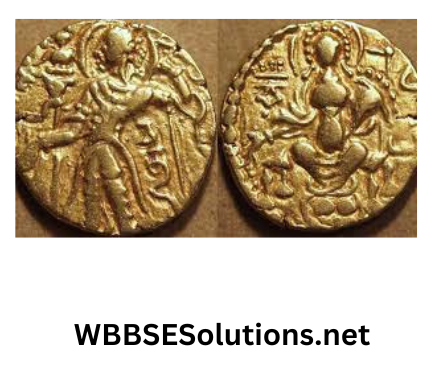
WBBSE Solutions For Class 7 History Chapter 2 Some Aspects Of The Indian Political History Topic A Ancient Bengal And Sasanka Sasankas Coins

2. National unification:

Sasanka unified Bengal politically and expanded it into an empire. Based on this principle of conquest, later rulers of Bengal, especially Pala rulers built up vast empires.

3. Formation of Bengali empire in Aryavarta:

Sasanka not only strengthened and unified Bengal, but also extended his control over parts of North India. He was the first independent sovereign ruler of Gauda.

4. Gaudatantra:

Sasanka built up a system of administration, which was called the Gaudatantra or Gauda system. In this system, the officials or civil servants set up a proper system of governance.

The administration started to interface in what was earlier the responsibility of the local village community. To conclude, underSasanka, Bengal emerged as an independent and powerful kingdom. Probably, Sasanka had no successor.

Read and Learn More WBBSE Solutions For Class 7 History

Question 4. Discuss the social life of Bengal under Sasanka.
Answer:

The social life of Bengal under Sasanka:

We get ample information about the social life of Bengal under Sasanka from Visakhadatta’s ‘Mudrarakshasa’, Xuanzang’s (Hiuen-Tsang) ‘Si- Yu-Ki’, the Midnapore Copper Plate, the Egra Copper Plate, the Ganjam Copper Plate, and Banabhatta’s ‘Harshacharita’. Of course, Banabhatta was unfriendly to Sasanka.

Class 7 WBBSE History Question Answer

1. Social class division:

The society of Bengal had several classes apart from Brahmins— the uppermost caste of society. Low-castes like Chandalas, existed according to the Egra Copper Plate.

2. Position Of women:

Women were probably held in high respect, though very little information is available regarding their real status.

3. Casteism:

Social divisions did exist, as implied by the Egra Copper Plate. It refers to the existence of a pond used only by the Chandalas but we do not know the extent of social castes prevalent at that time.

4. Inequal distribution of wealth:

The Egra Copper Plate mentions the different official ranks like Pradhana, Mahapradhana, Mahottar, and Mahamahottar which imply the existence of wealthy classes and also indicate inequality in the distribution of wealth.

WBBSE Class 7 Geography Notes WBBSE Solutions For Class 7 History
WBBSE Solutions For Class 7 Geography WBBSE Class 7 History Multiple Choice Questions
WBBSE Class 7 Geography Multiple Choice Questions WBBSE Solutions For Class 7 Maths


Question 5. Write a note on Karnasuvarna.
Answer:

Karnasuvarna was the capital of Gauda during Sasanka’s reign.

Karnasuvarna:

1. Location:

Located at present Chiruti of Murshidabad district of West Bengal, it is locally popular as the ‘Palace of king Kama’.

2. Historical evidence:

Remains of the ancient Raktamrittika Buddhist monastery (Vihara) have been excavated near Rajbaridanga near the present Chiruti Railway Station. Xuanzang (Hiuen Tsang) referred to it in his account.

Its Chinese name was Lo-to-mo-chi. The capital Karnasuvarna was located near this place.

3. Geographical features:

Loamy soil and humid climate supported agriculture. Several fruits and vegetables were grown here.

Class 7 WBBSE History Question Answer

4. Population:

Xuanzang stated that the country was densely populated. The people were learned and cultured. People possessed a good character and patronised education and learning. Buddhists and Shaivites coexisted harmoniously.

5. Trade and Commerce:

Karnasuvarna was an important commercial and administrative center. It had close commercial links with South-East Asia. Ships laden with merchandise traveled to Malay from Raktamrittika.

6. Political Turmoil:

Karnasuvarna, the capital of Sasanka, was conquered by the Kamarup ruler, Bhaskara Varman, after his death. It was the capital of Jayanagar later. However, no reference can be obtained about it after the 7th century.

Question 6. What do you mean by the term ‘Matsya-nyaya’?
Answer:

After the death of Sasanka, the utter anarchy and chaos that characterized politics and society in Bengal for nearly a century (650— 750), is called ‘Matsya-nyaya’.

Matsya-nyaya:

1. Source:

The term ‘Matsya-nyaya’ is found in the accounts of the eminent Tibetan historian Lama Taranath and Arthashastra of Kautilya. The Buddhist text ‘Arya-Manjushri- mula-kalpa’ narrates the state of misery in Bengal.

2. Nature:

Literally ‘Matsya-nyaya’ meansfish¬like behaviour. In a pond, just as the bigger fish eats up the smaller ones, similarly, after the death of Sasanka, the rich and powerful classes began to oppress the weak and the poor and captured their lands. This situation was called ‘Matsya-nyaya’.

WBBSE Solutions For Class 7 History Chapter 2 Some Aspects Of The Indian Political History Topic A Ancient Bengal And Sasanka Matsyanyaya


3. Background:

  • After Sasanka’s death, the political scenario of Bengal was characterized by civil wars, the rise of numerous ruling dynasties, foreign invasions, and total lawlessness.
  • Several foreign provincial rulers repeatedly invaded Bengal taking advantage of political disunity and chaos.

4. Election Of king:

To end the situation of Matsya-Nyaya, the nobility, and aristocrats of Bengal elected Gopala as king. This capable ruler gradually brought back peace and stability in Bengal

Conclusion:

The end of Matsya-Nyaya marked the termination of the oppression by the power¬craving people. Peace was restored in society.

Conceptual Questions on the Legacy of Sasanka

Question 7. Write about the regions of Pundravardhana and Samatata.
Answer:

Pundravardhana:

Pundravardhana was an ancient kingdom, the largest among the territories of ancient Bengal. It included parts of present-day Rajshahi, rangpur, and Dhaka Divisions of Bangladesh as well as the West Dinajpur district of West Bengal.

Sylhet was earlier included in this region. During the Gupta rule, Pundravardhana was a ‘Bhukti’ or a territorial division.

Samatata

Samatata was an ancient geographical division of Bengal in the Eastern Indian subcontinent. Its territory corresponded to much of present-day eastern Bangladesh.

On the south-eastern side of Samatata, lies the present-day coastal region of Chittagong of Bangladesh. The area covers the trans-Meghna part of the Bengal delta.

WBBSE Chapter 2 Topic A Ancient Bengal And Sasanka Short Question And Answers

Question 1. Name the main territories of ancient Bengal and explain .how they obtained their names.
Answer:

The main territories of ancient Bengal and explain .how they obtained their names:

The main territories of ancient Bengal were Pundravardhana, Varendra, Vanga, Radh, Suhma, Gauda, Samatata, and Harikel. Such names have been derived from the people who inhabited these regions. These names were given after a clan or community.

Class 7 History Solution WBBSE

Question 2. Which regions comprised Samatata?
Answer:

Regions comprised Samatata:

The eastern bank of the Meghna River was 5amatata of ancient times, now including the Kumilla-Noakhali areas of present Bangladesh. It was regarded as the boundary of Bengal as river Meghna isolated Samatata from the rest of Bengal.

Question 3. Discuss the territorial conquests of Sasanka.
Answer:

Territorial conquests of Sasanka:

Sasanka was the first independent and sovereign king of Bengal. He established control over some parts of North India.

Formation of independent Gauda:

Taking advantage of the weakness of the Later Gupta rulers, Sasanka set up independent rule over Gauda.

Conquests:

He conquered Danda-Bhukti, Utkala, Kangod (Ganjam district), Magadha, and Bodh Gaya. His kingdom stretched up to the north¬western region of Varanasi.

Question 4. Write a note on Karnasuvarna.
Answer:

Karnasuvarna:

  • Ancient Karnasuvarna is now represented by Raktamrittika or Rangamati, six miles south¬west of Berhampore, in the present Murshidabad. Traditionally, it was the capital of king Kama and later became the capital of Gauda under king Sasanka.
  • On its outskirts was located the famous Raktamrittika Buddhist monastery. It had deep commercial links with the countries of Southeast Asia for centuries.

Question 5. Describe the state of Karnasuvarna after Sasanka’s death.
Answer:

The state of Karnasuvarna after Sasanka’s death:

After Sasanka’s death, Karnasuvarna passed into the hands of Bhaskara Varman, the ruler of Kamarupa. Later on, it became the capital of Naga king Jayanagar for some time.

Though nothing can be known about the city in the 7th century, the records of the Pala and the Sena periods do not mention its existence.

Real-Life Scenarios Involving Sasanka and Harsha

Question 6. Write a note on Gaudavaho.
Answer:

Gaudavaho:

Gaudavaho, which literally means ‘slaying of the king of Gauda’ was an epic, composed by Vakpatiraja in 725-730.

Background:

Vakpatiraja commemorated the victory of Yashovarman, his patron, over the Magadhan ruler in this work. He might have referred to the ruler of Magadha as the ruler of Gauda.

Language:

Prakrit was used to compose Gaudavaho.

Question 7. What was the economic condition of Bengal during Sasanka’s rule?
Answer:

The economic condition of Bengal during Sasanka’s rule:

Sasanka was the first independent ruler of Bengal.

Dependance on agriculture:

During Sasanka’s rule, the economy of Bengal was dependent on agriculture and the society was rural. So the demand of agricultural land increased.

Trade And commerce:

Probably, there was a depression in trade and commerce during Sasanka’s period. As a result merchant clan lost their importance. The significance of cities and towns also diminished due to this.

Question 8. What was Lo-to-mo-chi?
Answer:

Lo-to-mo-chi:

The ruins of Raktamrittika, an ancient Buddhist Vihara, were excavated at Rajbaridanga near Chiruti (presently Karnasuvarna) railway station.

The Chinese Buddhist traveler Xuanzang (Hiuen Tsang) had referred to this vihara in his account. In the Chinese language, it was called Lo-to-mo-chi. It was very close to Karnasuvarna, the capital of the Gauda Kingdom.

WBBSE Chapter 2 Topic A Ancient Bengal And Sasanka Very Short Question And Answers

Question 1. Which regions constituted Pundravardhana?
Answer:

Regions constituted Pundravardhana:

Pundravardhana was the largest territory of ancient Bengal. It was a complete administrative unit or Bhukti and included Dinajpur, Bogura, Rajshahi and Pabna as well as Srihatta (Sylhet).

Question 2. Which area was designated as Harikel of Bengal?
Answer:

Designated as Harikel of Bengal:

Harikel was the southeastern part of Samatata, presently including the coastal regions of Chittagong of Bangladesh.

Examples of Real-Life Applications of Historical Knowledge

Question 3. Name the first independent ruler of Gauda. Where was his capital located?
Answer:

  1. Sasanka was the first independent ruler of Gauda.
  2. His capital was located at Karnasuvarna.

Question 4. Which Buddhist texts mention Sasanka’s Hatred towards Buddhism?
Answer:

The Buddhist text ‘Arya-Manjushri-mulakalpa’ and the account of Xuanzang (Hiuen Tsang) mention Sasanka’s hatred towards Buddhism.\

Question 5. How were various territorial divisions of ancient Bengal named?
Answer: Various territorial divisions of ancient Bengal were named after the people who lived there.

Question 6. What was the Chinese name of the Raktamrittika Buddhist monastery?
Answer: The Chinese name of Raktamrittika Buddhist monastery was Lo-to-mo-chi.

Question 7. Who took the title ‘Sakalottarapatha- Nathan?
Answer: Harshavardhana took the title ‘Sakalottarpathanatha’.

Question 8. Who wrote the ‘Arthashastra’?
Answer: Kautilya or Chanakya or Vishnugupta wrote the ‘Arthashastra’.

Question 9. Which dynasty did Harshavardhana belong to?
Answer: Harshavardhana belonged to the Pushyabhuti dynasty.

Question 10. What does the term ‘Suba’ mean?
Answer: ‘Suba’ means Province.

Question 11. Who was Taranath?
Answer: Taranath was a Tibetan monk.

Question 12. Which city of Bengal was once the capital of Jayanagar?
Answer: Karnasuvarna was once the capital of Jayanaga.

Question 13. Which geographical region of ancient Bengal was called Varendra?
Answer: The territory between the Bhagirathi and the Karatoya rivers was called Varendra in ancient Bengal.

Question 14. Which historian has referred to Bengal as a Suba?
Answer: Abul Fazl has referred to Bengal as a Suba.

Question 15. What was the ancient name of Chittagong?
Answer: Harikel was the ancient name of Chittagong.

Question 16. Which era in the history of Bengal is classified as Matsya-Nyaya?
Answer: The period of a hundred-year-long anarchy in Bengal, after the death of Sasanka, from the mid-7th century to the mid-8th Century, is termed Matsya-Nyaya.

Question 17. Who set up his capital at Karnasuvarna after Bhaskaravarman?
Answer: Jayanagar set up his capital at Karnasuvarna after Bhaskaravarman.

Question 18. What was the territory between the Bhagirathi and the Karatoya rivers called?
Answer: The territory between the Bhagirathi and the Karatoya rivers was called Varendra.

Question 18. Which region of Bengal was called Harikel?
Answer: The coastal region of Chittagong in present Bangladesh located southeast of Samatata was called Harikel in ancient times.

Question 19. Name the triangular-shaped deltaic territory located between the rivers, Padma and Bhagirathi.
Answer: The triangular-shaped deltaic territory located between the rivers, Padma and Bhagirathi, was known as Vanga.

Question 20. Who occupied Karnasuvarna after the death of Sasanka?
Answer: Bhaskaravarman, the king of Kamrupa occupied Karnasuvarna after the death of Sasanka.

Question 21. What was Sasanka’s position in his early life?
Answer: In his early life Sasanka was a Mahasamanta under the Guptas.

Question 22. According to Jaina tradition, what was Northern Radh (Rahr) called?
Answer: According to Jaina tradition, Northern Radh (Rahr) was called Bajjabhumi or Bajrabhumi.

Question 23. According to Jaina tradition, what was Southern Radh called?
Answer: According to Jaina tradition, Southern Radh was called Subbabhumi or Suhmabhumi.

Question 24. Who composed Gaudavaho?
Answer: Vakpatiraj, the court poet of Yashovarma composed Gaudavaho.

Question 25. What is the other name of Kangsavati?
Answer: The other name of Kangsavati is Kansai.

Question 26. What were local lords called during Sasanka’s reign?
Answer: Local lords were called Mahattara during Sasanka’s reign.

Question 27. Which region did the Hooghly district belong to in ancient times?
Answer: Southern Radh belonged to the Hooghly district in ancient times.

Question 28. Who was the first independent ruler of Bengal?
Answer: Sasanka was the first independent ruler of Bengal.

Question 29. When Sasanka became the king of Gauda?
Answer: Sasanka became the ruler of Bengal a few years before 606-607 AD.

Question 30. What is the present name of Tamralipta?
Answer: The present name of Tamralipta is Tamluk.

Question 31. Who was l-Tsing?
Answer: l-Tsing was a Chinese traveler.

Question 32. What is ‘Gaudatantra’?
Answer: The administrative system which was in vogue in Sasanka’s reign, was called Gaudatantra.

WBBSE Chapter 2 Topic A Ancient Bengal And Sasanka Fill In The Blanks

By selecting the appropriate expressions from the brackets

Question 1. Bengal is mentioned in the writings of the13th century historian __________(Minhaj-i- Siraj / Abul Fazl / Khafi Khan).
Answer: Minhaj-i-Siraj

Question 2. The largest division of ancient Bengal was __________ (Varendra / Gauda / Pundravard- hana).
Answer: Pundravard- hana

Question 3. Sasanka was a worshipper of __________ (Vishnu/ Krishna / Shiva).
Answer: Shiva

Question 4. On the outskirts of Karnasuvarna city, stood the __________ (Raktamrittika /Odantapuri / Vikramashila) monastery.
Answer: Raktamrittika

Question 5. __________ (Brahmaputra / Ajay / Ganga) river was the boundary between Northern Radh and southern Radh.
Answer: Ajay

Question 6. __________ (Samatata / Vanga / Karnasuvarna) was the capital of Sasanka.
Answer: Karnasuvarna

Question 7. Sasanka was a __________(Samanta / Mahasamanta / Feudal lord) of a Gupta ruler.
Answer: Mahasamanta

Question 8. West Bengal is a state of independent __________(Nepal / Bangladesh / India).
Answer: India

Question 9. Radh and Suhma were located to the __________(north/east / west) of the River Bhagirathi.
Answer: West

Question 10. Most of the rulers of Samatata were __________ (Buddhists / Brahmins / Saivites).
Answer: Brahmins

Question 11. Harshavardhana died __________ (five / ten /fifteen) years after the death of Sasanka.
Answer: Ten

WBBSE Chapter 2 Topic A Ancient Bengal And Sasanka True Or False

Question 1. Sasanka was a vassal of the Guptas.
Answer: True

Question 2. Southern Radh was very close to the Bay of Bengal.
Answer: True

Question 3. In Harshacharita Sasanka was defamed.
Answer: True

Question 4. After the death of Sasanka Gauda lost its power.
Answer: True

Question 5. Sasanka was a devotee of Buddha.
Answer: False

Question 6. Harshacharita was written by Harshavardhana.
Answer: False

Question 7. Abul Fazl belonged to the Sultanate period.
Answer: False

Question 8. During the reign of Sasanka copper coins prevailed.
Answer: False

Question 9. Gaudavaho was written by Vakpatiraj.
Answer: True

Question 10. After the death of Sasanka, Gopala became the King of Bengal.
Answer: True

WBBSE Class 7 History Chapter 1 The Idea Of History Notes

WBBSE Class 7 History Chapter 1 The Idea Of History Introduction

It is difficult to remember the names of kings and viziers, dates and years of wars in history. But it is important to remember all these to know .when and between whom the incidents, happened.

Ancient elements help us to know about the past. We get to know about people of different periods from old houses, temples, mosques, statues, coins, paintings, books, and scripts. So these are the sources of history.

The sources of history are divided into various categories, like inscriptions, coins, architecture sculpture, and written materials. Much information is obtained from the writings on stone or metal plaques.

WBBSE Class 7 History Chapter 1 Notes

These are called inscriptions. Inscriptions on copper plates are called copper inscriptions and inscriptions on stone plaques are called stone inscriptions.

Read and Learn More WBBSE Solutions For Class 7 History

In the textbook, Indian history of almost one thousand years is depicted. The vast changes that occurred in India from the 7th century AD to the threshold of the 18th century AD, are recorded in this book.

Historians use the term ‘age’ to refer to a long period of time. In general, history is divided into three ages—Ancient, Medieval, and Modern.

The ages of history do not change overnight. Say for instance, the time of the afternoon. It is neither morning nor evening. Likewise, there was a long period of time in the history of a time when the Ancient age was waning gradually and the Medieval age had not begun totally. This period is known as Early Medieval.

WBBSE Class 7 History Chapter 1 The Idea Of History Notes

WBBSE Class 7 Geography Notes WBBSE Solutions For Class 7 History
WBBSE Solutions For Class 7 Geography WBBSE Class 7 History Multiple Choice Questions
WBBSE Class 7 Geography Multiple Choice Questions WBBSE Solutions For Class 7 Maths


The name India was known as ‘Hindus’, ‘Hindustan’, and ‘Indus’ at different times.


WBBSE Solutions For Class 7 History Chapter 1 The Idea Of History Nomenclature of Bharatvarsha

Nowadays, the style of writing history has been changed a lot. Significant changes are observed in lifestyle, culture, governance, economy, war, business, and religious aspects. An initiative has been taken to portray the life of common people in historical discussions of all these affairs.

WBBSE Solutions For Class 7 History Chapter 1 The Idea Of History Different Ages

Aesthetics And Creative Expression

You have learned about the Indus Valley Civilisation in class VI. Literary works are always the 1 important source of historical information. But the Indus scripts have not yet been deciphered.

So we have to depend on the archaeological source to have complete knowledge about this Indus Valley Civilisation. Now draw a chart showing the different aspects to Indus Valley Civilisation, discovered by archaeologists.

WBBSE Solutions For Class 7 History Chapter 1 The Idea Of History Civilisation.

The chart will inculcate a sense of creativity and will help the students to develop further knowledge about the civilization.

WBBSE Solutions For Class 6 History Chapter 9 India And The Contemporary World Topic C Miscellaneous

WBBSE Chapter 9 India And The Contemporary World Topic C Miscellaneous Long Answer Type Questions

Question 1. Examine the popularity of Buddhism as a religion.
Answer:

The popularity of Buddhism as a religion:

Buddhism founded by Gautama Buddha gained wide acceptance and became a popular religion.

  1. Menander, the Indo-Greek king, under the influence of the Buddhist monk Nagasena, adopted Buddhism. He took initiative to spread Buddhism.
  2. Emperor Ashoka took some steps to spread. Buddhism outside the Indian subcontinent. He sent envoys to places like Syria, Sri Lanka, Macedonia, Egypt, etc.
  3. The Greeks who came with Alexander gradually merged into Indian culture and embraced Buddhism.
  4. The Kushana emperor Kanishka adopted Buddhism. During his reign, Gandhara art evolved around Buddhism.
  5. Buddhist religion and studies was practiced in Kashmir. Buddhayasha was a renowned Kashmiri Buddhist scholar who went to Kashgar in Central Asia.
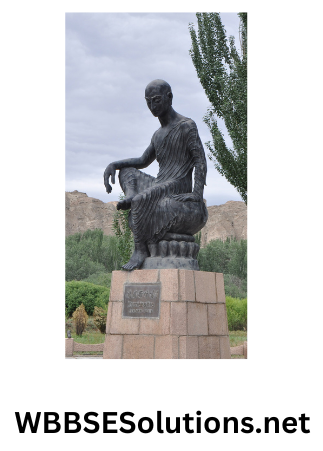
  6. Paramartha went to China and there he practiced Buddhist religion and philosophy.
  7. Kumarajiva went to Kashmir and studied Buddhism. He holds a significant place in the spread of Buddhist religion and philosophy.
  8. A Chinese scholar named Tao ngan encouraged the Buddhist Scholar from China to visit India. Faxian and Xuanzang came to India and studied the Buddhist religion.

Read and Learn More WBBSE Solutions For Class 6 History

Question 2. What was the importance of the Gandhara region?
Answer:

The importance of the Gandhara region:

Gandhara was located to the northwest of the Indian subcontinent. The importance of the Gandhara region can never be underestimated.

  1. Communication between the Persian and the Indian subcontinent was established via Gandhara.
  2. It was located at a central position which helped to spread Buddhism to Central and East Asia.
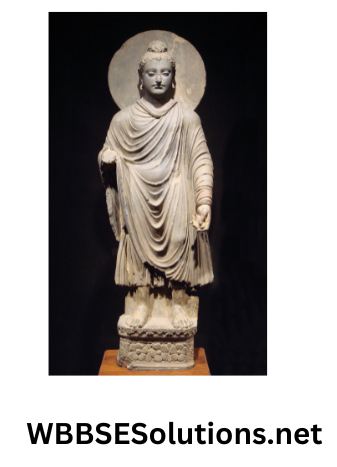
  3. It was an important cultural centre. It was the home of a distinctive art style that was a mixture of an Indian Buddhist and Graeco-Roman influence. The art was known as Gandhara art.
  4. The Gandhara art which developed in the Gandhara province evolved around Buddhism. New kinds of Buddha images were made.
WBBSE Solutions For Class 6 Geography WBBSE Solutions For Class 6 History WBBSE Solutions For Class 6 Maths
WBBSE Class 6 Geography Notes WBBSE Class 6 History Notes
WBBSE Class 6 Geography Multiple Choice Questions WBBSE Class 6 History MCQs WBBSE Notes For Class 6 School Science


Question 3. What in your opinion, was the role of education in furthering the contact between the Indian subcontinent and the outside world in ancient times?
Answer:

The role of education in furthering the contact between the Indian subcontinent and the outside world in ancient times:

Education played a significant role in furthering the contact between the Indian subcontinent and the outside world in ancient times.

1. Scholars from abroad to the Indian subcontinent:

Many scholars and students including Fa Hein (Faxian), Hieun Tsang (Xuanzang), and others came from China for learning and religious discussions. They not only learned about Buddhism and Brahmanism but also studied literature, science, and medicine.

The universities of Nalanda, Taxila, and other educational centers helped in establishing close contact between India and China.

2. Scholars of the Indian subcontinent to different countries:

Buddhayasha, a well known Kashmiri Buddhist scholar visited Kashgarh in Central Asia. Paramartha visited China with the aim of education. He carried with him some Buddhist literature.

Kumarajiva went to the Chinese capital and remained there. He devoted his life to the study of Buddhist religion and philosophy.

WBBSE Solutions For Class 6 History Chapter 9 India And The Contemporary World Topic C Miscellaneous

Question 4. Compare the pictures of the coins in chapter 9 with those of chapters 6 and 7 respectively and find out the similarities and dissimilarities between the two sets.
Answer:

Similarities between the pictures

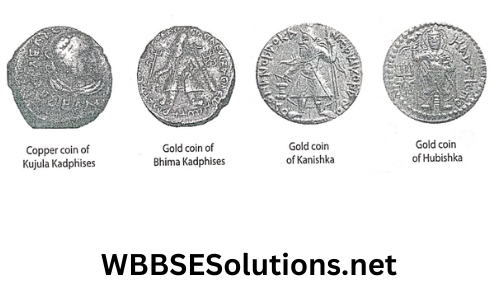
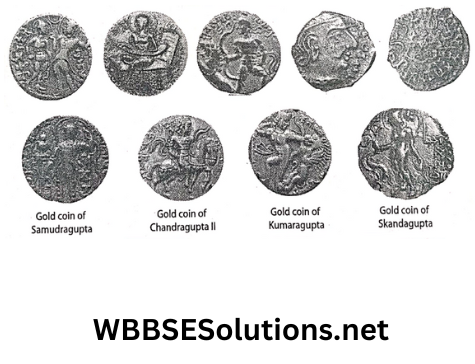
  1. The coins of the Kushanas, Guptas, Satavahanas, and Greeks were circular.
  2. Gold coins were in use in ancient India during the time of the Maurya, Kushana, Gupta, and Greek rulers.
  3. The pictures of the kings were engraved on the coins of the Maurya, Kushana, Gupta, and Greek rulers.


WBBSE Solutions For Class 6 History Chapter 9 India And The Contemporary World Topic C Miscellaneous Coins of Kushana Age


WBBSE Solutions For Class 6 History Chapter 9 India And The Contemporary World Topic C Miscellaneous Coins of Gupta Age

Examples of Coastal Kingdoms in Ancient India

Dissimilarities between the pictures

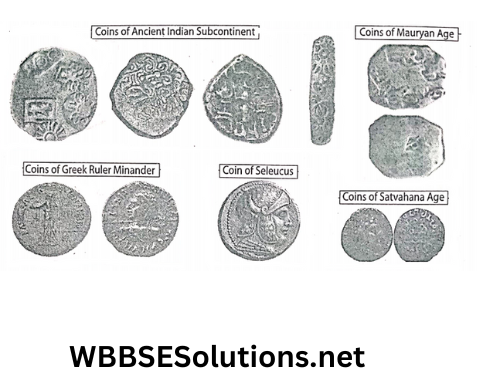
  1. The coins of the Mauryas and those of ancient India were not circular in shape but those of the Kushanas, Guptas, and Greeks were circular.
  2. Chandragupta Il first initiated silver coins in the Gupta period. However, silver coins were not in use in the post-Gupta or Kushana period.
  3. The Kushana and Greek coins portrayed only the images of the kings but the coins of Mauryas, Guptas, and ancient India had other pictures carved on them apart from the faces of kings.


WBBSE Solutions For Class 6 History Chapter 9 India And The Contemporary World Topic C Miscellaneous Different Coins

Question 5. What is the importance of this place?
Answer:

The importance of this place:

In Bodh Gaya, sitting under the Pipal tree, Siddhartha attained enlightenment. The Mahabodhi temple is just beside the tree. This temple is a holy place both for the Hindus and the Buddhists.

A little distance from Bodh Gaya is Nalanda, which was an important center of education in ancient India. In the Gupta period, the Nalanda university became very famous.

Question 6. What steps have been taken and what more steps according to you can be taken to make this place attractive to the foreign tourists?
Answer:

To preserve this place the archaeological department of India has taken many steps. There is a museum where different artifacts obtained after archaeological excavation are exhibited.

Besides this, in this locality, different countries have constructed Buddhist temples which have given Bodh Gaya special importance. Again to bring back the ancient heritage of Nalanda, the university has been constructed again.

To construct this university, countries like China, Singapore, Japan, etc have helped India. The decision have been taken that it will be developed into an international university like the past.

Besides this, I think, the government of India should take different programs at the international level (for example-different types of advertisement so that Bodh Gaya and Nalanda become more attractive to foreigners).

Based on the given map, the learner may be asked various questions related to the marked places in the map. In this case, the above questions are significant. As a result, the sense of empathy and cooperation will develop in the learner.

Real-Life Scenarios Involving Traders and Merchants

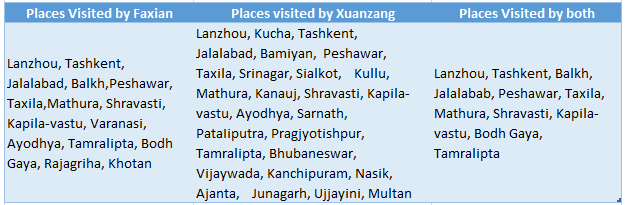
Question 7. Study the given map carefully. Prepare a chart on the places in the Indian subcontinent visited by Faxian and Xuanzang. Which were the places visited by both of them?
Answer:

While preparing the chart the learner, on the one hand, will understand the importance of map reading in the subject, on the other hand, it will help to develop a sense of creativity in the learner.


WBBSE Solutions For Class 6 History Chapter 9 India Topic C Miscellaneous Places visted by Faxian, Xuanzang,and both.

Question 8. What was the importance of Gandhara region?
Answer:

The importance of Gandhara region:

Gandhara was located to the north-west of the Indian subcontinent. The importance of Gandhara region can never be underestimated.

  1. Communication between Persian and the Indian subcontinent was established via Gandhara.
  2. It was located at a central position which helped to spread Buddhism to Central and East Asia.
  3. It was an important cultural central. It was the home of a distinctive art style that was a mixture of a Indian Buddhist and Graeco- Roman influence. The art was known as Gandhara art.
  4. The Gandhara art which developed in the Gandhara province evolved around Buddhism. New kinds of Buddha images were made.

WBBSE Chapter 9 India And The Contemporary World Topic C Miscellaneous Short Answer Type Questions

Question 1. Did Alexander’s invasion of the Indian subcontinent have any effect on the growth of the Mauryan empire?

  1. Alexander’s invasion of India had definitely helped in the growth of the Mauryan empire.
  2. Effect of Alexander’s invasion on the growth of the Mauryan empire

Answer:

Alexander defeated the Persians and put an end to their rule over the subcontinent. The destruction of the small kingdoms had subsequently facilitated Chandragupta Maurya’s attempt to extend his empire.

Since Alexander left India very quickly, it was easy for Chandragupta Maurya to defeat the weak powers and establish his empire.

Question 2. What are the things that we do not find in Indian society and culture before the arrival of the Shakas and Kushanas?
Answer: Before the arrival of the Shakas and the Kushanas there was no circulation of silver currencies. Different styles of garments like coats, pajamas, long coats, belts, shoes, etc. were not in use.

The use of reins and bridles was not introduced in the Indian subcontinent before the arrival of the Shakas.

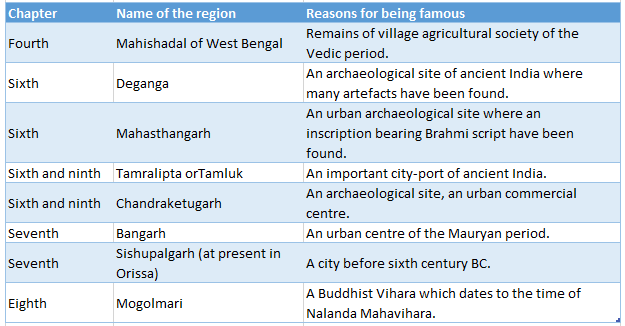
Question 3. Make a list of the names of the different regions of ancient Bengal that you have come across in this book. Why are these regions famous?
Answer:

WBBSE Solutions For Class 6 History Chapter 9 India Topic C Miscellaneous Different regions of ancient Bengal

Question 4. Does any foreigner stay in your locality? Have you ever tasted foreign food especially Chinese food?
Answer:

The learner can say ‘Yes’ or ‘No.

Yes, I have tasted chow min, momo, etc.

Through the above-mentioned questions, the learner will be interested about the theme and will also be interested in taking part in the discussion.

Question 5. What is Hindush?
Answer:

Hindush:

The term ‘Hindush’ is mentioned in one of the writings of the great Persian emperor Darius I. The term was derived from river Indus.

Question 6. What were the great advances in war- horsemanship made by Shaka-Pahlavas?
Answer:

The great advances in war- horsemanship made by Shaka-Pahlavas:

Great advances in war-horsemanship were made by the Shaka-Pahlavas

  1. The Shaka- Pahlavas introduced the use of bridle and reins in the Indian subcontinent.
  2. The tactics of turning around and shooting arrow while sitting on the back of a running horse was introduced by the Pahlavas.

WBBSE Chapter 9 India And The Contemporary World Topic C Miscellaneous Very Short Answer Type Questions

Question 1. Mesopotamia, Sumer, Babylon, Egypt.
Answer: Egypt

Question 2. Bhrigukachha, Kalyam, Kaveripattinam, Kashgarh.
Answer: Kashgarh

Question 3. Alexandria, Corsica, Macedonia, Constantinople.
Answer: Corsica

Question 4. Carthage, Athens, Sparta, Crete.
Answer: Carthage

Question 5. Babylon, Persepolis, Parthia, Byzantium.
Answer: Byzantium

Question 6. Suryasiddhanta, Rajtarangini, Pancha siddhantika, Yavanjataka.
Answer: Rajtarangini

Question 7. Bodh Gaya, Sarnath, Rajagriha, Rome.
Answer: Rome

Question 8. What do you mean by a foreign country?
Answer: A country other than our own country i.e. France is a foreign country.

Question 9. What are those people called who came from foreign countries?
Answer: Those people who come to India from other countries are called foreigners.

Question 10. Do we come to know anything about our country from the writings and books of the foreigners?
Answer: Yes, directly or indirectly we get various information from the writings and books of the foreigners.

Question 11. Have you ever heard of the country China?
Answer: Yes, we have heard of China.

Question 12. Where is China situated?
Answer: China is situated in the north of India.

Referring to the map if the above-mentioned questions are asked and discussed the learner will be able to participate in the discussion.

Question 13. Where do you live?
Answer: I live in West Bengal, a state of India.

Question 14. Do any of your relatives reside in a foreign country?
Answer: The learner can say ‘yes’ or ‘no’

Question 15. Who destroyed the Persian city Persepolis?
Answer: Alexander destroyed the persian city Persepolis.

Question 16. During whose reign there was exchange of envoys with China?
Answer: During the reign of emperor Harshavardhana there was exchange of envoys with China

Question 3. Observe map 9.2 (of the textbook) carefully. Which were the places in the subcontinent visited by Faxian and Xuanzang? Which were the places where both had point a visit? Make a list of these places.
Answer: See the ‘Aesthetics and Creative Expression’ portion of Formative Evaluation.

WBBSE Chapter 9 India And The Contemporary World Topic C Miscellaneous  Fill In The Blanks

Question 1. According to Herodotus, Indus was a ______________ (province/country/district) of the Persian Empire.
Answer: Province

Question 2. The _____________ (Shakas/Bactrians/Kushanas) were known as Indo-Greeks.
Answer: Bactrians

Question 3. St. Thomas had visited the Indian subcontinent for the spread of Christianity during the rule of ____________ (Alexander/Menander/Gondophernes).
Answer: Gondophernes

Question 4. The _______ (Saka-Kushana/Saka-Pahlavas/Maurya-Kushanas) started the use of bridles and saddles on horses.
Answer: Saka-Pahlavas

Question 5. Bhrigukachha was located on the confluence of river Narmada and the _______ (Arabian Sea/Kaveri/Ganga).
Answer: Arabian Sea

WBBSE Chapter 9 India And The Contemporary World Topic C Miscellaneous State Whether Following Statements Are True Or False

Question 1. In Puranas, Bactrian kings have been referred to as Asura.
Answer: False

Question 2. The Pahlava rulers were threat to the Shaka rulers.
Answer: True

Question 3. Kumarajiva studied Buddhism and literature under Bandhudutta.
Answer: True

WBBSE Chapter 9 India And The Contemporary World Topic C Miscellaneous Exercise Spot The Odd Word And Underline It

Question 1. Bhrigukachha, Kalyan, Sopara, Tamralipta.
Answer: Sopara

Question 2. Buddhayasha, Kumarajiva, Paramartha, Xuanzang.
Answer: Xuanzang

Question 3. Alexander, Seleucus, Kanishka, Menander.
Answer: Kanishka

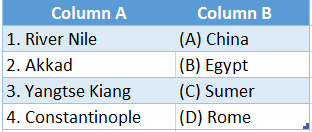
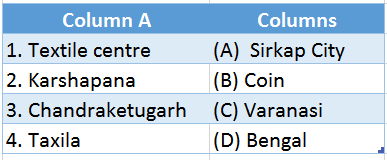
WBBSE Chapter 9 India And The Contemporary World Topic C Miscellaneous Match The Columns

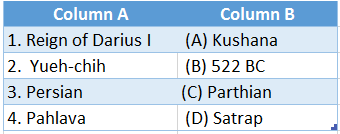
Question 1.

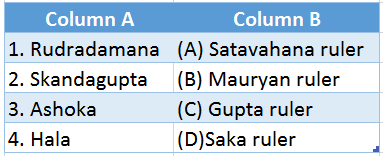
WBBSE Solutions For Class 6 History Chapter 9 India Topic C Miscellaneous Match the following 1

Answer: 1. (B), 2. (C), 3. (A), 4. (D)

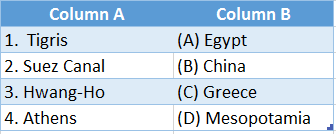
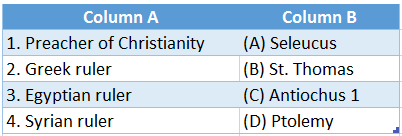
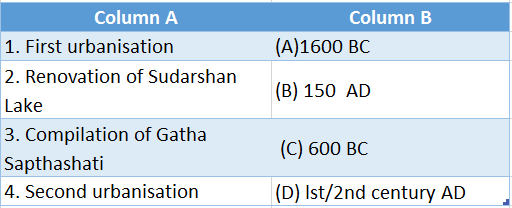
Question 2.

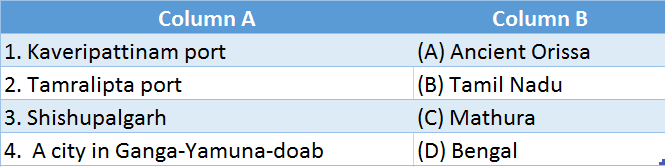
WBBSE Solutions For Class 6 History Chapter 9 India Topic C Miscellaneous Match the following 2

Answer: 1. (D), 2. (A), 3. (B), 4. (C)

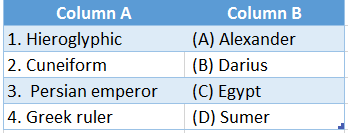
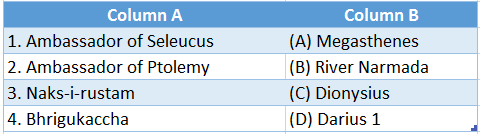
Question 3.

WBBSE Solutions For Class 6 History Chapter 9 India Topic C Miscellaneous Match the following 3

Answer: 1. (C), 2. (D), 3. (B), 4. (A)

Question 4.

WBBSE Solutions For Class 6 History Chapter 9 India Topic C Miscellaneous Match the following 4

Answer: 1. (B), 2. (A), 3. (D), 4. (C)

Question 5.

WBBSE Solutions For Class 6 History Chapter 9 India Topic C Miscellaneous Match the following 5

Answer: 1. (B), 2. (C), 3. (D), 4. (A)

Question 6.

WBBSE Solutions For Class 6 History Chapter 9 India Topic C Miscellaneous Match the following 6

Answer: 1. (A), 2. (C), 3. (D), 4. (B)

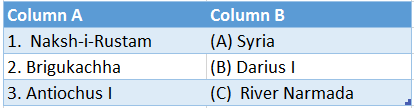
Question 7.

WBBSE Solutions For Class 6 History Chapter 9 India Topic C Miscellaneous Match the following 1.

Answer: 1. (B), 2. (C), 3. (A)

WBBSE Solutions For Class 6 History Chapter 9 India And The Contemporary World Topic B Mode Of Economic And Cultural Contact

WBBSE Chapter 9 India And The Contemporary World Topic B Mode Of Economic And Cultural Contact Long Answer Type Questions

Question 1. What was the chief item of commerce along land routes? Write the importance of silk route in ancient India of silk route in ancient India.
Answer:

The chief item of commerce along land routes:

The chief item of commerce along land routes was silk.

Importance of silk route

  1. Link with South Asia: Some parts of the silk route was under the control of the Kushanas. So one branch of the silk route became linked with South Asia.
  2. Collection of revenue: The Kushana rulers earned revenue from the silk trade.
  3. Settlement of the people: People of different regions engaged in silk trade used to assemble in the north and north-western frontiers of the Indian subcontinent and many of them settled there.

Read and Learn More WBBSE Solutions For Class 6 History

Question 2. What is the importance of the book ‘Periplus of the Erythraean Sea’?
Answer:

The importance of the book ‘Periplus of the Erythraean Sea’:

According to the ancient Greek and Roman texts on geography, the Red sea, the Indian Ocean and the Persian gulf together was known as the Erythraean Sea. A book was written about communication, trade and commerce on those waters. This was known as ‘The Periplus of the Erythrean Sea.

Important Definitions Related to Economic Contact

WBBSE Solutions For Class 6 Geography WBBSE Solutions For Class 6 History WBBSE Solutions For Class 6 Maths
WBBSE Class 6 Geography Notes WBBSE Class 6 History Notes
WBBSE Class 6 Geography Multiple Choice Questions WBBSE Class 6 History MCQs WBBSE Notes For Class 6 School Science


Importance of ‘Periplus of the Erythrean Sea

1. Author:

The name of the author of the book is unknown. Probably the author was a Greek who used to live in Egypt.

2. Period of composition:

The book was possibly written in the mid-1st century AD.

3. Importance:

  1. From the book, we come to know about communication and trade, and commerce on the Indian Ocean, the Red sea, and the Persian Gulf.
  2. The book contains a detailed account of the ports of the Erythraean Sea and different aspects of trade and commerce.
  3. The book describes the people, society, and flora, and fauna of different regions.
  4. This book serves as an important source of knowledge for knowing the economic history of the 1st century AD.
  5. Some information about the monsoons or seasonal winds of southwest and northeast can be collected from the book.
  6. As the wind system came to be known, traveling and commercial activities on the Erythraean Sea became easier.

Question 3. Describe the Gandhara art in the Indian subcontinent.
Answer:

The Gandhara art in the Indian subcontinent:

The Gandhara art developed in the Gandhara province of the Indian subcontinent. It evolved around Buddhism.

1. Gandhara art style:

The theme of Gandhara art was essentially Indian. But there was the impact of Iranian and Central Asian art styles. There was also a Graeco-Roman influence on the Gandhara school of art.

WBBSE Solutions For Class 6 History Chapter 9 India And The Contemporary World Topic B Mode Of Economic And Cultural Contact Gandhara Art

2. Features:

The artists of Gandhara began to sculpt new kinds of Buddha images. The features of the images were half-closed eyes, an aquiline nose, and long drawn eyebrows. The shoes of Buddha resembled Roman sandals. Golden color was used in the statues.

Question 4. Buddhism was another vehicle through which people of the Indian subcontinent connected with the outside world-examine the statement.
Answer:

Buddhism was another vehicle through which people of the Indian subcontinent connected with the outside world:

Buddhism was an important vehicle through which people of the Indian subcontinent was connected with the outside world. Different countries were visited by scholars of the subcontinent to impart education.

On the other hand, students came from abroad to study Buddhism. Buddhayasha, a renowned Kashmiri Buddhist scholar went to Kashgar in Central Asia. Paramartha, another scholar went to China and practised Buddhist religion and philosophy.

Kumarajiva went to Kashmir and studied Buddhism. A Chinese scholar named Tao ngan encouraged Buddhist scholars from China to visit India. Faxian and Xuanzang came to India and studied the Buddhist religion.

WBBSE Class 6 Economic Contact Notes

WBBSE Solutions For Class 6 History Chapter 9 India And The Contemporary World Topic B Mode Of Economic And Cultural Contact

Question 5. What do you know about Kumarajiva?
Answer:

Kumarajiva:

Kumarajiva was the son of Kumarayana, the royal guru of the king of Kuchi. His mother’s name was Jiva.

  1. Education: At the age of nine Kumarajiva went to Kashmir. There, under the guidance of Bandhudutta he studied Buddhism and literature.
  2. Visit to China: In 401 AD he visited the capital of China and stayed there for eleven years.
  3. Achievements: He was an expert in both Sanskrit and Chinese languages. He played an important part in the spread of Buddhist religion and philosophy in China.

Question 6. Write a note on silk route.
Answer:

Silk route:

From the 6th century BC there was the commercial relationship between the Indian subcontinent and the outside world through land routes. Silk was the main item of commerce. Avoiding the Taklamakan desert Chinese silk were passed along two routes.

These two routes met at Kashgarh. From there, the silk travelled via a number of roads and reached the eastern Mediterranean region. The term silk route was not used at that time. In the 19th century AD, it came to be known as the silk route.

Question 7. Write a short note on Tamralipta.
Answer:

Tamralipta:

Tamralipta was an important port city of ancient India. Tamralipta has been referred to as ‘Tamalites’ by Greek travelers. This seaport functioned till the 7th-8th centuries AD. Xuanzang writes that Tamralipta was located on a sea tributary.

Waterways and land routes converged there. This was possibly in present-day East Midnapore around Tamluk. Tamralipta was also an important center of education. Due to silting of the river, this port city declined. It lost its importance as an urban center.

Question 8. What were the great advances in war- horsemanship made by Shaka- Pahlavas?
Answer:

The great advances in war- horsemanship made by Shaka- Pahlavas:

Great advances in war horsemanship were made by the Shaka-Pahlavas

  1. The Shaka- Pahlavas introduced the use of bridles and reins in the Indian subcontinent.
  2. The tactics of turning around and shooting an arrow while sitting on the back of a running horse was introduced by the Pahlavas.

Question 9. What was “Yavanajataka’ and ‘Panchasiddhantika’?
Answer:

“Yavanajataka’ and ‘Panchasiddhantika’:

‘Yavanajataka’ was a famous book of Astrology. It was originally written in the Greek language. It was translated into Sanskrit in about 150 AD. This book shows that there was an interrelation between Indian and Greek sciences.

‘Panchasiddhantika’ was written by Varahamihira. In the book he has discussed five ‘siddhanta’ or theories of Astronomy, two of them are Poulish and Romak Siddhanta.

WBBSE Chapter 9 India And The Contemporary World Topic B Mode Of Economic And Cultural Contact Short Answer Type Questions

Question 1. Who was the author of the book ‘Periplus of the Erythraean Sea’ (or Travels on the Erythraean Sea)? In what language was the book written?
Answer:

The name of the author of the book ‘Periplus of the Erythraean Sea’ is not known. It seems that the author of the book is a Greek who used to live in Egypt. The book was written in the Greek language.

Question 2. By what other names Tamralipta port- city was known as?
Answer:

Tamralipta, the port city, was also known as Tamralipti, Damalipta, etc. In the writings of Greek travelers, Tamralipta was referred to as Tamalites.

Question 3. Which language and script were used in the regions under the suzerainty of the Persian kings? Which script was derived from that script?
Answer:

  1. Aramaic language and Aramaic script were used in the regions under the suzerainty of the Persian kings.
  2. From the Aramaic script possibly the Kharoshthi script was derived.

Question 4. Who destroyed the Persian city of Persepolis? What was its impact?
Answer:

Alexander destroyed the Persian city of Persepolis.

Due to the destruction of the Persian city of Persepolis, many Persian craftsmen came into the Indian subcontinent. As a result, these Persian craftsmen began to influence the styles of Indigenous artisans and craftsmen.

Question 5. The Kushanas and the Shakas introduced different styles of Garments in the subcontinent-what were these garments?
Answer:

The Kushanas and the Shakas introduced different styles of garments in the Indian subcontinent. These were coats, long coats, pajamas, belts, shoes, etc.

Common Questions About Trade Relations in Modern India

Question 6. What is ‘Yavanikaa’? Who first introduced the custom of dropping ‘Yavanikaa’ in a play?
Answer:

  1. The custom of dropping the curtain in a play is known as ‘Yavanikaa’.
  2. The Greeks first introduced the custom of dropping ‘Yavanikaa’ or curtain in a play.

Question 7. Who was Buddhayasha? Where did he visit after completing his education?
Answer:

Buddhayasha was a well-known Kashmiri Buddhist scholar who had ties with Kumarajiva. After completing his education, he visited Kashgar in Central Asia.

Question 8. Why and when Kumarajiva went to China?
Answer:

Kumarajiva, at the request of the Chinese emperor went to the Chinese capital in 401 AD. He remained in the capital of China for 11 years and played an important part in the spread of Buddhist religion and philosophy.

WBBSE Solutions For Class 6 History Chapter 9 India And The Contemporary World Topic B Mode Of Economic And Cultural Contact Kumarajiva

Question 9. Which Chinese scholar encouraged the Buddhist scholars to visit India? Who responded to that encouragement and visited India?
Answer:

  1. A Chinese scholar named Tao ngan encouraged Buddhist scholars to visit India.
  2. Faxian responded to Tao ngan and visited India in 399 AD with five other monks.

Question 10. What lessons did the Chinese scholars take from Nalanda University?
Answer:

The Chinese scholars took lessons in Buddhist literature and religion. They also took lessons in Brahmanical religion. Medicine and science was also a part of their education.

Question 11. Who was Azez I? What do you know- about him?
Answer:

Azez I was a Shaka ruler.

He ruled between Kandahar and the northwestern frontier. Gradually the rule of the Shakas spread over North India and the Ganga Valley. He introduced the Vikrama Era (Vikramabda).

WBBSE Chapter 9 India And The Contemporary World Topic B Mode Of Economic And Cultural Contact Very Short Answer Type Questions

Question 1. What were referred to as the Erythraean Sea in the ancient Greek and Roman texts on geography?
Answer: In the ancient Roman and Greek texts on geography, the Red Sea, the Persian Gulf, and the Indian Ocean is referred to as the Erythraean Sea.

Question 2. When was the book ‘Periplus of the Erythraean Sea’ written?
Answer: The book ‘Periplus of the Erythraean Sea’ was written possibly in the mid-1st century AD.

Question 3. Mention one important source for knowing the economic history of the 1st century AD.
Answer: One important source for knowing the economic history of the 1st century AD. is the book ‘Periplus of the Erythraean Sea’.

Question 4. Which was the greatest port of the western coast of India?
Answer: Bhrigukachha on the confluence of river Narmada and the Arabian sea was the greatest port of the western coast of India.

History Class 6 Chapter 9 WBBSE

Question 5. Which port was besieged by the Shaka ruler Nahapana?
Answer: The Shaka ruler Nahapana besieged the port of Kalyan on the Konkan coastline.

Question 6. Name one port in the Kaveri delta region.
Answer: Kaveripattinam was a famous port of the Kaveri delta region.

Question 7. Name one well-known port city of ancient India.
Answer: Tamralipta was a well-known port city of ancient India.

Question 8. From which script Kharoshthi script was derived.
Answer: Kharoshthi script was derived from the Aramaic script.

Question 9. Who destroyed the Persian city of Persepolis?
Answer: Alexander destroyed the Persian city of Persepolis.

Question 10. Which religion the Greeks embraced?
Answer: The Greeks embraced Buddhism.

Question 11. What was the best example of Greek influence on Indian painting and sculpture?
Answer: The best example of Greek influence on Indian painting and sculpture was the Gandhara School of Art.

Question 12. Which Saka ruler used the title Rajatiraj on his coins?
Answer: The Shaka ruler Moga used the title Rajatiraj on his coins.

Conceptual Questions on Cultural Identity in a Globalized World

Question 13. In which language was the Junagarh Prashasti inscribed?
Answer: The Junagarh Prashasti was inscribed in the Sanskrit language.

Question 14. Who started the use of bridles and reins in the Indian subcontinent?
Answer: The Shaka-Pahlavas introduced the use of bridles and reins in the Indian subcontinent.

Question 15. Whom did the Kushanas worship?
Answer: The Kushanas worshipped Shiva, Vishnu, and Buddha.

Question 16. Who were the father and mother of Kumarjiva?
Answer: Kumarayana, the royal guru of the king of Kuchi was the father of Kumarajiva. His mother was Jiva.

Question 17. Who was Buddhayasha?
Answer: Buddhayasha was a renowned Kashmiri Buddhist scholar.

Question 18. From which century there was a rise in the spread of Buddhism in China?
Answer: There was a rise in the spread of Buddhism in China from the 4th century AD onwards.

Question 19. Who was appointed the Royal Guru by the king of Kuchi?
Answer: Kumarayana, the father of Kumarajiva, was appointed the Royal Guru by the king of Kuchi.

Question 20. Who was Tao ngan?
Answer: Tao ngan was a Chinese scholar who encouraged Chinese Buddhist scholars to visit India.

Question 21. Who was Faxian?
Answer: Faxian was a Chinese monk who lived in Pataliputra and wrote his experience in his memoir-Fo-Khyo-Ki.

Question 22. When did Xuanzang come to India from China?
Answer: Xuanzang came to India from China in the first half of the 7th century AD.

Question 23. Who was the ruler of Kanauj when Xuanzang visited India?
Answer: Harshavardhana was the ruler of Kanauj when Xuanzang visited India.

Question 24. Who was Shilabhadra?
Answer: Shilabhadra was a scholar at Nalanda Mahavihara who imparted education to Xuanzang.

WBBSE Chapter 9 India And The Contemporary World Topic B Mode Of Economic And Cultural Contact Fill in the blanks

Question 1. A lot of revenue was earned by the Kushana rulers from the trade of ________ (cotton/silk/muslin).
Answer: Silk

Question 2. Periplus of the Erythraean Sea is an important source for the study of the economic history of ________ century AD (1st/2nd/3rd).
Answer: 1st

Question 3. Bhrigukachha was located on the confluence of river Narmada and the ________ (Arabian sea/Kaveri/Ganga).
Answer: Arabian sea

Question 4. The whole of the eastern coast of the Indian subcontinent was important for communication with ________ (South-Western Asia/South-Eastern Asia/Europe).
Answer: South-Eastern Asia

Question 5. Gandhara art evolved a round ________ (Jainism/Hinduism/Buddhism).
Answer: Buddhism

History Class 6 Chapter 9 WBBSE

Question 6. The art of making clay pottery came from ________ (East Asia/West Asia/Central Asia).
Answer: Central Asia

Question 7. A kind of red earthenware pottery was manufactured in the ________ period (Mauryan/Gupta/Kushana).
Answer: Kushana

Question 8. A famous book on Astrology was ________ (Si-Yu- Ki/Meghadutam/Yavanajataka).
Answer: Yavanajataka

Question 9. Faxian stayed at ________ and studied the Buddhist religion (Kanauj/Pataliputra/ Kashmir).
Answer: Pataliputra

WBBSE Chapter 9 India And The Contemporary World Topic B Mode Of Economic And Cultural Contact True Or False

Question 1. The word ‘Periplus’ means the description of travel on water.
Answer: True

Question 2. The author of Periplus of the Erythraean Sea used to live in Syria.
Answer: False

Question 3. The ports of the Malabar coast traded in Chinese silk.
Answer: False

Question 4. Tamralipta was also known as Damalipta.
Answer: True

Question 5. Alexander established some cities in the Indian subcontinent.
Answer: True

Question 6. The Shaka-Pahlavas made great advances in astronomy.
Answer: False

Question 7. Faxian entered the Indian continent through Kashmir.
Answer: True

Question 8. The scholar Paramartha reached China in 548 AD.
Answer: False

Question 9. The memoirs of Faxian is known as Fo- Khyo-Ki.
Answer: True

WBBSE Solutions For Class 6 History Chapter 8 Aspects Of Culture In Ancient India Topic C Miscellaneous

WBBSE Chapter 8 Aspects Of Culture In Ancient India Topic C Miscellaneous Long Answer Type Questions

Question 1. What do we come to know from Puranas?
Answer:

From the Puranas we come to know of the following:

  1. The Puranas contain an element of history. An important theme of the Puranas is the history of royal dynasties.
  2. We also come to know from the Puranas about agriculture, commerce, animal husbandry, and geography. Astrology also forms an important part of the discussion.

Question 2. Discuss the development of literature in ancient India.
Answer:

Literature was highly developed in ancient India.

1. Smritishastras:

Smritishastras were treatises in which various aspects of the right to property and employment and issues of daily life were discussed.

2. Dharmashastras:

Dharmashastras contain explanations about the ancient caste system in Sanskrit.

3. Natyashastra:

The main recreation of the people of the upper classes were drama and acting. So they started writing on drama and acting, for example, Natyashastra by Bharata.

4. Literature in regional languages:

Various kinds of literature were written between 200 BC and AD 300 in different regional languages. For example Patanjali’s Mahabhashya, King Haal’s Gatha Saptashati, etc. Sangam literature in Tamil also deserves mention here.

5. Mahakavya:

Two epics, the ‘Ramayana’ and the ‘Mahabharata’ were composed in ancient times.

6. Medical text:

Medical books on medicines and surgery were written during this time. Two important medical text of ancient India were ‘Charaka-samhita’ and ‘Shushuruta- samhita’.

Read and Learn More WBBSE Solutions For Class 6 History

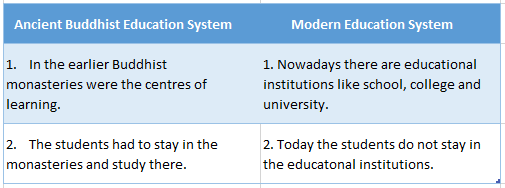
Question 3. Write down the similarities and dissimilarities between the ancient Buddhist education system and the education system of present times.
Answer:

The similarities and dissimilarities between the ancient Buddhist education system and the education system of present times:

Several subjects were taught in the ancient Buddhist education system like prosody, poetry, grammar, astronomy, astrology, mathematics, and chemistry.

Today also various subjects like Bengali, Mathematics, English, History, Geography, and Science are taught. In the Buddhist monasteries, students were admitted on the basis of merit.

Today also most of educational systems admit students on the basis of merit. Dissimilarities between the ancient Buddhist education system and the modern education system are listed below

WBBSE Solutions For Class 6 History Chapter 8 Topic C Miscellaneous Dissiilarities between Ancient Buddhist and Modern Education System

Question 4. Charaka-Samhita has outlined the structure of a model hospital. In your opinion, what should a good hospital be like?
Answer:

Practice Quesations on Cultural Practices in Ancient India

An ideal hospital according to Charaka- Samhita

In his book, ‘Charakasamhita’ Charaka had described an ideal hospital. He felt that there should be a surgeon in a hospital and an adequate arrangement for surgery so that the amputated organs might be attached to the body and cured.

Apart from this, there should be a sufficient amount of herbal medicines stored as a reserve in the hospital.

WBBSE Solutions For Class 6 Geography WBBSE Solutions For Class 6 History WBBSE Solutions For Class 6 Maths
WBBSE Class 6 Geography Notes WBBSE Class 6 History Notes
WBBSE Class 6 Geography Multiple Choice Questions WBBSE Class 6 History MCQs WBBSE Notes For Class 6 School Science


A good hospital in my opinion

According to me, a good hospital is one where there are adequate facilities for medical treatment. Other than skilled physicians, there should be devoted nurses to look after the patients and restore them to health.

There should be proper arrangements for surgical operations and provisions for free medicine for the poor and destitute. Moreover, complete cleanliness and proper sanitation should be maintained.

WBBSE Solutions For Class 6 History Chapter 8 Aspects Of Culture In Ancient India Topic C Miscellaneous

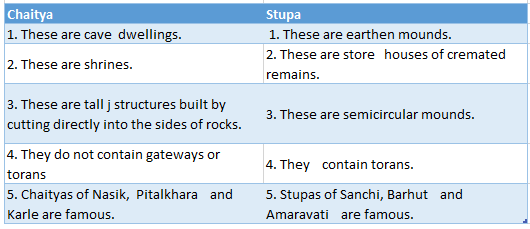
Question 5. Write down the differences between a chaitya and a stupa.
Answer:

The differences between a chaitya and a stupa:

WBBSE Solutions For Class 6 History Chapter 8 Topic C Miscellaneous Differences between Chaitya and stupa.

Question 6. What factors are responsible for the destruction of the natural environment? Make a list of the tasks that you can perform as a team to protect the environment today.
Answer:

Nature provides essential resources for our survival. The factors which are responsible for the destruction of the natural environment are as follows

Real-Life Scenarios Involving Daily Life in Ancient India

  1. Deforestation.
  2. Conversion of agricultural land to residential land.
  3. Wastage of water.
  4. Ponds are used as dumping grounds.
  5. Vehicle and industrial emission.
  6. Use of plastic.

The following is a list of the tasks that we can perform as a team to protect the environment today

  1. Planting of trees.
  2. Stop deforestation.
  3. Save water.
  4. Stop littering.
  5. Use of eco-friendly things instead of plastic.
  6. Make people conscious about the conservation of the natural environment.

Question 7. Carefully observe the stupas drawn below. Write down the similarities and dissimilarities that you find in them.
Answer:

Similarities:

  1. All the stupas are of the same size.
  2. All the stupas are mound-like or hemispherical in structure.

Dissimilarities:

  1. The stupas of the Mauryan period has no spire while the stupas of the Indo-Greek period and Kushana period have spires.
  2. The stupas of the Kushana period is surrounded by a fence but there is no fence in the stupas of the Mauryan and Indo-Greek period.
  3. There are several steps in the stupa of the Indo-Greek period while steps are not present in the stupas of the Mauryan and Kushana periods.

Question 8. Nowadays scripts are written on paper or on any other material but what was used for writing scripts in ancient times?
Answer:

In ancient times there was no use of paper. So scripts were written on barks of trees, leaves or on stones. In ancient Egypt papyrus, made from the pith of the papyrus plant, was used as a writing surface.

Leaves of trees were also used. Besides these stone slabs were also used for writing. Allahabad Prashasti is one such example.
In the previous chapter, the learner at least has some experience about Indian scripts.

So if the above questions are asked the learner will develop inferential knowledge and her potentiality of interpretation and application will unfold.

Question 9. Make clay/thermocol models of Chaitya/monastery/stupas.

Important Definitions Related to Ancient Indian Culture

WBBSE Solutions For Class 6 History Chapter 8 Aspects Of Culture In Ancient India Topic C Miscellaneous Chaitya

WBBSE Solutions For Class 6 History Chapter 8 Aspects Of Culture In Ancient India Topic C Miscellaneous Monastery

WBBSE Solutions For Class 6 History Chapter 8 Aspects Of Culture In Ancient India Topic C Miscellaneous Stupa

WBBSE Chapter 8 Aspects Of Culture In Ancient India Topic C Short Answer Type Questions

Question 1. According to the Buddhists, Charaka belonged to the age of Kanishka I. Does that mean that Charaka-samhita was the creation of an individual named Charaka? The word Charaka means those who wander about. In one of the branches of the Vedas, one reads about Charan-Vaidya or physicians who wandered about offering treatment. Does that imply that Charaka-samhita is a collection of experiences of such physicians?
Answer:

According to the Buddhists Charaka- Samhita was written by a physician Charaka who belonged to the age of Kanishka I.

Charaka-Samhita was the collection of experiences of physicians who wandered about offering treatment. It must be pointed out here that in Charaka-samhita there is mention of about seven hundred medicinal plants and different aspects of diseases.

So it may be said that the physicians wandered about offering treatment by using medicinal herbs.

Question 2. It is difficult to ascertain in which period Shushruta can be placed. The word Shushruta means one or those who had listened properly. Does that mean, Shushuruta-samhita is also a compilation of similar experiences of the Charan-Vaidyas?
Answer:

Shushuruta-samhita was not a compilation of the experiences of the Charan-Vaidyas. Supporting this statement it may be said that Shushruta was a surgeon. He was famous in the field of surgery.

It is expected that being a famous surgeon he will not include similar experiences of Charan-Vaidyas in his work Shushuruta-Samhita.

Question 3. What are the languages and what are the scripts we know?
Answer:

We know Bengali, English, and Hindi languages and Bengali, Roman, and Devnagari scripts.

Question 4. What is the text direction of these scripts?
Answer:

The text direction of these scripts are from left to right.

Question 5. Do you know any script which is written from right to left?
Answer:

The script of the Urdu language is written from right to left.

With the above question, the learner may be introduced to a discussion on scripts of ancient India. The learner can take part in discussions by which his knowledge about the theme will be clear.

Question 6. Do you know any such script which has similarities with present-day script?
Answer:

There are many similarities between Devnagari script and Hindi and Bengali scripts.

It may be noted that scripts of Hindi are similar to Devangri scripts.

The above questions may be asked or samples of ancient Indian scripts may be shown and the learner may be questioned to find out the similarities of the ancient scripts with present-day scripts. As a result, the learner will develop his thinking power.

WBBSE Chapter 8 Aspects Of Culture In Ancient India Topic C Miscellaneous Very Short Answer Type Questions

Question 1. Jaykavya, Bharata, Mahabharata, Ramayana.
Answer: Ramayana

Question 2. Mahabhashya, Charaka-samhita, Naga- nanda, Vasa.
Answer: Vasa

Question 3. Meghadutam, Kumarsambhavam, Malavi- kagnimitram, Ratnavali.
Answer: Ratnavali

Question 4. Bharhut, Sanchi, Amaravati, Bishalyakarani.
Answer: Bishalyakarani

Question 5. Ajanta, Ellora, Bagh, Torona.
Answer: Torona

Question 6. Shunga, Kushana, Satavahana, Gandhara.
Answer: Gandhara

Question 7. Upadhyay, Acharya, Guru, Mogolmari.
Answer: Mogolmari

Question 8. Ardha-Magdhi, Prakrit, Brahmi, Hindi.
Answer: Hindi

Question 9. Nalanda, Taxila, Balavi, Pataliputra.
Answer: Pataliputra

Question 10. Brahmi, Sanskrit, Kharosthi, Devanagri.
Answer: Sanskrit

Question 11. Ratnavali, Mrichhakatikam, Arthashastra, Abhijnanshakuntalam.
Answer: Arthashastra

Question 12. What is ‘Gatha Saptashati’?
Answer:

Gatha Saptashati:

‘Gatha Saptashati’ is a compilation of poems in the Prakrit language written by savasana king Haal.

Question 13. What was prohibited in Dharmashastras?
Answer: In the Dharmashastras touching a corpse was prohibited.

Question 14. Who was Nagarjuna?
Answer:

Nagarjuna:

Nagarjuna was a famous Buddhist scholar of the 1st century AD. He was a mathematician.

WBBSE Chapter 8 Aspects Of Culture In Ancient India Topic C Miscellaneous Fill In The Blanks

Question 1. Initially, the stupas were made of __________ (red sandstone/bricks/mud).
Answer: Mud

Question 2. Bhartrihari was a well known __________ (dramatist/musician/grammarian).
Answer: Grammarian

WBBSE Chapter 8 Aspects Of Culture In Ancient India Topic C Miscellaneous True Or False

Question 1. Only Brahmin students could study at Nalanda Mahavihara.
Answer: False

Question 2. In Kamban’s Ramayana, Rama has been shown in a much greater light.
Answer: False

Question 3. Bagabhatta was a physician.
Answer: True

Question 4. Gandhara art evolved during the Kushana period.
Answer: True

Question 5. Jivaka was a famous mathematician.
Answer: False

Question 6. The Sarnath Stupa was built by Ashoka.
Answer: True

Question 7. Tamil literature is known as Sangama literature.
Answer: True

Read and Learn More  WBBSE Solutions For Class 6 History

WBBSE Chapter 8 Aspects Of Culture In Ancient India Topic C Miscellaneous Match The Columns

Question 1.

WBBSE Solutions For Class 6 History Chapter 8 Topic C Miscellaneous Match the following 1

Answer: 1. (B), 2. (A), 3. (D), 4. (C)

Question 2.

WBBSE Solutions For Class 6 History Chapter 8 Topic C Miscellaneous Match the following 2

Answer: 1. (C), 2. (D), 3. (A), 4. (B)

Question 3.

WBBSE Solutions For Class 6 History Chapter 8 Topic C Miscellaneous Match the following 3

Answer: 1. (D), 2. (C), 3. (A), 4. (B)

Question 4.

WBBSE Solutions For Class 6 History Chapter 8 Topic C Miscellaneous Match the following 4

Answer: 1. (B), 2. (D), 3. (A), 4. (C)

Question 5.

WBBSE Solutions For Class 6 History Chapter 8 Topic C Miscellaneous Match the following 5

Answer: 1. (C), 2. (D), 3. (B), 4. (A)

Question 6.

WBBSE Solutions For Class 6 History Chapter 8 Topic C Miscellaneous Match the following 1.

Answer: 1. (E), 2. (A), 3. (B), 4. (C), 5. (D)

WBBSE Solutions For Class 6 History Chapter 8 Aspects Of Culture In Ancient India Topic B Science And Arts In The Ancient India Subcontinent

WBBSE Chapter 8 Aspects Of Culture In Ancient India Topic B Science And Arts In The Ancient India Subcontinent Long Answer Type Questions

Question 1. Describe the story of Lakshman and the ‘Shaktishel’.
Answer:

The story of Lakshman and the ‘Shaktishel’:

In the Ramayana, we find a story that Lakshman became unconscious when he was hit by a powerful missile called shaktishel.

Physician Sushena advised that Bishalyakarani, a medicinal plant if applied to the wound would help Lakshman to recover. Hanuman went to Gandhamadan mountain to collect the herb but failed to identify it.

So he carried the entire hillock on his shoulder and brought it to Lakshman. Lakshman recovered when Bishalyakarani was applied. The term Bishalyakarani means the medicine which is applied after surgery.

Read and Learn More WBBSE Solutions For Class 6 History

Question 2. What is the importance of Charaka- Samhita and Shushuruta-samhita in the study of science in the ancient period?
Answer:

The importance of Charaka- Samhita and Shushuruta-samhita in the study of science in the ancient period:

Charaka-Samhita and Shushruta-samhita are very important in the study of science in ancient India.

1. Charaka-Samhita:

Charaka in his Charaka- samhita discussed about seven hundred medicinal plants. He also discussed about different aspects of diseases. In his writings, there are also references how an ideal hospital should be equipped.

2. Shushuruta-samhita:

From Shushruta- samhita much is known about the dissection of corpses or cadavers. Shushruta had discussed about surgical treatment in his book.

He was an expert in joining bones or broken noses putting together a severed ear, etc. He was an expert in this field.

Important Definitions Related to Ancient Indian Sciences

WBBSE Solutions For Class 6 History Chapter 8 Aspects Of Culture In Ancient India Topic B Science And Arts In The Ancient India Subcontinent

Question 3. Who was Jivaka? Write in detail about him.
Answer:

Jivaka:

Jivaka was an eminent physician and a contemporary of Buddha.

Life and Works of Jivaka

Jivaka was born in Rajagriha (a royal family). He was the physician of King Bimbisara. He received his education from Guru Atreya in Taxila.

After completion of his studies, Guru Atreya sent his disciples to the forest with the task of finding plants with no medicinal properties. Each disciple came back with many plants which they felt had no medicinal value.

Only Jivaka came empty-handed and said that he could not find any plant which had no medicinal value. The Guru was happy and he realized that Jivaka had acquired full knowledge of medicinal herbs and plants. Later on Jivaka successfully treated King Bimbisara and Gautama Buddha.

WBBSE Solutions For Class 6 Geography WBBSE Solutions For Class 6 History WBBSE Solutions For Class 6 Maths
WBBSE Class 6 Geography Notes WBBSE Class 6 History Notes
WBBSE Class 6 Geography Multiple Choice Questions WBBSE Class 6 History MCQs WBBSE Notes For Class 6 School Science


Question 4. What were the causes of conflict that arose between the Dharmashastra and medical science? Or, What were the problems that appeared in the cultivation of medical science in ancient India?
Answer:

The causes of conflict that arose between the Dharmashastra and medical science:

In ancient times differences arose between the Dharmashastra and medical science.

1. Intense caste distinction:

Due to caste distinctions problems arose in the cultivation of medical science. There was a belief that by performing good deeds (punya) in an earlier birth, it was possible to be free from diseases in the present birth. This was contradicted by medical science.

2. Prohibition of food items:

According to medical science, different kinds of food were necessary for a speedy recovery from diseases. But Dharmashastras prohibit the consumption of several food items. This led to differences between Dharmashastras and medical science.

3. Dissection of corpses:

Dharmashastra prohibited the touching of corpses. But the dissection of corpses was an important part of medical science.

Due to the prohibition of Dharmashastra the practice of surgical science and the study of anatomy declined. In this way, conflict arose between Dharmashastras and medical science.

Question 5. What were the contributions of Aryabhatta, Varahamihira, and Brahma- Gupta to science in the Gupta period?
Answer:

The contributions of Aryabhatta, Varahamihira, and Brahma- Gupta to science in the Gupta period:

1. Aryabhatta:

Aryabhatta was a great mathematician and astronomer of the Gupta period. He raised the status of mathematics to the level of an independent discipline.

In his work ‘Aryabhatiya’ he introduced the concept of zero which led to the emergence of the decimal system. He also propounded the theories of the rotation of the earth, its spherical shape. and the cause of the lunar eclipse. He has also discussed about the stars and planets.

WBBSE Class 6 Science and Arts in Ancient India Notes

2. Varahamihira:

Varahamihira was also a famous astronomer who introduced many new concepts. In his works Suryasidhhanta and Panchasidhantika he had discussed the connection between clouds, winds and the amount of rainfall.

Early warning signals of an earthquake was also discussed in Varahamihira’s work.

3. Brahmagupta:

Brahmagupta was a famous mathematician and astronomer who made an exceptional contribution to Mathematics. His famous work was Brahmasphuta Siddhanta.

Question 6. Give an account of the development of Astronomy and Mathematics during the Gupta period.
Answer:

The development of Astronomy and Mathematics during the Gupta period:

During the Gupta period there was considerable development of astronomy and science.

1. Astronomy:

Aryabhatta was a great astronomer of the Gupta period. In his work ‘Aryabhatiya’ he propounded the theories of the rotation of Earth, its spherical shape and the cause of the lunar eclipse.

He also discussed about the stars and planets. Varahamihira was also a famous astronomer who introduced many new concepts. In his works Suryasidhhanta and Panchasidhantika he had discussed the connection between clouds, winds, and the amount of rainfall.

Early warning signals of an earthquake are also mentioned in his works.

2. Mathematics:

Aryabhatta raised the status of Mathematics to the level of an independent discipline. In his work ‘Aryabhatiya’ he introduced the concept of zero which led to the emergence of the decimal system.

Brahmagupta was a famous mathematician who made exceptional contributions to Mathematics. His famous work was Brahmasphutasiddhanta where he discussed about different aspects of Mathematics.

Question 7. What do you mean by environmental concerns in ancient India?
Answer:

Environmental concerns in ancient India:

There was much concern for the various aspects of the environment in ancient India.

1. Areas of concern:

The main areas of concern were forests, plants, birds, and animals. The rulers were very keen about forests because different types of natural resources were available from the forests. In Kautilya’s Arthashastra there are discussions on forests.

Short Questions on Ancient Indian Science

2. System of punishment:

People who damaged the forests were punished. The Mauryan emperor Ashoka prohibited the killing of birds and animals.

3. Forests:

Around the 6th century BC forests were cleared both for agricultural purposes and urban settlements. In the Vedic literature, villages were referred to as familiar whereas forests were unfamiliar.

Residents of the forests were looked down upon and were considered as strange. From the epics, we come to know that sometimes members of the royal family were banished to the forests in order to put them in trouble.

4. Tree worship:

Projects were started to save trees. To stop cutting of trees, worshipping of trees like Banyan and Pipal started.

5. Water:

Water was very important in the everyday life of the people, for religious purposes and for agriculture. So wealthy people made efforts to store water and build tanks and irrigation canals.

Question 8. What do you know about the cultivation of science in ancient India?
Answer:

The cultivation of science in ancient India:

In ancient India, the standard of scientific studies was quite high.

Cultivation of science in the Indian subcontinent

1. Meaning:

The word ‘science’ implies attaining specialized knowledge in a particular subject.

2. Scientific element in literature:

In the later Vedic and Buddhist literature, we find references to different types of medicines and surgical operations.

Charaka in his Charaka-Samhita mentioned about seven hundred medicinal plants and also discussed about different aspects of diseases. It also dwells on how an ideal hospital should be equipped.

Common Questions About Indian Astronomy

3. Astronomy and Mathematics:

The famous were astronomers of ancient India Aryabhatta and Varahamihira and famous mathematicians were Nagarajuna and Brahmagupta.

Aryabhatta in his work Aryabhatiya propounded the theories of the rotation of the earth, its spherical shape, and the causes of a lunar eclipse.

4. Medical Science:

Shushruta had discussed about physiology and surgical treatment in his ‘Shushuruta-samhita’. Here he advises physicians to discuss their specific requirements for surgical tools.

Question 9. Give an account of the cultivation of art during the Mauryan age.
Answer:

The cultivation of art during the Mauryan age:

After the Harappan civilization, evidence of art are found mainly in the Mauryan age.

1. Guhavasa:

Ashoka and the later Mauryan emperors built artificial caves by cutting mountains for the Ajivikas. People resided in these caves. This is known as ‘guavas’.

2. Stupa:

The Mauryan emperors also built stupas for the Buddhists. At first, the stupas were made of mud. But from Ashoka’s reign, stupas were made of bricks. The famous stupas at Sanchi and Sarnath were rebuilt during Ashoka’s reign.

3. Stone Pillars:

The pillars of Ashoka may be regarded as the best specimens of Mauryan art. The pillars were made of a single block of stone. The pillars looked like a piece of chalk. Ashokan Pillar in Sarnath is a remarkable piece of Mauryan art.

Practice Questions on Arts and Crafts in Ancient India

Question 10. Give an account of the cultivation of art during the Gupta and Pallava period.
Answer:

The cultivation of art during the Gupta and Pallava period:

The Gupta and Pallava period were famous for vast progress in the field of art and architecture.

1. Stupas and Chaityas:

A number of stupas and chaityas were constructed during the Gupta period. A remarkable stupa, the Dhamekh stupa of Sarnath, was built with bricks and stone.

2. Temples:

Temple architecture also began in the Gupta and Pallava period. Temples were built of brick or stone. Sometimes rock cut temples were also constructed. The temple at Mahabalipuram built by the Pallavas deserves a mention.

3. Sculpture:

On the walls of the temples of the Gupta and Pallava period, images of different Gods and Goddesses were engraved. Mention may be made here of the sculpture of the Dashavatara temple and the Ramayana panel of the Kailasha temple.

WBBSE Solutions For Class 6 History Chapter 8 Topic B Science And Arts In The Ancient India Subcontinent Mahabalipuram temple

4. Painting:

Ajanta cave paintings of the Gupta period are the most remarkable paintings of Gupta art. In these paintings, human figures and different kinds of plants are depicted.

The colors used in the Ajanta cave paintings were made of stone, earth, and plant components. Paintings have also been found in the Ellora and Bagh caves.

Class 6 History Chapter 8 WBBSE

Question 11. Give an account of the cultivation of art in ancient India.
Answer:

The cultivation of art in ancient India:

In ancient India, there was widespread cultivation of art.

1. Art in the Mauryan period:

During the Mauryan period, the material which was widely used for art was stone. The Mauryan emperors built artificial caves for the Ajivikas known as ‘Guhavasa’.

They also built stupas for the Buddhists. The best specimens of Mauryan art are the pillars built by Ashoka.

2. Art in the Shunga-Kushana-Satavahana period:

During this period sculpture was made with both terracotta and stone. Art was influenced by the life of common people and religious concepts and beliefs. The best examples of this period are the stupas, chaityas, and viharas.

The Gandhara and Mathura styles of art developed during this period centering Buddha’s life and beliefs.

3. Art in the Gupta and Pallava period:

In the Gupta age, a new style of architecture, that is, construction of different types of temples began, for example, the Dashavatara temple of Deogarh.

On the walls of the temples of the Gupta and Pallava period, images of different Gods and Goddesses were engraved.

Question 12. What do you know about the ruins of the archaeological site of Chandraketugarh?
Answer:

The ruins of the archaeological site of Chandraketugarh:

In the district of North 24 Parganas of West Bengal in Berachampa the archaeological ruins of Chandraketugarh have been found.

  1. Chandraketugarh of ancient Bengal was connected to the river Ganga by the river Vidyadhari. It was a thriving urban commercial center.
  2. Many archaeological remains of pre- Mauryan age (c600-300 BC) till Palas-Senas ages (c750-1250 AD) have been found here.
  3. The artifacts recovered are a variety of pottery, seals, statues, and terracotta figures. The terracotta figures are mostly female figurines.

Examples of Famous Sculptures and Architecture in Ancient India

Question 13. What are stupas, chaityas and viharas?
Answer:

Stupas, chaityas and viharas:

Stupas were semi-circular earthen mounds which contained the cremated remains of dead persons. They had railings and four gateways which were sculpted and called ‘Torana’.


WBBSE Solutions For Class 6 History Chapter 8 Topic B Science And Arts In The Ancient India Subcontinent Sanchi stupa


Chaityas were cave shrines built along with stupas and made by directly cutting into the sides of rocks. Viharas or sangharamas were specimens of architectural monuments which acted as residences and educational centers of Buddhist monks.

WBBSE Chapter 8 Topic B Science And Arts In The Ancient India Subcontinent Short Answer Type Questions

Question 1. Mention two features of Mathura art.
Answer:

Two features of Mathura art were:

  1. The main theme of Mathura’s art was the life of Buddha and Buddhism.
  2. Mostly red sandstone was used in the Mathura school of sculpture.

Question 2. Write a note on art during the Mauryan age.
Answer:

Art during the Mauryan age:

During the Mauryan period the material which was widely used for art was stone. The Mauryan emperors built artificial caves known as ‘Guhavasa’ for the Ajivikas by cutting mountains. They also built stupas for the Buddhists. The best specimens of Mauryan art are the pillars built by Ashoka. Human figures are rarely found in Mauryan art.

Question 3. What are the main features of the Ashokan Pillar?
Answer:

The main features of the Ashokan Pillar:

The pillars of Ashoka may be regarded as the best specimens of Mauryan art.

Conceptual Questions on Cultural Contributions of Ancient India

The main features of the Ashokan pillar are

  1. The pillars were made of a single block of stone.
  2. The pillars look like a piece of chalk.
  3. The base of the pillar was under the earth.
  4. The pillars stood upright without any support.
  5. On the top of the pillars were placed animal figures like lions, elephants, ox, etc.

Question 4. Differentiate between a monastery and a stupa.
Answer:

Difference a monastery and a stupa:

WBBSE Solutions For Class 6 History Chapter 8 Topic B Science And Arts In The Ancient India SuDifferentitate between monastery and stupa


Question 5. Give an account of Shunga-Kushana- Satavahana art.
Answer:

Shunga-Kushana- Satavahana art:

The Shunga-Kushana-Satavahana art was mainly based on the lives of common people. -Religion formed the main theme of art. The structures were related mainly to the Buddhist religion. Stupa, Vihara, and Chaitya are the best specimens of art.

Question 6. Write a note on Ajanta Cave paintings.
Answer:

Ajanta Cave paintings:

Ajanta Cave paintings are the most remarkable paintings of the Gupta period. In these paintings, human figures and different kinds of plants are depicted.

The colors used in the Ajanta cave paintings were made of stone, earth, and plant components.

Question 7. What is the importance of Chandra- ketubah as an archaeological site?
Answer:

The importance of Chandra- ketubah as an archaeological site:

Archaeological ruins have been discovered at Chandraketugarh in West Bengal. Many archaeological remains from the pre-Mauryan age till the Palas-Senas ages have been found here.

The artifacts recovered here are earthen pottery, seals, statues, and terracotta figurines. The terracotta figurines are mostly female figurines.

History Class 6 Chapter 8 Question Answer WBBSE

Question 8. What was discussed in Charaka-Samhita?
Answer:

In Charaka-Samhita there were discussions on seven hundred medicinal plants and different diseases. There are also references on how an ideal hospital should be equipped.

Question 9. What was Sankhyayan?
Answer:

Sankhyayan:

Arithmetic, Algebra, and Geometry-these three combined together was Mathematics to the Buddhists. This was known as Sankhyayan to the Jains.

Question 10. Who was Nagarjuna?
Answer:

Nagarjuna:

Nagarjuna was a famous Buddhist scholar of the 1st century AD. He was a mathematician.

Question 11. Who was Varahamihira? What were the two works of Varahamihira?
Answer:

Varahamihira was a famous astronomer of the Gupta age. His two works are-Suryasidhhanta and Panchasidhantika.

Question 12. Who was Brahmagupta? Why is he famous?
Answer:

Brahmagupta was a famous mathematician and astronomer of the Gupta period. He is famous for his work Brahmasphuta Siddhanta.

Question 13. Why was Shushruta famous?
Answer:

Shushruta famous:

Shushruta was an expert in joining broken bones or noses. He could also join together a severed ear etc. Thus he was famous in this particular field.

Question 14. What do the words ‘Charaka’ and ‘Shushruta’ mean?
Answer:

The word ‘Charaka’ means. those who wander about. We come to know about Charan Vaidya or physicians who wandered about offering treatment from one of the Vedas. The word ‘Shushruta’ means one of those who had listened properly.

Question 15. Give an idea of the Mehrauli Pillar.
Answer:

Mehrauli Pillar:

The Mehrauli Pillar is an example of the development of metallurgy in ancient times. Till today the iron pillar is rust-free.

Question 16. What is ‘guhavasa’?
Answer:

Guhavasa:

Ashoka and the later Mauryan emperors built artificial caves by cutting mountains for the Ajivikas. People resided in these cave dwellings. This is known as ‘guhavasa’.

Question 17. What was the period about which we come to know from the archaeological remains of Chandraketugarh?
Answer:

From the archaeological remains of Chandraketugarh we come to know about pre- Mauryan period (c 600-300 BC) to the times of the Palas and Senas (c 750-1250 AD).

Question 18. Name some artifacts recovered from the archaeological ruins of Chandraketugarh.
Answer:

The artefacts recovered from the archaeological ruins of Chandraketugarh are different types of earthen pottery, seals, statues, and terracotta figurines.

WBBSE Chapter 8 Topic B Science And Arts In The Ancient India Subcontinent Very Short answer Type Questions

Question 1. What is Bishalyakarani?
Answer: Bishalyakarani was a medicinal plant used for preparing medicine to be applied after surgery.

Question 2. Who proposed to apply Bishalyakarani to the wound of Lakshman?
Answer: Sushena, a physician proposed to apply Bishalyakarani to the wound of Lakshman.

Question 3. Who was Jivaka?
Answer: Jivaka was the royal physician of king Bimbisara.

Question 4. From whom did Jivaka receive an education?
Answer: Jivaka received education from Guru Atreya.

Question 5. How was ‘punya’ and disease-related?
Answer: There was a belief that by performing good deeds (punya) in an earlier birth it was possible to be free from diseases in the present birth.

Question 6. What was prohibited in the Dharmashastras?
Answer: In the Dharmashastras touching a corpse was prohibited.

Question 7. Why the study of Anatomy and surgical science began to decline?
Answer: Touching a corpse was prohibited by the Dharmashastras. As a result, the study of Anatomy and surgical science began to decline.

Question 8. What is the meaning of the word Charaka?
Answer: The word Charaka means those who wander.

Question 9. What is the meaning of the word ‘Charan Vaidya’?
Answer: Charan Vaidya means physicians who used to wander about from place to place offering treatment to the people.

Question 10. Name a famous Buddhist mathematician.
Answer: The famous Buddhist mathematician was Nagarjuna.

Question 11. What was the name of the book written by Aryabhatta?
Answer: The name of the book written by Aryabhatta was Aryabhatiya.

Question 12. Who was Aryabhatta?
Answer: Aryabhatta was a famous astronomer and mathematician of the Gupta period.

Question 13. In which book did Aryabhatta use the concept of zero?
Answer: Aryabhatta, in his book Aryabhatiya, used the concept of zero.

Question 14. Who put forward the idea that the Earth is round and it rotates around its own axis?
Answer: Aryabhatta put forward the idea that the Earth is round and it rotates around its own axis.

Question 15. What was Aryabhatta’s concept of lunar eclipse?
Answer: Aryabhatta’s conception was that a lunar eclipse occurs when the shadow of the earth fell on that of the moon.

Question 16. Who was the author of Brahmasphuta- Siddhanta?
Answer: The author of Brahmasphutasiddhanta was Brahmagupta.

Question 17. Which book discussed about the science of agriculture?
Answer: The book Krishiparashara discussed about the science of agriculture.

Question 18. What were the main concerns of the environment in ancient India?
Answer: The main concerns of the environment in ancient India were birds, animals, plants, and forests.

Question 19. For whom did the Mauryan emperors build artificial cave dwellings?
Answer: The Mauryan emperors built artificial cave dwellings for the Ajivikas.

Question 20. Name two stupas built during the reign of Ashoka.
Answer: Two stupas built during the reign of Ashoka were stupas at Sarnath and Sanchi.

Question 21. What figures have been used in the Ashokan pillar?
Answer: Figures of lions, elephants, ox, etc. were used in the Ashokan pillar.

Question 22. What was the principal theme of Gandhara and Mathura art?
Answer: The principal theme of Gandhara and Mathura art was the life of Buddha and Buddhism.

Question 23. What is the main influence on Gandhara sculpture?
Answer: Greek and Roman influences are dominant on Gandhara art.

Question 24. What was mostly used in the Mathura school of sculpture?
Answer: Redstone was mostly used in the Mathura school of sculpture.

Question 25. What is ‘torona’?
Answer: The stupas in the Mauryan age had railings and four gateways on four sides. These are known as ‘torona’.

Question 26. What are stupas?
Answer: Stupas are semi-circular earthen mounds which contained the cremated remains of dead persons.

Question 27. What are viharas?
Answer: Viharas were a collection of several caves which acted as residences and educational centers.

Question 28. Which are the most remarkable specimens of Gupta art?
Answer:

The most remarkable specimens of Gupta art are the paintings and sculptures of the Ajanta caves.

Question 29. Why are Ellora and Bagh caves famous?
Answer:

Ellora and Bagh caves are famous for their paintings.

Question 30. Give two examples of Gupta art.
Answer:

Two examples of Gupta art are the Ajanta cave painting and the Ellora cave painting.

Question 31. Name the archaeological site of North 24 Parganas in West Bengal.
Answer:

The archaeological site of North 24 Parganas in West Bengal is Chandraketugarh in Berachampa.

WBBSE Chapter 8 Topic B Science And Arts In The Ancient India Subcontinent Fill In The Blanks

Question 1. ________ (History / Science / Philosophy) means specialized knowledge.
Answer: Science

Question 2. Jivaka was the royal physician of king ________ (Bimbisara/Bindusara / Kanishka).
Answer: Bimbisara

Question 3. Bishalyakarani was a ________ (water/thorny/medicinal) plant.
Answer: Medicinal

Question 4. Nagarjuna was a ________ scholar (Hindu/ Jain / Buddhist).
Answer: Buddhist

Question 5. Aryabhatiya was written by ________ (Varahamihira / Aryabhatta / Brahma- Gupta).
Answer: Aryabhatta

WBBSE Class 6 History Chapter 8 Questions And Answers

Question 6. ________ (Varahamihira / Aryabhatta / Nagarjuna) was the author of Suryasidhhanta.
Answer: Varahamihira

Question 7. The ________ pillar of Mehrauli is remarkable (iron /stone/copper).
Answer: Iron

Question 8. The science of agriculture is discussed in the book ________ (Aryabhatiya / Shushuruta- samhita / Krishiparashara).
Answer: Krishiparashara

Question 9. A chariot-like temple was built during the Pallava period at ________ (Ajanta / Ellora / Mahabalipuram).
Answer: Mahabalipuram

Question 10. There are discussions on forests in the ________ (Krishiparashara / Arthashastra / Charaka-samhita).
Answer: Arthashastra

Question 11. Gandhara and Mathura styles of art became popular in ________ (Saka-Kushana / Maurya- Kushana/Satavahana / Gupta) age.
Answer: Saka-Kushana

Question 12. Initially, the stupas were made of ________ (red sandstone/bricks/mud).
Answer: Mud

Question 13. Mauryan art evolved mainly due to the patronage of the Mauryan ________ (people/rulers/preachers).
Answer: Rulers

Question 14. Stupa and Chaitya were linked mainly to the practices of the ________ (Buddhists/Hindus / Ajivikas).
Answer: Buddhists

Question 15. ________ (Buddha / Mahavira / Ashoka) was the theme of most of the sculptures of the Shunga-Kushana period.
Answer: Buddha

Question 16. Buddhist ________ (chaityas/viharas / pillars) were built for the residence and education of Buddhist monks.
Answer: viharas

WBBSE Chapter 8 Topic B Science And Arts In The Ancient India Subcontinent True Or False

Question 1. The term Bishalyakarani means the medicine which is applied after surgery.
Answer: True

Question 2. Jivaka, a famous physician, successfully treated Mahavira and restored his health.
Answer: False

Question 3. It was said that one can be free from diseases in the present birth by performing good deeds in an earlier birth.
Answer: True

Question 4. The word Charaka means ‘to apply’.
Answer: False

Question 5. To the Buddhists, Mathematics consisted of Arithmetic, Algebra, and Astronomy.
Answer: False

Question 6. It was in the book ‘Aryabhatiya’ that Aryabhatta discussed the stars and planets.
Answer: True

Question 7. In the Shushuruta-samhita the hand has been held up as the greatest tool.
Answer: True

Question 8. Bimbisara prohibited the killing of birds and animals.
Answer: False

Question 9. Ashoka built cave dwellings for the Jains.
Answer: False

WBBSE Class 6 History Chapter 8 Questions And Answers

Question  10. Ashoka erected many stupas for the Buddhists.
Answer: True
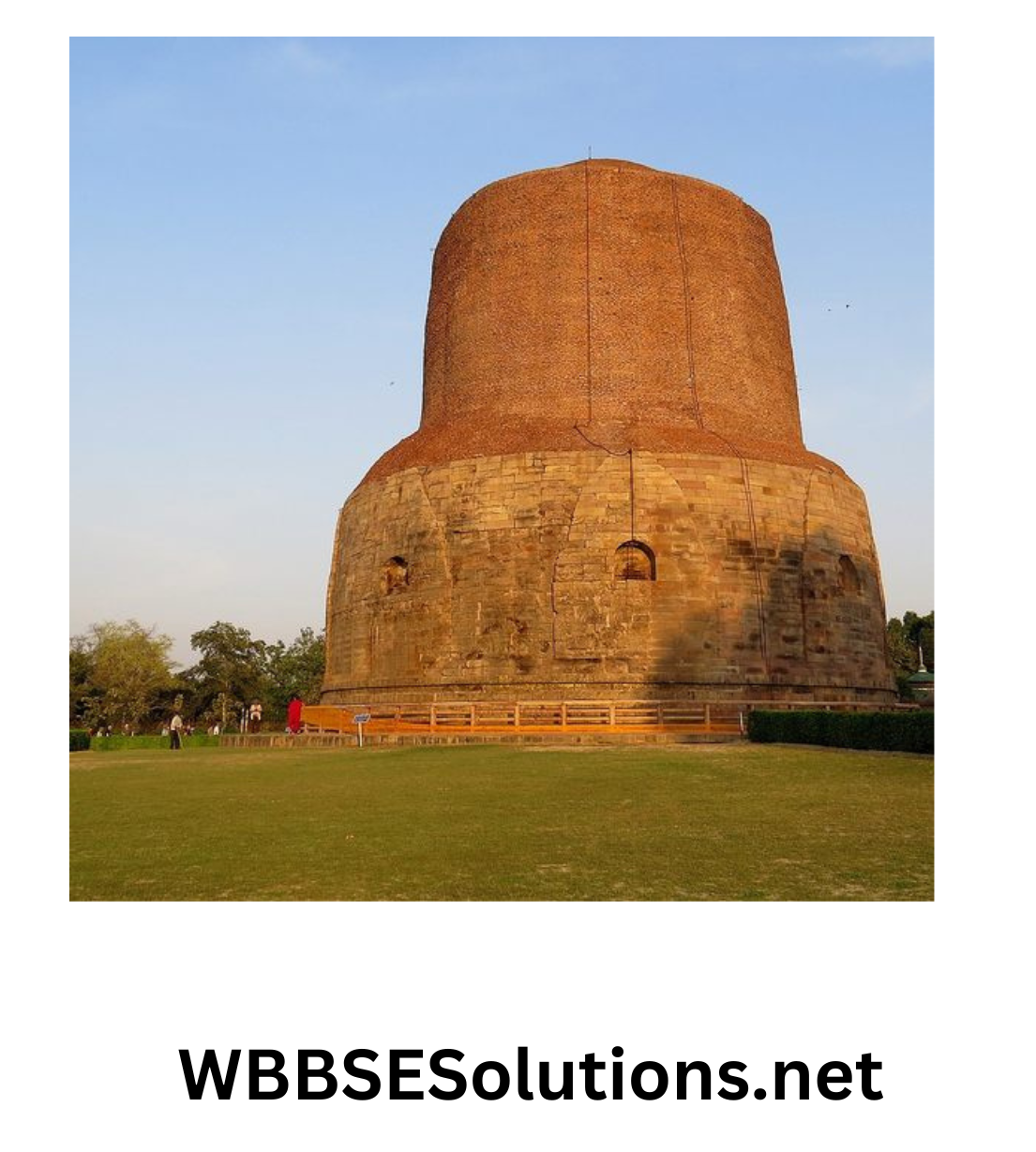
Question 11. The Sarnath stupa was built by Ashoka.
Answer: True
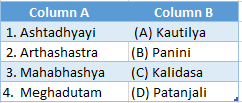
Question 12. Scenes of royal court were seen in the sculptures of the Kushana period.
Answer: False

Question 13. Gandhara sculpture is mainly influenced by Greek and Roman art.
Answer: True
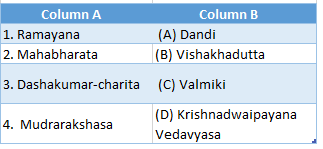
Question 14. White sandstone was used in the Mathura school of sculpture.
Answer: False

Question 15. The railings and four gateways on four sides of the stupa were known as ‘torona’.
Answer: True
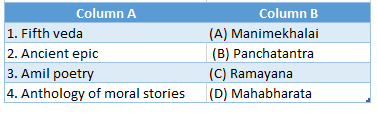
Question 16. The Dashavatara temple of Chandraketugarh is an example of a stone temple.
Answer: False

WBBSE Solutions For Class 6 History Chapter 9 India And The Contemporary World Topic A Medium Of The Political Contact

WBBSE Solutions For Class 6 History Chapter 9 Topic A Medium Of The Political Contact Long Answer Type Questions

Question 1. Give an account of the ancient Chinese civilisation.
Answer:

The ancient Chinese civilisation:

The ancient Chinese civilisation of East Asia flourished on the banks of river Hwang-Ho and river Yang-Si-Kiang.

Features:

  1. The paper was first produced in China.
  2. For the first time, it was in China that the process of making wooden blocks for printing began.
  3. The rulers of China constructed huge walls around the Chinese empire to protect it from foreign invasions. These huge walls together constitute what is
  4. known as the Great Wall of China.
  5. In China, gun powder was used.

Question 2. Give an account of ancient Greek civilization.
Answer:

Ancient Greek civilization:

Ancient Greece was a civilization that dominated much of the Mediterranean sea.

Features:

  1. In Greece, a number of small states known as city-states emerged. These city-states were known as Poleis.
  2. Two famous poleis were Athens and Sparta. They had engaged in a war with the Persian empire.
  3. In ancient Greek civilisation there was the cultivation of science, mathematics, history, and other forms of knowledge.
  4. The Greeks were influenced by Persian and other civilisations.

Read and Learn More WBBSE Solutions For Class 6 History

Question 3. What is the importance of mountain passes as a means of communication between India and the outside world?
Answer:

The importance of mountain passes as a means of communication between India and the outside world:

Mountain passes served as a means of communication between India and the outside world.

  1. Communication took place between the Indian subcontinent and West and Central Asia through the mountain passes.
  2. The mountain passes of the Himalayan range help to communicate with China and Tibet.
  3. The foreigners entered the Indian subcontinent through the mountain passes of the northwest and established their control over the Indian subcontinent.
  4. Through these routes, trade and commerce flourished.
  5. Through these mountain passes cultural contact was established.

Question 4. Discuss about the links between the Indian subcontinent and Persia.
Answer:

The links between the Indian subcontinent and Persia:

A link was established between the Indians. subcontinent and Persia through Gandhara which was located to the northwest of India.

1. In the second half of the 6th century BC Darius I, the ruler of Persia’s Achaemenid dynasty attacked Gandhara. Gandhara and many other places of the Indian subcontinent came under his control. Most probably the lower Indus region was under his control

From the writings of Herodotus, we come to know that India was a province of the Persian empire. North-west India and the north-western part of the subcontinent had links with the Persian empire.

2. During the reign of Darius III (336-330 BC) Persia lost control over Gandhara and the lower Indus region. As a result Persian rule remain confined to a very small part of the subcontinent.

WBBSE Solutions For Class 6 Geography WBBSE Solutions For Class 6 History WBBSE Solutions For Class 6 Maths
WBBSE Class 6 Geography Notes WBBSE Class 6 History Notes
WBBSE Class 6 Geography Multiple Choice Questions WBBSE Class 6 History MCQs WBBSE Notes For Class 6 School Science


Short Questions on Political Contact Mediums

Question 5. Give an account of the contact between the Indian Subcontinent and Greece.
Answer:

The contact between the Indian Subcontinent and Greece:

The Indian subcontinent and Greece had developed a very close contact in the ancient period.

1. Alexander’s invasion of India:

Close contact developed between the Indian subcontinent and Greece as a result of the invasion by Alexander, the ruler of Greece in the subcontinent.

2. Termination of the Persian rule:

As a result of Alexander’s invasion of the subcontinent, the Persian rule over the region came to an end.

3. Development of Gandhara art:

During this period, the Gandhara style of art developed as a combination of Greek and Persian elements and styles.

4. Establishment of Greek colonies:

While leaving India, Alexander established some small Greek colonies in the northwestern part of the subcontinent. These colonies existed till the time of Ashoka.

Question 6. How was contact established between the Indian subcontinent and Central Asia?
Answer:

Contact established between the Indian subcontinent and Central Asia:

India established close contact with Central Asia in the ancient period.

1. Bactria:

The Greeks ruled over the northwest frontier of India from Taxila of Gandhara to Bactria.

2. Sakas:

The Scythians or the Sakas, a nomadic tribe of Central Asia, put an end to the Greek rule in Bactria. They occupied Kashmir, Sind, the western coastal regions, and Taxila.

Common Questions About Democracy in India

3. Kushanas:

The Kushanas came from the central Asian grassland and reached Bactria in the west.

4. Pahlavas:

The Parthians or the Pahlavas captured the areas from the north-western region to parts of Punjab and the entire Indus valley.

5. Spread of Christianity:

During the reign of the Pahlava ruler Gondophernes, St. Thomas visited the Indian subcontinent to bespread Christianity.

6 Exchange of envoys:

Megasthenes and Diamachus, the ambassadors of Seleucus, came to the court of Chandragupta Maurya. Dionysius, the ambassador of the Egyptian king Ptolemy came to the Mauryan court.

There was communication between the Mauryan king Bindusara and the Syrian king Antiochus I.

Practice Questions on Media Influence in Politics

WBBSE Solutions For Class 6 History Chapter 9 India And The Contemporary World Topic A Medium Of The Political Contact

Question 7. Name three civilisations of the ancient world and name the rivers on whose banks these civilisations flourished.
Answer:

Three civilisations of the ancient world and name the rivers on whose banks these civilisations flourished:

Three civilisations of the ancient world are the Mesopotamian civilisation, Egyptian civilisation, and the Chinese civilisation. The Mesopotamian civilisation flourished along the river Tigris and the river Euphrates.

The Egyptian civilisation flourished along the banks of the river Nile. The Chinese civilisation flourished on the bank of river Hwang-Ho and river Yang-Si- Kiang.

Question 8. Where did the Sumerian civilisation flourish? What are the main characteristics of Sumerian civilisation?
Answer:

Sumerian civilisation flourish:

The Sumerian civilisation flourished in one part of Mesopotamia, the region between the river Tigris and the river Euphrates.

The main characteristics of Sumerian civilisation were

  1. The people of Sumer used to practice different kinds of sciences, mathematics and astronomy.
  2. The script of Sumer is known as Cuneiform.
  3. Wooden tools were first used by the people of Sumer.

Question 9. Mention two important features of the Egyptian civilisation.
Answer:

Two important features of the Egyptian civilisation:

Two important features of the Egyptian civilisation were the pyramids and the beginning of writing on papyrus reeds. The pyramids were huge tombs to preserve the mummies of the kings.

The Egyptians wrote on the bark of papyrus using Hieroglyphic script. The word ‘paper’ comes from the word papyrus.


WBBSE Solutions For Class 6 History Chapter 9 India And The Contemporary World Topic A Medium Of The Political Contact Ancient Egyptain civilisation

Question 10. Give an account of the Roman civilisation.
Answer:

Roman civilisation:

The Roman civilisation developed on the Italian coast of the Mediterranean sea.

  1. The Roman empire gradually developed into a huge empire.
  2. In Rome politics, art and culture developed remarkably.
  3. Greek and other civilisations influenced Rome.

Question 11. How did the Persians influence India?
Answer:

The Persians influence India:

According to the Greek historian the Persian empire under the Achaemenid Herodotus, India was a ‘satrapi’ or province of the dynasty. The influence of the Persians could be felt in the Indian culture and politics for a long time.

The Shakas and Kushanas also appointed satraps or provincial rulers like the Achaemenids. The Persian rulers conveyed their orders and instructions through edicts and this system was followed by Ashoka.

Examples of Political Movements in India

Question 12. How was communication established between the Indian subcontinent and the foreign powers? How was the relationship established between the Indian subcontinent and Greece?
Answer:

Communication was established between the Indian subcontinent and the foreign powers through mountain passes and sea routes.

Alexander defeated the Persians and reached the Indian subcontinent. Many rulers of the Indian subcontinent had provided assistance to the Greek army. It may be mentioned that Ambhi, the king of Taxila, had provided assistance to Alexander.

Besides this, in the Kushana period, Gandhara art flourished which was a combination of Greek and Roman art.

Question 13. What do you know about Bactria?
Answer:

Bactria:

Bactria was located in the northwest frontier of the Indian subcontinent and to the northwest of the Hindukush mountain or it may be said that it was located in the northeast of modern Afghanistan.

Many Greek kings were residents of Bactria. The Bactrian king have been called as Yavanas in the Puranas. The Bactrian kings dominated over the north-western frontier region and Taxila of Gandhara region.

Towards the end of the 4th century BC, the Greek ruler Seleucus dominated Bactria.

Question 14. Who was Menander?
Answer:

Menander:

Menander was the most famous of the Indo-Greek kings of 4th century BC. He is known as Milinda in Buddhist literature.

1. Areas under rule:

Ancient Gandhara and Kandahar regions were under his control. Some parts of Bactria and the north-western frontier region were also ruled by him.

2. Adoption of Buddhism:

Menander adopted Buddhism under the influence of Nagasena, the Buddhist monk.

3. Capital:

The capital of Menandar was Sakal (Sialkot in modern-day Pakistan).

Conceptual Questions on Influence of Social Media in Politics

Question 15. Who was Gondophernes?
Answer:

Gondophernes:

Gondophernes was a Pahlava or Parthian ruler who had captured a part of ancient Gandhara by defeating the Sakas. He also ruled over some parts of Punjab as well as the entire Indus valley.

He took the title of Rajatiraj and this was engraved on his coins. St. Thomas visited the subcontinent to spread Christianity during Gondophernes’ reign.


WBBSE Solutions For Class 6 History Chapter 9 India And The Contemporary World Topic A Medium Of The Political Contact Coins of Gondophernes

Question 16. What do you know about the exchange of envoys of the Indian subcontinent with the outside world during the Mauryan period?
Answer:

It was from the time of the Mauryan period that the exchange of envoys started between the Indian subcontinent and the outside world.

  1. Megasthenes, the envoy of the Greek ruler Seleucus, came to the court of Chandragupta Maurya.
  2. Damascus, the envoy of Seleucus, visited the Mauryan court at the same time.
  3. Dionysius, the ambassador of the Egyptian king Ptolemy also visited the Mauryan court.

Question 17. Who were the Hunas? What was the impact of their invasion of India?
Answer:

Hunas:

The Hunas were a barbaric race who came from Central Asia and attacked India in 458 AD. They were successfully thwarted by the Gupta ruler Skandagupta.

They reappeared at the end of the 5th century and the beginning of the 6th century under the leadership of Tormana and Mihirkula. As a result of the Huna invasion the overland trade between north-western India and Central Asia suffered a setback.

Real-Life Scenarios Involving Youth Participation in Politics

Question 18. In what ways contact was established between the Indian subcontinent and other countries?
Answer:

The ways in which contact was established between the Indian subcontinent and other countries were as follows:

  1. The advent of foreigners.
  2. Conquest of kingdoms and exchange of ambassadors, trade and commerce, cultural contact, spread of religion and pilgrimage and education.

WBBSE Chapter 9 Topic A Medium Of Political Contact Short Answer Type Questions

Question 1. Name two civilisations of the ancient world.
Answer:

Two civilisations of the ancient world were

  1. Roman civilisation and
  2. Sumerian civilisation.

The Roman civilisation developed on the Italian coast of the Mediterranean sea.

The Sumerian civilisation flourished in one part of Mesopotamia, the region between the river Tigris and river Euphrates.

Question 2. What were the two civilisations which flourished in Mesopotamia?
Answer:

The two civilisations which flourished in Mesopotamia were Sumerian civilisation and Babylonian civilisation.

Question 3. Who was Hamurabi? Why is he famous?
Answer:

Hammurabi was the king of Babylon. He was famous because he was the first one to introduce written laws.

Question 4 What is Hieroglyphic script?
Answer:

Hieroglyphic script:

The Egyptians used the Hieroglyphic script. It consisted of both images and alphabet.

WBBSE Solutions For Class 6 History Chapter 9 Topic A Medium Of The Political Contact Egyptain Script

Question 5 What is the Great Wall of China?
Answer:

Great Wall of China:

The rulers of China constructed huge walls around the Chinese empire to protect their empire from foreign invasions. These huge frontiers together constitute what is known as the Great Wall of China.

Question 6. What do you mean by Polis? Name two famous Poleis.
Answer:

Polis:

In Greece, a number of small states had These were known as Cities, States or Polis. Two famous Poleis were Athens and Sparta.

Question 7. Who were Herodotus and Thucydides?
Answer:

  1. Herodotus was a Greek historian who wrote about the war of Athens and Sparta with the Persian empire.
  2. Thucydides was also a Greek historian who wrte about the war between Athens and Sparta.

Question 8. Who was Darius I?
Answer:

Darius I:

Darius I was the ruler of Persia. He belonged to the Achaemenid dynasty. Gandhara and many other places of the Indian subcontinent came under his control.

Question 9. What is ‘Hindush’?
Answer:

Hindush:

The term ‘Hindush’ is mentioned in one of the writings of the great Persian emperor Darius I. The term was derived from the river Indus.

Question 10. Who were called the ‘Kshatrapas’?
Answer:

Kshatrapas:

The satraps were appointed as provincial rulers by the rulers of the Achaemenid dynasty. Later on, the satrap system was continued by the Shaka and Kushana rulers. During their times the Satraps came to be known as Kshatrapas.

Question 11. During whose reign Alexander invaded Persia? What was the result?
Answer:

Alexander invaded Persia during the reign of Darius III (336-330 BC).

Alexander defeated the Persians. The defeat of the Persians led to the fall of the Achaemenid dynasty. Persia lost control over Gandhara and also over the lower Indus region.

Question 12. Towards the end of 4th century, BC Bactria was under which Greek ruler? How Bactrian kings have been referred to in the Puranas?
Answer:

Towards the end of the 4th century BC Bactria was under the Greek ruler Seleucus. The Bactrian kings have been referred to as Yavanas in the Puranas.

Question 13. Who were the Bactrian-Greeks or Indo- Greeks?
Answer:

The Greeks of the Bacteria dominated over the north-western frontier region and the Taxila of Gandhara. The Greek rulers who dominated over these regions were known as Bactrian- Greeks or Indo-Greeks.

Question 14. What is Milindapanha?
Answer:

Milindapanha:

Menander, the Indo-Greek king, adopted Buddhism under the influence of the Buddhist monk Nagasena. Menander asked Nagasena many questions and their dialogues have been recorded in a book Milindapanha or Milindaprashna.

Question 15. Who were the Pahlavas?
Answer:

Towards the beginning of the 1st century BC the Parthians who came from Iran to the Indian subcontinent took control of the Kabul region. These Parthians were known as the Pahlavas in the subcontinent.

WBBSE Chapter 9 Topic A Medium Of Political Contact Very Short Answer Type Questions

Question 1. What is the meaning of the word ‘Mesopotamia’?
Answer: The meaning of the word ‘Mesopotamia’ is the land between the two rivers.

Question 2. What are the names of the two main rivers of Mesopotamia?
Answer: The names of the two main rivers of Mesopotamia are Tigris and Euphrates.

Question 3. What is the script of Sumer known as?
Answer: The script of Sumer is known as Cuneiform.

Question 4. Where did the ancient Egyptian civilisation flourish?
Answer: The ancient Egyptian civilisation flourished on the bank of the river Nile in northeast Africa.

Question 5. Who was Herodotus?
Answer: Herodotus was a Greek historian.

Question 6. Which country is called the ‘Gift of the Nile’?
Answer: Egypt is called the ‘Gift of the Nile’.

Question 7. What were the rulers of Egypt known as?
Answer: The rulers of Egypt were known as Pharaoh.

Question 8. Why were pyramids built?
Answer: The pyramids were built to keep the dead bodies of the rulers of Egypt safe forever.

Question 9. On what did the Egyptians write?
Answer: The Egyptians used to write on the barks of the Papyrus reed.

Question 10. From which word did the English word ‘Paper’ originate?
Answer: The English word ‘Paper’ originated from the word Papyrus.

Question 11. What was imported from Egypt to India?
Answer: Lapis Lazuli, a kind of precious stone, was imported from Egypt to India.

Question 12. Where did the ancient Chinese civilisations develop?
Answer: The ancient Chinese civilisations developed on the banks of river Hwang-Ho and river Yang-Si-Kiang, in East Asia.

Question 13. In which country gunpowder was used?
Answer: Gunpowder was used in China.

Question 14. Name two Persian emperors.
Answer: Two Persian emperors were Cyrus and Darius I.

Question 15. On whose directives Jesus Christ was crucified in Jerusalem?
Answer: Jesus Christ was crucified in Jerusalem on the directives of the royal officers of Rome.

Question 16. Where was Gandhara located?
Answer: Gandhara was located to the north- west of the Indian subcontinent.

Question 17. Who were the Satraps?
Answer: Satraps were provincial rulers appointed by the Achaemenids.

Question 18. Who was Alexander?
Answer: Alexander was the ruler of Macedon who invaded India.

Question 19. Name the king of India who cooperated with Alexander.
Answer: Ambhi, the king of Taxila, cooperated with Alexander.

Question 20. Who was Seleucus?
Answer: Seleucus was the Greek ruler of Bactria.

Question 21. Who is known as Milinda in Buddhist literature?
Answer: Menander, the Indo-Greek King, was known as Milinda in Buddhist literature.

Question 22. Where was the capital of Menander?
Answer: The capital of Menander was Sakal (Sialkot in modern-day Pakistan)

Question 23. Name the Indo-Greek king who took initiative to spread Buddhism.
Answer: Menander was the Indo-Greek king who took initiative to spread Buddhism.

Question 24. What was the title engraved on the coins of Gondophernes?
Answer: ‘Rajatiraj’ was the title engraved on the coins of Gondophernes.

Question 25. Who was Antiochus I?
Answer: Antiochus I was the king of Syria.

Question 26. Name the Mauryan emperor who spread Buddhism.
Answer: The Mauryan emperor Ashoka spread Buddhism.

Question 27. Name two Huna rulers.
Answer: Two Huna rulers were Tormana and his son Mihirkula.

Question 28. During whose reign there was an exchange of envoys with China?
Answer: During the reign of emperor Harshavardhana there was an exchange of envoys with China.

Question 29. Name the Mauryan emperor who took step to spread Buddhism. Where did he send his envoys?
Answer:

The Mauryan emperor Ashoka took steps to spread Buddhism. He sent his ambassador to Syria, Srilanka, Egypt, Macedonia, etc.

Question 30. What do we come to know from an inscription in Rajagriha?
Answer:

From an inscription in Rajagriha we come to know that during the time of Harshavardhana, there was an exchange of envoys with China.

Question 31. Who was the Huna leader towards the end of the 5th century and the beginning of the 6th century AD? Who was his son?
Answer:

Tormana was the Huna leader towards the end of the 5th century and the beginning of the 6th century AD.

WBBSe Chapter 9 Topic A Medium Of Political Contact Fill In The Blanks

Question 1. The Greek historian __________ (Herodotus/ Thucydides/Sophocles) has called Egypt ‘the Gift of the Nile’.
Answer: Herodotus

Question 2. Ambhi, the king of __________ (Pataliputra/ Vaishali/Taxila) helped Alexander to invade India.
Answer: Taxila

Question 3. The Indo-Greek king Minander is known as Milind in the __________ (Jain/Buddhist/Tamil) literature.
Answer: Buddhist

Question 4. The Parthians came to India from __________ (Iraq/China/Iran).
Answer: Iran

Question 5. Megasthenes was the ambassador of the __________ (Egyptian/Roman/Greek) ruler Seleucus.
Answer: Greek

Question 6. The __________ (Saka-Kushanas/Saka-Pahlavas/ Maurya-Kushanas) started the use of bridles and saddles on horses.
Answer: Saka-Pahlavas

Question 7. Gondophernes had the title __________ (Rajadhiraja/Rajatiraj/Chakravartin).
Answer: Rajatiraj

Question 8. Nagasena was a __________ monk (Hindu/Jain/ Buddhist).
Answer: Buddhist

Question 9. The dialogue between Menander and Nagasena has been recorded in __________ (Si-Yu-Ki/ Milindapanha/Krishiparashara).
Answer: Milindapanha

Question 10. There was an exchange of envoys between India and China during the reign of __________ (Ashoka/Harshavardhana/Skandagupta).
Answer: Harshavardhana

Question 11. Mihirkula was a __________ leader (Huna/ Saka/Pahlava).
Answer: Huna

Question 12. A powerful leader of the Hunas was __________ (Tormana/Darius I/Milinda).
Answer: Tormana

Question 13. Ptolemy was the king of __________ (Egypt/Macedonia/Sri Lanka).
Answer: Egypt

Question 14. Antiochus I was the king of __________ (Egypt/Syria/Persia).
Answer: Syria

Question 15. With the aim of propagating Buddhism Ashoka sent his envoys to __________ (Gandhara/Bactria/Sri Lanka).
Answer: Sri Lanka

WBBSE Chapter 9 Topic A Medium Of Political Contact True Or False

Question 1. The use of wooden wheels was first started by the people of Sumer.
Answer: True
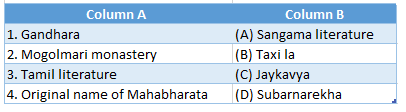
Question 2. The script of Egypt is known as Cuneiform.
Answer: False

Question 3. For the first time, China began the process of making wooden blocks for printing.
Answer: True
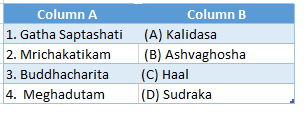
Question 4. Thucydides wrote about the war between Athens and the Persian empire.
Answer: False

Question 5. Darius, I was a Roman emperor.
Answer: False

Question 6. Greek civilization was influenced by Persian and other civilisations.
Answer: True
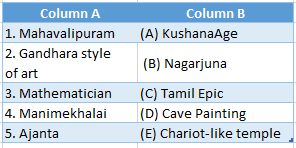
Question 7. During the Saka and Kushana rule the Persian satraps came to be known as Kshatrapas.
Answer: True

Question 8. In Rome, there was a remarkable advancement in politics, art, and sculpture.
Answer: True
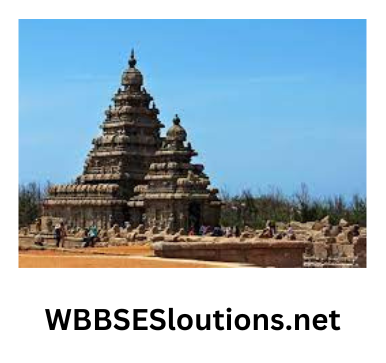
Question 9. It was on the directives of the royal officers of Athens that Jesus Christ was crucified.
Answer: False

Question 10. Most of the foreign races entered the Indian subcontinent through the sea routes of the northwestern region.
Answer: False

Question 11. In the second half of the 6th century BC, the rulers of Persia belonging to the Achaemenid dynasty attacked Gandhara.
Answer: True
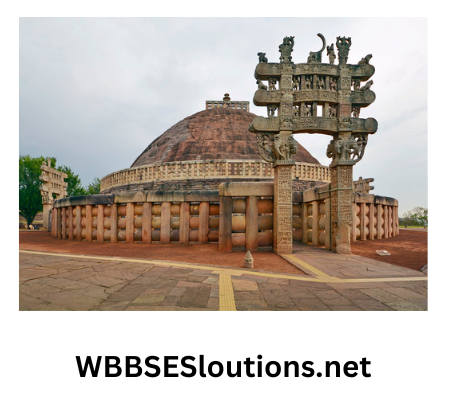
Question 12. Alexander invaded Persia during the reign of King Darius III.
Answer: True
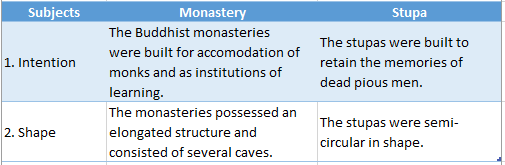
WBBSE Solutions For Class 6 History Chapter 8 Aspects Of Culture In Ancient India Topic A Education And Literature In The Ancient Indian Subcontinent

WBBSE Chapter 8 Aspects Of Culture In Ancient India Topic A Education And Literature In The Ancient Indian Subcontinent Long Answer Type Questions

Question 1. What was the system of education in the Buddhist monasteries?
Answer:

The system of education in the Buddhist monasteries:

Buddhist monasteries were centers of education. A new form of education was imparted in the Buddhist Viharas monasteries.

  1. Accommodation: The students used to reside in the monasteries. They were provided with separate rooms to live there.
  2. Admission: Admission of students were on the basis of merit.
  3. Fees: Students had to pay fees for their education. However, scholarships were granted to the poor students.
  4. Subjects taught: Religion was the most important subject of study. Besides religious studies, many other subjects were taught. Students were taught how to shoot arrows, how to use swords, and how to wrestle. Different kinds of games were also taught. The Buddhist ‘bhikshu’ or the mendicants and the Shramans had to learn how to spin thread and how to weave cloth.

Question 2. What was the importance of Taxila as a center of education in ancient India?
Answer:

The importance of Taxila as a center of education in ancient India:

During the period of sixteen Mahajanapadas, Taxila was the capital of Gandhara Mahajanapada.

1. Reasons for becoming famous:

Different foreign powers like the Greeks, Kushanas, and Sakas occupied Taxila at different times. As a result people and scholars from different countries used to come to Taxila. In course of time, Taxila became a famous center of education.

2. Admission:

Students between sixteen and twenty years could take admission in Taxila Mahavihara. Students were selected on the basis of merit. Religion or caste was not considered.

Students from different parts of the country could take admission for higher studies.

Read and Learn More WBBSE Solutions For Class 6 History

3. Period of study:

Students could study in the Vihara for eight years.

4. Examination:

The procedure of examination was simple. There was no written examination. The standard of education was high.

5. Patrons:

Kings and merchants were the patrons of the Mahavihara. They donated land and money to keep the Mahavihara functional.

Short Questions on Vedic Education

6. Famous students:

Famous students of the Taxila Mahavihara were Jivaka, Panini, and Chanakya.

WBBSE Solutions For Class 6 Geography WBBSE Solutions For Class 6 History WBBSE Solutions For Class 6 Maths
WBBSE Class 6 Geography Notes WBBSE Class 6 History Notes
WBBSE Class 6 Geography Multiple Choice Questions WBBSE Class 6 History MCQs WBBSE Notes For Class 6 School Science


Question 3. Give an account of Nalanda Mahavihara.
Answer:

Nalanda Mahavihara:

Nalanda Mahavihara was a famous educational institution of ancient India.

  1. Admission: To gain admission in the Nalanda Mahavihara students had to pass very rigorous tests. Students of any religion or caste could take admitted.
  2. Boarding and lodging: Boarding and lodging was free for the students. Tuition fees were not charged.
  3. Examination system: After completion of the education in the Mahavihara students had to sit for examinations.Ruins of Nalanda Mahavihara
  4. Patrons: The kings were patrons of the Mahavihara. They used to donate land and money to the institution.
  5. Fame: Many well-reputed scholars used to teach there. Students from various parts of India and also from China, Tibet, Korea, Sumatra, and Java used to come to study at Nalanda.

WBBSE Solutions For Class 6 History Chapter 8 Aspects Of Culture In Ancient India Topic A Education And Literature In The Ancient Indian Subcontinent nalanda Mahavihara

Question 4. Give an account of the education system in ancient India.
Answer:

The education system in ancient India:

In ancient India education system gradually developed and changed.

1. Harappan age:

Harappan civilization had a script. But nothing is known about Harappan literature. Harappan script is not yet deciphered.

2. Education system in the Vedic age:

The Vedic system of education was based on the relationship between the disciple and the Guru. The student stayed in the Guru’s house and received an education. This was known as the Gurukul system.

Common Questions About Gurukuls and Tols

3. Buddhist monasteries as centers of education:

Religion was the most important subject of study in the Buddhist monasteries. Besides religious studies, students were taught how to shoot arrows, how to use swords, how to wrestle, and play different kinds of games.

4. Education around the 4th century BC:

Around 4th century BC along with the Vedas students were also taught prosody, poetry, grammar, chemistry, mathematics,
astronomy, astrology, etc.

5. Education system during the Gupta period:

During the Gupta age students stayed in the Guru’s house and received an education. They also attended schools and were taught scripts, languages, Vedic literature poetry, grammar, astrology, drama, law, politics, and art of warfare.

WBBSE Solutions For Class 6 History Chapter 8 Aspects Of Culture In Ancient India Topic A Education And Literature In The Ancient Indian Subcontinent

Question 5. Discuss the development of literature in ancient India.
Answer:

The development of literature in ancient India:

Literature was highly developed in ancient India.

1. Smritishastras:

Smritishastras were treatises in which various aspects of the right to property and employment and issues of daily life were discussed.

2. Dharmashastras:

Dharmashastras contain explanations about the ancient caste system in Sanskrit.

3. Natyashastra:

The main recreation of the people of the upper classes were drama and acting. So they started writing on drama and acting, for example, Natyashastra by Bharata.

History Class 6 Chapter 7 Question Answer WBBSE

4. Literature in regional languages:

Various kinds of literature were written between 200 BC and AD 300 in different regional languages. For example Patanjali’s Mahabhashya, King Haal’s Gatha Saptashati, etc. Sangam literature in Tamil also deserves mention here.

5. Mahakavya:

Two epics, the ‘Ramayana’ and the ‘Mahabharata’ were composed in ancient times.

6. Medical text:

Medical books on medicines and surgery were written during this time. Two important medical text of ancient India were ‘Charaka-samhita’ and ‘Shushuruta- samhita’.

Question 6. Why is Kalidasa famous?
Answer:

Kalidasa:

Kalidasa was a famous literary icon of ancient India.

1. Period:

There is a controversy regarding the period to which he belonged. It is generally believed that he belonged to the Gupta ege.

2. His works:

He was a famous poet and dramatist. From his writings, we come to know about contemporary society and different aspects of nature.

3. As a dramatist:

He was the composer of the dramas-Abhijnanshakuntalam’ and ‘Malavikagnimitram’.

4. As a poet:

He composed two famous poems ‘Meghadutam’ and ‘Kumarsam- bhavan.

Question 7. How was education connected to livelihood in the ancient age?
Answer:

Education connected to livelihood in the ancient age:

In the ancient age there was a connection between livelihood and education. The Brahmins studied prosody, poetry, grammar, astronomy, astrology, mathematics, and chemistry.

The Kshatriyas studied subjects of day-to-day affairs like art of warfare and hunting, currency, and examination of documents. The Vaishyas and Shudras studied trade and commerce, agriculture, and animal husbandry.

Question 8. What do you mean by Mahavihara?
Answer:

Mahavihara:

Some Buddhist monasteries where students from within India and outside the country used to come to study were known as Mahavihara.

These Mahaviharas were patronized by the kings by donating land and money. Some famous Mahaviharas were Nalanda, Taxila, Vikramashila, and Balavi.

Question 9. How did the Sanskrit language emerge?
Answer:

The Sanskrit language emerge:

In the Vedic Age people spoke in the language of Rigveda, i.e., Chhandosh. Gradually it got intermingled with local dialects and new regional languages emerged.

So it was necessary to regulate the basic language through some rules or grammar. Panini then composed a grammar book named ‘Ashtadhyayi’.

This helped to reform the language. So the language that developed after such reforms or ‘Sanskar’ came to be known as Sanskrit.

Question 10. What do you mean by ‘Pancham Veda’ and ‘Upaveda’?
Answer:

‘Pancham Veda’ and ‘Upaveda’:

‘It was believed that reading of Mahabharata will yield the same spiritual benefits as the reading of the Vedas. So the Mahabharata has been referred to as the ‘Pancham Veda’ or the Fifth Veda.

Medical science made much advancement between 200 BC and 300 AD and it came to be regarded as ‘Upaveda’.

Question 11. What were the subjects taught in the Buddhist monasteries?
Answer:

The subjects taught in the Buddhist monasteries:

Religion was the most important subject of study in the Buddhist monasteries. Besides religious studies, many other subjects were taught. Students were taught how to shoot arrows, and gained respect in contemporary society use swords and wrestling.

Different kinds of games were also taught. The Buddhist ‘bhikshu’ or the mendicants and the Shramans had to learn how to spin thread and weave cloth.

Question 12. Write a short note on Ramayana.
Answer:

Ramayana:

Ramayana is one of the two great epics of India. It was composed by Valmiki between 3rd and 2nd century BC. The main story of Ramayana centers round the war between Rama and Ravana.

The key characters are Rama, Sita, and Ravana. There are twenty-four thousand couplets (Shlokas) in Ramayana. The entire epic is divided into seven kandas or sections.

Examples of Educational Institutions in Ancient India

Question 13. What are the ‘Puranas’? When were the Puranas composed?
Answer:

‘Puranas’:

The ‘Puranas’ form an important part of ancient Indian literature. It is the story that tells what happened in ancient times. The Puranas are eighteen in number.

Some of the Puranas were composed before 5th or 4th century BC. The others were written between 2nd century and 7th century AD.

Question 14. What do we come to know from the Puranas?
Answer:

From the Puranas we come to know of the following:

  1. The Puranas contain an element of history. An important theme of the Puranas is the history of royal dynasties.
  2. We also come to know from the Puranas about agriculture, commerce, animal husbandry, and geography. Astrology also form an important part of the discussion.

Question 15. Write a short note on Mahabharata.
Answer:

Mahabharata:

Mahabharata is one of the two great epics of India. It was composed by Krishna dwaipayana Vyasa in Sanskrit. The main story is based on the conflict between the Kauravas and the Pandavas over the occupation of land.

It contained 8,800 shlokas in the beginning. It was compiled between the 4th century BC and the 4th century AD.

Question 16. What do you mean by ‘Sangama’? What is Sangama literature?
Answer:

‘Sangama’:

Meaning of Sangama: Between 200 BC and 300 AD three literary conferences were held in the city of Madurai. These conferences of Tamil scholars are known as ‘Sangama’.

Sangama Literature: The literature composed by the Tamil scholars in these conferences are known as Sangama literature. The poems composed here depict the rural and urban life of that time. These poems also reflect the lives of the cultivators and the common people.

Question 17. What is the theme of ‘Mrichhakatikam’?
Answer:

The theme of ‘Mrichhakatikam’:

‘Mrichhakatikam’ is a popular drama of ancient Sanskrit literature. Mrichhakatikam means small clay cart. Rohasena, the son of Charudutta, saw a gold toy cart of a neighbor’s son and demanded one.

To distract him, He was given a clay cart but he kept crying. Vasantasena, another character of the play felt sad on seeing him cry and gave away her gold jewelry to make a golden toy cart. All the characters are commoners and the play reflects their joy and sorrow.

Question 18. Write about two famous works of Vishakhadutta.
Answer:

Two famous works of Vishakhadutta:

The two famous works of Vishakhadutta are ‘Mudrarakshasa’ and ‘Devichandraguptam’. Mudrarakshasa mainly narrates the saga of Chandragupta Maurya’s ascent to the throne of Magadha by defeating the Nanda king Dhanananda.

The theme of Devichandraguptam is the battle between Ramagupta and Chandragupta II with the Shaka king.

WBBSE Chapter 8 Topic A Education And Literature Education And Literature In The Ancient Indian Subcontinent Short Answer Type Questions

Question 1. What do you mean by the Gurukul system of education?
Answer:

The Gurukul system of education:

Vedic system of education was based on the relationship between the disciple and the Guru. The student stayed in the Guru’s house and received an education. This was known as Gurukul System of education.

Question 2. How was a child initiated into education in the post-Gupta period?
Answer:

In the post-Gupta period a new ritual called ‘Vidyarambha’ was introduced to initiate a child into education. He was introduced to the alphabet through this ceremony at the age of five and was taught textbooks and mathematics.

Question 3. Who was called the ‘Upadhyaya’ in the Vedic system of education?
Answer:

In ancient India, the teachers associated with Vedic education were called ‘Upadhyays’. They resided in the Buddhist monasteries and used to teach specific subjects there. They charged fees for teaching. The women teachers were called ‘Upadhyaya’.

Question 4. Who was called the ‘Acharya’ in the Vedic system of education?
Answer:

The ‘Acharya’ in the Vedic system of education:

In ancient India, the teachers associated with Vedic education were known as ‘Acharya’. The students stayed in his house and received free education. They also helped him in domestic work. Sometimes, women could also become teachers and were called ‘Acharya’.

Question 5. Give an account of the Mogolmari Buddhist vihara.
Answer:

Mogolmari Buddhist vihara:

We come to know about some ancient Buddhist monasteries in Bengal from the writings of Faxian and Xuanzang. The Mogolmari Buddhist monastery was situated at Daton in West Midnapore of West Bengal.

Archaeologist Dr. Ashok Datta discovered this spot. It is assumed that it is a contemporary of Nalanda Mahavihara and was probably built along the river Subarnarekha. It lay on the land route between Magadha and Tamralipta port.

Question 6. What are Dharmashastras and Smritishastras?
Answer:

Dharmashastras and Smritishastras:

The Dharmashastras were treatises written in Sanskrit which explained the jati- the Brahmins in the social hierarchy. They also varna system and recognized the superiority of discussed Smritishastras discussed different issues of daily centra in political issues. The life and property rights.

Question 7. The Mahabharata is not the literary creation of a single author-Explain.
Answer:

The Mahabharata is not the literary creation of a single author:

The Mahabharata was compiled between 4th century BC and 4th century AD. Jaykavya was the original name of the Mahabharata. Some slokas were added to the epic by Baishampayan and Mahabharata was renamed as Bharata.

Later some more slokas were added to it by Souti and it was renamed as Mahabharata. Therefore it is said that Mahabharata is not the literary creation of a single author.

History Class 6 Chapter 7 WBBSE

Question 8. What was the original name of Mahabharata? Who renamed it as Mahabharata?
Answer:

The original name of Mahabharata was ‘Jaykavya’. Some slokas were added to it and was renamed as Bharata. Later Souti added more slokas and renamed it as Mahabharata.

Question 9. Why is Devanagari script named so?
Answer:

Devanagari script named so:

The two major scripts used in ancient India were Brahmi and Kharoshthi. The Devanagari script evolved from the Brahmi script which was written from left to right.

The Brahmins of the cities (nagara) used the script for religious purposes. So this came to be known as Devanagari.

Question 10. What were the subjects to be studied in the schools built by different kings in the Gupta Age?
Answer:

The subjects to be studied in the schools built by different kings in the Gupta age were scripts, Vedic literature, and languages. Astrology, grammar, poetry, drama, law, vocational education, politics, and art of warfare were also taught.

Question 11. What were some of the Buddhist viharas called? How did the Gupta rulers help the educational institutions?
Answer:

Some of the Buddhist viharas were called Mahaviharas. The Gupta rulers helped the educational institutions by donating land and money.

Question 12. Name two medical texts of ancient India.
Answer:

Two medical texts of ancient India:

Two medical texts of ancient India are ‘Charaka-samhita’ and ‘Shushruta-samhita’.

Question 13. Who was Ashvaghosha?
Answer:

Ashvaghosha:

Ashvaghosha was a Buddhist monk and popular author of the Kanishka period. His famous work ‘Budhhacharita Kavya’ contains the life and teachings of Gautama Buddha.

Question 14. Who was Vasa?
Answer:

Vasa:

Vasa was a dramatist of the 2nd or 3rd century AD. The theme of his dramas were mainly derived from the epics-the Ramayana and the Mahabharata.

Question 15. Name the city where three literary conferences were held. What were these conferences known as?
Answer:

Three literary conferences were held in the city of Madurai. These conferences are known as Sangama.

WBBSE Chapter 8 Topic A Education And Literature Education And Literature In The Ancient Indian Subcontinent Very Short Answer Type Questions

Question 1. Name the cities where educational centers were located.
Answer: The cities where educational centers were located are Pataliputra, Kanauj, Ujjayini, Mithila, Tanjore, Kalyan, etc.

Question 2. Name two famous Mahaviharas.
Answer: Two famous Mahaviharas were Nalanda and Taxila.

Question 3. From which countries students used to come to study at Nalanda?
Answer: Students from China, Tibet, Korea, Sumatra, and Java used to come to Nalanda at study.

Question 4. What was the capital of Gandhara Mahajanapada?
Answer: Taxila was the capital of Gandhara Mahajanapada.

Question 5. Name the famous students of Taxila Mahavihara.
Answer: The famous students of Taxila Mahavihara were Jivaka, Panini and Chanakya.

Question 6. What were the two kinds of teachers attached with Vedic education system?
Answer: The two kinds of teachers attached with Vedic education system were Acharya and Upadhyay.

Question 7. What vow did the Buddhist students have to take?
Answer: The Buddhist students had to take a vow of obeying the rules of Buddha, Dhamma, and the Sangha.

Question 8. What was the ceremony of Vidyarambha?
Answer: In the post-Gupta period a ceremony that initiated a child into education was known as Vidyarambha.

Question 9. Who composed Ashtadhyayi?
Answer: Panini composed Ashtadhyayi.

Question 10. What were the spoken languages of the common people?
Answer: The spoken languages of the common people were Pali and Prakrit.

Question 11. In which languages Jain and Buddhist literature was written?
Answer: Jain and Buddhist literature were written in Prakrit and Pali languages respectively.

Question 12. In which language Dharmashastras were written?
Answer: Dharmashastras were written in Sanskrit.

Question 13. Who was the author of Arthashastra?
Answer: Kautilya was the author of Arthashastra.

Question 14. Who are the key characters in the Ramayana?
Answer: The key characters in the Ramayana are Rama, Sita, and Ravana.

Question 15. What is the principal theme of the Mahabharata?
Answer: The principal theme of the Mahabharata is the war between the Kaurava and the Pandavas.

Question 16. What is ‘Gatha Saptashati’?
Answer: ‘Gatha Saptashati’ is a compilation of poems in the Prakrit language written by the Satavahana King Haal.

Question 17. What is the meaning of Sangama?
Answer: Sangama means assemblage at one place.

class 6 WBBSE History Question Answer

Question 18. Who was Bharavi?
Answer: Bharavi was a famous literary personality of the Gupta period.

Question 19. Name one famous drama of ancient Sanskrit literature.
Answer: ‘Mrichhakatikam’ written by Shudraka is a famous drama of ancient Sanskrit literature.

Question 20. Who composed the play Devichandra- guptam?
Answer: Vishakhadutta composed the play Devichandraguptam.

Question 21. Who composed the Sanskrit prose Dashakumar Charita?
Answer: Dandi composed the Sanskrit prose Dashakumar Charita.

Question 22. Name the Tamil poet who added many new episodes to Ramayana.
Answer: Kambana, the Tamil poet added many new episodes to Ramayana.

Question 23. When was Panchatantra compiled?
Answer: Panchatantra was compiled probably around 1st or 2nd century AD.

Question 24. Name one Tamil epic.
Answer: One Tamil epic is Manimekhalai.

Question 25. What is Amarkosha?
Answer: Amarkosha compiled by Amarsingha is a famous dictionary of the Gupta period.

Question 26. Who composed the play Nagananda?
Answer: King Harshavardhana composed the play Nagananda.

Question 27. Who was the composer of Meghadutam?
Answer: Kalidasa was the composer of Meghadutam.

Question 28. What is Maiavikagnimitram?
Answer: Malavikagnimitram was a famous play composed by Kalidasa.

WBBSE Chapter 8 Topic A Education And Literature Education And Literature In The Ancient Indian Subcontinent Fill In The Blanks

Question 1. Mahavihara of ______________ (Java / Mehrauli /Nalanda) was very famous.
Answer: Nalanda

Question 2.  ______________ (Tanjore Kalyan / Taxila) was the capital of Gandhara Mahajanapada.
Answer: Taxila

Question 3. A famous student of Taxila Mahavihara was ______________ (Chanakya / Souti / Charaka).
Answer: Chanakya

Question 4. ‘Natyashastra’ was written by ______________ (Panini /Bharata/Jivaka).
Answer: Bharata

Question 5. Kharoshti and ______________ (Brahmi / Prakrit / Devanagari) were the two major scripts of ancient India.
Answer: Brahmi

Question 6. Two epics of Tamil literature were Manimekhalai and ______________ (Priyadarshika / Devichandraguptam/Shilappadikaram).
Answer: Shilappadikaram

Question 7. The best example of Buddhist fables that imparted moral education was the ______________ (Jataka/Panchatantra / Amarkosha).
Answer: Jataka

Question 8. Bhartrihari was a well-known ______________ (dramatist/musician/grammarian).
Answer: Grammarian

Question 9. Ratnavali was composed by ______________ (Chandragupta Maurya / Harshavardhana / Ramagupta).
Answer: Harshavardhana

Question 10. Amarkosha, compiled by Amarsingha is a famous ______________ (drama/poem/dictionary).
Answer: Dictionary

WBBSE Chapter 8 Topic A Education And Literature Education And Literature In The Ancient Indian Subcontinent True Or False

Question 1. The Harappan script has not yet been deciphered.
Answer: True
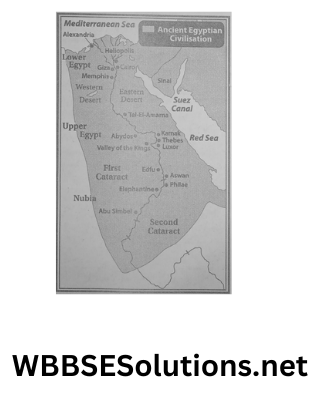
Question 2. Certain Buddhist monasteries were known as Chaityas.
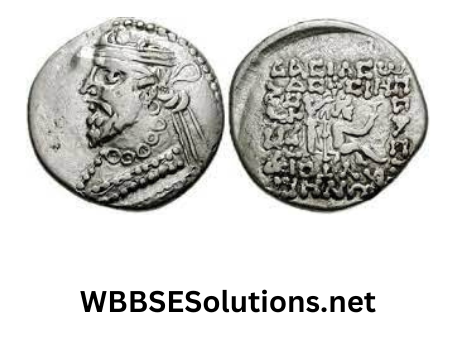
Answer: False

Question 3. At Nalanda Mahavihara, students belonging to any religion or caste could study.
Answer: True

Question 4. Buddhism became a popular religion in Taxila.
Answer: True

Question 5. In Taxila Mahavihara students were selected on the basis of religion and caste.
Answer: False

Question 6. In the post-Gupta period, one was introduced to the world of alphabet at the age of six.
Answer: False

Question 7. The language of Rigveda was Chhandosh.
Answer: True

Question 8. Jivaka composed Ashtadhyayi.
Answer: False

Question 9. The word Prakrit has come from Chhandosh.
Answer: False

class 6 WBBSE History Question Answer

Question 10. There are four thousand couplets in the Ramayana.
Answer: False

Question 11. The epic of the Mahabharata is actually a narrative of the Bharat clan.
Answer: True

Question 12. Krishnadwaipayan Vyasa composed the epic poem Ramayana.
Answer: False

Question 13. The original name of the Mahabharata was Jaykavya.
Answer: True

Question 14. The entire Mahabharata is divided into sixteen swarga or sections.
Answer: False

Question 15. Mahabhashya, a book on Sanskrit grammar, was written by Panini.
Answer: False

Question 16. Tamil literature is known as Sangama literature.
Answer: True

Question 17. Poet and dramatist Kalidasa belonged to the Maurya period.
Answer: False

Question 18. Mrichhakatikam is a famous drama of ancient Sanskrit literature.
Answer: True

Question 19. Vishakhadutta composed Mudrarakshasa.
Answer: True

Question 20. Chandragupta II captured the Mauryan throne by defeating the Nanda king Dhanananda.
Answer: True

Question 21. Harshavardhana composed Mudrarakshasa.
Answer: False

Question 22. Panchatantra written in Sanskrit is a collection of moral lessons.
Answer: True

WBBSE Solutions For Class 6 History Chapter 7 Economy And Society Topic C Miscellaneous

WBBSE Chapter 7 Economy And Society Topic C Miscellaneous Long Answer Type Questions

Question 1. Trace the evolution of trade and commerce in India from the 6th century BC to the 6th century AD.
Answer:

The evolution of trade and commerce in India from the 6th century BC to the 6th century AD:

From the 6th century BC to the 6th century AD there were gradual changes in trade and commerce in India.

1 Age of sixteen mahajanapadas:

During this age trade and commerce was important occupation. In the beginning, trade was carried through land routes. Later on, rivers and seas were also used for trading purposes.

Read and Learn More WBBSE Solutions For Class 6 History

2 Mauryan age:

During the Mauryan age, India exported spices, muslin, pearls, etc. and imported items like fruits, wines, and silver vessels. Royal officers were appointed to supervise the work of the merchants.

3 Kushana age:

In the Kushana period, both internal and external trade expanded. In the international markets, there were a demand for Indian muslin and other textiles, pearl, diamond, lapis lazuli and spices. Chinese silk and glass items were imported.

WBBSE Class 6 Miscellaneous Questions on Economy and Society

WBBSE Solutions For Class 6 Geography WBBSE Solutions For Class 6 History WBBSE Solutions For Class 6 Maths
WBBSE Class 6 Geography Notes WBBSE Class 6 History Notes
WBBSE Class 6 Geography Multiple Choice Questions WBBSE Class 6 History MCQs WBBSE Notes For Class 6 School Science


4. Gupta and Post-Gupta period:

During the Gupta and Post-Gupta period, there was a trade relationship between India and other parts of Asia. But there was a slump in foreign trade due to the Huna invasion.

Trade with Rome was hampered. Two important parts of this time were Tamralipta and Kaveripattinam.

Question 2. What were the similarities and dissimilarities between the Mauryan and Gupta administration.
Answer:

The similarities and dissimilarities between the Mauryan and Gupta administration:

There were some similarities and dissimilarities between the Mauryan and Gupta administrations.

Similarities

  1. In the Mauryan administration, absolute power rested with the emperor. In the Gupta administration also the emperor was absolute.
  2. The Mauryan emperors used to rule with the help of the royal officials known as Amatyas. Gupta royal officials also assisted the emperor in administration. Amatya or ‘Sachiv’ was the most important official.
  3. Like the Mauryan empire, the Gupta empire was also divided into a number of provinces.
  4. In the Mauryan age, below the provincial administration, there was a district administration known as Aahar. In the Gupta administration also there were districts known as Vishaya.

Dissimilarities

  1. The Mauryan emperors did not perform any sacrifices to claim their power. But the Gupta emperors performed yajnas or sacrifices to demonstrate their might.
  2. The Mauryan rulers favoured and promoted non-Hindu religions. Here mention may be made of Ashoka’s adoption of Buddhism. But the Gupta rulers followed and promoted Hinduism. During the Gupta period, there is no such instance of the rulers promoting non-Hindu religions like Buddhism.

Question 3. Why did the irrigation system develop in ancient India? Do you notice any difference between the irrigation system of these times and that of the present?
Answer:

Reason for the development of the irrigation system:

Agriculture was the basis of the economy in ancient India. So it was necessary to build up an efficient irrigation system for greater development in the field of agriculture.

Practice Questions on Economic Activities in the Gupta Period

Comparison with modern irrigation system:

In the ancient period, arrangements were made to supply river water to the fields through irrigation. Nowadays irrigation is done by constructing artificial reservoirs, wells and tanks.

In the earlier days, well water was drawn out for irrigation with the help of a wheel-like structure. Today irrigation implements have been considerably improved with the help of mechanical and electrical technology.

WBBSE Solutions For Class 6 History Chapter 7 Economy And Society Topic C Miscellaneous

Question 4. Make a list of the different occupations of the people from the 6th century BC to the 6th century AD. Which of these occupations are prevalent in present times? What were the points of similarity and dissimilarity between the occupations of Vedic age and this particular period?

History Class 6 Chapter 7 Question Answer WBBSE

Answer: Various professionals from the 6th century BC to the 6th century AD.

  1. Philosopher
  2. Farmer
  3. Cattle breeder and hunter
  4. Artisan and trader
  5. Soldier
  6. Spy
  7. Blacksmith
  8. Jeweller
  9. Goldsmith
  10. Tanner
  11. Potter
  12. Bamboo craftsman
  13. Florist and gardener
  14. Perfume maker
  15. Dyer

Vedic professions which are still prevalent:

The different professions existing since 6th century BC till 6th century AD such as soldier and spy have become permanent jobs today. Cattle rearing is no more an important occupation. Hunting has been legally prohibited.

Some professions have been modified today. Those of blacksmiths, tanner, and potters are no more personal occupations but have become a collective profession.

Similarities and dissimilarities between Vedic professions and modern professions:

In spite of a considerable modification the Vedic occupations like blacksmith, jeweller, goldsmith and tanner are still prevalent. However, there is a collective venture in place of individual effort.

Many new employment avenues have been created due to various technological developments in the present age and these professions bear no similarity to the Vedic professions.

Question 5. What are the points of similarity and dissimilarity between the society of Mauryan times and that of Vedic soci- ety?
Answer:

The points of similarity and dissimilarity between the society of Mauryan times and that of Vedic soci- ety:

The following are some of the similarities and dissimilarities between the society of Mauryan times and that of Vedic society.

Similarities:

  1. Agriculture was the main occupation of the people of both the Vedic and Mauryan periods.
  2. Women enjoyed high status in both societies. Women were treated with dignity and honour in the Vedic and Mauryan times.
  3. The caste system was prevalent in both the Vedic and Mauryan periods.
  4. Both the Vedic and Mauryan societies were patriarchal.

Dissimilarities:

  1.  In both the Vedic and Mauryan periods caste system was prevalent. Megasthenes states that in the Mauryan period, the caste system was not based on birth as was prevalent in Vedic society. The caste system in the Mauryan period was rather based on occupation.
  2.  In the Vedic period, there was the system of Chaturashrama or the four stages of life. But in the Mauryan period, we do not come to know of the Chaturashrama.
  3.  Slavery was not prevalent in the Vedic society but slavery is believed to be prevalent in the Mauryan period.
  4. In the Mauryan period, Buddhist monasteries were developed as important educational institutions but in the Vedic period, there was no existence of monasteries.

Question 6. Make a list of the food items of those times. Simultaneously prepare a list of food items that you consume at present. Compare the lists.
Answer:

A comparison of the list of food items of ancient India and present-day India is given below

WBBSE Solutions For Class 6 History Chapter 7 Economy And Society Comparison of food items of acient and present day india

Question 7. How are the vessels, which are found in the modern days’ made?
Answer:

At present, along with clay vessels, different types of plastic vessels are also available. They are made in factories with the help of machines. As these are machine-made, a huge number of vessels are produced within a short time.

If these questions are asked to the learner, the learner will enquire and find out how the clay vessels were made and also will try to know how the different vessels are made nowadays. In this way the learner will develop a sense of questioning and experimentation.

Question 8. Why this type of vessel came into use in northern India?
Answer:

With the passage of time, there were changes in the everyday life of man. In the changing circumstances, to suit the needs of the people, better vessels than before came into use.

From the above question or similar type of questions, the learner from their own experience can make some inferences. As a result their potentiality of interpretation and application will develop.

Question 9. What was the impact of Agrahara?
Answer:

In the Gupta and Post-Gupta period sometimes lands were donated to the Brahmins or Buddhist viharas. This system of land donation is known as agrahara.

The impact of the agrahara system were as follows:

  1. Due to land donation ownership over land increased.
  2. Cultivation started in many uncultivated lands and thus agricultural production increased.
  3. Agricultural labourers were employed to make uncultivable lands cultivable.
  4. There was increased agricultural activity over land.

Question 10. Trace the evolution of trade and commerce in India from the 6th century BC to 6th century AD.
Answer:

From 6th century BC to 6th century AD there were gradual changes in trade and commerce in India.

1. Age of sixteen mahajanapadas:

During this age trade and commerce was important occupation. In the beginning, trade was carried through land routes. Later on rivers and seas were also used for trading purposes.

Class 6 History Chapter 7 WBBSE

2. Mauryan age:

During the Mauryan age, India exported spices, muslin, pearls, etc. and imported items like fruits, wines, and silver vessels. Royal officers were appointed to supervise the work of the merchants.

3. Kushana age:

In the Kushana period, both internal and external trade expanded. In the international markets, there were a demand for Indian muslin and other textiles, pearl, diamond, lapis lazuli and spices. Chinese silk and glass items were imported.

4. Gupta and Post-Gupta period:

During the Gupta and Post-Gupta period, there was a trade relationship between India and other parts of Asia. But there was a slump in foreign trade due to the Huna invasion.

Trade with Rome was hampered. Two important ports of this time were Tamralipta and Kaveripattinam.

WBBSE Chapter 7 Economy And Society Topic C Miscellaneous Short Answer Type Questions

Question 1. Many guilds had emerged in the Post-Mauryan age.

  1. Kings had created guilds to expand trade and commerce.
  2. Craftsmen and merchants had formed guilds.
  3. Common people had formed guilds to deposit money and for cash transactions.

Answer: 2. Craftsmen and merchants had formed guilds.

Question 2. Cotton cultivation was good in the Deccan.

  1. The black soil of the Deccan was suitable for cotton cultivation.
  2. All the cultivators of the Deccan used to cultivate only cotton.
  3. No other crop was grown in the Deccan.

Answer: 1. The black soil of the Deccan was suitable for cotton cultivation.

Question 3. How were clay vessels made with the help of potter’s wheel?
Answer:

A potter’s wheel is like a spinning round table. There is a pan that goes around the wheel to catch water and clay as it spins. For this, a potter has to learn with patience how to make clay vessels with the help of a potter’s wheel.

Question 4. How was the communication system in the Mauryan period?
Answer:

In the Mauryan period, the communication system between the capital and other regions of the empire was developed. To supervise the roads royal officers were appointed.

WBBSE Chapter 7 Economy And Society Topic C Miscellaneous Very Short Answer Type Questions

Question 1. War, conflict, fight, treaty.
Answer: Treaty

Question 2. Janapada, Mahajanapada, village, city.
Answer: City

Question 3. Rupak, dinar, karshapana, guild.
Answer: Guild

Question 4. Kushanas, Satavahanas, Guptas, Agrahara.
Answer: Agrahara

Question 5. Brahmanas, Vaishyas, Sudras, traders.
Answer: Traders

Question 6. Megasthenes, Fa-Hien, Hieun-Tsang,Rudradaman.
Answer: Rudradaman

Question 7. Dholi, Chador, dupatta, cot.
Answer: Cot

Question 8. Ashoka, Chandragupta II, hudradaman, Vakataka.
Answer: Vakataka

Question 9. Name one famous port of Tamil Nadu in the Gupta period.
Answer: One famous port of Tamil Nadu in the Gupta period was Kaveripattinam.

Question 10. What is Karshapan?
Answer: Karshapan was a kind of currency used during the period of the Sixteen Mahajanapadas.

WBBSE Chapter 7 Economy And Society Topic C Miscellaneous Fill In The Blanks

Question 1. Janapada was a/an _______ (agricultural/craft based /labour based) area.
Answer: Agricultural

Question 2. In the Mauryan Age, the economy was mainly dependent on _________ (crafts/agriculture/ trade and commerce).
Answer: Agriculture

Question 3. During the Gupta and Post-Gupta age, the system of donating land for religious purposes was known as _______ (Samanta/Begar/Agrahara) system.
Answer: Agrahara

Question 4. _______ (Agra/Varanasi/Magadha) was famous as a textile centre.
Answer: Varanasi

Question 5. Silver currency was introduced for the first time during the reign of _______ (Ashoka/Chandragupta II/ Shasanka).
Answer: Chandragupta II

WBBSE Chapter 7 Economy And Society Topic C Miscellaneous State Whether The Following Statements Are True Or False

Question 1. Megasthenes was aware of the four varnas of Indian society.
Answer: False

Question 2. In the Mauryan period, the economy was mainly dependent on trade.
Answer: False

Question 3. In the Kushana age, Varanasi and Mathura were famous for manufacturing glass items.
Answer: False

WBBSE Chapter 7 Economy And Society Topic C Miscellaneous Match The Columns

Question 1.

WBBSE Solutions For Class 6 History Chapter 7 Economy And Society Topic C Miscellaneous Match the following 1.

Answer: 1. (C), 2. (B), 3. (D), 4. (A)

Question 2.

WBBSE Solutions For Class 6 History Chapter 7 Economy And Society Topic C Miscellaneous Match the following 2.

Answer: 1. (A), 2. (B), 3. (D), 4. (C)

Question 3.

WBBSE Solutions For Class 6 History Chapter 7 Economy And Society Topic C Miscellaneous Match the following 3..

Answer: 1. (D), 2. (C), 3. (B), 4. (A)

Question 4.

WBBSE Solutions For Class 6 History Chapter 7 Economy And Society Topic C Miscellaneous Match the following 4.

Answer: 1. (B), 2. (D), 3. (A), 4. (C)

WBBSE Solutions For Class 6 History Chapter 7 Economy And Society Topic B Kushana Age Gupta Age And Post Gupta Age

Chapter 7 Economy And Society Topic B Kushana Age Gupta Age And Post Gupta Age long Answer Type Questions

Question 1. What were the new aspects of the economy in the Kushana period?
Answer:

The new aspects of the economy in the Kushana period were as follows

  1. During the Kushana age cultivation expanded beyond the Vindhya mountain.
  2. Agriculture remained the main occupation of the people. Paddy, wheat, barley, sugarcane, and cotton were the main crops. In the black soil of the Deccan, cotton cultivation was common.
  3. There started the use of different kinds of tools such as iron ploughs, hoes, axe, etc.
  4. The emperor did not have an absolute right to ownership of land. Individuals enjoyed ownership of certain pieces of land.

Question 2. Give an account of the Sudarshan Lake.
Answer:

Sudarshan Lake:

Sudarshan Lake is an important royal initiative in the irrigation system in the history of ancient India.

WBBSE Class 6 Kushana Age Notes

Read and Learn More WBBSE Solutions For Class 6 History

  1. Constructor: During the reign of the Mauryan emperor Chandragupta Maurya, the Sudarshan Lake was constructed.
  2. Location: It is situated in the Kathiawad region of the Indian subcontinent.
  3. River-based irrigation: Sudarshan Lake was river based huge irrigation project (Setu).
  4. Reconstruction and Renovation: During the reign of Ashoka, some irrigation canals were added to the Sudarshan Lake. This lake was renovated by the Saka ruler Rudradamana in 150 AD. Rudradamana in his Junagarh inscription has described the renovation of the Sudarshan lake.
  5.  Period of use: The Sudarshan Lake was used between the 4th century BC and the 5th century AD.
  6. Religion: The villagers worshipped Gods like Surya and Agni in the temples. Buddhism was also practised by the villagers.

Question 3. How was village life in South India during the Satavahana period?
Answer:

From Gatha Sapthashati, a book compiled by Satavahana king Hala, we come to know about village life in South India during the Satavahana period.

  1. Occupation: The villagers were mainly cultivators. Paddy, oil seeds, cotton and jute were the principal crops.
  2. Houses: The houses in the villages had thatched roofs and were surrounded by fences. In the villages there were ponds, flower gardens, banyan trees and domesticated animals and birds.
  3. Roads: There were both wide and narrow streets in the villages. The roads got covered with mud during the rainy season.”
  4. Village Administration: The village was administered by ‘Gramani’.
  5. Pastime: Painting and playing of musical instruments were popular among the village people. During festive occasions, people took part in songs, dance and playing music.
WBBSE Solutions For Class 6 Geography WBBSE Solutions For Class 6 History WBBSE Solutions For Class 6 Maths
WBBSE Class 6 Geography Notes WBBSE Class 6 History Notes
WBBSE Class 6 Geography Multiple Choice Questions WBBSE Class 6 History MCQs WBBSE Notes For Class 6 School Science


Question 4. How were guilds of merchants and craftsmen formed? What was its eco- nomic importance?
Answer:

Formation of Guilds

  1. Expansion of Trade and Commerce: From the 6th century BC trade and commerce increased to a great extent.
  2. Disputes: There were disputes between craftsmen and traders. It was necessary to resolve these disputes.
  3. Professional Security: People belonging to different professions felt the need of security of their profession.
  4. Quality and Price: It was also necessary to determine the quality and prices of goods. For the above-mentioned reasons, guilds of merchants and craftsmen were formed.

Economic Importance of Guilds

  1. Cash Transactions: The guilds or seniors were involved in cash transactions. So people of different classes of society kept their money with the guilds as security deposits.
  2. Mortgage: Sometimes trees, lands, etc. were mortgaged to the guilds.
  3. Payment of Interest: Interest was paid against the amount deposited by the people.
  4. Investment of Capital: The capital or the deposited amount was invested in manufacturing or crafts.

WBBSE Solutions For Class 6 History Chapter 7 Economy And Society Topic B Kushana Age Gupta Age And Post Gupta Age

Question 5. Describe the social life of the people in the Gupta and Post-Gupta period.
Answer:

The social life of the people in the Gupta and Post-Gupta period:

We come to know about the social life of the people in the Gupta and Post-Gupta period from Fa-Hien’s account and Hieun-Tsang’s writings.

1. Caste division:

Caste division or varnashrama was prevalent in the cities. But it was not followed rigorously by the people of the society. The attitude of the Brahmins towards the lower castes remained as before.

The Brahmins and the Shudras were given different punishments for the same offence. The Shudras, when taking loans, had to pay a higher rate of interest. But the Shudras could engage themselves in cultivation, trade and animal husbandry.

The condition of the Chandalas were worst. They were not allowed to reside within the city or village.

2. Family:

In the Gupta and Post-Gupta period, father was the head of the family. There was the tradition of the early marriage of daughters. The wealth daughters used to receive during the marriage was known as ‘stridhan’. But it was not prevalent among all the castes.

Question 6. Describe Indian society as revealed in the writings of Faxian (Fa-Hien).
Answer:

Faxian came to India from China during the reign of Chandragupta II.

Society as revealed in the writings of Faxian

Fa-Hien writes that there were many cities in the Indian subcontinent. Among these cities, the cities of central India were much developed. The people lived here happily. He writes that people with bad dispositions were known as Chandalas.

He also writes that the Chandalas lived outside the cities. According to him, Pataliputra was the best city at that time. The people here were happy and resourceful.

The Vaishyas who were wealthy set up charitable dispensaries where people were given medicines free of cost. The poor people were provided with food and accommodation.

Question 7. What was the position of women in the Gupta and Post-Gupta period?
Answer:

The position of women in the Gupta and Post-Gupta period:

In the Gupta and Post-Gupta period there was the tradition of early marriage of daughters. The wealth the daughters used to receive during the marriage was known as ‘Stridhan’.

Women had absolute rights over wealth and could use the wealth as they wished. But this was not prevalent among all the castes.

Question 8. Describe the varna system in the Gupta and Post-Gupta age.
Answer:

The varna system in the Gupta and Post-Gupta age:

Varnashrama or caste division was prevalent in the cities during the Gupta and Post-Gupta age. But it was not followed rigorously by the people of the society. The attitude of the Brahmins towards the lower castes remained as before.

The Brahmins and the Shudras were given different punishments for the same offence. The Shudras, when taking loans, had to pay a higher rate of interest.

But the Shudras could engage themselves in cultivation, trade and animal husbandry. The condition of the Chandalas were worst. They were not allowed to reside within the city or village.

Question 9. What was Agrahara?
Answer:

Agrahara:

In the Gupta and Post-Gupta period sometimes lands were bought and donated to the Brahmins or Buddhist viharas. These donated lands were generally exempted from payment of revenue. Sometimes uncultivated lands were donated.

This system of land donation for religious purposes in the Gupta and Post-Gupta period is known as Agrahara.

Question 10. What was the impact of Agrahara? 
Answer:

Impact of Agrahara:

In the Gupta and Post-Gupta period sometimes lands were donated to the Brahmins or Buddhist viharas. This system of land donation is known as agrahara.

Important Definitions Related to Ancient Indian Empires

The impact of the agrahara system were as follows:

  1. Due to land donation ownership over land increased.
  2. Cultivation started in many uncultivated lands and thus agricultural production increased.
  3. Agricultural labourers were employed to make uncultivable lands cultivable.
  4. There was increased agricultural activity over land.

Question 11. Write about the coins of the Gupta period.
Answer:

The coins of the Gupta period:

In the Gupta period many gold and silver coins have been found. The Gupta emperors introduced gold currencies known as Dinar and Subarna.

WBBSE Solutions For Class 6 History Chapter 7 Economy And Society Topic B Kushana Age Gupta Age And Post Gupta Age Gupta coins

Gupta emperor Chandragupta II introduced silver coins for the first time which were known as Rupak. Gold and silver coins were mainly used for commercial purposes. For daily use the Gupta rulers introduced copper coins.

WBBSE Chapter 7 Economy And Society Topic B Kushana Age Gupta Age And Post Gupta Age Short Answer Type Questions

Question 1. What is meant by ‘Setu’? 
Answer:

Setu:

In ancient India, the projects of irrigation were known as setu. The ancient Indian rulers made arrangements to supply river water to lands under cultivation to improve agriculture. The setup was of two kinds-one was located at the source of natural water. The other was built by bringing water from other areas by artificial means. The farmers had to pay a tax to use the water of the setu for irrigation.

History Class 6 Chapter 7 Question Answer WBBSE

Question 2. Why was Mathura famous? 
Answer:

Mathura famous:

The city of Mathura was a fortified city in the Ganga-Yamuna Doab. It was a significant political, commercial and cultural centre. The art and sculpture of Mathura was quite famous.

The Mathura school of art had developed as a counterpart of the Gandhara school of art. Mathura was also famous for manufacturing costly clothes.

Question 3. Mention the various pastimes of the Kushana Age.
Answer:

The various pastimes of the Kushana Age:

There were many avenues of entertainment like dance, music, drama and games of magic and acrobatics. The rich took interest in playing dice, hunting, chariot racing and wrestling.

Question 4. What were the functions of guilds?
Answer:

The functions of guilds:

Guilds were associations of merchants and craftsmen which settled disputes, secured professions and determined the quality and prices of goods. They also acted like modern banks.

People deposited money in the guilds against interest and this money was invested in manufacturing and crafts. Sometimes lands and trees were also mortgaged.

The prestige of the guilds increased in the Gupta and Post-Gupta ages. Officers were employed to supervise their activities.

Question 5. Why irrigation system developed in ancient India?
Answer:

Irrigation system developed in ancient India:

Agriculture was the basis of the economy in ancient India. For the development of agriculture, irrigation was necessary. So the rulers of ancient India took initiative to supply river water through irrigation to the lands under cultivation.

For this reason irrigation systems developed in ancient India.

Question 6. Why was there a slump in foreign trade during the Gupta age? The fame of which port in eastern India increased during this time?
Answer:

There was a slump in foreign trade during the Gupta age due to the Huna invasion. The fame of the port of tamralipta in eastern India increased during this time.

Question 7. Give an account of the trade and commerce during the Gupta and Post- Gupta period.
Answer:

During the Gupta and Post-Gupta period there was a trade relationship between India and different parts of Asia. But there was a slump in foreign trade due to the Huna invasion.

Examples of Art and Culture in Gupta Age

Trading activities with Rome suffered due to the Huna invasion. Two important parts of this time were Tamralipta and Kaveripattinam.

Question 8. Who are the ivory smiths and dyers?
Answer:

  1. Ivory smiths: Ivory smiths are those who carve ivory that is to say animal tooth or tusk by using sharp cutting tools.
  2. Dyers: Dyers are those persons whose job is dyeing cloth or other materials.

Question 9. What is In-Tu?
Answer:

In-Tu:

The Chinese historian Xuanzang (Hieun Tsang) had referred to India as In Tu in his works. He had written that the people of In-Tu called their country by different names.

According to the east, west and central and consisted of him, this country had five parts-north, south, and eighty kingdoms. He referred to In Tu as a hot tropical country.

He also stated that the chief agricultural crops grown here were paddy and wheat. The caste system prevailed in society.

Question 10. Different coins of the Gupta period. Can you identify the coin embossed with the figure of Samudragupta playing the Veena?
Answer:

The picture of the coin embossed with the figure of Samudragupta playing the Veena is the second picture from the top.

Question 11. Write a note on trade and commerce during the Kushana period.
Answer:

Trade and commerce during the Kushana period:

In the Kushana period in the Indian subcontinent both internal and external trade expanded. Both land routes and waterways played an important role in the expansion of trade and commerce.

In the international markets, there was a demand for Indian muslin and other textiles, pearl, diamond, lapis lazuli and spices. Chinese silk and glass items were imported.

Practice Questions on Trade in Kushana Empire

Question 12. Write a note on craftsmen of ancient India.
Answer:

Craftsmen of ancient India:

Between the 6th century BC and the 7th century AD in the Indian subcontinent various arts and crafts emerged.

Variety of crafts: Variety of crafts developed in the Kushana period. During this period we come to know about potters, blacksmiths, carpenters and weavers. There were also other craftsmen like ivory-smiths, dyers and embroiderers.

WBBSE Chapter 7 Economy And Society Topic B Kushana Age Gupta Age And Post Gupta Age Very Short Answer Type

Question 1. What were the main crops in North India during the Kushana period?
Answer: Paddy, wheat, sugarcane, barley, and cotton were the main crops in North India during the Kushana period.

Question 2. What is ‘setu’?
Answer: The projects of irrigation in the ancient Indian subcontinent were known as setu.

Question 3. Give an example of royal initiative in irrigation in ancient India.
Answer: The Sudarshan Lake constructed during the time of Chandragupta Maurya in the Kathiawad region is an example of a royal initiative in irrigation in ancient India.

Question 4. What was the main item of import during the Kushana period?
Answer: The main item of import during the Kushana period was Chinese silk.

Question 5. Name two places well known for manufacturing expensive clothes.
Answer: Two places well-known for manufacturing expensive clothes were Varanasi and Mathura.

Question 6. What were the things which were in demand in the international markets during the Kushana period?
Answer: During the Kushana period the things which were in demand in the international markets were pearl, diamond, lapis lazuli, spices, muslin and other textiles.

Question 7. What was the superfine cloth of ancient Bengal known as?
Answer: The superfine cloth of ancient Bengal was known as muslin.

Question 8. What were the items of import from foreign countries during the Kushana period?
Answer: The main items of import from foreign countries during the Kushana period were Chinese silk, glass items etc.

Real-Life Scenarios Involving Religion in Post

Question 9. Name one port city during the Kushana period.
Answer: A port city during the Kushana period was Kaveripattinam.

Question 10. From which book of the Satavahana period do we come to know about various aspects of village life of southern India?
Answer: From ‘Gatha Sapthashati’ compiled by Satavahana King Hala we come to know about various aspects of village life of southern India.

Question 11. Name the gods worshipped in the temples of South India during the Satavahana period.
Answer: Gods like Surya and Agni were worshipped in the temples of South India during the Satavahana period.

Question 12. In which language did Satavahana King Hala compiled his book ‘Gatha Sapthashati’?
Answer: The Satavahana king Hala compiled his book ‘Gatha Sapthasathi’ in Prakrit language.

Question 13. What is the meaning of ‘Gatha Sapthashati’?
Answer: ‘Gatha Sapthashati’ means compilation of seven hundred verses.

Question 14. What were the crops cultivated during the Gupta and Post-Gupta age?
Answer: The crops which were cultivated during the Gupta and Post-Gupta age were paddy, sugarcane, cotton, indigo, mustard oil and oil seeds.

Question 15. What were the other names of merchant guilds?
Answer: The other names of merchant guilds were sreni, gan, etc.

Question 16. Name one famous port of Bengal in ancient India.
Answer: One famous port of Bengal in ancient India was the Tamralipta.

Question 17. Name one famous port of Tamil Nadu in the Gupta period.
Answer: One famous port of Tamil Nadu in the Gupta period was Kaveripattinam.

Question 18. Why was there a slight slump in foreign trade with Rome during the Gupta age?
Answer: Due to the invasion of the Hunas there was a slight slump in foreign trade with Rome.

Question 19. What was the advantage of agrahara system?
Answer: Due to the agrahara system there was an increase in agricultural activity.

Question 20. What was the system of donation of lands to Brahmins and Buddhists are known as?
Answer: The system of donation of lands to Brahmins and Buddhists was known as agrahara.

Question 21. What was ‘Banikgram’?
Answer: Guilds of merchants in the Gupta and Post-Gupta period was known as ‘Banikgram’.

Question 22. Whose condition was deplorable in the society during the Gupta age?
Answer: The condition of the Chandalas was deplorable in the Gupta age.

Question 23. What was the wealth daughters used to receive during marriage known as in the Gupta period?
Answer: The wealth daughters used to receive during the marriage was known as ‘stridhan’ in the Gupta period.

Conceptual Questions on Society in Kushana and Gupta Ages

Question 24. What was Dinar and Rupak?
Answer: The gold currency of the Gupta period were known as the Dinar and Subarna and the silver coins were known as Rupak.

Question 25. Who were the contemporary rulers of the Guptas who did not introduce any coins?
Answer: The contemporary rulers of the Gupta period who did not introduce any coins were the Vakataka rulers.

Question 26. To which country did Fa-Hien belong?
Answer: Fa-Hien belonged to China.

Question 27. According to Fa-Hien which was the best city of the Indian subcontinent?
Answer: According to Fa-Hien the best city of the Indian subcontinent was Pataliputra.

Question 28. During whose reign Fa-Hien came to India from China?
Answer: Fa-Hien came to India from China during the reign of Chandragupta II.

Question 29. Into how many divisions India was divided in the writings of Xuanzang (Hieun-Tsang)?
Answer: Xuanzang (Hieun-Tsang) divided India into five parts in his writings.

Question 30. During whose reign Xuanzang (Hieun-Tsang) visited India?
Answer: During the reign of Harshavardhana Xuanzang (Hieun-Tsang) visited India.

WBBSE Chapter 7 Economy And Society Topic B Kushana Age Gupta Age And Post Gupta Age Fill In The Blanks

Question 1. Black pepper was cultivated in __________ (Gujarat/Kerala / North India).
Answer: Kerala

Question 2. The Shaka ruler who renovated the Sudarshan Lake was __________ (Rudradamana /Nahapana / Azes I).
Answer: Rudradamana

Question 3. A very important political centre of the Kushana period was __________ (Mathura / Vaishali/Taxila).
Answer: Mathura

Question 4. Mahasthangarh and Bangarh were two cities in ancient __________ (Bengal / Orissa / Tamil Nadu).
Answer: Bengal

Question 5. The ‘Gatha Saptashat!’ was compiled by __________ (Satakarni / Hala / Nahapana).
Answer: Hala

Question 6. The word ‘wad’ means __________ (village/city/district).
Answer: City

Question 7. The Shaka ruler Rudradaman had left a detailed description of the renovation of Sudarshan Lake in an inscription of __________ (Nasik/Hastigumpha/Junagarh).
Answer: Junagarh

Question 8. In the Gupta and Post-Gupta period, the system of donation of land for religious purposes was known as __________ (begar / agrahara/Samanta).
Answer: Agrahara

Question 9. The Iron Pillar in Delhi was built in __________ (4th-5th/5th-6th / 3rd-4th) century AD.
Answer: 4th-5th

Question 10. The Kushanas, Satavahanas and the Saka- Kshatrapas were engaged in conflict over __________ (gold/copper/ diamond) mine.
Answer: Diamond

History Class 6 Chapter 7 WBBSE

Question 11. Silver currency was introduced for the first time during the reign of __________ (Ashoka / Chandragupta II/Shasanka).
Answer: Chandragupta II

Question 12. Gupta rulers introduced __________ (gold/silver/copper) coins for daily use.
Answer: Copper

Question 13. __________ came to India during the reign of Chandragupta II. (It-Sing / Hieun-Tsang / Fa-Hien).
Answer: Fa-Hien

WBBSE Chapter 7 Economy And Society Topic B Kushana Age Gupta Age And Post Gupta Age True Or False

Question 1. The Sudarshan Lake in the Kathiawar region was constructed during the reign of emperor Chandragupta Maurya.
Answer: True

Question 2. The system of donating land for religious purposes in the Gupta and Post-Gupta period is known as the Agrahara system.
Answer: True

Question 3. The association of the traders formed in the Gupta period was called monogram.
Answer: False

Question 4. The golden coins introduced by the Gupta kings were called ‘dinar’ or ‘subarna’
Answer: True

Question 5. The silver coins that were introduced during the reign of Chandragupta II were known as ‘Rupak’.
Answer: True

Question 6. The right of women on property in the Gupta Age was known as woman’s wealth (Stridhan).
Answer: True

Question 7. The Sudarshan Lake was in continuous use between 4th century BC and 5th century AD.
Answer: True

Question 8. Archaeologists have excavated the evidence of a city in Sirkap, Mathura.
Answer: False

History Class 6 Chapter 7 WBBSE

Question 9. During the Kushana age art and sculpture of Mathura was famous.
Answer: True

Question 10. Shishupalgarh was a village of ancient Orissa.
Answer: False

Question 11. In the Mauryan age, the traditions of Varnashrama and Chaturashrama were intense.
Answer: True

Question 12. In the Satavahana period villages were administered by guilds.
Answer: False

Question 13. In the Kushana age guilds were involved in regular cash transactions.
Answer: True

Question 14. The Vakataka rulers did not introduce any coins.
Answer: True

Question 15. Faxian (Fa-Hien) writes that the Chandalas used to reside in the cities.
Answer: False

Question 16. Xuanzang (Hieun-Tsang) writes that in In- Tu there were eight kingdoms.
Answer: False