WBBSE Class 10 History Chapter 1 Ideas Of History Very Short Answer Questions

Chapter 1 Ideas Of History Topic A Very Short Answer Type Questions

Question 1: Who is known as the ‘Father of History’?

Answer:

Herodotus is known as the ‘Father of History’.

Question 2: Name two works in Sanskrit on Indian classical dance.

Answer:

Two works in Sanskrit on Indian classical dance are ‘Natyasashtra’ and ‘Abhinaya Darpan’.

Question 3: Who is the author of ‘Griho Laxmi’ (1909)?

Answer:

The author of ‘Griho Laxmi’ is Girishchandra Ghosh.

Question 4: In which year was ‘The British Society of Sports History’ established?

Answer:

‘British Society of Sports History’ was established in 1982.

Read and Learn  More WBBSE Class 10 History Very Short Answer Questions

Question 5: Name some of the French historians of the Annales Group.

Answer:

Some of the French historians of the Annales Group are Lucien Febvre, Marc Bloch, Ferdinand Braudel, and Roy Lauri.

Question 6: In which year was the Dramatic Performance Act passed?

Answer:

The Dramatic Performance Act was passed in 1876.

WBBSE Class 10 History Chapter 1 Ideas Of History vsqs

“WBBSE Class 10 Ideas of History very short answer questions”

Question 7: Name two illuminated Buddhist manuscripts.

Answer:

Two illuminated Buddhist manuscripts were ‘Astasahasrika Prajnaparamita’ and ‘Dharani’.

Question 8: Who was Ernest Binfield Havell?

Answer:

Ernest Binfield Havell, who showed the world the way to view Indian art, was an English arts administrator, art\ historian, and author of books on art.

Wbbse History And Environment Class 10 Solutions

WBBSE Solutions for Class 10 History WBBSE Solutions for Class 10 Geography and Environment
WBBSE Class 10 History Long Answer Questions WBBSE Solutions for Class 10 Life Science And Environment
WBBSE Class 10 History Short Answer Questions WBBSE Solutions for Class 10 Maths
WBBSE Class 10 History Very Short Answer Questions WBBSE Solutions for Class 10 Physical Science and Environment
WBBSE Class 10 History Multiple Choice Questions


Question 9: In which year was the Indian Academy of Fine Arts established?

Answer:

The Indian Academy of Fine Arts was established in 1919.

Question 10: Name two women photographers.?

Answer:

Two women photographers were Jnanadanandini Debi and Annapurna Datta.

Question 11: Name the school which later grew into Government Art College.

Answer:

Calcutta School of Industrial Arts later grew into the Government Art College.

“WBBSE Class 10 History Chapter 1 quick answers”

Question 12: Name the earliest photographic institution in India.

Answer:

The earliest photographic institution in India was Messrs. Bourne & Shepherd of Calcutta.

Question 13: In which year was the Hindu College founded?

Answer:

The Hindu College was founded in 1817.

Question 14: Name the first book published by Jagadish Chandra Bose from London.

Answer:

The first book published by Jagadish Chandra Bose from London was ‘Response in Living and Non-Living’.

Question 15: Name a book written by Aswaghosa.

Answer:

‘Buddha Charita’ was written by Aswaghosa.

Question 16: What do you mean by Panchali Gan?

Answer:

Panchali Gan:

During the 19th century Bengali ballad songs were collectively called Panchali Gan.

Question 17: Under whose tutelage the Subaltern Studies group was formed?

Answer:

The Subaltern Studies group was formed under the tutelage of Dr. Ranajit Guha.

Question 18: Who wrote the book ‘Subaltern Studies Reader: 1986-1995’?

Answer:

The book ‘Subaltern Studies Reader: 1986-1995’ is written by Dr. Ranajit Guha.

Question 19: Name two US historians who worked on new social history.

Answer:

Two US historians who worked on new social history are Herbert Gutmann and Eugene Genovese.

Question 20: Why is the year 1911 important in the history of Indian sports?

Answer:

Mohun Bagan Athletic Club became the first Indian team to win the IFA shield by defeating East Yorkshire Regiment in 1911.

Question 21: Who is the author of the book India: Food 8s Cooking: The Ultimate Book on Indian Cuisine’?

Answer:

The author of the book ‘India: Food & Cooking: The Ultimate Book on Indian Cuisine’ is Pat Chapman.

Question 22: Who was the creator of the iconic Bengali sweetmeat ‘Rosogolla’?

Answer:

Nobin Chandra Das of Baghbazar, Kolkata was the creator of the iconic Bengali sweetmeat ‘Rosogolla’.

Question 23: Who is the author of the book ‘A Social History of Eating in Modern America’?

Answer:

The author of the book ‘A Social History of Eating in Modern America’ is Harvey Levenstein.

Question 24: Which is the first sound film in Bengali?

Answer:

The first sound film in Bengali is ‘Dena Paona’.

Question 25: Who is the author of ‘Bangla Natya Sahityer Itihas’?

Answer:

The author of ‘Bangla Natya Sahityer Itihas’ is Ashutosh Bhattachary.

Question 26: In which year was the Calcutta National Theatre established?

Answer:

The Calcutta National Theatre was established in 1872.

Question 27: During whose Governor-Generalship Indian Railway was expanded?

Answer:

Indian Railway was expanded during the Governor-Generalship of Lord Dalhousie.

Question 28: When and where was the first Indian railway established?

Answer:

The first Indian railway was established between Bombay and Thane in 1853.

Question 29: Who is the author of the book The Engines of Change: The Railroads That Made India’?

Answer:

The author of the book ‘The Engines of Change: The Railroads That Made India’ is Ian Kerr.

Question 30: Which is the first historical book in India?

Answers:

The first historical book in India is Kalhan’s ‘Rajatarangini’.

Question 31: Who is the author of the book ‘American Military Leaders’?

Answers:

The author of the book ‘American Military Leaders is Roger J Spiller.

Question 32: Who is Medha Patkar?

Answers:

Medha Patkar

Medha Patkar is an Indian social activist and a leader of the people’s movement ‘Narmada Bachao Andolan’.

Question 33: Who are the author of the book ‘Ecology and Equity’?

Answers:

The authors of the book ‘Ecology and Equity’ are Madhav Gadgil and Ramchandra Guha.

Question 34: How were the Indian Forests divided according to the Indian Forest Act of 1878?

Answer:

The Indian Forest Act, of 1878 divided Indian forests into reserved forests (under Government control) protected forests (partly under Government control), and village forests (controlled by villages).

“WBBSE Class 10 History Chapter 1 important very short questions”

Question 35: Who is the author of the book Structure of Scientific Revolutions?

Answers:

The author of the book ‘The Structure of Scientific Revolutions’ is Thomas Kuhn.

Question 36: Who was the first Indian doctor to dissect a human corpse?

Answers:

The first Indian doctor to dissect a human corpse was Madhusudan Gupta.

Question 37: When was the first International Women’s Day celebrated?

Answers:

The first International Women’s Day was celebrated on 8 March 1975.

Question 38: Who wrote the book ‘A History of Hindu Chemistry’?

Answer:

The author of the book ‘A History of Hindu Chemistry’ is Acharya Prafulla Chandra Roy

Chapter 1 Ideas Of History Topic B Very Short Answers Type Questions

Question 1: Who was the editor of ‘Bhandar’?

Answer:

Editor of ‘Bhandar’

The editor of ‘Bhandar’ was Rabindranath Tagore.

Question 2: Who is known as the ‘Father of Revolutionary Thoughts’?

Answer:

Bipin Chandra Pal is known as the ‘Father of Revolutionary Thoughts’.

Question 3: Who is called ‘Punjab Kesari’?

Answer:

‘Punjab Kesari’

Lala Lajpat Rai is called ‘Punjab Kesari’.

Class 10 History Wbbse

Question 4: Name a newspaper edited by Bal Gangadhar Tilak.

Answer:

The newspaper edited by Bal Gangadhar Tilak was ‘Maratha’.

Question 5: Write the name of an autobiographical work by Jawaharlal Nehru.

Answer:

The Autobiography of Jawaharlal Nehru is ‘Toward Freedom’.

Question 6: Who referred to Nabagopal Mitra and Rajnarayan Basu as the first Purohit of Swadeshi?

Answer:

Bipin Chandra Pal, in his autobiography, referred to Nabagopal Mitra and Rajnarayan Basu as the first Purohit of Swadeshi.

Question 7: Where are government documents preserved?

Answer:

Government documents are preserved in archives.

Question 8: Who was the editor of ‘Somprakash’? ‘Somprakash’ was

Answer:

The editor of Dwarakanath Vidyabhusan.

Question 9: What is an archive?

Answer:

Archive:

An archive is a place where people can go to gather first-hand facts, data, and evidence from letters, reports, notes, memos, photographs, and other primary sources.

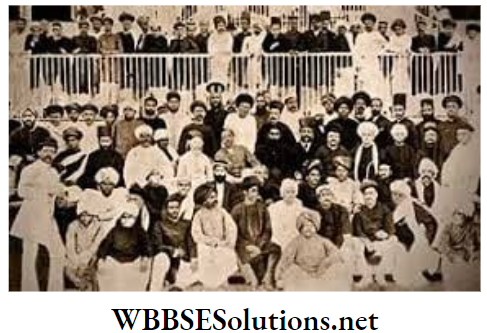
WBBSE Solutions For Class 10 History Chapter 1 Ideas Of History National Archives of India, New Delhi


Question 10: What is the name of Sarala Devi’s autobiography?

Answer:

The name of Sarala Devi’s autobiography is ‘Jibaner Jharapata’.

Question 11: Who first introduced the literary magazine ‘Bangadarshan’?

Answer:

Bankim Chandra introduced the ‘Bangadarshan’. Chattopadhyay’s first literary magazine

Question 12: What is the name of the collection of letters written by Jawaharlal Nehru to his daughter?

Answer:

The name of the collection of letters written by Jawaharlal Nehru to her daughter is ‘Letters from a Father to His Daughter’.

Question 13: Which government report reveals the story of the torture of the indigo cultivators?

Answer:

The Indigo Commission Report reveals the story of the torture of the indigo cultivators.

Class 10 History Wbbse

Question 14: Who translated Jawaharlal Nehru’s ‘Letters from a Father to His Daughter’ in Hindi?

Answer:

Munshi Premchand translated Jawaharlal Nehru’s ‘Letters from a Father to His Daughter’ into Hindi.

Question 15: What advice did Jawaharlal Nehru give to his daughter Indira in his letter?

Answer:

Jawaharlal Nehru in his letter to Indira asks her to be brave as an Indian soldier who respects and honors the country and not to do anything in secret.

Question 16: Name some government documents which give information about the British period in India.

Answer:

Some government documents which give information about the British period in India are the reports of the Indigo Commission (1860), Hunter Commission (1882), Sedition Committee (1918), etc

WBBSE Class 10 History Chapter 1 Ideas Of History Short Answer Questions

Chapter 1 Ideas Of History Short Answer Type Questions

Question 1: What do you mean by social history?
Answer:

Social history: Social history is a branch of history that studies the experiences of the daily life of people and their social and economic relationships. It also includes religious and cultural affairs such as literature, education, music, etc., and fine arts. It was written between 200 BC and 200 A4. It contains 6000 hymns. It is attributed to Bhasa Muni.

Question 2: Write a short note on ‘Natyasastra’.
Answer:

‘Natyasastra’: Natyasastra is one of the most important Sanskrit works on Indian classical dance, dramavarious ancient sites are also the source of knowledge for the clothing used by people. The writings of Herodotus also give us some j knowledge about clothing in ancient India. In which year was the Photographic Society of Bengal established? Name some of its distinguished members.

The Photographic Society of Bengal was established in 1856. Some of its distinguished members were Rajendra Lal Mitra, Kanailal Dey, and Priyanath Seth. Name some of the books on environmental history and their authors. Some of the books on environmental history are ‘Man and the Natural World’ by Keith Thomas, ‘Silent Spring’ by Rachel Carson, ‘Green Imperialism’ by Richard Grove, ‘Nature Culture Imperialism’ and ‘Hunting and Shooting’ by Mahesh Rangarajan, etc.

WBBSE Class 10 History Chapter 1 Ideas Of History Short Answer Questions

Question 3: What are the sources of knowledge for clothing in ancient India?
Answer:

The sources of knowledge for clothing in ancient India: The sources for reconstructing modern Indian history are divided into two parts primary and secondary sources. Government documents such as reports, narratives, diary entries of police, and intelligence reports are regarded as the primary sources.

Besides, periodicals and newspapers are also important sources of information. The secondary sources are autobiographies and memoirs such as ‘Jiban Smriti’ by Rabindranath, ‘Sattar Batsar’ by Bipin Chandra Pal, etc.

Read and Learn More WBBSE Class 10 History Short Answer Questions

Question 4: In which year was the Photographic | Society of Bengal established? Name some of its distinguished members.
Answer: The Photographic Society of Bengal was; established in 1856. Some of its distinguished members were; Rajendra Lal Mitra, Kanailal Dey, and Priyanath Seth

Question 5: Name some of the books on | environmental history and their authors.
Answer: Some of the books on environmental history are ‘Man and the Natural World’ by Keith Thomas, ‘Silent Spring’ by Rachel Carson, ‘Green Imperialism’ by Richard Grove, ‘Nature Culture Imperialism’ and ‘Hunting and Shooting’ by Mahesh Raiganjan, etc.

WBBSE Solutions for Class 10 History WBBSE Solutions for Class 10 Geography and Environment
WBBSE Class 10 History Long Answer Questions WBBSE Solutions for Class 10 Life Science And Environment
WBBSE Class 10 History Short Answer Questions WBBSE Solutions for Class 10 Maths
WBBSE Class 10 History Very Short Answer Questions WBBSE Solutions for Class 10 Physical Science and Environment
WBBSE Class 10 History Multiple Choice Questions


Question 6: What are the sources of modern Indian history?
Answer:

The sources of modern Indian history: The sources for reconstructing modern Indian history are divided into two parts— primary and secondary sources. Government documents such as reports, narratives, diary entries of police, and intelligence reports are regarded as the primary sources.

Besides, periodicals and newspapers are also important 1 sources of information. The secondary sources are autobiographies and memoirs such as ‘Jiban Smriti’ by Rabindranath, ‘Sattar Batsar’ by Bipin Chandra Pal, etc.

Question 7: What does the historiography of architecture reveal?
Answer:

The historiography of architecture reveals: The historiography of architecture reveals the evolution of art and architecture, the development of religion, the economic and social conditions and lifestyle of the people, and the blending of culture. It also reveals the underlying identity including the character of a community, and the values prevalent among its people.

“Short answer questions for WBBSE History Chapter 1”

Question 8: What is local history?
Answer:

Local history: Local history is an important subject of historical study. It is the study of history in a geographically local context and incorporates the cultural, social, and economic aspects of the locality and its community.

Question 9: Why is the study of local history | important?
Answer:

Local history is the study of history in a geographically local context. It enables us to know the cultural, social, and economic aspects of a locality and its community. It helps to study everything pertaining to a certain locality: history, ethnography, geography, national history, etc. The study of local history is a source for the reconstruction of national history.

Question 10: What is the importance of | environmental history?
Answer:

The importance of environmental history: Environmental history helps us to know how nature influences humans, how humans intervene in nature, and how nature and humans interact. It also investigates changes in nature not caused by human action. It opens our eyes to the scarcity of resources and their conservation in the future.

Question 11: What is historiography?
Answer:

Historiography: History is the study of past events and transformations by historians. Historiography is the study of the methodology of historians in developing history. The historiography of a specific theme covers how historians have studied that topic using particular approaches, sources, and techniques.

Wbbse History And Environment Class 10 Solutions

Question 12: What is ‘Annales School’?
Answer:

Annales School: At the beginning of the 20th century, a new school of historiography arose which is known as Annales School. It was started by the French historians Marc Bloch and Lucien Febvre. According to this school, history is not only about political events, kings, great leaders, politics, and diplomacy but also about local people, climate, trade, agriculture, technology, means of communication, social division, etc.

Question 13: Name some books related to ‘new social history’.
Answer:

Some books related to ‘new social history’: Some books related to new social history are Ranajit Guha’s ‘Selective Subaltern Studies’, Partha Chatterjee’s ‘Subaltern Studies’ Gyanendra Pandey’s, ‘A History of Prejudice’ Shahid Amin’s ‘Event, Metaphor, Memory— Chauri Chaura 1922-1992.

Question 14: What do you mean by Subaltern Studies?
Answer:

Subaltern Studies: Subaltern Studies is the study of social groups who constitute the mass population rather than the elites in the society by a group of south Asian scholars. The Subaltern historiography brings to light the lower section of the Indian people, their aspirations, and frustration hitherto neglected by the traditional method of writing history.

“WBBSE Class 10 Ideas of History short answer questions”

Question 15: What is the ‘Brahmika’ style?
Answer:

Brahmika’s style: Brahmika saree was originally popularised by Jnanadanandini Devi, wife of Satyendranath Tagore. She adopted the Parsi style of wearing a saree, pinned to the left shoulder with a brooch and worn with a blouse and shoes. This style of wearing a saree was quickly adopted by the Brahmo Samaj Women. So it came to be known as the Brahma style.

Question 16: What are the different variety of themes | in modern historiography?
Answer:

The different variety of themes covered in modern historiography is the history of sports, food habits, clothing, communication, architecture, visual art, environment, science, and technology cities. It also covers military history, the history of women’s development, local history, medical history, etc.

Wbbse History And Environment Class 10 Solutions

Question 17: Name some famous dramatists of Bengal who have valuable contributions to the field of drama in modern times.
Answer:

Some famous dramatists who have made valuable contributions to the field of drama in modern times are Madhusudan Dutta, Dinabandhu Mitra, Rabindranath Tagore, Sambhu Mitra, Sishir Bhaduri, etc.

Question 18: Which is the first Indian silent film? Who | were its director and producer?
Answer:

The first Indian silent film was Raja Harishchandra. Its director and producer were Dadasaheb Phalke.

Question 19: What were the steps taken by the British to develop the communication system in India?
Answer:

The steps taken by the British to develop the communication system in India were

  1. Establishment of railways
  2. Improvement of the postal system and
  3. Introduction of the telegraph system.

Question 20: Who is the author of the treatise ‘Sangitaratnakara’? What is its subject matter?
Answer:

‘Sangitaratnakara’ was written by Sharangadeva. It is a treatise on music. The development of dance in different parts of the country is dealt with in this treatise. Several new concepts of style and movements in dance are also mentioned here.

Question 21: Name two autobiographical works by Indian authors.
Answer: Two autobiographical works by Indian authors are Bipin Chandra Pal’s ‘Sattar Batsar’ and Rabindranath Tagore’s ‘Jiban Smriti’.

Question 22: Name two autobiographical works of the Mughal period.
Answer: Two autobiographical works of the Mughal period are Tuzuk-i-Baburi by Babur and Tuzuki-Jahangiri by Jahangir.

Question 23: Who opened the institution ‘Lakshmi Bhandar’ and why?
Answer: Sarala Devi Chaudhurani opened the ‘Lakshmi Bhandar’ for the production and use of Swadeshi goods.

Question 24: Who was Dwarakanath Bidyabhusan? Name the paper edited by him.
Answer: Dwarkanath Bidyabhusan was a professor at Sanskrit College. He was the editor of ‘Omprakash’.

“WBBSE Class 10 History Chapter 1 key points”

Question 25: In which year and from where was ‘Somprakash published? Who was its editor?
Answer: ‘Somprakash’ was published on November 15, 1858, from Calcutta. Dwarkanath Bidyabhushan, a professor at the Sanskrit College was its editor.

Question 26: Why did the British ban the Bengali weekly ‘Somprakash’?
Answer: Many writings were published against the Indigo planters. ‘Somprakash’ and articles were also published in favor of widow remarriage and the spread of women’s education. For criticizing the policy of the British in Kabul, its editor, Dwarkanath Bidyabhushan, was compelled to sign a bond and was fined, as per the Vernacular Press Act. The editor refused to pay this and so the paper was banned.

Question 27: What are the main sources for the study of modern Indian history?
Answer:

The main sources for the study of modern Indian history are

  1. Government documents
  2. Autobiography and memoirs
  3. Personal letters
  4. Newspaper and journals.

Question 28: What do you mean by autobiography towards the English language and customs and memoir?
Answer:

Autobiography towards the English language and customs and memoir: The life history of an individual, is written by writing the history of modern India. himself is called an autobiography. A memoir is an account of an individual’s life and experience. It is a piece of writing based on the writer’s personal knowledge and experiences.

Question 29: Give some examples of important auto-biographies and memoirs of the modern Indian period.
Answer:

Some examples of important autobiographies and memoirs of the modern Indian period are

  1. Rabindranath Tagore’s ‘Jiban Smriti’
  2. Sarala Devi Chaudhurani’s ‘Jibaner Jharapata’
  3. Mahatma Gandhi’s ‘The Story of My Experiments with Truth’
  4. Subhas Chandra Bose’s ‘An Indian Pilgrim’ (incomplete)
  5. Jawaharlal Nehru’s ‘An Autobiography’ etc.

Question 30: What do you mean by government documents? Or, What are the primary sources of information for reconstructing the history of India?
Answer:

Government documents are the primary sources of information for reconstructing the history of India. Government documents include

  1. Records of the British officials,
  2. Police and intelligence reports,
  3. Official letters and correspondence,
  4. History recorded by English officers in the light of their own experiences.

Class 10 History Wbbse

Question 31: What information do we get from Rabindranath’s ‘Jiban Smriti’?
Answer:

Rabindranath’s autobiography ‘Jiban Smriti’ reflects the society of the 1860s and 1870s. It gives information about the rigid customs and norms of the society, about Hindu Mela and Swadeshi. The attitude of the Bengali society, about Hindu Mela and Swadeshi. The attitude of the Bengali society towards the English language and customs are important sources of information for writing the history of modern India.

“Important short answers Ideas of History WBBSE”

Question 32: When and by whom was Bengal Gazette published?
Answer:

Bengal Gazette, a weekly English newspaper, was published by James Augustus Hicky in 1780.

Question 33: What are the abuses of the internet in collecting historical information?
Answer:

The abuses of the internet in collecting historical information: Some websites abuse the internet. Sometimes incomplete information and wrong information are given which may lead to wrong concepts. Unreliable information cannot be used for reconstructing history which reduces the quality of research work.

Question 34: What is the difference between newspapers and periodicals?
Answer:

Differences between newspapers and periodicals are given below-

  1. Newspapers are usually published regularly and daily, whereas periodicals are published less frequently than daily newspapers.
  2. Newspapers contain different informative contents of everyday life, whereas periodicals give importance only to specific contents of the contemporary period.
  3. Newspaper articles are written by newspaper staff and do not provide authors’ names, whereas periodicals use subject experts for publication.

Question 35: What is the importance of newspapers as a source of history?
Answer:

The importance of newspapers as a source of history: Newspapers are known as the eyes and ears of the world. Newspapers are important sources of information for writing the history of the contemporary period4. It provides news about a country’s economic situation, sports, games, entertainment, trade, and commerce which are essential for writing the history of a country.


WBBSE Class 10 History Chapter 1 Ideas Of History Long Answer Questions

Chapter 1 Ideas Of History Topic A Analytical Answer Type Questions

Diverse Aspects of the Study of Modern Historiography

Question 1: Discuss the ramifications of historical discussions in recent times.’ Or, Mention the diverse aspects of historical discussions in modem times.
Answer:

The ramifications of historical discussions in recent times:

Earlier the discussion of history included only the tales of royal families, the rise and fall of dynasties, the exploits of heroes and generals, the lifestyle of the upper classes, and so on. However, in recent times the study of history has become more interesting and diversified due to the inclusion of several new topics. These are as follows—

(1)Activities of kings: History still continues. to discuss wars, conquests, the establishment of peace, treaties, the rise and fall of dynasties, etc.

(2)Discussion about the elite class: The discussion about the aristocrats, landlords, feudal lords, etc., still constitutes an important part of historical discussion.

(3)Discussion about the common people: Though the lifestyle, food habits, dress, art and culture, sports, environment, etc-., of the common people were neglected in earlier times, nowadays these aspects of common life have found much importance.

(4)Local History: Nowadays much importance is being given to the study of local and regional history. So the people of all continents, countries, cities, and villages have now been included in the purview of history.

(5)History of science: The study of history also includes the continuous development of science, technology, and medical science since ancient times.

Question .: What do you understand by history? What were the topics discussed In the previous century?
Answer:

History:

The term ‘history’ refers to the ‘tales of the past’. So history includes the study of the society, politics, economics, and religion of the prehistoric as well as the historic ages. Earlier the study of history was confined to the upper classes of society and the most significant social, political, and religious events. These included—

Read and Learn More WBBSE Class 10 History Long Answer Questions

  1. Stories of kings and princes: In earlier times one of the most important topics of discussion was the rise and fall of various dynasties, wars, conquests, successes and failures of brave generals and heroes, and so on.
  2. Story of classes: In the last century matters concerning the lifestyle of the nobles, aristocrats, local lords landlords, and ruling classes constituted the main subject of discussion.
  3. Religious matters: In the earlier century one of the main topics of discussion was the different religious activities of the people.
  4. Political events: The various significant political events of the past found a place in, the historical discussion in earlier times. Imperialism, colonialism, and the spread of western ideas easily became the topics of discussion.
  5. Disasters: The various disasters of the past including floods, droughts, earthquakes, epidemics, and massive loss of lives also came up for historical discussions.
WBBSE Solutions for Class 10 History WBBSE Solutions for Class 10 Geography and Environment
WBBSE Class 10 History Long Answer Questions WBBSE Solutions for Class 10 Life Science And Environment
WBBSE Class 10 History Short Answer Questions WBBSE Solutions for Class 10 Maths
WBBSE Class 10 History Very Short Answer Questions WBBSE Solutions for Class 10 Physical Science and Environment
WBBSE Class 10 History Multiple Choice Questions


Question: 2 What do you understand by the term history? What were the topics of the historical discussion in the previous century?
Answer:

History

The term ‘history’ refers to the ‘tales of the past’. So history includes the study of the society, politics, economics, and religion of the prehistoric as well as the historic ages. Earlier the study of history was confined to the upper classes of society and the most significant social, political, and religious events. These included—

  1. Stories of kings and princes: In earlier times one of the most important topics of discussion was the rise and fall of various dynasties, wars, conquests, successes and failures of brave generals and heroes, and so on.
  2. Story of elite classes: In the last century matters concerning the lifestyle of the nobles, aristocrats, local lords landlords, and ruling classes constituted the main subject of discussion.
  3. Religious matters: In the earlier century one of the main topics of discussion was the different religious activities of the people. political events of the past found a place in the historical discussion in earlier times. Imperialism, colonialism, and the spread of western ideas easily became the topics of discussion.
  4. Disasters: The various disasters of the past including floods, droughts, earthquakes, epidemics, and massive loss of lives also came up for historical discussions. rather than from the viewpoint of the upper classes.

Class 10 History Solution Wbbse

Question 3: what do you mean by new social history? From which point of view is this subject discussed?
Answer:

New social history: Social history forms a significant part of historical discussion. Previously, social history was confined to the discussion about, the royal families, the aristocrats, and the upper classes but now the scope of the discussion has widened and the discussion about the people belonging to the middle, lower and marginal classes has assumed much importance. Therefore, social history is now termed as ’new social history.

New social history had its origin in 1960-70. At this time, history began to be discussed from the point of view of the lower classes.

  1. View from bottom to top: In new social history, an attempt is being made to view things from bottom to top instead of the other way around. This means, that society is now viewed more widely on the basis of the role of the lower classes rather than from the viewpoint of the upper classes.
  2. The predominance of the larger community: New social history assigns more importance to the wider, common, or lower and marginal classes rather than to the handful Of aristocrats. The contribution of the larger community to society and culture is more seriously discussed.

Question: 4 Whose discussion finds an eminence hi new social history? Who has popularised the new social history in modern times?
Answer:

The discussion of the. a larger community consisting of the lower, poor, marginal, and ordinary people have found a place of eminence in the discussion of new social history in the 20th century. New social history originated in 1960-1970. Since then, different historians have made their contributions to popularise this subject. They are as follows.

  1. Role of Annal group: Marc Bloch and Lucien Febvre published a journal named ‘Annals of Economic and Social History’ in 1921. This French Annal group played an important role in popularising the study of new social history. Fernand Braudel and Laduree have illuminated on statistics, family, psychology, society, culture, and economy of the common people.
  2. Role of American historians: Eugene Genovese and Herbert Gutman. have discussed the lifestyle of the laborers, the system of slavery, and slave society. There is also evidence of such discussion in the journal Past and Present.
  3. Subaltern studies: This involves the study of lower classes. It has become popular in India and other South Asian countries since the 1980s. Historians like Ranajit Guha, Partha Chattopadhyay, Gyanendra Pandey, Shahid Amin, Sumit Sarkar, Dipesh Chakrabarty, Gautam Bhadra, and others have elaborately discussed the lower class society irrespective of caste and religion.

WBBSE Class 10 History Chapter 1 Ideas Of History laqs

“WBBSE Class 10 Ideas of History notes”

Question 5: the factors that determine the habits of people.
Answer:

Habits of people: The most important thing related to human life is the food habits of people. So attention is now paid to people’s food habits in the study of new social history.

Factors that determine the habits of people

  1. The food habits of the people of different < regions vary according to the differences in the climate.
  2. Geographical factors of an area are also responsible for determining the food habits of the people.
  3. The easy availability of food items in different regions is also responsible for determining food habits. For example, in Bengal, owing to the presence of rivers, fish is one of the important items of food.
  4. Different types of inventions like the invention of fire have also changed the food habits of people of ancient times.
  5. Food patterns are influenced by religious beliefs. The food people eat is also dictated by their religious beliefs at times.

Question 6: Describe the history of transportation and communication in India from the ancient to the modern period.
Answer:

The history of transportation and communication in India from the ancient to the modern period:

The transport and communication system helped in the growth of civilization. As India is a land of rivers, many civilizations grew up on the banks of these rivers. The natural means of transport here were boats. The best means of land transport was bullock carts. Even today bullock carts are used in transporting goods, especially in rural areas. Elephants and horses were also used as means of transportation.

Horse-driven carriages were used for carrying people and elephants were used for carrying heavy loads. In the mid-twentieth century, there has been a development in the history of the transport system. Nowadays, trains, buses, airplanes, and metro rails have replaced the earlier slow-moving means of transport. Before the establishment of railways and telegraphs, the most important means of communication was Dak Chowki. Nowadays, with scientific innovations like the internet, one can be acquainted with the world within a few minutes.

Question 7: Write a note on the history of visual arts.

Answer:

The history of visual arts: Visual arts primarily includes photography and painting. Photographs assist in our understanding of historical events. It is proof of past occurrences. Historical photos are important as sources of cultural data, stimuli in the recording of oral history, and catalysts for promoting awareness of cultural history.

Photographs serve to present a scene with authenticity. Paintings from the past hold clues to life in the past as well. By looking at a painting, its color, and its material, we can learn about the culture that produced it.

Painting gives us a well-rounded view of events, situations, and people. By analyzing paintings from the past and looking at their details, we can find out how different were the paintings of the bygone days. Some important works on visual art are- Abanindranath Tagore’s ‘Bageswari Shilpa Prabandhabali’, Gita Kapoor’s ‘Contemporary Indian Painters’, Ratnabali Chatterjee’s ‘From the Karkhana to the Studio’,

Binod Beharl Mukhopadhyay’s ‘Chitra Katha’, Sofi Gordon’s ‘Nineteenth Century Indian Photography’, Jahid Choudhuri’s ‘Afterimage of Empire: Photography in Nineteenth-Century India’. In these books, India’s national movement and partition of India are represented through photographs.

WBBSE Solutions For Class 10 History Chapter 1 Ideas Of History Photograph Showing Refugees During Partition Of India

Class 10 History Solution Wbbse

Question 8: What do you mean by military What do we come to know from it?

Answer:

Military

Military history is the historical record of armed conflict in the history of humanity, and its effect on society, economy, culture, and international relations. Historians record the details of battles, equipment, arms and ammunition, the uniforms used, and the aftermath of wars.

  • The essential subjects of military history are the causes of the war, military doctrines of the two opposite sides, the policies of the governments in going to war, the technology, strategy, leadership, and tactics used, and how these gradually changed over time.
  • From the ancient past till the 20th century, many books have been written on the military history of India, among which, mention may be made of ‘Military History of India’ by Jadunath Sarkar, ‘A Military History of India and South Asia From East India Company to the Nuclear Era’ by Daniel! Martson and Chhandar S Sundaram (edited). The works of Marc Ferro and Keith Windsehuttie also deserve mention in this respect.

Question 9: What aspect of the common people has found an important place m contemporary historical discussion?

Answer: In the previous century, the chief topics of historical discussion included various events concerning the royal family, the elite, feudal lords, and landlords. However, in recent times, the various aspects concerning the common people have found a place in the discussions of history. Such as

  1. Man’s urge to live: The struggle of the common people to live in the background of wars and political events is now an important subject of discussion.
  2. Picture of common life: Along with the various events concerning the upper classes, the events concerning the lower classes are also being discussed. The role of the common people in the state, society, religion, politics, economy, etc., has become increasingly important.
  3. Art and culture: Nowadays, the cultivation of art and culture by the common people is also being simultaneously discussed with the tales of wars carried out by kings and princes. An increasing interest in society, sports, dress, food habits, visual arts, painting, etc., of the common classes is being noticed.
  4. Struggle: History also deals with the transformation of the state and society which is the result of the struggle of the common people.
  5. Evolution: The various developments in science, technology, religion, etc. have been possible due to the efforts of the common people since ages. These topics have also found a significant place in history.

“History Chapter 1 WBBSE long answer questions”

Question 10: Which topics have become significant in the recent study of the cultivation of art? What is the significance of music in the study of the cultivation of art?
Answer: We can form an idea about the cultural progress of a community from the study of its cultivation of art. The different branches of art include music, dance, drama, and cinema. Man has been cultivating different types of art since time immemorial. Music forms an important branch of art and the study of the history of music is gradually becoming popular.

  1. Cultivation of music by aristocrats: In ancient times, the cultivation of music in the royal courts was chiefly associated with the upper classes, and the common people were almost detached from it. So, a clear idea can be formed about the caste distinction in a society from the study of the cultivation of music.
  2. External influence: The history of music helps us to understand whether the music of a particular community was influenced by that of some other society or community and if so, then what was the extent of such influence. The influence of music also indicates the cultural prosperity of a society or community.
  3. Evolution of Indian music: In the earlier ages Indian society was dominated by devotional music but later on due to continuous evolution, massive changes came about in Indian music in the 20th century. In this course of evolution, Rabindrasangeet, Nazrulgeeti, etc., became popular in Bengal.
  4. Diversity: Different types of music filled the treasure house of the music of the different communities as a result of continuous evolution and transformation. Nowadays, along with devotional music, folksongs, Rabindrasangeet, Nazrulgeeti as well as film songs, band music, etc., have harmoniously lent diversity to the storehouse of Bengali music.
  5. Study of the history of music: Recently, researchers and experts have engaged in a detailed study of the history of the music of different countries. Umesh Joshi, Raj Kumar, Karunamoy Goswami, Sudhir Chakrabarty, Mridulkanti Chakrabarty, and others have made considerable contributions to the field of study of the history of Indian music.

Class 10 History Solution Wbbse

Question 11: How has the historical study of drama become important in the modern age ‘as a part of visual arts?
Answer: The cultivation of drama has its origin in the civilizations of ancient times. The ancient Greek dramas still impress the audience in different countries.

  1. Cultivation of drama in Europe: Though dramatic performances were prevalent in ancient Europe, cultivation of dramatic art in the modern sense began in the 16th-17th centuries and became popular in the 18th-19th centuries. The plays written by Shakespeare, Christopher Marlow, Ben Jonson, John Galsworthy, Bernard Shaw etc., attained immense popularity.
  2. Cultivation of drama in Bengal: Modern dramatic art developed in Bengal in the 18th-19th century. This art which began in the 18th century developed profusely in the 19th century and is still continuing. Significant contributions were made by Michael Madhusudan Dutta, Dinabandhu Mitra, Girish Chandra Ghosh, Rabindranath Tagore, Dwijendralal Roy, Sisir Bhaduri, Sambhu Mitra, Utpal Dutta, and others.
  3. Reflection of society: The plays belonging to different countries and societies reflect contemporary events, oppression, tyranny, social discrimination, imperialism, nationalism, etc. This drama can become a mirror to society and also act as a social media.
  4. History of drama: In recent times, researchers have seriously engaged in the study of the history of drama. Some important works are, ‘Bangiya Natyashalar Itihasa by Brajendranath Bandopadhyay, ‘Drishya Kavya Parichay’ by Satyajiban Mukhopadhyay, ‘Bangla Natya Sahityer Itihas’ by Asutosh Bhattacharya, ‘Madhyajuger Bangla Natya’ by Selim Al Deen, ‘Bangladesher Lok Natak: Bishoy O Angik Boichitro’ by Simon Zakaria, ‘National theatre for India’ by Baldoon Dhingra, etc.

Question 12: Discuss the study of the history of architecture in the modern age.
Answer:

The study of the history of architecture in the modern age: The art of architecture originated at the time when ancient cavemen’ learned to build houses. The art of architecture forms a significant component in the study of history.

  1. Architectural construction: In the past, it was the kings and wealthy people who showed interest in building structures. In the modern age, apart from the ruling class, common people are also associated with various architectural constructions.
  2. Study of the history of architecture: The backdrop, style, and patronage of various forms of architecture have become important subjects for historical discussions. Recently, the architecture of Europe, India, and Bengal has found a prominent place in the study of history.
  3. Beginning of historical study of architecture: The study of the history of architecture began in India in the 19th and 20th centuries. Some of the pioneers of this field were Alexander Cunningham, Percy Brown, J Fergusson, Catherine Asher, etc.
  4. Study of the history of architecture in Bengal: Different researchers have studied the development of the art of architecture in Bengal at different ages. Notable ones among them are George Michell, Amiya Kumar Bandopadhyay, Shamsunnahar Lovely, Dr. Nazimuddin Ahmed, etc.

Question 13: Write a note on the historiography of sports.
Answer:

The historiography of sports: History is not just about the dramatic events of the world. It is equally about the small things in our lives. Everything around us has a history—including sports. Historiography of sports started in the 1970s. In the 1980s, Tony Mason, Richard Holt, and others enriched sports historiography. The ‘International Journal of the History of Sports’, published in England, became very popular in Europe.

  • Sports historiography took a definite shape when the British Society of Sports History was established in 1982. In India, the first research work on sports historiography was done by Soumen Mitra in ‘A Study of Football in Bengal: Nationalism, Communalism and SubRegionalism’ (1880-1950).
  • Other researchers on sports historiography are Ramchandra Guha, Boria Majumdar, Ashis Nandy, Arjun Appadurai, Mihir Bose, and others. Historiography of sports reveals that there are close links between sports and politics, and in particular between sports and national consciousness.
  • Historiography of sports can reflect and shape national consciousness. The Olympic Games and the Football, Rugby, and Cricket World Cup have often been used as platforms for the expansion of nationalistic sentiments.

Question 14: What is the importance of the study of clothing in modem India?
Answer:

The importance of the study of clothing in modem India: The history of clothing constitutes an important field of academic research. The reasons why the history of clothing is to be studied are as follows

  1. The dresses of women and men during a particular period represent the social, economic, and cultural conditions of the society.
  2. The use of special materials in clothing reflects the economics of a region or group.
  3. The style of dressing of an individual indicates the overall position in the state or the community to which he or she belongs.
  4. When two communities or societies come in contact with each other, they are often influenced by the other’s dress. So clothing is an important yardstick to measure the degree of acculturation and assimilation.
  5. Dressing up in a certain way could be symbolic of protest. Protesting groups sometimes wear similar clothes to reflect their unity and solidarity. For example, during the freedom movement in India, wearing Khadi clothes became a symbol of protest against British rule.
  6. Clothing can also be used to show uniformity and solidarity. For example, soldiers and students are required to wear similar uniforms.
  7. The color of clothes is treated as the symbol of a particular group. For example, while the red color is associated with the left wing, the saffron color is associated with the right wing.

Chapter 1 Ideas Of History Topic B Methods Of Using Sources Of Morden Indian History

 Analytical Answer Type Questions

Question 1: What is the importance of government documents as source material for the reconstruction of the history of India?
Answer:

The importance of government documents as source material for the reconstruction of the history of India: Government documents are the primary sources of information for reconstructing the history of India. Government documents include

  1. Records of the British officials,
  2. Police and intelligence reports,
  3. Official letters and correspondence,
  4. History Marks 4 recorded by English officers in the light of their own experiences.

India, with its diverse culture and many dialects, posed an administrative challenge for the British. Thus, to ensure smooth administration, the British recorded every aspect of their administration in Indi1. Every administrative decision was recorded and carefully preserved.

Every executive, legislative, and judicial body had record rooms in which even the smallest records were kept well catalogue4. Many of these official documents are now preserved in the National Archives of India at the National Museum, New Delhi. Government museums in Chennai, Mumbai, and Kolkata also possess original documents of the past like letters written by Jawaharlal Nehru and Mahatma Gandhi.

By reading these materials, researchers can trace every important development stage by stage. It will perhaps not be correct for scholars to assume that the documents and reports contain all relevant information on the subject. Nor will it be proper to accept the facts mentioned in the reports as accurate in all respects.

These sources should be checked. There might be biased or exaggerated views. This becomes particularly true when dealing with modern Indian history where the British account is very often vastly different from how Indians of the time have written about it. Thus, all the facts narrated in these documents are not to be accepted at face value but are to be corroborated by other independent sources.

Question 2: How far are autobiographies and memoirs reliable sources of information?
Answer:

Autobiographies and memoirs are reliable sources of information: The life history of an individual, written by himself, is called an autobiography. A memoir is an account of an individual’s life and experience. It is a piece of writing based on the writer’s personal knowledge and experiences. and Autobiographies and memoirs are important sources of information in writing history.

  • These are essential elements in the study of history as well. History is a record of human progress, achievements, and endeavors. Hence, without the contribution of personal accounts, the study and analysis of history would be a one-dimensional representation of facts.
  • History without personal facts would be tedious and unbalanced But autobiographies and memoirs as sources of history have some limitations. Memory and the passage of time can distort or omit details. Sometimes the narrative can be too elaborate or might be an exaggerated form of an individual’s contribution. Autobiographies can also add personal insight into an event or modify or distort the truth.
  • Due to this, autobiographies are not totally reliable. Thus, the wisest way to study history through autobiographies and memoirs is to corroborate the accounts of autobiographies and memoirs with other sources of information. Historians have to juxtapose with other sources to arrive at a better understanding of the facts.

“Ideas of History WBBSE Class 10 summary”

Question 3: Write a note on the autobiography of Bipin Chandra Pal.
Answer:

The autobiography of Bipin Chandra Pal:

The extremist leader Bipin Chandra Pal (1858-1932) is called the ‘Father of Revolutionary Thoughts’ in India.

WBBSE Class 10 History Chapter 1 Ideas Of History The Autobiography Of Bipin Chandra Pal

His autobiography ‘Sattar Batsar’, covering the period of 1858 to 1880, is an unfinished work. His work was published serially in ‘Prabasi Patrika’. He has given an account of his childhood days and school life, his education, his journey to Calcutta, his joining of the Brahmo Samaj, his plunging with the independence and Swadeshi movement, his association with the Hindu Mela and Nabagopal Mitra, etc.

His autobiography furnishes lively pictures of Orissa during 1879. It reflects all spheres of activities of the Orissa and Bengal societies, i.e., art, culture, literature, religion and religious activities, social rights, and festivals.

His writings reflect the impressions of a young perceptive mind in a transitional period-tremendous political upheaval and unprecedented wide turmoil-that led to a total transformation of Indian life and thought. His autobiography is no doubt a unique composition and evidence of many untraceable occurrences of the country.

Wbbse History And Environment Class 10 Solutions

Question 4: Write a note on the autobiography of Sarala Devi Chaudhurani.
Answer:

The autobiography of Sarala Devi Chaudhurani: Sarala Devi Chaudhurani was an educationist and a feminist. She was the daughter of Rabindranath’s elder sister Swarna Kumari Devi. We come to know a great deal about her life and contemporary events from her autobiography ‘Jibaner Jharapata’.

She was involved with the Indian National Congress from her college days. The nationalistic Urdu paper, ‘Hindustan’, was edited by her and was thus under the watchful eyes of the British government. She worked for women’s upliftment and proposed a scheme for the education of women. She also believed in physical prowess and therefore instituted a sports and athletics festival, the ‘Birastami Utsav’.

Her Birastami Festival in Calcutta included the worship of the sword as a symbol of bygone heroes. In 1904 she opened a swadeshi shop called ‘Lakshmi Bhandara. The Indian National Congress gave her a gold medal for her efforts in promoting the swadeshi trade. In 1910, she convened the first meeting of the Bharat Stree Mahamandal, the first major Indian Women’s organization set up by women.

In 1930 she opened a school-the Bharat Stree Shiksha Sadan. Sarala Devi Chaudhurani’s memoir of her early life was serialized in the weekly magazine ‘Desh’. Thirty years later, they were put together as ‘Jibaner Jharapata’ (Life’s Fallen Leaves).

“WBBSE Class 10 Ideas of History study guide”

Question 5: Write a note on Rabindranath Tagore’s autobiography ‘Jiban Smriti’.
Answer:

Rabindranath Tagore’s autobiography ‘Jiban Smriti’: Rabindranath Tagore’s ‘Jiban Smriti’ or ‘Remembrance of Life’ was published in 1912. In this narrative, Rabindranath painted an accurate portrait of the society of the 1860s and 1870s. Jiban Smriti’ reflects the society in which he was brought up.

He writes that he was brought up under the supervision of the servants. In his memoir, he recalled the rigid customs and norms of the society which was plagued by orthodoxy. He did not write about contemporary politics, but his writing about ‘Swadeshi’ in the pages of his books is really very interesting.

WBBSE Solutions For Class 10 History Chapter 1 Ideas Of History Jiban Smriti

Question 6: How far are letters important in reconstructing the history of India? Write about Jawaharlal Nehru’s letter to his daughter Indira Gandhi.
Answer:

Letters are primary sources of information for reconstructing the history of India. Letters are among the most democratic of historical sources. These are valuable windows for looking into the past. Letters exchanged among different political leaders serve as an important source for writing history.

More than any other kind of historical text, letters reveal how people both embraced and resisted the time and place in which they lived. But they have to be always read with care and juxtaposed with evidence taken from other resources.

‘Letters from a Father to His Daughter’ is a collection of 30 letters written by the first Prime Minister of India Jawaharlal Nehru in 1928 to his daughter Indira Gandhi, when she was 10 years old, teaching her about natural history and the story of civilization. Nehru, as a loving father, tries to answer the queries of his 10-year-old daughter in a series of letters.

WBBSE Solutions For Class 10 History Chapter 1 Ideas Of History Letters From A Father To His Daughter

In this e series of letters, Nehru tries to make Indira aware of the evolution of the earth, its species, and the evolution of human civilization and societies. Nehru starts with the very beginning-he talks about how the universe was created and then he slowly moves on to tell the story of evolution and the birth of human beings.

Question 7: What part did the Bengali weekly newspaper ‘Somprakash’ play in the rousing national consciousness?
Answer:

‘Somprakash’, a Bengali weekly newspaper, was founded in 1858 under the joint efforts of Iswar Chandra Vidyasagar and Dwarakanath Bidyabhusan. With its lucid language and fearless criticism ‘Somprakash’ occupies a very important position among Bengali newspapers. It played an important role as the mouthpiece of the Indian public. It reached out to the common people in distant villages with the clarion call to fight against the British.

WBBSE Solutions For Class 10 History Chapter 1 Ideas Of History Somprakash

  1. It was the first Bengali newspaper to indulge in political discussion. Political issues are regularly featured in it. It raised its voice against the Vernacular Press Act. It supported the Ilbert Bill and the Factories Act of 1881.
  2. It supported the oppressed workers of the indigo plantation as well as the peasants. It strongly criticized the indigo planters and landlords.
  3. It also indulged in matters of social issues. It opposed child marriage and Kulinism. Though not clearly in favor of women’s freedom, it supported women’s education and widow remarriage.
  4. It was a terror to the British administration and all the drastic press laws were particularly aimed against it. In 1878, when the Viceroy Lord Lytton introduced the Vernacular Press Act, especially targeting the Bengali press, Vidyasagar closed down ‘Somprakash’ rather than sign an undertaking about it, agreeing to follow the dictates of the British authorities. Later, when the Act was withdrawn, he resumed the publication of ‘Omprakash’.

“WBBSE Class 10 History important questions”

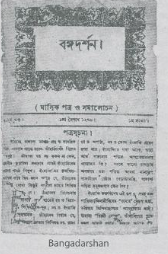
Question 8: What is the importance of Bankim Chandra Chatterjee’s ‘Bangadarshan’?
Answer:

The importance of Bankim Chandra Chatterjee’s ‘Bangadarshan’: ‘Bangadarshan’ was a Bengali literary monthly journal founded by Bankim Chandra Chatterjee in 1872. The importance of this journal may be summed up as follows-

  1. ‘Bangadarshan’ brought about a cultural revival in Bengal by stimulating the intellect of the Bengalees. Many of Bankim Chandra’s novels were serialized in this journal. Besides Bankim Chandra, a galaxy of Bengali literary talents like Akshay Chandra Sarkar, Hem Chandra Banerjee, Krishna Kamal Bhattacharjee, Ramdas Sen, Chandranath Sen, and others used to contribute articles as they were inspired by the ideals of ‘Bangadarshan’.
  2. ‘Bangadarshan’ was a dispenser of knowledge. It published articles on the Puranas, the Vedas, and the Vedant1. It also covered topics on science, philosophy, literature, social science, linguistics, criticisms, etc. When Bankim Chandra started the journal, he wrote a series of Bengali articles on solar eruption, stars, the universe in motion, and the moon, as well as on dust, quantity, measures, protoplasm, and the antiquity of man.

WBBSE Solutions For Class 10 History 1 Ideas Of History Bangadarshan

(3) Besides the readership among Bengali intelligentsia the journal influenced Bengali women too. It became popular and was widely read among Bengali literate women.

(4) ‘Bangadarshan’ was the genesis of nationalism in Bengal. ‘Anandamath’, the political novel, first appeared in a serial form in ‘Bangadarshan’. The book depicts a sannyasi Hindu ascetic army fighting the British soldiers. The book calls for the rise of Hindu nationalism to uproot foreign British rule and attain self-rule. The famous song ‘Bande Mataram’, which features in this novel, became the national hymn and it inspired Indians to sacrifice their lives for the emancipation of their motherland

“Key concepts in Ideas of History WBBSE”

Question 9: What are the uses and abuses of the internet in collecting historical information?
Answer:

The uses and abuses of the internet in collecting historical information: The internet is the world wide web exchanging information and data through telecommunication satellites. It is no doubt indispensable in modern civilization.

  • Nowadays, every person has easy access to it and one can be acquainted with the world by clicking a button on the computer that connects to the internet. It is so informative that one can avail oneself of the scope of collecting important data for different disciplines and can avail any kind of books that can be found in other parts of the globe.
  • Research students cannot but use the internet for knowledge and various facts. So most people use the internet which has now become an essential part of our life.
  • At present, we do not have to travel from country to country, from one place to another, or spend hours together in libraries searching for useful documents or books, as everything can be exchanged through the internet. But some websites are also abusing the internet.
  • As there is no censorship, the facts we get from the internet are not always reliable. Sometimes wrong information is given which may lead to wrong concepts. The correct information is always essential for reconstructing history. We must corroborate the information available on the internet with other authentic sources of information.


Expansion Of Solid And Liquids Short Answer Questions

Properties Of Bulk Matter

Expansion Of Solid And Liquids Short Question And Answers

Short Answer Questions on Thermal Expansion

Question 1. The liquid with a co-efficient of volume expansion (γ) is filled in a container of a material having the coefficient of linear expansion a. If the liquid overflows on heating, then

  1. γ = 3α
  2. γ > 3α
  3. γ <3α
  4. γ > 3α³

Answer:

Given

The liquid with a co-efficient of volume expansion (γ) is filled in a container of a material having the coefficient of linear expansion a.

Apparent coefficient of volume expansion, γ’= γ-3α

Now, γ’ is positive when the liquid overflows on heating.

So the condition is γ – 3α > 0 or, ϒ > 3α

The option 2 is correct.

Question 2. When a copper sphere is heated, which physical quantity of the sphere will show maximum percentage change?
Answer:

When a copper sphere is heated, its volume will show maximum change in percentage.

Question 3. A metal rod is fixed rigidly at two ends so as to prevent its thermal expansion. If L, a and Y respectively denote the length of the rod, coefficient of linear thermal expansion and Young’s modulus of its material, then for an increase in temperature of the rod by ΔT, the longitudinal stress developed in the rod is

  1. Inversely proportional to α
  2. Inversely proportional to Y
  3. Directly proportional to ΔT/Y
  4. Independent of L

Answer:

Given

A metal rod is fixed rigidly at two ends so as to prevent its thermal expansion. If L, a and Y respectively denote the length of the rod, coefficient of linear thermal expansion and Young’s modulus of its material, then for an increase in temperature of the rod by ΔT,

Longitudinal thermal stress = YαΔT.

The option 4 is correct.

Key Concepts in Solid and Liquid Expansion

Question 4. A solid rectangular sheet has two different coefficients of linear expansion α1 and α2 along its length and breadth respectively. The coefficient of surface expansion is (for α1 t<<1 1, α2 t<<l)

  1. \(\frac{\alpha_1+\alpha_2}{2}\)
  2. \(2\left(\alpha_1+\alpha_2\right)\)
  3. \(\frac{4 \alpha_1 \alpha_2}{\alpha_1+\alpha_2}\)
  4. \(\alpha_1+\alpha_2\)

Answer:

Given

A solid rectangular sheet has two different coefficients of linear expansion α1 and α2 along its length and breadth respectively.

Let, initial length and breadth of rectangular sheet are a1 and b1 respectively.

If the final length and breadth are a2 and b2 respectively in increase in temperature t° C, then

⇒ \(a_2=a_1\left(1+a_1 t\right) \text { and } b_2=b_1\left(1+\alpha_2 t\right)\)

∴ \(a_2 b_2=a_1 b_1\left(1+\alpha_1 t\right)\left(1+\alpha_2 t\right)\)

or, \(a_1 b_1(1+\beta t)=a_1 b_1\left\{1+\left(\alpha_1+\alpha_2\right) t+\alpha_1 \alpha_2 t^2\right\}\)

or, \(1+\beta t=1+\left(\alpha_1+\alpha_2\right) t\)

[neglecting the term \(\alpha_1 \alpha_2 t^2\)]

∴ \(\beta=\alpha_1+\alpha_2\)

The option 4 is correct

Expansion Of Solid And Liquids saqs

Real-Life Applications of Thermal Expansion

Question 5. The pressure that has to be applied to the ends of a steel wire of length 10 cm to keep its length constant when its temperature is raised by 100 °C is (For steel, Young’s modulus is 2 x 10¹¹ N • m-2 and coefficient of linear expansion is 1.1 x 10⁻⁵ K-1)

  1. 2.2x 10⁸ Pa
  2. 2.2x 10⁹ Pa
  3. 2.2 x 10⁷ Pa
  4. 2.2 x 10⁶ Pa

Answer: As length is constant, strain =ΔL/L = αΔQ

Now, pressure = stress = Yx strain

= 2x 1011 x 1.1 x 10-5 x 100

= 2.2 x 10⁸ Pa

The option 1 is correct.

Question 6. A pendulum clock loses 12 s a day if the temperature is 40°C and gains 4 s a day if the temperature is 20°C. The temperature at which the clock will show correct time, and the coefficient of linear expansion (α) of the metal of the pendulum shaft are respectively

  1. 25°C and 1.85 x 10⁻⁵ l °C
  2. 60°C and 1.85 x 10⁻⁴ l °C
  3. 30°C and 1.85 x 10⁻³ l°C
  4. 55°C and 1.85 x 10⁻² l °C

Answer:

Given

A pendulum clock loses 12 s a day if the temperature is 40°C and gains 4 s a day if the temperature is 20°C. The temperature at which the clock will show correct time,

Increase or decrease in time for change in temperature ΔT,

⇒ \(\Delta t =\frac{1}{2} \alpha \Delta T t\)

∴ 12 = \(\frac{1}{2} \alpha\left(40-T_0\right) \times 1\)

T0 = temperature at which clock gives accurate breading, t = 1 day]

and 4 = \(\frac{1}{2} \alpha\left(T_0-20\right) \times 1\)….(2)

(1)+(2) we get,

3 = \(\frac{40-T_0}{T_0-20} \quad \text { or, } 3 T_0-60=40-T_0\)

or, \(T_0=\frac{100}{4}=25^{\circ} \mathrm{C}\)

Putting the value of T0 in equation (1) we get,

⇒ \(15 \alpha=\frac{24}{24 \times 60 \times 60}\)

or, \(\alpha=\frac{1}{15 \times 60 \times 60}=1.85 \times 10^{-5} /{ }^{\circ} \mathrm{C}\)

The option 1 is correct.

Coefficient of Expansion Short Answer Questions

Class 11 Physics Class 12 Maths Class 11 Chemistry
NEET Foundation Class 12 Physics NEET Physics

Question 7. An external pressure P is applied on a cube at 0°C so that it is equally compressed from all sides. K is the bulk modulus of the material of the cube and α is its coefficient of linear expansion. Suppose we want to bring the cube to its original size by heating. The temperature should be raised by:

  1. \(3 P K \alpha\)
  2. \(\frac{P}{3 \alpha K}\)
  3. \(\frac{P}{\alpha K}\)
  4. \(\frac{3 a}{P K}\)

Answer:

Given

An external pressure P is applied on a cube at 0°C so that it is equally compressed from all sides. K is the bulk modulus of the material of the cube and α is its coefficient of linear expansion. Suppose we want to bring the cube to its original size by heating

Bulk modulus \(K=\frac{P}{\left(\frac{\Delta V}{V}\right)}\)

∴ \(\frac{\Delta V}{V}=\frac{P}{K}[\Delta V= change in volume ]\)

If increase in temperature Δt brings the cube to its original size, then

∴ \(\Delta V=V \cdot \gamma \Delta t \quad \text { or, } \Delta t=\frac{\Delta V}{V} \cdot \frac{1}{\gamma}=\frac{\Delta V}{V} \cdot \frac{1}{3 \alpha}=\frac{P}{3 K \alpha}\)

The option 2 is correct.

Question 8. Coefficient of linear expansion of brass and steel rods are α1 and α2. Lengths of brass and steel rods are l1 and l2 respectively. If (l2 – l1) is maintained same at all temperatures, which one of the following relations holds good?

  1. \(\alpha_1 l_2^2=\alpha_2 l_1^2\)
  2. \(\alpha_1^2 l_2=\alpha_2^2 l_1\)
  3. \(\alpha_1 l_1=\alpha_2 l_2\)
  4. \(\alpha_1 l_2=\alpha_2 l_1\)

Answer:

Given

Coefficient of linear expansion of brass and steel rods are α1 and α2. Lengths of brass and steel rods are l1 and l2 respectively. If (l2 – l1) is maintained same at all temperatures,

Let, lengths of brass rod at temperatures t1 and t2 are l2 and l’2 respectively.

∴ \(l_1^{\prime}=l_1\left\{1+\alpha_1\left(t_2-t_1\right)\right\}\)

Again, let lengths of steel rod at temperatures t1 and t2 are l2 and l’2 respectively.

∴ \(l_2^{\prime}=l_2\left\{1+\alpha_2\left(t_2-t_1\right)\right\}\)

According to the question, \(l_2-l_1=l_2^{\prime}-l_1^{\prime}\)

or, \(l_2-l_1=l_2\left\{1+\alpha_2\left(t_2-t_1\right)\right\}-l_1\left\{1+\alpha_1\left(t_2-t_1\right)\right\}\)

or, \(l_2-l_1=l_2+l_2 a_2\left(t_2-t_1\right)-l_1-l_1 a_1\left(t_2-t_1\right)\)

or, \(l_2-l_1=\left(l_2-l_1\right)+\left(l_2-t_1\right)\left(l_2 a_2-l_1 a_1\right)\)

or, \(\left(t_2-t_1\right)\left(l_2 a_2-l_1 a_1\right)=0\)

as \(\left(t_2-t_1\right) \neq 0\)

∴ \(\left(l_2 \alpha_2-l_1 \alpha_1\right)=0 \quad or, l_1 \alpha_1=l_2 a_2\)

The option 3 is correct.

Thermal Expansion Problems with Solutions

Question 9. Show that the coefficient of superficial expansion of a rectangular sheet of the solid is twice its coefficient of linear expansion.
Answer:

Let a1,b1 be the length and breadth, respectively, of the rectangular sheet at the initial temperature t1.

Then, S1 = a1b1 = initial area

Now, the temperature is raised to t2, where t – t1 =t

The new values of the length and breadth are, respectively, a2 and b2; area S2 = a2b2.

If α be the coefficient of linear expansion, then

⇒ \(a_2=a_1(1+\alpha t) \text { and } b_2=b_1(1+\alpha t)\)

∴ \(S_2=a_2 b_2=a_1 b_1(1+\alpha t)^2=S_1(1+2 \alpha t)\)

(neglecting α²t² as α<<1)

On the other hand, if β be the coefficient of superficial expansion, then

S2 = S1(1 +βt)

On comparison, we have β = 2α.

WBCHSE Class 11 Physics MCQs

Unit 1 Physical World And Measurement

Unit 2 Kinematics

Unit 3 Laws of Motion

Unit 4 Work, Energy and Power

Unit 5 Motion of System of Particles And Rigid Body

Class 11 Physics MCQs WBBSE

Unit 6 Gravitation

Unit 7 Properties of Bulk Matter

Unit 8 Thermodynamics

Unit 9 Behaviour of Perfect Gas and Kinetic Theory

Unit 10 Oscillation and Waves

NEET Physics Multiple Choice Question and Answers

General Physics

Heat and Thermodynamics ‘

NEET Physics Multiple Choice Question And Answers

Sound Waves

Electrostatics

Electricity and Magnetism

Optics

Modern Physics

Semiconductor Devices and Communication Systems

Miscellaneous Objective Questions

  • General Physics
  • Heat and Thermodynamics
  • Wave Motion
  • Electrostatics
  • Electricity and Magnetism
  • Optics
  • Modern Physics
  • Semiconductor Devices and Communication Systems


WBCHSE Class 12 Physics Electric Potential  Multiple Choice Questions

WBCHSE Class 12 Physics MCQs

Electric Potential Multiple Choice Question And Answers

Question 1. A positively charged particle is released from rest in a uniform electric field. The electric potential energy of the charge

  1. Remains constant because the electric field is uniform
  2. Increases because the charge moves along the electric field
  3. Decreases because the charge moves along the electric field
  4. Decreases because the charge moves opposite to the electric field

Answer: 3. Decreases because the charge moves along the electric field

The positive charge will move along the electric field, i.e., it will move from higher to lower potential. Therefore, the electric potential energy will decrease.

Question 2. The electrostatic potential on the surface of a charged conducting sphere is 100 V. Two statements are made in this regard

S1: At any point inside the sphere, electric intensity is zero.

S2: At any point inside the sphere, the electrostatic potential is 100 V.

Which of the following is a correct statement?

  1. S1 is true but S2 is false
  2. Both Sj and S2 are false
  3. S1 is true, S2 is also true and S1 is the cause of S2
  4. S1 is true, and S2 is also true but the statements are independent

Read and Learn More Class 12 Physics Multiple Choice Questions

Answer: 3. S1 is true, S2 is also true and S1 is the cause of S2

The field E inside a conductor is zero.

⇒ \(E=-\frac{d V}{d r}\)

or, -Edr = dV = 0

∴ V is constant

Question 3. Equipotentials at a great distance from a collection of charges whose total sum is not zero are approximately

  1. Sphere
  2. Planes
  3. Paraboloidsÿ
  4. Ellipsoids

Answer: 1. Sphere

Question 4. Equipotential surfaces

  1. Are closer in regions of large electric fields compared to regions of lower electric fields
  2. Will be more crowded near the sharp edges of a conductor
  3. Will be more crowded near regions of large charge densities
  4. Will always be equally spaced

Answer:

1. Are closer in regions of large electric fields compared to regions of lower electric fields

2. Will be more crowded near sharp edges of a conductor

3. Will be more crowded near regions of large charge densities

Question 5. The work done to move a charge along an equipotential from A to B

  1. Cannot be defined as \(-\int_A^B \vec{E} \cdot d \vec{l}\)
  2. Must be defined as \(-\int_A^B \vec{E} \cdot d \vec{l}\)
  3. Is zero
  4. Can have a non-zero value

Answer:

2. Must be defined as \(-\int_A^B \vec{E} \cdot d \vec{l}\)

3. Is zero

⇒ \(W=-\int_A^B \vec{E} \cdot d \vec{l}=-\int_A^B E d l \cos \theta\)

For the equipotential surface, θ = 90°.

So, W = 0
WBCHSE Class 12 Physics Electric Potential Multiple Choice Questions

Electric Potential MCQs for WBCHSE Class 12

Question 6. In a region of constant potential

  1. The electric field is uniform
  2. The electric field is zero
  3. There can be no charge inside the region
  4. The electric field shall necessarily change if a charge is placed outside the region

Answer:

2. The electric field field is zero

3. There can be no charge inside the region

⇒ \(E=-\frac{d V}{d r}\)

If V is constant, then E = 0

Again, \(\oint_S \vec{E} \cdot d \vec{S}=\frac{q}{\epsilon_0}\)

Since E= 0.

So, q = 0

Question 7. Which of the following quantities do not depend on the choice of zero potential or zero potential energy?

  1. Potential at a point
  2. The potential difference between the two points
  3. The potential energy of a two-charge system
  4. Change in potential energy of a two-charge system

Answer:

2. Potential difference between two points

4. Change in potential energy of a two-charge system

WBCHSE class 12 physics MCQs

Question 8. p is a point on an equipotential surface S. The field at P is E

  1. E is perpendicular to S in all cases
  2. E is perpendicular to S only if S is a plane surface
  3. E cannot have a component along a tangent to S
  4. E may have a non-zero component along a tangent to S if S is a curved surface

Answer:

1. E is perpendicular to S in all cases

3. E cannot have a component along a tangent to S

Question 9. When a proton is accelerated from rest through a potential difference of 1000 V, its kinetic energy becomes

  1. 1.6 x 10⁻¹⁶ J
  2. 1.6 x 10⁻¹³ eV
  3. 1000J
  4. 1000 eV

Answer:

1. 1.6 x 10⁻¹⁶ J

4. 1000 eV

Question 10. In a uniform electric field, equipotential surfaces must

  1. Be Plane Surfaces
  2. Be Normal To The Direction Of The Field
  3. Be Spaced Such That The Surfaces Having Equal Differences In Potential Are Separated By Equal Distances
  4. Have Decreasing Potentials In The Direction Of The Field

Answer:

1. Be Plane Surfaces

2. Be Normal To The Direction Of The Field

3. Be Spaced Such That The Surfaces Having Equal Differences In Potential Are Separated By Equal Distances

4. Have Decreasing Potentials In The Direction Of The Field

Multiple Choice Questions on Electric Potential

Question 11. An ellipsoidal cavity is cut within a perfect conductor. A positive charge Q is placed at the centre of the cavity. If points A and B are on the cavity surface then which among the following choices are correct?
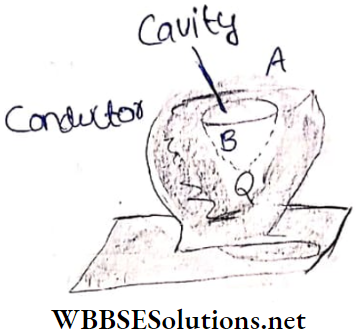
Electric Potential Multiple Choice Question and answes Q 24

  1. Electric field near A = Electric field near B
  2. Potential at A = potential at B
  3. The total electric flux through the entire surface of the cavity \(\frac{Q}{\epsilon_0}\)
  4. Charge density at A = charge density at B

Answer:

2. Potential at A = potential at B

3. Total electric flux through the entire surface of the cavity \(\frac{Q}{\epsilon_0}\)

Question 12. A conductor A is given a charge of around +Q and then placed inside a deep metal can B, without touching it.
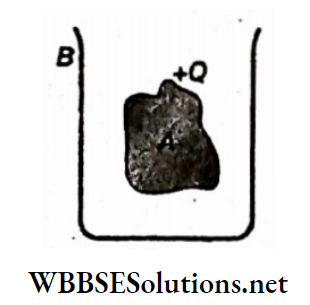
Class 12 Physics Unit 1 Electrostatics Chapter 3 Electric Potential Multiple Choice Question and answes Q 26

  1. The potential of A does not change when it is dipped inside B.
  2. If B is earthed, +Q amount of charge flows from it to the earth
  3. If B is earthed, the potential of A is reduced
  4. Either 2 or 3 is, true or both are true only if the outer surface of B is connected to the media. i surface

Answer:

1. The potential of A does not change when it is dipped inside B.

2. If B is earthed, +Q amount of charge flows from it to the earth

3. If B is earthed, the potential of A is reduced

Electric potential class 12 MCQs

Question 13. For a spherical symmetrical charge distribution, variation of electric potential with distance from the centre Is given in the diagram. Given that \(V = \frac{1}{4 \pi \epsilon_0} \frac{q}{R_0} ; \text { for } r ≤ R_0 \text { and } V=\frac{1}{4 \pi \epsilon_0} \frac{q}{r}\) r ≥ R0. Choose the correct options.
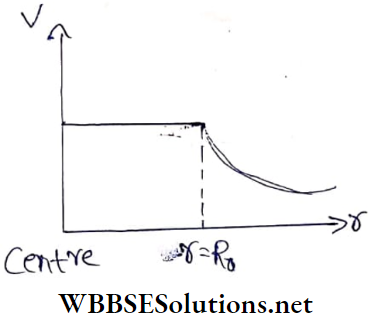
Electric Potential Multiple Choice Question and answes 27

  1. The total charge within 2R0 is q
  2. Total electrostatic energy for r≤R0 is zero
  3. At r = R0 electric field is discontinuous
  4. There will be no charge anywhere except at r = R0

Answer:

1. Total charge within 2R0 is q

2. Total electrostatic energy for r≤R0 is zero

3. At r = R0 electric field is discontinuous

4. There will be no charge anywhere except at r = R0

Class 11 Physics Class 12 Maths Class 11 Chemistry
NEET Foundation Class 12 Physics NEET Physics

Electric Potential Practice MCQs for Students

Question 14. An elliptical cavity is carved within a perfect conductor. A positive charge q is placed at the centre of the cavity. Points A and B are on the cavity surface. Then,
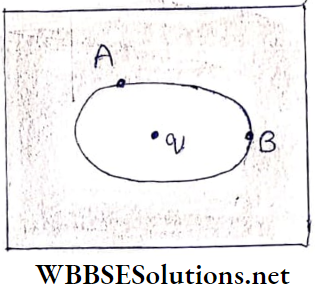
Electric Potential Multiple Choice Question and answes Q 28

  1. The electric field near A in the cavity = electric field near B In the cavity
  2. Charge density at A = charge density at B
  3. Potential at A = potential at B
  4. The total electric flux through the surface of the cavity is \(\frac{q}{\epsilon_0}\)

Answer:

3. Potential at A = potential at B

4. Total electric flux through the surface of the cavity is \(\frac{q}{\epsilon_0}\)

Question 15. Four charges, all of the same magnitude, are placed at the four corners of a square. At the centre of the square, the potential is V and the field is E. Which of the following is possible?

  1. V = 0, E = 0
  2. V= 0, E ≠ O
  3. V ≠ 0, F = 0
  4. V ≠ 0, E ≠ 0

Answer:

1. V = 0, E = 0

2. V= 0, E ≠ O

3. V ≠ 0, F = 0

4. V ≠ 0, E ≠ 0

Electric potential class 12 MCQs

Question 16. Which of the following statement (s) is/are correct?

  1. If the electric Hold duo lo a point charge varies aa r-2.5 Instead of r-2, then Gatins’ law will still ho valid
  2. Gatina’s law can ho linked to calculating holding around an electric dipole
  3. If the electric field at some point between two points charges In zero, then the algo of two charged la the name
  4. The work done by the external force In moving a unit positive charge from point A at potential VA to point B at potential VB is (VB– VA)

Answer:

3. If the electric field at some point between two points charges In zero, then the algo of two charged la the name

4. The work done by the external force In moving a unit positive charge from point A at potential VA to point B at potential VB is (VB – VA)

Question 17. Six-point charges are kept at the vertices of a regular hexagon of side L, and center O. Given that \(K=\frac{1}{4 \pi \epsilon_0} \frac{q}{L^2}\). Which of the following statements is correct?
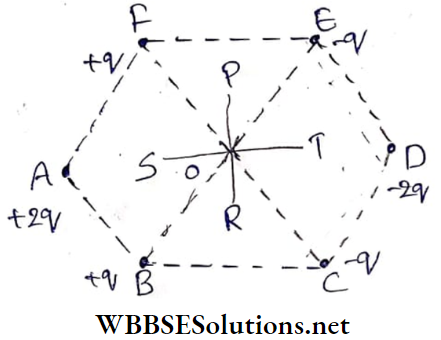
Electric Potential Multiple Choice Question and answes Q 31

  1. The electric field at O is 6K along OD
  2. Potential at O Is zero
  3. Potential at all points on the line PR Is the same
  4. Potential at all points on the Lino ST Is the same

Answer:

1. Electric field at O is 6K along OD

2. Potential at O Is zero

3. Potential at all points on the line PR Is the same

Question 18. Some of the field lines correspond to an electric field. If E = electric field and V = potential, then
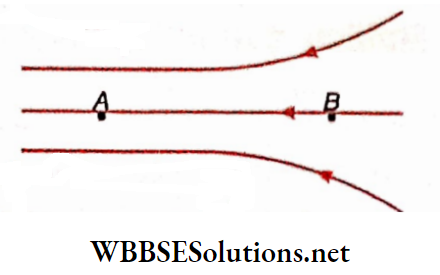
Class 12 Physics Unit 1 Electrostatics Chapter 3 Electric Potential Multiple Choice Question and answes Q 32

  1. EA > EB
  2. BA < EB
  3. VA > VB
  4. VA < VB

Answer:

1. EA > EB

4. VA < VB

Question 19. The number of statvolt corresponding to 1 volt is

  1. \(\frac{1}{100}\)
  2. 109
  3. \(\frac{1}{300}\)
  4. 300

Answer: 3. \(\frac{1}{300}\)

Question 20. 1V m-1 =?

  1. 1N.C-1
  2. 3 x 10¹⁰ N.C-1
  3. 107N.C-1
  4. 1010 N.C-1

Answer: 1. 1N.C-1

Question 21. When a body is connected to the earth, electrons flow from the earth to the body. The body is

  1. Negatively charged
  2. Insulator
  3. Uncharged
  4. Positively charged

Answer: 4. Positively charged

Electric potential class 12 MCQs

Question 22. In a uniform electric field of intensity E, a small charge q is carried once along the elliptical path ABCD. The amount of work in the paths AB, BC, CD and DA are respectively W1, W2, W3, W4, then
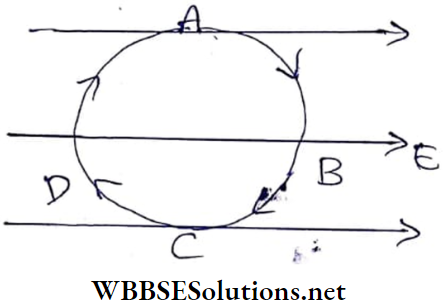
Electric Potential Multiple Choice Question and answes Q 4

  1. W1 = W2 = W3 = W4 ≠ 0
  2. W1 = W2 = W3 = W2 = 0
  3. W1 + W2 + W3 + 4 = 0
  4. W1 = W2+ W3-W4 = 0

Answer: 3. W1 + W2 + W3 + W4 = 0

Electric Potential Revision MCQs for Class 12

Question 23. Four point changes each + q is placed on the circumference of a circle of diameter 2d in such a way that they form a square. The potential at the centre of the circle (in CGS) is

  1. 0
  2. \(\frac{4q}{d}\)
  3. \(\frac{4d}{q}\)
  4. \(\frac{q}{4d}\)

Answer: 2. \(\frac{4q}{d}\)

Question 24. Work done in taking a point charge from P to A is WA, from P to B is WB and from P to C is WC. Which of the following options is correct?
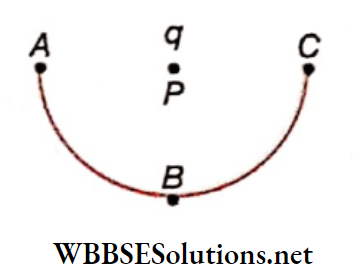
Class 12 Physics Unit 1 Electrostatics Chapter 3 Electric Potential Multiple Choice Question and answes Q 6

  1. WA < WB < WC
  2. WA>WB>WC
  3. WA = WB = WC
  4. None Of These

Answer: 3. WA = WB = WC

Question 25. The radius of a soap bubble whose potential is 16 V is doubled. The new potential of the bubble is

  1. 2 V
  2. 4 V
  3. 8 V
  4. 16 V

Answer: 3. 8 V

Question 26. Four electric charges +q, +q,- q, and- q are placed at the corners of a square of side 2L. The electric potential at point A midway between the two charges + q and +q is
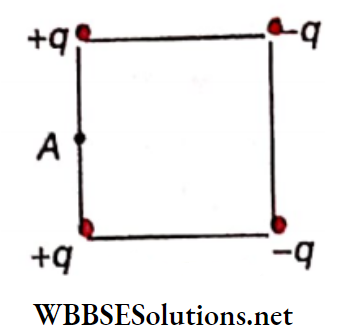
Class 12 Physics Unit 1 Electrostatics Chapter 3 Electric Potential Multiple Choice Question and answes Q 8

  1. \(\frac{1}{4 \pi \epsilon_0} \frac{2 q}{L}(1+\sqrt{5})\)
  2. \(\frac{1}{4 \pi \epsilon_0} \frac{2 q}{L}\left(1+\frac{1}{\sqrt{5}}\right)\)
  3. \(\frac{1}{4 \pi \epsilon_0} \frac{2 q}{L}\left(1-\frac{1}{\sqrt{5}}\right)\)
  4. Zero

Answer: 3. \(\frac{1}{4 \pi \epsilon_0} \frac{2 q}{L}\left(1-\frac{1}{\sqrt{5}}\right)\)

Question 27. A charge Q is placed at the center of the circle ABCDE. Work done to bring another charge q from A to B, C, D, and E is
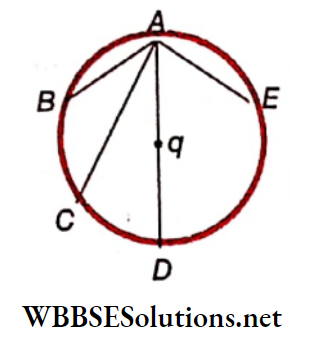
Class 12 Physics Unit 1 Electrostatics Chapter 3 Electric Potential Multiple Choice Question and answes Q 9

  1. Minimum along the path AB
  2. Maximum along the path AD
  3. Zero along each of the paths AB, AC, AD, AE
  4. Positive but equal along all the paths

Answer: 3. Zero along each of the paths AB, AC, AD, AE

Electric potential class 12 MCQs

Question 28. Work done to carry a charge q once along the circular path of radius r with charge q’ at its centre, will be

  1. 0
  2. \(\frac{q q^{\prime}}{4 \pi \epsilon_0}\left(\frac{1}{\pi r}\right)\)
  3. \(\frac{q q^{\prime}}{4 \pi \epsilon_0}\left(\frac{1}{2 \pi r}\right)\)
  4. \(\frac{q q^{\prime}}{4 \pi \epsilon_0 r}\)

Answer: 1. \(\frac{q q^{\prime}}{4 \pi \epsilon_0}\left(\frac{1}{\pi r}\right)\)

Question 29. There is a uniform electric field of intensity E. How many labelled points do have the same potential as the fully shaded point? ‘
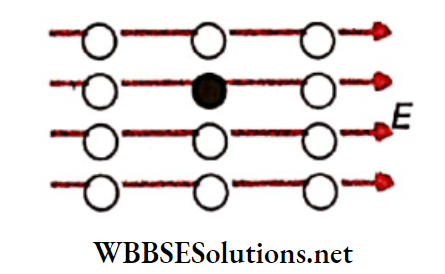
Class 12 Physics Unit 1 Electrostatics Chapter 3 Electric Potential Multiple Choice Question and answes Q 11

  1. 2
  2. 3
  3. 8
  4. 11

Answer: 2. 3

Question 30. If a charge is displaced against the Coulomb force in an electric field

  1. Work is flooded by the electrical force
  2. Work is done by an electric agency
  3. The energy of the electric, field decreases
  4. The energy of the system decreases

Answer: 2. Work is done by an electric agency

Question 31. Three point charges each equal to q are placed on the vertices of an equilateral triangle of side 1. The potential energy of the system is

  1. \(\frac{1}{4 \pi \epsilon_0} \cdot \frac{q^2}{l}\)
  2. \(\frac{1}{4 \pi \epsilon_0} \cdot \frac{2 q^2}{l}\)
  3. \(\frac{1}{4 \pi \epsilon_0} \cdot \frac{3 q^2}{l}\)
  4. \(\frac{1}{4 \pi \epsilon_0} \cdot \frac{4 q^2}{l}\)

Answer: 3. \(\frac{1}{4 \pi \epsilon_0} \cdot \frac{3 q^2}{l}\)

Question 32. There is a charge of 10μC at the centre of a circle of radius 10 m. The work done in moving a unit positive charge once around the circle is

  1. 0
  2. 100 J
  3. 10 J
  4. 150 J

Answer: 1. 0

Class 12 physics electric potential questions 

Question 33. An electron of mass m and charge e is accelerated from rest through a potential difference V in a vacuum. Its final speed will be

  1. \(\sqrt{\frac{2 e V}{m}}\)
  2. \(\sqrt{\frac{2 V}{m}}\)
  3. \(\frac{e V}{m}\)
  4. \(\frac{e V}{2m}\)

Answer: 1. \(\sqrt{\frac{2 e V}{m}}\)

Question 34. The radius of a charged hollow metal sphere is 5 cm and its surface potential is 10 V. Potential at its centre is

  1. 0
  2. 10V
  3. Equal to the potential at k distance 5 cm away from its surface
  4. Equal to the potential at a distance 25 cm away from its surface

Answer: 2. 10V

Question 35. The variation of electric potential with distance from a fixed point. What is the value of electric field intensity at x = 2 m?
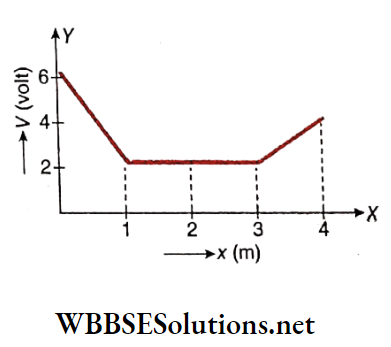
Class 12 Physics Unit 1 Electrostatics Chapter 3 Electric Potential Multiple Choice Question and answes Q 17

  1. 0
  2. 3 V.m-1
  3. 6 V.m-1
  4. 2 V.m-1

Answer: 2. 6 V.m-1

Question 36. If the equation of electric field is \(\vec{E}=(y \hat{i}+x \hat{j})\), then the equation of electric potential is represented by

  1. V = -(x + y) + constant
  2. V = constant
  3. V = -(x² + y²) + constant
  4. V = – xy + constant

Answer: 4. V = – xy + constant

Question 37. A charge of 3C experiences a force of 3000 N in a uniform electric field. The potential difference between two points situated 1 cm apart along the electric lines of force will be

  1. 300 V
  2. 100 V
  3. 30 V
  4. 10 V

Answer: 4. 10V

Class 12 physics electric potential questions 

Question 38. The electric potential V at any point (x, y, z) all in metres in space is given by V = 4 x 2V. The electric field at the point (1, 0, 2) in V.m-1 is

  1. 8 along the negative X-axis
  2. 8 along the positive X-axis
  3. 16 along the negative X-axis
  4. 16 along the positive X-axis

Answer: 1. 8 along the negative X-axis

Question 39. Two points A and B are 2 cm apart and a uniform electric field 1? acts along the straight line AB directed from A to B with E = 200 N.C-1. A particle of charge +10-6C is taken from A to B along AB.

1. The force on the charge is

  1. 2 x 10⁻⁴ N
  2. 3N
  3. 2N
  4. 2x 10⁻² N

Answer: 1. 2 x 10⁻⁴ N

2. The potential difference between A and B is

  1. 4 x 10⁻⁶ V
  2. 1 V
  3. 4V
  4. 2 V

Answer: 3. 4V

3. The work done on the charge by \(\vec{E}\) is

  1. 4J
  2. 1 x 10⁻⁶ J
  3. 2 x 10⁻⁶ J
  4. 4 x 10⁻⁶ J

Answer: 4. 4 x 10⁻⁶ J

Question 40. Two point charges q1 = 10 x 10-6C and q2 = -2 X 10⁻⁸C are separated by a distance of 6 cm in air.

1. The distance from q1 of the point of zero electric potential is

  1. 5 cm
  2. 2.5 cm
  3. 8 cm
  4. 10 cm

Answer: 1. 5 cm

2. The electrostatic potential energy of the system is

  1. 15 X 10-3J
  2. 24 x 10-4 J
  3. 18 X 10-3 J
  4. -18 X 10-4 J

Answer: 4. -18 X 10-4 J

WBCHSE Physics Electric Potential Question Bank

Question 41. A positively charged oil drop is in equilibrium in the electric field existing in the space between two horizontal plates separated by a distance of 1 cm. The charge of the oil drop is 3.2 x 10⁻¹⁹C and its mass is 10-17 g.

1. The potential difference between the plates is

  1. 1020 V
  2. 1531 V
  3. 3062 V
  4. 2454 V

Answer: 3. 3062 V

2. The instantaneous acceleration of the oil drop, when the polarity of the two plates is reversed, is

  1. 24.54 m.s-2
  2. 19.60 m s-2
  3. 29.70 m s-2
  4. 34.52 m.s-2

Answer: 2. 19.60 m.s-2

Question 42. Each of the two concentric spheres of radii 5 cm and 10 cm are given a charge of 10μC.

1. The electric potential at a point situated at a distance of 2.5 cm from the centre is

  1. 27 x 105 V
  2. 0V
  3. 16.5 x 10⁵ V
  4. 24.2 X 10⁴ V

Answer: 1. 27 x 105 V

2. The electric potential at a point situated at a distance of 8 cm from the centre is

  1. 10.52 X 10⁴V
  2. 20.25 x 10⁵ V
  3. 32.24 X 10⁵ V
  4. 42.28 X 10⁵V

Answer: 2. 20.25 x 10⁵ V

3. The electric potential at a point situated at a distance of 20 cm from the centre is

  1. 4 x 10⁵ V
  2. 32 x 104 V
  3. 9 X 10⁵ V
  4. 16 X 105 V

Answer: 3. 9 X 10⁵ V

Question 43. The plot of the x component of the electric field as a function of x in a certain region. The y and z components of the electric field are zero in this region. The electric potential at the origin is 10 V
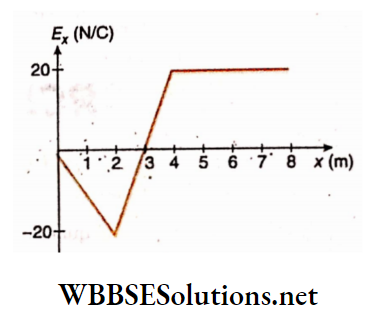
Class 12 Physics Unit 1 Electrostatics Chapter 3 Electric Potential Multiple Choice Question and answes Q 37

1. Electric potential at x = 2 m is

  1. 10V
  2. 20V
  3. 30V
  4. 40V

Answer: 3. 30V

2. The greatest positive value of electric potential for any point in the region 0 ≤ x ≤ 6 m on the x-axis is

  1. 10V
  2. 20V
  3. 30V
  4. 40V

Answer: 4. 40V

3. The value of x for which potential is zero is

  1. 2m
  2. 3m
  3. 4m
  4. 5.5 m

Answer: 4. 5.5 m

Question 44. 64 tiny drops of water having the same radius and same charge are combined to form one large drop. The ratio of the potential of the large drop to the small drop is

  1. 4:1
  2. 1:4
  3. 16:1
  4. 1:16

Answer: 3. 16:1

Potential of one tiny drop, \(V_1=\frac{1}{4 \pi \epsilon_0} \frac{q}{r}\)

Now, a charge of the large water drop = 64q

The ratio of the volume of the tiny water drop to the volume of the large water drop = 1: 64

Then, ratio of their radii = \(1: \sqrt[3]{64}\)

= 1: 4

∴ The potential of the large water drop

⇒ \(V_2=\frac{1}{4 \pi \epsilon_0} \frac{64 q}{4 r}=16 V_1\)

i.e., \(\frac{V_2}{V_1}=\frac{16}{1}\)

= 16: 1

The option 3 is correct

WBCHSE physics electric potential MCQs 

Question 45. An infinite sheet carrying a uniform surface charge density σ lies on the xy-plane. The work done to carry a charge q from point \(\vec{A}=a(\hat{i}+2 \hat{j}+3 \hat{k})\) to the point \(\vec{B}=a(\hat{i}-2 \hat{j}+6 \hat{k})\)(where a is a constant with the dimension of length and ∈0 is the permittivity of free space) is

  1. \(\frac{3 \sigma a q}{2 \epsilon_0}\)
  2. \(\frac{2 \sigma a q}{\epsilon_0}\)
  3. \(\frac{5 \sigma a q}{2 \epsilon_0}\)
  4. \(\frac{3 \sigma a q}{\epsilon_0}\)

Answer: 1. \(\frac{3 \sigma a q}{2 \epsilon_0}\)

Distance between the points, \(\vec{r}=\vec{B}-\vec{A}=a(-4 \hat{j}+3 \hat{k})\)

Field intensity at a point due to an infinite sheet carrying a uniform surface charge density cr lies on the xy-plane,

⇒ \(\vec{E}=\frac{\sigma}{2 \epsilon_0} \hat{k}\)

∴ Electric force acting on the charge q, \(q, \vec{F}=q \vec{E}=\frac{q \sigma}{2 \epsilon_0} \hat{k}\)

∴ Work done, \(W=\vec{F} \cdot \vec{r}=\frac{q \sigma}{2 \epsilon_0} \hat{k} \cdot a(-4 \hat{j}+3 \hat{k})\)

= \(\frac{3 q \sigma a}{2 \epsilon_0}\)

The option 1 is correct

Question 46. The angle between an equipotential surface and electric lines of force is

  1. 90°
  2. 180°
  3. 270°

Answer: 2. 90°

The option 2 is correct.

Question 47. A point charge -q is carried from point A to point B on the axis of a charged ring of radius r carrying a charge +q. If point A is at a distance|r from the centre of the ring and point B is|r from the centre but on the opposite side, what is the network that needs to be done for this?

  1. \(-\frac{7}{5} \frac{q^2}{4 \pi \epsilon_0 r}\)
  2. \(-\frac{1}{5} \frac{q^2}{4 \pi \epsilon_0 r}\)
  3. \(\frac{7}{5} \frac{q^2}{4 \pi \epsilon_0 r}\)
  4. \(\frac{1}{5} \frac{q^2}{4 \pi \epsilon_0 r}\)

Answer: 2. \(-\frac{1}{5} \frac{q^2}{4 \pi \epsilon_0 r}\)

Net work done (W) = electric potential energy at point B – electric potential energy at point A
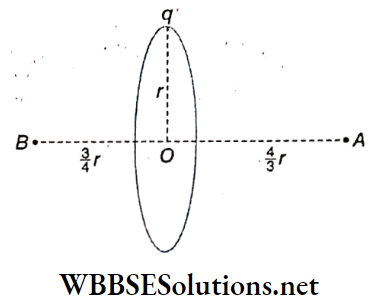
Class 12 Physics Unit 1 Electrostatics Chapter 3 Electric Potential charged ring of radius

or, \(W=\frac{1}{4 \pi \epsilon_0} \cdot \frac{(+q)(-q)}{\sqrt{r^2+\left(\frac{3}{4} r\right)^2}}-\frac{1}{4 \pi \epsilon_0} \cdot \frac{(+q)(-q)}{\sqrt{r^2+\left(\frac{4}{3} r\right)^2}}\)

⇒ \(-\frac{1}{5} \cdot \frac{q^2}{4 \pi \epsilon_0 r}\)

The option 2 is correct.

Question 48. Two positive charges Q and 4Q are placed at points A and B respectively, where B is at a distance of d units to the right of A. The total electric potential due to these charges is minimum at P on the line through A and B. What is (are) the distance(s) of P from A?

  1. \(\frac{d}{3}\) units to the right of A
  2. \(\frac{d}{3}\) units to the left of A
  3. \(\frac{d}{5}\) units to the right of A
  4. d units to the left of A

Answer: 1. \(\frac{d}{3}\) units to the right of A

Let a unit positive charge be placed at point P between points A and B and at a distance x from A
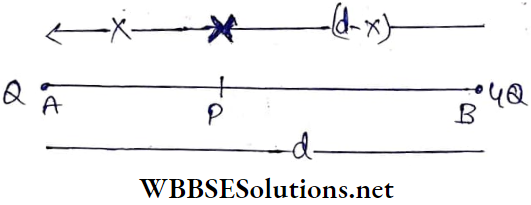
Electric Potential Equipotential The total electric potential

Total potential at point P due to charges Q and 4Q,

⇒ \(V=\frac{Q}{x}+\frac{4 Q}{(d-x)}\)

For the potential to be minimum at point P

⇒ \(\frac{d V}{d x}=0 \quad\)

or, \(\frac{d}{d x}\left[\frac{Q}{x}+\frac{4 Q}{d-x}\right]=0 \quad\)

or, \(x=\frac{d}{3}\)

∴ The electric potential is minimum at a distance \(\frac{d}{3}\) from point A on its right.

The option 1 is correct.

Question 49. Assume that an electric field \(\vec{E}=30 x^2 \hat{i}\) exists in space. Then the potential difference VA– VO, where VO is the potential at the origin and VA the potential at x – 2 m is

  1. 80 J
  2. 120 J
  3. -120 J
  4. -80 J

Answer: 4. -80 J

We know, \(\vec{E}=-\frac{d V}{d x} \hat{i} \quad\)

or, \(\int_{V_O}^{V_A} d V=-\int_0^2 30 x^2 d x\)

∴ \(V_A-V_O=-30\left[\frac{x^3}{3}\right]_0^2\)

= -80 J

The option 4 is correct.

Electric Potential Assessment Questions for Class 12

Question 50. A uniformly charged solid sphere of radius R has potential VO (measured with respect to ∞ ) on its surface. For this sphere the equipotential surfaces with potentials \(\frac{3 V_0}{2}\), \(\frac{5 V_0}{4}, \frac{3 V_0}{4} \text { and } \frac{V_0}{4}\) have radius R1, R2, R3 and R4 respectively. Then

  1. R1= 0 and R2 > (R4– R3)
  2. R1 ≠ 0 and (R2-R1)>(R4-R3)
  3. R1 = 0 and R2 < (R4– R3)
  4. 2R < R4

Answer: 3. R1 = 0 and R2 < (R4– R3)

⇒ \(V_0=\frac{1}{4 \pi \epsilon_0} \frac{q}{R}\) [q = charge of tire sphere]

Now, \(\frac{3 V_0}{4}, \frac{V_0}{4}<V_0\)

So, these equipotential surfaces will be situated outside the sphere

⇒ \(R_3, R_4>R\)

In that case,

⇒ \(\frac{3 V_0}{4}=\frac{1}{4 \pi \epsilon_0} \frac{q}{R_3} \quad\)

or, \(\frac{3}{4} \frac{1}{4 \pi \epsilon_0} \frac{q}{R}=\frac{1}{4 \pi \epsilon_0} \frac{q}{R_3}\)

i,e., \(R_3=\frac{4}{3} R\)

Againg \(\frac{V_0}{4}=\frac{1}{4} \frac{1}{4 \pi \epsilon_0} \frac{q}{R}\)

= \(\frac{1}{4 \pi \epsilon_0} \frac{q}{R_4} \quad\)

i.e., \(R_4=4 R\)

∴ \(R_4-R_3=\frac{8}{3} R\)

On the other hand, \(\frac{3 V_0}{2}, \frac{5 V_0}{4}>V_0\); these equipotential surfaces are situated inside the sphere R1, R2<R. Potential at any point inside the sphere at a distance r(r<R) from the center of the sphere,

⇒ \(V=\frac{1}{4 \pi \epsilon_0} \frac{q}{2 R^3}\left(3 R^2-r^2\right)\)

= \(\frac{V_0}{2 R^2}\left(3 R^2-r^2\right)\)

∴ In the first case,

⇒ \(\frac{3}{2} V_0=\frac{V_0}{2 R^2}\left(3 R^2-R_1^2\right) \quad \text { or, } R_1=0\)

In the second case,

⇒ \(\frac{5}{4} V_0=\frac{V_0}{2 R^2}\left(3 R^2-R_2^2\right) \quad \text { or, } R_2=\frac{1}{\sqrt{2}} R\)

The option 3 is correct.

Question 51. Three concentric metal shells A, B and C of respective radii a, b and c (a<b<c) have surface charge densities +σ, -σ and +σ respectively. The potential of shell B is

  1. \(\frac{\sigma}{\epsilon_0}\left[\frac{b^2-c^2}{b}+a\right]\)
  2. \(\frac{\sigma}{\epsilon_0}\left[\frac{b^2-c^2}{c}+a\right]\)
  3. \(\frac{\sigma}{\epsilon_0}\left[\frac{a^2-b^2}{a}+c\right]\)
  4. \(\frac{\sigma}{\epsilon_0}\left[\frac{a^2-b^2}{b}+c\right]\)

Answer: 4. \(\frac{\sigma}{\epsilon_0}\left[\frac{a^2-b^2}{b}+c\right]\)
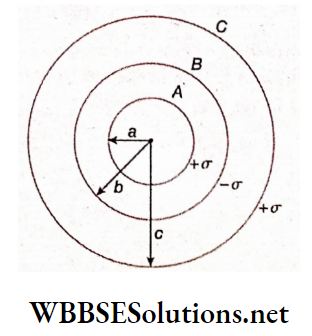
Class 12 Physics Unit 1 Electrostatics Chapter 3 Electric Potential Three concentric metal shells

The potential of shell B,

⇒ \(V_B=\frac{1}{4 \pi \epsilon_0}\left[\frac{(+\sigma) 4 \pi a^2}{b}+\frac{(-\sigma) 4 \pi b^2}{b}+\frac{(+\sigma) 4 \pi c^2}{c}\right]\)

⇒ \(\frac{\sigma}{\epsilon_0}\left[\frac{a^2-b^2}{b}+c\right]\)

The option 4 is correct.

Question 52. A conducting sphere of radius R is given a charge Q . The electric potential and the electric field at the centre of the sphere respectively are

  1. \(\text { zero and } \frac{Q}{4 \pi \epsilon_0 R^2}\)
  2. \(\frac{Q}{4 \pi \epsilon_0 R} \text { and zero }\)
  3. \(\frac{Q}{4 \pi \epsilon_0 R} \text { and } \frac{Q}{4 \pi \epsilon_0 R^2}\)
  4. Both are Zreo

Answer: 2. \(\frac{Q}{4 \pi \epsilon_0 R} \text { and zero }\)

WBCHSE physics electric potential MCQs 

Question 53. In a region, the potential is represented by V(x, y, z) = 6x-8xy-8y+6yz where V is in volts and x, y, z are in metres. The electric force experienced by a charge of 2 coulomb situated at point (1, 1, 1) is

  1. 6√5N
  2. 30 N
  3. 24 N
  4. 4√35N

Answer: 4. 4√35N

We know,

⇒ \(\vec{E}=E_x \hat{i}+E_y \hat{j}+E_z \hat{k}\)

= \(-\frac{d V}{d x} \hat{i}-\frac{d V}{d y} \hat{j}-\frac{d V}{d z} \hat{k}\)

Now, V(x, y,z) = 6x – 8xy – 8y + 6yz

∴ \(\frac{d V}{d x}=6-8 y ; \frac{d V}{d y}=-8 x-8+6 z ; \frac{d V}{d y}=6 y\)

∴ \(\vec{E}=-(6-8 y) \hat{i}-(-8 x-8+6 z) \hat{j}-6 y \hat{k}\)

∴ Electric field at point (1, 1, 1),

⇒ \(\vec{E}=-(6-8 \times 1) \hat{i}-(-8 \times 1-8+6 \times 1) \hat{j}-(6 \times 1) \hat{k}\)

⇒ \(2 \hat{i}+10 \hat{j}-6 \hat{k}\)

⇒ \(E=\sqrt{2^2+10^2+(-6)^2}=\sqrt{140}=2 \sqrt{35}\)

∴ Force acting on charge 2 C,

F = qE

= 2 x 2√35

= 4√35 N

The option 4 is correct

Question 54. A molecule of a substance has permanent dipole moment p. A mole of this substance is polarised by applying a strong electrostatic field E. The direction of the field is suddenly changed by an angle of 60°. If (V is Avogadro’s number the amount of work done by the field is

  1. 2NpE
  2. \(\frac{1}{2}\)
  3. NpE
  4. \(\frac{3}{2}\)

Answer: 2. \(\frac{1}{2}\)

The potential energy of electric dipole (\(\vec{p}\)) in an electric field \((\vec{E})=-\vec{p} \cdot \vec{E}=-p E \cos \theta\)

So, the work done by the field on N molecules

= change in potential energy

= -NpE( cos60°- cosθ°) = \(\frac{1}{2}\) NpE

The option 2 is correct.

WBCHSE Class 12 Physics Electric Potential  Long Question and Answers

Unit 1 Electrostatics Chapter 3 Electric Potential Long Question and Answers

Question 1. If the intensity at a point in an electric field is zero, will the electric potential be also zero at that point? If the electric potential be zero at a point, will the Intensity be also zero at that point?
Answer:

If the intensity of the electric field is E and the potential is V, then the relation between them is, E = – \(\frac{dV}{dx}\)

So, if E = 0 at any point, we have \(\frac{dV}{dx}\)= 0 or, V = constant.

Thus, the potential has a constant value, not necessarily zero, around that point. Now, for example, we consider an electric dipole (q,-q) placed at AB along the x-axis.

The variation of the potential V with the dis- Answer: We know that charges of a conductor reside on its outer stance x is shown in the figure. At the surface.

Placing the smaller conductor inside the bigger one and mid-point O, clearly, V = 0; but the connecting them with a wire, we can prepare a single conductor.

The slope of the V-x curve is not zero, i.e., \(\frac{dV}{dx}\) not = 0. As E = – \(\frac{dV}{dx}\), we Thus charge from the smaller conductor will then flow to the can conclude that E not = 0 at O.

Therefore, if the potential is zero at a point, but it is not a constant in the immediate neighbourhood of that point, the electric field intensity is non-zero there.

Read And Learn More WBCHSE Class 12 Physics Long Question And Answers

In particular, the potential due to a dipole at any point on the perpendicular bisector is zero, but the field at that point is certainly non-zero being directed opposite to the direction of the dipole moment.

Class 12 Physics Unit 1 Electrostatics Chapter 3 Electric Potential Question 1 intensity ofthe electric field

Question 2. Two hollow conductors are charged positively. The potential of the smaller conductor is 50 V and that of the larger conductor is 100 V. How are these two conductors to be placed so that when connected by a wire, charges will flow from the smaller conductor to the larger one?
Answer:

Two hollow conductors are charged positively. The potential of the smaller conductor is 50 V and that of the larger conductor is 100 V.

We know that the charges of a conductor reside on its outer surface. Placing the smaller conductor inside the bigger one and connecting them with a wire, we can prepare a single conductor. Thus charges from the smaller conductor will then flow to the outer surface of the larger one.

Question 3. Explain the variations of potential and field Intensity with distance due to a hollow charged spherical conductor (radius a and charge q ), both inside and outside the sphere, with a graph.
Answer:

Electric potential: Potential at all points inside a hollow charged spherical conductor and on its surface are equal. Here this potential is, V = ⇒ \(\frac{q}{a}\). So, from the centre to the surface of the tire conductor, the potential is constant and it has been shown by the line AB, parallel to the x-axis.

If the distance of an external point from the centre of the conductor be r, then electric potential at that point is given by, So as r increases, V decreases. This decrease has been shown by the curved line BC. The inverse variation is illustrated by the moderate slope of the curve.

Electric intensity: As the potential at all points inside a hollow charged spherical conductor is constant, intensity at those points, i.e., inside the hollow spherical conductor is zero.

As the radius of the conductor is an intensity at a point on its surface, \(E=\frac{q}{a^2}\). If r is the distance of an external point from the centre of the sphere, the intensity at that point will be \(E=\frac{q}{a^2}\)

Class 12 Physics Unit 1 Electrostatics Chapter 3 Electric Potential Question 2 Electric intensity

So, intensity on the surface of the conductor is maximum and it decreases as we move away from the conductor. This variation has been shown by the curved line AB.

The inverse square variation has been shown by the steeper slope, as compared to the V-r curve.

Electric Potential Theory Long Questions WBCHSE

Question 4. The potential difference between two conductors is very large. What will happen under the following three conditions?

  1. The conductors are connected by a metallic wire,
  2. Both positive and negative ions are present in the air medium in between the conductors,
  3. The conductors are placed in a vacuum.

Answer:

1. Charge will continue to flow till the potentials of the two conductors become equal.

2. Positive ions will move to the conductor having lower potential and negative ions will move to the conductor having higher potential.

3. Charges on the conductors will not move and the potential difference between them will be maintained.

Question 5. Give an Example of a line In the electric field of an electric dipole along which a positive charge may be moved without any work being done.
Answer:

There are numerous equipotential surfaces in the electric field of a dipole. Any movement of a charge, on any of these surfaces, would involve no work. For Example, the plane perpendicular to the dipole and passing through its mid-point is an equipotential, actually zero-potential surface. So if a positive charge is moved along any line on this plane, no work is to be done.

WBCHSE Class 12 Physics Electric Potential Long Question And Answers

Electric Potential Long Answer Questions WBCHSE

Question 6. Can two different equipotential surfaces intersect each other?
Answer:

If two different equipotential surfaces intersected each other, the potential would have two different values at the point of intersection. Moreover, there would be two normals on the two surfaces at the point of intersection. That would mean two elec-/ trie fields in two different directions at the same point. These situations are absurd. So two different equipotential surfaces cannot intersect each other.

So, the intensity on the surface of the conductor is maximum and it decreases as we move away from the conductor. This variation has been shown by the curved line AB. The inverse square variation has been shown by the steeper slope, as compared to the V-r curve.

Question 7. Two pairs of planes A, B and A’, B’ are kept in two uniform electric fields. The potential dx difference between the planes In the two cases are equal. Which pair of planes Is situated in a stronger electric field?

Electric Potential Potential difference between the planes in the two cases are equal

Answer:

Since E = – \(\frac{dV}{dx}\); therefore, dx = – \(\frac{dV}{E}\)

So it is seen that dx will be smaller if E is stronger.

Therefore, planes A and B are in a stronger electric field.

Question 8. A positively charged and a negatively charged body are connected to the earth separately. What will be their potential before and after the connection?
Answer:

A positively charged and a negatively charged body are connected to the earth separately.

Before connection with the earth, the positively charged body will have positive potential and the negatively charged body will have negative potential. But after connection with the earth both the bodies will have zero potential.

Question 9. When the body Is connected with the earth, electrons are found to move from the earth to the body. What Is Your Idea about the nature of the charge of the body?
Answer:

When the body Is connected with the earth, electrons are found to move from the earth to the body.

Since electrons are moving from the earth to the body, Its potential Is positive. As the body has positive potential, it Is positively charged.

Question 10. In a vacuum, equal charges of the same nature are placed at the vertices of an equilateral triangle. What will be the electric field Intensity and potential at the centroid of the triangle
Answer:

In a vacuum, equal charges of the same nature are placed at the vertices of an equilateral triangle.

Let three charges, each equal to +q, be placed at the vertices of the equilateral triangle. The length of the side of the triangle is r.

We know that the centroid of the triangle G divides the median of the n triangle In (the ratio 2:1).

Height of the equilateral triangle

⇒ \(\frac{\sqrt{3}}{2} r\)

So, the potential at G Is,

⇒ \(V=\frac{q}{4 \pi \epsilon_0\left(\frac{2}{3} \cdot \frac{\sqrt{3} r}{2}\right)} \times 3\)

= \(\frac{3 q}{4 \pi \epsilon_0 \cdot \frac{r}{\sqrt{3}}}\)

= \(\frac{1}{4 \pi \epsilon_0} \frac{3 \sqrt{3} q}{r}\)

If E be the electric field intensity at G due to each charge +q (HI and if they are resolved into two perpendicular components, we see that the two components, ‘Ecos30° are equal and opposite balance each other.

Again 2sin30° \(\left(=\frac{2 E}{2}=E\right)\) and F being equal and opposite, balance each other. So the electric field Intensity at the centroid of the angle is zero.

Class 12 Physics Unit 1 Electrostatics Chapter 3 Electric Potential Question 10 the electric field Intensity and potential

In-depth Questions on Electric Potential for Class 12

Class 11 Physics Class 12 Maths Class 11 Chemistry
NEET Foundation Class 12 Physics NEET Physics

Question 11. Draw three equipotential surfaces corresponding to a field that uniformly Increases In magnitude but remains constant along the z-direction. How are these surfaces different from those of u constant electric field along the z-direction?
Answer:

The separation between the equipotential surfaces will gradually decrease along the direction of the Increment of the electric field (in this case z-axis).

In the case of a constant uniform electric field, the equipotential surfaces are equally spaced.

Class 12 Physics Unit 1 Electrostatics Chapter 3 Electric Potential Question 11 three equlpotential surfaces corresponding

Question 12. A unit positive charge is moving along PQR in an electric field of intensity E. What is the potential difference between the points P and R?

Electric Potential electric field intensity

Answer:

A unit positive charge is moving along PQR in an electric field of intensity E.

The work done to move a test charge from one point to another is Independent of the path followed.

⇒ \(V_{P R}=W_{P R}=-\int \vec{E} \cdot d \vec{l}=-\int_P^R E d l \cos 180^{\circ}\)

or, VVR = Er

i.e., the potential difference is r times of the electric field intensity.

Question 13. The variation of electric potential V for two charges Q1 and Q2 (where r Is the distance from a point charge).

  1. What are the natures of the charges Q1 and Q2?
  2. Which of the two charges Is greater In magnitude? Justify

Answer:

1. Electric potential due to a point charge Q is given by

⇒ \(V=\frac{1}{4 \pi \epsilon_0} Q\)

V is positive if Q is positive and V is negative if Q is negative.

Therefore, Q1 is a positive charge and Q2 is a negative charge.

2. Since V2 > V1, so charge Q2 Is greater In magnitude as compared to charge Q1

Electric Potential the variation of electric

Long Form Questions about Electric Potential WBCHSE

Question 14. Two electric charges q and -2q ore placed 6 m apart on a horizontal plane. Find the locus of any point on this plane where the potential has a value zero.
Answer:

Two electric charges q and -2q ore placed 6 m apart on a horizontal plane.

The potential at P due to the charges q and -2q,

⇒ \(V=\frac{1}{4 \pi \epsilon_0}\left(\frac{q}{r_1}-\frac{2 q}{r_2}\right)\)

Class 12 Physics Unit 1 Electrostatics Chapter 3 Electric Potential Question 14 horizontal plane

But V = 0 (given)

∴ \(\frac{1}{r_1}=\frac{2}{r_2} \quad\)

or, \(r_2=2 r_1 \quad\)

or, \(r_2^2=4 r_1^2\)

or, y² + (6-x)² = 4(x²+y²)

or, y² + 36 + x²- I2x = 4x² + 4y²

or, 3x² + 12x + 3y² = 36

or, x² + 4x+ y² = 12

or, (x + 2)² + y² = 42

or, [x-(-2)]² + (y-0)² = 42

Therefore, the locus of point P is a circle whose centre is at (-2, 0) and whose radius is 4 m.

Question 15. A charge Q Is uniformly distributed over a long rod YA AB of length L as shown In the figure. Determine the electric potential at the point O lying at a distance L from the end A.

Electric Potential uniformly distributed

Answer:

A charge Q Is uniformly distributed over a long rod YA AB of length L as shown In the figure.

Potential at O,

⇒ \(V=\frac{1}{4 \pi \epsilon_0} \int_0^L \frac{d q}{L+x}\)

⇒ \(\left.\frac{1}{4 \pi \epsilon_0} \int_0^L \frac{\lambda d x}{L+x} \text { [linear charge density, } \lambda=\frac{d q}{d x}=\frac{Q}{L}\right]\)

⇒ \(\frac{\lambda}{4 \pi \epsilon_0} \int_0^L \frac{d x}{L+x}\)

= \(\frac{1}{4 \pi \epsilon_0} \cdot \frac{Q}{L} \ln \frac{L+L}{L}\)

= \(\frac{Q \ln 2}{4 \pi \epsilon_0 L}\)

Electric Potential Concepts and Long Answers WBCHSE

Question 16. A conducting of radius a, thickness l(<<a) has a potential V. Now the bubble transforms into a droplet. Find the potential on the surface of the droplet. Answer t Let q be the charge on the bubble. The potential on the surface of the bubble, V =
Answer:

A conducting of radius a, thickness l(<<a) has a potential V. Now the bubble transforms into a droplet.

Let q be the charge on the bubble

The potential on the surface of the bubble, \(V=\frac{1}{4 \pi c_0} \frac{q}{a}\)

∴ \(q=\frac{V a}{k}\left[\text { where } k=\frac{1}{4 \pi \epsilon_0}\right]\)

Let R be the radius of the droplet.

By comparing their volumes, we get

⇒ \(\left(4 \pi a^2\right) t=\frac{4}{3} \pi R^3\)

∴ \(R=\left(3 a^2 t\right)^{1 / 3}\)

Now potential on the surface of the droplet becomes

⇒ \(V_1=\frac{k q}{R}\)

or, \(V_1=k \frac{\frac{V a}{k}}{\left(3 a^2 t\right)^{1 / 3}}\) [from equation (1)]

⇒ \(V_1=V\left(\frac{a}{3 t}\right)^{1 / 3}\)

Question 17. Some equipotential surfaces. What can you say about the magnitude and the direction of the electric field A 30 cm Intensity?

Electric Potential equlpotential surfaces

Electric Potential equlpotential surfaces.

Answer:

The electric field is always perpendicular to the equipotential surface. Also, potential decreases along the direction of electric field intensity.

The electric field makes an angle of 120° with the X-axis.

Class 12 Physics Unit 1 Electrostatics Chapter 3 Electric Potential Question 17 Electric field

The magnitude of the electric field along X -axis,

⇒ \(E \cos 120^{\circ}=-\frac{(20-10)}{(20-10) \times 10^{-2}}\)

or, \(-E \cdot \frac{1}{2}=-\frac{10}{0.10}\)

E = 200 V/m

The direction of the electric field is radially outward.

Here, rV = constant = 6 V.m hypotenuse,

Thus potential at any distance r from the centre,

V(r) = \(\frac{6}{r}\)

Hence,\(E=-\frac{d V}{d r}=\frac{6}{r^2} \mathrm{~V} / \mathrm{m}\)

WBCHSE Electric Potential Explanations and Solutions

Question 18. The radii of two concentric metal spheres are a and b (b>a). The outer sphere Is charged with a charge q. If the Inner sphere is connected to the earth, what will be its charge?
Answer:

The radii of two concentric metal spheres are a and b (b>a). The outer sphere Is charged with a charge q.

Let the charge of the inner sphere be Q.

Given that the charge of the outer sphere is q.

Class 12 Physics Unit 1 Electrostatics Chapter 3 Electric Potential Question 18 The radii of two concentric metal spheres

Radii of the inner and outer spheres are a and b respectively.

As the inner sphere is earthed, the potential is zero.

Thus tire net potential is

⇒ \(\frac{1}{4 \pi \epsilon_0} \frac{Q}{a}+\frac{1}{4 \pi \epsilon_0} \frac{q^{\circ}}{b}=0\) [∵ \(\frac{1}{4 \pi \epsilon_0}\) is constant, so it is not equal to zero.]

∴ \(\frac{Q}{a}=-\frac{q}{b}\)

or, \(Q=-q \frac{a}{b}\)

Therefore charge of the inner sphere is \(-q \frac{a}{b}\).

Question 19. +Q, +q, +q charge θ arc placed on the vertices of an Isosceles right-angled triangle. If a the electric potential energy of the system of charges Is zero, what will +q be the value of Q?

Electric Potential Isosceles right-angled triangle

Answer:

Electric potential energy due to Q.and q through the hypotenuse,

⇒ \(U_1=\frac{1}{4 \pi \epsilon_0}\left[\frac{Q \cdot q}{\sqrt{2 a}}\right]\)

Similarly, potential energy due to Q and q through the perpendicular

⇒ \(U_2=\frac{1}{4 \pi \epsilon_0}\left[\frac{Q \cdot q}{a}\right]\)

and potential energy due to q and q through the base,

⇒ \(U_3=\frac{1}{4 \pi \epsilon_0}\left[\frac{q \cdot q}{a}\right]\)

Thus the net potential energy,

⇒ \(U=U_1+U_2+U_3\)

= \(\frac{1}{4 \pi \epsilon_0}\left[\frac{Q q}{\sqrt{2} a}+\frac{Q q}{a}+\frac{q q}{a}\right]=0\)

or, \(\frac{Q q}{\sqrt{2} a}[1+\sqrt{2}]=-\frac{q q}{a}\)

or, \(Q=-\frac{\sqrt{2} q}{1+\sqrt{2}}\)

∴ \(Q=-\frac{2 q}{\sqrt{2}+2}\)

Long Answer Format for Electric Potential Topics

Question 20. Discuss the variation of electric potential due to positive and negative point charges with distance from a charge.
Answer:

Electric potential at a distance r from a charge +q ,

⇒ \(V=\frac{+q}{4 \pi \epsilon_0 r}\)

Electric potential at a distance r from a charge -q, \(V=\frac{-q}{4 \pi \epsilon_0 r}\)

The variation of V with r. From the nature of the curves it can be said that the electric potential gradually decreases as the distance from charge +q increases and it gradually increases as the distance from charge -q increases.

Class 12 Physics Unit 1 Electrostatics Chapter 3 Electric Potential Question 20 the variation of electric potential

WBCHSE Class 12 Physics Electric Potential Short Answer Questions

Unit 1 Electrostatics Chapter 3 Electric Potential Short Answer Questions

Question 1. A charge of 8 mC is located at the origin. Calculate the work done in taking a small charge of -2 x 10⁻⁹ C from a point. P(0, 0, 3 cm) to a point Q(0, 4 cm,0), via a point R (0, 6 cm, 9 cm).

Class 12 Physics Unit 1 Electrostatics Chapter 3 Electric Potential Question 1 initial and final position ofthe particle

Answer:

A charge of 8 mC is located at the origin.

Work done depends only on the linear distance between the initial and final position of the particle.

∴ Work done

⇒ \(=\frac{q_1 q_2}{4 \pi \epsilon_0}\left(\frac{1}{r_2}-\frac{1}{r_1}\right)\)

⇒ \(9 \times 10^9 \times\left(8 \times 10^{-3}\right) \times\left(-2 \times 10^{-9}\right) \times\left(\frac{1}{0.04}-\frac{1}{0.03}\right)\)

= 1.2 J

Read And Learn More WBCHSE Class 12 Physics Short Question And Answers

Question 2. In a hydrogen atom, the electron and proton are bound at a distance of about 0.53 A.

  1. Estimate the potential energy of the system in eV, taking the zero of the potential energy at an infinite separation of the electron from the proton.
  2. What is the minimum work to free the electron, given that its kinetic energy in the orbit is half the magnitude of potential energy obtained in (a)?
  3. What are the answers to (a) and (b) above if the zero of the potential energy is taken at 1.06 A separation?

Answer:

In a hydrogen atom, the electron and proton are bound at a distance of about 0.53 A.

1. Potential energy

⇒ \(E_p=\frac{1}{4 \pi \epsilon_0} \cdot \frac{q_1 q_2}{r}\)

⇒ \(\frac{\left(9 \times 10^9\right) \times\left(-1.6 \times 10^{-19}\right) \times\left(1.6 \times 10^{-19}\right)}{0.53 \times 10^{-10} \times 1.6 \times 10^{-19}} \mathrm{eV}\)

= -27.17 eV

2. Kinetic energy of the electron,

⇒ \(E_K=\frac{1}{2} E_P=13.585 \mathrm{eV}\)[Ek is always positive]

∴ The total energy of the electron,

E = Ep + EK = (-27.17 + 13.585)eV

=-13.585 eV

Minimum work done to free an electron from the atom

= [0-(-13.585)]eV

= 13.585 eV

Potential energy at a separation of 1.06 A

⇒\(E_P=\frac{\left(9 \times 10^9\right) \times\left(-1.6 \times 10^{-19}\right)\left(1.6 \times 10^{-19}\right)}{1.06 \times 10^{-10} \times 1.6 \times 10^{-19}} \mathrm{eV}\)

= -13.585 eV

and kinetic energy, \(E_K=\frac{E_P}{2}\)

= 6.792 eV

∴ The total energy of the electron

= [6.792 + (-13.585)]eV

=-6.792 eV

∴ Minimum work done to free the electron from the atom

= [0-(-6.792)]eV

= 6.792 eV

Conceptual Questions on Voltage and Work Done

Question 3. Two charges -q and +q are located at points (0, 0, -a) and (0, 0, a) respectively.

  1. What is the electrostatic potential at the points (0, 0, z) and (x, y, 0)?
  2. Obtain the dependence of potential on the distance f of a point from the origin when r >> a.
  3. How much work is done in moving a small test charge from the point (5, 0, 0) to (-7, 0, 0) along the x-axis? Does the answer change if the path of the test charge between the same points is not along the x-axis?

Answer:

Two charges -q and +q are located at points (0, 0, -a) and (0, 0, a) respectively.

1. The point (0, 0, z) lies on the axis of the dipole.

∴ Potential on a point on the axis of the dipole,

⇒ \(V= \pm \frac{1}{4 \pi \epsilon_0} \cdot \frac{p}{x^2-a^2}\)

where p = dipole moment = q.2a

and x²-a² = z²-a²

∴ \(V= \pm \frac{1}{4 \pi \epsilon_0} \cdot \frac{2 q a}{z^2-a^2}\)

The point (x,y,0) is on the line perpendicular to m, x the axis of the dipole, the potential at that point is zero.

2. Let P be the point at a distance r from the dipole. OP makes an angle θ with the axis of the dipole. The length of the dipole = 2a.

r2 = BP == CP = r – a cosθ

r1 = AP == DP = r + a cosθ

Potential at P,

⇒ \(V=V_1+V_2=\frac{q}{4 \pi \epsilon_0}\left(\frac{1}{r_2}-\frac{1}{r_1}\right)\)

⇒ \(\frac{q}{4 \pi \epsilon_0}\left(\frac{1}{r-a \cos \theta}-\frac{1}{r+a \cos \theta}\right)\)

Class 12 Physics Unit 1 Electrostatics Chapter 3 Electric Potential Question 3 The length of the dipole

∴ \(V=\frac{q}{4 \pi \epsilon_0} \frac{2 a \cos \theta}{r^2-a^2 \cos ^2 \theta}\)

⇒ \(\frac{2 a q \cos \theta}{4 \pi \epsilon_0}\left\{\frac{1}{r^2}\left(1-\frac{a^2}{r^2} \cos ^2 \theta\right)^{-1}\right\}\)

⇒ \(\approx \frac{p \cos \theta}{4 \pi \epsilon_0 r^2}\) ∵\( \frac{a^2}{r^2} \ll 1\)

∴ \(V \propto \frac{1}{r^2}\)

3. The work done is zero because the potential along the x-axis is zero.

The work done is always zero between these two points because work done does not depend on the path taken, it only depends on the position of the endpoints.

WBCHSE Class 12 Physics Electric Potential Short Question And Answers

WBBSE Class 12 Electric Potential Short Q&A

Question 4. A charge array is known as an electric quadrupole. For a point on the axis of the quadrupole, obtain the dependence of potential on r for \(\frac{r}{a}\) >> 1, and contrast your results with that due to an electric dipole and an electric monopole (i,e., single charge).

Class 12 Physics Unit 1 Electrostatics Chapter 3 Electric Potential Question 4 electric depole

Answer:

A charge array is known as an electric quadrupole.

Potential at P,

⇒ \(V_1=\frac{1}{4 \pi \epsilon_0}\left[\frac{q}{r-a}-\frac{2 q}{r}+\frac{q}{r+a}\right]\)

⇒ \(\frac{q}{4 \pi \epsilon_0} \cdot \frac{2 a^2}{r\left(r^2-a^2\right)} \approx \frac{q}{4 \pi \epsilon_0} \cdot \frac{2 a^2}{r^3}\)

∴ \(V_1 \propto \frac{1}{r^3}\)

Potential due to dipole,

⇒ \(V_2=\frac{1}{4 \pi \epsilon_0} \cdot \frac{q}{r^2} \quad\)

∴ \(V_2 \propto \frac{1}{r^2}\)

Potential due to monopole,

⇒ \(V_3=\frac{1}{4 \pi \epsilon_0} \cdot \frac{q}{r} \quad\)

∴ \(V_3 \propto \frac{1}{r}\)

Class 11 Physics Class 12 Maths Class 11 Chemistry
NEET Foundation Class 12 Physics NEET Physics


Question 5. If Coulomb’s law involved \(\frac{1}{r^3}\) dependence (instead of \(\frac{1}{r^2}\) ), would Gauss’ law be still true?
Answer:

Gauss’ law and Coulomb’s law depend on each other. So if Coulomb’s law changes its form, Gauss’ law would also change its present form.

Question 6. Describe schematically the equipotential surfaces corresponding to

  1. A constant electric field in the z-direction,
  2. A field that uniformly increases in magnitude but remains in a constant (say, z ) direction,
  3. A single positive charge at the origin and
  4. A uniform grid consisting of long equally spaced parallel charged wires in a plane.

Answer:

1.  A plane parallel to xy-plane.

2. A plane parallel to the xy-plane. These planes will come closer as the field intensity increases.

3. Concentric spheres with the charge at the centre.

4. Nearer the grid the equipotential surfaces will change their shape periodically slowly becoming planer and parallel to the grid at far-off distances from the grid.

Question 7. The top of the atmosphere is at about, 440 kV with respect to the surface of the earth, corresponding, to an electric field that decreases with altitude. Near the surface of the earth, the field is about 100 V.m-1. Why then we do not get an electric shock as we step out of our house into the open? (Assume the house to be a still cage so there is no field inside.)
Answer:

The top of the atmosphere is at about, 440 kV with respect to the surface of the earth, corresponding, to an electric field that decreases with altitude. Near the surface of the earth, the field is about 100 V.m-1.

Our body and the earth’s surface become equipotential i.e., there is no potential difference between the earth and our body. Hence no current flows through our body and therefore we do not experience a shock

Question 8. Write down the name of the physical quantity whose unit is joule/coulomb.
Answer: Electric potential

Question 9. Determine how much work is to be done to move a 10 C positive charge 1 m along the y-axis in a uniform electric field ⇒ \(\vec{E}=5(\hat{i}+\hat{j}) \mathrm{V} \cdot \mathrm{m}^{-1}\)
Answer:

Force acting on a charge q placed in a uniform electric field \(\vec{E}\) is given by,

⇒ \(\vec{F}=q \vec{E}=10 \times 5(\hat{i}+\hat{j}) \mathrm{N}\)

Again, displacement along y-axis, \(\vec{s}=1 \hat{j} \mathrm{~m}\)

∴ \(\vec{F} \cdot \vec{s}=50(\hat{i}+\hat{j}) \cdot \hat{j}\)

Short Answer Questions on Electrostatic Potential

Question 10. The electric field strength at a point in an electric field is zero. Is the electric potential also zero at that point? Answer with reason.
Answer:

The electric field strength at a point in an electric field is zero.

If the intensity of the electric field be E and the potential be V, thenrthear&atitinjbetween them is, E = \(\frac{dV}{dx}\)

So, if E = 0 at any point, we have \(\frac{dV}{dx}\) = 0

or, V = constant

Thus, the potential has a constant value, not necessarily zero, around that point.

Question 11. The electric potential at a point (x, y, z) is given by V = -x2y- xz3 + 4 . Find the intensity of electric field \(\vec{E}\) at that point
Answer:

The electric potential at a point (x, y, z) is given by V = -x2y- xz3 + 4 .

⇒ \(E_x=-\frac{d V}{d x}=2 x y+z^3, E_y=-\frac{d V}{d y}=x^2\)

⇒ \(E_z=-\frac{d V}{d z}=3 x z^2\)

∴ \(\vec{E}=E_x \hat{i}+E_y \hat{j}+E_z \hat{k}\)

= \(\left(2 x y+z^3\right) \hat{i}+x^2 \hat{j}+3 x z^2 k\)

Question 12. A test charge q is moved without acceleration along the path from A to B and from D to C in electric field E.

Class 12 Physics Unit 1 Electrostatics Chapter 3 Electric Potential A test charge q is moved without acceleration

1. Calculate the potential difference between A and C

2. At which point (of the two) is the electric potential more and why?

Answer:

1. \(V_A-V_C=-\int_2^6 \vec{E} \cdot d \vec{x}=-\int_2^6 E d x \cos 0^{\circ}=-\int_2^6 E d x\)

⇒ \(-E \int_2^6 d x=-4 E\)

∴ \(V_C-V_A=4 E\)

2. In the direction of the electric field potential decreases. So, point C is a a higher potential.

Question 13. Draw the equipotential surfaces due to an electric dipole. Locate the points where the potential due to the dipole is zero
Answer:

Some equipotential surfaces of a dipole

Class 12 Physics Unit 1 Electrostatics Chapter 3 Electric Potential the equipotential surfaces

All the points on the equatorial plane of a dipole, being equidistant from +q and -q, have zero potential.

Question 14. Obtain an expression for the work done to dissociate the system of three charges placed at the vertices of an equilateral triangle of side a as shown below.
Answer:

Work done to keep the system bound Is

⇒ \(W=\frac{1}{4 \pi \epsilon_0}\left[\frac{q_1 q_2}{a}+\frac{q_2 q_3}{a}+\frac{q_1 q_3}{a}\right]\)

⇒ \(\frac{1}{4 \pi \epsilon_0}\left[\frac{q(-4 q)}{a}+\frac{(-4 q) 2 q}{a}+\frac{q(2 q)}{a}\right]\)

⇒ \(\frac{1}{4 \pi \epsilon_0}\left[\frac{-4 q^2}{a}+\frac{8 q^2}{a}+\frac{2 q^2}{a}\right]\)

⇒ \(\frac{q^2}{4 \pi \epsilon_0 a}(-4-8+2)=\frac{-10 \cdot q^2}{4 \pi \epsilon_0 a}\)

Therefore, the work done to dissociate the system is,

⇒ \(W_d=-W=\frac{10 q^2}{4 \pi \epsilon_0 a}\)

Common Short Questions on Potential Energy

Question 15. An infinitely large thin plane sheet has a uniform surface charge density +σ. Obtain the expression for the amount of work done in bringing a point charge q from infinity to a point, distant r, in front of the charged plane sheet.
Answer:

An infinitely large thin plane sheet has a uniform surface charge density +σ.

Electric field due to the infinitely large plane sheet = \(\frac{\sigma}{2 \epsilon_0}\)

Work done to bring a point charge q from infinity to a point at a distance r =q(Vr-Vco)

⇒ \(-q \int_{\infty}^r E d r=-q \int_{\infty}^r \frac{\sigma}{2 \epsilon_0} d r=\infty\)

Question Four point charges Q, q, Q and q are placed at the comers of a square of side.

Class 12 Physics Unit 1 Electrostatics Chapter 3 Electric Potential placed at the comers

Find the

1. Resultant electric force on a charge Q, and

2. Potential energy of this system

Answer:

The electric force on charge Q due to charge q

Class 12 Physics Unit 1 Electrostatics Chapter 3 Electric Potential Electric force on charge

⇒ \(F_q=\frac{1}{4 \pi \epsilon_0} \times \frac{q Q}{a^2}\)

The electric force on charge Q due to the other charge Q

⇒ \(F_Q=\frac{1}{4 \pi \epsilon_0} \times \frac{Q^2}{(a \sqrt{2})^2}=\frac{1}{4 \pi \epsilon_0} \frac{Q^2}{2 a^2}\)

The net force on charge Q

⇒ \(F_{\text {net }}=F_Q+\sqrt{F_q^2+F_q^2}=F_Q+F_q \sqrt{2}\)

⇒ \(\frac{1}{4 \pi \epsilon_0} \times \frac{Q^2}{2 a^2}+\frac{1}{4 \pi \epsilon_0} \times \frac{q Q}{a^2} \sqrt{2}\)

⇒ \(\frac{Q^2}{4 \pi \epsilon_0 a^2}\left[\frac{Q}{2}+\sqrt{2} q\right]\) along diagonal

2. Potential energy of the system,

⇒ \(\dot{U}=U_{q Q}+U_{Q q}+U_{q Q}+U_{Q q}+U_{q q}+U_{Q Q}\)

⇒ \(4 U_{q Q}+U_{q q}+U_{Q Q}\)

⇒ \(\frac{4 q Q}{4 \pi \epsilon_0 a}+\frac{q^2}{4 \pi \epsilon_0(\sqrt{2} a)}+\frac{Q^2}{4 \pi \epsilon_0(\sqrt{2} a)}\)

⇒ \(\frac{1}{4 \pi \epsilon_0 a}\left[4 q Q+\frac{q^2}{\sqrt{2}}+\frac{Q^2}{\sqrt{2}}\right]\)

Practice Short Questions on Capacitors and Potential

Question 16.

1. Three point charges q, -4q, and 2q are placed at the vertices of an equilateral triangle ABC of side. Obtain the expression for the magnitude of the resultant electric force acting on the charge q.

2. Hind out this amount of work done to separate the charges at Infinite distance.

Class 12 Physics Unit 1 Electrostatics Chapter 3 Electric Potential separate the charges at infinite distance

Answer:

1.

⇒ \(F_{A B}=\frac{1}{4 \pi \epsilon_0} \frac{q(4 q)}{l^2}=\frac{1}{4 \pi \epsilon_0} \frac{4 q^2}{l^2}\)

⇒ \(F_{A C}=\frac{1}{4 \pi \epsilon_0} \frac{q(2 q)}{l^2}=\frac{1}{4 \pi \epsilon_0} \frac{2 q^2}{l^2}\)

Class 12 Physics Unit 1 Electrostatics Chapter 3 Electric Potential equilateral triangle ABC

The angle between forces \(\vec{F}_{A B} \text { and } \vec{F}_{A C}\) is 120°.

The magnitude of the resultant force,

⇒ \(F=\sqrt{F_{A B}^2+F_{A C}^2+2 F_{A B} F_{A C} \cos 120^{\circ}}\)

⇒ \(\frac{1}{4 \pi \epsilon_0}\left(\frac{q^2}{l^2}\right) \sqrt{(4)^2+(2)^2+2 \times 4 \times 2 \times\left(\frac{-1}{2}\right)}\)

⇒ \(\frac{1}{4 \pi \epsilon_0} \frac{q^2}{l^2}(2 \sqrt{3})\)

2. Amount of work done = change in potential energy of the system

= Uf – Ui

= 0 – (UAB + UBC + UCA)

⇒ \(\frac{-1}{4 \pi \epsilon_0 l}[q(-4 q)+(-4 q)(2 q)+(q)(2 q)]\)

⇒ \(\frac{10 q^2}{4 \pi \epsilon_0 l}\)

WBCHSE Class 12 Physics Dispersion Of Light Very Short Question And Answers

Unit 6 Optics Chapter 4 Dispersion Of Light Very Short Question And Answers

Question 1. Does dispersion of light take place in a vacuum?
Answer: No

Question 2. If white light is allowed to pass through a prism filled with water, will a spectrum be produced?
Answer:  No

Question 3. If rays of light pass through a glass slab which colour of light will have greater velocity—red or blue?
Answer: Red

Question 4. For which colours of light, the refractive index ofthe mate¬
rial of the prism is maximum and minimum?
Answer:

Maximum for violet light and minimum for Red light

Question 5. What colour of light will bend maximum and what colour will bend minimum while passing through a prism?
Answer:

Violet will bend maximum and red will bend minimum

WBCHSE Class 12 Physics Dispersion Of Light Very Short Question And Answers

Very Short Questions on Dispersion of Light WBCHSE

Question 6. Arrange in descending order μb v r, Here μb, μr and μv are the refractive indices of a medium for blue, red and violet colours respectively.
Answer:
μb vr

Question 7. Which one is fundamental—frequency or wavelength, in the analysis of the spectrum?
Answer:
Frequency

Question 8. Does a prism produce colour?
Answer:
No

Question 9. Will a spectrum be produced if the light of a particular colour is allowed to pass through a prism?
Answer:
No

Question 10. Which range of the visible spectrum is most sensitive for our eyes
Answer: Yellow

Question 11. What colour of light Is used while driving a car through fog?
Answer: Yellow

Question 12. Out of red and blue lights for which colour Is the refractive Index of glass greater?
Answer:
br]

Question 13.

1. Which has a larger wavelength, blue or red colour
Answer:
Red colour has a larger wavelength as compared to blue

2. Between red and violet light whose refractivity Is higher?
Answer:
Violet

3. n case of dispersion of light, the angle of deviation for red colour is maximum and it is minimum for violet colour. Is the statement true ot false?
Answer: False

Question 14. What is the range of wavelength of visible light? Can the dispersive power of any medium be negative?
Answer: No

Class 11 Physics Class 12 Maths Class 11 Chemistry
NEET Foundation Class 12 Physics NEET Physics

Question 15. On what factors does the dispersion power of the medium depend?
Answer: Nature of the medium and colour of light

Question 16. For which two colours of light is angular dispersion the
Answer:  Violet and Red

Question 17. What is the unit of angular dispersion?
Answer: Degree or radio

WBCHSE Physics Quick Q&A on Dispersion

Question 18. Does the dispersive power of a prism depend on the angle of the prism?
Answer:
No

Question 19. Which one has the greater dispersive power: crown glass or flint glass?
Answer: Flint glass

Question 20.

1. What are the factors on which angular dispersion of a not? prism depends
Answer:
Angle of prism and nature of the material of the prism

2. Is it true that for a thin prism the angular dispersion of of scattered light? violet and red light rays is equal to the product of the dispersive power of the prism and the deviation of the yellow light ray?
Answer: Yes

Question 21. What are the reasons the formation of a rainbow?
Answer: Dispersion, refraction and reflection of light

Question 22. What is the most essential condition to observe a rainbow?
Answer:

The sun must be situated behind the observer after rainfall or, the observer must stand with his back towards the sun

Question 23.  Under what condition should an object be able to produce a band spectrum?
Answer:
Radioactive condition

Question 24. Under what condition should an object be able to produce a band spectrum?
Answer: Molecular state

Question 25. What will be the nature of the spectrum produced by a light bulb?
Answer:
Line absorption spectrum

Question 26. What kind or type of spectrum solar spectrum is?
Answer: Line absorption spectrum

Question 27. What is the name of the black lines present in the solar spectrum? Answer: Fraunhofer lines

Question 28. What Is the ratio of velocity of ultraviolet rays and infrared rays in a vacuum?
Answer: 1:1

Brief Q&A on Dispersion of Light Concepts

Question 29.

1. How will a blue object look in sodium vapour flame? What kind of spectrum is solar spectrum?
Answer:  Black, line absorption spectrum

2. Write down the nature of spectra produced from an atom, molecule and an incandescent body respectively.
Answer:  Line spectrum, band spectrum, continuous spectrum

3. What is the nature of the spectrum that a red hot heater produces?
Answer: Continuous

4. For the identification of a gas which spectrum is used?
Answer: Line spectrum

5. What characteristics of a body is indicated by the band spectrum?
Answer:
  Atomic characteristics

6. A bunch of red roses kept in a room illuminated with yellow light looks black.—Is the statement correct or not
Answer:
Correct

Question 30. What is the relation between the intensity and wavelength of scattered light
Answer: \(\left[I \propto \frac{1}{\lambda^4}\right]\)

Question 31. ‘In addition to the liquid, solid and gaseous media also exhibit Raman effect’—true or false.
Answer: 
True

Question 32. In the Raman spectrum, what are the names of the spectral lines of longer and shorter wavelengths, apart from the low light ray?
Answer:  Stokes line and anti-stokes line

Question 33. Why is red light used as a danger signal?
Answer:

Because its wavelength is maximum and scattering is minimum]

Simple Q&A Format on Dispersion of Light

Question 34. The intensity of Stokes’ lines is more than that of Anti-stokes’ line Is the statement true or false?
Answer:
True

Question 35. Why can’t we see clearly through the fog? Name the phenomenon responsible for it.
Answer:

  1. During fog, the light coming from an object is partly
    deflected by the particles of the fog and does not reach the
    eye of the observer.
  2. For that reason, we cannot see the objects clearly through fog. This responsible phenomenon is called the scattering of light.