WBBSE Class 10 History Long Answer Questions

WBBSE Class 10 History Long Answer Questions

WBBSE Class 10 History Chapter 8 Post Colonial India Second Half Of The 20th Century 1947-1964 Long Answer Questions

Chapter 8 Post Colonial India Second Half Of The 20th Century 1947-1964 Topic A Accession Of Princely States Into The Indian Union

Class 10 History Solution Wbbse

Question 1 Write a note on the problems that were faced by the newly formed Indian Union.
Answer:

The problems that were faced by the newly formed Indian Union:

India gained freedom from British rule on August 15, 1947. Several problems cropped up consequently in this newly independent India.

  • Communal riots: Communal riots which had already spread throughout India in 1946, took a serious turn in several areas of eastern India, where Hindus and Muslims clashed with each other, and in parts of northwestern India, where Muslims clashed against Hindus and Sikhs. Even after India attained independence, these riots did not die down.
  • Incorporation of the princely states: Prior to India’s attainment of independence, there existed about 600 princely states within the Indian subcontinent. Among them, some of the major princely states such as Kashmir, Junagadh, Hyderabad, etc., refused to join the Indian Union.
  • Partition of India and refugee problem: The refugee problem that arose due to the Partition of India posed a serios problem. The refugee problem was particularly severe in and around West Bengal, Tripura, Assam, Punjab, etc.
  • Food shortage: The production of food in India was severely hampered in India due to the Partition. Thus, there was a shortage of food in the newly formed Indian Union.
  • Economic crisis: As the newly formed Indian Union was also very weak in the economic front, sectors of agriculture, industry, trade and commerce suffered severely.
  • Problems regarding national unity: Regional and cultural problems became acute in different parts of India. Movements were launched with demands for separate states on the basis of language and culture.

Read and Learn More WBBSE Class 10 History Long Answer Questions

Question 2 How did the government of India tackle the question of integrating the princely states into the Indian Union?
Answer:

The government of India tackle the question of integrating the princely states into the Indian Union:

After the independence of India, the incorporation of the princely states posed a big problem. At the time of the transfer of power, the British government left these princely states free to join India or Pakistan.

All the states of free India, except Kashmir, Hyderabad, and Junagadh, immediately joined the Indian Union. Sardar Vallabhbhai Patel drafted the Instrument of Accession according to which the states were to be given freedom in their internal affairs and the Union Government was to have control over the defense and foreign policy of these states.

WBBSE Solutions for Class 10 History WBBSE Solutions for Class 10 Geography and Environment
WBBSE Class 10 History Long Answer Questions WBBSE Solutions for Class 10 Life Science And Environment
WBBSE Class 10 History Short Answer Questions WBBSE Solutions for Class 10 Maths
WBBSE Class 10 History Very Short Answer Questions WBBSE Solutions for Class 10 Physical Science and Environment
WBBSE Class 10 History Multiple Choice Questions


Most of the 562 states signed the Instrument of Accession. However, Junagadh, Hyderabad, and Kashmir did not agree to join India. The Indian troops invaded and occupied Junagadh.

The Nizam of Hyderabad tried to act like an independent ruler, but Indian police took action against him and Hyderabad was merged with India. The state of Jammu and Kashmir too acceded to India, but Pakistan refused to accept this merger. This led to wars with Pakistan.

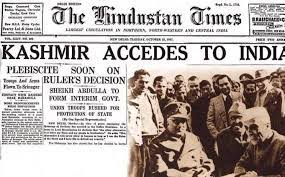
WBBSE Solutions For Class 10 History Chapter 8 Post Colonial India Second Half Of The 20th Century Paper Cutting with the news of Kashmir's Accession to India

Question 3 How did the Kashmir problem originate?
Answer:

The Kashmir problem:

After India’s independence, when the most important princely state, Answer: Kashmir, declared to remain as an independent state, it gave rise to certain problems.

  1. Attempts by Kashmir to maintain its independence: After India attained independence, both India and Pakistan asked Maharaja Hari Singh to accede into their respective nations. The Maharaja refused both offers and declared his wish to remain as an independent state.
  2. Entry of the Pakistan army: The Pakistani government anticipated that the Hindu Maharaja might want to join India at some point of time. Consequently, on October 22, 1947, mercenaries supported by the Kashmir government infiltrated into Kashmir. The Maharaja became helpless and asked for military help from India. India, in this backdrop, agreed to help him only if he agreed to sign the Instrument of Accession to the Indian Union.
  3. Signing the Instrument of Accession: The forces sent by Pakistan rapidly spread within Kashmir and moved towards Srinagar. This left Maharaja Hari Singh no choice but to sign the Instrument of Accession, and he signed it on October 26.
  4. Setting up of government: With the aid of the Indian army, the leader of the National Conference party in Kashmir, Sheikh Abdullah, took the control of the state.
  5. In the meantime, acting against Sheikh Abdullah, the part of Kashmir occupied by Pakistan was named ‘Azad Kashmir’ by the Pakistan government. From here, a number of attacks were launched on the region of Kashmir under Indian control.
  6. Appeal to the United Nations: India took up the Kashmir issue to the United Nations in order to protest against the infiltration by Pakistan.
  7. Ceasefire: In the backdrop of the constant conflicts between India and Pakistan in Kashmir, the United Nations declared a ceasefire on January 01, 1949. Due to this, a part of Kashmir came under the Indian Union, but Azad Kashmir remained a part of Pakistan.

As Pakistan did not get the whole of Kashmir, it has been launching several attacks on the other part of Kashmir ever since. Based on this issue, major wars have taken place between these two nations in 1947, 1965, 1971, and 1999.

WBBSE Class 10 History Chapter 8 Post Colonial India Second Half Of The 20th Century 1947-1964 laqs

“Post-colonial India movements 1947-1964”

Question 4 What were the provisions of the Indian Independence Act, of 1947?
Answer:

On the basis of the Mountbatten Plan, the British Parliament passed the Indian Independence Act in July 1947.

  1. The provisions of the Act were:

    India and Pakistan would emerge as independent states on August 15, 1947, and both states would be empowered to guide their domestic and foreign affairs independently.
  2. West Punjab, Sindh, Baluchistan, the North West Frontier Province, and East Bengal will be included in the newly-formed Pakistan Dominion. The rest of British India, East Punjab and West Bengal became parts of the Indian dominion.
  3. A Boundary Commission would be formed to demarcate the frontier of India, West Bengal, and East Punjab.
  4. India and Pakistan would remain under British dominion till their new Constitutions were framed.
  5. The native rulers would have the choice to accede to any state.
  6. The British Parliament would have no jurisdiction to legislate in the Indian Dominion after August 15, 1947. Thus power was completely handed over to Indian leaders through this Act.

“Social changes in India after independence”

Question 5 Mention the steps prior to the Partition of India in 1947.
Answer:

The steps before the Partition of India in 1947:

The Muslim League, under the leadership of Md. Ali Jinnah demanded for a separate state of Pakistan for the Muslims in its Lahore Session. The demand was based on the basis of Two-Nation Theory which came to be known as the ‘Lahore Resolution’ or the ‘Pakistan Resolution’.

Communal tension increased in India after this incident. Before the achievement of independence in 1947, some major incidents took place which created conditions for the formation of two nations, namely India and Pakistan.

The incidents are as follows-

  1. Direct Revolution of the Muslim League: Lord Wavell, the then Governor-General, invited the Congress leader Jawaharlal Nehru to form an interim Government on August 12, 1946. This infuriated the Muslim League, and the League called for Direct Revolution, which resulted in massive riots, murders and rapes in Calcutta from August 16 for 3 days at a stretch.
  2. Mountbatten Plan: The next Governor-General, Lord Mountbatten planned for the Partition of India on June 3, 1947. This plan is known as the Mountbatten Plan, which announced the partition of the Indian subcontinent into India and Pakistan.
  3. Indian Independence Act: The Indian Independence Act was passed on June 4, 1947, in the British Parliament. North-West Frontier Province, Sindh, Baluchistan, West Punjab, East Bengal, and certain parts of Assam were integrated together to form Pakistan and the remaining parts of the Indian subcontinent were integrated to form India.

Question 6 What were the problems following the incident of partition of India?
Answer:

The problems following the incident of partition of India:

According to the Indian Independence Act, the Indian subcontinent was divided into India and Pakistan on August 15, 1947. India, as a newly formed nation faced certain problems,

Which are as follows-

  1. Massive exodus: Due to the Partition of India, millions of Hindus and Sikhs from the newly created Pakistan migrated to India in search of safety and shelter.
  2. Refugee problem: Millions of Hindus from East Pakistan, and millions of Hindus and Sikhs from West Pakistan, took shelter in India as refugees. It became very hard for the Indian Government to arrange the basic amenities for these people as well as secure a future for them. States like West Bengal, Assam, Tripura, and Punjab witnessed the refugee problem at its highest level.
  3. Transfer of wealth: As a result of the partition, a large part of the Indian subcontinent went to Pakistan, which resulted in the transfer of wealth and resources to Pakistan. This made India economically weak.
  4. Lack of cultivable land: A large portion of cultivable land went to Pakistan as a result of the partition. This led to a shortage of cultivable land, which, in turn, led to an acute shortage of food.
  5. Lack of raw materials for industries: Jute and cotton-producing areas went to Pakistan as a result of Partition. This led to a shortage of raw materials for industrial purposes in India.

Question 7 When was India declared an Independent, Sovereign Republic? Into how many categories were the Indian states divided at that time?
Answer:

After independence, the Indian Constitution came into force on January 26, 1950, and India emerged as an Independent, Sovereign Republic. During this period, the Indian states were divided into four categories.

They were as follows-

‘A’ category states-States under Governors: Nine states belonged to this category.

These were-

  1. West Bengal
  2. Assam
  3.  Bihar
  4. Orissa
  5. Uttar Pradesh,
  6. Madhya Pradesh,
  7. Bombay,
  8. Madras and
  9. Punjab.

The ‘B’ category states-States under native Princes: This division included eight states.

These were-

  1. Hyderabad,
  2. Central Province,
  3. Mysore,
  4. Patiala and East Punjab State Union (PEPSU),
  5. Jammu and Kashmir,
  6. Rajasthan,
  7. Saurashtra,
  8. Travancore-Cochin.

The ‘C’ category states under Commissioners: Ten states fell under this category.

These included-

  1. Ajmer
  2. Bhopal,
  3. Bilaspur,
  4. Himachal Pradesh,
  5. Kutch,
  6. Coorg
  7. Delhi
  8. Manipur,
  9. Tripura and
  10. Vindhya Pradesh.

‘D’ category states-Union Territories:

This category included two states-

  1. Andaman and
  2. Nicobar islands.

Question 8 What was the approach of the Indian National Congress towards the princely states?
Answer:

The approach of the Indian National Congress towards the princely states:

There were debates and discussions regarding the issue, of whether the princely states of the Indian subcontinent would remain in India or would go to Pakistan after independence. The Indian National Congress voted towards the accession of the princely states into the newly formed nation of India.

  1. Haripura Congress Session: The Indian National Congress in its Haripura Session in the year 1938, declared that the princely states are an inseparable part of India.
  2. Mahatma Gandhi’s Policy: According to Mahatma Gandhi, if any of the princely states wished to separate themselves from India after independence, it would be considered as an act of declaration of war against India.
  3. Jawaharlal Nehru’s policy: Jawaharlal Nehru declared that the princely states within the geographical boundary of India, would not be given the status of a separate state and would be considered as a part of India.
  4. Declaration of Indian National Congress: Th]e Indian National Congress declared on June 15, 1947, that after the independence of India, the princely states would not be given the status of independent states.

“Economic policies in India 1947-1964”

Question 9 What were the features of the princely states of India?
Answer:

Prior to the independence of India on August 15, 1947, there were certain princely states in the Indian subcontinent.

The features of the princely states in the Indian subcontinent are as follows-

  1.  A large number of princely states: Just before independence, the Indian subcontinent had about 600 princely states. These states were located in different parts of India.
  2. Size of the princely states: Most of the princely states were very small in size. Some of the princely states were as small as Zamindari divisions. Only a minority of the princely states like Hyderabad, Jammu, Kashmir, Mysore, and Baroda were large in size.
  3. Autonomy of the princely states: The rulers of the princely states were very powerful and autonomous. They were not answerable to any law and exercised maximum power within the boundary of their own states.
  4. The miserable condition of the subjects of the princely states: The condition of the subjects of the princely states were really miserable as they had to pay huge tax in cash and be kind to their rulers.
  5. The backwardness of the princely states: Most of the princely states were backward in economic, political, and educational aspects.

Class 10 History Solution Wbbse

Question 10 Discuss the role of Lord Mountbatten in the accession of the princely states into the Indian subcontinent.
Answer:

The role of Lord Mountbatten in the accession of the princely states into the Indian subcontinent:

Lord Mountbatten took an important role in the accession of the princely states into India, right before India achieved independence.

The steps taken by Lord Mountbatten are as follows-

  1. Friendly relation with the rulers of the princely states: Lord Mountbatten had friendly relations with many of the rulers of the princely states. So, the rulers of the princely states thought that if they did not join India, their relationship with Lord Mountbatten would decline, which would lead to huge problems on the part of the princely states.
  2. The policy of the British Government: Lord Mountbatten declared that the British government would not recognize any of the princely states, and neither would it allow the joining of the princely states into the British Commonwealth. It meant that if the princely states would not join any of the two nations of India or Pakistan, they would lose all their connections with the British government.
  3. Economic loss: Lord Mountbatten declared that the two nations of India and Pakistan were united as the Indian subcontinent, and were considered as a distinct economic zone. If the princely states did not join India, the economic relations would suffer which would be a large drawback for the princely states.
  4. Problems of Communalism: Lord Mountbatten informed the rulers of the princely states that if they themselves tried to maintain their independence, it would lead to riots and communal tensions.
  5. Promises made by Mountbatten: Lord Mountbatten promised the rulers of the princely states that he would fulfill all the promises made by the local rulers as he himself would be working in India till 1947.

Question 11 What do you mean by Instrument of Accession?
Answer:

Instrument of Accession:

After the independence of India, the incorporation of princely states posed a big problem. At the time of the transfer of power, the British government left these princely states free to join either India or Pakistan. Sardar Vallabhbhai Patel, the first Home Minister of free India, took the responsibility of integrating these princely states with India.

The Instrument of Accession, which was consequently drafted, was a legal document to enable each of the rulers of the princely states under British paramountcy to join one of the new dominions of India or Pakistan, created by the Partition of British India.

The princely states were to be given freedom in their internal affairs and the e Union Government was to have control over the defense and foreign policy of these states.

Question 12 What were the motives behind the annexation of the princely states to the Indian territory?
Answer:

The motives behind the annexation of the princely states to the Indian territory:

About 600 princely states existed within the geographical boundaries of India at the eve of independence. There were a number of reasons behind the annexation of those states into the Indian territory.

They were as follows-

  1. Nationalism: The people of British India as well as princely states had unitedly opposed British rule. The Indian leaders also believed in integrated Indian nationalism. So they could never think of a divided post-independent India.
  2. Tradition crisis: The British Indian states as well as the princely states existing within the geographical boundaries of India had borne the same history and tradition for ages. If these princely states became independent, their history and tradition would also be disrupted.
  3. Movement by the subjects: The subjects in different princely states launched vehement movements on the issues of democracy and independence. This paved the way for the inclusion of these states into the Indian territory.
  4. Backwardness: Most of the princely states were in the clutches of backwardness and superstitions. Autocratic rule and medieval mentality compelled the people to seek liberation from backwardness by becoming a part of the Indian population.”

“Impact of the Nehru era on India”

Question 13 What was the policy of ‘Carrot and Stick’?
Answer:

The policy of ‘Carrot and Stick’:

The Indian Independence Act was passed in July 1947. One of the provisions of this Act was that the native ruler would have to accede to either India or Pakistan.

Some states thought that they were entitled to declare their independence. Sardar Patel tackled the situation with extraordinary ability. He followed the policy of ‘Carrot and Stick’,

which was as follows:

  1. He convinced the leaders of the advantages of joining the Indian union. He appealed to the leaders that if they do not cooperate, there will be anarchy and chaos and a common ruin of all, and thus he urged the rulers of the states to enter into relations with the Indian Dominion.
  2. He made it implicitly clear that they may have to face the wrath of the people of the native states for not joining India and he will not be in a position to stop the anger of the people against them.
  3.  In cases where his appeal went unheard, he did not hesitate to annex those states by force.

Question 14 How was Junagadh incorporated into the Indian Union?
Answer:

Junagadh incorporated into the Indian Union as follows

At the time of the transfer of power, the British government left the Indian princely states free to join either India or Pakistan. The Nawab of Junagadh was Muhammad Mahabat Khanji III. He communicated to Pakistan his wish to accede, much to the displeasure of the majority of the people, who were Hindus.

When Pakistan accepted Nawab’s Instrument of Accession, the government of India was outraged. Sardar Patel believed that if Junagadh was permitted to go to Pakistan, it would further increase communal tension. He offered Pakistan time to reverse its acceptance of the accession and to hold a plebiscite in Junagadh.

Eventually, Sardar Patel ordered the forcible annexation of Junagadh. Unable to resist the attack, Nawab fled to Pakistan. A plebiscite was conducted in which 99.95% people chose India over Pakistan.

Question 15 Write a note on the incorporation of the princely state of Hyderabad into the Indian Union.
Answer:

The policy of ‘Carrot and Stick’:

Hyderabad was the largest princely state when India attained independence in 1947. The ruler of Hyderabad was known as the Nizam.

  1. Distribution of population: When India gained freedom, the Nizam of Hyderabad was Osman Ali Khan. But though the ruler was a Muslim, about 87 per cent of the population of Hyderabad were Hindus.
  2. Anti-India feelings: After the British left India, the Nizam of Hyderabad did not accede either to India or to Pakistan, and tried to maintain his independence. The leader of the Muslims, Qasim Rizvi, led a group known as ‘Razakar’, which carried out acts of terrorism on the Hindus living in the Indian subcontinent at the borders of Hyderabad. These people fled from their homes and took shelter in relief camps in India.
  3. Increasing complexities: The Nizam of Hyderabad instructed the Muslims to declare jihad on the people living in India.. He brought in arms and ammunition from Pakistan and further complicated the issue by appealing against India to the United Nations and the International Court of Justice.
  4. Operation ‘Polo’: In this ‘backdrop, India sent an ultimatum to Hyderabad, but even that was ignored by the Nizam. Consequently, General J N Choudhury led the Indian army into Hyderabad in a military operation known as Operation Polo on September 13, 1948.
  5. The surrender: The Hyderabad army was easily defeated by the Indian army and they surrendered on September 18. Consequently, Hyderabad acceded to the Indian Union.
  6. Signing the Instrument of Accession: A few days later, the Nizam of Hyderabad signed the Instrument of Accession to the Indian Union and Hyderabad officially became a part of the Indian Union on January 26, 1950.

WBBSE Solutions For Class 10 History Chapter 8 Post Colonial India Second Half Of The 20th Century Surrender of Hydebad to India

“Women’s role in post-colonial India”

Question 16 What do you know about the annexation of the princely states of Jodhpur and Jaisalmer?
Answer:

Jodhpur and Jaisalmer were significant princely states on the border of India after independence. The non-Muslim states of Jodhpur and Jaisalmer were finally annexed to India.

  1. The attitude of Hanwant Singh: Hanwant Singh, the ruler of Jodhpur was a staunch opponent of the Congress. He thought that his joining of the Indian territory would not be much profitable. So he signed a treaty with Jinnah along with the king of Jaisalmer.
  2. Jinnah’s initiative: The Pakistani leader Jinnah made an unconditional offer to the rulers of Jodhpur and Jaisalmer to lure them to join Pakistan. Jaisalmer rejected the offer and later on, joined India.
  3. Mountbatten’s effort: When Jodhpur had almost agreed to join Pakistan, Mountbatten was successful in making the ruler of Jodhpur- Hanwant Singh- understand that Pakistan had been created mainly for the Muslims, and Jodhpur, being a Hindu state, would face problems if he acceded to Pakistan.
  4. Hanwant Singh’s decision: Hanwant Singh was influenced by Lord Mountbatten’s arguments, and consequently he joined India almost against his wish.

Class 10 History Solution Wbbse

Question 17 Write a short note on how the French and Portuguese colonies in India became a part of the Indian subcontinent.
Answer:

French and Portuguese colonies in India became a part of the Indian subcontinent

Besides the princely states, several colonies of France such as Chandannagar, Mahe, Karaikal, Yanam, Pondicherry, etc., and several Portuguese colonies such as Goa, Daman, Diu, Dadra and Nagar Haveli, etc., remained in India even after the attainment of independence in 1947. It was necessary to annex these regions to the Indian subcontinent.

Annexation of the French colonies:

In 1948, a treaty was signed between India and France where it was stated that whether the French colonies in the Indian subcontinent would become a part of India, would be decided through a plebiscite.

  1. As per the treaty, Chandannagar became a part of India in 1949.
  2. In 1954, the people of Yanam and Mahe, who were in support of becoming a part of India, captured power in these places through political uprisings, and consequently these places became parts of the Indian Union.
  3. In October 1954, Pondicherry and Karakol joined the Indian Union by plebiscite.

Annexation of the Portuguese colonies:

  1. In 1954, the Gomantak party revolted and captured power in Dadra and Nagar Haveli. Consequently, in 1961, India declared this region to be under its governance.
  2. The movements in Goa that were launched in favor of joining India, were suppressed using strict measures by the Portuguese government. In 1961, under the leadership of General Jayanta Choudhury, the Indian army marched into Goa and forced the government there to sign a treaty, handing Goa over to the Indian Union.
  3. In the same year, Daman and Diu also acceded to India.

Question 18 Discuss how the Portuguese colonies in the Indian subcontinent acceded to India.
Answer:

Portuguese colonies in the Indian subcontinent acceded to India as follows

Even after India attained independence, several Portuguese colonies-Goa, Daman, Diu, Dadra, and Nagar Haveli-still remained in India. In order to maintain their control over the colonies, the Portuguese annexed several of their colonies around the world in 1951.

  1. Annexation of Dadra and Nagar Haveli: The Gomantak party in Dadra and Nagar Haveli revolted and seized power in 1954. When the Portuguese government tried to recapture this region, the Indian government resisted it. Later, in 1961, India formally declared Dadra and Nagar Haveli to be a part of the Indian Union.
  2. Protest movements in Goa: On August 15, 1955, about 5000 Satyagrahis carried out a peaceful protest against the Portuguese government. However, the Portuguese government took strict measures and about 22 protestors were gunned down. Several leaders of the protest movements were also killed and imprisoned.
  3. Measures taken by India: In protest of the steps taken by the Portuguese in Goa, the Indian government declared an economic blockade against it. Besides, India made several petitions to the Portuguese government to hand over the Goal to the Indian government and even took the matter to the international level.
  4. Annexation of Goa: Under the leadership of General Jayanta Choudhury, the Indian army marched into Goa in December 1961. The Portuguese army was soon defeated and was forced to surrender. As a result, Goa became a part of the Indian Union.

“Cultural developments in India 1947-1964”

Question 19 Discuss the effects of the partition of India in 1947.
Answer:

The effects of the partition of India in 1947:

On August 15, 1945, India became independent, and simultaneously, it was divided into two independent nations-India and Pakistan. The common people were affected the most due to this partition.

  1. Abandoning the Motherland: Due to the partition of India, people of religious minority communities in East and West Pakistan Hindus, Sikhs, Buddhists, etc.- moved to India, and a large number of Muslims migrated to Pakistan from India. These people lost most of their valuables and possessions due to the Partition of India.
  2. Massacre: After the Partition of India, communal riots spread rapidly across the states. A large number of Hindus, Sikhs, and Buddhists were slaughtered in Pakistan or while fleeing from Pakistan. Similarly, many Muslims were killed in India or while they were trying to move out of India. Besides these, dacoities, burning down of crops, etc., were common events during the partition of India.
  3. The exploitation of women: Women of the minority communities in either of the two countries were probably the worst sufferers. Kidnapping and rapes became commonplace incidents. About 1 lakh women were raped, and consequently, at least 50 thousand illegitimate children were born.
  4. Refugee problem: The refugee problem became a major issue in both India and Pakistan after the partition. A large number of refugees from Pakistan settled in West Bengal, Tripura, Assam, Punjab, and several other states. Rehabilitating them and providing them with aid put India in a serious economic crisis.

Question 20 What was the reaction of the people of Bengal to the partition of Bengal along with the partition of India in 1947?
Answer:

The reaction of the people of Bengal to the partition of Bengal along with the partition of India in 1947:

After the Partition of India in 1947, the Muslim-majority area of East Bengal and the Hindu-majority area of West Bengal were merged with Pakistan and India respectively. Due to this partition, several reactions were witnessed in Bengal.

The reactions were as follows-

  1. Refugee problem: Millions of people from East Bengal took shelter at different districts of West Bengal as refugees. This led to an increase in the population of West Bengal. The West Bengal government had to undergo many hardships in order to arrange rehabilitation facilities for the refugees.
  2. Lack of raw materials and resources: As a result of the partition of Bengal, the industries came to West Bengal but the cultivable lands for producing raw materials such as cotton, jute, etc., that are required for the working of those industries, went to East Bengal. This led to the downfall of the industries due to a lack of raw materials.
  3. Unemployment: The industries of West Bengal broke down due to a lack of raw materials. This problem was doubled by the huge number of refugees coming to India, thus causing the problem of large-scale unemployment.
  4. The exodus of intellectuals from their respective motherlands: Due to the partition of Bengal, a huge inflow of Hindu intellectuals from East Bengal contributed to the cultural improvement of West Bengal. Similarly, a large number of Muslim intellectuals from West Bengal went to East Bengal and contributed to the cultural development of that country.

Chapter 8 Post Colonial India Second Half Of The 20th Century 1947-1964 Topic B Refugee Problem After 1947

 Question 1 Discuss the problems that the Bengali refugees had to go through.
Answer:

The problems that the Bengali refugees had to go through:

After the Partition of India in 1947, the refugees in Bengal had to go through hardships.

  1. Poverty: The central government did not provide any opportunity for the exchange of wealth to the refugees of Bengal. As a result, most of the families had to come empty-handed.
  2. Hurdles on the route: The refugees coming from East Bengal had to undergo numerous hurdles on the way. They had to walk continuously for long stretches. Many died due to hunger and fatigue on the way.
  3. Life on the streets: The poverty-ridden Bengalee refugees were forced to live on the roadsides and railway stations. They went hungry most of the time, or were only half-fed.
  4. Problems of refugee camps: In the refugee camps there was severe scarcity for even the basic needs like food, water, toilets, places to live, etc., and this caused the death of many of the refugees.
  5. Rehabilitation: The arrangements made by the government for the rehabilitation of these refugees in Bengal were grossly insufficient. Besides, the refugees also had to suffer at the hands of local fraud.
  6. Cultural separation: Many of the refugees in Bengal were sent away to distant places. As a result, they were separated from people of their own linguistic and cultural community.

Wbbse History And Environment Class 10 Solutions

Question 2 Write about autobiographies and memoirs as documents in the study of the history of the Partition.
Answer:

Autobiographies and memoirs as documents in the study of the history of the Partition

The history of Pakistan, and India and the condition of the refugees have been reconstructed with the help of several autobiographies and reminiscences.

Among these autobiographies and reminiscences, mention may be made of ‘Chhere Asa Gram’ (ed) by Dakshinaranjan Basu, ‘Atmakatha’ by Abul Mansoor Ahmed, ‘Deshbhager Dinguli’ by Atin Bandapadhyay, ‘Smritibhare’ by Janardan Chakraborty, ‘Udbritter Itibritta’ by Ajoy Gupta, ‘Kichu Smriti Kichu Katha’ by Saibal Gupta, ‘Smriti Katha’ by Renuka Ray, ‘Jukto Ebong Mukta Bonger Smriti’ by Annadasankar Roy.

Hiranmoy Bandopadhyay, the commissioner for Refugees Rehabilitation, in his reminiscence ‘Udvastu’, gives a vivid picture of the psychological, emotional and social trauma of the people who were separated from their relatives and friends and who looked at it as a holocaust.

“Political challenges in post-independence India”

Question 3 Discuss the refugee problem after the independence of India in 1947.
Answer:

The refugee problem after the independence of India in 1947

After the independence of India in 1947, millions of refugees from East and West Pakistan, who were victims of communal violence, came to India.

  1. Problems faced by India: It was very difficult for India, a newly formed nation, to take on the economic as well as other responsibilities of the millions of refugees coming to India. So the refugee problem created a huge drawback in India’s part.
  2. Centers of crisis: The refugee problem was most prevalent in Punjab and West Bengal because these were the two states where most of the refugees took shelter.
  3. Condition of Punjab: Just after the partition of India, millions of people took refuge in Punjab. The Indian government took steps for the rehabilitation of the teeming millions which reduced the problem to a certain level.
  4. Condition of West Bengal: From 1947 to 1971, a large number of refugees took shelter in West Bengal. But the central government could not arrange for adequate rehabilitation facilities for these refugees, and so most of the people had to take shelter on pavements, refugee colonies, railway colonies, etc. Some of the refugees were given lands in faraway places like Andaman, Dandakaranya, etc., to settle down.

Question 4 How did the newly formed Indian government tackle the refugee problem?
Answer:

After the partition in 1947, millions of people came to India as refugees and took shelter in different provinces like Punjab, West Bengal, Tripura, Assam, etc. So the newly formed Indian government had to take several steps for tackling the increasing refugee problem.

The steps taken by the Indian Government were as follows-

  1. Granting of asylum: The refugees coming into West Bengal initially took shelter in various railway stations, pavements or abandoned houses. The newly formed Indian government established several camps for the settlement of the refugees.
  2. Arrangement of aid: The Indian government arranged for food, clothing, medicines, and portable drinking water for the refugees. It also arranged for primary education centres for the children of the refugee camps.
  3. Rehabilitation: The people of the refugee camps were rehabilitated to various areas for resettlement. They were also given monetary aids for constructing houses and reorganising their lives.
  4. Condition of Punjab: The people taking refuge in Punjab were given ample financial and other aids by the central government. Colonies were established in different parts of Punjab for their rehabilitation.
  5. Condition of West Bengal: The West Bengal government could not arrange for enough provisions for the refugees. Some of them were offered lands in faraway places like Andaman, and Dandakaranya and these people got detached from the Bengalee culture.

Question 5 Discuss the debates that took place regarding the steps for the rehabilitation of the refugees that were taken by the Indian government.
Answer:

The teeming millions that came to India after the partition posed a threat to the newly formed Indian government. To cope up with this problem, the Indian government took various steps. But these steps initiated debates from many corners.

The debates that took place are as follows-

  1. India’s grievances against Pakistan: India argued that Pakistan has forced a large number of Hindus and Sikhs to abandon their motherland (Pakistan) and come to India.
  2. Nehru-Liaquat Pact: To tackle the increasing refugee problem, Jawaharlal Nehru the Prime Minister of India, and Liaquat Ali Khan, the Prime Minister of Pakistan, signed a treaty in 1950 known as the ‘Nehru-Liaquat Pact’ or the ‘Delhi Pact’. But even this treaty could not deter the refugees from entering India.
  3. Exchange of property: The central government facilitated the exchange of property and people between the refugees of Punjab and West Pakistan, and there was an exchange of refugees between these two regions. However, no such facilities were given to the refugees of West Bengal, and thus they had to undergo various hardships for a long time.
  4. Aid and rehabilitation: Many historians are of the opinion that the central government was biased even while granting aid to the refugees of West Bengal and Punjab. While the refugees of Punjab received adequate aid, the refugees of West Bengal got insufficient funds and aid for rehabilitation.
  5. Rehabilitation in far-off places: Many Dalit refugees from West Bengal were sent off to distant places for rehabilitation like the Andamans and Dandakaranya, which cut them off from the Bengali language, culture, etc. The leftist parties of Bengal protested vehemently against this policy of rehabilitation by the central government.

Wbbse History And Environment Class 10 Solutions

Question 6 What was the Indian reaction towards the refugee problem? Or, What were the problems that India faced when a large number of refugees migrated from Pakistan to India?
Answer:

Indian reaction towards the refugee problem

It is not possible to determine the exact number of people who migrated from Pakistan to India during the Partition of India. But it is a confirmed fact that most of the refugees settled in and around West Bengal, Punjab, Tripura, Assam, etc. This influx of refugees created an issue of major concern in India.

Some of the issues were-

  1. Communal riots: The religious minorities in Pakistan faced atrocities at the hands of the Muslims residing there and fled to India. As a result of this, Muslims in India became victims of acts of violence as well. Thus, communal riots spread out in many parts of the country.
  2.  The assassination of Gandhi: in the backdrop of communal violence and riots, Mahatma Gandhi took the side of the Muslims and undertook a fast for their cause. This angered several Hindu activists, and on January 30, 1948, Gandhi was shot dead by Nathuram Godse, a Hindu fundamentalist.
  3. The decline of Indo-Pak relations: When several thousands of refugees migrated to India, the Indian government held Pakistan responsible of communal atrocities, which had caused the people of religious minorities to flee from the country. The Pakistani government naturally denied these claims and this resulted in the decline of the relationship between India and Pakistan.
  4. Economic pressure: The rehabilitation of thousands of refugees and providing aid created serious economic pressure on the government of independent India.
  5.  Political tension: The refugee problem gave rise to political tension in the country. In order to obtain adequate aid from the government, the refugees resorted to political agitations. In West Bengal, the leftist parties supported these refugees and stood by them.

Question 7 What were the differences between the migration and settlement of refugees in West Bengal and Punjab?
Answer:

After the Partition of India in 1947, a large number of refugees migrated from East Pakistan (East Bengal) to West Bengal, and another large number of refugees migrated from West Pakistan to Punjab. Several differences can be noticed between these two groups of refugees coming in and settling in West Bengal and Punjab.

The differences between the migration and settlement of refugees in West Bengal and Punjab-

Points of difference Refugees of Bengal Refugees of Pakistan
Time period Refugees from East Pakistan kept coming in and settling in West Bengal for about three decades after the Partition of India. The refugees from West Pakistan came in only for a short period of time after the Partition of India.
Exchange The refugees of East Pakistan did not get The refugees coming from West Pakistan chance of exchanging wealth or property with the Muslims of West Bengal. The refugees coming from West Pakistan were able to exchange wealth and property with the Muslims of Punjab.
Abandonment of India by the Muslims Most of the Muslims of West Bengal did not leave their motherland. Hence the refugees coming to Bengal did not get a chance to rehabilitate in the abandoned houses of the Muslims. A large number of Muslims left Punjab and migrated to West Pakistan. Therefore, the refugees who came to Punjab got a chance to rehabilitate in the abandoned houses of the Muslims.
Aid and rehabilitation The aids and facilities of rehabilitation provided by the central government for the refugees of West Bengal were inadequate. The aids and facilities of rehabilitation provided by the central government for the refugees of Punjab were quite sufficient.
Linguistic problems As most of the refugees coming from East Bengal were Bengali-speaking, they were more inclined to settle in and around West Bengal, Assam, and Orissa. The refugees coming from West Pakistan did not have any linguistic problems, and so, besides Punjab, they were able to settle down in Delhi, Haryana, Himachal Pradesh, Rajasthan, Uttar Pradesh, etc.


“Education reforms in India post-independence”

Question 8 How much do we come to know about the Partition of 1947 from autobiographies and memoirs?
Answer:

The Partition of 1947 is perhaps the most important event in modern Indian history. Many facts about this partition can be obtained from the memoirs and autobiographies written during this period.

  1. Mention of acts of violence: Details of how the religious minorities had to suffer the atrocities of the religious majority groups-riots, murders, rapes-and how they were forced to abandon their motherland, come up vividly through several writings.
  2. Memories of leaving the Motherland: Not just the physical hardships, but the emotional trauma, the pain of leaving behind one’s place of birth, etc., are portrayed clearly in several writings by different authors.
  3. End of relationships: How the partition of 1947 separated friends and family members, and how individuals lost their loved ones forever, have been portrayed in many memoirs and autobiographies.
  4. Love for the Motherland: The deep love for one’s motherland, the fond memories of one’s birthplace, and the longing to return to those places once again can be seen in the writings of many authors
  5. Some writers: Several writers have written autobiographies, memoirs, novels, research papers, etc., relating to the Partition of India. Some of the significant writers in Bengali include Atin Bandopadhyay, Sunil Gangopadhyay, Prafulla Roy, Manik Bandyopadhyay, Debesh Roy, Prafulla Chakraborty, Debjyoti Roy, etc.

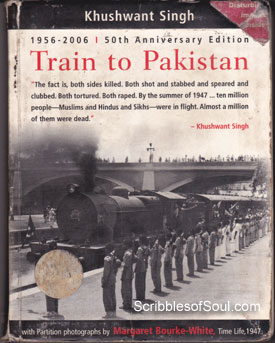
WBBSE Solutions For Class 10 History Chapter 8 Post Colonial India Second Half Of The 20th Century Paper Train to Pakistan by Khushwant Singh

Significant writers in Hindi include Sadat Hassan Manto, Krishan Chander, Yashpal, Rangeya Raghav, Bhisham Sahni, and several others. Among the ones who wrote in English were Khuswant Singh, and R K Narayan, the ones who wrote in Urdu include Khwaja Ahmad Abbas and the writers in Punjabi were Bhisham Sahni, Kulwant Singh, etc.

Wbbse History And Environment Class 10 Solutions

Question 9 Give a picture of the partition of India. and the sufferings of a refugee as portrayed in a novel/autobiography/memoir.
Answer:

The partition of India and the pains of the refugees have been described in many novels, autobiographies, memoirs, etc. A mentionable novel in this context is ‘Surjo Dighol Bari’ by Abu Ishaque.

The topics dealt with in the novel are discussed below-

  1. Dreams of the famine-stricken: ‘Surjo Dighol Bari’ opens with a depiction of the famine of 1943. The people such as Joygun, suffering from the famine, dream that after a few days when the nation would become independent, the price of rice will fall, and they will be able to live happily once again.
  2. The Pakistan of dreams: While the Muslims were eagerly waiting for the formation of Pakistan, Abu Ishaque, in his novel, portrays that the formation of Pakistan might be a nightmare for some, instead of being a dream. He portrays this through a conversation between two people traveling by train, and the Muslim passenger says, “If Pakistan is going to be formed, the Hindu-based names of products need to be changed.”
  3. Shattered dreams: The country became independent finally. But the condition of the Indians before and after independence in Pakistan became pathetic. Thus the dream of a new life for characters like Joygun was shattered.
  4. The author portrays this shattering of illusions in his writing- After the formation of Pakistan, a truckload of people shouting “Pakistan zindabad, Quaid- i-Azam zindabad” was moving forward. While going through a muddy road, the truck splashed mud on a passerby’s clothes, and the words uttered by the helpless man clearly portrayed how the future days of Pakistan were going to be.
  5. Lamentations of Joygun: The religious minorities of East Bengal were in despair when the good days did not come even after independence. This has been clearly portrayed in the book by the lamentations of Joygun in his mother tongue.

Question 10 Give an account of the Partition and the problems of the refugees as portrayed in Bengali literature.
Answer:

The Partition and the problems of the refugees as portrayed in Bengali literature

In 1947, Bengal was partitioned along with the Partition of India. East Bengal became a part of Pakistan and West Bengal became a part of India. Consequently, the Hindu minority of East Bengal migrated to West Bengal, and the Muslim minority of West Bengal moved to East Bengal.

A vivid description of this partition and the story of individuals leaving their motherland have been written in many pieces of Bengali literature.

Breaking apart of family life: The pain of dreams being shattered, love being lost, and family life being torn apart has been portrayed in the backdrop of the Partition in Raziya Khan’s ‘Bottolar Uponyas’. The love relationship between Sumita and Moin is destroyed due to the Partition.

  1.  Riots: Communal riots broke out in East Bengal after the Partition of 1947. In this context, Sahidullah Kaiser, in his novel ‘Sangsaptak, speaks out through the character of Sikandar Master, that religions are made for human beings, not the other way round.
  2. Shattering of dreams: The poor people had dreamt that with freedom, food prices would decrease, and their living conditions would improve. But Abu Ishaque, in his novel ‘Surjo Dighol Bari’, portrays the shattering of this dream through the dialogues of his character- Joygun.
  3. Ruminations: The memories of Partition, leaving one’s motherland, and the events in a refugee’s life can be seen in several novels. Among these, mention might be made of ‘Purbo-Poschim’, ‘Keyapatar Nouka’, ‘Nilkantha Pakhir Khoje’, and several others.
  4. Lives of refugees: The painful stories of the lives of the refugees of West Bengal have been depicted in many Bengali novels, dramas, poems, etc. Examples of this can be cited from Mangalacharan Chattopadhyay’s poem ‘Sukno Mukh Uskokhusko Chul’.

Question 11 Discuss how the partition of India and the sufferings of the refugees have been portrayed in films.
Answer:

The partition of India and the sufferings of the refugees have been portrayed in films

After the Partition of India, many films have been made in both East Bengal and West Bengal showing the pictures of the partition, the riots, people leaving their motherland, and the lives and suffering of the refugees.

Some of the mentionable films in Bengali include Ritwik Ghatak’s ‘Meghe Dhaka Tara’, ‘Subarnarekha’, ‘Nagarik’, ‘Komal Gandhar’, Nimai Ghosh’s, ‘Chinnamul, Satyajit Ray’s ‘Mahanagar’, and several others. Srijit Mukherji’s recent film ‘Rajkahini’ too gives us a detailed picture of the times of Partition.

The topics dealt with in these films are discussed below-

  1. Establishment of colonies: The Partition of Bengal, the influx of a huge number of refugees from East Bengal, setting up of colonies by these refugees after much struggle and hardship, and such other topics have been dealt with in Ritwik Ghatak’s movies.
  2. Pain and sufferings: Many films over time have portrayed the pains and sufferings that were caused during the Partition. The immense sufferings-that the refugees had to go through, the experiences of a helpless child who has lost his mother, their reunion when the child has become a youth and his mother has become old, and such other instances from the lives of the refugees have found place in a lot of films.
  3. Journey to Dandakaranya: The tragic eviction of the Bengali refugees to Dandakaranya has found place in Bengali films as well. In one of his films, Ritwik Ghatak shows a scene of the Dandakaranya bound special train for the refugees being stopped at Dhalbhumgarh station and the dead body of an old lady being brought out from the train.

Chapter 8 Post Colonial India Second Half Of The 20th Century 1947-1964 Topic C Reorganisation Of States In Independent India

 Question 1 Write a note on scheduled languages in the Indian constitution (upto 1964).
Answer:

Scheduled languages in the Indian constitution (upto 1964):

The framers of the Indian Constitution, while enacting the constitution, (January 26, 1950) decided to incorporate 14 languages into the constitution. These are Assamese, Bengali, Gujarati, Hindi, Kannada, Kashmiri, Malayalam, Marathi, Oriya, Punjabi, Sanskrit, Tamil, Telugu and Urdu.

Till 1964, these languages were recognised by the government. The Eighth schedule and the 21st Amendment provided for the inclusion of Sindhi, Konkani, Maithili and Nepali, thereby increasing the number of official regional languages of India to 18. The Eighth Schedule of the Constitution of India, as of December 1, 2007, lists 22 languages.

These are:

  1. Assamese
  2. Bengali
  3. Gujarati
  4. Hindi
  5. Kannada
  6. Kashmiri
  7. Malayalam
  8.  Marathi
  9. Oriya
  10. Punjabi
  11. Sanskrit
  12. Tamil
  13. Telugu
  14. Urdu
  15. Sindhi
  16. Konkani
  17. Manipuri
  18. Nepali
  19. Bodo
  20. Dogri
  21. Maithili
  22. Santhali.”

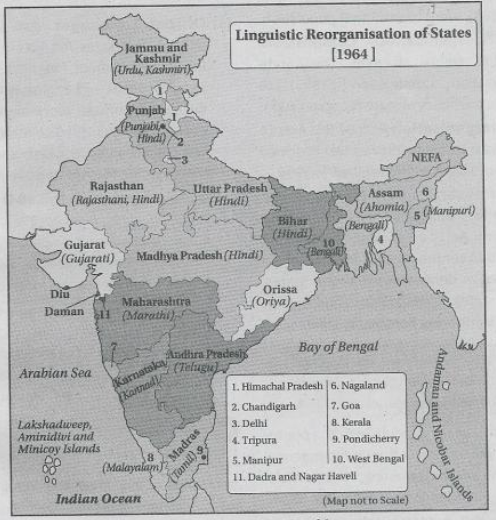
WBBSE Solutions For Class 10 History Chapter 8 Post Colonial India Second Half Of The 20th Century Paper Linguistic Reorganisation of States

“Significant events in India 1947-1964”

Question 2 Describe the different phases of the reorganization of states on a linguistic basis in post-independent India. Or, Discuss the role of the state reorganization commission (1953) in the reorganization of the states in independent India.
Answer:

The different phases of the reorganization of states on a linguistic basis in post-independent India

The matter of reorganization of states and demarcation of interstate borders became quite important after India got independence in 1947.

  • Demand for linguistic reorganization: There was no division of state on a linguistic basis, prior to independence. The movement for the reorganization of states on a linguistic basis started in India after independence.
  • Objection by the government: The Linguistic State Reorganisation Commission opposed the idea of reorganization on a linguistic basis.
  • Movements: In protest against the government’s stand, movements began in different parts of the country. Potti Sreeramulu went on a fast for 58 days on the demand of a separate state for the Telugu population.
  • Consequently, in 1953, Andhra Pradesh was formed for the Telugu population, and Madras renamed Tamil Nadu (1963), went to the Tamil population.
  • State Reorganisation Commission: Jawaharlal Nehru formed the State Reorganisation Commission (1953) to formulate the policy of state reorganization.
  •  State Reorganisation Act: By this Act, 14 states and 6 Union territories were formed on a linguistic basis on November 1, 1956.

Since no separate states were formed for the Marathas and Gujaratis by the State Reorganisation Act, a conflict broke out between the two communities in Bombay and a movement began demanding separate states. The separate states of Maharashtra and Gujarat were formed by dividing Bombay in 1960.

Class 10 History Wbbse

Question 3 Write a commentary on the recognition of different Indian languages as official languages by the Constitution till 1964.
Answer:

A commentary on the recognition of different Indian languages as official languages by the Constitution till 1964

India has been a multilingual country since ancient times. After independence, the question of determining the official language for united India, became a vital issue.

1. Controversy: A controversy arose as to which language should be used to maintain communication between the central and state governments as well as for the transaction of central government issues. The controversy mainly revolved around English and Hindi languages. Finally in 1950, Hindi language was recognised as the official language by the Constitution.

2. Official Languages Commission (1955): The Official Languages Commission was formed in 1955.

The recommendations in the report of the commission are as follows-

  • The Hindi language will be the official language of India.
  • The use of English in official work will continue till January 26, 1965.
  • After January 26, 1965, Hindi will be the sole official language.

3. Official Languages Act (1953): The Official Languages Act was passed by the Indian Parliament in 1963.

This act stipulated that-

  1. English will continue to be used in official work along with Hindi, even after 1965.
  2.  The state legislatures will get the right to determine the official language for their respective states.

4. Official languages in 1964: According to the Official Languages Act 1963, the different state legislatures determined their respective state languages. As a result 14 Indian languages were included as official languages in the 8th Schedule of the Indian Constitution.

These languages were-

  1. Assamese
  2. Bengali
  3. Gujarati
  4. Hindi
  5. Kannada
  6. Kashmiri
  7. Malayalam
  8. Marathi
  9. Oriya
  10. Punjabi
  11. Sanskrit
  12. Tamil
  13. Telugu and
  14. Urdu.

Question 4 How did Andhra become the first linguistically recognized state?
Answer:

Andhra become the first linguistically recognized state:

Immediately after the independence of India, there was a demand for the reorganization of states on the basis of a long urge. Consequently; the Linguistic Provinces Commission, headed by Justice S.K. Dar, was appointed in 1948.

  1. The Dar Commission advised that the reorganization of states on the basis of language might threaten national unity. But the public was not satisfied and the problem became more acute.
  2. So a committee was appointed in December 1948, consisting of Jawaharlal Nehru, Sardar Vallabhbhai Patel, and Pattabhi Sitaramayya to examine the situation. The committee advised against the creation of linguistic states for the time being.
  3. However, the popular movement for the reorganization of states continued. Potti Sreeramalu undertook a fast unto death over the demand for a separate state of Andhra. While on fast for 58 days, Sreeramulu died and the movement took a serious turn.
  4. Finally, the government conceded to the demand and a separate state of Andhra Pradesh was created in 1952. The Telugu-speaking area was separated from the Tamil-speaking area. Simultaneously, Tamil Nadu emerged as a Tamil-speaking state.

WBBSE Class 10 History Chapter 8 Post Colonial India Second Half Of The 20th Century 1947-1964 Short Answer Questions

Chapter 8 Post Colonial India Second Half Of The 20th Century 1947-1964 Topic A Accession Of Princely States Into The Indian Union Short Answer Type Questions

Question 1 Which statement of Md. Ali Jinnah encouraged the princes of the native states to retain their independence after the end of British rule in India?
Answer:

Md. Ali Jinnah, the leader of the Muslim League, made a statement encouraging the princes of the native states to retain their independence after the end of British rule in India. The statement was that-States could remain independent sovereign states on the termination of British paramountcy.

Read and Learn More WBBSE Class 10 History Short Answer Questions

Class 10 History Solution Wbbse

Question 2 What kind of policy was taken by Sardar Vallabhbhai Patel to complete the accession of the princely states with the Indian Union?
Answer:

Sardar Vallabhbhai Patel used a diplomatic and skilful policy in completing the accession of the native states with the Indian Union. Firstly he appealed to the princes of the native states to accede to India for they would derive great advantages from it. Secondly, if no reponse is made from them, he would not hesitate to apply force to get them acceded.

Question 3 Why did the ruler of Kashmir appeal to India for military assistance?
Answer:

In October 1947, Pathan tribesmen invaded Srinagar. They were unofficially led by the Pakistan army. In this circumstance, the ruler of Kashmir appealed to India for military assistance.

Question 4 Why did the people of Junagadh rise in revolt at the end of British rule in India?
Answer:

With the end of British rule in India, it was made clear by the nationalist leaders that the princely states were to accede either to India or Pakistan. But the ruler of Junagadh, Muhammad Mahabat Khanji III, announced that the state was to accede to Pakistan. This’ was against the wishes of the people of Junagadh. So they rose in revolt against their Nawab.

Question 5 When and by whom was Mahatma Gandhi assassinated?
Answer:

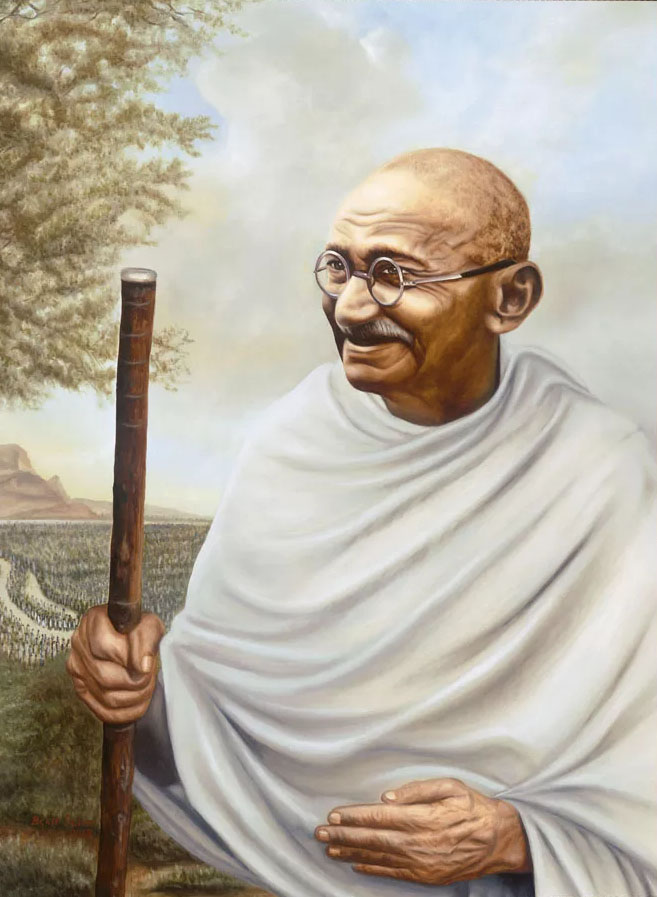
Mahatma Gandhi was assassinated by Nathuram Godsey on January 30, 1948.

WBBSE Solutions For Class 10 History Chapter 8 Post Colonial India Second Half Of The 20th Century Mahatma Gandhi

Question 6 Under what circumstances Hari Singh, the ruler of Kashmir signed the instrument of Accession?
Answer:

After India attained independence both India and Pakistan asked Hari Singh, the Maharaja of the princely state of Kashmir, to accede to their respective nations.

Pakistan Kashmir and proceeded towards its capital Maharaja might want to join India at some government anticipated that the Answer: Hindu point of time.In October 1947 mercenaries supported by the Pakistan army infiltrated Kashmir. The Maharaja became helpless. This left Maharaja no choice but to sign the Instrument Accession.

WBBSE Solutions for Class 10 History WBBSE Solutions for Class 10 Geography and Environment
WBBSE Class 10 History Long Answer Questions WBBSE Solutions for Class 10 Life Science And Environment
WBBSE Class 10 History Short Answer Questions WBBSE Solutions for Class 10 Maths
WBBSE Class 10 History Very Short Answer Questions WBBSE Solutions for Class 10 Physical Science and Environment
WBBSE Class 10 History Multiple Choice Questions


Question 7 What is meant by the Instrument of Accession?
Answer:

Meaning of Instrument of Accession:

After the independence of India the British government left the princely states free to join either India or Pakistan. The Instrument of Accession was as a legal document to enable each of the rulers of the princely states to join one of the new dominions of India or Pakistan created by the Partition of British India. The princely states were to be given freedom in their intellectual.

“Post colonial policies in India”

Question 8 Why is Sardar Vallabhbhai Patel called the ‘Iron Man of India’?
Answer:

Sardar Vallabhbhai Patel called the ‘Iron Man of India’:

When the British left India there were hundreds of princely states in India. Sardar Vallabhbhai Patel, who took the responsibility of integrating these princely states, persuaded almost every princely state to accede to India. All the states of free India except Kashmir, Hyderabad, and Junagadh immediately joined the Indian Union.

In the case of Kashmir, Hyderabad, and Junagadh where Patel’s appeal went unheard he did not hesitate to annex those states by force. His commitment to national integration was total and uncompromising, earning him the sobriquet of the ‘Iron Man of India’.

Chapter 8 Post Colonial India Second Half Of The 20th Century 1947-1964 Topic B Refugee Problem After 1947 Short Answer Type Questions

Question 1 What was the attitude of the Government of India with regard to the issue of refugee rehabilitation?
Answer:

The attitude of the Government of India with regard to the issue of refugee rehabilitation:

The policy taken by the Government of India with regard to the issue of refugee rehabilitation was discriminatory in nature. Regarding the rehabilitation of the refugees from West Pakistan, the Government of India took sincere efforts.

The refugees settled in deserted houses or fallow lands in Punjab, where about 200 camps and some suburban towns were built for them. Some of them also settled in Rajasthan and Uttar Pradesh.

But in the case of West Bengal, the attitude of the Government was somewhat different than that of the Central Government. The refugees had to take shelter in the improvised Government camps and suffer miserably.

WBBSE Class 10 History Chapter 8 Post Colonial India Second Half Of The 20th Century 1947-1964 Short Answer Questions

Question 2 What is depicted in the novel ‘Surjo Dighol Bari’?
Answer:

After the partition of India the poor people. dreamt that with freedom, food prices would decrease and their living conditions would improve. In his novel ‘Surjo Dighol Bari’ Abu Ishaque portrays the shattering of this dream.

“Impact of partition on India 1947”

Question 3 When and between whom was the Delhi Pact signed? What were the features of the Pact?
Answer:

The Delhi Pact (or Nehru-Liaquat Pact) was signed between the Indian Prime Minister Jawaharlal Nehru and Pakistan’s Prime Minister Liaquat Ali Khan in New Delhi on April 8, 1950.

The following are the important features of the Delhi Pact-

[1] To lessen the threats faced by religious minorities;
[2] To put an end to the communal riots and to elevate communal peace;
[3] To create such an atmosphere that both countries could further solve their problems.

Question 4 What were the provisions of the Delhi Pact (or Nehru-Liaquat Pact 1950)?
Answer:

The Delhi Pact (or Nehru-Liaquat Pact) was signed between Jawaharlal Nehru and Liaquat Ali Khan on April 8, 1950.

The provisions of the Pact were:

[1] The governments of India and Pakistan solemnly agreed that each shall ensure its minorities throughout its territories- complete equality of citizenship irrespective of religion, full sense of security in respect of life, culture, and property.

[2] Both governments decided to set up minority commissions in their countries with the aim of observing and reporting on the implementation of the Pact to ensure that no one breaches the pact.

[3] Both the leaders emphasized that the loyalty of the minorities should be reserved for the state in which they were living and for the solution of their problems, they should look up to the government of the country they were living in.

“WBBSE Class 10 history chapter summaries”

Question 5 Why did Nehru-Liaquat Pact (Delhi Pact) 1950 fail?
Answer:

The Nehru-Liaquat Pact (Delhi Pact) was signed between Jawaharlal Nehru and Liaquat Ali Khan on April 8, 1950. The Nehru-Liaquat Pact failed to satisfy many leaders.

Two central ministers Dr. Shyama Prasad Mukherjee and Dr. Khitish Chandra Neogy were firmly against Nehru’s invitation to the Pakistan Prime Minister. They criticised the joint Pact aiming at establishing a minority commission and guaranteeing minority rights in both countries.

Dr. Mukherjee held Pakistan directly responsible for the influx of millions of Hindu refugees from Pakistan who had left the country fearing religious violence supported by Pakistan government.

Shyama Prasad also condemned this pact as a disastrous policy of Muslim appeasement. As a mark of protest against the Indian government’s policy of appeasement towards Pakistan, both ministers resigned.

WBBSE Solutions For Class 10 History Chapter 8 Post Colonial India Second Half Of The 20th Century Nehru and Liaquat

Chapter 8 Post Colonial India Second Half Of The 20th Century 1947-1964 Topic C Reorganisation Of States In Independent India Short Answer Type Questions

Question 1 Who was Potti Sreeramulu?
Answer:

Potti Sreeramulu:

Potti Sreeramulu was a great freedom fighter. He led the movement in Andhra over the demand for a separate Andhra State. He undertook a fast unto death over this issue and even gave up his life for this cause.

Question 2 Why was the JVP Committee formed? Who were the members of the committee?
Answer:

The JVP committee was formed to solve the problems relating to the linguistic reorganization of states. The members of this committee were Jawaharlal Nehru, Vallabhbhai Patel, and Pattabhi Sitaramayya.

Question 3 Why was the State Reorganisation Commission formed? Who were its members?
Answer:

The State Reorganisation Commission (1953) was formed by Jawaharlal Nehru to formulate the policy of state reorganization in the determination of interstate borders.

The commission consisted of Hon’ble Justice Fazal Ali (President) and two other members KM Panikkar and Hridaynath Kunzru.

“Key figures in post-colonial India”

Question 4 In which year Official Language Commission was formed? Name two important members of the commission.
Answer:

The Official Language Commission was formed in 1955. Two important members of the Commission were Suniti Kumar Chattopadhyay from West Bengal and P Subbarayan.

Question 5 When was the Official Languages Act passed by the Indian Parliament? What were its provisions?
Answer:

The Official Languages Act was passed by the Indian Parliament in 1953.

The provisions of the Act were-

[1] English will continue to be used in official work along with Hindi, even after 1965.
[2] The state legislatures will get the right to determine the official language for their respective states.

Question 6 What was the reaction of the people when no separate states were formed for the Marathas and Gujaratis?
Answer:

When no separate states were formed for the Marathas and Gujaratis by the State Reorganisation Act, a conflict broke out between the two communities in Bombay and a movement began demanding separate states.

The movement on the issue of separate states was led by Samyukta Maharashtra Samiti in regions with the Maratha majority and by Mahagujarat Janata Parishad in regions with a Gujarati majority.

Question 7 What were the six union territories formed on linguistic bases in 1956?
Answer:

The six union territories formed on a linguistic basis were Tripura, Andaman and Nicobar Islands, Delhi, Lakshadweep, Manipur, and Himachal Pradesh.

Question 8 Why was the Dar Commission (1948) formed?
Answer:

Immediately after the independence of India, there was a demand for the reorganization of states on the basis of a long urge. Consequently, the Linguistic Provinces Commission, headed by Justice SK Dar, was appointed in 1948.

“Changes in Indian society post-independence”

Question 9 What were the states formed by the state Reorganisation Act of 1956?
Answer:

The states formed by the state Reorganisation Act of 1956 were-

[1] Andhra Pradesh,
[2] Assam,
[3] Orissa,
[4] Uttar Pradesh,
[5] Kerala,
[6] Jammu and Kashmir,
[7] West Bengal,
[8] Punjab,
[9] Bihar,
[10] Bombay,
[11] Madhya Pradesh,
[12] Mysore,
[13] Madras and
[14] Rajasthan.

Question 10 Name two states which have adopted Hindi as the official language.
Answer:

Two states which have adopted Hindi as the official language are Bihar and Chattishgarh.

Question 11 What were the 14 Indian languages which were included as official languages in the 8th Schedule of the Indian Constitution?
Answer:

The 14 Indian languages which were included as official languages in the 8th Schedule of the Indian Constitution were-

[1] Assamese,
[2] Bengali,
[3] Gujarati,
[4] Hindi,
[5] Kannada,
[6] Kashmiri,
[7] Malayalam,
[8] Marathi,
[9] Oriya,
[10] Punjabi,
[11] Sanskrit,
[12] Tamil,
[13] Telugu and
[14] Urdu.

WBBSE Class 10 History Chapter 8 Post Colonial India Second Half Of The 20th Century 1947-1964 Very Short Answer Questions

Chapter 8 Post Colonial India Second Half Of The 20th Century 1947-1964 Topic A Accession Of Princely States Into The Indian Union Very Short Answer Type Questions

Question 1. Who was Muhammad Ali Jinnah?
Answer:

Muhammad Ali Jinnah

Muhammad Ali Jinnah was the leader of the Muslim League.

Question 2. Who was the first Prime Minister of independent India?
Answer:

First Prime Minister of independent India

Jawaharlal Nehru was the first Prime Minister of independent India.

Read and Learn  More WBBSE Class 10 History Very Short Answer Questions

“Social changes in India 1947-1964”

Question 3. Who was the first Home Minister of independent India?
Answer:

First Home Minister of independent India

Sardar Vallabhbhai Patel was the first Home Minister of independent India.

WBBSE Class 10 History Chapter 8 Post Colonial India Second Half Of The 20th Century 1947-1964 Very Short Answer Questions

Question 4. By which Act did India gain independence?
Answer:

India gained independence by the Indian Independence Act, 1947.

Question 5. In which year was the Indian Independence Act passed?
Answer:

The Indian Independence Act was passed in 1947.

WBBSE Solutions for Class 10 History WBBSE Solutions for Class 10 Geography and Environment
WBBSE Class 10 History Long Answer Questions WBBSE Solutions for Class 10 Life Science And Environment
WBBSE Class 10 History Short Answer Questions WBBSE Solutions for Class 10 Maths
WBBSE Class 10 History Very Short Answer Questions WBBSE Solutions for Class 10 Physical Science and Environment
WBBSE Class 10 History Multiple Choice Questions


Question 6. In which year did the members of the Cabinet Mission arrive in India?
Answer:

The Cabinet Mission arrived in India in 1946.

Question 7. Name the members of the Cabinet Mission.
Answer:

The members of the Cabinet Mission

The members of the Cabinet Mission were Lord Pethick Lawrence, Sir Stafford Cripps and A V Alexander.

“Economic policies of India post-independence”

Question 8. Why was the Cabinet Mission sent to India?
Answer:

The Cabinet Mission was sent to India to draw out a plan for transfer of power and to negotiate ‘Independence Plan’ with the Indian leaders.

Question 9. Who was Lord Mountbatten?
Answer:

Lord Mountbatten:

Lord Mountbatten was the last Viceroy of India.

Question 10. How many princely states were there before independence?
Answer:

There were 601 princely states in India before independence.

“Post colonial India chapter questions”

Question 11. Name two princely states which joined the Indian Union in 1948.
Answer:

Two princely states which joined the Indian Union in 1948 were Junagadh and Hyderabad.

Question 12. Who led the Indian army into Hyderabad in 1948?
Answer:

General J N Choudhury led the Indian army into Hyderabad in 1948.

Question 13. Which was the largest princely state of India when India attained independence?
Answer:

Hyderabad was the largest princely state of India when India attained independence.

Question 14. What is ‘Operation Polo’ (1948)?
Answer:

Operation Polo:

When an ultimatum sent by India to the Nizam of Hyderabad was ignored, General JN Choudhury led the Indian army into Hyderabad in a military operation known as Operation Polo on 13 September 1948.

Question 15. Name some French colonies in India.
Answer:

Some French colonies in India

Some French colonies in India were Chandernagore, Mahe, Karaikal, Yanam, and Pondicherry.

“WBBSE Class 10 history very short answers”

Question 16. Name some Portuguese colonies in India.
Answer:

Some Portuguese colonies in India

Some Portuguese colonies in India were Goa, Daman, Diu, Dadra and Nagar Haveli.

Question 17. In which year Pondichery joined the Indian Union?
Answer:

Pondicherry joined the Indian Union in 1954.

Question 18. Who was the last ruling Nawab of the princely state of Junagadh?
Answer:

The last ruling Nawab of the princely state of Junagadh was Muhammad Mahabat Khanji III.

Chapter 8 Post Colonial India Second Half Of The 20th Century 1947-1964 Topic B Refugee Problem After 1947 Very Short Answer Type Questions

Answer in one sentence

Question 1. Who wrote ‘Gandhi’s Emissary’?
Answer:

Gandhi’s Emissary:

‘Gandhi’s Emissary’ was written by Sudhir Ghosh.

Question 2. Who was the author of ‘Wavell: The Viceroy’s Journal’?
Answer:

The author of ‘Wavell: The Viceroy’s Journal’ was Penderel Moon.

Question 3. Mention one book written by Khuswant Singh.
Answer:

A book written by Khuswant Singh is ‘A Train to Pakistan’.

Question 4. Name some important books written on the partition of India.
Answer:

Some important books written on the partition of India

Some important books written on the partition of India were ‘Marginal Man’ by Prafulla Chakraborty, ‘Ekti Jiban’ by Buddhadev Basu, ‘Epar Ganga Opar Ganga’ by Jyotirmoyee Debi ‘Kolkata-Noakhali- Bihar’ by Bibhuti Bhusan Mukhopadhyay etc.

Question 5. What is the full form of UCRC?
Answer:

UCRC:

The full form of UCRC is United Central Refugee Council.

“Key events in post-independence India”

Question 6. What were the two states where refugee problem was acute?
Answer:

The two states where refugee problem was acute were Punjab and west Bengal.

Question 7. Where in far away places refugees were given lands to settle down?
Answer:

Refugees were given lands in far away places like Andaman, Dandakaranya etc. to settle down.

Question 8. Who is the author of the book ‘Pakistan or Partition of India’?
Answer:

The author of the book ‘Pakistan or Partition of India’ is Dr. Bhimrao Ambedkar.

“Impact of 1947 partition on India”

Question 9. Name some Hindi writers who wrote about partition of India.
Answer:

Some Hindi writers who wrote about partition of India are Krishan Chander, Yash Pal, Rangeya Raghav, Bhisham Sahni etc.

Question 10. Name some Urdu writers who wrote about partition of India.
Answer:

Some Urdu writers who wrote about partition of India are Khwaja Ahmad Abbas, Munshi Premchand, Sadat Hasan Manto.

Chapter 8 Post Colonial India Second Half Of The 20th Century 1947-1964 Topic C Reorganisation Of States In Independent India Very Short Answer Type Questions

Question 1. Why was a movement led by Potti Sreeramulu launched in Andhra?
Answer:

A strong movement led by Potti Sreeramulu was launched in Andhra for the separation of Andhra from the Madras Presidency.

Question 2. In which year did Andhra become a linguistically reorganized state?
Answer:

Andhra became a linguistically reorganized state in 1957.

Question 3. Who was the chairman of the States Reorganisation Commission (1953)?
Answer:

Justice Fazal Ali was the chairman of the States Reorganisation Commission (1953).

Question 4. Name two members of the States Reorganisation Commission (1953).
Answer:

Two members of the States Reorganisation Commission (1953) were K M Panikkar and Hridaynath Kunzru.

Question 5. What is the full form of SRC?
Answer:

Full form of SRC:

The full form of SRC is States Reorganisation Commission.

“WBBSE history chapter 8 summary”

Question 6. In which year did the Indian Constitution come into force?
Answer: The Indian Constitution came into force on January 26, 1950.

Question 7. How many languages were included when the Indian Constitution came into force?
Answer:

14 languages were included when the Indian Constitution came into force.

Question 8. Under whose leadership the Linguistic state Reorganisation Commission was set up?
Answer:

The Linguistic State Reorganisation Commission was set up under the leadership of S K Dar, Hon’ble justice of Allahabad High Court.

Question 9. Who was Potti Sreeramulu?
Answer:

Potti Sreeramulu:

Potti Sreeramulu was a Gandhian leader who went on a fast for 58 days on the demand of a separate state for the Telegu population and finally laid down his life.

“Important figures in post-colonial India”

Question 10. How many languages are recognized by the Indian Constitution at present?
Answer:

At present 22 languages are recognized by the Indian Constitution.

Question 11. In which year Hindi language written in the Devanagari script was recognized as the official language?
Answer:

In 1950 Hindi language written in Devanagari script was recognized as the official language.

Question 12. What are the official languages recognized. by the government of India?
Answer:

The official languages recognized by the government of India are Hindi and English.

WBBSE Class 10 History Chapter 8 Post Colonial India Second Half Of The 20th Century 1947-1964 Multiple Choice Questions

Chapter 8 Post Colonial India Second Half Of The 20th Century 1947-1964 Topic A Accession Of Princely States Into The Indian Union Multiple Choice Questions

Question 1 The members of the Cabinet Mission reached India in-
1. 1947
2. 1945
3. 1946
4. 1943

Answer: 3. 1946

Question 2 Before 1947, the number of independent princely states were-
1. 650
2. 560
3. 506
4. 605

Answer: 2. 560

Read and Learn  More WBBSE Class 10 History Multiple Choice Questions

Question 3 Maharaja Hari Singh was the ruler of-
1. Junagadh
2. Hyderabad
3. Kashmir
4. Pakistan

Answer: 3. Kashmir

Question 4 Hyderabad was included in India on-
1. January 26, 1950
2. January 26, 1949
3. July 26, 1950
4. January 25, 1950

Answer: 1. January 26, 1950

WBBSE Class 10 History Chapter 8 Post Colonial India Second Half Of The 20th Century 1947-1964 mcqs

Question 5 National Conference was the main political party of-
1. Kashmir
2. Rajasthan
3. Junagadh
4. Hyderabad

Answer: 1. Kashmir

WBBSE Solutions for Class 10 History WBBSE Solutions for Class 10 Geography and Environment
WBBSE Class 10 History Long Answer Questions WBBSE Solutions for Class 10 Life Science And Environment
WBBSE Class 10 History Short Answer Questions WBBSE Solutions for Class 10 Maths
WBBSE Class 10 History Very Short Answer Questions WBBSE Solutions for Class 10 Physical Science and Environment
WBBSE Class 10 History Multiple Choice Questions


Question 6 The princely states that did not accede to India by August 15, 1947 were-
1. Junagadh and Jammu-Kashmir
2. Junagadh and Hyderabad
3. Hyderabad and Jammu-Kashmir
4. Jammu-Kashmir, Junagadh, and Hyderabad

Answer: 4. Jammu-Kashmir, Junagadh, and Hyderabad

Question 7 The Government of India took over the administration of Junagadh at the desire of-
1. The ruling Nawab of Junagadh, Muhammad Mahabat Khanji III
2. States Reorganisation Commission
3. United Central Refugee Council
4. The people of Junagadh

Answer: 4. The people of Junagadh

Wbbse History And Environment Class 10 Solutions

Question 8 Maharaja Hari Singh formally acceded Kashmir to India on-
1. October 26, 1947
2. December 26, 1947
3. January 26, 1948
4. November 26, 1947

Answer: 2. December 26, 1947

“Key events in post-colonial India 1947-1964”

Question 9 The national leader who successfully completed the accession of the princely states to the Indian Union was-
1. Jawaharlal Nehru
2. Subhas Chandra Basu
3. Chakraborty Rajagopalachari
4. Sardar Vallabhbhai Patel

Answer: 4. Sardar Vallabhbhai Patel

Question 10 The princely state which joined the Indian Union through plebiscite was-
1. Kashmir
2. Hyderabad
3. Junagadh
4. Jaipur

Answer: 3. Junagadh

Question 11 Goa became a part of India in-
1. 1947
2. 1956
3. 1961
4. 1971

Answer: 3. 1961

Question 12 Which of the following was not a princely state?
1. Bombay
2. Bhopal
3. Hyderabad
4. Jaipur

Answer: 1. Bombay

Question 13 The first Governor-General of independent 15 The linguistic state of Gujarat was formed India was-
1. Jawaharlal Nehru
2. Rajendra Prasad
3. Lord Mountbatten
4. Vallabbhai Patel

Answer: 3. Lord Mountbatten

“Nehru’s policies in post-independence India”

Question 14 The first Indian Governor General on independent India was-
1. Mahatma Gandhi
2. Hari Singh
3. Mohammed Ali Jinnah
4. Chakravarti Rajagopalachari

Answer: 4. Chakravarti Rajagopalachari

Question 15 The Linguistic state of Gujarat was formed in-
1. 1953
2. 1956
3. 1960
4. 1965

Answer: 3. 1960

Chapter 8 Post Colonial India Second Half Of The 20th Century 1947-1964 Topic B Refugee Problem After 1947 Multiple Choice Questions

Question 1 Hiranmoy Banerjee was-
1. The Relief and Rehabilitation Commissioner of West Bengal
2. A member of the Cabinet Mission
3. A member of the Council of Ministers
4. A renowned journalist

Answer: 1. The Relief and Rehabilitation Commissioner of West Bengal

Question 2 Hartley Shawcross was-
1. The Attorney-General of England the Prime Minister of England
2. The Relief and Rehabilitation Commissioner
3. A member of the Cabinet Mission

Answer: 1. The Attorney-General of England the Prime Minister of England

Class 10 History Wbbse

Question 3 ‘My Days with Gandhi’ was written by-
1. Sudhir Ghosh
2. Nirmal Kumar Bose
3. Nirod Chandra Chowdhury
4. Buddhadeb Basu

Answer: 2. Nirmal Kumar Bose

“Impact of the First Five-Year Plan”

Question 4 Train to Pakistan’ was written by-
1. Jawaharlal Nehru
2. VP Menon
3. Khuswant Singh
4. Salman Rushdie

Answer: 4. Salman Rushdie

Question 5 The author of ‘Bottolar Uponyas’ is-
1. Raziya Khan
2. Sahidullah Kaiser
3. Abu Ishaque
4. Mangalacharan Chattopadhyay

Answer: 1. Raziya Khan

Question 6 The Novel ‘Nilkantha Pakhir Khoje’ was written by-
1. Salil Sen
2. Atin Bandopadhyay
3. Sunanda Sikdar
4. Shaukat Ali

Answer: 2. Atin Bandopadhyay

Question 7 The novel ‘Keyapatar Nauka’ was written by-
1. Mahesweta Devi
2. Hiranmoy Bandopadhyay
3. Atin Bandopadhyay
4. Prafulla Roy

Answer: 4. Prafulla Roy

Question 8 The sufferings of the refugees are depicted in the film ‘Meghe Dhaka Tara’ by-
1. Ritwik Ghatak
2. Nimai Ghosh
3. Satyajit Roy
4. Srijit Mukherjee

Answer: 1. Ritwik Ghatak

Chapter 8 Post Colonial India Second Half Of The 20th Century 1947-1964 Topic C Reorganisation Of States In Independent India Multiple Choice Questions

Question 1 Potti Sreeramulu died on-
1. December 15, 1952
2. December 15, 1925
3. November 15, 1952
4. December 5, 1952

Answer: 1. December 15, 1952

Question 2 The State Reorganisation Act (1956) passed by the Indian Parliament provided for-
1. 14 states and 6 union territories
2. 14 states and 5 union territories
3. 12 states and 6 union territories
4. 12 states and 5 union territories

Answer: 1. 14 states and 6 union territories

Class 10 History Wbbse

Question 3 Indira Gandhi Government divided Punjab into three regions in the year-
1. 1906
2. 1908
3. 1967
4. 1966

Answer: 4. 1966

“Social changes in India after 1947”

Question 4 At present, the Indian Union consists of-
1. 28 states and 8 union territories
2. 24 states and 7 union territories
3. 29 states and 7 union territories
4. 29 states and 8 union territories

Answer: 3. 29 states and 7 union territories

Question 5 Indian Constitution came into force on-
1. January 26, 1948
2. January 26, 1950
3. January 20, 1949
4. August 15, 1948

Answer: 2. January 26, 1950

Question 6 Separate linguistic state of Andhra Pradesh was formed in the year
1. 1947
2. 1950
3. 1953
4. 1955

Answer: 2. 1950

Question 7 Goa became a part of India in-
1. 1947
2. 1956
3. 1961
4. 1971

Answer: 3. 1961

Question 8 The first state in India formed on a linguistic basis is-
1. Tamil Nadu
2. Andhra Pradesh
3. Maharashtra
4. Gujarat

Answer: 2. Andhra Pradesh

“Economic development in India 1947-1964”

Question 9 The States Reorganisation Act was passed in the year-
1. 1956
2. 1947
3. 1948
4. 1950

Answer: 2. 1947

Question 10 The Linguistic State of Gujarat was formed in-
1. 1953
2. 1956
3. 1960
4. 1965

Answer: 3. 1960

“Political challenges in India post-independence”

Question 11 ‘Iron Man of India’ refers to-
1. Mahatma Gandhi
2. Sardar Vallabhbhai Patel
3. Muhammed Ali Jinnah
4. Rajendra Prasad

Answer: 2. Sardar Vallabhbhai Patel

Question 12 The States Reorganisation Commission was formed in-
1. 1947
2. 1950
3. 1953
4. 1956

Answer: 3. 1953

WBBSE Class 10 History Chapter 7 Movements Organised By Women Students And Marginal People In 20th Century Long Answer Questions

Chapter 7 Movements Organised By Women In India Topic A Women’s Movement In The Twentieth Century

 Question 1 What was the role played by women in the Anti-Partition Agitation? What were the limitations of their movement?
Answer:

The role played by women in the Anti-Partition Agitation:

Bengal was partitioned in 1905 by Lord Curzon. The Indians resisted the plan of partition to pressurize the British government to repeal the partition. In this context, women played an important role in the Anti-Partition agitation.

They were encouraged to come out of seclusion and take rightful steps in the national struggle. Women boycotted British goods and began to use indigenous goods. On the day of partition (October 16, 1905), they observed ‘Arandhan’ day. Sarala Devi Chaudhurani, through her journal ‘Bharati’, encouraged the women’s community to take part in the Anti-Partition Movement.

Sarojini Naidu traveled to various places and involved women participating in the boycott movement. Khairunnisa, through the journal ‘Nabanoor’, promoted the idea of Swadeshi among women as well. Women took part in the ‘Raksha Bandhan Utsav’ (October 16, 1905).

Women even donated money and ornaments to the Swadeshi fund. Among them, mention may be made of Kumudini Mitra, Lilabati Mitra, Nirmala Sarkar, etc. The Maharani of Natore also gave a call to the women to boycott British goods. community Ambujasundari Dasgupta of Jalpaiguri, the widow of Laxman Chandra (the zamindar of Mangalganj, Nadia), Punjalata Gupta of Mymensingh, Hemangini Das of Calcutta also made appeals to reject British-made goods.

Muslim women, however, did not directly participate in the movement, but only cooperated with their male counterparts. Women in large numbers did not participate in the Swadeshi Movement.

The participation of women was confined to women of high-caste Hindu families. The movement could not spell its charm to attract low-class Hindu and Muslim women. Women did not have any effective organization or party of their own.

Read and Learn More WBBSE Class 10 History Long Answer Questions

Plans and programs of the Swadeshi Movement were determined by their male counterparts who had no role to play. Though the Swadeshi Movement was a mass movement women’s activities were resented by the conservative section of society which discouraged many of them from taking part in the swadeshi movement.

Class 10 History Solution Wbbse

Question 2 What was the role of women in the Non- Cooperation Movement?
Answer:

The role of women in the Non- Cooperation Movement:

The Non-Cooperation Movement was started in 1920 under the leadership of Mahatma Gandhi. The leaders of the movement adopted the policy of passive resistance. Women responded enthusiastically to the call of Gandhi.

They came out of their lives of seclusion and attended meetings of different leaders, marched in processions, and picketed in different parts of the country. They even voluntarily courted arrest while picketing in front of government offices, courts, and shops selling British-made goods.

WBBSE Solutions for Class 10 History WBBSE Solutions for Class 10 Geography and Environment
WBBSE Class 10 History Long Answer Questions WBBSE Solutions for Class 10 Life Science And Environment
WBBSE Class 10 History Short Answer Questions WBBSE Solutions for Class 10 Maths
WBBSE Class 10 History Very Short Answer Questions WBBSE Solutions for Class 10 Physical Science and Environment
WBBSE Class 10 History Multiple Choice Questions


The entry of ladies like Basanti Devi, Urmila Devi, and Lila Roy, of the respectable families of Calcutta, into the political area and the organized attempts on their part to defy authority added importance to the movement.

Spinning and weaving were popularised by Urmila Devi among the women of the nation. Along with Hindu women, Muslim women also joined meetings, and processions and boycotted foreign goods.

Nellie Sengupta gave leadership in the strike of steamers in 1922. Rokeya Begum also spread the message of Swadeshi among the women. Thousands of women participated in the demonstrations against the Prince of Wales when he visited Bombay.

The role of Marwari women in the movement deserves a special mention in this context. At a meeting of Marwari women in Calcutta on January 29, 1921, Gandhi collected Rs. 10,000 in cash and ornaments for the Tilak Memorial Swaraj Fund. Thus, the participation of women constitutes an important chapter in the history of freedom movements against the British in India.

WBBSE Class 10 History Chapter 7 Movements Organised By Women Students And Marginal People In 20th Century laqs

“Women’s Movements In 20th Century India”

Question 3 Give an account of the role played by women during the Quit India Movement.
Answer:

The role played by women during the Quit India Movement

Women of India fought with true spirit and faced various tortures to earn freedom for India. The participation of women in the Quit India Movement took many different forms. Usha Mehta set up a radio transmitter called ‘The Voice of Freedom’ to disseminate information about the war for freedom.

Another leader, Aruna Asaf Ali, broke the self-law. Consequently, she was arrested, sentenced, and imprisoned in Lucknow. Sucheta Kripalani was another prominent leader of the Quit India Movement. Sucheta’s job was to establish contact with groups that were acting throughout India and to encourage them in their anti-British activities.

In a variety of disguises, she traveled from province to province to keep the leaders in touch with one another. Matangini Hazra, a widow of 72 years deserves mention here. She led six thousand supporters, mostly women volunteers, to occupy the Tamluk police station.

She became a martyr by carrying the national flag towards the Tamluk Court and embracing bullets till her death, chanting the slogan ‘Bande Mataram’. She is rightly called ‘Laxmi Bai of Midnapore’ and ‘Gandhi Budi’ as she was powerfully attracted to Gandhi’s ideas.

There were other women leaders like Sumita Sen, Nandita Kripalani, Ela Dutta, Santi Dasgupta, Kanaklata Barua, Rani Chanda, who also joined the Quit India Movement in the course of time. A large number of peasant women also joined the movements, protesting against tax and land Their resentments made them openly resist the British, which further fueled the movement.

“Challenges Faced By Women Activists In India”

Question 4 Why is Matangini Hazra remembered?
Answer:

Matangini Hazra

Among the women who laid down their lives for the freedom of India, the name of Matangini Hazra (1869-1942), a peasant widow, deserves special mention.

WBBSE Solutions For Class 10 History Chapter 7 Movements Organized by Women Matangini Hazra

She became actively interested in the Indian Independence Movement as a Gandhian. She took part in the Civil Disobedience Movement and joined the Salt Satyagraha, traveling on foot to attend various Congress meetings, and interacting with many Congressmen.

She was an active member of the INC and took to spinning her own khadi. She also clashed with British authority on several occasions. In 1933, Sir John Anderson, the then Governor of Bengal, came to Tamluk to address a gathering. Here in spite of heavy security, Matangini managed to show a black flag demonstration in front of the Governor.

She was arrested and sentenced to 6 months of rigorous imprisonment. During the Quit India Movement in 1942, she led six thousand supporters, mostly women volunteers, to occupy the Tamluk Police Station.

She became a martyr by carrying the national flag towards the Tamluk Court and embracing bullets till her death, shouting the slogan ‘Bande Mataram’. She is rightly called the ‘Laxmi Bai of Midnapore’ and ‘Gandhi Budi’ because she was deeply influenced by Gandhi’s ideas.

Question 5 Why is Bina Das remembered?
Answer:

Bina Das

In 1932, when the Civil Disobedience Movement was repressed, a spate of political crime broke out in Calcutta. This year resulted in an enormous rise in the rate of crimes, which included murderous attacks on officials.

On February 6, 1932, the day Calcutta University had its convocation, Bina Das, a student of Diocesan College, and a member of a revolutionary organization was one of the recipients of the degree of Bachelor of Arts.

As the Governor, Sir Stanley Jackson, got up to address the convocation, she fired five shots in an attempt to shoot him. She was finally overpowered by Sir Hasan Suhrawardy, the Vice Chancellor, although she managed to discharge two more bullets. His Excellency was unhurt, but a Bengali professor was slightly injured. Bina’s act was to rouse people to action because she was a Bengali girl driven to an unnatural act by the oppressive British Raj.

Following this action on the part of Bina Das, a number of arrests were made. A search of her belongings was conducted at Diocesan College and a number of documents came into the hands of the police. She was sentenced to nine years of rigorous imprisonment but was saved from transportation to the Andamans by the petitions of C F Andrews and Rabindranath Tagore.

Bina, inspired to take the path of violence, was involved in the historic youth upsurge in Calcutta (November 1945) for the release of the INA prisoners. While the senior Congress leaders vacillated, she remained with the agitating youth for the entire campaign.

WBBSE Solutions For Class 10 History Chapter 7 Movements Organized by Women Bina Das

“Impact Of Women’s Organizations On Society”

Question 6 Discuss the role of women in the armed revolutionary movement in the 20th century.
Answer:

The role of women in the armed revolutionary movement in the 20th century:

Women played an important role in the armed revolutionary movement. In this connection, mention may be made here of women revolutionaries like Kalpana Datta, Pritilata Waddedar, Bina Das, Santi Ghosh, Suniti Chaudhury, Laxmi Swaminathan, etc.

[1] Deepali Sangha: In 1923 Lila Nag established Deepali Sangha, an association for women, where the members are taught drills, parades, sword fighting, etc.

[2] Chittagong Armoury Raid: During the Chittagong Armoury Raid under the leadership of Surya Sen, Pritilata Waddedar played an important role. She fought bravely in the Jalalabad encounter with the police and escaped.

[3] Attack on European Club: In 1931 Surya Sen entrusted Kalpana Datta along with Pritilata to attack the Europen Club in Chittagong. Pritilata succeeded in attacking the European Club (1932) but was chased by the police. She was fatally wounded and was caught. Pritilata committed suicide.

[4] Governor Stanley Jackson Shot: In 1932, Bina Das made an abortive attempt on the life of the Governor of Bengal, Stanley Jackson during the convocation ceremony of Calcutta University. She was sentenced to 9 years of rigorous imprisonment.

[5] Jhansi Rani Regiment: Dr. Laxmi Swaminathan was the captain of the Rani of Jhansi Regiment, the women’s regiment of the Indian National Army. After the surrender of Azad Hind Fauj, Laxmi was arrested by the police. The participation of women in the armed revolutionary movement was significant. The police repression, assaulting and tormenting the women revolutionaries was indeed quite alarming.

Class 10 History Solution Wbbse

Question 7 Why is Kalpana Datta remembered?
Answer:

Kalpana Datta

Kalpana Datta (later known as Kalpana Joshi) was born at Sripur in the Chittagong district on July 27, 1913. She played an important role in the armed revolutionary movement. She joined the Chhatri Sangha (Women Students’ Association), a semi-revolutionary organization.

She joined the Indian Republican Army, Chattagram branch, the armed resistance group led by Surya Sen. She was entrusted with the carrying of explosives to and from Calcutta and the making of gun cotton. After the Chittagong Armoury Raid on April 18, 1930, many of the leaders of the raid were arrested and pending trial.

WBBSE Solutions For Class 10 History Chapter 7 Movements Organized by Women Kalpana Datta

Kalpana planned to plant a dynamic fuse under the court building and inside the jail to free the revolutionary leaders, who were being tried in a special tribunal. The plot was disclosed and certain restrictions were imposed on Kalpana’s movements.

In September 1931, Surya Sen entrusted her along with Pritilata Waddedar to attack the European Club in Chittagong. A week before the action, Kalpana was arrested while moving out for a survey in a boy’s attire. Being released on bail, she went underground at the bidding of Surya Sen.

On February 17, 1933, the police encircled her hiding place, but Kalpana was somehow able to escape. In May 1933, Kalpana, along with some. comrades, was arrested. In the second supplementary trial of the Chittagong Armory Raid Case, she was sentenced to transportation for life. However, she was released in 1939.

Chapter 7 Movements Organised By Women In India Topic B Students Movement In The Twentieth Century 

Question 1 Discuss the role played by students in the Non-Cooperation and Civil Disobedience Movements.
Answer:

The role played by students in the Non-Cooperation and Civil Disobedience Movements:

The Non-Cooperation Movement started in 1920 by Mahatma Gandhi is an important chapter in the history of India’s struggle for freedom. Students enthusiastically responded to the movement and they boycotted schools and colleges. They came out of their classes and raised slogans such as ‘Gandhi ki jai’ and ‘Bande Mataram’.

They picketed in front of shops selling British goods and made bonfires of British goods. The demand for the nationalization of colleges started; students withdrew in large numbers from government colleges and the agitation spread rapidly. On November 17, 1921, when the Prince of Wales reached Bombay, the students observed a strike in protest.

Under the leadership of Netaji Subhas Bose, students showed black flags to the Prince of Wales. The students’ movement spread from Calcutta to Dacca, Chittagong, Mymensingh, Medinipur, and Faridpur. The Calcutta Students’ Association (1924) was established under the Presidentship of Prafulla Chandra Roy.

The students’ movement spread outside Bengal to different provinces like Bombay, Punjab, Bihar, Orissa, and Assam. Students also played an important part during the Civil Disobedience Movement. When Gandhi started his Dandi March (March 12, 1930), the students of Calcutta observed it as a special day.

A meeting was held in the Hall of Calcutta under the Presidentship of Jyotindra Mohan Sengupta, and about 700 students attended the meeting. Students of different colleges got arrested while picketing. In Tamluk and Kanthi districts of Midnapore, girls boycotted schools and colleges for about six months.

In the second phase of the Civil Disobedience Movement also, students plunged themselves into the movement. Students of Gujarat, Madhya Pradesh, Assam, Uttar Pradesh and Bihar joined the movement and courted arrest.

“Key Events In Women’s Movements India”

Question 2 What was the role of the members of Bengal Volunteers in the armed revolutionary movement?
Answer:

The role of the members of Bengal Volunteers in the armed revolutionary movement:

Bengal Volunteers was a militant nationalist organization in Bengal. It was founded under the initiative of the revolutionary Hemchandra Ghosh. Benoy Krishna Bose, Badal Gupta (alias Sudhir), and Dinesh Gupta were three of the members of the Bengal Volunteers.

These members of the Bengal Volunteers were involved in different revolutionary activities. In 1930 Benoy Bose killed Mr. Lowman, the Inspector-General of Bengal Police and wounded Mr. Hudson, the Sub-Inspector of Police, Dacca. This was followed by a daring attack on the Writers’ Building on December 8, 1930. Benoy Bose, with two of his friends, Badal Gupta and Dinesh Gupta fatally shot Colonel Simpson, the Inspector-General of Prisons.

The three were engaged in war in the corridor of the Writers’ Building with the British force. This incident is known in history as ‘Corridor Warfare’. They were eventually overpowered by the police. Benoy and Badal shot themselves while Dinesh was tried and executed.

After this incident, the British Government got alarmed and the Governor of Bengal, Sir Stanley Jackson, applying several impressive policies, tried to calm down the revolutionaries. In 1931, on April 7, Mr. Peddie, the district magistrate of Midnapore, was shot at and killed by two members of the Bengal Volunteers- Bimal Dasgupta and Jyoti Jiban Ghosh.

This incident inspired the other members of the terrorist organization and the British Government soon appointed a new district magistrate, Mr. Robert Douglas to suppress the struggle. On April 30, 1922, two other members of Bengal Volunteers-Prodyot Bhattacharya and Prabhatangshu Pal gunned down Robert Douglas.

On September 2, 1932, the next District Magistrate of Midnapore, EJ Burge was shot dead by two Bengal Volunteer members- Anath Bandhu Panja and Mrigen Dutta. The British officers, in a desperate attempt to suppress the terrorist attacks, resorted to inhuman torture on the revolutionaries.

“Marginalized Groups In Indian Social Movements”

Question 3 Why is Surya Sen remembered?
Answer:

Surya Sen

Surya Sen, popularly known as ‘Master’ was an Indian independence activist and a prominent Bengali freedom fighter, and architect of the freedom movement, centered in Chittagong, Bengal (now in Bangladesh). He was the leader of the Chittagong Armoury Raid.

WBBSE Solutions For Class 10 History Chapter 7 Movements Organized by Women Surya Sen

On April 18, 1930, Surya Sen along with other revolutionaries like Ananta Singh, Ganesh Ghosh, Lokenath Bal, Ambika Chakraborty and 54 teenagers captured two British armouries in Chittagong shouting slogans ‘Inquilab Zindabad’, ‘Down with Imperialism’.

Surya Sen, dressed in a white Khadi dhoti and a long coat, and a Gandhi cap took a military salute, hoisted the national flag among shouts of ‘Bande Mataram’ and proclaimed Indian Republican Government at Chittagong. They also succeeded in capturing telegraph communication and disrupting railway lines.

Sixty-five revolutionaries were involved which was undertaken in the name of the Indian Republican Army, Chittagong Branch. When the British police got the news they reached Chittagong to take repressive actions. The revolutionaries escaped to the Jalalabad Hills and fought bravely against the British police for 3 days.

Twelve of the revolutionaries died fighting the British police force. Surya and a few others escaped. Later on, Surya Sen was arrested and put to death. Surya Sen’s leadership gave a fillip to the younger section of the revolutionaries who were already fired with enthusiasm to drive out the British from India by force.

He is remembered for the heroic fight against the British, which kindled the fire of patriotism among the revolutionaries.

Question 4 Give an account of the students’ movement during the Anti-Partition Movement of 1905. ugh
Answer:

The students’ movement during the Anti-Partition Movement of 1905. ugh:

The imperialist British ruler Lord Curzon partitioned Bengal in 1905 to weaken the anti-British sentiments of the Bengalees. The powerful movement which started against such a decision involved the active participation of the students of Bengal as well as from the whole of India.

[1] Boycott of educational institutions: The students enthusiastically left the government institutions and joined the national institutions. On observing such fervor among the students, Surendranath Banerjee commented that students were the self-employed propagandist of this movement.

[2] Organization: Different students and youth leaders assembled the students together to urge them to participate in the movement. The Dawn Society (1902) of Satish Chandra Mukhopadhyay and Anti- the Circular Society of Sachindra Prasad Bose played an important role in involving students in the movement. The student representatives of different colleges in Calcutta formed the ‘Kendriya Chhatra Sangram Committee’.

[3] Boycott: The students boycotted all foreign goods and picketed the shops selling British items like salt, sugar, cloth, etc. They campaigned in favor of boycotting foreign goods and even set fire to such goods. They went from door to door campaigning for the use of indigenous goods.

[4] Meetings: The students came out of their schools and colleges and participated in different meetings and demonstrations. About 5000 students walked in a procession to join a meeting at the Town Hall on 7th August. In spite of being a powerful movement, it received a set- back in the 1910s

“Role Of Students In Women’s Rights Movements”

Question 5 Write a note on the Anti-Circular Society.
Answer:

Anti-Circular Society:

The Anti-Partition Movement in 1905 became quite powerful due to the participation of students in large numbers. In order to suppress the movement, the Chief Secretary of Bengal, R W Carlyle, issued a repressive circular which is known as the Carlyle circular.

[1] Background: The Carlyle circular prohibited the students from participating in meetings, processions, and demonstrations, and even chanting the slogan ‘Bande Mataram’ was banned. So the students form the Anti-Circular Society (November 1905) as a protest against such repressive measures.

[2] Foundation: Sachindra Prasad Bose, a student leader of Ripon College (present Surendra Nath College) and a follower of Surendranath Bandyopadhyay, founded the Anti-Circular Society in November 1905 as a protest against Carlyle’s circular. Its president and secretary were Krishna Kumar Mitra and Sachindra Prasad Bose.

[3] Objectives:

The main objectives of the society were-
[1] Unite the students and keep them involved in the movement,
[2] Encourage the students,
[3] Arrange for alternative education for the students who have been expelled from government schools and colleges.

[4] Activeness: The anti-British student movement gained momentum due to the initiative of the Anti-Circular Society. Sachindra Prasad also designed a flag in 1906. He continuously tried to keep the students united and so the enraged government arrested him in 1906 and sent him to Rawalpindi prison.

Question 6 What was the contribution of Khudiram in revolutionary movements? or, Why is Khudiram remembered in Indian history?
Answer:

The contribution of Khudiram in revolutionary movements:

Khudiram Bose of Bengal (1889-1908) is an extraordinary example of self-sacrifice in the revolutionary movement of India.

[1] Beginning of revolutionary life: As a student, Khudiram Bose was highly influenced by the ideology of his teacher Satyendra Nath Bose and joined the Jugantar group to carry on revolutionary activities. He was imprisoned for three years for Muzaffarpur Bomb Case (1905). After being released, he participated in a train robbery (1907) to collect funds for the Jugantar group.

[2] Responsibility for assassinating Kingsford: Barindra Kumar Ghosh of the Jugantar group assigned the task of assassinating the tyrant Magistrate Kingsford to Prafulla Chaki and Khudiram Bose. However, Kingsford was transferred from Calcutta to Muzaffarpur in the meantime and soon the two revolutionaries went there. In an attempt to kill Kingsford, they mistakingly threw a bomb on a carriage carrying Mrs. Kennedy and her daughter Ms. Kennedy.

[3] Death sentence: After the two ladies were killed, Prafulla Chaki committed suicide but Khudiram was arrested. He was tried in the Alipore Bomb Case (1908) and was hanged (August 11, 1908). He embraced his end fearlessly.

[4] Inspiration: Khudiram proved that death was nobler than life by sacrificing himself on the altar of freedom. He showed that the Indians were ready to pay any price to attain freedom. His dauntless activities and self-sacrifice established an exceptional example that inspired the Indian youths to fight and lay down their lives for the sake of their country.

Question 7 What was the contribution of Prafulla Chaki in the revolutionary movement? or, Why is Prafulla Chaki remembered in Indian history?
Answer:

The contribution of Prafulla Chaki in the revolutionary movement:

Prafulla Chaki was one of the revolutionaries who left an indelible impression in the history of the Indian freedom struggle (1880- 1908).

[1] Beginning of revolutionary life: Prafulla Chaki began his revolutionary activities in 1903 by joining the Bandhab Samity. During the Swadeshi Movement, he trained the students of Rangpur Jatiya Vidyalaya in ‘lathi khela’ and boxing. In 1906, Barindra Kumar Ghosh entrusted Prafulla with the task of assassinating Chief Commissioner Bamfield Fuller.

[2] Responsibility of assassinating Kingsford: Barindra Kumar Ghosh of the Jugantar group assigned the task of assassinating the tyrant Magistrate Kingsford to Prafulla Chaki and Khudiram Bose. Since Kingsford was transferred to Muzaffarpur, Khudiram and Prafulla went there. But by mistake, they hurled a bomb on a carriage carrying Mrs. Kennedy and her daughter Ms. Kennedy and failed to kill Kingsford.

[3] Prafulla Chaki committed suicide: When the two ladies were killed, Prafulla Chaki shot himself to avoid arrest. Khudiram Bose was caught and hanged.

[4] Inspiration: The self-sacrifice of Prafulla Chaki inspired the Indian youths to join the revolutionary movement. He proved that youths were ready to liberate their motherland at any cost.

Chapter 7 Movements Organised By Women In India Topic C Dalit Politics And Movement In The Twentieth Century

 Question 1 What were the teachings of Harichand Thakur and Guruchand Thakur?
Answer:

The teachings of Harichand Thakur and Guruchand Thakur:

Harichand Thakur was a social reformer of Bengal. He was a devoted Vaishnav. His philosophy was ‘Matuaism’ and his followers were called ‘Matua’.

The teachings of Harichand were-

[1] Always speak the truth,
[2] Treat women as your mother,
[3] Remain liberal to all religions,
[4] Respect your parents like Gods,
[5] Love the world,
[6] Never discriminate on racial grounds,
[7] Sit in prayer every day,
[8] Sacrifice yourself for God,
[9] Utter the name of your Lord while working with your hands,
[10] Hold the six cardinal passions in check,
[11] Do not practice asceticism in a garb,
[12] Try to establish Harimandir (temple of the Lord).

WBBSE Solutions For Class 10 History Chapter 7 Movements Organized by Women Hari Chand Thakur

After the death of Harichand, the leader of the Matua movement, the leadership passed on to his son Guruchand. Under the leadership of Guruchand, the Matua movement made considerable progress. He is known as the ‘Father of Namasudra Renaissance’.

He advised his people to start schools in the areas densely populated by them. His next movement was to remove the disgraceful term ‘Chandal’ (which was then attributed to the Namasudras by the higher caste Hindus) from the census report. He was successful in doing the same.

Harisabhas were organized for the social upliftment of the Namasudras. In 1907, under the leadership of Guruchand, a delegation met the then Governor of Bengal and Assam and appraised him about the plight of the Namasudras. He also appealed for the employment of the Namasudras in government services.

“Significant Women Leaders In 20th Century”

Question 2 Give a brief description of the Namasudra Movement in Bengal.
Answer:

Namasudra Movement in Bengal:

‘Namasudra’ is an Indian ‘varna’ community which was earlier known as ‘chandala’.

They lived outside the four-tier system and thus were outcastes:

[1] Causes of the Namasudra Movement: In Bengali Hindu society, the Namasudras were regarded as untouchables. They had no religious rights. They were forbidden by caste Hindus to enter places of worship to draw water from public wells or to wear shoes in presence of caste Hindus.

They were made to dispose of dead animals, dig village graves, and were relegated to the most menial tasks of manual scavengers, leather workers, street sweepers, and cobblers. They suffered from severe economic crises as well.

[2] The objective of the Namasudra Movement: The objective of the Namasudra Movement was to acquire special rights to strengthen the social and political position of the Namsaudra and attain perfect peace of mind.

[3] Beginning of the movement: The Namasudra Movement started in the 1870s when the chandalas of Bakarganj and Faridpur started a boycott of caste Hindus when their high caste neighbors refused to dine from a chandala headman. The Namasudras severed all sorts of social and economic relationships with the higher-caste Hindus.

[4] Matua Movement: Harichand Thakur, the leader of the Namasudras, started the Matua Movement, the aim of which was the upliftment of the downtrodden, attainment of peace of mind, and eradication of inequalities in society. After the death of Harichand the leadership of the Matua passed on to his son Guruchand who came to be known as the ‘Father of Namasudra Renaissance’.

He was successful in removing the disgraceful term ‘chandala’ which was then attributed to the Namasudras. Harisabhas were organized for the social upliftment of the Namasudras. He appealed for the employment of the Namasudras in government services.

[5] Namasudra Welfare Organisations: Various social welfare organizations like Bengal Namasudra Organisation, Namasudra Welfare Association, and Bengal Depressed Classes Organisation carried out active movements demanding proper rights for the Namasudras. The Namasudras were successful in wresting some social and political rights. After the partition of India, their movement slowed down.

Question 3 Write a note on the debate between Mahatma Gandhi and BR Ambedkar regarding Dalit rights.
Answer:

The debate between Mahatma Gandhi and BR Ambedkar regarding Dalit rights:

‘Dalits’ or the ‘untouchables’ were excluded from the four-fold varna system and formed the unmentioned fifth varna, and so they were also called ‘Panchama’. Both Mahatma Gandhi and B R Ambedkar were aware of the problem of very much untouchability of the Dalits but they held two opposite views regarding the Dalit issue.

To Gandhiji, the untouchables, who came to be known as ‘Dalits’, were an integral part of the Hindu fold. However, to Ambedkar, the ‘Dalits’ were not a part of the Hindus. Gandhiji was against separating Dalits from Caste Hindus by creating a separate electorate for them.

To Ambedkar, Dalits were ‘a part apart’ a group of uniquely oppressed people and stood for the annihilation of caste. In the First and Second Round Table Conferences, Ambedkar supported separate electorates for the Dalits, but to Gandhiji, the untouchables (Dalits) were a part of Hinduism and a separate electorate for them would create a division in Hinduism.

When Ramsay MacDonald’s Communal Award was announced, giving separate electorates to Dalits, Gandhiji protested with a fast unto death, and this brought him into direct confrontation with Ambedkar. For Ambedkar, the problem was simple. He argued that after Gandhiji’s death, in villages throughout India, there would be programs directed against Dalits and massacres.

Ambedkar surrendered and the Poona Pact formalized this with reserved seats for Dalits. According to the Poona Pact (24th September 1932), the system of a separate electorate for the Dalits was canceled. In exchange, the reserved seats for the Dalits were increased from 71 to 147.

In the Central Legislature 18% of the seats which were allotted to the general electorate for British India, were reserved for the Dalits. After their release from Poona Jail, Gandhiji engaged himself with the movement of the Dalits whom he called ‘Harijan’. On the other hand, Ambedkar could not accept the Poona Pact from the core of his heart.

So he continued to keep away from the Congress, dominated by the leaders belonging to the upper caste. On the other hand, he took initiative to safeguard the interests of the Dalits separately. With this end in view, he established a political association named the ‘Independent Labour Party’.

In order to unite all the Dalit groups of different regions of India, he formed All India Scheduled Caste Federation in July 1942. At last, he challenged Gandhi in 1956 and gave up all relations with Hinduism.

“History Of Women’s Activism In India”

Question 4 Write a note on the various movements by the Dalits demanding equal rights in the early part of the 20th century.
Answer:

Various movements by the Dalits demanding equal rights in the early part of the 20th century:

Since ancient times, the Hindu Dalit community fell victim to several acts of violence, exploitation, etc., at the hands of the upper class Hindus. They were even barred from entering temples.

Various political and social welfare organizations carried out active movements demanding proper rights for the Dalits. The Dalits became politically conscious and joined the movements demanding equal rights and dignity for themselves.

[1] South India: In Maharashtra, the Dalit leader Jyotiba Phule formed the Satyashodhak Samaj in 1873, and in Madras, T M Nayar and P Theagaraya Chetty formed the Justice Party in 1917.

[2] Punjab: Under the initiative of the Sikh community, movements such as the Akali movement and the Nankana movement were started in Punjab in order to secure equal rights and dignity for the Dalits.

[3] Movements by Congress: Under the leadership of Gandhiji, Congress started making demands for equal rights for the Dalits in the Non-Cooperation Movement (1920-22). Gandhiji too started the Harijan movement in support of the Dalits.

[4] Dissatisfaction among the Dalits: The movements that were started by various political parties, demanding that Dalits be allowed into temples, and for removal of the practice of untouchability, did not satisfy the Dalit leaders. They themselves launched several movements demanding equality in the fields of education, government jobs, and social dignity.

[5] Initiative taken by the Dalits: In the 20th century, the Dalits took part in several protest movements, demanding equal rights and social dignity. Among these movements, mention might be made of the Vaikom Satyagraha by Narayan Guru in Kerala, the movement for allowing entry in the Guruvayur Temple, etc.

WBBSE Class 10 History Chapter 7 Movements Organised By Women Students And Marginal People In 20th Century Short Answer Questions

Chapter 7 Movements Organised By Women In India Topic A Women’s Movement In The Twentieth Century Short Answer Type Questions

Question 1 What role did Sarala Devi Chaudhurani play in the Anti-Partition Movement?
Answer:

Roe Of Sarala Devi Chaudhurani play in the Anti-Partition Movement:

Sarala Devi Chaudhurani, the niece of Rabindranath Tagore, spread the gospel of nationalism in Punjab. She exposed the strength of women in her essays, in the paper ‘Bharati’. For physical training, she set up a gymnasium in her own house. She also maintained close contact with the Suhrid Samiti of Mymensingh, a secret revolutionary society.

WBBSE Solutions For Class 10 History Chapter 7 Movements Organized by Women Sarala Devi Chaudhuriid

Question 2 What role did Khairunnisa play in the Swadeshi Movement?
Answer:

Role of Khairunnisa play in the Swadeshi Movement

Khairunnisa, a Muslim woman wrote a poem named ‘Swadeshanurag’ in the paper ‘Nabanoor’ (1905) to inspire women for the cause of nationalism during the Swadeshi Movement.

Read and Learn More WBBSE Class 10 History Short Answer Questions

Question 3 Who was called Gandhi Budi? Why was she famous?
Answer:

Matangini Hazra, a peasant widow of 72 years of Midnapore, was called ‘Gandhi Budi’. She led a crowd, mostly of women to occupy the Tamluk Police Station during the Quit India Movement.

WBBSE Class 10 History Chapter 7 Movements Organised By Women Students And Marginal People In 20th Century Short Answer Questions

Question 4 Why was the ‘Lakshmi Bhandar’ set up?
Answer:

‘Lakshmi Bhandar’:

Saraladebi started the ‘Lakshmi Bhandar’ in 1897. It was said that Devi Lakshmi had left home due to the Partition of Bengal. So, women in the houses of Bengal were given a Lakshmi Bhandar and told to keep a handful of rice in it every day.

Question 5 What role did Matangini Hazra play in the August Movement of 1942?
Answer:

Role of Matangini Hazra play in the August Movement of 1942

Among the women who laid down their lives during the Quit India Movement was Matangini Hazra, a widow of 72 years, endearingly called ‘Gandhi Budi’. She led a crowd to occupy the Tamluk Police Station during the movement. She became a martyr by carrying the national flag towards the Tamluk Court and embracing bullets till her death, shouting “Bande Mataram”. She is rightly called ‘Laxmi Bai of Midnapore’.

Question 6 In which year was Deepali Students’ Sangha established? Name some of the important leaders of the Sangha.
Answer:

Deepali Students’ Sangha was established in 1926. Some of the famous members of the Sangha were Renuka Sen, Pritilata Waddedar, Sakuntala Ray, Binapani Ray, Usharani Ray, and others.

WBBSE Solutions for Class 10 History WBBSE Solutions for Class 10 Geography and Environment
WBBSE Class 10 History Long Answer Questions WBBSE Solutions for Class 10 Life Science And Environment
WBBSE Class 10 History Short Answer Questions WBBSE Solutions for Class 10 Maths
WBBSE Class 10 History Very Short Answer Questions WBBSE Solutions for Class 10 Physical Science and Environment
WBBSE Class 10 History Multiple Choice Questions


Question 7 Who set up the ‘Voice of Freedom’ and why?
Answer:

‘Voice of Freedom’:

Usha Mehta set up the ‘Voice of Freedom’. It was a radio transmitter to broadcast the. news of the war of independence among the people of the country.

Question 8 What were the main aims or objectives of the Deepali Sangha?
Answer:

The main aims or objectives of the Deepali Sangha

Deepali Sangha, organized by Leela Ray in Dacca, was set up with the aim of promoting women’s education. However, the real motive of this association was to inculcate self-reliance among women.

“Women students’ role in 20th-century movements”

Question 9 What were the works undertaken by ‘Tamralipta Jatiya Sarkar’?
Answer:

‘Tamralipta Jatiya Sarkar’:

‘Tamralipta Jatiya Sarkar’ was established in 1942 during the Quit India Movement by Satish Chandra Samanta. It was an independent parallel government. It set up police departments, military departments, education, agriculture and health departments, courts, etc.

Even a system of revenue collection was set up. In addition to political work, it undertook relief works for the people and gave grants to schools. It also set up an armed independent wing known as ‘Vidyut Vahini’.

Question 10 Why is Nanibala Devi remembered?
Answer:

Nanibala Devi

Nanibala Devi was a female revolutionary. She was a member of the Jugantar Party. She gave shelter to the underground revolutionaries in Chandannagore. She posed as the wife of Ramchandra Majumdar, a freedom fighter, and leaked information to imprisoned revolutionaries.

To escape from the eyes of the police she escaped to Peshwar. Her acts inspired the women of Midnapore to take up arms against the British and fire at them.

Question 11 Why did the women of Bengal observe ‘Arandhan’ (Non-cooking) on 16th October 1905?
Answer:

Bengal was partitioned in 1905 by Lord Curzon. Women of Bengal resisted the plan of partition to pressurize the British Government to repeal the partition. On the day of partition (16 October 1905) they observed ‘Arandhan’ day (non-cooking) as a mark of protest against the partition.

Chapter 7 Movements Organised By Women In India Topic B Students Movement In The Twentieth Century Short Answer Type Questions

Question 1 What was Carlyle Circular?
Answer:

Carlyle Circular:

In 1905, a circular was issued by the British Government which forbade students of schools and colleges to associate themselves with any political movement. It was said that they would be punished for taking part in the Swadeshi Movement. This was known as the Carlyle Circular.

Question 2 What were the objectives of the Anti-Circular Society?
Answer:

The objectives of the Anti-Circular Society:

The objectives of the Anti-Circular Society (1905) organized by Sachindra Prasad Basu were to encourage the students to participate in the Swadeshi Movement. Moreover, its object was to sell indigenous goods and to impart education to those who were expelled from schools run by the British Government.

“Marginalized communities in Indian history”

Question 3 What were the objectives behind the establishment of Dawn Society?
Answer:

The objectives behind the establishment of Dawn Society:

The Dawn Society established in 1902 by Satish Chandra Mukherjee played a great role in initiating the national education movement in Bengal. Its objective was to make students of Bengal ‘perfect man’, through all-round, physical, mental, and spiritual development.

Absorbing the benefits of modern science, spreading science to the masses, and offering job-oriented technical education were its other objectives.

Wbbse History And Environment Class 10 Solutions

Question 4 Which day was observed as the ‘Rakhi Bandhan Day and why?
Answer:

‘Rakhi Bandhan Day:

October 16, 1905 was observed as the ‘Rakhi Bandhan Day’ under the inspiration of Rabindranath Tagore. It was on this day that the Partition of Bengal was to take effect. On this day, the people of the Bengali community tied rakhis on one another’s wrist and celebrated Raksha Bandhan Day as a symbol of unity, refusing the political boundary between Bengal and Eastern Bengal and Assam.

Question 5 What is the meaning of the word ‘Swadeshi’?
Answer:

‘Swadeshi’:

The word ‘Swadeshi’ literally means ‘of one’s own country. In a broader sense, it means national self-sufficiency and Swaraj or self-rule.

Question 6 What is the meaning of the word ‘boycott’?
Answer:

‘Boycott’:

A boycott is an act of voluntarily abstaining or preventing from using, dealing or buying with a country’s organization or a person as a protest usually for political or social reasons.

“Impact of women’s education on social change”

Question 7 Write a note on Corridor Warfare.
Answer:

Corridor Warfare:

According to the plan of Bengal Volunteers, Benoy Basu, Badal Gupta, and Dinesh Gupta attacked the Writers’ Building (December 8, 1930). Benoy Basu killed Simpson, the Inspector-General of Prison. An encounter took place between the police and the militant nationalist trio inside the Writers’ Building. This is famous in history as ‘Corridor Warfare’.

Question 8 What was the program of the Non- Cooperation Movement?
Answer:

The program of the Non- Cooperation Movement:

The Non-Cooperation Movement was started in 1920 under the leadership of Mahatma Gandhi.

The programs of the movement were to:
[1] Boycott British law courts, schools, and colleges,
[2] Boycott foreign goods and adopt Swadeshi,
[3] Renunciate British titles,
[4] Boycott elections and other government functions and
[5] Do away with untouchability and promote communal harmony.

Question 9 What role did Mitra Mela play in the revolutionary movement in Maharashtra?
Answer:

Role of Mitra Mela play in the revolutionary movement in Maharashtra

The Mitra Mela Society, established by Vinayak Damodar Savarkar at Nasik in 1899, proved to be an important center of revolutionary activities in Maharashtra. The society arranged for the physical training of its members. The composition of patriotic poems and songs was encouraged by society.

The members of this society discussed the biographies of various personalities like Mazzini and Garibaldi. In 1904, the society was transformed and renamed ‘Abhinaba Bharat’. Savarkar also sent literature containing revolutionary ideas and firearms to Maharashtra to help the spread of revolutionary activities.

Question 10 What was the route of the Dandi March?
Answer:

The route of the Dandi March:

The starting point of the Dandi March was Sabarmati Ashram and the ending point was Dandi, a village on the Gujarat coast.

Wbbse History And Environment Class 10 Solutions

Question 11 What was the ‘Dandi March’?
Answer:

Dandi March:

WBBSE Solutions For Class 10 History Chapter 7 Movements Organized by Women A Statue of The Dandi March

Gandhiji, along with 78 followers, started marching on foot from Sabarmati Ashram to Dandi, a village on the coast of Gujarat. This is famous in history by the name Dandi March. There he violated the existing salt laws by manufacturing salt from seawater.

Question 12 Who established Bal Samaj? What was its objective?
Answer:

Some students inspired by the ideals of Bal Gangadhar Tilak established a revolutionary society named Bal Samaj. Its objective was to spread nationalist revolutionary ideals among students.

Question 13 Why was February 11 celebrated as Rashid Ali Day?
Answer:

Various student movements started in Calcutta in protest against the judgment given to Abdul Rashid, the captain of the Azad Hind Fauj. Rashid Ali was given 7 years of rigorous imprisonment in the trial which was held in the Red Fort at Delhi.

In protest against this, the Muslim Students’ League and the All India Students’ Federation called a Students’ Strike for the release of Captain Rashid Ali from prison. This day was later celebrated as Rashid Ali Day.

Chapter 7 Movements Organised By Women In India Topic C Dalit Politics And Movement In The Twentieth Century Short Answer Type Questions

Question 1 Who formed the All India Scheduled Caste Federation and when?
Answer:

BR Ambedkar formed the All India Scheduled Caste Federation in July 1942.

Question 2 Who conducted the Kalaram Mandir Satyagraha and when?
Answer:

Babasaheb Ambedkar conducted the Kalaram Mandir Satyagraha in 1934.

Question 3 What was the objective of the Namasudra Movement?
Answer:

The objective of the Namasudra Movement

The objective of the Namasudra Movement was to acquire special rights to strengthen the social and political position of the Namasudras and attain the perfect peace of mind.

“Historical movements by women in India”

Question 4 When and under whose leadership was the Bahishkrit Hitakarini Sabha formed? What was its objective?
Answer:

Bahishkrit Hitakarini Sabha was formed in 1924 under the leadership of Babasaheb Ambedkar. Its objective was to spread education and to improve the financial condition of the depressed classes.

Question 5 Who formed the Independent Labour Party? What was its objective?
Answer:

BR Ambedkar formed the Independent Labour Party. Its object was to safeguard the interest of the Dalits/labourers.

Question 6 Under whose leadership and when was the Vaikom Mandir Satyagraha started?
Answer:

Vaikom Mandir Satyagraha was started in 1926 under the Ideadership of the Congress leader E V Ramaswami Naicker.

Question 7 When and between whom was the Poona Pact signed?
Answer:

The Poona Pact was signed on September 25, 1932 between Caste Hindu, represented by Rajendra Prasad and Bhimrao Ambedkar, Srinivasan etc., on behalf of the Hindu depressed classes.

Class 10 History Wbbse

Question 8 Who formed the Self-Respect League and when?
Answer:

Self-Respect League:

E V Ramaswami Naicker, an eminent Congress leader, formed the Self-Respect League in 1926.

Question 9 What were the terms of the Poona Pact?
Answer:

The terms of the Poona Pact:

The signatories of the Poona Pact agreed upon a common electorate of all the Hindus, on condition that one hundred and forty-eight seats were reserved for the depressed classes in different provincial legislatures. Moreover, 18% of the seats in the Central Legislatures, which were allotted to the general electorate for British India, were similarly reserved for them.

Another provision was that there would be a primary election by the voters of the depressed classes alone, of four candidates for each reserved seat and the election of the general Hindu constituencies was restricted to these alone.

Question 10 What was the contribution of EV Ramaswami Naicker in the Dalit Movement?
Answer:

The contribution of EV Ramaswami Naicker in the Dalit Movement:

The Congress leader, E V Ramaswami Naicker left the Congress and joined the Dalit Movement. In 1920, the Vaikom Mandir Satyagraha was started under his leadership. Later, he formed the Self-Respect League in 1926 and carried on the movement in the whole of Tamil Nadu.

Question 11 Who was known as Dalits?
Answer:

Dalits:

From 1930, non-Brahmins, low caste Hindus and the untouchables came to be known as ‘Dalits’. Gandhiji termed them as Harijans. They represented the most exploited and poorest section of society.

Question 12 Under whose leadership was the Mahad Satyagraha started and why?
Answer:

Mahad Satyagraha (1927) was started under the leadership of Babasaheb Ambedkar. It started over the use of drinking water in the district of Kolaba in Maharashtra.

Question 13 Who announced the Communal Award and when?
Answer:

British Prime Minister Ramsay Mac Donald announced the Communal Award in 1932.

Question 14 When and under whose leadership was the All India Depressed Classes League formed?
Answer:

All India Depressed Classes League was formed in 1935 under the leadership of Babu Jagjivan Ram.

Question 15 Against which incident Gandhiji undertook fast unto death?
Answer:

When the British Prime Minister announced Communal Award in 1932 Gandhiji undertook fast unto death.

WBBSE Class 10 History Chapter 7 Movements Organised By Women Students And Marginal People In 20th Century Very Short Answer Questions

Chapter 7 Movements Organised By Women In India Topic A Women’s Movement In The Twentieth Century Very Short Answer Type Questions

Question 1 In which year was Bengal partitioned?
Answer:

Bengal was partitioned in 1905.

Question 2 Who was the Governor-General when Bengal was partitioned?
Answer:

Lord Curzon was the Governor-General when Bengal was partitioned.

Read and Learn  More WBBSE Class 10 History Very Short Answer Questions

Question 3 What was the name of the newly created province after the Partition of Bengal?
Answer:

The name of the newly created province after the Partition of Bengal was Eastern Bengal and Assam.

Question 4 When was the Partition of Bengal annulled?
Answer:

The Partition of Bengal was annulled in the year 1911.

WBBSE Class 10 History Chapter 7 Movements Organised By Women Students And Marginal People In 20th Century Very Short Answer Questions

Question 5 Name two women leaders associated with the Swadeshi Movement in Bengal.
Answer:

Two women leaders associated with the Swadeshi Movement in Bengal were Kumudini Mitra and Nirmala Sarkar.

“Women students movements in India”

Question 6 What is the full name of ‘Gandhi’?
Answer:

Full name of ‘Gandhi’:

The full name of Gandhi is Mohandas Karamchand Gandhi.

WBBSE Solutions for Class 10 History WBBSE Solutions for Class 10 Geography and Environment
WBBSE Class 10 History Long Answer Questions WBBSE Solutions for Class 10 Life Science And Environment
WBBSE Class 10 History Short Answer Questions WBBSE Solutions for Class 10 Maths
WBBSE Class 10 History Very Short Answer Questions WBBSE Solutions for Class 10 Physical Science and Environment
WBBSE Class 10 History Multiple Choice Questions

Question 7 Name one leader of Labangola Satyagraha.
Answer:

Sarojini Naidu was one of the leaders of Labangola Satyagraha.

Question 8 Which incident brought the Non- Cooperation Movement to an end?
Answer:

The Non-Cooperation Movement was brought to an end by the Chauri Chaura incident.

Question 9 Where is Chauri Chaura?
Answer:

Chauri Chaura:

Chauri Chaura is a village in the Gorakhpur district of UP.

Question 10 In which year did the Chauri Chaura incident take place?
Answer:

The Chauri Chaura incident took place in 1922.

Question 11 In which year did the Quit India Movement start?
Answer:

The Quit India Movement started in 1942.

Question 12 Which movement had, as its battle cry, ‘Do or die’?
Answer:

Quit India Movement had, ‘Do or die’ as its battle cry.

“20th century marginal groups in India”

Question 13 Who gave the call ‘Do or die’?
Answer:

Mahatma Gandhi gave the call ‘Do or die’.

Question 14 By what other name was the Quit India Movement known?
Answer:

The Quit India Movement was also known as August Revolution.

Question 15 When was the Quit India Resolution adopted by Congress?
Answer:

The Quit India Resolution was adopted by Congress on August 8, 1942.

Question 16 Why is the ‘Quit India Movement’ also known as the ‘August Revolution’?
Answer:

The Quit India Movement is also known as the ‘August Revolution’ because it occurred in the month of August (1942).

Question 17 What is meant by ‘Do or die’?
Answer:

Meaning Of ‘Do or die’:

The meaning of the mantra ‘Do or Die’, according to Gandhiji was “We shall either free India or die in the attempt; we shall not live to see the perpetuation of our slavery.”

“Impact of women’s education on social movements”

Question 18 Who was the head of ‘Tamralipta Jatiya Sarkar’?
Answer:

‘Tamralipta Jatiya Sarkar’:

Satish Chandra Samanta was the head of ‘Tamralipta Jatiya Sarkar’.

Question 19 Name the woman revolutionary who made an attempt on the life of the Bengal Governor Stanley Jackson.
Answer:

Bina Das, a woman revolutionary, made an attempt on the life of the Bengal Governor Stanley Jackson.

Question 20 Who was the editor of the paper ‘Jayasree’?
Answer:

‘Jayasree’:

Leela Nag was the editor of the paper ‘Jayasree’.

“Social reforms by women in India history”

Question 21 Who organized the Deepali Sangha?
Answer:

Deepali Sangha:

Leela Roy organized the Deepali Sangha.

Question 22 How was the Deepali Students’ Sangha established?
Answer:

Sri Sangha of Anil Ray merged with Deepali Sangha and the Deepali Students’ Sangha was formed in 1930.

Question 23 In which year and where was Deepali Sangha established?
Answer:

Deepali Sangha was established in Dacca in 1924.

Question 24 In which year was Chhatri Sangha established and where?
Answer:

Chhatri Sangha was established in Calcutta in 1928.

“Historical significance of women-led movements”

Question 25 Name two revolutionary secret societies of Bengal.
Answer:

Two revolutionary secret societies of Bengal were Anushilan Samity and Bengal Volunteers.

Question 26 Name two prominent members of Anushilan Samity.
Answer:

Pulin Behari Das and Aurobindo Ghosh were two prominent members of Anushilan Samity.

Question 27 Name two revolutionaries who were associated with the Chittagong Armoury Raid.
Answer:

Two revolutionaries who were associated with the Chittagong Armoury Raid were Lokenath Bal and Ganesh Ghosh.

Question 28 With which organization was Leela Nag (Roy) associated?
Answer:

Leela Nag (Roy) was associated with Deepali Sangha.

Question 29 With which movement was Usha Mehta associated?
Answer:

Usha Mehta, a Gandhian and freedom fighter of India, was associated with the Quit India movement organized by Gandhiji in 1942.

“Marginalized communities and social change in India”

Question 30 Name some Muslim women who took part in the Civil Disobedience Movement.
Answer:

Daulatunnisa Khatun, Razia Khatun, Halima Khatun, and Hasenara Begum were the Muslim women who took part in Civil Disobedience Movement.

Question 31 Name some women leaders of Bengal who participated in the Civil Disobedience Movement.
Answer:

The women leaders of Bengal who took part in the Civil Disobedience Movement were Kumudini Bose, Hemlata Tagore, Latika Ghosh and others.

Chapter 7 Movements Organised By Women In India Topic B Students Movement In The Twentieth Century Very Short Answer Type Questions

Question 1 Who proposed the ‘Rakhi Bandhan’ on the day of partition?
Answer:

Rabindranath Tagore, the famous poet, proposed the ‘Rakhi Bandhan’ on the day of partition.

Question 2 Who first recommended the ‘boycott’ of British goods on the occasion of Partition?
Answer:

Krishna Kumar Mitra, in his Bengali weekly ‘Sanjibani’ first recommended the boycott of British goods on the occasion of partition.

Question 3 When was the Dawn Society established?
Answer:

The Dawn Society was established in 1902.

Question 4 In which year was the Carlyle Circular issued?
Answer:

The Carlyle Circular was issued on October 10, 1905.

“Women’s role in Indian independence movements”

Question 5 Which organization was established to fight against the Carlyle Circular?
Answer:

Anti-Circular Society was established to fight against the Carlyle Circular.

Question 6 In which year was Morley-Minto Reforms passed?
Answer:

Morley-Minto Reforms was passed in 1909.

Question 7 What was the date of Dandi March?
Answer:

The date of Dandi March was March 12, 1930.

Question 8 In which year was the Non-Cooperation Movement started?
Answer:

The Non-Cooperation Movement was started in 1920.

Question 9 Who represented India in the Second Round Table Conference?
Mahatma Gandhi and Sarojini Naidu represented India in the Second Round Table Conference.

Question 10 In which year was Gandh-Irwin Pact signed?
Answer:

Gandhi-Irwin Pact was signed in 1931.

Question 11 Who was Ramsay MacDonald?
Answer:

Ramsay MacDonald

Ramsay MacDonald was the British Prime Minister who announced the Communal Award in 1932.

Question 12 Who started the Civil Disobedience Movement?
Answer:

Mahatma Gandhi started the Civil Disobedience Movement.

Question 13 In which year was the Civil Disobedience Movement started?
Answer:

The Civil Disobedience Movement was started in 1930.

Question 14 Who was the Governor General of India when the Civil Disobedience Movement started?
Answer:

Lord Irwin was the Governor General of India when the Civil Disobedience Movement started.

Question 15 In which year was the Civil Disobedience Movement withdrawn?
Answer:

The Civil Disobedience Movement was withdrawn in 1934.

Wbbse History And Environment Class 10 Solutions

Question 16 In which year was Chittagong Armoury raided by Surya Sen?
Answer:

Chittagong Armoury was raided by Surya Sen in 1930.

Question 17 When was Surya Sen hanged?
Answer:

Surya Sen was hanged in 1934.

Question 18 Who became famous for attacking the Writers’ Building in 1930?
Answer:

Benoy Bose, Badal Gupta and Dinesh Gupta became famous for attacking Writers’ Building in 1930.

Question 19 What was the real name of Bagha Jatin?
Answer:

The real name of Bagha Jatin was Jatindranath Mukhopadhyay.

Question 20 When was the Assam-Bengal Railway European Club attacked?
Answer:

The Assam-Bengal Railway European Club was attacked on September 24, 1932.

“Challenges faced by women students in 20th century”

Question 21 Who founded the Mitra Mela?
Answer:

Vinayak Damodar Savarkar founded the Mitra Mela.

Question 22 Who formed the Binashi Sangha?
Answer:

Two brothers named Damodar Hari Chapekar and Balkrishna Hari Chapekar formed a secret society known as the Binashi Sangha.

Chapter 7 Movements Organised By Women In India Topic C Dalit Politics And Movement In The Twentieth Century Very Short Answer Type Question

Question 1 Name some important Dalit groups.
Answer:

Some important Dalit groups:

Some important Dalit groups are Ijhabha and Pulaya of Kerala, Nadar of Tamil Nadu, Mahar of Maharashtra, Chamar of Uttar Pradesh and Chhattisgarh, Matua, Sahebdhani, and Balahari of Bengal.

Question 2 Who formed the Independent Scheduled Caste Party?
Answer:

The Namasudras under the leadership of Pramatharanjan Thakur and Jogendranath Mondal formed the Independent Scheduled Caste Party.

Question 3 In which year was All India Scheduled Caste Federation formed?
Answer:

All India Scheduled Caste Federation was formed in July, 1942.

Question 4 In which year was Bengal Namasudra Association established?
Answer:

Bengal Namasudra Association was established in 1912.

Question 5 Who is regarded as the ‘Father of Namasudra Renaissance’?
Answer:

Guruchand Thakur is regarded as the ‘Father of Namasudra Renaissance’.

“Contributions of marginalized people to Indian history”

Question 6 Who introduced the Matua religion?
Answer:

The Matua religion was introduced by Harichand Thakur.

Question 7 Who established the Namasudra welfare Association?
Answer:

Guruchand Thakur established the Namasudra Welfare Association.

Question 8 Why did Guruchand meet the then Governor of Bengal and Assam in 1907?
Answer:

In 1907, under the leadership of Guruchand, a delegation met the then Governor of Bengal and Assam and appealed for employment of the Namasudras in Government services.

Question 9 When did Namasudra movement first start?
Answer:

Namasudra movement first started in 1872- 73 AD.

Question 10 Where did Namasudra movement first start?
Answer:

Namasudra movement first started in the Faridpur Bakrgunje region.

Question 11 In which conference did there arise a sharp difference of opinion between Gandhiji and Ambedkar regarding the rights of the Dalits?
Answer:

In the Second Round Table Conference (1931) there arose a sharp difference of opinion between Gandhiji and Ambedkar.

“Women activists in 20th-century India”

Question 12 Name one important leader of the Namasudra movement in Bengal.
Answer:

Guruchand Thakur was an important leader of the Namasudra movement in Bengal.

Question 13 In which year was the Independent Scheduled Caste Party formed?
Answer:

The Independent Scheduled Caste Party was formed in 1938.

WBBSE Class 10 History Chapter 7 Movements Organised By Women Students And Marginal People In 20th Century MCQs

Chapter 7 Movements Organised By Women In India Topic A Women’s Movement In The Twentieth Century Multiple Choice Questions

Question 1 Sarala Devi Chaudhurani spread the gospel of nationalism in-
1. Punjab
2. Bengal
3. Maharashtra
4. Gujarat

Answer: 1. Punjab

Question 2 The woman who went from house to house encouraging women to join the Swadeshi cause was-
1. Sarala Devi Chaudhurani
2. Hemanta Kumari Chowdhury
3. Ava Maity
4. Ashalata Sen

Answer: 4. Ashalata Sen

WBBSE Class 10 History Chapter 7 Movements Organised By Women Students And Marginal People In 20th Century Multiple Choice Questions

Question 3 Mrs. Annie Besant became the President of the Indian National Congress in-
1. 1918
2. 1907
3. 1919
4. 1917

Answer: 4. 1917

Question 4 During the Non-Cooperation Movement, the Bengali women were led by-
1. Sarala Devi Chaudhurani
2. Basanti Debi
3. Matangini Hazra
4. Kalpana Datta

Answer: 2. Basanti Debi

Read and Learn  More WBBSE Class 10 History Multiple Choice Questions

Question 5 Deepali Sangha was organized by Leela Roy in Dacca during the-
1. Non-Cooperation Movement
2. Civil Disobedience Movement
3. Quit India Movement
4. Namasudra Movement

Answer: 1. Non-Cooperation Movement

“Women’s Movements In India MCQs”

Question 6 Women’s National Party was established in 1927 under the leadership of-
1. Prabhabati Basu
2. Kadambini Ganguly
3. Sushila Basu
4. Latika Ghosh

Answer: 2. Kadambini Ganguly

Question 7 Kalpana Datta was associated with a students’ organization in Calcutta named-
1. Deepali Sangha
2. Suhrid Samiti
3. Chhatri Sangha
4. Bengal Volunteers

Answer: 4. Bengal Volunteers

WBBSE Solutions for Class 10 History WBBSE Solutions for Class 10 Geography and Environment
WBBSE Class 10 History Long Answer Questions WBBSE Solutions for Class 10 Life Science And Environment
WBBSE Class 10 History Short Answer Questions WBBSE Solutions for Class 10 Maths
WBBSE Class 10 History Very Short Answer Questions WBBSE Solutions for Class 10 Physical Science and Environment
WBBSE Class 10 History Multiple Choice Questions


Question 8 The woman who gave the lead in capturing the court and the police station of Tamluk was-
1. Latika Ghosh
2. Pritilata Waddedar
3. Matangini Hazra
4. Kumudini Bose

Answer: 3. Matangini Hazra

Question 9 Pritilata Waddedar made a daring attack at the Assam Bengal Railway European Club in-
1. Chittagong
2. Dacca
3. Mymensingh
4. Comilla

Answer: 1. Chittagong

Question 10 Deepali Sangha was established by-
1. Kalpana Datta
2. Lila Nag
3. Basanti Devi
4. Bina Das

Answer: 2. Lila Nag

“Student Movements In India History MCQs”

Question 11 ‘Nari Karma Mandir’ was founded by-
1. Urmila Devi
2. Kalpana Datta
3. Basanti Devi
4. Lila Roy (Nag)

Answer: 1. Urmila Devi

Question 12 Who among the following took part in Civil Disobedience Movement?
1. Bina Das
2. Kamala Devi Chattopadhyay
3. Kalpana Datta
4. Rokeya Sakhawat Hossain

Answer: 2. Kamala Devi Chattopadhyay

Wbbse History And Environment Class 10 Solutions

Question 13 Matangini Hazra took part in Quit India Movement in-
1. Tamluk
2. Sutahata
3. Barisal
4. Purulia

Answer: 1. Tamluk

Question 14 Nari Satyagraha Samiti was founded during-
1. The Anti-Partition Movement in Bengal
2. The Non-Cooperation Movement
3. The Civil Disobedience Movement
4. The Quit India Movement

Answer: 2. The Non-Cooperation Movement

Question 15 An attempt to assassinate Stanley Jackson, the Governor of Bengal was made by-
1. Bina Das
2. Kalpana Datta
3. Pritilata Waddedar
4. Suniti Chowdhury

Answer: 1. Bina Das

Chapter 7 Movements Organised By Women In India Topic B Students Movement In The Twentieth Century Multiple Choice Questions

Question 1 Writers’ Buildings were attacked on-
1. December 8, 1930
2. December 8, 1933
3. November 8, 1930
4. December 18, 1930

Answer: 1. December 8, 1930

Question 2 Rashid Ali Day was celebrated on-
1. February 11, 1946
2. February 21, 1946
3. February 10, 1946
4. February 11, 1948

Answer: 1. February 11, 1946

Question 3 Anushilan Samity was founded by-
1. Pulin Behari Das
2. Jatindranath Mukhopadhyay
3. Ajit Singh
4. Pramathanath Mitra

Answer: 4. Pramathanath Mitra

“Marginalized Communities Movements India”

Question 4 The revolutionary movement first started in-
1. Bengal
2. Punjab
3. Maharashtra
4. Bihar

Answer: 3. Maharashtra

Question 5 The Quit India Resolution was approved by the All India Congress at its historic meeting in-
1. Bombay
2. Delhi
3. Calcutta
4. Madras

Answer: 1. Bombay

Question 6 The leader of the Chittagong Armoury Raid was-
1. Bhagat Singh
2. Binay Basu
3. Surya Sen
4. Rash Behari Basu

Answer: 3. Surya Sen

Question 7 The Secretary of the Anti-Circular Society was-
1. Sachindra Prasad Basu
2. Krishna Kumar Mitra
3. Chittaranjan Das
4. Ananda Mohon Basu

Answer: 1. Sachindra Prasad Basu

Question 8 The revolutionary organization established by Surya Sen was-
1. Anusilan Samiti
2. Gadar Party
3. Indian Republican Army
4. Bengal Volunteers

Answer: 3. Indian Republican Army

“Chipko Movement MCQ Questions”

Question 9 The person known as ‘Master’ was-
1. Beni Madhav Das
3. Indian Republican Army
3. Krishna Kumar Mitra
4. Hem Chandra Ghosh

Answer: 3. Indian Republican Army

Question 10 Carlyle Circular was issued by the British Government in-
1. 1900
2. 1905
3. 1907
4. 1909

Answer: 2. 1905

Question 11 Corridor Warfare happened in-
1. Kakori Railway Station
2. Writers’ Building
3. Howrah Station
4. Parliament

Answer: 2. Writers’ Building


Chapter 7 Movements Organised By Women In India Topic C Dalit Politics And Movement In The Twentieth Century Multiple Choice Questions

Question 1 The person who first used the term Dalit to mean ‘Depressed Class’ or ‘Scheduled Caste’ was-
1. B R Ambedkar
2. Jyotiba Phule
3. Mahatma Gandhi
4. Guruchand Thakur

Answer: 2. Jyotiba Phule

Question 2 The Mahad Satyagraha was organized in 1927 by-
1. Mahatma Gandhi
2. Guruchand Thakur
3. Dr. Bhimrao Ambedkar
4. Jyotiba Phule

Answer: 3. Dr. Bhimrao Ambedkar

Question 3 Namasudra Movement was launched in 1872 by-
1. Harichand Thakur
2. Guruchand Thakur
3. Babasaheb Ambedkar
4. Jyotiba Phule

Answer: 1. Harichand Thakur

“Feminist Movements In 20th Century India”

Question 4 Communal Award was announced by-
1. Lord Curzon
2. Lord Mountbatten
3. Ramsay MacDonald
4. BR Ambedkar

Answer: 3. Ramsay MacDonald

Question 5 Communal Award was announced in-
1. August 1932
2. August 1923
3. July 1932
4. July 1934

Answer: 1. August 1932

Question 6 Dalits were called ‘Harijans’ by-
1. Jotiba Phule
2. Narayan Guru
3. Gandhiji
4. Dr. Ambedkar

Answer: 3. Gandhiji

Question 7 Who was called ‘chandalas’ in the eighteenth century?
1. Fishermen
2. Namasudras
3. Dumes
4. Sweepers

Answer: 2. Namasudras

“Impact Of Women Leaders In Social Movements”

Question 8 The Vaikom Satyagraha took place in-
1. Malabar
2. Madras
3. Maharashtra
4. Godavari Valley

Answer: 1. Malabar

WBBSE Class 10 History Chapter 6 Peasant Working Class And Left Movement In 20th Century Long Answer Questions

Chapter 6 Peasant Movement In India Topic A Peasant Movements And The Leftists

Question 1 Give a brief account of the peasant participation in the Non-Cooperation Movement.

Answer:

The participation of peasants in the Non- Cooperation Movement can be discussed as follows-

  1. The Non-Cooperation Movement was started by Gandhi in 1920 and a large number of peasants joined this movement. The programme of the Congress for no rent campaign stirred the peasants.
  2. The peasants of Midnapore in Bengal started the no-rent campaign under the leadership of Birendranath Sashmal.
  3. The peasants of Bihar, Orissa, Uttar Pradesh and the Deccan stopped payment of rents and chowkidar tax.
  4. In Awadh, peasant struggle became popular as well. As the movement spread, in 1921, the houses of Talukdars and merchants were attacked. Bazars were looted and grain stores were taken over.
  5. The exploited Moplahs of the Malabar region organised armed resistance against the oppressive landlords and Moneylenders.
  6. In the Gudem Hills of Andhra Pradesh, a militant guerilla movement spread under the leadership of A S Raju. The rebels attacked police stations, attempted to kill British officials and carried on warfare for achieving swaraj.
  7. Rajasthan became an important centre of the Non-Cooperation Movement. Vijay Singh and Manikyalal Verma organised a violent peasant rebellion. As a result, the Haridas was forced to give some concessions to the peasants.

Read and Learn More WBBSE Class 10 History Long Answer Questions

[8] The peasants during the Non-Cooperation Movement were supported by Indian National Congress leaders like Jawaharlal Nehru, Madan Mohan Malaviya, Vallabhbhai Patel and others. The movement of the peasantry became an important part of the Indian national movement.

“Summary Of Peasant Working Class History”

WBBSE Solutions for Class 10 History WBBSE Solutions for Class 10 Geography and Environment
WBBSE Class 10 History Long Answer Questions WBBSE Solutions for Class 10 Life Science And Environment
WBBSE Class 10 History Short Answer Questions WBBSE Solutions for Class 10 Maths
WBBSE Class 10 History Very Short Answer Questions WBBSE Solutions for Class 10 Physical Science and Environment
WBBSE Class 10 History Multiple Choice Questions


Question 2 Give an account of peasant participation in the Civil Disobedience Movement.
Answer:

The participation of peasants in the Civil Disobedience Movement can be discussed as follows-

1. The Civil Disobedience Movement, started by Mahatma Gandhi in 1930, is a landmark in the history of the freedom movement in India. The peasants took part in this movement raised their voices in protest against the oppressive British rules. They refused to pay revenue and Chowkidari taxes.

2. The peasants who lost their lands during the economic depression of 1929, organised themselves to get back their lost lands. The poorer peasantry was not just interested in the lowering of revenue demand, they also wanted unpaid rents to be remitted. They joined various radical movements, often led by the socialists and the communists.

3. In the United Province, the peasants started a no-rent campaign and refused to pay rent to the Zamindars. The no-rent campaign of the peasants was supported by the UP Congress Committee.

4. Rich peasant communities like the Patidar of Gujarat and the Jats of Uttar Pradesh participated actively in the movement.

5. In Bihar, Swami Sahajanand organised a Kisan Sabha to protect the rights of the peasants.

6. In Monghyr the peasants started several movements against zamindari oppression. In 1931, under the leadership of Kalika Prasad, the peasants started agitation against the illegal eviction by the Zamindars.

7. The peasant movement in Mymensingh also deserves special mention. Here, the peasants were organised by the youth organisation called Young Comrade League. This was also the movement of the Zamindars.

8.  It is interesting to note that the movements of the peasants were supported by the Muslim League.

WBBSE Class 10 History Chapter 6 Peasant Working Class And Left Movement In 20th Century laqs

“Impact Of Peasant Movements In India”

Question 3 What was the nature of peasant participation in the Quit India Movement?
Answer:

The participation of peasants in the Quit India Movement can be discussed as follows-

  1. The participation of the peasants during the Quit India Movement was spontaneous, total and widespread. The participation of the peasants gave the movement a popular turn.
  2. The main centre of the peasant movement lay in eastern India where agricultural production showed signs of decline.
  3. The Bihar Kisan Sabha acted as the brain of the Bihar movement. The participation of the peasants was so intense that British officials described the region around Saran in Bihar as a ‘notoriously criminal district’.
  4. There was also the participation of peasants of Talcher in Orissa.
  5. Peasant rebellion also broke out in East Khandesh and Satara in Maharashtra and in the Baruch district of Gujarat.
  6. In Azamgarh, the crowds besieged police stations spurred by the belief that swaraj had been attained. Once that faith had been rudely shattered by British repression, the peasant upsurge melted away in the absence of concrete to their more programme geared toward immediate needs.
  7. The rich peasants in Punjab, Uttar Pradesh, Gujarat and the Thanjavur delta in Tamil Nadu kept away from the movement.
  8. In rural Bengal, the Quit India Movement was fuelled by peasant resentment against the new war taxes and forced rice export.
  9. The Muslim peasants of Birbhum and Dinajpur enthusiastically joined the movement.
  10. The peasants in the Central Province were actively involved in the revolt.
  11. Peasants from all strata of society were at the heart of the movement. These programs concentrated their offensive on symbols of authority and there was complete absence of violence against Zamindars.

Class 10 History Solution Wbbse

Question 4 Write a note on the All India Kisan Sabha.
Answer:

All India Kisan Sabha:

The worldwide economic depression of 1929 began after the stock market crash in October 1929. The impact of the Great Depression on India was felt especially in the agricultural sector. The peasant of India suffered badly.

1. Foundation: The backbone of the peasants was broken due to the extreme economic crisis. Agricultural prices fell due to which peasants could not sell their produce. The torture of the landlords and the moneylenders continued as before.

The moneylenders and the landlords were opposed by the peasants, who were in turn backed by the Congress. The All India Kisan Congress was founded in 1936 in order to ventilate the grievances of the peasants which later became the All India Kisan Sabha.

2. Leaders: Swami Sahajanand Saraswati was elected President and N G Ranga was the general secretary. Jawaharlal Nehru was associated with the foundation of the Kisan Sabha and other members included Jayaprakash Narayan, Ram Manohar Lohia, Kamal Sarkar, Sudhin Pramanik and others.

3.  Demands: The Kisan Sabha focused mainly on the grievances of the peasants vis-a-vis the zamindars, moneylenders, traders and the government.

The demands of the All India Kisan Sabha were as follows-

  1.  Reduction of land revenue by 50%,
  2. Decrease in agricultural debts and interests,
  3. Feudal dues to be totally withdrawn,
  4. Legal protection for payment of minimum wage to agricultural labourers,
  5. Full occupancy rights to all tenants,
  6.  Recognition of peasant union,
  7. Restoration of customary forest rights.

4. Conclusion: The Kisan Sabha could not achieve much success and failed to give justice. Some steps were taken by the government to improve the condition of the peasants, but they were not enough. However, the peasants became politically conscious and later their movement merged into the nationalist movement and strengthened the freedom struggle of India.

WBBSE Class 10 History Chapter 6

Question 5 Give an account of the peasant movements of the 20th century.
Answer:

The peasant movements of the 20th century:

There was a direct impact of national politics on the peasant movements of the 20th century. During this period, the peasantry actively participated in several nationalist movements that took place.

1. During the Anti-Partition Movement (1905): Due to the lack of any initiative of the Congress leaders, the peasantry did not participate in the Anti-Partition Movement of 1905. According to Sumit Sarkar, the participation of the peasantry was missing due to the lack of a proper plan of action for the benefit of the peasantry.

2. During the Non-Cooperation Movement (1920-22): The peasantry participated actively in the Non- Cooperation Movement at the call of Gandhiji.

  1. Bengal: In Midnapore, Comilla, Rajshahi, Bogura, Rangpur, Birbhum, Dinajpur, Bankura etc., in Bengal, the peasantry participated in the Non- Cooperation Movement.
  2. Bihar: In the areas of Bhagalpur, Muzaffarpur, Purnea, Munger, Darbhanga, Madhubani, Sitamadi, etc.,. the peasantry not only participated in the movement but also stopped paying taxes to the zamindars and entered into conflict with the police.
  3.  United Provinces: In the United Provinces (present Uttar Pradesh), Baba Ramchandra gave leadership to the peasants, and built up a strong movement. This movement of the peasants in the United Provinces was known as Eka Movement.
  4. Other Provinces: Peasantry from areas of Guntur (Andhra), Punjab and parts of Orissa participated in the Non- Cooperation Movement. Under the leadership of Sardar Vallabhbhai Patel, the peasantry of Gujarat started the Bardoli Satyagraha Movement.

3. During the Civil Disobedience Movement: The peasantry of several provinces actively participated in the Civil Disobedience Movement (1930-34).

  1.  United Provinces: In the areas of Rae Bareily, Agra, Barabanki, Lucknow, etc., due to the huge participation of the peasantry, the Civil Disobedience Movement became a true mass movement.
  2. Bihar: Under the leadership of Swami Sahajanand, Jadunandan Sharma and others, the Kisan Sabha was formed in Bihar. The Kisan Sabha was instrumental for the participation of the peasantry in the national movement.
  3.  Bengal: In the areas of Kanthi, Mahishadal, Arambagh, Tripura, Srihatta, etc., the peasantry joined the Civil Disobedience Movement.
  4. Gujarat: The peasantry of Surat, Bardoli, Kheda, etc., joined the movement.
  5. Other Provinces: In Kerala, the peasantry led by Kelappan, and in Andhra by Bal Ramakrishna, stopped payment of taxes. Even in Punjab, Karnataka and Madhya Pradesh the peasants stopped paying irrigation tax and began a movement for decreasing the colonial tax.

4. During the Quit India Movement: During the Quit India Movement, there was an uproar in the country to throw out the British from India. The peasantry too participated in this movement.

  1. Bihar: In the areas of Munger, Bhagalpur, Muzaffarpur, Purnea, and the Santhal Parganas of Bihar, the peasantry rose in revolt against the British. Almost 80 per cent of the police stations in Bihar were captured by the people.
  2. Bengal: In the district of Midnapore, under the subdivision of Tamluk, police station areas like those of Patashpur, Khejuri, Dinajpur, Balurghat etc., the revolting peasantry stopped payment of taxes to the zamindars.
  3. Gujarat: In areas like Surat, Khandesh, Brooch, etc., the peasantry began guerilla attacks.
  4. Orissa: At Talcher in Orissa, the peasants established the Chashi-Molla Raj and strengthened the movement. Even though the peasant movement was powerful in the 20th century, the peasantry did not participate in the movements all over the country.

One of the major causes of the non-participation of the peasants in several areas was that majority of the movements were led by Congress. The main grievance against the Congress was that most of the zamindars were supporters of the Congress.

“History Of Peasant Movements In India”

Chapter 6 Peasant Movement In India Topic B Working Class Movement And The Leftists

Question 1 When and how was the Communist Party of India formed?
Answer:

The Communist Party of India:

The Communist Party of India was first set up at Tashkent in erstwhile Soviet Russia in October 1920, by Manabendra Nath Roy and his comrade Abani Mukherjee. In the next year (1921), this party was recognised by the Communist International led by Lenin.

In 1922 some youths, dedicated to communist ideas and some leaders of the Trade Union Movement established communist organisations in Calcutta, Madras, Bombay, Lahore and some other parts of India. Muzaffar Ahmad was the leader of the leftist organisation in Calcutta and S A Dange and Nadkarni in Bombay.

The British government was alarmed at the rapid popularity of socialist thoughts. As a result, communist leaders like S A Dange, Muzaffar Ahmad, and Nalini Gupta were arrested on charges of treason. They were brought to trial under the Kanpur Conspiracy Case in 1924.

However, in the very next year (1925), a conference was summoned in Kanpur, where communist workers from different parts of India assembled and it was decided that an undivided All-India Communist Party should be formed. Following the decision of the conference, The ‘Communist Party of India’ emerged in 1925.

Trade unions are associations of workers and are formed with the intention of protecting the workers against exploitation of employers and also to improve the condition of workers. The Industrial Revolution in England and in other countries and the introduction of the factory system of production were greatly responsible for the emergence of trade unions.

Communism is a type of government as well as an economic system. In a communist system, individual people do not own land, factories or machinery. Instead, the government or the whole community owns these things. Everyone is supposed to share the wealth that they create.

Question 2 Discuss the growth of Communist activities within the Congress.
Answer:

The growth of Communist activities within the Congress:

After the establishment of the Communist Party of India, it had a very strong influence over the working class of India. When the British Government could not control the communists, it banned the Communist Party of India and began the Meerut Conspiracy Case and arrested several communist leaders. After the Communist Party was banned, the remaining leaders began to operate from within the Congress.

  1. Communist leadership within Congress: When the British Indian Government banned the Communist Party in 1938 the communist leaders who had not been arrested, began to function from within the Congress or the Congress Socialist Party and continued their work. This was responsible for strengthening the communist hold within Congress.
  2. Formation of the Congress Socialist Party: The Congress Socialist Party was formed under the initiative of Acharya Narayan Dev and Jayaprakash Narayan. The Congress Socialist party was opened within the Congress as a left-wing organisation of Congress. Jayaprakash Narayan, popularly known as JP, was the president of the Congress Socialist Party.
  3. Aims and objectives of the Congress Socialist Party: The Congress Socialist Party was eager in invoking the growth of leftist ideals within the Congress itself. The main aim of the Congress Socialist Party was to unite the workers and peasants for the national movement under a single roof. The Congress Socialist Party forced the Congress leadership to think over the issues of workers and peasants and incorporate these in the Congress movements.
  4. Formation of Kisan Congress: Leftist sections within the Congress, the Congress Socialist Party and the Communists formed the All India Kisan Congress in the year 1936. N G Ranga was elected President of the Kisan Congress while Swami Sahajanand Saraswati was elected as its secretary.
  5. Young leadership: Young Congress leaders like Netaji Subhas Chandra Bose and Jawaharlal Nehru. were left-inclined leaders of Congress. According to them, along with the political freedom of the country, Congress and its leaders should also try to achieve economic and social freedom for the countrymen.

For this purpose, Subhash Chandra Bose even had the wish that they would be able to build India into a socialist country after freedom. According to him, British imperialism was the root cause behind the impoverished condition of the masses. He was responsible for the formation of the Forward Bloc in 1939. The growth of leftist ideals within Congress was not something which the rightist leaders could accept very easily.

Even when the socialist Subhash Bose became the Congress President in 1939, Gandhiji was not happy with his policies. This ultimately led to his suspension from Congress. Forward Bloc thus became a separate party under Bose’s leadership in 1940.

“Role Of Working Class In 20th Century India”

Question 3 Give a brief account of leftist movements in India during the 1930s and 1940s.
Answer:

Leftist movements in India during the 1930s and 1940s:

‘Left’ and ‘Right’-these two words have some specific meanings. The persons or institutions who want revolutionary changes are called leftists. Those who are not in favour of any change and are content with the present government whatsoever it may be, are known as rightists.

Various reasons led to the rise of leftist movements in India-

  1. The underdeveloped economy of India and the increasing disparity between the rich and the poor proved conducive to the rise of leftism in India.
  2. Many leaders were dissatisfied with Mahatma Gandhi’s feeble policy against the British government. They began to dream of the freedom of India through the revolution of peasants and labourers, following the ideas of the Russian Revolution.

Thus under the initiative of the leaders who wanted revolutionary changes leftist movement played an important part during the 1930s and 1940s. There were two main leftist parties-The communist party and the socialist party in India. The Communist Party leaders like M N Roy, and SA Dange organised industrial workers and peasants.

In order to suppress Communist influence, the British government started the Meerut Conspiracy Case in 1929, which continued for three years and about 33 Communist leaders were arrested in the case.

The Meerut Conspiracy Case could not, however, weaken the Communist-led working-class movement. In February-March, 1930, the Communists led a strike on the GIP railway. There was also a successful strike of the carters against the ban on the transportation of goods during the afternoon under the leadership of the Communist leader Abdul Momin.

However, police repression weakened the Communists. In 1933 and 1934, there was a revival of the labour movement in India, which was associated with the activities of the communists. In 1934, a general strike was organised by the communists and consequently, in the same year, the Indian Communist Party was banned.

Repressions, however, failed to weaken the Communist movement. In 1936, the All India Kisan Sabha was formed with the objective of achieving complete freedom from economic exploitation. On September 3, 1939, when the Second World War began, the working class of Bombay was amongst the first in the world to organise an anti-war strike, in which more than 90,000 workers participated.

The leftist movements, however, could not make any progressive development. This is because, the basic themes of Leftism-‘class antagonism’ and ‘violence’- were alien to the Indian tradition. By 1947, the Communist Movement in India had lost whatever it had earned in the Indian political scenario.

WBBSE Class 10 History Chapter 6

Question 4 Give an account of the working class movements in India during the 20th century.
Answer:

The working class movements in India during the 20th century:

During the 20th century, several working-class movements began in India, alongside the national movement, and at times, the two movements merged with each other.

1. During the Anti-Partition Movement: During the Anti-Partition Movement (1905) and the Swadeshi and Boycott movements that went on with it, the working class became. active participants of the movement. There were cases of labour unrest in several areas during the boycott of foreign goods.

The workers and labourers of several factories went on to boycott foreign goods. Even the workers of the Calcutta Tramways Company went on strike.

2. During the Non-Cooperation Movement: During the Non-Cooperation Movement, there occurred about 450 labour strikes. Madras’s Presidency became an important centre of labour unrest. In Calcutta too, there were strikes and lockouts in factories and workshops.

There were cases of labour unrest in coal mines at Raniganj. Bombay, Bihar, Kanpur, Sholapur, Jamalpur and several other provinces also witnessed severe labour unrest.

3. Civil Disobedience Movement: The working class came to the forefront of political movements during the Civil Disobedience Movement. Maharashtra, Bengal, Assam, and Madras were chief centres of strikes and labour unrest.

    • Maharashtra: Sholapur, Nagpur, and Bombay were centres of labour unrest. Railway employees and gangmen blocked railway lines.
    • Bengal: Several jute mills, transport sectors and industries were centres where the workers locked the factories and industries. On top of this, the iron and steel factory at Kulti and the coal mines at Raniganj were areas of labour unrest.
    • Other Areas: Karachi Port, Hirapur Iron and Steel Industry, Digboi Oil Refinery in Assam etc., were other centres of labour unrest.

4. Quit India Movement: During the Quit India Movement, the Communist Party of India advised the working class to stay away from the Congress-led Quit India Movement. Despite this advice from the Communists, the working class participated in the Quit India Movement in large numbers.

There were a number of strikes in factories and workshops. Even though the working class participated in the Quit India Movement, the Communist Party of India had a greater influence over the working class than Congress. For this very reason, the colonial government banned the communist party in 1934.

Question 5 What was the role of the working class during the Anti-Partition Movement?
Answer:

The role of the working class during the Anti-Partition Movement:

The working class played an important role during the Anti-Partition Movement. The discontent of the workers was no doubt caused primarily by material grievances, like rising prices, conditions of work, low wages, long working hours and ill-treatment by the white officials.

1. Leaders: Labour discontent was given some political direction for the first time by a group of nationalist leaders among whom were eminent personalities such as Aswini Kumar Banerjee, Prabhat Kusum Roychowdhury, Apurba Kumar Ghose and Premtosh Bose and several others.

2.  Role of the working class:

The Anti-Partition Movement produced a large number of industrial strikes-

  1. The earliest strike of the period was the one by the employees of Messrs Burn and Company which coincided with the adoption of the boycott resolution in August 1905.
  2. Around 1905, there cropped up a few labour organisations in Calcutta. One of them was the Printers Union and it was under the auspices of this union that the strike of the Government of India Press employees took place in September 1905. In October 1905, under the leadership of Bipin Pal and Apurba Ghose, a socialist, the printers and compositors of the Bengal secretarial press went on strike.
  3. The mill hands of Ralli Brothers Jute Works went on strike on October 16, the day on which the partition of Bengal came into effect. Boycott in Indian Mill Hands Union at Budge Budge was organised in 1906 by A C Banerjee.
  4.  In October 1905, the tram drivers and conductors of the Calcutta Tramway Company observed a token strike in support of ‘Swadeshi’.
  5. On the day of the partition, 11,000 carters remained off the streets. Twelve Jute factories, one Sugar Factory, one shell factory, one gun factory and about 70 local Calcutta mills were closed.
  6. The Calcutta Telegraph employees were on strike in April 1908. These strikes reflected the growing political consciousness among the working class.

Question 6 Give an account of the participation of the working class during the Non- Cooperation Movement.
Answer:

The participation of the working class in the Non-Cooperation Movement can be discussed as follows-

  1. When Mahatma Gandhi started the Non- Cooperation Movement in 1920, the working class took an active part. Mills, factories and engineering workshops were centres of labour unrest. The participation of the working class in political strikes signalled their conscious involvement in the nationalist movement.
  2. The workers and labourers organised strikes in factories and mills owned by the British. In 1921, the workers organised about 321 strikes in which 6 lakh workers participated. In 1921, workers of the Assam Tea Gardens launched movements to support the Non-Cooperation Movement.
  3. The tram company workers and the workers of the Municipal Corporation observed strikes. Swami Vishya Nanda and Swami Darshana Nanda organised strikes among coal mine workers of Raniganj and Jharia. The alarming number of strikes and protests became a serious threat to the British government.
  4. The Indian National Congress extended its support to the working-class movement. The Nagpur Session of Congress supported the working class movement and the labour organisations. There was a four-month-long strike at the white-owned Buckingham and Carnatic textile mill in 1921, which received full support from local Non-Cooperation leaders like Thiru Vi Ka.
  5. In 1921, when the Prince of Wales visited India, the Congress, and responding to the call of the Congress, the working class boycotted the Prince of Wales and observed strikes throughout the whole of India.
  6. The British government, alarmed at the progress of the working class, adopted several repren-sive measures for the suppression of the movement and a large number of workers and leaders were arrested. After 1922, the working class movement, under the leadership of the nationalist leaders, slowly lost momentum and gradually slowed down.

Class 10 History Wbbse

Question 7 Give an account of the participation of the working class during the Civil Disobedience Movement.
Answer:

The participation of the working class during the Civil Disobedience Movement:

  1. The Civil Disobedience Movement, which started in 1930 under the leadership of Mahatma Gandhi, is an important landmark in the history of India’s freedom struggle. The economic depression of 1929 badly affected all classes of people.
  2. It was a period of industrial recession which caused unemployment and wage cut. The working class organised strikes in mills, and factories and they were vocal with the şlogan ‘Purna Swaraj’. The workers adopted some of the ideas of the Gandhian programme like the boycott of foreign goods as a part of their own movements against low wages and poor working conditions.
  3. There was frequent industrial unrest in the Nagpur region. Thousands of workers in tin mines Chotanagpur region wore Gandhi caps and participated in protest rallies and boycott campaigns. The Great Indian Peninsular Railwaymen’s Union called a strike in support of Gandhiji’s breach of the salt law.
  4. The British government took repressive measures against the workers on strike The Indian National Congress declared July 6 (1930) as ‘Gandhi Day’ and on this day, about 50 thousand workers observed a strike.
  5. When Gandhiji and all the national leaders were arrested, a large number of workers struck work in Sholapur, Igatpuri, Kanchi, Madras and West Bengal and they also clashed with the police in some cases.

Question 8 What role did the working class play during the Quit India Movement?
Answer:

The working class play during the Quit India Movement:

The Quit India Movement started in 1942 and gradually turned into an all-India anti-imperialist movement. The Communist Party decided to stay aloof from the movement. Though they did not support the movement, the participation of the workers in the movement was spontaneous, total and widespread.

  1. On August 9, 1942, when the leaders of the Quit India Movement including Gandhiji were arrested, workers in Delhi, Kanpur, Lucknow, Bombay, Nagpur, Ahmedabad, Jamshedpur etc., held long strikes.
  2.  In Ahmadnagar, Poona and Ahmedabad, labour participation remained considerable for several months. The Gandhian influence had contributed to a cordial relationship between labourers and mill owners and they did not resent the absence of their Workers.
  3. In Bangalore, 30,000 workers held brief strikes under the leadership of Congress leader T Bhashyam.
  4. In Bombay, many mills were closed- largely by the Congress mill owners. [5] In Mysore, the workers in mills, mines and workshops actively supported the petty bourgeoisie masses who launched a series of attacks on the British Raj.
  5. In Madras, Coimbatore, Madurai and Tenali, the working classes supported the movement by observing strikes.
  6. The workers in Nagpur mills and in all the cities and towns of Central Province went on strike in support of the movement.
  7.  In Calcutta, strikes and lockouts occurred in some industrial concerns. The New India Jute Press, Calcutta Port Trust, the Calcutta Tramways and some other engineering concerns of Calcutta went on strikes for long periods.

WBBSE Class 10 History Chapter 6

Question 9 Discuss the role of the leftists in the anti-colonial movement in 20th-century India.
Answer:

The role of the leftists in the anti-colonial movement in 20th-century India:

Leftists played an important role in the anti-colonial movement in 20th-century India.

  1. All India Workers’ and Peasants’ Party: In 1928 was formed All India Workers’ and Peasants’ Party. Under the initiative of the party, several workers and peasant movements were organised against the oppression of the British on the working class.
  2. Meerut Conspiracy Case: The Communist Party leaders like M N Roy, and SA Dange organised industrial workers and peasants. The activities of the Workers’ and Peasants’ Party alarmed the government. To suppress communist influence, the British government started the Meerut Conspiracy Case (1929). This was a clear case of attack on the communists who were arrested and put to jail.
  3. Communist Party banned: However, the remaining members of the Communist Party continued the struggle against the British. There were successful strikes under the communist leaders. Consequently, in 1934, the Communist Party of India was banned. However, these repressions failed to weaken the communist movement. However, the leftist movements could not make any progressive development as the basic themes of ‘class antagonism’ and ‘violence’ were alien to the Indian tradition.