WBBSE Solutions For Class 6 Geography Chapter 2 Is the Earth Round Topic B Geoid

WBBSE Class 6 Geography WBBSE Chapter 2 Is the Earth Round Topic B Geoid Analytical Type Questions

Question 1. The shape of the Earth is unlike any object found on Earth. That is why the shape of the Earth is like the Earth itself. Prove the truth of this statement.
Answer:

The shape of the Earth is unlike any object found on Earth. That is why the shape of the Earth is like the Earth itself.

Scientists believe that the Earth was a perfect sphere at the time of its origin.

But in the process of becoming solid and cold from a hot mass of swirling gases and vapors, there was a tendency of matter in the middle to fly outwards while it was spinning.

At this point, the Earth became compressed at the Poles and bulged out slightly in the middle.

As time passed, this idea also changed. Space research has shown that the Earth is shaped like the Earth itself. This unique shape of the Earth has been given a new name—geoid.

The Greek word ‘Geo’ means ‘the Earth’ and ‘Eidos’ means ‘to see’. So, geoid means—looking like the Earth.

WBBSE Solutions For Class 6 Geography Chapter 2 Is The Earth Round Geoid geoid shape of the earth

WBBSE Class 6 Geoid Explanation

Uneven surface: As proof, it can be said that on the Earth, there is a mountain peak named Mount Everest, which is 8,848 metres high above sea level and there is also a trench known as the Mariana Trench,

which is 10,915metres deep from the Pacific Ocean Plane. The difference in elevation between the highest & the lowest parts of the Earth’s surface is about 20,000m or 20km.

Satellite imagery: The images received from the artificial satellite has proven the Earth’s unique shape. It is flat at the Poles and bulges out in the middle.

Thus, the difference between the equatorial diameter and polar diameter is 42km. So, the unique shape of the Earth is called Geoid.

Read And Learn More  WBBSE Solutions For Class 6 Geography

Class 6 Geography WBBSE

WBBSE Solutions For Class 6 Geography Chapter 2 Is the Earth Round Topic B Geoid

Question 2. Give proof of the oblate spheroid shape of the earth
Answer:

Proof of the oblate spheroid shape of the earth:

The Earth is not a perfect sphere—it is categorised as an oblate spheroid. Some facts that give proof of the oblate spheroid shape of the Earth are as follows:

The Earth’s equatorial diameter is less than its polar diameter: The Earth’s equatorial diameter is 12,756km while its polar diameter is 12,714 km. This shows that the Earth is not a perfect sphere.

The difference in weight: We know that the closer an object is to the centre of the Earth, the greater the gravitational force acting on it and the greater its weight.

Any object weighs more at the Poles than at the Equator. If the Earth were perfectly spherical, all objects would weigh the same at all points on the Earth.

Jean Richard’s experiment: In 1671, Jean Richard, a French astronomer of South America, while living at Cayenne Island in Guyana (5°N latitude) noticed that every day his clock was losing two and a half minutes.

Yet his clock used to run perfectly on time in Paris (56°N latitude). To keep the time intact, Richard cut off 1/2 inch of his pendulum.

This difference in time was because of the effect of differential gravitational force on the pendulum. The places nearer to the Equator experience higher gravity and so the speed of the pendulum is higher.

The Earth’s rotation: When an object revolves on its axis, the middle tends to bulge out and the two Poles become flattened. As the Earth has been revolving since its origin, it is an oblate spheroid.

Class 6 Geography WBBSE

WBBSE Solutions For Class 6 Geography WBBSE Solutions For Class 6 History WBBSE Solutions For Class 6 Maths
WBBSE Class 6 Geography Notes WBBSE Class 6 History Notes
WBBSE Class 6 Geography Multiple Choice Questions WBBSE Class 6 History MCQs WBBSE Notes For Class 6 School Science


Question 3. Is the earth a perfect sphere? Answer with proof.
Answer:

Ancient Indian scientist, Aryabhatta, believed that the Earth was a sphere.

English mathematician and physicist, Sir Isaac Newton, thought that the Earth was not a perfect sphere; rather it was shaped like an orange.

When Yuri Gagarin, the first man in space, looked at the Earth from his spacecraft (12 April 1961 AD), the Earth looked like a sphere to him.

Some experiments prove that the Earth is not an exact sphere.

Experiment 1: Let us suppose we have taken a lump of soft clay and then inserted a stick through its centre. Then this lump of clay is spun from west to east.

After some time, when the lump comes to rest, we will see that it has bulged out at the middle and become flattened at the top and bottom.

Thus, the Earth is not perfectly round as it is in constant motion.

WBBSE Solutions For Class 6 Geography Chapter 2 Is The Earth Round Geoid Change in shape as a result of motion

Experiment 2: If we take a laddu, we notice that it is well-rounded. But when we keep it on the ground and spin it, its top portion becomes flattened and its middle bulges out, which means its spherical shape gets distorted.

Some other proofs show that the Earth is not a perfect sphere. These are:

  1. The Earth has high mountains and plateaus as well as deep ravines and gorges. Thus the Earth is not a perfect sphere.
  2. Photographs taken from outer space by artificial satellites show that the Earth’s surface is irregular.
    Thus, the Earth is not perfectly round as it is in constant motion.

Question 4. What is meant by the terms ‘polar diameter’ and ‘equatorial diameter’?
Answer:

‘Polar diameter’ and ‘equatorial diameter’:

The imaginary line joining the North and South Poles is called the polar diameter. The length of the polar diameter is 12,714 kilometres.

The imaginary line extending through the centre of the Earth in the east-west direction is called the equatorial diameter.

The length of the equatorial diameter is 12,756 kilometres. The difference between the Earth’s equatorial diameter and its polar diameter is almost 42 kilometres (12,756 km-12,714 km).

WBBSE Solutions For Class 6 Geography Chapter 2 Is The Earth Round Geoid geoid The earths polar diameter and equatorial diameter

Question 5. Why is the Earth called an oblate spheroid instead of a sphere?
Answer:

Earth called an oblate spheroid instead of a sphere:

An oblate spheroid is an object that is flattened at the top and bottom and bulging out in the middle—not quite a sphere.

Since the Earth is flattened at the Poles, it is an oblate spheroid in shape and not a sphere.

WBBSE Solutions For Class 6 Geography Chapter 2 Is The Earth Round Geoid geoid the earth is shaped like an oblate spheroid

The shape of the Earth is also often compared to the shape of an orange. Both, have a spherical shape with a flattened top and bottom. However, they bulge around their centre.

Conceptual Questions on Earth’s Shape and Geoid

Question 6. Why the Earth Is flattened at the Poles and bulged at the middle?
Answer:

The Earth Is flattened at the Poles and bulged at the middle:

When a top spins, its north and south portions appear flat and the middle portion appears to bulge out.

If an iron rod is inserted into a sphere of clay or earth and spun, we will be able to understand this phenomenon better.

The Earth’s rotation produces centrifugal force and as a result, particles of matter show a tendency to fly out from the centre.

Because of this, there is more matter near the equatorial region. On the other hand, the centripetal force produced at the Poles causes them to be compressed towards the centre.

That is why, the Earth is flattened at the Poles and bulged in the middle.

Question 7. The weight of an object is more at the Poles than at the Equator on the surface of the Earth. Why does this happen? Has this got anything to do with the shape of the Earth?
Answer:

The weight of an object is more at the Poles than at the Equator on the surface of the Earth:

The Earth is not perfectly spherical in shape—

it is actually an oblate spheroid. It is flat at the Poles and bulging out in the middle.

While the Earth’s polar diameter is 12,714km, the equatorial diameter is 12,756km—meaning there is a difference of almost 42km.

The Earth’s gravitational force and its density affect each other. The surface at the equator is further away from the centre of the Earth than that of the Poles.

According to Newton’s laws, gravitational force decreases with the distance from the centre of the Earth and density increases.

That’s why objects weigh more at the Poles than at the Equator.

Practical Examples of Geoid Applications

Question 8. Why don’t we fall off the spherical earth?
Answer:

We Dontfall off the spherical earth:

The Earth is spherical and in constant motion as well. The Earth revolves around the Sun while rotating on its own axis.

This means we are standing on an object that is rotating as well as revolving continuously.

But still, we don’t fall off because of the gravitational force of the Earth. The Earth pulls all objects on its surface towards its centre.

That is why even though the Earth is a sphere that is in constant motion and we are on its surface, we remain stable.

Question 9. What is the altitudinal difference between the highest point and the lowest point on the Earth?
Answer:

The altitudinal difference between the highest point and the lowest point on the Earth:

The highest point on the Earth’s surface is MountEverestwhichis8,848m above sea level and the lowest point on the Earth’s surface is Mariana Trench which is 10,915m deep.

So the difference between the two points is 8,848m + 10,915m = 19,763m or 20,000m (approx) or 20km.

WBBSE Solutions For Class 6 Geography Chapter 2 Is The Earth Round Geoid geoid Altitudinal difference between the highest and lowest point on earth

Question 10. Look at the four arcs. Arc 1 has the smallest radius and arc 4 has the largest. Observe the highlighted parts of each arc. Can you say which one has the maximum curvature? Which one is the most straightened?
Answer:

Observing the arcs it is evident that arc 1 has the smallest radius and the radius of arc 4 is the largest. The greater the length of the radius of a circle, the lesser its curvature.

The Earth is round-shaped and has an average radius of 6400 km. Standing on a circle of such a large radius, only a very small part of it catches our eyes.

So the surface of the Earth seems to be flat, as in the case of arc 4. Therefore, arc 4 is the most straightened and arc 1 has the maximum curvature.

WBBSE Solutions For Class 6 Geography Chapter 2 Is The Earth Round Geoid geoid Four arcs

Aesthetics and Creativity: This segment will check the aesthetic and creativity of the students.

Importance of Geoid in Geography

Question 11. Tie one end of a string to a pencil. Measure 5cm, 15cm and 30cm intercepts with the string and draw arcs with each as radius. You will get to know why we do not perceive the curvature of the Earth.
Answer:

After drawing arcs of 5 cm, 15 cm and 30 cm radius respectively, it is found that the curvature of the 5 cm radius arc is the highest and the curvature of the 30 cm radius arc is the lowest.

This proves that the curvature of the arc with a radius of a large length is less than the arc with a radius of a smaller length.

That is why we do not generally understand the curvature of the spherical earth with a radius of about 6400 km. So the surface of the Earth seems to be flat.

WBBSE Solutions For Class 6 Geography Chapter 2 Is The Earth Round Geoid geoid drawing of arc

Question 12. Fill in the knowledge hive with information on the Earth’s oblate spheroid shape

WBBSE Solutions For Class 6 Geography Chapter 2 Is The Earth Round Geoid geoid Earth oblate spheroid shape

Answer:

1. Polar diameter is 12;714km and equatorial diameter is 12,756km.

2. Objects weigh more at the Poles than at the Equator.

3. The pressure varies with the varying circumference of the Earth.

Question 13. Crossword
WBBSE Solutions For Class 6 Geography Chapter 2 Is The Earth Round Geoid geoid Crossword

Clues:__________
Down:

1. A part of the circumference of a circle.

2. The boundary between the Earth’s surface and the sky.

4. This word means Earthlike or Earth-shaped.

5. This Portuguese explorer set off in 1519 with a fleet of 5 ships to circumnavigate the Earth.

Across: 3. At this time, the Sun is always overhead.

6. This is the shape of the Earth’s orbit.

7. This level experiment was done to prove that The Earth is round.

8. He was the first Indian scientist to say that The Earth is round and that it is in constant motion.

Answer: Down 1. Arc, 2. Horizon, 4. Geoid, 5.Magellan

Across: 3. Noon, 6. Elliptical, 7.Bedford, 8. Aryabhatta

WBBSE Chapter 2 Is the Earth Round Topic B Geoid Short Answer Type Questions

Question 1. What do you understand by a geoid?
Answer:

Geoid:

Geoid is a Greek word derived from ‘Geo’ meaning earth and ‘eidos’ meaning ‘to see’. The combination of these words means earth shaped. The most accurate word to describe the shape of the Earth is ‘geoid’.

Question 2. What is the actual shape of the Earth?
Answer:

Actual shape of the Earth:

The actual shape of the Earth is like the Earth itself (geoid or earth-shaped) because the Earth’s shape is not similar to any object found on Earth.

Geoid vs. Ellipsoid Explained

Question 3. Why is the Earth’s shape compared to that of an orange?
Answer:

Earth’s shape compared to that of an orange:

The Earth is not a perfect sphere, it is slightly flattened at the Poles. This gives it a similarity to the shape of an orange.

Question 4. What is an oblate spheroid?
Answer:

Oblate spheroid:

The spherical objects that are a little flattened at the top and the bottom i.e. North and South Poles and a little bulge in the middle are called an oblate spheroid.

For example, the shape of the Earth is closely comparable to an oblate spheroid.

Question 5. What is meant by the Earth’s radius?
Answer:

Earth’s radius:

Half the length of the Earth’s diameter with which if we draw an arc, we can measure the circumference of the Earth. This half-length of the Earth’s diameter is called the earth’s radius.

Question 6. What is meant by equatorial diameter?
Answer:

Equatorial diameter:

The diameter of the Earth which is calculated along with the Equator, is called the equatorial diameter. The length of the equatorial diameter is 12,756km.

Question 7. What is meant by the axis of the Earth?
Answer:

Axis of the Earth:

The imaginary spine of the Earth which passes through its centre and reaches the Poles and around which the Earth spins from west to east is called the axis of the Earth.

Question 8. What is the average diameter of the Earth?
Answer:

The average diameter of the Earth:

The average diameter of the Earth is— Equatorial diameter 12,756 km Polar diameter +12,714 km 25,470 km + 2 The average diameter of the Earth 12,735 km

Question 9. Why is the same object heavier at the Poles than at the Equator?
Answer:

The same object heavier at the Poles than at the Equator:

As the Earth is a little flattened at the Poles, the distance from the centre of the Earth to the Poles is less than that to the Equator.

Class 6 Geography Question Answer WBBSE

Thus, the gravitational force exerted at the Poles is more and so, the same object is heavier at the Poles.

Question 10. What is Mount Everest?
Answer:

Mount Everest:

Mount Everest is the highest peak in the Himalayan mountain range. It is 8,848 metres high above sea level and is the highest point on the Earth.

Question 11. What is the Mariana Trench?
Answer:

Mariana Trench:

The Mariana Trench is a long, narrow, deep depression in the Pacific Ocean bed which contains the Challenger Deep—

  1. The deepest known point on the Earth.
  2. The Mariana Trench is about 10,915m deep.

Question 12. The Earth’s surface has its highest point at Mount Everest (8,848 m up from sea level) and its lowest point at Mariana Trench (10,915 m down from sea level). Is the shape of the Earth affected by such massive undulations?
Answer:

Yes, the shape of the Earth is affected by such massive undulations. That is why, the shape of the Earth is like its own—that is called ‘geoid’.

WBBSE Class 6 Geography Chapter 2 Is The Earth Round Topic B Geoid Very Short Answer Type Questions

Question 1. What is the meaning of the word ‘geoid’?
Answer: ‘Earth-shaped’ or ‘like the Earth’.

Question 2. What is the length of the circumference of the Earth?
Answer: 40,000km (approx).

Question 3. What is the surface area of the Earth?
Answer: 515.4 million square km.

Question 4. How much greater is the Earth’s size than India’s?
Answer: 160 times.

Question 5. Is the weight of an object heavier or lighter at the Poles than it is at the Equator?
Answer: Heavier.

Question 6. Spherical: Oblate spheroid: Geoid: Orange
Answer: Orange (not a geographical term used to describe the shape of the Earth)

Question 7. Newton: Aryabhatta: Eratosthenes: Magellan
Answer: Newton (didn’t give any information about the Earth’s shape)

Question 8. Pole Star: Rohini: Venus: Evening St
Answer: Rohini (not a celestial body)

Question 9. In 200 BC, Magellan first said that the Earth is round.
Answer: Eratosthenes

Question 10. The horizon always appears as plane.
Answer: 42km

Question 11. Aryabhatta first deduced that the Earth was round after observing the Earth’s shadow on the Moon during an eclipse.
Answer: Spherical

Question 12. The difference between the earth’s equatorial diameter and its Polar diameter is about 67km.
Answer: 42km

WB Class 6 Geography Question Answer

Question 13. The deepest known point on earth is Challenger Deep in the Mariana Trench in the Indian Ocean.
Answer: pacific ocean

Question 14. I am the Portuguese explorer who set sail with a fleet of 5 ships to circumnavigate the Earth in 1519. Who am I?
Answer: Magellan

Question 15. I look like a bright, blue ball to astronauts. Who am I?
Answer: Earth

Question 16. During an eclipse, the Earth’s circular shadow falls on me. Who am I?
Answer: Moon

Question 17. I am 6,400km long and with my length, you can draw the shape of the Earth. Who am I?
Answer: Earth’s radius

Question 18. I am the vertical distance of 12,714km between the Earth’s Poles. Who am I?
Answer: Polar Diameter

Question 19. I am the highest point on Earth and the highest peak in the Himalayas. Who am I?
Answer: Mount Everest

Question 20. I am the deepest point in the Pacific Ocean and also on Earth. Who am I?
Answer: Mariana Trench

WBBSE Chapter 2 Is The Earth Round Topic B Geoid Fill In The Blanks

Question 1. The Earth is actually____________shaped.
Answer: Earth

Question 2. The outer surface of the Earth is made of solid ____________ materials.
Answer: Rocky

Question 3. The Earth is bulging out at the centre, but at the Poles, it is ____________
Answer: Flattened

Question 4. The imaginary line drawn around the middle of the Earth is called the ____________
Answer: Equator

Question 5. The Earth’s equatorial diameter is ____________ km.
Answer: 12,756

Question 6. The difference between the Earth’s equatorial diameter and its polar diameter is ____________ km.
Answer: 42

Question 7. Any object’s weight is at the Equator ____________
Answer: Least

Question 8. The deepest point on the Earth is ____________
Answer: Mariana trench

Question 9. The Mariana Trench is in the ____________ Ocean.
Answer: Pacific

Question 10. The altitude of the highest point on Earth is ____________ metres.
Answer: 8,848

Question 11. Mount Everest is the highest peak in the ____________ mountain range.
Answer: Himalayan

WBBSE Chapter 2 Is The Earth Round Topic B Geoid Write True Or False

Question 1. The mean diameter of the Earth is 12,756 km.
Answer: False

Question 2. The Earth’s equatorial diameter is less than its polar diameter.
Answer: False

Question 3. Mount Everest is in India.
Answer: False

Question 4. The height of Mount Everest is 10,915m.
Answer: False

Question 5. Mariana Tr.ench is in the Atlantic Ocean.
Answer: False

WBBSE Chapter 2 Is The Earth Round Topic B Geoid Match The Columns

Question 1.

WBBSE Solutions For Class 6 Geography Chapter 2 Is The Earth Round Geoid geoid match the following

Answer: 1-E,2-A,3-D,4-B,5-C

WBBSE Solutions For Class 6 Geography Chapter 2 Is the Earth Round Topic A The Spherical Earth

WBBSE Class 6 Geography WBBSE Chapter 2 Is the Earth Round Topic A The Spherical Earth Analytical Type Questions

Question 1. Give Proof of the spherical shape of the earth.
Answer:

Some facts that give proof of the spherical shape of the Earth are as follows:

1. Photographs received from outer space: Photographs sent by artificial satellites that orbit the Earth show that the Earth is indeed spherical in shape.

2. Observation of the Earth’s shadow: When the Earth’s shadow falls on the Moon during a lunar eclipse, it is observed to be spherical. It implies that the object casting the shadow is also spherical.

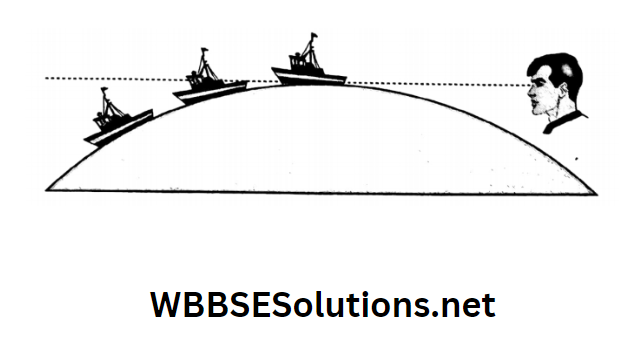
3. Observation of a ship leaving shore: When a ship sails away from shore, first its hull, then its deck, and finally the entire ship disappears from view. This happens because the Earth is spherical.

WBBSE Solutions For Class 6 Geography Chapter 2 Is The Earth Round The Spherical earth Observation of ship

WBBSE Class 6 Spherical Earth Notes

4. Observation of the horizon: As we climb up a mountain or we ascend in an aeroplane, the circumference of the horizon seems to expand and the shape seems to be circular.

WBBSE Solutions For Class 6 Geography Chapter 2 Is The Earth Round The Spherical earth Expansion of the circumference of the horizon with increase in altitude

5. Bedford Level Experiment: In 1870 AD, renowned naturalist and surveyor A.R Wallace put in 3 equal stakes in a straight line at equal intervals in the Bedford Canal of the United Kingdom.

Through a telescope, he observed that the second stake seemed to be higher than the first and the third stake.

This proved that the Earth is round. If the Earth were a flat disc, the tops of the stakes would be in a straight line.

Class 6 Geography WBBSE

WBBSE Solutions For Class 6 Geography Chapter 2 Is The Earth Round The Spherical earth bedford level experiment

Question 2. Who was the first to have the idea of a round Earth?
Answer:

People who believed that the Earth is round shaped are-

Aristotle: Aristotle, a Greek philosopher, observed the falling shadow of the Earth on the Moon during a lunar eclipse and he concluded that the Earth must be having a round shape.

Eratosthenes: Greek philosopher cum geographer Eratosthenes, standing on the seashore in 200 BCE, saw the disappearance of a sailing ship and concluded that the Earth is round.

3. Aryabhatta: Indian scientist Aryabhatta (in 476 CE) supported the idea of the round Earth.

Magellan: Magellan, a Portuguese explorer, sailed continuously westwards, circumnavigating the Earth, and finally returned to the same port. This voyage made him sure that the Earth has a circular shape.

WBBSE Solutions For Class 6 Geography Chapter 2 Is the Earth Round Topic A The Spherical Earth

Question 3. Give a few practical proofs of the Earth’s spherical shape.
Answer:

A few practical proofs of the Earth’s spherical shape are—

Instance 1: When one observes a ship leaving shore, first it’s the hull, then it’s a deck, and finally the entire ship seems to disappear from view.

Instance 2: when one looks down from a mountaintop, it seems as if the Earth is a spherical object and the sky covers it like a dome. It seems as if the Earth and the sky are meeting at a distant, arc-shaped line.

Instance 3: During a lunar eclipse, the shadow of the Earth falls on the Moon. This shadow is round and it proves that the Earth is spherical in shape.

Common Questions About Earth’s Roundness

WBBSE Solutions For Class 6 Geography WBBSE Solutions For Class 6 History WBBSE Solutions For Class 6 Maths
WBBSE Class 6 Geography Notes WBBSE Class 6 History Notes
WBBSE Class 6 Geography Multiple Choice Questions WBBSE Class 6 History MCQs WBBSE Notes For Class 6 School Science


Question 4. How did Magellan’s expedition of 1519 prove that the Earth is round?
Answer:

Magellan’s expedition of 1519 prove that the Earth is round:

The famous Portuguese explorer, Magellan, set out in 1519 to circumnavigate the globe with a fleet of five ships.

They always went westwards and after three years, they ended up at that port where they had set sail from. This circumnavigation clearly proves that the Earth is not a flat disc.

If we consider the Earth as a flat disk, then just by travelling to the west continuously, the ships would not have returned where they had started from. This proved beyond doubt that the Earth is round.

WBBSE Solutions For Class 6 Geography Chapter 2 Is The Earth Round The Spherical earth Proof of the earths spherical shape

Question 5. What is Lunar Eclipse? How does the Phenomenon of lunar Eclipse Prove that the Earth is round?
Answer:

Lunar Eclipse:

All heavenly bodies revolve in space in their own unique orbits. The Earth revolves around the Sun and the Moon revolves around the Earth in their own orbits.

If at any point during their revolutions, the Earth comes between the Sun and the Moon in a straight line.

Class 6 Geography Question Answer WBBSE

The Sun’s light is unable to reach the Moon because the Earth’s shadow falls on the Moon. This is called a lunar eclipse.

WBBSE Solutions For Class 6 Geography Chapter 2 Is The Earth Round The Spherical earth Magellans expedition route across the globe

During a lunar eclipse, the Earth’s shadow that falls on the Moon is seen to be circular in shape. This shows that the shape of the Earth is round.

Greek philosopher Aristotle was the first person to observe that the Earth is round in shape by noticing the circular shadow of the Earth during the lunar eclipse.

Only a circular or spherical object can have a circular shadow. Even when we see through a telescope, all other planets are seen to be spheres. So, it is natural to deduce that the Earth is also spherical in shape.

Practice Questions on Earth’s Spherical Nature

Question 6. Write a short note on the horizon.
Answer:

Horizon:

The line where the surface of the Earth and the sky meet is the horizon. The imaginary line that traces the horizon is called the line of the horizon.

When we stand on a flat stretch of land, our line of sight ends at a distant point where the sky and the surface of the Earth meet.

This is the horizon. This seems to be a straight line. When we stand on a mountain peak, the line of the horizon appears to be an arc.

When our line of sight is obstructed by trees or buildings, the skyline is called the visible horizon.

Class 6 Geography Question Answer WBBSE

Question 7. What does the Earth’s shape seem like from space?
Answer:

Earth’s shape seem like from space:

As seen from outer space, the Earth looks like a bright, blue sphere suspended in space.

The photographs sent by astronauts from space and from the Moon and also those taken by artificial satellites show that the Earth is spherical.

But, calculations have shown that the Earth is actually an oblate spheroid—not quite a sphere. Geographers think that there is no object existing on earth which is similar in shape to that of the Earth.

So the Earth should be described to have a unique shape like that of itself.

Question 8. Why the Earth apparently seems to be flat?
Answer:

Earth apparently seems to be flat:

The Earth apparently seems to be flat to those who live on earth, because—

1. The radius of the Earth is about 6,400 km. As a result, the curvature of the circumference of the Earth is huge, which is normally not visible to the human eye.

2. The visible limit of surroundings to the naked human eye from any point on the Earth’s surface is very low. As a result, the farthest a person can see from any location appears merely flat.

Important Definitions Related to Earth’s Shape

Question 9. Why the Sun Rises at different times at Different places on earth?
Answer:

Sun Rises at different times at Different places on earth:

The Earth apparently seems to be flat to those who live on earth, because—

The radius of the Earth is about 6,400 km. As a result, the curvature of the circumference of the Earth is huge, which is normally not visible to the human eye.

The visible limit of surroundings to the naked human eye from any point on the Earth’s surface is very low. As a result, the farthest a person can see from any location appears merely flat.

WBBSE Chapter 2 Is The Earth Round Topic A The Spherical Earth Short Answer Type Questions

Question 1. From where can we get photographs of the Earth?
Answer:

We can get photographs of the Earth from man-made satellites orbiting in space.

Question 2. What do you understand by the horizon?
Answer:

Horizon:

When we stand on a vast, open ground or in a wide open space and look around us, the Earth and the sky seem to meet at an arc-shaped line. This line is called the horizon. The horizon always remains circular.

Examples of Evidence for Earth’s Roundness

Question 3. How did people use to determine direction before the compass was invented?
Answer:

In ancient times before the compass was invented, people used the Pole Star to determine north, Hadley’s Octant to determine south, the Morning Star to determine east in the morning and Evening Star to determine west in the evening.

WBBSE Chapter 2 Is The Earth Round Topic A The Spherical Earth Very Short Answer Type Questions

Question 1. The Earth is round”—who was the first person to say this?
Answer: Pythagoras.

Question 2. The Earth is round” – who was the first Indian scientist to think this?
Answer: Aryabhatta.

Question 3. Who was the first person to deduce that the Earth is round by observing the shadow of a lunar eclipse?
Answer: Greek philosopher Aristotle.

Question 4. What is the average radius of the Earth?
Answer: 6,400km.

WBBSE Class 6 Geography Question Answer

Question 5. During a lunar eclipse, whose shadow falls on the Moon?
Answer: The Earth’s shadow.

Question 6. What shape is the line of the horizon?
Answer: Circular.

Question 7. Which heavenly body helped ancient people to determine the southern direction?
Answer: Hadley’s Octant.

Question 8. Which instrument was used by the navigators to determine the direction of navigation in ancient times?
Answer: Compass.

WBBSE Chapter 2 Is The Earth Round Topic A The Spherical Earth Fill in the blanks

Question 1. In 1519, Portuguese explorer___________set out to travel around the world with a fleet of five ships.
Answer: Magellan

Question 2. The greater the radius of an arc,___________ the curvature is going to be.
Answer: Lesser

Question 3. The horizon always remains ___________
Answer: Circular or arc Shaped

Question 4. If you imagine the Earth to be a flat stretch of land, the sky is like a huge___________ upturned on it.
Answer: Saucer

Question 5. Images showing the Earth’s spherical shape have been taken from artificial ___________.
Answer: Satellites

Question 6. Greek philosophers concluded that the Earth is round by observing the circular shadow of the Earth on the ___________ Moon during the lunar eclipse.
Answer: Aristotle

Question 7. The ancient Indian scientist ___________ endorsed the idea of a round Earth.
Answer: Arya Bhatta

Question 8. The Earth’s spherical shape was first scientifically proven by mathematician ___________.
Answer: Aristotle

WBBSE Chapter 2 Is The Earth Round Topic A The Spherical Earth Write True Or False

Question 1. Almost 500 years before the birth of Christ, Greek mathematician and philosopher Eratosthenes said that the Earth is round.
Answer: False

Question 2. The mean radius of the Earth is 6,400 km.
Answer: True

Question 3. In photographs taken from space, the Earth appears like a flat disc.
Answer: False

Question 4. During a lunar eclipse, the Earth casts a round shadow on the Moon.
Answer: False

Question 5. Greek philosopher Aristotle stated that the Earth’s shape is earth-shaped or geoid.
Answer: False

Question 6. The Earth rotates on its own axis.
Answer: True

Question 7. When a ship sails away from shore, first its mast, then its deck, and finally the entire ship disappears from view.
Answer: False

Question 8. The ocean looks like a sphere when viewed from the deck of a ship.
Answer: True

WBBSE Chapter 2 Is The Earth Round Topic A The Spherical Earth Match The Columns

Questions 1.

WBBSE Solutions For Class 6 Geography Chapter 2 Is The Earth Round The Spherical earth Macth the following

Answer: 1-D,2-A,3-E,4-B,5-C

WBBSE Solutions For Class 6 Geography Chapter 1 The Sun The Stars In The Sky Topic C Space Explorations

WBBSE Class 6 Geography WBBSE Chapter 1 The Sun The Stars In The Sky Topic C Space Explorations Analytical Type Questions

Question 1. Collect the information regarding expeditions to space to know about life on Mars.
Answer:

The information regarding expeditions to space to know about life on Mars:

Earth, the only planet in the solar system has life. But scientists are trying to find out if there was life on Mars, whether there is life now, and whether there could be life in the future.

According to the latest information, methane gas has been found on Mars. As a result, scientists and researchers are hopeful that the existence of life could be found on Mars.

There have been several expeditions to space to learn about life on Mars. Among them, the Mars Orbit Mission (MOM) is an important expedition. The information about this expedition is as follows:

Name of the spacecraft: Mars Orbit Mission (MOM)

Launch Center: From the Sriharikota Rocket Launch Center on November 5, 2013, at 2.38 pm by PSLV-C-25

Weight of the MOM: About 1337 kg

WBBSE Solutions For Class 6 Geography Chapter 1 The Sun The Stars In The Sky Topic C Space Explorations

Class 6 Geography WBBSE

Leaving the Earth’s orbit: December 1, 2013, at 12:48 pm

Entering the orbit of Mars: On September 24, 2014

Work: As a result of the tireless effort of ISRO scientists and technologists, MOM is sending a lot of unknown information about the weather and surface features of Mars. By sending MOM, India is assuring a new era in space research.

Finding: According to the latest data, methane gas has been found on Mars.

Some other expeditions on Mars are—

WBBSE Solutions For Class 6 Geography Chapter 1 The Sun The Stars In The Sky space explorations Some other expeditions on mars are-

Question 2. Write about man’s first expedition to the Moon.
Answer:

The milestones of man’s first expedition to the Moon are as follows—

Start of the journey: On July 16 of the year 1969, with astronauts Neil Armstrong, Edwin Aldrin, and Michael Collins on board, the spacecraft Apollo-11 set off from Kennedy Space Centre in Florida.

Read And Learn More  WBBSE Solutions For Class 6 Geography

Expedition: The spacecraft reached lunar orbit and started orbiting the Moon. At this point, the lunar module—Eagle, separated from the main craft-Columbia and landed on the Moon.

First steps on the Moon: On 20 July, Neil Armstrong became the first man to set foot on the Moon. Twenty minutes later, Edwin Aldrin joined him.

WBBSE Class 6 Space Exploration Notes

Mission: The astronauts then took pictures of the Moon’s surface, and collected samples of the Moondust as well as Moon rocks. They also carried out various other mission-related activities.

Return journey: The lunar module then lifted off from the Moon’s surface and rejoined Columbia. The astronauts reached Earth safely on July 24.

WBBSE Solutions For Class 6 Geography WBBSE Solutions For Class 6 History WBBSE Solutions For Class 6 Maths
WBBSE Class 6 Geography Notes WBBSE Class 6 History Notes
WBBSE Class 6 Geography Multiple Choice Questions WBBSE Class 6 History MCQs WBBSE Notes For Class 6 School Science


Question 3. What do astronauts report about the environment of the Moon?
Answer:

Some of the experiences that astronauts have reported about the environment of the Moon are as follows—

1. Less gravitational force: The gravitational force of the Moon is about 1/6 of the gravitational force of the Earth.

As a result, anyone on the Moon can easily jump about 6-7 times higher off the ground than he can do on Earth. Also, because of this low gravitational force, the Moon has no atmosphere.

2. No atmosphere: As the Moon does not have an atmosphere, the sky is always dark on the Moon. It is a place of perpetual night, with no dawn or dusk. Apart from temperature, there is no other element of weather.

3. No sound: Since there is no air on the Moon, there is no sound. Wireless transmitters are needed here for communication.

4. Uneven topography: The topography of the Moon is full of craters, potholes, hillocks, and hills. The craters are what we call Moon spots. There are many hills as well as over 0.2 million volcanic craters. There is a layer of dust all over the surface.

Class 6 Geography WBBSE

5. No life: There is no life on the Moon, as the Moon has neither air nor water

Question 4. What is a Space shuttle?
Answer:

Space shuttle: A space shuttle is a kind of spacecraft that helps objects to return to the Earth. As rockets work as launchers for objects, space shuttles serve as return vehicles.

Space shuttles are used to transport materials for the construction of space stations, transport instruments and devices as well as food and supplies for astronauts. For example, the space shuttle Columbia is operated by NASA.

Question 5. What is an Artificial satellite?
Answer:

Artificial satellites: The man-made satellites that orbit the Earth at a specific distance from the Earth’s surface are called Artificial satellites.

These satellites are extensively used for space research, weather forecasting, and mineralogy as well as monitoring land, air, and water on Earth. For instance, INSAT is an Indian satellite.

Question 6. What do you mean by ISRO?
Answer:

ISRO: ISRO or the Indian Space Research Organization is the Indian government’s space research agency.

Under ISRO, there are now 18 space research centers and launching stations in India. It was because of the efforts of ISRO that the Aryabhatta, Bhaskar, Rohini, and INSAT series of satellites have been launched into space.

Its latest pride is the successful injection of Mangalyaan into Mars orbit. It is headquartered in Bengaluru.

Question 7. What is a solar eclipse? Explain within a diagram.
Answer:

Solar eclipse: A Solar eclipse occurs when the Moon’s shadow falls on the Sun, blocking it from our view, partially or fully. This happens only when the Moon is directly in a straight line between the Sun and the Earth and always happens during the new Moon phase.

WBBSE Solutions For Class 6 Geography Chapter 1 The Sun The Stars In The Sky space explorations Solar eclipse

A total solar eclipse occurs when the Sun is completely blocked out by the Sun and a partial solar eclipse occurs when a part of the Sun is blocked out.

Question 8. What is a lunar eclipse? Explain with a diagram.
Answer:

Lunar eclipse: A Lunar eclipse occurs when the Earth’s shadow falls on the Moon, blocking it from our view, partially or fully. This happens when the Earth is between the Moon and the Sun in a straight line and on a full Moon night.

WBBSE Solutions For Class 6 Geography Chapter 1 The Sun The Stars In The Sky space explorations lunar eclipse

Question 9. Write about man’s expeditions to the Moon.
Answer:

The history of man’s expeditions to the Moon is as follows—

  1. On 20 July 1969, Neil Armstrong, an American astronaut, became the first man to set foot on the Moon.
  2. On 14 November 1969, the Moon saw the second set of visitors from the Earth.
  3. On 31 January 1971 astronauts from Earth started another mission and landed for the third time on the Moon.

Question 10. What are the dark spots on the Moon?
Answer:

Dark spots on the Moon: The dark spots on the Moon are actually huge depressions caused by volcanic activity and meteor impacts. Since the light from the Sun does not reach into their depths, they appear as dark patches.

As they were earlier thought to be seas and oceans, they were collectively called Maria (‘mare’ meaning sea in Latin). Some names of the lunar mares are the Sea of Tranquility, Sea of Crises, and so on.

Class 6 Geography Question Answer WBBSE

Question 11. Name some famous space travelers.
Answer:

Some famous space travelers are—

  1. ln 1957, a dog named Laika was sent to space by the then U.S.S.R. Laika was the first living creature from Earth to travel to space.
  2. In 1961, Yuri Gagarin traveled to space in a spacecraft named Vostok. He was the first human being to travel to space. G In 1963, Valentina Tereskova became the first woman in space.
  3. Vostok – 6 was the spacecraft.
  4. On 1 February 1997, Kalpana Chawla became the first woman of Indian origin to travel to space.
  5. Sunita Williams is the second woman of Indian origin to travel to space.
  6. She is also the woman astronaut who holds the record for clocking the most number of hours in space to date.

Question 12. After how many planets are the Earth situated when we move away from the Sun?
Answer:

The sun And all the innumerable heavenly bodies that travel around it make up the solar system. These include the planets, their satellites, minor planets, comets as well as asteroids.

WBBSE Solutions For Class 6 Geography Chapter 1 The Sun The Stars In The Sky The Solar System the solar system

Other members: Other members of the solar system are—

Eight planets: Mercury, Venus, Earth, Mars, Jupiter, Saturn, Uranus, and Neptune.

Five dwarf planets: Pluto, Eris, Ceres, Haumea, and Makemake.

Various satellites: Moon of the Earth, Deimos of Mars, Jupiter’s Ganymede, and Titan of Saturn, etc.

Comets: Halley’s, Hale-Bopp, Hyakutake, etc.

Asteroids: Ceres, Eros, etc. 0 Meteors: Leonid (meteor shower), etc.

Question 13. Make a model of the solar system with your friends.
Answer:

Project name: Making of solar system model

Name of the Students: Subhodip Jadab, Dip Pal, Sourav Karmakar, Sayan Pal

Name of the School: Chandernagore Banga Vidyalaya

Class: VI

Sec: A

Date: 05.12.2020

Required Materials: A large-size thermocol sheet, a few thermocol pieces, plastic balls of different sizes, rings of different sizes, tissue paper, glue, paint, brush, scissors, pens, pencils, pencil compass, scale, sketch pens, fine bamboo sticks, etc.

Model Construction Method: The red sun is drawn on the left side of the thermocouple.

  • Multiple partial orbits for planets and satellites have been drawn with a pencil compass.
  • Glue is applied to a certain part of the orbit with a brush.
  • Plastic balls of different sizes according to the planets and satellites are pasted on those parts.
  • Names of the planets, dwarf planets, and satellites are written with a sketch pen.
  • Rings of different sizes have been attached around Saturn. These indicate the seven bright rings of Saturn.
  • Again, in between Mars and Jupiter, glue is applied with a brush, and small pieces of thermocouple are pasted, which point to the asteroids.
  • Finally, glue with a brush on the upper right side of the thermocouple sheet is applied and fine bamboo sticks are stuck to indicate the comets.
  • At last, the heading, border, and names of the other members of the solar system are marked with a sketch pen.

WBBSE Solutions For Class 6 Geography Chapter 1 The Sun The Stars In The Sky space explorations model of solar system

Question 14. Draw a diagram of the solar system and mark it.
Answer:

WBBSE Solutions For Class 6 Geography Chapter 1 The Sun The Stars In The Sky space explorations solar system.

Answer:

  1. Mercury
  2. Venus
  3. Earth
  4. Mars
  5. Jupiter
  6. Saturn
  7. Uranus
  8. Neptune

Question 15. Make a collage from news clips collected from the dailies about space, solar storms, expeditions to Mars, solar eclipses, and lunar eclipses.
Answer:

Project name: Preparation of a collage of news about space-related information.

Name of the Students: Anshu Pramanik

Name of the School: KamalpurJ K High School

WBBSE Class 6 Geography Question Answer

Class: VI

Sec: B

Roll: 7

Date 21.12.2020

WBBSE Solutions For Class 6 Geography Chapter 1 The Sun The Stars In The Sky space explorations Collage of news about space realted informations

Question 16. Prepare cards with the characteristics of each planet written on them. Jumble them up and form small groups. Ask each group to pick up a card at random and see if you can identify the planet.
Answer: Procedure: It is divided into small groups as per the instructions of our teacher Mrs. Arpita Das Samanta. Then we write the characteristics of the planets on the cards and shuffle them.

Card 1: My features

Brightest and Warmest planet in the solar system.

I am almost equal to the Earth in size. That’s why I am also known as the ‘sister planet’ of the Earth.

I am also known as the evening star and the morning star.

Tell me who am I?

Answer: Venus

Card 2: My features

I have seven bright rings.

I take minimum time for one rotation.

I have a density less than that of water.

Tell me who am I?

Answer: Saturn

Card 3: My features

I am the fastest planet in the solar system.

I have no Satellite.

I am the nearest to the Sun.

Tell me who am I?

Answer: Mercury

Aesthetics and Creativity: This segment will check the aesthetic sense and creativity of the students.

Question 17. Spread some gum on a black chart paper and sprinkle some glitter on it to make galaxies of various shapes.
Answer:

  1. Project name: Making of Galaxies
  2. Name of the Student: Arnab Das
  3. Name of the School: Balagarh High School
  4. Class: VI
  5. Sec: B
  6. Roll: 9
  7. Date: 28.12.2020

Required Materials: A large-size black art paper, glue, paint, brush, scissors, pen, pencil, sketch pen, and mica dust of different colors etc.

Method of Work: A rough sketch of the galaxy has been drawn with a pencil on black art paper. Then the glue is applied with a brush to this rough sketch.

Now, the mica dust of different colors is scattered on the glue-laden sketch. Mica dust is sprinkled in such a way that they seem spiral or elliptical in shape.

WBBSE Solutions For Class 6 Geography Chapter 1 The Sun The Stars In The Sky space explorations Galaxy on art paper

Question 18. Draw all the constellations you find in the night sky. Make sure not to leave Polaris ou
Answer:

WBBSE Solutions For Class 6 Geography Chapter 1 The Sun The Stars In The Sky space explorations Constellations and the polaris

Question 19. You are a citizen of the Universe. Write down your complete address.
Answer: I am Sandipan Dutta. My complete address as a citizen of the Universe is as follows:

  1. Name: Sandipan Dutta
  2. Town/Village: Chinsurah
  3. State: West Bengal
  4. Country: India
  5. Continent: Asia
  6. Planet: Earth
  7. Galaxy: Milky Way

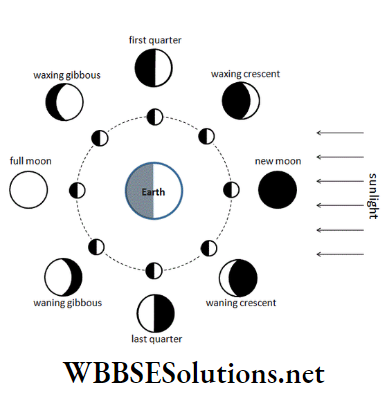
Question 20. Observe the phases of the moon from one full moon to the next when the night sky is mostly clear. Note the changes and draw them in your exercise book.
Answer:

Project name: Observation and recording of phases of the moon

Name of the Students: Sahyadri Ghosal

Name of the School: Vivekananda Vidyamandir

Class: VI

Sec: A

Roll: 1

Date: 17.11.2019 to 16.12.2019

Time: 8 pm

Observation and recording:

On the night of the first full moon, I saw a full moon like a big round plate because then the Sun rays fall completely on the moon.

From the day after the full moon, the moon became gradually thinner and thinner. Exactly 15 days later, on the night of the new moon, the moon was no longer seen.

From the day after the new moon, the moon started to grow in size again from the thin slice. Exactly 15 days later, on the night of the full moon, the moon was seen again like a big round plate.

In this way, I have observed the changes in the shape of the moon in a clear night sky from one full moon (17/11/2019) to the new moon (02/12/2019) and again from the new moon (02/12/2019) to the next full moon (16/12/2019).

Question 21. Mark the property

WBBSE Solutions For Class 6 Geography Chapter 1 The Sun The Stars In The Sky space explorations Moon ,Earth,Sun

Answer: 1. Moon, 2. Earth, 3. Sun

Question 22.

WBBSE Solutions For Class 6 Geography Chapter 1 The Sun The Stars In The Sky space explorations crossword

Clues:

Down: 3. The outermost region of the Sun’s atmosphere. 6. Satellite of Saturn. 7. Small extra-terrestrial body. 8. The first animal to visit space. 9. Eighth planet in respect of distance from the Sun. 10. Celestial body orbiting around planets.

Across: 1. Small celestial bodies move around the Sun found between Mars and Jupiter. 2. Dwarf planet. 3. An arrangement of Stars as seen from the Earth. 4. Location used for observing terrestrial and celestial events. 5. Instrument for observing celestial events.

Answer: Down 3. Corona, 6. Titan, 7. Meteor, 8. Laika, 9. Neptune, 10. Satellite Across: 1. Asteroids, 2. Pluto, 3. Constellation, 4. Planetarium, 5. Telescope

Question 23. What is the significance of artificial satellites?
Answer:

The significance of artificial satellites:

  • Satellites are small, heavenly bodies that orbit around planets. Satellites made by human beings that are sent to space for various purposes are known as artificial satellites.
  • These satellites are mostly used to forecast the weather, and ocean currents, predict natural disasters, and for defense purposes.
  • They also enable radio and mobile networks to operate. Space research is another function. Many countries have sent artificial satellites to space over the years.
  • Aryabhatta was the first artificial satellite to be launched by India, On 19 April 1975, from the former Soviet Union.
  • Aryabhatta was designed to revolve around the Earth once every 1 hour and 36 minutes and was equipped with the technology to send back a lot of information and data.
  • But a power failure halted experiments after just 4 days and 60 orbits and all signals from the satellite were lost. Aryabhatta re-entered the Earth’s atmosphere in February 1992.
  • In 1983, the Indian Space Research Organisation launched a satellite named INSAT. The main aim of launching INSAT was to enable telecommunications, and radio transmissions as well as for weather forecasting and analysis.

Question 24. Why do comets appear after intervals of time?
Answer:

Comets are heavenly bodies with a broomstick-like tail of gases and dust. Their heads are very bright and their tails extend for thousands of kilometers.

They also orbit around the Sun in a hyperbolic, elliptical orbit. But at some points during their orbits, their tails extend in a direction opposite to the Sun and are hence, not visible.

They revolve in the opposite direction to the planets and their orbits are so huge that it takes them a long time to reach a specific point in their orbit again.

That is why they are only visible from Earth at long intervals of time. Example: Halley’s comet is only visible every 76 years. It was visible in 1910 and 1986 and will again be seen in 2061.

WBBSE Chapter 1 The Sun The Stars In The Sky Topic C Space Explorations Short Answer Type Questions

Question 1. What are rockets and what are space shuttles?
Answer:

Rockets: Rockets and space shuttles are different kinds of spacecraft. Rocket technology allows us to send objects to outer space.

Their immensely powerful engines help them escape the Earth’s gravitational force and enter space. At this time, the technology to make rockets reusable is not available.

A space shuttle, on the other hand, is a spacecraft that is needed to return to Earth safely from space.

Question 2. ‘Rockets help to launch objects Into outer space/—how?
Answer:

Rockets help to launch objects Into outer space: If one wants to reach outer space, the first obstacle would be to counter is the Earth’s gravitational force. Doing this requires the object to achieve a minimum velocity of 11.2 km/sec—this velocity is known as ‘escape velocity’.

Rockets can do this with ease and so they are used to also put objects like artificial satellites into space.

Question 3. What is a spacesuit?
Answer:

Spacesuit: A spacesuit is a protective garment that is designed to help astronauts survive in space. Spacesuits are actually one-person spacecraft— pressurized, human-being-shaped chambers in which the atmospheric pressure is maintained as that on Earth.

Class 6 Geography Question Answer WBBSE

They protect astronauts from extreme temperatures in space; they supply oxygen to astronauts and also contain water. They protect astronauts from harmful radiation in space and from space matter and space debris hurtling around.

Question 4. What is Curiosity?
Answer:

Curiosity: Curiosity is an advanced Mars orbiter, launched by NASA. This is engaged in gathering data about the surface and atmosphere of Mars. Curiosity Rover is also looking for signs of life on Mars.

WBBSE Solutions For Class 6 Geography Chapter 1 The Sun The Stars In The Sky space explorations curiosity rover

Question 5. What is NASA?
Answer:

NASA: NASA (National Aeronautics and Space Administration) is an organization set up to manage issues of space research. It was inaugurated in 1958 by the then-American president, Dwight. D Eisenhower. It was under NASA that in 1967, Apollo 1 was launched.

Practice Questions on Satellites and Spacecraft

Question 6. What is INSAT?
Answer:

INSAT: The satellite launched by ISRO was named INSAT. There was an attempted launch of the INSAT-1A in the year 1982, which eventually failed the following year.

Then in the year 1983, INSAT-1B was launched successfully. The main aim of launching INSAT was to enable telecommunications, radio transmissions as well as weather forecasting and analysis.

Question 7. What is Aryabhatta?
Answer:

Aryabhatta: Aryabhatta was India’s first artificial satellite. On 19 April 1975, Aryabhatta was launched from the former Soviet Union.

Aryabhatta was designed to revolve around the Earth once every 1 hour and 36 minutes and was equipped with the technology to send back a lot of information and data.

But a power failure halted experiments after just 4 days and 60 orbits and all signals from the satellite were lost. Aryabhatta re-entered the Earth’s atmosphere in February 1992.

Question 8. Fill In The Knowledge Hive With Information On A Planetarium.

WBBSE Solutions For Class 6 Geography Chapter 1 The Sun The Stars In The Sky space explorations Planetarium

Answer:

  1. Various phenomena related to astronomy are shown here.
  2. This is dome-shaped in order to replicate the way we actually see different planets, stars, and other heavenly bodies in the sky.
  3. Lights are switched off during the show in order to present a clear view of the night sky.
  4. Here, the apparent motion of the Sun, Orion, Big Dipper, etc. is presented very beautifully.

Question 9. Mark the names of the planets in the solar system.

WBBSE Solutions For Class 6 Geography Chapter 1 The Sun The Stars In The Sky space explorations solar system.

Answer:

  1. Mercury
  2. Venus
  3. Earth
  4. Mars
  5. Jupiter
  6. Saturn
  7. Uranus
  8. Neptune

Question 10. Connect The numbered stars in the correct order and name the constellations

WBBSE Solutions For Class 6 Geography Chapter 1 The Sun The Stars In The Sky space explorations poler stars

Answer:

WBBSE Solutions For Class 6 Geography Chapter 1 The Sun The Stars In The Sky space explorations poler stars.2


Question 11. Why does the sky appear blue to the naked eye?
Answer:

In between the surface of the Earth and outer space, there is the atmosphere. This is made up of floating particles of dust and air.

This blanket of air absorbs all the colors of the spectrum in the Sun’s light, that is—violet, indigo, green, yellow, orange, and red – except blue. As a result, it reflects the blue and so, the sky appears blue to the naked eye.

Question 12. When it is a lunar eclipse on the Earth, it is a solar eclipse on the moon.—Why?
Answer:

When it is a lunar eclipse on the Earth, it is a solar eclipse on the moon: When during some full Moons, the Earth, Sun, and Moon are in a straight line, then the Earth’s shadow falls on the Moon, making it invisible.

That’s why we on Earth experience a lunar eclipse. At this time, the Sun is invisible from the Moon, so it is a solar eclipse on the Moon.

Question 13. Name the constellations with the help of the clues given below:

WBBSE Solutions For Class 6 Geography Chapter 1 The Sun The Stars In The Sky space explorations shape and direction

Answer:

WBBSE Solutions For Class 6 Geography Chapter 1 The Sun The Stars In The Sky space explorations shape and direction.2

WBBSE Chapter 1 The Sun The Stars In The Sky Topic C Space Explorations Very Short Answer Type Questions

Question 1. What is the total population of the world?
Answer: More than 7 billion.

Question 2. What is the dress worn by the astronauts while traveling to space known as?
Answer: Spacesuit.

Question 3. What are the main uses of artificial satellites?
Answer: Weather forecasting, navigation, and communication.

Conceptual Questions on the Universe and Beyond

Question 4. Write the expanded form of NASA.
Answer: National Aeronautics and Administration.

Question 5. Write the expanded form of ISRO.
Answer: Indian Space Research Organisation

Question 6. Where is the ISRO’s headquarters situated?
Answer: Bengaluru.

Question 7. What is India’s first lunar vehicle named?
Answer: Chandrayaan

Question 8. What is the mutual position of the Sun, Earth, and Moon in the case of a solar eclipse?
Answer: The Moon is in between the Sun and the Earth.

Question 9. In which year Laika had traveled to space?
Answer: 1957.

Question 10. What were the main constituent parts of the spaceflight, Apollo-ll?
Answer: Columbia, Eagle.

Question 11. Who were the crew members of the spaceflight, Apollo-ll?
Answer: Neil Armstrong, Michael Collins, Edwin Aldrin.

Question 12. What are the daytime and nighttime temperatures of the Moon?
Answer: Almost 117°C and -150°C respectively.

Question 13. Nebula: Galaxy: Star: Atmosphere
Answer: Atmosphere (not a heavenly body)

Question 14. Galaxy: Milky Way: Constellation: Earth
Answer: Earth (A planet)

WBBSE Class 6 Geography Question Answer

Question 15. A Moon: Sun: Proxima Centauri: Star
Answer: Moon ( A Satellite)

Question 16. Observatory: Temple: Telescope: Space
Answer: Temple (Not related to space research)

Question 17. Mercury: Venus: Earth: Moon
Answer: Moon ( A Satellite)

Question 18. I am the Earth’s only natural satellite. Who am I?
Answer: Moon

Question 19. I am the only planet in the solar system with life. Who am I?
Answer: Earth

Question 20. I am a celestial phenomenon who is seen after every 75/76 years. Who am I?
Answer: Halley’s comment

Question 21. I am the second woman of Indian origin who has spent the most amount of time in space. Who am I?
Answer: Sunita Williams

Question 22. I am the largest satellite in the solar system. I am a satellite of Saturn. Who am I?
Answer: Titan

Question 23. How many planets are there in the solar system?
Answer: Eight

Question 24. Which planet is the closest to the Sun and which is the farthest?
Answer: Mercury (the closest) and Neptune (the farthest)

Question 25. Which planet seems to be the largest?
Answer: Jupiter

WBBSE Chapter 1 The Sun The Stars In The Sky Topic C Space Explorations Fill In The Blanks

Question 1. ISRO is the space research centre of___________
Answer: India

Question 2. India’s first artificial satellite is called___________
Answer: Aryabhatta

Question 3. The first lunar vehicle from the Earth to land successfully on the Moon is___________
Answer: Chandrayan

Question 4. A lunar eclipse always occurs on ___________ night.
Answer: Full moon night

Question 5. The first space traveller from Earth is the Russian dog___________
Answer: Laika

Question 6. The first man to travel in space is___________
Answer: Yuri Gagarin

Question 7. The world’s first female astronaut is___________
Answer: Valentina tereskova

Question 8. India’s first astronaut is___________
Answer: Rakesh Sharma

Question 9. ___________ Spent the most time in space
Answer: Sunita Williams

Question 10. At night on Moon temperature drops up to___________
Answer: -150ºC

WBBSE Chapter 1 The Sun The Stars In The Sky Topic C Space Explorations Write True Or False

Question 1. An American satellite is named Aryabhatta.
Answer: False

Question 2. The Russian name of a man-made satellite is Sputnik.
Answer: True

Question 3. The central agency concerned with space research in India is ISRO.
Answer: True

Question 4. The first woman astronaut of Indian origin is Sunita Williams.
Answer: False

Question 5. Aryabhatta was launched on 19 April 1975.
Answer: True

Question 6. Thumba in Kerala is an important rocket launch site in India.
Answer: True

Question 7. The main obstacle to the launch of spacecraft is the Earth’s gravitational pull.
Answer: True

Question 8. Curiosity landed on Mars in 2014.
Answer: False

Question 9. Spacesuits are designed for astronauts.
Answer: True

Question 10. Laika was sent by Russia
Answer: True

WBBSE Chapter 1 The Sun The Stars In The Sky Topic C Space Explorations Match The Columns

Question 1.

WBBSE Solutions For Class 6 Geography Chapter 1 The Sun The Stars In The Sky space explorations match the following

Answer: 1-D,2-F,3-E,4-G,5-B,6-C,7-A,8-1,9-H

WBBSE Solutions For Class 6 Geography Chapter 1 The Sun The Stars In The Sky Topic B The Solar System

WBBSE Class 6 Geography WBBSE Chapter 1 The Sun The Stars In The Sky Topic B The Solar System Long Answer Type Questions

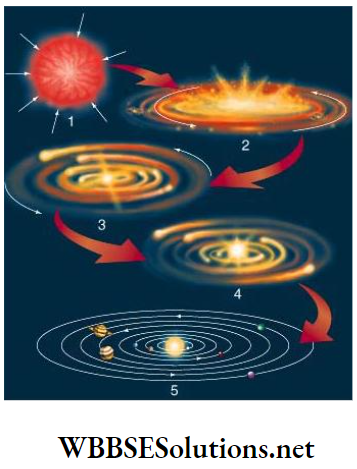
Question 1. How was the solar system formed?
Answer:

Formation solar system:

There are many theories about how the solar system was formed.

Some of these are as follows—

1. Most scientists believe that the solar system was born from a massive explosion of a gigantic, whirling mass of particles of space matter and gases.

2. Slowly, particles of dust, hydrogen, and helium compressed together to form a dense mass-the Sun.

3. The extreme gravitational force exerted by the center of this mass caused the collision of atoms and resulted in the generation of energy.

As time went on, this mass attracted even more space matter and started growing in volume. This swirling ball of fire started radiating heat and light.

5. Finally, clouds made up of dust particles and gaseous compounds, started revolving around the Sun as a result of the Sun’s gravitational force.

It is from these clouds that the planets formed over time.

Read And Learn More WBBSE Solutions For Class 6 Geography

WBBSE Solutions For Class 6 Geography Chapter 1 The Sun The Stars In The Sky The Solar System stages of formation of the solar system

Question 2. What do you know about the structure of the Sun? What is the solar atmosphere?
Answer:

The structure of the Sun:

The Sun is a medium-sized, yellow star that is about 4.6 billion years old.

It is a swirling mass of hydrogen, helium, nitrogen, oxygen, and other gaseous matter.

Apart from this, solid metal elements like gold, silver, nickel, and iron are also present but in gaseous form due to incredibly high temperatures.

WBBSE Solutions For Class 6 Geography WBBSE Solutions For Class 6 History WBBSE Solutions For Class 6 Maths
WBBSE Class 6 Geography Notes WBBSE Class 6 History Notes
WBBSE Class 6 Geography Multiple Choice Questions WBBSE Class 6 History MCQs WBBSE Notes For Class 6 School Science


Class 6 Geography WBBSE

The region of the Sun, categorized on differences in light and heat is given below—

1. Core: The innermost part of the Sun, where hydrogen is compressed to produce helium and release energy through nuclear fusion.

The temperature at the core is estimated to be 15 million degrees Celsius.

2. Radiative zone: This is the intermediate zone between the super-dense core and the outer layer.

This is the part that is visible to the naked eye as a red, luminous mass. Solar storms flare up in this part of the Sun.

WBBSE Solutions For Class 6 Geography Chapter 1 The Sun The Stars In The Sky The Solar System parts of the sun

Convective zone: This is the outermost layer of the interior of the Sun. In this zone, energy is transported by convection. This is actually the surface of the sun where light is created. So the outer part of this layer is called Photosphere.

WBBSE Class 6 Solar System Notes

WBBSE Solutions For Class 6 Geography Chapter 1 The Sun The Stars In The Sky Topic B The Solar System

Solar atmosphere: The solar atmosphere is made up of three parts—

1. The Photosphere,

2. The Chromosphere and

3. The Corona.

The Photosphere is the first region of the Sun that is visible to us. As the temperature decreases, the part of the solar atmosphere visible as red flashes is the Chromosphere.

The Corona is the outermost part of the Sun’s atmosphere. This is visible to the naked eye only during the total solar eclipse at moments of totality.

Question 3. What are the special features of the Sun?
Answer:

Special features of the Sun:

The Sun is the only star in our solar system. This huge, swirling ball of gas is also the brightest heavenly body in our solar system. The special features of the Sun are:

WBBSE Solutions For Class 6 Geography Chapter 1 The Sun The Stars In The Sky The Solar System Feature and uniqueness

Question 4. Describe the smallest planet in the solar system.
Answer:

The smallest planet in the solar system:

The smallest planet in the solar system is Mercury. This is also the planet nearest to the Sun. Some important facts about Mercury:

WBBSE Solutions For Class 6 Geography Chapter 1 The Sun The Stars In The Sky The Solar System Smallest planet in the solar system

Question 5. Describe the planet venus
Answer:

The planet venus:

The planet that lies second to the Sun is Venus. This is the closest planet to our Earth and also the sixth-largest in volume. Some important facts about Venus:

WBBSE Solutions For Class 6 Geography Chapter 1 The Sun The Stars In The Sky The Solar System the planet venus

Question 6. Describe Our earth and Its characteristics as a member of the solar system.
Answer:

Our earth and Its characteristics as a member of the solar system:

The earth is the only planet in the solar system which has life. Some Important facts about earth:

WBBSE Solutions For Class 6 Geography Chapter 1 The Sun The Stars In The Sky The Solar System Smallest planet in the solar system

Practice Questions on The Sun and Planets

Question 7. Describe the planet mars.
Answer:

Planet mars:

The fourth planet from the Sun is called Mars. It is the seventh-largest planet. Some important facts about Mars:

WBBSE Solutions For Class 6 Geography Chapter 1 The Sun The Stars In The Sky The Solar System planet mars

Question 8. Describe and discuss the largest planet in our solar system.
Answer:

The largest planet in our solar system:

The fifth planet from the Sun and the largest in terms of volume is Jupiter. That is why it is also called the King of Planets. This is named after the king of Gods in Roman mythology. Some important facts about Jupiter:

WBBSE Solutions For Class 6 Geography Chapter 1 The Sun The Stars In The Sky The Solar System the largest planet in our solar system

Important Definitions Related to The Solar System

Question 9. Describe the planet Saturn.
Answer:

The planet Saturn:

Saturn is the second-largest planet in terms of volume and the sixth planet from the Sun in our solar system. Some important facts about Saturn:

WBBSE Solutions For Class 6 Geography Chapter 1 The Sun The Stars In The Sky The Solar System Planet saturn

Question 10. Discuss the planet Uranus.
Answer:

Planet Uranus:

Uranus is the seventh planet from the Sun and the third-largest in terms of volume. This planet was discovered by the British astronomer William Herschel, in the year 1781. Some important facts about Uranus:

WBBSE Solutions For Class 6 Geography Chapter 1 The Sun The Stars In The Sky The Solar System Planet uranus

Question 11. Give a brief description of the planet Neptune.
Answer:

Planet Neptune:

Neptune is the eighth planet from the Sun and the fourth-largest in terms of volume. This planet was discovered by German astronomer Johann Galle, in the year 1846. Some important facts about Neptune:

Class 6 Geography Question Answer WBBSE

WBBSE Solutions For Class 6 Geography Chapter 1 The Sun The Stars In The Sky The Solar System Planet Neptune

Question 12. What are the differences between planets and stars? Or, Distinguish between stars and planets.
Answer:

The differences between planets and stars are—

Class 6 Geography Question Answer WBBSE

WBBSE Solutions For Class 6 Geography Chapter 1 The Sun The Stars In The Sky The Solar System planet and stars

Question 13. Write the differences between the inner and outer planets.
Answer:

The differences between inner and outer planets are—

WBBSE Solutions For Class 6 Geography Chapter 1 The Sun The Stars In The Sky The Solar System Point of difference inner and outer planets

Question 14. Write the differences between planets and satellites.
Answer:

The differences between planets and satellites are—

WBBSE Solutions For Class 6 Geography Chapter 1 The Sun The Stars In The Sky The Solar System Point of difference Planet and satellite

Question 15. What are different planets different in colors?
Answer:

When we look at the different planets through a telescope, they all appear to be of different colors. The reasons for this are as follows—

Class 6 Geography Question Answer WBBSE

WBBSE Solutions For Class 6 Geography Chapter 1 The Sun The Stars In The Sky The Solar System Planet Colour and cause

Question 16. Write the difference between planets and dwarf planets.
Answer:

The differences between planets and dwarf planets are—

WBBSE Solutions For Class 6 Geography Chapter 1 The Sun The Stars In The Sky The Solar System Point of difference Palnets and dwarf planets

Class 6 Geography Question Answer WBBSE

Question 17. What are the special features of mentors?
Answer:

Meteors are small, heavenly bodies – rock or metal – that travel through space and burn up when they enter the Earth’s atmosphere.

They appear suddenly in the night sky and disappear suddenly. They are also called Shooting stars. The special features of the meteors are—

Meteors look like peas from the Earth.

They burn up when they enter the Earth’s atmosphere.

Before burning up completely, they flare brightly and then rush toward the surface of the Earth at tremendous speed.

They fall on the Earth as cold, rocky pieces of matter.

The average speed of a meteor once It enters the earth’s atmosphere is about 75km/second.

Generally, mentors start burning at an altitude of about 130 km above the Earth’s surface and burn out around 95 km above the surface i.e in the Mesosphere.

Meteors can vary in weight from about a few grams to more than a thousand kilograms.

When many meteors enter the Earth’s atmosphere at the same time, it is called a Meteor shower.

When meteors are large in size, they are called Meteorites.

Sometimes, crater-like holes are formed when a meteor hits the Earth. For instance, the hole named Meteor Crater, with a diameter of 1180 meters and a depth of 175 meters in Arizona, USA.

WBBSE Class 6 Geography Chapter 6 Question Answer

Question 18. What is the solar system? Who are the members of the solar system?
Answer:

Solar system:

The sun And all the innumerable heavenly bodies that travel around it make up the solar system. These include the planets, their satellites, minor planets, comets as well as asteroids.

WBBSE Class 6 Geography Chapter 6 Question Answer

WBBSE Solutions For Class 6 Geography Chapter 1 The Sun The Stars In The Sky The Solar System the solar system

Other members: Other members of the solar system are—

Eight planets: Mercury, Venus, Earth, Mars, Jupiter, Saturn, Uranus, and Neptune.

Five dwarf planets: Pluto, Eris, Ceres, Haumea, and Makemake.

Various satellites: Moon of the Earth, Deimos of Mars, Jupiter’s Ganymede, and Titan of Saturn, etc.

Comets: Halley’s, Hale-Bopp, Hyakutake, etc.

Asteroids: Ceres, Eros, etc. 0 Meteors: Leonid (meteor shower), etc.

Question 19. Why we cannot draw the diagram of the solar system accurately?
Answer:

We cannot draw the diagram of the solar system accurately:

We cannot draw the diagram of the solar system accurately. Any diagram that we draw of the solar system is just a rough idea about it, because—

  1. The Sun is 1.3 million times larger than the Earth.
  2. About 1300 Earth can fit into Jupiter.
  3. Mercury is about half of the volume of the Earth.
  4. That is why, it is not possible to show the Sun, Jupiter, and Earth in the same diagram maintaining the proportion of their volume and size.

WBBSE Class 6 Geography Chapter 6 Question Answer

Question 20. Write a short note on planets.
Answer:

Planets:

Planets, as defined by the International Astronomical Union (IAU) in 2006, are heavenly bodies that fulfill all the following criteria:

  1. They do not generate their own light or heat.
  2. A planet is illuminated by light from a star.
  3. Each of them has its own defined and unique orbit and they revolve around a star.
  4. They are spherical in shape.
  5. They have cleared the area around their orbits of other heavenly bodies.

Planets are classified into Inner and Outer planets or the Terrestrial planets and the Gas giants.

  1. Inner (Terrestrial) planets: Mercury, Venus, Earth, and Mars
  2. Outer (Gas giants) planets: Jupiter, Saturn, Uranus, and Neptune.

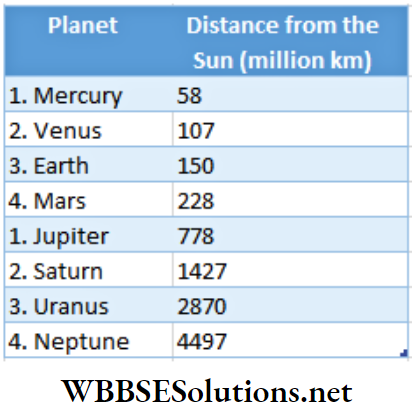
Question 21. Mention the names of the inner and outer planets along with their distances from the sun.
Answer:

Names of the inner and outer planets along with their distances from the sun are—

WBBSE Solutions For Class 6 Geography Chapter 1 The Sun The Stars In The Sky The Solar System Planet and distance from the sun

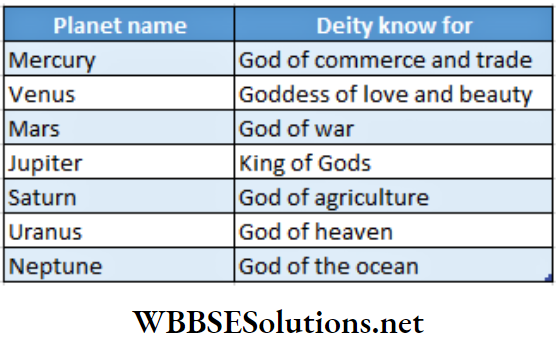
Question 22. Mention those planets named after greek or roman gods and goddesses.
Answer:

With the exception of earth, all of the planets in our solar system have been named from greek or roman mythology

WBBSE Solutions For Class 6 Geography Chapter 1 The Sun The Stars In The Sky The Solar System Planet name and deity know for

Question 23. Give a description of the dwarf planet Pluto.
Answer:

Dwarf planet Pluto:

Pluto was discovered by American scientist Clive Tombach on 28 February 1930 and was considered the ninth planet in our solar system till 24 August 2006, when the International Astronomical Union decided to change its classification to that of a dwarf planet.

Pluto is located almost on the edge of the solar system in the Kuiper Belt. Pluto is about 5.9 billion kilometers away from the Sun.

Its diameter is about 2376.6 km and its temperature is about -230°C. This dwarf planet takes 248 years to complete one revolution around the Sun and about 6.4 days to complete one rotation on its axis.

Examples of Celestial Bodies in The Solar System

Question 24. Prepare a table mentioning the names of the planets in the solar system and their main gaseous components.
Answer:

Names of the planets in the solar system and their main gaseous components are—

WBBSE Solutions For Class 6 Geography Chapter 1 The Sun The Stars In The Sky The Solar System Planet main geseous componets

Question 25. mention The duration of rotation and revolution of each planet in the solar system.
Answer:

The duration of rotation and revolution of each planet in the solar system are—

WBBSE Solutions For Class 6 Geography Chapter 1 The Sun The Stars In The Sky The Solar System Planet planet duration of one rotation

Question 26. Write a short note on the moon
Answer:

Moon:

The Earth’s nearest neighbor in space is the Moon. The Moon is the Earth’s only natural satellite.

It is at a distance of 384 thousand km from the Earth. Moon’s diameter is about 3475 km. Its surface area is about 37.9 million square km and its average density is about 3.34 gm/cm.

Origin story: The Moon was born about 4.52 billion years ago. American scientists William Hartman and Donald Davis first said that while the Earth was being formed, the ball of gas collided with a huge asteroid, and a part of it broke off.

This broken-off part was the Moon. The Earth’s gravitational force caused the Moon to start revolving around the Earth. This theory is known as ‘The Giant Impact’.

Question 27. Prepare a table of planets, the number of satellites they have, and the names of their important satellites
Answer:

Planets, the number of satellites they have, and the names of their important satellites are-

WBBSE Solutions For Class 6 Geography Chapter 1 The Sun The Stars In The Sky The Solar System Number of satellities and important of satellites

Question 28. What do you mean by the phases of the moon?
Answer:

Phases of the moon:

The phenomenon of the change in size and shape of the Moon as seen from Earth over the period of a month is called the Phases of the Moon.

From the new moon to the full Moon, the part of the Moon’s lit half that is visible from the Earth slowly increases. Then again, from the full Moon to the new Moon, it decreases. This phenomenon is called the Phases of the Moon.

The 14 days taken to go from a new Moon to a full Moon is called the Waxing of the Moon. During this time, the Moon sets in the sky 48 minutes after the time it set on the previous night.

WBBSE Class 6 Geography Chapter 6 Question Answer

The 14 days taken to go from the full Moon to the new Moon is called the Waning. During this time, the Moon rises 48 minutes later than the previous day. On the new Moon day, the Moon is not visible at all.

WBBSE Solutions For Class 6 Geography Chapter 1 The Sun The Stars In The Sky The Solar System phases of moon..

Question 29. Describe comets briefly.
Answer:

Comets :

A heavenly body with a bright head and a broomstick-like long tail of gases and dust is called a comet.

It appears suddenly and is usually visible for a short span of time. The word ‘comet’ is derived from the Greek word ‘Komets’ and the Latin word ‘Cometa’ for ‘long hair’.

Structure: A comet has three distinct parts—

  1. the head,
  2. dust tail
  3. gas tail.

The gaseous tail has carbon dioxide, carbon monoxide, ammonia, methane, solid oxygen, hydrogen, nitrogen, and so on.

Origin: After the Big Bang, the mixture of dust particles and gases that remained after the stars and planets were formed, came together to form comets.

Special features: Some special features of comets are—

  1. These have hyperbolic and elliptical orbits.
  2. They can be periodic or non-periodic.
  3. Like planets, they too have orbits around the Sun. As they approach the Sun, the length of their tails increases.
  4. They are seen clearly at dawn and dusk.

WBBSE Solutions For Class 6 Geography Chapter 1 The Sun The Stars In The Sky The Solar System coment

Question 30. ‘Earth is the only planet with life/ —Explain why.
Answer:

Earth is the only planet with life:

In terms of distance, the Earth is the third planet from the Sun. The Earth receives just 1/2 billion of the energy generated by the Sun.

This energy from the Sun reaches the Earth every 8 minutes and 20 seconds – this gives us the heat, light, and conditions required to sustain life.

WBBSE Class 6 Geography Question Answer

The average temperature of the Earth is about 15°C and about 71.4% of its volume is water. This water is the other means of sustaining life on Earth.

Because the Earth revolves around its axis once every 24 hours, we have the cycles of day and night. The envelope of air that surrounds the Earth up to a distance of 10,000 km contains oxygen.

Due to the presence of all these conditions, life can exist on Earth.

Question 31. Sometimes mentor showers take place on earth why?
Answer:

Sometimes mentor showers take place on earth:

Meteors are small, rocky pieces of space matter that orbit around the Sun but are not visible because of their size.

When they come too close to the Earth and the Earth’s gravitational force pulls them into the Earth’s atmosphere, then these meteors experience friction with the particles of the Earth’s atmosphere.

This causes them to catch fire and eventually, burn up. Within the atmosphere, they hurtle around at a velocity of almost 10 – 100 km/hour depending on the size.

At around 130 km above the Earth’s surface, they catch fire and by the time they reach the mesosphere – around 95 km above the Earth’s surface, they burn to ash. When dozens of meteors are visible at once, this is called a meteor shower.

Question 32. Though all planets revolve around the Sun at the same time, they do not collide with each other/—why?
Answer:

The Sun is at the exact center of the solar system. Though eight planets and five dwarf planets are in constant revolution around the Sun, they do not collide with each other.

This is because—

1. Different orbit: Each planet revolves around the Sun in its own unique, elliptical orbit and each planet is at a different distance from the Sun.

2. Different revolutionary periods: The revolutionary period of each planet is different and unique.

3. Specific distance: While the massive size of the Sun results in it exerting its centrifugal force on the planets and drawing them towards it, its centripetal force also remains in action.

Thus keeping the planets at specific distances and maintaining their movement in their individual orbits.

WBBSE Chapter 1 The Sun The Stars In The Sky Topic B The Solar System Short Answer Type Questions

Question 1. What Is the solar system?
Answer:

Solar system:

The solar system is our Sun and all the innumerable heavenly bodies that travel around it. These include the planets, their satellites, dwarf planets, comets as well as asteroids.

Question 2. Write the difference between comets and meteors.
Answer:

The Difference between comets and meteors

WBBSE Solutions For Class 6 Geography Chapter 1 The Sun The Stars In The Sky The Solar System Point of difference Comets and meteors

Question 3. How was the Sun formed?
Answer:

Sun formed As Follows:

Scientists believe that the Sun was formed when particles of space, like dust, hydrogen, and helium gas started to compress around a nucleus.

The great gravitational force in this nucleus resulted in a nuclear fusion—which again generated great energy. This energy started radiating as a huge ball of fire—that we know today as the Sun.

Scientists estimate that this happened about 4600 million years ago.

Question 4. What are sunspots?
Answer:

sunspots:

The dark spots visible in the interior of the Sun, when seen with a powerful telescope, are called sunspots. These are actually huge holes that are the result of the nuclear fusion continuously occurring in the interior of the Sun.

As these holes are cooler than the rest of the Sun, they appear darker.

Question 5. Why should we not look at the Sun with our naked eyes?
Answer:

Along with heat and light, the Sun also emits radiation that is harmful to human beings.

WBBSE Class 6 Geography Question Answer

These rays can cause considerable damage to the retina of the eye. It can cause partial or even complete blindness. So, we must never look at the Sun with the naked eye.

Question 6. Which are the terrestrial planets?
Answer:

Terrestrial planets:

Mercury, Venus, and Mars are smaller and much like the Earth in size. That is why, these plants are called terrestrial planets.

Question 7. Three more planets in the solar system, besides Saturn, have rings. Can you name them?
Answer:

Three more planets in the solar system, besides Saturn, have rings

In the solar system, besides Saturn Jupiter, Uranus, and Neptune have rings.

Question 8. What exactly are the rings of Saturn?
Answer:

Rings of Saturn:

In 1655, the scientist Huygens first saw a revolving, disc-shaped system encircling Saturn.

These were later observed to be ring-like formations of ice, dust particles, asteroids, meteors, and other space materials. The rings of Saturn remain one of the mysteries of our universe.

The spacecraft Cassini is at work collecting and sending more information about these rings to Earth. Almost 7 major and 320 minor rings are encircling Saturn.

Question 9. Mercury is the planet closest to the Sun, Venus is brighter/—why?
Answer:

Mercury is the planet closest to the Sun, Venus is brighter:

According to the principles of reflection of light, the larger the object, the higher its reflection power. Venus is three times the size of Mercury, so the amount of the Sun’s light it reflects is greater.

Venus is covered in clouds and has a smooth surface while Mercury is rough. As a result, following the principles of reflection of light, it reflects more light. Also, Venus is closer to the Earth and so, it appears brighter to us.

Question 10. Why is Venus called the Earth’s twin?
Answer:

Venus called the Earth’s twin:

As Venus is almost equal to the Earth in both volume and density, it is called Earth’s twin planet or sister planet.

Question 11. Name the nearest and the farthest planets
Answer:

The nearest and the farthest planets

The planet nearest to the Sun is Mercury and the farthest is Neptune.

Question 12. What is a dwarf planet?
Answer:

Dwarf planet:

A dwarf planet is a heavenly body that has a defined orbit around the Sun, and has enough gravity to be nearly spherical but unlike planets, has not yet cleared its orbit of other celestial objects.

As an example, Pluto has been declared to be a dwarf planet by astronomers in 2006.

Question 13. What is a satellite?
Answer:

Satellite:

A satellite is a small, heavenly body that orbits around a planet. It does not produce any heat or energy on its own. A satellite is illuminated and heated by the Sun.

Conceptual Questions on Planetary Orbits

Example: The moon is the satellite of the Earth; Deimos and Phobos are satellites of Mars.

Question 14. What are moonshots?
Answer:

Moonshots:

The dark patches visible on the Moon are called moonshots. In reality, these are small mountains, extensive depressions, mouths, and craters of ancient volcanoes, and so on.

Since the moon does not generate its own light and the Sun’s light does not reach these parts, they look like black patches on the Moon’s surface.

Question 15. What is a lunar month?
Answer:

Lunar month:

The length of time from one full moon to the next or one new moon to the next is called a lunar month. The moon takes 27 days 7 hours 43 minutes and 11.47 seconds to complete one revolution around the Earth.

Due to minor orbital variations, sometimes, it takes the moon a little more time to come back to the same position (29 days 12 hours 44 minutes 38.4 seconds).

Question 16. There would be no life on Earth without the Sun/—Explain why.
Answer:

There would be no life on Earth without the Sun:

The Sun is the only source of heat and light for our Earth. The Sun is at a distance of 150 million kilometers from the Earth.

As a result, the Sun’s light is not so blinding here. The Earth receives just 1 part of the 2 billion parts of heat that the Sun generates.

As a result of this heat, the Earth has living organisms like plants, animals, and human beings. If the Sun stops producing energy, all life on Earth as we know will die.

Question 17. What are asteroids?
Answer:

Asteroids:

Small, airless, rocky bodies that revolve around the Sun in their own specific orbits but are too small to be called planets are called asteroids.

A large number of these, ranging in size from as small as a grain of sand to as big as half of the moon, are found orbiting between Mars and Jupiter. Example: The asteroid belt between Mars and Jupiter, Trojans, etc.

Question 18. By the definition of earth day and earth year which planet has a longer day than a year?
Answer:

Venus takes 243 Earth days to complete one rotation on its axis—so, one day on Venus is equal to 243 Earth days. Venus takes 225 days to complete one revolution around the Sun – that is, a year on Venus is 225 days.

Thus, on Venus, a ‘day’ is longer than a ‘year’.

WB Class 6 Geography Question Answer

Question 19. Stars twinkle but planets do not/—Why?
Answer:

Stars twinkle but planets do not:

The stars are at a great distance from the Earth. Their light travels a great distance to reach us. While traveling through space, particles of light collide with the particles of space and get deflected.

Question 20. ‘We Always see only one face of the moon from earth.’-Explain this statement.
Answer:

We Always see only one face of the moon from earth:

As a result, their light seems to blink or twinkle. On the other hand, planets never emit their own light.

They receive their light from Sun and this light has to travel a much lesser distance to reach us. As a result, the planets do not twinkle.

The Earth is much larger than the Moon (the Earth’s volume is 5,101 million cubic km, while that of the Moon is 379 million cubic km) The Moon not only revolves around the Earth, it also rotates around its axis.

The Moon takes 27 days 7 hours 43 minutes to rotate on its own axis and takes the same time to complete one revolution around the Earth. Since both of these are equal, we always get to see just one face of the Moon.

WBBSE Chapter 1 The Sun The Stars In The Sky Topic B The Solar System Very Short Answer Type Questions

Question 1. What Is the name of the outer surface of the Sun?
Answer: Corona.

Question 2. Which gas is the predominant constituent of the Sun?
Answer: Hydrogen.

Question 3. What is the name of the main heavenly object in the solar system?
Answer: The Sun.

Question 4. How does the Sun’s light appear from Earth?
Answer: Steady.

Question 5. By what other names is Venus called?
Answer: The Morning Star and the Evening Star (though Venus is not a star).

Question 6. What is the color of the Earth when it is seen from space?
Answer: Blue.

Question 7. Which is the largest inner planet in the solar system?
Answer: Earth.

Question 8. What would happen to the Earth if the Sun was not there?
Answer: There would be no day or night and there would be no life on Earth.

Question 9. What is another name for Mars?
Answer: The Red Planet.

Question 10. Which planet has the most satellites?
Answer: Jupiter.

Question 11. Which planet is called the ‘king of planets’?
Answer: Jupiter.

Question 12. Which planet is called ‘the green planet’?
Answer: Uranus.

Question 13. Which is the smallest outer planet in the solar system?
Answer: Neptune.

Question 14. Which is the largest dwarf planet in the solar system?
Answer: Pluto.

Question 15. How much bigger is the Earth than the moon?
Answer: 50 times by volume and 4 times by area.

Question 16. What is Jupiter’s largest satellite named?
Answer: Ganymede.

Question 17. When will Halley’s Comet be sighted from the Earth again?
Answer: In 2061 (according to the information given by solarsystem.nasa.gov).

Question 18. Which instrument is used to measure the Sun’s angle of elevation?
Answer: Sextant.

WBBSE Chapter 1 The Sun The Stars In The Sky Topic B The Solar System Fill In The Blanks

Question 1. The Sun is _________ million times heavier than the Earth.
Answer: 0.3

Question 2. Jupiter, Saturn, Uranus, and Neptune are _________ planets.
Answer: Gaseous

Question 3. The nearest planet to the Sun which does_________ not have any satellite is
Answer: Mercury

Question 4. The fastest-revolving planet in the solar system is _________
Answer: Mercury

Question 5. The brightest planet in the solar system is _________
Answer: Venus

Question 6. The planet nearest to the Earth is_________
Answer: Venus

Question 7. A year on Venus is equal to_________ days
Answer: 225

Question 8. Mars takes _________ days to complete one for light from the Moon to revolution around the Sun.
Answer: 687

Question 9. _________ is the planet with the largest number of satellites.
Answer: Jupiter

Question 10. It takes each the Earth.
Answer: 1.3 Seconds

Question 11. The Moon was formed about_________ billion years ago.
Answer: 4.52

Question 12. Change in the Moon’s size and shape from full moon to new moon is called _________
Answer: Phases of the moon

Question 13. Miranda and Titania are satellites of _________
Answer: Uranus

Question 14. The largest satellite in the solar system is _________
Answer: Titan

Question 15. Ceres and vesta are _________
Answer: Asteroids

Question 16. There are about_________ asteroids Between mars and Jupiter.
Answer: 40,000

Question 17. _________ is the largest planetoid in the solar system.
Answer: Ceres

Question 18. Halley’s Comet is visible from the Earth at an interval of _________ years.
Answer: 76

WBBSE Chapter 1 The Sun The Stars In The Sky Topic B The Solar System True Or False

Question 1. The planet nearest to the Sun is Venus.
Answer: False

Question 2. The part of the solar system around Pluto is called the ‘Kuiper Belt’.
Answer: True

Question 3. The moon is the source of heat for planets.
Answer: False

Question 4. Venus does not have any satellites.
Answer: True

Question 5. Venus is called the twin planet of the Earth.
Answer: True

Question 6. Halley’s Comet was last seen in 1996.
Answer: False

Question 7. The gravitational force of the moon is much less than that of the Earth.
Answer: True

Question 8. Pluto is a planet.
Answer: False

Question 9. The moon has its own light.
Answer: False

Question 10. A lunar eclipse always occurs at a full moon.
Answer: True

Question 11. A person will weigh 6 times more on the moon than on the Earth.
Answer: False

Question 12. A lunar eclipse does not occur on every new moon as the Sun, the moon and the Earth are not in a straight line every time.
Answer: True

Question 13. A celestial body with a long, bright tail is called a comet.
Answer: True

WBBSE Chapter 1 The Sun The Stars In The Sky Topic B The Solar System Match The Columns

WBBSE Solutions For Class 6 Geography Chapter 1 The Sun The Stars In The Sky The Solar System match the following

Answer: 1-E,2-F,3-D,4-B,5-C,6-A

WBBSE Solutions For Class 6 Geography Chapter 1 The Sun The Stars In The Sky Topic A The Universe

WBBSE Class 6 Geography Chapter 1 The Sun The Stars In The Sky Topic A The Universe Long Answer Type Questions

Question 1. Write some of the astonishing facts about the stars.
Answer:

Some of the astonishing facts about the stars:

The heavenly bodies that produce their own light and energy are called Stars. They are usually huge spheres of glowing gas held together by their own gravity.

The following are some of the astonishing facts about the stars.

Stars twinkle: The stars are at a great distance from the Earth.

  1. Their light travels a great distance to reach us.
  2. While traveling through space, particles of light collide with the particles of space and get diverted.
  3. As a result, their light seems to blink or twinkle.

2. We cannot see the stars in the daytime: Stars are the thousands of bright, twinkling dots of light which we can see in the night sky.

  1. With the aid of a powerful telescope, we can see about 1800 million stars, and with the naked eye, about 6000.
  2. But during the day they are not visible. This is because of the overwhelming brightness of the Sun since it is near to us.

3. Sun is the only star in our solar system: The Sun is the only star in our solar system whose existence has been proven.

This huge, swirling ball of gas is also the brightest heavenly body in our solar system.

4. Stars that flock together: When we look up at the sky, it often seems as if some stars form a natural group—these collections of stars are called Constellations.

Early astronomers joined the brightest stars in each constellation with imaginary lines and then gave names to them based on the shape formed by these imaginary lines.

These were mostly mythological characters, people, or animals.

For instance, Orion is named after the Greek god of hunting as the lines joining the brightest stars seem to form the shape of a hunter holding a bow in one hand and a sword in the other.

WBBSE Solutions For Class 6 Geography Chapter 1 The Sun The Stars In The Sky Topic A The Universe

Question 2. How was the universe formed?
Answer:

Formation Of universe:

Scientists are not unanimous about the origin of the universe.

They have different theories. Some of them are—

Some scientists believe that a huge star came near the Sun and its gravitational force caused parts of the Sun to break away. These broken-off bits of matter then formed the planets.

Other scientists believe that the universe was once smaller than a grain of sand.

About 14000 million years ago, there was a big explosion, out of which many stars were born.

A further series of explosions on these stars caused smaller stars, planets, satellites, galaxies, nebulae, and other heavenly bodies to be formed.

Common Questions About Stars and Planets

WBBSE Solutions For Class 6 Geography WBBSE Solutions For Class 6 History WBBSE Solutions For Class 6 Maths
WBBSE Class 6 Geography Notes WBBSE Class 6 History Notes
WBBSE Class 6 Geography Multiple Choice Questions WBBSE Class 6 History MCQs WBBSE Notes For Class 6 School Science


Question 3. How did the expansion of the universe occur?
Answer:

The expansion of the universe occur:

There are different opinions on how the universe expanded.

Some believe that the universe at first was a whirling nebula made up of sand-like particles of space matter.

At some point, these particles of space matter started moving inward, increasing the central density of the nebula.

The planets were formed when this space matter started concentrating towards different nuclei and then formed dense, individual spheres.

The other opinion is the Big Bang Theory, which says that as a result of a huge explosion, the universe—which in the beginning was just a pinhead—started expanding outwards and is still expanding.

Question 4. What is Astronomy?
Answer:

Astronomy:

One of the oldest subjects of scientific study is the study of space.

From ancient times man has been fascinated by the planets, stars, constellations, asteroids, galaxies, and other heavenly bodies that light up our sky.

The branch of scientific study that concentrates on space is known as Astronomy. One of the first uses of this study of space was to determine the direction of the Sun, moon, and stars.

Defining and dividing time into years, months, and days based on the repetition of patterns in the sky was also important in this study.

Devices like compasses and watches were all invented based on astronomy.

Practice Questions on The Sun and Stars

Question 5. What is Milky Way?
Answer:

Milky Way:

Millions of stars together form a galaxy.

The galaxy in which our solar system is situated is called the Milky Way.

The Milky Way is a huge, spiral galaxy made up of almost 100 billion stars along with gas and dust particles.

All the stars that we see in the night sky are part of this galaxy.

Question 6. Write the differences between nebula and galaxy
Answer:

The differences between nebula and galaxy are:

WBBSE Solutions For Class 6 Geography Chapter 1 The Sun The Stars In The Sky The Universe Nebula and galaxy

Class 6 Geography Question Answer WBBSE

Question 7. What does the color of a star tell us?
Answer:

The color of a star tell us:

The color of a star indicates its temperature.

For instance—

  1. Red stars have the lowest temperature.
  2. Yellow stars are a little hotter.
  3. Blue stars are very hot and bright.
  4. White stars are the hottest and also the largest in size. So we can see all these white stars with our naked eyes.

Question 8. What do you mean by constellation?
Answer:

Constellation:

When we look up at the sky, it often seems as if some stars form natural group-these collections of stars called constellations.

Early astronomers joined the brightest stars in each constellation with imaginary lines and then gave names to them based on the shape formed by these imaginary lines.

These were mostly mythological characters, people, or animals.

For instance, Orion is named after the Greek God of hunting as the lines joining the brightest stars seem to form the shape of a hunter holding a bow and an arrow in his hands.

Some other examples are Cassiopeia, Ursa Minor, etc.

Important Definitions Related to The Universe

In such a way that from the Earth it appears as a hunter with a bow and an arrow in his hands and is wearing a belt.

It also seems that there is a sword hanging from his belt.

This constellation has seven bright stars forming a distinctive hourglass-shaped pattern in the night sky.

Question 9. What is Ursa Major?
Answer:

Ursa Major:

Ursa Major is a constellation of seven stars.

WBBSE Solutions For Class 6 Geography Chapter 1 The Sun The Stars In The Sky The Universe ursa major

This constellation is visible in the north sky usually from February to October.

When the seven stars of this constellation are joined with an imaginary line, it takes the shape of a question mark (?).

As there are seven major stars in this constellation, it is also called Saptarshi Mandal.

Class 6 Geography Question Answer WBBSE

The main stars of this constellation are Dubhe, Merak, Phecda, Megrez, Alioth, Mizar, and Alkaid.

Question 10. Write a short note on Orion.
Answer:

Orion:

The constellation that is imagined to form the shape of a hunter-warrior is called Orion.

In January-February, it is seen in the southeast part of the night sky.

If the brightest stars are joined with an imaginary line, this constellation takes the shape of a hunter.

The stars are aligned In such a way that from the Earth it appears as a hunter with a bow and an arrow in his hands and is wearing a belt.

It also seems that there is a sword hanging from his belt. This constellation has seven bright stars forming a distinctive hourglass-shaped pattern in the night sky.

Another constellation near Orion is Canis Major. The bright bluish star visible in this is called Sirius. It is assumed as the pet dog of the hunter as per common belief.

WBBSE Solutions For Class 6 Geography Chapter 1 The Sun The Stars In The Sky The Universe Orion

Question 11. Write a note on the telescope.
Answer:

Telescope:

A telescope is a tube-shaped instrument fitted with lenses to make distant objects appear bigger and nearer when we look through it.

Huge telescopes are used to study the heavenly bodies. The word is derived from the Greek word ‘Tele1 meaning ‘distant’ and ‘Skopein’ meaning ‘to see’.

So, the literal meaning of a telescope is the instrument used to study distant objects. For each telescope, a giant-dome-shaped structure has to be built which is called an observatory.

Class 6 Geography Question Answer WBBSE

Today’s telescopes allow astronomers to study heavenly bodies that are 2 billion light years away. Galileo Galilei was the first known person to use a telescope to study the stars and other celestial objects.

WBBSE Chapter 1 The Sun The Stars In The Sky Topic A The Universe Short Answer Type Questions

Question 1. What is the universe?
Answer:

Universe:

All of space and everything in it, including stars, planets, and galaxies, is called the Universe. It is thought to be at least 10 billion light years in diameter and about 13 billion years old.

Question 2. What is space?
Answer:

Space:

The billions of galaxies, nebulae, stars, planets, satellites, dust, and gases exist in the infinite vacant called space.

Question 3. What is the sky?
Answer:

Sky:

The sky is part of the atmosphere and outer space that we can see from our Earth. The Sun during the day, and the moon, the stars, and constellations like Orion and Cassiopeia in the night make up our sky.

Question 4. What are luminaries?
Answer:

Luminaries:

The many heavenly bodies that light up the night sky are called luminaries.

Question 5. What is a nebula?
Answer:

Nebula:

A cloud of gas and dust in outer space, seen in the night sky as an indistinct bright patch, is called a nebula. A nebula is mainly composed of hydrogen, helium, and grains of sand. Example: Cat’s Eye.

Question 6. What is a star?
Answer:

Star:

The heavenly bodies that produce their own light and energy are called Stars. They are usually huge spheres of glowing gas held together by their own gravity. Sun, Proxima Centauri, Betelgeus etc. are some stars.

Examples of Celestial Bodies in The Universe

Question 7. What is a light year?
Answer:

Light year:

A light year is a unit used to measure distances in space that are too large to be measured by our ordinary earthly units. This is the distance light travels in one year. 1 light year = 9.46 trillion kilometers.
For instance, Proxima Centauri is 4.2 light years away from the Earth.

Question 8. What is Cassiopeia?
Answer:

Cassiopeia:

The constellation formed by five stars in an ‘M’ or ‘W’ shape, located opposite Ursa Major, is called Cassiopeia.

Question 9. Why are the stars not seen in the daytime?
Answer:

Stars are the thousands of bright, twinkling dots of light which we can see in the night sky. With the aid of a powerful telescope, we can see about 1800 million stars, and with the naked eye, about 6000.

But during the day they are not visible. This is because of the overwhelming brightness of the Sun since it is near to us. When it is day and one part of the Earth faces the Sun, the brightness of the Sun makes other distant stars invisible.

Question 10. What is an Observatory?
Answer:

Observatory:

Observatory is a dome-shaped space research center. A huge telescope is used in the observatory to examine the stars and other heavenly bodies in space. Example: Hanle in Ladakh is the highest observatory in the world.

WBBSE Chapter 1 The Sun The Stars In The Sky Topic A The Universe Answer In One Or Two Words

Question 1. What is a nebula?
Answer: A gigantic celestial cloud of Hydrogen, Helium, and dust particles.

Question 2. From which celestial body stars are born?
Answer: Nebulae.

Question 3. What is the name of our galaxy?
Answer: Milky way.

Question 4. Which is the brightest star in the night sky?
Answer: Sirius.

WB Class 6 Geography Question Answer

Question 5. Write the name of the star closest to the Earth.
Answer: Sun.

Question 6. What is the speed of light?
Answer: 3,000,000 km/s.

Question 7. What is the name of the hunter-shaped constellation?
Answer: Orion.

Question 8. Which constellation is visible in the winter night sky?
Answer: Orion.

Question 9. What is the name of the dome-shaped space research center?
Answer: Observatory.

WBBSE Chapter 1 The Sun The Stars In The Sky Topic A The Universe Fill In The Blanks

Question 1. The universe was formed about __________ billion years ago.
Answer: 14

Question 2. Stars are born from __________
Answer: Nebula

Question 3. Millions of stars together make up a __________
Answer: Galaxy

Question 4. The Milky Way is a huge, spiral __________
Answer: Galaxy

Question 5. Small red stars have the __________ temperature.
Answer: Least

Question 6. __________stars are the brightest and hottest.
Answer: White

Question 7. The star closest to the Earth is the __________
Answer: Sun

Question 8. The star nearest to the Sun is __________
Answer: Proxima Centauri

Question 9. Light travels at almost __________ km/s.
Answer: 3000,000

Question 10. Proxima Centauri is at a distance of __________ light years from the Earth.
Answer: 4.2

Question 11. Cassiopeia is a __________
Answer: Constellation

Question 12. The bright star visible in the northern sky is called __________
Answer: Pole Star

WBBSE Chapter 1 The Sun The Stars In The Sky Topic A The Universe Write True or False

Question 1. After the Sun, the star nearest to the Earth is Proxima Centauri.
Answer: True

Question 2. Another name for the Pole Star is the Evening Star.
Answer: False

Question 3. A Galaxy includes thousands of millions of Planets.
Answer: False

WBBSE Class 6 Geography Question Answer

Question 4. We can find the direction with the help of Pole Star.
Answer: True

Question 5. We can measure huge distances in space by the unit called Light Year.
Answer: True

Question 6. Oil Ursa Major is also known as Saptarshimandal.
Answer: True

Question 7. The ‘M’-shaped constellation is called Cygnus.
Answer: False

Question 8. The Earth is enveloped by the atmosphere.
Answer: True

Question 9. The distance of Proxima Centauri from the Earth is about 4.2 light years.
Answer: True

WBBSE Chapter 1 The Sun The Stars In The Sky Topic A The Universe Match The Columns

WBBSE Solutions For Class 6 Geography Chapter 1 The Sun The Stars In The Sky The Universe match the following

Answer: A-2,B-3,C-5,C-1,E-4

WBBSE Solutions For Class 6 Geography

WBBSE Solutions For Class 6 Geography