WBBSE Solutions For Class 10 Life Science And Environment Chapter 2 Continuity Of Life Chromosome

Chapter 2 Continuity Of Life Chromosome Summary

WBBSE Class 10 Chromosome Structure Overview

  • Cell division and reproduction maintain the continuity of life. Ceil contain a nucleus which in turn contain chromosome. The DNA in the chromosome is> the reservoir of genetic information.
  • A particular portion or sequence of DNA, that controls one or more characters of an organism is called a gene. It is also known as a basic physical and functional unit of heredity.
  • Chromosome is a condensed form of DNA. Hence it is of two types—autosomes and allosomes. Autosomes are mainly responsible for controlling somatic characteristics whereas allosomes are responsible for sexual features. In the human body, 22 pairs of autosomes are there, whereas allosomes are only one pair.
  • In males,-allosomes are heterologous in nature and comprise with two different types of chromosome-X and Y. In female, allosomes are homologous in nature and comprise of similar type of chromosome-X and X.

Read and Learn More WBBSE Solutions for Class 10 Life Science And Environment

  • The physical structure of a chromosome is mainly comprised of chromatids, centromere, secondary constriction and telomere. The chemical components of chromosomes are DNA, histone and non-histone protein.
  • DNA or deoxyribonucleic acid is a large molecule mainly composed of two polynucleotide chains, that coil around with each other and form a helical structure. This DNA is chemically composed of N2 bases, pentose sugar and phosphate. The N2 bases of DNA are of two types-purines (adenine and guanine) and pyrimidine (cytocine and thymine).
  • Other than DNA, RNA also carries genetic information in the case of lower organisms {mainly bacteria and viruses). This RNA or ribonucleic acid is produced or originates from DNA, mainly composed of a single polynucleotide chain and is very unstable in nature.
  • Like DNA, it is also comprised with N2 base, pentose sugar and phosphate. But in RNA pyrimidine base uracil replaces the thymine.
    When the cell is in a quiescence state, the chromosome remains in chromatin form in the cell. On the basis of staining and function, chromatin is of two types-euchromatin and heterochromatin.

Continuity Of Life Chromosome

Chapter 2 Continuity Of Life Chromosome Long Answer Type Questions

Question 1. Explain the inter-relationships among Chromosomes, DNA and gene. Distinguish between euchromatin and heterochromatin on the following two aspects: Coiling, Activity.
Or,
Distinguish between euchromatin and heterochromatin.

Answer:

Inter-relationships among Chromosomes, DNA and gene:

There are fine thread-like structures present in the nucleus of cell. These are intermingled twisted ladder-like double-stranded structures. These structures are DNA which are large biomolecules. They occur inside the nucleus in a completely coiled manner.

In an undivided state of cells, the partially uncoiled DNA is called nuclear fibre or chromatin fibre. During cell division, DNA gets coiled. DNA strand surrounds protein molecules firmly and forms a dense coiling.

This coiled structure is called a chromosome. Actually, chromatin fibre and chromosome are respectively the less and much-coiled structures of DNA.

WBBSE Solutions for Class 10 History WBBSE Solutions for Class 10 Geography and Environment
WBBSE Class 10 History Long Answer Questions WBBSE Solutions for Class 10 Life Science And Environment
WBBSE Class 10 History Short Answer Questions WBBSE Solutions for Class 10 Maths
WBBSE Class 10 History Very Short Answer Questions WBBSE Solutions for Class 10 Physical Science and Environment
WBBSE Class 10 History Multiple Choice Questions


Life Science Class 10 Wbbse

Difference between euchromatin and heterochromatin

WBBSE Solutions For Class 10 Life Science And Environment Chapter 2 Continuity Of Life Chromosome Differences between euchromatin and Heterochromatin

Types of Chromosomes in Humans

Question 2. Describe the physical structure of the eukaryotic chromosome. Or, Describe the morphological features of the chromosomes of an eukaryotic cell.
WBBSE Solutions For Class 10 Life Science And Environment Chapter 2 Continuity Of Life Chromosome

Part Question, Explain the importance of the following parts of a eukaryotic chromosome:

  1. Centromere,
  2. Telomere.

Answer:

The physical structure of eukaryotic chromosome:

The morphological features of a chromosome appear ‘most distinctly under a microscope during the metaphase stage of cell division. From this study, we can find 5 parts of a chromosome. These parts are described below.

1. Chromatids:

In a metaphase chromosome, two identical and longitudinal strands are seen. These are chromatids. Two chromatids of the same chromosome are called sister chromatids, which remain attached to a constricted region or centromere.

Each chromatid carries one or few very fine filaments along its length. These are called chromonemata (singular—chromonema). Each chromonema is composed of a longitudinally arranged coiled DNA.

Along each chromonema, everal spherical linearly arranged bead-like structures are seen, which are called chronometers.

2. Primary constriction and centromere:

Each chromosome has a distinct constricted region at which the sister chromatids remain attached to each other. This is known as primary constriction.

At e primary constriction, a round plate-like and dense heterochromatin structure is seen, which is called the centromere. The centromere has a few adhesive points, called kinetochores, which attach to the spindle fibres during metaphase.

The DNA present in the .centromere is genetically inactive in nature.
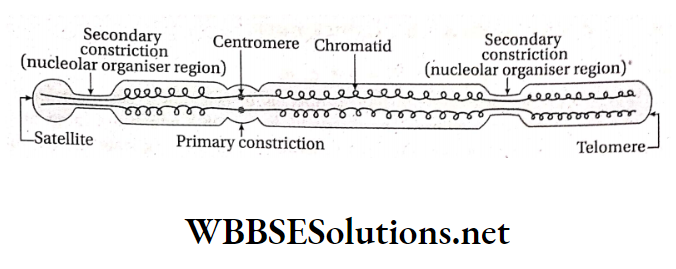
WBBSE Solutions For Class 10 Life Science And Environment Chapter 2 Continuity Of Life Chromosome Physiacal Structure of a chromosome

3. Secondary constriction:

Other than primary constriction, there are one or a few constricted regions in the chromosomes. These are called secondary constrictions. Generally, the nucleolus is seen affixed to the secondary constriction.

During the telophase of cell division, this region helps to reorganise the nucleolus. Therefore, secondary constriction is also known as nucleolar organiser region or NOR.

4. Satellite:

In a few chromosomes, a bulb-shaped terminal portion is seen beyond the secondary constriction. This is called a satellite or SAT body. The chromosomes with SAT body are called SAT chromosomes.

5. Telomere:

The terminal portions of a chromosome are called telomeres. These are genetically inactive regions of a chromosome. During interphase, telomeres help in DNA replication.

It also prevents the joining of a chromosome with another and controls the ageing and death of a cell.

Life Science Class 10 Wbbse

Question 3. Draw the morphology of an ideal eukaryotic chromosome and label the following parts:

  1. Chromatid,
  2. Centromere,
  3. Nucleolar organizer,
  4. Telomere.

Answer:

WBBSE Solutions For Class 10 Life Science And Environment Chapter 2 Continuity Of Life Chromosome Physiacal Structure of a chromosome

Question 4. Classify chromosomes based on the position of the centromere. Describe each type.

Answer:

Classification of chromosomes based on the position of the centromere

Based on the position of centromere, chromosomes can be classified into the following types—

  1. Metacentric chromosome,
  2. Sub-metacentric chromosome,
  3. Acrocentric chromosome and
  4. Telocentric chromosome.

Description of different types of chromosomes:

Different types of chromosomes have been described below.

1. Metacentric chromosome:

In this type of chromosome, the centromere is located at its middle. The two arms appear almost identical. During anaphasic movement, this type of chromosome appears as the English letter ‘V’.

Life Science Class 10 Wbbse

2. Sub-metacentric chromosome:

The Centromere of this type of chromosome is located slightly away from the ie centre. The two arms are unequal in length; one arm is slightly longer than the other, tiling anaphasic movement, this type of chromosome appears as the English letter ‘L’.

WBBSE Solutions For Class 10 Life Science And Environment Chapter 2 Continuity Of Life Chromosome Different types of Chromosomes

3. Acrocentric chromosome:

In this type of chromosome, the centromere is located near one end of it. Here, one arm is very long and another one is very short. During anaphasic movement, this type of chromosome appears like the English letter J.

4. Telocentric chromosome:

This type of chromosome has its centromere at one terminal end. During anaphasic movement, this chromosome appears like the English letter ‘I’.

Question 5. Distinguish between

  1. Chromosome and chromatid,
  2. Centromere and centrosome.

Answer:

Differences between chromosome and chromatid

WBBSE Solutions For Class 10 Life Science And Environment Chapter 2 Continuity Of Life Chromosome Differences between Chromosome and Chromatid

Differences between centromere and centrosome

WBBSE Solutions For Class 10 Life Science And Environment Chapter 2 Continuity Of Life Chromosome Differences between Centromere and Centrosome

Life Science Class 10 Wbbse

Question 6. Describe the chemical structure of chromosomes.

Answer:

Chemical structure of chromosome:

A eukaryotic chromosome is composed of nucleic acid (DNA and RNA), proteins (basic and acidic) and metallic ions like calcium (Ca2+), magnesium (Mg2+) etc. Eukaryotic chromosomes contain 90% DNA and histone proteins.

The remaining 10% comprises RNA and acidic (non-histone) proteins.

1. Deoxyribonucleic acid (DNA):

It is a double-stranded helically coiled self-replicating macromolecule, 88 of deoxyribose (pentose) sugars, nitrogenous bases and phosphate molecules. Physically, this molecule appears as a spiral staircase.

The handrail-like portion of this molecule PhyS1Cposed of pentose sugars and phosphates. The steps are made up of pairs of nitrogenous bases, each pair includes one purine and one pyrimidine. Purines are adenine (A) and guanine (G).

Pyrimidines are thymine (T) and cytosine (C) In DNA, adenine joins with thymine and guanine joins with cytosine with two and three weak hydrogen bonds respectively.

WBBSE Solutions For Class 10 Life Science And Environment Chapter 2 Continuity Of Life Chromosome Chemical Components of Chromosome

2. Ribonucleic acid (RNA):

It is a single-stranded macromolecule, having few loops along the length. RNA is composed of ribose sugars, phosphates and nitrogenous bases. Like DNA, RNA also includes adenine, guanine and cytosine but instead of thymine, it contains uracil (U).

3. Histone and non-histone proteins:

The basic proteins of chromosomes are known as histones. Due to their basic nature, they can easily combine with acidic DNA molecules to provide stability.

Five types of histones are seen in a chromosome. These are H1, H2A, H2B, H3 and H4. Besides these, a few acidic non-histone proteins are also present in chromosomes.

4. Metallic ions:

These include calcium (Ca2+) and magnesium (Mg2+) ions, which help to maintain the integrity of the chromosome.

Question 7. Distinguish between DNA and RNA

Answer:

Differences between DNA and RNA

WBBSE Solutions For Class 10 Life Science And Environment Chapter 2 Continuity Of Life Chromosome Differences between DNA and RNA

Functions of Chromosomes in Genetic Continuity

Chapter 2 Continuity Of Life Chromosome Short Answer Type Questions

Question 1. State the relation between chromosomes and gene.

Answer:

The relation between chromosomes and gene:

A chromosome is a dense, coiled form of DNA and a gene is a specific sequence of DNA, that can be translated to form a particular protein, which can be expressed in an organism. The number of genes is constant in a particular chromosome.

Not only the number, in a particular chromosome the nature of the gene is also constant. If a particular portion of a chromosome will be deleted mistakenly then the particular gene of that region will also be deleted which leads to mutational abnormality.

Question 2. What is a chromosome?

Answer:

Chromosome:

Chromosome is the self-replicating thread or rod-shaped nucleoprotein structure, present within the nucleus of eukaryotic cells. Chromosome carries genes and thereby controls all features and activities of any organism.

Wbbse Class 10 Life Science Solutions

Question 3. What are autosomes?

Answer:

Autosomes:

Autosomes are the chromosomes, which are present in the nucleus of the cell and regulate all physical features of an organism. Out of 23 pairs of chromosomes in a human somatic cell, 22 pairs are autosomes.

Question 4. Write the name of any two structural parts of the eukaryotic chromosome.

Answer:

Two structural parts of eukaryotic chromosome are chromatids and centromere.

Question 5. Mention the types of chromosomes.

Answer:

Functionally, chromosomes can be classified into two types. These are—

  1. Autosomes or Somatic chromosomes and
  2. Allosomes or sex chromosomes.

Question 6. What are allosomes?

Answer:

Allosomes:

The chromosomes present in the nucleus other than autosomes which mainly carry the sex-determining factors, are called allosomes. Human allosomes are of two types—X and Y chromosomes.

Question 7. What is meant by homologous chromosomes?

Answer:

Homologous chromosomes:

In a diploid (2n) cell, all chromosomes are present in pairs. Both the chromosomes of a pair have identical length, and size and carry the same set .of genes.

Each of these pairs of chromosomes is called a homologous chromosome.

WBBSE Solutions For Class 10 Life Science And Environment Chapter 2 Continuity Of Life Chromosome Homologous Chromosome

Common Chromosomal Abnormalities in Humans

Question 8. What Is Chromatid?

Answer:

Chromatid:

During metaphase, each chromosome splits along the length into two identical thread-like portions, which remain attached to each other at a distinct constriction, called centromere. Each of these two filamentous parts of a chromosome is called a chromatid.

Question 9. What is Chromoneme?

Answer:

Chromoneme:

Chromonema filaments densely coil to form several equidistant bead-like structures serially aligned along its length. These dense granular structures are called chromomeres.

Wbbse Class 10 Life Science Solutions

Question 10. What is meant by chromatin reticulum?

Answer:

Chromatin reticulum:

The delicate network of very fine coiled, thread-like nucleoprotein structures, present in the nucleus of the cell, which shows affinity towards basic dyes, is called chromatin reticulum.

Before cell division, these chromatin reticular coils densely to take the shape of chromosomes.

Question 11. What is meant by primary constriction?

Answer:

Primary constriction:

The lightly stained, constricted part of a chromosome, at which the two chromatids remain attached, is called primary constriction. The region of primary constriction carries the centromere.

It is also the region where the spindle fibres bind during metaphase.

Question 12. What is meant by secondary constriction?

Answer:

Secondary constriction:

Apart from primary constriction, there may be one or few lightly stained constricted points, present on chromosomes. Each of these constrictions is called secondary constriction. The nucleolar organiser region (NOR) is associated with secondary constriction region.

Question 13. What is meant by NOR?

Answer:

NOR:

NOR stands for nucleolar organiser region. It is a chromosomal region around which the nucleolus forms. NOR includes active RNA genes which give rise to secondary constrictions of metaphase chromosomes.

Wbbse Class X Life Science

Question 14. What is meant by constitutive heterochromatin? Where does this occur?

Answer:

Constitutive heterochromatin:

The type of heterochromatin, which always remains within the nuclei of nil types of cells, is called constitutive heterochromatin.

Occurrence of constitutive heterochromatin:

This occurs in the centromere, telomere and nucleolar organiser regions.

Question 15. What is meant by facultative heterochromatin? Where does this occur?

Answer:

Facultative lieterochromatin:

Wbbse Class 10 Life Science Solutions

The type of heterochromatin, which occurs in certain cell types for a brief period of time, is called facultative heterochromatin.

Occurrence of facultative heterochromatin:

This occurs in the nucleus of human female somatic cells as Barr body.

Question 16. What is meant by coiled heterochromatin?

Answer:

Coiled heterochromatin:

In certain cells, during interphase, some heterochromatin fibres occur in coiled form. These are called coiled heterochromatin. These heterochromatin fibers help in gene regulation and are present equally in all cells.

Question 17. What is meant by haploid cells?

Answer:

Haploid cells:

The cells, in which all types of chromosomes occur in an unpaired state, are called haploid cells. The chromosome number of these cells is indicated as (n).

Example: Human spermatozoa and ova are haploid cells.

Question 18. What is meant by diploid cells?

Answer:

Diploid cells:

The cells, in which all types of chromosomes occur in the paired state, are called diploid cells. The chromosome number of these cells is indicated as (2n).

Example: Human somatic or body cells are diploid in nature.

Question 19. what are meant by 44XY and 44XX chromosomes?

Answer:

44XY and 44XX chromosomes:

In human somatic cells, there are 46 chromosomes. Out of these, male body cells have 44 autosomes and XY as two sex chromosomes whereas in females, diere are 44 autosomes and XX as two sex chromosomes.

Therefore, 44XY and 44XX constitute the chromosome number of a human male and female respectively.

Wbbse Class 10 Life Science Solutions

Question 20. Distinguish between primary and secondary constriction.

Answer:

Differences between primary and secondary constriction are—
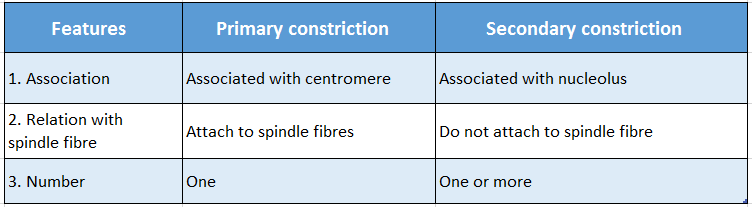
WBBSE Solutions For Class 10 Life Science And Environment Chapter 2 Continuity Of Life Chromosome Differences between Primary, secondary constriction

Question 21. Distinguish between autosome and sex chromosome of humans based on the following features: Nature, Number.
Or,
Distinguish between autosome and allosome.

Answer:

Differences between autosome and allosome are—
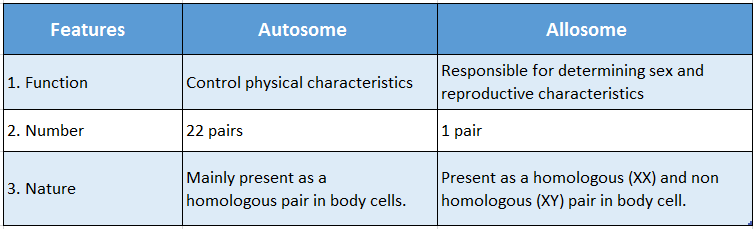
WBBSE Solutions For Class 10 Life Science And Environment Chapter 2 Continuity Of Life Chromosome Differences between Autosome and Allosome

Wbbse Class 10 Life Science Solutions

Question 22. What is meant by euchromatin?

Answer:

Euchromatin:

The loosely coiled chromatin fibres, which are lightly stained by basic dyes in a resting nucleus, carry active genetic material and take part in the synthesis of RNA, are called euchromatin. All functional genes of a cell are present in euchromatin.

WBBSE Solutions For Class 10 Life Science And Environment Chapter 2 Continuity Of Life Chromosome Euchromation and heterochromatin

Question 23. What is heterochromatin?

Answer:

Heterochromatin:

The densely coiled chromatin fibres, which are deeply stained by basic dyes and carry less genetic material are called heterochromatin. These chromatin fibres take part in regulating genes and maintaining chromosomal integrity.

Question 24. What is a gene?

Answer:

Gene:

The specific segment of a DNA molecule that acts as the structural and functional unit of heredity is called a gene. It carries the code for the synthesis of a particular protein within a living cell.

Genes are responsible for determining different characteristics of a living organism.

Question 25. What is locus?

Answer:

Locus:

Every gene is located in a specific position of a particular chromosome. This specific position of the gene on this particular chromosome is known as the locus of that gene.

Mitosis and Meiosis in Chromosome Division

Question 26. What is a nucleotide?

Answer:

Nucleotide:

The structural unit of a nucleic acid molecule, composed of one nitrogenous base, one pentose sugar and a phosphate group, is known as a nucleotide.

The number of nucleotides present in the nucleic acid conventionally determines the size of the nucleic acid.

Question 27. What is nucleoside?

Answer:

Nucleoside:

The structural subunit of a nucleic acid molecule, composed of one nitrogenous base and a pentose sugar, is known as a nucleoside. Phosphodiester bonds join several nucleosides one after another to form a nucleic acid strand.

Question 28. Distinguish between nucleoside and nucleotide.

Answer:

Differences between nucleoside and nucleotide are—

WBBSE Solutions For Class 10 Life Science And Environment Chapter 2 Continuity Of Life Chromosome Differences between Nucleoside and Nucleotide

Question 29. What are histone proteins?

Answer:

Histone proteins:

The basic structural proteins, which bind to DNA to make it stable, are called histone proteins. There are five different histone proteins present in chromosomes. These are HI, H2A, H2B, H3 and 114.

Question 30. What are non-histone proteins?

Answer:

Non-histone proteins:

The acidic proteins associated with DNA molecules are known as non-histone proteins. These proteins help in the regulation of genes.

Question 31. What is meant by deoxyribonucleotide?

Answer:

Deoxyribonucleotide:

The structural unit of a DNA molecule, composed of one nitrogenous base, one deoxyribose sugar and a phosphate, is called deoxyribonucleotide.

Example:

Deoxyadenosine monophosphate, deoxyguanosine monophos¬phate, deoxycytidine monophosphate and deoxythymidine monophosphate.

Question 32. What is meant by ribonucleotide?

Answer:

Ribonucleotide:

The structural unit of an RNA molecule, composed of one nitrogenous base, one ribose sugar and a phosphate group, is called ribonucleotide.

Example: Adenosine monophosphate, guano-sine monophosphate, cytidine monophosphate and uridine monophosphate.

Question 33. What is the full form of DNA? Where does it occur?

Answer:

  1. Full form of DNA: Deoxyribonucleic acid.
  2. Occurrence of DNA: DNA occurs in chromosomes of the nucleus, mitochondria and plastids in eukaryotic cells. In prokaryotic cells, it occurs as the nucleoid. It also occurs in DNA viruses as genetic material.

WBBSE Solutions For Class 10 Life Science And Environment Chapter 2 Continuity Of Life Chromosome DNA molecule

Wbbse Class 10 Life Science Solutions

Question 34. Mention the components of DNA.

Answer:

DNA consists, of three components.

These components are—

  1. Nitrogenous bases (such as adenine, guanine, thymine and cytosine),
  2. Deoxyribose sugar and
  3. Phosphate molecule.

Question 35. What is the full form of RNA? Where does it occur?

Answer:

  1. Full form of RNA: Ribonucleic acid.
  2. Occurrence: RNA occurs in nucleus ribosomes in eukaryotic cells. In prokaryotic cells, it occurs in ribosomes. RNA also occurs as genetic material in RNA viruses.

Question 36. Mention the components of RNA.

Answer:

RNA consists of three components.

These components are

  1. Nitrogenous bases [such as adenine (a), guanine (g), cytosine (c) and uracil (u)],
  2. Ribose sugar and
  3. Phosphate molecule.

WBBSE Solutions For Class 10 Life Science And Environment Chapter 2 Continuity Of Life Chromosome RNA molecule

Question 37. Mention the types of RNA present in living cells.

Answer:

RNA is of three types.

These are—

  1. Messenger RNA or mRNA,
  2. Ribosomal RNA or rRNA and
  3. Transfer rna or trna.

WBBSE Solutions For Class 10 Life Science And Environment Chapter 2 Continuity Of Life Chromosome RNA molecule

Role of Chromosomes in Cell Division

Question 38. What is a nucleosome? State its significance.

Answer:

Nucleosome:

In eukaryotes,, the basic structural organization of DNA packaging, where the DNA strand wound around the eight histone proteins (octamer) and looks like with a thread wrapped around a spool.

The eight histone proteins that are coiled by DNA are H2A, H2B, H3, and H4.

Significance Of Nucleosome:

Nucleosome is a packaging technique, that allows the DNA to be wrapped into the small area of a cell.


Chapter 2 Continuity Of Life Chromosome Very Short Answer Type Questions Multiple Choice Questions And Answers [Mcq]

Question 1. The term ‘chromosome’ was coined by—

  1. Robert Hook
  2. Darwin
  3. Waldeyer-ITartz
  4. Lamarck

Answer: 3. Waldeyer-ITartz

Question 2. The nucleolar organiser region refers to—

  1. Primary constriction
  2. Secondary constriction
  3. Nucleolus
  4. Nucleoplasm

Answer: 2. Secondary constriction

Question 3. At which region of a chromosome is the centromere situated?

  1. Primary constriction
  2. Secondary constriction
  3. Telomere
  4. Satellite

Answer: 1. Primary constriction

Question 4. The number of types of histone proteins presents in chromosomes are—

  1. Two
  2. Three
  3. Five
  4. Six

Answer: 3. Five

Question 5. The chromosome, whose centromere is located at the middle, is known as—

  1. Telocentric chromosome
  2. Acrocentric chromosome
  3. Metacentric chromosome
  4. Sub-metacentric chromosome

Answer: 3. Metacentric chromosome

Wbbse Class 10 Life Science Solutions

Question 6. Chromosomes in human somatic cells are—

  1. Diploid
  2. Haploid
  3. Tetraploid
  4. Triploid

Answer: 1. Diploid

Question 7. Many mitotic divisions are required to give rise to 128 cells from a single cell.

  1. 7 times
  2. 14 times
  3. 16 times
  4. 32 times

Answer: 1. 7 times

Question 8. The nitrogenous base, that is absent in RNA molecules, is called—

  1. Adenine
  2. Guanine
  3. Cytosine
  4. Thymine

Answer: 4. Thymine

Question 9. Which of the following is not a structural component of DNA?

  1. Deoxyribose sugar
  2. Uracil base
  3. Thymine base
  4. Phosphoric acid

Answer: 2. Uracil base

Question 10. Identify the correct feature of amitosis cell division. Occurs in germ mother cell of sexually reproducing organism

  1. It is called indirect cell division
  2. Chromosome and spindle fibre are formed
  3. Chromosome and spindle fibre are not formed.

Answer: 2. It is called indirect cell division

Question 11. The number of chromatids present in a chromosome is—

  1. 4
  2. 2
  3. 6
  4. 8

Answer: 2. 2

Question 12. The number of chromosomes in a human germ cell is—

  1. 46
  2. 50
  3. 23
  4. 10

Answer: 3. 23

Wbbse Class 10 Life Science Solutions

Question 13. The chromosome, which has a centromere located at one end, is called—

  1. Metacentric chromosome
  2. Sub-metacentric chromosome
  3. Acrocentric chromosome
  4. Telocentric chromosome

Answer: 4. Telocentric chromosome

Question 14. The number of autosomes in the human somatic cells is—

  1. 44
  2. 46
  3. 23
  4. 22

Answer: 1. 44

Question 15. The number of autosomes in human germ cells is—

  1. 44
  2. 23
  3. 22
  4. 46

Answer: 3. 22

Question 16. The ratio of autosomes and X chromosomes in the somatic cell of a female is—

  1. 44: 1
  2. 44: 2
  3. 23: 1
  4. 44: 0

Answer: 2. 44: 2

Question 17. The ratio of autosomes and Y chromosomes in the somatic cell of a female is—

  1. 44: 0
  2. 44: 1
  3. 44: 2
  4. 23: 1

Answer: 1. 44 : 0

Question 18. The ratio of autosomes and X chromosomes in the somatic cell of a male is—

  1. 44: 0
  2. 44: 1
  3. 44: 2
  4. 23: 1

Answer: 2. 44: 1

Question 19. The point on primary constriction of a chromosome, that joins with a spindle fibre during cell division, is—

  1. Chromomere
  2. Centromere
  3. Chromatid
  4. Centrosome

Answer: 2. Centromere

Question 20. Any constriction on a chromosome, other than that carrying the centromere, is called—

  1. Secondary constriction
  2. Primary constriction
  3. Main constriction
  4. Second constriction

Answer: 1. Secondary constriction

Wbbse Class 10 Life Science Solutions

Question 21. The bulbous or swelled portion of a chromosome, beyond the secondary constriction, is called—

  1. Stem body
  2. Centromere
  3. SAT body
  4. Centrosome

Answer: 2. Centromere

Question 22. The main structural protein that forms the chromosome in eukaryotic cells is—

  1. Albumin
  2. Histone
  3. Keratin
  4. Globulin

Answer: 2. Histone

Question 23. A number of structural units, which combine to construct any ribonucleic and deoxyribonucleic acid molecule, is called—

  1. Phosphate
  2. Nitrogenous base
  3. Pentose sugar
  4. Nucleotide

Answer: 4. Nucleotide

Question 24. The term ‘gene’ was coined in 1909 by—

  1. Remak
  2. Farmer
  3. Johannsen
  4. Pasteur

Answer: 3. Johannsen

Wbbse Class X Life Science

Question 25. The nitrogenous base absent in DNA is—

  1. Cytosine
  2. Guanine
  3. Adenine
  4. Uracil

Answer: 4. Uracil

Question 26. The pair of parallel fibres present along the length of a chromosome is called—

  1. Chromatid
  2. Chromosphere
  3. Chromonema
  4. Chromomere

Answer: 1. Chromatid

Question 27. The percentage of DNA present in a chromosome is—

  1. 50 %
  2. 90%
  3. 33.3%
  4. 100%

Answer: 3. 33.3%

Question 28. The end portion of a chromosome is called—

  1. Chromomere
  2. Telomere
  3. Centromere
  4. Chromatid

Answer: 2. Telomere

Question 29. Each chromatid is composed of two parallel fibres along its length. Each of these fibres is called—

  1. Chromatid
  2. Chromosphere
  3. Chromonema
  4. Chromomere

Answer: 3. Chromonema

Question 30. Which of the following is the carrier of genes or genetic material?

  1. Mesosome
  2. Polysome
  3. Chromosome
  4. Ribosome

Answer: 3. Chromosome

Question 31. A purine nitrogenous base is—

  1. Adenine
  2. Cytosine
  3. Thymine
  4. Uracil

Answer: 1. Adenine

Wbbse Class X Life Science

Question 32. Which of these is not a pyrimidine nitrogenous base?

  1. Thymine
  2. Cytosine
  3. Uracil
  4. Guanine

Answer: 4. Guanine

Question 33. A nitrogenous base and a pentose sugar constitute a—

  1. RNA
  2. Nucleotide
  3. Nucleoside
  4. DNA

Answer: 3. Nucleoside


Chapter 2 Continuity Of Life Chromosome Answer In A Single Word Or Sentence

Question 1. Name the two terminal ends of a chromosome.
Answer: Telomeres

Question 2. Which amino acids are mostly present in histone protein?
Answer: Basic amino acids like lysine, arginine etc. are mostly present in histone protein.

Question 3. How many chromosomes are present in a human somatic cell?
Answer: A human somatic cell contains 46 chromosomes.

Question 4. Give an example of a haploid cell.
Answer: Germ cell or gamete (sperm and ovum)

Question 5. Give an example of a diploid cell.
Answer: Zygote

Question 6. Give an example of a triploid cell.
Answer: The endosperm of angiosperms plant is an example of a triploid cell.

Question 7. How many autosomes are there in a human spermatozoon?
Answer: Autosomes

Question 8. Mention the nitrogenous bases present in DNA.
Answer: The nitrogenous bases present in DNA molecules are adenine (A), guanine (G), cytosine (C) and thymine (T).

Question 9. Mention the nitrogenous bases present in RNA.
Answer: The nitrogenous bases present in RNA molecules are adenine (A), guanine (G), cytosine (C) and uracil (U).

Question 10. Name the nitrogenous base that is present in RNA instead of thymine.
Answer: Uracil

Question 11. Which component is present in nucleotide but absent in nucleoside?
Answer: Phosphate radical ‘is present in nucleotide but absent in nucleoside

Question 12. What is Kinetochore?
Answer:

Kinetochore

A disc-shaped protein structure associated with the centrosome of a chromosome, during cell division, to which microtubules of the spindle are attached.

Wbbse Class X Life Science

Question 13. Which portion of the chromosome is genetically inactive and takes deep stain?
Answer: Heterochromatin region of a chromosome is genetically inactive and takes deep stain.

Question 14. Who coined the term chromosome?
Answer: Von Waldeyer and Hartz

Question 15. What is Karyotype?
Answer:

Karyotype

Karyotype is a picture of all the chromosomes of an organism.

Question 16. Where do you find NOR?
Answer: NOR is present in between the centromere and telomere of the short arm of chromosomes 13, 14, 15, 21, 22.

Question 17. What is the distance between two nucleotides in the DNA?
Answer: 3.4A

Question 18. What is the full form of RNA?
Answer:

Form of RNA

Ribonucleic acid

Question 19. What is the structural unit of chromosomes?
Answer:

The structural unit of chromosomes

Nucleosome

Chromosomal Disorders Explained for Class 10

Question 20. What is the function of Euchromatin?
Answer:

Function of Euchromatin

Euchromatin contains more DNA and contains the gene for controlling characters.

Question 21. Which structure bind chromosome with spindle fibre?
Answer: Centromere

Question 22. What are the types of chromatin?
Answer:

Types of chromatin

Chromatin is of two types heterochromatin and euchromatin.


Chapter 2 Continuity Of Life Chromosome Fill In The Blanks

Question 1. __________ carries the characteristic features of any organism from one generation to the next.
Answer: DNA

Question 2. DNA is a large __________ molecule.
Answer: Organic

Question 3. A gene is located on a specific __________ of a chromosome.
Answer: Locus

Question 4. The sex-determining chromosome or sex chromosome is also known as __________.
Answer: Allosome

Question 5. The y chromosome carries __________ genes.
Answer: Holandric

Wbbse Class X Life Science

Question 6. Gametes are __________ in nature.
Answer: Haploid

Question 7. The __________ is located at the junction of two chromatids.
Answer: Centromere

Question 8. Somatic cells is __________ in nature.
Answer: Diploid

Question 9. The tiny bead-like structures along the length of a chromonema are called __________.
Answer: Chromomeres

Question 10. NOR is the region of __________ constriction.
Answer: Secondary

Question 11. The terminal portion of the chromosome is called __________.
Answer: Telomere

Question 12. Adenine and guanine is __________ type of N2 base.
Answer: Purine

Question 13. N2 base + phosphate + Pentose sugar = __________.
Answer: Nucleotide

Question 14. Nucleotide = Nucleoside + __________.
Answer: Phosphate

Question 15. Pentose sugar of RNA is __________.
Answer: Ribose

Question 16. The distance between two strands of DNA is __________.
Answer: 10A

Wbbse Class X Life Science

Question l7. Non-histone proteins contain __________ protein in high amounts.
Answer: Acidic

Question 18. Production of DNA from a DNA is called __________.
Answer: Replication

Question 19. Cytosine, thymine and uracil are __________ types of N2 base.
Answer: Pyrimidine

Question 20. Chromosome with satellite is called __________.
Answer: Sat chromosome

Question 21. The region of the chromosome containing the gene is called __________.
Answer: Locus

Question 22. A chromosome is the condensed coiled structure of __________.
Answer: DNA

Question 23. Adenine is a __________ type of nitrogenous base.
Answer: Purine

Chapter 2 Continuity Of Life Chromosome State True Or False

Question 1. DNA is a small organic molecule.
Answer: False

Question 2. Within the nucleus, DNA lies in a linear fashion.
Answer: False

Question 3. DNA is a double-stranded molecule.
Answer: True

Question 4. DNA molecules loosely coiled protein molecules.
Answer: False

Question 5. Chromatin reticulum and chromosomes are two different states of coiling of the DNA molecule.
Answer: True

Question 6. The autosome number of a human somatic cell is 44.
Answer: True

Question 7. The number of sex chromosomes in human somatic cells is 2.
Answer: True

Question 8. Human spermatozoa are diploid in nature.
Answer: False

Wbbse Class X Life Science

Question 9. Human ova are haploid in nature.
Answer: True

Question 10. DNA is composed of ribose sugars.
Answer: False

Question 11. RNA is composed of deoxyribose sugars.
Answer: False

Question 12. Germ cells contain a haploid number of chromosomes.
Answer: True

Question 13. In DNA, adenine is linked with guanine by hydrogen bonds.
Answer: False


Chapter 2 Continuity Of Life Chromosome Match The Columns

Question 1.

WBBSE Solutions For Class 10 Life Science And Environment Chapter 2 Continuity Of Life Chromosome Match The Columns 1

Answer: 1. D, 2. C, 3. B, 4. A, 5. F, 6. E

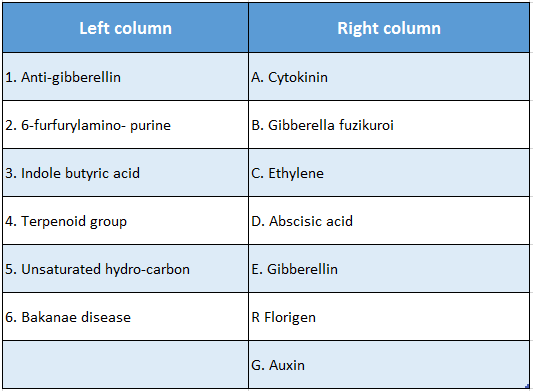
Question 2.

WBBSE Solutions For Class 10 Life Science And Environment Chapter 2 Continuity Of Life Chromosome Match The Columns 2

Answer: 1. D, 2. A, 3. B, 4. C, 5. E, 6. G


Chapter 2 Continuity Of Life Chromosome Find The Odd One Out

Question 1. DNA, RNA, Protein, Gene
Answer: Protein

Question 2. Acentric chromosome, -Metacentric chromosome, Telocentric chromosome, Acrocentric chromosome
Answer: Acentric chromosome

Question 3. Arginine, Histidine, Lysine, Tryptophan
Answer: Tryptophan

Question 4. Chromatids, Chromomeres, Centrosome, Centromere
Answer: Centrosome

Question 5. DNA, Histone protein, Non-histone protein, Ribosome
Answer: Ribosome

Question 6. Adenine, Cytosine, Uracil, Guanine
Answer: Uracil

Question 7. Secondary Constriction, Klnetoebore, Mitochondria, Chromatid
Answer: Mitochondria

Question 8. Adenine, Guanine, Thymine, Vitamin
Answer: Vitamin

Question 9. Pentose sugar, Phosphate, N2 base, Auxin
Answer: Auxin

Question 10. Active gene, HNA production, Heterochromnlin, Lossdensed
Answer: Heterochromnlin


Chapter 2 Continuity Of Life Chromosome Fill In The Blanks By Looking At The First Pair

Question 1. Human Autosome: 44:: Human sex chromosome: ______.
Answer: 2

Question 2. Human chromosome in the somatic cell:: 46:: Human chromosome in germ cell: ______.
Answer: 23

Question 3. Heterochromatin : Inactive :: Euchromalin : ______.
Answer: Active

Question 4. XY: Male sex chromosome:: XX: ______.
Answer: Female Sex chromosome

Question 5. Adenine: Purine:: Thymine: ______.
Answer: Pyrimidine

Question 6. Histone: Alkaline:: Non-histone: ______.
Answer: Acidic

Question 7. Nucleosome: Chromosome:: Nucleotide:: ______.
Answer: Nucleic acid


Chapter 2 Continuity Of Life Chromosome Among The Four Concepts Given, Three Of Them Belong To One Find That

Question 1. Centromere, Chromosome, Primary Constriction, Secondary Constriction
Answer: Chromosome

Question 2. Chromosome, DNA, Histone protein, Non-histone protein
Answer: Chromosome

Question 3. Pyrimidine, N2 base, Adenine, Guanine
Answer: N2 base

Question 4. Pyrimidine, Cytoeine, Thymine, Uracil
Answer: Pyrimidine

Question 5. N2 base, DNA, Phosphate, Deoxyrihose sugar
Answer: DNA

Question 6. Ribose sugar, Phosphate, N2 base, RNA
Answer: RNA

Question 7. H2A, H2B,H4, Histone
Answer: Histone

WBBSE Solutions For Class 10 Life Science And Environment Chapter 1 Locomotion

Chapter 1 Locomotion As A Type Of Response In Animals Summary

  • The movement of the whole organism from one place to another is termed as locomotion. Animals move from one place to another place due to various reasons.
  • Some of the reasons are—the search of food, to protect itself, search of habitat, search of mate or reproduction, etc Amoeba moves through pseudopodia, Paramoecium uses cilia, and Euglena uses flagella for locomotion.
  • Fishes swim by the help of V-shaped myotome muscles and paired or unpaired fins. Birds use feathers i.e. remiges of the wing and rectrices of tail and flight muscles like pectoralis major, coracobrachialis and pectoralis minor for flight.

Read and Learn More WBBSE Solutions for Class 10 Life Science And Environment

  • Locomotion in humans is termed as bipedal locomotion. This bipedal locomotion involves movement by two rear limbs or legs. The semicircular canal of inner ear and cerebellum helps in body balance during movement.
  • Movable joints and skeletal muscles have a huge importance in human locomotion, The synovial fluid present in the joint prevents, friction. Examples of synovial joints are—ball and socket joints, hinge joints, pivot joints, etc.
  • An example of a hinge joint is the joint of the knee and elbow. An example of ball and socket joint is the hip and shoulder joint.
  • In flexion movement, two bones come near each other and in extension movement, two bones move distant from each other. The movement of any part away from the midline of the body is abduction and the movement towards the midline of the body is adduction.
  • Rotation refers to movements made about the longitudinal axis and in the transverse plane, Different types of muscles help in these types of movements.
  • Example-Biceps (flexor muscle), triceps (extensor muscle), deltoids (abductor’s muscle), adductor longus (adductor muscle).

Locomotion As A Type Of Response In Animals Summary

Chapter 1 Locomotion Long Answer Type Questions

Life Science Class 10 Wbbse

Question 1. Briefly explain the driving forces of locomotion.
Or,
State the importance of locomotion in living organisms.

Similar question, A resting animal attempts to move. Mention four probable reasons behind it.

Answer:

Driving forces of locomotion:

The driving forces of locomotion are mentioned below.

1. Search of food:

Unlike plants, animals are not capable of synthesising their own food. Therefore animals have to roam around in search of food resources.

WBBSE Solutions For Class 10 Life Science And Environment Chapter 1 Locomotion

2. Escaping predation:

Among animals, a prey-predator interaction continues all the time. Here the aggressor is called the predator and the victims are called the preys.

To avoid predation’ preys have to flee from the predator. Therefore, locomotion is essential for preys to escape predation.

3. Migration:

Due to environmental changes, various species move from one place to another this is called migration. To avoid natural calamities, epidemics and other adversities, animals migrate to favourable places. This is a driving force of locomotion.

For example: during rain ants upward in search of a dry habitat.

WBBSE Solutions for Class 10 History WBBSE Solutions for Class 10 Geography and Environment
WBBSE Class 10 History Long Answer Questions WBBSE Solutions for Class 10 Life Science And Environment
WBBSE Class 10 History Short Answer Questions WBBSE Solutions for Class 10 Maths
WBBSE Class 10 History Very Short Answer Questions WBBSE Solutions for Class 10 Physical Science and Environment
WBBSE Class 10 History Multiple Choice Questions


4. Searching for favourable habitat:

Animals always look out for places with adequate food, water, ambient temperature, light, etc. This is also a purpose of animal locomotion.

5. Searching for a mating partner and favourable mating place:

Animals and a few plants perform locomotion in search of favourable places for reproduction. Animals roam around in search 1 o suitable mating partners for successful reproduction.

Question 2. How is locomotion dependent upon movement? State the differences between movement and locomotion.

Answer:

Dependence of locomotion on movement:

Locomotion is a process by which an organism changes its overall position in response to a stimulus or spontaneously.

Whereas, the physical activity by which an organism move any of its body parts either spontaneously or in response to stimulus without changing its position, is called movement.

A living form has to move its organs or cellular components in order to perform locomotion. Therefore, locomotion without movement is impossible but the movement of organs is completely independent of locomotion.

Differences between movement and locomotion

WBBSE Solutions For Class 10 Life Science And Environment Chapter 1 Locomotion Differences between movement and locomotion

Life Science Class 10 Wbbse Question 3.

Briefly describe the method of amoeboid movement.
Or,
Describe the role of pseudopodia in the locomotion of Amoeba. Distinguish between cilia and flagella.

Answer:

Amoeboid movement:

The method of amoeboid movement is mentioned here.

  1. The locomotory organ of Amoeba is the pseudopodium. Density of cytosol changes within the cell body of an Amoeba by external stimulation. Cytosol with lower density moves faster than the denser portion. As the cytosol flows to hit the cell membrane, it protrudes to develop a pseudopodium. There are numerous pseudopodia developed in an amoeboid cell.
  2. The tip of these pseudopodia attach with the substratum and cytosol continues to flow into them.
  3. Gradually the whole protoplasm flows towards the direction of the pseudopodia and the posterior portion of the cell retracts accordingly. This type of movement by pseudopodia is called amoeboid movement.


WBBSE Solutions For Class 10 Life Science And Environment Chapter 1 Locomotion Amoeboid movement


Differences between Cilia and Flagella

WBBSE Solutions For Class 10 Life Science And Environment Chapter 1 Locomotion Differences between Cilia and Flagella

WBBSE Class 10 Locomotion Overview

Question 4. Briefly describe the locomotory mechanism of Euglena. Mention the differences between locomotion in Amoeba and Euglena.

Answer:

Locomotory mechanism of Euglena:

  1. The locomotory organ of Euglena is a flagellum. This is a microscopic, long and fine filamentous cytoplasmic projection. Euglena moves in water by beating of the flagellum, therefore this movement is called flagellar movement The locomotory mechanism of Euglena is described as follows—
  2. Euglena beats I’LS flagellum sidewise like a whip or rotates it around the longitudinal axis.
  3. Movement of the flagellum generates turbulence in water and Euglena moves in opposition to its flagellum.
  4. Euglena has a photosensitive eyespot This helps it to sense light and guide it during locomotion towards the illuminated zone of the water body.

Life Science Class 10 Wbbse

WBBSE Solutions For Class 10 Life Science And Environment Chapter 1 Locomotion Flagellar movement in Euglena


Differences between locomotion of Amoeba and Euglena

WBBSE Solutions For Class 10 Life Science And Environment Chapter 1 Locomotion Differences between locomotion of Amoeba and Euglena


Question 5. Briefly describe the method of locomotion in Paramoecium. Mention a few ciliated cells other than Paramoecium.

Answer:

Locomotary mechanism of Paramoecium:

The locomotory organs of Paramoecium are cilia. These are tiny, very fine and densely arranged filamentous structures present all over the outer surface of its cell body. The method locomotion in Paramoecium through cilia is mentioned here.

  1. All cilia show a synchronised whiplash movement. The first phase of this movement is the effective stroke, during which the cilium bends sharply in one direction.
  2. Effective stroke is followed by a slow recovery stroke during which the cilium curls back loosely to its previous direction.
  3. By the coordinated movement of all cilia, a continuous wave moves across the ciliated cell surface. This ciliary wave applies a thrust in the surrounding liquid medium and pushes the Paramoecium through it. This type of movement is known as ciliary movement.


WBBSE Solutions For Class 10 Life Science And Environment Chapter 1 Locomotion paramoecium

Types of Locomotion in Animals

Ciliated cells other than Paramoecium:

Other than Paramoecium, Vorticella is another unicellular organism that possesses cilia. Among multicellular organisms, the cells of the inner lining of the trachea, olfactory cells of the nose and hair cells of the internal ear have cilia.

Question 6. Describe with a diagram, the mechanism of locomotion in fish. Mechanism of locomotion in fish.

Answer:

The locomotory organs of fish are its fish:

Life Science Class 10 Wbbse

Besides these, myotome muscles and, the swim bladder also help in locomotion. The method of locomotion in fish is described here—

1. Fish has seven fins, of which pectoral and pelvic fins are paired whereas dorsal, anal and tail, fins are unpaired. Role of each of these fins are mentioned as follows—

  1. Pectoral and pelvic fins help the fish in going up and down in the water. These fins also keep the fish steady at the floor of the water body during rest.
  2. The dorsal fin and anal fin keep the fish steady and prevent it from rollover during swimming.
  3. Tail fin beats to create a thrust in water to move the fish forward. It also helps it to change direction during swimming.

2. ‘V-shaped myotome muscles of a fish, present at two sides of the vertebral column contact alternately in a synchronised fashion. This muscular action creates a lateral undulating movement in its body that helps the fish in swimming.

3. Swim bladder of a fish maintains its buoyancy by making instantaneous and voluntary changes in gas volume and thereby helps it to stay at different levels of water.


WBBSE Solutions For Class 10 Life Science And Environment Chapter 1 Locomotion fish


Question 7. Describe the roles of different flight-assisting body parts of birds.

Answer:

Role of different flight-assisting body parts of birds:

Birds are primary volant animals. Most of birds perform locomotion by flight. The role of different flight-assisting body parts of birds are explained here—

  1. Birds have a spindle-shaped body, which helps to overcome air resistance.
  2. The bones of birds are hollow inside, hence are very light. These bones are called pneumatic bones, which keep the body lighter and thus facilitate flight.
  3. The lungs of birds are associated with 9 air sacs. These sacs hold extra air to reduce specific gravity and supply oxygen during high flight.
  4. The forelimbs of birds are modified into wings. It is outwardly convex and inwardly concave. This shape facilitates in holding air during flight.
  5. The edge of each wing has 23 and the edge of the tail has 12 l^rge ore-shaped flight feathers. These are called remiges and rectrices respectively.’The feathers have barbs, barbules and interlocking hooks, which keep the feather intact even in heavy air thrust.
  6. To beat continuously, the wings are fitted with strong flight muscles. The Pectoralis major, pectoralis minor and coach brachialis are the three flight muscles, which help in the flight of birds.

Life Science Class 10 Wbbse

WBBSE Solutions For Class 10 Life Science And Environment Chapter 1 Locomotion Tali feathers and Wing feathers

Difference Between Remiges And Rectrices

Question 8. Describe the mechanism of bipedal locomotion in man.

Answer:

Bipedal locomotion in man:

Human locomotion occurs by bipedal movement. Two legs take part in this locomotion hence it is called bipedal locomotion. Leg bones, bone joints and various leg muscles act in a coordinated fashion in this locomotion.

The mechanism of bipedal locomotion is described here—

  1. At first, the upper portion of the body tends to move forward while the two legs remain anchored on the ground.
  2. As the upper portion approaches forward, it tends to fall. To avert it, one leg, for instance, the left leg moves forward and places the foot ahead. At this moment, the right leg holds the body weight.
  3. As the left foot touches the ground, the right knee folds and the heel is lifted With this movement, the upper portion of the body progresses forward and shifts its weight to the left leg.
  4. Now, the right toe is lifted from the ground and the foot is placed ahead of the left leg. In this process, the two legs alternately move up and down and hence, move forward to aid in walking.
  5. To maintain body balance, two hands swing forward and backwards alternately. When one leg moves forward the opposite hand extends.
  6. The cerebellum and the semi-circular canals of the internal ear also play important roles in keeping body balanced during bipedal movement.


WBBSE Solutions For Class 10 Life Science And Environment Chapter 1 Locomotion Bipedal locomotion in man


Wbbse Class 10 Life Science Solutions

Question 9. What is meant by movable or synovial joint? Describe it in brief.

Answer:

Movable or synovial joint:

The bone joint in which the bones are articulated in a movable manner and offer some degree of free movement is called a movable joint.

The point of articulation between two bones of a movable joint has a thin space, which remains filled with synovial fluid. Therefore, this type of joint is also called a synovial joint

Description of movable or synovial joint:

The description of movable or synovial joint is given here.

  1. In this joint, the articulated ends of the bones remain attached to each other by thin but strong ligaments.
  2. The heads of the bones remain coated with a thin fibrous tissue membrane called the synovial membrane.
  3. The fine space present in between the membrane-coated ends of the two bones is known as synovial space.
  4. The space remains filled with an aqueous lubricating fluid called synovial fluid.
  5. The synovial fluid protects the bone ends against frictional wearing and supplies nutrition to the surrounding tissues.
  6. The ends of bones are covered by thick cartilaginous tissue, called articular cartilage. It allows the bones to glide over each other with minimum friction.
  7. There are different types of movable joints—ball and socket joint, hinge joint, angular joint, saddle joint, pivot joint, etc.

Difference Between Remiges And Rectrices


WBBSE Solutions For Class 10 Life Science And Environment Chapter 1 Locomotion Synovial joint

Functions of Muscles in Locomotion

Question 10. Give a brief description of the mechanism with examples of human skeletal muscles, involved in

  1. Flexion,
  2. Extension,
  3. Abduction,
  4. Adduction and
  5. Rotation.

Answer:

The action of some human skeletal muscles:

WBBSE Solutions For Class 10 Life Science And Environment Chapter 1 Locomotion Action of Some human skeletal muscles

Difference Between Remiges And Rectrices

WBBSE Solutions For Class 10 Life Science And Environment Chapter 1 Locomotion Different actions of some human Skeletal muscles

Wbbse Class 10 Life Science Solutions

Question 11. Distinguish between flexion and extension. Mention the differences between abduction and adduction.

Answer:

Differences between flexion and extension

WBBSE Solutions For Class 10 Life Science And Environment Chapter 1 Locomotion Differences between Flexion and extension


Differences between abduction and adduction

WBBSE Solutions For Class 10 Life Science And Environment Chapter 1 Locomotion Differences between abduction and adduction

Difference Between Remiges And Rectrices

Chapter 1 Locomotion Short Answer Type Questions

Question 1. What is locomotion?

Answer:

Locomotion:

Locomotion is a physical activity by which an organism changes its overall position in response to a stimulus or spontaneously.

Question 2. What is meant by response in animals?

Answer:

Response in animals:

Response in animals means the movement of body parts or changing the overall position by an animal, involving the activity of muscles and bones.

Question 3. What are pseudopodia?

Answer:

Pseudopodia:

Pseudopodia are temporary finger-like protrusions of protoplasm with cell membrane from the surface of amoeboid cells for the purpose of feeding and locomotion.

Question 4. What are cilia?

Answer:

Cilia:

Cilia are minute, numerous hair-like projections emerging from the surface of some unicellular organisms, which perform rhythmic beating for locomotion.

Question 5. What are flagella?

Answer:

Flagella:

Flagella are fine, slender, whip-like projections of some unicellular organisms, used for the purpose of swimming.

Question 6. What does amoeboid movement mean?

Answer:

Amoeboid movement

Amoeboid movement is a locomotory movement of unicellular organisms, executed by means of pseudopodia. Protozoans like Amoeba and blood cells like neutrophils perform the amoeboid movement.

Question 7. How does Paramoecium perform ciliary movement?

Answer:

Paramoecium has numerous densely arranged cilia along its cell membrane. All its cilia beat in a coordinated manner to create an undulating wave along the cell surface. This ciliary wave helps it to swim in the water bodies.

Wbbse Class 10 Life Science Solutions

Question 8. What is ciliary movement?

Answer:

Ciliary movement:

The locomotion of unicellular organisms by rhythmic beating of cilia beating in a liquid medium is called ciliary movement etc. Paramoecium, and Vorticella, perform a ciliary movement.

Question 9. What is flagellar movement?

Answer:

Flagellar movement:

The locomotion of a unicellular organism by whipping or rotating of flagella in any liquid medium is called flagellar movement. Euglena, Trypanosoma, etc. perform flagellar movement.

Wbbse Class 10 Life Science Solutions

Question 10. What is myotome muscle?

Answer:

Myotome muscle

The ‘V-shaped muscle present on two sides of vertebra of fish extending from head to tail is called myotome muscle. These muscle helps in swimming.

Question 11. Mention the location of myotome muscles. State their functions.

Answer:

Location of myotome muscles:

Myotome muscles are located at the two lateral sides of the body of a fish, extending from the back of the operculum to the base of the tail fin.

Functions of myotome muscles:

These muscles at lateral sides, contract and expand alternately in a synchronised manner to create an undulating movement of the body. The thrust that is created, helps the fish to move forward in water.

Wbbse Class 10 Life Science Solutions

Question 12. Mention the roles of the fins of fish.

Answer:

Fins of fish perform the following functions-

  1. Pectoral and pelvic fins help the fish to move up and down in the water.
  2. Dorsal fins keep the body steady and prevent rolling over.
  3. The tail fin helps in propelling the fish through water and changing direction during locomotion.
  4. The anal fin maintains the stability of the fish in the water while swimming.


WBBSE Solutions For Class 10 Life Science And Environment Chapter 1 Locomotion fins of fish


Question 13. What would have happened to a bony fish if it had not developed any paired fin?

Answer:

If a bony fish had not developed any of its paired fins, like pectoral and pelvic fins, it would not have been able to move up and down in water and cannot remain steady in a stationary condition.

Question 14. What would have happened to a bony fish if it had not developed a swim bladder?

Answer:

If a bony fish had not developed a swim bladder, it would fail to maintain its buoyancy. In this situation, it could not go at different depths of the water body and not even stay stationary at a certain depth.

If it had to survive, it would have to stay at the floor of the water body.

Wbbse Class 10 Life Science Solutions

Question 15. Mention the functions of the tail fin of a fish.

Answer:

The functions of tail fin of a fish are as follows—

  1. The tail fin gives the ultimate thrust on the water to push the body forward (propulsion).
  2. The tail fin controls the direction of movement of the fish while swimming.

Question 16. What are flight feathers? Mention their types.

Answer:

Flight feathers:

The larger feathers, which are arranged along the inner edge of wings and end of the tail of a bird, are called flight feathers.

Types of flight feathers:

The flight feathers are of two types—the remiges present in the wings and the rectrices along the end of the tail.

Question 17. What are flight muscles?

Answer:

Flight muscles:

The voluntary muscles attached to the wings and tail of birds, which help in beating of wings and rotating of the tail during flight, are called flight muscles.

Example: Pectoralis major, pectoralis minor, coracobrachialis.

Question 18. How do the feathers remain intact in air pressure?

Answer:

A feather has numerous lateral filamentous barbs. Each barb develops lateral barbules and microscopic hooks from both the sides. These hooks interlock the barbules and thereby the barbs as well.

Due to this cross interlocking of the barbs and barbules, the feathers remain intact in wind pressure, if any portion of it splits, it rejoins at once at the two opposing hooks that encounter each other.

Wbbse Class 10 Life Science Solutions

Question 19. Differentiate between remiges and rectrices.

Answer:

Differences between remiges and rectrices are—

WBBSE Solutions For Class 10 Life Science And Environment Chapter 1 Locomotion Differences between remiges and Rectrices


Question 20. Why is human locomotion called bipedal locomotion?

Answer:

The locomotory organs of humans are two legs. By continuous and synchronised movement of these two legs, a man moves from one place to an order. Therefore, human locomotion is called bipedal locomotion.

Question 21. What is skeletal muscle? Give two examples of muscle helping in locomotion.

Answer:

Skeletal muscle:

The muscle attached to bones by tendon and helps in locomotion are called skeletal muscle.

Example: Biceps femoris and gastrocnemius.

Question 22. Mention how the skeletal muscles help in human movement and locomotion.

Answer:

Skeletal muscles remain attached to different movable bones of different limbs. By the voluntary contraction of these muscles, the concerned limbs move. Thus, skeletal muscles help in human movement and locomotion.

Skeletal System and Locomotion

Question 23. Why is the movable bone joint called the synovial joint?

Answer:

In between the joining ends of two bones of a movable joint, there remains a thin space. A lubricating fluid is present in it, called synovial fluid. Therefore, this type of bone joint is called a synovial joint.

Question 24. What are the functions of synovial fluid?

Answer:

The functions of synovial fluid are—

  1. The synovial fluid prevents the decay of bones due to friction.
  2. Synovial fluid nourishes the cartilage present in the joint.

Question 25. What is a tender?

Answer:

Tender:

A tendon is a fibrous connective tissue which attaches muscle to bone. These are generally bright white in colour.

Question 26. What is a hinge joint?

Answer:

Hinge joint:

The bone joint, in which the bones move at an angle of 180° in a single plane, is called the hinge joint. For example—The elbow and knee are hinge joints.


WBBSE Solutions For Class 10 Life Science And Environment Chapter 1 Locomotion Hingle joint

Wbbse Class 10 Life Science Solutions

Question 27. Mention the characteristics of the hinge joint.

Answer:

Characteristics of hinge joint are as follows—

  1. One bone of this joint has a round head and the other has a concave head.
  2. The bones move at a maximum angle of 180° only in one plane.

Question 28. What is a bait and socket joint?

Answer:

Bait and socket joint:

The movable joint in which one bone with a partially spherical head is articulated with a cup¬shaped cavity of another bone is called the ball and socket joint.

This allows multidirectional movement and rotation. This type of joint is present in the shoulder and hip.

Question 29. Mention the characteristics of bail and socket joints.

Answer:

Characteristics of ball and socket joints are as follows—

  1. One bone of this joint has a spherical head (ball) and the other bone has a cup-shaped end (socket).
  2. In this joint, the socket remains fixed but the ball-ended bone can rotate almost at any direction.


WBBSE Solutions For Class 10 Life Science And Environment Chapter 1 Locomotion Ball and Socket joint


wbbse class 10 life science question answer

Question 30. What is rotator muscle?

Answer:

Rotator muscle:

The muscle, which helps an organ to rotate around a central axis, is called the rotator muscle.

Example: Piriformis muscle of the lower limb.

Question 31. What is flexor muscle?

Answer:

Flexor muscle:

The muscle, which contracts to fold a limb, is called flexor muscle.

Example: Biceps muscle of the upper arm.

Question 32. What is extensor muscle?

Answer:

Extensor muscle:

The muscle, which contrasts to extend a folded limb, is called the extensor muscle.

Example: Triceps muscle of the upper arm.

Question 33. What is the abductor muscle?

Answer:

Abductor muscle:

The muscle, which contracts to pull a limb away from the body’s axis, is called abductor’s muscle.

Example: Gluteus maximus muscle of the hip, deltoid muscle of the shoulder.

wbbse class 10 life science question answer

Question 34. What is the adductor muscle?

Answer:

Adductor muscle:

The muscle, which contracts to pull a limb close to the body’s axis, is called adductor muscle.

Example: Adductor longus muscle of the thigh.

Human Locomotion Mechanism

Chapter 1 Locomotion Very Short Answer Type Questions Multiple Choice Questions And Answers [Mcq]

Question 1. The overall change in position of an organism from one place to another is called—

  1. Movement
  2. Locomotion
  3. Transportation
  4. Displacement

Answer: 2. Locomotion

Question 2. Which of the following organisms performs locomotion by means of pseudopodia?

  1. Amoeba
  2. Cockroach
  3. Paramoecium
  4. Butterfly

Answer: 1. Amoeba

Question 3. Paramoecium performs locomotion by—

  1. Flagella
  2. Cilia
  3. Pseudopodia
  4. Muscular foot

Answer: 2. Cilia

wbbse class 10 life science question answer

Question 4. _______ performs locomotion by flagella.

  1. Cockroach
  2. Euglena
  3. Paramoecium
  4. Amoeba

Answer: 2. Euglena

Question 5. The number of fins found in bony fishes is—

  1. One
  2. Five
  3. Seven
  4. Nine

Answer: 3. Seven

Question 6. Myotome muscles are present in—

  1. Fishes
  2. Bats
  3. Dragonflies
  4. Pigeons

Answer: 1. Fishes

Question 7. While swimming, which of the following helps in changing direction in fish?

  1. Caudal fin
  2. Dorsal fin
  3. Anal fin
  4. Pelvic fin

Answer: 1. Caudal fin

Question 8. Which of the following is the locomotory organ in a human body?

  1. Hand
  2. Leg
  3. Forelimb
  4. Tail

Answer: 2. Leg

Question 9. Which of the following organisms is not capable of locomotion?

  1. Coral
  2. Cockroach
  3. Spider
  4. Snail

Answer: 1. Coral

Question 10. The organ which helps fishes to float in water, is called—

  1. Fins
  2. Air bladder
  3. Operculum
  4. Lateral line sense organ

Answer: 2. Air bladder

Question 11. A plant, which is capable of locomotion, is

  1. Fern
  2. Cuscuta
  3. Chlamydomonas
  4. Mucor

Answer: 3. Chlamydomonas

Question 12. An animal, which is not capable of locomotion, is—

  1. Starfish
  2. Earthworm
  3. Sponge
  4. Hydra

Answer: 3. Sponge

Question 13. Where do you find the ball and socket joints?

  1. Shoulder
  2. Knee
  3. Thumb
  4. Elbow

Answer: 1. Shoulder

Question 14. In which of the following, a hinge joint is seen?

  1. Waist
  2. Shoulder
  3. Elbow
  4. Skull

Answer: 3. Elbow

wbbse class 10 life science question answer

Question 15. In which of the following, an immovable joint is seen?

  1. Waist
  2. Shoulder
  3. Skull
  4. Elbow

Answer: 3. Skull

Question 16. The type of movement, which is seen in humans, is called—

  1. Bipedal movement
  2. Amoeboid movement
  3. Ciliary movement
  4. Flagellar movement

Answer: 1. Bipedal movement

Question 17. Which of the following animals performs locomotion by means of swimming?

  1. Hydra
  2. Sponge
  3. Fish
  4. Amoeba

Answer: 3. Fish

Question 18. Which of the following animals performs locomotion by means of flight?

  1. Earthworm
  2. Snail
  3. Bird
  4. Lizard

Answer: 3. Bird

Question 19. Locomotory organ of fish—

  1. Fin
  2. Swim bladder
  3. Lateral line sense organ
  4. Undulating membrane

Answer: 1. Fin

Question 20. The bone, which is absent in hands, is—

  1. Radius
  2. Ulna
  3. Humerus
  4. Femur

Answer: 4. Femur

Question 21. Sunlight plays an important role in the movement of which animal?

  1. Amoeba
  2. Paramoecium
  3. Both 1 and 2
  4. Euglena

Answer: 4. Euglena

Question 22. Tibia, femur and patella unite at—

  1. Pelvic girdle
  2. Knee
  3. Elbow
  4. Ankle

Answer: 2. Knee

wbbse class 10 life science question answer

Question 23. Hip joint is the union of—

  1. Femur and pelvic girdle
  2. Femur and scapula
  3. Humerus and scapula
  4. Radius and ulna

Answer: 1. Femur and pelvic girdle

Question 24. Shoulder joint involves—

  1. Scapula and humerus
  2. Humerus and ulna
  3. Femur and tibia
  4. Pelvic girdle and femur

Answer: 1. Scapula and humerus

Question 25. Ligaments, tendons and bone joints are part of the—

  1. Respiratory system
  2. Musculature
  3. Skeletal system
  4. Circulatory system

Answer: 3. Skeletal system

Question 26. The number of remiges present in each wing of a pigeon is—

  1. 11
  2. 13
  3. 19
  4. 23

Answer: 4. 23

Question 27. The number of rectrices present in the tail of the pigeon is—

  1. 6
  2. 8
  3. 12
  4. 16

Answer: 3. 12

Question 28. Which of the following muscles is not a flight muscle of a pigeon?

  1. Pectoralis major
  2. Pectoralis minor
  3. Myotome
  4. Coraco brachialis

Answer: 3. Myotome

Question 29. Myotome muscles are seen in—

  1. Human body
  2. Fish
  3. Whale
  4. Toad

Answer: 2. Fish

Question 30. The skeletal muscle that aids in the folding of a limb is called—

  1. Rotator
  2. Flexor
  3. Extensor
  4. Abductor

Answer: 2. Flexor

Question 31. The skeletal, muscle that aids in the unfolding of a folded limb is called—

  1. Rotator
  2. Flexor
  3. Extensor
  4. Abductor

Answer: 3. Extensor

Question 32. The skeletal muscle that aids a limb to move away from the body axis is called—

  1. Rotator
  2. Flexor
  3. Extensor
  4. Abductor

Answer: 4. Abductor

Question 33. The skeletal muscle that aids in pulling a limb close to the body axis ifc called—

  1. Rotator
  2. Flexor
  3. Extensor
  4. Adductor

Answer: 4. Adductor

Question 34. The skeletal muscle that aids in rotating a limb is called—

  1. Rotator
  2. Flexor
  3. Extensor
  4. Abductor

Answer: 1. Rotator

Question 35. The muscle helping in flexion is—

  1. Triceps
  2. Biceps
  3. Deltoid
  4. Rotator

Answer: 2. Biceps

Question 36. The muscle that helps in adduction is—

  1. Triceps
  2. Biceps
  3. Deltoid
  4. Latissimus dorsi

Answer: 4. Latissimus dorsi

Question 37. An abductor’s muscle is —

  1. Deltoid
  2. Biceps
  3. Triceps
  4. Stapedius

Answer: 1. Deltoid

Question 38. Match the words of column-A with that of column B and select which of the following options is correct—

WBBSE Solutions For Class 10 Life Science And Environment Chapter 1 Locomotion Match the columns

  1. 1. A, 2. B, 3. C
  2. 1. B, 2. C, 3. A
  3. 1. C, 2. A, 3. B
  4. 1, C, 2. A, 3. C

Answer: 3. 1. C, 2. A, 3. B

Common Disorders Affecting Locomotion

Chapter 1 Locomotion Answer In a single Word Or Sentence

Question 1. Name the locomotory organ of Amoeba.
Answer: Pseudopodia

Question 2. What is the locomotory organ of Euglena?
Answer: Flagellum

Question 3. What are the locomotory organs of a fish?
Answer: Fins

Question 4. What are the locomotory organs of a bird?
Answer: A pair of wings and two legs are the locomotory organs of a bird.

Question 5. Name the muscle that helps in locomotion of a fish.
Answer: Myotome muscles

Question 6. Name the paired fins of a fish.
Answer: Pectoral and pelvic fins

Question 7. Name the unpaired fins of a fish.
Answer: Caudal, dorsal and anal fins

Question 8. Which fin helps a fish to change its direction during swimming?
Answer: Caudal or tail fin

Question 9. Which organ of a fish helps it to float in water?
Answer: Swim bladder

Question 10. What will happen to a fish if all its fins are tied with a thread?
Answer: A fish will not be able to swim and keep its balance in water if all its fins are tied with a thread.

Question 11. when does Amoeba grow its pseudopodia?
Answer: During movement and food capturing, Amoeba grows its pseudopodia.

Question 12. Which type of locomotion does an adult human perform?
Answer: Bipedal locomotion

Question 13. Name a voluntary muscle.
Answer: Biceps

Question 14. Which type of muscle is the biceps?
Answer: Flexor muscle

Question 15. Name an extensor muscle.
Answer: Triceps

Question 16. How do you denote the point of contact ‘ between two bones?
Answer: The point of contact between two bones is called the bone joint.

Question 17. Name the structure, which connects two bones in a bone joint.
Answer: Ligament

Question 18. Where do you find hinge joints?
Answer: We find hinge joints in the elbow and knee.

Question 19. Where do you find ball and socket joints?
Answer: We find ball and socket joints in the shoulder and hip.

Question 20. Which characteristic feature of muscle fibres helps in movement and locomotion?
Answer: Contractibility of muscle fibres helps in movement and locomotion.

Question 21. Which type of joint is the knee joint?
Answer: Hinge joint

Question 22. Which fins help a fish to move up and down in the water?
Answer: Pectoral and pelvic fins

Question 23. Name the ‘V-shaped muscles present at both sides of the lateral line of a fish.
Answer: Myotome muscles

Question 24. Which muscle helps in extending a folded, limb?
Answer: Extensor muscles

Question 25. Which muscle helps to rotate a body part?
Answer: Rotator muscles

Question 26. Which muscle does help to move a limb away from the axis of the body?
Answer: Abductor’s muscles

Question 27. Name the flight feathers present along the posterior edge ot wings of a bird.
Answer: Remiges

Question 28. Name the large feathers present at the tail end of a bird.
Answer: Rectrices

Question 29. Name a unicellular organism having a photosensitive eyespot.
Answer: Euglena

Question 30. Which flight muscle helps a bird to move downward during the flight?
Answer: Pectoralis major

Question 31. Which flight muscle helps a bird to move upward during flight?
Answer: Pectoralis minor

Question 32. Which part of the internal ear helps to maintain body balance?
Answer: Semicircular canals

Locomotory Organs in Different Animals

Chapter 1 Locomotion Fill In The Blanks

Question 1. One of the objectives of ________ is the search for food.
Answer: Locomotion

Question 2. Chlamydomonas is a ________ capable of locomotion.
Answer: Plant

Question 3. The locomotory organ of Amoeba is ________.
Answer: Pseudopodium

Question 4. Paramoecium moves in ________ the direction to the movement of cilia.
Answer: Opposite

Question 5. The ________ of Euglena helps in determining the direction of its movement.
Answer: Eyespot

Question 6. The ________ present in Euglena can sense die presence of sunlight.
Answer: Eyespot

Question 7. The swim bladder of bony fish helps to maintain its ________.
Answer: Buoyancy

Question 8. ________ are the main locomotory organs of fishes.
Answer: Fins

Question 9. The ________ muscles of fish help it in swimming.
Answer: Myotome

Question 10. ________ fin of fish gives it stability in water.
Answer: Anal

Question 11. Pectoral and ________ fins are paired fins of a fish.
Answer: Pelvic

Question 12. The muscles, which help a bird in flying are called ________ muscles
Answer: Flight

Question 13. During bipedal locomotion, two ________ help in maintaining the stability of the human body.
Answer: Hands

Question 14. Articular hyaline cartilage is present in ________ joints.
Answer: Synovial

Question 15. In a hinge joint, the articulated bones can move at an angle of ________ in a single plane.
Answer: 180

Question 16. The hip joint involves pelvic girdle and ________.
Answer: Femur

Question 17. The muscles helping in the movement of bones are called ________ muscles.
Answer: Skeletal

Question 18. Sternocleidomastoid is a muscle that helps in ________ movement.
Answer: Rotational

Question 19. ________ muscle of hand contracts to fold the arm.
Answer: Biceps

Question 20. ________ muscle helps in the extension of the arm.
Answer: Triceps

Question 21. ________ muscle is ‘Y shaped.
Answer: Myotome

Question 22. The elbow joint is a ________ joint.
Answer: Hinge


Chapter 1 Locomotion State True Or False

Question 1. The movement of any limb away from the body axis is called a flexor.
Answer: False

Question 2. Joints of the knee and elbow are examples of hinge joints.
Answer: True

Question 3. The synovial fluid protects the movable bone ends against friction.
Answer: True

Question 4. Fins of birds help in flight.
Answer: False

Question 5. The tail feathers of birds are called remiges.
Answer: False

Question 6. During locomotion in man, the cerebellum helps in maintaining body balance.
Answer: True

Question 7. The tail fin of fish helps in changing direction during swimming.
Answer: True

Question 8. The biceps is example of an extensor muscle.
Answer: False

Question 9. Fins with fin rays are seen only in bony fishes.
Answer: True

Question 10. Byespot is present in Amoeba.
Answer: False

Question 11. Flagella help in the locomotion of Amoeba.
Answer: False

Question 12. Paramoecium is a sessile organism.
Answer: False

Question 13. Corals are incapable of locomotion.
Answer: True

Question 14. The skull bones are movably articulated with each other.
Answer: False

Question 15. In the ball and socket joint, the bones can move in more than two axes.
Answer: True

Question 16. Flagella is the locomotory organ of Paramoecium.
Answer: True


Chapter 1 Locomotion Match The Columns

Question 1.

WBBSE Solutions For Class 10 Life Science And Environment Chapter 1 Locomotion Match the columns 1

Answer: 1. B, 2. D, 3. G, 4. A, 5. E, 6. C

Question 2.

WBBSE Solutions For Class 10 Life Science And Environment Chapter 1 Locomotion Match the columns 2

Answer: 1. E, 2. C, 3. D, 4. F, 5. A, 6. B


Chapter 1 Locomotion Find The Odd One Out

Question 1. Pectoral fin, Caudal fin, Anal fin, Dorsal fin
Answer: Pectoral fin

Question 2. Amoeba, Cilia, Flagella, Fins
Answer: Amoeba

Question 3. Extensor digitorum, Myotome, Gastrocnemius, Biceps femoris
Answer: Myotome

Question 4. Synovial membrane, Ligament, Synovial fluid, Tendon
Answer: Tendon

Question 5. Gastrocnemius muscle, Pectoralis major, Coracobrachialis, Pectoralis minor
Answer: Gastrocnemius muscle

Question 6. Eye, Cerebellum, Semicircular Canal, Otolith
Answer: Eye

Question 7. Rotator, Extensor, Flexor, Fin
Answer: Fin

Question 8. Extensor muscle, Abductor muscle, Adductor muscle, Heart muscle
Answer: Heart muscle


Chapter 1 Locomotion Fill In The Blanks By looking At The First pair

Question 1. Flagellar movement: Euglena :: Ciliary movement:
Answer: Paramoecium

Question 2. Fish: Fins :: Amoeba:
Answer: Pseudopodia

Question 3. Biceps: Flexion of hand:: Triceps:
Answer: Extension of hand

Question 4. Pelvic girdle: Femur:: Pectoral girdle:
Answer: Humerus

Question 5. Elbow: Hinge joint:: Shoulder:
Answer: Ball and socket joint

Question 6. Pulling hand close to body axis: Latissimus dorsi:: Moving hand away from the body axis:
Answer: Deltoid

Question 7. Wings: Remiges :: Tail:
Answer: Rectrices

Question 8. Pectoralis major: Flight :: Biceps femoris :
Answer: Walking


Chapter 1 Locomotion Among The Four Concepts Given, Three Of Them Belong To One Find That

Question 1. Ciliary movement, Lateral undulation of the tail, Aquatic locomotion, Flagellar movement
Answer: Aquatic movement

Question 2. Ball and socket joint, Biceps femoris, Lifting of the leg, Extensor digitorum
Answer: Lifting of legs

Question 3. Changing flight direction, Twelve rectrices, Tail of a flying bird, Contraction of tail muscles
Answer: Changing flight direction

Question 4. Expansion of dorsal fin, Movement of pectoral fins, Maintaining body balance, Expansion of pelvic fins
Answer: Maintaining body balance

Question 5. Socket joint, Synovial joint, Hinge joint, Hip joint
Answer: Synovial joint

Question 6. Remiges, Rectrices, Flight feather, Quill
Answer: Flight feather


Chapter 1 Locomotion Advanced Questions And Answers

Question 1. What is a crescograph?

Answer:

Crescograph

Crescograph is a highly sensitive device, invented by Sir Jagadish Chandra Bose to detect even the mildest sensitivity of plants., This instrument is used to create impulses in the plant body and to record the response shown by it.

With this instrument, he performed experiments on the touch-me-not plant and telegraph plant.

Question 2. What is nyctinasty?

Answer:

Nyctinasty

The induced movement of curvature in plants, which is controlled by the intensity of both light and heat, are spread widely in hot and bright sun in midday but folds in late afternoon as the intensity of heat and light starts decreasing.

Question 3. What is meant by the Richmond-Lang effect?

Answer:

Richmond-Lang effect

Cytokinin hinders the denaturation of chlorophyll, proteins and nucleic acids of leaves and thus delays their immature shedding.

By this process, it protects other organs of a plant from early senescence and keeps them fresh for a longer time. This is called the Richmond-Lang effect.

Question 4. Mention the opposite actions of auxin and cytokinin.

Answer:

The opposite actions of auxin and cytokinin

Auxin enhances the growth of apical buds and maintains apical dominance, whereas, cytokinin prevents these actions. On the other hand, cytokinin promotes the growth of axillary buds but auxin prevents it.

Question 5. Mention two applications of animal hormone.

Answer:

Two applications of animal hormones are as follows—

  1. By the application of pituitary hormone extract, fishes can be induced for breeding.
  2. In case of acute breathing distress, adrenaline provides instant relief.

Question 6. Mention names, nature and function of 12 pairs of cranial nerves of humans.

Answer:

WBBSE Solutions For Class 10 Life Science And Environment Chapter 1 Locomotion Names nature function of crinal nerves of human

Question 7. What is acetabulum?

Answer:

Acetabulum

The socket-shaped portions of each pelvic girdle, located lateral to the hip region, in which the head of the femur fits, is called the acetabulum. The acetabulum and head of the lemur lit in a ball and socket joint.

Question 8. What is meant by synaptic delay?

Answer:

Synaptic delay

Synaptic delay is the brief period of time which is required for transmission of a nerve impulse horn one neurone to the next, across a synapse.

WBBSE Solutions For Class 10 Life Science And Environment Chapter 1 Eye As A Sense Organ In Human

Chapter 1 Eye As A Sense Organ In Human Accommodation Defects Of Vision And Corrective Measures Summary

  • The eye is a human sense organ which acts as a light receptor organ and helps in vision. The structural, components of the eye are—the eyeball, protective structures and eye muscles.
  • The eyeball is composed of three layers. The outer fibrous layers is composed of sclera and cornea. The middle layer is composed of the choroid containing blood capillaries, ciliary bodies, and iris. The innermost neural layer is the retina.
  • It is composed of rod and cone cells. Inside the eye, there is a biconvex lens behind the iris. The eyeball has three chambers. The front chamber is located between the cornea and iris; the middle chamber is located between the iris and lens and contains aqueous humour.
  • The posterior vitreous chamber, located between the lens and retina contains vitreous humour. The protective parts of the eye are the conjunctiva, eyelid and lacrimal glands. The eyeball is connected by the eye muscle inside the eye socket.

Read and Learn More WBBSE Solutions for Class 10 Life Science And Environment

  • Monocular vision is a type of vision in which one eye of the animal moves and sees objects independently of the other eye. Most preys have this type of vision.
  • On the other hand, binocular vision is a type of vision where both eyes of an animal are used at the same time. Most predatory animals including humans employ this type of vision.
  • The elasticity of ciliary muscle and lens helps the eye to produce the right image from different distances perfectly. This is called accommodation. Ciliary muscles change the curvature of the lens, which helps the lens to change its focal length and keep objects in focus.
  • There are some important disorders related to the eyes. These are myopia (short-sightedness), hyperopia or hypermetropia (long-sightedness), and presbyopia.
  • Accumulation of pigment due to the breakdown of protein in the lens causes loss of clear vision. It is called a cataract.

Eye As A Sense Organ In Human Accommodation Defects Of Vision And Corrective Measures Summary

Chapter 1 Eye As A Sense Organ In Human Long Answer Type Questions

wbbse class 10 life science question answer

Question 1. Describe the structure of the human eyeball and mention its function.
Or,
Describe the structure and function of the human eyeball.

Similar question, Draw a neat diagram of the vertical section of the eyeball of the human eye and label the following parts—

  1. Cornea,
  2. Lens,
  3. Vitreous humour,
  4. Retina.

Answer:

Human eyeball:

It js a spherical, fluid-filled portion of the eye. It has two types of structural components—

1. The eye coats:

The structure and function of each component of the eye coats are as follows—

  1. The eye has three coats—fibrous outer coat, vascularised medial coat and neural inner coat.
  2. The fibrous outer coat has two portions, its posterior 5/6th opaque portion is called the sclera and the anterior 1 /6th transparent portion is known as the cornea, the sclera is rigid that keeps the shape of the eye intact. Cornea is a refractive medium that acts as a front window of the eye.
  3. The vascularised medial coat is known as choroid. It is black in colour due to the accumulation of melanin pigment. The cornea is rich in blood capillaries.
  4. The anterior extension of the choroid forms the ciliary body and iris. The ciliary body is a muscular extension of the choroid that holds the lens in position. It remains attached with the suspensory ligament. The pigmented muscular extension of the choroid that is present behind the cornea is called the iris. It has a round aperture at the centre to allow light to enter the eye. This aperture is known as the pupil. Contraction and expansion of iris muscles change the diameter of the pupil to regulate the exposure on the retina.
  5. The neural inner coat known as the retina is composed of two types of photosensitive cells—rod cells and cone cells. The rod cells are sensitive to dim light and the cone cells sense bright light.
  6. fust opposite to the pupil, the retina has a tiny depressed spot, called the macula lutea of yellow spot. This spot contains cone cells only and is capable of creating the sharpest image in bright light. The region of the retina from which the optic nerve emerges is devoid of any photosensitive cells. Therefore, this spot is incapable of sensing light, hence it is called the blind spot.

WBBSE Solutions For Class 10 Life Science And Environment Chapter 1 Eye As A Sense Organ In Human Structure of human eye

2. Refractive medium:

The structure and function of each component of the refractive medium is as follows—

  1. The refractive media of eye are—cornea, aqueous humour, lens and vitreous humour.
  2. Cornea is a transparent convex layer, present in front the eye as a window glass.
  3. The thin anterior chamber of eye between the cornea and the lens is filled with a watery fluid called aqueous humour.
  4. Behind the iris, a transparent circular biconvex lens is present, that is held in position by suspensory ligaments and ciliary muscles. The lens creates the image on the retina.
  5. The posterior chamber of the eyeball behind the lens is filled with a viscous matrix, called vitreous humour. Both aqueous and vitreous humour maintains the pressure inside the eyeball and supply nutrition to different parts of the eye.

WBBSE Class 10 Eye as a Sense Organ Overview

WBBSE Solutions for Class 10 History WBBSE Solutions for Class 10 Geography and Environment
WBBSE Class 10 History Long Answer Questions WBBSE Solutions for Class 10 Life Science And Environment
WBBSE Class 10 History Short Answer Questions WBBSE Solutions for Class 10 Maths
WBBSE Class 10 History Very Short Answer Questions WBBSE Solutions for Class 10 Physical Science and Environment
WBBSE Class 10 History Multiple Choice Questions


Question 2. Mention two importance of accommodation in daily life. How does the eye accommodate to see a distant and a nearer object?

Answer:

Importance of accommodation:

Two importance of accommodation in our daily life is mentioned below.

  1. While driving a car, the driver has to follow close objects like pedestrians and change over to a distant objects like traffic signals instantly.
  2. While in the classroom; we look at the blackboard and the very next moment read or write something from the book or on tire paper over the desk.

WBBSE Solutions For Class 10 Life Science And Environment Chapter 1 Eye As A Sense Organ In Human

Mechanism of accommodation to view distant and nearer objects:

Accommodation enables the eye to see any object from both close and long distances. The mechanism is mentioned below.

1. Seeinq a distant object:

To see a distant object, some sequential adjustments occur inside the eyeball. These are mentioned here.

Ciliary muscles relaxed → Curvature of the lens decreases → Lens becomes thin → Focal length of the lens increases →’The image is formed on the retina.

wbbse class 10 life science question answer

WBBSE Solutions For Class 10 Life Science And Environment Chapter 1 Eye As A Sense Organ In Human Accommodation of the eye

2. Seeing a nearer object:

To see a nearer object, following sequential adjustments occur inside the eyeball.

Ciliary muscles contract → Curvature of the lens increases → Lens becomes thick → Focal length of the lens reduces → The image is formed on the retina.

Question 3. Give a brief idea on hypermetropia.

Similar question, ‘A person can see distant objects distinctly but is unable to visualise a near object in a perfect way’—Predict what would be the probable cause and suggest the corrective measure for such problem. Write a note on the cataract.

Answer:

Hypermetropia:

Hypermetropia is a visual impairment in which a person can see any distant object but is unable to find the nearer objects clearly.

1. Characteristic feature:

In this disease, the diameter of the eyeball becomes anteroposteriorly compressed or the cornea becomes too much flattened. As a result, the image is formed beyond the retinal surface. So the patient finds a blurred image of the nearer objects.

2. Remedy:

To rectify hypermetropia, ophthalmologists recommend (+ve power) a convex glass lens. This glass lens creates an image on the retinal surface and makes the vision clear.

WBBSE Solutions For Class 10 Life Science And Environment Chapter 1 Eye As A Sense Organ In Human Hypermetropia and its correction

Cataract:

Usually due to ageing, deficiency of certain proteins in the eye lens makes it opaque. This condition is called cataracts.

1. Characteristic feature:

The opacity of the lens increases gradually to make the vision blurred.

2. Remedy:

To solve the problem of cataracts, an eye surgeon can replace the defective lens with a synthetic plastic lens by surgical procedure.

Functions of the Human Eye for Class 10

Question 4. Write a brief note on myopia. What do you know about presbyopia?

Answer:

Myopia:

Myopia is a visual impairment, in which a person can see nearer objects clearly but is unable to see distant objects.

1. Characteristic feature:

In this disease, the diameter of the eyeball becomes anteroposteriorly enlarged or the cornea is too much curved. As a result, the eyeball becomes elliptical, and the image is formed ahead of the retinal surface.

Therefore, the patient views a blurred image of the distant object.

2. Remedy:

To rectify myopia, ophthalmologists recommend a (-ve power) concave glass lens. This glass lens creates an image on the retinal surface and makes the vision clear.

WBBSE Solutions For Class 10 Life Science And Environment Chapter 1 Eye As A Sense Organ In Human Myopia and its correction

Presbyopia Meaning:

After attaining the age of 40, most people lose the elasticity of the lens. In this situation, the accommo¬dation capacity reduces significantly. The visual impairment caused is known as presbyopia.

1. Characteristic feature:

A patient suffering from presbyopia cannot see nearer objects clearly. They face problems in reading, writing and dealing with finer tools.

2. Remedy: Presbyopia can be rectified by using the bifocal lens.


Chapter 1 Eye As A Sense Organ In Human Short Answer Type Questions

Question 1. What are sense organs?

Answer:

Sense organs:

The special receptor organs present in the animal body, which are capable of sensing only specific types of stimulus and transmitting the impulses to the central nervous system, are known as sense organs.

There are five sense organs, viz—ear, skin, eye, nose and tongue.

Structure of the Human Eye Explained

Question 2. Briefly describe the sclera of the eye. Mention its function.

Answer:

Sclera of the eye:

Sclera is the opaque fibrous coat, covering about 5/6 th portion of the eye from its posterior side. It is white in colour, rigid and composed of collagen fibres.

Function of Sclera of the eye:

Sclera provides shape to the eye and protects it from external injuries.

Question 3. What is a choroid? Mention its function.

Answer:

  1. Choroid: The melanin-rich, dark-coloured layer of the eye, that is present in between the retina and sclera is called the choroid.
  2. Function of choroid: Choroid supplies nutrition to different parts of the eye. It is black, therefore, prevents reflection inside the eyeball and absorbs undesired rays.

Question 4. Where is the retina located? Mention its function.

Answer:

  1. Location Of Retina: Retina is located on the inner back wall of the eye.
  2. Function Of Retina: Retina receives the visual stimulation by its photosensory cells and sends the visual impulse to the brain.

Question 5. Briefly describe the lens of human eye. Mention its function.

Answer:

Similar question, Mention one function of lens of the human eye.

The lens of the human eye:

It is a transparent, biconvex, elastic structure located behind the iris. It remains suspended steadily by suspensory ligaments behind the pupil of the eye.

Function:

The lens creates an image on the retina by the refraction of incident rays of light entering in to the eye.

wbbse class 10 life science question answer

Question 6. Briefly describe the cornea. Mention its function.

Answer:

Cornea:

The cornea is the 1 /6th portion of the fibrous protective layer of eye. It is a convex, transparent refractive layer present in front of the eye.

function of Cornea:

Cornea acts as a refractive medium to allow light to enter in to the eye. It operates as a condenser of incident light.

Question 7. What is a yellow spot? Mention its function.

Answer:

Yellow spot:

The spot-on retina just opposite to the pupil is highly rich in cone cells. This spot is capable of receiving the brightest and most piominent image of any object. This region is known as macula densa or yellow spot.

Function of Yellow spot:

The yellow spot is the portion of the eye that is specialised for seeing things with maximum clarity.

Life Science Class 10 Wbbse

Question 8. What is fovea centralis?

Answer:

Fovea centralis:

The centre of a yellow spot on the human retina has a tiny depression that contains only cone cells. This region of the retina is called the fovea centralis.

Importance of the Eye in Human Perception

Question 9. What is blind spot?

Answer:

Blind spot:

The spot on the retina, from which the optic nerve emerges and has no photosensitive cells. Therefore, this spot does not receive any stimulus from light. This spot on the retina is known as a blind spot.

Question 10. What is aqueous humour? Mention its function.

Answer:

Aqueous humour:

Aqueous humour is the transparent watery medium that is present in the anterior chamber of the eye in between the cornea and the lens.

Function Of Aqueous humour::

Aqueous humour is a refractive medium of the eye that maintains internal pressure of the anterior chamber and provides nutrition to different parts of it.

Life Science Class 10 Wbbse

Question 11. What is vitreous humour? Mention its function.

Answer:

Vitreous humour:

Vitreous humour is the transparent viscous medium that is present in the posterior chamber ol eye in behind the lens.

Function of Vitreous humour:

Vitreous humour is a refractive medium of eye that maintains internal pressure of the posterior chamber and maintains the perfect shape of the eye.

Question 12. Write the names of the different refractive mediums of eyeballs in proper sequence.

Answer:

The refractive mediums of the eyeball from outside to inside are—cornea → aqueous humour→lens→vitreous humour.

Question 13. What are eye muscles?

Answer:

Eye muscles:

The five strips of muscles, which bind the eyeball to the inner wall of the orbit or eye socket of the skull, are called eye muscles. The eye muscles control both voluntary and involuntary eye movements.

Question 14. State the location of the tear gland. Mention its function.

Answer:

Tear Gland Location:

The tear gland is located below the upper eyelid of each eye.

Tear Gland Function:

The tear gland releases a watery secretion to keep the exposed surface of the eye wet and clean it from dirt. It contains an enzyme (called lysozyme) that protects the eye against external germs.


WBBSE Solutions For Class 10 Life Science And Environment Chapter 1 Eye As A Sense Organ In Human Location of tear gland


Life Science Class 10 Wbbse

Question 15. What will happen if the tear glands stop secreting?

Answer:

If tear glands stop secreting, the surface of the eye will become dry and coarse. Dirt will settle on the eye and will damage the eye surface. Lack of the enzyme lysozyme will make the eye vulnerable to bacterial attack.

Question 16. What is monocular vision? Name a few animals with monocular vision.

Answer:

  1. Monocular vision: In certain animals, two different images of two different objects are formed in two different eyes. As a result, the animal spots two different objects by its two eyes at a time. This is called monocular vision.
  2. Animals with a monocular vision: Frogs, horses, most birds, fishes, etc.

Question 17. What is binocular vision? Name a few animals with binocular vision.

Answer:

Binocular vision:

In certain animals, the same image of a single object is formed in both eyes at a time. As a result, the animal spots the complete image of the same object by both of its. eyes. This is called binocular vision.

Animals with binocular vision:

A few animals with binocular vision are men, tigers, owls, etc.

Life Science Class 10 Wbbse

Question 18. What is an accommodation of the eye?

Answer:

Accommodation of the eye:

Accommodation is the unique ability of the eye to focus objects from different distances perfectly and instantly on the retinal surface. This is done by a quick change in curvature of the lens with the help of ciliary muscles and suspensory ligaments.

Question 19. How does the eye accommodate seeing a nearer object?

Answer:

To accommodate the eye to see a nearer object the ciliary muscles contract and suspensory ligaments relax to increase the curvature of the lens. As a result, the lens becomes thicker and its focal length reduces to create a clear image on the retinal surface.

Question 20. How does the eye accommodate seeing a distant object?

Answer:

To accommodate the eye to see an object located at a distance, the ciliary muscles relax and suspensory ligaments contract to decrease the curvature of the lens. As a result, the lens becomes thinner and its local length reduces to create a clear image on retinal surface.

Question 21. Mention the names of few visual problems

Answer:

The names of few visual problems are– myopia, hypermetropia, cataract, presbyopia, astigmatism, etc.

Question 22. What is myopia? Mention the cause of myopia.

Answer:

Myopia:

The visual Impairment in which a person can see the closer objects, but unable to visualise the distant objects clearly, is called myopia.

Myopia Cause:

In case of myopia, either the shape of the eyeball is too long or the cornea is too much curved. So, the light coming from any distant source creates the image a little ahead of retinal surface to make the distant vision blurred.

Life Science Class 10 Wbbse

Question 23. What is hypermetropia? Mention its cause.

Answer:

Hypermetropia:

The visual impairment in which a person can visualise the distant objects but is unable to see the closer objects clearly is called hypermetropia.

Hypermetropia Cause:

In the case of hypermetropia either the shape of the eyeball is too short or the cornea is too fiat. As a result, the light coming from a closer source creates the image a little behind the retinal surface to make the near vision blurred.

Question 24. What is presbyopia?

Answer:

Presbyopia:

The natural ability of accommodation of human eye decreases gradually after the age of 40 to 45 due to hardening or loss of elasticity of the lens, causing long-sightedness.

In this ageing-related visual impairment, individuals face a problem in reading and writing. This disease is called presbyopia.

Question 25. What is a cataract?

Answer:

Cataract:

Sometimes the lens of the human eye becomes opaque. Due to this condition, individuals lose clear vision. This visual impairment is called cataract and ii not treated in time, it may cause complete loss of vision.

Question 26. For correction of which defects in the vision of the eye, spectacles of convex and concave lenses are used?

Answer:

Spectacles of convex lenses are used in hyperopia and spectacles of concave lenses are in myopia.


Chapter 1 Eye As A Sense Organ In Human Very Short Answer Type Questions Multiple Choice Questions And Answers [Mcq]

Question 1. Which one of the following is a retinal cell?

  1. Rod cell
  2. Hepatocyte
  3. Schwann cell
  4. Mast cell

Answer: 1. Rod cell

Question 2. Rhodopsin is present in—

  1. Cone cell
  2. Rod cell
  3. Cell body
  4. Carrier cell

Answer: 2. Rod cell

Question 3. The aperture through which light enters into the eyeball is called—

  1. Pupil
  2. Cornea
  3. Choroid
  4. Cochlea

Answer: 1. Pupil

Question 4. The transparent outer covering of the eyeball is called—

  1. Cornea
  2. Sclera
  3. Choroid
  4. Retina

Answer: 1. Cornea

Question 5. The innermost layer and the most delicate layer of the eyeball where the photoreceptors are located are—

  1. Choroid
  2. Sclera
  3. Retina
  4. Cornea

Answer: 3. Retina

Question 6. Which one of the following helps in low-light vision?

  1. Cone cell
  2. Rod cell
  3. Carrier cell
  4. Transporter cell

Answer: 2. Rod cell

Question 7. The lens used for distant vision is—

  1. Thick lens
  2. Thin lens
  3. Lens of identical curvature
  4. All of these

Answer: 2. Thin lens

Question 8. The shape of the human eye lens is—

  1. Concave
  2. Convex
  3. Bi-convex
  4. Bi-concave

Answer: 3. Bi-convex

Question 9. The spot of the retina without rod and cone cells is called—

  1. Black spot
  2. Yellow spot
  3. Fovea
  4. Blind spot

Answer: 4. Blind spot

Question 10. An enzyme present in tears is—

  1. Amylase
  2. Maltase
  3. Lysozyme
  4. Sucrase

Answer: 3. Lysozyme

Question 11. Near-sightedness is called—

  1. Presbyopia
  2. Hypermetropia
  3. Myopia
  4. Cataract

Answer: 3. Myopia

Question 12. The vision problem in which an image is formed behind the retina is palled—

  1. Myopia
  2. Hyperopia
  3. Presbyopia
  4. Cataract

Answer: 2. Hyperopia

Question 13. Which of the following is not a refractory medium of an eye?

  1. Lens
  2. Cornea
  3. Sclera
  4. Aqueous humour

Answer: 3. Sclera

Question 14. Which of the following gives different colour to the eye?

  1. Cornea
  2. Iris
  3. Lens
  4. Choroid

Answer: 2. Iris

Question 15. The area of eye with the most excellent vision is—

  1. Lens
  2. Cornea
  3. Fovea centralis
  4. Optic disk

Answer: 3. Fovea centralis

Question 16. The meeting point of the retina and the optic nerve is called—

  1. Yellow spot
  2. Choroid
  3. Eyespot
  4. Blind spot

Answer: 4. Blindspot

Question 17. Which nerve receives the visual stimulus?

  1. Olfactory
  2. Optic
  3. Auditory
  4. None of the above

Answer: 2. Optic

Question 18. The liquid present in the chamber between the cornea and the lens is—

  1. Perilymph
  2. Endolymph
  3. Aqueous humour
  4. Vitreous humour

Answer: 3. Aqueous humour

Question 19. Which of the following has monocular vision?

  1. Owl
  2. Monkey
  3. Tiger
  4. Frog

Answer: 4. Frog

Question 20. Feco surgery is done in—

  1. Ear
  2. Eye
  3. Skin
  4. Tongue

Answer: 2. Eye

Common Eye Disorders for Class 10 Students

Chapter 1 Eye As A Sense Organ In Human Answer In A Single Word Or Sentence

Question 1. Name the three layers of a human eye.
Answer: Sclera, choroid and retina

Question 2. What is the other name of blind spot?
Answer:

The other name of blind spot is Optic disc

Question 3. Which portion of human eye protects it from mechanical injury by dust particles?
Answer: Conjunctiva

Question 4. What is the main function of the human eye?
Answer: Vision.

Question 5. What is sclera?
Answer:

Sclera

Sclera is the outermost protective layer of human eye.

Question 6. Which nerve connects the human eye with the brain?
Answer: Optic nerve

Question 7. Through which opening does light enter in to the eyeball?
Answer: Pupil

Question 8. Which part of the eyeball makes the pupil narrow or wide?
Answer: Iris

Question 9. In which organ do you find the cornea?
Answer: Eye

Question 10. Which protective layer of eye becomes transparent to form the cornea?
Answer: Sclera

Question 11. What is the function of the fluid present in the intermediate chamber between lens and retina of the eyeball?
Answer: The fluid present in the intermediate chamber between lens and the retina is vitreous humour which helps to absorb shocks to the eye and maintains the shape of the eye.

Question 12. Which parts of the body protect the eyes from mechanical injury and airborne particles?
Answer: The two eyelids protect the eyes from mechanical injury and airborne particles.

Question 13. Which type of lens is used to correct myopia?
Answer: Concave lens

Life Science Class 10 Wbbse

Question 14. Which type of lens is used to correct hypermetropia?
Answer: Convex lens

Question 15. At which minimum distance does an object comes under the range of distant vision?
Answer: An object at a minimum distance of 6 metres comes under the range of distant vision.

Question 16. In which eye problem, a person faces difficulty in viewing objects placed at a longer distance?
Answer: Myopia

Question 17. In which eye problem, a person faces difficulty in viewing objects placed at a close distance?
Answer: Hypermetropia

Question 18. Name an ageing-related eye disease.
Answer: Presbyopia

Practice Questions on Eye as a Sense Organ

Question 19. Which type of lens is used to rectify presbyopia?
Answer: Bifocal lens

Question 20. Which protective layer is directly connected to the eyeball?
Answer: Conjunctive

Question 21. In which disease the protein of the lens is degraded?
Answer: Cataract

wbbse class 10 life science question answer

Question 22. What are the pigments of rod and cone cells?
Answer: The pigment of the rod cell is rhodopsin and the pigment of the cone cell is iodopsin.

Question 23. What are the components of tears?
Answer:

Components of tears

The components of the tear are water, minerals, amino acid, antibody and lysozyme.

Question 24. Why image is not formed in the blind spot?
Answer: Due to the absence of light-sensitive rod and cone cells image is not formed in the blind spot.

Chapter 1 Eye As A Sense Organ In Human Fill In The Blanks

Question 1. The retina is composed of rod and _________ cells.
Answer: Cone

Question 2. Other than human being owl has _________ vision.
Answer: Binocular

Question 3. Image of any visible object is formed on the _________ of an eye.
Answer: Retina

Question 4. Rod cells contain _________ pigments.
Answer: Rhodopsin

Wbbse Class 10 Life Science Solutions

Question 5. The concave spot of the retina from which the optic nerve emerges is called _________ spot.
Answer: Blind

Question 6. The centre of the retina lying opposite to the pupil of eye is called _________ spot, where the brightest image is formed.
Answer: Yellow

Question 7. The l/6th part of the sclera in front of the eye remains transparent, which is called _________.
Answer: Cornea

Question 8. The protective layer, just below the sclera of the eye is called _________.
Answer: Choroid

Question 9. The cavities of a skull in which the two eyeballs are lodged are called _________.
Answer: Orbit

Question 10. The thin and transparent fibrous layer above the cornea is called _________.
Answer: Conjunctiva

Question 11. The faintly saline watery discharge from the eye is called _________.
Answer: Tear

Question 12. At the centre of the yellow spot, there is a tiny depression called _________.
Answer: Fovea centralis

Question 13. The gel-like substance present in between the lens and retina is known as _________ humour.
Answer: Vitreous

Question 14. In disease, the lens becomes opaque.
Answer: Cataract

Question 15. Loss of accommodation capacity of a lens, due to ageing, results in to _________ disease.
Answer: Presbyopia

Question 16. The process of necessary adjustment of the focal length of the lens in the human eye is called _________.
Answer: Accommodation

Wbbse Class 10 Life Science Solutions

Chapter 1 Eye As A Sense Organ In Human State True Or False

Question 1. The white outer protective layer of the eye is known as the choroid.
Answer: False

Question 2. Light enters in to the eyeball through the pupil.
Answer: True

Question 3. Sclera regulates the fluctuation in the size of the pupil.
Answer: False

Question 4. The lens of the human eye is biconvex.
Answer: True

Question 5. Tear glands are the protective parts of the eye.
Answer: True

Question 6. Human vision is binocular.
Answer: True

Question 7. The lens becomes thick to see a distant object.
Answer: False

Question 8. A concave lens is used to rectify myopia.
Answer: True

Question 9. To rectify presbyopia bifocal lens is to be used.
Answer: True

Question 10. The inability of accommodation by lens causes cataracts.
Answer: False

Question 11. Choroid helps in the accommodation of the eye by changing the curvature and shape of the lens.
Answer: False

Wbbse Class 10 Life Science Solutions

Chapter 1 Eye As A Sense Organ In Human Match The columns

Question 1. 

WBBSE Solutions For Class 10 Life Science And Environment Chapter 1 Eye As A Sense Organ In Human match the columns 1

Answer: 1. B, 2. D, 3. F, 4. C, 5. A, 6. G

Question 2.

WBBSE Solutions For Class 10 Life Science And Environment Chapter 1 Eye As A Sense Organ In Human match the columns 2

Answer: 1. B, 2. D, 3. A, 4. C, 5. F, 6. E


Chapter 1 Eye As A Sense Organ In Humans Find The Odd One Out

Question 1. Aqueous humour, Lens, Cornea, Choroid
Answer: Choroid

Question 2. Cataracts, Xerophthalmia, Presbyopia, Myopia
Answer: Xerophthalmia

Question 3. Aqueous humour, Lens, Cornea, Conjunctiva
Answer: Conjunctiva

Question 4. Vision of a chameleon,  Vision of a monkey,  Vision of a cow,  Vision of a horse
Answer: Vision of a monkey

Question 5. Increase in thickness of the lens, Nearsightedness, Contraction of the ciliary muscle, and Increase in focal length of the lens.
Answer: Increase in focal length of a lens


Chapter 1 Eye As A Sense Organ In Human Fill In The Blanks By Looking At The First Pair

Question 1. Chemical impulse: Taste:: Light impulse :
Answer: Vision

Question 2. Ear: Auditory nerve:: Eye :
Answer: Optic nerve

Question 3. Dim light: Rod cells:: Bright light:
Answer: Cone cells

Wbbse Class 10 Life Science Solutions

Question 4. Eyelid: Protecting eye:: Lens:
Answer: Refractory medium

Question 5. Vitreous chamber: Vitreous humour Anterior chamber:
Answer: Aqueous humour

Question 6. Human: Binocular vision : Cow:
Answer: Monocular vision

Question 7. Myopia: Concave lens:: Hyperopia:
Answer: Convex lens


Chapter 1 Eye As A Sense Organ In Humans Among The Four Concepts Given, Three Of Them Belong To One Find That

Question 1. The protective layer, Conjunctiva, Sclera, Cornea
Answer: Protective layer

Question 2. Yellow spot, Retina, Blindspot, Rod and cone cells
Answer: Retina

Wbbse Class 10 Life Science Solutions

Question 3. Cornea, Sclera, Eyeball, Iris
Answer: Eyeball

Question 4. Human, Owl, Binocular vision, Hawk
Answer: Binocular vision

Question 5. Contraction of the ciliary muscle, Change in the curvature of the lens, Change in focal length of the lens, and Visual accommodation.
Answer: Visual accommodation

Question 6. Cataract, Myopia, Visual impairment, Hypermetropia
Answer: Visual impairment

WBBSE Solutions For Class 10 Life Science And Environment Chapter 1 Neural Control And Co-Ordination In Animal Nervous System

You can download Life Science And Environment Class 10 PDF

Chapter 1 Neural Control And Co-Ordination Nervous Pathway Neurone Neuroglia And Nerves Types Of Nerve Ganglia Synapse Summary

Animals can respond to the environment without chemical secretion. The nervous system allows the organism to interact with its environment, appropriately. Different organs of the body are directly connected to the nervous system.

The actions of these organs are controlled by the nervous system. This is known as neural coordination. We respond in respect to various types of external and internal stimuli through a specific neural pathway.

This neural pathway is—stimulus-receptor-nerve centre-effector-response. Like we open the door by the activity of muscle (effector) after hearing (sound receptor) the doorbell (stimulus). Here, our brain functions as a nerve centre.

The unit of the nervous system is the neurone. The three structural parts of the neurone are the dendron,’ the cell body and the axon. It helps in sending and receiving the stimulus.

There are neuroglia or glial cells which act as a matrix of neurones and also help in the defence of the nervous system, nutrition of neurones and fast transportation of stimulus.

Read and Learn More WBBSE Solutions for Class 10 Life Science And Environment

The long projection of neurones or axons gets covered by different membranes and forms the nerve. The cell bodies of the neurones of the peripheral nervous system form a cluster and is covered by connective tissue.

This is known as nerve ganglion. It controls the function of the oesophagus, digestive glands, etc. The junction of two neurone is called the synapse.

Nerve impulses are transmitted from one neurone to another by synapse with the help of neurotransmitters (acetylcholine, dopamine, etc).

Neural Control And Co-Ordination Nervous Pathway Neurone Neuroglia And Nerves Types Of Nerve Ganglia Synapse Summary

Chapter 1 Neural Control And Co-Ordination Long Answer Type Questions

Question 1. What do you understand by the terms neural control and neural co-ordination? Explain how neural control and neural co-ordination are established in the case of running.

Answer:

Neural control and neural co-ordination:

Wbbse Class 10 Life Science Solutions

Neural control is the process by which the nervous system controls all physiological processes as well as movements in order to maintain an equilibrium between the organism and its environment.

Neural co-ordination is the process by which nervous system co-ordinates various physiological and metabolic functions of an organism with muscle contraction, movements, locomotion, hormone and neurotransmitter release, etc. is called neural coordination.

WBBSE Solutions For Class 10 Life Science And Environment Chapter 1 Neural Control And Co-Ordination In Animal Nervous System

Neural control and neural co-ordination during running:

A suitable example where neural control and co-ordination is established is running. During running, an increased demand of energy and oxygen occurs.

To meet this increased energy and oxygen demand, both the force and frequency of respiration and cardiac output is increased. These events lead to increased mobilisation of oxygen and glucose in the muscle cells, resulting in increased metabolic rate in these cells, which leads to alteration of levels of oxygen and carbon dioxide in the blood.

This is sensed by the brain which then sends signals to the spinal cord and the respiratory muscles (diaphragm, intercostal muscles) thus changing the rate of respiration.

In this way, the nervous system co-ordinates with different systems of the body in order to control a definite function.

WBBSE Class 10 Neural Control Overview

WBBSE Solutions for Class 10 History WBBSE Solutions for Class 10 Geography and Environment
WBBSE Class 10 History Long Answer Questions WBBSE Solutions for Class 10 Life Science And Environment
WBBSE Class 10 History Short Answer Questions WBBSE Solutions for Class 10 Maths
WBBSE Class 10 History Very Short Answer Questions WBBSE Solutions for Class 10 Physical Science and Environment
WBBSE Class 10 History Multiple Choice Questions


Question 2. Describe the nervous path with example.

Answer:

Nervous path:

The nervous system of our body receives external and internal stimuli and makes us respond accordingly. For this coordination, the body needs a nervous path, which is built in the following way.

At first, the sensory organs or receptors receive sensory stimulation from any external or internal stimulus. This stimulus generates a nerve impulse in the receptor cells. The sensory nerve then carries it to the central nervous system.

Within the central nervous system, a sensory impulse is analysed and is converted into a motor impulse. Then a motor nerve carries this motor impulse to a specific effector organ. The effector organs like glands, muscles, etc.

Then respond according to the nature of the command from the central nervous system. Example—When a doorbell rings, the sound stimulates the auditory nerves. Soon this sensory impulse is sent to the brain.

Now brain sends a motor impulse to limbs. Accordingly, we move to the door and open it by voluntary action of legs and hands.

Question 3. Briefly describe the two main components of the nervous system and mention their functions.

Answer:

Wbbse Class 10 Life Science Solutions

Main components of the nervous system and their functions:

The two main components of the nervous system are—

  1. Neurone and
  2. Neuroglia.

1. Neurone:

Neurone is the structural and functional unit of the nervous system. Each neurone is composed of a cell body and several projections. The cell body contains a distinct nucleus and other common cell organelles like mitochondria, Golgi bodies, etc.

The cytoplasm of neurone especially carries Nissl granules and neurofibrils. Centrosome is present in an inactive state. The projections of a neurone are of two types—axon and dendron.

Axon is longer, unbranched, and may or may not be covered with a specialised myelin layer. It does not contain Nissl granules. Dendron is shorter, branched and contains Nissl granules.

Function of Neurone::

Neurone helps in the transmission of nerve impulses.

2. Neurogjia:

Neuroglial cells are modified connective tissue cells, which form a supporting medium for neurones within the central nervous system. About 90% of the total cellular components of the central nervous system are made up of neuroglia.

There are different types of neuroglia, such as microglia, oligodendroglia, astrocyte, etc. Neuroglial cells are incapable of transmitting nerve impulse.

Function of Neurogjia:

The functions of neuroglia are as follows—

  1. Neuroglial cells act as supporting cells of the central nervous system.
  2. Certain phagocytic neuroglial cells kill pathogens to protect neurones.
  3. Few of these cells take part in preparing the medullary layer over the axon.

Question 4. Describe the relationship between neurone, nerve fibre and nerve with a suitable diagram.

Answer:

Relation between neurone, nerve fibre and nerve:

The relation between neurone and nerve is as follows—

1. The structural and functional unit of the nervous system is called the neurone. An ideal neurone is composed of the axon, a dendron and a cell body. It receives impulse by dendron and then through the axon the impulse is transmitted to the next neurone or to any effector tissue.

On the other hand, a membrane-bound axon is called a nerve fibre. The fibrous membrane that covers the axon surface is called the endoneurium. Some of these nerve fibres unite to form a thin bundle, which is sheathed by another fibrous membrane, called perineurium.

A number of such bundles then come together to form a thick bundle, which is then coated by a blood vessel containing a connective tissue layer, epineurium, to form a nerve.

You can download Life Science And Environment Class 10 PDF

WBBSE Solutions For Class 10 Life Science And Environment Chapter 1 Response And Physical Co-Ordination In Animals NervousRelation between neuroneone, nerve fire and nerve

2. The afferent nerves carry nerve impulses from receptors to the central nervous system and the efferent nerves carry impulses from the central nervous system to the effector organs.

These efferent and afferent nerves are composed of sensory and motor neurones respectively. Therefore, it becomes clear that both neurones and nerves are meant for transmitting nerve impulses.

Practically, the structural elements of nerves, that is, the neurones carry the nerve impulse. So, it can be concluded that nerves, nerve fibres and neurones are closely related to each other.

Functions of the Nervous System in Animals

Question 5. Describe the structure of a typical neurone. Similar question, Draw a neat diagram of neurone and label the following parts—

  1. Dendron,
  2. Node of Banvier,
  3. Myelin sheath,
  4. Schwann cell.

Answer:

Structure of a typical neurone:

A typical neurone has two structural components—

  1. Cell body or cyton and
  2. Projections.

1. Cell body or cyton:

The structural features of the cell body of a neurone is as follows—

  1. The largest, round or star-shaped portion of the neurone is called cell body.
  2. The cell body contains thick protoplasm, called neuroplasm, surrounded by a cell membrane.
  3. This cell bears a distinct nucleus within it
  4. Neuroplasm contains different cell organelles like mitochondria, Golgi bodies, etc. Other than these, numerous typical nucleoprotein granules, called Nissl granules are present in the neuroplasm.
  5. Fine thread-like neurofibrils remain scattered within the neoplasm.
  6. The centrosome is present in an inactive state, therefore, neurones cannot undergo mitosis.

Wbbse Class 10 Life Science Solutions

WBBSE Solutions For Class 10 Life Science And Environment Chapter 1 Response And Physical Co-Ordination In Animals Nervous Structure of neurone

2. Projections:

The projections of a neurone are of two types

  1. Axon and
  2. Dendron.

The structural features of these two projections are given below.

Axon:

The structural features of the axon is as follows—

  1. The longer and unbranched protoplasmic projection of a neurone is called an axon.
  2. Axon emerges from a conical portion of the cell body, called the axon hillock.
  3. The semi-liquid cytoplasm present in the axon is called axoplasm, which is externally lined by a cell membrane called axolemma.
  4. Axoplasm does not contain Nissl granules.
  5. In several neurones, the axon has an extra lipid-rich insulating coat outside the axolemma, called myelin sheath.
  6. The myelin sheath has a number of periodic gaps, which are called nodes of Ranvier.
  7. A few tiny nucleated cells remain associated with myelin sheath, these are known as Schwann cells.
  8. The neurones with myelin sheath are called medullated nerve fibres whereas the axons having no myelin sheath are called non-medullated nerve fibres.
  9. Axon terminally gives off a few fine branches, this portion is called the end brush. The end of each branch swells to form a synaptic knob or end button.

Dendron:

The structural features of dendron is as follows—

  1. The shorter and branched protoplasmic projection of a neurone is known as a dendron. Branches of dendrons are known as dendrites.
  2. The base of each dendrone is wide but it gets terminally finer and branched.
  3. Neuroplasm, neurofibrils and Nissl granules are present in the dendron, but it does not have, any myelin sheath.

Wbbse Class 10 Life Science Solutions

Question 6. Mention classification of neurone on. the basis of function. Mention the main functions of the axon and dendron.

Answer:

Classification of neurone:

On the basis of function, neurones are of three types—

1. Sensory neurone:

The neurones, which carry sensory impulses from the environment, are called sensory neurones. These neurones transfer nerve impulses from sense organs and receptors to the brain or spinal cord (nerve centres). Therefore, these are also known as afferent neurones.

2. Motor neurone:

The neurones, which carry motor impulses from the central nervous system (brain or spinal cord) to the effector organs or tissues, are called motor neurones.

As these neurone carry impulses from the brain or spinal cord (nerve centres) to effector organs, hence these are also known as efferent neurones.

3. Inter-neurone:

The nerve cells present in the central nervous system, which transfer impulses from sensory neurons to motor neurones are called inter-neurones. These neurones are also known, as adjustor or relay neurones.

Functions of axon and dendron:

1. Axon:

Axon transmits nerve,e impulses from cell body of a neurone to the next neurone or any effector organ.

2. Dendron:

Dendron receives1 one nerve impulse from any sensory cell or another neurone and sends it to the cell body of the neurone.

Question 7. Distinguish between axon and dendron.

Answer:

Differences between axon and dendron

WBBSE Solutions For Class 10 Life Science And Environment Chapter 1 Response And Physical Co-Ordination In Animals Nervous System Differences between Axoun and dendron


Chapter 1 Neural Control And Co-Ordination Short Answer Type Questions

Question 1. Illustrate with the help of a word diagram the nervous pathway of the way you will open the door by hearing the doorbell.

Answer:

The nervous pathway of the way you will open the door by hearing the doorbell:

When someone rings the bell at the door, we listen to the bell with our ears and open die door. In this case, the receptors present in our ear receive the stimulus and send it to the central nervous system (CNS).

CNS processes that stimulus and sends motor signals to our body parts (muscles of hands and legs) and as a result, we open the door.

WBBSE Solutions For Class 10 Life Science And Environment Chapter 1 Response And Physical Co-Ordination In Animals Nervous Nervous pathway

Question 2. What is meant by coordination?

Answer:

Coordination:

Coordination is a process of organised regulation of the activities of different organs and organ systems of a living body to enable them to work together effectively and thereby maintain a balance between the external and internal environment of the body.

In, animals both the nervous system and hormones and in plants only hormones play a role in coordination.

Wbbse Class 10 Life Science Solutions

Question 3. Define the nervous system.

Answer:

Nervous system:

The organ system made up of neurones and neuroglia, that helps the body to interact with the changes in the environment by receiving and responding to external stimuli as well as maintaining physical coordination among all other organs and organ systems of the body, is known as nervous system.

Question 4. What would have happened to the higher organisms if they had no nervous system?

Answer:

The body of higher organisms is composed of different organs and organ systems. Nervous system maintains co-ordination among the activities of these components.

In the absence of nervous system, the total system of functional coordination in the higher organisms would have been disrupted.

Structure of Neurons Explained

Question 5. Mention differences between the endocrine system and nervous system.

Or,

Distinguish between the functions of hormones and the nervous system on the following parameters: Nature of function, Pace of function, Time span of function, and Fate.

Answer:

Differences between the endocrine system and nervous system

WBBSE Solutions For Class 10 Life Science And Environment Chapter 1 Response And Physical Co-Ordination In Animals Nervous System Endocrine and nervous system


Question 6. What is a nerve?

Life Science Class 10 Wbbse

Answer:

Nerve:

A bundle of nerve fibres accompanied by blood vessels and sheathed by three different connective tissue layers is called a nerve. It carries nerve impulses to different directions in the body.

Question 7. Name the sheaths of a nerve.

Answer:

The sheaths of a nerve

A nerve remains covered by three different sheaths. Endoneurium is the outermost sheath that covers a bundle of nerve fibres. The perineurium is the second layer that collectively covers few of such bundles.

A thicker, blood vessel-carrying outer sheath, called epineurium, covers the entire nerve.

Question 8. What are the functions of the nerve?

Answer:

The functions of nerve are as follows—

Afferent nerves carry nerve impulses from receptors to the central nervous system.

Efferent nerves carry impulses from the central nervous system to the effector organs.

Question 9. Why is the neurone called the structural and functional unit of nervous system?

Answer:

The structural components of nervous system are the brain, spinal cord and nerves. All of these are composed of cellular units known as neurones.

Therefore, the neurone is treated as the structural unit of the nervous system. The main function of the nervous system is to transmit nerve impulses. A single neurone also performs the same function. Therefore, it is treated as the functional unit of the nervous system.

Question 10. Why the neurones are unable to divide?

Answer:

In animal cells, centrosomes play vital role in cell division. The neurones possess inactive centrosomes. That is why the neurones cannot divide.

Question 11. Mention one functional difference between an axon and a dendron.

Answer:

Functional difference between an axon and a dendron

Axon sends nerve impulses from cell body to the next neurone or effector organ or tissue. Dendron, on the . other hand, receives nerve impulses from a previous neurone or receptor and sends it to the cell body.

Reflex Action in Humans

Question 12. What is neuroglia?

Answer:

Neuroglia:

Neuroglia or glial cells are the cells of the central nervous system that provide support, protection and insulation to the neurones. But they are incapable of transmitting nerve impulses.

Dendrocytes, oligodendrocytes and astrocytes are different types of glial cells.

Question 13. Distinguish between neurone and neuroglia.

Answer:

Differences between neurone and neuroglia—

WBBSE Solutions For Class 10 Life Science And Environment Chapter 1 Response And Physical Co-Ordination In Animals Nervous System Differences between Neurone, Neuroglia


Question 14. What is nerve ganglion?

Answer:

Nerve ganglion:

Aggregation of cell bodies of a number of neurones, covered by a sheath of connective tissue, appear as distended regions along a nerve. Such a swollen region is called a nerve ganglion.

Question 15. what is a nerve impulse?

Answer:

Nerve impulse:

The nerve impulse is an electrochemical signal that travels along a nerve fibre at a fast speed from one neurone to the next due to momentary alteration of ionic concentration at two sides of the neurilemma.

Life Science Class 10 Wbbse

Question 16. What is a synapse?

Answer:

Synapse:

Synapse is the junction between two nerve cells or neurones, across which nerve impulses pass from one neurone to the next by diffusion of a neurotransmitter. In this junction, the impulse¬sending neurone is called pre-synaptic neurone and the impulse-receiving neurone is called post-synaptic neurone.


WBBSE Solutions For Class 10 Life Science And Environment Chapter 1 Response And Physical Co-Ordination In Animals Nervous Synapse

Question 17. State the function of synapse.

Answer:

The function of synapse:

Synapse transmits information between neurones or neurones and their target cells. They also act as valves to ensure that impulses pass across them in one direction only.

Question 18. Write a note on neurotransmitters.

Answer:

Neurotransmitters:

Neurotransmitters are certain biochemical substances, which are secreted within the synaptic cleft from the pre-synaptic neurone to cany nerve impulse from it to the post-synaptic neurone. Some of the most important neurotransmitters are—acetylcholine, adrenaline, dopamine, etc.


WBBSE Solutions For Class 10 Life Science And Environment Chapter 1 Response And Physical Co-Ordination In Animals Nervous Neurotransmitters

Question 19. Mention differences between sensory neurones and motor neurones.

Answer:

Differences between the sensory neurone and motor neurone—

WBBSE Solutions For Class 10 Life Science And Environment Chapter 1 Response And Physical Co-Ordination In Animals Nervous System Sensory and motor neurone


Question 20. What are afferent nerves?

Answer:

Afferent nerves:

The nerves, which carry sensory impulses from the receptor to the central nervous system, are called afferent nerves.

Examples: Olfactory nerve, optic nerve, auditory nerve, etc.


WBBSE Solutions For Class 10 Life Science And Environment Chapter 1 Response And Physical Co-Ordination In Animals Nervous Afferent and efferent nerves

Life Science Class 10 Wbbse

Question 21. What are efferent nerves?

Answer:

Efferent nerves:

The nerves, which carry motor impulses from the central nervous system to the effector organs or tissues, are called efferent nerves.

Examples: Trochlear nerve, hypoglossal nerve, etc.

Question 22. What are mixed nerves?

Answer:

Mixed nerves:

The nerves, which are composed of both sensory and motor neurones and are capable of carrying impulses in both ways, are known as mixed nerves.

Examples: Vagus nerve, facial nerve, etc.

Question 23. Mention the characters of afferent nerves.

Answer:

The characteristics of afferent nerves are as follows—

  1. These nerves are composed of sensory neurones.
  2. These nerves carry impulses from receptors to the central nervous system.

Question 25. Mention the characters of mixed nerves.

Answer:

The characters of mixed nerves are as follows—

  1. These nerves are composed of both sensory and motor neurones.
  2. Mixed nerves carry sensory impulses from the sense organs to the central nervous system and motor impulses from the central nervous system to the effector organs or tissues.

Central vs Peripheral Nervous System

Question 26. What are effectors?

Answer:

Effectors:

The organs, glands, muscles or tissues of the body, which respond to motor impulses by performing specific functions, are called effectors.

Example: Voluntary muscles, different glands, etc.

Life Science Class 10 Wbbse

Question 27. What is a receptor?

Answer:

Receptor:

There are certain cells or organs, which can sense any change in the internal or external environment and

Question 28. Differentiate sensory, motor and mixed nerves.

Answer:

Differences among sensory nerve, motor nerve and mixed nerve—

WBBSE Solutions For Class 10 Life Science And Environment Chapter 1 Response And Physical Co-Ordination In Animals Nervous System Differences between Sensory, motor,mixed


Chapter 1 Neural Control And Co-OrdinationVery Short Answer Type Questions Multiple Choice Questions And Answers [MCQ]

Question 1. The portion of a neurone from which the axon emerges is called—

  1. Axis cylinder
  2. Axon hillock
  3. Dendrite
  4. Dendron

Answer: 2. Axon Hillock

Nerve Cell Diagram Class 10 Wbbse

Question 2. The portion of a nerve cell that is devoid of Nissl granules is—

  1. Dendrite
  2. Axon
  3. Cell body
  4. All of these

Answer: 2. Axon

Question 3. An effector is

  1. Ear
  2. Muscles
  3. Skin
  4. Nose

Answer: 2. Musules

Question 4. Physical co-ordinator in the animal body is—

  1. Hormone
  2. Heart
  3. Nervous system
  4. Circulatory system

Answer: 3. Nervous system

Life Science Class 10 Wbbse

Question 5. The membrane that surrounds the axoplasm is called—

  1. Axolemma
  2. Neurilemma
  3. Plasmalemma
  4. Pleura

Answer: 1. Axolemma

Question 6. Which of the following is a neurotransmitter?

  1. Glycogen
  2. Glucose
  3. Lipid
  4. Acetylcholine

Answer: 4. Acetylcholine

Question 7. Which of the following is a motor nerve?

  1. Vagus
  2. Oculomotor
  3. Facial
  4. Trigeminal

Answer: 2. Oculomotor

Nerve Cell Diagram Class 10 Wbbse

Question 8. The multicellular organism that does not have a nervous system is—

  1. Tapeworm
  2. Roundworm
  3. Starfish
  4. Sycon

Answer: 4. Sycon

Question 9. The structural and functional unit of the nervous system is—

  1. Nephron
  2. Neurone
  3. Axon
  4. Neuroglia

Answer: 2. neurone

Question 10. Which of the following is related to the Schwann cell?

  1. Dendrite
  2. Axon
  3. Cell body
  4. Synapse

Answer: 2. Axon

Question 11. The Vagus nerve is a type of—

  1. Motor nerve
  2. Mixed nerve
  3. Sensory nerve
  4. Spinal nerve

Answer: 2. Mixed nerve

Question 12. The branches of dendron are called

  1. Dendrites
  2. End plates
  3. Myelin sheath
  4. Axon

Answer: 1. Dendrites

Nerve Cell Diagram Class 10 Wbbse

Question 13. The optic nerve is a type of—

  1. Motor nerve
  2. Sensory nerve
  3. Mixed nerve
  4. Efferent nerve

Answer: 2. Sensory nerve

Question 14. Which of the following is a motor nerve?

  1. Hypoglossal nerve
  2. Auditory nerve
  3. Olfactory nerve
  4. Optic nerve

Answer: 1. Hypoglossal nerve

Question 15. The cell bodies of neurones unite to form—

  1. Neuroglia
  2. Nerve ganglion
  3. Axon
  4. Synapse

Answer: 2. Nerve ganglion

Question 16. The nucleus of a neurone is present in—

  1. Axon
  2. Neurocyton
  3. Dendron
  4. Axon hillock

Answer: 2. Neurocyton

Question 17. Any change in the internal or external environment that may generate a response in a living organism is called—

  1. Receptor
  2. Response
  3. Sensation
  4. Impulse

Answer: 4. Impulse

Question 18. The reaction, shown by an organism by the action of a stimulus is called—

  1. Effect
  2. Sensation
  3. Response
  4. Reception

Answer: 3. Response

Nerve Cell Diagram Class 10 Wbbse

Question 19. The ability of any organism to respond to a stimulus is called—

  1. Effector
  2. Sensitivity
  3. Excitability
  4. Receptor

Answer: 2. Sensitivity

Question 20. The broader portion of a neurone that carries the nucleus is called—

  1. Cell body
  2. Nissl body
  3. Axon
  4. Dendrite

Answer: 1. Cell body

Question 21. The cytoplasm of axon is known as—

  1. Ectoplasm
  2. Endoplasm
  3. Axoplasm
  4. Neuroplasm

Answer: 3. Axoplasm

Question 22. The packing cells of the nervous system is called—

  1. Neurilemma
  2. Axolemma
  3. Neuroglia or glial cell
  4. Neurone

Answer: 3. Neuroglia or glial cell

Question 23. Which of the following is a neuroglial cell?

  1. Astrocyte
  2. Oligodendrocyte
  3. Microcyte
  4. All of these

Answer: 4. All of these

Question 24. The cell that helps in the protection of the nervous system is called—

  1. Neurone
  2. Astrocyte
  3. Schwann cell
  4. Nephron

Answer: 2. Astrocyte

Question 25. The cell that forms the myelin sheath is called—

  1. Neurone
  2. Astrocyte
  3. Schwann cell
  4. Podocyte

Answer: 3. Schwann cell

Life Science Class 10 Wbbse

Question 26. The part of the neurone that is covered by myelin sheath is called—

  1. Axon
  2. Dendron
  3. Cell body
  4. End brush

Answer: 1. Axon

Question 27. The nerve that carries impulses from the central nervous system to the effector organ is called—

  1. Sensory nerve
  2. Afferent nerve
  3. Motor nerve
  4. Mixed nerve

Answer: 3. Motor nerve

Question 28. The nerve that carries impulses from sensory organs to central nervous system is called—

  1. Motor nerve
  2. Efferent nerve
  3. Sensory nerve
  4. Mixed nerve

Answer: 3. Sensory nerve

Question 29. The outermost covering of a nerve is called—

  1. Endoneurium
  2. Endomysium
  3. Perineurium
  4. Perimysium

Answer: 3. Perineurium

Question 30. Which of the following is present in between two neurones?

  1. CSP
  2. Lymph
  3. Neurotransmitter
  4. Blood

Answer: 3. Neurotransmitter

Question 31. The region where two neural projections come close to each other is called—

  1. Synapse
  2. Synopsis
  3. Nerve ending
  4. Nerve terminal

Answer: 1. Synapse

Question 32. Neurilemma coats—

  1. Axis cylinder
  2. Cell body
  3. Medullary sheath
  4. Endoneurium

Answer: 3. Medullary sheath

Role of Neurotransmitters in Nerve Impulses

Chapter 1 Neural Control And Co-Ordination Answer In A Single Word Or Sentence

Question 1. Which is the structural and functional unit of the nervous system?
Answer: Neurone

Question 2. What is the name of the conical portion of the cell body of a neurone from where the axon emerges?
Answer: Axon Hillock

Question 3. What are the fine and branched ends of an axon called?
Answer: End brush

Question 4. Where is the myelin sheath found?
Answer: Myelin sheath is found on the outer surface of axons of myelinated or medullated neurones.

Question 5. Write one function of the myelin sheath.
Answer: The main function of the myelin sheath is to facilitate the conduction of electrical impulses through the nerve cells.

Question 6. Name two systems of the human body that perform the coordinating function.
Answer: Nervous system and endocrine system

Question 7. Name the main parts of a neurone.
Answer:

The main parts of a neurone include-

  1. Cell body,
  2. Dendron and
  3. Axon.

Question 8. Which cytoplasmic material is seen only in neurones?
Answer: Nissl granules

Question 9. Name the point of connection between two successive neurones.
Answer: Synapse

Question 10. Which chemical substance is released from the end brush of neurone?
Answer: Neurotransmitter

Question 11. Name the supporting cells that are present only in central nervous system.
Answer: Neuroglia

Question 12. Which type of stimulus do pressure, heat and light belong to?
Answer: External stimulus

Question 13. Which type of stimulus do hunger, thirst and pain belong to?
Answer: Internal stimulus

Question 14. What is the cell body of a neurone called?
Answer: Neurocyton or perikaryon

Question 15. Name the dense cytoplasm present in the cell body of the neurone.
Answer: Neuroplasm

Question 16. Name the fine fibrillar materials present in the cytoplasm of nerve cells.
Answer: Neurofibrils

Question 17. What do you mean by neurotransmitter?
Answer: Neurotransmitters are chemicals that help in the transmission of nerve impulses throughout the nervous system.

Question 18. Name any two motor nerves.
Answer: Trochlear and hypoglossal nerves

Question 19. Name the swollen region of nerves, made up of a cluster of cell bodies of neurones.
Answer: Nerve ganglion

Question 20. What is the main function of nerve fibre?
Answer: The main function of nerve fibre is to transmit nerve impulses.

Question 21. Where the Schwann cells are located?
Answer: Schwann cells are located in the axon of the neurones.

Common Disorders of the Nervous System

Chapter 1 Neural Control And Co-Ordination Fill In The Blanks

Question 1. The long, unbranched projection of the neurone is called _______.
Answer: Axon

Question 2. The regions of a medullated neurone, devoid of myelin sheath are called nodes of _______.
Answer: Ranvier

Question 3. The _______ is inactive in neurons, that is why these cells never divide.
Answer: Centrosome

Question 4. The junction of two neurones is known as _______.
Answer: Synapse

Question 5. The _______ of the cell body of a neurone is called neuroplasm.
Answer: Cytoplasm

Question 6 The membrane of the synaptic knob is known as _______ membrane.
Answer: Pre-synaptic

Question 7. As nerve impulse reaches the pre-synaptic region, _______ is secreted from the axon end brush.
Answer: Acetylcholine

Question 8. The parts of the living body, which receive stimuli from the environment, are called _______.
Answer: Receptor

Question 9. The parts of a living body, which respond to stimuli, are called _______.
Answer: Effector

Question 10. The fine fibrillar structures, named _______ extend from neuroplasm to dendrons and axons.
Answer: Neurofibril

Question 11. The small, fine filamentous protoplasmic projection of the cell body are called _______.
Answer: Dendron

Question 12. The conical region of the cell body ” from which the axon emerges is called _______.
Answer: Axon Hillock

Question 13. The nerves composed of both sensory and motor neurones is called _______ nerve.
Answer: Mixed

Question 14. The main function of _______ is to carry nerve impluse.
Answer: Neurone

Question 15. Nucleated _______ cells are present in between the myelin sheath and neurilemma.
Answer: Schwann


Chapter 1 Neural Control And Co-Ordination State True Or False

Question 1. Skeletal muscles are an example of an effector.
Answer: True

Question 2. Vagus is a mixed nerve.
Answer: True

Question 3. The centrosome of neurone is active in nature.
Answer: False

Question 4. Nissl granules are present only in muscle cells.
Answer: False

Question 5. Golgi bodies of neurones are inactive in nature.
Answer: False

Question 6. Schwann cells are present on dendrons.
Answer: False

Question 7. Axon is a terminal motor projection.
Answer: True

Question 8. The end brush is present at the terminal portion of the axon.
Answer: True

Question 9. Axon emerges from axon hillock.
Answer: True

Question 10. Acetylcholine and adrenaline are neurotransmitters.
Answer: True


Chapter 1 Neural Control And Co-Ordination Match The Columns

Question 1.

WBBSE Solutions For Class 10 Life Science And Environment Chapter 1 Response And Physical Co-Ordination In Animals Nervous System Match the columns 1

Answer: 1. B, 2. D, 3. A, 4. C, 5. F, 6. E

Question 2.

WBBSE Solutions For Class 10 Life Science And Environment Chapter 1 Response And Physical Co-Ordination In Animals Nervous System Match the columns 2

Answer: 1. C, 2. D, 3. A, 4. F, 5. B, 6. E


Chapter 1 Neural Control And Co-Ordination Find The Odd One Out

Question 1. Axolemma, Axoplasm, Nissl granules, Schwann cell
Answer: Nissl granules

Question 2. Nerve ganglion, Receptor, Effector; Nerve centre
Answer: Nerve ganglion

Question 3. Axolemma, Neurilemma, Neuroplasm, Node ofRanvier
Answer: Neuroplasm

Question 4. Neurofibril, Neuroplasm, Neurocyton, Neuroglia
Answer: Neuroglia

Question 5. Node of Ranvier, Myelin sheath, Axolemma, Dendron
Answer: Dendron

Question 6. Axon, Nerve fibre, Nerve, Nerve ganglion
Answer: Nerve ganglion


Chapter 1 Neural Control And Co-Ordination Fill In The Blanks By Looking At The First Pair

Question 1. Projection of neurone : Axon :: Cell body of neurone: ________
Answer: Neurocyton

Question 2. Aggregation of axons : Nerves :: Aggregation of cell bodies: ________
Answer: Ganglion

Question 3. Optic nerve: Afferent nerve:: Oculomotor nerve: ________
Answer: Efferent nerve

Question 4. Olfactory nerve : Sensory nerve :: Vagus nerve: ________
Answer: Mixed nerve

Question 5. Axon: Axoplasm :: Neurocyton: ________
Answer: Neuroplasm

Question 6. Receptor: Sensory neurone:: Effector: ________
Answer: Motor neurone

Question 7. Neruohormone: Vasopressin :: Neurotransmitter ________
Answer: Acetylcholine

Question 8. Mixed nerve: Vagus:: Sensory nerve: ________
Answer: Optic nerve

Question 9. A small projection of neurone: Dendron:: Long projection of neurone: ________
Answer: Axon


Chapter 1 Neural Control And Co-Ordination Among The Four Concepts Given Three Of Them

Question 1. Neuroglia, Dendrocyte, Oligodendrocyte, Astrocyte
Answer: Neuroglia

Question 2.Pre-synaptic knob, Post-synaptic knob, Synaptic cleft, Synapse
Answer: Synapse

Question 3. Astrocyte, Oligodendrocyte, Neuroglia, Epididymal cell
Answer: Neuroglia

Question 4. Nerve, Acceptor, Effector, Neural pathway
Answer: Neural pathway

Question 5. Axon, Neurone, Dendron, Axoplasm
Answer: Neurone

WBBSE Solutions For Class 10 Life Science And Environment Chapter 1 Types Of Nervous System In Animals

Chapter 1 Types Of Nervous System Brain And Spinal Cord Reflex Action And Reflex Arc Summary

  • The human nervous system can be divided into three divisions like—central nervous system, peripheral nervous system and autonomic nervous system. The central nervous system is composed of the brain and spinal cord.
  • Cranial nerves arising from, the brain and spinal nerves arising from the spinal cord together form the peripheral nervous system. The autonomous nervous system is composed of sympathetic and parasympathetic nervous systems.
  • The main portion of the brain is the cerebral cortex of the forebrain which controls intelligence, memory, auditory and visual sensations, speech, etc. The. thalamus of the forebrain recognises pain, touch, pressure, and heat.

Read and Learn More WBBSE Solutions for Class 10 Life Science And Environment

  • Hypothalamus regulates the feeling of hunger and thirst. It also regulates the body temperature and is involved in emotional expression. The midbrain connects the forebrain and hindbrain. The pons of the hindbrain contract and expands the heart.
  • The Cerebellum of the hindbrain controls the body balance and body posture. Medulla oblongata controls breathing, sneezing, salivation, engulfing, etc. Spinal cord functions as the central control centre of the reflex action.
  • Reflex actions are defined as the automatic response to any kind of stimulus carried out by the spinal cord and which is sudden and spontaneous. The nervous or neural pathway through which reflex action takes place is called a reflex arc.
  • Sneezing, coughing, blinking of an eye, etc. are inborn reflex actions. Playing a musical instrument, and salivation at the sight of favourite food are examples of conditioned or acquired reflex action.
  • These reflex actions have great importance in daily life.

Types Of Nervaous System In Animals

Chapter 1 Nervous SystemLong Answer Type Questions

WBBSE Class 10 Nervous System Overview

Question 1. Classification of the human nervous system. Give a brief description of each type of nervous system.

Answer:

Classification of the human nervous system:

The human nervous system can be classified into three types.

These are

  1. Central nervous system (CNS),
  2. Peripheral nervous system (PNS) and
  3. Autonomic nervous system (ANS).

WBBSE Solutions For Class 10 Life Science And Environment Chapter 1 Human Nervous System Nervous system in human body

Description of different nervous systems:

A brief description of different nervous systems are given below.

1. Central nervous system:

This type of nervous system is composed of the brain and spinal cord. It is the main neural control centre of the human body.

This system controls ail intellectual activities of an individual and regulates the overall coordination of the body with any change in its internal and external environment.

WBBSE Solutions For Class 10 Life Science And Environment Chapter 1 Types Of Nervous System In Animals

2. Peripheral nervous system:

This type of nervous system is composed of 12 pairs of cranial nerves and 31 pairs of spinal nerves. This system coordinates the activities of the body by sensory and motor nerves connected with the central nervous system.

3. Autonomic nervous system:

This nervous system is composed of certain cranial and spinal nerves. Functionally, it is of two types—the sympathetic nervous system and the parasympathetic nervous system.

This nervous system controls the functions of all visceral organs, glands and involuntary muscles.

Wbbse Class 10 Life Science Solutions

WBBSE Solutions for Class 10 History WBBSE Solutions for Class 10 Geography and Environment
WBBSE Class 10 History Long Answer Questions WBBSE Solutions for Class 10 Life Science And Environment
WBBSE Class 10 History Short Answer Questions WBBSE Solutions for Class 10 Maths
WBBSE Class 10 History Very Short Answer Questions WBBSE Solutions for Class 10 Physical Science and Environment
WBBSE Class 10 History Multiple Choice Questions


Question 2. Give a brief description of the central nervous system of humans.

Answer:

The central nervous system of humans:

The central nervous system of humans is composed of the brain and the spinal cord. A brief description of these two are mentioned below.

1. Brain:

The brain of a human is divisible into three main parts—forebrain, midbrain and hindbrain.

WBBSE Solutions For Class 10 Life Science And Environment Chapter 1 Human Nervous System Human body

Forebrain:

The structural features of the forebrain is as follows—

  1. Forebrain is composed of the cerebrum, rhinencephalon,* corpus striatum, thalamus and hypothalamus. The first three combine to form telencephalon and the last two combine to form diencephalon.
  2. Cerebrum is the largest part of the brain. It is divisible into two identical hemispheres. These hemispheres are interconnected by a nerve bundle, called corpus callosum.
  3. The outer portion of the cerebrum is composed of grey matter and the inner portion is made up of white matter. The grey outer portion is called the cerebral cortex.
  4. Below the cerebrum an oval structure called the thalamus is present; which is also made up of grey matter.
  5. Hypothalamus is the smallest part of the forebrain present below the thalamus. It is composed of both white and grey matter.

Midbrain:

This portion of the human brain is located between the forebrain and the hindbrain. It is made up of two portions—tectum and cerebral peduncle.

Wbbse Class 10 Life Science Solutions

Hindbrain:

This is the posteriormost portion of the human brain. It is composed of two parts— metencephalon and myelencephalon or medulla oblongata. Metencephalon has two parts— the cerebellum, and pons. Out of these, the cerebellum is the largest portion of the hindbrain.

2. Spinal cord:

The structural features of the spinal cord are as follows—

  1. It is a long tubular structure extending from the base of the medulla oblongata to the space between the first and second lumbar vertebrae through the neural canal of the vertebral column.
  2. A total of 31 pairs of spinal nerves emerge laterally from the spinal cord. It is divisible into five regions— cervical (8 pairs), thoracic (12 pairs), lumber (5 pairs), sacral (5 pairs) and coccygeal (1 pair).
  3. The central canal of the spinal cord is filled with cerebrospinal fluid.
  4. The length of the spinal cord in healthy human adult males is about 45 cm and that of healthy adult females is about 42 cm.
  5. The lower end of the spinal cord is tapering from which several fibrils grow.

Question 3. Mention the names, locations and functions of five different parts of the human brain in the form of a table.

Answer:

Names, locations and functions of five different parts of the human brain

WBBSE Solutions For Class 10 Life Science And Environment Chapter 1 Human Nervous System Names, location, functions parts of the human brain

Wbbse Class 10 Life Science Solutions

Question 4. Mention the location and functions of the following—

  1. Midbrain,
  2. Medulla oblongata.

Answer:

Midbrain or mesencephalon: The location and functions of the midbrain

Midbrain or mesencephalon Location:

Midbrain is located as a connective in between the forebrain and the hindbrain. It is a small area composed by the tectum and cerebral peduncle.

Midbrain or mesencephalon Functions:

The functions of the midbrain are as follows—

  1. Midbrain coordinates the function of the forebrain and hindbrain.
  2. The tectum portion of the midbrain acts as the reflex centre for vision and hearing.
  3. The midbrain plays an important role to control body temperature.
  4. It also helps to regulate muscle tension.
  5. It coordinates the movement of voluntary muscles.

Medulla oblongata: The location and functions of medulla oblongata—

1. Medulla oblongata Location:

The Medulla oblongata is located below the pons and just above the spinal cord.

2. Medulla oblongata Functions:

The functions of medulla oblongata are as follows—

  1. Medulla oblongata regulates breathing, contraction and relaxation of the heart, blood pressure, etc.
  2. Controls salivation and vomiting.
  3. Ninth to twelfth cranial nerves originate from this region.

Question 5. What is the reflex path? Name five Components of a reflex path and mention their functions.

Answer:

Reflex path:

The neural path, through which nerve impulse rotates to accomplish a reflex action, is known as the reflex path or reflex arc.

Central Nervous System vs Peripheral Nervous System

Components of the reflex path:

The reflex path has five components, which are mentioned below.

  1. Receptor: The receptor generates a sensory nerve impulse in response of a stimulus.
  2. Afferent neurone: This neurone carries sensory impulses from the receptor to the nerve centre.
  3. Nerve centre: It is located in the grey matter of the spinal cord. Here, sensory impulse is converted into motor impulse and it is transferred from sensory neurone to motor neurone through inter-neurone.
  4. Efferent neurone: It carries motor impulses from the nerve centre to the effector organ.
  5. Effector: Muscles or glands are the effector organs, which show specific responses to specific stimuli.


WBBSE Solutions For Class 10 Life Science And Environment Chapter 1 Human Nervous System Stimulus

Question 6. Briefly describe the functional activities of a simple reflex path or reflex arc with a common example. Similar question, Draw a diagram of a reflex arc and label the following parts:

  1. Receptor,
  2. Sensory nerve,
  3. Nerve centre,
  4. Motor nerve.

Answer:

Functional activities of a simple reflex arc:

If a thorn pricks our sole, we withdraw the foot at once. This is an example of a reflex action. The process of this reflex action occurs in the following way—

  1. As the thorn pricks, the receptors in the skin below our soul sense the stimulus.
  2. The receptors at once, generate a sensory impulse and sensory or afferent neurone (afferent nerve) carries it to the spinal cord (nerve centre).
  3. Immediately, the sensory impulse is modified into a motor impulse and sensory or afferent neurone (afferent nerve) carries it to the spinal cord (nerve centre).
  4. Immediately, the sensory impulse is modified into a motor impulse and it is conveyed to the motor or efferent neurone (efferent nerve) by an inter-neurone within the spinal cord.
  5. The efferent neurone instantly carries the motor impulse to the leg muscles (effector).
  6. The muscles of the leg act at once to lift the foot promptly to avert a deeper prick.

Wbbse Class 10 Life Science Solutions

WBBSE Solutions For Class 10 Life Science And Environment Chapter 1 Human Nervous System Simple reflex arc

Chapter 1 Nervous System Short Answer Type Questions

Question 1. What is the central nervous system?

Answer:

The central nervous system:

The main controlling part of the nervous system, which is composed of the brain and spinal cord, is known as the central nervous system.

Question 2. What is the peripheral nervous system?

Answer:

The peripheral nervous system:

The type of nervous system, which is composed of different cranial and spinal nerves, is known as the peripheral nervous system.

Question 3. What is the autonomic nervous system?

Answer:

The autonomic nervous system:

The type of nervous system, which is composed of certain cranial and spinal nerves, which control tire involuntary activities of different visceral organs, is known as the autonomic nervous system. Visceral activities such as breathing, heartbeat, digestive processes, etc. are controlled by the autonomic nervous system.

Question 4. Write the parts of the central nervous system and peripheral nervous system.

Answer:

The central nervous system consists of the brain and spinal cord and the peripheral nervous system consists of the sympathetic and parasympathetic nervous systems.

Question 5. What are the components of the peripheral nervous system?

Answer:

The components of the peripheral nervous system:

The nerves emerging directly from the central nervous system constitute the peripheral nervous system. The components of this nervous system include 12 pairs of cranial nerves and 31 pairs of ’ ‘ nerves.

Types of Nervous Systems in Animals

Question 6. what is meant by the sympathetic nervous system?

Answer:

The sympathetic nervous system:

The part of the autonomic nervous system that is composed of thoracic and lumbar nerves to control the functions of different visceral organs during emergency conditions (fight or flight response), is called the sympathetic nervous system.

Question 7. What is meant by the parasympathetic nervous system?

Answer:

The parasympathetic nervous system:

The part of the autonomic nervous system that is composed of cranial and sacral nerves to control functions of different visceral organs during the state of rest or relaxation (rest and digest response), is called the parasympathetic nervous system.

Question 8. What is the brain?

Answer:

Brain:

The brain is the largest and distended portion of the central nervous system, located at the anterior region of the spinal cord and remains protected within the skull. It controls all neural and intellectual activities and physiological functions in vertebrates.

Question 9. What is the cerebral cortex?

Answer:

Life Science Class 10 Wbbse

cerebral cortex:

The cerebral cortex is the thick and grey outer layer of the cerebrum, composed of cell bodies of neurones and acts as the controlling centre of memory, intelligence, thinking and all sensory activities.

WBBSE Solutions For Class 10 Life Science And Environment Chapter 1 Human Nervous System Cerebral cortex

Question 10. What is the thalamus?

Answer:

Thalamus:

Thalamus is a grey-coloured, paired oval structure, situated below the cerebral hemis¬pheres at two sides of the third ventricle and just above the midbrain. It acts as the relay centre or gatekeeper of the brain. It also senses pressure, pain, heat, etc.

Question 11. What is the hypothalamus?

Answer:

Hypothalamus:

Hypothalamus is the small portion of the forebrain located just below the thalamus and the third ventricle and acts as the controlling centre of temperature, hunger, thirst, emotions, etc.

Life Science Class 10 Wbbse

Question 12. What is the midbrain?

Answer:

Midbrain:

The midbrain or mesencephalon is the smallest part of the brain that connects the fore and hindbrain. This segment of the human brain is composed of two parts—the tectum and the cerebral peduncle.

Question 13. What is pons?

Answer:

Pons:

Pons is the part of the hindbrain, located below the midbrain at the ventral side of the fourth ventricle and above the medulla oblongata. It acts as a bridge between the midbrain and medulla oblongata.

Functions of the Autonomic Nervous System

Question 14. What is medulla oblongata?

Answer:

Medulla oblongata:

Medulla oblongata is the posteriormost portion of the brain, located below the pons and at the apex of the spinal cord. It acts as a control centre for sneezing, coughing, salivation, engulfing, vomiting, etc.

Life Science Class 10 Wbbse

Question 15. What is the cerebellum?

Answer:

Cerebellum:

Cerebellum is the largest part of the hindbrain, located at the dorsal side of the fourth ventricle which plays a major role in controlling the body’s balance and coordinating muscular activities.

WBBSE Solutions For Class 10 Life Science And Environment Chapter 1 Human Nervous System Cerebellum

Question 16. Mention two functions of the cerebral cortex.

Answer:

Two functions of the cerebral cortex are as follows

  1. It acts as the controlling centre of memory, intelligence, analysing capacity, power of thinking, etc.
  2. It also helps to control the sense of vision, smell, taste, heat, cold, touch, pain, etc.

Life Science Class 10 Wbbse

Question 17. Mention two functions of the thalamus.

Answer:

Two functions of the thalamus are as follows

  1. It acts as the relay station for impulses travelling to and from the cerebrum, midbrain, cerebellum, and spinal cord.
  2. It sends different sensory impulses to the concerned reception centres of the cerebral cortex.

Question 18. Mention two functions of the hypothalamus.

Answer:

Two functions of the hypothalamus are as follows

  1. It controls hunger, thirst, sleep, mental stress, body temperature, consciousness, etc.
  2. It also controls the secretion of different hormones from the pituitary gland.

Question 19. Mention two functions of the midbrain.

Answer:

Two functions of the midbrain are as follows—

  1. It helps to coordinate the functions of the forebrain and hindbrain.
  2. It also controls muscle contraction and maintains the equilibrium of the body.

Question 20. Mention two functions of the pons.

Answer:

Two functions of the pons are as follows

  1. It controls facial expression, urination, breathing, and movement of the jaw and eyeballs.
  2. It also maintains functional coordination between the cerebrum and cerebellum.

Life Science Class 10 Wbbse

Question 21. Mention two functions of the cerebellum.

Answer:

Two functions of the cerebellum are as follows—

  1. It maintains body balance and posture.
  2. It regulates the voluntary movement of body parts.

Question 22. What is the corpus callosum?

Answer:

The corpus callosum:

There is a thick bundle of nerves that transversely connects the two hemispheres of the brain. This bundle of nerves of cerebrum is known as the corpus callosum.

Question 23. What is the spinal cord?

Answer:

Spinal cord:

The spinal cord is the continuation of the medulla oblongata. It is a tubular, neural structure that extends through the neural canal of the vertebral column from the base of the medulla oblongata to a first or second lumbar vertebra and acts as the controlling centre for reflex action.

Question 24. Mention any two functions of spinal cord.

Answer:

Two functions of the spinal cord are as follows

The spinal cord acts as the controlling centre for reflex action.

It conducts sensory and motor information between the peripheral nervous system and the central nervous system.

Life Science Class 10 Wbbse

Question 25. Mention the location of the meninges.

Answer:

Meninges Location:

Meninges is located just outside the brain and spinal cord as a membranous outer covering.

Meninges  Functions:

The functions of meninges are as follows

  1. Meninges protects the central nervous system from injury and infection.
  2. Capillaries of the meninges supply blood to the skull and cerebral cortex.

Question 26. What is CSF?

Answer:

CSF:

A transparent and slightly alkaline fluid is present in the ventricles of the brain, the central canal of the spinal cord, sub-dural and sub-arachnoid space of the meninges. This is called CSF or cerebrospinal fluid.

Question 27. Mention the location of CSF.

Answer:

The location of CSF:

CSF or cerebrospinal fluid is present in the four ventricles of the brain, the central canal of the spinal cord, and the sub-dural and sub-arachnoid space of the meninges.

wbbse class 10 life science question answer

Question 28. Mention the functions of CSF.

Answer:

The functions of CSF or cerebrospinal fluid are as follows

  1. CSF supplies nutrients and oxygen to the neural cells of the central nervous system.
  2. It also acts as a cushion to protect the brain and spinal cord against external shocks and pressure.

Structure of Neurons in Different Animals

Question 29. Mention the differences between the cerebrum and cerebellum.

Answer:

Differences between cerebrum and cerebellum—

WBBSE Solutions For Class 10 Life Science And Environment Chapter 1 Human Nervous System Differences between cerebrum, Cerebellum

Question 30. What is reflex action?

Answer:

Reflex action:

The spontaneous, instantaneous and involuntary response to any external or internal stimulus is known as a reflex action. It is under the control of the spinal cord.

Question 31. What is meant by innate reflex actions?

Answer:

 Innate reflex actions:

The reflexes, which are inborn, not regulated consciously and are not conditioned through any regular activities, are called innate reflex actions.

Example: The building urge of a newborn baby, blinking of an eye.

wbbse class 10 life science question answer

Question 32. What is meant by acquired reflex actions?

Answer:

Acquired reflex actions:

Certain reflexes can be acquired by continuous practice or from experience. These are called acquired reflex actions.

Examples: Cycling, swimming, etc.

WBBSE Solutions For Class 10 Life Science And Environment Chapter 1 Human Nervous System Sucking of milk an innate reflex action

Question 33. Mention two salient features of innate reflex.

Answer:

Two salient features of innate reflex are as follows

  1. This reflex is independent of any condition and it does not need any past experience.
  2. This reflex is acquired by birth through generations.

Question 34. Mention two sailent features of acquried reflex.

Answer:

Two salient features of acquired reflex are as follows

  1. This reflex is acquired by prolonged practice or through past experience.
  2. This reflex may be lost partially or completely due to lack of practice.

wbbse class 10 life science question answer

Question 35. Categorize the following actions as natural or acquired reflex actions. Willingness of infants for breastfeeding, cycling, sneezing, and catching the ball by wicketkeeper with swiftness.

Answer:

  1. Natural reflex action: Willingness of infants for breastfeeding, sneezing.
  2. Acquired reflex action: Cycling, catching the ball by wicketkeeper with swiftness.

Question 36. Reflex actions occur when the following incidents happen in the everyday life of humans. Write the importance of these two reflex actions:

  1. When food particles enter into the trachea
  2. When foreign particles enter inside the nasal cavity.

Answer:

  1. When food particles enter into the trachea, coughing occurs. Through coughing, the food particles are expelled out of the trachea along with pulmonary air.
  2. When foreign particles enter inside the nasal cavity, sneezing occurs. Sneezing helps to expel the foreign particle from th6 nasal cavity.

Question 37. What is meant by intermediate neurone or connecting neurone or relay neurone?

Answer:

Intermediate neurone:

The specialised type of neurone, present in the central nervous system, that* interconnects sensory and motor neurones, is known as intermediate neurone or connecting neurone or relay neurone.

Question 38. Mention the differences between innate reflex and acquired reflex.

Answer:

Differences between innate reflex and acquired reflex are

WBBSE Solutions For Class 10 Life Science And Environment Chapter 1 Human Nervous System Differences between innate, aciquired reflex

Chapter 1 Nervous System Very Short Answer Type Questions Multiple Choice Questions And Answers [Mcq]

Question 1. The part of the human brain associated with controlling body temperature is—

  1. Thalamus
  2. Cerebellum
  3. Hypothalamus
  4. Medulla, oblongata

Answer: 3. Hypothalamus

wbbse class 10 life science question answer

Question 2. Which one of the following is the correct reflex arc?

  1. Receptor→Effector→Efferent nerve→ Nerve centre→Afferent njerve
  2. Nerve centre→Receptor→Afferent nerve→Effector→Efferent nerve
  3. Efferent nerve → Receptor → Afferent nerve → Nerve centre → Effector
  4. Receptor→ Afferent nerve →Nerve centre → Efferent nerve → Effector

Answer: 4. Receptor → Afferent nerve → Nerve centre → Efferent nerve → Effector

Question 3. Determine the number of cranial nerves in the human body—

  1. 10 pairs
  2. 31 pairs
  3. 12 pairs
  4. 21 pairs

Answer: 3. 12 pairs

Question 4. Select the correct pair

  1. Cerebrum—Maintenance of balance of the body
  2. Hypothalamus—Control of intelligence and emotion
  3. Cerebellum—Control of body temperature
  4. Medulla oblongata—Control of heartbeat and swallowing of food

Answer: 4. Medulla oblongata—Control of heartbeat and swallowing of food

wbbse class 10 life science question answer

Question 5. An example of a conditioned reflex is—

  1. Approaching of goldfish towards the front wall of the aquarium (for collecting food) by viewing any man in front
  2. Quick withdrawal of hand on touching any hot object
  3. Suckling of milk by a baby
  4. Watering of the eye while chopping an onion

Answer: 1. Approaching of goldfish towards the front wall of the aquarium (for collecting food) by viewing any man in front

Question 6. Cycling is a type of—

  1. Innate reflex
  2. Inborn reflex
  3. Brain activity
  4. Acquired reflex

Answer: 4. Acquired reflex

Question 7. Cerebrum is part of—

  1. Forebrain
  2. Midbrain
  3. Hindbrain
  4. Spinal cord

Answer: 1. Forebrain

wbbse class 10 life science question answer

Question 8. The number of spinal nerves in man is—

  1. 10 pairs
  2. 12 pairs
  3. 31 pairs
  4. 33 pairs

Answer: 3. 31 pairs

Question 9. The relay centre of the nervous system is—

  1. Thalamus
  2. Hypothalamus
  3. Cerebrum
  4. Cerebellum

Answer: 1. Thalamus

Question 10. The length of the human spinal cord is about—

  1. 45 cm
  2. 4.5 cm
  3. 45 m
  4. 4.5 m

Answer: 1. 45 cm

wbbse class 10 life science question answer

Question 11. Which of the following is the controlling organ of reflex action?

  1. Brain
  2. Nerve ganglion
  3. Neuroglia
  4. Spinal cord

Answer: 4. Spinal cord

Question 12. The portion of central holds CSF is—

  1. Ventricles of brain
  2. The central canal of the spinal cord
  3. Both 1 and 2
  4. Neurone

Answer: 3. Both 1 and 2

Question 13. The outermost covering of the central nervous system is called—

  1. Pleura
  2. Pericardium
  3. Peritoneum
  4. Meninges

Answer: 4. Meninges

Question 14. Which of the following is not a part of meninges?

  1. Dura mater
  2. Grey matter
  3. Arachnoid mater
  4. Pia mater

Answer: 2. Grey matter

Question 15. Which of the following is not a part of the hindbrain?

  1. Pons
  2. Cerebellum
  3. Tectum
  4. Medulla oblongata

Answer: 3. Tectum

Question 16. Corpus callosum is present in—

  1. Cerebrum
  2. Medulla oblongata
  3. Cerebellum
  4. Midbrain

Answer: 1. Cerebrum

Question 17. The mass of the spinal cord of a healthy adult man is about—

  1. 15 gram
  2. 35 grain
  3. 75 gram
  4. 95 gram

Answer: 2. 35 grain

Question 18. The smallest part of the brain is—

  1. Cerebrum
  2. Cerebellum
  3. Optic lobe
  4. Midbrain

Answer: 4. Midbrain

Question 19. The quantity of cerebrospinal fluid present in a healthy adult human being is—

  1. 100 ml
  2. 150 ml
  3. 200 ml
  4. 250 ml

Answer: 2. 150 ml

Question 20. The number of ventricles in the human brain is

  1. 2
  2. 3
  3. 4
  4. 5

Answer: 3. 4

Question 21. The mass of adult human cerebellum is about—

  1. 150 gm
  2. 250 gm
  3. 350 gm
  4. 450 gm

Answer: 1. 150 gm

Question 22. Which one is controlled by the cerebrum?

  1. Memory
  2. Heartbeat
  3. Eyelid movement
  4. Body Balance

Answer: 1. Memory

Question 23. Which part of the human brain regulates the body balance?

  1. Cerebrum
  2. Cerebellum
  3. Thalamus
  4. Hypothalamus

Answer: 2. Cerebellum

Question 24. The outermost layer of the meninges is—

  1. Pia mater
  2. Dura mater
  3. Arachnoid mater
  4. Grey mater

Answer: 2. Dura mater

Question 25. Which of the following is absent in the central nervous system?

  1. Neurilemma
  2. Axon
  3. Axial filament
  4. Cyton

Answer: 3. Axial filament

Question 26. Which of the following is developed from myelencephalon?

  1. Cerebellum
  2. Pons
  3. Medulla oblongata
  4. Thalamus

Answer: 3. Medulla oblongata

Question 27. The cavities inside the human brain are called—

  1. Auricles
  2. Central canals
  3. Ventricles
  4. Cranium

Answer: 3. Ventricles

Question 28. Which of the following is part of the hindbrain?

  1. Diencephalon
  2. Metencephalon
  3. Mesencephalon
  4. Telencephalon

Answer: 2. Metencephalon

Question 29. Which of the following is a part of the midbrain?

  1. Telencephalon
  2. Metencephalon
  3. Mesencephalon
  4. Myelencephalon

Answer: 3. Mesencephalon

wbbse class 10 life science question answer

Question 30. Which of the following is a part of the forebrain?

  1. Telencephalon
  2. Metencephalon
  3. Mesencephalon
  4. Myelencephalon

Answer: 1. Telencephalon

Question 31. The largest portion of the forebrain is called—

  1. Cerebellum
  2. Cerebrum
  3. Thalamus
  4. Hypothalamus

Answer: 2. Cerebrum

Question 32. The tube inside the spinal cord is called—

  1. Ventricle
  2. Central canal
  3. Auricle
  4. Fallopian tube

Answer: 2. Central canal

Question 33. The fluid present in the central canal is called—

  1. Lymph
  2. Cerebrospinal fluid
  3. Neurohumour
  4. Serum

Answer: 2. Cerebrospinal fluid

Chapter 1 Nervous System Answer In A Single Word Or Sentence

Question 1. Which portions of the human brain contain white matter and grey matter?
Answer: The outer portion of the human brain contains white matter and the inner portion is composed of grey matter.

Question 2. What are the gyrus and sulcus?
Answer: Cerebral cortex of the human brain has many folds and grooves. Each outward fold is called gyrus (plural—gyri) and each inward groove is called sulcus (plural—sulci).

Question 3. Which fluid is present inside the ventricles of the brain and central canal of the spinal cord?
Answer: Cerebrospinal fluid

Question 4. Name the three-layered outer covering of the brain.
Answer: Meninges

Role of Sensory and Motor Neurons

Question 5. Who was the first to suggest the concept of reflex action?
Answer: Ivan Pavlov

wbbse class 10 life science question answer

Question 6. What is the full form of CNS?
Answer: Central Nervous System

Question 7. What is the full form of PNS?
Answer: Peripheral Nervous System

Question 8. What is the full form of ANS?
Answer: Autonomic Nervous System

Question 9. Which is the largest part of the human brain?
Answer: Cerebrum

Question 10. State the location of white matter and grey matter in the spinal cord.
Answer: In the spinal cord, grey matter is present inside and white matter remains surrounding it.

Question 11. Name the protective layer surrounding the central nervous system.
Answer: Meninges

Question 12. Which type of nervous system controls the activities of all visceral organs?
Answer: Autonomic nervous system

Question 13. Which part of the nervous system controls the reflex action?
Answer: Spinal cord

Question 14. Which type of nervous system is constituted of the nerves coming out of the brain and spinal cord?
Answer: Peripheral nervous system

Question 15. Name the space between the dura mater and the arachnoid mater.
Answer: Sub-dural space

Question 16. Name the space between the arachnoid mater and the pia mater.
Answer: Sub-arachnoid space

Common Disorders Related to the Nervous System

Question 17. Name the two main parts of the human brain.
Answer: Telencephalon and diencephalon

Question 18. What is the cerebral peduncle?
Answer: Hie portion of human brain that connects thalamus with different parts of hindbrain and midbrain is called cerebral peduncle.

Question 19. Which is the longest nerve of the human body?
Answer: Sciatic nerve

Question 20. Which is the smallest cranial nerve?
Answer: Trochlear nerve

Question 21. Which part of the human brain is concerned with temperature regulation of the body?
Answer: Hypothalamus

wbbse class 10 life science question answer

Question 22. Which are the main portions of the human brain?
Answer: Forebrain, midbrain and hindbrain

Question 23. Which are the main two parts of the midbrain?
Answer: Cerebral peduncle and tectum

Question 24. Which are the two main portions of the hindbrain.
Answer: Metencephalon and myelencephalon

Question 25. Which type of reflex is the suckling of milk by a baby?
Answer: Inborn or innate reflex

Question 26. What is vermis?
Answer: The fibrous connector of the two cerebellar hemispheres is called the vermis.

Question 27. Name the three main parts of the hindbrain.
Answer: Cerebellum, pons and medulla

Question 28. Which part of the hindbrain regulates sneezing, coughing and vomiting?
Answer: Medulla oblongata

Question 29. Site an example of reflex action in daily life.
Answer: One example of reflex action in daily life is— the eyelids close, at once, when a sudden bright light or any object, like dust particles enters the eye.

Chapter 1 Nervous System Fill In The Blanks

Question 1. There are _________ pairs of cranial nerves in the human body.
Answer: 12

Question 2. The outer region of the cerebrum is called _________.
Answer: Reflex arc

Question 3. The brain of vertebrates remains protected inside the _________.
Answer: Skull

Question 4. The reflexes achieved by birth are called _________ reflex.
Answer: Innate

Question 5. The peripheral nervous system is composed of all the _________ emerging from the central nervous system.
Answer: Nerves

Question 6. The folds of the cerebrum are called _________.
Answer: Gyri

Question 7. The momentary involuntary actions in response to sensory stimulus, controlled by the spinal cord is called _________ action.
Answer: Reflex

Question 8. The outer region of the cerebrum is called _________.
Answer: Cerebral cortex

Question 9. The higher mental activities are controlled by the _________ of the human brain.
Answer: Cerebrum

Question 10. The largest part of the brain is _________.
Answer: Cerebrum

Question 11. _________ region of brain control body balance.
Answer: Cerebellum

Question 12. The two hemispheres of the cerebellum are connected by _________.
Answer: Vermis

Chapter 1 Nervous System State True Or False

Question 1. Supporting neurones are found only in the peripheral nervous system.
Answer: False

Question 2. The central nervous system controls the muscular activities of visceral organs.
Answer: False

Question 3. Midbrain is composed of the thalamus and hypothalamus.
Answer: False

Question 4. The outer coating of the brain and spinal cord is the meninges.
Answer: True

Question 5. The terminal part of the brain is the medulla oblongata.
Answer: True

Question 6. The urge of suckling just after birth is an acquired reflex.
Answer: False

Question 7. Grey matter is present on the outer side of the brain and spinal cord.
Answer: False

Question 8. Coughing is an acquired reflex.
Answer: False

Question 9. Hypothalamus helps to maintain body balance inhuman.
Answer: False

Chapter 1 Nervous System Match The Columns

Question 1.

WBBSE Solutions For Class 10 Life Science And Environment Chapter 1 Human Nervous System Match the columns 1

Answer: 1. D, 2. A, 3. B, 4. C,5. G, 6. F

Question 2.

WBBSE Solutions For Class 10 Life Science And Environment Chapter 1 Human Nervous System Match the columns 2

Answer: 1. C, 2. F, 3. A, 4. B,5. D, 6. E

Chapter 1 Nervous System Finds the Odd One Out

Question 1. Vagus nerve, Facial nerve, Glossopharyngeal nerve, Optic nerve
Answer: Optic nerve

Question 2. Swimming, Cycling ability, Hand-eye co-ordination during cricket batting, Sneezing
Answer: Sneezing

Question 3. Intelligence, Vision, Body Balance, Memory
Answer: Body balance

Question 4. Pons, Cerebellum, Cerebrum, Medulla
Answer: Cerebrum

Question 5. Filum terminale, Conas medullaris, Central canal, Brain
Answer: Brain

Question 6. Glossopharyngeal, Oculomotor, Trigeminal, Oxytocin
Answer: Oxytocin

Question 7. Cerebrum, Hypothalamus, Pons, Thalamus
Answer: Pons

Chapter 1 Nervous System Fill In The Blanks By Looking At The First Pair

Question 1. The suckling ability of newborn baby: Innate reflex:: Swimming ability: _______.
Answer: Conditioned reflex

Question 2. Spinal cord: Central nervous system:: Spinal nerve: _______
Answer: Peripheral nervous system

Question 3. Telencephalon: Forebrain:: Metencephalon: _______
Answer: Hindbrain

Question 4. Human cranial nerves: 12 pairs:: Human spinal nerves: _______
Answer: 31 pairs

Question 5. Corpus. callosum: Cerebrum :: Vermis: _______
Answer: Cerebellum

Question 6. Breathing control : Pons:: Body balance: _______
Answer: Cerebellum

Chapter 1 Nervous System Among The Four Concepts Given, Three Of Them Belong To One Find That

Question 1. Brain, Cerebrum, Cerebellum, Pons
Answer: Brain

Question 2. Thalamus, Cerebral cortex, Forebrain, Hypothalamus
Answer: Forebrain

Question 3. Pons, Cerebellum, Medulla oblongata, Hind brain
Answer: Hind brain

Question 4. Brain, Nervous system, Spinal cord, Cranial nerve
Answer: Nervous system

Question 5. Duramater, Piamater, Arachnoid mater, Meninges
Answer: Meninges

Question 6. Reflex arc, Sensory neurone, Motor neurone, Adjuster neurone
Answer: Reflex arc

Question 7. Control of reflex action, Control of breathing Function of the medulla oblongata, Regulation of heartbeat
Answer: Function of the medulla oblongata

Question 8. Suckling of milk, Digestive reflex, Innate reflex action, Contraction of a pupil under bright light
Answer: Innate reflex action

WBBSE Solutions For Class 10 Life Science And Environment Chapter 1 Response And Chemical Co Ordination In Animals Hormones

Chapter 1 Response And Chemical Co-Ordination In Animals Hormones Summary

WBBSE Class 10 Hormones Overview

  • Hormones coordinate between different functions in animals. One hormone control the secretion of another hormone called feedback regulation. Increase or decrease secretion of regulator hormone results in increase or decrease of the hormone regulated by it.
  • The main endocrine glands or structure-secreting hormones are—the hypothalamus, pituitary, thyroid, pancreas, adrenal gland, testes and ovary. The secretion of the pituitary control the secretion of other glands and so it is called the ‘Master gland’. The pituitary has two lobes.
  • Hormones of the anterior pituitary like ACTH control the secretion of the adrenal gland, TSH controls the secretion of the thyroid, GH controls the growth and the GTH controls the secretion of the gonad and development of the body.

Read and Learn More WBBSE Solutions for Class 10 Life Science And Environment

  • The posterior pituitary secretes ADH or vasopressin which regulates the water balance and oxytocin helps in childbirth. Hormones from the hypothalamus like CRH regulates the secretion of ACTH, GHRH regulates the secretion of GH, TRH controls the secretion of TSH and GnRH regulates the release of GTH.
  • Hypothalamus controls the pituitary and is thus called the ‘Master of master gland’. T3 and  T4 or thyroxine is released from the thyroid gland and control the metabolism. Thyroxine is also known as a calorigenic hormone.
  • Pancreas is a mixed gland releasing pancreatic juice and hormone. Cells of the islets of Langerhans release insulin and glucagon. Insulin decreases blood sugar whereas glucagon increases it.
  • Due to the presence of the adrenal gland above the kidney, it is also known as the suprarenal gland. The medulla of adrenal gland secretes the emergency hormone adrenaline. The gonad of males is the testes and ovary in females. Testes secrete male .
  • The sex hormone testosterone and ovary secrete oestrogen. The less secretion of hormone cause disease like—low GH or STH cause dwarfism, low insulin cause diabetes Mellitus, ADH cause diabetes incipidus, low thyroxine cause goiter.

C:\Users\System2\Desktop\life science\Response And Chemical Co Ordination In Animals Hormones.png


Chapter 1 Response And Chemical Co-Ordination In Animals Hormones Long Answer Type Questions

Question 1. State the salient features of animal hormones.

Answer:

Salient features of animal hormones:

The salient features of animal hormones are as follows—

Wbbse Class 10 Life Science Solutions

1. Source:

Animal hormones are secreted from ductless of endocrine glands. Some hormones are released from the cluster of secretory cells (present in the inner lining of the stomach and intestine, etc.).

2. Chemical nature:

Animal hormones are proteins, peptides, glycoproteins or steroids in nature.

3. Transportation:

Hormones are transported from their source to the respective target organs through blood, lymph or other body fluids.

4. Function and fate:

Hormones act upon specific glands or tissues to regulate their secretory, biological and physiological activities. After accomplishing the job, hormones denature at once.

WBBSE Solutions For Class 10 Life Science And Environment Chapter 1 Response And Chemical Co Ordination In Animals Hormones

5. Messenger activity:

Hormones can chemical messages from their source to target organs; hence, these are called ‘chemical messengers.

6. Control mechanism:

In most of cases, the secretion of the endocrine gland is controlled by the secretion ‘ of other glands which is regulated by the secretion of the endocrine gland itself. This is known as a feedback mechanism.

Therefore, the quantity of secretion of a controlling gland varies with the rate of secretion from the other endocrine glands as well as by its own secretion.

Wbbse Class 10 Life Science Solutions

WBBSE Solutions for Class 10 History WBBSE Solutions for Class 10 Geography and Environment
WBBSE Class 10 History Long Answer Questions WBBSE Solutions for Class 10 Life Science And Environment
WBBSE Class 10 History Short Answer Questions WBBSE Solutions for Class 10 Maths
WBBSE Class 10 History Very Short Answer Questions WBBSE Solutions for Class 10 Physical Science and Environment
WBBSE Class 10 History Multiple Choice Questions


Question 2. What is meant by feedback control? Explain

Answer:

Feedback control:

The hormonal control system, where the secretion of an endocrine gland regulates the secretion of another endocrine gland, is called feedback control.

In a hormonal feedback control system, hypo or hypersecretion of any hormone respectively increases or decreases the secretion from the regulator gland.

Explanation of feedback control:

If T4 and T3 level increases in the blood, it sends a negative signal to the hypothalamus. At once the synthesis and secretion of TRH or Thyrotropin Releasing Hormone drops significantly.

As a result, secretion of TSH from thyrotrophin cells of the pituitary reduces. With the decrease in TSH level, follicles of the thyroid gland reduce the production and release of T4 and T3.

Therefore, T4 and T3 level comes back to normal. This is an example of negative feedback. If T4 and T3 level decreases in blood, the hypothalamus gets the positive signal and increases TRI-I secretion. This change stimulates the pituitary to release excess ISH.

As the TSH level increases in the blood, the thyroid gland starts to synthesise extra T4 and T3. Soon, deficiency of T4 and T3 is replenished in the blood. This mechanism is called the positive feedback.

WBBSE Solutions For Class 10 Life Science And Environment Chapter 1 Response And Chemical Co Ordination In Animals Hormones Hypothalamus

Functions of Hormones in Animal Coordination

Question 3. Distinguish between endocrine and exocrine glands. Mention the differences between plant hormones and animal hormones.

Answer:

Distinguishing features between endocrine and exocrine glands

WBBSE Solutions For Class 10 Life Science And Environment Chapter 1 Response And Chemical Co Ordination In Animals Distinguishing features between endocrine and exocrine glands

Differences between plant hormones and animal hormone

WBBSE Solutions For Class 10 Life Science And Environment Chapter 1 Response And Chemical Co Ordination In Animals Hormones Differences between plant hormone and animal hormone


Wbbse Class 10 Life Science Solutions

Question 4. Describe the location of different endocrine glands in the human body.

Answer:

Location of different endocrine glands in the human body:

The location of different endocrine glands in the human body are mentioned below.

1. Pineal gland:

It is situated at the dorsal side of the third cerebral ventricle in the diencephalon region of the forebrain.

2. Pituitary gland:

Remains attached to the hypothalamus of diencephalon of the forebrain with a stalk, called the hypophysial stalk or infundibulum. It remains protected in a small cavity of the sphenoid bone of the skull, called sella turcica.

3. Thyroid gland:

Placed at the ventral side of the junction of the larynx and trachea. It has two lobes connected by an isthmus.

WBBSE Solutions For Class 10 Life Science And Environment Chapter 1 Response And Chemical Co Ordination In Animals Hormones Different endocrine glands


4. Parathyroid gland:

Located at the base of the neck. It has four lobes, placed at the dorsal side of the thyroid gland.

5. Pancreas gland:

This gland is located transversely just below the stomach.

6. Adrenal gland:

This gland is two in number, each placed on the top of a kidney inside the abdominal cavity.

7. Ovary:

It is also two in number, placed at two sides of the uterus inside the lower abdominal cavity of a woman.

8. Testis:

This is also two in number. Two spermatic cords hold the two testes inside a sac-like structure, called the scrotum, outside the lower abdomen of a man.

Question 5. Mention the names of five hypothalamic hormones and state their functions.

Answer:

Hypothalamic hormones:

Wbbse Class 10 Life Science Solutions

Different hormones are released from the hypothalamus to stimulate specific hormone-producing cells of the pituitary gland.

Five of these are—

  1. GHRH or Growth Hormone Releasing Hormone.
  2. GnRH or Gonadotropin-Releasing Hormone.
  3. PRH or Prolactin Releasing Hormone.
  4. TRH or thyrotropin-releasing Releasing Hormones and
  5. CRH or Corticotropin-Releasing Hormone.

Functions of hypothalamic hormones:

The functions of the hypothalamic hormones are as follows—

1. GHRH:

It controls the secretion of growth hormone from somatotroph cells of the anterior pituitary.

2. GnRH:

It controls the release of gonadotropic hormone from gonadotroph cells of the anterior pituitary.

3. PRH:

It controls the release of prolactin from lactotroph cells of anterior pituitary.

4. TRH:

It controls the release of thyroid-stimulating hormone from thyrotroph cells of anterior, pituitary.

5. CRH:

It controls the release of adrenocorticotropic hormone from corticotroph cells of anterior pituitary.

Question 6. Mention the site of secretion of STH. Mention its functions.

Answer:

Site of secretion of STH:

Somatotropic hormone or STH, which is also known as growth hormone or GH, is secreted from somatotropic cells of the anterior portion of the pituitary gland.

Functions of STH:

  1. Somatotropic hormone controls the normal growth of the body. It regulates the growth and development of bones, cartilage and muscles to provide a normal size and shape to the body.
  2. This hormone helps in the growth of liver and kidney.
  3. STH plays an important role in the metabolism of proteins, carbohydrates and lipids.
  4. In case of hypersecretion of STH in young age, the body becomes abnormally huge. This is called gigantism.
  5. If STH secretion increases abruptly in adults, the facial bones become abnormally big, resulting into a huge gorilla-like face. This is called acromegaly.
  6. Hyposecretion of STH in childhood results in stunted growth of the body. The affected individual becomes very short-heighted. This is called dwarfism.

Question 7. What is dwarfism? State the symptoms of dwarfism.

Answer:

Dwarfism:

Insufficient secretion, i.e. hyposecretion of STH or GH in childhood causes stunted growth. This abnormality in growth is known as dwarfism.


WBBSE Solutions For Class 10 Life Science And Environment Chapter 1 Response And Chemical Co Ordination In Animals Hormones Dwarfism


Symptoms of dwarfism:

  1. In dwarfism, the normal growth of the body is stunted. The growth of bones and skeletal muscles are hampered.
  2. The average height of an adult individual remains within 3 ft or 85 cm.
  3. The visceral organs also remain proportionately small.
  4. The growth, development and functions of gonads are also hampered.
  5. Expression of secondary sex characters is delayed.

Types of Hormones in Animals

Question 8. Name the GTHs secreted from pituitary and mention their functions. Part question, Write two roles of GTH in the secretion of hormone from the reproductive glands in human body.

Answer:

Name of GTHs:

GTHs or gonadotropic hormones secreted from anterior pituitary are—

  1. FSH or Follicle Stimulating Hormone,
  2. LH or Luteinising Hormone (in female),
  3. ICSH or Interstitial Cell Stimulating Hormone (in male). Besides these, LTH or luteotropic hormone or prolactin may also be treated as GTH. However, it is a separate hormone known as lactotropin, which is active only in females.

Functions of GTHs:

The functions of GTHs are as follows—

1. FSH or Follicle Stimulating Hormone:

  1. This hormone helps in the development of ovarian follicles in the ovary and the secretion of oestrogen in females.
  2. In males, it regulates the spermatogenesis process.

2. LH or Luteinising Hormone:

  1. It helps in the ovulation from matured ovarian follicles and the formation of the corpus luteum.
  2. It controls die secretion of progesterone from corpus luteum.

3. ICSH or Interstitial Cell Stimulating Hormone:

It stimulates the interstitial cells of Leydig to release testosterone.

4. LTH or Luteotropic Hormone or Prolactin:

  1. It stimulates the mammary glands to produce and secrete milk.
  2. This hormone keeps the corpus luteum intact during pregnancy and maintains the secretion of progesterone from it.

Question 9. Mention the functions of TSH. Name the disease caused due to hypersecretion of thyroxine and mention its symptoms.

Answer:

Life Science Class 10 Wbbse

Functions of TSH:

  1. This hormone is essential for regulating the growth and normal functioning of thyroid gland.
  2. TSH controls the secretion of T4 and T3 hormones from thyroid gland.
  3. Hypersecretion of this hormone causes enlargement of thyroid gland.
  4. Hyposecretion of TSH reduces thyroxine secretion from thyroid gland.


WBBSE Solutions For Class 10 Life Science And Environment Chapter 1 Response And Chemical Co Ordination In Animals Hormones Exopthalmic goitre

Disease caused due to hypersecretion of thyroxine:

The disease, which is caused by the excessive secretion or hypersecretion of thyroxine hormone, is known as exophthalmic goitre.

Symptoms of hypersecretion of thyroxine:

  1. Enlargement of thyroid gland.
  2. Bulging of an eye.
  3. Increase in basal metabolic rate and rise in body temperature.
  4. Increase in heart rate.
  5. Insomnia and irritated temper.
  6. Sudden emotional outbreak.

Question 10. Mention the functions of thyroxine.

Answer:

Functions of thyroxine:

  1. The main functions of thyroxine are to control the physical growth, mental maturity, sexual maturity, and metabolic activities of an individual.
  2. This hormone boosts the supply of oxygen in the tissues to increase the oxidation of carbohydrates. By this process, more heat generates inside the body. Hence, it is called the calorigenic hormone.
  3. Thyroxine increases the BMR.
  4. It enhances glucose uptake from intestine and increases blood sugar levels.
  5. This hormone plays a role in the maturation of RBC.
  6. Thyroxine can amplify heart rate and blood pressure.
  7. It plays an important role in the metamorphosis of tadpole larva.
  8. This hormone helps in secretion of mammary gland.
  9. It has some role in growth and development of the central nervous system.
  10. Hyposecretion of thyroxine results in exophthalmic goitre. Hyposecretion of thyroxine results in cretinism in children and myxoedema in adults.


WBBSE Solutions For Class 10 Life Science And Environment Chapter 1 Response And Chemical Co Ordination In Animals Hormones Cretinism

WBBSE Solutions For Class 10 Life Science And Environment Chapter 1 Response And Chemical Co Ordination In Animals Hormones Myxoedema


Question 11. Mention the functions of insulin.

Answer:

Functions of insulin:

  1. Insulin regulates the blood sugar level.
  2. It initiates glycogenesis to transform glucose into glycogen within the liver.
  3. When needed, insulin helps in the oxidation of glucose in tissues.
  4. It hinders the transformation of glycogen into glucose (i.e. glycogenolysis).
  5. It helps in glucose uptake by cells.
  6. Insulin helps in glycolysis to form pyruvic acid from glucose.
  7. It prevents the transformation of glucose from protein and lipids (i.e. gluconeogenesis).
  8. Its hyposecretion results in increased blood glucose levels (i.e. diabetes mellitus).

Question 12. Mention the functions of glucagon. Mention the difference between insulin and glucagon.

Answer:

Life Science Class 10 Wbbse

Functions of glucagon:

  1. Glucagon and insulin act jointly to keep the blood sugar level constant.
  2. In case of a decrease in blood glucose level, glucagon instigates the breaking of glycogen in the liver to replenish it. Glucagon
    never acts upon muscle glycogen.
  3. If the blood sugar level drops below normal, glycogen stimulates gluconeogenesis to produce glucose from protein and lipids.
  4. It reduces the oxidation of glucose in tissues and increases the breaking of fat.

Differences between insulin and glucagon

WBBSE Solutions For Class 10 Life Science And Environment Chapter 1 Response And Chemical Co Ordination In Animals Hormones Differences between insulin and glucagon


Question 13. Name the hormones secreted from the adrenal gland. Why is adrenaline called an ‘emergency hormone’?

Answer:

Hormones secreted from the adrenal gland:

The adrenal gland has two distinct regions—the cortex and the medulla. The hormones secreted from the adrenal cortex are—

  1. Glucocorticoid,
  2. Mineralocorticoid and
  3. Sex steroid.


WBBSE Solutions For Class 10 Life Science And Environment Chapter 1 Response And Chemical Co Ordination In Animals Hormones Adrenal gland


From the adrenal medulla two other hormones are released—

  1. Adrenaline and
  2. Nor-adrenaline.

Cause of adrenaline being called as ’emergency hormone’:

Adrenaline is released in small quantities during normal conditions but in case of any emergency, such as anxitey, excitement, emotional stress, anger, fear, etc. adrenaline secretion increases.

This hormone hastens up different physiological and metabolic activities, such as heartbeat, blood pressure, etc., to make the body and mind ready to take over the state of emergency. However, the action of this hormone is short lasting.

As the state of emergency is over, the adrenaline level comes down and the body and mind return to a normal stable state. This is the reason adrenaline is called an ’emergency hormone’.

Life Science Class 10 Wbbse

Question 14. Mention the functions of adrenaline.

Answer:

Functions of adrenaline:

  1. Adrenaline increases heart rate, cardiac output and blood pressure.
  2. It adds up glucose in blood and increases basal metabolic rate.
  3. This hormone widens bronchial diameter to enhance the inspiratory capacity and breathing rate.
  4. Adrenaline helps in the dilation of pupil.
  5. In sudden panic, this hormone increases sweating and makes the body hair to stand erect.
  6. In case of anger, excitement, fear, etc., the level of adrenaline increases and makes the body ready to cope up with the situation. Therefore, this hormone is known as an ’emergency hormone’

Question 15. Compare among thyroxine, insulin and adrenaline.

Answer:

Comparison among thyroxine, insulin and adrenaline

WBBSE Solutions For Class 10 Life Science And Environment Chapter 1 Response And Chemical Co Ordination In Animals Hormones Comparision among thyroxine, insulin and adrenaline


Question 16. Distinguish between TSH and thyroxine. Write the differences between oestrogen and testosterone.

Answer:

Distinguishing features between TSH and thyroxine

WBBSE Solutions For Class 10 Life Science And Environment Chapter 1 Response And Chemical Co Ordination In Animals Hormones Distinguishing between TSH and Thyroxine

Differences between oestrogen and testosterone

WBBSE Solutions For Class 10 Life Science And Environment Chapter 1 Response And Chemical Co Ordination In Animals Hormones Differences between Oestrogen and testosterone

Endocrine Glands and Their Functions

Question 17. Mention the functions of oestrogen.

Answer:

Functions of oestrogen:

the functions of the oestrogen hormone are as follows—

1. Development of secondary sexual characters:

Oestrogen regulates development of breasts, c sti million of hair in axilla and pubis—in women, It also regulates the lustre of skin, the growth of hair, the distribution of fat in breasts, shoulder, hips and thigh, shaping of larynx for soft womanly voice, etc.

2. Growth and development of accessory sex organs:

Oestrogen controls the growth and development of the uterus, fallopian tubes and vagina. It helps in the widening of the pelvis.

3. Development of ovary and regulation ovulation:

This hormone regulates the growth and development ol the ovary, the maturation of the ovum and the ovulation process.

4. Regulation of menstrual cycle:

Oestrogen with the help of other hormones regulates the normal rotation of the menstrual cycle.

5. Bone formation:

In females, oestrogen increases calcium uptake by bones from the blood. Therefore after menopause, bone density reduces due to a lack of calcium which results due to the deficiency of oestrogen.

6. Controlling metabolism:

Oestrogen increases synthesis of fat and protein and the deposition of fat below the skin in the lower portion of the body to provide the body a feminine shape.

Question 18. Mention the functions of progesterone.

Answer:

Functions of progesterone:

The functions of the progesterone hormone are as follows—

1. Development of the uterus:

Progesterone and oestrogen jointly help in the development of the uterus.

2. Implantation:

Progesterone helps in the implantation of early embryos in the uterine wall.

3. Embryogenesis:

After implantation, progesterone helps in further embryonic development. The hormone also helps on the formation of the placenta occurs.

4. Maintaining pregnancy:

Progesterone assists in maintaining pregnancy, growth and nutrition of the foetus.

5. Growth of mammary gland:

Oestrogen and progesterone jointly help in the growth of mammary glands during pregnancy. In this phase, the follicles of milk glands and tubules develop quickly.

6. Effect on ovary:

During pregnancy, excess progesterone is secreted from the placenta to reduce the secretion of FSH and LI-1, so that, ovulation and the menstrual cycle stop.

7. Regulation of menstrual cycle:

Progesterone along with other hormones regulates the normal functioning of the menstrual cycle.

Life Science Class 10 Wbbse

Question 19. Mention the functions of testosterone.

Answer;

Functions of testosterone:

The functions of testosterone are as follows—

1. Maturation of testes and spermatogenesis:

Testosterone helps in the maturation of testes during adolescence In sexually matured males, this hormone regulates the male gamete formation or spermatogenesis.

2. Development of accessory male sex organs:

Testosterone controls the growth and development of different accessory male sex organs and glands.

3. Development of secondary sexual characters:

By the action of this hormone, an adolescent male develops masculine musculature, a husky voice, beard and moustache, axillary and pubic hair, etc.

4. Growth of muscles and bones:

After adolescence, testosterone helps in the growth of skeletal muscles and bones by quickening protein synthesis in the concerned tissues.

5. Effect on metabolism:

Testosterone increases basal metabolic rate in males.

Question 20. Distinguish between diabetes Mellitus and diabetes insipidus. Mention the symptoms of both these diseases.

Answer:

Distinguishing features between diabetes Mellitus and diabetes insipidus:

WBBSE Solutions For Class 10 Life Science And Environment Chapter 1 Response And Chemical Co Ordination In Animals Hormones features between diabetes mellitus and insipidus

Symptoms:

The symptoms of diabetes Mellitus and diabetes insipidus are as follows—

1. Diabetes meliitus:

  1. Blood sugar level increases (normal blood sugar level is 80-120 mg/100 ml blood)
  2. Glucose metabolism is hampered in the cells but protein and fat metabolism increases, which decreases body weight.
  3. If the blood sugar level goes above 180 mg/100 ml of blood, glucose is excreted through urine. This is called glycosuria.
  4. Patients develop an excessive desire for sweet food. They have dry mouths and thirst. All patients suffer from fatigue and become lethargic.

2. Diabetes insipidus:

  1. Frequent urination. About of 24-30 litres of urine may be discharged per day.
  2. Patients suffer from excessive thirst or polydipsia.


Life Science Class 10 Wbbse

Question 21. Distinguish between hormone and enzyme.

Answer:

Distinguishing features between hormone and enzyme

WBBSE Solutions For Class 10 Life Science And Environment Chapter 1 Response And Chemical Co Ordination In Animals Hormones Distinguish features between hormone and enzyme


Question 22. Mention the similarities and dissimilarities of the action of the endocrine and nervous system.

Answer:

Similarities between the endocrine system and the nervous system:

Both hormones and nerves act as the medium of coordination in an animal body. Both of these systems helps to maintain homeostasis and are regulated by a feedback mechanism.

Dissimilarities between the endocrine system and nervous system:

WBBSE Solutions For Class 10 Life Science And Environment Chapter 1 Response And Chemical Co Ordination In Animals Hormones Dissimilarities between endocrine and nervous system

Role of Hormones in Growth and Development

Question 23. Compare between adrenaline and nor-adrenaline.

Answer:

Comparison between adrenaline and nor-adrenaline

WBBSE Solutions For Class 10 Life Science And Environment Chapter 1 Response And Chemical Co Ordination In Animals Hormones Comparison between adrenaline and nor-adrenaline


Chapter 1 Response And Chemical Co-Ordination In Animals Hormones Short Answer Type Questions

Question 1. What does endocrinology mean? What is meant by the endocrine system?

Answer:

Endocrinology:

The branch of science that deals with the study of different hormone-secreting glands, the hormones released and their corresponding functions is known as endocrinology.

Endocrine system:

The system of chemical co¬ordination, that operates in the animal body by a concerted activity of a number of hormonal glands and their respective hormones, is known as the endocrine system.

Life Science Class 10 Wbbse

Question 2. Mention the salient features of endocrine glands.

Answer:

The salient features of endocrine glands are as follows—

  1. Endocrine glands are ductless.
  2. The secretory materials of these glands are biologically active chemicals, which are called hormones.
  3. These glands are highly vascularised so that secretory materials can directly diffuse into blood and lymph.

WBBSE Solutions For Class 10 Life Science And Environment Chapter 1 Response And Chemical Co Ordination In Animals Hormones Endocrine gland

Question 3. Why are hormone glands called ductless glands?

Answer:

Hormone glands called ductless glands:

Hormone glands do not have any ducts to release their secretion. Hormones diffuse directly into the blood, lymph or other body fluids from their respective glands. That is why, hormone glands are called ductless glands.

Question 4. Why is hormone treated as a ‘chemical messenger’?

Answer:

Hormone treated as a ‘chemical messenger’:

The hormone is a biochemical fluid compound. Chemically, animal hormones are protein (or polypeptides), glycoproteins or steroids in nature.

Animal hormones mix directly into blood or lymph, which is then transported to reach different target organs like messengers to execute their respective functions. Due to these reasons, the hormone is treated as a ‘chemical messenger’.

Question 5. What does tropic hormone mean?

Answer:

Tropic hormone:

The hormone, which is secreted from its source gland to stimulate the secretion of one or few other glands or control the functions of specific tissues, is called the tropic hormone.

Example: ACTH is secreted from the pituitary gland but controls the secretion of the adrenal cortex.

Question 6. What is meant by local hormones?

Answer:

Local hormones:

The hormone, which acts on the site of its origin or close to that, is called the local hormone.

Example: Secretin, gastrin, etc. are some local hormones, which are produced in the stomach and act there locally.

Question 7. Why hypothalamus is called the the master gland’?

Answer:

The pituitary gland is called the ‘master gland’ but it is controlled by the hypothalamus of brain. Neurohormones from the hypothalamus come into the anterior portion of the pituitary to regulate the secretory activities of this gland.

For that reason, the hypothalamus is called the ‘master of the master gland.

Question 8. Name two hormones secreted from the hypothalamus that control the secretory activity of the anterior pituitary. Mention their functions.

Answer:

Name of hormones:

Corticotropin Releasing Hormone (CRH) and Thyrotropin Releasing Hormone (TRH) are two neurohormones secreted from hypothalamus to control the secretory functions of pituitary gland.

Functions CRH and TRH:

The functions of CRH and TRH are as follows—

  1. CRH controls the secretion of ACTH from anterior pituitary.
  2. TRH controls the secretion of TSFI from anterior pituitary.

Question 9. Name two hormones secreted from the hypothalamus that accumulate in the posterior pituitary. Mention their functions.

Answer:

Name of hormones:

ADH and oxytocin are two hormones secreted from the hypothalamus and accumulate in the posterior pituitary.

Functions ADH and oxytocin:

The functions of ADH and oxytocin are as follows—

  1. ADH acts on the distal convoluted tubule of the nephron to increase the reabsorption of water.
  2. Oxytocin regulates the involuntary contraction of the uterus to facilitate parturition.

Question 10. What are neurohormones?

Answer:

Neurohormones:

The hormones produced and secreted from die neurosecretory cells of the hypothalamus are called neurohormones.

Example: ADH, GHRH.

Question 11. Why is the pituitary treated as the ‘master gland’?

Answer:

The pituitary gland secretes various tropic hormones, like TSH, ACTH, GTII, etc., which specifically regulate the secretion of different other endocrine glands like the thyroid gland, adrenal gland, etc. and control the growth of tissues in the human body.

By this process, the pituitary organises the total endocrine system of the human body. Therefore, it is called the ‘master gland

WBBSE Solutions For Class 10 Life Science And Environment Chapter 1 Response And Chemical Co Ordination In Animals Hormones Pituitary gland

Question 12. Name the hormones secreted from the anterior pituitary.

Answer:

The hormones secreted from the anterior pituitary are as follows—

  1. Adrenocorticotropic hormone (ACTH),
  2. Somatotropic Hormone (STH),
  3. Thyroid Stimulating Hormone (TSH),
  4. Prolactin,
  5. Gonadotropic Hormone (GTII).

Gonadotropic hormones are of three types—

  1. Interstitial Cell Stimulating Hormone (ICSH),
  2. Follicle Stimulating Hormone (FSH) and
  3. Luteinising Hormone (LEI).

Question 13. Mention the functions of ACTH.

Answer:

The functions of ACTH are as follows

  1. It regulates the growth of the adrenal cortex.
  2. It controls the synthesis and secretion of hormones like mineralocorticoid and glucocorticoid, sex steroids from the adrenal cortex.
  3. By regulating glucocorticoid secretion, it controls the rate of carbohydrate metabolism.

Question 14. Name the hormones secreted from the anterior and posterior pituitary and mention their target organs.

Answer:

The hormones secreted from anterior pituitary and their target organs are as follows—

  1. ACTH—It works on adrenal gland,
  2. TSH—It acts on thyroid gland,
  3. STH or GH—Operates on bones and muscles,
  4. GTH—It acts on gonads (testis or ovary),
  5. LTH—It works on mammary glands.

The hormones secreted from posterior pituitary and their target organs are as follows—

  1. ADH— It acts on renal tubules,
  2. Oxytocin—It works on uterus.

WBBSE Solutions For Class 10 Life Science And Environment Chapter 1 Response And Chemical Co Ordination In Animals HormonesPituitary hormones and their target organs

Question 15. Write down the full name, site of secretion and function of ADH.

Answer:

  1. Full Name: The full name of ADH is Antidiuretic Hormone.
  2. Site of secretion: It is secreted from posterior pituitary.
  3. Function: Increases the reabsorption of water in the Distal Convoluted Tubule (DCT) of the renal tubule and decreases the amount of urine released.

Question 16. Mention the location of thyroid gland and name a hormone secreted from it.

Answer:

Location:

The thyroid gland is located in front of the junction of the larynx and trachea. It has two lateral lobes connected by a structure, called isthmus.

WBBSE Solutions For Class 10 Life Science And Environment Chapter 1 Response And Chemical Co Ordination In Animals Hormones Location of thyroid gland

Hormone secreted:

A hormone, which is secreted from the thyroid gland, is thyroxine (T4).

Question 17. Which hormone is called the ‘calorigenic hormone’ and why?

Answer:

The hormones, namely tetraiodothyronine (T4) and triiodothyronine (T3), secreted from the follicular cells of the thyroid gland, are called calorigenic hormones.

These hormones increase the oxidation of carbohydrates for quick release of energy and in this process enhance the BMR. Hence, these hormones are called ‘calorigenic hormones’.

Question 18. What are the roles of thyroxine on circulatory system and BMR?

Answer:

Role on circulatory system:

Thyroxine increases the blood pressure and heartbeat rate. It also helps in the maturation of RBC.

Role on BMR:

Thyroxine increases the BMR and controls the growth of the body.

Question 19. Why is pancreas treated as a ‘mixed gland’?

Answer:

Pancreas is composed of both exocrine and endocrine glands. The exocrine part of the pancreas secretes digestive enzymes like amylase, lipase, trypsin, etc.

Its endocrine portion produces hormones like insulin, glucagon and somatostatin. For this reasons, the pancreas is treated as a ‘mixed gland’.

WBBSE Solutions For Class 10 Life Science And Environment Chapter 1 Response And Chemical Co Ordination In Animals Hormones A mixed gland pancreas

Question 20. What is the role of insulin in fat metabolism?

Answer:

The role of insulin in fat metabolism:

Insulin converts glucose into fat. Insulin inhibits the enzyme lipase and prevents the oxidation of fat. As a result, hydrolysis of fat is prevented and fat accumulation is increased.

Question 21. Which two hormones are responsible for maintaining a constant blood sugar level? Mention their sources.

Answer:

Hormones that maintain blood sugar level:

Insulin and glucagon hormones are jointly responsible for maintaining the blood sugar level.

Source of insulin and glucagon:

The source of insulin are the cells of the islets of Langerhans of pancreas. The source of glucagon are tired a cells of the islets of Langerhans of pancreas.

WBBSE Solutions For Class 10 Life Science And Environment Chapter 1 Response And Chemical Co Ordination In Animals Hormones Secreting cells of pancreas

Question 22. ‘Insulin and glucagon act opposite to each other’—Explain the statement.

Answer:

‘Insulin and glucagon act opposite to each other’:

If the blood sugar level increases, insulin lowers it down to normal. On the other hand, in case of an abnormal drop in blood sugar level, glucagon increases it to keep the tire level constant.

Thus, insulin and glucagon act opposite to each other to maintain a constant blood sugar level in any healthy individual.

Question 23. What is acromegaly?

Answer:

Acromegaly:

In case of hypersecretion of STH in adults, bones of the upper and lower jaw, nose, forehead, and fingers grow abnormally. As a result, the face appears like that of a gorilla. This abnormality is known as acromegaly.

WBBSE Solutions For Class 10 Life Science And Environment Chapter 1 Response And Chemical Co Ordination In Animals Hormones Acromegaly

Question 24. What do you mean by hyperglycaemia and hypoglycaemia?

Answer:

Hyperglycaemia:

The state of human health in case of an elevation of blood glucose level above 200 mg/100 ml of blood is known as hyperglycaemia.

Hypoglycemia:

The state of human health in case of a drop of blood sugar level below 70 mg/100 ml of blood is treated as hypoglycaemia.

Question 25. Which hormone is known as the ‘hyperglycaemic hormone’ and why?

Answer:

Glucagon, a polypeptide hormone, secreted from the a cells of the islets of Langerhans of the pancreas, is known as the ‘hyperglycaemic hormone’.

Glucagon hormone breaks down stored glycogen in liver cells into glucose by glycogenolysis and thereby, increases blood sugar level. For this reason, it is termed as hyperglycaemic hormone.

Question 26. Mention two opposite functions of adrenaline I and nor-adrenaline.

Answer:

Two opposite functions of adrenaline and nor-adrenaline are as follows—

  1. Adrenaline increases cardiac output, i.e. the quantity of pumped-out blood from the heart, whereas nor-adrenaline reduces the same.
  2. Adrenaline reduces diastolic pressure but nor-adrenaline increases it.

Question 27. Mention two similar functions of adrenaline and nor-adrenaline.

Answer:

Two similar functions of adrenaline and nor-adrenaline are as follows—

  1. Both adrenaline and noradrenaline increase systolic pressure.
  2. Both adrenaline and nor-adrenaline increase the glucose level in the blood.

Question 28. Mention the functions of nor-adrenaline.

Answer:

The functions of nor-adrenaline are as follows—

  1. It slightly increases the heart rate along with blood pressure.
  2. Nor-adrenaline increases the release of free fatty acids and sugar in the blood.
  3. It also increases the pulsation of arteries.

Question 29. Why is the ovary called a mixed gland?

Answer:

Ovary called a mixed gland:

Any gland that produces both hormones and enzymes is called a mixed gland. Ovary, for instance, produces hormones, such as oestrogen, progesterone, etc.(like endocrine glands) and an enzyme, named acid phosphatase (like exocrine glands). Thus, the ovary is called a mixed gland.

WBBSE Solutions For Class 10 Life Science And Environment Chapter 1 Response And Chemical Co Ordination In Animals Hormones Female Reproductive system

Common Hormonal Disorders in Animals

Question 30. What are the site of secretion of oestrogen?

Answer:

The site of secretion of oestrogen:

Oestrogen is released from the Graafian follicle of the ovary, the cortex region of the adrenal gland and from the placenta.

Question 31. What is androgen?

Answer:

Androgen:

The steroid hormone which controls the growth, masculinity and sexual characteristics of male, is called androgen,

Example: Testosterone.

Question 32. Why is testosterone called androgen?

Answer:

The word androgen is derived from’.from two Greek words andro’ which means ‘masculine’ and genesis, which means ‘beginning! Testosterone helps in the beginning of masculinity and arouses adolescent changes in males.

By the action of this hormone, a boy achieves matured gonads, a masculine physique, a cracked voice, male libido, etc., to become a full-grown man. For this reason, testosterone is called androgen.

Question 33. Secretion of hormones from the ovary and testes depends on which hormone?

Answer:

The hormones secreted from the ovary and testes and the hormones regulating their secretion are—

WBBSE Solutions For Class 10 Life Science And Environment Chapter 1 Response And Chemical Co Ordination In Animals Hormones Regulatory hormone and hormone

Question 34. ‘LH and ICSH control the section of hormones of reproductive glands of the human body’— judge the validity of the statement.

Answer:

‘LH and ICSH control the section of hormones of reproductive glands of the human body’

In the female body, Lutenising Hormone (LH) stimulate ovule secretion and the formation of corpus luteum from the Graafian follicle. It also helps in the secretion of progesterone hormone from the corpus luteum.

In the male body, Interstitial Cell Stimulating Hormone (ICSH) stimulate the interstitial cells of Leydig of testes to secrete testosterone.

Question 35. List the names ef the hormones related to the following functions:

  1. Regulation of sugar level in the blood,
  2. Stimulation for the secretion of hormones from the thyroid gland,
  3. Causing the growth of the corpus luteum and stimulating the secretion of progesterone hormone in the female body,
  4. Increasing blood pressure due to anxiety.

Answer:

  1. Insulin and glucagon.
  2. TSH or Thyroid Stimulating Hormone.
  3. LH or Luteinizing Hormone.
  4. Adrenaline or Epinephrine.

Question 36. What is goitre? Mention its types.

Answer:

Goitre: Enlargement of the thyroid gland, due to its abnormal functioning, is called goitre.

Types of goitre:

Goitre is of two types—

  1. Simple goitre and
  2. Exophthalmic goitre.

Question 37. State the causes of simple goitre.

Answer:

The causes of simple goitre are as follows—

As iodine is the main component of thyroxine, so in case of iodine deficiency in food, thyroid gland cells cannot synthesise thyroxine. The useless attempt by the gland cells to synthesise the hormone, makes the cells enlarge in size. As a result, the whole gland expands to create simple goitre.

Due to genetic abnormality, T4 and T3 production may hamper, which can also result in simple goitre.

Question 38. Mention the symptoms of simple goitre.

Answer:

The symptoms of simple goitre are as follows—

  1. Swelling of the front and lateral side of the neck due to enlargement of the thyroid gland.
  2. Problem in swallowing of food due to pressure on the oesophagus.
  3. Distressed breathing due to pressure on the trachea.


WBBSE Solutions For Class 10 Life Science And Environment Chapter 1 Response And Chemical Co Ordination In Animals Hormones Simple goitre


Question 39. Mention the cause of exophthalmic goitre.

Answer:

The cause of exophthalmic goitre:

Exophthalmic goitre is caused by the excess secretion or hypersecretion of thyroxine from the thyroid glands.

Increased circulating TSH overstimulates thyroid cells and they increase in size, synthesising more thyroxine. Ultimately, the whole gland enlarges abnormally.

Question 40. Why the people of hilly region are more prone to goitre?

Answer:

Very little amount of iodine is present in the soil of hilly region. So the crops produced in this soil have lesser amount of iodine. As iodine is the essential element for thyroxine synthesis.

So iodine deficiency causes less synthesis of thyroxine. Due to this reason, thyroid gland increases in size resulting in goitre. For this reason, the people of hilly region are more prone to goitre.

Question 41. What is diabetes mellitus?

Answer:

Diabetes mellitus:

Due to the hyposecretion of insulin, glucose uptake and its oxidation decrease in cells. As a result, blood glucose level increases significantly. The physiological abnormality that occurs due to this, is known as diabetes mellitus.

Question 42. What is glycosuria?

Answer:

Glycosuria:

The normal blood glucose level in humans ranges between 120 mg/100 ml of blood. If blood glucose level goes above 180 mg/100 ml blood, excess glucose passes out through urine. This physiological abnormality is called glycosuria.

Question 43. Distinguish between testosterone and progesterone.

Answer:

Distinguishing features between testosterone and progesterone are as follows—

WBBSE Solutions For Class 10 Life Science And Environment Chapter 1 Response And Chemical Co Ordination In Animals Hormones features between testosterone and progesterone

Chapter 1 Response And Chemical Co-Ordination In Animals Hormones Very Short Answer Type Questions Multiple Choice Questions And Answers

Question 1. The substance through which chemical co¬ordination and response occur in the animal body is—

  1. Enzyme
  2. Lymph
  3. Blood
  4. Hormone

Answer: 4. Hormone

Question 2. Which gland is known as the ‘master gland’?

  1. Brain
  2. Pituitary
  3. Pancreas
  4. Thyroid

Answer: 2. Pituitary

Question 3. The gland, known as the ‘master of the master gland’ is—

  1. Thyroid
  2. Pituitary
  3. Hypothalamus
  4. Cerebellum

Answer: 3. Hypothalamus

Question 4. Which of the following hormones is secreted from the adrenal gland?

  1. Adrenaline
  2. Thyroxine
  3. ACTFI
  4. Parathormone

Answer: 1. Adrenaline

Question 5. The gland that secretes thyroxine is—

  1. Pituitary
  2. Thyroid
  3. Kidney
  4. Pancreas

Answer: 2. Thyroid

Question 6. The disease, caused due to hyposecretion of thyroxine during childhood, is—

  1. Myxoedema
  2. Goitre
  3. Cretinism
  4. Acromegaly

Answer: 3. Cretinism

Question 7. The hormone that increases BMR is—

  1. Insulin
  2. Auxin
  3. Thyroxine
  4. ADH

Answer: 3. Thyroxine

Question 8. The hormone that contains iodine is—

  1. Insulin
  2. Adrenaline
  3. Thyroxine
  4. Oestrogen

Answer: 3. Thyroxine

Question 9. The location of adrenal gland is—

  1. On kidney
  2. On head
  3. In pancreas
  4. On liver

Answer: 1. On kidney

Question 10. Which of the following is a mixed gland? ‘v

  1. Thyroid
  2. Kidney
  3. Pancreas
  4. Liver

Answer: 3. Pancreas

Question 11. The hormone, which is secreted from an endocrine gland and stimulates the secretion of another endocrine gland, is called—

  1. Ideal hormone
  2. Local hormone
  3. Paracrine hormone
  4. Tropic hormone

Answer: 4. Tropic hormone

Question 12. Among the following, the hormone that is not secreted from the ovary is—

  1. Oestrogen
  2. Progesterone
  3. Relaxin
  4. Testosterone

Answer: 4. Testosterone

Question 13. The hormone that is secreted from the interstitial cells of Leydig is—

  1. Oestrogen
  2. Progesterone
  3. Testosterone
  4. LH

Answer: 3. Testosterone

Question 14. The cells of islets of Langerhans, from which insulin is secreted, are—

  1. β cells
  2. α cells
  3. δ cells
  4. ρ cells

Answer: 1. ρ cells

Question 15. The cells of islets of Langerhans, from which glucagon is secreted, are—

  1. ρ cell
  2. α cells
  3. δ cells
  4. γ cells

Answer: 2. α cells

Question 16. The hormone that is responsible for reducing blood sugar levels is—.

  1. Insulin
  2. TSH
  3. Corticotropin
  4. Adrenaline

Answer: 1. Insulin

Question 17. The cause of diabetes insipidus is—

  1. Hypersecretion of ADH
  2. Hyposecretion of ADH
  3. Hypersecretion of insulin
  4. Hyposecretion of insulin

Answer: 2. Hyposecretion of ADH

Question 18. The hormone that helps in the metamorphosis of a toad is—

  1. Thyroxine
  2. ACTH
  3. Oestrogen
  4. STH

Answer: 1. Thyroxine

Question 19. The ‘emergency hormone’ is—

  1. Adrenaline
  2. Nor-adrenaline
  3. TSH
  4. Auxin

Answer: 1. Adrenaline

Question 20. ACTH is secreted from—

  1. Adrenal gland
  2. Thyroid gland
  3. Pancreas
  4. Pituitary gland

Answer: 4. Pituitary gland

Question 21. STH is secreted from—

  1. Thyroid
  2. Parathyroid
  3. Anterior pituitary
  4. Posterior pituitary

Answer: 3. Anterior pituitary

Question 22. The gland that pours its secretions through the duct, is called—

  1. Endocrine gland
  2. Exocrine gland
  3. Mixed gland
  4. All of these

Answer: 2. Exocrine gland

Question 23. Which of the following is an endocrine gland?

  1. Salivary gland
  2. Liver
  3. Tear gland
  4. Thyroid gland

Answer: 4. Thyroid gland

Question 24. Which of the following is not an endocrine gland?

  1. Salivary gland
  2. Pituitary gland
  3. Thyroid gland
  4. Adrenal gland

Answer: 1. Salivary gland

Question 25. An exocrine gland among the following is—

  1. Sweat gland
  2. Pituitary gland
  3. Adrenal gland
  4. Thyroid gland

Answer: 1. Sweat gland

Question 26. The ‘islets of Langerhans’ is located—

  1. On kidney
  2. In pancreas
  3. Inside trachea
  4. In neck

Answer: 2. In pancreas

Question 27. A person affected with diabetes mellitus is unable to secrete which of the following hormone in adequate quantity?

  1. Adrenaline
  2. Insulin
  3. Thyroxine
  4. Testosterone

Answer: 2. Insulin

Question 28. The hormone related to goitre is—

  1. Insulin
  2. STH
  3. Relaxin
  4. Thyroxine

Answer: 4. Thyroxine

Question 29. Cushing’s disease occurs in case of—

  1. Hypersecretion of ACTH
  2. Hypersecretion of STH
  3. Hypersecretion of TSEI
  4. Hypersecretion of GTH

Answer: 1. Hypersecretion of ACTH

Question 30. The hormone that increases both systolic and diastolic pressure is—

  1. Adrenaline
  2. Nor-adrenaline
  3. Dopamine
  4. Insulin

Answer: 2. Nor-adrenaline

Question 31. The hormone that increases systolic pressure and changes diastolic pressure is—

  1. Adrenaline
  2. Nor-adrenaline
  3. Glucagon
  4. Insulin

Answer: 1. Adrenaline

Question 32. Which of the following is a neurohormone?

  1. TSH
  2. GnRH
  3. T4
  4. GH

Answer: 2. GnRH

Question 33. The gland, known as ‘hypophysis’ is—

  1. Pituitary
  2. Adrenal
  3. Thyroid
  4. Hypothalamus

Answer: 1. Pituitary

Question 34. The hormone that regulates the content of water in urine is—

  1. LH
  2. ACTH
  3. TSH
  4. ADH

Answer: 4. ADH

Question 35. The hormone that functions on its source tissue is called—

  1. Paracrine hormone
  2. Autocrine hormone
  3. Neurotransmitter
  4. Neurohormone

Answer: 2. Autocrine hormone

Question 36. Which of the following is a steroid hormone?

  1. Insulin
  2. Relaxin
  3. Progesterone
  4. Villikinin

Answer: 3. Progesterone

Question 37. Which of the following is not a local hormone?

  1. Gastrin
  2. Histamine
  3. Bradykinin
  4. TSH

Answer: 4. TSH

Question 38. Insulin is secreted from—

  1. Anterior pituitary
  2. Thyroid gland
  3. Kidney
  4. Pancreas

Answer: 4. Pancreas

Question 39. Which one of the following is not secreted from an endocrine gland?

  1. Insulin
  2. Thyroxine
  3. Pepsin
  4. Relaxin

Answer: 3. Pepsin

Question 40. The gland, which performs as both exocrine and endocrine gland, is called—

  1. Mixed gland
  2. Ductless gland
  3. Ducted gland
  4. Holocrine gland

Answer: 1. Mixed gland

Question 41. An anti-ketogenic hormone is—

  1. Thyroxine
  2. Glucagon
  3. Oestrogen
  4. Insulin

Answer: 4. Insulin

Question 42. A ketogenic hormone is—

  1. Glucagon
  2. Insulin
  3. Oestrogen
  4. Progesterone

Answer: 1. Glucagon

Question 43. Nor-adrenaline is secreted from

  1. Pituitary
  2. Thyroid gland
  3. Adrenal gland
  4. Testis

Answer: 3. Adrenal gland

Question 44. Another name of nor-adrenaline is—

  1. Adrenaline
  2. Nor-epinephrine
  3. Thyroxine
  4. Epinephrine

Answer: 2. Nor-epinephrine

Question 45. Other name of the adrenal gland is—

  1. Thyroid
  2. Liver
  3. Kidney
  4. Suprarenal gland

Answer: 4. Suprarenal gland

Question 46. Which of the following hormones is secreted in case of sudden panic?

  1. Adrenaline
  2. Nor-adrenaline
  3. Thyroxine
  4. Insulin

Answer: 1. Adrenaline

Question 47. The system that is organised by a combination of different endocrine glands is called—

  1. Circulatory system
  2. Ducted glandular system
  3. Exocrine system
  4. Endocrine system

Answer: 4. Endocrine system

Question 48. The gland known as ‘bandmaster of the endocrine orchestra’ is—

  1. Hypothalamus
  2. Thalamus
  3. Pancreas
  4. Pituitary

Answer: 4. Pituitary

Question 49. Which of the following substance is secreted from the exocrine gland?

  1. Vitamin
  2. Pheromone
  3. Hormone
  4. Enzyme

Answer: 4. Enzyme

Question 50. Hyposecretion of this hormone causes myxoedema in aged persons. This is—

  1. Prolactin
  2. Insulin
  3. Thyroxine
  4. Relaxin

Answer: 3. Thyroxine

Question 51. The hormone that regulates glucose

  1. Glucagon
  2. Insulin
  3. Thyroxine
  4. All of these

Answer: 4. All of these

Question 52. The hormone that stimulates the process of moulting in reptiles is—

  1. Insulin
  2. Epinephrine
  3. Relaxin
  4. Thyroxine

Answer: 4. Thyroxine

Question 53. Which of the following is the smallest hormone gland?

  1. Thymus
  2. Thyroid
  3. Pituitary
  4. Parathyroid

Answer: 2. Thyroid

Question 54. The hormone that is secreted from mid- pituitary is—

  1. ADH
  2. MSH
  3. TSH
  4. GTH

Answer: 2. MSH

Question 55. The hormone that is synthesised in the hypothalamus is—

  1. ADH
  2. T£H
  3. ACTH
  4. FSH

Answer: 1. ADH

Question 56. Which of the following is not a GTH?

  1. FSH
  2. LH
  3. GH
  4. ICSH

Answer: 3. GH

Question 57. Chemically, testosterone is a —

  1. Peptide
  2. Steroid
  3. Amino acid
  4. Protein

Answer: 2. Steroid

Question 58. Chemically, ACTH is a —

  1. Polypeptide
  2. Peptide
  3. Amino acid
  4. Steroid

Answer: 1. Polypeptide

Question 59. Another name of ADH is—

  1. Oxytocin
  2. Vasopressin
  3. Prolactin
  4. Relaxin

Answer: 2. Vasopressin

Question 60. Another name of adrenaline is—

  1. Epinephrine
  2. Nor-epinephrine
  3. Oxytocin
  4. Vasopressin

Answer: 1. Epinephrine

Question 61. Which hormone is known as the ‘calorigenic hormone’?

  1. Insulin
  2. Oestrogen
  3. Thyroxine
  4. ACTH

Answer: 3. Thyroxine

Question 62. Which is a non-protein hormone?

  1. Insulin
  2. Glucagon
  3. Testosterone
  4. Growth hormone

Answer: 3. Testosterone

Question 63. Which of the following gland control ‘the secretion of thyroxine from the thyroid gland?

  1. Adrenal
  2. Thyroid
  3. Pancreas
  4. Pituitary

Answer: 4. Pituitary

Question 64. Which of the following hormone antagonistic hormone of insulin?

  1. GTH
  2. ACTH
  3. TSH
  4. Glucagon

Answer: 4. Glucagon

Question 65. Which of the following hormone increases heartbeat?

  1. GTH
  2. ACTH
  3. Insulin
  4. Adrenaline

Answer: 4. Adrenaline

Question 66. Which of the following hormone gets on the follicle of the ovary?

  1. ICSH
  2. FSH
  3. TSH
  4. ACTH

Answer: 2. FSH

Question 67. Which of the following hormone helps in the contraction of the uterus wall?

  1. Progesterone
  2. Oestrogene
  3. Prolactin
  4. None of these

Answer: 1. Progesterone

Question 68. Which hormone prevent neoglucogeneis?

  1. Glucagon
  2. Thyroxine
  3. Vasopressin
  4. Insulin

Answer: 4. Insulin

Question 69. Which of the following is released from the posterior pituitary?

  1. TSH
  2. FSH
  3. ADH
  4. STH

Answer: 3. ADH

Question 70. The gland known as epiphysis is—

  1. Pituitary
  2. Thyroid
  3. Pinneal
  4. Adrenal

Answer: 3. Pinneal

Question 71. In the case of women, the Follicle Stimulating Hormone stimulates the Graafian follicle of the ovary to secrete the hormone—

  1. TSH
  2. ADH
  3. Oestrogen
  4. ACTH

Answer: 3. Oestrogen

Question 72. Read the following sentences and identify the sentence—Which is not correct?

  1. FSIT, LH and Prolactin are different types of GTH
  2. Adrenaline decreases cardiac output
  3. Insulin facilitates the absorption of glucose into the cell through the cell membrane.
  4. Progesterone helps in the formation of the placenta in the female body

Answer: 2. Adrenaline decreases cardiac output

Question 73. Identify which of the following statements is not true regarding Insulin.

  1. Plelps in the absorption of glucose from the blood into most of the somatic cells
  2. Converts glucose into glycogen within liver and muscle cells
  3. Helps in the conversion of fat and protein into glucose
  4. Inhibits the conversion of protein and fat into glucose

Answer: 3. Helps in the conversion of fat and protein into glucose

Chapter 1 Response And Chemical Co-Ordination In Animals Hormones Answer In A Single Word Or Sentence

Question 1. Which animal hormone was discovered first?
Answer: Secretin

Question 2. What is the other name of the anterior pituitary?
Answer: Adenohypophysis

Question 3. What is the other name of the posterior pituitary?
Answer: Neurohypophysis

Question 4. Name a hormone that is produced in almost all parts of the human body.
Answer: Prostaglandin

Question 5. From which type of gland, hormone is secreted?
Answer: Endocrine gland

Question 6. Name a hormone that stimulates the adrenal gland.
Answer: Adrenocorticotropic hormone

Question 7. Write down the full form of ACTH.
Answer: Adrenocorticotropic Hormone

Question 8. State the full form of ICSH.
Answer: Interstitial Cell Stimulating Hormone

Question 9. What is the full form of STH?
Answer: Somatotropic Hormone

Question 10. State the full form of FSH.
Answer: Follicle Stimulating Hormone

Question 11. State the full form of LH.
Answer: Luteinising Hormone

Chemical Coordination Mechanisms in Animals

Question 12. State the full form of MSH.
Answer: Melanocyte Stimulating Hormone

Question 13. State the full form of GH.
Answer: Growth Hormone

Question 14. State the full form of GTH.
Answer: Gonadotropic Hormone

Question 15. State the full form of TSH.
Answer: Thyroid Stimulating Hormone

Question 16. Name an iodine-containing animal hormone.
Answer: Thyroxine

Question 17. Which pituitary hormone controls milk secretion from the mammary gland?
Answer: Prolactin

wbbse class 10 life science question answer

Question 18. Mention the site of secretion of the gonadotropic hormone.
Answer: Pituitary

Question 19. What kind of a gland is the testis?
Answer: Mixed gland

Question 20. Why is adrenal gland called suprarenal gland?
Answer: The adrenal gland is situated just on the roof of the kidney, therefore, it is called the suprarenal gland.

Question 21. Name the hormone secreted from the testis.
Answer: Testosterone

wbbse class 10 life science question answer

Question 22. Which hormones are secreted by the ovary?
Answer: Oestrogen, progesterone and relaxin are secreted by the ovary.

Question 23. Give an example of a proteinaceous hormone.
Answer: Insulin

Question 24. Name a hormone that regulates the activity of the renal tubule.
Answer: Antidiuretic Hormone (ADH)

Question 25. Name any two hormones included in GTH.
Answer:

Two hormones included in GTH, are—

  1. Follicle Stimulating Hormone (FSH) -and
  2. Luteinising Hormone (LH)

Question 26. Who discovered insulin?
Answer: Banting and Best discovered insulin.

Question 27. Mention the site of insulin secretion.
Answer: Insulin is secreted from the p cells of the islets of Langerhans of pancreas.

Question 28. Which human disease is caused due to deficiency of insulin?
Answer: Diabetes mellitus

Question 29. Name the hormone that regulates the expression of female secondary sex characters.
Answer: Oestrogen

Question 30. Which region of the adrenal gland secretes adrenaline?
Answer: The medulla of the adrenal gland secretes adrenaline.

Question 31. Name a hormone that may act as a neurotransmitter.
Answer: Nor-adrenaline or nor-epinephrine

Question 32. What is the other name of thyroxine?
Answer: Tetraiodothyronine or T4

Question 33. Normal activity of which gland is directly affected by deficiency of iodine?
Answer: Thyroid gland

Question 34. In which organ, islets of Langerhans are situated?
Answer: Pancreas

Question 35. Which hormone acts opposite to insulin?
Answer: Glucagon

Question 36. How do you denote the event of a decrease in blood sugar level?
Answer: Hyperglycaemia

Question 37. How do you denote the event of an increase in blood sugar level?
Answer: Hyperglycaemia

Question 38. How do you denote the event of the excretion of glucose through urine?
Answer: Glycosuria

Question 39. Which hormone is popularly known as anti- diabetogenic hormone?
Answer: Insulin

Question 40. Deficiency of which hormone causes diabetes insipidus?
Answer: Anti-diuretic hormone or vasopressin

Question 41. Which hormone increases heartbeat?
Answer: Adrenaline

Question 42. Name an endocrine gland that is located inside the human skull.
Answer: Pituitary gland

Question 43. By which physiological process does glucose convert into glycogen?
Answer: Glycogenesis

Question 44. Which hormone helps in glycogenesis?
Answer: Insulin

Question 45. By which physiological process does glycogen break into glucose?
Answer: Glycogenolysis

Question 46. Which hormone helps in glycogenolysis?
Answer: Glucagon

wbbse class 10 life science question answer

Question 47. In which disease patients suffer from polydipsia or excessive thirst?
Answer: Diabetes melitus and diabetes insipidus

Question 48. Name the diseases which occur due to hyposecretion of the thyroid gland.
Answer: Cretinism in children and myxoedema in adults are diseases that occurs due to hyposecretion of the thyroid gland.

Question 49. Name a substance secreted from the exocrine gland.
Answer: Sebum

Question 50. Which hormone is also known as androgen?
Answer: Testosterone

Question 51. What is the height of any mature individual, suffering from cretinism?
Answer: Around 3ft

Question 52. From which gland is ADH secreted?
Answer: ADH secrete from the posterior portion of the pituitary gland.

Question 53. Which hormone is administered to an individual suffering from diabetes mellitus?
Answer: Insulin

Question 54. Which hormone helps in the reabsorption of water from the renal tubule?
Answer: Antidiuretic hormone

Question 55. Deficiency of which hormone causes dwarfism during childhood?
Answer: Growth hormone or somatotropic hormone

Question 56. Deficiency of which hormone causes acromegaly during adulthood?
Answer: Growth hormone or somatotropic hormone

Question 57. Which hormone is responsible for the standing of body hair in case of panic?
Answer: Adrenaline

Question 58. Which female hormone helps in the development of embryo inside the mother’s body? ‘ 
Answer: Progesterone

Question 59. Which hormone is responsible for husky male voice?
Answer: Testosterone

Question 60. Which hormone triggers heart palpitation in case of panic?
Answer: Adrenaline

Question 61. What is the normal blood sugar level for a healthy adult individual?
Answer: Normal blood sugar level of a healthy adult individual ranges between 80-120 mg/ 100 ml of blood.

Question 62. Which is the smallest endocrine gland of human.
Answer: Pineal gland

wbbse class 10 life science question answer

Question 63. Which hormone increase blood pressure in the blood vessel?
Answer: ADH or vasopressin

Question 64. What are the parts of adrenal gland?
Answer: The adrenal gland has two regions—

  1. The outer cortex and
  2. Inner medulla.

Question 65. Over secretion of which hormone produces moonface.
Answer: Cortisol

Chapter 1 Response And Chemical Co-Ordination In Animals Hormones Fill In The Blanks

Question 1. The glands, devoid of ducts are called _______ glands.
Answer: Ductless

Question 2. Ducted glands are also known as _______ gland.
Answer: Exocrine

Question 3. The action ot hormones are controlled by _______ process.
Answer: Feedback

Question 4. Corticotropin-releasing hormone controls the secretion of _______ hormone.
Answer: Adrenocorticotropic

Question 5. Antidiuretic hormone is stored in _______ pituitary.
Answer: Posterior

Question 6. The hormone that controls body growth is known as _______ hormone.
Answer: Growth

Question 7. Secretion of the thyroid gland is controlled by _______ hormone.
Answer: Thyroid stimulating

Question 8. The hormones secreted from the hypothalamus are called _______.
Answer: Neurohormones

Question 9. A gonadotropic hormone available in female body is _______ hormone.
Answer: Luteinising

Question 10. The connector between two thyroid glands is called _______.
Answer: Isthmus

Question 11. The other name of ADH is _______.
Answer: Vasopressin

Question 12. In the case of males, LIT is known as _______.
Answer: ICSH

Question 13. A gland having both exocrine and endocrine components is called _______ gland.
Answer: Mixed

Question l4. In case of hypersecretion of GH in adult¬hood, a person develops _______.
Answer: Acromegaly

Question 15. In case of hypersecretion of GIT in childhood, a person develops _______.
Answer: Gigantism

Question 16. The hormone secreted from the matured ovary is _______.
Answer: Oestrogen

Question 17. _______ hormone helps to maintain pregnancy.
Answer: Progesterone

Question 18. The symptom of excessive thirst is known as _______.
Answer: Polydipsia

Question 19. A person develops diabetes _______ if reabsorption of water is hampered in the renal tubules.
Answer: Insip dus

Question 20. In the case of hyposecretion of thyroxine, a person develops _______ goitre.
Answer: Simple

wbbse class 10 life science question answer

Question 21. The hormone secreted from the cells of the islet of Langerhans of the pancreas is _______.
Answer: Glucagon

Question 22. ADH is synthesised in _______ of the brain.
Answer: Hypothalamus

Question 23. _______ can increase heart rate all of a sudden.
Answer: Adrenaline

Question 24. _______ can increase cardiac output according to the necessity of the body.
Answer: Adrenaline

Question 25. Pancreas is a _______ gland
Answer: Mixed

Question 26. Deficiency of _______ is the main cause of the increase in blood sugar level.
Answer: Insulin

Question 27. The term _______ is derived from the Greek word ‘hormao’ or ‘ hormein’.
Answer: Hormone

Question 28. _______ hormone increases the absorptive capacity of glucose in small intestine
Answer: Insulin

Question 29. After release from the endocrine glands _______ mixing blood or lymph.
Answer: Hormones

Question 30. A number of segments of the thyroid gland is _______.
Answer: Two

Question 31. Thyroxine is a _______ type of hormone.
Answer: Proteinaceous

Question 32. Adrenaline is secreted from _______ adrenal gland.
Answer: Medulla

Question 33. _______ disease is caused by an imbalance of iodine metabolism.
Answer: Thyroid

Question 34. Due to a deficiency of iodine, the synthesis of _______ hormone is hampered.
Answer: Thyroxine or T4 or T3

Question 35. By the influence of ______ on the skin get erected hormone in an emergency the hairs 1 situation.
Answer: Adrenaline

Chapter 1 Response And Chemical Co-Ordination In Animals Hormones State True Or False

Question 1. Ovary is a mixed gland.
Answer: True

Question 2. pituitary is known as the master gland.
Answer: True

Question 3. Adrenaline is known as a calorigenic hormone.
Answer: False

Question 4. Other name of STH is Growth Hormone.
Answer: True

Question 5. The sweat gland is an exocrine gland.
Answer: True

Question 6. Insulin is secreted from a cells of the islets of Langerhans of pancreas.
Answer: False

Question 7. Growth hormone helps in the metamor¬phosis of toads.
Answer: False

Question 8. Iodine is essential for the production of thyroxine.
Answer: True

Question 9. Prolactin hormone helps in the production of milk in the mammary gland of a lactating mother.
Answer: True

Question 10. During pregnancy, ovulation stops due to the action of progesterone.
Answer: False

Question 11. A deficiency of insulin causes diabetes insipidus.
Answer: False

Question 12. In case of hypersecretion of thyroxine, a person develops an exophthalmic goitre
Answer: True

Question 13. If the glucose level in the blood exceeds 140 mg / 100 ml, glucose is excreted through urine.
Answer: False

Question 14. Glucagon increases blood sugar levels.
Answer: True

Question 15. Adrenaline is known as an emergency hormone.
Answer: True

wbbse class 10 life science question answer

Question 16. Progesterone is secreted from the corpus luteum of the ovary.
Answer: True

Question 17. Other than ADH, oxytocin is also secreted from the posterior pituitary.
Answer: True

Question 18. Insulin is a hormone that decreases blood sugar levels.
Answer: True

Question 19. GnRH, secreted from the hypothalamus, stimulates the secretion of GH from the pituitary.
Answer: False

Question 20. Dilute urine is profusely eliminated by a person affected with diabetes insipidus.
Answer: True

Chapter 1 Response And Chemical Co-Ordination In Animals Hormones Match The Columns

Question 1.

WBBSE Solutions For Class 10 Life Science And Environment Chapter 1 Response And Chemical Co Ordination In Animals Hormones Match the columns 1

Answer: 1. D, 2. C, 3. B, 4. A, 5. F, 6. G

Question 2.

WBBSE Solutions For Class 10 Life Science And Environment Chapter 1 Response And Chemical Co Ordination In Animals Hormones Match the columns 2

Answer: 1. E, 2. C, 3. D, 4. B, 5. F, 6. A

Question 3.

WBBSE Solutions For Class 10 Life Science And Environment Chapter 1 Response And Chemical Co Ordination In Animals Hormones Match the columns 3

Answer: 1. F, 2. E, 3. D, 4. A, 5. B, 6. C

Question 4.

WBBSE Solutions For Class 10 Life Science And Environment Chapter 1 Response And Chemical Co Ordination In Animals Hormones Match the columns 4

Answer: 1. D, 2. C, 3. F, 4. B, 5. B, 6. C

Chapter 1 Response And Chemical Co-Ordination In Animals Hormones Find The Odd One Out

Question 1. Endocrine glands, Enzymes, Hormones, Blood
Answer: Enzymes

Question 2. STH, GTH, TSH, ADH
Answer: ADH

Question 3. Follicle-stimulating hormone, Luteinising hormone, Interstitial cell-stimulating hormone, Prolactin
Answer: 3. Interstitial cell-stimulating hormone

Question 4. Adrenaline, Prolactin, Gibberellin, Oestrogen
Answer: Gibberellin

Question 5. Testosterone, Progesterone, Adrenaline, Oestrogen
Answer: Adrenaline

Question 6. Glucagon, Thyroxine, Insulin, Glycogen
Answer: Glycogen

Question 7. TSH, ACTH, GTI I, CSF
Answer: CSF

Question 8. Standing of body hair in excitement, Maintaining blood glucose level, Maintaining fluidity of blood, Maintaining BMR
Answer: Maintaining fluidity of blood

Question 9. Dwarfism, Goitre, Thalassemia, Diabetes mellitus.
Answer: Thalassemia

Question 10. Salivary gland, Pituitary gland, Adrenal gland, Thyroid gland
Answer: Salivary gland

Question 11. Testosterone, Thyroxine, Oestrogen, Progesterone
Answer: Thyroxine

Question 12. ADH, Glucose metabolism, Blood vessel constriction, Reabsorption of water in renal tubule
Answer: Glucose metabolism

Question 13. Graves disease, Cretinism, Myxoedema, Dwarfism
Answer: Dwarfism

Chapter 1 Response And Chemical Co-Ordination In Animals Hormones Fill In The Blanks By Looking At The First Pair

Question 1. Exocrine gland: Enzyme:: Endocrine glands: ________.
Answer: Hormone

Question 2. Master gland : Pituitary :: Master of master gland:: ________
Answer: 2. Hypothalamus

Question 3. Adrenal gland: ACTH :: Thyroid gland: ________
Answer: TSH

Question 4. p cells of pancreas: Insulin :: cells of the pancreas: ________
Answer: Glucagon

Question 5. Oestrogen: Ovary:: Epinephrine: ________
Answer: Adrenal gland

Question 6. Ovulation: LH:: Testosterone release: ________
Answer: ICSH

Question 7. Diabetes insipidus: ADH:: Diabetes mellitus: ________
Answer: Insulin

Question 8. Metabolism of carbohydrate: Insulin :: Maintaining BMR: ________
Answer: Thyroxine

Question 9. Glycogenolysis: Glucagon;: Glycolysis: ________
Answer: Insulin

Question 10. Deposition of extra fat in breasts, hips and thigh during puberty: Oestrogen:: Formation and maintenance of placenta during pregnancy: ________
Answer: Progesterone

Question 11. Strong musculature: Testosterone :: Soft and smooth skin: ________
Answer: Oestrogen

Question 12.Increased heartbeat during excitement : Adrenaline:: Deposition of excess calcium in bones of male: ________
Answer: Testosterone

Question 13. A sudden increase in BMR: Adrenaline :: Regulation of BMR: ________
Answer: Thyroxine

Chapter 1 Response And Chemical Co-Ordination In Animals Hormones Among The Four Concepts Given Three Of Them Belong To One Find That

Question 1. Pituitary gland, Endocrine gland, Thyroid gland, Adrenal gland
Answer: Endocrine gland

Question 2. Pancrease, Mixed gland, Testes, Ovary
Answer: Mixed gland

Question 3. Insulin, Glucagon, Pancreas, Somatostatin.
Answer: Pancreas

Question 4. Increased BMR, Expansion of pupil, Standing body hair, Effect of Adrenaline
Answer: Effect of Adrenaline

Question 5. Hormonal deficiency from the posterior pituitary, Lack of water reabsorption from renal tubules, Excessive thirst, Frequent urination.
Answer: Hormonal deficiency from the posterior pituitary

Question 6. The male hormone, a Steroid hormone, Oestrogen hormone, Progesterone hormone
Answer: Steroid hormone

Question 7. Increased breakdown of glycogen, Hyposecretion of Insulin, Discharge of glucose through urine, Loss of body weight
Answer: Hyposecretion of Insulin

Question 8. Increased size of the thyroid gland, Decrease in BMR, Reduced heart rate, Iodine deficiency
Answer: Iodine deficiency

Question 9. Increased cardiac output, Increased activity of adrenal medulla, Increased blood pressure, Increased contractibility of muscles
Answer: Increased activity of the adrenal medulla

WBBSE Solutions For Class 10 Life Science And Environment Chapter 1 Response And Chemical Co Ordination In Plants Hormones

Chapter 1 Response And Chemical Co-Ordination In Plants Hormones

Control of different function and coordination between them is regulated by hormone i.e. hormone helps in plant response.

The hormone regulates the apical growth of stem and root, lateral growth, flowering, bud formation, and germination of seed in plants.

Hormones thus control different types of growth and germination in plants. The main three hormones in plants are auxin, gibberellin, and cytokinin. Auxin is an organic acid with an indole ring and nitrogen.

Read and Learn More WBBSE Solutions for Class 10 Life Science And Environment

It controls the apical dominance through increasing apical bud formation, cell division, root formation, and its growth and also controls the tropic movement.

Gibberellin is a terpenoid organic acid without nitrogen, It breaks the dormancy of bud and seed, increase the growth of internode, increase fruit size, etc.

Cytokinin is an organic, alkaline, purine derivative without nitrogen. It increases cell division, promotes lateral dominance (opposite to auxin), etc. Artificial auxin, gibberellin, and cytokinins are applied in agriculture.

C:\Users\System2\Desktop\life science\Response And Chemical Co Ordination In Plants Hormones.png

Chapter 1 Response And Chemical Co-Ordination In Plants Hormones Long Answer Type Questions

Question 1. Mention the common functions of Phytohormones in a plant body.

Answer:

Functions of phytohormones in a plant body

The functions of phytohormones in regulating different physiological activities in a plant are mentioned below.

1. Apical and lateral growth:

Primary growth of any plant occurs at the apex of stem and root This growth makes the shoot taller and the roots longer. Besides this, lateral meristem grows to make the plant body wider.

In both cases, phytohormones play an important role in instigating cell division in the growing regions.

2. Blooming of flowers:

Flower is the reproductive organ of a plant. It develops from floral buds. Phytohormones play a vital role in developing floral buds and blooming of flowers.

WBBSE Solutions For Class 10 Life Science And Environment Chapter 1 Response And Chemical Co Ordination In Plants Hormones

3. Caulogenesis and rhizogenesis:

Caulogenesis and histogenesis mean the formation of stem and root respectively. Phytohormones promote the development of stem from plumule and root from radical.

4. Germination of seedte:

Seeds remain dormant for a certain period after its formation. In the presence of certain external and internal factors, seeds come out of this dormant state and undergo germination.

Phytohormones activate certain enzymes and enhance the supply of food to the embryo to promote the germination process.

5. Tropic movement:

Phytohormones play a very important role in regulating growth-related movements of curvature, especially phototropic and geotropic movements in plants.

wbbse class 10 life science question answer

WBBSE Solutions for Class 10 History WBBSE Solutions for Class 10 Geography and Environment
WBBSE Class 10 History Long Answer Questions WBBSE Solutions for Class 10 Life Science And Environment
WBBSE Class 10 History Short Answer Questions WBBSE Solutions for Class 10 Maths
WBBSE Class 10 History Very Short Answer Questions WBBSE Solutions for Class 10 Physical Science and Environment
WBBSE Class 10 History Multiple Choice Questions


Question 2. Mention the salient features of phytohormones.

Answer:

Salient features of phytohormones

The salient features of phytohormones are mentioned here.

1. Source:

Phytohormones are synthesized in the meristematic tissues of the apical region of stems and roots, tender leaves, plumule, radical, and other growing tissues.

2. Nature of transportation:

Phytohormones act close to their sources or away from it. These are carried to different target tissues by intercellular diffusion through the xylem and phloem.

3. Function:

Phytohormones regulate the growth of apical and lateral buds, blooming of flowers, formation of fruits and seeds, germination of seeds, budding, sensitivity, and delayed senescence.

4. Fate:

Hormones denature after their functions are over. Different hormones are broken down by the action of enzymes or by some other factors.

For example, auxin denatures by bright light and indole acetic acid oxidase enzyme. Gibberellin and cytokinin are also disintegrated by gibberellin oxidase and cytokinin oxidase respectively.

Question 3. Define auxin. Mention the silent features of auxin.

Answer:

Auxin

The indole group containing, nitrogenous, acidic plant growth regulator, synthesized in the apical meristems, which flows downward and hastens the growth of plants is called auxin.

Salient features of auxin:

  1. Auxin is an important phytohormone which facilitates plant growth.
  2. It is an organic acid composed of carbon, hydrogen, nitrogen, and oxygen.
  3. Auxin is synthesized from an amino acid, named tryptophan.
  4. Auxin is produced in coleoptile, apical meristems of stem and root.
  5. It flows downward from the apical meristem of stems through the phloem. However, auxin from root tip cam, diffuse a little upward to reach the cells of the growing region of the root.
  6. Auxin moves away from the source of light and acts better in darkness and its transport is polar in nature.
  7. It is soluble in water and is diffused easily through the cell membrane.
  8. In the stem, a higher concentration of auxin promotes cell division but in the roots, a lower concentration of auxin helps in cell division.


wbbse class 10 life science question answer

Question 4. Mention the role of auxin in the plant body.

Answer:

Role of auxin:

In plants, auxin plays important roles which are mentioned below.

1. Apical dominance:

By the action of auxin, apical buds grow quickly whereas, the growth of axillary buds is hindered. So, a plant becomes taller by the action of auxin. This is called apical dominance.

If the apex of a stem Is cut off, the axillary buds start to grow and the plant become a busby duo for branding.

WBBSE Solutions For Class 10 Life Science And Environment Chapter 1 Response And Chemical Co Ordination In Plants Hormones Role of auxin in plant body


2. Cell division and cell enlargement:

Auxin promotes DNA synthesis and thus, hastens cell division. By Ibis process, number of colls Increase In a growing region. Auxin delays the hardening of cell walls of young cells and lets them add to size and volume.

By the action of auxin, vacuoles grow Inside cells, which helps to enlarge cells.

3. Growth of fruit:

After fertilization, the auxin level elevates inside the ovary, which transforms the ovary Into a troll and ovules Into seeds. In some flowers, auxin level increases even before fertilization and the ovary grows to form fruit.

Without fertilization, the ovule cannot develop as a seed, therefore, these fruits grow up without any seed inside. Thus, auxin has a role in forming parthenocarpic or seedless fruits.

4. Growth of root:

bow concentration of auxin instigates cell division in the growing region of roots. Thus, auxin helps in the growth of the root system in plants.

A higher concentration of auxin, on the other hand, promotes the growth of adventitious roots from the nodes of stems.

5. Regulation of tropic movement:

Auxin plays an important role in controlling tropic movement in plants. Phototropic and geotropic movements occur under the direct control of auxin due to its unequal distribution.

WBBSE Class 10 Plant Hormones Overview

Question 5. Explain the role of auxin In regulating phototropic and geotropic movement in plants.

Answer:

Role of auxin in regulating phototropic and geotropic movement in plants:

Auxin plays a very important role in regulating phototropic and geotropic movement in plants. Scientists Went and Cholodny experimentally proved that this phytohormone is a photophobic compound, that is, it gets accumulated away from the source of light.

Due to this nature, plant parts have unequal distribution of auxin. In the stem, concentrated auxin instigates cell division. Therefore, the cells of the stem, opposite to light, divide faster.

As a result, the stem bonds towards the source of light and is opposite to the source of gravity. Thus, the stem shows positive phototropism and negative geotropism.

Cells of roots, on the other hand, divide quickly in lower concentrations of auxin. Here, cell division occurs at a higher rate at that side which faces tile light. So, the root bends opposite to the source of light, that is, towards gravity.

Thus, it can be clearly established, that roots demonstrate negative phototropism and positive geotropism.


WBBSE Solutions For Class 10 Life Science And Environment Chapter 1 Response And Chemical Co Ordination In Plants Hormones Phototropic and geotropic movement in plants


Question 6. What is gibberellin? State the salient features of gibberellin.

Answer:

Gibberellin:

Gibberellin is a terpenoid type of non-nitrogenous, acidic phytohormone. Gibberellin is synthesised in cotyledons of matured seeds. It helps in breaking the dormancy of seeds and promoting their germination.

Salient features of gibberellin:

  1. Gibberellin is composed of carbon, hydrogen, and oxygen. It is a non-nitrogenous compound.
  2. It is an acidic compound belonging to the terpenoid group.
  3. It can flow through both xylem and phloem in upward and downward directions.
  4. It is soluble in water, hence, can diffuse into the tissues easily.
  5. The maximum amount of. gibberellin occurs in the cotyledons of seeds.

wbbse class 10 life science question answer

Question 7. Name different types of gibberellins. State the role of gibberellin in plants. Part question, What influences gibberellin hormone exert on the seeds and internode of plants? Explain.

Answer:

Types of gibberellins:

The chemical name of gibberellin is gibberellic acid (GA). There are about 40 different types of gibberellins isolated from different plants. Some of the common types are GA3, GA7, GAp, etc.

Role of gibberellin in plants:

Gibberellins play different roles in the plant bodies, which are mentioned below.

WBBSE Solutions For Class 10 Life Science And Environment Chapter 1 Response And Chemical Co Ordination In Plants Hormones Role of gibberellin in internodal growth

Functions of Phytohormones in Plants

1. Breaking dormancy of seed and bud:

For a certain period, the sign of life is not visible in seeds. This phase is called dormancy of seed. During dormant stage, seed contains less gibberellin.

Just before germination, the gibberellin level elevates in it. This phytohormone increases the activity of enzymes in the seed and helps in breaking its dormancy and facilitates germination.

2. Promoting growth of internodes:

Gibberellin increases the rate of cell division in the intercalary meristem. Due to this, the internodes of the stem increase in length, and thus, the overall height of the plant increases.

3. Increasing the size of the fruit:

Gibberellin quickens the growth of fruits and thus, increases their size. A synthetic form of gibberellin also helps in the formation of seedless or parthenocarpic fruits. Seedless tomatoes, apples, pears, grapes, etc. can be produced by gibberellin treatment.

4. Increasing the size of leaves and flowers:

Gibberellin enhances cell division to increase the size of leaves and flowers.


wbbse class 10 life science question answer

Question 8. what is cytokinin? Mention the salient features of cytokinin.

Answer:

Cytokinin

The purine group containing, nitrogenous, basic phytohormone, produced in fruits and endosperm, at regulates the cell division process, is known as cytokinin.

Salient features of cytokinin

  1. Cytokinin is a nitrogenous basic organic compound.
  2. It is a compound belonging to purine group.
  3. It works in coordination with auxin.
  4. To reach the target tissue, it can move to any direction in the plant body. It can also act on its source as well.
  5. This phytohormone is highly soluble in water, hence, can diffuse into any tissue easily.
  6. It helps in cytokinesis of the plant cells, hence, termed as cytokinin.

Question 9. State the role of cytokinin in the plant body.

Answer:

Role of cytokinin in plant body:

Cytokinin plays an important role is the plant body. These are mentioned here.

1. Promoting cell division:

The main function of cytokinin is to bring about cytokinesis in plant cells. With the help of auxin, it helps in the synthesis of DNA during the S-phase of the cell cycle.

In this way, cytokinin helps in mitosis. It also plays role in the enlargement of newly divided cells.

2. Promoting growth of axillary buds:

Cytokinin promotes the development and growth of axillary buds. By this action, many branches develop in a plant and it becomes bushy.

3. Preventing shedding of leaves:

Due to degeneration of the tissues of the leaf base, a leaf is shed off. Cytokinin prevents degeneration of the tissues at the leaf base and thus, prevents early shedding of leaves.

4. Delaying senescence in plants:

Cytokinin holds up degeneration of nucleic acids and proteins within cells. It also assists in the synthesis of certain proteins. By this process, cytokinin helps to keep the cells alive for a longer period, thus delaying senescence in plants.

The flowers of a bouquet or flower vase are sprayed with cytokinin to keep them fresh for a longer time.

5. Preventing apical dominance:

Cytokinin prevents the free growth of apical bud. By this action, it prevents a plant to become markedly tall.

Types of Plant Hormones Explained

Question 10. Explain any four roles of synthetic hormones. Part question, Analyse the role of synthetic plant hormones in increasing the production and solving the problem of weeds in agriculture.

Answer:

Role of synthetic hormones:

Synthetic hormones are successfully used in agriculture and horticulture. The roles of these synthetic hormones are mentioned below.

1. Developing new plants from stem cuttings:

Cuttings are used for artificial vegetative propagation of different plants like roses, Hibiscus, marigold, Chrysanthemum, ‘etc. After cutting the twigs from a mother plant, a solution of synthetic auxin or auxin powder is applied at the cut end.

Then, these cuttings are planted in moistened soil. By the action of this hormone, adventitious roots grow from the cut end and the cutting grows as an individual daughter plant.

2. Preventing shedding of immature fruits:

Sometimes, immature fruits shed off from the plant if these plants are sprayed with synthetic auxin solution for a few times during ear y developmental phase of the fruits, the rate of immature shedding declines sharply.

Horticulturists spray auxin solution on mango, litchi, grapes, banana, and several other fruit plants to prevent immature shedding of fruits. Synthetic gibberellin and synthetic cytokinin are also effective.

3. Destroying weeds:

Weeds growing in the crop fields share water and nutrients with agricultural crops. This affects the quality of production. Scientists have revealed that the application of certain phytohormones destroys the dicotyledonous herbs and shrubs.

Application of a synthetic auxin named 2, 4-D effectively kills dicotyledonous weeds from monocot crop (paddy, wheat, etc.) fields.

4. Production of parthenocarpic fruits:

Fruits, produced from the ovary without fertilization do not contain seeds and become larger. These are called parthenocarpic fruits. A treatment of auxin solution before the maturation of flowers triggers the development of the ovary.

As a result, seedless fruits are produced before fertilisation. Synthetic auxin is successfully applied on the plants of guava, grapes, banana, watermelon, etc. to produce seedless fruits.

Synthetic gibberellin is comparatively more effective on tomato plants. These two synthetic phytohormones are used to produce parthenocarpic fruits.

wbbse class 10 life science question answer

Question 11. Compare among auxin, gibberellin, and cytokinin.

Answer:

Comparison among auxin, gibberellin, and cytokinin

WBBSE Solutions For Class 10 Life Science And Environment Chapter 1 Sensitivity And Response In Plants Comparison among Auxin, Gibberellin and Cytokinin

Role of Auxins in Plant Growth

Chapter 1 Response And Chemical Co-Ordination In Plants Hormones SAQs

Question 1. What is a hormone?
Answer:

Hormone:

Hormone is a biochemical compound, produced in some typical cluster of cells or within endocrine glands.

Hormones are transported to specific target organs or tissues through body fluids to coordinate different physiological reactions and it denatures after completing its function.

Question 2. Mention the importance of hormones in plants.
Answer:

The importance of hormones in plants:

With maturity, different tissues grow within the plant body to develop structural and functional complexities in it. Phytohormones or plant hormones are necessary for this growth and thus, they act as growth regulators.

These hormones also coordinate and regulate different physiological activities in various tissues.

Question 3. Why are hormones called ‘chemical messenger?
Answer:

Hormones called ‘chemical messenger:

All hormones are biochemical substances, that regulate various physiological activities in plants and animals. These biochemical substance acts on a specific organ or tissue away from its site of origin to perform their respective functions. Therefore, hormones are called ‘chemical messengers.

wbbse class 10 life science question answer

Question 4. Why are hormones called the growth regulators of plants?
Answer:

In plants, hormones regulate the growth of different tissues and growth-related movements. Different phytohormones regulate the growth of apical, lateral and intercalary meristem and tropic movement of plants.

Therefore, hormones are called growth regulators of plants.

Chemical Coordination in Plants

Question 5. Write down the chemical name and chemical nature of auxin.
Answer:

Chemical name of auxin is Indole Acetic Acid. Chemically, auxin is an organic acid composed of carbon, hydrogen, oxygen and nitrogen.

Question 6. Why does the root bend away from the light?
Answer:

The root bend away from the light:

The growth of plants is mainly controlled by the uneven distribution of auxin hormone. Auxin gets accumulated at higher concentration in the cells opposite to the light source. Cells of the root are more sensitive in lower concentrations of auxin.

In the root, the cells on the side adjacent to the light source have less amount of auxin. For this reason, these cells are divided more rapidly and the root bends away from the light.

Question 7. Mention the site of secretion and target tissues of auxin.
Answer:

Site of secretion:

Auxin is secreted from the apical meristem of the root and stem, coleoptile, tender leaves, etc.

Target tissues:

Auxin moves from its site of secretion to reach its target organs, i.e., meristem- Matic tissues of different growing organs by diffusion and initiates cell division.

wbbse class 10 life science question answer

WBBSE Solutions For Class 10 Life Science And Environment Chapter 1 Response And Chemical Co Ordination In Plants Hormones Apical meristem of stem

Question 8. What is parthenocarpy? Name a phytohormone helping in this process.

Answer:

Parthenocarpy:

The process by which the ovary of a flower develops into a fruit without fertilization within the ovule is called parthenocarpy.

WBBSE Solutions For Class 10 Life Science And Environment Chapter 1 Response And Chemical Co Ordination In Plants Hormones Seedless fruits

Phytohormone helping in parthenocarpy:

Auxin helps in parthenocarpy. By this process, watermelon, lemon and many other fruits can be produced without the formation of seeds.

Question 9. Parthenocarpy is not applicable in cashew nuts, pomegranates, etc.—explain.

Answer:

Parthenocarpy is not applicable in cashew nuts, pomegranates, etc:

Through parthenocarpy, seedless fruit is formed from the ovary without fertilization. In cashew nut or pomegranate, the seed is edible.

Parthenocarpy will produce seedless fruit which is of no use in these cases. So parthenocarpy is not applicable in these fruits.

Question 10. What are the importance of parthenocarpy in horticulture?

Answer:

The importance of parthenocarpy in horticulture are mentioned below.

Parthenocarpy produces seedless fruit which are easy to eat and easily digestible.

In some fruit, seeds contain components which degrade fruit very first. In Parthenocarpic fruit due to the absence of seed fruits will remain fresh for a long time.

Question 11. Write ” the names of a natural and two Synthetic auxins

Answer:

The name of a natural auxin is Indole Acetic Acid (IAA).

The name of two synthetic auxins are Indole Propionic Acid (IPA) and Indole Butyric Acid (IBA).

Question 12. What does dormancy of seed mean? Which phytohormone helps in breaking the dormancy of seeds?

Answer:

Dormancy of seed:

Delaying of germination of seeds even in optimum environmental conditions, due to an extremely slowed down rate of metabolic activities, is known as dormancy of seed.

Phytohrmone helping in breaking seed dormancy:

Gibberellin is the phytohormone, which helps in breaking the dormancy of seeds.

Question 13. Mention two sources and two functions of cytokinin.

Answer:

Sources:

Two sources of cytokinin are—

  1. The endosperm of maize and
  2. Coconut water.

Functions:

Two functions of cytokinin are as follows—

  1. It helps in cell division.
  2. It de ays the shedding of leaves.

Wbbse Class 10 Life Science Solutions

Question 14. Write down the chemical name and chemical nature of cytokinin.

Answer:

  1. The chemical name of cytokinin is 6-furfuryl aminopurine.
  2. Cytokine is an alkaline, organic penne derivative with carbon, hydrogen, and oxygen-nitrogen.

Question 15. What will happen, if you forget to apply cytokinin in a plant tissue culture medium?

Answer:

Cytokinin helps in the cell division process. If cytokinin is not added to a plant tissue culture medium, cell division will not take place, as the cell will not undergo mitosis. As a result, tissue growth will be hampered.

Question 16. Why does a plant become bushy if its apex is cut off?

Answer:

Maximum auxin is produced in the apical meristem to maintain the apical dominance of a plant. If the apex of the stem is cut off, the supply of auxin decreases.

This situation stops apical dominance and allows axillary buds to grow faster to make the plant bushy.

Question 17. Which phytohormones a horticulturist may apply to his apple garden to get a bigger size of fruits and to delay the marketing process to get a better price?

Answer:

To get a bigger size of apples, a horticulturist should spray gibberellin to the apples of his garden. To keep the fruits fresh for a longer time for delayed marketing process, ‘he should apply cytokinin.

Question 18. What is a synthetic hormone?

Answer:

Synthetic hormone:

Scientists have synthesized certain chemicals in laboratories, which have similar chemical and functional properties to that of natural phytohormones. These are known as synthetic hormones.

For example—Indole propionic Acid, indole butyric acid, naphthalene acetic acid, etc. are a few synthetic phytohormones.

Question 19. Several weeds have grown in your school ground. Which phytohormone will you apply to destroy it?

Answer:

Auxin acts as a good weedicide. application of auxin in proper does may kill the dicotyledonous weeds. Therefore we shall spray auxin solution like the synthetic auxin, 2,4-D on the weeds to destroy them.

Question 20. What does postulated hormone mean?

Answer:

Postulated hormone:

Chemical natures of certain phytohormones are yet to be known, though the scientists know their functions. These phytohormones are known as postulated hormones.

Example—Florigen is a post-dated phytohormone, which is believed to instigate the blooming of flowers.

Chapter 1 Response And Chemical Co-Ordination In Plants Hormones MCQs

Question 1. The term ‘hormone’ was coined by—

  1. Bayliss and Starling
  2. Kurosawa
  3. Went
  4. Sir Jagadish Chandra Bose

Answer: 1. Bayliss and Starling

Question 2. The hormone is a/an—

  1. Enzyme
  2. Receptor
  3. Physical co-ordinator
  4. Chemical co-ordinator

Answer: 4. Chemical co-ordinator

Wbbse Class 10 Life Science Solutions

Question 3. An example of a natural hormone is—

  1. Auxin
  2. IPA
  3. NAA
  4. IBA

Answer: 1. Auxin

Question 4. A synthetic hormone is—

  1. IAA
  2. NAA
  3. GA
  4. Cytokinin

Answer: 2. NAA

Question 5. A gaseous hormone is—

  1. Auxin
  2. IPA
  3. Dormin
  4. Ethylene

Answer: 4. Ethylene

Question 6. An experiment with auxin was done for the first time on—

  1. Pea plant
  2. Wheat plant
  3. Paddy plant
  4. Oat plant

Answer: 4. Oat plant

Question 7. Which of the following performs chemical co-ordination in a living organism?

  1. Vitamin
  2. Enzyme
  3. Hormone
  4. Pheromone

Answer: 3. Hormone

Question 8. Florigen is a type of—

  1. Plant hormone
  2. Animal hormone
  3. Enzyme
  4. Vitamin

Answer: 1. Plant hormone

Question 9. Which of the following is available in coleoptiles?

  1. Gibberellin
  2. Cytokinin
  3. Auxin
  4. Florigen

Answer: 3. Auxin

Question 10. A non-nitrogenous plant hormone is—

  1. Gibberellin
  2. Cytokinin
  3. Auxin
  4. All of these

Answer: 1. Gibberellin

Wbbse Class 10 Life Science Solutions

Question 11. Which of the following helps to produce seedless fruits?

  1. Ethylene
  2. Auxin
  3. Florigen
  4. All of these

Answer: 2. Auxin

Question 12. The plant hormone that helps to keep a cut-off leaf fresh for some days—

  1. Auxin
  2. GA
  3. Cytokinin
  4. IPA

Answer: 3. Cytokinin

Question 13. The flow of auxin within a plant is—

  1. Upward
  2. Downward
  3. Lateral
  4. In all directions

Answer: 2. Downward

Question 14. The flow of gibberellins within the plant body is—

  1. Upward
  2. Downward
  3. Both A and B
  4. Lateral

Answer: 3. Both A and B

Question 15. The hormone capable of Increasing the height of a plant by eliminating its hereditary dwarfness is—

  1. Auxin
  2. Gibberellin
  3. Cytokinin
  4. Florigen

Answer: 2. Gibbereilin

Question 16. Gibberellin belongs to—

  1. Purine group
  2. Indole group
  3. Pyrimidine group
  4. Terpenoid group

Answer: 4. Terpenoid group

Question 17. Chemical components of gibberellin are—

  1. Carbon, hydrogen, oxygen, and nitrogen
  2. Carbon, hydrogen, and oxygen
  3. Carbon, hydrogen, nitrogen, and sulphur
  4. Carbon, sulphur, and phosphorus

Answer: 2. Carbon, hydrogen and oxygen

Wbbse Class 10 Life Science Solutions

Question 18. The phytohormone available in coconut water, the endosperm of maize, and wheat is—

  1. Auxin
  2. Gibberellin
  3. Cytokinin
  4. IBA

Answer: 3. Cytokinin

Question 19. Cytokinin works better in the presence of—

  1. Gibberellin
  2. Ethylene
  3. Auxin
  4. Abscisic acid

Answer: 3. Auxin

Question 20. The hormone helping in cell division of plant cells is—

  1. Florigen
  2. Oxytocin
  3. Ethylene
  4. Cytokinin

Answer: 4. Cytokinin

Question 21. The hormone that breaks the dormancy of seeds and buds is—

  1. Auxin
  2. Gibberellin
  3. Cytokinin
  4. Ethylene

Answer: 2. Gibbereilin

Question 22. The hormone that plays an important role in controlling phototropic and geotropic movement in plants is—

  1. Auxin
  2. Ethylene
  3. Cytokinin
  4. Florigen

Answer: 1. Auxin

Question 23. The term ‘auxin’ was coined by—

  1. Went
  2. Sir Jagadish Chandra Bose
  3. Pavlov
  4. Schwann

Answer: 1. Went

Question 24. The process of formation of seedless fruits without fertilization is called—

  1. Parthenogenesis
  2. Parthenocarpy
  3. Apogamy
  4. Apospory

Answer: 2. Parthenocarpy

Question 25. The phytohormone helping in the synthesis of a-amylase is—

  1. Cytokinin
  2. Auxin
  3. Gibberellin
  4. Ethylene

Answer: 3. Gibbereilin

Question 26. The main cytokinin is—

  1. Zeatin and kinetin
  2. 2, 4-D
  3. GA3 and GA7
  4. 2, 4, 5-T

Answer: 1. Zeatin and kinetin

Question 27. The hormone that helps in growing roots from cutting is—

  1. Artificial GA
  2. Artificial cytokinin
  3. Artificial auxin
  4. Ethylene

Answer: 3. Artificial auxin

Wbbse Class 10 Life Science Solutions

Question 28. Which of the following is a nitrogenous acidic plant hormone?

  1. Auxin
  2. Aldosterone
  3. Oxytocin
  4. Ethylene

Answer: 1. Auxin

Question 29. Which of the following is produced in the apical meristem of plants?

  1. Auxin
  2. Cytokinin
  3. Florigen
  4. Gibberellin

Answer: 1. Auxin

Question 30. The amino acid from which auxin is synthesized is—

  1. Tryptophan
  2. Tyrosine
  3. Valine
  4. Lysine

Answer: 1. Tryptophan

Question 31. A postulated phytohormone is—

  1. Auxin
  2. IPA
  3. Florigen
  4. Ethylene

Answer: 3. Florigen

Question 32. Which of the following is a nitrogenous plant hormone that is basic in nature?

  1. Auxin
  2. Cytokinin
  3. Vasopressin,
  4. Thyroxine

Answer: 2. Cytokinin

Question 33. Which of the following postpones the shedding of leaves?

  1. Auxin
  2. Gibberellin
  3. Cytokinin
  4. Florigen

Answer: 3. Cytokinin

Question 34. Gibberellin was discovered by—

  1. Eiichi Kurosawa
  2. Teijiro Yabuta
  3. Ronald Ross
  4. Fredrick Sanger

Answer: 1. Eiichi Kurosawa

Question 35. Gibberellin was isolated and named by—

  1. Eiichi Kurosawa
  2. Teijiro Yabuta
  3. Kawasaki
  4. Bayliss and Starling

Answer: 2. Teijiro Yabuta

Question 36. Gibberella fujikurol is a

  1. Fungus
  2. Bacterium
  3. Alga
  4. Moss

Answer: 1. Fungus

Question 37. Which of the following hormone shows the Richmond-Lang effect?

  1. Auxin
  2. Gibberellin
  3. Cytokinin
  4. Florigen

Answer: 3. Cytokinin

Question 38. Which of the following hormone expands the cell size?

  1. Auxin
  2. Gibberellin
  3. Cytokinin
  4. Ethylene

Answer: 1. Auxin

Chapter 1 Response And Chemical Co-Ordination In Plants Hormones VSAQs

Question 1. Name the substance responsible for controlling sensitivity and response in plants.
Answer: Hormone

Question 2. What is the meaning of the term ‘hormone’?
Answer: The term ‘hormone’ means ‘to stimulate’ or ‘to set in motion’.

Question 3. Mention the chemical nature of hormones.
Answer: Hormones are either proteins, steroids, amino compounds or organic acids.

Question 4. Name two growth regulators of plants.
Answer: Auxin and gibberellin

Question 5. Name an acidic plant hormone that contains a terpenoid group.
Answer: Gibberellin

Question 6. Mention the empirical formula of the chief gibberellin (GA3).
Answer: C19H22O6

Question 7. Write down the empirical formula of cytokinin.
Answer: C10H9N5O

Question 8. Which is the primary source of gibberellin?
Answer: Matured seed

Question 9. From which compound is cytokinin synthe¬sised chemically?
Answer: Cytokinin is synthesized chemically from adenine, a purine base.

Question 10. Which plant tissues carry gibberellin?
Answer: Xylem and phloem carry gibberellin in both downward and upward directions.

Question 11. Name a plant hormone that hinders plant growth.

Or,

Name a growth-retardant or growth-limiting plant hormone.
Answer: Abscisic acid (ABA) ‘

Wbbse Class 10 Life Science Solutions

Question 12. Mention the empirical formula of auxin.
Answer: C10H9O2N

Question 13. What is the chemical name of gibberellin?
Answer: Gibberellic acid

Question 14. Which phytohormone is available in matured seeds and cotyledons?
Answer: Gibberellin

Effects of Gibberellins on Plant Development

Question 15. Which phytohormone promotes the growth of axillary buds to give the plant a bushy look?
Answer: Cytokinin

Question 16. Which phytohormone helps in the apical and lateral growth of a plant?
Answer: Auxin

Question 17. Which synthetic phytohormone is applied to grow roots from the cuttings of roses, Hibiscus, etc.?
Answer: Synthetic auxin

Question 18. By which process are seedless fruits produced hy applying phytohormone?
Answer: Parthenocarpy

Question 19. What Is the full form of IAA?
Answer: Indole Acetic Acid

Question 20. What is the full form of NAA?
Answer: Naphthalene Acetic Acid

Question 21. What is the full form of IPA?
Answer: Indole Propionic Acid

Question 22. What Is the full form of GA?
Answer: Gibberellic Acid

Question 23. Why Is abscisic acid called anti-gibberellin?
Answer: The action of abscisic acid is just opposite to that of gibberellin, so it is called anti-gibberellin.

Question 24. Name the predominant natural gibberellin.
Answer: GA

Question 25. Which phytohormone instigates the growth of internodes?
Answer: Gibberellin

Question 26. Which hormone helps in increasing the size and number of fruits?
Answer: Gibberellin

Question 27. Which hormone Is sprayed on the flowers of the bouquet to keep It fresh for a longer time?
Answer: Cytokinin

Question 28. Which phytohormone holds up the senescence of plants?
Answer: Cytokinin

Wbbse Class 10 Life Science Solutions

Question 29. Write the full form of 2,4-D.
Answer: 2,4-Dichlorophenoxy acetic acid

Question 30. Write the full form of 2,4,5-T,
Answer: 2,4,5-Trichlorophenoxy acetic acid

Question 31. From which compound auxin is synthesized chemically?
Answer: Auxin is synthesized chemically from an amino acid tryptophan.

Question 32. Give one example of synthetic cytokinin.
Answer: Benzyl Amino Purine (BAP)

Chapter 1 Response And Chemical Co-Ordination In Plants Hormones Fill In The Blanks

Question 1. The main growth, regulating, and growth-promoting substance of a plant is ________.
Answer: Hormone

Question 2. The main co-ordinating substance in a plant body is ________.
Answer: Hormone

Question 3. The growth of a plant due to cell division in apical meristem is called ________ growth.
Answer: Primary

Question 4. By ________ growth, a plant increases in diameter.
Answer: Secondary

Question 5. The first discovered plant hormone is ________.
Answer: Auxin

Question 6. ________ is the main growth regulator of plants.
Answer: Auxin

Question 7. Auxin helps In the growth of ________ buds.
Answer: Apical

Question 8. A lower concentration of auxin promotes the growth of ________.
Answer: Root

Question 9. Gibberellin promotes the cell division in ________ meristem to increase the height of a stem.
Answer: Intercalary

Question 10. ________ hormone acts opposite to auxin.
Answer: Cytokinin

Question 11. Seedless watermelon is an example of ________ fruit.
Answer: Parthenocarpic

Wbbse Class 10 Life Science Solutions

Question 12. Auxin helps in the formation of ________ which results in the secondary growth of plants.
Answer: Cambium

Question 13. ________ helps in the blooming of flowers in plants.
Answer: Florigen

Question 14. A gaseous hormone, named ________, helps in the ripening of fruits.
Answer: Ethylene

Question 15. Cytokinesis is hastened in plant cells by the action of ________ hormone.
Answer: Cytokinin

Question 16. Cell division in the growing regions of a plant body is initiated by ________ hormone.
Answer: Auxius

Question 17. The concentration of ________ hormone increases in the ovary after pollination and fertilis¬ation in the flower.
Answer: Auxis

Question 18. Cytokinin is composed of ________ type of nitrogenous base.
Answer: Purine

Question 19. Application of ________ prevents the shedding of immature fruit.
Answer: Auxin

Question 20. ________ is an example of an artificial weedicide hormone.
Answer: 2,4-D

Chapter 1 Response And Chemical Co-Ordination In Plants Hormones State True or False

Question 1. Ethylene was discovered and extracted from a fungus named Gibberella fujikuroi.
Answer: False

Question 2. Cytokinin delays the shedding of immature leaves.
Answer: True

Question 3. The tropic movement of plants is controlled by gibberellin.
Answer: False

Question 4. Hormones are denatured after its function is over.
Answer: True

Question 5. Auxin promotes apical dominance.
Answer: True

Question 6. Gibberellin is available in matured seeds.
Answer: True

Question 7. Cytokinin plays an important role in the internodal growth of plants.
Answer: True

Question 8. Cytokinin is also known as kinin.
Answer: False

Question 9. Gibberellin hormone prevents the immature shedding of leaf of plants.
Answer: False

Question 10. Artificial hormones are also known as plant growth regulators.
Answer: True

Question 11. Florigen helps in information of fruits.
Answer: False

Chapter 1 Response And Chemical Co-Ordination In Plants Hormones Match The Columns

1.

WBBSE Solutions For Class 10 Life Science And Environment Chapter 1 Sensitivity And Response In Plants Match the columns 1

Answer: 1. C, 2. E, 3. D, 4. B, 5. A, 6. G

2.

WBBSE Solutions For Class 10 Life Science And Environment Chapter 1 Sensitivity And Response In Plants Match the columns 2

Answer: 1. D, 2. A, 3. G, 4. E, 5. C, 6. B

3.

WBBSE Solutions For Class 10 Life Science And Environment Chapter 1 Sensitivity And Response In Plants Match the columns 3

Answer: 1. C, 2. D, 3. F, 4. B, 5. A, 6. E

4.

WBBSE Solutions For Class 10 Life Science And Environment Chapter 1 Sensitivity And Response In Plants Match the columns 4

Answer: 1. B, 2. D, 3. A, 4. G, 5. F, 6. C

Chapter 1 Response And Chemical Co-Ordination In Plants Hormones Find The Odd One Out

Question 1. IBA, GA, JPA, 2,4-D
Answer: GA

Question 2. IAA, GA, IBA, ABA
Answer:IBA

Question 3. Promotion of cell division, Preventing apical dominance by initiating the growth of lateral buds, Ripening of fruits, Delaying senescence
Answer: Ripening of fruits

Question 4. Promotion of cell division, Prevention of shedding of immature fruits, Widening of leaves, Developing adventitious roots from stem cuttings
Answer: Widening of leaves

Question 5. Auxin, Oxytocin, Gibberellin, Cytokinin
Answer: Oxytocin

Question 6. Apical dominance, Parthenocarpy, Tropic movement, Breaking of seed dormancy
Answer: Breaking of speed dormancy

Question 7. 2,4-Dichlorophenoxyaceticacid,Napthalene acetic acid, Indole acetic acid, Abscisic acid
Answer: Abscisic acid

Plant Hormones and Their Functions for Class 10

Chapter 1 Response And Chemical Co-Ordination In Plants Hormones Fill In The Blanks By Looking At The First Pair

Question 1. Gibberellin: Carbon, hydrogen, and oxygen:: Auxin: _________
Answer: Carbon, Hydrogen, Oxygen, and nitrogen

Question 2. Gibberella fuzikuroi : Gibberellin :: Coconut water: _________
Answer: Cytokinin

Question 3. Promotion of cell division: Cytokinin:: Elongation of internodes: _________
Answer: Gibberellin

Question 4. Promotion of lateral branching: Cytokinin :: Apical dominance: _________
Answer: Auxis

Question 5. The lesser concentration of auxin: Faster growth of roots:: Higher concentration of auxin: _________
Answer: Faster growth stem

Question 6. Promotion of growth of adventitious roots from stem cuttings: Auxin :: Elongation of internodes: _________
Answer: Gibberellin

Question 7. Parthenocarpy: Auxin:: Delaying shedding of leaves: _________
Answer: Cytokinin

Question 8. Formation of parthenocarpic fruit: BB:: Destruction of weeds: _________
Answer: 2, 4-D

Question 9. Breaking dormancy of seeds: Gibberellic acid:: Tropic movement in plants: _________
Answer: Indole acetic acid

Question 10. Richmond-Lang effect : Cytokinin:: Apical dominance: _________
Answer: Auxin

Question 11. Cell division: Auxin:: Seed germination: _________
Answer: Gibberellin

Question 12. Auxis: Meristem:: Gibberellin: _________
Answer: Seed

WBBSE Solutions For Class 10 Life Science And Environment Chapter 1 Sensitivity And Response In Plants

Chapter 1 Sensitivity And Response In Plants Summary

” The environment of an organism is dynamic and is always changing. Response against these favorable and unfavorable changes is called sensitivity.

These changes of the environment are called stimuli, example. sunlight is an external stimulus and water scarcity of a cell is an internal stimulus.

The response against stimulus in plants is seen in the folding of leaves in the touch-me-not plant (Mimosa pudica) and the vertical movement of lateral leaflets of Desmodium gyrans. Famous scientist Acharya Jagadish Chandra Bose measures the response by ‘Crescograph’.

Read and Learn More WBBSE Solutions for Class 10 Life Science And Environment

There are three types of movement in plants viz. Tropic movement, tactic movement, and nastic movement.

Tactic movement is a locomotion movement in response to a stimulus eg. movement of volvox towards the light.

Sensitivity And Response In Plants Summary

Tropic movement is the movement of plant parts (stem, branch or root tip) towards the direction of stimulus. Like phototropic movement or movement towards the light, hydrotropic movement or movement towards the water, and geotropic movement or movement towards gravity.

Movement according to the intensity of the stimulus is the nastic movement like-flowering in the high intensity of light in sunflower (photo-nasty), flowering in high temperature in tulip (thermonasty), folding of leaves due to touch in Mimosa (seismonasty), and trapping of insects in insectivorous plants (chemo nasty).

WBBSE Solutions For Class 10 Life Science And Environment Chapter 1 Sensitivity And Response In Plants

There are various similarities and dissimilarities between these three types of movements.

WBBSE Solutions for Class 10 History WBBSE Solutions for Class 10 Geography and Environment
WBBSE Class 10 History Long Answer Questions WBBSE Solutions for Class 10 Life Science And Environment
WBBSE Class 10 History Short Answer Questions WBBSE Solutions for Class 10 Maths
WBBSE Class 10 History Very Short Answer Questions WBBSE Solutions for Class 10 Physical Science and Environment
WBBSE Class 10 History Multiple Choice Questions


WBBSE Class 10 Sensitivity in Plants Overview

Chapter 1 Sensitivity And Response In Plants Long Answer Type Questions

Question 1. How do plants sense any change in their surroundings? Explain the event of response shown by plants, with suitable examples.

Answer:

Sensing the changes in surroundings by plants:

It is now established that all living organisms respond to various stimuli, but the magnitude varies widely. It was earlier thought that only animals respond to stimuli.

However, modem scientists have proved that several plants can respond to stimuli like animals. Most of plants are unable to perform locomotion, though almost all plants respond to any change in the surroundings by the movement of their different body parts.

Examples of response shown by plants:

Response to stimuli by any plant is a slow and minutely perceptible event. It occurs by growth or changes in turgor pressure in certain parts of the plant body.

In some plants like the touch-me-not plant and telegraph plant response to stimuli is distinctly visible. This can be explained as follows—

In the touch-me-not plant (Mimosa pudica), leaflets fold and droop in response to touch. It is seen that the response becomes. quicker and more intense when the impact is stronger.

In the telegraph plant (Desmodium gyrans), the two lateral leaflets incessantly move up and down all day long. As the sun goes down, the movement stops.

WBBSE Solutions For Class 10 Life Science And Environment Chapter 1 Topic A Sensitivity And Response In Plants Movement in telegraph plant


Wbbse Class 10 Life Science Solutions

Question 2. Describe the contribution of Sir Jagadish Chandra Bose in proving the sensitivity of plants. What do growth movement and variation movement mean?

Answer:

Contribution of Sir Jagadish Chandra Bose in proving the sensitivity of plants:

Sir Jagadish Chandra Bose was the pioneer scientist in establishing the fact that plants also have sensitivity, like animals. For his experiment on plant sensitivity, he selected a touch-me-not plant and a telegraph plant.

He invented a sensitive instrument, known as a crescograph, for this purpose, which was capable of measuring any mildest response by the plants. From his experimental results, he concluded that—

  1. Like animals, plants are also capable of performing rhythmic actions, which control the movements due to sensitivity.
  2. Various different external stimuli, like touch, heat, cold, etc. cause changes in protoplasm, which is reflected as a response.

WBBSE Solutions For Class 10 Life Science And Environment Chapter 1 Topic A Sensitivity And Response In Plants Crescograph

Growth movement:

Due to unequal growth of the meristematic region, plant parts show some movement of curvature. This type of movement is known as the growth movement.

Example: Twiningoftendrils around their support, in one direction.

Variation movement:

Variation in pressure in the tissues causes movement in some plant organs. This is called variation movement.

Example: This is seen in the leaflets of the telegraph plant.

Question 3. What does plant movement mean? Schematically represent different types of induced movement in plants.

Answer:

Plant movement:

The process, by which plants move their body parts, by staying stationary in their position, either spontaneously or in response to external stimuli, is called plant movement. Movement is a sign of sensitivity among plants.

Almost all plants perform a movement, except a few lower plants, which perform locomotion by displacement of the whole body or certain cells.

Different types of induced movement in plants:

Wbbse Class 10 Life Science Solutions

Induced movement in plants can be classified under three main types—tactic movement, tropic movement, and nastic movement.

Of these three, tactic movement involves overall displacement of the plant body, whereas, tropic and nastic movements are the movements of curvature. The schematic representation of different types of induced plant movements is given below.

WBBSE Solutions For Class 10 Life Science And Environment Chapter 1 Topic A Sensitivity And Response In Plants induced plant movement


Question 4. Mention the salient features of tactic movement. Define phototactic movement with an example.

Answer:

Salient features of tactic movement:

Tactic movement is a special type of movement. Its main features are—

  1. In this movement, the whole plant body is displaced.
  2. Tactic movement is controlled by both direction and intensity of the stimuli.
  3. Cilia and flagella help in tactic movement.
  4. Tactic movement is seen among phytoplanktons and germ cells of certain lower plants like fern and moss.

WBBSE Solutions For Class 10 Life Science And Environment Chapter 1 Topic A Sensitivity And Response In Plants Fern


Phototactic movement:

The overall displacement of a plant or any plant cell in response to light, which serves as the external stimulus is called phototactic movement.

Wbbse Class 10 Life Science Solutions

Example:

Phytoplanktons like Chlamydomonas and Volvox travel towards an illuminated portion of the water body to get adequate light for photosynthesis. When the water surface becomes warmer, these phytoplanktons move to cooler regions.

In this case, sunlight serves as the stimulus for the tactic movement of these organisms.

WBBSE Solutions For Class 10 Life Science And Environment Chapter 1 Topic A Sensitivity And Response In Plants Phototatic movement

Question 5. What do you mean by phototropic movement? Elucidate it with an experiment and a suitable diagram.

Answer:

Phototropic movement:

The induced movement of curvature in plants that is controlled by the direction of the source of light, is known as phototropic movement or phototropism.

The shoot of a plant grows towards the light source, thus, shoots of plants show positive phototropic movement. The roots of plants grow opposite to the source of light. In this way, roots perform a negative phototropic movement.

On the other hand, leaves grow at a right angle to the incident light; leaves, therefore, exhibit transverse phototropic movement.

Experiment:

A grown-up sapling is fitted in a water-filled bottle with a split cork, so that the roots remain inside the bottle and the shoot is held erect above the cork. This bottle is kept in a room near an open window keeping all other windows and doors closed.

After a few days, the shoot will bend towards the source of light, and root tips will grow to the opposite direction. This experiment indicates that the stem is positively phototropic and the root is negatively phototropic.

Wbbse Class 10 Life Science Solutions

WBBSE Solutions For Class 10 Life Science And Environment Chapter 1 Topic A Sensitivity And Response In Plants Phototropic movement in plant

Plant Responses to Environmental Stimuli

Question 6. What do you mean by geotropic movement? Elucidate it with an experiment and a suitable diagram.

Answer:

Geotropic movement:

The induced movement of curvature in plants, which is controlled by the direction of gravity, is called geotropic movement or geotropism. The root of plants grows towards the source of gravity, whereas the shoot grows opposite to gravity.

Here roots exhibit positive geotropic movement and shoots show negative geotropic movement. The lateral branches of roots and sub-aerial modified stems of certain plants grow at a right angle to the direction of gravity, these organs show transverse geotropic movement.

WBBSE Solutions For Class 10 Life Science And Environment Chapter 1 Topic A Sensitivity And Response In Plants Geotropic movement in plant

Experiment:

The felt of a blackboard duster is dipped in water. A germinating gram seed is fixed on it with a paper pin without hurting the embryo. Now die setup is hung with a thread to keep the seed in a vertical position.

After a few days the plumule will grow upward and the radical will come downward. This experiment demonstrates that the shoot shows negative geotropism and root exhibits positive geotropism.

Question 7. What do vou mean by hydrotropic movement? Elucidate it with an experiment and suitable diagram.

Answer:

Hydrotropic movement:

The induced movement of curvature in plants, which is controlled by the direction of the source of water, is called hydrotropic movement or hydrotropism.

The roots grow towards the source of water, which is an example of positive hydrotropic movement. Shoots, on the other hand, grow opposite to the source of water and thereby, exhibit negative hydrotropic movement

Wbbse Class 10 Life Science Solutions

Experiment:

Wet sawdust is thickly spread on a wire mesh. Some fresh gram seeds are sown on it. The setup is hung in a slightly slanted manner so that water percolates to the lower side.

After some days the young roots will come out through the mesh downward due to geotropism. After the next few days, the root tips will turn back and enter through the mesh towards the wet region in search of water.

WBBSE Solutions For Class 10 Life Science And Environment Chapter 1 Topic A Sensitivity And Response In Plants Hydrotropic movement in plant


Life Science Class 10 Wbbse Question 8. How do light and gravity affect the movement of plants?

Answer:

Role of light in plant movement:

Light affects plant movement in different ways, which are mentioned below,

1. Phototropism:

This is a movement of curvature, where the direction of the source of light plays a major role. The shoot of a plant grows towards the light source, thus, shoots show positive phototropic movement.

The roots grow opposite to the source of light, in this manner, roots perform negative .phototropic movement. On the other hand, leaves grow at a right angle to the incident light.

Therefore, the leaves exhibit transverse phototropic movement. Auxin hormone internally controls this phototropism.

2. Phototaxis:

In this type of movement, the whole plant body (generally unicellular photosynthetic organisms) moves towards the source of light. Phytoplanktons, like Chlamydomonas and Volvox, travel towards an illuminated portion of the water body.

3. Photonasty:

This is a movement of curvature, controlled by the intensity of light. For instance, petals of sunflower and lotus bloom widely in bright daylight but they close in the evening.

Role of gravity in plant movement:

Gravity acts as stimulus for tropic movement in plants. The movement of curvature in plants, controlled by the direction of gravity is called geotropic movement.

The roots of the plant grow towards the source of gravity, whereas the shoot grows opposite to gravity. Here roots exhibit positive geotropic movement and shoots show negative geotropic movement.

The lateral branches of roots and modified sub-aerial stems of certain plants grow at right angle to the direction of gravity. These organs show transverse geotropic movement. Like phototropism, geotropism is also controlled by the hormone auxin.

Life Science Class 10 Wbbse  Question 9. Mention the salient features of tropic and nastic movement.

Difference Between Tropic And Nastic Movement In Plants

Answer:

Salient features of tropic movement:

  1. It occurs by the formation of curvature in the plant body.
  2. This movement is controlled by the direction ofthe source of stimuli.
  3. Different external stimuli, like light, water, gravity, etc. induce this movement.
  4. It occurs in growing organs like roots, stems, and leaves.
  5. Growth regulators or plant hormones play an important role in this type of movement.

Salient features of nastic movement:

  1. It occurs by the formation of curvature in the plant body.
  2. This movement is controlled by the intensity of the stimulus.
  3. Different external stimuli, like light, temperature, touch, chemicals, etc. induce this movement.

Question 10. Compare tactic, tropic and nastic movements in plants.

Answer:

Comparison among tactic, tropic and nastic movements in plants

WBBSE Solutions For Class 10 Life Science And Environment Chapter 1 Topic A Sensitivity And Response In Plants Compare among tactic and Tropic and nastic movements in plan

Chapter 1 Sensitivity And Response In Plants Short Answer Type Questions

Question 1. What do stimulus and sensation mean?

Answer:

Stimulus:

Any change in the surroundings or within the body, which any living organism perceives and responds accordingly, is called a stimulus.

Sensation:

The change or reaction that occurs within a living organism by the action of a stimulus is called sensation.

Question 2. Point out the relation between stimulus and sensation.

Answer:

Sensation develops in the presence of any stimulus. The stimulus can create at least some sensation in living organisms. Therefore, a stimulus can be treated as the cause and sensation is its immediate result.

Types of Plant Movements Explained

Question 3. What do external and internal stimuli mean?

Difference Between Tropic And Nastic Movement In Plants

Answer:

External stimuli:

The stimuli, which are generated in the environment or outside the body of any organism, but act on it to create sensation, are known as external stimuli. Example—Shoot of a plant grows towards light, where light is an external stimulus.

Internal stimuli:

The stimuli, which are generated within the body of an organism to create sensation, are known as internal stimuli. Example—Auxin hormone, produced inside the plant body, acts as an internal stimulus for phototropism.

Question 4. What is meant by plant sensitivity? Give an example.

Answer:

Plant sensitivity:

The ability of a plant to detect any change in the surroundings, or within the body and respond accordingly, is known as plant sensitivity.

Example:

If the leaves of touch-me-not plant (Mimosa pudica) is touched, they fold at once and droop, showing sensitivity.

WBBSE Solutions For Class 10 Life Science And Environment Chapter 1 Topic A Sensitivity And Response In Plants Fern

Question 5. Explain the plant response towards stimulus with a suitable example.

Answer:

The plant response towards stimulus with a suitable example:

The Touch-me-not plant exhibits an instantaneous response toward stimulus (touch). When touched, the leaflets of touch-me-not plant fold at once, and the leaves droop.

The stimulus of touch reduces the turgor pressure in the tissue of the petiole and base of leaflets to show the response by drooping of those parts.

Role of Auxins in Plant Response

Question 6. How does a plant respond to a stimulus?

Answer:

A plant respond to a stimulus:

The responses of plants towards different stimuli are demonstrated by some biological processes, which mainly include growth, change in turgor pressure or free cellular movement.

Based on these biological processes, plants perform growth movement, drooping of leaves, up and down movement of lateral leaflets, opening and closing of flowers, and locomotion of gametes and unicellular forms in response to specific stimuli.

Question 7. What does the movement of variation mean?

Answer:

The movement of variation mean:

The spontaneous movement of curvature that occurs in some plants, due to changes in turgor pressure inside the tissues at certain portions of the plant body, is called the movement of variation.

Example:

The two lateral leaflets of the telegraph plant (Desmodium gyrans) move up and down continuously due to variations in turgor pressure in the tissues of its petioles.

Question 8. How many types of movements are seen in plants?

Difference Between Tropic And Nastic Movement In Plants
Answer:

Types of movement seen in plants can be classified into two main types—

  1. Overall movement or locomotion and
  2. Movement of curvature. Both these types can again be divided into spontaneous movement and induced movement.

Question 9. What is meant by overall movement or locomotion in plants?

Answer:

Overall movement or locomotion in plants:

Overall displacement of the entire plant 01 any plant part from one place to another, either spontaneously or in response to any external stimulus, is called overall movement or locomotion.

Example:

Chlamydomonas, and Volvox perform locomotion as they move towards an illuminated portion of the water body.

WBBSE Solutions For Class 10 Life Science And Environment Chapter 1 Topic A Sensitivity And Response In Plants Chlamydomonas, volvox

Life Science Class 10 Wbbse  Question 10. what does the movement of curvature mean?

Answer:

Movement of any plant part, either spontaneously or in response to any stimulus, without overall displacement of the plant body, is called the movement of curvature.

Examples: Tropic movement, nastic movement, movement of variation, etc.

Question 11. What is induced movement in plants?

Answer:

Induced movement in plants:

Overall movement or movement of curvature that occurs in a plant in response to any external stimulus is called induced movement. In this process, light, gravitational pull, source of water, heat, chemicals, etc. act as external stimuli to induce the plants to move.

Example: Tropic movement, tactic movement, etc.

Question 12. How many types of induced movement are seen among plants?

Difference Between Tropic And Nastic Movement In Plants

Answer:

Generally three types of induced movements are seen among plants, these are—

  1. Tropic movement,
  2. Nastic movement and
  3. Tactic movement.

Tropic movement is induced by the direction of stimuli, whereas nastic movement is controlled by the intensity of the stimuli. Tactic movement is an overall movement of the plant body, controlled by both intensity and direction of tire stimuli.

Question 13. What is tactic movement or induced I locomotion? Give an example.

Answer:

Tactic movement:

The overall displacement of a plant or any plant cell in response to any external stimulus is called tactic movement or induced locomotion.

Example: Movement of Volvox and Chlamydomonas towards the sunlit zone of water.

Question 14. What is tropic movement or directional movement? Give one example.

Answer:

Tropic movement:

The induced movement of curvature in plants, which is controlled by the direction of the source of external stimulus, is known as tropic movement or directional movement.

Example: Growth of shoot towards the source of light is an example of tropic or directional movement.

Question 15. If the stem of a potted plant is placed horizontally to the ground for seven days. What will happen to it and why?

Answer:

If the stem of a potted plant is placed horizontally to the ground for seven days, it will bend upward, that is, vertically erect. This occurs due to the positively phototropic and negatively geotropic nature of the stem.

Phototropism and Its Importance

Question 16. What is meant by transverse geotropic movement?

Answer:

Transverse geotropic movement:

The induced movement of curvature, where most leaves grow transversely, or, at right angles to the direction of gravity, is known as transverse geotropic movement.

Question 17. What is photo nasty or photonastic movement?

Answer:

Photo nasty or photonastic movement:

The induced movement of curvature in plants, that is controlled by the intensity of light, is called photonastic movement or photo nasty.

Example: Blooming of sunflower petals in bright daylight and closing in the dim evening light.

WBBSE Solutions For Class 10 Life Science And Environment Chapter 1 Topic A Sensitivity And Response In Plants Photonasty in sunflower

Life Science Class 10 Wbbse 

Question 18. What is the monastic movement or thermonasty?

Answer:

Monastic movement or thermonasty

The induced movement of curvature in plants, that is controlled by the intensity of temperature of the surroundings, is known as thermoplastic movement or thermonasty.

Example: Tulip flowers bloom in higher temperatures but the petals close when the temperature is low.

WBBSE Solutions For Class 10 Life Science And Environment Chapter 1 Topic A Sensitivity And Response In Plants Thermonastry in tulip flower

Question 19. What is seismonasty or seismonastic movement?

Answer:

Seismonasty or Seismonastic movement:

The induced movement of curvature in plants, that is controlled by touch, friction, vibration or any mechanical impact, is called seismonastic movement or seismonasty.

Example: The leaflets of the touch-me-not plant fold when being touched.

Question 20. What is the monastic movement or chemo nasty?

Answer:

Monastic movement or chemo nasty:

The induced movement of curvature in plants that is controlled by the concentration or ‘ harshness of any chemical. the substance is called the monastic movement or chemo nasty.

Example:

Folding of the leaf lamina of venus flytrap plapt in contact with insect protein when an insect sits on it.

WBBSE Solutions For Class 10 Life Science And Environment Chapter 1 Topic A Sensitivity And Response In Plants Chemonasty in venus flytrap

Question 21. Which types of tropic movement are noticed in stems and roots of plants?

Answer:

Tropic movement in stems:

The nature of tropic movements noticed in the stems of plants are positive phototropism, negative geotropism, and negative hydrotropism.

Tropic movement in roots:

The nature of tropic movement noticed in the roots of plants are negative phototropism, positive geotropism, and positive hydrotropism.

wbbse class 10 life science question answer

Question 22. Mention the importance of movement in plants.

Answer:

The importance of movement in plants are as follows—

  1. Growth movement of the root tip occurs in search of water and mineral salts from the soil.
  2. Movement of the stem is important in order to get adequate sunlight and air.

Question 23. Distinguish between tropic and nastic movements.

Or, Write two differences between tropic and nastic movements.

Answer:

Distinguishing features between tropic and nastic movements are—

WBBSE Solutions For Class 10 Life Science And Environment Chapter 1 Topic A Sensitivity And Response In Plants Distinguish between tropic and nastic movement

Question 24. Distinguish between tropic and tactic movements.

Answer:

Distinguishing features between tropic and tactic movements arc-

WBBSE Solutions For Class 10 Life Science And Environment Chapter 1 Topic A Sensitivity And Response In Plants Distinguish between tropic and Tactic movement

Question 25. Distinguish between movement and locomotion.

Answer:

Distinguishing features between movement and locomotion are—

WBBSE Solutions For Class 10 Life Science And Environment Chapter 1 Topic A Sensitivity And Response In Plants Distinguish between movement and Locomotion

Question 26. Distinguish between phototropic and phototactic movements.

Answer:

Distinguishing features between phototropic and phototactic movements are—

WBBSE Solutions For Class 10 Life Science And Environment Chapter 1 Topic A Sensitivity And Response In Plants Distinguish between Phototropic and Phototactic movement

wbbse class 10 life science question answer

Question 27. Distinguish between nastic and tactic movements.

Answer:

Distinguishing features between nastic and tactic movements are—

WBBSE Solutions For Class 10 Life Science And Environment Chapter 1 Topic A Sensitivity And Response In Plants Distinguish between nastic and tactic

Question 28. Distinguish between phototropic and photonastic movements.

Answer:

Distinguishing features between phototropic and photonastic movements are

WBBSE Solutions For Class 10 Life Science And Environment Chapter 1 Topic A Sensitivity And Response In Plants Distinguish between Phototropic and Photonastic movement

Chapter 1 Sensitivity And Response In Plants Very Short Answer Type Questions Multiple Choice Questions And Answers

Question 1. The ability of an organism to detect the changes in the environment and respond according to it, is called—

  1. Accommodation
  2. Stimulus
  3. Sensitivity
  4. Synthesis

Answer: 3. Sensitivity

Question 2. Stimulus is a type of—

  1. Sensation
  2. Observation
  3. Response
  4. Energy

Answer: 4. Energy

Question 3. The movement, controlled by the intensity of the stimulus is called—

  1. Tropic movement
  2. Tactic movement
  3. Nastic movement
  4. Chemotaxis

Answer: 3. Nastic movement

Question 4. An example of an internal stimulus is—

  1. Change in turgor pressure inside a cell
  2. Change in the intensity of light
  3. Gravitation
  4. Touch

Answer: 1. Change in turgor pressure inside a cell

wbbse class 10 life science question answer

Question 5. Blooming of lotus flowers in bright daylight is an example of—

  1. Nastic movement
  2. Tactic movement
  3. Tropic movement
  4. Movement of variation

Answer: 1. Nastic movement

Question 6. Which plant, other than the ‘telegraph plant’, did Sir Jagadish Chandra Bose work upon?

  1. Touch-me-not plant
  2. Sunflower
  3. Tulip
  4. Sweet pea plant

Answer: 1. Touch-me-not plant

Question 7. Movement of the whole plant body, controlled by external stimuli, is called—

  1. Movement of variation
  2. Nastic movement
  3. Tropic movement
  4. Tactic movement

Answer: 4. Tactic movement

Question 8. Tropic movement controlled by sunlight is called—

  1. Hydrotropic movement
  2. Chemotropic movement
  3. Geotropic movement
  4. Phototropic movement

Answer: 4. Phototropic movement

Question 9. Displacement of the whole plant body by the stimulation of light is called—

  1. Photonasty
  2. Phototropism
  3. Spontaneous movement
  4. Phototaxis

Answer: 4. Phototaxis

Question 10. The movement of curvature in plant body, which is controlled by the direction of stimulus, is called—

  1. Tropic movement
  2. Tactic movement
  3. Nastic movement
  4. Circumnutation

Answer: 1. Tropic movement

wbbse class 10 life science question answer

Question 11. When nastic movement of any plant part occurs by the action of any chemical substance, it is called—

  1. Their monastic movement
  2. Chemonastic movement
  3. Nyctinastic movement
  4. Seismonastic movement

Answer: 2. Chemonastic movement

Question 12. The tentacles or leaves of an insectivorous plant, called sundew bend to trap the insect as soon as they come on contact with the insect body. This is—

  1. Seismonasty
  2. Thermonasty
  3. Photonasty
  4. Chemonasty

Answer: 4. Chemonasty

Question 13. Petals of jasmine bloom at night. Which type of movement is this?

  1. Photonastic movement
  2. Chemonastic movement
  3. Their monastic movement
  4. Seismonastic movement

Answer: 1. Photonastic movement

Question 14. The pneumatophores of Sundari trees come out above the soil. Which type of movement is this?

  1. Positive hydrotropic movement
  2. Negative geotropic movement
  3. Positive geotropic movement
  4. Negative phototropic movement

Answer: 2. Negative geotropic movement

Question 15. Among the following organisms, the which is capable of locomotion is—

  1. Mucor
  2. Yeast
  3. Penicillium
  4. Chlamydomonas

Answer: 4. Chlamydomonas

Question 16. The lateral leaflets of the ‘telegraph plant’ perform—

  1. Geotropic movement
  2. Photonastic movement
  3. Movement of variation
  4. Seismonastic movement

Answer: 3. Movement of variation

Question 17. The environmental factor, that may cause sensitivity in a living organism, is called—

  1. Energy
  2. Force
  3. Stimulus
  4. Adaptation

Answer: 3. Stimulus

Question 18. The reaction produced by the effect of a stimulus is called—

  1. Sensitivity
  2. Response
  3. Effector
  4. Receptor

Answer: 2. Response

wbbse class 10 life science question answer

Question 19. The plant, which clearly exhibits sensitivity, is—

  1. Water hyacinth
  2. Lotus
  3. Touch-me-not plant
  4. Vasak

Answer: 3. Touch-me-not plant

Question 20. The scientist famous for his research works on the sensitivity of plants is—

  1. Dr. C V Raman
  2. Dr. Edward Jenner
  3. Prafulla Chandra Roy
  4. Jagadish Chandra Bose

Answer: 4. Jagadish Chandra Bose

Question 21. Which of the following is not an external stimulus for creating a response among plants?

  1. Poison
  2. Hormone
  3. Heat
  4. Touch

Answer: 2. Hormone

Question 22. Two lateral leaflets of the trilaminate leaf of this plant can move up and down continuously. This is —

  1. Sundari tree
  2. Lotus
  3. Telegraph plant
  4. Basil

Answer: 3. Telegraph plant

Hydrotropism: Plant Response to Water

Question 23. The factor responsible for the movement of variation is—

  1. Increase in the number of cells
  2. Variation in turgor pressure within cells
  3. Increase in the number of vacuoles inside the cells
  4. Variation in temperature within cells

Answer: 2. Variation in turgor pressure within cells

Question 24. Among the following, photonastic movement is seen in—

  1. Sunflower plant
  2. Insectivorous plants
  3. Touch-me-not plant
  4. Sundari plant

Answer: 1. Sunflower plant

wbbse class 10 life science question answer

Question 25. The scientist who worked with crescographs is—

  1. Satyendra Nath Bose
  2. Jagadish Chandra Bose
  3. Prafulla Chandra Roy
  4. Charles Newton

Answer: 2. Jagadish Chandra Bose

Question 26. The movement of plants that is regulated by the direction of the water source is called—

  1. Geotropic movement
  2. Phototropic movement
  3. Hydrotropic movement
  4. Hydrotactic movement

Answer: 3. Hydrotropic movement

Question 27. The overall change in the position of an organism is called—

  1. Movement
  2. Rotation
  3. Locomotion
  4. Displacement

Answer: 2. Rotation

Question 28. The organism, Which demonstrates locomotion, is—

  1. Mucor
  2. Volvox
  3. Mimosa pudica
  4. Telegraph plant

Answer: 2. Volvox

Question 29. Swimming of the male gametes of fern towards the egg cell due to malic acid is an example of—

  1. Chemonastic movement
  2. Chemotactic movement
  3. Chemotropic movement
  4. Chemosynthetic movement

Answer: 2. Chemotactic movement

Question 30. In the morning, Chlamydomonas swim towards the water surface of the pond, which is an example of—

  1. Phototropic movement
  2. Photonastic movement
  3. Phototactic movement
  4. All of these

Answer: 3. Phototactic movement

Question 31. Which of the following performs locomotion by flagella?

  1. Chlamydomonas
  2. Spermatozoa of moss
  3. Spermatozoa of fern
  4. All of these

Answer: 4. All of these

wbbse class 10 life science question answer

Question 32. Movement of plant parts due to change in hydrostatic pressure inside the cell by the effect of an external stimulus is—

  1. Tropic movement
  2. Tactic movement
  3. Chemotactic movement
  4. Nastic movement

Answer: 4. Nastic movement

Question 33. The stimulus for heliotropic movement is—

  1. Rainwater
  2. Sunlight
  3. Temperature fluctuation
  4. Touch

Answer: 2. Sunlight

Question 34. Phototropic movement in the shoot of a plant is controlled by—

  1. Auxin
  2. Light
  3. Different growth regulators
  4. Both 1 and 2

Answer: 4. Both 1 and 2

Question 35. Some flowers are open after sunrise and close after sunset. This is—

  1. Photonasty
  2. Seismonasty
  3. Chemonasty
  4. Thermonasty

Answer: 1. Photonasty

Question 36. Select which of the following statement is correctly related to tropic movement—

  1. It is controlled by the intensity of the stimulus.
  2. The overall change of place takes place by a plant or part of the plant
  3. This movement is observed in the algae called Volvox
  4. It is an induced movement of curvature controlled by the direction of the stimulus

Answer: 4. It is an induced movement of curvature controlled by the direction of the stimulus

Chapter 1 Sensitivity And Response In Plants Answer In A Single Word Or Sentence

Question 1. How do you designate any change in the environment or any substance that creates a response in an organism?
Answer: Stimulus

Question 2. Mention the types of stimuli based on their source.
Answer: Based on their sources stimuli are of two types—external stimuli and internal stimuli.

Question 3. Give an example of an external stimulus.
Answer: Light

Question 4. Mention one sign of response by any organism.
Answer: Movement

Question 5. Which famous scientist proved that sensitivity might develop in plants without physical shock?
Answer: Sir Jagadish Chandra Bose

Question 6. How do you denote the movement of different parts of a plant, fixed to the soil?
Answer: Movement of curvature

Question 7. How do you denote the movement of curvature of any organ in plants in response to external stimuli?
Answer: Induced movement of curvature

Question 8. How do you name the movement of the whole organism or parts of it, in response to internal stimuli?
Answer: Spontaneous movement

Question 9. Mention the scientific name of the telegraph plant.
Answer: Desmodium gyrans

Question 10. Mention the scientific name of the touch-me-not plant.
Answer: Mimosa pudica

Question 11. In which plant do you find negative geotropic movement?
Answer: Mangrove plants (pneumatophores)

Question 12. How do you denote the growth movement of leaves and modified sub-aerial stem present at a right angle to the direction of light?
Answer: Transverse phototropic movement

Question 13. How do you denote the growth movement of leaves and modified sub-aerial stem present at a right angle to the direction of light?
Answer: Transverse phototropic movement

wbbse class 10 life science question answer

Question 14. Give an example of positive phototropism.
Answer: The movement of the stem of the plant towards the source of light is an example of positive phototropism.

Question 15. In which type of plants do you find the monastic movement?
Answer: Insectivorous plants like Venus flytraps, sundew, etc. show monastic movement.

Question 16. The root grows through the soil towards the source of water. Which type of movement is it?
Answer: Positive hydrotropic movement

Question 17. Which type of movement is seen in the shoot of a plant in response to water?
Answer: Negative hydrotropic movement

Question 18. The prop roots of the banyan tree grow straight toward the soil. Which type of movement is it?
Answer: Positive hydrotropic movement.

Question 19. The main stem of a plant always grows opposite to gravity. Which type of movement is this?
Answer: Negative geotropic movement

Question 20. The lateral branches of the root and stem grow at the right angle to the direction of gravity. Which type of movement is this?
Answer: Transverse geotropic movement

Chemical Coordination in Plant Responses

Question 21. What is nastic movement?
Answer: The induced movement of curvature in plants, which are controlled by the intensity of the stimulus, is called nastic movement

Question 22. How do you denote the blooming of sunflower petals in the morning and closing them in the evening?
Answer: Photonastic movement

Question 23. Opening and closing of tulip petals i response to increase and decrease in atmospheric temperature is an example of which type of movement?
Answer: Thermonastic movement

Question 24. How do you denote the event of overall displacement of algal bloom from a drier region towards a water-rich region?
Answer: Hydrotactic movement

Chapter 1 Sensitivity And Response In Plants Fill In The Blanks

Question 1. Hormone is type of _________ stimulus.
Answer: Internal

Question 2. All living organisms show a sign of _________ to a stimulation.
Answer: Response

Question 3. Leaves of touch-me-not plant respond to _________.
Answer: Touch

Question 4. Acharya Jagadish Chandra Bose proved the property of _________ by sending electrical impulses in Mimosa and Desmodium plants.
Answer: Sensitivity

wbbse class 10 life science question answer

Question 5. The instrument, used to determine the sensitivity of plants, designed by Sir Jagadish Chandra Bose, is known as _________.
Answer: Crescograph

Question 6. The overall displacement or _________ is found in unicellular plants or plant germ cells.
Answer: Locomotion

Question 7. By the movement of taproots opposite to the source of light, a plant shows _________ phototropic movement.
Answer: Negative

Question 8. In an alga named _________,we see phototactic movement.
Answer: Chlamydomonas/ volvox

Question 9. Tropic movement stimulated by gravity is called _________ movement.
Answer: Geotropic

Question 10. Other name of the tropic movement is _________ movement.
Answer: Directional

Question 11. Auxin hormone controls _________ movement.
Answer: Tropic

Question 12. In the case of both phototactic and photonastic movements, _________ acts as the common stimulus.
Answer: Light

Question l3. By means of _________ movement, plant parts show permanent growth.
Answer: Tropic

Question 14. Tropic movement is controlled by the _________ of the stimulus
Answer: Direction

Question 15. Phototropism is also known as _________.
Answer: Heliotropism

Question 16. Leaves and lateral branches of modified sub-aerial stem show _________ phototropic movement.
Answer: Transverse

Question 17. Movement of _________ is noticed in the two lateral leaflets of the telegraph plant.
Answer: Variation

Question 18. Negative _________ movement is noticed in the pneumatophores of halophytes.
Answer: Geotropic

Question 19. The gravity of the earth acts as the stimulus for _________ movement.
Answer: Geotropic

Chapter 1 Sensitivity And Response In Plants State True Or False

Question 1. Sir Jagadish Chandra Bose worked telegraph plant.
Answer: True

Question 2. The stimulus may be either external or internal.
Answer: True

Question 3. Movement due to change in hydrostatic pressure is treated as growth movement.
Answer: False

Question 4. The age of plants can be determined by crescograph.
Answer: False

Question 5. Positive hydrotropic movement is noticed in the shoots of plants.
Answer: False

Question 6. Photonastic movement is seen in sunflowers and lotus.
Answer: True

Question 7. Leaflets of touch-me-not plant show seismonastic movement.
Answer: True

Question 8. Tropic movement is the movement of growth in plants.
Answer: True

Question 9. Tactic movement is a type of growth movement.
Answer: False

Question 10. Photo nasty is seen in the evening primrose flower.
Answer: True

Question 11. Chemotactic movement is noticed in the leaves of the Venus flytrap.
Answer: False

Question 12. Tropic movement is of five types.
Answer: False

Question 13. Tropic movement is controlled by hormones.
Answer: True

Question 14. Transverse geotropism is seen in lateral branches of roots.
Answer: True

Question 15. Nastic movement is not concerned with growth.
Answer: True

Question 16. Phototactic and phototropic movements are the same.
Answer: False

Question 17. Tropic movement is a movement of curvature.
Answer: True

Question 18. The tulip flower is seen in Kashmir because it blooms in low temperatures.
Answer: False

Question 19. Chemonasty occurs according to the direction of the stimulus.
Answer: False

Chapter 1 Sensitivity And Response In Plants Match The Columns

1.

.WBBSE Solutions For Class 10 Life Science And Environment Chapter 1 Topic A Sensitivity And Response In Plants Match The columns 1

Answer: 1. C, 2. D, 3. B, 4. E, 5. F, 6. G

2.

WBBSE Solutions For Class 10 Life Science And Environment Chapter 1 Topic A Sensitivity And Response In Plants Match The columns

Answer: 1. B, 2. A, 3. F, 4. C, 5. G, 6. D

3.

WBBSE Solutions For Class 10 Life Science And Environment Chapter 1 Topic A Sensitivity And Response In Plants Match The columns 3

Answer: 1. E, 2. A, 3. B, 4. D, 5. C, 6. G

4.

WBBSE Solutions For Class 10 Life Science And Environment Chapter 1 Topic A Sensitivity And Response In Plants Match The columns 4

Answer: 1. E, 2. D, 3. B, 4. G, 5. A, 6. C

Chapter 1 Sensitivity And Response In Plants Find The Odd One Out

Question 1. Movement of variation, Negative phototropism, Seismonasty, Photonasty
Answer: Movement of Variation

Question 2.Crescograph, Arc indicator, Electric probe, Resonance recorder
Answer: Arc indicator

Question 3. Movement of algae towards an illuminated portion of the pond, Movement of sperms towards malic acid, Movement- of the stem towards the source of light, Movement of phytoplanktons to the surface of water body during the daytime
Answer: Movement of stems towards the source of light

Question 4. Rotation of protoplasm, Circulation of protoplasm, Ciliary movement, Movement of variation
Answer: Movement of variation

Question 5. Hormone, Light, Temperature, Injury
Answer: Hormone

Question 6. Nastic, Tropic,Tactic, Gastric
Answer: Gastric

Question 7. Chlamydomonus, Voluox, Agaricus, Diatom
Answer: Agaricus

Question 8. Phototropic, Hydrotropic, Geotropic, Photonastic
Answer: Photonastic

Chapter 1 Sensitivity And Response In Plants Fill In The blanks By Looking At The First Pair

Question 1. Negative phototropism: Root :: Transverse phototropism _______.
Answer: Leaves

Question 2. Positive geotropism : Root:: Positive photo¬tropism: _______
Answer: Stem

Question 3. Heat: Thermonasty:: Vibration: _______
Answer: Seismonasty

Question 4. Opening of tulip petals: Thermonasty:: Opening of sunflower petals: _______.
Answer: Photonasy

Question 5. Phototactic movement: Algae:: Chemotactic movement: _______.
Answer: Fern antherozoid

Question 6. Phototropic movement: Light:: Hydrotropic movement: _______.
Answer: Water

Question 7. Touch-me-not plant: Seismonastic movement:: Sundew: _______.
Answer: Chemonastic movement

Question 8. The direction of stimulus: Tropic movement:: Intensity of stimulus: _______.
Answer: Nastic movement

WBBSE Solutions For Class 9 History Chapter 5 Europe In The Twentieth Century

WBBSE Chapter 5 Europe In The Twentieth Century Analytical Answer Questions

Question 1. When did the Nihilist movement break out in Russia? What did the Nihilists believe in?
Answer: The Nihilist movement broke out in Russia during the reign of Czar Alexander II (1855-81).

They believed in:

  1. Destruction of the Old Order and to create a vacuum so that only then, a new civilisation could grow.
  2. Freedom of thought and action is the starting point of liberty.
  3. The war against the Czardom, the orthodox church, feudalism, the aristocracy, and the existing values of society.
  4. New ethics, a new social code and a morality of revolution to break the. Old Order and creating a happier and better world.

Read and Learn Also WBBSE Solutions for Class 9 History

Question 2. Name some repressive measures introduced by Czar Alexander II.
Answer: Czar Alexander III of Russia introduced the following repressive measures:

  1. Russification of minorities.
  2. The administration of the Mirs or village communities were put under the control of the landed proprietors who were appointed by the Central Government.
  3. Censorship was imposed upon all kinds of publications. Even private correspondence could be interfered with.
  4. Restrictions were imposed on associations and meetings.
  5. The state tried to control the curriculum and teaching staff of the universities.
  6. Political offenders were liable to be exiled to Siberia or imprisoned in Russia.

WBBSE Solutions For Class 9 History Chapter 5 Europe In The Twentieth Century Czar Alexander III

Question 3. Describe the social condition of Russia on the eve of the Russian Revolution of 1917.
Answer: Social Condition Of Russia On The Eve Of The Russian Revolution Of 1917:-

The social condition of Russia in 1917 on the eve of the Russian Revolution was the same as it was before the outbreak of the French Revolution. The society of Russia was divided into two divisions.

The Haves: The ‘Haves’ were those people who were very rich. They fully supported the autocratic Czar. All the administrative posts were occupied by them. They possessed the whole land of the country.

The Have-nots: The ‘Have-nots’ were the farmers and labourers. Their economy was treated by the rich. Though the slave system condition was deplorable. They were badly abolished in Russia, they did not bring any basic change in the condition of the poor. The poor decision to make a thorough change in the social condition of the country.

WBBSE Solutions For Class 9 History Chapter 5 Europe In The Twentieth Century

Question 4. What do you know about ‘Bloody Sunday’? Or, Who was Father Gapon?
Answer:

In 1905, on 9 January Sunday about 6000 industrial workers under the leadership of Gapon assembled in front of the Winter Palace at St. Petersburg to present a petition to Czar Nicholas II.

WBBSE Class 8 History Chapter 2 Rise Of Regional Powers Multiple Choice Question

Key Events of the Twentieth Century for Class 9

The demands of the workers were:

  1. Release of the political prisoners.
  2. Summoning of a representative assembly.
  3. Eight hours of work a day for the workers.

The peaceful assembly was headed by Father Gapon, a priest who was in reality a secret police agent. Nicholas II ordered his troops to open fire on the workers. The firing caused the death of about one thousand workers and more than 2000 were injured. This incident is known in history as the ‘Bloody Sunday’ as January 9 (1905) was a Sunday.

WBBSE Class 9 History Chapter 5 Europe In The Twentieth Century

Question 5. What was the impact of the Bolshevik Revolution on Europe and the world?
Answer: Impact Of The Bolshevik Revolution On Europe And The World:-

The Bolshevik Revolution of 1917 was primarily aimed at the reconstruction of the Russian government and society according to the ideals of socialism. It was both a political and an economic revolution.

The motive behind the revolution was the establishment of proletarian rule all over the world. The Bolshevik attempts to bring about a global socialist revolution through the Third International formed in 1919 failed.

But as years went by the ideal of a socialist government became popular. As a result, several states in North, Central and Eastern Europe like Poland, Czechoslovakia, Romania, Hungary, Bulgaria, Albania and East Germany set up communist governments.

Outside Europe, the most successful country with a communist regime is provided by the People’s Republic of China. Cuba in South America is another country that is a communist state.

Question 6. What were the causes of the victory of the Allied Powers in the First World War?
Answer: The First World War ended in 1918 with the victory of the Allied Powers and the defeat of the Central Powers.

WBBSE Solutions For Class 9 History Chapter 5 Europe In The Twentieth Century World War I

Impact of World Wars on Europe Notes

The causes of the victory of the Allied Powers are discussed below:

  1. The Allied Powers had greater manpower and resources than Germany.
  2. The entry of the USA into the war turned the tide in favour of the Allied Powers.
  3. The Allied Powers had greater manpower than Germany.
  4. The democratic countries like England, and  France got the support of the people than an autocratic country like Germany.
  5. The Allies by opening two fronts in the war forced Germany to meet the challenge from two sides. Germany could not continue the war because Germany had neither the war equipment nor financial resources to continue the war for long on two frontiers.
  6. One important reason for the victory of the Allied Powers was their superiority in naval strength compared to Germany and its associates.

Question 7. Was the Treaty of Versailles (1919) based on Wilson’s ‘Fourteen Points’?
Answer: With the surrender of Germany in 1918, the First World War came to an end. As an answer to all European problems, the President of the United States of America, Woodrow Wilson came up with a peace proposal known as the Fourteen Points.

The Fourteen Points of Wilson did not receive much importance at the Paris Peace Conference. The Treaty of Versailles made between the victorious powers and Germany was not purely based on the Fourteen Points.

Throughout the Paris Peace Conference, there was a conflict between Wilson’s idealism and nationalist realism. The Fourteen Points of Wilson was given only lip service. Wilson had to make a compromise between Clemenceau’s practicalism and Lloyd George’s opportunism. The Fourteen Points did not provide for any partition of German territory. However, the Versailles Treaty partitioned Germany.

Question 8. What were the economic clauses of the Treaty of Versailles?
Answer: In the First World War (1914-1918) Germany was defeated and the Treaty of Versailles was imposed upon Germany in 1919.

The economic clauses of the Treaty were:

  1. Germany was guilty of war and had to pay $ 6600 million in reparations partly in cash, partly in kind and in services.
  2. Germany had to surrender Alsace and Lorraine to France for fifteen years after which the fate of the region was to be settled by a plebiscite.
  3. Germany lost all its colonies in Africa and the Pacific.
  4. Rivers of Germany-Elba, the Rhine, the Danube, etc. will remain under international control.
  5. It became obligatory for Germany to supply a special quality of coal, timber, rubber, iron ore and other minerals to Italy, France, Belgium and Luxemburg.

Important Questions from Chapter 5 on European History

Question 9. Justify the Treaty of Versailles (1919).
Answer: The Treaty of Versailles (1919) imposed on Germany by the victorious Allied Powers has been justified on the following grounds:

  1. According to the principles laid down by President Wilson the League of Nations was established with the avowed aim to establish permanent peace and order in the world.
  2. When the frontier areas of Germany were partitioned the principal and integral part of Germany was kept united under a sovereign government.
  3. The colonies of Germany were divided among the Allies based on the Mandate system.
  4. Germany was not asked to pay the whole expenses of the war. She was asked to pay only the damages suffered by the civilian population of the Allied countries due to German aggression.
  5. According to the principle of nationalism and self-determination, many new states were created, viz., Poland, Finland, Czechoslovakia, Yugoslavia, Lithuania etc. It was for the first time, that the principle of nationalism was enforced on a large scale. As a result of this, only three per cent people of the total population of Europe remained under the yoke of the foreigners.

Class 9 History Europe In The Twentieth Century WBBSE

Question 10. With what aims were the League of Nations founded?
Answer: After the First World War (1914-18), an international organisation known as the League of Nations was established in 1920 with the following aims in view:

  1. To prevent armed conflict and to promote international peace and cooperation
  2. To establish honourable and just relations among different nations.
  3. To implement the provisions of the treaties registered at the Paris Peace Conference.
  4. To promote international disarmament to reduce tension and to find out ways and means for peaceful settlement of international disputes.
  5. To protect the weaker section of humanity especially women and children.
  6. To promote just treatment to the working class and
  7. To promote the health of mankind.

Question 11. Briefly describe the causes of the failure of the League of Nations.
Answer: After the First World War (1914-18) an international organisation, known as the League of Nations, which was formed to promote international cooperation and peace failed due to various reasons:

  1. The League was never able to make itself truly ‘representative of the entire world’. Countries like the USA, Russia, Germany, Japan and Italy were not members of the League at different stages and no international organisation can be successful if some of the Great Powers remain outside its orbit.
  2. Mere protests could not check the aggressive policy of the members of the League. Effective economic and military sanctions were necessary but military sanctions were left to the discretion of the members. Without military punishment, the aggressor could not be checked.
  3. The League had no army, navy or airforce of its own nor was it in a position to apply economic sanctions without the cooperation of the great powers. But the great powers looked after their interests instead of fulfilling their obligations to the is was the League of League.
  4. The rise of dictatorship in different countries in the third decade of the 20th century frustrated the peace-making efforts of the League.

WBBSE Solutions For Class 9 History Chapter 5 Europe In The Twentieth Century Bible Of Nazi

Nationalism and Imperialism in the 20th Century

Question 12. Describe the problems faced by the Weimer Republic.
Answer: The problems faced by the Weimer Republic were the following:

  1. The infant Weimer Republic was forced to pay for the sins of the old empire. The republic carried the burden of war guilt and was financially crippled by being forced to pay compensation.
  2. There was an economic crisis in 1923. Prices of goods soared high.
  3. There was a revolutionary uprising of the Spartacist League on the pattern of the Bolshevik Revolution in Russia.
  4. The infant Weimer Republic was fragile.
  5. System of proportionate representation and Article 48 gave the President the powers to impose emergency, suspend civil rights and rule by decree. The Weimer Republic saw twenty different cabinets lasting an average of 239 days and a liberal use of Article 48.

Question 13. What was the effect of the Great Germany her export trade and production Depression of 1929 on Germany?
Answer: Effect Of Great Germany Her Export Trade And Production Depression Of 1929 On Germany:

The Great Depression of 1929 had a profound effect on Germany. The German economy was the worst hit by the Great Depression. By 1932, industrial production was reduced to 40% of the 1929 level. Workers lost their jobs or were paid reduced wages. The number of unemployed people touched an unprecedented 6 million.

On the roads of Germany, men could be seen with placards around their necks saying, ‘Willing to do any work’. An unemployed young man played cards or simply sat at street corners or desperately queued up at the local employment exchange. As the young men had no jobs, they took to criminal activities.

Question 14. How was the Great Depression of 1929 responsible for the rise of Nazism?
Answer:

Great Depression Of 1929 Responsible For The Rise Of Nazism:-

The Great Depression of 1929 was to a large extent responsible for the rise of Nazism. The German government faced economic problems like mass unemployment and inflation. The American investors recalled their short-term loans from Germany. One of Germany’s joint stock banks collapsed in 1931. When America withdrew her loans declined considerably. The number of unemployed people rose. In Germany, the jobless numbered 6 million.

Faced with economic crises the Germans lost their faith in the Republican Government. Within six years the working class and the middle class were ruined due to economic crash. The Nazis promised to nationalize the big businesses, provide employment for all workers and implement land reform for peasants. It is not surprising that the people turned to Nazism for a remedy.

Practice Questions for Class 9 History: Europe in the 20th Century

NEET Biology Class 9 Question And Answers WBBSE Class 9 History Notes WBBSE Solutions for Class 9 Life Science and Environment
WBBSE Class 9 Geography And Environment Notes WBBSE Class 9 History Multiple Choice Questions WBBSE Class 9 Life Science Long Answer Questions
WBBSE Solutions for Class 9 Geography And Environment WBBSE Class 9 History Long Answer Questions WBBSE Class 9 Life Science Multiple Choice Questions
WBBSE Class 9 Geography And Environment Multiple Choice Questions WBBSE Class 9 History Short Answer Questions WBBSE Solutions For Class 9 Maths
WBBSE Solutions for Class 9 History WBBSE Class 9 History Very Short Answer Questions WBBSE Solutions for Class 9 Physical Science and Environment


Question 15. Briefly describe the reasons for the rise in professions that were important features of Nazi of the Nazis power.
Answer: The reasons for the rise of the Nazis were” as follows:

  1. In the First World War (1914-18) Germany was defeated and the humiliating Treaty of Versailles was imposed upon Germany in 1919 the rise of Nazis is traced to the severity of the terms imposed upon Germany by this shameful Treaty of Versailles.
  2. The heavy burden of compensation imposed upon Germany brought in a host of evils like unemployment, price rise and taxation.
  3. Democracy in Germany remained as weak as it could be and the suffering of the people knew no bounds. Hitler cleverly exploited the discontent of his countrymen and his theory of the superiority of the German race restored confidence in the people.
  4. His oratory, uniform (Brown Shirt of the Nazi members), the swastika flag, and use of violence- all together appealed to many classes of the German people.
  5. The Nazis provided an outlet for the military leanings of the German youths. The German minds reacted favourably to dictatorial movements. ‘Throughout their history, the Germans have been wont to submit to the authority of one individual.’
  6. Moreover, due to the fear of a communist revolution, the opponents of communism supported the Nazis and it was under these circumstances that Nazism gained ground on German soil.

Question 16. What were the main features of the Nazi police force named ‘Gestapo’ was organised thinking the main features?
Answer: The main features of Nazi thinking were as follows:

  1. It wanted to restore the dignity of Germany.
  2. It was opposed to both democracy and communism.
  3. It aimed at the expansion of the German empire under the slogan, one person, one empire and one leader.
  4. It was in favour of the superiority of the Aryan race.
  5. The state is above all.
  6. Depriving non-Aryans from rights of citizenship and professions was an important feature of Nazi thinking.

Study Guide for Class 9 History: Europe in the Twentieth Century

Question 17. What agencies did Hitler use to suppress all opponents and create total Nazi domination?
Answer:

Hitler used different agencies to dominate.

  1. Hitler formed a para-military to suppress all opponents and create a total Nazi force with unemployed youths known as ‘Storm Troopers’ who manhandled opposition leaders and disturbed the meetings convened by the opposition parties.
  2. He also organised the ‘Youth Brigade’ and ‘Girl Brigade’ who constantly shouted ‘Heil Hitler’ and silenced all criticism against him.
  3. A secret police force named ‘Gestapo’ was organised the main function of which was to arrest those persons whose activities were found doubtful and against the principles of Nazism.
  4. He imposed several restrictions upon the press, speech and parliamentary discussions.

Question 18. Why did Fascism rise in Italy?
Answer: Fascism Rise In Italy As Follows:-

  1. From the First World War (1914-18) Italy emerged with very little gains and there was a general feeling among the Italians that they had not been fairly treated in the Paris Peace Conference (1919).
  2. The situation in Italy became very serious when, after the war, prices rose high and poverty and insufficiency stalked the land. Socialist propaganda naturally found eager ears in the ItaliAnswer: Peasant revolts, strikes and labour unrest threatened the government of the day.
  3. The parliamentary system in Italy was weak and the ministers found themselves unable to control the section of the situation. In this situation, the Italian middle class formed a party called the Fascist Party under the leadership of Mussolini.
  4. They organised themselves in the fashion of an army and adopted a black uniform. In 1922 Mussolini with his followers the ‘Blackshirts’ marched upon Rome, seized the government and established a Fascist government under his control.

Question 19. The democratic system of administration was rooted out by Mussolini.
Answer: Mussolini had no faith in democracy. He hated democracy and according to him, the democratic government was always formed by fools. Under Fascism, the people were expected to obey the orders of their leader. The local self-government bodies were abolished by Mussolini. Severe restrictions were imposed upon the press.

The democratic electoral system was overhauled. Spies were appointed all over the country to supply information. Thus dictatorship of Mussolini was established in Italy and the democratic system of administration was rooted out.

Question 20. What were the measures adopted by Mussolini to crush his opponents?
Answer:  Mussolini adopted some measures to crush his opponents.

He took the following steps:

  1. All political parties were banned. The cabinet system was also put to an end.
  2. The local administrative bodies were suspended.
  3. The police department was given unlimited powers to arrest the opponents. Members of the opposition parties were arrested and put to jail.
  4. Education was imparted to the students on Fascism principles.
  5. The army was reorganised on new principles.
  6. Severe restrictions were imposed on the dress. The publication of many magazines and newspapers was prohibited.

Europe In The Twentieth Century Solutions For Class 9 History WBBSE

Question 21. Give an outline of the historical events in twentieth-century Europe.
Answer: In the early years of the 20th century, the political atmosphere of the European continent was quite tense. Europe was in the throes of a devastating First World War (1914-18). Never before had a war been fought over an area which was nearly as wide as the world. It is one of the deadliest conflicts in history.

The outbreak of the First World War (1914):
The First World War was fought between the Allied Powers comprising Britain, France, Russia, and Serbia and the Central Powers comprising Germany, Austria, Hungary, and Turkey. With the surrender of Germany in 1918, the First World War came to an end.

Woodrow Wilson’s Fourteen Points:
As an answer to all European problems the President of America, Woodrow Wilson, came up with peace proposals known as the Fourteen Points. The defeated Germans expected a peace settlement to be based upon the Fourteen Points.

Treaty of Versailles:
The most important of the peace settlements that terminated the First World War was the Treaty of Versailles. This treaty imposed unjust and humiliating terms on defeated Germany. Naturally, Germany continued to nourish grievances about the treaty.

Establishment of League of Nations:
The next major event in 20th-century Europe was the establishment of an international peace organization. That organisation was known as the League of Nations. It was established after the First World War. It aimed to prevent armed conflict and to establish honourable and just relationships among different nations.

Key Figures in 20th Century European History

Establishment of Fascist Party:
The next historical event was the establishment of dictatorial governments in different parts of Europe. After the First World War, the situation in Italy was very serious. Prices soared high and poverty and insufficiency stalked the land. Mussolini established the Fascist Party and became the dictator of Italy.

Establishment of the Nazi Party:
The First World War and the Treaty of Versailles brought in a host of evils like unemployment, price rise and taxation. The Weimar Republic in Germany failed to solve the economic problems. Hitler fully exploited the discontent of his countrymen. He established the Nazi Party and became a dictator.

The outbreak of the Russian Revolution:
Another epoch-making event of the 20th century was the outbreak of the Russian Revolution(1917). Various socio-political, economic and intellectual causes were responsible for the Russian Revolution. The Russian Revolution had a tremendous impact on the Russian and non-Russian nationalities. It ushered in a great socialist movement and created panic in the capitalist world. The revolution started an era of nationalist struggle against colonial rule.

WBBSE Chapter 5 Europe In The Twentieth Century Topic A The Russian Revolution True Or False

Question 1. By the October Revolution under Lenin, the Bolsheviks seized the government in the capital St. Petersburg.
Answer: True

Question 2. In 1878, the Narodniks started a violent movement in Russia.
Answer: True

Question 3. The New Economic Policy was declared by Lenin in 1921.
Answer: True

Question 4. The Russian philosopher who prepared Russia mentally for the Russian Revolution was Rousseau.
Answer: False

Question 5. The ‘April Thesis’ was announced by Stalin.
Answer: False

Question 6. The Union of Soviet Socialist Republics was a federation of 15 Soviet Socialist Republics.
Answer: True

Question 7. On 7 November 1918, the Bolsheviks captured the Winter Palace.
Answer: False

Question 8. A special secret police called Duma was formed by the Bolsheviks.
Answer: False

Question 9. The mental climate for the outbreak of the Russian Revolution was prepared by philosophers like Montesquieu and Rousseau.
Answer: False

Question 10. The Bolshevik Revolution broke out under the leadership of Stalin.
Answer: False

Question 11. Alexandra, the queen of Czar Nicholas II was enamoured by a fake priest named Rasputin.
Answer: True

Question 12. The Third Section was the secret police introduced by Czar Nicholas I.
Answer: True

Question 13. One important movement which broke out in Russia in the 1870s was the Narodnik movement.
Answer: True

Question 14. In 1905, on a January Sunday about 6000 industrial workers under the leadership of Thiers assembled in front of the Winter Palace.
Answer: False

Question 15. The Nihilist movement broke out during the reign of Czar Alexander I.
Answer: False

Question 16. Father Gapon led the procession of workers to the Winter Palace.
Answer: True

Question 17. Before the outbreak of the Russian Revolution, Russian Society was divided into two classes.
Answer: True

Question 18. The Bible Society was established by Alexander II in 1812.
Answer: False

Question 19. Narodnik Volya was a secret society in Russia.
Answer: True

Question 20. According to the provisions of the Treaty of Versailles Germany lost Alsace-Lorraine to France.
Answer: True

Question 21. The Treaty of Sevres was concluded in 1919.
Answer: False

Question 22. The Polish corridor was given to Austria for reaching the Baltic Sea.
Answer: False

Question 24. The port of Danzig was snatched away from the possession of Germany.
Answer: True

Question 25. The Treaty of Versailles adhered to the principle of self-determination.
Answer: False

Question 26. The League of Nations was established to establish permanent peace.
Answer: True

Question 27. The republican government in Germany after the fall of the monarchy was set up by Himmler.
Answer: False

Question 28. The three mottos of Fascism were State- worship, leader worship and war-worship.
Answer: True

Question 29. When Hilter invaded Poland on 1 September 1939, the Second World War started.
Answer: True

Question 30. Hilter formed a para-military force with unemployed youths known as the Gestapo.
Answer: False

Question 31. A secret police force named Gestapo was organised by Hitler.
Answer: True

Question 32. Both Nazism and Fascism were in favour of democracy.
Answer: False

Question 33. The Rome-Berlin-Tokyo Axis was formed in 1932.
Answer: True

Chapter 5 Europe In The Twentieth Century Fill In The Blanks

Question 1. By the October Revolution of 1917, the __________ (Mensheviks/Bolsheviks/Nobility) captured power in Russia.”
Answer: Bolsheviks

Question 2. The Treaty of Brest-Litovsk was signed between Germany and _________ (Britain/Italy/Russia).
Answer: Russia

Question 3. The Red Army was organised by _________ (Stalin/Trotsky/Lenin).
Answer: Trotsky

Question 4. The New Economic Policy of Lenin was a compromise between socialism and __________(capitalism/communism/Nazism).
Answer: capitalism

Question 5. The Revolution of 1905 in Russia broke out during the reign of ____________ (Czar Alexander II/ Nicholas I/Peter the Great).
Answer: Czar Alexander II

Question 6. ‘Pravda’ was the mouthpiece of the __________(Menshevik/Bolshevik/Communist) party.
Answer: Bolshevik

Question 7. The two factions of the Social Democratic Party are Bolsheviks and ___________(Communists/ Mensheviks/Socialists).
Answer: Mensheviks

Question 8. Czar __________ (Alexander 1/Alexander II/ Nicholas ) showed his liberalism by releasing the Dekabrists.
Answer: Alexander II

Question 9. Kaiser William II abdicated the throne in __________ (1916/1917/1918).
Answer: 1918

Question 10. ‘War Communism’ was introduced by _____________ (Trotsky/Lenin/Franco).
Answer: Lenin

Question 11. The ruler of Russia was called __________(Storm Trooper/Czar/Duma).
Answer: Czar

Question 12. The legislature of Russia is known as ___________ (Mir/Pravda/Duma).
Answer: Duma

Question 13. The word ‘Communism’ was first used by _____________ (Nicholas I/Lenin/Karl Marx).
Answer: Karl Marx

Question 14. The author of the novel ‘Mother’ is _________(Lenin/Engles/Maxim Gorky).
Answer: Maxim Gorky

Question 15. The writer of the novel ‘Father and Sons’ was ___________(Maxim Gorky/Lenin/Ivan Turgenev).
Answer: Ivan Turgenev

Question 16. The meaning of the word ‘Narod’ is ________ (Czar/people/monarch).
Answer: people

Question 17. The newspaper ‘Pravda’ was published in the year ________ (1911/1910/1912).
Answer: 1912

Question 18. The leader of the Russian Revolution of 1917 was _________ (Vladimir Lenin/Kerensky/Karl Marx).
Answer: Vladimir Lenin

Question 19. The leader of the Mensheviks was (Vladimir Lenin/Trotsky/Julius Martov).
Answer: Julius Martov

Question 20. The New Economic Policy was introduced by ___________(Karl Marx/Vladimir Lenin/ Kerensky).
Answer: Vladimir Lenin

Question 21. Triple Alliance was formed in the year ___________. (1880/1884/1882).
Answer: 1882

Question 22. The Treaty of Versailles was opposed by _________ (Italy/Spain/Germany).
Answer: Germany

Question 23. The Great Economic Depression of 1929 first started in ______ (Great Britain/America/Germany).
Answer: America

Question 24. _______(Hoover/Woodrow Wilson/Clemenceau) is known as the ‘Father of the League of Nations’.
Answer: Woodrow Wilson

Question 25. During the First World War, the Emperor of Germany was________ (Charles X/Kaiser William II/Kaiser William III/Frederick William III).
Answer: Kaiser William II

Question 26. After the First World War, the humiliating treaty which was imposed on Germany was the Treaty of ____________(Brest-Litovsk/ Versailles/Lussane/Sevres).
Answer: Versailles

Question 27. People of the Weimer Republic lost confidence in the democratic _______ (alliance/parliamentary system/values/attitude).
Answer: parliamentary system

Question 28. After the First World War, the new Republican government of Germany was established in _________ (Berlin/Weimer/ Brussels).
Answer: Weimer

Question 29. The Great Depression was a period of____________ (political crisis/economic crisis/religious crisis).
Answer: Economic crisis

Question 30. The Saar Valley was put under an international commission for ______ (13/14/15) years.
Answer: 15

Question 31. The Treaty of St. Germain was signed between the victorious allies and defeated Austria in ______ (1916/1918/1919).
Answer: 1919

Question 32. The Treaty of __________ (Trianon/Neuilly/Versailles) contained the seeds of the Second World War.
Answer: Versailles

Question 33. Morocco is in ___________(Africa/Netherlands/China).
Answer: Africa

Question 34. The Rome-Berlin-Tokyo Axis was signed in _________(1932/1933/1934).
Answer: 1932

Question 35. The USA entered the First World War in ___________ (1917/1918/1919).
Answer: 1917

Question 36. Herbert Hoover was the President of __________(Britain/America/France).
Answer: America

Question 37. Archduke Francis Ferdinand was the heir to the throne of ___________(Spain/Austria/Herzegovina).
Answer: Austria

Question 38. ___________(Llyod George/Woodrow Wilson/ Gorky) was called the ‘Father of the League of Nations’.
Answer: Woodrow Wilson

Question 39. In ________ (1928/1929/1930) the American share market crashed.
Answer: 1929

Question 40. _______(24 October 1929/26 October 1929/ 22 October 1939) is known as the Black Day in the history of the USA.
Answer: 24 October 1929

Question 41. __________(General France/ Mussolini/Hitler) formed the para-military force known as ‘Storm Trooper’.
Answer: Hitler

Question 42. Hitler occupied Rhineland in _________ (1930/1936/1939).
Answer: 1936

Question 43. The Russo-German Non-Aggression Pact was signed in ____________. (1929/1939/1949).
Answer: 1939

Question 44. Hitler considered the Germans to be the master race or __________(Herrenvolk/Lebensraum/Gestapo).
Answer: Herrenvolk

Question 45. In 1922 _____________(Franco/Mussolini/Hitler) captured power in Italy.
Answer: Mussolini

Question 46. Mussolini occupied Ethiopia in ______(1930/ 1934/1936).
Answer: 1936

Question 47. The programme of March to Rome was chalked out by __________(Nazis/Fascists/Communists).
Answer: Fascists

Question 48. General Franco was the dictator of __________(Netherlands/Sardinia/Spain).
Answer: Spain

Question 49. Spanish Civil War took place in _________(1938/ 1937/1939).
Answer: 1939

Question 50.__________(Hitler/Mussolini/General Franco) came out victorious in the Spanish Civil War.
Answer: General Franco

Chapter 5 Europe In The Twentieth Century Match The Columns

1. Column I Column II
1. General Franco (A) Germany
2. Lenin (B) Italy
3. Mussolini (C) Spain
4.  Hitler (D) Russia


Answer: 1.-C, 2.-D, 3.-B, 4.-A

2. Column I Column II
1. April Thesis (A) Hitler
2. Woodrow Wilson (B) M N Roy
3. Mein Kampf (C) 14 Points
4. Indian Communist Party (D) Lenin


Answer: 1.-D, 2.-C, 3.-A, 4.-B

3. Column 1 Column II
1. Treaty of Versailles (A) Allied powers with Hungary
2. Treaty of Trianon (B) Germany and Russia
3. Treaty of Brest Litovsk (C) Allied powers with German
4. Treaty of St.Germain (D) Allied powers with Austria


Answer: 1.-C, 2.-A, 3.-B, 4.-D

4. Column I Column II
1. Lusitania (A) German Parliament
2. Ludendroff (B) Lenin
3. Duma (C) British Linear
4. April Thesis (D) German General


Answer: 1.-C, 2.-D, 3.-A, 4.-B

5. Column I Column II
1. Treaty of Versailles (A) 1929
2. League of Nations founded (B) 1919
3. Great Economic Depression (C) 1918
4. Weimer Republic established (D) 1920


Answer: 1.-B, 2.-D, 3.-A, 4.-C

6. Column 1 Column II
1. Battle of Ypres (A) Dardanelles
2. Anglo-French naval expedition (B) Republic proclaimed in Germany
3. Sinking of U-boats (C) Germany defeated
4. Kaiser fled (D) USA declared war against Germany


Answer: 1.-C, 2.-A, 3.-D, 4.-B

7. Column I Column II
1. Turgenev (A) Autocrats
2. Russians were defeated (B) In Russia
3. Feeling of class struggle (C) Russian philosopher
4. Czar of Russia (D) Crimean War


Answer: 1.-C, 2.-D, 3.-B, 4.-A

8. Column I Column II
1. Germany lost (A) U-boats
2. Treaty of Trianon (B) Seeds of World War ll
3. Treaty of Versailles (C) 1920
4. German submarines (D) Alsace-Lorraine


Answer: 1.-D, 2.-C, 3.-B, 4.-A

9. Column I Column II
1. Leader of Bolsheviks (A) Revolutionary Court
2. 25th October 1917 (B) Lenin
3. Cheka (C) land to the  peasants
4. Lenin promised (D) October Revolution


Answer: 1.-B, 2.-D, 3.-A, 4.-C

10. Column I Column II
1. Czar Nicholas II (A) Russia
2. Czar Alexander II (B) Secret police
3. Nihilist Movement (C) October Manifesto
4. Third section (D) Dekabrists released


Answer: 1.-C, 2.-D, 3.-A, 4.-B

11. Column I Column II
1. Fuhrer (A) Mussolini
2. II Duce (B) Himmler
3. Gestapo (C) Hitler
4. Spanish Civil War (D) Franco


Answer: 1.-C, 2.-A, 3.-B, 4.-D

12. Column I Column II
1. Fascist government (A) Spain
2. Nazi government (B) Russia
3. Bolshevik Revolution (C) Italy
4. Franco Government (D) Franco


Answer: 1.-C, 2.-D, 3.-B, 4.-A

13. Column I Column II
1. England (A) Permanent member of the league
2. The Secretariat (B) President of America
3. Roosevelt (C) 1929
4. Economic depression (D) Organ of League of Nation


Answer: 1.-A, 2.-D, 3.-B, 4.-C

14. Column 1 Column II
1. Battle Of Marne (A) Treaty Of Bucharest
2. Battle Of Verdun (B) Germans defeated
3. Battle Of Jutland (C) French win
4. Second Balkam war (D) England and Germany


Answer: 1.-B, 2.-C, 3.-D, 4.-A

15. Column I Column II
1. Herbert Hoover (A) Russian Philosopher
2. Dostoevsky (B) Socialist leader
3. Alexander Kerensky (C) President of America
4. Frederich Ebert (D) Prime Minister of Russia


Answer: 1.-C, 2.-A, 3.-D, 4.-B

16. Column I

 Column II

1. Manuel Azana (A) Living space
2. Lebensraum (B) The leader
3. Victor Emmanuel (C) Prime minister of Spain
4. II Duce (D) Italian King


Answer: 1.-C, 2.-A, 3.-D, 4.-B

17. Column I

Column II

1. Battle of Marne (A) Unelected absolute ruler
2. 1917 (B) France and Germany
3. Proletariat (C) Entry of the USA in World War I
4. Dictor (D) Working class


Answer: 1.-B, 2.-C, 3.-D, 4.-A

WBBSE Solutions For Class 9 History Chapter 4 Industrial Revolution, Colonialism And Imperialism

WBBSE Chapter 4 Industrial Revolution, Colonialism And Imperialism Analytical Answer Questions

Question 1. When did the Industrial Revolution take place?
Answer: The Industrial Revolution is a term used to describe those changes that occurred in Britain from the 1780s to the 1820s. However, this view has been increasingly challenged by historians: It is argued that it would be more appropriate to use the term to describe the changes in the economy and society that occurred between 1850 to 1914. Sustained industrialisation started after the 1850s.

WBBSE Solutions For Class 9 History Chapter 4 Industrial Revolution, Colonialism And Imperialism

WBBSE Class 9 Industrial Revolution Solutions

It was only in the 1850s that the number of people living in urban areas went up dramatically and most of them were workers in industries. Only 20% of Britain’s workers lived in rural areas. Based on the above observations many historians have argued that there are strong grounds for regarding the period 1850-1914 as the period of the Industrial Revolution.

Question 2. What were the inventions of the Industrial Revolution?
Answer: Inventions Of The Industrial Revolution:-

The Industrial Revolution had far-reaching effects. Many new machines were invented. In 1733, John Kaye invented a new machine, known as the Flying Shuttle which brought a complete change in the weaving system. In 1764 Another important invention was the Spinning Jenny made by James Hargreaves. Some years later, Richard Arkwright brought further improvement in the method of spinning by introducing rollers that worked with water power (1769).

The yarn that these machines turned out was both finer and stronger than the yarn produced before. Ten years later, Samuel Crompton invented another machine by combining the devices of Hargreaves and Arkwright, called the mule. In 1781 James Watt successfully devised the system of using steam power to work the machines.


WBBSE Solutions For Class 9 Chapter 4 Industrial Revolution, Colonialism And Imperialism Water Frame

Colonialism and Imperialism Study Notes for Class 9

Question 3. What was the effect of industrialisation on transport?
Answer: There was a close relationship between industrialisation and improvement in transportation.

The effects of industrialisation on transport were:

  1. For rapid and safe transport of raw materials and manufactured goods from centres of production to consumption centres macadamized roads i.e.pucca roads were constructed.
  2. Canals were dug primarily for cheap and easy shipment of coal from mines to industries. Canals were also used for the transportation of goods and passengers.
  3. Steam engines were used in railways to carry heavy loads and passengers; steamships were used to carry goods and passengers across oceans.
  4. The growth of transport promoted internal and external trade and led to economic integration and interdependence of nations.

Read and Learn Also WBBSE Solutions for Class 9 History

Question 4. How did the factory system originate?
Answer:

Factory System Originate As Follows:-

The effect of scientific discoveries and inventions which happened after the French Revolution were revolutionary in character. They changed the entire face of England, both rural and urban.

The ordinary workman could no longer live in a poverty cottage and weave cloth on his own. Now that machines were set up, he had to go where the machines were working and find a job.

Their hundreds and even thousands of people worked under the same roof. They assembled under a factory shed and worked with tools and machinery supplied by the factory owner. This gave rise to the factory system.

Question 5. What were the effects of the Industrial Revolution on the communication system?
Answer:

Effects Of The Industrial Revolution On The Communication System:-

The Industrial Revolution had a great impact on the communication system. Means of communication improved greatly. Samuel Morse (1791-1872), an American invented the telegraph to send messages. The Trans-Atlantic undersea cable connecting the United States with Europe continent was laid by Cyrus W. Field in 1866.

Graham Bell invented the Telephone System in 1876. Guglielmo Marconi was the most important person in the application of radio waves into the industry. Marconi was the first to demonstrate the utility of wireless in saving livess at sea.

The wireless telegraph was invented which made it possible to send signals to any part of the world. Moreover, the radar was used as a means of land defence, as well as Moreover, the radar was also developed in ships and planes during World War II.

WBBSE Class 9 History Chapter 4 Industrial Revolution Colonialism And Imperialism

Question 6. What were the effects of the introduction of railways in different countries of the world?
Answer: The effect of the introduction of railways in different countries of the world varied greatly.

  1. The effect of the railways was positive in imperialist countries e.g. Britain. The railways not only revolutionised the transport system but also spearheaded the industrial revolution in imperialist countries like Britain, France, Portugal and Spain.
  2. Railways provided better, cheaper, faster and easy means of transport; unified different areas and had a great impact on industries.
  3. Railways boosted activity in the construction and public works departments, provided employment, and accelerated trade and commerce.
  4. On the other hand, railways in countries like India resulted in further colonisation and underdevelopment of the economy.
  5. As a result of the introduction of railways, the colonisers were able to fully tap the untapped resources of the colonised country for raw materials and then send finished goods to the remote parts of the country.

Key Events of the Industrial Revolution

Question 7. Why did the Industrial Revolution first start in Britain?
Answer:

The Industrial Revolution first started in Britain for the following reasons:

Unlike other European countries such as France, Britain was politically stable with England, Wales and Scotland unified under a monarchy.

Britain’s unrivalled power in overseas trade enabled the accumulation of vast profits, which provided the necessary capital for investment.

In England Agricultural Revolution and Enclosure Movement preceded the the Industrial Revolution. The landless farmers who migrated to towns in large numbers provided cheap abundant wage labour to work in factories.

A single currency, common laws, a market not fragmented by local taxes, use of money as a medium of exchange, all worked to Britain’s advantage.

Huge colonies in different parts of the world supplied raw materials for the industries and were ready markets for finished goods.

The emergence of London as the centre of global trade.

A good network of navigable rivers and an indented coastline enabled good and cheap modes of water transport.

Natural resources like coal and iron were available in plenty and technological inventions largely helped industrialisation.

Question 8. Why did industrialisation start later in France than in England?
Answer:

While England was having rapid industrialisation France was lagging due to the following reasons:

France was torn by revolution during the period 1789-1848. The socio-economic and political disorder was a major obstacle to industrialisation in France.

Another hindrance to industrialisation was the non-availability of coal. Industrialisation made steady progress in the mid-eighteenth century when the coalfields were tapped.

Another cause of late industrialisation was that France. suffered from a transport crisis. Raw materials could not be easily brought to the industrial towns for lack of transport, nor manufactured goods could be sent to the market.

Moreover, the people of France had a medieval outlook. They had contempt for persons who earned money through their labours, landholding and taking part in the administration and were regarded as virtuous. This medieval outlook on life was a hindrance to industrial growth.

The industrialists of France were not encouraged by the rulers of France. Lack of capital, scarcity of coal, and undeveloped banking system slackened the process of industrialisation in France.

Impact of Colonialism on India

Question 9. Why did industrialisation start late in Germany?
Answer:

Industrialisation started later in Germany than in other countries of Europe.

The reasons were:

Germany was divided into numerous states which were often at war with each other. This political disunity slackened the growth of industrialisation in Germany.

As the population in Germany did not increase tremendously cheap labour was scarce.

When Napoleon of France conquered Germany the whole economic system of Germany broke down. Moreover, the banking system did not develop to help industrialisation.

As there was not much demand for industrial goods in an agricultural country like Germany industries did not develop. As Germany had no colonies there was no opportunity of selling German goods in foreign markets.

Both the land and sea routes of Germany were underdeveloped. As a result, there were great problems in the communication system.

NEET Biology Class 9 Question And Answers WBBSE Class 9 History Notes WBBSE Solutions for Class 9 Life Science and Environment
WBBSE Class 9 Geography And Environment Notes WBBSE Class 9 History Multiple Choice Questions WBBSE Class 9 Life Science Long Answer Questions
WBBSE Solutions for Class 9 Geography And Environment WBBSE Class 9 History Long Answer Questions WBBSE Class 9 Life Science Multiple Choice Questions
WBBSE Class 9 Geography And Environment Multiple Choice Questions WBBSE Class 9 History Short Answer Questions WBBSE Solutions For Class 9 Maths
WBBSE Solutions for Class 9 History WBBSE Class 9 History Very Short Answer Questions WBBSE Solutions for Class 9 Physical Science and Environment


Question 10. What were the steps taken by Bismarck to industrialise Germany?
Answer: Bismarck, the Chancellor of Germany, took different steps to industrialise Germany.

These were:

  1. Reorganised the banking system to remove the scarcity of capital in Germany.
  2. He introduced a federal currency called Reichsmark, a standard tariff for internal trade and standard weights and measures which helped a lot in industrialisation.
  3. He granted protection to the developing German industries by imposing import tariffs on foreign goods. So German industries could quickly grow without competition from foreign manufacturers.

WBBSE Solutions For Class 9 Chapter 4 Industrial Revolution, Colonialism And Imperialism Otto Von Bismarck

Important Questions from Chapter 4 on Colonialism

Question 11. What were the main constraints to industrialisation in Germany?
Answer: Industrialisation started rather late in Germany. This was due to many obstacles which Germany faced.

These obstacles were:

Germany was divided into 39 states dominated by foreign powers. Each state followed its tariff of export and import policies.

  1. Napoleonic wars had devastated Germany economically. A proper banking system did not develop. As a result, there was a scarcity of capital necessary for industrialisation.
  2. Germany was mainly an agricultural country. As a result,t industrial goods were not in much demand in the market. Germany did not have colonies to sell her goods and from where she would draw raw materials and labour.
  3. The transport system in Germany was undeveloped. As a result, transportation of goods from one place to another became difficult.

Question 12. How did the Industrial Revolution lead to colonial expansion?
Answer: The Industrial Revolution led to Colonial Expansion As Follows:-

As a result of the Industrial Revolution, huge quantities of finished goods were produced within a short time which was more than what was necessary for the domestic markets of the European countries. This ultimately led to the rise of colonial expansionism in the undeveloped countries of the world.

Industrialised countries like Britain, France and Germany found that their home markets were not enough to sell the huge production of the factories. So they sought new markets by capturing colonies where they could sell their finished goods. So they began to extend their colonial empire in industrially backward countries of Asia like India, China, Burma, Ceylon, Egypt and Congo.

Question 13. Explain why Indian industries declined in the 19th century.
Answer: Indian Industries Declined In The 19th Century:-

The economic policies followed in India by the British were determined by the needs of the British economy which led to the ruin of Indian industries. The most destructive activity of the British in India was the deliberate ruin of native industries, especially traditional cottage industries.

The causes of the decline of Indian industries were:

  1. During the post-Industrial Revolution period, the Indian cotton textile industry and other indigenous industries like sugar, salt, pepper etc. were destroyed in the interests of the British capitalists and industrialists.
  2. The oppression of the craftsmen by the servants of the East India Company, high import duties and the restrictions imposed on the import of Indian goods into Britain and Europe led to the decline of Indian industries.
  3. Moreover, the influx of foreign goods into India after the passing of the Charter Act of 1813, the export of raw materials at cheap rates, absence of any inclination to protect Indian industries on the part of the British government also led to the ruination of Indian industries. Indian nationalist historians describe this industrial decline in India as ‘deindustrialisation’.

WBBSE History Chapter 4 Solutions On Colonialism And Imperialism

Question 14. How was the life of the workers after the Industrial Revolution?
Answer: Life Of The Workers After The Industrial Revolution:-

Evidence of British factory records reveals that the workers had miserable lives after the Industrial Revolution. The living conditions of the workers were far from satisfactory.

  1. The wages they were paid were extremely low.
  2. Their houses were in terrible slums and were dirty.
  3. The hours of their work were unlimited.
  4. They had to live in small rooms. child labourers
  5. Women and inhumanly treated. They were subjected to long monotonous hours of work in an unhealthy environment under strict discipline and cruel forms of punishment.
  6. The conditions in the mines were even worse. In the narrow passages, children pushed coal trucks along with the adults. They were paid meagre salaries.
  7. The crowded towns and damp factories were disastrous for the workers. This ruined their health. Several labourers were injured in the factories during working hours and these sick and injured workers were removed from their jobs and no compensation was paid to them.

Question 15. What was the impact of the Industrial Revolution on different classes of women in society?
Answer: The Industrial Revolution had a varied impact on different classes of women in society.

  1. It made the lives of the women of upper and middle-class families more comfortable. These women had more time for leisure, entertainment, and the pursuit of intellectual activities such as reading and writing novels.
  2. Women from low-income families who were actively involved in domestic work and farms earlier sought employment in factories. They were employed by factory owners in large numbers and were mercilessly exploited. They worked for long hours and were paid very meagre wages.
  3. Women may well have gained increased financial independence and self-esteem from jobs but this was more than offset by the humiliating terms of work and the filthy urban slums that industrial work compelled them to live in.

Study Guide for Class 9 History: Industrial Revolution and Imperialism

Question 16. What is the ‘Peterloo Massacre’?
Answer:

Peterloo Massacre:-

In the early period of the Industrial Revolution, the condition of the workers in factories was miserable. The worker’s organisations in England resorted to strikes and other forms of violence to improve their material conditions. The Tory government passed prohibitory acts against working-class meetings and denied them the right of habeas Corpus. The workers could not be suppressed.

Thousands of workers started a march from Manchester towards the Parliament House in London in 1819 to put forward their demands they carried blankets on their shoulders for sleeping at night. This was ridiculed by Tory newspaper as ‘March of the Blanketeers’.

The army fired on these unarmed workers and killed eleven of them at St. Peters. Thousands of them were wounded. The press of London condemned this massacre and ridiculed it as the ‘Peterloo Massacre’, a name invented to rhyme with Waterloo. The government under pressure changed its attitude and withdrew the Combination Act and Anti-Trade Union Act.

Question 17. Give an account of the Chartist Movement in England.
Answer:

Chartist Movement In England:-

The Chartist Movement is an important chapter in the history of the working-class movement in England. The London Working Men’s Association was founded in 1836 by William Lovett. This organisation presented a large petition to the British Parliament which was known as the ‘People’s Charter’.

It said:

  1. Members of Parliament must be annually elected.
  2. There must be equal voting rights.
  3. Electoral areas must have equal populations.
  4. The property qualification for becoming a Member of Parliament should be abolished.
  5. Elected members of Parliament must be granted some allowances.

The association threatened the government that if the demands made in the Charter are rejected they will call a general strike all over the country and paralyse the government. The government tried to pacify the workers by passing a series of welfare acts in 1838. The Chartist movement left its influence and served as an inspiration to later workers’ movement.

Question 18. Write a short note on Robert Owen.
Answer: Robert Owen:

Robert Owen was a socialist thinker. He upheld the view that capitalists should share a portion of their profit with their employees. He introduced a new doctrine known as ‘New Harmony.’ He believed that if the workers were satisfied and reasonably rewarded, they would work for the improvement of production in factories.

He rejected any competition between employer and worker. He was a factory owner. He introduced many benefits for his workers. The workers were given a share of their profit and received discounts when they bought things from the factory where they worked. The cooperative movement that he started spread over Britain and to other countries as well.

Colonialism And Imperialism WBBSE Solutions Class 9 Chapter 4

Question 19. What was Hobson’s view about The competition for the capture of colonies’ imperialism?
Answer: Hobson, an economic historian, theorised that capitalism led to imperialism which ultimately led to the First World War. According to him the industrialists of Britain, France and Germany accumulated an excessive amount of capital.

These industrial capitalists forced their respective governments to establish colonies have an abundant supply of raw materials and invest surplus capital in the colonies. Capitalist governments of different countries entered into competition with each other to establish monopoly rights on colonies which ultimately led to war.

Question 20. What was Lenin’s view about colonialism?
Answer: Lenin’s View About Colonialism:-

Lenin in his pamphlet ‘Imperialism, the Highest Stage of Capitalism’ pointed out that in a capitalist economy,y the government has no control over the surplus production of goods. The industrial owners believe that they will earn more profits if they produce more.

When the market is full of goods there is no further demand for goods in the home market. In that case, the industrial owners forced the government to capture new colonies where they could get a monopoly market to sell surplus goods and also get cheap raw materials. The competition for the capture of colonies ultimately leads to imperialism.\


WBBSE Solutions For Class 9 Chapter 4 Industrial Revolution, Colonialism And Imperialism Lenin

Question 21. What is the ‘drain of wealth’?
Answer: Drain Of Wealth:-

The drain of wealth from India which started during the period following the Battle of Plassey in 1757 is an important feature of British imperialism.

From the 18th century up to the middle of the 19th century, the English East India Company and its servants collected a huge amount of wealth from India and sent the entire amount to England.

This flow of wealth from India to England is known as the drain of wealth. Historians have observed that wealth was transferred from India to England in five ways,

These were:

  1. Presents.
  2. Collusive contracts.
  3. Private trade.
  4. Free merchants and
  5. Investment.

Question 4. What do you mean by ‘Plassey Plunder’?
Answer: Plassey Plunder:-

The Battle of Plassey was fought in 1757 between Siraj-ud-daula, the Nawab of Bengal and the English East India Company in which the English became victorious. The English victory marked the beginning of the plunder of Bengal’s economic resources.

The company extracted a sum of Rs. 17700000 from Mir Jafar as compensation and Robert Clive alone received over 2 million rupees from the new Nawab. During the post-Plassey period, the English drained so much of the wealth out of Bengal that her economy was completely shattered and this drain of wealth from Bengal is known as the ‘Plassey Plunder’.

Question 5. Write a note on Berlin Congress. e a note on B
Answer: The Eastern Question was not solved by the Crimean War (1854-56) and the Peace of Paris. During the nationalist movement in Bulgaria, the Turkish army killed many BulgariAnswer: Russia defeated Turkey and imposed the Treaty of San Stephano (1877) on Turkey.

England and other European powers opposed this Treaty of San Stephano. In the international conference convened at Berlin in 1878 known as Berlin Congress, Bismarck acted as President. The terms of the Treaty of San Stephano were altered and a new pact, Berlin Treaty (1878) was signed. According to it

  1. Serbia, Montenegro and Romania were declared free.
  2. Russia was given Bessarabia. She also got the provinces of Batum, Kars and Armenia.
  3. England got the island of Cyprus. England assured the safety of the Turkish empire.
  4. The Sultan of Turkey promised to grant full religious freedom.
  5. Serbia was to enjoy semi-independent status under nominal Turkish suzerainty.
  6. Moldavia and Wallachia were also to enjoy autonomy under nominal Turkish rule.

Practice Questions for Class 9 History: Industrial Revolution and Colonialism

Question 6. What do you Chinese Melon’?
Answer: Chinese Melon:-

In the mid-nineteenth century, different European powers like Britain, France, and Russia made attempts to penetrate the Chinese empire. After 1860 the ambition of the European powers continued to grow They now wanted more territories.

In 1873 Russia, England and France obtained bases of territories or spheres of influence in China. Japan too followed their example and made war on China (1894-95) in which China was defeated.

The weakness of China stood more distinct than ever after her defeat at the hands of little-known Japan. This encouraged the Western powers to make fresh bids for territorial gains in China.

However was soon found that the gains obtained by one power at China’s expense made other powers jealous. In other words, many powers wanted to cut China into slices, as if it were a melon. European powers like Britain, Russia, Germany and France were the main contenders for the partition of China.

Question 7. What is an ‘Open Door Policy’?
Answer: Open Door Policy:-

In the Sino-Japanese War (1894) China was defeated by Japan which inaugurated the process of dismemberment of China. Countries like Russia, Britain, France and Germany were the main contenders for the partition of China. Russia occupied North China and obtained permission to build a railway line. Germany landed an army in China and took possession of some important territories.

France acquired Kwangchow. Britain got Hong Kong and some concessions. Thus the economically important areas of China passed into foreign hands. At this juncture, Sir John Hay, the US Secretary of State, issued the famous Open Door Policy (1899) according to which no Chinese port was to be considered the exclusive property of any particular foreign power.

Question 8. What is ‘Dreikaiserbund’?
Answer: Dreikaiserbund:-

Bismarck, the Chancellor of Germany, was eager to have friendly relations with different countries. He had good relations with Austria but the problem was that the relations between Austria and Russia generally remained strained over to the Eastern Question. Therefore, Bismarck concluded a friendly alliance with Russia and Austria.

His chief aim was not only to secure the friendship of Russia but also to improve the relations between Austria and Russia. This alliance of three emperors of Germany, Austria and Russia is known as ‘Dreikaiserbund’. It was neither a definite treaty nor an alliance. It was only a compromise among the three emperors. It is also known as the ‘Three Emperors’ League’ (1873).

Question 9. Write a note on Entente Cordiale (1904).
Answer: Entente Cordiale (1904):-

After concluding the Anglo-Japanese alliance in 1902 Britain turned towards France, the enemy of Germany. France also wanted Britain as her ally so that she could concentrate against Germany.

In 1904 Britain and France reached a series of agreements. These agreements settled their old colonial disputes in Siam, Madagascar and West Africa, New Hebrides and fighting rights in Newfoundland.

Moreover, France recognised Egypt and Sudan as British spheres of influence. Britain recognised Morocco as the French sphere of influence, It was also decided that both England and France would recognise their spheres of influence. This Entente Cordiale (friendly agreement) was signed in 1904.

Question 10. What were ‘Triple Alliance’ and ‘Triple Ripple Alliance’ and Entente’?
Answer: Before War World I, two opposite alliances developed due to Bismarck’s diplomacy. These two opposite alliances were the Triple Alliance and Triple Entente.

Triple Alliance (1882): In 1879 Germany allied with Austria-Hungary. In 1882 Italy joined the Austria-German alliance. As a result, the alliance came to be known as the Triple Alliance.

Triple Entente (1907): German foreign policy changed after Bismarck’s death. Germany ignored Russia and so, Russia began to lean towards France. Meanwhile, England tried to ally with Germany but failed. So, in 1904, England allied with France. At last with the signing of the Anglo-Russian convention, the Triple Entente came into existence.

Question 11. To what extent did imperialist rivalry lead to the outbreak of the First World War?
Answer: Imperialist rivalry among different countries of Europe was an important cause of the outbreak of the First World War. The Industrial Revolution led to the production of huge surplus goods in various countries of Europe.

The growth of industries and the accumulation of excess capital created the necessity of finding new markets and new areas for capital investment. The industrialists put pressure on the governments of their respective countries to adopt a policy of colonial expansion.

The industrially developed countries like England, France, Russia, and Spain. and Portugal had already established their colonial empires in Asia and Africa. The Industrial Revolution came late to Germany but it became a highly industrially developed country during the reign of Kaiser William II.

The German industrialists pressed the German government to adopt an aggressive imperialist policy. Colonial rivalry among different countries compelled them to adopt a policy of aggressive imperialism. This was one of the causes of the outbreak of the First World War.

Question 12. What were the reasons responsible for the non-entry of the Europeans in the try of the Eu African region?
Answer: Africa is a big continent. Before the 19th century, it was famous in the world as the ‘Dark Continent’. Despite being very near to Europe, the Europeans did not know of it.

The following reasons were responsible for the non-entry of the Europeans in the African region:

  1. The climate of Africa was uncongenial. Its geographical features were unfavourable. Most of the provinces of Africa were infertile except Egypt, Tunisia, Algeria and Morocco.
  2. The desert of the Sahara which was in the north of Africa was extremely hot.
  3. There was a great scarcity of water and vegetables. Dense forests existed in the south of the Sahara
    desert where fierce animals abounded.
  4. There were many marshy lands in Africa. A great number of streams were there which were the greatest hindrance to the means of communication.

Question 13. Why did socialism attain great popularity with the working class?
Answer: Socialism Attain Great Popularity With The Working Class:-

The conflict and contradiction between the workers and capitalists led to frequent lockouts and strikes. It was under this condition that socialism took its birth. Socialism advocated the levelling of the difference between the poor and the rich by improving the condition of the workers.

It was after Karl Marx, the German philosopher that socialism became popular. In the ‘Communist Manifesto’, Karl Marx and Frederick Engels gave a clarion call to the workers of the world to unite and struggle to get their rights.

Later on, Marx wrote ‘DasCapitall’ in which he talked about the exploitation of workers by the capitalist class, the class war, and the labour theory of value and spoke in favour of the establishment of the socialist state.

He asked the workers to remain united everywhere, take over the charge of government by force and establish a socialist state which would be run by the working class. This made a great appeal to the workers and socialism attained great popularity with the working class.

Chapter 4 Industrial Revolution, Colonialism And Imperialism True Or False

Question 1. The word Revolution means a change.
Answer: True

Question 2. The Industrial Revolution began in Britain in the second half of the 17th century.
Answer: False

Question 3. The Industrial Revolution changed the way people lived.
Answer: True

Question 4. The Industrial Revolution made the Western nations rich and powerful.
Answer: True

Question 5. The Industrial Revolution gave birth to the factory system.
Answer: True

Question 6. The real beginning of the Industrial Revolution in Russia dates from 1871 after the Emancipation Statute of 1871 was passed.
Answer: False

Question 7. The Industrial Revolution came late in Britain.
Answer: False

Question 8. The most significant impact of the Industrial Revolution was on cotton textiles.
Answer: True

Question 9. The Industrial Revolution in England. Brought about revolutionary changes in the method of production.
Answer: True

Question 10. Due to the Industrial Revolution, cottage industries gained importance.
Answer: False

Question 11. Until the first half of the 20th century, things were made by people in their homes.
Answer: False

Question 12. After deindustrialization, India was transformed from an exporter to an importer.
Answer: True

Question 13. In 1835 in Liverpool (Germany) railway first started.
Answer: False

Question 14. General Ned Ludd gave leadership in the ‘Luddite riot’.
Answer: True

Question 15. Coal and iron are two important natural resources necessary for industrialisation.
Answer: True

Question 16. In England, the Agricultural Revolution and Enclosure Movement preceded the Industrial Revolution.
Answer: True

Question 17. The most important economic event of the reign of Louis Philippe was the arrival in Paris of the railroad.
Answer: True

Question 18. Cartwright invented the Flying Shuttle in 1733.
Answer: False

Question 19. ‘Luddite riot’ was a protest movement of the aristocrats led by General Ned Ludd in England.
Answer: False

Question 20. Turnpike trusts were bodies set up to maintain the principal roads in Britain.
Answer: True

Question 21. A Ghetto was an overcrowded urban slum where the factory workers lived in unhygienic conditions.
Answer: True

Question 22. Lenin founded the doctrine of scientific socialism.
Answer: False

Question 23. The Whigs Party supported the workers’ movement in England.
Answer: False

Question 24. The German Social Democratic Party was established in 1875
Answer: True

Question 25. Due to the Industrial Revolution, economic equality was established between the factory owners and workers.
Answer: False

Question 26. Socialism does not admit any private right or ownership in either capital or property.
Answer: True

Question 27. The Working Men’s Association of Germany presented a large petition to the Parliament known as the People’s Charter.
Answer: False

Question28. Karl Marx was the leader of the International Working Men’s Association.
Answer: True

Question 29. The Industrial Revolution started rather late in France due to the French Revolution.
Answer: True

Question 30. The industrialisation of Germany was hindered by Napoleonic warfare.
Answer: False

Question 31. By the 15th century, the British had several colonies all over the world.
Answer: False

Question 32. Africa is famous for its mines which are rich in gold, diamonds and rubies.
Answer: True

Question 33. In 1895 Ethiopia and Liberia were the only two independent countries in Africa.
Answer: True

Question 34. The Bank of France was recognised by the French emperor Napoleon III.
Answer: True

Question 35. By the Treaty of Shimonoseki, Hong Kong was ceded to the British.
Answer: False

Question 36. The weakness of China encouraged the Western powers to make a territorial gain in China.
Answer: True

Question 37. Italy was one of the contending parties in the partition of China.
Answer: False

Question 38. In 1945 Mussolini attacked Ethiopia.
Answer: False

Question 39. Radar was used as a means of land defence, as well as in ships and planes during World War II.
Answer: True

Chapter 4 Industrial Revolution, Colonialism And Imperialism Fill In The Blanks

Question 1. The Bank of France established by ______(Louis Napoleon/Napoleon Bonaparte/Karl Marx) helped the process of industrialisation in France.
Answer: Napoleon Bonaparte

Question 2.____(France/England/Germany) was known as the ‘workshop of the world’.
Answer: England

Question 3. _______(Lancashire/Norfolk/Birmingham) was the chief centre of the cotton industry.
Answer: Lancashire

Question 4. The real beginning of the Industrial Revolution in Germany was only after her unification in ________(1868/1869/1870).
Answer: 1870

Question 5. Kaiser William II was the emperor of __________(Austria/italy/Germany).
Answer: Germany

Question 6. _______ (Samuel Morse/Graham Bell/ Marconi) invented the telephone system.
Answer: Graham Bell

Question 7. ___________(James Watt/ Samuel Crompton/ Richard Arkwright) devised the system of using steam power to work machines.
Answer: James Watt

Question 8. The founder of the International Working Men’s Association was________ (Stalin/Lenin/Karl Marx).
Answer: Karl Marx

Question 9. The famous Communist Manifesto was first published in__________(1830/1848/1849).
Answer: 1848

Question 10. The ________(Das Kapital/Communist Manifesto/Mein Kampf) is regarded as the ‘Bible of Socialism’.
Answer: Das Kapital

Question 11. __________(Communism/Communalism/Imperialism) was an important cause of the First World War.
Answer: Imperialism

Question 12. The ‘Grand Consolidated National Union’ was formed under the leadership of ________(Robert Owen/Wilfred Owen/Karl Marx).
Answer: Robert Owen

Question 13. The year of ‘Peterloo Massacre’ was _________ (1800/1812/1819).
Answer: 1819

Question 14. Auguste Blanqui used the term Industrial Revolution in ___________ (1847/1837/1857).
Answer: 1837

Question 15. England and Scotland were united in ___________ (1607/1707/1807).
Answer: 1707

Question 16._________(Karl Marx/Robert Owen/Lenin) said ‘Workers of the world unite.’
Answer: Lenin

Question 17.________(Robert Owen/Saint Simon/Engels) is known as the ‘Father of British Socialism’. Answers
Answer: Robert Owen

Question 18. After the opening of the Suez Canal in ________(1865/1868/1869) distance between China. and Europe reduced considerably.
Answer: 1869

Question 19. The dismemberment of _______ (Africa/China/ Indo-China) by the foreign powers is commonly known as ‘the cutting of the Chinese melon’.
Answer: China

Question 20. The First World War ended in ___________(1918/1919/1920).
Answer: 1918

Question 21. The Treaty of Nanking was signed between Britain and ___________(Japan/Chinna/France).
Answer: Chinna

Question 22. The Treaty of Tientsin was signed in___________(1860/1861/1863).
Answer: 1861

Question 23. Ethopia was formally annexed to Italy in _____________(1919/1936/1946).
Answer: 1936

Question 27. The Nawab of Bengal during the Battle of Plassey was ________(Mir Jafar/Mir Kasim/Siraj-ud-daula).
Answer: Siraj-ud-daula

Question 28. The Entente Cordiale was signed in ___________ (1904/1906/1908).
Answer: 1904

Question 29. The First Balkan War came to an end with the signing of the treaty of ________(London/Peking/Nanking).
Answer: London

Question 30. ___________(America/Africa/Australia) is called the ‘Dark Continent’.
Answer: Africa

Question 31. The English General in the Battle of Plassey was _________ (Arthur Wellesley/Vansittart/Robert Clive).
Answer: Robert Clive

Question 32. The direct cause of the First World War was ___________(Sarajevo murder/Morocco crisis/Agadir Crisis).
Answer: Sarajevo murder

Question 33. The ________(Portuguese/British/French) established their colony in Angola.
Answer: Portuguese

Question 34. Russia imposed the Treaty of San Stephano on ____________ (France/Turkey/China).
Answer: Turkey

Question 35. The English East India Company got the Dewani right in the year __________(1757/1764/1765).
Answer: 1765

Question 36. By the Treaty of Nanking China was forced to open ____________(Four/Five/Seven) ports to the foreigners.
Answer: Five

Question 37. Before the Treaty of Nanking (1842) foreigners could carry on trade only in the port of _________(Shanghai/Canton/Shantou).
Answer: Canton

Question 38. Algeria was the colony of ____________(Britain/ Italy/France).
Answer: France

Question 39. The jewel in the crown of the British empire was _________ (Africa/India/Togoland).
Answer: India

Chapter 4 Industrial Revolution, Colonialism And Imperialism Match The Columns

Question 1. 

1. Column I     Column II
1. Saint Simon (A) Author of Das Capital
2. Auguste Blanqul’ (B) Invented the telegraph
3. Karl Marx (C) Utopian socialist
4.  Samuel Morse (D) French economist


Answer: 1.-c, 2.-D, 3.-A, 4.-B

Question 2. 

2. Column I     Column II
1. 1914 (A) Telephone system invented
2. 1876 (B) Formation of Triple Alliance
3. 1882 (C) Formation of Triple Entente
4. 1907 (D) The First World War started


Answer: 1.-D, 2.-A, 3.-B, 4.-C

Question 3. 

3. Column 1 Column II
1. Sarajevo (A) A Terrorist organisation
2. German submarine (B) Heir to the Austrian Throne
3. Archduke Francis Ferdinand (C) Bosnia
4. Black Hand (D) U-boat


Answer: 1.-C, 2.-D, 3.-B, 4.-A

Question 4. 

4. Column 1 Column II
1. Robert Owen (A) Spinning Jenny
2. Samuel Crompton (B) Waterframe
3. Richard Arkwright (C) Invented the steamship
4. Robert Fulton (D) Cooperative movement


Answer: 1.-D, 2.-A, 3.-B, 4.-C

Question 5. 

5. Column 1 Column II
1. Britain (A) Producer of rubber
2. Michigan (B) Rich coal field
3.  Brazil (C) Mistress of the seas
4. Belgium (D) Iron ore deposit


Answer: 1.-C, 2.-D, 3.-A, 4.-B

Question 6. 

6. Column 1 Column II
1. Industrial Revolution first started (A) Germany
2. British colony  (B) England
3. Zollverein (C)  India
4. Serfdom (D) Russia


Answer: 1.-B, 2.-C, 3.-A, 4.-D

Question 7. 

7. Column I Column II
1. Algeria (A) British Colony
2. Indonesia (B) Spain Colony
3. Malay (C) Portuguese Colony
4. Philippines (D)French Colony


Answer: 1.-D, 2.-C, 3.-A, 4.-B

Question 8. 

8. Column I Column II
1. 1873 (A) Triple Entente
2. 1882 (B) Triple Alliance
3. 1904 (C) Dreikaiserbund
4. 1907 (D) Entente Cordiale


Answer: 1.-C, 2.-B, 3.-D, 4.-A

Question 9. 

9. Column I Column II
1. Drain of wealth (A) 1894-95
2. Manchu Government (B) 1936
3. Sino-Japanese (C) PrivateTrade
4. Ethiopia annexed (D) China


Answer: 1.-C, 2.-D, 3.-A, 4.-B

Question 10. 

10. Column I Column II
1. Canton (A) Germany
2. Zollverein (B) Emperor of Ethiopia
3. League of Nations (C) China
4. Haile Selassie (D) Peace Organisation


Answer: 1.-C, 2.-A, 3.-D, 4.-B

Question 11. 

11. Column I Column II
1. Imperialism, the Highest Stage of Capitalism (A) John Hay
2. White Man’s Burden (B) Lenin
3. King of Belgium (C) Kipling
4. Open Door Policy (D) Leopold II


Answer: 1.-B, 2.-C, 3.-D, 4.-A