WBBSE Class 9 History Chapter 5 Europe In The Twentieth Century LAQs

WBBSE Chapter 5 Europe In The Twentieth Century Long Answer Questions

Question 1. What was the Narodnik Movement? What was the aim of the movement? Was the movement a failure?
Answer: Narodnik Movement:-

The most important movement in Russia in the 60s of the 19th century was the Narodnik movement. The Russian word ‘Narod’ means the ‘people’. One who sought to help the people (peasants i.e. narod) take the path of revolutionary struggle for a just life was known as Narodnik.

WBBSE Class 9 History Chapter 5 Europe In The Twentieth Century LAQs

The aim of the Narodnik movement was

  1. Overthrow the rule of the autocratic Czars in Russia.
    Destruction of the prevalent social structure.
    Agrarian socialist society to be established.

The Narodniks failed to motivate the peasants with their ideology. Their movement, though a failure, made the doctrine of socialism known to the people. People were trained for future révolution.

Read and Learn More WBBSE Class 9 History Long Answer Questions

Question 2. What were the causes of the Russian Revolution?
Answer: Russian Revolution:-

The Russian Revolution of 1917 is a very important event in world history. It brought an end to Czarist autocracy and established socialist Russia.

The causes of the Russian Revolution are as follows:

The Czars were corrupt. There was no progress in any aspect of the life of the common Russians. Though the life of the people was miserable, no effort was made to remove their grievances. Naturally, the Russians desired the fall of Czarist rule.

WBBSE Class 9 History Chapter 5 Europe In The Twentieth Century LAQs Turgenev

WBBSE Class 9 Europe in the Twentieth Century LAQs

The intellectual ground for the outbreak of the revolution was prepared by writers like Gorky, Turgenev, Dostoevsky, Leo Tolstoy and others.

WBBSE Class 9 History Chapter 5 Europe In The Twentieth Century LAQs Maxim Gorky

The Russian army was inefficient. Russia was defeated in the Crimean War (1854- 66) and the Russo-Japanese War (1905). This exposed the weakness of the Czarist rule.

Russian society was divided into the ‘Haves’ and the ‘Have-nots’. The ‘Haves’ were very rich, while the ‘Have-nots’ were poor farmers and labourers. This division created a feeling of class struggle among the people.

WBBSE Class 9 History Chapter 5 Europe In The Twentieth Century Leo LAQs Tolstoy

The Industrial Revolution was another factor contributing to the outbreak of the Russian Revolution. Owing to the use of machines the labourers were thrown out of employment and were forced to live in miserable conditions.

The bureaucracy of Russia was also responsible for the outbreak of the Russian Revolution. Most of the high officers belonged to rich families. They had no sympathy for the common people and always exploited them. The people of Russia were thus firmly determined to bring about a thorough change in the system of administration. Thus the Russian Revolution broke out.

NEET Biology Class 9 Question And Answers WBBSE Class 9 History Notes WBBSE Solutions for Class 9 Life Science and Environment
WBBSE Class 9 Geography And Environment Notes WBBSE Class 9 History Multiple Choice Questions WBBSE Class 9 Life Science Long Answer Questions
WBBSE Solutions for Class 9 Geography And Environment WBBSE Class 9 History Long Answer Questions WBBSE Class 9 Life Science Multiple Choice Questions
WBBSE Class 9 Geography And Environment Multiple Choice Questions WBBSE Class 9 History Short Answer Questions WBBSE Solutions For Class 9 Maths
WBBSE Solutions for Class 9 History WBBSE Class 9 History Very Short Answer Questions WBBSE Solutions for Class 9 Physical Science and Environment

Key LAQs on World Wars in the 20th Century

Question 3. What was Lenin’s ‘April Thesis’?
Answer:

April Thesis:-

Lenin, the leader of the Bolshevik party in Russia, was the pioneer of the October Revolution. The Menshevik thesis was rejected by Lenin. The people were attracted to the Bolsheviks when they promised bread to the workers, peace to the army and land to the peasants. Yet the people could not decide their plans. In early April 1917, Lenin returned from his exile in Switzerland and announced his famous ‘April thesis’ titled “What is to be done”.

In his thesis, he said:

  1. History has given a very opportune time to the Bolsheviks.
  2. The provisional republic is yet out of roots. Once it wins a general election it will be impossible for the Bolsheviks to overthrow it. So Lenin put forward his idea of ‘Now or Never’.
  3. Since the Bolsheviks were the architects of the 1917 revolution they have every right to hold a government lawfully.
  4. The bourgeoisie and the proletarian revolution-both will happen simultaneously and the proletarian will overthrow the bourgeoise system.
  5. The Russian workers, peasants and soldiers will offer their allegiance to the Soviets only and those who will not do so will be punished.
  6. In the villages and towns workers’ Soviets will capture the power and they will defy the provisional republican government.
  7. The war with Germany launched by the Provisional Government was an imperialist war that Russian people had no sympathy for.

WBBSE Class 9 History Chapter 5 Europe In The Twentieth Century LAQs Lenin

Understanding Political Changes in 20th Century Europe

Question 4. Discuss Lenin’s New Economic Policy.
Answer: New Economic Policy:-

The Civil War in Russia that began in 1918 and continued till 1921 was a crucial time for the newly founded Bolshevik government. During this time, the Bolshevik government faced a financial crisis. The situation in Russia was saved by Lenin, the Bolshevik leader who introduced the ‘New Economic Policy’ (NEP).

The chief features of the NEP were:

  1. The farmers were allowed to sell their produce in the open market.
  2. Private enterprise was allowed on a small scale.
  3. Nationalisation was applied only to big industries.
  4. The workers were allowed to enjoy suitable wages.
  5. Heavy industries like iron, coal, and railways were kept under state control.
  6. There was an acute scarcity of capital in Russia. So, profit-sharing concessions were allowed to foreign capitalists for large-scale agricultural and engineering projects.
  7. Power was allocated between the central and constituent republics.

WBBSE Class 9 History Chapter 5 Europe In The Twentieth Century LAQs Lenin And His Followers

The New Economic Policy of Lenin stimulated production and thus the condition of agriculture and industries was immensely improved. Though the introduction of NEP led to the re-establishment of capitalism to a great extent, the Russian government still maintained control over some important aspects of the economic life of the country such as foreign trade, railways and big industries.

Class 9 History Question Answers WBBSE Chapter 5 Europe In The Twentieth Century

Question 5. Describe the major events of the First World War.
Answer: The First World War broke out in 1914 and ended in 1918. The war was waged between the Allied powers (comprising Britain, France, Russia and Serbia) and the Central Powers (Germany, Austria, Hungary and Turkey).
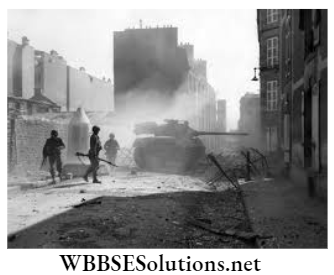
WBBSE Solutions For Class 9 History Chapter 5 Europe In The Twentieth Century World War I Bombing

  1. On 28 June 1914 Francis Ferdinand, the heir to the Austrian throne, was assassinated at Sarajevo. Austria held Serbia responsible for the murder. England declared war on Serbia. Russia joined hands with Serbia. It declared war on France and Russia invaded Belgium to reach France. France was helped by Britain.
  2. Japan attacked Germany to get control of her colonies in the Far East. Turkey and Bulgaria sided with Germany.
  3. Italy joined France and England. The German army marched towards Paris but was stopped near the river Marne. The German army was defeated in the Battles of Marne and Somme.
  4. The United States of America joined the war in 1917 when the British ship Lusitania carrying American passengers was sunk by a German U-boat. At first, the Germans were winning. They used U-boats to sink enemy ships as well as ships of neutral countries going to Britain.
  5. In 1917 the new communist government under the leadership of Lenin was established. In 1918 Russia signed the treaty of Brest-Litovsk with Germany and withdrew from the war.
  6. Germany mounted violent attacks on France and Belgium.
  7. America entered the war and the Germans started losing. The Allies started counterattacks forcing the Germans back. Germany was devastated and Emperor William II fled.
  8. The Central Powers surrendered and accepted an armistice in 1918. Shortly thereafter, the 1919 Treaty of Versailles ended World War I.

Step-by-Step Guide to Answering LAQs on European History

Question 6. What were the effects of the First World War?
Answer: The outbreak of the First World War on July 28, 1914, is the most outstanding event of the early 19th century.

The effects of the First World War are as follows:

  1. About one crore thirty lakh soldiers died during the First World War. The death rate of the civilians was much higher. About 28 thousand crore dollars were spent during the war. After the war, there was an acute financial crisis.
  2. Severe economic difficulties created by the war and the demand for reparation caused despair and hardship which ensured an uncertain future for Germany.
  3. The Great War sounded the death knell for monarchies in Germany and Russia which became republics.
  4. The Ottoman Empire and Austria-Hungary completely collapsed.
  5. The USA emerged from the war clearly as the greatest power as well as the creditor nation of the world.
  6. In Russia, the war led to the Russian Revolution and a civil war broke out which continued for three years beyond World War I.
  7. World War I was also the cause for a rise in nationalistic tendencies leading to the demand for independence in many British colonies outside Europe.
  8. In most countries after the Great War, monarchy came to an end and democratic governments were established.
  9. After the Great War, the prices of articles went up.
  10. Almost all the countries were so heavily burdened that for years together their path of progress remained impeded.
  11. With men having joined the war, the women of most took over business and establishment.
  12. One distinct positive outcome of World War I was the boost received by research and technology. Rail and automobile transport, radio and wireless communications, and research and development of weapons and arms including nuclear research boomed.
  13. To curb the wars and maintain global peace the League of Nations was established in 1919 due to the persistent efforts of Woodrow Wilson.

Question 7. What were Wilson’s ‘Fourteen Points’?
Answer: With the surrender of Germany in 1918, the First World War came to an end. As an answer to all European problems the President of America Woodrow Wilson came up with peace proposals known as the ‘Fourteen Points’.

It said that:

  1. There would be no secret treaties among different countries. All terms will be openly discussed and agreed upon.
  2. The seas should be free in peace and war to ships of all nations.
  3. The American Doctrine of ‘Open Door’ in China i.e. the right of all nations to enjoy equal rights of trade in China will be implemented.
  4. Colonial questions to be settled peacefully.
  5. Russia should be allowed to choose whatever form of government it wants.
  6. Germany shall restore genuine French territories to France.
  7. The barriers to trade between countries such as customs duties should be removed (free trade).
  8. The Habsburg and the Turkish Empires would be reorganised and reconstructed according to the doctrine of ‘one nation one state’.
  9. All countries should reduce their armed forces to the lowest possible levels.
  10. Poland should be constituted as an independent sovereign and united country.
  11. The national groups in Europe should, wherever possible, be given their independence.
  12. Russian territories may be restored to Russia.
  13. Readjustments of the frontiers of Italy are to be made.
  14. The League of Nations would be formed for the prevention of war and the peaceful settlement of international disputes.

Question 8. What were the treaties signed in the Paris Peace Conference (1919)?
Answer: The First World War came to an end in 1918 with the surrender of Germany.

In the Paris Peace Conference (1919) the following peace treaties were concluded:

The Treaty of Versailles: The Treaty of Versailles was concluded in 1919 between the victorious allies (comprising Britain, France, Russia, and Serbia) and defeated Germany after World War I.

  1. Germany lost Alsace-Lorraine to France, Upen, Malmedy, Moresnet to Belgium, Memel to the Allies, west Prússia and most of
  2. Posen to Poland. She handed over the province of Schleswig to Denmark.
  3. Danzig was made a free port.
  4. The Saar Valley was put under an international commission for 15 years.
  5. Germany was required to surrender her colonies, navy and coal mines.
  6. Germany had to pay heavy war reparations.

The Treaty of Saint Germain: This treaty was signed between the victorious Allies and defeated Austria in 1919. By this treaty

  1. The old House of Hapsburg was abolished.
  2. Austria had to accept the true existence of Hungary, Poland and Czechoslovakia.

The Treaty of Neuilly: This treaty was signed between the victorious allies and Bulgaria in 1919. According to this treaty

  1. Four provinces of Western Bulgaria were given to Yugoslavia;
  2. The strength of the Bulgarian army was reduced to ten thousand.

The Treaty of Trianon: The Allied powers concluded this treaty with Hungary in 1920. By this treaty

  1. A large portion of the territory was taken away from Hungary;
  2. The strength of the Hungarian army was reduced.

The Treaty of Sevres: The victorious Allies concluded this treaty with Turkey in 1920. By this treaty

The Turkish Empire was abolished Turkey had to give up her rights over Egypt, Cyprus, Morocco, Palestine, Arabia and Mesopotamia. Turkey’s army was also reduced.

Key Themes in 20th Century European History for LAQs

Question 9. Criticise the Treaty of Versailles. Or, The Treaty of Versailles contained the seeds of the Second World War.
Answer: The Treaty of Versailles has been called ‘a dictated treaty’ which was imposed powers. The delegates of Germany were not defeated Germany by the Allied invited to the Paris Peace Conference (1919) Treaty did not adhere to the principle of self and the treaty was vengeful.

  1. The determination. The right of self-determination transferred to Czechoslovakia. It led to a loss of was not applied for Sudetenland which was a balance of power in Europe.
  2. While England’s colonies were confiscated in the name of goods and France increased their colonies, the German government.
  3. Germany was saddled with what was impossible for her to pay.
  4. According to the huge reparation amount by the Treaty which Wilson’s Fourteen Points, it was decided that all the states would reduce their war armaments. But this clause was only applied to Germany.

Humiliated Germany was looking forward to another war as an opportunity to avenge his Versailles contained the seeds of the Second defeat. It is thus said that the Treaty of World War.

Question 10. How was the League of Nations founded? Or, What was the role of Woodrow Wilson in the foundation of the League of Nations?
Answer: The terrible effects of the First World War (1914-18) had stunning effects on the minds of the people. It made the people cry for peace. At Paris in 1919 a peace conference was convened to solve the problems of the countries to conclude a treaty with the vanquished.

The meeting was called to find out a way to maintain peace and order in the world in future permanently. Wilson had also come to attend the conference. He put before the Allies his ‘Fourteen Points’ for consideration. The Allies agreed to work according to these points.

The last point of Wilson was directly related to the formation of the League of Nations. The Allies agreed that this organisation should be formed and its constitution should be prepared separately. Wilson suggested that the constitution of the League of Nations should be included in the Treaty of Paris.

Ultimately the Allies accepted the demand of Wilson. A document called Covenant was drafted at the Paris Peace Conference which led to the foundation of the League of Nations.

Question 11. What do you mean by the Great Economic Depression? What were the causes of the economic depression of 1929?
Answer: The Great Economic Depression was a severe worldwide economic crisis in the decade preceding World War II that affected most of the developed world except the Soviet Union throughout 1930.

The causes of the Great Depression in America or the world economic crisis were as follows:

  1. After the First World War, there was an overproduction of industrial goods in America. The surplus goods could not be sold in the domestic market or across the Atlantic.
  2. After the First World War, different European countries increased their industrial production. As a result demand for American goods dropped leading to an economic crisis.
  3. During the First World War farmers produced far more food than the population consumed. Farmers expanded their production to aid the war effort. After the war as demand dropped with increasing supply, the prices of products fell and farmers suffered. They fall into debt.
  4. On 24 October 1929, the American share market crashed. As the shareholders were panicked millions of shares had been sold on this fateful day.
  5. America imposed a high rate of tariff on goods imported from different European countries. The European countries also adopted the same policy. As surplus goods could not be sold in the market America’s foreign trade suffered. Many industries were closed and people became jobless.

Question 12. Write a note on Hoover’s Moratorium.
Answer: Herbert Hoover became the President of the USA in 1929. He said, “We in America are nearer to the final triumph over poverty than ever before in the history of any land”. But very soon came the economic crash of 1929.

Total industrial production fell by 48 per cent, the result being a rapid growth of unemployment. The business houses faced a great deal of losses. In order to speed up an economic revival, Hoover proposed an international moratorium from mid-1931 to mid-1932.

To meet rising unemployment, the government allotted large sums for the construction of public buildings and highways. The threatened insolvency of many banks and many railways forced the government to underwrite the credit structure. A Reconstruction Finance Corporation was created which was authorised to lend money for three years for financing commerce, industry and agriculture and for the exportation of agricultural and other products.

All these measures to solve the economic depression of the country failed. By 1932 over five thousand banks collapsed and the number of unemployed people rose to over 12 million. The Americans turned with hope to the new leadership of Franklin Roosevelt.

WBBSE Class 9 History Chapter 5 Europe In The Twentieth Century LAQs Herbert Hoover

Examples of Long Answer Questions on European Conflicts

Question 13. What is the ‘New Deal’ of Roosevelt?
Answer: When Franklin Delano Roosevelt became the President of the USA in 1933 the country was on the verge of complete collapse. He prophesied that the USA would ‘revive and prosper’ and he promised a New Deal for the American people.

The New Deal was a series of domestic programmes enacted in the United States between 1933 and 1938 and a few came later. They included both laws passed by Congress as well as presidential executive orders during the first term (1933-37) of President Roosevelt. The programme was in response to the Great Depression and focussed on what historians call the 3R’s-‘Relief, Recovery, Reform’, that is Relief for the unemployed and poor, Recovery of the economy to a normal level and Reform of the finances.

In the realm of ‘Relief,’ the government gave federal loans to rich businesses. It inaugurated a programme of public works in order to stimulate business and provide employment. It set up an elaborate system of conservation of natural resources. The New Deal reopened banks under strict supervision of the government. It controlled the selling of stocks bonds and other securities. The New Deal paid particular attention to agriculture, labour and social security.

Class 9 History Solutions WBBSE

Question 14. What were the reasons that led to the USA’s substitution of Europe by the USA as the power centre of the world?
Answer: At the beginning of the 20th century the centre of power in the world was shifted from Europe to, the USA.

Due to the following reasons:

  1. With the entry of the USA into the First World War in 1917 a new chapter opened in world history. Her participation changed the course of the war and enabled Britain and France to win the war.
  2. At the Paris Peace Conference (1919) President Wilson was one of the Big Four who laid the foundation of the world. peace organisation, the League of Nations USA’s prestige was raised and she became a prominent power in the world.
  3. USA’s emergence as a world power was also caused by her economic prosperity. The economic depression of 1929-33 affected not only the USA but also other countries of the world. President Roosevelt of the USA helped other countries to tide over this economic crisis and USA’s prestige was raised as a first-class world power.
  4. The USA rendered military and material help to the allies and changed the course of the war. The USA forced Japan to surrender in 1945 and played a leading role in the Second World War. She made her the arbiter of international politics.
  5. USA’s advancement in science and technology especially in weapons of mass destruction raised her status. She was the first to invent an atom bomb and the successful dropping of it in Japan was made. her the most prominent power in the world.
  6. The USA took the lead to counteract Russia’s influence. She took the initiative of extending economic assistance to Europe, especially through the Marshall Plan. The USA helped to restore all economies and modernise the armed forces of Western Europe and became the centre of world politics.
  7. The Second World War (1939-45) weakened Britain and France. Britain’s economic crisis after the war was relieved to some extent by loans from the USA which heightened the prestige of the USA.

Chapter 5 Europe In The Twentieth Century Long Answer Questions

Question 15. What was the programme of Hitler and the Nazi Party?
Answer: At the end of the First World War (1914- 18) Germany was left in a state of confusion and anarchy. People were not satisfied with the republican government in Germany. Some political groups in Germany were opposed to the policy of the government Among those parties was the Nazi Party led by Adolf Hitler.

The Programme of Hitler and his Nazi Party were as follows:

To support one man’s rule: Hitler was a bitter opponent of the Weimer Republic and was a strong supporter of one man’s rule.

Formation of Greater Germany: Hitler aimed to form Greater Germany which meant that the provinces of other European countries in which the German language was spoken should be merged in Germany.

To oppose the Jews: Hitler aimed to organise Greater Germany based on pure blood and expel the Jews whom he considered as the enemies of the Aryan race.

Responsibility for the First World War: Hitler was never ready to accept that Germany was responsible for the beginning of the First World War and wanted that the blame should be removed at any cost.

To oppose the Treaty of Versailles: Hitler never accepted the harsh conditions of the Treaty of Versailles and included the opposition of the Treaty as an important element in his programme.

To oppose the payment of war indemnity: According to Hitler, it was an act of great humiliation to Germany to pay the war indemnity and therefore Germany should not pay the reparation.

To oppose the policy of disarmament:
The Allies compelled Germany to disarm itself. Hitler opposed this decision and wanted to increase the military power of his nation.

Acquisition of old German colonies: Hitler’s programme also included the acquisition of old German colonies which had been snatched away by the Allies according to the Treaty of Versailles.

To take revenge in France:
Hitler considered France as the greatest enemy of Germany and planned to avenge the defeat of Germany in the First World War.

Practice LAQs for Class 9 History: Europe in the 20th Century

Question 16. What were the fundamental principles of Fascism?
Answer: Fascism had been established in Italy after the First World War. The founder of Fascism was Benito Mussolini. The basic principles of Fascism were as follows:

Opposition to individualism: The concept of Fascism was against individualism. Mussolini believed in the supremacy of the state and gave no importance to the interests of the people.

Establishment of a totalitarian state: Mussolini believed in one party and one leader for the welfare of the nation. He believed that the state was supreme to all and that opposition had no importance.

Opposition to democracy: Fascism is opposed to democracy. Mussolini had no faith in the majority and public opinion. The order of the leader was the supreme law of Fascism.

Opposition to communism: Communism believed that economic factor moulds the history of human development. On the contrary, Fascism believed that political history moulds the history of mankind. So Fascism had no similarity with the principles of communism.

Opposition to peace: Fascism was opposed to the policy of peace and supported war. Mussolini criticised the League of Nations and said that war was the only means to bring human power to success. It is clear from the above that Fascism had some original principles which did good to the nation to a considerable extent.

Question 17. Write a note on the Spanish Civil War.
Answer: After the First World War the political, social and economic condition of Spain was not stable. In 1931 general elections were held in Spain in which the monarchists were defeated. established in Spain. However, the newly established Democratic-Republican government was successful. General Franco attacked the republican government could not work. republican government and overthrew it. Thus a civil war broke out in Spain.

In this civil war, Italy and Germany helped General Franco. The attitude of India was different. In the Faizpur session of the Indian National Congress (1936) Jawaharlal Nehru, a leader of the Indian freedom movement, in his presidential address said that the civil war in Spain was not simply a war between Franco and the republican government or a war between Fascism and democracy.

He called it a war between reactionary and progressive forces. He remarked, “The struggle today is fiercest and clearest in Spain and the outcome of that depends on war or peace in the world shortly.”

The Indians established an association in London to support the Republican government in Spain and raised a fund to support it in 1937. During the Spanish Civil War, Jawaharlal Nehru visited Spain in June 1938. This year, on 13 October, Mahatma Gandhi sent a message to the Prime Minister of Spain telling him that his full sympathy was with them.

Question 18. How was the dictatorship established in Spain by General Franco?
Answer: Dictatorship was established in Spain through different stages by General Franco.

After the First World War, the political, and social opponents of the republican government took full advantage of the discontent in Spain. The banner of revolt was raised by the army of Spain in Morocco in 1936 under the leadership of General Francisco Franco. He attacked the Republican Government with his army and overthrew it. Thus a civil war broke out in Spain.

However, the newly established republican government could not work successfully. Political disturbances in many provinces’ attempts by the monarchists to capture power, the poor economic condition of the country, the rise of socialism and the deficit budget were some of the problems which threatened the republican government.

The opponents of the republican government took full advantage of the discontent in Spain. The banner of revolt was raised by the army of Spain in Morocco in 1936 under the leadership of General Franciso Franco. He attacked the Republican Government with his army and overthrew it. Thus a civil War broke out in Spain.

In this civil war, Italy and Germany helped General Franco, while Russia helped the Republicans. The Republicans were defeated in the Civil War. In 1939, Barcelona fell into General Franco’s hands. Franco established his dictatorship in Spain.

WBBSE Class 9 History Chapter 4 Industrial Revolution, Colonialism And Imperialism VSAQs

WBBSE Class 9 History Chapter 4 Industrial Revolution, Colonialism, And Imperialism Very Short Answer Questions

Question 1. In which year Spinning Jenny was invented?
Answer: Spinning Jenny was invented in 1765.

Question 2. Who invented the Water Frame?
Answer: Water Frame was invented by Richard Arkwright.

Question 3. Who is known as the ‘Lady with the Lamp’?
Answer: Florence Nightingale is known as the ‘Lady with the Lamp.’

WBBSE Class 9 History Chapter 4 Industrial Revolution, Colonialism, And Imperialism VSAQs

WBBSE Class 9 Industrial Revolution VSAQs

Question 4. Who wrote ‘Organisation of Labour’?
Answer: ‘Organisation of Labour’ was written by Louis Balance.

Question 5. In which year was the International Workingmen’s Association founded?
Answer: The International Workingmen’s Association was founded in 1864.

Read and Learn More WBBSE Class 9 History Very Short Answer Questions

Question 6. Where was the first congress of the International Workingmen’s Association held?
Answer: The first congress of the International Workingmen’s Association was held in Geneva.

Question 7. Which book is known as the Bible of Socialism?
Answer: ‘Das Capital’ written by Karl Marx is known as the Bible of Socialism.

Question 8. Who was the author of the book ‘What is Property’?
Answer: The author of the book ‘What is Property’ was Joseph Proudhon.

WBBSE Class 9 History

Question 9. Who first coined the term ‘Socialism’?
Answer: Saint Simon first coined the term socialism.

Question 10. Who was the first important early socialist thinker?
Answer: The first important early socialist thinker was St. Simon.

Question 11. Who is known as the ‘Father of British Socialism’?
Answer: Robert Owen is known as the ‘Father of British Socialism’.

Question 12. When was the term ‘Industrial Revolution’ first used?
Answer: The term Industrial Revolution was first used in 1837.

Question 13. Which machine revolutionized the process of cotton spinning?
Answer: James Hargreaves’ Spinning revolutionized the process of cotton spinning.

Colonialism and Imperialism VSAQs for Class 9

Question 14. Who invented the steam locomotive?
Answer: George Stephenson invented the steam locomotive.

Question 15. Which invention of John Kay revolutionized the textile industry?
Answer: John Kay’s ‘Flying Shuttle’ revolutionized the textile industry.

Question 16. Who invented the optical telegraph?
Answer: The optical telegraph was invented by Claude Chappe.

Question 17. Where was the first Iron Bridge constructed?
Answer: The first Iron Bridge was constructed in 1781 in Shropshire, England.

Question 18. Name the countries where industrialization took place after England.
Answer: After England, industrialization took place in France, Germany, Holland, Belgium, Russia,  etc.

Question 19. When did the Chartist Movement start?
Answer: The Chartist Movement started in 1838.

Question 20. When wathe the London Working Men’s Association founded?
Answer: The London Working Men’s Association was founded in 1836.

NEET Biology Class 9 Question And Answers WBBSE Class 9 History Notes WBBSE Solutions for Class 9 Life Science and Environment
WBBSE Class 9 Geography And Environment Notes WBBSE Class 9 History Multiple Choice Questions WBBSE Class 9 Life Science Long Answer Questions
WBBSE Solutions for Class 9 Geography And Environment WBBSE Class 9 History Long Answer Questions WBBSE Class 9 Life Science Multiple Choice Questions
WBBSE Class 9 Geography And Environment Multiple Choice Questions WBBSE Class 9 History Short Answer Questions WBBSE Solutions For Class 9 Maths
WBBSE Solutions for Class 9 History WBBSE Class 9 History Very Short Answer Questions WBBSE Solutions for Class 9 Physical Science and Environment


WBBSE Class 9 History Chapter 4 Very Short Answer Questions On Industrial Revolution

Question 21. Who founded the London Working Men’s Association?
Answer: The London Working Men’s Association was founded by William Lovett and Francis Place.

Question 22. Name some leaders of the Chartist Movement.
Answer: Some leaders of the Chartist Movement were Feargus O’Connor, Earnest Jones, O’Brien, etc.

Class 9 History Solution WBBSE

Question 23. Give names of two scholars who were among the first to use the term ‘Industrial Revolution’.
Answer: Two scholars who were among the first to use the term ‘Industrial Revolution’ were Auguste Blanqui, a French economist,t and Arnold Toynbee, the great historian.

Question 24. Where did the Industrial Revolution first start?
Answer: The Industrial Revolution first started in England.

Question 25. What are the three ingredients necessary for the Industrial Revolution?
Answer:

The three main ingredients necessary for the Industrial Revolution are-

  1. Materials,
  2. Capital and
  3. Labour.

Key VSAQs on Economic Effects of the Industrial Revolution

Question 26. Define the term ‘Capitalism’.
Answer: Capitalism is an economic system in which the principal means of production, distribution, and exchange are in private hands and are operated for profit.

Question 27. Which country is known ‘manufactory of the world’?
Answer: England is known as the ‘manufactory of the world’.

Question 28. Which country is known as ‘The Jewel in the Crown of the British Empire’?
Answer: India is known as ‘The Jewel in the Crown of the British Empire’.

Question 29. Who invented the ‘Flying Shuttle’?
Answer: John Kay invented the ‘Flying Shuttle’.

Question 30. Who invented the Spinning Jenny?
Answer: James Hargreaves invented the Spinning Jenny.

WBBSE Class 9 History VSAQs On Impacts Of Imperialism

Question 31. Who was James Watt?
Answer: James Watt was a Scottish inventor who redesigned the steam engine so that it produced more power and consumed less fuel.

Class 9 History WBBSE

Question 32. Where was the first modern railway line opened?
Answer: The first modern railway line was opened from Darlington to Stockton in England.

Question 33. When and where did railways first start in Germany?
Answer: Railways first started in 1835 in Bavaria (Germany).

Question 34. Name two cities in England that developed around industries.
Answer: Two cities which developed around industries are Liverpool and Manchester.

Question 35. Who gave leadership in ‘the Luddite riot’?
Answer: General Ned Ludd gave leadership in the ‘Luddite riot’.

Question 36. Name the workers’ union formed under the leadership of Robert Owen.
Answer: The workers’ union formed under the leadership of Robert Owen is the ‘Grand Consolidated National Union’.

Question 37. Who was Saint Simon?
Answer: Saint Simon (1760-1825) was a Utopian Socialist who advocated common ownership of all land and capital to be managed scientifically by the state.

Understanding Social Changes During Colonialism VSAQs

Question 38. Name one Utopian socialist.
Answer: Charles Fourier was a Utopian socialist.

Question 39. Who is known as the founder of Scientific Socialism?
Answer: Karl Marx is known as the founder of Scientific Socialism.

Question 40. Who wrote ‘The Communist Manifesto?”
Answer: ‘The Communist Manifesto’ was written by Karl Marx and Friedrich Engels.

WBBSE Class 9 Chapter 4 Industrial Revolution, Colonialism And Imperialism VSAQs Fredrich Engels

Question 41. Who wrote ‘Das Capital’?
Answer: ‘Das Capital’ was written by Karl Marx.

WBBSE Class 9 Chapter 4 VSAQs On Colonialism, Imperialism, And Industrial Revolution

Question 42. Name two European countries that established their colonies outside Europe.
Answer: Two European countries which established their colonies outside Europe are Germany and France.

Question 43. Name two places in Africa where Portugal established her colonies
Answer: Two places in Africa where Portugal established her colonies were Angola and Mozambique.

Question 44. When was the Entente Cordiale signed?
Answer: The Entente Cordiale was signed in 1904.

Question 45. Name the two opposite camps which developed in Europe before the outbreak of the First World War.
Answer: The two opposite camps which developed in Europe before the outbreak of the First World War were

  1. The Triple Alliance and
  2. The Triple Entente.

Question 46. Name the main contending powers in the partition of China.
Answer: The main contending powers in the partition of China were Britain, France, Germany, and Russia.

Question 47. What was the period of the First World War?
Answer: The period of the First World War was 1914-1918.

Question 48. Which country declared war on Serbia in 1914?
Answer: Austria declared war on Serbia in 1914.

Step-by-Step Guide to Answering VSAQs on Industrialization

Question 49. Which country established a colony in Senegal?
Answer: France established a colony in Senegal.

Question 50. When was the Suez Canal opened?
Answer: The Suez Canal was opened in 1869.

Question 51. Where did England establish colonies?
Answer: England established colonies in India, Burma, Ceylon, Afghanistan, Persia, and China.

Question 52. Where did France establish colonies?
Answer: France established colonies in India, Burma, and Indo-China.

Question 53. Name some colonies of Germany.
Answer: Some colonies of Germany were Burundi, Rwanda, Cameroon, Togoland etc.

Question 54. Name some colonies of Italy.
Answer: Some colonies of Italy were Somaliland, Abyssinia, Eritrea, etc.

Question 55. Which European powers established colonies in Asia?
Answer: The European powers that established colonies in Asia were Portugal, Holland, England, France, Denmark, etc.

Question 56. When was the Suez Canal construction completed?
Answer: The Suez Canal construction was completed 24 a period is known as the ‘Age of New in 1869.

Question 57. Who built the Aswan Dam across the river Nile?
Answer: The Aswan Dam was built across the river Nile by Gamal Abdel Nasser.

Question 58. Which company constructed the Suez Canal?
Answer: The Suez Canal was constructed by the ‘Universal Maritime Suez Canal Company’.

Question 59. When was the Suez Canal nationalized?
Answer: The Suez Canal was nationalized in 1956 (26 July).

Question 60. Who nationalized the Suez Canal?
Answer: Gamal Abdel Nasser nationalized the Suez Canal.

WBBSE Class 9 Chapter 4 History VSAQs

Question 61. When and between whom was the battle of Buxar fought?
Answer: The battle of Buxar was fought in 1764 between Mir Kasim, the Nawab of Bengal, Shah Alam II, the Mughal emperor, and Shuja-up-doula, the Nawab of Oudh on one side and the English on the other.

Question 62. When and between whom was the Battle of Plassey fought?
Answer: The battle of Plassey. Was fought in 1757 between Siraj-ud-daula, the Nawab of Bengal, and the English East India Company.

Question 63. After which battle the English established their supremacy in Bengal?
Answer: The English established their supremacy in Bengal after the battle of Plassey (1757).

Question 64. Which period is known as the ‘Age of Imperialism’?
Answer: The period extending from the 15th to the 19th century, when different countries of Europe extended their colonies in different parts of the world, is known as the ‘Age of Imperialism’.

Class 9 History WBBSE

Question 65. Which period is known as the ‘Age of New Imperialism’?
Answer: The period between 1870 and 1914 is known as the ‘Age of New Imperialism.’

Question 66. In which essay did Rabindranath Tagore write about militant nationalism?
Answer: Rabindranath Tagore, in his essay ‘Nationalism in India’ wrote about militant nationalism.

Question 67. Which policy proposed that no Chinese port was to be considered the exclusive property of any particular foreign power?
Answer: The Open Door Policy (1899) proposed that no Chinese port was to be considered an exclusive property of any particular foreign power.

Practice VSAQs for Class 9 History: Colonialism and Imperialism

Question 68. Who announced the Open Door policy?
Answer: The Open Door policy was announced by John Hay.

Question 69. When and between whom was the Treaty of Nanking signed?
Answer: The Treaty of Nanking was signed in 1842 between England and China.

Question 70. When did the First Opium War take place?
Answer: The First Opium War took place in 1839.

Question 71. Which treaty was signed after the First Opium War?
Answer: The Treaty of Nanking was signed after the First Opium War.

Question 72. When and with whom did the Second Opium War take place?
Answer: The Second Opium War took place in 1856- 61 between England and China.”

Question 73. Between whom was the Treaty of Tientsin signed?
Answer: The Treaty of Tientsin was signed between China and the English on one side and the French on the other.

Question 74. Which US ship first landed in China for trade and commerce?
Answer: The US ship ‘Empress of China’ first landed in China for trade and commerce.

Question 75. By which treaty China granted ‘extra-territorial rights’ to England?
Answer: By the Treaty of Bogue (1843) China granted extra-territorial rights to England.

Question 76. Who invented the Telegraph?
Answer: The telegraph was invented by Samuel Morse.

Key Themes in Colonialism for VSAQs

Question 77. When did the first telegraph system start in India?
Answer: The first telegraph system started in India in 1850.

Question 78. Which continent is known as the ‘Dark Continent’?
Answer: Africa is known as the ‘Dark Continent’.

Question 79. Which countries established colonies in Africa?
Answer: Countries like England, France, Germany, Italy, Portugal, Holland, etc. established colonies in Africa.

Very Short Questions On Colonialism And Imperialism Class 9 History WBBSE

Question 80. Which countries took part in the partition of Africa?
Answer: Countries like England, France, Belgium, Germany, etc. took part in the partition of Africa.

Question 81. Between whom was the Entente Cordiale signed?
Answer: The Entente Cordiale was signed between England and France.

Question 82. What was the direct cause of the First World War?
Answer: The direct cause of the First World War was the Sarajevo murder incident.

Question 83. To which nationality did Gavrilo Princip belong?
Answer: Gavrilo Princip was a Slav nationalist.

Question 84. Which nation was called ‘the nation of assassins’ by Austria?
Answer: Serbia was called the ‘nation of assassins’ by Austria.

Examples of Very Short Answer Questions on Imperialism

Question 85. Who was responsible for the Sarajevo murder?
Answer: The ‘Black Hand’, a terrorist party was responsible for the Sarajevo murder.

Question 86. Where is Sarajevo situated?
Answer: Sarajevo is situated in Bosnia.

Question 87. Who was the emperor of Germany during the First World War?
Answer: The emperor of Germany during the First World War was Kaiser William 2.

Question 88. When did Austria attack Serbia?
Answer: Austria attacked the Serbian capital Belgrade on 28 July 1914.

WBBSE Class 9 History Chapter 4 Industrial Revolution, Colonialism And Imperialism SAQs

WBBSE Chapter 4 Industrial Revolution, Colonialism And Imperialism Short Answer Questions

Question 1. What was the Industrial Revolution?
Answer: Industrial Revolution:-

During the second half of the 18th century, far-reaching changes began in the economic life of the people as a result of scientific inventions in different industries. These changes are referred to as the Industrial Revolution.

The Industrial Revolution means a thorough transformation in the methods of production and transportation, the general substitution of power-driven machinery for hand labour.

Human labour came to be replaced more and more by machines producing more goods.
Industrial Revolution, Colonialism and Imperialism.

WBBSE Class 9 History Chapter 4 Industrial Revolution, Colonialism And Imperialism SAQs

WBBSE Class 9 Industrial Revolution SAQs

Question 2. What are the main features of the Industrial Revolution?
Answer:

The main features of the Industrial Revolution are:

  1. The mechanisation of industry and the use of modern technology for production
  2. Production of goods by machines and factories instead of individual labour and cottage industries
  3. Investment of a huge amount of capital
  4. Marketing the finished goods on a large scale for profit.
  5. Introduction of the modern transport system.

Read and Learn More WBBSE Class 9 History Short Answer Questions

Question 3. What conditions are necessary for industrialisation?
Answer:

The following conditions are necessary for industrialisation.

  1. Natural resources like coal and iron
  2. Sufficient capital
  3. Plenty of raw materials
  4. Cheap labour
  5. Markets for finished goods
  6. Political stability
  7. Favourable government policy
  8. A cheap and efficient system of administration
  9. Suitable climate
  10. Enterprising and energetic people.

Class 9 History Solution WBBSE

Question 4. Which are the main locations of Manchester, Glasgow, Bristol, Liverpool etc. Industrial Revolution?
Answer: The main locations of the Industrial Revolution were: England, Belgium, France, Germany, Italy, Russia, the USA, Japan and China.

Question 5. Name two scientific inventions which helped in the Industrial Revolution in England.
Answer: Two scientific inventions which helped in the Industrial Revolution in England are:

  1. The steam engine was invented by James Watt and
  2. Safety Lamp was invented by Humphry Davy.
NEET Biology Class 9 Question And Answers WBBSE Class 9 History Notes WBBSE Solutions for Class 9 Life Science and Environment
WBBSE Class 9 Geography And Environment Notes WBBSE Class 9 History Multiple Choice Questions WBBSE Class 9 Life Science Long Answer Questions
WBBSE Solutions for Class 9 Geography And Environment WBBSE Class 9 History Long Answer Questions WBBSE Class 9 Life Science Multiple Choice Questions
WBBSE Class 9 Geography And Environment Multiple Choice Questions WBBSE Class 9 History Short Answer Questions WBBSE Solutions For Class 9 Maths
WBBSE Solutions for Class 9 History WBBSE Class 9 History Very Short Answer Questions WBBSE Solutions for Class 9 Physical Science and Environment

WBBSE Class 9 History Chapter 4 Short Answer Questions On Industrial Revolution And Colonialism

Question 6. What do you mean by division of labour?
Answer: Division Of Labour:-

An important aspect of the Industrial Revolution is the division of labour. The productive process is divided into several parts and each part was to be produced separately.

Division of labour helps in the specialisation of a particular process but the labourer becomes ignorant of the total system of production.

Question 7. How did the Industrial Revolution lead to the growth of new cities?
Answer: Before the Industrial Revolution, people lived primarily in villages. Agriculture was the main occupation of the people.

After the Industrial Revolution, there was a migration of displaced agricultural labourers to industrial areas on a large scale who sought and found employment in the industries. Towns gradually developed around these industrial centres.

Colonialism and Imperialism SAQs for Class 9

Question 8. Name two industrial cities of England.
Answer: Two cities which developed around the industrial areas in England are-

  1. Manchester and
  2. Leeds.

Question 9. Name some industrial cities which grew up as a result of the Industrial Revolution.
Answer: Some industrial cities which grew as a result of the Industrial Revolution were Manchester, Glasgow, Bristol, Liverpool etc.

Question 10. What is industrial capital?
Answer: Industrial Capital:-

After the Industrial Revolution, the capitalists of England invested huge capital in industrial production rather than investing in trade and commerce. This capital is called ‘Industrial Capital’.

Question 11. Why did the Industrial Revolution first start in England?
Answer:

The Industrial Revolution first started in England because of

  1. The political stability of the country.
  2. England’s unrivalled power in overseas trade
  3. Availability of cheap abundant-wage labourers
  4. Huge colonies in different parts of the world
  5. A good network of navigable rivers
  6. An abundance of natural resources like coal and iron.

Key SAQs on Economic Changes During the Industrial Revolution

Question 12. Mention two reasons why industrialisation started late in Russia.
Answer:

Two reasons why industrialisation started late in Russia were:

  1. The Russian feudal lords were more interested in agriculture rather than in industries.
  2. There was a lack of industrial capital in Russia.

Question 13. Why was England known as the ‘manufactory of the world’?
Answer: The Industrial Revolution first took place in England. Big mills and factories were established which produced huge quantities of goods.

In the 19th century, England alone produced half of the world’s industrial manufactured goods. So England was known as the ‘manufactory of the world.’

Question 14. Why continental goods could not compete with British-made goods in the international market?
Answer:

Continental goods could not compete with British-made goods in the international market because:

  1. The quality of British-made goods was very high.
  2. England had a huge colonial market.
  3. England had a strong navy.

Question 15. Why did the factory system develop?
Answer:

Development Of Factory System:-

  1. Before the factory system, there was a localised form of production. Production was made one at a time by individual workers at small workshops or at home.
  2. As machines became larger, huge quantities of goods were produced within a short time with the help of machines. Division of labour was introduced. This was not possible in the case of cottage industries. So factory system was developed.

Question 16. Why did industrialisation start later in France than in England?
Answer:

Industrialisation started later in France than in England because:

  1. France was torn by the availability of coal
  2. None- of capital
  3. Lack of transport
  4. Lack of revolution during 1789-1848.
  5. Undeveloped banking system
  6. Industrialisation was, not encouraged by rulers
  7. Medieval outlook on life.

Understanding Social Impacts of Colonialism SAQs

Question 17. How did the natural environment help in the Industrial Revolution of England?
Answer:

The natural environment helped in the Industrial Revolution of England because:

  1. Raw materials were easily available
  2. A good supply of coal and iron
  3. Suitable climate for spinning
  4. A good network of navigable rivers.

Question 18. What was the role of women in the Industrial Revolutions of England?
Answer: As the Industrial Revolution unfolded in England, women got themselves involved in textile mills, factories and mines.

They were employed by factory owners in large numbers and were paid very meagre wages. Their terms of work were humiliating and they were compelled to live in filthy urban slums.

Question 19. Which is the First International Working Men’s Union? When was it established and under whose leadership?
Answer: The First International Working Men’s Union is the Communist League.
It was established in 1847 under the leadership of Karl Marx.

Short Answers For Class 9 History Chapter 4 Industrial Revolution WBBSE

Question 20. What is ‘Habeas Corpus’?
Answer: Habeas Corpus:-

Habeas Corpus is a court order requiring a person under arrest to be brought before a judge or into court and show a valid reason for that person’s detention. It safeguards individual freedom against unlawful and indefinite imprisonment.

Question 21. What do you mean by ‘Luddite riot’?
Answer: Luddite Riot:-

‘Luddite riot’ was a protest movement of the workers led by General Ned Ludd in England. The rioters demanded

  1. A minimum wage.
  2. Control over labour for women and children.
  3. Work for those who had lost their job because of the coming of machinery and
  4. Right to form trade unions so that they could present these demands legally and officially.

Step-by-Step Guide to Answering SAQs on Industrialization

Question 22. What is the Paris Commune?
Answer: Paris Commune:-

In 1871, the revolutionary workers of Paris established an organisation known as the Paris Commune defied the central government and captured power. On 18 March this Commune exercised administrative power in Paris for almost two months.

WBBSE Class 9 Chapter 4 Industrial Revolution, Colonialism And Imperialism SAQs Paris Commune

Question 23. What is ‘Bloody May Week’?
Answer:

Bloody Mary Week:-

In 1871 when the revolutionary workers of Paris established the Paris Commune to take over the administration of Paris in their own hands, the soldiers of the French government fired indiscriminately on the revolutionary workers.

There was desperate fighting for a week (22 May-29 May). About 17,000 persons were killed. Historians refer to this week as ‘Bloody May Week’.

History Class 9 WBBSE

Question 24. What is the ‘March of the Blanketeers’?
Answer: March Of The Blanketeers:-

Thousands of workers started a march in 1819 from Manchester towards the Parliament House in London to put forward their long-standing demands for improvement of their working conditions.

The workers carried with them their blankets on their shoulders for sleeping at night. This was known as the ‘March of the Blanketeers’.

Question 25. Who are called ‘Utopian Socialists’?
Answer:

Utopian Socialists:-

The pre-Marxist socialists and thinkers are called early socialists or ‘Utopian Socialists’. Some well-known Utopian socialists were Saint Simon, Charles Fourier and Robert Owen.

Question 26. Name the books which contain the political ideals of Karl Marx.
Answer:

The books which contain the political ideals of Karl Marx are:

  1. Communist Manifesto
  2. Das Capital
  3. Critique of Political Economy
  4. The Poverty of Philosophy.

Practice SAQs for Class 9 History: Colonialism and Imperialism

Question 27. Name some Utopian socialist thinkers.
Answer:

Some Utopian Socialist Thinkers:-

Robert Owen, Charles Fourier, Saint Simon, Louis Blanc, and Proudhon are some of the Eutopian socialist thinkers.

Question 28. Who is known as the ‘Father of anarchism’? Name some propounders of Name some propounders of anarchism.
Answer:

  1. Proudhon is known as the ‘Father of anarchism’.
  2. Some propounders of anarchism were Bakunin, Murray Bookchin, Alexander Berkman, Camillo Berneri etc.

Class 9 History WBBSE

Question 29. Mention two demerits of Utopian socialists.
Answer:

Two demerits of Utopian socialists were:

  1. The Utopian socialists were imaginative socialists without any practical sense.
  2. The Utopian socialists could not think of the class struggle. They never understood that the interests of the worker and the employer were antagonistic and mutually divergent.

WBBSE Class 9 History Short Answers On Industrial Revolution Impacts

Question 30. What do you understand by the term “Imperialism”?
Answer: Imperialism:-

The term ‘imperialism’ means the practice of extending the control, power or rule by a country over the economic and political life of the people of areas outside its boundaries.

This may be done by direct rule over the country, indirect control of the people or through settlements.

The essential feature of imperialism is exploitation. The imperialist power subordinates the colony of the country which it controls indirectly to serve its own economic and political interests.

Question 31. What is colonialism?
Answer:

Colonialism:-

Colonialism is a system whereby in an attempt to increase profits and control markets and raw materials, countries try to dominate and control weaker nations and turn them into their colonies. Colonies are ruthlessly exploited by the dominant country.

Class 9 History WBBSE

Question 32. What is Neo-colonialism?
Answer:

Neo-Colonialism:-

Neo-colonialism means that European countries and the USA, even after decolonisation, exerted a great deal of control over the new states, which continued to need the markets and the investment that the West could provide.

Question 33. How did industrialisation give birth to imperialism?
Answer:

Two basic requirements of industrialisation are

  1. Regular supply of raw materials and
  2. Markets to sell finished goods.

To meet their needs industrialised countries like Britain, France, Germany, Italy, Russia, and Japan started a scramble to establish colonies in Asia, Africa and Latin America. These colonies served both purposes i.e., as suppliers of raw materials and easy markets to sell finished goods. Industrialisation thus gave birth to imperialism.

Question 34. What do you mean by capitalism?
Answer:

Capitalism:-

Capitalism is an economic system in which the principal means of production, distribution and exchange lie in private hands and are operated for profit. Society is divided among owners of industries and wage earners.

Question 35. In the 19th century, what changes took place like the trade relations between England and India? Give two reasons for these changes.
Answer: In the 18th century, English merchants used to purchase Indian goods and earn profits by selling them in England and other European countries. In the 19th century, changes took place like trade between England and India. During this period, Britain did not import goods from India.

On the other hand, the Indian market was flooded with British goods and India who had so long been a manufacturer and exporter of finished goods became an exporter of agricultural products like indigo, cotton, jute and wheat.

Key Themes in Colonialism for SAQs

Question 36. What were the wars through which the English established their control over and blushed their control over Mysore?
Answer:

The wars through which the English established their control over Mysore were:

  1. First Anglo-Mysore War (1767-69).
  2. Second Anglo-Mysore War (1780-84).
  3. Third Anglo-Mysore War (1790-92) and
  4. Fourth Anglo-Mysore War (1799).

Question 37. What were the wars through which the English established their supremacy over the Marathas?
Answer:

The wars through which the English established their supremacy over the Marathas were:

  1. First Anglo-Maratha War (1782-85).
  2. Second Anglo-Maratha War (1803-05) and
  3. Third Anglo-Maratha War (1818).

Class 9 History WBBSE

Question 38. What were the battles through which the English had established their supremacy in Bengal?
Answer:

The battles through which the English established their supremacy over Bengal were:

  1. The Battle of Plassey (1757) and
  2. The Battle of Buxar (1764).

Question 39. What do you mean by ‘drain of wealth’?
Answer:

Drain Of Wealth:-

From the 18th century up to the middle of the 19th century the East India Company and its servants collected a huge amount of wealth from India and sent the entire amount to England.

This flow of wealth from India to England is known as the ‘drain of wealth’. The ways wealth was transferred to England were presents, collusive contracts, private trade, free merchants and investments.

Question 40. Mention two reasons for the decline of Indian industries during British rule.
Answer:

Two reasons for the decline of Indian industries during British rule were:

  1. Indian goods could not compete with the British. made goods which were fine and cheap.
  2. The imposition of heavy tariffs on Indian goods made them expensive.

Question 41. Which company first established a railway in India and when?
Answer: The first railway was established in India by the Great Indian Peninsular Railway Company in 1853.

Question 42. What was declared in the ‘Open Door Policy’?
Answer:

Open Door Policy:-

Sir John Hay, the US Secretary of State, issued the famous Open Door Policy (1899). According to it, no Chinese port was to be considered the exclusive property of any particular foreign power.

Question 43. Who was known as ‘Navigator? Name two sailors of his country.
Answer:

Navigator:-

1. The Portuguese sailor Prince Henry was knwon as ‘Navigator’.
2. Two sailors of his country were Vasco da Gama and Bartholomew Diaz.

Examples of Short Answer Questions on Imperialism

Question 44. When was the Suez Canal constructed? What is its importance?
Answer:

Suez Canal:-

1. The construction of the Suez Canal began in 1859.
2. The Suez Canal is the connecting link between the Mediterranean Sea and the Red Sea via the Indian Ocean. It is a direct route for shipping between Asia and Europe. It shortened the travel route between Western Europe and ports in East Africa and Asia.

Class 9 History Short Questions And Answers For Chapter 4 WBBSE Exams

Question 45. Name the countries that rushed to Africa to establish colonies.
Answer:

Name Of The Countries That Rushed To Africa To Establish Colonies:-

The countries that rushed to establish colonies in Africa were Great Britain, Germany, France, Belgium, Italy and Spain.

Question 46. What do you understand by ‘Scramble you understand for Africa’?
Answer:

Scramble You Understand For Africa:-

During the 1800s, France, Britain, Italy, Spain, Germany and Belgium competed with each other to establish a foothold in Africa as it was rich in natural resources. They thought that they were required to do this to maintain their lifestyle and to develop their homelands. This rush among the various European powers to establish colonies in Africa is known as the ‘Scramble for Africa’.

Class 9 History Solution WBBSE

Question 47. How was the Union of South Africa formed?
Answer:

Union Of South Africa Formed:-

The Union of South Africa was formed by the unification of the Cape Colony, the Natal Colony, the Transvaal, and the Orange River Colony. It included the territories that were formerly a part of the South African Republic and the Orange Free State.

Question 48. When did World War I break out? What was the ‘Sarajevo incident’?
Answer: World War I broke out on 28 July 1914. On June 28, 1914, Archduke Francis Ferdinand, nephew of the emperor Joseph of Austria and heir to the throne of Austria was assassinated along with his wife Sophia in Sarajevo, the capital of Bosnia, by Gavrilo Princip, a member of ‘Black Hand’ terrorist organisation. This incident is known as the ‘Sarajevo incident’.

WBBSE Class 9 Chapter 4 Industrial Revolution, Colonialism And Imperialism SAQs Sarajevo Murder

Question 49. In which year was the Triple Alliance formed? Who were the members of the Triple Alliance?
Answer:
1. The Triple Alliance was formed in the year 1882.
2. The members of the Triple Alliance were Germany, Austria and Italy.

Question 50. What were the places in Africa where England established her colonies?
Answer: England established her colonies in Africa in places like Rhodesia, Gold Coast, Nigeria, Somali Land, Nagaland, North Egypt, Cape Colony, Orange, Transvaal, Sudan, East Africa, Bechuanaland, Uganda, Gambia etc.

Question 51. In which year was the Triple Entente formed? Who were the members of the Triple Entente?
Answer:
1. The Triple Entente was formed in the year 1907.
2. The members of the Triple Entente were England, France and Russia.

WBBSE Class 9 History Chapter 4 Industrial Revolution, Colonialism And Imperialism LAQs

WBBSE Class 9 History Chapter 4 Industrial Revolution, Colonialism And Imperialism Long Answer Questions

Question 1. What were the economic, political and social effects of the Industrial Revolution?
Answer: Economic, Political And Social Effects Of The Industrial Revolution:-

The effects of the Industrial Revolution were far-reaching. It had effects on the economy, society and polity.

Economic Effects: The Industrial Revolution led to the decline of small-scale industries and resulted in the rise of the factory system. It led to the division of labour, and specialisation in output and created an unprecedented supply of goods.

WBBSE Solutions For Class 9 History Chapter 4 Industrial Revolution, Colonialism And Imperialism Long Answer Questions

This led to a scramble for colonies amongst the European powers because colonies supplied cheap raw materials for factories and ready markets for finished goods. The invention of machines threw a large number of workers out of jobs and many became unemployed.

Read and Learn More WBBSE Class 9 History Long Answer Questions

WBBSE Class 9 History Chapter 4 Industrial Revolution, Colonialism And Imperialism LAQs

WBBSE Class 9 Industrial Revolution LAQs

Social Effects: There was a large-scale migration of workers from rural to industrial areas. The workers were forced to work for very long hours. The living conditions of the workers in the factories were horrible. Women and children were employed in large numbers in factories and were mercilessly exploited. An unbridgeable gulf was created between the capitalists and the labourers.

Political Effects: As a result of the Industrial the status of newly Revolution industrialised nations was greatly increased in international politics.

The newly emerged capitalist class came forward to participate in politics. Industrial workers, in the course of time, became a great political force. The Spirit of communism and socialism flourished in England due to ‘the labour movement. The socialists raised voices of protest against the atrocities of the capitalists and the government was forced to pass some factory acts.

NEET Biology Class 9 Question And Answers WBBSE Class 9 History Notes WBBSE Solutions for Class 9 Life Science and Environment
WBBSE Class 9 Geography And Environment Notes WBBSE Class 9 History Multiple Choice Questions WBBSE Class 9 Life Science Long Answer Questions
WBBSE Solutions for Class 9 Geography And Environment WBBSE Class 9 History Long Answer Questions WBBSE Class 9 Life Science Multiple Choice Questions
WBBSE Class 9 Geography And Environment Multiple Choice Questions WBBSE Class 9 History Short Answer Questions WBBSE Solutions For Class 9 Maths
WBBSE Solutions for Class 9 History WBBSE Class 9 History Very Short Answer Questions WBBSE Solutions for Class 9 Physical Science and Environment

Question 2. Make a comparative study of the Industrial Revolution in England and the continent.
Answer: The Industrial Revolution first started in England in the 18th century. Big mills and factories were established where goods of daily necessity were manufactured. England became the ‘workshop of the world’.

WBBSE Class 9 Chapter 4 Industrial Revolution, Colonialism And Imperialism LAQs Spread Of Industrialization

Colonialism and Imperialism in the 19th Century LAQs

Industrialisation started rather late in France due to the French Revolution. Another major problem in the development of French industry was the scarcity of coal.

While in England the Industrial Revolution had been the contribution of the capitalist class, in France, industrialisation was achieved mainly through governmental initiative.

By 1848 France became an industrial power but it lagged behind England. France was second to England in 1870 so far as the export of industrial products was concerned.

As compared to England, industrialisation started late in Germany also, as Germany was divided into numerous small states. The real beginning of the Industrial Revolution in Germany was only after her national unification in 1870.

Once it began, Germany’s industrial production grew rapidly and Germany outstripped Britain in steel and became the world leader in chemical industries.

The real beginning of the Industrial Revolution in Russia dates from 1861 after the telegram Emancipation Statute of 1861 was passed. Its system played an important part in establishing was not until the Five-Year Plan that the Soviet Union became a major industrial power.

WBBSE Class 9 History Chapter 4 Industrial Revolution

Question 3. What were the effects of British industrialisation on India?
Answer: British Industrialisation In India:-

The principal motive for the coming of the English East India Company was to participate in and make profits from trade but over time India was reduced to the status of a British colony. Indian silk and cotton had a wide market in Britain but with the coming of the Industrial Revolution, the whole scenario changed.

The effects of British industrialisation on India were:

  1. India was flooded with cheap machine-made goods whereby Indian textiles lost their market in India also.
  2. Laws were passed in Britain to prohibit and restrict the sale of Indian goods.
  3. India was reduced to cotton, silk, and indigo) and importer of British machine-made goods.
  4. The desire for new markets for British goods resulted in Britain’s undertaking a fresh conquest in India.
  5. Free and unrestricted supply of British goods proved detrimental to Indian handicrafts as they were faced with unequal competition for machine-made goods.
  6. The self-sufficiency of Indian villages came to an end.
  7. There was stagnation in Indian agriculture. The British did nothing to improve Indian agriculture.

Question 4. Give a brief account of the development of the telegraph system.
Answer: Brief Account Of The Development Of The Telegraph System:-

Telegram is a device or system for transmitting messages to a distant place by making and breaking electrical connections. It was the first form of communication that could be sent over a great distance. Its creation was one of the key inventions of the Industrial Age.

The use of telegram became very popular in the middle of the 19th century. The telegram system played an important part in establishing and expanding colonies by the industrially developed countries.

In India, the first experimental electric telegram line was started between Calcutta and Diamond Harbour (1850). In 1851 it was opened for the use of the British East India Company. In 1854 telegram link was established between Calcutta and Agra, Bombay and Madras.

WBBSE Class 9 Chapter 4 Industrial Revolution, Colonialism And Imperialism LAQs Telegraph Machine

Key LAQs on Economic Impact of the Industrial Revolution

A Telegram line of 20,000 miles was established in America in 1851. In 1866 when Atlantic Cable was installed, a link could be established between England and America.

As a result, England’s imperialistic rule was consolidated in America. Telegram was also introduced in the colonies of Africa.

A company in Denmark established a telegram system in China in 1871. In 1872 the first telegram system was introduced in Australia and later on in Malay, Vietnam and other places.

As a result of the introduction of a telegram, the European powers were able to establish quick control over the colonies. Foreign control over the colonies was strengthened. Trade in the industrialised countries was increased.

Class 9 History Solutions WBBSE

Question 5. Give an account of the socialist movement in Europe.
Answer: Socialist Movement In Europe:-

The Industrial Revolution led to the decline of small-scale industries and encouraged the rise of the factory system. The living conditions of the workers in the factories were terrible. The socialists raised their voices of protest against the dismal condition of the workers created by industrialisation.

WBBSE Class 9 Chapter 4 Industrial Revolution, Colonialism And Imperialism LAQs P J Proudhon

Understanding Social Changes During Colonialism

  1. Robert Owen, a humanitarian factory owner upheld the view that the capitalists should share a portion of his profits with his employees. As a factory owner, he introduced many benefits for the workers.
  2. Fourier, a Frenchman pleaded for a new social organisation based on cooperative communities.
  3. Another socialist thinker was St. Simon who advocated that the state should assume control of production and distribution. [4] Proudhon wanted to abolish private ownership of property.
  4. Louis Blanc, a French thinker advocated that the state must come forward to protect the rights of workers and make laws. He condemned the accumulation of unlimited profit by the employer and advocated that the profit should be equitably divided between the landlord and workers.
  5. Other socialists were Philippe Buonarroti, Auguste Blanqui. They condemned competition which led to the exploitation of workers.
  6. The greatest advocates of socialism were Karl Marx and Friedrich Engels. To them, history was a class struggle, especially between the upper middle classes and the proletariat. In the ‘Communist Manifesto’ Marx appealed to the workers of the world to unite.

Question 6. What was the role of Karl Marx in the Ka spread of socialism?
Answer: Role Of Karl Marx In The Ka Spread Of Socialism:-

In the first half of the 19th century, the ideals of Utopian Socialism were very popular, but Utopian Socialism failed to show the right path to society.

In the second half of the 19th century, Karl Marx (1818-83) made popular his ideas of scientific socialism which is also known as ‘Marxism’.

As he was a radical thinker he was banished from his homeland Prussia and he took shelter first in France and then in Brussels Belgium. In 1843 he moved to Paris where he formed his lifelong friendship with Friedrich Engels (1820-95) and established the ‘Communist League’ with his help.

In 1864, he convened the International Working Men’s Association which was also known as the First International. Marx, as the leader of this organisation, tried to lay down the strategy and tactics for the unification of the workers of the world. In 1848, Marx and Engels brought out the famous Communist Manifesto.

Workers of the World unite: You have nothing to lose but your chains and a world to win” were the inspiring words of the Manifesto. Marx wrote that few men who owned the factories exploited workers because these people depended on them.

Marx wanted working people to revolt. If they did so, the wealth could be distributed among all, and not remain concentrated in the hands of a few people.

WBBSE Class 9 Chapter 4 Industrial Revolution, Colonialism And Imperialism LAQs Karl Marx

While in London he brought out his great work ‘Das Capital’ in 1867 and established his claim to be regarded as the founder of modern socialism. In this book, capitalism was criticised and class struggle was emphasised. The book is called the Bible of Socialism.

The important principles of Marxism are:

  1. Historical materialism.
  2. Surplus capitalism.
  3. Class struggle and
  4. Revolution.

Karl Marx did not live to see the fulfilment of his dream. He had given hope to the oppressed section of the people all over the world. The value of Marxism lies in the hope and aspiration it has aroused among the suffering humanity holding out to them the prospect of a better and happier world to live in.

WBBSE History Class 9 Chapter 4 Long Answer Questions

Question 7. What were the causes of the scramble for Africa?
Answer: During the 1800s, there was a rush among the European countries to establish their colonies in Africa which is known as the ‘Race. for Africa’ or the ‘Scramble for Africa’. There were many causes of the scramble for Africa which are discussed below.

WBBSE Class 9 Chapter 4 Industrial Revolution, Colonialism And Imperialism LAQs Occupation Of Africa By European nations

Step-by-Step Guide to Answering LAQs on Industrial Revolution

  1. The Industrial Revolution first started in England and then spread to all other parts of Europe. The factories which were established to produce different types of things needed raw materials such as cotton, coal, iron ore and others. Africa was a very rich source of all such raw materials. So the various European countries competed with each other to establish their colonies in Africa.
  2. After the Industrial Revolution when new machines were introduced the rate of production increased manifold. They not only met the demand of the people but also generated surplus goods. The Europeans required a big market to sell these extra goods and a vast country like Africa was a good market for them.
  3. Africa is rich in gold, diamonds, rubies and precious stones. The Europeans took Africa to be a rich source for making money.
  4. There were some other causes for the scramble for Africa. Some countries desired to establish their colonies only because other countries already had their colonies in Africa.
  5. Moreover, there were some countries which thought that the strength of a country depended on the number of colonies it had. So they wanted to establish their colonies in Africa.

Question 8. Which country got the epithet ‘The jewel in the crown of the British empire’? Give an account of the transformation of India from an exporter to an importer.
Answer: India got the epithet ‘The jewel in the agreement was reached in 1925 between Italy crown of the British empire’.

The transformation of India from an exporter to an importer is an interesting chapter in the economic history of India. In the 18th century, English merchants used to purchase Indian goods and earn profit by selling them in England and other European countries. In the 19th century changes took place in the nature of trade between England and India.

During this period Britain did not import manufactured goods from India; on the other hand, Indian markets were flooded with British goods and India, which was so long a manufacturer and exporter of finished goods, became an exporter of agricultural products like indigo, cotton, jute and wheat.

The transformation of India from an exporter to an importer was due to several reasons:

  1. In 1700 the British government prohibited the use of Bengal silk clothes. In 1720 the British Parliament passed an act prohibiting the import of coloured cotton cloths and imposed huge taxes on cotton goods imported in England.
  2. When the Industrial Revolution broke out in England there was a total change in the system of production, huge quantities of goods were produced. Raw materials were necessary for the industries and Britain also needed a ready market for selling her surplus finished goods.
  3. By the Charter Act of 1813, the monopoly of East India Company’s trade with India was abolished and a policy of free trade was introduced. As a result, more British merchants began to arrive in India to flood Indian markets with machine-made British commodities.

Practice LAQs for Class 9 History: Colonialism and Imperialism

Question 9. What policy did Mussolini take to fulfil his imperial design in Ethiopia?
Answer: Mussolini, the Fascist dictator of Italy, became hungry for colonies. Mussolini had been eager to bring the East African country of Ethiopia (Abyssinia) under Italian sway and to exploit its raw materials and minerals.

An agreement was reached in 1925 between Italy and Britain which promised Italy certain concessions in Ethiopia. Ethiopia vainly protested to the League of Nations against the foreign sphere of influence in Ethiopia.

In 1928 a treaty of perpetual friendship and arbitration was concluded between Italy and Ethiopia. When Haile Selassie became the emperor of Ethiopia he turned down the request of Italy for concessions and favour. In 1934 there occurred a clash between the Ethiopian force and the Italian.

Troops near the villagers of Walwal. The Italian government demanded an apology and compensation from the Ethiopian government. Emperor Haile Selassie appealed to the League of Nations for protection. At League Council’s suggestions representatives of Britain, France and Italy met at Paris (1935).

Britain and France agreed to give Italy extensive economic rights in Ethiopia. While the League Commission was in Abyssinia, Italy launched an attack on Abyssinia. The League Council declared Italy an aggressor nation and imposed an economic blockade on Italy. The partial economic sanction could not put any pressure on Italy. Italy defied the League of Nations and resigned from its membership. In 1936 Ethiopia was formally annexed to Italy.

Question 10. What was the role of the Suez Canal in the development of the communication transportation system?
Answer: Along with the expansion of industrialisation attention of the European countries was drawn to the use of waterways for carrying goods like coal, iron etc. So side by side with the existing waterways canals began to be constructed. Industrialised countries in different parts of the world constructed several artificial canals to make journeys faster and easier.

The most important of all these canals was the Suez Canal. It was difficult for the Western industrialised countries to maintain commercial relationships with the Eastern countries covering long distances.

It was also a huge waste of time and money. To make the journey between the East and the West faster, the digging of the Suez Canal through Egypt by France began in 1859. In 1869 the Canal was opened commercially and ships began to pass through the Suez Canal.

From 1869 England, France, Germany, Denmark, Belgium, Spain, Portugal and other European countries began to use this canal extensively to maintain trade relations with the eastern countries. Universal Suez Canal Company took responsibility for the canal for 99 years based on a contract.

To maintain the security of the Suez Canal the British government got the right to station British soldiers in this region upto 1956. So though the Suez Canal was an integral part of Egypt it lost control over the Suez Canal and its adjacent areas.

The European countries could easily keep close contact with the eastern countries through the Suez Canal. Imperialist control over the eastern countries was much more strengthened. British control over India became stronger. Through the control of the Suez Canal region, Anglo-French supremacy in Middle and East Africa was gradually strengthened.

Key Themes in Colonialism for LAQs 

Question 11. Give an account of the Western bid for supremacy in China.
Answer: For thousands of years since the isolation the Western powers were keen to establish contact with her. In the mid-empts to penetrate the Chinese empire. nineteenth-century Britain and the USA made traders. Opium in large quantities were Opium was introduced in China by the English and imported into China by the British. All classes of Chinese people gradually became addicted to opium.

The Chinese government issued orders putting a bar on the import of opium. War broke out when the Chinese seized British vessels carrying opium and destroyed their cargo. In the First Opium War (1839-42) the Chinese were defeated by the British and the Treaty of Nanking was concluded between Britain and China.

The Treaty of Nanking

  1. Legalized the opium trade.
  2. Opened up five ports including Canton to foreign trade.
  3. Ceded Hong Kong to the British.
  4. Proclaimed that the British subjects would no longer be subject to Chinese law and
  5. Made China pay war indemnity.

France and England took advantage of China’s weakness and declared war. The Second Opium War (1857-58) like the first war ended in China’s defeat.

The Tientsin Treaty (1861) which ended the war

  1. Opened eleven more ports to foreign trade,
  2. Compelled China to set up a foreign mission in Beijing
  3. Pay heavy war indemnity and
  4. Admit that foreign residents in China would be under the laws of their respective countries and not the laws of China. After
  5. 1860 the ambition of the European powers continued to grow. They now wanted more territories. Russia, France and England obtained bases of territories or spheres of influence in China.

Japan too followed their example and declared war on China (1894-95) and compelled China to surrender. The weakness of China encouraged the Western powers to make fresh bids for territorial gains in China, but it was soon found that the gains obtained by one power at China’s expense made other powers jealous. In other words, while many powers wanted to cut China into slices as if it were a melon, the interests of one power came into conflict with those of another.

Class 9 History WBBSE

The Western powers were torn with jealousies against one another, to such an extent that they had little hesitation in accepting the Hay Memorandum (1901) which recommended

  1. Equal opportunities for all nations to trade in China,
  2. That the Western powers should throw their respective spheres of influence open to all and
  3. Above all, they should guarantee the territorial integrity of China. Thus China was saved from being partitioned among the Western powers.

WBBSE Class 9 Chapter 4 Industrial Revolution, Colonialism And Imperialism LAQs Foreign aggression In China aggression In China

Examples of Long Answer Questions on Imperialism

Question 12. What were the causes of the First World War?
Answer: The outbreak of the First World War on July 28, 1914, is the most outstanding event of the early 19th century. Its causes were many and varied. patriotism had degenerated into ultra-nationalism.

  1. One of the most important causes of the war was militarism. All the states were afraid of one another. Germany formed the Triple Alliance with Italy and Austria (1882) and France formed the Triple Entente with England and Russia (1907). To gain supremacy over the sea Germany built many ships which caused suspicion to other European powers, especially to France and England.
  2. Another cause of the war was exaggerated nationalism. In some European states, nationalism and War I within a short period.
  3. Imperialism was also anxious to establish colonies in Asia and Africa important cause of the war. Germany was but could not do so as France and England were Germany.
  4. The immediate cause of the war against her. This caused resentment in the murder of the Austrian Archduke, Francis Ferdinand and his wife Sophia at Sarajevo in Bosnia in 1914. They were murdered by Gavrilo Princip, a member of the ‘Black Hand’ terrorist organisation. The government of Austria attributed the murder to Serbian intrigue. This attack of Austria on Serbia ultimately led to the outbreak of World War within a short period.

WBBSE Class 9 Chapter 4 Industrial Revolution, Colonialism And Imperialism LAQs Pre- World War Europe (1914)

WBBSE Class 9 History Chapter 4 Industrial Revolution, Colonialism And Imperialism MCQs

WBBSE Class 9 History Chapter 4 Industrial Revolution, Colonialism And Imperialism Multiple Choice Questions

Question 1. The invention first appeared in the

  1. Cotton industry
  2. Tea industry
  3. Jute industry
  4. Silk industry

Answer: 1. Cotton industry

Question 2. Humphry Davy invented the-

  1. Spinning Jenny
  2. Water Frame
  3. Safety Lamp
  4. Flying Shuttle

Answer: 3. Safety Lamp

Question 3. Socialism is a political, economic and philosophical doctrine opposed to-

  1. Capitalism
  2. Nationalism
  3. Communism
  4. Communalism

Answer: 1. Capitalism

WBBSE Solutions For Class 9 History Chapter 4 Industrial Revolution, Colonialism And Imperialism Mcqs

WBBSE Class 9 Industrial Revolution MCQs

Question 4. Industrial Revolution led to the growth of-

  1. Communalism
  2. Imperialism
  3. Communism
  4. Terrorism

Answer: 2. Imperialism

Read and Learn More WBBSE Class 9 History Multiple Choice Questions

Question 5. Flying Shuttle was discovered by-

  1. Crompton
  2. Hargreaves
  3. John Kay
  4. James Watt

Answer: 3. John Kay

Question 6. In which country did the ‘Luddite Riot’ break out?

  1. Russia
  2. Greece
  3. England
  4. France

Answer: 3. England

Question 7. ‘March of the Blanketeers’ started from-

  1. Manchester
  2. Paris
  3. Peking
  4. Berlin

Answer: 1. Manchester

Question 8. The International Working Association was established by-

  1. Louis Blanc
  2. Proudhon
  3. Fourier
  4. Karl Marx

Answer: 4. Karl Marx

Question 9. The word ‘Socialism’ was first introduced by-

  1. Charles Fourier
  2. Saint Simon
  3. Robert Owen
  4. Arnold Toynbee

Answer: 3. Robert Owen

NEET Biology Class 9 Question And Answers WBBSE Class 9 History Notes WBBSE Solutions for Class 9 Life Science and Environment
WBBSE Class 9 Geography And Environment Notes WBBSE Class 9 History Multiple Choice Questions WBBSE Class 9 Life Science Long Answer Questions
WBBSE Solutions for Class 9 Geography And Environment WBBSE Class 9 History Long Answer Questions WBBSE Class 9 Life Science Multiple Choice Questions
WBBSE Class 9 Geography And Environment Multiple Choice Questions WBBSE Class 9 History Short Answer Questions WBBSE Solutions For Class 9 Maths
WBBSE Solutions for Class 9 History WBBSE Class 9 History Very Short Answer Questions WBBSE Solutions for Class 9 Physical Science and Environment

Question 10. The book ‘New View of Society’ was written by-

  1. Thomas Hobson
  2. Robert Owen
  3. Charles Fourier
  4. Louis Blanc

Answer: 2. Robert Owen

Question 11. The book ‘Das Capital’ was published in-

  1. 1857
  2. 1867
  3. 1877
  4. 1897

Answer: 2. 1867

Question 12. The book ‘Organisation of Labour’ was composed by-

  1. Arnold Toynbee
  2. Louis Blanc
  3. Hobson
  4. Karl Marx

Answer: 2. Louis Blanc

Question 13. Industrial Revolution first started in-

  1. England
  2. France
  3. Germany
  4. Russia

Answer: 1. England

Question 14. Spinning mule was invented by-

  1. John Kay
  2. Cartwright
  3. Stephenson
  4. Crompton

Answer: 4. Crompton

Question 15. According to Arnold Toynbee Industrial Revolution started in-

  1. 1758
  2. 1660
  3. 1760
  4. 1768

Answer: 3. 1760

Question 16. Industrial Revolution first started in-

  1. Coal industry
  2. Iron industry
  3. Jute industry
  4. Textile industry

Answer: 4. Textile industry

Question 17. Spinning Jenny was invented by-

  1. John Kay
  2. Stephenson
  3. Richard Arkwright
  4. James Hergreaves

Answer: 4. James Hergreaves

Question 18. The Industrial Revolution led to the emergence of a new class-

  1. Aristocratic class
  2. Middle class
  3. Lower class
  4. Warrior class

Answer: 2. Middle class

History Chapter 4 Class 9 WBBSE

Question 19. Industrial Revolution led to the emergence of two new classes-

  1. Teacher and student
  2. Ruler and subject
  3. Lord and slave
  4. Downer and worker

Answer: 4. Downer and worker

Question 20. The Chartist movement was a-

  1. Students’ movement
  2. Peasants’ movement
  3. Workers’ movement
  4. Women’s movement

Answer: 3. Workers’ movement

Key MCQs on Economic Impact of the Industrial Revolution

Question 21. The Chartist movement took place in-

  1. England
  2. Germany
  3. France
  4. Russia

Answer: 1. England

Question 22. The author of the book ‘A New View of Society’ was-

  1. Joseph Proudhon
  2. Vladimir Lenin
  3. Mikhail Bakunin
  4. Robert Owen

Answer: 4. Robert Owen

Question 23. The Utopian socialist whose ideas became

  1. Mikhail Bakunin
  2. Charles Fourier
  3. Saint Simon
  4. Vladimir Lenin

Answer: 2. Charles Fourier

Question 24. The author of the book ‘Utopia’ was-

  1. Robert Owen
  2. Charles Fourier
  3. Karl Marx
  4. Thomas More

Answer: 4. Thomas More

Question 25. Louis Auguste Blanqui was-

  1. Utopian Socialist
  2. Capitalist
  3. Scientific Socialist
  4. Imperialist

Answer: 1. Utopian Socialist

Question 26. The father of scientific socialism was-

  1. Saint Simon
  2. Karl Marx.
  3. Montesquieu
  4. Robert Owen

Answer: 2. Karl Marx.

Question 27. Who said-“The state is a machinery for exploitation”?

  1. Montesquieu
  2. Rousseau
  3. Karl Marx
  4. Frederick Engels

Answer: 2. Rousseau

Question 28. Who said, “Imperialism is the highest stage of capitalism”?

  1. Karl Marx
  2. Proudhon
  3. Lenin
  4. Robert Owen

Answer: 3. Lenin

Question 29. The famous book of Karl Marx is-

  1. Das Capital
  2. The Prince
  3. Divine Comedy
  4. Macbeth

Answer: 1. Das Capital

History Chapter 4 Class 9 WBBSE

Question 30. The Father of modern socialism-

  1. Frederich Engels
  2. Karl Marx
  3. Rousseau
  4. Robert Owen

Answer: 2. Karl Marx

Question 31. The ‘Father of anarchism’ is-

  1. Louis Blanc
  2. Lenin
  3. Karl Marx
  4. Proudhon

Answer: 4. Proudhon

Question 32. The members of the Triple Alliance were-

  1. England, France, Britain
  2. England, France, Russia
  3. Germany, Austria, Italy
  4. Germany, Austria, France

Answer: 3. Germany, Austria, Italy

Question 33. The members of the Triple Entente were-

  1. England, France, Germany
  2. England, France, Spain
  3. England, France, Russia
  4. England, France, Italy

Answer: 3. England, France, Russia

Question 34. Archduke Francis Ferdinand was the heir to the-

  1. Serbian throne
  2. Spanish throne
  3. Austrian throne
  4. German throne.

Answer: 3. Austrian throne

Class 9 History Chapter 4 WBBSE

Question 35. Gavrilo Princip was a member of the-

  1. Triple Alliance
  2. ‘Black Hand’ terrorist organisation
  3. International Workingmen’s Association
  4. Communist Party

Answer: 2. ‘Black Hand’ terrorist organisation

Practice MCQs for Class 9 History: Industrial Revolution and Imperialism

Question 3.6. David Livingstone, the famous European explorer had been to-

  1. Africa
  2. America
  3. Asia
  4. Antarctica

Answer: 1. Africa

Question 37. Ethiopia is a country in-

  1. Asia
  2. Europe
  3. America
  4. Africà

Answer: 4. Africà

Question 38. The Fourth Anglo-Mysore war was fought in-

  1. 1899
  2. 1699
  3. 1799
  4. 1599

Answer: 3. 1799

Question 39. Which country started the digging of the Suez Canal through Egypt?

  1. Turkey
  2. Russia
  3. England
  4. France

Answer: 4. France

Question 40. The Open Door Policy was issued by-

  1. Sir John Hay
  2. Kingsford
  3. Clement Attlee
  4. Mac Arthur

Answer: 1. Sir John Hay

Question 41. Who was the author of ‘Imperialism, the highest stage of Capitalism’?

  1. Louis Blanc
  2. Karl Marx
  3. VI Lenin
  4. Engels

Answer: 3. VI Lenin

Question 42. The Three Emperors League’ was a compromise made in-

1873
1815
1833
1820

Answer: 1. 1873

Question 43. The First Opium War was fought between England and-

  1. China
  2. Russia
  3. France
  4. Italy

Answer: 1. China

Key Themes in Colonialism for MCQs

Question 44. In which year was the ‘Open Door Policy’ issued?

  1. 1869
  2. 1867
  3. 1899
  4. 1889

Answer: 3. 1899

Class 9 History WBBSE

Question 45. Bismarck was the Chancellor of-

  1. France
  2. Britain
  3. Germany
  4. Italy

Answer: 4. Italy

Question 46. The country which established dominance over the Shangtung region was-

  1. Germany
  2. Russia
  3. France
  4. England

Answer: 1. Germany

Question 47. The Suez Canal was nationalised in-

  1. 1856
  2. 1956
  3. 1866
  4. 1966

Answer: 1. 1856

Question 48. The Suez Canal was constructed by-

  1. England
  2. Germany
  3. France
  4. Italy

Answer: 3. France

Question 49. The plan for the construction of Aswan Dam was adopted by-

  1. Prime Minister of England
  2. President of France
  3. President of Egypt
  4. President of America

Answer: 3. President of Egypt

Question 50. The Suez Canal was nationalised in 1956 on-

  1. 25 July
  2. 24 July
  3. 26 July
  4. 28 July.

Answer: 3. 26 July

Question 51. The Suez Canal was nationalised by-

  1. President of America
  2. President of France
  3. President of Egypt
  4. Prime Minister of England

Answer: 3. President of Egypt

Class 9 History WBBSE

Question 52. The region in South Africa where the English first established their colony-

  1. Mauritania
  2. Brazil
  3. Cape of Good Hope
  4. Capetown

Answer: 3. Cape of Good Hope

Question 53. The Suez Canal flows through-

  1. Turkey
  2. Egypt
  3. France
  4. Arab

Answer: 2. Egypt

Question 54. The trade monopoly of the East India Company ended in-

  1. 1793
  2. 1833
  3. 1813
  4. 1853

Answer: 3. 1813

Question 55. The colony was first established in Malay by the-

  1. British
  2. French
  3. Dutch
  4. Portuguese

Answer: 4. Portuguese

Question 56. When was the Union of South Africa formed?

  1. 1908
  2. 1912
  3. 1910
  4. 1915

Answer: 3. 1910

 Question 57. The First Opium War was fought by China against-

  1. Russia
  2. England
  3. France
  4. Germany

Answer: 2. England

Question 58. The Second Opium War was fought by China against-

  1. Russia and Japan
  2. France and Russia
  3. France and Germany
  4. England and France

Answer: 4. England and France

Question 59. The Treaty of Nanking was signed between China and England in-

  1. 1840
  2. 1843
  3. 1841
  4. 1842

Answer: 4. 1842

Question 60. Algeria in north Africa was a colony of-

  1. English
  2. French
  3. Portuguese
  4. Dutch

Answer: 2. French

Question 61. The Triple Entente was formed in-

  1. 1907
  2. 1905
  3. 1890
  4. 1914

Answer: 1. 1907

Question 62. Triple Alliance was formed in-

  1. 1882
  2. 1830
  3. 1890
  4. 1859

Answer: 1. 1882

Class 9 History Book West Bengal Board

Question 63. The direct cause of the First World War was-

  1. Sarajevo murder
  2. Militant nationalism
  3. Morocco crisis
  4. Balkan crisis

Answer: 1. Sarajevo murder

Question 64. The First World War started in-

  1. 1915
  2. 1916
  3. 1914
  4. 1917

Answer: 3. 1914

Question 65. Sarajevo was the capital of-

  1. Serbia
  2. Bosnia
  3. Hungary
  4. Austria

Answer: 1. Serbia

 Question 66. Karl Marx’s book ‘Poverty of Philosophy was published in-

  1. 1845
  2. 1847
  3. 1848
  4. 1871

Answer: 2. 1847

Question 67. The Treaty of Tientsin was signed in-

  1. 1857
  2. 1858
  3. 1859
  4. 1860

Answer: 2. 1858

Question 68. The countries which signed the Treaty of Shimonoseki

  1. China, England, France
  2. China, Japan
  3. China, France
  4. China, England.

Answer: 2. China, Japan

Question 69. The Reinsurance Treaty was signed between Germany-

  1. Austria
  2. England
  3. Italy
  4. Russia

Answer: 4. Russia

Question 70. The Three Emperors league was formed between-

  1. England, France and Russia
  2. Russia, Germany and Austria
  3. Germany, Austria and Italy
  4. Germany, Japan and Italy

Answer: 2. Russia, Germany and Austria

Question 71. The alliance of three emperors of Germany, Austria and Russia is known as-

  1. Weltpolitik
  2. Dreikaiserbund
  3. Lebensraum
  4. Schadenfreude

Answer: 2. Dreikaiserbund

Question 72.  Different countries of Europe adopted a policy of aggressive imperialism.

  1. To establish colonies in different countries of Europe.
  2. To conquer those countries.
  3. To establish industries, mills and factories in those countries.

Answer: 3. To establish industries, mills and factories in those countries.

Question 73. France dug Suez Canal.

  1. The purpose of digging the Suez Canal was to establish dominance over Egypt.
  2. Egypt asks France to dig the Suez Canal.
  3. Communication with the East was facilitated through the Suez Canal.

Answer: 3. Communication with the East was facilitated through the Suez Canal.

Question 74.  US Secretary Sir John Hay issued the Open Door Policy.

  1. As different European powers established dominance over different parts of China, America feared that it might not get a chance in China.
  2. America felt that China needed to be kept open for everyone.
  3. America wanted to bring China closer to Europe.

Answer: 1. As different European powers established dominance over different parts of China, America feared that it might not get a chance in China.

Question 75. Austria blamed Serbia for Sarajevo’s Assassination.

  1. Serbia was directly involved assassination in this assassination.
  2. Serbia had good relations with Bosnian Serbs and Serbia supported the anti-Austrian movement.
  3. The assassin was a Serb.

Answer: 2. Serbia had a good relationship with Bosnian Serbs and Serbia supported the anti-Austrian movement.

Question 76.  Serb terrorist Gavrilo Princip killed Austrian prince Ferdinand.

  1. Austria captured Bosnia and Herzegovina.
  2. Austria attacked Serbia.
  3. Austria led the Slav movement.

Answer: 1. Austria captured Bosnia and Herzegovina.

Question 77. The Industrial Revolution started late in France.

  1. Due to the July Revolution of 1830.
  2. Due to the February Revolution of 1848.
  3. Due to the Aristocratic Revolt in France.

Answer: 1. Due to the July Revolution of 1830.

Question 78. The  Industrial Revolution first started in England.

  1. It happened because of political and economic stability and national solidarity.
  2. The people of England were educated.
  3. There was a demand for textile goods in England.

Answer: 1.  It happened because of political and economic stability and national solidarity.

Question 79.  The Industrial Revolution started rather late in Germany.

  1. Germany was divided into numerous small states.
  2. There was a lack of technical knowledge in Germany
  3. Germany could not establish colonies in India.

Answer: 1.  Germany was divided into numerous small states.

Question 80.  During the Industrial Revolution, people of the villages began to move to cities.

  1. To take part in politics.
  2. For education.
  3. For employment.

Answer: 3. For employment.

WBBSE Class 9 History Chapter 3 Europe In The 19th Century VSAQs

Chapter 3 Europe In The 19th Century: Conflict Of Monarchical And Nationalist Ideas Very Short Answer Questions

Question 1. What are the modern ideals born of the French Revolution?
Answer: The modern ideals born of the French Revolution are nationalism, liberalism, and democracy.

Question 2. Which dynasty was restored in France according to the Principle of Legitimacy?
Answer: The Bourbon dynasty was restored in France according to the Principle of Legitimacy.

Question 3. Name the king who was restored to the throne of France according to the ‘Principle of Legitimacy’.
Answer: The king who was restored to the throne of France according to the Principle of Legitimacy was Louis XVIII.

Question 4. Who were the members of the Concert of Europe?
Answer: The members of the Concert of Europe were Austria, Russia, Prussia, and England.

Read and Learn More WBBSE Class 9 History Very Short Answer Questions

Question 5. What was the objective of the Principle of Legitimacy of the Vienna Congress?
Answer: The objective of the Principle of Legitimacy of the Vienna Congress was to bring back the original ruling dynasties that used to rule in different parts of Europe before the outbreak of the French Revolution.

Question 6. What was the objective of the Principle of Balance of Power of the Vienna Congress?
Answer: The objective of the Principle of Balance of Power of the Vienna Congress was to reconstitute the map of Europe in such a way that one state could not beat another in the race for power.

WBBSE Class 9 Europe in the 19th Century VSAQs

Question 7. What was the objective of the Principle of Compensation of the Vienna Congress?
Answer: The objective of the Principle of Compensation of the Vienna Congress was to reward those powers which played an important part in the defeat of Napoleon with the possession of different territories.

Question 8. Name the countries that benefitted from the Principle of Compensation.
Answer: The countries which were benefitted by the Principle of Compensation were

  1. Austria.
  2. Russia.
  3. Prussia and
  4. England.

Question 9. What is the ‘Concert of Europe’?
Answer: The Big Four-Austria, Prussia, England, and Russia devised a system, known as the ‘Concert of Europe’ to maintain the political arrangement made in the Vienna Congress and to ensure peace in Europe.

Question 10. Who were the Big Four at the Congress of Vienna?
Answer: The Big Four at the Congress of Vienna were Austria, Russia, Prussia, and England.

Question 11. What was the period of Metternich’s Prime Ministership?
Answer: The period of Metternich’s Prime Ministership was 40 years from 1809 to 1848.

Question 12. Which leader called the Congress of Vienna tried to restore Europe to the way it was before Napoleon?
Answer: Metternich, the prince of Austria called the Congress of Vienna which tried to restore Europe to the way it was before Napoleon.

Question 13. Where was the Vienna Congress held?
Answer: The Vienna Congress was held in Vienna, the capital of Austria.

Question 14. When did the Metternich system end?
Answer: The Metternich system ended in 1848 as a result of the February Revolution.

Question 15. Who was Metternich?
Answer: Metternich was the Prime Minister of Austria (1809-48) and the President of the Vienna Congress (1815).

Key VSAQs on Nationalism in 19th Century Europe

Question 16. Who was Castlereagh?
Answer: Castlereagh was the British Foreign Minister who represented England in the Vienna Congress.

Question 17. What was the capital of Austria?
Answer: The capital of Austria was Vienna.

Question 18. Who was the most influential leader at the Congress of Vienna?
Answer: The most influential leader at the Congress of Vienna was Prince Metternich.

Question 19. When did Metternich become the Prime Minister of Austria?
Answer: Metternich became the Prime Minister of Austria in 1809.

Question 20. Who represented France in the Vienna Congress?
Answer: Talleyrand represented France in the Vienna Congress.

Question 21. When was the Congress of Troppau held?
Answer: The Congress of Troppau was held in 1820.

WBBSE Solutions For Class 9 History Chapter 3 Europe In The 19th Century vsqs

Understanding Major Events in 19th Century Europe for VSAQs

Class 9 History WBBSE Chapter 3 Europe In The 19th Century: Conflict Of Monarchical And Nationalist Ideas Very Short Answer Questions

Question 22. When did the July Revolution break out in France?
Answer: The July Revolution broke out in France in 1830.

Question 23. What was the period of the ‘July Monarchy’?
Answer: The period of the July Monarchy was from 1830-1848.

Question 24. Name the countries where the impact of the July Revolution was felt.
Answer: The impact of the July Revolution was felt in Germany, Belgium, Poland, Spain, Portugal, and England.

Question 25. Name two leaders of the July Revolution.
Answer: Two leaders of the July Revolution were Thiers and Lafayette.

Question 26. Name the countries which were inspired by the success of the July Revolution.
Answer: The countries that were inspired by the success of the July Revolution were Belgium, Poland, Portugal, Spain, England, Italy, and Germany.

Question 27. Who issued the ‘July Ordinance’ and when?
Answer: The July Ordinance was issued by The French emperor Charles X in 1830 (25 July).

Step-by-Step Guide to Answering VSAQs on 19th Century Europe

Question 28. Name the Bourbon king who was overthrown by the July Revolution in France.
Answer: The Bourbon king who was overthrown by the July Revolution in France was Charles X.

NEET Biology Class 9 Question And Answers WBBSE Class 9 History Notes WBBSE Solutions for Class 9 Life Science and Environment
WBBSE Class 9 Geography And Environment Notes WBBSE Class 9 History Multiple Choice Questions WBBSE Class 9 Life Science Long Answer Questions
WBBSE Solutions for Class 9 Geography And Environment WBBSE Class 9 History Long Answer Questions WBBSE Class 9 Life Science Multiple Choice Questions
WBBSE Class 9 Geography And Environment Multiple Choice Questions WBBSE Class 9 History Short Answer Questions WBBSE Solutions For Class 9 Maths
WBBSE Solutions for Class 9 History WBBSE Class 9 History Very Short Answer Questions WBBSE Solutions for Class 9 Physical Science and Environment


Question 29. Who was Polignac?
Answer: Polignac was the minister of the French King Charles X, who issued arbitrary ordinances like restricting the freedom of the press, diminishing the number of electors, and curbing the voting rights of the people.

Question 30. Who ascended the throne of France after the death of Napoleon?
Answer: After the death of Napoleon, Louis XVIII, the brother of Louis XVI of the Bourbon dynasty ascended the throne of France.

Question 31. Who was the ruler of France when the July Revolution broke out?
Answer: Charles X was the ruler of France when the. July Revolution broke out.

Question 32. Who was the Prime Minister of the French king Charles X?
Answer: Polignac was the Prime Minister of the French king Charles X.

Question 33. King of which dynasty was set up in France after the July Revolution?
Answer: After the July Revolution Louis Philippe of the Orleans dynasty was set up in France.

Question 34. To which dynasty did Louis Philippe belong?
Answer: Louis Philippe belonged to the Orleans dynasty.

History Class 9 WBBSE Chapter 3 Europe In The 19th Century: Conflict Of Monarchical And Nationalist Ideas Very Short Answer Questions

Question 35. Which year is known as the ‘Year Revolution’ and why?
Answer: The year 1848 is known as the ‘Year of Revolution’ because the revolution that broke out in 1848 in France expedited national movements in 15 European countries.

Question 36. Who was Louis Philippe?
Answer: Louis Philippe of the Orleans dynasty was the ruler of France.

Question 37. Who was Guizot?
Answer: Guizot was the adviser and Prime Minister of Louis Philippe, the monarch of France.

Question 38. Name the countries which were influenced by the February Revolution.
Answer: The countries that were influenced by the February Revolution were Germany, Italy, Austria, Hungary, Denmark, Netherlands, etc.

Question 39. In which year did Louis Napoleon declare himself the ‘Emperor of France’?
Answer: In 1852 Louis Napoleon declared himself the Emperor of France.

Question 40. When was the Second Republic established in France?
Answer: The Second Republic was established in France in 1848.

Practice VSAQs for Class 9 History: Europe in the 19th Century

Question 41. Which revolution influenced the establishment of the Second French Republic in France?
Answer: The February Revolution of 1848 influenced the establishment of the Second French Republic in France.

Question 42. When was the Second Empire established in France?
Answer: The French emperor Louis Napoleon (or Napoleon III) in 1852 put an end to the Second French Republic and established the Second French Empire.

Question 43. Who was Louis Kossuth?
Answer: Louis Kossuth was the nationalist leader of Hungary during the February Revolution.

History Class 9 WBBSE Chapter 3 Europe In The 19th Century: Conflict Of Monarchical And Nationalist Ideas Very Short Answer Questions

Question 44. Which country stood in the way of unity and democracy in Italy?
Answer: Austria stood in the way of unity and democracy in Italy.

Question 45. Name the leaders who played the most important part in the unification of Italy.
Answer: The leaders who played the most important part in the unification of Italy were Mazzini, Cavour, and Garibaldi.

Question 46. Which treaty ended the Battle of Sadowa?
Answer: The Battle of Sadowa ended with the Treaty of Prague.

Question 47. In which year and by whom was the Battle of Sedan fought?
Answer: The Battle of Sedan was fought in 1870 between Prussia and France.

Question 48. In which year and by whom was the Battle of Sadowa fought?
Answer: The Battle of Sadowa was fought in 1866 between Prussia and Austria.

Question 49. In which year and by whom was the Treaty of Villafranca signed?
Answer: The Treaty of Villafranca was signed in 1859 between Austria and France.

Question 50. Name the only state which was independent before the unification of Italy.
Answer: The only state which was independent before the unification of Italy was Piedmont- Sardinia.

Question 51. Name one secret society established during the Italian unification movement.
Answer: Carbonari was a secret society established during the Italian unification movement.

Question 52. Who established Young Italy?
Answer: Young Italy was established by Mazzini.

Class 9 History Solutions WBBSE

Question 53. What is Carbonari?
Answer: Carbonari was a secret society of Italy that aimed to unite Italy into a single state, to achieve liberty, and to drive the Austrians out of Italy.

Question 54. When was the Italian unification complete?
Answer: The Italian unification was completed in 1870.

Question 55. Who were called the ‘Red Shirts’?
Answer: Garibaldi’s followers were called the Red Shirts.

Question 56. Who was the general of the Red Shirt volunteer force?
Answer: The general of the Red Shirt volunteer force was Garibaldi.

Question 57. What is the meaning of Risorgimento?
Answer: The meaning of Risorgimento is ‘rising again’.

Question 58. Who said, “Italy is a mere geographical expression”?
Answer: Metternich, the Austrian Chancellor said, “Italy is a mere geographical expression”.

Key Themes in European History for VSAQs

Question 59. In which year was ‘Young Italy’ established by Mazzini?
Answer: ‘Young Italy’ was established by Mazzini in 1832.

Question 60. With which secret society was Mazzini associated?
Answer: Mazzini was associated with ‘Carbonari’, a secret society of Italy.

Question 61. Who was the arch-priest of Italian nationalism?
Answer: Joseph Mazzini was the arch-priest of Italian nationalism.

Question 62. What was the journal published by Count Cavour?
Answer: The name of the journal published by Count Cavour was Risorgimento.

WBBSE Chapter 3 Europe In The 19th Century: Conflict Of Monarchical And Nationalist Ideas Very Short Answer Questions

Question 63. In which year was the Treaty of Frankfurt signed?
Answer: The Treaty of Frankfurt was signed in 1871.

Question 64. After which battle did Germany become united?
Answer: Germany became united after the Battle of Sedan in 1870 fought between France and Prussia.

Question 65. What is Pan-Germanism?
Answer: Pan-Germanis means the des sentiment of a united German people which developed in Germany under the influence of poets, philosophers, and historians like Bohmer, Fichte, Hegel, Hausser, etc.

Question 66. Who was the real architect of the unification of Germany?
Answer: The real architect of the unification of Germany was Bismarck.

Question 67. Who became the emperor or ‘Kaiser’ after German unification?
Answer: The Prussian king William I became the emperor or Kaiser after German Unification.

Question 68. Between whom was the treaty of Frankfurt signed?
Answer: The Treaty of Frankfurt was signed between Prussia and France.

Class 9 History Solutions WBBSE

Question 69. What is ‘The Confederation of the Rhine?
Answer: Napoleon Bonaparte formed forty-nine states out of the former three hundred states in Germany and inaugurated a federal administrative system in Germany known as the Confederation of the Rhine.

Question 70. Who followed the policy of ‘Blood and Iron’?
Answer: Otto Von Bismarck followed the policy of ‘Blood and Iron’.

Question 71. Who was Count Benedetti?
Answer: Count Benedetti was the ambassador of the French king Napoleon CII to the Prussian emperor William I

Question 72. Who was known as the ‘Iron Chancellor’?
Answer: Bismarck, the leader of German unification, was known as the Iron Chancellor.

Question 73. Between whom was the Treaty of Vilafranca signed?
Answer: The Treaty of Villafranca was signed between the French emperor Napoleon and Austria

Question 74. In which year Bismarck became the Prime Minister of Prussia?
Answer: Bismarck became the Prime Minister of Prussia in 1862.

Question 75. Where was the Confedration of Rhine formed?
Answer: The Confedration of Rhine formed in Germany.

Question 76. In which year was the Confederation of Rhine formed?
Answer: The Confederation of Rhine was formed in 1806.

Question 77. Who became the Emperor of united Germany?
Answer: Kaiser William I became the Emperor of united Germany.

Question 78. When was the Treaty Of Gastein signed?
Answer: The Treaty Of Gastein was signed in 1865.

Question 79. What were the two Duchius that were divided between Austria and Prussia according to the Treaty of Gastein?
Answer: According to the Treaty of Gastein two Duchius Schleswig and Holstein were divided between Austria and Prussia.

Class 9 History Solutions WBBSE Chapter 3 Europe In The 19th Century: Conflict Of Monarchical And Nationalist Ideas Very Short Answer Questions

Question 80. What is the other name of the ‘Balkan’ region?
Answer: The other name of the Balkan region is the Near East.

Question 81. Name some nationalities living in the Balkan region.
Answer: Some nationalities living in the Balkan region were Greek, Serb, Romanian, Albanian, Bulgarian, etc.

Question 82. In which year and by whom was the Treaty of San Stephano signed?
Answer: The Treaty of San Ștephano was signed in 1878 between Russia and Turkey.

Question 83. In which year and by which treaty did Turkey accept the independence of Greece?
Answer: Turkey accepted the independence of Greece by the Treaty of London in 1832.

Question 84. Why was the war between England, France, and Russia in 1854 known as the Crimean War?
Answer: The war between England, France, and Russia in 1854 was known as the Crimean War because it was fought in Crimea, a peninsula in Southern Russia.

Class 9 History Solutions WBBSE

Question 85. When was the Crimean War fought?
Answer: The Crimean War was fought during 1854- 56.

Question 86. Name one Socialist leader of Europe.
Answer: One Socialist leader of Europe was Louis Blanc.

Question 87. Which country is known as the ‘Sick Man of Europe’?
Answer: Turkey is known as the ‘Sick man of Europe’.

Question 88. Who was Louis Kossuth?
Answer: Louis Kossuth was a nationalist leader of Hungary during the February Revolution of 1848.

Question 89. Who was known as Czar?
Answer: The emperor or king of Russia was known as Czar.

WBBSE Class 9 History

Question 90. Which treaty ended the Crimean War?
Answer: The Treaty of Paris signed on 30th March, -1856 ended the Crimean War.

Question 91. What is the meaning of the secret society Philke Hetaira?
Answer: The meaning of the secret society Philke Hetaira is friendly brotherhood.

Question 92. Who is known as the ‘Father of Modern Russia’?
Answer: Czar Peter the Great is known as the Father of Modern Russia.

Question 93. When was the Second Balkan War fought?
Answer: The Second Balkan War was fought in 1913.

Question 94 Where was the secret society Hetaira Philke founded?
Answer: The secret society Hetaira Philke was founded in Odesa, Greece (now it is in Ukraine).

Question 95. What is the Russian Parliament known as?
Answer: The Russian parliament is known as the ‘Duma’.

Examples of Very Short Answer Questions on Nationalism

Question 96. What was Zemstvo?
Answer: Zemstvo was the organ of rural self-government in the Russian Empire before the Russian Revolution.

Question 18. Who were the Kulaks?
Answer: The Kulaks were the well-to-do peasants after Russia who emerged emancipation of serfs in the 19th century.

Question 19. What was ‘mir’?
Answer: Mir was a village commune or village council in Russia.

Question 20. Between whom was the Crimean War fought?
Answer: The Crimean War was fought betwen Ottoman Turkey, England, France, and Piedmont on one side and Russia on the other.

Question 21. In how many years installments the emancipated peasants had to pay off their debts to the Russian government?
Answer: In 49 years installments the emancipated peasants had to pay off their debts to the Russian Government.

WBBSE Class 9 History Chapter 3 Europe In The 19th Century SAQs

WBBSE Class 9 History Chapter 3 Europe In The 19th Century Short Answer Questions

Question 1. What led to the summoning of the Vienna Congress?
Answer: Summoning Of The Vienna Congress:-

The defeat of Napoleon, the French emperor, in the Battle of Waterloo (1815) meant the overthrow of the vast empire he had built. It was necessary to decide the fate of the territories which Napoleon had conquered.

So the leaders who had played the most important part in defeating Napoleon met in Vienna (1815) to reconstruct the political map of Europe devastated by Napoleonic warfare.

Question 2. Who were the representatives at the Vienna Congress?
Answer: Representatives At The Vienna Congress:-

The most important among the representatives at the Vienna Congress was the Austrian Chancellor, Prince Von Metternich.

Other important representatives were Prince Talleyrand of France, Viscount Castlereagh, and the Duke of Wellington of England.

Hardenberg of Prussia, Czar Alexander I of Russia, Emperor Francis of Austria, and Emperor Frederick William III of Prussia also attended the Congress.

Read and Learn More WBBSE Class 9 History Short Answer Questions

Question 3. What arrangements were made in Europe according to the Principle of Balance of Power?
Answer: Arrangements Were Made In Europe According To The Principle Of Balance Of Power:-

In order to ensure that peace prevails in all of Europe, it was decided at the Vienna Congress that the power of different countries of Europe should be balanced so that no country could become powerful enough to threaten another country.

France was responsible for disturbing the peace of Europe. Therefore it was necessary to control her power. Keeping in view the idea of permanent peace in Europe, the power of Bavaria, Holland, Saxony, Sardinia, and Prussia was increased.

WBBSE Class 9 History Chapter 3 Europe In The 19th Century SAQs

WBBSE Class 9 Europe in the 19th Century SAQs

Question 4. What arrangements were made in Europe according to the Principle of Legitimacy?
Answer: Arrangements Were Made In Europe According To The Principle Of Legitimacy:-

According to the Principle of Legitimacy, the new king Louis of the Bourbon Dynasty ascended the French throne, and the House of Orange was restored to the throne of Holland.

The House of Savoy was restored to the kingdom of Piedmont in Italy and the Pope was restored to his papal kingdom. The rulers of small kingdoms overthrown by Napoleon were also brought back to their respective territories.

WBBSE Class 9 History Chapter 3 Europe In The 19th Century Conflict Of Monarchical And Nationalist Ideas SAQs King Louis XVIII

Question 5. What were the main weaknesses of the Vienna Congress?
Answer: Main Weaknesses Of The Vienna Congress:-

The system built at the Vienna Congress (1815) did not last long.

WBBSE Class 9 History Chapter 3 Europe In The 19th Century Conflict Of Monarchical And Nationalist Ideas SAQs Vienna Conference

Key SAQs on Nationalism and Monarchy in 19th Century Europe

Its main weaknesses were

It completely ignored the will of the people. The people did not forget the lessons of the French Revolution and demanded that the government should be formed to derive its rights from the will of the governed.

Moreover, in some countries like Germany and Italy, people who spoke the same language and were members of the same nationality were compelled to live in separate states into which the countries were artificially divided.

Question 6. What was the ‘Metternich System’?
Answer: Metternich System:-

From the year 1815 to 1848, the Austrian Minister Metternich was the most commanding personality in Europe.

He was the central figure of European diplomacy. He represented reaction in its extreme form and was the enemy of both democracy and nationalism.

His policy was the maintenance of the status quo keeping things as they were. Hence he set himself to resist all demands for reforms, all struggles for national independence, and all aspirations for self-government. He aimed at making Europe go back to the condition prevailing, before 1789.

WBBSE Class 9 History Chapter 3 Europe In The 19th Century Conflict Of Monarchical And Nationalist Ideas SAQs Metternich

Understanding Major Events in 19th Century Europe for SAQs

Question 7. Why is the period between 1815 to 1848 known as the ‘Era of Metternich’?
Answer: Era Of Metternich:-

Metternich was the most influential man in Europe from 1815 to 1848. After the fall of Napoleon Bonaparte in the Battle of Waterloo, Metternich became the central figure not only in the politics of Austria but in the politics of the whole of Europe.

Owing to his unlimited influence, the period of 34 years (1815-1848) is called the ‘Age of Metternich’ in the history of Europe.

NEET Biology Class 9 Question And Answers WBBSE Class 9 History Notes WBBSE Solutions for Class 9 Life Science and Environment
WBBSE Class 9 Geography And Environment Notes WBBSE Class 9 History Multiple Choice Questions WBBSE Class 9 Life Science Long Answer Questions
WBBSE Solutions for Class 9 Geography And Environment WBBSE Class 9 History Long Answer Questions WBBSE Class 9 Life Science Multiple Choice Questions
WBBSE Class 9 Geography And Environment Multiple Choice Questions WBBSE Class 9 History Short Answer Questions WBBSE Solutions For Class 9 Maths
WBBSE Solutions for Class 9 History WBBSE Class 9 History Very Short Answer Questions WBBSE Solutions for Class 9 Physical Science and Environment

Important Short Questions For WBBSE Class 9 History Europe In The 19th Century

Question 8. What was the Carlsbad Decree?
Answer: Carlsbad Decree:-

The famous Carlsbad Decrees were a series of resolutions issued by a conference of ministers from the major German states, meeting at Carlsbad in Bohemia in 1819.

Under the instruction of Metternich, the German Diet passed the Carlsbad Decrees which sought to impose restrictions on student societies and the independence of the press.

It was also proposed that a central investigating commission should be set up with powers to search conspiratorial organizations. These decrees curbed all forms of liberalism by tight control over liberal propaganda in Germany.

Question 9. What do you mean by a nation-state?
Answer: Nation-State:-

A nation-state refers to a sovereign state with well. defined delineated boundaries, inhabited by people who are united by factors such as common descent, language, similar culture, and ethnic character.

It is also supposed to have a government of its choice. The people in a nation-state. are supposed to have cooperation, unity, and strength.

WBBSE Chapter 3 Europe In The 19th Century: Conflict Of Monarchical And Nationalist Ideas

Question 10. In which year and during whose reign July Revolution break out?
Answer: The July Revolution broke out in 1830 during the reign of Charles X.

WBBSE Class 9 History Chapter 3 Europe In The 19th Century Conflict Of Monarchical And Nationalist Ideas SAQs Charles X

Step-by-Step Guide to Answering SAQs on 19th Century Europe

Question 11. What do you mean by ‘July Monarchy’?
Answer: July Monarchy:-

Louis Philippe was nominated by the French Parliament to be the constitutional monarch of France in 1830. His monarchy is also known as the ‘July Monarchy’ because of its installation as a result of the Revolution that took place in July.

Question 12. What were the four ordinances issued by Charles X in 1830?
Answer: The four ordinances issued by Charles X in 1830 were:

  1. Suspending the liberty of the press
  2. Dissolving the Chamber of Deputies
  3. Changing the electoral system
  4. Ordering fresh election.

Question 13. What was the impact of the July Revolution on Spain and Portugal?
Answer: Impact Of July Revolution On Spain And Portugal:-

The people of Spain and Portugal, being influenced by the July Revolution, agitated for the introduction of a democratic government.

Under the pressure of popular agitation, the rulers of those countries introduced liberal administrative measures.

Question 14. What was the immediate result of the July Revolution of 1830?
Answer: Immediate Result Of The July Revolution Of 1830:-

The immediate result of the July Revolution was the overthrow of Charles X, the French king. He was replaced by Louis Philippe, the Duke of Orle This hit hard the principle of legitimacy adopted by the Vienna Congress.

WBBSE Class 9 History Chapter 3 Europe In The 19th Century: Conflict Of Monarchical And Nationalist Ideas

Question 15. Mention any two effects of the February Revolution outside France.
Answer:

Two effects of the February Revolution outside France were

  1. It was due to the February Revolution of 1848 that Metternich, who for thirty-nine years handled the politics of all countries of Europe, was forced to resign.
  2. The February Revolution of 1848 gave a new experience to the nationalists. As a result of this revolution, the spirit of militarism grew in Europe.

Question 16. Mention any two effects of the February Revolution on France.
Answer:

Two effects of the February Revolution in France were:

  1. The February Revolution brought an end to the monarchy of France and France was declared a Republic.
  2. Through the Revolution of 1848, the people of France were able to establish their democratic rights permanently.

Question 17. When and during whose reign did the February Revolution of 1848 break out?
Answer: The February Revolution of 1848 broke out during the rule of Louis Philippe of the Orleans dynasty.

Question 18. Mention two importance of the February Revolution of 1848.
Answer: The February Revolution of 1848 brought an end to the monarchical system in France. It also brought an end to the Vienna Settlement.

WBBSE Chapter 3 Europe In The 19th Century: Conflict Of Monarchical And Nationalist Ideas

Question 19. What did Napoleon do to unify Italy
Answer: Before the conquest of Napoleon, Italy was divided into small petty kingdoms, mostly ruled by foreign rulers.

When Napoleon conquered Italy he united the different provinces of Italy and enforced his laws known as Code Napoleon. He drove away the feudal lords and built roads to unite different parts of Italy.

WBBSE Class 9 History Chapter 3 Europe In The 19th Century Conflict Of Monarchical And Nationalist Ideas SAQS Napoleon

Practice SAQs for Class 9 History: Europe in the 19th Century

Question 20. What was the condition of Italy before unification?
Answer: Italy before unification, was a divided country.

  1. Besides Piedmont and the island of Sardinia, which were ruled by an Italian king in the north, the different parts of Italy were occupied by one or the other country.
  2. Central Italy was ruled by the Pope, who was the head of the Church as well as of the Roman Empire.
  3. Austria occupied the northern part of Italy.
  4. The southern part of Italy which included Naples and the island of Sicily was under the rule of the king of Naples.
  5. Besides, many smaller parts of Italy were ruled by the princes of Austria.

Question 21. Why was the Carbonari movement started in Italy?
Answer: At the beginning of the 19th century, Italy was a geographical expression. The whole country was divided into several states. The rulers of each state were despots. The discontent against the existing system was first expressed in 1820 by a secret society.

Question 22. What were the differences between the two organizations of Italy-Carbonari and Young Italy?
Answer: Carbonari was a secret organization in Italy where people of all age groups could join. But Young Italy was a youth organization where any man up to the age of 40 could join.

The Carbonari was a secret society of Italian rebels who wanted to liberate Italy through armed uprisings. The members of Young Italy believed that an organized mass uprising would bring Italian liberation.

Question 23. What was ‘Young Italy’?
Answer: Joseph Mazzini was an inspiring leader of Italy. He founded a party known as Young Italy in 1832. He had immense faith in Italy, and before unification, was a divided power and strength of the Italian youths. Young men up to the age of forty could be its members.

Question 24. Who was Mazzini?
Answer: Mazzini was the archpriest of Italian nationalism. He was the founder of the Young Italy movement. He rejected the idea of taking the help of foreign powers for Italian liberation. He believed that Italian youth and people would liberate themselves by sacrifice.

Question 25. What were the limitations of Mazzini’s movement?
Answer: The limitations of Mazzini’s movement were:

  1. Mazzini was an idealist patriot but his program of action was impractical. He was averse to taking any help from any foreign power for the freedom of Italy.
  2. Mazzini could not properly assess the military power of Italy. He could not realize that patriotism and self-sacrifice were not sufficient in Italy’s fight against Austria.

Question 26. What is ‘Risorgimento’?
Answer: Cavour, a leader of the Italian unification movement, pointed out that Italy should be united under the house of Piedmont and a moderate constitution with a parliament that will satisfy Italy’s needs and aspirations, should be framed. In his journal ‘Risorgimento’ he, again and again, preached this idea to make the movement more influential.

Question 27. Mention two provisions of the Pact of Plombieres.
Answer: The Pact of Plombieres was signed between Napoleon 3 and Count Cavour in 1858.

Two provisions of the Pact of Plombieres were:

  1. Napoleon III agreed to support Piedmont in a war with Austria.
  2. France was to get Savoy and Nice laying on her borders.

Question 28. When and between whom was the Pact of Plombieres signed?
Answer: The Pact of Plombieres was signed in 1858 between Napoleon III and Count Cavour.

Question 29. How did the Crimean War influence the Italian unification movement?
Answer: The main impediment to Italian unity was Austria. To gain the support of European powers and to isolate Austria, Italy took part in many. European wars. In the Crimean War (1854). Italy sided with England and France.

As a reward for participation in the Crimean War by Piedmont-Sardinia, Italy was allowed the privilege of attending the Paris Peace Conference (1854). In the Paris Peace Conference, the Italian question was raised before the European Statesmen and won the support of England and France.

Chapter 3 Europe In The 19th Century: Conflict Of Monarchical And Nationalist Ideas

Question 30. What was Zollverein?
Answer: The first stage in the unification of Germany was the creation of Zollverein or the customs union of the German kingdoms. The terms of the Zollverein were complete free trade between states and uniform tariffs on all frontiers.

Question 31. What did Napoleon do to unify Germany?
Answer: The first step to unify Germany was taken by Napoleon Bonaparte. During the French Revolution, Germany was divided into 300 states under Austrian domination.

After conquering Germany Napoleon united the kingdoms and formed 39 states out of the 300 states and inaugurated a federal administrative system known as the Confederation of the Rhine in 1806.

Question 32. What were the two main obstacles to the unification of Germany?
Answer: Two main obstacles in the unification of Germany were:

  1. The president of the Confederation of the Rhine, Austria was against the unification of Germany.
  2. There were differences in the ideology of the people of northern and southern Germany.

Question 33. What was the aim of the Frankfurt Parliament?
Answer: The aims of the Frankfurt Parliament were

  1. To achieve the political unity and liberty of Germany and
  2. To establish a popular government in place of the government of absolute monarchy.

Key Themes in European History for SAQs

Question 34. Who was Bismarck?
Answer: Bismarck was the Prime Minister of Prussia. He followed the policy of ‘Blood and Iron’ and unified Germany under the leadership of Prussia. He took part in three wars for uniting Germany-

  1. The war against Denmark (1864)
  2. The war against Austria (1866) and
  3. The war against France (1870).

Question 35. What was the policy of ‘Blood and Iron’?
Answer: According to Bismarck the greatest obstacle to German unity was Austria. He used to say that the greatest question of the day would be decided not by speeches and majority resolutions but by a policy of ‘blood and iron’.

His motto was to oust Austria from Germany if possible by diplomacy and, if necessary by ‘blood and iron’ or war.

Question 36. What were the results of the Battle of Sedan?
Answer: In the battle of Sedan (1870) France was defeated by Germany. It paved the way for the unification of Germany under Prussia’s leadership. Germany was unified and William I became the first emperor of united Germany.

Question 37. What were the wars waged by Bismarck for the unification of Germany?
Answer:

Bismarck waged three wars for the unification of Germany. These were-

  1. Danish war (1864)
  2. Austro-Prussian War and (1866)
  3. Franco-Prussian War (1870).

Question 38. Mention two importance of the Battle of Sadowa.
Answer: In the battle of Sadowa (1866) the Prussian army defeated Austria. It ended Austria’s leadership in Germany and paved the way for the unification of Germany.

Class 9 History Solution WBBSE Chapter 3 Europe In The 19th Century: Conflict Of Monarchical And Nationalist Ideas

Question 39. Why was the Ottoman Empire so named?
Answer: Osman I, a leader of the Turkish tribe in Anatolia founded the Ottoman Empire around 1299. The term ‘Ottoman’ is derived from Osman’s name, which was ‘Uthman’ in Arabic.

Question 40. When and between whom was the First Balkan War fought? Which treaty ended this war?
Answer: The First Balkan War was fought in 1912. The war was fought between the members of the Balkan League (Greece, Bulgaria, Montenegro, and Serbia) on one side and Turkey on the other side. The First Balkan War ended with the Treaty of Russian Guardianship over the Orthodox Greek of London (1913).

Question 41. Which countries formed the Balkan League? In which year was the Balkan League formed?
Answer:

  1. The countries that formed the Balkan League were Bulgaria, Serbia, Greece, and Montenegro.
  2. The Balkan League was formed in 1912.

Question 42. What is meant by the Pan-Slav Movement?
Answer: Pan-Slav was a movement of the mid-19th century. It was a political and cultural movement to promote the integrity and unity of all the Slavic people, living in different parts of Europe.

Question 43. What is Philke Hetaira?
Answer: The Greeks were under the subjugation of Turkey and they fought for independence. The struggle of the Greeks originated in the activities of the Philke Hetaira (a secret society for friendly brotherhood) formed in Odesa (now in Ukraine) in 1814.

Its main object was to spread the doctrine of liberty and expel the Turks from Europe. They aimed to revive the old Greek empire of the east.

Question 44. What is ‘Vienna Note’?
Answer: To contain Russian expansion in Turkey the three great powers of Europe-Austria, England, and France met at Vienna to make a unanimous decision.

In the famous Vienna Note, Russian Guardianship over the Orthodox Greek Church in Turkey was admitted while Russia was asked to withdraw all other claims on Turkey.

Question 45. What were the provisions of the Treaty of Adrianople?
Answer: Russia defeated Turkey in the Battle of Navarino and forced the Treaty of Adrianople on Turkey in 1829.

According to the terms of this treaty, Turkey recognized the independence of Greece. Russia got Wallachia and Moldavia. Russia also acquired commercial and political rights in some territories in Asia.

Question 46. Who is called ‘The Lady with the Lamp’?
Answer:

  1. In the Crimean War Britain, France and Turkey fought against Russia. Sidney Herbert, the minister for war asked Florence Nightingale to lead a team of nurses to help the wounded soldiers.
  2. She worked 20 hours a day. At night she walked around the wards of the hospital to make sure that the soldiers were comfortable. She carried a lamp with her, so the soldiers called her ‘The Lady with the Lamp’.

WBBSE Class 9 History Chapter 3 Europe In The 19th Century SAQs Nightingale

Examples of Short Answer Questions on Nationalism in Europe

Question 47. Did Czar Alexander II liberate the serfs?
Answer: Czar Alexander 2 passed the ‘Emancipation Statute in 1861 which abolished serfdom in Russia and came to be known as ‘Czar the Liberator’.

However, in practice, the peasants were not liberated. The ownership of land was denied to them and was vested in the hands of ‘mirs’. The serfs were subjected to the village mirs instead of the lords who exploited them in various ways.

Question 48. In which year and by whom was a commission formed for the abolition of one form of the above serfdom?
Answer: In 1857 the Czar of Russia, Alexander II, formed a commission for the abolition of serfdom.

Question 49. Czar Alexander II could not satisfy the people-Give evidence.
Answer: Despite passing the Emancipation Statute of 1861 several attempts were made, on the life of Alexander II and he was killed in the streets of St. Petersburg by a bomb thrown at him by a member of the revolutionary group ‘People’s Will’.

WBBSE Class 9 History Chapter 3 Europe In The 19th Century LAQs

WBBSE Chapter 3 Europe In The 19th Century: Conflict Of Monarchical And Nationalist Ideas

Question 1. “The real purpose of the Congress of Vienna was to divide among the conquerors the spoils taken from the vanquished.”-Discuss
Answer: The Real Purpose Of The Congress Of Vienna Was To Divide Among The Conquerors The Spoils Taken From The Vanquished:-

According to the Compensation of the Vienna Congress (1815), the old ruling families were brought back to their respective thrones. The Congress generally followed the rule of restoring to every king, prince, or duke the territory which had been his before 1789.  Care was, however, taken so that each of the big four powers- Austria, Russia, Prussia, and England got additional territories.

England: England got Malta, the Ionian Island in the eastern Mediterranean, Heligoland, Trinidad and Mauritius, Ceylon, and the Cape of Good Hope.

Austria: Austria was compensated for the loss of Belgium by getting the Italian possession of Lombardy and Venetia and she also received Tyrol, Salsbury, and Illyria.

Prussia: Prussia got the northern part of Saxony, Posen, Thorn, Danzig, the Rhine area, and West Pomerania.

Russia: Russia got one-fourth part of Poland and also got compensation in Finland and in the Turkish province of Bassarabia. Thus it could be said that “The real purpose of the Congress was to divide among the conquerors the spoils taken from the vanquished.”

Read and Learn More WBBSE Class 9 History Long Answer Questions

Question 2. Discuss the basic principles of the Vienna Congress.
Answer: After the downfall of Napoleon, a conference of the heads of the European countries was held at Vienna, the capital of Austria in 1815.

The basic principles of the Vienna Congress were

  1. The Principle of Legitimacy,
  2. The Principle of Balance of Power, and
  3. The Principle of Compensation.

The Principle of Legitimacy: According to this principle, it was decided that those rulers who had been driven from their states and had been deprived of their thrones should be reinstated.

In other words, the diplomats of the Vienna Congress did not recognize any political change that had occurred in Europe after 1789. They were determined to bring back the Europe that existed before the French Revolution.

The Principle of Balance of Power: The diplomats of the Vienna Congress decided that the power of the different countries should be balanced so that no country could threaten another.

It indicated balancing the neighboring kingdom of France with the latter in such a way that France would not be able to disturb the European order of 1815 in the coming years.

WBBSE Class 9 History Chapter 3 Europe In The 19th Century LAQs

WBBSE Class 9 Europe in the 19th Century LAQs

Principle of Compensation: According to this principle, it was decided that those states which had helped the allies against Napoleon were to be rewarded, but those which had supported Napoleon were to be punished.

Moreover, it was also decided that those kingdoms should be compensated that had either been destroyed or had suffered losses because of Napoleon.

Since the Allies had taken an active part in the downfall of Napoleon, it was also decided to compensate them by giving them some new territories.

WBBSE Class 9 History Chapter 3 Europe In The 19th Century LAQs Principles of Compensation

Key LAQs on Nationalism and Monarchy in 19th Century Europe

Question 3. Criticize the work of the Vienna Congress (1815).
Answer: Vienna Congress (1815):-

The Vienna Congress (1815) convened with the declaration of high morals and principles. It was expected that the settlement of the Vienna Congress would prove valuable for the establishment of peace based upon a just division of power.

But it has been remarked that it was a symbol of the reaction, conservatism, and selfishness of big powers.

NEET Biology Class 9 Question And Answers WBBSE Class 9 History Notes WBBSE Solutions for Class 9 Life Science and Environment
WBBSE Class 9 Geography And Environment Notes WBBSE Class 9 History Multiple Choice Questions WBBSE Class 9 Life Science Long Answer Questions
WBBSE Solutions for Class 9 Geography And Environment WBBSE Class 9 History Long Answer Questions WBBSE Class 9 Life Science Multiple Choice Questions
WBBSE Class 9 Geography And Environment Multiple Choice Questions WBBSE Class 9 History Short Answer Questions WBBSE Solutions For Class 9 Maths
WBBSE Solutions for Class 9 History WBBSE Class 9 History Very Short Answer Questions WBBSE Solutions for Class 9 Physical Science and Environment

It was criticized on the following grounds:

The principles adopted at the Vienna Congress were overlooked by the diplomats. The Principle of Legitimacy was not applied in many states like Naples, Saxony, and Genoa. Each representative was eager to grab as many provinces as he could.

The representatives of the Vienna Congress did not represent the common. people. Congress ignored the feelings of the common people and did not respect the rights of the people.

The Congress ignored the feelings of nationality. They divided many states and annexed them to one another nationality. The rulers rearranged Europe according to their desires, disposing of it as if it were their personal property.

The Congress ignored the feelings of the revolution. The feelings of liberty, equality, and fraternity were ignored while undertaking the great work of the reconstruction of Europe.

Question 4. What arrangements were made in Europe according to the Principle of Compensation?
Answer: Arrangements Were Made In Europe According To The Principle Of Compensation:-

According to the Principle of Compensation of the Vienna Congress, it was decided that those states which had helped the Allies against Napoleon were to be rewarded. But those states which had supported Napoleon were to be punished.

As England played the most important role in bringing about the defeat of Napoleon, England received the lion’s share of compensation.

England got Malta, the Ionian Islands in the eastern Mediterranean, Heligoland, Ceylon, Trinidad, Mauritius, and the Cape Colony in Africa.

Russia got most of the Polish territory, Finland, the Turkish province of Bessarabia, and a major part of the Grand Duchy of Warsaw.

Prussia got Swedish Pomerania, some Polish territory, about two-fifths of Saxony, and large districts of the Rhine.

Austria was given Venetia and Lombardy in Italy as compensation for the loss of Belgium. It got Tyros from Bavaria and Illyrian provinces along the Eastern coast of the Adriatic.

It was also decided that those states which had supported Napoleon were to be punished. Poland was punished. This big country was divided into three parts and given to Russia, Prussia, and Austria respectively.

As the king of Denmark had helped Napoleon against the Allies, Denmark was punished. Norway was snatched away from it and was given to Sweden.

WBBSE Class 9 History Chapter 3 Europe In The 19th Century LAQs Vienna Congress

Understanding Revolutionary Ideas in 19th Century Europe

Question 5. Why is the period between 1815-1848 known as the Age of Metternich?
Answer: Age Of Metternich:-

The period between 1815-1848 is called the ‘Age of Metternich’ in European politics. In the post-Napoleon period, he was the most powerful personality in molding the shape of European politics.

As a Conservative Politician: Metternich was a conservative politician. He was not interested in bringing about reforms and favored an authoritarian style of functioning.

He was the symbol of those forces eager to preserve the status quo. He was eager to remove the sparks of revolution and liberalism wherever he could detect them.

He was apprehensive that a liberal democratic style of functioning could bring back in Europe revolutionary fervors. Therefore, he favored a reactionary system of governance under the leadership of Austria.

Domestic Policy: Metternich laid down certain domestic measures which were opposed to nationalist thinking such as press censorship and setting up a network of police and spies.

Strict control was placed on educational institutions to prevent them from becoming breeding grounds for revolutionary ideas and suppressing nationalist and liberal ideas.

Foreign Policy: To maintain peace Metternich wanted to maintain the status quo. He crushed liberalism in Italy, Germany, and Spain.

He also prevented the Russians from helping the Greeks. He kept an eye on the Russians to see that they did not extend their influence on the Greeks.

Metternich’s repressive system kept peace and order in Europe for three long decades and saved the Austrian empire.

WBBSE Class 9 History Chapter 3 Europe In The 19th-Century Questions And Answers

Question 6. What were the causes of the July Revolution of 1830?
Answer: Causes Of The July Revolution Of 1830:-

The July Revolution of 1830 in France is an important chapter in the history of Europe. The following causes were responsible for the outbreak of the July Revolution in France.

Reestablishment of the Bourbon dynasty: The Bourbon dynasty was reestablished in France according to the Principle of Legitimacy, but a large section of the people in France were not willing to accept the rule of the absolute Bourbon monarchs.

Defects of the Constitutional Charter: Louis XVIII declared a Constitutional Charter just after his accession. In the charter, the king reserved to himself the highest position in the country, and the rights and interests of the common people were generally ignored.

Unity among the different political parties: Though different political parties in France had different views there seemed to be unity in the object of those parties who wanted to root out the Bourbon dynasty from France.

The Repressive Policy of Charles X: After the death of Louis XVIII, his brother Charles X who was a great reactionary succeeded to the throne of France.

He reintroduced the administrative system of the ‘ancient regime’ and placed the aristocracy and the clergy in power. He also brought back those emigres who had left. France during the Revolution and arranged to pay them suitable compensation.

In addition to the above, Charles X appointed Polignac as his Minister who was a staunch follower of reactionary principles.

When the Chamber of Deputies passed the vote of no-confidence against the ministry of Polignac on 18 March 1830, Charles X instead of accepting the resolution of the Chamber, dissolved it and ordered a new election.

The people of France were highly aggrieved and had no other way to take but the path of revolt against Charles X.

The July Ordinances of Charles X: The repressive policy of Charles X reached its climax when he issued the ordinances on July 26, 1830, by which he-

  1. Suspended the liberty of the press,
  2. Dissolved the Chamber of Deputies,
  3. Changed the electoral system reduced the number of voters and
  4. Ordered fresh elections.

The four ordinances sounded a challenge and the Frenchmen retaliated by revolting against the ordinances by denying Charles. X as the king of France.

The leadership of the Revolution of 1830 was led by Thiers. Charles X sent his forces to suppress the revolutionaries but failed. Ultimately the revolutionaries dethroned Charles X and set up Louis Philippe as the king of France (30 July 1830).”

Step-by-Step Guide to Answering LAQs on 19th Century Europe

WBBSE Chapter 3 Europe In The 19th Century: Conflict Of Monarchical And Nationalist Ideas

Question 7. What were the causes of the February Revolution of 1848 in France?
Answer: After the downfall of Charles X in July 1830 Louis Philippe was made the king of France.

It was expected that he would rule according to the aspirations of the people of France. But soon the people became dissatisfied with his administration. At last revolution broke out in 1848.

The causes of the outbreak of the February Revolution are as follows:

Economic: In France, there was an industrial and financial crisis. There was also an agricultural crisis leading to high prices of bread.

Artisans and laborers were thrown out of employment. Added to this was the famine of 1846 which led to a crisis among the peasants. Inflation engulfed both the rural and urban populations.

Key Themes in European History for LAQs

Political: Louis Philippe held elections to the Chamber of Deputies in which only the bourgeois and the rich middle class could become members.

The legislature passed laws for the benefit of the middle class and ignored the laborers, artisans, and peasants. Therefore it was natural for the common man to become hostile toward the king.

Social: The Revolution of 1848 was the act of bourgeois liberals. From 1815 onwards they also wanted to protect the state against a reactionary nobility, who wanted to recover its former position. Despite the abolition of serfdom and the agrarian reform, feudal authority continued to exist.

Constitutional: Louis Philippe did not extend the right of franchise in the country but narrowed it down. He imposed restrictions on the freedom of the press, speeches, articles, etc. The people who opposed this were imprisoned.

The last days of the reign of Louis Philippe were replete with a general feeling of disappointment and discontent. The French Revolution in 1848 was the direct result of this existing atmosphere.

Class 9 History WBBSE Chapter 3 Europe 19th Century

Question 8. Write the story of the unification of Italy. Or, How was Italy unified?
Answer: The unification of Italy in the nineteenth century is an important landmark in the history of Europe. Italy was divided into many small kingdoms. Taking advantage of this the big powers like France, Austria, and Spain dominated Italy.

  1. The secret revolutionary society, Carbonari took the initiative to unify and liberate Italy through an armed struggle.
  2. The next step in the unification of Italy was led by Mazzini the founder of the Young Italy movement. The mass uprising organized by young Italians for the unification and liberation of Italy failed.
  3. After Mazzini, Cavour took the lead. for Italian unification. He aimed to unify Italy under the leadership of Victor Emmanuel, the king of Piedmont. Cavour concluded the Pact of Plombieres (1858) with the king of France, Napoleon III for the liberation of Italy from Austrian rule. By the Peace of Villafranca (1859) Austria ceded Lombardy to Piedmont.
  4. In the next stage Garibaldi, a great patriot and a follower of Mazzini occupied Sicily and Naples and these were joined to Piedmont.
  5. At last Venetia in 1866 and Rome in 1870 were joined to Italy and the Italian unification was complete.

WBBSE Solutions For Class 9 History Chapter 3 Europe In The 19th Century Conflict Of Monarchical And Nationalist Ideas Unification Of Italy Key Persons

Question 9. What was the contribution of Count Cavour to the unification of Italy?
Answer: Count Cavour took a leading part in the unification of Italy.

The main elements of his policy were:

  1. Austria should be driven away from Italy.
  2. The Italian unification was to be made under the leadership of Victor Emmanuel, the king of Piedmont.
  3. It was impossible to unite Italy without seeking help from any foreign country.

WBBSE Class 9 History Chapter 3 Europe In The 19th Century LAQs Cavour And Victor Emmanuel

Cavour was appointed Prime Minister of Piedmont in 1852 by Victor Emmanuel. He concluded the Pact of Plombieres (1858) with the king of France Napoleon III for the liberation of Italy from Austrian rule. He induced the French emperor to come to the aid of the Sardinians when Austrian troops marched against Sardinia.

In the Battles of Magenta and Salferino, the Austrians were defeated by the armies of Piedmont-Sardinia, and the cities of Lombardy and Milan (1859) were occupied. Thereafter when Cavour was about to attack Venice, the French emperor suddenly withdrew from the war, leaving Sardinia to fight alone.

Cavour thought it would be an act of extreme risk to continue to fight alone and preferred to come to terms by which Sardinia was allowed to rule over the enlarged kingdom of Italy, comprising its northern and central states. This marked a great step forward towards a united Italy.

WBBSE Class 9 History Chapter 3 Europe In The 19th Century LAQs The Unification of Italy

Examples of Long Answer Questions on Nationalism in Europe

Question 10. What was the contribution of Garibaldi to the unification of Italy?
Answer: Garibaldi was a famous patriot of Italy. He was influenced by the ideas of Mazzini and he joined Young Italy. In 1860 the people of Sicily rose in revolt against their king Francis II of Naples. The rebels requested Garibaldi to help them.

Garibaldi decided to come ahead to help the Sicilians. An army of volunteers was organized at Genoa with one thousand of them wearing red shirts. Therefore, they were called the ‘Red Shirts’.

On 5 May 1860, the Red Shirts under the leadership of Garibaldi went to Sicily. It was called ‘Expedition of the thousands. It seemed that the campaign would fail, for the king of Naples had 24,000 troops in Sicily and about 100,000 in Naples. But fortune favored Garibaldi.

The army of Sicily was badly defeated by the soldiers of Garibaldi. Now he decided to take Naples also. Despite a big army, the king of Naples could not fight with Garibaldi and fled. Garibaldi took possession of Naples.

WBBSE Class 9 History Chapter 3 Europe In The 19th Century LAQs Joseph Garibaldi

After freeing Sicily and Naples from the autocracy of Francis II, Garibaldi decided to attack Rome to complete the unification of Italy.

But Cavour did not allow this because he apprehended that Garibaldi’s increased strength would be an impediment to Italian unification under the leadership of Piedmont-Sardinia. Garibaldi accepted the proposal and gave up all the conquered provinces in favor of Victor Emmanuel II.

Important Long Answer Questions On Europe In The 19th Century For Class 9

Question 11. How did Bismarck unify Germany?
Answer: Germany was divided into many small kingdoms for a long time. Each state was a separate unit and the rulers, whether foreign or German, were despots.

WBBSE Class 9 History Chapter 3 Europe In The 19th Century LAQs Austro Prussian War

In Germany, the movement towards a united Germany started among the German youths and students, but the movement failed to make any headway owing to Austria’s opposition.

Germany found a leader who wanted to unite Germany. He was Otto von Bismarck who became the Prime Minister of Prussia in 1861.

“The great question of the day,” he said, “would be decided not by speeches and majority resolutions… but by blood and iron”.

According to him, the greatest obstacle to German unity was the presence of Austria in Germany. So expulsion of Austria was the first condition for the achievement of German unity.

WBBSE Class 9 History Chapter 3 Europe In The 19th Century LAQs Franco Prussian War

Bismarck accordingly prepared the ground, strengthened the Prussian army, and then forced a war with Austria which is known as the Battle of Sadowa (1866).

It ended Austria’s power over Germany and gave Prussia the power to reorganize the German states. Prussia lost no time in organizing the whole of northern and central Germany into a single kingdom under her leadership.

Within four years, Prussia waged war on France whose ruler, Emperor Napoleon III was the friend and protector of the Catholic states of South Germany. The war ended in the defeat and capture of the French emperor in the Battle of Sedan (1870).

This paved the way for the absorption of the Catholic states of the south enabling the unification of Germany under Prussia’s leadership. The king of Prussia now took the title of Kaiser, the emperor of Germany, and the whole country stood united.

WBBSE Class 9 History Chapter 3 Europe In The 19th Century Bismarck

Question 12. What were the steps through which Germany was unified?
Answer: Like Italy Germany was divided into numerous small kingdoms.

  1. The first step to unify Germany was taken by Napoleon Bonaparte. After conquering Germany, Napoleon reduced the number of states to 39.
  2. The second step in the unification of Germany was the creation of Zollverein, or the customs union of the German kingdoms through which all the German states agreed to follow a uniform tariff policy and complete free trade among different states.
  3. The next step towards the unification of Germany was the Frankfurt Parliament (1849). The main function of this Parliament was to frame a constitution for Germany to achieve political unity and liberty and establish a popular government in place of the government of an absolute monarch.
  4. The next step was taken by Otto von Bismarck, the leader of Germany, who was determined to unite all the kingdoms of Germany. He successfully waged war against Denmark in 1864 by which he obtained two German provinces-Schleswig and Holstein.
  5. Next, the Prussian army defeated Austria in the Battle of Sadowa (1866). It ended Austria’s leadership in Germany.
  6. Next, Germany defeated France in the Battle of Sedan in 1870. This paved the way for the absorption of the Catholic States of the south enabling the unification of Germany under Prussia’s leadership. Thus emerged a unified Germany. William, I was the first emperor of Germany.

WBBSE Class 9 History Chapter 3 Europe In The 19th Century LAQs The Unification Of Germany

Practice LAQs for Class 9 History: Europe in the 19th Century

Question 13. What is Ems Telegram?
Answer: In 1869 the Spanish throne became vacant. Leopold of the Prussian Hohenzollern family was invited by the Spaniards to become the king of Spain.
With the possibility of both Prussia and Spain coming under the rule of the Hohenzollern family, the balance of power in. Europe was threatened.

In these circumstances, France put tremendous pressure on Spain as a result of which Leopold declined the offer.

Not satisfied with this Napoleon III, the French king, sent his ambassador Count Benedetti to the Prussian emperor William I to get an assurance that none of the Hohenzollern dynasty would ever lay claim to the throne of Spain.

The Prussian emperor William I was enjoying his holiday at Ems. He politely refused to make such a promise to Benedetti.

A report on the whole matter was sent to Bismarck by telegram (13th July 1870). Bismarck immediately found an opportunity after reading this famous ‘Ems Telegram’.

Bismarck abridged the telegram in such a way that it appeared to the French that their ambassador Benedetti was insulted and it appeared to the Prussians that their king was insulted.

Bismarck had the abridged telegram published in the newspaper. This infuriated the French. An outcry for a war against Prussia grew and war was declared by France on 19th July 1870.

WBBSE  Chapter 3 Europe In The 19th Century: Conflict Of Monarchical And Nationalist Ideas

Question 14. What were the causes of the Crimean War? How did the Crimean War lay the foundation for the unification of Italy?
Answer: Causes Of The Crimean War:-

The Crimean War was an important event in the history of Europe. Nicholas I the Czar of Russia followed a policy of expansionism in Turkey. The increasing Russian dominance in Turkish affairs roused suspicion among European powers like England, Austria, and France.

All the three powers had an anti-Russian attitude. They followed a policy of containing Russian expansionism in the Turkish empire: Russia, England, France, and Austria met at Vienna and prepared a note to avoid the possibility of war and to maintain peace in the Turkish empire.

In the Vienna Note, Russian guardianship over the Orthodox Greek Church in Turkey was accepted while Russia was asked to withdraw all other claims on Turkey. However, the proposals of the Vienna Note were rejected by Russia. So England and France declared war against Russia in support of Turkey which is known as the Crimean War (1854).

The Crimean War (1854) laid the foundation for the unification of Italy. Cavour, the Prime Minister of Piedmont, was a great diplomat. He wanted to unify Italy but at the same time he knew that Italy could not be unified without driving out Austria from Italy and that was quite impossible without foreign help.

He wanted to put the ‘Italian question’ on an international platform. He, therefore, sent his soldiers to the Crimean War in support of the Allies. He soon achieved success in his object when he was invited to the Treaty of Paris. He succeeded in gaining the sympathy of the Allies.

Question 15. How did the Greeks achieve their independence?
Answer: Greeks Achieve Their Independence As Follows:-

Greece, the cradle of ancient European civilization, was conquered by Turkey. In the 18th century, there was a revival of Greek learning, history, and culture which inspired them with a spirit of nationalism. Moreover, the nationalist and democratic ideals of the French Revolution inspired them with the ideas of freedom.

The struggle of the Greeks originated in the activities of the Philke Hetaire (a secret society for friendly brotherhood) formed in Odesa (now in Ukraine) in 1814. Its main objective was to spread the doctrine of liberty and expel the Turks from Europe.

Uprisings first started in Moldavia and Wallachia in 1821 under the leadership of Alexander Ypsilanti but were suppressed by the Turkish government. Meanwhile, a rebellion broke out in Morea in South Greece and the Aegean islands.

Russia, to occupy some parts of Turkey, came to help the Greek rebels. To curb Russian influence in Greece both England and France joined the war.

The combined Anglo-French-Russian navy destroyed the Turkish navy in the Battle of Navarins. While the English and French fleets withdrew, the Russian army routed the Turks and forced Turkey to sign the Treaty of Adrianople in 1829. By this treaty, Greece became independent under Russian protection.

Question 16. Give a pen picture of the life of the serfs in Russia. Who was known as ‘Czar the Liberator’ and why?
Answer: There were about 45 million serfs in Russia comprising 50% of the total population. The condition of the serfs was miserable.

They were treated like animals by their masters. They could be auctioned. They were subjected to physical punishment. The serfs were tied to the lords for everything and had no freedom. The law did not recognize or protect their rights.

Czar Alexander II abolished serfdom and came to be known as ‘Czar the Liberator’. The serf system was detrimental to Russia’s progress.

The unskilled, illiterate serfs were unfit to work in the factories or modern agricultural farms. The serf system lost its utility and became a barrier to the economic progress of Russia. By the Emancipation Statute of 1861, the Russian serfs were declared free.

They were granted civil rights equal to those of the free peasants. All the rights of the lords on the serfs ceased to exist.

They were granted full freedom. The liberated serfs could own property, engage in business, and were free to marry at their will. The land to be received by the serfs was to be fixed by magistrates called Arbiters of Peace.

Long answer questions for WBBSE Class 9 History Chapter 3

Question 17. What were the main features of Czar Alexander II’s Emancipation Statute?
Answer: There were about 45 million serfs in Russia comprising 50% of the total population. The condition of the serfs was miserable. They were treated like animals by their masters. Czar Alexander II passed the ‘Emancipation Statute’ in 1861 and abolished serfdom.

The main features of the ‘Emancipation Statute’ were as follows:

The Russian serfs were declared free. They were granted civil rights equal to that of the free peasants.

All the rights of the lords on the serfs ceased to exist.

The serfs were granted full freedom. The liberated serfs could own property. engage in business and were free to marry at their will.

The landed estates of the lord were to be divided into two parts. The serfs would get 50% of the land they used to cultivate under the lords.

The serfs must pay the landlord for the land received from him. Since the serfs had no money to pay, the government would advance the money to the lords on behalf of the serfs. The serfs were to pay back to the government in 49 installments.

The land was not vested with individual serfs, but the village mirs got the land and controlled it.

WBBSE Class 9 History Chapter 3 Europe In The 19th Century MCQs

WBBSE Chapter 3 Europe In The 19th Century: Conflict Of Monarchical And Nationalist Ideas Multiple Choice Questions

Question 1. The Congress of Vienna was held in the year-

  1. 1814
  2. 1815
  3. 1816
  4. 1817

Answer: 2. 1815

Question 2. The most important person in the Vienna settlement was-

  1. Lafayette
  2. Metternich
  3. Louis Philippe
  4. St. Simon

Answer: 2. Metternich

Question 3. The leaders of the Vienna Congress decided to divide Poland into-

  1. One division
  2. Three divisions
  3. Two divisions
  4. Four divisions

Answer: 2. Three divisions

Read and Learn More WBBSE Class 9 History Multiple Choice Questions

Question 4. Nationalism means-

  1. Strong love for one’s own country without appreciation for other nations
  2. Strong devotion to one’s own country and hatred for others
  3. Strong love for all the countries of the world
  4. strong devotion to one’s own country and its history and culture.

Answer: 1. Strong love for one’s own country without appreciation for other nations

Question 5. Liberal nationalism stands for

  1. Freedom of all and equality before the law
  2. Freedom of only male members of society
  3. Freedom only for senior citizens
  4. Freedom of the monarch to rule the people

Answer: 1. Freedom of all and equality before the law

NEET Biology Class 9 Question And Answers WBBSE Class 9 History Notes WBBSE Solutions for Class 9 Life Science and Environment
WBBSE Class 9 Geography And Environment Notes WBBSE Class 9 History Multiple Choice Questions WBBSE Class 9 Life Science Long Answer Questions
WBBSE Solutions for Class 9 Geography And Environment WBBSE Class 9 History Long Answer Questions WBBSE Class 9 Life Science Multiple Choice Questions
WBBSE Class 9 Geography And Environment Multiple Choice Questions WBBSE Class 9 History Short Answer Questions WBBSE Solutions For Class 9 Maths
WBBSE Solutions for Class 9 History WBBSE Class 9 History Very Short Answer Questions WBBSE Solutions for Class 9 Physical Science and Environment

Question 6. In Europe and different parts of the world, the concept of nationalism developed in full form in

  1. 16th century
  2. 20th century
  3. 18th century
  4. 19th century

Answer: 4. 19th century

Question 7. Which of the following countries did not attend the Congress of Vienna?

  1. Prussia
  2. Switzerland
  3. Britain
  4. Russia

Answer: 2. Switzerland

Question 8. The Carlsbad Decree was declared in the year-

  1. 1848
  2. 1819
  3. 1856
  4. 1861

Answer: 2. 1819

Question 9. The Carlsbad Decree was declared in

  1. Germany
  2. Russia
  3. France
  4. Italy

Answer: 1. Germany

WBBSE Solutions For Class 9 History Chapter 3 Europe In The 19th Century M C Qs

Understanding Major Events in 19th Century Europe MCQs

Question 10. The Carlsbad Decree was declared by

  1. Talleyrand
  2. Louis VII
  3. Metternich
  4. Charles X

Answer: 3. Metternich

WBBSE Class 9 History Chapter 3 Europe In The 19th Century Multiple-Choice Questions

Question 11. In 1815 the Prime Minister of Austria was-

  1. Alexander I
  2. Louis XV
  3. Metternich
  4. Castlereagh

Answer: 3. Metternich

Question 12. Metternich was the Chancellor of-

  1. Austria
  2. Russia
  3. Italy
  4. Britain

Answer: 1. Austria

Question 13. The father of European conservatism was-

  1. Alexander I
  2. Cavour
  3. Metternich
  4. Louis XV

Answer: 3. Metternich

Question 14. The period of the Age of Metternich was-

  1. 1816-1849
  2. 1850-1858
  3. 1815-1848
  4. 1810-1828

Answer: 3. 1815-1848

Practice MCQs for Class 9 History: Europe in the 19th Century

Question 15. The ‘Coachman of Europe’ was-

  1. Talleyrand
  2. Louis XVIII
  3. Castlereagh
  4. Metternich

Answer: 4. Metternich

Question 16. The representative of defeated France in the Vienna Conference was-

  1. Castlereagh
  2. Metternich
  3. Cavour
  4. Talleyrand

Answer: 4. Talleyrand

History MCQs For Class 9 WBBSE Chapter 3 Europe In The 19th Century

Question 17. The representatives of the Vienna Congress wanted to reestablish the dynasties that reigned in various states before the Napoleonic wars according to the Principle of-

  1. Compensation
  2. Legitimacy
  3. Balance of Power
  4. Combination

Answer: 2. Legitimacy

Question 18. According to the Carlsbad Decree of 1819 restrictions were imposed on-

  1. Social institutions of Germany
  2. Business organizations in Germany
  3. German universities and other educational institutions
  4. Political institutions of Germany

Answer: 3. German universities and other educational institutions

Question 19. Metternich to curb all forms of liberalistic ideas in the German universities imposed the-

  1. Carlsbad Decree
  2. Milan Decree
  3. Pedlar Decree
  4. Lyon Decree

Answer: 1. Carlsbad Decree

Question 20. Who said Italy is ‘only a geographical expression’?

  1. Cavour
  2. Metternich
  3. Talleyrand
  4. Louis XVIII

Answer: 2. Metternich

Question 21. The July Revolution broke out in

  1. 1820
  2. 1840
  3. 1830
  4. 1850

Answer: 3. 1830

Examples of Multiple Choice Questions on Nationalism

Question 22. The king of France during the July Revolution was-

  1. Napoleon
  2. Louis XVI
  3. Charles X
  4. Louis Philippe

Answer: 3. Charles X

Question 23. Polignac was appointed minister by

  1. Charles X
  2. Louis Philippe
  3. Napoleon
  4. Francis II

Answer: 1. Charles X

Question 24. The leadership in the July Revolution was provided by

  1. Thiers
  2. Simon Bolivar
  3. Polignac
  4. Metternich

Answer: 1. Thiers

Question 25. The task of the French Revolution of 1789 which remained completed by the

  1. French Revolution
  2. February Revolution
  3. July Revolution
  4. Industrial Revolution

Answer: 3. July Revolution

Question 26. July Revolution broke out in

  1. Italy
  2. France
  3. Germany
  4. Britain

Answer: 2. France

Question 27. The July Revolution of 1830 sparked off on-

  1. 29 July
  2. 21 July
  3. 30 July
  4. 27 July

Answer: 4. 27 July

Question 28. July monarchy was established in France in

  1. 1815
  2. 1848
  3. 1828
  4. 1830

Answer: 4. 1830

Question 29. July monarchy was established in France by

  1. Louis Philippe
  2. Louis XVIII
  3. Francis Ferdinand
  4. Charles X

Answer: 1. Louis Philippe

Question 30. After the July Revolution, the ruler who sat on the throne of France was-

  1. Louis XVIII
  2. Cavour
  3. Leopold
  4. Louis Philippe

Answer: 4. Louis Philippe

Question 31. The ruler of France who was dethroned after the July Revolution was-

  1. Louis Philippe
  2. Louis XVIII
  3. Charles X
  4. Metternich

Answer: 3. Charles X

WBBSE Chapter 3 Europe In The 19th Century: Conflict Of Monarchical And Nationalist Ideas

Question 32. The February Revolution broke out in France against the autocracy of-

  1. Metternich
  2. Napoleon
  3. Napoleon III
  4. Louis Philippe

Answer: 4. Louis Philippe

Question 33. The king of France during the February Revolution was-

  1. Charles X
  2. Louis Napoleon
  3. Louis XVI
  4. Louis Philippe

Answer: 4. Louis Philippe

Question 34. The third French Republic was established in

  1. 1792
  2. 1830
  3. 1848
  4. 1870

Answer: 4. 1870

Question 35. The most influential Prime Minister of Louis Philippe was-

  1. Guizot
  2. Turgo
  3. Von Bulow
  4. Count Caprivi

Answer: 1. Guizot

Question 36. “When France sneezes, the rest of Europe catches cold”-who said this?

  1. Napoleon III
  2. Bismarck
  3. Metternich
  4. Cavour

Answer: 3. Metternich

Question 37. The socialists in France were eager to end the French Monarchy under the leadership of-

  1. Karl Marx
  2. Robert Owen
  3. Louis Blanc
  4. Charles Fourier

Answer: 3. Louis Blanc

Question 38. A movement demanding the enlargement of franchises started in France under the leadership of-

  1. Louis Blanc
  2. Cavour
  3. Guizot
  4. Thiers

Answer: 4. Thiers

Question 39. After having declared his grandson heir to the throne, Louis Philippe sought asylum in

  1. Austria
  2. Russia
  3. Prussia
  4. England

Answer: 4. England

Question 40. Louis Napoleon in 1852 declared himself as the ‘Emperor’ with the title of-

  1. Charles X
  2. Napoleon
  3. Napoleon 1
  4. Napoleon 3

Answer: 4. Napoleon 3

WBBSE Chapter 3 Europe In The 19th Century: Conflict Of Monarchical And Nationalist Ideas

Question 41. Garibaldi’s men were called-

  1. Red Shirts
  2. Brown Shirts
  3. Black Shirts
  4. Blue Shirts

Answer: 1. Red Shirts

Question 42. Napoleon III was the ruler of-

  1. Piedmont-Sardinia
  2. France
  3. Germany
  4. Austria.

Answer: 2. France

Question 43. Carbonari was a secret society of-

  1. Italy
  2. Russia
  3. France
  4. Austria

Answer: 1. Italy

Question 44. Garibaldi, a great patriot of Italy occupied-

  1. Sicily and Naples
  2. Venetia
  3. Rome
  4. Austria

Answer: 1. Sicily and Naples

Question 45. Before unification, Central Italy was ruled by

  1. Austria
  2. Poland
  3. Pope
  4. France

Answer: 3. Pope

Important Figures in 19th Century Europe MCQs

Question 46. In 1860, the Red Shirts under the leadership of Garibaldi went to

  1. Sicily
  2. Tuscany
  3. Lombardy
  4. Modena

Answer: 1. Sicily

Question 47. The ‘Young Italy’ organization was established by

  1. Mazzini
  2. Garibaldi
  3. Cavour
  4. Napoleon III

Answer: 1. Mazzini

Question 48. The Journal ‘Risorgimento’ was edited by

  1. Mazzini
  2. Garibaldi
  3. Cavour
  4. Leopold

Answer: 3. Cavour

Question 49. The greatest impediment to Italian unification was-

  1. Russia
  2. Spain
  3. Germany
  4. Austria

Answer: 4. Austria

Question 50. The first king of united Italy was-

  1. Cavour
  2. Napoleon III
  3. Victor Emmanuel II
  4. Garibaldi

Answer: 3. Victor Emmanuel II

Question 51. The brain of the unification of Italy was-

  1. Garibaldi
  2. Mazzini
  3. Cavour
  4. Bismarck

Answer: 3. Cavour

Question 52. The leadership in the Italian unification movement was given by

  1. Venice
  2. Lombardy
  3. Piedmont-Sardinia
  4. Rome

Answer: 3. Piedmont-Sardinia

Question 53. The leadership in Naples and Sicily was given by

  1. Mazzini
  2. Garibaldi
  3. Cavour
  4. Louis XVI

Answer: 2. Garibaldi

Question 54. The main center of Carbonari was-

  1. Naples
  2. Lombardy
  3. Piedmont
  4. Genoa

Answer: 1. Naples

Question 55. Count Cavour was appointed as the Prime Minister of-

  1. Perma Modena
  2. Rome
  3. Tuscany
  4. Piedmont-Sardinia

Answer: 4. Piedmont-Sardinia

Question 56. How many wars did Bismarck fight to unify 10 The Frankfurt Parliament was convened in Germany.

  1. Three
  2. Four
  3. Five
  4. Six

Answer: 1. Three

Question 57. Bismarck successfully waged war against Denmark in-

  1. 1862
  2. 1861
  3. 1864
  4. 1868

Answer: 3. 1864

Question 58. The main function of the Frankfurt Parliament was to frame a constitution for

  1. Italy
  2. France
  3. Germany
  4. Russia

Answer: 3. Germany

Question 59. According to the decisions of the Frankfurt Parliament, the crown of a united Germany was offered to

  1. Alexander I
  2. Frederick William
  3. Francis II
  4. Louis Philippe

Answer: 2. Frederick William

Question 60. The leader of the movement was-

  1. Hitler
    Mazzini
    Mussolini
    Bismarck

Answer: 4. Bismarck

Question 61. Germany defeated France in the battle of-

  1. Sadowa
  2. Jena
  3. Sedan
  4. Trafalgar

Answer: 3. Sedan

Question 62. The Battle of Sadowa was fought between-

  1. Denmark and Russia
  2. France and Russia
  3. Austria and Prussia
  4. Prussia and Russia

Answer: 3. Austria and Prussia

Question 63. Which treaty ended the Battle of Sadowa?

  1. Treaty of Plombieres
  2. Treaty of London
  3. Treaty of Prague
  4. Treaty of Villafranca

Answer: 3. Treaty of Prague

Question 64. The Frankfurt Parliament was convened in

  1. Russia
  2. Italy
  3. Germany
  4. England

Answer: 3. Germany

Question 65. The Frankfurt Parliament was convened in the year-

  1. 1830
  2. 1848
  3. 1861
  4. 1862

Answer: 2. 1848

Question 66. A master of political and diplomatic juggling-

  1. Bismarck
  2. Napoleon III
  3. Cavour
  4. William I

Answer: 1. Bismarck

Question 67. The Zollverein was formed under the leadership of-

  1. Austria
  2. Savoy
  3. Italy
  4. Prussia

Answer: 4. Prussia

Key Themes in European History for MCQs

Question 68. Who was the first emperor of unified Germany?

  1. Napoleon III
  2. Bismarck
  3. William I
  4. Cavour

Answer: 3. William I

Question 69. The first stage in the unification of Germany was the creation of-

  1. Zollverein
  2. Confederation of the Rhine
  3. Frankfurt Parliament
  4. Bundestag

Answer: 1. Zollverein

MCQs On Europe In The 19th Century For WBBSE Class 9 History

Question 70. Who took the first step to unify Germany?

Bismarck
Napoleon Bonaparte
Count Cavour
Hitler

Answer: 2. Napoleon Bonaparte

Question 71. Ems Telegram was published on-

  1. 13th July 1870
  2. 19th July 1870
  3. 10th July 1870
  4. 17th July 1870

Answer: 1. 13th July 1870

Question 72. According to Bismarck the greatest obstacle to German unity was-

  1. Austria
  2. Russia
  3. Poland
  4. France

Answer: 1. Austria

Question 73. Philke Hetaira was a secret society of-

  1. Germany
  2. Turkey
  3. Italy
  4. Greece

Answer: 4. Greece

Question 74. Nicholas, I was the ruler of-

  1. Austria
  2. Russia
  3. Italy
  4. Prussia

Answer: 2. Russia

Question 75. Moldavia and Wallachia was invaded by-

  1. Britain
  2. Russia
  3. Italy
  4. Germany

Answer: 2. Russia

Question 76. Greece was under the subjugation of-

  1. Turkey
  2. Germany
  3. Russia
  4. Italy

Answer: 1. Turkey

Question 77. The ‘Sick Man of Europe’ was-

  1. France
  2. Italy
  3. Greece
  4. Turkey

Answer: 4. Turkey

Question 78. In the famous Vienna, Note Russia was asked to withdraw her claims in-

  1. Egypt
  2. Italy
  3. Turkey
  4. France

Answer: 3. Turkey

Question 79. The secret society associated with the Greek War of Independence was-

  1. Hetaira Philka
  2. Carbonari
  3. Young Italy
  4. Zollverein

Answer: 1. Hetaira Philka

Question 80. The Crimean War ended with-

  1. Treaty of Pressburg
  2. Treaty of Paris
  3. Treaty of Prague
  4. Treaty of Gastein

Answer: 2. Treaty of Paris

Question 81. “The Crimean War was the only perfectly useless war that has been waged” was said by-

  1. Adam Smith
  2. Vincent Smith
  3. EH Carr
  4. Sir Robert Morier

Answer: 4. Sir Robert Morier

Question 82. The Kulaks were-

  1. Serfs
  2. Factory owners
  3. Well-to-do peasants
  4. Mahajan

Answer: 3. Well-to-do peasants

Question 83. Who adopted the Czar title first?

  1. Alexander II
  2. Nicholas I
  3. Ivan IV
  4. Bakunin

Answer: 3. Ivan IV

Question 84. The organ of rural self-government in Russia-

  1. Duma
  2. Parliament
  3. Zemstvo
  4. Reichstag

Answer: 3. Zemstvo

Question 85. The Czar remembered for the abolition of serfdom

  1. Alexander I
  2. Alexander II
  3. Alexander III
  4. Alexander IV

Answer: 2. Alexander II

Question 86. The Czar known as ‘Czar the Liberator’-

  1. Alexander II
  2. Peter the Great
  3. Alexander I
  4. Nicholas I

Answer: 1. Alexander II

Question 87. Czar Alexander II died on-

  1. 2 January 1890
  2. 14 February 1885
  3. 14 March 1883
  4. 13 March 1881

Answer: 4. 13 March, 1881

Question 88. Czar Alexander II was assassinated by

  1. Black Hand
  2. General Will
  3. People’s Will
  4. Carbonari

Answer: 3. People’s Will

Question 89. The First Balkan War was fought in the year-

  1. 1911
  2. 1913
  3. 1912
  4. 1914

Answer: 3. 1912

Question 90. Who ascended the throne after Alexander 3?

  1. Nicholas I
  2. Ivan IV
  3. Alexander IV
  4. Nicholas II

Answer: 4. Nicholas II

Question 91.  The period between 1815 to 1848 is known as the ‘Era of Metternich’.

  1. He became the Prime Minister of Austria.
  2. He was the central figure at the Vienna Congress.
  3. He became the central figure in the politics of the whole of Europe.

Answer:  3. He became the central figure in the politics of the whole of Europe.

Question 92.  At the Vienna Congress, as a punishment, Norway was snatched away from Denmark and given to Sweden.

  1. Metternich had enmity with the king of Denmark.
  2. The King of Denmark helped Napoleon against the Allies.
  3. Denmark was an ally of Britain.

Answer: 2. The King of Denmark helped Napoleon against the Allies.

Question 93.  The leaders who took the most important part in defeating Napoleon met in Vienna.

  1. They wanted to reconstruct the political map of Europe.
  2. They wanted to establish a democratic government in France.
  3. They wanted to liberate Italy from the hands of Austria,

Answer: 2. They wanted to establish a democratic government in France.

Question 94.  The July Revolution is one of the most important events in the history of France.

  1. It reformed the existing economic situation of France.
  2. It helped to remove the monarchy from France.
  3. It succeeded in securing the revolutionary spirits (liberty, equality, and fraternity).

Answer: 3.  It succeeded in securing the revolutionary spirits (liberty, equality, and fraternity).

Industrial Revolution MCQs Class 9 History Chapter 3 WBBSE

Question 95. After the Fall of Napoleon Louis XVIII sat on the throne of France.

  1. According to the principle of Legitimacy Louis XVIII was reinstated on the throne of France.
  2. The people of France elected Louis XVIII as the ruler of France.
  3. The leaders of the Vienna Congress supported the accession of a weak monarch to the throne of France.

Answer:  1. According to the principle of Legitimacy Louis XVIII was reinstated on the throne of France.

Question 96.  The Revolution of 1848 brought about a change in the system of administration prevailing at that time.

  1. The constitutional system of administration is recognized.
  2. Absolute monarchy was established in different countries of Europe.
  3. In some countries of Europe autocratic rulers became popular.

Answer: 1.  Constitutional system of administration recognized.

Question 97.  Guizot, the Prime Minister of France, was dismissed from office by Louis Philippe.

  1. Guizot rose in revolt against Louis Philippe.
  2. Popular agitation took a serious turn in France and Guizot was dismissed by Louis Philippe.
    Guizot took part in an armed clash with the people and was dismissed.

Answer: 2. Popular agitation took a serious turn in France and Guizot was dismissed by Louis Philippe.

Question 98  In Italy, a secret society ‘The Carbonari’ was established.

  1. The purpose is to spread nationalist movements elsewhere in Europe.
  2. The purpose is to unite Italy into a single state.
  3. The purpose is to express discontent against the existing system.

Answer: 2. The purpose is to unite Italy into a single state.

Question 99.  The Battle of Sadowa brought forth an important change.

  1. The political center of central Europe shifted from Vienna to Berlin.
  2. The relationship between Prussia and France became bitter.
  3. Prussia and Spain came under the rule of the same dynasty.

Answer: 1. The political center of central Europe shifted from Vienna to Berlin.

Question 100.  France signed the Treaty of Frankfurt with Prussia in 1871.

  1. France was defeated at the Battle of Sedan.
  2. France did not fight but surrendered to Prussia.
  3. Both France and Prussia agreed to support each other by the Treaty of Frankfurt.

Answer: 1.  France was defeated at the Battle of Sedan.

Question 101.  Bismarck signed the Treaty of Gastein with Austria.

  1. Bismarck aimed to take the help of Austria for German unification.
  2. Bismarck aimed to settle the confrontation with Austria.
  3. The treaty was a temporary solution and Bismarck resolved to teach Austria a proper lesson in time.

Answer: 3. The treaty was a temporary solution and Bismarck resolved to teach Austria a proper lesson in time.

Question 102.  Czar Alexander II is called the ‘Czar Liberator’.

  1. He improved the condition of the workers.
  2. He changed the system of production in industries.
  3. He abolished serfdom in Russia.

Answer: 3.  He abolished serfdom in Russia.

Question 103.  There were some defects in the Emancipation Statute of 1861.

  1. The amount of compensation payable to the landlord by the peasants fixed by the Act was much higher than the customary prices of land in the market.
  2. The landlords were required to part with 50% of their land to be given to the liberated serfs.
  3. The serfs were to be, full-fledged citizens of Russia.

Answer: 1. The amount of compensation payable to the landlord by the peasants fixed by the Act was much higher than the customary prices of land in the market.

Question 104.  Czar Peter the Great is known as the ‘Father of modern Russia’.

  1. Under his leadership modernization of Russia was started.
  2. He abolished serfdom.
  3. He improved the economic system of Russia.

Answer:  3. He improved the economic system of Russia.

WBBSE Solutions For Class 9 History Chapter 2 Revolutionary Ideals, Napoleonic Empire And Nationalism VSAQs

WBBSE Chapter 2 Revolutionary Ideals, Napoleonic Empire, And Nationalism Very Short Answer Questions

Question 1. Where was Napoleon Bonaparte born?
Answer: Napoleon Bonaparte was born in Ajaccio on the island of Corsica.

Question 2. What was the period of rule of the Consulate in France?
Answer: The period of rule of the Consulate in France was 1794-1799.

Question 3. Who is known as Justinian II and why?
Answer: Napoleon’s most important contribution was the Code Napoleon. It incorporated the noble principles of the French Revolution. For this progressive code, he was known as Justinian II.

Question 4. Who established the Bank of France?
Answer: Napoleon established the Bank of France.

Question 5. Who remarked, “I am the Revolution and I destroyed the Revolution”?
Answer: Napoleon Bonaparte, the ruler of France remarked, “I am the Revolution and I destroyed the Revolution”.

Read and Learn More WBBSE Class 9 History Very Short Answer Questions

Question 6. Into how many parts was Code Napoleon divided?
Answer: Code Napoleon was divided into five parts-the Civil Code, the Criminal Code, the Penal Code, the Commercial Code, and other codes.

Question 7. What is known as the ‘Bible of the French’?
Answer: ‘Code Napoleon’ is known as the Bible of the French.

Question 8. What are Lyces?
Answer: Lyces are residential semi-military schools of France where boys of the noble and aristocratic families used to study to become officers in the army.

WBBSE Class 9 History Chapter 2 Very Short Answer Questions With Solutions

Question 9. When was Napoleon born?
Answer: Napoleon was born in 1769.

Question 10. When did the French Revolution break out?
Answer: The French Revolution broke out in 1789.

Question 11. When was the Treaty of Campo Formio signed?
Answer: The Treaty of Campo Farmio was signed in 1797.

WBBSE Solutions For Class 9 History Chapter 2 Revolutionary Ideals, Napoleonic Empire And Nationalism vsaqs

WBBSE Class 9 Revolutionary Ideals VSAQs

Question 12. In which year Napoleon launched a campaign against Egypt?
Answer: Napoleon launched a campaign against Egypt in 1798.

Question 13. Who was the first Consul of France?
Answer: Napoleon Bonaparte was the first Consul of France.

Question 14. What do you mean by a Republic?
Answer: A Republic is a state in which power is held by the people’s representatives and the head of the state is not a monarch.

Question 15. What is the meaning of Code?
Answer: Code means a systematic set of laws.

Question 16. What was the Legion of Honour?
Answer: Napoleon introduced a special title of honour for eminent citizens called the Legion of Honour.

Napoleonic Empire VSAQs for Class 9

Question 17. In which year did Napoleon become the Emperor of France?
Answer: Napoleon became the Emperor of France in 1804.

Question 18. When and against whom did the Battle of 11 According to which treaty did France and Trafalgar take place?
Answer: The Battle of Trafalgar took place in 1805 against Napoleon.

Question 19. When and between whom was the Battle of Ulm fought?
Answer: The Battle of Ulm was fought in 1805 between France and Austria.

NEET Biology Class 9 Question And Answers WBBSE Class 9 History Notes WBBSE Solutions for Class 9 Life Science and Environment
WBBSE Class 9 Geography And Environment Notes WBBSE Class 9 History Multiple Choice Questions WBBSE Class 9 Life Science Long Answer Questions
WBBSE Solutions for Class 9 Geography And Environment WBBSE Class 9 History Long Answer Questions WBBSE Class 9 Life Science Multiple Choice Questions
WBBSE Class 9 Geography And Environment Multiple Choice Questions WBBSE Class 9 History Short Answer Questions WBBSE Solutions For Class 9 Maths
WBBSE Solutions for Class 9 History WBBSE Class 9 History Very Short Answer Questions WBBSE Solutions for Class 9 Physical Science and Environment


WBBSE VSAQs On Napoleonic Empire And Nationalism

Question 20. Which two countries of Europe did Napoleon reconstitute?
Answer: Napoleon reconstituted Italy and Germany.

Question 21. Which nation was called the ‘Nation of Shopkeepers’ and by whom?
Answer: Napoleon Bonaparte called the English ‘the Nation of Shopkeepers’.

Question 22. When and between whom was the Treaty of Tilsit concluded?
Answer: The Treaty of Tilsit was concluded in 1807 between Napoleon Bonaparte, the ruler of France, and Alexander I, the Tsar of Russia.

Question 23. When was the monarchy re-established in France?
Answer: In 1804 Napoleón declared himself the emperor of France and a monarchy was re-established in France.

Question 24. Who was Nelson?
Answer: Nelson was the naval chief of England.

Question 25. Who routed the French navy in the historic naval Battle of Trafalgar?
Answer: Admiral Nelson of England routed the French navy in the historic naval Battle of Trafalgar.

Question 26. What were the two major incidents of the year 1807?
Answer: In the year 1807 the Battle of Jena was fought between Prussia and France and the Treaty of Tilsit was signed between Napoleon and Alexander I of Russia.

Nationalism in Europe VSAQs

Question 27. According to which Treaty France and Russia promised to remain neutral against each other?
Answer: According to the Treaty of Tilsit France and Russia promised to remain neutral against each other.

Question 28. Who established the Duchy of Warsaw?
Answer: Napoleon established the Duchy of Warsaw.

Question 29. When was the Duchy of Warsaw established?
Answer: The Duchy of Warsaw was established in 1807.

Question 30. What was the year of the Peninsular War?
Answer: The year of the Peninsular War was 1808.

Question 31. Which nation was called the ‘Nation of Shopkeepers’ and by whom?
Answer: Napoleon Bonaparte called the English ‘The Nation of Shopkeepers’.

Question 32. Who introduced the Continental System?
Answer: Napoleon Bonaparte introduced the Continental System.

Question 33. When was the Continental System introduced?
Answer: The Continental System was introduced in 1806.

Question 34. What was the Continental System?
Answer: Napoleon introduced the Continental System in 1806 which was an economic strategy in Europe intended to cripple and prevent Great Britain from trading with. other European powers.

WBBSE Chapter 2 Revolutionary Ideals VSAQs

Question 35. When and by whom was the Berlin Decree introduced?
Answer: The Berlin Decree was introduced by Napoleon in 1806.

Question 36. What was the Berlin Decree?
Answer: The Berlin Decree issued by Napoleon in 1806 declared a naval blockade against England i.e., the countries allied to Napoleon would have to stop trade with England.

Question 37. When and by whom was the Milan Decree introduced?
Answer: The Milan Decree was introduced by Napoleon in 1807.

Question 38. What was the Milan Decree?
Answer: The Milan Decree issued by Napoleon in 1807 was that any ship of any country trying to reach England would be caught and confiscated.

Practice VSAQs for Class 9 History: Revolutionary Ideals and Nationalism

Question 39. When did Napoleon invade Russia?
Answer: Napoleon invaded Russia in 1812.

Question 40. Which country followed the ‘scorched earth policy’ against France?
Answer: Russia followed the ‘scorched earth policy’ against France.

Question 41. When did the Battle of Waterloo take place?
Answer: The Battle of Waterloo took place in 1815.

Napoleonic Empire Very Short Questions With Answers For WBBSE History

Question 43. When and against whom did the Battle of Nations take place?
Answer: In 1813 the Battle of Nations took place against Napoleon Bonaparte.

Question 44. Who was defeated in the Battle of Waterloo?
Answer: Napoleon was defeated in the Battle of Waterloo.

Examples of Very Short Answer Questions on the Napoleonic Era

Question 45. Name the final battle that sealed Napoleon’s fate.
Answer: The final battle that sealed Napoleon’s fate was the Battle of Waterloo.

Question 46. Name the islands where Napoleon was banished.
Answer: Napoleon was banished to the islands of Elba and St. Helena.

Question 47. Mention the period of the ‘Hundred Days Rule’.
Answer: The period of the Hundred Days Rule was from 20 March to 29 June 1815.