WBBSE Solutions For Class 9 History Chapter 4 Industrial Revolution, Colonialism And Imperialism

WBBSE Chapter 4 Industrial Revolution, Colonialism And Imperialism Analytical Answer Questions

Question 1. When did the Industrial Revolution take place?
Answer: The Industrial Revolution is a term used to describe those changes that occurred in Britain from the 1780s to the 1820s. However, this view has been increasingly challenged by historians: It is argued that it would be more appropriate to use the term to describe the changes in the economy and society that occurred between 1850 to 1914. Sustained industrialisation started after the 1850s.

WBBSE Solutions For Class 9 History Chapter 4 Industrial Revolution, Colonialism And Imperialism

WBBSE Class 9 Industrial Revolution Solutions

It was only in the 1850s that the number of people living in urban areas went up dramatically and most of them were workers in industries. Only 20% of Britain’s workers lived in rural areas. Based on the above observations many historians have argued that there are strong grounds for regarding the period 1850-1914 as the period of the Industrial Revolution.

Question 2. What were the inventions of the Industrial Revolution?
Answer: Inventions Of The Industrial Revolution:-

The Industrial Revolution had far-reaching effects. Many new machines were invented. In 1733, John Kaye invented a new machine, known as the Flying Shuttle which brought a complete change in the weaving system. In 1764 Another important invention was the Spinning Jenny made by James Hargreaves. Some years later, Richard Arkwright brought further improvement in the method of spinning by introducing rollers that worked with water power (1769).

The yarn that these machines turned out was both finer and stronger than the yarn produced before. Ten years later, Samuel Crompton invented another machine by combining the devices of Hargreaves and Arkwright, called the mule. In 1781 James Watt successfully devised the system of using steam power to work the machines.


WBBSE Solutions For Class 9 Chapter 4 Industrial Revolution, Colonialism And Imperialism Water Frame

Colonialism and Imperialism Study Notes for Class 9

Question 3. What was the effect of industrialisation on transport?
Answer: There was a close relationship between industrialisation and improvement in transportation.

The effects of industrialisation on transport were:

  1. For rapid and safe transport of raw materials and manufactured goods from centres of production to consumption centres macadamized roads i.e.pucca roads were constructed.
  2. Canals were dug primarily for cheap and easy shipment of coal from mines to industries. Canals were also used for the transportation of goods and passengers.
  3. Steam engines were used in railways to carry heavy loads and passengers; steamships were used to carry goods and passengers across oceans.
  4. The growth of transport promoted internal and external trade and led to economic integration and interdependence of nations.

Read and Learn Also WBBSE Solutions for Class 9 History

Question 4. How did the factory system originate?
Answer:

Factory System Originate As Follows:-

The effect of scientific discoveries and inventions which happened after the French Revolution were revolutionary in character. They changed the entire face of England, both rural and urban.

The ordinary workman could no longer live in a poverty cottage and weave cloth on his own. Now that machines were set up, he had to go where the machines were working and find a job.

Their hundreds and even thousands of people worked under the same roof. They assembled under a factory shed and worked with tools and machinery supplied by the factory owner. This gave rise to the factory system.

Question 5. What were the effects of the Industrial Revolution on the communication system?
Answer:

Effects Of The Industrial Revolution On The Communication System:-

The Industrial Revolution had a great impact on the communication system. Means of communication improved greatly. Samuel Morse (1791-1872), an American invented the telegraph to send messages. The Trans-Atlantic undersea cable connecting the United States with Europe continent was laid by Cyrus W. Field in 1866.

Graham Bell invented the Telephone System in 1876. Guglielmo Marconi was the most important person in the application of radio waves into the industry. Marconi was the first to demonstrate the utility of wireless in saving livess at sea.

The wireless telegraph was invented which made it possible to send signals to any part of the world. Moreover, the radar was used as a means of land defence, as well as Moreover, the radar was also developed in ships and planes during World War II.

WBBSE Class 9 History Chapter 4 Industrial Revolution Colonialism And Imperialism

Question 6. What were the effects of the introduction of railways in different countries of the world?
Answer: The effect of the introduction of railways in different countries of the world varied greatly.

  1. The effect of the railways was positive in imperialist countries e.g. Britain. The railways not only revolutionised the transport system but also spearheaded the industrial revolution in imperialist countries like Britain, France, Portugal and Spain.
  2. Railways provided better, cheaper, faster and easy means of transport; unified different areas and had a great impact on industries.
  3. Railways boosted activity in the construction and public works departments, provided employment, and accelerated trade and commerce.
  4. On the other hand, railways in countries like India resulted in further colonisation and underdevelopment of the economy.
  5. As a result of the introduction of railways, the colonisers were able to fully tap the untapped resources of the colonised country for raw materials and then send finished goods to the remote parts of the country.

Key Events of the Industrial Revolution

Question 7. Why did the Industrial Revolution first start in Britain?
Answer:

The Industrial Revolution first started in Britain for the following reasons:

Unlike other European countries such as France, Britain was politically stable with England, Wales and Scotland unified under a monarchy.

Britain’s unrivalled power in overseas trade enabled the accumulation of vast profits, which provided the necessary capital for investment.

In England Agricultural Revolution and Enclosure Movement preceded the the Industrial Revolution. The landless farmers who migrated to towns in large numbers provided cheap abundant wage labour to work in factories.

A single currency, common laws, a market not fragmented by local taxes, use of money as a medium of exchange, all worked to Britain’s advantage.

Huge colonies in different parts of the world supplied raw materials for the industries and were ready markets for finished goods.

The emergence of London as the centre of global trade.

A good network of navigable rivers and an indented coastline enabled good and cheap modes of water transport.

Natural resources like coal and iron were available in plenty and technological inventions largely helped industrialisation.

Question 8. Why did industrialisation start later in France than in England?
Answer:

While England was having rapid industrialisation France was lagging due to the following reasons:

France was torn by revolution during the period 1789-1848. The socio-economic and political disorder was a major obstacle to industrialisation in France.

Another hindrance to industrialisation was the non-availability of coal. Industrialisation made steady progress in the mid-eighteenth century when the coalfields were tapped.

Another cause of late industrialisation was that France. suffered from a transport crisis. Raw materials could not be easily brought to the industrial towns for lack of transport, nor manufactured goods could be sent to the market.

Moreover, the people of France had a medieval outlook. They had contempt for persons who earned money through their labours, landholding and taking part in the administration and were regarded as virtuous. This medieval outlook on life was a hindrance to industrial growth.

The industrialists of France were not encouraged by the rulers of France. Lack of capital, scarcity of coal, and undeveloped banking system slackened the process of industrialisation in France.

Impact of Colonialism on India

Question 9. Why did industrialisation start late in Germany?
Answer:

Industrialisation started later in Germany than in other countries of Europe.

The reasons were:

Germany was divided into numerous states which were often at war with each other. This political disunity slackened the growth of industrialisation in Germany.

As the population in Germany did not increase tremendously cheap labour was scarce.

When Napoleon of France conquered Germany the whole economic system of Germany broke down. Moreover, the banking system did not develop to help industrialisation.

As there was not much demand for industrial goods in an agricultural country like Germany industries did not develop. As Germany had no colonies there was no opportunity of selling German goods in foreign markets.

Both the land and sea routes of Germany were underdeveloped. As a result, there were great problems in the communication system.

NEET Biology Class 9 Question And Answers WBBSE Class 9 History Notes WBBSE Solutions for Class 9 Life Science and Environment
WBBSE Class 9 Geography And Environment Notes WBBSE Class 9 History Multiple Choice Questions WBBSE Class 9 Life Science Long Answer Questions
WBBSE Solutions for Class 9 Geography And Environment WBBSE Class 9 History Long Answer Questions WBBSE Class 9 Life Science Multiple Choice Questions
WBBSE Class 9 Geography And Environment Multiple Choice Questions WBBSE Class 9 History Short Answer Questions WBBSE Solutions For Class 9 Maths
WBBSE Solutions for Class 9 History WBBSE Class 9 History Very Short Answer Questions WBBSE Solutions for Class 9 Physical Science and Environment


Question 10. What were the steps taken by Bismarck to industrialise Germany?
Answer: Bismarck, the Chancellor of Germany, took different steps to industrialise Germany.

These were:

  1. Reorganised the banking system to remove the scarcity of capital in Germany.
  2. He introduced a federal currency called Reichsmark, a standard tariff for internal trade and standard weights and measures which helped a lot in industrialisation.
  3. He granted protection to the developing German industries by imposing import tariffs on foreign goods. So German industries could quickly grow without competition from foreign manufacturers.

WBBSE Solutions For Class 9 Chapter 4 Industrial Revolution, Colonialism And Imperialism Otto Von Bismarck

Important Questions from Chapter 4 on Colonialism

Question 11. What were the main constraints to industrialisation in Germany?
Answer: Industrialisation started rather late in Germany. This was due to many obstacles which Germany faced.

These obstacles were:

Germany was divided into 39 states dominated by foreign powers. Each state followed its tariff of export and import policies.

  1. Napoleonic wars had devastated Germany economically. A proper banking system did not develop. As a result, there was a scarcity of capital necessary for industrialisation.
  2. Germany was mainly an agricultural country. As a result,t industrial goods were not in much demand in the market. Germany did not have colonies to sell her goods and from where she would draw raw materials and labour.
  3. The transport system in Germany was undeveloped. As a result, transportation of goods from one place to another became difficult.

Question 12. How did the Industrial Revolution lead to colonial expansion?
Answer: The Industrial Revolution led to Colonial Expansion As Follows:-

As a result of the Industrial Revolution, huge quantities of finished goods were produced within a short time which was more than what was necessary for the domestic markets of the European countries. This ultimately led to the rise of colonial expansionism in the undeveloped countries of the world.

Industrialised countries like Britain, France and Germany found that their home markets were not enough to sell the huge production of the factories. So they sought new markets by capturing colonies where they could sell their finished goods. So they began to extend their colonial empire in industrially backward countries of Asia like India, China, Burma, Ceylon, Egypt and Congo.

Question 13. Explain why Indian industries declined in the 19th century.
Answer: Indian Industries Declined In The 19th Century:-

The economic policies followed in India by the British were determined by the needs of the British economy which led to the ruin of Indian industries. The most destructive activity of the British in India was the deliberate ruin of native industries, especially traditional cottage industries.

The causes of the decline of Indian industries were:

  1. During the post-Industrial Revolution period, the Indian cotton textile industry and other indigenous industries like sugar, salt, pepper etc. were destroyed in the interests of the British capitalists and industrialists.
  2. The oppression of the craftsmen by the servants of the East India Company, high import duties and the restrictions imposed on the import of Indian goods into Britain and Europe led to the decline of Indian industries.
  3. Moreover, the influx of foreign goods into India after the passing of the Charter Act of 1813, the export of raw materials at cheap rates, absence of any inclination to protect Indian industries on the part of the British government also led to the ruination of Indian industries. Indian nationalist historians describe this industrial decline in India as ‘deindustrialisation’.

WBBSE History Chapter 4 Solutions On Colonialism And Imperialism

Question 14. How was the life of the workers after the Industrial Revolution?
Answer: Life Of The Workers After The Industrial Revolution:-

Evidence of British factory records reveals that the workers had miserable lives after the Industrial Revolution. The living conditions of the workers were far from satisfactory.

  1. The wages they were paid were extremely low.
  2. Their houses were in terrible slums and were dirty.
  3. The hours of their work were unlimited.
  4. They had to live in small rooms. child labourers
  5. Women and inhumanly treated. They were subjected to long monotonous hours of work in an unhealthy environment under strict discipline and cruel forms of punishment.
  6. The conditions in the mines were even worse. In the narrow passages, children pushed coal trucks along with the adults. They were paid meagre salaries.
  7. The crowded towns and damp factories were disastrous for the workers. This ruined their health. Several labourers were injured in the factories during working hours and these sick and injured workers were removed from their jobs and no compensation was paid to them.

Question 15. What was the impact of the Industrial Revolution on different classes of women in society?
Answer: The Industrial Revolution had a varied impact on different classes of women in society.

  1. It made the lives of the women of upper and middle-class families more comfortable. These women had more time for leisure, entertainment, and the pursuit of intellectual activities such as reading and writing novels.
  2. Women from low-income families who were actively involved in domestic work and farms earlier sought employment in factories. They were employed by factory owners in large numbers and were mercilessly exploited. They worked for long hours and were paid very meagre wages.
  3. Women may well have gained increased financial independence and self-esteem from jobs but this was more than offset by the humiliating terms of work and the filthy urban slums that industrial work compelled them to live in.

Study Guide for Class 9 History: Industrial Revolution and Imperialism

Question 16. What is the ‘Peterloo Massacre’?
Answer:

Peterloo Massacre:-

In the early period of the Industrial Revolution, the condition of the workers in factories was miserable. The worker’s organisations in England resorted to strikes and other forms of violence to improve their material conditions. The Tory government passed prohibitory acts against working-class meetings and denied them the right of habeas Corpus. The workers could not be suppressed.

Thousands of workers started a march from Manchester towards the Parliament House in London in 1819 to put forward their demands they carried blankets on their shoulders for sleeping at night. This was ridiculed by Tory newspaper as ‘March of the Blanketeers’.

The army fired on these unarmed workers and killed eleven of them at St. Peters. Thousands of them were wounded. The press of London condemned this massacre and ridiculed it as the ‘Peterloo Massacre’, a name invented to rhyme with Waterloo. The government under pressure changed its attitude and withdrew the Combination Act and Anti-Trade Union Act.

Question 17. Give an account of the Chartist Movement in England.
Answer:

Chartist Movement In England:-

The Chartist Movement is an important chapter in the history of the working-class movement in England. The London Working Men’s Association was founded in 1836 by William Lovett. This organisation presented a large petition to the British Parliament which was known as the ‘People’s Charter’.

It said:

  1. Members of Parliament must be annually elected.
  2. There must be equal voting rights.
  3. Electoral areas must have equal populations.
  4. The property qualification for becoming a Member of Parliament should be abolished.
  5. Elected members of Parliament must be granted some allowances.

The association threatened the government that if the demands made in the Charter are rejected they will call a general strike all over the country and paralyse the government. The government tried to pacify the workers by passing a series of welfare acts in 1838. The Chartist movement left its influence and served as an inspiration to later workers’ movement.

Question 18. Write a short note on Robert Owen.
Answer: Robert Owen:

Robert Owen was a socialist thinker. He upheld the view that capitalists should share a portion of their profit with their employees. He introduced a new doctrine known as ‘New Harmony.’ He believed that if the workers were satisfied and reasonably rewarded, they would work for the improvement of production in factories.

He rejected any competition between employer and worker. He was a factory owner. He introduced many benefits for his workers. The workers were given a share of their profit and received discounts when they bought things from the factory where they worked. The cooperative movement that he started spread over Britain and to other countries as well.

Colonialism And Imperialism WBBSE Solutions Class 9 Chapter 4

Question 19. What was Hobson’s view about The competition for the capture of colonies’ imperialism?
Answer: Hobson, an economic historian, theorised that capitalism led to imperialism which ultimately led to the First World War. According to him the industrialists of Britain, France and Germany accumulated an excessive amount of capital.

These industrial capitalists forced their respective governments to establish colonies have an abundant supply of raw materials and invest surplus capital in the colonies. Capitalist governments of different countries entered into competition with each other to establish monopoly rights on colonies which ultimately led to war.

Question 20. What was Lenin’s view about colonialism?
Answer: Lenin’s View About Colonialism:-

Lenin in his pamphlet ‘Imperialism, the Highest Stage of Capitalism’ pointed out that in a capitalist economy,y the government has no control over the surplus production of goods. The industrial owners believe that they will earn more profits if they produce more.

When the market is full of goods there is no further demand for goods in the home market. In that case, the industrial owners forced the government to capture new colonies where they could get a monopoly market to sell surplus goods and also get cheap raw materials. The competition for the capture of colonies ultimately leads to imperialism.\


WBBSE Solutions For Class 9 Chapter 4 Industrial Revolution, Colonialism And Imperialism Lenin

Question 21. What is the ‘drain of wealth’?
Answer: Drain Of Wealth:-

The drain of wealth from India which started during the period following the Battle of Plassey in 1757 is an important feature of British imperialism.

From the 18th century up to the middle of the 19th century, the English East India Company and its servants collected a huge amount of wealth from India and sent the entire amount to England.

This flow of wealth from India to England is known as the drain of wealth. Historians have observed that wealth was transferred from India to England in five ways,

These were:

  1. Presents.
  2. Collusive contracts.
  3. Private trade.
  4. Free merchants and
  5. Investment.

Question 4. What do you mean by ‘Plassey Plunder’?
Answer: Plassey Plunder:-

The Battle of Plassey was fought in 1757 between Siraj-ud-daula, the Nawab of Bengal and the English East India Company in which the English became victorious. The English victory marked the beginning of the plunder of Bengal’s economic resources.

The company extracted a sum of Rs. 17700000 from Mir Jafar as compensation and Robert Clive alone received over 2 million rupees from the new Nawab. During the post-Plassey period, the English drained so much of the wealth out of Bengal that her economy was completely shattered and this drain of wealth from Bengal is known as the ‘Plassey Plunder’.

Question 5. Write a note on Berlin Congress. e a note on B
Answer: The Eastern Question was not solved by the Crimean War (1854-56) and the Peace of Paris. During the nationalist movement in Bulgaria, the Turkish army killed many BulgariAnswer: Russia defeated Turkey and imposed the Treaty of San Stephano (1877) on Turkey.

England and other European powers opposed this Treaty of San Stephano. In the international conference convened at Berlin in 1878 known as Berlin Congress, Bismarck acted as President. The terms of the Treaty of San Stephano were altered and a new pact, Berlin Treaty (1878) was signed. According to it

  1. Serbia, Montenegro and Romania were declared free.
  2. Russia was given Bessarabia. She also got the provinces of Batum, Kars and Armenia.
  3. England got the island of Cyprus. England assured the safety of the Turkish empire.
  4. The Sultan of Turkey promised to grant full religious freedom.
  5. Serbia was to enjoy semi-independent status under nominal Turkish suzerainty.
  6. Moldavia and Wallachia were also to enjoy autonomy under nominal Turkish rule.

Practice Questions for Class 9 History: Industrial Revolution and Colonialism

Question 6. What do you Chinese Melon’?
Answer: Chinese Melon:-

In the mid-nineteenth century, different European powers like Britain, France, and Russia made attempts to penetrate the Chinese empire. After 1860 the ambition of the European powers continued to grow They now wanted more territories.

In 1873 Russia, England and France obtained bases of territories or spheres of influence in China. Japan too followed their example and made war on China (1894-95) in which China was defeated.

The weakness of China stood more distinct than ever after her defeat at the hands of little-known Japan. This encouraged the Western powers to make fresh bids for territorial gains in China.

However was soon found that the gains obtained by one power at China’s expense made other powers jealous. In other words, many powers wanted to cut China into slices, as if it were a melon. European powers like Britain, Russia, Germany and France were the main contenders for the partition of China.

Question 7. What is an ‘Open Door Policy’?
Answer: Open Door Policy:-

In the Sino-Japanese War (1894) China was defeated by Japan which inaugurated the process of dismemberment of China. Countries like Russia, Britain, France and Germany were the main contenders for the partition of China. Russia occupied North China and obtained permission to build a railway line. Germany landed an army in China and took possession of some important territories.

France acquired Kwangchow. Britain got Hong Kong and some concessions. Thus the economically important areas of China passed into foreign hands. At this juncture, Sir John Hay, the US Secretary of State, issued the famous Open Door Policy (1899) according to which no Chinese port was to be considered the exclusive property of any particular foreign power.

Question 8. What is ‘Dreikaiserbund’?
Answer: Dreikaiserbund:-

Bismarck, the Chancellor of Germany, was eager to have friendly relations with different countries. He had good relations with Austria but the problem was that the relations between Austria and Russia generally remained strained over to the Eastern Question. Therefore, Bismarck concluded a friendly alliance with Russia and Austria.

His chief aim was not only to secure the friendship of Russia but also to improve the relations between Austria and Russia. This alliance of three emperors of Germany, Austria and Russia is known as ‘Dreikaiserbund’. It was neither a definite treaty nor an alliance. It was only a compromise among the three emperors. It is also known as the ‘Three Emperors’ League’ (1873).

Question 9. Write a note on Entente Cordiale (1904).
Answer: Entente Cordiale (1904):-

After concluding the Anglo-Japanese alliance in 1902 Britain turned towards France, the enemy of Germany. France also wanted Britain as her ally so that she could concentrate against Germany.

In 1904 Britain and France reached a series of agreements. These agreements settled their old colonial disputes in Siam, Madagascar and West Africa, New Hebrides and fighting rights in Newfoundland.

Moreover, France recognised Egypt and Sudan as British spheres of influence. Britain recognised Morocco as the French sphere of influence, It was also decided that both England and France would recognise their spheres of influence. This Entente Cordiale (friendly agreement) was signed in 1904.

Question 10. What were ‘Triple Alliance’ and ‘Triple Ripple Alliance’ and Entente’?
Answer: Before War World I, two opposite alliances developed due to Bismarck’s diplomacy. These two opposite alliances were the Triple Alliance and Triple Entente.

Triple Alliance (1882): In 1879 Germany allied with Austria-Hungary. In 1882 Italy joined the Austria-German alliance. As a result, the alliance came to be known as the Triple Alliance.

Triple Entente (1907): German foreign policy changed after Bismarck’s death. Germany ignored Russia and so, Russia began to lean towards France. Meanwhile, England tried to ally with Germany but failed. So, in 1904, England allied with France. At last with the signing of the Anglo-Russian convention, the Triple Entente came into existence.

Question 11. To what extent did imperialist rivalry lead to the outbreak of the First World War?
Answer: Imperialist rivalry among different countries of Europe was an important cause of the outbreak of the First World War. The Industrial Revolution led to the production of huge surplus goods in various countries of Europe.

The growth of industries and the accumulation of excess capital created the necessity of finding new markets and new areas for capital investment. The industrialists put pressure on the governments of their respective countries to adopt a policy of colonial expansion.

The industrially developed countries like England, France, Russia, and Spain. and Portugal had already established their colonial empires in Asia and Africa. The Industrial Revolution came late to Germany but it became a highly industrially developed country during the reign of Kaiser William II.

The German industrialists pressed the German government to adopt an aggressive imperialist policy. Colonial rivalry among different countries compelled them to adopt a policy of aggressive imperialism. This was one of the causes of the outbreak of the First World War.

Question 12. What were the reasons responsible for the non-entry of the Europeans in the try of the Eu African region?
Answer: Africa is a big continent. Before the 19th century, it was famous in the world as the ‘Dark Continent’. Despite being very near to Europe, the Europeans did not know of it.

The following reasons were responsible for the non-entry of the Europeans in the African region:

  1. The climate of Africa was uncongenial. Its geographical features were unfavourable. Most of the provinces of Africa were infertile except Egypt, Tunisia, Algeria and Morocco.
  2. The desert of the Sahara which was in the north of Africa was extremely hot.
  3. There was a great scarcity of water and vegetables. Dense forests existed in the south of the Sahara
    desert where fierce animals abounded.
  4. There were many marshy lands in Africa. A great number of streams were there which were the greatest hindrance to the means of communication.

Question 13. Why did socialism attain great popularity with the working class?
Answer: Socialism Attain Great Popularity With The Working Class:-

The conflict and contradiction between the workers and capitalists led to frequent lockouts and strikes. It was under this condition that socialism took its birth. Socialism advocated the levelling of the difference between the poor and the rich by improving the condition of the workers.

It was after Karl Marx, the German philosopher that socialism became popular. In the ‘Communist Manifesto’, Karl Marx and Frederick Engels gave a clarion call to the workers of the world to unite and struggle to get their rights.

Later on, Marx wrote ‘DasCapitall’ in which he talked about the exploitation of workers by the capitalist class, the class war, and the labour theory of value and spoke in favour of the establishment of the socialist state.

He asked the workers to remain united everywhere, take over the charge of government by force and establish a socialist state which would be run by the working class. This made a great appeal to the workers and socialism attained great popularity with the working class.

Chapter 4 Industrial Revolution, Colonialism And Imperialism True Or False

Question 1. The word Revolution means a change.
Answer: True

Question 2. The Industrial Revolution began in Britain in the second half of the 17th century.
Answer: False

Question 3. The Industrial Revolution changed the way people lived.
Answer: True

Question 4. The Industrial Revolution made the Western nations rich and powerful.
Answer: True

Question 5. The Industrial Revolution gave birth to the factory system.
Answer: True

Question 6. The real beginning of the Industrial Revolution in Russia dates from 1871 after the Emancipation Statute of 1871 was passed.
Answer: False

Question 7. The Industrial Revolution came late in Britain.
Answer: False

Question 8. The most significant impact of the Industrial Revolution was on cotton textiles.
Answer: True

Question 9. The Industrial Revolution in England. Brought about revolutionary changes in the method of production.
Answer: True

Question 10. Due to the Industrial Revolution, cottage industries gained importance.
Answer: False

Question 11. Until the first half of the 20th century, things were made by people in their homes.
Answer: False

Question 12. After deindustrialization, India was transformed from an exporter to an importer.
Answer: True

Question 13. In 1835 in Liverpool (Germany) railway first started.
Answer: False

Question 14. General Ned Ludd gave leadership in the ‘Luddite riot’.
Answer: True

Question 15. Coal and iron are two important natural resources necessary for industrialisation.
Answer: True

Question 16. In England, the Agricultural Revolution and Enclosure Movement preceded the Industrial Revolution.
Answer: True

Question 17. The most important economic event of the reign of Louis Philippe was the arrival in Paris of the railroad.
Answer: True

Question 18. Cartwright invented the Flying Shuttle in 1733.
Answer: False

Question 19. ‘Luddite riot’ was a protest movement of the aristocrats led by General Ned Ludd in England.
Answer: False

Question 20. Turnpike trusts were bodies set up to maintain the principal roads in Britain.
Answer: True

Question 21. A Ghetto was an overcrowded urban slum where the factory workers lived in unhygienic conditions.
Answer: True

Question 22. Lenin founded the doctrine of scientific socialism.
Answer: False

Question 23. The Whigs Party supported the workers’ movement in England.
Answer: False

Question 24. The German Social Democratic Party was established in 1875
Answer: True

Question 25. Due to the Industrial Revolution, economic equality was established between the factory owners and workers.
Answer: False

Question 26. Socialism does not admit any private right or ownership in either capital or property.
Answer: True

Question 27. The Working Men’s Association of Germany presented a large petition to the Parliament known as the People’s Charter.
Answer: False

Question28. Karl Marx was the leader of the International Working Men’s Association.
Answer: True

Question 29. The Industrial Revolution started rather late in France due to the French Revolution.
Answer: True

Question 30. The industrialisation of Germany was hindered by Napoleonic warfare.
Answer: False

Question 31. By the 15th century, the British had several colonies all over the world.
Answer: False

Question 32. Africa is famous for its mines which are rich in gold, diamonds and rubies.
Answer: True

Question 33. In 1895 Ethiopia and Liberia were the only two independent countries in Africa.
Answer: True

Question 34. The Bank of France was recognised by the French emperor Napoleon III.
Answer: True

Question 35. By the Treaty of Shimonoseki, Hong Kong was ceded to the British.
Answer: False

Question 36. The weakness of China encouraged the Western powers to make a territorial gain in China.
Answer: True

Question 37. Italy was one of the contending parties in the partition of China.
Answer: False

Question 38. In 1945 Mussolini attacked Ethiopia.
Answer: False

Question 39. Radar was used as a means of land defence, as well as in ships and planes during World War II.
Answer: True

Chapter 4 Industrial Revolution, Colonialism And Imperialism Fill In The Blanks

Question 1. The Bank of France established by ______(Louis Napoleon/Napoleon Bonaparte/Karl Marx) helped the process of industrialisation in France.
Answer: Napoleon Bonaparte

Question 2.____(France/England/Germany) was known as the ‘workshop of the world’.
Answer: England

Question 3. _______(Lancashire/Norfolk/Birmingham) was the chief centre of the cotton industry.
Answer: Lancashire

Question 4. The real beginning of the Industrial Revolution in Germany was only after her unification in ________(1868/1869/1870).
Answer: 1870

Question 5. Kaiser William II was the emperor of __________(Austria/italy/Germany).
Answer: Germany

Question 6. _______ (Samuel Morse/Graham Bell/ Marconi) invented the telephone system.
Answer: Graham Bell

Question 7. ___________(James Watt/ Samuel Crompton/ Richard Arkwright) devised the system of using steam power to work machines.
Answer: James Watt

Question 8. The founder of the International Working Men’s Association was________ (Stalin/Lenin/Karl Marx).
Answer: Karl Marx

Question 9. The famous Communist Manifesto was first published in__________(1830/1848/1849).
Answer: 1848

Question 10. The ________(Das Kapital/Communist Manifesto/Mein Kampf) is regarded as the ‘Bible of Socialism’.
Answer: Das Kapital

Question 11. __________(Communism/Communalism/Imperialism) was an important cause of the First World War.
Answer: Imperialism

Question 12. The ‘Grand Consolidated National Union’ was formed under the leadership of ________(Robert Owen/Wilfred Owen/Karl Marx).
Answer: Robert Owen

Question 13. The year of ‘Peterloo Massacre’ was _________ (1800/1812/1819).
Answer: 1819

Question 14. Auguste Blanqui used the term Industrial Revolution in ___________ (1847/1837/1857).
Answer: 1837

Question 15. England and Scotland were united in ___________ (1607/1707/1807).
Answer: 1707

Question 16._________(Karl Marx/Robert Owen/Lenin) said ‘Workers of the world unite.’
Answer: Lenin

Question 17.________(Robert Owen/Saint Simon/Engels) is known as the ‘Father of British Socialism’. Answers
Answer: Robert Owen

Question 18. After the opening of the Suez Canal in ________(1865/1868/1869) distance between China. and Europe reduced considerably.
Answer: 1869

Question 19. The dismemberment of _______ (Africa/China/ Indo-China) by the foreign powers is commonly known as ‘the cutting of the Chinese melon’.
Answer: China

Question 20. The First World War ended in ___________(1918/1919/1920).
Answer: 1918

Question 21. The Treaty of Nanking was signed between Britain and ___________(Japan/Chinna/France).
Answer: Chinna

Question 22. The Treaty of Tientsin was signed in___________(1860/1861/1863).
Answer: 1861

Question 23. Ethopia was formally annexed to Italy in _____________(1919/1936/1946).
Answer: 1936

Question 27. The Nawab of Bengal during the Battle of Plassey was ________(Mir Jafar/Mir Kasim/Siraj-ud-daula).
Answer: Siraj-ud-daula

Question 28. The Entente Cordiale was signed in ___________ (1904/1906/1908).
Answer: 1904

Question 29. The First Balkan War came to an end with the signing of the treaty of ________(London/Peking/Nanking).
Answer: London

Question 30. ___________(America/Africa/Australia) is called the ‘Dark Continent’.
Answer: Africa

Question 31. The English General in the Battle of Plassey was _________ (Arthur Wellesley/Vansittart/Robert Clive).
Answer: Robert Clive

Question 32. The direct cause of the First World War was ___________(Sarajevo murder/Morocco crisis/Agadir Crisis).
Answer: Sarajevo murder

Question 33. The ________(Portuguese/British/French) established their colony in Angola.
Answer: Portuguese

Question 34. Russia imposed the Treaty of San Stephano on ____________ (France/Turkey/China).
Answer: Turkey

Question 35. The English East India Company got the Dewani right in the year __________(1757/1764/1765).
Answer: 1765

Question 36. By the Treaty of Nanking China was forced to open ____________(Four/Five/Seven) ports to the foreigners.
Answer: Five

Question 37. Before the Treaty of Nanking (1842) foreigners could carry on trade only in the port of _________(Shanghai/Canton/Shantou).
Answer: Canton

Question 38. Algeria was the colony of ____________(Britain/ Italy/France).
Answer: France

Question 39. The jewel in the crown of the British empire was _________ (Africa/India/Togoland).
Answer: India

Chapter 4 Industrial Revolution, Colonialism And Imperialism Match The Columns

Question 1. 

1. Column I     Column II
1. Saint Simon (A) Author of Das Capital
2. Auguste Blanqul’ (B) Invented the telegraph
3. Karl Marx (C) Utopian socialist
4.  Samuel Morse (D) French economist


Answer: 1.-c, 2.-D, 3.-A, 4.-B

Question 2. 

2. Column I     Column II
1. 1914 (A) Telephone system invented
2. 1876 (B) Formation of Triple Alliance
3. 1882 (C) Formation of Triple Entente
4. 1907 (D) The First World War started


Answer: 1.-D, 2.-A, 3.-B, 4.-C

Question 3. 

3. Column 1 Column II
1. Sarajevo (A) A Terrorist organisation
2. German submarine (B) Heir to the Austrian Throne
3. Archduke Francis Ferdinand (C) Bosnia
4. Black Hand (D) U-boat


Answer: 1.-C, 2.-D, 3.-B, 4.-A

Question 4. 

4. Column 1 Column II
1. Robert Owen (A) Spinning Jenny
2. Samuel Crompton (B) Waterframe
3. Richard Arkwright (C) Invented the steamship
4. Robert Fulton (D) Cooperative movement


Answer: 1.-D, 2.-A, 3.-B, 4.-C

Question 5. 

5. Column 1 Column II
1. Britain (A) Producer of rubber
2. Michigan (B) Rich coal field
3.  Brazil (C) Mistress of the seas
4. Belgium (D) Iron ore deposit


Answer: 1.-C, 2.-D, 3.-A, 4.-B

Question 6. 

6. Column 1 Column II
1. Industrial Revolution first started (A) Germany
2. British colony  (B) England
3. Zollverein (C)  India
4. Serfdom (D) Russia


Answer: 1.-B, 2.-C, 3.-A, 4.-D

Question 7. 

7. Column I Column II
1. Algeria (A) British Colony
2. Indonesia (B) Spain Colony
3. Malay (C) Portuguese Colony
4. Philippines (D)French Colony


Answer: 1.-D, 2.-C, 3.-A, 4.-B

Question 8. 

8. Column I Column II
1. 1873 (A) Triple Entente
2. 1882 (B) Triple Alliance
3. 1904 (C) Dreikaiserbund
4. 1907 (D) Entente Cordiale


Answer: 1.-C, 2.-B, 3.-D, 4.-A

Question 9. 

9. Column I Column II
1. Drain of wealth (A) 1894-95
2. Manchu Government (B) 1936
3. Sino-Japanese (C) PrivateTrade
4. Ethiopia annexed (D) China


Answer: 1.-C, 2.-D, 3.-A, 4.-B

Question 10. 

10. Column I Column II
1. Canton (A) Germany
2. Zollverein (B) Emperor of Ethiopia
3. League of Nations (C) China
4. Haile Selassie (D) Peace Organisation


Answer: 1.-C, 2.-A, 3.-D, 4.-B

Question 11. 

11. Column I Column II
1. Imperialism, the Highest Stage of Capitalism (A) John Hay
2. White Man’s Burden (B) Lenin
3. King of Belgium (C) Kipling
4. Open Door Policy (D) Leopold II


Answer: 1.-B, 2.-C, 3.-D, 4.-A

WBBSE Solutions For Class 9 History Chapter 3 Europe In The 19th Century: Conflict Of Monarchical And Nationalist Ideas

WBBSE Chapter 3 Europe In The 19th Century: Conflict Of Monarchical And Nationalist Ideas Analytical Answer Questions

Question 1. Why was there a conflict between Molnar-chemical and nationalist ideals after 1815?
Answer: The defeat of Napoleon, the French emperor, in the Battle of Waterloo (1815) meant the overthrow of the vast empire he had built.

It was necessary to decide the fate of the territories which Napoleon had conquered. So the leaders who played the most important part in defeating Napoleon met at Vienna (1815) which completely ignored the will of the people.

The people did not forget the lessons of the French Revolution and demanded that the government should be formed to derive its rights from the will of the governed.

Moreover, in some countries like Italy and Germany, people who spoke the same language and were members of the same nationality were compelled to live in separate states into which these countries were artificially divided.

WBBSE Solutions For Class 9 History Chapter 3 Europe In The 19th Century Conflict Of Monarchical And Nationalist Ideas

WBBSE Class 9 Europe in the 19th Century Solutions

Thus the aspirations of the people were twofold:

Democratic or liberal which aimed at winning the people the right to participate in the government and nationalist which was the outcome of the people’s desire to form themselves into a unified state. As a result, there was a conflict between monarchical and nationalist ideals after 1815.

Read and Learn Also WBBSE Solutions for Class 9 History

Question 2. “The Vienna Treaty was a reasonable and statesmanlike settlement.”-Write in support of the Vienna settlement. Or, In what ways was the Vienna Congress successful?
Answer: It is generally said that “The Congress of Vienna made mistakes both of omission and commission”. Despite the mistakes, this conference proved very useful in the following ways.

It was the first occasion when the representatives of almost all the countries of Europe gathered to solve international problems.

It saved Europe from the continental wars for about forty years. No war was fought for about 40 years i.e. 1815-1856. It abolished the inhuman system of slavery. The diplomats passed a resolution and appealed to abolish slavery.

Thus it may be concluded that although the Vienna Congress committed many mistakes yet it is true that it was “an honest attempt to prevent future war and the best that could have been derived in 1815.”

Representatives Who Took Part in the Vienna Congress

Representatives Countries to which they belonged
Metternich Austria
Czar Alexander 1 Russia
Hardenberg Prussia
Castlereagh Great Britain
Talleyrand France
Francis I Austria
Frederick William 3 Prussia


Key Concepts of Nationalism in 19th Century Europe

Question 3. What decisions were taken regarding France at the Vienna Congress (1815)?
Answer:

The following decisions were taken regarding France at the Vienna Congress (1815).

The Bourbon dynasty was restored in France according to the Principle of Legitimacy. Louis XVIII of the Bourbon dynasty was placed on the throne of France.

France was asked to pay the war expenses amounting to seventy million countries would stay in France till the full francs. 150,000 soldiers of the allied countries would stay in France till the full payment of the war expenses had been made.

France was to go back to her boundaries as payment of the war expenses had been made. in 1789 and sacrifice all lands conquered by Napoleon.

States like Holland, and Piedmont, strengthened so that France would not be able Prussia, Austria bordering France were strengthened so that France would not be able to disturb the European order in future Years.

France was required to restore all the historical artifacts and works of art which Napoleon had brought to France from different parts of Europe.

WBBSE Solutions For Class 9 History Chapter 3 Europe In The 19th Century Conflict Of Monarchical And Nationalist Ideas

Monarchical Ideas vs. Nationalism Notes

Question 4. Which period is known as the ‘Age of Conferences’? What were the conferences held during this period?
Answer: The period between 1815-1825 is called the ‘Age of Conferences’ in the history of Europe. Five Conferences were held during this period.

These were-

  1. Aix-la-Chapelle (1818).
  2. Troppau (1820).
  3. Laibach (1822).
  4. Verona (1822).
  5. St. Petersburg (1825).

Question 5. What were the main objectives of the Quadruple Alliance?
Answer: Quadruple Alliance:-

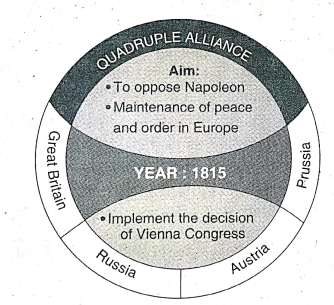
The Allied powers- Great Britain, Russia, Austria, and Prussia- signed a document in 1815 which was called the ‘Quadruple Alliance’.

Their main objectives were:

  1. To unitedly oppose the attempts of Napoleon and his descendants to grab the throne of France.
  2. To take united action, if necessary, to prevent the growth of the spirit of revolution in the European countries.
  3. To strictly implement the decisions of the Congress of Vienna in all countries of Europe
  4. To make united attempts to maintain peace and order in Europe.

WBBSE Solutions For Class 9 History Chapter 3 Europe In The 19th Century Conflict Of Monarchical And Nationalist Ideas Quadruple Alliance

Question 6. What was the Concert of Europe? What were its objectives?
Answer:

Concert Of Europe:-

The Concert of Europe was the system to designate an agreement by the major European powers to act together on European questions of common interest. Metternich wanted to make the Concert of Europe between Great Britain, Russia, Prussia, and Austria which was signed in 1815 into an instrument for preventing any future revolution in Europe.

Objectives: The main objectives were

  1. Preservation of peace all over Europe by suppressing any move or development that might cause wars.
  2. Promotion of friendly relations among the four big powers- Great Britain, Russia, Prussia, and Austria.
  3. Preservation of political stability in Europe.
  4. To suppress nationalist and democratic forces.
  5. To prevent the rise of any powerful personality like Napoleon.
NEET Biology Class 9 Question And Answers WBBSE Class 9 History Notes WBBSE Solutions for Class 9 Life Science and Environment
WBBSE Class 9 Geography And Environment Notes WBBSE Class 9 History Multiple Choice Questions WBBSE Class 9 Life Science Long Answer Questions
WBBSE Solutions for Class 9 Geography And Environment WBBSE Class 9 History Long Answer Questions WBBSE Class 9 Life Science Multiple Choice Questions
WBBSE Class 9 Geography And Environment Multiple Choice Questions WBBSE Class 9 History Short Answer Questions WBBSE Solutions For Class 9 Maths
WBBSE Solutions for Class 9 History WBBSE Class 9 History Very Short Answer Questions WBBSE Solutions for Class 9 Physical Science and Environment


Question 7. What were the merits and demerits of the Metternich system?
Answer:

Merits And Demerits Of The Metternich System:-

Metternich was the most influential politician in Europe from 1815 to 1848. Owing to his unlimited influence, the period of 34 years (1815-1844) is called the ‘Age of Metternich’ in the history of Europe.

Merits: Metternich was the architect of a diplomatic system that gave Europe over 30 years of relative stability.

He negotiated the victory of all states who assembled at Vienna and established a system that, to a certain extent, allowed the ruling classes of Europe to cooperate rather than make war.

In the field of domestic policy, he was no doubt repressive and tolerant, but he provided a strong central government.

Demerits: Metternich resented liberalism, nationalism, and revolution. He suppressed nationalistic and democratic trends.

However, his policy was not in keeping with the trends of the prevalent situation of the time. His strict conservative policy gradually led to severe revolts in the Austrian empire.

In the early and mid-19th century, several parts of the Austrian empire witnessed revolutionary activity.

Question 8. What is the importance of the July monarchy of the Bourbons, the Constitutional Revolution of 1830?
Answer: The July Revolution of 1830 is one of the most important events in the history of France. From the following facts, it can be proved that the July Revolution was an event of the utmost.

Importance:

After the July Revolution, a constitutional monarchy was established in France under Louis Philippe in place of the absolute monarchy of the Bourbons.

Before the July Revolution, the aristocracy and the clergy of France used to enjoy unlimited rights and privileges. However, after the July Revolution, all these classes were deprived of their privileges.

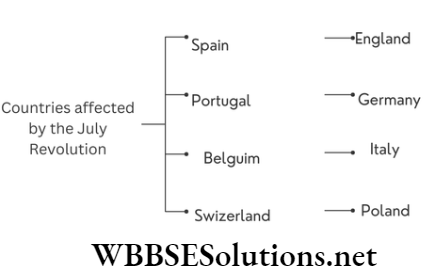
It affected not only France but almost all the countries of Europe. England, Germany, Spain, Portugal, Poland, Belgium, Switzerland, and some other countries were affected by this revolution. The July Revolution of 1830 was a death. warrant for the autocratic monarchs.

WBBSE Solutions For Class 9 History Chapter 3 Europe In The 19th Century Conflict Of Monarchical And Nationalist Ideas Countries affected by the July Revolution

Important Questions from Chapter 3 on European Nationalism

Question 9. What was the impact of the July Revolution on France?
Answer:

Impact Of The July Revolution On France:-

The July Revolution is regarded as one of the most important events in the history of France and its impact on France was undoubtedly significant.

The July Revolution succeeded in securing revolutionary feelings i.e., liberty, equality, and fraternity.

Although the July Revolution failed to remove the autocratic monarchy in France, the revolutionaries challenged the principle of legitimacy and it was replaced by the legitimacy of the nation.

In place of absolute monarchy was established under Louis monarchy was Philippe.

The nobles, lords, and clergy who enjoyed unlimited rights and privileges were deprived of these privileges.

Question 10. How was Rammohan Roy influenced by the July Revolution?
Answer: Rammohan Roy Influenced By The July Revolution As Follows:-

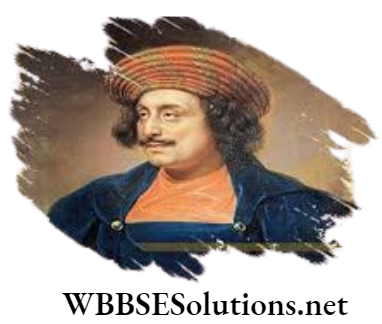
The July Revolution of 1830 in France bore a rich legacy for the people of the world during the 19th and 20th centuries. This was because the ideals of liberty, equality, liberalism, and democracy became popular among the people. These ideals spread rapidly from France to other countries of the world. Rammohan Roy, the ‘first modern man of India’ was greatly influenced by the July Revolution.

He took an intense interest in the July Revolution which he viewed as a triumph of liberty. He celebrated the success of the July Revolution in France. He was an internationalist and supported the cause of freedom everywhere. Deeply influenced by the ideals of the Revolution Rammohan Roy thought of monarchy and its absolutism as great evils.

WBBSE Solutions For Class 9 History Chapter 3 Europe In The 19th Century Conflict Of Monarchical And Nationalist Ideas Raja Ram Mohan Roy

Question 11. Give an account of the February Revolution in France (1848).
Answer: Louis Philippe came to the throne of France on 30th July 1830. After coming to the throne of France, Louis Philippe introduced some liberal reforms.

He introduced freedom of the press and declared France to be a secular state. He could not satisfy the different political parties of France and failed to keep pace with their ideals and aspirations.

Popular discontent gradually increased and a movement under the leadership of Thiers started. People demanded the end of the monarchy in France.

Guizot, the Prime Minister, was not in favor of any administrative reforms. As the popular agitation took a serious turn Guizot was dismissed from office.

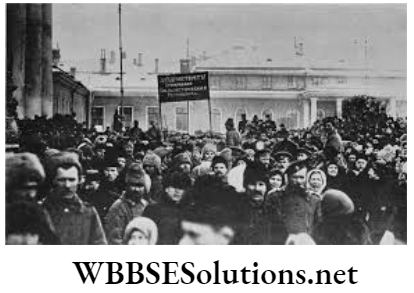
WBBSE Solutions For Class 9 History Chapter 3 Europe In The 19th Century Conflict Of Monarchical And Nationalist Ideas February Revolution

An armed clash took place on 23 February in front of the house of the deposed Minister Guizot in which many agitators were killed. This happened in February and came to be known as the February Revolution. Louis Philippe abdicated and France was declared a ‘Republic’.

Impact of Nationalism on European Politics

Question 12. Why is the year 1848 called the ‘Year of Advice of Guizot imposed restrictions on the Revolution’?
Answer: After the outbreak of the February Revolution of 1848 against the autocratic rule of Louis Philippe, a revolt broke out in Vienna in March. This revolt ultimately led to the downfall of Metternich. Later on, revolts broke out in Austria, Germany, and Italy.

Crete and Hungary also followed the same example. The people of Rome raised their voices against the Pope and he had to provide a constitution to his people. The rulers of Holland and Denmark also had to provide new constitutions to their people.

The Revolution of 1848 also motivated the Chartist Movement of England. Thus the year 1848 is rightly called the ‘Year of Revolution’.

Question 13. Who was Guizot? Write about his repressive policy.
Answer: Louis Philippe, the ruler of France, appointed Guizot as his prime minister. Guizot was a reactionary and supported the autocracy of the king. His main aim was to maintain the policy of the ‘status quo’ in France. When the people of France placed their demands on Louis Philippe, through newspapers, meetings, etc., the monarch on the meetings, speeches, and newspapers.

This was a direct attack on the freedom of speech of the people. Due to the repressive policy of Guizot, there was anarchy and discontent everywhere in France. In this way, Guizot and his repressive policy added fuel to the fire of discontent of the people and the February Revolution broke out.

Question 14. What were the impediments to the unification of Italy?
Answer: After the fall of Napoleon, Italy was divided into five principal political divisions in the Congress of Vienna, and Austria became a dominant power in Italy. Italy was just reduced to a mere ‘geographical expression’. There were certain impediments to the unification of Italy.

  1. The main impediment to the unification of Italy was the domination of Austria over Italian provinces.
  2. The whole of Italy except Piedmont- Sardinia was under foreign rule and was not interested in Italian unification.
  3. The leader of the Vienna Congress, Metternich followed an autocratic policy and destroyed the spirit of nationalism.
  4. There was no organization or Party at that time in Italy that could unite the patriots of Italy.

Question 15. What was the contribution of Mazzini to the Italian unification movement?
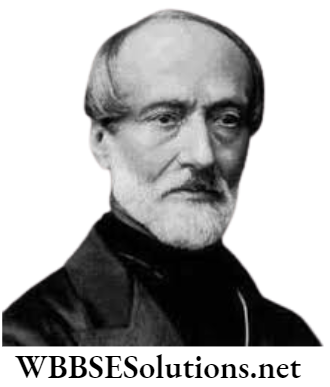
Answer: Mazzini was considered as the prophet of the Italian movement for unification. He was the founder of the Young Italy movement.

He founded a party known as Young Italy in 1832. He had immense faith in the power and strength of the Italian youths. Young men up to the age of forty could be its members.

The objectives of Young Italy were as follows:

  1. Italy should be unified as one nation.
  2. Austria should be driven out of Italy.
  3. The republic should be established in Italy.
  4. In the war against Austria, foreign help was not necessary.
  5. Italian unification movement should be carried on by the Italians only.

WBBSE Solutions For Class 9 History Chapter 3 Europe In The 19th Century Conflict Of Monarchical And Nationalist Ideas Mazzini

The mass uprising organized by the Young Italians for the unification and liberation of Italy failed due to a lack of organization and a plan of action among the rebels.

His greatest contribution was that he could make the Italians realize that it was possible to have the dream of the unification of Italy materialized.

Question 16. What was the Confederation of the Rhine?
Answer: The first step to unify, Germany was taken by Napoleon Bonaparte. During the French Revolution Germany was divided into 300 states under Austrian domination. Napoleon used the German states as an instrument of crushing the political power of Austria and Prussia.

Napoleon realized that the invasion of France by Austria and Prussia could be easily removed by the reorganization of the German states. Napoleon formed 39 states out of the 300 states and inaugurated a federal administrative system known as the Confederation of the Rhine.

Question 17. What was the Frankfurt Parliament?
Answer: The national leaders of Germany established a Parliament whose members were elected based on a universal adult franchise. The main function of this Parliament was to frame a constitution for Germany to achieve political unity and liberty and establish a popular government in place of the government of absolute monarchy.

According to the decisions of the Frankfurt Parliament, the crown of a united Germany was offered to Frederick William. But he refused this offer. His view was that he should not receive the crown as a gift from the representatives of the people. He believed in the unification of Germany through sheer force.

Question 18. Bismarck fought three wars to achieve the complete unification of Germany- Discuss.
Answer: Germany was divided into many small kingdoms for a long time. Bismarck, the leader of Germany, was determined to unite all the kingdoms of Germany. He fought three wars to achieve the complete unification of Germany.

War on Denmark (1864): Bismarck waged war against Denmark in 1864. Denmark surrendered the two provinces- Schleswig and Holstein to Austria and Prussia. The Treaty, of Gastin (1865) was signed between Austria and Prussia. But Bismarck wanted Austria to teach a lesson.

Austro-Prussian War (1866): Next, the Prussian army defeated Austria in the battle of Sadowa (1866). It ended Austria’s leadership in Germany.

Franco-Prussian War (1870-71): Next Germany defeated France in the Battle of Sedan in 1870. France was compelled to sign the humiliating Treaty of Frankfurt (1871). Thus emerged a unified Germany.

Question 19. What were the similar and dissimilar traits between the July Revolution of 1830 and the February Revolution of 1848?
Answer:

Similar traits between the July Revolution of 1830 and the February Revolution of 1848:

  1. Both the July and February Revolutions originated in France.
  2. The impact of both revolutions was felt all over Europe-Italy, Austria, Germany, Switzerland, and England and there were revolutionary uprisings.
  3. There was a demand for the abolition of the monarchy during both revolutions.
  4. Both revolutions witnessed a lack of effective leadership and the strong emergence of liberal forces.

Dissimilar traits between the July Revolution of 1830 and the February Revolution of 1848:

The Revolution of 1830 broke out as a protest against the reactionary policies of Charles X, the ruler of France.

  1. The demand of the liberals was a constitutional government. On the other hand, the revolution of 1848 was purely a Republican movement influenced by
    socialist ideas.
  2. The July Revolution was peaceful and democratic in character. But the February Revolution was violent and nationalist in character.
  3. In the July Revolution of 1830, the people who participated belonged to the middle class whereas in the 1848 Revolution, people devoted to socialism participated.

Question 20. Was the Crimean War justified?
Answer: Declaration of war: The war declared against Russia by England and France in support of Turkey in 1854 is known as the Crimean War. It was an important event in the history of Europe.

View of Robert Morier:

Many modern politicians and historians have criticized the nature of this war. They have regarded the Crimean War as a useless modern war of Europe. Robert Morier writes. “The Crimean War was the only perfectly useless war that has been waged.”

Useless War:

  1. The Crimean War could not give a permanent solution to the Eastern Question. The war ended with the Treaty of Paris.
  2. The provisions of this treaty could not remain permanent. According to the Treaty of Paris, the Sultan of Turkey was supposed to improve the condition of the Christian population living in Turkey. But the Sultan never carried out his promise which he had given at Paris for improving the condition of the Christian population living in Turkey.
  3. The war aimed to weaken Russia forever. In the Treaty of Paris, she was insulted and several restrictions were imposed upon Russia. Russia could never forget her humiliation.
  4. England and France could not get any advantage from this war. The Crimean War proved disastrous for the Allies. Therefore, it may be said that the Crimean War was quite useless and it might have been avoided.

Question 22. What led to the rise of Balkan nationalism?
Answer: The Balkan nations like Greece, Egypt Romania, Serbia, Albania, and others were white-skinned Europeans and Christian by religion.

The causes of the rise of Balkan nationalism are as follows:

  1. The Balkan nationalities were ruled by the Asiatic and Islamic powers Turkey. Turkey followed a policy of Turkofication. The French Revolution inspired the Balkan nationalities to agitate against Turkish rule.
  2. The Turkish Sultanate ruled the Balkan people through military ‘force and the people of the Turkish empire owed no allegiance to the Sultan.
  3. The Christians of the Balkan peninsula were oppressed by the ruling Sultans of Turkey.
  4. During the later seventeenth century, Turkey’s power was gradually declining. The civil administration and the army became weak and failed to keep the Balkan people under their control.

Question 23. What is the significance of the Greek War of Independence?
Answer:

Significance Of The Greek War Of Independence:-

  1. The Greek War of Independence is a landmark in the history of Europe.
  2. It showed that the resolutions of the Congress of Vienna were impractical and that national forces could not be checked by reactionary guiding principles.
  3. The Greek War of Independence was a great blow to the Metternich system.
  4. The European powers were attracted to the Near East for the first time.
  5. They felt that each had a common interest in the region. They also felt the need to free the Christian states from the oppressive Turkish rule.
  6. The weakness of Turkey was also exposed.

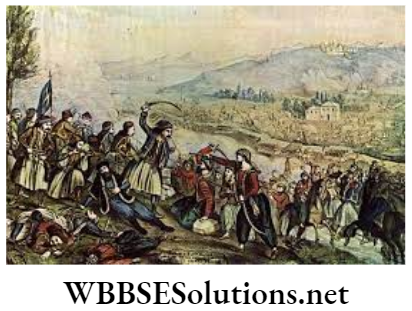
WBBSE Solutions For Class 9 History Chapter 3 Europe In The 19th Century Conflict Of Monarchical And Nationalist Ideas Greek War Of Independence

Study Guide for Class 9 History: Conflict of Ideas in Europe

Question 3. What is the significance of the Crimean War?
Answer:

Crimean War:-

The war declared against Russia by England and France in support of Turkey in 1854 is known as the Crimean War. In this war, Russia was defeated. The war is of great significance.

Significance Of The Crimean War:-

  1. The Crimean War laid the foundation for the unification of Italy and Germany.
  2. As a consequence of the Crimean War, the internal political situation of Russia was greatly affected. It exposed the weakness of Russia and the people put their demands before this government to introduce reform in the administration.
  3. The Crimean War had a great impact on international politics too. When Russia saw no chance to extend its empire in the Balkan States, it decided to increase its influence in East Asia.

Question 4. Which treaty was concluded after the Crimean War? What were the provisions of the treaty?

The Treaty of Paris (1856) was concluded after the Crimean War (1854).

According to the provisions of the treaty-

  1. England, France, and Austria admitted Turkey to the European family of states.
  2. The Sultan of Turkey promised to improve the condition of the Christians living in Turkey.
  3. Russia and Turkey returned the conquered provinces to each other.
  4. Russia promised not to interfere in the internal affairs of Turkey.
  5. Russia gave up the right to protect the Christians of Turkey.

Practice Questions for Class 9 History: Monarchical and Nationalist Ideas

Question 5. How would you criticize the ‘Emancipation Statute’ of 1861?
Answer:

The Emancipation Statute of 1861 passed by Alexander II, the Czar of Russia, was criticized on the following grounds:

  1. The nobles resented the loss of land. The Act also deprived them of the services of the serfs.
  2. The edict did not fulfill the expectations of the serfs. The ownership of land was denied to them and was vested in the hands of ‘mirs’.
  3. The serfs were subjected to the village mirs instead of the lords.
  4. The annual installment of redemption money payable to the government by the serfs in addition to other taxes put a heavy burden on them.

Chapter 3 Europe In The 19th Century: Conflict Of Monarchical And Nationalist Ideas True Or False

Question 1. The Vienna Congress dismantled the Napoleonic Empire.
Answer: True

Question 2. The Vienna Congress marks the beginning of an era.
Answer: True

Question 3. According to the Principle of Reward and Punishment, Poland was punished.
Answer: True

Question 4. Metternich prided himself as the ‘vanquisher of Napoleon’.
Answer: True

Question 5. Metternich was the Chancellor of Austria.
Answer: True

Question 6. The period between the Vienna Settlement and the Revolution of 1848 is often dubbed the Metternich Era in European politics.
Answer: True

Question 7. The period between 1815 and 1848 is known as the ‘period of peace’.
Answer: False

Question 8. After 1815 there was a conflict between monarchical and nationalist ideals.
Answer: True

Question 9. Czar Alexander, I was the leader of the Vienna Congress.
Answer: False

Question 10. The Four Big Powers in the Vienna Congress were Russia, Austria, England, and France.
Answer: False

Question 11. After the fall of Napoleon Bonaparte, Louis XVIII of the Bourbon dynasty ascended the throne of France.
Answer: True

Question 12. Under the Principle of Balance of power, France was encircled by powerful states all around.
Answer: True

Question 13. Metternich was the leader of the concert of Europe.
Answer: True

Question 14. The July Revolution of 1848 paved the way for the destruction of the Metternich system.
Answer: False

Question 15. The July Revolution of 1830 in France brought an end to the Divine Right of Kingship in France.
Answer: True

Question 16. The king of France at the time of the July Revolution was Louis XIV.
Answer: False

Question 17. Inspired by the July Revolution the Polish people began their fight for freedom. against the Germans.
Answer: False

Question 18. The July Ordinance was issued by the French emperor Charles X in 1830.
Answer: True

Question 19. Lafayette was a leader of the July Revolution.
Answer: True

Question 20. The foundation of the Second French Republic was laid in 1840.
Answer: False

Question 21. Louis Napoleon in 1852 ended the Second French Republic in France and established the Second Empire.
Answer: True

Question 22. The book ‘Organisation of Labour’ was written by Louis Blanc.
Answer: True

Question 23. The socialists under the leadership of Louis Philippe were eager to end the French Monarchy.
Answer: False

Question 24. Guizot was the prime minister of King Louis Philippe.
Answer: True

Question 25. The Battle of Sadowa was fought in 1860.
Answer: False

Question 26. The Battle of Sadowa was fought between Austria and Russia.
Answer: False

Question 27. The Battle of Sedan was fought between France and Austria.
Answer: False

Question 28. Carbonari was a secret society that was established during the German unification movement.
Answer: False

Question 29. By the Peace of Villafranca (1859) Austria. ceded Lombardy to Piedmont.
Answer: True

Question 30. Cavour was the Prime Minister of Austria.
Answer: False

Question 31. In the Battles of Magenta and Solferino, the Austrians were defeated.
Answer: True

Question 32. Mazzini believed that in the war against Austria, foreign help was necessary.
Answer: False

Question 33. The Carbonari were so-called because they used to burn charcoal.
Answer: True

Question 34. Austria was merely a ‘geographical expression’.
Answer: False

Question 35. Before the rule of Napoleon, Germany was divided into several small kingdoms.
Answer: True

Question 36. The foundation of the Frankfurt Parliament was an important step towards German unification.
Answer: True

Question 37. Bismarck planned for the unification of Germany under the leadership of Prussia.
Answer: True

Question 38. Mutternich followed the policy of ‘Blood and Iron’.
Answer: False

Question 39. Count Benedetti was sent by Apollon bo the Prussian king to get assurance that none of the Prussian dynasties would ever lay any claim on the Spanish throne.
Answer: True

Question 40. The Treaty of Berlin (1878) under the leadership of Bismarck tried to solve the Balkan question.
Answer: True

Question 41. The Treaty of Zurich was signed in 1869 between Austria and Piedmont-Sardinia.
Answer: False

Question 42. After the battle of Sadowa Germany was united.
Answer: False

Question 43. The absolute rule of the French monarchs was known as Czardom.
Answer: False

Question 44. The Russian serfs were emancipated in 1721.
Answer: False

Question 45. The Balkan means the hilly areas between the Aegean Sea and the Danube.
Answer: True

Question 46. In the Crimean War, England and France fought against Austria.
Answer: False

Question 47. The treaty that brought an end to the Crimean War was the Treaty of Paris (1856).
Answer: True

Question 48. The Treaty of San Stephano was concluded after the Crimean War.
Answer: False

Question 49. In Russia, the serfs were subjected to the village mirs.
Answer: True

Question 50. According to the ‘Emancipation Statute’ of 1871 the Russian serfs were declared free.
Answer: False

Question 51. Greece was conquered by Russia and lost its independence.
Answer: False

Question 52. In the famous Vienna Note, Russian Guardianship over the Orthodox Greek Church in Turkey was admitted.
Answer: True

Question 53. According to the Emancipation Statute, the serfs were to pay back the advance money to the government in 49 installments.
Answer: True

Question 54. Louis Kossuth was known as the ‘Mazzini of Hungary’.
Answer: True

Chapter 3 Europe In The 19th Century: Conflict Of Monarchical And Nationalist Ideas Fill In The Blanks

1. After the fall of Napoleon, European statesmen assembled at a conference at the Austrian capital Vienna (Berlin/Vienna/Naples).

2. At the Congress of Vienna, Prussia was represented by Hardenberg (Castlereagh/Frederick William/Hardenberg).

3. By the principle of legitimacy, the Bourbon (Hohenzollern/ Bourbon/Stuart) dynasty was reestablished in France.

4. According to the Principle of Legitimacy the dominance of Austria (France/Austria/Italy)over Germany was revived.

5. Per the Principle of Legitimacy the House of Orange was restored in Holland (France/Germany/Holland).

6. The conference at Carlsbad in 1819 was convened and dominated by Metternich (Castlereagh/Metternich/Louis XVIII).

7. The period from 1815 to 1848 (1830/1848/1850) is known as the age of Metternich.

8. The Carlsbad Decrees were a set of reactionary restrictions in the states of the German (French/Italian/German) confederation.

9. The President of the German Confederation was Austria (Russia/Italy/Austria).

10. The Protocol of Troppeau was drafted in the year 1820 (1810/1820/1830) in the Concert of Europe.

11. The July Revolution of 1830 (1820/1830/1848) gave a death blow to the Metternich system.

12. Under the Principle of Balance of Power France (Italy/France/Germany) was encircled with powerful states all around.

13. except for Alexander I (Frederich William III/Alexander I/Francis 1) all the diplomats of the Congress of Vienna were devoted to the ‘ancient regime’.

14. The leader of the July Revolution was Thiers (Guizot/Polignac/Thiers).

15. Polignac(Thiers/Polignac/Guizot) was appointed by Charles X as his minister.

16. Louis Philippe came to the throne of France in 1830 (1830/1836/1840).

17. Thiers (Guizot/Polignac/Thiers) gave a call to the people of France to resist the illegal activities of the French government.

18. The Second French Empire was founded by Louis Napoleon (Louis Napoleon/Napoleon Bonaparte/Louis XVI).

19. The Second French Empire was founded in 1852 (1851/1852/1853).

20. The foundation of the Second French Republic was laid in 1848 (1830/1848/ 1858).

21. The year 1848 (1848/1856/1864) is known as the ‘Year of Revolution’.

22. Louis Philippe, the ruler of France, abdicated to England (France/England/Russia).

23. Before the unification of Italy, Naples, and Sicily in South Italy were ruled by the Bourbon (Savoy/ Hapsburg/Bourbon) dynasty.

24. Cavour(Cavour/Garibaldi/Emmanuel) was the editor of the Italian periodical ‘Risorgimento’.

25. In 1860 some states of Central Italy like Perma, Modena, and Tuscany expressed their desire to join Piedmont-Sardinia (France/Piedmont-Sardinia/Westphalia).

26. Italy (Italy/France/Germany) after the Vienna Congress was reduced to a mere geographical expression.

27. A united and independent Italy was born in 1870 (1860/1865/1870).

28. The pact of Plombieres was signed in 1858 (1848/1858/1862).

29. The Young Italians were disarmed by the Austrian (French/British/Austrian) army.

30. In 1852 King Victor Emmanuel of Piedmont-Sardinia (Piedmont-Sardinia/Lombardy/Milan) appointed Cavour as his Prime Minister.

31. Mazzini believed that war with Austria (France Germany/Austria) was the only means to liberate Italy.

32. Mazzini favored a republican (democratic/republican/monarchical) form of government in a free Italy.

33. The Pact of Plombieres was signed between Napoleon III and Count Cavour (Garibaldi/Count Cavour/Mazzini).

34. The first stage in the unification of Germany was the creation of Zollverein (Zollverein/Philiki Hetaira/Carbonari).

35. In 1848 (1848/1849/1850) the German nationalists convened a parliament called Frankfurt Parliament.

36. Under the rule of Napoleon (Metternich/Napoleon/Bismarck) the Germans became acquainted with democratic and nationalist ideas.

37. The Confederation of the Rhine was inaugurated by Napoleon (Louis Philippe/ Napoleon/Mazzini).

38. During the French Revolution Germany was divided into 300 (300/400/500) large and small states.

39. The leadership in the unification of Germany was given by Prussia(Russia/Prussia/Lombardy).

40. The Danish (Danish/Spanish/ Prussian) war was the first step towards German unification.

41. After a crushing defeat at Sedan (Sadowa/Sedan/Waterloo) France was compelled to sign the treaty of Frankfurt.

42. The German states formed a tariff organization based on commercial cooperation known as Zollverein(Carbonari/Kulak/Zollverein).

43. The German unification was completed with the declaration of the Prussian (Russian/Prussian/Italian) king as the ‘Emperor of Germany’.

44. The Emancipation Statute was passed by Alexander II (Alexander I/Alexander II/Nicholas I) of Russia.

45. England and France participated directly in the Crimean War in support of Turkey (Egypt/Greece/Turkey).

46. The Crimean War came to an end with the signing of the Treaty of Paris(Adrianople/Versailles/Paris).

47. The Balkan means the hilly area between the Aegean Sea and the Danube (Danube/Adriatic/Mediterranean Sea).

48. Turkey(Greece/Turkey/Austria) included vast areas of Africa and Europe and was known as the Ottoman Empire.

49. In 1821, the people of Greece revolted against Turkey (Russia/Turkey/France).

50. The Treaty of Adrianople was signed in 1829 (1829/1830/1840).

51. The Treaty of Prague was signed in 1866 (1865/1866/1867).

52. The Greek people, under the Turkish (British/Spanish/Turkish) rule, began their national liberation movement.

Chapter 3 Europe In The 19th Century: Conflict Of Monarchical And Nationalist Ideas Match The Columns

Question 1. 

1. Column 1 Column 2
1. Crimean War (A)  Secret Society of Italy
2.  Carbonari (B) Austria
3.  1870 (C) 1854-56
4. Congress of Vienna held (D) Italy united


Answer: 1.-C,2.-A, 3.-D, 4.-B

Question 2. 

2. Column 1 Column 2
1. Leading person at Congress of Vienna (A) France
2. Mazzini (B) Bismarck
3. Talleyrand (C) Metternich
4.  Blood and Iron policy (D) Leader of Italy


Answer: 1.-C,2.-D, 3.-A, 4.-B

Question 3. 

3. Column 1 Column 2
1. February Revolution 1. 1830
2. July Revolution 2. 1848
3. Defeat of Austria by Prussia 3. 1870
4. Unification of Germany completed 4. 1866


Answer: 1.-B,2.-A, 3.-D, 4.-C

Question 4. 

4. Column 1 Column 2
1. Philke Hetaira (A) Italy
2. Carbonari (B) Odessa
3. Ems Telegram (C) Ambassador
4. Count Benedetti (D) Bismarck


Answer: 1.-B,2.-A, 3.-D, 4.-C

Question 5. 

5. Column 1 Column 2
1. Foundation of Second French Republic (A) 1830
2. Loins Philippe becomes  the king of France (B) 1848
3. William II became the first German emperor (C) 1870
4. United Italy born (D) 1866


Answer: 1.-B,2.-A, 3.-D, 4.-C

Question 6. 

6. Column 1 Column 2
1. Pact of Plombieres (A) 1856
2. Treaty of Villafranca (B) 1878
3. Treaty of Paris (C) 1858
4. Treaty of San Stephano (D) 1859


Answer: 1.-C,2.-D, 3.-A, 4.-B

Question 7. 

7. Column 1 Column 2
1. Nicholas I (A) Central figure in European politics
2. Cavour (B) Czar of Russia
3. Charles (C) Prime Minister of Piedmont
4. Metternich (D) Ruler of France


Answer: 1.-B, 2.-C, 3.-D, 4.-A

Question 8. 

8. Column 1 Column 2
1. Bourbon (A) Holland
2. Orange (B) Piedmont
3. Savoy (C) France
4. Hapsburg (D) Austria


Answer: 1.-C, 2.-A, 3.-B, 4.-D

Question 9. 

9. Column 1 Column 2
1. 1848 (A) Battle of Sadowa
2. 1854 (B) Battle of Sedan
3. 1866 (C) Crimean War
4. 1870 (D) Year of Revolution


Answer: 1.-D,2.-C, 3.-A, 4.-B

Question 10. 

10. Column 1 Column 2
1. Emancipation Statute, 1861 (A) Germany
2. Zollverein (B) Austria
3. Philke Hetaira (C) Russia
4. Vienna Congress (D) Greece


Answer: 1.-C,2.-A, 3.-D, 4.-B

WBBSE Solutions For Class 9 History Chapter 6 The Second World War And Its Aftermath

WBBSE Chapter 6 The Second World War And Its Aftermath Analytical Answer Questions

Question 1. What was the immediate cause of the Second World War?
Answer: Immediate Cause Of The Second World War:-

In the Second World War (1939-1945) Germany, Italy and Japan were on one side and Britain, France, the USSR, the USA and China were on the other.

The immediate cause of the Second World War is to be found in a series of acts of aggression by the ‘German leader Hitler. Germany annexed Austria and then demanded Sudetenland from Czechoslovakia.

WBBSE Solutions For Class 9 History Chapter 6 The Second World War And Its Aftermath

WBBSE Class 9 Second World War Solutions

By the Munich Pact of 1939, the Allies admitted the German claim. Soon after, Germany swallowed up the remaining portion of Czechoslovakia and demanded Danzig from Poland. Britain, France and Poland allied against German aggression.

Great Britain and France were engaged in negotiations with Russia. In the meantime, Germany and Russia concluded a Non-Aggression Pact for 10 years (1939).

Hitler thus emboldened and invaded Poland without any formal declaration of war. Great Britain and France declared war against Germany in September 1939 and the Second World War started.

Read and Learn Also WBBSE Solutions for Class 9 History

Question 2. How far was Hitler responsible for the outbreak of the Second World War?
Answer:

Hitler Responsible For The Outbreak Of The Second World War:-

The main cause of the Second World War according to many historians was the aggressive policy of the German dictator Adolf Hitler. He treated the Treaty of Versailles (1919) as a scrap of paper.

After making Germany economically and politically strong he began to disobey the conditions of the Versailles Treaty.

He began to reorganise the German army with the motive of aggressively violating the Versailles Treaty. He followed an aggressive policy towards the neighbouring countries, violating treaties and promises.

WBBSE Solutions For Class 9 History Chapter 6 The Second World War And Its Aftermath Hitler

He annexed Austria violating the Treaty of Versailles. He violated the Munich Pact and annexed Czechoslovakia. To wreck the Balance of Power, he concluded the Rome-Berlin Axis. Finally, in 1939 he invaded Poland disregarding the warning given by England and France. Thus the aggressive policy of Hitler made the Second World War inevitable.

WBBSE Solutions For Class 9 History Chapter 6 The Second World War And Its Aftermath Hitler's Agencies to suppress opposition

Key Events of the Second World War Notes

Question 3. How was the Rome-Berlin-Tokyo Axis formed?
Answer:

Rome-Berlin-Tokyo Axis Formed As Follows:-

Adolf Hitler, the Nazi dictator of Germany, repudiated the Locarno Pact in 1936. He militarized the left bank of the river Rhine. In the same year, Germany and Japan concluded the Anti-Commintern Pact which was aimed against Russia. Hitler also established friendly contact with Mussolini, the Fascist dictator of Italy and formed the Rome-Berlin Axis.

Italy occupied Abyssinia in 1936 in defiance of the League of Nations and found it necessary to secure friends in Europe. In 1937 Italy left the League of Nations and joined the Anti-Comintern Pact. Thus the Rome-Berlin Axis was converted into the Rome-Berlin-Tokyo Axis.

WBBSE Solutions For Class 9 History Chapter 6 The Second World War And Its Aftermath Mussolini with Hitler

Question 4. When and between whom was the Munich pact signed? What is the importance of the Munich Pact (1938)?
Answer: The Munich Pact was signed in 1938 between Chamberlain (The British Prime Minister), Daladier (Prime Minister of France), Hitler (the Nazi dictator of Germany) and Mussolini (the Fascist dictator of Italy).

England and France followed a policy of appeasement towards Hitler and signed the Munich Pact in 1938 in which the unjust demands of Hitler were accepted.

  1. Germany was authorised to occupy four border provinces of Czechoslovakia within ten days.
  2. The government of Czechoslovakia was forced to release all the political prisoners of Sudetenland. Sudetenland was also given to Germany. This emboldened Hitler and encouraged him to make more and more territorial demands. At last, when Hitler invaded Poland, Britain and France could not tolerate it and declared war against Germany. Thus the Second World War started.

Nazi German’s foreign policy of Imperialism and militarism.

WBBSE Solutions For Class 9 History Chapter 6 The Second World War And Its Aftermath Nazi German's foreign policy of iImperialism and militarism

The progression of events shown above suggests that Nazi Germany confidently pursued and applied foreign policies of imperialism and militarism.

NEET Biology Class 9 Question And Answers WBBSE Class 9 History Notes WBBSE Solutions for Class 9 Life Science and Environment
WBBSE Class 9 Geography And Environment Notes WBBSE Class 9 History Multiple Choice Questions WBBSE Class 9 Life Science Long Answer Questions
WBBSE Solutions for Class 9 Geography And Environment WBBSE Class 9 History Long Answer Questions WBBSE Class 9 Life Science Multiple Choice Questions
WBBSE Class 9 Geography And Environment Multiple Choice Questions WBBSE Class 9 History Short Answer Questions WBBSE Solutions For Class 9 Maths
WBBSE Solutions for Class 9 History WBBSE Class 9 History Very Short Answer Questions WBBSE Solutions for Class 9 Physical Science and Environment


Question 5. What is meant by the policy of appeasement? Who followed the policy of appeasement and why?
Answer: Policy Of Appeasement:-

The policy of appeasement means giving a person or party whatever they want. By 1939 aggressive militarism of Italy and Germany in Europe and Japan in East Asia created alarm. However, throughout the aggression, the great powers like England and France remained inactive and timid. Their policy of doing nothing or little when facing militarism is known as the policy of appeasement.

The Prime Minister of Britain, Neville Chamberlain and Edward Daladier, the Premier of France, followed the policy of appeasement. Neville Chamberlain believed that some of the territorial clauses of the Treaty of Versailles (1919) were unnecessarily harsh to Germany and that an appeasement policy towards Hitler would prevent another war.

He believed that if Germany became strong and if she was satisfied by the amendment of the Treaty of Versailles, she would stand as a bulwark against the communist influence of Russia.

Impact of WWII on Global Politics

Question 6. What is the  ‘Cash and Carry’ policy?
Answer: Cash And Carry Policy:-

The USA followed a policy of neutrality towards international politics after the First World War. She did not join the Second World War and kept herself aloof from the war but was sympathetic towards the Allied powers. In 1939 the American legislature allowed the USA to help the Western democratic states and sell arms and ammunition to them.

This policy was known as the ‘Cash and Carry’ policy. It was a policy to preserve neutrality while aiding the Allies. It allowed the sale of arms, ammunition and war materials to belligerents (countries engaged in war) as long as the recipients arranged for transportation using their ships and paid immediately in cash, assuming all risk in transportation.

Question 7. What was the ‘D-Day’?
Answer: D-Day:-

‘D-Day’ was the Deliverance Day, (June 6, 1944). On that day vast Anglo-American force landed at the Normandy coast of northern France by crossing the English Channel. The operation was gigantic. The Military General of the USA Eisenhower took the leadership. One thousand Anglo-American air crafts conducted a massive dropping of Allied air-troopers behind the German lines by parachute.

Nearly 11 thousand warplanes were ready for their defence. Four thousand Allied naval ships and thousands of land forces joined. Caught between the Allied army in the front and at the back, the Germans became bewildered. The superior Allied forces captured Toulon, Marseilles, Nice, Lyons and the German airfields in France. They liberated Paris from foreign occupation on April 25, 1944. The Allied army then proceeded towards Germany.

Question 8. When was the Potsdam Conference held? Name the countries which took part in the Potsdam Conference. What was decided in the Potsdam Conference?
Answer: The Potsdam Conference was held in 1945. The countries which took part in the Potsdam Conference were Russia, America and Britain.

At the Potsdam Conference, it was decided:

  1. Germany was to be divided into four zones namely American, Soviet, French and British.
  2. Like Germany, its capital Berlin was also to be divided into four zones.
  3. Berlin would be placed under a council named ‘Allied Kommandatura’.
  4. Though Germany was divided into four zones she was to be treated as a single economic unit.
  5. The Allied Control Council would be formed to supervise the working of Germany as a single economic unit.
  6. Germany would undergo ‘Five. Ds’ (demilitarization, deindustrialisation, decentralisation, democratization and denazification).

Question 9. What were the main theatres of the Second World War?
Answer: Main Theatres Of The Second World War:-

The Second World War began in 1939 and ended in 1945 after lasting for six years. Around 60 countries were involved in this violent war. The war was fought on the Mediterranean, the Atlantic and the Pacific, and in four major land campaigns the Soviet Union, North Africa and the Mediterranean, western Europe, and the Far East.

WBBSE Solutions For Class 9 History Chapter 6 The Second World War And Its Aftermath Theatres Of The Second World War

The main theatres of the war were:

  1. The Russian Theatre or Eastern Theatre
  2. The Mediterranean Theatre
  3. The African Theatre
  4. The Pacific Theatre
  5. The Asian Theatre
  6. Arctic and Atlantic Theatre.

Important Questions from Chapter 6 on WWII

Question 10. What is the Truman Doctrine?
Answer: On March 11, 1947, President Truman of the USA, in a lecture in the American Congress, gave a call to frustrate the onslaught of communism on the free world.

He declared:

  1. The USA seeks to protect the independence and territorial integrity of free democratic nations from communist aggression.
  2. Whenever a free lawful government was threatened by an armed minority and the lawful government tried to resist the aggression, the USA would render help to the lawful government.
  3. The USA would help Greece and Turkey with 400 million dollars to free these countries from Soviet influence.
    This declaration of Truman is known as the Truman Doctrine.

Question 11. What was the Cold War?
Answer: The tension of war without an actual shooting of war has been termed the Cold War. Cold War is a state of tension between countries in which each side adopts policies designed to strengthen itself and weaken the other by falling short of actual war. It is a kind of verbal war and even more terrible than the ‘Warm War’. It is an atmosphere of artificial tension and distrust either due to virtual utterances or war-like preparation which may at any moment degenerate into a ‘Warm War’ or a shooting war.

Question 12. What was ‘NATO’ and ‘Warsaw Pact’?
Answer: After the Second World War USA and Soviet Russia who had helped each other in the Second World War became rivals and a competition arose between them to assume leadership of the world. In 1949 USA formed a military alliance called 16 nations as its members.

It was strong NATO (North Atlantic Treaty Organisation) with enough to repulse any invasion of West Europe by the Red Army. The Soviet Union, on the other hand, apprehended- led an invasion of East Europe and Russia by the NATO army. She entered into the Warsaw Pact with East European countries in 1955.

Question 13. Write a note on the evolution of internationalism after the Second World War.
Answer: The destructive effect of the Second World War (1939-45) opened the eyes of different countries of the world. They realised that peace and cooperation could not be established without cooperation and trust. They also realised that war was not the ultimate means to solve problems.

The international peace organisation League of Nations which was established after the First World War collapsed before the selfish motives of different nations. International cooperation failed in the field of politics and the Second World War broke out in 1939. After the Second World War, different nations again realised the importance and necessity of mutual cooperation.

They decided to solve their problems through peaceful meetings so that the damage of war might be removed forever and peace might be established among different nations of the world. The United Nations Organisation (UNO) was established in 1945 the sole aim of which was to maintain international peace and security, to develop friendly relations and international cooperation.

Aftermath of the Second World War Study Guide

Question 14. State the differences between ultranationalism and internationalism.
Answer: Differences between ultranationalism and internationalism

Ultranationalism Internationalism
1. Ultranationalism leads to war among different nations.  1. Internationalism advocates world peace and is against wars among different nations.
2. Ultranationalism involves contempt for other nations. 2. Internationalism advocates cooperation among different nations for the benefit of all.
3. Transnationalism is the most destructive force in the world which might create international anarchy. 3. Internationalism replaces international anarchy with international order.


Question 15. Was the Second World War truly a global war?
Answer: Second World War Truly A Global War:-

In the Second World War (1939-1945) the Allied powers were England, France, the USSR, the USA and China. Three Axis powers were Italy, Germany and Japan.

World War II was truly a global war. This extensive war was fought on all major seas and in Africa, Asia and Europe. It involved almost 60 nations, seven of them on the side of the Axis. The war in the Mediterranean took military conflict beyond these seas in Europe.

The war against Japan was fought over two-thirds of the world’s surface with the USA and her allies taking part in air, land and sea battles. It turned World War II into a global conflict. To plan global strategy, top Allied leaders held a series of conferences such as the ones in Tehran, Yalta and Potsdam.

WBBSE Solutions For Class 9 History Chapter 6 The Second World War And Its Aftermath Second World war Truly a Global War

Practice Questions for Class 9 History: WWII and Aftermath

Question 16. What are the major differences between democracy and Fascism?
Answer:

The major differences between democracy and Fascism are:

  1. Democracy allows and encourages different political parties and political views to function in the political system to turn the wheels of the political machinery. On the other hand, Fascism does not tolerate any political party or political views other than the view sponsored by the Fascist dictator.
  2. Democracy develops balanced, healthy and creative nationalism. This appears to be a source of strength and progress in the life of a nation. But Fascism generates hatred and preaches aggressive nationalism. Such perverted nationalism is the cause of conflict among different nations.

Question 17. Discuss the nature of the Second World War, collecting rubber, newspapers and scrap War.
Answer: Nature Of The Second World War, Collecting Rubber, Newspapers And Scrap War:-

Within twenty years of the First World air raid wardens. War (1914-18) The Second World War broke out on 13 September 1939. The nature of the Second World War is discussed below.

  1. The Second World War was more destructive and extensive than the First World War.
  2. This was for the first time that the war was extended to three fronts-land, air and water. It was fought on all major seas in Asia, Africa and Europe. Sixty nations were involved in the war, seven of them on the side of the Axis.
  3. Deadly weapons and dreadful atom bombs were used in the war. Aeroplanes played a major role. Fleets of aeroplanes attacked troops and naval. units destroyed railroads and prepared the way for invasion.
  4. The war was fought not only by armed forces on the battlefield but also by civilians in the factories and at home. School children also took part in the metal, assisting in War Bond drives and helping

Study Guide for Class 9 History: The Second World War and Its Aftermath

Question 18. What role did technology play in the Second World War?
Answer: Technology played an important role in World War II. Major advances in weaponry by both the Allied and the Axis powers impacted the way the war was fought and eventually the outcome of the war.

Tanks: It was during World War II that tanks became a major military force. Some of the most famous tanks from World War II include Germany’s Tiger Tank, the Soviet Union’s T-34 tank, and the United States, Sherman Tank.

Aircraft: The Air Force became one of the most important parts of the military during World War II. There were small, fast fighter planes designed for air-to-air combat and large bombers that could drop huge bombs. enemy targets, military helicopters and jet-powered fighter planes.

Radar: Radar, a new technology, developed right before the war. It used radio waves to detect enemy aircraft which helped the British to fight off the Germans in the Battle of Britain.

Aircraft Carrier: One of the biggest changes in naval technology in World War II  was the use of aircraft carriers which were able to launch air attacks from anywhere in the ocean.

Bombs: World War II saw the invention of many new types of bombs. The Germans invented the long-range flying bomb called the V-I as well as a rocket bomb called the V-2. Other specialized bombs included bouncing bombs, bunker busters and cluster bombs.

The Atom bomb: Perhaps the largest leap in technology during World War II was the atom bomb which caused a massive explosion by using a nuclear reaction. It was used by the United States to bomb the Japanese cities of Hiroshima and Nagasaki.

Secret Codes: To keep communications secret, both sides developed their own secret codes. The Germans used a machine called the Enigma Machine to code and decode their messages.

Propaganda: New technology like motion pictures, the radio and the microphone. were all used by governments to broadcast their message to the people.

Question 19. Make a comparative study related to the expansion and impact of the two World Wars.
Answer: Comparative study related to the expansion and impact of the two World Wars.

Subject of comparison First World War 1914-1918 Second World War   1932-1945
Expansion The war touched all parts of Europe. Fighting initially developed on three major European fronts: Eastern, Western and Serbian. As the war progressed, two new fronts emerged: Turkish and Italian. It also touched the Far-Eastern and Central Asian countries. Around 60 countries were involved in a war which extended in three fronts—land, air: and water. The war was fought on the Mediterranean, the Atlantic and the Pacific and in four major land campaigns in the Soviet Union, North Africa and the Mediterranean, Western Europe and the Far East.
Methods of warfare Fought from lines of trenches and supported by machine guns, artillery and rifles, use of tanks, aeroplanes and poisonous gas. In the war tanks, fast fighter planes, large bombers, military helicopters, jet-powered fighter planes, bouncing bombs,  bunker blasters, duster bombs, submarines and nuclear bombs were used.
Casualties Death of about 10 million militaries and seven million civilians, 22 million wounded and about 8 million imprisoned or missing. Many people took shelter in refugee camps. About 60 million people died and millions, of people in different countries, became homeless. As a result of the war 13-20 million people died due to famine and different kinds of diseases.


Key Figures in the Second World War for Class 9

Question 20. Prepare a comparison chart of the First and Second World Wars.
Answer: Comparison Chart of the First and Second World Wars

Subject of comparison First World War Second World War
Period First World War 1914 to 1918 Duration 4 years 3 months 14 days Second World War 1939-1945 Duration 6 years 1 day
Nature of war The war between countries to acquire colonies or territories War of ideologies
Causes The murder of Archduke Francis Ferdinand, the heir to the Austrian throne, in June 1914 The humiliating and shameful conditions of the Treaty of Versailles Hitler’s ambition to become master of Europe. Hitler’s invasion of Poland in 1939
Contending parties Central Powers:
Germany, Austria-Hungary, Turkey  Allied Powers:
France, Britain, Russia, Italy, Japan and USA.
Allied Powers: France, Britain, Soviet Union, US. China              Axis Powers: Germany, Italy, Japan
Casualties Estimated to be: Death of 10 million militaries; death of 7 million civilians, 22 million wounded and about 8 million imprisoned or missing Estimated to be: Death of 60 million people. Death of 40-55 civilians.
Genocide The Ottoman Empire committed genocide against the Armenians Nazi Germany carried out the genocide of Jews
Methods of  warfare Fought from lines of trenches and supported by machine guns and Use of nuclear power and missiles, submarines artillery, use of tanks, aeroplanes and poisonous gas. Use of nuclear power and missiles, submarines and tanks; encryption codes for secret communication; Blitzkrieg fighting method used by Germany.
Results The Central Powers were defeated. A world peace organisation, the League of Nations was established. The Axis Powers were defeated.  A world peace organisation, the United Nations Organisation was established. The Soviet Union and the USA emerged as rival superpowers
Post world war Politics Germany could not accept the humiliating Treaty of Versailles. The seeds of the Second World War lay in the Treaty of Versailles. A cold war broke out between the USA and the Soviet Union.


Chapter 6 The Second World War And Its Aftermath True Or False

Question 1. The Treaty of Versailles (1919) was humiliating for France.
Answer: False

Question 2. One of the main points in Hitler’s foreign- policy was Pan-Germanism.
Answer: True

Question 3. Germany invaded Poland on September 1, 1939.
Answer: True

Question 4. Germany attacked France in 1939.
Answer: False

Question 5. The Red Army of the Soviet Union followed the ‘Scorched Earth Policy’.
Answer: True

Question 6. With the Japanese attack on Pearl Harbour, there was an extension of the Second World War in Asia.
Answer: True

Question 7. Russia was attacked by the German Nazis in 1942.
Answer: False

Question 8. Leningrad was besieged by the German army.
Answer: True

Question 9. Hitler committed suicide in 1945.
Answer: True

Question 10. Germany abandoned her membership of the League of Nations in 1944,
Answer: False

Question 11. After the Second World War, two great powers the United States of America and the Union of the Soviet Socialist Republic emerged.
Answer: True

Question 12. Two ‘superpowers’ which emerged after the Second World War were Great Britain and the United States of America.
Answer: False

Question 13. During 1946-47 the government of Poland, Romania, and Albania were converted into communist dictatorships.
Answer: True

Question 14. To counteract communism, the Western responses were the Truman Doctrine and the Marshall Plan.
Answer: True

Question 15. The Non-aligned nations emerged after the First World War.
Answer: False

Question 16. The United Nations Organisation was established in 1940.
Answer: False

Question 17. Due to the German attack during the Second World War, vast areas of Russia including Leningrad and Stalingrad were destroyed.
Answer: True

Question 18. The USA entered into the Warsaw Pact with East European countries in 1955.
Answer: False

Question 19. President Truman of America declared that the USA would help Greece and Turkey with the aim of freeing these countries from Soviet influence.
Answer: True

Question 20. After the Potsdam Conference France was divided into four occupied zones.
Answer: False

Question 21. The ‘Third World’ countries launched the USA joined the Potsdam Conference.
Answer: True

Question 22. Harry Truman of Britain and Clement Attlee Non-Alignment Movement.
Answer: False

Question 23. The decision that Germany would be de-Nazified was taken at the Potsdam conference.
Answer: True

Question 24. Scorched earth policy means the policy of destroying everything that might be of use to an invading enemy.
Answer: True

Chapter 6 The Second World War And Its Aftermath Topic A The Causes and Course of the Second World War Fill In The Blanks

Question 1. The Treaty of Versailles was imposed on __________ (Italy/France/Germany).
Answer: Germany

Question 2. Japan attacked Manchuria in _________(1930/1931/1932).
Answer: 1931

Question 3. In 1935 Mussolini attacked ___________ (Abyssinia/Danzig/Rhineland).
Answer: Abyssinia

Question 4. Haile Selassie was the emperor of ____________(Ethiopia/Poland/Syria).
Answer: Ethiopia

Question 5. After the Second World War __________ (England/France/Czechoslovakia) was converted into a Communist dictatorship.
Answer: Czechoslovakia

Question 6. General Eisenhower was appointed the Supreme Commander of the Allied invasion in _______ (Asia/Europe/Africa).
Answer: Europe

Question 7. The Nazi-Soviet Non-Aggression pact was signed in _____________(1938/1939/1990).
Answer: 1939

Question 8. The dictator of Italy who installed a fascist regime was__________ (Adolf Hitler/Benito Mussolini/Joseph Stalin).
Answer: Benito Mussolini

Question 9. The title Adolf Hitler took in 1934 that meant leader was__________ (Fuhrer/Dictator/ Minister).
Answer: Fuhrer

Question 10. Hitler invaded Poland on _________1939. (1 September/4 September/15 October)
Answer: 1 September

Question 11. Pearl Harbour was attacked by Japan in___________ (1941/1942/1943).
Answer: 1941

Question 12. In 1941 Pearl Harbour was attacked by _____________(Belgium/USA/Japan).
Answer: Japan

Question 13. ___________ (Belgium/Austria/Germany) suffered a setback at Stalingrad.
Answer: Germany

Question 14. Atomic bombs were dropped on Hiroshima and Nagasaki in ___________ (1939/1941/1945).
Answer: 1945

Question 15. ___________(USA/Britain/Austria) dropped atomic bombs on Hiroshima and Nagasaki.
Answer: USA

Question 16. USA entered into Second World War in _________(1939/1941/1943).
Answer: 1941

Question 17. Admiral Hideki Tojo was the Prime Minister of __________(Britain/USA/Japan).
Answer: Japan

Question 18. The Japanese launched a surprise attack on the _______(British/German/US) naval base at Pearl Harbour.
Answer: US

Question 19. Perhaps the largest leap in technology during World War II was the_________ (bouncing/atom/cluster) bomb.
Answer: Atom

Question 20. Japan was worried about ___________ (US/French/ British) navy in Hawaii.
Answer: US

Question 21. On the ‘D-Day’ Anglo-American force landed at ____________(Lyons/Normandy/Marseilles) coast.
Answer: Normandy

Question 22. Francisco Franco was the Fascist dictator of ___________ (Italy/Germany/Spain).
Answer: Spain

Question 23. The provinces of Alsace and Lorraine were taken away from ________ (France/England/ Germany).
Answer: Germany

Question 24. _____________(Britain/Japan/France) had built a strong underground line of fortresses and gave it the name Maginot Line.
Answer: France

Question 25. Daladier was the Prime Minister of_______ (Britain/USA/France).
Answer: France

Question 26. Hideki Tojo was the Prime Minister of _________(USA/Ethiopia/Japan).
Answer: Japan

Question 27. ‘The Crisis in Civilisation’ was written by ___________(Rabindranath/Marx/Lenin).
Answer: Rabindranath

Question 28. The term ‘Cold War’ was popularised by_____________ (George Kennan/Walter Lippmann/ Bernard Baruch).
Answer: Walter Lippmann

Question 29. The USA joined the Second World War in__________ (1930/c/1950).
Answer: Walter Lippmann

Question 30. Germany surrendered unconditionally in ____________(1940/1942/1945).
Answer: 1945

Question 31. Truman Doctrine and Marshall Plan was declared by___________ (USA/Britain/Italy).
Answer: USA

Question 32. The ___________(SEATO/CENTO/Warsaw Pact) was a military alliance formed by the Soviet Union as a counterbalance to the North Atlantic Treaty Organisation.
Answer: Warsaw Pact

Chapter 6 The Second World War And Its Aftermath Match The Columns

Question 1. 

1. Column 1 Column 2
1. KD Hitler (A)  Japanese emperor
2. General Eisenhower (B) Hitler’s mistress
3. Hirohito (C) Mein Kampf
4. Eva Braun (D) Supreme Allied Commander


Answer: 1.-C, 2.-D, 3.-A, 4.-B

Question 2. 

  2.  Column 1 Column 2
1. Neville Chamberlain (A) Italy
2. Mussolini (B) Spain
3. General Tojo (C) Britain
4. General Franco (D) Japan


Answer: 1.-C, 2.-A, 3.-D, 4.-B

Question 3. 

3. Column 1 Column 2
1. Czechoslovakia was occupied by Germany (A) 1933
2. D-Day (B) 1945
3. Disarmament Conference (C) 1944
4. Atom bomb dropped in Japan (D) 1939


Answer: 1.-D, 2.-C, 3.-A, 4.-B

Question 4. 

4. Column 1 Column 2
1. Germany used (A) 81 mm Mortar
2. British used (B) M-10 Wolverine
3. US Tank Destroyer (C) Typhoon fighter bomber
4. French artillery possessed (D) Light armoury (Pz-ll, Pz-lll)


Answer: 1.-D, 2.-C, 3.-B, 4.-A

5. Column 1 Column 2
1. General army (A) 1933
2. Peace of Paris (B) International peace organisation
3. Disarmament Conference (C) Overran Yugoslavia
4. UNO (D) 1919


Answer: 1.-C, 2.-D, 3.-A, 4.-B

Question 5. 

6. Column 1 Column 2
1. September 1939 (A) Pearl Harbour bombed
2.  3 July 1942 (B) The battle of Britain began
3. 7 December 1941 (C) Poland attacked by Germany
4. 10 July 1940 (D) Germany took Sebastopol


Answer: 1.-C, 2.-D, 3.-A, 4.-B

Question 6. 

7. Column  1 Column 2
1. 13 September 1942 (A) Deliverance Day
2. 17 July 1945 (B) Yalta Conference begins
3. February 1945 (C) Battle of Stalingrad
4. 6 June 1944 (D) Potsdam Conference


Answer: 1.-C, 2.-D, 3.-B, 4.-A

Question 7. 

8. Column 1 Column 2
1. Truman Doctrine (A)  King of Italy
2. Nicholas II (B) Walter Lipmann
3. Cold War (C) 1947
4. Victor Emmanuel (D) Czar of Russia


Answer: 1.-C, 2.-D, 3.-B, 4.-A

Question 8. 

9. Column  1 Column 2
1. 2 September 1945 (A) Rome was occupied by the Allied army
2. 4 June 1944 (B) Japan surrenders unconditionally
3. Pearl Harbour (C) Soviet Union
4. T-34 tank (D) Island of O’ahu


Answer: 1.-B, 2.-A, 3.-D, 4.-C

Question 9. 

10. Column 1 Column 2
1. Germany (A) President of America
2. Roosevelt (B) 1943
3. Mehmed V (C) Annexation of Sudetenland
4. Battle of Tunisia (D) Sultan of Turkey


Answer: 1.-C, 2.-A, 3.-D, 4.-B

Question 10. 

11. Column  1 Column 2
1. Twenty years armistice (A) French surrender to Germany
2. French government signed (B) Treaty at Champagne
3. Dictated Peace (C) 1919-1939
4. Fall of Third French Republic (D) Treaty of Versailles


Answer: 1.-C, 2.-B, 3.-D, 4.-A

Question 11. 

12. Column  1 Column 2
1. Red Army (A) 7 December 1941
2. Pearl Harbour Incident (B) 1942
3. Potsdam Conference (C) 1945
4. Battle of Midway (D) Russia


Answer: 1.-D, 2.-A, 3.-C, 4.-B

Question 12. 

13. Column  1 Column 2
1. Mass murder of Jewish people (A) Cold War began
2. Largest battle of World War II (B) Hitler
3. Nazi flag was designed by (C)  Holocaust
4. The outcome of World War II (D) Battle of the Atlantic


Answer: 1.-C, 2.-D, 3.-B, 4.-A

Question 13. 

14. Column  1 Column 2
1. Kamikaze (A)  America
2. Battle of Britain (B) Germany
3. Paris was occupied in 1940 (C) Japanese aircraft
4. Cash and Carry Policy (D) Germany defeated


Answer: 1.-C, 2.-D, 3.-B, 4.-A

Question 14. 

15. Column  1 Column 2
1. Goebbels (A) Lieutenant of Hitler
2. Battle of Normandy (B) 1941
3. Goering (C) 1944
4. Battle of Crete (D) Hitler’s propaganda minister


Answer: 1.-D, 2.-C, 3.-A, 4.-B

WBBSE Solutions For Class 9 History Chapter 2 Revolutionary Ideals, Napoleonic Empire And Nationalism

WBBSE Chapter 2 Revolutionary Ideals, Napoleonic Empire, And Nationalism Analytical Answer Questions

Question 1. What is known in history as the 18th Brumaire?
Answer: History As The 18th Brumaire:-

When the popularity of the Directors of France was at its lowest ebb, Napoleon took. advantage of the unpopularity of the Directory administration.

He joined hands with a few Directors to overthrow it. It was a bloodless coup d’etat. Napoleon by a military coup seized the administrative power of France on 9-10 November 1799. This incident is known in history as the 18th Brumaire.

The ‘Eighteenth Brumaire’ refers to November 9, 1799, in the French calendar. It was the day when Napoleon Bonaparte had made himself dictator by a coup d’etat. Napoleon was proclaimed the first Consul. The event is often viewed as the effective end of the French Revolution.

Impact of Revolutionary Ideals on Europe

Question 2. When and between whom was the treaty of Campo Formio signed? What were the provisions of the treaty? What was the importance of the treaty?
Answer: The Treaty of Campo Formio was signed in 1797 between Napoleon Bonaparte and Count Philip von Cobenzi as representatives of France and Austria respectively. Austria being defeated by France was forced to sign the treaty.

Provisions: The provisions of the treaty were:

  1. Austria gave up the Netherlands and Lombardy to France.
  2. The province of Rhine situated between Austria and Germany was also handed over to France.
  3. Italy accepted the supremacy of France over Lombardy.
  4. In return, France gave Austria most of the old Venetian republic.

Read and Learn Also WBBSE Solutions for Class 9 History

Importance:

By this treaty, Napoleon for the first time tried to change the map of European states. Later on , this continued till his downfall.

Question 3. Write a note on the Concordat of 1801.
Answer:

Concordat Of 1801:-

Napoleon made a compromise with the Papacy. He entered into an agreement with the Pope in 1801 which is known as the ‘Concordat’ in the history of Europe.

Terms: The terms of the agreement were

  1. All the Bishops would be appointed by the pope from a list proposed by the state, and all the officials would receive their salary and take an oath of loyalty to the government.
  2. The Pope agreed to the decision taken during the revolutionary period that the property of the church which was confiscated during the revolution would not be given back.
  3. Toleration was given to the Protestants, Lutherans, and Jews.

Importance:

Catholicism was declared to be the religion of the great majority of the French but not the official state religion. The Concordat solved the question of conflict between the Pope and the French government.

WBBSE Solutions For Class 9 History Chapter 2 Revolutionary Ideals, Napoleonic Empire And Nationalism

Question 4. What was Code Napoleon?
Answer:

Code Napoleon:-

The most important of Napoleon’s contributions was the Code Napoleon-the French civil code established by him in the year 1804.

France was plagued by numerous conflicting codes of law. These codes obstructed Administrative efficiency as well as national unity. Napoleon, therefore, instituted the codification of the laws of France and gave it a new name Napoleon.

It incorporated the great principles of the French Revolution of 1789- equality before the Law, the job in the administration based on merit, freedom of thought and religion, individual liberty, abolition of serfdom, protection of private property, and secularisation of the states.

WBBSE Solutions For Class 9 History Chapter 2 Revolutionary Ideals, Napoleonic Empire And Nationalism Code Napoleon

Napoleonic Empire Study Notes for Class 9

The code had its less liberal side as well. Women were declared to be inferior to men by law. Workers were denied collective bargaining and trade unions were outlawed. The Code was simple in form but was the work of a genius as it touched upon all aspects of French life.

Question 5. Did Code Napoleon aim to protect the basic principles of the French Revolution?
Answer: The Civil Code of Napoleon aimed to protect some of the basic principles of the French Revolution.

It provided:

  1. Legal and social equality, and equal rights of property among the children of a father.
  2. It assured freedom of thought, religion individual liberty, and freedom of work.
  3. It made laws secular.
  4. Everybody was taxed without distinction of caste and creed and equal justice was awarded to all.
  5. All persons were allowed to seek a job in the administration based on merit.
NEET Biology Class 9 Question And Answers WBBSE Class 9 History Notes WBBSE Solutions for Class 9 Life Science and Environment
WBBSE Class 9 Geography And Environment Notes WBBSE Class 9 History Multiple Choice Questions WBBSE Class 9 Life Science Long Answer Questions
WBBSE Solutions for Class 9 Geography And Environment WBBSE Class 9 History Long Answer Questions WBBSE Class 9 Life Science Multiple Choice Questions
WBBSE Class 9 Geography And Environment Multiple Choice Questions WBBSE Class 9 History Short Answer Questions WBBSE Solutions For Class 9 Maths
WBBSE Solutions for Class 9 History WBBSE Class 9 History Very Short Answer Questions WBBSE Solutions for Class 9 Physical Science and Environment


Question 6. What were the defects of Code Napoleon?
Answer: The most important of Napoleon’s contributions was the Code Napoleon.

The defects of Code Napoleon were:

  1. Women. were declared to be inferior to men by law. Complete freedom was not granted to women. They were supposed to be the subordinates of their husbands. Napoleon did not allow women to receive education or to take part in public meetings.
  2. Workers were denied collective bargaining and trade unions were outlawed.
  3. The civil code was incomplete and full of inconsistencies.

Chapter 2 Revolutionary Ideals, Napoleonic Empire, And Nationalism

Question 7. Write a note on the Battle of Trafalgar (1805).
Answer: Battle Of Trafalgar (1805):-

Napoleon chalked out a plan to attack England and mustered a large army. Het gathered a large army at Boulogne. Villeneuve, the French naval commander, proceeded to Spain. The Spanish fleet tried to join Villeneuve, but could not unite with them due to the presence of the British fleet under the command of Admiral Nelson.

A fierce naval battle was fought by both commanders on the island of Trafalgar (1805). The French and Spanish fleets were destroyed. The supremacy of the English naval fleet was established.

WBBSE Solutions For Class 9 History Chapter 2 Revolutionary Ideals, Napoleonic Empire And Nationalism Battle Of Trafalgar

After this fateful battle, Napoleon realized that England could not be defeated in a direct war and abandoned the idea of defeating England on the sea.

Question 8. What were the terms of the Treaty of Tilsit? Or, The Treaty of Tilsit marked the highest watermark of Napoleon’s glory-explain.
Answer: Terms Of The Treaty Of Tilsit:-

The terms of the Treaty of Tilsit (1807) signed between Czar Alexander of Russia and Napoleon Bonaparte were as follows:

  1. Czar Alexander of Russia recognized the Napoleonic settlement in Germany, Italy, and Poland.
  2. Napoleon and Alexander were free to interfere according to their will in Western and Eastern Europe.
  3. A new state named Westphalia was created by taking the provinces of Rhine from Prussia.
  4. Russia was to act as a mediator between England and France.

It was decided that England should give up its rights on the sea. If England did not agree to it, Russia and France would jointly declare war against England. Thus, the Treaty of Tilsit marked the highest watermark of Napoleon’s glory.

WBBSE Solutions For Class 9 History Chapter 2 Revolutionary Ideals, Napoleonic Empire And Nationalism Treaty Of Tilsit

Key Events of the Napoleonic Era

Question 9. Why did Napoleon invade Russia?
Answer: Napoleon and the Czar of Russia became allies after the Treaty of Tilsit (1807) but this relationship did not last long.

Very soon, differences arose between the two due to the following reasons:

  1. Napoleon was annoyed with the Czar because he felt that the Czar had not helped him in the battle of 1809 between Austria and France.
  2. Napoleon turned against the Czar as he was not following the Continental System rigidly.
  3. The Czar had a fear that Napoleon would help and instigate the Poles against him.
  4. The Czar doubted that Napoleon wanted to establish his sway over the whole of Europe including Russia. So he became suspicious of Napoleon.
  5. Thus the Russian Czar became an unreliable ally and so Napoleon decided to attack Russia.

WBBSE Solutions For Class 9 History Chapter 2 Revolutionary Ideals, Napoleonic Empire And Nationalism Czar Alexander Of Russia

Question 10. What are the Decrees through which Napoleon declared the Continental System?
Answer: Napoleon, the ruler of France, issued several decrees which taken together formed the so-called Continental System.

WBBSE Solutions For Class 9 History Chapter 2 Revolutionary Ideals, Napoleonic Empire And Nationalism Napoleon Declared The Continental System

  1. In 1806 the Berlin Decree was issued by Napoleon which declared a naval blockade against England i.e., the countries allied to Napoleon would have to stop trade with England.
  2. The Milan Decree issued by Napoleon in 1807 was that any ship of any country trying to reach England would by caught and confiscated.
  3. The Warsaw and Fontainebleau Decree issued by Napoleon was that all goods seized from England or neutral vessels would be treated as enemy goods and were to be burnt. England and her allies and colonial ports were henceforth under French blockade.

Nationalism in Europe Notes for Class 9

Question 11. What do you mean by ‘Orders in Council’?
Answer: In 1807 Napoleon issued the Milan Decree by which the whole of the British Isles and her colonies were put under blockades.

Neutral countries were warned not to enter any British or her colonial or allied port. All goods seized from England or neutral vessels were to be treated as enemy goods and were to be burnt.

England strongly reacted and in 1870 issued the Orders in Council which it was said:

  1. The French and her allies and colonial ports were henceforth under British blockade.
  2. No country not even neutral countries could import goods from France or her colonies or any allied port. Violation of this order would be punished by seizure and confiscation.
  3. Any neutral country willing to send goods to France, must visit at first any British port and take a license for going to France or to any allied port of France by payment of heavy fees.

WBBSE Solutions For Class 9 History Chapter 2 Revolutionary Ideals, Napoleonic Empire And Nationalism Orders In Council

Question 12. What were the causes of Napoleon’s defeat in Russia?
Answer: Napoleon made the most daring adventure in his life by launching the invasion of Russia in 1812 with 600,000 French soldiers.

The causes of his defeat were as follows:

  1. As a General and Commander Napoleon committed certain mistakes which resulted in his defeat.
  2. Napoleon had not made proper arrangements to fight against Russia. Disaster hit the French army in the form of severe cold; and a lack of food, clothing, and war materials.
  3. The French army was shattered due to the guerrilla tactics of the Russian soldiers.
  4. The superior military tactics of the Russian commanders made Napoleon’s defeat inevitable.
  5. The Russians followed the ‘scorched earth policy’. Napoleon’s road to return was destroyed by the Russians. Bridges were demolished, food supplies were cut off and towns were destroyed by the ‘scorched earth policy’. His grand army was decimated due to starvation.

Question 13. What were the consequences of Napoleon’s defeat in Russia?
Answer: Napoleon made the most daring adventure in his life by launching the invasion of Russia in 1812. His invasion of Russia not only failed but proved contrary to his expectations.

  1. His Russian campaign destroyed his military strength.
  2. The enemies of Napoleon, being inspired by his defeats, raised their heads against him. The countries of central Europe were inspired and tried to achieve their independence. They united themselves for the war of liberation.
  3. The joint army of Prussia and Russia began a war of independence against France and created havoc in the French army. It adversely affected the power and glory of Napoleon.

WBBSE Solutions For Class 9 History Chapter 2 Revolutionary Ideals, Napoleonic Empire And Nationalism Grand Army Of Napoleon

Important Questions from Chapter 2 on Nationalism

Question 14. Write a note on the Battle of Waterloo.
Answer: In 1815 Napoleon came to France from Elba and his faithful soldiers and officers joined him. The allies forgot all their differences and prepared themselves to crush him. They accused Napoleon of disturbing the peace of Europe.

WBBSE Solutions For Class 9 History Chapter 2 Revolutionary Ideals, Napoleonic Empire And Nationalism Bottle Of Waterloo

Napoleon had a firm faith that he would defeat the joint army of the Allies. The Allies also organized two armies under the Chief Commander Duke of Wellington and Marshall Blucher. Blucher was defeated at Ligny. The Duke of Wellington gathered a huge army on the plains of Waterloo. In June 1815 a fierce battle was fought for seven hours on the plains of Waterloo. Napoleon and his soldiers fought gallantly but were defeated in the Battle of Waterloo (1815). This battle sealed the fate of Napoleon forever.

Question 15. “The French blockade was a paper blockade”-Explain.
Answer: Napoleon Bonaparte, the Emperor of France, made several attempts to defeat England in direct wars, but he was unsuccessful due to a lack of naval force. So, Napoleon introduced the Continental System to defeat England in an indirect war. By this system of economic warfare, he wanted to destroy the trade and commerce of England.

The Continental System introduced by Napoleon failed. British goods were smuggled to different parts of Europe and Napoleon could not check it due to his weak navy. France couldn’t control the vast sea without a powerful fleet. So it has been remarked, “the French blockade was a paper blockade.”

Question 16. Why did Napoleon Bonaparte introduce the Continental system?
Answer: Napoleon Bonaparte introduced the Continental System in 1806 which was an economic strategy in Europe intended to cripple Great Britain.

The reasons for the introduction of the Continental System were:

  1. If England’s trade and commerce were destroyed it would ruin her economically.
  2. If the British-made goods were not exported, she would become bankrupt and she could neither wage war nor help her allies.
  3. If the manufactured goods were not exported, the factories of England would be ruined. The businessmen and capitalists would suffer.
  4. The condition of England deteriorated and thus England would have to sue for a treaty.

Practice Questions for Class 9 History: Napoleonic Empire

Question 17. What were the noble ideas that spread national interests? The deep sense of nationalism
through the Napoleonic Empire?
Answer: Different noble ideas spread to different -parts of Europe through the Napoleonic Empire. These were nationalism, religious toleration, and secularism.

  1. Ideas of nationalism and patriotism spread to Europe through the Napoleonic Empire. Before the outbreak of the French Revolution people of Europe were loyal to monarchy.
  2. However, the French Revolution taught the people to give top priority to the spread to different parts of Europe through the Napoleonic Empire. The concept of a national flag, national song, and national school inspired the people and spread throughout the Napoleonic Empire.
  3. Napoleon showed religious tolerance to the Jews. This put to shame many European countries even in the nineteenth and twentieth centuries. The idea of religious toleration was adopted by almost all modern states.
  4. Through the Napoleonic empire secularism i.e., the idea that religion was separate from politics came to be established in Europe. Henceforth, in any matter of the state, the church was not involved.

Chapter 2 Revolutionary Ideals, Napoleonic Empire, And Nationalism True Or False

Question 1. Religious tolerance was one of the chief features of the Napoleonic Empire.
Answer: True

Question 2. Napoleon’s legal code is still the basis of French laws.
Answer: True

Question 3. Code Napoleon guaranteed civil liberties.
Answer: True

Question 4. Napoleon was called the ‘Child of the Revolution’.
Answer: True

Question 5. Napoleon laid great stress on liberty but destroyed equality.
Answer: False

Question 6. Napoleon believed in an absolute monarchy.
Answer: True

Question 7. Napoleon was a supporter of the principles of the French Revolution, viz, liberty, equality, and socialism
Answer: False

Question 8. Napoleon used to live in the Palace of Tuileries like the Bourbon kings.
Answer: True

Question 9. Napoleon became the consul of France in 1798.
Answer: False

Question 10. The Bank of France was established in 1799.
Answer: False

Question 11. Napoleon introduced the Legion of Honour in 1804.
Answer: False

Question 12. Napoleon removed the English from the port of Toulon in 1794.
Answer: False

Question 13. The British admiral Nelson defeated Napoleón.
Answer: True

Question 14. In the Battle of Pyramid France was defeated.
Answer: False

Question 15. After the Treaty of Campo, Formio Napoleon dropped his plan of invasion of England.
Answer: False

Question 16. In 1804 a royalist insurrection broke out in France and Napoleon declared himself as the ‘Emperor of France’.
Answer: True

Question 17. The supremacy of the English naval fleet was established after the Battle of Trafalgar.
Answer: True

Question 18.  After the Battle of Trafalgar Napoleon realized that England could not be defeated in direct war and abandoned the idea of defeating England on the sea.
Answer: True

Revolutionary Ideals Napoleonic Empire And The Idea Of Nationalism

Question 19. Napoleon routed the English navy in the – historic Battle of Trafalgar.
Answer: False

Question 20. Nelson forced Austria to sign the Treaty of Pressburg.
Answer: False

Question 21. According to the Treaty of Tilsit Napoleon recognized the Russian settlement in Germany, Italy, and Poland.
Answer: False

Question 22. According to the terms of the Treaty of Tilsit a new state named Westphalia was created.
Answer: True

Question 23. After the Treaty of Tilsit Napoleon was virtually the lord of Europe.
Answer: True

Question 24. The Third Coalition was formed by England, Austria, and Britain against France.
Answer: False

Question 25. Alexander, I was the ruler of Russia.
Answer: True

Question 26. Napoleon appointed his stepson Prince Engine as the governor of North Italy.
Answer: True

Question 27. Napoleon appointed his brother Leopold III as the king of Naples.
Answer: False

Question 28. The Berlin Decree was issued by Napoleon in 1806.
Answer: True

Question 29. The Milan Decree was issued by Napoleon in 1808.
Answer: False

Question 30. The Continental System was introduced by Napoleon in 1806.
Answer: True

Question 31. The Continental System was declared by Napoleon against Prussia.
Answer: False

Question 32. Napoleon introduced the Continental System to defeat Austria in an indirect war.
Answer: False

Question 33. France did not have the naval power required to successfully enforce the Continental System.
Answer: True

Question 34. The ‘Spanish Ulcer’ ruined Napoleon.
Answer: True

Question 35. Napoleon was defeated in the ‘Battle of Nations’.
Answer: True

Question 36. Napoleon won the Battle of Waterloo.
Answer: False

Question 37. Louis XVI ascended the throne of France after Napoleon’s departure to Elba.
Answer: False

Question 38. The Italian provinces rose in revolt against Napoleon.
Answer: True

Question 39. Napoleon ruled in France for only 200 days
Answer: False

Question 40. Russia was invaded by France in 1815.
Answer: False

Question 41. The Russians smarting from their humiliation of Tilsit decided to withdraw from the Continental System.
Answer: True

Question 42. The Kingdom of Westphalia was carved out of Russian territory and entrusted to Napoleon’s brother Jerome.
Answer: True

Question 43. Napoleon won the Battle of Waterloo in 1815.
Answer: False

Question 44. Napoleon died in 1840.
Answer: False

Chapter 2 Revolutionary Ideals, Napoleonic Empire, And Nationalism Fill In The Blanks

1. Napoleon was influenced by contemporary philosophers like Rousseau (Karl Marx/ Rousseau/Thomas Paine).

2. Napoleon denied liberty (fundamental rights/liberty/fraternity) one of the major ideals of the French Revolution.

3. Napoleon(Louis XVI/Louis XVIII/Napoleon/ Pope) introduced the doctrine of career open to talent.

4. The Bank of France was established in 1800(1800/1899/1799).

5. Concordat means agreement, especially between the Church (King/Church/Bishop) and the state.

6. The Legion of Honour was introduced by Napoleon (Louis XIV/Napoleon/James I).

7. Napoleon provided equality to his people but took away liberty (personality/fraternity/liberty).

8. The Treaty of Campo Formio was signed in 1797 (1792/1793/1797).

9. Napoleon’s greatest enemy was England (Austria/Germany/England).

10. The Battle of Pyramid was fought in the year 1798 (1793/1798/1799).

11. In 1799 (1799/1796/1899) Napoleon seized the political power of France.

12. In 1799 Napoleon took away the powers of the Directory (National Convention/Directory/ States General).

13. By the treaty of Campo Formio Italy accepted the supremacy of France (Germany/Britain/France) over Lombardy.

14. Napoleon was defeated by Nelson in the Battle of the Nile (Leipzig/Waterloo/Nile).

15. The Egyptian army was defeated by Napoleon (Louis XVI/Leopold/Napoleon).

1. Napoleon became the emperor of France in 1804 (1803/1804/1805).

2. The Battle of Trafalgar was fought in the year 1805 (1804/1805/1806).

3. The naval chief of England in the Battle of Trafalgar was Nelson (Talleyrand/Metternich/ Nelson).

4. The Treaty of Pressburg was signed after the Battle of Austerlitz (Ulm/Waterloo/Austerlitz).

5. In the Battle of Austerlitz the joint army of Austria and Russia was defeated (Italy/Germany/Russia).

6. In the Battle of Jena, Prussia (Russia/Prussia/England)

7. The Treaty of Tilsit was signed in 1807 (1806/1807/1804).

1. England (Germany/Russia/England) declared a counter-blockade against the Berlin Decree known as Orders-in-Council.

2. The ‘Spanish Ulcer’ ruined Napoleon (Arthur Wellesley/Napoleon/Duke of Wellington).

3. The Moscow Expedition of the French (British/Italian/French) soldiers failed.

4. Charles IV was the ruler of Spain (Italy/ Germany/Spain).

5. Arthur Wellesley was the army general of Britain (Russia/Britain/France)

6. Spain and Portugal jointly declared war against Napoleon which is known as the Peninsular (Peninsular/Cold/Cudgel) war.

7. Napoleon (Pope/Calonne/Napoleon) lost his Grand army in Russia.

8. Napoleon was defeated in the Battle of Waterloo by the Duke of Wellington (Duke of Wellington/ Arthur Wellesley/Kutuzov).

9. Through the Milan Decree, Napoleon proclaimed that any ship of any country trying to reach England (Spain/Portugal/England) would be confiscated.

10. Napoleon drove out the Spanish king Ferdinand and appointed his brother Joseph (Nelson/Kutuzov/Joseph) as the king of Spain.

11. The Fontainebleau Decree was issued by Napoleon in 1810 (1807/1810/1812).

Chapter 2 Revolutionary Ideals, Napoleonic Empire, And Nationalism Match The Columns

Question 1. 

1.       Column 1 Column 2
1.  Napoleon (A) Czar of Russia
2.  Alexander (B) Concordat of 1801
3.  Milan Decree (C)  Napoleon
4.  One Hundred Days Rule (D)  1806


Answer: 1.-B, 2.-A, 3.-D, 4.-C

Question 2. 

2.   Column 1 Column 2
1.  Louvre Museum (A)  Naval Chief of England
2. Rule of Consulate (B)  Ruler of France
3.  Nelson (C) 1799-1804
4.  Louis XVIII (D) Napoleon


Answer: 1.-D, 2.-C, 3.-A, 4.-B

Question 3. 

3.     Column 1 Column 2
1.  Nation of Shopkeepers (A)  1808
2.  University of France (B)  Mother of Napoleon
3.  Letizia Remolinio (C)  Toulon
4.  Napoleon attacked (D) Britain


Answer: 1.-D, 2.-A, 3.-B, 4.-C

Question 4. 

4.        Column 1 Column 2
1.  Battle of Trafalgar (A)  1807
2.  Battle of Jena (B)  1805
3.  Battle of Nations (C)  1815
4.  Battle of Waterloo (D) 1813


Answer: 1.-B, 2.-A, 3.-D, 4.-C

Question 5. 

5.    Column 1  Column 2
1.  1807 (A) Treaty of Pressburg
2.  1805 (B) 1806
3.  Milan Decree (C) Treaty of Tilsit
4.  Napoleon died (D) 1821


Answer: 1.-C, 2.-A, 3.-B, 4.-D

Chapter 2 Revolutionary Ideals, Napoleonic Empire, And Nationalism Reforms Of Napoleon Bonaparte

  1. Divided France into 83 Departments, Officers of each department were called Prefect, Sub-Prefect, Judge, Mayor, etc.
  2. Established Bank of France (1800)
  3. Introduced Code Napoleon (1804)
  4. Established University of France (1808)
  5. Conferring Legion of Honour
  6. Solved the problem of conflict between the French government and the Pope by the Concordat of 1801
  7. Established the famous Louvre Museum
  8. Established high schools, grammar schools, and vocational schools
  9. Conversion of Hotel Soubise into the ‘Archives Nationales’
  10. Established Lyces or residential semi-military schools
  11. Opened the institute of France for research and higher studies
  12. Built 229 military roads and two Alpine roads

WBBSE Solutions For Class 9 History Chapter 7 The League Of Nations And The United Nations Organisation

Chapter 7 The League Of Nations And The United Nations Organisation True Or False

Question 1. The Allied Powers in the First World War who signed the different peace treaties were called the ‘original members’ of the League of Nations.
Answer: True

Question 2. The League of Nations aimed to maintain peace, order, and security among the countries of the world.
Answer: True

Question 3. The headquarters of the League of Nations was in Rome.
Answer: False

Question 4. The main duty of the Council of the League of Nations was to resolve internal disputes of different countries.
Answer: False

WBBSE Solutions For Class 9 History Chapter 7 The League Of Nations And The United Nations Organisation

WBBSE Class 9 League of Nations Solutions

Question 5. France did not join the League of Nations.
Answer: False

Question 6. The judges of the Permanent Court of International Justice were appointed by the Secretariat.
Answer: False

Read and Learn Also WBBSE Solutions for Class 9 History

Question 7. The League of Nations was established after the Spanish Civil War.
Answer: False

Question 8. An important objective of the League of Nations was to promote international disarmament to reduce tension.
Answer: True

Question 9. The League of Nations had several committees for cultural and economic relations between different nations.
Answer: True

Question 10. The League of Nations secretariat was located in New York.
Answer: False

United Nations Organisation Study Notes for Class 9

Question 11. The League of Nations still exists and settles international disputes.
Answer: False

Question 12. The general body or Assembly of the League of Nations was composed of the representatives of the signatories to the Covenant of the League.
Answer: True

Question 13. The League of Nations lacked an armed. a force of its own to enforce any action to achieve its aims.
Answer: True

Chapter 7 The League Of Nations And The United Nations Organisation True Or False

Question 1. The UNO was established after the Second World War.
Answer: True

Question 2. The headquarters of UNO is located in London.
Answer: False

Question 3. The name of the executive authority of the UNO is the Security Council.
Answer: True

Question 4. 24 October is celebrated as the ‘United Nations Day’.
Answer: True

Question 5. The Economic and Social Council of the UN specifically works on economic, social, cultural, and humanitarian problems.
Answer: True

Question 6. Veto power is given only to 4 countries.
Answer: False

Question 7. General Assembly of the UNO meets twice a year.
Answer: False

Question 8. The normal term of office of the UN Secretary-General is 5 years.
Answer: True

Question 9. The Secretary-General is required to submit an annual report on the work of the UN to the Security Council.
Answer: False

Impact of the League of Nations on Global Peace

Question 10. The headquarters of the International Court of Justice is located in the Netherlands.
Answer: True

Question 11. The term for the judges of the International Court of Justice is 9 years.
Answer: True

Question 12. The headquarters of the World Health Organisation is in Washington.
Answer: False

Question 13. Ramaswami Mudaliar signed the UN Charter for India.
Answer: True

Question 14. Seven languages are recognized by the UN.
Answer: False

NEET Biology Class 9 Question And Answers WBBSE Class 9 History Notes WBBSE Solutions for Class 9 Life Science and Environment
WBBSE Class 9 Geography And Environment Notes WBBSE Class 9 History Multiple Choice Questions WBBSE Class 9 Life Science Long Answer Questions
WBBSE Solutions for Class 9 Geography And Environment WBBSE Class 9 History Long Answer Questions WBBSE Class 9 Life Science Multiple Choice Questions
WBBSE Class 9 Geography And Environment Multiple Choice Questions WBBSE Class 9 History Short Answer Questions WBBSE Solutions For Class 9 Maths
WBBSE Solutions for Class 9 History WBBSE Class 9 History Very Short Answer Questions WBBSE Solutions for Class 9 Physical Science and Environment

Chapter 7 The League Of Nations And The United Nations Organisation Topic A Foundation and Organisation of the League of Nations Fill In The Blanks

Question 1. After the end of the First World War, a peace conference was convened in ___________ (Poland/Russia/Paris).
Answer: Paris

Question 2. The first session of the League of Nations was convened in ___________ (1920/1921/1922).
Answer: 1920

Question 3. The Headquarters of the League of Nations was at ____________ (Versailles/Geneva/Berlin).
Answer: Geneva

Question 4. US President Woodrow Wilson made the Covenant of the League of Nations as an integral part of the Treaty of ____________ (San Stephano/Sevres/Versailles).
Answer: Versailles

Question 5. The Second World War began in ____________(1937/1938/1939).
Answer: 1939

Question 6. The League of Nations was officially dissolved in __________(1945/1946/1947).
Answer: 1946

Question 7. The League of Nations aimed to maintain world __________(war/peace/ authority).
Answer: Peace

Question 8. Despite being the main architect of the League of Nations ___________ (France/Britain/ USA) did not join the League of Nations.
Answer: USA

Question 9. The Treaty of __________(Brussch/Versailles/ Amsterdam) included the planned formation of the League of Nations.
Answer: Versailles

Question 10. The Permanent Court of International Justice was set up in the City of __________ (Rome/New York/Hague).
Answer: Hague

Question 11.__________(Woodrow Wilson/Hindenburg/ Kaprivi) for the first time enunciated the idea of the League of Nations in his Fourteen Points.
Answer: Woodrow Wilson

Question 12. The Second World War began in _________ (1937/1938/1939).
Answer: 1939

Question 13. The UNO was founded in __________ (1945/1946/1947).
Answer: 1945

Important Questions from Chapter 7 on UN and League of Nations

Question 14. The UNO was established in _________ (NewYork, USA/London, Britain/Paris, France).
Answer: NewYork, USA

Question 15. The International Court of Justice was established in __________(the Hague/London/New York).
Answer: The Hague

Question 16. The headquarters of UNICEF is in ______ (New York/London/Paris).
Answer: New York

Question 17. UN Secretary-General heads the __________(General Assembly/Security Council/ Secretariat) of the United Nations Organisation.
Answer: Secretariat

Question 18. The General Assembly of the United Nations meets in a regular session __________ (once/twice/once in two years) in a year.
Answer: Once

Question 19. _________(USA/UK/Spain) is not a permanent member of the UN Security Council.
Answer: Spain

Question 20. __________(General Assembly/Security Council/ UNESCO) is not the main organ of the UNO.
Answer: UNESCO

Question 21. World Disarmament Conference convened in __________ (1929-30/1932-33/1933-34).
Answer: 1932-33

Question 22. In the Yalta Conference Russia was represented by _______(Lenin/Trotsky/Stalin).
Answer: Stalin

Question 23. The UN Charter was amended in _______ (1949/1950/1951) during the Korean War.
Answer: 1950

Question 24. The _________ (Security Council/the General Assembly/the Economic and Social Council) is the heart and perhaps the brain of the UNO.
Answer: Security Council

Chapter 7 The League Of Nations And The United Nations Organisation Topic C Miscellaneous  Match The Columns

Match the columns

Question 1.

1. Column 1 Column 2
1. Paris Peace Conference * (A) 1945
2. Atlantic Charter signed (B) 1939
4. UNO established (C) 1919
5. The Second World War began (D) 1941


Answer: 1.-C, 2.-D, 3.-A, 4.-B

Question 2.

2. Column 1 Column 2
1. Woodrow Wilson (A) Trygve Lie
2. First Secretary General of UNO (B) President of USA
3. Roosevelt (C) Prime Minister of Great Britain
4. Winston Churchill (D) Author of ‘Fourteen Points’


Answer: 1.-D, 2.-A, 3.-B, 4.-C

Question 3.

3. Column 1 Column 2
1. International Court of Justice (A)  The executive body of UNO
2. Security Council (B)  An autonomous body of the League of Nations
3. International Labour Organisation (C)  Constitution of the League of Nations
4. Covenant (D)  Judicial organ of UNO


Answer: 1.-D, 2.-A, 3.-B, 4.-C

Question 4.

4. Column 1 Column 2
1. Veto (A) Administrative body
2. Counci’ (B) I Agreement
3. Covenant (C) Right to reject the measure
4. Secretariat (D) Administrative office


Answer: 1.-C, 2.-A, 3.-B, 4.-D

Question 5.

5. Column 1 Column 2
1. The Assembly (A) Hague
2. Headquarters of WHO (B) An organ of UNO
3. The International Court of Justice established (C) Organ of the League of Nations
4. Trusteeship Council (D) Geneva


Answer: 1.-D, 2.-A, 3.-B, 4.-C

Question 6. 

6. Column 1 Column 2
1. Yalta Conference (A) 1926
2. Germany joined the League of Nations (B) 1943
3. Last session of the League of Nations (C) 1945
4. Moscow conference (D) 1939


Answer: 1.-C, 2.-A, 3.-D, 4.-B

Question 7.

7. Column 1 Column 2
1. DumbertonOaks Conference (A) 15 members
2. USA (B) Childe Harold’s Pilgrimage
3. Lord Byron (C) 1944
4. Secretary Council of UNO (D) Permanent member of the Security Council


Answer: 1.-C, 2.-D, 3.-B, 4.-A

Question 8. 

8. Column 1 Column 2
1. 51 states (A) Four permanent members
2. ILO headquarter (B) Secretary-General of League
3. League Council (C) signed UN Charter
4. Eric Drummond (D) Geneva


Answer: 1.-C, 2.-D, 3.-A, 4.-B

Question 9.

9. Column 1 Column 2
1. General Assembly (A)  Make efforts to  stop the war
2. Cordell Hall (B) debating body
3. Yalta Conference (C) US Secretary of State
4.  League Council (D) Russia took part .


Answer: 1.-B, 2.-C, 3.-D, 4.-A

Question 10. 

10. Column 1 Column 2
1. Tehran Declaration (A) 24th October 1945
2.  Washington Conference (B) 1943
3. UN Charter became effective (C) 1942
4. 51 nations (D) Charter members


Answer: 1.-B, 2.-DC, 3.-A, 4.-D

Question 11. 

11. Column 1 Column 2
1. Communist China (A) Report on the Manchurian invasion
2. League Covenant (B) Official command
3.  Mandate (C) Permanent member of the Security Council
4. Lytton Commission (D)  A document


Answer: 1.-C, 2.-D, 3.-B, 4.-A

Question 12. 

12. Column 1 Column 2
1. League Covenant drafted in (A) A specialized agency of UNO
2. Veto (B) 15 judges
3. UNRRA (C) Right to reject the measure
4. International Court of Justice (D) Paris Peace Conference


Answer: 1.-D, 2.-C, 3.-A, 4.-B

WBBSE Solutions For Class 9 History Map Pointing

WBBSE Solutions For Class 9 History Map Pointing

Question 1. Locate and label the following places on the given outline map of France.

Answer:

[1] Paris
[2] Versailles
[3] Vendee
[4] Bordeaux
[5] Alsace
[6] Lorraine
[7] Orleans
[8] Toulon
[9] Marseille

WBBSE Solutions For Class 9 History Map Pointing Outline map of France


WBBSE Class 9 History Map Pointing Solutions

Question 2. Locate and label the following places on the given outline map of Germany.

Answer:

[1] Schleswig-Holstein
[2] Saarland
[3] Ruhr Region
[4] Baden-Wurttemberg
[5] Hamburg
[6] Bavaria
[7] Saxony


WBBSE Solutions For Class 9 History Map Pointing Outline map of Germany

Map Pointing Practice for Class 9 History

Question 3. Locate and label the following places on the given outline map of Europe.

Answer:

[1] Moscow
[2] Bosnia-Herzegovina
[3] Corfu Island
[4] Romania
[5] Poland
[7] Leeds
[8] Birmingham
[9] Montenegro
[10] Ukraine
[11] Austria-Hungary
[12] Corsica


WBBSE Solutions For Class 9 History Map Pointing Out line Of Europe


Map Pointing Questions for Class 9 History

Question 4. Location and label the following places on the given outline map of Europe.

Answer:

[1] Newcastle
[2] London
[3] St. Petersburg
[4] Sarajevo
[5] Serbia
[6] Geneva
[7] Rome
[8] Berlin
[9] Turkey
[10] Manchester
[11] Sicily
[12] Tuscany
[13] Bulgaria
[14] Munich
[15] Naples
[16] The Hague
[17] Vienna
[18] Greece


WBBSE Solutions For Class 9 History Map Pointing Out line Map Of Europe

WBBSE Solutions For Class 9 History Chapter 1 Some Aspects Of The French Revolution

WBBSE Chapter 1 Some Aspects Of The French Revolution Analytical Answer Type Questions

Question 1 What do you mean by ‘ancien regime’?
Answer: Ancien Regime:-

The term ‘ancien regime’ (old system) is used to describe the conservative society and institutions of France before the outbreak of the French Revolution of 1789. Before the revolution, France was ruled by autocrats of the Bourbon dynasty. They believed in autocratic rule, centralized administration, the inherited privilege of the nobility, exploitation of commoners, and the support of corrupt churches, etc.

The American Revolution Key Events Infographic in Cream Playful Style

WBBSE Class 9 French Revolution Solutions

The rights of the king were absolute. He was not accountable to the nobility, the church, or any institution of the state. All these were the features of the ‘ancient regime’. The ‘ancient regime’ was thus based on a medieval social structure. The French Revolution marked the end of the ‘ancien regime.

Read and Learn Also WBBSE Solutions for Class 9 History

Question 2. How far were the Bourbon monarchs responsible for the outbreak of the French Revolution?
Answer: Bourbon Monarchs Responsible For The Outbreak Of The French Revolution:-

France was ruled by the Bourbon dynasty at the time of the French Revolution. The Bourbon monarchs believed in an absolute monarchy. There was, however, the States- General which was a representative assembly but its session was never summoned after 1614. Louis XIV carried the autocracy of the French monarchy to the highest pitch by declaring that ‘the state; it is myself’.

WBBSE Class 9 History Chapter 1 Questions And Answers 

The next king, Louis XV, enforced arbitrary legislation and involved France in foreign wars on his whims. The next king, Louis XVI, was fickle-minded and failed to introduce necessary reforms. He failed to control corruption or to remove the privileges of the aristocracy. Thus the Bourbon monarchs were responsible for the outbreak of the French Revolution.

WBBSE Solutions for Class 9 History Chapter 1 Some Aspects Of The French Revolution King Louis XV

Key Concepts of the French Revolution for Class 9

WBBSE Chapter 1 Some Aspects Of The French Revolution

Question 3. What was the role of Voltaire in the outbreak of the French Revolution?
Answer:

Role Of Voltaire In The Outbreak Of The French Revolution:-

Voltaire was one of the most important French philosophers who played a very significant role in the outbreak of the French Revolution. He wrote satirical articles against the evils and defects of the French government. He was twice imprisoned for his satirical writings.

NEET Biology Class 9 Question And Answers WBBSE Class 9 History Notes WBBSE Solutions for Class 9 Life Science and Environment
WBBSE Class 9 Geography And Environment Notes WBBSE Class 9 History Multiple Choice Questions WBBSE Class 9 Life Science Long Answer Questions
WBBSE Solutions for Class 9 Geography And Environment WBBSE Class 9 History Long Answer Questions WBBSE Class 9 Life Science Multiple Choice Questions
WBBSE Class 9 Geography And Environment Multiple Choice Questions WBBSE Class 9 History Short Answer Questions WBBSE Solutions For Class 9 Maths
WBBSE Solutions for Class 9 History WBBSE Class 9 History Very Short Answer Questions WBBSE Solutions for Class 9 Physical Science and Environment


The French Revolution Class 9 Questions And Answers

He rejected the supremacy of the church outright and held the clergy responsible for spreading blind faith among the people. He protested against the corrupt and luxurious life of the clergy and denounced the church as an ‘infamous thing’. He was against the religious dogmas of the priests. He vehemently criticized all kinds of oppression, exploitation, blind beliefs, and evil practices. He was an advocate of individual freedom.

E:\class 9 history\WBBSE Solutions for Class 9 History Chapter 1 Some Aspects Of The French Revolution Voltaire.png

Important Questions from French Revolution Chapter

Question 4. Who was Diderot?
Answer: Diderot:-

Diderot was an important philosopher of France who contributed greatly to the outbreak of the French Revolution. He violently opposed all ancient institutions. In 1751 he edited an Encyclopaedia which had twelve volumes. estate Between 1751 and 1772 seventeen editions of this was published.

This encyclopedia gave birth to rationalism in France. He attacked the king’s autocracy, the privileges of the nobility and the church, the defective tax system, the slave system, and the blind faith of the French people. He was imprisoned by the French government because of his fearless thoughts and writings.

Question 5. How did the economic thinkers criticize the economic policy of the French government?
Answer: Economic Thinkers Criticize The Economic Policy Of The French Government:-

The economic thinkers of France criticized the economic policy of the French government. They came out with new economic ideas. Economic thinkers like the physiocrats strongly criticized the mercantile doctrine and advocated free trade, free enterprise, privatization of trade, and industry.

Quesnay, the most outstanding of the physiocrats, and his professor Adam Smith were the spokesmen of the doctrine of free trade and the removal of state control so far prevalent in the field of trade and commerce (Laissez-faire). They came forward with a rational exposition of economic laws.

WBBSE Class 9 History Chapter 1 Questions And Answers 

Question 6. What was the doctrine of ‘Separation of Powers’ preached by Montesquieu?
Answer: Doctrine Of ‘Separation Of Powers’ Preached By Montesquieu:-

Montesquieu preached the doctrine of Separation of Powers instead of concentrating the powers in the hands of the monarch. According to him, a king will be tyrannical if he concentrates in his hands, the three organs of government the executive, the judiciary, and the legislature. He suggested that the three organs of government must be independent of each other.

Question 7. Who were the ‘sans-culottes’?
Answer: ‘Sans-Culottes’:-

The ‘sans-culottes’ belonged to the third of French society. They included small shopkeepers, artisans such as pastry cooks, shoemakers, printers, watchmakers as well as daily wage-earners and servants.

They used to wear long-striped trousers. This was to differentiate them from the fashionable groups in French society, especially nobles who wore knee breeches. They wore, in addition, the red cap that symbolized liberty. Food riots were started by them. On 10 August 1792, they attacked and entered the Royal Palace at Tuileries.

WBBSE Solutions for Class 9 History Chapter 1 Some Aspects Of The French Revolution Sans-Culotte

French Revolution Causes and Effects Notes

Question 8. What was the position of the bourgeoisie in French society?
Answer: French society was divided into two classes-

  1. The privileged and
  2. The unprivileged.

The ‘bourgeoisie’ belonged to the unprivileged class. The bourgeoisie or the middle class was rich and consisted of lawyers, philosophers physicians, and professors. Heavy taxes were levied on them by the government but they did not enjoy any privileges such as those enjoyed by the aristocracy. They were not appointed to any high posts despite their capability and so they were discontented.

They were determined to go to any extent to bring liberty and equality in society and the way they chose was to bring down the aristocratic privileges. The French Revolution was led by the bourgeoisie for it was they who organized the people and inspired them to revolt.

WBBSE Some Aspects Of The French Revolution

Question 9. What was the ‘Tennis Court Oath’?
Answer:

‘Tennis Court Oath’:-

The States-General, an assembly that drafted and passed legislation in France, was summoned by Louis XVI on 12 June 1789. The conflict started with the voting system of the States-General. The nobles and the priests. wanted voting by order while the members of the third estate demanded that votes should be counted individually and the States-General should be recognized as the National Assembly of France.

WBBSE Solutions for Class 9 History Chapter 1 Some Aspects Of The French Revolution Tennis Court Oath

French Revolution Key Events Timeline

On 20 June 1789, the king closed the meeting room of the Third Estate and posted armed soldiers at the entrance. When the representatives of the third estate reached the meeting hall, they were stunned to see the doors shut. So they assembled at the nearby tennis court and took an oath not to move from there until they had prepared a new constitution for the country. At last, the king agreed to the proposal of one vote per head.

Question 10. What rumor spread in Paris on the morning of 14 July 1789? What was the reaction of the people?
Answer: On the morning of 14 July 1789, the people of the city of Paris were in a state of alarm. The king ordered his troops to move into the city. Rumors spread among the people that he would soon order his army to open fire upon the citizens.

WBBSE Solutions for Class 9 History Chapter 1 Some Aspects Of The French Revolution Fall Of Bastille

As a result, about 7000 men and women gathered in front of the town hall and decided to form a people’s militia. A group of several hundred people marched towards the eastern part of the city of Paris and stormed the fortress prison, the Bastille in the hope of finding hoarded ammunition. The angry mob stormed the Bastille.

Class 9 History Book West Bengal Board WBBSE

Question 11. Give an account of King Louis XVI’s legislative body and judiciary. attempt to escape from France.
Answer: Mirabeau, the ablest leader in the National Assembly, had a good relationship with King Louis XVI. Mirabeau died in 1791 and the king became very perturbed.

WBBSE Solutions for Class 9 History Chapter 1 Some Aspects Of The French Revolution Mirabeau

In the meantime, other European monarchs were preparing to attack France. Louis XVI, to reestablish autocracy in France, tried to escape to Austria along with his family on the night of 21 June 1791. King Leopold of Austria was the brother of the queen of France. Unfortunately, their attempt failed. They were captured in the village Vannes and brought back to Paris under great insult.

History Of Modern Europe Class 9 Solutions WBBSE

Question 11. How did the French Constituent Assembly limit the powers of the king?
Answer:
The Constituent Assembly declared France to be a constitutional monarchy.

  1. The king lost his divine right of kingship. He was treated as the ‘first servant of the state’ and became a salaried head of the state.
  2. He became the head of the administrative or executive department according to the doctrine of separation of powers.
  3. He did not have any power to wage war or to make treaties with any country.
  4. He lost control over the provincial governments as well.
  5. He lost his earlier right to exercise control over

Question 12. What was said in the ‘Declaration of the Rights of Man and Citizen’?
Answer:
‘Declaration Of The Rights Of Man And Citizen’:-

  1. On 26 August 1789, the French Constituent Assembly drew up a ‘Declaration of the Rights of Man and Citizen’. It said-
  2. All men are born free, remain free, and have equal rights.
  3. All citizens are equal in the eyes of the law.
  4. The source of all sovereignty resides in the nation.
  5. Liberty consists of the freedom to do everything that does not harm others.
  6. The property right is a sacred law. The property of any person cannot be usurped without payment of proper compensation.
  7. Rights consist of expressing a free opinion, freedom of the individual, and freedom of religious belief.
  8. No individual shall exploit others.
  9. No one can be arrested or imprisoned by the police” unless proven guilty in the eyes of the law. In short, the declaration emphasized the three basic principles of the French Revolution Liberty, Equality, and Fraternity.

Question 13. When and how was the feudal system every house was searched. Is any person abolished in France?
Answer:
On 4 August 1789 the French Constituent Assembly issued a declaration that abolished feudalism from France.

The declaration was as follows:

  1. Henceforth feudalism with all its privileges would be abolished.
  2. The feudal class would lose all its inherited social and political privileges.
  3. The church taxes like tithes and others of ecclesiastical privileges were to be renounced.
  4. The serf system, all forms of feudal taxes, forced labor or corvee, and the manorial system were to be abolished. But feudalism could not be abolished totally. The nobles and the clergy retained some of their privileges.

Impact of Enlightenment on the French Revolution

Question 14. Describe the revolt of the peasants in rural France after the fall of the Bastille.
Answer:
Revolt Of The Peasants In Rural France After The Fall Of The Bastille:-

After the storming of the Bastille on 14 July 1789, the peasants of France who had been suffering under feudal tyranny rose in revolt. They burnt the houses of the landlords as well as the churches.

They destroyed the manor houses and burnt the documents containing records of manorial dues. Manor officials were also murdered. Manorial lands were forcibly occupied and rich peasants were driven out.

There were rumors that the landlords of the manors had hired people to destroy the ripened crops. This caused panic among the peasants who attacked the castles of noblemen. They looted hoarded grains from the market. As a result, a large number of nobles fled their homes and migrated to neighboring countries.

Question 15. What is the ‘September Massacre’?
Answer:
‘September Massacre’:-

The leaders of the Jacobins including Marat and Danton began the hunt for the enemies of the French Revolution. They began to kill the royalists who were in jail. Every house was searched. Any person suspected to be a supporter of the king was at once put to death.

This massacre continued from 2 September to 6 September 1792. About 1600 people were murdered during this period. This act of murder by the Jacobins was extremely hateful and unjust.

WBBSE Class 9 History Chapter 1 Questions And Answers

Question 16. Write a short note on the leaders of the French Revolution.
Answer:
Leaders Of The French Revolution:-

The leaders of the French Revolution mostly came from the middle classes in France. The first man who distinguished himself in the States Assembly was Comte de Mirabeau who, however, belonged to the nobility. He persuaded King Louis XVI to set up a constitutional monarchy in France. The section of the radical democrats in the Assembly was led by Marat and Danton.

WBBSE Solutions for Class 9 History Chapter 1 Some Aspects Of The French Revolution Danton

Short Answer Questions on the French Revolution

They crushed all opposition by taking the Revolution through a Reign of Terror. Another distinguished leader of the early nineties was Robespierre. He played the most important part in bringing Louis XVI to trial, declaring that the king ‘must die so that the country may live’.

Class 9 History Book West Bengal Board WBBSE

Question 17. What do you mean by ‘The Revolutionary Tribunal’ introduced during the Reign of Terror?
Answer:
‘The Revolutionary Tribunal’ Introduced During The Reign Of Terror:-

One of the instruments of the Reign of Terror was the Revolutionary Tribunal. The judges of this Tribunal were appointed by the Committee of Public Safety. The function of the Revolutionary Tribunal was to punish persons held under the Law of Suspects. Nobody could appeal against the decision of this court.

Justice was almost always denied as the judges were directed to make their decisions hastily without going deep into the case. Thousands of men and women were guillotined according to the judgments of the Revolutionary Tribunal during the Reign of Terror.

Question 18. What was the ‘Law of Suspects’?
Answer:
Law Of Suspects:-

The ‘Law of Suspects’ was one of the instruments through which the Committee of Public Safety executed the Reign of Terror. This law empowered the police to arrest any individual on mere suspicion of anti-revolutionary activities.

The suspected persons were then sent for trial. Not one of the persons sent for trial by the Revolutionary Tribunal was declared innocent and every one of them was sent to the guillotine.

Chapter 1 Class 9 History WBBSE Some Aspects Of The French Revolution

Question 19. What were the main causes of the French Revolution?
Answer: Main Causes Of The French Revolution:-

The French Revolution broke out in 1789. The main causes which sparked off the French Revolution were as follows:

Despotic rule of Louis XVI:

King Louis XVI, had drained the financial resources of France in successive wars. To meet the cost of his extravagant lifestyle, he increased taxes which were paid by the Third Estate.

Rising prices:

Due to the rise of population in France, there was more demand for food grains. So the price of food soared and the poor could not afford to buy food. So the gap between the rich and the poor widened.

WBBSE Class 9 History Chapter 1 Questions And Answers

Division of French society:

French society was divided into three estates-the first estate, the second estate, and the third estate. The first and the second estates enjoyed privileges yet did not pay taxes. The Third Estate paid heavy taxes both direct and indirect. This discrimination led to the outbreak of revolution by the third estate.

Role of French philosophers:

French philosophers like Rousseau, Voltaire, and Montesquieu propagated the ideas of a society where people would enjoy freedom, equality before the law, and equal opportunities. Their ideas inspired the common people to rise in rebellion.

Presence of educated people:

Unlike other countries, France had an enlightened middle class and other professionals like lawyers, and administrative officials who were educated and believed that no group in society should be privileged by birth. It was they who organized the people and inspired them to revolt.

WBBSE Solutions for Class 9 History Chapter 1 Some Aspects Of The French Revolution Causes Of French Revolution

Study Guide for Class 9 History: The French Revolution

Question 20. Why did the French Revolution break out in France only and not in any other country?
Answer:

French Revolution Break Out In France Only And Not In Any Other Country:-

Different historians have put forward different theories as to why the Revolution broke out in France and not in any other country. However, it is possible to find out some common factors which made the Revolution in France inevitable.

The miserable economic condition of the people of France and the poor of finances the management government of France contributed to the outbreak of the Revolution in France. The tottering economic structure of France was a very important cause for the outbreak of the Revolution.

The burden of tax on the common people was much higher than anywhere else in Europe. So the intensity of discontent was much higher among the peasants in France than in other parts of Europe.

The feudal system in France became worn out. In different European countries, feudal lords enjoyed privileges and performed Corrupt Weakness of Kings Administration and Corrupt Judicial System duties but in France, the feudal lords enjoyed rights and privileges without rendering any services to the king. The French people resented this system of unequal privileges and wanted to do away with this inequality in society.

The backward agricultural and industrial conditions of France resulted in underproduction which led to an excessive rise in food prices. This made the people of France burst out in rebellion.

Chapter 1 Class 9 History WBBSE

The presence of the French philosophers who resented the privileges of the nobles and the absolutism of the French monarchy contributed to the outbreak of the Revolution only in France.

Unlike in other countries, France had an enlightened middle class. It was they who organized the people and taught them to revolt.

Question 21. What is the importance of the French Revolution?
Answer:

French Revolution:-

The French Revolution is one of the greatest landmarks in the history of the world.

Importance:

  1. The French Revolution changed the course of history of France. It destroyed the old order and replaced it with a new system.
  2. The revolution put an end to the absolutism of the French kings.
  3. The revolutionary and republican ideas took strong roots in France.
  4. After the revolution the ideals of liberty, equality, and fraternity became popular and these ideals remained as a source of inspiration for revolutions that took place in 19th-century Europe.
  5. The revolution established people’s participation in political administration and equality in the eye of the law.

Chapter 1 Some Aspects Of The French Revolution Write True Or False

Question 1. Calonne was the finance minister of France appointed by Louis XV.
Answer: False

Question 2. The entire burden of taxation fell on the First Estate in France.
Answer: False

Question 3. Louis XVI ascended the throne of France in 1774.
Answer: True

Question 4. In 1789 the French Revolution broke out.
Answer: True

Question 5. Marie Antoinette was the Queen of Louis.XVI.
Answer: True

Question 6. Clergy means the monarch who rules with absolute power.
Answer: False

Question 7. A monarch whose power is limited by the laws provided in the constitution is an absolute monarch.
Answer: False

Question 8. The representative assembly in France was called the States-General.
Answer: True

Question 9. Denis Diderot was a French Encyclopaedist.
Answer: True

Question 10. Quesnay was the spokesman for the doctrine of Laissez-faire.
Answer: True

Question 11. The most outstanding composition of Voltaire was the ‘Persian Letters’.
Answer: False

Question 12. In France, the clergy belonged to the third estate.
Answer: False

Question 13. The church paid a voluntary tax to the government if they were willed by the Contract of Posey.
Answer: True

Question 14. The aristocracy and landlords in France formed the Third Estate.
Answer: False

Question 15 Economic historians refute the theory of philosophy playing a considerable part in the outbreak of the French Revolution.
Answer: True

Question 16. The French philosophers did not directly preach for revolution, rather they wanted reform of the old order.
Answer: True

Question 17. The physiocrats did not advocate free trade and privatization of industry and trade.
Answer: False

Question 18. Scattered peasant revolts and food riots by sans-culottes due to scarcity of food supply started in 1787:
Answer: True

Question 19. Rousseau in his famous book ‘The Spirit of Laws’ attacked the divine right of kings.
Answer: False

Question 20. The ‘Persian Letters’ was written by Montesquieu.
Answer: True

Question 21. The three organs of government are the executive, the judiciary, and the legislature.
Answer: True

Question 21. Montesquieu suggested that the three organs of government must be independent of each other.
Answer: True

Question 22. ‘Discourses on the Origin of Inequality’ was written by Quesnay.
Answer: False

Question 23. The Third Estate of the States-General demanded the introduction of a vote per order.
Answer: False

Question 24. The Tennis Court Oath was taken by the representatives of the First Estate.
Answer: False

Question 25. In 1789 the French Constituent Assembly issued a declaration that abolished feudalism in France.
Answer: True

Question 26. The Constituent Assembly granted the right to vote to men of property.
Answer: True

Question 27. Those Frenchmen who paid income tax or property tax equal to three days’ income were marked as passive citizens.
Answer: False

Question 28. Louis XVI entered into a secret negotiation with the king of Prussia.
Answer: True

Question 29. The Bill of Rights of England (1689) was taken as a model to prepare the Declaration of the Rights of Man and Citizen.
Answer: True

Question 30. The members of the Jacobin Club belonged mainly to the prosperous section of society.
Answer: False

Question 31. The only party which initiated the Reign of Terror was the Jacobin Party.
Answer: False

Question 32. One of the positive outcomes of the Reign of Terror was the abolition of slavery.
Answer: True

Question 33. Under the Directory, French efforts were directed against America.
Answer: False

Question 34. The French Revolution developed the idea of dictatorship in France.
Answer: False

WBBSE Chapter 1 Some Aspects Of The French Revolution Fill In The Blanks

Question 1. The ‘ancient regime’ was based on a _______________(ancient/medieval/modern) social structure.
Answer: Medieval

Question 2. The French monarchs were believers in the _______________ of Kingship (Divine Right of Kingship/democracy/ dictatorship).
Answer: Divine right

Question 3. Those who were supporters of the king were known as_______________  (Girondins/royalists/ monarchists).
Answer: Royalists

Question 4. The States-General in France met on 5 May 1789 after a long lapse of _______________ (174/179/ 196) years.
Answer: 174

Question 5. The tithe was a tax on _______________ (religion/property/salt).
Answer: Religion

Question 6. The French Revolution broke out in the year  (1788/1789/1776).
Answer: 1789

The French Revolution Class 9 Questions And Answers

Question 7. The French Revolution broke out during the reign of_______________(Louis XIV/Louis XV/Louis XVI).
Answer: Louis XVI

Question 8. Louis XVI ascended the throne of France in _______________ (1773/1774/1776).
Answer: 1774

Question 9. Louis XVI belonged to the_______________  (Orange/ Stuart/Bourbon) dynasty.
Answer: Bourbon

Question 10. _______________ kingship (Louis XIV/Louis XV/Louis XVI), the king of France said, “After me the deluge”.
Answer: Louis XVI

Question 11. _______________ (Rousseau/Mostesquieu/Turgo) was the Finance Minister of France.
Answer: Turgo

Question 12. The king of France _______________ (Louis XIV/Louis XV/Louis XVI) said, “I am the state”.
Answer: Louis XIV

Question 13. _______________ (Taille/Vingtiemes/Aides) was a religious tax collected from the peasants of France.
Answer: Taille

Question 14. Gabella was a tax imposed on _______________ (tobacco/salt/wine).
Answer: Salt

Question 15. _______________ (Taille/Gabella/ Vingtiemes) was an income tax of the ancien regime in France.
Answer: Vingtiemes

Question 16. ‘Ancien regime’ means the_______________  (old system/ new system/autocratic system).
Answer: Old system

Question 17. The_______________  (Italian/German/French) government supported the 13 colonies of America in their war of independence.
Answer: French

Question 18. The French Revolution began with the revolt of the ____________________ (peasants/aristocrats/ philosophers).
Answer: Aristocrats

Question 19. The Council of Notables was a body the members of which were nominated by the ____________________ (king/aristocrats/finance minister).
Answer: King

Question 20. The aristocratic Revolt was the clash between the ____________________(nobles/Parliament/aristocrats) and the royal government.
Answer: Aristocrats

Question 21. Encyclopaedia was edited by ____________________(Quesnay/Denis Diderot/Rousseau).
Answer: Denis Diderot

Question 22. Laissez-faire means free ____________________ (parliament/clericalism/free trade).
Answer: Trade

Question 23. The author of the book ‘Social Contract’ was ____________________ (Denis Diderot/Montesquieu/Rousseau).
Answer: Rousseau

Question 24. The clergy in France belonged to the____________________ (third/first/second) estate.
Answer: First

Question 25. ____________________ (Second/First/Third) estate was deprived of all rights and privileges.
Answer: Third

Question 26. The Tennis Court Oath was taken in ____________________  (1788/1789/1790).
Answer: 1789

Question 27. One of the leaders associated with the task of drafting the Constitution of 1791 was ____________________  (Louis XVI/Talleyrand/Montesquieu).
Answer: Talleyrand

Question 28. Tipu Sultan was the founder member of the Jacobin club that showed allegiance to the ____________________  (French/English/Portuguese).
Answer: French

Question 29. The ____________________  (Law of Suspects/Law of Tribunal/ Law of Maximum) was enforced to check the soaring prices of goods.
Answer: Law of Maximum

Question 30. The September Massacre continued from 2 September to 6 September ____________________  (1792/ 1793/1794).
Answer: 1792

Question 31. The incident of the execution of ____________________ (Louis XVI/Marie Antoinette/Robespierre) and his associates which brought an end to the Reign of Terror came to be known as the Thermidorian Reaction.
Answer: Robespierre

Question 32. France was under Directory rule from ____________________  (1795-1799/1798-1799/1799-1804).
Answer: 1795-1799

Question 33. The Directory had Directors____________________  (three/four/five)
Answer: five

Question 34. Among the Directors of France, ____________________  (Carnot/Pache/Dumoureiz) was the most famous.
Answer: Carnot

Question 35. The French government was divided into ____________________  (80/82/83) departments to streamline the administration.
Answer: 83

Question 36. By a military coup, ____________________  (Louis XVI/Robespierre/Napoleon) seized the administrative power of France in 1799.
Answer: Napoleon

WBBSE Chapter 1 Some Aspects Of The French Revolution Match The Columns

Question 1. 

1.    Column 1 Column 2
1. Taille  (A) Religious tax
2.  Capitation  (B) Salt tax
 3. Gabolla  (C) Income tax
 4. Tithes  (D) Wealth And property tax


Answer: 1.-D, 2.-C, 3.-B, 4.-A

Question 2. 

2.   Column 1 Column 2
1. 1789  (A) Napoleon seized power
2. 1792 (B) Tennis Court Oath
3. 1794 (C) France became a Republic for the first time
4. 1799 (D) Robespierre guillotined


Answer: 1.-B, 2.-C, 3.-D, 4.-A

Question 3. 

3.   Column 1 Column 2
1.  Divine Right of Kingship (A) Government run by people
2.  Democracy (B) An all-powerful king
 3.  Absolute monarch (C) A monarch who rules according to the constitution

4. Constitutional monarch (D) King is the representative of God on earth


Answer: 1.-D, 2.-A, 3.-B, 4.-C

Question 4. 

4.    Column 1 Column 2
1.  Marie Antoinette (A) Finance Minister of France
2.  Necker (B) First Consul
3.  Napoleon (C)  Physiocrat
4.  Quesnay (D) Queen of France


Answer: 1.-B,2.-D, 3.-A, 4.-C

Question 5. 

5.    Column 1   Column 2
1. Constituent  Assembly (A) National Convention
2. Summoning of States-General (B) Declaration of the Rights of Man and Citizen
3. Legislative Assembly (C) Directory
4. The Directors and a bicameral legislature (D) Louis XVI


Answer: 1.-D, 2.-A, 3.-B, 4.-C

Question 6. 

6.     Column 1 Column 2
1. Jacobins stormed (A) De La Concord
2.  Louis XVI executed (B)  Paris
3. The Bastille (C)  Austria
4. Secret journey of  Louis XVI (D)  Palace of Tuileries


Answer: 1.-D, 2.-A, 3.-B, 4.-C

Question 7. 

7.   Column 1 Column 2
1.  Voltaire (A)  An important leader during the Reign of Terror
2.  Danton (B)  Leader of Tennis Court Oath
3.  Jean-Paul Marat (C)  A revolutionary journalist
4.  Mirabeau (D)  A French Philosopher


Answer: 1.-D, 2.-A, 3.-C, 4.-B

Question 8. 

8.     Column 1 Column 2
1. Tipu Sultan (A) Old system
2. Ancien regime (B) religious tax
3. Tithe (C) September massacre
4. 1792 (D) Jacobin Club


Answer: 1.-D, 2.-A, 3.-B, 4.-C

WBBSE Solutions for Class 9 History

WBBSE Solutions for Class 9 History