WBBSE Solutions For Class 8 History Chapter 5 Reaction To Colonial Rule Cooperation And Revolt Topic A Reformation Movement

WBBSE Chapter 5 Reaction To Colonial Rule: Cooperation And Revolt Topic A Reformation Movement Long Answer Questions

Question 1. Discuss the contribution of Raja Ram-Mohan Roy as a social reformer.
Answer: Contribution Of Raja Ram- Mohan Roy As A Social Reformer:-

WBBSE Chapter 5 Reaction To Colonial Rule Cooperation And Revolt Topic A Reformation Movement

WBBSE Class 8 Reformation Movement Notes

Introduction:

Raja Rammohan Roy was a man of modern rationalistic thoughts and a secular outlook. He was the first to dream of a superstition-free society and religion. It was due to his constant efforts to reform Indian society that he was called the ‘Maker of modern India’.

Contribution Of Raja Rammohan Roy As A Reformer

  1. To establish the rights of wives and daughters on the property of the husbands and fathers respectively,
  2. To spread women’s education smoothly and universally,
  3. To arrange for widow remarriage,
  4. To rectify the laws concerning the daughter’s marriage,
  5. To ban child marriage,
  6. To protect women from the vices of Kulinism.

4. Other reforms:

1. Protest against restricting the freedom of the press:

The British government tried to enact laws to restrict the freedom of the press.

Rammohan raised a strong protest and sent petitions to the Kolkata Supreme Court and also to the Monarch of England in 1823.

2. Protest against polygamy:

He also protested against polygamy which was prevalent among men at that time.

Impact of Reformation Movements in India

3. Opposition to Jury laws:

Rammohan also protested against the discriminatory Jury Laws in 1827.

4. Abolition of Zamindari:

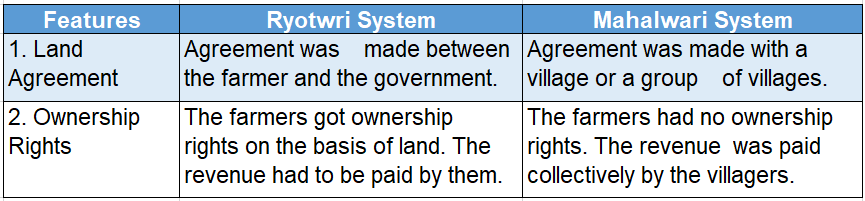
Rammohan demanded that the government should do away with the Zamindari system and make direct land lease agreements with the farmers.

5. Appointment at high posts:

Rammohan vehemently criticized the government for not appointing Indians to high posts in the government.

Read and Learn More WBBSE Solutions For Class 8 History

Question 2 Assess the contribution of Ishwar Chandra Vidyasagar as a reformer.
Answer: Contribution Of Ishwar Chandra Vidyasagar As A Reformer:-

Introduction:

Ishwarchandra Vidya Sagar was one of those reformers who made a significant contribution during the Renaissance period of Bengal in Bengal in the 19th century. Rabindranath paid tribute to Vidyasagar by saying that Providence had entrusted Vidyasagar with the task of civilizing the land of Bengal.

Contribution Of Vidyasagar As A Reformer

1. As a social reformer:

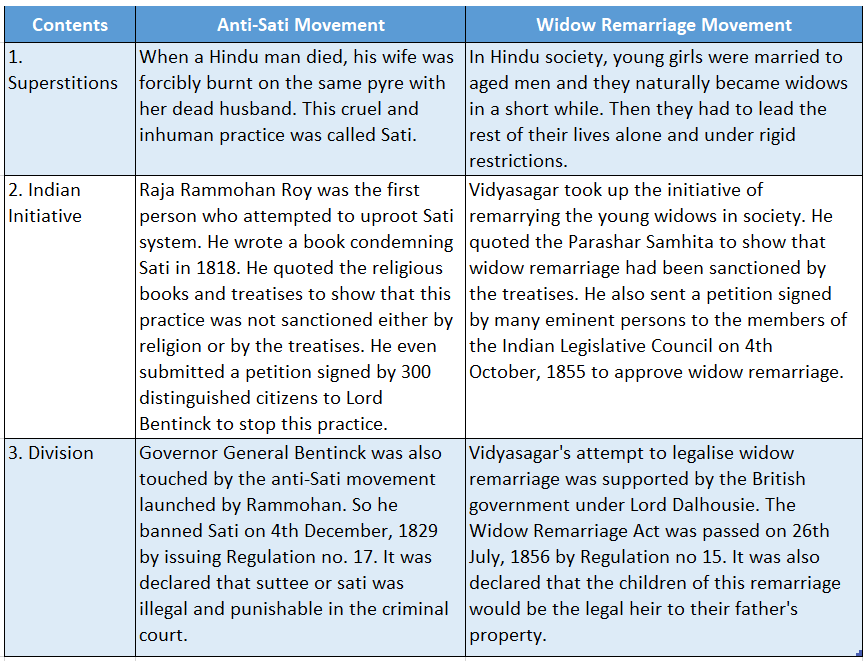
1. Widow Remarriage:

It was under his initiative that a petition containing the signatures of many distinguished persons supporting widow remarriage was sent to the members of the Indian Legislative Council on 4th October 1855. Then the British government under Dalhousie passed the Widow Remarriage Act on 26th July 1856 by issuing Regulation no 15.

Key Figures in Indian Reformation Movements

2. Opposition to child marriage:

Vidyasagar presented the torment and agony of the lives of young Hindu widows for the first time in the first edition of ‘Sarbashuvakari Patrika’. It was due to his constant efforts that the British government passed legislation that the minimum age for a girl’s marriage should be 10 years.

3. Protest against polygamy:

Vidyasagar sent a petition containing the signatures of 50,000 persons opposing polygamy to the British government in 1855 with the help of the Maharaja of Burdwan Mahtab Chand. The government appointed a committee to make legislation to stop polygamy.

4. Other reforms:

Vidyasagar also condemned casteism, untouchability, child sacrifice in Gangasagar, and drunkenness and invited others to join in the protest.
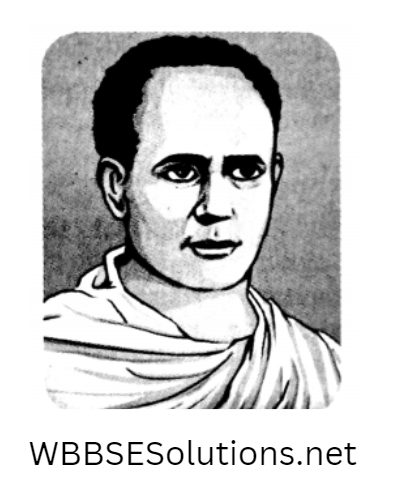
Wbbse Solutions For Class 8 History Chapter 5 Reaction To Colonial Rule Cooperation And Revolt Ishwar Chandra Vidyasagar

2. As an educational reformer:

1. Spread of women’s education:

Vidyasagar, the pioneer of women’s education, established the Hindu Balika Vidyalaya in 1849 with the help of John Elliot Drinkwater Bethune.

The school is called Bethune School. He established girls’ schools in different districts on his initiative and about 1300 girls were provided education in these schools. He established the Bhagwati Vidyalaya at Birsinha in 1890 in memory of his mother.

Social Reforms During Colonial Rule Notes

2. Introduction of modern curriculum:

He wrote books like ‘Varnamala’, ‘Kathamala’ and ‘Bodhodaya’ and introduced subjects like arithmetic, geometry, ethics, political science, and physical education into the curriculum of Sanskrit College.

3. Increasing the facility of higher education:

Vidyasagar admitted students from all sections of society to Sanskrit College. He also founded the Metropolitan Institution (Modern Vidyasagar College) in 1870 to impart higher education.

Question 3. Give an account of Derozio and the Young Bengal Movement.
Answer: Introduction:

A group of youths in Bengal was enlightened by Western education in the first half of the 19th century. They organized a social reform movement under the leadership of Derozio who was a professor at Hindu College and was inspired by the philosophy of Bentham. This movement was popularly known as the Young Bengal Movement.


WBBSE Solutions For Class 8 School Science Long Answer Type Questions WBBSE Solutions For Class 8 School Science Short Answer Type Questions
WBBSE Solutions For Class 8 School Science Very Short Answer Type Questions WBBSE Solutions For Class 8 School Science Review Questions
WBBSE Solutions For Class 8 School Science Solved Numerical Problems WBBSE Solutions For Class 8 School Science Experiments Questions
WBBSE Solutions For Class 8 Maths WBBSE Class 8 History Notes
WBBSE Class 8 History Multiple Choice Questions WBBSE Solutions For Class 8 History
WBBSE Solutions For Class 8 Geography


Derozio And Young Bengal Movement

1. Ideals:

Derozio always preached in favor of rationalism and independent thinking. The young Bengal group under his leadership began to protest against the prevalent beliefs and superstitions.

They wanted to do away with all pretensions and false elaborate rituals. Derozio always advised his followers to uphold truth and get rid of falsehood.

Short Notes on Brahmo Samaj and Its Impact

2. Emergence of Young Bengal Association:

A group of youths was attracted by the rationalistic philosophy of Western thinkers like Rousseau, Voltaire, Hume, and Locke.

This group, inspired by the ideals of Derozio, a professor of History and English Literature at Hindu College, emerged as the ‘Young Bengal Association’.

3. Social reforms:

The members of the Young Bengal Association protested against the superstitions, casteism, and untouchability prevalent in Hindu society.

They wanted to do away with the Sati system and also protested against other vices like slavery, violence against women, child marriage, polygamy, and bonded labor.
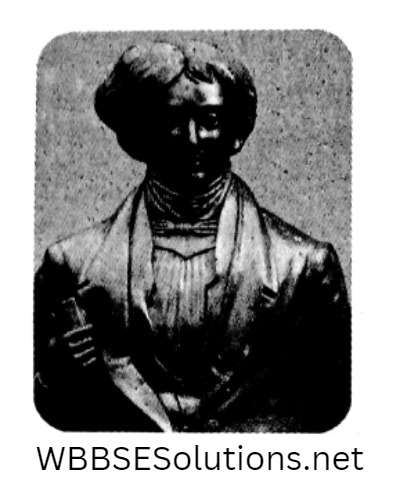
Wbbse Solutions For Class 8 History Chapter 5 Reaction To Colonial Rule Cooperation And Revolt Derozio

4. Derozio’s contribution:

Derozio advised his followers to discard superstitions, develop a rationalistic outlook, and search for truth instead of taking things for granted.

His poems ‘Fakir of Janghira’ and ‘Swadesher Pran’ reflect his patriotism. As a teacher, he always tried to make his students rational and capable of independent thinking.

He built up the first students’ organization in India, which was called the ‘Academic Association’, in 1828.

5. End of the Movement:

After the death of Derozio, his students continued the movement for some time. When most of them deserted and became established in their personal life, the movement came to an end.

The movement was mainly confined to the city and they were indifferent toward the demands and grievances of the masses. The movement also failed due to their deviation from ideals, rashness, and lack of any constructive agenda.

Class 8 History Solution WBBSE

Question 4. Assess the contribution of Veersalingam Pantulu in the establishment of modern Andhra.
Answer: Contribution Of Veersalingam Pantulu to the Establishment Of Modern Andhra:-

Introduction:

Kandukuri Veersalingam Pantulu was the father of the Renaissance in Andhra Pradesh. He tried to pave the way for social development by raising the moral standard of the man.

Mahadev Govind Ranade had called him ‘Ishwarchandra Vidyasagar of the south’ for his social reforms.

Contribution Of Veersalingam-

1. Social vehemently development:

Veersalingam condemned casteism, untouchability, and oppression of the lower classes by the upper classes. He also protested against the corruption and tyranny of British judges and officials.

He founded some social services organizations like Sangha Sanskaar Samajam (1876), Prarthana Samajam (1878), and Stri Punarvivah Samajam (1880).

2. Telugu Literature:

Veersalingam was the father of Telugu literature and journalism. He was the pioneer in writing novels, dramas, physical science, and history books.

He composed ‘Satyaraja Purvadesh Yatralu’ and ‘Rajshekhara Charitrama’ in imitation of Jonathan Swift’s ‘Gulliver’s Travels’ and Goldsmith’s ‘The Vicar of Wakefield’ respectively. His authoritative work was ‘The Lives of Telugu Poets’.

3. Women’s Welfare:

He voiced his protest against child marriage, polygamy, the devadasi system, and keeping concubines and professional dancers and songstresses.

He founded Rajamundri Samaj Sanskara Samity (1878) and Vidhava Vivah Samity (1881). The first widow remarriage was held in Andhra Pradesh under his initiative on 11th December 1881.

He also established homes for widows in Mysore (1907) and Bangalore (1910). He was helped in all these activities by his wife and inseparable companion Rajlaxmi.

Practice Questions on Reformation Movements

4. Spread of mass education:

He set up girls’ schools in Doaleshwaram (1878) and Rajahmundry (1884) to spread mass education. He also established schools for women, Harijans, and laborers. He appointed ladies from lower classes who were trained in vocational education as teachers.

Some of the institutions founded by him were Balbharati Samity, National Hich School, and Vande Mataram High School.

Question 5. Assess the contribution of Shri Narayan Guru in the social reformation and cultural spheres of South India in the 19th. century.
Answer: Contribution Of Shri Narayan Guru In The Social Reformation And Cultural Spheres Of South India In The 19th. Century:-

Introduction:

Shri Narayan Guru was a saint, thinker, and reformer who led the religious and social movements in Kerala in the second half of the 19th century.

1. Principles:

The three main principles or ideals of the Narayan Guru were

  1. To educate oneself and get rid of superstitions;
  2. To become united to achieve power;
  3. To bring about economic development through industrialization. He founded an organization named ‘Shri Narayan Dharma Paripalan Yogam on 15th May 1903 to preach his ideals.

Contribution Of Narayan Guru-

1. Protest against untouchability:

The main teaching of Shri Narayan Guru was that ‘man is one race, religion is one and God is one’.

He condemned untouchability and tried to build up public opinion in favor of allowing the backward classes to enter the temples freely and also for establishing their social rights.

2. Vaikam Satyagraha:

Most of the people of Kerala belonged to the Lihava sect. They were not allowed to use the path of a Hindu temple at Vaikam. Narayan Guru was the first person to take up this cause and he started a movement called the ‘Vaikam Satyagraha’ in 1924 to enable these people to use the said path.

An Ijhava priestly class was created and many of the Ijhavas were appointed in the kitchens. This created confidence among these people who were considered to belong to a lower class.
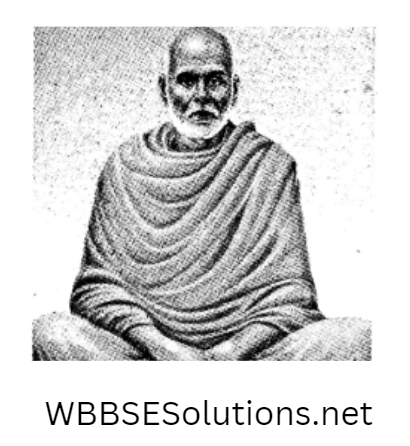
Wbbse Solutions For Class 8 History Chapter 5 Reaction To Colonial Rule Cooperation And Revolt Shri Narayan Guru

3. Establishment of educational institutions:

Narayan Guru wanted to uplift the cultural and moral standards of the lower caste people through education. So he organized a fund and called for donations.

Important Definitions Related to Reformation Movements

1. Evaluation:

Initially, the reform movement led by Narayan Guru was aimed at the development of the Ijhavas, but it, later on, became an anti-casteism movement. Thus Shri Narayan Guru added a new dimension to the Hindu reform movement by establishing social rights of the backward classes in Kerala.

Question 6. Assess the contribution of Jyotirao Phule to the reform movement in Maharashtra in the 19th century.
Answer: The Contribution Of Jyotirao Phule To The Reform Movement In Maharashtra In The 19th Century:-

Introduction:

The name of Jyotirao Govind Phule deserves special mention in the social reform movement in Maharashtra in the 19th century. He was determined to bring about the universal development of all lower caste people including the Sudras.

Jyotirao Phule and his wife Savitribai made a significant contribution to the social reform movement in Maharashtra.

Contribution Of Jyotirao Phule-

1. Rationalistic Reforms:

In his early life, Jyotirao Phule was a devotee of Christianity and Islam and hated Hinduism.
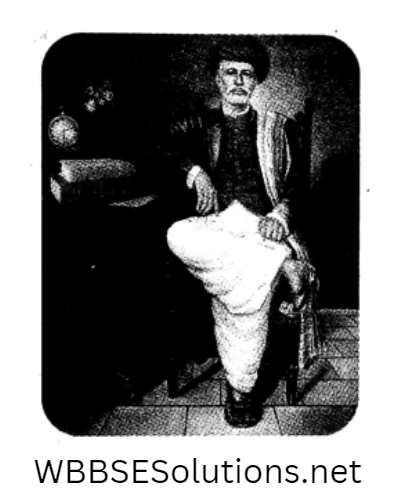
Wbbse Solutions For Class 8 History Chapter 5 Reaction To Colonial Rule Cooperation And Revolt Jyotirao Phule

2. Social reforms:

Jyotirao Phule and his wife strongly protested against the predominance of Brahmins in society, casteism, and the immense misery of the sudras and women.

He established the ‘Home for Prevention of Infanticide’ to provide shelter to illegitimate children. Again, he founded

The Satyashodhak Samaj in 1873 secured social justice for the backward and downtrodden classes.

Conceptual Questions on Changes Brought by Reformers

3. Opposition of Brahmins:

Jyotirao Phule thought that the Brahmins were the main obstacles in the path of establishing the fundamental rights of the poor, untouchable, and lower caste people in society.

So he challenged Brahmanism in his work ‘Gulamgiri’ in 1872.

He preached against Brahiminism among the lower caste people like Kunur, Mali, Mang, and Mahar and thus laid the foundation of the anti-Brahmanism movement.

4. Women’s welfare:

He vehemently protested against child marriage, polygamy, and female infanticide. He established girls’ schools for the lower class girls and also organized a strong movement in favor of widow remarriage.

5. Educational reforms:

Jyotirao Phule thought that the Sudras and other lower caste people should be brought under the fold of Western education. So he and his wife founded the first girls’ school in Poona in 1851.

He was helped by other reformists like Sadashiv and Ballal Paranjape in his educational activities.

1. Evaluation:

Jyotirao Phule, who was imbued with rationalistic and modern ideas, worked for the universal development of the lower classes of Maharashtra throughout his life.

He did not even hesitate to take the help of the British government to protect the lower castes from the grip of the Brahmins. According to DJ Key, Rai Bahadur Vithalrao Krishnaji Bhandarkar, an eminent reformer, conferred the. title of ‘Mahatma’ on Jyotirao Phule on 11th May 1888.

Question 7. Give a brief description of the reform movement under the leadership of the Brahmo Samaj.
Answer: Reform Movement Under The Leadership Of The Brahmo Samaj:-

Introduction:

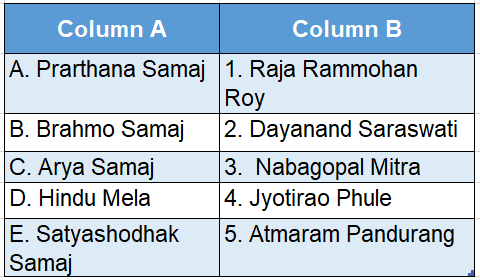
Rammohan Roy founded the ‘Atmiya Sabha’ in 1815 to remove religious bigotry and superstitions from society. The Brahmo Sabha emerged out of this Atmiya Sabha in 1828. After the demise of Rammohan in 1838 Maharshi Devendranath Tagore took up the responsibility. Keshav Chandra Sen joined the Samaj in 1858.

Class 8 WBBSE History Question Answer

The Brahmo movement received momentum under the initiative of Keshav Chandra Sen and Vijay Krishna Goswami.

Reform Movement Under Brahmo Samaj

1. Religious reforms:

The motive behind the foundation of the Brahmo Samaj was to worship the one and only Brohmo. Some new rules of conduct, rituals, and initiation processes were introduced by Devendranath Tagore.

The members of Brahmo Samaj opposed idolatry, believed in monotheism (one God), and emphasized the performance of rites and rituals according to the Vedas, Puranas, and Upanishads.

Devendranath Tagore and Gaganendranath Tagore organized a national fair called Chaitra Mela or Hindu Mela in 1867 to reestablish the glory of ancient Hinduism.

2. Social reforms:

The main aim of the Brahmo Samaj was to remove social superstitions, spread women’s education, and legalize widow remarriage.

The British government passed an Act in 1872 which prohibited child marriage and polygamy and legalized inter-caste marriage. This was the fruit of Keshav Chandra Sen’s efforts.

William Bentinck banned Sati on 4th December 1829 with the cooperation of Rammohan. Keshav Chandra expressed his support for the women’s liberation movement through his journals Bamabodhini and ‘Paricharika’.

It was again due to this that the daughter’s rights to her parental property were recognized.

3. Educational reforms:

The ‘Indian Mirror’, edited by Keshav Chandra was published with a view of spreading universal education for the masses.

The subjects like social science and physics were introduced in Vedanta College established by Rammohan and Hare School. Keshav Chandra founded the Native Ladies’ Formal School in 1871 which was renamed as Native Ladies’ Institution (now Victoria Institution) in 1882.

He also established a night school at Kolutolla, Calcutta College in 1862, and Albert College in 1872.

Class 8 WBBSE History Question Answer

Question 8. What was the role of Arya Samaj in the reform movements? movements
Answer: Introduction:

Reform started in western and north-western India in the second half of the 19th century to protect Hinduism from the growing influence of Christian missionaries. The reform movement in Punjab was led by the Arya Samaj. Their main aim was to influence the masses as well as the uneducated classes.

Role Of Arya Samaj In The Reform Movements

1. Foundation:

The Arya Samaj was founded in Punjab by Swami Dayanand Saraswati in 1875. However, its structure and principles were formulated at Lahore in 1877.

2. Ideals:

Swami Dayanand believed in the Vedas and wanted that Hinduism should be based exactly on the Vedas. He thought that some selfish persons had deliberately misinterpreted the Vedas and thus stained the popularity of Hinduism.

3. Social reforms:

1. In different spheres:

The members of Arya Samaj constantly fought against social, malpractices, and inequality. They tried to enhance the prestige of women by spreading women’s education. They strongly protested against casteism and untouchability.

2. Purification (Shuddhi) movement:

Swami Dayanand introduced the purification program to resist the conversion of Hindus. Arrangements were made to initiate non-Hindus and convert. He wanted to unify the country by removing foreign influence from society and by establishing one nation and one religion.Wbbse Solutions For Class 8 History Chapter 5 Reaction To Colonial Rule Cooperation And Revolt Swami Dayanand Ssraswati
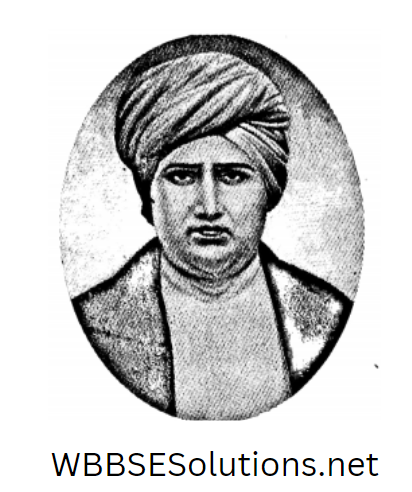
4. Educational reforms:

The followers of Swami Dayananda established many schools and colleges to spread Western education. The Dayanand Anglo Vedic college in Lahore and Kangri Gurukul Vidyalaya (a Vedic educational institution) near Haridwar are some examples.

Class 8 WBBSE History Question Answer

5. Religious reforms:

Swami Dayanand preached that the Vedas contained the words of God, it was infallible and the source of all knowledge. However, he opposed the rituals based on Puranas, idolatry, and polytheism (many Gods).

Question 9. Compare Rammohan and Dayanand as leaders of reform movements.
Answer: Comparing Rammohan And Dayanand As Leaders Of Reform Movements:-

Both Rammohan and Dayanand Saraswati were Indian reformers belonging to the 19th century. Rammohan, the ‘Father of Indian Renaissance’ and the ‘maker of modern.

India’ wanted to remove the social and religious superstitions and make a new India by combining Orientalism and Anglicism. On the other hand, Dayanand, a monotheist, and an orientalist, wanted to make an advanced India through the revival of Hinduism.

There are both similarities and dissimilarities between the reform movements led by Rammohan Roy and Dayanand Saraswati.

Comparison Between Rammohan And Dayanand

1. Similarities:

1. Educational qualification:

While Rammohan was a multi-linguist, rationalist, and Vedic scholar, Dayanand was a great Sanskrit and Vedic scholar.

2. Liberal thinking:

Like Rammohan, Dayanand also opposed casteism, racialism, idolatry, and child marriage and supported women’s education, widow remarriage, monotheism, and sea voyages.

3. Compositions:

Rammohan wrote books like ‘Vedanta Grantha’ and ‘Vedanta Saar’ while Dayanand wrote ‘Satyartha Prakash’ and ‘Ved Bhasya’.

2. Dissimilarities:

1. Movement strategies:

The Brahmos mainly appealed to the educated and English-literate groups but the Arya Samajists preached among the common masses. Unlike Rammohan, Dayanand never supported rationalism or Western science and knowledge.

The Arya Samajists exercised more influence over Punjab and UP than the Brahmos.

Class 8 WBBSE History Question Answer

2. Ideals:

Dayanand believed only in the Vedas but Rammohan regarded the Vedantas and Upanishads as the essence of Hinduism.

Dayanand believed that the Vedas contained all religious truths and scientific data. He emphasized faith and devotion for more than one reason. On the other hand, Rammohan assimilated the essence of Oriental and Western thoughts, transcribed it himself, and tried to share it with his countrymen.

1. Comments:

Dayananda talked about character building by following Vedic ideals and thereby elevating moral standards. According to him, the priest had no place between God and his devotee.

On the other hand, Rammohan had tried to preserve the ideals of the past and combine Western rationalism and modernism with them thus bringing about a renaissance.

Though Dayanand could send his message to the common people, Rammohan’s ideals could influence only a handful of intellectuals and upper classes.

Question 10. Discuss the contribution of Prarthana Samaj in the social reformation of Maharashtra in the 19th century.
Answer: Contribution Of Prarthana Samaj to the Social Reformation Of Maharashtra In The 19th Century:-

Introduction:

The Prarthana Samaj made a praiseworthy contribution to the social reformation of Maharashtra in the 19th century.

A secret organization named Paramahansa Sabha grew up in Maharashtra in 1849 and Prarthana Samaj grew up as its offshoot. Mahadev Govind Ranade was a stalwart of the Prathana Samaj.

Role Of Prarthana Samaj In Social Reformation

Foundation and objectives:

Atmaram Pandurang, who was inspired by Keshav Chandra Sen, established the Prarthana Samaj in 1867.

The important members were Ramkrishna Gopal Bhandarkar, a famous Sanskrit scholar and historian, and Mahadev Govind Ranade, who was a judge of the Bombay High Court.

The objectives of the Prarthana Samaj were to remove superstitions, casteism, untouchability, purdah, and child marriage.

1. Social reforms:

Though the members of Prathana Samaj opposed idolatry and supported monotheism, they were not totally against Hinduism, unlike the Brahmos.

The members also dedicated themselves to welfare work like widow remarriage, intercaste marriage, the spread of women’s education, community dinners, and the welfare of the downtrodden classes.

Ranade established ‘Vidhva Vivah sanity” (1861) and ‘Sarda Sadan’. Many homes for children and widows, orphanages, and clinics were established under the initiative of the Prarthana Samaj.

2. Spread of education:

Ranade founded a girls’ school in Poona and founded the ‘Deccan Education Society’ in 1884 to encourage higher education.

This association established the Fergusson College in Poona, Willington College in Sangli, and many small schools. Soon the society became popular in Madras, Maharashtra, and the Telugu region of Andhra Pradesh.

3. Foundation of Sarvajanik Sabha:

Ranade founded the Sarvajanik Sabha in Poona in 1870 to safeguard the interests of India.

Incidentally, he was also an inspiring factor behind the foundation of the National Congress in 1885.

Question 11. What was the role of Aligarh? Movement and Sir Syed Ahmed in awakening the consciousness of the Muslims?
Answer: Role Of Aligarh Sir Syed Ahmed In Awakening The Consciousness Of The Muslims:-

Introduction:

The Aligarh Movement played an important role in arousing the consciousness of Muslims.

The Muslim society which was living in the darkness of hopelessness got the much-needed inspiration to live due to the earnest efforts of Sir Syed Ahmed.

Role Of Aligarh Movement And Sir Syed Ahmed

1. Aligarh Movement:

1. Background:

When the Hindus secured high positions in the government after receiving Western education, the Muslims receded to the background.

The leaders of the Aligarh Movement tried to make the Muslims understand that they would ultimately benefit if they availed of the benefits provided by the British government.

2. Ideals:

Since the Hindus and the Muslims belonged to two different communities, their political interests were different.

Appointment of employees based on examination was against the interests of the Muslims since they were a minority.

The Muslims must cooperate with the British to safeguard their interests.
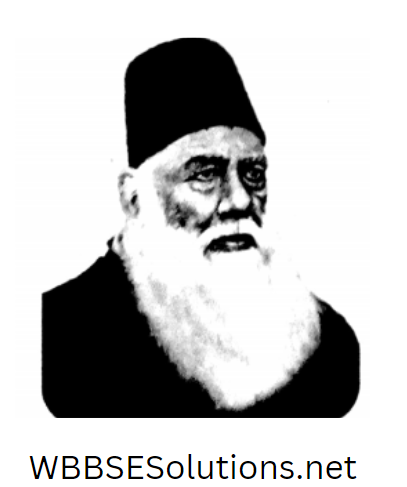
Wbbse Solutions For Class 8 History Chapter 5 Reaction To Colonial Rule Cooperation And Revolt Sir Syed Ahmed Khan

3. Features:

This Movement aimed at the universal progress of Muslim society with the help of the British.

This Movement gave rise to the concept that the Hindus and the Muslims were two different communities.

The origin of this movement was Aligarh College where students from all categories were not admitted. So people from all strata of society could not participate in it.

The movement faced opposition from the orthodox and non-reformist manuals and maulvis.

2. Role of Syed Ahmed Khan:

1. Educational reforms:

Sir Syed Ahmed founded an English medium school at Ghazipur in 1864 to spread English education. He established the ‘Scientific Society in 1865 to create awareness about science among Muslims.

He established the ‘Committee for the Advancement of Learning among the Muhammedans of India’ for the all-round development of the Muslims.

He established the Anglo-Oriental College to foster higher learning among the youth. This college became Aligarh University later on.

2. Social reforms:

Sir Syed Ahmed tried to create awareness among Muslims against malpractices like the talaq (divorce) system, child marriage, and polygamy.

He tried to modernize Muslim society with the help of scientific thinking. He tried to remove conservatism from society by providing a rationalistic explanation of the Quran.

3. Political reforms:

Syed Ahmed aimed at extracting different social and political rights for Muslims by making them participate in national politics in large numbers.

The United Indian Patriotic Association was founded by Theodor Beck in 1888 as a parallel organization of the National Congress.

Theodor Beck founded the ‘Mohammedan Anglo-Oriental Defence Association of Upper India’ in 1893 to protect the interests of the Muslims.

WBBSE Chapter 5 Reaction To Colonial Rule: Cooperation And Revolt Topic A Reformation Movement Short Answer Questions

Question 1. Why did the Indians need to learn the English language during colonial rule?
Answer:

Indians Need To Learn The English Language During Colonial Rule:-

Western education was introduced in India during the rule of the East India Company to provide English education to the Indians.

1. Motive of government:

The government had realized the difficulty of bringing administrative supervisors from England. It involved a lot of expenses.

So they wanted to create an educated class among the Indians who would remain loyal to the British and help them to carry out administrative tasks.

2. Motive of Indians:

English education would enable the Indians to participate in the economic activities of the Company. So they believed

that their children would be able to secure jobs easily if they knew the English language well.

Question 2. What were the reasons for the dissatisfaction of the middle class against the British government?
Answer:

Reasons For The Dissatisfaction Of The Middle Class Against The British Government:-

1. Colonial rule and oppression:

The middle class was completely disappointed and annoyed with the colonial rule and the oppressive measures.

2. Deprivation of Indians from high government posts:

The English government deprived the Indians of important posts in the government in spite of their high education and capability.

The middle class was also annoyed at the British policy of holding the Civil Service Examination in England.

3. Repressive measures:

The educated middle class of India was completely disillusioned by the repressive measures adopted by the British government.

Question 3. What was the role of the press in the forming of public opinion?
Answer:

Role Of The Press In The Forming Of Public Opinion:-

The press played an important role in forming public opinion in favor of educational and social reforms.

In 1780, an English merchant named James Augustus Hicke published the ‘Bengal Gazette’, the first newspaper in India.

He published information impartially and fearlessly through his journal which enlightened the public but offended the Company.

In 1818, two more journals ‘Digdarshan’ and ‘Samachar Darpan’ were published under the initiative of Marshman, a missionary of Sreerampur.

Question 4. Name some elite families of Kolkata in the 19th century. How did they establish themselves as the bourgeoisie or the middle class?
Answer:

Some Elite Families Of Kolkata In The 19th Century:-

Some of the aristocratic families of Kolkata in the 19th century were the Tagores of Jorasanko, the Thakurs of Pathuriaghata, the Duttas of Hatkhola, the Ghoshals of Khidderpore,

the Devs of Shovabazar and the Sinhas of Paikpara.

These families came into contact with western education and secured jobs in the Company at low and medium posts by virtue of their intellect and endeavor.

Afterward, they established themselves as the ‘bourgeoise’ or ‘the middle class’ in society.

Question 5. What is meant by Suttee or Sati?
Answer:

Suttee Or Sati:-

The system of Suttee or Sati was prevalent in Hindu society at the beginning of the 19th century.

When a man died, his widow was compelled to sit on the pyre in her bridal dress and burn herself along with her husband’s dead body.

Again, a number of musical instruments were played to suppress the shrieks of the widow while the onlookers broke out into inhuman mirth.

This ghastly practice of burning widows alive was called Sati.

Examples of Women’s Reform Movements in India

Question 6. How did Rammohan fight against the Sati system?
Answer:

Rammohan fought Against The Sati System:-

Rammohan Fought Against The Sati System As Follows:-

Rammohan Roy organized a strong movement to stop the inhuman practice of Sati.

1. Explanation of treatises:

He explained different religious treatises to testify that Sati is antireligious.

2. Building up public opinion:

He tried his best to organize public opinion against the practice of Sati.

3. Petition the in British Parliament:

Rammohan proved that the Sati system was both unjust an antireligious.

He also submitted a petition containing the signatures of distinguished citizens to the British parliament.

4. Anti-Sati legislation:

Ultimately Governor-General Bentinck supported Rammohan. and the legislation for abolishing Sati was passed in 1829.
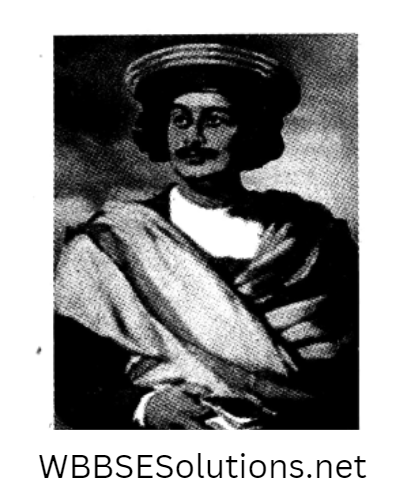
Wbbse Solutions For Class 8 History Chapter 5 Reaction To Colonial Rule Cooperation And Revolt Raja Rammohan Roy

Question 7. Why did Rabindranath call Rammohan, The father of the Indian Renaissance? Who unified the three branches of the Brahmo Samaj?
Answer:

Rabindranath Call Rammohan, The Father Of The Indian Renaissance:-

Rammohan was the pioneer or maker of modern India in the light of rationalism and liberal thinking.

Possessed of modern rationalistic ideas and a secular attitude, he was the first to talk about the formation of a superstition-free society and preaching a superstition-free religion.

He was the first Indian to follow the liberal ideals of the west. So Rabindranath Tagore paid him a tribute by the Indians calling him the ‘Father of the Renaissance.

In 1902 the Adi Brahmo Samaj founded by Devendranath Tagore, the Indian Brahmo Samaj was founded by Keshav Chandra Sen and

the Sadharan Brahmo Samaj founded by Shivnath Shastri and Anandamohan Bose was unified by the efforts of Deshbandhu Chittaranjan Das and it was renamed as ‘Brahma Sammilan Samaj’.

Question 8. Give a short account of the introduction of Widow Remarriage in Hindu society.
Answer:

Introduction Of Widow Remarriage In Hindu Society:-

A remarkable achievement of Pandit Ishwar Chandra Vidyasagar was to get the sanction of the Government to introduce widow remarriage in Hindu society.

1. Endeavour:

Vidyasagar wrote essays in the ‘Sarvashuvakari’ and ‘Tatwabodhini’ about the necessity of the remarriage of widows and their independence, to prevent the legislation from getting annulled.

He also proved the validity of widow remarriage from the religious point of view by quoting lines from the Parashar Samhita.

2. Legislation for widow remarriage:

The Hindu Widow Remarriage Act was passed by Lord Dalhousie and it was the result of Vidyasagar’s efforts.

Later on, this act was opposed by Bal Gangadhar Tilak. However, 60 widow remarriages were held between 1856 and 1866 under his initiative.

Question 9. Why is Vidyasagar called the ‘traditional modernizer”?
Answer:

Vidyasagar Called The ‘Traditional Modernizer”:-

Vidyasagar was the pioneer of educational reforms in Bengal in the second half of the 19th century.

He felt that western education was necessary to develop rational thinking but the medium of instruction should be vernacular for a better understanding of the subjects.

Therefore, he stressed the establishment of Bengali medium schools and himself took the initiative of establishing model schools in the districts.

He believed that the overall progress of Indians was possible through the amalgamation of the oriental and the western.

So he introduced the study of the English language at Sanskrit College.

Since he was a realist Dr. Amalesh Tripathi calls him a ‘traditional modernizer’. i.e., an advocate of traditional modernism.

Question 10. Why did the Young Bengal movement fail?
Answer:

Young Bengal Movement Fail:-

The reasons for the failure of the young Bengal movement are as follows

1. Opposition to Hindu religion and traditions:

The enthusiastic members of the Young Bengal Group had sharply attacked the Hindu religion and traditions.

2 Urban-centric Characters:

The Young Bengal movement was chiefly confined to the city and the educated class.

3. Lack of organized agenda:

The Young Bengal group had no constructive program and they also could not present any alternative social system.

Question 11. What were the two main objectives of the social reform movements of the 19th century?
Answer:

Two Main Objectives Of The Social Reform Movements Of The 19th Century:-

1. Reduction of social discrimination:

The social reform movements in the 19th century tried to do away with social discrimination under the collective leadership of Brahmo Samaj, Arya Samaj, and Prarthana Samaj.

The main motive of these reform movements was to put an end to casteism and racial discrimination.

2. Elimination of social malpractices and superstitions:

The reform movements aimed at cleansing the Hindu society of malpractices and superstitions which had been infesting it for a long time.

The movements aimed at the expansion of education, the establishment of rationalism, and the elimination of superstitions.

Question 12. What is meant by ‘Three laws”?
Answer:

Three Laws:-

One of the outstanding achievements of the Indian Brahmo Samaj in the sphere of social reformation was to compel the Government to pass ‘Three Laws’ in 1872.

It was achieved under the able leadership of Brahmanand Keshav Chandra Sen. The provisions of this law are

  1. abolition of polygamy and cultism,
  2. prohibition of child marriage,
  3. recognition of intercaste marriage.

Question 13. Explanation Shri teaching of ‘Jata Mat Tata Path’.
Answer:

Shri Teaching Of ‘Jata Mat Tata Path’:-

Exponent:

Shri Ramkrishna Paramahansdeva was the exponent of the doctrine “Jata Mat Tata Path”.

Through this doctrine, he taught the people to bring about coordination among the different religions instead of opposing each other.
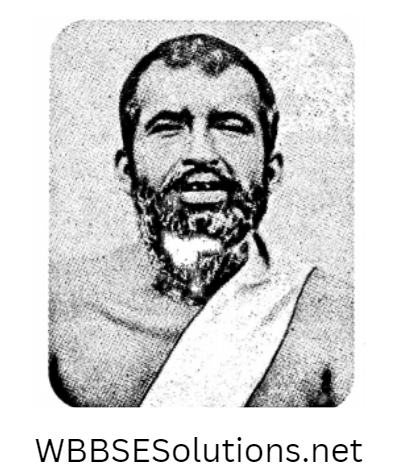
Wbbse Solutions For Class 8 History Chapter 5 Reaction To Colonial Rule Cooperation And Revolt Sri Sri Ramkrishna Deva

2. Literal Meaning:

Though we search for God by following different paths as shown by different religions, our aim is the same i.e., communion with God.

3. Significance:

Shri Ramkrishna has brought out the main essence of all religions exquisitely. He has said that all religions are equally true.

God is one but is called by different names just as the same water is called by different names in different languages.

Question 14. How was the India of Swami Vivekananda’s dream?
Answer:

Dream Of Swami Vivekananda’s About India

Swami Vivekananda was the greatest thinker, philosopher, and preacher of nationalism not only in India but also in the world. He was also the architect of building ‘New India’.

Swamiji dreamt of an India where there would be no shrieks of hunger, exploitation for self-interest, oppression for profit, or neglect for achieving glory.

He wanted India to develop as the home of true human beings. He regarded India as a holy land and said that truth would die with the death of India.
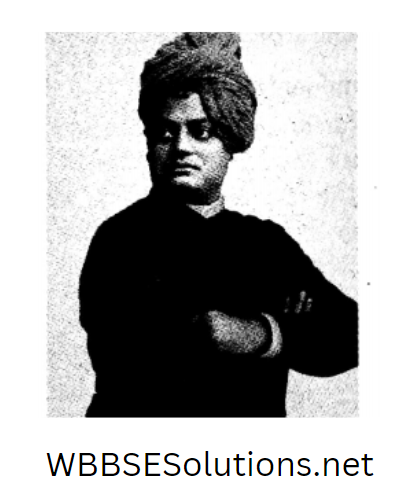
Wbbse Solutions For Class 8 History Chapter 5 Reaction To Colonial Rule Cooperation And Revolt Swami vivekananda

Question 15. Mention some important features of the Aligarh movement.
Answer:

Important Features Of The Aligarh Movemen:-

Some features of the Aligarh movement were as follows

  1.  It tried to bring about the overall development of the Muslims with the help of the British government.
  2. The poor, who formed the majority, did not participate in the movement. Only some zamindars of UP and educated middle-class people participated in it.
  3. This movement alienated the Muslims from the Hindus because it was confined only to the Muslims.
  4. This movement has two facets one was conservative and anti-British and the other was modern, progressive, and loyal to the British.

Question 16. Who was Pandita Ramabai?
Answer:

Pandita Ramabai:-

Introduction:

Some women took the initiative of spreading education among women in the 19th century. Pandita Ramabai was one of them.

She came from a Brahmin family but married a Sudra and so she had to face social resistance.

1. Achievements:

Ramabai was a very determined lady. After becoming a window she went to England with her daughter and studied medicine.

She returned to India and made a home for the widows. She also launched a movement on behalf of the widows in western India.

Question 17 What were the limitations of the reform movements?
Answer:

Limitations Of The Reform Movements:-

The reform movements of the 19th century had some limitations.

1. Lack of reform universality:

The movements were mainly confined to the educated middle class and the upper class. The poor and rural masses had nothing to do with them. So these movements lacked mass character or universality.

2. Hindu-centric:

The Brahmo Samaj movements, except the Aligarh movement, were concerned only with the Hindus. These movements were launched to safeguard the interests of the Hindus.

Question 18. Briefly discuss Shri Ramkrishna’s ideal of harmonization of all religions.
Answer:

Shri Ramakrishna Ideal Of Harmonization Of All Religions

1. Principle:

According to Ramkrishna, There were as many ways of attaining God as there were religions.

Through this view, he had advised the people to believe in the oneness of the different religions instead of coming into conflict.

2. Meaning:

He thought that everybody searched for the same thing, i.e., God though they followed different paths.

3. Significance:

Shri Ramakrishna beautifully explained the essence of all religions. He thought that every religion was true and God was one, though called by different names.

Question 19. What was the role of Swami Vivekananda in awakening national consciousness?
Answer:

Role Of Swami Vivekananda In Awakening National Consciousness:-

1. Awakening of patriotism:

Swamiji was the first person to infuse patriotism into the minds of the Indians.

He called upon the youths to carry out their duties towards their motherland and said that for the next fifty years, their motherland should be their only deity to be worshipped.

2. Building of new India:

Swamiji wanted to use youth power to build a new India. He emphasized the theory of ‘karma’ or ‘action’.

This clarion call inspired the Indian youths immensely and imbued them with the ideals of nationalism.

3. Preaching ideals:

His speeches and ideals created national consciousness in the hearts of the Indians.

WBBSE Chapter 5 Reaction To Colonial Rule: Cooperation And Revolt Topic A Reformation Movement Very Short Answer Questions

Question 1. Who established the Aligarh Anglo-Oriental College?
Answer: Sir Sayyid Ahmed Khan established the Aligarh Anglo-Oriental College.

Question 2. Who was Bijaykrishna Goswami?
Answer: Bijaykrishn Goswami was a prominent social reformer and religious figure in the 19th century.

Question 3. Who founded the Satyashodhak Samaj?
Answer: Jyotirao phule founded the Satyashodhak Samaj.

Question 4. Who was known as the ‘middle class’ in the 19th century?
Answer: In the 19th century, those who were at the intermediate stage of financial well-being came to be known as the ‘ middle class’.

Question 5. Who was called ‘Bhadralok’ in British India?
Answer: In British India, the middle-class people coming from the upper caste segment of the Hindu community were called ‘Bhadralok’.

Question 6. Which movement of Bengal influenced Vireshlingam Pantulu?
Answer: The Brahmo movement of Bengal influenced Vireshlingam Pantulu.

WBBSE Chapter 5 Reaction To Colonial Rule: Cooperation And Revolt Topic A Reformation Movement State Whether The Following Statements Are True Or False

Question 1. Devendranath Tagore established the Adi Brahmo Samaj
Answer: True

Question 2. Swami Vivekananda founded the Ramakrishna Mission.
Answer: True

Question 3. Rammohan Roy is called the ‘Father of modern India’.
Answer: True

Question 4. Keshab Chandra Sen founded the Atmiya Sabha.
Answer: False

Question 5. Rabindranath referred to Raja Rammohan Roy as the ‘Father of Indian Renaissance”.
Answer: True

Question 6. The Sadharan Brahmo Samaj was founded by Shivnath Shastri and Ananda Mohan. Bose.
Answer: True

Question 7. Keshab Chandra Sen founded the Nababidhan Brahmo Samaj.
Answer: True

Question 8. Vidyasagar established the Academic Association.
Answer: False

Question 9. The first Principal of Aligarh Mohammedan Anglo-Oriental College was Theodor Beck.
Answer: True

Question 10. Sir Syed Ahmed Khan was the leader of the Aligarh movement.
Answer: False

Question 11. Lala Hansraj founded the Dayanand Anglo-Vedic College.
Answer: True

Question 12. The Gurukul ashram was founded by Dayanand Saraswati.
Answer: False

Question 13. Michael Madhusudan Dutta translated Nil Darpan into English.
Answer: True

WBBSE Chapter 5 Reaction To Colonial Rule: Cooperation And Revolt Topic A Reformation Movement Fill In The Blanks By Selecting The Appropriate Expressions From The Brackets

Question 1. The Prarthana Samaj was founded ________ (Keshab Chandra/Dayanand Saraswati/ Atmaram Pandurang).
Answer: Atmaram Pandurang

Question 2. The Brahmo Samaj was founded by ________ (Keshab Chandra/Vidyasagar/Rammohan).
Answer: Keshab Chandra

Question 3. An association called Paramahansa Mandali was established by ________ (Sir Syed Ahmed Khan/Gopalhari Deshmukh/Keshab Chandra Sen).
Answer: Gopalhari Deshmukh

Question 4. ________ (Keshab Chandra Sen/Dayanand Saraswati/Mahadev Govind Ranade) founded the Arya Samaj.
Answer: Dayanand Saraswati

Question 5. The practice of throwing a girl child into the sea was forbidden by ________ (Dalhousie/Wellesley/Bentinck).
Answer: Wellesley

Question 6. ‘Anandamath was written by ________ (Rabindranath Tagore/Bankim Chandra Chattopadhyay/Swami Vivekananda).
Answer: Bankim Chandra Chattopadhyay
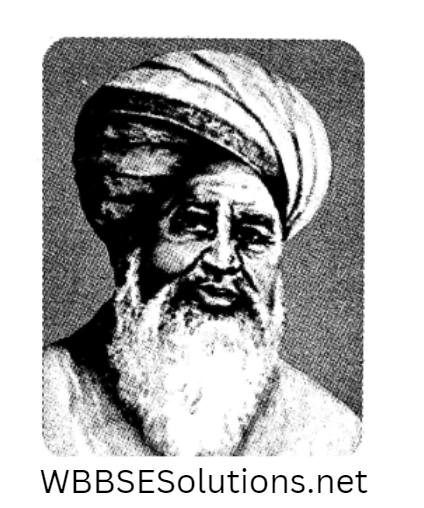
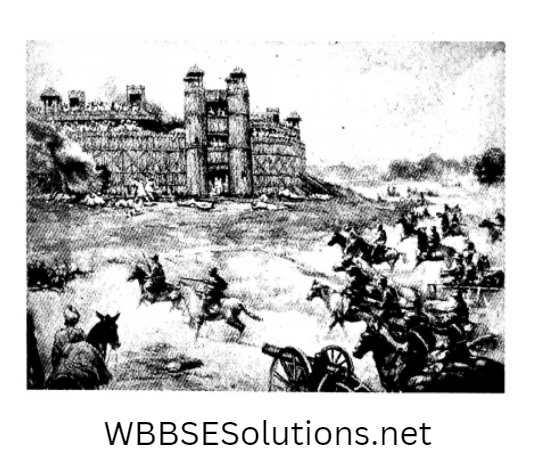
WBBSE Solutions For Class 8 History Chapter 5 Reaction To Colonial Rule Cooperation And Revolt Topic B Revolt and Movement against Company Rule

Chapter 5 Reaction To Colonial Rule: Cooperation And Revolt Topic B Revolt and Movement Against Company Rule Long Answer Questions

Question 1. Give an account of the Farazi and Wahabi movements.
Answer: Farazi And Wahabi Movements:-

Farazi Movement

1. Origin:

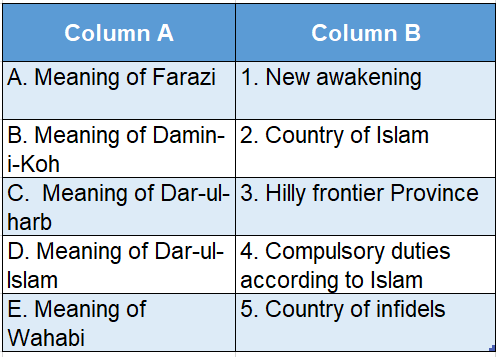
The word ‘Farazi’ ‘compulsory duties according to instructions of ‘Islam’ or ‘faith in the religious principles of Islam. The Farazi sect was founded by Haji Shariatullah in 1820.

2. Ideals:

Haji Shariatullah wanted that India ruled by enemies (Dar ul Harb) should be transformed into an Islamic country (Dar ul Islam).

He thought that India under British rule was not suitable for pious Muslims. He told his followers to rise against the tyranny of the Zamindars and indigo planters.

He also told them to read Karma (faith in one God or Allah) and Namaz (prayer to God), keep Roja (fast), give Zakat (donation), and go on Haj (pilgrimage).

Read and Learn More WBBSE Solutions For Class 8 History

3. Leaders:

After the death of Shariatullah, the Farazi Movement was led by his son Dudu Mian and his grandson Noa Mian respectively.

4. Expansion:

The Farazi Movement started in Faridpur of East Bengal when Shariatullah organized the farmers. It gradually spread to Dhaka, Khulna, and Mymensingh.

5. Features:

Though the Farazi Movement began as a religious movement it turned into a political movement later on. 2 The Farazi Movement mainly involved poor Muslim farmers.

6. End of movement:

After the death of Dudu Mian in 1862, his son Noa Mian gradually a political character to it. This weakened the Movement and it slowly came to an end.

Wbbse Solutions For Class 8 History Chapter 5 Reaction To Colonial Rule Cooperation And Revolt Haji Shariatullah

Wahabi Movement

1. Origin:

The term ‘Wahabi’ means ‘Renaissance’ or new awakening and the real name of the Wahabi Movement is Tarikh I Muhammedia (path shown by Muhammad).

In the 18th century Muhammad Bin Abdul Wahab, a pious Muslim of Arabia, launched this movement against the superstitions prevalent in Islam.

WBBSE Class 8 Revolt Against Company Rule Notes

In India, a similar movement started under the leadership of Sant Shah Waliullah following the path and ideals of Muhammad Bin Abdul Wahab.

2. Aim:

Initially, the Wahabi Movement aimed at the purification of Islam but later on it became a political movement against the British and feudalism.

3. Leaders:

Syed Ahmed was the pioneer of the Wahabi Movement in India. Some important leaders were Yiahia Ali, Abdur Rahim, and Amanullah.

4. Barasat Rebellion of Titu Mir:

The Wahabi Movement in Bengal under the leadership of Titu Mir (Mir Nishar Ali) is known as the ‘Barasat Rebellion’.

Titu Mir, who represented the lower class people, spread the movement over, 24 Parganas, Dhaka, Khulna, and Jessore.

Question 2. Give an account of the Barasat Rebellion and Mopala Rebellion.
Answer:

Barasat Rebellion And Mopala Rebellion:-

Barasat Rebellion Of Titu Mir

Introduction:

Mir Nishar Ali or Titu Mir was the pioneer of the Wahabi Movement in Bengal. Inspired by the Wahabi ideals, he became a disciple of Syed Ahmed and spread Wahabi ideals in Bengal.

Here the Wahabi Movement was better known as Barasat Rebellion.

1. Duties of followers:

Titu Mir told his followers not to have faith in pirs or paigambars, i.e., prophets; not to build temples or mosques; to keep beards; not to lend money on interest.

WBBSE Solutions For Class 8 School Science Long Answer Type Questions WBBSE Solutions For Class 8 School Science Short Answer Type Questions
WBBSE Solutions For Class 8 School Science Very Short Answer Type Questions WBBSE Solutions For Class 8 School Science Review Questions
WBBSE Solutions For Class 8 School Science Solved Numerical Problems WBBSE Solutions For Class 8 School Science Experiments Questions
WBBSE Solutions For Class 8 Maths WBBSE Class 8 History Notes
WBBSE Class 8 History Multiple Choice Questions WBBSE Solutions For Class 8 History
WBBSE Solutions For Class 8 Geography


2. Spread of the Movement:

The Movement spread to 24 Parganas, Nadia, Maldah, Rajshahi, Dhaka, and Pabna.

3. Opposition by Krishnadev Roy:

Krishnadev Roy, the Zamindar of Pur village of 24 Parganas, announced that whoever became Titu Mir’s follower or kept a long beard would have to pay 2.5% extra revenue.

So a conflict took place between the Zamindar and Titu Mir’s followers.

4. Bamboo castle:

After succeeding in his struggle against the Zamindars, Titu Mir built a bamboo castle in Narkelberia, 10 km away from the Baduria police station of 24 Parganas.

He declared ‘Jehad’ (war) against the Zamindars and indigo planters and demanded revenue from them.

5. End of the revolt:

When the magistrate of Jessore attacked Titu Mir’s headquarters with a large force they were defeated. Afterward, Bentinck curbed the rebellion by sending an army.

Wbbse Solutions For Class 8 History Chapter 5 Reaction To Colonial Rule Cooperation And Revolt Bamboo Castle of Titu Mir

Significance

The main aim of Titu Mir’s Barasat rebellion was to protest against the Zamindars. Titu Mir also declared

the end of British rule over a large area spread across Barasat and Basirhat. The people belonging to lower classes spontaneously participated in this revolt.

Causes of the 1857 Revolt

Mobile Revolt

1. Introduction:

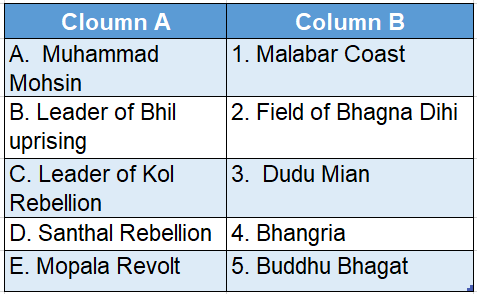
Several Arab traders had permanently settled on the Malabar coast of South India. Their descendants were known as Mopala.

The agriculturist Mopalas rose in rebellion against the tyranny of the Zamindars. This is known in history as the Mopala Revolt (1873-96).

2. Causes of revolt:

1. High rate of revenue:

The Mopalas were mainly farmers. The old zamindars recovered their lands after the death of Tipu Sultan through the generosity of the British Company.

When these zamindars began to extract revenue from the Mopalas at a high rate, they became rebellious.

2. Religious concerns:

The Mopalas were Muslims by religion. On the other hand, the local zamindars were mostly Hindus. So, religious issues were another cause behind these revolts.

3. Significance:

  1. The intensity of the Mopala revolt scared the British so much that they ordered the zamindars and the moneylenders to stop taking increased revenue and exorbitant interests respectively.
  2. The rates of revenue and interest were fixed.

Question 3 Discuss the role of the bourgeoisie in the Indigo Revolt.
Answer:

Role Of The Bourgeoisie In The Indigo Revolt:-

Introduction:

The Indigo Revolt took place under the leadership of the indigo farmers of Bengal in 1859.

The writers, editors, lawyers, and other intellectual groups played a vital role in this rebellion.

WBBSE Solutions For Class 8 History Chapter 5 Reaction To Colonial Rule Cooperation And Revolt Topic B Revolt and Movement against Company Rule

Role Of Middle-Class Intellectuals In The Indigo Revolt

1. Role of Press:

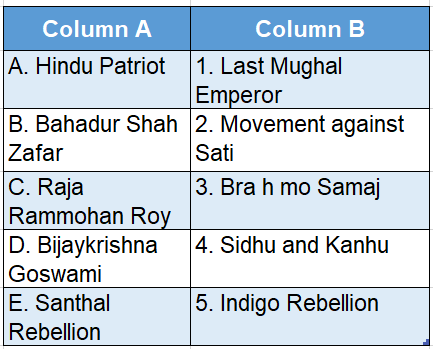
The ‘Hindu Patriot’ edited by Harishchandra Mukherjee regularly published the tales of the tyranny of the indigo planters.

Ishwar Gupta’s ‘Sambad Prabhakar’, Akshay Kumar Dutta’s ‘Tatwabodhini Patrika’, ‘Samachar Bhaskar’ and ‘Somprakash’ published several articles on Indigo Rebellion.

Apart from these, Sisir Kumar Ghosh also presented the story of the Indigo Revolt in his newspaper, ‘Amrita Bazar Patrika”.

2. Role of intellectuals:

Various writers and poets had written stories, plays, and poems on the Indigo Revolt to encourage the farmers.

Dinabandhu Mitra wrote the play ‘Nil Darpan’ in 1860 focusing on the tortures of indigo planters on the peasants.

This play was translated into English by Michel Madhusudan Dutta, alias Reverend James Long. He was fined 1000 rupees and imprisoned for one month.

Key Figures in the 1857 Rebellion Notes

3. Role of lawyers:

The indigo planters used to bring several allegations against the cultivators who did not have enough money to fight for their causes or defend themselves.

Under these circumstances, some lawyers from the urban middle class came to help the rebels.

Shambhunath Pandit and Prasanna Kumar Thakur called upon the people to resist the tyranny of the indigo planters.

4. Limitation of intellectuals:

Many of the intellectuals did not want the Indigo Revolt to become an anti-British movement.

They were enchanted by British rule and were dependent on the British government.

So, many of them withdrew when the rebellion reached its climax. Incidentally, Raja Rammohan Roy and Dwarakanath

Tagore was interested in indigo cultivation because they thought that the indigo business would increase the prosperity of rural India but no such thing actually happened.

Question 4 Discuss the causes and results of the Kol (Munda) Rebellion of 1899-1900.
Answer:

Causes And Results Of The Kol (Munda) Rebellion Of 1899-1900:-

Introduction:

The anti-British movement under the leadership of Birsa Munda in protest against

the eviction of Mundas from their lands is known as the Kol Rebellion in the history of tribal peasants’ revolt in India. It is also known as Munda Ulgulan (1899-1900).

Causes Of Kol Rebellion

1. Collapse of the agricultural system:

A special feature of the agricultural system of the tribal Mundas was ‘Khutkathi’ or ‘joint ownership of land’.

Now the British rulers removed this system and established the system of personal ownership of land.

2 Change in the social system:

The British government did away with the traditional law, justice, and social system of the Mundas and introduced a new code of law. This aroused discontent among the Mundas.

3 Land grabbing:

The contractors, money lenders, and zamindars who came from the northern plains drove away the Mundas from their lands and turned these into privately owned holdings. This made the Mundas rebellious.

4 Burden of taxes and bonded labor:

The Zamindars and Mahajans used to impose varieties of heavy taxes and high rates of interest on the Mundas.

Again they were compelled to render free labor. All these practices exhausted their patience.

5 Oppression by tea merchants:

The owners of the tea gardens employed the Mundas by showing false temptation since their main aim was to exploit the Mundas.

When the Mundas realized this truth, they became furious and rebelled.

Results Of Kol Rebellion

1. Chhotanagpur Tenancy Act:

The intensity of the Kol Rebellion compelled the government to pay attention to the grievances of the Mundas. So, the Chhotanagpur Tenancy Act was passed in 1908.

Impact of the Revolt on British Policies

2. Recognition of the Khutkathi System:

The Khutkathi system, i.e., the joint ownership of land was accepted by the government through the Chotanagpur Tenancy Act.

This act also prohibited the eviction of Mundas and employing them as bonded laborers.

3. Emergence of Birsa sect:

The Kol Rebellion was a failure but the contribution of Birsa Munda is always remembered in history.

A new sect emerged among the tribals which came to be known as the Birsa sect. In fact, the Mundas started adoring and worshipping Birsa as God on earth.

4. Beginning of Tana Bhagat Movement:

The Kol Rebellion also inspired the Oraos of Chotanagpur. The Bhaiyas launched the Tana Bhagat movement for the ownership of land.

Since the Oraos had themselves cleared the forests and made the lands cultivable, they were not ready to pay any rent to the British.

Question 5. Discuss the causes of the Great Revolt. of 1857.
Answer:

Causes Of The Great Revolt. Of 1857:-

Introduction:

The Great Revolt of 1857 was initiated through the Sepoy Mutiny which resulted from the dissatisfaction among the Indian soldiers.

However, the grievances of the Indians against the maladministration of the British found an outlet through the Great Revolt.

This massive revolt was the result of the outburst of grievances of all those who were continuously oppressed by the British.

Damodar Savarkar, a freedom fighter, has referred to it as the ‘first war of Indian independence’.

Causes Of The Revolt Of 1857

1. Political:

1. Doctrine of Lapse:

Lord Dalhousie annexed many Indian territories by applying the Doctrine of Lapse. In this way, he occupied Jhansi, Satara, Tanjore, and Nagpur.

2. Plunder of palaces:

The British plundered the palaces of Ayodhya and Nagpur on the plea of maladministration and drove away the Nawabs and their relatives from the palace.

This enraged the public against the British.

Short Notes on Major Uprisings of 1857

2. Social:

1. Social discrimination:

The British and the Indians were the rulers and ruled from a social point of view. This discrimination stirred up the consciousness of the Indians.

2 Hatred towards the Indians:

The British always looked down. upon the Indians. In many parks and European clubs, it was written ‘Dogs and Indians are forbidden’.

A magistrate in Agra issued a decree saying Indians should salute every Englishman.

3. Religious:

1. Opposition of rituals:

The positive measures taken by the British to remove social vices like Suttee, child sacrifice, infanticide, and other superstitions and to encourage widow remarriage offended the superstitious and orthodox Hindus.

2. Imposition of religious taxes:

The imposition of tax on the various religious institutions hurt the religious sentiments and the Hindu and Muslim families who were dependent on the lands of temples and mosques were infuriated.

industries: The British destroyed the Indian cotton textile industry for their own interests.

They imported the industrial products of England free of duty and turned India into a supplier of raw materials as well as a market for manufactured goods.

2. Deprivation in jobs:

The higher posts in the government were reserved only for the British on the pretext that Indians were corrupt. This caused great offense to the educated Indians.

5. Military:

1. Incivility of officers:

The British navy officers often ill-treated and abused the Indian soldiers. Such treatment enraged the Indian sepoys.

Class 8 History WBBSE

2. Lack of other facilities:

There was great discrimination between the salaries of the British and Indian soldiers. Moreover,

the Indian soldiers were neither given any extra allowances nor were they eligible to receive promotions to higher posts.

6. Immediate cause (Enfield Rifle):

The British government introduced the Enfield. rifle in which the shells of the cartridges had to be bitten off to load the cartridges in the gun.

A rumor spread that the shells were made of some substance containing the fat of cow and pig.

This hurt the sentiments of both Hindus and Muslims and they revolted against the authorities.

Question 6. Discuss the results of the Great Revolt of 1857.
Answer:

Results Of The Great Revolt Of 1857:-

Introduction:

The effect of the Sepoy Mutiny and the Great Revolt of 1857 could be felt in different spheres in the later periods.

The ideals of the Revolt greatly influenced both the policies and strategies of the British administration as well as the national liberation movement.

1. End of the Company’s rule:

After the Great Revolt, the British authorities could not entrust the Company with administrative responsibilities anymore.

So the India Government Act was passed in the British Parliament. The administration now passed into the hands of Queen Victoria and it was decided.

that a Governor General would rule India in the name of the Crown.

2. Administrative changes:

A Council Act was passed which annulled the centralization policy of the earlier Charter Act. The British administration in India began to be decentralized.

The Bombay and Madras councils were given the power to enact laws.

It was decided that the Secretary of State for India would be assisted by a fifteen-member council named India Council, in conducting the administration.

3. Military reforms:

After the Great Revolt, measures were taken to strengthen the defense system. The number of foreign soldiers in the army increased.

The recruitment of Indian soldiers in the artillery was stopped. The Presidency army was separated.

It was also decided that no Indian soldier should be appointed to any high post in the army.

Practice Questions on 1857 Revolt

4. Change in native politics:

Before the Great Revolt, the native provinces were annexed to the British Empire on the pretext of providing security to them.

From then on, the British adopted more friendly policies so that the British empire could last long.

5. Social changes:

The revolt brought about some changes in Indian society.

Society started to become modern with the touch of Western philosophy, science, and literature. However, the Muslims kept themselves aloof from such changes.

6. Queen’s Proclamation:

Lord Canning was the first Viceroy who came to India as a representative of Queen Victoria establishing a developed administrative system in India in accordance with the Government of India Act.

On November 1, 1858, Lord Canning read out a proclamation at a durbar (Conference) at Allahabad. This is known as Queen’s Proclamation.

Question 7. Mention the reasons for the failure of the Great Revolt of 1857.
Answer:

Reasons For The Failure Of The Great Revolt Of 1857:-

Introduction:

Though the Revolt of 1857 displayed much sacrifice and valor on the part of the Indians, it was ultimately a failure. There were several reasons behind this failure.

Causes For Failure Of The Revolt

1. Lack of coordination and planning:

There was a lack of coordination among the leaders of the Revolt and there was no previous planning. So it finally failed.

2. Lack of unity and integrity:

There was a lack of unity and integrity among the soldiers. Many of the rebel leaders paid more attention to narrow personal interests rather than to the broader national interest.

3. Separate objectives:

The different communities who participated in the revolt had separate objectives. The Muslim sepoys wanted

the revival of Mughal power whereas the Hindu sepoys wanted the establishment of the rule of the Peshwa. These separate aims prevented the revolt from succeeding.

4. Lack of discipline:

The Indian sepoys fought in a disorganized and indisciplined manner. On the other hand, the British army was very disciplined and organized.

Important Definitions Related to the 1857 Revolt

5. Lack of efficient leadership:

In spite of valor and enthusiasm, Indian leaders like Laxmibai, Nana Saheb, or Tantia Tope were not as efficient as the British generals like Lawrence, Outram, and Havelock.

6. Regional limitation:

The revolt was chiefly confined to Uttar Pradesh and its adjoining areas. Punjab, Sind, and many other regions remained aloof.

7. Noncooperation from native kings:

The native rulers like Scindia of Gwalior, Sir Jung Bahadur of Nepal, Begum of Bhopal, and the King of Jodhpur did not help the sepoys. They rather helped the British secretly.

8. Indifference of the educated middle class:

The educated middle class did not give any support to the Great Revolt. So the revolt finally became weak and failed.

Question 8. Discuss the nature of the Revolt of 1857.
Answer:

Nature Of The Revolt Of 1857:-

Introduction:

There is a controversy among historians regarding the nature of the Great Revolt. Some think that it was merely a military uprising.

According to some, it was a conservative revolt or a feudal reaction. Again, many people regard it as the ‘first war of Indian independence’ or a ‘national revolt’.

Nature Of The Revolt

1. Sepoy Mutiny:

Sir Syed Ahmed Khan, Durgadas Banerjee, and Dadabhai Naoroji regard the revolt as a mere Sepoy Mutiny. They think that

  1. different communities had joined the revolt to further their own interest and did not think of the national interest.
  2. Many people as well as groups remained aloof. Kings like Scindia, Holkar, Gaikwad, and Travancore did not join in it.
  3. The educated middle class did not support it. So this revolt cannot be called a national revolt.

2. Revolt of feudal lords:

The Marxist historian Rajni Pamdutta calls the revolt an uprising of conservative and feudal powers.

He points out that feudal rulers like Laxmibai, Nana Saheb, and Kunwar Singh led the revolt for their own interests.

3. National revolt:

Historians like John Kay, J. B Norton, and Malleson call the revolt of 1857 a ‘national revolt’.

Historian Shashi Bhushan Choudhuri has affirmed that it was a national war against imperialism.

The rebels showed their nationalistic spirit by declaring Bahadur Shah II the emperor.

Conceptual Questions on Causes and Consequences of Revolt

4. Mass rebellion:

It can be clearly said that the common people joined the revolt spontaneously. Millions of people staked everything and joined the revolt.

5. First War of Independence:

In his book. ‘The Indian War of Independence’ Vinayak Damodar Savarkar has referred to the revolt as ‘the first war of Indian independence’.

P C Joshi, in his essay ‘1857 in our history,’ refers to the revolt as a war of independence. Both Karl Marx and Friedrich Engels referred to the revolt as a freedom struggle.

Question 9 Can we call the Revolt of 1857 ‘the first war of Indian independence’?
Answer:

Yes, We Can Call The Revolt Of 1857 ‘The First War Of Indian Independence’:-

Introduction:

Historians differ among themselves as to whether the Great Revolt of 1857 can be called the first war of Indian independence.

Revolt Of 1857 The First War Of Indian Independence

1. Arguments for:

Nationalist leaders like Vinayak Damodar Savarkar and PC Joshi called the revolt the first war of Indian independence.

  1. Vir Savarkar wrote, “The revolt of 1857 was the first war of Indian independence”.
  2. P. C. Joshi wrote in his essay ‘1857 in our history that “The Great Revolt is the first Indian independence war”.
  3. Professor Shushovan Sarkar has said, “If we do not call the Sepoy Mutiny a national struggle then we cannot call the Carbonari Movement of Italy the ‘Italian Liberation War”.

2. Arguments against:

Scholars like Dr. Surendranath Sen, Ramesh Chandra Majumdar, and E.M.S. Nambudripad do not want to call the sepoy mutiny the first war of independence.

  1. Surendranath Sen, in his book ‘Eighteen Fifty-Seven’, said that the revolt of 1857 could not be regarded as a struggle for independence.
  2. Dr. Ramesh Chandra Majumdar said that the so-called first national war of Independence was neither the first nor the national War of Independence because the common people of India had not participated in it.
  3. E.M.S. Nambudripad said that ‘the number of soldiers who had helped the British to suppress the revolt was much more in number than the soldiers who had participated in the revolt.

Comment:

Judged from all aspects we cannot call the Great Revolt of 1857 the first war of Indian independence. It was chiefly the first great uprising against the British power.

Examples of Local Resistance Movements

Question 10. Write a note on Queen’s proclamation (1813).
Answer:

Queen’s Proclamation (1813):-

1. Introduction:

A radical change was made in the British administrative system after suppressing the Great Revolt.

The administrative power was transferred from the hands of the British East India Company to Queen Victoria of England.

Lord Canning, the first Viceroy of India read out a proclamation on November 1, 1858, at a conference at Allahabad. This is known as Queen’s Proclamation.

2. Background of The Proclamation:

After the Sepoy Mutiny, the British authorities did not regard it safe to leave the administration of India in the hands of a trading company.

They passed the Advanced India Government Act in the British Parliament. The administration of India was placed in the hands of the Crown.

It was decided that from now on colonial India would be ruled by a Secretary who would be elected from the cabinet of ministers.

This Secretary of State would be assisted by a council of 15 members.

The Governor General would henceforth be called Viceroy and he would conduct the administration as a representative of the crown.


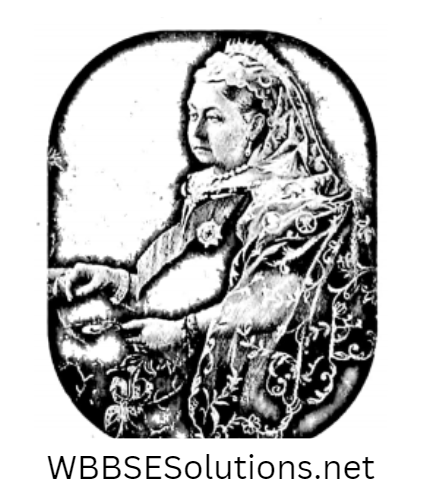
Wbbse Solutions For Class 8 History Chapter 5 Reaction To Colonial Rule Cooperation And Revolt Queen Victoria


3. Recommendations of The Proclamation:

The Proclamation stated that

  1. The Doctrine of Lapse would be abandoned and the native rulers could designate an heir.
  2. The Company would abide by the treaties signed between them and the native kingdoms earlier.
  3. The rebels, except those who were directly responsible for the killing, would be released. The confiscated properties would also be returned.
  4. The Company could neither annex any more kingdoms nor interfere in the internal matter of the native kingdoms.
  5. The eligible Indians would be given suitable government jobs irrespective of race and religion.
  6. The government would never interfere in the social and religious rituals of the Indians.

Result: Queen Victoria made a number of commitments in her Proclamation to redress the wound caused by the Company’s 100 years of misrule.

However, none of these promises were actually fulfilled. So historian Bipin Chandra calls this proclamation a political bluff.

However, the English people regard it as the Magna Carta of India because it laid the foundation of British rule for 60 years before the India Government Act of 1919 was passed.

Question 11. Suppose you and your friend are students of a school in Kolkata during the Young Bengal Movement under the leadership of Derozio. Discuss the merits and demerits of the Movement in the form of a conversation.
Answer:

The Merits And Demerits Of The Young Bengal Movement In The Form Of A Conversation In Kolkata:-

1. Anil: I think you’ve heard that Derozio, the professor of your Hindu College has built up an association with his students.

2. Amar: Yes, I have heard that, Anil. I have also heard that the name of the association is Young Bengal.

3. Anil: Do you know that the members of this association are quite modern?

4. Amar: Is it so? How?

5. Anil: The Young Bengals do not accept the sanctity of Ganges water. They dare to tear off the sacred thread. They even criticize the image in the temples.

6. Amar: What are you saying? I think this is almost like revolting against Hinduism.

7. Anil: I don’t know whether it is a revolt or not but their behavior and activities have stirred up the Hindu society.

The Brahmins and conservative Hindus have not been able to accept their behavior.

8. Amar: It’s not possible to accept such behavior. Otherwise, the very existence of Hindus will be at stake.

9. Anil: Exactly. I don’t know whether you know that under the pressure of Hindu society, the college authorities have accused Derozio of misleading the students.

Class 8 History Solution WBBSE

He has also been instructed to resign from his post at the college as a Professor.

10. Amar: Whatever you say, if this role of the students under the leadership of Derozio could remove the superstitions, then it would have been better.

11. Anil: Of course, they had attempted to do so but their endeavor to remove bigots and superstitions from the Hindu religion did not succeed.

After Derozio’s death, the members of the association got involved in their own individual lives.

12. Amar: Well, Anil, we will talk more about this later.

WBBSE Chapter 5 Reaction To Colonial Rule: Cooperation And Revolt Topic B Revolt And Movement Against Company Rile Short Answer Questions

Question 1. How did the bonded labor system lead to the Santhal rebellion?
Answer:

Bonded Labor System Lead To The Santhal Rebellion:-

The bonded labor system was an important cause of the Santhal Rebellion.

1. Bonds:

The poor Santhals were compelled to take loans (dadan) in cash or kind from the moneylenders who made them sign. two bonds Kamiyati and Harwahi.

2. Application of bonds:

According to the kamiyati system, the Santhals had to render free labor on the Mahajan’s land till the dadan was repaid.

According to the hardware system, they had to do other work apart from cultivation till the dadan could be paid back.

Since the Santhals were immensely tortured because of these bonds, they were compelled to rebel.

Question 2. What were the measures taken by the British to suppress the Kol (Munda) rebellion?
Answer:

Measures Taken By The British To Suppress The Kol (Munda) Rebellion:-

The British government tried to solve the problems of the Mundas by carrying out some investigations and surveys between the years 1902 and 1910.

1. Chotanagpur Tenancy Act:

The intensity of the Kol (Munda) Rebellion compelled the British to look into the grievances of the tribals. Therefore, the Chotanagpur Tenancy Act was passed in 1908.

Class 8 History Solution WBBSE

2. Recognition of the Khutkathi System:

Through the Chotanagpur Tenancy Act, the government also recognized the Khutkathi system, i.e., joint ownership of land.

Moreover, the eviction of peasants from the land and bonded labor were also prohibited.

Question 3. Name some leaders of the Great Revolt.
Answer:

Leaders Of The Great Revolt:-

  1. Begum Hazrat Mahal led the Great Revolt in Ayodhya.
  2. In Kanpur, the revolt was led by Nana Saheb the adopted son of Peshwa Baji Rao Il and his two associates Tantia Tope and Azimullah.
  3.  Rani Laxmibai was the leader of the uprising in Jhansi. Kunwar Singh led the revolt in Bihar.

Question 4 Who was Bahadur Shah Zafar?
Answer:

Bahadur Shah Zafar:-

Introduction:

Bahadur Shah Zafar was the 19th and the last Mughal emperor who ruled from the Diwani i khas of the Red Fort. He was a pensioned ruler of the East India Company.

Leader of Sepoy Mutiny:

He was declared the leader of the Sepoy Mutiny which broke out in 1857 when he was 82.

Last days:

The British army suppressed the revolt and occupied Delhi. The old emperor was imprisoned, declared guilty, and finally, deported to Rangoon.

Question 5. What do you know about the valor of Rani Laxmibai of Jhansi?
Answer:

Valor Of Rani Laxmibai Of Jhansi:-

1. Introduction:

Rani Laxmibai was one of the leaders of the Great Revolt. When Governor General Lord Dalhousie annexed.

Jhansi by applying the Doctrine of Lapse, the queen became enraged and joined the Sepoy Mutiny against the British.

2. Leadership in the revolt:

Laxmibai fought with the British army led by Hugh Rose. She left the fort of Jhansi and went to Kalpi and continued the struggle.

She joined hands with Tantia Tope and kept fighting valiantly against the English army. She died in the Battle of Kalpi in 1858.

General Hugh Rose paid a tribute to her by calling her ‘the sole man among the rebels’.

WBBSE Chapter 5 Reaction To Colonial Rule: Cooperation And Revolt Topic B Revolt And Movement Against Company Rile State Whether The Following Statements Are True Or False

Question 1. The Wahabi Movement was started in India by Syed Ahmed of Raibareli.
Answer: True

Question 2. In Bangladesh, the Wahabi movement was led by Buddhu Bhagat.
Answer: False

Question 3. The first martyr of the Sepoy Mutiny was Mangal Pandey.
Answer: True

Question 4. Lord Canning was the Governor-General of India during the outbreak of the Great Revolt of 1857.
Answer: True

Question 5. Laxmibai was a famous leader of the Santhal Rebellion in 1857.
Answer: False

Class 8 History Solution WBBSE

Question 6. The word ‘Faraz’ means carrying out one’s duties as instructed by Islam.
Answer: True

Question 7. The actual name of Titu Mir was Mir Nishar Ali.
Answer: True

Question 8. The word ‘Viceroy’ means a royal representative or a representative of the crown.
Answer: True

Question 9. The Mopala movement broke out at Madurai in South India.
Answer: False

Question 10. Muhammed Mohsin was known as Dudu Mian.
Answer: True

Question 11. ‘Dar ul Arab means a country of peace.
Answer: False

Question 12. Mangal Pandey was a sepoy of the Bengal regiment.
Answer: False

WBBSE Chapter 5 Reaction To Colonial Rule: Cooperation And Revolt Topic B Revolt And Movement Against Company Rile Fill In The Blanks By Selecting The Appropriate Expressions From The Brackets

Question 1. The declaration of Queen Victoria was published on weten _________ (November 1, 1857/ November 1, 1858/November 1, 1859).
Answer: November 1

Question 2. The Polyger Rebellion broke out in _________ (1779/1783/1788).
Answer: 1783

Question 3. The bamboo castle was built by _________ (Titu Mir/Buddhu Bhagat/Dudu Mian).
Answer: Titu Mir

Question 4. The Battle of Balakot was held in _________ (1821/1831/1841).
Answer: 1831

Question 5. _________ (Sidhu/Buddhu Bhagat/Birsa Munda) was the leader of the Kol Rebellion or Munda Revolt.
Answer: Buddhu Bhagat

Question 6. The founder of the Farazi sect was _________ (Maulana Haji Shariyatullah/Maulana Basarat Ali/Muhammad Mohsin).
Answer: Maulana Haji ShariyatullahMaulana

Question 7. _________ (Karim Shah/Abdul Gaffar/Ibne Abdul Wahab) was known as Noa Mian.
Answer: Abdul Gaffar

Question 8. The word ‘Wahabi’ means _________ (enemy country/new awakening/revolt).
Answer: new awakening

WBBSE Chapter 5 Reaction To Colonial Rule: Cooperation And Revolt Topic B Revolt And Movement Against Company Rile Very Short Answer Questions

Question 1. Who first started the Wahabi movement in India?
Answer: Syed Ahmed of Rai Barelli first started the Wahabi movement in India.

Question 2. When was the Indigo uprising organized?
Answer: The Indigo uprising was organized in 1859-60.

Question 3. How did the British force demolish the bamboo fort?
Answer: The British force demolished the bamboo fort by firing cannons.

Question 4. Who led the Munda Ulgulan?
Answer: The Munda Ulgulan was led by Birsa Munda.

Class 8 History Solution WBBSE

Question 5. What happened to the last Mughal emperor Bahadur Shah after the 1857 revolt?
Answer: To support the great revolt, the last Mughal emperor Bahadur Shah was convicted and exiled to Rangoon in Burma.

Question 6. When did the Government of India Act come into force?
Answer: The Government of India Act came into force on 1st November 1859.

WBBSE Solutions For Class 8 History Chapter 6 The Beginning of Nationalism Topic A Nationalist Organisation

Chapter 6 The Beginnings Of Nationalism Salient Points – At A Glance

1. Economic Nationalism:

The Moderates criticized the British administration openly for the economic crisis in India.

They said that India had gradually turned into land for supplying agricultural raw materials to Britain.

Again, India was being used as a market for selling goods manufactured in Britain. The agro-based economy of India was being used to protect the interests of Britain only.

Consequently, the agriculture and industry of India were being destroyed.

The exponents of this ‘economic nationalism’ were Dadabhai Naoroji, Mahadev Govind Ranade, and Ramesh Chandra Dutta.

2. Mitramela:

A new zeal entered the revolutionary movement of Maharashtra in the first half of the twentieth century.

The pioneers of the movement were the Savarkar brothers Vinayak Damodar Savarkar and Ganesh Savarkar.

They founded a secret revolutionary society named Mitramela in Nasik in 1899.

Here the youths were initiated into the revolutionary ideals and given. martial training.

Read and Learn More WBBSE Solutions For Class 8 History

WBBSE Solutions For Class 8 History Chapter 6 The Beginning of Nationalism Topic A Nationalist Organisation

WBBSE Class 8 Nationalist Organisation Notes

3. Abhinav Bharat:

In 1904 Ganesh Savarkar renamed ‘Mitramela’ as ‘Abhinav Bharat’ in imitation of Mazzini’s ‘young Italy’. This society aimed at obtaining freedom through armed revolution.

They made branches in different parts of the country where training was given for physical fitness, mountain neering, and fighting with swords and sticks.

The society also tried to infuse revolutionary ideals into the students.

WBBSE Class 8 History Chapter 6 The Beginning Of Nationalism

4. Lal Bal Pal:

Lala Lajpat Rai, Bal Gangadhar Tilak, and Bipin Chandra Pal were together known as ‘Lal Bal Pal’.

All of them were nationalist leaders who believed in extremism. Punjab Kesari, i.e., Late Lajpat Rai had led the movement against Simon Commission.

Bal Gangadhar Tilak said, “Swaraj is my birthright and I will attain it.”

The pioneer of passive resistance, Bipin Chandra Pal said, “Swaraj, cannot be donated or granted, it has to be attained.”

5. Theosophical Society:

The word ‘Theosophy’ consists of two words ‘Theos’ (God) and ‘Sophia’ (knowledge). So it means ‘knowledge of God.’

This term was first used by the Greek philosopher Lamblicus in the 3rd century, AD.

The ‘Theosophical Society’ was first established in New York by Colonel H.S. Olcott and Madame H.P. Blavatsky in 1875.

Then they established a branch of this society at Adiyar in Madras in 1886. Society became popular when Anne Besant joined it in 1889.

The theosophists who had deep faith in the Indian religion and philosophy tried to revive the ancient Hindu, Buddhist, and Parsee religions.

WBBSE Class 8 History Chapter 6 The Beginning Of Nationalism Explained

6. Ganapati and Shivaji Festival:

The basis of extremist nationalistic ideals of the Maharashtrian revolutionary leader Bal
Gangadhar Tilak was an ancient Hindu religion and history.

So Tilak took the initiative of converting the worship of Ganapati, which was prevalent among the Marathas, into a public festival named ‘Ganapati Utsav’ to inspire the youths with

the ideals of revolutionary nationalism and to spread nationalistic ideals among the public. He also organized the ‘Shivaji Utsav’ in 1895 to commemorate

the matchless patriotism, strength of character, valor, and achievement of Shivaji, the pride of Maharashtra, and project him as a representative of the revolutionary movement.

Through this festival, he tried to inspire the ideals of patriotism, self-sacrifice, and armed revolution against the British among the people of Maharashtra.

Formation of Indian National Congress Overview

7. Carlyle’s Circular:

Thomas Carlyle, the Chief Secretary of the British government issued a circular on 10th October 1905 to keep the Indian students aloof from the Swadeshi movement.

This is known as Carlyle’s Circular. According to this circular, punitive measures would be taken against students and universities who were involved in the movement.

WBBSE Solutions For Class 8 School Science Long Answer Type Questions WBBSE Solutions For Class 8 School Science Short Answer Type Questions
WBBSE Solutions For Class 8 School Science Very Short Answer Type Questions WBBSE Solutions For Class 8 School Science Review Questions
WBBSE Solutions For Class 8 School Science Solved Numerical Problems WBBSE Solutions For Class 8 School Science Experiments Questions
WBBSE Solutions For Class 8 Maths WBBSE Class 8 History Notes
WBBSE Class 8 History Multiple Choice Questions WBBSE Solutions For Class 8 History
WBBSE Solutions For Class 8 Geography


8. Silk Handkerchief Conspiracy:

Case: Mahendra Pratap built up a temporary independent Indian Government in Kabul.

Sheikh Mahamdul Hassan and Maulana Abdullah carried on an anti-British campaign from Kabul.

They used silk. handkerchiefs as the medium of exchanging messages. This exchange was done through. symbolic script.

The British government filed the Silk Handkerchief Conspiracy Case against them and many of the revolutionaries were imprisoned.

9. Safety Valve Theory:

Many people think that Hume had tried to keep the educated section of society aloof from the anti-British revolts.

So he tried to restrict the agitation against the British by establishing a political institution, i.e. the Indian National Congress.

Therefore, he had tried to use Congress as a ‘safety valve’ of the British Empire in India or as a preventive for destructive forces.

This theory came to be known as the ‘Safety Valve Theory’.

Chapter 6 The Beginnings Of Nationalism Topic A Nationalist Organisation Descriptive Questions

Question 1. Discuss the background of the formation of the Indian National Congress.
Answer:

Background Of The Formation Of The Indian National Congress:-

Introduction:

There is a controversy among historians regarding the real founder of the National Congress.

According to Pattavi Sitaramaiya, “Who first planned the formation of All India Congress is shrouded in mystery.

“Background For The Formation Of Indian National Congress

1. Role of different personalities:

1. Role of Hume :

  • Hume’s biographer William Waderburm gives the main credit for establishing the National Congress to Hume.
  • He had written an open letter to the graduates of Kolkata University urging the youths to participate in the progress and welfare of the country.
  • He met Lord Duffrein in 1885 and submitted a proposal for building up an all-India organization.

2. Role of Surendranath:

Surendranath played an important role by setting up a political organization to establish the rights of the Indians.

He built up public opinion against the British by establishing the Indian Association (Bharat Sabha) and also tried to organize a National Conference.

Key Nationalist Leaders in India

3. Role of Dufferin:

Womesh Chunder Bonerjee said that it was quite surprising to know that Duffrein was the actual founder of the National Congress.

2. Factors leading to the establishment:

1. Chief factor:

  • According to historian Rajani Pam Dutta, the Congress was formed as a ‘safety. valve’ or ‘safe regulator’ of British rule.
  • Hume’s main aim was to protect British rule from the growing dissatisfaction and agitation of the Indians.
  • He thought that lower-class people could rebel against the tyranny of the British at any time.
  • So they tried to establish the National Congress as a safety valve to protect the interests of the British.

WBBSE Class 8 History Chapter 6 Nationalist Organisation Key Points

2. Other factors:

  • A reawakening of the 19th Century The Renaissance or reawakening which was seen in religion and culture due to the rise of nationalism in India in the 19th century increased political awareness of the Indians.
  • Legacy of Western education The middle class, enlightened by Western education, took the initiative of organizing a movement for India’s freedom.
  • Oppression by the British The oppressed educated Indians felt that it was very necessary to build up a political organization to get rid of oppression and to obtain their rights and demands.

Question 2. Discuss the activities of Congress from 1885 to 1905.
Answer:

Activities Of Congress From 1885 To 1905:-

1. Introduction:

The activities of the National Congress for the first twenty years (1885 to 1905) were mainly confined to prayer and petition and a few demands.

Activities Of The Congress For The First Twenty Years-

2. Prayer and petition policy:

The early Congress leaders tried to get their demands fulfilled through 3 p’s i.e., Prayer Please and Petition.

They were more inclined towards extracting benefits for the upper classes rather than solving the problems of the common people. Their policy was called moderate policy.

The proposals which were accepted in the annual sessions were sent to the government for consideration.

3. Demands:

1. Demand for Proper constitutional reforms:

  1. Recruitment of more Indian members at the legislative council,
  2. abolition of the Indian Council,
  3. the opportunity of sending at least two representatives from each province to the House of the Commons
  4. inclusion of at least three Indian members in the advisory council of the Secretary of State.

Impact of Early Nationalist Movements

Topic A Nationalist Organisation Class 8 WBBSE History Question Answers

2. Demand for economic reforms:

  1. proper development of modern industries,
  2. use of more Indigenous products rather than foreign products,
  3.  reduction in the rate of revenue extracted from the peasants, changes in the laws concerning ownership of land, and establishment of agricultural and rural banks
  4.  abolition of income tax and salt tax and reduction of excise duty.

3. Demand for administrative reforms:

  1. Separation of executive and judiciary,
  2. introduction of the Jury system,
  3. holding Civil Service examinations in India and England simultaneously, raising the age limit from 19 to 23, and putting an end to statutory civil service
  4. provide military training to the Indians and appoint them to high military posts.

Question 3 What was the role of the political organizations in building up public opinion against the British?
Answer:

Role Of The Political Organizations In Building Up Public Opinion Against The British:-

Introduction:

A number of political associations, societies, and organizations arose in different parts of India in the 19th century after coming in touch with Western education.

These helped in building up public opinion against the British.

Short Notes on Poona Sarvajanik Sabha and Its Role

Role Of The Political Organisations Of Bengal In Forming Public Opinion-

1. Banga bhasha prakashika sabha (1836):

The Banga Bhasha Prakashika Sabha was founded by Prince Dwarakanath Tagore Prasanna Kumar Tagore, Kalinath Roychowdhury, and the followers of Rammohan the main aim of the Sabha was to analyze the effect of the activities of the British government.

2. Zamindar Sabha (November 12, 1838):

The Zamindar Sabha or Landholder’s Society was established by the joint endeavor of Prince Dwarakanath Tagore, Prasanna Kumar Tagore, and Radhakanta Deb. Their objectives were

  1. To obtain the rights of the zamindars and the subjects;
  2. To fulfill the political hopes of the Indians.

3. Bengal British India Society April 20, 1843) :

Bengal British India Society was founded in Kolkata by George Thomson, a member of the British India Society of England.

He was the president and Pyarichand Mitra was the secretary of the society. The objective of the society was to bring about the welfare of all sections of Indian society to ascertain their political and social rights.

4. British Indian Association (1851):

Zamindar Sabha and Bengal British India society combinedly formed the British Indian Association to establish a bigger political platform.

Its president and secretary were Radhakanta Deb and Dwarakanath Tagore respectively. This association demanded the protection of Indian resources,

more recruitment of Indians to high posts, separation of executive and legislature, and spread of education.

5. Indian League (1875):

Indian League was formed by Krishnamohan Banerjee, Hemant Kumar Ghosh, and Sisir Kumar Ghosh. Its president Sambhu Chandra Mukherjee demanded

the election of members of municipal corporations by the citizens and the spread of vocational education.

6. Bharat Sabha or Indian Association (July 26, 1876):

The Bharat Sabha was founded at Albert Hall in Kolkata by Surendranath Banerjee, Anandamohan Basu, Shivnath Shastri, and Dwarkanath Ganguly. The president,

secretary, and joint secretary were Rev. Krishnamohan Banerjee, Ananda Mohan Basu, and Akshay Kumar Sarkar respectively.

This association built up public opinion against the Civil Services Act, Arms Act, Vernacular Press Act, and for Illbert Bill.

WBBSE History Chapter 6 Class 8 Nationalist Organisation

Question 4. What do you know about the Ilbert Bill controversy?
Answer:

Ilbert Bill controversy:-

Introduction:

According to the Criminal Law of 1873, the Indian judges were not empowered to try the Europeans but their subordinate judges could do so.

Law secretary Courtney Illbert drafted a law named Illbert Bill which counteracted the previous discriminatory law on the advice of Viceroy Lord Ripon.

Ilbert Bill Controversy

1. Content:

The British maintained discriminatory policies from the very beginning. Lord Ripon introduced the new law to put an end to such racial discrimination.

It was declared that since then the Indian judges could try the European offenders.

2. Reaction:

As soon as the draft of the Libert Bill was published the Europeans broke out into agitation.

They formed a defense association under the leadership of Brunson, a barrister of Kolkata High Court.

Several branches of this association were established all over India as well as in England. The bill was vehemently criticized in the journals ‘Englishman’ and ‘The Times.

The Europeans conducted the movement under this association which collected a fund of rupees 1.5 lakhs.

In response to this movement, the Indian Association organized a counter-movement under the leadership of Surendranath Banerjee.

3. Amended bill:

The vehement protest and agitation of the Europeans compelled the British government to amend the bill. It was declared that

the Indian judges could try the Europeans with the help of the jury, most of whom were Europeans.

4. Significance:

The purpose of the bill failed as the government had to surrender before the movement of the Europeans.

Yet it bore some significance in the Indian nationalist movement the Indians realized that the main aim of the British was to create racial discrimination between

white and dark-skinned people. The Indians couldn’t attain dignity without attaining independence.

Practice Questions on Indian National Congress Formation

Question 5. Evaluate the contribution of the Moderate leaders in the history of the Indian
Answer:

Contribution Of The Moderate Leaders In The History Of The Indian:-

Introduction:

At the time of the foundation of the Indian National Congress in 1885, the early leaders were known as Moderates.

Some of the leaders were Womesh Chunder Banerjee, Dadabhai Naoroji, Badruddin Tyabji, Ramesh Chandra Dutta, and Dinanath Wacha.

Contribution Of Moderate Leaders

1. Creation of national awareness:

The Moderate Congress leaders were able to create a national awareness among the Indians of diverse religions and languages.

2. Establishment of national integrity:

The Congress consolidated national unity and awareness by holding sessions in different cities.

3. Prayer and petition policy:

The activities of the National Congress were confined to prayer and petition policy in the first phase.

he leaders avoided direct clashes with the British and tried to fulfill their demands through compromise.

4. Opposition of the government:

The early Congress leaders revealed the actual nature of British rule by continuously opposing governmental activities.

5. Three non-violent principles:

Initially, the Moderates followed “A policy of 3 p’s” which means “Prayer, please, and petition”. The earlier Congress leaders believed in these three principles.

6. Criticism Policy:

The method of the Congress in its early phase was criticism-based. In their annual sessions, the different policies of the British were criticized.

7. Policy of loyalty:

The early Congress leaders had much faith in British rule and justice.

Question 6. Who were the Moderates and How were their objectives and methods of action? Extremists?
Answer:

Moderates And Their Objectives And Methods Of Action:-

Introduction:

1. Moderates:

The first leaders of the National Congress, who tried to obtain their demands through the policy of prayer, please, and petition, were known as Moderates.

2. Extremists:

Some Congress leaders did not believe in the prayer and petition policy. They wanted to build up a strong protest against the British and attain complete freedom.

They were called Extremists. Some Moderate leaders were Womesh Chunder Banerjee, Dadabhai Naoroji, Gopal Krishna Gokhale, Surendranath Banerjee, and Ramesh Chandra Dutta.

Some Extremist leaders were Lala Lajpat Rai, Bal Gangadhar Tilak, Bipin Chandra Pal, and Aurobindo Ghosh.

Objectives and methods:

1. Objectives of Moderates:

The objectives of the Moderate leaders were

  1. to unify the Indians with the help of nationalism,
  2. to develop national awareness among the Indians,
  3. to present the proposals of the first session before the government.

Method: The method of protest of the Moderates was to criticize the policies of the British government.

They also tried to solve the social, economic, and political problems of the Indians through prayer and petitions to the government.

They believed in patience, compromise, and alliance.

2. Objectives of Extremists:

The objectives of the Extremists were

  1. Complete independence free of British control,
  2. to believe in Swadeshi, boycott and self-sacrifice policy, and plunge into direct struggle against the British,
  3. Conduct the national movement based on ancient Hinduism and history.

Method: The Extremists wanted to attain complete self-rule and independence from British rule by launching a strong protest.

So they gave up the policy of prayer, please, and petition and got involved in an armed struggle against the British.

Important Definitions Related to Nationalism

Question 7. Point out the causes of conflict between the Moderates and the Extremists.
Answer:

Causes Of Conflict Between The Moderates And The Extremists:-

Introduction:

  • The Moderate leaders of the first phase of the National Congress tried to satisfy the hopes and aspirations of the Indians through mutual agreement.
  • On the other hand, the Extremist leaders wanted to have their demands fulfilled through direct conflict.

Causes Of Conflict-

1. Difference in ideals:

The source of ideals hopes, and inspirations of the Moderate leaders was Western education.

The basis of the political ideals of the Extremists was ancient Hinduism, the past glory of India, and complete patriotism.

2. Difference in objective:

The chief aim of the Moderates was the attainment of self-rule. The chief aim of the Extremists was complete Swaraj or freedom.

3. Difference in method:

The Moderates followed the methods of prayer, please, and petition. The Extremists selected the methods of boycott, swadeshi, and spiritual empowerment.

4. Difference in nature:

The Extremist movement was the primary stage of the future mass movements.

The moderate movement was mainly confined to the middle class or highly educated professionals, teachers, and barristers.

5. Difference in consciousness:

The conflict between the Extremists and the Moderates took place as the former believed in self-dependence while the latter believed in the activities of the British.

6. Difference in social basis:

  • The social basis of Moderates and Extremists differed. The basis of the Moderates was the newly educated urban upper class.
  • On the other hand, the basis of the Extremists was the educated but deprived urban middle class.

Chapter 6 The Beginnings Of Nationalism Topic A Nationalist Organisation Short Analytical Type Questions

Question 1. Mention the constitution and purpose of the British Indian Association.
Answer:

Constitution And Purpose Of The British Indian Association:-

Constitution:

  • British Indian Association (founded in 1851) was a combination of the Landholders Association (1838) and the Bengal British Indian Society (1843).
  • The first president and secretary were Radhakanta Dev and Dwarkanath Tagore. The notable members were Ramgopal Ghosh and Pyarichand Mitra.

Purpose: The purpose of the British Indian Association could be known from an application to the government containing several proposals for reformation.

1. Protection of resources:

The government was expected to make adequate arrangements to safeguard the resources of the Indians.

2. Recruitment of Indians:

More Indians would be recruited in high governmental posts.

3. Separation of executive and judiciary:

The judiciary would be completely separated from the executive.

4. Independent Board:

An independent board would be formed with Indian representatives according to the British colonial model.

5. Expansion of education:

There would be adequate arrangements for the smooth expansion of education.

Conceptual Questions on Growth of Nationalism in India

Question 2 What do you know about the foundation and purposes of the Indian Association?
Answer:

Foundation And Purposes Of The Indian Association:-

1. Foundation:

The Indian Association was established by Surendranath Banerjee and Anandamohan Basu at the Kolkata Albert Hall (present Coffee House) on July 21, 1876. Shivnath Shastri and Dwarakanath Ganguly also helped in the establishment.

2. Purpose:

  1. The main purposes of establishing the association were
  2. building up powerful educated public opinion.
  3. unification of people belonging to different castes and languages
  4.  the condition of Hindu-Muslim unity and amity.
  5.  Involvement of the lower class people in society in the political movements.

Question 3. How did the Indian Association conduct the National Movement?
Answer:

Indian Association Conduct The National Movement:-

1. Demand for Civil Service:

The Association demanded that the Civil Examination should be held in England and India simultaneously. The minimum age should also be raised from 19 to 23.

2. Protest against Arms Act:

According to the Arms Act, no Indian could keep firearms without permission from the British government. The Indian Association strongly protested against this and built up public opinion.

3. Protest against the Vernacular Press Act:

Lord Lytton passed an act to exercise control over the newspapers published in Indian languages.

Surendranath Banerjee formed the Native Press Association in protest against this Vernacular Press Act.

4. Albert Bill controversy:

The Indian Association launched a counter-movement under the leadership of Surendranath Banerjee against the Alberta Bill Agitation of the white people.

Question 4. Write a note on the Arms Act of 1878.
Answer:

Arms Act Of 1878:-

1. Implementation:

The notorious Arms Act was implemented by Lord Lytton. According to this act, no Indian could keep firearms without the permission of the government.

2. Motive:

After the Great Revolt of 1857, the British government tried to disarm the Indians.

So the Arms Act was passed to disarm the Indians and exploit them more. The main purposes were

  1. to ensure that no more armed revolts occurred like the Great Revolt
  2. and to clearly show the distinction between the English and the Indians concerning the enjoyment of legal facilities.

Question 5 Write a note on the Vernacular Press Act (1878).
Answer:

Vernacular Press Act (1878):-

Implementation:

Lord Lytton issued the Vernacular Press Act on March 14, 1878, to strangle the newspapers published in various Indian languages.

Provisions:

  1. The editor and printer of a newspaper could not publish any such news which would incite grievances of the readers against the government.
  2. No such news could be printed which would aggravate racial enmity between the British and the Indians.
  3.  If any Indian newspaper violated these terms then the government would confiscate its money as well as its printing machine.

Examples of Early Political Associations in India

Question 6. What do you know about the Dramatic Performance Act?
Answer:

Dramatic Performance Act:-

Implementation:

Contemporary plays also helped in the rise and development of nationalism.

The plays which were enacted in different regions of Bengal depicted the poverty of the Indians and economic exploitation as well as the tyranny and oppression carried on by the British.

These aroused strong anti-British feelings among the public and thereby scared the government.

Governor General Northbrook passed the Dramatic Performance Act on March 14, 1876. This put a great restriction on dramatic performances.

1. Provisions:

The act provided that

  1. a copy of the manuscript of the play would have to be submitted at the nearest police station before staging it.
  2. The play would be staged only after permission was granted by the police station.
  3. No such play, which would help in the development of nationalism, could be staged.

Question 7. What were the main demands of the leaders of the early phase of Congress?
Answer:

Main Demands Of The Leaders Of The Early Phase Of Congress:-

The demands of the leaders of the early phase of the Congress were as follows.

1. Demand for including Indians in the administration:

  • The Moderate leaders of the early phase demanded forcefully that more Indians should be involved in the administration.
  • The British were finally compelled to pass the Indian Council Act in 1892 accepting this demand.

2. Demand for representation:

The early leaders demanded that the Indians who had been elected from local organizations like chambers of commerce and universities should be sent to legal counsel.

3. Demand for abolishing the office of the Secretary of State:

The Moderates also demanded that the office of the Secretary of State for India should be abolished.

Question 8. Why could the early Congress leaders not oppose the British directly?
Answer:

Early Congress Leaders Not Oppose The British Directly:-

There were some reasons why the Moderates could not oppose the British

1. Lack of mass acceptability:

It was not possible for an organization that consisted only of professionals like lawyers, doctors, journalists, and teachers only to succeed in opposing the British directly.

2. Organisational weakness:

The National Congress was not a political party in the modern sense of the term. It was quite weak from the point of view of finance and mass support.

3. Internal conflicts:

The inner conflicts among the different groups weakened the National Congress. There were conflicts between the Bombay and Poona groups,

between Surendranath and Bipin Chandra Pal in Bengal and between Lala Harkishan and Lala Lajpat Rai in Punjab.

Question 9. What do you mean by ‘Swaraj’?
Answer:

Swaraj:-

In the context of the National Movement ‘Swaraj’ initially meant the right to self-government. Later on, it came to mean ‘freedom’.

1. Early phase:

In the Kolkata session of the Congress in 1906, President Dadabhai Naoroji said that the aim of the National Movement was the attainment of Swaraj.

2. Later phase:

  • Later on, the Moderate and Extremist leaders explained ‘Swaraj’ according to their ideals.
  • Some Moderates thought that ‘swaraj’ meant the attainment of self-right by staying within British rule.
  • The great revolutionary Sekharan Ganesh Deuskar used the word ‘Swaraj’ as a synonym for freedom. Ball Gangadhar Tilak said, ‘Swaraj is my birthright.
  • Aurobindo Ghosh thought that Swaraj implies an ‘expression of moral and spiritual strength.”

Chapter 6 The Beginnings Of Nationalism Topic A Nationalist Organisation State Whether The Following Statements Are True Or False

Question 1. The leaders of the National Congress for the first twenty years (1885-1905) were known as Moderates.
Answer: True

Question 2. The founder of Bengal National College was Aurobindo Ghosh.
Answer: True

Question 3. The first session of the National Congress was held at Gokuldas Tejpal Sanskrit College in Delhi.
Answer: False

Question 4. The other name of the ‘Jatiya Mela’ organized by Nabagopal Mitra was ‘Hindu Mela’.
Answer: True

Question 5. Ramtanu Lahiri was the president of the first all-India conference of the Indian Association held in Kolkata.
Answer: True

Question 6. Most of the Extremists regarded British rule as the dictate of Providence.
Answer: False

Question 7. C.P. Ilbert was a member of the legislative council of Governor General Bentinck.
Answer: False

Question 8. The ‘Shivaji Utsav’ began in Maharashtra under the leadership of Shivaji.
Answer: False

Question 9. The final split between the Moderates and the Extremists took place in the Surat session of the National Congress in 1907.
Answer: True

Chapter 6 The Beginnings Of Nationalism Topic A Nationalist Organisation Fill In The Blanks By Selecting The Appropriate Expressions From The Brackets

Question 1. The President of the first session of the National Congress was _________ (Surendranath Banerjee/Womesh Chunder Banerjee/Dadabhai Naoroji).
Answer: Womesh Chunder Banerjee

Question 2. The great orator _________ (Keshab Banerjee/Chandra Sen/Surendranath Bipin Chandra Pal)was called the ‘Burke of Bengal’.
Answer: Bipin Chandra Pal

Question 3. In the _________ (Madras/Surat/Kolkata) session the National Congress was divided into two distinct groups the Moderates and the Extremists.
Answer: Surat

Question 4. A dispute arose between Moderate Gokhale and Extremist Tilak over the control of _________ (Indian Association/ Poona Sarvajanik Sabha/Zamindar Sabha).
Answer: Poona Sarvajanik Sabha

Question 5 _________ (Dr. Nilratan Sarkar/Dr. Mahendralal Sarkar/Acharya Prafulla Chandra Rai) established Bengal Chemical Pharmaceutical to establish indigenous industries.
Answer: Acharya Prafulla Chandra Roy

Question 6. Santiniketan was established by the initiative of _________ (Rabindranath Tagore/Bankim Chandra Chatterjee/Aurobindo Ghosh).
Answer: Rabindranath Tagore

Chapter 6 The Beginnings Of Nationalism Topic A Nationalist Organisation Answer In A Complete Sentence

Question 1. Which period is called the ‘age of sabha samitis’ of India?
Answer: The period from 1857 to 1885 is called the ‘age of sabha samitis’ of India.

Question 2. Who founded the Theosophical Society?
Answer: The Theosophical Society was founded by Colonel Olcott and Madame Blavatsky.

Question 3. Which is the first political organization of India?
Answer: The first political organization of India was the Landholder’s Society.

Question 4. Who started a movement in support of Ilbert Bill?
Answer: The Indian Association started a movement in support of the Ilbert Bill.

Question 5. Who is known as Lal-Bal-Pal?
Answer: Extremist Congress leaders Lala Lajpat Rai, Bal Gangadhar Tilak, and Bipin Chandra Pal together known as Lal-Bal-Pal.

Question 6. What was the aim of the moderates?
Answer: The moderate’s aim was to achieve partial autonomy for India within the fold of the British Empire.

Question 7. Write down the proposals which were accepted in the Calcutta session of 1906.
Answer: Swaraj, swadeshi, boycott, and national education four proposals were accepted in the Calcutta session of 1906.

WBBSE Solutions For Class 8 History Chapter 6 The Beginnings Of Nationalism Topic B Anti Partition Movement In Bengal And Revolutionary Terrorism

Chapter 6 The Beginnings Of Nationalism Topic B Anti Partition Movement In Bengal And Revolutionary Terrorism

Question 1. Analyze the causes of the rise of the mill- tant nationalism,
Answer:

Introduction: A section of Congress was quite dissatisfied with the prayer and petition policy and was highly disappointed by the activities of the leaders.

Thus a new group called the Extremists emerged within Congress.

Cause For The Rise Of Extremist Or Militant Nationalism-

1. Weakness of the Congress movement :

There was a lack of actual opposition from the British to the movement launched by the Moderates. This made the young members impatient.

Tilak demanded Swaraj saying, “Swaraj is my birthright, I will attain it.”

Read and Learn More WBBSE Solutions For Class 8 History

2. Oppressive Economic policy:

When the government passed the Taxation Act (1894) and Cotton Textiles Act (1896) for the interest of the capitalists, the anti-British. Militant nationalism emerged in India.

WBBSE Class 8 Anti Partition Movement Notes

3. Writings and thoughts of great men :

The basis of militant nationalism was formed by Vivekananda’s patriotism, Bankim Chandra’s call for complete sacrifice, and Vande Mataram Mantra,

Dayanand’s Hindu ideals, the Marathi translation of Goita by Tilak, Lajpat Rai’s biography of Shri Krishna in Urdu, and Aurobindo’s explanation of the Karma theory of the Gita in Bengali.

4. Indifference of the government:

When the poor Indians were dying of drought, famine, plague, and epidemic, the British government did not extend any help.

This offended the Indians and led to the rise of extremist tendencies.

5. Influence of newspapers and journals:

Several anti-British criticisms were published in Aurobindo Ghosh’s ‘Vande Mataram’, Bipin Chandra Pal’s ‘New India’, Sisir Kumar Ghosh’s ‘Amrita Bazar Patrika’, and similar other journals. Journals.

Again, newspapers like ‘Sandhya, ‘Sanjivani’, and Jugantar called for passive resistance against the British. In this way, militant nationalism arose.

6. Result of the autocratic policy of Curzon :

The Kolkata Corporation Act (1894), the Indian University Act (1904), and Curzon’s decision to partition Bengal revealed

the autocratic nature of British rule. It was chiefly Curzon’s decision to divide Bengal which gave rise to militant nationalism.

Important Definitions Related to Anti Partition Movement

WBBSE Solutions For Class 8 History Chapter 6 The Beginnings Of Nationalism

Question 2. Write down the causes and results of the partition of Bengal.
Answer:

Causes Of Partition Of Bengal

Real reasons:

1. Destroy the unity and integrity of Bengal:

Curzon had divided Bengal to weaken the national movement by destroying the unity and integrity of the Bengalees.

2. Weaken the Congress:

Curzon wanted to divide Bengal to weaken the Congress whose main center of activity was Kolkata.

3. Facilities for Muslims:

Curzon said that the Muslims would get more facilities in employment and higher studies if the Muslim-dominated East Bengal was separated from the Hindu-dominated West Bengal.

Results of the Partition:

1. Progress of national movement:

The Swadeshi and Boycott movements started as a protest against Lord Curzon’s decision to partition Bengal.

This anti-partition movement is recognized as the first fully anti-British movement in the mainstream of the Indian national movement.

2. Partition annulled: The anti-partition:

The movement was so strong that King George V was compelled to come to Delhi and announce the annulment of the partition on December 12, 1911.

WBBSE Solutions For Class 8 School Science Long Answer Type Questions WBBSE Solutions For Class 8 School Science Short Answer Type Questions
WBBSE Solutions For Class 8 School Science Very Short Answer Type Questions WBBSE Solutions For Class 8 School Science Review Questions
WBBSE Solutions For Class 8 School Science Solved Numerical Problems WBBSE Solutions For Class 8 School Science Experiments Questions
WBBSE Solutions For Class 8 Maths WBBSE Class 8 History Notes
WBBSE Class 8 History Multiple Choice Questions WBBSE Solutions For Class 8 History
WBBSE Solutions For Class 8 Geography


Causes of the Anti Partition Movement

3. Rise of Extremists:

The young leaders had to give up the Moderate policy to protest against the partition of Bengal.

So Extremist tendencies arose under the leadership of Bal Gangadhar Tilak, Lala Lajpat Rai, Bipin Chandra Pal, and Aurobindo Ghosh.

4. Expansion of Indigenous industries:

When the Swadeshi movement began as a protest against the partition some indigenous textile mills, banks, hosiery, and cosmetic factories were established.

5. Spread of national education:

The National Education Council was established on August 14, 1906. and National College,
Bengal National College and Bengal Technical College were established as protests against the partition.

Apart from these, 24 Madhyamik and 300 primary schools were established.

Question 3. Discuss the National Education movement in the Swedish period.
Answer:

National Education Movement In the Swadeshi Period

1. Background:

The government kept on passing laws to prevent the students from participating in the Swadeshi movement to stifle the movement.

The students were forbidden to participate in political movements or meetings or even chant ‘Vande Mataram’

through notorious laws like Carlyle Circular (October 10, 1905), Leon Circular (October 16, 1905), and Pedlar Circular (October 21, 1905).

Bipin Chandra vehemently criticized all these circulars at a public meeting on October 24, 1905. He proposed to introduce an independent national education

Motive:

The main motive of the national education movement was to discard foreign education and provide indigenous education to the students thereby inspiring them with nationalist ideals.

So schools sprang up in different parts of the country through native enterprise.

Key Leaders of the Anti Partition Movement

Spread of National Movement-

1. Foundation of national institutions:

The first national school was established by Kaliprasanna Dasgupta and Brajasundar Roy at Rangpur in East Bengal on November 8, 1905.

The Anti-Circular Society was founded by Sachindra Bose in November 1905 to encourage students to join the anti-British movement.

The main purpose of the society was to arrange for the education of those students who were rusticated from schools for anti-government activities.

2 Financial Assistance:

Many people extended financial help to make this system a success. Some of them were Subodh Chandra Mullick, Brajendra Kishore Roy Chowdhury,

Suryakanta Acharya Chowdhuri, Sir Taraknath Palit, Dr. Rash Behari Ghosh, Rabindranath Tagore, Sir Gurudas Banerjee, and Hirendranath Dutta.

3. Spread of national education in Bengal:

The National Council of Education was established in Kolkata on March 11, 1906, with 92 members under the presidency of Satyendranath Tagore.

This Council established educational centers at different places and so the system began to spread rapidly.

A national college was established on August 14, 1906, with Aurobindo Ghosh as the Principal. The Bengal Technical Institute was founded on July 25, 1906.

Later on, Santiniketan and Sriniketan were established by Rabindranath Tagore.

Impact of the Anti Partition Movement on Nationalism

4. National Education in other provinces:

The ideals of national education became popular in other provinces also. National schools were established in Bombay, Madras, UP, and Bihar.

A national college was established in Mousulipattanam. A national educational council was established in Andhra Pradesh in 1909.

Question 4. Discuss the role of Rabindranath in the spread of the Swadeshi movement.
Answer:

Introduction:

In 1905 Curzon decided to divide the Bengal Presidency which was the vital center of Indian nationalism. The nationalists tried to prevent the partition at any cost.

Rabindranath Tagore voluntarily joined the boycott and Swadeshi movements which were a part of the anti-partition struggle.

Swadeshi Movement And Role Of Rabindranath

1. Opposing Carlyle Circular:

Chief Secretary Thomas Carlyle issued a repressive decree named Carlyle Circular on October 10, 1905, to keep the students aloof from the anti-partition movement.

A meeting was arranged at Charu Chandra Mullick’s residence at Pataldanga in Kolkata under the Presidentship of Rabindranath to oppose this decree.

In this meeting, all university students were urged to severe connection with Kolkata University.

2. Raksha Bandhan festival:

The partition of Bengal was to be enforced on October 16, 1905. The Bengalees expressed their grievances on that day through different programs.

Raksha Bandhan festival planned by Rabindranath Tagore Rabindranath was one of the main programs.

Wbbse Solutions For Class 8 History Chapter 6 The Beginning Of Nationalism Rabindranath Tagore

The people from both parts of Bengal took a holy bath in the Ganga and tied yellow threads on each other’s wrists to maintain fraternity and the unity of their motherland.

Then they chanted Vande Mataram and sang, patriotic songs composed by Rabindranath and walked in a procession barefooted.

3. Composing patriotic songs:

Rabindranath composed 27 patriotic songs during the Swadeshi period (1905-12) to arouse patriotism among the people and add momentum to the movement.

4. Patriotic feelings:

Rabindranath had found a big possibility of developing spiritual strength in constructive patriotic thoughts.

His patriotic feelings were reflected in his speech on the planning of indigenous industry, agriculture, cooperatives, and milk supply.

This speech was delivered at the provincial conference held in Pavna in 1907. He also took up several programs at Shantiniketan and Sreeniketan for the materialization of those plans.

Question 5. Write an essay on the anti-partition movement in Bengal.
Answer:

Introduction:

Lord Curzon’s decision to partition Bengal was a shameful and condemnable incident of British rule in India.

The anti-partition movement began as a protest against this decision.

The anti-partition movement developed in three phases swadeshi, boycott, and national education movements.

1. Swadeshi:

1. Indigenous industries:

Attempts were made to expand the indigenous industries based on patriotic ideals. So indigenous textile mills, banks, hosiery, and cosmetic companies were established.

Acharya Prafulla Chandra Roy founded Bengal Chemical Chemical and Pharmaceutical, Chidambaram Pillai established a shipping company, Dr.

Nilratan Sarkar established a shoe factory and Jamshedji Tata established the Tata Iron and Steel Company.

2. Literature and culture:

A new tide entered the native literature and culture as a result of the Swadeshi movement.

2. Boycott:

1. Beginning:

The decision to boycott was first declared through Krishna Kumar Mitra’s ‘Sanjivani’,.

The boycott movement began with a meeting arranged at Kolkata Town Hall and carrying on a program of picketing.

2. Agenda:

The Bengali students and teachers boycotted English schools. The lawyers and clerks boycotted English courts.

Even the washermen, barbers, cooks, and other lower-level workers refused to serve the English people.

At the same time, picketing continued before the shops selling British goods and many foreign goods were burnt.

3. Pervasive ness:

The students spontaneously participated in the movement. So the government issued the Carlyle Circular on October 10, 1905.to stop the students from participating.

The women also gave up wearing sarees and glass bangles made in England.

3. National Education Movement:

Backdrop Carlyle Circular, Leon Circular, and Pedlar Circular stirred the students and the whole field of education immensely.

2. Objective:

The main objective of this movement was to discard foreign education and provide Indigenous education to students thereby inspiring them with

3. Spread:

The first patriotic ideals. A national school was founded at Rangpur by Kaliprasanna Dasgupta and Brajasundar Roy.

Anti-circular society was established by Sachindra Basu in Kolkata.

Satyendranath Tagore established the National Education Council in Kolkata with 92 members. A national college was established with Aurobindo Ghosh as its Principal.

Conceptual Questions on Revolutionary Activities Against British Rule

Question 6 Discuss the role of newspapers in the anti-partition movement.
Answer:

Introduction:

The newspapers published in various languages spoke vehemently against the partition.

Jugantar wrote that the 30 crore Indians would have to raise 60 crore hands to stop such accursed tyranny of the British.

Role Of Newspapers

Native Newspapers:

1 Bengali newspaper:

1. Sanjivani:

An editorial was first published in Sanjivani by Krishna Kumar Mitra criticizing the decision to divide Bengal.

2. Vandemataram:

In the journal ‘Vandemataram’ Aurobindo Ghosh wrote that a new awareness was created among the Bengalees on August 7, 1905, as if they had just awakened from a 150-year long sleep

3. 0thers:

Articles opposing the partition were also published in Bhupendranath Dutta’s Jugantar’, Manoranjan Guha Thakurta’s ‘Navashakti’ and Bhahma Bandhav Upadhyay’s Sandhya’.

2. English Newspapers:

1. Bengalee:

Surendranath Banerjee opposed the partition through his newspaper ‘Bengalee’ saying that “I shall make a permanent incident impermanent.”

2. 0thers:

The partition was also opposed by ‘Modern Review of Ramananda Chattopadhyay, ‘Don’ by Satish Chandra Mukhopadhyay, and ‘Indian World’ by Prithvish Chandra Roy.

3. Muslim Periodicals:

Articles criticizing the partition were also published in ‘The Mussalmans’ by Hussain Mujibar Rahman, ‘Ajijul Nehar’ by Mir Mosharraf, and ‘Islam Prachar’ by Muhammad Roazuddin.

Foreign Newspapers:

Even British newspapers like ‘Daily News’ of London, ‘Pioneer’, ‘Times’, ‘Manchester Guardian’ and ‘Englishman’ spoke bitterly against the partition.

Question 7 Evaluate Morley Minto Reforms critically.
Answer:

Introduction:

The reforms introduced. by the Secretary of State for India John Morley and Viceroy Lord Minto in 1909 to change

the administrative system in India, are known as the Morley Minto Reforms or Council Act of 1909.

Morley-Minto Reforms

1. Reason for introducing the act:

The British were quite relieved by the conflict between the Moderates and the Extremists and the rift between the Muslim League and the National Congress.

However, they were quite disturbed by the spread of armed revolutionary activities and the continuous agitation for self-government.

A deputation of the Muslim League under the leadership of Aga Khan met Lord Minto and demanded a separate electorate and privileges. For the Muslims.

So the government introduced the Morley Minto Reforms Act.

2. Features of the act:

The Morley Minto Reforms Act had two parts:

1. Working or Executive Council:

  1. Only one Indian, i.e. barrister Satyendra Prasanna Sinha, was included in the Viceroy’s executive council. He was appointed as the Secretary of Law.
  2. The number of members in the executive councils of Madras and Bombay increased from two to four.
  3. An executive council was also formed for the governor of Bengal in which Kishorilal Goswami was included.

2. Legislative council:

  1. The number of members of the central council was raised from sixteen to sixty.
  2. The number of members of the provincial councils was kept between thirty and fifty.
  3. The Muslims were granted the right to choose their separate representatives. In this way, communal representation was acknowledged.

3. Significance:

This autocratic system of administration was a combination of the autocracy of the earlier Hindu and Muslim periods and the constitutionalism of the British.

Through this Act, the aristocrats as well as the middle classes of contemporary India could participate in the legislation procedure of the government.

4. Reaction of Indians:

After the introduction of the Morley-Minto Reforms Act, it was strongly criticized by politicians as well as people from all sections of society.

The provision for a separate electorate for the Muslims shows the initiation of the Two Nation theory. According to Gandhiji, it was a death blow to the Indians.

This system was also vehemently condemned by Jawaharlal Nehru.

Short Notes on the Swadeshi Movement

Question 8. Give an account of the revolutionary activities in Bengal till World War Answer:

Introduction:

Bengal was the main center of the revolutionary movement in India. The concept of armed revolutionism began to spread in the national movement at

the beginning of the 19th century and the revolutionaries of Bengal played a pioneering role in it.

Revolutionary Movement In Bengal Till The First World War

1. Contribution of Secret societies:

1. Anushilan Samiti:

Pramathanath Mitra and Satish Chandra Basu established “Anushilan Samity” in 1902. The members were taught

the techniques of stick fight, sword fighting, dagger fighting, use of pistols, physical fitness, swimming, and horse riding.

Some important members were Aurobindo Ghosh, Barindra Kumar Ghosh, and Jadugopal Mukherjee. Branches

were established in different districts and cities like Dhaka, Mymensingh, Rajshahi, Rangpur, Chittagong, and Comilla.

2. Jugantar Dal:

Barindra Kumar Ghosh and Bhupendranath Dutta began to spread revolutionary ideals through their journal Jugantar’.

Gradually an association named Jugantar Dal was formed. They tried to achieve freedom through armed struggle.

Hemchandra Das learned the bomb-making techniques from Paris and Kshudiram and Prafulla Chaki was entrusted with the task of assassinating Magistrate Kingsford.

3. Other associations:

Other revolutionary societies that grew up in different parts of Bengal were

‘Dhaka Anushilan Samity’ of Pulin Beheri Das, ‘Attonnati Samity’ of Barindra Kumar Ghosh and Bhupendranath Dutta, ‘Brati Samity’ and ‘Suhrid Samiti’.

2. Aurobindo’s Contribution:

During the partition, Aurobindo Ghosh left the post of Principal in Baroda and became the Principal of Kolkata National College (present Jadavpur University).

He published ‘Jugantar’ and later on became the editor of Bipin Chandra Pal’s ‘Vande Mataram’ through which he spread revolutionary ideals.

He formed the ‘Nationalist Party with the help of Tilak. He inspired the revolutionaries to make bombs at a garden house in Muraripukur.

3. Contribution of Kshudiram Bose and Prafulla Chaki:

The Jugantar Dal entrusted the task of assassinating Magistrate Kingsford to Kshudiram Bose and Prafulla Chaki.

However, they mistook the car and killed two ladies Mrs and Miss Kennedy instead.

Prafulla Chaki committed suicide on May 1, 1908, before being arrested and Kshudiram was hanged on August 11, 1908.

4. Bagha Jatin’s contribution:

Jatindranath Mukherjee or Bagha Jatin played an important role in the armed revolutionary movement of Bengal at the beginning of the 20th century.

He planned to carry out an armed anti-British campaign in India with the help of Germany. So 50 guns and 46,000 rounds of cartridges were plundered on August 26, 1914.

Money and firearms were also sent from Germany. He went to Baleshwar in Orissa to collect arms from the German ship Maverick.

Unfortunately, his plan was leaked and he and his associates had to fight against the British forces on the banks of Burhibalam. Bagha Jatin died as a martyr on September 10, 1915.

5. Contribution of others:

  1. The revolutionists murdered the public prosecutor of the Alipur bomb case Ashutosh Biswas.
  2. Deputy Superintendent of Police Samsul Alam was killed in the High Court in 1910.
  3. The officer in charge of Nandalal Banerjee was also killed for his attempt to have Prafulla Chaki arrested.

Examples of Protests During the Anti Partition Movement

Question 9. Discuss the significance of the revolutionary movements.
Answer:

Introduction:

Though the brave revolutionaries failed despite their courage and self-sacrifice, their contribution was not insignificant.

We cannot ignore this movement from the point of view of history.

Significance

1. Objective attain independence:

The prime objective of the Indian National Movement was to attain independence. The revolutionary movement also had the same aim.

So the latter had rendered strength to the former.

2. Establishing the value of independence:

The revolutionaries had established the value of independence by sacrificing their lives. They were a vital factor in making the Indians understand that freedom was invaluable.

3. Establishing new political. Ideal:

The revolutionaries had established contact with foreign countries at different times while making preparations for armed struggle.

In doing so they opened the door for the entry of foreign political ideals into Indian politics.

M. N. Roy helped to lay down the foundation of Marxism in India by establishing contact with Russia.

4. Rise of armed struggle:

As the revolutionaries had engaged themselves in armed struggle for independence both within and abroad, a new method of struggle came into, existence.

This method included secret murders, preparations for the sudden uprising, and attempts to influence the army.

5. Panic among the British:

Although the armed revolutions could not uproot British rule, they could create much panic in the British bureaucracy.

The rulers were quite anxious and frightened regarding self-defense due to the activities. Of the revolutionaries.

6. Aid of foreign power:

The revolutionaries never hesitated to seek foreign aid for the sake of India’s independence.

They were the first to set the example that one could fight for his freedom even with the help of foreign powers.

For instance, Netaji Subhas Chandra Bose had dreamt of making India independent with the help of foreigners. Power.

Question 10. Suppose you were a student of a government school during the anti-partition and Swadeshi movements. Write a letter to your friend narrating your experience of the National Education movement.
Answer:

Dear Ankush,
Kolkata
25.7.1906

Hope you and your family members are in the best of spirits. Today I shall tell you about my experience of the National Education movement through this letter.

I think you know that the anti-partition movement and Swadeshi movement started in protest against Lord Curzon’s decision to partition Bengal.

The National Education movement has also been launched as a part of the Swadeshi movement. Indians are being urged to boycott the English language and foreign educational methods.

Many indigenous educational institutions have been set up to spread indigenous education. Some of them are Rabindranath’s Brahmacharya Ashram,

Brahma Bandhav Upadhyay’s Sarswat Ayatan and Satish Chandra Mukhopadhyay’s ‘Don Society’: A mass meeting was also organized by the Don Society.

Subodh Chandra Chandra Mullick and Brajendra Kishore Roychowdhuri have donated rupees one lakh and five lakhs respectively for the spread of national education.

The National Education Council was established through a meeting presided over by Satyendranath Tagore in Kolkata.

The Bengal National School and College have been founded under the initiative of the Council.

Aurobindo Ghosh has been appointed the Principal of the college. In this way, national education has been spreading through the native initiative.

We expect that more native institutions will the established.

Let me stop here today.

Waiting for your reply.

Yours affectionately,

Soham

Chapter 6 The Beginnings Of Nationalism Toic B Anti Pqartion Movement In Bengal And Revolutionary Terrorism Short Analytical Type Questions

Question 1. What was the main objective of Curzon’s partition of Bengal?
Answer:

1. Destruction of unity and integrity of Bengal:

Curzon wanted to create dissension between the Hindus and Muslims and destroy the integrity of the Bengalees.

The new feelings of nationalism and new awakening which were ignited by the great men of Bengal in the 19th century influenced the whole of India.

2. Weaken the National Congress:

Kolkata was the most vital center for Congress because all the transactions of the party were conducted from there.

So Curzon wanted to divide Bengal into two parts and thus harm the activities of the Congress.

Question 2. What do you mean by the ideal of ‘boycott’?
Answer:

1. Meaning:

The word ‘boycott’ means to refuse. However, the boycott which was concerned with the partition of Bengal aimed at refusing to use British goods.

2. Nature:

The discarding of British goods began on the day of partition, i.e., October 16, 1905. Students boycotted schools and colleges and shops and markets were picketed.

The cobblers refused to mend foreign shoes and the washermen refused to wash foreign clothes. In this way, people from all sections of society participated in the boycott.

3. Objectives:

To harm the commercial interests of the British, to build up public opinion against the partition,

to avoid all British goods and ideas and spread constructive rationalism as compensation.

Question 3. What do you mean by, the ideal of ‘Swadeshi’?
Answer:

1. Meaning:

The literal meaning of ‘Swadeshi’ is native. It indicates faith and reverence towards the tradition and lifestyle of one’s own country.

Lala Lajpat Rai said Swadeshi means “the liberation of the country”.

2. Origin:

Gopal Hari Deshmukh first used this word at Poona in 1849. In 1876 the Hindu Mela spread Swadeshi ideals.

In Kolkata, this idea was popularised by the essays written by Bhola Nath Chandra in Mukherjee’s magazine.

3. Beginning of the movement:

The Swadeshi movement began in India as a protest as well as a resistance against the decision to partition Bengal.

The ideals of Swadeshi and Boycott were linked together. Swadeshi could be achieved through the boycott of foreign ideas, lifestyles,s, and goods.

Question 4. What was the agenda of the Boycott Movement?
Answer:

1. Meaning:

The word “boycott” means to refuse. The widespread resistance offered by the Bengalees against Lord Curzon’s plan to partition Bengal was called the Boycott Movement.

2. Agenda:

  1. Boycott foreign clothes, salt, shoes, and cigarettes.
  2. Resignation from posts in government offices like magistrate, district board, municipality, and Panchayat offices.
  3.  Resignation from the court, legal counsel, and other representative institutions.
  4.  Boycott of titles, designations, and language.
  5. Boycott of educational institutions.
  6. Picketing in front of shops that sold wine, sugar, and other such foreign goods.

Practice Questions on Anti Partition Movement

Question 5. Write a note on Swadeshi (native) industrialization.
Answer:

1. Textile:

The Bangalaxmi and Mohini mills were set up in Bengal with the help of the native capital.

Many cloth mills grew up in Howrah, Haripal, Dhanekhali, and Chattagram. There was also high production in the cloth mills of Ahmedabad and Bombay.

2. Metallurgy:

Jamshedji Tata established the iron and steel industry in Jamshedpur. Sudhir Kumar Sen set up a cycle factory, and Chidambaram Pillai established a shipping company.

The cutlery industry grew up at Krishnanagar.

3. Medicine and chemicals:

Acharya Prafulla Chandra Roy founded Bengal Chemical. Dr. Nilratan Sarkar established the National Soap Factory.

The National Medical College grew up in Kolkata as a native hospital.

4. Other industries:

Other industries were leather, matches, sugar, paper, and pottery.

Question 6. What was the contribution of Muslim society to the Boycott Movement?
Answer:

1. Condemning partition:

Many members of the Muslim society condemned Curzon’s decision to partition Bengal. A censure motion was passed by the Central Mohammedan Association.

2. Public meetings:

Muslims opposed the partition in a public meeting in Kolkata under barrister Abdul Rasul.

3. Namaj in the Masjid:

Namaj was read in the mosques of Barisal, Mymensingh, and Sreerampur opposing the partition.

4. Providing leadership:

Stalwarts like Khwaja Atikulla, Abdul Shavan Choudhuri, and Maulavi Ismail Siraji came forward to lead the Movement.

Question 7. Why was the Raksha Bandhan Festival celebrated?
Answer:

Rabindranath decided to observe October 16, 1905 (the day of partition) as Rakshbandhan Day.

1. Maintain communal unity:

Lord Curzon tried to destroy Hindu-Muslim unity by dividing Bengal and thus weakening the national movement.

Rabindranath Tagore tried to uphold unity through the Raksha Bandhan festival.

2. Maintain territorial integrity:

Lord Curzon divided the Bengal Presidency into Bangladesh East Bengal and Assam.

This shattered the territorial integrity of Bengal and Raksha Bandhan festival was a mute yet symbolic protest against it.

Question 8. What was the contribution of the students to the Boycott Movement?
Answer:

1 Boycott foreign educational institutions:

The students participated in the Boycott Movement and took a pledge to boycott all foreign educational institutions. They also took a vow to avoid using foreign paper and pen.

2. Picketing:

The students started picketing before the shops that sold foreign clothes, wine, sugar, and salt.

3. Meetings:

The students organized several meetings at the campus of Ripon College (present Surendranath College), the Hindu hostel, and the Town Hall.

Question 9. Write about the formation and ideals of the Gadar party.
Answer:

1. Instructure:

Lala Hardayal established the Gaden Party in San Francisco in 1913 with the help of Sohan Singh Bhakra.

The word Gadar means ‘revolution’. About 15,000 resident Indians including Sikhs, Christians, and Muslims took membership in the party.

The first President was Keshar Singh and the Secretary was Lala Hardayal.

2. Ideals:

The journal of this party, the ‘Gadar’ was first published on November 1, 1913. This paper was used to spread revolutionary ideals in English, Hindi, Gujarati, and Urdu languages.

Their noble and. determined motive could be known from one of the advertisements. It said, “Brave soldiers wanted” to light the fire of gaydar (revolution) in India.

Salary death, reward martyrdom; stipend independence, battlefield India.”

Question 10. Why is Kshudiram Bose remembered?

Answer:

Kshudiram Bose was a brave revolutionary whose name remains immortal in the history of Bengal as well as that of India.

He was a member of the secret revolutionary organization called ‘Jugantar’.

1. Example of self-sacrifice:

Kshudiram wanted to kill the tyrant district judge Kingsford but he killed Mrs and Miss Kennedy by mistake.

He was hanged to death on August 11, 1908. This martyrdom of Kshudiram will always be remembered in history.

2. Inspiration youths:

Kshudiram’s martyrdom proved that the Indians were ready to make any sacrifice to win independence from the British.

When the armed movement reached its extreme at the beginning of the twentieth century, this idea became more prominent.

This example of self-sacrifice inspired future generations to participate in the freedom movement of India.

Question 11. Why is Bagha Jatin remembered?
Answer:

1. Example of the armed uprising:

Bagha Jatin planned an armed uprising in India by importing arms from Germany and taking. Help from the defense department of the government of Germany.

2. Example of self-sacrifice:

The example of self-sacrifice shown by Bagha Jatin and his associates Chittapriya Roy Chowdhury, Monoranjan Sengupta,

Jyotish Pal and Niren Dasgupta at the Battle of Burhibalam will always be remembered in history.

3. Ideal for future generations:

Bagha Jatin’s self-sacrifice at the Battle of Burhibalam (September 10, 1915) to free India with

the help of foreign aid served as an ideal for the future generation. His activities as a revolutionary made him immortal in history.

Question 12. What was the impact of the armed revolutionary movement on India’s independence?
Answer:

1. Ideal of liberty:

The armed revolutionaries had established a new value that independence was invaluable and self-sacrifice was more desirable than a life of slavery.

They considered death as a trifle. And played an important role in instilling the value of freedom among the Indians.

2 Panic among the British:

The armed revolution created panic among the British for the first time. The British aristocracy got terrified of seeing

The desperate attempt of the revolutionaries to get freedom through murder, secret killings as well as military uprisings.

Chapter 6 The Beginnings Of Nationalism Toic B Anti Pqartion Movement In Bengal And Revolutionary Terrorism State Whether The Following Statements Are True Or False

Question 1. Curzon decided to partition Bengal on the recommendation of the Rijli Commission.
Answer: True

Question 2. The decision to partition Bengal was put into action on October 16, 1906.
Answer: False

Question 3. The decision to partition Bengal was annulled on December 12, 1911.
Answer: True

Question 4. The Anushilan Samity was formed by Pramathanath Mitra and Satish Chandra Basu.
Answer: True

Question 5. The two provinces created as a result of the partition of Bengal were East Bengal and Assam.
Answer: True

Question 6. Aurobindo Ghosh is called the ‘Father of armed revolution in India.”
Answer: True

Question 7. The Gadar party was established by Lala Hardayal.
Answer: True

Question 8. Anushilan Samity was founded by Satish. Chandra Basu.
Answer: True

Question 9. Dhaka Anushilan Samity was founded under the leadership of Pulin Behari Das.
Answer: True

Question 10. Satish Chandra Basu brought weapons from Germany to fight against the British.
Answer: False

Question 11. Governor General Minto and Secretary of State for India Morley passed the Indian Council Act in 1919.
Answer: False

Chapter 6 The Beginnings Of Nationalism Toic B Anti Pqartion Movement In Bengal And Revolutionary Terrorism Fill In The Blanks By Selecting The Appropriate Expressions From The Brackets

Question 1. The chief aim of the Swadeshi Movement was ________ (to attain self-reliance through national activities / to resist the partition of Bengal /to unify the Hindus and Muslims).
Answer: resist the partition of Bengal

Question 2. The ________ (Morley Minto Reforms Act/ Council Act/Rowlatt Act) was passed by the initiative of the first group of Congress leaders.
Answer: Council Act

Question 3. Bipin Chandra Pal was the editor of ________ (Young India/New India/ Jugantar).
Answer: New India

Question 4. Aurobindo Ghosh was the editor of ________ (Jugantar/Vande Mataram/Hindu Patriot).
Answer: Vande Mataram

Question 5. The first secret political association of Kolkata was ________ (Anushilan Samity / Jugantar Dal/Suhrid Samity).
Answer: Anushilan Samity

Chapter 6 The Beginnings Of Nationalism Toic B Anti Pqartion Movement In Bengal And Revolutionary Terrorism Answer In A Complete Sentence

Question 1. Who founded the Dhaka Anushilan Samiti?
Answer: Pulinbehari Das founded the Dhaka Anushilan Samiti.

Question 2. Which was the mouthpiece of the revolutionaries?
Answer: The newspaper Jugantar’ was the mouthpiece of the revolutionaries.

Question 3. Who attempted to assassinate Magistrate Kingsford of the Bengal Presidency?
Answer: Kshudiram Bose and Prafulla Chaki attempted to assassinate Magistrate Kingsford of the Bengal Presidency.

Question 4. When was the National Council of Education established?
Answer: The National Council of Education was established in 1906.

Question 5. Name a Swadeshi enterprise.
Answer: One of the Swadeshi enterprises was Acharya Prafulla Chandra Roy’s Bengal Chemical and Pharmaceutical Works.

WBBSE Solutions For Class 8 History Chapter 5 Reaction To Colonial Rule Cooperation And Revolt Topic C Miscellaneous

WBBSE Chapter 5 Reaction To Colonial Rule: Cooperation And Revolt Topic C Miscellaneous Strike The Odd One Out

Question 1. Sati, Child marriage, Zamindari, Polygamy.
Answer: Zamindari

Question 2. Dikdarshan, Samachar Darpan, Bengal Gazette, Sambad Pravakar.
Answer: Bengal Gazette

Question 3. Dinu Mondal, Bishnucharan Biswas, Digambar Biswas, Birsa Munda.
Answer: Birsa Munda

Question 4. Dudu Mian, Syed Ahmed, Iyahiya Ali, Mir Nishar Ali.
Answer: Dudu Mian

WBBSE Class 8 Miscellaneous Notes on Colonial Reactions

Question 5. Rammohan Roy, Swami Vivekananda, Netaji Subhas Chandra Bose, Ishwar Chandra Vidyasagar.
Answer: Netaji Subhas Chandra Bose

Question 6. Dudu Mian, Sidhu, Shariyatullah, Noa Mian.
Answer: Sidhu

Read and Learn More WBBSE Solutions For Class 8 History

WBBSE Chapter 5 Reaction To Colonial Rule: Cooperation And Revolt Topic C Miscellaneous Match Column A With ColumB

Wbbse Solutions For Class 8 History Chapter 5 Reaction To Colonial Rule Cooperation And Revolt Match The Column A With B table 1
Answer: A-3,B-4,C-2,D-1,E-5

Wbbse Solutions For Class 8 History Chapter 5 Reaction To Colonial Rule Cooperation And Revolt Match The Column A With B table 2
Answer: A-2,B-3,C-1,D-5,E-4

Wbbse Solutions For Class 8 History Chapter 5 Reaction To Colonial Rule Cooperation And Revolt Match The Column A With B table 3
Answer: A-2,B-3,C-2,D-5,E-1

Wbbse Solutions For Class 8 History Chapter 5 Reaction To Colonial Rule Cooperation And Revolt Match The Column A With B table 4
Answer: A-4,B-3,C-2,D-5,E-4

Wbbse Solutions For Class 8 History Chapter 5 Reaction To Colonial Rule Cooperation And Revolt Match The Column A With B table 5
Answer: A-3,B-4,C-5,D-2,E-1

Wbbse Solutions For Class 8 History Chapter 5 Reaction To Colonial Rule Cooperation And Revolt Match The Column A With B table 6
Answer: A-5,B-1,C-2,D-3,E-4

WBBSE Chapter 5 Reaction To Colonial Rule: Cooperation And Revolt Topic C Miscellaneous Match column A with column B

Wbbse Solutions For Class 8 History Chapter 5 Reaction To Colonial Rule Cooperation And Revolt Match The Column A With B table 7
Answer: A-5,B-1,C-2,D-3,E-4

WBBSE Chapter 5 Reaction To Colonial Rule: Cooperation And Revolt Topic C Miscellaneous Find The Odd One Out

Question 1. Pandita Ramabai, Begum Rokeya Sakhawat Hossain, Sister Subhalaxmi, Rani Laxmibai.
Answer: Rani Laxmibai

Question 2. Atmaram Pandurang Mahadev Govind Ranade, Jyotirao Phule, Vireshlingam Pantulu.
Answer: Vireshlingam Pantulu

Question 3. Rammohan Roy, Debendranath Tagore, Keshabchandra Sen, Dayanand Saraswati.
Answer: Dayanand Saraswati

Question 4. Bahadur Shah Zafar, Nana Saheb, Titu Mir Mangal Pandey.
Answer: Titu Mir

Understanding Social Reforms During Colonial Rule

WBBSE Solutions For Class 8 History Chapter 5 Reaction To Colonial Rule Cooperation And Revolt Topic C Miscellaneous

WBBSE Chapter 5 Reaction To Colonial Rule: Cooperation And Revolt Topic C Miscellaneous Answer Briefly

Question 1. Who was called the ‘middle class’ in colonial India?
Answer:

The ‘Middle Class’ In Colonial India:-

1. Introduction:

The semi-affluent people living in society are generally referred to as the middle class.

The members of the Hindu elite class of Kolkata were considered to be the middle class in the 19th century.

2. Development:

The Brahmins, Kshatriyas, and Vaishyas availed themselves of Western education and took up jobs with the English government.

They tried to carve out a separate position for themselves in society and came to be known as ‘middle-class gentlemen’.

This newly educated middle class tried to rid society of various ills like Sati, child marriage, and so on.

Question 2. Against which social customs did the Young Bengal group protest?
Answer:

The followers of Henry Louis Vivian Derozio, a professor at the Hindu College of Kolkata, were called the Young Bengal Group.

They vehemently opposed the social customs and practices prevalent in India at that time.

1. Protest against superstitions:

The Young Bengal Group strongly protested against the superstitions prevalent in Hindu society in the name of religion.

They took up the issues of casteism, untouchability, polygamy, suttee, and other socio-economic malpractices.

They also vehemently opposed idolatry which was a part of the ancient tradition of Hinduism.

WBBSE Solutions For Class 8 School Science Long Answer Type Questions WBBSE Solutions For Class 8 School Science Short Answer Type Questions
WBBSE Solutions For Class 8 School Science Very Short Answer Type Questions WBBSE Solutions For Class 8 School Science Review Questions
WBBSE Solutions For Class 8 School Science Solved Numerical Problems WBBSE Solutions For Class 8 School Science Experiments Questions
WBBSE Solutions For Class 8 Maths WBBSE Class 8 History Notes
WBBSE Class 8 History Multiple Choice Questions WBBSE Solutions For Class 8 History
WBBSE Solutions For Class 8 Geography


Question 3. What was the aim of the reforms of Sir Syed Ahmed?
Answer:

Aim Of The Reforms Of Sir Syed Ahmed:-

Key Movements Against Colonial Practices Notes

Sir Syed Ahmed tried to modernize Muslim society by removing superstitions and religious bigots.

His main intention was to bring about an overall development of the Muslims by spreading Western science and learning among them.

He urged people to leave behind medieval notions and protest against polygamy, divorce, and purdah.

He also tried to gain some favor from the British government by showing loyalty to them.

Question 4. Against whom did Titu Mir revolt?
Answer:

The main aim of the Barasat Rebellion under Titu Mir was to attain unlimited power for the lower-class people. It was actually a struggle against the tyranny of the. British

WBBSE Chapter 5 Reaction To Colonial Rule: Cooperation And Revolt Topic C Miscellaneous Write In Your Own Words

Question 1. Analyze the main similarities between the movements against the practice of Sati and the movement for Widow Remarriage. What steps did Vidyasagar initiate for the education of women?
Answer:

The Main Similarities Between The Movements Against The Practice Of Sati And The Movement For Widow Remarriage, Steps Taken By Vidyasagar Initiate For The Education Of Women:-

Wbbse Solutions For Class 8 History Chapter 5 Reaction To Colonial Rule Cooperation And Revolt Topic B Q1 Anti-Sai Movement and Widow Remarrige Movement

Contribution Of Vidyasagar To Women’s Education

1. Establishment of girls’ school:

Vidyasagar emphasized the necessity of establishing girls’ schools in the villages.

He founded the Hindu Balika Vidyalaya (modern Bethune School) in 1849 with the help of John Elliot Drinkwater Bethune.

As a school inspector, he took up the initiative of setting up girls’ schools in the different districts of Bengal.

2. Campaigns:

On becoming the secretary of Hindu Balika Vidyalaya, he invited the daughters of his friends and relatives to come and study there.

To make his countrymen aware of the necessity of women’s education, he distributed circular

that stated that if a woman was educated and knowledgeable, then she could teach her child better.

3. Formation of women’s education fund:

Vidyasagar built up a fund for women’s education to run the schools that he had founded.

He bore the expenses of paying salaries to the teachers and other necessary expenses.

Impact of Social Issues on Revolts in India

4. Establishment of colleges:

He established Bethune College and Metropolitan College (now Vidyasagar College) to provide higher education to women.

He succeeded in establishing centers of higher education in spite of opposition from Lieutenant Governor of Bengal, George Campbell.

5. Educational Association:

Vidyasagar built up an educational association called ‘Stri Shiksha Vidyayani Sammilani’ in the districts of Medinipur, Hooghly, and Burdwan to spread women’s education.

Question 2. What was the main aim of the ‘Brahmo Movement’? Analyze the limitations of the Brahmo Movement.
Answer:

Main Aim Of The ‘Brahmo Movement’:-

Main Objectives

The Brahmo Samaj acted as a socio-religious platform for cleansing Hindu society of its vices.

The Brahmo Samaj believed in monotheism (oneness of God) and egalitarianism (equality of men).

They opposed idolatry and elaborate Vedic rituals and emphasized the purification of the soul. They also advocated religious tolerance.

The Samaj condemned casteism, Sati, child marriage, polygamy, and female infanticide and worked hard to further the causes of women’s education and widow remarriage.

Limitations

The Brahmo Movements had some limitations.

1. Urban character:

The Brahmo Samaj movements grew up around the cities. These movements remained restricted and did not reach the rural areas. So they could not get the desired popularity.

2. Movement of the middle class:

The Brahmo Samaj grew up under the leadership of the bourgeoisie or the educated middle class.

So, naturally, these movements mainly served the interests of the middle class and did not touch the other classes.

3. Lack of support from conservatives:

The Brahmo movements dealt a great blow to the ancient conservative Hindu society. As a result,

the staunch supporters of Hinduism reacted adversely. The conservatives opposed the Brahmo movement under the leadership of Radhakanto Dev.

4. Elitist movement:

These movements were led by people from the upper classes. So some people call them elitist movements.

The leaders were self-satisfied with their supremacy. So the Brahmo movement lost its popularity and could not influence the whole society.

Conceptual Questions on Effects of Colonial Policies on Society

Question 3. Make a comparative analysis of the ‘Santhal Rebellion’ and ‘Indigo Rebellion’. What was the role of the Hindu Patriot in both cases?
Answer:

Analysis Of The ‘Santhal Rebellion’ And ‘Indigo Rebel- Lion’ And The Role Of The Hindu Patriot In Both Cases:-

Introduction:

The Santhal Rebellion of 1855 was the most significant organized protest movement that preceded the Great Revolt of 1857.

The Santhal Rebellion led by Sidhu Kanhu, Chand, and Bhairva spread from Bhagalpur to the region of Rajmahal.

Causes of the Santhal Rebellion

1. Burden of revenue:

The British government included the lands of the Santhals in the Zamindaries. As a result, a heavy burden of revenue fell on them.

So they were highly aggrieved and rose in revolt.

2. Oppression by Mahajan:

When the Mahajan or moneylenders came to the place where the Santhals lived, they tried to exploit the innocent Santhals.

They trapped the Santhals in the snare of debt and oppressed them to maximize their profits.

The Santhals then rose in rebellion to free themselves from the traps of the moneylenders.

3. Fraud by traders:

Some dishonest traders came to Santhal Pargana and cheated the Santhals taking advantage of their innocence and ignorance.

These activities of the traders enraged the Santhals and made them rebellious.

4. Exploitation by indigo planters:

The indigo planters inflicted inhuman torture on the Santhals if they refused to cultivate indigo on their lands.

So the Santhals were compelled to revolt to stop the torture.

5. Employment in railways:

The misery of the Santhals increased with the expansion of the railways. They were forced to work as laborers in building the railways. Their unique culture was also endangered.

Results Of The Revolt

1. Construction of separate Santhal Pargana:

The British authorities made a separate pargana for the Santhals by combining Teliagarai Pargana with Birbhum and 9000 km of Bhagalpur.

It is said that the British laws did not operate in the newly created Santhal Pargana.

2. Recognition of special rights:

The law and order of Santhal Pargana were entrusted to the tribal leaders like Majhi and Parganite instead of the police by granting them special rights.

The Santhals were now recognized as a separate tribe.

3. Beginning of Kherwa Movement:

The Kherwas (Santhals) organized the Kherwa movement under the leadership of Bhagirath Majhi with a view of discarding old customs and practices and building up a pure lifestyle based on newly created moral values.

This was the first step in the direction of establishing an independent Santhal kingdom.

Causes Of Indigo Revolt-

1. Tyranny of Indigo planters:

When indigo cultivation was declared tax-free by the Charter of 1833, many Europeans came to India and started trading in indigo.

The cultivators were compelled to grow indigo by these planters and those who were unwilling had to face immense torture.

Their houses were set on fire, their tools and equipment were snatched and their women were humiliated. So, the indigo farmers rose in rebellion.

Short Notes on Prominent Reformers in Colonial India

2. Dadan System:

In the root system, the farmers were given an advance payment of two rupees per bigha. This was called Dan.

This little amount of advance gave temporary relief to the poor peasant families but they got entrapped in a maze of debt from which they could never manage to free themselves.

3. Legislation:

Lord William Bentinck passed a grievance against the Santhals who were exploited an Act in 1830.

which said that if a farmer did not grow indigo after taking Dad, then his action would be regarded as illegal and he would be imprisoned.

Even Macaulay, Bentinck’s Secretary of Law, had to admit that though the indigo agreements were ethical, they were highly objectionable.

4. Fraud:

The uneducated and helpless indigo farmers were greatly deceived when they were given less price and more than the mentioned quantity was extracted from them.

Again, the planters deducted the dadan (advance) and interest from the price of indigo. Moreover, the officials extorted money from the farmers.

Result Of Indigo Revolt-

1. Indigo Commission:

The intensity of the Indigo Revolt compelled the Governor of Bengal P P Grunt to set up the Indigo Commission in 1860. The Commission reported that

  1.  indigo cultivation could be done on 3 kittehs per bigha of land,
  2.  the business tactics of the indigo planters were corrupt, harmful, and misleading;
  3. the allegations brought against the planters by the farmers were true.

2. Retreat of indigo the planters:

The government measures taken after the Revolt went mostly against the interest of the planters.

So the planters withdrew their capital from indigo in Bengal and invested them in other fields in Bihar.

Some of them invested their capital in the tea industry in the mountainous regions.

3. Victory of farmers:

The farmers had been successful in the Indigo Revolt under the leadership of Digambar Biswas and Bishnucharan Biswas.

Their success proved that the farmers were not weak or helpless. They could establish their rights even after suffering so much torture.

Harish Chandra Mukherjee, the editor of the Hindu Patriot supported both movements. He was sympathetic toward the economy.

They were compelled to work without wages and to pay heavy taxes.

Practice Questions on Colonial Social Movements

The Hindu patriots defended the cause of the Santhals who were fighting for their right to live freely in their own land.

Harish Chandra also wrote in favor of the indigo farmers who had rebelled against the planters.

According to him, the indigo plantation was only a means for oppressing and cheating the poor and innocent farmers who were compelled to grow indigo on their lands and were not paid reasonable prices.

Indigo cultivation brought permanent misery to the cultivators. Thus the Hindu Patriot constantly upheld the cause of the indigo cultivators.

Question 4. Do you think the Revolt of 1857 was merely a ‘Sepoy Mutiny’? Give reasons for your answer.
Answer:

Introduction:

There is a difference of opinion among historians regarding the real nature of the revolt of 1857. Some, like Kishori Chand, think that it was solely a military uprising.

Great Revolt-Sepoy Revolt-

1. Supporters:

The then Secretary of State for India Earl Stanley referred to the Great Revolt as a sepoy mutiny in one of his reports.

His view was supported by historians like John Lawrence, T-R Holmes, and Earl Roberts.

Among the Indian historians Ishwar Chandra Gupta, Kishori Chand Mitra, Dadabhai Naoroji, Akshay Kumar Dutta, Raj Narayan Basu, and Syed Ahmed Khan regarded it as a Sepoy Mutiny.

History Class 8 WBBSE

2. Arguments:

1. Beginning by sepoys:

The Sepoy Mutiny started at the military cantonment at Barrackpore in Bengal when Mangal Pandey declared revolt.

Then the sepoys of Meerut broke out in rebellion. Gradually the Indian soldiers from Delhi, Kanpur, and other regions joined the revolt. Therefore, we can call it a sepoy revolt.

2. Mass participation of sepoys:

The sepoys had participated in the revolt in large numbers to safeguard their interests. They had desperately fought against the British.

So Kishori Chand Mitra had written ‘this revolt was, of course, a mere military uprising’.

3. Aim of capturing Delhi:

After the first mutiny broke out in Ambala and Meerut the sepoys proceeded toward Delhi.

At that time Delhi was not only the capital but an area filled with resources and military equipment.

The intention of the sepoys to capture Delhi proves that it was only a sepoy mutiny.

4. Military conflict:

The participants who were equipped with military power vowed to take it forward. The Indian soldiers were the first to challenge the British.

The uprising of soldiers in different parts of India proves that it was a sepoy mutiny.


WBBSE Chapter 5 Reaction To Colonial Rule: Cooperation And Revolt Topic C Miscellaneous Imagine And Write

Question 1. Imagine you have met Rammohan Roy and Iswar Chandra Vidyasagar. Write an imaginary dialogue with them on the abolition of Sati and the introduction of Widow Remarriage.
Answer:

Imaginary Dialogue With Rammohan Roy And Iswar Chandra Vidyasagar On The Abolition Of Sati And The Introduction Of Widow Remarriage:-

Rammohan And Sati System

Neelkamal: Regards Sir, is everything fine?

Rammohan: Oh, Neelkamal, so early today?

Neelkamal: One should seek the blessing of a noble person like you in the morning only. Anyway, I have come to tell you that we want to felicitate you on behalf of Nagarik Samaj.

So you have to be present there.

Rammohan: The age-old practices of Hindu society, Sati, Kulinism, and violence against women have been stirring my thoughts for a long time.

My conscience has impelled me to stand against Sati. How can I silently watch a woman being compelled to die against her wishes? It’s nothing less than deliberate murder.

So I protested against it by writing books and pamphlets and distributing them among people.

Neelkamal: It’s also true that you had to suffer a lot of insult and torture,

Rammohan: If you want to do good work, then you will have to face such problems. It was chiefly the conservative Hindus who were furious with me. I translated the treatises of

Rammohan: Really? But was there any need for Smriti in Bengali and explained to them that of such excesses?

Neelkamal: What do you mean by excesses Sir? Do you think any Bengali can ever forget what you’ve done for Bengal? Is it the work of an ordinary person to stop something like the Sati system?

Important Definitions Related to Social Reforms

Rammohan: See Neelkamal, it ought to have been done much earlier. Since nobody came forward, I did.

The Company could not enact any laws in this matter because they were afraid of hurting the sentiments of the Hindus.

However, I knew that the Hindus would only come forward to put an end to this.

Hinduism does not support Sati. It only advises the widows to stay within restrictions.

Neelkamal: I know Sir. You had a tough time breaking the conventions and opposition of so many priests and aristocrats.

Rammohan: Whatever, Neelkamal, I never looked back. What was necessary was mass awakening and mass awareness which could be achieved.

As a result, Raja Kalinath Roy of Dhaka was the first to sign the petition against Sati. Again,

Governor General William Bentinck was also against Sati and he was supported by the public opinion that I had gathered. So he banned

Neelkamal: That’s right, Sir, Many people Sati by Regulation no 17. have co-operated with you.

Neelkamal: So Sir, you are coming?

Rammohan: Since you are requesting so much, I shall come.

Neelkamal: I am greatly relieved. We will regard ourselves to be fortunate to be able to felicitate you.

Vidyasagar And Widow Remarriage

Srinivas: Sir, where are you going?

Examples of Cultural Resistance Against British Rule

Vidyasagar: Where? I have to rush this way and that throughout the day since there is so much controversy going on over widow remarriage.

It’s not a simple task to do something good in this country.

Srinivas: Exactly, Sir. Raja Rammohan had to face the same hurdles while attempting to stop Sati. However, you have completed the work that he had started.

I mean to say that he saved the lives of the widows by putting an end to Sati and you have made arrangements to rehabilitate them. You have achieved the impossible, Sir.

Vidyasagar: Srinivas, the introduction of widow remarriage is the foremost charitable work of my life.

Earlier King Rajballav, Kalikrishna Mitra, and Neelkamal Bandopadhyay tried but did not succeed.
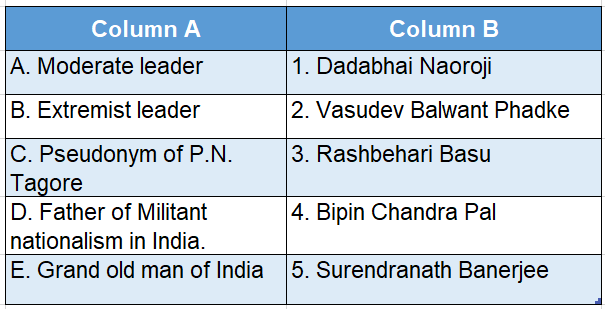
I focussed on the misery of the Hindu widows for the first time in my essay ‘Balya Vivaher Dosh’ in the first education of ‘Sarvashubhankari Patrika’.

Then I also wrote about this in a book named ‘Bidhava Vivah Etadrishayak Prastav’.

Srinivas: This step created many protests among the conservatives. Radhakanta Dev had launched a protest through Dharmasabha.

Vidyasagar: I then quoted a sloka from Parashar Samhita and wrote a book that explained the scriptures in detail.

Srinivas: What does it mean Sir?

Vidyasagar: If any woman’s husband is missing, or dies, or becomes ascetic, or becomes impotent or morally degenerate then the woman can remarry.

Srinivas: Oh, excellent!

Vidyasagar: Then ignoring the opposition of the conservatives and staking my life, I collected signatures from many distinguished persons and submitted the petition to the government.

Srinivas: I know Sir, most of the intellectuals of Bengal had supported you.

Vidyasagar: On the other hand, the conservatives were not lagging. They also collected signatures of 36,763 persons to stop widow remarriage.

Luckily the government did not heed their request.

Srinivas: Finally the government legalized widow remarriage by Regulation no. 15. This law also recognizes the right of inheritance

which is the right of the children to inherit their father’s property and wealth. So Sir, how far have the marriages progressed?

Vidyasagar: The first marriage was held between Srish Chandra Vidyaratna and Kalimata Devi, the widowed daughter of Brahmananda Mukhopadhyay of Burdwan.
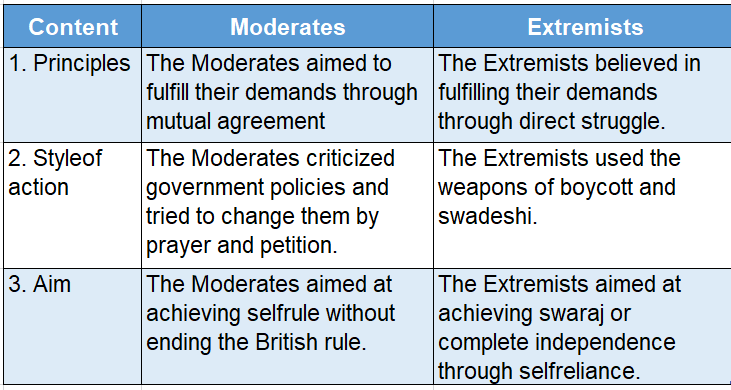
There was a lot of trouble here also. You’ve heard all that. It would have been impossible without the government’s help.

Then I made another widow Bhavsundari my daughter-in-law.

Srinivas: You have also organized many other marriages, Sir?

Vidyasagar: Yes, I have. In these few years, I have given about 60 widows in marriage. To be frank, I have incurred a loan of rupees 82,000 to organize these marriages.

Srinivas: So people rightly say that you are not only the sea of knowledge but also the sea of kindness.
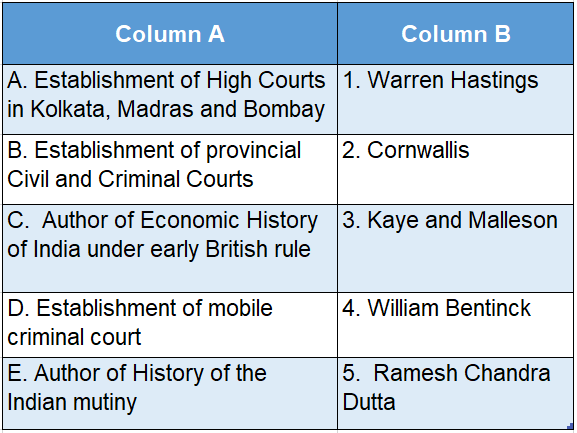
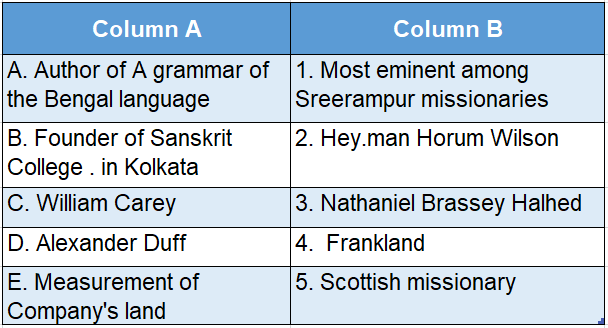
Vidyasagar: Don’t talk nonsense. I’m getting late. See you.

Question 2. Imagine you are a journalist. You gained experience and knowledge about the Revolt of 1857 by visiting different places in India during the Revolt. Write a newspaper report based on your experience.
Answer:

Newspaper Report Based On My Experience And Knowledge About The Revolt Of 1857 By Visiting Different Places In India During The Revolt:-

Staff reporter, Delhi, August 1857: The revolt started on 26th February 1857 at Native Infantry No 11 of the military barrack at Ayodhya, Kanpur, Lucknow, Shah Jahanpur, Behrampore in Murshidabad.

The agitation which started over the greased cartridges spread rapidly through all parts of the country.

Then a wider agitation started at Barrackpore cantonment where Mangal Pandey of Native Infantry no 34 declared revolt on 29th March.

The rebels of Meerut proceeded towards Delhi on 11th May.

They killed the English soldiers and occupied Delhi and declared Bahadur Shah II the emperor. From here the revolt spread to

Moradabad, Rohilkhand, Varanasi, Allahabad, Fatehpur, Faizabad, Bareilly, Jhansi, and Bihar. The soldiers of Kanpur revolted in June under the leadership of Nanasaheb.

In Ayodhya, it became a mass revolt. Rohilkhand, Jhansi, and Bihar became important centers of the Great Revolt.

The revolt spread from Punjab in the north to the valley in the south and from Bihar in the east to Rajputana in the West.

WBBSE Solutions For Class 8 History Chapter 4 Nature Of Colonial Economy Topic C Miscellaneous

Chapter 4 Nature Of Colonial Economy Topic C Miscellaneous Strike The Odd One Out

Question 1. Zamindari system, Mahalwari system, Bhaiyachari system, Ryotwari system
Answer: Zamindari system

Question 2. Silk, Wool, Cotton, Indigo
Answer: Indigo

Question 3. Dahsala system, Eksala system, Panchsala system, Mahalwari system.
Answer: Mahalwari system.

Question 4. Zamindar, Mahajan, Farmer, Trader
Answer: Farmer

Question 5. Cornwallis, Hastings, Bentinck, John Shore
Answer: John Shore

Read and Learn More WBBSE Solutions For Class 8 History

Question 6. John Shore, Philip Francis, Hastings, Thomas Munro
Answer: Hastings

Question 7. Tea, Indigo, Jute, Paddy
Answer: Paddy

Question 8. Agriculturist Relief Act, Sunset Act, Tenancy Act, Vernacular Press Act.
Answer: Vernacular Press Act

Question 9. De industrialisation, drainage of resouces Famine of 1770, Jallianwalabagh Massacre.
Answer: Jallianwalabagh Massacre

Question 10. Telegraph, post, railways, drainage of resources
Answer: Drainage of resources

WBBSE Class 8 Miscellaneous Notes on Colonial Economy

Chapter 4 Nature Of Colonial Economy Topic C Miscellaneous Match The Columns

Wbbse Solutions For Class 8 History Chapter 4 Nature Of Colonial Economy Match the colmns table 1
Answer: A-3,B-4,C-1,D-5,E-2

Wbbse Solutions For Class 8 History Chapter 4 Nature Of Colonial Economy Match the colmns table 2
Answer: A-3,B-5,C-4,D-1,E-2

Wbbse Solutions For Class 8 History Chapter 4 Nature Of Colonial Economy Match the colmns table 3
Answer: A-5,B-3,C-4,D-1,E-1

Wbbse Solutions For Class 8 History Chapter 4 Nature Of Colonial Economy Match the colmns table 4
Answer: A-2,B-3,C-5,D-1,E-4

Chapter 4 Nature Of Colonial Economy Topic C Miscellaneous Fill In The Blanks With The Correct Alternative

Question 1. Permanent Settlement was started by __________ (Hastings/Cornwallis/Dalhousie).
Answer: Cornwallis

Question 2. Mahalwari system started in ___________ (Bengal/North India/South India).
Answer: North India

Question 3. Dadan means ___________ (advance payment/abwab/unpaid labour).
Answer: advance payment

Question 4. The first jute factory in colonial India came up at ___________ (Rishra/Calcutta/Bombay).
Answer: Rishra

Class 8 History WBBSE

Question 5. The outflow of wealth from the country is ___________(Drainage of wealth/Deindustrialisation/Bargadari system).
Answer: Drainage of wealth.

Chapter 4 Nature Of Colonial Economy Topic C Miscellaneous Identify The Wrong Statement

Question 1. Permanent Settlement started in 1794.
Answer: Wrong

Question 2. The Indigo revolt occurred in Madras.
Answer: Wrong

Question 3. Cotton cultivation in Deccan was linked to the American Civil War.
Answer: Wrong

Question 4. The Indian market saw an influx of native commodities with the expansion of railways.
Answer: Wrong

Question 5. The telegraph system was set up in the Company’s interest.
Answer: Right

Chapter 4 Nature Of Colonial Economy Topic C

Answer Briefly

Question 1. What was the Sunset Law?
Answer: Sunset Law:-

According to the terms of Permanent Settlement introduced on March 22, 1793, if a landlord failed to deposit his rent before sunset on the stipulated date, then his land would be confiscated by the Company and auctioned. The law was known as the Sunset Law.

Question: What do you understand by the commercialisation of agriculture?
Answer: Commercialisation Of Agriculture:-

The farmers were so overburdened by the high rate of revenues that they were compelled to take loans from the Mahajan or money lenders.

These Mahajan compelled the helpless farmers to cultivate cash crops like indigo, jute and cotton to ensure the repayment of the loans.

Thus agriculture came to be commercialized and the farmers had to suffer from starvation due to the scarcity of food.

Conceptual Questions on Changes in Economic Structures

Question 3. Why did the ‘Deccan riots’ occur?
Answer: Deccan Riots:-

The farmers of Poona and Ahmednagar rose in rebellion in 1875.

The Deccan riots took place due to the oppression of farmers by money lenders, forcible acquisition of lands from the farmers and imposition of high rates of revenue on them.

Again, the evil effects of the Ryotwari system, reduction in the price of cotton, lack of rain and crop failure also rendered the farmers helpless.

WBBSE Solutions For Class 8 School Science Long Answer Type Questions WBBSE Solutions For Class 8 School Science Short Answer Type Questions
WBBSE Solutions For Class 8 School Science Very Short Answer Type Questions WBBSE Solutions For Class 8 School Science Review Questions
WBBSE Solutions For Class 8 School Science Solved Numerical Problems WBBSE Solutions For Class 8 School Science Experiments Questions
WBBSE Solutions For Class 8 Maths WBBSE Class 8 History Notes
WBBSE Class 8 History Multiple Choice Questions WBBSE Solutions For Class 8 History
WBBSE Solutions For Class 8 Geography


Question 4. What is the drainage of wealth?
Answer: Drainage Of Wealth:-

After winning the Battle of Plassey the Company began to transport large amounts of wealth, commodities and products from Bengal and other regions of India to England without bringing anything in return.

This is called the ‘drainage of wealth’ or ‘drainage of resources’. This was done in two ways

  1. through the Company officials, and traders
  2. through the Company’s commercial, economic and revenue policies. A large amount of wealth and resources were drained away in this manner.

England, the pioneer of industrialization used their colonies as centres for importing raw materials and exporting finished products and thus drained. Away their wealth.

Question 5 What is deindustrialisation?
Answer: Deindustrialisation:-

Deindustrialisation means the destruction of industries. The traditional handicraft and cottage industries were destroyed during British rule.

This led to the decline of indigenous industries, unemployment and less prosperity in the cities.

India was finally converted into a country that could supply raw materials and serve as a ready market for finished goods.

Examples of Trade Practices During Colonial Rule

Write In Your Own Words

Question 1. What was the effect of the Permanent Settlement on peasant society?
Answer: The Effect Of The Permanent Settlement On Peasant Society:-

Introduction:

‘Permanent refers to the system in which the landlords could enjoy ownership rights over their lands hereditarily by paying a fixed revenue to the company annually.

This system was implemented in Bengal by Lord Cornwallis in 1793.

Misery Of The Farmers Of Bengal Under Permanent Settlement Scheme

The farmers of Bengal were plunged into deep misery because the Permanent Settlement scheme did not have any provision to safeguard their rights and interests.

1. Oppression by Zamindars :

While implementing the system Cornwallis had hoped that the Zamindars would themselves safeguard the interest of the farmers but the situation turned out to be different.

They imposed heavy taxes upon the farmers and evicted them from the land at their own will.

Understanding Colonial Economy

2. Victims of new landlords:

Many traders and money lenders bought lands on auction to become land owners. They were completely unaware of rural life and the process of agricultural production.

They somehow wanted to collect revenue from the farmers and become rich. So the poor farmers were subjected to inhuman torture by this new class of landlords.

3. Eviction from land:

The government gave the landlords the right to evict the farmers in case of non-payment of revenue by issuing Regulation No. 7 in 1799.

The Zamindars took advantage of this regulation and evicted many farmers on very simple pretexts. The peasants had to suffer greatly Historian Narendra Krishna Sinha said

that this law made the Zamindars ‘possessors of irresistible powers’.

4. Exploitation through the Pattani system:

With the introduction of the Pattani system, some additional taxes were imposed on the farmers and the tyranny over them increased.

Many illegal taxes and Abwab were imposed in addition to the fixed revenue. All these brought untold misery to the peasants.

Question 2. Compare and contrast the Permanent Settlement system with the Rotwari and Mahalwari systems. Which was of lesser harm to the peasants? Give reasons.
Answer:

Wbbse Solutions For Class 8 History Chapter 4 Nature Of Colonial Economy Q2 toplc c Permanent Settlement and Pyotwari and Mahalwari System

Question 3. What relation did the Company’s business policy have with the Bengal textile industry? Why did the Indians form indigenous banks and insurance companies?
Answer: Relationship between the Textile Industry and the Commercial Policy of the Company-

1. Company’s Motive:

British East India. The company adopted a new commercial policy after the Industrial Revolution in Britain. It was decided that the textiles manufactured in Britain would be sold in the Indian markets.

The company aimed to destroy the indigenous textile industry to capture the market.

2. Result:

The British textile industry made steady progress in the trade as a result of possessing the facility of tax-free trade. The Indian textiles lagged in the competition and finally decayed.

Indian Initiative

1. Setting up banks:

The Indian capitalists were deprived of bank loans. Even if they were provided loans in a few cases, they had to comply with rigid rules and regulations. There was also discrimination regarding the rate of interest payable against the loan. The Indian industrialists and traders had to pay comparatively high rates of interest. So, the Indian traders and industrialists decided to set up their banks to avail of loans.

Wbbse Solutions For Class 8 History Chapter 4 Nature Of Colonial Economy Topic C Nation Bank of India,Bombay

Important Definitions Related to Colonial Economy

2. Setting up insurance companies:

The British government was hesitant to bring the Indian industrial and trade institutions under the purview of the insurance system.t

If the native industrial institutions were affected by any accident or natural disaster or if the native production was hampered then the government did not provide any aid.

So, the Indian industrialists and traders took the initiative of establishing an indigenous insurance company.

Class 8 History Solution WBBSE

Question 4. Discuss the expansion of colonial rule in India about railways and telegraph systems.
Answer:

Expansion Of Colonial Rule In India About Railways And Telegraph Systems:-

Wbbse Solutions For Class 8 History Chapter 4 Nature Of Colonial Economy Q5 topic c Railways and Telegraph

Imagine And Write

Question .1 Suppose you are travelling by train for the first time. Describe your pre-boarding and post-boarding experience in a letter addressed to your friend.
Answer:

Pre-Boarding And Post-Boarding Experience In A Letter Addressed To My Friend:-

Dear Asit,

Hope you are doing well. I also hope that all your family members are well by the grace of God. We are all in the best of spirits here.

I think you are aware of the fact that railways have been introduced in our country. Well, I was quite curious about the train and wanted to know how such a gigantic vehicle plied so fast.

We are habituated to travelling by bullock carts and horse carriages but today all my curiosity, hope and anxiety came to an end. Today I boarded a train for the first time and I want to share my experience with you.

So long I had been watching the train. Whistling and rushing through the field. Today I had a joy ride on it. I first took a ticket from the counter.

Then the train arrived at its appointed time. At first, I and some others were scared and stepped back. Then I got into it with a beating heart.

Key Concepts in Colonial Economy Notes

On seeing a blue lantern the train began to move, whistling and emitting black smoke at the same time. It moved over the iron rails with some jerks.

It seemed as if all the trees and huts were receding at a great speed. I and some others were highly excited and began to shout. Soon we reached our destination.

Asit, I never thought that so many. People can be carried so quickly and so comfortably. Come to my place one day and we Telegraph the news of revolts could reach the administrative centres beforehand and appropriate measures could be taken.

Will board the train together. We will have a good ride and you will also be able to overcome your fear. Let me stop here today. Reply soon. Yours affectionately Rohan

Question 2. Suppose you are a resident of the Deccan in the 1870s. Record in your diary the discontent of the peasants of the region regarding cotton cultivation.
Answer:

The Discontent Of The Peasants Of The Region Regarding Cotton Cultivation:-

1. June 13, 1873, 9 p.m.::

This year I am highly anxious about cotton cultivation. There is no capital. I am also scared of going to the Mahajan.

Last year’s paddy is also exhausted. Nowadays Gujarati, Marwari, Lingayat and Kulkarnis are carrying on the money lending business.

I think I have to borrow seeds from some Mahajan. I don’t know what’s in store for me.

2. July 14, 1873; 10 p.m.:

I heard that the company has decided to reform the land revenue system which has been implemented over a wide area of Deccan to increase the government’s income.

The Patels, who have been entrusted with the task of collecting revenue, are torturing the peasants in various ways.

If the peasants cannot pay the revenue, their houses and property are confiscated. Since the farmers do not have tenancy rights they are suffering a lot.

3. September 10, 1874, 11 p.m. :

The price of cotton has suddenly fallen. So cotton cultivators like me will be in great trouble.

I have heard that after the end of the Civil War in America, England was importing cotton from there.

So the rate of export of cotton from India has decreased and consequently, the price has fallen.

On the other hand, the rates of land revenue and interest on loans taken from money lenders are continuously increasing.

4. December 10, 1874:

10 p.m.: The economic crisis has intensified. We the farmers are in great misery because of drought and crop failure.

The fall in the price of agricultural products is making our condition more pathetic. Again the Bombay government has increased the rent considerably.

Short Notes on Economic Exploitation in Colonial India

5. December 20, 1874:12 midnight:

Today a terrible peasant revolt has broken out in the Deccan. It started in Karde village in the Singur Taluka of the Poona district.

A Mahajan named Kaluram has purchased the house and landed property of an indebted farmer named Babasaheb Deshmukh at just rupees one hundred and fifty.

So the angry villagers started revolting in Deccan under the leadership of Kengliya.

WBBSE Solutions For Class 8 History Chapter 6 The Beginnings Of Nationalism Topic C Miscellaneous

Chapter 6 The Beginnings Of Nationalism Topic C Miscellaneous Strike The Odd One Out

Question 1. Allan Octavian Hume, Bankim Chandra Chattopadhyay, Ananda Mohan Basu, Nabagopal Mitra.
Answer: Allan Octavian Hume

Question 2. Hindu Mela, Bharat Sabha, National Congress, Indian League.
Answer: National Congress

Question 3. Ilbert Bill, Arms Act, Vernacular Press Act, Dramatic Performance Act
Answer: Ilbert Bill

Question 4. Ripon, Lytton, Duffrein, Dadabhai Naoroji.
Answer: Dadabhai Naoroji

Question 5. Lahore, Amritsar, Jamaica, Kanpur.
Answer: Jamaica

Read and Learn More WBBSE Solutions For Class 8 History

WBBSE Solutions For Class 8 History Chapter 6 The Beginnings Of Nationalism Topic C Miscellaneous

WBBSE Class 8 Miscellaneous Notes on Nationalism

Question 6. Womesh Chunder Banerjee, Surendranath Banerjee, Dadabhai
Gangadhar Tilak.
Answer: Bal Gangadhar Tilak.

Question 7. Surendranath Banerjee, Lala Lajpat Rai, Bal Gangadhar Tilak, Bipin Chandra Pal.
Answer: Surendranath Banerjee

Question 8. Anushilan Samity, Indian League, Indian Association, Theosophical Society.
Answer: Anushilan Samity

Question 9. Sanjivani Patrika, Vandemataram Patrika, Jugantar, Daily News.
Answer: Daily News

WBBSE Solutions For Class 8 School Science Long Answer Type Questions WBBSE Solutions For Class 8 School Science Short Answer Type Questions
WBBSE Solutions For Class 8 School Science Very Short Answer Type Questions WBBSE Solutions For Class 8 School Science Review Questions
WBBSE Solutions For Class 8 School Science Solved Numerical Problems WBBSE Solutions For Class 8 School Science Experiments Questions
WBBSE Solutions For Class 8 Maths WBBSE Class 8 History Notes
WBBSE Class 8 History Multiple Choice Questions WBBSE Solutions For Class 8 History
WBBSE Solutions For Class 8 Geography


Question 10. Zamindar Sabha, Bharat Sabha,Puna Sarvajanik Sabha, Bangabhasha Prakashika Sabha.
Answer: Puna Sarvajanik Sabha

WBBSE Class 8 History Chapter 6 Topic C Miscellaneous detailed solutions

Question 11. Swaraj, Swadeshi, Boycott, Picketing.
Answer: Picketing.

Question 12. Kshudiram Basu, Prafulla Chaki, Bagha Jatin, Bipin Chandra Pal.
Answer: Bipin Chandra Pal

Chapter 6 The Beginnings Of Nationalism Topic C Miscellaneous Match The Columns

Wbbse Solutions For Class 8 History Chapter 6 The Beginning Of Nationalism Match The Columns table 1
Answer: A-1,B-4,C-5,D-3,E-2

Wbbse Solutions For Class 8 History Chapter 6 The Beginning Of Nationalism Match The Columns table 2
Answer: A-3,B-4,C-1,D-5,E-2

Wbbse Solutions For Class 8 History Chapter 6 The Beginning Of Nationalism Match The Columns table 3
Answer: A-5,B-3,C-4,D-1,E-2

Wbbse Solutions For Class 8 History Chapter 6 The Beginning Of Nationalism Match The Columns table 4
Answer: A-4,B-1,C-5,D-2,E-3

Wbbse Solutions For Class 8 History Chapter 6 The Beginning Of Nationalism Match The Columns table 5
Answer: A-2,B-1,C-3,D-5,E-4

Wbbse Solutions For Class 8 History Chapter 6 The Beginning Of Nationalism Match The Columns table 6

Answer: A-3,B-2,C-5,D-4,E-1

Wbbse Solutions For Class 8 History Chapter 6 The Beginning Of Nationalism Match The Columns table 7
Answer: A-5,B-4,C-3,D-2,E-1

Chapter 6 The Beginnings Of Nationalism Topic C Miscellaneous Choose The Correct Alternatives

Question 1. The first session of the National Congress was held at
(Bombay/Goa/Madras).
Answer: Bombay

Question 2. The Moderates demanded that the eligible age for Civil Service examinations should be (20/23/21) years.
Answer: 23

Question 3. Partition of Bengal was planned by(Dufferin/Curzon/Minto).
Answer: Curzon

Question 4. The newspaper associated with revolutionary activities in Bengal was (Jugantar/Hindu Patriot/Sompraksash)
Answer: Jugantar

Chapter 6 The Beginnings Of Nationalism Topic C Miscellaneous Choose Which Statement Is Right And Which Wrong

Question 1. Womesh Chunder Banerjee was the first President of Congress.
Answer: Right

Question 2. Moderates called the activities of the Extremists, ‘three-day tamasha’.
Answer: Right

Question 3. Economic rationalism was proposed by Aurobindo Ghosh.
Answer: Wrong

Question 4. Kshudiram Bose and Profulla Chaki attempted to murder Kingsford.
Answer: Right

Class 8 History Chapter 6 WBBSE miscellaneous Topics And Answers

Question 1. What is meant by the Age of “Sabha samitis’?
Answer:

1. Period:

The period from the Great Revolt (1857) to the establishment of the National Congress (1885) is generally referred to as the age of councils (Sabhas) and associations (Samities).

2. Councils and associations:

Some important councils and associations were the Indian League of Sisir Kumar Ghosh, Indian Association of Surendranath Banerjee and Ananda Mohan Bose,

Hindu Mela of Nabagopal Mitra, Poona Sarvajanik Sabha of Gopal Hari Deshmukh, and Madras Mahajan Sabha of Subrammaniya layer.

3. Role:

The councils and associations first tried to safeguard their interest. Then they tried to spread nationalism at the regional level.

Understanding the Role of Literature in Nationalism

Question 2. Discuss two main differences between the Moderates and the Extremists.
Answer:

Wbbse Solutions For Class 8 History Chapter 6 The Beginning Of Nationalism Q2 Moderates and Extremists

Question 3. What is the importance of the Surat session (1907) of Congress?
Answer:

1. Disgrace of the Congress:

The split in the Congress at the Surat session brought considerable disgrace upon this political organization,

2. Decay of strength:

The Congress became weak when it split up into two groups. So the national movement lost its momentum till Gandhi emerged as a leader.

History Class 8 WBBSE

3. Rise of Extremists:

As a far-reaching effect of the Surat split, Indian politics from the early phase of the Congress till the rise of Gandhi was chiefly dominated by the Extremists.

Key Events Leading to Nationalist Sentiments

Question 4. Why did secret societies grow up in Bengal at the beginning of the twentieth century?
Answer:

1. Spread of revolutionism:

The revolutionaries who believed in armed struggle formed many secret organizations to spread revolutionist ideas.

2. Collect funds:

The revolutionaries needed. money to collect arms and conduct their activities. So many secret societies grew up to collect funds.

3. Unification of revolutionaries:

Many secret societies grew up to unify the revolutionaries and train them.

Some of these were Anushilan Samity, Dhaka Anushilan Samity, Jugantar Samity, Sadhana Samity, Suhrid Samity, and Brati Samity.

Write In Your Own Words

Question 1. Make a critical analysis of Hume’s role in the foundation of Congress. Do you think Congress could have been formed without Hume? Give reasons for your answer.
Answer:

Controversy over the foundation of the National Congress

The chief credit for establishing the National Congress goes to Allen Octavian Hume, a retired English official.

However, modern historian Dr. Amalesh Tripathy does not want to accept Hume as the founder of the National Congress.

He thinks that Hume had no role in establishing the National Congress because the background had already been created before he took up the initiative. The reasons are

  1. Duffrein had no regard for Hume and so the Hume Duffrein conspiracy was baseless.
  2. Hume was the Secretary of the Revenue, Agriculture, and Commerce Department. So it was not possible for him to examine the documents of the Home departments and formulate the Safety Valve theory.
  3. Again, there is no justification as to why Hume took up the initiative of establishing the National Congress as an antidote for destructive forces in India after six years of his retirement.

So it can be said that the role of Hume in establishing the National Congress is merely an exaggeration.

Important Definitions Related to Nationalist Movements

Hume’s Contribution To The Establishment Of the National Congress-

1. Introduction of ‘safety valve’ theory:

Allan Octavian Hume had worked as a secretary of the British government at Simla for some time. At that time he saw some documents from the Home department.

He concluded that there was some dissatisfaction among the lower-class Indians against British rule and revolts could occur at any time.

So he tried to establish the National Congress as a safety value.

Class 8 History Solution WBBSE

2. Open letter:

Hume tried to give shape to his ‘safety valve’ theory. So he wrote an open letter to the graduates of Kolkata University on March 1, 1883, urging them to organize

themselves for the social, political, mental, and moral progress of their country

3. Establishment of Indian National Union:

Hume made a ceaseless attempt to build up an all-Indian political organization. He contacted the Indian leaders in different parts of India.

As a first step in building an all-Indian political organization, he founded the Indian National Union in 1883. In the same year, he also arranged for an all-India. conference in Poona.

4. Hume Dufferin conspiracy:

Some historians like Girija Prasad Mukherjee and C.F. Andrews think that Hume had met Duffrein and submitted a proposal of building an all-India political organization.

The Marxist writer Rajani Pam Dutta thinks that the Congress was the outcome of the HumeDuffrein conspiracy.

Question 2. What was the main position of economic nationalism? Do you find any similarity in its stand with that of the Boycott and Swadeshi movement? Give reasons.
Answer:

Main Gist Of Economic Nationalism

See Salient Points.

Link Between Economic Nationalism And Boycott And Swadesh Movement

1. The advocates of economic nationalism blamed the British administrative policy for the financial crisis in India. The British used the Indian markets to sell goods.

manufactured in Britain. So the sale of Indian commodities was adversely affected. There was a link between

economic nationalism and Boycott and Swadeshi movements because it was on this background that

the issues of buying native goods and discarding foreign goods had found a place in the agenda of the two movements.

2. The economic nationalists said that the agro-based Indian economy was being used to protect the financial interests of Britain.

As a result, native agriculture and industry were being destroyed. Therefore, attempts were made to set up Indigenous industries with

the help of native capital so that India did not become the sole investment ground of the British.

Impact of Cultural Awakening on Nationalism

Question 3. What was the main proposal of the Extremist movement? Do you support the use of religious symbols in their movement? Give reasons for your answer.
Answer:

Main Idea Of Extremist Movement-

1. Aim:

The Extremists aimed at attaining Swaraj but the concept of ‘Swaraj’ had been explained by different leaders in different ways.

According to Bipin Chandra Pal and Aurobindo Ghosh ‘Swaraj’ meant complete freedom which could not be achieved under British rule.

Tilak felt that it was possible to establish ‘Swaraj’ if the administrative machinery could be brought under the control of the Indians.

2. Policy:

The Extremists followed the policy of Swadeshi, boycott, and self-sacrifice.

3. Ideals:

The idea of the Extremists was to follow Hinduism, past history, and complete patriotism.

4. Method:

The Extremists wanted to have their demands fulfilled through direct struggle. They wanted to become self-dependent and attain complete independence.

Dispute Over The Use Of Religious Symbols By The Extremists

1. Many Extremists leaders described the past history of India as fully glorious. However, such an explanation turned out to be a glorification of Hinduism.

Tilak composed a treatise on Gita (Gita rahasya) Aurabindo’s writings reflect the flawlessness of The Gita.

Lajpat Rai wrote the biography of Shri Krishna in Urdu, Brahma Bandhav wrote ‘Sri Krishna tattva in Bengali, and Ashwini Kumar Dutta wrote ‘Bhakti Yoga’.

Thus an attempt was made to spread extremist thinking among the people by following The Gita and by describing the character of Shri Krishna as an example.

2. The Extremists also tried to present the valiant picture of the Maratha hero Shivaji before the people.

They thought that Shivaji was not only a symbol of political struggle or struggle for independence but also a symbol of noble ideals.

Tilak started the Ganapati and Shivaji festivals in Maharashtra.

3. The Punjabis were once again stirred by the reminiscence of Ranjit Singh. Again, people in Bengal were inspired by the stories of the struggle of Pradapaditya and Sitaram.

4. The Extremists tried to compare the Aryans, Hindu kingdoms, and native heroes to Anglo- Saxons, Western countries, and European heroes respectively.

They tried to establish the superiority of the Indians over the Europeans and in doing so, they became prejudiced toward the Hindu religion.

Comment: All the above reasons show that the use of religious symbols in the Extremist government is not justifiable.

The revival of Hinduism created an adverse effect on the Muslims and made them biased.

Step-by-step solutions for Topic C Miscellaneous in WBBSE Chapter 6 History

Question 4. What was the background of revolutionary terrorism? Why did it largely fail?
Answer:

Background for Terrorist Activities

1. Foundation of different secret societies:

Terrorist activities started and spread through different secret societies.

The Anushilan Samity emerged as the first center of revolutionary activities.

Other secret associations were ‘Sadhana Samity’ and ‘Suhrid’ Samity of Mymensingh, ‘Brati Samity’ of Faridpur, and ‘Mukti Sangha’ of Dhaka.

Such associations were also set up at Saharanpur in Punjab and ‘Nasik, Pune, and Nagpur in Maharashtra.

The members were initiated into revolutionist ideals and then they carried out different revolutionary activities.

2. Failure of the Swadeshi Movement:

terrorist movements started only after the failure of the Swadeshi movement.

As passive resistance failed under the tremendous pressure of the repressive policies of the government,

revolutionary terrorism or violent struggle emerged as an alternative. In the context of armed revolutionary activities in Bengal, Punjab.

and Maharashtra Gandhiji said that the awareness created by the Swadeshi and Boycott movements in Bengal had spread from Punjab in the North to Kanyakumari in the South.

3. Weakness of Congress movement:

The young leaders of the Congress lost faith in the ‘Political beggary’ i.e. prayer and petition policy of the Moderates and initiated the Extremist or militant nationalistic ideals.

When extremist activities also failed, a background was created for the rise of revolutionary ‘terrorism based on violence.

4. Economic exploitation by the government:

The Indigenous industries, agriculture, and trade were almost ruined due to the colonial exploitation policy of the government.

This policy prepared the grounds for the rise of revolutionary terrorism.

5. Repressive measures of the British:

The British government usurped the independence of the Indians by passing some repressive acts.

The Dramatic Performance Act was passed by Northbrook in 1878.

The Vernacular Press Act was passed by Lytton in 1878.

The Arms Act of 1878, Curzon’s Municipality Act of 1899, and the University Act of 1904 compelled the younger generation to adopt a combative attitude towards the British.

6. Influence of international events:

The younger generation was highly influenced by Italy’s defeat in Italy Abyssinian War,

the defeat of England in the Anglo-Boer War, Russia’s defeat in the Russo-Japanese War, the French Revolution, the American War of Independence, the Nihilist movement against Tzardom in Russia, and the nationalist struggle of Ireland.

They thought that British domination could be removed only through armed struggle.

Short Notes on the Role of Press in Nationalist Movement

Reasons For Failure

1. Organisational weakness:

The organization of the secret societies and other associations was quite weak.

We may mention Anushilan Samity, Jugantar Dal, Sadhana Samity, Suhrid Samity, and Brati Samity in this context.

They tried to gather foreign assistance to shield their weaknesses but, in most cases, their attempts failed.

2. Role of betrayers:

An important reason for the failure of the revolutionary movement in India was the role of betrayers like Naren Gosai, Kripal Sinha, and others.

They used to leak out plans and information which helped the English espionage and police a lot. As the government could know about

the plans of the revolutionaries beforehand they could easily take up measures to foil the plans.

3. Difference of opinion and inner conflict:

Though the objective of all the revolutionist groups was the same yet they differed in their methods.

There was a lack of unity and integrity from the very beginning.

Pramathanath Mitra and Jadugopal Mukherjee tried to make it a mass movement while Barindra Kumar Ghosh, Bhupendranath Dutta, and Pulin Behari Das directed the movement toward secret murders and terrorism.

4. Regional confinement:

The revolutionary movement took place in different places sporadically. The armed movements were mostly witnessed in Bengal,

Punjab, Maharashtra, and to some extent in Bihar, Madras, Orissa, and U.P. but this movement could never assume an all-India character.

5. Domination of Hinduism:

The revolutionaries did not come from all sections of society. About ninety percent of them were Hindus.

As those movements were mainly led by the Hindus, a large section of Muslims remained aloof.

6. Lack of popular base:

The participants in the revolutionary movement were mainly upper-class people who were small landlords, teachers, clerks, traders, doctors, journalists, and young students.

However, a large section of society consisting of farmers and laborers kept themselves away. So there was a lack of a popular base which rendered the movement a failure.

Imagine and write

Question 1. Suppose you are an Extremist leader. You have to organize a movement in different parts of Bengal. Make a rough draft of the lecture you want to present to the public.
Answer:

Dear friends,

Today all of you have assembled in this meeting for a noble purpose, i.e., to take a vow to free Mother India from the shackles of slavery.

You know that the activities of Moderate leaders have failed. Their method of prayer, please, and the petition is nothing but political beggary.

So let us aim for complete independence which will be free of British control. So we have to launch direct movements against the British to achieve our aim.

We, the extremists, believe in swadeshi, and boycott spiritual power, and self-sacrifice. Therefore, we appeal to you to keep faith in us and our policies.

We can not forget the noble sacrifices and patriotism of Rana Pratap, Shivaji, and Laxmibai. of Jhansi.

Today the British government is unduly imposing the Dramatic Performance Act, Vernacular Press Act, and Arms. Act, Municipality Act, and University Act on us.

They are developing the industries of their country by using the raw materials of our country. Again,

they are destroying our industries by selling the goods manufactured in England in our markets. Our only companions are poverty, starvation, and famine.

We have to disentangle ourselves from these. We cannot let this happen anymore. Friends, we are not alone in this struggle.

We have leaders like Lala Lajpat Rai, Bipin Chandra Pal, Bal Gangadhar Tilak, and Aurobindo Ghosh with us.

You must remember that Swaraj is our birthright and we must have it. It’s not only my call to you but swami Vivekananda has called you saying, “Awake, arise.

Your motherland is praying for your noble sacrifice. Let us say together “Vande Mataram,” “Vande Mataram,”, “Vande Mataram.”

Practice Questions on Nationalist Themes

Question 2. Suppose you have joined the Swadeshi movement under the leadership of Rabindranath Tagore. Nar rate your experience on Raksha Bandhan day in a letter to your friend.
Answer:

Dear Neel,

Hope you and your family members are keeping well. I, along with my family, am in the best of spirits.

The Swadeshi movement started in Kolkata under the leadership of Kaviguru Rabindranath Tagore. I hope you have already seen it in the Amrita Bazar Patrika.

I have also joined the movement. Today, October 16, was the day of bringing the partition of Bengal into force.

Today the Bengalees expressed their grievances and anguish through various solemn programs.

The Raksha Bandhan planned by Rabindranath Tagore was the main part of this program.

The residents of both parts of Bengal tied yellow threads on each other’s wrists after a holy bath in the Ganges.

They did this to keep their fraternal bonds intact and to maintain the unity of their motherland.

We sang the ‘Vande Mataram’ under the leadership of Rabindranath. Then we sang some of his patriotic compositions. These songs inspired us with patriotic feelings.

While singing these songs we also walked in a barefooted procession. Along with us, i.e., the students there were many eminent persons and leaders.

I had the fortune of meeting some great personalities and teachers of Shantiniketan. I also took blessings from the Kavi guru.

I shall always remember this day throughout my life. Keep well. Waiting for your reply.

Yours lovingly,

Dev

WBBSE Solutions For Class 8 History Chapter 3 Establishing The Authority Topic C Miscellaneous

WBBSE Chapter 3 Establishing The Colonial Authorising Topic C Miscellaneous Strike The Odd One Out

Question 1. Tamil Nadu, Kerala, Andhra Pradesh, Colombo.
Answer: Colombo

Question 2. Regulating Act, Atlantic Charter, Pitt’s India Act, Rowlatt Act.
Answer: Atlantic Charter

Question 3. Warren Hastings, Cornwallis, Elijah Impey, William Bentinck.
Answer: Elijah Impey

Question 4. Faujar, Kotwal, Chaukidar, Tahsildar.
Answer: Tahsildar

Question 5. Police system, bureaucracy, monarchy, military.
Answer: monarchy

Read and Learn More WBBSE Solutions For Class 8 History

Question 6. Sreerampur Mission, Baptist Mission, Vivekananda Mission, General Assembly Institution.
Answer: General Assembly Institution

Question 7. William Carey, Joshua Marshmann, William Ward, Lord Cornwallis.
Answer: Lord Cornwallis

WBBSE Chapter 3 Establishing The Colonial Authorishing Topic C Miscellaneous Match The Columns

Wbbse Solutions For Class 8 History Chapter 3 Establishing The Colonial Authority Match The Colums table 1

Answer: A-3,B-5,C-1,D-2,E-4

Wbbse Solutions For Class 8 History Chapter 3 Establishing The Colonial Authority Match The Colums table 2

Answer: A-5,B-3,C-2,D-1,E-4

WBBSE Class 8 Miscellaneous Notes on Establishing Authority

Wbbse Solutions For Class 8 History Chapter 3 Establishing The Colonial Authority Match The Colums table 3

Answer: A-4,B-1,C-5,D-3,E-2

Wbbse Solutions For Class 8 History Chapter 3 Establishing The Colonial Authority Match The Colums table 4

Answer: A-2,B-4,C-3,D-5,E-1

Wbbse Solutions For Class 8 History Chapter 3 Establishing The Colonial Authority Match The Colums table 5

Answer: A-4,B-1,C-5,D-2,E-3

Wbbse Solutions For Class 8 History Chapter 3 Establishing The Colonial Authority Match The Colums table 6

Answer: A-3,B-2,C-1,D-5,E-4

WBBSE Find The Odd One Out

Question 1. Bombay, Madras, Calcutta, Bengal
Answer: Bengal

Question 2. Clive, Hastings, Dupleix, Cornwallis
Answer: Dupleix

Question 3. Bengal, Bihar, Indus region, Orissa
Answer: Indus region

Question 4. Avid Hare, William Carey, Jonathan Duncan, William Pitt
Answer: William Pitt

WBBSE Identify The Wrong Statement

Question 1. Bengal Presidency was known as St. George Fort Presidency.
Answer: Wrong

Question 2. Benaras Hindu College was established by Jonathan Duncan.
Answer: Right

Question 3. William Carey was a member of the Srirampore Missionary Society.
Answer: Right

Question 4. The Company started the Izaraari system for ten-year revenue collection.
Answer: Wrong

WBBSE Solutions For Class 8 School Science Long Answer Type Questions WBBSE Solutions For Class 8 School Science Short Answer Type Questions
WBBSE Solutions For Class 8 School Science Very Short Answer Type Questions WBBSE Solutions For Class 8 School Science Review Questions
WBBSE Solutions For Class 8 School Science Solved Numerical Problems WBBSE Solutions For Class 8 School Science Experiments Questions
WBBSE Solutions For Class 8 Maths WBBSE Class 8 History Notes
WBBSE Class 8 History Multiple Choice Questions WBBSE Solutions For Class 8 History
WBBSE Solutions For Class 8 Geography


WBBSE Chapter 3 Establishing The Authority Topic C Miscellaneous Short Answer Questions

Question 1. What was the British Presidency system?
Answer: British Presidency System:-

  • The British East India Company was originally a trading organization. They built some commercial centers in different parts of India to carry on their trading activities smoothly.
  • Some important centers were Maras, Mumbai, and Kolkata and later on, the Presidency System grew around them.

Question 2. What role do I Lor Cornwallis play in organising the company’s formulated law system?
Answer: Role Of Lor Cornwallis Play To Organise The Company’s Formulates Law System:-

  • Cornwallis tried to organize and compile the laws established by the Company. He formulates a code to increase the efficiency, discipline,e, and honesty of the officials.
  • This code of conduct was mandatory for all government officials and employees. This code of conduct came to be known as ‘Cornwallis Coe’.

Important Definitions Related to Colonial Authority

Question 3. What was the Company’s sipahi bahini?
Answer: Company’s Sipahi Bahini:-

  • The British East Inia Company ha started colonial rule in Inia. When the empire extended, the need for an army instead of the police began to be felt.
  • So the Company now tried to organize a standing army. Here they followed the Mughal method of recruitment and employed farmers from North India in the army.
  • These soldiers were detached from the common mass and were called the sepoys of the British East India Company.

Question 4. What role does James Rennell play in the Company’s land survey?
Answer: Role For I James Rennell Play In The Company’s Land Survey:-

  • Lan was the basis of the economy during the rule of the British East India Company. The land had to be measured to determine the revenue.
  • Simultaneously, the waterways in Bengal also began to be measured.
  • At this time the company appointed James Rennell as the Chief of the Lan Measurement department and he prepared about 16 maps after measuring the riverways of Bengal.

WBBSE Class 8 History Chapter 3 Write In Your Own Words

Question 1. Compare the administrative reforms of Warren Hastings and Lor Cornwallis. What were the effects of these reforms on the Indians?
Answer:

Wbbse Solutions For Class 8 History Chapter 3 Establishing The Colonial Authority Q1 pg 72

Effect of Judicial Reforms on Indians:

  • The colonial judicial system was restructured by the British EasIndiaia Company: which fulfilled the imperial interest.
  • There was discrimination in the matter of judgment and the Indians were neglected and deprived of true justice.

Question 2. What was the direct connection between the expansion of the company’s authority and the increasing strength of military forces? Give reasons for your answer.
Answer:

The Direct Connection Between The Expansion Of The Company’s Authority And The Increasing Strength Of Military Forces:-

Emergence as a ruling power:

  • The British East India Company came to India as traders. After winning the Battles of Plassey and Buxar the Company emerged as a political power.

Nee for building an army:

  • The need for an army instead of a police force was felt when the colonial empire expanded. So the British company tried to build up a standing army.
  • Here they followed the Mughal procedure of recruitment and thus built the British East India Company’s army.

Understanding Colonial Authority in India

Expansion of the Company’s rule and growth of the army:

  • At first the police force.Combated all sorts of agitation against the government. However, the army had to interfere when public affairs became complicated.
  • When the colonial rule spread over different parts of Inia the company had to expand its army proportionately.
  • Thus the growth of the army became associated with the expansion of the Company’s rule.

Development of the relationship between empire expansion and growth of the army:

  • The growth of a standing army was the outcome of the relationship between the expansion of the Company’s rule and the growth of the army. The army was built traditionally.
  • Indian farmers and common people were included in the army and a separate sepoy regiment was created.
  • Later on, high-caste Rajputs, Brahmins, farmers, Marathas, tribals of Mysore, and Gurkhas of Nepal were appointed.
  • So the Company’s army expanded in the same proportion as the expansion of its territorial authority.

Class 8 History WBBSE

Question 3. What role did the bureaucracy play in the British administrative system? How did the bureaucracy organize as a narrow interest group?
Answer: Role Of The Bureaucracy Play In The British Administrative System:-

Brown and Cream Scrapbook Ancient History Infographic

Examples of Resistance Against Colonial Authority

Question 4. What difference existed between the Company’s education policaboutto Bengal and Bombay? What effect do you think the Company’s education policy has on Indian society?
Answer: The Difference Existed Between The Company’s Education Policy About Bengal And Bombay:-

Company’s Education Policy Bengal And Bombay

  • The British East India Company adopted a new education policy in India. They decided to set up many English medium schools in different parts of India as a part of that policy.
  • Bombayhast is more important than Bengal in this matter. In Bombay, much stress was placed on the cultivation of Western science and learning from the very beginning.
  • The British authority thought that the adequate demand for studying English medium had been created in Bombay only.

Effect Of Company’s Education Policy On Indian Society-

1. Establishment of English schools and colleges:

  1. Some schools and collèges were established through both. Governmental as well as private initiatives.  The Baptist Mission School was established by the Baptist Missionaries, General Assembly Institution (present Scottish Church College) was founded by Duff.  Hare School was built by David Hare and the Jesuit missionaries founded St. Xavier’s College.
  2. 2. Seventy-one English medium high schools and four universities were established in Kolkata, Bombay, and Madras under the governmental initiative.

2. Spread of Women’s Education:

  • Madam Cook a Church Missionary Society of London, Female Juvenile Society, and Ladies Society for Native Female Education, being inspired by the Company’s education policy, played an important role in the spread of women’s education.
  • The Hindu Balika Vidyalaya (Bethune School) a women’s college (Bethune College) grew up due to the efforts of Bethune and Vidyasagar.

3. Emergence of newly educated mile class:

  • Many Iranians, particularly Bengali youths, received new education and began to think on modern lines.
  • Thus the newly educated mile class, who was well-versed in the English language, emerged.

4. Social movement:

  • An attempt was made to do away with the widespread superstitions in society under the influence of Western education several off social movements started.
  • Rammohan Roy and Vidyasagar of Bengal, Jyotirao Phule of Maharashtra, Shri Narayan Guru of Kerala, and Veersalingam Pantulu of Anhra took up the task of reforming society and dedicated themselves to it.

Practice Questions on Authority and Governance

Question 5. What was the relationship between Company rules and land survey? What was the reason for starting and abolishment of the Ijaraari system?
Answer:

Relationship Between Company Rules And Land Survey:-

Company’s Rule An Lan Survey

1. Motive:

  • The British East India Company has received the right to collect revenue by the power of want.
  • The company met all its expenses from the revenue collected by them, and it also consolidated its power in India.
  • So they paid attention to the development of the revenue system by surveying and measuring the plan so that the revenue could be properly determined.

2. Importance of land survey:

  • The Company got the Zaminari of 24 Parganas from Kolkata to Kulpi during the time of Mir Jafar. Robert Clive tried to get a measure.
  • Franklin began the survey but ie before completing the work. This work was completed by Hog Cameron.

3. Measurement of waterways:

  • The Company also attempted to measure the waterways.
  • In Bengal, the riverways were surveyed by James Rennell, the chief of the land survey department or the Surveyor General.
  • He made 16 maps after surveying the riverways.

Hjaraari System Implementation

1. Formation of Revenue Boar:

  • The Company began to control the economy of Bengal after winning the Battle of Buxar and receiving Diwani.
  • The Controlling Council of Revenue and Boar of Revenue were formed to ensure the proper collection of revenue.

2. Research on land arrangements:

The Company began several pieces of research on the land revenue arrangements in the Bengal Presidency.

1. Auction system:

The Company started the auction system in which land was given to the highest bidder.

2. Eksala system:

  • The Company makes a yearly agreement with an individual over landholding.
  • Later on, Hastings arranged to lease out land to the person who would pay the maximum rent for five years.
  • This was called the ‘Marwari’ or ‘Panchsala system’ since it was a five years’ arrangement.

Abolition Of Ithe Jaraari System

Some problems cropped up in the Jaraari system

  1. As most of the Ijaraars were not locals they failed to collect adequate revenue from the land.
  2. Mostly the determined rate of revenue was more than the amount collected. So, the Ijaraars cannot deposit the stipulated amount. So Cornwallis abolished the Ijaraari system.

WBBSE Class 8 History Chapter 3 Imagine An Write

Question 1. Suppose you are a Company spahi. Write a letter to your friend about your work and the working atmosphere.
Answer:

Station Road
P.O: Sreerampur
dist: Hooghly

Dear Nikhilesh,

Hope you and your family are in your best spirits by the grace of Go. I am fine. In your previous letter, you want to know about my work and the working environment.

Well, I am giving you an account of that since you are so curious but I do not know whether you will like it or not.

We, the Indians, are subordinates to the British so they do not want to work under us.

So we are never given any high postdespiteof our capabilities. We have to work in the lower ranks. The English officers are quite proud and arrogant.

They keep using obscene language. We are also forced to travel by sea against the sanction of our Hindu religion. We feel off but we are helpless.

Key Concepts in Establishing Authority Notes

There is huge discrimination about remuneration. We get very low salaries and have to maintain ourselves, our families, and our houses out of that.

On the other hand, the British soldiers of the same rank as us, receive a higher salary. Previously we were given additional payment for staying in distant areas.

Now this allowance has been stopped. Again, there is almost no scope for promotion because an Indian cannot be given any post above that of a subpar.

Then there is the food problem. The quality of food provided to us is very inferior.

Despite complaining several times the quality has not been changing. Finally, after retirement, there is no provision for rehabilitation.

Now I think you have got the answers to your queries. Now it is almost time for my duty and so I stop here today. Keep well. Write soon. Waiting for your reply.

Yours affectionately,

Priyotosh

Question 2. Suppose you are a citizen of Calcutta in the first half of the nineteenth century. Write a conversation between two educated Indians during the established ment of Hindu College and Bethune School.
Answer:

Rahamahav:

I think now it can be said that there will be some advancement in education, particularly higher education. Whatdoo you say, Chanranath?

1. Chanranath:

I think you are right. The foundation of Hindu College and Bethune School is a step in that direction.

2. Rahamahav:

We can expect that Western education will prosper in India through these institutions. Again, western education will also enable our traditional education system to modernize itself.

3. Chanranath:

See, there is no hope for Inia’s progress without the advancement of Western learning. Earlier, the Company was apathetic to the spread of Western education since they were afraid of losing power.

They had been encouraging education in Arabic and Persian languages for so long and gradually Inia got engulfed in darkness.

4. Rahamahav:

You are right, Chanranath. Now the British are showing interest in education since they need educated employees to conduct administration as well as trade and commercDifferentent schools have begun to be established to teach English education.

Ultimately Rammohan an avid Hare came into the scene and began to plea in favor of Western education.

Rammohan himself founded the Anglo-Hindu school and Hindu College was established in 1817.

5. Chanranath:

However, Lor Minto, the Governor General has also made a significant contribution to spreading Western education in our country.

Short Notes on Revenue Systems Introduced by the British

6. Rahamahav:

Oh yes. He has put up the pathetic condition of education in India in his report. He has also requested the Company for some fun to preserve science and learning.

7. Chanranath:

However, Rammohan has opposed the Mass Education Committee’s decision to establish Sanskrit College.

His letter to Lor Amherst, the then Governor General, is historical evidence. Isn’t it, Rahamahav?

8. Rahamahav:

Chanranath, I support Macaulay since he has made a notable. Contribution to the matter of Western education.

9. Chanranath:

Exactly. He has put forward a proposal before the then Governor General in which he referred to Oriental civilization as ‘corrupt, profane and foolish’.

10. Rahamahav:

Moreover, he has also that the Oriental system of education has no scientific awareness and is much inferior in comparison to the Western education system.

The cultural victory that he has desired is commendable. We need English education here.

11. Chanranath:

That is why the Governor General accepted Macaulay’s proposal and declared English education as a part of government policy.

12. Rahamahav:

The Governor General has also given priority to the knowledge of the English language in government jobs.

That is why middle-class people have come forward to avail themselves of English education.

Thus western education has spread among the masses.

13. Chanranath:

Now many educational institutions have been established by both governmental and private initiatives. The foremost among them are, of course, Hinu College and Bethune School.

Now the ark curtain over Indian education will be removed.

WBBSE Solutions For Class 8 History Chapter 4 Nature Of Colonial Economy Topic A Agriculture In Colonial Period

Chapter 4 Nature Of Colonial Economy Topic A Agriculture In Colonial Period Descriptive Questions

Question 1. Discuss the system of Permanent Settlement briefly.
Answer: Permanent Settlement:-

Lord Cornwallis, who succeeded Hastings as the Governor General, wanted to make a permanent arrangement. He collected all the details about revenue and introduced ‘the Dahsala’, ‘Permanent Settlement’ systems in 1879 with the consent of the landlords.

WBBSE Solutions For Class 8 History Chapter 4 Nature Of Colonial Economy Topic A Lord Cornwaills

System Of Permanent Settlement-

1. Terms:

  1. In the system of Permanent Settlement, it was decided that
  2.  Zamindars would enjoy the ownership rights over their land hereditarily,
  3.  they would be able to purchase new lands through auction,
  4. 3. they would have to pay a fixed amount of revenue to the government
  5.  if any Zamindar failed to deposit the stipulated revenue by sunset on a particular date, his land would be confiscated and new arrangements would be made for it,
  6. the government and the Zamindars would be entitled to 90% and 10% of the revenue respectively,
  7. the rate of revenue would be decreased in case of a natural disaster.

2. Area of implementation:

The Permanent Settlement system was implemented on an experimental basis in Bengal, Bihar, and Orissa. Later on, it was implemented in parts of Varanasi, North West India, and Madras.

WBBSE Class 8 Colonial Agriculture Notes

3. Results:

  • The Board of Directors in London expected that the Permanent Settlement system would foster the development of agriculture, industry, trade, and commerce and make the farmers happy and prosperous.
  • However, the situation was completely different. There were, of course, some immediate benefits but these were mainly enjoyed by the British and their puppet landlords.
  • The evil effects were more in number and their burden had to be borne mainly by the farmers of Bengal.

Read and Learn More WBBSE Solutions For Class 8 History

Question 2. Discuss the demerits of the Permanent Settlement.
Answer: Permanent Settlement Introduction:

Lord Cornwallis introduced the Permanent Settlement system on March 22, 1793. It had more demerits than merits. So historian T.R. Holmes has referred to it as a ‘sorrowful mistake’.

Demerits Of Permanent Settlement-

  1. Increase in rate of revenue:
    • The revenue was determined without measuring the land and without assessing the quality or productivity of the land. So the rate of revenue was quite high in most cases.
  2. The deficit in government’s income:
    • Since the revenue to be paid to the government was fixed, the Zamindars increased their income in various ways but the government’s income remained less.
  3. Harmful for farmers:
    • The farmers were greatly harmed by this system and were completely at the mercy of the landlords.
      Eviction of farmers from their lands was a daily occurrence.
  4. Emergence of middlemen:
    • When the Zamindars divided their lands into smaller parts and gave them on lease or ‘Lara’, many ‘ljaradars’ and middlemen emerged and oppression and tyranny over the subjects increased.
  5. Auction of land:
    • If a Zamindar failed to deposit his revenue by the sunset of the assigned day, then his land was confiscated and auctioned by enforcing the ‘Sunset Law’.
    • In this way, many aristocratic landlords lost their lands.
  6. The emergence of a new class of landlords:
    • Many urban traders and money lenders purchased land on auction to become permanent landowners. They wanted to collect revenue by hook or crook.
    • Thus a new class of Zamindars appeared in Bengal who could not contribute anything to the development of agriculture.

Question 3. Give an account of the Ryotwari system.
Answer: Ryotwari system Introduction:

  • The direct settlement of land between the Company and the ryots (farmers) of South India is known as the Ryotwari System.
  • This system was introduced in 1820 in Bombay and South India (except Madras Presidency) under the initiative of Elphinstone and Sir Thomas Munro respectively.
  • The system was implemented in Madurai, Canvera, Kurvool, Raipur, Coimbatore, and Chilingput in South India.

1. Ryotwari system Terms and Conditions:

  1. An agreement was made between the Company and the farmers that the farmers would get occupancy rights or use rights over the land in return for a fixed revenue to be paid to the Company.
  2. The revenue would be increased after 20-30 years through discussion.
  3. 45-50 part of the total produce was ascertained as the payable revenue.
  4.  The land was divided into 9 parts through a land survey and according to the productivity of the land.
  5. The farmers had occupancy rights but no ownership rights.
  6. The farmers would be liable to pay the revenue even in case of natural disasters like floods, drought, or crop failure.

Wbbse Solutions For Class 8 History Chapter 4 Nature Of Colonial Economy Poor Cultivators Society of Bengal

Important Definitions Related to Colonial Agriculture

Ryotwari system Results:

1. Ryotwari system Merits:

  • The administrative complications and misunderstanding regarding land decreased as a direct relationship was established between the government and the ryots.
  • There were no intermediaries or middlemen in this system and so the farmers got rid of all exploitations and tortures.
  • Since there were no landlords the farmers could not be evicted and so they could rely on the land for their survival.
  • The ryots were unable to hire bonded laborers in many cases and so the bonded labor system went out of practice.

2. Ryotwari system Demerits:

  • The Company officials directly oppressed the farmers
  • Since the ryots had no ownership rights they had to pay rent to the company for their tenancy the rate of rent was too high, the peasants were not left with enough money to earn a living throughout the year after paying off the rent.

Class 8 WBBSE History Question Answer

Question 4 Give an account of the Mahalwari system.
Answer: Mahalwari system Introduction:

  • The Mahalwari system was a changed form of the Zamindari system.
  • It was called so because the arrangement was made with a village or a mahal instead of an individual farmer or a Zamindar.
  • This system was implemented in 1822 in the Ganga Valley region of North Western Province and Madhya Pradesh.

Mahalwari System

1. Mahalwari system Terms and conditions:

According to this system,

  1. the revenue was determined on a village or a mahal after measuring the land.
  2. The villagers had to pay the revenue collection.
  3. The individual farmers paid their share of revenue to the village chief who then deposited it into the government treasury.
  4. The revenue was determined according to the productivity of the land.
  5. There were no intermediaries or middlemen.
  6. The agreement was made for 20-30 years.

2. Mahalwari system Motives:

The motives behind introducing the system were

  1. The government wanted to increase its income in the future;
  2. The company also wanted to do away with intermediaries.
WBBSE Solutions For Class 8 School Science Long Answer Type Questions WBBSE Solutions For Class 8 School Science Short Answer Type Questions
WBBSE Solutions For Class 8 School Science Very Short Answer Type Questions WBBSE Solutions For Class 8 School Science Review Questions
WBBSE Solutions For Class 8 School Science Solved Numerical Problems WBBSE Solutions For Class 8 School Science Experiments Questions
WBBSE Solutions For Class 8 Maths WBBSE Class 8 History Notes
WBBSE Class 8 History Multiple Choice Questions WBBSE Solutions For Class 8 History
WBBSE Solutions For Class 8 Geography


3. Mahalwari system Drawbacks:

The Mahalwari system had some demerits. Some of them were

  1. The farmers had no ownership rights over the land;
  2. The misery of the farmers increased and the livelihood of their families was greatly hampered;
  3. Though there were no middlemen in the village the chiefs resorted to corruption and nepotism;
  4.  If any farmer failed to pay his dues on time it had to be paid by other farmers or they would lose the land.

Question 5. Write the results of the peasant revolts of the Deccan or the Deccan Riots of 1875.
Answer: Deccan Riots of 1875 Introduction:

The revolt of the peasants of Poona and Ahmadnagar of the Deccan in 1875 is known as the Peasant Revolt of Deccan or ‘The Deccan Riot’.

Results Of The Deccan Riots-

1. Appointment of Deccan Riots Commission:

  • Though the riots were not exactly anti-British, yet they terrified the British government. So the Deccan Riots.
  • A commission was appointed in 1876 to investigate the causes of the revolts and to find out the solutions.

2. Implementation of the Deccan Agriculturists Relief Act:

  • The Deccan Agriculturists Relief Act was passed in 1879 based on the recommendation of the Deccan Riots Commission.
  • This Act prohibited arresting peasants for non-payment of debt.
  • Bans were put on the transfer of land or taking loans. Arrangements were also made to examine the validity of the documents of the money lenders properly.

3. Safeguard peasants’ interest:

  • Old loan agreements (Takkavi) between the farmers and the money lenders were canceled.
  • Again, the agricultural implements that the Mahajans had given to the farmers instead of interest need not be returned.

Impact of British Policies on Indian Agriculture

Question 6. Discuss the effects of British revenue policy on Indian society.
Answer: 

WBBSE Solutions For Class 8 History Chapter 4 Nature Of Colonial Economy Topic A

Chapter 4 Nature Of Colonial Economy Topic A Agriculture In Colonial Period Short Analytical Type Questions

Question 1. What is meant by Permanent Settlement?
Answer: Permanent Settlement:-

  • Permanent Settlement is a system in which the landlords could get hereditary rights on their land instead of a fixed rent that was to be paid to the Company.
  • This system was implemented by Cornwallis in Bengal on March 22, 1793.
  • It was introduced in Bengal, Bihar, and Orissa on an experimental basis and the actual intention was to consolidate the colonial according to the productivity of the village’s economy.

Zamindari System Explained

Question 2. What were the results of the Sunset Law?
Answer: Results Of The Sunset Law:-

1. Effacement of aristocratic Zamindars:

Many aristocratic Zamindars lost their lands due to the implementation of the Sunset Law.

2. Emergence of new Zamindar merchants:

The merchants’ officials of both the company and the landlords, the money lenders, and other rich people began to buy lands of the aristocrats in the auctions and became landlords.

Thus a new class of landlords emerged in society as a consequence of the ‘Sunset Law’.

Examples of Peasant Movements Against Colonial Policies

Question 3. What is meant by the Ryotwarl system?
Answer: Ryotwarl System:-

  • In the Ryotwari system, the rent or the revenue was collected directly from the farmers (ryots).
  • This system was introduced in South and South West Asia on the recommendations of English officials like Thomas Munro, John Reed, and Elphinstone.

Question 4. Mention two differences between the Permanent Settlement and the Ryotwari system.
Answer:

Differences Between The Permanent Settlement And The Ryotwari System:-

Wbbse Solutions For Class 8 History Chapter 4 Nature Of Colonial Economy Q4 Permanent Settlement and Ryotwari System

Commercialization of Agriculture in Colonial India

Question 5. What is meant by the Mahalwari system?
Answer: Mahalwari System:-

  • A ‘mahal’ refers to a group of villages. These villages paid their revenue collectively through a group of people who represented the villagers.
  • The agreement was made between the company and the mahal for 20-30 years and the revenue was determined according to the productivity of the villages concerned.
  • This system was called the Mahalwari system and was introduced in northwest and central India.

Question 6. Mention two differences between the Ryotwari and Mahalwari systems
Answer:

Differences Between The Ryotwari And Mahalwari Systems:-

Wbbse Solutions For Class 8 History Chapter 4 Nature Of Colonial Economy Q6 Ryotward and Mahalwari System

Question 7. What is meant by the Bhaiyachari system?
Answer: Bhaiyachari System

Introduction:

The Bhaiyachari system was introduced in Punjab in 1824 under the initiative of Elplinstone and Mackenzie.

1. Terms and conditions:

  1.  Separate land agreements would be made with individual farmers.
  2. The revenue would be determined in consultation with the farmers, the public representatives, and the collectors.
  3. The revenue would be deposited in the government treasury by the village chief or a respectable person.
  4.  The rate of revenue would increase after a few years.

2. Drawbacks:

  1. Though the income of the Zamindars increased, the amount of revenue collected by the Company did not increase much.
  2. The Company took advantage of the provision of increasing revenue after a gap of a few years. This made the farmers bankrupt and increased their misery.

Key Agricultural Products During Colonial Rule

Question 8. What is meant by the Mahajani system?
Answer: Mahajani System:-

  • During colonial rule, the farmers had to pay revenues at high rates even during famines, floods, or any other natural disaster.
  • Therefore, they were compelled to borrow money from the money lenders at a high rate of interest.
  • These money lenders or Mahajans exploited the farmers dishonestly and illegally. This system was called the Mahajani system.

Question 9. What is meant by the ‘Dadan’ system?
Answer: Dadan System:-

  • After the Battle of Plassey the East India Company paid the weavers in advance to cultivate cash crops like indigo.
  • Now the weavers could not sell any product to anybody else except the British company.
  • They were compelled to sell the products to the Company at a low rate after accepting the advance payment. This system was called ‘Dadan’.

Question 10. What is the Amini Commission?
Answer: Amini Commission:-

  • The commission appointed by Warren Hastings in 1776 to make a detailed investigation into the effectiveness of the existing land revenue system, was known as the Amini Commission.
  • The task of the commission was to determine the rate of revenue according to the fertility of the land, to collect the revenue, and to improve the condition of the peasants.

Question 11 What do you understand by the Pattani system?
Answer: Pattani System:-

  • The Zamindars used to divide their holdings into smaller parts and transfer it to another person in exchange for a fixed rent.
  • This system is called Pattani and its pioneer was Tej Chandra, the Zamindar of Burdwan.

Question 12 What is meant by the Tenancy Act?
Answer:

Tenancy Act:-

  • The British Government passed the Tenancy Act in 1886 to, protect the peasants from the inhuman torture of the Zamindars.
  • The ryots or the farmers were given tenancy rights on their land and they could not be evicted without the order of the court.
  • The Zamindars were also instructed to give sufficient reasons for increasing the revenue.

Conceptual Questions on Agricultural Stagnation in India

Question 13 How did the British try to control the Deccan Riots?
Answer:

British Try To Control The Deccan Riots:-

1. Deccan Riots Commission:

The British government appointed the Deccan Riot Commission in 1876 to find out the causes and solutions of these riots.

2. Deccan Agriculturist’s Relief Act:

  • The Deccan Agriculturist’s Relief Act was passed in 1879 on the recommendation of the Deccan Riots Commission.
  • This Act safeguarded the farmers from being arrested for non-payment of debt. Moreover, arrangements were also made to examine the documents of the Mahajans.

Practice Questions on Colonial Agricultural Policies

Question 14 What is garden farming?
Answer:

Garden Farming Introduction:

The garden crops included tea, indigo, jute, and cotton. The plantation industry or garden farming grew around these crops under European initiative.

1. Development of garden farming:

  • Tea was the most important garden product. This industry grew up in Assam, Bengal, South India, and Himachal Pradesh.
  • However, the tea plantations were chiefly owned by the Europeans and they sent the profit to their own countries.
  • So the Indians did not benefit from plantation industries.

Question 15. What was the impact of the commercialization of agriculture on Indian farmers?
Answer:

Impact Of The Commercialization Of Agriculture On Indian Farmers:-

There was a negative impact on agriculture the commercialization of
farmers.

1. Discrimination in society:

Only the rich farmers could avail of the irrigation facilities since they could pay high taxes for using the canal water.

2. Loss for farmers:

  • The agricultural output was dependent on the investment of capital and market demand. Since the farmers could not arrange for the necessary capital,
  • they received no profit and the profit went to the investors. Thus the farmers incurred heavy losses.

WBBSE Chapter 4 Nature Of Colonial Economy Topic A Agriculture In Colonial Period State Whether The Following Statements Are True Or False

Question 1. The Panchsala system was introduced by Warren Hastings.
Answer: True

Question 2. Amini Commission was formed by Lord Dalhousie.
Answer: False

Question 3. The Eksala system was introduced by Cornwallis.
Answer: False

Question 4. Cornwallis introduced the system of Permanent Settlement.
Answer: True

Question 5. Cornwallis Introduced The Sunset Act
Answer: True

Question 6. The Ryotwari system was implemented in 1821.
Answer: False

Question 7. The Ryotwari system was introduced by Alexender Read.
Answer: True

Question 8. The Dahsala System was introduced by . Bentinck.
Answer: False

Question 9. The Mahalwari system was introduced by Elphinston.
Answer: True

Question 10. The Permanent Settlement system is a modified form of the Dahsala system.
Answer: True

Class 8 WBBSE History Question Answer

Question 11. The Ryotwari system was an agreement between the farmer and the British Government.
Answer: True

Question 12. The Mahalwari system was an agreement between the native villages and the British Government.
Answer: True

Question 13. Agriculture was the main basis of the Indian economy during the Company’s rule.
Answer: True

WBBSE Chapter 4 Topic A Agriculture In Colonial Period Fill In The Blanks By Selecting The Appropriate Expressions From The Brackets

Question 1. The panchsala system was introduced in __________ (1772/1774/1776).
Answer: 1772

Question 2. The Amini Commission was formed in __________ (1772/1776/1780).
Answer: 1776

Question 3. The Eksala system was introduced in __________ (1772/1774/1777).
Answer: 1777

Question 4. The Permanent Settlement was introduced in __________ (1772/1774/1793).
Answer: 1793

Question 5. The Ryotwari system was introduced in __________ (western/south/northern) part of India.
Answer: South

Question 6. The Mahalwari system was introduced in __________ (Uttar Pradesh/Madhya Pradesh/Punjab)
Answer: Uttar Pradesh

Question 7. The Bhaiyachari system was prevalent in __________ (Punjab/Uttar Pradesh/Maharashtra).
Answer: Punjab

WBBSE Chapter 4 Nature Of Colonial Economy Topic A Agriculture In Colonial Period Answer In A Complete Sentence

Question 1. Who started the Ijaradari system in Bengal?
Answer: Warren Hastings started the baradari system in Bengal.

Question 2. When was the Permanent Settlement introduced in India?
Answer: The Permanent Settlement was introduced in India in 1793.

WBBSE Class 8 History Chapter 8 Question Answer

Question 3. Introduced Settlement? the Permanent
Answer: Lord Cornwallis introduced the Permanent Settlement.

Question 4. Who introduced the Mahalwari system in India?
Answer: Holt Mackenzie introduced the Mahalwari system in India.

Question 5. State the difference between the Ryotwari and the Mahalwari system.
Answer: In the Ryotwari system, the settlement was made directly between ryot or peasant and the Company, whereas in the Mahalwari system, the settlement was made between Zamindar or pradhan of the mahal (collection of several villages) and the Company.

Question 6. What is ‘abwab’?
Answer: In the Permanent Settlement system, several illegal taxes were extracted from the peasants, which is known as ‘abwab’.

Question 7. Which act is passed by the colonial administration as a result of the Deccan riot?
Answer: After the Deccan riot, the colonial administration passed the Agriculturalist Relief Act in 1879 to lessen the burden of loans on the peasants.

WBBSE Solutions For Class 8 History Chapter 4 Nature Of Colonial Economy Topic B Industry Commerce Duties Communication And Different Forms Of Exploitation In Colonial Period

Chapter 4 Nature Of Colonial Economy Topic B Industry Commerce Duties, Communication And Different Forms Of Exploitation In Colonial Period Descriptive Questions

Question 1. Mention the features of the colonial economy.
Answer: Colonial Economy Introduction:

The British company transacted the economy of colonial India to further the interest of their own country.

Features Of Colonial Economy-

1. Monopoly trade:

Monopoly trade means the establishment of the domination of one country over the export of a particular commodity through abundant production and supply.

For example, England established its monopoly over textiles in colonial India after the Industrial Revolution.

Read and Learn More WBBSE Solutions For Class 8 History

2. Drainage of Wealth:

The way in which a colonial power transports the wealth and resources of a colony to its own motherland is called the drainage of wealth or drainage of resources.

After the Battle of Plassey, the British East India Company and its officials transported huge amounts of wealth and resources to England.

WBBSE Class 8 Colonial Industry Notes

3. Deindustrialisation:

Deindustrialization means the complete decay of industries. The destruction of native industries was an important part of deindustrialization.

4. Different land revenue systems:

The British government started making various experiments with land revenue to bring the agro-based rural economy of India under the colonial economy.

The introduction of Permanent Settlement, Ryotwari, Mahalwari, and Bhaiyachari systems transformed the Indian economy into a colonial economy.

5. Introduction of railways:

The work of building railway tracks started during the time of Lord Dalhousie.

One of the main motives was to connect the main cities, ports, markets, and raw material-producing areas through the railways.

The introduction of railways enlivened the colonial economy.

Question 2. Write a note on the Tax Preservation policy in Indian Industry.
Answer:

Tax Preservation Policy In Indian Industry:-

Introduction:

The British government adopted an industrial policy by imposing duties on imported items and by giving some tax concessions to native industries. This is known as the Tax preservation policy.

1. Formation of Industrial Commission:

There was a demand for protecting the indigenous industries from the usual competition with foreign goods.

So an Industrial commission was set up under the chairmanship of Thomas Holland during the Second World War.

Impact of British Commerce on Indian Economy

2. Recommendation of the Commission:

  1. The government adopted some protective industrial policies between 1920 and 1930 and later to remove the obstacles on the path of development of indigenous industries.
  2. Taxes were imposed on the import of iron, steel, paper, sugar, thread, salt, and matches.
  3. The tax rate was increased from 3.5% to 7.5% and later on to 11%.
  4. Industries were categorized in the center and the provinces to implement separate industrial and trading policies.

Results:

  1. The Indigenous industries again flourished due to the adoption of a tax preservation policy.
  2. After the First World War much of Indian capital was invested in jute mills, iron and steel industries, tea gardens, and banking.

Question 3. What do you mean by Deindustrialization? What was its effect on India in the colonial period?
Answer:

Deindustrialization Definition:

Deindustrialization is the course of reverse industrialization. In British India, deindustrialization meant the destruction of traditional handicraft and cottage industries.

WBBSE Solutions For Class 8 School Science Long Answer Type Questions WBBSE Solutions For Class 8 School Science Short Answer Type Questions
WBBSE Solutions For Class 8 School Science Very Short Answer Type Questions WBBSE Solutions For Class 8 School Science Review Questions
WBBSE Solutions For Class 8 School Science Solved Numerical Problems WBBSE Solutions For Class 8 School Science Experiments Questions
WBBSE Solutions For Class 8 Maths WBBSE Class 8 History Notes
WBBSE Class 8 History Multiple Choice Questions WBBSE Solutions For Class 8 History
WBBSE Solutions For Class 8 Geography


Deindustrialization Effects:

1. Unemployment:

The Indian artisans and craftsmen lost their jobs due to deindustrialization. As no big factories were set up in place of cottage industries many people became unemployed.

2. Decay of cottage industries:

The goods produced in the British mills were quite cheap. So the native hand-made goods lagged in the competition these cottage industries gradually decayed.

3. Loss of prosperity of towns:

The towns of Dhaka, Murshidabad, and Surat became depopulated due to the decay of industries or deindustrialization.

The population of Dhaka, the heart of the Indian Muslim industry, lost almost half of its population.

4. Transformation into a raw material supplier:

The process of deindustrialization converted India into a supplier of raw materials.

The British factories in England now began to use raw silk, raw cotton, tea, and indigo imported from India.

5. Destruction of the sugar industry:

The sugar produced at the factories in Bihar and Varanasi was exported to Britain via Kolkata port. The transport cost and duties were quite high.

Colonial Exploitation in Indian Agriculture and Industry

Again, the British Government imposed taxes on the Indian sugar industry. This was three times that of the existing ones.

So the Indian sugar industry lagged in competition and slowly decayed.

6. Destruction of the shipping industry:

The shipbuilding industry was adversely affected when the British authorities banned the use of Indian ships in trade.

Again, several restrictions were imposed on the entry of steamers and the procedure of building ships. Thus the shipbuilding industry of India began to decay.

Question 4. Discuss the causes of the decay of the Indian textile industry under the company’s rule. What were its effects?
Answer:

Causes Of The Decay Of The Indian Textile Industry Under The Company’s Rule:-

Indian Textile Industry Introduction:

Though the English East India Company had come to India to trade gradually they succeeded in capturing political power.

The Company continuously destroyed the prosperous textile industry of India for about 100 years from the Battle of Plassey to the Sepoy Mutiny.

Causes Of Decay Of the Indian Textile Industry-

1. Tax discrimination:

The duties on the mill-manufactured fabric imported from Britain were reduced on the pretext of free trade.

On the other hand, heavy duties were levied on Indian goods which were exported to Britain.

Key Features of Colonial Trade Policies

2. Cheap and fancy clothes:

The clothes produced in the mills in Manchester were quite cheap and fancy and easily attracted Indian customers.

So, an unprecedented crisis could be noticed in the weaving industry in India.

3. Industrial Revolution:

As a result of the Industrial Revolution, highly developed techniques were used in England to produce huge quantities of clothes in a short time.

So, the production cost remained less and this enabled the British traders to sell their products at a cheap rate.

Wbbse Solutions For Class 8 History Chapter 4 Nature Of Colonial Topic B Economy Industrial Revolution in England

4. British monopoly over raw cotton:

Since the monopoly of raw cotton was in the hands of the British, the Indian weavers had to buy cotton at high prices.

Again, they had to sell the manufactured clothes at lower prices. Thus the weavers lost both ways, became bankrupt, and gave up weaving.

Short Notes on Communication Systems in Colonial India

5. Famines and natural disasters:

The weaving industry declined due to natural calamities like the famine of 76, and the disastrous flood and cyclones of 1787-88. Several weavers were killed.

The centers of the Indian textile industry like Sylhet, Rangpur, Malda, Nadia, and Chittagong lost their tradition of textiles.

Question 5 Discuss the reasons for the decline of indigenous industries during the rule of the East India Company.
Answer:

Reasons For The Decline Of Indigenous Industries During The Rule Of The East India Company:-

Indigenous Industries  Introduction:

The indigenous industries in India declined under the British. Rule. This decay of industries is referred to as deindustrialization.

Causes Of Decay Indigenous Industries –

The main causes of the decay of Indigenous industries are as follows:

1. Industrial Revolution in England:

The Industrial Revolution took place in England for the first time.

So high-quality goods began to be produced in the mills and factories with the help of new technology. As a result, the native products suffered a setback.

2. Monopoly of the company:

The British East India Company established its monopoly over industry and trade after receiving ‘Diwani’.

Naturally, the native industrialists and traders could not compete with the company and lagged.

Class 8 History Solution WBBSE

3. Lack of capital:

The main condition for the development of an industry is the availability of adequate capital. In the 18th century

the British Company exploited the resources of India so much that the Indian industrialists did not have enough capital to keep the structure of our industries intact.

4. Discriminatory Tax Policy:

After implementing the dual government system, the Company further destroyed the indigenous industries by using discriminatory tax policies.

They availed of tax concession but imposed heavy duties on the indigenous products and thus completed the destruction of indigenous industries.

5. Export of raw materials:

When the Company exported raw materials from India including cotton, scarcity of raw materials for native industries arose.

Class 8 History Solution WBBSE

6. Unrestricted trade policy:

The Charter Act of 1813 did away with the monopoly of the British traders and an unrestricted trade policy was followed.

This encouraged more English traders to come to India. The agro-based products are manufactured in England. Flooded the Indian markets.

Question 6. What was the motive of the British behind the introduction of railways in India?
Answer:

Motive Of The British Behind The Introduction Of Railways In India:-

Railways in India Introduction:

The introduction of railways in the second half of the 19th century brought about a change in the economic life of the Indians.

Lord Dalhousie declared in 1854 that the railways had been constructed to modernize the Indian economy.

Motive Of The British In Constructing Railways In India-

Dalhousie’s Motive:

  1. The reasons for Dalhousie’s initiative in introducing the railways were
  2.  sending the army quickly to suppress the revolts in distant areas;
  3.  to develop the communication system and thereby extend commercial facilities;
  4. to build up an industrial infrastructure through the construction of railways and welcome the initiative of the British capitalists;
  5. to facilitate the transportation of raw materials from distant regions to commercial ports.

Motive Of The British Government

1. Economic motive:

  1. To send the huge amount of commodities produced in England as a consequence of the Industrial Revolution to the frontier regions;
  2.  to create a safe place for profitable investment of the huge capital that had accumulated due to the Industrial Revolution;
  3. to increase employment opportunities by expanding the railways.

2. Political and administrative motive:

The British empire had become quite vast during the tenure of Lord Dalhousie. Therefore, the need for a developed communication system was felt to administer such a large empire.

3. Military motive:

The railways became an important and inevitable means for sending food and other resources to the army quickly, to suppress rebellions in the interior or distant areas, and to combat external aggressions.

So, after the Great Revolt of 1857, railways were quickly extended to sensitive areas despite the acute financial crisis.

Practice Questions on Colonial Exploitation

Question 7. What was the role of the Guarantee System in the expansion of railways in India?
Answer:

Role Of The Guarantee System In The Expansion Of Railways In India:-

1. Guarantee System Introduction:

The British government gave a guarantee to the private companies ensuring their profit so that they might start constructing the railways. This is known as the Guarantee System.

2. Terms of Guarantee System:

  1.  The companies would be given a lease of land to build the railways for 99 years.
  2. The government would provide a guarantee of profit, .e. the government would pay compensation if the profit was less than 5% of the capital.
  3.  If the profit exceeded 5% then the excess amount would be shared equally between the investor and the government.
  4. The government could buy the railways after 25 or 50 years if it so wished.
  5. The investing companies would get back their capital at a notice of six months.

On getting such a guarantee from the government eight British companies invested their capital in building the railways.

3. Introduction of Guarantee System:

The guarantee system was introduced in 1849 and by 1869 about 8,255 miles of railways were constructed.

However, the guarantee system had to be stopped when corruption was detected in the accounts of the different railway companies.

The system was renowned in 1880 but the guarantee of profit was reduced from 5% to 3.5%.

4. Criticism:

  1.  It was wrong to think that the Indian economy would prosper if foreign capital was invested in building the railways. Rather it weakened the Indian economy.
  2. The government suffered great losses in paying the guaranteed money to the private companies.

Question 8 Discuss the influence of the railways on the Indian economy.
Answer:

Influence Of The Railways On The Indian Economy:-

Railways on the Indian Economy Introduction:

The construction of railways by the British Government deeply influenced the socioeconomic life of the Indians. It changed the entire economic face of colonial India.

Class 8 History Solution WBBSE

Influence Of The Railways-

1. Merits:

1. Development of Communication:

The communication system developed due to the construction of the railways. It facilitated the easy, safe, and swift transportation of goods as well as passengers.

Relief materials could be quickly sent to the frontier regions during drought or famine.

2. Quick development of industries:

The railways played a vital role in the process of industrialization in India. So the introduction of railways initiated the development of modern industries in India

3. Cost discrimination removed:

The railways reduced the distance between the different regions of India and also brought down the transport cost which, in turn, helped to remove the discrepancy in the price of commodities

4. Expansion of trade:

The railways also helped in the expansion of both internal and external trade by facilitating transport and communication.

2. Railways on the Indian Economy Demerits:

  1. The miserable condition of the rural economy:
  2.  The British capitalists invested their capital in the railways and took away the profit to England thereby draining the wealth of India. So the rural economy became weak.
  3. Harmful to other means of transport:
  4. As the railways gained prominence, other means of land and water transport suffered heavy losses.
  5. Harmful to native products and cottage industries:

The goods manufactured in Britain flooded the Indian markets, even in the interior regions, through the railways.

Class 8 WBBSE History Question Answer

So the markets selling indigenous products suffered a heavy loss. The cottage industries went almost out of existence.

4. Scarcity of food items: Essential items like rice, wheat, and other food items were exported to England through the railways. So food was scarce in the country.

Question 9 Briefly discuss the European and Indian initiatives in the development of the cotton textile industry in India.
Answer:

European And Indian Initiatives In The Development Of The Cotton Textile Industry In India:-

Cotton Textile Industry in India Introduction:

The industry which showed maximum development under Indian initiative in the second half of the 19th century was the textile industry.

The main center of the textile industry was Bombay.

1. European Initiative:

The English and other European capitalists were interested in making investments in the cotton textile industry. The first cotton textile center in India had grown up under European initiative.

The Bauria Cotton Mill of Howrah was established in 1818.

Pondichery under French initiative and in 1853 Then a spinning mill was set up in 1830 at Broach under the initiative of an Englishman named James Landen.

Indian Initiative:

1. Reasons for the initiative:

Some notable reasons for Indian initiative in the textile industry are as follows.

  1. The Parsees and Marwaris of Bombay and Gujarat decided to invest their capital in the textile industry keeping the geographical advantage in view.
  2. The native industrialists also took advantage of the introduction of the railways in Bombay.
  3. Cotton, the most essential raw material of the textile industry grew abundantly in South India and so the Indian industrialists showed interest in investing in the textile industry.
  4.  In the case of Persian textiles, the traders were already carrying on trade in cotton with Africa and China. Their experience proved to be profitable in the Indian textile industry.

2. Establishment of Industries:

  1. Bombay Spinning and Weaving Company, the first largest textile industry under Indian initiative was established in 1853 by the Persian industrialist Cawasji Nanabhoy Dav. ar
  2. Ranchorlal Chopatlal set up a cloth mill in Ahmedabad in 1859.
  3. The eminent industrialist Jamshedji Tata set up the Empress Mill in Nagpur in 1877.

Question 10 Discuss the European and Indian initials active the in Jute Industry.
Answer:

European And Indian Initials Active In Jute Industry:-

Jute Industry Introduction:

Bengal was famous for its jute production. So the Indian Jute Industry grew up through the setting up of Jute mills on either side of the Ganges.

Conceptual Questions on Role of Railways in Colonial Economy

The investment in this industry began after the First World War. The investment, as well as management of these industries, remained in the hands of foreigners.

1. Jute Industry European Initiative:

  1.  The first jute mill was established by George Auckland in Rishra in 1855.
  2. The second mill was established at Baranagar by the Borneo Company in 1859. Two more mills were set up at Gauripur and Sirajganj in 1862.
  3.  An association of the jute mill owners called the Jute Manufacturer’s Association grew up in 1884 to organize the jute industry. In 1902 it was renamed as Indian Jute Mills Association.

2. Jute Industry Indian Initiative:

  1.  The Bengalee industrialist Shyam Sunder Sen was a partner of the Jute mill set up by Auckland in Rishra.
  2. The first Indian to invest in this industry was Ghanshyam Das Birla (1921). The investment was made by Swarup Chand Hukumchand in 1922.

In 1910 jute products of approximately 2 crores and 5 lakhs rupees were exported to different countries all over the world.

3. Jute Industry Conclusion:

As the demand for jute products increased considerably during the First World War, production was carried on in the mills day and night and the mill owners earned huge profits.

However, the jute farmers do not benefit. After the war ended, the rate of production in the mills became irregular.

The Drainage Of Resources Took Place After The Battle Of Plassey-

Question 11. Give a comparative account of the initiatives taken by the Europeans and the Indians in the development of modern industries in India.
Answer:

A Comparative Account Of The Initiatives Taken By The Europeans And The Indians In The Development Of Modern Industries In India:-

Wbbse Solutions For Class 8 History Chapter 4 Nature Of Colonial Economy Q12 Europeans and Indian Initiative

Wbbse Solutions For Class 8 History Chapter 4 Nature Of Colonial Economy Q12 Europeans and Indian Initiative continue points

Question 12. Suppose you and your friend are two Indians living in the first half of the 19th century. Write a dialogue on the development of railways and telegraph systems in colonial India.
Answer:

Development Of Railways And Telegraph Systems In Colonial India:-

Manish: Haven’t you heard Rajesh, that Governor General Lord Dalhousie has introduced the railways in India?

 Rajesh: Yes, I have heard Manish, that a railway track has been constructed from Bombay to Poona,

 Manish: Now it will be possible to go quickly from one place to another via the railways, won’t it? Ispahin.

Rajesh: That’s right but the British have constructed it to serve their interest, not ours.

Manish: I haven’t understood what you mean.

Rajesh: The actual motive of the British is to suppress the revolts by sending the army quickly by train.

Again, railways have been built to facilitate the transportation of raw materials from remote areas.

Manish: Is it so?

Important Definitions Related to Colonial Economy

Rajesh: Yes. Moreover, do you know that British capitalists are investing their capital in the railways to earn more profits?

Manish: Well, do they have any vested interest in introducing the telegraph?

Rajesh: Of course. The British want to use the telegraph system to administer the country in a better way.

 Manish: Would you please explain more elaborately?

Rajesh: Listen, the British have developed the telegraph system to get information quickly and directly from all parts of India.

Manish: You are right. I had not thought so deeply.

Rajesh: However, it is also true that though the development of the telegraph system and the introduction of the railways involved the interest of the British, they have helped to modernize the Indian economy and culture.

WBBSE Chapter 4 Nature Of Colonial Economy B Industry Commerce Duties Communication And Different From Of Exploitation In Colonial Period Short Analytical Type Questions

Question 1. What do you mean by modernization of the economy?
Answer:

Modernization Of The Economy:-

Trade formed an important part of the colonial economy in India and this trade was chiefly dependent on agricultural products.

The government began to compel the farmers to grow cash crops like tea, indigo, jute, and cotton, and thus agriculture was gradually commercialized.

So the introduction of railways, the increase in export rate, and the commercialization of agricultural products together led to the modernization of the economy.

Question 2. State two characteristic changes of Indian trade.
Answer:

Characteristic Changes Of Indian Trade:-

1. Abolition of Commercial Monopoly:

Initially, the East India Company enjoyed monopoly rights in trade by virtue of a charter passed by the British Government.

However, the Charter Act of 1813 put an end to the monopoly of the company in Indian trade.

2. Introduction of unrestricted trade:

With the introduction of the policy of unrestricted trade, other European companies also got the right to trade in India.

The chief products of England entered India in huge amounts and the Indian traders were unable to compete with them.

Question 3 Which items were imported and exported by the British East India Company in India?
Answer:

Items Were Imported And Exported By The British East India Company In India:-

The East India Company got the right to monopoly trade from the Queen of England in 1600 and remained a trading company till 1757.

Class 8 WBBSE History Question Answer

Imports:

The company used to import expensive metals and necessary items from England.

Export: They exported various spices and clothes from India to England.

Question 4. State two main reasons for the decline of the textile industry in India.
Answer:

Two reasons for the decline of the textile industry in India are :

1. Industrial Revolution in England:

As the Industrial Revolution first took place in England, high-quality and durable clothes began to be produced cheaply in less time.

2. Company’s monopoly over cotton :

Quality raw materials were required for the textile industry.

The monopoly of the British East India Company over raw cotton landed the native industry in trouble since they could not find any farmers to supply them with raw cotton.

Question 5. What were the results of the decline of the textile industry in India?
Answer:

Results Of The Decline Of The Textile Industry In India:-

1. Increase in unemployment:

Many laborers connected with the cotton and silk industries became unemployed.

History Class 8 WBBSE

2. Pressure on agricultural hands:

Many unemployed persons came to seek jobs in the agricultural fields. So the pressure on agricultural land increased.

3. Decrease in income and production:

The farmers decreased their income considerably. Again the production
decreased due to the division of cultivable land into smaller parts.

4 Decrease in the prosperity of towns:

The prosperity of towns like Dhaka, Malda, Rangpur, Surat, and Muslipattanam, which were centers of textile industries, decreased considerably.

WBBSE Chapter 4 Nature Of Colonial Economy Topic B Industry-Commerce Duties Communication And Different From Of Exploitation In Colonial Period state Whether The Following Statements Are True Or False

Question 1. The textile industry is the chief cottage industry of India.
Answer: True

Question 2. Muslin was a famous cottage industry in India.
Answer: True

Question 3. Muslin is a fine and delicate cotton fabric.
Answer: True

Question 4. ‘Hind Swaraj’ is a book written by historian Ramesh Chandra Dutta.
Answer: False

Question 5. Jawaharlal Nehru first spoke about the drainage of resources.
Answer: False

History Class 8 WBBSE

Question 6. ‘Poverty and Un-British Rule in India’ was written by Dadabhai Naoroji.
Answer: True

Question 7. Dalhousie formed the Board of revenue.
Answer: False

Question 8. ‘Wealth of Nations’ was written by the British economist Adam Smith.
Answer: True

WBBSE Chapter 4 Nature Of Colonial Economy B Industry Commerce Duties Communication And Different From Of Exploitation In Colonial Period Fill In The Blanks By Selecting The Appropriate Expressions From The Brackets

Question 1. The Company’s monopoly in trade came to an end in ____________(1812/1813/1814).
Answer: 1813

Question 2. ____________(85/86/87) percent of the cotton clothes manufactured at Lancashire in 1914, were sold in India.
Answer: 85

Question 3. The most precious jewel’ of the British was empire ____________ (America/India/ Algeria).
Answer: India

WBBSE Chapter 4 Nature Of Colonial Economy Topic A Agriculture In Colonial Period Topic B Industry-Commerce Duties Communication And Different From Of Exploitation In Colonial Period Answer In A Complete Sentence

Question 1. What is deindustrialization?
Answer:

Deindustrialization:-

In British India, deindustrialization meant the destruction of traditional handicraft and cottage industries.

Question 2. How many telegraph centers were established in the subcontinent by the end of 1856?
Answer: 46 telegraph centers were established in the subcontinent by the end of 1856.

Question 3. How much was invested in Indian Railways between 1859 to 1869?
Answer: More than 7 crore pounds were invested in Indian Railways between 1859 to 1869.

Question 4. Who is considered the father of Indian Railways?
Answer: The Father Of Indian Railway:-

Lord Dalhousie is considered the father of Indian Railways.

Question 5. How did the railway stations keep connecting?
Answer: Railway Stations Keep Connecting As Follows:-

The railway stations kept connecting through telegraph.