WBBSE Solutions For Class 7 History Chapter 8 The Crisis Of The Mughal Empire Topic B Miscellaneous

WBBSE Chapter 8 The Crisis Of The Mughal Empire Topic B Miscellaneous Long Question And Answers

Question 1. What were the economic and political changes during Aurangzeb’s reign?
Answer:

Understanding the Decline of the Mughal Empire

Economic changes during Auranzeb’s reign:

  • During Aurangzeb’s reign, the Mughal Empire became too vast and so administrative expenses went up.
  • Again, the number of Mansabdars went up but the number of corresponding Mansabs did not.
  • So, conflicts broke out among the nobles over capturing the best Mansabs.
  • Again, agriculture was badly affected due to the revolts of the Jats and the Satnamis.

Read and Learn More WBBSE Solutions For Class 7 History

Political Changes during Auranzeb’s reign:

The Mughal power weakened, and the Marathas rose as a threat to the Deccan. Relations between the Mughals and the Sikhs also worsened.

Question 2. When and with whom was the Treaty of Purandar signed? What was its outcome?
Answer:

The Treaty of Purandar was signed (11 June 1665) between the Maratha leader Shivaji and Jaisingh, on behalf of the Mughals.

Result:

  1. Shivaji agreed to hand over 23 forts to the Mughals.
  2. By this treaty, Jaisingh tried to create conflict between Bijapur and Shivaji.

WBBSE Solutions For Class 7 History Chapter 8 The Crisis Of The Mughal Empire Topic B Miscellaneous

Question 3. Why did the Jats have a conflict with the Mughals?
Answer:

The Jats have a conflict with the Mughals:

  • The Jats were Hindu peasants and inhabited the regions of Delhi, Agra, and Mathura.
  • They protested against Mughal high-handedness over revenue collection during the reign of Jahangir and Shah Jahan.
  • They also wanted to set up their independent kingdom which was not acceptable to the Mughals.
WBBSE Class 7 Geography Notes WBBSE Solutions For Class 7 History
WBBSE Solutions For Class 7 Geography WBBSE Class 7 History Multiple Choice Questions
WBBSE Class 7 Geography Multiple Choice Questions WBBSE Solutions For Class 7 Maths


Question 4. What was the reason behind the conflict between Shivaji and the Mughals?
Answer:

The reason behind the conflict between Shivaji and the Mughals:

  • Conflicts broke out between Mughal Emperor Aurangzeb and Maratha chief Shivaji as the latter attacked Mughal territories in the Deccan and set up Maratha hegemony over them.
  • He aimed to set up a Maratha state (Swarajya) in the Deccan and levied taxes on the Mughal territories in the Deccan.
  • Aurangzeb found it impossible to tolerate the rapid rise of Shivaji and his marauding attacks on Mughal territories in the Deccan and sent Afzal Khan, Shaista Khan, Muazzam, and Jaisingh against him.
  • So, conflicts arose between the Mughals and the Marathas.

Question 5. What advantages did the Mughals enjoy by their victory at Bijapur and Golconda?
Answer:

Advantages Of The Mughals enjoy by their victory at Bijapur and Golconda:

  • Mughal Emperor Aurangzeb invaded, conquered, and annexed the two Deccan kingdoms, Bijapur and Golconda.
  • Thus the Mughal territory was expanded. Aurangzeb designated the most fertile region of the Deccan as Khalisa land.
  • They were not granted as Mansabs but the revenue levied on them was directly deposited in the state treasury.

Question 6. How did the Sikhs organize themselves against the Mughals?
Answer:

The Sikhs organize themselves against the Mughals:

  • During the reigns of the Mughal rulers, Jahangir and Shah Jahan, there were scattered encounters between the Mughals and the Sikhs.
  • Gradually, the Sikhs began to emerge as an independent political power and their conflict with the Mughals grew more imminent.

Organisation of Sikhs against the Mughals

1. Under Guru Tegh Bahadur:

  • The ninth Sikh Guru, Tegh Bahadur opposed the orthodox religious policy of the Mughal ruler, Aurangzeb, and started collecting funds to support the rise of Sikh power.
  • He supported the Kashmiri Brahmins who opposed the Mughals. He wanted Sikhs to emerge as independent political entities.

2. Under Guru Govind Singh:

  • The tenth and last Sikh Guru, Govind Singh turned the Sikhs into a powerful martial race by setting up the Khalsa.
  • He put forward three ideas for the Sikhs: God, Guru, and the Sword.
  • He instructed the Sikhs to take the title of Singh and to wear on their person the five Ks, the ‘Kangha’, (comb) ‘Kesh’ (hair and beard), ‘Kachha’ (long undergarment), ‘Kripan’ (dagger) and ‘Kara’ (bracelet).

Conceptual Questions on Political Fragmentation After Aurangzeb

3. Under Banda Bahadur:

  • Banda Bahadur was the faithful disciple of Guru Govind Singh.
  • He organized the Sikhs and continued to fight against the Mughals.
  • He established Sikh control between the Yamuna and the Sutlej.
  • He occupied Mughal territories and redistributed them among the landless.
  • He also distributed plundered wealth among his followers.

Question 7. Why did the agrarian crisis break out during the last phase of the Mughal age? What was the outcome of this crisis?
Answer:

The agrarian crisis break out during the last phase of the Mughal age:

A grave crisis overtook agriculture towards the end of the Mughal era and hurt the Mughal Empire.

Causes of agricultural crisis

1. Exploitation by Jagirdars:

  • The Jagirdars, using auction, would lease out land to Ijaradars, who started to exploit the peasants, to obtain higher revenue.
  • So, many peasants gave up agriculture and fled from the villages, thus leading to a fall in agricultural output.

2. Peasant revolt:

  • Unable to bear the torture, peasants sometimes burst out into rebellion.
  • Sikhs, Jats, and Satnamis revolted against the Mughals towards the end of the Mughal era.

3. Rise in Prices:

  • During the 17th century, the prices of items of daily use went up.
  • The nobles tried to maximize their income to combat this inflation and began putting pressure on peasants, which enhanced the crisis in the agrarian sector.

The outcome of this crisis

  • Breach in unity and integrity: The successive peasant revolts gave a death blow to the unity and integrity of the Mughal Empire.
  • Financial decay: Agrarian output fell drastically, creating an overall economic crisis.

Question 8. Why did the last phase of the Mughal era run into a crisis of the Jagirdari and Mansabdari systems? What was its impact upon the Mughal empire?
Answer:

The last phase of the Mughal era ran into a crisis of the Jagirdari and Mansabdari systems:

  • A grave crisis appeared in the Jagirdari system towards the end of the Mughal era.
  • Irfan Habib says, the inhuman oppression by the Jagirdars and Mansabdars at last brought about the downfall of the Mughal Empire.

Causes of the Jagirdari crisis

1. Main cause:

  • The main cause is that in the Mughal era, the Mansabdars were paid in the form of land grants or Jagirs instead of cash salaries.
  • During Aurangzeb’s reign, the number of Mansabdars went up but the quantity of Mansabs did not increase in the same proportion.

2. Other Causes:

Real-Life Scenarios Involving Peasant Revolts During Mughal Decline

  • Selfishness and conflict among Mansabdars: Towards the end of the Mughal era, an immense rivalry started among the Mansabdars to occupy the highest-yielding Mansabs.
  • Instability: Mansabdars were regularly transferred from one Mansab to another to prevent corruption. So they were unable to foster a bond with their Mansab, but only aimed to exploit it to the fullest.
  • Difference between Jama and Haasil: There was often a wide gulf between Jama (the estimated revenue of the Jagir, shown on paper) and Haasil (the actual amount by collected revenue).

Its impact upon the Mughal empire

  • Beginning of corruption: The intense rivalry of the Mansabdars over the Jagirs led to the formation of factions in north and south India and pushed the empire toward its ruin.
  •  Decrease in production: The Jagirdars often leased out land to traders and Mahajans. To get more revenue, these intermediaries greatly exploited the peasants, forcing many of them to give up agriculture. So, agricultural output declined.
  • Weakness of the army: Most of the Jagirdars or Mansabdars received low salaries, which was not enough to maintain the fixed number of horses and soldiers. In times of need, little military help could be got from mansabdars. So, the army lost its strength.

Question 9. What is your view about the overall condition of the Mughal empire during Aurangzeb’s rule?
Answer:

Mughal emperor Aurangzeb ruled for nearly 50 years. From 1658 to 1681, he resided in North India, and then from 1681 till his death in 1707, he lived in the Deccan.

Condition of the Mughal Empire during Aurangzeb’s rule

1. Boundary:

  • The boundaries of the Mughal empire under Aurangzeb reached their maximum limit.
  • It stretched from Kashmir in the north to Jingee in the South and from the Hindukush Mountains in the West to Chittagong in the East.

2. Administrative system:

  • Aurangzeb wanted to set up an Islamic State in the Indian subcontinent. He repealed nearly 80 taxes.
  • To build up the ethical character of the Muslim subjects and to keep vigilance on Islamic rites and rituals, he appointed an officer called Muhtasib.

WBBSE Solutions For Class 7 History Chapter 8 Topic B Miscellaneous Aurangzeb

3. Economic Condition:

  • As regards the economic system, the North-Western frontier policy and the Deccan policy of Aurangzeb caused a deterioration of law and order, which in turn, adversely affected trade and commerce.
  • So, the Mughal economy became weak.

4. Peasant Revolts:

  • Peasant revolts broke out during Aurangzeb’s reign. The Jagirdari Crisis and the evils of the Ijaradar system spurred peasant revolts.
  • The Jats, Sikhs, and Satnamis gave fatal blows to the unity and integrity of the Mughal Empire.

5. Jagirdari Crisis:

  • A grave crisis also came up in the Jagirdari system. During Aurangzeb’s reign, the number of Mansabdars increased but the number of Mansabs did not rise.
  • So, there broke out a struggle among the Mansabdars for the best Mansabs.
  • The Mansabdars also began to fudge the records of Jama and Haasil for greater profits.

Question 10. Suppose you are a Maratha ruler. You have chanced to meet a Jat peasant. Now write a dialogue between your- self and the peasant about the various aspects of the Mughal rule.
Answer:

Jat peasant: Well, how do you like the Mughal administration, Sir?

Maratha ruler: According to my opinion, the Mughal administration, though benevolent, is largely autocratic.

Jat peasant: What do you mean by autocracy?

Maratha ruler: In fact, the Mughal administration is a centralized monarchy. The emperor is the head of the administration. He combines in himself the supreme civil, military, judicial, and legislative authority. The power of the emperor is limitless.

Jat peasant: But he is no tyrant. He always considers himself the guardian of his subjects. Their welfare is the only aim of his government.

Maratha ruler: Yes. That is correct. Division of power is a good sign. For the convenience of administration, the Emperor has divided his empire into 15 ‘Subas’ or provinces.

Jat peasant: How is the central government?

Maratha ruler: Though the Emperor is all in all, he has ministers to assist him in the administration.

Jat peasant: And what about the provincial government?

Maratha ruler: Each ‘Suba’ or province is divided into several ‘Sarkars’ and each ‘Sarkar’ into several Parganas. This is called provincial government.

Jat peasant: How is the revenue administration?

Maratha ruler: By this system, the emperor introduced three methods of land revenue assessment, namely Zabti, Ghalla baksh, and Nasaq in different parts of the empire.

Jat peasant: How is the judicial system? Maratha ruler: The emperor is the fountain of all justice. But he has some judicial assistants.

Jat peasant: And army?

Maratha ruler: The Mughal army is divided into five divisions. It includes people of different races and nationalities. That is why the army has not developed into a national force.

Question 11. Suppose you are a historian in the court of Emperor Aurangzeb. You are writing the history of the Maratha, Sikh, Jat, and Satnami movements. How would you explain these movements in your writings?
Answer:

  • I am a historian of the Mughal court. I have to write the history of the Maratha, Sikh, Jat, and Satnami movements against the Mughal rule.
  • I would certainly explain the revolts as a reaction against Aurangzeb’s religious policy.
  • But whatever may it be, I would mark any sort of reaction against the emperor as seditious. I would not excuse them.

1. Struggle of the Marathas:

  • When Aurangzeb was preoccupied with the affairs of the North, he could not devote much time to the smaller movements.
  • Taking this opportunity, the Allied force started their operation against the Mughals.
  • Shivaji captured the forts of Raigad, Chakan, Sinhagar, Baramati, Indrapur, Purandar, and Konkan one by one, and started collecting taxes from the Mughal-dominated areas. This was unfair.

2. Struggle of the Sikhs:

  • Sikh farmers did not remit a single farthing to the Mughal exchequer as land tax.
  • On the contrary, they exacted money from the people in the name of ‘Sikh Panth’, to be built up by Guru Tegh Bahadur and Guru Govind Singh.
  • Tegh Bahadur preached against the religious policy of the emperor.
  • They turned the Sikh into a martial force. They also encouraged the anti-Aurangzeb uprising. So the emperor opposed the Sikh.

3. Struggle of the Jats:

  • Although the Jats were farmers, they refused to pay taxes in any form.
  • While the Mughals tried collecting taxes, they protested. In the name of rebellion, they started plundering.
  • Not only that, they built up an independent state namely Bharatpur. This was also unfair.

4. Struggle of the Satnamis:

  • The Satnamis got into an unnecessary dispute with the Mughal employees.
  • They applied forces to exact taxes from the honest and simple populace.
  • To protest against these unfair activities of the Satnamis, a large number of the Rajputs joined hands with the Mughals.

Question 12. Suppose you are an aristocratic jagirdar towards the end of the 17th century. Write a dialogue between yourself and your peasants.
Answer:

A dialogue between an aristocratic Jagirdar and the peasants

Place: Deccan.

Time: End of the 17th century.

Jagirdar: I Hope, you know it well that your family has been entrusted with the duties of production for years.

Peasants: Yes, we know.

Jagirdar: Last year you took much care about production.

Peasants: Sir, as you know, we have been carrying that goodwill for generations.

Jagirdar: For that very reason we have been conferring our trust on you people till now. But-

Peasants: What do you mean Sir?

Jagirdar: I would like to say that this year our production has fallen far short of our expectations. Is not it? May I know why?

Peasants: Sir, rainfall was less this year. Moreover, there was no other arrangement of irrigation too. That is why production got interrupted.

Jagirdar: I feel, everything is okay. Peasants: Excuse me Sir.

Jagirdar: Look, it is quite clear now that you are trying to postpone the payment. But you must have to pay it off.

Peasants: Sir, it is next to impossible. Please forgive us this year.

Jagirdar: Look, I have nothing to do. My ‘Izaradars’ will compel you to meet up my dues in the due course.

Peasants: Then we have no other way than to invite death. We are already disgusted with their oppression. Now they will exploit us for more profit.

Question 13.  Write a Chronology Of Dates And Events
Answer:

WBBSE Solutions For Class 7 History Chapter 8 Topic B Miscellaneous Dates And Events

WBBSE Chapter 8 The Crisis Of The Mughal Empire Topic B Miscellaneous Short  Question And Answers

Question 1. What do you mean by the agricultural crises? Think over.
Answer:

Agricultural crises:

  • When the production of crops falls short of the expected target, cultivation of land becomes impossible and the prices of commodities become dearer.
  • Thus agricultural crises are created.

Question 2. Can you say why did emperor Aurangzeb convert all the good fertile lands into prime lands?
Answer:

Mughal emperor Aurangzeb designated the highest revenue yielding land as ‘Khalisa’ or prime lands because the handsome revenues collected from them would be deposited directly into the imperial treasury and no portion had to be given to the tax collectors.

Question 3. Name any such states.
Answer:

  • Egypt, Iraq, Greece, Lybia, Tunisia, and Kazakhstan are a few such states.
  • After going through the questions above, students will come to know about the crisis of modern states along with those of medieval states.
  • As a result, social empathy and cooperation will be created among them.

Question 4. Draw a chart, showing the reasons for the recent administrative crisis, either singly or jointly.
Answer:

Causes leading to the recent administrative crisis of some states

  1. Apathy and unwillingness of the representatives to perform their duties.
  2. Administrative complexities.
  3. Lack of goodwill of the political leaders.
  4. Tendencies of dishonesty and corruption of the representatives.
  5. The complicated situation created to get financial aid.
  6. Rise of religious separatist forces.

After making the chart the students will be able to communicate with the greater society. Along with this, creativity will also be formed among them.

Question 5. Who was Banda Bahadur?
Answer:

Banda Bahadur:

  • Banda Bahadur was the disciple of the tenth Sikh Guru Govind Singh.
  • After his death, Banda Bahadur continued his fight against the Mughals.

Question 6. State the political significance of Shivaji’s coronation.
Answer:

Shivaji’s coronation was politically highly significant.

  1. His territorial conquests acquired a stamp of legitimacy.
  2. He acquired the same status as the Mughal rulers and the Sultans of Bijapur and Golconda.
  3. He also attained recognition among the rival Maratha chieftains.
  4. Gaga Bhatta, the most famous scholar of Varanasi, recognized him as a Suryavanshi Kshatriya and the descendant of the Rana of Mewar.
  5. Thus, Shivaji’s humble Shudra origin was forgotten and he attained social recognition and immense political influence.

WBBSE Chapter 8 The Crisis Of The Mughal Empire Topic B Miscellaneous Strike The Odd One Out

Question 1. Jahangir, Shah Jahan, Aurangzeb, Shivaji
Answer: Shivaji

Question 2. Shivaji, Shahaji, Sambhuji, Safdarjung
Answer: Safdarjung

Question 3. Guru Arjun, Guru Tegh Bahadur, Nizamuddin Auliya, Guru Govind Singh
Answer: Nizamuddin Auliya

Question 4. Turani, Irani, Dakshini, Sheikhzada
Answer: Dakshini

Question 5. Jat Revolt, Satnami Revolt, Sikh Revolt, Revolt of 1857
Answer: Revolt of 1857

Question 6. Asad Khan, Zulfikar Khan, Muazzam, Ghaziuddin Feroze Khan
Answer: Muazzam

Question 7. Raigad Fort, Pratapgarh Fort, Asirgarh Fort, Fort William
Answer: Fort William

Read and Learn More WBBSE Solutions For Class 7 History

Question 8. Shaista Khan, Dadaji Kondadev, Muazzam, Jaisingh
Answer: Dadaji Kondadev

Question 9. Mansabdar, Jagirdar, Zamindar, Iqtadar
Answer: Zamindar

Question 10. Sikh, Maratha, Rajput, Irani
Answer: Irani

Question 11. Garibdas Hada, Mangal Pandey, Gokla, Churaman
Answer: Mangal Pandey

WBBSE Chapter 8 The Crisis Of The Mughal Empire Topic B Miscellaneous Spot The Odd One And Underline It

Question 1. Pune, Konkan, Agra, Bijapur
Answer: Agra

Question 2. Banda Bahadur, Afzal Khan, Shaista Khan, Muazzam
Answer: Banda Bahadur

Question 3. Ashtapradhan, Bargi, Mawale, Khalsa
Answer: Khalsa

Question 4. Ramdas, Tegh Bahadur, Jaisingh, Hargovind
Answer: Jaisingh

Question 5. Kesh (hair), Kirpan (dagger), Kalam (pen), Kanga (comb)
Answer: Kalam

WBBSE Chapter 8 The Crisis Of The Mughal Empire Topic B Miscellaneous Very Short Question And Answers

Question 1. Who was the ninth Sikh Guru?
Answer: Guru Tegh Bahadur was the ninth Sikh Guru

Question 2. Who occupied Bijapur and Golconda?
Answer: Aurangzeb occupied Bijapur and Golconda

Question 3. Has any country faced a crisis recently?
Answer: Yes, some states have faced an official and administrative crisis recently.

WBBSE Chapter 8 The Crisis Of The Mughal Empire Topic B Miscellaneous Fill In The Blanks

Question 1. Shivaji was coronated in _______ (1665/1674/1680).
Answer: 1674

Question 2. ‘Khalsa’ was introduced by _______ (Banda Bahadur/Tegh Bahadur/Guru Govind).
Answer: Guru Govind

WBBSE Chapter 8 The Crisis Of The Mughal Empire Topic B Miscellaneous True Or False

Question 1. The Treaty of Porbundar was signed in 1665 AD.
Answer: False

Question 2. Shivaji’s father was Dadaji Kondadev.
Answer: True

Question 3. The word ‘Khalsa’ means ‘pure’.
Answer: False

WBBSE Chapter 8 The Crisis Of The Mughal Empire Topic B Miscellaneous Match The Column

Question 1. WBBSE Solutions For Class 7 History Chapter 8 Topic B Miscellaneous Match the following 1

Answer: 1. D, 2. A, 3. E, 4. B, 5. C

Question  2.WBBSE Solutions For Class 7 History Chapter 8 Topic B Miscellaneous Match the following 2

Answer: 1. D, 2. C, 3. B, 4. A, 5. E

Question 3. WBBSE Solutions For Class 7 History Chapter 8 Topic B Miscellaneous Match the Columns

Answer: 1. B, 2. D, 3. E, 4. A, 5. C

WBBSE Solutions For Class 7 History Chapter 9 India Today Topic A India Today Government Democracy And Self Governance

WBBSE Chapter 9 India Today Topic A India Today Government Democracy And Self Governance Long Question And Answers

Question 1. Discuss the term ‘Sarkar’.
Answer:

Source:

The term Sarkar meaning government is derived from a Persian word.

Meaning:

To govern means to rule. In the Middle Ages, the word ‘government’ meant both the ruler and the administrative system. Sher Shah, the Afghan ruler, divided territories under his rule into many Sarkars for administrative convenience.

Read and Learn More WBBSE Solutions For Class 7 History

Question 2. Give an idea of the modern concept of Government.
Answer:

Definition:

Government is the term used collectively for those who are entrusted with the responsibility of administering a country. It has three organs-executive, legislative, and judiciary.

Understanding Self-Governance in India

WBBSE Solutions For Class 7 History Chapter 9 India Today Topic A India Today Government Democracy And Self Governance

Opinion of Garner:

Political scientist Garner says the government is a responsible institution which decides public regulations, looks after public welfare, and fulfils aspirations of the common folk.

Question 3. What are the duties of government?
Answer:

Duties of government:

Governments all over the world perform three essential duties

  1. Policy determination: To determine policy, which is the job of the legislature.
  2. Policy execution: To put the policies into action, which is done by the executive.
  3. Settle disputes: To wear down legal opposition and settle disputes, which is done by the judiciary.
WBBSE Class 7 Geography Notes WBBSE Solutions For Class 7 History
WBBSE Solutions For Class 7 Geography WBBSE Class 7 History Multiple Choice Questions
WBBSE Class 7 Geography Multiple Choice Questions WBBSE Solutions For Class 7 Maths


Question 4. What is meant by unitary and federal systems of government?
Answer:

Unitary Government:

Prof. Garner says the Unitary system of government is where administration is vested in a single government, the Central Government.

For example Great Britain.

Federal Government:

The federal system of government is where administrative power rests, with the central government and some state governments.

For example India.

Question 5. What are the Parliamentary and Presidential systems of government?
Answer:

Parliamentary System:

  • In this system of government, there is a close relation between the executive and legislative wings of the government.
  • The tenure and capability of the executive is dependent on the legislature. The base of administrative power is the Council of Ministers.

Presidential System:

The system where the executive is free from the influence of the legislature is called Presidential system of government, for example, United States.

Question 6. What is meant by Democracy?
Answer:

Definition:

  • At present, the citizens of a country themselves decide who would administer the country.
  • This system by which the citizens themselves choose their leaders, to rule over them is called Democracy.

Nature: The leaders administer the country on the basis of the people’s aspirations.

Question 7. What do you mean by the Theory of Separation of Powers?
Answer:

Theory of Separation of Powers:

  • Separation of Powers is a doctrine of constitutional law under which the three branches of government (executive, legislative, and judiciary) are kept separate.
  • Each branch has separate powers and generally, each branch is not allowed to exercise the powers of the other branches.
  • The term ‘Separation of Powers’ was coined by French philosopher Montesquieu in 18th century. Separation of Powers is a model that divides the government into separate branches, each of which has separate and independent powers.

Question 8. Give a brief idea of the Constitution of India.
Answer:

Constitution of India:

  • The Constitution of India is the largest written Constitution of the world. It has many articles, clauses, and sub-clauses, which are not present in any other Constitution.
  • The Constitution of India was compiled by the constituent assembly under the supervision of Dr. B.R. Ambedkar.

WBBSE Solutions For Class 7 History Chapter 9 India Today Topic A Ambedkar

Question 9. Discuss the various branches or departments of government.
Answer:

Departments of government:

  • At present, the government has to perform many functions, through its component organs.
  • Various branches or departments of government are

Executive:

  • It is the most important department of the government.
  • It looks after administrative duties like the preservation of internal law and order, foreign relations, defence affairs, and financial affairs.

Legislature:

  • It makes and passes laws, holds discussions necessary for law-making, introduces no-confidence motions against ministers.
  • Through legislature the aims and aspirations of the state are expressed and fulfilled.

Judiciary:

  • It settles the conflicts between the Government and citizens, among citizens and among different social organizations.
  • It also performs other functions like interpreting the laws, including the Constitution, advising the legislature, and making legal suggestions.

Conceptual Questions on Federalism in India

Question 10. Describe the various levels of the government of India.
Answer:

Various levels of Indian government are:

  • Central Secretariat: The Secretariat or Central Secretariat or the ministerial departments supervises and conducts various governmental activities.
  • Prime Minister’s Office: The PMO (Prime Minister’s Office) assists the Prime Minister, collects data on issues, and provides information which assists the Prime Minister in the discharge of duties.
  • Cabinet Secretariat: The political head and the administrative head of the Cabinet Secretariat are the Prime Minister and the Cabinet Secretary respectively.

It has four wings

  1. Main secretariat
  2. Economic secretariat
  3. Military secretariat
  4. Secretariat in charge of organisation and conducting of administrative activities.

WBBSE Solutions For Class 7 History Chapter 9 India Today Topic A Indian Parliament

Question 11. Describe the nature of the Indian Government. Or, What type of government is existing in India at present?
Answer:

The nature of the Indian Government is

  • Parliamentary: The Indian Government is supervised by the Parliament, of which the Council of Ministers or Cabinet is a part.
  • Federal: Indian Government is partly unitary and partly federal. At the Centre is the Central Government, and at the provinces, are the State Governments.
  • Mixed administration: Some thinkers feel India has a mixed system of administration. They feel, the President of India is not merely a decorative head of State but can assume power if necessary especially during emergencies.

Question 12. Describe the main features of a federal government.
Answer:

The main features of a federal government are

  • Existence of dual government: Two sets of governments exist in this system-the Central Government and the State Governments.
  • Division of power: Power is divided between the Central and State Governments on the basis of the Constitution.
  • Supremacy the Constitution: The Constitution is regarded as the highest authority in administration.
  • Federal Court: There is an independent and impartial judiciary that interprets the Constitution and settles disputes between the Central and State Governments.

Question 13. Describe the various levels of the Panchayat system in West Bengal at present.
Answer:

The various levels of the Panchayat system at present in West Bengal:

At present in West Bengal, the various levels of the Panchayat system are

Village Panchayat:

  • It is the lowest level of the Panchayat system and comprises of a minimum of 5 members and a maximum of 30 members.
  • Its tenure is five years.

Panchayat Samiti:

  • At the second/intermediate level, is the Panchayat Samiti, named after the Block to which it belongs.
  • Not more than 3 members are nominated from each village as its members. The tenure of the Panchayat Samiti is also five years.

Zilla Parishad:

  • The highest level of the Panchayat System is the Zilla Parishad, with a tenure of five years.
  • Out of 19 districts of West Bengal, barring Kolkata and Darjeeling, 17 districts have a Zilla Parishad each.

Question 14. Describe the main duties and functions of the Zilla Parishad of the Panchayat system in West Bengal.
Answer:

Main duties and functions of the Zilla Parishad are

It takes up various enterprises like agriculture, cottage industries, cattle breeding, co-operative societies, irrigation facilities, public health, primary, secondary and adult education and provide financial aid for them.

  1. To give financial grants to the Gram Panchayat and Panchayat Samitis.
  2. To examine and sanction the income and expenditure of the various Panchayat Samitis of the district.

WBBSE Chapter 9 India Today Topic A India Today Government Democracy And Self Governance Short Question And Answers

Question 1. Write in brief about the word ‘Sarkar’.
Answer:

  • The word ‘Sarkar’ originates from the Persian language. In English, its synonym is ‘government’.
  • The word ‘govern’ means ‘to rule’. In the medieval age, ‘Sarkar’ meant both ruler and rule.

Question 2. What are the functions of government? Or, Write two functions of the government.
Answer: The functions of the government are

  1. To rule the nation and maintain sovereignty of the nation, and
  2. To maintain peace and develop the nation.

Question 3. What kind of government is the Indian government?
Answer:

  • The Government of India is democratic because the people select their own government.
  • On the other hand, it is also federal because there are both Union and State governments.

Question 4. What is the actual meaning of democracy?
Answer:

  • The actual meaning of democracy is the people themselves decide the system of governance.
  • The method of selecting the ruler among themselves is known as ‘democracy’.

Question 5. What is the relevance of 26 January in India? Or, Why is the date 26 January, 1950 Important?
Answer:

  • On 26 January 1950 the Indian constitution came into effect.
  • Since then, every year on 26 January the Republic Day is celebrated in India. Thus the date is important.

Question 6. How many branches of Indian government are there for functioning and what are they?
Answer:

  • There are three branches of the Indian government for functioning.
  • They are- Legislative, Executive, and Judicial.

Question 7. Why constitution is necessary?
Answer:

  • The government takes various measures for public welfare.
  • The government collects taxes and maintains sovereignty and peace.
  • And for these functions, the government needs the constitution for being guided.

Question 8. What is the Policy of Separation of Powers?
Answer:

  • In India, Judiciary is separated from the Executive and Legislative branches, so that justice is not impeded at any cost.
  • This system is called the Policy of Separation of Powers.
  • This policy is adopted to safeguard democracy.

Question 9. What do you mean by the term Self- governance?
Answer:

  • When the people are governed by their own selves, then such a system is called Self- governance.
  • In other words, the active participation in the rule of the government is called Self-governance.

Question 10. What does Gram Panchayat do for the welfare of a village? Or, Write in brief about the Gram Panchayat. Or, Write two functions of the Gram Panchayat.
Answer:

  • The function of the Gram Panchayat is to make all kinds of development in the village.
  • The Panchayat looks after supply of drinking water, cleanliness, building health centers, schools, and roads, planting trees, etc.

Question 11. Write a note on the self-governance of Municipalities in West Bengal.
Answer:

  • In West Bengal, towns or cities are governed by Municipalities.
  • Residents of the city or town, of or above 18 years, elect the members of the municipalities.
  • The functions of the Municipality are public welfare, public health, local development, and administration, providing pure drinking water, building roads, pollution control, etc.

Question 12. Write in brief about the Preamble of the Indian Constitution.
Answer:

  • In the Preamble of the Indian Constitution, India is described as a sovereign, socialist, secular, democratic republic.
  • After the 42nd Amendment of the constitution in 1976, socialist and secular ideals were associated.
  • Besides, the promotion of justice, liberty equality, and fraternity is also mentioned.

Question 13. According to modern view, what are the three branches of government?
Answer:

  • According to modern view, the three branches of government are executive, legislative, and judiciary.
  • The executive is again divided into two parts, political and non-political.

Question 14. What is meant by election?
Answer:

  • All citizens of India exercise their right of adult franchise and elect leaders to form the government.
  • Leaders are elected for five years. This process is called election or voting.

WBBSE Chapter 9 India Today Topic A India Today Government Democracy And Self Governance Very Short Question And Answers

Question 1. What were the two meanings of the word ‘sarkar’ in the medieval period?
Answer: In the medieval period the two meanings of the word ‘sarkar’ were both ruler and the rule.

Question 2. What is ‘monarchy’?
Answer: The hereditary rule of the Kings, Sultans, and Emperors is called ‘monarchy’.

Question 3. After how many years is election held in India?
Answer: In India election is held after every five years.

Question 4. Who is the constitutional head of the Government of India?
Answer: The President of India is the constitutional head of the Indian Government.

Question 5. Who was the main architect of the Indian constitution?
Answer: Dr. B. R. Ambedkar was the main architect of the Indian constitution.

Question 6. What is ‘vote’?
Answer: General or any sort of election is called voting in colloquial language.

Question 7. When is the Republic Day celebrated in India?
Answer: Republic Day in India is celebrated on 26 January every year.

Question 8. When was the Indian constitution adopted?
Answer: The Indian constitution was adopted on 26 November 1950.

Question 9. What do you mean by ‘Separation’?
Answer: The word separation means ‘segregation’.

Question 10. From which language is the word ‘Sarkar’ originated?
Answer: The word ‘Sarkar’ originated from the Persian language.

Question 11. How is the ‘block’ formed?
Answer: The ‘block’ is formed by several villages.

Question 12. Where does the Kingship still exist?
Answer: In UK and Japan Kingship is still prevalent.

Question 13. By whom was the Policy of Separation of Power first mentioned?
Answer: The Policy of Separation of Powers was first mentioned by the French Philosopher Montesquieu.

Question 14. Where did the conception of ‘Democracy’ originate first?
Answer: The concept of ‘Democracy’ had its origin in Athens of Greece.

Question 15. Name one self-governing body.
Answer: A municipality is a self-governing body.

Question 16. How are Block and Districts formed?
Answer: A cluster of villages forms a Block and a cluster of Blocks makes a District.

WBBSE Chapter 9 India Today Topic A India Today Government Democracy And Self Governance Fill In The Blanks

Question 1. The term ‘Sarkar’ has come from an ________ (Arabic/Persian/Urdu) word.
Answer: Persian

Question 2. In the present world, ________(India-China/England-Japan/Russia-USA) have a King and a Queen.
Answer: England-Japan

Question 3. The chief architect of Indian Constitution is ________(Jawaharlal Nehru/Mahatma Gandhi/B.R. Ambedkar).
Answer: B.R. Ambedkar

Question 4. Some blocks make up a ________(village/district/city).
Answer: District

Question 5. The Policy of Separation of Power was first spoken of by ________ (Rammohan/ Montesquieu/Karl Marx).
Answer: Montesquieu

Question 6. The term ‘Tantra’ means ________ (condition/system/pitiful condition).
Answer: System

Question 7. The term ‘Vidhan’ means ________ (order/advice/regulation).
Answer: Regulation

Question 8. Elections are held in our country every ________ (three/five/seven) years.
Answer: five

Question 9. After discussions and debates of nearly ________ (three/five/seven) years, the Indian Constitution was created.
Answer: Three

WBBSE Chapter 9 India Today Topic A India Today Government Democracy And Self Governance True Or False

Question 1. The word ‘govern’ means government.
Answer: False

Question 2. Government has the responsibility of administering a country.
Answer: True

Question 3. Today all nations have their own government.
Answer: False

Question 4. Federal system of government is where administration is vested in the Central Government.
Answer: False

Question 5. The Union Government is selected by the people of the nation.
Answer: True

Question 6. Monarchy still exists in India.
Answer: False

Question 7. Block is an aggregate of many villages.
Answer: True

Question 8. Panchayat Samiti is the intermediate level of the Panchayat system.
Answer: True

Question 9. Village Panchayat’s tenure is ten years.
Answer: False

Question 10. In a Federal government the Secretariat is regarded as the highest authority in administration.
Answer: False

WBBSE Class 8 Geography Chapter 1 Topic A Sources And Evidences About The Interior Of The Earth

WBBSE Chapter 1 Interior Of The Earth

The radius of the earth is 6370 km.

Robinson Deep is the world’s deepest mine (3-4km deep). It is a gold mine located in South Africa.

The temperature of the earth increases at a rate of about 1°C per 33 meter depth.

The deepest artificial hole dug on the surface of the earth is in the Kola Peninsula in north-western Russia. It is 12km deep.

Magma is a substance of the earth’s interior that remains in a molten and viscous state due to tremendous heat and pressure, mixed with gas and vapour.

Read and Learn More WBBSE Solutions For Class 8 Geography

When molten magma reaches the surface of the earth through any weak region or a fault, it is known as lava.

Temperature increases with depth in the result, the interior of the earth. As a tremendous heat is generated which remains stored inside the earth and is called geothermal energy.

WBBSE Class 8 Interior of the Earth Sources

The measure of mass content in a unit volume of a substance is known as its density.

The average density of the earth is only 2.6-3.3 grams/cubic cm. The average density of the matter near the earth’s interior is 11 grams/cubic cm which can increase up to 13-14 grams/cubic cm at the center. The average density of the earth is 5.5 grams/ cubic cm with respect to artificial satellites.

Seismic waves reveal information about the interior of the earth.

P waves can travel through both solids and liquids.

S waves cannot travel through liquid or semi-liquid materials.

The earth’s interior has three layers.

The layer of rocks above the mantle is called the earth’s crust. It can be further divided into SIAL and SIMA.

The oceanic crust is a heavier layer composed of silicon and magnesium. This layer is known as SIMA.

The uppermost part of the crust which forms the base of the continents is composed of silicon and aluminum. Hence, this layer is known as SIAL.

The place of separation where seismic waves change their velocity, from the crust to the core, is called a line of discontinuity.

Conrad’s discontinuity lies between SIAL and SIMA.

The layer just below the crust having the same density is known as the mantle. The mantle can be further divided into two layers-Crofesima and Nifesima.

WBBSE Solutions For Class 8 Geography Chapter 1 Interior Of The Earth Topic A Sources And Evidences About The Interior Of The Earth

Class 8 Geography Chapter 1 Evidence of Earth’s Interior

The mantle extends from about 30km- 2900km, out of which the upper part of the mantle extends from 30km-700km. It is mainly composed of chromium, iron, silicon, and magnesium, and hence, it is called Crofesima (Cro+Fe+Si+Ma).

The lower part of the mantle extending from about 700km-2000km is called Nifesima (Ni+Fe+Si+Ma) because it constitutes of nickel, iron, silicon, and magnesium.

The Mohorovicic discontinuity lies between the crust and the mantle.

The Repetti discontinuity lies between Crofesima and Nifesima.

The asthenosphere is a definite layer that lies on the upper part of the mantle consisting of substances that are molten and soft in nature.

Lithosphere is formed of the earth’s crust and upper part of the mantle.

The innermost layer which encircles the centre of the earth and is subsequent to the crust and the mantle is known as the core. It can further be divided into the inner core and the outer core.

The layer surrounding the centre of the earth is known as inner core. The layer which encircles the inner core is called outer core.

The Gutenberg discontinuity lies between the mantle and the core.

The Lehman discontinuity lies between the inner and the outer core.

WBBSE Chapter 1 Topic A Sources And Evidence About The Interior Of The Earth Short Analytical Type Questions

Question 1. By what means has man got so much knowledge about the earth’s interior?
Answer:

Man Got So Much Knowledge About The Earth’s Interior:-

We have come to know about the interior of the earth from two types of sources.

These are discussed below

Direct sources:

  1. Deep cavities, bored on the crust to take out rock materials for research
  2. Analysis of the emitted lava
  3. Research on mineral content, chemical properties, and temperature of water from hot springs.

2. Indirect sources:

  1. Analysis of the speed of seismic waves.
  2. Besides this, the gravitational force proposed by Newton has already proved that the heavier and denser materials will be found as we move toward the centre of the earth.

Question 2. Why are we unable to reach the centre of the earth?
Answer:

We Unable To Reach The Centre Of The Earth:-

We cannot reach the centre of the earth due to the following reasons

Excessive temperature:

Temperature increases with increasing depth from the earth’s surface at about 1°C/33 meter, soaring as high as 5000°C at the core.

WBBSE Class 8 Geography Interior of the Earth Questions

Enormous pressure:

Pressure also increases with increasing depth. Due to the tremendous pressure and weight of the overlying materials, we can’t reach the center of the earth.

Lack of oxygen:

If we move from the crust to the earth’s core, there is a shortage of oxygen due to the non-existence of the atmosphere.

Question 3. Why do we not get any direct information about the earth’s interior?
Answer:

We Not Getting Any Direct Information About The Earth’s Interior:-

We have been able to gather information about the earth’s interior to some limited extent. A 12km deep hole is the deepest extent to which we have been able to reach the earth’s interior directly.

However, this depth is too negligible compared to the depth of the earth (6370 km). Beyond this accessed limit, we fail to gather knowledge about the earth’s interior directly due to enormous temperature and massive pressure inside the earth.

Thus, we have to depend on the indirect sources to know about the earth’s interior.

Question 4. What is geothermal energy?
Answer:

Geothermal Energy:-

Temperature increases with depth in the interior of the earth. Usually, temperature increases at a rate of 1°C per 33 m. This tremendous heat generated and stored inside the earth is called geothermal energy.

When electricity is generated using this geothermal energy, it is called geothermal power. This power is now utilised by many nations. For example, Iceland produces 30% of its total electricity using geothermal energy.

The USA is the leading producer of electricity from geothermal energy in the world.

Sources of Information about Earth’s Interior for Class 8

Question 5. The outer surface of the earth is cool, but the earth is hot inside. Why?
Answer:

The Outer Surface Of The Earth Is Cool, But The Earth Is Hot Inside

The earth came into existence about 460 crore years ago. It was a very hot ball of fire at that stage. With time, it gradually cooled developing a hard covering all around called the crust.

However, the innermost part of the earth is still hot. The temperature there is about 5000°C. This temperature and the tremendous pressure from the overlying layers have kept the centre of the earth in a solid state.

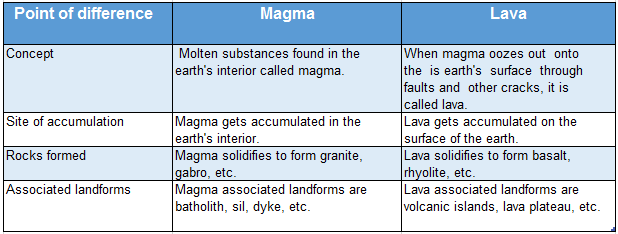
Question 6. What are the differences between magma and lava?
Answer:

Differences Between Magma And Lava:-

The differences between magma and lave are as follows

WBBSE Solutions For Class 8 Geography Chapter 1Interior Of The Earth Topic A Differences Between Magma And Lava


Chapter 1 Topic A Sources And Evidence About The Interior Of The Earth Short Answer Type Questions

Question 1. What lies underneath the hard surface on which we stand?
Answer: We stand on the hard surface of the earth, which is known as the crust. Just below the crust, there are hot, malten, semi-solid, and solid materials, up till the centre of the earth. These form the mantle and the core.

Beneath the surface on which we stand, there lies a layer of groundwater also.

Differentiate Between Magma And Lava

Question 2. Has anyone ever seen the interior of the earth?
Answer: Man has penetrated up to a depth of 12km into the earth’s interior. Beyond this limit, it is not possible for man to directly reach the interior of the earth due to enormous pressure and temperature.

Class 8 Geography Evidence for Earth’s Layers

Thus, nobody has directly ever seen the interior of the earth.

Question 3. How much one has to dig up to see the centre of the earth?
Answer: To reach the centre of the earth, one has to dig a tunnel equal in length to the radius of the earth, i.e., 6370 km. Man’s greatest endeavour has been a 12km deep tunnel in the Kola Peninsula of north-western Russia. It is the longest artificial tunnel.

Question 4. How far has it been possible to know about the interior of the earth?
Answer: It is not possible to reach the interior of the earth directly in order to gather information about it. However, several branches of science such as Physics, Mathematics, Seismology have contributed greatly in studying the characteristics of the earth’s interior.

Question 5. What is magma?
Answer:

Magma:-

Magma is a substance of the earth’s interior that remains in a molten and viscous state due to tremendous heat and pressure, mixed with gas and vapour. The space under the crust that contains magma is called the magma chamber.

Question 6. What is lava?
Answer:

Lava:-

When molten magma reaches the surface of the earth through any weak region or a fault, it comes out in the form of lava. Thus, lava is actually an external appearance of magma on earth.

Question 7. Why is hot and molten lava ejected out of the crater of a volcano?
Answer:

Hot And Molten Lava Ejected Out Of The Crater Of A Volcano because:-

In the interior of the earth, temperature increases with increasing depth, soaring as high as 5000°C in the inner core. The pressure in this region is very high as well. Due to this, the rocks and minerals remain in a molten and viscous state.

By any chance, if there is a release of pressure, these hot and molten rock materials gush out through a vent in the form of lava which we term as a volcano.

Differentiate Between Magma And Lava

Question 8. What is a hot spring?
Answer:

Hot Spring:-

The groundwater stored in different layers of the earth gets heated and starts to boil when it comes in contact with geothermal heat.

When this hot and boiling water gushes out from underground through any weak zone or a crack on the earth’s surface, it is called a hot spring.

WBBSE Class 8 Geography Chapter 1 Notes

Question 9. Why does boiling water come out of hot springs?
Answer:

Boiling Water Come Out Of Hot Springs:-

Temperature in the interior of the earth increases with depth and so, groundwater starts boiling under extreme heat. This water comes out through the faults on the earth’s surface as hot springs. For example- Manikaran in Himachal Pradesh has such a hot spring.

Question 10. Try to know about geothermal power stations located in different parts of India.
Answer: The geothermal power stations of India are

  1. Manikaran, Himachal Pradesh
  2. Puga Valley. Ladakh
  3. Tatapani, Chhattisgarh.

Question 11. What is your idea about the density of the earth?
Answer:

Idea About The Density Of The Earth:-

The measure of mass content in a unit volume of a substance is known as its density. Hence, the density of matter is the quantity of mass present in it, in an area of one cubic cm.

Similarly, the total mass content in the entire volume of the earth is known as the earth’s density. The average density of the earth is 5.5 grams/ cubiccm with respect to artificial satellites.

Question 12. What are the different types of seismic waves produced by earthquakes?
Answer:

Different Types Of Seismic Waves Produced By Earthquakes:-

There are three types of seismic waves produced by earthquakes

  1. Por primary waves
  2. S or secondary waves and
  3. L or surface waves.

Question 13. What do you mean by P wave?
Answer:

P Wave:-

The P or primary wave is the wave that can pass through both solid and liquid materials. It is the fastest wave to reach the epicenter of an earthquake.

Question 14. What is S wave?
Answer:

S Wave:-

The S or secondary wave travels through solid materials only. It cannot travel through liquid or semi-liquid materials. It reaches the epicenter of an earthquake just after P wave.

Question 15. What do you know about the interior of the earth?
Answer:

Interior Of The Earth:-

The interior of the earth refers to the layers of the earth that lie below its surface. It can be divided into three layers

  1. The core
  2. The mantle and
  3. The crust.

Question 16. What is a crater?
Answer:

Crater:-

The topmost outlet of a volcano through which lava is ejected is called a crater. Usually, a volcano has one main crater and several sub-craters.

Understanding Earth’s Interior for Class 8 Students

Question 17. What do you mean by L wave?
Answer:

L Wave:-

L wave is a surface wave moving parallel to the crust from the epicenter of an earthquake. Although it is slower than the P and S waves, it is the most destructive and violent of all the waves.

WBBSE Solutions For Class 8 School Science Long Answer Type Questions WBBSE Solutions For Class 8 School Science Short Answer Type Questions
WBBSE Solutions For Class 8 School Science Very Short Answer Type Questions WBBSE Solutions For Class 8 School Science Review Questions
WBBSE Solutions For Class 8 School Science Solved Numerical Problems WBBSE Solutions For Class 8 School Science Experiments Questions
WBBSE Solutions For Class 8 Maths WBBSE Class 8 History Notes
WBBSE Class 8 History Multiple Choice Questions WBBSE Solutions For Class 8 History
WBBSE Solutions For Class 8 Geography


Chapter 1 Topic A Sources And Evidence About The Interior Of The Earth Multiple Choice Questions

Choose the correct option

Question 1. Robinson Deep is located in

  1. Australia
  2. Germany
  3. South Africa
  4. Argentina

Answer: 3. South Africa

Question 2. The deepest mine in the earth is a

  1. Coal Mine
  2. Diamond Mine
  3. Copper Mine
  4. Gold Mine

Answer: 4. Gold Mine

Question 3. The approximate age of the earth is

  1. 220 crore years
  2. 460 crore years
  3. 370 crore years
  4. 550 crore years

Answer: 2. 460 crore years

Multiple choice Questions on Earth’s Interior for Class 8

Question 4. The average density of the earth’s surface is

  1. 2.6-3.3 gram/cubic cm
  2. 5.0-5.5 gram/cubic cm
  3. 11.0 gram/cubic cm
  4. 13-14 gram/cubic cm

Answer: 1. 2.6-3.3 gram/cubic cm

Question 5. The seismic wave that can penetrate all the layers in the interior of the earth, is the

  1. P wave
  2. L wave
  3. S wave
  4. R wave

Answer: 1. P wave

Question 6. Who wrote the book ‘Journey to the Centre of the Earth’?

  1. Agatha Christie
  2. H. G. Wells
  3. Jules Verne
  4. A. Huxley

Answer: 3. Jules Verne

Question 7. At present, the approximate age of the universe is about

  1. 1300 crore years
  2. 1500 crore years
  3. 1400 crore years
  4. 1600 crore years

Answer: 3. 1400 crore years

Class 8 Geography Sources and Evidence of Earth’s Layers

Question 8. The most destructive surface is the- wave on the earth’s

  1. P wave
  2. S wave
  3. L wave
  4. X wave

Answer: 3. L wave

Chapter 1 Topic A Sources And Evidence About The Interior Of The Earth Fill In The Blanks

Question 1. Temperature increases by about 1°C for every ________ m increase in depth from the surface of the earth.
Answer: 33

Question 2. Geothermal energy produces approximately ________ % of the electricity in Iceland.
Answer: 30

Question 3. The degree of compactness of a substance is known as its ________.
Answer: Density

Question 4. The main source which provides knowledge about the interior of the earth is ________.
Answer: Seismic waves

Question 5. An important geothermal power plant of India is located in the state of ________.
Answer: Himachal Pradesh

Question 6. With the increase of temperature, the volume of a material ________.
Answer: Increases

Question 7. With the increase of pressure, the volume ________.
Answer: Decreases

Chapter 1 Topic A Sources And Evidence About The Interior Of The Earth Write True Or False

Question 1. The hot and molten material found inside the earth is called lava.
Answer: False

Question 2. Bakreshwar in West Bengal has a cold spring.
Answer: False

Question 3. The S wave can pass through both liquids and semi-solids.
Answer: False

Question 4. The P wave is the fastest among all the seismic waves.
Answer: True

Question 5. The P wave cannot probe into the core of the earth.
Answer: False

Question 6. Eruption of lava provides us with knowledge about the earth’s interior.
Answer: True

Class 8 Geography Solutions WBBSE

Question 7. The S wave can pass through the core of the earth.
Answer: False

Question 8. Immense heat inside the earth can generate geothermal energy.
Answer: True

Question 9. Seismology is the study of earthquakes.
Answer: True

Question 10. The velocity of seismic waves depends on the density of the materials present inside the earth.
Answer: True

Question 11. The velocity of all types of seismic waves is the same.
Answer: False

Chapter 1 Topic A Sources And Evidence About The Interior Of The Earth Match The Columns

WBBSE Solutions For Class 8 Geography Chapter 1Interior Of The Earth Topic A Match the columns

Answer: 1. D, 2. A, 3. B, 4. C

Chapter 1 Topic A Sources And Evidence About The Interior Of The Earth Answer In One Or Two Words

Question 1. Where is the deepest artificial borehole of the world located?
Answer: Kola Peninsula in north-western Russia.

Question 2. At what rate does the temperature inside the earth increase?
Answer: 1°C per 33m of depth.

Question 3. Name the hot molten material found inside the earth.
Answer: Magma.

Class 8 Geography Solutions WBBSE

Question 4. Which country in the world produces the maximum amount of electricity from geothermal energy?
Answer: The United States of America.

Question 5. Which waves help us to learn about the interior of the earth?
Answer: Seismic waves.

Question 6. Which waves can travel through any and every medium?
Answer: P waves.

Question 7. Which waves can pass only through solid medium?
Answer: S waves.

Question 8. Give another name for L waves.
Answer: Surface waves.

Chapter 1 Topic A Sources And Evidence About The Interior Of The Earth Choose The Correct Option

Question 1. The average density of the earth is

  1. 5.9gram/cubic cm
  2. 6.9 gram/cubic cm
  3. 5.5 gram/cubic cm
  4. 7.5 gram/cubic cm

Answer: 3. 5.5 gram/cubic cm

Question 2. Which of the following provides us with knowledge about the interior of the earth?

  1. Precipitation
  2. Wind velocity
  3. Human settlement
  4. Seismic waves

Answer: 4. Seismic waves

Chapter 1 Topic A Sources And Evidence About The Interior Of The Earth Fill In The Blanks

Question 1. S waves cannot penetrate the ________ of the earth.
Answer: Core

Question 2. Bakreswar in West Bengal has ________.
Answer: Hot springs

Chapter 1 Topic A Sources And Evidence About The Interior Of The Earth Write True Or False

Question 1. The inner part of the earth is easily accessible to man.
Answer: False

Question 2. Temperature decreases with the increase in depth inside the earth.
Answer: False

Chapter 1 Topic A Sources And Evidence About The Interior Of The Earth Answer The Following Questions

Question 1. What are the different types of seismic waves?
Answer:

Different Types Of Seismic Waves:-

There are three types of seismic waves produced by earthquakes

  1. Por primary waves
  2. S or secondary waves and
  3. L or surface waves.

WBBSE Class 8 Geography Chapter 1 Study Guide

Question 2. What are the different sources for acquiring knowledge about the earth’s interior?
Answer:

Different Sources For Acquiring Knowledge About The Earth’s Interior:-

The sources which provide us with knowledge about the earth’s interior are

  1. Volcanic eruptions
  2. Water from hot springs
  3. Digging boreholes and deep mining
  4. Nature of seismic waves.

WBBSE Solutions For Class 7 History Chapter 7 Lifestyle And Culture Topic C Miscellaneous

WBBSE  Chapter 7 Lifestyle And Culture Topic C Miscellaneous Long Question And Answers

Question 1. Mention the main styles of architecture of the Sultanate period.
Answer:

Styles of architecture of the Sultanate period

There were three distinct architectural styles

  1. Delhi style
  2. Provincial style
  3. Hindu style.

1. Delhi Style:

  1. The first architectural construction made by Qutbuddin Aibak was the Quwwat-ul-Islam mosque
  2. The construction of Qutb Minar was started by Qutbuddin Aibak but completed by Iltutmish.
  3. The famous mosque Adai- din-Ka Jhopra was built in Ajmer.
  4. Alai Darwaza at Qutb Minar was built by Alauddin Khilji.
  5. Among the architectural constructions of the Tughlaq period, the city of Tughlaqabad, fortress of Adilabad, city of Jahan Panah, and the Palace fort of Firozabad and Kotla Firoz Shah deserves special mention.

Read and Learn More WBBSE Solutions For Class 7 History

2. Provincial Style:

Of the provincial styles, the most important were those of Gujarat, Malwa, Jaunpur, and Bengal. Architectures of South India may also be added to this Mosques of Barbak and Atala mosque, Adina mosque of Pandua, and Chhoto Sona masjid of Gauda are some of the specimens of provincial architecture.

WBBSE Class 7 Miscellaneous on Lifestyle and Culture Notes

3. Hindu Style:

Specimens of Hindu architecture was free from foreign influence. The Vithalswami temple of Vijaynagar, ‘Jaya Stambha’ of Chitor, built by Rana Kumbha are fine examples of Hindu architecture.

  1. The Jagannath temple of Puri, the Sun temple of Konark also deserve mention in this connection.
  2. The structure of the Sultanate architecture was ornamental. So they were not destroyed and demolished.

WBBSE Solutions For Class 7 History Chapter 7 Lifestyle And Culture Topic C Miscellaneous

Question 2. Write about the lifestyle of the common people in medieval India.
Answer:

The common people of medieval India spent an easy-going life.

1. Food:

  • Their daily food was the same old ‘Kedgeree’ (khichri). They had their meal once a day.
  • According to foreign accounts, they did not know the taste of meat.

2. Dress:

  • They had not sufficient dresses to wear. They had rarely one or two-bed sheets for laying their beds.
  • They used the sheets sometimes to cover themselves. Though sufficient in summer, in winter, they had to suffer.

3. Furniture:

As regards furniture, they had a pair of ‘charpoy’ and a few cooking utensils only.

4. House:

  • They made their residence around a well ditch or a pond.
  • The minimum elements required for their settlement was a bundle of hay and a few tree trunks.
  • All these were enough for their dwelling.

5. Amusement:

  • Wrestling, archery, javelin throwing and swimming were some of their favorite sports.
  • Folk songs, dancing, and juggling were their source of enjoyment.

Conclusion: Famine or no famine, the condition of the poor people remained the same.

WBBSE Class 7 Geography Notes WBBSE Solutions For Class 7 History
WBBSE Solutions For Class 7 Geography WBBSE Class 7 History Multiple Choice Questions
WBBSE Class 7 Geography Multiple Choice Questions WBBSE Solutions For Class 7 Maths


Question 3. How were the people of different religions united by Kabir’s Bhakti ideology?
Answer:

The people of different religions united by Kabir’s Bhakti ideology:

According to legends, Kabir was born to a Hindu Brahmin widow of Kashi but was brought up by a childless Muslim weaver couple. So his birth and upbringing was symbolic in unifying the two religions.

Bhaktivad of Kabir

1. Philosophy:

  • Kabir believed in monotheism.
  • He felt that the same God has many forms like Rama, Hari, Govinda, and Allah.

2. Kabir panthis:

  • Both Hindus and Muslims were Kabir’s disciples.
  • The followers of Kabir were called Kabir Panthis and survived for a long as a minor community or sect.

3. Equality:

  • Kabir was the symbol of equality and universal brotherhood.
  • He tried to remove religious and caste distinctions in society.


WBBSE Solutions For Class 7 History Chapter 7 Lifestyle And Culture Topic C Miscellaneous Kabir


4. Hindu-Muslim unity:

  • Kabir preached the ideal of cordial relations among people of various religions and castes.
  • He added, people did not need to renounce temporal life to pray to God but could attain God by devotion and truth.
  • This attracted people of all religions and castes towards him.

5. Philosophy of family life:

  • Kabir never asked to renounce family life and accept asceticism.
  • So people of different castes and creeds accepted Bhaktivad while continuing their family lives.

Question 4. Analyze the effect of the Vaishnava movement in Bengal.
Answer:

The effect of the Vaishnava movement in Bengal:

During the Hussain Shahi era, the Vaishnava movement started in Bengal under the leadership of Sri Chaitanya.

Consequences of the Vaishnava movement

1. Religion:

Sri Chaitanya’s emphasis on intense devotion, simplicity, and equality of mankind created a revolution not only in Bengal but on the whole of India.

2. Society:

  • The rigidity of the caste system was somewhat relaxed by the message of universal tolerance, love, equality, and brotherhood
  • Untouchability and the domination of Brahmins became much lesser than before.
  • He showed a new way to the neglected and downtrodden people of society.

Important Definitions Related to Indian Culture

3. Literature:

  • Medieval Bengal was also enriched by the compositions of Vaishnava literature and biographies of Sri Chaitanya like ‘Chaitanya Bhagavata’, ‘Chaitanya Mangal’, and ‘Chaitanya Charitamrita’.
  • The main Vaishnava literature also underwent a change.

4. Gaudiya Vaishnava sect:

It was founded by the followers of Sri Chaitanya to promote equality and brotherhood.

5. Spiritual democracy:

  • The preaching of Vaishnavism by Sri Chaitanya gave an aura of spiritual democracy to religious practices.
  • The rigidity in practicing religion based on caste and creed was reduced.

6. Checking moral degeneration:

  • The ethical decline of society, that had started since the 12th century, was somewhat arrested and people became more humane and less self-centred.
  • Thus, the moral and humanistic values were restored in the society.

Question 5. Write a note on Akbar’s Din-i-llahi.
Answer:

Din-i-llahi

1. Meaning:

The Persian word, ‘Din-i-llahi’ implies ardent devotion to God.

Abul Fazal and Badauni have called it the ‘Tauhid-i- Ilahi’ or ‘Divine Monotheism’.

2. Main Principles:

The main principles of Din-i-llahi were

  1. Vegetarian diet
  2. Social service and charity
  3. To address each other as ‘Allah Hu Akbar’ and to reply with the words, Jallah Jallalaha’
  4. To give up blind faith, rituals, superstitions, and beliefs
  5. To sacrifice life, property, and self-respect in the service of the emperor.

3. Nature:

  • Introduced by the Mughal emperor Akbar, Din-i-llahi was made up of the positive and moral virtues of all religions.
  • Some critics think that it resembled Islam in some features as it incorporated Namaz, Roza, Haj, and Zakat.

4. Features:

  1. This faith had no place for deities-the emperor was the sole guide
  2. Emphasis was laid on generosity and purity of soul
  3. Followers had to take vegetarian diet, give up alcohol, follow toleration, self-sacrifice, detachment, politeness and abstinence from alcohol.

Real-Life Scenarios Involving Cultural Syncretism in India

5. Results:

  1. Through the Din-i-llahi, relations between Hindus and Muslims grew cordial, which in turn, strengthened the Mughal Empire
  2. The influence of the Ulemas and Maulvis was somewhat reduced and the authority of the emperor was consolidated.

Question 6. Discuss about gardening and fort building during the reign of the Mughal emperors.
Answer:

Gardening and fort building during the reign of the Mughal emperors:

Under the Mughal Emperors, a separate style of construction of forts and gardens emerged. Forts were set up for self-defence while gardens were created for enjoyment and recreation.

Construction of gardens

  • Babur, the founder of Mughal rule in India, was very fond of gardens. Under him, evolved a new system, wherein, the garden was divided into four parts.
  • The Persian term for this style was Chaharbagh while the Hindi name was Char Bagh.
  • This style is found in Kashmir’s Nishat Bagh, Shalimar Bagh of Lahore, Humayun’s Tomb in Delhi, and Taj Mahal of Agra.

Construction of forts:

  • Among the Mughal rulers, Akbar first took up the construction of forts.
  • He built the Agra Fort and forts at Ajmer, Lahore, and Allahabad.
  • The next ruler, Jahangir lived at Lahore and built a palace inside the fort.
  • Shah Jahan repaired the forts at Agra and Lahore and built the Red Fort at Delhi.
  • Aurangzeb paid great attention to the defense of the Delhi Fort.

Question 7. What were the main features of the different architectural phases in medieval Bengal?
Answer:

The main features of the different architectural phases in medieval Bengal:

The Bengali style of architecture was highly advanced and an idea about it can be obtained from paintings and sculptures.

Architectural phases in medieval Bengal

1. Classification:

  • The architecture was of different types like stupas, vihara, temples, and mosques.
  • Stupas and vihars were based on Buddhism while temples were set up by Hindus.
  • The architecture of the mosque betray Hindu element along with Islamic element.

2. Examples:

  • Notable examples are the bronze stupa at Ashrafpur, near Dhaka, Satyapir Bhita stupa at Paharpur, and stone stupa at Jogighopa in Dinajpur.
  • There is not much evidence of temple architecture.
  • In the Sultanate era, mosques like Bara Sona Masjid, Choto Sona Masjid, Loton Masjid, Dakhil Darwaza, and Kadam Rasul were constructed.

3. Characteristics:

  • From various sources it is known that temples were structurally high with towers.
  • The mosques were constructed according to the Do-Chala Plan and had lotus motifs.

Question 8. What was the role of the Mughal emperors in the development of Mughal painting?
Answer:

The role of the Mughal emperors in the development of Mughal painting:

Mughal Emperors played an important role in developing Mughal painting which had both European and Indian elements.

Examples of Real-Life Applications of Cultural Knowledge


WBBSE Solutions For Class 7 History Chapter 7 Lifestyle And Culture Topic C Miscellaneous Carpet Produced In mughal period


Development of painting during Mughal Era

1. Features:

It showed a combination of Indo-Persian styles. It depicted scenes from nature, trees, animals, and flowers and later portraits and miniature painting.

2. Role of Emperors:

  • Babur, a lover of nature, patronized quite a few painters at his court, to encourage art.
  • Humayun patronized at his court, two Persian painters, Mir Syed Ali, and Khwaja Abbas.
  • Akbar, the next ruler, set up a separate department of painting under the supervison of Abdus Samad and had arranged for illustrating, various episodes from religion and history.
  • Under Jahangir, Mughal painting became free of Persian influence and was enriched under painters like, Bishen Das, Mohammad Nadir, and Ustad Mansur.
  • During Shah Jahan’s reign, Muhammad Nadir, made handsome contribution to art.
  • However, Aurangzeb deemed painting as a luxury, anti-Islamic, and a waste of time.

Question 9. Discuss how the use and popularity of Persian language increased in medieval India.
Answer:

The use and popularity of Persian language increased in medieval India:

During the Middle Ages in India, the Persian language became very popular, and various literary works were created in Persian.

Increasing popularity of the Persian Language

Persian language Uses:

  • Persian language and literature began to flourish under the Sultans of Delhi. With the establishment of Turkish rule in India, Persian became the state language, particularly with state patronage.
  • Sultan Qutbuddin Aibak and Iltutmish patronized Persian language. Lahore became the main center for the cultivation of Persian language and literature.
  • Delhi, Jalandhar, and Firozabad also emerged as centres of Persian learning. Persian was also used for composing literary pieces.

Persian language Popularity:

  • Persian became the medium of literature. Eminent writers included Amir Khusrau, Mir Hasan Dehlavi, Minhaj-ud-din Siraj, Isami, and Ziauddin Barani.
  • At the initiative of Sultan Zainul Abedin, the Rajatarangini, Mahabharata, and other Sanskrit texts were translated into Persian.
  • During the Mughal era, biographies of Babur, Humayun, and Akbar were composed in Persian.
  • Its popularity was enhanced due to the efforts of poets like Faizi, Kasim Khan Mauzi, Urfi, Naziri, and Bedil.

Question 10. What were the changes that occured in military and agricultural technology in the Sultanate and Mughal age?
Answer:

The changes that occured in military and agricultural technology in the Sultanate and Mughal age:

In both the Sultanate and Mughal eras, great technological innovation was noticed in the spheres of military science and agriculture.

Use of technology

1. Military:

  • At the onset of the 14th century, gunpowder entered India from China through the Mongols. Gun-powder-operated rockets began to be used in some parts of India.
  • The technology of the gun came to India during the 2nd half of the 15th century from China and Mameluk-ruled Egypt.
  • With Babur’s invasion, the use of cannons and shells in battles began.

2. Agriculture:

  • In the sphere of agriculture, advanced models of spades, ploughs, and other implements began to be used.
  • To facilitate irrigation, new methods were introduced. During the 13th century, the Persian wheel was brought to India from Persia.
  • The machine, made of wood and operated by animal power, had belts and gears fitted.
  • Water was extracted from reservoirs by means of mud vessels and ropes.
  • Knowledge was also borrowed from the Portuguese to increase the quantity and quality of agricultural output.


WBBSE Solutions For Class 7 History Chapter 7 Lifestyle And Culture Topic C Miscellaneous Persian wheel


Question 11. Write an imaginary dailogue between Kabir and a Suhrawardi sufi saint on politics, lifestyle, and religion.
Answer:

Place: Delhi,

Period: Sultanate Period Suhrawardi

Sufi saint: Are you Kabir, a Bhaktibadi saint?

Kabir : Yes. I am Kabir. You?

Sufi saint: I belong to the Suhrawardi order or ‘silsila’ of sufism.

Kabir: It is told that the sufis always keep contact with politics and politicians. Is it correct?

Sufi saint: Yes. You have been rightly told. We, the sufi saints always keep contact with politics and the ruling class.

Kabir: What is your argument in favour of your opinion?

Sufi saint: I think that we should not have no reservation in this matter. We may seek any sort of gift or assistance from the Sultans.

Kabir: What is your views on the lifestyles of the Sufis?

Sufi saint: We do not think it proper to lead a life of the poors. We think, poverty always stands in the way of divine thought. However, what is your opinion about it?

Kabir: I strongly believe that true faith could be attained only by purity and genuineness of spirit, and not by social norms, rituals and religious rites.

Sufi saint: What is the use of temples and mosques then?

Kabir: God is within you only and nowhere else.

Sufi saint: I am so pleased to talk to you. If God wills, we will meet again.

Question 12. Suppose you are a common man of Nabadwip during the time of Sri Chaitanya. You have seen that Chaitanya has set out for Nagar Sankirtan. What will you do?
Answer:

Suppose you are a common man of Nabadwip during the time of Sri Chaitanya.

  • As a common man of Nabadwip I would have taken part in ‘Nagar Sankirtans’. ‘Nagar Sankirtans’ were sung in ceremonial processions and covering the entire city.
  • I would have found much pleasure in these ‘sankirtans’.
  • As there was no consideration of castes in ‘Kirtan’, I would have felt no reservation in singing together indiscriminately.
  • I would have felt much excitement to be introduced with so many disciples of Sri Chaitanya like Nityananda, Sribas, Rup-Sanatan, Yaban Haridas, and others.
  • Sri Chaitanya mixed freely with the lower caste people. He infused a spirit of unity among them.
  • It gladened me, no doubt. I felt pride in it.

Question 13. If you were a painter in the Mughal karkhana, what would you have painted to please the emperor?
Answer:

If I were a painter in the Mughal Karkhana, the kinds of paintings I would have drawn to please the emperor are

1. Court painting:

  • Most of the court painters of the Mughal period came from the Western part of India including Gujarat.
  • To appease the emperors, the artists too used to draw court scenes. I would have followed the same style of painting.

2. Book designing:

  • Emperors like Akbar liked the art of book design.
  • I also used to take much interest in book design and illustration.

3. Miniature painting:

  • During the time of Emperor Akbar ‘miniature’ painting was in use. They were small in size and shape.
  • In these pictures, golden and other colours were used. I also would have painted such pictures to please the emperor.

4. European style:

  • Mughal emperors were influenced by the European style of painting.
  • The pictures became more realistic and natural.
  • Nature, plants, and animals became the subject of painting.
  • So I would have drawn such pictures so that they may please the emperor.

5. Portraiture:

  • Portrait making was all time favorite to the Mughal emperors.
  • The style was also started from the time of Akbar.
  • Therefore, I would have tried to portray their appearance exactly.

Question 14. Suppose you are the teacher of your class. You are teaching about the use of Arabic and Persian words in Bengali language. You want to give a list of Arabic and Persian words used in everyday Bengali to your students. Make a list of such words. Take help of a Bengali dictionary.
Answer:

I am a Bengali teacher of my school. I would like to teach my students about the use of Arabic and Persian words in Bengali language; they are as follows:

WBBSE Solutions For Class 7 History Chapter 7 Lifestyle And Culture Topic C Miscellaneous Arabic and persian words

Question 15. What is Sufism? What were its features?
Answer:

Sufism

  • Since the 10-11th century, many Muslims started looking for the path of worshipping god without following the strict religious doctrines.
  • The Sufi saints who came from central Asia, showed a new path of adoration.
  • They desired to worship god in their own way. This is called Sufism.

Features of Sufism

1. Nature:

  • When Sufism came to India from central Asia, the religious conception of Bhakti cult and the Nathapanthis very much existed there.
  • So it is believed, Sufism, Bhakti cult, and the Nathapanthis influenced each other.

2. Groups:

  • In India Sufism was divided into two groups-Chistis Suhrawardis.
  • ‘Chistis’ belonged to the Ganga-Yamuna doab area and the Suhrawardis belonged to Sind, Punjab, and Multan.

3. Human Philosophy:

The Sufi saints did not judge the people with the yardstick of religion, money, and power.

4. Religious doctrine:

  • So far the religious doctrine was concerned the ‘Sufis were of two orders.
  • Those who followed the Islamic principles were called ‘Ba-Shara’ and those who did not, were called ‘Be-Shara’.
  • ‘Shara’ means Islamic laws. Vagabond ‘Sufis’ and ‘Kalandars’ were of the former order and the ‘Chistis’ and ‘Suhrawardis’ were of the second order.

Question 16. Give a comparative study of the food habits of the Mughals and those of the people of this age.
Answer:

  • In the medieval period our country witnessed the rule of different foreign countries. The Mughals may be cited for example.
  • From the very beginning of the 16th century, different European countries started sending envoys to India.
  • As a result, different foreign elements got mixed up with the eating and drinking habits of the Indian people along with their culture.
  • Cooks of different countries like Turkey and Persia introduced different food items of their own to appease the emperors.
  • Consequently, varieties of food increased in medieval India. Now as a result of globalization, contact with different countries of the world has increased.
  • Therefore in each and every sector of lifestyle and food habits, diversities have been introduced.
  • People have come to know about their eating habits and the dresscodes through the newspapers and television channels.
  • The new system has achieved our acceptibility. So exotic foods like Pizza, Pasta, burgers have become highly popular among our people.
  • The questions above will enable the students to build up a close relationship between the present and the past.
  • As a result, a feeling of empathy and cooperation will be formed.

Question 17.  Different types of foods are popular even today. Draw a poster either singly or jointly, on this subject.
Answer:

WBBSE Solutions For Class 7 History Chapter 7 Lifestyle And Culture Topic C Miscellaneous Popular Food Items

The poster will inculcate a sense of creativity and will help the learner to develop further knowledge about food and its history.

Question 18.  Write a Chronology of Dates And Events

WBBSE Solutions For Class 7 History Chapter 7 Lifestyle And Culture Topic C Miscellaneous Dates and events

WBBSE  Chapter 7 Lifestyle And Culture Topic C Miscellaneous Short Question And Answers

Question 1. Which fruits, vegetables, and crops were largely cultivated during the Sultanate and Mughal periods?
Answer:

  1. Fruits during the Sultanate and Mughal periods: Mango, banana, jackfruit, coconut, date palm, and grapes were cultivated.
  2. Vegetables during the Sultanate and Mughal period: Brinjal, gourd, pumpkin, fig, ridge gourd, and arum were grown.
  3. Food grains during the Sultanate and Mughal periods: Paddy, wheat, barley, sesame, mustard, and various types of pulses like moong, Masur, chana, and arhar were also cultivated.

Question 2. Who were the Bhakti saints of medieval India?
Answer:

Bhakti saints of medieval India:

  • In medieval India, the famous Bhakti saints included Ramananda, Kabir, Nanak, Dadu, Sri Chaitanya, and Meera Bai.
  • They emphasized on the oneness of God and felt that God could be attained by pure love and devotion.

Question 3. What is Silsila? What was the lifestyle of the Chisti Sufis?
Answer:

Silsila:

  • The term Silsila means sect or order. There were nearly a hundred Sufi sects in India, out of which, the most popular ones were Chisti, Suhrawardi and Qadiri.
  • During the reign of Akbar, Abul Fazl records the names of 14 sects.

Lifestyle of Chisti Sufis:

  • The Sufis of the Chisti order led a very simple and austere life, immersing themselves completely in thoughts of Allah.
  • They accepted no governmental aid and survived on the alms given by the common folk.

Question 4. What was the oath-taking ceremony of Din-i-llahi like?
Answer:

The oath-taking ceremony of Din-i-llahi like:

  • Persons, willing to accept the Din-i-llahi, had to follow a ceremony through which, they took an oath of loyalty to the emperor.
  • They had to promise, to sacrifice (kurban) their life (Jaan), property (maal), faith (din), and dignity (namus) in the service of the emperor.
  • Then, they had to bow and touch the feet of the Badshah.
  • At the end, the emperor bestowed on them, a new turban and a small picture of himself to fix in front of the turban.

Question 5. What was the special architectural characteristic of Alai Darwaza?
Answer:

The special architectural characteristic of Alai Darwaza:

Alai Darwaza was built during the reign of Sultan Alauddin Khilji in the campus of the Qutb Minar.

  1. It was made of red sandstone.
  2. It was a stunning example of the fusion of Indo- Saracenic or Indo-Islamic art.
  3. On the doorway was engraved praises and eulogies about the Sultan instead of the message of Allah.

Question 6. What is meant by ‘calligraphy’ and ‘miniature’?
Answer:

Calligraphy:

It refers to the art of decorative handwriting, prevalent in the Middle ages when printing was not known.

Miniature:

These are paintings and portraits of very small size drawn on pages of manuscripts or portfolios. They are amazingly detailed, with bright and vibrant colors. These are not used as wall hangings.

Question 7. What is ‘shivayana’? What aspect of the lifestyle of Bengal peasants is learned from it?
Answer:

Shivayana:

The literature composed on the Hindu deity Shiva is called Shivayana. The stories of the Puranas and the religious scriptures based on Lord Shiva, are also associated with the household and family life of Shiva and Parvati.

Lifestyle of Bengal peasants:

In Shivayana literature, Shiva is portrayed as a poor peasant trying to make a living with Durga, his wife. The family life of Shiva and Durga reflects the life of Bengal peasants during this period.

Question 8. Where was paper invented? Write about the use of paper in medieval India.
Answer:

Invention:

Paper was invented in China in the 1st century AD.

Use of paper:

In the 13th century, the technology of paper manufacturing came to India from China through Central Asia. The paper was used for the purpose of writing. The paper was also used as packing material to deliver sweetmeats.

Question 9. If you compare the price of commodities during the reign of Alauddin Khilji and Muhammad bin Tughlaq, do you find any difference?
Answer:

During the reign of Muhammad bin Tughlaq, the price of commodities was much higher than the reign of Alauddin Khilji.

Question 10. The common people could understand the words of Guru Nanak and Kabir. What was the reason behind it?
Answer:

Guru Nanak and Kabir were both Bhakti saints. The common people could easily understand the words of both as:

  1. Both of them accepted all the people without any discrimination.
  2. They preached in the regional language.
  3. Their words were very simple to understand.

Question 11. Why do you think the tradition of Bengali biographical literature started with Sri Chaitanya?
Answer:

  • In the period of Hussain Shahi rule, the tradition of writing on the life and works of Sri Chaitanya had just started.
  • Later many Vaishnava poets had composed poetry on the life of Sri Chaitanya. They were called ‘Chaitanya Jivani Kavya’.
  • The well-known works of this age were ‘Chaitanya Charitamrita’ by Krishnadas Kaviraj and ‘Chaitanya Mangala’ by Jayananda.
  • According to historians, the emergence of Sri Chaitanya had exerted a profound influence on the common man, especially of Bengal.
  • Under his wonderfull inspiration the genius of the Bengalis expressed itself in diverse ways, especially in literature.
  • Vernacular literatue and language was also enriched during this period. In fact, it was the first awakening of the Bengaee race, centering around Sri Chaitanya.

Question 12. Why do you think the tradition of Bengali biographical literature started with Sri Chaitanya?
Answer:

  • Sri Chaitanya had exerted the greatest influence on the common people of Bengal.
  • Again in Bengal literature developed most.
  • The Vaishnava poets made the greatest contribution in the development of Bengali literature.
  • So I think, the tradition of Bengali biographical literature started with Sri Chaitanya.

Question 13. After reading the account of Thomas Roe what is your impression about Emperor Jahangir?
Answer:

  • As Jahangir included Sir Thomas Roe in Din-i-Allah, he may be said to be a liberal and benevolent emperor.
  • Moreover, we may assume that he was not rigid enough to impose the traditional system of the court on Roe.
  • So he was an easy going man of moderate. He was not reactionary.

Question 14. Make a list of the architectural monuments built during the Sultanate and the Mughal age.
Answer:

Sultanate period:

Qutb Minar, Alai Darwaza, the city of Tughlaquabad, the Tomb of Iltutmish Fortress of Allahabad, the city of Jahan Panah, and the palace fort of Firozabad.

Mughal period:

  • Babar’s Chaharbag garden, Sher Shah’s Purana Qila and the Tomb of Sasaram, the construction of Dinpanah started in Humayun reign, Akbar’s Buland Darwaza at Fatehpur Sikri, the tomb of Selim Chisti, Dewan- Aam, Dewan-i-Khas, city of Fatehpur Sikri, Buland Darwaza, the famous Itmad-ud-daula tomb of Nurjahan, Shah Jahan’s Diwan-i-Aam, Diwan-i-Khas and the great Taj Mahal.

Question 15. What is Buland Darwaza?
Answer:

Buland Darwaza:

Buland Darwaza or the ‘door of victory’ was built by Mughal emperor Akbar to commemorate his victory over Gujarat. It is the main entrance to the Jama Masjid at Fatehpur Sikri.

Question 16. Describe the society during the Sultanate and Mughal era.
Answer:

The society during the Sultanate and Mughal era:

  • During the Sultanate and Mughal eras, society was based on the joint family. In both society and family, women were ranked lower than men.
  • Hindu ladies used the veil while Muslim ladies used the purdah.
  • In poor, peasant families, both men and women worked together side by side at home and in the fields

WBBSE  Chapter 7 Lifestyle And Culture Topic C Miscellaneous Very Short Question And Answers

Question 11. Who is called ‘Be-shara’?
Answer: Those who did not obey the Islamic laws are called Be-shara

Question 12. Who wrote ‘Srikrishna Kirtan’?
Answer: Badu Chandidas wrote ‘Srikrishna Kirtan’

WBBSE  Chapter 7 Lifestyle And Culture Topic C Miscellaneous Strike The Odd One Out

Question 1. Kabir, Khaja Moinuddin Chisti, Meera Bai, Nanak
Answer: Khaja Moinuddin Chisti

Question 2. Krishna Das Kaviraj, Maladhar Basu, Govinda Das, Jibanananda Das
Answer: Jibanananda Das

Question 3. Chandi, Manasa, Dharma, Handicrafts
Answer: Handicrafts

Question 4. Bharatnatyam, Kathakali, Odishi, Bihu
Answer: Bihu

Question 5. Hinduism, Buddhism, Jainism, Sultan
Answer: Sultan

Question 6. Ain-i-Akbari, Ramayana, Mahabharata, Bhagavat Puran
Answer: Ain-i-Akbari

Question 7. Taj Mahal, Moti Masjid, Red Fort, Qutb Minar
Answer: Qutb Minar

Question 8. Tughlaqabad, Alai Darwaza, Siri, Pandua
Answer: Panda

Question 9. Isami, Amir Khusrau, Faizi, Maladhar Basu
Answer: Maladhar Basu

Question 10. Battle of Tarain, Battle of Haldighat, Battle of Chausa, Deccan wars
Answer: Battle of Tarain

WBBSE  Chapter 7 Lifestyle And Culture Topic C Miscellaneous Fill In The Blanks

Question 1. In the Sultanate and Mughal periods, the houses of the common people were made of ________(tiles and bricks/cement and sand/marble).
Answer: Tiles and bricks

Question 2. The couplets of Kabir are known as ________ (bhajan/katha katha/doha).
Answer: Doha

Question 3. The Sufis regarded their Gurus as ________ (Pir/Muridi/Be-shara).
Answer: Pir

Question 4. ________(Kolkata/Nabadwip/Murshidabad) was the main centre of the Chaitanya movement.
Answer: Nabadwip

Question 5. ________(Nanak/Kabir/Meera Bai) was the devotee of Lord Krishna or Giridhari.
Answer: Meera Bai

Question 6. The main feature of Din-i-Allah was that the relation between the Mughal Emperor and the nobility was of ________ (teacher-student/ master-servant/ruler-subjects).
Answer: Teacher-student

Question 7. The craftsmanship of inlaying gems on marble with intricate design is called ________ (Chahar bag/Pietra Dura/Terracotta).
Answer: Pietra Dura

Question 8. The Persian translation of the Mahabharata is known as ________ (Hamzanama/Tutinama/ Razmnama).
Answer: Razmnama

Question 9. (Daswant/Mir Sayeed Ali/Abdus Samad) ________ was better known as ‘Shirin Kalam’.
Answer: Abdus Samad

Question 10. Jaunpuri raga was created by ________ (Bajju Bawra/Hussain Shah Shirki/Ibrahim Shah Sharqi).
Answer: Hussain Shah Shirki

Question 11. The author of ‘Sri Krishna Vijaya Kavya’ is ________(Kashiram Das/Krittibas Ojha/Maladhar Basu).
Answer: Maladhar Basu

Question 12. The Persian wheel was used for ________ (lifting water/firing shells of cannons/ gardening).
Answer: Lifting water

Question 13. Bhakti cult was first introduced in _________(South/East/West) India.
Answer: South

Question 14. ‘Dohas’ of Kabir developed in _________ (Bengali/Hindi/Urdu/Gurumukhi) language.
Answer: Hindi

WBBSE  Chapter 7 Lifestyle And Culture Topic C Miscellaneous True Or False

Question 1. Sufis were divided into two orders.
Answer: True

Question 2. Darga of Salim Chisti is at Fatehpur Sikri.
Answer: True

Question 3. Qutbuddin Bakhtiyar Kaki belonged to Nathpanthis.
Answer: False

WBBSE  Chapter 7 Lifestyle And Culture Topic C Miscellaneous Match The Columns

Question 1.WBBSE Solutions For Class 7 History Chapter 7 Lifestyle And Culture Topic C Miscellaneous Match the following 1

Answer: 1. D, 2. A, 3. B, 4. E, 5. C.

Question 2.WBBSE Solutions For Class 7 History Chapter 7 Lifestyle And Culture Topic C Miscellaneous Match the following 2

Answer: 1. C, 2. A, 3. B, 4. E, 5. D.

Question 3.WBBSE Solutions For Class 7 History Chapter 7 Lifestyle And Culture Topic C Miscellaneous Match the following 3

Answer: 1. D, 2. G, 3. A, 4. F, 5. I, 6. J, 7. E, 8. C, 9. B, 10. B.

Question 4.WBBSE Solutions For Class 7 History Chapter 7 Lifestyle And Culture Topic C Miscellaneous Match the following 4


Answer: 1. E, 2. H, 3. J, 4. F, 5. I, 6. D, 7. C, 8. A, 9. G, 10. B.

WBBSE Solutions For Class 7 History Chapter 7 Lifestyle And Culture Topic B Sultanate And Mughal Architecture Art Language Literature And Science And Technology

WBBSE Chapter 7 Lifestyle And Culture Topic B Sultanate And Mughal Architecture Art Language Literature And Science And Technology Long Question And Answers

Question 1. Give a brief idea about the Indo-Islamic or Indo-Saracenic style of architecture.
Answer:

Indo-Islamic or Indo-Saracenic style of architecture:

Into-Islamic or Indo-Saracenic style of architecture evolved during the 13th century, in the Sultanate era, due to the amalgamation of Islamic and Hindu architectural elements. Indo-Islamic or Indo-Saracenic Architecture

1. Background:

Hindus and Muslims CO- existed for centuries and deeply influenced each other. During the Turko-Afghan era, Islam-based Persian culture flourished.

Simultaneously, there were changes in the Indian style of architecture in terms of ornamentation and themes. Under these circumstances, IndoSaracenic Style of architecture evolved.

2. Spread:

The indo-Saracenic architectural style flourished during the Mughal times as well, particularly during the reigns of Humayun and Akbar.

Read and Learn More WBBSE Solutions For Class 7 History

3. Specimens:

  • Notable examples of architecture during the Sultanate era are, Quwwat-ul-Islam Mosque, Alai Darwaza, Qutb Minar, and Adhai-Din-Ka-Jhopda.
  • During the Mughal era, notable examples are Sher Shah’s mausoleum at Sasaram, Humayun’s tomb, Jami Masjid, Taj Mahal, and Moti Masjid.


WBBSE Solutions For Class 7 History Chapter 7 Lifestyle And Culture Topic B Sultanate And Mughal Architecture Art Language Literature And Science And Technology

Question 2. Give an idea of the various styles of architecture during the Sultanate era.
Answer:

Various styles of architecture during the Sultanate era:

The architecture of the Sultanate era is called the Indo-Islamic or Indo-Persian style of architecture.

Architecture in Sultanate Era

1. At the capital, Delhi:

Some new elements were incorporated in the constructions in Delhi, for example,

  1. Mixing lime and sand with water to form a layer
  2. Incorporating designs like geometric figures, swastika,lotus, creepers, and bells
  3. Use of arches and domes, in larger structures like palaces and mosques, like Qutb minar, alai darwaza, and the mausoleum of sikandar shah.

WBBSE Solutions For Class 7 History Chapter 7 Topic B Qutb Minar

2. Provincial architecture:

The provincial styles included Jaunpuri, Bengali, Malwa, Gujarati, and South Indian architecture. Notable examples are the Masjid of Barbak, Atala Masjid, Adina Masjid at Pandua, Choto Sona Masjid, and Bara Sona Masjid at Gauda.

3. Independent Hindu Architecture:

Richly carved pillars were constructed to hold up vast, carved ceilings as at Vithalnath Temple at Vijaynagar, Rana Kumbha’s pillar and fort at Mewar, Jagannath Temple at Puri, and Sun Temple at Konarak.

WBBSE Class 7 Geography Notes WBBSE Solutions For Class 7 History
WBBSE Solutions For Class 7 Geography WBBSE Class 7 History Multiple Choice Questions
WBBSE Class 7 Geography Multiple Choice Questions WBBSE Solutions For Class 7 Maths


Question 3. Mention the main landmarks of architecture during the Sultanate era.
Answer:

During the Sultanate era, the Indo-Saracenic style of architecture profusely bloomed in Delhi under various royal dynasties. Chief architectural specimens in the Sultanate period

1. Slave Dynasty:

  1. Qutbuddin Aibak constructed the Quwwat-ul-Islam Masjid in Delhi in 1193, to commemorate his conquest of Delhi.
  2. Aibak also started the construction of the Qutb Minar in Delhi in honor of the famous Sufi saint, Khwaja Qutbuddin Bakhtiyar Kaki, of Baghdad.
  3. He put up the famous Masjid, Adhai- Din-Ka-Jhopda at Ajmer.

2. Khilji Dynasty:

  1. During the reign of Alauddin Khilji, the Alai Darwaza was constructed. This was meant to serve as an entrance for the Qutb Minar.
  2. Nizamuddin Auliya’s Tomb, Hazar-i-Situn, and Siri are other significant examples of the grand architecture of the times.

3. Tughlaq Dynasty:

The Sultans of the Tughlaq dynasty used expensive red sandstone to build their palaces and mansions. Some notable examples of Tughlaq architecture are the Adilabad Fort, the Palace at Firozabad, and the Tomb of Ghiyasuddin.

4. Sayyid and Lodi Dynasties:

Architecture reached its climax during the reign of the Sayyid and Lodi dynasties in the provinces. Notable provincial architectural structures are the Adina Mosque at Pandua, Bara Sona Masjid, Jami Masjid at Ahmedabad, and Char Minar at Hyderabad.

WBBSE Solutions For Class 7 History Chapter 7 Topic B Alai Darwaza


Question 4. What was the state of provincial architecture during the Sultanate era?
Answer:

The state of provincial architecture during the Sultanate era:

John Marshall says the architecture of the Sultanate era was an amalgamation of Hindu and Muslim elements. Examples, of provincial architecture in this era are found in Gujarat, Bengal, Jaunpur, and Bahmani kingdom.

Provincial Architecture in the Sultanate Period

1. Architecture in Bengal:

  • In Bengal, mosques were put up, following the Do-Chala or Char-Chala style, adorned with the Hindu symbol of the lotus. Bricks were more in use than stone in construction.
  • Notable examples of architecture in Bengal are the Adina Masjid at Pandua, Bara Sona Masjid and Choto Sona Masjid at Gauda, Kadam Rasul, and Dakhil Darwaza.


WBBSE Solutions For Class 7 History Chapter 7 Topic B Chair minar


2. Jaunpuri Architecture:

Hindu elements are dominantly visible here, like the Laal Darwaza and the dome of the Atala masjid.

3. Bahmani Architecture:

  • Indian, Turkish, Persian, and Egyptian elements are clearly visible.
  • Notable examples are the Jami Masjid of Gulbarga, Charminar of Hyderabad, and the Madrassa at Bidar set up by Mahmud Gawan.

4. Gujarati Architecture:

The 260 pillars and the domes at Jami Masjid are notable.

5. Others:

The Hindola Mahal and Jahaz Mahal at Malwa are famous examples of provincial architecture.

Question 5. Discuss the architecture at Pandua.
Answer:

Architecture at Pandua:

The Adina Masjid at Pandua is an outstanding example of Sultanate architecture in Bengal. At that time, it was the largest mosque in Bengal.

Pandua Architecture

1. Builder and period:

  • During the second half of the 14th century, the mosque was constructed by Sultan Sikandar Shah.
  • It has 400 domes and is a glittering example of Indo-Saracenic art.

2. Statistics:

  • From north to south, the masjid measured 507 feet and 285 feet, from east to west.
  • Internally the structure was 400 feet long and 150 feet wide. It has 400 pillars.
  • Its courtyard is so wide that, thousands of worshippers can offer prayers together.

3. Style:

  • The mosque is built in the Indo-Saracenic style, on a foundation of rows of black stone.
  • It had a separate entrance for the members of the royal family.
  • There were five and three entry and exit points in the western and the eastern walls of the mosque respectively.


WBBSE Solutions For Class 7 History Chapter 7 Topic B Adina Masjid


Question 6. Give an account of Mughal architecture.
Answer:

Mughal architecture:

Mughal architecture, a mixture of Indo-Saracenic, Persian, and Turkish styles, flourished under the various emperors.

Conceptual Questions on Literature of the Sultanate Period

Mughal Architecture

1. Babur’s reign:

During the four-year reign of Babur, were set up the Iron Fort at Agra, Kabuli Bagh at Panipat, Jame-i-Masjid at Sambhal, and mosques and palaces at Gwalior and Dholpur.

2. Humayun’s reign:

Under Humayun, architecture could not make much headway due to political turmoil.

3. Akbar’s reign:

Under Akbar, Indian architecture mixed with Persian style, flourished, and structures like Agra Fort, Buland Darwaza, Panch Mahal, and Jodha Bai’s palace were erected.

4. Jahangir’s reign:

During Jahangir’s reign, the tomb of Akbar at Sikandra and the tomb of Itmad-ud-Daulah, built at Agra by Nur Jahan, deserve special mention.

5. Shah Jahan’s reign:

Architecture reached its climax under Shah Jahan. He built the world-famous Taj Mahal, Red Fort, Moti Masjid, Diwan-i-Aam, Diwan-i-Khas, and Shish Mahal.

6. Aurangzeb’s reign:

Under Aurangzeb, the Badshahi Mosque at Lahore and the Moti Masjid inside the Delhi Fort were constructed.

Question 7. Describe the main features of Mughal architecture.
Answer:

The main features of Mughal architecture:

Mughal architecture, an amalgamation of Indian, Turkish, Egyptian, and Persian styles, had some independent significant features.

Features of Mughal architecture:

1. Use of domes:

Domes were a significant feature of Baghdadi architecture and were followed by the Mughals.

2. Indo-Persian mixture:

The Mughals were the successors of the Sultans of Delhi in following the Indo-Persian style of architecture.

3. Hindu elements:

Hindu elements are profusely found in Mughal structures as at Dewan-i-Aam in Delhi.

4. Use of colored tiles and stones:

Materials used included white marble, red sandstone, and colored tiles.

Question 8. Discuss the architectural development during the reign of Shah Jahan.
Answer:

The architectural development during the reign of Shah Jahan:

Called ‘the Prince of Builders’ for his ardent love of architecture, Mughal Emperor Shah Jahan carried on building activities in Delhi, Agra, and Lahore.

Shah Jahan’s Achievements in architecture

1. Architecture:

Shah Jahan constructed many structures based on Indo-Saracenic or Indo-Islamic styles like

  1. The Red Fort, made of red sandstone and resembling the Agra Fort
  2. The Taj Mahal, made of white marble, was built in memory of his wife, Mumtaz, and called ‘Dream of the Marble’
  3. The enormous Jami Masjid, built outside the Red Fort
  4. Dewan-i-Aam, Dewan-i-Khas, Moti Masjid, and Shish Mahal were built in the Agra Fort.


WBBSE Solutions For Class 7 History Chapter 7 Topic B Taj Mahal


2. Other spheres:

The center of attraction at Shah Jahan’s court was the exquisite Peacock Throne. It was constructed by the Persian artist, Bebadal Khan, in nearly seven years and at a cost of nearly a crore.

Shah Jahan also patronized painting and loved bright colors and elaborate decorations. He patronized talented painters like Samarkandi and Muhammad Nadir.

Question 9. Write a note on provincial painting. Or, Name some Rajput and Kangra paintings and briefly describe their themes.
Answer:

Provincial Paintings

1. Rajput paintings:

  • The Rajput-made paintings were the earliest ones in the case of provincial art styles.
  • It developed in the first half of the 16th century at Ajmer, Ambar (Jaipur), Bikaner, Marwar (the capital was Jodhpur) Mewar (the capital was Udaipur).
  • It was influenced both by the Mughal style of painting and other painting styles.
  • Its themes included realistic scenes of nature, fruits, flowers, rivers, canals, and creepers.
  • It also captured scenes from the Mahabharata and episodes from the stories of Krishna and Radha. Two famous Rajput artists are Sahebdin and Manohar.

2. Kangra paintings:

  • Kangra school of Art was also a notable offshoot of the Mughal School of Art.
  • It developed in the mountainous regions of Punjab and Kashmir and used deep, bright colors and profuse ornamentation.
  • It was also called the Pahari School of Art.

Question 10. Write a note on miniature painting. Or, Give a brief idea of the features and topics of miniature painting.
Answer:

Miniature Painting

1. Concept:

  • Miniature paintings were small-sized paintings, done on paper or used as ornamentation for books, and had to be appreciated by holding them.
  • They were not hung on walls. It was already in vogue among Jaina painters in Rajasthan, Saurashtra, and Gujarat.

2. Theme:

  • These paintings had realistic themes. The theme was more important than the structure.
  • Jaina temples had such paintings in their libraries. The Kalkacharya katha of the Kalpasutra was illustrated in this style.
  • The lines were bold and deep red, yellow, and blue colors predominated.
  • During the Sultanate era and even before, at Jaipur, Mandu, and Ahmedabad, this style developed and also flourished under the Mughals.

Question 11. State the development of court- painting and provincial art under the Mughals.
Answer:

  • Under Mughal rule, court painting flourished, having commenced under Babur.
  • It reached its climax during Jahangir’s reign.

Court Painting

1. Babur:

Babur loved nature and appointed painters at his court to depict scenes from nature.

2. Humayun:

  • Humayun brought two Persian painters, Mir Syed Ali Tabrizzi and Khwaja Abdus Samad, from Kabul to Delhi.
  • They prepared a portfolio called ‘Dastan-Amir- Hamza’, incorporating Persian elements.

3. Akbar:

Akbar set up a department of painting, led by Abdus Samad, to develop this art.

4. Jahangir:

Under Jahangir, all facades of painting made great strides, like miniature art, portrait painting, decoration, and depiction of natural scenes.

5. Shah Jahan and Aurangzeb:

Under Shah Jahan, art continued to flourish but faced an abrupt decline during Aurangzeb’s reign.

Provincial Art

Provincial art developed during the Mughal era, at Gwalior, Lucknow, Patna, Hyderabad, and Punjab.

  1. Kangra School of Art was developed in the hilly regions of Kashmir and Punjab.
  2. Gular Art of Jammu-Kashmir and Vijaynagari art of South India are also notable.
  3. Miniature provincial art flourished in the kingdoms of Jaunpur, Mandu, and Ahmedabad.

Question 12. Write a note on Tansen. Or, Give a brief account of Tansen.
Answer:

Tansen

1. Early Life:

  • Born a Hindu, the original name of Tansen was Ramtanu Pandey. His father’s name was Mukundaram (Makarand Pandey).
  • He learned music according to the Gwalior Gharana from Muhammad Adil Khan.
  • At first, he was employed by the Maharaja of Rewa. Later, he was appointed as a teacher, at a music school at Gwalior, set up by Raja Man Singh.

2. Patronage of Akbar:

  • Mughal Emperor Akbar was fascinated by Tansen’s musical prowess and brought him to his own court from that of Man Singh.
  • Tansen became one of the Nine Gems at Akbar’s court. He was the main singer at the royal court.

3. Achievement:

  • Tansen was the most talented singer and music composer of the Mughal era. He introduced Dhrupadi music at Akbar’s court.
  • He composed Ragas like Deepak, Megha Mallar, Todi, Sarang, and many other songs.
  • He could also play many musical instruments and invented the Tabla.

Question 13. Give an account of biographical sketches of Sri Chaitanya in Bengali literature and language.
Answer:

The composition of quite a few biographies of Sri Chaitanya comprises an important part of the Bengali language and literature during the 16th and 17th centuries.

1. Chaitanya Bhagavata:

Brindavan Das composed the Chaitanya Bhagavata, the first biography of Sri Chaitanya in three ‘parts which describes various episodes of his life.

2. Chaitanya Charitamrita:

  • Krishnadas Kaviraj composed the Chaitanya Charitamrita in three parts.
  • The first part ends with Chaitanya’s taking up Sannyas.
  • The second part comprises Chaitanya’s debates and discussions with Rup Sanatan and Prakashananda.
  • The third part chronicles the last twelve years of his life when he dedicated himself to God’s devotion completely.

3. Chaitanya Mangal:

  • Chaitanya Mangal was the same name, of two books, one composed by Lochan Das and the other by Jayananda.
  • Lochan Das’s book has 4 parts: Sutra, Adi, Madhyam, and the End.
  • They describe the eulogies of the Mangal Kavya and end with Sri Chaitanya’s death. Jayananda’s Chaitanya Mangal has nine parts.

4. Commentary:

The commentary of Govinda Das, who accompanied Sri Chaitanya on his journey through South India, also describes many facets of the latter’s life.

5. Gauranga Vijaya:

Churamani Das composed Gauranga Vijay, an incomplete biographical sketch of Sri Chaitanya.

Question 14. Discuss the importance of Padavalis in Bengali language and literature.
Answer:

By the term Padavali, we generally mean Vaishnava Padavalis, the foremost example of which is the Geet Govinda of Joydev.

Padavalis

1. Source:

Padavalis are derived from the songs, contained in the epics, the Ramayana and the Mahabharata, various dramas of ancient India, and the dramas and epics of Kalidas.

2. Various parts:

Gopal Haldar in his book has divided Padavali into four parts, Gauda, Bhajan, Radha-Krishna, and Ragatmika.

3. Features:

The Padavalis record the relationship based on ardent devotion between Radha and Krishna and are the outpourings of devoted and passionate hearts.

4. Composers of Padavalis:

  1. Vidyapati, the Maithili poet, is the foremost of all poets, who composed Padavalis, based on the devotion between Radha and Krishna.
  2. Chandidas is another notable personage who expresses the initial stage of Radha’s love in his verses.
  3. Poets contemporary to Sri Chaitanya included Murari Gupta, Narahari Sarkar, Shivananda Sen, and Ramananda Basu. After Sri Chaitanya, Padavali-composers who deserve mention are Balaram Das, Govinda Das, and Gyan Das.

Question 15. State the role played by Mangal Kavyas in the evolution of Bengali literature and language.
Answer:

Literally, the word Mangal means well-being. The Mangal Kavyas are normally based on stories of the Puranas and popular deities.

Mangal Kavya

1. Foundation and development:

The Mangal Kavyas are structurally divided into four parts, Bandanakhanda, Atma Bibarani, Devakhanda, and Narakhanda.

2. Types:

Mangal Kavyas are of various types like Manasa Mangal, Dharma Mangal, Chandi Mangal, Shivayan, and Annada Mangal. A minor form of the Mangal Kavyas is the Kalika Mangal.

3. Source:

The Mangal Kavyas were created on the background of the contemporary attacks of the Turks on Bengal and the amalgamation of Puranic and popular culture.

WBBSE Solutions For Class 7 History Chapter 7 Topic B Manasa Mangal

4. Features:

  1. Pretense: The characters would take the shelter of pretense to disclose their identity or to describe any episode.
  2. Folklore style: The epics were composed in the manner of folklore.
  3. Eulogizing Deities: The works emphasise the supernatural powers of the deities.

The predominance of female characters: There is a predominance of female characters in the Mangal Kavyas.

Question 16. Give an account of literary development during the Mughal era.
Answer:

Various branches of literature flourished under the patronage of the Mughal emperors and provincial rulers.

Mughal Literature

1. Biographical literature:

  • Mughal rulers composed their autobiographies like the ‘Tuzuk-i-Baburi’ and the ‘Tuzuk-i-Jahangiri’ by Babur and Jahangir respectively.
  • Biographies also abound like the ‘Humayunnama’ written by Gulbadan Begum and the ‘Akbarnama’ of Abul Fazl.
  • Abdul Hamid Lahori wrote the ‘Badshahnama’ and Mirza Muhammad Qazi wrote the ‘Alamgirnama’.

2. Translations:

The Mughal emperors commissioned the translation of the Mahabharata, Ramayana, Geeta, and the Upanishads into Persian.

3. Historical works:

Many historical chronicles were composed at this time, for eg, Abdul Qadir Badauni’s ‘Muntakhab-ul- Tawarikh’, Mullah Muhammad Qasim’s ‘Tarikh-i-Ferishta’, Asad Begh’s ‘Halat-i-Asad Begh’ and Ghulam Hussain’s ‘Riaz-us- Salatin’.

4. Provincial literature:

Provincial language and literature flourished due to the sermons of the Sikh Gurus in Gurumukhi, Surdas in Hindi, Tukaram-Ramdas in Marathi, the Bhajans of Meera Bai in Brajbhasa; Ramprasad, Mukunda Ram and Bharat-Chandra in Bengali and Muhammad Kuli in Urdu.

Question 17. How did the Persian language become famous in medieval India?
Answer:

The Persian language becomes famous in medieval India:

The popularity of the Persian language in medieval India

Use of the Persian language:

  • Persian language and literature became highly popular in the Sultanate period. The Turko-1 Afghan sultans were essentially warriors but they were also patrons of Islamic learning. At this time Persian was the state language.
  • Sultan Qutbuddin Aibak and Iltutmish were the patrons of the Persian language. Lahore became a leading center of the language. Delhi, Jalandhar, and Ferozabad grew up as the centers of learning.
  • The Persian language came to be used not only in administrative duties but also in creative writing.

2. Greater Popularity:

  • When the Persian language came to be used for writing history, it became more popular. Amir Khusrau and Mir Hasan Dehlvi were some of the famous writers of the Persian language.
  • Famous historians like Minhaj-i-Siraj, Isami, and Ziauddin Barni composed their historical works in their own language.
  • Jainul Abedin of Kashmir took the initiative of translating ‘Rajtarangini’, the Ramayana, and the Mahabharata into the Persian language.
  • The autobiography of Babur and Akbar was composed in the Persian language.
  • The writings of Faizi and others made the language more popular. In short, the popularity of the language was on the increase at that time.

Question 18. What was the role of the Mughal emperors in the improvement of Mughal painting?
Answer:

The role of the Mughal emperors in the improvement of Mughal painting:

  • Like architecture, painting also flourished during the Mughal period. It was also an example of the Indo-Persian style.
  • The key feature of Mughal paintings was that they were small in size and hence are known as ‘miniature paintings’.

Role of the emperors in the improvement of Mughal painting

The Mughal emperors were very much enthusiastic about painting.

  1. Babur, a great lover of beauty employed court painters.
  2. Humayun also developed a taste for painting. Mir Sayid Ali and Khaja Abdus Samad were two renowned painters of his court.
  3. Akbar created a separate department of painting under Abdus Samad. They prepared illustrations of the stories of Persian classics.
  4. They also included the ‘Ramayana’, the ‘Mahabharata’ etc.
  5. During the time of Jahangir, the art of painting was essentially Indian. Objects like flowers, trees, birds, and scenes of hunting were taken from real life.
  6. Abul Hasan, Muhammad Nadir, and others were the leading painters of his time.
  7. In Shah Jahan’s time, a new school of painting developed through the synthesis of Hindu and European styles. Nadir Samarkandi was the best artist of his time. 6 Aurangzeb considered painting as un-Islamic.
  • Mughal painting could not have flourished without royal patronage.

Question 19. What do you know about the improvement of language and literature in the Sultanate period?
Answer:

Improvement of language and literature in the Sultanate period

Language and literature developed much in the Sultanate period.

1. Arabic:

  • The educated Muslims of India highly respected the Arabic language.
  • Quite a few official books were written in Arabic.

2. Persian:

  • Sultan Qutbuddin and Iltutmish were great patrons of the Persian language.
  • Amir Khusrau developed a new style of writing in Persian named ‘Sabak-i-Hind.
  • Minhaj-us-Shiraj, Isami, and Ziyauddin Barani were some of the famous Persian poets.
  • Jiya Nakshabi translated a chain of Sanskrit storybooks into the Persian language.
  • Jain-ul-Abedin, the Sultan of Kashmir encouraged the translation of Kalhan’s ‘Rajatarangini’, and the ‘Mahabharata’ into Persian.

3. Bengali:

Some of the Bengali literary works like ‘Padavali’ literature, ‘Ramayana’ and the ‘Mahabharata’, Mangalkavya, Natha literature, and biographical poetry on Sri Chaitanya deserve special mention. They were either original or translated.

Question 20. What do you know about the development of science and technology in medieval India?
Answer:

Achievements in scientific areas like astronomy and medicine continued from the Delhi Sultans as well as from the Mughal Emperors and their nobility.

Development of Science and Technology in Medieval India

1. Astronomy:

  • Kitab-ul-Hind of Albiruni gives a clear picture of scientific and technological advancement in the medieval age
  • . In the medieval period, astronomy developed much. Feroz Shah Tughlaq built an observatory on a high minaret in Delhi.

2. Medical science:

Unani or Yunani medicine is the term for Perso-Arabic traditional medicine as practiced in the medieval period. Ayurvedic treatment also existed at that time.

3. Military technology:

  • At that time Bihar produced saltpeter in plenty. It was an essential ingredient of gunpowder.
  • The idea of gunpowder came from the Mongols of India. As we know, it was Babur’s artillery that worked wonders in the First Battle of Panipat.

4. Paper technology:

  • In the 1st century paper technology was invented in China.
  • From there the technology came to India in the 13th century.

5. Weaving industry:

  • Major changes took place in the weaving technology in the 11th century.
  • The ‘Charkhi’ (a kind of spinning wheel) reached India from central Asia around this time.
  • Sant Kabir is said to have been born into a weaver’s family.

Conclusion:

Dr. Irfan Habib analyzed the picture of technological advancement of this age in detail.

Question 21. What was the condition of science and technology in the medieval era?
Answer:

Science and technology made great advancements in several spheres in the medieval era.

  1. There was a noticeable development in astronomy during the Sultanate period.
  2. Unani medicine of Perso-Arabic tradition was introduced in India.
  3. Firearms using gunpowder were introduced. The technology of making guns and pistols came from China and Egypt. Cannons came in use since Babur’s reign in the Mughal era.
  4. The paper has been in use since medieval times.
  5. Charkhi or the cotton-spinning wheel was brought from Central Asia.
  6. Persian wheel or Sakiya was derived from Persia to lift water from wells.

Question 22. Describe the development of astronomy and medicine during the Sultanate and Mughal eras.
Answer:

Astronomy:

  • During the Sultanate and Mughal eras, astronomy made great headway.
  • Feroz Shah Tughlaq constructed an observatory provided with a sundial on a tall Minar in Delhi.
  • Jai Singh, the ruler of Jaipur, built observatories at Delhi, Jaipur, Mathura, Ujjain, and Varanasi.
  • Medicine:

In the Middle Ages, Unani medicine developed based on Persian and Arabic traditions. Ayurvedic medicine was also popular.

Question 23. What changes took place in the field of military technology in the Middle Ages?
Answer:

Fire-arms:

In the early part of the 14th century, firearms traveled from China to India, through the Mongols.

Rockets and Cannons:

  • In the middle of the 14th century, gun-powder rockets came into use in India.
  • The technology for making guns came to India from Egypt during the second half of the 15th century.

Cannons:

  • The Mughals introduced cannons in India. Gradually, the Indian army began to use it.
  • Cannons and artillery. The gunners and cannon specialists were in high demand in the army.

Question 24. What changes took place in the technology of weaving cloth in India in the Middle Ages?
Answer:

Charkhi:

In the 11th century, the spinning wheel, or Charkhi came to India from Central Asia.

Charka:

  • In the 13th and 14th centuries, the Turkish rulers brought the Charkha, which could weave yarn from raw cotton.
  • It rapidly spread throughout the country.

Block printing:

Since the 14th century, the art of Bandhani, or block printing on cloth with various colors became popular.

Question 25. Describe the irrigation system during the Middle Ages.
Answer:

South India:

  • The rulers of Vijayanagar constructed reservoirs beside rivers and had irrigation canals dug to water the crop fields.
  • Thus, they brought about praiseworthy irrigational development.

North and East India:

During the Sultanate and Mughal eras, irrigation channels were dug from small rivers in northern and eastern India and used to water the fields.

Question 26. Write about the agricultural technology in medieval India.
Answer:

The agricultural technology in medieval India:

  • Technology developed much in medieval India. The sector of agriculture was not an exception too.
  • Different types of grubbers with advanced technology came to be used for the improvement of cultivation.
  • As agriculture was the main livelihood, the state paid due attention to irrigation.
  • In the 13th century, different kinds of equipment were introduced for lifting water.
  • One of them was the ‘Saqiya’ (a kind of wheel) which came from Persia.
  • With the help of this wooden machine, water could be lifted using animal power.
  • But because of its high cost, the machine could not popular among the peasants.
  • However, Portuguese technology was very helpful to Indian agriculture.

Question 27. Write a note on Amir Khusrau.
Answer:

Amir Khusrau:

Amir Khusrau was a Sufi singer, poet, and scholar from India.

  • He was an iconic figure in the cultural history of the Indian subcontinent. He was a mystic and a spiritual disciple of Nizamuddin Auliya of Delhi.
  • He wrote poetry primarily in Persian. Khusrau is regarded as the ‘father of qawwali’ and introduced the ‘ghazal’ style of song into India.
  • His contribution to the development of the ‘ghazal’ was significant.
  • Tarana and Kheyal are also credited to Khusrau. Actually, Tarana was entirely an invention of Khusrau.
  • He is credited for the invention of the ‘sitar’. Besides, ‘tabla’, ‘pakhawaj’ etc., were his creations. He had also many writings on classical music.


WBBSE Solutions For Class 7 History Chapter 7 Topic B Amir Khusrau


WBBSE Chapter 7 Lifestyle And Culture Topic B Sultanate And Mughal Architecture Art Language Literature And Science And Technology Short Question And Answers

Question 1. What is Qutb Minar?
Answer:

Qutb Minar:

  • Qutbuddin Aibak was a pious Muslim and his devotion to Islam is shown by two mosques which he built at Delhi and Ajmer.
  • He started the construction of the Qutb Minar in honor of the sacred memory of Muslim saint Khwaja Qutbuddin Bakhtiar Kaki. Iltutmish completed the construction of Qutb Minar.

Question 2. What is Alai Darwaza?
Answer:

Alai Darwaza:

  • Alai Darwaza at the Qutb Minar was built by Alauddin Khilji. In every feature either structural or decorative, the Alai Darwaza is incomparably beautiful.
  • The ‘Darwaza’ means a door. Alai Darwaza was an instance of Alauddin’s power as a Sultan.

Question 3. Give some examples of constructions of the Tughlaq period.
Answer:

Some examples of constructions of the Tughlaq period:

Among the constructions of the Tughlaq period, the city of Tughlaqabad, built by Ghiyasuddin Tughlaq, the fortress of Adilabad and city of Jahan Panah founded by Muhammad bin Tughlaq and the palace fort of Firozabad, and Firoz Shah Kotla are important. Firoz Shah was a prolific builder.

Question 4. What is ‘Buland Darwaza’?
Answer:

Buland Darwaza:

  • Buland Darwaza or the ‘door of victory’ was built by Mughal emperor Akbar to commemorate his victory over Gujarat
  • It is the main entrance to the Jama Masjid at Fatehpur Sikri.

Question 5. What is Taj Mahal?
Answer:

Taj Mahal:

  • The Taj Mahal is an ivory-white marble mausoleum on the southern bank of the river Yamuna in Agra.
  • It was commissioned by Mughal emperor Shah Jahan to house the tomb of his favorite wife Mumtaz Mahal.

Question 6. Write about Tuzuk-i-Baburi.
Answer:

Tuzuk-i-Baburi:

Question 7. What is Fa

  • Tuzuk-i-Baburi(or Baburnama) is popularly known as Babur’s memoir.
  • It was originally written in Turkish. It was later translated in Persian.
  • It is an extraordinary literary work in a very frank manner.

Question 8. What is Nath’s literature?
Answer:

Nath literature:

  • Nath literature is a branch of medieval Bengali literature, based on the Nath cult or ‘yoga-sadhana’.
  • Nath literature was based on legends and stories about the Nath Yogis.
  • The aim of the stories was to attract people to the cult. They believed in Shaivism.

Question 9. What is Jod Bangla temple?
Answer:

Jod Bangla temple:

  • Jod Bangla temple has a typical architecture, found in the southern part of Bengal.
  • The temple was built by the Malla kings of Bishnupur, West Bengal.
  • The style involves two structures that resemble the traditional village huts.
  • Each structure has a roof of the ek chala (single thatched roof) or do chala (double thatched roof) style.
  • Two such similar structures joined together were called ‘Jod Bangla (paired Bengal).

Question 10. What is miniature painting?
Answer:

Miniature painting:

  • A painting that is much smaller than normal, is called miniature painting.
  • This type of painting was confined to the Mughal court.
  • They were used as book illustrations and also kept in albums.
  • Ancient or medieval manuscripts were decorated with these paintings.

Question 11. What is the Indo-Saracenic style of art?
Answer:

Indo-Saracenic style of art:

  • Indo-Saracenic art style refers to the architectural style that evolved in India during the Sultanate era due to the patronage and enthusiasm of the Sultans of Delhi.
  • It comprised of both Hindu and Islamic elements of art.

Specimens:

This style of art has been followed in building the Quwwat-ul-Islam mosque and the Qutb Minar, constructed by Qutbuddin Aibak, the Alai Darwaza of Alauddin Khilji and the Moti Ki Masjid of Sikandar Lodi.

Question 12. How did Hindu and Muslim elements inter-mingle in the field of architecture in the Sultanate era?
Answer:

Hindu and Muslim elements inter-mingle in the field of architecture in the Sultanate era:

  • In the Middle Ages, Hindu, and Islamic architectural styles inter-mingled.
  • The Indo-Saracenic style of the Sultanate period and the Indo-Persian style of the Mughal period fused in the field of architecture.
  • The best examples of this fusion or synthesis are the Quwwat-ul-Islam mosque and Qutb Minar.

Question 13. What were the significant characteristics of the architecture of the Tughlaq and Lodi dynasties?
Answer:

The significant characteristics of the architecture of the Tughlaq and Lodi dynasties:

Tughlaq era:

  • The Sultans of the Tughlaq Dynasty constructed planned cities and paid special attention to the construction of mausoleums.
  • A slant wall with a dome was a special feature.

Lodi era:

  • The Sultans of the Lodi Dynasty built octagonal mausoleums, standing in a vast, planned courtyard.
  • The entrance was a Bara-Darwaza (Large Doorway) and the mausoleums. was built amidst a beautiful garden.

Question 14. Name some provincial architectural examples of the Sultanate era.
Answer:

Some provincial architectural examples of the Sultanate era:

Some famous architectural examples of the regional kingdoms during the Sultanate era are Gol Gambuj at Ahmednagar, Gulbarga Fort of the Deccan, Charminar of Hyderabad, Adina Mosque constructed by Sikandar Shah at Pandua in Bengal, ruins of the tomb of Zafar Khan at Triveni, tomb of Sheikh Ali Shiraj in Gauda, Dakhil Darwaza, Tantipara Masjid, Gunnat Masjid and Loton Masjid of Gauda.

Question 15. Mention two notable features of Mughal architecture.
Answer:

Two notable features of Mughal architecture:

The two notable features of Mughal architecture are the Chahar Bagh and the Pietra Dura.

Chaharbagh:

Since the reign of Babur, it was a system of dividing a garden into four equal plots and decorating them with varieties of fruit and flower plants.

Pietra Dura:

  • Since the reign of Jahangir, the style of Pietra Dura has evolved wherein, precious and semi-precious stones including pearls were embedded in marble.
  • This Pietra-Dura art is seen in the tomb of Itmad-ud-Daula.

Question 16. Give some examples of Mughal architecture.
Answer:

Some examples of Mughal architecture:

  • Mughal architecture began to develop systematically during the reign of the Mughal Emperor Akbar.
  • Humayun’s Tomb, Agra Fort, Diwan-i-Am, Diwan-i-Khas, and Buland Darwaza were all built during his reign.
  • Moti Masjid was built during Jahangir’s reign. Taj Mahal, Sheesh Mahal, and Red Fort were built during Shah Jahan’s reign.
  • While during Aurangzeb’s reign, the Badshahi Mosque was built at Agra.

Question 17. What is Pietra Dura?
Answer:

Pietra Dura:

  • The art of Pietra Dura evolved as a form of ornamentation during the reign of the Mughal emperor, Jahangir.
  • Designs of flowers, fruits, and geometric shapes were embossed on marble with precious and semi-precious stones, producing a dazzling and colorful effect.
  • Specimen: It is clearly seen on the tomb of Jahangir’s father-in-law, Itmad-ud-Daula, at Agra.

Question 18. What is the Pahari (Kangra) style of Art?
Answer:

Pahari (Kangra) style of Art:

During the Mughal reign, the style of art that developed in the hilly tracts of Kashmir and Punjab was called the Pahari style of art.

Characteristics:

  • It consisted of the use of deep, bright colors and profuse ornamentation.
  • The topics are associated with the legends of Radha- Krishna. The Pahari or Kangra paintings are an important specimen of folk art.

Question 19. What do you mean by Tasvir?
Answer:

Tasvir:

  • Tasvir refers to a special method of making an identical painting based on a specific topic.
  • Akbar was very fond of this style since his youth and patronized artists like Mir Syed Ali of Persia, Abdus Samad, Baswan, and Daswant.
  • Every week Daroga and clerks placed all the paintings drawn by the artists before him.
  • He would judge the merits and demerits of the pictures. He rewarded the best artist and enhanced his salary

Question 20. What was the state of painting at the Mughal court?
Answer:

Nature:

  • Mughal court painting was deeply influenced by Iranian and Afghani schools of art.
  • They decorated the sides and covers of manuscripts with elaborate designs.

Characteristics:

  1. Miniatures formed an important feature of Mughal painting. They used vibrant colors in books.
  2. Artists also drew portraits, and scenes of nature, plant life, and animal life.

Question 21. What was the state of regional painting during the Mughal era?
Answer:

The state of regional painting during the Mughal era:

  • During the Mughal era, apart from court painting, regional painting also flourished in Rajasthan, Jammu, Kashmir, and Kangra.
  • They too were miniatures, with vibrant scenes from the Puranas and legends associated with Lord Krishna. Rajput School of Art and Kangra style were popular.

Question 22. Describe the dance forms of the Middle Ages.
Answer:

The dance forms of the Middle Ages:

India had six types of Dhrupadi (classical style) dance forms-Bharatnatyam, Kathakali, Odissi, Kuchipudi, Kathak, and Manipuri.

Bhakti elements influenced Manipuri dance during the 18th century and legends of Krishna were depicted through this dance-form.

Question 23. Describe the development of music in the Sultanate and the Mughal periods.
Answer:

The development of music in the Sultanate and the Mughal periods:

  • Music in Sultanate era: The collective music (sama) of the Sufi Pirs was aimed at devotional utterances in praise of God.
  • The Dohas of Kabir, the speeches of Nanak and the Bhajans of Meera Bai as well as the Kirtans of Sri Chaitanya also made music an important part of their worship.

Music in Mughal era:

  • Traditional classical music was cultivated during Akbar’s reign.
  • Abul Fazl mentions thirty six eminent singers.
  • The most famous singer was Tansen.
  • He created two Ragas-Deepak and Meghamallar.

Question 24. Describe the state of Persian literature of the Sultanate era.
Answer:

The state of Persian literature of the Sultanate era:

  • In the Middle Ages, during the Sultanate era, Persian literature flourished due to the patronage of the Sultans. The most famous among Persian writers was Amir Khusrau, called Tota-i-Hind.
  • Well-known Persian historians included Ziauddin Barani, Isami, and Minhaj-i Siraj. Kalhan’s Rajatarangini and the Mahabharata were translated into Persian.

Question 25. Write notes on Arabic and Persian literature in the Mughal era.
Answer:

Background:

  • During the Mughal era, the Arabic language and literature were not prevalent. Babur’s autobiography ‘Tuzuk-i- Baburi’ was written both in Persian and Turkish.
  • On his return from Iran, Humayun was accompanied by many Persian poets and writers.
  • The most famous of them was Qasim Khan Mauji.
  • History writing, poetry- composition, and translation were performed in Persian during Akbar’s reign.

Important works:

  • Mention must be made of ‘Akbarnama of Abul Fazl, ‘Muntakhab-ul- Twarikh’ of Badauni and ‘Tabaqat-i-Akbari’ of Nizamuddin Ahmed.
  • During Aurangzeb’s reign the law-book, ‘Fatwa-i-Alamgiri’ was composed.

Question 26. Give an account of development of Bengali literature in the middle ages.
Answer:

Development of Bengali literature in the middle ages:

Initial stage:

At the onset of the Sultanate era, Chandidas composed Sri-Krishna-kirtan, which provides us a basic impression on the state of Bengali language in the sultanate period.

Later stage:

  • During the 15th century, Bengali literature was cultivated during the Ilyas Shahi regime.
  • Padavalis were composed in praise of Sri Krishna, Sri Chaitanya or Radha-Krishna.
  • The Ramayana and the Mahabharata were translated by Krittibas Ojha and Kashiram Das respectively.
  • Mangal Kavyas were composed in praise of Chandi, Manasa, and Dharma. Literature composed in praise of Shiva was called Shivayan literature.

Question 27. What is meant by Chaitanya’s biographical literature?
Answer:

Chaitanya’s biographical literature:

  • Biographical literature on Sri Chaitanya was composed in Bengali.
  • We can gather an idea about the daily life of Bengal as well as the life of Sri Chaitanya from them.
  • Some notable biographies of Sri Chaitanya are, ‘Chaitanya Bhagavata’ by Vrindavan Das, ‘Chaitanyacharitamrita’ by Krishnadas Kaviraj, ‘Chaitanya Mangal’ by Lochan Das and ‘Chaitanya Mangal’ by Jayananda.

Question 28.  Fatwa-i-Alamgiri?
Answer:

Fatwa-i-Alamgiri:

  • Aurangzeb had no liking for literature, but a digest of Muslim law entitled Fatwa-i-Alamgiri was compiled under his patronage.
  • The book served as the law and the principal regulatory body of the Mughal empire.
  • This book is heralded as the greatest digest of the Muslim law made in India.

WBBSE Chapter 7 Lifestyle And Culture Topic B Sultanate And Mughal Architecture Art Language Literature And Science And Technology Very Short Question And Answers

Question 1. What are the two main features of Islamic architecture?
Answer: Arches and domes are the two main features of the Islamic architecture.

Question 2. Under the rule of which Sultan the construction work of Qutb Minar was completed?
Answer: Under the rule of Iltutmish the construction work of Qutb Minar was completed.

Question 3. Who wrote Tuzuk-i-Jahangiri?
Answer: Jahangir wrote Tuzuk-i-Jahangiri.

Question 4. What is the best example of the Mughal architecture?
Answer: The Tajmahal is the best example of Mughal architecture.

Question 5. Who built the Bibi-ki-Maqbara?
Answer: Aurangzeb built the Bibi-ki-Maqbara.

Question 6. Where is the Charminar located?
Answer: Charminar is located in Hyderabad.

Question 7. What was the capital of Vijaynagar?
Answer: Hampi was the capital of Vijaynagar.

Question 8. Where is the Jod Bangla temple located?
Answer: Jod Bangla temple is located at Bishnupur.

Question 9. Who was called the ‘Parrot of India’?
Answer: Amir Khusrau was called the ‘Parrot of India’.

WBBSE Chapter 7 Lifestyle And Culture Topic B Sultanate And Mughal Architecture Art Language Literature And Science And Technology Fill In The Blanks

Question 1. In the 13th century, the Muslim-ruled capital of Bengal was _____________ (Gauda/Nabadwip/Murshidabad).
Answer: Gauda

Question 2. The system of Rasleela in Manipur began under the Manipur Maharaja _____________  (Krishna Chandra/Bhagya Chandra/Rama Chandra).
Answer: Bhagya Chandra

Question 3. Islam originated in_____________  (Persia/Spain/ Arabia).
Answer: Arabia

Question 4. Under the initiative of Zainul Abedin, king of_____________  (Kashmir/Gujarat/Bengal) the Rajatarangini and Mahabharata were translated into Persian.
Answer: Kashmir

Question 5. Raja Todarmal, translated the_____________  (Vishnu Purana/Matsya Purana/Bhagavata Purana) in Persian.
Answer: Bhagavata Purana

Question 6. In the second half of the 15th century, the technology of guns and pistols came to India from_____________  (Egypt/Arabia/Persia).
Answer: Egypt

Question 7. Sakiya or Persian wheel with belt and gear came to India from_____________  (China/Japan/Persia).
Answer: Persia

WBBSE Chapter 7 Lifestyle And Culture Topic B Sultanate And Mughal Architecture Art Language Literature And Science And Technology True Or False

Question 1. Humayun built his own mausoleum in Sasaram.
Answer: False

Question 2. Adina mosque was built by Sikandar Shah.
Answer: True

Question 3. The classical dance style of India is basically of five types.
Answer: False

Question 4. Kalhan wrote ‘Rajatarangini’.
Answer: True

Question 5. Hasan Nizami was a singer.
Answer: False

Question 6. Gulbadan Begam wrote ‘Humayunnama’.
Answer: True

Question 7. Tajmahal was built by Shah Jahan.
Answer: True

Question 8. Jod Bangla temples are located in Hyderabad.
Answer: False

Question 9. Fatwa-i-Alamgiri was written during the reign of Aurangzeb.
Answer: True

Question 10. Srikrishna Vijay was written by Babu Chandidas.
Answer: False

WBBSE Solutions For Class 7 History Chapter 7 Lifestyle And Culture Topic A Life Style Bhakti Cult Sufism And Din I Llahi

WBBSE Chapter 7 Topic A Lifestyle Bhakti Cult Sufism And Din I Llahi Long Question And Answers

Question 1. Write a note on Guru Nanak.
Answer:

Guru Nanak

1. Life:

Guru Nanak, the founder of the Sikh religion, was born in the village Talwandi (present Nankana Sahib) in the Lahore District of present Punjab province of Pakistan. In his youth, he was employed by Daulat Khan Lodi, the governor of Sultanpur in Punjab.

Read and Learn More WBBSE Solutions For Class 7 History

2. Philosophy of Bhaktivad:

According to Nanak, God is immortal, omniscient, fearless, self-created, self-revealing, and omnipotent. He stated that, while the preceptor is a sea, a disciple is a river. Chanting the name of God with devotion helps a person to attain God.

3. Guiding principle:

The three basic principles preached by Nanak were the oneness and omnipotence of God, a pious guru-centric lifestyle, and chanting of God’s name (naam sankirtan).

4. Contribution:

  1. The divinity of God: Nanak was the preacher of a formless divine God instead of idols, deities, and incarnations.
  2. Foundation of Sikhism: Nanak founded Sikhism. His followers are known as Sikhs.
  3. Religious tolerance: Nanak preached to all people irrespective of caste, creed, or religion showing equal treatment and respect towards all religious philosophies and thus preaching universal tolerance.

WBBSE Solutions For Class 7 History Chapter 7 Topic A Life Style Bhakti Cult Sufism And Din I Llahi Guru Nanak

Question 2. Describe the contribution of Sri Chai-Tanya as a propagator of the Bhakti faith.
Answer:

Contribution of Sri Chaitanya

1. Religion:

  • Sri Chaitanya was a great propounder of the Bhakti faith.
  • To him, an intensely pious Chandala was superior to a Brahmana. This was a revolutionary idea.


WBBSE Solutions For Class 7 History Chapter 7 Topic A Life Style Bhakti Cult Sufism And Din I Llahi Sri Chaitanaya


2. Society:

  • He preached equality of mankind and universal brotherhood.
  • He condemned the caste system and the domination of Brahmins.
  • As a result, the rigidity of the caste system became somewhat relaxed.

3. Literature:

Biographies of Sri Chaitanya were abundant like Chaitanya Mangal, Chaitanya Bhagavata, and Chaitanya Charitamrita.

4. Gaudiya Vaishnava:

  • Chaitanya also founded a new independent sect, the ‘Gaudiya Vaishnava’ community.
  • Vaishnava’s influence was distinct in the spheres of literature, music, philosophy, and social thoughts.

WBBSE Solutions For Class 7 History Chapter 7 Lifestyle And Culture Topic A Life Style Bhakti Cult Sufism And Din I Llahi

Question 3. Write a note on Meera Bai.
Answer:

Meera Bai

1. Early life:

  • Meera Bai was a great Bhakti saint. This ardent devotee of Sri Krishna was born at Merata, a village near Ajmer in either 1498 or 1503.
  • Her father was the Rajput noble Ratan Singh.
  • She was married to Bhojraj, the eldest son of Rana Sanga of Mewar, but she became a widow at a young age.


WBBSE Solutions For Class 7 History Chapter 7 Topic A Life Style Bhakti Cult Sufism And Din I Llahi Meerabai


2. Devotion towards Lord Krishna:

  • After her husband’s death, Meera Bai left her husband’s house and took shelter at her father’s home.
  • But when Maldeva of Jodhpur conquered Merata, she shifted to Dwarka where she lived till her last days.
  • She never confined herself to family life. She devoted her life to Lord Krishna.

3. Meera’s Bhajans:

She composed more than 500 Bhajans in praise of Krishna, which is an invaluable treasure in the field of Indian music. Such an example of the devotional song is

  1. Mere to Giridhar Gopal
  2. Dusra na koi
  3. Jake sir mor mukuta
  4. Mere pati soil means that ‘My Lord is nobody else but Giridhari Gopal, who is crowned with a peacock feather, he is my husband.’
WBBSE Class 7 Geography Notes WBBSE Solutions For Class 7 History
WBBSE Solutions For Class 7 Geography WBBSE Class 7 History Multiple Choice Questions
WBBSE Class 7 Geography Multiple Choice Questions WBBSE Solutions For Class 7 Maths


Question 4. State the similarities between Sufism and the Bhakti Movement.
Answer:

A lot of similarities can be noticed between the Bhakti Movement and Sufism, both of which rose in India, during the Sultanate era as religious reform movements.

Similarities between Sufism and Bhaktivad

  1. Salvation: Both movements emphasize on the union of the soul with the Divine being, thus acquiring salvation.
  2. Devotion: Both emphasized ardent devotion to God and humanism instead of the practice of rites and rituals.
  3. Medium of preaching: Expression of love towards God or surrender through music and dance was their medium of preaching.
  4. Role of the preceptor: Both emphasized the need for a Guru or Pir (preceptor) to guide disciples towards God.
  5. Simple living: Both emphasized simple living without any pomp or grandeur.
  6. Followers: The Sufi and Bhaktivad . followers were of the poor strata of society. The majority of them were laborers.
  7. Principles: Both movements aimed at social reforms, to eradicate social evils and promote communal harmony and equality.

Question 5. Mention the impact of Bhakti and Sufi movements on Indian history and culture.
Answer:

Both Bhakti and Sufi Movements had a deep influence on society, religion, and literature during the Sultanate era.

Impact of Bhakti and Sufi movements on Indian history and culture

Bhaktivad

  • Society: The neglected class and women of Hindu society gained prestige. The rigidity of untouchability and caste distinction became flexible.
  • Religion: Theritual-based complex religious rites decreased; the influence of priests was reduced; idol-worship lost popularity; new sects like Sikhism under Guru Nanak and Vaishnavism under Sri Chaitanya emerged.
  • Literature: Regional languages developed such as Bengali popularised by Sri Chaitanya, Hindi by Kabir’s dohas, Marathi by Namadev, and Gurumukhi by Guru Nanak. Sufism
  • Religion: Several Muslim rulers and aristocrats became tolerant towards other religions under the influence of Sufism. Both Hindus and Muslims jointly worshipped Olabibi, Bonbibi, Gazibaba, Ma Sitala, and Satyapir.
  • Society: Sufism freed the society from the rigidity of untouchability and casteism.
  • Literature: Sufi saints contributed to the development of Hindi language and literature by preaching sermons through Hindi poems and songs. Literature based on regional languages developed too.

Question 6. How did cultural assimilation take place during the Sultanate era?
Answer:

A cultural exchange and assimilation took place between Islam and Hinduism during the Sultanate era.

Cultural assimilation

1. Patronage by Sultans:

The Sultans of Delhi patronized the translation of various Sanskrit works into Persian, Urdu, and Hindi.

  1. Many Hindu texts were translated into Persian. Zainul Abedin of Kashmir supervised the translation of the Mahabharata and Rajatarangini into Persian.
  2. The Bhagavad Gita and the Mahabharata were translated into Bengali. The Vaishnava revolution took place under the patronage of Hussain Shah.

2. Architectural synthesis:

  • A new style of architecture was created by the amalgamation of Buddhist, Hindu and Persian elements.
  • Many Hindu motifs found a place of pride in the Sultani architectural structures.

3. Contribution of scholars:

  • The Muslim scholars began to study Hindu scriptures and philosophy and composed works based on them.
  • This paved the way for a cultural exchange.

4. Social condition:

  • Many low-caste Hindus were fed up by the rigid caste system and domination of Brahmins.
  • They felt attracted to the message of equality and universal brotherhood of Islam and were converted to Islam in large numbers.

5. Mixed urban community:

  • Urbanisation also received an impetus as more and more people flocked to the cities for work and business.
  • Urbanization played a major role in the Hindu-Muslim cultural exchange.

Question 7. How was the life of the common people of medieval India?
Answer:

The common people of medieval India spent an easy-going life.

Lifestyle of the common people of medieval India

Food:

  • Their daily food was the same old ‘Kedgeree’ (khichri).
  • They had their meal once a day. According to foreign accounts, they did not know the taste of meat.

Dress:

  • They did not sufficient dresses to wear. They had rarely one or two-bed sheets for laying their beds.
  • They used the sheets sometimes to cover themselves. Though sufficient in summer, in winter, they had to suffer.

Furniture: As regards furniture, they had a pair of ‘charpoy’ and a few cooking utensils only.

House:

  • They made their residence around a well ditch or a pond.
  • The minimum elements required for their settlement were a bundle of hay and a few tree trunks.
  • All these were enough for their dwelling.

Amusement:

  • Wrestling, archery, javelin throwing and swimming were some of their favorite sports.
  • Folk songs, dancing, and juggling were their source of enjoyment.

Conclusion: Famine or no famine, the condition of the poor people remained the same.

Question 8. What were the factors that led to the rise of the Bhakti Cult?
Answer:

The motif of the Bhakti cult was the love or devotion of the devotees for the divine.

Factors leading to the rise of the Bhakti cult

1. Encouragement of different religious groups:

  • Some religious people like the yogis, and nathpanthis, and others experimented with the Bhakti cult.
  • Among them, the Saiva Naynar and Vaishnava Alvar may deserve special mention.

2. Obsoleteness of Brahmanical Hinduism, Buddhism and Jainism:

  • Brahmanism, Buddhism, and Jainism became obsolete during this time.
  • These religious doctrines put stress on rituals without any reason.
  • They preached the message of an unworldly life.

3. Easy and simple ideal of Bhakti cult:

  • Alvar and Naynar devotees preached their religion in lucid languages.
  • As a result, the common people were attracted to this cult.
  • Thereby Bhakti cult became extremely popular.
  • Examples of Real-Life Applications of Bhakti Teachings

Question 9. What was the message of Kabir? What were the results of the Bhakti movements?
Answer:

Kabir was the most famous among the disciples of Ramananda.

Massage of Kabir

  • To Kabir, all the religions are same, gods are one. According to Kabir, Rama, Hari, Govinda, Allah, Sain, and Sahib are different names of one god.
  • He believed people would meet the god in his mind through devotion only.
  • It is useless to go to temples and mosques in search of god. So idol worship, bathing in the Ganges, and offering ‘namaz’ are meaningless.
  • Songs and ‘do’s of Kabir have explicitly protested against the pretentious rituals.

Results of the Bhakti Movement

Due to the Bhakti movement

  1. Social equality was established
  2. Women were held in high esteem
  3. Castism became weak
  4. The influence of the priests decreased
  5. Culturally, the Hindi language was enriched through the Dohas of Kabir and the Bengali language was revitalized through the Padavali literature
  6. The verses of Marathi saints Namdeva and Eknath laid the foundation of Marathi literature
  7. It was Guru Nanak who made the Gurumukhi language popular.

Question 10. What is Sufism? What were its features?
Answer:

Sufism

  • Since the 10th to 11th centuries, many Muslims started looking for the path of worshipping god without following strict religious doctrines.
  • The Sufi saints who came from central Asia showed a new path of adoration.
  • They desired to worship god in their own way. This is called Sufism.

Features of Sufism

Nature:

  • When Sufism came to India from central Asia, the religious conception of the Bhakti cult and the Nathapanthis very much existed there.
  • So it is believed, that Sufism, the Bhakti cult, and the Nathapanthis influenced each other.

2. Groups:

  • In India Sufism was divided into two groups-Chistis and Suhrawardis.
  • ‘Chistis’ belonged to the Ganga-Yamuna doab area and the Suhrawardis belonged to Sind, Punjab, and Multan.

3. Human Philosophy:

The Sufi saints did not judge the people with the yardstick of religion, money, and power.

4. Religious doctrine:

  • So far the religious doctrine was concerned the ‘Sufis were of two orders.
  • Those who followed the Islamic principles were called ‘Ba-Shara’ and those who did not, were called ‘Be-Shara’.
  • ‘Shara’ means Islamic laws. Vagabond ‘Sufis’ and ‘Kalandars’ were of the former order and the ‘Chistis’ and ‘Suhrawardis’ were of the second order.

Question 11. How was the lifestyle of the ‘Sufis’ in India? What was their contribution to the society?
Answer:

Lifestyle of the ‘Sufis’

  1. The ‘Sufi saints lived a very simple life. All day, they were busy in meditation. They did not judge the people with the yardstick of religion, money, and power.
  2. They did not accept any royal help. They were dependent on the donations of the people.
  3. The ‘Chisti’ Sufis kept away themselves from the court politics. They believed that too much involvement in politics was a definite impediment in the way of divine worship.
  4. But on the other hand, the Suhrawardis did not like a life of poverty. They rather liked a life of pleasure and comfort.
  5. They were always ready to accept royal grants and high religious posts.

Contribution

  • Sufism exerted a profound influence on the Indian society.
  • The people who came in touch with the Sufi saints were very much impressed by their simplicity, humanism, profound love for god and saintliness.
  • As a result, Sufism became popular among both Hindus and Muslims. They sent a message of social harmony.

Question 12. Describe the planned structure of the Vaishnava Bhakti of Sri Chaitanya.
Answer:

The planned structure of Vaishnava Bhakti of Sri Chaitanya

  1. Sri Chaitanya did not believe in casteism or the superiority of the Brahmins.
  2. Sri Chaitanya introduced the devotional songs, sung publicly, named, ‘nagar sankirtan’.
  3. Though he was a Brahmin himself he did not hesitate to mingle with other people of different occupations.
  4. He did not oppose any other form of religion.
  5. Once while chanting the name of Krishna in the streets, Nitai or Nityananda, a follower of Sri Chaitanya, was attacked by Jagai and Madhai two irreverent drunk brothers. Sri Chaitanya opposed this incident.
  6. He also opposed the orthodox Brahminism.
  7. Sri Chaitanya introduced another type of devotional song, known as ‘Kirtan’.
  8. The Vaishnava Padavali, composed by different Bengalee poets helped the growth of Bengali literature and language. Sri Chaitanya introduced devotional chanting or ‘Damian’.

Conclusion: The advent of Sri Chaitanya was the first awakening of the Bengali race.

Question 13. Write a note on Srimanta Shanka-radeva.
Answer:

  • The Bhakti movement had also spread to Assam in the northeast.
  • Srimanta Shankaradeva was the leader of this movement. He belonged to the 16th and 17th century.

Srimanta Shankaradeva

1. Early life:

Srimanta Shankaradeva was born in a Kayastha Bhuniya family in Assam.

2. Religious thought:

  • The Vaishnavite thought of Shankaradeva was known as ‘Eksharan’. According to this thought, the religious thoughts of each devotee were mainly two.
  • One is to take refuge of Srikrishna through the performance of ‘namgaan’ (devotional songs) and the other was ‘sankirtana’ of Lord Krishna.
  • As the people irrespective of caste and creed could take refuge in this new religion, the ‘sharan’ of Shankaradeva became extremely popular.

3. Contribution:

  • He built up several ‘satras’ (centres, where the Vaishnavite devotees met) in Assam. There were ‘namghars’ and ‘kirtanghars’ for the devotees.
  • While the Ahom kings fought against the Mughals, Shankaradeva was able to unite the common people through the ideology of ‘Bhakti’.

Question 14. Write a note on Din-i-llahi.
Answer:

Among all the Muslim rulers of India, Akbar was the most liberal. He was the first Muslim ruler of India to divorce religion from politics.

Din-i-llahi

1. Evolution:

  • Akbar initiated his religious deliberation with the ulemas at Fatehpur Sikri.
  • Later, he invited all the religious experts-Hindu, Muslim, Jain, Christian, and Zoroastrian.
  • On the basis of all these discussions, Akbar promulgated a monotheistic religion called Din-i-Allah, or divine religion.

2. Oath:

  • Those who accepted Din-i-Allah had to pledge to sacrifice their life, religion, property, and honor in the service of the emperor.
  • Besides they had to bow at the feet of the emperor on the day of the oath-taking ceremony, and the emperor gifted them with a turban and a medal.

3. Nature:

  • Sometimes it was believed that Din-i-Allah was a new religion.
  • But now it is believed that Din-i-Allah is nothing but a traditional religious thought circulated among some of his followers.

4. Followers:

Some of his followers were from Persia. Some of them included Hindu Rajputs and Indian Muslims.

Conclusion:

Din-i-llahi was very short-lived. With the death of Akbar, Din-i-llahi also died out.

WBBSE Class 7 Geography Notes WBBSE Solutions For Class 7 History
WBBSE Solutions For Class 7 Geography WBBSE Class 7 History Multiple Choice Questions
WBBSE Class 7 Geography Multiple Choice Questions WBBSE Solutions For Class 7 Maths


Question 15. Compare between the lower and upper strata of the medieval society.
Answer:

Comparison between the lower and upper strata of medieval society

1. Life of the commoners:

  • Common people of medieval society lived in a joint family.
  • The women’s position in society and the family became inferior as compared to men, and the condition of the women deteriorated.
  • Hindu and Muslim women used the ‘veil’ and ‘purdah’ respectively. But in a poor family, both men and women toiled hard.
  • As women had to work hard both outside and inside the household, the use of purdah and veil was infrequent or irregular.

2. Life-imperial style:

  • On the contrary, the members of the royal families lived a life of luxury and grandeur.
  • They did not hesitate to spend any amount for their pomp and glory.
  • Their constructional works like forts, palaces, mosques, madrasas, and architecture like Tajmahal involved lots of money.
  • Not only the emperors themselves but also their courtiers possessed enormous wealth.
  • Their garments and ornaments were expensive beyond imagination.

Conclusion:

  • However, the lifestyle of the poor and common people remained unchanged.
  • Excessive labor and utter poverty were always part of life.

WBBSE Chapter 7 Topic A Lifestyle Bhakti Cult Sufism And Din I Llahi Short Question And Answers

Question 1. What were the prices of wheat and paddy during the Sultanate era?
Answer:

Price of wheat:

The price of wheat per maund cost 7½ jital during the reign of Alauddin Khilji, 12 jitals during the reign of Muhammad bin Tughlaq, and 8 jitals during the reign of Feroz Shah Tughlaq.

Price of paddy:

The price of paddy per maund cost 5 jitals and 14 jitals, during the reign of Alauddin Khilji and Muhammad bin Tughlaq, respectively.

Question 2. What were the prices of various goods in Bengal, as known from the accounts of Ibn Battuta?
Answer:

Based on Ibn Battuta’s accounts, it is known that in the Sultanate era

  1. The price of a hen in Bengal was 1 vital
  2. A goat cost 3 tankas
  3. A sheep cost 16 jitals
  4. 15 pigeons cost 8 jitals
  5. The best quality textile of 30 years cost 2 tankas
  6. Rice per maund cost 8 jitals and
  7. Sugar per maund cost 32 jitals.

Question 3. Describe the society during the Sultanate, and Mughal eras.
Answer:

The society during the Sultanate, and Mughal eras:

  • During the Sultanate and Mughal eras, society was based on the joint family.
  • In both society and family, women were ranked lower than men.
  • Hindu ladies used the veil while Muslim ladies used the purdah.
  • In poor, peasant families, both men and women worked together side by side at home and in the fields.

Question 4. How was the daily life of the poor, in the Sultanate and Mughal eras?
Answer:

The daily life of the poor, in the Sultanate and Mughal eras:

  • During the Sultanate and Mughal eras, the daily diet of the poor was khichdi which was consumed only once a day.
  • They were too poor to afford meat. They had meager clothes, a pair of string beds, and a few utensils.
  • They had one or two bed sheets which they used either to sleep on or to cover themselves with.

Question 5. What types of pastimes did the aristocrats and commoners enjoy during the Middle Ages?
Answer:

Types of pastimes the aristocrats and commoners enjoyed during the Middle Ages:

  • Both aristocrats and commoners were enthusiastic about popular games like wrestling, archery, swimming, and javelin- another popular sport in Bengal.
  • Common throwing. Bantul (catapult) throwing has people enjoyed folk music, dance, conjuring, and juggling shows of street performers and clowns.

Question 6. How was time measured during the Sultanate and Mughal eras?
Answer:

Time measured during the Sultanate and Mughal eras:

  • During the Sultanate and Mughal eras, days and nights were divided into 8 parts or Prahars.
  • Each prahar approximately measured 3 hours.
  • The eight Prahars were again sub-divided into sixty ghadis, each ghadi being 24 minutes long. Each ghadi was divided into 60 Palas.
  • So, days and nights comprised of 3600 Palas.

Question 7. What is the Bhakti Movement?
Answer:

Bhakti Movement:

During the Middle Ages, a group of ascetics began emphasizing prayers to God and kindness to mankind to attain God.

  1. This is the essence of the Bhakti Movement. They believed that-
  2. God is one
  3. There must be deep faith devotion and longing for God
  4. The devotee should immerse himself completely in the thoughts of God so that his soul is metaphysically united with God.

Question 8. Write a short note on Kabir.
Answer:

Kabir:

  • Kabir (1440-1518), one of the popular Bhakti saints, was brought up in a Muslim (Jola) weaver family in Benaras.
  • He composed two-line poems (couplets) or did not spread his religious beliefs.
  • His followers were known as Kabirpanthis.

Principle:

  • Kabir believed in monotheism or the oneness of God. He was against unnecessary religious rituals like idol worshipping, bathing in the Ganges observing Namaz, or extreme austerity.
  • He preached to his disciples that man could attain God only through devotion.

Question 9. Who was Guru Nanak?
Answer:

Guru Nanak:

Guru Nanak was a famous Bhakti saint of India during the Medieval Age. He introduced Sikhism and was the first Guru. His followers are called Sikhs.

Principle:

  • He emphasized ‘Sat-Sri-Akal’, i.e., God is one and true and hence, must be prayed to.
  • He said spiritual upliftment can be attained by Naam Japna (praising the glory of God), Vand Chakhna (sharing including ‘Daan’), and Kirat Karni (honest living).

Question 10. Who was Dadu?
Answer:

Dadu:

  • Dadu or Dadu Dayal was a well-known Bhakti saint of Medieval India.
  • He worshipped Sri Rama Chandra and founded the Param Brahma cult to establish the unity of all religions.

Philosophy:

  • He negated religious identity and emphasized humanism and individualism.
  • He believed that devotion to God should transcend religious or sectarian affiliation or concern.

Question 11. Who was Sri Chaitanya?
Answer:

Sri Chaitanya:

  • Sri Chaitanya propagated the Bhakti ideals in Bengal in the medieval age.
  • He condemned the caste system and the domination of Brahmins. He founded the Gaudiya Vaishnava sect.

Philosophy:

He emphasized serving human beings and animals, intense devotion to God (Lord Krishna), and singing the glory of God (sankirtan) constantly.

Question 12. State some significant features of Vaishnavism propagated by Sri Chaitanya.
Answer:

Significant features of Vaishnavism propagated by Sri Chaitanya

  1. Through Vaishnavism, Sri Chaitanya stressed on equality of mankind, religious tolerance, and universal brotherhood.
  2. It was based on humanism and the love of mankind. It condemned division among men on the basis of race, caste, and creed.
  3. It was not against any traditional religion.

Question 13. What is Kirtan?
Answer:

Kirtan:

Kirtan refers to the chanting of God’s name with deep devotion, accompanied by music and dance.

Divisions:

Sri Chaitanya Deva divided kirtan into two types

  1. Namkirtan-devotional songs at home and
  2. Nagar kirtan-dancing along with devotional songs and moving around in processions throughout the town. Anyone irrespective of caste, creed or religion could perform in a kirtan.

Question 14. Who is Meera Bai?
Answer:

Meera Bai:

  • Meera Bai, the daughter of the Rajput chieftain, Ratan Singh, was a great Bhakti saint.
  • She was married to Bhojraj, the eldest son of Rana Sanga of Mewar, but she dedicated her whole life to Lord Krishna.
  • After her husband’s death, she composed more than five hundred melodious Bhajans, which are a priceless treasure of Indian music and literature.

Question 15. Briefly state the consequences of the Bhakti movement.
Answer:

The consequences of the Bhakti movement are

  1. Equality, universal brotherhood, and toleration found a firm footing as caste rigidity was relaxed.
  2. The domination of Brahmins declined.
  3. The status of women improved.
  4. Regional languages like Bengali were enriched by Padavali literature and Hindi by dohas of Kabir. Namadev made Marathi and Nanak made Gurumukhi languages popular.

Question 16. What do you mean by Bhakti and Sufi?
Answer:

Bhakti:

The term Bhakti means intense and pure devotion to God, which unites the individual soul with the divinity or permanent soul.

Sufi:

  • The term Sufi has evolved from the Arabic word ‘Suf’ meaning wool.
  • It refers to the Islamic ascetics, who wore coarse garments of wool and spread the message of love, equality, humanism, and universal brotherhood among people and tried to remove the biased thoughts of Islam.

Question 17. What is meant by Sufism?
Answer:

Sufism:

Sufism refers to a reform movement within Islam that started in Central and West Asia and later spread to India during the Middle Ages.

Characteristics:

The propagators of Sufism wanted to cleanse Islam of its evils, spread universal brotherhood, tolerance, equality, simple and pure living, and emphasize the idea of one God.

The three basic characteristics are:

  1. Monotheism
  2. Pure pious lifestyle and
  3. Complete surrender before Allah.

Question 18. What is Ba-Shara and Be-Shara?
Answer:

  • The Sufi orders were of two types- Ba-Shara: These Sufi sects followed the Islamic law (Shariat), for example, the Chisti and Suhrawardi orders.
  • Be-Shara: These Sufi sects did not follow Islamic law or Shariat, for example, the nomadic sect called Qalandar.

Question 19. What were the consequences of the rise of Sufism?
Answer:

Sufism brought about cordial relations between Hindus and Muslims in the religion, society, art, and culture.

  1. Both religious communities worshipped Olabibi, Gazibaba, Satyapir, Bonbibi, and Ma Sitala.
  2. Caste rigidity was relaxed. Equality, universal brotherhood, and tolerance were established.
  3. Hindi, Urdu, and other regional languages and literature flourished.

Question 20. What do you know about the legend of Kabir?
Answer:

legend of Kabir:

  • According to the legend, after the death of Kabir, his disciples, both Hindu and Muslim, were confused about the last rites-whether they would follow Hindu or Muslim customs.
  • At that time, his body surprisingly vanished.
  • Immediately after the incident, a handful of red roses was found on a white piece of cloth.
  • Roses were shared among his disciples. Without judging the genuineness of the legend, we can realize that Kabir became a symbol of truth and equality.

Question 21. What are the opinions about the origin of the word ‘Sufi’?
Answer:

There are several opinions about the origin of the word ‘Sufi’

  1. According to one opinion, it comes from the word ‘suf’ which means wool. The Sufis used to cover themselves with thick wollen garments. So they were called ‘Sufis’.
  2. The second opinion is that the word ‘Sufi’ has come from the word ‘safa’ which means clean. The ‘Sufis’ attach much importance to purity of mind.
  3. According to others, the leading people, standing in a queue are called ‘Sufi’.
  4. Those who pretend to be equivalent to Asab-ul-suf, a follower of Muhammad, are also called ‘Sufis’.

Question 22. Why should we look into the condition of the common people of medieval India?
Answer:

  • There are lots of stories and narrations of the royal families who ruled the country for ages.
  • But the common people are very much neglected there. We have very little knowledge about them.
  • So they deserve a separate discussion.

Question 23. Why the craft centers grew up in selected areas?
Answer:

  • Waterways were one of the means of communication at that time.
  • So the craft centres grew up beside the rivers to facilitate the import of raw materials and export of finished goods elsewhere.

Question 24. Which fruits and vegetables were grown in plenty in medieval India?
Answer:

  • Among all the fruits, Mango was in high I demand in the Indo-Gangetic plain.
  • Grapes, dates, bananas, blackberries, coconuts, etc., were also some of the products of choice.
  • Vegetables that were consumed by the people in plenty were brinjal, gourd, potato, pumpkin, luffa, figs, ginger and chili may be mentioned.

Question 25. What were the industries common in medieval India?
Answer:

  • Among the agro-based industries, sugar and perfumes (atar) were famous.
  • Other than these, cotton manufacturing, metal works, stone works, masonry works, and paper works `were in extreme demand.

Question 26. What is ‘Silsilah?
Answer:

  • Before the end of the twelfth century, the ‘Sufis’ were divided into several orders or ‘silsilahs’. The most important of them were ‘Chisti’, ‘Suhrawardy’, and ‘Firdausi’.
  • Nizamuddin Auliya was the most famous among the ‘Sufi saints of the Chisti order.

Question 27. What do you mean by ‘Doha’?
Answer:

  • Kabir composed beautiful couplets (Doha) for spiritual instruction.
  • The couplets are full of splendid thoughts and ideas. They are considered assets of Hindu literature.

Question 28. What is Din-i-llahi?
Answer:

  • During the middle of 1580, Mughal emperor Akbar propounded a new religious faith, called Din-i-llahi. It is a Persian term meaning faith in God.
  • Both Abul Fazi and Badauni refer to it as Tauhid-i-llahi or Divine Monotheism. It comprises the positive essence and moral codes of all religions.

WBBSE Chapter 7 Topic A Lifestyle Bhakti Cult Sufism And Din I Llahi Very Short Question And Answers

Question 1. Where did the majority of the people live?
Answer: The majority of the people lived in villages.

Question 2. On which system the society was based?
Answer: Society was based on the joint family system.

Question 3. What was the position of women in the family and society?
Answer: The position of women in the family and society was lower than that of men.

Question 4. Who was keen on wrestling?
Answer: The common men, the ‘sadhus’ and even the nobility were keen about wrestling.

Question 5. How was the life of people in medieval India?
Answer: In medieval India, excessive labor and abject poverty were part of poor peasants, artisans, and labourers’ lives.

Question 6. What was an integral part of life in medieval India?
Answer: Religion was an integral part of life in medieval India.

Question 7. In which language do the Alvar and Naynar preachers express their devotion to God?
Answer: The Alvar and Naynars expressed their devotion to God in simple Tamil language.

Question 8. Where was the Bhakti cult first introduced?
Answer: The Bhakti cult was first introduced in the South India.

Question 9. Which religion was preached by Sri Chaitanya?
Answer: Sri Chaitanya preached Vaishnavism.

Question 10. Who was the only female preacher of Bhakti cult?
Answer: Meera Bai was the only female preacher of Bhakti cult.

Question 11. What was the name of the holy scripture of the Sikhs?
Answer: The name of the holy scripture of the Sikhs was ‘Guru Granth Sahib’.

Question 12. Which language was enriched by the teachings of Guru Nanak?
Answer: The teachings of Guru Nanak enriched the Punjabi language and Gurumukhi script.

Question 13. Who composed ‘Doha’?
Answer: Sant Kabir composed Doha.

Question 14. Which crafts flourished during the Sultanate and Mughal eras?
Answer:  During the Sultanate and Mughal eras, crafts based on agricultural products emerged, such as the sugar industry, textile industry, perfumery, and paper manufacturing industry.

WBBSE Chapter 7 Topic A Lifestyle Bhakti Cult Sufism And Din I Llahi Fill In The Blanks

Question 1. ________(Berry/Banana/Mango) was a notable fruit, cultivated in the Gangetic plains.
Answer: Mango

Question 2. During Alauddin Khilji’s reign, wheat per maund cost ________ (8.5/7.5/6.5) jital.
Answer: 7.5

Question 3. During Muhammad bin Tughlaq’s reign, paddy per maund cost ________ (15/10/14) jital.
Answer: 14

Question 4. During Feroz Shah Tughlaq’s reign, one maund pulse cost ________ (4/5/6) jital.
Answer: 4

Question 5. During the Mughal era, ________ (Javelin Throw/Wrestling/Swimming) was a popular sport.
Answer: Wrestling

Question 6. ________(Nanak/Kabir/Dadu) was an important follower of Ramananda.
Answer: Kabir

Question 7. The word Sufi originated from ________ (Suf/ Safed/Saaf).
Answer: Suf

Question 8. The Suhrawardi sect was established by ________ (Badruddin Tyabj/Badruddin Zakariya/Bakhtiyar Kaki).
Answer: Badruddin Zakariya

Question 9. The book Chaitanya Charita was composed by ________ (Krishnadas Kaviraj/Maladhar Basu/Krittibas Ojha).
Answer: Krishnadas Kaviraj

Question 10. The first British ambassador to the Mughal court was ________ (Mannrich/Vasco-da-Gama/Sir Thomas Roe).
Answer: Sir Thomas Roe

Question 11. The tallest tower built during the Sultanate ________ (Shahid Minar/Qutb Minar/ era was Char Minar).
Answer: Qutb Minar

Question 12. The ________ (rulers/subjects/religious leaders) of the country claimed a large part of the agricultural output produced by the farmers.
Answer: Rulers

Question 13. In the Middle Ages, items of daily use were quite cheap during the reign of ________(Mahmud Lodi/Balban/Ibrahim Lodi).
Answer: Ibrahim Lodi

Question 14. In the Middle Ages, the staple food of the poor was ________ (khichdi/rice/chapati).
Answer: Khichdi

Question 15. Sikh has ________ (five/seven/ten) Gurus.
Answer: Ten

Question 16. Meera Bai dedicated her entire life to the devotion of Lord ________ (Sri Krishna/ Mahadev/Brahma).
Answer: Sri Krishna

Question 17. The nerve centre of the Bhakti Movement in Bengal was ________ (Bishnupur/Krishna Nagar/Nabadwip).
Answer: Nabadwip

WBBSE Chapter 7 Topic A Lifestyle Bhakti Cult Sufism And Din I Llahi True Or False

Question 1. Handicraft was developed based on agro-based products.
Answer: True

Question 2. Handicrafts of the agro-based products were hereditary.
Answer: True

Question 3. Society was based on a joint family system.
Answer: True

Question 4. Festivity was a part of life in medieval India.
Answer: False

Question 5. Kabir was a disciple of Nanak.
Answer: False

Question 6. Akbar never gave up Islam.
Answer: True

Question 7. The ‘gurus’ of Sufism were called ‘Pirs’.
Answer: False

Question 8. Kabir preached the Bhakti cult through ‘Dohas’.
Answer: True

Question 9. The leader of the Bhakti movement in Assam was Srimanta Shankaradeva.
Answer: True

Question 10. Din-i-llahi was introduced by Birbal.
Answer: False

Question 11. Sufism was a part of Brahmanical Hinduism.
Answer: False

Question 12. One of the founders of the Bhakti cult was Moinudddin Chisti.
Answer: False

Question 13. Darga of Salim Chisti was in Fatehpur Sikri.
Answer: True

Question 14. Sri Chaitanya preached his religion in Nabadwip.
Answer: True

Question 15. The jaguar-Madhai incident took place in ‘Gauda’.
Answer: False

WBBSE Solutions For Class 7 History Chapter 6 Town Traders And Trade Topic C Miscellaneous

WBBSE Chapter 6 Town Traders And Trade Topic C Miscellaneous Long Question And Answers

Question 1. Why did Delhi develop into an important city in the 13th century?
Answer:

Delhi develop into an important city in the 13th century:

Ever since the medieval times, Delhi from the geographical point of view, is an important city. Several other factors were also responsible for its great value.

1. Geographical Location:

  • Delhi is located at the juncture of Aravalli hills and the riverbank of Yamuna.
  • Moreover, the stones of the Aravalli range suited well for the construction of well-protected forts and the natural slope of the land was also helpful for the purpose.
  • And the building material was also available there very easily.

Read and Learn More WBBSE Solutions For Class 7 History

Conceptual Questions on the Impact of Trade on Society

2. Waterways:

  • Waterways also was another important means of communication
  • . Besides, the river Yamuna worked as a natural frontier to the east.

3. Trade and commerce:

  • The city of Delhi was effectively a center of financial activities.
  • Several markets were also there where the traders came with their commercial commodities.
  • Native and foreign traders too attended the market.

4. Centre of politics:

  • Delhi was the center of all-India politics.
  • So occupancy of Delhi meant occupancy of India which led to the establishment of separate royal dynasties.

Conclusion:

It was significant that Delhi because of its important location served as a link of integrity between the countries.

WBBSE Solutions For Class 7 History Chapter 6 Town Traders And Trade Topic C Miscellaneous

Question 2. Describe the urban life of Shahjahanabad.
Answer:

The urban life of Shahjahanabad:

  • Shah Jahan did not like to build his new capital on the ruins of the old capital of the Delhi Sultanate. So he decided to set up his new capital in conformity with the Hindu and Muslim scriptural rules.
  • Shahjahanabad was located on the western bank of the river Yamuna.

Character of the civilian population of Shahjahanabad

  • Mixed nature: The populace of Shahjahanabad was of mixed character. Different classes of people lived here.
  • Accommodation:
    • The rich people lived here in the houses decorated with tiles and stones, common merchants lived in the upper floor of their shops or in any inner apartment of their outlets.
    • Again, commoners like ordinary soldiers, attendants, and workers used to live in thatched huts covered with mud.
  •  Social equality:
    • There was no division in the residential arrangement of Shahjahanabad.
    • Poor workers lived alongside with the high-ranking ‘amirs’.
    • Therefore, no social inequality was there in society.
  • Local culture:
    • Religious festivals were observed by Hindus and Muslims alike.
    • For example, Diwali (the festival of lights) was observed by the Hindus and Muslims together by illuminating the ‘Darga’ of the Sufi saint, Nasiruddin.

Conclusion:

Overall the people of Shahjahanabad was purely commoners and they were the backbone of the society.

WBBSE Class 7 Geography Notes WBBSE Solutions For Class 7 History
WBBSE Solutions For Class 7 Geography WBBSE Class 7 History Multiple Choice Questions
WBBSE Class 7 Geography Multiple Choice Questions WBBSE Solutions For Class 7 Maths


Question 3. Why did trade flourish during the Delhi Sultanate?
Answer:

During the Sultanate era trade and commerce expanded.

Factors responsible for the spread of trade in the Sultanate period

  • State security: The Sultans of Delhi did not interfere with the trading activities of the traders. The Sultans provided their subjects with security in exchange of revenues they collected.
  • Improved communication: Delhi Sultans constructed many new roads. Alongside, old roads were repaired. Consequently, the communication system got improved and business expanded.
  • Hundi system:
    • During the Turkish rule, Hundi system was introduced. ‘Hundi’, an innovation of the ‘Sarafs’ was a piece of paper which could be bought from them.
    • This enabled the merchants to carry money from one place to another. ‘Hundi’ was a medium of exchange of money. Merchants exchange it for money.
  • Introduction of currency: Delhi Sultans introduced two types of coins; one is ‘tanka’ (silver coins) and the other is ‘jital’ (copper coins). They introduced these coins for the convenience of tax collection and trade.
  • 5. Enterprising traders: ‘Baniya’ of Gujarat, ‘Marwari’ of Rajashthan, and the ‘Bohras’ of the Muslim community took vital part in the expansion of trade.

Question 4. What was the nature of inland trade in medieval India?
Answer:

In the medieval ages in India, inland trade was carried on in agricultural items, textiles, and several other items both by land and sea.

Examples of Real-Life Applications of Trade Knowledge

Inland Trade in Medieval India

1. Trade:

  • Local market: Village markets and fairs were the centers of local commercial activities. Raw materials and food grains were sent to cities from villages. The villages received various consumer items and industrial goods.
  • Provincial trade: It was carried on in commodities of foodgrains, textiles, and luxury articles.

2. Trading routes:

  • Roadways: There were two main highways.
    1. East Bengal to Lahore,
    2. Agra to Burhanpur.
  • Waterways:
  • Trade was carried on in North India through Ganga, Indus, and Brahmaputra and their tributaries and Krishna, Kaveri, Godavari and their tributaries in South India.

3. Notable traders:

  • The notable traders were Baharji Bohra of Surat, Mir Jumla of Golconda, Moloy Chetty of South Coromondal, and Jagat Seth of Bengal.
  • Armenians in eastern India and Persians in western India carried on trade too.

Question 5. What idea do you gain about foreign trade from the import-export chart given?
Answer:

Imported commodities:

India imported gold and silver from European countries; spices, tin and copper from East and South-East Asian countries.

Exported commodities:

  • India exported pepper, indigo, saltpeter, cotton textiles, raw silk, and silk textiles to the European countries.
  • India exported cotton textiles and opium to East and South-East Asian countries.

Question 6. Imagine you are a resident of India in the times of the Sultanate. How would you procure water for daily use?
Answer:

I am a resident of Delhi of the Sultanate period. I would procure water for daily use from different sources.

Sources of water for daily use during the Sultanate period

  • From the Hauz or tanks:
    • Sultan Iltutmish dug a few ‘Hauz’ or tanks. They were named Hauz-i-Shamsi or Hauz-i-Sultani. Alauddin is credited with constructing the Hauz-i-Alai (later known as Hauz-i-Khas).
    • During the Tughlaq rule, Ghiyasuddin Tughlaq built a reservoir in Tughlaqabad. Feroz Tughlaq also dug a number of canals. From these tanks I can procure water for my daily use.
  • Yamuna river:
    • I can also procure water from the river Yamuna.
  • Nehr-i-Behest:
    • Sultans built a number of canals from the rivers to the city or forts. They were called Nehr-i-Behest or the ‘divine canals’. I may also procure water from these canals.
  • Water-carriers:
    • I may contact the water carriers (bhistiwalahs) for a regularised water supply to each house, of course, in exchange of money.
  •  Wells:
    • I may dig wells in my house or locality to procure water for daily use.

Question 7. Imagine you are a merchant of a European company. You will have to go to the Mughal Durbar at Agra from Bombay via Surat. Which is the route you will follow? Sketch the route.
Answer:

  • If I would be a merchant of a European company, I would have come to Surat at first from Bombay.
  • Then I would have followed the route from Surat via Cambay, Ahmedabad, Jalore, Jodhpur, Merta, and Ajmer.
  • After that, I would have reached the Mughal court at Agra.


WBBSE Solutions For Class 7 History Chapter 6 Topic C Miscellaneous MughalCourt at age Route Map


Question 8. Imagine you are moving from the mouth of the river Bhagirathi towards the North. Draw a map to show where you may find European Kuthis?
Answer:

If I would have moved towards the North from the mouth of the river Bhagirathi, in the beginning of the 18th century, I would have found several trade centers of the Portuguese, Dutch, French, Danes, and the British merchants. They are

  • Calcutta: If I would have moved by boat towards the North from the mouth of the river Bhagirathi, I would have found the British trade center at Calcutta.
  • Sreerampore: If I would have moved forward towards the North via river Bhagirathi I would have noticed the Danish trade center at Sreerampore.
  • Chandannagar: If I would have moved forward towards the North via river Bhagirathi I would have found the trade center of the French at Chandannagar.
  • Chinsurah: If I would have moved further towards the North via river Bhagirathi the trade centers of the Dutch at Chinsurah would have come to my notice.
  • Bandel: If I would have moved further towards the North via river Bhagirathi, I would have noticed the Portuguese trade center at Bandel of Hooghly. They traded in cloth. Even a church is found here.


WBBSE Solutions For Class 7 History Chapter 6 Topic C Miscellaneous Find the European Kuthis map.

Question 9. Why did the city of Delhi become so important?
Answer:

The city of Delhi became so important.

The reasons were

  • Delhi is geographically located at the confluence of the Aravalli range and the riverine plains of the Yamuna. It was convenient to build well-protected forts here because of the slope of the land and the availability of building materials from the Aravallis.
  • Again, the river Yamuna was the main waterway and the natural frontier to the East. Hence, rulers and merchants were attracted to this region.
  • The Mongols had already destroyed the city of Baghdad, which was a big centre of the Muslim civilisation. This helped Delhi to develop. It also became the seat of the Sufi saints

Question 10. Give an account on internal trade of medieval India.
Answer:

Within the time span of 500 years (from the 13th to 18th century) internal trade spread well in medieval India.

Internal trade of medieval India

 Types:

In medieval India, there were two types of internal trade. Firstly, rural and urban types of trade, and secondly, trade between two cities.

  • Commodities: Daily necessities generally came from the villages and they were cheap. They were always available in huge quantities. All the commodities, varieties of food grains, edible oil, ghee, vegetables, fruits, and salt were there.
  • Second type of trade: Commodities which were exported from one city to another included expensive luxury goods. They were manufactured exclusively for the aristocratic people. Expensive wine and fine ‘muslins’ were imported to the capital city from the different parts of the empire.
  • Handicrafts: During the Sultanate period, handicrafts were in high demand in the new city markets. Leather goods, wooden products, and carpets were some of the favorite items.
  • Currency: Delhi Sultans introduced two types of coins: ‘Tanka’ (silver coins) and Jital’ (copper coins).

Conclusion:

Therefore, internal trade included not only luxury goods but also essential commodities.

Question 11. Make a list of trading outposts set by the different trading companies.
Answer:

List of trading outposts set by the different trading companies-

WBBSE Solutions For Class 7 History Chapter 6 Topic C Miscellaneous Different Trading companies

Question 12. Describe the extent of participation of the English in trade and commerce of the Mughal era.
Answer:

The extent of participation of the English in trade and commerce of the Mughal era:

In 1600 the British East India Company obtained a Royal Charter from Queen Elizabeth I, by virtue of which it received the right to trade in the East for fifteen years.

British trade in Mughal India

1. Captain Hawkins:

In 1608, Captain Hawkins arrived at the court of the Mughal emperor Jahangir with a letter of recommendation from British King James I and obtained permission from him to allow British merchants to trade in Surat.

Read and Learn More WBBSE Solutions For Class 7 History

2. Thomas Roe:

In 1615, Thomas Roe came to Jahangir’s court and obtained trading concessions. At Roe’s initiative, British kothis grew up at Agra, Ahmedabad, Broach, and Surat within the next four years.

3. Job Charnock:

The British merchant Job Charnock came to Bengal during the tenure of Shaista Khan. He then set up many factories for production, after buying two villages Sutanuti and Gobindapur.

Question 13. Write a note on Farrukhsiyar’s Farman.
Answer:

  • In 1717, under John Surman’s leadership, the East India Company obtained a Farman or Declaration from the Mughal emperor Farrukh- siyar.
  • This is known as Farrukhsiyar’s Farman. It contained the right to carry on duty-free trade in Bengal, Bihar, and Orissa.

Farrukhsiyar’s Farman

Terms and Conditions:

  1. The Company, against the payment of three thousand rupees per annum, would carry on duty-free trade in Bengal, Bihar, and Orissa.
  2. The Company could purchase thirty-eight additional villages around Calcutta, Sutanuti, and Gobindapur.
  3. The Company could issue a duty-free trade permit or Dastak to its employees.
  4. The Company could mint its own coins at Murshidabad.

Significance:

  1. Commercial right: The Company got legal right to carry on trade in India.
  2. Privilege: With respect to other European trading companies the British East India Company received more trade benefits.
  3. Establishment of political rights: It paved the way for the Company to obtain political power. So, historian Orme refers to the Farman as the Magna Carta (Great Charter) of the British East India Company.

WBBSE Class 7 Miscellaneous MCQs on Town Traders

Question 14. How did geographical explorations become easier?
Answer:

In the 15th century, geographical explorations became much easier due to advancements in the spheres of science and technology.

Causes behind easier geographical exploration

Invention of new navigation instruments:

The first factor was the invention of new tools. In the age of the Renaissance, the invention of the mariner’s compass, the sextant and the astrolabe greatly facilitated geographical explorations.

 Discovery of new sea routes:

  • In 1453, the Ottoman Turks conquered Constantinople and disrupted the connection between the countries of the East and Europe through the Mediterranean Sea.
  • So European mariners now began searching for new trade routes on the Atlantic sea and the Indian ocean.

Geographical information:

  • Europeans developed better ideas about the real shape of the world. After Magellan’s circumnavigation of the earth, the Europeans could easily reach the Orient.
  • They developed better concepts about the direction, position, and distance between continents.

Understanding Medieval Indian Trade

Question 15. What were the causes behind geographical discoveries and expeditions?
Answer:

The 16th-century European Renaissance fired the intellectual minds of Europe with a burning curiosity to know the unknown and to see the unseen. To fulfill this desire man forgot his doubts and fears and ventured on daring sea voyages.

Causes behind geographical discoveries and expeditions

  • Influence of Crusades:
    • Since the time of the Crusades, condiments, spices, pearls and precious stones, sandalwood, and silk textiles of the Oriental countries captured the European markets.
    • Their high demands motivated traders to trade in oriental articles and earn profits.
  • Accounts of travellers:
    • Since the 13th century, countless European travelers journeyed to the East.
    • They spoke of the untold riches of the East. Particularly the descriptions given by Marco Polo made European people eager to travel to those lands for adventure and wealth.
  • Influence of Renaissance:
    • The spirit of the Renaissance was also reflected in a thirst to seek and conquer new lands.
    • The quest for new knowledge and the desire to know the unknown also whetted the appetite of the people of West European countries to explore the hitherto unknown lands.
  • Economic cause:
    • At the end of the middle ages, due to technological advancements agricultural and industrial output in Europe increased.
    • This created the need for markets to sell these items. So the search for new markets also fuelled the urge for sea voyages.
  • Scientific discoveries and inventions:
    • Due to Renaissance, scientific discoveries and experiments increased and the compass, the sextant, astrolabe, and the telescope were invented.
    • Advanced maps and charts of sea routes also facilitated sea voyages.

WBBSE Chapter 6 Town Traders And Trade Topic C Miscellaneous Short Question And Answers

Question 1. How did cities develop in medieval India?
Answer: A large number of cities were developed in medieval India. Several factors were responsible for this.

  1. Some of them emerged as centers of economic exchange.
  2. Some of them were centers of trade and commerce.
  3. Some of the towns developed as centers of political activities.
  4. Again, some cities and towns were established entirely for religious purposes. They developed surrounding the temples, mosques, churches, and other religious sites.

Question 2. Why did old Delhi of the Sultanate gradually decline?
Answer:

  • During the second half of the 14th century, the Tughlaq ruler Feroz Shah Tughlaq set up the city of Ferozabad. It developed around Feroz Shah Kotla along the bank of the Yamuna river and hence, plenty of water was available.
  • Many articles were transported by boat at low costs to the city dwellers. So, the glory of Old Delhi or Qutb Delhi gradually declined.

Question 3. Describe the kothis of the European Companies.
Answer:

  • Fortification: The kothis of the European companies were constructed like forts. The European trading companies kept their arsenal there.
  • Residence-cum-godowns: European traders used to stay there. They even stored their commodities and used the Kothi as a godown. Officers’
  • Quarters: The sentry, soldiers, and other trading officers also used the kothis as office quarters.

Question 4. How did the Mughal rulers encourage trade?
Answer:

Mughal rulers encouraged trade in many ways.

  • Exemption of tax on commodities: The Mughal emperors reduced taxes on certain commodities like food grains to assist the traders.
  • Permission to build Kothis (residential office): They also permitted European merchants to establish residential offices in the trade centres.
  • Employment of craftsmen: The Mughal emperors, princes, and aristocrats built their private workshops, where they recruited expert craftsmen.
  • Security: They ensured maintenance of law and order to promote movement of goods along the highways.

Question 5. The European companies built their respective ‘Kothis’. How were they?
Answer:

  1. The Kothis were almost like forts. The Kothis were used as their residence and arms and ammunition were stored there.
  2. The Kothis were also used as godowns.
  3. The Kothis also accommodated the security staff, army, and other officials.

If the students are questioned in the above manner, they will try to answer the questions. As a result, they will be able to go deeper into the text.

Question 6. Give an account of ‘Nagar’ or City.
Answer:

  1. Origin: The term ‘Nagar’, is of Sanskrit origin while ‘Shahar’ is a Persian term.
  2. Development: They indicate urban centres during the Sultanate and Mughal eras which developed surrounding the temples, mosques, commercial centres, and manufacturing units.

Question 7. Go around the marketplace of your locality and try to figure out similarities and differences with those of the Sultanate and Mughal Delhi.
Answer:

  • In the Sultanate and Mughal periods, the merchant guilds traded in different parts of the country. They controlled the local trade too. Many markets like mandis, hamlets, small ‘haat’s grew up on the banks of rivers.
  • Marketing was mobile at that time. Bullock carts, beast of burdens, and boats carried the necessities of the consumers. The city dwellers collected goods from there.
  • But now in each of our localities, there is a fixed market. There is no mobile marketing system now. A number of ‘hawkers’ is few. In a few places, ‘haat’s are conducted weekly or bi-weekly.
  • Markets of different necessities have grown up in different areas unlike on the sea coasts or on the banks of rivers.

Question 8. Why were the tanks so important in medieval towns? Just think it over. How do you get water in your locality?
Answer:

  1. The main problem of the medieval towns was a scarcity of water. It was not possible to provide adequete water for the entire population. The Sultan dug a few ‘hauz’ or tanks.
  2. An important source of water was the ‘hauz’ or ‘talao’. So the tanks were so important in medieval towns.
  3. Now I live in a municipal area. Through municipal water supply system, we get water throughout our area. The underground system of supplying water to every household is the main source of water connection.
  4. Water is stored in huge tanks in every locality and for our convenience, we used taps of our own. Self-governing bodies look after the entire system.

Question 9. How were the settlements of Shahjahanabad like?
Answer:

The population of Shahjahanabad was mixed in nature. Various types and classes of people lived in different buildings of the city.

  • Amirs and wealthy merchants: The royalty, aristocracy, and high-ranking Amirs lived in beautiful cottages adorned by gardens; rich merchants lived in tiled houses made of bricks and stones.
  • Laymen: The common folk lived in houses located over their shops or beyond. Soldiers, maids, servants, and artisans lived in small huts.

WBBSE Chapter 6 Town Traders And Trade Topic C Miscellaneous Very Short Question And Answers

Question 1. Do you know about any other cities, which developed around trade and commerce? Seek help of the seniors of your family or your teachers, if necessary.
Answer:

A few cities, which developed around trade and commerce are Hyderabad, Faizabad, Mathura, Varanasi, Kanchipuram, Thanjavur, Lucknow, Kochi, Calicut, etc.

Question 2. Which of the articles mentioned here are still bought and sold?
Answer: India still imports varieties of jewels, and gold and also exports items like spices, silk, etc.

.Question 3. What were the modes of communication for trading with foreign countries?
Answer: Trading between India and the foreign countries were carried on by waterways and roadways.

Question 4. Which European country desired most to trade with India?
Answer: Of the European countries Portugal desired most to trade with India.

Question 5. What was ‘Jital’?
Answer: Jital is the copper coin of the Delhi sultans.

Question 6. Who built Sarak-i-Azam?
Answer: Sher Shah built Saraki-i-Azam.

WBBSE Chapter 6 Town Traders And Trade Topic C Miscellaneous Strike The Odd One Out

Question 1. Dam, Mohar, Hundi, Jital
Answer: Hundi

Question 2. Surat, Kolkata, Sreerampur, Madras
Answer: Sreerampur

Question 3. Kasba, Banjara, Multani, Saraf
Answer: Kasba

Question 4. Khulna, Faridpur, Mymensingh, Surat
Answer: Surat

Question 5. Qila Rai Pithora, Tughlaqabad, Fatehpur Sikri, Ferozabad
Answer: Fatehpur Sikri

Question 6. Qila Rai Pithora, Agra, Siri, Tajmahal
Answer: Tajmahal

Question 7. Villages, Shahar, Nagar, Qila
Answer: Qila

Question 8. Hauz-i-Shamsi, Hauz-i-Sultani, Hauz-i-Alai, Hazrat-i-Dilli
Answer: Hazrat-i-Dilli

Question 9. Leather, wood, carpet, fruits
Answer: Fruits

WBBSE Chapter 6 Town Traders And Trade Topic C Miscellaneous Find Out The Odd One And Underline It

Question 1. Shahjahanabad, Tughlaqabad, Qila Rai Pithora, Daulatabad
Answer: Daulatabad

Question 2. Tanka, Mohar, Hundi, Jital
Answer: Hundi

WBBSE Class 7 History Chapter 6 Question Answer

Question 3. Indigo, Pepper, Cotton Textile, Silver
Answer: Silver

Question 4. Caravanian, Kasba, Banjara, Multani
Answer: Kasba

Question 5. Pandua, Burhanpur, Chittagong, Gaur
Answer: Burhanpur

Fill In The Blanks

Question 1. Vasco da Gama was a navigator of ___________ (Spain/Portugal/Holland).
Answer: Portugal

Question 2. The main center of the Dutch in Bengal was ___________ (Bandel/Chinsurah/Chandannagar).
Answer: Bandel

WBBSE Chapter 6 Town Traders And Trade Topic C Miscellaneous True Or False

Question 1. Mongols belonged to England.
Answer: False

Question 2. Talao means lock.
Answer: False

Question 3. Chandni Chowk is in Delhi.
Answer: True

WBBSE Chapter 6 Town Traders And Trade Topic C Miscellaneous Match The Columns

Question 1.WBBSE Solutions For Class 7 History Chapter 6 Topic C Miscellaneous Match the following 1

Answer: 1. E, 2. D, 3. C, 4. B, 5. A

Question 2.WBBSE Solutions For Class 7 History Chapter 6 Topic C Miscellaneous Match the following 2

Answer: 1. E, 2. D, 3. B, 4. C, 5. A

Question 3.WBBSE Solutions For Class 7 History Chapter 6 Topic C Miscellaneous Match the following 3

Answer: 1. E, 2. D, 3. B, 4. C, 5. A


Question 4. 

WBBSE Solutions For Class 7 History Chapter 6 Topic C Miscellaneous Match the columns

Answer: 1. C, 2. A, 3. D, 4. C, 5. A


WBBSE Solutions For Class 7 History Chapter 6 Town Traders And Trade Topic B Traders And Trading Influx Of Foreign Traders To India

WBBSE Chapter 6 Town Traders And Trade Topic B Traders And Trading Influx Of Foreign Traders To India Long Question And Answers

Question 1. What were the consequences of geographical expeditions?
Answer:

Geographical expeditions made a deep impact on European polity, economy, and culture.

Consequences of the geographical expedition

  •  Expansion of trade and commerce:
    • There was an expansion of trade and commerce. Trade began to be conducted through the Mediterranean Sea, the Atlantic Ocean, the Indian Ocean, and the Pacific Ocean.
    • At that time European countries began to conduct trade with the newly discovered countries of America, Africa, and Asia.

Read and Learn More WBBSE Solutions For Class 7 History

  • Import of new items:
    • Novel items entered Europe. Pepper, cardamom, and clove were imported from India and South-East Asia, India supplied muslin and fine cotton textiles; China supplied silk and porcelain; ivory came from Africa.
    • Europeans learned the cultivation of potatoes, tobacco, and corn from the Americans.
  • Naval education:  There was great progress of European navigation due to the initiative and persuasive of sea voyages.
  • Cultural development: The geographical knowledge of the Europeans was enhanced by contact with various countries and continents. European culture was also developed by such international contacts.
  •  Establishment of colonial empires: European countries like Portugal, Spain, England, and France set up colonial empires in the undeveloped countries of Asia and Africa.


WBBSE Solutions For Class 7 History Chapter 6 Town Traders And Trade Topic B Traders And Trading Influx Of Foreign Traders To India

Question 2. Discuss about the trade and traders of the medieval India.
Answer:

From the 13th to 18th century trade and commerce in India developed to a large extent.

Traders and trading of medieval India

1. Traders:

  • Several merchant guilds traded in different parts of the country. In those days, trading was carried on by roadways and waterways. Traders carried their commodities on animal backs or on sailing boats or ships.
  • Merchants from other countries came to India for doing business. On the banks of the rivers and the sea-coasts, markets like ‘hats’ and ‘mandis’ grew up for marketing their saleable goods.
  • Ever increasing trading activities of the time also gave birth to a number of big and small towns.

2. Spread of trade and commerce:

  • Trading spread well in the Sultanate period. Delhi Sultans built up a number of cities at that time. In addition, they rebuilt some houses in the old cities.
  • While the Sultans, their nobility, and the soldiers started living there the cities became populous. So the business of building materials grew up. For the maintenance of their huge army, the Sultans collected the revenues in cash from the farmers.
  • The farmers, to gather the amount, were compelled to sell their crops to the merchants.
WBBSE Class 7 Geography Notes WBBSE Solutions For Class 7 History
WBBSE Solutions For Class 7 Geography WBBSE Class 7 History Multiple Choice Questions
WBBSE Class 7 Geography Multiple Choice Questions WBBSE Solutions For Class 7 Maths


Question 3. How was the internal trade of medieval India?
Answer:

Within the time of 500 years (from the 13th to 18th century) internal trade spread well in medieval India.

Internal trade of medieval India

  • Types: In medieval India, there were two types of internal trade. Firstly, rural and urban type of trade, and secondly, trade between two cities.
  • Commodities: Daily necessities generally came from the villages and they were cheap. They were always available in huge quantities. All the commodities, varieties of food grains, edible oil, ghee, vegetables, fruits, and salt were there.
  • The second type of trade: Commodities that were exported from one city to another included expensive luxury goods. They were manufactured exclusively for the aristocratic people. Expensive wine and fine ‘muslins’ were imported to the capital city from the different parts of the empire.
  • Handicrafts: During the Sultanate period, handicrafts were in high demand in the new city markets. Leather goods, wooden products, and carpets were some of the favorite items.
  • Currency: Delhi Sultans introduced two types of coins: ‘Tanka’ (silver coins) and Jital’ (copper coins).

Conclusion:

Therefore, internal trade included not only luxury goods but also essential commodities.

Question 4. Give an idea of the inland and foreign trade of medieval India.
Answer:

Inland trade in the medieval period

1. Inland trade:

  • During this period food grains were transported from one place to another by caravans, Banjaras, and the Nayakas.
  • Shahs and Multani merchants were skillful in long-distance trade. Apart from this, there were hawkers and small traders.

2. Sarafs:

Sarafs acted as bankers of today. They exchanged money and assessed the purity of metals.


WBBSE Solutions For Class 7 History Chapter 6 Topic B Traders And Trading Influx Of Foreign Traders To India Some Foreign Tradind centers


3. Dalals:

  • They acted as brokers. They were a link between the buyers and sellers.
  • They also fixed the price of commodities.

4. Insurance:

Merchants could send their commodities through the insurance system.

Foreign trade in the medieval period

Conceptual Questions on Economic Impact of Foreign Traders

  • Trading countries: Different countries of West Asia, South-East Asia, and Central Asia traded with India. Mainly, commercial transactions were carried on with Persia, Yemen, Alexandria, Iraq, and China.
  • Sea route: Sea-borne trade was operated via Arabian Sea, Persian Gulf, Red Sea, and the Bay of Bengal. Commodities of this sea- route were textiles, spices, indigo, food grains, horses, glass wares, satin cloth, milk products, sugar, fish, etc.
  • Land routes: Land routes were used for trading with some countries of Central and West Asia. The city of Multan was the center of all commercial transactions of this route. Commercial commodities were gold, silver, valuable jewels, brocade, silk, etc.

Question 5. Discuss the spread of trade in the. Sultanate period, in brief.
Answer:

During the Sultanate period trade was carried on by land and sea routes.

Expansion of trade in the Sultanate period

  •  Traders: Traders from different parts of the country and the foreign merchants too come to India to do business.
  • Types of trade: During the Sultanate era new roads and cities were constructed. As a result, trading expanded. Trading was of two types. Firstly, rural and urban trade, and secondly, trade between two cities.
  •  Foreign trade:
    • Foreign trading was carried on from the Gujarat and Malabar coasts. The countries that took part in the business were on the banks of the Arabian sea, Persian Gulf, and the Red Sea.
    • In the Sultanate period West Asian trade developed via the coast of Surat. Naturally, a trade relationship was built up with the coastal countries. Towards the east, trading was carried on alongside the Bay of Bengal.
    • Countries of South-East Asia, Central Asia, and West Asia were some other trading centres. Multan was the most important of them. During the Sultanate regime, Alexandria, Iraq, and China also built up trade relations with India.

WBBSE Class 7 History Chapter 6 Question Answer

Conclusion:

During the Sultanate the Indian commodities were in high demand within and outside the country alike.

Question 6. What were the factors responsible for the spread of trade in the Sultanate period?
Answer:

During the Sultanate era trade and commerce expanded.

Factors responsible for the spread of trade in the Sultanate period

  • State security: The Sultans of Delhi did not interfere with the trading activities of the traders. The Sultans provided their subjects with security in exchange of the revenues they collected.
  • Improved communication: Delhi Sultans constructed many new roads. Alongside, old roads were repaired. Consequently, the communication system got improved and business expanded.
  •  Hundi system:
    • During the turkish rule, the Hundi system was introduced. ‘Hundi’, an innovation of the ‘Sarafs’ was a piece of paper which could be bought from them.
    • This enabled the merchants to carry money from one place to another. ‘Hundi’ was a medium of exchange of money. Merchants exchange it for money.
  • Introduction of currency: Delhi Sultans introduced two types of coins; one is ‘tanka’ (silver coins) and the other is ‘jital’ (copper coins). They introduced these coins for the convenience of tax collection and trade.
  • Enterprising traders: ‘Baniya’ of Gujarat, ‘Marwari’ of Rajashthan, and the ‘Bohras’ of the Muslim community took a vital part in the expansion of trade.

Question 7. What led to the spread of trade in the Mughal period?
Answer:

The Mughal period witnessed the spread of trade. It was noticed both in the inland trade and the foreign trade.

Causes leading to spread of trade in the Mughal period

1. Government patronage:

  • The Mughal government was very much enterprising in the spread of trade. The government did not interfere with the trading activities of the traders without any reason. It collected only 2% to 5% commercial tax from the traders.
  • In exchange of the revenues collected, the traders were provided with full security by the government.

2. Rise of cities:

  • Varieties of agricultural products resulted in the growth of markets that sold different types of crops.
  • Again, new cities grew up around these markets and in turn, these cities were transformed into the principal centers for trading.

3. Improved communication:

  • The Mughal rulers constructed new roads to improve the communication system within the country.
  • These new roads helped the traders to expand their business in remote areas.
  • Thereby spreading of trade was possible.

4. Monetary policy:

  • Monetary policy of the Mughals also helped for the expansion of trade.
  • Abundant supply of currency made the commercial transaction easier.

5. Hundi system:

  • In the Mughal period, the Sarafs acted as bankers of today. The merchants bought Hundi from a Saraf and took it to different places and exchanged it for money.
  • This enabled merchants to carry money from one place to another. This system was of much help in the expansion of trade.

Question 8. Discuss the arrival of the European traders and their trade.
Answer:

The European merchants were very much desirous of establishing direct commercial contact with India.

The advent of the European merchants in the Mughal period

1. Portuguese traders:

  • Among all the European trading companies the Portuguese were the first to come to India
  • Their main target was to capture the spice trade in South-East Asia.
  • The first Portuguese adventure in India was Vasco da Gama, the navigator.
  • Vasco da Gama was followed by Admiral Alfanso Albuquerque who established Portuguese authority in Goa.

WBBSE Solutions For Class 7 History Chapter 6 Topic B Traders And Trading Influx Of Foreign Traders To India Vaso da Gama


2. British traders:

  • The British traders set up their factory at Masulipattam (1611). In 1613 the English obtained the right to set up a factory at Surat.
  • In 1615 Sir Thomas Roe arrived at the Court of Jahangir as an envoy of King James I of England. He first established trade ‘Kothis’ in Agra, Patna, and Burhanpur.

3. Other trading companies:

  • The Dutch settled in Surat in the west and Masulipattam in the Deccan.
  • Later, the French built up ‘Kothis’ in Chandannagar and the Danes in Sreerampur.

4. Trading Activities:

  • The European merchants worked in India with the help of the ‘brokers’ (Dalals).
  • They used to handover the raw materials or cash to these ‘dalals’ who in turn made the local craftsmen produce goods to order.

Question 9. Name some traders who were involved in internal trade in the Mughal era.
Answer:

In the Mughal era, traders carried on trade within India, thereby wandering from place to place or by transacting business from a particular place.

Internal traders of Mughal era

1. Local traders:

  • Traders involved in provincial and local trade belonged to different strata and communities. Some were very wealthy while others were mediocre, minor or even hawkers.
  • Very rich merchants included Baharji Bohra of Surat, Mir Jumla of Golconda, Jagat Seth of Bengal, and Moloy Cohetty of South Coromondal.

Class 7 WBBSE History Question Answer

2. Travelling traders/pedlars:

  • They included Lohanas, Kshetri, and Komatas of western and northern India, Menons, Khojas, and Bohras of Gujarat, and Parsis of western India. Banjaras were interprovincial and inter-territorial traders.
  • They were nomads and traded in agricultural items. The Hundis or promissory notes were the main medium of exchange instead of cash.

3. Wholesalers:

  • Goldars were wholesalers who lived in big cities and Ganjs, where they kept their goodown.
  • Rich traders were called Banjiwala, Kuljiwala, Uddaru or Koramaru.
  • Baldiya Byaparis and Grihasthya Byaparis were the traders in rural areas.

4. Religious heads and Gossain merchants:

  • Social reformers were also involved in the trade.
  • In North India, the Sikh Gurudwaras and the monasteries of Gossains functioned as commercial centres.

Question 10. Describe the spread of trade and commerce in the Mughal era briefly.
Answer:

Spread of trade and commerce in the Mughal era

1. Internal trade:

Local:

  • The center of internal trade were the village ‘haats’ and local fairs.
  • Raw materials and food grains were sent to cities from villages and consumer items and industrial goods were transported to villages from cities and towns.

Inter provincial trade:

  • Articles were sent along coasts as sea trade was cheaper than land trade.
  • The main items of trade were foodgrains, textiles, and luxury items.
  • Agra and Burhanpur were two main centers of inland trade.
  • Silk and woven fabrics were sent from Gujarat to the North. India.
  • Wheat was sent from Bihar to Agra and sugar was sent from Multan to Lahore.

Examples of Real-Life Applications of Trade Knowledge


WBBSE Solutions For Class 7 History Chapter 6 Topic B Traders And Trading Influx Of Foreign Traders To India Internal trade in Mughal India


2. External trade:

Trade was carried on both by land and sea.

Trade routes:

  • A land- route ran through Kabul and Kandahar in the west and carried Indian goods to China, Tibet, Central, and Eastern Asia. Different groups of merchants such as Hindus, Muslims, Arabs, Jews, Portuguese, Dutch, and English played major roles in the expansion of trade during the Mughal age.
  • A sea route went through the Red Sea via Cairo and Alexandria to Europe. Another sea route went through Basra in the Persian Gulf, then Baghdad in West Asia, and then to various parts of Europe.

Items of export and import:

  • India exported textiles including muslin, spices, wheat, paddy, and cooking oil.
  • India imported horses, ivory, raw silk, gold, copper, tin, zinc, lead, mercury, medicine, wine, glass wares, fruits, and porcelain articles.

Class 7 History Solution WBBSE

Question 11. Give an account of the mode of transport of both internal and external trade in the Mughal era.
Answer:

In the Mughal era, both internal and external trade was carried on by land and sea-borne routes.

Transport modes of internal and external trade in a Mughal era

1. Internal trade transport:

Land route:

  • One road ran from Sonargaon in East Bengal to Lahore and another went from Agra to Burhanpur.
  • Ox-drawn carts, horses and elephants were used as transport on land- routes.

Sea-route:

  • Ships and boats were used to sail across rivers and along the coasts.
  • Important navigation routes ran along the main rivers and tributaries of the Ganges, Indus, and Brahmaputra in North India and Krishna, Kaveri, and Godavari and their tributaries in South India.

2. External trade transport:

Land-route:

  • It ran through Kashgarh in the North-East part of central Asia to Nanking and then to Canton.
  • Another went from Lahore to Multan and extended till Byzantium.

Sea-routes:

  • One ran through the Red Sea via Cairo and Alexandria and then to Europe.
  • Another ran from Surat to Basra through the Persian Gulf, then Baghdad and further to west Asia and Europe.

Question 12. Describe the industries and industrial centres of the Mughal Era.
Answer:

During the Mughal era, there was industrial development in the spheres of textiles, mineral wealth, wine, cooking oil, weapons and dyes.

Industries and industrial centres of Mughal era

1. Textiles:

  • Both cotton and silk were famous in Mughal India. Handkerchiefs, bed-sheets, turbans, and dupattas were made of cotton.
  • Centers of cotton textile industry were Varanasi, Multan, Patna, and Bangladesh.
  • Dhaka muslin was famous. Centres of silk textile industry were Ahmedabad, Kashmir, Bengal, and Gujarat.

2. Mineral wealth:

  • Production of iron, copper, mica and sulfur made great progress.
  • The Golconda diamond mines were world famous.
  • Iron was also mined here. Regions near Delhi and Agra were rich in copper.

3. Miscellaneous industries:

  1. Sugar industry: It was the most important agro-based industry centred in Punjab and Uttar Pradesh.
  2. Oil extraction: Oil extraction from oil seeds also flourished.
  3. Liquor industry: Various types of wines were manufactured from molasses, grapes, dates, and palms.
  4. Weapon industry: Indian technology was highly advanced in the arms industry. High-quality weapons were manufactured at Golconda, Gujarat, and Kerala.
  5. Dyeing industry: The dyeing industry also flourished. Its centres were Nizampattam, Armagaon, Madras and Narsapur.

WBBSE Chapter 6 Town Traders And Trade Topic B Traders And Trading Influx Of Foreign Traders To India Short Question And Answers

Question 1. Why was Masulipattam famous?
Answer:

Masulipattam famous:

  • Masulipattam was a port and trade centre on the delta of river Krishna on the Andhra coast.
  • The rulers of Golconda imposed various tolls and taxes on the European merchants to keep them under their control.
  • It was an important port of South India through which, trade was carried on with various countries of Asia and Europe.
  • In 1686-’87, it was occupied by the Mughal emperor Aurangzeb.

Question 2. How were the modes of transport of internal trade of medieval India?
Answer:

There were neither airways nor railways in India from the 13th to 18th century.

  • Roadways and waterways were the only means of communication.
  • Still trading did not come to a halt.
  • The traders kept on moving from one place to another and carried their merchandise on the horse and camelback and on sailing boats or ships. For the convenience of the traders there grew up markets like ‘haats’ and ‘mandis’.
  • Small and big towns also came into being around the markets alongside the riverbanks and seashores.

Question 3. What led to the spread of trade and commerce in the Mughal period?
Answer:

The factors that led to the growth of the Portuguese navigator Vasco da Gama. In commerce in the Sultanate period were

  • State security: The Sultans of Delhi provided the traders with full security in exchange of the revenues they collected.
  • Improved roads: During the period of Delhi Sultans, new roads were constructed and the old ones were repaired which facilitated the movement of trade.
  • Hundi system: During Turkish rule Hundi system was introduced. The traders bought a ‘hundi’ from a ‘saraf’ and took it to different places and exchange it for money. This enabled the merchants to carry money from one place to another.

Question 4. Who were ‘sarafs’ and ‘merchants’?
Answer:

  • Sarafs:  Sarafs acted like a banker of today. They exchanged money and examined the purity of metals.
  • Merchants:
    • They were in charge of transportation. They were known as Caravanians, Banjaras, and Nayakas. Alongside, Shahs and Multani merchants were very much skillful in long-distance trade.
    • They were also money lenders. Apart from this, there were some other small traders like hawkers.

Question 5. How were the European ‘Kothis’?
Answer:

European ‘Kothis’:

  • In the medieval period the British, the came to India to trade. Gradually, they started Dutch, the French, and the Danish companies building ‘Kothis’ in different places of India. They used to build houses of their respective companies.
  • The houses were built according to their convenience and they were fortified with arms and ammunition. They had their residences as well godowns here.

Question 6. Write a note on Vasco da Gama.
Answer:

Vasco da Gama:

  • The first European adventurer in India was in 1498 he discovered the direct sea route to India. He arrived in India via the Cape of Good Hope at the farthest end of South Africa. He landed at the port of Calicut on the Malabar Coast.
  • The Portuguese traders desired to capture the spice market in India and South-East Asia. Indian spices, especially black pepper were in high demand in the European market.
  • The Portuguese wanted to buy the spices from the Indian market and to sell it in the European market. Thereby they liked to make a profit out of it. With this end in view, Vasco da Gama, the envoy of the king of Portugal, came to India.

Question 7. How did the European traders control the seas?
Answer:

European traders control the seas:

  • The European traders were not only interested in trade alone. They also wanted to keep control over the sea.
  • Their ships were of high standard and carried arms and ammunitions.
  • They utilised the high standards of their ships and their arms.
  • Gradually they became powerful in the Arabian sea and the Indian ocean.
  • They imposed their own rules of navigation of ships and high seas and tried to keep control over the seas.


Question 8. What do you know about the currency of medieval India?
Answer:

Currency of Medieval India:

  • The currency of the Sultanate period was known as Mohar, Tanka, and Jital. ‘Mohar’ was gold coins, ‘Tanka’ was made of silver, and ‘Jital’ was of copper.
  • Sher Shah introduced gold, silver, and copper coins, which were followed by the Mughals in a later period.
  • The gold coins of the Mughals were known as ‘Mohar’ or ‘Ashrafi’. The main currency of that period was of silver called ‘rupaya’. Copper coins were called ‘Dam’.

Question 9. Name the merchant communities of the medieval period.
Answer:

The merchant communities of the medieval period:

  • In the medieval period many merchants like Gujarati, Tamil, Telugu, Oriya, and Bengali joined the sea trade.
  • Malabarese were the most successful of all merchants mainly belonged to the Hindu, Muslim, and Jain communities.
  • They built up their trade relation with the Arab, Persia, and South-East Asia. There were some rich merchants who were called ‘merchant princes’.
  • Some of the big merchants had their own ships, some of them took the ships of others.

Question 10. What were the means by which trade and commerce was carried on from the 13th to the 18th centuries?
Answer:

  • From the 13th to the 18th centuries, trade trade, carts drawn by horses, camels, and oxen was carried on both by land and sea. For land- were used.
  • Ships and boats were used to carry on trade by sea. Various types of markets like Haats, Mandis, and Ganjs were built along the river banks or sea-coasts. The highways and the navigable river were the only media of communication

Question 11. Give an account of internal trade in India during the medieval age.
Answer:

In the middle ages, internal trade was of two types.

  • Trade in villages and towns: Various articles like food grains, cooking oil, ghee, fruits and vegetables, and salt were brought to the cities from villages at a lower cost.
  • Trade between cities: Expensive, exotic items like fine muslin and best-quality wines were exchanged between the cities.

Question 12. Why was Surat famous?
Answer:

Surat famous:

  • Surat became the largest center of external trade in Mughal India. It was located on the bank of river Tapti near the Arabian Sea in Western India.
  • The commercially prosperous Surat was the entrance to the west via Ormuz of the Persian Gulf. Several factories and forts were constructed there by the Portuguese, Dutch and English. Surat was linked to Egypt by waterways.

Question 13. Write about the internal trade of the medieval age, in brief.
Answer:

  • In the medieval period, commodities were sent from the villages to the populous cities. Commodities were generally cheap but in large quantities. For example, varieties of food grains, edible oil, ghee, fruits, and salt may be mentioned.
  • Commodities which were sent from one city to other, were expensive wine, fine muslin, etc

WBBSE Chapter 6 Town Traders And Trade Topic B Traders And Trading Influx Of Foreign Traders To India Very Short Question And Answers

Question 1. What were the centres of the internal trade of India?
Answer: They were called Mandis, Ganjs, and Haats. They were located on river banks and sea shores.

Question 2. What are Tanka and Jital?
Answer: ‘Tanka’ was the silver coins and ‘Jital’ was the copper coins of the Sultanate period.

Question 3. What were the import and export commodities of medieval India?
Answer: In medieval India, import items were gold, silver, varieties of jewels, spices, brocade, and silk, etc. Export items were textile, silk, sugar, milk products, fish, spices, indigo, etc.

Question 4. What was Hundi?
Answer: Hundi was a kind of paper bought from the ‘sarafs’. It could be taken to other places and exchanged for money.

Question 5. Who were ‘sarafs’ and ‘dalals’?
Answer: Sarafs were like the bankers of today. They exchanged money and assessed the purity of metals. ‘Dalals’ maintained a link between the buyers and sellers. They fixed the price of commodities.

Question 6. Write a note on Albuquerque.
Answer: Albuquerque followed Vasco da Gama. He came to India in 1502. He established Portuguese authority in Goa.

Question 7. What was Ashrafi?
Answer: It was gold coin of the Mughal period.

Question 8. What was ‘Jital’?
Answer: It was copper coins of the Sultanate period.

Question 9. What was the main currency of the Mughals?
Answer: The main currency of the Mughals were ‘Rupaya’.

Question 10. What was ‘Dam’?
Answer: It was the copper coins of the Mughal period.

Question 11. When did Vasco da Gama come to India?
Answer: Vasco da Gama came to India in 1498.

Question 12. Who were called Danes?
Answer: People of Denmark were called Danes.

Question 13. Which spice was in high demand in Europe?
Answer: Black pepper was in high demand in Europe.

Question 14. Who was the first British envoy in the Mughal Court?
Answer: Sir Thomas Roe was the first British envoy in the Mughal court.

Question 15. Where was the first Portuguese centre in Bengal?
Answer: The first Portuguese centre in Bengal was at Bandel.

WBBSE Chapter 6 Town Traders And Trade Topic B Traders And Trading Influx Of Foreign Traders To India Fill In The Blanks

Question 1. The inhabitants of Holland or Netherlands are called ________ (Dutch/Russian/Danes).
Answer: Dutch

Question 2. ________ (Surat/Chittagong/Saptagram) was a port on the western coast of India in the Mughal era.
Answer: Surat

Question 3. A famous port of Bengal during the Mughal era was ________ (Surat/Masulipattam/ Saptagram).
Answer: Saptagram

Question 4. Vasco da Gama was a navigator of ________ (Spain/Portugal/Holland).
Answer: Portugal

Question 5. The main centre of the Dutch in Bengal was ________ (Bandel/Chinsurah/Chandannagar).
Answer: Chinsurah

Question 6. The main centre of the French in Bengal was ________ (Calcutta / Chandannagar /Sreerampore).
Answer: Chandannagar

Question 7. The main centre of the Danes in Bengal was ________ (Sreerampore / Calcutta / Bandel).
Answer: Sreerampore

Question 8. The main Centre of the British in Bengal was ________ (Calcutta/Chinsurah/Sreerampore).
Answer: Calcutta

Question 9. In the Sultanate era, a notable centre of Islamic Civilisation was ________ (Baghdad/ Cordova/Mecca).
Answer: Baghdad

Question 10. The Portuguese priest Father Antonio Monserrate has written descriptions of Mughal expeditions during the reign of ________ (Babar/Akbar/Shahjahan).
Answer: Akbar

WBBSE Chapter 6 Town Traders And Trade Topic B Traders And Trading Influx Of Foreign Traders To India True Or False

Question 1. The centres of internal trade was called Mandis.
Answer: True

Question 2. Dam is a silver coin of the Sultanate era.
Answer: False

Question 3. In Mughal era the spinning wheel was used for the first time.
Answer: False

Question 4. In the Sultanate era there was trade in other handicrafts.
Answer: True

Question 5. During the Sultanate period paper was first made in India.
Answer: True

Question 6. Multan was the trade centre in East Asian trade.
Answer: False

Question 7. ‘Hundi’ was a medium of exchange of money.
Answer: True

Question 8. The Portuguese wanted to make good profit by selling the spices in Indian market.
Answer: False

Question 9. Albuquerque established Portuguese authority in Goa.
Answer: True

Question 10. ‘Dalals’ maintained a link between the buyers and sellers.
Answer: True

WBBSE Solutions For Class 7 History Chapter 6 Town Traders And Trade Topic A Town Of Medieval India

WBBSE Chapter 6 Town Traders And Trade Topic A Towns Of Medieval India Long Question And Answers

Question 1. How did urban centres emerge around ports and pilgrimage spots?
Answer:

During the Mughal era, many urban centres arose around ports and pilgrimage spots. They were industrial and commercial units as well as centres of religion and culture simultaneously.

Read and Learn More WBBSE Solutions For Class 7 History

Emergence of urban centres

Ports:

  • Urbanisation happened because of the expansion of trade. In the Mughal era trade flourished in the hinterland of ports. Goods were exported to South-East Asia, West Asia, Europe and Africa by ships.
  • Some of these ports were Surat, Calicut, Cochin, Masulipattam and Hooghly.

Pilgrimage spots:

  • In the Mughal era pilgrimage spots also enlarged into urban centres e.g. Kashi, Ajmer, Tirupati, Puri, Nasik, Tanjore, Kanchipuram and Madurai.
  • Artisans like masons, garland makers, idol makers, gardeners, singers, dancers and sculptors settled there. Manufacturing units and markets developed which encouraged urbanisation.


WBBSE Solutions For Class 7 History Chapter 6 Town Traders And Trade Topic A Town Of Medieval India

Question 2. Make a chronological list of the urban centres of medieval India and name the rulers who founded them.
Answer:

Chronological list of the urban centres of medieval India :

WBBSE Solutions For Class 7 History Chapter 6 Topic A Town Of Medieval India Chronological list of urban centres of medieval india


Question 3. Write a note on cities during the Mughal era.
Answer:

During the Mughal era, most of the populace lived in villages. Among the cities that arose and gained prominence, the most notable was Delhi.

Cities in Mughal age

Emergence:

Many cities arose as centres of trade, pilgrimage, industry and administra- tion.

Examples:

  • Some industrial cities were Dhaka, Patna and Ahmedabad. Some trade centres were Surat, Calicut and Cochin.
  • Some were famous as pilgrimage spots like Kashi, Tanjore, Puri, Madurai and Tirupati. Important centres of administration were Delhi, Agra and Lahore.

Development of cities:

  • The urban centres flourished in the Mughal reign due to development of agriculture, industries and trade and commerce. They were also centres of political activities and pilgrimage and therefore, their population gradually increased.
  • The bigger urban centres were called Nagara (city), and the smaller ones were called Kasba (town).

 Characteristics:

  • Different occupational groups inhabited towns and cities, like traders, artisans, merchants, teachers, doctors and aristocrats.
  • Merchants and travellers from outside also thronged the cities. Some stayed in the cities temporarily and returned to their villages later.
WBBSE Class 7 Geography Notes WBBSE Solutions For Class 7 History
WBBSE Solutions For Class 7 Geography WBBSE Class 7 History Multiple Choice Questions
WBBSE Class 7 Geography Multiple Choice Questions WBBSE Solutions For Class 7 Maths


Question 4. What was the system of water supply in Delhi during the Sultanate era?
Answer:

The system of water supply in Delhi during the Sultanate era:

The Sultans of Delhi paid great attention to the comforts of the inhabitants of Delhi and constructed and repaired many water-canals for them. Such canals were called Hauz or Talao. The system of water supply during the Sultanate era is described below-

1. Water crisis:

Delhi faced scarcity of water due to its large population. It was not possible to store rain water for such a large population. This problem further increased due to the frequent change in the course of the Yamuna.

2. Remedial measures for water crisis:

The Sultans took many steps to promote uninterrupted water supply to the inhabitants of Delhi. Sultan Iltutmish: He built the ‘Hauz-i-Shamsi’ or ‘Hauz-i- Sultani’, as mentioned by Ibn Batuta.

  1. Sultan Alauddin Khilji: He built a four-cornered waterbody later known as ‘Hauz-i-Alai’ or ‘Hauz-i-Khas’.
  2. Sultan Ghiyasuddin Tughlaq: He built a pool in his newly-built city Tughlaqabad with a dam to store water.
  3. Feroz Shah Tughlaq: He built many canals to provide water to the people of Delhi.

Question 5. Among all the medieval cities, why Delhi was so important?
Answer:

Ever since the medieval times, Delhi from the geographical point of view, is an important city. Several other factors were also responsible for its great value.

  • Geographical Location:
    • Delhi is located at the juncture of Aravalli hills and the riverbank of Yamuna.
    • Moreover, the stones of the Aravalli range suited well for the construction of well-protected forts and the natural slope of the land was also helpful for the purpose. And the building material was also available there very easily.
  • Waterways: Waterways also was another important means of communication. Besides, the river Yamuna worked as a natural frontier to the east.
  • Trade and commerce: The city of Delhi was effectively a centre of financial activities. Several markets were also there where the traders came with their commercial commodities. Native and foreign traders too attended the market.
  •  Centre of politics: Delhi was the centre of all-India politics. So occupancy of Delhi meant occupancy of India which led to the establishment of separate royal dynasties.

Conclusion:

It was significant that Delhi because of its important location served as a link of integrity between the countries.

Question 6. Trace the history of the growth and development of Delhi, in brief.
Answer:

The history of the growth and development of Delhi:

  • In the medieval age, there were two phases of the growth and development of the city of Delhi.
  • Firstly, it was Delhi of the 13th and 14th Century and secondly, it was Shahjahanabad built by the Mughal emperor Shah Jahan in the 17th Century.

1st Phase:

  • During the time of Qutbuddin Aibak, first Delhi was born centering around the city of Qila Rai Pithora of the Rajput era. It was also called Qutb Delhi.
  • Even though Ghiyasuddin Balban, Kaikobad, Alauddin Khilji, Jalaluddin Khilji, Muhammad bin Tughlaq and others built up a number of cities, Qutb Delhi or Old Delhi (first Delhi) never lost its importance.
  • Gradually, people from central and west Asia came to live in Delhi. At the same time, Delhi turned into the seat of the Sufi saints and came to be known as Hazrat-i-Delhi.

2nd Phase:

  • In the mid 17th century Shah Jahan built up the city of Shahjahanabad to the west of river Yamuna. As a result, Delhi became lively again as a centre of political activities.
  • The seven cities which were largely responsible for the growth of Old Delhi, in two phases (Delhi Sultanate and the Mughals) were Qila Rai Pithora, Siri, Tughlaqabad, Jahan Panha, Feroz Shah Kotla, Purana Qila and Shahjahanabad.
  • With the appearance of Qutbuddin Aibak, an opportunity was thus created to form a central administration in India. As a result later Sultans took the advantage of the situation so that Delhi as their capital may be retained.

WBBSE Class 7 History Chapter 6 Question Answer

Question 7. Introduce the cities of Agra, Fatehpur Sikri and Lahore as the centres of authority of the Mughal Empire in the 16th Century?
Answer:

  • The centre of authority of the Mughals changed from time to time. Not any geographical region in particular was selected by the Mughals as it was the case with Sultans of Delhi.
  • The Mughal capitals were there where the emperors resided.

Centres of Mughal Authority

  1. Agra: During the Mughal rule, Agra was a fortified city. It was almost an invincible centre of authority of the Mughals. The Mughal emperors almost all the time ruled from the city of Agra.
  2. Fatehpur Sikri:
    • During the Mughal regime, Fatehpur Sikri was another well protected city of forts and centre of power. Here lived famous Sufi saint Sheikh Salim Chisti.
    • In his memory Akbar built his new capital at Fatehpur Sikri.
    • Later Akbar abandoned the city due to the scarcity of water and shifted his capital to Lahore.
  3. Lahore: Around the year 1585 Akbar started ruling from Lahore. It was easier to kept watch on the north-west frontier.

Conclusion:

Akbar selected different cities in different times as the centres of his authority. He aimed to keep an eye on the security and safety of the empire and offer a good governance to his poeple.

Question 8. How was the character of the civilian population of Shahjahanabad?
Answer:

  • Shah Jahan did not like to build his new capital on the ruins of the old capital of the Delhi Sultanate. So he decided to set up his new capital in conformity with the Hindu and Muslim scriptural rules.
  • Shahjahanabad was located on the western bank of the river Yamuna.

Character of the civilian population of Shahjahanabad

1. Mixed nature:

The populace of Shahjahanabad was of mixed character. Different classes of people lived here.

2. Accommodation:

  • The rich people lived here in the houses decorated with tiles and stones, common merchants lived in the upper floor of their shops or in any inner apartment of their outlets.
  • Again, commoners like ordinary soldiers, attendants and workers used to live in thatched huts covered with mud.

WBBSE Solutions For Class 7 History Chapter 6 Topic A Town Of Medieval India Shahjahanabad

3. Social equality:

  • There was no division in the residential arrangement of Shahjahanabad. Poor workers lived alongside with the high ranking ‘amirs’.
  • Therefore, no social inequality was there in the society.

Conceptual Questions on Urbanization in Medieval India

4. Local culture:

  • Religious festivals were observed by the Hindus and Muslims alike.
  • For example, Diwali (the festival of lights) was observed by the Hindus and Muslims together by illuminating the ‘darga’ of the Sufi saint, Nasiruddin.

Conclusion:

Overall the people of Shahjahanabad was purely commoners and they were the backbone of the society.

Question 9. How would you explain the rise of cities around Delhi in the medieval period?
Answer:

Rise of cities around Delhi in the medieval period

  • Qutb Delhi: During the time of Qutbuddin Aibak, the founder of the Sultanate of Delhi, a city grew up around a Rajput city. It was Qila Rai Pithora. Thus the first Delhi (Qutb Delhi or Old Delhi) was founded. This was the first city of the Delhi Sultanate.
  • Siri: Sultan Alauddin Khilji built a city named Siri. This was only to safeguard the people from the Mongol invasions.
  • Tughlaqabad: Ghiyasuddin Tughlaq built a city at a distance from Delhi. Its purpose was to live together with his followers. But it could never become a capital city or a trade centre.
  • Ferozabad: Sultan Feroz Shah Tughlaq built Ferozabad around the fort of Feroz Shah Kotla. This city of forts stood along the bank of river Yamuna.
  • Shahjahanabad: Shah Jahan built his new capital Shahjahanabad on the western bank of river Yamuna. In 1648 Shah Jahan left Agra and came to live here. Shahjahanabad lived a long live.

Question 10. How Delhi lost its importance in the 16th Century? How was it regained?
Answer:

Losing glory of Delhi

  • During the span of 350 years of rule of the Delhi Sultanate, the centre of governance had been changed from time to time. So Delhi could not have any permanent and basic foundation.
  • During the Lodi rule the centre of gravity was started to take care of the city. So for the next 3 shifted from Delhi to Agra and the Lodi Sultans to 4 decades Delhi started losing its political importance and Agra came to be highlighted.
  • Whatever may it be, Delhi as a centre of Sufi culture retained its respect and reverence in the religious life of the people of Hindustan.

Glory restored

  • When Babar defeated Ibrahim Lodi in the first battle of Panipath, both Delhi and Agra came to his possession. Meanwhile, Sher Shah took over the charge and Agra retained its previous status.
  • In the mid-17th century Mughal emperor Shah Jahan built the city of Shahjahanabad and Delhi recovered its former glory.

Question 11. Write a note on the Red Fort.
Answer:

The other name of Red Fort was Qila Mubarak.

  1. Area: The area of the Red Fort was almost double than the ‘Agra Fort’.
  2. Description: There were four big doors, two small doors, twenty one bastions, living space for the royal family. In a separate portion, there were different official departments.
  3. Boundary: There was river Yamuna to the east of the fort and a big canal to the west.
  4. Construction cost: It took 91 lakhs to construct.
  5. Nehr-i-Behest: The canals in and around the fort were called Nehr-i-Behest, otherwise, the ‘Divine Canal’.


WBBSE Solutions For Class 7 History Chapter 6 Topic A Town Of Medieval India Red Fort

Real-Life Scenarios Involving Pilgrimage Towns

WBBSE Chapter 6 Town Traders And Trade Topic A Towns Of Medieval India Short Question And Answers

Question 1. Give an account of some urban centres that appeared in India during the Medieval Age.
Answer:

Many urban centres appeared in India particularly between the 13th and the 18th century.

  1. Capitals: Delhi, Agra and Fatehpur Sikri, emerged as capital cities.
  2. Urban centres: Other notable cities included Pandua, Gauda, Nabadwip and Chittagong of Bengal, Lahore in Punjab, Burhanpur, Golconda and Bijapur in the Deccan and Ahmedabad and Surat in the west.

Question 2. Why did Delhi emerge as the capital of North India during the Sultanate era?
Answer:

Delhi emerged as the capital of North India during the Sultanate era because of its locational advantages, security, commercial facilities and political convenience.

  1. It was easy to construct forts with stones from the Aravalli range, and
  2. The river Yamuna acted as a natural border for kingdoms and facilitated trade and transport and remained as a line of defence.

Question 3. “Delhi is still far away”-Explain the background of the statement.
Answer:

Delhi is still far away:

  • The words, “Delhi is still far away” or “Hanuz Delhi Dur Ast” refer to the legend involving Sultan Ghiyasuddin Tughlaq and the Sufi saint Sheikh Nizamuddin Aulia. Once, the Sultan went to Bengal on a military expedition.
  • He ordered that Aulia should leave Delhi before he returned from expedition. The disciples were worried at the Sultan’s command but the saint then uttered the above words.
  • Meanwhile, while returning victoriously from Bengal, the Sultan was killed due to the collapse of the wooden stage in a felicitation programme.

Question 4. Where and why did the city of Shahjahanabad emerge?
Answer:

  • Around 1639, the Mughal ruler Shah Jahan set up the city of Shahjahanabad. It was distant from Sultani Delhi and was located on a higher elevation to the west of Yamuna river.
  • Agra was gradually being eroded by the River Yamuna. The roads became narrow and congested. Agra Fort could not support a high population. So, the city of Shahjahanabad grew up.

Question 5. Write the legend related to the name ‘Chandni Chowk’.
Answer:

  • Location: The large market stretching from the Red Fort to the Chowk of Jahan Ara Begum was called Chandni Chowk. Jahan Ara was the daughter of Shah Jahan. She built an inn and a garden to the north of the market and a public bath to its south.
  • Rumors: It was said that on moonlit nights, the water of the bath glistened like silver, giving rise to the name, Chandni Chowk.
  • Other opinions: Some historians think that the glitter of gold and silver coins in the market gave it the name Chandni Chowk.

Question 6. What were the settlements of Shahjahanabad like?
Answer:

The population of Shahjahanabad was mixed in nature. Various types and classes of people lived in different buildings of the city.

  • Amirs and wealthy merchants: The royalty, aristocracy and high-ranking Amirs lived in beautiful cottages adorned by gardens; rich merchants lived in tiled houses made of bricks and stones.
  • Laymen: The common folk lived in houses located over their shops or beyond. Soldiers, maids, servants and artisans lived in small huts.

Question 7. How did the cities of the Sultanate era become highly populated?
Answer:

  • People from different parts of India belonging to diverse occupational backgrounds flocked to the cities and settled there. Everyone including sultans, royal families and nobility, soldiers and workers settled in these cities.
  • Masons were also in high demand to construct palaces, mosques, roads, markets and baths. Several peddlers, traders and merchants also settled in the cities to carry on trade and commerce.

Question 8. What was the nature of the population of Delhi?
Answer:

The nature of the population of Delhi:

  • An important feature of the city of Delhi was its population, which was of a mixed nature. They did not belong to any particular caste or religion. Generally, the artisans of the same profession gathered altogether in the same area.
  • That is why the city of Delhi could not have a definite planning. Moreover, lay out of the cities changed from time to time. Hence, the people could not have their own choice. They could not settle according to their own caste and creed.
  • As a result, suburbs gradually took the shape of small towns. There were no boundary walls around them. Villages and suburbs could not be separated thereby.

Examples of Real-Life Applications of Historical Knowledge

Question 9. Name some of the important cities of medieval India other than Delhi. Give their location.
Answer:

Apart from Delhi, there were some other provincial cities of medieval India, such as-

  1. Pandua, Gauda, Nabadwip and Chittagong in Bengal.
  2. Lahore in Punjab.
  3. Agra in North India.
  4. Fatehpur Sikri build by Akbar.
  5. Burhanpur, Golconda and Bijapur in the Deccan.
  6. Ahmedabad, Surat etc. in the West.

Question 10. What do you know about the origin of the city of Delhi?
Answer:

The origin of the city of Delhi:

  • The ancient name of the city of modern Delhi is supposed to be Indraprastha, the legendary capital of the Indian epic Mahabharata. Next, in the 1st century BC the name Delhi is recorded to have been used again by an heir of the Maurya Kings.
  • After a long time, a branch of the Rajput rulers is said to have ruled in Delhi. They were driven out by another branch of the Rajputs, the Chauhana Kings, in the 12th Century AD. Muhammad Ghori, the lieutenant of Qutbuddin Aibak established the Delhi Sultanate at last. Delhi was built and rebuilt for seven times.

Question 11. Do you know anything about the roadways of the Sultanate period?
Answer:

  • The Sultans of Delhi constructed different roads connecting Delhi with north India. Muhammad bin Tughlaq constructed important road which connected Delhi with Daulatabad.
  • But the tribal people often organised attacks on these roads and disrupted communication. But the Sultans took up precautionary measures for this purpose.s

Question 12. Give an account of ‘Nagar’ or City.
Answer:

  1. Origin: The term ‘Nagar’, is of Sanskrit origin while ‘Shahar’ is a Persian term.
  2. Development: They indicate urban centres during the Sultanate and Mughal eras which developed surrounding the temples, mosques, commercial centres and manufacturing units.

Question 13. What were the advantages of Delhi as the Capital city?
Answer:

  • Geographical location, centre of trade and commerce, centre of political activities-all these advantages of the city of Delhi made it an ideal capital city to the Sultans of Delhi.
  • Moreover, the stones of the Aravalli range made it easier for the Delhi Sultans to build strong forts. An added advantage was that the river Yamuna served as the natural demarcating line.

Question 14. Who did build the city of Shahjahanabad? Where did he build the city?
Answer:

  1. Mughal emperor Shah Jahan built the city of Shahjahanabad.
  2. He built the city on the western bank of the river Yamuna.

Question 15. Give an idea of currency during the Sultanate and Mughal eras.
Answer:

  1. Sultanate era: During the Sultanate era, the main coins were gold Mohars, silver Tankas and copper Jitals.
  2. Mughal era: During the Mughal era gold coinswere called Mohars or Ashrafis, silver coins called Rupayas and copper coins called Dams.

Question 16. What do you mean by the ‘new city of Iltutmish’?
Answer:

Historian Isami has nicely described the process of building the city of Delhi during the reign of Iltutmish. According to his account, as the insects gather around the flame of a lamp, so too the aristocrats, artists, artisans, jewellers from different countries came to settle in this ‘new city’.

WBBSE Chapter 6 Town Traders And Trade Topic A Towns Of Medieval India Very Short Question And Answers

Question 1. Name the cities that developed in the medieval age.
Answer: Some of the important cities that developed between the 13th and 18th century were Delhi, Agra, Fatehpur Sikri, Bijapur, Golconda, Ahmedabad, etc.

Question 2. Why did Alauddin Khilji build up the city of fort?
Answer: The city of fort named Siri was build by Alauddin Khilji only to safeguard the city of Delhi and its people from the Mongol incursions.

Question 3. What is Hazrat-i-Delhi?
Answer: During the Sultanate period, people from central and western Asia came to live in Delhi. At the same time, Delhi turned into the seat of the Sufi saints and came to be known as Hazrat-i- Delhi.

Question 4. How did Delhi develop with the destruction of Baghdad?
Answer: The Mongols had destroyed the city of Baghdad, which was a great seat of the Muslim culture. As a result, a large number of people came to settle in Delhi. So the importance of Delhi increased.

Question 5. What do you mean by the word ‘Kasba’? How were they?
Answer: The word ‘Kasba’ means suburbs. They were almost small towns, but not enclosed by walls.

Question 6. What is Hauz-i Alai?
Answer: The ‘Hauz’ or waterbody which was dug by Alauddin Khilji was named Hauz-i Alai. Later, it was named Hauz-i-Khas.

Question 7. From which cities Akbar directed his rule?
Answer: Akbar directed his rule from Fatehpur Sikri, Agra, Lahore etc.

Question 8. Why Fatehpur Sikri was famous?
Answer: Mughal Emperor Akbar built the capital city of Fatehpur Sikri in the memory of the Sufi Delhi increased. saint Salim Chisti. This city was famous as a memorial of Salim Chisti.

Question 9. Which city mentioned in the Mahabharata was the archaic form of the present city of Delhi?
Answer: Indraprastha was the archaic form of the present city of Delhi, mentioned in the Mahabharata.

Question 10. Who ruled Delhi during the 11th century?
Answer: A group of Rajput rulers ruled Delhi during the 11th century.

Question 11. Who occupied Delhi in the 12th century?
Answer: The Chauhan Rajputs occupied Delhi in the 12th century.

Question 12. Whose rule was established over Delhi in the 13th century?
Answer: The Sultanate rule was established by Qutbuddin Aibak in Delhi in the 13th century.

Question 13. Which area later became the city of Delhi during the reign of Qutbuddin Aibak?
Answer: During the reign of Qutbuddin Aibak the city of Delhi developed around the area of Qila Rai Pithora, set up by Rajput rulers.

Question 14. Which city was called the first Delhi or Qutb Delhi during the Sultanate era?
Answer: Qila Rai Pithora was called the first Delhi or Qutb Delhi during the Sultanate era.

Question 15. Why was Delhi called Hazrat-i-Delhi?
Answer: Delhi was full of Sufi saints and was popularly referred to as Hazrat-i-Delhi.

Question 16. Write a significant feature of the city of Delhi.
Answer: A significant feature of the city of Delhi was mixed groups of residential localities.

Question 17. Name the canal constructed by Sultan Iltutmish.
Answer: The canal constructed by Sultan Iltutmish was called Hauz-i-shamsi/Hauz-i-sultani.

Question 18. What was the Hauz-i-Alai built by Alauddin Khilji later called?
Answer: Hauz-i-Alai built by Alauddin Khilji later known as Hauz-i-khas.

Question 19. What was Nehr-i-Behest?
Answer: The Nehr-i-Behest were the canals in the fort and the city during the Mughal era.

Question 20. Who founded Shahjahanabad?
Answer: Shahjahanabad was set up in 1639 by the Mughal emperor Shah Jahan.

Question 21. What is the popular name of Qila Mubarak?
Answer: Qila Mubarak was popularly known as the Red Fort or Lal Qila.

Question 22. Which Mughal city lived a long life?
Answer: Shahjahanabad lived the longest life among the Mughal cities.

Question 23. Who was Job Charnock?
Answer: Job Charnock was a British merchant and the British in-charge of their ‘Kothi’s’.

Question 24. What is ‘Haveli’?
Answer: It was the biggest and the most beautiful building in the city of Shahjahanabad.

WBBSE Chapter 6 Town Traders And Trade Topic A Towns Of Medieval India Fill In The Blanks

Question 1. The term Nagar is a ________ (Sanskrit/ Bengali/Persian) word.
Answer: Sanskrit

Question 2. The word ‘Hauz’ or ‘Talao’ means ________ (granary/water-tank/school).
Answer: water-tank

Question 3. The most important centre of Firozabad city founded by Feroz Shah Tughlaq is ________ (Feroz Shah Kotla/Din Panah/Fatehpur Sikri).
Answer: Feroz Shah Kotla

Question 4. ‘Delhi is still far away’-The statement was uttered by ________ (Khwaja Moinuddin Chisti/Salim Chisti/Nizamuddin Aulia).
Answer: Nizamuddin Aulia

Question 5. Emperor Akbar captured ________ (Attak/Rohtas/Asirgarh) fort of the Decan.
Answer: Asirgarh

Question 6. Akbar built the new Mughal capital. Fatehpur Sikri at ________ (Sikri/ Bundelkhand/Ajmer) the village associated with memories of Salim Chisti.
Answer: Sikri

Question 7. The canals of Delhi fort and city were called ________ (Chandni Chowk/Nehr-i-Behest/ Motijheel).
Answer: Nehr-i-Behest

Question 8. ________ (Surat/Broach/Cambay) was the main port of India in the Mughal era.
Answer: Surat

Question 9. Nehr-i-Behest means ________ (Canal of Earth/Canal of Heaven/Canal of Hell).
Answer: Canal of Heaven

WBBSE Chapter 6 Town Traders And Trade Topic A Towns Of Medieval India True Or False

Question 1. The word ‘nagar’ is a French word.
Answer: False

Question 2. The other name of the ‘first Delhi’ was ‘Qutb Delhi’.
Answer: True

Question 3. Qila Rai Pithora was a Rajput city.
Answer: True

Question 4. Mongols belonged to England.
Answer: False

Question 5. ‘Talao’ means lock.
Answer: False

Question 6. ‘Kasba’ grew up around the city.
Answer: True

Question 7. Water scarcity was the main problem of Delhi.
Answer: True

Question 8. Another feature of the city of Delhi was its cosmopolitan population.
Answer: True

Question 9. The word ‘Kasba’ means suburbs.
Answer: True

Question 10. Chandni Chowk is in Delhi.
Answer: True

Question 11. Qila Mubarak was built with marble stone.
Answer: False

Question 12. The population of Shahjahanabad was of a mixed character.
Answer: True

WBBSE Solutions For Class 7 History Chapter 5 The Mughal Empire Topic A Foundation Expansion And The Law Of Succession Of The Mughal Empire

WBBSE Chapter 5 Topic A Foundation Expansion And The Law Of Succession Of The Mughal Empire Long Question And Answers

Question 1. How did Babur set up the Mughal Empire?
Answer:

Babur set up the Mughal Empire:

Babur established the Mughal Empire in North India in 1526. In his autobiography Tuzuk- i-Baburi, he speaks of his strong desire to conquer Hindustan.

Read and Learn More WBBSE Solutions For Class 7 History

Contribution of Babur in the foundation of the Mughal Empire

  1. First Battle of Panipat: Babur defeated Ibrahim Lodi, the last Sultan of Delhi in the First Battle of Panipat (1526). The Lodi dynasty and the Delhi Sultanate ended and Mughal rule was established in North India.
  2. Conquest of North India: Babur conquered Jaunpur, Ghazipur, Gwalior, and Kanauj in North India to strengthen the infant Mughal State.
  3. Victory in the Battle of Khanua: In 1527, in the Battle of Khanua, Babur defeated Rana Sanga, the Rajput ruler of Mewar, supported by the Afghans. This further strengthened the Mughal polity.
  4. Conquest of Chanderi fort: In 1528, Babur defeated Medini Rao, the ruler of Chanderi in the Battle of Chanderi and conquered and annexed some more territories.
  5.  Victory in the Battle of Gharghara: In 1529, Babur defeated the Afghans of Bengal and Bihar, led by Mahmud Lodi, the brother of Ibrahim Lodi and the ruler of Jaunpur, Sher Khan of Bihar, and Nusrat Khan, the Sultan of Bengal, in the Battle of Gharghara fought to the north of Patna, at the confluence of the rivers Ganga and Gharghara.

WBBSE Solutions For Class 7 History Chapter 5 The Mughal Empire Topic A Foundation Expansion And The Law Of Succession Of The Mughal Empire

Question 2. What were the causes of Babur’s victory in the First Battle of Panipat?
Answer:

  • Babur entered India from Kabul, conquered Punjab, and proceeded toward Delhi. At that time, the Sultan of Delhi was Ibrahim Lodi of the Lodi dynasty.
  • Babur defeated and killed Lodi in the First Battle of Panipat in 1526. The Lodi Dynasty as well as the Delhi Sultanate ended and Babur established Mughal rule in India.

Conceptual Questions on Cultural Contributions During Mughal Rule

Causes of Babur’s victory in the First Battle of Panipat

  1. Use of cannons: Babur was the first ruler to use cannons on Indian soil. As a result, the infantry, cavalry, and archers of Lodi collapsed before him.
  2. Developed war tactics: Babur used innovative and scientific war techniques like Tulghuma and Rumi.
    1. The Tulghuma consisted of artillery backed by swift Uzbek horsemen attacking the enemy.
    2. The Rumi method consisted of constructing a false barrier of ox-drawn carts laid serially followed by a series of cannons behind, mounted on mounds of mud.
    3. By these methods, Babur defeated Lodi easily.
  3.  Leadership:
    1. Babur himself was an efficient and experienced military commander and strategist.
    2. He was fearless and incorporated loyalty among his men. In contrast, Lodi was inexperienced and unpopular.
  4. Well-organised and disciplined army: The Lodi army was vast but lacked cohesion. Babur’s army was small but the cavalry and infantry were well-trained, loyal, and disciplined.

Question 3. “The Battle of Khanua was more significant than the First Battle of Panipat.”-Discuss.
Answer:

“The Battle of Khanua was more significant than the First Battle of Panipat.”

In 1527 at the Battle of Khanua, Babur defeated Rana Sanga, the ruler of Mewar. The results of this battle were more significant than those of the First Battle of Panipat.

  1. Foundation of Mughal Empire: The Mughal power was established in North India on a stronger basis whereas by victory in Panipat, the foundation of the Mughal rule was merely set up in North India.
  2. Decline of Rajput power: The defeat of the Rajputs at Khanua shattered their power and destroyed the dream of Rana Sanga to set up Rajput rule over Delhi and Agra.
  3. Decline of Afghan domination: The Afghan dream of re-establishing control over Delhi and Agra with the help of the Rajputs also received a setback.
  4. Opinion of historians: Historian Rushbrook Williams opines that Babur’s victory at Panipat would have been of no use had he not gained victory at Khanua.
WBBSE Class 7 Geography Notes WBBSE Solutions For Class 7 History
WBBSE Solutions For Class 7 Geography WBBSE Class 7 History Multiple Choice Questions
WBBSE Class 7 Geography Multiple Choice Questions WBBSE Solutions For Class 7 Maths


Question 4. Give an estimate of Babur as a ruler and as a person.
Answer:

Babur possessed extraordinary merit as a person and as a ruler. Historian Vincent Smith opines that Babur was the most gifted among the contemporary kings of Asia and deserves the highest rank among the Indian rulers.

WBBSE Solutions For Class 7 History Chapter 5 Topic A Mughal Empire Babur

Babur as a ruler and as a person

1. Qualities as a ruler:

Babur was only eleven years old when he lost both his father and his patrimony but he never gave up his dream of establishing an empire.

  1. He fulfilled this dream at the age of 48 years by laying the foundation of the Mughal Empire in India.
  2. He fought almost incessantly for four years, from 1526 to 1530 against the Afghans and the Rajputs.
  3. He paid little attention to various features of administration like revenue collection, and improvement of agriculture. He retained the Sultanate system of administration though he divided the authority of his empire among the Amirs.

Remarks:

Considering all the points mentioned above, Babur is said to have failed as a ruler. Since he was greatly engaged in waging wars against Afghans and Rajputs it was not possible for him to pay attention to the administration or to consolidate his empire.

2. Qualities as a person:

Babur was a man of versatile qualities.

  1. Historian Rushbrook Williams lists qualities of Babur like ambition, farsightedness, military acumen, ability to inspire loyalty in his soldiers, sense of justice, and tolerant outlook. His relative Mirza Haidar says that Babur possessed a combination of indomitable courage and humanity.
  2. He was fond of nature, literature, learning, and music.
  3. He was affectionate and dutiful towards his friends and relatives.

Question 5. How can Sher Shah be called the connecting link between sultan Alauddin Khilji and Akbar?
Answer:

Sher Shah was the only ruler of Delhi, who can be called the connecting link between Sultan Alauddin Khilji and Mughal Emperor Akbar.

Sher Shah is a connecting link between Alauddin Khilji and Akbar

  • Administrative point of view: Like Alauddin Khilji, Sher Shah introduced absolute monarchy and centralization of administration in his empire and his policies were, in turn, adopted by the Mughal Emperor, Akbar.
  • Determination of revenue tax: Similar to Alauddin Khilji, Sher Shah carried out the system of assessment of land revenue by proper measurements of land and on the basis of the fertility of the soil. Akbar too followed a similar system.
  • Military reforms: Following the Khilji model, Sher Shah too built up a standing, well-equipped and well-trained army. Horses were branded with the imperial mark and descriptive rolls of soldiers were maintained under both rulers. Akbar also introduced the same measures and the Mansabdari System to streamline civil and military administration.

Real-Life Scenarios Involving Political Alliances in the Mughal Era

Question 6. Write notes on Humayunnama and Tuzuk-i-Jahangiri.
Answer:

Humayun Nama

  • Composition: Gulbadan Begum, the daughter of Babur, composed Humayunnama as the biography of her brother, Mughal emperor Humayun in 1587. Composed in Persian, it describes various events of Humayan’s life as well as the history of the Mughals from the years 1530 to 1553.
  • Subject matter:
    • Babur has been mentioned but more details of Humayun’s family life are found. It describes Humayun’s accession to the Mughal throne.
    • It also talks about his defeat by Sher Shah and his consequent flight to Persia and the recovery of the domain after Sher Shah’s death.
  • Significance: Gulbadan Begum was an excellent observer. Her expressions are clear and fluent. The language is lucid and without any bias. The descriptions are absolutely authentic.

Tuzuk-i-Jahangiri

  • Composition: Mughal Emperor Jahangir composed his autobiography, the Tuzuk-i- Jahangiri. Comprising two parts, it describes twelve years of his reign.
  • Subject matter: The Tuzuk-i-Jahangiri clearly presents the portrait of a ruler, his character, and his personality. It talks about the style of administration and also throws light on contemporary social, economic, political, and military conditions.
  • Significance:
    • The Tuzuk-l-Jahangiri vividly describes the extent of the Mughal Empire, the economy, judicial administration, and Jahangir’s love for justice.
    • However, Jahangir has concealed several facts like his revolt against his father, Akbar, the death of his eldest son, Khusru, and also his marriage to Nur Jahan.
    • Therefore, though this book has immense historical significance, one should keep the omissions in mind when. depending on just this text to develop a clear idea of the times.

WBBSE Class 7 History Chapter 5 Question Answer

Question 7. Discuss the objectives of Akbar’s policy of conquest.
Answer:

Mughal Emperor Akbar was the first Mughal who wanted to set up a vast consolidated empire. He was an imperialist and decided to undertake an aggressive military policy. He had certain motives behind his policy of conquests.

Objectives of Akbar’s Conquest Policy

  • Establishment of empire over the Indian subcontinent: Akbar wanted to establish his control all over India. He sent his troops not only to North India but also to the Deccan and to the far South.

WBBSE Solutions For Class 7 History Chapter 5 Topic A Mughal Empire Akbar

  • Retrieval of ancestral territories: Akbar succeeded in recovering quite a few Indian territories that had slipped out of the hands of his predecessors.
  • National integration:
  • Akbar followed a policy of political unification and brought numerous small kingdoms under Mughal suzerainty.
  • Akbar built a unified empire and set up a universal system of administration implementing similar laws and taxes all over the empire. He thus restored internal peace.

Question 8. How did Akbar extend the boundaries of the Mughal Empire by a policy of war and alliance?
Answer:

Mughal Emperor Akbar extended the boundaries of the Mughal Empire, since the time of the second Battle of Panipat to the conquest of Asirgarh. He followed a parallel policy of military aggression and alliance.

Policy of war

Akbar followed a war-based policy against Malwa and Gondwana.

  1. Malwa: Under the leadership of Abdullah Khan Uzbek, the Mughal army occupied Malwa and re-established Mughal rule over it.
  2. Gondwana: Asaf Khan attacked and conquered a part of Gondwana (present Jabalpur in Madhya Pradesh) and annexed it to the Mughal Empire.
  3. Gujarat: Akbar invaded Gujarat and occupied Ahmedabad and Surat.
  4. Bengal: Akbar invaded Bengal and conquered and annexed it, after defeating and killing Daud Khan in the Battle of Rajmahal.
  5. North-Western Frontier: Akbar occupied Sindh, Baluchistan, and Kandahar subsequently.

Policy of alliance

1. Submission of Raja Biharimal:

  • Akbar followed a policy of friendly alliance with many states. While Akbar was proceeding towards Ajmer, he received a willing submission from Biharimal, the ruler of Amber (Jaipur).
  • He married Biharimal’s daughter Jodha Bai and appointed his son, Bhagwan Das, and grandson Man Singh as Mansabdars.

2. Submission of Rajput Kingdoms: Akbar received the allegiance of other Rajput states like Ranathambhore, Kalinjar, Bikaner, Jaisalmer, and Marwar.

Question 9. Write a note on Jahangir’s reign.
Answer:

With the death of Akbar the Great, his eldest son, Salim ascended the throne in 1605, adopting the title, Nuruddin Jahangir Badshah Ghazi.

Jahangir’s reign

1. Suppression of revolts:

Upon accession to the throne, Jahangir had to face the revolt of his eldest son, Khusru, who was defeated, imprisoned, and killed. He also executed Arjun Dev, the fifth Sikh Guru for allegedly helping Khusru.

WBBSE Solutions For Class 7 History Chapter 5 Topic A Mughal Empire Jahangir's Coins

2. Laws regarding public welfare:

Jahangir promulgated the Dastur-ul-Amal, a collection of twelve laws, aimed at public welfare. Some of them included Tamgha (a toll tax), Mir Bahri (a tax levied on water-borne trade), a ban on the slaughter of animals on particular days, suppression of bandits and control over burglary.

3. Expansion of empire:

Jahangir also extended his empire by defeating the Baro- Bhuyans, the feudal lords of Bengal, and Amar Singh, the ruler of Mewar. He also captured Bijapur and Golconda in the Deccan, the kingdom of Ahmadnagar, Cooch Behar in North-East India, Orissa, and Kangra Fort.

Class 7 History Solution WBBSE

4. Economic and cultural development:

Jahangir encouraged the export of cotton textiles, silk, indigo, and sulfur to Europe which brought economic prosperity. He patronized miniature paintings and calligraphy, which contributed a great deal to the development of Mughal art.

Question 10. Discuss the north-western frontier policy of Jahangir and Shah Jahan for the expansion of the Mughal empire.
Answer:

The Mughal emperors, Jahangir and Shah Jahan followed an aggressive north-western frontier policy to extend the Mughal empire. Initially, Kandahar was conquered but it could not be retained by the Mughals.

North-western frontier campaign of Jahangir

  • First Campaign: In 1615, Jahangir conducted an expedition against Kandahar, led by Muktazz Khan, the governor of Punjab and Surajmal. However, the expedition failed due to their inept leadership.
  • Second campaign: Three years later, in 1618 Prince Khurram (the future Shah Jahan) led another expedition to conquer Kandahar. The expedition was initially a success but in 1622, Shah Abbas reconquered Kandahar from the Mughals.

North-western frontier campaign of Shah Jahan

  • Retrieval of Kandahar: The Mughals had lost Kandahar during Jahangir’s reign. Though Shah Jahan recovered Kandahar, he could not retain it for long. The Persians conquered it again. Shah Jahan was unsuccessful in recovering Kandahar despite leading three successive expeditions.
  • Consequences: The north-western frontier policy of the Mughals was a failure.
    • It exposed the weakness of the Mughal army.
    • About twelve crore rupees were spent and thousands of Mughal soldiers died in the expedition.
    • Kandahar slipped out of the hands of the Mughals and the north-western frontier became vulnerable to foreign invaders.

Question 11. Was there any law of succession among the Mughals? How far did it affect their rule?
Answer:

  • The law of succession among the Mughals Babur’s ancestor Timur adopted the policy of dividing the empire among the heirs. After the foundation of the Mughal empire in India, Babur was the first to break up the Timurid policy.
  • Humayun also followed the same tradition. However, the Mughals had no definite law of succession.

Examples of Real-Life Applications of Historical Knowledge

Its influence on future policy

  • Babur had nominated Humayun as his successor. But after the sudden death of Humayun, his son Akbar became the ruler of Delhi. He was then barely thirteen. After Akbar, his eldest son Jahangir ascended the throne.
  • But dissension soon arose among the Mughals. In .1627 Jahangir died and a war of succession began between his sons. Ultimately Shah Jahan came out victorious and occupied the throne with the support of the army and nobles.
  • The last years of Shah Jahan’s life were miserable. Even in his lifetime, a war of succession began between his sons. In a fratricidal strife, Aurangzeb killed Dara and Murad. After some time Suja fled to Arakan and died there.
  • As a result of these wars of succession, unity, and fins. Akbar’s acquisition of power after the stability of the empire was much impaired.

Question 12. What were the humane measures adopted by Sher Shah in his administration?
Answer:

Apart from being a great warrior and successful imperialist, Sher Shah is remembered as a philanthropic and able administrator and leader. His primary objective was to ensure and overall welfare of his subjects.

Humane measures adopted by Sher Shah in his administration

  • Kabuliyat and Patta: Shar Shah recognized the rights of the tenants and liabilities of the state and defined them clearly in documents known as ‘Pattas’ and “kabuliyats’ respectively.
  • Construction of roadways: Sher Shah improved communication by building many high roads. The most famous of them was Sarak-i-Azam (now known as Grand Trunk Road) connecting Peshawar in the north-western frontier with Sonargaon in Bengal.
  • Trees and inns:  These roads were lined with trees and wells. ‘Sarai’s (inns) were constructed at a distance of every ‘krosh’.
  • Improvements of the postal system: Sher Shah was the first ruler in India who introduced postal service on horseback.
  • Dag and Hulia: He also reintroduced the system of ‘Dag’ or branding the horses and ‘Hulia’ or preparation of accurate descriptive roles of the soldiers.

Conclusion:

Thus Sher Shah had built up an efficient administration only within a short span of five years.

Question 13. How did Akbar acquire power after the death of Humayun? Or, What led to the Second Battle of Panipat (1556)?
Answer:

Akbar’s acquisition of power after Humayun’s death

1. Ascension to the throne:

  • After Humayun’s death, his son Akbar became the Badshah i.e., ruler of Delhi. He was then only thirteen years old. For some time he was under the guardianship of Bairam Khan, his father’s friend.
  • At that time there were risings in different parts of the country, but Bairam Khan quickly suppressed these risings.

2. The role of Bairam Khan in the Second Battle of Panipat:

  • In the meantime, Himu, the minister of the Afghan Chief, Adil Shah, had promptly occupied Delhi and Agra. Bairam Khan and Akbar proceeded with a strong force to recover Delhi and Agra from Himu.
  • In the battle of Panipat in 1556, Himu was defeated. As a result Delhi and Agra again came under the control of the Mughals.

Class 7 History Solution WBBSE

3. Result:

By Akbar’s victory in this battle foundation of the Mughal empire was securely laid.

Question 14. How did Jahangir and Shah Jahan maintain the administrative system of the Mughals?
Answer:

The administrative system of Jahangir and Shah Jahan

1. Jahangir:

  • After the accession to the throne, Jahangir maintained much of the liberal principles of administration of his father’s time. With the expansion of the Mughal rule towards the Deccan, during his rule, the new mansabdars also got in touch with the Mughal system.
  • In addition to them, the Rajputs were there. Consequently, court rivalry ensued among themselves. At last, Mewar was occupied by Jahangir.

2. Shah Jahan:

  • During Shah Jahan’s reign, the Mughals lost their control over Kandahar and could not retain Balkh and Badakhshan for long. During his rule, the Rajputs were all favored with high offices in the imperial administration.
  • With the submission of Golconda and Bijapur to the Mughals, a treaty was signed among them in 1636. Thus Shah Jahan made an attempt to solve the problem of the Deccan and the Mughal administrative unchanged structure.

Conclusion:

Though Jahangir and Shah Jahan tried their best to keep the Muhgal structure intact in later times, court politics started. All their attempts ultimately failed because of their inefficiency and inability.

Question 15. Describe Aurangzeb’s religious policy.
Answer:

Aurangzeb’s religious policy :

1. Religious intolerance:

The Mughal Emperor Aurangzeb was highly orthodox and conservative. He wanted to convert India from Dar-ul-Harb (Land of the Infidels) to Dar-ul-Islam (Land of the Faithful).

2. Ban on anti-Islamic practices:

  • He tried to set up an Islamic State. He emphasized on the Shariat (religious law of Islam). He stopped the celebration of the Nauroz (Persian New Year), witnessing from the Jharokha and music and dance at the royal court.
  • He forbade the lighting of lamps at Darghas of Sufi saints and Pirs and the processions during Muharram. He stopped the practice of mentioning Kalma on coins.

Class 7 History Solution WBBSE

3. Anti-Hinduistic policy:

  • His religious policy was aimed particularly against the Hindus. He re-imposed Jizya on them in 1679. He banned the celebration of festivals like Holi and Diwali and religious fairs.
  • Such measures alienated the Hindus, particularly the Rajputs, who no longer were loyal to the Mughals. It also gave rise to numerous revolts by Hindu subjects

Question 16. Give an account of Akbar’s religious policy.
Answer:

  • Elimination of influence of Ulemas: Mughal Emperor Akbar tried to remove the influence of the Ulemas and establish his own control over the state. He reintroduced the practices of Khutba and the Mazhar Nama.
  • Stability of empire: He emphasized on Hindu- Muslim unity to strengthen the empire. He realized that the empire would break up, if he did not maintain a cordial relationship with non-Muslims, including the Hindus.
  • National ruler: His policy of universal tolerance and equality was made. him acceptable to all. It enabled him to become a national ruler due to his generous religious principles.

Question 17. Write what you know about the Battle of Haldighat.
Answer:

Battle of Haldighat:

  • The Mughal Emperor Akbar followed an aggressive and imperialistic military policy. He waged war against the Rajputs attacked and conquered Chittor. The Rajput rulers accepted Akbar’s suzerainty one by one.
  • The only ruler who did not accept the Mughal domination was Rana Udai Singh. After his death, the struggle against the Mughals was continued by his worthy son Rana Pratap Singh.
  • A vast Mughal army, led by Man Singh of Amber and Asaf Khan, set out to conquer the western part of Mewar. Rana Pratap intercepted it. Thus, the Battle of Haldighat took place in 1576, between them.
  • The Rana was defeated but managed to escape and continued his struggle till his death but he never accepted the Mughal domination.

Question 18. Why was Humayun defeated by the Afghans?
Answer:

Humayun defeated by the Afghans:

Humayun was nominated by Babur as his successor. But Humayun abandoned the Timuride policy of dividing the empire among the heirs. He only distributed their responsibility among them. Since they did not get the direct responsibility of administration, they also did not try earnestly to protect the interest of the empire. Therefore the Mughals, though the superior force, could not defeat the Afghans.

WBBSE Solutions For Class 7 History Chapter 5 Topic A Mughal Empire Humayun

WBBSE Chapter 5 Topic A Foundation Expansion And The Law Of Succession Of The Mughal Empire Short Question And Answers

Question 1. Who were the Mughals?
Answer:

Mughals:

  1. Origin: The word ‘Mong’ gave rise to ‘Mongol’, from which the term ‘Mughal’ has been derived.
  2. Native land: The Mongols were the original inhabitants of Mongolia in Central Asia.
  3. Foundation of Mongol Empire: The Mongol chief Genghis Khan unified all the Mongol tribes, defeated the Tartars, and set up the Mongol Empire.
  4. Babur and Mughal dynasty: Babur founded the Mughal Empire in India. He was the fifth descendant of Timur on his father’s side and the fourteenth descendant of Genghis Khan, on his mother’s side.

Question 2. How did Timur establish his empire? Why did the successors of Timur lose their power in the 15th century?
Answer:

Timur established his empire:

  • Timur took advantage of the fall of the Mongol Empire and conquered many territories of Central Asia. They included eastern Iran or Khorasan, Iraq and some parts of Turkey.
  • However, in the 15th century, the successors of Timur lost their power due to the traditional partition of the empire, among the descendants.

Question 3. How was Babur successful in setting up an empire in India in spite of his failure in central Asia?
Answer:

  • Experience: Babur was unable to retain his ancestral kingdom of Farghana in Central Asia, but, this experience taught him a great deal and helped him greatly in his later life.
  • Opportunity: He also benefitted by the inner conflicts among the Lodis of Delhi, the strife among the Afghan military commanders, and the political disunity and military weaknesses of the Rajputs.
  • War Tactics: Babur’s knowledge of the Central Asian military techniques such as Tulghuma and Rumi, usage of artillery, guns and cannons made him invincible. These enabled him to set up an empire in North India.

Question 4. Write a short note on the First Battle of Panipat.
Answer:

First Battle of Panipat:

  • Background:
    • Babur had attacked North India to capture its huge wealth and enormous agricultural resources and with the prospect of setting up an empire in North India.
    • He benefitted by the political instability of North India and the conflicts within the Lodi dynasty.
  • War: The First Battle of Panipat took place on 21st April 1526 at Panipat, in modern Haryana, between the Mughal invader Babur and Ibrahim Lodi, the last Sultan of Delhi.
  • Consequences: Babur won a victory at Panipat and established the Mughal rule in India. As a result, the Lodi Dynasty, as well as the Delhi Sultanate, came to end.

Important Definitions Related to Mughal Governance

Question 5. Write a note on the Battle of Ghogra/ Gharghara.
Answer:

Battle of Ghogra/ Gharghara:

  • Background: East Indian Afghan leaders were unified under the leadership of Mahmud Lodi, brother of Ibrahim Lodi.
  • War:
    • The Battle of Ghogra/Gharghara was fought in 1529, between the Mughal ruler Babur and the Afghan chiefs of Bengal and Bihar, led by Mahmud Lodi, the brother of the slain Sultan of Delhi, Ibrahim Lodi.
    • Babur defeated the Afghans at the confluence of the two rivers, Ganga and Gharghara to the north of Patna.
  • Consequences: The Afghans accepted Mughal suzerainty and Mughal power was enhanced in India.

Question 6. Describe Babur’s military strategy at the battles of Panipat and Khanua.
Answer:

  • Army structure: Babur’s army comprised of well-equipped and well-trained infantry, artillery, gunners, archers, cavalry, and large cannons.
  • War tactics: The artillery fired at the enemy from the front. A part of the cavalry attacked the enemy from the rear and the two sides.
  • Final step: They created chaos and terror within the enemy. The two simultaneous attacks confused the opponent. The rest of the cavalry disintegrated them by attacking from the front side.

Question 7. How did Humayun reclaim the Mughal throne of Delhi after leading a life of exile?
Answer:

  • The assistance of Persia: Humayun was driven out of India in 1540 by Sher Khan, who ruled North India as Sher Shah from 1540 to 1545. He fled to Persia. Later, Tahmasp, the Shah of Persia provided him with military assistance to march to India.
  • Retrieval of territories: He conquered Kabul, Kandahar, Lahore, and Dipalpur.
  • Recovery of Delhi: Taking advantage of Afghan disunity, he conquered Delhi and Agra, in 1555. Thus, he re-established Mughal power in North
    India.

Question 8. What are Kabuliyat and Patta?
Answer:

  • Kabuliyat: It was a document submitted by a peasant to the government. It contained the amount of revenue to be paid regularly by the peasants to the government.
  • Patta: The government gave a document or Patta to the peasant that recorded the area of the agricultural plot, the name of the farmer, his rights and privileges, and the revenue payable by him.

Importance:

  1. Sher Shah introduced these two documents to safeguard the rights and privileges of both the state and the peasants.
  2. Sher Shah modernized the tax system by the introduction of Kabuliyat and Patta.

Question 9. How did Sher Shah improve transport and communication?
Answer:

Sher Shah constructed several roads to improve transport and communication.

  1. First Road construction: He constructed a road, the Sarak-i Azam (Grand Trunk Road), from Sonargaon in Bengal to Peshawar in the north-western frontier.
  2. Second road construction: Another road from Agra to Chittor via Jodhpur was built.
  3. Third road construction: A third road ran from the waged war against the Rajputs attacked and Lahore to Multan.

Question 10. Write a short note on the Second Battle of Panipat.
Answer:

  • Background:
    • In the Second Battle of Panipat fought in 1556, Akbar and Bairam Khan on the side of the Mughals, defeated Hemu the commander-in-chief of Adil Shah, the Sultan of Delhi.
    • There was chaos in Delhi due to the absence of a strong ruler. Akbar tried to occupy Delhi and Agra and came into conflict with Hemu.
  • War: In the Second Battle of Panipat Hemu was defeated and beheaded by Akbar with the aid of Bairam Khan.
  • Mughal rule was Important: The Mughals- were established in Agra and Delhi and Hemu’s dream of establishing a Hindu Empire in North India ended.

Question 11. Describe Shah Jahan’s Central Asian expedition.
Answer:

Shah Jahan’s Central Asian expedition:

  • Suppression of Uzbek revolts: The Mughal Emperor Shah Jahan sent a well-equipped army to Central Asia to crush the Uzbeks, an aggressive mountainous tribe.
  • Conquest of Samarkhand: He also wanted to conquer Balkh and Badakhshan and recover Samarkhand, the capital of Timur.
  • Leadership: Under his instructions, at first, Murad and Ali Mardan and then Aurangzeb led expeditions against Balkh and Badakhshan but were forced to retreat due to the opposition of the Uzbeks. Thus, Shah Jahan’s Central Asian expedition was a failure.

Question 12. What were the main aims of Aurangzeb’s Deccan policy?
Answer:

The main aims of Aurangzeb’s Deccan policy were

  • Annexation of Bijapur: Bijapur was forced to surrender after an eighteen-month-long siege. It was annexed to the Mughal empire in 1686.
  • Annexation of Golconda: Aurangzeb attacked Golconda in 1687 after the conquest of Bijapur. Golconda was defeated and annexed to the Mughal empire.
  • Remarks: Aurangzeb’s Deccan policy failed and political turmoil in the Deccan paved the way towards the decline of the Mughal empire.

Question 13. What do you know about the Mughal-Afghan rivalry?
Answer:

  • Significance of the First Battle of Panipat:
    • Babur won the victory in the first Battle of Panipat and established the Mughal rule in India.
    • But it will be wrong to think that the sovereignty of India passed into Babur’s hands after the victory at Panipat.
  • Rise of the Afghans:
    • When Humayun succeeded Babur, the Afghans of Bihar again raised their head under the able leadership of Sher Khan.
    • After losing the Battle of Chausa in 1539 and again at Bilgram of Kanauj in 1540, Humayun had to flee to Persia.

Conclusion:

With the accession of Sher Shah to the throne of Delhi, the Mughal empire which Babur had founded was destroyed and the ‘second Afghan domination’ started.

Question 14. Who were Abul Fazl and Abdul Qadir Badauni?
Answer:

  • Abul Fazl and Abdul Qadir Badauni: Abul Fazl was a man of wide culture and pure spiritual ideals. He was the author of ‘Akbarnama’, the official history of Akbar’s reign. Abdul Qadir Badayuni was a historian and translator living in the Mughal Empire. He was the author of Muntakhab-ul-Twarikh.
  • Assessment: Both of them entered the service of Akbar in 1574. Abul Fazl highlighted the qualities of the emperor. The name ‘Akbarnama’ means ‘Book of Akbar’. But to know history only praises are not enough. Of the two, Abul Fazl was closer to the emperor.

Question 15. Write about the Battle of Mewar.
Answer:

Background:

Akbar understood the value of the Rajput alliance in building an empire in India. He followed a policy of reconciliation with the Rajputs in order to secure their cooperation.

Battle:

  • Almost all the Rajput kings honored his policy and surrendered to him. But Uday Singh, son of Rana Sangram Singh was an exception. Akbar laid the seige of Chittor in 1567 AD.
  • But Uday Singh fought a brave war, though the fort fell to the Mughals (1568). Uday Singh fled. But the Mughals till death. Akbar defeated him in his son Rana Pratap Singh kept fighting against the Battle of Haldighat in 1576.
  • The Mughal army fought under the command of the Mughal emperor’s general Man Singh, who was also a Rajput.

Question 16. What do you know about Birbal?
Answer:

Birbal:

  • Birbal or Raja Birbal was a Hindu advisor and main commander of the army in the court of the Mughal emperor Akbar. He is mostly known for the folk tales which focus on his wit.
  • Birbal was appointed by Akbar, as a Prime minister (Wazir-i-Azam) and used to be a poet. His real name was Mahesh Das. Birbal was one of the most important of his courtiers, part of the group called the Navratna (nine jewels).
  • By the end of Akbar’s reign, local folk tales emerged involving his interactions with him, portraying him as extremely clever and witty. The tales gained popularity in the Indian subcontinent. He belonged to a Brahmin family in Madhya Pradesh.

Question 17. Write about the regional uprisings during the closing years of the Mughal rule.
Answer:

The regional uprisings during the closing years of the Mughal rule:

During Aurangzeb’s regime Jaths, Satnamis, Bundelas, Sikhs, Rajputs, Marathas, and the north-west frontier Afghans rose against Mughal misrule.

  1. Jaths: In 1669, Jaths revolted and succeeded in founding an independent kingdom in Bharatpur.
  2. Satnamis: Satnami peasants revolted in 1672 and thought routed, refused to accept Mughal subjugation.
  3. Other regional powers: Sikhs, Marathas and the Bundela Rajputs also opposed the Mughal rule.

Conclusion:

Sometimes uprisings are supposed to be revolts against the religious policy of Aurangzeb. Sometimes they are believed to be agrarian ones.

Question 18. Why Shah Jahan’s expedition to Central Asia was a failure?
Answer:

  • Objective: The main purpose of Shah Jahan’s expedition to Central Asia was to suppress the turbulent hill tribes of the region.
  • Background: Central Asia was the ancestral homeland of the Mughals. Almost all the Mughal emperors tried to occupy that territory.
  • Leadership:
    • It was during the reign of Shah Jahan when a planned policy was adopted by the Mughals to conquer Central Asia. According to the instructions of Shah Jahan, at first, Prince Murad and Alimardan were sent to Balkh and Badakhshan.
    • Next, Shah Jahan deputed Aurangzeb there. But both the expeditions of Shah Jahan failed and his Central Asian policy was entirely useless due to the stiff opposition of the Uzbeks.

Short Answers on Babur and the Establishment of the Mughal Empire

Question 19. What was the ‘prayer of Babur’?
Answer:

Prayer of Babur:

  • According to legends, Humayun was then critically ill. He had just returned to India from Badakhshan in Afghanistan. When the news came to Babur about Humayun’s illness, he got worried.
  • It is said, then a saint came to Babur and said, “If you make a great sacrifice, if you sacrifice something most precious to you, only then will your son be cured.”
  • Babur wanted to sacrifice himself. According to legend, Humayun recovered after Babur’s prayers. But soon after the incident Babur fell ill and died. This story is known as the ‘prayer of Babur’ in history.

Question 20. Why did the Mughals did not regard themselves as Mughals?
Answer:

Mughals did not regard themselves as Mughals:

  • Babur, the founder of the house of the Mughals in India, was a descendant of Timur. On his mother’s side he was connected with the family of the Mongol chief Genghis khan. But Babur was not proud of his Mongol connection.
  • He always referred to the Mongols with less respect. In practice, he regarded himself as Timuride. Nevertheless Babur and his
    descendants are known as the Mughals in Indian History.

Question 21. How did Timurlane establish his empire in India? How did it fall?
Answer:

Timurlane establish his empire in India:

  • Timurlane invaded Northern India in 1398. So the Mongols thought they will be ruling the northern part of India for a long.
  • But with the fall of the Mongol dynasty in the 15th century, Mongol dominance almost decreased. Because their policy of dividing the empire among the heirs led to the rapid decline of the Timurid empire.

Question 22. What do you mean by ‘Badshah’ and ‘Padshah’?
Answer:

‘Badshah’ and ‘Padshah’:

  • Badshah, Padshah, and Padishah are all Persian words. They are almost all identical. Both the two words ‘Pad’ and ‘Bad’ mean ‘lord’ and the word ‘Shah’ means ruler.
  • So when the two similar words are joined together, that indicates more strength of the ruler. In 1507, during his stay in Kabul, Babur adopted the title of ‘Padshah’.

Question 23. Was the Battle of Khanua a religious one?
Answer:

Battle of Khanua a religious one:

The Battle of Khanua was fought between Babur and the Rajput chief Rana Sangram Singh. Before the war, Babur motivated his soldiers against the Rajputs on religious grounds. In fact, he liked to unite them. But the battle was not a religious one.

Question 24. What do you mean by ‘sovereign ruler’?
Answer:

Sovereign ruler:

  • The word ‘sovereign’ means a supreme ruler, especially a monarch. A person who has power and influence over all others of the world is called a sovereign ruler.
  • But it is not at all practicable for a person to rule the entire universe. So it is understood that the domination of a person over a large area with full authority is called sovereignty.
  • At the same time, this must be recognized by all. Then only a person may be called a sovereign ruler.

Question 25. Why was Babur successful in founding the Mughal Empire in India?
Answer:

Babur successful in founding the Mughal Empire in India:

  • The war tactics used by Babur in the first Battle of Panipat were the ‘tulughma’ and ‘rumi’ which helped Babur to crush the Lodis.
  • Moreover, the internal dissension of the Lodis, the weakness of the Rajput martial power and the efficient use of Babur’s artillery worked wonders. In spite of the superior numerical strength, Ibrahim Lodi was defeated and killed.

Question 26. Who were Baro-Bhuyans?
Answer:

Baro-Bhuyans:

After his accession to the throne, Jahangir, the son, and successor of Akbar, turned his attention towards the Baro-Bhuyans or twelve territorial landlords who put up strong resistance to the Mughals and still then remained unsubdued of them, Pratapaditya, Kedar Roy, Chand Roy, and Isha Khan deserve special mention. Jahangir succeeded in winning their submission.

Question 27. Who was Nur Jahan?
Answer:

Nur Jahan:

Nur Jahan was the twentieth wife of the Mughal emperor Jahangir. After her wedding to the emperor, Nur Jahan’s rise to power was swift. She was the most powerful and influential woman at the Mughal court. She was more decisive and active than the husband. She is considered by same to be the real power behind the throne.

Question 28. Write a short note on Abul Fazl. Abul Fart.
Answer:

Abul Fazl. Abul Fart:

  • Abul Fazl, a scholar, warrior, and political thinker came to Akbar’s court in 1579. Emperor Akbar regarded him as his unofficial Prime Minister.
  • His works, Akbarnama and Ain-i-Akbari provide valuable insight into Akbar’s personality and administration. He was murdered in 1602 due to the conspiracy of Akbar’s son, Salim.

WBBSE Chapter 5 Topic A Foundation Expansion And The Law Of Succession Of The Mughal Empire Very Short Question And Answers

Question 1. When and between whom the Battle of Chausa was fought?
Answer: The Battle of Chausa was fought between Humayun and Sher Khan in 1539 AD.

Question 2. How did Sher Shah ascend the throne of Delhi?
Answer: Humayun was defeated by Sher Shah in the battles of Chausa (1539) and Bilgram (1540). Thus Sher Shah ascended the throne of Delhi.

Question 3. What were the factions into which the Mughal nobility was divided during Aurangzeb’s reign?
Answer:  In the time of Aurangzeb, the Mughal nobility were divided into three factions: Irani, Turani and Hindusthani.

Question 4. Who were the contestants in the first Battle of Panipat?
Answer: Babur and Ibrahim Lodi were the two contestants in the first Battle of Panipat.

Question 5. Who won the battle of Chausa?
Answer: Sher Shah won the battle of Chausa.

Question 6. Who constructed the Grand Trunk Road?
Answer: Sher Shah built the Grand Trunk Road.

Question 7. To what dynasty Sher Shah belonged?
Answer: Sher Shah belonged to the Suri dynasty.

Question 8. What was the former name of Sher Shah?
Answer: The former name of Sher Shah was Farid Khan.

Question 9. What is meant by the word ‘Humayun’?
Answer: The word ‘Humayun’ means ‘fortunate’.

Question 10. Who was Todarmal?
Answer: Todarmal was the revenue minister of Akbar.

Question 11. What is meant by the word ‘mansab’?
Answer: The word ‘mansab’ means ‘rank’.

Question 12. Who were the two most important opponents of Akbar?
Answer: The Rajputs and Afghans were the two most important opponents of Akbar.

History Class 7 WBBSE

WBBSE Chapter 5 Topic A Foundation Expansion And The Law Of Succession Of The Mughal Empire Fill In The Blanks

Question 1. Babur ascended the throne of Delhi at the age of __________ (twelve/thirteen/fourteen).
Answer: Twelve

Question 2. The Battle of Haldighat was fought in __________ (1526/1556/1576).
Answer: 1576

Question 3. Akbar ascended the throne at the age of __________ (thirteen/fifteen/sixteen).
Answer: Thirteen

Question 4. Padshahnama was composed by __________ (Abul Fazl/Badauni /Abdul Hamid Lahori).
Answer: Abdul Hamid Lahori

Question 5. Bijapur and Golconda were conquered by __________ (Akbar/Shah Jahan/Aurangzeb).
Answer: Aurangzeb

Question 6. Rana Sangram lost the Battle of __________ (Panipat /Khanua/Gharghara).
Answer: Khanua

Question 7. The last battle of Akbar was __________ (Panipat/Khanua/Asirgarh).
Answer: Asirgarh

Question 8. __________ (Sher Khan/Bairam Khan/Isha Khan) was Akbar’s guardian.
Answer: Bairam Khan

Question 9. The former name of Nur Jahan was __________ (Zebunnisa/Meherunnisa/Jodha Bai).
Answer: Meherunnisa

Question 10. ‘Akbarnama’ was composed by __________ (Abul Fazl/Badauni/Falzi).
Answer: Abul Fazl

WBBSE Chapter 5 Topic A Foundation Expansion And The Law Of Succession Of The Mughal Empire True Or False

Question 1. The Mughals had less reverence for Genghis Khan.
Answer: True

Question 2. Tamerlane invaded India in 1398 AD.
Answer: True

Question 3. The Delhi Sultanate used the title ‘Sultan’.
Answer: True

Question 4. Padshah is an Arabic word.
Answer: False

Question 5. While in Kabul Babur adopted the title Padshah.
Answer: True

Question 6. The First Battle of Panipat took place in 1556.
Answer: False

Question 7. Rana Sangram Singh was the Rana of Mewar.
Answer: True

Question 8. Sher Shah introduced ‘Kabuliyat’ and ‘Patta’.
Answer: True

Question 9. The battle of Haldighat was fought in 1526.
Answer: False

Question 10. Sher Shah was one of the nine gems of Akbar.
Answer: False

Question 11. Both Abul Fazl and Badauni were historians.
Answer: True

Question 12. Akbar died in 1605.
Answer: True

Question 13. Baro-Bhuyans were contemporaries of Akbar.
Answer: False

Question 14. Mansabdari system was intorduced by Akbar.
Answer: True