WBBSE Class 10 History Chapter 6 Peasant Working Class And Left Movement In 20th Century Short Answer Questions

Chapter 6 Peasant Movement In India Topic A Peasant Movements And The Leftists Short Answer Type Questions

Question 1 Why is October 16, 1905, important in the history of India?
Answer:

Important Of October 16, 1905 in the history of India:

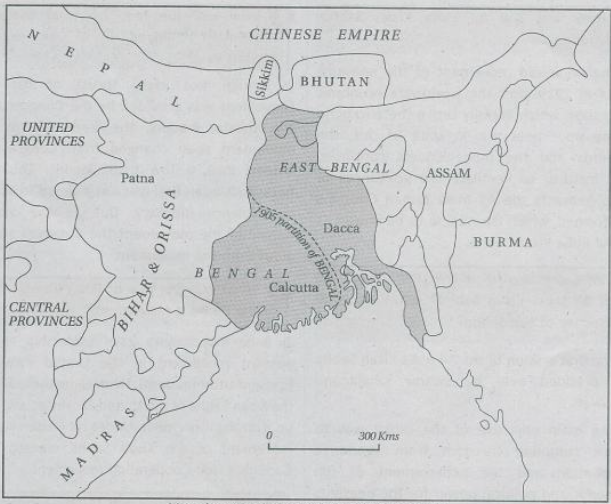
October 16, 1905, is important in the history of India because the Partition of Bengal took effect on this day. The leaders of the Anti-Partition Movement declared it to be a day of national mourning all over Bengal. On this day, Bengalis tied ‘rakhis’ on each other’s wrists and celebrated Raksha Bandhan Utsav as a symbol of unity.

Meetings were organised in different parts of Bengal where Swadeshi and boycotts of foreign products were proclaimed. Eminent Bengali poet Rabindranath Tagore opened a Swadeshi shop, which sold indigenous products, in support of the movement.

WBBSE Solutions For Class 10 History Chapter 6 Peasant Working Class CHINESE EMPIRE


WBBSE Class 10 History Chapter 6 Peasant Working Class And Left Movement In 20th Century Short Answer Questions

Question 2 Mention two features of the peasant rebellion of the 19th century.
Answer:

Two features of the peasant rebellion of the 19th century:

The peasant rebellions, which broke out from time to time throughout the 19th century,

Had some common features-

[1] They started as religious reform movements, but gradually turned into movements of the peasants exploited at the hands of the Hindu zamindars and European indigo planters.
[2] These peasant rebellions were, however, limited to some specific regions, and were not widespread. These were spontaneous outbursts and were not well organised.

Read and Learn More WBBSE Class 10 History Short Answer Questions

Question 3 What were the causes of the peasant movement in the 20th century?
Answer:

The causes of the peasant movement in the 20th century:

During the first half of the 20th century, the peasants were greatly affected by the imperialist attitude of the British. Peasants were mercilessly exploited by the landlords. They were tortured for more revenue and this excessive demand caused immense suffering to the peasants.

They became prey to exploitation and oppression which forced the poor peasants to take up the path of violence and resistance.

Class 10 History Solution Wbbse

WBBSE Solutions for Class 10 History WBBSE Solutions for Class 10 Geography and Environment
WBBSE Class 10 History Long Answer Questions WBBSE Solutions for Class 10 Life Science And Environment
WBBSE Class 10 History Short Answer Questions WBBSE Solutions for Class 10 Maths
WBBSE Class 10 History Very Short Answer Questions WBBSE Solutions for Class 10 Physical Science and Environment
WBBSE Class 10 History Multiple Choice Questions


Question 4 What were the aims of the Non-Cooperation movement?
Answer:

The aims of the Non-Cooperation movement:

The Non-Cooperation Movement, which started in 1920 under the leadership of Mahatma Gandhi,

Had three aims-

Read more

WBBSE Class 10 History Chapter 6 Peasant Working Class And Left Movement In 20th Century Very Short Answer Questions

Chapter 6 Peasant Movement In India Topic A Peasant Movements And The Leftists Very Short Answer Type Questions

Question 1 In which year was Bengal partitioned?
Answer:

Bengal was partitioned in the year 1905.

Question 2 Who was the Governor-General during the partition of Bengal?
Answer:

Lord Curzon was the Governor-General during the partition of Bengal.

“Peasant struggles against British rule”

Read and Learn  More WBBSE Class 10 History Very Short Answer Questions

Question 3 Name two leaders of the Anti-Partition Movement.
Answer:

Two leaders of the Anti-Partition Movement were Surendranath Banerjee and Aswini Kumar Dutta.

Question 4 In which year was the Bardoli Satyagraha movement launched?
Answer:

The Bardoli Satyagraha movement was launched in 1928.

WBBSE Class 10 History Chapter 6 Peasant Working Class And Left Movement In 20th Century Vaqs

Question 5 Who introduced the policy of Satyagraha?
Answer:

The policy of Satyagraha was introduced by Mahatma Gandhi.

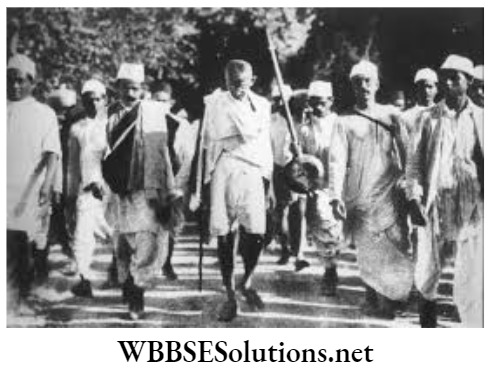
Question 6 In which year did Gandhiji start his Salt March?
Answer:

Gandhiji started his Salt March in 1930.

WBBSE Solutions For Class 10 History Chapter 6 Peasant Working Class Salt March

“Peasant movements in India history”

Question 7 Name two leaders of the Moplah rebellion.
Answer:

Two leaders of the Moplah rebellion were Variamkunnath Ahmed Haji and Ali Musliyar.

Question 8 In which year was the first nationwide Non-Cooperation Movement launched in India?
Answer:

The first nationwide Non-Cooperation Movement was launched in India in 1920.

“Significance of the Champaran Satyagraha”

WBBSE Solutions for Class 10 History WBBSE Solutions for Class 10 Geography and Environment
WBBSE Class 10 History Long Answer Questions WBBSE Solutions for Class 10 Life Science And Environment
WBBSE Class 10 History Short Answer Questions WBBSE Solutions for Class 10 Maths
WBBSE Class 10 History Very Short Answer Questions WBBSE Solutions for Class 10 Physical Science and Environment
WBBSE Class 10 History Multiple Choice Questions


Question 9 What was the duration of the Civil Disobedience Movement?
Answer:

The duration of the Civil Disobedience Movement

The Civil Disobedience  Movement continued from 1930-1934.

Question 10 In which year did Gandhiji start the Quit India Movement?
Answer:

Gandhiji started the Quit India Movement in 1942.

Question 11 Who gave the call ‘Do or die’?
Answer:

Mahatma Gandhi gave the call ‘Do or die’.

“Causes of peasant revolts in 20th century”

Question 12 Who was the leader of the peasant movement in Midnapore during the Non- Cooperation Movement?
Answer:

The leader of the peasant movement in Midnapore during the Non-Cooperation Movement was Birendranath Sasmal.

Question 13 Who was Madari Pasi?
Answer:

Madari Pasi:

Madari Pasi was the leader of the Eka Movement which broke out towards the end of 1921 in the districts of Hardoi, Bahraich and Sitapur (UP).

Question 14 Why is the Eka Movement so named?
Answer:

The word ‘Eka’ means ‘unity’. The peasants of the Eka Movement pledged to remain united during their revolt and hence the name Eka Movement (unity movement).

Chapter 6 Peasant Movement In India Topic B Working Class Movement And The Leftists Very Short Answer Type Questions

Question 1 In which year was the Congress Socialist
Answer:

The Congress Socialist Party was formed in 1934.

Question 2 Name one of the founders of the Congress Socialist Party.
Answer:

One of the founders of the Congress Socialist Party was Jayaprakash Narayan.

Question 3 Who was the first secretary of the Congress Socialist Party?
Answer:

The first secretary of the Congress Socialist Party was Sachchidananda Sinha.

Question 4 Who started the first socialist weekly newspaper?
Answer:

The first socialist weekly newspaper ‘The Socialist’ was started by Shripad Amrit Dange.

Question 5 Name two leaders of the Congress Socialist Party.
Answer:

Two leaders of the Congress Socialist Party were Jayaprakash Narayan and Acharya Narendra Dev.

“Impact of left movements on Indian agriculture”

Question 6 Name two representative journals by the leftists.
Answer:

Two representative journals by the leftists are ‘Ganabani’ and ‘Legal’.

Question 7 Name two leftist leaders of Congress.
Answer:

Two leftist leaders of Congress were Jawaharlal Nehru and Subhas Chandra Bose.

Question 8 Where was the Communist Party of India first set up?
Answer:

The Communist Party of India was first set up at Tashkent (in the erstwhile Soviet Union)

Question 9 Name the first labour association in India.
Answer:

The first labour association in India was the Bombay Mill Hands Association.

Question 10 In which year was the Indian Independence League formed?
Answer:

The Indian Independence League was formed in 1928.

“Key events in peasant movements India”

Question 11 Who formed the Indian Independence League?
Answer:

The Indian Independence League was formed by Jawaharlal Nehru and Subhas Chandra Bose.

Question 12 Who founded the Nawjawan Bharat Sabha?
Answer:

Nawjawan Bharat Sabha was founded by Bhagat Singh and his associates.

Question 13 In which year was the Communist Party of India first banned?
Answer:

The Communist Party of India was first banned in 1934.

Question 14 Which was the first newspaper dedicated to the cause of workers in India?
Answer:

‘Bharat Shramjeevi’ was the first newspaper dedicated to the cause of workers in India.

Question 15 Who was the editor of ‘Legal’?
Answer:

The editor of ‘Langal’ was Kazi Nazrul Islam.

“Role of peasants in Indian independence”

Question 16 Who founded the Radical Democratic Party?
Answer:

Manabendranath Roy founded the Radical Democratic Party.

Question 17 When was May Day first observed in India?
Answer:

May Day was first observed in India on 1 May 1923.

Question 18 Write the names of two leftist parties of 20th century India..
Answer:

The names of two leftist parties of 20th-century India are
[1] Krishak Praja Party and
[2] Congress Socialist Party.

Question 19 Who founded the Revolutionary Socialist Party and when?
Answer:

Amulya Chandra Adhikary founded the Revolutionary Socialist Party in 1940.

“Gandhian influence on peasant movements”

Question 20 Who was the author of the book ‘Indian in Transition’?
Answer:

The author of the book ‘India in Transition’ is Manabendranath Roy.

WBBSE Class 10 History Chapter 6 Peasant Working Class And Left Movement In 20th Century Multiple Choice Questions

Chapter 6 Peasant Movement In India Topic A Peasant Movements And The Leftists Multiple Choice Questions

Question 1 May Day was first celebrated in India in-
1. 1923
2. 1924
3. 1925
4. 1926

Answer: 1. 1923

Question 2 The first May Day celebration was organised in-
1. Calcutta
2. Kanpur
3. Madras
4. Lucknow

Answer: 3. Madras

WBBSE Class 10 History Chapter 6 Peasant Working Class And Left Movement In 20th Century Multiple Choice Questions

Question 3 May Day was first celebrated in India under the leadership of-
1. Gandhiji
2. Singaravelu Chettiar
3. Lala Lajpat Rai
4. PC Joshi

Answer: 2. Singaravelu Chettiar

Read and Learn  More WBBSE Class 10 History Multiple Choice Questions

Question 4 Who among the following was associated with the trade union movement in India?
1. BP Wadia
2. Vithalbahi Patel
3. Mahatma Gandhi
4. Abul Kalam Azad

Answer: 1. BP Wadia

Question 5 The first conference of the CPI in India was held in-
1. Calcutta
2. Delhi
3. Kanpur
4. Lucknow

Answer: 3. Kanpur

WBBSE Solutions for Class 10 History WBBSE Solutions for Class 10 Geography and Environment
WBBSE Class 10 History Long Answer Questions WBBSE Solutions for Class 10 Life Science And Environment
WBBSE Class 10 History Short Answer Questions WBBSE Solutions for Class 10 Maths
WBBSE Class 10 History Very Short Answer Questions WBBSE Solutions for Class 10 Physical Science and Environment
WBBSE Class 10 History Multiple Choice Questions


Question 6 The demand for complete independence or ‘Purna Swaraj’ was taken in the-
1. Lahore Congress
2. Calcutta Congress
3. Bombay Congress
4. Surat Congress

Answer: 1. Lahore Congress

Question 7 Which of the following organisation did not participate in the Quit India Movement following the ‘Peoples War’ line?
1. Communist Party of India
2. The Indian National Congress
3. The Congress Socialist Party
4. Hindu Mahasabha

Answer: 1. Communist Party of India

Question 8 The All India Trade Union Congress was established in-
1. 1917
2. 1920
3. 1927
4. 1929

Answer: 2. 1920

Peasant Movements in India

Question 9 Workers’ and Peasants’ Party was associated with-
1. The Rowlatt Satyagraha
2. The Non-Cooperation Movement
3. The Bardoli Satyagraha
4. The movement against the Simon Commission

Answer: 3. The Bardoli Satyagraha

Question 10 The Congress Socialist Party was formed in-
1. Calcutta
2. Delhi
3. Bombay
4. Madras

Answer: 3. Bombay

Question 11 The bill passed by the British Government to suppress the workers was-
1. Industrial Dispute Bill
2. Ilbert Bill
3. Rowlatt Bill
4. Public Safety Bill

Answer: 1. Industrial Dispute Bill

Question 12 In 1920 the AITUC was established in Bombay under the presidentship of-
1. Lala Lajpat Rai
2. Manabendranath Roy
3. Vallabbhai Patel
4. SA Dance

Answer: 1. Lala Lajpat Rai

Question 13 In 1920 Muzaffar Ahmed, S A Dange, Shaukat Osmani and Nalini Gupta were arrested and thus started the-
1. Kanpur Conspiracy Case
2. Lahore Conspiracy Case
3. Meerut Conspiracy Case
4. Kakori Conspiracy Case

Answer: 1. Kanpur Conspiracy Case

Role of Peasants in the Left Movement

Question 14 An important leader of the Workers’ and Peasants’ Party-
1. PC Joshi
2. Vallabbhai Patel
3. Balgangadhar Tilak
4. Jawaharlal Nehru

Answer: 1. PC Joshi

Question 15 The editor of Ganabani Patrika was-
1. Kazi Nazrul Islam
2. Muzaffar Ahmad
3. SS Mirajkar
4. Aurobindo Ghose

Answer: 2. Muzaffar Ahmad

Question 16 The editor of the paper Socialist was-
1. S A Dance
2. Santosh Kumari Gupta
3. Santosh Singh
4. Muzaffar Ahmed

Answer: 2. Santosh Kumari Gupta

Question 17 The Communist Party of India was established in Tashkent by-
1. Muzaffar Ahmed
2. PC Joshi
3. SA Dance
4. Manabendra Nath Roy

Answer: 4. Manabendra Nath Roy

Question 18 Radical Democratic Party was established in-
1. 1937
2. 1938
3. 1939
4. 1940

Answer: 4. 1940

Question 19 ‘Forward Bloc’ was founded in the year
1. 1936
2. 1937
3. 1939
4. 1940

Answer: 3. 1939

Chapter 6 Peasant Movement In India Topic B Working Class Movement And The Leftists Multiple Choice Questions

Question 1 On which of the following dates was the Partition of Bengal announced?
1. July 20, 1905
2. October 16, 1905
3. April 1, 1907
4. April 8, 1908

Answer: 2. October 16, 1905

Question 2 Boycott of British goods is related to which of the following movements?
1. Swadeshi movement
2. Quit India Movement
3. Non-Cooperation Movement
4. Home Rule movement

Answer: 1. Swadeshi movement

Question 3 In which of the following Indian National Congress sessions was the idea of Non- the Cooperation Movement accepted?
1. Lahore session
2. Nagpur session
3. Calcutta session
4. Bombay session

Answer: 3. Calcutta session

Question 4 The leadership of the peasant rebellion in the United Province during the Non- Cooperation Movement was given by-
1. Vallabhbhai Patel
2. Baba Ramchandra
3. Lala Lajpat Rai
4. Hari Singh

Answer: 2. Baba Ramchandra

Wbbse History And Environment Class 10 Solutions

Question 5 Which of the following state is related to the Moplah Rebellion?
1. Kashmir
2. Karnataka
3. Kerala
4. West Bengal

Answer: 2. Karnataka

Question 6 The Moplah Rebellion in 1921 in Malabar was a rebellion by the Muslim peasants against-
1. Muslim landholders
2. The British government
3. The non-tribal outsides
4. Hindu landholders

Answer: 4. Hindu landholders

Question 7 The Anti-Partition Movement took place in-
1. 1904
2. 1905
3. 1906
4. 1911

Answer: 2. 1905

Impact of British Policies on Peasants

Question 8 Who said ‘the Partition of Bengal is a great national disaster’?
1. Surendranath Sen
2. Surendranath Bandopadhyay
3. Aurobindo Ghosh
4. Birendranath Sasmal

Answer: 2. Surendranath Bandopadhyay

Question 9 Who gave leadership to the peasant movement in Midnapore during the non-violent Non-Cooperation movement?
1. Someswar Choudhury
2. Birendranath Sasmal
3. Sailajananda Sen
4. Gourisankar Misra

Answer: 2. Birendranath Sasmal

Question 10 Birendranath Sasmal is known as-
1. Deshbandhu
2. Deshapran
3. Deshapriya
4. Deshhitaishee

Answer: 3. Deshapriya

Wbbse History And Environment Class 10 Solutions

Question 11 Baba Ramchandra was-
1. Congress leader
2. Workers’ leader
3. Oleander of Krishak Praja Party
4. Leader of Kishan Sabha

Answer: 4. Leader of Kishan Sabha

Question 12 Baba Ramchandra gave leadership to the
1. Bihar
2. United Province
3. Rajasthan
4. Maharashtra

Answer: 2. United Province

Question 13 Baba Ramchandra gave leadership in the Non-Cooperation Movement in-
1. Bengal
2. Bombay
3. Satara
4. Oudh

Answer: 4. Oudh

Question 14 Tinkathia system was abolished in-
1. 1917
2. 1918
3. 1919
4. 1921

Answer: 2. 1918

Question 15 The leader of the Bijolia movement was-
1. Sachin Sanyal
2. Vallabhbhai Patel
3. Manikyalal Verma
4. Baba Ramchandra

Answer: 3. Manikyalal Verma

Question 16 The leader of the Eka movement was-
1. Madari Pasi
2. Dr Ambedkar
3. Mahatma Gandhi
4. Baba Ramchandra

Answer: 1. Madari Pasi

Wbbse History And Environment Class 10 Solutions

Question 17 The Bardoli Satyagraha movement took place in-
1. Bombay
2. Punjab
3. Madras
4. Gujarat

Answer: 4. Gujarat

Non-Cooperation Movement and Peasants

Question 18 The Eka Movement took place during-
1. Anti-Partition movement
2. Civil Disobedience movement
3. Non-Violence Non-Cooperation Movement
4. Quit India Movement

Answer: 3. Non-Violence Non-Cooperation Movement

Question 19 The Kunbis were the peasants of-
1. Uttar Pradesh
2. Bengal
3. Punjab
4. Gujarat

Answer: 4. Gujarat

Question 20 In which year Vallabhbhai Patel was honoured with the title of Sardar-
1. 1926
2. 1928
3. 1932
4. 1934

Answer: 2. 1928

Class 10 History Wbbse

Question 21 All India Kisan Congress was established in 1936 on-
1. 11 January
2. 11 February
3. 11 March
4. 11 April

Answer: 4. 11 April

Question 22 The first president of All India Kisan Sabha was-
1. NG Ranga
2. Swami Sahajananda
3. Baba Ramchandra
4. Lala Lajpat Rai

Answer: 2. Swami Sahajananda

WBBSE Class 10 History Chapter 5 Alternative Ideas And Initiatives From Mid 19th Century To The Early 20th Century Characteristics And Observations Long Answer Questions

Chapter 5 Alternative Ideas And Initiatives Characteristics And Observations Topic A Development Of Printing Press In Bengal

 Question 1. How did the printing press flourish in Bengal?
Answer:

The printing press flourish in Bengal:

The newspapers were mainly responsible for the promotion of public opinion among the various sections of the Indian population. The first newspaper in India was started by James Augustus Hicky. Hicky’s newspaper was followed by some other newspapers like ‘The Bengal Hurkaru’, ‘The Calcutta Gazette’, ‘The India Gazette’, etc.

To the Serampore, Missionary goes the credit of bringing out the first Bengali. monthly, ‘Digdarshan’. It started in April 1818. A few days later ‘Samachar Darpan’ was published by Serampore Mission.

J C Marshman was its editor. In June 1818, another weekly Bengali paper ‘Bengal Gazette’ started by Ganga Kishore Bhattacharya, made its appearance. Several other papers were published between 1821 and 1851.

Among these were ‘Sambad Kaumudi’ (1821) edited by Bhabanicharan Bandyopadhyay, ‘Samachar Chandrika’ (1822) also edited by Bhabanicharan, ‘Sambad Prabhakar (1831) started by Iswar Chandra Gupta, Jnananweshan’ (1831), edited by Dakshninarajan Mukhopadhyay, ‘Sambad Bhaskar (1839) run by Gourishankar Tarkabagish, ‘Education Gazette’ and ‘Saptahik Bartabaha (1856).

These papers helped in spreading the news about the events occurring in the country and also helped the formation of public opinion among the masses in the country.

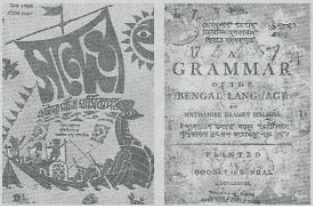
WBBSE Solutions For Class 10 History Chapter 5 Alternative Ideas Cover Pages Of Some Books And Magazines


The post-mutiny period saw the publication of several important newspapers both in Bengali and English. Among these, the most important were ‘Amrita Bazar Patrika’, ‘Indian Mirror’, and ‘Omprakash’. All of these were published from Calcutta. The ‘Hindoo Patriot’ brought to light the various grievances of the ryots and the peasants.

WBBSE Class 10 History Chapter 5 Alternative Ideas And Initiatives From Mid 19th Century To The Early 20th Century Characteristics And Observations

Question 2 What is the contribution of William Carey and Serampore’s Mission to the spread of education?
Answer:

The contribution of William Carey and Serampore’s Mission to the spread of education:

Before the arrival of William Carey and other missionaries, formal education was chiefly confined to the upper classes. Carey came to Bengal and set up a printing press in Serampore. Then under his initiative, the Serampore Mission played an important role in the spread of mass education in Bengal.

[1] Establishment of printing of press: William Carey set up a printing press in Serampore in 1800. Through this press translation of the Bible, the Ramayana, the Mahabharata and other Indian literary works as well as various textbooks were published and became available to students in rural areas.

Read and Learn More WBBSE Class 10 History Long Answer Questions

[2] Establishment of schools: In 1818, about 103 primary schools were established in Serampore and adjoining areas which accommodated about 6703 students. Serampore Mission established the first school for girls and thus played an important role in spreading women’s education.

[3] Establishment of colleges: William Carey and his two associates established a degree college in Serampore in 1818 at their own expense. It was the first-degree college in Asia.

[4] Medium of instruction: Carey had realized that it was necessary to provide education through vernacular medium i.e., Bengali in order to spread mass education in rural Bengal. So he tried to spread education through the medium of Bengali.

[5] Progressiveness: Carey tried to remove bigotry and superstition from the minds of the students. So he emphasized on teaching subjects like modern literature, science, mathematics, history, philosophy etc., instead of following the old and obsolete method of education. Vishal Mangalwadi, in his book ‘The Legacy of William Carey’, has written that Carey had provided spiritual strength to the people to stand against those priests who had deprived them from the liberty of exploring the truth for their own interest.

WBBSE Solutions for Class 10 History WBBSE Solutions for Class 10 Geography and Environment
WBBSE Class 10 History Long Answer Questions WBBSE Solutions for Class 10 Life Science And Environment
WBBSE Class 10 History Short Answer Questions WBBSE Solutions for Class 10 Maths
WBBSE Class 10 History Very Short Answer Questions WBBSE Solutions for Class 10 Physical Science and Environment
WBBSE Class 10 History Multiple Choice Questions


“WBBSE Chapter 5 detailed answer questions”

Question 3 What do you know about the inventions and introduction of the printing press?
Answer:

The inventions and introduction of the printing press:

The invention of the printing press is one of the most important inventions of all time. Few inventions have had such an impact as the printing press. It is one that ultimately led to our modern world.

  1. Printing press in China: The first overtures towards printing began around roughly 800 AD in China. Xylography, the art of engraving wood for the purpose of printing, likely originated in Chinese Buddhist temples. The world’s first movable type printing technology for printing books was invented around 1040 AD in China.
  2. Printing press in Arabian countries: The Battle of Talas took place between China and the Arabian countries in 751 AD. China was defeated by the Arabian countries. After their defeat, several, Chinese craftsmen, who could produce paper and who knew the art of printing were taken as prisoners. With them, the technique of printing arrived in the Arabian countries.
  3. Printing press in Europe: The technique of printing arrived in Europe along with the Arabian between 1250-1350 AD. This technique was further modified by Johannes Gutenberg (1400-1468 AD) of Germany. When he invented the modern. printing machine, a revolution began in the printing world. Hence he is known as the ‘Father of Printing Press’.
  4. Printing press in India: In 1556 the Portuguese introduced the printing press in India. Later the Christian missionaries played an important role in the development of the printing press.
  5. Printing press in Bengal: Towards the end of the 18th century the Portuguese missionaries introduced the printing press in Bengal. James Augustus Hickey in 1777 AD and Charles Wilkins in 1778 AD introduced the printing press in Calcutta and Chinsurah respectively. Panchanan Karmakar and Suresh Chandra Mazumdar were the first to type Bengali alphabets.

WBBSE Class 10 History Chapter 5 Alternative Ideas And Initiatives From Mid 19th Century To The Early 20th Century Characteristics And Observations laqs

“Long answer questions on alternative ideas in Indian history”

Question 4 What was the role of Upendrakishore Raychowdhury in the establishment of the printing industry in Bengal?
Answer:

The role of Upendrakishore Raychowdhury in the establishment of the printing industry in Bengal:

Upendrakishore Raychowdhury was a pioneer of the printing industry. In the field of publishing, he is remembered in India and abroad for the new method he developed for printing both black and white and colored books and photographs with great accuracy and detail. He was the main brain behind the method of halftone block-making.

WBBSE Solutions For Class 10 History Chapter 5 Alternative Ideas Upendrankishore Raychowdhury

“Key themes in alternative ideas from the 19th to early 20th century”

He invented several techniques related to halftone block-making, of which the ‘screen adjusting machine’ deserves special mention. When he saw that for one of his books, ‘Chotoder Ramayan’, the woodcut line block was of poor quality, he decided to import books, chemicals, and equipment from Britain to learn the procedure of block-making. His articles about block-making were published of the ‘Penrose Annual Volume’ of Britain.

After successfully learning the art, he set up a business for block-making. After fully grasping the art, he decided to start a publishing house of his own. Initially, he did not have a printing machine of his own. So he had to print his books in other printing presses. In 1913, he started one of the best publishing houses at Garpar in North Calcutta called U Ray & Sons.

He quickly earned recognition in India and abroad for the new method he developed for printing both black and white and color photographs with great accuracy. His ‘Tuntunir Boi’ is a classic, still loved and relished in most of Bengali homes. He did the illustrations of most of his books himself. Upendrakishore Raychowdhury was also a writer, painter, violin player, composer, and entrepreneur.

WBBSE Solutions For Class 10 History Chapter 5 Alternative Ideas Tuntunir Boi

Chapter 5 Alternative Ideas And Initiatives Characteristics And Observations Topic B Development Of Science And Technical Education In Bengali

Question 1 Give a brief description of the development of technical education in Bengal.
Answer:

The development of technical education in Bengal:

Prior to the establishment of British rule in Bengal, there was no provision for western education that included modern technology. Technical education began to develop in Bengal in the 19th century.

Technical institutes: Along with the progress of science in Bengal, some educational institutions also grew up to impart technical education. Such institutes include Roorkee Engineering College (1847), Calcutta Engineering College (1856), Association for the Advancement of Scientific and Industrial Education, Calcutta (1903), Jadavpur Engineering College (1906), Bengal Technical Institute (1906), etc, Bengal Technical Institute was established by Taraknath Palit in Calcutta when the Swadeshi Movement (1905) started against the partition of Bengal.

Its contributions towards the spread of technical education are as follows-

[1] Initiative for national education: During the Swadeshi Movement, an attempt was made to establish a national system of education as an alternative to the education system of the British government. One of the objectives of national education was the spread of indigenous technical education. So Taraknath Palit, an Indian lawyer, founded the Bengal Technical Institute in Calcutta on July 25, 1906.

[2] Association with other institutes: In order to spread the indigenous system of education, Bengal Technical Institute merged with Bengal National College in 1910 and formed the Bengal National College and Technical School. This joint institution was renamed as College of Engineering and Technology (CET) in 1928.

[3] Activities: After the merging of the institutions, arrangements were made for the cultivation of various subjects like Physics, Chemical Technology, Industrial Technology, etc., besides the disciplines of Humanities. As a result, several educated Bengalee youths could receive technical education and become self-dependent.

“WBBSE Class 10 history chapter 5 characteristics and observations”

Question 2 Write what you know about the foundation of the Bose Institute.
Answer:

The foundation of the Bose Institute:

Bose Institute was one of those institutions which grew up during the colonial rule in Bengal for the cultivation of science and development of science education.

[1] Background: Famous Jagadish Chandra Bose was completely dedicated to the cultivation of science in India. He gathered a lot of experience by traveling through different countries and tried to build up a modern scientific research center on the basis of his experiences.

[2] Foundation: Sir JC Bose resigned from the post of Professor at Presidency College (1950) and founded the Bose Institute on November 30, 1917, to carry out fundamental research on different branches of science. He dedicated the institution to his nation in his welcome speech named ‘The voice of life’ at the inauguration ceremony.

[3] Expenses: Sir JC Bose sold his ancestral property in Munsigunj and spent the major part of it to establish the Bose Institute and to build up the infrastructure for the cultivation of science at the global level. When the institute ran short of funds, Rabindranath Tagore extended a helping hand.

[4] Research work: Sir JC Bose arranged an international level of research in various branches of science like Physics, Chemistry, Botany, Microbiology, Biochemistry, Biophysics, Environmental Science, etc. He also made suitable arrangements for the publication of a journal containing the research papers.

Chapter 5 Alternative Ideas And Initiatives From Mid-19th Centur Characteristics And Observations Topic C Criticism Of The Colonial System Of Education And Visca-Bharati

Question 1 Write a note on Rabindranath Tagore’s ashram school at Santiniketan.
Answer:

Rabindranath Tagore’s ashram school at Santiniketan:

According to Rabindranath Tagore, there must be three basic elements in any ideal method of teaching.

Those are-

[1] Freedom,
[2] Creative self-expression and
[3] Active communication between man and nature. A child is born in a natural environment and he is also born into a social environment. According to Rabindranath, a method that can integrate these two in education should be selected. To make such an integration possible, he established the Ashrama Vidyalaya at Santiniketan. He expected that the ashram society and nature around would help in educating children better.

WBBSE Solutions For Class 10 History Chapter 5 Alternative Ideas Rabindranath Tagore

In 1901, he started this school with only a few pupils. He was impressed by the trends of ancient Indian ashram education and established this school. The learners there practiced simple living. The relationship between a teacher and a pupil was as close as that of the ancient ashram period and was based on mutual respect.

At his school in Santiniketan, Rabindranath Tagore applied three of his principles to teaching. The pupils of the school were allowed to enjoy enough freedom. They could move about the campus according to their own will. They could also play as they liked. The selection of the site for the school was in keeping with his principles and ideals of teaching.

The teaching-learning process was conducted under the open sky because Rabindranath himself disliked keeping students confined within the four walls of a classroom. For their spiritual and social development, pupils participated in various forms of creative activities and social development schemes.

“Analysis of initiatives in India from mid 19th century”

Question 2 Give a brief description of Rabindranath Tagore’s ideas on education and Santiniketan.
Answer:

Rabindranath Tagore’s ideas on education and Santiniketan:

According to Rabindranath Tagore, there must be three basic elements in any ideal method of teaching. These are-
[1] Freedom,
[2] Creative self-expression, and
[3] Active communication with man and nature. His ideals of education materialized through his ashram school at Santiniketan. Rabindranath said, “At first started a school at Santiniketan and brought children here to let them move freely in the wide fields of this universe. But gradually it came to my mind that existing differences between one man and another would have to be removed and man will have to be emancipated amidst all other men.” He wanted to harmonize and integrate Eastern and Western cultures at Visva-Bharati.

So he said, “the foundation of that relationship, which awaits discrimination all over the world, will be established here.” The Visva-Bharati University is pursuing its aim successfully till date. If we analyze Rabindranath’s ideals in education, it will be understood that his childhood experiences are the sources of his inspiration. He had some bitter experiences in his childhood regarding studying at school and college.

This made him sympathetic toward children. He brought together the educational ideals of the past and the present and educational philosophies of the East and the West in developing his system of education. While explaining the aim and function of the Visva-Bharati University, he said that being strongly impressed by need and responsibility, he had formed the nucleus of an international university for the promotion of mutual understanding between the East and the West.

Rabindranath Tagore’s educational philosophy is, at the same time, a combination of scientific, psychological, and sociological trends. According to him, a student confined within the four walls of a classroom was nothing more than a bird in a cage.

WBBSE Solutions For Class 10 History Chapter 5 Alternative Ideas Visva-Bharati University

WBBSE Class 10 History Chapter 5 Alternative Ideas And Initiatives From Mid 19th Century To The Early 20th Century Characteristics And Observations Short Answer Questions

Chapter 5 Alternative Ideas And Initiatives Characteristics And Observations Topic A Development Of Printing Press In Bengal Short Answer Type Questions

Question 1 When and where was the first printing press of the Portuguese started?
Answer:

The first printing press of the Portuguese started in Goa on April 30, 1556.

Question 2 In which year and by whom was Persian Press established?
Answer:

Persian Press was established by Matthew Lumsden in 1805.

Question 3 Who established the Sanskrit Press and when?
Answer:

Baboo Ram with the help of Colebrooke established the Sanskrit Press in 1807.

Read and Learn More WBBSE Class 10 History Short Answer Questions

Question 4 Who was Baboo Ram?
Answer:

Baboo Ram:

Baboo Ram was the teacher of Sanskrit language and literature at Fort William College. He established the Sanskrit Press in 1807.

WBBSE Class 10 History Chapter 5 Alternative Ideas And Initiatives From Mid 19th Century To The Early 20th Century Characteristics Saqs

Question 5 Who wrote ‘Kripa Sastrer Arthaved’ and in which language?
Answer:

Manuel da Assumpcao wrote ‘Kripa Sastrer Arthaved’. It was written in Bengali.

Question 6 Who published the ‘Bengal Gazette’ and when?
Answer:

Bengal Gazette:

James Augustus Hicky published the ‘Bengal Gazette’. It was published on January 29, 1780.

WBBSE Solutions For Class 10 History Chapter 5 Alternative Ideas Bengal Gazette

Question 7 Why was ‘Hicky’s Bengal Gazette’ important?
Answer:

Importance Of ‘Hicky’s Bengal Gazette’

‘Hicky’s Bengal Gazette’ was important for various reasons. It was the first major newspaper in India and it also spread patriotism among the people of the nation. Moreover, it was free and independent.

Question 8 Who established the Bengali Gazette Press and when?
Answer:

Ganga Kishore Bhattacharya established the Bengali Gazette Press in 1818.

WBBSE Solutions for Class 10 History WBBSE Solutions for Class 10 Geography and Environment
WBBSE Class 10 History Long Answer Questions WBBSE Solutions for Class 10 Life Science And Environment
WBBSE Class 10 History Short Answer Questions WBBSE Solutions for Class 10 Maths
WBBSE Class 10 History Very Short Answer Questions WBBSE Solutions for Class 10 Physical Science and Environment
WBBSE Class 10 History Multiple Choice Questions


Question 9 Who set up the Sanskrit Press and Depository? What was their objective?
Answer:

Iswar Chandra Vidyasagar and Madanmohan Tarkalankar set up Sanskrit Press and Depository. Their objective was to spread education among the masses by publishing their writing and opinion.

“WBBSE Class 10 history chapter 5 key observations”

Question 10 What role did the hawkers of Battala play in the Bengali press business?
Answer:

The hawkers of Battala play in the Bengali press business:

The battle of Calcutta played an important role in the business of the Bengali press. Hawkers were employed to dispatch books published from Battala to distant villages. The hawkers used to sell books in towns and far-off villages.

Sometimes, instead of taking cash for the books, they took old books in exchange. They sold these books in Calcutta in different printing presses. As the books of Battala were cheap, their market was good.

Question 11 Why did Rammohan Roy fight against Adam’s Press Regulations (1923)?
Answer:

Rammohan Roy fought against Adam’s Press Regulation (1923) because there was a clear distinction between the Anglo-Indian and Indian presses. Various restrictions were imposed on the Indian Press while there was no restriction on the Anglo-Indian press.

“Characteristics of initiatives in India short answers”

Question 12 In which year was Fort William College established and by whom? Which languages were taught there?
Answer:

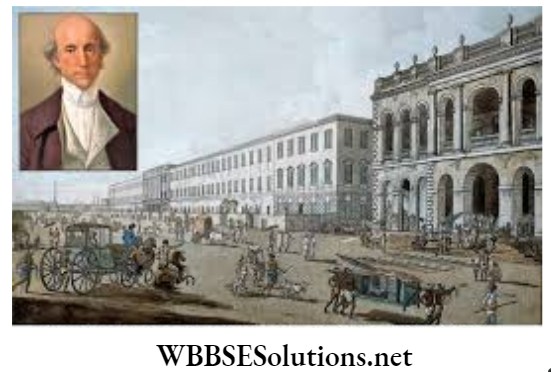
Fort William College was established in 1800 by Lord Wellesley. Various languages like Parsee, Bengali and Hindusthani were taught there.

Question 13 What was the role of Panchanan Karmakar in the development of Bengali Press?
Answer:

The role of Panchanan Karmakar in the development of Bengali Press:

Panchanan Karmakar, a skillful goldsmith, designed and developed a set of letters for typing in Bengali. He is called ‘Father of Bengali Typewriting’. Serampore Mission Press used his designs to publish their Bengali books.

Question 14 Who was Charles Wilkins?
Answer:

Charles Wilkins:

Charles Wilkins, a British East India Company Official, set up a printing press at Chinsurah in Hooghly in 1778. He designed a Bengali script, a style of letters, for the first time with the purpose of printing. However, those letters were quite simple and of inferior quality.

Question 15 What is the importance of the introduction of linotype printing in Bengali?
Answer:

The importance of the introduction of linotype printing in Bengali:

Suresh Chandra Majumdar devised a set of letters known as ‘linotype’ which was a highly developed design of letters. It became one of the mainstay methods to set type. Nathaniel Brassey Halhed’s ‘A Grammar of the Bengal Language’ was printed using a linotype.

Question 16 What is the importance of Battala Prakashana in the history of Bengali Press?
Answer:

The importance of Battala Prakashana in the history of Bengali Press:

Battala Prakashana is situated in the Sovabazar and Chitpur areas of Calcutta. It is often considered as the earliest center of printing and publishing in Calcutta. It began the printing and publication industry in Bengal in the 19th century. Putih, Panchali, and Panjika (Calender) myths and legends were the main publications of Battala. Cheap editions of religious books and scriptures were sold from here.

“Short answer questions for alternative movements in India”

Question 17 Why was the colonial system of education defective?
Answer:

The colonial system of education was defective in the following ways:

[1] The colonial system of education was confined to a limited section of Indian society. People who lived in the villages were deprived of the benefit of western education.

[2] The colonial system of education neglected women’s education and could not attract the Muslim community.

[3] The greatest defect was that it was neglected. the education of the people at the elementary stage.

Question 18 What was the impact of the development of the printing press on the cultural life of Bengal?
Answer:

The impact of the development of the printing press on the cultural life of Bengal:

Before the invention of the printing press, education was confined to the upper class of society. But after the development of the printing press, printed books were available to the common people at low prices. This helped in the spread of mass education in Bengal. Various works of translation were published by the Serampore Press and thus Bengali literature could reach the common people.

Question 19 What was the principal objective of the Christian Missionaries in introducing western education in India?
Answer:

The principal objective of the Christian Missionaries in introducing western education in India:

The role of the Christian missionaries was very significant in the spread of western education in India. The principal objective of the Christian missionaries in introducing western education was to spread Christianity among the people of India. The missionaries thought that western education would destroy the faith of the Indians in their own religion and lead them to embrace Christianity.

Chapter 5 Alternative Ideas And Initiatives Characteristics And Observations Topic B Development Of Science And Technical Education In Bengali Short Answer Type Questions

Answer in 2 to 3 sentences

Question 1 In which year did Chandrasekhar Venkat Raman win the Nobel Prize and for what?
Answer:

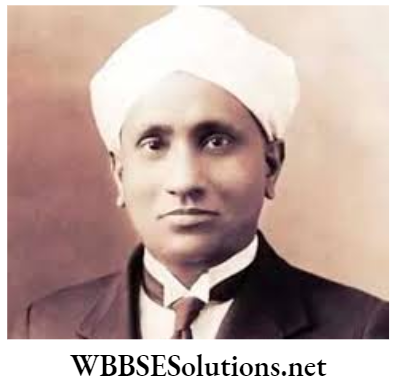
Chandrasekhar Venkat Raman won the Nobel Prize in 1930 for inventing the famous Raman Effect.

WBBSE Solutions For Class 10 History Chapter 5 Alternative Ideas And Observations C V Raman

Question 2 When was the Bengal Technical Institute founded? What was its objective?
Answer:

The Bengal Technical Institute was founded in July 1906. Its objective was to spread technical education among the people of West Bengal.

Question 3 What were the subjects of research at the Bose Institute?
Answer:

The subjects of research at the Bose Institute:

In the Bose Institute, there were arrangements for international level of research in various branches of science like Physics, Chemistry, Biology, Microbiology, Biochemistry, Biophysics, Environmental Science, etc.

WBBSE Solutions For Class 10 History Chapter 5 Alternative Ideas Bose Institute

“WBBSE chapter 5 important concepts for short answers”

Question 4 Who founded the Rajabazar Science College and when?
Answer:

Rajabazar Science College was founded in 1914 by Sir Ashutosh Mukherjee, who was the Vice-Chancellor of the University of Calcutta.

Question 5 What was the role played by the Indian Association for the Cultivation of Science in the development of science in the 19th century?
Answer:

The role played by the Indian Association for the Cultivation of Science in the development of science in the 19th century

Indian Association for the Cultivation of Science which was established in 1876, was the first national science association of India. Basic departments such as Chemistry, Physics, Mathematics, Biology, and Spectroscopy were established.

This institute is engaged in fundamental research in various branches of science. Lectures and demonstrations are arranged regularly for the public to popularise science.

Question 6 When and by whom was the Indian Association for the Cultivation of science established?
Answer:

Indian Association for the Cultivation of Science was established in 1876 by the famous doctor Mahendralal Sircar.

Chapter 5 Alternative Ideas And Initiatives From Mid-19th Centur Characteristics And Observations Topic C Criticism Of The Colonial System Of Education And Visca-Bharati Short Answer Type Questions

Question 1 In which year was the Santiniketan School inaugurated? What were its objectives?
Answer:

The Santiniketan School was inaugurated on December 22, 1901.
Its objectives were-
[1] to teach the students the importance of Indian heritage,
[2] to provide all-round development for the students,
[3] to establish a bond of love and friendship between man and nature,
[4] to encourage creative learning within a natural environment.

“WBBSE Class 10 history chapter 5 summary questions”

Question 2 What were the reasons behind the failure of the National Council of Education?
Answer:

The reasons behind the failure of the National Council of Education:

The National Council of Education was set up in 1906. It challenged the British system of education and provided education on national lines and under national control. But the government’s repressive policy hampered the activities of the council.

The institutions under the National Council of Education suffered from lack of funds. Many of the students favored the British system of education rather than an indigenous system of education.

Question 3 Why teaching and learning were conducted under the open sky in Santiniketan?
Answer:

The pupils of Santiniketan were allowed to enjoy enough freedom. They could move around the campus according to their own will. They could also play as they liked.

The teaching-learning process was conducted under the open sky because Rabindranath himself disliked keeping students confined within four walls of a classroom. According to him, a student confined within the four walls of a classroom was nothing more than a bird in a cage.

WBBSE Class 10 History Chapter 5 Alternative Ideas And Initiatives From Mid 19th Century To The Early 20th Century Characteristics And Observations Very Short Answer Questions

Chapter 5 Alternative Ideas And Initiatives Characteristics And Observations Topic A Development Of Printing Press In Bengal Very Short Answer Questions

 Question 1 Where was the first printing press established in Bengal?
Answer:

In Bengal, the first printing press was established in Hooghly.

Question 2 Who established the first printing press in Hooghly?
Answer:

John Andrews established the first printing press in Hooghly.

Read and Learn  More WBBSE Class 10 History Very Short Answer Questions

Question 3 Who was Charles Wilkins?
Answer:

Charles Wilkins:

Charles Wilkins was a servant of the East India Company.

Question 4 Who established the Hindusthani Press in Calcutta?
Answer:

John Gilchrist and William Hunter established the Hindusthani Press in Calcutta.

WBBSE Class 10 History Chapter 5 Alternative Ideas And Initiatives From Mid 19th Century To The Early 20th Century Characteristics Vaqs

Question 5 In which year was the Hindusthani Press in Calcutta established?
Answer:

Hindusthani Press in Calcutta was established in 1802.

“Very short answer questions on alternative ideas in history”

Question 6 Who wrote ‘Brahman Roman Catholic Sambad’?
Answer:

Dome Antonio-De Rogerio wrote ‘Brahman Roman Catholic Sambad’.

Question 7 Name some of the papers published in Bengal at the end of the 18th century.
Answer:

Some of the papers published in Bengal at the end of the 18th century were ‘The India Gazette’, ‘The Calcutta Gazette’, ‘The Bengal Hurkaru’, ‘The Calcutta Courier’ etc.

Wbbse History And Environment Class 10 Solutions

Question 8 Why were the efforts of the missionaries of Serampore in publishing books not fully successful?
Answer:

The efforts of the missionaries of Serampore in publishing books were not fully successful because they only wanted to Christianise the people of the country.

WBBSE Solutions for Class 10 History WBBSE Solutions for Class 10 Geography and Environment
WBBSE Class 10 History Long Answer Questions WBBSE Solutions for Class 10 Life Science And Environment
WBBSE Class 10 History Short Answer Questions WBBSE Solutions for Class 10 Maths
WBBSE Class 10 History Very Short Answer Questions WBBSE Solutions for Class 10 Physical Science and Environment
WBBSE Class 10 History Multiple Choice Questions


Question 9 Who is known as the pioneer of the Indian Press?
Answer:

The pioneer of the Indian Press:

James Augustus Hicky is known as the pioneer of the Indian Press.

WBBSE Solutions For Class 10 History Chapter 5 Alternative Ideas Hicky

“WBBSE Class 10 history chapter 5 key observations”

Question 10 Why were some Indian papers of the mid-nineteenth century charged before the Supreme Court?
Answer:

Some Indian papers of the mid-nineteenth century were charged before the Supreme Court for publishing seditious articles.

Question 11 Who wrote ‘Raja Pratapaditya Charitra’?
Answer:

Ramram Basu wrote ‘Raja Pratapaditya Charitra’.

Question 12 Who passed the University Act of 1904?
Answer:

Lord Curzon passed the University Act of 1904.

WBBSE Solutions For Class 10 History Chapter 5 Alternative Ideas Lord Curzon

Question 13 Who was the first Bengali publisher and bookseller?
Answer:

Ganga Kishore Bhattacharya was the first Bengali publisher and bookseller.

Question 14 Where was Upendrakishore Raychow- born?
Answer:

Upendrakishore Raychowdhury was born in Musa village in the district of Mymensingh.

Question 15 Name the first book published by U Ray & Sons.
Answer:

The first book published by U Ray & Sons was ‘Tuntunir Boi’.

“Characteristics of initiatives in India very short answers”

Question 16 In which year Serampore Mission Press was established?
Answer:

In 1800 Serampore Mission Press was established.

Question 17 Write the name of the first illustrated book published in Bengali.
Answer:

The name of the first illustrated book. published in Bengali is ‘Annadamangal’ by Bharat Chandra Ray.

Wbbse History And Environment Class 10 Solutions

Question 18 Who wrote ‘Varna Parichay’?
Answer:

Iswar Chandra Vidyasagar wrote ‘Varna Parichay’.

Question 19 In which year was ‘Varna Parichay’ published?
Answer:

‘Varna Parichay’ was published in 1855.

Question 20 Why is Panchanan Karmakar famous?
Answer:

Panchanan Karmakar developed the first Bangla type for printing and became famous.

Question 21 Which was the first Bengali weekly published by Serampore Mission Press?
Answer:

The first Bengali weekly published from Serampore Mission press was ‘Samachar Darpan’.

Question 22 When and by whom was the printing press introduced in Chinsurah?
Answer:

In 1778 printing Press was introduced in Chinsurah by Charles Wilkins.

Chapter 5 Alternative Ideas And Initiatives Characteristics And Observations Topic B Development Of Science And Technical Education In Bengali Very Short Answer Questions

Question 1 What is the full form of SPTE?
Answer:

Full Form Of SPTE:

The full form of SPTE is Society for the Promotion of Technical Education.

Question 2 When was the Indian Association for the Cultivation of Science established?
Answer:

The Indian Association for the Cultivation of Science was established on January 25, 1876.

Question 3 What is the full form of IACS?
Answer:

Full Form Of IACS:

The full form of IACS is the Indian Association for the Cultivation of Science.

“Important very short answer questions for chapter 5”

Question 4 Name two famous teachers of IACS.
Answer:

Two famous teachers of IACS:

Two famous teachers of IACS were Acharya Jagadish Chandra Bose and CV Raman.

Question 5 Who established Bengal Chemicals?
Answer:

Bengal Chemicals:

Acharya Prafulla Chandra Ray established Bengal Chemicals.

Question 6 What was invented by Jagadish Chandra Bose?
Answer:

Crescograph was invented by Jagadish Chandra Bose.

Question 7 Who is the father of wireless technology?
Answer:

Jagadish Chandra Bose is the father of wireless technology.

Wbbse History And Environment Class 10 Solutions

Question 8 Name two institutes which were established for imparting technical education in Bengal.
Answer:

Two institutes that were established for imparting technical education were-

[1] National Council of Education and
[2] Bengal Technical Institute.

Question 9 Who donated land and money for establishing the Calcutta Science College?
Answer:

Taraknath Palit and Rashbehari Ghosh donated land and money for establishing the Calcutta Science College.

Question 10 Who established Calcutta Science College?
Answer:

Ashutosh Mukherjee established Calcutta Science College.

Question 11 Who set up the Indian Association for the Cultivation of Science?
Answer:

Mahendra Lal Sircar set up the Indian Association for the Cultivation of Science.

WBBSE Solutions For Class 10 History Chapter 5 Alternative Ideas Mahendra Lal Sircar

Chapter 5 Alternative Ideas And Initiatives From Mid-19th Centur Characteristics And Observations Topic C Criticism Of The Colonial System Of Education And Visca-Bharati Very Short Answer Type Questions

Question 1 Who was the secretary of the National Council of Education?
Answer:

Rashbehari Ghosh was the secretary of the National Council of Education.

Question 2 Name the two institutions started by the National Council of Education.
Answer:

The two institutions started by the National Council of Education were Bengal National College and Bengal Technical Institute.

Class 10 History Wbbse

Question 3 What is the full form of NCERT?
Answer:

Full Form Of NCERT:

The full form of NCERT is the National Council of Educational Research and Training.

“WBBSE Class 10 very short answer examples for initiatives”

Question 4 When was Visva-Bharati established?
Answer:

Visva-Bharati was established on December 23, 1921.

Question 5 Who is the chancellor of Visva-Bharati University?
Answer:

The Prime Minister of India is the Chancellor of Visva-Bharati University.

Question 6 When was Bengal National School and College founded?
Answer:

Bengal National School and College was founded in 1906.

WBBSE Class 10 History Chapter 5 Alternative Ideas And Initiatives From Mid 19th Century To The Early 20th Century Characteristics And Observations MCQs

Chapter 5 Alternative Ideas And Initiatives Characteristics And Observations Topic A Development Of Printing Press In Bengal Multiple Choice Questions

Question 1 ‘Compendio Espiritual Da Vida Christa’ is 11 In which year the first Bengali book was now in a public library in-
1. New York
2. Italy
3. Russia
4. Switzerland

Answer: 1. New York

Question 2 ‘Dautrina Christa’ was published from-
1. New York
2. Quilon
3. Venice
4. Portugal

Answer: 2. Quilon

Read and Learn  More WBBSE Class 10 History Multiple Choice Questions

Question 3 The first printing press was established in Hooghly in-
1. 1878
2. 1877
3. 1787
4. 1778

Answer: 4. 1778

WBBSE Class 10 History Chapter 5 Alternative Ideas And Initiatives From Mid 19th Century To The Early 20th Century Mcqs

Question 4 James Augustus Hicky established a printing press in-
1. Hooghly
2. Calcutta
3. Serampore
4. Howrah

Answer: 1. Hooghly

Question 5 Hicky set up a printing press in-
1. 1870
2. 1780
3. 1708
4. 1807

Answer: 2. 1780

WBBSE Solutions for Class 10 History WBBSE Solutions for Class 10 Geography and Environment
WBBSE Class 10 History Long Answer Questions WBBSE Solutions for Class 10 Life Science And Environment
WBBSE Class 10 History Short Answer Questions WBBSE Solutions for Class 10 Maths
WBBSE Class 10 History Very Short Answer Questions WBBSE Solutions for Class 10 Physical Science and Environment
WBBSE Class 10 History Multiple Choice Questions


Question 6 The pioneer of the Indian press was-
1. James Augustus Hicky
2. J C Marshman
3. Iswar Chandra Gupta
4. John Andrews

Answer: 1. James Augustus Hicky

“MCQs on alternative ideas in Indian history”

Question 7 A rigid press censorship was imposed in 1799 by-
1. Wellesley
2. Cornwallis
3. Minto
4. Ripon

Answer: 1. Wellesley

Read more

WBBSE Class 10 History Chapter 4 Early Stages Of Collective Action Characteristics And Analyses Long Answer Questions

Chapter 4 Early Stages Of Collective Action Characteristics And Analyses Topic A The Great Revolt Of 1857 Long Answer Questions

Question 1: Analyse the political and economic causes of the great Revolt of 1857.
Answer:

Analysing the political and economic causes of the great Revolt of 1857

Political Causes: The annexationist policy of Lord Dalhousie was, to a large extent, responsible for the outbreak of the Great Revolt of 1857.

[1] His annexationist policy was high-handed and ruthless. His principle of Doctrine of Lapse was against Hindu rites and customs. Jhansi, Jaipur, Sambalpur, Nagpur, Satara etc. were annexed by the principle of Doctrine of Lapse, which caused widespread resentment.

[2] The annexation of Awadh on the ground of maladministration agitated the Sepoys.

[3] Nana Saheb, the adopted son of Baji Rao II was deprived by Dalhousie of his hereditary pension.

[4] Dalhousie abolished the imperial title of the old emperor Bahadur Shah Zafar and forced him to vacate his ancestral residence in Delhi Red Fort. This wounded the feelings of the Indians, especially the Muslim population.

[5] The native rulers and princes, who had been thrown out of employment, were waiting for an opportunity for revenge. Thus Lord Dalhousie’s imperialist policy created an atmosphere of rebellion in the native states of India.

WBBSE Class 10 History Chapter 4 Early Stages Of Collective Action Characteristics And Analyses laqs

Economic causes: The long hundred years of economic exploitation by the English East India Company was one of the primary causes of the Sepoy Mutiny. After the Battle of Plassey, the English started to plunder the wealth of India and began to send them to England.

In 1765, the company was granted Diwani rights and in later years, the company introduced new land revenue policies such as the Permanent Settlement, Ryotwari Settlement and Mahalwari Settlement. All these ruined agriculture and caused suffering to the peasants of the country. The peasants and the rural ‘have nots’ became over-burdened with taxes and thus they were forced to rise in revolt against the government.

Read and Learn More WBBSE Class 10 History Long Answer Questions

The traditional and well-established zamindari families were also destroyed by the new revenue policies of the company. The conditions of the rural people worsened and in many cases, they had to suffer from starvation. After the Industrial Revolution, the British government, due to the pressure from their industrialists, destroyed the industries of India, especially the cloth industries. In this way, the economic exploitation of the company paved the background of the Great Revolt of 1857.

Class 10 History Solution Wbbse

Question 2: What was the attitude of the educated Bengali society towards the Revolt of 1857?
Answer:

The attitude of the educated Bengali society towards the Revolt of 1857:

The educated Indians did not take an active part in the Revolt of 1857, rather, they went against it. Almost all the revolutions which succeeded in the world had the support and cooperation of the educated classes, who became the leaders of the revolution. However, it did not go along similar lines in the Revolt of 1857.

WBBSE Solutions for Class 10 History WBBSE Solutions for Class 10 Geography and Environment
WBBSE Class 10 History Long Answer Questions WBBSE Solutions for Class 10 Life Science And Environment
WBBSE Class 10 History Short Answer Questions WBBSE Solutions for Class 10 Maths
WBBSE Class 10 History Very Short Answer Questions WBBSE Solutions for Class 10 Physical Science and Environment
WBBSE Class 10 History Multiple Choice Questions


The educated Bengalis were afraid because their newly acquired services landed property, title, honour, prestige-everything dependent on British supremacy. If the revolt became successful, they would lose everything. This was why educated Bengalis, with one or two honourable exceptions, competed with each other to prove their loyalty to the British and failed to respond even emotionally to the call of rebels.

WBBSE Solutions For Class 10 History Chsapter 4 Early Stages Of Collective Action Characteristics And Analyses Centres Of The Revolt Of 1857

Respect for the culture and civilisation ushered in by British rule made the educated Bengalees side with the British in 1857. During the heydays of the sepoy revolt, the patriots according to Ram Gopal Ghosh, contemporary authority, sympathised with the British administration in India. The educated people and leaders of Bengal stood enamoured.

It was natural for them to desire that the Revolt should end early so that there might be rapid undisturbed progress of British culture in the country. If the educated class did not respond to the Revolt, it was not because they were lacking in initiative. The reason was that they were always progressive in outlook, looking forward and not reactionary, looking backwards. The educated middle class was financially weak they were dependent on the foreign rule for their income.

The possibility of a return to the Early Stages of Collective Action: Characteristics and Analyses of anarchy and disorder prevailing immediately before the British rule induced them to render help to the British Government to ensure victory over the rebels.

“Long answer questions on early collective action in India”

Question 3: Discuss the reasons for the failure of the Revolt of 1857.
Answer:

The reasons for the failure of the Revolt of 1857:

Though the Revolt of 1857 spread throughout the whole of the nation, it failed to reach its ultimate objective due to several reasons.

Some of them were-

[1] Scattered nature of the Revolt: The revolt was not carried out in a synchronised manner throughout the whole of India, but was scattered in nature. Thus it was easy for the British government to suppress the revolt.

[2] Support of the Gorkhas and the Sikhs: The Sikh and Gorkha communities showed support towards the British government and helped them in suppressing the Revolt.

[3] Lack of proper leadership: There was no proper single leader to lead the revolt across the different parts of the nation. Thus, each of the leaders in different regions led the revolts to achieve their own separate objectives, and thus the revolt fell apart gradually.

[4] Assistance from princely states: The princely states such as Kashmir, Rampur, etc., assisted the British during the Revolt of 1857. Scindia and Rajput kings did not take sides with the revolutionaries and took up a passive stance during the revolt. This helped the British is suppressing the Revolt easily.

[5] Non-Cooperation from the educated class: The middle-class Bengalis educated in the Western patterns did not support the Revolt of 1857 and distanced themselves from it. They even showed support towards the British in some cases.

[6] Army Generals: There was a dire need for able army generals among the revolutionaries. On the other hand, the British forces had efficient leaders like Havelock, Neel, Outram, etc., who led them to battle against the sepoys.

[7] British power: The British army possessed better arms and firepower than the sepoys. Their naval power was greater than the Indians as well. They brought in soldiers and arms from England, Persia and Malay in order to strengthen their ranks.

Chapter 4 Early Stages Of Collective Action Characteristics And Analyses Analytical Answer Type Questions

Answer in 7 to 8 sentences

Question 1: What were the social causes of the Revolt of 1857?
Answer:

The social causes of the Revolt of 1857:

The rule of the British government in India gave rise to much discontentment among all the layers of Indian society, and this was one of the main causes of the Revolt of 1857.

The social reasons for the Revolt are as follows-

[1] Relation between the ruler and the ruled: The difference between the British rulers in India and the native Indian subjects became too great, and the Indians found themselves alien in their own land.

[2] Disgust towards the Indians: The British looked down upon the Indians in disgust everywhere-in schools, offices, courts, etc. Many European clubs had the sign ‘Dogs and Indians not allowed’ in front of them. According to Warren Hastings, “Even a few years back, most of the Britishers thought Indians to be barbaric”.

[3] Orthodox mentality: The Indians could never properly accept the rule of the White Britishers in their native land. The Muslims were opposed to the British rulers as they had caused the downfall of the Mughal Empire. Again, the orthodox Hindus were dissatisfied with the British rulers as they had abolished systems like the Sati and made provisions for widow remarriage, etc.

[4] Torture by British officials: Acts of torture by high-ranking British officials and their bias towards their own race became intolerable to the native Indians. Especially the tribal people, such as the Kols, Bhils, Mundas and Santhals, were exploited the most by the British officials. Due to all these reasons, the Indians became infuriated with the British government.

Class 10 History Solution Wbbse

Question 2: What was the immediate cause of the Revolt of 1857?
Answer:

The immediate cause of the Revolt of 1857:

The introduction of the Enfield Rifle was the most important factor which intensified the hatred of the Indian Sepoys against the British. The Enfield Rifle introduced by the British in the army needed a special type of paper cartridge smeared with grease to keep the bullets effective.

Before the cartridge was loaded in the rifle, its outer cover had to be bitten off. The Sepoys were reluctant to do this because they had reasons to believe that the grease used in the paper was made of cow and pig fat. The Hindus regarded the cow as sacred and the Muslims consider the pig unclean. Consequently, the Sepoys were convinced that it was a trick to convert them to Christianity. This worked as a spark and the Revolt began.

“Characteristics of collective action in Indian history”

Question 3: Justify with examples the popular nature of the Revolt of 1857.
Answer:

The following incidents justify the popular nature of the Revolt of 1857:

[1] The wide participation of the peasants, zamindars, shopkeepers and artisans gave the movement a popular character, especially in UP and Bihar.

[2] In northern and central India, the revolt of the sepoys triggered popular revolts. The common people rose in arms fighting with whatever weapons they had like axes, sickles or muskets.

[3] Even in places where people did not rise in revolt they showed sympathy for the rebels and misled the British.

[4] The popular character of the revolt became evident when the British tried to suppress it. They had to wage relentless wars not only against the sepoys but also against the people in many areas.

[5] People were publicly hanged and executed without trials. This further showed the intensity and popular base of the revolt.

Question 4: Name the leaders of the Revolt of 1857 and mention their places of operation.
Answer:

Mangal Pandey started the revolt against the British on March 29, 1857, at an army camp in Barrackpore. Gradually, this revolt spread to various parts of the country under different leaders.

[1] Bahadur Shah II: The revolting sepoys reinstated the fallen Mughal emperor Bahadur Shah II (1775-1862) and declared him to be the leader of the revolt. The revolt was carried out under his name as the heir of the Mughal empire and the ruler of the undivided India. Basically, at the age of 80, Bahadur Shah was a leader only in name.

[2] Nana Saheb: The leader of the revolt at Kanpur was the adopted son of Peshwa Baji Rao II -Nana Saheb (his real name was Govind Dhondu Pant). He drove away the British from Kanpur and took up the title of ‘Peshwa’. His trusted subordinates Tantia Topi (real name Ramachandra Pandurang Topi) and Hakim Azimullah also led the revolt in certain areas.

[3] Begum Hazrat Mahal: The most prominent leader of the revolt at Awadh was the Begum Hazrat Mahal. She gathered the sepoys of Lucknow and the zamindars and peasants of Awadh and organised a powerful army, which led to the revolt.

[4] Rani Laxmi Bai: The leader of the Sepoy Mutiny at Jhansi was Rani Laxmi Bai. She fought bravely against British General Hugh Rose when he attacked Jhansi and was finally killed in action at the Battle of Kalpi against the British. Her courage and valiance inspired many freedom fighters later in India’s struggle for independence.

[5] Maulvi Ahmadullah: In Faizabad, Maulavi Ahmadullah set up a strong resistance against the British during the Revolt of 1857. The British issued a warrant against him, with a reward of Rs. 50,000. He was finally killed by a king who was a supporter of the British government.

Class 10 History Solution Wbbse

Question 5: Discuss the nature or the character of the Revolt of 1857.
Answer:

The nature or the character of the Revolt of 1857:

Debates exist on the nature or character of the Revolt of 1857.

These can be discussed as follows-
[1] Sepoy Mutiny: Akshay Kumar Dutta, Harish Chandra Mukhopadhyay, Dadabhai Naoroji, Charles Rex, and several others termed the Revolt of 1857 to be merely a mutiny of the sepoys. According to Charles Rex, “It was only an uprising of the sepoys.”

[2] Revolt of landlords: Rajani Palme Dutt, Ramesh Chandra Majumdar, Surendranath Sen and others have opined that the Revolt of 1857 was mainly an uprising of the orthodox and feudal powers. According to them, feudal lords such as Nana Saheb, Rani Laxmi Bai, Kunwar Singh, etc., participated in this revolt in order to achieve their own objectives.

[3] Revolt of the masses: Historians such as Norton, Malleson, Ball, John Kay, etc., noticed the participation of the common people in this revolt and termed it as a revolt of the masses. According to them, this revolt spread fast from Delhi, Lucknow, Awadh, Kanpur, Bareilly, Jhansi, and Bihar into other parts of the country.

[4] National revolt: Historians Outram, Duff, Robertson, the Tory leader Disraeli, the socialist Karl Marx, and several others have termed this revolt to be a national revolt. According to them, apart from the sepoys of Muzaffarnagar, Bihar, and Uttar Pradesh, civilians and people from the zamindar class also launched anti-British movements during this stage.

[5] The first war of independence: Revolutionary leader V D Savarkar and some others call the Revolt of 1857 the first war of Indian independence. Professor Harinath Mukhopadhyay, Professor Susobhan Sarkar, etc., also give this revolt the name of a national struggle for Indian freedom.

[6] Great Revolt: Several nationalist historians have pointed out the popularity of the revolt in different levels of society, and thus term it the Great Revolt.

“Analysis of early stages of collective action in India”

Question 6: Can the Revolt of 1857 be regarded as the First War of Indian Independence?
Answer:

Historians differ in their opinion regarding the nature of the Revolt of 1857. Scholars like V D Savarkar and Ashok Mehta pictured the Revolt of 1857 as the First War of Indian Independence. According to them, there was no dearth of patriotic spirit among the people who joined. the revolt. Hindus and Muslims, peasants and zamindars fought shoulder to shoulder against the alien rulers in the 1857 revolt.

Any revolt of such an extensive scale, with the object of ending the alien rule in the country, certainly appears as a War of Independence. Dr R C Majumdar on the other hand says: “The so- called first National War of Independence was neither the first nor a War of Independence, but it was a limited political-cum-military rising.” According to him, the revolt was confined to a small part of India comprising parts of Awadh, Bihar, Delhi, a part of East Punjab and a part of Maharashtra.

The sepoys had no previous plan and programme before the outbreak of the revolt, they had no clear idea about India’s independence as the goal of their movement. The truth, however, lies somewhere between these two extreme views.

Question 7: What was Queen’s Proclamation?
Answer:

Queen’s Proclamation:

The Great Rebellion of 1857 shook British rule in India to its very foundation. The immediate consequence of this revolt was the end of the East India Company’s rule in India and the Indian administration was taken over by the British Crown.

Earl Canning announced this at a ‘Durbar’ held at Allahabad in a proclamation on November 1, 1858, in the name of Queen Victoria. The Queen’s Proclamation announced the policy and principles that the Government of England intended to follow upon the assumption of power.

WBBSE Solutions For Class 10 History Chapter 4 Early Stages Of Collective Action Characteristics And Analyses Queen Victoria

[1] It confirmed the treatise and engagements of the East India Company and the native states and assured that their territories would not be annexed to the British Empire.
[2] Full religious freedom was granted to the Indians by the proclamation.
[3] It promised to pay due regard to the ancient rights, customs and usages of India and to respect the rights and honour of the native princes.

WBBSE Solutions For Class 10 History Chapter 4 Early Stages Of Collective Action Characteristics And Analyses Queen's Proclamation, 1858

[4] It declared that all Indians, according to their qualifications, will be freely admitted to “offices in our service.”

[5] It also granted a general amnesty to all offenders, of the Revolt of 1857 except those who had been convicted of taking part in the murder of British subjects.

[6] It was also promised that the British Indian Government would try to advance the moral and material progress of the Indians.

Class 10 History Solution Wbbse

Question 8: Can the great Revolt of 1857 be termed a feudal revolt?
Answer:

Pandit Jawaharlal Nehru in ‘The Discovery of India’ characterises the rebellion of 1857 as basically a feudal revolt. This view is supported by historians like Dr Ramesh Chandra Majumdar, Dr Surendranath Sen, the Marxist thinker Rajani Palme Dutta and others.
Prof. Susobhan Sarkar holds a different opinion. Many of the major leaders of the revolt were either princes or zamindars. Many of them rendered an outstanding contribution to the revolt. For example, the two zamindars of Jagdishpur, Anwar Singh and Kunwar Singh, Rani Laxmi Bai of Jhansi, and Hazrat Mahal of Lucknow stoutly protested and resisted the British. So it would never be called of feudal revolt.

“WBBSE Class 10 history chapter 4 detailed questions”

Chapter 4 Early Stages Of Collective Action Characteristics And Analyses Topic B Age Of Association

Question 1 How did the Hindu Mela contribute towards spreading the idea of nationality among the people?
Answer:

The contribution of Hindu Mela, an annual festival, established in Calcutta in 1867, towards spreading the idea of nationality amongst the people was immense. Its main objective was to foster a spirit of self-help among the Hindus and to promote all Indian integration through committees and slogans.

Institutions for imparting physical education were established which involved exercises for building up discipline and manhood of the nation with a view to fight British imperialism and colonialism. At the annual sessions, big exhibitions were organised to display the varied products of Indian arts and crafts to encourage Indian producers and to educate the general public about their own country.

Poets, authors, thinkers, artists, essayists and publicists thronged together in large numbers. National poems were read out, national songs were sung and speeches on national themes were delivered. Prizes were offered to writers, artists and athletes. Members of the Association were prohibited from speaking in English. In the background of the Hindu Mela national songs in modern India were first composed and set to music.

Satyendranath Tagore, Dwijendranath and Manmohan Basu composed patriotic songs which were sung at the mela. The Hindu Mela also published a newspaper named spreading the idea to the people, and its ‘National Paper’ for nationality among press was named ‘National Press’. Besides this, a national school, national gymnasium and a national library were also set up.

Thus the Mela gave birth to a movement which was truly national in character. For the first time, it brought hope to the minds of the people that Indians, in spite of their differences in caste, creed and place of residence, constituted a nation and could meet on the same platform for the preservation and improvement of their culture, language, literature, science, arts, industries and so on.

It gave the fullest expression of national sentiment and the theme of freedom. For about a decade, the Hindu Mela stirred up the entire Calcutta. But the importance gradually declined to owe to the establishment of other associations in Calcutta, more directly connected with political and national movements.

Wbbse History And Environment Class 10 Solutions

Question 2 Mention the primary agenda or steps taken by Bharat Sabha or Indian Association. Or, Write a note on the protest movements of the Bharat Sabha under the leadership of Surendranath Bandopadhyay.
Answer:

The primary objective of the Bharat Sabha (1876) was the general welfare of the people of India and the protection of their interests. The Sabha took several steps in order to achieve its objectives.

[1] Protest movements regarding the age for appearing in ICS: When the British government lowered the minimum age for appearing in the ICS examination from 21 to 18, the Bharat Sabha protested against it. They carried out protest movements demanding the raising of the minimum age to 22 years.

[2] Opposition to the Press Act: The Viceroy Lord Lytton imposed several restrictions on vernacular newspapers through the Vernacular Press Act (1878). This act was severely protested against by the Bharat Sabha.

[3] Opposition to the Arms Act: Lord Lytton, through the Arms Act (1878), prohibited Indians from carrying firearms without the permission of the British government. The Bharat Sabha severely protested against this act consequently, the next Viceroy Lord Ripon repealed this act in 1881.

[4] Movements for the Ilbert Bill: When Lord Ripon, through the Ilbert Bill, allowed Indian judges to try Europeans, the European community protested vehemently against this act. However, the Bharat Sabha, led by Surendranath, launched several movements in support of this act.

[5] Movements in favour of the peasants: The Bharat Sabha carried out several protest movements against the acts of torture and exploitation that the peasants faced at the hands of the government and the zamindars.

[6] Other movements: Bharat Sabha conducted movements for the fulfilment of demands like-formation of the people’s representative council, autonomy, prohibition of consumption of liquor, etc.

[7] Swadeshi movements: The Sabha carried out movements against the Partition of Bengal in 1905. In order to popularise the use of Swadeshi products, the Sabha set up a ‘Jatiya Bhandar’ or National Store as well.

“Impact of collective action movements in India long answers”

Question 3 What was the role of Surendranath Bandopadhyay in popularising the Bharat Sabha? Or, Discuss the importance of the political activities of Surendranath Bandopadhyay. Or, Analyse the role of Surendranath Banerjee in the foundation and development of the Indian Association.
Answer:

Under the initiative of Surendranath Bandopadhyay, Anandamohan Bose, Sivanath Sastri, Dwarkanath Ganguly, etc., the Indian Association or Bharat Sabha was established in 1876. Through several activities, Surendranath Bandopadhyay soon became the most prominent person in the Bharat Sabha.

The role of Surendranath Bandopadhyay in popularising the Bharat Sabha

[1] Nationwide campaign: In order to establish the Bharat Sabha as a national body, Surendranath Bandopadhyay travelled to various places across the country and participated in several activities to create a favourable public opinion.

[2] Establishment of branches of the Bharat Sabha: Surendranath Bandopadhyay took the initiative of setting up several branches of Bharat Sabha across India and was successful in setting up branches at Lucknow, Meerut, Lahore, etc.

[3] Leadership in protest movements: Surendranath led several anti-British movements and popularised the Bharat Sabha among the Indian masses.

[1] He appealed for raising the minimum age limit for appearing in the ICS examination from 18 to 22 years.
[2] He led several movements against the Vernacular Press Act and the Arms Act (1878) by Lord Lytton.
[3] He also organised movements in support of the Ilbert Bill.
[4] He organised movements in order the protect the interests of the peasants.

[4] All India National Conference: Under the initiative of Surendranath Bandopadhyay, the All India National Conference was held in Calcutta in 1883.

[5] Inspiration for the establishment of the Congress: Dr Amalesh Tripathi termed the All India National Conference as the forerunner of the Indian National Congress. This is because Allan Octavian Hume set up the Indian National Congress in 1885 after being inspired by the All India National Conference.

[6] Incorporation into the Congress: In 1885, when the Congress met for the second session in Calcutta, Surendranath and his followers joined it. Due to this, the power of Congress increased to a large extent.

Chapter 4 Early Stages Of Collective Action Characteristics And Analyses Analytical Answer Type Questions

Answer in 7 to 8 sentences

Question 1 What do you mean by ‘Age of Association’? Or, Write a short note on the ‘Age of Association’.
Answer:

Age of Association:

Consecutive revolts and movements were organised against the British government in India from the beginning of the 19th century. Besides these, several associations were formed during this time period.

[1] Need for political movements: After the revolt of 1857, the feeling of nationalism spread across different parts of the country. During this time, Indians realised that they need to launch organised political movements in order to oppose British rule in India and safeguard their own position in the country.

[2] Formation of associations: Different associations started coming up in the fourth decade of the 19th century. These first started in Bengal and then slowly spread across the whole nation.

[3] Naming: As a number of associations were formed in the 19th century by people from different levels of society, Dr Anil Seal of the Cambridge group of historians, has named this phase ‘Age of Associations’.

[4] Different associations: Many associations were formed during the 19th century in India. Among these,

The mentionable ones are-

[1] Bangbhasa Prakashika Sabha,
[2] Zamindari Association,
[3] British Indian Association,
[4] Hindu Mela,
[5] Bharat Sabha,
[6] National Congress, etc.

Wbbse History And Environment Class 10 Solutions

Question 2 Mention some of the features of the Age of Associations.
Answer:

Many political associations were formed one after the other in India in the 19th century. Due to this, Dr. Anil Seal has called this phase the ‘Age of Association’.

Some of the features of the age of association are as follows-

[1] Initiation in Bengal: During British rule in India, political associations were first formed in Bengal. Later, following Bengal’s footsteps, associations were formed in other regions of the country as well.

[2] Objectives: The primary objective behind the formation of these associations was to secure the interests of the Indians. These associations used to present their appeals and demands to the British government.

[3] The prominence of upper classes: Generally these associations were formed and led by the educated and upper classes of the society.

[4] Limited influence: The influence of these associations was very limited during this phase. The poor and uneducated village dwellers had no role in the formation and workings of these associations.

[5] Slow working process: The associations formed during the initial stages of the age of associations made slow progress. Actually, the political activeness of these associations sped up after the formation of the Bharat Sabha (1876).

“Historical significance of collective action in India”

Question 3 What do you know about the Zamindari Association? Or, Write a note on the formation and activities of the Zamindari Association.
Answer:

Zamindari Association:

Several associations were formed in 19th-century India. Among the initial ones that were formed, mention must be made of the Zamindari Association.

[1] Formation: The Zamindari Association was set up by the initiative of Dwarkanath Tagore and under the Presidentship of Radhakanta Deb on March 19, 1838.

[2] Members: A number of landowners, zamindars and rich businessmen were associated with this group. Among them, mention might be made of Dwarkanath Tagore, Radhakanta Deb, Prasanna Kumar Tagore, Rajkamal Sen, Bhabanicharan Mitra, etc. The non-governmental British officers overlooking business activities in Bengal were also allowed to join this association. However, the common people could not easily become members of this association.

[3] Aims and objectives: In order to serve the purposes of the zamindars, the Zamindari Association established close ties with the British bureaucracy and the British India Society in London.

[4] Agendas:

The Zamindari Association had several agendas-

[1] They appealed to the government in order to protect the interests of the zamindars.
[2] They tried to win over the British bureaucracy to their side.
[3] They appealed for the imposition of the system of permanent settlement over the country.
[4] They appealed to the government for better governance of the nation.

[5] Contributions: Due to the appeals of the Zamindari Association, up to 10 bigha of ‘Brahmattar’ land (a piece of land given away to a Brahmin) was declared tax free. According to Dr Rajendralal Mitra, the Zamindari Association was the harbinger of freedom in India.

Question 4 What were the limitations of the Hindu Mela? Or, Why did the Hindu Mela fail to gain popularity among the masses?
Answer:

The limitations of the Hindu Mela

Among the various associations that were formed during the 19th century in India, mention must be made of the Hindu Mela (1867), which was established by Nabagopal Mitra. However, the Hindu Mela did not gain popularity because of several limitations.

[1] The prominence of Hindu religion: The Hindu religion was given more prominence in the Hindu Mela. Through this, Nabagopal Mitra dreamed of the rebirth of an India where Hindus would get a fair share of their rights. However, the Western-educated Bengali middle-class community did not agree with this idea of the Hindu Mela.

[2] Lack of political activities: The Hindu Mela did not give much importance to political activities; rather, they focused on spreading the idea of nationalism across the country. This did not prove to be of much help in the given backdrop of British India.

[3] The popularity of the Bharat Sabha: Shortly after the formation of the Hindu Mela, the Bharat Sabha was formed. The latter, through active political participation, soon became more popular among the common masses. Consequently, the importance of the Hindu Mela faded away.

[4] Lack of activeness: Between 1880 and 1890, the political activeness that was needed to oppose the British government in India, was lacking in the Hindu Mela. Therefore, most of the common masses drifted away from the Hindu Mela.

“Long answer formats on collective action theories”

Question 5 What was the role of the Indian Association in national awakening?
Answer:

The role of the Indian Association in national awakening:

Surendranath Banerjee founded the Indian Association in 1876.
[1] In 1877-78 he toured different parts of India and awakened the people to the new spirit of nationalism.
[2] Lord Lytton passed the Dramatic Performance Act (1876) and the Vernacular Press Act (1878). The Indian Association mobilised public opinion in India against these reactionary measures.
[3] It demanded that the ICS examination be held simultaneously in London and India. It also protested against the Act which reduced the age limit of the candidates for the ICS examination from 21 to 18.
[4] It also put forward the demand for the defence of peasant rights and the demand for local self-government.
[5] It agitated against the controversy regarding the Ilbert Bill of 1883.

Question 6 What was the Ilbert Bill? Who agitated against the bill and why? Or, Why was the Ilbert Bill opposed?
Answer:

Ilbert Bill

Sir C P Albert, a law member of the Government of Lord Ripon, introduced a Bill in 1883, which was popularly known as the Ilbert Bill. Under the prevailing system, the judicial system was based on the principles of inequality and discrimination. The Indian. sessions judge or magistrate had no jurisdiction over the European offenders.

To remove this abuse, Ilbert introduced the bill taking away the exclusive right of the Europeans to be tried only by judges of their own race. It proposed to confer on the Indian judicial officers the right to try not only Indian offenders but also European offenders.

The European community in India protested against the Ilbert Bill in order to protect the privilege of the Europeans. Most of them believed that their race was superior to the natives. Moreover, they thought that the only people who had any right to India were the British, and the Indians had no right whatsoever.

The European barristers of Calcutta High Court protested that they felt insulted to defend a white accused before a native magistrate. According to them, even the most highly educated among the Indians were not fit to try a European.

Wbbse History And Environment Class 10 Solutions

Question 7 What was the Albert Bill controversy? What was its impact?
Answer:

The Albert Bill controversy:

The law member of the government of Lord Ripon, Sir C P Ilbert, introduced a Bill in 1883. This Bill was popularly known as the Ilbert Bill. The exclusive right of the Europeans to be tried only by judges of their own race was taken away by it. It proposed to confer on the judicial officers of India the right to try Indian as well as European offenders.

The Ilbert Bill controversy was that while the Indians supported the Bill which aimed at removing the discrimination between the Indians and the Europeans, the European community in India agitated against the Bill to protect their privileges.

The Ilbert Bill controversy had a great impact. The Indians realised the value of solidarity and unity and they were determined to oust the British rulers from India. Dr Nemai Sadhan Bose has remarked that “The failure of the agitation provided much food for thought to the nationalists who now felt the need of a border line of action.

“Dr R C Majumder has rightly remarked that, “The Ilbert Bill greatly helped the cause of Indian political advance.” The liberty Bill agitation created bitter feelings between the Indians and the Europeans living in India. The agitation taught the Indian leaders the need for a wider political movement in India.

“WBBSE Chapter 4 long answer question examples”

Question 8 What were the objectives behind the foundation of the Hindu Mela?
Answer:

The objectives behind the foundation of the Hindu Mela

In 1867, the Hindu Mela, an annual festival was established in Calcutta-the main plank of which was Swadeshi or manufacture and use of indigenous consumer goods and the increased use of Indian languages. Big exhibitions of varied products of Indian arts and crafts were organised to encourage Indian producers to educate the general public about their own country.

The most significant objective of the Mela was the fostering of a unitary image of India and establishing institutions for imparting physical education, which involved exercises for building up the discipline and manhood of the nation, with a view to counter British imperialism and colonialism. Thus its main object was to foster a spirit of self-help among the Hindus and to promote all India integration through committees and slogans.

Question 9 How many committees were formed to carry out the objectives of the Hindu Mela? What were their functions?
Answer:

Six committees were formed to carry out the objectives of the Hindu Mela. The function of the first committee was to remove the conflict among the Hindus and to promote unity. The function of the second committee was to make a list of welfare work.

It was the work of the third committee to honour those Indians who worked for the improvement and spread of indigenous education. The function of the fourth, fifth and sixth committees was to collect indigenous consumer goods from different places and to display those in the mela.

Question 10 Write a note on Bangabhasha Prakashika Sabha.
Answer:

Bangabhasha Prakashika Sabha:

The Bangabhasa Prakashika Sabha of 1836 is known to be the first political association of Bengal. The founder members of the Sabha were Dwarkanath Tagore, Kasinath Roy, Prasanna Kumar Tagore etc. Its first session started on December 8, 1836. This session was presided over by Gaurisankar Tarkabagish.

This Sabha protested against the tax imposed on rent-free lands. In the beginning, discussions were held on different subjects like religion, philosophy etc. The association also discussed topics connected with the policy and administration of the Government and sought redressal by sending petitions and memorials to the Government. Despite the failure of the Bangabhasa Prakashika Sabha, it must be admitted that inspired by its example, many such associations came to be established in later years.

Question 11 Why is the Bangabhasha Prakashika Sabha regarded as the first political association?
Answer:

The Bangabhasha Prakashika Sabha is known to be the first political association. Its first session started on December 8, 1836. The Sabha regarded the government measured as highly injurious to the country. The association discussed tropics connected with the policy and administration of the government and sought redressal by sending petitions and memorials to the government. It protested against the tax imposed on rent-free lands.

It decided to summon a public meeting to discuss the proposal of sending a petition to the government signed by five thousand persons. A circular was distributed widely among the people in Calcutta (Kolkata) and its neighbourhood. Thus it may be said that the founder members Dwarkanath Tagore, Kasinath Roy, and Prasanna Kumar Tagore were politically conscious and the Bangabhasa Prakashika Sabha established by them was the first political association.

Chapter 4 Early Stages Of Collective Action Characteristics And Analyses Topic C Expression Of Nationalism In Writings And Paintings

Question 1 What was the contribution of Bankim Chandra’s ‘Anandamath’ to the cause of nationalism in India?
Answer

The contribution of Bankim Chandra’s ‘Anandamath’ to the cause of nationalism in India:

: Bankim Chandra Chatterjee made a remarkable contribution to the growth and development of nationalism among the Indians and he has been aptly described as the ‘Real father of Indian Nationalism’. The tone of his novel ‘Anandamath’ and his new interpretation of Hinduism are generally regarded as ‘Hindu revivalism’ in politics.

The famous song ‘Bande Mataram’, which features in his novel ‘Anandamath’ became the national hymn and it inspired the Indians to sacrifice their lives for the emancipation of their motherland. The fact is that he took a dip in the past in search of a key to national regeneration.

WBBSE Solutions For Class 10 History Chapter 4 Early Stages Of Collective Action Characteristics And Analyses Bankim Chandra's 'Anandamath'

It was this novel that inspired many freedom fighters. He raised nationalism to the pedestal of religion through his writings and preached that only a group of young men, physically strong, mentally upright and spiritually developed devoted wholeheartedly to the cause of the mother country- could bring salvation to the nation.

His novel ‘Anandamath’ acted as the Bible for the secret revolutionaries. The famous say ‘Bande Mataram’, which found a place in this novel, became a political hymn, and the novel itself became a political gospel. It was the song ‘Bande Mataram’ which gave the extremists their vision of the motherland as a goddess and a song to sing her praise.

“Collective action and its effects on Indian society”

Question 2 Shows how the spirit of nationalism is embedded in Rabindranath’s novel Gora.
Answer:

‘Gora’, the most widely acclaimed novel of Rabindranath, was published in 1909. Nationalism is an important aspect of this novel, and Rabindranath’s vision of nation and nationalism have found expression in this novel. This novel marks Tagore’s “search for national identity”.

The central theme of the novel has a political undercurrent. The novel reflects Gora’s patriotic zeal, the conflict between the ideals and aspirations between the East and the West and several other important political questions. An anti-British notion in Bengal under the veil of Hinduism has also been portrayed in this novel. ‘Gora’ can be viewed from the nationalist perspective through Gora’s conscious attempts to exalt Hinduism and build Indian nationalism on its basis.

Tagore’s nationalism is seen in Gora’s opinion that foreign and native criticism of Hinduism can best be refuted by holding firmly on to Hindu customs and beliefs. This novel is an attempt to concretise the Indians of the motherland suffering under British rule. All the characters of the novel, except a few who are the followers of the Brahmo Samaj, have antagonistic feelings towards the British rulers.

WBBSE Solutions For Class 10 History Chapter 4 Early Stages Of Collective Action Characteristics And Analyses Rabindranath's 'Gora'

Class 10 History Wbbse

Question 3 How did the picture of ‘Bharat Mata’ create nationalist feelings among the Indians?
Answer:

The identity of a nation is most often symbolised in a figure or image. This helps to create an image with which people can identify the nation. It was in the 20th century, with the growth of nationalism, that the identity of India came to be usually associated with the image of ‘Bharat Mata’. The image of Bharat Mata was an icon to create nationalist feelings in India during the freedom struggle.

WBBSE Solutions For Class 10 History Chapter 4 Early Stages Of Collective Action Characteristics And Analyses Abanindranath Tagore

The famous image of ‘Bharat Mata’ was painted by Abanindranath Tagore. In this painting, Bharat Mata is portrayed as an ascetic figure; she is calm, composed, divine and spiritual. The image, Sister Nivedita opined was, refined and imaginative-standing on green earth and blue sky behind her, feet with four lotuses, four arms indicating divine power, a white halo and sincere eyes and gift-Shiksha-Diksha-Anna- Basra of mother and to her children.

His image was influenced by the Swadeshi movement. ‘Anandamath’ portrayed ‘Bharat Mata’ as a four-armed Hindu Goddess wearing saffron-coloured, robes holding the Vedas, sheaves of rice, a ‘mala’ and a white cloth. The image of ‘Bharat Mata’ in subsequent years acquired many different forms as it circulated in popular prints and was painted by different artists.

Chapter 4 Early Stages Of Collective Action Characteristics And Analyses Analytical Answer Type Questions

Answer in 7 to 8 sentences

Question 1 Briefly mentions the role of Swami Vivekananda in the spread of Indian nationalism.
Answer:

The role of Swami Vivekananda in the spread of Indian nationalism:

Swami Vivekananda, the greatest disciple of Sri Ramkrishna, was a peerless source of came to be usually associated with the image of ‘Bharat Mata’. The image of Bharat Mata was an icon to create nationalist feelings in India during the freedom struggle. inspiration to the freedom fighters of India. His teachings inspired the Indian nationalists to be more courageous. His teachings gave the Indians a renewed sense of pride in their national culture.

The Indian intelligentsia realised for the first time that they were in no way inferior to the people of the West. His spiritual call, “Arise, awake and stop not till the goal is reached”-inspired the Indian nationalists and they carried on a relentless struggle for independence. He wrote many crushing a large number of common people. He wanted to expose the hypocrisy of the Western-educated Indians and the priests.

WBBSE Solutions For Class 10 History Chapter 4 Early Stages Of Collective Action Characteristics And Analyses Swami Vivekananda

books including ‘Gyanjog’, ‘Karmajog’, ‘Rajjog’, and ‘Bartaman Bharat’ which were pathfinders and guides to the Swadeshis and the revolutionaries. In every house, that the police searched, they found writings of Swami Vivekananda during the revolutionary movement. R G Pradhan has rightly observed, “Swami Vivekananda might well be called the father of modern Indian nationalism.”

Question 2 What was the condition of the society reflected in the cartoons of Gaganendranath Tagore?
Answer:

The condition of the society reflected in the cartoons of Gaganendranath Tagore:

Gaganendranath Tagore was a well-known artist and cartoonist of Bengal. He was known for his satirical works based on the then-prevailing social norms. His powerful cartoons depict the socio-political scenario of early 20th-century Bengal. Some of his remarkable cartoons were ‘Millstone of Caste’, ‘Courtesy to Countrymen’, ‘Auto Speechola’ etc.

WBBSE Solutions For Class 10 History Chapter 4 Early Stages Of Collective Action Characteristics And Analyses Gaganendranath Tagore's Cartoon' Millstone of Caste'

In his cartoon ‘Millstone of Caste’, he highlights the caste system and the inequality in the Hindu society and the privileged position of the Brahmins. It depicts a priest sitting on a giant millstone, guided by a macabre figure of a skeleton. The priest is shown to be performing rituals as the skeleton turns the millstone.


Question 3 What was Swami Vivekananda’s ‘Swadesh Mantra’?
Answer:

Swami Vivekananda’s ‘Swadesh Mantra’:

Swami Vivekananda’s ‘Swadesh Mantra’ holds a position of vital importance in awakening the people of India-
[1] The ‘Bartaman Bharat’ closing passage is titled by Swami Vivekananda as ‘Swadesh Mantra’. It is an electrifying message for the rejuvenation of the Indian nation.
[2] It is addressed to every Indian.
[3] It is an incantation (chant) for the motherland, Swami’s greatest God.
[4] It reminds the Indians of their values and their roots.
[5] It calls the Indians to give up imitating the western lifestyle.
[6] It is a call to arise and awake to the rational ideal of identity with the Indian heritage.
[7] It is a call to the Indian people that even if they are poor and lowly they should take pride in having been born Indian.
[8] Patriotism nationalism for Vivekananda was never a matter of political strategy, rather it had to do with spiritual belonging to one’s culture and history. Through his cartoons, he criticized the caste systems and racial discrimination prevalent in society. His cartoons were a staunch attack on the so-called ‘upper class’ Bengalis or ‘Babus’. He was against the practice of blindly following western culture which was reflected in his drawings.

WBBSE Class 10 History Chapter 4 Early Stages Of Collective Action Characteristics And Analyses Short Answer Questions

Chapter 4 Early Stages Of Collective Action Characteristics And Analyses Topic A The Great Revolt Of 1857 Short Answer Type Questions

Question 1: Who was Mangal Pandey? Why was he hanged?
Answer:

Mangal Pandey:

Mangal Pandey was a Sepoy of the Bengal regiment. He was the first martyr of the Sepoy Mutiny. He fired a shot at a European Officer on March 29, 1857, at Barrackpore, for which he was arrested and hanged.

Read and Learn More WBBSE Class 10 History Short Answer Questions

Question 2: What were the characteristics of the Revolt of 1857?
Answer:

The characteristics of the Revolt of 1857:

The most important characteristic feature of the Revolt of 1857 was that it was joined by different classes of the civilian population. Hindus and Muslims fought shoulder-to-shoulder against British rule. Peasants, artisans and Zamindars rose in revolt and showed great courage and dedication in their struggle against the British.

WBBSE Class 10 History Chapter 4 Early Stages Of Collective Action Characteristics And Analyses Short Answer Questions

Question 3: Which act brought an end to the East India company’s rule in India? Who passed the Act and when was it passed?
Answer:

The Act for the Better Government of India brought to an end the East India Company’s rule in India. The British Parliament passed the Act on August 12, 1858.

WBBSE Solutions for Class 10 History WBBSE Solutions for Class 10 Geography and Environment
WBBSE Class 10 History Long Answer Questions WBBSE Solutions for Class 10 Life Science And Environment
WBBSE Class 10 History Short Answer Questions WBBSE Solutions for Class 10 Maths
WBBSE Class 10 History Very Short Answer Questions WBBSE Solutions for Class 10 Physical Science and Environment
WBBSE Class 10 History Multiple Choice Questions


“WBBSE history chapter 4 short answer examples”

Question 4: What was the main objective of the Queen’s Proclamation of 1858?
Answer:

The main objective of the Queen’s Proclamation of 1858:

The main objective of the Queen’s Proclamation of 1858 was to put an end to the rule of the East India Company in India and to take over the Indian administration by the British Crown.

Early Canning announced this at a ‘Durbar’ held at Allahabad, in a proclamation on November 1, 1858, in the name of Queen Victoria. The Queen’s Proclamation announced the policy and principles that the Government of England intended to follow upon the assumption of power.

Question 5: What assurance did the Queen’s Proclamation give to the rulers of the Indian states?
Answer:

The Queen’s Proclamation assured the following to the rulers of the Indian states:

[1] Confirmation of the treatise and engagements of the East India Company and the native states.
[2] Territories of the native rulers would not be annexed to the British empire.
[3] Native rulers will be granted the right of adoption.
[4] The British Government will not extend their territories in India.

Chapter 4 Early Stages Of Collective Action Characteristics And Analyses Topic B Age Of Association Short Answer Type Questions

Answer in 2 to 3 sentences

Question 1 What were the aims and objectives of the Landholders’ Society?
Answer:

The aims and objectives of the Landholders’ Society:

The Landholders’ Society was established on November 12, 1838. It was actually a political association.
[1] Its principal aim was to protect the interests of the landlords and Zamindars.
[2] Rajendra Lal Mitra, one of the leaders of the society, spoke for the protection of the rights of the riots as well.
[3] He spoke about the importance of the constitutional rights of the Zamindars.
[4] Though it was established to uphold the interests of the Zamindars, in a general way, it discussed matters related to the common interests of the people.

“Short answer format for collective action analysis”

Question 2 What role did the Landholders’ Society of play in the growth of political consciousness among the people?
Answer:

The Landholders’ Society, a political association of Calcutta (Kolkata), rendered. invaluable service to the growth of political consciousness among the people.

[1] This association helped to create a platform for public opinion and urged the government to introduce certain changes in the administration for the benefit of the people.

[2] This association taught the people to fight constitutionally in order to assert their claims and give expression to their opinions.

Wbbse History And Environment Class 10 Solutions

Question 3 Who composed the first national song of the Hindu Mela and in which year?
Answer:

The first national song of the Hindu Mela was composed by Satyendranath Tagore in 1868.

Question 4 Mention any two aims of the Indian Association.
Answer:

Two aims of the Indian Association:

The Indian Association founded by Surendranath had the following two aims:
[1] Promotion of unity among different communities of India.
[2] To spread political consciousness among people and to create a strong body of public opinion.

Question 5 What role did the Indian Association play with regard to the Ilbert Bill Agitation?
Answer:

The Indian Association, founded by Surendranath Banerjee in 1876 played an important part with regard to the Illbert Bill agitation.
[1] It organised meetings and demonstrations in support of the bill.
[2] When the European community of India organised campaigns against the Ilbert Bill. Indian Association leaders like S N Banerjee and Lalmohan Ghose organised counter campaigns.
[3] The Indian Association roused public opinion to an extent which was truly unprecedented.

“Short answer questions on early collective action in India”

Question 6 Mention two differences between the Zamindari Association and Bharat Sabha (Indian Association).
Answer:

Two differences between the Zamindari Association and Bharat Sabha are as follows:

[1] The Zamindari Association was an association of landowners, zamindars and rich businessmen whereas the Bharat Sabha was established with men from different sections of society.
[2] The primary objective of the Zamindari Association was to protect the interests of the landholders and zamindars whereas the primary objective of the Bharat Sabha was the general welfare of the people of India and the protection of their interests.

Question 7 What were the different associations which were established in Bengal prior to the establishment of the Indian National Congress?
Answer:

The different associations which were established in Bengal prior to the establishment of the Indian National Congress were: Prakashika

[1] Bangabhasha Sabha,
[2] Zamindari Association,
[3] Hindu Mela,
[4] Indian Association (Bharat Sabha).

Chapter 4 Early Stages Of Collective Action Characteristics And Analyses Topic C Expression Of Nationalism In Writings And Paintings Short Answer Type Questions

Answer in 2 to 3 sentences

Question 1 Name two books are written by Swami Vivekananda.
Answer:

Two books written by Swami Vivekananda are ‘Bartaman Bharat’ and ‘Prachya-O- Paschatya’.

Question 2 What did Vivekananda say in his Bartaman Bharat?
Answer:

In his book ‘Bartaman Bharat’, Vivekananda tried to describe how the society was first ruled by the Vedic Priests (Brahmin), who followed by the mighty rules and were finally succeeded by Vaishya power.

Then the author says that following this cyclical rule, the Vaishyas too will lose their power one day and the lowermost class of the Indian society, the Shudras, will rise to power and the whole society will be ruled by them.

“WBBSE Class 10 history chapter 4 key concepts”

Question 3 What is the importance of Vivekananda’s ‘Bartaman Bharat’?
Answer:

The importance of Vivekananda’s ‘Bartaman Bharat’:

‘Bartaman Bharat’ by Vivekananda contains deep feelings on nation, national and political issues. Its closing paragraph is addressed to every Indian, urging them to rise and awaken to the national ideal of identity with the Indian Heritage.

Question 4 When and where was ‘Bartaman Bharat’ first published?
Answer:

‘Bartaman Bharat’ was first published in the 1899 issue of ‘Udbodhan’, the only Bengali magazine of Ramakrishna Math and Ramakrishna Mission.

“WBBSE Class 10 early stages of collective action questions”

Question 5 What contribution did Bankim Chandra make in the field of nationalism in the 19th century?
Answer:

Bankim Chandra played an important role in arousing national consciousness among the Indian people. He has been aptly described as the ‘Real Father of Indian Nationalism’. In his writings and speeches, he upheld patriotism as the highest possible virtue. The famous song ‘Bande Mataram’, which features in his novel ‘Anandamath’, became the national hymn. The concept of ‘Bharat Mata’ emerged from the ‘Anandamath’. It inspired the Indians to sacrifice their lives for the emancipation of their motherland.

Question 6 What was the role of the famous image of ‘Bharat Mata’?
Answer:

The role of the famous image of ‘Bharat Mata’:

The famous image of ‘Bharat Mata’ was painted by Abanindranath Tagore. In this painting, Bharat Mata is portrayed as a four-armed Hindu Goddess wearing saffron-coloured robes holding the Vedas, sheaves of rice, a ‘mala’ and a white cloth. It was an icon to create nationalistic feelings during the anti-partition struggle and Swadeshi Movement in 1905.

WBBSE Solutions For Class 10 History Chapter 4 Early Stages Of Collective Action Characteristics And Analyses Bharat Mata

“Characteristics of collective action short answers”

Question 7 How did the novel ‘Anandamath’ incite the feeling of nationalism?
Answer:

Bankim Chandra in his novel ‘Anandamath’ upheld patriotism as the highest political virtue. The famous song ‘Bande Mataram’ which features in his novel ‘Anandamath’, became the national hymn. The concept of Bharatmata emerged from the ‘Anandamath’. It inspired the Indians to sacrifice their lives for the emancipation of their motherland.

Question 8 Name some paintings of Abanindranath Tagore.
Answer:

Some paintings of Abanindranath Tagore are ‘Bharat Mata’, ‘Passing of Shah Jahan’, ‘The Last Journey’, and ‘Banga Mata’.

Question 9 What is a ‘University Machine’?
Answer:

University Machine:

One of the famous cartoons of Gaganendranath Tagore is ‘University Machine’. The building of the university is in the form of a heavy and large book. Two figures are seen standing on two pillars, one European and the other in European dress, who probably represent the founders of the University. The crowd at the gate are students in Bengali dress. When the students finally finish the course, they become crippled.

“Important short answer questions for collective movements”

Question 10 Why were cartoons drawn?
Answer:

In colonial India cartoons were drawn-

[1] To express in a humourous way the evils of society;
[2] To point out the political and economic features in a satirical way;
[3] To make the Illiterate people understand the exploitation nature of British rule.

WBBSE Class 10 History Chapter 4 Early Stages Of Collective Action Characteristics And Analyses Very Short Answer Questions

Chapter 4 Early Stages Of Collective Action Characteristics And Analyses Topic A The Great Revolt Of 1857 Very Short Answer Type Questions

Question 1: In which year did the Sepoy Mutiny break out?
Answer:

The Sepoy Mutiny broke out in 1857.

Question 2: Who introduced the Doctrine of Lapse?
Answer:

Lord Dalhousie introduced the Doctrine of Lapse.

Question 3: Who was the first Viceroy and last Governor-General of India?
Answer:

Lord Canning was the first Viceroy and last Governor-General of India.

WBBSE Class 10 History Chapter 4 Early Stages Of Collective Action Characteristics And Analyses Very Short Answer Questions

Question 4: Who was the Governor-General when the Revolt of 1857 broke out?
Answer:

Lord Canning was the Governor-General when the Revolt of 1857 broke out.

Question 5: Where and in which year did the rebellion of Mangal Pandey take place?
Answer:

The rebellion of Mangal Pandey took place in Barrackpore Cantonment in 1857.

Read and Learn  More WBBSE Class 10 History Very Short Answer Questions

“Very short answer questions on collective action in India”

Question 6: Who were the leaders of the Revolt of 1857 in Lucknow and Gwalior?
Answer:

The leaders of the Revolt of 1857 in Lucknow and Gwalior were Rani Laxmi Bai and Tantia Topi.

Question 7: Who was the first martyr of the Revolt of 1857?
Answer:

The first martyr of the Revolt of 1857 was Mangal Pandey.

Question 8: Name two leaders of the Revolt of 1857.
Answer:

Tantia Topi and Nana Saheb were two leaders of the Revolt of 1857.

WBBSE Solutions for Class 10 History WBBSE Solutions for Class 10 Geography and Environment
WBBSE Class 10 History Long Answer Questions WBBSE Solutions for Class 10 Life Science And Environment
WBBSE Class 10 History Short Answer Questions WBBSE Solutions for Class 10 Maths
WBBSE Class 10 History Very Short Answer Questions WBBSE Solutions for Class 10 Physical Science and Environment
WBBSE Class 10 History Multiple Choice Questions


Question 9: Name two women leaders of the Sepoy Mutiny.
Answer:

Rani Laxmi Bai and Begum Hazrat Mahal were two women leaders of the Sepoy Mutiny.

Question 10: Who led the Revolt of 1857 in Lucknow?
Answer:

Begum Hazrat Mahal led the Revolt of 1857 in Lucknow.

Read more