WBBSE Solutions For Class 6 Maths Arithmetic Chapter 11 Square Root

Arithmetic Chapter 11 Square Root

Question 1. 

1. The square of 7

Solution:

Given Number 7

The square of 7 = 72

= 7 × 7

= 49.

∴ The square of 7 = 49.


2. The square root of 121

Solution:

Given number 121

The square root of 121 = √I21

= (11)2

=11.

And 121 = 11 x 11 = (11)2

∴ The square root of 121 = 11.


3. √144

Solution:

Given Number √144

√144 = √(12)²

= 12

∴ √144 = 12.

Read and Learn More  WBBSE Solutions For Class 6 Maths

WBBSE Solutions For Class 6 Maths Arithmetic Chapter 11 Square Root Question 1 Q 3

∴ 144 = 2 x 2 x 2 x 2 x 3 x 3

= 2² x 2² x 3²

= (2 x 2 x 3)²

= (12)²

√144 = (12)²

WBBSE Class 6 Square Root Notes

WBBSE Solutions For Class 6 Geography WBBSE Solutions For Class 6 History WBBSE Solutions For Class 6 Maths
WBBSE Class 6 Geography Notes WBBSE Class 6 History Notes
WBBSE Class 6 Geography Multiple Choice Questions WBBSE Class 6 History MCQs WBBSE Notes For Class 6 School Science


4. √(3² x 2²)

Solution:

= √3²  x √2²

= 3 x 2

= 6.

∴ √3² x 2² = 6.


5. √(5 x 7 x 5 x 7)

Solution:

= √(5 x 5 x 7 x 7)

= √(5² x 7²)

= √5² x √7²

= 5 x 7

= 35.

∴ √5 x 7 x 5 x 7

= √(14)²

= 14.

∴ √14 x 14

= 14.

√(5 x 7 x 5 x 7) = 14.

Understanding Square Roots

Question 2. Using factorization find the square root of the following numbers:


1. 144

Solution:


WBBSE Solutions For Class 6 Maths Arithmetic Chapter 11 Square Root Question 2 Q 1


∴ 144 = 2 x 2 x 2 x2 x 3 x 3

∴ √144 = 2 x 2 x 3

= 12.

∴ The required square root = 12.


2. 169

Solution:


WBBSE Solutions For Class 6 Maths Arithmetic Chapter 11 Square Root Question 2 Q 2


∴ 169 = 13 x 13

∴ √169 = 13 (one number is taken from one pair)

∴ The required square = 13.

Short Questions on Square Roots

3. 225

Solution:


WBBSE Solutions For Class 6 Maths Arithmetic Chapter 11 Square Root Question 2 Q 3


∴ 225 = 3 x 3 x 5 x 5

∴ √225 = 3 x 5

= 15.

The required square = 15.


4. 900

Solution:


WBBSE Solutions For Class 6 Maths Arithmetic Chapter 11 Square Root Question 2 Q 4

∴ 900 = 3 x 3 x 5 x 5

∴ √225 = 3 x 5

= 15.

Common Questions About Finding Square Roots

5. 152 + 202.

Solution:


WBBSE Solutions For Class 6 Maths Arithmetic Chapter 11 Square Root Question 2 Q 5


∴ 625 = 5 x 5 x 5 x 5

∴ √625 = √5 x 5 x 5 x 5

= 5 x 5

= 25.

∴ The required square root = 25.


Question 3. Write the following numbers correctly in the room (space) given below:


WBBSE Solutions For Class 6 Maths Arithmetic Chapter 11 Square Root Question 3 Q 1


1. 20

Solution:


WBBSE Solutions For Class 6 Maths Arithmetic Chapter 11 Square Root Question 3 Q 1.1


∴ 20 = 2 x 2 x 5

= 2² x 5

Practice Problems on Square Roots

2. 27

Solution:


WBBSE Solutions For Class 6 Maths Arithmetic Chapter 11 Square Root Question 3 Q 1.2


∴ 27 = 3 x 3 x 3

= 3² x 3.


3. 50

Solution:


WBBSE Solutions For Class 6 Maths Arithmetic Chapter 11 Square Root Question 3 Q 1.3


∴ 50 = 20 x 5 x 5

= 2 x 5²


4. 100


WBBSE Solutions For Class 6 Maths Arithmetic Chapter 11 Square Root Question 3 Q 1.4


∴ 100 = 2 x 2 x 5 x 5

= 2² x 5²


5. 108


WBBSE Solutions For Class 6 Maths Arithmetic Chapter 11 Square Root Question 3 Q 1.5


∴ 108 = 2 x 2 x 3 x 3 x 3

= 2² x 3² x 3.

Important Definitions Related to Square Roots

6. 169


WBBSE Solutions For Class 6 Maths Arithmetic Chapter 11 Square Root Question 3 Q 1.6


∴ 169 = 13 x 13

= (13)².

The table is as follows:


WBBSE Solutions For Class 6 Maths Arithmetic Chapter 11 Square Root Question 3 Q 1.7


Question 4. Arrange the following number in ascending order of magnitude:

1. √9 + √49

Solution:

√9 + √49

= √(3)²  +√(7)²

= 3 + 7

= 10.

√9 + √49 = 10.


2. √25 + √36

Solution:

√25 + √36

= √(5)² + √(6)²

= 5 + 6

= 11.

√25 + √36 = 11.

Examples of Real-Life Applications of Square Roots

3. √4 + √16

Solution:

√4 + √16

= √(2)² + √(4)²

= 2 + 4

= 6.

√4 + √16 = 6.

∵ 6 < 10< 11< 15,

∴ √4 + √16 < √9 + √49 < √25 + √36.

∴ Arranging the given numbers in ascending order of magnitudes,

We get,

√4 + √16 < √9 + √49 < √25 + √36.


Question 5. Without finding the actual square root determine the units place digit of the square root of the following numbers and also determine the number of digits in the square root of the given numbers :


1. 784

Solution:

1. The unit’s place digit of 784 is 4.

∴ The unit’s place digit of the square root of 784 is either 2 or 8 and the number of digits in the square root of 784 is 2.


2. 1225

Solution:

The unit’s place digit of 1225 is 5.

∴ The units’

The units’ place digit of the square root of 1225 is 5 and the number of digits in the square root of 1225 is 2.


3. 10201

Solution:

The unit’s place digit of 10201 is 1

The units’, place digit of the square root of 10201 is either 1 or 9 and the number of digits in the square root of 10201 is 3.

4. 160000. 

Solution:

The unit’s place digit of 160000 is 0.

The units’ place digit of the square root of 160000 is 0 and the number of digits in the square root of 160000 is 3.

Conceptual Questions on Methods to Find Square Roots

Question 6. What is the value of N in the number 202N, so that the number becomes a perfect square number?

Solution:


WBBSE Solutions For Class 6 Maths Arithmetic Chapter 11 Square Root Question 6


∴ The required value of N is 5.


Question 7. Determine the square root of the following numbers by the division method:

1. 529 

Solution:


WBBSE Solutions For Class 6 Maths Arithmetic Chapter 11 Square Root Question 7 Q 1


∴ The required square root is 23.

2. 1764

Solution:


WBBSE Solutions For Class 6 Maths Arithmetic Chapter 11 Square Root Question 7 Q 2


∴ The required root is 42


Question 8. Find the perfect square number nearer to 1000.

Solution:


WBBSE Solutions For Class 6 Maths Arithmetic Chapter 11 Square Root Question 8


∴ The remainder is 39,

∴ (1000 – 39) = 961 which is a perfect square number.

Again the quotient is 31 and the next number to it is 32.

The square of 32 is (32)2

= 32 x 32

= 1024.

Now the preceding perfect square number to 1000 is 961 and the succeeding perfect square number to 1000 is 1024.

Between 961 and 1024, the number 1024 is nearer to 1000 as 1024-1000 = 24 < 1000 – 961 = 39.

∴ The required perfect square number = 1024.


Question 9. Find the least perfect square number of 4 digits.

Solution: The least number of 4 digits = 1000.

The required least perfect square number of 4 digits is the least perfect square number greater than 1000.


WBBSE Solutions For Class 6 Maths Arithmetic Chapter 11 Square Root Question 9


∴ It is seen that the least number of 4 digits i.e., 1000 is not a perfect square number.

So the least perfect square number of 4 digits will be the square of (31+1)

i.e., the square of 32.

∴ The required least perfect square number of 4 digits = (32)²

= 32 x 32

= 1024.


Question 10. Find the greatest perfect square number of 4 digits.

Solution: The greatest number of 4 digits = 9999.

The required greatest perfect square number of 4 digits is the greatest perfect square number not greater than 9999.


WBBSE Solutions For Class 6 Maths Arithmetic Chapter 11 Square Root Question 10


∴ It is seen that the greatest number of 4 digits i.e., 9999 is not a perfect square. It is 198 more than the square of 99. So the greatest perfect square number of 4 digits is the square of 999.

∴ The required greatest perfect square number of 4 digits = (99)2 = 9801.

This can also be 9999 – 198 = 9801 which is a perfect square number.

It is to be noted that the quotient in the square root is 99. Its next integer is 99 + 1 = 100 whose square is 1002 = 100 x 100 = 10000, which is a perfect square number but not a number of 4 digits.

∴ The required greatest perfect square number of 4 digits = 9801.


Question 11. What least number is to be subtracted from 9585 so that the result of subtraction is a perfect square?

Solution:


WBBSE Solutions For Class 6 Maths Arithmetic Chapter 11 Square Root Question 11


∴ The required number = is 176.

In the determination of the square root of 9585, we see that there is a remainder of 176 at the end i.e., the given number is 176 more than the square of 97. So if we subtract 176 from the given number, then the remainder will be a perfect square.

176 is the required least number that will be subtracted from 9585 so that the result of subtraction is a perfect square.


Question 12. What least number is to be added to 5320 so that the sum is a perfect square number?

Solution:


WBBSE Solutions For Class 6 Maths Arithmetic Chapter 11 Square Root Question 12


∴ The required least number  = 9.


Question 13. What is the least perfect square number (other than zero) which is exactly divisible by 15, 25, 35, and 45?

Solution: Since the required number is a perfect square number and divisible by 15, 25, 35, and 45, the required number will be the L. C. M. of the given numbers 15, 25, 35, and 45 or a multiple of L. C. M. of them.


WBBSE Solutions For Class 6 Maths Arithmetic Chapter 11 Square Root Question 13


∴ L.C. M. of 15, 25, 35, 45 = 3 x 5 x 5 x 7 x 3 = 32 x 52 x7 = 1575.

But 1575 is not a perfect square number. (This is because factor 7 is once only).

If the L. C. M. i.e., the number 1575 is multiplied by 7, Ifren the product is a perfect square number, and also if is divisible by the given numbers.

The required least perfect square number = 1575 x 7 = 11025.


Question 14. What is the least perfect square number which has a factor of 17?

Solution : The multiples of 17 are 17 x 1, 17 x 2, 17 x 3, 17 x 4,……………..  17 x 16, 17 x 17, 17 x 18…………

These are the numbers each of which has a factor of 17.

But the least perfect square number having 17 as a factor is 17 x 17 = 289.

∴ The required least perfect square number = 289.


Question 15. The product of two positive numbers is 1575 and their quotient is 9/7. Find the numbers.

Solution: Let the greater number be x and the smaller number be y. (Here both x, and y are positive).

∴ By the given condition, we get,

xy = 1575  …………….(1)

x/y = 9/7  ……………..(2)

Multiplying (1) & (2)


WBBSE Solutions For Class 6 Maths Arithmetic Chapter 11 Square Root Question 15


or, x² = 2025

or, x = 2025

= (45)2

=45           ( ∵ > 0)

From (1), we get, 45y = 1575

or, y = 1575 / 45 = 35.

∴ The numbers are 35 and 45.

Real-Life Scenarios Involving Area Calculations

Question 16. All the students of a school on republic day can be arranged in 12, 15, or 20 rows and also they can be arranged in solid squares. What is the least number of students in that school?

Solution:

Since the students of a school are arranged in 12,15 or20 rows and they can also be arranged in solid squares, the least number of students in the school will be the L. C. M. (if it is a perfect square) or the multiple of L.C.M. which is a perfect square.


WBBSE Solutions For Class 6 Maths Arithmetic Chapter 11 Square Root Question 16


∴ L.C.M. of 12, 15, 20

= 2 x 2 x 3 x 5

= 2² x 3 x 5

= 60.

But 60 is not a perfect square number (Because it contains only one 3 and one 5 as factors).

The least multiple of L. C. M. which is a perfect square number = 60 x 3 x 5 = 900.

∴ The required number of students in the school = 900.


Question 17. Shanti Devi has plucked 441 oranges from her fruit garden. She has kept the oranges in baskets such that the number of oranges in each basket is equal to the number of baskets. Find the number of baskets.

Solution: Here the number of baskets and the number of oranges in each basket are equal.

The product of the number of baskets and the number of oranges in each basket the total number of oranges plucked = 441.

The product of two equal numbers = 441.


WBBSE Solutions For Class 6 Maths Arithmetic Chapter 11 Square Root Question 17


So each number = √441

= 21.


Question 18. There are 140 students in your class. They are arranged in rows in solid squares. While arranging them in this way it is observed that there are 4 students. What is the number of rows in the solid square?

Solution: If we include these 4 fewer students in the total number of students in the class, then the total number of students would be

140 + 4 = 144.

These 144 students can be arranged in rows of solid squares.

∴ Number of rows = √144


WBBSE Solutions For Class 6 Maths Arithmetic Chapter 11 Square Root Question 18


∴ 144 = 2 x 2 x 2 x 2 x 3 x 3

= 2² x 2² x 3²

= (2 x 2 x 3)²

= (12)²

∴ √144 = √(12)2

= 12.

∴ The number of rows in the arrangements

= √44

=12.

The number of rows in the solid square =12.


Question 19. Each member of Sukanta Smriti Pathagar has been given a subscription in rupees as the total number of members in Pathagar. If the total amount of subscriptions is Rs. 2601, then what is the number of members in the Pathagar?

Solution: Each member of the Pathagar has been given a subscription in rupees = the total number of members in the Pathagar.

The total amount of subscriptions = is Rs. 2601.

.’. Product, of two equal numbers = 2601.

∴ Each number = Number of members = √2601 =51


WBBSE Solutions For Class 6 Maths Arithmetic Chapter 11 Square Root Question 19


WBBSE Solutions For Class 6 Maths Arithmetic Chapter 10 Highest Common Factor And Least Common Multiple

Arithmetic Chapter 10 Highest Common Factor And Least Common Multiple

Question 1. Find the H.C.F. of the following numbers by factorization 24, 36, 54

Solution:

Given:

24, 36, 54

WBBSE Solutions For Class 6 Maths Arithmetic Chapter 10 Highest Common Factor And Least Common Multiple Question 1.1

∴ 24 = 2 x 2 x 2 x 3

WBBSE Solutions For Class 6 Maths Arithmetic Chapter 10 Highest Common Factor And Least Common Multiple Question 1.2

∴ 36 = 2 x 2 x 3 x 3

Read and Learn More WBBSE Solutions For Class 6 Maths

WBBSE Solutions For Class 6 Maths Arithmetic Chapter 10 Highest Common Factor And Least Common Multiple Question 1.3

∴ 54 = 2 x 3 x 3 x 3

∴ The common prime factors of given 3 numbers are 2, 3.

∴ The required H.C.F. = 2 x 3

= 6.

WBBSE Solutions For Class 6 Maths Arithmetic Chapter 10 Highest Common Factor And Least Common Multiple

WBBSE Class 6 HCF and LCM Notes

Question 2. Find the H.C.F. of the following numbers by division method: 160, 165, 305

Solution:

Given: 160, 165, 305

WBBSE Solutions For Class 6 Maths Arithmetic Chapter 10 Highest Common Factor And Least Common Multiple Question 2.1

WBBSE Solutions For Class 6 Maths Arithmetic Chapter 10 Highest Common Factor And Least Common Multiple Question 2.2

The required H.C.F. = 5.

WBBSE Solutions For Class 6 Geography WBBSE Solutions For Class 6 History WBBSE Solutions For Class 6 Maths
WBBSE Class 6 Geography Notes WBBSE Class 6 History Notes
WBBSE Class 6 Geography Multiple Choice Questions WBBSE Class 6 History MCQs WBBSE Notes For Class 6 School Science


Question 3. Find the H.C.F. of the following numbers by short division method 165, 264, 286

Solution :

Given: 165, 264, 286

WBBSE Solutions For Class 6 Maths Arithmetic Chapter 10 Highest Common Factor And Least Common Multiple Question 3


∴ The required H.C.F = 11.

Understanding HCF and LCM

Question 4. Find the L.C.M. of the following numbers by factorization: 36, 60, 72

Solution:

Given: 36, 60, 72

WBBSE Solutions For Class 6 Maths Arithmetic Chapter 10 Highest Common Factor And Least Common Multiple Question 4.1

∴ 36 = 2 x 2 x 3 x 3.

WBBSE Solutions For Class 6 Maths Arithmetic Chapter 10 Highest Common Factor And Least Common Multiple Question 4.2

∴ 72 = 2 x 2 x 2 x 3 x 3

WBBSE Solutions For Class 6 Maths Arithmetic Chapter 10 Highest Common Factor And Least Common Multiple Question 4.3

∴ 60 = 2 x 2 x 3 x 5

∴ The required L.C.M = 2 x 2 x 3 x 3 x 2 x 5

= 360

Short Questions on HCF and LCM

Question 5. Find the L.C.M. of the following numbers by the short division method :

1. 24, 36, 45, 60

Solution:

Given: 24, 36, 45, 60

WBBSE Solutions For Class 6 Maths Arithmetic Chapter 10 Highest Common Factor And Least Common Multiple Question 5 Q 1

2. 105, 119, 289

Solution:

Given: 105, 119, 289

WBBSE Solutions For Class 6 Maths Arithmetic Chapter 10 Highest Common Factor And Least Common Multiple Question 5 Q 2

Common Questions About Finding HCF

Question 6. Find the H.C.F. and L.C.M. of the following quantities :

1. 2 m 28 cm; 3 m 42 cm; 4 m 56 cm

Solution:

Given: 2 m 28 cm; 3 m 42 cm; 4 m 56 cm

2 m 28 cm = (2 x 100 + 28) cm = 228 cm

3 m 42 cm = (3 x 100 + 42) cm =. 342 cm

4 m 56 cm = (4 x 100 + 56) cm = 456 cm

WBBSE Solutions For Class 6 Maths Arithmetic Chapter 10 Highest Common Factor And Least Common Multiple Question 6 Q 1


WBBSE Solutions For Class 6 Maths Arithmetic Chapter 10 Highest Common Factor And Least Common Multiple Question 6 Q 1.1

∴  H.C.F. of 228, 342, 456 = 114.

∴ The required H.C.F. = 114 cm = 1 m 14 cm

Again,

WBBSE Solutions For Class 6 Maths Arithmetic Chapter 10 Highest Common Factor And Least Common Multiple Question 6 Q 1.2


L.C.M. of 228, 342, 456 = 2x2x3x 19 x3x2 = 1368.

The required L.C.M. = 1368 cm = 13 m 68 cm.

Practice Problems on HCF and LCM

2. 6 paisa 50; Rs. 5 Paisa 20; Rs. 7 Paisa 80.

Solution:

Given: 6 paisa 50; Rs. 5 Paisa 20; Rs. 7 Paisa 80.

Rs. 6 paisa 50 = 650 paisa;

Rs. 5 paisa 20 = 520 paisa;

Rs. 7 paisa 80 = 780 paisa.

Now,

WBBSE Solutions For Class 6 Maths Arithmetic Chapter 10 Highest Common Factor And Least Common Multiple Question 6 Q 2


WBBSE Solutions For Class 6 Maths Arithmetic Chapter 10 Highest Common Factor And Least Common Multiple Question 6 Q 2.1

∴ The H.C.F of 650, 520, and 780 = 130.

∴ The required H.C.F. = 130 paise = Re 1 Paisa 30.

Again,

WBBSE Solutions For Class 6 Maths Arithmetic Chapter 10 Highest Common Factor And Least Common Multiple Question 6 Q 2.2

∴ L.C.M. of 650, 520, 780 = 10 x 13 x 2 x 5 x 2 x 3 = 7800

∴ The required L.C.M = 7800 Paisa = Rs. 78.

Question 7. Prove of the following numbers that the product of the numbers is equal to the product of their H.C.F. and L.C.M. 87, 145

Solution:

Given: 87, 145

WBBSE Solutions For Class 6 Maths Arithmetic Chapter 10 Highest Common Factor And Least Common Multiple Question 7

∴ The H.C.F of 87 and 145 = 29.

Again,

WBBSE Solutions For Class 6 Maths Arithmetic Chapter 10 Highest Common Factor And Least Common Multiple Question 7 Q 1

∴ L.C.M. of 87 and 145 = 29 x 3 x 5 = 435.

∴ Product of the H.C.F. and L.C.M. of the numbers 87, 145 = 29 x 435 = 12615. Product of the numbers = 87 x 145 = 12615.

The product of the numbers = Product of their H.C.F. and L.C.M. (Proved).

Conceptual Questions on Prime Factorization Method for HCF and LCM

Question 8. Which least number is exactly divisible by 15, 20, 24, and 32?

Solution:

Given: 15, 20, 24, And 32

WBBSE Solutions For Class 6 Maths Arithmetic Chapter 10 Highest Common Factor And Least Common Multiple Question 8

∴ L.C.M. of 15, 20, 24, 32 = 2 x 2 x 2 x 3 x 5 x 4 = 480.

The required least number will be the L.C.M. of 15, 20, 24, and 32, and this last number will be exactly divisible by the given numbers.

∴ The required number = 480.

Question 9. By which greatest number 306, 810, and 2214 will be exactly divisible?

Solution:

Given: 306, 810, And 2214

The required greatest number will be the H.C.F. of 306, 810, and 2214 because H.C.F. will be the greatest number by which 306, 810, and 2214 will be divisible.

WBBSE Solutions For Class 6 Maths Arithmetic Chapter 10 Highest Common Factor And Least Common Multiple Question 9

WBBSE Solutions For Class 6 Maths Arithmetic Chapter 10 Highest Common Factor And Least Common Multiple Question 9.1


∴ The H.C.F. of 306, 810, and 2214 = 18.

∴ The required greatest number = is 18.

Real-Life Scenarios Involving Equal Distribution

Question 10.

1. Find the L.C.M. of 145 and 232 with the help of their H.C.F.

Solution:

Given: 145 And 232

WBBSE Solutions For Class 6 Maths Arithmetic Chapter 10 Highest Common Factor And Least Common Multiple Question 10. Q 1


∴ H.C.F. of 145 and 232 = 29.

We know that, the product of two numbers = Their H.C.F x L.C.M.

∴ L.C.M of two given numbers = Product of the numbers / H.C.F

= 145 x 232 / 29

= 1160.

∴ The required L.C.M. = 1160.

2. Find the H.C.F. of 144 and 384 with the help of their L.C.M.

Given: 144 and 384

WBBSE Solutions For Class 6 Maths Arithmetic Chapter 10 Highest Common Factor And Least Common Multiple Question 10. Q 2

∴ L.C.M. of 144 and 384 = 2 x 2 x 2 x 2 x 3 x 3 x 8 = 1152.

We know that the product of two given numbers = Their H.C.F x L.C.M.

∴ H.C.F of two numbers = Product of two given numbers

= 144 x 384 / 1152

= 48.

∴ The required H.C.F. = 48.

Examples of Real-Life Applications of HCF and LCM

Question 11. Find two pairs of numbers whose H.C.F. is 16 between 50 and 100.

Solution:

Given:

50 and 100

Since the H.C.F. of two numbers is 16, let the numbers be 16m and 16n where m and n are two co-prime natural numbers.

Now, 2 and 3 are co-prime natural numbers, and 2 x 16 = 32, and 3 x 16 = 48. But they do not lie between 50 and 100.

3 and 4 are co-prime natural numbers and taking m = 3, n = 4, we get 16 x 3 = 48, 16 x 4 = 64.

But 48 does not lie between 50 and 100.

Now, if we take m = 4 and n = 5 as 4, 5 are two co-prime natural numbers, and 16 x 4 = 64, 16 x 5 = 80.

Here both 64 and 80 lie between 50 and 100.

Again if we take m = 5 and n = 6 as 5,-6 are also two co-prime natural numbers, and 5 x 16 = 80, 6 x 16 = 96.

Here both 80 and 96 lie between 50 and 100.

∴ The required two pairs of numbers are 64, 80, and 80, 96.

Question 12. The H.C.F. and L.C.M. of the two numbers are 145 and 2175 respectively. If one number is 725, then what is the other number?

Solution:

We know that, Product of two numbers = Their H.C.F. x L.C.M.

Here H.C.F. = 145 and L.C.M. = 2175

∴ Product of two numbers = H.C.F. x L.C.M. = 145 x 2175

Since one number = 725 (given),

∴ The other number = 145 x 2175 / 725

= 435.

Question 13. Which least number is subtracted from 5834 so that the result of subtraction is divisible by 20, 28, 32, and 35?

Solution:

WBBSE Solutions For Class 6 Maths Arithmetic Chapter 10 Highest Common Factor And Least Common Multiple Question 13

∴ L.C.M. of 20, 28, 32, 35 = 2 x 2 x 5 x 7 x 8 = 1120. So 1120 is the least number that is divisible by each of the numbers 20, 28, 32, and 35.

∴ Any multiple of 1120 is also divisible by each of the given numbers.

Now the multiple of 1120 are

1120 x 1 = 1120,

1120 x 2 = 2240,

1120 x 3 = 3360,

1120 x 4 = 4480,

1120 x 5 = 5600,

1120 x 6 = 6720

But the number 5834 lies between 5600 and 6720 and is very near to 5600 and 5834 > 5600.

Now, if we subtract (5834 – 5600) = 234 from 5834 the remainder is 5600, which is a multiple of 1120 and so 5600 is divisible by each of the numbers 20, 28, 32, and 35.

∴ The required least number = is 234.

Question 14. Find the greatest number that will divide 2300 and 3500 leaving the remainder 32 and 56 respectively.

Solution:

We have to find the greatest number that will divide 2300 and 3500 leaving the remainder 32 and 56 respectively.

2300 – 32 = 2268;

3500 – 56 = 3444.

Therefore, the numbers 2268 and 3444 must be divisible by the required greatest number and so the H.C.F. of 2268 and 3444 will be the required greatest number.

WBBSE Solutions For Class 6 Maths Arithmetic Chapter 10 Highest Common Factor And Least Common Multiple Question 14


∴ The H.C.F. of 2268 and 3444 = 84.

∴ The required number = is 84.

Question 15. Find the greatest number which will divide 650, 775, and 1250 so as to leave the same remainder in each case.

Solution:

Since the required number when divides 650, 775, and 1250 leaves the

same remainder in each case, therefore (775 – 650) or 125 and (1250 – 775) or 475 must be divisible by the required greatest number. So the required greatest number will be the H.C.F. of 125 and 475.

WBBSE Solutions For Class 6 Maths Arithmetic Chapter 10 Highest Common Factor And Least Common Multiple Question 15

∴ The H.C.F. of 125 and 475 = 25.

∴ The required greatest number is 25.

Question 16. The sum of two numbers is 384 and the H.C.F. of two numbers is 48. What are the two possible numbers?

Solution:

Given:

The sum of two numbers is 384 and the H.C.F. of two numbers is 48

The H.C.F. of two numbers is 48.

Let the numbers be 48x and 48y, where x and y are two co-prime natural numbers.

Again, by the questions,

48x + 48y = 384

or, 48 (x + y) = 384,

or, x + y = 384/48

= 8

or, x + y = 8

or, y = 8 – x ………………….(1)

8 = 1+7 = 2 + 6 = 3 + 5= 4 + 4

Among them, (1, 7), (3, 5), (5, 3), and (7, 1) are co-prime natural numbers

and they are values of (x, y)

∴ When x = 1, y = 7, the numbers are 48 x 1 = 48, 48 x 7 = 336.

When x = 3, y = 5, the numbers are 48 x 3 = 144, 48 x 5 = 240.

When x = 5, y = 3, the numbers are 48 x 5 = 240, 48 x 3 = 144.

When x = 7, y = 1, the numbers are 48 x 7 = 336, 48 x 1 = 48.

∴ The two possible numbers are (48, 336)

or, (336, 48) and (144, 240)

or, (240, 144).

The two possible numbers (48, 336)

Question 17. From which least number 4000 is subtracted so that the remainder is divisible by 7, 11, and 13?

Solution:

Here 7, 11, and 13 are prime to each other.

∴ L.C.M. of 7, 11, and 13 = 7 x 11 x 13 = 1001.

So the least number which is divisible by each of 7, 11, and 13 is 1001.

The required number is (1001 + 4000) = 5001.

Important Definitions Related to HCF and LCM

Example 18. The H.C.F. and L.C.M. of two numbers are 12 and 720 respectively. What are the possible numbers?

Solution:

Since the HCF of two numbers is 12, let the numbers be 12jc and 12y where x and y are two co-prime natural numbers.

Now the L.C.M. of 12jc and 12y = 12xy (x, y are co-prime to each other.)

By the given question, 12xy = 720

or, xy = .60

∴ 60

= 1 x 60

= 2 x 30

= 3 x 20

= 4 x 15

= 5 x 12

= 6 x 10

∴ Among these the pairs (1, 60), (3, 20), (4, 15), and (5, 12) are co-prime and they are the values of (;c, y). _

When x = 1, y = 60;

when x = 3, y = 20;

when x = 4, y = 15;

when x = 5, y = 12.

The numbers are

12 x 1 = 12, 12 x 60 = 720;

12 x 3 = 36; 12 x 20 = 240;

12 x 4 = 48; 12 x 15 = 180;

12 x 5 = 60; 12 x 12 = 144.

∴ The possible required numbers are 12, 720; 36, and 240; 48, 180; 60, and 144.

Question 19. Find the number which is divisible by 28, 33, 42, and 77 and which is nearer to 98765.

Solution:

Given:

28, 33, 42, and 77 and which is nearer to 98765

WBBSE Solutions For Class 6 Maths Arithmetic Chapter 10 Highest Common Factor And Least Common Multiple Question 19

∴ 924 is the least number that is divisible by the given numbers.

Now,

WBBSE Solutions For Class 6 Maths Arithmetic Chapter 10 Highest Common Factor And Least Common Multiple Question 19 Q 1


98765 – 821 = 97944 is divisible by 924 and so 97944 is divisible by each of the given numbers 28, 33, 42, 77.

Again, 924 x 107 = 98868 is also divisible by 924 and so 98868 is divisible by each of the numbers 28, 33, 42, 77.

Since 98765 – 97944 = 821 and 98868 – 98765 = 103, the number 98868 is very near to 98765.

Hence the required number is 98868.

Question 20. Find the least number which is divisible by 13 and which when divided by 8, 12, 16, and 20 will leave a remainder of 1 in each case.

Solution:

Given:

8, 12, 16, And 20

WBBSE Solutions For Class 6 Maths Arithmetic Chapter 10 Highest Common Factor And Least Common Multiple Question 20

The L.C.M. of 8, 12, 16, 20 = 2 x 2 x 2 x 3 x 2 x 5 = 240.

This implies that 240 is the least number that is divisible by each of the numbers 8, 12, 16, and 20.

But we have found the least number which is divisible by 13 and the number which when divided by each of the numbers 8, 12, 16, 20 will leave the remainder of 1 in each case.

Let the number (240 k + 1) be divisible by 13 where k is a positive integer.

Putting k = 1, 2, 3, 4, etc, we get,

240 k + 1 = 240 x 1 + 1 = 241 which is not divisible by 13.

240 k + 1 = 240 x 2 + 1 = 481 which is divisible by 13.

The required least number is 481.

Question 21. The circumference of the front wheel of a carriage is 1 m 4 dm and the circumference of the rear wheel is 2 1/2 times that of the front wheel. Find the least distance to be covered so that both wheels complete their full rotation simultaneously.

Solution :

Given:

The circumference of the front wheel of a carriage is 1 m 4 dm and the circumference of the rear wheel is 2 1/2 times that of the front wheel.

1 m 4 dm = (1 x 10 + 4) dm = 14 dm.

The circumference of the front wheel = 14 dm.

So the circumference of the rear wheel = (14 x 2 1/2)dm

= 14 x 5/2 dm

= 35 dm.

Here the least required distance will be the L.C.M. of 14 dm and 35 dm.

WBBSE Solutions For Class 6 Maths Arithmetic Chapter 10 Highest Common Factor And Least Common Multiple Question 21

L.C.M. of 14 dm and 35 dm = (7x2x5) dm

= 70 dm

= 7 m.

The least distance that the carriage will go so that both the front wheel and the rear wheel will rotate complete full rotation is 7 meters.

Question 22. There are 3 traffic signals at the crossing of 3 different ways. The lights of 3 traffic signals are changed at an interval every 16 sec, 28 sec, and 40 sec respectively. If all the lights in the traffic signals changed their lights simultaneously at 8 a.m. in the morning, when will they again change their lights simultaneously?

Solution:

Given:

There are 3 traffic signals at the crossing of 3 different ways. The lights of 3 traffic signals are changed at an interval every 16 sec, 28 sec, and 40 sec respectively. If all the lights in the traffic signals changed their lights simultaneously at 8 a.m. in the morning

The required time will be the L.C.M. of 16 sec, 28 sec, and 40 sec.

WBBSE Solutions For Class 6 Maths Arithmetic Chapter 10 Highest Common Factor And Least Common Multiple Question 22

L.C.M. of 16 sec, 28 sec, 40 sec = (2 x 2 x 2 x 2 x 7 x 5) sec = 560 sec.

= 9 m sec.

Since the first time, the traffic signals simultaneously change their light again they will change their lights at (8 am + 9 m 20 sec) or 8 hr 9 m 20 sec in the morning.

WBBSE Solutions For Class 6 Maths Arithmetic Chapter 9 Recurring Decimal Number

Arithmetic Chapter 9 Recurring Decimal Number

Conversion of Recurring Decimal Into Vulgar Fraction:

There are two types of recurring decimals; pure recurring decimals and mixed recurring decimals. First, we shall discuss the conversion of pure recurring into vulgar fractions.

Conversion of pure recurring decimal into a vulgar fraction :

Question 1: Convert 0.2 into vulgar fractions.

Solution:

Given:

0.2

0.2 x 10 = (2222 ) x 10 = 2.2222 …………  (1)        (∵ Multiplying 0.2 by 10)

0.2x 1 = (0.2222 ) x 1 = 0.2222 ……… (2)              (∵ Multiplying 0.2 by 1)

Subtracting (2) from (1), we get,

0.2 (10 – 1) = (2.2222 ) – (2222……) = 2

or, 0.2 x 9 = 2

or 0.2 = 2/9

0.2 into vulgar fractions is 2/9

WBBSE Class 6 Recurring Decimals Notes

Question 2: Convert 0.35 into a vulgar fraction.

Solution :

Given:

0.35

0.35 = 0.353535

Multiplying both sides by 100 and 1 respectively, we get,

0.35 x 100 = (0.353535 ) x 100 = 35.353535………(1)

0.35 x 1 = (0.353535 ) x 1 = 0.353535……(2)

Subtracting (2) from (1), we get,

Read and Learn More  WBBSE Solutions For Class 6 Maths

0.35 (100 – 1) = 35

or, 0.35 x 99 = 35

or, 0.35 = 35/99

∴ 0.35 = 35/99

0.35 into a vulgar fraction is  35/99

From the above examples, we get the following rule of conversion of pure recurring decimal into a vulgar fraction

For Example 0.54632 = 54632/99999;

0.025 = 205/999;

0.51 = 51/99

= 17/13.

Short Questions on Recurring Decimals

WBBSE Solutions For Class 6 Geography WBBSE Solutions For Class 6 History WBBSE Solutions For Class 6 Maths
WBBSE Class 6 Geography Notes WBBSE Class 6 History Notes
WBBSE Class 6 Geography Multiple Choice Questions WBBSE Class 6 History MCQs WBBSE Notes For Class 6 School Science


2. Conversion of mixed recurring decimal into a vulgar fraction:

For this observe the following examples :

Question 1: Convert 0.1275 into a vulgar fraction.

Solution:

Given: 0.1275

0.1275 = 0.12757575 ……..(1)

Multiplying both sides by 10000, we get,

0.1275 x 10000 = (0.12757575 ) x 10000 = 1275.757575 …………(2)

Multiplying both sides of (1) by 100, we get,

0.1275 x 100 = (0.12757575 ) x 100 = 12.757575.

Subtracting (3) from (2), we get,

(10000 – 100) x 0.1275 = 1275 – 12

or, 9900 x 0.1275 = 1275 – 12

or, 0.1275 = (1275-12) / 9900

= 1263/9900

= 421/3300

0.1275 into a vulgar fraction is 421/3300

Question 2. Convert 0.26321 into a vulgar fraction.

Solution:

Given: 0.26321

0.26321 = 0.26321321321…………………..(1)

Multiplying both sides of (1) by 100000, we get,

0-2632i x 100000 = (0-26321321321 ) x 100000 = 26321.321321……………………….(2)

Again multiplying both sides of (1) by 100, we get,

0.26321 x 100 = (0.26321321321……….) x 100 = 26-321321321…………………..(3)

Subtracting (3) from (2) we get,

0.26321 (100000 – 100) = 26321 – 26

or, 0.26321 x 99900 = 26321 – 26

or, 0.26321 = (26321 – 26) / 99900

= 26295/99900

= 8765 / 33300

0.26321 into a vulgar fraction is 8765 / 33300

Common Questions About Converting Recurring Decimals

Question 3: Convert 3.128 into a vulgar fraction.

Solution :

Given: 3.128

3.128 = 3.1282828……………………..(1)

Multiplying both sides of (1) by 1000, we get,

3.128 x 1000 = (3.1282828 ) x 1000 = 3128.282828……………………….(2)

Again multiplying both sides of (1) by 10, we get,

3.128 x 10 = (3.1282828 ) x 10 = 31.282828……………………….(3)

Subtracting (3) from (2), we get,

(1000 – 10) x 3.128 = 3128 – 31

or, 990 x 3.128 = 3128 – 31

or, 3.128 = (3128-31) / 990

= 3097 / 990

= 3 127 / 990.

∴ 3.128 = 3.127 / 990.

3.128 into a vulgar fraction is 3.127 / 990

Some Examples Are given Below:

1. 0.02028 

0.02028 = (2028 – 2) / 99900

= 2026 / 99900

= 1013 / 49950.

2. 10.293 

10.293 = (10293 – 102) / 990

= 10191 / 990

= 3397 / 330

= 10 97 / 330.

3. 5.2476 

5.2476 = (52476 – 52) / 9990

= 52424 / 9990

= 5 2474 / 9990

= 5 1237 / 4995

Practice Problems on Recurring Decimals

This can also be done in the following way:

If the recurring part contains only 9 (one or more), then omitting the recurring part, 1 is added to the number just before the recurring part.

For Example:

0.9 = 9/9

= 1;

0.19 =(19 – 1) / 90

= 18 / 90

= 1/5

= 0.2;

2.349 = (2349 – 234) / 900

= 2115 / 900

= 423 / 180

= 141 / 60

= 2.35;

1.099 = (1099 – 10) / 990

= 1089 / 990

= 121 / 110

= 11 / 10

= 1.1

WBBSE Solutions For Class 6 Maths Arithmetic Chapter 8 Percentage

Arithmetic Chapter 8 Percentage

Question 1: Convert the following fractions the percentages:

1. 9/10;

Solution:

9/10 = (9/10 x 100)%

= 90%.

9/10 = 90%.


2. 43/50;

Solution:

43/50 = (43/50 x 100)%

= 86%

43/50 = 86%


3.1 2/5;

Solution:

1 2/5 = 7/5

= 7/5 x 100 %

= 140

1 2/5 = 140

WBBSE Class 6 Percentage Notes

4. 4 3/8.

Solution:

4 3/8 = 35/8

= (35/8 x 100)%

= 437.5%

4 3/8 = 437.5%

Read and Learn More  WBBSE Solutions For Class 6 Maths

Question 2. Convert the following percentage into proper fractions:

1. 10%;

Solution:

10% = 10/100

= 1/10;

10% = 1/10

WBBSE Solutions For Class 6 Geography WBBSE Solutions For Class 6 History WBBSE Solutions For Class 6 Maths
WBBSE Class 6 Geography Notes WBBSE Class 6 History Notes
WBBSE Class 6 Geography Multiple Choice Questions WBBSE Class 6 History MCQs WBBSE Notes For Class 6 School Science


2. 70%;

Solution:

70% = 70/100

7/10;

70% = 7/10


3. 257%;

Solution:

257% = 257/100

= 2 57/100;

257% = 2 57/100

Short Questions on Percentage Calculations


4. 33 1/3%;

Solution:

33 1/3% = 100/3 %

= 100/3 x 1/100

= 1/3.

33 1 = 1/3.


Question 3. Convert the following decimal fractions into percentages:

1. 0.6;

Solution:

0.6 = 6/10

= (6/10 x 100)%

= 60%

0.6 = 60%


2. 0.02

Solution:

0.02 = 2/100

= (2/100 x 100)%

= 2%

0.02 = 2%

Common Questions About Finding Percentages


3. 1.21

Solution:

1.21 = 121/100

=(121/100 x 100)%

= 121%

1.21 = 121%


4. 0.003

Solution:

0.003 = 3/1000

=(3/1000 x 100)%

= 3/10%

0.003 = 3/10%


Question 4. Convert the following percentages into decimal fractions:


1. 61%

Solution:

61% = 61/100

= 0.61;

61% = 0.61;

Practice Problems on Percentage


2. 105%

Solution:

105 = 105/100

= 1.05

105 = 1.05


3. 1.26% 

Solution:

1.26% = 1.26/100

= 0.0126

1.26% = 0.0126


4. 0.07%

Solution:

0.07% = 0.07/100

3= 0.0007

0.07% 0.0007


Question 5. Express the following vulgar fractions and decimal fractions in percentages and arrange them in ascending order:

1. 2/5 , 13/25 , 7/10

Solution:

2/5,

2/5 = (2/5 x 100)%

= 40%;

2/5 = 40%


13/25,

13/25 = (13/25 x 100)%

= 52%;

13/25 = 52%

Important Definitions Related to Percentages


7/10

7/10 = (7/10 x 100)%

=70%

7/10 =70%

∴ Arranging in ascending order of magnitudes, we get,

2/5 ,13/25,7/10


2. 1 2/5, 1 1/2, 1 9/10

Solution:


1 2/5,

1 2/5 = 7/5

= (7/5 x 100)%

= 140%;

1 2/5 = 140%;


1 1/2,

1 1/2 = 3/2

= (3/2 x 100)%

= 150%

1 1/2 = 150%


1 9/10,

1 9/10= 19/10

= (19/10 x 100)%

190%

1 9/10 = 190%

∴ Arranging in ascending order, we get,

1 2/5, 1 1/2, 1 9/10

Examples of Real-Life Applications of Percentages


3. 0.02, 0.15, 0.6

Solution:


0.02,

= 02/100

= (2/100 x 100)%

= 2%

0.02 = 2%


0.15

0.15 = 15/100

= (15/100 x 100)%

= 15%

0.15 = 15%


0.6

0.6 = 6/10

=(6/10 x 100)%

= 60%

0.6 = 60%

∴ Arranging in ascending order of magnitude, we get,

0.02, 0.15, 0.6.


Question 6. Today out of 35 students 7 are absent from class of Riya. What is the percentage of the total students present today in that class?

Solution: Total number of students in Riya’s class = 35

Number of students absent today = 7

∴ Total number of students present today = 35 – 7

= 28

∴ Percentage of students present today = (28/35 x 100)

= 80

So today 80% of the total students are present.

Alternative method :

The number of students present today = 35 – 7 = 28

∴ Out of 35 students, the present number of students = 28

∴ Out of 1 student part of the students present = 28/35

∴ Out of 100 students, the present number of students = 28/35 x 100 = 80

∴ Today present student = 80%.

Conceptual Questions on Percentage Problems

Question 7. There are 2100 storybooks in the library of Palpara. If 30% of it, more storybooks are purchased, then what will be the total number of storybooks in the library now, and what number of additional storybooks are purchased?

Solution: Total number of storybooks in the library = 2100. 30% of it is purchased.

30% of 2100 = 2100 x 30/100 = 630.

∴ An additional number of story books that are purchased = 630.

The total present number of storybooks in the library after purchasing = is 2100 + 630 = 2730.

∴ There will be 2730 story books in the library after purchasing.


Question 8. Abanibabu pays 22% of his monthly salary as house rent. If he pays Rs. 1870 as house rent every month, then what is his monthly salary?

Solution: Abanibabu pays as house rent = 22% of his monthly salary and which is ₹ 1870.

∴ 22% of monthly salary = ₹ 1870

∴ 1% of monthly salary = ₹ 1870/22

∴ 100% of monthly salary


WBBSE Solutions For Class 6 Maths Arithmetic Chapter 8 Percentage Question 8


= ₹ 8500

∴ Abanibabu’s monthly salary = ₹ 8500.

Real-Life Scenarios Involving Percentage Increase and Decrease

Question 9: The present population in a village is 26250. If the population increases at the rate of 4% every year, then what will be the total population in the next year? What will be the total population after two years?

Solution: Total number of present population in the village = 26250.

It increases every year by 4%.

∴ 4% of 26250 = 4/100 x 26250

= 1050

∴ The total population will be in the next year = (26250 + 1050) = 27300.

Again 4% of 27300


WBBSE Solutions For Class 6 Maths Arithmetic Chapter 8 Percentage Question 9


= 1092

∴ After 2 years, the total population village will be

(27300 + 1092) or 28392.


Question 10. Out of the total monthly expenses of the family of Reba, ₹ 4750 is spent on food and for all other expenses ₹ 5900 is spent. If the expenses on food are increased by 10% and other expenses are decreased by 16%, then calculate whether the total monthly expenses will increase or decrease and by how much.

Solution: The expenses on food is increased by 10%.

∴ 10% of ₹ 4750 = 10/100 x ₹ 4750 = ₹ 475.

The expenses for food will be increased by ₹ 475.

So the expenses for food will be after increment = ₹ (4750 + 475) = ₹ 5225.

Again the expenses for all other items are decreased by 16%.

∴ 16% of ₹ 5900 = 16/100 x Rs. 5900

= ₹ 944

∴ Other expenses will be decreased by = ₹ 944.

For all other expenses total amount to be spent = is ₹ (5900 – 944)

= ₹ 4956.

Total previous expenditure = ₹ (4750 + 5900)

= ₹ 10650.

Total present expenditure = ₹ (5225 + 4956)

= ₹ 10181.

As Rs. 10650 > ₹ 10181, the total expenditure will decrease by

₹ (10650 – 10181)

= ₹ 469.


Question 11. During harvesting, the price of rice was ₹ 1080 per quintal. In monsoon, the price of rice is increased by 15%. How much more money will be earned by a farmer who sold 12 acquittals of rice earlier if he will sell the same amount of rice during monsoon? Find also the total money he will receive by selling the rice during monsoon.

Solution: During monsoon, the price of rice is increased by 15%, whose earlier price was ₹ 1080 per quintal.

∴ 15% of ₹ 1080 = 15/100 x ₹ 1080 = ₹ 162.

∴ The price of rice per quintal during monsoon = ₹ (1080 + 162)

= ₹ 1242.

∴ The farmer will earn ₹ 162 more by selling per quintal of rice during monsoon.

∴ The farmer will earn more by selling 12 quintals of rice in monsoon than in earlier = ₹ (162 x 12)

= ₹ 1944.

The total amount of money will be received by the farmer by selling 12 quintals of rice in monsoon = ₹ (1242 x 12)

= ₹ 14904.


Question 12. 80 students have appeared for the Madhyamika examination this year from the school of Geeta. If 65% of them have passed, how many students have failed this year?

Solution: Total number of students who appeared for the Madhyamika examination = 80.

65% of 80 = 65/100 x 80 = 52.

∴ 52 students have passed the examination this year.

∴ (80 – 52) or 28 students have failed in Madhyamika examination this year.


Question 13. Due to the rise in the price of sugar, a family decides that the consumption of sugar will be reduced by 4%. If the family consumed 625 gm of sugar every day previously, how much gm of sugar consumption will be reduced, and also how much gm of sugar will be consumed each day now?

Solution: Previous consumption of sugar each day = 625 gm.

It is reduced by 4%.

∴ 4% of 625 gm

= 4/100 x 625

= 25 gm.

∴ The family will reduce sugar consumption each day = to 25 gm.

Again (625 – 25) = 600 gm

∴ The family will consumes sugar each day now = 600 gm.


Question 14. In a special kind of brass, copper is 70% and the rest is zinc. How many kg of copper and how many kg of zinc will be required to prepare 20 kg of this type of brass?

Solution: In the special kind of brass, copper is 70% and the rest is zinc.

∴ 70% of 20 kg = (70/100 x20) kg = 14 kg.

∴ Copper = 14 kg. So zinc = (20 – 14) = 6 kg.

∴ To prepare 20 kg of brass 14 kg of copper and 6 kg of zinc will be required.

WBBSE Solutions For Class 6 Maths Arithmetic Chapter 7 Matric System

Arithmetic Chapter 7 Matric System

Question 1.

1.

1. 1.8 metres = How many millimetres?

Solution: 1.8 metres = 1.8 x 10 decimetres

= 1.8 x 10 x 10 centimetres

= 1.8 x 10 x 10 x 10 millimetres

= 1.8 x 1000 millimetres

= 1800.0 millimeters

= 1800 millimeters.

1.8 metres = 1800 millimeters.

2. 3 metres 17 cm = How many cm ?

Solution: 3 metres 17 cm = 3 x 10 decimetres + 17 cm

= 3 x 10 x 10 cm + 17 cm

= 300 cm + 17 cm ;

= 317 cm

3 metres 17 cm = 317 cm

Read and Learn More  WBBSE Solutions For Class 6 Maths

3. 2.356 metres = How many decimetres?

Solution: 2.356 metres = 2.356 x 10 decimetres

= 23.56 decimetres.

2.356 metres = 23.56 decimetres.

4. 5.37 hectometres = How many decametres?

Solution: 5.37 hectometres = 5.37 x 10 decametres

= 53.7 decametres.

5.37 hectometres = 53.7 decametres.

WBBSE Class 6 Metric System Notes

WBBSE Solutions For Class 6 Geography WBBSE Solutions For Class 6 History WBBSE Solutions For Class 6 Maths
WBBSE Class 6 Geography Notes WBBSE Class 6 History Notes
WBBSE Class 6 Geography Multiple Choice Questions WBBSE Class 6 History MCQs WBBSE Notes For Class 6 School Science


5. 6 decametres 7 decimetres = How many decimetres ?

Solution: 6 decametres 7 decimetres = 6 x 10 metres + 7 decimetres

= 6 x 10 x 10 decimetres + 7 decimetres

= 600 decimetres + 7 decimetres

= 607 decimetres.

6 decametres 7 decimetres = 607 decimetres.

6. 0.2 cm = How many metres?

Solution: 0.2 cm = (0.2 ÷ 10) decimetre

= {(0.2 ÷ 10) 10} metre .

= {0.02 ÷ 10} metre

= 0.002 meters.

0.2 cm = 0.002 meters.

7. 5 metres = How many decametres?

Solution: 5 meters = (5 ÷ 10) decametre.

= 0.5 decametres.

5 meters = 0.5 decametres.

Short Questions on Metric Measurements

8. 5.3 cm = How many decametres?

Solution: 5.3 cm = (5.3 ÷ 10) decimeter

= {(5.3 ÷ 10) ÷ 10} metre

= {0.53 ÷ 10} metre

= 0.053 meter

= (0.053 ÷ 10) decametre

= 0.0053 decametre.

5.3 cm = 0.0053 decametre.

9. 0.7 decametre = How many kilometres?

Solution: 0.7 decametre = (0.7 ÷ 10) hectometer

= 0.07 hectometres

= (0.07 ÷ 10) kilometre

= 0.007 kilometers.

0.7 decametre = 0.007 kilometers.

10. 91 meters = How many kilometers?

Solution: 91 metres = (91 ÷ 10) decametres

= 9.1 decametres

= 91 ÷ 10 hectometres

= 0.91 hectometre

= (0.91 ÷ 10) kilometre

= 0.091 kilometers.

91 metres = 0.091 kilometers.

2.

Common Questions About Metric Units

1. 2 kilograms = How many hectograms?

Solution: 2 kilograms = 2 x 10 hectograms

= 20 hectograms

2 kilograms = 20 hectograms

2. 500 grams = How many kilograms?

Solution: 500 grams = (500 ÷ 10) decagrams

= 50 decagrams

= (50 ÷ 10) hectograms

= 5 hectograms

= (5 ÷ 10) kilograms

= 0.5 kilograms

500 grams = 0.5 kilograms

3. 7 decagrams = How many decigrams?

Solution: 7 decagrams = 7 x 10 grams

= 70 grams

= 70 x 10 decigrams

= 700 decigrams

7 decagrams = 700 decigrams

4. 19 grams 68 milligrams = How many milligrams ?

Solution: 19 gram 68 milligrams = 19 x 10 decigrams + 68 milligrams

= 190 decigrams + 68 milligrams

= (190 x 10) centigrams + 68 milligrams

= 1900 centigrams + 68 milligrams

= 1900 x 10 milligrams + 68 milligrams

= 19000 grams + 68 milligrams

= 19068 milligrams.

19 gram 68 milligrams = 19068 milligrams.

Practice Problems on Metric System Conversions

5. 1000 milligrams = How many kilograms ?

Solution: 1000 milligrams = (1000 ÷ 10) centigrams

= 100 centigrams

= (100 ÷ 10) decigrams

= 10 decigrams

= (10 ÷ 10) gram

= 1 gram

= (1 ÷ 10) decagram

= 01 decagram

= (01 ÷ 10) hectogram

= 0.01 hectogram

= (0.01 ÷ 10) kilogram

= 0.001 kilogram

1000 milligrams = 0.001 kilogram

3.

1. 2 liters = How many kiloliters?

Solution: 2 litres =(2 ÷ 10) decalitre

= 0.2 decalitre

= (0.2 ÷ 10) hectolitre

= 0.02 hectolitre

= (0.02 ÷ 10) kilolitre

= 0.002 kilolitre.

2 litres = 0.002 kilolitre.

2. 23.96 decilitres = How many decalitres?

Solution: 23.96 decilitres = (23.96 ÷ 10) litres

= 2.396 litres

= (2.396 ÷ 10) decalitre

= 0.2396 decalitre

23.96 decilitres = 0.2396 decalitre

3. 63 hectolitres = How many decilitres ?

Solution: 63 hectolitres = (63 x 10) decalitres

= 630 decalitres

= (630 x 10) litres

= 6300 litres

= (6300 x 10) decilitres

= 63000 decilitres.

63 hectolitres = 63000 decilitres.

4. 2123.567 liters = How many milliliters?

Solution: 2123.567 litres = (2123.567 x 10) decilitres

= 21235.67 decilitres

= (21235.67 x 10) centilitres

= 212356.7 centilitres

= (212356.7 x 10) millilitres

= 2123567 millilitres.

2123.567 litres = 2123567 millilitres.

Question 2.

1. 2 cubic kilometers = How many cubic millimeters?

Solution :

2 cubic kilometres = 2×1 km x 1 km x 1 km

= 2 x 10 Hectom. x 10 Hectom. x 10 Hectom.

= 2 x 10 x 10 decam. x 10 x 10 decam. x 10 x 10 decam.

= \(2 \times\left(10^2 \times 10\right) \mathrm{m} \times\left(10^2 \times 10\right) \mathrm{m} \times 10^2 \times 10 \mathrm{~m}\)

= 2 x (\(10^3\) x 10 decim.) x (\(10^3\) x 10 decim.) x (\(10^3\) x 10 decim.)

= 2 x (\(10^4\) x 10 cm) x (\(10^4\) x 10 cm) x (\(10^4\) x 10 cm).

= 2 x (\(10^5\) x 10) mm x (\(10^5\) x 10 mm) x (\(10^5\) x 10 mm)

= 2 x \(10^6\) mm x \(10^6\) mm x \(10^6\) mm

= 2 x \(10^{18}\) cubic millimeters.

2 cubic kilometres = 2 x \(10^{18}\) cubic millimeters.

Alternative process : 2 cubic kilometres = 2 x (1 kilometre)3

= 2 x (10 Hectom.)3

= 2 x (10 x 10 decam.)3

= 2 x (102 x 10 m)3

= 2 x (103 x 10 decim.)3

= 2 x (104 x 10 cm)3

= 2 x (105 x 10 mm)3

= 2 x (106)3 cubicmm

= 2 x 10¹⁸ cubicmm

2. 5 x 10¹⁶cubic millimeters = How many cubic kilometers?

\(5 \times 10^{16}\) cubic millimetres = \(\left(5 \times 10^{16} \div 10^3\right)\) cubic centimetres

= \(5 \times 10^{13}\) cubic centimeters

= \(\left(5 \times 10^{13} \div 10^3\right)\) cubic decimetres

= \(5 \times 10^{10}\) cubic decimetres

= \(\left(5 \times 10^{10} \div 10^3\right)\) cubic meters

= \(5 \times 10^7\) cubic meters

= \(\left(5 \times 10^7 \div 10^3\right)\) cubic decametres

= \(5 \times 10^4 cubic\) decametres.

= \(\left(5 \times 10^4 \div 10^3\right)\) cubic hectometres

= 5 x 10 cubic hectometres

= \(\left(5 \times 10 \div 10^3\right)\) cubic kilometer

= 5 x 10 / 1000 cubic kilometres

= 5/100 cubic kilometer

= 0.05 cubic kilometers.

\(5 \times 10^{16}\) cubic millimetres = 0.05 cubic kilometers.

Question 3.

1. 1 sq. hectometre = How many square centimeters?

Solution: 1 sq. hectometre = (1 hectometre)

= (1 x 10 decametres)2

= (10 x 10 meters)2

= (100 meters)2

= (100 x 10 decimetres)2

= (1000 decimetres)2

= (1000 x 10 centimetres)2

= (104 centimeters)2

= 108 sq. centimeters.

1 sq. hectometre = 108 sq. centimeters.

Conceptual Questions on Length, Mass, and Volume in Metric Units

2. 6 sq. millimeters = How many sq. decametres?

Solution: 6 sq. millimetres = 6 x (1 mm)2

= 6 x {(1 ÷ 10) cm}2

= 6 x (0.1 cm)2

= 6 x {(0.1 ÷ 10) decimetre}2

= 6 x (0.01 decimetres)2

= 6 x {(0.01 ÷ 10) metre}2

= 6 x (0.001 meters)2

= 6 x {(0.001 ÷ 10) decametre}2

= 6 x (0.0001 decametres)2

= 6 x 0.00000001 sq. decametre

= 0.00000006 sq. decametre

6 sq. millimetres = 0.00000006 sq. decametre


3. 4 x 10⁸ metres = How many ares ?

Solution: 4 x \(10^8\) metres = \(\left(4 \times 10^8 \div 100\right)\) ares

= \(\left(4 \times 10^8 \div 10^2\right)\) ares

= 4 x \(10^6\) ares

4 x \(10^8\) metres = 4 x 10^6 ares


4. 8 x 10⁴ares = How many hectoares ?

Solution: 8 x \(10^4\) ares = \(\left(8 \times 10^4 \div 100\right)\) hectoares

= \(\left(8 \times 10^4 \div 10^2\right. \text { hectoares) }\)

= 8 x \(10^2\) hectoares

= 8 x 100 hectoares

= 800 hectoares.

8 x \(10^4\)  ares = 800 hectoares.


5. 56654.92 sq. meters = How many centesimal and how many acres?

Solution: 56654.92 sq. metres = (56654.92 ÷ 40.4678) centesimals

= 1400 centesimals

= (1400 ÷ 100) acres

= 14 acres

56654.92 sq. metres = 14 acres


6. 39.5376 acres = How many hectares?

Solution: 39.5376 acres = (39.5376 ÷ 2.4711) hectoares

= 16 hectares.

39.5376 acres = 16 hectares.


7. 256.6 centesimal = How many bighas ?

Solution: 265.3 centesimals = (265.3 ÷ 1.66) kathas

= 160 kathas

= (160 ÷ 20) bighas

= 8 bighas

265.3 centesimals = 8 bighas

Real-Life Scenarios Involving Measurements in Science

Question 4. How many days and how many years are there in 35040 hours?

Solution: 35040 hours = (35040 ÷24) days

= 1460 days

= (1460 ÷ 365) years

= 4 years.

35040 hours = 4 years.

Examples of Real-Life Applications of the Metric System

Question 5. From the market, you bought pulse 250 gm, atta 500 gm and fish 1 t kg. How many kgs of materials did you buy from the market?

Solution: Total weight = 250 gm + 500 gm + 1 kg

= 250/1000 kg + 500/1000 kg + 1kg

= 0.25 kg + 0.5 kg + 1 kg

= 1.75 kg

∴ You bought 1.75 kg of materials from the market.


Question 6. The distance between your school from your house is 2.04 kilometers. If you would be cycling at a speed of 10.2 kilometers per hour, how long should you take to reach the school?

Solution: We know, time = Distance/Speed

Here, distance = 2.04 km, speed = 10.2 km / hour

∴ Time = 2.04/10.2 hour

= 204/1020 hour

= 0.2 hour

= 0.2 x 60 minutes

= 12.0 minutes.

∴ The required time = is 12 minutes.


Question 7. Diana has 14.4 meters of cloth in her house. If 1.8 meters of cloth is required to make each frock, how many frocks can be made by Diana?

Solution: Total cloth = 14.4 meters.

Cloth required for 1 frock =1.8 meters.

∴ The required number of frocks = 14.4 / 1.8

= 144/18

= 8.

So Diana can make 8 frocks with the cloth that she has in her house.


From a bamboo of length 15.77 meters, 2.25 meters is cut off. The remaining part is divided into 4, equal parts. What is the length of each part?

Solution: Total length of the bamboo = 15.77 meters.

Cut-off a length of the bamboo = 2.25 meters.

∴ The length of the remaining part of the bamboo = (15.77 – 2.25) meters

= 13.52 meters

It is subdivided into 4 equal parts.

The length of each part = (13.52 ÷ 4) meters

= 3.38 meters.

The length of each part is 3.38 meters.

WBBSE Solutions For Class 6 Maths Arithmetic Chapter 6 Multiplication And Division Of A Decimal Fraction By Whole Numbers And Decimal Fraction

WBBSE Solutions For Class 6 Maths Arithmetic Chapter 6 Multiplication And Division Of A Decimal Fraction By Whole Numbers And Decimal Fraction

Question 1. Multiply:

1. 25.04 x10 

Solution :

Here we have to multiply by 10: there is only one zero in 10.

∴ The decimal point will be moved in the product one digit towards the right side.

So, 25.04 x 10 = 250.4.


2. 12
.375 x 10000

Solution:

Here, we have to multiply by 10000.

It contains 4 zeroes.

The decimal point will be moved in the product 4 digits towards the right side. But the decimal number 12.375 contains 3 digits after the decimal point.

One zero will be inserted after 375 (towards the right side of 5) and then put the decimal point.

12.375 x 10000 = 123750.00

[Here we put 2 zeroes after the decimal point (on the right side of the decimal point.)]

Read and Learn More WBBSE Solutions For Class 6 Maths


3. 20
.4527 x 1000000

Solution:

Here, we have to multiply by 1000000.

It contains 6 zeroes. So the decimal point will be moved in the product 6 digits towards the right side.

But the decimal number 20.4527 contains 4 digits after the decimal point.

∴ Two zeroes will be inserted after 4527 (towards the right side of 7) and then put the decimal point.

∴ 20.4527 x 1000000 = 20452700.00

WBBSE Class 6 Decimal Multiplication Notes

WBBSE Solutions For Class 6 Geography WBBSE Solutions For Class 6 History WBBSE Solutions For Class 6 Maths
WBBSE Class 6 Geography Notes WBBSE Class 6 History Notes
WBBSE Class 6 Geography Multiple Choice Questions WBBSE Class 6 History MCQs WBBSE Notes For Class 6 School Science


4. 0.005 x 100.

Solution:

Here, we have to multiply by 100. It contains only 2 zeroes.

So the decimal point will be moved towards the right side 2 digits.

0.005 x 100 = 0.5

[If the product decimal number does not contain any integral part, we can in general keeps one zero before the decimal point.]

WBBSE Solutions For Class 6 Maths Arithmetic Chapter 6 Multiplication And Division Of A Decimal Fraction By Whole Numbers And Decimal Fraction

Question 2. Find the value of 0.001 x10¹⁰

Solution:

0.001 x 1010 = 10000000.000       (∴ The decimal point is placed before 3 zeroes from the right).

Short Questions on Decimal Multiplication and Division

Question 3. Find the product:


1. 78.35 x 14 = 1096.90

Solution :

Here 7835 x 14 = 109690.

The multiplicand 78.35 contains 2 digits after the decimal point.

So the decimal point is put 2 digits left side from the end digit of the product.


2. 2.789 x 62 =172.918

Solution :

Here 2789 x 62 = 172918.

Since the decimal number 2.789 contains 3 digits after the decimal point, we put the decimal point 3 digits left side from the end digit of the product.


3. 101.011 x 96 = 9697.056

Solution :

Here 101.011 x 96 = 9697056.

Since the decimal number 101 Oil contains 3 digits after the decimal point, we put the decimal point 3 digits left side from the end digit of the product.


4. 0.0003 x 15 = 0.0045

Solution :

Here 3 x 15 = 45.

The multiplicand decimal number 0.0003 contains 4 digits after the decimal point.

But product 45 contains only two digits.

So 2 zeroes are inserted in the left side of product 45 and then put the decimal point so that the required product contains 4 digits after the decimal point.

One zero is put on the left side of the decimal point in the product.


5. 0.000001 x 25 = 0.000025

Solution :

Here 1 x 25 = 25.

The multiplicand decimal number contains 6 digits after the decimal point.

Product 25 contains only 2 digits.

So we insert 4 zeroes on the left side of 25 and then put the decimal point so that the required product will contain 6 digits after the decimal point and one zero is placed on the left side of the decimal point.

Real-Life Scenarios Involving Money Calculations

Question 4. Multiply:

Solution:

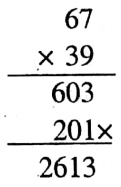
1. 0.67 x 0.39 = 0.2613

Solution: Here


WBBSE Solutions For Class 6 Maths Arithmetic Chapter 6 Multiplication And Division Of A Decimal Fraction By Whole Numbers And Decimal Fraction Question 4 Q.1


The multiplicand decimal number is 0.67 and it contains 2 digits after the decimal point and the multiplier decimal number is 0.39 and it contains 2 digits after the decimal point.

So 2 + 2 = 4 digits.

The required product will also contain 4 digits after the decimal 2613 point, which is why the required product is 0.2613.


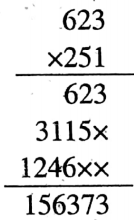
2. 6.23 x 2.51 = 15.6373

Solution: Here


WBBSE Solutions For Class 6 Maths Arithmetic Chapter 6 Multiplication And Division Of A Decimal Fraction By Whole Numbers And Decimal Fraction Question 4 Q.2


The multiplicand decimal number 6.25 contains 2 digits after the decimal point and the multiplier decimal number 2.51 contains 2 digits after the decimal point.

So 2 + 2 = 4 digits.

The required product will also contain 4 digits after the decimal point and as a result of which the required product is 15.6373

i.e., the decimal is placed 4 digits left from the end digit of the product.


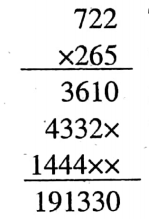
3. 72.2 x 2.65 = 191.330 = 191.33

Solution :


WBBSE Solutions For Class 6 Maths Arithmetic Chapter 6 Multiplication And Division Of A Decimal Fraction By Whole Numbers And Decimal Fraction Question 4 Q.3


The multiplicand decimal number 72.2 contains one digit after the decimal point and the multiplier decimal number 2.65 contains 2 digits after the decimal point. 1+2 = 3 digits.

The required product will contain 3 digits after the decimal point and so the required product is 191.330 = 191.33.

Here the end digit 0 has no value after the decimal point at the end


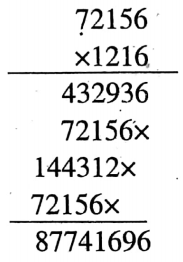
4. 72.156 x 12.16 = 877.41696

Solution:


WBBSE Solutions For Class 6 Maths Arithmetic Chapter 6 Multiplication And Division Of A Decimal Fraction By Whole Numbers And Decimal Fraction Question 4 Q.4


5. 2.14 x 0.4 x 0.9 = 0.7704

Solution:


WBBSE Solutions For Class 6 Maths Arithmetic Chapter 6 Multiplication And Division Of A Decimal Fraction By Whole Numbers And Decimal Fraction Question 4 Q.5.1


WBBSE Solutions For Class 6 Maths Arithmetic Chapter 6 Multiplication And Division Of A Decimal Fraction By Whole Numbers And Decimal Fraction Question 4 Q.5.2

Common Questions About Decimal Operations

6. 0.01 x 0.0001 x 0.000001 = 0.000000000001

Solution :

1 x 1 x 1 = 1. 2 + 4 + 6= 12 digits. The required product will contain 12 digits after the decimal point.

So 11 zeroes are inserted in the left side of the product 1 (which is obtained by the multiplication of 1 x 1 x 1 by removing the decimal points) and then put the decimal point.


Question 5. Arrange in descending order

Solution :

1. 0.5 x 0.3 = 0.15 

Solution:

0.5 = 0.50

0.3 = 0.30.

 50 > 30 > 15,

∴ Arranging in descending order, we get, 0.5, 0.3, 0.5 x 0.3


2. 0.6 x 0.7 = 0.42 

Solution :

0.6 = 0.60

0.7 = 0.70.

70 > 60 > 42

∴ Arranging in descending order, wet get, 0.7, 0.6, 0.6 x 0.7


3. 0.9 x 0.2 = 0.18 

Solution :

0.9 = 0-90

0.2 = 0.20.

90 > 20 > 18

∴ Arranging in descending order, we get, 0.9, 0.2, 0.9 x 0.2


4. 0.4 x 0.8 = 0.32 

Solution :

0.4 = 0.40

0.8 = 0.80.

 80 >40 >32,

∴ Arranging in descending order, we get 0.8, 0.4, and 0.4 x 0.8.


5. 1.2 x 1.5 = 1.80 

Solution :

1.2 = 1.20

1.5 = 1.50.

180 > 150 > 120 .

∴ Arranging in descending order, we get 1.2 x 1.5, 1.5, 1.2.


6. 2.3 x 2.4 = 5.52 

Solution :

2.3 = 2.30

2.4 = 2.40.

552 > 240 > 230.

∴ Arranging in descending order, we get 2.3 x 2.4, 2.4, 2.3.


7. 6.7 x 7.2 = 48.24 

Solution :

6.7 = 6.70

7.2 = 7.20

4824 > 720 > 670 ;

∴ 48.24 > 7.20 > 6.70

∴ Arranging in descending order, we get, 6.7 x 7.2, 7.2, 6.7


8. 8.2 x 1.9 = 15.58 

Solution :

8.2 = 8.20

1.9 = 1.90

∴ 1558 > 820 > 190

∴ 15.58 > 8.20 > 1.90.

Arranging in descending order, we get, 8.2 x 1.9, 8.2, 1.9


Question 6. Arrange in ascending order 

1. 1.4 x 1.1, 1.4, 1.1, 1.5

Solution:

14 x 1.1 = 1·54

1.4 = 1.40;

1.1 = 1.10;

1.5= 1.50

110 < 140 < 150 < 154,

1.10 < 1-40 < 1.50 < 1.54

∴ Arranging in ascending order, we get 1.1, 1.4, 1.5, 1.4 x 1.1.


2. 0-01 x 1, 0.1 x 0.01, 0.01 x 0.01, 0.1

Solution:

= 0.01 x 10.0100

= 0.1 x 0.01 0.0010

= 0.01 x 0.01

= 0.0001 x 0.1

=  0.1000

1 < 10 < 100 < 1000, 

∴ 0.0001 < 0·0010 < 0·0100 < 0.1000

∴ Arranging in ascending order, we get, 0.01 x 0.01, 0.1 x 0.01, 001 × 1, 0.1

Practice Problems on Decimal Division

Question 7. Simplify: 

1. 13.28 4.07 +2.7 × 0.02

Solution

= 13.28 4.07 +0-054.

= (13-280-054) – 4.07

= 13.3344.07 = 9.264

13.28 4.07 +2.7 × 0.02 = 9.264


2. 0.35 × 0.35 + 0.15 x 0.15 + 2 x 0-35 x 0.15

Solution

= 0.1225 +0.0225 +0.1050

=25000

= 0.25

0.35 × 0.35 + 0.15 x 0.15 + 2 x 0-35 x 0.15 = 0.25

Alternative method:

Let 0.35 = a and 0.15 = b

The given quantity = a x a + b x b+2 x a x b.

= a2 + b2+2ab 

= (a + b)2

= (0-5)2 

= 0.25.


Example 8. If the cost of one exercise book is 12.75, then what is the total cost of 4 exercise books?

Solution: The cost of one exercise book = 12.75

∴ The total cost of 4 exercise books (12.75 x 4)

= 51.00 

= 51.

Total cost of 4 exercise books = 51


Example 9. Kartikbabu built a house on 0.35 part of his land. He cultivated fruits in 0.2 parts of the remaining land. In what part of his land did he cultivate fruits?

Solution: Let the whole of Kartikbabu’s land = 1 part.

∴ The remaining part of his land after building the house = (1 – 0.35) part 

= 0.65 part.

Now 0.2 part of 0.65 part = 0·2 x 0.65

 = 0.13 part.

∴ Kartikbabu cultivated fruit in 0.13 part of his land.


Question 10. Your mother asked you to purchase 2-5 kg of the pulse. If the cost of 1 kg of the pulse is 62.50, then how much money must you carry to the shop? 

Solution: The cost of 1 kg of pulse = ₹ 62.50

∴ cost of 2.5 kg pulse

= ₹(62.50 x 2.5) 

= ₹ 156.250 

= ₹ 156.25

₹ 156.25 money must you carry to the shop.


Question 11. You had ₹ 150. With 0.3 part of your money, you bought one exercise notebook and with 0.4 part you bought your mathematics book. How much money is left with you?

Solution: 0.3 + 0.4 = 0·7 part

∴ You spent a total of 0-7 part of your money.

Now you have left (10.7) = 0.3 part of your money.

∴ You have left = 0.3 part of ₹ 150 = ₹ (3 x 150)

= 45.0

= 45.

₹ 45 money is left with you.

Alternative method :

You purchased an exercise book with

= (150 x 0.3)

= 45.

You purchased a mathematics book with

= (150 x 0.4)

 = 60.

∴ You spent total

=  (45+ 60) 

= 105

∴ Total money is left with you

=  (150 – 105) 

=  45.

∴ ₹ 45 is left with you.

Important Definitions Related to Decimal Operations

Question 12. What is the meaning of (31.5 ÷ 5.25)?

Solution: The meaning of (31.5 ÷ 5.25) is how many times 5.25 will be subtracted from 31.5.1


Question 13. Divide :

1.

1. 125.45 ÷ 10 = 12.545

Here in the divisor, there is only one zero after 1. So to determine the quotient, the decimal point in the dividend is moved one digit left side. Hence the quotient becomes 12.545.


2. 0.4 100 = 0.004.

Here, there are 2 zeroes after I in the divisor.

So to determine the quotient, the decimal point in the dividend is moved 2 digits towards the left side.

But then, the dividend does not contain any digit on the left side before the decimal point.

For this reason, 2 zeroes are inserted before 4 and then the decimal point is put.

So the required quotient = 0·004.


3. 23.32  ÷ 1000 = 0.02332.

There are 3 zeroes after 1 in the divisor.

So to determine the quotient the decimal point in the dividend is moved 3 digits towards the left side.

Since there are only 2 digits in the left side of the decimal point.

For this reason, one zero is inserted before 23:32 on the left side and then the decimal point is put in.

The required quotient is 0.02332.


4. 1·724  ÷ 10000 = 0.0001724.

There are 4 zeroes after 1 in the divisor.

So to determine the quotient, the decimal point in the dividend is moved 4 digits towards the left side but the dividend contains only one digit before the decimal point.

For this reason, 3 zeroes are inserted before the given dividend decimal number 1.724 and then the decimal point is put.

The required quotient is 0-0001724.


2.


1. 651-2 ÷ 4 = 162.8.

Solution:

Here removing the decimal point in the dividend we get 6512 and 6512 ÷ 4 = 1628;

Since the dividend contains a decimal point one digit before the end digit, the decimal point is also put in the quotient one digit before the end digit.

∴ The required quotient = 162.8.


2. 18  ÷  0.2 = 18/0.2

Solution:

= 18×10 / 0.2 x 10

= 180/2

=90.

Here the decimal point in the divisor is removed by the multiplication of 10 to it.

So multiplying both the numerator and denominator by 10 we get the required result and the quotient is 90.


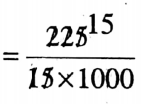
3. 0.225
÷ 15 = 0.225 / 15

Solution:

= 0÷225×1000 / 15×1000


WBBSE-Solutions-For-Class-6-Maths-Arithmetic-Chapter-6-Multiplication-And-Division-Of-A-Decimal-Fraction-By-Whole-Numbers-And-Decimal-Fraction-Question-13-Q.3.1


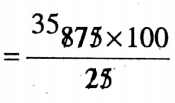
4. 875 ÷ 0.25

Solution:

= 875 x 100 / 0.25 x 100


WBBSE Solutions For Class 6 Maths Arithmetic Chapter 6 Multiplication And Division Of A Decimal Fraction By Whole Numbers And Decimal Fraction Question 13 Q.4.1


3.

1. 28.8 ÷ 1.2,

Solution:

1. 28.8 ÷ 1.2 = 28.8 / 1.2

= 28.8 / 102

= 28.8 x 10 / 1.2 x 10

= 288/12 = 24.

Examples of Real-Life Applications of Decimal Operations

2. 2. 1.35 ÷ 1.5

Solution:

\(1.35 \div 1 \cdot 5=\frac{1.35}{1.5}=\frac{1.35 \times 100}{1.5 \times 100}=\frac{135}{150}=0.9\)


WBBSE Solutions For Class 6 Maths Arithmetic Chapter 6 Multiplication And Division Of A Decimal Fraction By Whole Numbers And Decimal Fraction Question 13 Q 3.2


3. 3. 414.50 ÷ 0.0125

Solution:

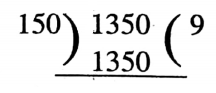
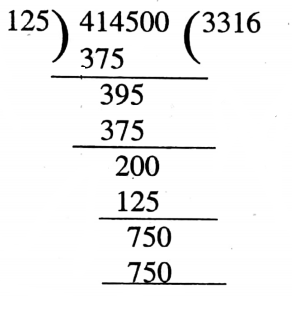
\(414 \cdot 5 \div 0 \cdot 125=\frac{414 \cdot 5}{0 \cdot 125}=\frac{414 \cdot 5 \times 1000}{0 \cdot 125 \times 1000}=\frac{414500}{125}=3316\)


WBBSE Solutions For Class 6 Maths Arithmetic Chapter 6 Multiplication And Division Of A Decimal Fraction By Whole Numbers And Decimal Fraction Question 13 Q 3.3


4. 0.465 ÷ 0.5

Solution:

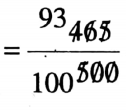
= 0.465 x 1000 / 0.5 x 1000


WBBSE Solutions For Class 6 Maths Arithmetic Chapter 6 Multiplication And Division Of A Decimal Fraction By Whole Numbers And Decimal Fraction Question 13 Q.3.4


= 93/100

= 0.93.

0.465 ÷ 0.5 = 0.93.


Question 14. Simplify:


1. (45.85 – (6.29 + 15.06)} ÷ 5

Solution:

= (45.85 – (6.29 + 15.06)} ÷ 5

= (45.85 – 21.35) ÷ 5

= 24.50 ÷ 5

= 4.9.

(45.85 – (6.29 + 15.06)} ÷ 5 = 4.9.


2. {(4 – 2.07) × 2.5} ÷ 1.93

Solution:

= {(4 – 2.07) × 2.5} ÷ 1.93

= (1.93 x 2.5) ÷ 1.93

1.93 x 2.5 / 1.93 

= 2.5

{(4 – 2.07) × 2.5} ÷ 1.93 = 2.5

Conceptual Questions on Rounding Decimals in Calculations


3. (7.8 – 7.8 x 0.2) ÷ 1.2

Solution:

= (7.8 – 7.8 x 0.2) ÷ 1.2

= (7.8 – 1.56) ÷ 1.2

= 6.24 ÷ 1.2

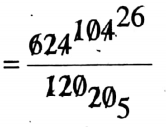
= 6.24 x 100 / 1.2 x 100


WBBSE Solutions For Class 6 Maths Arithmetic Chapter 6 Multiplication And Division Of A Decimal Fraction By Whole Numbers And Decimal Fraction Question 14 Q.3.1


= 26/5

= 5.2


WBBSE Solutions For Class 6 Maths Arithmetic Chapter 6 Multiplication And Division Of A Decimal Fraction By Whole Numbers And Decimal Fraction Question 14 Q.3.2


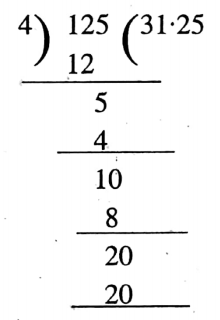
Question 15. A square is formed by bending a copper wire of length 125 centimeters. What is the length of each side of the square?

Solution: We know that each side of a square is of equal length and a square has 4 sides.

∴ The length of each side of the square = (125 ÷ 4) cm 

= 31.25 cm

∴  The length of each side of the square

= 31.25 centimeters.


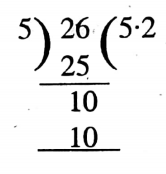
WBBSE Solutions For Class 6 Maths Arithmetic Chapter 6 Multiplication And Division Of A Decimal Fraction By Whole Numbers And Decimal Fraction Question 15 Q.1.1


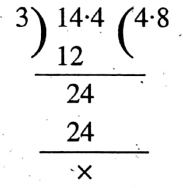
Question 16. The perimeter of an equilateral triangle is 14.4 cm. What is the length of each side of it?

Solution: We know that the length of each of the 3 sides of an equilateral triangle is the same.

:. The length of each side of the equilateral triangle = (14.4 ÷ 3) cm 

= 4.8 cm.

WBBSE Solutions For Class 6 Maths Arithmetic Chapter 6 Multiplication And Division Of A Decimal Fraction By Whole Numbers And Decimal Fraction Question 16 Q.1.1

WBBSE Solutions For Class 6 Maths Arithmetic Chapter 5 Multiplication And Division Of A Fraction By Whole Number And By Fraction

Arithmetic Chapter 5 Multiplication And Division Of A Fraction By Whole Number And By Fraction

Question 1. Multiply:

1. \(3 \times \frac{6}{11}\)

Solution:

\(3 \times \frac{6}{11}=\frac{3 \times 6}{11}=\frac{18}{11}=1 \frac{7}{11}\)


2. \(\frac{2}{3} \times 11\)

Solution:

\(\frac{2}{3} \times 11=\frac{2 \times 11}{3}=\frac{22}{3}=7 \frac{1}{3}\)


3. \(\frac{7}{3} \times 2 \frac{2}{3}\)

Solution:

\(\frac{7}{3} \times 2 \frac{2}{3}=\frac{7}{3} \times \frac{8}{3}=\frac{7 \times 8}{3 \times 3}=\frac{56}{9}=6 \frac{2}{9}\)


4. \(\frac{3}{8} \times \frac{6}{4}\)

Solution:

⇒ \(\frac{3}{8} \times \frac{6}{4}=\frac{3 \times 6}{8 \times 4}=\frac{3 \times 3}{4 \times 4}=\frac{9}{16}\)

Read and Learn More  WBBSE Solutions For Class 6 Maths

5. \(\frac{6}{49} \times \frac{7}{3}\)

Solution:

⇒ \(\frac{6}{49} \times \frac{7}{3}=\frac{6 \times 7}{49 \times 3}=\frac{2}{7}\)

WBBSE Solutions For Class 6 Geography WBBSE Solutions For Class 6 History WBBSE Solutions For Class 6 Maths
WBBSE Class 6 Geography Notes WBBSE Class 6 History Notes
WBBSE Class 6 Geography Multiple Choice Questions WBBSE Class 6 History MCQs WBBSE Notes For Class 6 School Science


6. \(\frac{15}{28} \times 2 \frac{1}{3}\)

Solution:

⇒ \(\frac{15}{28} \times 2 \frac{1}{3}=\frac{15}{28} \times \frac{7}{3}=\frac{15 \times 7}{28 \times 3}=\frac{5 \times 7}{28}=\frac{5}{4}=1 \frac{1}{4}\)

WBBSE Solutions For Class 6 Maths Arithmetic Chapter 5 Multiplication And Division Of A Fraction By Whole Number And By Fraction

WBBSE Class 6 Multiplying Fractions Notes

7. \(4 \frac{8}{13} \times 7 \frac{4}{5}\)

Solution:

\(4 \frac{8}{13} \times 7 \frac{4}{5}=\frac{60}{13} \times \frac{39}{5}=\frac{60 \times 39}{13 \times 5}=12 \times 3=36\)


8. \(2 \frac{3}{5} \times 6\)

Solution:

\(2 \frac{3}{5} \times 6=\frac{13}{5} \times 6=\frac{13 \times 6}{5}=\frac{78}{5}=15 \frac{3}{5}\)


Question 2. Multiply:

1. \(\frac{6}{7} \times \frac{14}{15} \times \frac{25}{28}\)

Solution:


WBBSE Solutions For Class 6 Maths Arithmetic Chapter 5 Multiplication And Division Of A Fraction By Whole Number And By Fraction Q 2.1


2. \(2 \frac{11}{12} \times 3 \frac{1}{7} \times 4 \frac{10}{11}\)

Solution:


WBBSE Solutions For Class 6 Maths Arithmetic Chapter 5 Multiplication And Division Of A Fraction By Whole Number And By Fraction Q 2.2

Short Questions on Fraction Multiplication and Division

3. \(\frac{12}{35} \times \frac{42}{91} \times \frac{36}{55} \times \frac{13}{18}\)

Solution:

WBBSE Solutions For Class 6 Maths Arithmetic Chapter 5 Multiplication And Division Of A Fraction By Whole Number And By Fraction Q 2.3

4. \(1 \frac{7}{10} \times 1 \frac{3}{17} \times 1 \frac{1}{5} \times 3 \frac{3}{4}\)

Solution:

WBBSE Solutions For Class 6 Maths Arithmetic Chapter 5 Multiplication And Division Of A Fraction By Whole Number And By Fraction Q 2.4

Question 3. Multiply:

Solution:

1. \(99 \frac{98}{99} \times 99\)

Solution:


WBBSE Solutions For Class 6 Maths Arithmetic Chapter 5 Multiplication And Division Of A Fraction By Whole Number And By Fraction Q 3.1


Common Questions About Fraction Operations

2. \(999 \frac{97}{98} \times 98\)

Solution:

WBBSE Solutions For Class 6 Maths Arithmetic Chapter 5 Multiplication And Division Of A Fraction By Whole Number And By Fraction Q 3.2


3. \(999 \frac{995^{\circ}}{997} \times 997\)

Solution:

WBBSE Solutions For Class 6 Maths Arithmetic Chapter 5 Multiplication And Division Of A Fraction By Whole Number And By Fraction Q 3.3


4. \(999 \frac{444}{999} \times 999\)

Solution:


WBBSE Solutions For Class 6 Maths Arithmetic Chapter 5 Multiplication And Division Of A Fraction By Whole Number And By Fraction Q 3.4

Practice Problems on Fraction Division

Question 4 Simplify:

1. \(\frac{1}{5}+\frac{2}{3}-\frac{1}{2}\)

Solution:

⇒ \(\frac{1}{5}+\frac{2}{3}-\frac{1}{2}=\frac{6+20-15}{30}=\frac{26-15}{30}=\frac{11}{30}\)

2. \(\frac{1}{5}+\frac{1}{2}-\frac{2}{15}-\frac{1}{6}\)

Solution:


WBBSE Solutions For Class 6 Maths Arithmetic Chapter 5 Multiplication And Division Of A Fraction By Whole Number And By Fraction Q 4.2


3. \(\frac{7}{12}+5 \frac{2}{9}+\frac{11}{18}-2 \frac{5}{12}\)

Solution:


WBBSE Solutions For Class 6 Maths Arithmetic Chapter 5 Multiplication And Division Of A Fraction By Whole Number And By Fraction Q 4.3

Examples of Real-Life Applications of Fraction Operations

4. \(3 \frac{1}{9}+\frac{7}{6} \times \frac{3}{8}-\frac{5}{24}\)

Solution:


WBBSE Solutions For Class 6 Maths Arithmetic Chapter 5 Multiplication And Division Of A Fraction By Whole Number And By Fraction Q 4.4


5. \(6 \frac{2}{5}+3 \frac{1}{3}+\frac{1}{2}-\frac{7}{10}\)

Solution:


WBBSE Solutions For Class 6 Maths Arithmetic Chapter 5 Multiplication And Division Of A Fraction By Whole Number And By Fraction Q 4.5


6. \(1-\left[\frac{1}{2} \div\left\{2-\frac{1}{2}\left(\frac{1}{2}-\overline{\frac{1}{3}-\frac{1}{6}}\right)\right\}\right]\)

Solution:


WBBSE Solutions For Class 6 Maths Arithmetic Chapter 5 Multiplication And Division Of A Fraction By Whole Number And By Fraction Q 4.6


Question 5. Evaluate:

1. 1/5 part of ₹ 10

Solution:


WBBSE Solutions For Class 6 Maths Arithmetic Chapter 5 Multiplication And Division Of A Fraction By Whole Number And By Fraction Q 5.1


2. 1/5 part of ₹ 25

Solution:


WBBSE Solutions For Class 6 Maths Arithmetic Chapter 5 Multiplication And Division Of A Fraction By Whole Number And By Fraction Q 5.2


Question 6.

1. 1/3 part of how many rupees is ₹ 4?

Solution:

Let the whole of the money be 1.

∴ 1/3 part of the whole of the money = ₹ 4

∴ whole of the money = ₹(4 ÷ 1/3)

= ₹ (4 x 3/1)

= ₹ 12.

Alternative Method:

Let the required money be ₹ x

Then 1/3 part of ₹ x = ₹ 4

∴ 1/3 x x = 4

or, x/3 = 4

or, x = 4 x 3

= 12

∴ The required money = ₹ 12.

2. 1/6 part of how many minutes are 6 minutes?

Solution:

Here 1/6 part of the total minutes = 6 minutes

∴ Total minutes = (6 ÷ 1/6)

= 6 x 6/1

= 36

∴ The required time = is 36 minutes.


Question 7. You had taken 1/3 part of the mangoes from the basket of mangoes of Sakuntala and then you had only 7 mangoes. How many mangoes were there in the basket of Sakuntala originally?

Solution: It is clear that 1/3 part of sakuntala’s mangoes in the basket = 7

Total number of mangoes in the basket of Sakuntala

= 7 ÷ 1/3

= 7 x 3/1

= 21

∴ Sakluntala had 21 mangoes originally in her basket.


Question 8. How much money is to be taken from 1/2 part of ₹ 150 so that there will remain only ₹ 30?

Solution:

1/2 part of ₹ 150

= ₹ (1/2 x 150)

= ₹ 75

We have to find the amount of money that can be taken from ‘? 75 so that there will remain  ₹ 30.

∴ The required amount of money = ₹ (75 – 30)

= ₹ 45.

∴ ₹ 45 is to be taken from 1/2 part of ₹ 150 so that there will remain ₹ 30.


Question 9. What is to be added to 3 times of 6/7 to get 2 6/7?

Solution: 3 times of 6/7

= 3 x 6/7

= 18/7

2 6/7 = 20/7

We have to find the value which is to be added to 18/7 so that the sum will be 2 6/7 or 20/7.

∴ The required value = 20/7 – 18/7

= 2/7

2/7 is to be added to 3 times of 6/7 to get 2 6/7


Question 10. 1400 visitors came in the first year in an occasion of the town. The number of visitors in the next year increased by 7/10 part of the first year. What was the total number of visitors in the next year?

Solution:

Total number of visitors in the first year = 1400.

∴ 7/10 part of 1400

= 7/10 x 1400

= 980

So the number of visitors increases in the next year = 980 than the first year.

∴ Total number of visitors in the next year = 1400 + 980

= 2380.

The total number of visitors in the next year = 2380.


Question 11. You had no stamps and Madhabi gave you 2/3 part of the stamps as many stamps had with her at first and as a result of which you had only 18 stamps. How many stamps had Madhabi with her at first?

Solution:

You had only 18 stamps and Madhabi gave you – parts of her stamps.

∴ 2/3 parts of the stamps of Madhabi =18

So Madhabi’s total number of stamps = (18 ÷ 2/3)


WBBSE Solutions For Class 6 Maths Arithmetic Chapter 5 Multiplication And Division Of A Fraction By Whole Number And By Fraction Q 11.1


Madhabi had 27 stamps with her.


Question 12. Ram gave 2/5 part of his money to Shyam and 3/10 part of his money to Jadu. If he has ₹ 180 left with him, how much money Ram had at the beginning?

Solution: Let the total money of Ram = be 1 part.

∴ Ram gave Shyam 2/5 part of his money and 3/10 part of his money to Jadu

∴ Shyam and Jadu together received (2/5 + 3/10)

= 4+3 / 10

= 7/10 part of Ram’s total money.

∴ The remaining part of ram’s money after giving to Shyam and jadu

= (1 – 7/10)

= 10-7 / 10 part

= 3/10 part

∴ 3/10 part of Ram’s total money = ₹ 180

∴ Ram’s total money what had at the beginning

= ₹ (180 ÷ 3/10)

= ₹ (180 x 10/3)

= ₹ 600

₹ 600 Ram had at the beginning.


Question 13. Your father brought 10 liters of drinking water from the nearest tubewell and from it, your mother used 1/5 part of the water for cooking. 1/4 part of the remaining water had been used for drinking purposes. How much water still was left?

Solution Total amount of drinking water brought = 10 liters. 

Let the total amount of water = 1 part

Mother used for cooking = 1/5 part

Remaining part = 1 – 1/5

= 5-1 / 5

= 4/5

Water used for drinking = 1- 1/5

= 5-1 / 5

= 4/5

Water used for drinking = (4/5 x 1/4) part ⅕ part

Remaining part of total water = 4/5 – 4/5

= 4-1 /5

= 3/5 part

∴ Remaining water = (3/5 x 10) = 6 liters

∴ Still, 6 liters of water was left.


Question 14. A bucket holds 1/2 liter of water. How much water 7 such buckets can hold?

Solution: One bucket can hold = 1/2 liter of water

∴ 7 buckets can hold = (1/2 x7)

= 3.5 liters of water

∴ 7 buckets can hold 3.5 liters of water.

Conceptual Questions on Mixed Numbers and Improper Fractions

Question 15. If the length of the 7/8 part of a ribbon is 56 meters, then what is the length of the original whole ribbon?

Solution: Let the length of the original whole ribbon = 1 part.

∴ The length of 7/8 part of the ribbon = 56 meters 

∴ The length of 1 part of the ribbon = (56 ÷ 7/8) metres

= (56 x 8/7 ) metres

= 64 meters.

∴ The length of the original whole ribbon = is 64 meters.


Question 16. What is to be added to 5/7 of 1 1/2 to get the sum 4 3/5?

Solution:

5/7 of 1 1/2 = 5/7 x 1 1/2

= 5/7 x 3/2

= 15/14

We have to find what is to be added to 15/14 to get the sum 4 3/5.

∴ Required value = (4 3/5 – 15/14)

= 23/5 – 15/14

= 322 – 75 / 70

= 247/70

= 3 37/70

3 37/70 is to be added to 5/7 of 1 1/2 to get the sum 4 3/5


Arithmetic Chapter 5 Multiplication And Division Of A Fraction By Whole Number And By Fraction Reciprocal Number

Question 1. Write the meaning of each of the following mathematical processes:

Solution:

1. 55 ÷ 11

Solution:

The meaning of (55  ÷ 11) is that how many times 11 is subtracted from 55?


2. 2 ÷ 1/4

Solution:

By ( 2  ÷ 1/4)  we mean that how many times 1/4  is subtracted from 2?


3. 8 1/2  ÷  2

Solution:

By (8 1/2 ÷ 2) we mean that how many times 2 is subtracted from 8 1/2?


4. 6 1/3  ÷ 1 1/3 

Solution:

By (6 1/3  ÷ 1 1/3 ) we mean that how many times 1 1/3  is subtracted from 6 1/3?


Question 2. Determine how many times to be subtracted in each case:

1. 11 from 77

Solution:

Here 77 ÷ 11 

= 7.

∴ 11 can be subtracted 7 times from 77.


2. 1/3  from 3;

Solution:

Here 3 ÷ 1/3 

= 3 × 3/1 

= 9. 

can be subtracted 9 times from 3.


3. 1/2 from 8;

Solution:

8 ÷ 1

= 8 x 2/1

= 16.

∴ can be subtracted 16 times from 8.


4. 1 from 10 1/2

Solution:

10 1/2 ÷ 1 1/2 

= 21/2 x 2/3 

= 7.

∴ 1 1/2 can be subtracted 7 times from 10 1/2.


Question 3. Determine how many integral times can be subtracted and then what is the remainder in each case:

1. 13 2/3 from 119 3/4 ;

Solution:

Here 119 3/4 ÷ 13 2/3

= 479/4 ÷ 41/3

= 479/4 x 3/41

= 1437/164

= 8 125/164.

Now the fraction part is 125/164.

∴ 125/164 x 13 2/3


WBBSE Solutions For Class 6 Maths Arithmetic Chapter 5 Multiplication And Division Of A Fraction By Whole Number And By Fraction Q3.1


= 125/25

= 10 5/12

∴ 13 2/3 can be subtracted 8 full times and then the remainder is 10 5/12.


2. 10 1/4 from 181 1/3;

Solution:

Here 181 1/3 ÷ 10 1/4

= 544/3 ÷ 4/41

= 2176/123

= 17 85/123

The fractional part = 85/123

∴ 85/123 x 10 1/4


WBBSE Solutions For Class 6 Maths Arithmetic Chapter 5 Multiplication And Division Of A Fraction By Whole Number And By Fraction Q3.2

= 85/12

= 7 1/2

∴ 10 1/4 can be subtracted 17 full times and the remainder be 7 1/12.


Question 4. Divide:

1. 15 ÷ 5/3

Solution:

WBBSE Solutions For Class 6 Maths Arithmetic Chapter 5 Multiplication And Division Of A Fraction By Whole Number And By Fraction Q4.1

15 ÷ 5/3 = 9

2. 14 ÷ 7/2

Solution:

WBBSE Solutions For Class 6 Maths Arithmetic Chapter 5 Multiplication And Division Of A Fraction By Whole Number And By Fraction Q4.2

=4

14 ÷ 7/2 =4


3. 6/13 ÷ 1 1/5

Solution:

WBBSE Solutions For Class 6 Maths Arithmetic Chapter 5 Multiplication And Division Of A Fraction By Whole Number And By Fraction Q4.3

= 2/13

6/13 ÷ 1 1/5 = 2/13


4. 12/19 ÷ 6

Solution:

WBBSE Solutions For Class 6 Maths Arithmetic Chapter 5 Multiplication And Division Of A Fraction By Whole Number And By Fraction Q4.5

= 2/19

12/19 ÷ 6 = 2/19

5. 5 1/5 ÷ 13/2

Solution:

WBBSE Solutions For Class 6 Maths Arithmetic Chapter 5 Multiplication And Division Of A Fraction By Whole Number And By Fraction Q4.4

= 4/5

5 1/5 ÷ 13/2 = 4/5

6. 2 2/5 ÷ 1 1/5

Solution:

= 12/5 ÷ 6/5

WBBSE Solutions For Class 6 Maths Arithmetic Chapter 5 Multiplication And Division Of A Fraction By Whole Number And By Fraction Q4.6

= 2

2 2/5 ÷ 1 1/5 = 2


7. 4 3/7 ÷ 3 2/7

Solution:

= 31/7 ÷ 23/7

= 31/7 x 7/23

= 31/23

= 1 8/23

4 3/7 ÷ 3 2/7 = 1 8/23


Question 5: Find the reciprocal of the following number:

1. 7/5;

Solution:

The reciprocal of 7/5 is 5/7;


2. 1/3;

Solution:

The reciprocal of 1/3 is 3/1

= 3;


3. 5/8;

Solution:

The reciprocal of 5/8 is 8/5

= 1 3/5;


4. 9/7;

Solution:

The reciprocal of 9/7 is 7/9;


5. 12/5;

Solution:

The reciprocal of 12/5 is 5/12;


6. 7/18;

Solution:

The reciprocal of 7/18 is 18/7

= 2 4/7;

7. 1/8;

Solution:

The reciprocal of 1/8 is 8/1

= 8;

8. 5 6/7;

Solution:

The reciprocal of 5 6/7 or the reciprocal of 41/7 is 7/41;

9. 10 1/3;

Solution:

The reciprocal of 10 1/3 or the reciprocal of 31/3 is 3/31;

10. 14; 

Solution:

The reciprocal of 14 is 1/14.


Question 6. Simplify:

1. 3/8 ÷ 2/3 of 1/9 of 1/16;

2. \(\left\{\frac{11}{16} \div\left(\frac{5}{6}+\frac{2}{3}\right)\right\}-\frac{1}{3}\)

3. 4 2/3 ÷ 2/3 – 3/8;

4. (2 3/4 + 31/2 ÷ 2 1/7) ÷ 13 1/4;

5. 2 – 1/10 x 1/3 ÷ 4/25 ÷ 1/8

6. \(1 \frac{1}{2}\left[3 \frac{1}{2} \div 2 \frac{1}{3}\left\{1 \frac{1}{4} \div\left(2+3 \frac{2}{3}\right)\right\}\right]\)

7. (1 1/13 x 2 3/5) ÷ (7 1/2 x 3 1/10) ÷ 28/279

8. \(2 \frac{1}{2}+\frac{2}{3}\left[4 \frac{1}{2}+3\left\{7 \div 4 \frac{2}{3}\right\}\left(8 \frac{1}{2}+\overline{4+7 \frac{1}{3}}\right)\right]\)


Solution:

1. 3/8 ÷ 2/3 of 1/9 of 1/16

Solution:


WBBSE Solutions For Class 6 Maths Arithmetic Chapter 5 Multiplication And Division Of A Fraction By Whole Number And By Fraction Q6.2


= 3/8 ÷ 1/216


WBBSE Solutions For Class 6 Maths Arithmetic Chapter 5 Multiplication And Division Of A Fraction By Whole Number And By Fraction Q6.3

= 81


2. \(\left\{\frac{11}{16} \div\left(\frac{5}{6}+\frac{2}{3}\right)\right\}-\frac{1}{3}\)

Solution:


WBBSE Solutions For Class 6 Maths Arithmetic Chapter 5 Multiplication And Division Of A Fraction By Whole Number And By Fraction Q6.4


3. 4 2/3 ÷ 2/3 – 3/8

Solution:

= 14/3 ÷ 2/3 -3/8


WBBSE Solutions For Class 6 Maths Arithmetic Chapter 5 Multiplication And Division Of A Fraction By Whole Number And By Fraction Q6.5

= 7 – 3/8

= 56-3 / 8

= 53/8

= 6 5/8

4 2/3 ÷ 2/3 – 3/8 = 6 5/8


4. (2 3/4 + 3 1/2 ÷ 2 1/7) ÷ 13 1/4

Solution:

= (11/4 + 7/2 ÷ 15/7) ÷ 53/4

= (11/4 + 7/2 x 7/15) ÷ 53/4

= (11/4 + 49/30) ÷ 53/4

= (165 + 98 / 60) ÷ 53/4


WBBSE Solutions For Class 6 Maths Arithmetic Chapter 5 Multiplication And Division Of A Fraction By Whole Number And By Fraction Q6.6

= 263/795

(2 3/4 + 3 1/2 ÷ 2 1/7) ÷ 13 1/4 = 263/795


5. 2 – 1/10 x 1/3 ÷ 4/25 ÷ 1/8

Solution:

= 2 – 1/10 x (1/3 x 25/4) ÷ 1/8

= 2 – 1/10 x 25/12 ÷ 1/8


WBBSE Solutions For Class 6 Maths Arithmetic Chapter 5 Multiplication And Division Of A Fraction By Whole Number And By Fraction Q6.7

= 2 – 5/3

= 6-5 / 3

= 1/3.

2 – 1/10 x 1/3 ÷ 4/25 ÷ 1/8 = 1/3.


6. \(1 \frac{1}{2}\left[3 \frac{1}{2} \div 2 \frac{1}{3}\left\{1 \frac{1}{4} \div\left(2+3 \frac{2}{3}\right)\right\}\right]\)

Solution:

= 1 1/5[3 1/2 ÷ 2 1/3{1 1/4 ÷ (2 + 3 2/3)}]

= 3/2[7/2 ÷ 7/3{5/4 ÷(2 + 11/3)}]

= 3/2[7/2 ÷ 7/3{5/4 ÷ (6+11 / 3)}]

= 3/2[7/2 ÷ 7/3{5/4 ÷ 17/3}]

= 3/2[7/2 ÷ 7/3{5/4 x 3/17}]

= 3/2[7/2 ÷ 7/3 of 15/68]


WBBSE Solutions For Class 6 Maths Arithmetic Chapter 5 Multiplication And Division Of A Fraction By Whole Number And By Fraction Q6.8


= 3/2[7/2 ÷ 35/68]


WBBSE Solutions For Class 6 Maths Arithmetic Chapter 5 Multiplication And Division Of A Fraction By Whole Number And By Fraction Q6.9

WBBSE Solutions For Class 6 Maths Arithmetic Chapter 5 Multiplication And Division Of A Fraction By Whole Number And By Fraction Q6.10

= 51/5

= 10 1/5.


7. (1 1/13 x 2 3/5) ÷ (7 1/2 x 3 1/10) ÷ 28/279

Solution:


WBBSE Solutions For Class 6 Maths Arithmetic Chapter 5 Multiplication And Division Of A Fraction By Whole Number And By Fraction Q6.11

Real-Life Scenarios Involving Recipes and Measurements

8. \(2 \frac{1}{2}+\frac{2}{3}\left[4 \frac{1}{2}+3\left\{7 \div 4 \frac{2}{3}\right\}\left(8 \frac{1}{2}+\overline{4+7 \frac{1}{3}}\right)\right]\).


WBBSE Solutions For Class 6 Maths Arithmetic Chapter 5 Multiplication And Division Of A Fraction By Whole Number And By Fraction Q6.12


Question 7. How many times 1/16 are there in 3/4?

Solution:

Here 3/4 ÷ 1/16

WBBSE Solutions For Class 6 Maths Arithmetic Chapter 5 Multiplication And Division Of A Fraction By Whole Number And By Fraction Q7

= 12.

∴ 1/16 lies 12 rimes in 3/4


Question 8. From 16 2/3 meters long ribbons, 3/8 part of it is cut off. The cutout portion of the ribbon is further divided into 5 equal pieces, then what is the length of each piece?

Solution:

The length of the cutout part of the ribbon = (3/8 of 16 2/3) metres

= (3/8 x 50/3) metres

= 25/4 metres

It is divided into 5 equal pieces.

∴ The length of each pieces = (25/4 ÷ 5) metres


WBBSE Solutions For Class 6 Maths Arithmetic Chapter 5 Multiplication And Division Of A Fraction By Whole Number And By Fraction Q8

= 5/4 metres

= 1 1/4 metres

The length of each piece = 1 1/4 metres


Question 9. debarred bought 12 7/10 meters of cloth for window curtains. There were already 5 3/5 meters of cloth for curtains at home. If 4 5/6 meters of cloth is required to make curtains for each of the 3 windows. What length of cloth will remain?

Solution:

Total length of cloth for curtain = (12 7/10 + 5 3/5) metres

= (127/10 + 28/5) metres

= (127 + 56 / 10) meters

= 183/10 meters

The total length of cloth which is used for curtains of 3 windows

= (3 x 4 5/6) metres

= (3 x 29/6)metres

= 29/2 metres

∴ The length of the remaining cloth = 3 4/5 meters

∴ 3 4/5 meters of cloth will remain.


Question 10. Paromita prepared some pickles and 4/7 part of the pickle was put in a glass jar. The rest of the pickle was divided equally among 6 boys and girls. How many parts of the whole of the pickle did each get?

Solution:

Let the whole of the pickle that paramita prepared = 1 part.

She put in a glass jar = 4/7 part.

After putting the pickle in the glass jar, the remaining part of the pickle

= (1 – 4/7)

= 3/7 part

This part was divided among 6 boys and girls equally.

∴ Each got = (3/7 ÷ 6) part


WBBSE Solutions For Class 6 Maths Arithmetic Chapter 5 Multiplication And Division Of A Fraction By Whole Number And By Fraction Q10

= 1/14 part.

So each of the boys and girls got 1/14 part of the whole of the pickle.


Question 11. Rahim and his group have decided that they will construct 24 11/15 km of the road in 33 days. They have constructed 11/15  km of road each day for 25 days. If they are to finish the work in due time, at what rate will they work for the remaining work?

Solution: Rahim and his group have constructed 11/15 km of road each day.

.. In 25 days they already have constructed The rest of the road to be still constructed

11/15 x 25 = 55/3 km of the road.

= (24 11/15 – 55/3)km

= (371/15 – 55/3)km

= 371 – 275 / 15 km

= 96/15 km.

This 96/15 km of the road is to be constructed in the remaining (33 – 25)

= 8 days.

∴ They are to construct each day at the rate of (96/15 ÷ 8)


WBBSE Solutions For Class 6 Maths Arithmetic Chapter 5 Multiplication And Division Of A Fraction By Whole Number And By Fraction Q11

= 4/5 km of the road

∴ To finish the construction work of the road in due time the rate of work done by them for the remaining days = 4/5 km.


Question 12. 5 is added to 3/7 and the sum is multiplied by 4 2/3. Now the product is divided by 4 4/9 and the quotient is subtracted from 8 2/5. Find the result of the subtraction (write this in mathematical language and then find the number after subtraction).

Solution:

Writing in Mathematical Language, we get, the result of subtraction

∴ Simplification


WBBSE Solutions For Class 6 Maths Arithmetic Chapter 5 Multiplication And Division Of A Fraction By Whole Number And By Fraction Q12


∴ The required number after subtraction = 2 7/10.


Question 13. After retirement, Debkumarbabu donated 1/4 part of his property to the local library. He gave 1/6 part of the remaining property to his wife and the rest of the property was divided equally between his two sons. What part of the whole of the property was given to his wife and to each of his two sons? 

Solution: Let the whole of the property of Debkumarbabu = 1 part.

He donated 1/4 part of his property to the local library.

.. The remaining part of the property after donation to the local library

= (1 – 1/4) part 

= 3/4 part

.. His wife received = (1/6 of 3/4 )part

= 1/8 part of the property.

Remaining property = 3/4  – 1/8 

= 6-1 / 8

= 5/8  part

This part was divided between the two sons equally.5

∴ Each son received = (5/8 ÷ 2) part

= (5/8 x 1/2) part

= 5/16 part.

∴ Debkumarbabu gave 1/8 part to his wife and 5/16 part of his property to each son.


Question 14. Ajoy has bought (5/7 of 14/25) part of a property and he has sold 1/2  part of his property for ₹10000. What is the value of the whole property?

Solution: Let the whole property = 1 part.

∴ The property of Ajoy = (5/7 of 14/25) part

= 2/5 part of the whole property.

Again Ajoy sold 1/2 part of his property.

∴ Ajoy sold (1/2 of 2/5) part

= 1/5 part of the whole property.

∴ The value of 1/5 part of the whole property = ₹ 10,000

∴ The value of the whole property = ₹(10000 ÷ 1/5)

= ₹(10000 x 5/1)

= ₹ 50000

∴ The value of the whole property = ₹ 50000.


Question 15. The distance of Surbabu’s house from the station is 14 km. He traveled 1/8 part of the distance on foot and 11/16 part of the distance by bus. The rest of the distance was traveled by him by Autorickshaw. What distance did he travel by autorickshaw?

Solution: Let the total distance of Surbabu’s house to the station = be 1 part.

∴ The part of the total distance traveled by bus and on foot = (1/8 + 11/16) part

= 13/16 part

∴ Remaining part of the distance = 1 – 13/16

= 16-13/16 part

= 3/16 part

This part of the distance was traveled by autorickshaw. But total distance = 14 2/3 km.

∴ Surbabu traveled by autorickshaw = (14 2/3 x 3/16)km.


WBBSE Solutions For Class 6 Maths Arithmetic Chapter 5 Multiplication And Division Of A Fraction By Whole Number And By Fraction Q15


= 11/4 km

= 2 3/4 km.

2 3/4 km distance that he travel by autorickshaw.

WBBSE Solutions For Class 10 History Chapter 5 Alternative Ideas And Initiatives From Mid 19th Century To The Early 20th Century Characteristics And Observations

Chapter 5 Alternative Ideas And Initiatives Characteristics And Observations Salient Points At A Glance

Characteristics of Alternative Ideas in History

1. The cause of Indian nationalism was largely promoted by the Indian press. The first newspaper in India was started by James Augustus Hicky. To the Serampore Missionary goes the credit for publishing the first Bengali monthly, ‘Digdarshan’.

2. In 1818, there appeared ‘Samachar Darpan’ with J C Marshman as its editor. Several other newspapers were published during this period. Among them, mention may be made of ‘Sambad Kaumudi’, ‘Samachar Chandrika’, ‘Sambad Prabhakar’, ‘Jnananweshan’, ‘Sambad Bhaskar’, ‘Saptahik Bartabaha’ etc. These newspapers helped in spreading knowledge and awareness among the people.

Read and Learn Also WBBSE Solutions for Class 10 History

3. During the 18th and 19th centuries, the people of India were largely illiterate. With the introduction of the printing of textbooks, the dissemination of knowledge became easy. The Baptist Mission Press started to print books in Bengali and other provincial languages. In 1800, Lord Wellesley founded Fort William College to give training to the newly recruited young civilians in India.
WBBSE Solutions For Class 10 History Chapter 5 Alternative Ideas And Initiatives From Mid 19th Century To The Early 20th Century Characteristics

4. Upendrakishore Raychowdhury was a pioneer of the printing industry. He is remembered in India and abroad for the new method he developed for printing both books and photographs in black and white as well as in color. In 1913, he started one of the best publishing houses at Garpar in North Calcutta. He invented several techniques related to halftone block making.

5. During this phase, research was also carried on in different fields of science. Mahendralal Sircar established the ‘Indian Association for the Cultivation of Science’. In this context, the name ‘Basu Bigyan Mandir’, which is a research institute in the fields of Physics, Chemistry, Plant Biology, and Bioinformatics, might be mentioned. The ‘University College of Science and Technology’ also deserves to be mentioned here.

6. Towards the end of the 19th century, the nationalists felt that since the existing system of education was inadequate, the ‘National Educational Institution’ could not meet the educational needs of the society. So the ‘National Council of Education’ was founded with the objective of organizing an elaborate system of education on national lines and under national control.

7. Another group of educationists set up the ‘Society for Promotion of Technical Education in Bengal’, whose objective was to promote technical education among the masses.

8. Rabindranath’s ideas of education materialized through his ashram school at Santiniketan. Teaching-learning in Santiniketan was conducted under the open sky because Rabindranath himself disliked keeping students confined within four walls of a classroom. Pupils participated in various forms of creative activities and social development schemes for spiritual and social development.

9. Rabindranath wanted to harmonize and integrate Eastern and Western cultures at ‘Visva Bharati’. According to him, “the foundation of the relationship in which awaits dissemination all over the world will be established here.” While explaining the aims and functions of the institution, he said that being strongly impressed by need and responsibility, he had formed a nucleus of an International University for the promotion of mutual understanding between the East and the West.

Chapter 5 Alternative Ideas And Initiatives Characteristics And Observations Topic A Development Of Printing Press In Bengal Analytical Answer Type Questions

Question 1 Who was James Augustus Hicky? Why were several prosecutions instituted against him?
Answer:

James Augustus Hicky:

James Augustus Hicky is called the ‘Father of Indian Journalism’. He was a printer in the East India Company. Hicky started the first newspaper in India. It was started in 1780 and was published in Calcutta.

This paper called the ‘Bengal Gazette’ or the ‘Original Calcutta General Advertiser’, was popularly known as ‘Hicky’s Gazette’. Its motto was “Weekly political and commercial paper, open to all parties, but influenced by none.”

‘Hicky’s Gazette’ was a medium of exposing scandals among the company’s employees. It exposed the exploitative methods of accumulation of vast wealth by British traders.

The life of the European community in Calcutta, their scandals, and their duels, were fully exposed in this newspaper. It incurred the displeasure of Warren Hastings and several prosecutions were instituted against Hicky thus the paper failed to survive.

Class 10 History Solution Wbbse

Question 2 Write a short note on Fort William College.
Answer:

Fort William College:

Fort William College was founded in 1800 by Lord Wellesley to give training to the newly recruited young civilians in India. These young civilians were generally ignorant of Indian affairs. The East India Company’s government felt the need to train administrators in Indian languages and law as well as European literature and philosophy to work efficiently.

A number of eminent scholars like Carey, Matthew Lumsden, Mrityunjay Vidyalankar, Tarini Charan Mitra, and others contributed to the development of the Indian language and literature. Thousands of books were translated from Sanskrit, Arabic, Persian, Bengali, Hindi, and Urdu in English at this institution. The college employed more than one hundred local linguists to meet its purposes.

Question 3 How did Serampore Mission Press become a pioneer in the printing press?
Answer:

Serampore Mission Press become a pioneer in the printing press:

Christian missionaries from Denmark, established several printing presses in Serampore, due to various reasons. It added to the pride of the East.

[1] Establishment of the printing press: A Christian missionary, William Carey, established a printing press in Serampore, which was Asia’s largest and one of the best printing presses in the world.

[2] Release of the translation: Different ancient texts like the Bible, the Ramayana, the Mahabharata etc., were translated and published in several languages such as Bengali, Hindi, Marathi and so on.

[3] Other works related to printing: Other than translation, academic books for Fort William College, Ramram Bose’s ‘Pratapaditya Charitra’ and several other newspapers were also published from these printing press.

[4] Imparting education: Under the initiative of William Carey, Joshua Marshman, and William Ward, from the Serampore mission, mass education flourished. More than 2 lakh books were published in about 40 languages, in this printing press, between 1801-1832. They played a very important role in spreading education about culture and science.

[5] Privileges to the poor students: Since a large number of books were printed from these printing presses, they were available to the poor students, at a cheaper price or even free of cost. Thus, they were no longer deprived of gaining knowledge and wisdom.

WBBSE Class 10 History Chapter 5 Summary

Question 4 What was the role of Serampore Mission Press in the spread of mass education in Bengal?
Answer:

The role of Serampore Mission Press in the spread of mass education in Bengal:

William Carey, an eminent Baptist missionary and linguist, established a printing press in Serampore in 1800. The books printed by this press were available to the common people at low prices and this helped in the spread of mass education in Bengal.

[1] Translations in Bengali: Various works of translation were published by the Serampore printing press. The most important works were the Bible translated under the supervision of Carey, the Ramayana, and the Mahabharata under the initiative of Ramram Basu and Mrityunjay Vidyalankar, and Bengali translations of ancient Indian literature.

[2] Bengali prose: The Serampore Missionary Press played an important role in the development of Bengali prose. The most significant part was played by William Carey, Joshua Marshman, and William Ward. Thus Bengali literature could reach the masses smoothly.

[3] Publication of textbooks: The Serampore Missionary Press published a number of textbooks for the benefit of the students. The Calcutta School Book Society was established in Calcutta in 1817 to make these books cheaply available to the students. In 1818 the Calcutta School Book Society distributed thousands of textbooks published by the Serampore press among the students.

[4] Spread of mass education: The various translation works, Bengali literary works, and textbooks were made cheaply available to the readers and students by the Serampore press. As a result mass education spread all over Bengal.

Question 5 Discuss the foundation and development of the modern printing press in Bengal.
Answer:

The foundation and development of the modern printing press in Bengal:

The European Christian missionaries set up a modern printing press in Bengal towards the end of the 18th century. By the next century, a number of printing presses were established in different parts of Bengal.

[1] Primary initiative: The first printing press was established in Calcutta in 1777 by James Augustus Hicky. In the following year, the East India Company official, Charles Wilkins, established another one at Chinsurah in Hooghly. The East India Company also founded its own press in Calcutta in 1779.

[2] Subsequent initiatives: The Christian missionaries founded a printing press at Serampore in 1800 which soon turned out to be the largest press in Asia. After that, some press was established in Calcutta under the foreign initiative.

[3] An initiative of Bengalis: The first press was established in Calcutta in 1816 under the initiative of Bengalis. The founder was Ganga Kishore Bhattacharya. After that, some other Bengalis also came forward to get books and journals published through their own press.

[4] Press in East Bengal: The first printing press in East Bengal was ‘Barttabaha Jantra’ which was set up in Rangpur in 1847. After that Dacca Press was founded in Dacca in 1856 under the initiative of Alexander Forbes. Another press was established in Dacca in 1860. It was followed by one in Faridpur which was published in the journal ‘Amrita Bazar Patrika’

Class 10 History Solution Wbbse

Question 6 What was the role of the printing press in imparting education in Bengal during British rule?
Answer:

The role of the printing press in imparting education in Bengal during British rule:

The printing press established in the late 18th century, played a major role in imparting education throughout Bengal.

[1] Academic books: Several academic books of different schools and colleges were printed in these presses. The subjects dealt with in these books included literature, mathematics, science, history, geography, etc. The low prices of these books also ensured that they reached the students in rural areas of Bengal and thus these books gained much popularity.

[2] Other books: After the establishment of the press in Bengal, translations of the Bible, the Ramayana, the Mahabharata and other ancient texts in Bengali were published. Besides, several research papers were also published. These easily reached the common masses of Bengal.

[3] Newspapers and journals: Several newspapers and journals in Bengali and English were published from these printing press. Apart from daily news, several informative articles were also published in these papers.

[4] New educational institutions: In order to write textbooks for the students, and hand it over to them at low prices or free of cost, the Calcutta School Book Society was set up in 1817. In 1818, after the Calcutta School Society was set up, several schools were established under it. Thus, the education system in Bengal improved.

Impact of 19th Century Reforms on Society

Question 7 Explain the relationship between printed books and the spread of education.
Answer:

The relationship between printed books and the spread of education:

During the 18th and 19th centuries people of India were largely illiterate. With the introduction of printed books dissemination of knowledge became easy.

[1] Printed books were cheaper than handwritten books and the public could afford to buy printed books which helped in the dissemination of knowledge.

[2] The Bible, the Ramayana, the Mahabharata and other Indian literary works, as well as various textbooks, were printed and translated in several languages such as Bengali, Hindi, Marathi, and so on. These translated books were made available to the people even in rural areas.

[3] Newspapers were printed and published, which helped in the dissemination of education among students and even among women.

[4] Cheaply printed books were made available to the students which helped in the spread of education among them.

[5] Literacy spread as more people were able to read in their mother tongue.

Question 8 Discuss the development of modern Bengali script in printing work.
Answer:

The development of modern Bengali script in printing work:

Towards the end of the 18th century the establishment and development of the printing press as well as the publication of different books in Bengali began under the initiative of Christian missionaries. For this reason, the modern Bengali script emerged and also underwent several modifications.

[1] An initiative of Charles Wilkins: Charles Wilkins, a British East India Company official, set up a printing press at Chinsurah in Hooghly in 1778. He designed a Bengali script, a style of letters, for the first time with the purpose of printing. However, those letters were quite simple and of inferior quality.

[2] An initiative of Panchanan Karmakar: Panchanan Karmakar, a skillful goldsmith, designed a more developed set of letters for typing in Bengali. He is called the ‘Father of Bengali Typewriting’. Serampore Mission Press used his designs to publish their Bengali books.

[3] An initiative of Suresh Chandra Majumdar: After Panchanan Karmakar, the letters of Bengali typewriting were further developed by Suresh Chandra Majumdar. He devised a set of letters known as ‘linotype’ which was a highly developed design of letters.

[4] An initiative of Manohar Karmakar: Panchanan Karmakar had taught his son-in-law Manohar Karmakar the art of making Bengali type. Manohar showed great skill in this field and developed it further.

Key Movements from Mid 19th to Early 20th Century

Question 9 Why was the Vernacular Press Act introduced? What were its provisions?
Answer:

The Vernacular Press Act:

The Vernacular Press Act was passed in 1878 during the viceroyalty of Lord Lytton. The British rulers in India held the vernacular press responsible for spreading critical nationalist spirit among the readers. Vernacular papers like ‘Yugantar’, ‘Bangabasi’, ‘Kaal’, and the ‘Kesari’ made criticisms of the moderate program of prayer, petition, and protest.

Vernacular press preached the need for active movement in order to obtain freedom from the British. The constant attacks of the native press on the government’s policies and actions led Lord Lytton to pass the Vernacular Press Act. The Act was introduced to suppress the growing criticism of the British government.

The Vernacular Press Act laid down that the publishers and printers of papers in Indian languages must not publish any matter which may induce the reader to form an anti-British opinion. They were required to give an undertaking that they would not publish any matter that is likely to cause hatred against the British and the law also provided for imposition of heavy fines.
WBBSE Solutions For Class 10 History Chapter 5 Alternative Ideas Lord Lytton

Chapter 5 Alternative Ideas And Initiatives Characteristics And Observations Topic A Development Of Printing Press In Bengal Mark True Or False

Question 1. ‘Doutrina Christa’ was printed in Tamil Malayalam.
Answer: True

Question 2. East India Company established a printing press in Hooghly in 1779.
Answer: True

Question 3. ‘Bengal Gazette’ was published in Bengali.
Answer: False

Question 4. ‘A Grammar of the Bengali Language’ was first printed in Hooghly from the printing press of John Andrews.
Answer: True

Question 5. Hicky’s ‘Bengal Gazette’ is regarded as the first newspaper in India.
Answer: True

Question 6. James Augustus Hicky set up his printing press in Bengal in 1870.
Answer: False

Question 7. Rigid press censorship was imposed by Cornwallis in 1799.
Answer: False

Wbbse History And Environment Class 10 Solutions

Question 8. ‘Sambad Prabhakar’ is the first weekly newspaper published in 1818 in Bengali.
Answer: False

Question 9. Adam’s Press Regulations were repealed in 1827.
Answer: True

Question 10. ‘Sambad Prabhakar’ is the first vernacular weekly paper run by Indians.
Answer: False

Question 11. ‘Samachar Sudhabarsan’ was charged before the Supreme Court for publishing seditious articles.
Answer: True

Question 12. Upendrakishore Raychowdhury was the first to attempt color printing and the art of modern block-making in India.
Answer: True

Question 13. In Bengal linotype was introduced by Vidyasagar.
Answer: False

WBBSE History Chapter 5 Important Questions

Chapter 5 Alternative Ideas And Initiatives Characteristics And Observations Topic A Development Of Printing Press In Bengal Fill In The Blanks

1. ‘Compendio Espiritual Da Vida Christa’ was printed in 1561 (1561/1516/1651).
2. A Baptist Mission in Serampore was established in 1800 (1784/1807/1800).
3. Bengal Gazette of Ganga Kishore Bhattacharya was a weekly (weekly/ monthly/bimonthly) newspaper published in 1818.
4. Adam’s Press Regulations (1823) were repealed by Charles Metcalfe (Charles Metcalfe/ Cornwallis/Wellesley).
5. The ‘Sambad Prabhakar’ edited by Iswar Chandra Gupta, became a daily on June 14, 1839 (June 14, 1839/January 14, 1839/June 14, 1893).
6. ‘Sambad Prabhakar’, the first vernacular paper run by Indians, was a daily (daily/ weekly/bimonthly) paper.
7. Fort William College was founded in Calcutta (Calcutta/Serampore/Burdwan).
8. In Calcutta, the first Bengali who established a press was Baboo Ram (Baboo Ram/ Ganga Kishore Bhattacharya/Iswar Chandra Gupta).
9. The Vernacular Press Act (1878) was repealed by Lord Ripon (Lord Ripon/Lord Lytton/ Lord Hastings).
10. Upendrakishore Raychowdhury was a famous writer (doctor/writer/teacher).
11. The Serampore Press became famous as the largest printing press in Asia (Asia/Bengal/ Goa).
12. Johannes Gutenburg (James Augustus Hicky/Johannes Gutenburg/William Carey) is known as the ‘Father of Printing Press’.
13. The Calcutta School Book Society was established in Calcutta in 1817 (1818/1816/1817).

Chapter 5 Alternative Ideas And Initiatives Characteristics And Observations Topic A Development Of Printing Press In Bengal Choose The Best Explanation

Question 1 The missionaries of Serampore had limited success in publishing English and Bengali books because
1. They faced financial problems.
2. They failed to establish enough presses for publishing books.
3. Their only desire was to Christianise the people of the country.

Answer: 3. Their only desire was to Christianise the people of the country.

Question 2 Many Indian papers were charged before the Supreme Court
1. For criticizing the British Government.
2. For publishing seditious articles.
3. For spreading nationalism among the Indians.

Answer: 2. For publishing seditious articles.

Wbbse History And Environment Class 10 Solutions

Question 3 Halhead wrote his Bengali Grammar to teach the Bengali Language to British officials.
1. As the British Officials in India liked the Bengali language and literature.
2. As knowledge of Bengali was essential for their promotion.
3. As it was essential for the British officials to know the Bengali language in order to carry out commerce and administration in this country.

Answer: 3. As it was essential for the British officials to know the Bengali language in order to carry out commerce and administration in this country.

Chapter 5 Alternative Ideas And Initiatives Characteristics And Observations Topic B Development Of Science And Technical Education In Bengali Analytical Answer Type Questions

Question 1 Write what you know about the development of scientific and technical education in colonial Bengal.
Answer:

The development of scientific and technical education in colonial Bengal:

Prior to the establishment of Brtish rule in Bengal, there was no provision for western education which included modern science and technology. Modern scientific and technical education began to develop in Bengal in the 19th century.

[1] The spread of Western education: Modern Western education spread all over Bengal during colonial rule. This helped to acquaint the students with the modern science and technology of the west. In this way, a backdrop for the development of modern scientific and technical education was created in Bengal.

[2] Primary initiative: One of the first and foremost institutions for the cultivation of modern science in Bengal was the ‘Asiatic Society’ founded by Sir William Jones in 1784. This society published different research papers on science in its magazine. Moreover, the famous chemist John Mackay began to teach chemistry at Serampore College in 1821.

[3] Science institutes: Science institutes grew up during the colonial period under the initiative of the British government and some eminent Bengalis to impart modern scientific education. In this context, some institutes that deserve special mention are the Indian Association for the Cultivation of Science, Calcutta Science College, Bose Institute, National Education Council, etc.

[4] Technical institutes: Along with the progress of science in Bengal, some educational institutions also grew up to impart technical education. Such institutes include Roorkee Engineering College (1847), Calcutta Engineering College (1856), Association for the Advancement of Scientific and Industrial Education, Calcutta (1903), Jadavpur Engineering College (1906), Bengal Technical Institute, etc,.

Wbbse History And Environment Class 10 Solutions

Question 2 Discuss the contribution of Bengal Technical Institute in the spread of technical education.
Answer:

The contribution of Bengal Technical Institute in the spread of technical education:

Bengal Technical Institute was established by Taraknath Palit in Calcutta in 1905 when the Swadeshi Movement started against the partition of Bengal.

Its contributions towards the spread of technical education are as follows-

[1] Initiative for national education: During the Swadeshi Movement, an attempt was made to establish a national system of education as an alternative to the education system of the British government. One of the objectives of national education was the spread of indigenous technical education. So Taraknath Palit, an Indian lawyer, founded the Bengal Technical Institute in Calcutta on July 25, 1906.

[2] Association with other institutes: In order to spread the indigenous system of education, Bengal Technical Institute merged with Bengal National College in 1910 and formed the Bengal National College and Technical School. This joint institution was renamed the College of Engineering and Technology (CET) in 1928.

[3] Activities: After the merging of the institutions, arrangements were made for the cultivation of various subjects like Physics, Chemical Technology, Industrial Technology etc., besides the disciplines of Humanities. As a result, several educated Bengalee youths could receive technical education and become self-dependent.

[4] Journals: The students of the College of Engineering and Technology, published a journal named ‘Tech’. They dedicated the first edition of this journal to those who had dreamt of national education during the age of the Swadeshi Movement.

Role of Education in Social Reform Movements

Question 3 What led to the foundation of the Bengal Technical Institute?
Answer:

The foundation of the Bengal Technical Institute:

The National Council of Education was established in 1906. There was a difference of opinion among its members regarding the nature of education to be imparted. The majority group wanted to impart literary, scientific, and technical education on nationalist lines and under national control.

However, the minority group within the National Council of Education wanted to emphasize technical education. They decided to set up a rival institution known as the Society for the Promotion of Technical Education in Bengal. Taraknath Palit set it up in his own house (92, Upper Circular Road) and donated 4 lakh rupees for this purpose.

The first Principal of this institute was Pramatha Nath Basu and the first President was Rashbehari Ghosh. The objective of the institute was to promote technical education among the masses and to make the younger generation more interested in technical education.

Question 4 Write a note on the Indian Association for the Cultivation of Science.
Answer:

The Indian Association for the Cultivation of Science:

The Indian Association for the Cultivation of Science was established in 1867 by Mahendralal Sircar. It is one of India’s leading scientific institutions. It was the first national science association in India. Mahendralal realized that to achieve economic prosperity and hasten social change, it is necessary that Indians must cultivate science.

Thus he planned for an association that would be funded, run, and managed by native Indians. Many citizens of Calcutta contributed enthusiastically and Mahendralal, along with Father Eugene Lafont, inaugurated the association at 210, Bowbazar Street, Calcutta. Later on, its location was changed to Jadavpur. Dr. Sircar was the secretary and eminent persons like K C Sen and Ishwar Chandra Vidyasagar were its trustees.
WBBSE Solutions For Class 10 History Chapter 5 Alternative Ideas The Indian Association for Cultivation of Science

Basic departments such as Chemistry, Physics, Mathematics, Biology, and Spectroscopy were established. The teachers included Eugene Lafort, Jagadish Chandra Bose, Ashutosh Mukherjee, Nilratan Sirker, and others. Many scientists like K S Krishnan (Magnetism) and Meghnad Saha (Astrophysics) worked here.

This institute is engaged in fundamental research in various branches of science. Lectures and demonstrations are arranged regularly for the public to popularise science. Nobel laureate CV Raman did his groundbreaking work on the Raman Effect in this institution.

Question 5 What was the contribution of Mahendralal Sircar in the cultivation of science in Bengal?
Answer:

The contribution of Mahendralal Sircar in the cultivation of science in Bengal:

The Indian Association for the Cultivation of Science was established in 1867 by Mahendralal Sircar. It is one of the leading scientific institutions of India. It was the first national science association in India.

Mahendralal realized that to achieve economic prosperity and hasten social change, it is necessary that Indians must cultivate science. Basic departments such as Chemistry, Physics, Mathematics, Biology, and Spectroscopy were established. This institute is engaged in fundamental research in various branches of science. Lectures and demonstrations are arranged regularly for the public to popularise science.

Wbbse History And Environment Class 10 Solutions

Question 6 What part did Jagadish Chandra Bose play in the development of scientific study in Bengal?
Answer:

Part Of Jagadish Chandra Bose play in the development of scientific study in Bengal

Bose Institute is a research institute in the fields of Physics, Chemistry, Plant Biology, Microbiology, Biophysics, Animal Physiology, Immunotechnology, Bioinformatics, and Environmental Science. It was established in 1917 by Jagadish Chandra Bose at Acharya Prafulla Chandra Road, Rajabazar, West Bengal.

After its foundation, a managing committee was formed, consisting of members like Rabindranath, Satyendra Prasanna Sinha, Nilratan Sircar, Bhupendranath Basu, Sudhangshumohan Basu, Satishranjan Das, Abala Basu and Jagadish Chandra himself. The aim of the institute is the development of science and the spread of scientific education.

While inaugurating the institute, Jagadish Chandra said, “I dedicate today this institute, not merely a laboratory but a temple. The advance of science is the principal object of this institution and also diffusion of knowledge.”
WBBSE Solutions For Class 10 History Chapter 5 Alternative Ideas Jagadish Chandra Bose

Chapter 5 Alternative Ideas And Initiatives Characteristics And Observations Topic B Development Of Science And Technical Education In Bengali Mark True Or False

Question 1. An association for the spread of technical education was formed in Calcutta in 1804.
Answer: False

Question 2. The Bengal Technical Institute was founded on July 25, 1906.
Answer: True

Question 3. Prasanna Kumar Ghosh first made a cycle and rickshaw in Calcutta.
Answer: True

Question 4. Bipin Behari Das first made a complete motor car in India.
Answer: True

Question 5. Shibchandra Nandi is known as the first Indian engineer.
Answer: False

Question 6. Acharya Jagadish Chandra Bose was a teacher at the Indian Association for the Cultivation of Science.
Answer: True

Question 7. CV Raman was a teacher at Ballygunge Science College.
Answer: False

Question 8. The Bose Institute has three campuses at present.
Answer: True

Question 9. Basu Bigyan Mandir has been officially named Rashbehari Siksha Prangan.
Answer: False

Question 10. In 1910 Bengal National College was amalgamated to Bengal Technical Institute. 11. The full form of CET is the Centre of Engineering and Technology.
Answer: True

Chapter 5 Alternative Ideas And Initiatives Characteristics And Observations Topic B Development Of Science And Technical Education In Bengali Fill In The Blanks

1. School of Industrial Art was set up in 1854 (1854/1855/1845).
2. The Indian Chemical Society was established in 1924 (1824/1842/1924).
3. A technical college was established in Jadavpur in 1907 (1901/1907/1917) for the spread of technical education.
4. The first Principal of the Bengal Technical Institute was Pramatha Nath Basu (Rashbehari Ghosh/ Pramatha Nath Basu/Subodh Mallik).
5. Urea stibine, a medicine of kala-azar was invented by Upendranath Brahmachari (Upendranath Brahmachari/Debendra Mohan Basu/Jagadish Chandra Bose).
6. The Rajabazar Science College was founded by Ashutosh Mukherjee (Ashutosh Mukherjee/Rashbehari Ghosh/Taraknath Palit/C V Raman).
7. Indian Institute of Science was founded in 1909 (1908/1909/1911).
8. Indian Association for the Cultivation of Science was patronized by Surendranath Banerjee (Vidyasagar/Upendra Kishore Raychowdhury/Surendranath Banerjee).
9. Meghnad Saha (Prafulla Chandra Roy/Meghnad Saha/ Satyendranath Bose) was an active member of the National Planning Committee constituted by the Indian National Congress in 1938.

Chapter 5 Alternative Ideas And Initiatives Characteristics And Observations Topic B Development Of Science And Technical Education In Bengali Choose The Best Explanation

Question 1 The aim of Bose Institute is
1. The development of science.
2. The development of science and the spread of scientific education.
3. To encourage scientific research.

Answer: 2. The development of science and the spread of scientific education.

Wbbse History And Environment Class 10 Solutions

Question 2 Bengal Technical Institute was established in Calcutta in 1905.
1. It grew up during the colonial rule in Bengal for the cultivation of science and development of science education.
2. Its objective was to spread indigenous technical education as an alternative to the education system of the British government.
3. It grew up under the initiative of the British government to publish research. papers on science.

Answer: 2. Its objective was to spread indigenous technical education as an alternative to the education system of the British government.

Chapter 5 Alternative Ideas And Initiatives From Mid-19th Centur Characteristics And Observations Topic C Criticism Of The Colonial System Of Education And Visca-Bharati Analytical Answer Type Questions

Question 1 What was the role of Dawn society in national education?
Answer:

The role of Dawn society in national education:

The Dawn Society was established in 1902 by Satish Chandra Mukherjee. It derived inspiration from the Swadeshi spirit. Satish Chandra’s work of establishing the society was supported by eminent persons of Bengal.

The members of the society included noted intellectuals of Bengal including Rabindranath Tagore, Rajendra Prasad, Raja Subodh Chandra Mallick, Aurobindo Ghosh, Brajendra Kishore Roychoudhury, Radha Kumud Mukherjee, and others.

The society sought to promote national education for man-making and nation-building. Its curriculum included economics, political science, history, geography, science, and technology. The work of the society saw the founding of the National Council of Education in 1905.

Question 2 Explain Rabindranath’s view on the synthesis of nature, man, and education.
Answer:

Rabindranath’s view on the synthesis of nature, man, and education:

According to Rabindranath a child is born in a natural environment and he is also born in a social environment. A method that can integrate these two in education should be selected.

He believed that society and nature around would help in educating children better. He believed that in an ideal method of teaching, there must be active communication between man and nature. The pupils of the school should be allowed to enjoy enough freedom. They should be allowed to move about freely on the school campus according to their own will and play as they like.

The teaching-learning should be conducted under the open sky and he himself disliked keeping students confined within the classroom. He believed that the relationship between a teacher and a pupil should be as close as that of the ancient ashram period and based on mutual respect.

Question 3 With what aim was Sriniketan established?
Answer:

Rabindranath Tagore’s dream project was Sriniketan, near Santiniketan. It was established by Tagore in 1922. Its aim was to develop a better life for the people of the village by educating them to be self-reliant. It focussed on agriculture and rural development with the cooperative efforts of the villagers themselves.

Its objective was to help the villagers to solve their own problems instead of accepting a solution being imposed on them from outside. The Institute of Rural Reconstruction was Tagore’s attempt to put to work his ideas about village reform. It is now a big hub of rural development projects.

Class 10 History Wbbse

Question 4 What were the objectives of the National Council of Education? How far was it successful?
Answer:

Rabindranath’s view on the synthesis of nature, man, and education:

The National Council of Education was founded in 1906. The Swadeshi Movement started against the Partition of Bengal (1905) and this swadeshi spirit helped the growth of national education. The nationalists felt that the existing system of education was inadequate since the national educational institutions could meet the educational needs of society.

The nationalists favored the establishment of educational institutions where literary, technical, and scientific education could be imparted to the students. Thus, the National Council of Education was successfully founded with the objective of organizing an elaborate system of education on national lines and under national control.

The National Council of Education, in the course of the next two years, set up 25 secondary and 300 primary schools affiliated with it. However, the lack of funds and measures of repression adopted by the government proved to be serious obstacles in the way of the smooth running of these institutions. As a result, the indigenous system of education did not work well and many students returned to British- run schools and colleges.

Chapter 5 Alternative Ideas And Initiatives Characteristics And Observations Topic C Criticism Of The Colonial System Of Education And Visca-Bharati  Mark True Or False

Question 1. Rabindranath Tagore founded his own. school at Santiniketan in 1901.
Answer: True

Question 2. The students of Brahmacharyasram did not have any fixed curriculum.
Answer: True

Question 3. The object of Visva-Bharati was to synthesize the cultures of the East and the West.
Answer: True

Question 4. Visva-Bharati University was given the status of a central university in 1956.
Answer: False

Question 5. Visva-Bharati is a non-residential university.
Answer: False

Question 6. According to Rabindranath a student confined within the four walls of a classroom was nothing more than a bird in a cage.
Answer: True

Question 7. Calcutta University was ironically called ‘Goldighir Golam Khana’.
Answer: True

Chapter 5 Alternative Ideas And Initiatives Characteristics And Observations Topic C Criticism Of The Colonial System Of Education And Visca-Bharati Fill In The Blanks

1. The Jadavpur University Act was enacted in 1955 (1955/1956/1965).
2. The first national school was established in Rangpur (Dacca/Rangpur/Khulna).
3. Sriniketan was established by Rabindranath Tagore (Aurobindo Ghosh/Rabindranath Tagore/ Satish Chandra Mukherjee).
4. Indira Gandhi (Subodh Mallick/Nagendranath Ganguly/Indira Gandhi) was a student of Visva-Bharati University.
5. Vishva-Bharati University is located in Birbhum (Burdwan/Birbhum/Berhampore).

Chapter 5 Alternative Ideas And Initiatives Characteristics And Observations Topic C Criticism Of The Colonial System Of Education And Visca-Bharati  Choose The Best Explanation

Question 1 The objective of setting up the National Council of Education was
1. To challenge the British rule over education and to educate the people on national lines and under national control.
2. To make rules and regulations.
3. To provide teacher’s training to freshers.

Answer: 1. To challenge the British rule over education and to educate the people on national lines and under national control.

Question 2 The National Council of Education was founded with the objective of
1. Organizing an elaborate system of education.
2. Promoting technical education.
3. Promotion of education on national lines and under national control.

Answer: 3. Promotion of education on national lines and under national control.

Question 3 The Dawn society established by Satish Chandra Mukherjee was supported by the eminent leaders of Bengal.
1. It focused on agriculture and rural development.
2. It sought to promote national education for man-making and nation-building.
3. It supported the colonial system of education.

Answer: 2. It sought to promote national education for man-making and nation-building.

Question 4 Rabindranath did not like the colonial system of education.
1. Because this system was expensive.
2. Because the medium of instruction in this system of education was the mother tongue.
3. Because it did not lead to the mental development of the learner.

Answer: 3. Because it did not lead to the mental development of the learner.

Chapter 5 Alternative Ideas And Initiatives From Mid-19th Century To The Early 20th Century Characteristics And Observations Topic D Miscellaneous

Column 1 Column 2
(1) Press of Sir Lebentar Saheb (A) Mirzapur
(2) Press of Mushi Hedafullah (B) Shakhari Tota
(3) Press of Srimanta Ray (C) Bowbazar
(4) Press of Badan Palit (D) Arpuli painting


Answer: 1-C,2-A,3-D,4-B

Column 1 Column 2
(1) Johm Gilchrist and William Hunter (A) Press at Pataldanga
(2) Matthew Lumsden (B) Hindusthani Press
(3) Baboo Ram (C) Persian Press
(4) Lallu Lal (D) Sanskrit Press


Answer: 1-B,2-C,3-D,4-A

Column 1 Column 2
(1) Hemchandra Kosh (A) 1808
(2) Amar Kosh (B) 1848
(3) Banglar Itihash (C) 1780
(4) Bengal Gezette (D) 1807


Answer: 1-D,2-A,3-B,4-C

Column 1 Column 2
(1) KrishnaGopal Ghakta (A) Bengali Gazette Press
(2) Ganga Kishore Bhattacharya (B) New Bengal Press
(3) Rajkrishna Ray (C) U Ray & Sons
(4) Upendrakishore Raychowdhury (D) Bina Jantra Press


Answer: 1-B,2-A,3-D,4-C

Column 1 Column 2
(1) Indian Association for the Cultivation of Science (A) 1780
(2) Hicky’s Press (B) 1799
(3) Wellesley’s Press (C) 1818
(4) Bengal Gazette (D) 1876


Answer: 1-B,2-A,3-D,4-C

Column 1 Column 2
(1) Samachar Darpan (A) Iswar Chandra Gupta
(2) Sambad Prabhakar (B) Debendranath Tagore
(3) Tattwabodhini Patrika (C) Girish Chandra Ghosh
(4) Hindoo Patriot (D) J C Marshman


Answer: 1-D,2-A,3-B,4-C

Column 1 Column 2
(1) Adam’s Press Regulations (A) 1827
(2) Vernacular Press Act (B) 1904
(3) Adam’s Press Regulations Annulled by Charles Metcalfe (C) 1878
(4) University Act of Lord Curzon (D) 1823


Answer: 1-D,2-C,3-A,4-B

Column 1 Column 2
(1) New Bengal Press (A) Serampore
(2) Bina Jantra Press (B) Calcutta
(3) Baptist Mission (C) Maniktala Street
(4) Fort William College (D) Mechua Bazar Street


Answer: 1-C,2-D,3-A,4-B

Column 1 Column 2
(1) Prafulla Chandra Ray (A) Basu Bigtan Mandir
(2) Jagadish Chandra Bose (B) Rabindranath Tagore
(3) Brahmachary asram (C) Fort William College
(4) Wellesley (D) Indian Chemical Society


Answer: 1-D,2-A,3-B,4-C

Column 1 Column 2
(1) Foundation of Calcutta Science College (A) 1915
(2) Chemistry Department of Science College Started (B) 1916
(3) Physics department of the science college started (C) 1917
(4) Basu Bigyan Mandir (D) 1914


Answer: 1-D,2-A,3-B,4-C

Column 1 Column 2
(1) Basu Bigyan Mandir (A) Taraknath Siksha Prangan
(2) Rajabazar science college (B) Brahmachary asram
(3) Ballygunge science college (C) Rashbehari siksha prangan
(4) Santiniketan school (D) Bose Institute


Answer: 1-D,2-C,3-A,4-B

Column 1 Column 2
(1) Ashutosh Mukherjee (A) Teacher of the IACS
(2) Mahendralal sircar (B) Vice-Chancellor of Calcutta university
(3) C V Raman (C) Lawyer
(4) Rashbehari Ghosh (D) Doctor


Answer: 1-B,2-D,3-A,4-C

Column 1 Column 2
(1) Rajabazar Science College (A) Rabinsranath Tagore
(2) Bose Institute (B) Ashutosh Mukherjee
(3) Visva-Bharati (C) Lord Wellesley
(4) Fort William College (D) Jagadish Chandra  Bose


Answer: 1-B,2-D,3-A,4-C

Column 1 Column 2
(1) Ashutosh Mukherjee (A) Lawyer
(2) Taranath Palit (B) An employee of the Serampore Mission Press
(3) Ganga Kishore Bhattacharya (C) Painter
(4) Upendrakishore Raychowdhury (D) Vice-Chancellor of Calcutta University


Answer: 1-D,2-A,3-B,4-C

Column 1 Column 2
(1) Santiniketan Ashram Vidyalaya (A) 1800
(2) Bengal Technical Institute (B) 1901
(3) Fort William College (C) 1914
(4) Rajabazar Science College (D) 1906


Answer: 1-B,2-D,3-A,4-C

Chapter 5 Alternative Ideas And Initiatives Characteristics And Observations Advanced Questions And Answers

Question 1 What was the contribution of Meghnad Saha in the field of Science?
Answer:

The contribution of Meghnad Saha in the field of Science:

Meghnad Saha’s place in the history of astrophysics and modern science in India is unique. He made important contributions in different branches of physics.

[1] Institution builder: Saha was a great institution builder. The institutions which he built were the Saha Institute of Nuclear Physics, the National Academy of Sciences, the National Institute of Sciences, the Indian Physical Society, and the Indian Sciences News Association.

Analysis of Early 20th Century Social Movements

[2] Works on diverse topics: Saha worked on diverse topics. Some of his research papers are ‘On the Limit of Interference in the Fabry-Perot Interferometer’, ‘On a New Theorem in Elasticity’, ‘On the Dynamics of the Electron’, ‘On the pressure of Light’, etc. His theory of ‘High-temperature colonization and its application. to Stellar Atmosphere made him renowned all over the world.

[3] Source of inspiration: Megnad Saha’s works and achievements have been a story of scientific progress in India. He would always remain as a rich source of inspiration to Indian scientists. In the field of science, his works are a great example of research.

WBBSE Solutions for Class 10 History

WBBSE Solutions For Class 10 History Chapter 2 Reform Characteristics And Observations

Chapter 2 Reform Characteristics And Observations Salient Points At A Glance

WBBSE History Chapter 2 Summary

1. Bengal was the hub of literary activities in the 19th century. Different periodicals, journals, and newspapers published from Bengal did a yeoman’s service to the cause of the Indian press.

2. The first newspaper of India, ‘Hicky’s Bengal Gazette, was published in Calcutta in 1780. The year 1818 marks the beginning of journalism in Bengal. ‘Samachar Darpan’ and ‘Digdarshan’ were published by the Serampore Baptist Missionary. In 1821, ‘Sambad Kaumudi’ was published under the patronage of Raja Rammohan Roy. This was followed by other newspapers and periodicals like ‘Sambad Prabhakar’, ‘Tattwabodhini Patrika’, etc., ‘Hutom Pyanchar Naksha’, ‘Nil Darpan’, ‘Hindoo Patriot’, ‘Grambarta Prakashika’, ‘Somprakash’ and others exposed the social and political vices of the contemporary period. The ‘Bamabodhini Patrika’ raised its voice against all the forces bent on oppressing women.

Read and Learn Also WBBSE Solutions for Class 10 History

3. The English East India Company did not take interest in the education of the Indians. The need for cheap but efficient clerks forced the British to lay the foundation of several schools. In 1800, Lord Wellesly established the Fort William College in Calcutta, the primary aim of which was to provide training to young civilians.

4. The Christian missionaries played an important role in spreading western education. Efforts of Rammohan Roy, David Hare, and Radhakanta Deb created an environment conducive to the development of western education. A humble beginning was made in the Charter Act of 1813, which provided that the Company should spend one lakh in rupees for the educational development of India.

5. Anglicist-Orientalist controversy developed as to how this amount of money was to be spent. Ultimately, the controversy was settled in 1835 under Bentinck who advocated the policy of English education.

6. In 1835, the Calcutta Medical College was established and in 1854 appeared the famous Education Despatch of Charles Wood laid down the principle of a graded educational system from ‘the primary to the university’. In 1857, Calcutta University was established. As per Wood’s Despatch, a commission was constituted in 1882, under the chairmanship of Hunter which marked an important stage in the growth of western education in India.

Class 10 History Solution Wbbse

7. Efforts were also made for the promotion of female education. In 1849, JD Bethune, along with Vidyasagar, founded an institution for women’s education in Calcutta, which later became famous as Bethune College. The Brahmo Balika Shikshalaya was established later in 1890.

8. During the 19th century, Bengal was suffering from various religious and social evils like idol worship, casteism, untouchability, child marriage, polygamy, female infanticide, etc.

9. Social and religious reform movements started in the second half of the 19th century, the aim of which was to wipe off the evils of society. Rammohan Roy, Derozio, Keshab Chandra Sen, Vidyasagar, and several others played important roles in the social and religious reform movements. They openly criticized the evil customs and practices of society.

WBBSE Solutions For Class 10 History Chapter 2 Reform Characteristics And Observations

10. Due to the constant opposition of the Brahmo Samaj against these evil customs that prevailed in society, different Acts were passed to put an end to these evils. The Young Bengal, under the leadership of Derozio, created the awareness that social and religious reforms were necessary.

11. 19th-century Bengal witnessed an intellectual awakening that is in some way similar to the renaissance in Europe which took place during the 16th century. The major expressions of the renaissance in Bengal were the appearance of a large number of newspapers, periodicals, and literary works, the spread of western education and ideas.

12. The annals of Bengali literature were crowded with bright names such as those of Rammohan Roy, Akshay Kumar Dutta, Iswar Chandra Vidyasagar, Madhusudan Dutta, Hem Chandra Banerjee, Bankim Chandra Chattopadhyay, Dinabandhu Mitra, etc. Science also advanced under the initiative of several Bengali scientists such as Satyendranath Bose, Prasanta Chandra Mahalanobis, and Jagadish Chandra Bose.

13. The role played by Bengal in the modern awakening is comparable to the position occupied by Italy in the stage of the European Renaissance.

Wbbse History And Environment Class 10 Solutions

Chapter 2 Reform Characteristics And Observations Mark True or False

Question 1: The first newspaper in India was ‘Samachar Darpan’.

Answer: False

Question 2. ‘Bamabodhini Patrika’ was first published in 1873.

Answer: False

Question 3: ‘Grambarta Prakashika’ was first published in 1873.

Answer: True

Question 4: ‘Hutom Pyanchar Naksha’ is a compilation of satirical prose by Kaliprasanna Singha.

Answer: True

Question 5: The chief editor of ‘Hindoo Patriot’ was Keshab Chandra Sen.

Answer: False

Question 6: The editor of Somprakash was Dwarkanath Vidyabhusan.

Answer: True

Question 7: ‘Grambarta Prakashika’ was published by Harinath Majumdar.

Answer: True

Wbbse History And Environment Class 10 Solutions

Question 8: Every issue of Bamabodhini Patrika began with the caption ‘nurture the girl and educate her with care’.

Answer: True

Chapter 2 Reform Characteristics And Observations Fill in the blanks

1. A vivid picture of contemporary society in its pages in a satirical light was reflected in Hutom Pyanchar Naksha (Hutom Pyanchar Naksha/Hindoo Patriot/Nil Darpan).

2. ‘Hutom Pyanchar Naksha’ portrays the picture of the 19th Century (16th/18th/19th) ‘Babu’ culture in Calcutta.

3. The editor of ‘Samachar Chandrika’, was Bhabani Charan Bandopadhyay (Rammohan Roy / Harish Chandra Mukhopadhyay / Bhabani Charan Bandopadhyay).

4. ‘Bamabodhini Patrika’ played a vital role in bringing about the upliftment of women (men/women/children).

5. ‘Sambad Kaumudi’ was published under the patronage of Rammohan Roy (Iswar Chandra Vidyasagar/Rammohan Roy/J D Bethune).

6. James Long translated into English the Bengali drama Nil Darpan (Nil Darpan/Pather Dabi/Srikanta).

7. ‘Digdarshan’ was published by Serampore Baptist Missionary (Serampore Baptist Missionary/Calcutta University/Asiatic Society).

Chapter 2 Reform Characteristics And Observations Choose the best explanation

Question 1: ‘Bamabodhini Patrika’ recorded on its pages

1. The responsibilities of women in society.
2. The role of women in a changing society and family.
3. The position of widows in society.

Answer:  2. The role of women in a changing society and family.

Question 2: ‘Grambarta Prakashika’ was a famous newspaper.

1. It supported the indigo rebellion
2. The condition of rural Bengal was not brought out in front of the people before the publication of ‘Grambarta Prakashika’.
3. Editor Harinath was popular among the people.

Answer: 2. The condition of rural Bengal was not brought out in front of the people before the publication of ‘Grambarta Prakashika’.

Question 3: The ‘Hindoo Patriot’, edited by Harish Chandra Mukherjee, was a cause of alarm to the British because

1. It encouraged women to fight against the British.
2. It criticized the suppression of the Santhal revolt and the exploitation of the indigo planters.
3. It encouraged extremism.

Answer: 2. It criticized the suppression of the Santhal revolt and the exploitation of the indigo planters.

Important Questions from Reform Movements

Question 4: James Long was sentenced to one month in jail and fined Rs. 1000.

1. James Long committed theft in a government office.
2. He translated the drama Nil Darpan into English.
3. He hurt a British person.

Answer: 2. He translated the drama Nil Darpan into English.

Wbbse History And Environment Class 10 Solutions

Question 5: Raja Rammohan Roy was the first modern man of India.

1. Rammohan Roy supported British rule.
2. Rammohan Roy played an important part in the spread of Brahminism.
3. Rammohan Roy was a progressive social reformer.

Answer: 3. Rammohan Roy was a progressive social reformer.

Chapter 2 Reform Characteristics And Observations Mark True Or False

Question 1: Madhusudan Gupta was the author of ‘Anandamath’.

Answer: False

Question 2: Rammohan Roy was a pioneer of English education.

Answer: True

Question 3: The Mughal emperor Akbar II conferred upon Rammohan Roy the title of ‘Raja’.

Answer: True

Question 4:Rammohan Roy died in 1853.

Answer: False

Class 10 History Wbbse

Question 5:’Sambad Kaumudi’ was published under the patronage of Raja Rammohan Roy.

Answer: True

Question 6: Rasik Krishna Mallick was the first to dissect a human corpse in India.

Answer: False

Question 7: The present name of the General Assembly’s Institution is Bethune College.

Answer: False

Question 8: The universities of Calcutta, Bombay, and Madras were established in 1857.

Answer: True

Question 9: The first graduate of Calcutta University was Chandramukhi Basu.

Answer: False

Question 10: The first Indian Vice-Chancellor of Calcutta University was Ashutosh Mukhopadhyay.

Answer: False

Question 11: Fort William College was established by Warren Hastings.

Answer: False

Question 12: In 1835 Calcutta Medical College was established under the name of ‘Medical College, Bengal’.

Answer: True

Chapter 2 Reform Characteristics And Observations Fill In The Blanks

1. Rammohan Roy (Rabindranath Tagore/Swami Vivekananda/ Rammohan Roy) was called ‘Bharat Pathik’.

2. Rammohan Roy (Louis Vivian Derozio/Rammohan Roy/Iswar Chandra Vidyasagar) was called the ‘First Modern Man’ of India.

3. The School Book Society was founded in 1817 (1817/1818/1819).

4. David Hare (Ashutosh Mukherjee/David Hare/ Iswar Chandra Vidyasagar) founded the School Book Society.

5. The Calcutta Medical College was established in 1835 (1835/1836/1837).

6. The Calcutta Medical College was established during the governor-generalship of William Bentinck (William Bentinck/Lord Cornwallis/Lord Dalhousie).

7. Calcutta University was founded in 1857 (1852/1854/1857).

8. Jagadish Chandra Bose was a scientist (teacher/philanthropist/scientist).

9. The present name of Hindu Balika Vidyalaya is Bethune School (Sanskrit Collegiate School/ Bethune School/Scottish Church Collegiate School).

10. Macaulay (Macaulay/ Derozio/Rammohan) was the first Law Member of the Governor-General’s Council.

Chapter 2 Reform Characteristics And Observations Choose The Best Explanation

Question 1: Iswar Chandra is best remembered for_

1. His role as an educationist and social reformer.
2. Spreading western education.
3. Rousing national consciousness among the people of India.

Answer: 1. His role as an educationist and social reformer.

Question 2: Fort William College was established to train young civilians in_

1. Indian languages and laws.
2. European literature.
3. European philosophy.

Answer: 1. Indian languages and laws.

Question 3: The Medical College was established_

1. To train native youths in medical science.
2. To educate native youths in accordance with the mode adopted in Europe.
3. To train native youths in the principles of medical science in accordance with the mode accepted in Europe.

Answer: 3. To train native youths in the principles of medical science in accordance with the mode accepted in Europe.

Social Issues Addressed by Reformers

Question 4: Raja Rammohan Roy wrote a letter to Lord Amherst_

1. To ban the practice of Sati.
2. To spread western education in India.
3. To spread Sanskrit education in India.

Answer: 2. To spread western education in India.

Question 5: The Anglicist-Orientalist controversy regarding education started in India.

1. Whether English education or oriental education will be introduced in India.
2. Oriental education will be introduced in India.
3. Neither English education nor oriental education will be introduced in

Answer: 1. Whether English education or oriental education will be introduced in India.

Chapter 2 Reform Characteristics And Observations Topic A Social Ans Religious Reforms

Explanatory Answer (EA) Type Questions

Answer in 15 to 16 sentences

Question 1: Give an account of the Brahmo movement in the second half of the 19th Century.

Answer:

The development of the Brahmo movement in the later half of the 19th century can be discussed as follows-

[1] After the death of Rammohan Roy, the Brahmo Samaj was led by Maharshi Debendranath Tagore. He gave a new dimension to the Brahmo movement through the Tattwabodhini Sabha, which he had founded, and the ‘Tattwabodhini Patrika’, which was published by him. The program of the Brahmo Movement was the introduction of social reforms, expansion of education, and the control of the activities of the missionaries.

[2] In 1857, Keshab Chandra Sen joined the Brahmo Samaj and brought a new vitality to the Samaj. Under his leadership, 54 branches of the Brahmo Samaj were set up all over India.

[3] There was a clash between Keshab Chandra and his progressive followers with Debendranath on the question of the sacred thread.

[4] The old organization, known as Adi Brahmo Samaj, remained under the leadership of Debendranath Tagore. A new organization was founded by Keshab Chandra Sen, known as Bharatvarshiya Brahmo Samaj which supported widow remarriage, advocated female education, and renounced polygamy.

[5] However, Keshab Chandra himself was responsible for the further split in the Brahmo Samaj. He got his daughter married to the Maharaja of Cooch Behar (who was a minor), in violation of the Child Marriage Act (1872). His followers gave up the Bharatvarshiya Brahmo Samaj and founded the Sadharan Brahmo Samaj. By the end of the 19th century, the movement led by the Brahmo Samaj eventually lost force.

WBBSE Solutions For Class 10 History Chapter 2 Reform Characteristics And Observations Tattwabodhini Patrika

Characteristics of Social Reform Movements

Question 2: Give a brief account of the Widow Remarriage movement led by Vidyasagar. What was the extent of the success of Vidyasagar in this field?

Answer:

Widow Remarriage movement led by Vidyasagar

Iswar Chandra Vidyasagar was a great social reformer. He gave a new dimension to the social progress of Bengal. He is remembered for his contribution toward the upliftment of women. He waged a long struggle for widow remarriage and tried to improve the condition of the suffering Hindu widows.

[1] Campaign in favor of widow remarriage: In order to save the widows from their miserable condition Vidyasagar launched campaigns advocating widow remarriage. In order to form public opinion in favor of the widow’s remarriage he wrote different essays in the Tattwabodhini Patrika. He urged the British to pass legislation in favor of widow remarriage and he collected almost 1000 signatures and sent his petition to the government.

[2] Widow Remarriage Act Passed: In 1856 the Hindu Widow Remarriage Act was passed which legalized the remarriage of Hindu widows. Vidyasagar played a pivotal role in passing the act.

[3] Widow remarriage performed: On December 7, 1856, under the supervision of Vidyasagar, the first lawful Hindu widow remarriage was held. In the years between 1856 and 1860, twenty-five widow remarriages were performed under his inspiration.

[4] The extent of success of Vidyasagar: The enactment of the Hindu Widow Remarriage Act, 1856 was one of the major social changes in 19th century India. Widow remarriage brought new life to the lives of the widows. Though the Widow Remarriage Act was opposed by the conservative section of society it was supported by DK Karve of Maharastra, Veersalingam Pantulu of Madras, and the Prarthana Samaj of Bombay.

But the Widow Remarriage Act could not drastically change the situation because many widows themselves in addition to men were opposed to this reform. Ban on widow remarriage was rooted in Hindu beliefs, family system, and social structure.

Question 3: Give an idea of the various protests against the practice of Sati in the first half of the 19th century. How did Rammohan achieve success in the movement against Sati?

Answer:

Meaning of Sati: Sati was one of the evil practices prevalent in Indian society. The ritual of dying on the funeral pyre of the deceased husband is known as Sati.

[1] Protests against the practice of Sati: There were various protests against the practice of Sati in the first half of the 19th century. Mrityunjay Vidyalankar protested against the Sati system. According to him, no sanction of Sati is mentioned in Hindu religious literature. The Christian missionaries also protested against the Sati system. They published books and pamphlets against the cruel practice which helped to create anti-Sati public opinion. Two newspapers the ‘Friends of India’ and the ‘Samachar Darpan’ condemned and opposed Sati and wrote to the Governor-General against the practice of Sati.

[2] Campaign against Sati by Rammohan Roy: The great social reformer Raja Rammohan Roy spearheaded the campaign against Sati. From 1818 Rammohan attempted to form a public opinion against the evil practice of Sati. He published many booklets both in English and Bengali against Sati. He wrote articles in the journal ‘Sambad Kaumudi’ and helped to create anti-Sati public opinion.

WBBSE Class 10 Reform Observations

He put forward his arguments for why Sati should be banned and appealed to the people to stop widow burning. He tried to prove that Hindu scriptures did not approve of this evil custom. He brought the evil custom of Sati into the open and exposed them for scrutiny. Referring to ‘Satidaha Hindu Samriti Sastra’ he pointed out that a Hindu widow would live a life of abstinence. An anti-social vigilance party was organized by him whose duty was to keep watch on different burning ghats to prevent Sati. He visited different burning ghats of Calcutta and persuaded the widows not to commit Sati.

[3] Regulation XVII of 1829: The movement against Sati became popular. A petition signed by eminent people was sent to Lord William Bentinck for the prohibition of Sati. Lord William Bentinck passed Regulation 17 of 1829 and abolished Sati.

Chapter 2 Reform Characteristics And Observations Mark True Or False

Question 1: Rammohan Roy organized petitions signed by both Hindus and Muslims against the Jury Act of 1827.

Answer: True

Question 2: The Act legalizing widow remarriage was finally passed in 1865.

Answer: False

Question 3: The title ‘Brahmananda’ was bestowed upon Keshab Chandra by Rabindranath Tagore.

Answer: False

Question 4: Keshab Chandra’s activities remained confined to Bengal only.

Answer: False

Question 5: Ramkrishna Paramhansa was born in the village of Kamarpukur.

Answer: True

Question 6: The concept of ‘Sarva Dharma Sama Bhava’ was embraced by Ramkrishna.

Answer: True

Question 7: Iswar Chandra Vidyasagar is remembered for his role in the movement for the emancipation of women.

Answer: True

Question 8: ‘Tattwabodhini Patrika’ was founded by Debendranath Tagore.

Answer: True

Question 9: The Brahmo Samaj of Debendranath Tagore was known as ‘Adi Brahmo Samaj’.

Answer: True

Question 10: In Bombay, the Prarthana Samaj took initiative in the widow remarriage movement.

Answer: True

Question 11: Regulation XV was passed to ban the practice of Sati.

Answer: False

Question 12: Ramkrishna Mission was established by Ramkrishna Paramhansa.

Answer: False

Question 13: Bijoy Krishna Goswami was popularly known as ‘Gosaiji’.

Answer: True

Chapter 2 Reform Characteristics And Observations Fill In The Blanks

1 Rammohan Roy (Debendranath Tagore/Radhakanta Deb/Rammohan Roy) was the founder of Atmiya Sabha.

2. The founder of Brahmo Samaj was Rammohan Roy (Iswar Chandra Vidyasagar/Rammohan Roy/Ashutosh Mukherjee).

3. Atmiya Sabha was founded in 1815 (1815/ 1816/1817).

4. The Brahmo Sabha was founded in 1828 (1815/1828/1830).

5. The sati system was abolished in 1829 (1820/1829/1832).

6. Iswar Chandra Vidyasagar (Harish Chandra Mukherjee/Iswar Chandra Vidyasagar/Lalon Fakir) started the movement in favor of widow remarriage.

7. Ram Gopal Ghose (Ram Gopal Ghose/Debendranath Tagore/Hem Chandra Banerjee) was a leader of the Young Bengal Movement.

8. Ramkrishna Mission was founded by Swami Vivekananda (Ramkrishna Paramhansa/Swami Vivekananda/Atmaram Pandurang).

9. Lalon Fakir (Madhusudan Gupta/Lalon Fakir/Haji Muhammad Mohsin) was a famous baul saint.

10. The writer of the book ‘Bartaman Bharat’ is Swami Vivekananda (Rammohan Roy/Swami Vivekananda / Rabindranath).

11. The authority of Hindu College dismissed Louis Derozio (Rashik Krishna Mallick/ Dakshinaranjan Mukherjee/Louis Derozio).

Chapter 2 Reform Characteristics And Observations Choose The Best Explanation

Question 1:The Young Bengal group wanted to

1. Apply Western ideas in India to help her progress.
2. Develop a strong opinion against casteism and advocated widow remarriage.
3. Promote among the people of different religions, a faith in the unity of the divine.

Answer: 1. Apply Western ideas in India to help her progress.

Question 2: The ‘Sarva Dharma Sama Bhava’

1. Recognized the equality of all religions.
2. Stated that all religions lead to the same ultimate goal and hence they are all true and valid.
3. Recognized that all religions are essentially the same.

Answer: 2. Stated that all religions lead to the same ultimate goal and hence they are all true and valid.

Question 3: Rammohan Roy was known as the first modern man of India.

1. He was the first to introduce theories new to economics.
2. He was the first to realize that western education is necessary to modernize society.
3. He was the propounder of the theory of ‘General Will’.

Answer: 2. He was the first to realize that western education is necessary to modernize society.

Question 4: Vidyasagar is called a ‘traditional modernizer’

1. He had full faith in the tradition of the country.
2. He welcomed modernism.
3. He dreamt of a modern India while maintaining the tradition of India.

Answer: 3. He dreamt of a modern India while maintaining the tradition of India.

Chapter 2 Reform Characteristics And Observations Topic D Bengal Renaissance


Explanatory Answer Type Questions
Answer in 15 to 16 sentences

Question 1: What do you mean by the Bengal Renaissance?

Answer:

The concept of the renaissance in 19th-century Bengal can be sketched as follows-

[1] 19th century Bengal witnessed an intellectual awakening that is in some ways similar to the renaissance in Europe during the 16th century. This phenomenon was largely due to the contact with the West. Social, religious, political, and literary activities flourished in Bengal during this phase.

[2] Bengal witnessed the emergence of social and religious reformers, litterateurs scholars, journalists, scientists, and patriots, all merging to form the image of a renaissance and marking the transition from medieval to modern.

[3] The major expressions of the renaissance in Bengal were the appearance of a large number of periodicals, journals and newspapers, literary works, and the growth of numerous associations and societies, the spread of western education, ideas, and beliefs.

WBBSE Solutions For Class 10 History Chapter 2 Reform Characteristics And Observations Bankin Chandra Chatterjee

[4] In the annals of Bengali literature, there appeared stalwarts like Rammohan Roy, Iswar Chandra Vidyasagar, Akshay Kumar Dutta, Michael Madhusudan Dutta, Hem Chandra Banerjee, Bankim Chandra Chatterjee, Dinabandhu Mitra, etc. They introduced fiction, dramas, and verses for the first time in Bengali literature.

[5] There were also social and religious reform movements, movements for women’s emancipation, and movements against religious superstitions.

[6] Science also advanced under the initiative of several Bengali scientists such as Anil Kumar Gayen, Satyendranath Bose, Jagadish Chandra Bose, and Prasanta Chandra Mahalanobis.

[7] The role played by Bengal in the awakening of India in comparison to the position occupied by Italy in the history of the European Renaissance.

Impact of Reforms on Indian Society

Question 2: Was there a renaissance in 19th Century Bengal?

Answer:

The intellectual awakening of Bengal in the nineteenth century is known as Bengal Renaissance.

[1] 19th century Bengal witnessed an intellectual awakening that is in some way similar to the renaissance in Europe during the 16th century. Bengal Renaissance has been a widely debated subject among intellectuals and historians.

[2] Critics point out that unlike the European Renaissance, the range of the 19th-century intellectual awakening was rather limited. The break with the past was severely limited in nature and remained mainly at the intellectual level. Most of the intellectuals did not have the courage to implement, even at their own individual levels, the principles that they preached. Those like Iswar Chandra, who publicly campaigned for their ideals, failed in their attempts. This intellectual movement remained confined to upper-class Hindus and thus did not include the problems of lower-class Hindus and Muslims.

[3] The British government, for fear of alienating the traditionalists who formed the greater majority, was not ready to take any radical measures. This caused disappointment among the reformers and the movement in general declined gradually.

Chapter 2 Reform Characteristics And Observations Analytical Answer Type Questions

Answer in 7 to 8 sentences

Question 1: Why did the renaissance originate in Bengal and not in any other part of India?

Answer:

19th century Bengal witnessed intellectual awakening that is in some way similar to the renaissance in Europe during the 16th century. The question is why did the renaissance originate in Bengal and not in any other part of India?

[1] This was due to the early advent of literature and education as compared to other regions of India.

[2] Bengal and its neighborhood were the first to witness the direct impact of British rule and modernization.

[3] The nineteenth century was the high point of British-Indian mutual reciprocation, especially within Bengal. The Bengali elite group which emerged mingled with the British and they started to reside in Calcutta. The Bengal Renaissance commenced from the very group starting with Raja Rammohan Roy, the most prominent personality of the renaissance period.

Question 2: What was the impact of the renaissance on the educational system of Bengal?

Answer: The intellectual awakening of Bengal in the 19th century is known as Bengal Renaissance. Renaissance had a great impact on the educational system of Bengal. From conventional learning of Bengali, Sanskrit and Arabic languages, the Vedas, the Bengali folklore and ballads, the late 18th century and early 19th century saw the establishment of different -institutions like the Fort William College, the Asiatic Society, the Serampore College, the Hindu College and others which were meant to educate the elite Bengalis according to European values and ideals of education. This change in the educational scenario gave birth to a new intellectual class that perceived the idea of European education as the ideal form of learning.

Chapter 2 Reform Characteristics And Observations Mark True Or False

Question 1: Western education played the most important part in bringing about the renaissance in Bengal.

Answer: True

Question 2: In the annals of Bengali literature there appeared stalwarts like Rammohan Roy, Vidyasagar, Madhusudan Dutta, etc. in the renaissance period.

Answer: True

Question 3: The role of Bengal in the awakening of India is comparable to the role of Germany in the history of the renaissance in Europe.

Answer: False

Question 4: Prasanta Chandra Mahalanobis was a novelist.

Answer: False

Chapter 2 Reform Characteristics And Observations Fill In The Blanks

1. The book ‘Notes on Bengal Renaissance’ is composed by Sushobhan Sarkar (Jadunath Sarkar/ Sushobhan Sarkar/Ramesh Chandra Majumdar).

2. Scientist Jagadish Chandra Bose (Jagadish Chandra Bose/ Homi Jehangir Bhaba/A PJ Abdul Kalam) belonged to the Renaissance period.

3. 19th (18th/17th/19th) century Bengal witnessed an intellectual awakening.

4. Prasanta Chandra Mahalanobis was a Statistician (Dramatist/Statistician/Poet).

Chapter 2 Reform Characteristics And Observations Choose The Best Explanation

Question 1: The Bengal Renaissance gathered momentum in the 19th century because

1. The British had colonized India.
2. There was an abundance of intellectual and creative activities in Bengal then.
3. The Brahmo Samaj was formed.

Answer: 2. There was an abundance of intellectual and creative activities in Bengal then.

Question 2: Rammohan Roy is regarded as one of the most important figures in the Bengal Renaissance because

1. Of his efforts to protect Indian rights.
2. He was the founder of Brahmo Samaj.
3. Of his diverse contributions to the society

Answer: 3. Of his diverse contributions to the society

Chapter 2 Reform Characteristics And Observations Advanced Questions And Answers

Question 1: Write about the different social evils that plagued the women of society in the 19th century.?

Answer:

The different social evils that plagued the women of society in the 19th century

The condition of women in 19th-century India was pitiable. Their social position in the male-dominated society was very low. They were denied the rights in matters of inheritance, property, ownership, and the guardianship of children. Many social evils plagued the women of society. Some of these social evils were as follows:

[1] Sati: The ritual of dying on the funeral pyre of the deceased husband is known as sati. In most cases, the widow was burnt alive against her wish by the relatives of her husband for acquiring the property of the dead man.

[2] Child marriage: In the 19th-century child marriage was a norm to get girls married at an early age. It was a social evil that degraded the status of a girl in society who was not allowed access to education and was trained in household work instead.

[3] Polygamy: Polygamy was another social evil prevalent in Indian society among some communities. When a man is married to more than one wife at a time it is called polygamy. It was a regular practice among Kulin Brahmins of Bengal.

[4] Purdah: Another evil practice was the purdah system. It is the use of a veil or purdah to cover the body. Women were secluded which deprived them of any opportunity to go to educational institutions.

[5] Female infanticide: The deliberate will of a newborn girl child is called female infanticide. Poverty, ignorance, cost of dowry, etc. were different reasons for female infanticide.

[6] Lack of education: Girls in the 19th century were rarely educated. It was believed that formal education is of no importance to them and that education would lead a girl to become a widow after her marriage.

[7] Social reform movements: Social reform movements started in the second half of the 19th century, the aim of which was to put an end to the social evils prevalent in society and to establish a new social order.

Question 2: What was the impact of the modern ideas of Europe on British Indian administrators?

Answer:

The impact of the modern ideas of Europe on British Indian administrators

In the 19th century, Indian society was suffering from various social and religious evils like casteism, untouchability, polygamy, child marriage, sati, female infanticide, etc. The British administrators in India who were influenced by the modern thoughts and ideas prevailing in Britain were opposed to these various social evils, superstitions, and dogmatic traditions and customs. They believed that India should be civilized under British rule. Two political thoughts emerged with respect to the East India Company’s policy towards India in the early part of the 19th century. These two were

[1] Liberalism and
[2] Utilitarianism.

It was these two political thoughts that shaped British policy in India.

[1] Liberalism: Liberalism is a social and political philosophy advocating freedom of the individual, founded on the basis of individual rights and equality. It gives importance to the relaxation of the tight hold of custom, law, and authority.

[2] Utilitarianism: Utilitarianism is an ethical theory. It states that the best action is the one that maximizes utility which is defined in various ways including pleasure, lack of suffering, and economic well-being.

[3] Impact of liberalism utilitarianism: Liberalism utilitarianism came to have its most powerful sway in the administration of India. The liberalists and the humanitarians held a conviction that India needed progress and enlightenment and they began to preach their rational thoughts. The Indian administrators insisted on introducing reforms in India so that the Indians could benefit from the advanced ideas of the age.

WBBSE Solutions for Class 10 History

WBBSE Solutions For Class 10 History Chapter 3 Resistance And Rebellion Characteristics And Analyses

Chapter 3 Resistance And Rebellion Characteristics And Analyses Salient Points At A Glance

Characteristics of Resistance Movements in India

The century after 1857 witnessed a number of tribal revolts against British rule, due to various reasons. In 1865, the British government passed the Indian Forest Act, which gave the British the right to declare any forest land to be government property.

The traditional life of the tribal people was highly affected due to the imperialist attitude. The excessive demand of land revenue from the tribal people and eventually their eviction from land caused immense suffering to the tribal peasants. The tribal people from different regions revolted more violently than any other community of India.

1. The Chuar tribesmen of the Midnapore district, took up arms (1798-99). When the East India Company increased the rate of land revenue in the regions of Dhalbhum and Manbhum oppression. In 1768, the Rajas of Dhalbhum, Kaliapur, Dholka and Barabhum organized a_ revolt. This disturbed condition continued till the end of the 19th century.

Read and Learn Also WBBSE Solutions for Class 10 History

2. In 1820, the Raja of Singbhum acknowledged the supremacy of the British Government. The restless Kol tribe of Chotanagpur resented the agreement and broke into a rebellion in 1831-32. They killed or burnt the houses of about a thousand landlords. The rebellion spread to Singhbhum, Ranchi, Hazaribagh and Western parts of Manbhum. The Kols were unsuccessful and order was restored after a large-scale military operation.

3. The Santhal Revolt of 1855 had its origin in the revenue experiments of the East India Company. The zamindars denied the santhal peasants the right of ownership over land. The Santhals rebelled under the leadership of Sidhu and Kanfiu. They declared the end of the East India Company’s rule and proclaimed themselves independent. The situation was brought under control in 1856, after extensive military operations. Consequently, a separate district of Santhal Pargana was created by the government.

WBBSE Solutions For Class 10 History Chapter 3 Resistance And Rebellion Characteristics And Analyses Sindhu And Kanhu

4. The Munda Revolt, which swept over Ranchi in 1899-1900, was led by Birsa Munda. The Mundas rose in revolt against the restrictions imposed by the British on their traditional rights on the produce of the forest. and their land. Their revolt rocked the foundation of the British empire and Birsa Munda was arrested. “Consequently the British adopted some conciliatory measures for the Mundas which included the abolition of ‘Beth began.

5. A sect of Sannyasis and a large number of Fakirs (Muslim mendicants) rose in rebellion against the oppressive tax collection by the British. The immediate cause of the uprising was the restriction imposed by the British upon visiting holy places and shrines. The Sannyasi Rebellion was led by Bhabani Pathak and Devi Chaudhurani. The Fakirs led by Majnu Shah and Chirag Ali also proved troublesome for the East India Company. But the leaders were. inexperienced and were overpowered by the company’s army.

6. The Wahabi movement in India was led by Syed Ahmed Barelvi. In Bengal, the Wahabi Movement was led by Titu Mir. He organized the poor peasants from the communities against the oppressive zamindars, moneylenders and indigo planters. This was the first armed rebellion of the peasants of Bengal. Titu and his comrades were killed in a valiant fight with the British.

Historical Context of Rebellions in India

7. The Farazi Movement, under the leadership of Haji Shariatullah, started as an Islamic revivalist movement but ultimately it turned into a struggle aiming at the expulsion of the British and the restoration of Muhammedan power in India. After Shariatullah’s death, his son Dudu Miyan took up the leadership. He united the peasants against the tyranny of the zamindars and the indigo planters. He created a parallel government and was consequently arrested and imprisoned.

8. The Indigo Revolt started in 1859 in Nadia district under the leadership of Bishnu Charan Biswas and Digambar Biswas. From the beginning, the ryots were forced to cultivate indigo by the British planters without legitimate wages. The peasants took the vow not to cultivate indigo anymore. The Indigo Rebellion is memorable for the support it received from the educated Bengali middle class. As a result, the indigo plantation received a permanent setback in Bengal.

9. The poor peasants of the Pabna district of East Bengal started a revolt against the exploitation of the Zamindars in 1870. Two leaders of the revolt were Ishan Chandra. Ray and Khoodi Mollah. In 1874 an agrarian league was formed which protested against the urgent demand of the Zamindars. In 1885 the Bengal Tenancy Act was passed which to a great extent protected the interest of the ryots.

WBBSE Solutions For Class 10 History Chapter 3 Resistance And Rebellion Characteristics And Analyses

Chapter 3 Resistance And Rebellion Characteristics And Analyses Mark True Or False

Question 1: Debi Singh was a revenue contractor or ijaradar of the East India Company.
Answer: True

Question 2: Nuruluddin was the leader of the Rangpur Rebellion.
Answer: True

Question 3: Jhindrai Manki and Sui Munda were Kol leaders.
Answer: True

Question 4: The Santhals themselves called the movement Santhal Hool.
Answer: True

Wbbse History And Environment Class 10 Solutions

Question 5: The Munda Revolt was led by Birsa Munda.
Answer: True

Question 6: On January 9, 1900, the Munda Rebels were defeated at Sail Rakab Hill.
Answer: True

Question 7: Mir Nisar Ali was popularly known as Birsa.
Answer: False

Question 8: The leader of the Rangpur Rebellion was Tipu Shah.
Answer: False

Question 9: The Bhil Rebellion was known as ‘Hool’.
Answer: False

Question 10: The English army under the leadership of captain Wilkinson was appointed to suppress the Kol Rebellion.
Answer: True

Question 11: Chand and Bhairav were two leaders of the Santhal Rebellion.
Answer: True

Question 12: The symbol of the Santhal Rebellion was the sal tree.
Answer: True

Resistance Strategies Used by Indian Rebels

Question 13: In the background of the Munda Rebellion, Mahasweta Devi composed ‘Aranyer Adhikar’ (Rights of the Forest).
Answer: True

Question 14: Damin-i-Koh was the land of the Santhals.
Answer: True

Question 15: ‘Damin-i-koh’ means skirts of the hills.
Answer: True

Question 16: Dietrich Brandis was an American botanist.
Answer: False

Question 17: The indigo planters forced the indigo cultivators to grow indigo against their wishes.
Answer: True

Question 18: The Santhal Rebellion was known as ‘Ulghulan’.
Answer: False

Question 19: Peshwa Baji Rao II and his lieutenant Trimbakji Danglia encouraged the Bhil rebels.
Answer: True

Question 20: The Bhil uprising took place in the Khandesh region of Maharashtra.
Answer: True

Chapter 3 Resistance And Rebellion Characteristics And Analyses Fill In The Blanks

1. An important leader of the Rangpur uprising (1783) was Nuruluddin (Bishnu Charan/ Nuruluddin/Titu Mir).

2. The leader of the Santhal Revolt was Sidhu (Sidhu / Titu Mir/Buddhu Bhagat).

3. The Santhal Rebellion broke out in 1855 (1845/1855/1865).

4. Sidhu and Kanhu formed an independent state in 1855 (1835/1845/1855).

5. Buddhu Bhagat (Nuruluddin/Buddhu Bhagat/Syed Ahmed) was one of the leaders of the Kol Rebellion.

6. The 1878 Forest Act divided forests into 3 (2/3/4) categories.

7. The Indian Forest Service was set up in 1864 (1862/1861/1864).

Wbbse History And Environment Class 10 Solutions

8. A leader of Rangpur Uprising was Dirji Narayan (Jagannath Singh/Dirji Narayan/Dudu Mian).

9. Mahajan was the term used to refer to moneylenders (sharecroppers/zamindars/moneylenders).

10. The Peshwa who encouraged the Bhil rebels was Baji Rao II (Baji Rao II/Baji Rao I/Balaji Baji Rao).

11. The land system of the Mundas was called ‘Khunt Kati’ which was a system of collective ownership (single ownership/government ownership/ collective ownership).

12. Birsa Munda (Birsa Munda/Digambar Biswas/ Jagannath Singh) proclaimed himself as a ‘prophet of God’ possessing miraculous healing power.

13. Birsa Munda (Bir Singh/Birsa Munda/Sidhu) regarded him as a ‘Messiah’ or Saviour.

14. Dirji Narayan (Bhabani Pathak/Dirji Narayan/Debi Singh) was declared the hawed by the rebellious peasants of Rangpur.

15. A new administrative zone for the Santhals named ‘Santhal Pargana’ was created by the government (Santhals/ zamindars/government).

16. Birsa (Birsa/Mathura/ Kali) Munda was the first to declare the establishment of an independent Munda Raj.

WBBSE Class 10 Rebellion Analyses

Chapter 3 Resistance And Rebellion Characteristics And Analyses Choose The Best Explanation

Question 1: The leaders of the Kol Rebellion were
1. Buddhu Bhagat, Joa Bhagat, Jhindrai Manki, and Birsa Munda.
2. Buddhu Bhagat, Joa Bhagat, Jhindrai Manki, and Sui Munde.
3. Buddhu Bhagat, Joa Bhagat, Jhindrai Manki, and Sidhu.

Answer: 2. Buddhu Bhagat, Joa Bhagat, Jhindrai Manki, and Sui Munde.

Question 2: With the coming of the British
1. The largely peaceful life of the tribal people was disrupted.
2. The concept that land could be owned by individuals was introduced.
3. Most of the tribal areas in the North East and in central India were taken over by the British.

Answer: 3. Most of the tribal areas in the North East and in central India were taken over by the British.

Question 3: Colonial rulers considered forests as wilderness and unproductive because
1. The forests were not fit for habitation.
2. Forests only have trees that grow in the wild.
3. Forests did not yield revenue to enhance the income of the true state.

Answer: 3. Forests did not yield revenue to enhance the income of the true state.

Wbbse History And Environment Class 10 Solutions

Question 4: During colonial rule, the British government passed the Indian Forest Act.
1. During colonial rule the British government wanted to destroy the forests and establish cities.
2. By clearing forests the British traders wanted to establish trade centers.
3. During the colonial rule the English administrators wanted to establish control over the forest products of India.

Answer: 3. During the colonial rule the English administrators wanted to establish control over the forest products of India.

Impact of the Indigo Revolt

Question 5: The Kol tribals were aggrieved with the ‘Dikus’.
1. The Kols were mercilessly exploited by the ‘Dikus’.
2. The Dikus forced the Kols to cultivate indigo.
3. The Mahajans and Zamindars who were outsiders were called Dikus.

Answer: 1. The Kols were mercilessly exploited by the ‘Dikus’.

Question 6: Santhal Rebellion was a mass rebellion.
1. Besides the Santhals, the Karmakars, Telis, Domes, and Muslims of the Momin community participated in this rebellion
2. The Christian missionaries wanted to Christianise the Santhals.
3. The Santhals were employed for the construction of railways.

Answer: 1. Besides the Santhals, the Karmakars, Telis, Domes, and Muslims of the Momin community participated in this rebellion.

Chapter 3 Resistance And Rebellion Characteristics And Analyses Mark True Or False

Question 1: The Farazi Movement in Bengal was led by Muhammad ibn Abdal Wahab.
Answer: False

Question 2: The Farazis looked upon British rule as Dar al Harb.
Answer: True

Question 3: The Muslim peasantry of Eastern Bengal was organized under Dudu Miyan.
Answer: True

Question 4: The Wahabi Movement was launched by Haji Shariatullah in 1818.
Answer: False

Question 5: Mir Nisar Ali was popularly known as Titu Mir.
Answer: True

Question 6: Biharilal Sarkar was the biographer of Titu Mir.
Answer: True

Question 7: Titu Mir proclaimed British rule in Bengal and assumed the title of Badshah.
Answer: True

Question 8: Titu Mir died on November 19, 1881.
Answer: False

Question 9: The Wahabi Movement exposed the true nature of the colonial exploitation of peasants.
Answer: True

Question 10: Farazi is the name of an ancient tribe.
Answer: False

Wahabi Movement Overview

Question 11: The character of the Farazi Movement was only religious in nature.
Answer: False

Question 12: Tariqa-i-Muhammadiya basically means, ‘the way of Prophet Muhammad’.
Answer: True

Question 13: Mir Nisar Ali constructed the bamboo fortress.
Answer: True

Question 14: The Pagal Panthi revolt was crushed by the British army in 1833.
Answer: True

Question 15: Tipu, the leader of the Pagal Panthi revolt captured Sherpur and assumed royal power.
Answer: True

Chapter 3 Resistance And Rebellion Characteristics And Analyses Fill In The Blanks

1. A center of the Wahabi Movement in Bengal was Nadia (Nadia/Lalbagh/Bastar).

2. The founder of the Wahabi Movement in India was Syed Ahmed (Dirji Narayan/Devi Singh/ Syed Ahmed) of Raibareli.

3. The ‘Banser Kella’ was constructed by Titu Mir (Haji Shariatullah/Titu Mir/Abdul Wahab).

4. Titu Mir was a disciple of Syed Ahmed (Digambar Biswas/Dayaram Seal/Syed Ahmed).

5.  Titu Mir (Titu Mir/Syed Ahmed/Abdul Wahab) was the leader of the Wahabi sect in Bengal.

6. Titu Mir (Sidhu/Kanhu/Titu Mir) proclaimed the end of British rule in Bengal and assumed the title of Badshah.

7. Titu Mir died in 1831 (1831/1836/1841).

8. was the leader of the Farazi Movement in Bengal Haji Shariatullah (Nisar Ali / Haji Shariatullah /Kanhu).

9. A leader of Sannyasi-Fakir Rebellion was Bhabani Pathak (Titu Mir/Bhabani Pathak/Tipu).

10. The word ‘Wahabi’ means Renaissance (Renaissance/Revolution/ Fakir).

11. The rebels during the Pagal Panthi Revolt declared Tipu (Karam Shah/ Titu Mir/Tipu) as the independent sultan.

Chapter 3 Resistance And Rebellion Characteristics And Analyses Choose The  Best Explanation

Question 1: The Arabic word ‘Farazi’ denotes
1. One who acts upon the commandments of God.
2. The path is shown by Muhammad.
3. Unholy land or Dar-ul-Harb.

Answer: 1. One who acts upon the commandments of God.

Question 2: The rebellion of Titu Mir was unsuccessful because
1. The rebels had no military training and no idea about strategic movements.
2. Of the lack of leadership.
3. The rebels had no common end in view.

Answer: 1. The rebels had no military training and had no idea about strategic movements.

Role of Peasants in Resistance Movements

Question 3: The Wahabi Movement
1. Started as an Islamic reform movement.
2. Was an anti-imperialist struggle.
3. Initially stated as a religious reform movement but gradually turned into an anti-imperialist struggle.

Answer: 3. Initially started as a religious reform movement but gradually turned into an anti-imperialist struggle.

Chapter 3 Resistance And Rebellion Characteristics And Analyses Mark True Or False

Question 1: The Indigo Revolt started in a village in Nadia.
Answer: True

Question 2: ‘Nil Darpan’ was written by Madhusudan Dutta.
Answer: False

Question 3: ‘Nil Darpan’ was translated into English by Madhusudan Dutta.
Answer: True

Question 4: The Indigo Commission was set up to enquire into the grievances of the indigo cultivators in 1860. its
Answer: True

Question 5: During the Indigo Revolt, the educated community of Bengal offered wholehearted support to the peasants.
Answer: True

Chapter 3 Resistance And Rebellion Characteristics And Analyses Fill In The Blanks

1. The Indigo Revolt started under the leadership of Digambar Biswas (Digambar Biswas/ Abdul Wahab/ Dudu Miyan).

2. The newspaper Hindoo Patriot (Hindoo Patriot/ Amrita Bazar Patrika/ Digdarshan) supported the cause of the Indigo Rebellion.

3. Peter Grant (James Long/ Peter Grant/ Lord Dalhousie) set up the Indigo Commission in 1860.

4. Ishan Chandra Roy was the leader of the Pabna (Pabna/ Chuar/Indigo) Rebellion.

5. The peasants of Yusufshahi Pargana in the Pabna (Burdwan/Birbhum/ Pabna) district formed Pabna Agrarian League.

Chapter 3 Resistance And Rebellion Characteristics And Analyses Choose The Best Explanation

Question 1: In 1874 an Agrarian League was formed in Pabna.
1. The Agrarian League was formed to raise funds to meet litigation expenses.
2. The Agrarian League was formed to organize armed resistance against the zamindars.
3. The Agrarian league was formed to organize armed resistance against the British.

Answer: 1. The Agrarian League was formed to raise funds to meet litigation expenses.

Question 2: The Indigo Commission was appointed in 1860.
1. To shift the operation of indigo planters from Bengal.
2. To increase the production of indigo.
3. To enquire into the system of indigo production.

Answer: 3. To enquire into the system of indigo production.

Chapter 3 Resistance And Rebellion Characteristics And Analyses Topic D Very Short Answer Type Questions

Match The Columns

Column 1 Column 2
(1) 1783 (A) Kol Rebellion
(2) 1831 (B) Santhal Rebellion
(3) 1855-56 (C) Munda Rebellion
(4) 1899-1900 (D) Rangpur Rebellion

Answer: 1-D,2-A,3-B,4-C

Column 1 Column 2
(1) Dinabandhu Mitra (A) Madhusudan Dutta
(2) Reverend Long (B) Hindoo Patriot
(3) Harish Chandra (C) Lieutenant Governor of Bengal
(4) Grant (D) Nil Darpan

Answer: 1-D,2-A,3-B,4-C

Column 1 Column 2
(1) Nasia and Jessore (A) Titu Mir was born
(2) Khandesh (B) Under the administrative jurisdiction of Barasat
(3) Baduria, a village in 24 Parganas (C) Centre of Indigo Rebellion
(4) Narkelberia (D) Leader of Chuar Rebellion

Answer: 1-C,2-D,3-A,4-B

Column 1 Column 2
(1) Durjan Singh (A) Jaradar of Purnea district
(2) Manju Shah and Chirag Ali (B) Leader of the Wahabi sect in Bengal
(3) Debi Singh (C) Leader of Fakir Rebellion
(4) Titu Mir (D) Leader of Chur Rebellion

Answer: 1-D,2-C,3-A,4-B

Column 1 Column 2
(1) The Santhals were supported by (A) Hardly spread among the Hindus
(2) The goal of Syed Ahmed was (B) The educated Bengali middle class
(3) The Indigo Revolt received support form (C) The Chamas,domes, etc.
(4) The Farazi Movement (D) To establish Dar-Ali-Isla

Answer: 1-C,2-D,3-B,4-A

Column 1 Column 2
(1) The Imperial Forest Research Institute (A) 1927
(2) Indian Forest Act Amend (B) 1865
(3) Indian Forest Service Set up (C) 1906
(4) The Indian Forest Act passed (D) 1864

Answer: 1-C,2-A,3-D,4-B

Column 1 Column 2
(1) Dar-al-Hard (A) The world of Islam
(2) Dar-al-Islam (B) Waliullah Movement
(3) Wahabi Movement (C) Santhal Pargana
(4) Damin-i-Koh (D) The World of Kafirs

Answer: 1-D,2-A,3-B,4-C

Column 1 Column 2
(1) Rampa (A) Paharia
(2) Orissa (B) Baiga tribe
(3) Madhya Pradesh (C) Konda tribe
(4) Jharkhand (D) Saora tribe

Answer: 1-C,2-D,3-B,4-A

WBBSE Solutions for Class 10 History