WBBSE Class 9 Life Science Chapter 2 Major Organs Of Human Body And Their Function Multiple Choice Questions

Chapter 2 Levels Of Organization Of Life Major Organs Of The Human Body And Their Function Multiple Choice Questions

Question 1 Which is the largest organ of our body?

  1. Liver
  2. Intestine
  3. kin
  4. Brain

Answer: 3. kin

Question 2. Select the correct statement

  1. An organ is an assemblage of many tissues
  2. An organ is an assemblage of different tissues, performing a specific function in the body
  3. Any part of the body is called an organ
  4. An organ is a body part present inside the body

Answer: 2. An organ is an assemblage of different tissues, performing a specific function of the body

Read and Learn More WBBSE Class 9 Life Science MCQs

Question 3. The protective layer of the human body that prevents the attack of different germs is—

  1. Composed of epithelium
  2. Composed of connective tissue
  3. Skin
  4. Dermis

Answer: 3. Skin

Question 4 The largest lymph gland in the animal body, is—

  1. Spleen
  2. Liver
  3. Pancreas
  4. Stomach

Answer: 1. Spleen

WBBSE Class 9 Major Organs MCQs

Question 5 The organ of the human body responsible for partial digestion is—

  1. Liver
  2. Stomach
  3. Small intestine
  4. Pancreas

Answer: 2. Stomach

Question 6 The organ of the human body secreting HCI is—

  1. Liver
  2. Pancreas
  3. Stomach
  4. Kidney

Answer: 3. Stomach

WBBSE Class 9 Life Science Chapter 2 Major Organs Of Human Body And Their Function Multiple Choice Questions

Key MCQs on Human Body Organs for Class 9

Question 7 The food matters inside the stomach become—

  1. Acidic
  2. Basic
  3. Neutral
  4. Slightly alkaline

Answer: 1. Acidic

Question 8 Pepsinogen is converted into pepsin within the—

  1. Liver
  2. Duodenum
  3. Stomach
  4. Large intestine

Answer: 3. Stomach

Wbbse Class 9 Life Science Solutions

Question 9 The organ that produces several enzymes and hormones is—

  1. Heart
  2. Liver
  3. Brain
  4. Pancreas

Answer: 4. Pancreas

Question 10. The organs involved in the secretion of pepsin and trypsin are—

  1. Liver and pancreas
  2. Gastric glands and pancreas
  3. Liver and stomach
  4. Salivary gland and gall bladder

Answer: 2. Gastric glands and pancreas

Question 11. The organ of the human body, where digestion of protein starts is—

  1. Stomach
  2. Duodenum
  3. Jejunum
  4. Buccal cavity

Answer: 1. Stomach

NEET Biology Class 9 Question And Answers WBBSE Class 9 History Notes WBBSE Solutions for Class 9 Life Science and Environment
WBBSE Class 9 Geography And Environment Notes WBBSE Class 9 History Multiple Choice Questions WBBSE Class 9 Life Science Long Answer Questions
WBBSE Solutions for Class 9 Geography And Environment WBBSE Class 9 History Long Answer Questions WBBSE Class 9 Life Science Multiple Choice Questions
WBBSE Class 9 Geography And Environment Multiple Choice Questions WBBSE Class 9 History Short Answer Questions WBBSE Solutions For Class 9 Maths
WBBSE Solutions for Class 9 History WBBSE Class 9 History Very Short Answer Questions


Question 12. Bile, secreted from the liver is—

  1. Alkaline
  2. Acidic
  3. Slightly acidic
  4. Neutral

Answer: 1. Alkaline

Wbbse Class 9 Life Science Solutions

Question 13. The organ of the human body involved in detoxification is—

  1. Stomach
  2. Liver
  3. Pancreas
  4. Spleen

Answer: 2. Liver

Question 14. Formation of urea is the function of—

  1. Liver
  2. Kidney
  3. Stomach
  4. Small intestine

Answer: 1. Liver

Question 15. The diaphragm is located below the—

  1. Kidneys
  2. Stomach
  3.  Lungs
  4. Spleen

Answer: 3.  Lungs

Practice MCQs for Class 9 Life Science Chapter 2

Question 16. The organ, helping in neutralization of the acidic contents of the stomach is—

  1. Duodenum
  2. Liver
  3. Pancreas
  4. Jejunum

Answer: 3. Pancreas

Question 17. The organ responsible for the absorption of fat is—

  1. Stomach
  2. Kidney
  3. Pancreas
  4. Liver

Answer: 4. Liver

Wbbse Class 9 Life Science Solutions

Question 18. _________ of the human body acts as the ‘Graveyard of RBC’.

  1. Lung
  2. Kidney
  3. Spleen
  4. Rectum

Answer: 3. Spleen

Question 19. Different plasma proteins are synthesized in—

  1. Kidney
  2. Liver
  3. Spleen
  4. Heart

Answer: 2. Liver

Question 20. Immunity of our body is controlled by—

  1. Stomach
  2. Heart
  3. Spleen
  4. Brain

Answer: 3. Spleen

Question 21. The organ which is related to insulin and trypsin—

  1. Liver
  2. Stomach
  3. Spleen
  4. Pancreas

Answer: 4. Pancreas

Important Questions on Functions of Major Organs

Question 22. Digestion of fat is related to—

  1. Liver and stomach
  2. Stomach, liver, pancreas, and small intestine
  3. Pancreas, stomach, and small intestine
  4. Liver, stomach, and small intestine

Answer: 2. Stomach, liver, pancreas, and small intestine

Question 23. The exchange of oxygen and carbon dioxide between blood and air occurs in—

  1. Liver
  2. Skin
  3. Kidney
  4. Lungs

Answer: 4. Lungs

Question 24. Blood pressure is maintained by—

  1. Heart
  2. Heart and lungs
  3. Heart and spleen
  4. Heart, lungs, and kidney

Answer:  4. Heart, lungs, and kidney

Question 25. Coordination of different organs depends upon—

  1. Liver
  2. Heart
  3. Kidney
  4. Brain

Answer: 4. Brain

Wbbse Class 9 Life Science Solutions

Question 26. Production and elimination of urea involve—

  1. Small intestine and skin
  2. Liver and kidney
  3. Liver and spleen
  4. Spleen and kidney

Answer: 2. Liver and kidney

Question 27. Memory and intelligence is controlled by—

  1. Spinal cord
  2. Nerves
  3. Heart
  4. Brain

Answer: 4. Brain

Sample MCQs from WBBSE Class 9 Life Science

Question 28. The sense of love and affection is controlled by—

  1. Spinal cord
  2. Brain
  3. Heart
  4. Heart and brain

Answer: 2. Brain

Question 29. This organ is located in a cavity called the mediastinum. This organ is—

  1. Lungs
  2. Liver
  3. Spleen
  4. Heart

Answer: 4. Heart

Question 30. The hormone testosterone is secreted from—

  1. Pancreas
  2. Ovary
  3. Testis
  4. None of these

Answer: 3. Testis

Question 31. Besides the production of egg cells, the ovary also acts as—

  1. Endocrine gland
  2. Balancing organ
  3. Sensory organ
  4. Food storing organ

Answer: 1. Endocrine gland

Question 32. The component, present in sweat, which attacks bacteria, is—

  1. Ribosome
  2. Lysozyme
  3. Mesosome
  4. Lysosome

Answer: 2. Lysozyme

Wbbse Class 9 Life Science Solutions

Question 33. The process of formation of sperms is known as—

  1. Glycogenesis
  2. Eugenesis
  3. Gluconeogenesis
  4. Spermatogenesis

Answer: 4. Spermatogenesis

Question 34. Pericardium protects ________ from friction.

  1. Heart
  2. Spleen
  3. Intestine
  4. Testis

Answer: 1. Heart

Study Tips for Class 9 Major Organs MCQs

Question 35. The brain is protected by a tri-layered membrane, which is known as—

  1. Perineurium
  2. Pericardium
  3. Epineurium
  4. Meninges

Answer: 4. Meninges

Question 36. The outer layer of the skin is—

  1. Dermis
  2. Epidermis
  3. Hypodermis
  4. Exodermis

Answer: 2. Epidermis

Question 37. The loop of Henle is associated with—

  1. Brain
  2. Liver
  3. Heart
  4. Kidney

Answer: 4. Kidney

Question 38. Which of the following is not an excretory organ?

  1. Kidney
  2. Lungs
  3. Spleen
  4. Liver

Answer: 3. Spleen

Question 39. The part of the brain that helps in homeostasis or maintenance of the internal balance of the body—

  1. Cerebrum
  2. Cerebellum
  3. Hypothalamus
  4. Pons

Answer: 3. Hypothalamus

Question 40. From which of the chambers of the human heart oxygenated blood is transmitted to different parts of the body?

  1. Right auricle
  2. Left ventricle
  3. Right ventricle
  4. Left auricle

Answer: 2. Left ventricle

Question 41. Oestrogen is one of the hormones produced by—

  1. Pituitary
  2. Ovary
  3. Testes
  4. Adrenal

Answer: 2. Ovary

Concepts Related to Major Organs for MCQs

Question 42. Most of the digestion in human GL tract takes place in—

  1. Trachea
  2. Small intestine
  3. Oesophagus
  4. Stomach

Answer: 2. Small intestine

Question 43. Bile in humans—

  1. Is made by the gallbladder
  2. Is an important enzyme for the digestion of fats
  3. Emulsifies fat
  4. All the above

Answer: 3. Emulsifies fat

Question 44. Most digestion and all absorption of food take place in the—

  1. Stomach
  2. Caecum
  3. Large intestine
  4. Small intestine

Answer: 4. Small intestine

Question 45. Which of the following is not a sense organ?

  1. Ear
  2. Hair
  3. Nose
  4. Tongue

Answer: 2. Hair

Question 46 How many bones are present in our body?

  1. 200
  2. 208
  3. 206
  4. 306

Answer: 3. 206

Chapter 2 Life Science Quiz Questions on Human Body

Question 47. Digestion begins in the—

  1. Large intestine
  2. Stomach
  3. Mouth
  4. Small intestine

Answer: 3. Mouth

WBBSE Class 9 Life Science Question And Answer

Question 48. The human heart has chambers.

  1. Three
  2. Four
  3. Five
  4. Two

Answer: 2. Four

Question 49. The main organ in the respiratory system is the—

  1. Diaphragm
  2. Lungs
  3. Trachea
  4. Bronchi

Answer: 2. Lungs

Question 50 In which structure is blood filtered within the kidneys?

  1. Nephron
  2. Bladder
  3. Water
  4. Gland

Answer: 1. Nephron

Question 51 Water, urea, and other wastes are eliminated in a fluid called—

  1. Protein
  2. CO2
  3. Urine
  4. Perspiration

Answer: 3. Urine

Question 52 A nerve cell is also called a/an—

  1. Neuron
  2. Epithelial
  3. Prokaryotic
  4. Cardiac

Answer: 1. Neuron

Question 53 Tonsils, spleen, and lymph are part of the system that collects excess fluids and helps to fight pathogens (germs).

  1. Digestive
  2. Lymphatic
  3. Integumentary
  4. Endocrine

Answer: 2. Lymphatic

Question 54 The finger-like projections in the small intestine that absorb nutrients—

  1. Villi
  2. Alveoli
  3. Clavicle
  4. challenges

Answer: 1. Villi

Question 55 The bone that protects the heart is called the—

  1. Pelvis
  2. Sternum
  3. Vertebrae
  4. Clavicle

Answer: 2. Sternum

WBBSE Class 9 Life Science Question And Answer

Question 56. The bone(s) that protect the lungs are called the—

  1. Cranium
  2. Tibia
  3. Patella
  4. Ribs

Answer: 4. Ribs

Question 57 The endocrine gland which regulates hormones that control metabolism and energy-related reactions-

  1. A Thyroid
  2. Pituitary
  3. Pancreas
  4. Adrenal

Answer: 3. Pancreas

Question 58 The part of the brain responsible for thinking and memory is the

  1. A Spinal cord
  2. R Medulla
  3. Cerebellum
  4. Cerebrum

Answer: 4. Cerebrum

WBBSE Class 9 Life Science Chapter 2 Levels Of Organization Of Life Cell Multiple Choice Questions

Chapter 2 Levels Of Organization Of Life Cell Multiple Choice Questions

Question 1. Who invented the Electron microscope?

  1. Robertson
  2. Palate
  3. Knoll and Ruska
  4. Leeuwenhoek

Answer:

3. Knoll and Ruska

Question 2. The largest unicellular plant is

  1. Spirogyra
  2. Mucor
  3. Acetabularia
  4. Vnlvox

Answer:

3. Acetabularia

Question 3. The cell membrane is

  1. Absent in prokaryotic cells
  2. Present in eukaryotic cells
  3. Present in some prokaryotic cells and all eukaryotic cells
  4. Present, in all types of cells

Answer:

3. Present in some prokaryotic cells and all eukaryotic cells

Read and Learn More WBBSE Class 9 Life Science MCQs

Question 4. The selectively permeable nature of the cell membrane allows the entry of through it.

  1. All types of solutions
  2. All types of solvents
  3. Some solutes without solvents
  4. Some solutes with solvents

Answer:

2. All types of solvents

Question 5. The main structural components of the cell membrane are

  1. Proteins and lipids
  2. Proteins and carbohydrates
  3. Lipids and carbohydrates
  4. Cellulose and lignin

Answer:

1. Proteins and lipids

WBBSE Class 9 Life Science Chapter 2 Levels Of Organization Of Life Cell Multiple Choice Questions

WBBSE Class 9 Levels of Organization MCQs

Question  6. Which of the cellular functions does not involve a cell membrane?

  1. Cellular secretion
  2. Cellular respiration
  3. Cell drinking
  4. Cell eating

Answer:

2. Cellular respiration

Question 7. Which type of protein does remain submerged within the lipid bilayer of a cell membrane?

  1. External protein
  2. Internal protein
  3. Extrinsic protein
  4. Intrinsic protein

Answer:

4. Intrinsic protein

NEET Biology Class 9 Question And Answers WBBSE Class 9 History Notes WBBSE Solutions for Class 9 Life Science and Environment
WBBSE Class 9 Geography And Environment Notes WBBSE Class 9 History Multiple Choice Questions WBBSE Class 9 Life Science Long Answer Questions
WBBSE Solutions for Class 9 Geography And Environment WBBSE Class 9 History Long Answer Questions WBBSE Class 9 Life Science Multiple Choice Questions
WBBSE Class 9 Geography And Environment Multiple Choice Questions WBBSE Class 9 History Short Answer Questions WBBSE Solutions For Class 9 Maths
WBBSE Solutions for Class 9 History WBBSE Class 9 History Very Short Answer Questions


Question 8. According to the Fluid mosaic model’, which of the statements is best fitted?

  1. Phospholipid molecules remain suspended in the protein bilayer
  2. Protein molecules remain suspended in the fluid lipid bilayer
  3. Carbohydrate chains remain attached to the protein molecules
  4. Protein molecules remain fixed to the fluid lipid molecules

Answer:

2. Protein molecules remain suspended in the fluid lipid bilayer

Question 9. You will find ceil wall in a

  1. Blood cell
  2. Bacterial cell
  3. Bone cell
  4. Muscle cell

Answer:

2. Bacterial cell

Question 10. The basic structural component of cell wall in a photosynthetic plant is

  1. Pectin and protein
  2. Lignin and protein
  3. Cellulose and pectin
  4. Hemicellulose and lipid

Answer:

3. Cellulose and pectin

Key MCQs on Levels of Organization of Life

Question 11. The bacterial cell wall is composed of

  1. Proteins and carbohydrates
  2. Amino acids and carbohydrates
  3. Proteins and lipids
  4. Phospholipids and amino acids

Answer:

2. Amino acids and carbohydrates

Question 12. The primary cell wall is present

  1. Just above the cell membrane
  2. Beyond the secondary cell wall
  3. Below the secondary cell wall
  4. Below cell membrane

Answer:

2. Beyond the secondary cell wall

Question 13. Which two are essential parts of a living cell?

  1. Nucleus and protoplasm
  2. Nucleus and cytoplasm
  3. Cell membrane and nucleus
  4. Cell membrane and protoplasm

Answer:

4. Cell membrane and protoplasm

Question  14. Cell organelles remain suspended in

  1. Cell sap
  2. Cytoplasm
  3. Protoplasm
  4. Nuclear sap

Answer:

2. Cytoplasm

Practice MCQs for Class 9 Life Science Chapter 2

Question 15. Which cellular material helps in the locomotion of Amoeba?

  1. Cytoplasm
  2. Flagella
  3. Cilia
  4. All of these

Answer:

1. Cytoplasm

Question 16. The intracellular distribution of molecules depends upon the flow of

  1. Nucleoplasm
  2. Cell sap
  3. Cytoplasm
  4. Nucleoplasm and cytoplasm

Answer:

3. Cytoplasm

Question 17. The nucleus is popularly known as

  1. The brain of a cell
  2. The brain of the tissues
  3. Heart of a cell
  4. Male gametes

Answer:

1. The brain of a cell

Question l8. The overall activity of a living cell is controlled by

  1. Mitochondrion
  2. Plastid
  3. Cytoplasm
  4. Nucleus

Answer:

4. Nucleus

Important Questions on Cell Structure for MCQs

Question 19. The nucleolus is the denser part of a nucleus, which is rich in

  1. DNA
  2. RNA
  3. Protein
  4. Both 1 and 2

Answer:

2. RNA

Question 20. The cell organelles which have their own DNA are

  1. Nucleus and Golgi body
  2. Golgi body and mitochondrion
  3. Mitochondrion and chloroplastid
  4. Chloroplastid and nucleus

Answer:

3. Mitochondrion and chloroplastid

Question 21. Mitochondria is absent in

  1. RBC of mammals
  2. Nerve cells.
  3. Muscle cells
  4. All of these

Answer:

1. RBC of mammals

Question 22. Cristae of mitochondria are projected

  1. Towards outer chamber
  2. Towards inner chamber
  3. Beyond outer surface
  4. None of these

Answer:

2. Towards inner chamber

Question 23. The cell organelle involved in the production of ATP is

  1. Nucleus
  2. Mitochondrion
  3. Plastid
  4. Golgi body

Answer:

2. Mitochondrion

Sample MCQs from WBBSE Class 9 Life Science

Question 24. Apart from the nucleus, two other cell organelles with double membranes are

  1. Mitochondrion and Golgi body
  2. Plastid and Golgi body.
  3. Golgi body and endoplasmic reticulum
  4. Mitochondria and plastid

Answer:

4. Mitochondria and plastid

Question 25. ATP molecules are stored in the mitochondria.

  1. Outer surface
  2. Membranes
  3. Outer chamber
  4. Matrix

Answer:

4. Matrix

Question 26. Chlorophyll molecules remain stored in

  1. Thylakoids
  2. The inner chamber of chloroplastids
  3. Stroma
  4. The outer chamber of chloroplastids

Answer:

1. Thylakoids

Question 27. Reactions of photosynthesis occur in the

  1. Stroma of chloroplastids
  2. Grana of chloroplastids
  3. Both 1 and 2
  4. None of these

Answer:

3. Both 1 and 2

Question 28. The yellow-coloured plastid found in plants is

  1. Xanthoplast
  2. Amyloplast
  3. Leucoplast
  4. Chloroplast

Answer:

1. Xanthoplast

Question 29. A unicellular organism with a plastid is

  1. Hydra
  2. Amoeba
  3. Agaricus
  4. Euglena

Answer:

4. Euglena

Question 30. The minute cell organelles, which remain attached to the rough endoplasmic reticulum is

  1. Small Golgi vesicles
  2. Lysosomes
  3. Ribosomes
  4. Large Golgi vesicles

Answer:

3. Ribosomes

Question 31. The cell organelle, which divides cytoplasm in a number of intracellular compartments is

  1. Endoplasmic reticulum
  2. Mitochondrion
  3. Middle lamella
  4. Golgi cisternae

Answer:

1. Endoplasmic reticulum

Question 32. Which of the following cell organelles have a single membrane?

  1. Plastids and Golgi bodies
  2. Mitochondria and Golgi bodies
  3. Mitochondria and plastids
  4. Golgi bodies and lysosomes

Answer:

4. Golgi bodies and lysosomes

Study Tips for Class 9 Levels of Organization MCQs

Question 33. Ribosomes remain within or in contact of

  1. Nucleus, Golgi bodies and ER
  2. Nucleus, cytoplasm, RER, chloroplast and mitochondrion
  3. Nucleus and cytoplasm
  4. Nucleus, cytoplasm and RER

Answer:

2. Nucleus, cytoplasm, RER, chloroplast and mitochondrion

Question 34. 70S ribosomes are seen in the cytoplasm of

  1. White Blood cells
  2. Neurones
  3. Muscle cell
  4. Bacterial cell

Answer:

4. Bacterial cell

Question 35. Synthesis of proteins within a cell involves

  1. Lysosome
  2. Golgi body
  3. Ribosome
  4. Centrosome

Answer:

3. Ribosome

Chapter 2 Life Science Quiz Questions

Question 36. The letter ‘S’ of the 80S ribosome indicates

  1. Standard
  2. Size
  3. Sedimentation coefficient
  4. All of these

Answer:

3. Sedimentation coefficient

Question 37. The cell organelle, which is the ‘protein factory of the cell’ is

  1. Plastid
  2. Golgi body
  3. Nucleus
  4. Ribosome

Answer:

4. Ribosome

Question 38. In humans, which cell does not divide?

  1. Matured RBC
  2. Matured neurone
  3. Matured muscle cell
  4. Sieve tube

Answer:

2. Matured neurone

Question 39. A prokaryotic cell is devoid of

  1. Cell membrane
  2. DNA
  3. True nucleus
  4. RNA

Answer:

3. True nucleus

Concepts Related to Levels of Organization for MCQs

Question 40. In a prokaryotic cell, the mitochondria are replaced by

  1. Polysome
  2. Ribosome
  3. Mesosome
  4. Informosome

Answer:

3. Mesosome

Question 41. The organisms which do not possess cytoplasm, are called

  1. Prokaryotes
  2. Eukaryotes
  3. Mesokaryotes
  4. None of these

Answer:

4. None of these

Question 42. Protoplasm and a

  1. Nucleus
  2. Nucleolus
  3. Nucleoid
  4. Nucellus

Answer:

3. Nucleoid

WBBSE Class 9 Life Science Chapter 3 Physiological Processes Of Life Nutrition Multiple Choice Questions

Chapter 3 Physiological Processes Of Life Nutrition Multiple Choice Questions

Question 1. By Nutrition—

  1. Potential energy is converted into kinetic energy
  2. Kinetic energy is stored in the cells
  3. Heat is generated in the body
  4. The dry weight of the body increases

Answer: 4. The dry weight of the body increases

Question 2. The function of food is—

  1. Generation of energy
  2. Maintaining body growth
  3. Prevention of diseases
  4. All of these

Answer: 4. All of these

Question 3. Select the correct statement.

  1. Nutrition always depends upon digestion
  2. Digestion is a type of nutrition
  3. Nutrition is none other than digestion
  4. Digestion is a step in the nutrition

Answer: 4. Digestion is a step in the nutrition

Read and Learn More WBBSE Class 9 Life Science MCQs

Question 4. Select the correct statement.

  1. All foods need digestion before assimilation
  2. Assimilation of food is unnecessary for green plants as they synthesise ready food
  3. Assimilation is the most essential part of any nutrition
  4. All are correct

Answer: 4. All are correct

Question 5. Assimilation is a step of nutrition, by which—

  1. Complex food is converted into a simple absorbable form
  2. Essential nutrients get integrated into the protoplasm
  3. Nutrients are taken in by body fluid from the digestive tract
  4. Blood supplies nutrients to the tissue

Answer: 2. Essential nutrients get integrated into the protoplasm

WBBSE Class 9 Life Science Chapter 3 Physiological Processes Of Life Nutrition Multiple Choice Questions

WBBSE Class 9 Nutrition MCQs

Question 6. Green plants perform nutrition by—

  1. Photosynthesis and absorption
  2. Photosynthesis and digestion
  3. Photosynthesis and assimilation
  4. Photosynthesis and egestion

Answer: 3. Photosynthesis and assimilation

Question 7. Parasitic nutrition is seen amongst—

  1. Some fungi
  2. Cascuta
  3. Louse
  4. All of these

Answer: 4. All of these

Question 8. The similarity between Rafflesid and Puccinia is that both are—

  1. Parasitic organisms
  2. Saprophytic plants
  3. Autotrophic plants
  4. Partial autotrophs

Answer: 1. Parasitic organisms

Question 9. Lichen is a

  1. Saprophytic fungus
  2. Symbiotic association of algae and fungi
  3. Parasitic fungus
  4. None of these

Answer: 2. Symbiotic association of algae and fungi

NEET Biology Class 9 Question And Answers WBBSE Class 9 History Notes WBBSE Solutions for Class 9 Life Science and Environment
WBBSE Class 9 Geography And Environment Notes WBBSE Class 9 History Multiple Choice Questions WBBSE Class 9 Life Science Long Answer Questions
WBBSE Solutions for Class 9 Geography And Environment WBBSE Class 9 History Long Answer Questions WBBSE Class 9 Life Science Multiple Choice Questions
WBBSE Class 9 Geography And Environment Multiple Choice Questions WBBSE Class 9 History Short Answer Questions WBBSE Solutions For Class 9 Maths
WBBSE Solutions for Class 9 History WBBSE Class 9 History Very Short Answer Questions


Practice MCQs for Class 9 Life Science Nutrition

Question 10. Insectivorous plants depend on insects for—

  1. Phosphorus
  2. Iron
  3. Nitrogen
  4. Calcium

Answer: 3. Nitrogen

Question 11. Mycorrhiza is a symbiotic association between plant roots and—

  1. Bacteria
  2. Algae
  3. Fungus
  4. None of there

Answer: 3. Fungus

Question 12. Parasitic organisms always show—

  1. Close association
  2. Nutritional interdependence
  3. They benefit of themselves
  4. The benefit of both members

Answer: 3. They benefit of themselves

Question 13. Escherichia coli helps in the synthesis of vitamin B12 in our intestines. This is a case of—

  1. Autotrophism
  2. Heterotrophic
  3. Symbiosis
  4. Competition

Answer: 3. Symbiosis

Question 14 Coprophagy is a typical nutritional technique, seen among—

  1. Few cattle
  2. Few rodents
  3. Most herbivores
  4. Few carnivores

Answer: 2. Few rodents

Important Questions on Human Nutrition MCQs

Question 15. Sanguinivores include—

  1. Mosquitoes.
  2. Mosquitoes and vampire bats
  3. Leeches and bedbugs,
  4. All of these

Answer: 4. Leeches and bedbugs,

Question 16. The aerial roots found in the orchids, which help in the absorption of water vapour, are called—

  1. Haustoria
  2. Velamen
  3. Villus
  4. None of these

Answer: 2. Velamen

Question 17. Carrion feeding is shown by—

  1. Cattle
  2. Crow
  3. Pigeon
  4. Cat

Answer: 2. Crow

Question 18. Mammals are heterodont because they—

  1. Possess similar types of teeth
  2. Have different types of teeth
  3. Show teething twice in life
  4. Have socketed teeth

Answer: 2. Have different types of teeth

Question 19. The dental formula of an adult man is—

  1. \(\mathrm{I} \frac{2}{2}, \mathrm{C} \frac{1}{1}, \mathrm{PM} \frac{2}{2}, \mathrm{M} \frac{3}{3}\)
  2. \(\mathrm{I} \frac{2}{2}, \mathrm{C} \frac{1}{1}, \mathrm{PM} \frac{3}{3}, \mathrm{M} \frac{2}{2}\)
  3. \(\mathrm{I} \frac{1}{1}, \mathrm{C} \frac{2}{2}, \mathrm{PM} \frac{2}{2}, \mathrm{M} \frac{3}{3}\)
  4. \(\mathrm{I} \frac{2}{2}, \mathrm{C} \frac{1}{1}, \mathrm{PM} \frac{2}{2}, \mathrm{M} \frac{2}{2}\)

Answer: 1. \(\mathrm{I} \frac{2}{2}, \mathrm{C} \frac{1}{1}, \mathrm{PM} \frac{2}{2}, \mathrm{M} \frac{3}{3}\)

Concepts Related to Nutrition for MCQs

Question 20. A five-year-old child has—

  1. 24 teeth
  2. 28 teeth
  3. 16 teeth
  4. 20 teeth

Answer: 4. 20 teeth

Question 21. The slightly swollen, muscular chamber behind the buccal cavity is known as—

  1. Pharynx
  2. Oesophagus
  3. Salivary glands
  4. Gum

Answer: 1. Pharynx

Question 22. Oesophagus enters into the stomach through—

  1. Cardiac end
  2. Fundus
  3. Pyloric end
  4. None of these

Answer: 1. Cardiac end

Question 23. HCI in the stomach helps in—

  1. Killing germs
  2. Activation of proenzymes
  3. Decrease of pH
  4. All of these

Answer: 4. All of these

Question 24. The ‘IT shaped portion of the small intestine is called—

  1. Jejunum
  2. Duodenum
  3. Ilium
  4. Ileum

Answer: 2. Duodenum

Sample MCQs from WBBSE Class 9 Life Science Chapter 3

Question 25. The longest portion of the human intestine is—

  1. Duodenum
  2. Jejunum
  3. Ileum
  4. Colon

Answer: 4. Colon

Question 26. The liver has a role in—

  1. Respiration
  2. Gastric juice secretion
  3. HCI secretion
  4. Bile secretion

Answer: 4. Bile secretion

Question 27. The processes by which absorption occur in the small intestine are—

  1. Diffusion
  2. Osmosis
  3. Active transport
  4. All of these

Answer: 1. Diffusion

Question 28. Villi increase—

  1. The inner surface area of the oesophagus
  2. The inner surface area of the small intestine
  3. The inner surface area of the stomach
  4. The inner surface area of the colon

Answer: 2. The inner surface area of the small intestine

Question 29. Succus entericus is secreted from—

  1. Salivary gland
  2. Stomach
  3. Pancreas
  4. Small intestine

Answer: 4. Small intestine

Question 30. The main site of water absorption in the human Gl tract is—

  1. Stomach
  2. Ileum
  3. Jejunum
  4. Colon

Answer: 4. Colon

Question 31. Chyme is the semi-fluid acidic mass of partia-digested food found in the—

  1. Buccal cavity
  2. Stomach
  3. Duodenum
  4. Jejunum

Answer: 2. Stomach

Chapter 3 Life Science Quiz Questions on Nutrition

Question 32. Bile helps in the digestion of—

  1. Protein
  2. Fat
  3. Carbohydrates
  4. All of these

Answer: 2. Fat

Question 33. Chyle is a partly digested liquid present in the

  1. Stomach
  2. Jejunum
  3. Large intestine
  4. Rectum

Answer: 2. Jejunum

Question 34. Ptyaline and trypsin act respectively on—

  1. Starch and peptone
  2. Peptone and starch
  3. Sucrose and protein
  4. Peptide and peptone

Answer: 1. Starch and peptone

Question 35. The similarity between saliva and gastric juice is—

  1. Both kill bacteria
  2. Both help in fat digestion
  3. Both help in carbohydrate digestion
  4. Both help in protein digestion

Answer: 1. Both kill bacteria

Question 36. Hydrolytic enzymes help in

  1. Digestion
  2. Absorption
  3. Assimilation
  4. Diffusion of food

Answer: 1. Digestion

Question 37. Generally, enzymes and hormones are formed from—

  1. Carbohydrate
  2. Protein
  3. Fats
  4. Vitamins

Answer: 2. Protein

Question 38. Which of the following is not an essential fatty acid?

  1. Linoleic acid
  2. Ascorbic acid
  3. Linolenic acid
  4. Arachidonic acid

Answer: 2. Ascorbic acid

Study Tips for Class 9 Nutrition MCQs

Question 39. The enzyme present in the salivary glands which helps to kill bacteria, is—

  1. Amylase
  2. Ptyaline
  3. Maltese
  4. Lysozyme

Answer: 1. Amylase

Question 40. The bacteria, present in the large intestine, which helps to synthesise vitamin K and folic acid, is—

  1. Escherichia coli
  2. Clostridium sp.
  3. Rhizobium sp.
  4. Nostoc sp.

Answer: 1. Escherichia coli

Question 41. The protein-digesting enzyme which is not present in the human body, is—

  1. Pepsin
  2. Rennin
  3. Erepsin
  4. Trypsin

Answer: 2. Rennin

WBBSE Class 9 Life Science Chapter 3 Physiological Processes Of Life Photosynthesis Multiple Choice Questions

Chapter 3 Physiological Processes Of Life Photosynthesis Multiple Choice Questions

Question 1. Which of the following is/are plant physiological process/processes?

  1. Respiration
  2. Transpiration
  3. Photosynthesis
  4. All of these

Answer: 4. All of these

Question 2. Which of the following components is/are necessary for photosynthesis?

  1. Light and chlorophyll
  2. Carbon dioxide
  3. Water
  4. All of these

Answer: 4. All of these

Question 3 The gas released during photosynthesis is—

  1. Oxygen
  2. Carbon dioxide
  3. Both1 and 2
  4. None of these

Answer: 1. Oxygen

Read and Learn More WBBSE Class 9 Life Science MCQs

WBBSE Class 9 Life Science Question And Answer

Question 4. The type of tissue, that serves as the site of photosynthesis, is—

  1. Meristematic tissue
  2. Mesophyll tissue
  3. Epidermal tissue
  4. Vascular tissue

Answer: 2. Mesophyll tissue

Question 5. The main end product of photosynthesis is—

  1. Glucose
  2. Starch
  3. Fructose
  4. Glycogen

Answer: 1. Glucose

WBBSE Class 9 Life Science Chapter 3 Physiological Processes Of Life Photosynthesis Multiple Choice Questions

WBBSE Class 9 Photosynthesis MCQs

Question 6. During photosynthesis, terrestrial plants absorb this gas from the atmosphere. Which gas is it?

  1. H2O
  2. CO2
  3. O2
  4. None of these

Answer: 4. None of these

Question 7. Aquatic plants absorb CO2 through—

  1. Stomata
  2. Root hair
  3. Body surface
  4. Leaves

Answer: 3. Body surface

Question 8. In plants, stomata help in—

  1. Absorption of CO2 and O2
  2. Exchange of CO2 and O2 and release of extra water as vapour
  3. Intake of CO2 and release of extra water as vapour
  4. None of these

Answer: 2. Exchange of CO2 and O2 and release of extra water as vapor

NEET Biology Class 9 Question And Answers WBBSE Class 9 History Notes WBBSE Solutions for Class 9 Life Science and Environment
WBBSE Class 9 Geography And Environment Notes WBBSE Class 9 History Multiple Choice Questions WBBSE Class 9 Life Science Long Answer Questions
WBBSE Solutions for Class 9 Geography And Environment WBBSE Class 9 History Long Answer Questions WBBSE Class 9 Life Science Multiple Choice Questions
WBBSE Class 9 Geography And Environment Multiple Choice Questions WBBSE Class 9 History Short Answer Questions WBBSE Solutions For Class 9 Maths
WBBSE Solutions for Class 9 History WBBSE Class 9 History Very Short Answer Questions


Question 9. The cell organelle in plants, acting as the site of photosynthetic reactions, is—

  1. Chloroplast
  2. Chromoplast
  3. Leucoplast
  4. Mitochondrion

Answer: 1. Chloroplast

WBBSE Class 9 Life Science Question And Answer

Question 10. In flowering green plants, photosynthesis occurs in—

  1. Leaves only
  2. Leaves, sepals, green fruit skin, and tender stems
  3. Leaves, stems, and roots
  4. Leaves and tender stems

Answer: 2. Leaves, sepals, green fruit skin, and tender stems

Question 11 Select the correct statement—

  1. Light reactions of photosynthesis occur in the presence of sunlight
  2. Photosynthesis can take place only under sunlight
  3. Dark reaction is hindered in the presence of sunlight
  4. Glucose is produced as a byproduct of light reaction

Answer: 1. Light reactions of photosynthesis occur in the presence of sunlight

Key MCQs on Photosynthesis for Class 9

Question 12. The only metallic element present in chlorophyll is

  1. Carbon
  2. Copper
  3. iron
  4. Magnesium

Answer: 4. Magnesium

WBBSE Class 9 Life Science Question And Answer

Question 13. Source of oxygen, released during photosynthesis, is

  1. CO2
  2. H2O
  3. Both 1 and 2
  4. None of these

Answer: 2. H2O

Question 14 The color of light preferable for the maximum rate of photosynthesis, is

  1. Greenlight
  2. Blue light
  3. Yellow light
  4. Red light

Answer: 4. Red light

Question 15. Photosynthesis occurs at its best under

  1. High oxygen concentration
  2. Low carbon dioxide concentration
  3. High carbon dioxide concentration under red light
  4. Low oxygen concentration under green light

Answer: 3. High carbon dioxide concentration under red light

Question 16. During photosynthesis, phosphorylation occurs in

  1. Light-dependent phase
  2. Light-independent phase
  3. Both 1 and 2
  4. None of these

Answer: 1. Light-dependent phase

Practice MCQs for Chapter 3 Photosynthesis

Question 17. One of the end products of the light-dependent phase is

  1. NADP
  2. FAD
  3. ADP
  4. ATP

Answer: 4. ATP

Question 18. Which of the following is called the Hill reagent?

  1. NADP
  2. ATP
  3. NAD
  4. FAD

Answer: 1. NADP

Question 19. Reactions of the light-dependent phase occur in

  1. Stroma of chloroplast
  2. Grana of chloroplast
  3. The inner membrane of the chloroplast
  4. Mitochondrial matrix

Answer: 2. Grana of chloroplast

Question 20. Fill in the blank with the correct option. _________ \(+\mathrm{Pi} \longrightarrow A T P\)

  1. AMP
  2. ADP
  3. NADP
  4. NAD

Answer: 2. ADP

WBBSE Class 9 Life Science Question And Answer

Question 21. Fill in the blank with the correct option. \(\mathrm{H}_2 \mathrm{O} \longrightarrow\)_______\(+\mathrm{OH}^{-}\)

  1. H2
  2. H
  3. 2H
  4. H+

Answer: 4. H+

Question 22. Which of the following statements is correct?

  1. The ionization of water in photosynthesis needs no light
  2. Photophosphorylation is the only light-dependent reaction, taking place in photosynthesis
  3. Both hydrolysis and photophosphorylation involve chlorophyll
  4. Photophosphorylation needs chlorophyll but hydrolysis does not

Answer: 3. Both hydrolysis and photophosphorylation involve chlorophyll

Question 23. Which of the following statements is incorrect?

  1. ATP formation occurs during photosynthesis by photophosphorylation
  2. Will reaction occurs in the light-dependent phase of photosynthesis
  3. Carbon assimilation does not occur at all in the presence of light
  4. Glucose formation is the last phase of photosynthesis

Answer: 3. Carbon assimilation does not occur at all in the presence of light

Chapter 3 Life Science Quiz Questions on Photosynthesis

Question 24. The scientist who discovered the reaction pathway for the photolysis of water is—

  1. Robin Hill
  2. M. Calvin
  3. Blackman
  4. C. Linnaeus

Answer: 1. Robin Hill

Question 25. The first stable carbon compound produced during photosynthesis is—

  1. PGA
  2. PGAld
  3. Glucose
  4. Starch

Answer: 1. PGA

Question 26. What is the name of the following reaction?


WBBSE Solutions For Class 9 Life Science And Environment Chapter 3 Physiological Processes Of Life Photosynthesis reaction

  1. Photophosphorylation
  2. Photolysis of water
  3. Carbon assimilation
  4. Glucogenesis

Answer: 3. Carbon assimilation

Important Questions on Photosynthesis for Class 9

Question 27. Resynthesis of RuBP from PGA occurs during

  1. Hill reaction
  2. Glycolysis
  3. Blackman reaction
  4. Calvin cycle

Answer: 3. Calvin cycle

Question 28. In photosynthesis, photolysis of water is popularly known as

  1. Blackman reaction
  2. Hill reaction
  3. Z-scheme
  4. None of these

Answer: 2. Hill reaction

WBBSE Class 9 Life Science Question And Answer

Question 29. Food synthesized during photosynthesis, is generally stored in plant tissue as

  1. Glucose
  2. Glycogen
  3. Starch
  4. Cellulose

Answer: 3. Starch

Question 30. Which of the following is not a photosynthetic pigment?

  1. Carotene
  2. Phycobilin
  3. Chlorophyll
  4. Haemocyanin

Answer: 4. Haemocyanin

Question 31. Photosynthesis is a

  1. Chemical process
  2. Mechanical process
  3. Photochemical process
  4. None of these

Answer: 3. Photochemical process

Concepts Related to Photosynthesis for MCQs

Question 32. Out of the 7 colors of the visible spectrum, which two lights are the most effective for photosynthesis?

  1. Red and blue
  2. Green and red
  3. Blue and green
  4. Yellow and green

Answer: 2. Red and blue

Question 33. The wavelength of red light in the visible spectrum ranges from

  1. 430-470 nm
  2. 650-760 nm
  3. 580-650 nm
  4. 480-570 nm

Answer: 2. 650-760 nm

WBBSE Class 9 Life Science Chapter 3 Physiological Processes Of Life Respiration Multiple Choice Questions

Chapter 3 Physiological Processes Of Life Respiration Multiple Choice Questions

Question 1. Which feature is essential for a respiratory organ?

  1. It must have wide surface area
  2. It must be wet
  3. It must be well vascularise
  4. All of these

Answer: 4. All of these

Question 2. The respiratory organ of herbs are—

  1. Stomata
  2. Stomata and lenticels
  3. Stomata and cuticle
  4. Cuticle

Answer: 3. Stomata and lenticels

WBBSE Class 9 Life Science Solutions

Question 3. Halophytes respire with—

  1. Stomata
  2. Stomata and cuticle
  3. Stomata and pneumatophores
  4. Pneumatophores and cuticle

Answer: 3. Stomata and pneumatophores

Read and Learn More WBBSE Class 9 Life Science MCQs

Question 4. Pneumatophores collect air trom the—

  1. Atmosphere
  2. Mud
  3. Saline water
  4. Moist soil

Answer: 1. Atmosphere

Question 5. The most efficient organs for respiration in plants are—

  1. Stomata
  2. Lenticels
  3. Pneumatophores
  4. Cuticular pores

Answer: 1. Stomata

Question 6. The respiratory organ of starfish is

  1. Tube feet
  2. Lungs
  3. Book lung
  4. Gills

Answer: 1. Tube feet

WBBSE Class 9 Life Science Chapter 3 Physiological Processes Of Life Respiration Multiple Choice Questions

WBBSE Class 9 Respiration MCQs

Question 7. The most efficient organ for aerial respiration in animals is—

  1. Skin
  2. Lungs
  3. Book lungs
  4. Trachea

Answer: 2. Lungs

WBBSE Class 9 Life Science Question And Answer

Question 8. The Trachea of insects supply oxygen to—

  1. Haemolymph
  2. Body fluid
  3. Intercellular fluid
  4. Cells

Answer: 3. Intercellular fluid

Question 9. Spiracles of cockroaches are present on—

  1. Tergite
  2. Sternite
  3. Pleurite
  4. Pronotum

Answer: 3. Pleurite

Question 10. Air enters the tracheal network of insects by—

  1. Stomata
  2. Tracheoles
  3. Pleurites
  4. Spiracles

Answer: 4. Spiracles

NEET Biology Class 9 Question And Answers WBBSE Class 9 History Notes WBBSE Solutions for Class 9 Life Science and Environment
WBBSE Class 9 Geography And Environment Notes WBBSE Class 9 History Multiple Choice Questions WBBSE Class 9 Life Science Long Answer Questions
WBBSE Solutions for Class 9 Geography And Environment WBBSE Class 9 History Long Answer Questions WBBSE Class 9 Life Science Multiple Choice Questions
WBBSE Class 9 Geography And Environment Multiple Choice Questions WBBSE Class 9 History Short Answer Questions WBBSE Solutions For Class 9 Maths
WBBSE Solutions for Class 9 History WBBSE Class 9 History Very Short Answer Questions


Question 11. Blood plays no role in carrying respiratory gases in—

  1. Fishes
  2. Earthworms
  3. Cockroaches
  4. Molluscs

Answer: 3. Cockroaches

Question 12. The copper-containing pigment which carries oxygen during respiration, is

  1. Haemoerythrin
  2. Haemocyanin
  3. Haemoglobin
  4. Chlorocruonin

Answer: 2. Haemocyanin

Practice MCQs for Chapter 3 Respiration

Question 13. Haemocyanin pigment is found in

  1. Prawn and cockroach
  2. Prawn and snail
  3. Snail and earthworm
  4. Cockroach and snail

Answer: 2. Prawn and snail

Question 14. Gills collect oxygen from water by—

  1. Diffusion
  2. Endosmosis
  3. Active transport
  4. Facilitated diffusion

Answer: 1. Diffusion

Question 15. In which fish, accessory respiratory organs are found?

  1. Rohu
  2. Prawn
  3. Shark
  4. Magur

Answer: 4. Magur

Question 16. The elongated respiratory tube acts as an accessory respiratory organ in—

  1. Koi fish
  2. Magur fish
  3. Singhifish
  4. Sholfish

Answer: 3. Singhifish

Question 17. Other than fishes, gills are seen in—

  1. Aquatic insects
  2. Spiders
  3. Tadpoles
  4. All of these

Answer: 3. Tadpoles

Important Questions on Respiratory Processes for Class 9

Question 18. Pigeons have air sacs.

  1. 8
  2. 8 pairs
  3. 9
  4. 10 pairs

Answer: 3. 9

WBBSE Class 9 Life Science Question And Answer

Question 19. Pleural fluid is present in between the—

  1. Lung and visceral pleura
  2. Lung and parietal pleura
  3. Visceral and parietal pleura
  4. Alveoli

Answer: 3. Visceral and parietal pleura

Question 20. Total alveoli in two lungs of a healthy and normal human being range from—

  1. 10-20 crores
  2. 20-25 crores
  3. 30-50 crores
  4. 70-80 crores

Answer: 3. 30-50 crores

Question 21. Which statement is correct?

  1. In a normal human being, both lungs are of the same volume.
  2. In humans, the right lung is smaller.
  3. In humans, the left lung is smaller with three lobes.
  4. In humans, the right lung is larger with three lobes.

Answer: 4. In humans, the right lung is larger with three lobes.

Question 22. In the lungs,______takes part in the gaseous exchange.

  1. Bronchus
  2. Bronchiole
  3. Alveolus
  4. Trachea

Answer: 3. Alveolus

Concepts Related to Respiration for MCQs

Question 23. The carcinogenic compound, that enters into the lungs during cigarette smoking, is—

  1. CO2
  2. CO
  3. HCN
  4. Benzoapyrene

Answer: 4. Benzoapyrene

Question 24. An adult human being can normally breathe times in one minute.

  1. 100
  2. 10
  3. 14-18
  4. 20-25

Answer: 3. 14-18

Question 25. Which of the following is a respiratory muscle?

  1. Biceps
  2. Triceps
  3. External intercostal muscle
  4. Myocardium

Answer: 3. External intercostal muscle

Sample MCQs from WBBSE Class 9 Life Science Chapter 3

Question 26. The ribcage of a human is made up of pairs of bones.

  1. 14
  2. 12
  3. 13
  4. 16

Answer: 2. 12

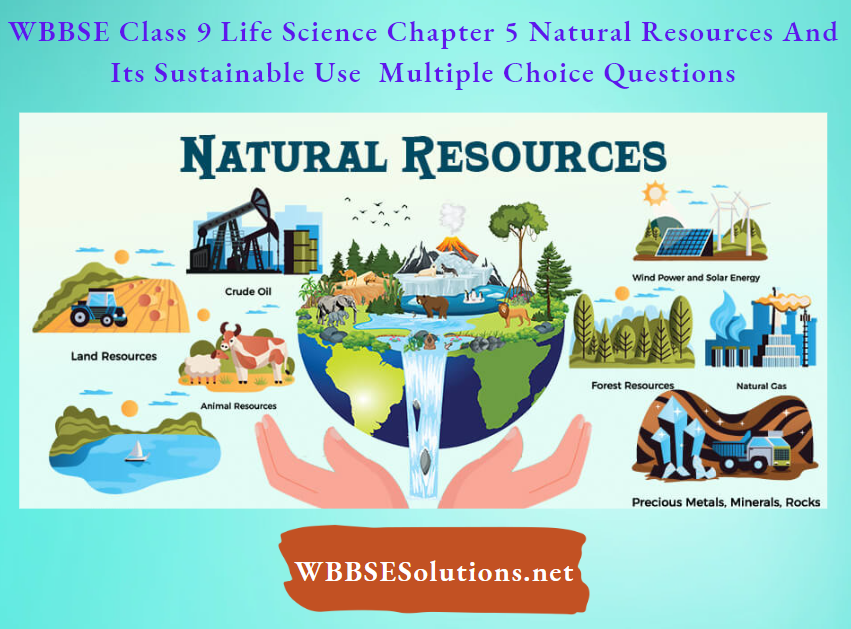
WBBSE Class 9 Life Science Chapter 5 Natural Resources And Its Sustainable Use Multiple Choice Questions

WBBSE Chapter 5 Environment And Its Resources Natural Resources And Its Sustainable Use Multiple Choice Questions

Question 1. The concept, which supports that conservation of environment and development of economy must go on parallelly, is called—

  1. Human development
  2. Sustainable development
  3. Industrial development
  4. Unidirectional development

Answer: 2. Sustainable development

Question 2. A natural resource, which may be replenished is—

  1. Coal
  2. Forest
  3. Petroleum
  4. Natural gas

Answer: 2. Forest

Question. A non-renewable natural resource is—

  1. Coal
  2. Solar energy
  3. Water
  4. Wood

Answer: 1. Coal

Read and Learn More WBBSE Class 9 Life Science MCQs

Question 4. Trees of a forest continuously provide us

  1. Furniture
  2. Oxygen
  3. Coal
  4. Wood

Answer: 2. Oxygen

WBBSE Class 9 Life Science Question And Answer

Question 5. Most of the members of a forest are

  1. Producers
  2. Decomposes
  3. Primary Consumers
  4. Secondary consumers

Answer: 1. Producers

WBBSE Class 9 Life Science Chapter 5 Natural Resources And Its Sustainable Use Multiple Choice Questions

WBBSE Class 9 Natural Resources MCQs

Question 6. A forest cannot be used for

  1. Pisciculture
  2. Apiculture
  3. Harvesting medicinal plants
  4. Ecotourism

Answer: 1. Pisciculture

Question 7. Which is not a cause of deforestation?

  1. Expansion of cultivation
  2. Forest fire
  3. Flood
  4. Industrial development

Answer: 3. Flood

WBBSE Class 9 Life Science Chapter 5 Question Answer

Question 8. Sudden deforestation in an area may be due to—

  1. Expansion of grazing land
  2. Expansion of cultivating land
  3. Industrial expansion
  4. Forest fire

Answer: 4. Forest fire

Question 9. Production of prawn is a practice of—

  1. Eoiculture
  2. Horticulture
  3. Piscoculture
  4. Lac culture

Answer: 4. Lac culture

Question 10. A conventional source of energy is—

  1. Sunlight
  2. Petroleum
  3. Wind
  4. All of these

Answer: 2. Petroleum

NEET Biology Class 9 Question And Answers WBBSE Class 9 History Notes WBBSE Solutions for Class 9 Life Science and Environment
WBBSE Class 9 Geography And Environment Notes WBBSE Class 9 History Multiple Choice Questions WBBSE Class 9 Life Science Long Answer Questions
WBBSE Solutions for Class 9 Geography And Environment WBBSE Class 9 History Long Answer Questions WBBSE Class 9 Life Science Multiple Choice Questions
WBBSE Class 9 Geography And Environment Multiple Choice Questions WBBSE Class 9 History Short Answer Questions WBBSE Solutions For Class 9 Maths
WBBSE Solutions for Class 9 History WBBSE Class 9 History Very Short Answer Questions


Question 11. A non-conventional source of energy is

  1. Coal
  2. Petroleum
  3. Wind
  4. All of these

Answer: 4. All of these

Question 12. Which of the following has a role in food production?

  1. Lac culture
  2. Agriculture
  3. Pearl culture
  4. None of these

Answer: 2. Agriculture

Question 13. Which part of forest trees prevents soil erosion?

  1. Shoot
  2. Root
  3. Root and shoot
  4. Stem

Answer: 2. Root

Question 14. Coal is used mostly in—

  1. Cooking
  2. Running rail engine
  3. Steel industry
  4. Thermal power plants

Answer: 4. Thermal power plants

Question 15. A renewable natural resource is—

  1. Natural gas
  2. None of these
  3. Livestock
  4. Petroleum

Answer: 1. Natural gas

Important Questions on Conservation of Natural Resources for Class 9

Question 16. Deforestation causes

  1. Soil erosion
  2. Globak warming
  3. Drought
  4. All of these

Answer: 4. Drought

Question 17. The method of water conservation is

  1. Plantation
  2. Rain water harvesting
  3. Digging water pits
  4. All of these

Answer: 4. All of these

WBBSE Class 9 Life Science Chapter 5 Question Answer

Question 18. Source of Vitamin C and amino acid is

  1. Sago
  2. Yam bean
  3. Moringa oleifera
  4. Gum Arabic

Answer: 3. Moringa oleifera

Question 19. Which appliance does help in conservation of energy?

  1. Refrigerator
  2. Solar water heater
  3. Computer
  4. Air purifier

Answer: 2. Solar water heater

Question 20. One of the non-human causes of deforestation causes

  1. Expansion of cultivation
  2. Industrial expansion
  3. Laying railway track
  4. Forest fire

Answer: 4. Forest fire

Question 21. Main problem for Indian rivers is—

  1. Water scarcity
  2. Silting
  3. Low water current
  4. Pollution

Answer: 4. Pollution

Question 22. The World summit on ‘Fight against hunger’ organised by United Nation’s Food and Agriculture Organisation was held in Rome in—

  1. 1996
  2. 1999
  3. 2003
  4. 2006

Answer: 1. 1996

Question 23. Pisciculture deals with—

  1. Culture of mushroom
  2. Culture of poultry birds
  3. Culture of prawn
  4. Culture of fish

Answer: 4. Culture of fish

Question 24. Source of fruits and vegetables is

  1. Horticulture
  2. Floriculture
  3. Agriculture
  4. Pisciculture

Answer: 1. Horticulture

Question 25. Most modern concept of environmental development is—

  1. Urbanization
  2. Sustainable development
  3. Control of industrialisation
  4. Deforestation

Answer: 2. Sustainable development

Question 26. Social development, economical development and ecological development are the three basic steps of—

  1. Human development
  2. Industrial development
  3. Sustainable development
  4. Unidirectional development

Answer: 3. Sustainable development

WBBSE Class 9 Life Science

Question 27. Most of the forests in India are of type.

  1. Deciduous
  2. Evergreen
  3. Coniferous
  4. Mangrove

Answer: 1. Deciduous

Question 28. The type of footrest, which has most economic utility is—

  1. Deciduous
  2. Evergreen
  3. Coniferous
  4. Mangrove

Answer: 3. Coniferous

Question 29. Which of the following does not occur due to forestation?

  1. Water cycle regulation
  2. Acid rain
  3. Flood control
  4. Climate regulation

Answer: 2. Acid rain

Question 30. Which of the following is a cause of deforestation?

  1. Excess agriculture
  2. Excess industry
  3. Urbanisation
  4. All of these

Answer: 4. All of these

Question 31. Which of the following should be done before cutting a tree?

  1. At least three similar trees should be planted
  2. Appoint skilled workers for cutting trees
  3. Marking other trees to be cut
  4. Plan to sell those cut trees

Answer: 1. At least three similar trees should be planted

Question 32. Which of the following is not a function of forest?

  1. Maintaining O2 – CO2 balance
  2. Reduction of soil erosion
  3. Reduction of rainfall
  4. Food and wood production

Answer: 3. Reduction of rainfall

Question 33. The combined mass of water found in all water bodies on earth, is called—

  1. Atmosphere
  2. Hydrosphere
  3. Lithosphere
  4. Biosphere

Answer: 2. Hydrosphere

Question 34. Which of the following should not be present in drinking water?

  1. Magnesium
  2. Soluble CO2
  3. Sodium salt
  4. Harmful bacteria

Answer: 4. Harmful bacteria

Question 35. Which of the following step should be taken for reducing wastage of water?

  1. Store water at the earliest
  2. Stop unnecessary use of water
  3. Prevent water pollution.
  4. All of these

Answer: 4. All of these

Question 36. Rain water is not always safe for household purpose because of—

  1. Absence of mineral salts
  2. Presence of organic acid
  3. Presence of few protozoa
  4. Presence of inorganic acid

Answer: 4. Presence of inorganic acid

Question 37. Which of the following reduces the use of fossil fuels?

  1. Solar car
  2. Microwave oven
  3. Biofuels
  4. All of these

Answer: 4. All of these

Question 38. Pearl culture is a type of—

  1. Tissue culture
  2. Apiculture
  3. Horticulture
  4. Mariculture

Answer: 4. Mariculture

Question 39. Growing and cultivation of trees is termed as—

  1. Silviculture
  2. Horticulture
  3. Tissue culture
  4. Floriculture

Answer: 1. Silviculture

Question 40. Example of an alternative food source is—

  1. Rice
  2. Pulse
  3. Meat
  4. Single cell protein

Answer: 4. Single cell protein

Question 41. Which of the following is not associated with food production?

  1. Horticulture
  2. Agriculture
  3. Pisciculture
  4. Pearl culture

Answer: 4. Pearl culture

Question 42. An example of fossil fuel is—

  1. Wood
  2. Coal
  3. Uranium
  4. Both 1 & 2

Answer: 2. Coal

Study Tips for Class 9 Natural Resources MCQs

Question 43. In which of the following countries, utilization of energy is not increasing any more?

  1. America
  2. India
  3. Bangladesh
  4. China

Answer: 1. America

Question 44. Which of the following is a cause of food crisis?

  1. Change in climate
  2. Natural calamities
  3. Population explosion
  4. All of these

Answer: 4. All of these

WBBSE Class 9 Life Science Chapter 5 Ecology And Ecological Organization Multiple Choice Questions

Chapter 5 Environment And Its Resources Ecology And Ecological Organization Multiple Choice Questions

Question 1. Branch of science dealing with the interrelation of a species and its environment is—

  1. Autecology
  2. Synecology
  3. Community biology
  4. Population biology

Answer: 1. Autecology

Question 2. Synecology deals with —

  1. A single individual
  2. A population
  3. A community
  4. Different ecosystems

Answer: 3. A community

Question 3. At which level of ecology would you explain the event of change in body color of an animal with the change in intensity of light?

  1. Individual level
  2. Population level
  3. Community level
  4. Ecosystem level

Answer: 1. Individual level

Read and Learn More WBBSE Class 9 Life Science MCQs

Question 4. Synthesis of chlorophyll in green plants is controlled by—

  1. Relative humidity
  2. Atmospheric pressure
  3. Temperature
  4. Light

Answer: 4. Light

Question 5. The similarity amongst chlorophyll production, transpiration rate and opening of stomata is that—

  1. All are involved in growth of plants
  2. All are light dependent events
  3. All increase weight of plant body
  4. All decrease weight of plant body

Answer: 2. All are light dependent events

Question 6. All the plants and animals together of a particular area are called—

  1. Ecotone
  2. Biome
  3. Biota
  4. Echod

Answer: 3. Biota

WBBSE Class 9 Ecology MCQs

Question 7. Absorption of water by plants is related to—

  1. Water content of soil
  2. Chlorophyll concentration
  3. Plant height
  4. Starch content of cells

Answer: 1. Water content of soil

Question 8. Xerophytes have—

  1. Thick cuticle cover
  2. Less stomata
  3. Thick stem hair
  4. All of these

Answer: 4. Thick stem hair

Question 9. Zooplanktons come to the surface in day light and go to the bottom at night, this is—

  1. Circadian rhythm
  2. Diurnal rhythm
  3. Photoperiodism
  4. Phototactic movement

Answer: 1. Circadian rhythm

NEET Biology Class 9 Question And Answers WBBSE Class 9 History Notes WBBSE Solutions for Class 9 Life Science and Environment
WBBSE Class 9 Geography And Environment Notes WBBSE Class 9 History Multiple Choice Questions WBBSE Class 9 Life Science Long Answer Questions
WBBSE Solutions for Class 9 Geography And Environment WBBSE Class 9 History Long Answer Questions WBBSE Class 9 Life Science Multiple Choice Questions
WBBSE Class 9 Geography And Environment Multiple Choice Questions WBBSE Class 9 History Short Answer Questions WBBSE Solutions For Class 9 Maths
WBBSE Solutions for Class 9 History WBBSE Class 9 History Very Short Answer Questions


Question 10. Heliophytes are adapted to—

  1. Saline soil
  2. Saline water
  3. Bright sunlight
  4. Low sunlight

Answer: 3. Bright sunlight

Key MCQs on Ecological Organization for Class 9

Question 11. Population interaction is discussed under—

  1. Population level
  2. Community level
  3. Ecosystem level
  4. Individual level

Answer: 2. Community level

Question 12. Rate of metabolism increases in—

  1. Low temperature
  2. Higher temperature
  3. Low humidity
  4. High CO2

Answer: 2. Higher temperature

Question 13. A growing population shows—

  1. Low natality
  2. High mortality
  3. Low natality and emigration
  4. Low mortality and immigration

Answer: 4. Low mortality and immigration

Question 14. ‘S’ shaped growth curve is seen in—

  1. Newly built ant population
  2. Stable human population
  3. Honey bee population
  4. Wasp population

Answer: 2. Stable human population

WBBSE Class 9 Life Science Chapter 5 Ecology And Ecological Organization Multiple Choice Questions

Practice MCQs for Chapter 5 Ecology – A set of practice multiple

Question 15. High natality and immigration—

  1.  Increase population size
  2. Decrease population size
  3. Do not change population size
  4. None of these

Answer: 1.  Increase population size

Question 16. If B= Birth rate, N= Total number of individuals in a population and nb= Number of live birth, the equation for birth rate will be—

  1. N= \(\frac{nb}{B}\)
  2. B= \(\frac{nb}{N}\)
  3. B= N * nb
  4. B= \(\frac{N}{nb}\)

Answer: 2. B= \(\frac{nb}{N}\)

Question 17. Size of population remains unchanged if—

  1. Emigration = Immigration
  2. Natality > Mortality
  3. Immigration * Emigration
  4. All of these

Answer: 1. Emigration = Immigration

Question 18. Population size decreases with—

  1. Emigration
  2. Immigration
  3. Low mortality
  4. High natality

Answer: 1. Emigration

Question 19. A positive interspecific interaction is—

  1. Mutualism
  2. Parasitism
  3. Predation
  4. Cannibalism

Answer: 1. Mutualism

Important Questions on Ecosystems for Class 9

Question 20. Population size does not depend upon—

  1. Migration
  2. Natality
  3. Emigration
  4. Species interaction

Answer: 4. Species interaction

Question 21. High rate of predation results in—

  1. Decline in primary consumer
  2. Increase in primary consumer
  3. Decrease in higher level of consumer
  4. Decline in producer

Answer: 1. Decline in primary consumer

Question 22. In which of the following interactions, involved members keep very close contact?

  1. Competition
  2. Parasitism
  3. Predation
  4. None of these

Answer: 2. Parasitism

Question 23. What is ‘+ +’ interaction?

  1. Autotrophism
  2. Parasitism
  3. Symbiosis
  4. Predation

Answer: 3. Symbiosis

Question 24. Which of the following is a topographic factor of ecosystem?

  1. Brightness of light
  2. Wind speed
  3. Slope of hills
  4. Waves of sea

Answer: 3. Slope of hills

Concepts Related to Ecology for MCQs

Question 25. Animals that maintain constant body temperature in any environment are called—

  1. Poikilothermic animals
  2. Homeothermic animals
  3. Eurythermal animals
  4. Stenothermal animals

Answer: 2. Homeothermic animals

Question 26. Example of stenothermal animals is—

  1. Birds
  2. Toads
  3. Ants
  4. Fishes

Answer: 4. Fishes

Question 27. Which of the following is an example of obligate parasite?

  1. Round worm
  2. Mosquito
  3. Louse
  4. Ticks

Answer: 1. Round worm

Question 28. Which of the following is not an abiotic factor?

  1. Water
  2. Soil
  3. Plants
  4. Air

Answer: 3. Plants

Question 29. Global ‘sink’ for CO2 is

  1. Tropical rain forest
  2. Mangrove
  3. Ocean
  4. Coral reef

Answer: 3. Ocean

Sample MCQs from WBBSE Class 9 Life Science Chapter 5

Question 30. Which ecosystem has the highest primary productivity?

  1. Pond
  2. Ocean
  3. Desert
  4. Forest

Answer: 2. Ocean

Question 31. The most recently discovered ecosystem is—

  1. Vent*
  2. Crater
  3. Floating iceberg
  4. Coral reef

Answer: 1. Vent*

Question 32. Niche of a species is—

  1. Place of living
  2. Specific function
  3. Habitat and specific function
  4. None of these

Answer: 3. Habitat and specific function

Question 33. Which one of the following is mismatched?

  1. Deciduous forest: Shorea robusta
  2. Evergreen forest: Pinus roxburghii
  3. Xeric forest: Musa paradisica
  4. Mangrove forest: Barringtonia acutangula

Answer: 3. Xeric forest: Musa paradisica

Question 34. Insectivorous plants are—

  1. Organotrophs
  2. Autotrophs
  3. Heterotrophs
  4. Partial heterotrophs

Answer: 4. Partial heterotrophs

Question 35. Which of the following levels is not studied in synecology?

  1. Individual level
  2. Population level
  3. Community level
  4. Ecological level

Answer: 1. Individual level

Question 36. In ecology, interaction and organization among different organisms is studied in steps.

  1. 2
  2. 3
  3. 4
  4. 5

Answer: 3. 4

Question 37. Which of the following is a long day plant?

  1. pea
  2. Cosmos
  3. Strawberry
  4. Dahlia

Answer: 1. pea

Question 38. Which of the following is a short day plant?

  1. Pea
  2. Dahlia
  3. Clover
  4. Radish

Answer: 2. Dahlia

Question 39. Chlorophyll synthesis in plants is regulated by—

  1. Humidity
  2. Wind
  3. Temperature
  4. Light

Answer: 4. Light

Question 40. Melanin formation in human skin is regulated by—

  1. Humidity
  2. Light
  3. Temperature
  4. Pressure

Answer: 2. Light

Question 41. Migration of salmon, eel fish is regulated by—

  1. Water
  2. Humidity
  3. Temperature.
  4. Light

Answer: 3. Temperature.

Question 42. Temperature affects the size of an organism. This is known as—

  1. Bergmann’s rule
  2. Gloger’s rule
  3. Allen’s rule
  4. Lindeman’s law

Answer: 1. Bergmann’s rule

Question 43. Higher humidity makes the body colour of animals darker. This is known as—

  1. Bergmann’s rule
  2. Gloger’s rule
  3. Allen’s rule
  4. Lindeman’s law

Answer: 2. Gloger’s rule

Question 44. Animals of polar region have smaller pina, tail and limbs. This is known as—

  1. Bergmann’s rule
  2. Gloger’s rule
  3. Allen’s rule
  4. Lindeman’s law

Answer: 3. Allen’s rule

Chapter 5 Life Science Quiz Questions on Ecology

Question 45. The physiological reaction of organisms depending upon the length of day or night, is called—

  1. Photosynthesis
  2. Photoperiodism
  3. Photorespiration
  4. None of these

Answer: 2. Photoperiodism

Question 46. The act of leaving one’s native place permanently with the intent to reside somewhere else, is called—

  1. Adaptation
  2. Immigration
  3. Emigration
  4. Extinction

Answer: 3. Emigration

Question 47. Example of l+ O’ interaction is—

  1. Autotrophism
  2. Mutualism
  3. Parasitism
  4. Commensalism

Answer: 4. Parasitism

Question 48. All the plant species of an ecosystem is collectively known as—

  1. Flora
  2. Fauna
  3. Biome
  4. Biomass

Answer: 1. Flora

Question 49. All the animal species of an ecosystem is collectively known as—

  1. Flora
  2. Fauna
  3. Biome
  4. Biomass

Answer: 2. Fauna

Question 50. Number of trophic levels in a food chain ranges from—

  1. 14-16
  2. 11-13
  3. 7-10
  4. 3-5

Answer: 4. 3-5

Question 51. Lindeman law of energy flow through different trophic levels in an ecosystem is also known as—

  1. 5% law
  2. 7% law
  3. 10% law
  4. 15% law

Answer: 3. 10% law

Question 52. Which of the following is a grazing food chain?

  1. Organic matter → Earthworm → Bacteria
  2. Plant → Human → Worm
  3. Decaying organic matter → Zooplankton → Small fish → Large fish
  4. Grass → Grasshopper → Frog → Snake → Hawk

Answer: 4. Grass → Grasshopper → Frog → Snake → Hawk

Question 53. Actively swimming aquatic organisms in a water body are called—

  1. Necton
  2. Benthos
  3. Plankton
  4. Neuston

Answer: 1. Necton

Question 54. Food chain was scientifically described in 1966 by scientist—

  1. Tansley
  2. Lindeman
  3. Odum
  4. Flaeckel

Answer: 3. Odum

Study Tips for Class 9 Ecology MCQs

Question 55. The community of organisms, that reside on or near the seabed is called—

  1. Necton
  2. Plankton
  3. Benthos
  4. Neuston

Answer: 3. Benthos

Question 56. The largest consumer population of marine ecosystem belongs to—

  1. Primary consumer
  2. Secondary consumer
  3. Tertiary consumer
  4. Topmost level of consumers

Answer: 1. Primary consumer

Question 57. Photoperiodism is a—

  1. Biochemical process
  2. Biophysical process
  3. Physiological process
  4. All of these

Answer: 3. Physiological process

Question 58. Man is—

  1. Autotroph
  2. Omnivorous
  3. Carnivorous
  4. Herbivorous

Answer: 2. Omnivorous

Question 59. If different trophic levels are piled one upon another, we shall get—

  1. Food chain
  2. Food web
  3. Food pyramid
  4. Energy pyramid

Answer: 3. Food pyramid

Question 60. Which of the following is a component of macronutrient cycle?

  1. Na
  2. Mn
  3. Cu
  4. O2

Answer: 4. O2

Question 61. Which of the following is a component of micronutrient cycle?

  1. Cu
  2. C
  3. H2
  4. O2

Answer: 1. Cu

Question 62. Inhabitance of Anabaena in the leaf tissue of Azolla is an example of— .

  1. Competition
  2. Predation
  3. Symbiosis
  4. Commensalism

Answer: 3. Symbiosis

Question 63. In an interspecific relation, one of the two species is benefited but another one is neither benefited nor harmed. This interaction is called—

  1. Symbiosis
  2. Mutualism
  3. Commensalism
  4. Parasitism

Answer: 3. Commensalism

Question 64. Certain bacteria break organic molecules and return elementary components to nature, these, bacteria are treated as—

  1. Decomposers
  2. Putrifying bacteria
  3. Transducers
  4. Transformers

Answer: 4. Transformers

Question 65. Unit of a population is—

  1. A community
  2. An animal species
  3. A plant species
  4. An individual of a species

Answer: 4. An individual of a species

Question 66. Unit of a community is—

  1. An individual of a species
  2. A plant species
  3. An animal species
  4. A Population

Answer: 4. A Population

Question 67. The largest population in an ecosystem is seen amongst—

  1. Decomposers
  2. Producers
  3. Primary consumers
  4. Secondary consumersintra

Answer: 2. Producers

WBBSE Class 9 Life Science Chapter 4 Microbes In Human Welfare Multiple Choice Questions

WBBSE Class 9 Life Science Chapter 4 Biology And Human Welfare Microbes In Human Welfare Multiple Choice Questions

Question 1. Microbes are—

  1. Virus
  2. Bacteria
  3. Protozoa
  4. All of these

Answer: 4. All of these

Question 2. The term ‘microbe’ was coined by—

  1. Robert Hook
  2. Sedillot
  3. Robert Brown
  4. Leeuwenhoek

Answer: 2. Sedillot

Question 3. Azolla maintains a symbiotic association with

  1. Azotobacter
  2. Clostridium
  3. Nostoc
  4. Anabaena

Answer: 4. Anabaena

Read and Learn More WBBSE Class 9 Life Science MCQs

Question 4. Which is not a bio-fertilizer?

  1. Rhizobium
  2. Azolla
  3. Agaricus
  4. Azotobacter

Answer: 3. Agaricus

Question 5. Some cyanobacteria are used as bio-fertilizer because—

  1. They are capable of trapping free O2 more than other plants
  2. They can solubilize phosphorus
  3. They can trap atmospheric nitrogen
  4. They help the soil to retain more water

Answer: 3. They can trap atmospheric nitrogen

WBBSE Class 9 Microbes in Human Welfare MCQs

Question 6. Bf for Bt-cotton stands for—

  1. Biologically transformed
  2. Biotechnology
  3. Bacillus thuringiensis
  4. None of these

Answer: 3. Bacillus thuringiensis

Question 7. Mycorrhiza is an—

  1. Association of fungi and algae
  2. Association of fungi and flowering plants
  3. Association of fungi and bacteria
  4. Association of algae and vascular plants

Answer: 2. Association of fungi and flowering plants

WBBSE Class 9 Life Science Chapter 4 Microbes In Human Welfare Multiple Choice Questions

Practice MCQs for Chapter 4 Microbes

Question 8. Cyanobacteria are—

  1. Chemosynthetic bacteria
  2. Photosynthetic prokaryotic microorganisms
  3. Non-photosynthetic nitrogen-fixing prokaryotic microorganisms
  4. Nitrogen-fixing protozoa

Answer: 2. Photosynthetic prokaryotic microorganisms

Question 9. A soil-dwelling nitrogen-fixing bacterium is—

  1. Anabaena
  2. Salmonella
  3. Clostridium
  4. Lactobacillus

Answer: 3. Clostridium

Question 10. Which of the following microorganisms can kill insect pests?

  1. Bacillus thuringiensis
  2. Leptomonas
  3. Nosema locustae
  4. All of these

Answer: 4. All of these

Important Questions on Microbial Functions for Class 9

Question 11. The virus used in the bio-control of insect pests is—

  1. Phage virus
  2. Rubella virus
  3. Nuclear Polyhedrosis Virus
  4. Lipovirus

Answer: 3. Nuclear Polyhedrosis Virus

NEET Biology Class 9 Question And Answers WBBSE Class 9 History Notes WBBSE Solutions for Class 9 Life Science and Environment
WBBSE Class 9 Geography And Environment Notes WBBSE Class 9 History Multiple Choice Questions WBBSE Class 9 Life Science Long Answer Questions
WBBSE Solutions for Class 9 Geography And Environment WBBSE Class 9 History Long Answer Questions WBBSE Class 9 Life Science Multiple Choice Questions
WBBSE Class 9 Geography And Environment Multiple Choice Questions WBBSE Class 9 History Short Answer Questions WBBSE Solutions For Class 9 Maths
WBBSE Solutions for Class 9 History WBBSE Class 9 History Very Short Answer Questions


Question 12. An anaerobic nitrogen-fixing non-symbiotic bacterium—

  1. Azotobacter
  2. Clostridium
  3. Rhizobium
  4. Azospirillum

Answer: 2. Clostridium

Question 13. VAM is a/an—

  1. Ectomycorrhiza
  2. Ectendomycorrhiza
  3. Endomycorrhiza
  4. Cyanobacterium

Answer: 3. Endomycorrhiza

Question 14. Granulosis virus and NPV are similar as both act as—

  1. Antibacterial substance
  2. Bio-control agents
  3. Biofertilizers
  4. Disease-causing agent for human

Answer: 2. Bio-control agents

Question 15. Bacteria used for controlling Japanese beetle—

  1. Bacillus thuringiensis
  2. Bacillus popular
  3. Bacillus subtilis
  4. Rhizobium fasciola

Answer: 2. Bacillus popular

Concepts Related to Microbes for MCQs

Question 16. Spodopterin, a bio-control agent for insect pests is composed of—

  1. Virus
  2. Bacteria
  3. Protozoa
  4. Fungus

Answer: 4. Fungus

Question 17. An example of cyanobacteria is—

  1. Anabaena
  2. Gleocapsa
  3. Oscillatoria
  4. All of these

Answer: 4. All of these

WBBSE Class 9 Life Science Question And Answer

Question 18. Mycorrhizae fungi association with—

  1. The root system of pine
  2. Leaf of fern
  3. Green algae
  4. None of these

Answer: 1. The root system of pine

Question 19. Application of Azolla in paddy fields is popularly practiced in—

  1. European countries
  2. South American states
  3. Southeast Asian countries
  4. All of these

Answer: 3. Southeast Asian countries

Question 20. Mycorrhiza is used as a bio-fertilizer because it—

  1. Can remove harmful heavy metals from the soil
  2. Can absorb water
  3. Can help in mineral absorption
  4. All of these

Answer: 4. All of these

Sample MCQs from WBBSE Class 9 Life Science Chapter 4

Question 21. An antibiotic-producing fungus is—

  1. Aspergillus
  2. Agaricus
  3. Penicillium
  4. Saccharomyces

Answer: 3. Penicillium

WB Class 9 Life Science Question Answer

Question 22. Nitrifying bacteria are—

  1. Parasitic bacteria
  2. Chemosynthetic bacteria
  3. Autotrophic bacteria
  4. None of these

Answer: 2. Chemosynthetic bacteria

Question 23. Bacteria that are capable of trapping atmospheric nitrogen are—

  1. Putrefying bacteria
  2. Nitrogen-fixing bacteria
  3. Denitrifying bacteria
  4. Nitrifying bacteria

Answer: 2. Nitrogen-fixing bacteria

Question 24. The bacterium, mostly used in the experiments of biotechnology is—

  1. Rhizobium
  2. Streptomyces
  3. Salmonella
  4. E.coli

Answer: 4. E.coli

Question 25. Rhizobium is a—

  1. Free-living, nitrogen-fixing bacteria
  2. Symbiotic, nitrogen-fixing bacteria
  3. Cyanobacteria
  4. Denitrifying bacteria

Answer: 2. Symbiotic, nitrogen-fixing bacteria

WBBSE Class 9 Life Science Question And Answer

Question 26. Application of Azolla in paddy field increases  soil.

  1. Phosphorus
  2. Nitrogen
  3. Sulphur
  4. Potassium

Answer: 2. Nitrogen

Question 27. Nostoc is a—

  1. Nitrogen-fixing protozoa
  2. Nitrogen-fixing cyanobacteria
  3. Symbiotic fungus
  4. Green algae

Answer: 2. Nitrogen-fixing cyanobacteria

Question 28. Which of the following organisms is not used as a bio-fertilizer?

  1. Rhizobium
  2. Lichen
  3. Azotobacter
  4. Azollci

Answer: 2. Lichen

Chapter 4 Life Science Quiz Questions on Microbes

Question 29. Insoluble phosphate of soil is transformed into soluble phosphate by—

  1. Azolla
  2. Nos toe
  3. Rhizobium
  4. Pseudomonas putida

Answer: 4. Pseudomonas putida

Question 30. Sweet pea plants can grow in infertile land because of—

  1. Azotobacter
  2. Clostridium
  3. Rhizobium
  4. Anabaena

Answer: 3. Rhizobium

Question 31. The microbe which does not have any role as a bio-fertilizer is—

  1. Bacteria
  2. Cyanobacteria
  3. Fungus.
  4. Protozoa

Answer: 4. Protozoa

Question 32. Cyanobacterial colony is formed in—

  1. Equisitum
  2. Cycas
  3. Psilotum
  4. Pinus

Answer: 2. Cycas

Study Tips for Class 9 Microbes MCQs

Question 33. A fungal bio-control agent is—

  1. Nosema
  2. Beauveria bassiana
  3. Popillajaponica
  4. Mattesia grandis

Answer: 2. Beauveria bassiana

WBBSE Class 9 Life Science And Environment Chapter 4 Immunity And Human Diseases Multiple Choice Questions

Chapter 4 Biology And Human Welfare Immunity And Human Diseases Multiple Choice Questions

Question 1. The word ‘immunize’ means—

  1. Exempt
  2. Recovery
  3. Health
  4. Hygiene

Answer: 1. Exempt

Question 2. Who is known as the father of immunology?

  1. Louis Pasteur
  2. Edward Jenner
  3. Alexander Fleming
  4. Robert Koch

Answer: 2. Edward Jenner

Read and Learn More WBBSE Class 9 Life Science MCQs

WB Class 9 Life Science Question Answer

WBBSE Class 9 Life Science And Environment Chapter 4 Immunity And Human Diseases MCQs

WBBSE Class 9 Immunity and Human Diseases MCQs

Question 3. Which of the following is not an immunological response?

  1. Formation of antibody in response to antigen
  2. Monocytes killing germs by phagocytosis
  3. Antibody formation by vaccination
  4. Killing germs by antibiotic

Answer: 4. Killing germs by antibiotic

Question 4. Which of the following is involved in immunity?

  1. Lymphocyte cells
  2. Plasma proteins
  3. Lymph and lymph gland
  4. All of these

Answer: 4. All of these

Question 5. Active immunity develops within the body by—

  1. The inflow of antibodies from the mother’s blood to fetal blood through placental circulation
  2. Blood transfusion.
  3. Primary infection of any antigenic pathogen
  4. Direct injection of antibodies into the body

Answer: 3. Primary infection of any antigenic pathogen

Question 6. Immunity against chicken pox that is developed by a person after the first infection from the same disease is—

  1. Innate immunity
  2. Active acquired immunity
  3. Passively acquired immunity
  4. None of these

Answer: 2. Active acquired immunity

Question 7. Passive immunity develops within the body by

  1. Direct injection of any attenuated germ
  2. The inflow of antibodies from mother to fetus through placental circulation
  3. Injection of a toxin, extracted from antigenic pathogen
  4. None of these

Answer: 2. The inflow of antibodies from mother to fetus through placental circulation

WB Class 9 Life Science Question Answer

Question 8. Chemically antigen is a—

  1. Polysaccharide
  2. Lipoprotein
  3. Glycoprotein
  4. All of these

Answer: 2. Lipoprotein

Question 9. Which one of the following is not related to the phagocytosis process—

  1. Macrophages
  2. Lymphocytes
  3. Neutrophils
  4. Monocytes

Answer: 2. Lymphocytes

NEET Biology Class 9 Question And Answers WBBSE Class 9 History Notes WBBSE Solutions for Class 9 Life Science and Environment
WBBSE Class 9 Geography And Environment Notes WBBSE Class 9 History Multiple Choice Questions WBBSE Class 9 Life Science Long Answer Questions
WBBSE Solutions for Class 9 Geography And Environment WBBSE Class 9 History Long Answer Questions WBBSE Class 9 Life Science Multiple Choice Questions
WBBSE Class 9 Geography And Environment Multiple Choice Questions WBBSE Class 9 History Short Answer Questions WBBSE Solutions For Class 9 Maths
WBBSE Solutions for Class 9 History WBBSE Class 9 History Very Short Answer Questions


Question 10. Select the correct option from the following—

  1. An IgG molecule has two antigen binding sites and one heavy and one light chain
  2. IgG molecule is composed of two light and two heavy chains
  3. An antigen-binding site of IgG is made up of two light chains
  4. An antigen-binding site of IgG is composed of two heavy chains

Answer: 2. IgG molecule is composed of two light and two heavy chains

WBBSE Class 9 Life Science And Environment Chapter 4 Immunity And Human Diseases Multiple Choice Questions

Key MCQs on Immunity for Class 9 Life Science

Question 11. The main immunoglobulin present in blood plasma is—

  1. IgA
  2. IgG
  3. IgM
  4. IgD

Answer: 2. IgG

Question 12. The immunoglobulin, which reaches the body of neonates through colostrum is—

  1. IgA
  2. IgG
  3. IgM
  4. IgD

Answer: 1. IgA

Question 13. The cell-mediated response involves—

  1. Helper T cells
  2. Plasma Cells
  3. Antibodies
  4. None of these

Answer: 1. Helper T cells

Question 14. Cytotoxic T cells kill—

  1. Healthy body cells
  2. Infected body cells
  3. Macrophages
  4. All of these

Answer: 2. Infected body cells

Question 15. T cells mature in—

  1. Bone marrow
  2. Blood
  3. Thymus gland
  4. Kidney

Answer: 3. Thymus gland

Human Diseases MCQs for Class 9 Life Science

Question 16. Helper T cells activate—

  1. Phagocytic macrophage
  2. Killer T cells
  3. B cells
  4. Both 2 and 3

Answer: 4. Both 2 and 3

WB Class 9 Life Science Question Answer

Question 17. An antiviral substance produced within a virus-infected cell to prevent the proliferation and spreading of virus is—

  1. Antigen
  2. Antibody
  3. Interferon
  4. Toxin

Answer: 3. Interferon

Question 18. The humoral response is related to—

  1. Ts-cells
  2. Tc-cells
  3. Antibodies
  4. None of these

Answer: 3. Antibodies

Question 19. In B cells ‘B’ indicates—

  1. B blood group
  2. B agglutinogen
  3. Beta antibody
  4. Bursa Fabricius

Answer: 4. Bursa Fabricius

Question 20. Which cells produce specific antibodies to inactivate antigens?

  1. T lymphocytes
  2. RBC
  3. Plasma cells
  4. Macrophages

Answer: 3. Plasma cells

Question 21. The formation of antibodies depends directly upon the—

  1. Cytotoxic T cells
  2. Helper T cells
  3. Monocytes
  4. Plasma cells

Answer: 4. Plasma cells

Practice MCQs for Chapter 4: Immunity and Diseases

Question 22. Memory cells, involved in immune response are formed by—

  1. Neutrophils
  2. Basophils
  3. Monocytes
  4. Lymphocytes

Answer: 4. Lymphocytes

Question 23. Memory cells are stored in—

  1. Brain
  2. Liver
  3. Spleen
  4. Kidney

Answer: 3. Spleen

Question 24. Which of the following is present in the cell membrane of mast cells and B lymphocytes?

  1. IgE
  2. IgG
  3. IgM
  4. IgA

Answer: 1. IgE

Question 25. The names of Sara Nelmes and James Phipps are related to—

  1. Smallpox vaccine
  2. Chickenpox vaccine
  3. Cowpox vaccine
  4. Cholera vaccine

Answer: 1. Smallpox vaccine

Question 26. Effectiveness of a vaccine is retained within the body by?

  1. Helper T cells
  2. Macrophage cells
  3. Memory T and B cells
  4. All lymphocytes

Answer: 3. Memory T and B cells

WB Class 9 Life Science Question Answer

Question 27. A disease, that has been completely eradicated by vaccination is—

  1. Diphtheria
  2. Smallpox
  3. Chickenpox
  4. Polio

Answer: 2. Smallpox

Question 28. Smallpox was declared officially as an eradicated disease by WHO in the year—

  1. 1977
  2. 1978
  3. 1796
  4. 1980

Answer: 4. 1980

Question 29. In attenuated vaccine—

  1. Dead germs are used
  2. Living but inactive germs are used
  3. Toxins from the germs are used
  4. A combination of bacteria and viruses is used

Answer: 2. Living but inactive germs are used

Important Concepts for MCQs on Immunity

Question 30. Killed germs are used to immunize against—

  1. Tetanus
  2. Plague
  3. Diphtheria
  4. All of these

Answer: 2. Plague

Question 31. DPT is a—

  1. Attenuated vaccine
  2. Inactive vaccine
  3. Toxoid
  4. Combination vaccine

Answer: 4. Combination vaccine

Question 32. BCG vaccine is applied to immunize babies against—

  1. Polio
  2. Whooping cough
  3. Tuberculosis
  4. Cholera

Answer: 3. Tuberculosis

Question 33. Orally administrate vaccine—

  1. Salic polio vaccine
  2. Sabin polio vaccine
  3. Cholera vaccine
  4. Rubella vaccine

Answer: 1. Salic polio vaccine

Question 34. Diarrhea may be caused by—

  1. Entamoeba
  2. Shigella
  3. Salmonella
  4. All of these

Answer: 4. All of these

Question 35. Which of the following diseases may be caused by protozoa, bacteria and even virus?

  1. Cholera
  2. Diphtheria
  3. Pneumonia
  4. Diarrhea

Answer: 4. Diarrhea

Sample MCQs from WBBSE Class 9 Life Science

Question 36. Prolonged diarrhea results into—

  1. Severe respiratory distress
  2. Dehydration of the body
  3. Very high fever
  4. Severe headache

Answer: 2. Dehydration of the body

Question 37. The organism acting as a vector for the diarrhea-causing pathogen is—

  1. House Fly
  2. Cockroach
  3. Both
  4. None of these

Answer: 1. House Fly

Question 38. Splenomegaly or enlargement of the spleen is a common symptom of—

  1. Tuberculosis
  2. Malaria
  3. Hepatitis B
  4. Dengue

Answer: 2. Malaria

Question 39. The feeling of extreme chill followed by a very high fever is the symptom of—

  1. Pneumonia
  2. Diphtheria
  3. Malaria
  4. Cholera

Answer: 3. Malaria

Question 40. Plasmodium, the pathogen of malaria is a type of—

  1. Bacteria
  2. Virus
  3. Fungus
  4. Protozoa

Answer: 4. Protozoa

Question 41. The vector of the malarial pathogen is—

  1. Female Anopheles mosquito
  2. Male Anopheles mosquito
  3. Female Culex mosquito
  4. Female Aedes mosquito

Answer: 1. Female Anopheles mosquito

Question 42. The vector of the dengue virus is—

  1. Female Anopheles mosquito
  2. Male Anopheles mosquito
  3. Female Culex mosquito
  4. Female Aedes mosquito

Answer: 4. Female Aedes mosquito

Chapter 4 Life Science Quiz Questions

Question 43. Soil dwelling bacterium that enters into the body through the wound is—

  1. Cory neb bacterium diphtheria
  2. Clostridium tetani
  3. Streptococcus pneumoniae
  4. All of these

Answer: 1. Cory neb bacterium diphtheria

Question 44. Inflammation of tonsil with layered white sheath indicates—

  1. Tuberculosis
  2. Pneumonia
  3. Diphtheria
  4. All of these

Answer: 3. Diphtheria

Question 45. Diphtheria is caused by—

  1. Mycobacterium
  2. Cory neb bacterium
  3. Streptococcus
  4. Plasmodium

Answer: 2. Cory neb bacterium

WB Class 9 Life Science Question Answer

Question 46. Respiratory droplets may cause infections like—

  1. Malaria, Cholera and Diarrhoea
  2. Diphtheria, Tuberculosis and Tetanus
  3. Tuberculosis, Diphtheria and Pneumonia
  4. Tuberculosis, Dengue and Diphtheria

Answer: 3. Tuberculosis, Diphtheria and Pneumonia

Question 47. Lock Jaw disease is caused by the infection of—

  1. Dengue virus-diphtheria
  2. Corynebacterium
  3. Mycobacterium tuberculosis
  4. Clostridium tetani

Answer: 4. Clostridium tetani

Question 48. Lungs are affected in—

  1. Tuberculosis and diarrhoea
  2. Pneumonia and tuberculosis
  3. Tuberculosis and dengue
  4. All of these

Answer: 2. Pneumonia and tuberculosis

Study Tips for Class 9 Immunity and Human Diseases MCQs

Question 49. Prolonged dry cough with quick loss of weight is a common indication of—

  1. Diphtheria
  2. Dengue
  3. Tuberculosis
  4. Pneumonia

Answer: 3. Tuberculosis

Question 50. Severe joint pain with high fever and occasional rash on the back and shoulder are the common symptoms of—

  1. Malaria
  2. chickenpox
  3. Pneumonia
  4. Dengue

Answer: 4. Dengue

Question 51. Transmission of which of the following diseases is caused by contaminated blood transfusion?

  1. Malaria, Tuberculosis and AIDS
  2. Malaria, Hepatitis B and AIDS
  3. Hepatitis A, Hepatitis B and AIDS
  4. AIDS only

Answer: 2. Malaria, Hepatitis B and AIDS

Question 52. Transmission of which of the following diseases are caused by contaminated food and water?

  1. Diarrhea
  2. Diarrhea and Hepatitis A
  3. Hepatitis A and Hepatitis B
  4. Hepatitis B only

Answer: 2. Diarrhea and Hepatitis A

WB Class 9 Life Science Question Answer

Question 53. Which of these diseases may be transmitted sexually?

  1. AIDS and Hepatitis B
  2. Hepatitis A and AIDS
  3. Tuberculosis and Hepatitis B
  4. Hepatitis B, Hepatitis A and AIDS

Answer: 1. AIDS and Hepatitis B

Question 54. Which of the following set of diseases are of viral origin?

  1. Hepatitis B, Hepatitis A, Dengue, and AIDS
  2. Dengue, Malaria and AIDS
  3. Tuberculosis and Pneumonia
  4. Hepatitis B, Hepatitis A, Tetanus, and AIDS

Answer: 2. Dengue, Malaria and AIDS

Question 55. Which cell of human body is damaged by HIV?

  1. Lymphocyte
  2. Eosinophil
  3. Macrophage
  4. Red blood cell

Answer: 1. Lymphocyte

Question 56. Which pathogen is not spread through blood?

  1. Hepatitis A
  2. Hepatitis B
  3. Malarial parasite
  4. HIV

Answer: 1. Hepatitis A

Question 57. The personal level of washing includes—

  1. Brushing teeth
  2. Bathing
  3. Cleaning hands before taking food
  4. All of these

Answer: 4. All of these

Question 58. Which is treated as the family level of washing?

  1. Bathing
  2. Cleaning toilet
  3. Cleaning hands
  4. All of these

Answer: 2. Cleaning toilet

Question 59. The social level of washing includes—

  1. Washing the door-step of your house
  2. Washing the water reservoir of your house
  3. Washing the toilets of rail station premises
  4. All of these

Answer: 3. Washing the toilets of rail station premises

Question 60. A disinfectant used for personal washing is—

  1. Bleaching powder
  2. Phenyl
  3. Hand sanitizer
  4. None of these

Answer: 3. Hand sanitizer

Question 61. A common but very effective disinfectant for cut wounds is—

  1. Soap
  2. Ethyl alcohol
  3. Methyl alcohol
  4. All of these

Answer: 4. All of these

Question 62. Consuming a ripe tomato by plucking it directly from the plant of a field is harmful, as it may carry—

  1. Eggs of parasitic worms
  2. Remnants of pesticides
  3. Dirt and mud
  4. All of these

Answer: 3. All of these

Question 63. Which organization has developed a global strategy to lift the standard of health of school children? .

  1. UNICEF
  2. UNO
  3. WHO
  4. None of these

Answer: 1. UNICEF

WBBSE Class 9 Life Science Chapter 4 Immunity And Human Diseases Long Answer Questions

Chapter 4 Biology And Human Welfare Immunity And Human Diseases Long Answer Type Questions

Question 1. Briefly describe the different types of immunity.

Answer:

Different types of immunity:

Immunity is of two types:

1 Innate or natural or non-specific Immunity:

Innate immunity refers to non-specific defense mechanisms that come into play immediately or within hours of an antigen’s appearance in the body. It consists of various types of physical, and physiological barriers.

Example: The skin (the physical barrier) prevents entry of microorganisms; mucous membrane, and acid of the stomach (physiological barrier) kill most microorganisms.

2 Acquired immunity or adaptive or specific Immunity:

The immunity that an individual acquires after birth is called acquired immunity. It is specific and mediated by antibodies or lymphocytes or both which make the antigen harmless. It is of two types, active immunity, and passive immunity.

Read and Learn More Class 9 Life Science Long Answer Questions

1. Active Immunity: In this case, a person’s own cells produce antibodies in response to infection or vaccination. It is slow and takes time for the formation of antibodies. It is long-lasting and harmless.

Active immunity may be natural or artificial:

1. A person who has recovered from an attack of smallpox measles or mumps develops natural active immunity.
2. Artificial active immunity is the resistance induced by vaccines. Examples of vaccines are BCG vaccine, MMR vaccine, etc.

WBBSE Class 9 Life Science Chapter 4 Immunity And Human Diseases Long Answer Questions

WBBSE Class 9 Immunity Long Answer Questions

2. Passive Immunity:

When ready-made antibodies are directly injected into an individual against foreign agents, it is called passive immunity. It provides immediate relief but is not long-lasting.

It may be natural or artificial:

1. Natural passive immunity is the resistance passively transferred from the mother to the fetus through the placenta or through colostrum (a yellowish fluid secreted initial days of lactation).
2. Artificial passive immunity is the resistance passively transferred to a recipient by the administration of antibodies. For example, Anti-tetanus serum (ATS) is prepared in horses by active immunization of horses with tetanus toxoid, withdrawal of blood, and separation of the serum. ATS is used for passive immunization against tetanus.
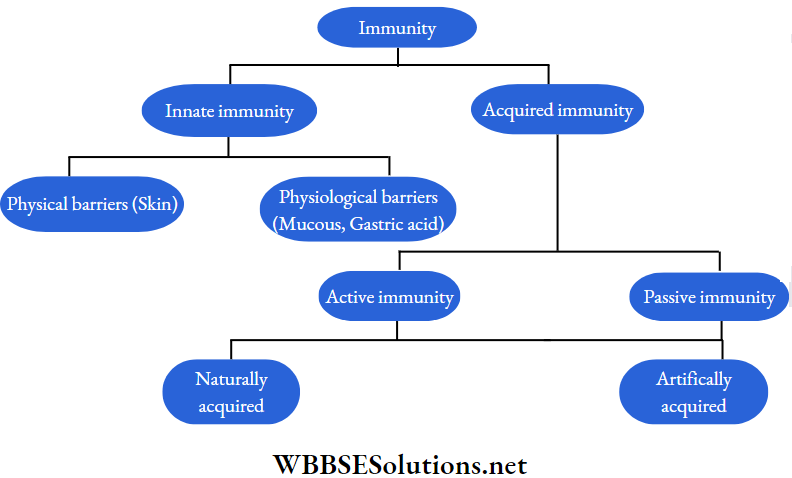
WBBSE Solutions For Class 9 Life Science And Environment Chapter 4 Biology And Human Welfare Giology And Human Welfare immunity

WBBSE Life Science And Environment Class 9 Solutions

Question 2 Write the characteristics or features of the antigen. How do you recognize antigens? Or, State the properties of the antigen.

Answer:

Characteristics/features of antigen:

The features or characteristics of antigen are as follows:

Foreignness:

The immune system normally discriminates between self and non-self such that only foreign molecules are immunogenic. When an antigen is introduced into an organism, the degree of its immunogenicity depends on the degree of its foreignness.

2 Molecular size:

In general, the larger the molecule the more immunogenic it is likely to be. The best immunogens tend to have a molecular mass approaching 100,000 Da. The immunogens with lower efficiency generally have a molecular size between 5000-10000 Da.

3 Chemical composition:

They are structural proteins in nature. Sometimes it may be composed of polysaccharides, lipids, and nucleic acid.

4 Antigen binding site:

It has a specific region that interacts with antibody (Ab) which is known as an epitope.

Properties of antigen:

Antigens can be recognized by some of their properties.

The properties of antigens are:

1 Antigenicity: The ability to cause the production of antibodies.
2 Antigenic specificity: The ability to enter into an interaction with the corresponding antibodies.
3 Allergenicity: Having the capacity to induce allergy (hypersensitivity).
4 Immunogenicity: Property inducing a detectable immune response.

NEET Biology Class 9 Question And Answers WBBSE Class 9 History Notes WBBSE Solutions for Class 9 Life Science and Environment
WBBSE Class 9 Geography And Environment Notes WBBSE Class 9 History Multiple Choice Questions WBBSE Class 9 Life Science Long Answer Questions
WBBSE Solutions for Class 9 Geography And Environment WBBSE Class 9 History Long Answer Questions WBBSE Class 9 Life Science Multiple Choice Questions
WBBSE Class 9 Geography And Environment Multiple Choice Questions WBBSE Class 9 History Short Answer Questions WBBSE Solutions For Class 9 Maths
WBBSE Solutions for Class 9 History WBBSE Class 9 History Very Short Answer Questions


Question 3. Mention the characteristic features of antibodies. Briefly describe the structure of the most common antibody present in human plasma.

Answer:

Characteristics features of antibodies:

Characteristic features of antibodies are as follows:

1. Antibodies are glycoproteins commonly called immunoglobulins.
2. The molecular weight of an antibody ranges from 150000 to 950000 Da.
3. Antibodies are antigen-specific.

Structure of antibody:

Immunoglobulin G or IgG is the most common antibody present in human plasma.

The structure of IgG is mentioned below:

1. The Immunoglobulin G molecule is a ‘Y-shaped structure.
2. Each molecule has a specific antigen-binding site, by which it attaches with a specific antigen to inactivate it.
3. The immunoglobulin molecule is composed of 4 polypeptide chains of which two are heavier and two others are lighter in weight. These chains remain attached to disulfide bonds.
4. The two forked arms are made up of one light and one heavy chain each. The stem arm of the IgG molecule is composed of two heavy chains.
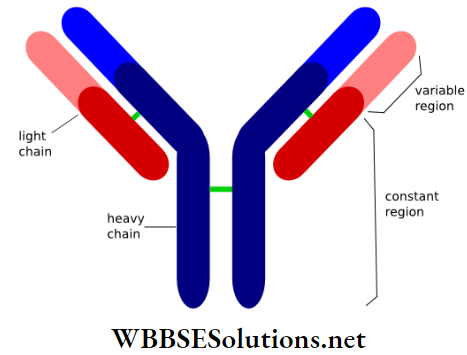
WBBSE Solutions For Class 9 Life Science And Environment Chapter 4 Biology And Human Welfare structure of antibody

WBBSE Life Science And Environment Class 9 Solutions

Question 4. Write a brief description of different types of immunoglobulins.

Answer:

Description of different types of immunoglobulins:
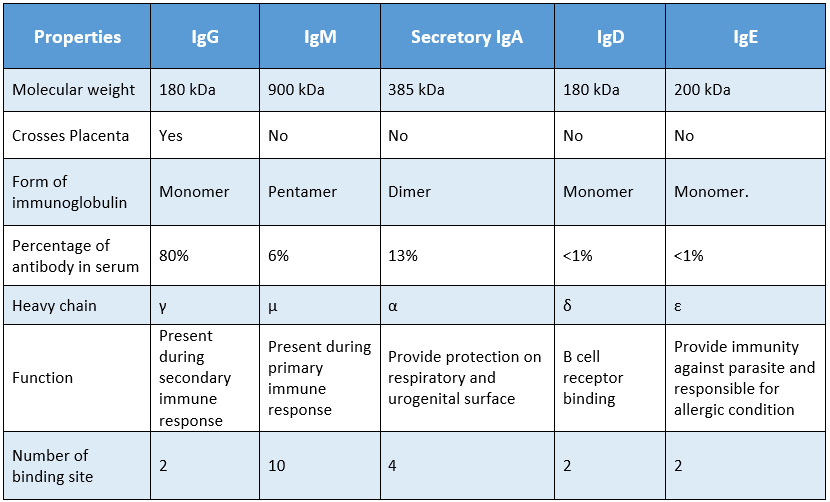
WBBSE Solutions For Class 9 Life Science And Environment Chapter 4 Biology And Human Welfare immunoglobulins

Practice Long Answer Questions on Immunity

Question 5 Differentiate between antigen and antibody.

Answer:

Difference between antigen and antibody:
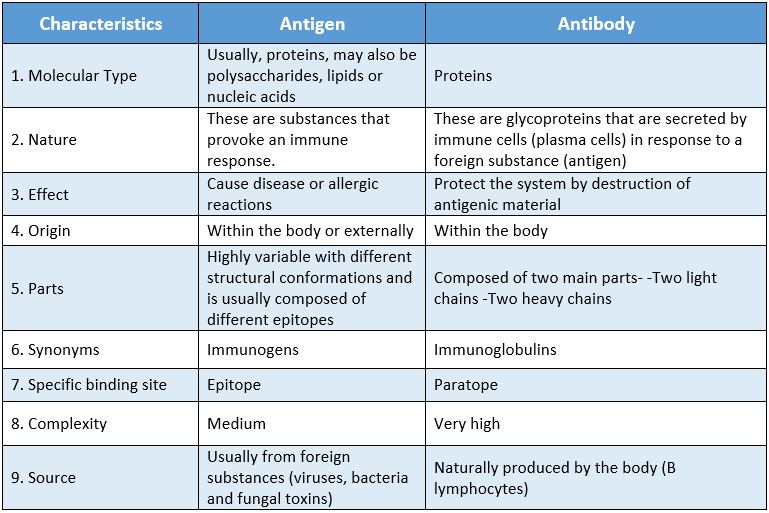
WBBSE Solutions For Class 9 Life Science And Environment Chapter 4 Biology And Human Welfare difference between antigen and antibody

WBBSE Life Science And Environment Class 9 Solutions

Question 6 What is humoral immunity? How does humoral immunity work?

Answer:

Humoral immunity:

The immune response, which involves the action of different B lymphocytes, like plasma cells, for producing antigen-specific antibodies and memory cells for neutralizing or eliminating toxins and pathogens in the blood and lymph is called humoral immunity.

Mechanism of humoral immunity:

Humoral immunity works for both primary and secondary immune responses. In primary response, B lymphocytes develop typical antibody-producing plasma cells. These cells produce antigen-specific antibodies. Antibodies work in the following four ways.

1 Agglutination:

By this process, antibodies agglutinate pathogens into clusters, which are then collectively phagocytized by macrophages.

2 Precipitation:

Some antigen molecules are clamped by antibodies and are precipitated.

3 Opsonisation:

Antibodies form a covering on the antigens so that the phagocytic cells can ingest packed antigens.

4 Neutralisation:

Certain toxic antigens are detoxified and inactivated by the antibodies. In secondary response memory, B cells play a major role. These cells are produced during a primary immune response and remain stored in the secondary lymphoid tissues for keeping the immunological behavior of the pathogen in memory of the body’s immune system. In case of another attack, these cells help in the quick activation of the body’s immune system.

Question 7. Write the differences between humoral immunity and cell-mediated immunity.

Answer:

Difference between humoral and cell-mediated immunity:
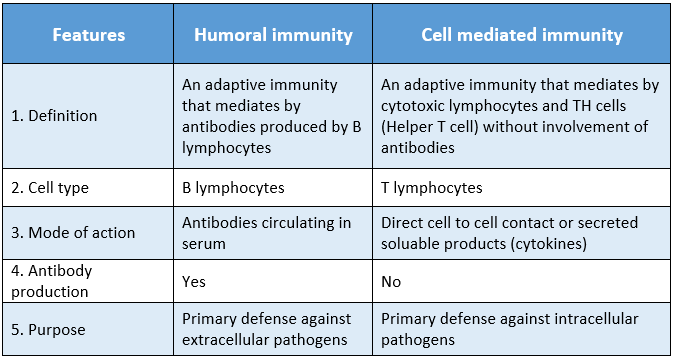
WBBSE Solutions For Class 9 Life Science And Environment Chapter 4 Biology And Human Welfare features homaral and cell mediated immunity

Sample Long Answer Questions from WBBSE Class 9 Life Science

Question 8 Mention the roles of different T cells in the immune response. Mention the roles of different B cells in immune response.

Answer:

Roles of different T cells:

Different T cells or T lymphocytes play different roles in the immune response of the body.

They are as follows:

1. Cytotoxic T cells or T cells kill the infected cell, to destroy antigen-carrying pathogens within it.
2. Helper T cells or T cells enhance the activity of killer cells (a type of T cells), antibody-producing B cells, and phagocytic macrophages.
3. Suppressor T cells or T cells destroy T cells, TH cells, and B cells to stop immune response after the elimination of the antigens.

Roles of different B cells:

Different B cells or B lymphocytes play different roles in the immune response of the body.

They are as follows:

1. Plasma cells originated from B cells produce specific antibodies to inactivate antigens.
2. Memory B cells remain in lymph glands, keeping the nature of antigens in memory, and taking quick action in case of any further attack.

WBBSE Life Science And Environment Class 9 Solutions

Question 9 Briefly describe the mechanism of the immune response against viral attack in the human body.

Answer:

Mechanism of the immune response against a viral attack:

The immune response is a complex process involving various cells and biochemical components inside the body.

The steps of the immune response against the viral antigen are as follows:

1. As any virus reaches the blood or attacks any body cells, large phagocytic macrophages engulf those infected cells. Soon viral antigens appear on the cell surface of macrophages.
2. High concentration of viral antigens on macrophage activates helper T lymphocytes in the blood.
3. Helper T cells immediately initiate the production of cytotoxic killer T cells, memory T cells, and B lymphocytes.
4. B lymphocytes proliferate very fast to produce plasma cells and memory B cells.
5. Plasma cells produce specific antibodies to bind and inactivate the virus before they get a chance to infect a cell.
6. Killer. T cells destroy the infected body cells along with viruses.
7. T and memory B cells stay in the body to recognize the same pathogen in case of further infection and to develop a quicker response.
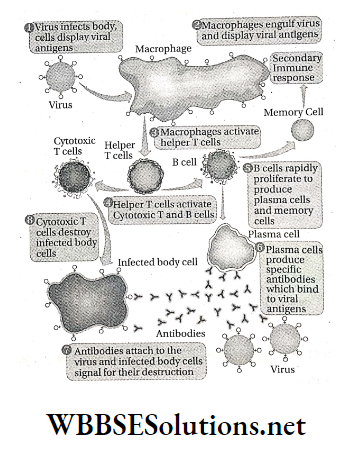
WBBSE Solutions For Class 9 Life Science And Environment Chapter 4 Biology And Human Welfare immune response against a viral attack

Concepts Related to Immunology for Long Answers

Question 10 Mention the differences between B cells and T cells.

Answer:

Differences between B cells and T cells:
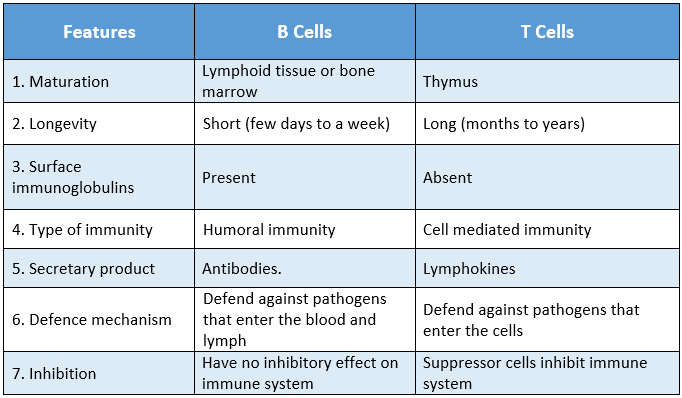
WBBSE Solutions For Class 9 Life Science And Environment Chapter 4 Biology And Human Welfare differences between B cell and T cell

WBBSE Life Science And Environment Class 9 Solutions

Question 11. Write the differences between primary immune response and secondary immune response.

Answer:

Difference between primary immune response and secondary immune response:
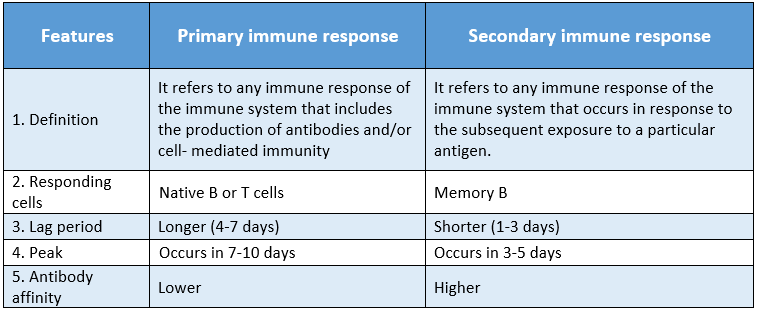
WBBSE Solutions For Class 9 Life Science And Environment Chapter 4 Biology And Human Welfare primary and secondary immune response

Question 12. Give a brief historical account of the discovery of the smallpox vaccine.

Answer:

Discovery of smallpox vaccine:

The scientific concept of vaccination was developed in the later half the of 18th century when a number of scientists and physicians were working hard to develop a vaccine against smallpox, the most deadly and contagious disease of that time.

Scientists noticed that most individuals, who once suffered from cowpox safely bypassed smallpox. But the search was on for long 25 years. Then Dr. Edward Jenner (1798) broke through the concept of vaccination.

He collected a little pus from a cowpox vesicle on the hand of Sarah Nelmes, a milkmaid, and introduced it into the arm of James Phipps, an eight year old boy. After two months, the boy was inoculated with the smallpox virus, but he did not develop the disease.

The modern concept of vaccination is standing in this story. After this discovery, the practice of vaccination took the correct route. After a long battle for about two centuries, smallpox has now been eradicated from the world.

Study Guide for Class 9 Life Science Immunity Questions

Question 13. What is a vaccine? Mention the basic working principles of vaccines to develop immunity in the body.

Answer:

Vaccine:

The vaccine is an antigenic material that is prepared with killed or weakened pathogens, part of pathogens, bacterial toxins, or microbial proteins, which do not cause illness but provide active acquired immunity against those pathogens when introduced into the body.

Working principle of vaccines:

By vaccination, a killed germ, attenuated (weakened) germ, toxoids (toxins collected from germs) or subunits (fragments of proteins from germs) are introduced into the body of an individual. These may be injected or administered orally.

As soon as the substance enters the body, antigens present in it, activate the immune system and initiate an immune response. T cells and B cells take a little time to inactivate such little quantity of antigens and this process is known as primary immune response.

However, in this case, the main function is done by memory B cells. These cells, produced during the immune response, are retained in lymph nodes such as the spleen, thymus, etc. for a long time.

In case of any future infection by the same germ, these memory cells recognize those antigens instantly and inactivate or destroy the attacker very fast. This process is recognized as a secondary immune response. Thus, a successful vaccination immunizes a person effectively.

WBBSE Class 9 Life Science Solutions

Question 14. Give a brief account of different types of vaccines.

Answer:

Types of vaccines:

With the development of science, new and advanced varieties of vaccines are being developed. Till date World Health Organization (WHO) has licensed vaccines for 25 diseases.

Different types of vaccines are:

1 Killed vaccine:

These vaccines contain killed pathogens. Vaccines of cholera, plague, and influenza are of this type.

2 Live attenuated vaccine:

By some laboratory techniques virulence of the pathogens are reduced to prepare this type of vaccines. Vaccines of mumps, measles, and rubella (MMR vaccine) are of this type.

3 Toxoid vaccine:

This type of vaccine is prepared by inactivated toxins from pathogens. Vaccines of tetanus and diphtheria are of this type.

4 Conjugate vaccine:

Generally, the polysaccharide of the bacterial capsule is attached to a protein to prepare this vaccine. The body’s immune system can recognize this conjugated protein and keep it in memory for future immune responses. Vaccine against Haemophilus influenza

5 Sub-unit vaccines:

This type of vaccine is prepared by small fragments of pathogenic protein. Vaccine against Hepatitis B is of this type.

6 Heterotypic vaccine:

This is prepared by pathogens, causing disease to other animals but less or non-virulent to humans. Vaccines of smallpox and tuberculosis are of this kind.
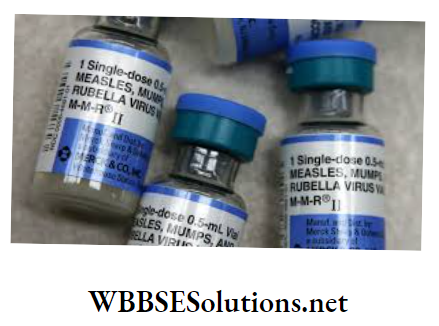
WBBSE Solutions For Class 9 Life Science And Environment Chapter 4 Biology And Human Welfare mmr vaccine

WBBSE Class 9 Life Science Solutions

Question 15. Mention briefly about the nature, symptoms, and mode of transmission of some human diseases.

Answer:

Description of some human diseases:
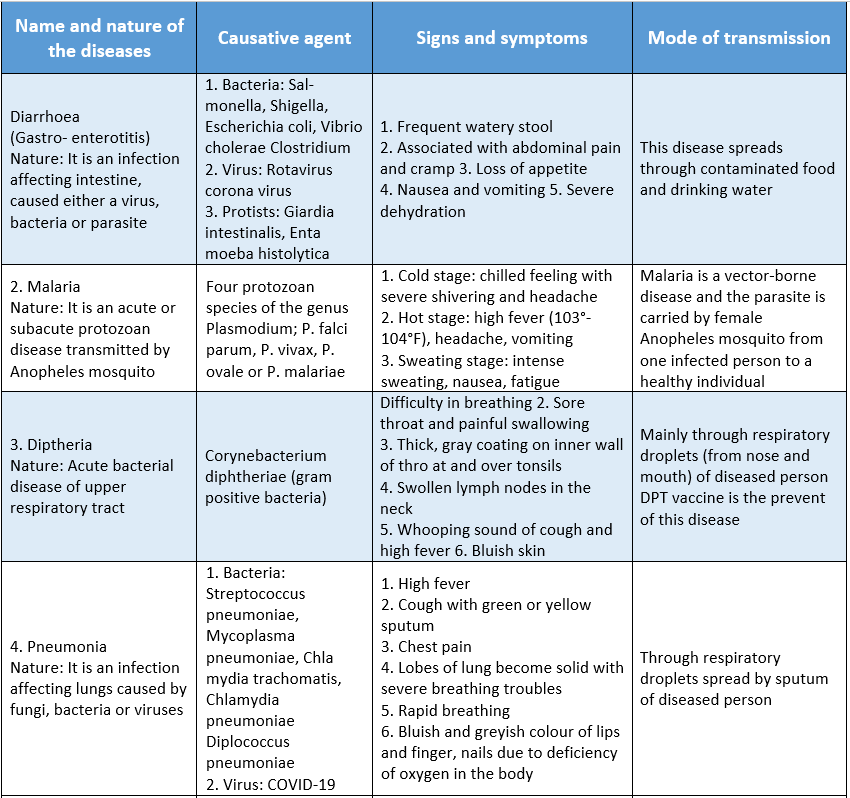
WBBSE Solutions For Class 9 Life Science And Environment Chapter 4 Biology And Human Welfare description of human diseases

WBBSE Solutions For Class 9 Life Science And Environment Chapter 4 Biology And Human Welfare description of human diseases.

Question 16 Explain the importance of hand washing. Write the components use in washing.

Answer:

Importance of hand washing:

1 Reducing the number of infections:

Hand washing can prevent about 30% of diarrhea-related sicknesses and about 20% of respiratory infections (e.g. common cold, meningitis, flu, hepatitis A) and most types of infectious diseases.

2 Reducing child death:

About 1.8 million children under the age of 5 die every year from pneumonia and diarrhea-related diseases. Washing hands carefully and thoroughly can help children and childcare providers stay healthy.

3 To remove dirt:

Removing dirt through hand washing may even help prevent skin and eye infections.

Components used in washing:

1 Water:

Pure distilled water is the main component used in hand washing.

2 Soap and Detergent:

Water is not efficient for cleaning skin because fats and proteins which are components of organic oil are not readily dissolved in water. Removal of micro-organisms from the skin may be enhanced with the use of soaps and detergents.

3 Hand antiseptic:

Hand sanitizers containing a minimum of 60% to 70% alcohol are and efficient germ killer.

4 Shampoo:

Shampoos that contain selenium are effective in controlling dandruff. Dandruff is caused owing to fungal infection on the scalp.

5 Thimerosal:

An organic compound containing mercury can be used for disinfection of skin and instruments.

6 Wipes:

Hand washing with wipes is also recommended by CDC (Centers for Disease Control and Prevention). This washing is convenient during traveling when water and soap will not be available.

7 Toothpaste and mouthwash:

It is used in brushing teeth and washing mouth.

8 Disinfectant:

Phenyl, bleaching powder is applied in our surroundings to keep the environment clean.

WBBSE Class 9 Life Science Solutions

Question 17. Why and when should an individual wash their hands? Write down the proper method of washing hands.

Answer:

Reason of washing hands:

We take food with hand. We often touch our lips, face, and nose with our hands. By contaminated hands, germs or toxins may enter our body through the mouth, eyes, and nose. Therefore, one must wash the hands to stay healthy.

Time of washing hands:

Hands must be washed before:

1. Taking food
2. Cooking
3. Serving food
4. feeding and attending to a baby or a patient.

Proper washing of hands is a must after using the toilet, cleaning raw vegetables, fish, and meat, attending to a patient, sweeping and cleaning rooms and toilets, polishing shoes and tying shoe-laces, checking the air pressure of the cycle tire, coming home from outside, etc.

The proper method of washing hands:

The proper method of washing hands is mentioned below:

1. Wet your hands with clean water.
2. Take liquid hand-wash or soap in wet hands and rub it for one or two minutes to make rich foam.
3. Carefully rub in between all fingers.
4. Place the hands under running water and continue rubbing until the foam clears.
5. Close tap with a clean cloth and wipe the hand with a dry and clean towel.
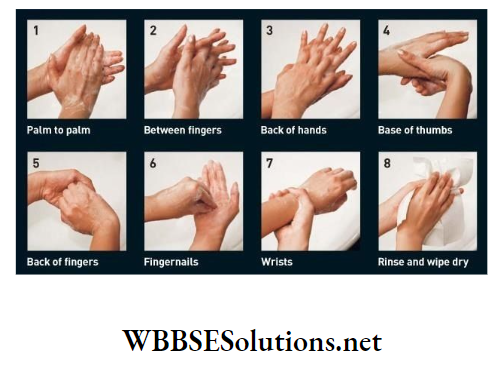
WBBSE Solutions For Class 9 Life Science And Environment Chapter 4 Biology And Human Welfare proper hand washing

Question 18 Write a short note on the ‘WASH’ program of UNICEF. ‘WASH’ program of UNICEF

Answer:

The percentage of healthy children in a population is the index of development of a nation. But it is unfortunate that even in the 21st century, millions of children suffer from diarrhea and several other water-borne diseases.

This happens because of contaminated water, which occurs mostly due to a lack of proper sanitation. 44% of the global population defecates in open areas. Feces contain numerous germs, which easily contaminate water, especially during the rainy season.

In view of that, UNICEF (United Nations International Children’s Emergency Fund) has developed a global strategy to lift the standard of health of school children by providing them with adequate drinking water, infrastructure for proper sanitation, and a sense of hygiene.

This program is popularly known as ‘WASH’ (Water Sanitation Hygiene Programme). United Nations has set a goal for sustainable development of the standard of living of the world population in this millennium.

To reach the target, UNICEF has developed a strategy to maximize child survival rate by providing access to adequate drinking water, and sanitation facilities to schools all over the world along with education and nutrition.

WBBSE Class 9 Life Science Solutions

Question 19 Describe the WASH strategy taken by UNICEF to improve hygiene behavior among school children. How can the WASH program be made successful?

Answer:

WASH strategy to improve hygiene behavior among school children:

Schools are the places where a child spends most of the time of his or her life all through the development period. So UNICEF has developed the plan to make every school a child-friendly place.

In view of that UNICEF has extended both monetary and strategic support to all developing countries of the world to develop infrastructure for child-friendly schools. The strategy to enhance child survival and development, UNICEF has encouraged a three-pillar approach.

The first is enabling a child-friendly environment in the school. Next is to improve hygiene behavior among the students and the third one is to build infrastructure for water supply and sanitation services.
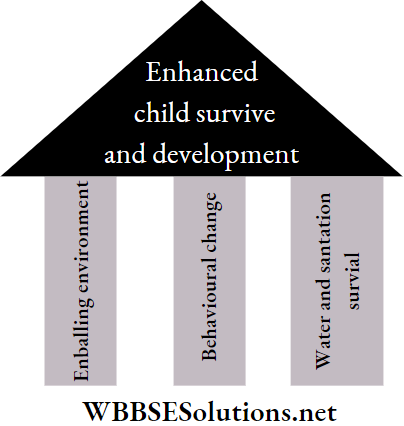
WBBSE Solutions For Class 9 Life Science And Environment Chapter 4 Biology And Human Welfare three pillar approach of wash programme

Points to make WASH successful:

The points to make WASH successful are as follows:

1. Wash your hands with adequate water and soap before taking food and after using Three pillar approach of WASH toilets.
2. Always use sanitary toilets.
3. Clean raw fruits and vegetables before consuming.
4. Keep a close vigilance on drinking water sources to reduce contamination to zero.
5. Clean water storage containers every day.
6. Keep your domestic and school toilets clean.
7. Clip your nails regularly and do not let any filth to deposit under it.

Question 20. Mention different hygienic practices to secure the good health of a person as well as of society.

Answer:

Different types of hygienic practices:

The conditions or practices helpful to maintain health and to prevent diseases, especially through cleanliness are known as hygiene. Hygiene can be practiced in three different levels, i.e., personal, household, and social levels, which are mentioned below.

1 Personal level hygiene:

1. Cleaning hands before taking food, after using the toilet, and handling any unclean material.
2. Brushing teeth after taking a meal and before going to bed.
3. Taking a bath once or twice a day.
4. Trimming hair and clipping nails regularly.

2 Household level hygiene:

1. Washing and sun-drying clothing and bedding at regular intervals.
2. Cleaning utensils, kitchen equipment, raw vegetables, fish, and meat.
3. Cleaning toilets, basins, and sinks.
4. Cleaning and disinfecting water reservoirs.

3 Social level hygiene:

1. Cleaning of sewage system at regular intervals.
2. Maintaining general cleanliness in hospitals, educational institutions, marketplaces, railway stations, bus terminus, auditoriums, theaters, and other community places.
3. Regular cleaning and disinfecting of public toilets.