WBBSE Solutions For Class 6 Maths Arithmetic Chapter 7 Matric System

Arithmetic Chapter 7 Matric System

Question 1.

1.

1. 1.8 metres = How many millimetres?

Solution: 1.8 metres = 1.8 x 10 decimetres

= 1.8 x 10 x 10 centimetres

= 1.8 x 10 x 10 x 10 millimetres

= 1.8 x 1000 millimetres

= 1800.0 millimeters

= 1800 millimeters.

1.8 metres = 1800 millimeters.

2. 3 metres 17 cm = How many cm ?

Solution: 3 metres 17 cm = 3 x 10 decimetres + 17 cm

= 3 x 10 x 10 cm + 17 cm

= 300 cm + 17 cm ;

= 317 cm

3 metres 17 cm = 317 cm

Read and Learn More  WBBSE Solutions For Class 6 Maths

3. 2.356 metres = How many decimetres?

Solution: 2.356 metres = 2.356 x 10 decimetres

= 23.56 decimetres.

2.356 metres = 23.56 decimetres.

4. 5.37 hectometres = How many decametres?

Solution: 5.37 hectometres = 5.37 x 10 decametres

= 53.7 decametres.

5.37 hectometres = 53.7 decametres.

WBBSE Class 6 Metric System Notes

WBBSE Solutions For Class 6 Geography WBBSE Solutions For Class 6 History WBBSE Solutions For Class 6 Maths
WBBSE Class 6 Geography Notes WBBSE Class 6 History Notes
WBBSE Class 6 Geography Multiple Choice Questions WBBSE Class 6 History MCQs WBBSE Notes For Class 6 School Science


5. 6 decametres 7 decimetres = How many decimetres ?

Solution: 6 decametres 7 decimetres = 6 x 10 metres + 7 decimetres

= 6 x 10 x 10 decimetres + 7 decimetres

= 600 decimetres + 7 decimetres

= 607 decimetres.

6 decametres 7 decimetres = 607 decimetres.

6. 0.2 cm = How many metres?

Solution: 0.2 cm = (0.2 ÷ 10) decimetre

= {(0.2 ÷ 10) 10} metre .

= {0.02 ÷ 10} metre

= 0.002 meters.

0.2 cm = 0.002 meters.

7. 5 metres = How many decametres?

Solution: 5 meters = (5 ÷ 10) decametre.

= 0.5 decametres.

5 meters = 0.5 decametres.

Short Questions on Metric Measurements

8. 5.3 cm = How many decametres?

Solution: 5.3 cm = (5.3 ÷ 10) decimeter

= {(5.3 ÷ 10) ÷ 10} metre

= {0.53 ÷ 10} metre

= 0.053 meter

= (0.053 ÷ 10) decametre

= 0.0053 decametre.

5.3 cm = 0.0053 decametre.

9. 0.7 decametre = How many kilometres?

Solution: 0.7 decametre = (0.7 ÷ 10) hectometer

= 0.07 hectometres

= (0.07 ÷ 10) kilometre

= 0.007 kilometers.

0.7 decametre = 0.007 kilometers.

10. 91 meters = How many kilometers?

Solution: 91 metres = (91 ÷ 10) decametres

= 9.1 decametres

= 91 ÷ 10 hectometres

= 0.91 hectometre

= (0.91 ÷ 10) kilometre

= 0.091 kilometers.

91 metres = 0.091 kilometers.

2.

Common Questions About Metric Units

1. 2 kilograms = How many hectograms?

Solution: 2 kilograms = 2 x 10 hectograms

= 20 hectograms

2 kilograms = 20 hectograms

2. 500 grams = How many kilograms?

Solution: 500 grams = (500 ÷ 10) decagrams

= 50 decagrams

= (50 ÷ 10) hectograms

= 5 hectograms

= (5 ÷ 10) kilograms

= 0.5 kilograms

500 grams = 0.5 kilograms

3. 7 decagrams = How many decigrams?

Solution: 7 decagrams = 7 x 10 grams

= 70 grams

= 70 x 10 decigrams

= 700 decigrams

7 decagrams = 700 decigrams

4. 19 grams 68 milligrams = How many milligrams ?

Solution: 19 gram 68 milligrams = 19 x 10 decigrams + 68 milligrams

= 190 decigrams + 68 milligrams

= (190 x 10) centigrams + 68 milligrams

= 1900 centigrams + 68 milligrams

= 1900 x 10 milligrams + 68 milligrams

= 19000 grams + 68 milligrams

= 19068 milligrams.

19 gram 68 milligrams = 19068 milligrams.

Practice Problems on Metric System Conversions

5. 1000 milligrams = How many kilograms ?

Solution: 1000 milligrams = (1000 ÷ 10) centigrams

= 100 centigrams

= (100 ÷ 10) decigrams

= 10 decigrams

= (10 ÷ 10) gram

= 1 gram

= (1 ÷ 10) decagram

= 01 decagram

= (01 ÷ 10) hectogram

= 0.01 hectogram

= (0.01 ÷ 10) kilogram

= 0.001 kilogram

1000 milligrams = 0.001 kilogram

3.

1. 2 liters = How many kiloliters?

Solution: 2 litres =(2 ÷ 10) decalitre

= 0.2 decalitre

= (0.2 ÷ 10) hectolitre

= 0.02 hectolitre

= (0.02 ÷ 10) kilolitre

= 0.002 kilolitre.

2 litres = 0.002 kilolitre.

2. 23.96 decilitres = How many decalitres?

Solution: 23.96 decilitres = (23.96 ÷ 10) litres

= 2.396 litres

= (2.396 ÷ 10) decalitre

= 0.2396 decalitre

23.96 decilitres = 0.2396 decalitre

3. 63 hectolitres = How many decilitres ?

Solution: 63 hectolitres = (63 x 10) decalitres

= 630 decalitres

= (630 x 10) litres

= 6300 litres

= (6300 x 10) decilitres

= 63000 decilitres.

63 hectolitres = 63000 decilitres.

4. 2123.567 liters = How many milliliters?

Solution: 2123.567 litres = (2123.567 x 10) decilitres

= 21235.67 decilitres

= (21235.67 x 10) centilitres

= 212356.7 centilitres

= (212356.7 x 10) millilitres

= 2123567 millilitres.

2123.567 litres = 2123567 millilitres.

Question 2.

1. 2 cubic kilometers = How many cubic millimeters?

Solution :

2 cubic kilometres = 2×1 km x 1 km x 1 km

= 2 x 10 Hectom. x 10 Hectom. x 10 Hectom.

= 2 x 10 x 10 decam. x 10 x 10 decam. x 10 x 10 decam.

= \(2 \times\left(10^2 \times 10\right) \mathrm{m} \times\left(10^2 \times 10\right) \mathrm{m} \times 10^2 \times 10 \mathrm{~m}\)

= 2 x (\(10^3\) x 10 decim.) x (\(10^3\) x 10 decim.) x (\(10^3\) x 10 decim.)

= 2 x (\(10^4\) x 10 cm) x (\(10^4\) x 10 cm) x (\(10^4\) x 10 cm).

= 2 x (\(10^5\) x 10) mm x (\(10^5\) x 10 mm) x (\(10^5\) x 10 mm)

= 2 x \(10^6\) mm x \(10^6\) mm x \(10^6\) mm

= 2 x \(10^{18}\) cubic millimeters.

2 cubic kilometres = 2 x \(10^{18}\) cubic millimeters.

Alternative process : 2 cubic kilometres = 2 x (1 kilometre)3

= 2 x (10 Hectom.)3

= 2 x (10 x 10 decam.)3

= 2 x (102 x 10 m)3

= 2 x (103 x 10 decim.)3

= 2 x (104 x 10 cm)3

= 2 x (105 x 10 mm)3

= 2 x (106)3 cubicmm

= 2 x 10¹⁸ cubicmm

2. 5 x 10¹⁶cubic millimeters = How many cubic kilometers?

\(5 \times 10^{16}\) cubic millimetres = \(\left(5 \times 10^{16} \div 10^3\right)\) cubic centimetres

= \(5 \times 10^{13}\) cubic centimeters

= \(\left(5 \times 10^{13} \div 10^3\right)\) cubic decimetres

= \(5 \times 10^{10}\) cubic decimetres

= \(\left(5 \times 10^{10} \div 10^3\right)\) cubic meters

= \(5 \times 10^7\) cubic meters

= \(\left(5 \times 10^7 \div 10^3\right)\) cubic decametres

= \(5 \times 10^4 cubic\) decametres.

= \(\left(5 \times 10^4 \div 10^3\right)\) cubic hectometres

= 5 x 10 cubic hectometres

= \(\left(5 \times 10 \div 10^3\right)\) cubic kilometer

= 5 x 10 / 1000 cubic kilometres

= 5/100 cubic kilometer

= 0.05 cubic kilometers.

\(5 \times 10^{16}\) cubic millimetres = 0.05 cubic kilometers.

Question 3.

1. 1 sq. hectometre = How many square centimeters?

Solution: 1 sq. hectometre = (1 hectometre)

= (1 x 10 decametres)2

= (10 x 10 meters)2

= (100 meters)2

= (100 x 10 decimetres)2

= (1000 decimetres)2

= (1000 x 10 centimetres)2

= (104 centimeters)2

= 108 sq. centimeters.

1 sq. hectometre = 108 sq. centimeters.

Conceptual Questions on Length, Mass, and Volume in Metric Units

2. 6 sq. millimeters = How many sq. decametres?

Solution: 6 sq. millimetres = 6 x (1 mm)2

= 6 x {(1 ÷ 10) cm}2

= 6 x (0.1 cm)2

= 6 x {(0.1 ÷ 10) decimetre}2

= 6 x (0.01 decimetres)2

= 6 x {(0.01 ÷ 10) metre}2

= 6 x (0.001 meters)2

= 6 x {(0.001 ÷ 10) decametre}2

= 6 x (0.0001 decametres)2

= 6 x 0.00000001 sq. decametre

= 0.00000006 sq. decametre

6 sq. millimetres = 0.00000006 sq. decametre


3. 4 x 10⁸ metres = How many ares ?

Solution: 4 x \(10^8\) metres = \(\left(4 \times 10^8 \div 100\right)\) ares

= \(\left(4 \times 10^8 \div 10^2\right)\) ares

= 4 x \(10^6\) ares

4 x \(10^8\) metres = 4 x 10^6 ares


4. 8 x 10⁴ares = How many hectoares ?

Solution: 8 x \(10^4\) ares = \(\left(8 \times 10^4 \div 100\right)\) hectoares

= \(\left(8 \times 10^4 \div 10^2\right. \text { hectoares) }\)

= 8 x \(10^2\) hectoares

= 8 x 100 hectoares

= 800 hectoares.

8 x \(10^4\)  ares = 800 hectoares.


5. 56654.92 sq. meters = How many centesimal and how many acres?

Solution: 56654.92 sq. metres = (56654.92 ÷ 40.4678) centesimals

= 1400 centesimals

= (1400 ÷ 100) acres

= 14 acres

56654.92 sq. metres = 14 acres


6. 39.5376 acres = How many hectares?

Solution: 39.5376 acres = (39.5376 ÷ 2.4711) hectoares

= 16 hectares.

39.5376 acres = 16 hectares.


7. 256.6 centesimal = How many bighas ?

Solution: 265.3 centesimals = (265.3 ÷ 1.66) kathas

= 160 kathas

= (160 ÷ 20) bighas

= 8 bighas

265.3 centesimals = 8 bighas

Real-Life Scenarios Involving Measurements in Science

Question 4. How many days and how many years are there in 35040 hours?

Solution: 35040 hours = (35040 ÷24) days

= 1460 days

= (1460 ÷ 365) years

= 4 years.

35040 hours = 4 years.

Examples of Real-Life Applications of the Metric System

Question 5. From the market, you bought pulse 250 gm, atta 500 gm and fish 1 t kg. How many kgs of materials did you buy from the market?

Solution: Total weight = 250 gm + 500 gm + 1 kg

= 250/1000 kg + 500/1000 kg + 1kg

= 0.25 kg + 0.5 kg + 1 kg

= 1.75 kg

∴ You bought 1.75 kg of materials from the market.


Question 6. The distance between your school from your house is 2.04 kilometers. If you would be cycling at a speed of 10.2 kilometers per hour, how long should you take to reach the school?

Solution: We know, time = Distance/Speed

Here, distance = 2.04 km, speed = 10.2 km / hour

∴ Time = 2.04/10.2 hour

= 204/1020 hour

= 0.2 hour

= 0.2 x 60 minutes

= 12.0 minutes.

∴ The required time = is 12 minutes.


Question 7. Diana has 14.4 meters of cloth in her house. If 1.8 meters of cloth is required to make each frock, how many frocks can be made by Diana?

Solution: Total cloth = 14.4 meters.

Cloth required for 1 frock =1.8 meters.

∴ The required number of frocks = 14.4 / 1.8

= 144/18

= 8.

So Diana can make 8 frocks with the cloth that she has in her house.


From a bamboo of length 15.77 meters, 2.25 meters is cut off. The remaining part is divided into 4, equal parts. What is the length of each part?

Solution: Total length of the bamboo = 15.77 meters.

Cut-off a length of the bamboo = 2.25 meters.

∴ The length of the remaining part of the bamboo = (15.77 – 2.25) meters

= 13.52 meters

It is subdivided into 4 equal parts.

The length of each part = (13.52 ÷ 4) meters

= 3.38 meters.

The length of each part is 3.38 meters.

WBBSE Solutions For Class 6 Maths Arithmetic Chapter 6 Multiplication And Division Of A Decimal Fraction By Whole Numbers And Decimal Fraction

WBBSE Solutions For Class 6 Maths Arithmetic Chapter 6 Multiplication And Division Of A Decimal Fraction By Whole Numbers And Decimal Fraction

Question 1. Multiply:

1. 25.04 x10 

Solution :

Here we have to multiply by 10: there is only one zero in 10.

∴ The decimal point will be moved in the product one digit towards the right side.

So, 25.04 x 10 = 250.4.


2. 12
.375 x 10000

Solution:

Here, we have to multiply by 10000.

It contains 4 zeroes.

The decimal point will be moved in the product 4 digits towards the right side. But the decimal number 12.375 contains 3 digits after the decimal point.

One zero will be inserted after 375 (towards the right side of 5) and then put the decimal point.

12.375 x 10000 = 123750.00

[Here we put 2 zeroes after the decimal point (on the right side of the decimal point.)]

Read and Learn More WBBSE Solutions For Class 6 Maths


3. 20
.4527 x 1000000

Solution:

Here, we have to multiply by 1000000.

It contains 6 zeroes. So the decimal point will be moved in the product 6 digits towards the right side.

But the decimal number 20.4527 contains 4 digits after the decimal point.

∴ Two zeroes will be inserted after 4527 (towards the right side of 7) and then put the decimal point.

∴ 20.4527 x 1000000 = 20452700.00

WBBSE Class 6 Decimal Multiplication Notes

WBBSE Solutions For Class 6 Geography WBBSE Solutions For Class 6 History WBBSE Solutions For Class 6 Maths
WBBSE Class 6 Geography Notes WBBSE Class 6 History Notes
WBBSE Class 6 Geography Multiple Choice Questions WBBSE Class 6 History MCQs WBBSE Notes For Class 6 School Science


4. 0.005 x 100.

Solution:

Here, we have to multiply by 100. It contains only 2 zeroes.

So the decimal point will be moved towards the right side 2 digits.

0.005 x 100 = 0.5

[If the product decimal number does not contain any integral part, we can in general keeps one zero before the decimal point.]

WBBSE Solutions For Class 6 Maths Arithmetic Chapter 6 Multiplication And Division Of A Decimal Fraction By Whole Numbers And Decimal Fraction

Question 2. Find the value of 0.001 x10¹⁰

Solution:

0.001 x 1010 = 10000000.000       (∴ The decimal point is placed before 3 zeroes from the right).

Short Questions on Decimal Multiplication and Division

Question 3. Find the product:


1. 78.35 x 14 = 1096.90

Solution :

Here 7835 x 14 = 109690.

The multiplicand 78.35 contains 2 digits after the decimal point.

So the decimal point is put 2 digits left side from the end digit of the product.


2. 2.789 x 62 =172.918

Solution :

Here 2789 x 62 = 172918.

Since the decimal number 2.789 contains 3 digits after the decimal point, we put the decimal point 3 digits left side from the end digit of the product.


3. 101.011 x 96 = 9697.056

Solution :

Here 101.011 x 96 = 9697056.

Since the decimal number 101 Oil contains 3 digits after the decimal point, we put the decimal point 3 digits left side from the end digit of the product.


4. 0.0003 x 15 = 0.0045

Solution :

Here 3 x 15 = 45.

The multiplicand decimal number 0.0003 contains 4 digits after the decimal point.

But product 45 contains only two digits.

So 2 zeroes are inserted in the left side of product 45 and then put the decimal point so that the required product contains 4 digits after the decimal point.

One zero is put on the left side of the decimal point in the product.


5. 0.000001 x 25 = 0.000025

Solution :

Here 1 x 25 = 25.

The multiplicand decimal number contains 6 digits after the decimal point.

Product 25 contains only 2 digits.

So we insert 4 zeroes on the left side of 25 and then put the decimal point so that the required product will contain 6 digits after the decimal point and one zero is placed on the left side of the decimal point.

Real-Life Scenarios Involving Money Calculations

Question 4. Multiply:

Solution:

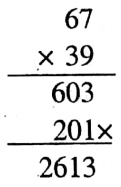
1. 0.67 x 0.39 = 0.2613

Solution: Here


WBBSE Solutions For Class 6 Maths Arithmetic Chapter 6 Multiplication And Division Of A Decimal Fraction By Whole Numbers And Decimal Fraction Question 4 Q.1


The multiplicand decimal number is 0.67 and it contains 2 digits after the decimal point and the multiplier decimal number is 0.39 and it contains 2 digits after the decimal point.

So 2 + 2 = 4 digits.

The required product will also contain 4 digits after the decimal 2613 point, which is why the required product is 0.2613.


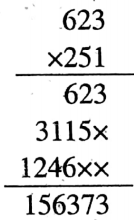
2. 6.23 x 2.51 = 15.6373

Solution: Here


WBBSE Solutions For Class 6 Maths Arithmetic Chapter 6 Multiplication And Division Of A Decimal Fraction By Whole Numbers And Decimal Fraction Question 4 Q.2


The multiplicand decimal number 6.25 contains 2 digits after the decimal point and the multiplier decimal number 2.51 contains 2 digits after the decimal point.

So 2 + 2 = 4 digits.

The required product will also contain 4 digits after the decimal point and as a result of which the required product is 15.6373

i.e., the decimal is placed 4 digits left from the end digit of the product.


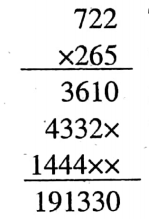
3. 72.2 x 2.65 = 191.330 = 191.33

Solution :


WBBSE Solutions For Class 6 Maths Arithmetic Chapter 6 Multiplication And Division Of A Decimal Fraction By Whole Numbers And Decimal Fraction Question 4 Q.3


The multiplicand decimal number 72.2 contains one digit after the decimal point and the multiplier decimal number 2.65 contains 2 digits after the decimal point. 1+2 = 3 digits.

The required product will contain 3 digits after the decimal point and so the required product is 191.330 = 191.33.

Here the end digit 0 has no value after the decimal point at the end


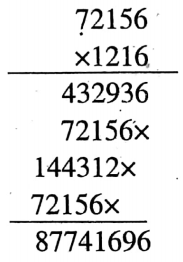
4. 72.156 x 12.16 = 877.41696

Solution:


WBBSE Solutions For Class 6 Maths Arithmetic Chapter 6 Multiplication And Division Of A Decimal Fraction By Whole Numbers And Decimal Fraction Question 4 Q.4


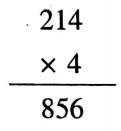
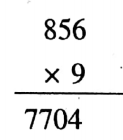
5. 2.14 x 0.4 x 0.9 = 0.7704

Solution:


WBBSE Solutions For Class 6 Maths Arithmetic Chapter 6 Multiplication And Division Of A Decimal Fraction By Whole Numbers And Decimal Fraction Question 4 Q.5.1


WBBSE Solutions For Class 6 Maths Arithmetic Chapter 6 Multiplication And Division Of A Decimal Fraction By Whole Numbers And Decimal Fraction Question 4 Q.5.2

Common Questions About Decimal Operations

6. 0.01 x 0.0001 x 0.000001 = 0.000000000001

Solution :

1 x 1 x 1 = 1. 2 + 4 + 6= 12 digits. The required product will contain 12 digits after the decimal point.

So 11 zeroes are inserted in the left side of the product 1 (which is obtained by the multiplication of 1 x 1 x 1 by removing the decimal points) and then put the decimal point.


Question 5. Arrange in descending order

Solution :

1. 0.5 x 0.3 = 0.15 

Solution:

0.5 = 0.50

0.3 = 0.30.

 50 > 30 > 15,

∴ Arranging in descending order, we get, 0.5, 0.3, 0.5 x 0.3


2. 0.6 x 0.7 = 0.42 

Solution :

0.6 = 0.60

0.7 = 0.70.

70 > 60 > 42

∴ Arranging in descending order, wet get, 0.7, 0.6, 0.6 x 0.7


3. 0.9 x 0.2 = 0.18 

Solution :

0.9 = 0-90

0.2 = 0.20.

90 > 20 > 18

∴ Arranging in descending order, we get, 0.9, 0.2, 0.9 x 0.2


4. 0.4 x 0.8 = 0.32 

Solution :

0.4 = 0.40

0.8 = 0.80.

 80 >40 >32,

∴ Arranging in descending order, we get 0.8, 0.4, and 0.4 x 0.8.


5. 1.2 x 1.5 = 1.80 

Solution :

1.2 = 1.20

1.5 = 1.50.

180 > 150 > 120 .

∴ Arranging in descending order, we get 1.2 x 1.5, 1.5, 1.2.


6. 2.3 x 2.4 = 5.52 

Solution :

2.3 = 2.30

2.4 = 2.40.

552 > 240 > 230.

∴ Arranging in descending order, we get 2.3 x 2.4, 2.4, 2.3.


7. 6.7 x 7.2 = 48.24 

Solution :

6.7 = 6.70

7.2 = 7.20

4824 > 720 > 670 ;

∴ 48.24 > 7.20 > 6.70

∴ Arranging in descending order, we get, 6.7 x 7.2, 7.2, 6.7


8. 8.2 x 1.9 = 15.58 

Solution :

8.2 = 8.20

1.9 = 1.90

∴ 1558 > 820 > 190

∴ 15.58 > 8.20 > 1.90.

Arranging in descending order, we get, 8.2 x 1.9, 8.2, 1.9


Question 6. Arrange in ascending order 

1. 1.4 x 1.1, 1.4, 1.1, 1.5

Solution:

14 x 1.1 = 1·54

1.4 = 1.40;

1.1 = 1.10;

1.5= 1.50

110 < 140 < 150 < 154,

1.10 < 1-40 < 1.50 < 1.54

∴ Arranging in ascending order, we get 1.1, 1.4, 1.5, 1.4 x 1.1.


2. 0-01 x 1, 0.1 x 0.01, 0.01 x 0.01, 0.1

Solution:

= 0.01 x 10.0100

= 0.1 x 0.01 0.0010

= 0.01 x 0.01

= 0.0001 x 0.1

=  0.1000

1 < 10 < 100 < 1000, 

∴ 0.0001 < 0·0010 < 0·0100 < 0.1000

∴ Arranging in ascending order, we get, 0.01 x 0.01, 0.1 x 0.01, 001 × 1, 0.1

Practice Problems on Decimal Division

Question 7. Simplify: 

1. 13.28 4.07 +2.7 × 0.02

Solution

= 13.28 4.07 +0-054.

= (13-280-054) – 4.07

= 13.3344.07 = 9.264

13.28 4.07 +2.7 × 0.02 = 9.264


2. 0.35 × 0.35 + 0.15 x 0.15 + 2 x 0-35 x 0.15

Solution

= 0.1225 +0.0225 +0.1050

=25000

= 0.25

0.35 × 0.35 + 0.15 x 0.15 + 2 x 0-35 x 0.15 = 0.25

Alternative method:

Let 0.35 = a and 0.15 = b

The given quantity = a x a + b x b+2 x a x b.

= a2 + b2+2ab 

= (a + b)2

= (0-5)2 

= 0.25.


Example 8. If the cost of one exercise book is 12.75, then what is the total cost of 4 exercise books?

Solution: The cost of one exercise book = 12.75

∴ The total cost of 4 exercise books (12.75 x 4)

= 51.00 

= 51.

Total cost of 4 exercise books = 51


Example 9. Kartikbabu built a house on 0.35 part of his land. He cultivated fruits in 0.2 parts of the remaining land. In what part of his land did he cultivate fruits?

Solution: Let the whole of Kartikbabu’s land = 1 part.

∴ The remaining part of his land after building the house = (1 – 0.35) part 

= 0.65 part.

Now 0.2 part of 0.65 part = 0·2 x 0.65

 = 0.13 part.

∴ Kartikbabu cultivated fruit in 0.13 part of his land.


Question 10. Your mother asked you to purchase 2-5 kg of the pulse. If the cost of 1 kg of the pulse is 62.50, then how much money must you carry to the shop? 

Solution: The cost of 1 kg of pulse = ₹ 62.50

∴ cost of 2.5 kg pulse

= ₹(62.50 x 2.5) 

= ₹ 156.250 

= ₹ 156.25

₹ 156.25 money must you carry to the shop.


Question 11. You had ₹ 150. With 0.3 part of your money, you bought one exercise notebook and with 0.4 part you bought your mathematics book. How much money is left with you?

Solution: 0.3 + 0.4 = 0·7 part

∴ You spent a total of 0-7 part of your money.

Now you have left (10.7) = 0.3 part of your money.

∴ You have left = 0.3 part of ₹ 150 = ₹ (3 x 150)

= 45.0

= 45.

₹ 45 money is left with you.

Alternative method :

You purchased an exercise book with

= (150 x 0.3)

= 45.

You purchased a mathematics book with

= (150 x 0.4)

 = 60.

∴ You spent total

=  (45+ 60) 

= 105

∴ Total money is left with you

=  (150 – 105) 

=  45.

∴ ₹ 45 is left with you.

Important Definitions Related to Decimal Operations

Question 12. What is the meaning of (31.5 ÷ 5.25)?

Solution: The meaning of (31.5 ÷ 5.25) is how many times 5.25 will be subtracted from 31.5.1


Question 13. Divide :

1.

1. 125.45 ÷ 10 = 12.545

Here in the divisor, there is only one zero after 1. So to determine the quotient, the decimal point in the dividend is moved one digit left side. Hence the quotient becomes 12.545.


2. 0.4 100 = 0.004.

Here, there are 2 zeroes after I in the divisor.

So to determine the quotient, the decimal point in the dividend is moved 2 digits towards the left side.

But then, the dividend does not contain any digit on the left side before the decimal point.

For this reason, 2 zeroes are inserted before 4 and then the decimal point is put.

So the required quotient = 0·004.


3. 23.32  ÷ 1000 = 0.02332.

There are 3 zeroes after 1 in the divisor.

So to determine the quotient the decimal point in the dividend is moved 3 digits towards the left side.

Since there are only 2 digits in the left side of the decimal point.

For this reason, one zero is inserted before 23:32 on the left side and then the decimal point is put in.

The required quotient is 0.02332.


4. 1·724  ÷ 10000 = 0.0001724.

There are 4 zeroes after 1 in the divisor.

So to determine the quotient, the decimal point in the dividend is moved 4 digits towards the left side but the dividend contains only one digit before the decimal point.

For this reason, 3 zeroes are inserted before the given dividend decimal number 1.724 and then the decimal point is put.

The required quotient is 0-0001724.


2.


1. 651-2 ÷ 4 = 162.8.

Solution:

Here removing the decimal point in the dividend we get 6512 and 6512 ÷ 4 = 1628;

Since the dividend contains a decimal point one digit before the end digit, the decimal point is also put in the quotient one digit before the end digit.

∴ The required quotient = 162.8.


2. 18  ÷  0.2 = 18/0.2

Solution:

= 18×10 / 0.2 x 10

= 180/2

=90.

Here the decimal point in the divisor is removed by the multiplication of 10 to it.

So multiplying both the numerator and denominator by 10 we get the required result and the quotient is 90.


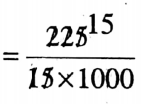
3. 0.225
÷ 15 = 0.225 / 15

Solution:

= 0÷225×1000 / 15×1000


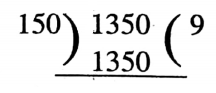
WBBSE-Solutions-For-Class-6-Maths-Arithmetic-Chapter-6-Multiplication-And-Division-Of-A-Decimal-Fraction-By-Whole-Numbers-And-Decimal-Fraction-Question-13-Q.3.1


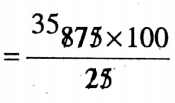
4. 875 ÷ 0.25

Solution:

= 875 x 100 / 0.25 x 100


WBBSE Solutions For Class 6 Maths Arithmetic Chapter 6 Multiplication And Division Of A Decimal Fraction By Whole Numbers And Decimal Fraction Question 13 Q.4.1


3.

1. 28.8 ÷ 1.2,

Solution:

1. 28.8 ÷ 1.2 = 28.8 / 1.2

= 28.8 / 102

= 28.8 x 10 / 1.2 x 10

= 288/12 = 24.

Examples of Real-Life Applications of Decimal Operations

2. 2. 1.35 ÷ 1.5

Solution:

\(1.35 \div 1 \cdot 5=\frac{1.35}{1.5}=\frac{1.35 \times 100}{1.5 \times 100}=\frac{135}{150}=0.9\)


WBBSE Solutions For Class 6 Maths Arithmetic Chapter 6 Multiplication And Division Of A Decimal Fraction By Whole Numbers And Decimal Fraction Question 13 Q 3.2


3. 3. 414.50 ÷ 0.0125

Solution:

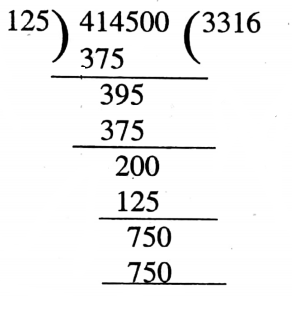
\(414 \cdot 5 \div 0 \cdot 125=\frac{414 \cdot 5}{0 \cdot 125}=\frac{414 \cdot 5 \times 1000}{0 \cdot 125 \times 1000}=\frac{414500}{125}=3316\)


WBBSE Solutions For Class 6 Maths Arithmetic Chapter 6 Multiplication And Division Of A Decimal Fraction By Whole Numbers And Decimal Fraction Question 13 Q 3.3


4. 0.465 ÷ 0.5

Solution:

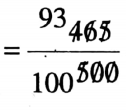
= 0.465 x 1000 / 0.5 x 1000


WBBSE Solutions For Class 6 Maths Arithmetic Chapter 6 Multiplication And Division Of A Decimal Fraction By Whole Numbers And Decimal Fraction Question 13 Q.3.4


= 93/100

= 0.93.

0.465 ÷ 0.5 = 0.93.


Question 14. Simplify:


1. (45.85 – (6.29 + 15.06)} ÷ 5

Solution:

= (45.85 – (6.29 + 15.06)} ÷ 5

= (45.85 – 21.35) ÷ 5

= 24.50 ÷ 5

= 4.9.

(45.85 – (6.29 + 15.06)} ÷ 5 = 4.9.


2. {(4 – 2.07) × 2.5} ÷ 1.93

Solution:

= {(4 – 2.07) × 2.5} ÷ 1.93

= (1.93 x 2.5) ÷ 1.93

1.93 x 2.5 / 1.93 

= 2.5

{(4 – 2.07) × 2.5} ÷ 1.93 = 2.5

Conceptual Questions on Rounding Decimals in Calculations


3. (7.8 – 7.8 x 0.2) ÷ 1.2

Solution:

= (7.8 – 7.8 x 0.2) ÷ 1.2

= (7.8 – 1.56) ÷ 1.2

= 6.24 ÷ 1.2

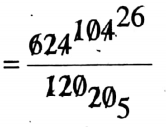
= 6.24 x 100 / 1.2 x 100


WBBSE Solutions For Class 6 Maths Arithmetic Chapter 6 Multiplication And Division Of A Decimal Fraction By Whole Numbers And Decimal Fraction Question 14 Q.3.1


= 26/5

= 5.2


WBBSE Solutions For Class 6 Maths Arithmetic Chapter 6 Multiplication And Division Of A Decimal Fraction By Whole Numbers And Decimal Fraction Question 14 Q.3.2


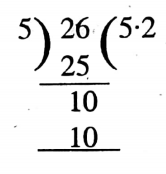
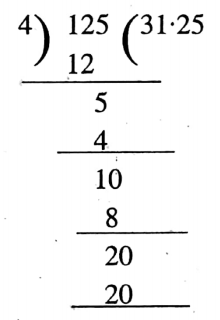
Question 15. A square is formed by bending a copper wire of length 125 centimeters. What is the length of each side of the square?

Solution: We know that each side of a square is of equal length and a square has 4 sides.

∴ The length of each side of the square = (125 ÷ 4) cm 

= 31.25 cm

∴  The length of each side of the square

= 31.25 centimeters.


WBBSE Solutions For Class 6 Maths Arithmetic Chapter 6 Multiplication And Division Of A Decimal Fraction By Whole Numbers And Decimal Fraction Question 15 Q.1.1


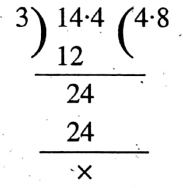
Question 16. The perimeter of an equilateral triangle is 14.4 cm. What is the length of each side of it?

Solution: We know that the length of each of the 3 sides of an equilateral triangle is the same.

:. The length of each side of the equilateral triangle = (14.4 ÷ 3) cm 

= 4.8 cm.

WBBSE Solutions For Class 6 Maths Arithmetic Chapter 6 Multiplication And Division Of A Decimal Fraction By Whole Numbers And Decimal Fraction Question 16 Q.1.1

WBBSE Solutions For Class 6 Maths Arithmetic Chapter 5 Multiplication And Division Of A Fraction By Whole Number And By Fraction

Arithmetic Chapter 5 Multiplication And Division Of A Fraction By Whole Number And By Fraction

Question 1. Multiply:

1. \(3 \times \frac{6}{11}\)

Solution:

\(3 \times \frac{6}{11}=\frac{3 \times 6}{11}=\frac{18}{11}=1 \frac{7}{11}\)


2. \(\frac{2}{3} \times 11\)

Solution:

\(\frac{2}{3} \times 11=\frac{2 \times 11}{3}=\frac{22}{3}=7 \frac{1}{3}\)


3. \(\frac{7}{3} \times 2 \frac{2}{3}\)

Solution:

\(\frac{7}{3} \times 2 \frac{2}{3}=\frac{7}{3} \times \frac{8}{3}=\frac{7 \times 8}{3 \times 3}=\frac{56}{9}=6 \frac{2}{9}\)


4. \(\frac{3}{8} \times \frac{6}{4}\)

Solution:

⇒ \(\frac{3}{8} \times \frac{6}{4}=\frac{3 \times 6}{8 \times 4}=\frac{3 \times 3}{4 \times 4}=\frac{9}{16}\)

Read and Learn More  WBBSE Solutions For Class 6 Maths

5. \(\frac{6}{49} \times \frac{7}{3}\)

Solution:

⇒ \(\frac{6}{49} \times \frac{7}{3}=\frac{6 \times 7}{49 \times 3}=\frac{2}{7}\)

WBBSE Solutions For Class 6 Geography WBBSE Solutions For Class 6 History WBBSE Solutions For Class 6 Maths
WBBSE Class 6 Geography Notes WBBSE Class 6 History Notes
WBBSE Class 6 Geography Multiple Choice Questions WBBSE Class 6 History MCQs WBBSE Notes For Class 6 School Science


6. \(\frac{15}{28} \times 2 \frac{1}{3}\)

Solution:

⇒ \(\frac{15}{28} \times 2 \frac{1}{3}=\frac{15}{28} \times \frac{7}{3}=\frac{15 \times 7}{28 \times 3}=\frac{5 \times 7}{28}=\frac{5}{4}=1 \frac{1}{4}\)

WBBSE Solutions For Class 6 Maths Arithmetic Chapter 5 Multiplication And Division Of A Fraction By Whole Number And By Fraction

WBBSE Class 6 Multiplying Fractions Notes

7. \(4 \frac{8}{13} \times 7 \frac{4}{5}\)

Solution:

\(4 \frac{8}{13} \times 7 \frac{4}{5}=\frac{60}{13} \times \frac{39}{5}=\frac{60 \times 39}{13 \times 5}=12 \times 3=36\)


8. \(2 \frac{3}{5} \times 6\)

Solution:

\(2 \frac{3}{5} \times 6=\frac{13}{5} \times 6=\frac{13 \times 6}{5}=\frac{78}{5}=15 \frac{3}{5}\)


Question 2. Multiply:

1. \(\frac{6}{7} \times \frac{14}{15} \times \frac{25}{28}\)

Solution:


WBBSE Solutions For Class 6 Maths Arithmetic Chapter 5 Multiplication And Division Of A Fraction By Whole Number And By Fraction Q 2.1


2. \(2 \frac{11}{12} \times 3 \frac{1}{7} \times 4 \frac{10}{11}\)

Solution:


WBBSE Solutions For Class 6 Maths Arithmetic Chapter 5 Multiplication And Division Of A Fraction By Whole Number And By Fraction Q 2.2

Short Questions on Fraction Multiplication and Division

3. \(\frac{12}{35} \times \frac{42}{91} \times \frac{36}{55} \times \frac{13}{18}\)

Solution:

WBBSE Solutions For Class 6 Maths Arithmetic Chapter 5 Multiplication And Division Of A Fraction By Whole Number And By Fraction Q 2.3

4. \(1 \frac{7}{10} \times 1 \frac{3}{17} \times 1 \frac{1}{5} \times 3 \frac{3}{4}\)

Solution:

WBBSE Solutions For Class 6 Maths Arithmetic Chapter 5 Multiplication And Division Of A Fraction By Whole Number And By Fraction Q 2.4

Question 3. Multiply:

Solution:

1. \(99 \frac{98}{99} \times 99\)

Solution:


WBBSE Solutions For Class 6 Maths Arithmetic Chapter 5 Multiplication And Division Of A Fraction By Whole Number And By Fraction Q 3.1


Common Questions About Fraction Operations

2. \(999 \frac{97}{98} \times 98\)

Solution:

WBBSE Solutions For Class 6 Maths Arithmetic Chapter 5 Multiplication And Division Of A Fraction By Whole Number And By Fraction Q 3.2


3. \(999 \frac{995^{\circ}}{997} \times 997\)

Solution:

WBBSE Solutions For Class 6 Maths Arithmetic Chapter 5 Multiplication And Division Of A Fraction By Whole Number And By Fraction Q 3.3


4. \(999 \frac{444}{999} \times 999\)

Solution:


WBBSE Solutions For Class 6 Maths Arithmetic Chapter 5 Multiplication And Division Of A Fraction By Whole Number And By Fraction Q 3.4

Practice Problems on Fraction Division

Question 4 Simplify:

1. \(\frac{1}{5}+\frac{2}{3}-\frac{1}{2}\)

Solution:

⇒ \(\frac{1}{5}+\frac{2}{3}-\frac{1}{2}=\frac{6+20-15}{30}=\frac{26-15}{30}=\frac{11}{30}\)

2. \(\frac{1}{5}+\frac{1}{2}-\frac{2}{15}-\frac{1}{6}\)

Solution:


WBBSE Solutions For Class 6 Maths Arithmetic Chapter 5 Multiplication And Division Of A Fraction By Whole Number And By Fraction Q 4.2


3. \(\frac{7}{12}+5 \frac{2}{9}+\frac{11}{18}-2 \frac{5}{12}\)

Solution:


WBBSE Solutions For Class 6 Maths Arithmetic Chapter 5 Multiplication And Division Of A Fraction By Whole Number And By Fraction Q 4.3

Examples of Real-Life Applications of Fraction Operations

4. \(3 \frac{1}{9}+\frac{7}{6} \times \frac{3}{8}-\frac{5}{24}\)

Solution:


WBBSE Solutions For Class 6 Maths Arithmetic Chapter 5 Multiplication And Division Of A Fraction By Whole Number And By Fraction Q 4.4


5. \(6 \frac{2}{5}+3 \frac{1}{3}+\frac{1}{2}-\frac{7}{10}\)

Solution:


WBBSE Solutions For Class 6 Maths Arithmetic Chapter 5 Multiplication And Division Of A Fraction By Whole Number And By Fraction Q 4.5


6. \(1-\left[\frac{1}{2} \div\left\{2-\frac{1}{2}\left(\frac{1}{2}-\overline{\frac{1}{3}-\frac{1}{6}}\right)\right\}\right]\)

Solution:


WBBSE Solutions For Class 6 Maths Arithmetic Chapter 5 Multiplication And Division Of A Fraction By Whole Number And By Fraction Q 4.6


Question 5. Evaluate:

1. 1/5 part of ₹ 10

Solution:


WBBSE Solutions For Class 6 Maths Arithmetic Chapter 5 Multiplication And Division Of A Fraction By Whole Number And By Fraction Q 5.1


2. 1/5 part of ₹ 25

Solution:


WBBSE Solutions For Class 6 Maths Arithmetic Chapter 5 Multiplication And Division Of A Fraction By Whole Number And By Fraction Q 5.2


Question 6.

1. 1/3 part of how many rupees is ₹ 4?

Solution:

Let the whole of the money be 1.

∴ 1/3 part of the whole of the money = ₹ 4

∴ whole of the money = ₹(4 ÷ 1/3)

= ₹ (4 x 3/1)

= ₹ 12.

Alternative Method:

Let the required money be ₹ x

Then 1/3 part of ₹ x = ₹ 4

∴ 1/3 x x = 4

or, x/3 = 4

or, x = 4 x 3

= 12

∴ The required money = ₹ 12.

2. 1/6 part of how many minutes are 6 minutes?

Solution:

Here 1/6 part of the total minutes = 6 minutes

∴ Total minutes = (6 ÷ 1/6)

= 6 x 6/1

= 36

∴ The required time = is 36 minutes.


Question 7. You had taken 1/3 part of the mangoes from the basket of mangoes of Sakuntala and then you had only 7 mangoes. How many mangoes were there in the basket of Sakuntala originally?

Solution: It is clear that 1/3 part of sakuntala’s mangoes in the basket = 7

Total number of mangoes in the basket of Sakuntala

= 7 ÷ 1/3

= 7 x 3/1

= 21

∴ Sakluntala had 21 mangoes originally in her basket.


Question 8. How much money is to be taken from 1/2 part of ₹ 150 so that there will remain only ₹ 30?

Solution:

1/2 part of ₹ 150

= ₹ (1/2 x 150)

= ₹ 75

We have to find the amount of money that can be taken from ‘? 75 so that there will remain  ₹ 30.

∴ The required amount of money = ₹ (75 – 30)

= ₹ 45.

∴ ₹ 45 is to be taken from 1/2 part of ₹ 150 so that there will remain ₹ 30.


Question 9. What is to be added to 3 times of 6/7 to get 2 6/7?

Solution: 3 times of 6/7

= 3 x 6/7

= 18/7

2 6/7 = 20/7

We have to find the value which is to be added to 18/7 so that the sum will be 2 6/7 or 20/7.

∴ The required value = 20/7 – 18/7

= 2/7

2/7 is to be added to 3 times of 6/7 to get 2 6/7


Question 10. 1400 visitors came in the first year in an occasion of the town. The number of visitors in the next year increased by 7/10 part of the first year. What was the total number of visitors in the next year?

Solution:

Total number of visitors in the first year = 1400.

∴ 7/10 part of 1400

= 7/10 x 1400

= 980

So the number of visitors increases in the next year = 980 than the first year.

∴ Total number of visitors in the next year = 1400 + 980

= 2380.

The total number of visitors in the next year = 2380.


Question 11. You had no stamps and Madhabi gave you 2/3 part of the stamps as many stamps had with her at first and as a result of which you had only 18 stamps. How many stamps had Madhabi with her at first?

Solution:

You had only 18 stamps and Madhabi gave you – parts of her stamps.

∴ 2/3 parts of the stamps of Madhabi =18

So Madhabi’s total number of stamps = (18 ÷ 2/3)


WBBSE Solutions For Class 6 Maths Arithmetic Chapter 5 Multiplication And Division Of A Fraction By Whole Number And By Fraction Q 11.1


Madhabi had 27 stamps with her.


Question 12. Ram gave 2/5 part of his money to Shyam and 3/10 part of his money to Jadu. If he has ₹ 180 left with him, how much money Ram had at the beginning?

Solution: Let the total money of Ram = be 1 part.

∴ Ram gave Shyam 2/5 part of his money and 3/10 part of his money to Jadu

∴ Shyam and Jadu together received (2/5 + 3/10)

= 4+3 / 10

= 7/10 part of Ram’s total money.

∴ The remaining part of ram’s money after giving to Shyam and jadu

= (1 – 7/10)

= 10-7 / 10 part

= 3/10 part

∴ 3/10 part of Ram’s total money = ₹ 180

∴ Ram’s total money what had at the beginning

= ₹ (180 ÷ 3/10)

= ₹ (180 x 10/3)

= ₹ 600

₹ 600 Ram had at the beginning.


Question 13. Your father brought 10 liters of drinking water from the nearest tubewell and from it, your mother used 1/5 part of the water for cooking. 1/4 part of the remaining water had been used for drinking purposes. How much water still was left?

Solution Total amount of drinking water brought = 10 liters. 

Let the total amount of water = 1 part

Mother used for cooking = 1/5 part

Remaining part = 1 – 1/5

= 5-1 / 5

= 4/5

Water used for drinking = 1- 1/5

= 5-1 / 5

= 4/5

Water used for drinking = (4/5 x 1/4) part ⅕ part

Remaining part of total water = 4/5 – 4/5

= 4-1 /5

= 3/5 part

∴ Remaining water = (3/5 x 10) = 6 liters

∴ Still, 6 liters of water was left.


Question 14. A bucket holds 1/2 liter of water. How much water 7 such buckets can hold?

Solution: One bucket can hold = 1/2 liter of water

∴ 7 buckets can hold = (1/2 x7)

= 3.5 liters of water

∴ 7 buckets can hold 3.5 liters of water.

Conceptual Questions on Mixed Numbers and Improper Fractions

Question 15. If the length of the 7/8 part of a ribbon is 56 meters, then what is the length of the original whole ribbon?

Solution: Let the length of the original whole ribbon = 1 part.

∴ The length of 7/8 part of the ribbon = 56 meters 

∴ The length of 1 part of the ribbon = (56 ÷ 7/8) metres

= (56 x 8/7 ) metres

= 64 meters.

∴ The length of the original whole ribbon = is 64 meters.


Question 16. What is to be added to 5/7 of 1 1/2 to get the sum 4 3/5?

Solution:

5/7 of 1 1/2 = 5/7 x 1 1/2

= 5/7 x 3/2

= 15/14

We have to find what is to be added to 15/14 to get the sum 4 3/5.

∴ Required value = (4 3/5 – 15/14)

= 23/5 – 15/14

= 322 – 75 / 70

= 247/70

= 3 37/70

3 37/70 is to be added to 5/7 of 1 1/2 to get the sum 4 3/5


Arithmetic Chapter 5 Multiplication And Division Of A Fraction By Whole Number And By Fraction Reciprocal Number

Question 1. Write the meaning of each of the following mathematical processes:

Solution:

1. 55 ÷ 11

Solution:

The meaning of (55  ÷ 11) is that how many times 11 is subtracted from 55?


2. 2 ÷ 1/4

Solution:

By ( 2  ÷ 1/4)  we mean that how many times 1/4  is subtracted from 2?


3. 8 1/2  ÷  2

Solution:

By (8 1/2 ÷ 2) we mean that how many times 2 is subtracted from 8 1/2?


4. 6 1/3  ÷ 1 1/3 

Solution:

By (6 1/3  ÷ 1 1/3 ) we mean that how many times 1 1/3  is subtracted from 6 1/3?


Question 2. Determine how many times to be subtracted in each case:

1. 11 from 77

Solution:

Here 77 ÷ 11 

= 7.

∴ 11 can be subtracted 7 times from 77.


2. 1/3  from 3;

Solution:

Here 3 ÷ 1/3 

= 3 × 3/1 

= 9. 

can be subtracted 9 times from 3.


3. 1/2 from 8;

Solution:

8 ÷ 1

= 8 x 2/1

= 16.

∴ can be subtracted 16 times from 8.


4. 1 from 10 1/2

Solution:

10 1/2 ÷ 1 1/2 

= 21/2 x 2/3 

= 7.

∴ 1 1/2 can be subtracted 7 times from 10 1/2.


Question 3. Determine how many integral times can be subtracted and then what is the remainder in each case:

1. 13 2/3 from 119 3/4 ;

Solution:

Here 119 3/4 ÷ 13 2/3

= 479/4 ÷ 41/3

= 479/4 x 3/41

= 1437/164

= 8 125/164.

Now the fraction part is 125/164.

∴ 125/164 x 13 2/3


WBBSE Solutions For Class 6 Maths Arithmetic Chapter 5 Multiplication And Division Of A Fraction By Whole Number And By Fraction Q3.1


= 125/25

= 10 5/12

∴ 13 2/3 can be subtracted 8 full times and then the remainder is 10 5/12.


2. 10 1/4 from 181 1/3;

Solution:

Here 181 1/3 ÷ 10 1/4

= 544/3 ÷ 4/41

= 2176/123

= 17 85/123

The fractional part = 85/123

∴ 85/123 x 10 1/4


WBBSE Solutions For Class 6 Maths Arithmetic Chapter 5 Multiplication And Division Of A Fraction By Whole Number And By Fraction Q3.2

= 85/12

= 7 1/2

∴ 10 1/4 can be subtracted 17 full times and the remainder be 7 1/12.


Question 4. Divide:

1. 15 ÷ 5/3

Solution:

WBBSE Solutions For Class 6 Maths Arithmetic Chapter 5 Multiplication And Division Of A Fraction By Whole Number And By Fraction Q4.1

15 ÷ 5/3 = 9

2. 14 ÷ 7/2

Solution:

WBBSE Solutions For Class 6 Maths Arithmetic Chapter 5 Multiplication And Division Of A Fraction By Whole Number And By Fraction Q4.2

=4

14 ÷ 7/2 =4


3. 6/13 ÷ 1 1/5

Solution:

WBBSE Solutions For Class 6 Maths Arithmetic Chapter 5 Multiplication And Division Of A Fraction By Whole Number And By Fraction Q4.3

= 2/13

6/13 ÷ 1 1/5 = 2/13


4. 12/19 ÷ 6

Solution:

WBBSE Solutions For Class 6 Maths Arithmetic Chapter 5 Multiplication And Division Of A Fraction By Whole Number And By Fraction Q4.5

= 2/19

12/19 ÷ 6 = 2/19

5. 5 1/5 ÷ 13/2

Solution:

WBBSE Solutions For Class 6 Maths Arithmetic Chapter 5 Multiplication And Division Of A Fraction By Whole Number And By Fraction Q4.4

= 4/5

5 1/5 ÷ 13/2 = 4/5

6. 2 2/5 ÷ 1 1/5

Solution:

= 12/5 ÷ 6/5

WBBSE Solutions For Class 6 Maths Arithmetic Chapter 5 Multiplication And Division Of A Fraction By Whole Number And By Fraction Q4.6

= 2

2 2/5 ÷ 1 1/5 = 2


7. 4 3/7 ÷ 3 2/7

Solution:

= 31/7 ÷ 23/7

= 31/7 x 7/23

= 31/23

= 1 8/23

4 3/7 ÷ 3 2/7 = 1 8/23


Question 5: Find the reciprocal of the following number:

1. 7/5;

Solution:

The reciprocal of 7/5 is 5/7;


2. 1/3;

Solution:

The reciprocal of 1/3 is 3/1

= 3;


3. 5/8;

Solution:

The reciprocal of 5/8 is 8/5

= 1 3/5;


4. 9/7;

Solution:

The reciprocal of 9/7 is 7/9;


5. 12/5;

Solution:

The reciprocal of 12/5 is 5/12;


6. 7/18;

Solution:

The reciprocal of 7/18 is 18/7

= 2 4/7;

7. 1/8;

Solution:

The reciprocal of 1/8 is 8/1

= 8;

8. 5 6/7;

Solution:

The reciprocal of 5 6/7 or the reciprocal of 41/7 is 7/41;

9. 10 1/3;

Solution:

The reciprocal of 10 1/3 or the reciprocal of 31/3 is 3/31;

10. 14; 

Solution:

The reciprocal of 14 is 1/14.


Question 6. Simplify:

1. 3/8 ÷ 2/3 of 1/9 of 1/16;

2. \(\left\{\frac{11}{16} \div\left(\frac{5}{6}+\frac{2}{3}\right)\right\}-\frac{1}{3}\)

3. 4 2/3 ÷ 2/3 – 3/8;

4. (2 3/4 + 31/2 ÷ 2 1/7) ÷ 13 1/4;

5. 2 – 1/10 x 1/3 ÷ 4/25 ÷ 1/8

6. \(1 \frac{1}{2}\left[3 \frac{1}{2} \div 2 \frac{1}{3}\left\{1 \frac{1}{4} \div\left(2+3 \frac{2}{3}\right)\right\}\right]\)

7. (1 1/13 x 2 3/5) ÷ (7 1/2 x 3 1/10) ÷ 28/279

8. \(2 \frac{1}{2}+\frac{2}{3}\left[4 \frac{1}{2}+3\left\{7 \div 4 \frac{2}{3}\right\}\left(8 \frac{1}{2}+\overline{4+7 \frac{1}{3}}\right)\right]\)


Solution:

1. 3/8 ÷ 2/3 of 1/9 of 1/16

Solution:


WBBSE Solutions For Class 6 Maths Arithmetic Chapter 5 Multiplication And Division Of A Fraction By Whole Number And By Fraction Q6.2


= 3/8 ÷ 1/216


WBBSE Solutions For Class 6 Maths Arithmetic Chapter 5 Multiplication And Division Of A Fraction By Whole Number And By Fraction Q6.3

= 81


2. \(\left\{\frac{11}{16} \div\left(\frac{5}{6}+\frac{2}{3}\right)\right\}-\frac{1}{3}\)

Solution:


WBBSE Solutions For Class 6 Maths Arithmetic Chapter 5 Multiplication And Division Of A Fraction By Whole Number And By Fraction Q6.4


3. 4 2/3 ÷ 2/3 – 3/8

Solution:

= 14/3 ÷ 2/3 -3/8


WBBSE Solutions For Class 6 Maths Arithmetic Chapter 5 Multiplication And Division Of A Fraction By Whole Number And By Fraction Q6.5

= 7 – 3/8

= 56-3 / 8

= 53/8

= 6 5/8

4 2/3 ÷ 2/3 – 3/8 = 6 5/8


4. (2 3/4 + 3 1/2 ÷ 2 1/7) ÷ 13 1/4

Solution:

= (11/4 + 7/2 ÷ 15/7) ÷ 53/4

= (11/4 + 7/2 x 7/15) ÷ 53/4

= (11/4 + 49/30) ÷ 53/4

= (165 + 98 / 60) ÷ 53/4


WBBSE Solutions For Class 6 Maths Arithmetic Chapter 5 Multiplication And Division Of A Fraction By Whole Number And By Fraction Q6.6

= 263/795

(2 3/4 + 3 1/2 ÷ 2 1/7) ÷ 13 1/4 = 263/795


5. 2 – 1/10 x 1/3 ÷ 4/25 ÷ 1/8

Solution:

= 2 – 1/10 x (1/3 x 25/4) ÷ 1/8

= 2 – 1/10 x 25/12 ÷ 1/8


WBBSE Solutions For Class 6 Maths Arithmetic Chapter 5 Multiplication And Division Of A Fraction By Whole Number And By Fraction Q6.7

= 2 – 5/3

= 6-5 / 3

= 1/3.

2 – 1/10 x 1/3 ÷ 4/25 ÷ 1/8 = 1/3.


6. \(1 \frac{1}{2}\left[3 \frac{1}{2} \div 2 \frac{1}{3}\left\{1 \frac{1}{4} \div\left(2+3 \frac{2}{3}\right)\right\}\right]\)

Solution:

= 1 1/5[3 1/2 ÷ 2 1/3{1 1/4 ÷ (2 + 3 2/3)}]

= 3/2[7/2 ÷ 7/3{5/4 ÷(2 + 11/3)}]

= 3/2[7/2 ÷ 7/3{5/4 ÷ (6+11 / 3)}]

= 3/2[7/2 ÷ 7/3{5/4 ÷ 17/3}]

= 3/2[7/2 ÷ 7/3{5/4 x 3/17}]

= 3/2[7/2 ÷ 7/3 of 15/68]


WBBSE Solutions For Class 6 Maths Arithmetic Chapter 5 Multiplication And Division Of A Fraction By Whole Number And By Fraction Q6.8


= 3/2[7/2 ÷ 35/68]


WBBSE Solutions For Class 6 Maths Arithmetic Chapter 5 Multiplication And Division Of A Fraction By Whole Number And By Fraction Q6.9

WBBSE Solutions For Class 6 Maths Arithmetic Chapter 5 Multiplication And Division Of A Fraction By Whole Number And By Fraction Q6.10

= 51/5

= 10 1/5.


7. (1 1/13 x 2 3/5) ÷ (7 1/2 x 3 1/10) ÷ 28/279

Solution:


WBBSE Solutions For Class 6 Maths Arithmetic Chapter 5 Multiplication And Division Of A Fraction By Whole Number And By Fraction Q6.11

Real-Life Scenarios Involving Recipes and Measurements

8. \(2 \frac{1}{2}+\frac{2}{3}\left[4 \frac{1}{2}+3\left\{7 \div 4 \frac{2}{3}\right\}\left(8 \frac{1}{2}+\overline{4+7 \frac{1}{3}}\right)\right]\).


WBBSE Solutions For Class 6 Maths Arithmetic Chapter 5 Multiplication And Division Of A Fraction By Whole Number And By Fraction Q6.12


Question 7. How many times 1/16 are there in 3/4?

Solution:

Here 3/4 ÷ 1/16

WBBSE Solutions For Class 6 Maths Arithmetic Chapter 5 Multiplication And Division Of A Fraction By Whole Number And By Fraction Q7

= 12.

∴ 1/16 lies 12 rimes in 3/4


Question 8. From 16 2/3 meters long ribbons, 3/8 part of it is cut off. The cutout portion of the ribbon is further divided into 5 equal pieces, then what is the length of each piece?

Solution:

The length of the cutout part of the ribbon = (3/8 of 16 2/3) metres

= (3/8 x 50/3) metres

= 25/4 metres

It is divided into 5 equal pieces.

∴ The length of each pieces = (25/4 ÷ 5) metres


WBBSE Solutions For Class 6 Maths Arithmetic Chapter 5 Multiplication And Division Of A Fraction By Whole Number And By Fraction Q8

= 5/4 metres

= 1 1/4 metres

The length of each piece = 1 1/4 metres


Question 9. debarred bought 12 7/10 meters of cloth for window curtains. There were already 5 3/5 meters of cloth for curtains at home. If 4 5/6 meters of cloth is required to make curtains for each of the 3 windows. What length of cloth will remain?

Solution:

Total length of cloth for curtain = (12 7/10 + 5 3/5) metres

= (127/10 + 28/5) metres

= (127 + 56 / 10) meters

= 183/10 meters

The total length of cloth which is used for curtains of 3 windows

= (3 x 4 5/6) metres

= (3 x 29/6)metres

= 29/2 metres

∴ The length of the remaining cloth = 3 4/5 meters

∴ 3 4/5 meters of cloth will remain.


Question 10. Paromita prepared some pickles and 4/7 part of the pickle was put in a glass jar. The rest of the pickle was divided equally among 6 boys and girls. How many parts of the whole of the pickle did each get?

Solution:

Let the whole of the pickle that paramita prepared = 1 part.

She put in a glass jar = 4/7 part.

After putting the pickle in the glass jar, the remaining part of the pickle

= (1 – 4/7)

= 3/7 part

This part was divided among 6 boys and girls equally.

∴ Each got = (3/7 ÷ 6) part


WBBSE Solutions For Class 6 Maths Arithmetic Chapter 5 Multiplication And Division Of A Fraction By Whole Number And By Fraction Q10

= 1/14 part.

So each of the boys and girls got 1/14 part of the whole of the pickle.


Question 11. Rahim and his group have decided that they will construct 24 11/15 km of the road in 33 days. They have constructed 11/15  km of road each day for 25 days. If they are to finish the work in due time, at what rate will they work for the remaining work?

Solution: Rahim and his group have constructed 11/15 km of road each day.

.. In 25 days they already have constructed The rest of the road to be still constructed

11/15 x 25 = 55/3 km of the road.

= (24 11/15 – 55/3)km

= (371/15 – 55/3)km

= 371 – 275 / 15 km

= 96/15 km.

This 96/15 km of the road is to be constructed in the remaining (33 – 25)

= 8 days.

∴ They are to construct each day at the rate of (96/15 ÷ 8)


WBBSE Solutions For Class 6 Maths Arithmetic Chapter 5 Multiplication And Division Of A Fraction By Whole Number And By Fraction Q11

= 4/5 km of the road

∴ To finish the construction work of the road in due time the rate of work done by them for the remaining days = 4/5 km.


Question 12. 5 is added to 3/7 and the sum is multiplied by 4 2/3. Now the product is divided by 4 4/9 and the quotient is subtracted from 8 2/5. Find the result of the subtraction (write this in mathematical language and then find the number after subtraction).

Solution:

Writing in Mathematical Language, we get, the result of subtraction

∴ Simplification


WBBSE Solutions For Class 6 Maths Arithmetic Chapter 5 Multiplication And Division Of A Fraction By Whole Number And By Fraction Q12


∴ The required number after subtraction = 2 7/10.


Question 13. After retirement, Debkumarbabu donated 1/4 part of his property to the local library. He gave 1/6 part of the remaining property to his wife and the rest of the property was divided equally between his two sons. What part of the whole of the property was given to his wife and to each of his two sons? 

Solution: Let the whole of the property of Debkumarbabu = 1 part.

He donated 1/4 part of his property to the local library.

.. The remaining part of the property after donation to the local library

= (1 – 1/4) part 

= 3/4 part

.. His wife received = (1/6 of 3/4 )part

= 1/8 part of the property.

Remaining property = 3/4  – 1/8 

= 6-1 / 8

= 5/8  part

This part was divided between the two sons equally.5

∴ Each son received = (5/8 ÷ 2) part

= (5/8 x 1/2) part

= 5/16 part.

∴ Debkumarbabu gave 1/8 part to his wife and 5/16 part of his property to each son.


Question 14. Ajoy has bought (5/7 of 14/25) part of a property and he has sold 1/2  part of his property for ₹10000. What is the value of the whole property?

Solution: Let the whole property = 1 part.

∴ The property of Ajoy = (5/7 of 14/25) part

= 2/5 part of the whole property.

Again Ajoy sold 1/2 part of his property.

∴ Ajoy sold (1/2 of 2/5) part

= 1/5 part of the whole property.

∴ The value of 1/5 part of the whole property = ₹ 10,000

∴ The value of the whole property = ₹(10000 ÷ 1/5)

= ₹(10000 x 5/1)

= ₹ 50000

∴ The value of the whole property = ₹ 50000.


Question 15. The distance of Surbabu’s house from the station is 14 km. He traveled 1/8 part of the distance on foot and 11/16 part of the distance by bus. The rest of the distance was traveled by him by Autorickshaw. What distance did he travel by autorickshaw?

Solution: Let the total distance of Surbabu’s house to the station = be 1 part.

∴ The part of the total distance traveled by bus and on foot = (1/8 + 11/16) part

= 13/16 part

∴ Remaining part of the distance = 1 – 13/16

= 16-13/16 part

= 3/16 part

This part of the distance was traveled by autorickshaw. But total distance = 14 2/3 km.

∴ Surbabu traveled by autorickshaw = (14 2/3 x 3/16)km.


WBBSE Solutions For Class 6 Maths Arithmetic Chapter 5 Multiplication And Division Of A Fraction By Whole Number And By Fraction Q15


= 11/4 km

= 2 3/4 km.

2 3/4 km distance that he travel by autorickshaw.

WBBSE Solutions For Class 6 Maths Arithmetic Chapter 4 Roman Number Up To One Hundred

Arithmetic Chapter 4 Roman Number Up To One Hundred

Question 1. Write the following Roman Numbers in Hindu Arabic Numbers :

1. IV

2. VI

3. VII

4. VIII

5. IX

6. XI

7. XXVI

8. XXX

Read and Learn More WBBSE Solutions For Class 6 Maths

9. XXXIX

10. XXXVI

11. XL

12. XLI

13. XLIX

14. LV

15. LIX

16. LX

17. XC

18. XCV

19. XLV

20. LXXV

21. LXXX

22. XCVI

23. XCII

24. LXXIX

25. XCIX

Solution :

1. IV = 5 – 1

= 4;

2. VI = 5 + 1

= 6;

3. VU = 5 + 1 + 1

= 7;

4. VIII = 5 + 1 + 1 + 1

= 8 ;

5. IX = 101

= 9;

6. XI = 10 + 1

= 11 ;

7. XXVI = 10 + 10 + 5 + 1

= 26;

8. XXX = 10 + 10 + 10

= 30 ;

9. XXXIX = 10+ 10 + 10 + (10 – 1)

= 10 + 10 + 10 + 9

= 39 ;

10. XXXVI = 10 + 10 + 10 + 5 + 1

= 36 ;

11. XL = 50 – 10

= 40 ;

12. XLI = (50 – 10) + 1

= 41 ;

WBBSE Class 6 Roman Numbers Notes

WBBSE Solutions For Class 6 Geography WBBSE Solutions For Class 6 History WBBSE Solutions For Class 6 Maths
WBBSE Class 6 Geography Notes WBBSE Class 6 History Notes
WBBSE Class 6 Geography Multiple Choice Questions WBBSE Class 6 History MCQs WBBSE Notes For Class 6 School Science


13. XLIX = (50 – 10) + (10 – 1)

= 40 + 9 = 49 ;

14. LV = 50 + 5

= 55;

15. LIX = 50 + (10 – 1)

= 50 + 9

= 59 ;

16. LX = 50 + 10

= 60 ;

17. XC = 100 – 10

= 90

18. XCV = (100 – 10) + 5

= 90 + 5

= 95

19. XLV = (50 – 10) + 5

= 40 + 5

= 45;

20. LXXV = 50 + 10 + 10 + 5

= 75 ;


21. LXXX = 50 + 10 + 10 + 10

= 80 ;

Understanding Roman Numerals

22. XCVI = (100 – 10) + 5 + 1

= 90 + 5 + 1

= 96 ;

23. XCII = (100 – 10) + 1 + 1

= 90 + 2

= 92 ;

24. LXXIX = 50 + 10 + 10 + (10 – 1)

= 70 + 9

= 79 ;

25. XCIX = (100 – 10) + (10 – 1)

= 90 + 9

= 99


Question 2. Write the following numbers in Roman Numbers:

1. 4

2. 7

3. 9

4. 14

5. 25

6. 31

7. 36

8. 44

9. 54

10. 65

11. 89

12. 90

13. 93

14. 98

Solution:

1. 4 = IV;

2. 7 = VII;

3. 9 = IX;

4. 14 = XIV;

5. 25 = XXV;

6. 31 = XXXI;

7. 36 = XXXVI;

8. 44 = XLIV;

9. 54 = LIV ;

10. 65 = LXV;

11. 89 = LXXXIX;

12. 90 = XC;

13. 93 = XCIII;

14. 98 = XCVIII;

Short Questions on Roman Numerals

Question 3. Choose the correct answer to the following:


WBBSE Solutions For Class 6 Maths Arithmetic Chapter 4 Roman Number Up To One Hundred Ex 3.


Solution :

1. 40 = XL;

2. 49 = XLIX;

3. 84 = LXXXIV;

4. 90 = XC;


Question 4. Put <, =, > signs in the boxes given below :

1. 5 WBBSE Solutions For Class 6 Maths Arithmetic Chapter 4 Roman Number Up To One Hundred Ex 4. IV ;

2. 9 WBBSE Solutions For Class 6 Maths Arithmetic Chapter 4 Roman Number Up To One Hundred Ex 4. XI ;

3. XIV WBBSE Solutions For Class 6 Maths Arithmetic Chapter 4 Roman Number Up To One Hundred Ex 4. 14 ;

4. XIX WBBSE Solutions For Class 6 Maths Arithmetic Chapter 4 Roman Number Up To One Hundred Ex 4. XXI ;

5. 24 WBBSE Solutions For Class 6 Maths Arithmetic Chapter 4 Roman Number Up To One Hundred Ex 4. XXIV ;

6. LXXVI WBBSE Solutions For Class 6 Maths Arithmetic Chapter 4 Roman Number Up To One Hundred Ex 4. LXXIV.


Solution:

(i) 5 WBBSE Solutions For Class 6 Maths Arithmetic Chapter 4 Roman Number Up To One Hundred Ex 4.1. IV ;

(ii) 9  WBBSE Solutions For Class 6 Maths Arithmetic Chapter 4 Roman Number Up To One Hundred Ex 4.2. XI ;

(iii) XIV WBBSE Solutions For Class 6 Maths Arithmetic Chapter 4 Roman Number Up To One Hundred Ex 4.3. 14 ;

(iv) XIX WBBSE Solutions For Class 6 Maths Arithmetic Chapter 4 Roman Number Up To One Hundred Ex 4.2. XXI ;

(v) 24 WBBSE Solutions For Class 6 Maths Arithmetic Chapter 4 Roman Number Up To One Hundred Ex 4.3.XXIV ;

(vi) LXXVI WBBSE Solutions For Class 6 Maths Arithmetic Chapter 4 Roman Number Up To One Hundred Ex 4.1. LXXIV

Common Questions About Writing Roman Numerals

Example 5. Write the following numbers in Roman Numbers :

1. 105,

2. 400,

3. 600,

4. 650,

5. 700,

6. 900,

7. 1513,

8. 2323.

Solution :

1. 105 = CV ;

2. 400 = CD ;

3. 600 = DC ;

4. 650 = DCL ;

5. 700 = DCC ;

6. 900 = CM ;

7. 1513 = MDXIII ;

8. 2323 = MMCCCXXHI.

Practice Problems on Roman Numerals Up to 100

Question 6. Write the following Roman Numbers in Hindu Arabic Numbers :

1. \(\overline{X C}\)

2. \(\overline{\mathbf{M}}\)

3. \(\overline{\mathbf{X X I V}}\)

4. \(\overline{C M}\)

Solution :

1. \(\overline{X C}\) = XC x 1000

= (100 – 10) x 1000

= 90 x 1000

= 90000;

2. \(\overline{\mathbf{M}}\)= M x 1000

= 1000 x 1000

= 1000000 ;

3. \(\overline{\mathbf{X X I V}}\) = (XXIV) x 1000

= [10 + 10 + (5 – 1)] x 1000

= (10 + 10 + 4) x 1000

= 24000 ;

4. \(\overline{C M}\) = CM x 1000

= (1000 – 100) x 1000

= 900 x 1000

= 900000.

Examples of Real-Life Applications of Roman Numerals

Question 7. Write the following numbers in Roman Numbers :

(1) 44000 ; (2) 99000 ; (3) 660000 ; (4) 2336000

Solution : (1) 44000 = 44 x 1000 = XLIV x 1000 = \(\overline{\text { XLIV }}\) ;

(2) 99000 = 99 x 1000 = (XCIX) x 1000 = \(\overline{\text { XCIX }}\) ;

(3) 660000 = 660 x 1000 = (DCLX) x 1000 = DCLX \(\overline{\text { DCLX }}\) ;

(4) 2336000 = 2336 x 1000 = (MMCCCXXXVI) x 1000 = \((\overline{\mathrm{MMCCCXXXVI}})\)

Conceptual Questions on Reading and Writing Roman Numbers

Question 8. Express the results of addition and subtraction of the following into Hindu Arabic Numbers and Roman Numbers :

1. CDXXXIX + CCCLXXVI ;

2. \(\overline{\text { MCCXXV }}+\overline{\text { MMDCLXXXIII }}\) ;

3. DCCCLXXIX -DCCXXXIX ;

4. \(\text { MCCCXXII }-\overline{\text { MCCLXXXIV }}\)

Solution :

1. CDXXXIX + CCCLXXVI .

= [(500 – 100) + 10 + 10 + 10 + (10 – 1)] + [ 100 + 100 + 100 + 50 + 10 + 10 + 5 + 1]

= (400 + 30 + 9) + (375 + 1) = 439 + 376 = 815

The required sum = 815 (in Hindu Arabic Numbers)

= DCCCXV (in Roman Number)

2. \(\overline{\text { MCCXXV }}+\overline{\text { MMDCLXXXIII }}\)

= (MCCXXV) x 1000 + (MMDCLXXXIII) x 1000 (1000 + 100 + 100 + 10 + 10 + 5) x 1000 + (1000 + 1000 + 500 + 100 + 50 + 10 + 10 + 10 + 1 + 1 + 1) x 1000

= (1000 + 200 + 20 + 5) x 1000 + (2000 + 600 + 80 + 3) x 1000.

= 1225 x 1000 + 2683 x 1000

= 1225000 + 2683000

= 3908000

The required sum = 39080000 (in Hindu Arabic Number)

= MMMCMVIII (in Roman Number)

3. DCCCLXXIX – DCCXXXIX

= [500 + 100 + 100 + 100 + 50 + 10 + 10 + (10 – 1)] – [500 + 100 + 100 + 10 + 10 + 10 + (10 – 1)]

= [500 + 300 + 70 + 9] – [500 + 200 + 30 + 9]

= 879 – 739

= 140

∴ The required result of subtraction = 140 (in Hindu Arabic Number)

= CXL (in Roman Number)

4. \(\text { MCCCXXII }-\overline{\text { MCCLXXXIV }}\)

= (MCCCXXII) x 1000 – (MCCLXXXIV) x 1000

= (1000 + 100 + 100 + 100 + 10 + 10 + 1 + 1) x 1000

– [1000 + 100 + 100 + 50 + 10 + 10 + 10 + (5 – 1)] x 1000

= (1000 + 300 + 20 + 2) x 1000 – (1000 + 200 + 50 + 30 + 4) x 1000

= 1322 x 1000 – 1284 x 1000

= 1322000 – 1284000

= 38000

∴ The required result of subtraction = 38000 (in Hindu Arabic Number)

= \(\overline{\text { XXXVIII }}\) (in Roman Number)


WBBSE Solutions For Class 6 Maths Arithmetic Chapter 3 Logical Approximation Of Number

Arithmetic Chapter 3 Logical Approximation Of Number

Question 1. Express the following numbers to the nearest multiple of 10 in integers:

1. 4

2. 8

3. 12

4. 69

5. 347

6. 1324

7. 5968

8. 24795

Solution:


1. The unit place digit of 4 is 4 and its tens place digit is 0.

Now, the units place digit 4 < 5.

The tens place digit will remain the same and the unit place digit will be 0. So the number will be 00 or 0.

To express the number 4 to the nearest multiple of 10 in integers we get 0.

The required answer = 0.

Read and Learn More WBBSE Solutions For Class 6 Maths

Alternative method :

The number 4 lies between 0 and 10 and they are the multiples of 10.

Now 4-0 = 4, 10 – 4 = 6, and 4 < 6.

The number 4 is near 0.

WBBSE Solutions For Class 6 Geography WBBSE Solutions For Class 6 History WBBSE Solutions For Class 6 Maths
WBBSE Class 6 Geography Notes WBBSE Class 6 History Notes
WBBSE Class 6 Geography Multiple Choice Questions WBBSE Class 6 History MCQs WBBSE Notes For Class 6 School Science


2. If we express the number 4 as nearest to the multiple of 10 in an integer.

we get,

The unit place digit of the number 8 is 8 which is greater than 5 and its tens place digit is 0. ,

The tens place digit increases by 1 and its unit place digit will be 0.

The required number is 10 ( the original tens place digit is 0, and it increases by The present tens place digit is 1 and the units place digit is 0 The required number is 10).

Alternative method :

The number 8 lies between 0 and 10.

Now 8-0 = 8 and 10 – 8 = 2. 8 > 2.

The number 8 is nearer to 10 than 0.

The required number which is nearest to the multiple of 10 in an integer is 10.

WBBSE Class 6 Approximation of Numbers Notes


3. The given number 12 lies between 10 and 20.

The unit place digit is 2 and 2 < 5. The tens place digit is 1.

The tens place digit will remain the same (here 1) and the unit place digit will be 0.

∴ The required integer =10.

Alternative method :

Since the given number 12 lies between 10 and 20, and 12 – 10 = 2, 20 – 12 = 8;

12 is nearer to 10. the required integer =10.


4. The unit place digit of 69 is 9 and 9 > 5. 

The tens place digit is 6 which increases by 1 and so the tens place digit will be 6+1 = 7 and the units place digit will be 0.

The required integer = 70.

Alternative Method:

The given number 69 lies between 60 and 70.

Now, 69 – 60 = 9, 70 – 69 = 1, and 9 > 1.

The number 69 is nearer to 70.

The required integer = 70.

Understanding Logical Approximation


5. The unit place digit of the number 347 is 7 and 7 > 5.

The tens place digit of 347 is 4 which increases by 1.

and so the tens place digit will be 4 + 1 = 5 and the units place digit will be 0.

∴ The required integer = 350.

Alternative method :

The number 347 lies between 340 and 350.

Now 347 – 340 = 7, 350 – 347 = 3, and 7 > 3.

347 is nearer to 350.

The required integer = 350.


6. The units place digit of 1324 is 4 which is less than 5.

Again the tens place digit of the given number is 2.

It will remain the same,

i.e., 2, and the unit place digit will be 0.

∴ The required integer = 1320.

The number 1324 lies between 1320 and 1330.

Again, 1324 — 1320 = 4, 1330 – 1324 = 6, and 6 > 4.

So, 1324 is near 1320.

The required integer is 1320.

Important Definitions Related to Approximation

7. The unit place digit of 5968 is 8 and 8 > 5.

The tens place digit of 5968 is 6 which increases by 1 and so the tens place digit will be 6 + 1 = 7 and the units place digit will be zero.

∴ The required integer = 5970.

Alternative method :

The number 5968 lies between 5960 and 5970.

Now, 5968 – 5960 = 8, 5970 – 5968 = 2, and 8 > 2.

So, 5968 is nearer to 5970.

The required integer = 5970.


8. The unit place digit of 24795 is 5.

The tens place digit of 24795 is.

9 which increases by 1.

The tens place digit will be 9 + 1 = 10 and the unit place digit will be 0.

Here the tens place digit is 10; so the hundred place digit will increase by 1 the hundreds place digit will be 7 + 1 = 8 and the tens place digit will be 0.

The required integer = 24800.

Alternative method:

The number 24795 lies between 24790 and 24800

As 24795 – 24790 = 5, 24800 – 24795 = 5, and 5 = 5, the number 24759 is equidistant from 24790 and 24800.

In this case, as a rule, we take the greater number between 24790 and 24800, which is 24800.

The required integer = 24800.

To express a number in a multiple of 10 in an integer, we shall only consider the units place digit and tens place digit. Here the special case is Questions 1 and 8.

WBBSE Solutions For Class 6 Maths Arithmetic Chapter 3 Logical Approximation Of Number

Short Questions on Number Approximation

Question 2. Express the following numbers to the nearest multiple of 100 in integer:

1. 22

2. 78

3. 621

4. 483

5. 2178

6. 6521

7. 80345

8. 674312

Solution:


1. The given number is 22.

The tens place digit is 2 and 2 < 5.

Here the hundreds place digit is 0 (if a number does not contain the hundreds place digit, it should be taken 0) and it remains the same.

The tens place digit and units place digit both will be 0.

The required integer = 000 or 0.


2. The given number is 78.

The tens place digit is 7 which is greater than 5.

The hundreds place digit is 0 and it increases by 1.

So the hundreds place digit will be 0+1 = 1 and both the digits in the tens place and units place digit will be 0.

The required integer = 100.


3. The given number is 621.

The tens place digit is 2 < 5.

So the hundreds place digit will remain the same which is 6 here and both the digits in the tens place and units place will be 0.

∴ The required integer = 600.


4. The given number is 483.

The tens place digit is 8 and 8 > 5.

The hundreds place digit is 4 which increases by 1.

So the hundreds place digit is 4 + 1 = 5 and both the digits of both the tens place and units place should be 0.

The required integer = 500.

Common Questions About Rounding Numbers


5. The given number is 2178.

The hundred place digit is 7 and 7 > 5.

The hundreds place digit is 1 which increases by 1.

So the hundreds place digit is 1 + 1 = 2

and both the digits of tens place and units place should be 0.

The required integer = 2200.


6. The given number is 6521.

The tens place digit is 2 and 2 < 5.

So the hundreds place digit will remain the same which is 5 here and both the digits of the tens place and units place should be 0.

The required integer = 6500.


7. The given number is 80345.

Its tens place digit is 4 and 4 < 5.

So the hundreds place digit will remain the same which is 3 here and both the digits in the tens place and units place should be 0.

∴ The required integer = 80300.


8. The given number is 674312.

Its tens place digit is 1 and 1 < 5.

So the hundreds place digit will remain the same which is 3 and both the digits in the tens place and the units place should be zero.

The required integer is 674300.

To express any number to the nearest multiple of 100 in integers we have to consider only the digits in the hundreds, the tens place, and the units place.

Practice Problems on Logical Approximation

Question 3. Express the following numbers to the nearest multiple of 1000 in

integers :

1. 2

2. 88

3. 346

4. 827

5. 6719

 6. 8394

7. 27985

8. 499957

Solution :


1. The given number is 2.

Its hundreds place digit is 0 and 0 < 5.

So the thousands place digit will remain the same which is 0 here and all the digits in the hundreds place, tens place, and units place should be zero.

∴ The required integer = 0000 or 0.


2. The given number is 88.

Its hundreds place digit is 0 and 0 < 5.

So the thousands place digit will remain the same which is 0 here and all the digits in the hundreds place, tens place, and units place should be zero.

∴ The required integer = 0000 or 0.


3. The given number is 346.

Its hundreds place digit is 3 and 3 < 5.

So the thousands place digit will remain the same which is 0 here and all the digits in 1

hundreds place, tens place, and units place should be zero.

∴ The required integer = 00000 or 0.

Examples of Real-Life Applications of Approximation


4. The given number is 827.

Its hundreds place digit is 8 and 8 > 5.

The thousands place digit increases by 1.

The thousands place digit in the given number is 0 and so the thousands place digit in the required number will be 0 + 1 = 1.

All the digits in the hundreds place, tens place, and units place are zero.

∴ The required integer = 1000.


5. The given number is 6719.

Its hundreds place digit is 7 and 7 > 5.

The thousands place digit increases by 1.

The thousand place digit in the given number is 6.

So the thousands place digit in the required number will be 6 + 1 – 7 and all the digits in the hundreds place, tens place, and units place should be zero.

∴ The required integer = 7000.


6. The given number is 8394.

Its hundreds place digit is 3 and 3 < 5.

So the thousands place digit will remain the same which is 8 here. All the digits in the

hundreds place, tens place, and units place should be zero.

∴  The required integer = 8000.


7. The given number is 27985.

Its hundreds place digit is 9 and 9 > 5.

∴ The thousands place digit increases by 1 and the thousands place digit in the given number is 7.

So the thousands place digit in the required number will be 7 + 1 = 8 and all the hundreds place digit, tens place digit, and units place digit is zero.

∴ The required integer = 28000.


8. The given number is 499957.

Its hundreds place digit is 9 and 9 > 5.

The thousands place digit increases by 1.

The thousand place digit in the given number is 9.

So the thousands place digit in the required number = 9 + 1 = 10.

Again if the thousands place digit is 10, then the ten thousand place digit will increase by 1 and it becomes 9 + 1 = 10.

Again if the ten thousand place digit is 10, then the lacs place digit will increase by 1 and so it becomes 4+1 = 5 and all the digits in the ten thousand place, thousands place, hundreds place, tens place, units place should be zero.

∴ The required integer = 500000.


Question 4. All the following cases after expressing the numbers to the nearest. multiple of 10 in integers:

1. 37 + 54,

2. 66 + 73,

3. 251 + 175,

4. 24 + 59 ,

Solution :


1. 37 + 54.

Here for 37, the required integer = 40 as 7 > 5

For 54, the required integer = 50 as 4 < 5.

∴  The required sum = 40 + 50 = 90.


2. 66 + 73.

Here for 66, the required integer = 70 as 6 > 5

For 73, the required integer = 70 as 3 < 5 –

∴ The required sum = 70 + 70 = 140.


3. 251 + 175.

Here for 251, the required integer = 250 as 1 < 5

For 175, the required integer = 180 as 5 = 5

The required sum is 250 + 180 = 430.


4. 24 + 59.

Here for 24, the required integer = 20 as 4 < 5

For 59, the required integer = 60 as 9 > 5

The required sum = 20 + 60 = 80.


Question 5. Subtract the following cases after expressing the numbers to the nearest multiple of 10 in integers :

1. 73 – 48,

2. 97 – 38,

3. 76 – 29,

4. 462 – 271

Solution :


1. 73-48

Here for 73, the required integer = 70 as 3 < 5

For 48, the required integer = 50 as 8 > 5

∴ The required result of subtraction = is 70 – 50 = 20.


2. 97 – 38

Here for 97, the required integer = 100 as 7 > 5

and so the tens place digit 9 increases by 1 and it becomes 9 + 1 = 10.

For 38, the required integer = 40 as 8 > 5

and so the tens place digit 3 increases by 1 and it becomes 3 + 1=4.

∴ The required result of subtraction = is 100 – 40 = 60.


3. 76 – 29.

Here for 76, the required integer = 80 as 6 > 5

and so the tens place digit increases by 1 and it becomes 7 + 1 = 8.

For 29, the required integer = 30 as 9 > 5

and so the tens place digit increases by 1 and it becomes 2+1=3.

∴ The result of subtraction = 80 – 30 = 50.


4. 462 – 271.

Here for 462, the required integer = 460 as 2 < 5.

For 271, the required integer = 270 as 1 < 5.

∴ The result of subtraction = 460 – 270 = 190.


Question 6. Add the following after expressing the numbers nearest to the multiple of 100 in integers :

1. 426 + 589,

2. 356 + 435,

3. 1248 + 4329,

4. 170 + 895,

5. 947 + 448,

6. 5612 + 2095

Solution :


1. 426 + 589 

Here for 426, the required integer = 400

as the tens place digit is 2 < 5

and the hundreds place digit will remain the same as 2.

For 589, the required integer = 600

as the tens place digit is 8 > 5

and so the hundreds place digit increases by 1.

The hundred-place digit will be 5 + 1 = 6.

∴ The required sum = 400 + 600 = 1000.


2. 356 + 435

Here for 356, the required integer = 400

as the tens place digit is 5 = 5.

So the hundreds place digit which is 3 increases by 1.

It becomes 3 + 1=4.

For 435, the required integer = 400

as the tens place digit is 3 < 5.

So the hundreds place digit will remain the same.

∴ The required sum = 400 + 400 = 800.

Conceptual Questions on Rounding and Estimation Techniques


3. 1248 + 4329.

Here for 1248, the required integer = 1200

as the tens place digit of the given number is 4 and 4 < 5.

So the hundreds place digit will remain the same which is 2.

For 4329, the required integer = 4300

as the tens place digit of the given number is 2, and 2 < 5.

So the hundreds place digit will remain the same which is 3.

∴ The required sum = 1200 + 4300 = 5500.


4. 170 + 895.

Here for 170, the required integer = 200

as the tens place digit, is 7 which is greater than 5.

So the hundreds place digit increases by 1 and it becomes 1 + 1=2.

For 895, the required integer = 900

as the tens place digit is 9 and 9 > 5.

So the hundreds place digit increases by 1 and it becomes 8 + 1 =9.

∴ The required sum = 200 + 900 = 1100.


5. 947+ 448.

Here for 947, the required integer = 900 as the tens place digit is 4 and 4 < 5.

So the hundreds place digit remains the same which is 9.

For 448, the required integer = 400 as the tens place digit is 4 and 4 < 5.

So the hundreds place digit remains the same which is 4.

∴ The required sum = 900 + 400 = 1300


6. 5612 + 2095.

Here for 5612, the required integer = 5600,

as the tens place digit is 1 and 1 < 5.

So the hundreds place digit remains the same which is 6.

For 2095, the required integer = 2100

as the tens place digit if 9 and 9 > 5.

So the hundreds place digit increases by 1 and it becomes 0 + 1 = 1.

∴ The required sum = 5600 + 2100 = 7700.


Question 7. Subtract the following cases after expressing the numbers to the nearest multiple of 100 in integers:

1. 678 – 125

2. 4258 – 2436

Solution:


1. 678 – 125

Here for 678, the required integer = 700

as the tens place digit of the given number is 7, and 7 > 5.

So the hundreds place digit increases by 1 and it becomes 6+1=7.

For 125, the required integer = 100

as the tens place digit of the given number is 2, and 2 < 5.

So the hundreds place digit remains the same which is 1.

∴ The required result of subtraction = is 700 – 100 = 600.


2. 4258 – 2436

Here for 4258, the required integer is 4300

as the tens place digit is 5 = 5.

So the hundred-place digit increases by 1 and it becomes = 2 + 1 =3.

Again for the number 2436, the required integer = 2400

as the tens place digit is 3 and 3 < 5.

So the hundreds place digit remains the same and it is 4.

∴ The required result of subtraction = 4300 – 2400 = 1900.

Real-Life Scenarios Involving Estimation in Shopping

Example 8.

1. Add the following cases after expressing the numbers to the nearest multiple of 1000 in integers:

1. 2836 + 7466,

2. 3076 + 5731,

3. 7767 + 3685,

4. 8005 + 7483

5. 1375 + 6307,

6. 8643 + 5285.

Solution :


1. 2836 + 7466

Here for 2836, the required integer = 3000

as the hundreds place digit of the given number is 8 and 8 > 5.

So the thousands place digit increases by 1.

It becomes 2 + 1 = 3.

Again for 7466, the required integer = 7000

as the digit in the hundred places is 4 and 4 < 5.

So the thousands place digit will remain the same as 7.

The required sum = 3000 + 7000

= 10000.

The required sum = 10000.


2. 3076 + 5731

Here for 3076, the required integer = 3000

as the hundred place digit is 0 and 0 < 5.

So the thousand place digit will remain the same as 3.

’ For the number 5731, the required integer = 6000

as the hundreds place digit is 7 and 7 > 5.

So the thousands place digit increases by 1 and it will be 5 + 1 = 6.

The required sum = 3000 + 6000

= 9000.

The required sum = 9000.


3. 7767 + 3685

Here for 7767, the required integer = 8000

as the hundreds place digit is 7 and 7 > 5.

So the thousands place digit increases by 1 and it becomes 7 + 1 = 8.

For the number 3685, the required integer = is 4000

as the hundreds place digit is 6 and 6 > 5.

The thousands place digit increases by 1 and it becomes 3 + 1=4.

The required sum = 8000 + 4000

= 12000.

The required sum = 12000.


4. 8005 + 7483

Here for 8005, the required integer = 8000

as the hundreds place digit is 0 and 0 < 5.

So the thousands place digit will remain the same as 8.

For the number 7483, the required integer = is 7000

as the hundred place digit is 4 and 4 < 5.

So the thousands place digit will remain the same as 7.

∴ The required sum = 8000 + 7000

= 15000.

The required sum = 15000.


5. 1375 + 6307

Here for 1375, the required integer = 1000

as the hundreds place digit is 3 and 3 < 5.

So the thousands place digit will remain the same as 1.

For the number 6307, the required integer = 6000

as the hundreds place digit = 3 and 3 < 5.

So the thousands place digit will remain the same as 6.

∴ The required sum = 1000 + 6000

= 7000.

The required sum = 7000.


6. 8643 + 5285

Here the integer 8643 will become 9000

as the hundreds place digit is 6 and 6 > 5.

So the thousands place digit will increase by 1 and it becomes 8 + 1 = 9000.

For the number 5285, the required integer = 5000

as the hundreds place digit is 2 and 2 < 5.

So the thousands place digit will remain the same as 5.

∴ The required sum = 9000 + 5000

= 14000.

The required sum = 14000.


2. Subtract the following cases after expressing the number to the nearest multiple of 1000 in integers :

1. 8493 – 7362 ;

2. 9852 – 4526

Solution :


1. 8493 – 7362

Here for the number 8493, the required integer = 8000

as the hundreds place digit is 4 and 4 < 5.

So the thousands place digit will remain the same as 8.

For the number 7362, the required integer = 7000

as the hundreds place digit is 3 and 3 < 5.

So the thousands place digit will remain the same as 7.

The result of subtraction = 8000 – 7000

= 1000.

The result of subtraction = 1000.


2. 9852 – 4526 

Here for the number 9852, the required integer = 10000

as the hundreds place digit is 8 and 8 > 5.

So the thousands place digit will increase by 1 and it becomes 9 + 1 = 10.

Again for the number 4526, the required integer = 5000

as the hundreds place digit is 5 and 5 = 5.

So the thousands place digit will increase by 1 and it becomes 4+1 = 5.

The. result of subtraction = 10000 – 5000

= 5000.

The. result of subtraction = 5000.


Question 9. In Parliament Election 2014, party A got 897436 votes and party B got 684745 votes. Which party did get more votes than the other and how many more votes did the party get? Give your answer nearest to multiples of 1000 in integers.

Solution:

Party A got = 897436 votes.

The required integer = 897000

as the hundreds place of the number 897436 is 4 and 4 < 5.

So the thousands place digit will remain the same as 7.

Party B got = 684745 votes. Here the required integer = 685000

as the hundreds place digit is 7 and 7 >5.

So the thousands place digit will increase by 1 and it becomes 4+1=5.

∴ Part A got more votes than party B.

Again, 897000 – 685000 = 212000 votes

∴ Party A got 212000 more votes than party B.


Question 10. This year in puja, Bulganin purchased a pant costing Rs. 1275, a shirt costing Rs. 685 and a pair of shoes costing Rs. 415. What was her total cost? Give your answer to the nearest multiple of 100 in integers.

Solution: Cost of the pant = Rs. 1275,

Cost of the shirt = Rs. 685

Cost of the shoes = Rs. 415

They are to be converted into integers to the nearest multiple of 100.

The required integers for pant = Rs. 1300 because the tens place digit is 7 and 7 > 5.

So the hundreds place digit will increase by 1 and it will become 2+1 = 3.

The required integral cost of the shirt = Rs. 700

as the tens place digit is 8 which is greater than 5 and so the hundreds place digit will be 1 more and it will be 6 + 1 – 7.

Again the required integral cost of shoes = Rs. 400 because the tens place digit is 1 and 1 < 5.

So the hundreds place digit will remain the same as 4.

∴ Total cost = Rs. (1300 + 700 + 400) = Rs. 2400.

∴ Bulganin purchased pants, shirts, and shoes for Rs. 2400.


Question 11. Find the approximate whole number of the number 24986 nearest to multiple by 10n when

1. n = 1,

2. n = 2,

3. n = 3.

Solution :


1. When n = 1,

then 10n = 10

= 10.

The required integer. = 24990, because the unit place digit is 6 and 6 > 5.

So the tens place digit will be 1 more than 8.

∴ The received tens place digit = 8 + 1=9.

∴ The answer is 24990.


2. When n = 2,

then 10 = 100

The required integer = 25000.

Because the tens place digit is 8 which is greater than 5.

So the hundreds place digit will increase by 1 and it becomes 9 + 1 = 10 and for this, a thousand places will also be 1 more than 4.

The required thousands place digit = 4 + 1 = 5.

The required answer is 25000.


3. When n = 3, 

then 10n= 10³ = 1000.

The required integer = 25000.

Because the hundreds place digit = 9 and 9 > 5.

So the thousands place digit will be 1 more than 4.

It becomes 4 + 1 =5.

The required answer = 25000.

 

WBBSE Solutions For Class 6 Maths Arithmetic Chapter 2 Concept Of Seven And Eight Digit Number

Arithmetic Chapter 2 Concept Of Seven And Eight Digit Number

Question 1. Write one perfect seven-digit number and one perfect eight-digit number.

Solution: One perfect seven-digit number is 9086542 and one perfect eight-digit number is 70994312.

Question 2. What are the actual (real) value and the place value of 4 in the number 89743201?

Solution: The actual value (or real value) of 4 in the number 89743201 is 4.

For place value of 4:

WBBSE Solutions For Class 6 Maths Arithmetic Chapter 2 Concept Of Seven And Eight Digit Number Q.2 . 1

Read and Learn More WBBSE Solutions For Class 6 Maths

The digit 4 is placed in The thousand place. The place value of Ten thousand is 10000.

The place value of 4

= 4 x 10000

= 40000.

Here, we have four places on the right-hand side of 4 in the place value list. So the place value of 4 (in short) is 40000.

WBBSE Solutions For Class 6 Maths Arithmetic Chapter 2 Concept Of Seven And Eight Digit Number

WBBSE Class 6 Seven and Eight Digit Numbers Solutions

Question 3. What is the difference between the place values of 2 in two places of the number 37452129?

Solution: Now,

WBBSE Solutions For Class 6 Maths Arithmetic Chapter 2 Concept Of Seven And Eight Digit Number Q.3 .1

We see that in the number 37452129, the first 2 (from left) is placed in the thousands place and its place value is 1000 and the second 2 is placed in the tens place and its place value is 10.

∴ The place value of the first 2 is 2 x 1000 = 2000

and the place value of the second 2 is 2 x 10 = 20

∴ The required difference = 2000 – 20 = 1980.

WBBSE Solutions For Class 6 Geography WBBSE Solutions For Class 6 History WBBSE Solutions For Class 6 Maths
WBBSE Class 6 Geography Notes WBBSE Class 6 History Notes
WBBSE Class 6 Geography Multiple Choice Questions WBBSE Class 6 History MCQs WBBSE Notes For Class 6 School Science


Question 4. What is the difference between the place value and the actual value of 9 in the number 27946138?

Solution: The place value of 9 in the number 27946138 is 9 x 100000 = 900000 and the actual value of 9 is 9.

The required difference = 900000 – 9

= 899991

The difference between the place value and the actual value = 899991

Understanding Seven-Digit Numbers

 Question 5. Write the following numbers using numerals ;

1. Seventy-eight lac eight hundred eight;

2. Ninety-three lac forty-four thousand six hundred five ;

3. Three crores three lac three thousand three hundred three ;

4. Forty-four core forty-four lac forty-four thousand forty-four;

5. Seventy-eight crore eight thousand eight ;

6. Two crores two lac two thousand two hundred two.

Solution:

1.

WBBSE Solutions For Class 6 Maths Arithmetic Chapter 2 Concept Of Seven And Eight Digit Number Q.5 . 1


∴ The required number = is 7800808.

2.

WBBSE Solutions For Class 6 Maths Arithmetic Chapter 2 Concept Of Seven And Eight Digit Number Q.5 .2

∴ The required number = is 9344605.

3.

WBBSE Solutions For Class 6 Maths Arithmetic Chapter 2 Concept Of Seven And Eight Digit Number Q.5 .3

∴ The required number = is 30303303.

4.

WBBSE Solutions For Class 6 Maths Arithmetic Chapter 2 Concept Of Seven And Eight Digit Number Q.5 .4

∴ The required number = is 444444044.

5.

WBBSE Solutions For Class 6 Maths Arithmetic Chapter 2 Concept Of Seven And Eight Digit Number Q.5 .5

∴ The required number = is 780008008.

6.

WBBSE Solutions For Class 6 Maths Arithmetic Chapter 2 Concept Of Seven And Eight Digit Number Q.5 .6


∴ The required number = is 20202202.

Short Questions on Seven and Eight Digit Numbers

Question 6. Choose the correct answer :

1. Twenty lac ten thousand eight

1. 2001008

2. 2010008

3. 2100008

4. 20010080

2. One crore eleven lac eight thousand forty-one

1. 11018041

2. 11010841

3. 11108041

4. 10111481

3. Two crores three lac sixty thousand five hundred twenty-six

1. 20360526

2. 20365026

3. 20360562

4. 23065026

Solution :

1.

WBBSE Solutions For Class 6 Maths Arithmetic Chapter 2 Concept Of Seven And Eight Digit Number Q.6 .1

∴ The required number is 2. 2010008.


2.

WBBSE Solutions For Class 6 Maths Arithmetic Chapter 2 Concept Of Seven And Eight Digit Number Q.6 .2

∴ The required number 3. is 11108041.


3.

WBBSE Solutions For Class 6 Maths Arithmetic Chapter 2 Concept Of Seven And Eight Digit Number Q.6 .3

∴ The required number is 1. 20360526.

Common Questions About Place Value in Large Numbers

Question 7. Write in words:

1. 782005

2. 4207029

3. 30030030

4. 50505005

5. 42034047.


Solution:

1.


WBBSE Solutions For Class 6 Maths Arithmetic Chapter 2 Concept Of Seven And Eight Digit Number Q.7 . 1


∴ The number is seven lac eighty-two thousand five.


2.


WBBSE Solutions For Class 6 Maths Arithmetic Chapter 2 Concept Of Seven And Eight Digit Number Q.7 . 2


∴ The number is forty-two lac seven thousand twenty-nine.


3.


WBBSE Solutions For Class 6 Maths Arithmetic Chapter 2 Concept Of Seven And Eight Digit Number Q.7 .3


∴ The number is three crore thirty thousand thirty.


4.


WBBSE Solutions For Class 6 Maths Arithmetic Chapter 2 Concept Of Seven And Eight Digit Number Q.7 .4


∴ The number is five crores five lac five thousand five.


5.


WBBSE Solutions For Class 6 Maths Arithmetic Chapter 2 Concept Of Seven And Eight Digit Number Q.7 .5


∴ The number is four crores twenty lac thirty-four thousand forty-seven.

Practice Problems on Seven and Eight Digit Numbers

Question 8. Write the expanded form in place value in each of the following numbers :

1. 4627593

2. 2213101

3. 9999999

4. 7007007

5. 2406739

Solution :

1. In the number 4627593

The place value of 4 = 4000000

The place- value of 6 = 600000

The place value of 2 = 20000

The place value of 7 = 7000

The place value of 5 = 500

The place value of 9 = 90

The place value of 3 = 3.

∴ The required expanded form of the number 4627593

= 4000000 + 600000 + 20000 + 7000 + 500 + 90 + 3


2. In the number 2213101

The place value of 2 (first from left) = 2000000

The place value of 2 (second from left) = 200000

The place value of first 1 = 10000

The place value of 3 = 3000

The place value of second 1 = 100

The place value of 0 = 0

The place value of third 1 = 1

∴ The required expanded form of the number 2213101

= 2000000 + 200000 + 10000 + 3000 + 100 + 1

2213101 = 2000000 + 200000 + 10000 + 3000 + 100 + 1


3. In the number 9999999

The place value of the first 9 (from left) = 9000000

The place value of second 9 = 900000

The place value of third 9 = 90000

The place value of fourth 9 = 9000

The place value of fifth 9 = 900

The place value of sixth 9 = 90

The place value of seventh 9 = 9

9999999 = 9000000+900000+ 90000+9000+900+90+9


4. In the number 7007007

The place value of first (from left) 7  = 7000000

The place value of first 0 = 0

The place value of second  0 = 0

The place value of second 7 = 7000

The place value of third 0 = 0

The place value of fourth 0 = 0

The place value of third 7 = 7

∴ The required expended form of 7007007 = 7000000 + 7000 + 7

Since the place value of 0 is always 0, it is not necessary to obtain the place value of 0 and so you need not put 0 in the expanded form.

5. In the number 2406739

The place value of 2 = 2000000

The place value of = 400000

The place value of 0 = 0

The place value of 6 = 6000

The place value of 7 = 700

The place value of 3 = 30

The place value of 9 = 9

∴ The required expanded form of the number

= 2000000 + 400000 + 6000 + 700 + 30 + 9

2406739 = 2000000 + 400000 + 6000 + 700 + 30 + 9

Conceptual Questions on Comparing Large Numbers

Question 9. Write in words the place value of the following numbers :

1. 90874326

2. 22222222

Solution:

1. We write,


WBBSE Solutions For Class 6 Maths Arithmetic Chapter 2 Concept Of Seven And Eight Digit Number Q.9 .1

According to the place value: Nine crores eight lac seven ten thousand four thousand three hundred two ten six units.

2. We write,


WBBSE Solutions For Class 6 Maths Arithmetic Chapter 2 Concept Of Seven And Eight Digit Number Q.9 .2


∴ According to the place value: Two crores two ten lac two ten thousand two hundred two ten two units.


Question 10: Write the greatest and least 8-digit numbers taking the digits in each of the following :

1. 3, 5, 7, 9, 2, 6, 5, 6

2. 6, 4, 8, 5, 1, 2, 0, 3

3. 7, 3, 2, 1, 9, 5, 6, 0

4. 8, 9, 2, 4, 7, 3, 2, 1

Solution:

1. We have the digits: 3, 5, 7, 9, 2, 6, 5, 6.

The greatest 8-digit numbers taking above digits = 97665532

and the least number = 23556679

2. We have the digits: 6, 4, 8, 5, 1, 2, 0, 3

With the above digits, the greatest 8 digit numbers = 86543210 and the least 8 digit numbers = 10234568

3. We have the digits: 7, 3, 2, 1, 9, 5, 6, 0

With the above digits, the greatest 8-digit numbers = are 97653210, and the least 8-digit numbers = are 10235679.

4. We have the digits: 8, 9, 2, 4, 7, 3, 2, 1

With the above digits, the greatest 8-digit numbers = are 98743221, and the least 8-digit numbers = 12234789.

1. Special care is to be taken while writing the greatest number using the given digits, that the greater digit can not be placed after a smaller digit.

2. While writing the least number, care is to be taken that the smaller digit cannot be placed after a greater digit.

3. If the given digits contain 0 as one of the digits, then 0 is the least of the digits. While writing the least number 0 can not be placed in the first place (from left) because then the number obtained is not perfect. In this case, the next least digit is written first, then 0 is placed next to it.

Real-Life Scenarios Involving Population Statistics

Question 11.  Write the following numbers in ascending (increasing) order in each case :

7525762, 7525662, 7526762, 7525652.

8705321, 8702358, 8707341, 8703741

518890, 872300, 27562, 300252

Solution:

1. The given numbers are

7525762, 7525662, 7526762, 7525652

The first three digits of the given four numbers are the same. The fourth digits of the given four numbers are 5, 5, 6, and 5.

Here 6 > 5

∴ The greatest number is 7526762

The fifth digits of the remaining 3 numbers are 7, 6, and 6.

Here 7 > 6

∴ The next i.e. second greatest integer is 1525762.

The sixth digits of the remaining 2 numbers are 6 and 5.

Here 6 > 5.

∴ The third greatest number is 7525662.

∴ 7526762 > 7525762 > 7525662 > 7525652

∴ Among the given numbers in ascending order, we get,

7525652, 7525662, 7525762, 7526762


2. The given numbers are

8705321, 8702358, 8707341, 8703741

The first 3 digits of the given four numbers are the same

The fourth digits of the given four numbers are 5, 2, 7, 3

As 7 > 5 > 3 > 2,

∴ 8707341 > 8705321 > 8703741 > 8702358

So arranging the given numbers in ascending order, we get,

8702358, 8703741, 8705321, 8707341.

3. The given numbers are

518890, 872300, 27562, and 300252.

Here the third number is a number containing 5 digits and the first, second, and fourth numbers are 6-digit numbers.

So the third number he., 27562 is the least.

The first digits of the remaining 3 numbers are 5, 8, and 3.

As 8 > 5 > 3,

∴ 872300 > 518890 > 300252 > 27562

∴ Arranging the given numbers in ascending order, we get,

27562, 300252, 518890, 872300

Examples of Real-Life Applications of Large Numbers

Question 12. Write the following numbers in descending (decreasing) order in each case :

1. 4503210, 4503201, 4503120, 4502210

2. 301516, 8640051, 302560, 6352289

3. 5102080, 5108200, 5100280, 5182000.

Solution :

1. The given numbers are

4503210, 4503201, 4503120, 4502210

All the given four numbers are 7-digit numbers and the first 3 digits of all the numbers are the same.

The fourth digits of the numbers are 3, 3, 3, 2.

4502210 is the lowest number.

The fifth digits of the remaining 3 numbers are 2, 2, 1, and 2 > 1, we get the least of these 2 remaining numbers is 4503120.

Again the sixth digits of the remaining 2>numbers are 1 and 0. But 1 > 0 /. 4503210 > 4503201

So arranging the given numbers in descending order, we get,

4503210, 4503201, 4503120, 4502210

2. The given numbers are

301516, 8640051, 302560, and 6352289.

Here the first and third numbers are 6-digit numbers and the second and fourth numbers are 7-digit numbers.

The first digits of the second and fourth numbers are 8 and 6. But 8 > 6.

So, 8640051 > 6352289.

The first two. digits of the first and third numbers are the same. The third digits of these- two numbers are 1 and 2.

As 2 > 1, we get 302560 > 301516.

8640051 > 6352289 > 302560 > 301516.

Arranging the given numbers in descending orders, we get,

8640051, 6352289, 302560, 301516.

3. The given numbers are

5102080, 5108200, 5100280, and 5182000.

All the given four numbers are 7-digit numbers. The first two digits of all the numbers are the same.

The third digits of the given numbers are 0, 0, 0, and 8. But 8 > 0.

5182000 is the greatest number.

The fourth digits of the remaining 3 numbers are 2, 8, and 0.

But 8 > 2 > 0

∴ 5108200 > 5102080 > 5100280

So we get, 5182000 > 5108200 > 5102080 > 5100280.

∴ Arranging the given numbers in descending order, we get,

5182000, 5108200, 5102080, 5100280


Question 13. The sum of two numbers is 82945195; one number is 69100278. What is the other number?

Solution :

Given:

The sum of two numbers is 82945195; one number is 69100278.

WBBSE Solutions For Class 6 Maths Arithmetic Chapter 2 Concept Of Seven And Eight Digit Number 19


∴ The other number is 13844917.


Question 14. The difference between the two numbers is 28351036; if the greater number is 30529179, then what is the smaller number?

Solution:

Given:

The difference between the two numbers is 28351036; if the greater number is 30529179,

WBBSE Solutions For Class 6 Maths Arithmetic Chapter 2 Concept Of Seven And Eight Digit Number 20


∴ The smaller number is 2178143.

Important Problems Related to Large Numbers

Question 15. The difference between the two numbers is 28351036; if the greater number is 30529179, then what is the smaller number?

Solution :

Given:

The difference between the two numbers is 28351036; if the greater number is 30529179


WBBSE Solutions For Class 6 Maths Arithmetic Chapter 2 Concept Of Seven And Eight Digit Number 21


∴ The other number is 3010098.


Question 16. What least number must be added to 234567 so that the sum is divisible by 835?

Solution:

Given:

234567 And 835


WBBSE Solutions For Class 6 Maths Arithmetic Chapter 2 Concept Of Seven And Eight Digit Number 22


835 – 767 = 68

∴ 68 is to be added to the given number 234567 so that the sum is divisible by 835.


Question 17. A publishing organization made a profit of ₹7521200 last year and it has made a profit of ₹ 3250325 this year. How much does the total profit make the organization in the two years?

Solution :

Given:

A publishing organization made a profit of ₹7521200 last year and it has made a profit of ₹ 3250325 this year.


WBBSE Solutions For Class 6 Maths Arithmetic Chapter 2 Concept Of Seven And Eight Digit Number 23

∴ The organization has made a total profit in two years = ₹ 1,07,71,525.


Question 18. By selling the property Sukhendubabu got ₹35629850. He gave X10062000 to his wife and divided ₹ 13050000 among his three children equally. He donated the rest of the money for constructing a village school. Then

1. how much money each child was given?

2. how much money did he donate to the village school?

Solution :

1.  Total amount of money was distributed equally among three children = ₹ 13050000.

Each child, received = ₹ (13050000 ÷ 3) = ₹ 4350000

2.

WBBSE Solutions For Class 6 Maths Arithmetic Chapter 2 Concept Of Seven And Eight Digit Number 24

Remaining money = ₹ (35629850 – 23112000)

= ₹ 12517850

∴ Sukhendubabu donated ₹12517850 for the construction of a village school


Question 19. The area of the country is about 3287263 sq. km. The country has a hilly area is about 754740 sq. km. and a plane area is about 2503000 sq. km. What is the area of the remaining land leaving hilly and plane areas?

Solution:

Given:

The area of the country is about 3287263 sq. km. The country has a hilly area is about 754740 sq. km. and a plane area is about 2503000 sq. km.

Hilly area = 754740 sq. km.

Plane area = 2503000 sq. km.

(Adding) = 3257740 sq. km.

Total of Hilly and plane areas = 3257740 sq. km.

Area or the remaining land = (3287263 – 3257740) sq. km.

= 29523 sq. km.

The area of the remaining land leaving hilly and plane areas = 29523 sq. km.


Question 20. The population of a city is two crore ninety-eight lac seventy-two thousand six hundred. Of them, 12500500 are men 8872435 are women and the remaining are children. What is the number of children?

Solution :

Given:

The population of a city is two crore ninety-eight lac seventy-two thousand six hundred. Of them, 12500500 are men 8872435 are women and the remaining are children.

WBBSE Solutions For Class 6 Maths Arithmetic Chapter 2 Concept Of Seven And Eight Digit Number 25

∴ Total number of men and women = 21372935

Again total population in the city = Two crores ninety-eight lac seventy-two thousand six hundred = 29872600

∴ Total number of children = 29872600 – 21372935

= 8499665.

Total number of children = 8499665.


Question 21. In the last parliament, election Adhirbabu received 840967 votes, Asimbabu received 133545 votes and Tapanbabu received 40907 votes.

1. Who received less number of votes?

2. Who received the highest number of votes and won the election?

3. What was the difference between the votes cast in favor of Adhirbabu and Asimbabu?

4. If there is no other candidate, then what was the total number of valid votes in this center?

Solution:

1.  Since 840967 > 133545 > 40907,

∴ Tapanbabu received less number of votes.

2. Since 840967 > 133545 > 40907,

∴ Adhirbabu received the highest number of votes and he won the election.

3. Difference between the votes cast in favor of Adhirbabu and Asimbabu

= 840967 – 133545

= 707422

4. The total number of valid votes cast in the center

= 840967 + 133545 + 40907

= 1015419.


Question 22. The total population in the city of Rahul is 2708724 and the total population in the city of Indra is 3878899.

1. Which city has less population and by how many?

2. What is the total population of the two cities?

Solution :

1. ∴  3878899 > 2708724

∴ The city of Rahul has less number of population than that of Indra.

Again, 3878899 – 2708724

= 1170175

∴ The population in the city of Rahul is 1170175 less than the city of India.

2. Total population in the two cities

= 3878899 + 2708724

= 6587623


WBBSE Solutions For Class 6 Maths

Arithmetic


WBBSE Solutions For Class 6 Maths

Algebra

Geometry