WBBSE Class 6 History Chapter 7 Economy And Society MCQs

WBBSE Class 6 History Chapter 7 Economy And Society Multiple Choice Question And Answers

Question 1. In the age of the mahajanapadas, the total number of mahajanapadas were

  1. Ten
  2. Sixteen
  3. Fifteen
  4. Twenty

Answer: 2. Sixteen

Question 2. 6th century BC is important for the rise of the

  1. Mauryan Empire
  2. Mahajanapadas
  3. Kushana Empire
  4. Gupta Empire

Answer: 2. Mahajanapadas

Read and Learn More WBBSE Class 6 History MCQs

Question 3. Northern Black Polished Ware were made of

  1. Clay
  2. Stone
  3. Copper
  4. Iron

Answer: 1. Clay

Question 4. A common form of currency in the Mauryan period was

  1. Nishka
  2. Tanka
  3. Karshapan
  4. Dinar

Answer: 3. Karshapan

WBBSE Solutions For Class 6 Geography WBBSE Solutions For Class 6 History WBBSE Solutions For Class 6 Maths
WBBSE Class 6 Geography Notes WBBSE Class 6 History Notes
WBBSE Class 6 Geography Multiple Choice Questions WBBSE Class 6 History MCQs WBBSE Notes For Class 6 School Science


Question 5. In the Mauryan period royal officers were appointed to collect information about

  1. Minting Of Coin
  2. Commerce
  3. Agriculture
  4. Administration

Answer: 2. Commerce

WBBSE Class 6 History Chapter 7 Economy And Society MCQs

Question 6. During the age of the mahajanapadas in south India agricultural tools were made of

  1. Iron
  2. Stone
  3. Copper
  4. Steel

Answer: 1. Iron

Question 7. In the black soil of the Deccan was cultivated

  1. Barley
  2. Cotton
  3. Paddy
  4. Tea

Answer: 2. Cotton

Question 8. In the Gupta period, with the increase in agricultural activity, there was an improvement in

  1. Trade
  2. Export
  3. Irrigation
  4. Dam Building

Answer: 3. Irrigation

Question 9. In the 6th century, BC urbanization was noticed mainly in

  1. East India
  2. South India
  3. North India
  4. West India

Answer: 2. South India

Question 10. During the Gupta period great advancement was made in the craftmanship of making tools of

  1. Iron
  2. Copper
  3. Stone
  4. Bronze

Answer: 1. Iron

Question 11. During the Gupta period, Indo-Roman trade was hampered due to the invasion of the

  1. Sakas
  2. Parthians
  3. Hunas
  4. Mongols

Answer: 3. Hunas

Question 12. The guilds in the Gupta period were also known as

  1. Setu
  2. Gan
  3. Agrahara
  4. Devlok

Answer: 2. Gan

Question 13. In case of serious disputes in the guilds, necessary steps were taken by the

  1. Emperor
  2. Gramani
  3. Brahmins
  4. Amatyas

Answer: 1. Emperor

Question 14. For daily use, Gupta rulers introduced coins made of

  1. Gold
  2. Silver
  3. Copper
  4. Iron

Answer: 3. Copper

Question 15. Fa-Hien writes that people with bad dispositions were known as

  1. Sudras
  2. Vaishyas
  3. Chandalas
  4. Atavik

Answer: 3. Chandalas

Question 16. India has been referred to as In-Tu by

  1. Xuanzang
  2. Faxian
  3. It-sing
  4. Hui Li

Answer: 1. Xuanzang

Question 17. The second phase of urbanisation took place in

  1. 500 BC
  2. 600 BC
  3. 700 BC
  4. 800 BC

Answer: 2. 600 BC

Question 18. India has been referred to as In-Tu by

  1. Xuanzang
  2. It-Sing
  3. Faxian
  4. Lao Tzu

Answer: 1. Xuanzang

Question 19. The Gatha Saptashati was compiled by

  1. Rudradamana
  2. Hala
  3. Satakarni
  4. Samudragupta

Answer: 2. Hala

Question 20. The number of animals sacrifices decreased after 500 BC.

  1. The number of domesticated animals increased.
  2. The cattle were needed for the purpose of cultivation.
  3. Many animals died of various epidemics.

Answer: 2. The cattle were needed for the purpose of cultivation.

Question 21. Since 6th century BC the land allotted for settlement and cultivation increased quantitatively.

  1. Many barren lands were reclaimed by the government.
  2. Settlements and cultivable lands grew up on the fertile river valleys.
  3. The forests could be easily cleared with the help of iron axes.

Answer: 3. The forests could be easily cleared with the help of iron axes.

Question 22. The emergence of cities in the Harappan civilisation is known as the first phase of urbanisation.

  1. According to ancient Indian history the first city was found in the Harappan civilisation.
  2. The first features of the city could be discerned in ancient Harappa.
  3. Harappa was the largest city in ancient India.

Answer: 1. According to ancient Indian history the first city was found in the Harappan civilisation.

Question 23. In 6th century BC, the food for the city dwellers was supplied from the villages regularly.

  1. Surplus food was grown in the villages.
  2. The city dwellers could not produce their own food.
  3. The city dwellers paid higher prices for the food produced in the villages.

Answer: 2. The city dwellers could not produce their own food.

Question 24. In the age of the Sixteen Mahajanapadas, there was a growing social trend of getting girls married at an early age.

  1. There were less opportunities for education of girls.
  2. There was a custom of marrying girls at a young age.
  3. According to Kulinism, girls had to be married at a young age.

Answer: 1. There were less opportunities for education of girls.

WBBSE Class 6 History Chapter 6 Imperial Expansion And Administration MCQs

WBBSE Class 6 History Chapter 6 Imperial Expansion And Administration Multiple Cholice Questions

Question 1. The Sarnath Pillar is placed on a platform that looks like an inverted

  1. Rose
  2. Orchid
  3. Lotus
  4. Magnolia

Answer: 3. Lotus

Question 2. The Sarnath Pillar was selected as the national emblem on

  1. 15 August 1947
  2. 16 August 1948
  3. 26 January 1950
  4. 5 July 1946

Answer: 3. 26 January 1950

Read and Learn More WBBSE Class 6 History MCQs

Question 3. King Porus ruled over the area between

  1. Ganga and Yamuna rivers
  2. Krishna and Kaveri rivers
  3. Jhelum and Chenab rivers
  4. Indus and Sutlej river

Answer: 3. Jhelum and Chenab rivers

Question 4. Alexander returned with his army approximately around

  1. 324 BC
  2. 330 BC
  3. 325 BC
  4. 328 BC

Answer: 3. 325 BC

WBBSE Solutions For Class 6 Geography WBBSE Solutions For Class 6 History WBBSE Solutions For Class 6 Maths
WBBSE Class 6 Geography Notes WBBSE Class 6 History Notes
WBBSE Class 6 Geography Multiple Choice Questions WBBSE Class 6 History MCQs WBBSE Notes For Class 6 School Science


Question 5. The dynasty which ruled over Magadha at the time of Alexander’s invasion was

  1. Nanda
  2. Gupta
  3. Maurya
  4. Haryanka

Answer: 1. Nanda

WBBSE Class 6 History Chapter 6 Imperial Expansion And Administration MCQs

Question 6. The credit of building the Mauryan empire goes to

  1. Dhanananda
  2. Ashoka
  3. Chandragupta Maurya
  4. Chanakya

Answer: 3. Chandragupta Maurya

Question 7. Chandragupta took the help of Chanakya and wages war against

  1. Dhanananda
  2. Ashoka
  3. Bindusara
  4. Ajatshatru

Answer: 1. Dhanananda

Question 8. In his work, Indica Megasthenes has given an account of the reign of

  1. Ashoka
  2. Bindusara
  3. Dhanananda
  4. Chandragupta Maurya

Answer: 4. Chandragupta Maurya

Question 9. The entire Arthashastra was compiled around

  1. 2nd or 3rd century
  2. 1st or 2nd century
  3. 3rd or 4th century
  4. 5th or 6th century

Answer: 2. 1st or 2nd century

Question 10. A daily routine which all kings should follow was prescribed by

  1. Megasthenes
  2. Kautilya
  3. Upagupta
  4. Gautama Buddha

Answer: 2. Kautilya

Question 11. The emperor who declared himself to be Magadharaj was

  1. Ashoka
  2. Chandragupta Maurya
  3. Dhanananda
  4. Ajatshatru

Answer: 1. Ashoka

Question 12. The emperor who fought the Kalinga war was

  1. Dhanananda
  2. Ashoka
  3. Alexander
  4. Elden poress

Answer: 2. Ashoka

Question 13. Many similarities can be noticed between Dhamma propagated by Ashoka and the and waged war against main tenets of

  1. Buddhism
  2. Jainism
  3. Islam
  4. Brahmanism

Answer: 1. Buddhism

Question 14. The king of kings was known as

  1. Rajadhiraj
  2. Empress
  3. Emperor
  4. Devanampiya

Answer: 1. Rajadhiraj

Question 15. The royal officials of the Mauryan empire were known as

  1. Priyadarshi
  2. Amatyas
  3. Mantri
  4. Senapati

Answer: 2. Amatyas

Question 16. In the Mauryan administrative structure district administration was known as

  1. Bali
  2. Bhaga
  3. Aahar
  4. Ur

Answer: 3. Aahar

Question 17. The remains of a Pali script of the Mauryan period has been discovered in

  1. Magadha
  2. Mahasthan
  3. Kalinga
  4. Bagor

Answer: 2. Mahasthan

Question 18. Pushyamitra Shunga emerged as the new king by replacing Brihadratha around

  1. 186 BC
  2. 187 BC
  3. 188 BC
  4. 189 BC

Answer: 2. 187 BC

Question 19. Who ruled Magadha after the Mauryas?

  1. Shungas
  2. Kushanas
  3. Kanvas
  4. Guptas

Answer: 1. Shungas

Question 20. The rule of the Kanvas came to an end around

  1. 2nd century BC
  2. 1st century BC
  3. 3rd century BC
  4. 4th century BC

Answer: 2. 1st century BC

Question 21. The author of Periplus referred to the kingdom of Gangaridai as

  1. Deganga
  2. Gange
  3. Gangadesha
  4. Gangetic

Answer: 3. Gangadesha

Question 22. Both Magadha and Gangaridai used the two ports of

  1. Tamralipta and Deganga
  2. Tamluk and Kalinga
  3. Tamralipta and Gange
  4. Kalinga and Deganga

Answer: 3. Tamralipta and Gange

Question 23. A branch of the Yueh-Chi tribe was Kuei Shuang who are known in the history of India as the

  1. Kushanas
  2. Kanvas
  3. Pahlavas
  4. Pallavas

Answer: Kushanas

Question 24. Kashmir and Kabul were under the control of

  1. Vima Kadphises
  2. Kanishka I
  3. Kujala Kadphises
  4. Vashishka

Answer: 3. Kujala Kadphises

Question 25. The dynasty which ruled Kalinga after the fall of the Mauryas was

  1. Vakataka
  2. Kanva
  3. Chedi
  4. Shunga

Answer: 3. Chedi

Question 26. The Chedis lost their power around

  1. 1st century AD
  2. 3rd century AD
  3. 2nd century AD
  4. 4th century AD

Answer: 3. 2nd century AD

Question 27. The Satavahana rule started over the Deccan and South India after the

  1. Mauryas
  2. Shakas
  3. Kanvas
  4. Guptas

Answer: 1. Mauryas

Question 28. The Satavahana ruler who established control over Pratisthan and Naneghat regions was

  1. Satakarni I
  2. Simuka
  3. Gautamiputra
  4. Rudradamana

Answer: 2. Simuka

Question 29. The Shaka ruler Nahapana fought against the

  1. Mauryas
  2. Satavahanas
  3. Pahlavas
  4. Shungas

Answer: 2. Satavahanas

Question 30. Like the Maurya rulers, the rulers of the Kushana and Satavahana dynasties imposed tax on

  1. Wheat
  2. Paddy
  3. Salt
  4. Rice

Answer: 3. Salt

Question 31. Chandragupta, I became the emperor in

  1. 319-20 AD
  2. 320-321 AD
  3. 318-319 AD
  4. 322-323 AD

Answer: 1. 319-20 AD

Question 32. The Gupta ruler who came to the throne after Chandragupta I was

  1. Skandagupta
  2. Chandragupta II
  3. Samudragupta
  4. Kumaragupta

Answer: 3. Samudragupta

Question 33. The last great Gupta emperor was

  1. Skandagupta
  2. Samudragupta
  3. Kumaragupta
  4. Kumaragupta I

Answer: 1. Skandagupta

Question 34. Rudrasena Il belonged to the dynasty of

  1. Vakataka
  2. Pahlavas
  3. Kushana
  4. Gupta

Answer: 1. Vakataka

Question 35. Around the 7th century AD, the principal powers in south India were

  1. Pahlavas and Parthians
  2. Pallavas and Chalukyas
  3. Guptas and Chalukyas
  4. Parthians and Chalukyas

Answer: 2. Pallavas and Chalukyas

Question 36. In the first half of the 4th century AD in the Vaishali region, the prominent power was the

  1. Vakatakas
  2. Lichhavis
  3. Parthians
  4. Guptas

Answer: 2. Lichhavis

Question 37. Aryavarta means

  1. North India
  2. East India
  3. South India
  4. West India

Answer: 1. North India

Question 38. Chandragupta II was a devotee of

  1. Shiva
  2. Brahma
  3. Vishnu
  4. Ganesha

Answer: 3. Vishnu

Question 39. The Gupta empire was divided into a number of provinces known as

  1. Aahaar
  2. Patta
  3. Bhukti
  4. Rajya

Answer: 3. Bhukti

Question 40. The Nanda kings ruled over

  1. Vaishali
  2. Pataliputra
  3. Kalinga
  4. Magadha

Answer: 4. Magadha

Question 41. The entire Arthashastra was compiled around

  1. 2nd or 3rd century
  2. 1st or 2nd century
  3. 3rd or 4th century
  4. 5th or 6th century

Answer: 2. 1st or 2nd century

Question 42. The Mahavihara of Nalanda was established during the reign of

  1. Chandragupta II
  2. Kumaragupta
  3. Samudragupta
  4. Chandragupta I

Answer: 2. Kumaragupta

Question 43. The first Indian empire was built around

  1. Koshal
  2. Gandhar
  3. Kashi
  4. Magadha

Answer: 4. Magadha

Question 44. The Shaka ruler Nahapana fought against the

  1. Mauryas
  2. Satavahanas
  3. Pahlavas
  4. Shungas

Answer: 2. Satavahanas

Question 45. The Nanda kings ruled over

  1. Vaishali
  2. Pataliputra
  3. Kalinga
  4. Magadha

Answer: 4. Magadha

Question 46. The entire Arthashastra was compiled around

  1. 2nd or 3rd century
  2. 1st or 2nd century
  3. 3rd or 4th century
  4. 5th or 6th century

Answer: 2. 1st or 2nd century

Question 47. The Mahavihara of Nalanda was established during the reign of

  1. Chandragupta II
  2. Kumaragupta
  3. Samudragupta
  4. Chandragupta I

Answer: 2. Kumaragupta

Question 48. The first Indian empire was built around

  1. Koshal
  2. Gandhar
  3. Kashi
  4. Magadha

Answer: 4. Magadha

Question 49. The Shaka ruler Nahapana fought against the

  1. Mauryas
  2. Satavahanas
  3. Pahlavas
  4. Shungas

Answer: 2. Satavahanas

Question 50. Among the sixteen Mahajanapadas, the first empire was built centering on Magadha.

  1. The kings of Magadha brought most of the Mahajanapadas under their control.
  2. The first imperial rule began in Magadha.
  3. The rulers of Magadha were highly imperialistic.

Answer: 1. The kings of Magadha brought most of the Mahajanapadas under their control.

Question 51. A friendly relationship developed between Alexander’s general Seleucus and Chandragupta Maurya.

  1. Their rivalry was settled through a treaty.
  2. Seleucus sent his ambassador to Chandragupta Maurya.
  3. Chandragupta Maurya invited Seleucus to his kingdom.

Answer: 1. Their rivalry was settled through a treaty.

Question 52. The emperor Ashoka gave up fighting after the Kalinga war.

  1. The destruction of life in great numbers in the Kalinga war changed Ashoka’s mind.
  2. There was no need to fight in favour of Magadha after the Kalinga war.
  3. Ashoka became physically. weak after the Kalinga war.

Answer: 1. The destruction of life in great numbers in the Kalinga war changed Ashoka’s mind.

Question 53. There are several erroneous pieces of information in Megasthenes’ Indica.

  1. He collected wrong information from the subcontinent.
  2. He presented information arbitrarily.
  3. As a Greek, he failed to understand the language and society of the subcontinent.

Answer: 3. As a Greek, he failed to understand the language and society of the subcontinent.

Question 54. The speeches of the Mauryan kings were circulated around the empire in different languages.

  1. People spoke different languages in different parts of the empire.
  2. The number of educated persons in the empire was quite less.
  3. The interests of the people speaking different languages was different.

Answer: 1. People spoke different languages in different parts of the empire.

Question 55. Chandragupta I was called Shakari.

  1. He occupied the settlement area of the Shakas.
  2. He uprooted the Shaka- Kshatrapa rulers from Gujarat.
  3. He became the ruler of the Shakas.

Answer: 2. He uprooted the Shaka- Kshatrapa rulers from Gujarat.

Question 56. There was a rift between the Shakas and the Satavahanas.

  1. Both the power wished to control over Magadha.
  2. Both powers wished to control over eastern and western Malwa.
  3. Both powers wished to control over Kanauj.

Answer: 2. Both powers wished to control over eastern and western Malwa.

Question 57. Ashoka had prohibited animal slaughter in his empire.

  1. To increase the number of animals in his empire.
  2. To follow Dhamma.
  3. To increase the trade of animals.

Answer: 2. To follow Dhamma.

Question 58. Kushana emperors used to keep their own statues in the Devakula.

  1. They were descendants of gods.
  2. Before their subjects, they used to project themselves as honourable as the gods.
  3. They were great devotees of horrifying massacre in the Kalinga war. He the gods.

Answer: 2. Before their subjects, they used to project themselves as honourable as the gods.

Question 59. The Gupta emperors used to attack other nations anymore. He embraced assume magnificent titles.

  1. The titles sounded nice.
  2. The titles were given by the subjects.
  3. Through this, the emperors administration used to uphold their might.

Answer: 3. Through this, the emperors administration used to uphold their might.

Question 60. Statement Xuanzang had arrived in the Indian subcontinent from China.

  1. To travel in the Indian subcontinent.
  2. To write a book on Harshavardhana.
  3. To study more extensively on Buddhism.

Answer: 3. To study more extensively on Buddhism

WBBSE Class 6 History Chapter 9 India and the Contemporary World MCQs

WBBSE Class 6 History Chapter 9 India and the Contemporary World Multiple Choice Question And Answers

Question 1. There was a demand of goods from India and China in the

  1. Roman Empire
  2. Persian empire
  3. Chinese empire
  4. Greek Empire

Answer: 1. Roman empire

Question 2. Some parts of the silk route was once under the control of the

  1. Syrians
  2. Greeks
  3. Parthians
  4. Egyptians

Answer: 3. Parthians

Question 3. Nahapana was a ruler of the

  1. Syrians
  2. Shakas
  3. Bactrians
  4. Pahlavas

Answer: 2. Shakas

Read and Learn More WBBSE Class 6 History MCQs

Question 4. Ports of the western coast had trade relationships with

  1. Egypt
  2. Greece
  3. Persia
  4. Rome

Answer: 4. Rome

WBBSE Solutions For Class 6 Geography WBBSE Solutions For Class 6 History WBBSE Solutions For Class 6 Maths
WBBSE Class 6 Geography Notes WBBSE Class 6 History Notes
WBBSE Class 6 Geography Multiple Choice Questions WBBSE Class 6 History MCQs WBBSE Notes For Class 6 School Science


Question 5. Tamluk is at present in

  1. West Midnapore
  2. Tamralipta
  3. East Midnapore
  4. East Bardhaman

Answer: 3. East Midnapore

WBBSE Class 6 History Chapter 9 India and the Contemporary World MCQs

Question 6. The Arabic language prevailed in the regions under the control of

  1. Persian
  2. Greeks
  3. Syrians
  4. Roman

Answer: 1. Persian

Question 7. A well-known port city of ancient India was

  1. Tamralipta
  2. Gandhara
  3. Persepolis
  4. Kanauj

Answer: 1. Tamralipta

Question 8. The Junagarh Prashasti tells us about

  1. Ashoka
  2. Harshavardhan
  3. Rudradaman
  4. Moga

Answer: 3. Rudradaman

Question 9. The Saka rulers introduced a number of currencies which were made of

  1. Copper
  2. Bronze
  3. Gold
  4. Silver

Answer: 2. Bronze

Question 10. The tactics of turning around and shooting an arrow while sitting on the back of a galloping horse was introduced by the

  1. Parthians
  2. Shakas
  3. Pahlavas
  4. Mauryas

Answer: 4. Mauryas

Real-Life Scenarios Involving Economic Policies in India

Question 11. The Kushanas worshipped

  1. Buddha
  2. Apollo
  3. Mahavira
  4. Saraswati

Answer: 1. Buddha

Question 12. The Kushana coins bear images of different gods and goddesses of

  1. Scythians
  2. Parthians
  3. Greeks
  4. Pahlanas

Answer: 3. Greeks

Question 13. The Buddhist religion was practiced and taught in

  1. Persia
  2. Kashmir
  3. Tamralipta
  4. Rome

Answer: 2. Kashmir

Question 14. A famous Kashmiri Buddhist scholar was

  1. Buddhayasha
  2. Nahapana
  3. Paramartha
  4. Ashoka

Answer: 1. Buddhayasha

Question 15. The Indo-Greek king Minander is known as Milind in the

  1. Jain literature
  2. Sangam literature
  3. Buddhist literature
  4. Vedic literature

Answer: 3. Buddhist literature

Question 16. A well-known port city of ancient India was

  1. Tamralipta
  2. Persepolis
  3. Gandhara
  4. Kanauj

Answer: 1. Tamralipta

class 6 WBBSE History Question Answer

Question 17. A famous book on astrology was

  1. Si-Yu-Ki
  2. Meghdutam
  3. Yavanajataka
  4. Silappadikaram

Answer: 2. Meghdutam

Question 18. Cyrus was the emperor of

  1. Greece
  2. Persia
  3. Athens
  4. Egypt

Answer: 2. Persia

Question 19. The term Hindush was derived from

  1. Hindu
  2. River Indus
  3. Hindukush
  4. River Ganga

Answer: 2. River Indus

Question 20. Alexander invaded India during the reign of

  1. Ashoka
  2. Menander
  3. Darius I
  4. Darius III

Answer: 4. Darius III

Question 21. Ambhi, king of Taxila cooperated with

  1. Darius I
  2. Alexander
  3. Nagasena
  4. Seleucus

Answer: 2. Alexander

Question 22. Many territories were conquered by the Greek kings during the rule of

  1. Seleucus
  2. Ambhi
  3. Pushyamitra Shunga
  4. Menander

Answer: 3. Pushyamitra Shunga

Question 23. At the end of the 4th century, BC Bactria was under the control of

  1. Seleucus
  2. Milinda
  3. Alexander
  4. Pushyamitra Shunga

Answer: 1. Seleucus

Question 24. In the Indian subcontinent, the Scythians were known as

  1. Shakas
  2. Kushanas
  3. Pahlavas
  4. Maurya

Answer: 1. Shakas

Question 25. In the Indian subcontinent, the Parthians were known as

  1. Pahlavas
  2. Indo-Iranians
  3. Kshatrapas
  4. Hunas

Answer: 1. Pahlavas

Question 27. Gondophernes conquered a part of Gandhara by defeating the

  1. Kushanas
  2. Greeks
  3. Pahlavas
  4. Shakas

Answer: 4. Shakas

Question 28. During the reign of Gondophernes, the Indian subcontinent was visited by

  1. Hawkins
  2. Al-Beruni
  3. St. Thomas
  4. Megasthenes

Answer: 3. St. Thomas

Question 29. The court of Chandragupta Maurya was visited by

  1. Fa-Hien
  2. Hieun-Tsang
  3. Megasthenes
  4. St. Thomas

Answer: 3. Megasthenes

Question 30. The envoy of Seleucus to the Mauryan court was

  1. Damascus
  2. Fa-hien
  3. Megasthenes
  4. Dionysius

Answer: 1. Diamachus

Question 31. The Hunas attacked the Indian subcontinent around

  1. 457 AD
  2. 456 AD
  3. 458 AD
  4. 485 AD

Answer: 3. 458 AD

Question 32. The Huna invasion was resisted by the Gupta emperor

  1. Samudragupta
  2. Kumargupta
  3. Skandagupta
  4. Bindusara

Answer: 3. Skandagupta

Question 33. Cultural diversity grew up in the Indian subcontinent.

  1. Separate cultures had grown up in different parts of the Indian subcontinent.
  2. The atmosphere of different languages and religions prevailed in the Indian subcontinent.
  3. A cultural contact developed in the Indian subcontinent through the intermingling of various races and tribes.

Answer: 3. A cultural contact developed in the Indian subcontinent through the intermingling of various races and tribes.

Question 34. Many Persian artists were compelled to come over to the Indian sub-continent.

  1. Artists were not respected in the Persian empire.
  2. Alexander destroyed the city of Persepolis in the Persian empire.
  3. The Persian emperors did not patronize the artists.

Answer: 2. Alexander destroyed the city of Persepolis in the Persian empire.

Question 35. Xuanzang came to India from China.
1. To wander about different parts of India.
2. To write about the administrative system of Harshavardhana.
3. To learn more about Buddhism.

Answer: 3. To learn more about Buddhism.

Question 36. The Word ‘Mesopotamia’ means the land between two rivers.

  1. The region between the river Tigris and river Euphrates is called Mesopotamia.
  2. Mesopotamia consisted of two rivers-Tigris and Euphrates.
  3. Mesopotamia was made up of the two valleys of the Tigris and Euphrates.

Answer: 1. The region between the river Tigris and river Euphrates is called Mesopotamia.

Question 37. The foreign political powers invaded and established their domination over the subcontinent through the north- western passes.

  1. The distance between north-western passes and western and central Asia was less.
  2. There was a connection between the north-western passes and western and central Asia.
  3. The north-western passes were easily accessible.

Answer: 2. There was a connection between the north-western passes and western and central Asia.

Question 38. North-west India and northwestern part of the subcontinent were linked to the Persian empire.

  1. The Persians came and settled down in this part.
  2. The inhabitants of this part of the subcontinent claimed to be included in the Persian empire.
  3. These regions were conquered by the Persian emperor Darius.

Answer: 3. These regions were conquered by the Persian emperor Darius.

Question 39. The Achaemenid empire finally collapsed.

  1. The Persian ruler Darius III was defeated by Alexander.
  2. Severe revolts started in the Persian empire.
  3. Foreign invasions took place in the Persian empire successively.

Answer: 1. The Persian ruler Darius III was defeated by Alexander.

Question 40. The expansion of Magadha’s power was facilitated by Alexander’s invasion of India.

  1. The small political powers were completely destroyed during this invasion.
  2. Alexander carried on his campaign over the subcontinent with Magadha’s help.
  3. Alexander’s army helped in the expansion of the Magadhan empire.

Answer: 1. The small political powers were completely destroyed during this invasion.

Question 41. Menander ruled over Bactria.

  1. Menander had built up a settlement for his subjects in Bactria.
  2. The Bactrian region was under the rule of Menander.
  3. The Bactrians wanted Menander to administer them.

Answer: 2. The Bactrian region was under the rule of Menander.

WBBSE Class 6 History Chapter 8 Aspects Of Culture In Ancient India MCQs

WBBSE Class 6 History Chapter 8 Aspects Of Culture In Ancient India Multiple Choice Question And Answers

Question 1. Vedic education was based on the relationship between the disciple and

  1. Father
  2. Monastery
  3. Guru
  4. Monk

Answer: 3. Guru

Question 2. The Buddhists received education in Buddhist

  1. Viharas
  2. Schools
  3. Ashramas
  4. Palaces

Answer: 1. viharas

Question 3. From around the 4th century, the Vaishyas and the Shudras studied

  1. Astrology
  2. Currency
  3. Trade And Commerce
  4. Physiology

Answer: 3. Trade and commerce

Read and Learn More WBBSE Class 6 History MCQs

Question 4. Educators attached with Vedic education were known as

  1. Sanyasi
  2. Guru
  3. Upadhyay
  4. Sikshak

Answer: 3. Upadhyay

WBBSE Solutions For Class 6 Geography WBBSE Solutions For Class 6 History WBBSE Solutions For Class 6 Maths
WBBSE Class 6 Geography Notes WBBSE Class 6 History Notes
WBBSE Class 6 Geography Multiple Choice Questions WBBSE Class 6 History MCQs WBBSE Notes For Class 6 School Science


Question 5. The religion which became popular in Taxila was

  1. Jainism
  2. Buddhism
  3. Hinduism
  4. Charvaka

Answer: 2. Buddhism

WBBSE Class 6 History Chapter 8 Aspects Of Culture In Ancient India MCQs

Question 6. The Mogolmari Buddhist vihara is in the district of

  1. West Midnapore
  2. West Dinajpur
  3. Behrampore
  4. Malda

Answer: 1. West Midnapore

Question 7. Panini’s Ashtadhyayi was a book on

  1. Magic
  2. Mathematics
  3. Grammar
  4. Astronomy

Answer: 3. Grammar

Question 8. Jayakavya was later renamed as

  1. Ramayana
  2. Mahabharata
  3. Manimekhalai
  4. Mudrarakshasa

Answer: 2. Mahabharata

Question 9. Charaka-Samhita was a famous book on

  1. Astronomy
  2. Drama
  3. Medical Science
  4. Animal Husbandry

Answer: 3. Medical Science

Question 10. The number of Puranas are

  1. 16
  2. 18
  3. 19
  4. 23

Answer: 2. 18

Question 11. Natyashastra was written by

  1. Bharata
  2. Patanjali
  3. Panini
  4. Ashwaghosa

Answer: 1. Bharata

Question 12. The script which was mostly used by Ashoka in the Rock Edicts was

  1. Brahmi
  2. Devanagri
  3. Kharoshthi
  4. Aramaic

Answer: 1. Brahmi

Question 13. The extremely significant period in the literary history of ancient India was between

  1. 300-650 AD
  2. 200-650 AD
  3. 300-550 AD
  4. 500-570 AD

Answer: 1. 300-650 AD

Question 14. A famous literary personality of the Gupta period was

  1. Haal
  2. Bharavi
  3. Souti
  4. Charaka

Answer: 2. Bharavi

Question 15. Kambana added many new episodes in his

  1. Ramayana
  2. Mahabharata
  3. Shilappadikaralm
  4. Manimekhalai

Answer: 1. Ramayana

Question 16. The language of Panchatantra is

  1. Sanskrit
  2. Prakrit
  3. Pali
  4. Magadhi

Answer: 1. Sanskrit

Question 17. Meghadutam was composed by

  1. Panini
  2. Harshavardhana
  3. Kalidasa
  4. Charudatta

Answer: 3. Kalidasa

Question 18. The play Priyadarshika was composed by

  1. Vasantasena
  2. Kalidasa
  3. Harshavardhana
  4. Panini

Answer: 3. Harshavardhana

Question 19. Dashakumar Charita, a famous Sanskrit prose was composed by

  1. Harshavardhana
  2. Bharavi
  3. Kalidasa
  4. Dandi

Answer: 4. Dandi

Question 20. Devichandraguptam was composed by

  1. Kalidasa
  2. Vishakhadutta
  3. Haal
  4. Vasa

Answer: 2. Vishakhadutta

Question 21. According to the Buddhists, Charaka belonged to the age of

  1. Ashoka
  2. Kanishka I
  3. Bimbisara
  4. Chandragupta Maurya

Answer: 2. Kanishka I

Question 22. Aryabhatta showed that a lunar eclipse occurred when the shadow of earth fell on

  1. Sun
  2. Moon
  3. Star
  4. Meteor

Answer: 2. Moon

Question 23. Most of the architecture was built for the purpose of

  1. Religion
  2. Scientific Discourse
  3. Education
  4. Living

Answer: 1. Religion

Question 24. The connection between clouds, winds, and the amount of rainfall was discussed by

  1. Brahmagupta
  2. Varahamihira
  3. Nagarjuna
  4. Kalidasa

Answer: 2. Varahamihira

Question 25. Warning signals of an earthquake was mentioned in the works of

  1. Varahamihira
  2. Kanishka I
  3. Charaka
  4. Aryabhatta

Answer: 1. Varahamihira

Question 26. The Sanchi stupa was built during the reign of

  1. Ashoka
  2. Haal
  3. Kanishka
  4. Samudragupta

Answer: 1. Ashoka

Question 27. The themes of most of the sculptures of the Shunga-Kushana period were related to

  1. Jainism
  2. Hinduism
  3. Buddhism
  4. War

Answer: 3. Buddhism

Question 28. The Chaitya in Pitalkhara was built in the age of the

  1. Kushanas
  2. Mauryas
  3. Satavahanas
  4. Shungas

Answer: 3. Satavahanas

Question 29. The rock-cut temple was built during the rule of the

  1. Pallavas
  2. Mauryas
  3. Kushanas
  4. Guptas

Answer: 1. Pallavas

Question 30. The rock-cut Ajanta caves are the most remarkable specimens of the art of the

  1. Satavahanas
  2. Pallavas
  3. Guptas
  4. Mauryas

Answer: 3. Guptas

Question 31. Besides Ajanta, a number of paintings have been found in

  1. Nasik
  2. Karle
  3. Ellora
  4. Mahe

Answer: 3. Ellora

Question 32. ‘Ratnavali’ was composed by

  1. Chandragupta Maurya
  2. Harshavardhana
  3. Samudragupta
  4. Banabhatta

Answer: 2. Harshavardhana

Question 33. Kambana added many episodes in his

  1. Ramayana
  2. Shilappadikaram
  3. Mahabharata
  4. Manimekhalai

Answer: 1. Ramayana

Question 34. A chariot-like temple was built during the Pallava period at

  1. Ajanta
  2. Ellora
  3. Mahabalipuram
  4. Puri

Answer: 3. Mahabalipuram

Question 35. There were conflicts between theology and medical science at different times during this period.

  1. The principles of theology became more popular than medical science.
  2. Several theories of theology were completely contradictory to those of medical science.
  3. Medical scientists began to campaign against theology.

Answer: 2. Several theories of theology were completely contradictory to those of medical science.

Question 36. Agriculture was discussed under the purview of science in ancient India.

  1. Science and technology were applied in sphere of agriculture.
  2. Agricultural activities underwent rapid expansion in ancient India.
  3. Agriculture was the main occupation of most of the people in ancient Indian society.

Answer: 3. Agriculture was the main occupation of most of the people in ancient Indian society.

Question 37. Craftsmanship gradually became dissociated from science.

  1. The work of the artisans have been undermined in theology.
  2. The spheres of craftwork and science were completely different.
  3. Craftsmanship and science had different objectives.

Answer: 1. The work of the artisans have been undermined in theology.

Question 38. There was Greek influence on Gandhara art.

  1. The Greeks dominated the Gandhara region.
  2. The rulers influenced the Greek art.
  3. Interaction of Greek and Buddhist cultures flourished in the area of Gandhara.

Answer: 3. Interaction of Greek and Buddhist culture flourished in the area of Gandhara.

Question 39. Different kinds of languages developed in different parts of ancient India.

  1. The regional accents gradually began to mingle in the existing language.
  2. Different sects began to settle down in different places.
  3. People began to adopt other languages instead of their native language in different regions of ancient India.

Answer: 1. The regional accents gradually began to mingle in the existing language.

Question 40. The social prestige of the Vaishyas increased since the 6th century BC.

  1. The agricultural output increased manifold since the 6th century.
  2. The influence of the Vaishyas began to increase in trade and commerce in the 6th century.
  3. The Vaishyas began to participate in the administration directly.

Answer: 2. The influence of the Vaishyas began to increase in trade and commerce in the 6th century.

Question 41. The importance of Sanskrit gradually increased in the royal court.

  1. The popularity of Sanskrit increased among the kings.
  2. Sanskrit came to be used as an official language for administrative work.
  3. The use of Sanskrit in literature increased.

Answer: 3. The use of Sanskrit in literature increased.

Question 42. We do not get much information about the life of the common people from the writings of the Gupta and post-Gupta age.

  1. The writers of this period belonged to the upper classes in society.
  2. There was nothing much to write about the common people.
  3. The writers of this period were not interested in the affairs of the common people.

Answer: 1. The writers of this period belonged to the upper classes in society.

Question 43. Long poems were composed in Tamil as in Sanskrit in 6th century AD.

  1. The influence of the Aryans can be clearly noticed in Tamil regions during this time.
  2. Both Sanskrit and Tamil languages were equally popular in the Tamil-speaking regions.
  3. The style of pronunciation was same in both Tamil and Sanskrit.

Answer: 1. The influence of the Aryans can be clearly noticed in Tamil regions during this time.

WBBSE Class 6 History Chapter 1 An Introduction To History Notes

WBBSE Chapter 1 An Introduction To History Salient Points Notes

Archaeological Sources Introduction – Study of History:

History is the study of the past. It takes only factual details into account and helps us to know about the evolution of man from the primitive to the modern stage.

Riverine Civilisations:

A number of civilizations grew up along the river valleys in pre-historic times. For example, the Egyptian Civilisation, the Harappan Civilisation, and the Mesopotamian Civilisation.

River played a very important role in the life of the people of such civilizations. As a mother nurtures her child, the rivers nurtured these civilizations. So, these civilizations which grew up along the river valleys are called riverine civilizations.

Read And Learn More WBBSE Class 6 History Notes

Bhaaratvarsha:

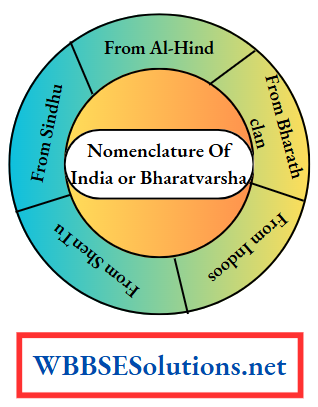
India is called Bhaarat- Varsha. It is derived from ‘Bharat’, the name of an old clan. The descendants of ‘Bharat’ lives here.

Aryavarta:

The Aryans settled down at the central part of the Gangetic valley to the north of the Vindhyas. This region extends from the Saraswati river in the west to Varanasi in the east was called Aryavarta.

Archaeological Sources Introduction

Dakshinatya:

The region to the south of the Vindhyas where the Dravidians lived was known as Dakshinatya. It extended from the Vindhyas to Kanyakumarika.

WBBSE Classa 6 History Chapter 1 An Introduction To History Notes Nomeenclature of inia or Bharatvarsha

Pre-historic Age:

Pre-historic Age refers to the period written records of which are not available. It covers the time span between the appearance of man on earth and the invention of the art of writing. This age was called the Stone Age and its history can be reconstructed with the help of archaeological remains only.

Proto-historic Age:

Proto-historic Age refers to the period when the art of writing was invented and some sort of scripts came to be used in different countries but those scripts have not been deciphered yet.

Example: Harappan civilization belonged to this age.

WBBSE Solutions For Class 6 Geography WBBSE Solutions For Class 6 History WBBSE Solutions For Class 6 Maths
WBBSE Class 6 Geography Notes WBBSE Class 6 History Notes
WBBSE Class 6 Geography Multiple Choice Questions WBBSE Class 6 History MCQs WBBSE Notes For Class 6 School Science


Historic Age:

The period of which written records are available and those scripts have been deciphered is referred to as the Historic Age. This age began during the Iron Age. The Vedic civilization belonged to this period.

Ice Age:

The Ice Age began around 70,000 years ago. The atmosphere over the earth began to grow colder. It became so cold that a major part of the land got covered with ice sheets and all the waterbodies froze. This age was called Ice Age. The last Ice Age existed about 10,000 years ago.

Metal Age:

The age in which man learned the use of metals like copper, bronze, and iron is known as the Metal Age.

Copper Age:

The age in which man knew the use of copper only is known as the Copper Age. Iron Age: The period when man first learned the use of iron is referred to as the Iron Age.

As man had learned to make wheels the communication system developed considerably during this age. The tools and implements made of iron were hard and durable. This led to the development of agriculture.

Circa:

The term ‘circa’ means approximately. Sometimes it becomes very difficult to determine the exact date of an event or the exact beginning or end of an age. So some dates have to be approximated. The term circa (C) is used to show such approximate dates.

WBBSE Class 6 History Chapter 1 An Introduction To History Notes

Anno Domini (AD):

The time calculated from the birth of Jesus Christ is called Anno Domini. According to the Christian calendar, the year of Christ’s birth is taken as the base year and the period preceding it is referred to as BC and the period following it is referred to as AD.

Christian Era:

The time before Christ’s birth is referred to as BC and the time after his birth is referred to as AD.

Sources of history:

Evidence and trials for the reconstruction of history are called sources of history.

Archaeological Sources Introduction

Archaeologist:

An archaeologist is a person who excavates old materials from underground and studies them.

Prasasti:

The word ‘Prasasti’ means eulogy or praise. Some inscriptions contain eulogies of rulers written on them. Many facts can be known about the rulers from their respective precasts. For example, the Allahabad Prasasti provides us with much valuable information

WBBSE Class 6 History Chapter 1 An Introduction To History Notes Literary sources of history

Museum:

A museum is a place where the archaeological remains of the earlier days are carefully preserved. Some of the things thus preserved are bones of animals, garments of kings and queens, articles of daily use, weapons, statues, pictures, coins, and manuscripts.

Chronology:

Chronology means the order or sequence of events. Chronology is an important part of history because history always refers to a time frame in some way or the other.

So the events in history are described in the same order as they actually happened and thus continuity is maintained.

WBBSE Chapter 1 An Introduction To History Formative

Didi Moni (teacher) said that to understand History, it is necessary to have a knowledge of Geography. This took everyone by surprise. Their history and geography books are different, classes are separate. Then how come Didimoni made such a remark? This was what Pritha asked. Didi Moni explained, “Actually history chiefly concerns itself with peoples’ activities.

Many of their activities or work are determined by the environment or geographical conditions within which they live. Consider, for example, the riverine people who live a certain kind of life. In their daily functions, the river has immense significance.

Again there are people who live in the deserts. In their lives, a river is less significant. You will see that in the desert people usually travel by camel. On the other hand, people of riverine places use boats.

Many of us have to board boats to cross rivers. Again in Rajasthan, people ride on camels to cross the desert. This has been the practice for a long time. Therefore, in the history of the transportation of West Bengal, one comes to know about boats. Similarly, in the case of Rajasthan, one will read about camels. Why is there a difference in the transport history of the two regions? This is because their environment and geography are different.

Therefore, history differs according to the particular locality and its environment. There are marked differences in food, dress, transport, commerce, and work. And this happens from very small localities to large areas. Let us consider, why do people of the plain regions mostly eat rice?” Rahul replied, “This is because there is more paddy cultivation in the plains.” Didimoni said, “That is right.”

Archaeological Sources Introduction

Palash said “My uncle lives in Rajasthan. Their paddy is not much cultivated. In my uncle’s house, chapatti is mostly eaten.” Didimoni said, “This is how most human activities are determined by the environment and by geography.

Hence to understand history it is necessary to have a sense of geography. Do you remember that the two key axioms of tales of history were ‘why’ and ‘where’? To precisely comprehend this ‘why’ and ‘where we must know about the environment and geography”.

Apes and hominids:

‘Apes’ were big, tailless monkeys who lived on earth before the appearance of human beings. ‘Hominids’ were the first human beings. The apes gradually transformed into hominids due to changes in climate and food habits.

Primitive man:

The term ‘primitive man’ is used to refer to human beings of very ancient times. There are divisions among primitive man determined by the shapes of skulls. These divisions are Australopithecus, Homo Habilis, Homo Erectus, and Homo Sapiens.

Lucy:

The skeleton of a young girl was found in 1974 in the Hadar region of Ethiopia in Africa. This skeleton, named Lucy, belonged to the Australopithecus category and has been estimated to be 32,00,000 years old.

Stone Age:

Stone Age was a time in history when primitive man used tools and weapons made out of stone. Stone Age may be divided into three stages-Old Stone Age, Middle Stone Age, and New Stone Age.

WBBSE Class 6 Primitive Man Notes

Old Stone Age:

The period of the Old Stone Age was approximately from 2 million years B.C. to 10,000 BC. The primitive man of the Old Stone Age were hunters and food gatherers. Weapons of this age were heavy, large, and rough.

Middle Stone Age:

The period of the Middle Stone Age was approximately from 10,000 BC to 8,000 BC. The stone weapons of this age were small, light, and sharp. Along with hunting and gathering food, a primitive man of this age also began to rear animals.

New Stone Age:

The period of the New Stone Age was approximately from 8,000 BC to 4,000 BC. Weapons of this period were much lighter and sharper. Primitive men of this age abandoned nomadic life and started a settled life.

Stone Age Tools in Indian Subcontinent:

Stone Age tools have been discovered in Kashmir’s Swan Valley, Patawar Plateau of Pakistan, Shivalik in Himachal Pradesh, Hunsgi Valley of Karnataka, Sarai Nahar Rai in Uttar Pradesh, and some other places in the Indian Subcontinent.

Important Definitions Related to Primitive Man

Hunsgi Valley:

The Hunsgi Valley is located in the northwest of Gulbarga district in Karnataka. The Kathta Halla canal flows by it. Some weapons of the Stone Age like axe, knives, and scrapers were unearthed here in 1983. Historians guess that these weapons are about 5-6 lakh years old.

Bhimbetka:

The Bhimbetka cave is located near the Vindhyas at some distance from Bhopal in Madhya Pradesh. The Bhimbetka cave became famous for the drawings made by primitive men who lived there. Most of them depict hunting scenes. There are also colorful pictures of birds and animals.

Altamira:

The Altamira cave is located in the mountainous region of Spain in Europe. A number of drawings of animals have been found here. These were drawn by cave dwellers about 30,000 to 50,000 years ago. The most notable is that of the Taro (bull).

Discovery of fire:

Primitive man discovered fire. Fire protected them from the attacks of wild animals. They started to eat roasted meat and could save themselves from the cold by lighting fire.

Signs of civilization:

In the New Stone Age lifestyle of the primitive man began to change. They began to make permanent settlements. Different signs of civilization could be seen in the lifestyles of the people. They gradually began to move towards a civilized life.

Excerpt from the text:

The use of fire is a very significant event in the course of human history. All other animals are afraid of fire. Of the animals, it is only human beings who can light and use fire.

Initially, they used to watch forest fires or fires kindled in some other way. Later perhaps at some point, they brought a burning branch inside their cave to make fire. Then, perhaps suddenly, one-day primitive man learned to light a fire.

Perhaps in the process of making stone weapons, flint stones were accidentally struck against each other and that created fire. Or, they learned to light a fire by rubbing pieces of wood against one another.

The use of fire led to a number of changes. On one hand, fire acted as a shield from the intense cold. At the same time, the fire could also be used to protect against the attack of different animals. A fire had also changed the food habits of primitive man.

History Class 6 Chapter 2 Question Answer WBBSE

Instead of raw flesh, they began to consume meat roasted on the fire. For consuming the soft roasted meat, much less pressure needed to be applied by their jaws and teeth.

This led to a gradual change in the shape of human jaws which became narrow; the sharp long front teeth became smaller. Other changes came about in their anatomy.

There was an increase in the physical strength of primitive humans; their intelligence developed further too.

Questions related to the above text are given below for formative evaluation.

WBBSE Class 6 History Chapter 2 Primitive Man In The Indian Subcontinent MCQs

WBBSE Class 6 Chapter 2 Primitive Man In The Indian Subcontinent Multiple Choice Question And Answers

Question 1. Intelligent human beings were known as

  1. Homo Erectus
  2. Neanderthal
  3. Homo Habilis
  4. Homo Sapiens

Answer: 4. Homo Sapiens

Question 2. Evidence of the presence of Homo Erectus

  1. Didwana
  2. Java
  3. China
  4. Swan Valley

Answer: 1. Didwana

Read and Learn More WBBSE Class 6 History MCQs

Question 3. On what basis divisions among primitive men are determined?

  1. Legs
  2. Brain
  3. Fingers
  4. Height

Answer: 2. Brain

Question 4. Millions of years ago land of the earth was covered with

  1. Snow
  2. Trees
  3. Dense forest
  4. Sand

Answer: 3. Dense forest

Question 5. The part of the continent of Africa which was covered with the dense forest was the

  1. Eastern part
  2. Southern part
  3. Western part
  4. Northern part

Answer: 1. Eastern part

WBBSE Class 6 History Chapter 2 Primitive Man In The Indian Subcontinent MCQs

Question 6. Millions of years ago in the eastern part of the continent of Africa, there were big tailless monkeys known as

  1. Chimpanzee
  2. Ape
  3. Gorilla
  4. Macaque

Answer: 2. Ape

Question 7. A particular kind of human species who could barely stand on their feet came around

  1. 4 to 3 million years back
  2. 5 to 4 million years back
  3. 2 to 1 million years back
  4. 7 to 6 million years back

Answer: 1. 4 to 3 million years back

WBBSE Solutions For Class 6 Geography WBBSE Solutions For Class 6 History WBBSE Solutions For Class 6 Maths
WBBSE Class 6 Geography Notes WBBSE Class 6 History Notes
WBBSE Class 6 Geography Multiple Choice Questions WBBSE Class 6 History MCQs WBBSE Notes For Class 6 School Science


Question 8. To date traces of the most primitive man have been found in

  1. West Africa
  2. North Africa
  3. East Africa
  4. South Africa

Answer: 3. East Africa

Question 9. The word primitive means

  1. Late
  2. Very old
  3. Cnew
  4. Modern

Answer: 2. Very old

Question 10. On what basis divisions among primitive men are determined?

  1. Legs
  2. Skull
  3. Fingers of hand
  4. Height

Answer: 2. Skull

Question 11. The first among the primitive men to use stones as a weapon were the

  1. Homo Habilis
  2. Homo Erectus
  3. Homo Sapiens
  4. Australopithecus

Answer: 1. Homo Habilis

Question 12. Homo Habilis means

  1. Intelligent human beings
  2. Ape to man
  3. Skilled human beings
  4. Modern Man

Answer: 3. Skilled human beings

Question 13. The first among the primitive men to make stone weapons like spears were the

  1. Homo Sapiens
  2. Homo Habilis
  3. Homo Erectus
  4. Australopithecus

Answer: 1. Homo Sapiens

Question 14. The first among the primitive men to learn the use of fire were

  1. Homo Habilis
  2. Homo Erectus
  3. Australopithecus
  4. Homo Sapiens

Answer: 2. Homo Erectus

Question 15. Intelligent human beings were the

  1. Australopithecus
  2. Homo Sapiens
  3. Homo Habilis
  4. Homo Erectus

Answer: 2. Homo Sapiens

Question 16. The first among primitive men to wear animal skins were the

  1. Homo Erectus
  2. Homo Habilis
  3. Homo Sapiens
  4. Australopithecus

Answer: 3. Homo Sapiens

Question 17. A very significant event in the course of human history is

  1. Use of fire
  2. Use of metal
  3. Use of chopper
  4. Use of horse

Answer: 1. Use of fire

Question 18. The skeleton of Lucy was discovered in

  1. 1974
  2. 1972
  3. 1970
  4. 1976

Answer: 1. 1974

Question 19. Human beings can be distinguished from other creatures.

  1. Man has some specific physical features.
  2. Man has greater strength than other creatures.
  3. The size of man’s brain is bigger than those of other creatures.

Answer: 1. Man has some specific physical features.

Question 20. Statement The number of trees decreased in the primitive age.

  1. Many trees were cut down to light fire.
  2. The climate gradually changed.
  3. In the primitive age trees were consumed by forest fires.

Answer: 2. The climate gradually changed.

Question 21. Statement There are several classifications of primitive man.

  1. The size of the palms of primitive men were different.
  2. The heights of Primitive men differed.
  3. The shape of the brains of primitive men is different.

Answer: 3. The shape of the brains of primitive men is different.

Question 22. Statement Primitive men had learned to make stone weapons.

  1. To protect themselves from wild animals.
  2. To build colonies for settlement.
  3. To win battles against other clans.

Answer: 1. To protect themselves from wild animals.

Question 23. Statement Primitive man consumed meat after roasting it on fire.

  1. The amount of meat increased on burning.
  2. Burnt meat was softer than raw meat.
  3. Burnt meat could be preserved for some days.

Answer: 2. Burnt meat was softer than raw meat.

Question 24. Statement The jaws of primitive man gradually became thinner.

  1. They developed the habit of eating from the ground like the reptiles.
  2. Various changes took place in the physical structure of all creatures.
  3. Less strength was needed to chew the burnt meat.

Answer: 3. Less strength was needed to chew the burnt meat.

Question 25. Statement The Old Stone Age is divided into different phases.

  1. During this time weapons were made with the help of different techniques.
  2. During this period, it has been noted that the physical features of man changed several times.
  3. During this period the people of different clans developed different habits.

Answer: 1. During this time weapons were made with the help of different techniques.

Question 26. The oldest stone tools of the Indian subcontinent have been found in

  1. Swan Valley
  2. Ganga Valley
  3. Indus Valley
  4. Narmada Valley

Answer: 1. Swan Valley

Question 27. Skeletons and bones of primitive man have been found in

  1. Africa, India, Java
  2. Africa, China, Java
  3. China, Java, India
  4. Africa, Spain, Cuba

Answer: 2. Africa, China, Java

Question 28. Tools have been discovered in the Patawar plateau of

  1. Africa
  2. China
  3. Java
  4. Pakistan

Answer: 4. Pakistan

History Class 6 Chapter 2 WBBSE

Question 29. Evidence of the presence of Homo Erectus species have been found in

  1. Didwana
  2. China
  3. Java
  4. Swan Valley

Answer: 1. Didwana

Question 30. There are evidence of cave-dwellings at

  1. Kashmir’s
  2. Swan Valley
  3. Nevasa in Maharashtra
  4. Sanghao in north-west Pakistan
  5. Narmada Valley

Answer: 4. Sanghao in north-west Pakistan

Question 31. Microliths are

  1. Small stone weapons
  2. Large stone weapons
  3. Two-edged knife
  4. Bones of sheep and goat

Answer: 1. Small stone weapons

Question 32. Two-edged knife have been discovered from

  1. Adamgarh
  2. Sarai Nahar Rai
  3. Mahadaha
  4. Bangor region

Answer: 2. Sarai Nahar Rai

History Class 6 Chapter 2 WBBSE

Question 33. Bones of primitive man have been found in the Bagor region of

  1. Rajasthan
  2. Uttar Pradesh
  3. Madhya Pradesh
  4. Maharashtra

Answer: 1. Rajasthan

Question 34. The ceiling of the cave of Altamira has a painting of a

  1. Huge cow
  2. Huge dog
  3. Huge bull
  4. Human skull

Answer: 3. Huge bull

Question 35. In the Narmada valley of Madhya Pradesh, human skulls have been discovered that are more than

  1. 1,20,000 years old
  2. 1,30,000 years old
  3. 1,40,000 years old
  4. 1,50,000 years old

Answer: 2. 1,30,000 years old

Question 36. Isampur village is located in the

  1. Hunsgi valley
  2. Bhimbetka
  3. Didwana
  4. Narmada valley

Answer: 1. Hunsgi valley

Question 37. In 1983 weapons of the Old Stone Age have been unearthed in

  1. Isampur village in Karnataka
  2. Nevasa in Maharashtra
  3. Bhopal in Madhya Pradesh
  4. Shivalik in Himachal Pradesh

Answer: 1. Isampur village in Karnataka

History Class 6 Chapter 2 WBBSE

Question 38. Colours used in the Bhimbetka cave paintings are

  1. yellow and green
  2. Green and blue
  3. Blue and yellow
  4. Blue and red

Answer: 1. yellow and green

Question 39. Many believe that in Hunsgi primitive men Ans used to make

  1. Baskets and vessels
  2. Two-edged knife
  3. Stone weapons
  4. Paintings of different kinds of animals

Answer: 3. Stone weapons

Question 39. In the Middle Stone Age, a congenial atmosphere was created for living.

  1. Deserts were created due to natural changes.
  2. It was too cold and everything was covered by ice.
  3. The snow melted and the plains became suitable for living.

Answer: 3. The snow melted and the plains became suitable for living.

Question 40 The weapons of the Middle Stone Age were called microliths.

  1. The weapons were sharper and smaller than the earlier weapons.
  2. The weapons were smaller but heavier than the earlier weapons.
  3. The weapons were lighter but blunter than the earlier weapons.

Answer: 1. The weapons were sharper and smaller than the earlier weapons.

Question 41. The men of the New Stone Age built up permanent settlements in the cultivable areas.

  1. They had to stay near the agricultural fields in order to sell agricultural products.
  2. They had to stay near the fields to look after agriculture.
  3. They had to stay near the fields to pay the revenue.

Answer: 2. They had to stay near the fields to look after agriculture.

WBBSE Class 6 History Chapter 3 Ancient History Of The Indian Subcontinent MCQs

WBBSE Class 6 History Chapter 3 Ancient History Of The Indian Subcontinent Multiple Choice Questions

Question 1. Stones record facts of

  1. Science
  2. Biology
  3. History
  4. Wars

Answer: 3. History

Question 2. Ever since the Stone Age man had begun to form

  1. Government
  2. Communities
  3. Cities
  4. Villages

Answer: Communities

Question 3. Mehrgarh civilisation was a

  1. Urban civilisation
  2. Rural civilisation
  3. Industrial civilisation
  4. Nomadic civilisation

Answer: 2. Rural civilisation

Read and Learn More WBBSE Class 6 History MCQs

Question 4. The Mehrgarh civilisation flourished during the

  1. Copper-Stone Age
  2. Copper-Iron Age
  3. Old Stone Age
  4. Middle Stone Age

Answer: 1. Copper-Stone Age

WBBSE Solutions For Class 6 Geography WBBSE Solutions For Class 6 History WBBSE Solutions For Class 6 Maths
WBBSE Class 6 Geography Notes WBBSE Class 6 History Notes
WBBSE Class 6 Geography Multiple Choice Questions WBBSE Class 6 History MCQs WBBSE Notes For Class 6 School Science


Question 5. Mehrgarh civilisation has been discovered in

  1. Afghanistan
  2. Rajasthan
  3. Pakistan
  4. Haryana

Answer: 3. Pakistan

WBBSE Class 6 History Chapter 3 Ancient History Of The Indian Subcontinent MCQs

Question 6. The civilisation which flourished roughly during the period 4300 and 3800 BC was the

  1. Indus Valley Civilisation
  2. Mehrgarh Civilisation
  3. Vedic Civilisation
  4. Harappan Civilisation

Answer: 2. Mehrgarh Civilisation

Question 7. In the Mehrgarh civilisation, the use of copper became evident in the

  1. First phase
  2. Second phase
  3. Third phase
  4. Fourth phase

Answer: 3. Third phase

Question 8. The oldest granary of the subcontinent has been found in

  1. Harappa
  2. Lothal
  3. Mehrgarh
  4. Burzahom

Answer: 3. Mehrgarh

WBBSE Class 6 History Chapter 3 Questions And Answers

Question 9. The oldest evidence of cotton cultivation in the world has been found in

  1. Mehrgarh
  2. Mesopotemia
  3. Mohenjodaro
  4. Harappa

Answer: 1. Mehrgarh

Question 10. The oldest phase of Mehrgarh civilisation was approximately between

  1. A5000 and 4000 BC
  2. 4300 and 3800 BC
  3. 9000 and 6000 BC
  4. 7000 and 5000 BC

Answer: 4. 7000 and 5000 BC

Question 11. By what other name is the Indus civilisation known?

  1. Harappan civilisation
  2. Pre-Harappan civilisation
  3. Mehrgarh Civilisation
  4. Vedic Civilisation

Answer: 1. Harappan civilisation

Question 12. To which age of civilisation belonged the Harappan civilisation

  1. Bronze Age
  2. Chalcolithic Age
  3. Stone Age
  4. Iron Age

Answer: 2. Chalcolithic Age

Question 13. The excavation work in Mohenjodaro by Rakhaldas Bandopadhyay began in

  1. 1920
  2. 1923
  3. 1921
  4. 1926

Answer: 3. 1921

Question 14. Which river cradled the Harappan civilisation?

  1. Beas
  2. Indus
  3. Chenub
  4. Ravi

Answer: 2. Indus

Question 15. Which principal metal the people of Harappan civilisation did not use in their daily life?

  1. Iron
  2. Copper
  3. Bronze
  4. Aluminium

Answer: 1. Iron

WBBSE Class 6 History Question Answer

Question 16. What was the main source of living of the people of Harappan civilisation?

  1. Fishing
  2. Agriculture
  3. Hunting
  4. Carpentry

Answer: 2. Agriculture

Question 17. Name one port of Harappan civilisation.

  1. Gumla
  2. Kalibangan
  3. Lothal
  4. Burzahom

Answer: 3. Lothal

Question 18. Name one country where Harappan’s articles have been discovered.

  1. Java
  2. Sumatra
  3. Mesopotamia
  4. Siam

Answer: 3. Mesopotamia

Question 19. The Harappan towns were built in

  1. Three parts
  2. Two parts
  3. Four parts
  4. Five parts

Answer: 2. Two parts

Question 20. Who was associated with the discovery of the Indus valley civilisation?

  1. Dayaram Sahni
  2. Vincent Smith
  3. Richard Meadow
  4. Jean Francois Jarrige

Answer: 1. Dayaram Sahni

Question 21. Harappan script written in a particular order on a signboard has been discovered from

  1. Kalibangan
  2. Dholavira
  3. Banawali
  4. Lothal

Answer: 2. Dholavira

Question 22. The Harappan civilisation appeared to decline after

  1. 1750 BC
  2. 1850 BC
  3. 1500 BC
  4. 2000 BC

Answer: 1. 1750 BC

Question 23. The image of the animal never found on the seals of Harappa is

  1. Ox
  2. Tiger
  3. Cow
  4. Rhinoceros

Answer: 3. Cow

Question 24. Harappan artefacts have been found in modern-day

  1. Baluchistan
  2. Turkmenistan
  3. Daimabad
  4. Tajikistan

Answer: 2. Turkmenistan

Question 25. One of the most significant characteristics of the Mehrgarh civilisation is the presence of

  1. Graveyards
  2. Mudbrick houses
  3. Citadel
  4. Granary

Answer: 2. Mudbrick houses

Question 26. The people of Mehrgarh did not know the use of

  1. Iron
  2. Copper
  3. Stone
  4. Wood

Answer: 1. Iron

Question 27. The Harappan civilization began to decline after

  1. 1250 BC
  2. 1500 BC
  3. 1750 BC
  4. 1950 BC

Answer: 2. 1500 BC

Question 28. People began to lead settled life.

  1. They had to wander about for food.
  2. They needed a fixed dwelling place.
  3. They had to safeguard their lands.

Answer: 3. They had to safeguard their lands.

Question 29. Differences of opinion could be seen among the groups.

  1. There were conflicts about building houses.
  2. There were disputes over land.
  3. Disputes arose over money.

Answer: 2. There were disputes over land.

Question 30. Mehrgarh was a Copper-Stone Age civilisation.

  1. Here both copper and stone were used.
  2. Here except copper and stone all other metals were used.
  3. Here people first used copper and then stone.

Answer: 1. Here both copper and stone were used.

Question 31. Civilisation grew up centring the villages and towns.

  1. Many factories grew up in the towns and villages.
  2. The number of conveyances increased.
  3. Human settlements increased in towns and villages.

Answer: 3. Human settlements increased in towns and villages.

Question 32. Statement In Mehrgarh certain structures were bigger than the common residential houses.

  1. These are inhabited by rich people only.
  2. These are used to store grain.
  3. These are the residential houses of administrators.

Answer: 2. These are used to store grain.

Question 33. Harappan civilisation is a proto-historic civilisation.

  1. Harappans knew the uses of copper and bronze.
  2. Harappans could write but their scripts have not yet been deciphered.
  3. Harappans had learnt to light fire.

Answer: 2. Harappans could write but their scripts have not yet been deciphered.

Question 34. Harappan civilisation is the first urbanisation in India.

  1. The first cities grew up in Harappa.
  2. Agriculture first began in Harappa.
  3. Trade and commerce first started in Harappa.

Answer: 1. The first cities grew up in Harappa.

Question 35. The traders enjoyed special prestige in the Harappan cities.

  1. There was much development of trade.
  2. The traders lived in the cities.
  3. The traders were a majority in the society.

Answer: 1. There was much development of trade.

Question 36. The urban citizens of Harappa had to depend on the villages for food.

  1. Food production was less in the cities.
  2. Food was not directly produced in the cities.
  3. Surplus food was produced in the villages.

Answer: 2. Food was not directly produced in the cities.

Question 37. The Harappan seals were very important.

  1. The seals were used for trade and commerce.
  2. The seals were made of superior metals.
  3. The antiquity of the Harappan civilisation can be known from the seals.

Answer: 1. The seals were used for trade and commerce.

WBBSE Class 6 History Chapter 3 Ancient History Of The Indian Subcontinent Notes

WBBSE Chapter 3 Ancient History Of The Indian Subcontinent Introduction

Civilisation:

The Mehrgarh civilisation was the earliest rural civilisation that flourished in India during the New Stone Age. It was discovered by the French archaeologist Jean Francois Jarrige and the chief of the archaeological department of Pakistan Richard Meadow.

Read And Learn More WBBSE Class 6 History Notes

Harappan Civilisation:

The Harappan civilisation or the Indus Valley Civilisation was an urban civilisation. It was discovered by Dayaram Sahni and Rakhaldas Bandopadhyay. It is a proto-historic civilisation.

WBBSE Class 6 History Chapter 3 Ancient History Of The Indian Subcontinent Notes

Important sites of the Harappan civilisation:

Some important sites of the Harappan civilisation are Lothal, Mohenjodaro, Harappa, Kalibangan, Dholavira, Chanhudaro, Kuntasi, Banawali, Surakotada.

WBBSE Solutions For Class 6 Geography WBBSE Solutions For Class 6 History WBBSE Solutions For Class 6 Maths
WBBSE Class 6 Geography Notes WBBSE Class 6 History Notes
WBBSE Class 6 Geography Multiple Choice Questions WBBSE Class 6 History MCQs WBBSE Notes For Class 6 School Science


Different aspects of civilisation:

The different aspects of a civilisation are rural and urban life, script, administrative structure, art and architecture.

Harappan seals:

The Harappan seals contained scripts and symbols inscribed on them. They were made of soft stone and most of them carried a reverse design, usually of some animal along with a short inscription.

Important Definitions Related to Mehrgarh Civilisation

Barter system: The exchange of one commodity for another is known as a barter system.

Prepare a poster comparing the administrative system of the Harappan civilisation and present day India.

WBBSE Solutions For Class 6 History Chapter 3 Ancient History Of The Indian Subcontinent Notes Administrative system

The poster will inculcate a sense of creativity and will help the learner to develop further knowledge about society.

WBBSE Solutions For Class 6 History Chapter 1 An Introduction To History

WBBSE Chapter 1 An Introduction To History Long Answer Type Questions

Question 1. To understand history why is it necessary to have a knowledge of geography?
Answer:

We Should Have A knowledge of geography:

Human activities are determined by the environment and geography. Geography plays an important role in molding the history of a country.

Read and Learn More WBBSE Solutions For Class 6 History

The influence of mountains, rivers, and seas is evident in the political, economic, social, and cultural history of India. Hence, to understand history, it is necessary to have a knowledge of geography.

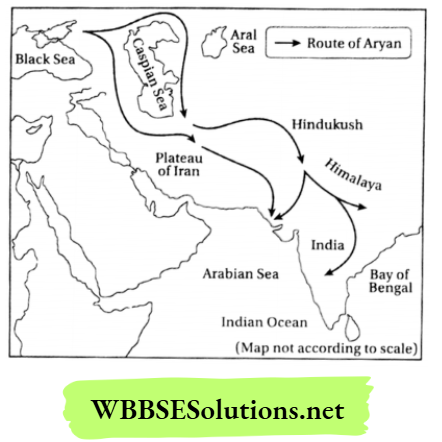
WBBSE Solutions For Class 6 History Chapter 1 An Introduction To History Route of Aryan

This map shows the path followed by the Aryans to enter India and their place of emergence. Though it is impossible for a history student to understand the map without knowledge of geography.

Practice Questions on Historical Events

Reading the extract, curiosity will develop in the mind of the learner regarding the relationship between history and geography. If questions like the one mentioned above are asked, the learner through queries will come to know more about the topic.

WBBSE Solutions For Class 6 Geography WBBSE Solutions For Class 6 History WBBSE Solutions For Class 6 Maths
WBBSE Class 6 Geography Notes WBBSE Class 6 History Notes
WBBSE Class 6 Geography Multiple Choice Questions WBBSE Class 6 History MCQs WBBSE Notes For Class 6 School Science


Question 2. Prepare a comparison chart of History and Geography individually or in groups.
Answer:

History Geography
The study of history focuses on all of the human experience. Geography focuses on human interaction with the physical environment.
History is the study of past events. Geography is the study of the physical structure and inhabitants of the earth.
History asks about what happened and when. Geography asks about what happened and where.
History views human experience from the perspective of time. Geography views human experience from the perspective of space.


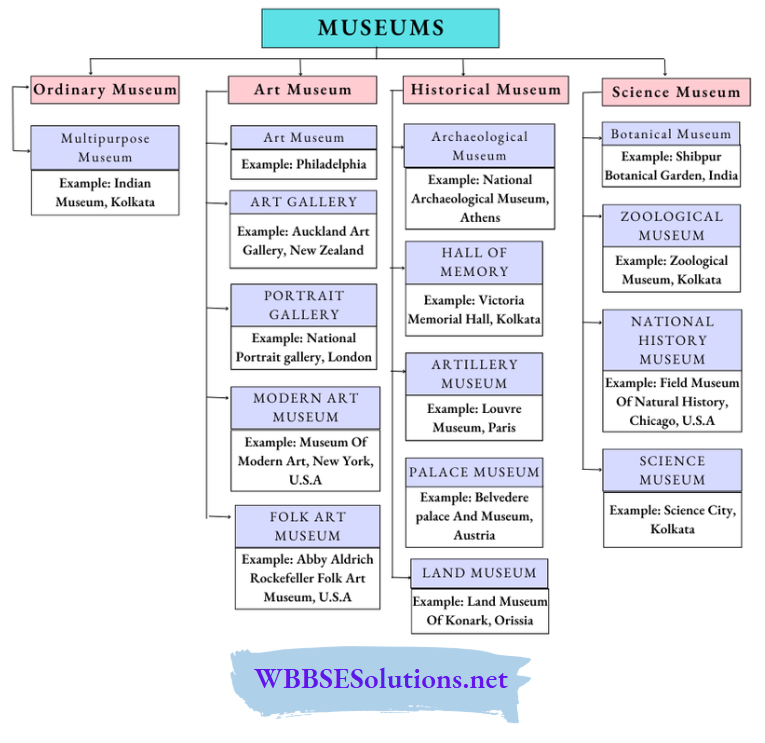
Question 4. Prepare a chart showing the different types of museums.
Answer:

Examples of Historical Evidence

WBBSE Solutions For Class 6 History Chapter 1 An Introduction To History Different Types Of Museums

WBBSE Chapter 1 An Introduction To History Short Answer Type Questions

Question 1. Why was the history of ancient India not recorded properly?
Answer:

The history of ancient India not recorded properly:

It is a misfortune that India has not produced historians like Herodotus, Thucydides, etc. The people of India were not very serious about writing history chronologically. Therefore, the ancient history of India was not recorded properly.

Question 2. Why were different aspects of geography studied?
Answer:

Different aspects of geography studied:

To study the history of ancient India, knowledge of geography is essential because the activities of the people depend on the environment and geography. Different people live in different environments, so different aspects of geography are studied.

While discussing the above text why history is important can be highlighted. With reference to the above questions, the learners will be able to show their capability of interpretation and application.

WBBSE Solutions For Class 6 History Chapter 1 An Introduction To History

WBBSE Chapter 1 An Introduction To History Very Short Answer Type Questions

Question 1. What is history?
Answer:

History: History is stories of earlier times.

Common Questions About Historical Sources

Question 2. What is geography about?
Answer:

Geography: Geography deals with the study of the earth, its physical features, environment, and relationship to human beings.

To know history, knowledge of geography is essential – keeping this in mind the learner can participate in the discussion mentioned above and other questions related to the topic.

WBBSE Solutions For Class 6 History Chapter 9 India And The Contemporary World Topic C Miscellaneous

WBBSE Chapter 9 India And The Contemporary World Topic C Miscellaneous Long Answer Type Questions

Question 1. Examine the popularity of Buddhism as a religion.
Answer:

The popularity of Buddhism as a religion:

Buddhism founded by Gautama Buddha gained wide acceptance and became a popular religion.

  1. Menander, the Indo-Greek king, under the influence of the Buddhist monk Nagasena, adopted Buddhism. He took initiative to spread Buddhism.
  2. Emperor Ashoka took some steps to spread. Buddhism outside the Indian subcontinent. He sent envoys to places like Syria, Sri Lanka, Macedonia, Egypt, etc.
  3. The Greeks who came with Alexander gradually merged into Indian culture and embraced Buddhism.
  4. The Kushana emperor Kanishka adopted Buddhism. During his reign, Gandhara art evolved around Buddhism.
  5. Buddhist religion and studies was practiced in Kashmir. Buddhayasha was a renowned Kashmiri Buddhist scholar who went to Kashgar in Central Asia.
  6. Paramartha went to China and there he practiced Buddhist religion and philosophy.
  7. Kumarajiva went to Kashmir and studied Buddhism. He holds a significant place in the spread of Buddhist religion and philosophy.
  8. A Chinese scholar named Tao ngan encouraged the Buddhist Scholar from China to visit India. Faxian and Xuanzang came to India and studied the Buddhist religion.

Read and Learn More WBBSE Solutions For Class 6 History

Question 2. What was the importance of the Gandhara region?
Answer:

The importance of the Gandhara region:

Gandhara was located to the northwest of the Indian subcontinent. The importance of the Gandhara region can never be underestimated.

  1. Communication between the Persian and the Indian subcontinent was established via Gandhara.
  2. It was located at a central position which helped to spread Buddhism to Central and East Asia.
  3. It was an important cultural centre. It was the home of a distinctive art style that was a mixture of an Indian Buddhist and Graeco-Roman influence. The art was known as Gandhara art.
  4. The Gandhara art which developed in the Gandhara province evolved around Buddhism. New kinds of Buddha images were made.
WBBSE Solutions For Class 6 Geography WBBSE Solutions For Class 6 History WBBSE Solutions For Class 6 Maths
WBBSE Class 6 Geography Notes WBBSE Class 6 History Notes
WBBSE Class 6 Geography Multiple Choice Questions WBBSE Class 6 History MCQs WBBSE Notes For Class 6 School Science


Question 3. What in your opinion, was the role of education in furthering the contact between the Indian subcontinent and the outside world in ancient times?
Answer:

The role of education in furthering the contact between the Indian subcontinent and the outside world in ancient times:

Education played a significant role in furthering the contact between the Indian subcontinent and the outside world in ancient times.

1. Scholars from abroad to the Indian subcontinent:

Many scholars and students including Fa Hein (Faxian), Hieun Tsang (Xuanzang), and others came from China for learning and religious discussions. They not only learned about Buddhism and Brahmanism but also studied literature, science, and medicine.

The universities of Nalanda, Taxila, and other educational centers helped in establishing close contact between India and China.

2. Scholars of the Indian subcontinent to different countries:

Buddhayasha, a well known Kashmiri Buddhist scholar visited Kashgarh in Central Asia. Paramartha visited China with the aim of education. He carried with him some Buddhist literature.

Kumarajiva went to the Chinese capital and remained there. He devoted his life to the study of Buddhist religion and philosophy.

WBBSE Solutions For Class 6 History Chapter 9 India And The Contemporary World Topic C Miscellaneous

Question 4. Compare the pictures of the coins in chapter 9 with those of chapters 6 and 7 respectively and find out the similarities and dissimilarities between the two sets.
Answer:

Similarities between the pictures

  1. The coins of the Kushanas, Guptas, Satavahanas, and Greeks were circular.
  2. Gold coins were in use in ancient India during the time of the Maurya, Kushana, Gupta, and Greek rulers.
  3. The pictures of the kings were engraved on the coins of the Maurya, Kushana, Gupta, and Greek rulers.
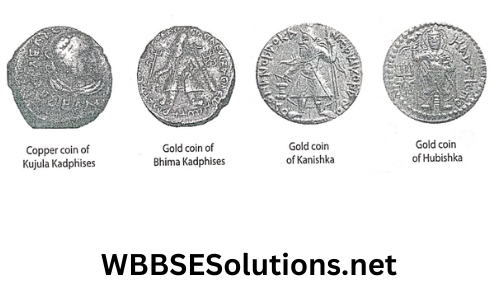
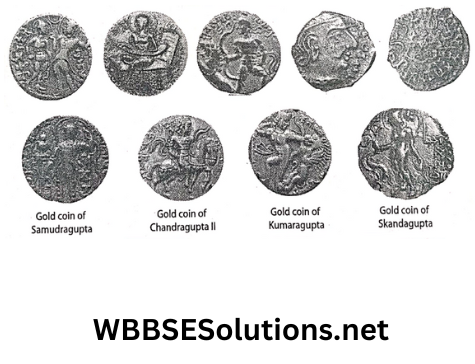
 

WBBSE Solutions For Class 6 History Chapter 9 India And The Contemporary World Topic C Miscellaneous Coins of Kushana Age


WBBSE Solutions For Class 6 History Chapter 9 India And The Contemporary World Topic C Miscellaneous Coins of Gupta Age

Examples of Coastal Kingdoms in Ancient India

Dissimilarities between the pictures

  1. The coins of the Mauryas and those of ancient India were not circular in shape but those of the Kushanas, Guptas, and Greeks were circular.
  2. Chandragupta Il first initiated silver coins in the Gupta period. However, silver coins were not in use in the post-Gupta or Kushana period.
  3. The Kushana and Greek coins portrayed only the images of the kings but the coins of Mauryas, Guptas, and ancient India had other pictures carved on them apart from the faces of kings.
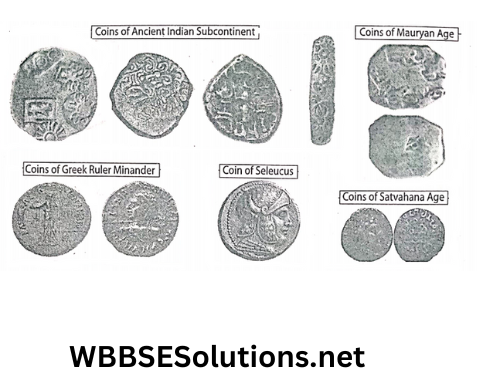
 

WBBSE Solutions For Class 6 History Chapter 9 India And The Contemporary World Topic C Miscellaneous Different Coins

Question 5. What is the importance of this place?
Answer:

The importance of this place:

In Bodh Gaya, sitting under the Pipal tree, Siddhartha attained enlightenment. The Mahabodhi temple is just beside the tree. This temple is a holy place both for the Hindus and the Buddhists.

A little distance from Bodh Gaya is Nalanda, which was an important center of education in ancient India. In the Gupta period, the Nalanda university became very famous.

Question 6. What steps have been taken and what more steps according to you can be taken to make this place attractive to the foreign tourists?
Answer:

To preserve this place the archaeological department of India has taken many steps. There is a museum where different artifacts obtained after archaeological excavation are exhibited.

Besides this, in this locality, different countries have constructed Buddhist temples which have given Bodh Gaya special importance. Again to bring back the ancient heritage of Nalanda, the university has been constructed again.

To construct this university, countries like China, Singapore, Japan, etc have helped India. The decision have been taken that it will be developed into an international university like the past.

Besides this, I think, the government of India should take different programs at the international level (for example-different types of advertisement so that Bodh Gaya and Nalanda become more attractive to foreigners).

Based on the given map, the learner may be asked various questions related to the marked places in the map. In this case, the above questions are significant. As a result, the sense of empathy and cooperation will develop in the learner.

Real-Life Scenarios Involving Traders and Merchants

Question 7. Study the given map carefully. Prepare a chart on the places in the Indian subcontinent visited by Faxian and Xuanzang. Which were the places visited by both of them?
Answer:

While preparing the chart the learner, on the one hand, will understand the importance of map reading in the subject, on the other hand, it will help to develop a sense of creativity in the learner.
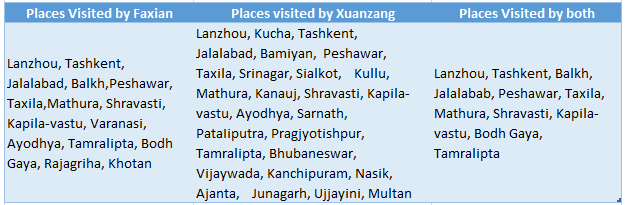
 

WBBSE Solutions For Class 6 History Chapter 9 India Topic C Miscellaneous Places visted by Faxian, Xuanzang,and both.

Question 8. What was the importance of Gandhara region?
Answer:

The importance of Gandhara region:

Gandhara was located to the north-west of the Indian subcontinent. The importance of Gandhara region can never be underestimated.

  1. Communication between Persian and the Indian subcontinent was established via Gandhara.
  2. It was located at a central position which helped to spread Buddhism to Central and East Asia.
  3. It was an important cultural central. It was the home of a distinctive art style that was a mixture of a Indian Buddhist and Graeco- Roman influence. The art was known as Gandhara art.
  4. The Gandhara art which developed in the Gandhara province evolved around Buddhism. New kinds of Buddha images were made.

WBBSE Chapter 9 India And The Contemporary World Topic C Miscellaneous Short Answer Type Questions

Question 1. Did Alexander’s invasion of the Indian subcontinent have any effect on the growth of the Mauryan empire?

  1. Alexander’s invasion of India had definitely helped in the growth of the Mauryan empire.
  2. Effect of Alexander’s invasion on the growth of the Mauryan empire

Answer:

Alexander defeated the Persians and put an end to their rule over the subcontinent. The destruction of the small kingdoms had subsequently facilitated Chandragupta Maurya’s attempt to extend his empire.

Since Alexander left India very quickly, it was easy for Chandragupta Maurya to defeat the weak powers and establish his empire.

Question 2. What are the things that we do not find in Indian society and culture before the arrival of the Shakas and Kushanas?
Answer: Before the arrival of the Shakas and the Kushanas there was no circulation of silver currencies. Different styles of garments like coats, pajamas, long coats, belts, shoes, etc. were not in use.

The use of reins and bridles was not introduced in the Indian subcontinent before the arrival of the Shakas.

Question 3. Make a list of the names of the different regions of ancient Bengal that you have come across in this book. Why are these regions famous?
Answer:
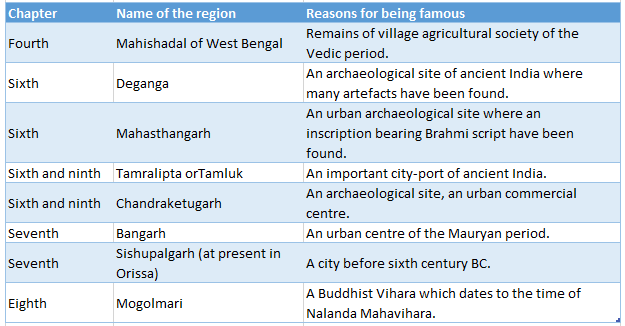
WBBSE Solutions For Class 6 History Chapter 9 India Topic C Miscellaneous Different regions of ancient Bengal

Question 4. Does any foreigner stay in your locality? Have you ever tasted foreign food especially Chinese food?
Answer:

The learner can say ‘Yes’ or ‘No.

Yes, I have tasted chow min, momo, etc.

Through the above-mentioned questions, the learner will be interested about the theme and will also be interested in taking part in the discussion.

Question 5. What is Hindush?
Answer:

Hindush:

The term ‘Hindush’ is mentioned in one of the writings of the great Persian emperor Darius I. The term was derived from river Indus.

Question 6. What were the great advances in war- horsemanship made by Shaka-Pahlavas?
Answer:

The great advances in war- horsemanship made by Shaka-Pahlavas:

Great advances in war-horsemanship were made by the Shaka-Pahlavas

  1. The Shaka- Pahlavas introduced the use of bridle and reins in the Indian subcontinent.
  2. The tactics of turning around and shooting arrow while sitting on the back of a running horse was introduced by the Pahlavas.

WBBSE Chapter 9 India And The Contemporary World Topic C Miscellaneous Very Short Answer Type Questions

Question 1. Mesopotamia, Sumer, Babylon, Egypt.
Answer: Egypt

Question 2. Bhrigukachha, Kalyam, Kaveripattinam, Kashgarh.
Answer: Kashgarh

Question 3. Alexandria, Corsica, Macedonia, Constantinople.
Answer: Corsica

Question 4. Carthage, Athens, Sparta, Crete.
Answer: Carthage

Question 5. Babylon, Persepolis, Parthia, Byzantium.
Answer: Byzantium

Question 6. Suryasiddhanta, Rajtarangini, Pancha siddhantika, Yavanjataka.
Answer: Rajtarangini

Question 7. Bodh Gaya, Sarnath, Rajagriha, Rome.
Answer: Rome

Question 8. What do you mean by a foreign country?
Answer: A country other than our own country i.e. France is a foreign country.

Question 9. What are those people called who came from foreign countries?
Answer: Those people who come to India from other countries are called foreigners.

Question 10. Do we come to know anything about our country from the writings and books of the foreigners?
Answer: Yes, directly or indirectly we get various information from the writings and books of the foreigners.

Question 11. Have you ever heard of the country China?
Answer: Yes, we have heard of China.

Question 12. Where is China situated?
Answer: China is situated in the north of India.

Referring to the map if the above-mentioned questions are asked and discussed the learner will be able to participate in the discussion.

Question 13. Where do you live?
Answer: I live in West Bengal, a state of India.

Question 14. Do any of your relatives reside in a foreign country?
Answer: The learner can say ‘yes’ or ‘no’

Question 15. Who destroyed the Persian city Persepolis?
Answer: Alexander destroyed the persian city Persepolis.

Question 16. During whose reign there was exchange of envoys with China?
Answer: During the reign of emperor Harshavardhana there was exchange of envoys with China

Question 3. Observe map 9.2 (of the textbook) carefully. Which were the places in the subcontinent visited by Faxian and Xuanzang? Which were the places where both had point a visit? Make a list of these places.
Answer: See the ‘Aesthetics and Creative Expression’ portion of Formative Evaluation.

WBBSE Chapter 9 India And The Contemporary World Topic C Miscellaneous  Fill In The Blanks

Question 1. According to Herodotus, Indus was a ______________ (province/country/district) of the Persian Empire.
Answer: Province

Question 2. The _____________ (Shakas/Bactrians/Kushanas) were known as Indo-Greeks.
Answer: Bactrians

Question 3. St. Thomas had visited the Indian subcontinent for the spread of Christianity during the rule of ____________ (Alexander/Menander/Gondophernes).
Answer: Gondophernes

Question 4. The _______ (Saka-Kushana/Saka-Pahlavas/Maurya-Kushanas) started the use of bridles and saddles on horses.
Answer: Saka-Pahlavas

Question 5. Bhrigukachha was located on the confluence of river Narmada and the _______ (Arabian Sea/Kaveri/Ganga).
Answer: Arabian Sea

WBBSE Chapter 9 India And The Contemporary World Topic C Miscellaneous State Whether Following Statements Are True Or False

Question 1. In Puranas, Bactrian kings have been referred to as Asura.
Answer: False

Question 2. The Pahlava rulers were threat to the Shaka rulers.
Answer: True

Question 3. Kumarajiva studied Buddhism and literature under Bandhudutta.
Answer: True

WBBSE Chapter 9 India And The Contemporary World Topic C Miscellaneous Exercise Spot The Odd Word And Underline It

Question 1. Bhrigukachha, Kalyan, Sopara, Tamralipta.
Answer: Sopara

Question 2. Buddhayasha, Kumarajiva, Paramartha, Xuanzang.
Answer: Xuanzang

Question 3. Alexander, Seleucus, Kanishka, Menander.
Answer: Kanishka

WBBSE Chapter 9 India And The Contemporary World Topic C Miscellaneous Match The Columns

Question 1.
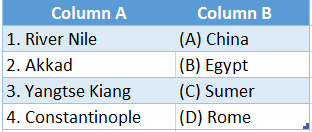
WBBSE Solutions For Class 6 History Chapter 9 India Topic C Miscellaneous Match the following 1

Answer: 1. (B), 2. (C), 3. (A), 4. (D)

Question 2.
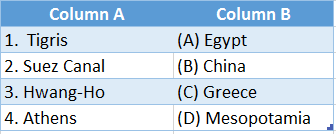
WBBSE Solutions For Class 6 History Chapter 9 India Topic C Miscellaneous Match the following 2

Answer: 1. (D), 2. (A), 3. (B), 4. (C)

Question 3.
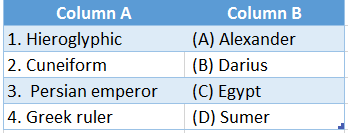
WBBSE Solutions For Class 6 History Chapter 9 India Topic C Miscellaneous Match the following 3

Answer: 1. (C), 2. (D), 3. (B), 4. (A)

Question 4.
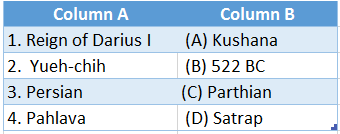
WBBSE Solutions For Class 6 History Chapter 9 India Topic C Miscellaneous Match the following 4

Answer: 1. (B), 2. (A), 3. (D), 4. (C)

Question 5.
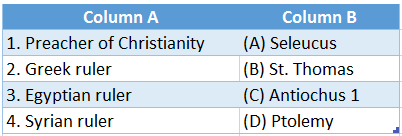
WBBSE Solutions For Class 6 History Chapter 9 India Topic C Miscellaneous Match the following 5

Answer: 1. (B), 2. (C), 3. (D), 4. (A)

Question 6.
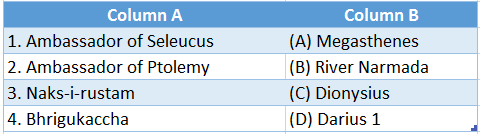
WBBSE Solutions For Class 6 History Chapter 9 India Topic C Miscellaneous Match the following 6

Answer: 1. (A), 2. (C), 3. (D), 4. (B)

Question 7.
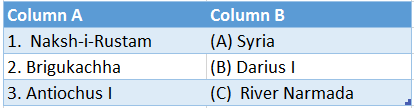
WBBSE Solutions For Class 6 History Chapter 9 India Topic C Miscellaneous Match the following 1.

Answer: 1. (B), 2. (C), 3. (A)