WBBSE Solutions For Class 7 Geography Chapter 5 River Topic A Concept Of River

WBBSE Chapter 5 River Topic A Concept Of River Long Question And Answers

Question 1. What do you mean by a river? State the general characteristics of a river.
Answer:

River:

A river is a natural course of water that flows through a channel down the slope of the land under the influence of gravity from the source towards the confluence.

  • The place of origin of a river is known as its source, the path it follows is called its course and the place where it joins a sea or a lake is called its mouth.
  • Usually, a river is either rain-fed or snow-fed and always flows into a sea, lake or another river. Example: Ganga, Brahmaputra, Yamuna, etc.

General Characteristics of a River:

The general characteristics of a river are as follows-

  1. A river flows in a specific direction through a valley following the slope of the land.
  2. The water flowing through the rivers has natural sources which usually drains into the sea, ocean or any other water body.
  3. A river performs three activities-erosion, transportation and deposition along its course and also creates various landforms.
  4. Several small streams join together to form the main river and several small streams also branch out from the main river. These are known as tributaries and distributaries respectively.

Read And Learn Also WBBSE Solutions For Class 7 Geography

Question 2. What is meant by a river basin?
Answer:

River basin:

A total surface area drained by a river and its tributaries and distributaries is called a basin. Each drainage basin is separated topographically from adjacent basins by a watershed.

Example: Ganga Basin is the largest river basin in India.

  • Important river basins of the world are- Amazon Basin, Thames Basin (London Basin), Seine Basin (Paris Basin), Ganga Basin, etc.
  • Amazon Basin is the largest basin in the world (almost 70.50 lacks sq. km) and Ganga Basin is the largest basin in India (13.2 lacks sq. km).


WBBSE Solutions For Class 7 Geography Chapter 5 River Topic A Concept Of River River Basin

WBBSE Chapter 5 River Topic A Concept Of River Short Question And Answers

Question 1. What do you mean by the source of the river? What is the mouth of a river? Which force helps a river to flow from source to confluence?
Answer:

Source of the river:

  • The place where a river originates is called the source of a river. Example-‘Gomukh’ in the Gangotri glacier is the source of the river Ganga.
  • The place where a river ends or flows into a sea or bay or lake or any other waterbody is called the mouth of a river.

Example: The Bay of Bengal is the mouth or confluence of the river Ganga.

The gravitational force helps a river to flow from the source of confluence.

Question 2. Prepare a table of the major rivers of the world along with their respective continents and length.
Answer:

Major rivers along with their respective continents and length are tabulated below-

WBBSE Solutions For Class 7 Geography Chapter 5 River Topic A Concept Of River Major rivers of the world along with their respective continents and length


Question 3. Why is River Ganga narrow at Haridwar but wide at Diamond Harbour?
Answer:

River Ganga narrow at Haridwar but wide at Diamond Harbour:

River Ganga has its source at Gomukh ice cave near Gangotri Glacier and enters the plain land at Haridwar.

  • As the land is very steep and river velocity is high, vertical erosion predominates making the river valley narrow and deep.
  • Near Diamond Harbour, River Ganga is at its mouth, and flows into the Bay of Bengal.
  • Here, the land slope is gentle and lateral erosion is predominant with little vertical erosion.
  • Moreover, many tributaries join River Ganga although its middle course increasing its water content and thus, making the river wide.


WBBSE Solutions For Class 7 Geography Chapter 5 River Topic A Concept Of River

Question 4. What determines the velocity of river flow?
Answer:

The velocity of river flow:

  • The volume of water and river current together determine the velocity of river flow. The unit used to measure river flow is ‘cusec’ or ‘cumec’.
  • The unit used to measure the volume of water flowing within a specific area per second is called cusec (cubic feet per second). In the metric system instead of cubic feet, a cubic metre is used for calculation, that is cumec (cubic metre per second).
  • Thus, the unit to measure river velocity in a specific area is cusec or cumec.

Question 5. What is a river?
Answer:

River:

A river is a natural course of water that flows through a channel down the slope of the land under the influence of gravity from the source towards the confluence.

  • The place of origin of a river is known as its source, the path it follows is called its course and the place where it joins a sea or a lake is called its mouth.
  • Usually, a river is either rain-fed or snow-fed and always flows into a sea, lake or another river.

Example: Ganga, Brahmaputra and Yamuna, etc.

Question 6. What do you mean by the source of a river?
Answer:

Source of a river:

  • The place of origin of a river is called its source. For example, the source of the River Indus is the Senge Khabab, a spring near Manasarovar in Tibet.
  • The source of a river is almost always a highland.
WBBSE Class 7 Geography Notes WBBSE Solutions For Class 7 History
WBBSE Solutions For Class 7 Geography WBBSE Class 7 History Multiple Choice Questions
WBBSE Class 7 Geography Multiple Choice Questions WBBSE Solutions For Class 7 Maths


Question 7. What is meant by the mouth of a river?
Answer:

Mouth of a river:

The place where a river joins a sea, lake or any other waterbody is known as its mouth.

Example: The mouth of the River Ganga is near Sagar Island where it flows into the Bay of Bengal after forming many deltas and distributaries.

Question 8. Define ‘catchment area’.
Answer:

catchment area:

  • A river usually originates in the mountains or high plateaus and flows down along the slope towards lowlands under the force of gravity.
  • The extensive area over which several small streams or channels and the main river flow is called the catchment area of the river.
  • These streams originate from the highlands and join to form a river at the foothills.

Example: The catchment area of River Ganga is in the mountains of Uttarakhand.

Question 9. Define ‘watershed’ or ‘water divide’.
Answer:

‘Watershed’ or ‘water divide’:

  • The highland which separates the course of one river system from another is called a watershed or water divide.
  • The peak of the highland divides and distributes the water and makes parts of it flow in different directions.
  • In most cases, river basins are surrounded by watersheds.

Example: The Central Highlands of India separate the rivers of North and South India.

Question 10. Differentiate between a catchment area and a water divide.
Answer:

The differences between a catchment area and a water divide are as follows-

WBBSE Solutions For Class 7 Geography Chapter 5 River Topic A Concept Of River Differences between a catchment area and water divide


Question 11. What would happen if a water divide gets eroded?
Answer:

A water divide gets eroded:

A water divide separates the course of one river from the other. In case the water divide gets eroded, the two distinct river systems would join as one and the entire volume of water would flow in one direction.

As a result of this increased volume, there would be floods on the river banks.

Question 12. Define the terms ‘tributary’ and ‘distributary’.
Answer:

‘Tributary’ and ‘distributary’:

  • The small streams which flow from different source regions and join the main river are called tributaries. Example: River Yamuna is a tributary of the River Ganga.
  • Whereas, the small streams which branch off the main river channel and has its mouth somewhere else are called distributaries.
  • The water of the main river flows through the distributaries.

Example: River Bhagirathi- Hooghly is a distributary of River Ganga.

Question 13. Define ‘inland river’ and ‘international inland river a river’. Or, What do you mean by ‘International river’? Or, What do you mean by ‘inland river’?
Answer:

A river originating in a highland and flowing into a lake or any waterbody or swamp within the same country is called an inland river.

Example: River Luni of India.

A river which flows through more than one country is called an international river.

Example: River Ganga in India and Bangladesh.

Question 14. Have you ever wondered where does the huge volume of water in a river that you have seen come from?

(ice-melt water/rainwater/water from a waterfall/a lake/ another river)

Answer:

  1. Name of the river-Nagar River
  2. Location of river-Raiganj

Such a huge volume of water in this river comes from rainwater.

Question 15. What is a perennial river?
Answer:

Perennial river:

A perennial river is a stream or river that has a continuous flow of water in its channel throughout the year. They are fed by the melting snow from glaciers of the high mountains where the streams have their sources.

Example: Ganga, Indus, and Brahmaputra are all perennial rivers.

Question 16. What is a non-perennial river?
Answer:

Non-perennial river:

  • A non-perennial river is a river which does not have a continuous flow of water in its channel throughout the year.
  • In the summer season, these streams have little water in their channels but in the rainy season, they come alive when rainfall is sufficient to generate run-off.
  • These rain-fed rivers generally originate from areas of low elevation such as hills and plateaus and are called non-perennial or seasonal rivers.

Example: Rivers of the western plateau in West Bengal namely Ajoy, Damodar, Mayurakshi, etc. are all non-perennial rivers.

Short Answers on Stages of a River

Question 17. All rivers don’t have water flow throughout the year. Give a geographical explanation.
Answer:

All rivers don’t have water flow throughout the year.

  • The volume of water or the water content in various rivers varies. The rivers originating from the high mountains are glacier-fed and thus perennial.
  • Whereas, rivers originating from the plateaus are rain-fed and thus remain low in water content in seasons apart from the monsoon.
  • Thus the volume of water or water content varies in different rivers throughout the year.

Question 18. What is a river valley?
Answer:

River valley:

  • A lowland between two highlands or mountains is called a valley. It may be narrow or wide.
  • A number of tributaries in the course of a river determines its width. When a river flows through a valley, it is called a river valley.
  • In other words, from source to mouth, the valley confined by lateral banks through which the river maintains its flow is called a river valley.

Question 19. What is a doab?
Answer:

Doab:

  • Doab (Do two, ab – water) is a tract of land lying between two rivers. The confluence of any two rivers which have the same slope forms a doab. It is also called an interfluve.
  • Silt deposition in a doab makes the land very fertile and suitable for agriculture.

Example: The confluence of River Ganga and River Yamuna near Allahabad. Punjab is situated at the confluence of five rivers.

Question 20. How do the river valleys of perennial and non-perennial rivers form?
Answer:

The rivers of the mountainous regions being perennial form valleys that are very deep and very wide.

Example: The valleys of the River Ganga.

Since the rivers of the plateau region are non-perennial and do not have water throughout the year, the valleys formed are shallow and less wide.

Example:-The valleys of the River Mayurakshi.

WBBSE Chapter 5 River Topic A Concept Of River Very Short Question And Answers

Question 1. What is a natural stream of water regulated by slope called?
Answer: River.

Question 2. What is the place from where a river originates called?
Answer: Source.

Question 3. What is the place where a river flows into the sea, lake or any other waterbody called?
Answer: Mouth.

Question 4. Which is the longest river in the world?
Answer: River Nile.

Question 5. What is a river that flows into a main river called?
Answer: Tributary.

Question 6. What is a river that branches off from and flows away from the main river called?
Answer: Distributary.

Question 7. What is a river which has water throughout the year called?
Answer: Perennial.

Question 8. What is a river which remains dry for the most part of the year known as?
Answer: Non-perennial.

Question 9. What is a river which has its source and mouth within the mainland of the same country called?
Answer: Inland river.

Question 10. What is a river which flows through more than one country known as?
Answer: International river.

Question 11. What is the land in between two rivers called?
Answer: Doab.

Question 12. Give the unit for the volume of water (in cubic centimetres) flowing per second.
Answer: Cusec.

Question 13. Which is the most important river in Oceania?
Answer: Murray-Darling.

Question 14. Why does river water appear muddy in the rainy season?
Answer:

Rainwater carries sand, silt, etc. from the land surface to the river, which mixes with the water making the river water appear muddy.

WBBSE Chapter 5 River Topic A Concept Of River Fill In The Blanks

Question 1. The place where a river originates is called its __________.
Answer: Source

Question 2. Gomukh ice cave of the Gangotri Glacier is the source of River __________.
Answer: Ganga

Question 3. The length of River Nile is __________.
Answer: 6650 km

Question 4. The longest river in India is __________ (length 2,510 km).
Answer: Ganga

Question 5. The longest river in the world is __________ (length 6650 km).
Answer: Nile

Question 6. The volume of water flow transported through a given cross-sectional area of a river at a given rate and time is called __________.
Answer: Discharge

Question 7. The widely used unit to measure river discharge is __________.
Answer: Cusec

Question 8. The largest river basin in the world is formed by the River __________.
Answer: Amazon

Question 9. The area in the highlands from where a river gets its supply of water is called its __________ area.
Answer: Catchment

Question 10. The highland which separates the course of one river system from another is called a __________.
Answer: Watershed

Question 11.The watershed separating the North Indian and South Indian rivers is called __________.
Answer: Central Highlands of India

Question 12. Channels of water branching from the main river are __________.
Answer: Distributaries

Question 13. River __________ is an inland river of India.
Answer: Luni

Question 14. The meeting point of the two rivers is known as their __________.
Answer: Confluence

Question 15. The land in between two rivers is called a __________.
Answer: Doab

Question 16. With the decrease in the slope of the land, the river’s velocity __________.
Answer: Decreases

WBBSE Chapter 5 River Topic A Concept Of River True Or False

Question 1. The source of the River Ganga is the Gangotri Glacier.
Answer: True

Question 2. River Mahananda is a tributary of River Ganga.
Answer: True

Question 3. The highland which separates the course of one river system from another is called a river valley.
Answer: False

Question 4. The surface area covered by a river, its tributaries and distributaries is called the watershed.
Answer: False

Question 5. The land in between two river valleys is called a catchment area.
Answer: False

Question 6. The River Nile of Egypt is the longest river in the world.
Answer: True

Question 7. The Yangtze is the longest river in Asia.
Answer: True

Question 8. The number of tributaries of a river is highest in the delta region.
Answer: False

Question 9. The supply of water is maximum in the catchment area of a river.
Answer: True

Question 10. Bhagirathi-Hooghly is the most important distributary of Ganga.
Answer: True

Question 11. Perennial rivers are generally rain-fed.
Answer: False

WBBSE Chapter 5 River Topic A Concept Of River Match The Columns

1.WBBSE Solutions For Class 7 Geography Chapter 5 River Topic A Concept Of River Match the columns

Answer: 1. B, 2. D, 3. F, 4. C, 5. A, 6. E

WBBSE Solutions For Class 7 Geography Chapter 1 Earths Revolution Topic B Apparent Annual Motion Of The Sun And Effects Of The Earths Revolution

WBBSE Chapter 1 Topic B Apparent Annual Motion Of The Sun And Effects Of The Earths Revolution Long Question And Answers

Question 1. What are the reasons for the season change? Or, How is the setting in of different seasons affected by the varying lengths of days and night and the difference of the Sun’s angle of incidence?
Answer:

Reasons for season change:

The reasons behind the cycle of seasons are as follows-

1. Geoid shape of the Earth:

Due to the geoid shape of the Earth, the angle of incidence of the Sun’s rays is not equal all over the Earth. Thus, there is a difference of surface temperature.

2. Varying lengths of days and nights:

The hemisphere that experiences the vertical rays of the Sun, has longer days and shorter nights.

  • The heat received during these longer days is more and all of it is not radiated back during the short night span.
  • Thus, some of the retained heat increases the temperature of the surface and those places experience summer.
  • Likewise, when the nights are longer and the days are shorter, the entire heat is lost during the long nights.
  • Thus, the region becomes cold and experiences winter.

WBBSE Solutions For Class 7 Geography

3. Difference in the heat received due to the difference in the incidence of sunrays:

During a revolution, the region which remains inclined towards the Sun receives more sunlight. Therefore this region experiences summer and the other regions experience winter, spring and autumn.

4. Elliptical orbit of the Earth:

Since the orbit of the Earth is elliptical, the distance between the Sun and the Earth varies. This varying distance gives rise to the difference in the heat received and the experience of seasons.

WBBSE Solutions For Class 7 Geography Chapter 1 Earths Revolution Topic B Apparent Annual Motion Of The Sun

Question 2. Describe the different seasons or cycles of seasons that prevail over the Earth.
Answer:

Different seasons that prevail over the Earth:

There are four seasons-

  1. Spring,
  2. Summer,
  3. Autumn and
  4. Winter.

1. Spring:

On 21 March the Earth reaches such a position with respect to the Sun that-

  1. The sun rays fall vertically on the equator,
  2. Days and nights are equal all over the earth on that day,
  3. The sun remains equidistant from both poles,
  4. At every place on the earth, the sun rises and sets at 6 a.m. And 6 p.m. Respectively. The northern hemisphere has sprung for a period of 1 month before and 12 months after 21 March. The southern hemisphere has autumn at that time.

2. Summer:

After 21 March, the Earth slowly moves towards such a position that the sun’s rays gradually begin to fall vertically over the northern hemisphere. On 21 June the Earth reaches such a position on its orbit with respect to the Sun that-

  1. The sun rays fall vertically on the tropic of cancer,
  2. The north pole remains completely inclined towards the sun,
  3. The south pole remains completely away from the sun,
  4. The northern hemisphere has longer days and shorter nights. The northern hemisphere experiences summer for a period of 1½ months before and 1½ months after 21 June. The southern hemisphere experiences winter at that time.

3. Autumn:

On 23 September the Earth reaches such a position on its orbit that-

  1. The sun rays fall vertically on the Equator due to which days and nights become equal on every place over the Earth,
  2. Like 21 March, this day is also called Equinox. The northern hemisphere has autumn for a period of 1½ months before and 12 months after 23 September. The southern hemisphere has spring at that time.

4. Winter:

On 22 December the Earth reaches such a position that-

  1. The sun rays fall vertically on the Tropic of Capricorn,
  2. The North Pole remains completely away from the Sun,
  3. The northern hemisphere has shorter days and longer nights. Winter prevails in the northern hemisphere for a period of 1½  months before and 1½ months after 22 December. The southern hemisphere has summer at that time.
WBBSE Class 7 Geography Notes WBBSE Solutions For Class 7 History
WBBSE Solutions For Class 7 Geography WBBSE Class 7 History Multiple Choice Questions
WBBSE Class 7 Geography Multiple Choice Questions WBBSE Solutions For Class 7 Maths


Question 3. Draw a diagram to explain the occurrence of the summer season in the northern hemisphere.
Answer:

A diagram to explain the occurrence of the summer season in the northern hemisphere:

Occurrence of the summer season in the northern hemisphere:

  • After 21 March, the Earth gradually comes to such a position concerning,
  • The Sun that sunlight begins to fall vertically on the northern hemisphere.
  • As a result, the length of days increases while that of nights decreases.
  • This indicates the apparent movement of the Sun towards the north.


WBBSE Solutions For Class 7 Geography Chapter 1 Topic B Apparent Annual Motion Of The Sun And Effects Of The Earths Revolution Day and night


On 21 June the Sun and the Earth lie at such a position concerning each other that-

  1. The sun rays fall vertically on the Tropic of Cancer,
  2. The North Pole remains completely inclined towards the Sun,
  3. The northern hemisphere experiences the longest day (14 hours) and the shortest night (10 hours).
  4. So the temperature increases and the summer season prevails.
  5. This season continues over a period of 1½ months before and 1½ months after 21 June.
  6. At this time the Sun can be seen at the North Pole for 24 hours. On the other hand, the South Pole experiences 24 hours of darkness.
  7. Thus the northern hemisphere has summer while the southern hemisphere has winter.

Question 4. Describe the position of the Earth and the Sun from 23 September to 22 December and its effect.
Answer:

The position of the Earth and the Sun from 23 September to 22 December and its effects: The effects of the Earth-Sun position from 23 September – 22 December are as follows-

1. Autumnal Equinox:

  • On 23 September both the hemispheres of the Earth lie at an equal distance from the Sun.
  • he sun rays fall vertically on the Equator and the length of the day and night is equal all over the Earth.
  • The northern hemisphere experiences autumn and thus it is known as the autumnal equinox.

WBBSE Solutions For Class 7 Geography Chapter 1 Topic B Apparent Annual Motion Of The Sun And Effects Of The Earths Revolution earth and sun from 23 sep to 22 dec

2. Commencement of winter in the northern hemisphere and summer in the southern hemisphere:

  • From after 23 September, the Earth is positioned on its orbit in such a way that the southern hemisphere receives vertical rays of the Sun.
  • Thus, the days are longer and nights are shorter in the southern hemisphere.
  • Due to the southward march of the Sun, there is the commencement of winter in the northern hemisphere and summer in the southern hemisphere.

3. Winter Solstice:

  • On 22 December the Earth is positioned on its orbit in such a way that vertical sun rays fall on the Tropic of Capricorn (23½° S). On this day the southern hemisphere experiences the longest day and shortest night.
  • During this time there is 24 hours of sunlight in the South Pole and 24 hours of darkness in the North Pole. This day is known as the winter solstice.

Question 5. Discuss the effects of revolution.
Answer:

Effects of revolution:

The revolution of the Earth causes various changes on the Earth’s surface.

These are as follows-

1. Varying lengths of day and night:

  • As the Earth’s axis always remains inclined at an angle of 66½° towards the orbital plane, the lengths of days and nights on the Earth’s surface vary.
  • It has been observed that- On 21 June days are longer and nights are shorter in the northern hemisphere. On 21 March and 23 September days and nights are of equal duration.
  • These days are called equinoxes. On 22 December the southern hemisphere experiences shorter days and longer nights.

2. Change of seasons:

  • The variation in the lengths of days and nights leads to differences in temperature and this causes changes of seasons.
  • So we can experience four seasons all over the Earth-summer, autumn, winter and spring. Opposite conditions prevail in the two hemispheres.

3. Determining year and leap year:

  • The Earth revolves around the Sun once in 365 days 5 hours 48 minutes 46 seconds. This constitutes 1 year.
  • Again one whole day is added to every fourth year which has 366 days with 29 days in the month of February. This is called a leap year.

4. Creation of heat zones:

  • The sun rays fall at different angles at different places on the Earth at different times of the year.
  • The Earth is divided into three heat zones based on the angle at which the sunrays fall.

These are-

  1. Torrid Zone
  2. Temperate Zone
  3. Frigid Zone.

Question 6. What are the various ways to prove the Earth’s revolution?
Answer:

Ways to prove the Earth’s revolution:

Some ways to prove that the Earth is in a state of constant revolution are as follows-

1. Observation of stars:

  • If we observe a particular group of stars in a particular part of the night sky for a few days, then we will find that they keep shifting towards the west.
  • After a few days, they disappear and new stars appear in their place. After one year, the first set of stars appears again. This happens because of the revolution.

2. Apparent movement of the Sun:

  • On 21 March and 23 September, the Sun rises in the due east and sets in the due west.
  • On other days it rises and sets a little towards the north or the south.
  • If the Earth would have rotated at the same place then sunrise and sunset would have taken place at the same place every day.

3. Gravitational Force theory:

The Sun is 13 lakh times larger and 34 million times heavier than the Earth. So, according to the Gravitational Force theory, the Earth revolves around the Sun.

WBBSE Solutions For Class 7 Geography Chapter 1 Topic B Apparent Annual Motion Of The Sun And Effects Of The Earths Revolution Apparent movement of the sun

4. Revolution of other planets:

  • It has been observed through powerful telescopes that other planets in the solar system revolve around the Sun.
  • So the Earth, being a planet, cannot be an exception.

5. Direct proof:

The photographs taken from space through the satellites also show that the Earth exhibits revolutionary movement.

Question 7. What do you mean by the apparent daily movement of the Sun?
Answer:

Daily movement of the Sun:

Every day we see the sun rises in the east and set in the west. It seems as if the Earth is still while the Sun is moving around it.

  • This movement, showing the change in the position of the Sun with respect to the stars as seen from the Earth is called the apparent daily movement of the Sun or its apparent diurnal motion.
  • The term apparent is used because the Earth actually to the Tropic of Cancer and this movement is known to revolve around the Sun. as the apparent northward movement of the Sun.

WBBSE Solutions For Class 7 Geography Chapter 1 Topic B Apparent Annual Motion Of The Sun And Effects Of The Earths Revolution Apparent daily movement of the sun

Question 8. What is Vernal Equinox?
Answer:

Vernal Equinox:

Vernal Equinox in the northern hemisphere refers to the day on which vertical sunrays fall over the Earth’s Equator at midday.

WBBSE Solutions For Class 7 Geography Chapter 1 Topic B Apparent Annual Motion Of The Sun And Effects Of The Earths Revolution Vernal Equinox

  • It falls on 21 March every year. On this day, every place on the Earth’s surface experiences equal hours of day and night (i.e. 12 hours of the day and 12 hours of the night).
  • Since it marks the end of winter and the beginning of spring in the northern hemisphere, the day is also called Spring Equinox.

Question 9. What is Summer Solstice?
Answer:

Summer Solstice:

According to the apparent movement of the Sun, the Tropic of Cancer or 23½° N marks as the ultimate limit of the Sun’s movement towards the north.

  • This movement ends on 21 June. This day is referred to as Summer Solstice.
  • On this day, the sun rays fall vertically over the Tropic of Cancer at noon.
  •  The northern hemisphere experiences the longest day (14 hours) and shortest night (10 hours) and the southern hemisphere experiences the opposite-shortest day and longest night.

WBBSE Solutions For Class 7 Geography Chapter 1 Topic B Apparent Annual Motion Of The Sun And Effects Of The Earths Revolution Summer solstice

Question 10. What do you mean by Midnight Sun and the Land of the Midnight Sun? Or, Why can the Sun be seen at midnight from Hammerfest Port in Norway?
Answer:

The tilted axis of the Earth and its movement around the Sun results in six months of continuous daylight (21 March – 23 September) at the North Pole and its surrounding areas.

WBBSE Solutions For Class 7 Geography Chapter 1 Topic B Apparent Annual Motion Of The Sun And Effects Of The Earths Revolution Mid Night Sun

During this time, from the northern extent of Port Hammerfest in Norway (70½° N, 24°E) the Sun (May-July) can be seen near the horizon even at night according to local time.

This is known as Midnight Sun and the country is known as the ‘Land of the Midnight Sun’.

Question 11. What is Winter Solstice?
Answer:

Winter Solstice:

According to the apparent movement of the Sun, the Tropic of Capricorn or 23%1⁄2°S marks as the ultimate limit of the Sun’s movement towards the south.

  • This movement ends on 22 December. This day is referred to as Winter Solstice.
  • On this day the sun rays fall vertically over the Tropic of Capricorn at noon.
  • The southern hemisphere experiences the longest day (14 hours) and shortest nights (10 hours).
  • The northern hemisphere experiences the opposite -the shortest day and the longest night.

WBBSE Solutions For Class 7 Geography Chapter 1 Topic B Apparent Annual Motion Of The Sun And Effects Of The Earths Revolution Winter solstice

Question 12. What is meant by the apparent path of the Sun?
Answer:

The apparent path of the Sun:

We all know that the Earth moves around the Sun but it seems as if the Sun is moving around the Earth from east to west.

  • This path is fixed and is termed the apparent annual movement of the Sun.
  • The revolution of the Earth around the Sun results in the apparent annual movement of the Sun.
  • The Sun apparently moves northwards from 22 December to 21 June and southwards from 21 June to 22 December.

WBBSE Solutions For Class 7 Geography Chapter 1 Topic B Apparent Annual Motion Of The Sun And Effects Of The Earths Revolution Apparent part of the sun

Question 13. Fill up the knowledge hive with information about Summer Solstice.

WBBSE Solutions For Class 7 Geography Chapter 1 Topic B Apparent Annual Motion Of The Sun And Effects Of The Earths Revolution Summer solstice.

Answers:

1. On 21 June the sunrays fall vertically on the Tropic of Cancer (23½°).
2. The northern hemisphere leans more towards the Sun.
3. The area from the Arctic Circle to the North Pole receives 24 hours of daylight for a period of 6 months around this time.
4. The area from the Antarctic Circle to the South Pole has 24 hours of darkness for a period of 6 months around this time.
5. The northern hemisphere experiences the longest day and shortest night.
6. The southern hemisphere experiences the shortest day and longest night.

Question 14.

WBBSE Solutions For Class 7 Geography Chapter 1 Topic B Apparent Annual Motion Of The Sun And Effects Of The Earths Revolution sun

Answers:

1. 23 September
2. 22 December
3. 21 March

Question 15.

WBBSE Solutions For Class 7 Geography Chapter 1 Topic B Apparent Annual Motion Of The Sun And Effects Of The Earths Revolution Crossword 1

Down:

2. This is the season after winter.
3. 0° latitude.
4. This season is known as fall and marks the transition from summer to winter.

Across:

1. February has 29 days in this year

Answers:

Down: 2. SPRING, 3. EQUATOR, 4. AUTUMN
Across: 1. LEAP YEAR

Question 16.

WBBSE Solutions For Class 7 Geography Chapter 1 Topic B Apparent Annual Motion Of The Sun And Effects Of The Earths Revolution Crossword 2

Down:

1. A star at the centre of the solar system.
3. It contains within itself all the planets, stars, intergalactic matter, etc.

Across:

2. This motion of the Earth is the reason behind the occurrence of seasons.
4. This motion of the Earth causes day and night.

Answers:

Down: 1. SUN, 3. UNIVERSE
Across: 2. REVOLUTION, 4. ROTATION

Question 17.

WBBSE Solutions For Class 7 Geography Chapter 1 Topic B Apparent Annual Motion Of The Sun And Effects Of The Earths Revolution Crossword 3

Up-Down:

2. The position when the Earth is furthest away from the Sun on its orbit.
3. Equal days and equal nights.
4. Our galaxy.

Across:

1. The eighth planet.
5. The shape of the Earth’s orbit.
6. The dramatic play of light in the night sky near the Poles.
7. 23½° N latitude is the Tropic of ________.

Answers :

Up-Down: 2. APHELION, 3. EQUINOX. 4. MILKY WAY
Across: 1. NEPTUNE, 5. ELLIPTICAL, 6. AURORA, 7. CANCER

Question 18. Why is the heat received at the lower latitudes more than that at the higher latitudes?
Answer:

  • At the lower latitudes, sunrays fall vertically over the Earth’s surface producing more heat. At the equator (0°) it is summer throughout the year.
  • As one moves away from the Equator, sunrays become slanting. This leads to a decrease in average heat received on the Earth’s surface.


WBBSE Solutions For Class 7 Geography Chapter 1 Topic B

Question 19. Every object light or heavy falls downwards, isn’t it? Which direction is downwards?

WBBSE Solutions For Class 7 Geography Chapter 1 Topic B Light Or Heavy Falls Downwords

Answer:

According to the picture, all four of them will say that the ball is falling downwards, be it from the bottom, from the sides, from the top, i.e., from all sides.

Question 20. In the following diagram, mark the positions of the Earth, the date of positions and the distance from the Sun.


WBBSE Solutions For Class 7 Geography Chapter 1 Topic B Apparent Annual Motion Of The Sun And Effects Of The Earths Revolution earth Date and distance from the sun

Answer:

  1. Perihelion,
  2. Aphelion,
  3. January,
  4. July,
  5. 14 crore 70 lakh km,
  6. 15 crore 20 lakh km

Question 21. Examine the perpendicular and oblique rays with the help of a torch.
Answer:

  • The light of a torch is cast on a table or the floor in a dark room. First, the torch is held 1-2 feet above the table. How big is the circular lit area formed on the table? And how bright is it? It looks like a circle of brightly lit areas has formed on the table or on the floor.
  • Now the torch is kept at the same height and held slightly tilted. Does it make the size of the lit circular area bigger and brighter? It is seen that the light is spreading in more places.
  • However, the light is much less intense than when it was held vertically. This test gives an idea of why the heat is gradually decreasing towards the two Poles of the Earth.

Examples of Real-Life Applications of Solar Positioning


WBBSE Solutions For Class 7 Geography Chapter 1 Topic B Apparent Annual Motion Of The Sun And Effects Of The Earth Revolution Perpendicular, Oblique rays helpsTorch

Question 22. Make a Sun Dial.
Answer:

The steps to build a sundial are as follows-

  1. At first, a white paper on a plain surface is placed.
  2. Then a long stick is placed in the middle of the white paper.
  3. Next, on a sunny day, the shadow of the stick on the paper from sunrise to sunset is marked with a pencil.
  4. Last, the time of the shadow lines are noted down. In this manner, a sundial showing accurate time can be made.
  5. It can be seen that a time clock has been made on the white paper. This is where any time of the day can be determined by looking at the shadow of the stick. In this way, a useful sundial is prepared.

WBBSE Solutions For Class 7 Geography Chapter 1 Topic B Apparent Annual Motion Of The Sun And Effects Of The Earths Revolution making a sun Dial

Question 23. Draw an ellipse with the help of a pencil, two pins and a small thread.
Answer:

  • Ellipses can be drawn with the help of a pencil, pin and thread. The two ends of the thread are tied together and knotted to make a loop.
  • Two pins on cardboard are stuck according to the picture. Now the loop of the thread is placed on the cardboard in such a way that the loop surrounds the two pins.
  • Then a pencil is put inside the loop, the loop is kept tight and turned on the cardboard to draw a circle. It will not be exactly round, it will be an elongated circle. The name of this circle is an ellipse.
  • 39 Many more ellipses can be drawn by sticking the two pins near or far apart. Some will be oval-shaped and some will be very flat. However, it can be seen when two pins are very closely stuck, the shape will be almost round.

WBBSE Solutions For Class 7 Geography Chapter 1 Topic B Apparent Annual Motion Of The Sun And Effects Of The Earths Revolution drawing of an ellipse

WBBSE Chapter 1 Topic B Apparent Annual Motion Of The Sun And Effects Of The Earths Short Question And Answers

Question 1. What do you mean by the apparent annual movement of the Sun?
Answer:

Annual movement of the Sun

  • If we look carefully at the positions of the sunrise and sunset throughout the year, we will notice that except on 21 March and 23 September, the sun rises a little more towards the north or south of due east.
  • The same thing happens with sunset. Since the sun’s rays fall vertically on the tropics at different times of the year, it seems as if the Sun moves between the Tropic of Cancer and the Tropic of Capricorn (23½° N-23½° S) throughout the year.
  • This change in the position of the Sun as seen from the Earth is termed as Sun’s apparent annual movement.

Question 2. Write about the Sun’s apparent northward movement.
Answer:

Sun’s apparent northward movement:

  • The change in the position of the Sun with respect to the stars as seen from the Earth is known as the Sun’s apparent movement.
  • This motion of the Sun is restricted between the Tropic of Cancer (23½°North) and the Tropic of Capricorn (23½° South).
  • From December till 21 June, the Sun apparently moves from the Tropic of Capricorn to the Tropic of Cancer and this movement is known as the apparent northward movement of the sun.

Question 3. Write about the Sun’s apparent southward movement.
Answer:

Sun’s apparent southward movement:

  • The change in the position of the Sun with respect to the stars as seen from the Earth is known as the Sun’s apparent movement.
  • This motion is restricted between the Tropic of Cancer (23½° N) and the Tropic of Capricorn (23½°S).
  • After 21 June till 22 December, the Sun apparently moves from the Tropic of Cancer to the Tropic of Capricorn.
  • This movement is known as the apparent southward movement of the Sun.

Short Answers on Seasonal Changes and Sun’s Position

Question 4. Why is it winter in the northern hemisphere, when it is summer in the southern hemisphere?
Answer:

  • Due to the tilt of the Earth after 23 September, the southern hemisphere moves towards the Sun while the northern hemisphere moves away from the Sun.
  • As a result of this apparent movement, vertical rays of the Sun fall over the area in the southern hemisphere and it experiences summer while the northern hemisphere experiences winter

Question 5. What is Autumnal Equinox?
Answer:

Autumnal Equinox:

  • Autumnal Equinox refers to the day on which vertical sun rays fall on the Earth’s Equator at midday. It falls on 23 September every year.
  • On this day, every place on the Earth’s surface experiences equal hours of day and night (12 hours of day and 12 hours of night).
  • Since it marks the beginning of autumn in the northern hemisphere it is called the Autumnal or Fall Equinox.

Question 6. Write a short note on Solstice.
Answer:

Solstice:

  • Solstice refers to either of the two days of a year when the Sun is at the farthest point from the Equator.
  • The summer solstice in the northern hemisphere is on 21 June, when the sunrays fall directly over the Tropic of Cancer.
  • The winter solstice is on 22 December, when the sunrays fall directly over the Tropic of Capricorn. The word ‘solstice’ is derived from the Latin words ‘sol’ (Sun) and ‘sister’ (to stand still).
  • The day of the solstice is either the longest day of the year (in summer) or the shortest day of the year (in winter) for any place on the tropics.

Question 7. Differentiate between Summer Solstice and Winter Solstice.
Answer:

The differences between Summer Solstice and Winter Solstice are as follows-

WBBSE Solutions For Class 7 Geography Chapter 1 Topic B Apparent Annual Motion Of The Sun And Effects Of The Earth Differences between summer and winter Solstice

Question 8. How does summer set in the northern hemisphere?
Answer:

Due to the Earth’s axial tilt (66½°) with the orbital plane from 21 March the northern hemisphere becomes more inclined towards the Sun.

  • During this time, sunrays fall vertically over the northern hemisphere leading to an increase in the length of the day and an average temperature of the Earth.
  • This period is termed as summer in the northern hemisphere.
  • At the same time, the opposite happens in the southern hemisphere.

Question 9. How does autumn occur in the northern hemisphere?
Answer:

After 21 June, there is a gradual inclination of the South Pole towards the Sun and of the North Pole away from the Sun.

  • On 23 September, sunrays fall vertically on the Equator leading to equal lengths of day and night.
  • The insolation received by the Earth’s surface during the day is radiated back to space at night as a result we experience moderate temperatures.
  • The period of one and half months before and after 23 September is known as autumn in the northern hemisphere. In the southern hemisphere, it is spring during this period.

Conceptual Questions on Equinoxes and Solstices

Question 10. How does winter set in the northern hemisphere?
Answer:

After 23 September the North Pole moves away from the Sun and sunrays fall obliquely over the northern hemisphere.

  • During this time days are shorter than the nights in the northern hemisphere and the surface of the Earth of this hemisphere gets less heated.
  • Longer nights mean that the solar insolation received during the days is completely radiated back to space and a sharp dip in the temperature is felt.
  • This period of one and a half months before and after 22 December, is known as winter.

Question 11. When is it spring in the northern hemisphere and autumn in the southern hemisphere?
Answer:

On 21 March, the Earth reaches a position on its orbit at which both the Poles are equidistant from the Sun.

  • Sun’s rays fall vertically over the Equator leading to equal lengths of day and night.
  • At this time, the solar insolation received during the day is completely radiated back to space and moderate temperature prevails.
  • This period is called spring in the northern hemisphere and autumn in the southern hemisphere.

Question 12. How does summer set in the southern hemisphere?
Answer:

After 23 September, the South Pole gradually begins to incline towards the Sun and more than half of the southern hemisphere receives direct sun rays.

  • As a result of this, days are longer than nights in this hemisphere.
  • The solar insolation received during the day does not completely radiate back to space.
  • This leads to a gradual increase in the average surface temperature of the areas of the southern hemisphere.
  • This period of one and half months before and after 22 December, is summer in the southern hemisphere.

Question 13. Why do the people living in the southern hemisphere celebrate Christmas during summer?
Answer:

Christmas in the southern hemisphere is celebrated at the same time as the rest of the world i.e. 25 December.

  • On 22 December, sunrays fall vertically over the Tropic of Capricorn (23½° S) in the southern hemisphere.
  • For this reason, from November to January, it is summer in the southern hemisphere.
  • Since 25 December falls within this period people living in the southern hemisphere celebrate Christmas during summer.

Question 14. What is meant by illuminated night?
Answer:

Illuminated night:

Sunrays fall slantingly on the Arctic and Antarctic Circles throughout the year.

  • From 22 March to 21 June, the Sun does not rise above the horizon or set below in the northern hemisphere.
  • It remains at a position parallel to the horizon i.e. for 24 hours the Sun can be seen in the sky.
  • Since it can be seen in the sky even at night, the night seems to be illuminated.

Question 15.  Why do polar regions experience continuous daylight for six months and continuous night-time for the next six months?
Answer:

The Earth is tilted at an angle of 66½° towards its orbital plane and rotates around at that angle. As it orbits the Sun, the northern.

  • The hemisphere that is tilted towards the Sun receives more sunlight than the other hemisphere.
  • The poles are at the extreme ends and therefore, have extreme periods of Sun exposure i.e. when the North Pole experiences six months of daylight, darkness prevails at the South Pole (21 March – 23 September) and vice versa (23 September – 21 March).

Question 16. Write a brief note on Aurora Borealis and Aurora Australis.
Answer:

Aurora Borealis and Aurora Australis:

An ‘aurora’ is a natural light display in the sky, particularly in the high latitudes i.e. in the Arctic and the Antarctic regions.

  • When the polar regions experience six months of continuous night-time (23 September-21 March in the northern hemisphere and 21 March – 23 September in the southern hemisphere) spectacular glowing lights can be seen in the sky caused due to the collision of ionised gas present in the atmosphere and sun rays.
  • In the northern hemisphere, it is known as Aurora Borealis or Northern Lights and in the southern hemisphere it is known as Aurora Australis or Southern Lights.

WBBSE Solutions For Class 7 Geography Chapter 1 Topic B Apparent Annual Motion Of The Sun And Effects Of The Earths Revolution Aurora

Question 17. Throughout the year, there is no seasonal change in the equatorial and polar regions. Why?
Answer:

Throughout the year, sunrays fall vertically over the Equator (0°) and the summer season persists in the equatorial region (equal lengths of days and nights).

  • Since there is no change in temperature there is no seasonal change as well in the equatorial region.
  • Whereas, the polar regions experience six months of daylight and six months of night-time as a result of which the surface never gets heated in excess and winter is prevalent.

Question 18. If the axis of the Earth was in the same plane with its orbit, (as seen in Uranus) what would have happened to the natural cycle of days, nights and seasons in such cases?
Answer:

Effects, if the axis of the Earth would have been on the same plane as the orbit-

Effect on the natural cycle of days and nights:

  1. There would have been no variation in the lengths of days and nights.
  2. The sunlight would have been incident on one-half of the Earth equally throughout the year.
  3. The lengths of days and nights would have been equal both in summers and winters.
  4. The two Poles wouldn’t have experienced 6 prolonged months of day and night.

Effect on seasons:

  1. Seasons wouldn’t have changed.
  2. The equatorial region would have changed into the cold polar region and the polar regions would have changed into the hot dry equatorial region.

Question 19. Tabulate the increase/decrease in the length of day and night as the year progresses.
Answer:

The increase/decrease in the length of day and night as the year progresses is tabulated below-

 Vertical Sunrays Length of Day and Night  
Date Name of the day Latitude Sun angle Northern Hemisphere Southern Hemisphere 
Day Night Day Night 
21-Jun Summer Solstice 23½°N 90° 14 hours 10 hours 10 hours 14 hours
23 September Autumnal Equinox 90° 12 hours 12 hours 12 hours 12 hours
22 December Winter Solstice 23½° S 90° 10 hours 14 hours 14 hours 10 hours
21 March Vernal Equinox 90° 12 hours 12 hours 12 hours 12 hours


Question 20. At what local time does the Sunset in New York, Delhi and Cairo on 23 September?
Answer:

  • 23 September is the day of the Autumnal Equinox when the Sun shines vertically on the Equator and all places on the Earth experience equal hours of day and night, i.e. 12 hours each.
  • Thus, at 6:00 pm according to respective local times, the Sun will set in New York, Delhi and Cairo.

Question 21. How is the cycle of seasons caused?
Answer:

The cycle of seasons caused:

  • The cycle of seasons is caused by the inclination of the Earth’s axis.
  • It is the transitional change of the four seasons i.e. summer, spring, autumn and winter at different places on the Earth’s surface.

WBBSE Solutions For Class 7 Geography Chapter 1 Topic B Apparent Annual Motion Of The Sun And Effects Of The Earths Revolution Cycle of seasons

Given below is a table showing the cycle of seasons:

WBBSE Solutions For Class 7 Geography Chapter 1 Topic B Apparent Annual Motion Of The Sun And Effects Of The Earth Revolution Cycle of seasons

Question 22. What are the reasons behind the variation in the lengths of day and night?
Answer:

The variation observed in the lengths of day and night is mainly due to-

  1. Earth’s revolution
  2. The tilt of the Earth’s axis makes an angle of 66½° with the orbital plane.
  3. Geoid shape of the Earth
  4. Earth’s rotation
  5. The elliptical shape of the Earth’s orbit
  6. The fixed position of the tilted axis of the Earth (in the direction of the Pole Star) etc.

Question 23. How do seasons Influence human life?
Answer:

Seasons Influence human life:

Human life is greatly affected by the occurrence of seasons. Seasons play an important role in every sphere of our daily life.

For the definition of time for agricultural practices and other occupations, clothes we wear, and festivals we celebrate. Everything is season-oriented. Apart from these, even animals have a fixed time for laying eggs and giving birth to offspring. Seasonal variations also affect our moods.

Question 24. Write a brief not on the season and seasonal change.
Answer:

  • The Sun is the only source of energy and heat on the Earth’s surface.
  • The Earth’s surface gets heated by the insolation coming from the Sun but due to the tilt of the Earth’s axis
  • Every part on its surface does not get an equal amount of sunrays throughout the year.
  • This division of the year marked by changes in weather, ecology and hours of daylight is known as season.
  • The transitional period between two seasons is known as seasonal change.

Question 25. Carefully observe the position of the sunrise in the sky on the 1st and 2nd day of each month. Mark these positions with a straight line in the direction.
Answer:

The position of the sunrise in the sky in different of the month is tabulated below-

WBBSE Solutions For Class 7 Geography Chapter 1 Topic B Apparent Annual Motion Of The Sun And Effects Of The Earth Revolution Different of the month from sunrise


Question 26. Prepare a list and write down the time of sunrise and sunset on any particular day each week in the month of June. Repeat this exercise in December.
Answer:

Time of sunrise and sunset in a different month of the year is tabulated below-

WBBSE Solutions For Class 7 Geography Chapter 1 Topic B Apparent Annual Motion Of The Sun And Effects Of The Earth Revolution Different month of year from sunrise

Question 27. In summer you have a long time to play after school. But winter, dusk sets in earlier. Why?
Answer:

  • In winter dusk sets earlier because the hemisphere that experiences winter is away from the Sun.
  • Thus, it receives slanting rays of the Sun resulting in shorter days (approximately 10 hours) and longer nights (approximately 14 hours).

Question 28. Why do we feel hot during summer? Or, Why is summer hotter than winter?
Answer:

  • During summer, the Sun’s rays hit the Earth at a steep angle. The light does not spread out much leading to an increase in the amount of energy received at the surface.
  • Also, during summer the length of the day is much longer. The long daylight hours give the Earth’s atmosphere plenty of time to get heated and we feel hot.

Question 29. Why do we feel cold during winter?
Answer:

During winter, the Sun’s rays hit the Earth at a shallow angle.

  • These rays spread out on the surface minimising the amount of energy received at any particular point.
  • Also, the long nights and shorter days prevent the Earth from warming up and therefore, we feel cold.

Question 30. Choose the correct reason for the following-

The Sun’s apparent annual motion, changes in day and night, and season change.

  1. Elliptical Orbit of the Earth
  2. Earth’s inclined axis
  3. Rotation and revolution.
    (1,2/2,3/1,3/1,2,3)

Answer: 1,2,3-all the options are correct.

Question 31. Is Christmas Day truly a long day?
Answer:

  • Christmas Day is on 25 December, 3 days after Winter Solstice. During this time, the southern hemisphere experiences summer with shorter nights and longer days.
  • The opposite condition prevails in the north. Thus, Christmas Day is never truly a longer day in the Northern Hemisphere.

Question 32. Had the axis of the Earth been perpendicular to its orbital plane (as seen in Jupiter) what would have happened to the natural cycle of days, nights and seasons in such a case?
Answer:

Effects if the axis of the Earth is perpendicular to the orbital plane-

  1. There would have been no variation in the lengths of days and nights.
  2. There wouldn’t have been 6 prolonged months of days and nights at the Poles.
  3. There wouldn’t have been any season change on Earth.

Question 33. What is the length of the day at 0° latitude when it is daytime in North Pole (six months of day)?
Answer:

The Earth’s axis is tilted on the orbital plane at an angle of 66 and its centre coincides with that of the Circle of Illumination due to which places on the 0° latitude experience equal hours of day and night (i.e. 12 hours of day and night) throughout the year.

Question 34. Why is there no seasonal change in the equatorial region?
Answer:

Our Earth makes an angle of 66% with the orbital plane and the centre of the Earth coincides with that of the Circle of Illumination.

  • Throughout the year, during midday sunrays fall vertically over the areas near the Equator resulting in equal lengths of day and night (12 hours of day and 12 hours of night).
  • Since the amount of sunlight received at the surface does not change there is no seasonal change.

Question 35. What is the local time of sunrise in Tokyo, Kolkata and Sydney on 21 March?
Answer:

  • On 21 March, the Sun will rise at 6 ‘o’clock in the morning in Tokyo, Kolkata and Sydney.
  • As 21 March is the day of the Vernal Equinox, each and every place on the Earth’s surface experiences the Sunrise at the same time on this day.

Real-Life Scenarios Involving Daylight Variation

Question 36. When is the local time of sunrise on 4 July, 25 January and 20 September at any place on the Equator?
Answer:

Places on the equatorial line experience equal day and night throughout the year. So every day the sun rises at 6 ‘o’clock at places on the Equator.

Question 37. Each and every place on the Earth’s surface experiences equal hours of day and night on 21 March and 23 September. Why?
Answer:

  • During the revolution around the Sun, on 21 March and 23 September, the Earth reaches a point on its orbit which is perpendicular to the position of the Sun.
  • The Sun rises at 6 am and sets at 6 pm as per local time in all places resulting in equal length of day and night on the Earth’s surface.

Question 38. Have you seen, reverse seasons in the Northern and Southern Hemispheres?
Answer:

Special Day Northern Hemisphere Seasonal flowers, fruits and festivals Southern Hemisphere
21 March Equal day-night Spring Olive, Palash, Holi Equal day-night Autumn
21 June Longest day Summer Rajnigandha, Mango, New year, Charak Mela Shortest day Winter
23 September Equal day-night Autumn Shiuli, Kash, Custard apple, Durga Puja Equal day-night Spring
22 December Shortest Winter Sunflower, Orange, X-mas Longest day Summer


Question 39. When does the sun rise over the equinoctial line on 25 August?
Answer:

  • On 25 August, the sun rises at 6 a.m. over the equinoctial line. Throughout the year, sunrays fall vertically on the equinoctial or equatorial line.
  • As a result of this, any place situated on this line experiences equal hours of day and night (12 hours of day and 12 hours of night).

Question 40. Why do scientists visit Antarctica in December?
Answer:

  • Antarctica is the Earth’s southernmost continent and is always covered in snow.
  • During December it is summer in the southern hemisphere and with an increase in the surface temperature, many parts become frost-free.
  • For this reason, scientists prefer to undertake Antarctic expeditions in December.

Question 41. Briefly explain the Relation between the celestial bodies with respect to the Law of Gravitation.
Answer:

Relation between the celestial bodies with respect to the Law of Gravitation:

  • According to the Law of Gravitation, lighter objects move around the heavier ones. Since the Earth’s mass is less than that of the Sun, the former moves around the latter.
  • Similarly, the satellites move around the planets as they are lighter.

Question 42. Why is there a gradual decrease in surface temperature from the Equator to the Poles? Or, As we move towards the north or south from the Equator, a distinct change in the intensity of the sun’s rays is observed. Why is it so?
Answer:

As the Earth is in the form of a sphere, the angle of incidence of the sun’s rays at the Earth’s surface decreases from the Equator towards the Poles and therefore the amount of heat received over a given area decreases in the same direction.

Surface temperature is normally highest near the Equator and lowest at the Poles. However, there is a seasonal variation of temperature owing to the annual changes in the Sun’s declination between 23½° N and 23½° S.

Question 43. What would have happened if the Earth had rotated in the north-south direction?
Answer:

The following would have happened if the Earth rotated in the north-south direction-

  1. If the Earth had rotated in the north-south direction then day and night would not have occurred as at present.
  2. The Sun would have risen from the north and set in the south.
  3. The polar regions would have experienced 12 hours of the day and 12 hours of the night throughout the year.
  4. Sunrays would have fallen vertically on the central meridian of the Earth.

WBBSE Chapter 1 Topic B Apparent Annual Motion Of The Sun And Effects Of The Earths Very Short Question And Answers

Question 1. What is the apparent path followed by the Sun while moving from east to west in the sky called?
Answer: Sun Path.

Question 2. What is the apparent seasonal and hourly positional changes of the Sun known as?
Answer: Sun’s Ecliptic.

Question 3. What is the limit of the Sun’s apparent northward movement?
Answer: Tropic of Cancer (23½° N).

Question 4. What is the limit of the Sun’s apparent southward movement?
Answer: Tropic of Capricorn (23½° S).

Question 5. On which day in March does every place on the Earth’s surface have 12 hours of day and night?
Answer: Vernal Equinox (21 March).

Question 6. On which day in September does every place on the Earth’s surface have 12 hours of day and night?
Answer: Autumnal Equinox (23 September).

Question 7. On which day does the Tropic of Cancer receive vertical sun rays?
Answer: Summer Solstice (21 June).

Question 8. What is the longest day in the northern hemisphere and shortest day in the southern hemisphere called?
Answer: Summer Solstice

Question 9. On which day does the Tropic of Capricorn receive vertical sun rays?
Answer: Winter Solstice (22 December).

Question 10. What is the shortest day in the northern hemisphere called?
Answer: Winter Solstice (22 December).

Question 11. Which direction does the Sun apparently move towards from 22 December to 21 June?
Answer: North.

Question 12. In which region do we observe six months of daylight at a stretch?
Answer: Polar regions.

Question 13. Which direction does the Sun apparently move towards in between 21 June and 22 December?
Answer: South.

Question 14. What is the name of the Polar Lights seen in the Polar skies at night?
Answer: Aurora Borealis in the North Pole and Aurora Australis in the South Pole.

Question 15. Name a port in Norway from which the midnight Sun can be seen.
Answer: Hammerfest.

Question 16. In which seasons do we have a clear sky on most of days?
Answer: Spring and autumn.

Question 17. Name the season in which the Earth is parched.
Answer: Summer.

Question 18. Name the season in which ponds are full of water.
Answer: Monsoon.

Question 19. Name the season in which floods are likely.
Answer: Monsoon and autumn.

Question 20. Name the season in which you can actually fish in shallows and canals.
Answer: Summer and winter.

Question 21. In which season does the location of sunrise shift the most southward in the sky?
Answer: Winter.

Question 22. In which season is the shadow at 12 noon found to be the longest compared to the rest of the year?
Answer: Winter.

Question 23. What is the name of the season when you hear the Cuckoo calling?
Answer: Spring

Question 24. In which season is the day longest in the northern hemisphere?
Answer: Summer.

Question 25. Does the southern hemisphere feel warm or cold on 25 December?
Answer: Warm.

Question 26. When do we come closer to Sun, July or January?
Answer: January.

Question 27. When is the shadow of the pole the smallest? (Morning/Noon/Afternoon)
Answer: Noon.

Question 28. When does the shadow become the tallest? (Morning/Noon/Afternoon)
Answer: Morning and afternoon.

Question 29. The shadow in a sundial! In your sundial measure the length of the shadow at 12 noon on 21 March, 21 June and 22 December.
1. On which days is the length of the shadow the smallest?
2. On which day is it the longest?
Answer:

  • The smallest shadow is on 21 June.
  • The tallest shadow is on 22 December.

WBBSE Chapter 1 Topic B Apparent Annual Motion Of The Sun And Effects Of The Earths Fill In The Blanks

Question 1. When it is summer in the northern hemisphere, the southern hemisphere experiences _____________.
Answer: Winter

Question 2. The apparent annual motion of the Sun is termed _____________.
Answer: Sun’s Ecliptic

Question 3. _____________ Onwards sunrays fall perpendicularly over the northern hemisphere.
Answer: 21 March

Question 4. When the northern hemisphere experiences winter, it is _____________ in the southern hemisphere.
Answer: Summer

Question 5 When the northern hemisphere experiences spring, it is _____________ in the southern hemisphere.
Answer: Autumn

Question 6. The limit of the Sun’s apparent northward movement is _____________.
Answer: Tropic of Cancer

Question 7. The limit of the Sun’s apparent southward movement is _____________.
Answer: Tropic of Capricorn

Question 8. Throughout the year, _____________ season prevails in the polar regions.
Answer: Winter

Question 9. _____________ region experiences equal lengths of day and night throughout the year.
Answer: Equatorial

Question 10.  Winter Solstice is on _____________.
Answer: 22 December

Question 11. During winter, Sun’s rays fall _____________ on the northern hemisphere.
Answer: Slantingly

Question 12. In the northern hemisphere, Summer Solstice is on _____________.
Answer: 21 June

Question 13. 21 March is also known as _____________.
Answer: Vernal Equinox

Question 14. Vernal Equinox is also known as _____________ Equinox.
Answer: Spring

Question 15. _____________ is on 23 September.
Answer: Autumnal Equinox

Question 16. _____________ season follows the winter season and precedes the summer season.
Answer: Spring

Question 17. _____________ is also termed as ‘fall’ in North America.
Answer: Autumn

Question 18. Summer is the only season in the _____________ region.
Answer: Equatorial

Question 19. Winter is the dominant season in the _____________ regions.
Answer: Polar

Question 20. The longest day in the northern hemisphere is on _____________.
Answer: 21 June

Question 21. The longest day in the southern hemisphere is on _____________.
Answer: 22 December

Question 22. The shortest day in the northern hemisphere is on _____________.
Answer: 22 December

Question 23. The shortest day in the southern hemisphere is on _____________.
Answer: 21 June

Question 24. A gradual decrease in the length of the day is observed in the _____________ hemisphere after 22 December.
Answer: Southern

Question 25. The north polar region experiences 24 hours of night from _____________  to  _____________month.
Answer: September, January

Question 26. The north polar region experiences 24 hours of day from _____________ to _____________ month.
Answer: March, June

Question 27. The south polar region experiences 24 hours of day from _____________ to  _____________ month.
Answer: September, December

Question 28. The south polar region experiences 24 hours of night from _____________ to  _____________month.
Answer: March, June

Question 29. In the southern hemisphere, Christmas is celebrated during _____________.
Answer: Summer

Question 30. In the northern hemisphere, Christmas is celebrated during _____________.
Answer: Winter

Question 31. The Northern Lights are also known as _____________.
Answer: Aurora Borealis

Question 32. The Southern Lights are also known as _____________.
Answer: Aurora Australis

Question 33. In the northern hemisphere, the Sun can be seen at midnight from _____________ port of _____________.
Answer: Hammerfest, Norway

Question 34. Seasonal changes occur due to the Earth’s _____________.
Answer: Tilted axis

Question 35. The periodic change from winter to summer is known as _____________.
Answer:  Cycle of seasons

Question 36. In India the season before summer is called _____________.
Answer: Spring

Question 37. In India, the end of summer is called _____________.
Answer: Monsoon

Question 38. In the northern hemisphere, _____________ season prevails from the first week of August to that of November.
Answer: Autumn

Question 39. In India, _____________ sets in with the end of winter season.
Answer: Spring

Question 40. In the northern hemisphere, _____________ season prevails from the last week of November to the mid-week of February.
Answer: Winter

Question 41. During _____________ leaves change colour and fall from the trees.
Answer: Autumn

Question 42. In India, the season before winter is called _____________.
Answer: Autumn

Question 43. During winter, days are _____________ in length.
Answer: Shorter

Question 44. In the month of _____________ Scientists undertake voyages to Antarctica.
Answer: December

Question 45. Vernal Equinox: ____________:: Autumnal Equinox: 23 September.
Answer: 21 March

Question 46. Aurora Borealis North Pole: : ____________: South Pole.
Answer: Aurora Australis

WBBSE Chapter 1 Topic B Apparent Annual Motion Of The Sun And Effects Of The Earths True Or False

Question 1. Polar regions have continuous 6 months of day and 6 months of night.
Answer: True

Question 2. 23½° N latitude is the limit of the Sun’s apparent northward movement.
Answer: True

Question 3. 23½° S latitude is the Tropic of Capricorn.
Answer: True

Question 4. Seasonal changes are not observed in equatorial regions.
Answer: True

Question 5. Polar regions experience 6 months of winter and 6 months of summer.
Answer: False

Question 6. Australia is known as ‘the Land of the Midnight Sun’.
Answer: False

Question 7. Equatorial regions experience equal day and night hours throughout the year.
Answer: True

Question 8. In the North Pole, from 21 March to 23 September Northern Lights or Aurora Borealis can be seen.
Answer: False

Question 9. In the northern hemisphere, sunrays fall vertically on the Earth’s surface up to the Arctic Circle.
Answer: False

Question 10. In the southern hemisphere, sunrays fall vertically on the Earth’s surface up to the Tropic of Capricorn.
Answer: True

Question 11. During autumn and spring, the length of day and night becomes equal.
Answer: False

Question 12. From the Poles towards the Equator sunrays gradually become slanted or oblique.
Answer: False

Question 13. The word ‘Equinox’ means equal day and night.
Answer: True

Question 14. On 21 June days and nights are equal in all parts of the Earth’s surface.
Answer: False

WBBSE Chapter 1 Topic B Apparent Annual Motion Of The Sun And Effects Of The Earths Find The Odd One Out

Question 1. Sun Earth Moon: life
Answer: Life (not a celestial body)

Question 2. North Pole South Pole centre of Earth: Tropic of Cancer
Answer: Tropic of Cancer (not an imaginary point)

Question 3. Month: hour minute: second
Answer: Month (not a unit of time)

Question 4. 1996 2004 2007: 2012
Answer: 2007 (not a leap year)

Question 5. 21 March 21 April: 21 June: 23 September
Answer: 21 April (not a date of Equinox or Solstice)

Question 6. India: Norway: Alaska: Sweden
Answer: India (not a country experiencing Northern Lights)

WBBSE Chapter 1 Topic B Apparent Annual Motion Of The Sun And Effects Of The Earths Correct The Following

Question 1. The Sun is 13 times larger than the Earth.
Answer: 13 lakh

Question 2. The imaginary line on which the Earth rotates is called an orbit.
Answer: Axis

Question 3 The orbit of the Earth is circular.
Answer: Elliptical

Question 4. The Sun lies at the centre of the ellipse.
Answer: Focus

Question 5. 4 July is called Perihelion.
Answer: Aphelion

Question 6. A year with 365 days is called a leap year.
Answer: 366

Question 1. On 21 June, sunrays fall vertically on me. Who am I?
Answer: Tropic of Cancer

Question 2. In the sky above me midnight Sun can be observed. I am in Norway. Who am I?
Answer: Hammerfest Port

Question 3. People who live within my boundaries have to wear woollen clothes throughout the year. Which region am I?
Answer: Polar region

Question 4. I am a place on Earth where the Sun rises at 6 in the morning and where there is 12 hours of the day and 12 hours of the night throughout the year. Who am I?
Answer: Equatorial region

Question 5. I was the one who first stated that the Earth and the other planets revolve around the Sun. Who am I?
Answer: Copernicus

Question 6. I stay at the focus of the elliptic orbital path. Who am I?
Answer: Sun

Question 7. I am the only satellite of the Earth. Who am I?
Answer: Moon

Question 8. Due to me all the celestial bodies move along specific paths in space. Who am I?
Answer: Gravitational force

Question 9. We were the ones who first put forward the idea of leap year. Who are we?
Answer: Egyptians

Question 10. I illuminate the northern polar region during the six months of night time. Who am I?
Answer: Aurora Borealis or Northern Lights

WBBSE Chapter 1 Topic B Apparent Annual Motion Of The Sun And Effects Of The Earths Scrambled Words

1 CALLIPELTI
2 LOCAPETYVEESCI
3 ONAPLI HE
4 THNARMONLU
5 YESOLARAR
6 ARAPLEYE
7 MERICESOLSUMST
8 UINOXEQ

Answers:

1. ELLIPTICAL
2. ESCAPE VELOCITY
3. APHELION
4. LUNAR MONTH
5. SOLAR YEAR
6. LEAP YEAR
7. SUMMER SOLSTICE
8. EQUINOX

WBBSE Chapter 1 Topic B Apparent Annual Motion Of The Sun And Effects Of The Earths Match The Columns

Question 1.WBBSE Solutions For Class 7 Geography Chapter 1 Topic B Apparent Annual Motion Of The Sun And Effects Of The Earth Revolution Match the columns 1

Answer: 1. B, 2. A, 3. D, 4. C, 5. E

Question  2. WBBSE Solutions For Class 7 Geography Chapter 1 Topic B Apparent Annual Motion Of The Sun And Effects Of The Earth Revolution Match the columns 2

Answer: 1. A, 2. C, 3. B, 4. E, 5. D

WBBSE Solutions For Class 7 Geography Chapter 1 Earths Revolution Topic A Revolution Of The Earth

WBBSE Chapter 1 Earths Revolution Topic A Revolution Of The Earth Long Question And Answers

Question 1. What is an ellipse? How different is it from a circle?
Answer:

Ellipse:

An ellipse has two axes, the major axis AB and the minor axis CD (see figure), which intersect at the center O. In an ellipse, there are two foci, F and F1, equidistant from the center ‘O’.

WBBSE Solutions For Class 7 Geography Chapter 1 Earths Revolution Topic A Revolution Of The Earth Circle

  1. Here, AB And CD = Two axis of equal length
  2. O = Centre

WBBSE Solutions For Class 7 Geography Chapter 1 Earths Revolution Topic A Revolution Of The Earth Ellipse

  1. Here, AB = Major Axis CD Minor Axis
  2. O = Centre
  3. F and F1 = Two Foci

Read And Learn Also WBBSE Solutions For Class 7 Geography

The differences noticed between a circle and an ellipse from the figure are-

WBBSE Solutions For Class 7 Geography Chapter 1 Earths Revolution Topic A Revolution Of The Earth Differences between circle and ellipse

WBBSE Class 7 Earth’s Revolution

WBBSE Solutions For Class 7 Geography Chapter 1 Earths Revolution Topic A Revolution Of The Earth

Question 2. What are the distinct characteristics of the Earth as it revolves around the Sun?
Answer:

Characteristics of the Earth as it revolves around the Sun:

As the Earth revolves around the Sun, the following distinct characteristics are observed-

1. Elliptical orbit: The Earth moves around the Sun in a fixed elliptical path known as the Earth’s orbit.

2. Counter-clockwise movement: The Earth moves around the Sun along an elliptical path in an anti-clockwise direction.

3. Speed: The Earth revolves around the Sun at a speed of 30 km per second.

WBBSE Class 7 Geography Notes WBBSE Solutions For Class 7 History
WBBSE Solutions For Class 7 Geography WBBSE Class 7 History Multiple Choice Questions
WBBSE Class 7 Geography Multiple Choice Questions WBBSE Solutions For Class 7 Maths


Question 3. What do you mean by the revolution of the Earth?
Answer:

Revolution of the Earth:

The Earth’s revolution refers to its movement around the Sun along a defined elliptical orbit. It takes 365 days, 5 hours, 48 minutes and 46 seconds or 1 year for the Earth to complete one revolution around the Sun.

The speed of the revolution of the Earth is 107000 km/h or 30 km/second.

WBBSE Solutions For Class 7 Geography Chapter 1 Earths Revolution Topic A Revolution Of The Earth Revolution of the earth

Question 4. What are the types of the Earth’s motion?
Answer:

The Earth does not remain static in space, it is always in motion.

The Earth’s movement is of two types-

  1. Rotation,
  2. Revolution.

1. Rotation:

Rotation is the motion of the Earth on its own axis. It takes 24 hours for the Earth to complete one rotation and causing the occurrence of day and night.

2. Revolution:

Revolution is the motion of the Earth around the Sun. It takes 365 days, 5 hours, 48 minutes, and 46 seconds to complete one revolution.

Question 5. Discuss the features of the Earth’s orbit.
Answer:

Features of the Earth’s orbit:

The path along which the Earth revolves around the Sun is called its orbit. Its features are as follows-

  1. It is elliptical in shape.
  2. Its circumference is about 940 million km.
  3. The Sun lies at the focus of the orbit.
  4. The plane on which the orbit lies is called the orbital plane.
  5. The speed at which the Earth revolves around the Sun along its orbit is approximately 30 km/s.
  6. The Earth revolves around the Sun along this path from west to east in 365 days 5 hours 48 minutes 46 seconds.


WBBSE Solutions For Class 7 Geography Chapter 1 Earths Revolution Topic A Revolution Of The Earth Earths Elliptical orbit

Question 6. What are the three universal ways of determining time?
Answer:

Three ways of determining time are as the time lag. Therefore, in every 4 years follows-

1. On the basis of rotation:

Every 24 hours gives us a new day and a night. We consider 24 hours to be 1 day and break it into 24 parts.

2. On the basis of revolution:

The Earth takes 365 days to complete 1 revolution around the Sun. Considering 365 days to be 1 year we can determine time.

3. On the basis of lunar month:

The Moon, the only natural satellite of the Earth takes about 28 days (27 days 3 hours) to complete one revolution around the Earth. These 28 days are considered to be 1 month, though we have months of 30 and 31 days.

Question 7. What is Aphelion?
Answer:

Aphelion:

  • Aphelion is the position when the Earth is farthest from the Sun.
  • The Earth reaches its Aphelion position when the northern hemisphere July when it is about 15 crore 20 lakh km away from the Sun.

WBBSE Solutions For Class 7 Geography Chapter 1 Earths Revolution Topic A Revolution Of The Earth Aphelion and Perihelion

The word Aphelion is derived from the Greek words ‘apo’ meaning away or, apart, and ‘helios’ meaning the Greek God of the Sun.

Question 8. What is the position of the Earth’s axis as it moves around the Sun?
Answer:

As the Earth moves around the Sun, its axis makes an angle of 66½° with the orbital plane.

This tilt in the axis is responsible for the orientation of the North Pole towards the Pole Star and the South Pole towards Hadley’s Octant. The angular tilt of the Earth’s axis is fixed irrespective of its position.

WBBSE Solutions For Class 7 Geography Chapter 1 Earths Revolution Topic A Revolution Of The Earth Position of the earths axis

WBBSE Chapter 1 Earths Revolution Topic A Revolution Of The Earth Short Question And Answers

Question 1. Explain the Law of Gravitation as per Newton. Does this work in outer space too?
Answer:

Law of Gravitation as per Newton:

  • Newton’s Law of Gravitation states that any two bodies in the universe attract each other with a force that is directly proportional to the product of their masses and inversely proportional to the square of the distance between them.
  • This law was discovered by Newton in the year 1867. Yes, this Law of Gravity is applicable in outer space too.

Question 2. Write a brief note on the Milky Way.
Answer:

Milky Way:

  • The Milky Way is the galaxy that contains our solar system. Its name ‘milky’ is derived from its appearance as a dim glowing band arching across the night sky in which individual stars cannot be distinguished.
  • The diameter of the Milky Way is about 0.1 million light-years i.e. light would take 0.1 million years to travel from one end to the other.

Question 3. What is escape velocity? If an object is thrown upwards at a velocity of 11.2 km per second, it does not fall back to the surface. Why?
Answer:

Escape velocity:

  • Escape velocity is the velocity at which an object needs to travel to break free from a planet’s gravitational field and leave it without further propulsion.
  • The escape velocity of an object from the Earth’s surface is 11.2 km per second.
  • However small or big an object may be, the escape velocity is the same for all i.e. it does not depend on the mass of the object.

Question 4. Define leap year. or, Why does the month of February have 29 days after every 4 years? or, What is the reason behind the addition of a day in the calendar in every 4 years?
Answer:

Leap year:

  • The period of time taken by the Earth to complete one revolution around the Sun (365 days, 5 hours, 48 minutes, and 46 seconds) is known as a solar year.
  • For ease in calculation, this time is taken as 365 days and 6 hours (5 hours, 48 minutes, 46 seconds).
  • The extra 6 hours of each year is added after every 4 years to the month of February (6 x 4 = 24 hours or 1 day) to adjust February has 29 days. This year with 366 days is known as a leap year.

Question 5. Identify the leap years- 2004, 2000, 2012, 1900, 2013, 2100.
Answer:

Year Leap Year
Yes No
2004 Yes
2000 Yes
2012 Yes
1900 Yes
2013 Yes
2100 Yes


Question 6. Differentiate between the orbit and orbital plane of the Earth.
Answer:

The differences between the orbit and the orbital plane of the Earth are-

WBBSE Solutions For Class 7 Geography Chapter 1 Earths Revolution Topic A Revolution Of The Earth Differences between Orbit And Orbital plane of the earth

Question 7. Why is the heat produced by vertical sun rays more intense than that of oblique sunrays?
Answer:

The reasons for why the heat produced by vertical sun rays is more are as follows-

  1. In comparison to vertical sun rays, oblique sunrays travel a longer distance through the atmosphere and thus, produce
    less heat.
  2. Since the oblique rays travel a longer distance through the atmosphere, part of it gets absorbed by the surface of the water vapour droplets and minute dust particles in the atmosphere. Since the vertical rays travel a shorter distance lesser part of it gets absorbed by the atmospheric components.
  3. The vertical sunrays are concentrated on a smaller portion of the Earth’s surface and so the heat produced is much more than that by the oblique ones.

Question 8. What is the reason behind the seasonal changes on the Earth’s surface?
Answer:

The Earth’s seasons are not caused by the distance from the Sun but the tilt in the Earth’s axis.

Due to this tilt different parts of the globe are oriented toward the Sun at different times of the year resulting in differential heating of the land surface. Therefore, we experience seasonal changes.

Question 9. During winter, in the northern hemisphere, the Sun appears to be bigger in size. Why?
Answer:

  • The Sun is positioned at the center of the elliptical orbit of the Earth.
  • The Earth-Sun distance is not constant and varies throughout the year.
  • On 3 January when it is winter in the northern hemisphere, the Earth reaches a point nearest to the Sun (Sun-Earth distance is 14 crore 70 lakh km).
  • Therefore the Sun appears bigger in size when seen from the Earth.

Question 10. What is the role of the daily motion of the Earth in determining time in hours, minutes, and seconds?
Answer:

  • The geoid-shaped Earth takes 24 hours to complete one full rotation on its own axis from west to east.
  • Every 1° rotation takes 4 mins (i.e. 360° x 4 minutes = 24 hours).
  • Thus we divide each day into 24 parts and consider each part to be an hour. Further, 1 hour is divided into 60 minutes and 1 minute is divided into 60 seconds.
  • In this manner, we can determine the time at a place in hours, minutes, and seconds.

Question 11. What happens if you drop a ball from your hand?
Answer:

  • If we drop a ball from our hand, it will fall on the ground. This is because the Earth attracts every object towards its center.
  • Thus, we do not fall off from the surface of the Earth and stay on it. This attraction is known as the gravitational force.

Question 12. What is the Earth attracted to?
Answer:

Earth attracted to:

  • According to the law of gravity, every object in this universe attracts other objects.
  • Likewise, the Earth also attracts any object closer or farther away from it and also gets attracted to any such.
  • The heaviest object closest to the Earth is the Sun.
  • Compared to the Earth the Sun is 13 lakh times bigger and thus the Earth is always attracted to it.

Question 13. If we drop a ball from our hand, it will fall on the ground. The Earth is like a heavy ball and also has chance of falling. In which direction and why will it fall? Or, The Earth is also a heavy sphere. Suppose the Earth also falls like a ball, what will happen to us?
Answer:

The Earth is constantly acted upon by the Sun’s gravity. If at all the Earth’s motion stops, then it will fall on the Sun’s surface.

Question 14. What problems would we have had faced in the absence of the gravitational force?
Answer:

  • Gravitational force is responsible for the presence of an atmosphere, water, humans, birds animals, etc. on the surface of the Earth.
  • In the absence of gravitational force, these would not have had existed and the Earth would have been a lifeless planet.

Question 15. An apple falls on the Earth’s surface from a tree. Both the apple and the Earth have the gravitational force of their own by which they attract each other. Then why does the apple fall down on the Earth’s surface and not the other way around?
Answer:

  • Objects with more mass have more gravity.
  • As the mass of the Earth is many times greater than the mass of the apple, the force acting on the apple is far stronger than the force acting on the Earth.
  • So the apple falls on the Earth and not the other way round.

Question 16. How does the Earth move smoothly around the Sun?
Answer:

  • The Earth revolves around the Sun along a fixed elliptical path. An object requires a centripetal force to revolve around the Sun.
  • This centripetal force is provided by the Sun itself, helping in the swift movement of the Earth along its path.

Question 17. If you place a small piece of paper on a ball and let it go after rotating it, the paper would fall off. Similarly, we reside on the Earth’s surface but don’t fall off. Why?
Answer:

  • In the given example we saw that the ball did not have any gravitational force of its own due to which the piece of paper fell off from its surface.
  • Our Earth has its own gravitational force that always attracts us downwards and hence, we do not fall off from its surface.

Question 18. What do you mean by rotation?
Answer:

Rotation:

  • The spinning of the Earth on its own axis is termed as Earth’s rotation.
  • The average rotation period of the Earth is 23 hours 56 minutes 4 seconds i.e. 24 hours.

Question 19. Why is the Earth’s revolution also called the annual motion of the Earth?
Answer:

  • The Earth takes 365 days, 5 hours, 48 minutes, and 46 seconds to complete one revolution around the Sun.
  • Since 365 days is taken to be 1 year the movement is also known as the annual motion of the Earth.

Question 20. What is the orbit of the Earth?
Answer:

Orbit of the Earth:

  • The elliptical path along which the Earth revolves around the Sun is termed as the Earth’s orbit.
  • The circumference of the orbit is about 940 million km.
  • The Sun is positioned at the center or focus of the elliptical orbit.

Question 21. State Kepler’s first law.
Answer:

Kepler’s first law:

Kepler’s first law says, “Each planet revolves around the Sun in an elliptical orbit with the Sun at the focus of the ellipse.”

Question 22. What is Earth’s orbital plane?
Answer:

Earth’s orbital plane:

  • The imaginary plane on which the orbit of the Earth is situated is known as the orbital plane of the Earth.
  • This two-dimensional plane is elliptic in shape and prevents celestial bodies from bumping into each other.
  • The center of the Sun and the center of the Earth are on the same orbital plane.

Question 23. What is Perihelion?
Answer:

Perihelion:

  • Perihelion is the position when the Earth is nearest to the Sun. It occurs on 3 January every year and the Sun-Earth distance at this point is about 14 crore 70 lakh km.
  • The word Perihelion is derived from the Greek words ‘peri’ meaning near and ‘helios’ meaning the Greek God of the Sun.

Question 28. One bucket of water warms up within half an hour if it is placed in the Sun at noon. When do you think we get more heat during that time?
At the time of sunrise
At noon when the Sun is overhead During sunset
At night after sunset
Answer:

At noon when the Sun is overhead.

Question 29. What is escape velocity?
Answer:

Escape Velocity:

  • If an object is thrown upwards at a velocity of 11.2 km/sec, it will go past the Earth’s gravitational force and start revolving around it.
  • This velocity is known as the object’s escape velocity in the case of the Earth.

Question 30. On 3 January, the Sun-Earth distance is minimum (14 crores 70 lakh km) as a result of which we should feel warmer but we normally feel cold. Why?
Answer:

  • On 3 January, the southern hemisphere is tilted towards the Sun while the northern. hemisphere is tilted away from it.
  • Due to this, the Sun’s rays fall vertically over the southern hemisphere and obliquely over the northern hemisphere and hence, we feel cold.

WBBSE Chapter 1 Earths Revolution Topic A Revolution Of The Earth Very Short Question And Answers

Question 1. Name the galaxy which contains the Sun and the entire solar system.
Answer: Milky Way.

Question 2. Where is the Sun located in the solar system?
Answer: Centre.

Question 3 What is the diurnal motion of the Earth on its own axis called?
Answer: Rotation.

Question 4 What is the name for the Earth’s movement around the Sun in 365 days?
Answer: Earth’s revolution.

Question 5. What is the term for the velocity at which an object thrown upwards from the Earth manages to escape the gravitational force of the Earth?
Answer: Escape velocity.

Question 6. What is the elliptical path on which the Earth moves around the Sun called?
Answer: Orbit.

Question 7. What is the line imagined to join the Poles of the Earth known as?
Answer: Earth’s axis.

Question 8. What is the name of the position attained on 3 January at which the Sun-Earth distance is minimum?
Answer: Perihelion.

Question 9. What is the name of the position attained on 4 July at which the Sun-Earth distance is maximum?
Answer: Aphelion.

Question 10 What is the period of 28 days during which the Moon completes one revolution around the Earth called?
Answer: Lunar month.

Question 11 What is a year that is exactly divisible by four called?
Answer: Leap year.

Question 12 What is the year with 366 days and with 29 days in February called?
Answer: Leap Year.

Question 13. Mention the angle at which the Earth’s axis is tilted with respect to the orbital plane.
Answer: 66½°.

Question 14. Where on Earth are days and nights equal?
Answer: Equator.

Question 15. Name the planet whose axial line and orbital path are parallel to each other.
Answer: Uranus.

Question 16. Name the planet whose axis is perpendicular to the orbital plane.
Answer: Jupiter.

Question 17. Why is the axis of the Earth tilted? Or, Why does the axis of the Earth make an angle of 66% with its orbit?
Answer:

Scientists believe that during the formation of the Earth due to collision with several extraterrestrial elements the axis of the Earth got inclined at an angle of 662°.

Question 18. What is a lunar month?
Answer:

Lunar month:

The Earth’s satellite Moon revolves around the Earth in about 27% of days or 28 days (approx). This period is called a lunar month.

Question 20. What is a solar day?
Answer:

Solar day

Solar day refers to th:e interval between two successive returns of the Sun to the local meridian. The length of a solar day varies throughout the year.

Question 21. How will you identify a year as a leap year?
Answer:

A year can be termed a leap year only if it is completely divisible by 4. In the case of millennium years like 1600, 2000, 2400, and so on, if it is divisible by 400, it is a leap year.

Question 22. What do you know about the Earth’s axis?
Answer:

Earth’s axis:

The imaginary line that joins the North and the South Poles and passes through the center of the Earth is known as the Earth’s axis. It is tilted, making an angle of 66½° with the orbital plane.

WBBSE Chapter 1 Earths Revolution Topic A Revolution Of The Earth Fill In The Blanks

Question 1. The force of the Earth that holds us onto its surface is called _______.
Answer: Gravitational force

Question 2. The Sun is _______ lakh times bigger than the Earth.
Answer: 13

Question 3. The Sun is at the _______ of the solar system.
Answer: Center

Question 4. ‘The Earth revolves around the Sun’-this idea was first put forward by _______.
Answer: Kepler

Question 5. Earth’s orbital path is _______.
Answer: Elliptical

Question 6. The idea of a heliocentric universe was first put forward by _______.
Answer: Copernicus

Question 7. The Theory of Planetary Motion was first put forward by famous scientist _______.
Answer: Kepler

Question 8. _______ is a result of the Earth’s rotation.
Answer: Day and night

Question 9. Smaller objects that move in an orbit around a larger object obey Newton’s Law of _______.
Answer: Gravitation

Question 10. In the month of _______ the Sun comes closest to the Earth.
Answer: January

Question 11. The duration of the solar year is _______
Answer: 365 days 5 hours 48 minutes 46 seconds

Question 12. The solar day is computed by _______ of the Earth.
Answer: Rotational

Question 13. The Sun takes _______ minutes to apparently cross one degree of longitude.
Answer: 4

Question 14. The year with 366 days is a _______.
Answer: Leap year

Question 15. During winter, in the northern hemisphere, the Sun appears to be slightly _______ in size.
Answer: Larger

Question 16. In the northern hemisphere, the Sun appears to be slightly smaller in size during _______.
Answer: Summer

Question 17. The Earth’s axis oriented in the direction of the Pole Star makes an angle of _______ with the orbital plane.
Answer: 662°

Question 18. The position of the North Pole is determined by the position of the _______.
Answer: Pole Star

Question 19. The Pole Star is observed in the _______ part of the sky in Kolkata.
Answer: Northern

WBBSE Chapter 1 Earths Revolution Topic A Revolution Of The Earth True or False

Question 1. The Egyptians first applied the concept of leap year.
Answer: True

Question 2. The Earth’s orbital path is circular in shape.
Answer: False

Question 3. During the revolution, the Earth’s axis remains tilted at an angle of 652°.
Answer: False

Question 4. At Aphelion, the Sun-Earth distance is minimum.
Answer: False

Question 5. At Perihelion, the Sun-Earth distance is maximum.
Answer: False

Question 6. A year with 365 days, 5 hours, 48 minutes, and 46 seconds is considered to be a leap year.
Answer: False

Question 7. Escape velocity from the surface of the Earth is 11.7 km per hour.
Answer: False

Question 8. The year 2008 was a leap year.
Answer: True

Question 9. In the northern hemisphere during summer, the Sun appears to be smaller.
Answer: True

Question 10. Speed of revolution: 30 km/sec:: Escape velocity:_________.
Answer: 11.2 km/sec

Question 11. Aphelion : _________:: Perihelion: 3 January.
Answer: 4th July

Question 12. Aphelion: 15 crore 20 lakh km:: Perihelion: _________.
Answer: 14 crores 70 lakh km

Question 13. Near to the Sun : _________:: Far away from the Sun: July.
Answer: January

Question 14. Lunar month: 27% days:: Solar year: _________.
Answer: 365 days

WBBSE Chapter 1 Earths Revolution Topic A Revolution Of The Earth Match The Columns

1.WBBSE Solutions For Class 7 Geography Chapter 1 Earths Revolution Topic A Revolution Of The Earth match the Columns 1

Answer: 1. D, 2. A, 3. C, 4. B

2.WBBSE Solutions For Class 7 Geography Chapter 1 Earths Revolution Topic A Revolution Of The Earth match the Columns 2

Answer: 1. B, 2. C, 3. A, 4. D

3.WBBSE Solutions For Class 7 Geography Chapter 1 Earths Revolution Topic A Revolution Of The Earth match the Columns 3

Answer: 1. B, 2. A, 3. D, 4. C

4.WBBSE Solutions For Class 7 Geography Chapter 1 Earths Revolution Topic A Revolution Of The Earth match the Columns 4

Answer: 1. B, 2. A, 3. D, 4. C

WBBSE Solutions For Class 8 Geography Chapter 11 Topic B Murray Darling Basin

Chapter 11 Topic B Murray Darling Basin Analytical Type Questions

Question 1. Discuss the latitudinal and longitudinal extent and topographic characteristics of the Murray-Darling basin.
Answer:

The latitudinal and longitudinal extent of the Murray-Darling Basin:

The latitudinal and longitudinal locations of the Murray-Darling basin are as follows-

1. Latitudinal extent: The Murray-Darling basin extends from 24°S to 39° latitude.

2. Longitudinal extent: It extends from almost 138°E to 149°E longitude.

The Murray-Darling basin covers almost 20 percent of the total area of Australia. It is situated in the southeastern part of Australia.

This basin is bounded by the Great Dividing Range in the north, east, and southeast, the Grey Range in the west, and the Gulf of St. Vincent and the Encounter Bay in the southwest.

Topographic characteristics of the Murray- Murray-Darling Basin:

Read and Learn More WBBSE Solutions For Class 8 Geography

This basin is a low plainland. Over a long period Murray-Darling deposited sediments and formed this plainland. The average elevation of the basin varies from 100-200 metres.

The basin gradually rises to the east and the west from the middle. The basin is surrounded on three sides by the Eastern Highlands and the Central Lowlands and on one side by the sea.

WBBSE Solutions For Class 8 Geography Chapter 11 Oceania Topic B Murray Darling Basin Location of the Murray Darling basin

WBBSE Class 8 Murray Darling Basin Overview

Question 2. Give an account of the drainage of the Murray-Darling basin.
Answer:

Drainage Of The Murray-Darling Basin:-

The Murray is the longest river (2589 km) in Australia and the Darling (1163 km) is its tributary. The region through which these two rivers flow is called the Murray-Darling basin.

The Murray originates from the Australian Alps while the Darling originates from the New England Range. These two rivers converge near the city of Wentworth and flow southwest into Encounter Bay.

The Murray is a snow-fed river and hence carries large volumes of water throughout the year. The Murrumbidgee is also an important tributary of the Murray.

Class 8 Geography Chapter 11 Murray Darling Questions

The Lachlan, an intermittent river, part of the Murrumbidgee catchment also flows through this basin. Some notable tributaries of the Darling are Paroo, Warrego and Barron. The Murray-Darling Basin is one of the largest basins in the world.

WBBSE Solutions For Class 8 Geography Chapter 11 Oceania Topic B Murray Darling Basin Draingage of the Murray Darling basin

Question 3. Describe the climate and natural vegetation of the Murray-Darling basin.
Answer:

The climate of the Murray-Darling Basin:

Most of the regions in the Murray- Darling basin experience the temperate type of climate. However, the coastal areas in the south experience a Mediterranean type of climate.

The average summer temperature is around 25°C and the average winter temperature is around 20°C. Since the basin is located in the rainshadow region of the Great Dividing Range, it receives rainfall of around 50 to cm-75 cm annually.

The natural vegetation of the Murray-Darling Basin:

Extensive grasslands have grown here due to the temperate climate and low rainfall. These grasslands are known as the Downs. Deciduous trees like oak, poplar, birch, etc. are seen in a few places.

Mediterranean vegetation can be seen in the Adelaide area. Coniferous forests are also common in the higher regions of the Great Dividing Range.

Understanding Murray Darling Basin for Class 8

WBBSE Solutions For Class 8 School Science Long Answer Type Questions WBBSE Solutions For Class 8 School Science Short Answer Type Questions
WBBSE Solutions For Class 8 School Science Very Short Answer Type Questions WBBSE Solutions For Class 8 School Science Review Questions
WBBSE Solutions For Class 8 School Science Solved Numerical Problems WBBSE Solutions For Class 8 School Science Experiments Questions
WBBSE Solutions For Class 8 Maths WBBSE Class 8 History Notes
WBBSE Class 8 History Multiple Choice Questions WBBSE Solutions For Class 8 History
WBBSE Solutions For Class 8 Geography


Question 4. Discuss the agriculture and cattle rearing in the Murray-Darling basin.
Answer:

Agriculture of the Murray-Darling Basin:

The Murray-Darling basin is the richest agricultural region in Australia. This region supplies food crops to the entire continent. The notable crops of this region are wheat, barley, maize, oat, rye, etc.

Modern machinery is used in agricultural practice. Fruits like apples, grapes, peaches, lemons, oranges, pears, etc., are grown in the Mediterranean region in the south.

Cattle rearing in the Murray-Darling Basin:

The Downs grassland is well known for cattle rearing due to the growth of tall grasses. Good breeds of sheep like Merino, Lincoln, Marsh, etc. is reared here. Merino breed is known for its excellent wool quality.

Cattle rearing is prevalent in Queensland in the north and New South Wales in the southeast. The cattle-rearing farms are very large in area and the farmers are known as Jackaos. Meat and dairy products in huge quantities are procured from cattle.

WBBSE Solutions For Class 8 Geography Chapter 11 Topic B Murray Darling Basin

This region also produces large quantities of wool. Australia occupies the first position in wool production and fifth position in beef production in the world.

Australia’s economic development and foreign exchange earnings are highly dependent on its cattle rearing and wool exports.

WBBSE Solutions For Class 8 Geography Chapter 11 Oceania Topic B Murray Darling Basin Agriculture and cattle rearing of the Murray Darling basin

Question 5. Discuss the mineral resources and industries of the Murray-Darling basin.
Answer:

Mineral resources of the Murray-Darling Basin:

The Murray-Darling basin, being a plainland, is not rich in mineral resources. However, certain mineral resources like silver, zinc, lead, gold, copper, tin, etc. are obtained from the border regions of the basin.

Class 8 Geography Solutions WBBSE

The city of Broken Hill is famous for silver mining and is called the ‘Silver City’. The town of Cobber is famous for copper mining. Coal in small quantities is found in Adelaide. Apart from this, coal is also found in some regions of the Blue Mountains.

WBBSE Solutions For Class 8 Geography Chapter 11 Oceania Topic B Murray Darling Basin Mineral resources of the Murray Darling basin

Industries of the Murray-Darling Basin:

The Murray-Darling basin lacks mineral deposits and thus the metal-based industries have not flourished. The industries that have developed in this region based on agricultural and animal resources include food processing, meat, dairy, wool, textile, flour, bakery, etc.

Besides this, engineering and chemical industries have been set up in this region. Adelaide is the main trade and industrial center of the Murray-Darling basin. The other major centers include Broken Hill and Mildura.

Question 6. Give an account of the population and the cities of the Murray-Darling basin.
Answer:

Population And The Cities Of The Murray-Darling Basin:-

The Murray-Darling. basin has a moderate population density in comparison to the overall low population density of Australia. The basin is rich in mineral resources like silver, zinc, lead, gold, tin, etc.

WBBSE Class 8 Geography Murray Darling Basin Notes

Many industries namely engineering, food processing, chemical, wool, fruit-based liquor, dairy, etc. have developed in this river basin. All of these results in the moderate population density of the region.

The major cities of this region are-

1. Canberra: Canberra is the capital territory of Australia. It is also an important administrative and commercial hub of Australia.

2. Mildura: It is an important industrial hub.

3. Adelaide: It is an important trade and industrial hub of the basin area.

4. Broken Hill: It is an important center for silver mining and is thus known as the ‘Silver City. Other notable cities of the region are Cobber, Swan Hill, Griffith, Berry, etc.

The development of industries and agriculture has led to maximum population growth in this region.

Question 7. Give reasons for the development of sheep rearing in Australia. Or, Which factors contribute to the development of animal rearing in Australia?
Answer:

Reasons For The Development Of Sheep Rearing In Australia:-

Australia ranks first in wool production. Breeds such as Merino, Lincoln, Marsh, etc. are reared here. Merino breed yields the best quality wool.

Australia’s economic development and foreign exchange earnings are highly dependent on its sheep rearing and export of wool. The factors leading to such well-developed sheep rearing and livestock herding in Australia are as follows-

1. Extensive grasslands:

The Downs cover the southeastern part of the country and is highly suitable for cattle rearing.

2. Large area of land:

Not much land is used for agricultural purposes due to low population density. Hence, the grasslands are utilised for cattle rearing.

3. Adequate water supply:

Rivers and numerous artesian wells provide an adequate supply of water for the cattle.

Murray Darling Basin Characteristics for Class 8

4. Substantial rainfall:

The region receives substantial rainfall which facilitates the growth of grasses suitable for cattle rearing.

5. High-quality fleece:

Merino sheep are mainly reared in order to get the best quality fleece from them. Arrangements of high-quality animal food and veterinary facilities are done for the cattle.

6. High demand:

Wool made from the fleece obtained from the sheep of this region has high demand in the international market.

7. Other animal products:

Apart from wool the industries of dairy, meat processing and canning are quite developed in these regions. These factors also help the sheep-rearing industry to develop.

Question 8. Most agricultural practices in Oceania are carried out only in the Murray- Darling river basin. Why do you think agriculture has developed the most in this region?
Answer: The continent of Oceania is made up of about 10,000 islands. Agriculture has developed the most in the Murray-Darling basin due to the following reasons-

1. Topography:

The Murray-Darling basin is a fertile plainland. Thus it is easier to carry out agricultural practices using modern machinery over here.

2. Fertile soil:

Since this basin is made up of the silt deposited by the rivers Murray, and Darling and their numerous tributaries, the soil is very fertile here.

3. Irrigation:

About 85% of the total irrigated land of Australia lies in the Murray-Darling basin. Hence, in spite of scanty rainfall, agriculture has developed well in this region due to the existence of reservoirs, artesian wells, canals and wells.

4. Developed farming processes:

Modern technology is used for farming in the Murray-Darling basin and hence agricultural productivity is very high. Besides this, the temperate climate, the use of high-quality seeds and fertilisers have made this basin one of the most agriculturally developed regions of the world.

Chapter 11 Topic B Murray Darling Basin Short Analytical Type Questions

Question 1. Briefly write about the Downs.
Answer:

Downs:-

The temperate grassland in Australia is called the Downs. It is the most famous cattle-rearing region of the southern hemisphere.

Tall grasses grow in the southeastern region of Australia because it receives sufficient rainfall for the grasses to grow. In a few places oak, poplar, birch, etc. deciduous trees are seen.

Hence, livestock is reared in large numbers in Queensland, parts of Victoria, New South Wales, etc. These regions are famous for the rearing of Merino sheep which yield high-quality fur.

Question 2. Describe the irrigation system of the Murray-Darling basin.
Answer:

Irrigation System Of The Murray-Darling Basin:-

The Murray-Darling basin is a favourable region for agriculture. However, due to insufficient rainfall for agriculture, the region needs irrigation. Most of Australia’s irrigated land is in the Murray-Darling basin.

In this region, irrigation can be done in the two following ways-

WBBSE Class 8 Geography Chapter 11 Study Guide

  1. Irrigation through the canal, and
  2. Irrigation through an artesian well. The Murray-Darling River carries water throughout the year, which is used for irrigation purposes. Water for irrigation is obtained from the reservoir of the Hume Dam on the Murray and the reservoir of the Burrinjuck Dam on the Murrumbidgee.

WBBSE Solutions For Class 8 Geography Chapter 11 Oceania Topic B Murray Darling Basin Thehume dam

Question 3. Why is the Murray-Darling Basin rich in agriculture?
Answer:

Murray-Darling Basin Rich In Agriculture:-

The factors that resulted in the development of agriculture in the Murray- Darling basin are as follows-

  1. Presence of extensive plains;
  2. A fertile and deep layers of silt deposited by the rivers;
  3. The temperate climate and adequate rainfall;
  4. Well-developed irrigation system;
  5. A sufficient supply of water;
  6. Use of modern machinery and technologylogically developed methods of agriculture;
  7. Use of large amounts of organic fertilisers and pesticides;
  8. Well-developed crop exporting facilities;
  9. Less population pressure, etc.

Chapter 11 Topic B Murray Darling Basin Short Answer Type Questions

Question 1. Why is Broken Hill called the ‘Silver City’?
Answer:

Broken Hill called the ‘Silver City’:-

The Murray-Darling basin is not rich in. mineral resources. However, Broken Hill in the west margin of the basin is famous for silver mining. Hence, the city is called the ‘Silver City’.

Broken Hill was listed on the National Heritage List in 2015 and remains Australia’s longest-running mining town.

Question 2. Why is Adelaide an important city?
Answer:

Adelaide Is An Important City:-

Adelaide is the capital of the state of South Australia. It is situated along the Gulf of St. Vincent. Adelaide is an important port, trade and industrial centre of South Australia.

The city was established in the year 1836. It is the fifth largest city in Australia and also the fifth most populous city of Australia.

Class 8 Geography WBBSE

Question 3. What is Riverina?
Answer:

Riverina:-

The agricultural land in New South Wales that lies between the rivers Murray and the Murrumbidgee is called the Riverina. This region is famous for wheat cultivation. Sheep rearing is also done extensively in the Riverina region.

Multiple Choice Questions Choose The Correct Option

Question 1. The Murray-Darling Basin is situated in-

  1. South-eastern Australia
  2. North-western Australia
  3. South-western Australia
  4. North-eastern Australia

Answer: 1. South-eastern Australia

Question 2. The main tributary of the Murray River is-

  1. Paroo
  2. Barwon
  3. Darling
  4. Namoi

Answer: 3. Darling

Question 3. A major part of the land area in Murray- the Darling Basin is mainly used for-

  1. Grazing
  2. Mining
  3. Fishery
  4. Forestry

Answer: 1. Grazing

Question 4. Murray-Darling Basin is basically a-

  1. Mountain Range
  2. Plateau Region
  3. Coastal Area
  4. Low Plainland

Answer: 4. Low Plainland

Question 5. The combined flow of Murray and Darling empties into the-

  1. Arafura Sea
  2. Gulf of St. Vincent
  3. Encounter Bay
  4. Spencer gulf

Answer: 3. Encounter Bay

Question 6. The length of the Darling River is (in km)-

  1. 1143
  2. 1153
  3. 1163
  4. 1173

Answer: 3. 1163

Murray Darling Basin Agriculture for Class 8

Question 7. The climate of the Murray-Darling Basin is-

  1. Tropical
  2. Equatorial
  3. Temperate
  4. Tundra

Answer: 3. Temperate

Question 8. The primary economic activity of the Murray-Darling Basin is-

  1. Mining
  2. Agriculture
  3. Engineering
  4. Tourism

Answer: 2. Agriculture

Question 9. Merino, Lincoln and Marsh of Murray- Darling basin are examples of –

  1. Tree species
  2. Obreeds of cow
  3. Mining centres
  4. Breeds of sheep

Answer: 4. Breeds of sheep

Question 10. Cobber is primarily known for-

  1. Forests
  2. Copper
  3. Cotton
  4. Gold

Answer: 2. Copper

Question 11. The waterfall on the Murray River is called the-

  1. Murray falls
  2. Gibraltar falls
  3. Jim Jim falls
  4. Apsley falls

Answer: 1. Murray falls

Question 12. The reservoir on the Murray River is-

  1. Balloki
  2. Maithon
  3. Burrinjuck
  4. Hume

Answer: 4. Hume

Chapter 11 Topic B Murray Darling Basin Very Short Answer Type Questions Fill In The Blanks

Question 1. The Murray-Darling occupies about __________ per cent of the total area of Australia.
Answer: 20

Question 2. The Darling River originates from the __________ mountain range.
Answer: New England

Question 3. __________ in the Murray-Darling River basin experiences a Mediterranean climate.
Answer: Adelaide

Question 4. __________ is a rolling grassland found in the Murray-Darling basin.
Answer: Downs

Class 8 Geography WBBSE

Question 5. __________ is known as the ‘Silver City’.
Answer: Broken Hill

Question 6. The city of Adelaide in Australia is situated on the banks of the river __________.
Answer: Torrens

Question 7. Australia’s __________ dam has been built on the Murrumbidgee River.
Answer: Burrinjuck

Question 8. The capital of South Australia is __________.
Answer: Adelaide

Question 9. The capital of Victoria is __________.
Answer: Melbourne

Write True Or False

Question 1. The Murray River originates in the Great Dividing Range.
Answer: True

Question 2. The Burrinjuck Dam has been built on the Murray River.
Answer: False

Question 3. The Murray-Darling basin is the most fertile region of Australia.
Answer: True

Question 4. The Murray-Darling Basin drains major parts of Victoria, New South Wales and Queensland.
Answer: True

Question 5. Merino breed of sheep provides the worst quality wool in the world.
Answer: False

Question 6. The Murray-Darling Basin is Australia’s most important agricultural region.
Answer: True

Question 7. The food products industry has not well flourished in the Murray-Darling basin.
Answer: False

Chapter 11 Topic B Murray Darling Basin Match The Columns

1.WBBSE Solutions For Class 8 Geography Chapter 11 Oceania Topic B Murray Darling Basin Match the columns

Answer: 1. D, 2. E, 3. B, 4. C, 5. A

Answer In One Or Two Words

Question 1. Name the mountain range lying to the north and east of the Murray-Darling Basin.
Answer: Great Dividing Range.

Question 2. What is the average elevation of the Murray-Darling basin?
Answer: 100 metre-200 metres.

Question 3. Where does the Murray River originate?
Answer: The Australian Alps.

Question 4. Find out the natural slope of the Murray-Darling basin. (Clue- Follow the river course.)
Answer: The basin slopes from the northeast to the southwest.

Question 5. Where does the Darling River originate?
Answer: The New England mountain range.

Class 8 Geography WBBSE

Question 6. Where do the Murray-Darling River flow into?
Answer: Encounter Bay.

Question 7. Near which city do the Murray and the Darling Rivers converge?
Answer: Wentworth City.

Question 8. What is the vast Australian grassland in the Murray-Darling basin called?
Answer: Downs.

Question 9. In which city of the Murray-Darling basin is Mediterranean-type vegetation found?
Answer: Adelaide.

Question 10. What are the farmers of the cattle rearing farms in Australia called?
Answer: Jackaos.

Question 11. Name some food crops of the Murray- Darling basin.
Answer: Wheat, maize, barley, oat, rye, etc.

Question 12. Which is the best wool-producing breed of sheep?
Answer: Merino.

Question 13. Follow the course of the river Murray and arrange these accordingly. Wentworth City, Australian Alps, Encounter Bay, Murrumbidgee.
Answer: Australian Alps – Murrumbidgee – Went- worth city Encounter Bay.

Question 14. Name the bay situated in the southern part of the Murray-Darling basin.
Answer: The Great Australian Bight.

Chapter 11 Topic B Murray Darling Basin Conceptual Questions And Answers

Who am I?

Question 1. I am a unique rock structure made up of red sandstone in the Western Plateau in Australia. I exhibit different colours during different times of the day.’-Who am I?
Answer: Ayers Rock

Question 2. ‘I am a type of well, discovered in France and situated in the folded rock layers.’- Who am I?
Answer: Artesian well

Question 3. ‘I am the highest dormant volcano in the world and I am located in Hawaii island.’- Who am I?
Answer: Mauna Loa

Question 4. ‘I am the deepest trench in the Pacific Ocean. I exceed Mt. Everest in terms of height (11034 metres).’-Who am I?
Answer: Mariana Trench

Scrambled Words

1. LYUSCAPTEU
2. NESMEIALA
3. NECROMISIA
4. TEANARSI LLWE
5. ENOKBRLLHI
6. EERRMUBIUMDG
7. RMIA ANARETCNH

Answers:

1. EUCALYPTUS
2. MELANESIA
3. MICRONESIA
4. ARTESIAN WELL
5. BROKEN HILL
6. MURRUMBIDGEE
7. MARIANA TRENCH

Fill Up The Blanks In The Knowledge Hive

Question 1. Fill in the knowledge hive with information on the Great Barrier Reef.

WBBSE Solutions For Class 8 Geography Chapter 11 Oceania Topic B Murray Darling Basin Great Barrier Reef

Answers:

1. It lies almost parallel to the east coast of Australia.
2. It is the longest coral reef in the world (almost 2000 km in length).
3. Corals are deposited at a distance of 80km-205km from Australia’s coast.
4. It creates an obstruction for ships.
5. It is a major attraction of the east Australian coast.

Class 8 Geography Oceania Topic B Answers

Question 2. Fill in the blanks with the identifying characteristics of the given regions:

WBBSE Solutions For Class 8 Geography Chapter 11 Oceania Topic B Murray Darling Basin Characteristics

Answers:

1. Origin of the Darling River.
2. An important tributary of the Murray River.
3. Temperate grasslands of Australia, famous for agriculture and cattle rearing.
4. Capital and industrial city of South Australia.

Chapter 11 Topic B Murray Darling Basin Answer With Reference To The Illustration

Question 1. As Oceania is an island continent so it is bordered by seas or oceans on all sides. See the map and write down in which direction which sea or ocean is located.

WBBSE Solutions For Class 8 Geography Chapter 11 Oceania Topic B Murray Darling Basin Oceania

Answers:

1. Pacific Ocean
2. Pacific Ocean
3. Southern Ocean
4. Indian Ocean

Question 2. Find out the natural slope of the Murray- Darling basin.

Clue: Follow the river course.

WBBSE Solutions For Class 8 Geography Chapter 11 Oceania Topic B Murray Darling Basin Location of the Murray Darling basin.

Answers:

1. Great Dividing Range,
2. Great Dividing Range
3. Gulf of St. Vincent and Encounter Bay
4. Grey Range

Question 3. Fill up the blanks in the concept map:

WBBSE Solutions For Class 8 Geography Chapter 11 Oceania Topic B Murray Darling Basin Went Worth City

Answers:

1. New England Range
2. Australian Alps
3. Encounter Bay

WBBSE Class 8 Geography Chapter 10 Question Answers

Question 4. Fill in the blanks with appropriate words.

WBBSE Solutions For Class 8 Geography Chapter 11 Oceania Topic B Murray Darling Basin Fill the blanks

Answers:

1. Equatorial
2. Oak
3. Tropical Arid and Semi-Arid
4. Birch

Strike The Odd One Out

Question 1. Solomon, Guam, New Guinea, Fiji
Answer: Guam (not a part of the Melanesia region)

Question 2. Bay of Bengal, Encounter Bay, Kimbe Bay, Carpentaria Bay
Answer: Bay of Bengal (not a bay in Oceania)

Question 3. Jarrah, Palm, Maple, Elm
Answer: Jarrah (a type of tree that grows in the Mediterranean mean climate)

Correct The Following

Question 1. In 1664, Abel Tasman landed on the east coast of Australia.
Answer: In 1770, James Cook

Question 2. The highest mountain peak in Oceania is Mount Kosciuszko.
Answer: Mount Wilhelm

Question 3. The largest coral reef in the world is Caroline.
Answer: Great Barrier Reef

Question 4. Eyre is the largest lake in New Zealand.
Answer: Taupo

Question 5. Copper is readily found in Broken Hill.
Answer: Cobber

Short Answer Questions on Murray Darling Basin

Chapter 11 Topic B Murray Darling Basin Crossword


WBBSE Solutions For Class 8 Geography Chapter 11 Oceania Topic B Murray Darling Basin Crossword


Clues

Down:

1. The Rock is a famous red sandstone structure.
2. Barrier reef is the world’s longest coral reef.
4. Isolated island state to the south of Australia.

Across:

3. This tree originated in Oceania.
5. Longest river in Australia.

Answers:

Down: 1. AYERS, 2. GREAT, 3. TASMANIA

Across: 3. EUCALYPTUS, 5. MURRAY

Advanced Questions And Answers

Question 1. Discuss the geographical importance of Oceania.
Answer: The geographical importance of Oceania is as follows-

1. Locational advantage:

Oceania is flanked by Asia on one side and the Americas on the other. So, its location is of great international importance because trade can be conducted easily among these continents.

WBBSE Solutions For Class 8 Geography Chapter 11 Oceania Topic B Murray Darling Basin Geographical location of oceania

2. Well-developed communication system:

Many ships anchor at the ports in Oceania during their journey from the south and south-eastern regions of Asia to America. Also, many flights travelling across the Pacific Ocean have transit halts in the airports of Oceania.

3. Ideal for military outposts:

Many powerful nations have developed naval outposts in many of the islands of the continent.

For example, Hawaii is the naval outpost of the USA and Fiji is the naval outpost of Great Britain.

4. Famous centre of tourism:

Oceania consists of numerous beautiful islands that attract tourists from every part of the world.

For example, Waikiki Beach in Honolulu (Hawaii) is a very famous tourist destination. World’s largest coral reef, the Great Barrier Reef, is also situated in Oceania.

5. Rich in mineral resources:

Oceania is rich in gold, silver, lead, copper, tin, coal, etc. The city of Broken Hill is famous for silver mining and Cobber is famous for copper.

6. Rich in flora and fauna:

The types of natural vegetation and animals found in Oceania are quite diverse. It is the birthplace of Eucalyptus. Jarah, Karri, Palm, Ebony, Birch, Oak, Poplar, Blue gum, etc., are also found in Oceania.

Animals like a kangaroo, wallaby, platypus, koala and birds like emu and kiwi are found only on this continent.

7. Climatic characteristics:

The climate of Oceania varies according to region.

  1. The regions of Micronesia and Polynesia experience tropical climates, which is favourable for agriculture.
  2. Forest areas have developed in Melanesia due to its equatorial climate.
  3. The temperate climate in southern parts of Polynesia and in Australasia have led to the development of cattle rearing in these regions.
  4. The southern regions of New Zealand experience a cool temperate climate, which is favourable for agriculture and cattle rearing.

Question 2. Write about the important urban centres of the Murray-Darling basin.
Answer: The important urban centres of the Murray Darling Basin are as follows-

WBBSE Solutions For Class 8 Geography Chapter 11 Oceania Topic B Murray Darling Basin Important Urban Centers of the Murray darling basin


Question 3. Give an account of the lakes in Oceania.
Answer: The lakes in Oceania are described as follows-

WBBSE Solutions For Class 8 Geography Chapter 11 Oceania Topic B Murray Darling Basin lakes in Oceania


Question 4. Discuss the transportation system of the Murray-Darling Basin.
Answer:

Transportation System Of The Murray-Darling Basin:-

The Murray-Darling Basin is developed in terms of roadways and railways. The Trans- Australian Railway serves a major source of connectivity between the eastern and western states of Australia.

Besides these, the rivers in the Murray-Darling Basin are harnessed as inland waterways.

Chapter 11 Topic B Murray Darling Basin Formative

Participation

This segment will indicate how much the students have actively participated and taken initiative during the class.

Question 1. Study the map properly with your friends and ask each other to find out about different cities and countries of Oceania.
Answer:

Countries of Oceania:

Australia, New Zealand, Papua New Guinea, Fiji, Kiribati, Marshall, Nauru, Soloman, Tonga, Tuvalu, Vanuatu, etc.

WBBSE Class 8 Geography Exercise on Murray Darling

Cities of Oceania:

Melbourne, Perth, Adelaide, Hamilton, Wellington, Sydney, Canberra, Christchurch, Napier, Auckland, Port Moresby, etc.

Question 2. Find out the islands of the four regions of Oceania and label them on the map with a pencil.
Answer:

WBBSE Solutions For Class 8 Geography Chapter 11 Oceania Topic B Murray Darling Basin Oceania Regional Division

Question 3. Collect pictures and information on the Great Barrier Reef.
Answer:

Information On The Great Barrier Reef:-

The Great Barrier Reef is a major attraction of the northeast Australian Coast. Corals are deposited at a distance of 80km-205 km from the coast.

The deposition of dead bodies of corals forms a wall beneath the sea which creates an obstruction for the ships and thus the name ‘Great Barrier Reef.’ The reef extends parallel to the coast for about 2000km.

Importance:

A wide diversity of organisms can be found in the Great Barrier Reef region. This Reef region protects the eastern coast of Australia from the effects of cyclones and tsunamis.

WBBSE Solutions For Class 8 Geography Chapter 11 Oceania Topic B Murray Darling Basin Great Barrier Reef.

Interpretation And Application

This segment will test whether the students have understood the topics, or whether they are just mugging up.

Question 1. Do you find some similarities between the climate and vegetation maps of Oceania? Write down the similarities.
Answer:

The similarities between the climate and vegetation maps of Oceania are-

  1. Evergreen forests grow in the Equatorial climatic region of Oceania due to high temperatures and heavy rainfall. This region includes the islands of Melanesia, Polynesia, Micronesia, etc.
  2. Deciduous trees grow in the Tropical monsoon region in the north and north-east part of Australia.
  3. A temperate type of climate influences the growth of temperate grasslands. This region includes the Murray-Darling Basin and Brisbane.
  4. In the low rainfall areas in northern Australia tropical tall grasses grow. This region is known as the Parkland Savanna.
  5. Cactus is common in the desert and semi-arid regions.
  6. The cities of Perth and Adelaide experience Mediterranean climate and thus similar vegetation is common.
  7. British type of climate found in south-east Australia, Tasmania And New Zealand. Here the common trees are Oak, poplar and elm.

Question 2. Oceania is characterised by climatic variations in different parts. Mention the reasons for this.
Answer:

Reasons for Oceania is characterised by climatic variations in different parts:-

The island countries of Oceania, such as Australia, New Zealand, Papua New Guinea, etc., are all located in the southern hemisphere. Hence these places experience summer from December to February and winter from June to August.

However, since the Tropic of Capricorn passes midway through Australia, the northern part of the country experiences a warm climate while the southern part experiences a temperate type of climate.

Being surrounded by seas and oceans, the coastal areas of the countries of Oceania have the moderate types of climate, while the interiors experience the extreme types of climate.

The southeast monsoon winds are obstructed by the Great Dividing Range and thus cause torrential rain in the eastern coast of Australia.

However, due to decreasing water vapour content, these winds do not cause rainfall in the interior or the western parts of Australia.

Thus arid and semi-arid climate prevails in these locations leading to the formation of deserts. Hence we can conclude, climatic variations are common in Oceania.

WBBSE Class 8 Geography Chapter 10 Question Answers

Question 3. You have noticed that climate and natural vegetation pattern has been reflected in a single map in the case of North America as well as South America in your textbook. But in the case of Oceania climate and natural vegetation have been reflected in different maps. Do you find any similarities between the two maps? Find and point out in different columns which weather pattern is suitable for which vegetation type. Where do you find similar climates and vegetation types in your country?
Answer: The climate and natural vegetation of a region are always interdependent. The type of climate hugely influences the type of vegetation of an area.

The following table emphasises on the relationship between the climate and natural vegetation of Oceania-

WBBSE Solutions For Class 8 Geography Chapter 11 Oceania Topic B Murray Darling Basin Climatic and natural vegetation of oceania

The vegetation types seen in the particular climatic types in Oceania have similar examples in India as well. The following table shows the vegetation that grows in particular climatic regions in our country-

WBBSE Solutions For Class 8 Geography Chapter 11 Oceania Topic B Murray Darling Basin Climatic regions in our country

Besides these, mangrove forest grows in humid sub-tropical monsoon climatic regions. Factors required for the growth of mangrove forests include coastal saline soil, tides and extremely humid conditions.

Aesthetics And Creativity

This segment will check the aesthetic sense and creativity of the students.

Question 1. You have read about the International Date Line while learning about longitudes in class VII. Now make a list of the islands of Oceania where the International Date Line has moved in a zigzag way.
Answer: The continent of Oceania is made of numerous small islands. These islands are situated on the Pacific Ocean in such a way that, in spite of being part of the same country, some of these lie on either side of the International Date Line.

As a result, the determination of local time is difficult in these countries. So, in order to maintain the same time in all the islands of a country, the International Date Line is drawn in a manner so that it lies on the sea and not on the land.

Thus, the line appears a zigzag. The names of some of such islands are-

  1. Gilbert Islands,
  2. Fiji Islands,
  3. Islands,
  4. Kermadac Islands,
  5. Chatham Islands, etc.

In The Given Map Point Out The Following Places

Question 1.

  1. The Great Dividing Range,
  2. Great Victoria Desert,
  3. Gulf of Carpentaria,
  4. Mount Kosciuszko,
  5. Mediterranean region,
  6. Murray river,
  7. Sydney,
  8. Broken Hill,
  9. Encounter Bay,
  10. Brisbane.
  11. Kimberley Plateau,
  12. Great Australian Bight

Answer:

WBBSE Solutions For Class 8 Geography Chapter 11 Oceania Topic B Murray Darling Basin Australia map

Question 2.

  1. Papua New Guinea,
  2. New Zealand,
  3. Canberra,
  4. New Caledonia Islands,
  5. Tasmania,
  6. Tonga Islands,
  7. Fiji Islands,
  8. Chatham Islands,
  9. Wellington,
  10. Great Sandy Desert,
  11. Mt. Cook.

Answer:

WBBSE Solutions For Class 8 Geography Chapter 11 Oceania Topic B Murray Darling Basin Oceania map

WBBSE Solutions For Class 8 Geography Chapter 11 Topic A General Introduction And Physical Environment Of Oceania

Chapter 11 Oceania Synopsis

  • Oceania is the smallest continent. It is made up of numerous islands. The total population of the continent is less than half of the total population of West Bengal.
  • The animals found only in this continent are the Kangaroo, Wallaby, Platypus, Koala, Emu, and Kiwi. Evergreen trees like Jarrah and Karri are also found here. The continent is also the birthplace of Eucalyptus.
  • The area of the continent is about 8525989 sq. km.
  • The latitudinal extent of Oceania is from 15°N in the north (the northern boundary of Hawaiian Islands) to 47°S in the south (New Zealand’s southern limit) and the longitudinal extent is from 114°E in the west (western border of Australia) to 134°W (Gambier Islands) in the east.
  • Mt. Wilhelm (4509 metres) of Papua New Guinea is the highest peak of Oceania. The Murray-Darling River (3572 km) of Australia is the longest river of the continent.
  • There are 14 sovereign nations in the. continent and 21 dependent territories. Australia is the largest country and Nauru is the smallest.

Read and Learn More WBBSE Solutions For Class 8 Geography

  • In the 16th century, Ferdinand Magellan discovered some islands of the continent including the Marinus. In 1644, Dutch explorer Abel Tasman reached Australia, New Zealand, Fiji and Tonga Islands.
  • In 1770, James Cook first anchored on the different islands of the Pacific Ocean and on the eastern coast of Australia. In 1789, rebels of the British Royal Navy settled permanently in Pitcairn Island and eventually, colonies were established in the continent.
  • There are four regional divisions of Oceania, namely Australasia, Melanesia, Micronesia and Polynesia.
  • The Eastern Highlands, Western Plateau, Central Lowlands, and Coastal Plains are the four important physiographic divisions of the continent.
  • The Great Dividing Range is an old fold mountain that stretches all over the eastern part of Australia running north-south direction. Mt. Kosciuszko of the New England Range is the highest peak of Australia.
  • Ayers Rock of Austrália in the Western Plateau region is a spectacular feature. It exhibits different colours at different times of the day.
  • World’s largest coral reef system, the Great Barrier Reef, is a major attraction of the east Australian coast.
  • New Zealand comprises of two main landmasses-the North Island and the South Island. There are many volcanoes in this country. Mount Cook (3164 metres) of the Southern Alps is the highest peak of New Zealand.
  • The Canterbury Plains have developed | 20. along the east coast of the South Island of New Zealand.
  • Mauna Loa rises 9170 metres from its base to its summit, which is greater than the elevation of Mount Everest, 8848 metres from sea level to its summit. However, 5000 metres of this volcano lies below sea level and the remaining 4170 meters is above sea level.

WBBSE Class 8 Oceania General Introduction

  • There are many lakes in Oceania. Among them, Eyer, Torrens, Mackay, Wills of Australia and Taupo of New Zealand are worth mentioning.
  • The different climatic types in Oceania are-Equatorial, Tropical monsoon, Temperate, Mediterranean, Tropical arid Semi-arid and British climate.
  • The different vegetation types, prevailing in this continent are- Temperate forest, Tropical grassland, Temperate grassland, Desert vegetation and Mediterranean vegetation.
  • The Tropical grasslands are also known as the ‘Parkland Savanna’ and the Temperate grasslands are known as the ‘Downs’.
  • In between the Great Dividing Range in the east and Western Plateau in the west lies a plain land. To the south of this plain lies the Murray-Darling basin. It is famous for agriculture and cattle rearing.
  • The latitudinal extent of the basin is 24°S-39°S and the longitudinal extent of the basin is 138°E-149°E. It occupies almost 20% of the total area of Australia.
  • The Murray River (2589 km) rises from the Australian Alps and the Darling River (1163 km) rises from the New England Range. Together they converge near the city of Wentworth and flow southwest to drain into Encounter Bay.
  • The farmers who work in the cattle-rearing farms of the basin are known as Jackaos.
  • Australia occupies fifth position in the world for beef production and first position in the world for wool production.
  • The city of Cobber is known for copper mining. The city of Broken Hill is known. as the ‘Silver City’.

Chapter 11 Topic A General Introduction And Physical Environment Of Oceania Analytical Type Questions

Question 1. What do you know about the discovery of Oceania?
Answer:

Discovery Of Oceania:-

Oceania was discovered by the Europeans. Before that, the islands were inhabited by tribes like the Maoris, Aborigins etc. After the European expedition, many such campaigns were undertaken to know more about Oceania.

In the 16th century, Ferdinand Magellan discovered Marinus and some other islands during his voyage. In 1644 the Dutch explorer Abel Tasman discovered the islands of Australia, New Zealand, Tonga and Fiji.

In the year 1770, James Cook first anchored in different islands of the Pacific Ocean and the eastern coast of Australia (Sydney). In 1789, the rebels of the British Royal Navy settled permanently in the island of Pitcairn.

Later these people established British colonies in New Zealand, Australia and Fiji. 19th century onwards, after the discovery of gold mines and other resources here, a large number of people started migrating from Europe to Australia. Besides the British, the French too colonised a few islands of Oceania.

WBBSE Solutions For Class 8 Geography Chapter 11 Topic A General Introduction And Physical Environment Of Oceania

Question 2. Describe the regional classifications of Oceania.
Answer:

Regional Classifications Of Oceania:-

The islands in Oceania have been classified into the following four regions-

  1. Australasia,
  2. Melanesia,
  3. Micronesia and
  4. Polynesia, which are discussed below.


WBBSE Solutions For Class 8 Geography Chapter 11 Oceania Topic A General Introduction And Physical Environment Of Oceania Regional Division of Oceania

WBBSE Solutions For Class 8 Geography Chapter 11 Oceania Topic A General Introduction And Physical Environment Of Oceania Regional Division of Oceania.

1. Australasia:

Australasia, a region of Oceania, mainly comprises of Australia and New Zealand. The region covers 90% area of Oceania.

2. Melanesia:

Melanesia is a subregion of Oceania. The term ‘Melanesia’ literally means ‘black islands’, owing to the dark-skinned inhabitants of the region.

The major islands of the region include New Guinea, Solomon, Fiji, Norfolk, New Caledonia, New Hebrides, etc.

3. Micronesia:

Micronesia is a subregion of Oceania, comprising of thousands of small islands in the western Pacific Ocean. The maximum islands of this region are coral islands. Guam, Marshall, Nauru, and Kiribati are the major islands of the region.

WBBSE Class 8 Geography Oceania Overview

4. Polynesia:

Polynesia is also a sub-region of Oceania, located at the easternmost part of Oceania. Hawaii, Samoa, Tonga, Cook, Easter, Pitcairn, etc., are the major islands of this region. Some of the islands of this region are volcanic by origin.

Question 3. Describe the topography of Australia.
Answer:

Topography Of Australia:-

Australia can be divided into the following four categories according to its topography-

  1. The Eastern Highlands,
  2. The Western Plateau,
  3. The Central Lowlands and
  4. The Coastal Plains.

1. The Eastern Highlands:

The Eastern Highlands or the Great Dividing Range is a chain of old fold mountains that runs in a north-south direction and stretches all over the eastern part of Australia.

This range extends from the Cape York Peninsula in the north to the Bass Strait in the south. It is known by different names in different regions- Darling Downs, Australian Alps, Blue Range, Liverpool Range, etc.

Mount Kosciuszko of the New England Range is the highest peak of Australia.

WBBSE Solutions For Class 8 Geography Chapter 11 Oceania Topic A General Introduction And Physical Environment Of Oceania Topography of Australia

2. The Western Plateau:

The vast stretch of undulating land in the western part of Australia is called the Western Plateau (average height 200-500 metres). This plateau region occupies most of Australia.

The rocks of the plateau region are as old as those of the Deccan Plateau region. Some small hills are also located in the eastern and western parts.

Class 8 Geography Solutions WBBSE

Quite a few deserts-the Great Sandy Desert, the Gibson desert, the Great Victoria desert-have developed in the middle of these hills due to their dry climatic conditions. Playas and oases are often found in the midst of these deserts.

The Ayer Rock of Australia is a spectacular feature in this plateau region. It is made up of red sandstone and its colour changes at different times of the day from dawn to dusk.

3. The Central Lowlands:

The plains lying between the Great Dividing Range in the east and the Western Plateau in the west are called the Central Lowlands (average height 180 metres). The highlands Grey and Selwyn divide this plain into three parts.

In the south lies the Murray-Darling Basin or the Riverine plains, in the middle lies the Lake Eyre Basin and in the north lies the Carpenteria Lowland.

In the Carpenteria Lowland, water comes out naturally from the dug wells without the help of any pumps. These wells are known as Artesian wells.

4. The Coastal Plains:

Narrow Coastal Plains run along all margins of the continent. However, the adjoining coastal plains of the Gulf of Carpentaria in the north and the Great Australian Bight in the south are broad.

The world’s largest coral reef, the Great Barrier Reef, lies parallel to the northeast coast of Australia.

WBBSE Solutions For Class 8 School Science Long Answer Type Questions WBBSE Solutions For Class 8 School Science Short Answer Type Questions
WBBSE Solutions For Class 8 School Science Very Short Answer Type Questions WBBSE Solutions For Class 8 School Science Review Questions
WBBSE Solutions For Class 8 School Science Solved Numerical Problems WBBSE Solutions For Class 8 School Science Experiments Questions
WBBSE Solutions For Class 8 Maths WBBSE Class 8 History Notes
WBBSE Class 8 History Multiple Choice Questions WBBSE Solutions For Class 8 History
WBBSE Solutions For Class 8 Geography


Question 4. Describe the physiography of New Zealand, Melanesia, Micronesia and Polynesia.
Answer:

Physiography of New Zealand:

Two main islands, namely, the North Island and the South Island and many small islands like the Stewart, Chatham, etc., have formed New Zealand. Both the North Island and the South Island have hilly topography.

However, the South Island has higher mountains. The highest mountain peak of New Zealand is Mount Cook (3164 metres), which is located in the Southern Alps range of the South Island. The Canterbury Plain extends along the east coast of the island.

The main rivers here are Waikato, Clutha, Whanganui and Taieri. These rivers are short and turbulent. The South Island has a number of glaciers, out of which the Tasman Glacier is the longest.

Understanding Oceania’s Physical Environment for Class 8

Many glacial lakes are found in this mountain region. The highest mountain peak in the North Island is Mount Ruapehu (2797 metres).

WBBSE Solutions For Class 8 Geography Chapter 11 Oceania Topic A General Introduction And Physical Environment Of Oceania Physiography of new Zealand

Physiography of Melanesia, Micronesia and Polynesia:

These regions consist of numerous igneous islands formed by igneous material deposits at the sea bottom. Hawaii, Soloman, Tahiti, Fiji, etc are examples of igneous islands found here.

Mount Wilhelm (4509 metres) of Papua New Guinea is the highest peak of Oceania. Mouna Loa, Kilauea, etc. are the important volcanoes of the Hawaiian islands. Marshall, Gilbert, Caroline, Nauru, Wake, etc., are the names of a few coral islands.

Question 5. Describe the rivers flowing through the continent of Oceania.
Answer:

Rivers Flowing Through The Continent Of Oceania:-

Most parts of the countries in the continent of Oceania are arid and dry. So lakes, rivers and water bodies are quite less in number here. The notable rivers of the continent are-

WBBSE Solutions For Class 8 Geography Chapter 11 Oceania Topic A General Introduction And Physical Environment Of Oceania Rivers flowing


WBBSE Solutions For Class 8 Geography Chapter 11 Oceania Topic A General Introduction And Physical Environment Of Oceania Rivers of Australia

Question 6. Classify Oceania into different climatic regions according to climatic variations.
Answer:

Classification Of Oceania Into Different Climatic Regions According To Climatic Variations:-

Oceania, due to its vast extent is dominated by various climatic types in various regions. The islands experience a maritime climate while extreme climatic conditions prevail in the interior landmass.

The six different climatic regions of the continent according to its climatic variations are

WBBSE Solutions For Class 8 Geography Chapter 11 Oceania Topic A General Introduction And Physical Environment Of Oceania Different climatic regions

WBBSE Solutions For Class 8 Geography Chapter 11 Oceania Topic A General Introduction And Physical Environment Of Oceania Climatic regions of Oceania

Class 8 Geography Oceania Topic A Notes

Question 7. Discuss the natural vegetation of Oceania.
Answer:

Natural Vegetation Of Oceania:-

Depending on the climatic variations and diverse landforms, the natural vegetation of Oceania is classified as follows-

WBBSE Solutions For Class 8 Geography Chapter 11 Oceania Topic A General Introduction And Physical Environment Of Oceania Natural vegetation of oceania


WBBSE Solutions For Class 8 Geography Chapter 11 Oceania Topic A General Introduction And Physical Environment Of Oceania Natural vegetation of Oceania

Other than this, several other types of trees are also found here. Coniferous forests are found along the higher parts of the Great Dividing Range and the mountainous regions of New Zealand where snowfall occurs.

Evergreen forests are seen in some of the islands of Oceania. Coconut trees are also common in these islands. Thus, Oceania is rich in forest-based natural resources.

Question 8. How do the locational factors lead to climatic variations in Oceania?
Answer:

Locational Factors Lead To Climatic Variations In Oceania:-

The reasons causing climatic variations in Oceania are discussed below-

1. Location of the islands:

The island countries of Australia, New Zealand, Papua New Guinea, etc., are located in the southern hemisphere and experience summer from December to February and winter from June to August.

WBBSE Class 8 Geography Chapter 11 Questions and Answers

2. Position of the Tropic of Capricorn:

The Tropic of Capricorn (23% 5) passes through the central part of Australia. Hence, the northern regions of the country mostly experience tropical climates while the southern regions experience a temperate climates.

On the other hand, New Zealand is located further south of the Tropic of Capricorn and experiences a cool temperate climate.

3. Influence of the sea:

The countries in Oceania are surrounded by the sea. Hence, due to proximity to the sea, the coastal regions of the countries do not experience extreme climatic variations like the central regions.

4. Existence of mountain range:

The Great Dividing Range covers the entire eastern part of Australia. The south-eastern trade winds blowing from the Pacific Ocean get obstructed by the eastern slope of the mountain range stretching from north to south.

Hence, the east coast receives heavy rainfall. However, the central and western regions of Australia are more or less rain deprived and many deserts have developed here.

5. Presence of monsoon and trade winds:

In summer, low pressure develops over the northwest region of Australia. Hence, the moist north-west monsoon winds blow over the northern parts of Australia. Generally, it is observed that the south-east trade winds blow over most of the regions in Australia.

Question 9. New Zealand is known as ‘Britain of the southern hemisphere. On the basis of which features would you compare New Zealand to Britain?
Answer: New Zealand can be compared to Britain as these two countries are remarkably similar to each other. Some of the common features are-

1. Island country: Both Britain and New Zealand are island countries.

2. Multiple islands: New Zealand is comprised of several islands, just as Britain.

3. Antipodal position: It is interesting to note that New Zealand lies in the antipodal position of Britain.

4. Similar climatic features: As New Zealand lies in the antipodal position of Britain, the climate of both of these countries is remarkably similar. They both have a temperate climate.

5. Population: Most of the people of New Zealand are of British origin. Thus a similarity can be noticed between these countries in terms of the people living here.

6. Lifestyle: Due to the presence of people of British origin in New Zealand, similarities in food habits, dress and culture can be noticed between the people of these two nations.

Chapter 11 Topic A General Introduction And Physical Environment Of Oceania Short Analytical Type Questions

Question 1. Write the characteristics of Ayers Rock.
Answer:

Characteristics Of Ayers Rock:-

Ayers rock is a large rock structure found in the Western Plateau of Australia. It is also known as ‘Uluru’ in Australia and is made up of red sandstone. The rock exhibits different colours from dawn to dusk.

For example, during dusk, the rock shows a typical sunset-red hue. Sometimes it is also yellow or violet. This sandstone formation, rising 863 m above the mean sea level, has a total circumference of 9.4 km. It is the most recognisable natural landmark in Australia.

Question 2. Give an account of the Great Artesian Basin in Australia.
Answer:

Great Artesian Basin In Australia:-

A notable characteristic of Australia’s environment is that there are many artesian wells covering vast stretches of the land. The largest and deepest artesian basin in the world, the Great Artesian Basin, is located in Australia.

This basin encompasses an area of over 1.7 million sq. km over the states of mainly Queensland, Northern Territory, South Australia and New South Wales. It is known for its groundwater reserves. This basin is extensively tapped for irrigation purposes.

Question 3. What do you know about the Great Barrier Reef?
Answer:

Great Barrier Reef:-

The Great Barrier Reef is the largest as well as the longest (almost 2300 km long) coral reef in the world. It lies parallel to the northeast coast of Australia in the Coral Sea.

The distance between the coral reef and the coastline varies from 80 km to 205 km on average. It extends parallel to the coast for 2000 km. The Great Barrier Reef is a cluster of more than 2,900 reefs.

Oceania Geography Study Guide for Class 8

Formation process:

Remains of the dead bodies of marine animals (corals) along with sedimentary particles get deposited on the sea- bed. Gradually the bed elevates and transforms into an island or reef.

Benefits to the ecosystem:

  1. The formation of the coral reef has led to the development and preservation of the ecosystem of the sea.
  2. This reef protects the ports of the east coast and the coastal areas from turbulence in the sea.

However, it creates a great hazards to navigate. It acts as a wall and creates an obstruction for ships and thus gets it name as the ‘Great Barrier Reef.

Question 4. Write a short note on the Canterbury Plains.
Answer:

Canterbury Plains:-

The narrow stretch of plain land that has developed along the east coast of the South Island of New Zealand is called the Canterbury Plains.

This region has a temperate climate and receives scanty rainfall. Hence, grasses have grown extensively over the plain instead of trees. This plain region is famous for cattle rearing.

As a result, dairy, leather and meat processing industries have developed in this region.

Question 5. In spite of being shorter than Mauna Loa, Mt. Everest is the highest mountain peak in the world. Why?
Answer:

In spite of being shorter than Mauna Loa, Mt. Everest is the highest mountain peak in the world.

The elevation of the mountain is measured from the sea level. The Mauna Loa (9,170 metres) is a volcanic mountain which is sub-aqueous in nature, i.e., most of it lies below the sea (5000 metres).

Only 4,170 metres of Mauna Loa is above sea level. On the other hand, Mt. Everest has an elevation of 8,848 metres above sea level. Thus, Mt. Everest is considered as the world’s highest mountain peak.

WBBSE Solutions For Class 8 Geography Chapter 11 Oceania Topic A General Introduction And Physical Environment Of Oceania Mauna Loa


WBBSE Solutions For Class 8 Geography Chapter 11 Oceania Topic A General Introduction And Physical Environment Of Oceania Mt. Everest

Question 6. Give a brief description of the coral islands in Oceania.
Answer:

Coral Islands In Oceania:-

The continent of Oceania is made up of numerous islands and archipelagos. Some of these islands have been formed as a result of the accumulation of the remains of dead marine animals (corals) and polyps.

These islands are called coral islands. Some examples of coral islands are Marshall, Gilbert, Caroline, Kiribati, Nauru, etc. Numerous coral polyps reside in tropical oceans.

The dead bodies of these polyps and the calcium carbonate secreted by the corals are deposited at the base of the oceans. These are gradually accumulated and grow upwards above sea level to form coral islands.

Physical Features of Oceania for Class 8 Students

Question 7. Why is Australia called the ‘Island Continent’?
Answer:

Australia called the ‘Island Continent’

Australia occupies the largest territory in Oceania. It extends from 10°S latitude in the north to 43°S latitude in the south and from 155°E longitude in the east to 113°E longitude in the west.

On average, Australia covers almost 3,500 km from north to south and almost 3,800 km from east to west. It occupies 7.69 million sq. km of the total area in Oceania.

WBBSE Solutions For Class 8 Geography Chapter 11 Oceania Topic A General Introduction And Physical Environment Of Oceania Australia The Island Continent

It is also situated on its own tectonic plate, unlike other islands which develop on the tectonic plates of other continents. This makes it a Continental Island.

Moreover, it is the largest country that is completely surrounded by water without any land boundaries with any other continent. Hence, it is called the ‘Island Continent’.

Question 8. Oceania is a unique continent-Justify
Answer:

Oceania Is A Unique Continent:-

Oceania is a unique continent due to the following reasons-

  1. The continent consists of more than ten thousand islands and archipelagos.
  2. The largest coral reef in the world, the Great Barrier Reef, is parallel to the east coast of Australia in Oceania.
  3. Diverse species of animals like kangaroo, platypus, and birds like emu, kiwi, etc., are exclusively found in this continent of Oceania.

Chapter 11 Topic A General Introduction And Physical Environment Of Oceania Short Answer Type Questions

Question 1. Discuss the location of Oceania.
Answer:

Location Of Oceania:-

The continent of Oceania consists of several groups of islands that are situated in the Pacific Ocean, to the southeast of Asia. The locational extension of Oceania consists of latitudinal and longitudinal extent.

1. Latitudinal extent:

Almost 15°N latitude in the north (the northern boundary of Hawaiian Islands) to almost 47°S latitude in the south (New Zealand’s southern limit).

2. Longitudinal extent:

Almost 114°E longitude in the west (western border of Australia) to 139°W longitude in the east (Gambier Islands).

Question 2. The Ayers Rock is a spectacular structure in the Western Plateau in Australia. Why is it spectacular?
Answer:

The Ayers Rock is a spectacular structure in the Western Plateau in Australia:-

The Ayers Rock is made up of red sandstone. From sunrise to sunset, the rock structure exhibits different shades of colours such as reddish brown, yellow and even violet. This unique formation attracts tourists from all over the world.

Question 3. What is an artesian well?
Answer:

Artesian Well:- 

Artesian well is a type of well in which water gushes out naturally from underground when deeply drilled. An aquifer, usually made up of sandstone, is present in the artesian well which can retain several gallons of water.

The well is named after the region Artois in France where it was first discovered.

WBBSE Solutions For Class 8 Geography Chapter 11 Oceania Topic A General Introduction And Physical Environment Of Oceania Artesian well

Question 4. What is Parkland Savanna?
Answer:

Parkland Savanna:-

Parkland Savanna is an extensive tropical grassland in Northern Australia. It develops in regions receiving less rainfall. Very tall grasses grow here.

The grassland consists of scattered trees like the Eucalyptus, Jura, etc. and grasses, which makes it look like a park. Thus, it is known as ‘Parkland’.

Question 5. Discuss the wildlife of Australia.
Answer:

Wildlife Of Australia:-

The animals and birds found in Australia are unique. Kangaroos, herbivorous animals, are the most common animal of Australia.

Class 8 Geography Oceania Topic A Short Answer Questions

Besides kangaroos, wallabies, platypi, dingos, sugar gliders, koalas, wombats, etc. are other animals common in Australia. Sheep rearing is very famous in the Murray-Darling Basin. Emu, Kiwi, lyrebird, etc. are common birds in Australia.

Question 6. Why does Australia have a low population density?
Answer:

Australia Have A Low Population Density:-

Most of the central and western part of Australia experiences an arid climate. Moreover, the intermittent lakes have saline water, which leads to the problem of a severe shortage of usable water in Australia.

Hence, population density in Australia is low in most of the regions other than the east and southeast. In the south-east the Murray-Darling basin is quite prosperous and densely populated and is a developed region of the country.

Question 7. Why is Tasmania called ‘the Garden state of the Southern Hemisphere’?
Answer:

Tasmania Called ‘The Garden State Of The Southern Hemisphere’:-

Tasmania is called the ‘Garden State of the Southern Hemisphere’ because it is the only island state in Australia that consists of a number of National Parks and World Heritage Sites (E.g., Walls of Jerusalem National Park, Franklin-Gordon Wild Rivers National Park, etc.) which attract tourists from all over the world.

The national parks take up about half of the land area of this state.

WBBSE Class 8 Geography Chapter 11 Summary

Question 8. Why is Australia often regarded as the ‘Continent of Australia’?
Answer:

Australia Often Regarded As The ‘Continent Of Australia’:-

Oceania is a continent consisting of Australia and other Pacific islands. There are 14 sovereign states in Oceania among which Australia is the largest.

About 87 per cent of Oceania is occupied by Australia. Hence, Australia is often regarded as the ‘Continent of Australia’.

Question 9. Briefly write about the Great Australian Bight.
Answer:

Great Australian Bight:-

The Great Australian Bight is a large bay. It is surrounded by the Nullarbor Plain in the north, the Darling Range in the west and the Australian Alps in the east. It is a bow-like bay located in the south of Australia.


Chapter 11 Topic A General Introduction And Physical Environment Of Oceania Very Short Answer Type Questions Fill In The Blanks

Question 1. The ________ Ocean lies to the west of Oceania.
Answer: Indian

Question 2. The Tropic of ________ divides Australia into north and south.
Answer: Capricorn.

Question 3. Oceania is the world’s ________ continent and Australia is the ________ largest island.
Answer: smallest, second

Question 4. The smallest country of Oceania is ________.
Answer: Nauru

Question 5. Oceania is mainly located in the ________ hemisphere.
Answer: southern

Question 6. ________ first landed on the east coast of Australia on April 29, 1770.
Answer: James Cook

Question 7. Australia, New Zealand and some neighbouring islands are together known as ________.
Answer: Australasia

Question 8. The north-eastern part of the Great Dividing Range in Australia is called ________.
Answer: McPherson Range

Question 9. The Great Dividing Range is called ________ in Victoria.
Answer: Australian Alps

Question 10. Three middle parts of the Great Dividing Range are known as New England Range, Liverpool Range and ________.
Answer: Blue Range

Question 11. Victoria, Gibson and Sandy in Australia are examples of ________.
Answer: Hot deserts

Question 12. The Great Barrier Reef lies parallel to the ________ coast of Australia.
Answer: North-east

Question 13. The North Island and the South Island of New Zealand are divided by the ________.
Answer: Cook Strait

Question 14. Mount ________ in Papua New Guinea is the highest peak in Oceania.
Answer: Wilhelm

Question 15. Mauna Loa and Kilauea are ________ in Hawaii.
Answer: Active volcanoes

WBBSE Class 8 Geography Chapter 10 Question Answers

Question 16. The Eyre River is a river of ________ Australia.
Answer: Western

Question 17. The main river of the South Island of New Zealand is ________.
Answer: Clutha

Question 18. The ________ is the longest river of New Zealand.
Answer: Waikato

Question 19. The main river in Papua New Guinea is ________.
Answer: Fly

Question 20. The Fly River originates in the ________ mountain range.
Answer: Victor Emanuel

Question 21. The largest lake in Australia is ________.
Answer: Eyre

Question 22. The largest lake of New Zealand is ________.
Answer: Taupo

Question 23. The deepest freshwater lake in Tasmania as well as in Australia is ________.
Answer: St. Clair

Question 24. The grasslands in Australia are called ________.
Answer: Downs

Question 25. ________ climate prevails in Tasmania.
Answer: British

Question 26. ________ is called the ‘Garden of the southern hemisphere’.
Answer: Tasmania

Question 27. The highest mountain peak in the Tasmanian islands is ________.
Answer: Mount Ossa

Question 28. ________ is the largest producer of bauxite in the world.
Answer: Australia

Question 29. ________ is called the largest ‘Island Country’.
Answer: Australia

Question 30. The farming region on the western slope of the Great Dividing Range is known as ________.
Answer: Darling Downs

Question 31. The Australian state, famous for sugarcane cultivation, is ________.
Answer: Queensland

Write True Or False

Question 1. Wheat cultivation occupies 50 per cent of Oceania’s agricultural land.
Answer: True

Question 2. The population of Australia is mainly concentrated in the coastal areas in the west and the north.
Answer: False

Question 3. Australia ranks second in the world in terms of sheep rearing.
Answer: False

Question 4. The largest lake in Australia is the Eyre.
Answer: True

Question 5. Captain James Cook first anchored on the eastern coast of Australia in 1770.
Answer: True

WBBSE Class 8 Geography Chapter 10 Question Answers

Question 6. The Desert region occupies vast stretches of Australia’s western parts.
Answer: True

Question 7. The famous Opera House is located in Sydney.
Answer: True

Question 8. The temperate grassland of Australia is known as the ‘Parkland Savanna.
Answer: False

Question 9. The Solomon Island of Oceania is a remarkable example of a coral island.
Answer: False

Question 10. Oceania is the smallest continent of the world in terms of area.
Answer: True

Question 11. The Great Dividing Range is a plateau.
Answer: False

Question 12. The highest peak of Oceania is Mt. Cook.
Answer: False

Question 13. The Canterbury Plains are situated in Australia.
Answer: False

Question 14. Hawaii islands are incorporated in Polynesia.
Answer: True

Question 15. The term ‘mela’ in Melanesia means tiny or small.
Answer: False

Question 16. The Diamantina river empties into Lake Eyre.
Answer: True

Chapter 11 Topic A General Introduction And Physical Environment Of Oceania Match The Columns

1.WBBSE Solutions For Class 8 Geography Chapter 11 Oceania Topic A General Introduction And Physical Environment Of Oceania Match the columns

Answer: 1. C, 2. D, 3. A, 4. B

Answer In One Or Two Words

Question 1. Which tree is native to Oceania?
Answer: Eucalyptus.

Question 2. Name a flightless bird found in Oceania.
Answer: Kiwi.

Question 3. When do the people of Oceania celebrate Christmas?
Answer: Summer.

Question 4. Which islands did Ferdinand Magellan come across in the 16th century?
Answer: Marinus.

Question 5. In which year did James Cook land on the east coast of Australia?
Answer: 1770.

Question 6. Name an island of the Melanesia region.
Answer: Fiji.

WBBSE Class 8 Geography Chapter 10 Question Answers

Question 7. Name a group of islands situated to the north in Oceania.
Answer: Hawaii.

Question 8. What type of islands are Hawaii, Fiji and Tahiti?
Answer: Volcanic islands.

Question 9. Name the rock structure made of red sandstone that is found in the Western Plateau region in Australia.
Answer: Ayers rock.

Question 10. Which is the largest and longest coral reef in the world?
Answer: Great Barrier Reef.

Question 11. Name one coral reef if Australia that poses a hindrance to movement of ships.
Answer: Great Barrier Reef.

Question 12. Where do you find coral islands in our country?
Answer: Lakshwadeep Islands.

Question 13. What is ‘Mount Ruapehu’ in New Zealand?
Answer: A volcano.

Question 14. What is the name of the famous plains in the eastern coast of New Zealand?
Answer: Canterbury Plains.

Question 15. Name the highest peak in Oceania.
Answer: Mount Wilhelm.

Question 16. What is the total height of Mt. Mauna Loa when measured from base to summit?
Answer: 9170 metres.

Question 17. In which island of Oceania, is Mt. Mauna Loa situated?
Answer: Hawaii islands.

Question 18. Where is the mouth of the river Fly?
Answer: Gulf of Papua.

Question 19. Name the largest lake of the hilly region of New Zealand.
Answer: Taupo.

Question 20. What type of climate prevails in Melanesia, Polynesia and Micronesia?
Answer: Equatorial.

Question 21. Name some trees of the Mediterranean vegetation of Australia.
Answer: Jarrah, Kari, Blue Gum.

Question 22. Where is the Harbour Bridge?
Answer: Sydney.

Question 23. How far does Oceania extend in the south?
Answer: Up to Stewart Island.

Question 24. What is the capital of Papua New Guinea?
Answer: Port Moresby.

WBBSE Solutions For Class 8 Geography Chapter 10 South America Topic A General Introduction And Physical Environment Of South America

WBBSE Solutions For Class 8 Geography  Chapter 10 South America Synopsis

  • The longest mountain range in the world, the Andes, is situated in South America. It is the second-highest mountain range after the Himalayas.
  • The Amazon, the longest river in South America is the largest river in the world in terms of the volume of water discharged. It is the second-longest river in the world.
  • Angel Falls (979 m) in Venezuela is the highest waterfall in the world.
  • The highest navigable lake in the world, the Titicaca, is located in the Andes mountains of South America. the Andes
  • South America ranks fourth among the continents in terms of area and this continent is 5.5 times larger than India in terms of area.
  • South America extends from 12°28′ N to 55°59′ S latitudes and from 34°50′ W to 81°20′ W longitudes.
  • South America is separated from North America by the Panama Canal.
  • Central America, South America, Mexico and the Caribbean Islands are collectively known as Latin America. This is because the languages of these regions are derived from the ancient Latin language.
  • Numerous volcanoes, mostly active, e.g. the Chimborazo and the Cotopaxi are located in this continent. These are the first and second highest active volcanoes on the earth respectively.

Read and Learn More WBBSE Solutions For Class 8 Geography

  • The Atacama Desert (about 1100km) lies in the northern part of Chile. It is one of the driest deserts in the world.
  • Guiana Highlands (average height 800m) and Brazilian Highlands (average height 1000m) to the east of South America are old shield regions.
  • The Mato Grosso Plateau is situated between the Brazilian Highlands and the Andes.
  • The Amazon flows into the Atlantic Ocean with a huge volume of water and decreases the salinity of the water in this region. No delta has formed at the mouth of the Amazon.
  • 70% area of South America is situated in the torrid zone, 20% in the warm temperate zone and the remaining 10% in the cold temperate zone.

WBBSE Class 8 South America Introduction

  • The humid north-west westerlies get obstructed by the Andes between 40°S and 60°S latitudes. As a result, very little rainfall is experienced on the leeward side of the mountain and thus the Patagonia desert has formed there.
  • South-east trade winds are interrupted by the Andes mountain resulting in a rain shadow area in the western part of the mountain. As a result, the Atacama desert is formed in the western part of the continent.
  • The major tree species of the equatorial region are mahogany, rosewood, ironwood, brazil nut, etc. The trees grow so densely that sunlight does not penetrate the ground of the forests. That is why this region is known as the Land of Eternal Twilight.
  • The world’s largest tropical evergreen rainforest, the Selva, has developed in the Amazon River basin. The average temperature and average annual rainfall of this forest are 25°C-27°C & 250cm-300 cm respectively.
  • The trees are found in the tropical evergreen. Forests are tall with strong and thick trunks and have very hard wood. The trees have big leaves with numerous stomata.
  • Branches of tall trees entangle with each other and form canopies in the upper layer of the forest. This prevents sunlight from reaching the lower layers of the forest. Hence, the lower layers remain dark and damp.
  • The Selva provides 20% of the world’s total oxygen and hence, this forest is referred to as the ‘Lungs of the World’.
  • The Amazon rainforest is the habitat of 10 per cent of living organisms in the world. This region is home to about 2.5 lakh insect species and 4 lakh species of plants.
  • The Pampas grassland extends over the La Plata basin of Argentina and Uruguay. The shape of this grassland is like a half-moon. This region extends from 30°S to 38°S latitudes and from 54°W to 65°W longitudes.
  • The main rivers of the Pampas region are the Parana and Paraguay. Both rivers merge with the Uruguay River near Buenos Aires the capital of Argentina. The combined flow of these rivers is known as the La Plata.
  • The Pampas region is highly developed in agriculture. Wheat is the principal crop produced here. The other crops that are grown here include corn, barley, cotton, maize, sugarcane, etc. This is why the Pampas region is known as the Granary of South America.
  • The grazing areas of the Pampas region are locally called ‘Estancia’.

WBBSE Solutions For Class 8 Geography Chapter 10 Topic A General Introduction And Physical Environment Of South America Natural Vegetation of south America


WBBSE Solutions For Class 8 Geography Chapter 10 Topic A General Introduction And Physical Environment Of South America Short Answer Type Questions

Question 1. What is cordillera? Give an example from South America.
Answer:

Cordillera:-

The word ‘cordillera’ refers to a vast chain or range of mountains. When several mostly parallel mountain ranges create a chain-like pattern, then such a formation is called a cordillera. An example of cordillera from South America is the Andes.

Question 2. Which are the important inter-montane plateaus in South America?
Answer:

Important Inter-Montane Plateaus In South America

There are a few inter-montane plateaus in the Andes region of South America. Among these, the Altiplano plateau is the world’s second-largest plateau. The other such plateaus are Ecuador plateau, Bolivia plateau, Titicaca plateau etc.

WBBSE Class 8 Geography Chapter 10 Topic A General Introduction And Physical Environment Of South America

Question 3. Which area is the riverine plain of the Orinoco River?
Answer:

The Orinoco River passes through Colombia and Venezuela in the northern part of South America. A plainland of considerable size stretches along the river basin of the Orinoco.

Although the plainland extends from the southwest to the northeast as per the course of the river, it is quite narrow. In this region, the tropical grasslands called Llanos are located.

Class 8 Geography Chapter 10 Physical Environment

Question 4. Write a brief note on the highest waterfall of the world.
Answer:

Highest Waterfall Of The World:-

Salto Angel in Venezuela is the world’s highest waterfall. It is located on a the Orinoco River. The waterfall plunges from a height of 979 metres. This waterfall is located in the Guiana highland on the north of South America.

Salto Angel flows over a vertical drop from the Auyantepui Mountain. This waterfall serves as the main attraction for tourists in Venezuela.

Question 5. Briefly describe the riverine plains of the La Plata River.
Answer:

Riverine Plains Of The La Plata River:-

The most important river of the southeast and southern part of South America is the La Plata. There is extensive plain land along the north-south portions (narrow in the east-west portions) of the La Plata river basin.

This region, consisting of some parts of Bolivia, Paraguay, Uruguay and Argentina, is the riverine plain of the La Plata River.

Question 6. Why are deserts formed in the western part of the tropical region of South America?
Answer:

Deserts Formed In The Western Part Of The Tropical Region Of South America:-

During summer, the moist northeast trade winds are blocked by the Andes and this causes heavy relief rainfall on the eastern slope of the mountain range. However, when these winds reach the western slope, they do not contain water vapour.

So, they cannot cause any more rainfall. Therefore, the Atacama desert has developed in Chile along the western slope of the Andes.

WBBSE Class 8 Geography South America Overview

Question 7. Which climatic region covers the major parts of South America?
Answer:

Climatic Region Covers The Major Parts Of South America:-

The Equatorial climatic region covers the major part of South America. One-third of the total area of this continent comes under this type of climatic zone.

Question 8. Which part of the continent of South America gets more influenced by oceans? Where does moderate climate exist? 
Answer: The southern part of South America gets more influenced by oceans. The coastal region experiences a moderate type of climate.

Question 9. What is the effect of altitude on the climate in South America?
Answer:

Effect Of Altitude Upon The Climate In South America:-

The climate of South America is greatly influenced by the altitude of the continent. Though the entire continent lies in the Torrid Zone, due to the presence of high mountains like Andes Mountain, and Guiana Highland, the Brazilian Highland temperature does not reach extremely high throughout the year.

Question 10. How does ocean current affect South Africa’s climate?
Answer:

Ocean Current Affects South Africa’s Climate:-

Ocean currents flow along both coasts of South America. Hence being situated on the same latitude, due to warm Brazil’s current the coastal region in the east experiences a hot climate.

On the other hand, the cold Peru or Humboldt current flowing along the west coast of the continent makes the climate cooler in that region.

General Introduction to South America for Class 8

Question 11. How many grassland regions are there in South America?
Answer:

Number Of Grassland Regions Are There In South America:-

There are four grassland regions in South America. These can be classified as-

  1. Llanos, the tropical grasslands along the Orinoco river basin to the north of the continent;
  2. Campos, the tropical grasslands in the south-central parts of the Brazilian Highlands;
  3. Gran Chaco, the tropical grasslands in the south-central part of the Parana-Paraguay river basin; and
  4. Pampas, the temperate grasslands along the La Plata river basin to the south-west of the continent.
WBBSE Solutions For Class 8 School Science Long Answer Type Questions WBBSE Solutions For Class 8 School Science Short Answer Type Questions
WBBSE Solutions For Class 8 School Science Very Short Answer Type Questions WBBSE Solutions For Class 8 School Science Review Questions
WBBSE Solutions For Class 8 School Science Solved Numerical Problems WBBSE Solutions For Class 8 School Science Experiments Questions
WBBSE Solutions For Class 8 Maths WBBSE Class 8 History Notes
WBBSE Class 8 History Multiple Choice Questions WBBSE Solutions For Class 8 History
WBBSE Solutions For Class 8 Geography


WBBSE Solutions For Class 8 Geography  Chapter 10 Topic A General Introduction And Physical Environment Of South America Very Short Answer Type Questions Fill In The Blanks

Question 1. Tierra del Fuego, at the southernmost tip of South America, is separated from the mainland by the strait of ____________.
Answer: Magellan

Question 2. Chimborazo is a/an ____________ volcano.
Answer: Active

Question 3. The ____________ desert is located in the leeward side of the Andes mountains.
Answer: Atacama

Question 4. ____________is the highest mountain peak in the Guiana Highlands.
Answer: Mount Roraima

Question 5. The highest mountain peak in the Brazilian Highlands is the ____________.
Answer: Pico-da Bandeira

Physical Features of South America Class 8

Question 6. The ____________ desert has developed in the rain-deprived western part of the Andes.
Answer: Atacama

Question 7.  ____________ is the world’s driest non-polar desert.
Answer: Atacama

Question 8. ____________ lake in Venezuela lies in the northern coast of South America.
Answer: Maracaibo

Question 9. ____________ is a tributary of the Negro river.
Answer: Branco

Question 10. The Negro river has converged with the Amazon near ____________.
Answer: Manaus

Question 11. The river Sao Francisco originates in the Brazilian Highlands and meets the Ocean.
Answer: Atlantic

Question 12.  ____________ is called the ‘Black Gold’ of the Amazon river basin.
Answer: Rubber

Question 13. ____________ Pass connects Argentina and central Chile.
Answer: Uspallata

Question 14. The ____________ river valley is located in the Central Cordillera and Occidental Cordillera mountains.
Answer: Magdalena

Question 15. Manganese is available in ____________ in the Amazon region.
Answer: Amapa

Question 16. The capital city of Brazil is ____________.
Answer: Brasilia

Question 17. The world’s highest capital city is ____________ of Bolivia.
Answer: La Paz

Question 18. The tropical grassland in Bolivia is called ____________.
Answer: Gran Chaco

Question 19. The ____________ current flows along the south-west coast of South America.
Answer: Humboldt/Peru

Question 20. The word ‘Quebracho’ means ____________.
Answer: ‘Axe-breaker’

Question 21. There is a mineral-oil refinery in ____________ the capital of Peru.
Answer: Lima

Question 22. The capital of Chile is ____________.
Answer: Santiago

WBBSE Solutions For Class 8 Geography  Match The Columns

1.WBBSE Solutions For Class 8 Geography Chapter 10 Topic A General Introduction And Physical Environment Of South America Match the Cloumns

Answer: 1. E, 2. D, 3. B, 4. C, 5. A

2.WBBSE Solutions For Class 8 Geography Chapter 10 Topic A General Introduction And Physical Environment Of South America Match the Cloumns.

Answer: 1. E, 2. C, 3. D, 4. B, 5. A

WBBSE Solutions For Class 8 Geography  Chapter 10 Topic A General Introduction And Physical Environment Of South America Write True Or False

Question 1. The world’s longest river is the Amazon.
Answer: False

Question 2. The system of shifting cultivation is prevalent in many regions of the Amazon rainforest.
Answer: True

Understanding South America’s Geography for Class 8

Question 3. The Pacific Ocean lies to the west of South America.
Answer: True

Question 4. The highest mountain peak in South America is the Drakensberg.
Answer: False

Question 5. The tropical grassland in the western part of the Brazilian Highlands is called Mato Grosso.
Answer: False

Question 6. The Galapagos Islands are located near the west coast of South America.
Answer: True

Question 7. Cape Horn is in the southern margin of South America.
Answer: True

Question 8. Most of the region of South America experiences when India’s summer experiences winter.
Answer: True

Question 9. The Atacama in Chile is a type of temperate desert.
Answer: False

Question 10. Aconcagua, the highest peak of the Andes mountain range.
Answer: True

Question 11. Angel Falls, on the Amazon River, is the world’s highest waterfall.
Answer: False

Question 12. The Amazon River transports 209000 cubic metre of water per second.
Answer: True

Question 13. Campos in Brazil is in the plateau region of Mato Grosso.
Answer: True

Question 14. The Bolivian Plateau is the highest plateau in South America.
Answer: True

Question 15. The estuary of the Paraguay river is known as the Rio de-la-Plata.
Answer: False

Question 16. At present, South America consists of 13 countries.
Answer: True

Question 17. Mount Chimborazo and Cotopaxi are the two active volcanoes of South America.
Answer: True

Question 18. The Inca civilisation flourished in ancient Peru.
Answer: True

Question 19. No delta has formed at the mouth of the Amazon River.
Answer: True

Question 20. The literal meaning of ‘Amazon’ is female warriors.
Answer: True

Question 21. Iguazu Falls are the waterfalls of the river Parana.
Answer: True

WBBSE Solutions For Class 8 Geography Chapter 10 Topic A General Introduction And Physical Environment Of South America Answer In One Or Two Words

Question 1. What is the other name for South America, based on the languages spoken there?
Answer: Latin America.

Question 2. Which river is considered as the headwater course of the Amazon River?
Answer: Apurimac.

Question 3. Which country is nicknamed as the ‘Coffee Pot of the World”?
Answer: Brazil.

Question 4. Which is the largest city on the Amazon River basin?
Answer: Manaus.

Class 8 Geography South America Physical Environment Questions

Question 5. Which is the highest natural lake in South America?
Answer: Titicaca.

Question 6. What is the capital of Venezuela?
Answer: Caracas.

Question 7. Name two countries in South America where fishing is well-developed.
Answer: Peru, Chile.

WBBSE Solutions For Class 7 Geography Chapter 2 Determination Of The Location Of A Place On The Earths Surface Topic A Parallels Of Latitude

WBBSE Chapter 2 Determination Of The Location Of A Place On The Earths Surface Topic A Parallels Of Latitude Long Question And Answers

Question 1. Describe the important parallels of latitude.
Answer:

Important parallels of latitude:

The important parallels of latitude present in either hemisphere are designated with individual names because of their importance. Some of these important parallels of latitude are described below-

1. Equator (0°):

The east-west line that runs around the middle of the Earth is called the Equator. The northern half of the Earth as divided by the Equator is called the northern hemisphere and the southern half is known as the southern hemisphere.

2. Tropics of Cancer (23½°N):

The 23½° north latitude is known as the Tropic of Cancer. It marks the northern limit of the apparent movement of the Sun.

3. Tropics of Capricorn (23½°S):

The 23½° south latitude is known as the Tropic of Capricorn. It marks the southern limit of the apparent movement of the Sun.

Read And Learn Also WBBSE Solutions For Class 7 Geography

4. Arctic Circle (66½°N):

The 66½° north latitude is known as the Arctic Circle. The area between the Arctic Circle and the North Pole experiences 24 hours of daylight from 21 June of every year for six months.

5. Antarctic Circle (66½°S):

The 66½° south latitude is known as the Antarctic Circle. The area between the Antarctic Circle and the South Pole experiences 24 hours of daylight from 22 December of every year for six months.

6. North Pole (90° N):

The 90° north latitude is known as the North Pole. The location of the North Pole is determined by the North Star.

7. South Pole (90° S):

The 90° south latitude is known as the South Pole. The location of the South Pole is determined by Hadley’s Octant.

WBBSE Solutions For Class 7 Geography Chapter 2 Determination Of The Location Of A Place On The Earths Surface Topic A

Question 2. Mention the types of latitude.
Answer:

Different types of latitudes are-

1. Northern latitudes:

Latitudes located due north of the Equator are called the northern latitudes. These are denoted by the letter ‘N’.

2. Southern latitudes:

Latitudes located due south of the Equator are called southern latitudes. These are denoted by the letter ‘S’.

3. Low, middle, and high latitudes:

The parallels within 30° north and south of the Equator are called low latitudes. The parallels within 30°-60° north and south of the Equator are called middle latitudes and those of 60° north and south of the Equator are called high latitudes.

Question 3. Define the Equator. What are the characteristics of the Equator?
Answer:

Equator:

The imaginary line encircling the Earth equidistant from the two Poles and dividing the Earth into two equal halves-the northern and the southern hemispheres is known as the Equator.

WBBSE Solutions For Class 7 Geography Chapter 2 Topic A Parallels Of Latitude The Equator

The main characteristics of the Equator are-

  1. The Equator has an angular measure of 0°.
  2. It is the only great circle on Earth.
  3. Throughout the year, sunrays fall vertically over the Equator.
  4. The Equator divides the Earth in two hemispheres-northern and southern hemispheres.
  5. The center of the Equator and the center of the Earth is the same.
WBBSE Class 7 Geography Notes WBBSE Solutions For Class 7 History
WBBSE Solutions For Class 7 Geography WBBSE Class 7 History Multiple Choice Questions
WBBSE Class 7 Geography Multiple Choice Questions WBBSE Solutions For Class 7 Maths


Question 4. Name the important parallels of latitude.
Answer:

Important parallels of latitude:

Among all the parallels, there are certain parallels in each of the hemispheres that are considered important as they help us to divide the Earth into different zones. These are-

WBBSE Solutions For Class 7 Geography Chapter 2 Topic A Parallels Of Latitude Different types of Zones


WBBSE Solutions For Class 7 Geography Chapter 2 Topic A Parallels Of Latitude Important Parallels of latitude

Question 5. What are the important characteristics of parallels of latitude?
Answer:

The important characteristics of parallels of latitude are-

1. Orientation:

The parallels of latitude run in an east-west direction. The Equator is the most important latitude and its value is 0.

2. Shape:

Except for the two Poles, all the parallels of latitude are complete circles and parallel to one another.

3. Circumference:

The circumferences of the parallels of latitude gradually decrease as one moves away from the Equator toward the Poles.

4. Angular measurement:

The sum total of the angular measures of each parallel of latitude is 360° (except the two Poles).

Question 6. How can we determine the latitude of a place on the Earth’s surface?
Answer:

To determine the latitude of a place on the surface, for example, point A on Earth, we have to draw a line \((\overrightarrow{A O})\) from the mentioned point (A) to the center of the Earth (O).

Then, we have to draw another line \((\overrightarrow{O B})\) from the intersection (of the meridian and the Equator) point (B), to the Earth’s center (O). The angle ∠AOB formed by these two lines is the latitude of point A.

According to the diagram, the angular distance of the parallel is 55° and as it is located due North of the Equator, it is denoted as 55°N.

WBBSE Solutions For Class 7 Geography Chapter 2 Topic A Parallels Of Latitude Determining the latitude of a place


Question 7. Why is the Equator important?
Answer:

The Equator is important because of the following reasons-

1. Determining the hemispheres:

The Equator being equidistant from the North Pole and the South Pole divides our Earth into two equal halves-the northern hemispheres and the southern hemisphere.

2. Determining a location:

The location of a place in any of the two hemispheres is determined by its angular distance north or south of the Equator.

3. Determining the length of day and night:

The Circle of Illumination bisects the Equator at an angle of 90°. As a result, all the places located on this line experience equal lengths of day and night throughout the year.

By determining the Sun’s angle of incidence, weather, pressure zones, heat zones, and precipitation zones can be defined. So, the Equator is a very important parallel.

Question 8. State the difference between latitude and parallel of latitude.
Answer:

The difference between latitude and parallel of latitude are-

WBBSE Solutions For Class 7 Geography Chapter 2 Topic A Parallels Of Latitude Differences between latitude and Parallel of latitude

Question 9. State the importance of the parallels of latitude.
Answer:

The importance of the parallels of latitude are-

1. Determining the location of a place:

The location of a place is determined by its angular distance north or south of the Equator as measured from the Earth’s center. As we move north or south of the Equator, the angular distance increases.

2. Determining the extent of heat zones:

The Earth can be divided into three heat zones on the basis of the amount of heat received from the Sun over the parallels. These are torrid, temperate, and frigid zones.

3. Determining the climate of a place:

The climate of a place can be determined from the latitudinal position of that place on the Earth’s surface. Higher the latitudinal position, the colder the climate, and vice versa.

Question 10. What is the relation between the parallels of latitude and the climate?
Answer:

Throughout the year the Sun’s rays fall vertically over the Equator and regions near it. Away from the Equator towards the Poles the vertical rays of the Sun tend to become more and more oblique.

Direct rays give more heat than slanted rays. As a result, there is a gradual decrease in the average temperature towards the Poles.

WBBSE Solutions For Class 7 Geography Chapter 2 Topic A Parallels Of Latitude Relation between the parallelsof latitude and the climate

Question 11. What is the equatorial plane?
Answer:

Equatorial plane:

The plane passing through the Equator of the Earth is known as the equatorial plane. It runs midway between the Poles perpendicular to the Earth’s axis.

If the Earth is cut from the Equator, then we can see the equatorial plane shown in the diagram.

WBBSE Solutions For Class 7 Geography Chapter 2 Topic A Parallels Of Latitude Equatorial Plane

Question 12. What are the parallels of latitude?
Answer:

Parallels of latitude:

Parallels of latitude are imaginary circular lines drawn horizontally between the two Poles running in the east-west direction.

  • The Equator is a parallel of latitude that runs exactly midway between the two Poles.
  • Each parallel of latitude has a specific angular measure.
  • 89 parallels of latitude can be drawn in each of the hemispheres at an interval of 1°.

WBBSE Solutions For Class 7 Geography Chapter 2 Topic A Parallels Of Latitude Parallels Of Latitude

WBBSE Chapter 2 Determination Of The Location Of A Place On The Earths Surface Topic A Parallels Of Latitude Short Question And Answers

Question 1. Define high, middle, and low latitudes.
Answer:

High, middle, and low latitudes:

  • On the Earth’s surface, the angular measure of the latitudes ranges from 0° to 90°. In both hemispheres, the parallels having an angular measure of 0° to 30° are termed as low latitudes.
  • The parallels having an angular measure of 30° to 60° are termed as middle latitudes and those beyond 60° are termed as high latitudes.

Question 2. How do we calculate the location of a place situated between two parallels? Or, How can you determine the location of a place between two parallels?
Answer:

  • Let us take two parallels, 10°N and 11°N. Difference between the two parallels = (11° 10°) 1° = 60 minutes.
  • The latitude of a place in between the two parallels = 10° N + 60/2 minutes= 10°30’N
  • Or, 11° N- 60/2 minutes= 10°30’N
  • Therefore, a place in between 10°N and 11°N will be located at 10°30′ north of the Equator.

Question 3. Why is the Equator called ‘a great circle’?
Answer:

  • Any imaginary circle that surrounds the center of the Earth and divides the planet into two hemispheres is called the great circle.
  • The equator being an imaginary circular line equidistant from the two Poles, dividing the Earth into two halves
  • The northern and the southern hemispheres is the only parallel of latitude with its center coinciding with that of the Earth.
  • On the other hand, the center of all other parallels is located on the Earth’s axis and not at the center of the Earth. Therefore, only the Equator is called a great circle among all the parallels.

Question 4. Define the Tropic of Cancer and the Tropic of Capricorn.
Answer:

  • The imaginary circular line drawn at an angular distance of 23½° north of the Equator is known as the Tropic of Cancer. It marks the northern limit of the vertical sun rays.
  • On the other hand, the imaginary circular line drawn at an angular distance of 23½° south of the Equator is known as the Tropic of Capricorn. It marks the southern limit of the vertical sun rays.

Question 5. Define the Arctic and the Antarctic Circles.
Answer:

The Arctic and the Antarctic Circles:

  • The Arctic Circle is the parallel of latitude that runs 66½° north of the Equator, whereas, the Antarctic Circle is the parallel of latitude that runs 661⁄2 south of the Equator.
  • The regions beyond the Arctic and the Antarctic Circles experience 6 months of complete daylight and 6 months of complete darkness throughout the year.

Question 6. Define the North and the South Poles.
Answer:

The North and the South Poles:

  • The North and the South Poles are not parallels but points on the northern and southern hemispheres where the Earth’s axis of rotation meets its surface.
  • It has an angular measure of 90°. The South Pole lies on a continental landmass and the North Pole is located in the middle of the Arctic Ocean.

Question 7. The places located on a particular parallel of latitude do not experience sunrise and sunset at the same time. Or, Do you experience day and night at the same time on the same parallel? If not, why?
Answer:

  • Places located on a particular parallel of latitude do not experience day and night at the same time because the parallels of latitude on the surface of the Earth run in an east-west direction.
  • As our Earth rotates from west to east, the places on a particular parallel located due east experience sunrise way ahead of the places located due west.

Question 8. What changes do you observe as you move toward the Poles from the Equator?
Answer:

As we move towards higher latitudes i.e. from the Equator towards the Poles, the following are observed-

  1. Sunrays become oblique i.e. striking the Earth’s surface at a wider angle.
  2. A gradual decrease in average temperature.
  3. A change in the characteristics of flora and fauna.

Question 9. What do you mean by linear distance?
Answer:

Linear distance:

  • The straight distance between two defined places on a plain surface is known as linear distance.
  • This distance is expressed in the units of inches, feet, gauge, miles, meters or kilometers, etc.

Question 10. What do you mean by angular distance?
Answer:

Angular distance:

If two straight lines are drawn from any two points on a spherical surface to the center of the sphere, then the size of the angle formed between the lines at an angular distance the center is known as their angular distance.

WBBSE Solutions For Class 7 Geography Chapter 2 Topic A Parallels Of Latitude Determination of the angular distance

Question 11. “The latitude of Kolkata is 22°34′ north”- Explain.
Answer:

“The latitude of Kolkata is 22°34′ north”

  • The latitude of a place is its angular distance north or south of the Equator as measured from the center of the Earth.
  • The angular distance of Kolkata concerning the Equator is 22°34′ N i.e., it is located in the northern hemisphere. So the latitude of Kolkata is 22°34′ N.

WBBSE Chapter 2 Determination Of The Location Of A Place On The Earths Surface Topic A Parallels Of Latitude  Very Short Question And Answers

Question 1. What do we call the angular distance of a place north and south of the Equator?
Answer: Latitude.

Question 2. What are the lines of latitude also known as?
Answer: Parallels.

Question 3. What do we call the imaginary circular line on the Earth’s surface that is equidistant from the two Poles?
Answer: The Equator.

Question 4. What is the 23½° parallel line in the northern hemisphere known as?
Answer: The Tropic of Cancer.

Question 5. What is the 23½° parallel line in the southern hemisphere known as?
Answer: The Tropic of Capricorn.

Question 6. What is the 66½° parallel line in the northern hemisphere known as?
Answer: The Arctic Circle.

Question 7. What is the 66½° parallel line in the southern hemisphere known as?
Answer: The Antarctic Circle.

Question 8. What is the 90° latitude in the northern hemisphere known as?
Answer: The North Pole.

Question 9. What is the 90° latitude in the southern hemisphere known as?
Answer: The South Pole.

Question 10. Places on which line of latitude experience equal lengths of day and night?
Answer: The Equator.

Question 11. What do we call the imaginary plane that passes through the Equator and is perpendicular to its axis?
Answer: The Equatorial plane.

WBBSE Chapter 2 Determination Of The Location Of A Place On The Earths Surface Topic A Parallels Of Latitude Fill In The Blanks

Question 1. The _______________ divides the Earth into two equal halves, the northern and the southern hemispheres.
Answer: Equator

Question 2. The location of a place on the spherical surface of the Earth is determined with the help of its _______________ distance.
Answer: Angular

Question 3. The minimum angular measure of latitude is _______________ degree.
Answer: 0

Question 4. The angular measure of latitudes begins from _______________ degrees.
Answer: 0

Question 5. The angular measure of latitudes extends up to _______________ degrees.
Answer: 90

Question 6. The Earth being a full circle has an angular measure of _______________.
Answer: 360°

Question 7. The imaginary circles drawn parallel to the Equator are known as _______________.
Answer: parallels of latitude

Question 8. _______________ are complete circles.
Answer: Parallels

Question 9. The parallels run in an _______________ direction.
Answer: East-west

Question 10. The _______________ is the longest parallel.
Answer: Equator

Question 11. All the latitudes are _______________ to one another.
Answer: Parallel

Question 12. Although the latitudes are parallel to one another, their circumferences are _______________.
Answer: Unequal

Question 13. The latitude located at _______________ of the Equator is referred to as the Tropic of Cancer.
Answer: 23½° N

Question 14. _______________ latitude passes through Kolkata.
Answer: 22°34′ N

Question 15. The northernmost latitude in the northern hemisphere which is a point is known as _______________.
Answer: North Pole

Question 16. In both the hemispheres, the region within 30° north and south of the Equator is referred to as the _______________.
Answer: Low latitude region

Question 17. The position of _______________ is used for determining the latitude of a place in the southern hemisphere.
Answer: Hadley’s Octant

Question 18. A change in the _______________ is observed as one walks away from the Equator, towards the Poles.
Answer: Climate

Question 19. Each and every place located within 23½°N and 23½°S latitudes experiences _______________sunrays twice a year.
Answer: Vertical

Question 20. The average linear distance between any two parallels at an interval of 1° is approximate _______________.
Answer: 111 Km

WBBSE Chapter 2 Determination Of The Location Of A Place On The Earths Surface Topic A Parallels Of Latitude True Or False

Question 1. The distance between any two parallels is constant throughout the globe.
Answer: True

Question 2. The 90° parallel is called the Equator.
Answer: False

Question 3. The Equator is also known as the Prime Meridian.
Answer: False

Question 4. Parallels are complete circles.
Answer: True

Question 5. The two Poles on the Earth’s surface are actually two points.
Answer: True

Question 6. The radius of the parallels are equal throughout the globe.
Answer: False

Question 7. The average distance between any two parallels is about 110.5 km.
Answer: False

Question 8. Angular distance is also known as linear distance.
Answer: False

Question 9. A sum total of the angular measures of all the parallels is 180°.
Answer: False

Question 10. The region beyond 60° north and south of the Equator is referred to as the region of high latitudes.
Answer: True

Question 11. The region on the Earth’s surface between 30°-60° north and south of the Equator is referred to as the region of low latitudes.
Answer: False

Question 12. The Pole Star is located at 90° south of the Equator.
Answer: False

Question 13. An example of a great circle is the Prime Meridian.
Answer: False

Question 14. The sun rays fall obliquely over the equatorial region.
Answer: False

Question 15. The north-south extension of any place on the Earth’s surface can be determined with the help of meridians.
Answer: False

Question 16. The latitude of a place in the southern hemisphere is determined with the help of the position of the Pole Star.
Answer: False

Question 17. The angular measure of the Equator is 0°.
Answer: True

Question 18. The Antarctic Circle is located in the northern hemisphere.
Answer: False

WBBSE Chapter 2 Determination Of The Location Of A Place On The Earths Surface Topic A Parallels Of Latitude Match The Columns

Question 1.WBBSE Solutions For Class 7 Geography Chapter 2 Topic A Parallels Of Latitude match the columns

Answer: 1. E, 2. D, 3. C, 4. A, 5. B


WBBSE Solutions For Class 7 Geography Chapter 3 Air Pressure

WBBSE  Chapter 3 Air Pressure Long Question And Answers

Question 1. Explain the causes of variation in air pressure.
Answer:

Causes of variation in air pressure:

Air pressure varies from place to place on the Earth. The reasons are as follows-

1. Temperature of air:

With an increase in temperature, the molecules of air start moving apart from each other. So, the air expands, becomes lighter and rises up. It causes low pressure. On the other hand, the air pressure is higher for compressed air.

Therefore, air pressure increases when the temperature declines and air pressure decreases when the temperature rises.

2. Altitude:

Air is most dense near the surface of the Earth. The density of air decreases with an increase in altitude. The lesser number of air molecules at higher altitudes means fewer molecular collisions and a decrease in air pressure.

With a 110 m increase in altitude, air pressure decreases by 1cm of mercury column.

Read And Learn Also WBBSE Solutions For Class 7 Geography

3. Water vapour in the air:

A certain volume of humid air weighs less than an equal volume of dry air. Therefore, humid air is less dense and exerts lower pressure than dry air.

4. Rotation of the Earth:

The rotational speed of the Earth is not equal at all places. Near the Equator, the speed is maximum and it gradually decreases towards the Poles with a decrease in the Earth’s circumference.

Thus the air has a tendency to move outward in the equatorial region and to move inward in the polar region because of centrifugal and centripetal force respectively.

As a result, a low-pressure belt is found over the equatorial region and a high-pressure belt is found near the polar region.

5. Variation in land and water surface:

The land area absorbs more heat during the summer and becomes a low-pressure area. On the other hand, the same land easily cools down during the winter season and becomes a high-pressure area. Exactly the opposite happens in the case of a water body.

WBBSE Solutions For Class 7 Geography Chapter 3 Air Pressure

Question 2. Write down the characteristics of the high-pressure area and low-pressure areas.
Answer:

Characteristics of high-pressure area and low-pressure area:

The characteristics of high-pressure area are as follows-

1. Concept:

The region where the atmospheric pressure at the surface is higher than the surrounding environment is known as a high-pressure area.

2. Air temperature:

High-pressure areas are found in cooler regions, i.e. where the temperature remains low.

3. Formation:

High pressure develops due to descending nature of air. In cold regions, the air gets compressed resulting in high density and hence, pressure increases.

4. Weather conditions:

The weather remains calm and quiet (i.e. absence of clouds, rain, etc.) in high-pressure areas because of the low content of water vapour.

The characteristics of low-pressure area are as follows-

1. Concept:

The region where the atmospheric pressure at the surface is lower than the surrounding environment is known as a low-pressure area.

2. Air temperature:

Low-pressure areas are found in warm regions, i.e. where the temperature remains high.

3. Formation:

Low pressure develops due to ascending nature of air. In warm regions, the air becomes lighter and rises up, resulting in a low density of air near the surface and so pressure decreases.

4. Weather conditions:

Cloud formation, rain, storm and other weather phenomena are common in low-pressure areas due to the high water vapour content.

WBBSE Class 7 Geography Notes WBBSE Solutions For Class 7 History
WBBSE Solutions For Class 7 Geography WBBSE Class 7 History Multiple Choice Questions
WBBSE Class 7 Geography Multiple Choice Questions WBBSE Solutions For Class 7 Maths


Question 3. Write the differences between high and low pressure of air.
Answer:

Difference between high and low pressure of air:

The following are the important differences between high air pressure and low air pressure.
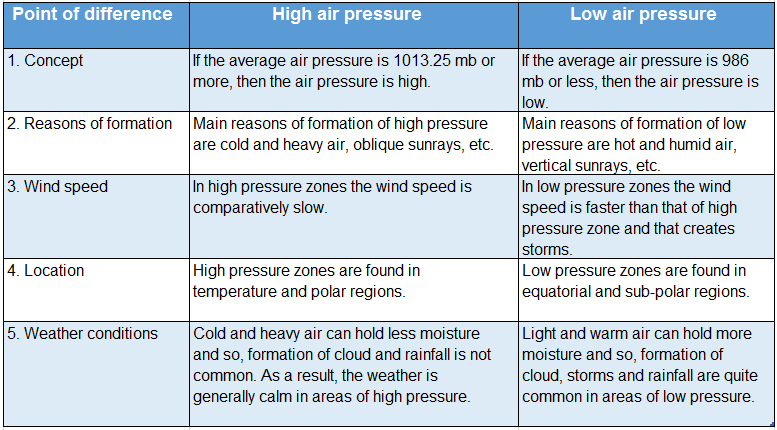
WBBSE Solutions For Class 7 Geography Chapter 3 Air Pressure Difference between high and low pressure of air


Question 4. Describe an experiment for air pressure.
Answer:

An experiment for air pressure:

A plastic bottle is taken and filled ¾ with water. If we squeeze the bottle tightly, we will see that the shape gets distorted. If we remove the pressure, the bottle regains its original shape.
WBBSE Solutions For Class 7 Geography Chapter 3 Air Pressure Experiment for air pressure

  • Now, the mouth of the bottle is shut while squeezing the bottle. If we remove our hand now, we will see that the bottle remains in that state. The bottle does not regain its shape till it is uncapped again.
  • This is because, when the bottle is squeezed, some air escape out and the pressure inside the bottle becomes less than the atmospheric pressure outside. Due to the higher atmospheric pressure outside the bottle, it does not regain its shape.

Question 5. Prove that air exerts pressure in the upward direction.
Answer:

Air exerts pressure in the upward direction:

The fact that air exerts pressure in the upward direction can be proved through the following experiment.
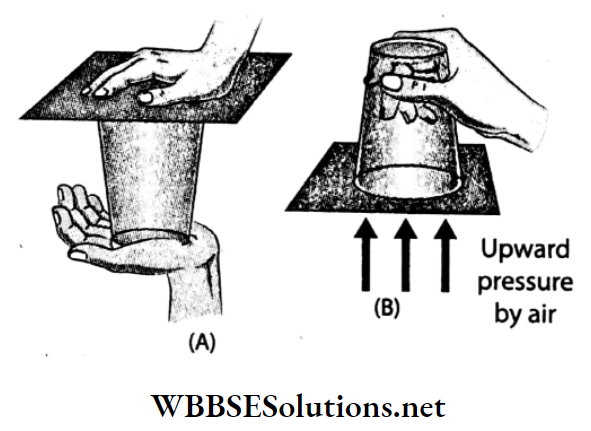
WBBSE Solutions For Class 7 Geography Chapter 3 Air Pressure Experiment to prove that air exerts pressure in the upward direction.

Procedure:

  1. A glass is filled with water to the brim. Now the glass top is completely covered with a postcard.
  2. Now the glass is quickly inverted after keeping the palm lightly on the postcard. Then slowly the hand is removed from the postcard.

Observation:

The postcard does not fall off even when the hand is removed from the inverted glass.

Inference:

The water in the glass exerts downward pressure and at the same time, the outside air exerts upward pressure on the postcard. The upward pressure of the air is much more than that of the downward water pressure and so, the postcard does not fall off.

Since the upward air pressure does not allow the postcard to fall off, hence, it is proved that air exerts upward pressure.

Question 6.  Name the atmospheric pressure belts.
Answer:

Atmospheric pressure belts:

In some definite regions on the Earth’s surface, high pressure or low pressure is observed throughout the year. These definite regions of atmospheric pressure surround the Earth in the form of belts.

These are called atmospheric pressure belts. There are seven atmospheric belts on the Earth’s surface. These are-

  1. Equatorial low pressure belt (0° -5° north and south of the Equator),
  2. Sub-tropical high-pressure belt in the northern hemisphere (25° -35° north latitude),
  3. Sub-tropical high-pressure belt in the southern hemisphere (25°-35° south latitude),
  4. Sub-polar low-pressure belt near the Arctic circle in the northern hemisphere (60°-90° north latitude),
  5. Sub-polar low-pressure belt near the Antarctic circle in the southern hemisphere (60°-90° south latitude),
  6. Arctic high-pressure belt at the North Pole (90° north latitude), and
  7. Antarctic high-pressure belt at the South Pole (90° south latitude).
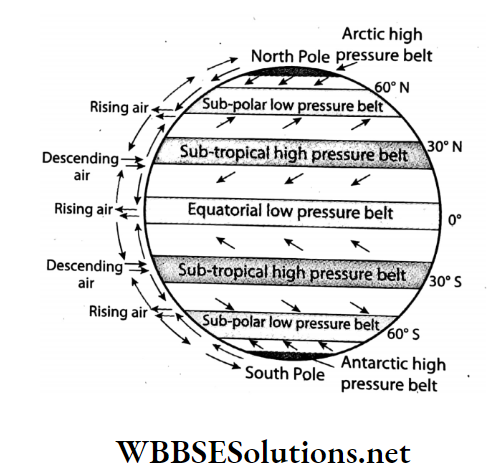
WBBSE Solutions For Class 7 Geography Chapter 3 Air Pressure Atmospheric pressure belts

Question 7. Why is the atmospheric pressure less in the equatorial region?
Answer:

The atmospheric pressure is less in the equatorial regions due to the following factors-

1. High temperature:

The Equatorial region experiences vertical rays of the sun throughout the year. So the temperature is very high. It causes upward movement of air by the process of convection. Hot air is light so its pressure is low.

2. Excessive humidity:

The water area is more than the land area at the Equator, which leads to excess addition of water vapour in the atmosphere around this region. The air pressure of humid air is lower than dry air.

3. Highest rotational speed:

The highest rotational speed of the Earth at the Equator causes the deflection of wind. Thus low pressure prevails over the equatorial regions.

Question 8. What are atmospheric pressure cells?
Answer:

Atmospheric pressure cells:

There exists a difference in air temperature and air pressure between the land areas and the water areas.

  • Sometimes these atmospheric pressure belts do not surround the Earth continuously in the east-west direction but get divided into small parts or regions. These small regions of air pressure are called pressure cells.
  • The number of pressure cells is higher in the northern hemisphere than in the southern hemisphere as the latter has a continuous stretch of waterbody for an extensive area which leads to the formation of pressure belts rather than pressure cells over it.
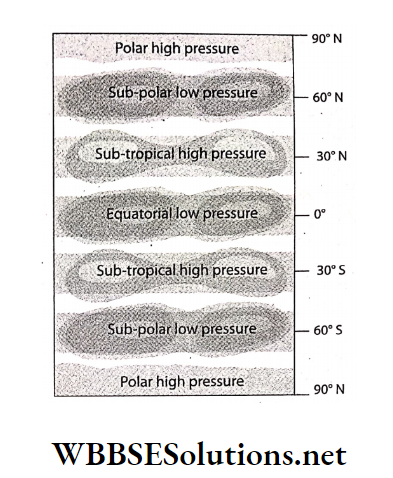
WBBSE Solutions For Class 7 Geography Chapter 3 Air Pressure Atmospheric pressure cells

Question 9. What do you mean by high pressure and low pressure?
Answer:

High pressure and low pressure:

Standard atmospheric pressure is 1013.25 MB. Air pressure, ranging between 986 mb-1013mb, is considered as normal air
pressure. If the average air pressure is more than 1013.25 mb, it is known as high pressure.

  • When the air gets cooled and compressed, the density increases, i.e. the number of molecules in a specific volume of air increases and air pressure also increases, creating high pressure.
  • If the average air pressure is less than 986 MB, it is known as low pressure. When the temperature of air increases, the molecules of air become dynamic and move apart from one another.
  • As a result, the air gradually expands and becomes lighter and rises upwards, the density of air decreases, i.e. the number of molecules in a specific volume of air decreases and the air pressure also decreases, creating low pressure.
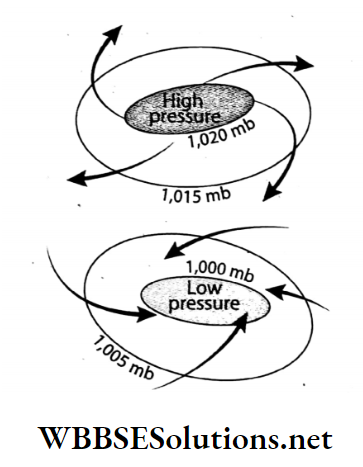
WBBSE Solutions For Class 7 Geography Chapter 3 Air Pressure High pressure and low pressure

Question 10. Define a cyclone.
Answer:

Cyclone:

A cyclone is a system of winds around an area of low pressure surrounded by high-pressure areas.

  • This is usually characterised by inward spiralling winds that rotate anti-clockwise in the northern hemisphere and clockwise in the southern hemisphere.
  • These cyclonic winds bring heavy rain and cause huge loss of life and property in the areas over which they blow.
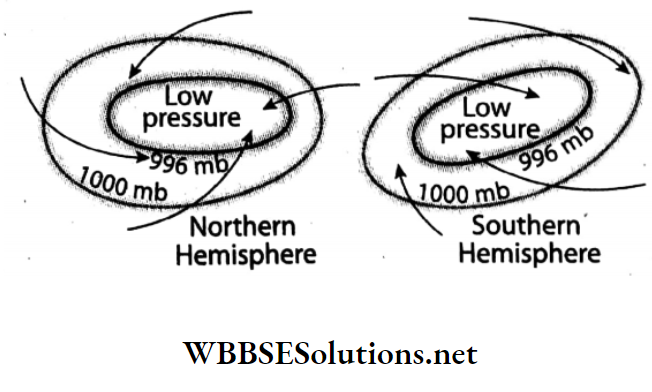
WBBSE Solutions For Class 7 Geography Chapter 3 Air Pressure Cyclone

Question 11. Put some paper inside a tumbler so that it sticks to the bottom of the tumbler and does not fall off even when you turn the tumbler upside down. Now turn the tumbler upside down and immerse it in a big bucket of water. You would naturally expect the paper inside the tumbler to get wet, isn’t it?

Pull the tumbler out and check if the paper is wet. Now immerse the tumbler into a bucket full of water. This time the paper gets soaked.

Why doesn’t the paper get wet when the tumbler is immersed in an upside-down position? Think about it.

You can now challenge your friends to immerse the tumbler completely in a bucket full of water and still keep the paper dry!
Answer:

When the bottom of a tumbler is filled with rolled-up papers and immersed upside-down in a bucket full of water, it will be observed that some water flows into the tumbler.

  • But till the time this water level reaches the papers, the papers will not get soaked. At this time, an upward thrust is felt on the tumbler.
  • The tumbler was immersed in an upside-down position, so, some air remained trapped between the water level and the bottom of the tumbler.
  • As more and more pressure is exerted on the tumbler, for it to immerse fully, the air trapped inside the tumbler gets compressed.
  • So, the air pressure inside the tumbler increases with compression.
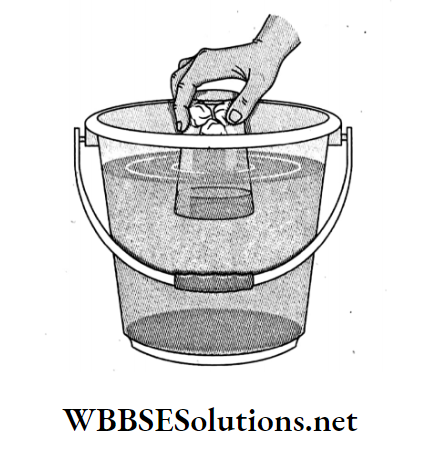
WBBSE Solutions For Class 7 Geography Chapter 3 Air Pressure experiment with paper balls and tumbler

  • This pressure gradually starts changing the shape of the paper inside the tumbler. So, if the tumbler is immersed partially and then removed, it will be observed that the papers do not get soaked.
  • But instead of removing the tumbler, if more pressure is exerted on the tumbler to immerse it, then it will be observed that the papers would get soaked at a particular point.
  • This particular point would be attained when the air pressure outside the tumbler becomes greater than the pressure inside the tumbler.

Question 12. Keep a scale at the edge of a table so that the greater part of the scale hangs outside. A little touch on the outer part makes the scale fall off the table. Now spread a newspaper over the part of the scale on the table and then lightly strike the outer part of the scale. See what happens now!
Answer:

First, as the major part of the scale was hanging outside the table, the air pressure acting on the part of the scale on the table top was very less.

  • So, it will fall even with a small tap on its hanging edge.
  • Now, when a newspaper is spread over the part of the scale on the table, the surface area on which the air pressure is acting on increases and the scale does not fall so easily.
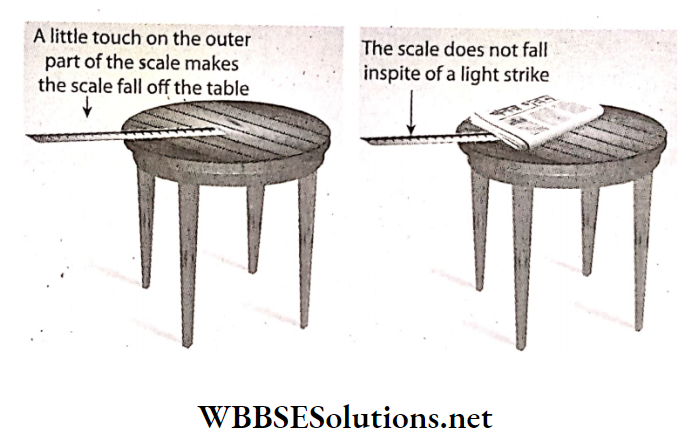
WBBSE Solutions For Class 7 Geography Chapter 3 Air Pressure Experiment to prove variation in air pressure.


Question 13. A plastic water bottle is partly filled with nearly boiling water and the stopper is sealed. You will see that after some time the bottle gets crushed. What is the reason?
Answer:

A plastic water bottle is partly filled with nearly boiling water and kept for a few hours. After some time we will see that the bottle gets a little crushed.

  • This is because as soon as the bottle is filled with hot water, the inside air heats up and goes out a bit.
  • Then the water inside and the rest of the air slowly cool and compress, creating a vacuum inside the bottle.
  • As a result, the air pressure inside the bottle is much lower than the outside air pressure.
  • So the bottle gets crushed under the influence of lateral pressure of the outside air.
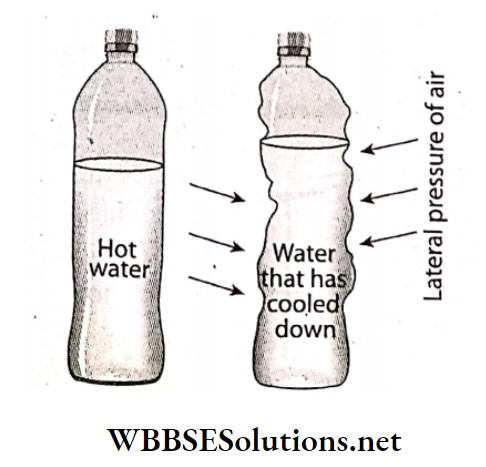
WBBSE Solutions For Class 7 Geography Chapter 3 Air Pressure Experiment to prove variation in air pressure..

Question 14. Collect photographs and information about any storm in your district, state or country of the recent past from the newspapers and magazines. Make a collage with them. Paste it in your exercise book and show it to your friends in the classroom.
Answer:

WBBSE Solutions For Class 7 Geography Chapter 3 Air Pressure newspapers and magazines

Question 15. What are the effects of air pressure?
Answer:

The effects of air pressure are as follows-

1. Effect on the respiratory system:

As the pressure of air is very low at high altitudes, we need to breathe faster while climbing mountains. For this reason, mountaineers carry oxygen cylinders with them.

2. Effect on health:

At very high altitudes, where the air pressure is very low, the pressure of the blood molecules inside our body increases drastically and may result in bleeding from our ears, nose, eyes, etc.

3. Effect on weather conditions:

Severe cyclones and rain occur in intense low-pressure regions.

4. Effect on air:

Air pressure influences the direction of airflow, the temperature of the air, etc.

Question 16. Fill up the knowledge hive with information about barometers.
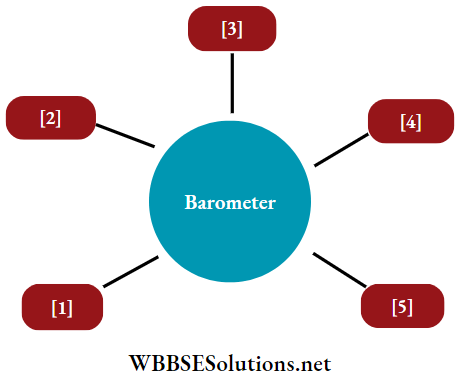
WBBSE Solutions For Class 7 Geography Chapter 3 Air Pressure Barometer

Answers:

1. This instrument is used to measure air pressure.
2. Torricelli invented the mercury barometer in the year 1643.
3. Barometers are of various types- Fortin’s, Aneroid, etc.
4. To ensure the accuracy of the reading of the mercury height, a vernier scale is attached to the top of the mercury column in a Fortin barometer.
5. Apart from measuring atmospheric pressure, it is also utilised for weather forecasts and measuring altitude.

Question 17. Which of the following is a low-pressure and high-pressure diagram? Identify the direction of wind flow.
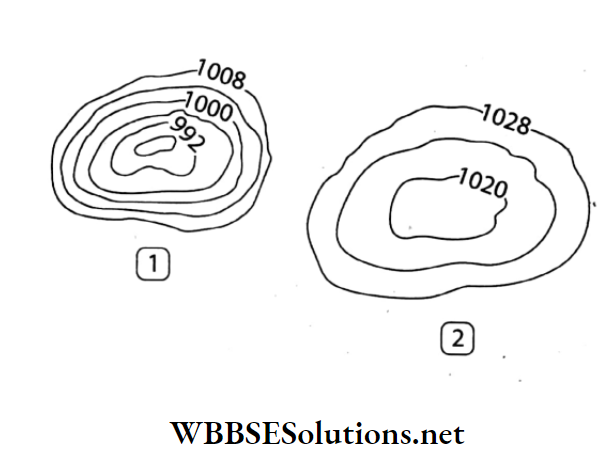
WBBSE Solutions For Class 7 Geography Chapter 3 Air Pressure High pressure and low pressure.

Answers:

1. Low-pressure diagram
2. High-pressure diagram
3. Wind flow from 2 to 1

Question 18. Do you have any idea what the winding black lines in the adjacent diagram are?
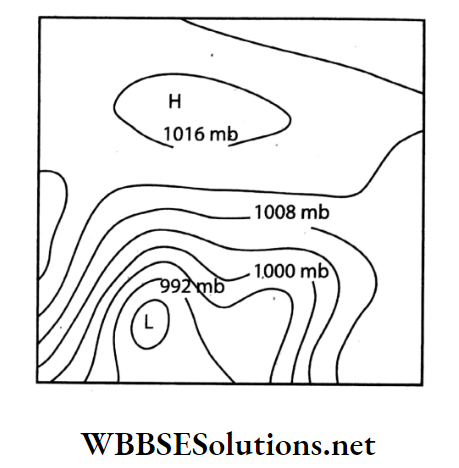
 

WBBSE Solutions For Class 7 Geography Chapter 3 Air Pressure Winding black lines in the adjacent diagram

Answers:

The winding black lines in the adjacent diagram are called isobars. These imaginary lines join the places with equal air pressure at a particular time.

Question 19.
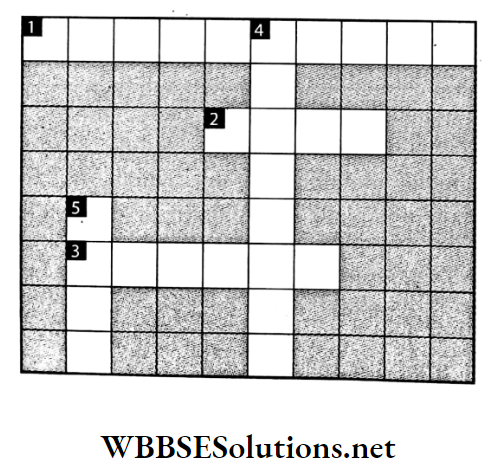
WBBSE Solutions For Class 7 Geography Chapter 3 Air Pressure Crossword

Down:

4. Instrument used to determine the direction of the wind.
5. Results from air pressure difference.

Across:

1. Tropical storm over Australia.
2. Unit of wind speed.
3. Line joining places having equal atmospheric pressure.

Answers:

Down: 4. WIND VANE 5. WIND
Across: 1. WILLY WILLY, 2. KNOT, 3. ISOBAR

Question 20.
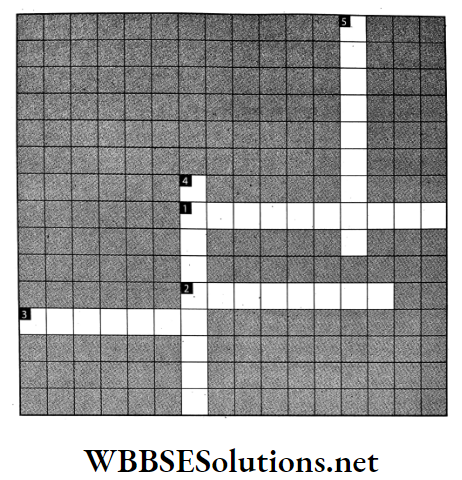
 

WBBSE Solutions For Class 7 Geography Chapter 3 Air Pressure Crossword.

Down:

4. Instrument used to measure atmospheric pressure.
5. Rate at which air moves from high pressure to low pressure.

Across:

1. Instrument used to measure wind speed.
2. Unit of atmospheric pressure.
3. Tropical storm originating over the Indian Ocean.

Answers:

Down: 4. BAROMETER, 5. WIND SPEED
Across: 1. ANEMOMETER, 2. MILLIBAR, 3. CYCLONE

Question 21. Take a large, empty bottle with an open mouth. Crumple a paper to form a small ball so that the size of the ball is half the diameter of the mouth of the bottle. Now hold the bottle in a horizontal position and try to blow the ball into it. See what happens. Ask your friends to try the same. However strong you may be blowing, the ball does not enter the bottle. Why?
Answer:

A bottle is placed on the table. A paper is crumpled to make a small ball. If we try to blow in the paper ball through the mouth of the bottle then it is observed that the paper ball does not enter the bottle.

It will just move around the mouth of the bottle as if some force is not allowing it to go in. This happens because of the difference of pressure inside and outside the bottle.

It has been experimentally proved that the air pressure is always low where the wind speed is high. According to the diagram, the air pressure between the face and the paper ball is higher than the air pressure between the paper ball and the mouth of the bottle.

Thus the air pressure between the paper ball and the mouth of the person becomes lower than the air pressure between the bottle mouth and the paper ball. So for this reason, however strong we may be blowing, the ball does not enter the bottle.
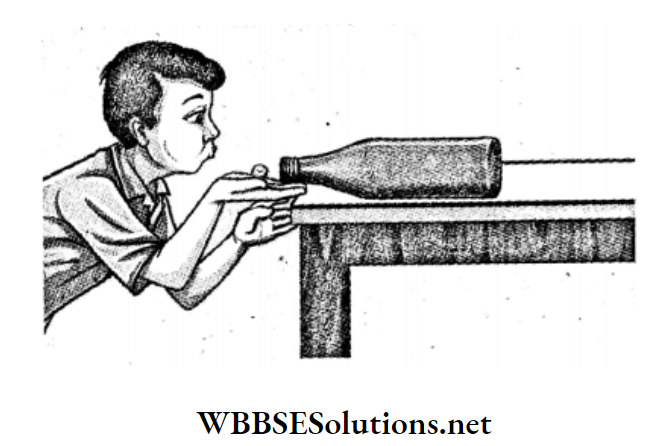
WBBSE Solutions For Class 7 Geography Chapter 3 Air Pressure Experiment to prove variation in air pressure

Question 22. Close a plastic bottle, partly filled with water, with a thin piece of polythene or a cork. Insert a narrow tube of pipe through the cap of the bottle and blow a few times, strongly, into the pipe. See what happens.
Answer:

If we put our mouths on the tube and blow a few times inside the bottle, we can see that some bubbles are formed in the water and these rise up to the top.

  • This is because if we blow in a narrow tube, the air from the mouth enters through the tube and forms a bubble.
  • These bubbles, made of air, being lighter than water come up on the water.
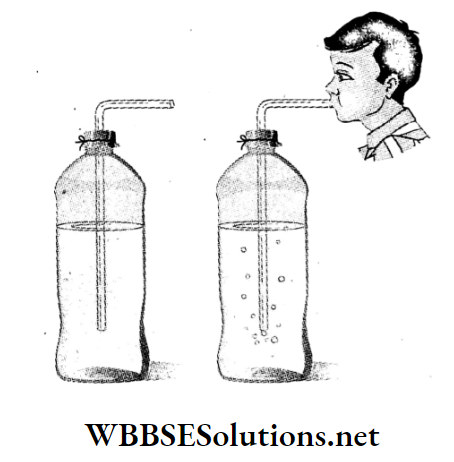
WBBSE Solutions For Class 7 Geography Chapter 3 Air Pressure Experiment to from bubbles

Question 23. It was a scorching hot day today. The sun was beating down hard all day. Srijan usually plays in the field after returning from school. But his mother didn’t let him go out today, because dark clouds were looming in the sky. Not a single leaf stirred. Suddenly a storm broke. The wind was lashing hard on the doors and the window panes. Soon after, it started to rain. Such a lull occurs before a storm. The wind hardly blows then. Why?
Answer:

During the daytime, the Earth’s surface is heated intensely by sun rays. Due to high temperature, the air of that place becomes warm, and light and rises up.

  • In this way, the air adjacent to the Earth’s surface gradually gets heated up and rises.
  • The place becomes airless to some extent. As a result, a deep low-pressure area is formed.
  • Air does not flow horizontally until the heavy air of the surrounding areas rushes to the low-pressure area.
  • That is why before the storm, the surrounding area is calm, and not a single leaf of a tree moves.
  • When the relatively cold and heavy air gushes in to the low pressure area, the storm is created.

Question 24. Jhinuk went to Gomukh with her parents during the puja vacation. The ice cave of Gomukh is the source of the River Ganga, situated high in the Himalayas (almost 3900 m in height). The place was indeed beautiful but the food did not suit her. Rice and pulses could not be boiled well out here. Father said this was common in the high mountainous region. The air pressure being less in high mountainous regions, water starts to boil at low temperatures. Why does this happen?
Answer:

Generally air pressure decreases with increasing altitude. So the air pressure is quite low at Gomukh in the Himalayas at an altitude of 3900 metres.

  • That is why the boiling point of water decreases in the highlands.
  • When the pressure in the atmosphere is low, water boils at a temperature below 100°C. So food does not boil well.
  • That is why it is difficult to cook rice and pulses in hilly areas.

Question 25.
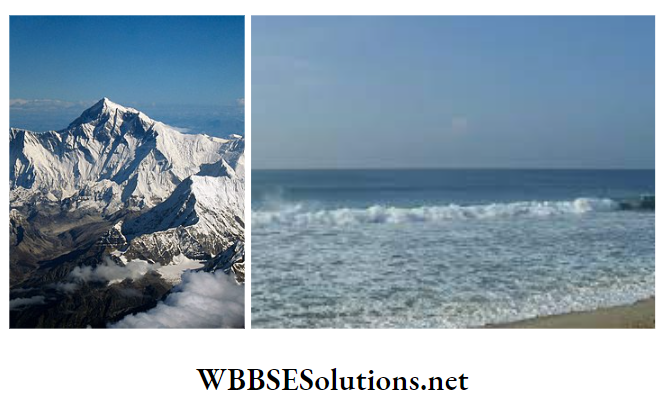
WBBSE Solutions For Class 7 Geography Chapter 3 Air Pressure Mount Everest and The beach of puri


WBBSE Solutions For Class 7 Geography Chapter 3 Air Pressure Mount everest and The beach of puri

WBBSE  Chapter 3 Air Pressure Short Question And Answers

Question 1. Why don’t we feel the air pressure? 
Answer:

We Dont feel the air pressure:

  • Air exerts 1013.25 mb pressure on an adult human body.
  • Human beings are used to this pressure because the air entering the human body through pores, mouth and windpipe exerts pressure outwards equalising it with the surrounding atmospheric pressure.
  • So, we do not feel this huge amount of pressure exerted on our bodies.

Question 2. A vessel made of a thin sheet of tin with a small opening in It is partially filled with water and heated over a burner. While the water boils, the vapour goes out of the tin vessel. After some time, the opening of the tin vessel is closed with a cork and removed from the burner. What happens after the tin has cooled down?
Answer:

Initially the air pressure inside the tin vessel and the outside atmospheric pressure was equal, so the vessel remained in the normal state.

  • When the water started boiling, the vapour coming out of the vessel removed the air inside along with it.
  • Then, as the opening of the tin vessel was closed with a cork, air from outside could no longer flow inside.
  • When the vessel cooled down, the atmospheric pressure inside the tin vessel became lower than the outside atmospheric pressure.
  • As a result, the thin sheets of tin contracted inwards. This happens only due to the presence of atmospheric pressure.

Question 3. Can you boil water at room temperature without heating the vessel? If you can, how?
Answer:

Water is kept in a closed vessel at room temperature and an air-suction pump is attached to it. Now, the air from the vessel is sucked out gradually.

  • We will see that the water starts boiling without being heated.
  • With a decrease in pressure, the boiling point of any liquid also decreases.
  • Now as the pressure exerted on water in this condition is very low, the boiling point of water becomes equal to the room temperature and the water starts boiling.

Question 4. How does atmospheric pressure vary?
Answer:

Air pressure is not equal everywhere.

  • As gravitational force is highest at sea level, the distance between air molecules decreases and the density of air increases. So, atmospheric pressure is highest here.
  • The gravitational force decreases with an increase in altitude.
  • As a result, the distance between the air: molecules increases and the density of the air decreases, resulting in a decrease in the atmospheric pressure.

Question 5. Describe a barometer.
Answer:

Barometer:

Barometer was invented by a scientist named Torricelli in the year 1643. The variation of air pressure can be measured with it’s help.

  • In this instrument, a cylindrical tube filled with mercury is kept upside down in a container filled with mercury. At normal atmospheric pressure, the height of the mercury column in the tube is 76 cm.
  • With the decrease in atmospheric pressure, the height of the mercury column decreases and vice-versa. Thus, this instrument is used to predict weather conditions and measure altitude.

Question 6. How is the barometer used to predict the weather?
Answer:

Barometer readings help us to predict the weather condition of any place.
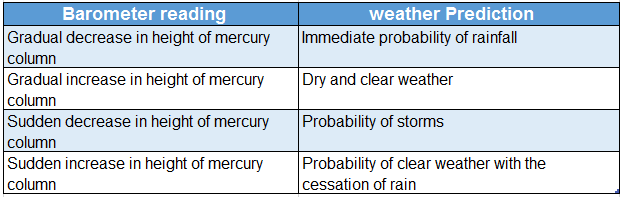
WBBSE Solutions For Class 7 Geography Chapter 3 Air Pressure barmeter used to weather prediction

Question 7. Pressure is higher at the sea level and decreases with an increase in altitude. -Explain.
Answer:

Pressure is higher at the sea level and decreases with an increase in altitude:

The closer the molecules of air to one another, the denser is the air and the higher is its pressure.

  • At sea level, the gravitational pull of the Earth is the highest.
  • Moreover, the upper layers of the air exert pressure on the lower layer and so, the molecules become closely spaced and the density increases. Along with this, the pressure of the air also increases.
  • However, the density of the upper layers is rarer as the molecules are sparsely placed. As a result, the pressure decreases with an increase in altitude.

Question 8. What is meant by the vertical distribution of atmospheric pressure?
Answer:

Vertical distribution of atmospheric pressure:

Average atmospheric pressure at sea level is 1 kg per sq cm or 1013.25 mb or 760 mm of mercury column or 76 cm of mercury column or 29.92 inches of mercury column.

  • With the gradual increase in altitude from sea level, the volume and weight of air decrease.
  • And thus atmospheric pressure decreases at a rate of 34 mb for every 300 metres of ascent.

Rate of variation of air pressure with altitude-
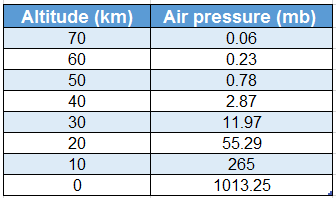
WBBSE Solutions For Class 7 Geography Chapter 3 Air Pressure rate of variation of air pressure with altitude

Source: MC Knight, Tom L (1990): Physical Geography, A Landscape, California (USA).

Question 9. What is the relation between atmospheric temperature and pressure?
Answer:

Relation between atmospheric temperature and pressure:

Atmospheric pressure is inversely dependent upon atmospheric temperature in the following ways-

  1. When a column of air gets heated up, its volume increases and expands. This expansion of air results in a decrease in pressure. So, when the temperature of air increases, pressure decreases.
  2. When the temperature of a column of air decreases, it contracts. With gradual contraction its density and pressure increase. So, pressure increases, with a decrease in temperature.

Real-life scenarios Involving Weather Changes Due to Air Pressure

Question 10. Why do mountaineers use oxygen
Answer:

Mountaineers use oxygen:

  • The atmospheric pressure is very high near the Earth’s surface and gradually decreases upwards.
  • With the decrease in atmospheric pressure i.e. as the air becomes thinner, the amount of oxygen in it decreases.
  • It causes difficulties in breathing. As the air pressure at the top of high mountains is very less, mountaineers use oxygen cylinders to help them breathe properly.

Question 11. What is the effect of water vapour on atmospheric pressure?
Answer:

The effect of water vapour on atmospheric pressure:

Humid air (i.e. air with a high amount of water vapour) is comparatively lighter and its pressure is also less. So, regions with high water Descending- vapour content in the air experience low pressure.

  • On the other hand, if the amount of water vapour present in the air is very less, it is called dry air and high pressure exists there.
  • So, the atmospheric pressure is very low in the equatorial regions, while high pressure prevails in the polar regions due to a deficiency of water vapour.

Question 12. What is the equatorial low-pressure belt or doldrums?
Answer:

Atmospheric pressure cells:

  • Due to the intense low pressure along the equatorial region, the winds are always warm and moist and move upwards.
  • As there is no horizontal movement of wind in this region throughout the year, calm conditions prevail.
  • So, this pressure belt is called the equatorial low-pressure belt or doldrums.

Question 13. What are the characteristics of isobars?
Answer:

The characteristics of isobars are as follows-

  1. Isobars are the black sinuous lines drawn on a weather map joining places of equal atmospheric pressure.
  2. Normal values of isobars over the Earth vary between 980 mb to 1050 MB. It is expressed in millibar.
  3. It is always shown according to the sea level pressure.
  4. They never intersect or touch one another.
  5. When the isobar lines are very close to one another, the pressure difference is high and the speed of the wind is also high.

Question 14. What are the characteristics of air pressure?
Answer:

The main characteristics of air pressure are as follows-

1. Relation with altitude: Air pressure decreases with an increase in altitude and increases with a decrease in altitude. Pressure decreases by about 34 mb for every 300 metres of ascent.

2. Relation with temperature: Air pressure decreases with an increase in temperature and vice-versa.

3. Relation with water vapour: The pressure of air saturated with water vapour is low. So, the atmospheric pressure is low during the monsoon season.

4. Occurrence of the storm: Sudden fall in air pressure may cause storms.

5. Standard atmospheric pressure: The mean atmospheric pressure is about 1013.25 mb at sea level.

6. High pressure and low pressure: Pressure that registers at more than 1013.25 mb is called high pressure and less than 986 mb is called low pressure.

7. Relation with isobar: If the isobars are closely spaced, it indicates a rapid change of air pressure.

Question 15. What are the importance of winds?
Answer:

The importance of winds are-

  1. They regulate the heat balance between different regions on the Earth.
  2. Many natural weather phenomena like clouds, rains, etc. occur due to winds.
  3. Winds regulate the balance between the high and low-pressure zones.

Question 16. Mention the different names of cyclones.
Answer:

Cyclones are known by different names in different parts of the world depending on which ocean it has formed over.
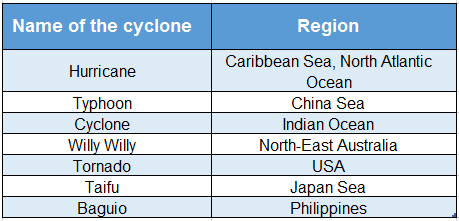
WBBSE Solutions For Class 7 Geography Chapter 3 Air Pressure Different names of cyclone and regions

Question 17. What is Kalbaisakhi or Nor’westers?
Answer:

Kalbaisakhi or Nor’westers:

  • East India, especially West Bengal and its surrounding regions experience torrential rains from thunderstorms and sometimes hailstorms in summer due to the cyclonic winds coming from the northwest direction.
  • These thunderstorms are called Nor’westers or Kalbaisakhi, as they arrive mainly in the months of April and May. The latter name means “calamity of the month of Baisakh”.

Question 18. State the effect of atmospheric pressure on the day-to-day lives of the people living in Darjeeling.
Answer:

The effect of atmospheric pressure on the day-to-day lives of the people living in Darjeeling

  • Darjeeling is located at an altitude of 2042 metres above sea level. At this altitude, the atmospheric pressure is lower than that of the plains i.e. approximately 795 MB.
  • Due to low atmospheric pressure, water boils at a temperature of about 93.6°C which lengthens the time taken for food to be cooked. Thus, this creates problems in day-to-day activities.

Question 19. State the effect of atmospheric pressure on the day-to-day lives of the people living in the coastal areas of Puri.
Answer:

The effect of atmospheric pressure on the day-to-day lives of the people living in the coastal areas of Puri.

  • The average temperature and atmospheric pressure in the coastal areas of Puri is around 20°C (although the book mentions 20°C, the temperature is 27° C) and 1000 MB respectively throughout the year.
  • At this pressure level, food can be easily cooked and there is no difficulty.
  • So, there is no problem in boiling food. This condition is favourable for carrying out normal day-to-day human activities.

Question 20. What are the applications of air pressure in our day-to-day life?
Answer:

The applications of air pressure that we observe in our daily life are-

  1. Water can be lifted with the help of a pump due to air pressure.
  2. We can drink any liquid with a straw due to air pressure.
  3. Liquids can be filled in syringes, sprayers can be filled with coloured water during Holi, and ink can be drawn into a dropper only due to air pressure.

Question 21. How is the weather likely to be in these two places? If you travel from Puri beach to Mount Everest, what changes in your daily life are likely to happen?
Answer:

The weather of Puri Beach is comfortable or moderate i.e. neither too hot nor too cold. The weather of Mount Everest, on the other hand, is very cool.

The changes that come to everyday life when one goes to Mount Everest from the beach of Puri are-

  1. One has to take winter clothes to go to the place from 27° C to -9° C.
  2. Due to the height of Mount Everest, the air pressure will be low, so food will not get boiled well without a pressure cooker.
  3. For low air pressure bleeding from the nose and mouth, respiratory problems may occur. That is why the oxygen cylinder must be carried with.

Question 22. The people living on the plains get tired easily when they go to the hilly regions. Why?
Answer:

The people living on the plains get tired easily when they go to the hilly regions.

  • As the density of air is less in the hilly regions, the amount of oxygen is also less.
  • This low oxygen content in the atmosphere of hilly regions not only causes breathing problems but also makes people coming from plains feel tired easily.

Question 23. How can we use a barometer in the determination of altitude?
Answer:

We Can use a barometer in the determination of altitude

  • Atmospheric pressure changes with altitude resulting in a difference in atmospheric pressure between two places lying at different altitudes.
  • We can calculate this difference in altitude by measuring the difference in atmospheric pressure between two places with the help of a barometer.

Question 24. What are the characteristics of a cyclone?
Answer:

The characteristics of a cyclone are as follows-

  1. Low pressure exists in the centre, surrounded by high pressure.
  2. The cyclonic winds spiral in an anti-clockwise direction in the northern hemisphere and a clockwise direction in the southern hemisphere.
  3. In the centre of a cyclone, there are hot and upward-moving winds.
  4. In a cyclone, the speed of the wind is very high, often resulting in strong and destructive winds.
  5. This phenomenon, although powerful, is usually short-lived.

Question 25. State the difference between pressure belts and pressure cells.
Answer:

The differences between pressure belts and pressure cells are-
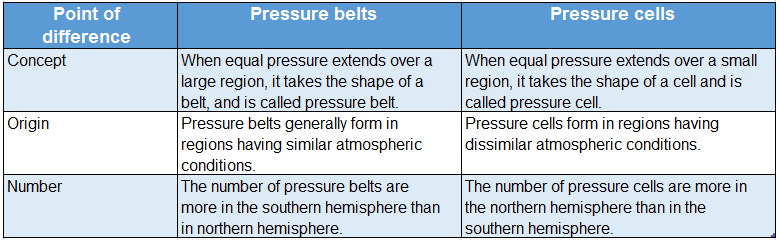
WBBSE Solutions For Class 7 Geography Chapter 3 Air Pressure Difference between Pressure belts and presure cells

Question 26. What is the reason for the existence of atmospheric pressure on Earth?
Answer:

The reason for the existence of atmospheric pressure on Earth:

  • As air itself has weight and exerts pressure on the Earth’s surface, there is the existence of atmospheric pressure.
  • The Earth has a huge mass and hence exerts a strong gravitational force.
  • Due to this strong gravity, it can hold onto this large atmosphere.

Question 27. We use straws for drinking cold drinks. How does the liquid come up through the oes the straw?
Answer:

  • While drinking cold drinks, one end of the straw is in our mouth while the other is dipped into the liquid. When we suck the air out of the straw, low pressure is created inside it.
  • The atmospheric pressure acting on the liquid surface pushes the liquid up through the straw.

Question 28. When a syringe is dipped into water and the piston is pulled up, why does water come up through the mouth of the syringe? Or, How does water come up into a syringe?
Answer:

  • A low pressure is created inside the syringe when we pull the piston of a syringe while dipping its mouth into the water.
  • The atmospheric pressure acting on the water surface pushes the water up into the syringe.

Question 29. One of your neighbours is going to climb Mount Everest. How can you make him aware of the dangers he might face?
Answer:

  • Mount Everest is the highest mountain in the world (8848 metres). At this height, the atmospheric pressure is rd of the pressure at sea level, i.e. 330 millibars.
  • As the air pressure is very low there, it becomes difficult to breathe. So, I will advise him to carry an oxygen cylinder while climbing.
  • Also, as the air pressure is very low at such a high altitude, our blood pressure rises. So often, mountaineers experience bleeding from the nose, eyes, ears, etc. I will also warn him about this.

Question 30. If you visit Gomukh Ice Cave and put your hand in the boiling water, your hand does not burn.-Why?
Answer:

Gomukh is located at a very high altitude above sea level (about 3900 metres).

  • At this height, the pressure of air is very low and thus, water boils at a temperature much lower than 100° C.
  • So, when you touch that boiling water, your hand does not burn.

Question 31. Why is it difficult to cook food in hilly regions?
Answer:

  • The atmospheric pressure decreases with an increase in altitude. We know that, boiling point increases with an increase in the air pressure.
  • But, as air pressure is less in hilly regions, the food materials start to boil at a temperature less than 100°C, taking more time for the food to get cooked.

Question 32. It is always advised to cook rice in a covered vessel.-Why?
Answer:

  • If rice is cooked in a covered vessel, the water vapour cannot leak out of the vessel. This vapour pressure inside the vessel becomes more than the atmospheric pressure.
  • Due to this excess vapour pressure, the rice inside starts to boil at a temperature more than 100°C and gets cooked quickly.

Question 33. Why is atmospheric pressure low during the monsoon season?
Answer:

  • Saturated air (i.e. air with a maximum limit of water vapour) is lighter than dry air. Thus the atmospheric pressure decreases with an increase in the amount of water vapour in the air.
  • In the monsoon season, the amount of water vapour in the air is very high. So, the atmospheric pressure is very low.

Question 34. Why is the atmospheric pressure high in the polar regions?
Answer:

  • In both polar regions, the sunrays fall obliquely and so, do not adequately heat up the surface and the air above it. So, the polar air remains cold and keeps on contracting.
  • With the gradual contraction of air, the air density increases along with its pressure. Thus, atmospheric pressure is high in the polar regions.

Question 35. What do you mean by air current?
Answer:

Air Current:

  • The vertical movement of air from a region of high pressure to a region of low pressure is called air current. When the air at any place gets heated up, it expands, gets lighter and moves upwards vertically.
  • Cold air from the surrounding regions rushes in to take its place. This vertical or nearly vertical movement of air causes air current.

Question 36. Why does the weather become calm before the storm?
Answer:

Storms are usually formed due to high temperatures. In some regions, the air gets hotter and lighter and moves upwards.

  • An intense low-pressure zone forms over the region. At this time, there is no horizontal flow of air.
  • So, the weather becomes calm before the storm.
  • Cold air from the surrounding region rushes in the form of storms to fill in the region of low pressure.

Question 37. Why do astronauts wear special spacesuits that are filled with air?
Answer:

  • As there is no air in space, the nerves and blood vessels can explode due to the pressure exerted by air from inside the body of the astronauts.
  • So, they wear special spacesuits which are filled with air before going to space. So that there is a balance of air pressure.

WBBSE  Chapter 3 Air Pressure Very Short Question And Answers

Question 1. I flow from the high-pressure zone to the low-pressure zone. Who am I?
Answer: Air

Question 2. I move with tremendous velocity from centres of high pressure to centres of low pressure with a circular motion. Who am I?
Answer: Cyclone

Question 3. Atmospheric pressure is measured with my help. Who am I?
Answer: Barometer

Question 4. I invented the barometer. Who am I?
Answer: Torricelli

Question 5. I am the unit of measurement of air pressure. Who am I?
Answer: Millibar

Question 6. The air becomes lighter when I mix with it. Who am I?
Answer: Water vapour

Question 7. I am an imaginary line joining all the places on the Earth’s surface with equal atmospheric pressure. Who am I?
Answer: Isobar

Question 8. I am used to determining the air pressure in a barometer. Who am I?
Answer: Mercury

Question 9. I exert a pressure of 1013.25 mb at sea level. Who am I?
Answer: Air

Question 10. In hilly regions, it is difficult to cook rice and pulses due to my deficiency. Who am I?
Answer: Air pressure

Question 11. It is difficult to breathe in the hilly regions of high altitude due to my deficiency. Mountaineers carry me with themselves. Who am I?
Answer: Oxygen

Question 12. What are isobars?
Answer:

Isobars:

The imaginary lines drawn on a map joining places with equal atmospheric pressure at a particular time are known as isobars. In a weather map, the isobars are expressed in millibars with the help of black, sinuous lines.

Question 13 While filling up air in a balloon or a cycle tyre, if more air is filled by chance, it bursts.-Explain why?
Answer:

The elastic nature of the balloon or a cycle tyre, allows a little more air to be filled. But if excessive air is filled by chance, the surplus pressure cannot be withstood by the walls of the balloon or the cycle tyre and so, it bursts.

Question 14. Why does food get cooked faster in a pressure cooker?
Answer:

While cooking in a pressure cooker, the pressure of the water vapour is increased to boil water at a temperature higher than 100°C. As the temperature rises, the food gets boiled faster and, so gets cooked quickly.

Question 15. What is meant by normal or standard atmospheric pressure?
Answer:

The pressure exerted at sea level by 76 cm of mercury column at 0°C temperature, at 45° North latitudes, is called the standard atmospheric pressure. It is equal to 1 kg per sq cm or 1013.25 mb.

Question 16. What is the name of the force exerted by any air mass on the Earth’s surface?
Answer: Air pressure.

Question 17. What is the average pressure of air at sea level?
Answer: 1013.25 MB.

Question 18. Name the instrument used to measure atmospheric pressure.
Answer: Barometer.

Question 19. Who invented the barometer in the year 1643?
Answer: Evangelista Torricelli.

Question 20. What type of weather is indicated by the sudden fall of mercury in a barometer?
Answer: Stormy weather.

Question 21. How much does air pressure decrease for every 110-metre rise in altitude?
Answer: 1 cm of mercury column.

Question 22. What type of relationship exists between temperature and air pressure?
Answer: Inversely proportional.

Question 23. What is the relation between altitude and atmospheric pressure?
Answer: Inversely proportional.

Question 24. What type of pressure is created as water vapour mixes with the air?
Answer: Low pressure.

Question 25. Name the high-pressure and low-pressure centres surrounding the Earth.
Answer: Pressure belts.

Question 26. How many permanent high-pressure belts exist on Earth?
Answer: 4 (Four).

Question 27. Which pressure belt is formed surrounding the Equator?
Answer: Equatorial low-pressure belt.

Question 28. Which pressure belt is formed surrounding the Tropic of Cancer and the Tropic of Capricorn?
Answer: Sub-tropical high-pressure belt.

Question 29. Name the pressure zone that is formed between 70°-90° parallels of latitudes.
Answer: Polar high-pressure belt.

Question 30. Name the imaginary line that connects all places with equal atmospheric pressure.
Answer: Isobar.

Question 31. What are the areas with lesser atmospheric pressure than the standard atmospheric pressure known as?
Answer: Low-pressure area.

Question 32. What are the areas with higher atmospheric pressure than the standard atmospheric pressure known as?
Answer: High-pressure area.

Question 33. Name the horizontal movement of air from the high-pressure to the low-pressure zone.
Answer: Wind.

Question 34. Name the spiralling winds that move at high velocity from high-pressure regions to low-pressure regions.
Answer: Cyclonic winds.

Question 35. Name the type of whirlwind that originates over the China Sea.
Answer: Typhoon.

Question 36. Name the type of whirlwind that is found in the United States of America.
Answer: Tornado.

Question 37. Name the type of whirlwind originating over the Indian Ocean.
Answer: Cyclone.

Question 38. Name the whirlwind originating over the Caribbean Sea.
Answer: Hurricane.

WBBSE  Chapter 3 Air Pressure Fill In The Blanks

Question 1. The unit for measuring air pressure is _______.
Answer: Millibar

Question 2. The instrument used for measuring atmospheric pressure is known as _______.
Answer: Barometer

Question 3. For measuring the temperature, a _______ is used with the barometer.
Answer: Thermometer

Question 4. The average atmospheric pressure at sea level is _______ mb.
Answer: 1013.25

Question 5. The average air pressure at sea level is _______ inches of mercury.
Answer: 29.92

Question 6. Air pressure is _______ in the mines than at sea level.
Answer: Higher

Question 7. In nature, pressure _______ with an increase in air temperature and pressure with a decrease in air temperature.
Answer: Decreases, increases

Question 8. _______ winds are heavy so, their pressure is high.
Answer: Cold

Question 9. Air pressure _______ with an increase in altitude from sea level.
Answer: Decreases

Question 10. With the increase in density of air, pressure _______.
Answer: Increases

Question 11. Mountaineers use _______ cylinders at high altitudes.
Answer: Oxygen

Question 12. With the increase in temperature, the pressure of air _______.
Answer: Decreases

Question 13. The total number of pressure belts observed over the Earth’s surface are _______.
Answer: 7

Question 14. Equatorial low-pressure belts exist between _______ to _______ parallels of latitudes.
Answer: 5° N, 5°S

Question 15. In the equatorial region, _______ pressure belts are formed.
Answer: Low

Question 16. Sub-polar low-pressure belts are observed approximately over _______ latitudes.
Answer: 66½°N and S

Question 17. Sub-tropical high-pressure belt near the Tropic of Cancer is located between _______ latitudes.
Answer: 25° N-35° N

Question 18. The number of pressure cells are more in the _______ hemisphere.
Answer: Northern

Question 19. Air pressure decreases in the _______ season.
Answer: Summer

Question 20. In the month of July, _______ belt is formed in the interior parts of the continent of Asia.
Answer: Low pressure

Question 21. The principal cause of airflow is the difference in _______ between two places.
Answer: Pressure

Question 22. Air flows from _______ pressure zones to pressure zones.
Answer: High, low

Question 23. Air pressure less than 986 mb is called _______.
Answer: Low pressure

Question 24. The difference in air pressure between any two places determines the _______ between those two places.
Answer: Pressure gradient

Question 25. Higher air pressure: Sea level:: Lesser air pressure: ___________.
Answer: Mountainous region

Question 26. Air temperature: Isotherm:: Air pressure: ___________.
Answer: Isobar

Question 27. High pressure: Clear and calm weather:: Low pressure: ___________.
Answer: Stormy and turbulent weather

WBBSE  Chapter 3 Air Pressure True Or False

Question 1. Atmospheric pressure is 1.5 kg per sq. cm.
Answer: False

Question 2. Sub-tropical high-pressure belts lie between 30°-40° N and S parallel of latitudes.
Answer: True

Question 3. The atmosphere exerts a pressure of 5500 millibars on an adult human body.
Answer: False

Question 4. The atmospheric pressure increases with the increase in the amount of water vapour in the air.
Answer: False

Question 5 Air pressure increases by 34 millibars approximately for every 300 metres of ascent.
Answer: False

Question 6. Air pressure is measured by a wind vane.
Answer: False

Question 7. The weight of air per unit area is called air pressure.
Answer: True

Question 8. Air pressure increases with the rise in air temperature.
Answer: False

Question 9. The pressure of wet air is less than dry air.
Answer: True

Question 10. The polar high-pressure belts lie at the North and South Poles.
Answer: True

Question 11. The unit of measuring air pressure is millibar.
Answer: True

Question 12. As the air near the Earth’s surface is dense, the pressure is lowest in this zone.
Answer: False

Question 13. Air pressure at sea level is approximately 1003.25 mb.
Answer: False

Question 14. There are 3 low-pressure belts and 4 high-pressure belts on the Earth’s surface.
Answer: True

Question 15. A sudden fall on the mercury column of a barometer indicates the probable occurrence of storm.
Answer: True

Question 16. The cyclones formed in the USA are called Hurricanes.
Answer: False

Question 17. A barometer can also be used to measure altitude.
Answer: True

Question 18. The latitudinal extension of air pressure cells is less in the northern hemisphere.
Answer: False

Question 19. Intense low pressure exists at the centre of a cyclone.
Answer: True

Question 20. The speed of air is measured with the help of a barometer.
Answer: False

WBBSE  Chapter 3 Air Pressure Find The Odd One Out

Question 1. Typhoon: Southerly winds: Tornado: Cyclone
Answer: Southerly winds (not a type of cyclone)

Question 2. High pressure: Air current: Low pressure: Temperature
Answer: Air current (not related to air pressure)

Question 3. Water vapour: Loo: Low pressure: Whirlwind
Answer: Loo (not directly related to air pressure)

Question 4. Trade wind: Westerlies Polar wind: Sea breeze
Answer: Sea breeze (not a planetary wind)

WBBSE  Chapter 3 Air Pressure Correct The Following

Question 1. Air pressure is 1 kilogram for every square foot.
Answer: Ton

Question 2. Air pressure increases with an increase in altitude.
Answer: Decreases

Question 3. Air exerts pressure downwards.
Answer: In all directions

Question 4. Torricelli invented the thermometer.
Answer: Barometer

Question 5. The instrument used to measure air pressure is a hygrometer.
Answer: Barometer

Question 6. Moist air is more than dry air at the same temperature.
Answer: Less

WBBSE  Chapter 3 Air Pressure Scrambled words

1. ESPRRESU
2. MEROTERBA
3. LLIRBAMI
4. AROBIS
5. CARIHURNE
6. ONTYPHO

Answers:

1. PRESSURE
2. BAROMETER
3. MILLIBAR
4. ISOBAR
5. HURRICANE
6. TYPHOON

WBBSE  Chapter 3 Air Pressure Match The Columns

Question 1. WBBSE Solutions For Class 7 Geography Chapter 3 Air Pressure match the columns
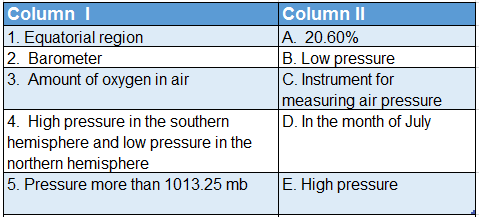
Answer: 1. B, 2. C, 3. A, 4. D, 5. E

Question 2.WBBSE Solutions For Class 7 Geography Chapter 3 Air Pressure match the columns.
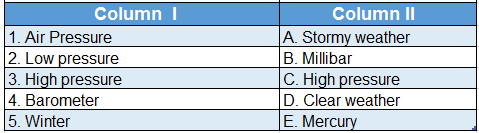
Answer: 1. B, 2. A, 3. D, 4. E, 5. C

WBBSE Solutions For Class 9 History Chapter 1 Some Aspects Of The French Revolution

WBBSE Chapter 1 Some Aspects Of The French Revolution Analytical Answer Type Questions

Question 1 What do you mean by ‘ancien regime’?
Answer: Ancien Regime:-

The term ‘ancien regime’ (old system) is used to describe the conservative society and institutions of France before the outbreak of the French Revolution of 1789. Before the revolution, France was ruled by autocrats of the Bourbon dynasty. They believed in autocratic rule, centralized administration, the inherited privilege of the nobility, exploitation of commoners, and the support of corrupt churches, etc.

The American Revolution Key Events Infographic in Cream Playful Style

WBBSE Class 9 French Revolution Solutions

The rights of the king were absolute. He was not accountable to the nobility, the church, or any institution of the state. All these were the features of the ‘ancient regime’. The ‘ancient regime’ was thus based on a medieval social structure. The French Revolution marked the end of the ‘ancien regime.

Read and Learn Also WBBSE Solutions for Class 9 History

Question 2. How far were the Bourbon monarchs responsible for the outbreak of the French Revolution?
Answer: Bourbon Monarchs Responsible For The Outbreak Of The French Revolution:-

France was ruled by the Bourbon dynasty at the time of the French Revolution. The Bourbon monarchs believed in an absolute monarchy. There was, however, the States- General which was a representative assembly but its session was never summoned after 1614. Louis XIV carried the autocracy of the French monarchy to the highest pitch by declaring that ‘the state; it is myself’.

WBBSE Class 9 History Chapter 1 Questions And Answers 

The next king, Louis XV, enforced arbitrary legislation and involved France in foreign wars on his whims. The next king, Louis XVI, was fickle-minded and failed to introduce necessary reforms. He failed to control corruption or to remove the privileges of the aristocracy. Thus the Bourbon monarchs were responsible for the outbreak of the French Revolution.

WBBSE Solutions for Class 9 History Chapter 1 Some Aspects Of The French Revolution King Louis XV

Key Concepts of the French Revolution for Class 9

WBBSE Chapter 1 Some Aspects Of The French Revolution

Question 3. What was the role of Voltaire in the outbreak of the French Revolution?
Answer:

Role Of Voltaire In The Outbreak Of The French Revolution:-

Voltaire was one of the most important French philosophers who played a very significant role in the outbreak of the French Revolution. He wrote satirical articles against the evils and defects of the French government. He was twice imprisoned for his satirical writings.

NEET Biology Class 9 Question And Answers WBBSE Class 9 History Notes WBBSE Solutions for Class 9 Life Science and Environment
WBBSE Class 9 Geography And Environment Notes WBBSE Class 9 History Multiple Choice Questions WBBSE Class 9 Life Science Long Answer Questions
WBBSE Solutions for Class 9 Geography And Environment WBBSE Class 9 History Long Answer Questions WBBSE Class 9 Life Science Multiple Choice Questions
WBBSE Class 9 Geography And Environment Multiple Choice Questions WBBSE Class 9 History Short Answer Questions WBBSE Solutions For Class 9 Maths
WBBSE Solutions for Class 9 History WBBSE Class 9 History Very Short Answer Questions WBBSE Solutions for Class 9 Physical Science and Environment


The French Revolution Class 9 Questions And Answers

He rejected the supremacy of the church outright and held the clergy responsible for spreading blind faith among the people. He protested against the corrupt and luxurious life of the clergy and denounced the church as an ‘infamous thing’. He was against the religious dogmas of the priests. He vehemently criticized all kinds of oppression, exploitation, blind beliefs, and evil practices. He was an advocate of individual freedom.

E:\class 9 history\WBBSE Solutions for Class 9 History Chapter 1 Some Aspects Of The French Revolution Voltaire.png

Important Questions from French Revolution Chapter

Question 4. Who was Diderot?
Answer: Diderot:-

Diderot was an important philosopher of France who contributed greatly to the outbreak of the French Revolution. He violently opposed all ancient institutions. In 1751 he edited an Encyclopaedia which had twelve volumes. estate Between 1751 and 1772 seventeen editions of this was published.

This encyclopedia gave birth to rationalism in France. He attacked the king’s autocracy, the privileges of the nobility and the church, the defective tax system, the slave system, and the blind faith of the French people. He was imprisoned by the French government because of his fearless thoughts and writings.

Question 5. How did the economic thinkers criticize the economic policy of the French government?
Answer: Economic Thinkers Criticize The Economic Policy Of The French Government:-

The economic thinkers of France criticized the economic policy of the French government. They came out with new economic ideas. Economic thinkers like the physiocrats strongly criticized the mercantile doctrine and advocated free trade, free enterprise, privatization of trade, and industry.

Quesnay, the most outstanding of the physiocrats, and his professor Adam Smith were the spokesmen of the doctrine of free trade and the removal of state control so far prevalent in the field of trade and commerce (Laissez-faire). They came forward with a rational exposition of economic laws.

WBBSE Class 9 History Chapter 1 Questions And Answers 

Question 6. What was the doctrine of ‘Separation of Powers’ preached by Montesquieu?
Answer: Doctrine Of ‘Separation Of Powers’ Preached By Montesquieu:-

Montesquieu preached the doctrine of Separation of Powers instead of concentrating the powers in the hands of the monarch. According to him, a king will be tyrannical if he concentrates in his hands, the three organs of government the executive, the judiciary, and the legislature. He suggested that the three organs of government must be independent of each other.

Question 7. Who were the ‘sans-culottes’?
Answer: ‘Sans-Culottes’:-

The ‘sans-culottes’ belonged to the third of French society. They included small shopkeepers, artisans such as pastry cooks, shoemakers, printers, watchmakers as well as daily wage-earners and servants.

They used to wear long-striped trousers. This was to differentiate them from the fashionable groups in French society, especially nobles who wore knee breeches. They wore, in addition, the red cap that symbolized liberty. Food riots were started by them. On 10 August 1792, they attacked and entered the Royal Palace at Tuileries.

WBBSE Solutions for Class 9 History Chapter 1 Some Aspects Of The French Revolution Sans-Culotte

French Revolution Causes and Effects Notes

Question 8. What was the position of the bourgeoisie in French society?
Answer: French society was divided into two classes-

  1. The privileged and
  2. The unprivileged.

The ‘bourgeoisie’ belonged to the unprivileged class. The bourgeoisie or the middle class was rich and consisted of lawyers, philosophers physicians, and professors. Heavy taxes were levied on them by the government but they did not enjoy any privileges such as those enjoyed by the aristocracy. They were not appointed to any high posts despite their capability and so they were discontented.

They were determined to go to any extent to bring liberty and equality in society and the way they chose was to bring down the aristocratic privileges. The French Revolution was led by the bourgeoisie for it was they who organized the people and inspired them to revolt.

WBBSE Some Aspects Of The French Revolution

Question 9. What was the ‘Tennis Court Oath’?
Answer:

‘Tennis Court Oath’:-

The States-General, an assembly that drafted and passed legislation in France, was summoned by Louis XVI on 12 June 1789. The conflict started with the voting system of the States-General. The nobles and the priests. wanted voting by order while the members of the third estate demanded that votes should be counted individually and the States-General should be recognized as the National Assembly of France.

WBBSE Solutions for Class 9 History Chapter 1 Some Aspects Of The French Revolution Tennis Court Oath

French Revolution Key Events Timeline

On 20 June 1789, the king closed the meeting room of the Third Estate and posted armed soldiers at the entrance. When the representatives of the third estate reached the meeting hall, they were stunned to see the doors shut. So they assembled at the nearby tennis court and took an oath not to move from there until they had prepared a new constitution for the country. At last, the king agreed to the proposal of one vote per head.

Question 10. What rumor spread in Paris on the morning of 14 July 1789? What was the reaction of the people?
Answer: On the morning of 14 July 1789, the people of the city of Paris were in a state of alarm. The king ordered his troops to move into the city. Rumors spread among the people that he would soon order his army to open fire upon the citizens.

WBBSE Solutions for Class 9 History Chapter 1 Some Aspects Of The French Revolution Fall Of Bastille

As a result, about 7000 men and women gathered in front of the town hall and decided to form a people’s militia. A group of several hundred people marched towards the eastern part of the city of Paris and stormed the fortress prison, the Bastille in the hope of finding hoarded ammunition. The angry mob stormed the Bastille.

Class 9 History Book West Bengal Board WBBSE

Question 11. Give an account of King Louis XVI’s legislative body and judiciary. attempt to escape from France.
Answer: Mirabeau, the ablest leader in the National Assembly, had a good relationship with King Louis XVI. Mirabeau died in 1791 and the king became very perturbed.

WBBSE Solutions for Class 9 History Chapter 1 Some Aspects Of The French Revolution Mirabeau

In the meantime, other European monarchs were preparing to attack France. Louis XVI, to reestablish autocracy in France, tried to escape to Austria along with his family on the night of 21 June 1791. King Leopold of Austria was the brother of the queen of France. Unfortunately, their attempt failed. They were captured in the village Vannes and brought back to Paris under great insult.

History Of Modern Europe Class 9 Solutions WBBSE

Question 11. How did the French Constituent Assembly limit the powers of the king?
Answer:
The Constituent Assembly declared France to be a constitutional monarchy.

  1. The king lost his divine right of kingship. He was treated as the ‘first servant of the state’ and became a salaried head of the state.
  2. He became the head of the administrative or executive department according to the doctrine of separation of powers.
  3. He did not have any power to wage war or to make treaties with any country.
  4. He lost control over the provincial governments as well.
  5. He lost his earlier right to exercise control over

Question 12. What was said in the ‘Declaration of the Rights of Man and Citizen’?
Answer:
‘Declaration Of The Rights Of Man And Citizen’:-

  1. On 26 August 1789, the French Constituent Assembly drew up a ‘Declaration of the Rights of Man and Citizen’. It said-
  2. All men are born free, remain free, and have equal rights.
  3. All citizens are equal in the eyes of the law.
  4. The source of all sovereignty resides in the nation.
  5. Liberty consists of the freedom to do everything that does not harm others.
  6. The property right is a sacred law. The property of any person cannot be usurped without payment of proper compensation.
  7. Rights consist of expressing a free opinion, freedom of the individual, and freedom of religious belief.
  8. No individual shall exploit others.
  9. No one can be arrested or imprisoned by the police” unless proven guilty in the eyes of the law. In short, the declaration emphasized the three basic principles of the French Revolution Liberty, Equality, and Fraternity.

Question 13. When and how was the feudal system every house was searched. Is any person abolished in France?
Answer:
On 4 August 1789 the French Constituent Assembly issued a declaration that abolished feudalism from France.

The declaration was as follows:

  1. Henceforth feudalism with all its privileges would be abolished.
  2. The feudal class would lose all its inherited social and political privileges.
  3. The church taxes like tithes and others of ecclesiastical privileges were to be renounced.
  4. The serf system, all forms of feudal taxes, forced labor or corvee, and the manorial system were to be abolished. But feudalism could not be abolished totally. The nobles and the clergy retained some of their privileges.

Impact of Enlightenment on the French Revolution

Question 14. Describe the revolt of the peasants in rural France after the fall of the Bastille.
Answer:
Revolt Of The Peasants In Rural France After The Fall Of The Bastille:-

After the storming of the Bastille on 14 July 1789, the peasants of France who had been suffering under feudal tyranny rose in revolt. They burnt the houses of the landlords as well as the churches.

They destroyed the manor houses and burnt the documents containing records of manorial dues. Manor officials were also murdered. Manorial lands were forcibly occupied and rich peasants were driven out.

There were rumors that the landlords of the manors had hired people to destroy the ripened crops. This caused panic among the peasants who attacked the castles of noblemen. They looted hoarded grains from the market. As a result, a large number of nobles fled their homes and migrated to neighboring countries.

Question 15. What is the ‘September Massacre’?
Answer:
‘September Massacre’:-

The leaders of the Jacobins including Marat and Danton began the hunt for the enemies of the French Revolution. They began to kill the royalists who were in jail. Every house was searched. Any person suspected to be a supporter of the king was at once put to death.

This massacre continued from 2 September to 6 September 1792. About 1600 people were murdered during this period. This act of murder by the Jacobins was extremely hateful and unjust.

WBBSE Class 9 History Chapter 1 Questions And Answers

Question 16. Write a short note on the leaders of the French Revolution.
Answer:
Leaders Of The French Revolution:-

The leaders of the French Revolution mostly came from the middle classes in France. The first man who distinguished himself in the States Assembly was Comte de Mirabeau who, however, belonged to the nobility. He persuaded King Louis XVI to set up a constitutional monarchy in France. The section of the radical democrats in the Assembly was led by Marat and Danton.

WBBSE Solutions for Class 9 History Chapter 1 Some Aspects Of The French Revolution Danton

Short Answer Questions on the French Revolution

They crushed all opposition by taking the Revolution through a Reign of Terror. Another distinguished leader of the early nineties was Robespierre. He played the most important part in bringing Louis XVI to trial, declaring that the king ‘must die so that the country may live’.

Class 9 History Book West Bengal Board WBBSE

Question 17. What do you mean by ‘The Revolutionary Tribunal’ introduced during the Reign of Terror?
Answer:
‘The Revolutionary Tribunal’ Introduced During The Reign Of Terror:-

One of the instruments of the Reign of Terror was the Revolutionary Tribunal. The judges of this Tribunal were appointed by the Committee of Public Safety. The function of the Revolutionary Tribunal was to punish persons held under the Law of Suspects. Nobody could appeal against the decision of this court.

Justice was almost always denied as the judges were directed to make their decisions hastily without going deep into the case. Thousands of men and women were guillotined according to the judgments of the Revolutionary Tribunal during the Reign of Terror.

Question 18. What was the ‘Law of Suspects’?
Answer:
Law Of Suspects:-

The ‘Law of Suspects’ was one of the instruments through which the Committee of Public Safety executed the Reign of Terror. This law empowered the police to arrest any individual on mere suspicion of anti-revolutionary activities.

The suspected persons were then sent for trial. Not one of the persons sent for trial by the Revolutionary Tribunal was declared innocent and every one of them was sent to the guillotine.

Chapter 1 Class 9 History WBBSE Some Aspects Of The French Revolution

Question 19. What were the main causes of the French Revolution?
Answer: Main Causes Of The French Revolution:-

The French Revolution broke out in 1789. The main causes which sparked off the French Revolution were as follows:

Despotic rule of Louis XVI:

King Louis XVI, had drained the financial resources of France in successive wars. To meet the cost of his extravagant lifestyle, he increased taxes which were paid by the Third Estate.

Rising prices:

Due to the rise of population in France, there was more demand for food grains. So the price of food soared and the poor could not afford to buy food. So the gap between the rich and the poor widened.

WBBSE Class 9 History Chapter 1 Questions And Answers

Division of French society:

French society was divided into three estates-the first estate, the second estate, and the third estate. The first and the second estates enjoyed privileges yet did not pay taxes. The Third Estate paid heavy taxes both direct and indirect. This discrimination led to the outbreak of revolution by the third estate.

Role of French philosophers:

French philosophers like Rousseau, Voltaire, and Montesquieu propagated the ideas of a society where people would enjoy freedom, equality before the law, and equal opportunities. Their ideas inspired the common people to rise in rebellion.

Presence of educated people:

Unlike other countries, France had an enlightened middle class and other professionals like lawyers, and administrative officials who were educated and believed that no group in society should be privileged by birth. It was they who organized the people and inspired them to revolt.

WBBSE Solutions for Class 9 History Chapter 1 Some Aspects Of The French Revolution Causes Of French Revolution

Study Guide for Class 9 History: The French Revolution

Question 20. Why did the French Revolution break out in France only and not in any other country?
Answer:

French Revolution Break Out In France Only And Not In Any Other Country:-

Different historians have put forward different theories as to why the Revolution broke out in France and not in any other country. However, it is possible to find out some common factors which made the Revolution in France inevitable.

The miserable economic condition of the people of France and the poor of finances the management government of France contributed to the outbreak of the Revolution in France. The tottering economic structure of France was a very important cause for the outbreak of the Revolution.

The burden of tax on the common people was much higher than anywhere else in Europe. So the intensity of discontent was much higher among the peasants in France than in other parts of Europe.

The feudal system in France became worn out. In different European countries, feudal lords enjoyed privileges and performed Corrupt Weakness of Kings Administration and Corrupt Judicial System duties but in France, the feudal lords enjoyed rights and privileges without rendering any services to the king. The French people resented this system of unequal privileges and wanted to do away with this inequality in society.

The backward agricultural and industrial conditions of France resulted in underproduction which led to an excessive rise in food prices. This made the people of France burst out in rebellion.

Chapter 1 Class 9 History WBBSE

The presence of the French philosophers who resented the privileges of the nobles and the absolutism of the French monarchy contributed to the outbreak of the Revolution only in France.

Unlike in other countries, France had an enlightened middle class. It was they who organized the people and taught them to revolt.

Question 21. What is the importance of the French Revolution?
Answer:

French Revolution:-

The French Revolution is one of the greatest landmarks in the history of the world.

Importance:

  1. The French Revolution changed the course of history of France. It destroyed the old order and replaced it with a new system.
  2. The revolution put an end to the absolutism of the French kings.
  3. The revolutionary and republican ideas took strong roots in France.
  4. After the revolution the ideals of liberty, equality, and fraternity became popular and these ideals remained as a source of inspiration for revolutions that took place in 19th-century Europe.
  5. The revolution established people’s participation in political administration and equality in the eye of the law.

Chapter 1 Some Aspects Of The French Revolution Write True Or False

Question 1. Calonne was the finance minister of France appointed by Louis XV.
Answer: False

Question 2. The entire burden of taxation fell on the First Estate in France.
Answer: False

Question 3. Louis XVI ascended the throne of France in 1774.
Answer: True

Question 4. In 1789 the French Revolution broke out.
Answer: True

Question 5. Marie Antoinette was the Queen of Louis.XVI.
Answer: True

Question 6. Clergy means the monarch who rules with absolute power.
Answer: False

Question 7. A monarch whose power is limited by the laws provided in the constitution is an absolute monarch.
Answer: False

Question 8. The representative assembly in France was called the States-General.
Answer: True

Question 9. Denis Diderot was a French Encyclopaedist.
Answer: True

Question 10. Quesnay was the spokesman for the doctrine of Laissez-faire.
Answer: True

Question 11. The most outstanding composition of Voltaire was the ‘Persian Letters’.
Answer: False

Question 12. In France, the clergy belonged to the third estate.
Answer: False

Question 13. The church paid a voluntary tax to the government if they were willed by the Contract of Posey.
Answer: True

Question 14. The aristocracy and landlords in France formed the Third Estate.
Answer: False

Question 15 Economic historians refute the theory of philosophy playing a considerable part in the outbreak of the French Revolution.
Answer: True

Question 16. The French philosophers did not directly preach for revolution, rather they wanted reform of the old order.
Answer: True

Question 17. The physiocrats did not advocate free trade and privatization of industry and trade.
Answer: False

Question 18. Scattered peasant revolts and food riots by sans-culottes due to scarcity of food supply started in 1787:
Answer: True

Question 19. Rousseau in his famous book ‘The Spirit of Laws’ attacked the divine right of kings.
Answer: False

Question 20. The ‘Persian Letters’ was written by Montesquieu.
Answer: True

Question 21. The three organs of government are the executive, the judiciary, and the legislature.
Answer: True

Question 21. Montesquieu suggested that the three organs of government must be independent of each other.
Answer: True

Question 22. ‘Discourses on the Origin of Inequality’ was written by Quesnay.
Answer: False

Question 23. The Third Estate of the States-General demanded the introduction of a vote per order.
Answer: False

Question 24. The Tennis Court Oath was taken by the representatives of the First Estate.
Answer: False

Question 25. In 1789 the French Constituent Assembly issued a declaration that abolished feudalism in France.
Answer: True

Question 26. The Constituent Assembly granted the right to vote to men of property.
Answer: True

Question 27. Those Frenchmen who paid income tax or property tax equal to three days’ income were marked as passive citizens.
Answer: False

Question 28. Louis XVI entered into a secret negotiation with the king of Prussia.
Answer: True

Question 29. The Bill of Rights of England (1689) was taken as a model to prepare the Declaration of the Rights of Man and Citizen.
Answer: True

Question 30. The members of the Jacobin Club belonged mainly to the prosperous section of society.
Answer: False

Question 31. The only party which initiated the Reign of Terror was the Jacobin Party.
Answer: False

Question 32. One of the positive outcomes of the Reign of Terror was the abolition of slavery.
Answer: True

Question 33. Under the Directory, French efforts were directed against America.
Answer: False

Question 34. The French Revolution developed the idea of dictatorship in France.
Answer: False

WBBSE Chapter 1 Some Aspects Of The French Revolution Fill In The Blanks

Question 1. The ‘ancient regime’ was based on a _______________(ancient/medieval/modern) social structure.
Answer: Medieval

Question 2. The French monarchs were believers in the _______________ of Kingship (Divine Right of Kingship/democracy/ dictatorship).
Answer: Divine right

Question 3. Those who were supporters of the king were known as_______________  (Girondins/royalists/ monarchists).
Answer: Royalists

Question 4. The States-General in France met on 5 May 1789 after a long lapse of _______________ (174/179/ 196) years.
Answer: 174

Question 5. The tithe was a tax on _______________ (religion/property/salt).
Answer: Religion

Question 6. The French Revolution broke out in the year  (1788/1789/1776).
Answer: 1789

The French Revolution Class 9 Questions And Answers

Question 7. The French Revolution broke out during the reign of_______________(Louis XIV/Louis XV/Louis XVI).
Answer: Louis XVI

Question 8. Louis XVI ascended the throne of France in _______________ (1773/1774/1776).
Answer: 1774

Question 9. Louis XVI belonged to the_______________  (Orange/ Stuart/Bourbon) dynasty.
Answer: Bourbon

Question 10. _______________ kingship (Louis XIV/Louis XV/Louis XVI), the king of France said, “After me the deluge”.
Answer: Louis XVI

Question 11. _______________ (Rousseau/Mostesquieu/Turgo) was the Finance Minister of France.
Answer: Turgo

Question 12. The king of France _______________ (Louis XIV/Louis XV/Louis XVI) said, “I am the state”.
Answer: Louis XIV

Question 13. _______________ (Taille/Vingtiemes/Aides) was a religious tax collected from the peasants of France.
Answer: Taille

Question 14. Gabella was a tax imposed on _______________ (tobacco/salt/wine).
Answer: Salt

Question 15. _______________ (Taille/Gabella/ Vingtiemes) was an income tax of the ancien regime in France.
Answer: Vingtiemes

Question 16. ‘Ancien regime’ means the_______________  (old system/ new system/autocratic system).
Answer: Old system

Question 17. The_______________  (Italian/German/French) government supported the 13 colonies of America in their war of independence.
Answer: French

Question 18. The French Revolution began with the revolt of the ____________________ (peasants/aristocrats/ philosophers).
Answer: Aristocrats

Question 19. The Council of Notables was a body the members of which were nominated by the ____________________ (king/aristocrats/finance minister).
Answer: King

Question 20. The aristocratic Revolt was the clash between the ____________________(nobles/Parliament/aristocrats) and the royal government.
Answer: Aristocrats

Question 21. Encyclopaedia was edited by ____________________(Quesnay/Denis Diderot/Rousseau).
Answer: Denis Diderot

Question 22. Laissez-faire means free ____________________ (parliament/clericalism/free trade).
Answer: Trade

Question 23. The author of the book ‘Social Contract’ was ____________________ (Denis Diderot/Montesquieu/Rousseau).
Answer: Rousseau

Question 24. The clergy in France belonged to the____________________ (third/first/second) estate.
Answer: First

Question 25. ____________________ (Second/First/Third) estate was deprived of all rights and privileges.
Answer: Third

Question 26. The Tennis Court Oath was taken in ____________________  (1788/1789/1790).
Answer: 1789

Question 27. One of the leaders associated with the task of drafting the Constitution of 1791 was ____________________  (Louis XVI/Talleyrand/Montesquieu).
Answer: Talleyrand

Question 28. Tipu Sultan was the founder member of the Jacobin club that showed allegiance to the ____________________  (French/English/Portuguese).
Answer: French

Question 29. The ____________________  (Law of Suspects/Law of Tribunal/ Law of Maximum) was enforced to check the soaring prices of goods.
Answer: Law of Maximum

Question 30. The September Massacre continued from 2 September to 6 September ____________________  (1792/ 1793/1794).
Answer: 1792

Question 31. The incident of the execution of ____________________ (Louis XVI/Marie Antoinette/Robespierre) and his associates which brought an end to the Reign of Terror came to be known as the Thermidorian Reaction.
Answer: Robespierre

Question 32. France was under Directory rule from ____________________  (1795-1799/1798-1799/1799-1804).
Answer: 1795-1799

Question 33. The Directory had Directors____________________  (three/four/five)
Answer: five

Question 34. Among the Directors of France, ____________________  (Carnot/Pache/Dumoureiz) was the most famous.
Answer: Carnot

Question 35. The French government was divided into ____________________  (80/82/83) departments to streamline the administration.
Answer: 83

Question 36. By a military coup, ____________________  (Louis XVI/Robespierre/Napoleon) seized the administrative power of France in 1799.
Answer: Napoleon

WBBSE Chapter 1 Some Aspects Of The French Revolution Match The Columns

Question 1. 

1.    Column 1 Column 2
1. Taille  (A) Religious tax
2.  Capitation  (B) Salt tax
 3. Gabolla  (C) Income tax
 4. Tithes  (D) Wealth And property tax


Answer: 1.-D, 2.-C, 3.-B, 4.-A

Question 2. 

2.   Column 1 Column 2
1. 1789  (A) Napoleon seized power
2. 1792 (B) Tennis Court Oath
3. 1794 (C) France became a Republic for the first time
4. 1799 (D) Robespierre guillotined


Answer: 1.-B, 2.-C, 3.-D, 4.-A

Question 3. 

3.   Column 1 Column 2
1.  Divine Right of Kingship (A) Government run by people
2.  Democracy (B) An all-powerful king
 3.  Absolute monarch (C) A monarch who rules according to the constitution
4. Constitutional monarch (D) King is the representative of God on earth


Answer: 1.-D, 2.-A, 3.-B, 4.-C

Question 4. 

4.    Column 1 Column 2
1.  Marie Antoinette (A) Finance Minister of France
2.  Necker (B) First Consul
3.  Napoleon (C)  Physiocrat
4.  Quesnay (D) Queen of France


Answer: 1.-B,2.-D, 3.-A, 4.-C
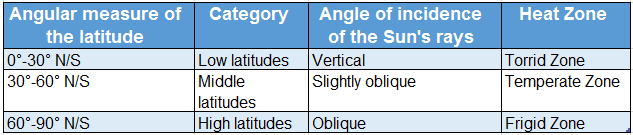
Question 5. 

5.    Column 1   Column 2
1. Constituent  Assembly (A) National Convention
2. Summoning of States-General (B) Declaration of the Rights of Man and Citizen
3. Legislative Assembly (C) Directory
4. The Directors and a bicameral legislature (D) Louis XVI


Answer: 1.-D, 2.-A, 3.-B, 4.-C

Question 6. 

6.     Column 1 Column 2
1. Jacobins stormed (A) De La Concord
2.  Louis XVI executed (B)  Paris
3. The Bastille (C)  Austria
4. Secret journey of  Louis XVI (D)  Palace of Tuileries


Answer: 1.-D, 2.-A, 3.-B, 4.-C

Question 7. 

7.   Column 1 Column 2
1.  Voltaire (A)  An important leader during the Reign of Terror
2.  Danton (B)  Leader of Tennis Court Oath
3.  Jean-Paul Marat (C)  A revolutionary journalist
4.  Mirabeau (D)  A French Philosopher


Answer: 1.-D, 2.-A, 3.-C, 4.-B

Question 8. 

8.     Column 1 Column 2
1. Tipu Sultan (A) Old system
2. Ancien regime (B) religious tax
3. Tithe (C) September massacre
4. 1792 (D) Jacobin Club


Answer: 1.-D, 2.-A, 3.-B, 4.-C

WBBSE Solutions For Class 8 Geography Chapter 10 South America Topic B Selva And Pampas Region

Chapter 10 Topic B Selva And Pampas Region Analytical Type Questions

Question 1. Describe the natural vegetation as well as the wildlife of the Selva forest of the Amazon river basin.”
Answer:

Natural Vegetation As Well As The Wildlife Of The Selva Forest Of The Amazon River Basin:-

Selva, the evergreen forest lies on both sides of the equator covering mainly the major portion of the Amazon Basin.

Natural Vegetation:

The characteristics of the natural vegetation of the Selva forest of the Amazon River basin are discussed below-

  1. The trees of these dense forests have big and round leaves that remain green throughout the year. Hence, these forests are also called equatorial evergreen forests.
  2. Trees like ironwood, rosewood, Brazil nut, rubber, palm, bamboo, etc. grow here.
  3. Different species of trees are seen here and most of them are about 40m-50m tall.
  4. Due to the dense growth of trees, bushes and creepers, the forest is impenetrable and sunlight cannot reach the lower layers. Hence, the parts near the ground remain dark even during the day. Moreover, the branches and leaves entangle with each other in the upper layers and form a canopy. For that reason, the Selva is also called the ‘Land of Eternal Twilight’.
  5. The forest environment is unhealthy and is full of poisonous insects, which makes it impossible to collect forest resources.
  6. The trees of this forest yield hardwood.

Read and Learn More WBBSE Solutions For Class 8 Geography

WBBSE Solutions For Class 8 Geography Chapter 10 South America Topic B Selva And Pampas Region The Selva foreset of Amazon


Wildlife:

The characteristics of the fauna of the Selva forest of the Amazon River basin are discussed below-

The dense forest of the Selva is home to different types of animals. However, the presence of shrubs and bushes, wet soil and a moist environment have led to the growth of impenetrable forests with dense undergrowth.

So, the animals in this forest have adapted accordingly and mainly inhabit the upper layer of the canopy in the forest. For example, different types of monkeys, chimpanzees, etc., are found in large numbers.

Apart from these, leeches, carnivorous ants, Anaconda snakes, poisonous flies, vampire bats, etc., are found in this forest. The famous, large Rhea bird, is also found here.

WBBSE Class 8 Selva and Pampas Overview

The waters of this region are home to the alligators, Piranha and Pirarucu fish.

Question 2 Give an account of the characteristic features of the Selva forest in the Amazon River basin.
Answer:

Characteristic Features Of The Selva Forest In The Amazon River Basin:-

The world’s largest tropical evergreen rainforest, the Selva, has developed along the Amazon River basin. This forest occupies almost 60 per cent of Brazil, 13 per cent of Peru, 10 per cent of Colombia and extensive areas of Venezuela, Guiana, Bolivia etc.

Characteristics of the trees in the Selva forest:

1. Evergreen:

This forest is made up of tall. evergreen trees with big leaves and shrubs and bushes.

2. Fast growth:

Heavy rainfall and a warm climate lead to the fast growth of the trees.

3. Very tall:

According to height, trees of this forest can be divided into 4 layers-

  1. Emergent Layer,
  2. Canopy Layer,
  3. Intermediate Layer And
  4. Lower Layer Or Undergrowth.

4. Dense growth of creepers:

Orchids and creepers grow on the branches of trees due to the dark and humid environment of the forest.

5. Land of Eternal Twilight:

Branches of tall trees entangle with each other and form a canopy in the upper layer of the forest. This prevents sunlight from reaching the lower layers of the forest.

Hence, the lower layers remain dark even during the day and the region seems to have eternal twilight. So, it is known as the ‘Land of Eternal Twilight’.

6. Abundance of different species:

Trees of different species grow in this forest simultaneously. About 300 species of trees are found in every 2sq.km area.

7. Hardwood:

The trunks of the trees are very strong and thick and yield very hard wood.

WBBSE Class 8 Geography Chapter 10 Topic B Selva And Pampas Region

Class 8 Geography Chapter 10 Selva and Pampas Questions

Most important trees:

The main trees that grow in this region-

  1. Rubber,
  2. Rosewood,
  3. Ironwood,
  4. Brazil nut,
  5. Palm,
  6. Bamboo, etc.

Question 3. The Amazon River basin is industrially not developed. Why?
Answer:

The Amazon River basin is industrially not developed:-

The Amazon River basin is industrially not developed because of the following reasons-

1. Adverse climate:

The hot and humid climate that prevails in the Amazon River basin is very unhealthy and uncomfortable.

2. Poisonous insects:

The dense and impenetrable Selva forest in this region is not only unsuitable for habitation but is also home to a large number of poisonous insects.

3. Poor communication:

The communication system has not developed here due to the dense forest.

4. Lack of infrastructure:

Due to unfavourable conditions, there has been no infrastructural development.

5. Lack of skilled labour:

Skilled labour is un-available due to the scarce population in the region.

6. Lack of raw materials:

Industries have not developed here due to the lack of agricultural raw materials and mineral resources.

WBBSE Solutions For Class 8 School Science Long Answer Type Questions WBBSE Solutions For Class 8 School Science Short Answer Type Questions
WBBSE Solutions For Class 8 School Science Very Short Answer Type Questions WBBSE Solutions For Class 8 School Science Review Questions
WBBSE Solutions For Class 8 School Science Solved Numerical Problems WBBSE Solutions For Class 8 School Science Experiments Questions
WBBSE Solutions For Class 8 Maths WBBSE Class 8 History Notes
WBBSE Class 8 History Multiple Choice Questions WBBSE Solutions For Class 8 History
WBBSE Solutions For Class 8 Geography


WBBSE Class 8 Geography Selva Region Details

7. Lack of education and capital:

The inhabitants of this region are extremely poor and illiterate and hence no economic development takes place here. This also results in lack of capital. There has been no development in the field of science and technology as well.

Question 4. Describe the topography and the rivers of the Pampas region.
Answer:

Topography of the Pampas region:

Topographic characteristics of the Pampas region are as follows-

  1. The word ‘Pampas’ originates from the Spanish word Pampa meaning ‘uninterrupted stretch of plainland’.
  2. The Pampas is basically a type of plain land that has formed as a result of the deposition of silt, sand and clay by rivers and loess soil deposits by aeolian action. The layer of silt in this region is fertile and very deep.
  3. The Pampas region is somewhat undulating due to the scattered presence of hillocks and ridges. For example, two hills called the Sierra de Tandil and the Sierra de La Ventana are located in Buenos Aires. These are made of granite, gneiss and quartzite rocks. These are extended parts of the Brazilian Highlands.
  4. The Pampa’s region slopes from west to east because its western part is comparatively higher than its eastern part since it has the Andes in the west and the Atlantic Ocean in the east.

Rivers of the Pampas region:

The main rivers of the Pampas region are the Parana and Paraguay. These rivers originate from the Brazilian Highlands and pass through the Pampas. Both rivers merge with Uruguay, near the capital of Argentina, Buenos Aires.

During their lower course, they flow as the La Plata and finally flow into the Atlantic Ocean. The estuary of La plata is known as Rio-de-la- Plata.

The other notable rivers of the Pampas are Cuarto, Tercero, Salado, Colorado and Saladillo. Most of these rivers are the tributaries of the Parana-Uruguay.

Pampas Region Characteristics for Class 8

Question 5. Describe the climate and the natural vegetation of the Pampas region.
Answer:

Climatic characteristics of the Pampas region:

The climatic characteristics of the Pampas region are discussed below-

1. Seasons:

A warm temperate climate prevails in the Pampas region. The region. experiences summer from November to January and winter from March to June because of its location in the southern hemisphere. Winters are longer than summers in the Pampas region.

2. Temperature:

The average temperature in January (summer) ranges between 22°C- 24°C and the average temperature in July (winter) ranges between 8°C-10°C.

3. Rainfall:

The Pampas region receives very little rainfall throughout the year (about 50 cm-100 cm). The humid Pampas in the east receive more rainfall than the dry Pampas in the west. Though maximum rainfall occurs in the summer season.

4. Snowfall:

Snowfall is a rare phenomenon in this region. It does not occur each year and if it occurs, lasts for only a few days. Generally, frost arrives with the onset of autumn (April-May) and ends by spring (mid-September).

The natural vegetation of the Pampas:

Vast stretches of grasslands have developed in the Pampas region as a result of the temperate climate and scanty annual rainfall. The eastern part of the Pampas region receives more rainfall.

This results in the growth of tall grasses in this region (almost 1 metre in height). The hilly regions of the east-central part have some scattered growth of temperate mixed forests with trees like eucalyptus, poplar, hopper, etc.

To the north of the Pampas, along the Parana- Paraguay river basin, the grasslands of Gran Chaco have grown. These grasslands consist of shrubs and bushes as well as deciduous trees.

A type of tree called the Yerba Mate is found in the Parana River basin. It is used to make a beverage somewhat like tea. At present most of this grassland has been destroyed for transportation and agricultural purpose.

Understanding Selva and Pampas for Class 8 Students

Question 6. Discuss the various characteristics of agriculture and livestock rearing of the Pampas region.
Answer:

Agriculture of the Pampas region:

Agriculture of the Pampas region is characterised by the following features-

1. Agricultural system:

The Pampas region is highly suitable for agriculture due to the cool climate, scanty rainfall, undulating plainland, fertile soil, etc. Hence, it is one of the most well-developed agricultural regions in the world.

In the Pampas, agriculture is practised using modern scientific methods.

2. Crops:

This region yields large amounts of wheat (wheat is grown on th of the total agricultural land). About 60% of the total wheat is grown for international trade. Hence, the Pampas region is called the ‘Granary of South America’.

The other crops that grow here include corn, barley, maize, oilseed, cotton, tobacco, soybean, sugarcane, and different types of fruits and vegetables.

Grapes are also grown in the western part of Argentina and the southern part of Uruguay. Moreover, alfalfa grass is grown here as fodder.

Livestock rearing of the Pampas region:

Livestock rearing of the Pampas region is characterised by the following features-

1. System of livestock rearing:

Commercial livestock rearing is practised in the Pampas region. The system used for livestock rearing here is the most developed in South America.

Cattle is reared in large numbers in the eastern and central parts because of the abundant growth of tall grasses. More sheep are reared in the western and southern parts. because of the cool climate and less rainfall.

Plenty of fodder grasses (example-alfalfa) are grown in the fertile pastures with the aim of rearing livestock. Hybrid animals of high quality are fed corn and other nutritious food.

The pasture farms are locally called ‘Estancia. The slaughterhouses of this region have well-developed cold storage facilities and are called ‘frigorific’.


WBBSE Solutions For Class 8 Geography Chapter 10 South America Topic B Selva And Pampas Region Agriculture and Cattle rearing in the Pampas region

2. Centres of cattle rearing:

The regions which have more groundwater, have fertile pastures and so, animal husbandry farms develop there in larger numbers. The notable cattle-rearing centres are Rozario, Cordoba and Buenos Aires. About 40% of sheep is reared in Buenos Aires province.

3. Animal products:

A large amounts of meat, fur, leather, milk and dairy products (powdered milk, butter, clarified butter cheese, cream, etc.) from this region are exported to other parts of the world. Argentina ranks first in the world in terms of beef export.

Besides the meat, beef extract, beef fat, bone powder, etc., are also produced here. The city of Cordoba is famous for dairy products.

Question 7. Describe the population distribution, cities, mineral resources and industries of the Pampas region.
Answer:

Population distribution and the cities of the Pampas:

The vast stretch of the Pampas grasslands is suitable for animal grazing and cattle rearing. Hence, the region is very scarcely populated. This region is home to a tribe of nomadic horsemen and cowhands engaged in cattle rearing.

WBBSE Class 8 Geography Chapter 10 Notes

WBBSE Solutions For Class 8 Geography Chapter 10 South America Topic B Selva And Pampas Region The main cities of pampas region


They are called the Gauchos. However, at present, most of the inhabitants of this region are descendants of the Spanish. Although this region itself is not much populated, its adjoining cities are quite densely populated.

Such cities are-Buenos Aires, La Plata, Bahia Blanca, Rosario, Cordoba, Mar del Plata, Santa Fe and Montevideo.

Mineral resources of the Pampas:

The Pampas region, made up of alluvial soil, is not rich in minerals. However, small amounts of copper ore, manganese, etc., are present in the northern hilly regions of the Pampas.

A small amount of copper ore is obtained from the southern part of Uruguay. Besides these, coal, zinc, lead, limestone and natural gas are also found here.

Industries of the Pampas:

The Pampas region is famous for its well-developed cattle rearing. This has led to the development of various industries that depend on products acquired from animals, such as-

  1. Milk industry (butter, cheese, powdered milk, etc., Are made from milk),
  2. Meat industry,
  3. Leather industry and
  4. Fur industry.

The most important centres of these industries are Buenos Aires, La Plata, Cordoba, Montevideo, etc. Flour, sugar and bakery industries have also developed here, based on agricultural raw materials.

The other notable industries that have developed in these centres are-

Engineering,

  1. Chemical,
  2. Garment trading,
  3. Food processing and
  4. Mineral oil refining.
  5. At present, Argentina is the largest beef exporter in the world.

WBBSE Class 8 Geography Chapter 10 Question Answers

Short Answer Type Questions

Question 1. Why is the Selva forest referred to as the ‘Lungs of the World’?
Answer:

Selva Forest Referred To As The ‘Lungs Of The World’

Selva is the largest tropical forest in the world. It occupies an area of almost 55 lac sq. km which accounts for 60 per cent of Brazil’s total land area.

The Selva provides 20 per cent of the world’s oxygen and hence, this vast tropical forest is referred to as the ‘Lungs of the World’.

Question 2. What is Estancia?
Answer:

Estancia:-

The Pampas grassland in South America is famous for livestock rearing. Since the eastern parts of the Pampas receive more rainfall than other regions, the grasses that grow here are taller in size.

This makes the region highly suitable for livestock rearing. These vast stretches of grazing lands in the Pampas are locally called Estancia.

Selva and Pampas Short Answer Questions

Question 3. The Pampas region is called the ‘Granary of South America’. Why?
Answer:

The Pampas region is called the ‘Granary of South America’:-

The gentle and cool climate, sufficient rainfall, availability of chernozem soil, extensive plainland, etc., enhance the agriculture of the Pampas. In this region, highly developed farming methods are used to grow different types of crops.

A large amount of wheat is produced here and exported to different parts of the world. Hence, the Pampas region is called the ‘Granary of South America’.


Very Short Answer Type Questions Fill In The Blanks

Question 1. The Selva region is also known as ________.
Answer: Region of Eternal Twilight

Question 2. ________ is Amazon’s famous rubber-accumulating centre.
Answer: Manaus

Question 3. The grasslands in Argentina are called the ________.
Answer: Pampas

Question 4. The wind that blows across the Pampas region is called ________.
Answer: Pampero

Question 5. The Pampas grasslands are dominated by ________ soil.
Answer: Chernozem

Question 6. ________ region is known as the ‘Granary of South America.
Answer: Pampas

Question 7. ________, located in the foothills of the Andes, is a notable centre for cattle rearing.
Answer: Cordoba

Question 8. ________ ranks first in the world in terms of meat exports.
Answer: Argentina

WBBSE Class 8 Geography Chapter 10 Question Answers

Question 9. The city that is situated in the northern coast of the La Plata River bay is ________
Answer: Montevideo

Question 10. The port of ________ in Pampas is most significant in terms of fur exports.
Answer: Bahia Blanca


Write True Or False

Question 1. The Pampas is rich in mineral resources.
Answer: False

Question 2. In terms of area, the Pampas region occupies around 7 lakh 50 thousand sq. km.
Answer: True

Question 3. Pampas in Argentina is a type of tropical grassland.
Answer: False

Question 4. The massive animal husbandry farms in the Pampas are called ‘frigorific’.
Answer: False

Question 5. Argentina is referred to as the ‘Coffee Pot of the World’.
Answer: False

Question 6. The extensive grazing lands in the Pampas are called Estancia.
Answer: True

Question 7. Gauchos are the people who live in a coffee fazenda.
Answer: False

Question 8. The frigorific is a slaughterhouse.
Answer: True

Question 9. Selva is the densest forest of the world.
Answer: True

Question 10. The general slope of the Pampas region is from east to west.
Answer: False


Chapter 10 Topic B Selva And Pampas Match The Columns

1.WBBSE Solutions For Class 8 Geography Chapter 10 South America Topic B Selva And Pampas Region Match the columns

Answer: 1. D, 2. C, 3. A, 4. E, 5. B


Answer In One Or Two Words

Question 1. Which is the largest rainforest in the world?
Answer: The Amazon.

Question 2. Name a duty-free riverine port in the Amazon River basin.
Answer: Manaus.

Question 3. How much area does the Pampas region occupy?
Answer: 7.5 lakh sq. km.

Question 4. What is the average temperature in winter in the Pampas region?
Answer: 8°C-10°C.

Question 5. What are the large cattle farms known as in the Pampas region?
Answer: Estancia.

Class 8 Geography WBBSE

Question 6. Give an example of an animal-based industry in the Pampas region.
Answer: Dairy industry.

Question 7. Give an example of an agro-based industry in the Pampas region.
Answer: Flour industry.

Question 8. What are the slaughterhouses of Argentina locally called?
Answer: Frigorifricos.

Question 9. Name the native inhabitants of the Pampas region.
Answer: Gaucho.


Chapter 10 Topic B Selva And Pampas Conceptual Questions And Answers


Who am I?

Question 1. ‘I am the world’s largest and the second longest river and I originate in the Nevado Mismi mountain peak in Peru.’-Who am I?
Answer: Amazon

Question 2. ‘I am the world’s densest evergreen forest and I am called the ‘Region of Eternal Twilight.-Who am I?
Answer: Selva

Question 3. ‘I am the highest mountain peak in South America and I am an extinct volcano.’- Who am I?
Answer: Aconcagua

Question 4. ‘I am the narrow canal that separates South America from North America and I was established in the year 1914.- Who am I?
Answer: Panama Canal

Question 5. ‘I am the capital of Argentina, situated at the mouth of La Plata.’-Who am I?
Answer: Buenos Aires

Question 6. ‘My scientific name is Hevea Brasiliensis and I am referred to as South America’s ‘black gold’.-Who am I?
Answer: Natural rubber

Question 7. ‘I am the capital of Brazil and I am the third most populous city of Brazil-Who am I?
Answer: Brasilia


Scrambled Words

1. NCAACO GUA
2. RACH BOIMZO
3. GROTOSSOMA
4. COGRCHAAN

Answers:

1. ACONCAGUA
2. CHIMBORAZO
3. MATO GROSSO
4. GRAN CHACO


Fill Up The Blanks In The Knowledge Hive

Question 1. The Amazon is the world’s largest river. Fill up the blanks in the knowledge hive with important features of the Amazon.

WBBSE Solutions For Class 8 Geography Chapter 10 South America Topic B Selva And Pampas Region Fill the blanks

Answers:

1. It is South America’s longest and the world’s second-longest river.
2. The river originates in the Nevado Mismi mountain peak of the Andes.
3. It is the largest river in the world in terms of water discharge.
4. The river has more than 1000 tributaries.”
5. Some notable tributaries of this river are Madeira, Negro, Japura and Purus.
6. It provides more than 3200km of the navigable route from its mouth.
7. The river is 240km wide near the mouth.
8. The Amazon discharges about 209000 cubic metres of water per second.

WBBSE Class 8 Geography Exercise on Selva and Pampas

Question 2. Fill up the blanks in the knowledge hive with information on the Selva.

WBBSE Solutions For Class 8 Geography Chapter 10 South America Topic B Selva And Pampas Region Fill in the blanks

Answers:

1. The trees in this forest are almost 50-60 metres tall.
2. Leaves of the trees remain green throughout the year. So, the forest is also called the equatorial evergreen forest.
3. The forest is called the ‘Region of Eternal Twilight”.
4. The Selva is dense and impenetrable.
5. Biological diversity is prevalent here.
6. About 10 per cent of the world’s living organisms are found in the Selva region..
7. It is home to almost 2.5lac insects and 4lac plant species.

Chapter 10 Topic B Selva And Pampas Answer With Reference To The Illustration

Question 1. Fill up the illustration with the different landforms of the Amazon Basin.

WBBSE Solutions For Class 8 Geography Chapter 10 South America Topic B Selva And Pampas Region Amazon basin

Answers:

1. The Andes
2. Guiana Highland
3. Atlantic Ocean
4. Mato Grosso
5. Brazilian Highland

Question 2. Fill up the illustration with the course of the La Plata River.

WBBSE Solutions For Class 8 Geography Chapter 10 South America Topic B Selva And Pampas Region Atlantic Ocean

Answers:

1. Mato Grosso
2. Brazilian Highland
3. Paraguay river
4. Parana River
5. La Plata River

Class 8 Geography WBBSE

Strike The Odd One Out

Question 1. Bolivia, Ecuador, Peru, Aconcagua
Answer: Aconcagua (it is a mountain peak, not a country)

Question 2. Llanos, Peru, Gran Chaco, Pampas
Answer: Peru (it is a country, not a grassland)

Question 3. Orinoco, Purus, Xingu, Madeira
Answer: Orinoco (it is not a tributary of the Amazon)


Correct The Following

Question 1. The Himalayas is the longest mountain range in the world.
Answer: Andes

Question 2. The Paraguay River has formed by the convergence of the Parana and the Paraguay rivers.
Answer: Parana

Question 3. A delta has developed at the mouth of the river Amazon.
Answer: No delta

Question 4. Uruguay is the world’s largest meat-exporting country in South America.
Answer: Argentina

Selva and Pampas Region Study Material for Class 8

Chapter 10 Topic B Selva And Pampas Crossword

Solve the crossword with the clues given below:

Question 1.

WBBSE Solutions For Class 8 Geography Chapter 10 South America Topic B Selva And Pampas Region Crossword

CLUES

Down:

1. Capital of Ecuador.
3. Largest river in South America.

Across:

2. Black gold’ of the Amazon River basin.
4. Highest peak in the Guiana Highlands.
5. The nomadic herdsmen of the Pampas.

Answers:

Down:

1. QUITO,
3. AMAZON

Across:

2. RUBBER,
4. RORAIMA,
5. GAUCHO

Question 2.


WBBSE Solutions For Class 8 Geography Chapter 10 South America Topic B Selva And Pampas Region Crossword.


CLUES

Down:

1. The world’s highest lake
2. Highest peak of South America
3. highest waterfall of the world

Across:

1. Desert on the western coastal plain
2. Main river of South America
3. Parana, Paraguay, Uruguay combined channel
4. Capital of Brazil

Answers:

Down:

1. Titicaca
2. Aconcagua
3. Angel

Across:

1. Atacama
2. Amazon
3. La Plata
4. Brasilia


Chapter 10 Topic B Selva And Pampas Advanced Questions And Answers

Question 1. Discuss the geographical significance of South America.
Answer:

Geographical Significance Of South America:-

The continent of South America has immense geographical significance. These are discussed below-

1. Topographic diversity:

The continent of South America has the world’s longest mountain range, the Andes, in the west and the Brazilian Highlands in the northeast. The world’s largest river basin has developed in South America, that is the Amazon.

The world’s highest navigable lake, the Titicaca (3810 metres) and the world’s largest fluvial island called Marajo are also situated in this continent.

2. Isolated continent:

South America is encircled by seas and oceans on all sides. Although it is joined to North America by the Isthmus of Panama, the continent of South America remains separated from other landmasses.

3. Fourth largest continent:

In terms of area, South America is the fourth largest and in terms of population, it is the fifth largest continent in the world. The continent of South America is where the ancient Inca and the Maya civilisations had flourished.

4. Continent of the southern hemisphere:

About 85 per cent of South America lies to the south of the Equator. So, it is referred to as the continent of the southern hemisphere.

Class 8 Geography South America Topic B Guide

5. Location of the Selva:

The world’s densest evergreen forest, the Selva, has grown along the Amazon River basin in South America. The Selva is so dense that sunlight doesn’t reach the lower layers even during the day. Hence, Selva is also known as the ‘Land of Eternal Twilight’.

6. Population diversity:

South America is home not only to the indigenous people but also to foreigners.

7. Abundance of forest-based and agri- cultural raw materials:

The various agricultural crops of South America, namely, Argentina’s wheat; Brazil’s cocoa, sugarcane, coffee; Amazon region’s rubber, cotton, tobacco as well as different types of fruits grown in Chile, serve as raw materials for the industries of cotton, sugar, flour, coffee, etc.

The famous cattle-rearing regions in the grasslands of Pampas, Llanos and Campos, have influenced the growth of the meat, leather, fur and dairy industries. Argentina in South America is the world’s largest meat exporter.

8. Mineral resources contributing to industrial development:

Various types of mineral resources available in different parts of the continent have led to the development of industries like iron and steel, copper and oil refining.

Some of these resources include mineral oil from Venezuela and Ecuador, iron from Brazil and Chile, copper and silver from Peru, tin from Bolivia and bauxite from French Guiana.

9. Climatic diversity:

The continent of South America has different types of climates in different areas. These include hot and humid equatorial, tropical, temperate, maritime, arid, semi-arid and Mediterranean types.

The fact that both the Amazon basin and the Atacama Desert are parts of the same content is a proof of this diversity.

10. Scope for potential development:

The abundance of raw materials, fast-flowing rivers for generation of hydroelectricity, large population-all these advantages should be properly utilised for economic development so that South America emerges as a developed and affluent continent in time.

Question 2. Discuss the agricultural activities and forest resources of the Amazon River basin.
Answer:

Agricultural activities of the Amazon river basin:

Agriculture has not developed in this region because of the dense forest cover and excessively acidic soil. However, the coastal areas receive less rainfall than the other areas and so, these parts are less forested.

As a result, it is possible for the local inhabitants to reclaim patches of land from the forest and practise farming to some extent. The main crops that are grown here are-

  1. Beet,
  2. Sugarcane,
  3. Corn,
  4. Cotton,
  5. Rice,
  6. Tapioca,
  7. Manioc,
  8. Potato And
  9. Nut.

Wild rubber, called Hevea Brasiliensis which grows in forest regions has great economic value. However, nowadays, rubber, cocoa, and tobacco are being produced using modern techniques.

Some ancient tribes like Mura and Yanomami live within the forests of the Amazon river basin. They depend on gathering fruits and hunting for their livelihood.

The local method of shifting cultivation is used to produce corn, barley, millets, cassava, banana and few vegetables.

Forest resources of the Amazon river basin:

The Amazon River basin is rich in forest resources. However, it is not possible to utilise these resources due to lack of technological progress, poor transportation system, unhealthy environment and impenetrable forests.

The main yield of this forest is wild rubber, called Hevea Brasiliensis. At present, many rubber plantations have developed in this region under foreign proprietorship.

Rubber is referred to as the ‘black gold’ of the Amazon due to its economic importance. Brazil nut is also an important product of the Amazon region, as it acts as a raw material for the edible oil industry.

The shells of these nuts are used to make buttons and decorative items. Wood collected from the forest is used to make the decks of ships, railway sleepers and furniture.

Question 3. Describe the mineral resources, industry, population distribution and cities of the Amazon River basin.
Answer:

Mineral resources of the Amazon river basin:

The Amazon River basin is not rich in mineral resources. Some amounts of mineral oil, natural gas, manganese, tin, nickel, copper, bauxite and iron ore are found in this region. Silver and gold are also found in small amounts.

Industries of the Amazon river basin:

Industries have not developed in the Amazon River basin due to impenetrable forests, unhealthy environment, poor communication, insufficient raw materials, limited population, lack of capital and well-developed technology.

Very few nut and palm oil factories, rubber industries, small-scale wood industries and cement industries have developed here.

Population distribution of the Amazon river basin:

Very few people reside in the Amazon River basin-on an average, only 1 person lives per sq. km in this region. Some regions are completely uninhabited. Manaus, Belem and Iquitos are the most inhabited cities of the river basin.

The nomadic indigenous tribes like Jivaro, Ticuna, Yanomami, Tucano, etc. largely retain the ethnicity of the Amerindians (short for American Indians). Amerindians are the natives of this region.

Apart from them, the Seringueiros live on the banks of the Amazon.

Cities of the Amazon river basin:

The main port city of this region is Manaus. The city was once famous as a centre of rubber collection. The other two cities of the Amazon River basin where industry has developed are Belem and Iquitos.

Question 4. Discuss the reasons for the economic importance of the Rio-de- la-Plata estuary.
Answer:

Reasons For The Economic Importance Of The Rio-De- La-Plata Estuary:-

The funnel-shaped Rio-de-la-Plata estuary is situated on the Argentina-Uruguay border in the southeastern part of South America. The reasons for its economic importance are as follows-

  1. The mouth of this estuary is almost 220km wide which provides favourable natural environment for the development of a port. The ports of Montevideo, Buenos Aires, etc., have developed here, through which trade is conducted.
  2. This extensive bay protects South America from natural calamities caused by the sea. Hence, natural harbours and ship repairing centres have developed in this estuary.
  3. This estuary is used to export the large amounts of wheat grown in coastal climatic conditions, improvement in the Pampas region of Argentina.
  4. Pleasant agriculture and trade and better economic opportunities have led to high population growth along the banks of the estuary.

Question 5. Brazil is called the ‘Coffee Pot of the World-Explain.
Answer:

Brazil is called the ‘Coffee Pot of the World’:-

Brazil, situated in the eastern part of South America, is the world’s largest coffee producer. Huge coffee plantations have been developed on the vast stretches of land that extend from the north of Rio de Janeiro to Sao Paulo.

These plantations produce about 30 per cent of the world’s coffee. Hence, it is called the ‘Coffee pot of the world’. In the year 2016, Brazil produced 3.3 million tonnes of coffee.

The contributing factors are

  1. Brazil receives heavy rainfall (125 cm on. Average) which is favourable for coffee production,
  2. Sloping hilly areas favourable for water discharge are present,
  3. A favourable dry and bright sunny climate to dry coffee beans prevails here,
  4. Fertile, red, clayey soil, rich in iron, is found here, which is highly suitable for coffee production,
  5. The ports of sao paulo and Santos are in close proximity to the plantations, thereby facilitating trade.


Chapter 10 Topic B Selva And Pampas Formative


Participation

This segment will indicate how much the students have actively participated and taken initiative during the class.

South America is the world’s fourth-largest continent in terms of area. With reference to this answer the following questions-

Question 1. What is the shape of South America?
Answer: Like a triangle/the southern part of the continent is narrower than the northern part/…

Question 2. Name some of the countries situated in this continent.
Answer: Brazil/Argentina/Bolivia/Venezuela/…

Question 3. Name some characteristic features of this continent.
Answer: The world’s longest mountain range, the Andes, is in this continent./ The world’s largest river, the Amazon, flows through this continent. /….

Question 4. Which types of flora are found in South America?
Answer: The Pampas grasslands are found here./ Evergreen trees like rosewood and ironwood are also found here./…

Question 5. Name some primitive tribes of this continent.
Answer: Mura/Yanomami/Jivaro/…


Interpretation And Application

This segment will test whether the students have understood the topics, or whether they are just mugging up.

Question 1. Prepare a list of the hot and cold deserts from all over the world.
Answer: The list of hot and cold deserts from all over the world is tabulated below-

WBBSE Solutions For Class 8 Geography Chapter 10 South America Topic B Selva And Pampas Region List of the cold and hot deserts from all over the world


Aesthetics And Creativity

This segment will check the aesthetic sense and creativity of the students.

Question 1. Selva, the largest tropical rainforest in the world, does not have a timber industry like one in the Canadian Shield region. Provide a comparative study between the features of the two regions, discussing the reasons for this.
Answer: Different species of trees are found in the Selva. Still, the wood yielded from the trees of this forest has not led to the formation of any big timber industry. The reasons for this may be sighted as-

WBBSE Solutions For Class 8 Geography Chapter 10 South America Topic B Selva And Pampas Region Industry and regions


In The Given Map Point Out The Following Places

  1. Amazon river,
  2. Lake Titicaca,
  3. Ojos del Salado,
  4. The Patagonian Desert,
  5. Iguazu waterfall,
  6. Pampas grassland,
  7. Strait of Magellan,
  8. Guiana Highland,
  9. Bolivian plateau,
  10. Cotopaxi Mountain.
  11. Aconcagua
  12. Atacama Desert


WBBSE Solutions For Class 8 Geography Chapter 10 South America Topic B Selva And Pampas Region Map