NEET Foundation Physics Chapter 5 Sound Short Answer Questions

Chapter 5 Sound Short Answer Type Question And Answers

Question 1. If an echo is heard 5 seconds later in a theatre, calculate the distance of the reflecting surface.
Answer.

Given:

If an echo is heard 5 seconds later in a theatre

Total distance travelled by sound wave,

D = 5 × 340 = 1700 m

Distance of the reflecting surface

= D/2 = 1700/2 = 850 m

Distance of the reflecting surface = 850 m

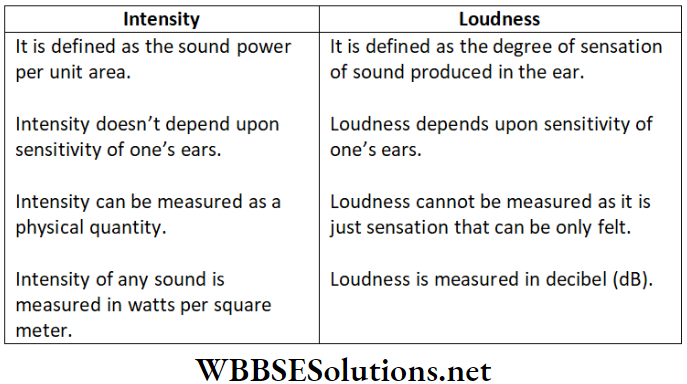
Question 2. Distinguish between intensity and loudness.
Answer.

Difference between intensity and loudness:

NEET Foundation Physics Sound Short Answer Type Question 2

Question 3. What are the requirements of the medium for the sound to propagate?
Answer.

Requirements of the medium for the sound to propagate:

The medium required for propagation of sound must have the following properties:

The medium must be elastic so that its particles may come back to their initial positions after displacement on either side.

The medium must have inertia so that its particles may store mechanical energy.

The medium should be frictionless so that there is no loss of energy in propagation of sound through it.

Read And Learn More NEET Foundation Short Answer Questions

Question 4. A tuning fork having a frequency of 250 Hz is made to vibrate by striking it against a rubber pod. What is the wavelength of the sound waves it produces in

  1. air  
  2. water
  3. iron?

Velocity of sound in air, water and iron = 330 ms-1, 1500 ms-1 and 5 kms-1 respectively.
Answer.

Given

A tuning fork having a frequency of 250 Hz is made to vibrate by striking it against a rubber pod.

Velocity of sound in air, water and iron = 330 ms-1, 1500 ms-1 and 5 kms-1 respectively.

We know that

v = fλ

i.e., λ = \(\frac{v}{f}\)

In air, \(\lambda_a=\frac{330 \mathrm{~ms}^{-1}}{250 \mathrm{~s}^{-1}}\)

= 1.32m

Similarly,

\(\lambda_w=\frac{1500 \mathrm{~ms}^{-1}}{250 \mathrm{~s}^{-1}}\)

= 6.0m

In iron,

\(\lambda_{\text {iron }}=\frac{5000 \mathrm{~ms}^{-1}}{250 \mathrm{~s}^{-1}}\)

= 20.0 m

NEET Foundation Physics Chapter 5 Sound Short Answer Questions

Question 5. If a tuning fork having a frequency of 400 Hz is made to vibrate continuously how many

  1. Compression
  2. Rarefactions

Pass a point P in air in 0.1 s?
Answer.

Given

A tuning fork having a frequency of 400 Hz is made to vibrate continuously

When a tuning fork vibrates once, it produces one sound wave, which consists of one compression and one rarefaction.

∴ Its frequency is 400 Hz, it vibrates 400 times in one second.

In one second, it vibrates 400 times.

So, in 0.1 seconds it vibrates 0.1 × 400 = 40 times.

So, it will produce 40 waves, i.e., 40 compressions and 40 rarefactions.

∴ Number of compressions passing a point P  in 0.1 second is 40.

Similarly, a number of rarefaction passing a point P is 0.1 second is also 40.

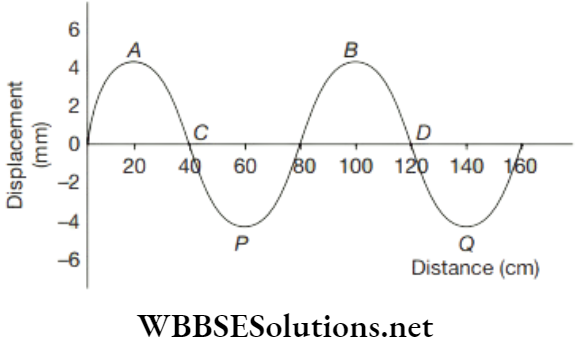
Question 6. Displacement–The distance graph of particles vibrating in a gas under the influence of a tuning fork of frequency 512 Hz is as follows: Find the velocity of sound in the gas.

NEET Foundation Physics Sound Short Answer Type Question 6

Answer.

Given

Points A and B represent the consecutive compressions. Distance between them is called ‘wavelength’ (λ).

So, λ = (100 cm − 20 cm) = 80 cm

Distance between points C and D = (120 cm − 40 cm) = 80 cm is also the wavelength(λ).

∴ λ = 80 cm = 0.8 m

We know that

v = fλ

= 512 × 0.8

= 409.6 ms-1

∴ Velocity of sound in the gas = 409.6 ms-1

Class 11 Physics Class 12 Maths Class 11 Chemistry
NEET Foundation Class 12 Physics NEET Physics

Question 7. A train is travelling in a railway track made of iron. A boy standing far away puts his ears to the track. He hears two sounds. Why? Calculate the time interval between these two sound waves.
Velocity of sound in air = va
Velocity of sound in iron = vs (where vs > va)
Answer.

Given

A train is travelling in a railway track made of iron. A boy standing far away puts his ears to the track. He hears two sounds.

It is because he receives the sound waves travelling through air as well as through iron. Since sound travels much faster through iron he will the hear sound travelling through iron first.

Time ‘t1’ taken by the sound to travel from the train to the boy through the iron rail is given by

\(\text { Time }=\frac{\text { Distance }}{\text { Speed }}\)

\(t_1=\frac{d}{v_n}\)  (1)

Similarly, time ‘t2’ taken by sound to travel to him is,

\(t_2=\frac{d}{D_d}\)  (2)

∴ Time interval ∆t between two sound waves reaching the boy is

∆t = t2 − t1

= \(\left(\frac{d}{v_a}-\frac{d}{v_n}\right)\)

Question 8. Calculate the velocity of sound through iron given that the modulus of elasticity for iron = 2 × 10¹¹ Pa and density of iron = 8 × 10³ kgm-3.
Answer.

Velocity of sound through a solid is given by

\(v=\sqrt{\frac{Y}{\rho}}\)

Where Y = young’s modulus

ρ = Density

V = \(\sqrt{\frac{\left(2 \times 10^{11}\right) \mathrm{Pa}}{\left(8 \times 10^3\right) \mathrm{kgm}^{-3}}}\)

= \(\sqrt{0.25 \times 10^8 \frac{\mathrm{Nm}^{-2}}{\mathrm{kgm}^{-3}}}\)

= \(\sqrt{25 \times 10^6 \frac{\mathrm{kgms}^{-2} \mathrm{~m}^{-2}}{\mathrm{kgm}^{-3}}}\)

= \(\sqrt{25 \times 10^6 \mathrm{~m}^2 \mathrm{~s}^{-2}}\)

= 5 x 10³ ms-1

The velocity of sound = 5 x 10³ ms-1

Question 9. How does a SONAR work?
Answer:

Working Of SONAR

SONAR is a device which is used in the ships to locate rocks, icebergs submarines, old sank in the seas etc. Ultrasonic sound of high frequency are sent from a ship on the surface. The waves travel in the straight line till they hit something like shipwreck or submarine.

On hitting the body these waves are reflected. The transmitter sending the waves note the time lag between sending the signal and receiving it back. This time lag is multiplied by speed of sound in water and the distance calculated is halved to get the actual distance of the object from the ship.

Question 10. Describe the structure and function of a human ear.
Answer:

Structure and function of a human ear:

The human ear consists of three parts:

  1. Outer ear: It is functionally the simplest part of the ear. It consists of ‘pinna’ or auricle i.e. the visible portion of the ear, the external acoustic meatus i.e. the outside opening to the ear canal and the ear canal.
  2. Middle ear: The middle ear consists of eardrum or tympanic membrane connected at the end of auditory canal. The eardrum vibrates when compression and rarefaction of the sound waves hit it. The three bones (hammer, anvil and stirrup) present in the middle ear the pressure variations several times. Thus the middle ear transmits the sound wave’s amplified pressure variation to the inner ear.
  3. Inner ear: The inner ear converts the sound waves amplified pressure variation into electrical signals. This work is done by cochlea, a snail-shaped organ. The cochlea is filled with water like fluid and its inner surface has large number of hair like nerve cells. The amplified pressure variation produces vibrations in the nerve cells and they in turn release electrical signals which are sent to the brain along the auditory nerve. The brain interprets the electrical signals through a complex process as sounds.

Question 11. What are the factors affecting the speed of sound in a gas?
Answer:

Speed of sound in a gas is affected by:

  1. Density
  2. Temperature
  3. Humidity
  4. Direction of wind

Question 12. What are the factors which does not affect the speed of sound in air?
Answer:

The factors which does not affect the speed of sound in air are:

  1. Wavelength
  2. Frequency
  3. Amplitude
  4. Pressure

Question 13. What are the laws of reflection of sound?
Answer:

The laws of reflection of sound are:

  • The angle of incidence is equal to angle of reflection.
  • The incident ray, reflected ray and normal at the point of incidence, all lie in the same plane.

Question 14. What do you mean by reverberation?
Answer:

Reverberation:

When echo is heard multiple times, due to repeated and multiple reflections of sound from different reflecting surfaces, it causes persistence of sound. This phenomenon is called reverberation.

Question 15. Name the devices which use multiple reflections of sound.
Answer:

Loudspeaker, megaphone, soundboard and stethoscope are the devices which use multiple reflections of sound.

Question 16. A boy shouted at the top of the mountain. The echo is heard after 10 seconds. Speed of the sound is 450 m/s. How far is the mountain from the boy?
Answer:

Given

A boy shouted at the top of the mountain. The echo is heard after 10 seconds. Speed of the sound is 450 m/s.

v = 450 m/s

T = 10 s

Distance d = 450 × 10 = 4500 m

As sound has to travel twice the distance, hence distance between boy and mountain = 4500/2

= 2250 m

Hence distance between boy and mountain = 2250 m

Question 17. Why sound is called a mechanical wave?
Answer:

Mechanical wave:

Sound is called a mechanical wave because it requires a medium to travel from one place to another.

Question 18. What properties should the medium have for the propagation of sound?
Answer:

The medium required for propagation of sound must have the following properties:

  • The medium should be elastic so that its particles comes back to the mean position after displacement on the either side.
  • The medium must have inertia so that its particles may store mechanical energy.
  • The medium should be frictionless so that there is no loss of energy in propagation of sound through it.

Question 19. What do you mean by crest and trough?
Answer:

Crest And Trough:

The position of maximum upward displacement is called crest and position of maximum downward displacement is called trough. These two are created in the medium during the propagation of transverse wave.

Question 20. What is the difference between progressive wave and stationary wave?
Answer:

The difference between progressive wave and stationary wave

Progressive waves start at a point and moves indefinitely and infinitely to all parts of the medium. These waves transmit energy from one place to another. While standing waves appear to stand at a place and confined between two points in a medium. These waves store energy in them.

Question 21. What are the characteristics of a sound wave?
Answer:

The characteristics of the sound waves are:

  • Amplitude
  • Time period
  • Frequency
  • Wavelength
  • Wave velocity

Question 22. On which factors does the speed of a sound in a medium depends?
Answer:

Speed of sound in a medium depends on elasticity of the medium as well as density of the medium.

Question 23. A sound wave has a frequency of 200 Hz. Wavelength is 15 m. How much time it will take to cover 2 km?
Answer:

Given

A sound wave has a frequency of 200 Hz. Wavelength is 15 m.

ν = 200 Hz

λ = 15 m

Speed v = ν × λ = 200 × 15 = 3000 m/s

Time t = d/υ

= 2000/3000

= 0.67 seconds

0.67 seconds time will it take to cover 2 km

Question 24. A sound has a frequency of 220 Hz. Its speed is 440 m/s. What will be the wavelength of the sound wave?
Answer:

Given

A sound has a frequency of 220 Hz. Its speed is 440 m/s.

ν = 220 Hz

v = 440 m/s

λ = v/ν = 440/220 = 2 m

The wavelength of the sound wave λ = 2 m

NEET Foundation Physics Chapter 5 Sound Long Answer Questions

Chapter 5 Sound Long Answer Type Question And Answers

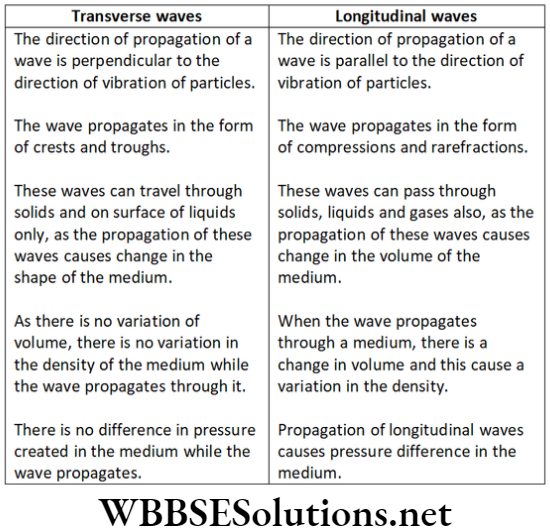
Question 1. Differentiate between transverse and longitudinal waves.
Answer.

Difference between transverse and longitudinal waves:

NEET Foundation Physics Sound Long Answer Type Question 1

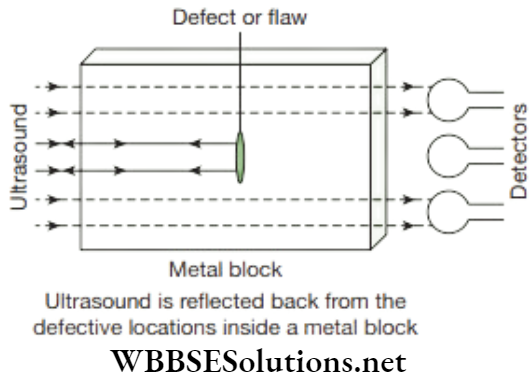
Question 2. Explain how defects in a metal block can be detected using ultrasound.
Answer.

Defects in a metal block can be detected using ultrasound:

Ultrasounds are used to detect cracks in the metal blocks. The cracks inside the metal blocks, which are imperceptible from outside, decreases the strength of the structure.

Ultrasonic waves can pass through the metal block and detectors are conditioned to detect the transmitted waves. If there is even a small defect, the ultrasound gets reflected indicating the occurrence of the flaw or defect in that metal block.

Read and Learn More NEET Foundation Long Answer Questions

NEET Foundation Physics Sound Long Answer Type Question 2

Question 3. Calculate the difference in Newton’s value of velocity of sound in air and that found by Pascal.
Answer.

The difference in Newton’s value of velocity of sound in air and that found by Pascal:

Velocity of sound in a gas is given by

v = \(\sqrt{\frac{E}{\rho}}\)

Where E is the modulus of elasticity of the gas.

Newton said ‘when sound travels through air through compression and rarefactions, the changes taking place in air are isothermal changes.’ For isothermal changes,

E = Pressure of gas

= Pressure of air

= 1.013 × 10⁵ Nm-2

∴ According to Newton,

va = \(\sqrt{\frac{P_a}{\rho_a}}\)

va = \(\sqrt{\frac{1.013 \times 10^5 \mathrm{Nm}^{-2}}{1.29 \mathrm{kgm}^{-3}}}\)

Newton’s value of va = 280 ms-1

Almost a century later, Laplace said ‘Sound travels very rapidly through air such rapid changes cannot be isothermal. They must be adiabatic in nature.’

For adiabatic changes,

E = YP

= 1.4 × 1.013 × 105 Pa

So, according to Pascal,

va = \(\sqrt{\frac{Y P_a}{\rho_e}}\)

= \(\sqrt{\frac{1.4 \times 1.013 \times 10^5}{1.29}}\)

= 331.6 ms-1

Velocity of sound in air at 0 °C is about 332 ms-1.

So, Laplace’s value is very close to the actual value of velocity of sound in air. Thus Laplace corrected Newton. This is therefore, called

Laplace’s correction.

∆v = (331.6 − 280)ms-1.

= 51.6 ms-1.

Class 11 Physics Class 12 Maths Class 11 Chemistry
NEET Foundation Class 12 Physics NEET Physics

Question 4. At what temperature the velocity of sound in air, will be double that of air at 0 °C ? (Given v0 = 332 ms-1).
Answer.

We know that,

\(\frac{v_2}{v_1}=\sqrt{\frac{T_2}{T_1}}\) \(\frac{v_2}{v_0}=\sqrt{\frac{T_2}{T_1}}\)

\(\frac{2 v_0}{v_0}=\sqrt{\frac{T_2}{273}}\)   (∴ V2 = 2V0)

Squarring on both sides, we get

\(4=\frac{T_2}{273}\)

T2 = 1092 K

= (1092 − 273) °C

= 819 °C

At 819 °C temperature the velocity of sound in air, will be double that of air at 0 °C

Question 5. Velocity of sound in a gas at STP is 400 ms-1. If both the pressure and the absolute temperature of the gas are doubled, then how will the velocity of sound change?
Answer.

Given:

Velocity of sound in a gas at STP is 400 ms-1. If both the pressure and the absolute temperature of the gas are doubled

Change in pressure has no effect on the velocity of sound. Only temperature change has,

Given: T1 = 0 °C = 273 K, v1 = 400 ms-1, T2 = 2 × 273 k,

We know that, T2 = ?

\(\frac{v_2}{v_1}=\sqrt{\frac{T_2}{T_1}}\)

\frac{v_2}{400}=\sqrt{\frac{(2 \times 273)}{273}}

v2 = 400 \sqrt{2}

= 565.7 ms-1.

The Change In Velocity Of Sound Is 565.7 ms-1.

Question 6. A boy blows a whistle and its echo from a distant wall is heard after 1.8 seconds. How far is the wall from him? Velocity of sound in air at room temperature = 340 ms-1.
Answer.

Given:

A boy blows a whistle and its echo from a distant wall is heard after 1.8 seconds.

If d be the distance of the wall from the boy, then sound travels a distance d to the wall and back to the boy.

So, total distance travelled by sound is 2d.

Time taken by sound to go to the wall(reflection of sound) and back.

\(t=\frac{\text { Distance }}{\text { Velocity }}\) \(t=\frac{2 d}{v}\)

=> \(1.6=\frac{2 d}{340}\)

2d = 340 x 1.6

∴ \(d=\frac{340 \times 1.6}{2}\)

= 272 m

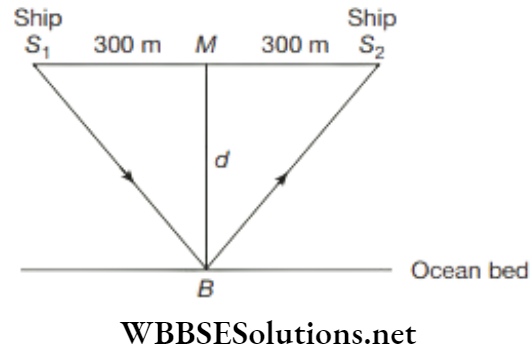
Question 7. Two ships are 6 km apart in Indian Ocean. Signal sent by one ship is reflected by the ocean bed and received at the second ship after 6.6 s. Find the depth of the Indian Ocean. (Velocity of sound in water = 1500 ms-1)
Answer.

Given:

Two ships are 6 km apart in Indian Ocean. Signal sent by one ship is reflected by the ocean bed and received at the second ship after 6.6 s.

The figure below shows two ships S1 and S2. Signal sent by ships S1 travels to the ocean bed along S1B and gets reflected along BS2 to reach the ship S2. So, distance travelled by sound is S1BS2 = 2 S1B.

NEET Foundation Physics Sound Long Answer Type Question 7

In ∆ S1BM,

\(S_1 B=\sqrt{d^2+\left(S_1 M\right)^2}\)

Time taken by (sound) signal to travel distance x = S1BS2 is given by

\(t=\frac{\text { Distance }}{\text { Velocity }}=\frac{S_1 B S_2}{v}\)

= \(\frac{S_1 B+B S_2}{v}\)

= \(\frac{2 S_1 B}{v}\)   (∴ Bs2 = s1B)

\(t=\frac{2 \sqrt{d^2+\left(S_1 M\right)^2}}{v}\)

∴ \(\sqrt{d^2+\left(S_1 M\right)^2}=\left(\frac{v t}{2}\right)\)

Squarring on both sides,

\(d^2+(S, M)^2=\left(\frac{v t}{2}\right)^2\) \(d^2+(3000)^2=\left(\frac{1500 \times 6.6}{2}\right)^2\)

d2 + (3000)2 = (4950)2

∴ d2 = 49502 − 30002

= (4950 + 3000)(4950 − 3000)

d2 = (7950)(1950)

\(d=\sqrt{(7950) \times(1950)}\)

⇒ d = 3937.4 m

⇒ d ≅ 3940 m

⇒ d ≅ 3.94 km

The depth of the Indian Ocean ≅ 3.94 km

Question 8. A sound wave of wavelength 0.332 m has a time period of 10-3 s. If the time period is decreased to 10-4 s. Calculate the wavelength and frequency of the new wave. Name the subjective property of sound related to its frequency and the light related to its wavelength.
Answer.

Given:

A sound wave of wavelength 0.332 m has a time period of 10-3 s. If the time period is decreased to 10-4 s.

Here λ = 0.332 m

Time taken to travel,

t = 10-3 s

Velocity = \(\frac{\lambda}{t}\)

v = \(\frac{0.33}{10^{-3}}\)

v = 0.33 × 10³

v = 330 m/s

Time period for second wave = 10-4 s

Wavelength λ = vT

= 330 × 10-4

Wavelength λ = 0.033 m

Frequency = \(\frac{1}{T}\)

= \(\frac{1}{10^{-3}}\)

Frequency = 103 Hz

Question 9. Derive a relation between Wave-Velocity, frequency and wavelength.
Answer.

A relation between Wave-Velocity, frequency and wavelength:

Let velocity of wave = v

Time period = T

Frequency = υ

Wavelength = λ

As per the definition of wavelength,

λ = Distance travelled by wave in one time period

= Wave Velocity × Time period

= v × T

vT = λ

t = \(\frac{1}{v}\)

\(v \times\left(\frac{1}{v}\right)=\lambda\)

Therefore, v = λυ.

Hence,

Wave Velocity = Frequency × Wavelength

Question 10. Meera is standing between two hills. She shouted loudly and hears first echo after 0.5 sec and second echo after 1 sec. What is the distance between two hills?
Answer.

Given:

Meera is standing between two hills. She shouted loudly and hears first echo after 0.5 sec and second echo after 1 sec.

Let the distance between nearest cliff and

Meera = x m and the distance between distant cliff and Meera = y m

Distance between two cliff = (x + y) m

Total distance covered by sound to produce first echo = 2x m and time = 0.5 sec.

2x = 340 × 0.5

\(x=340 \times \frac{0.5}{2}=85 \mathrm{~m}\)

Total distance covered by sound to produce second echo = 2y m and time = 1 sec

2y = 340 × 1

y = \(340 \times \frac{1}{2}\)

y = 170m

So distance between the two cliffs = (85 + 170) = 255 m

Question 11. A man fires a gun and hears its echo after 5 seconds. The man then moves 310 m towards the hill and fires his gun again. This time he hears the echo after 3 seconds. Calculate the speed of sound.
Answer.

Given:

A man fires a gun and hears its echo after 5 seconds. The man then moves 310 m towards the hill and fires his gun again. This time he hears the echo after 3 seconds.

Let d be the distance between the man and the hill in the beginning

v = \(\frac{2 d}{t}\)

v = \(\frac{2 d}{5}\)   (1)

He moves 310 m towards the hill. Therefore distance will be (d − 310) m.

v = \(2 \frac{(d-310)}{3}\)   (2)

Since velocity of sound is same, equating (1) and (2).

\(\frac{2 d}{5}=2 \frac{(d-310)}{3}\)

3d = 5d − 1550

2d = 1550

d = 775 m

Velocity of sound v = \(2 \times \frac{775}{5}\)

Velocity of sound v = 310 ms-1

Question 12. An engine is approaching a hill at a constant speed. When it is at a distance 0.9 km, it blows whistles, whose echo is heard by the driver after 5 s. If the speed of sound is 340 ms-1,calculate the speed of the engine.
Answer.

Given:

An engine is approaching a hill at a constant speed. When it is at a distance 0.9 km, it blows whistles, whose echo is heard by the driver after 5 s.

Let ve be the speed of the engine.

Distance covered by the engine in 5 s = 5 ve

Distance covered by sound in reaching the hill and coming back to moving driver

= 900 × 2 − 5ve

= 1800 − 5ve

According to given condition,

t = \(\frac{\left(1800-5 v_e\right)}{v}\)

As t = 5 s and v (speed of sound) = 340 ms-1

5 = \(\frac{(1800-5 v)}{340}\)

1700 = 1800 − 5ve

Or ve = 20 ms-1

NEET Foundation Physics Chapter 4 Work And Energy Very Short Question and Answers

Chapter 4 Work And Energy Very Short Question and Answers

Question 1. Define energy and its commercial unit. Express it in terms of Joules.
Answer:

Energy and its commercial unit.:

Energy is defined as the capacity of doing work. The commercial unit of energy is kilowatt-hour.

1 kWh = 1000 W × 3600 s = 3.6 × 10⁶ J

Question 2. How are resources classified?
Answer:

Classification Of resources:

When energy source used is easily replenished in a short period and the reserve is limitless is called renewable source. The sources of energy which are limited in quantity and are exhaustible are called non-renewable sources of energy.

Question 3. Name the different sources of energy.
Answer:

The different sources of energy

The five sources of energy are solar energy, wind energy, geothermal energy, hydroelectric energy and biomass energy

Question 4. What are the different forms of energy?
Answer:

Different forms of energy:

The various forms include mechanical energy (potential energy + kinetic energy), chemical energy, heat energy, light energy and electrical energy.

Question 5. Define mechanical energy and its types.
Answer:

Mechanical energy and its types:

Mechanical energy is of two types i.e., the energy possessed by a body due to its motion is called kinetic energy. The energy possessed by a body due to its position or height is called potential energy.

Question 6. Define conservative and non-conservative sources of energy.
Answer:

Conservative and non-conservative sources of energy:

If the work done by a force depends only on initial and final positions but not on the path taken, then the force is said to be conservative. If the work done by a force depend on the path taken then the force is said to be non-conservative.

Question 7. Define law of conservation of energy.
Answer:

Law of conservation of energy:

Energy can neither be created nor destroyed. It can only be changed from one form to another.

Question 8. A car is moving with the uniform velocity of 50 km/h. What is the kinetic energy of the object of mass 40 kg kept in the car?
Answer:

Given:

A car is moving with the uniform velocity of 50 km/h.

We know that both objects and car are moving with the same velocity

i.e., v = 50 km/h = 50 × 103/(60 × 60)

= 13.88 m/s2

Mass of the object,

m = 40 kg

K.E. = \(\frac{1}{2} m V^2\)

K.E. = \(\frac{1}{2} \times 40 \times(13.88)^2\)

K.E. = 3853.08 J

The kinetic energy of the object of mass 40 kg kept in the car is 3853.08 J

Class 11 Physics Class 12 Maths Class 11 Chemistry
NEET Foundation Class 12 Physics NEET Physics

Question 9. The acceleration due to gravity is 20 m/s2, what will be the potential energy of a body of mass 1 kg kept at the height of 10 m?
Answer:

Given:

The acceleration due to gravity is 20 m/s2,

Potential Energy = mgh

Mass, m = 1 kg

Acceleration due to gravity,

g = 20 m/s2

Height, h = 10 m

Potential Energy = 1 × 20 × 10

= 200 J

Hence, potential energy is 200 Joules.

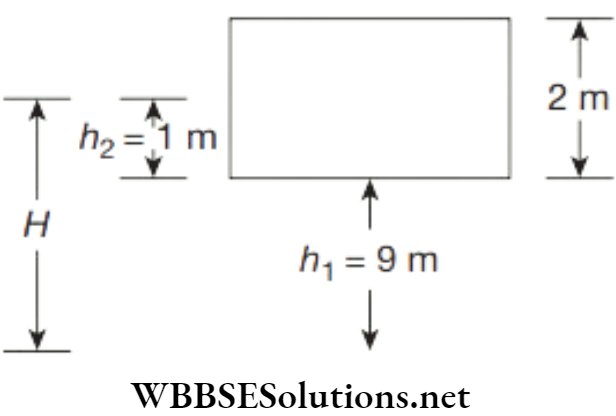
Question 10. Calculate potential energy of water in a tank having l = 4 m, b = 3 m and h = 2, situated on top of a house whose height is 9 m.
Take rw = 1 x 10³ kg/m3 and g = 10 ms-2
Answer:

Given

l = 4 m, b = 3 m and h = 2, situated on top of a house whose height is 9 m.

Take rw = 1 x 10³ kg/m3 and g = 10 ms-2

Volume of water = Volume of tank

= lbh

= 4 m × 3 m × 2 m

= 24 m3

Mass of water = Volume of density

= 24 × 103 kg

Mean height of water above the ground

H = h1 + h2

= 9 m + 1 m

= 10 m

NEET Foundation Physics Work And Energy Master Your Test Question 10

Therefore, Potential energy = MgH

= 24 × 103 × 10 × 10

= 24 × 105 J

Potential energy of water in a tank = 24 × 105 J

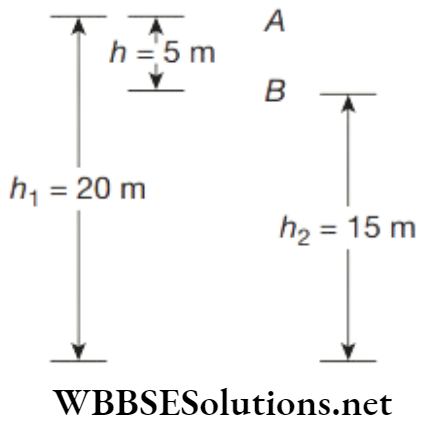
Question 11. A body of mass 0.5 kg is in rest at a height of 20 m above the ground.

  1. Find its total energy.
  2. What is the total energy, if it starts falling freely and has fallen through a height of 5 m? (Take g = 10 ms-2)
  3. What conclusion can be drawn from these calculations?

Answer:

(1) P.E. of the body = mgh

= 0.5 × 10 × 20

= 100 J

K.E. of the body = \(\frac{1}{2} m V^2\)

= \(\frac{1}{2} \times 0.5 \times 0\)

= 0

Total energy = P.E. + K.E.

= 100 + 0

= 100 J

∴ Total energy = 100 J

(2) NEET Foundation Physics Work And Energy Master Your Test Question 11

Velocity of the body at point B is given by

v2 = u2 + 2aS

= 0 + 2 × 10 × 5

= 100

∴ v = 10 ms-1

∴ Its K.E. at point B = \(\frac{1}{2} m V^2\)

= \(\frac{1}{2} \times 0.5 \times(10)^2\)

= \(\frac{1}{2} \times 0.5 \times 100\)

= 25 J

Its P.E. at point B = mgh2

= 0.5 × 10 × 15

= 75 J

Its total energy at point B = K.E. + P.E.

= 25 J + 75 J

= 100 J

Thus, we find that the total energy of a freely falling body remains constant, though its potential energy gradually change into kinetic energy.

Question 12. Calculate the kinetic energy of a body of mass 4 kg moving with the velocity of 0.2 meter per second.
Answer:

Kinetic Energy = \(\frac{1}{2} m V^2\)

Here mass = 4 kg

Velocity = 0.2 m/s

So, by putting the values in formula:

Kinetic energy = \(\frac{1}{2} \times 4 \times(0.2)^2\)

= \(\frac{1}{2} \times 4 \times 0.2 \times 0.2\)

= 0.08

The kinetic energy of a body = 0.08

Question 13. Define work and its types.
Answer:

Work and its types:

If a force is applied on a body which led to displacement in the body then work is done. Work is the product of magnitude of force and displacement.

Positive work: If a force is applied in the same direction to displacement, then work done is said to be positive.

Negative work: If a force is applied in the opposite direction of displacement, then work done is said to be negative.

Question 14. A swimmer makes a swing jump between two points, by holding one end of a rope, other end of which is tied to some higher point. What type of work is done by rope in jumping of the swimmer from one point to another?
Answer:

Zero work done.

Question 15. Calculate the work done in operating the crane, if it lifts a mass of 1600 kg through a vertical height of 40 m. 
Answer:

Given

The crane, if it lifts  A mass of 1600 kg through a vertical height of 40 m

g = 9.8 m/s2

F = mg = 1600 kg × 9.8 m/s2

= 15680 N

W = F × S = 15680 N × 40 m = 627,200 J

Work done in operating the crane = 627,200 J

Question 16. How much work is done by a force of 15 N in moving an object through a distance of 2 m in the direction of force?
Answer:

Given

Force of 15 N in moving an object through a distance of 2 m in the direction of force

W = F × S

Hence force, F = 15 N

Distance, S = 2 m

Work done, W = 15 × 2

W = 30 Joules

∴ Work done = 30 Joules

NEET Foundation Physics Chapter 4 Work And Energy Multiple Choice Questions

Chapter 4 Work And Energy Multiple Choice Question And Answers

Direction: Choose the correct option for each questions. There is only one correct response for each question.

Question 1. We need ______ for other activities like playing, singing, reading, writing, thinking, jumping, cycling and running.

  1. Energy
  2. Work
  3. Motion
  4. None of the above

Answer. 1. Energy

Question 2. What is the unit of work?

  1. Newton metre (Nm)
  2. Coulomb
  3. Ampere
  4. None of the above

Answer. 1. Newton metre (Nm)

Question 3. Which is the biggest natural source of energy to us?

  1. Moon
  2. Stars
  3. Sea
  4. Sun

Answer. 1. Moon

Question 4. On which factor the work done on an object does not depend?

  1. Displacement
  2. Force applied
  3. Angle between force and displacement
  4. Initial velocity of the object

Answer. 4. Initial velocity of the object

Question 5. Water stored in a dam possesses

  1. No energy
  2. Electrical energy
  3. Potential energy
  4. Kinetic energy

Answer. 4. Kinetic energy

NEET Foundation Physics Chapter 4 Work And Energy mcqs

Question 6. A body is falling from a height h. After it has fallen a height h/2 , it will possess

  1. Only potential energy
  2. Only kinetic energy
  3. Half potential and half kinetic energy
  4. More kinetic and less potential energy

Answer. 3. Half potential and half kinetic energy

Question 7. How are Joule (J) and ergs (erg) related?

  1. J = 107 erg
  2. 1 erg = 10-7 J
  3. 1 J = 10-7 erg
  4. None of the above

Answer. 3. 1 J = 10-7 erg

Question 8. Work done = Force × ______.

  1. Displacement
  2. Acceleration
  3. Velocity
  4. Speed

Answer. 2. Acceleration

Question 9. 1 Joule = 1 ______.

  1. Nm2
  2. kg m/s2
  3. Nm
  4. N2m2

Answer. 1. Nm2

Question 10. Which form of energy does the flowing water possess?

  1. Gravitational
  2. Potential
  3. Kinetic
  4. electricity

Answer. 3. Kinetic

Question 11. 3730 watts = ______ h.p.

  1. 5
  2. 2
  3. 746
  4. 6

Answer. 3. 746

Question 12. The P.E. of a body at a certain height is 200  J. The kinetic energy possessed by it when it just touches the surface of the earth is

  1. > P.E.
  2. < P.E.
  3. = P.E.
  4. None of the above

Answer. 1. > P.E.

Question 13. Power is a measure of the

  1. Rate of change of momentum
  2. Force which produces motion
  3. Change of energy
  4. Rate of change of energy

Answer. 4. Rate of change of energy

Question 14. 1.5 kW = ______ watts.

  1. 150
  2. 15000
  3. 1500
  4. 15

Answer. 2. 15000

Question 15. What is the energy of the simple pendulum when it is at its mean position?

  1. Potential energy
  2. Kinetic energy
  3. Both (a) and (b)
  4. Sound energy

Answer. 3. Both (a) and (b)

Question 16. Name the physical quantity which is equal to the product of force and velocity.

  1. Work
  2. Power
  3. Energy
  4. Current

Answer. 2. Power

Question 17. What is the example of kinetic energy in the following options?

  1. A moving bus
  2. A moving particle in electric field
  3. A stretched rubber band just released
  4. All the above

Answer. 2. A moving particle in electric field

Question 18. A light and the heavy body have equal momenta, which one has greater kinetic energy?

  1. A light body
  2. A heavy body
  3. Both have same K.E
  4. None of the above

Answer. 4. Both have same K.E

Question 19. Sum of kinetic and potential energy is called

  1. Mechanical energy
  2. Chemical energy
  3. Electrical energy
  4. Magnetic energy

Answer. 1. Mechanical energy

Question 20. Kinetic energy is given by

  1. F × S
  2. \(\frac{1}{2} m V^2\)
  3. Mgh
  4. None of the above

Answer. 1. F × S

Question 21. 1 kJ equals to

  1. 100 J
  2. 10 J
  3. 1000 J
  4. None of the above

Answer. 2. 10 J

Question 22. Work done in raising an object from the ground to that point against gravity is called

  1. gravitational potential energy
  2. gravitational kinetic energy
  3. gravitational energy
  4. none of the above

Answer. 3. gravitational energy

Class 11 Physics Class 12 Maths Class 11 Chemistry
NEET Foundation Class 12 Physics NEET Physics

Question 23. The energy used in households, industries and commercial establishments are usually expressed in ______.

  1. kilowatt hour
  2. Joules
  3. kilo joule
  4. None of the above

Answer. 1. kilowatt hour

Question 24. Which is the formula of potential energy?

  1. Mgh
  2. \(\frac{1}{2} m V^2\)
  3. F × S
  4. None of the above

Answer. 1. Mgh

Question 25. What are the conditions needed for work to be done?

1. a force should act on an object and
2. the object must be displaced
3. there should be a chemical energy applied

  1. 1 and 2
  2. 2 and 3
  3. 1 and 3
  4. All the above

Answer. 1. 1 and 2

Question 26. Which of the following statements are true?

1. Work done by force acting on an object is equal to the magnitude of the force multiplied by the distance moved in the direction of the force.
2. Work has only magnitude and no direction.
3. Here the unit of work is newton metre (N m) or joule (J)
4. There are two conditions need to be satisfied for work to be done

  1. 1 and 2
  2. 2 and 4
  3. 1, 2 and 3
  4. All the above

Answer. 1. 1 and 2

Question 27. What is the unit of work?

1. Newton metre
2. Joule
3. Ampere
4. Coulomb

  1. 1 and 3
  2. 3 and 4
  3. 1 and 2
  4. None of the above

Answer. 4. None of the above

Question 28. Which statement is correct regarding energy?

1. The energy possessed by an object is measured in terms of its capacity of doing work.

2. The unit of energy is Joule.

3. 1 kJ equals 100 J.

  1. 1 and 2
  2. 2 and 3
  3. 1 and 3
  4. All the above

Answer. 3. 1 and 3

Question 29. Which of the following are the examples of kinetic energy?

1. A falling coconut
2. a speeding car
3. a rolling stone
4. a flying aircraft

  1. 1 and 2
  2. 2 and 3
  3. 3 and 4
  4. All the above

Answer. 1. 1 and 2

Question 30. Which of the following are examples of potential energy?

1. Flowing water
2. Blowing wind
3. A coiled spring
4. Wheels on roller skates before someone skates

  1. 1 and 2
  2. 3 and 2
  3. 4 and 1
  4. 3 and 4

Answer. 1. 1 and 2

Question 31. Which statement is correct?

1. Power is defined as the rate of doing work or the rate of transfer of energy.
2. Power = work/time
3. The unit of power is watt
4. 1 W = 1 J s-1

  1. 1 and 2
  2. 2 and 4
  3. 3 and 1
  4. All the above

Answer. 4. All the above

Question 32. Work done in raising a box on a platform depends on

  1. how fast it is raised
  2. strength of the man
  3.  negative work
  4. zero work

Answer. 4. zero work

Question 33. Work done upon a body is

  1. a vector quantity
  2. a scalar quantity
  3. always positive
  4. always negative

Answer. 3. always positive

Question 34. Kilowatt hour (kWh) represents the unit of

  1. power
  2. impulse
  3. momentum
  4. none of these

Answer. 2. impulse

Question 35. When two unequal masses possess the same momentum, then kinetic energy of the heavier mass is _______ kinetic energy of the lighter mass.

  1. same as
  2. greater than
  3. smaller than
  4. much greater than

Answer. 4. much greater than

Question 36. The number of joules contained in 1 kWh is

  1. 36 × 102
  2. 36 × 103
  3. 36 × 104
  4. 3.6 × 10⁶

Answer. 3. 36 × 104

Question 37. A completely inelastic collision is one in which the two colliding particles

  1. are separated after the collision
  2. remain together after the collision
  3. split into small fragments flying in all directions
  4. none of the above

Answer. 4. none of the above

Question 38. A body moves through a distance of 3 m in the following different ways. In which case is the maximum work done?

  1. When pushed over an inclined plane
  2. When lifted vertically upward
  3. When pushed over smooth rollers
  4. When pushed on a plane horizontal surface

Answer. 2. When lifted vertically upward

Question 39. A truck and a car are moving on a smooth, level road such that the K.E. associated with them is same. Breakes are applied to both of them simultaneously. Which one will cover a greater distance before it stops?

  1. Car
  2. Truck
  3. Both will cover the same distance
  4. kinetic and potential energies

Answer. 2. Truck

Question 40. Two bullets P and Q, masses 10 and 20 g, are moving in the same direction towards a target with velocities of 20 and 10 m/s respectively. Which one of the bullets will pierce a greater distance through the target?

  1. P
  2. Q
  3. Both will cover the same distance
  4. Nothing can be decided

Answer. 3. Both will cover the same distance

Question 41. When the force applied and the displacement of the body are inclined at 90° with each other, then work done is

  1. infinite
  2. maximum
  3. zero
  4. unity

Answer. 1. infinite

Question 42. kg m2 s-2 represents the unit of

  1. kinetic energy
  2. work done
  3. potential energy
  4. all of these

Answer. 3. potential energy

Question 43. If sand drops vertically at the rate of 2 kg/sec on a conveyor belt moving horizontally with the velocity of 0.2 m/sec, then the extra force required to keep the belt moving is

  1. 0.04 N
  2. 0.08 N
  3. 0.4 N
  4. 0.2 N

Answer. 4. 0.2 N

Question 44. A body is dropped from a certain height to the ground. When it is halfway down, it possesses,

  1. only K.E.
  2. both K.E. and P.E.
  3. only P.E.
  4. zero energy

Answer. 3. only P.E.

Question 45. The energy required to raise a given volume of water from a well can be

  1. mega watts
  2. mega newton
  3. mega joules
  4. kilo watts

Answer. 2. mega newton

Question 46. If a force F is applied on a body and it moves with velocity v, then power will be

  1. F ×v
  2. \(\frac{F}{v^2}\)
  3. \(\frac{F}{v}\)
  4. F × v2

Answer. 3. \(\frac{F}{v}\)

Question 47. Which of the following graphs closely represents the P.E. (U) of a freely falling body and its height (h) above the ground?

NEET Foundation Physics Work And Energy Falling And Its Hight

Answer: 1

Question 48. The displacement x of a particle moving in one dimension, under the action of a constant force, is related to the time t by the equation, t x = + 3 where x is in metres and t in seconds. The displacement of the particle when its velocity is zero, is

  1. 0
  2. 6 m
  3. 12 m
  4. 18 m

Answer. 1. 0

Question 49. Asha lifts a doll from the floor and places it on a table. If the weight of the doll is known, what else does one need to know in order to calculate the work Asha has done on the doll?

  1. Time required
  2. Height of the table
  3. Mass of the ball
  4. Cost of the doll or the table

Answer. 1. Time required

Question 50. The work done in lifting a mass of 1 kg to a height of 9.8 m is

  1. 1 J
  2. (9.8)2 J
  3. 9.8 J
  4. None of these

Answer. 2. (9.8)2 J

Question 51. In which of the following cases, will the work done be maximum? The body is moved through a distances on the ground

NEET Foundation Physics Work And Energy Distance s On The Ground

Answer: 2

Question 52. Work done by a centripetal force

  1. increases by decreasing the radius of the circle
  2. decreases by increasing the radius of the circle
  3. increases by increasing the mass of the body
  4. is always zero

Answer. 2. decreases by increasing the radius of the circle

Question 53. Certain weight is attached with a spring. It is pulled down and then released. It oscillates up and down. Its K.E. will be

  1. maximum in the middle of the movement
  2. maximum at the bottom
  3. maximum just before it is released
  4. constant

Answer. 4. constant

Question 54. A 1  kg mass falls from a height of 10 m into a sand box. What is the speed of the mass just before hitting the sand box? If it travels a distance of 2 cm into the sand before coming to rest, what is the average retarding force?

  1. 12 m/sec and 3600 N
  2. 14 m/sec and 4900 N
  3. 16 m/sec and 6400 N
  4. 18 m/sec and 8100 N

Answer. 1. 12 m/sec and 3600 N

Question 55. If L, M denote the angular momentum and mass of a particle and p its linear momentum, which of the following can represent the kinetic energy of the particle moving in a circle of radius R?

  1. \(\frac{L^2}{2 M}\)
  2. \(\frac{p^2}{M}\)
  3. \(\frac{L^2}{2 M R^2}\)
  4. \(\frac{1}{2} M p\)

Answer. 2. \(\frac{p^2}{M}\)

Question 56. A particle of mass 4 m which is at rest and explodes into three fragments. Two of the fragments each of mass mare found to move with a speed v in mutually perpendicular directions. The total energy released in the explosion is

  1. 2mv2
  2. \(\frac{1}{2} m v^2\)
  3. mv2
  4. \(\frac{3}{2} m v^2\)

Answer. 3. mv2

Question 57. kWh represents the unit for

  1. force
  2.  power
  3. time
  4. energy

Answer. 4. energy

Question 58. Energy cannot be measured in

  1. Js
  2. Ws
  3. kWh
  4. erg

Answer. 4. erg

Question 59. A steam engine converts

  1. heat energy into sound energy
  2. heat energy into mechanical energy
  3. mechanical energy into heat energy
  4. electrical energy into sound energy

Answer. 1. heat energy into sound energy

Question 60. A man throws bricks to the height of 12 m where they reach with a speed of 12 m/s. If he throws the bricks such that they just reach this height, then what percentage of energy will he save?

  1. 19%
  2. 38%
  3. 57%
  4. 76%

Answer. 2. 38%

Question 61. Two bodies with masses MA and MB are moving with equal kinetic energy. Their linear momenta are numerically in a ratio |PA| : |PB|, the ratio of their masses will be

  1. MB : MA
  2. MA : MB
  3. \(\sqrt{M_A}: \sqrt{M_B}\)
  4. \(M_{\mathrm{A}}^2: M_{\mathrm{B}}^2\)

Answer. 2. MA : MB

Question 62. Mechanical work done is equal to (symbols have their usual meanings)

  1. W = F/S
  2. W = FS
  3. W = F + S
  4. W = F – S

Answer. 3. W = F + S

Question 63. Which of the following graphs best represents the graphical relation between momentum (P) and kinetic energy (K) for a body in motion?

NEET Foundation Physics Work And Energy Momentum And Kinetic Energy

Answer: 2

Question 64. An elevator is designed to lift a load of 1000 kg through 6 floors of a building on an average of 3.5 m per floor in 6 sec. Power of the elevator, neglecting other losses, will be

  1. 3.43 × 10⁴ watt
  2. 4.33 × 10⁴ watt
  3. 2.21 × 10⁴ watt
  4. 5.65 × 10⁴ watt

Answer. 4. 5.65 × 10⁴ watt

Question 65. When the momentum of a body increases by 100 %, then its K.E. increases by

  1. 20 %
  2. 40 %
  3. 100 %
  4. 300 %

Answer. 1. 20 %

Question 66. No work is said to have been done when an object moves at an angle of _____ with the direction of the force.

  1. 90°
  2. 180°
  3. between 90° and 180°

Answer. 4. between 90° and 180°

Question 67. When a body is whirled in a circle, then work done on it is

  1. positive
  2. negative
  3. zero
  4. infinite

Answer. 2. negative

Question 68. A crane is used to lift 1000 kg of coal from a mine 100 m deep. If the time taken by the crane is 1 hr, then find the power of the crane, assuming the efficiency of the crane to be 80 %. (g = 9.8 m/s2)

  1. 2567 watts
  2. 2403 watts
  3. 3403 watts
  4. 3761 watts

Answer. 3. 3403 watts

Question 69. The flowing water of a river possesses

  1. gravitational energy
  2. potential energy
  3. electrical energy
  4. kinetic energy

Answer. 3. electrical energy

Question 70. The mass of an object P is double the mass of object Q. If both move with the same velocity, then the ratio of K.E. of P to Q is

  1. 1 : 2
  2. 2 : 1
  3. 1 : 4
  4. 4 : 1

Answer. 4. 4 : 1

Question 71. A truck can move up on a road having the gradient of 1 m rise for every 50 m with a speed of 15 km/hr. The resisting force is equal to 1/25 th the weight of the truck. How fast will the same truck move down the hill with the same horse power?

  1. 30 km/hr
  2. 45 km/hr
  3. 60 km/hr
  4. 75 km/hr

Answer. 2. 45 km/hr

Question 72. A body of mass 1 kg strikes elastically with another body at rest and continues to move in the same direction with one fourth the initial velocity. The mass of the other body is

  1. 3 kg
  2. 0.6 kg
  3. 2.4 kg
  4. 4 kg

Answer. 2. 0.6 kg

Question 73. A body rolling down a hill has

  1. K.E. only
  2. P.E. only
  3. Neither K.E. nor P.E.
  4. Both (a) and (b) above

Answer. 2. P.E. only

Question 74. A total of 4900 joules was expended in lifting a 50 kg mass. The mass was raised to the height of

  1. 98 m
  2. 960 m
  3. 245 m
  4. 10 m

Answer. 4. 10 m

Question 75. A ball of mass 200 g falls from a height of 5 m. What is its K.E. when it just reaches the ground?

  1. 9.8 J
  2. 98
  3. 980 J
  4. None of these

Answer. 4. None of these

Question 76. A stretched spring possesses

  1. kinetic energy
  2. elastic potential energy
  3. electric energy
  4. magnetic energy

Answer. 1. kinetic energy

Question 77. When a person climbs a hill, he possesses

  1. only K.E
  2. only P.E.
  3. both K.E. and P.E.
  4. none of these

Answer. 2. only P.E.

Question 78. An iron sphere of mass 30 kg has the same diameter as an aluminium sphere whose mass is 10.5 kg. The spheres are dropped simultaneously from a cliff. When they are 10m from the ground, they have the same

  1. acceleration
  2. momentum
  3. potential energy
  4. K.E.

Answer. 3. potential energy

Question 79. A stone of mass m kg is whirled in a vertical circle of radius 20 cm. The difference in the kinetic energies at the lowest and the topmost positions is

  1. 4 mg joules
  2. 0.4 mg joules
  3. 40 mg joules
  4. None of these

Answer. 1. 4 mg joules

NEET Foundation Physics Chapter 4 Work And Energy Long Answer Questions

Chapter 4 Work And Energy Long Answer Type Question And Answers

Question 1. A bullet of mass 50 g travelling horizontally with a speed of 200 ms-1 strikes a glass pave 4 mm thick and falls dead, on emerging from it. How much work is done by the bullet against the opposing force of the glass pave?
Answer.

Given:

A bullet of mass 50 g travelling horizontally with a speed of 200 ms-1 strikes a glass pave 4 mm thick and falls dead, on emerging from it.

Initial K.E. of the bullet = \(\frac{1}{2} m u^2\)

Final K.E. of the bullet = \(\frac{1}{2} m v^2\)

Loss in K.E. of the bullet = Initial K.E. – Final K.E.

= \(\frac{1}{2} m u^2-\frac{1}{2} m v^2\)

= \(\frac{1}{2} m\left(u^2-v^2\right)\)

By Work – Energy theorem,

Work done by a body = Loss in its K.E.

W = \(\frac{1}{2} m\left(u^2-v^2\right)\)

= \(\frac{1}{2} \times \frac{50}{1000}\left(200^2-0^2\right)\)

= \(\frac{1}{2} \times \frac{5}{100} \times 200 \times 200\)

= 1000J

= 1 x 10³ J

Work done by a body = 1 x 10³ J

Question 2. If a heavy truck (mass = M) and a light car (mass m which is less than M) possess same amount of momentum, then which one possess greater kinetic energy? Explain.
Answer.

Given

If a heavy truck (mass = M) and a light car (mass m which is less than M) possess same amount of momentum

We know that momentum ‘p’ of a body of mass ‘m’ moving with velocity v is given by

p = mv

Squaring on both sides,

p2 = (mv)2 = m2v2

p2 = m⋅mv

= \(2 m\left(\frac{1}{2} m v^2\right)\)

p2 = 2mEk

So, K.E., \(E_\kappa=\frac{p^2}{2 m}\)

If p is same, i.e., constant, then

\(E_K=\frac{C}{m}\)

i.e., Ek is inversely proportional to mass.

It  means, a body with smaller mass possess more K.E.

∴ Car will possess more K.E. than the truck.

NEET Foundation Physics Chapter 4 Work And Energy laqs

Question 3. A body fall from height H. If t1 is time taken for covering the first half height and t2 be the time taken for second half. Which of these relations is true for t1 and t2.

  1. t1 > t2
  2. t1 < t2
  3. t1= t2
  4. Depends on the mass of the body

Answer.

Given:

A body fall from height H. If t1 is time taken for covering the first half height and t2 be the time taken for second half.

Let H be the height, then

First Half

\(\frac{H}{2}=\left(\frac{1}{2}\right) g t_1^2\)   (1)

Or  \(\left(\frac{1}{2}\right) g t_1^2=\frac{H}{2}\)

Also v = gt1

Second Half

\(\frac{H}{2}=v t_2+\left(\frac{1}{2}\right) g t_2^2\)

or \(\left(\frac{H}{2}\right)=g t_1 t_2+\left(\frac{1}{2}\right) g t_2^2\)

or \(\left(\frac{1}{2}\right) g t_2^2=\left(\frac{H}{2}\right)-g t_1 t_2\)   (2)

t22 + 2t1t2 − t12 = 0

or \(t_2=\frac{\left[-2 t_1+\sqrt{\left(4 t_1^2+4 t_1^2\right)}\right]}{2}\)

or \(t_2=\frac{\left[-2 t_1+2 t_1 \sqrt{2}\right]}{2}\)

t2 = 0.4 t1

so, t1 > t2

Hence a is correct.

Class 11 Physics Class 12 Maths Class 11 Chemistry
NEET Foundation Class 12 Physics NEET Physics

Question 4. A delivery boy wishes to launch a 2.0 kg package up an inclined plane with sufficient speed to reach the top of the incline. The plane is 3 m long and is inclined at 20. the coefficient of friction between the package and the inclined plane is .40.What minimum initial K.E. must the boy supply to the package given as sin20 = .342 cos20 = .940?
Answer.

Given:

A delivery boy wishes to launch a 2.0 kg package up an inclined plane with sufficient speed to reach the top of the incline.

The plane is 3 m long and is inclined at 20. the coefficient of friction between the package and the inclined plane is .40.

If the package travels the entire length S of the incline, the frictional force will perform work − μNS where μ is the coefficient of friction and N is normal reaction.

Let ‘h’ be the height of the incline plane then the gravitational potential energy of the package will increase by mgh.

Now let us assume ‘v’ be the speed given to the package so as to reach the top

Then kinetic energy at the initial point = \(\frac{1}{2} m v^2\)

Now applying work energy theorem

K.Ef – K.Ei = Work done by the gravitational force + Work done by the frictional force

Now since K.Ef = 0

Also Work done by the gravitational force

= –(change in gravitational potential energy)

= −mgh

Therefore

\(\frac{1}{2} m v^2\) = mgh – μNS

or \(\frac{1}{2} m v^2\) = mgh + μN

Now S = 3

N = mgcosθ

h = S sinθ

Substituting all the values

\(\frac{1}{2} m v^2\) = 42.2 J

Question 5. Deduce a formula for K.E of a body.
Answer.

A formula for K.E of a body:

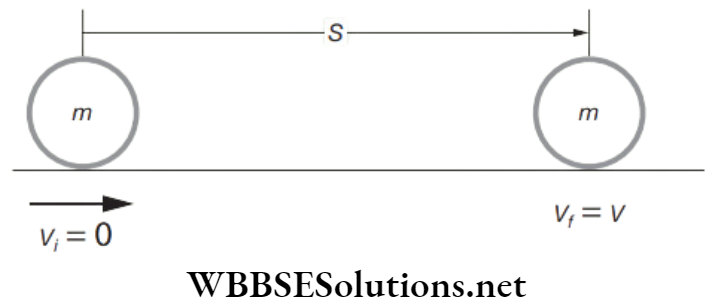
NEET Foundation Physics Work And Energy Long Answer Question 5

Consider a body of mass ‘m’ starts moving from rest, with uniform velocity ‘u’. After a time interval ‘t’ its velocity becomes v.

If initial velocity of the body is u or vi = 0, final velocity vf = v and the displacement of body is ‘S’. Then

First of all we will find the acceleration of the body.

Using equation of motion

2aS = vf2 − vi2

Substituting the above mentioned values

2aS = v2 − 0

a = \(\frac{v^2}{2 S}\)

Now force is given by

F = ma

Substituting the value of acceleration

F = \(m\left(\frac{v^2}{2 S}\right)\)

As we know that,

Work done = F.S

Substituting the value of F

Work done = \(\left(\frac{m v^2}{2 S}\right)(S)\)

Work done = \(\frac{m v^2}{2}\)

or Work done = \(\frac{1}{2} m v^2\)

Since the work done in motion is called ‘Kinetic Energy’

i.e., K.E. = Work done

or \(\frac{1}{2} m v^2\)

Question 6. A body of mass 1.0 kg initially at rest is moved by a horizontal force of 0.5 N on a smooth frictionless table. Calculate the work done by the force in 10 s and show that this is equal to the change in K.E. of the body.
Answer.

Given:

A body of mass 1.0 kg initially at rest is moved by a horizontal force of 0.5 N on a smooth frictionless table.

Here, m = 1.0 kg, u = 0, F = 0.5 N, t = 10s

a = \(\frac{F}{m}=\frac{0.5}{1.0}=0.5 \mathrm{~ms}^{-2}\)

From S = \(u t+\frac{1}{2} a t^2\)

S = \(0+\frac{1}{2} \times 0.5(10)^2=2.5 \mathrm{~m}\)

Work done = F × S

= 0.5 × 25

= 12.5 J

From v = u + at = 0 + 0.5 × 10

= 5 ms–1

Change in K.E. = \(\frac{1}{2} m\left(v^2-u^2\right)\)

= \(\frac{1}{2} \times 1.0\left(5^2-0\right)\)

= 12.5 J

The work done by the force in 10 s and show that this is equal to the change in K.E. of the body = 12.5 J

NEET Foundation Physics Chapter 4 Work And Energy Short Answer Questions

Chapter 4 Work And Energy Short Answer Type Questions

Question 1. A force of 20 N acts on a body to displace it through 10 m on a level road. Calculate the work done if force and displacement make an angle 60 degree with each other.
Answer. 

Given:

A force of 20 N acts on a body to displace it through 10 m on a level road.

Here force F = 20 N, Displacement, S = 10 m,

θ = 60 degrees

Now Work done, W = FS cos θ

= 20 × 10 × cos 60

= 20 × 10 × 0.5 = 100 J

The work done if force and displacement make an angle 60 degree with each other = 100 J

Read And Learn More NEET Foundation Short Answer Questions

Question 2. Define work. Write the formula of work when force and displacement do not act in same direction.
Answer.

Work:

Work is the product of force and displacement.

When force and displacement do not act in same direction, the formula for work is given by,

W = FS cos θ

Where θ is the angle between force and displacement.

NEET Foundation Physics Chapter 4 Work And Energy Short Answer Questions

Question 3. Mention the difference between potential energy and kinetic energy. A sliding box of mass 1 kg slows down from 10 m/s to 4 m/s. Calculate the change in kinetic energy.
Answer.

Given:

The difference between potential energy and kinetic energy. A sliding box of mass 1 kg slows down from 10 m/s to 4 m/s.

Potential energy of a body is the energy possessed by a body due to its position while kinetic energy of a body is the energy possessed due to velocity of the body.

Change in kinetic energy,

ΔK = 1/2m(v2 – u2)

ΔK = (42 – 102)/2

= -84/2 = -42 J

The change in kinetic energy = -42 J

Question 4. Which physical quantity has Nm as its SI unit? Two different bodies of masses in the ratio of 1 : 2 are moving with same speed. What is the ratio of their kinetic energy?
Answer.

Given:

Two different bodies of masses in the ratio of 1 : 2 are moving with same speed

Work has the SI unit Nm.

Ratio of Kinetic energies

\(\frac{K_1}{K_2}=\frac{\left(\frac{1}{2} m_1 v_1^2\right)}{\left(\frac{1}{2} m_2 v_2^2\right)}\) \(\frac{K_1}{K_2}=\left(\frac{m_1}{m_2}\right)\left(\frac{v_1^2}{v_2^2}\right)\) \(\frac{K_1}{K_2}=\frac{1}{2} \times 1 \quad\left(\text { since } v_1=v_2 \& \frac{m_1}{m_2}=\frac{1}{2}\right)\)

So \(\frac{K_1}{K_2}\) = 0.5

Work And Energy Questions

Question 5. In lifting a body to 10 m, 800 J of work was done. Calculate its weight.
Answer.

Given:

In lifting a body to 10 m, 800 J of work was done.

Work done W = mgh

800 = mg × 10

mg = 800/10 = 80 N

Thus, weight of the body is 80 N.

Question 6. How much work is done in lifting a book weighing 800 g through a height of 1.5 m? (Take g = 10 ms-2)
Answer.

We know that,

W = Force × displacement

⇒ W = mg × S

⇒ W = mgh (∵ S = h)

⇒ W = 0.8 kg × 10 ms-2 × 1.5 m

⇒ W = 12 J

Class 11 Physics Class 12 Maths Class 11 Chemistry
NEET Foundation Class 12 Physics NEET Physics

Question 7. When can work done by a force be zero? Give examples.
Answer.

We know that, in general work done is given by

W = FS cos θ

Where θ is the angle between direction of force and displacement.

W = 0 = FS cos θ

⇒ either S = 0

or cos θ = 0

i.e., θ = 90°

So work done by a force is zero.

When either displacement is zero or angle between directions of force and displacement is zero.

Examples

1. When a force is applied to a body and it doesn’t move

Example: a wall.

2. Displacement is in horizontal direction and force in vertical direction. So, work done by gravity on a bucket, which a man is carrying along horizontal ground.

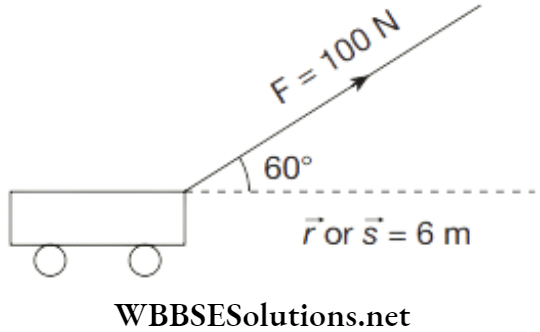
Question 8. How much work is done in pulling a trolley through 6 m, as shown in the below figure?

NEET Foundation Physics Work And Energy Short Answer Question 8

Answer.

We know that,

W = FS cos θ

= 100 N × 6 m × cos(60°)

= 100 × 6 × 0.5 Nm

= 300 J

Work Done = 300 J

Question 9. You are standing on roof top of a tower of height 25 m. What is the potential energy of a ball of mass 150 g kept on the ground? (Take g = 10 ms-2)
Answer.

In this case, potential energy will be negative since the body is below the reference level which is on the roof top.

P.E. = mgh

= 0.150 kg × 10 ms-2 × (−25 m)

= −37.5 J

Note: This numerical tells us that potential energy of a body can be negative.

Example: Potential energy of coal in a coalmine is negative with respect to the observer on ground.

Question 10. If the velocity of a body is doubled, how will its kinetic energy change? Compare new kinetic energy with the old one.
Answer.

Consider a body of mass ‘m’ moving with a velocity ‘v1’.

Then, its

\(\text { K.E. }=\frac{1}{2} m v_1^2\)

∴ \(E_1=\frac{1}{2} m v_1^2\)    (1)

Now, its velocity is doubled.

So, v2 = 2v1

∴ Its new kinetic energy

\(E_2=\frac{1}{2} m v_2^2\)

= \(\frac{1}{2} m\left(2 v_1^2\right)\)

= \(4 \cdot \frac{1}{2} m v_1^2\)

= 4 E1 form (1)

Thus, its kinetic energy becomes four times.

Question 11. A particle of mass 0.2 kg is moving in one dimension under a force that delivers a constant power 0.5 W to the particle. If the initial speed (in m/sec) of a particle is zero, than what is the speed (in m/sec) after 5 s?
Answer.

Given:

A particle of mass 0.2 kg is moving in one dimension under a force that delivers a constant power 0.5 W to the particle.

We know that

\(\text { Power }=\frac{d W}{d t}\)

W = 0.5 × 5 = 2.5 = K.E.f − K.E.i

Since the initial speed of the particle is zero, the initial kinetic energy will also be zero.

⇒ \(2.5=\frac{M}{2}\left(v_f^2-v_i^2\right)\)

⇒ \(2.5=\frac{M}{2}\left(v_f^2-0\right)\)

⇒ \(v_f^2=2.5 \times \frac{2}{0.2}=25\)

⇒ vf = 5

Question 12. Deduce the formula of P.E. of a body.
Answer.

P.E. of a body:

Consider an object of mass, m. Let it be raised through a height h from the ground. A force is required to do this. The minimum force required to raise the object is equal to the weight of the object mg.

The object gains energy equal to the work done on it. Let the work done on the object against gravity be W. That is, work done,

W = Force × Displacement

= mg × h

= mgh

Since work done on the object is equal to mgh, the energy equal to mgh units is gained by the object. This is the potential energy (EP) of the object.

Ep = mgh

Question 13. When a rubber is stretched by a distance x, it exerts a restoring force of magnitude F = ax + bx2, where a and b are constants. What is the work done in stretching the un-stretched rubber b and by L?
Answer.

Given:

When a rubber is stretched by a distance x, it exerts a restoring force of magnitude F = ax + bx2, where a and b are constants

We have

F = ax + bx2

W = Fdx

The work done by stretching the un-stretched rubber b and by L is

\(W=\int_0^L\left(a x+b x^2\right) d x\)

= \(\left[a\left(\frac{x^2}{2}\right)+b\left(\frac{x^3}{3}\right)\right]_0^L\)

= \(a\left(\frac{L^2}{2}\right)+b\left(\frac{L^3}{3}\right)\)

NEET Foundation Physics Chapter 3 Gravitation Long Answer Questions

Chapter 3 Gravitation Long Answer Type Question And Answers

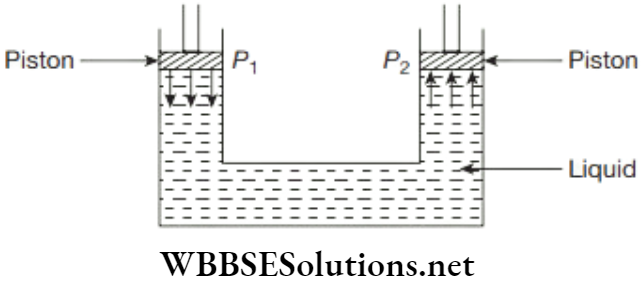
Question 1. Interconnected vessel as shown in figure is filled with an ideal liquid P1 and P2 are airtight pistons having areas A1 = 2 cm2 and A2 = 5 cm2 respectively. A weight of 3 kg is kept on piston P1. Calculate

  1. pressure acting on piston P1
  2. pressure on piston P2
  3. force with which P2 moves up.

NEET Foundation Physics Gravitation Question 1

Answer.

Given:

Interconnected vessel as shown in figure is filled with an ideal liquid P1 and P2 are airtight pistons having areas A1 = 2 cm2 and A2 = 5 cm2 respectively.

A weight of 3 kg is kept on piston P1.

Pressure P1 exerted by the piston P1 on the confined liquid is given by

P1 = \(\frac{\text { Force }}{\text { Area }}=\frac{\text { Weight }}{\text { Area }}=\frac{M_g}{A_1}\)

= \(\frac{3 \times 10 \mathrm{~N}}{2 \times 10^{-1} \mathrm{~m}^2}\)

P1 = 15 × 104 Pa, (downwards)

Pressure acting on piston P= 15 × 104 Pa, (downwards)

By Pascal’s law, this pressure is communicated to the piston P2.

∴ Upward pressure P2 acting on piston P2

= P1

= 15 × 104 Pa, (upwards)

We know that,

P = \(\frac{F}{A}\)

∴ F = PA

= P2A2

= \(15 \times 10^4 \frac{\mathrm{N}}{\mathrm{m}^2} \times 5 \times 10^{-4} \mathrm{~m}^2\)

= 75 N

Read and Learn More NEET Foundation Long Answer Questions

Question 2. Nine tenth of an iceberg having a total volume of 500 m3 is submerged in ocean. Calculate the buoyant force acting on the iceberg.

  1. Take ρoceanwater = 1.02 × 10³ kgm-3
  2. g = 10 ms-2

Answer.

Given:

Nine tenth of an iceberg having a total volume of 500 m3 is submerged in ocean

Buoyant force or upthrust is given by

U = Vρ g

where

V = Volume of immersed part of solid.

= \(\left(\frac{9}{10} \times 500\right) \mathrm{m}^3\)

= 450 m3

So U = V ρ g

= \(450 \mathrm{~m}^3 \times 1.02 \times 10^3 \frac{\mathrm{kg}}{\mathrm{m}^3} \times 10 \mathrm{~m}\)

= 45 × 1.02 × 105 N

= 4.59 × 10⁶ N

The buoyant force acting on the iceberg = 4.59 × 10⁶ N

Question 3. A piece of metal weighs 200 gf in air and 180 gf in water. Finds its relative density.
Answer.

Given:

A piece of metal weighs 200 gf in air and 180 gf in water.

\(\text { R. D. of a solid }=\frac{\text { Weight in air }}{\text { Loss of weight in water }}\)

= \(\frac{W_1}{W_1-W_2}\)

= \(\frac{200 \mathrm{gf}}{(200-180) g f}\)

= \(\frac{200}{20}\)

∴ RD of metal = 10 (No unit).

Question 4. Imagine a planet whose both diameter and mass are one half of the Earth. The day’s temperature of this planet’s surface reaches up to 800 K. Find whether oxygen molecules are possible in the atmosphere of this planet.
Answer.

Given:

Imagine a planet whose both diameter and mass are one half of the Earth. The day’s temperature of this planet’s surface reaches up to 800 K.

Escape velocity,

ve = \(\sqrt{2} G M / R\)

Let vp = escape velocity on the planet

ve = escape velocity on the earth

\(\frac{v_p}{v_e}=\sqrt{\left(\frac{M_p}{R_p} \times \frac{R_e}{M_r}\right)}=\sqrt{\left(\frac{1}{2} \times \frac{2}{1}\right)}=1\)

vp = ve = 11.2 km/s

From kinetic theory of gases

vrms = \(\sqrt{3 R T / M})=\sqrt{3 N K T / M}=\sqrt{3 N K T / N m}\)

where N = Avogadro’s number

m = mass of oxygen molecule

K = Boltzmann constant

vrms = \(\sqrt{3 R T / m}\)

= \(\sqrt{\left(\frac{\left(3 \times 1.38 \times 10^{-23} \times 800\right)}{5.3 \times 10^{-2 h}}\right)}\)

(m = 5.3 × 10⁻²⁶ kg)

vrms = 0.79 km/s

As vrms is very small compared to the escape velocity on the planet, molecules cannot escape from the surface of the planet’s atmosphere.

Class 11 Physics Class 12 Maths Class 11 Chemistry
NEET Foundation Class 12 Physics NEET Physics

Question 5. Deduce the relationship between g and G.
Answer.

Relationship between g and G:

Let g = acceleration due to gravity at a planet

M = mass

R = radius

m = mass of object

By Newton’s law of motion, force on a body due to gravity on its surface

F = mass × acceleration due to gravity

= m g

By Newton’s gravitational law, force is

F = GMm/R2

Therefore,

GMm/R2 = mg

Acceleration due to gravity g = GM/R2

Question 6. How much below the surface of earth does the acceleration due to gravity

  1. reduce to 36%
  2. reduce by 36%, of its value on the surface of earth, (radius of earth = 6400 km).

Answer. Case (1)

We have,

gh = g (1 – d/R)

Or d = (g – gh) R/g (1)

Here

gh = 36/100 g (2)

Using (1) and (2)

gh = 36/100 g

d = (1 – 36/100) R

d = (100 – 36)/100 × 6400

d = 4096 km

Case (2)

Here

gh = g – 36/100 g

i.e., gh = 64/100 g (3)

Using equation (1) and (3)

d = (g – 64/100 g) 6400/g

d = 100 – 64/100 × 6400

d = 2304 km

Question 7. Deduce gravitational force between

  1. gravitational force between earth and the  sun and
  2. gravitational force between the moon and  the earth.

Answer. (1) Gravitational force between earth and the sun

Mass of earth, m1 = 6 × 1024 kg

Mass of sun, m2 = 2 × 1030kg

Distance between sun and earth, R = 1.5 × 10¹¹m

Gravitational force between the sun and the earth,

F = \(G \frac{m_1 m_2}{r^2}\)

F = (6.67 × 10⁻¹¹ Nm2 kg-2 × 6 × 1024 kg × 2 × 1030kg)/(1.5 × 1011m) 2

F = 3.6 × 10²² N

(2) Gravitational force between the moon and the earth

Mass of earth, m1 = 6 × 1024 kg

Mass of moon, m2 = 7.4 × 10²² kg

Gravitational force between earth and the moon is

F = \(G \frac{m_1 m_2}{r^2}\)

F = (6.67 × 10⁻¹¹Nm2kg-2× 6 × 1024kg × 7.4 × 1022 kg)/(3.8 × 108m)2

F = 2.05 × 10²⁰ N

Question 8. Explain why a sheet of paper falls slower than one that is crumpled into a ball?
Answer.

The sheet of paper falls slower than the one that is crumpled into a ball because the air offers resistance due to friction to the motion of the falling objects. The resistance offered by air to the sheet of paper is more than the resistance offered by air to the paper ball because the sheet has larger area.

Question 9. The escape velocity of a body on the surface of the earth is 11.2 km/s. A body is projected away with twice this speed. What is the speed of the body at infinity? Ignore the presence of other heavenly bodies.
Answer.

If v is the velocity of projection and v’ is the velocity at infinity, then we have by energy conservation principle.

\(\frac{1}{2} m v^2-\frac{G M m}{R}=\frac{1}{2} m v^{\prime 2}+0\)

Here v = 2ve

Thus,

\(\left(\frac{1}{2}\right) \cdot 4 v_e^2-\frac{G M}{R}=\frac{1}{2} v^{\prime 2}\) \(2 v_e^2-\frac{G M}{R}=\frac{1}{2} v^{\prime 2}\)

Now, ve = \(\frac{\sqrt{2 G M}}{R}\)

\(2 v_e^2-\frac{v_e^2}{2}=\frac{1}{2} v^{\prime 2}\)

Or, v’2 = 3 ve2

Or, v’ = \(\sqrt{3} v_e=\sqrt{3} \times 11.2 \mathrm{~km} / \mathrm{s}=19.4 \mathrm{~km} / \mathrm{s}\)

Question 10. Deduce the equation showing the variation in the value of g with depth below the surface of the earth.
Answer.

Let us consider a body of mass m at a depth h below the surface of earth. Then, radius of the inner solid sphere of the earth = R – h.

Volume of the inner solid sphere of the earth = \(\frac{4}{3} \pi(R-h)^3 d\)

If d is the average density of the earth, then

Mass of inner solid sphere of earth = \(\frac{4}{3} \pi(R-h)^3 d\).

According to the law of gravitation,

mgd = \(G \times \frac{4}{3} \pi(R-h)^3 d \times m /(R-h)^2\)

This gives

gd = \(G \times \frac{4}{3} \pi(R-h) d (1)\)

On the surface of earth,

g = \(\frac{G M}{R^2}\)

= \(G \times \frac{4}{3} \pi R^3 \frac{d}{R^2}\)

= \(G \times \frac{4}{3} \pi R d (2)\)

From equation (1) and (2)

gd/g = \(G \times \frac{4}{3} \pi(R-h) \times d / G \times \frac{4}{3} \pi R d\)

= (R – h)/R

Or gd = g (1 – h/R) or (R – h)/R < 1

So, gd < g

Thus, the value of g at a depth inside the earth is less than that on the surface of the earth.

The value (R – h)/R decreases with the value of h, i.e. depth below the surface of the earth. So the value of g decreases as we go down below the surface of earth.

Question 11. A stone is dropped from the edge of the roof.

  1. How long does it take to fall 4.9 m?
  2. How fast does it move at the end of the fall?
  3. How fast does it move at the end of 7.9 m?
  4. What is its acceleration after 1 s and after 2 s?

Answer. (1) As the stone is dropped, its initial velocity,

u = 0, h = 4.9 m

a = g = 9.8 ms-2, time, t =?

From

h = \(u t+\frac{1}{2} g \mathrm{t}^2\)

4.9 = \(0+\frac{1}{2} \times 9.8 t^2=4.9 t^2\)

Or \(f^2=\frac{4.9}{4.9}=1, t=\sqrt{1}=1 \mathrm{~s}\)

(2) Final velocity, v = ? at t = 1 s

From

v = u + gt

v = 0 + 9.8 × 1 = 9.8 m s-1

(3) Let v be the final velocity when h = 7.9 m

From

v2 – u2 = 2ah

v2 – 0 = 2 (9.8) 7.9

Or v = \(\sqrt{2 \times 9.8 \times 7.9}=\sqrt{154.84}\)

v = 12.4 m s1

(4) The acceleration of a freely falling body remains the same at all times, i.e., a = g = 9.8 ms-1 after 1 s and 2 s.

NEET Foundation Physics Chapter 3 Gravitation Short Answer Questions

NEET Physics Gravitation Questions

Chapter 3 Gravitation Short Answer Type Question And Answers

Question 1. Calculate the gravitational force of attraction between two small gold balls weighing 500 g and 2 kg kept on a horizontal table, with their centers 40 cm apart. Take G = 6.7 × 10⁻¹¹ Nm2 kg2-2
Answer.

Given:

Two small gold balls weighing 500 g and 2 kg kept on a horizontal table, with their centres 40 cm apart.

Given:  m1 = 500g = 0.5 kg

m2 = 2 kg

r = 40 cm = 0.40 m

and G = 6.7 × 10⁻¹¹ Nm2 kg-2

By Newton’s law of gravitation,

F = \(\frac{G m_1 m_2}{r^2}\)

= \(6.7 \times 10^{-11} \frac{\mathrm{Nm}^2}{\mathrm{~kg}^2} \times \frac{0.5 \mathrm{~kg} \times 2 \mathrm{~kg}}{(0.4 \mathrm{~m})^2}\)

= \(6.7 \times 10^{-11} \times \frac{0.5 \times 2}{0.16} \mathrm{~N}\)

= \(6.7 \times 10^{-11} \times \frac{100}{16} \mathrm{~N}\)

∴ F = 4.1875 × 10⁻¹⁰ N

The gravitational force of attraction between two small gold balls = 4.1875 × 10⁻¹⁰ N

NEET Foundation Physics Chapter 3 Gravitation Short Answer Questions

NEET Foundation Physics Chapter 3 Gravitation Short Answer Questions

Question 2. With what force earth attracts moon? With what force moon attracts earth?
Answer.

Take ME = 6 × 1024 kg

Mm = 7.5 × 10²² kg

r = 3,80,000 km = 3.8 × 10⁸ m

According to Newton’s law of gravitation,

F = \(\frac{G M_E M_m}{r^2}\)

= \(6.7 \times 10^{-12} \frac{\mathrm{Nm}^2}{\mathrm{~kg}^2} \times \frac{6 \times 10^{24} \mathrm{~kg} \times 7.5 \times 10^{22} \mathrm{~kg}}{\left(3.8 \times 10^5 \mathrm{~m}\right)^2}\)

= \(\frac{6.7 \times 6 \times 7.5 \times 10^{35}}{3.8 \times 3.8 \times 10^{16}} \mathrm{~N}\)

Therefore, F = 20.9 × 10¹⁹ N

According to Newton’s III law, moon will also attract earth towards itself with the same force i.e., 20.9 × 10¹⁹ N.

Read And Learn More NEET Foundation Short Answer Questions

Question 3. A body is thrown vertically upwards with a velocity of 49 ms-1. Find

  1. how long it takes to reach the highest point
  2. maximum height attained by it.

Take g = 9.8 ms-1 and neglect air-friction.

Answer. Given: u = 49 ms-1

v = 0 (at the highest point)

a = −9.8 ms-2

t = ?

h = S = ?

(1) We know that

v = u + at

0 = 49 + (−9.8) × t

9.8 t = 49

∴ t = 49

9 8. = 5 s

5 s it will takes to reach the highest point

(2) ∵ v2 = u2 + 2ah

0 = (49)2 + 2 (−9.8) h

19.6 h = 49 × 49

∴ h = \(\frac{49 \times 49}{19.6}\)

∴ h = 122.5 m

Maximum height attained by it is 122.5 m

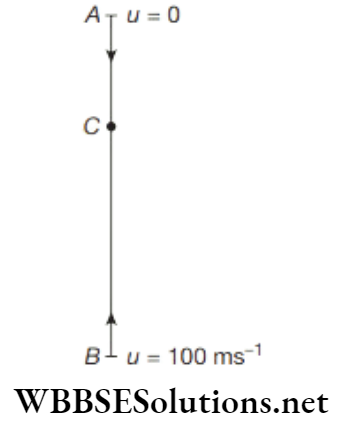
Question 4. A body is dropped from the top of a tower 200  m tall. Simultaneously, another body is thrown vertically upwards from its foot with a velocity of 100 ms-1. Find when and where they meet or cross each other.
Take g = 10 ms-2 and ignore air friction.
Answer. 

Given:

A body is dropped from the top of a tower 200  m tall. Simultaneously, another body is thrown vertically upwards from its foot with a velocity of 100 ms-1.

NEET Foundation Physics Gravitation Two bodies meet at point C

Suppose the two bodies meet at point C after ‘x’ seconds.

Consider downward motion AC of first body.

∵ S = \(u t+\frac{1}{2} g t^2\)

∴ AC = \(0+\frac{1}{2} \times 10 \times x^2\)

∴ AC = 5x2 (1)

Consider upward motion BC of second body.

∴ S = \(u t+\frac{1}{2} g t^2\)

∴ BC = \(100 x+\frac{1}{2}(-10) x^2\)

∴ BC = 100x − 5x2 (2)

Adding equations (1) and (2), we get

AC + BC = 5x2 + 100x − 5x2

∴ AB = 100x

i.e., 200 = 100x

∴ x = \(\frac{200}{100}=2 s\)

Substituting x = 25 in equation (i) we get,

AC = 5x2 = 5 × 22 = 20 m

Therefore, the two bodies meet at a point 20 m below the top of the tower or (200 − 20) m = 180 m above the foot of the tower, 2 s after they embark on their journey.

Gravitation NEET Questions 

Question 5. A girl weighing 40 kg is wearing pointed sandals having a total area of 2 × 10⁻⁴ m2. How much pressure she will exert on ground? In which case, the ground is more likely to be damaged? Explain. (Take g = 10 ms-2)
Answer.

Given:

A girl weighing 40 kg is wearing pointed sandals having a total area of 2 × 10⁻⁴ m2.

A boy of same weight wears shoe having area of 100 × 10-4 m.

Pressure Pg exerted by girl on the ground due to her weight is given by

Pg = \(\frac{\text { Force }}{\text { Area }}=\frac{\text { Weight }}{\text { Area }}=\frac{M g}{A}\)

= \(\frac{40 \times 10 \mathrm{~N}}{2 \times 10^{-4} \mathrm{~m}^2}\)

Pg = 2 × 10⁶ Nm-2or Pa Similarly pressure exerted by the boy on the ground due to his weight

Pb = \(\frac{\mathrm{Mg}_g}{A}=\frac{40 \times 10 \mathrm{~N}}{100 \times 10^{-4} \mathrm{~m}^2}\)

Pb = 4 × 10⁴ Nm-2 or Pa

Since Pg > Pb, the girl is more likely to damage the ground than the boy

NEET Foundation Physics Chapter 3 

Class 11 Physics Class 12 Maths Class 11 Chemistry
NEET Foundation Class 12 Physics NEET Physics

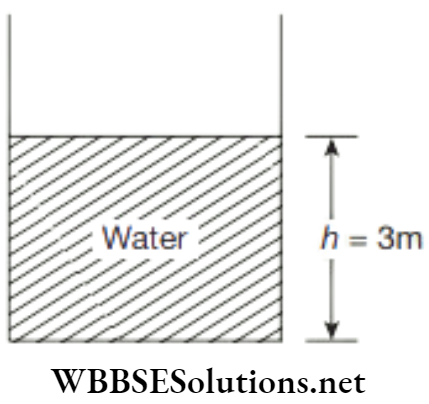
Question 6. A tall cylinder contains water column of height 3 m. Calculate the pressure it exerts on the bottom of the cylinder. Take g = 10 ms-2. Density of water = 1000 kg.
Answer.

Given:

A tall cylinder contains water column of height 3 m.

NEET Foundation Physics Gravitation Pressure exerted liquid column

We know that, pressure exerted by a liquid column is given by,

P = h ρ g

= \(3 \mathrm{~m} \times 1000 \frac{\mathrm{kg}}{\mathrm{m}^3} \times 10 \frac{\mathrm{m}}{\mathrm{s}^2}\)

∴ P = 3 × 10⁴ Nm2 or Pa

The pressure it exerts on the bottom of the cylinder = 3 × 10⁴ Nm2 or Pa

Gravitation Short Answer Questions 

Question 7. It is often said that atmospheric pressure is 76cm of mercury column. What does it mean? Express this pressure in Pascal.
Take ρmercury = 13.6 × 10³ kgm-3 and g = 9.8 ms-2.
Answer.

The given statement means that the earth’s atmosphere exerts some pressure as exerted by a mercury column of height 76 cm.

∴ Atmospheric pressure = Pressure of 76 cm of mercury

= h ρ g

= 0.76 m × 13.6 × 103 kgm-3 × 9.8 ms-2

= 1.013 × 10⁵ Pa

∴ Pressure in Pascal = 1.013 × 10⁵ Pa

Physics Gravitation Practice Problems 

Question 8. A ship having a total weight of 20,000 tonnes is floating on water. How much upthrust acts on the ship?
Take g = 10 ms-2
Answer.

Ship is in equilibrium (i.e., at rest)

So, Upward force acting on the ship = Downward force acting on the ship.

U = W

= Mg

= \(20,000 \text { tonnes } \times 10^s \frac{\mathrm{kg}}{\text { tonne }} \times 10 \mathrm{~ms}^{-2}\)

= 2 × 10⁸ N

∴ Upthrust acts on the ship is 2 × 10⁸ N

NEET Foundation Physics Chapter 3 Gravitation Multiple Choice Questions

Chapter 3 Gravitation Multiple Choice Question And Answers

Direction: Choose the correct option for each questions. There is only one correct response for each question.

Question 1. Choose the unit of relative density.

  1. kg
  2. G
  3. Newton
  4. None of the above

Answer. 4. None of the above

Question 2. The S.I. unit of thrust is ______.

  1. Newton
  2. m/s
  3. Dyne
  4. pascal

Answer. 1. Newton

Question 3. ______ is the quantity of matter contained in the body.

  1. Weight
  2. Mass
  3. Acceleration
  4. Force

Answer. 2. Mass

Question 4. The value of gravitational constant is ______

  1. 6.6734 × 10⁻¹¹ N m2/kg2
  2. 7.6734 × 10⁻¹⁰ N m2/kg2
  3. 8.6734 × 10⁻¹¹ N m/kg2
  4. 9.6734 × 10⁻¹¹ N m2/kg

Answer. 1. 6.6734 × 10⁻¹¹ N m2/kg2

Question 5. When an object is thrown up, the force of  gravity ______.

  1. Increases as it rises up
  2. Becomes zero at the highest point
  3. Is opposite to the direction of motion
  4. Is in the same direction as the direction of motion

Answer. 3. Is opposite to the direction of motion

Read and Learn More NEET Foundation Multiple Choice Questions

Question 6. The acceleration due to gravity is zero at ______

  1. Poles
  2. Centre of earth
  3. Equator
  4. Sea level

Answer. 2. Centre of earth

Question 7. Mass of a body is ______ throughout the universe.

  1. Constant
  2. Variable
  3. Zero
  4. Negative

Answer. 1. Constant

NEET Foundation Physics Chapter 3 Gravitation Multiple Choice Questions

Question 8. ______ is the thrust per unit area of surface.

  1. Speed
  2. Velocity
  3. Pressure
  4. Acceleration

Answer. 3. Pressure

Question 9. The gravitational force between two ­bodies is ______.

  1. Always attractive
  2. Always repulsive
  3. Attractive only at large distance
  4. Repulsive only at large distance

Answer. 1. Always attractive

Question 10. There is no atmosphere on the moon because

  1. It revolves round the earth.
  2. It is closer to the earth.
  3. The escape velocity of moon is less than root mean square velocity of gas molecule here.
  4. It is far away from the sun.

Answer. 3. The escape velocity of moon is less than root mean square velocity of gas molecule here.

Question 11. The upward force acting on an object submerged in a liquid is called ______.

  1. Pressure
  2. Force of friction
  3. Thrust
  4. Buoyant force

Answer. 4. Buoyant force

Question 12. Gravitational force is responsible for ______.

  1. Keeping plants in their rad2
  2. Keeping animals in their rad2.
  3. Keeping plants on theft axes
  4. For the motion of planets around the sun

Answer. 4. For the motion of planets around the sun

Question 13. The value of g decreases with ______.

  1. Speed
  2. Altitude
  3. Acceleration
  4. Velocity

Answer. 2. Altitude

Question 14. The distance from the centre of the earth to the centre of the moon is called as ______.

  1. Orbital radius of the moon
  2. Orbital length of the earth
  3. Orbital radius of the earth
  4. Orbital length of the moon

Answer. 1. Orbital radius of the moon

Question 15. The weight of an object in a satellite orbiting around the earth is ______.

  1. Less than the actual weight
  2. Greater than the actual weight
  3. Zero
  4. Actual weight

Answer. 3. Zero

Question 16. The acceleration of the moon is because of the ______

  1. Gravitational force exerted by the planets.
  2. Gravitational force exerted on the moon by the earth.
  3. Gravitational force exerted on the earth by the moon.
  4. Gravitational force exerted by the sun.

Answer. 2. Gravitational force exerted on the moon by the earth.

Question 17. Larger the volume of an object submerged in a fluid, greater is the ______.

  1. Gravity
  2. Upthrust.
  3. Mass
  4. Pressure

Answer. 2. Upthrust.

Question 18. Any substance that can flow is called ______.

  1. Solid
  2. Liquid
  3. Fluid
  4. Gas

Answer. 3. Fluid

Question 19. Buoyancy is denoted by the symbol ______.

  1. FA
  2. FB
  3. FC
  4. FD

Answer. 2. FB

Question 20. Acceleration due to Gravity (g) on the ­surface of earth at poles is ______.

  1. Maximum
  2. Minimum
  3. Zero
  4. Same as that on equator

Answer. 1. Maximum

Question 21. The unit of (g) – acceleration due to Gravity, is ______.

  1. N m/s²
  2. N m/s
  3. m/s²
  4. kg m/s

Answer. 3. N m/s²

Question 22. In order to derive the law of gravitation, Newton assumed that the moon’s orbit is ______.

  1. Straight
  2. Parabolic
  3. Uniform
  4. Circular

Answer. 4. Circular

Question 23. The equation for the mass of the earth (ME) is ______.

  1. ME = R E2 g/G
  2. ME = R E4 g/G
  3. ME = RG E2 /g
  4. ME = R g E2 /G

Answer. 1. ME = R E2 g/G

Question 24. If the density of an object is more than the density of the liquid, then it ______ in the liquid.

  1. Floats
  2. Sinks
  3. Oscillates
  4. Jumps

Answer. 2. Sinks

Question 25. A fluid contained in a vessel exerts pressure in ______.

  1. All directions
  2. Downwards
  3. Upwards
  4. Sideways

Answer. 1. All directions

Question 26. The S.I. unit of pressure is ______.

  1. newton
  2. dyne
  3. pascal
  4. metre

Answer. 3. pascal

Question 27. As per Newton, the force of attraction (F) between two particles is ______

  1. Directly proportional to the product of their masses
  2. Inversely proportional to the square of distance between the particles
  3. Both are correct
  4. None of the Above

Answer. 3. Both are correct

Question 28. The ______ is the measure of its inertia.

  1. Mass
  2. Velocity
  3. Height
  4. Distance

Answer. 1. Mass

Question 29. Choose the incorrect statement related to laws of liquid pressure

  1. Pressure at a point inside the liquid increases with the depth from its free surface.
  2. In a stationary liquid, pressure is same at all the points on a horizontal plane.
  3. Pressure is different in all the directions about a point in liquid.
  4. Pressure at same depth is in different liquids.

Answer. 3. Pressure is different in all the directions about a point in liquid.

Class 11 Physics Class 12 Maths Class 11 Chemistry
NEET Foundation Class 12 Physics NEET Physics

Question 30. Pressure is a ______ quantity.

  1. Scalar
  2. Vector
  3. Both
  4. None of the above

Answer. 1. Scalar

Question 31. If mass is more, inertia will be ______.

  1. Less
  2. More
  3. Equal
  4. Independent

Answer. 2. More

Question 32. The force (F) on a body due to earth’s gravity is ______.

  1. mg
  2. mg/2
  3. m/g
  4. m/2g

Answer. 1. mg

Question 33. The value of g on moon’s surface is nearly ______.

  1. one-third of the value of g on earth’s surface
  2. one-fourth of the value of g on earth’s surface
  3. one-sixth of the value of g on earth’s surface
  4. one-eight of the value of g on earth’s surface

Answer. 3. one-sixth of the value of g on earth’s surface

Question 34. Force due to gravity acts ______.

  1. Vertically downwards at the centre of gravity of the object
  2. Vertically upwards at the centre of gravity of the object
  3. in all the directions
  4. None of the Above

Answer. 1. Vertically downwards at the centre of gravity of the object

Question 35. Archimedes’ principle is applicable for ______.

  1. Solid
  2. Liquid
  3. Gas
  4. All of the above

Answer. 

2. Liquid

3. Gas

Question 36. The magnitude of upthrust on an object due to liquid depends on the ______.

  1. Volume of object submerged in the liquid
  2. Density of the liquid in which the object is submerged
  3. Volume of object above the liquid
  4. Density of the solid

Answer.

  1. Volume of object submerged in the liquid
  2. Density of the liquid in which the object is submerged

Question 37. The pressure at a point inside a liquid depends on ______.

  1. Depth of the point below the free surface
  2. Density of liquid
  3. Acceleration due to gravity
  4. Surface area of liquid

Answer.

  1. Depth of the point below the free surface
  2. Density of liquid
  3. Acceleration due to gravity

Question 38. The universal law of gravitation is

  1. The force that binds us to the earth.
  2. The motion of the moon around the earth.
  3. The motion of planets around the sun.
  4. The tides due to the moon and the sun.

Answer.  

  1. The force that binds us to the earth.
  2. The motion of the moon around the earth.
  3. The motion of planets around the sun.
  4. The tides due to the moon and the sun.

Question 39. The force of attraction (F) between two particles is ______.

  1. Directly proportional to the product of their masses
  2. Inversely proportional to the product of their masses
  3. Directly proportional to the square of distance between them
  4. Inversely proportional to the square of distance between them

Answer.

1. Directly proportional to the product of their masses

4. Inversely proportional to the square of distance between them

Question 40. Choose the correct statement

  1. The weight of an object is the force with which the earth attracts the object.
  2. The weight of an object is the force with which the earth repels the object.
  3. Weight is a vector quantity.
  4. Weight is a scalar quantity.

Answer.

1. The weight of an object is the force with which the earth attracts the object.

4. Weight is a scalar quantity.

Question 41. Choose the incorrect statement

  1. Relative density of a substance is defined as the ratio of mass of the substance to the mass of an equal volume of water at 4°C.
  2. Relative density (R.D.) of a substance is the ratio of the density of that substance to the density of water at 4°C.
  3. Unit of relative density is Newton.
  4. Unit of relative density is Dyne.

Answer.

3. Unit of relative density is Newton.

4. Unit of relative density is Dyne.

Question 42. Characteristic properties of upthrust are _____.

  1. Larger the volume of object submerged in fluid, smaller is the upthrust.
  2. Larger the volume of object submerged in fluid, greater is the upthrust.
  3. For same volume inside the fluid more the density of fluid, greater is the upthrust.
  4. The upthrust acts on an object in upward direction at the centre of buoyancy.

Answer.

2. Larger the volume of object submerged in fluid, greater is the upthrust.

3. For same volume inside the fluid more the density of fluid, greater is the upthrust.

4. The upthrust acts on an object in upward direction at the centre of buoyancy.

Question 43. Choose the incorrect statement

  1. The normal force per unit area is called pressure.
  2. The normal force per unit area is called thrust.
  3. The normal force per unit area is called density.
  4. The normal force per unit area is called upthrust.

Answer.

2. The normal force per unit area is called thrust.

3. The normal force per unit area is called density.

4. The normal force per unit area is called upthrust.

Question 44. Choose the correct statement

  1. Pressure = Thrust/Area
  2. Pressure is a scalar quantity
  3. Pressure is a vector quantity
  4. Pressure = Distance/Time

Answer. 

  1. Pressure = Thrust/Area
  2. Pressure is a scalar quantity

Question 45. The mass of earth is 6 × 1024 kg and radius of earth is 6.4 × 10⁶ m. The magnitude of force between the mass of 1 kg and the earth is:

  1. 9.770 N
  2. 9.810 N
  3. 9.830 N
  4. 9.790 N

Answer. 1. 9.770 N

Question 46. With the increase in the density of a fluid, the upthrust experienced by a body immersed in it is

  1. decreases
  2. increases
  3. remains same
  4. none of these

Answer. 2. increases

Question 47. The acceleration due to gravity on earth is 9.81  ms-2. If the acceleration due to gravity on the surface of moon is 1/6 of the earth, the weight of 10 kg mass on moon is:

  1. 1.67 N
  2. 16.35 N
  3. 17.50 N
  4. None of these

Answer. 2. 16.35 N

Question 48. The apparent weight of a body in a fluid is:

  1. equal to weight of fluid displaced
  2. volume of fluid displaced
  3. difference between its weight in air and weight of fluid displaced
  4. none of the above

Answer. 3. difference between its weight in air and weight of fluid displaced

Question 49. The average distance between the earth and moon is 3.84 × 10⁵ km. If the mass of moon is 7.4 × 10²² kg and that of earth is 6 × 1024 kg, the gravitational force of the moon on the earth is:

  1. 2.01 × 10²⁰ N
  2. 20.1 × 10²¹ N
  3. 20.1 × 10²⁰ N
  4. none of these

Answer. 1. 2.01 × 10²⁰ N

Question 50. The phenomenon due to which a solid expereinces upward force when immersed in water is called:

  1. floatation
  2. buoyancy
  3. density
  4. none of these

Answer. 2. buoyancy

Question 51. The mass of earth is 6 × 1024 kg, radius 6.4 × 10⁶ m and G = 6.7 × 10⁻¹¹ Nm2 kg-2. The acceleration due to gravity on the surface of earth is:

  1. 9.70 ms-2
  2. 9.78 ms-2
  3. 9.89 ms-2
  4. 9.80 ms-2

Answer. 4. 9.80 ms-2

Question 52. The radius of earth is 6400 km and value of ‘g’ at its surface is 9.8 ms-2. The value of ‘g’ at a height of 12,800 km will be:

  1. 5.07 ms-2
  2. 1.09 ms-2
  3. 3.09 ms-2
  4. 4.08 ms-2

Answer. 2. 1.09 ms-2

Question 53. If ‘g’ = 9.8 ms-2, the weight of body of mass 10 kg is:

  1. 138 N
  2. 158 N
  3. 98 N
  4. 78 N

Answer. 3. 98 N

Question 54. Imagine a heavenly body which has a mass twice of the earth and radius thrice of the earth. If a stone on earth weighs 900 N, its weight on the heavenly is:

  1. 200 N
  2. 600 N
  3. 400 N
  4. 500 N

Answer. 1. 200 N

Question 55. Two neutrons of mass 1.67 × 10⁻²⁷ kg are at distance of 10-15 m from each other. The gravitational force of attraction between them is:

  1. 4.86 × 10⁻³⁴ N
  2. 5.86 × 10⁻³⁴ N
  3. 1.86 × 10⁻³⁴ N
  4. 2.86 × 10⁻³⁴ N

Answer. 3. 1.86 × 10⁻³⁴ N

Question 56. A spaceship is orbiting around the earth at height twice the radius of earth. If ‘g’ on earth is 9.8 ms-2, the ‘g’ at the height is:

  1. 2.1 ms-2
  2. 5.1 ms-2
  3. 3.1 ms-2
  4. 1.1 ms-2

Answer. 4. 1.1 ms-2

Question 57. The mass and radius of earth is 6 × 1024 kg and 6400 km. If another heavenly body has half the mass and the radius of earth, the value of g on it will be:

  1. 4.96 ms-2
  2. 19.6 ms-2
  3. 29.6 ms-2
  4. 39.6 ms-2

Answer. 2. 19.6 ms-2

Question 58. The radius of moon is 0.27 times the radius of earth, whereas of gmoon is 1.27 ms-2 and gearth is 9.8 ms-2. The ratio of mass of earth to the mass of moon is:

  1. 46 times
  2. 58 times
  3. 79 times
  4. 67 times

Answer. 3. 79 times

Question 59. The weight of body on the surface of earth is 90  kgf. Its weight on the surface of another planet of mass 1/9 and radius half on the earth will be:

  1. 40 kgf
  2. 30 kgf
  3. 35 kgf
  4. 50 kgf

Answer. 1. 40 kgf

Question 60. When an object sinks in a liquid its:

  1. buoyant force is more than the weight of object
  2. buoyant force is less than the weight of object
  3. buoyant force is equal to the weight of object
  4. none of the above

Answer. 2. buoyant force is less than the weight of object

Question 61. If the diameter of earth becomes 3 times its present value, but mass does not change, the weight of an object will decrease to:

  1. \(\frac{1}{3} \text { th }\)
  2. \(\frac{1}{6} \text { th }\)
  3. \(\frac{1}{8} \text { th }\)
  4. \(\frac{1}{9} \text { th }\)

Answer. 4. \(\frac{1}{9} \text { th }\)

Question 62. A glass stopper suspended form the hook of a spring balance and immersed completely in water reads Wgf. If the same stopper is immersed in alcohol (density 0.80 gcm-3), the reading on the spring balance will be:

  1. less than Wgf
  2. more than Wgf
  3. Wgf
  4. none of these

Answer. 2. more than Wgf

Question 63. The value of ‘g’ on the top of Mount Everest (height 8848 m) will be:

  1. 9.77 ms-2
  2. 6.77 ms-2
  3. 6.67 ms-2
  4. 5.77 ms-2

Answer. 1. 9.77 ms-2

Question 64. The radius of earth is 6400 km. The value of ‘g’ will be 60% at the height of:

  1. 5.76 × 10³ km
  2. 1.86 × 10³ km
  3. 1.47 × 10³ km
  4. 3.86 × 10³ km

Answer. 2. 1.86 × 10³ km

Question 65. If radius of earth is R, at what height from the surface of earth the weight becomes half:

  1. 0.414
  2. 0.518 R
  3. 0.514 R
  4. 0.314 R

Answer. 1. 0.414

Question 66. Thrust acting perpendicularly on the unit surface area is called:

  1. pressure
  2. moment of force
  3. down thrust
  4. none of these

Answer. 1. pressure

Question 67. The pressure exerted on a given surface is:

  1. directly proportional to the force acting on the surface
  2. directly proportional to area of crosssection of surface
  3. inversely proportional to area of crosssection of surface
  4. both (a) and (c)

Answer. 4. both (a) and (c)

Question 68. Your weight recorded by an accurate weighing machine is 42 kgf. In actual practice your weight is:

  1. more than 42 kgf
  2. less than 42 kgf
  3. 42 kgf
  4. none of these

Answer. 1. more than 42 kgf

Question 69. One pascal is equal to:

  1. N cm-2
  2. Nm-2
  3. Nm2
  4. Nm-1

Answer. 2. Nm-2

Question 70. Tank trailors are provided with 16 wheels so as to:

  1. increase pressure on the road
  2. decrease pressure on the road
  3. support the weight of the tank
  4. none of the above

Answer. 2. decrease pressure on the road

Question 71. Pressure applied on liquids is transmitted with undiminished force:

  1. in downward direction only
  2. upward direction only
  3. sides of containing vessel
  4. in all directions

Answer. 4. in all directions

Question 72. The knives are often sharpened:

  1. to decrease the area of cutting edge and hence increasing pressure
  2. to decrease the area of cutting edge and hence decreasing pressure
  3. to give it a shine
  4. none of the above

Answer. 1. to decrease the area of cutting edge and hence increasing pressure

Question 73. The strap of a school bag is not made of thin string, because:

  1. string is likely to break
  2. string has less area of cross-section and hence exerts less pressure on shoulder
  3. string has less area of cross-section and hence exerts more pressure on shoulder
  4. none of the above

Answer. 3. string has less area of cross-section and hence exerts more pressure on shoulder

Question 74. When a body is wholly or partially immersed in a liquid it experiences a buoyant force which is equal to the:

  1. volume of liquid displaced by it
  2. weight of liquid displaced by it
  3. both (a) and (b)
  4. none of the (a) or (b)

Answer. 2. weight of liquid displaced by it

Question 75. The relative density of zinc metal is 4.2. Its density in SI system is:

  1. 4.2 kg m-3
  2. 42 kg m-3
  3. 420 kg m-3
  4. 4200 kg m-3

Answer. 4. 4200 kg m-3

Question 76. Which is incorrect statement?

  1. tides are formed in the sea due to gravitational pull of the sun and moon.
  2. earth holds atmosphere on account of gravitational pull of earth.
  3. hydrogen filled balloons rise up because, no gravitational pull acts on it
  4. gravitational pull of the earth keeps us and other objects firmly on ground

Answer. 3. hydrogen filled balloons rise up because, no gravitational pull acts on it

Question 77. Two similar sheets of a paper Aand B are taken. The sheet B is crumpeld to form a ball. Both A and B are allowed to fall from a height of 10 m.

  1. both A and B will reach ground at the same time.
  2. A will reach earlier than B.
  3. B will reach earlier than A
  4. none of the above

Answer. 3. B will reach earlier than A

Question 78. A stone is released from the top of tower 19.6m high. If ‘g’ is 9.8 ms-2, the final velocity of the stone on reaching the ground is:

  1. 9.8 ms-1
  2. 28.4 ms-1
  3. 19.6 ms-1
  4. none of these

Answer. 3. 19.6 ms-1

Question 79. A stone is thrown vertically upward with an initial velocity of 40 ms-1. Taking g = 10 ms-2, the maximum displacement and distance covered by the stone on reaching ground is:

  1. displacement: zero; distance = 80 m
  2. displacement: zero; distance covered = 160 m
  3. displacement = 80 m; distance = 160
  4. distance and displacement = 180 m.

Answer. 2. displacement: zero; distance covered = 160 m

Question 80. A cricket ball is vertically thrown upward, which rises to the height of 10 m. If g = 10 ms-2, the time in which it rises up to the maximum height is:

  1. 1.53 s
  2. 1.63 s
  3. 1.55 s
  4. 1.43 s

Answer. 1. 1.53 s

Question 81. A plastic ball released under water comes up. It is because the weight of the plastic ball is:

  1. equal to the weight of water displaced by it.
  2. less than the weight of water displaced by it.
  3. more than the weight of water displaced by it.
  4. none of the above

Answer. 2. less than the weight of water displaced by it.

Question 82. A body has density 9.6 gcm-3. Its density in SI system is:

  1. 96 kgm-3
  2. 960 kgm-3
  3. 9600 kgm-3
  4. 96,000 kgm-3

Answer. 3. 9600 kgm-3

Question 83. A stone is allowed to fall from the top of a tower 100 m high and at the same time another stone is projected vertically upward from the ground with a velocity of 25 ms-1. If g = 10 ms-2, the stones will meet at:

  1. 25 m from ground after 5 s (g = 10 ms–2)
  2. 20 m from ground after 4 s
  3. 20 m from ground after 4.5 s
  4. 20 m from ground after 3.8 s

Answer. 2. 20 m from ground after 4 s

Question 84. The SI unit of relative density is:

  1. kgm-3
  2. gcm-3
  3. kgcm-3
  4. no unit

Answer. 4. no unit

Question 85. A stone thrown vertically upward returns back to the thrower in 6 sec. The maximum height attained by the stone is:

  1. 25 m
  2. 35 m
  3. 40 m
  4. 45 m

Answer. 4. 45 m

Question 86. The pressure exerted by 50 kg (g = 10 ms-2) on an area of cross-section of 2 m2 is:

  1. 50 Pa
  2. 200 Pa
  3. 250 Pa
  4. 1000 Pa

Answer. 3. 250 Pa

Question 87. A truck is of mass 50,000 kg (g = 10 ms-2), its tyres exert a pressure of 2,500,000 Pa. The surface area of tyres in contact with ground is:

  1. 2 m2
  2. 0.2 m2
  3. 2.5 m2
  4. 2.75 m2

Answer. 2. 0.2 m2

Question 88. The force experienced by a body when partially or fully immersed in water is called:

  1. apparent weight
  2. upthrust
  3. down thrust
  4. none of these

Answer. 2. upthrust

Question 89. When a body is floating in a liquid:

  1. the weight of body is less than the upthrust due to immersed part of body
  2. the weight of body is more than the upthrust due to immersed part of body
  3. the weight of body is equal to the upthrust due to immersed part of body
  4. none of the above

Answer. 3. the weight of body is equal to the upthrust due to immersed part of body

Chapter 3 Gravitation Free Fall

Question 1. ______ is a natural phenomenon in which two objects having masses attract towards each other.

  1. Gravitation
  2. Speed
  3. Velocity
  4. Acceleration

Answer. 1. Gravitation

Question 2. The S.I. unit of G is ______.

  1. m/s
  2. Nm2/kg2
  3. N
  4. Dyne

Answer. 2. Nm2/kg2

Question 3. An object weighs 10 N when measured on the surface of earth. What should be its weight on moon?

  1. 1.67 N
  2. 4.18 N
  3. 2.20 N
  4. 16.7 N

Answer. 1. 1.67 N

Question 4. According to Newton, the force of attraction (F) between two particles is:

  1. Inversely proportional to the product of their masses
  2. Directly proportional to the their masses
  3. Inversely proportional to the their masses
  4. Directly proportional to the product of their masses

Answer. 4. Directly proportional to the product of their masses

Question 5. ______ between two bodies forms action reaction pair.

  1. Kinetic energy
  2. Acceleration
  3. Gravitational force
  4. Potential energy

Answer. 3. Gravitational force

Chapter 3 Gravitation Mass

Question 1. The force with which the earth ______ an object is called force due to gravity on the object.

  1. attracts
  2. repel
  3. forms
  4. moves

Answer. 1. attracts

Question 2. The value of g is maximum

  1. at equator of earth
  2. at poles of earth
  3. in a mine
  4. at a high hill

Answer. 2. at poles of earth

Question 3. Acceleration due to gravity ______ with depth below the surface of the earth.

  1. increases
  2. decreases
  3. doubles
  4. becomes half

Answer. 2. decreases

Question 4. A ball is thrown vertically upwards and attains a maximum height of 100  m. It was thrown with a speed.

  1. 9.8 m/s
  2. 44.3 m/s
  3. 19.6 m/s
  4. 98 m/s

Answer. 2. 44.3 m/s

Question 5. The value of g is _______ on different planets and satellites

  1. different
  2. same
  3. equivalent
  4. None of the above

Answer. 1. different

Chapter 3 Gravitation Thrust and Pressure

Question 1. Relative density has _________ unit.
Answer. No

Question 2. The relative density of water is

  1. Zero
  2. One
  3. Two
  4. Can’t say

Answer. 2. One

Question 3. If the relative density of an object is less than that of water, then it will

  1. Rise
  2. Float
  3. Sink
  4. Can’t say

Answer. 2. Float

Question 4. Archimedes’ principle is applicable to the objects in fluids. (True/False)
Answer. True

Chapter 3 Gravitation Practice Exercises

Question 1. Two objects of different masses falling freely near the surface of moon would

  1. have same velocities at any instant
  2. have different accelerations
  3. experience forces of same magnitude
  4. undergo a change in their inertia

Answer. 1. have same velocities at any instant

Question 2. The value of acceleration due to gravity

  1. is same on equator and poles
  2. is least on poles
  3. is least on equator
  4. increases from pole to equator

Answer. 3. is least on equator

Question 3. The gravitational force between two objects is F. If masses of both objects are halved without changing distance between them, then the gravitational force would become

  1. F/4
  2. F/2
  3. F
  4. 2 F

Answer. 1. F/4

Question 4. A boy is whirling a stone tied with a string in an horizontal circular path. If the string breaks, the stone

  1. will continue to move in the circular path
  2. will move along a straight line towards the centre of the circular path
  3. will move along a straight line tangential to the circular path
  4. will move along a straight line perpendicular to the circular path away from the boy

Answer. 3. will move along a straight line tangential to the circular path

Question 5. An object is put one by one in three liquids having different densities. The object floats with 1/9 2/11 and 3/7 , and parts of their volumes outside the liquid surface in liquids of densities d1, d2 and d3 respectively. Which of the following statement is correct?

  1. d1 > d2 > d3
  2. d1 > d2 < d3
  3. d1 < d2 > d3
  4. d1 < d2 < d3

Answer. 4. d1 < d2 < d3

Question 6. In the relation F = GMm/d2, the quantity G

  1. depends on the value of g at the place of observation
  2. is used only when the earth is one of the two masses
  3. is greatest at the surface of the earth
  4. is universal constant of nature

Answer. 4. is universal constant of nature

Question 7. Law of gravitation gives the gravitational force between

  1. the earth and a point mass only
  2. the earth and Sun only
  3. any two bodies having some mass
  4. two charged bodies only

Answer. 3. any two bodies having some mass

Question 8. The value of quantity G in the law of gravitation

  1. depends on mass of earth only
  2. depends on radius of earth only
  3. depends on both mass and radius of earth
  4. is independent of mass and radius of the earth

Answer. 4. is independent of mass and radius of the earth

Question 9. Two particles are placed at some distance. If the mass of each of the two particles is doubled, keeping the distance between them unchanged, the value of gravitational force between them will be

  1. \(\frac{1}{4} \text { times }\)
  2. 4 times
  3. \(\frac{1}{2} \text { times }\)
  4. unchanged

Answer. 2. 4 times

Question 10. The atmosphere is held to the earth by

  1. gravity
  2. wind
  3. clouds
  4. earth’s magnetic field

Answer. 1. gravity

Question 11. The force of attraction between two unit point masses separated by a unit distance is called

  1. gravitational potential
  2. acceleration due to gravity
  3. gravitational field
  4. universal gravitational constant

Answer. 4. universal gravitational constant

Question 12. The weight of an object at the centre of the earth of radius R is

  1. zero
  2. infinite
  3. R times the weight at the surface of the earth
  4. 1/R2 times the weight at surface of the earth

Answer. 1. zero

Question 13. An object weighs 10 N in air. When immersed fully in water, it weighs only 8 N. The weight of the liquid displaced by the object will be

  1. 2 N
  2. 8 N
  3. 10 N
  4. 12 N

Answer. 1. 2 N

Question 14. A girl stands on a box having 60 cm length, 40 cm breadth and 20 cm width in three ways. In which of the following cases, pressure exerted by the brick will be

  1. maximum when length and breadth form the base
  2. maximum when breadth and width form the base
  3. maximum when width and length form the base
  4. the same in all the above three cases

Answer. 2. maximum when breadth and width form the base

Question 15. An apple falls from a tree because of gravitational attraction between the earth and apple. If F1 is the magnitude of force exerted by the earth on the apple and F2 is the magnitude of force exerted by apple on earth, then

  1. F1 is very much greater than F2
  2. F2 is very much greater than F1
  3. F1 is only a little greater than F2
  4. F1 and F2 are equal

Answer. 4. F1 and F2 are equal

WBCHSE Notes For Class 11 Physics

Physical World And Measurement

Kinematics

WBCHSE Notes For Class 11 Physics

Laws of Motion

Work, Energy and Power

  • Work and Energy

Motion of System of Particles And Rigid Body

Gravitation

Properties of Bulk Matter

Thermodynamics

  • First and Second Law of Thermodynamics

Behaviour of Perfect Gas and Kinetic Theory

  • Kinetic Theory of Gases

Oscillation and Waves

  • Simple Harmonic Motion
  • Nature of Vibration
  • Wave Motion
  • Superposition of Waves
  • Doppler Effect in Sound