The Nucleus Multiple Choice Questions And Answers

The Nucleus

Question 1. If the radius of the \({ }_{13}^{27} \mathrm{Al}\) nucleus is taken to be RAl then the radius of the \({ }_{52}^{125} \mathrm{Te}\) nucleus is nearly

  1. \(\left(\frac{52}{13}\right)^{1 / 3} R_{\mathrm{Al}}\)
  2. \(\frac{5}{3} R_{\mathrm{Al}}\)
  3. \(\frac{3}{5} R_{\mathrm{Al}}\)
  4. \(\left(\frac{13}{52}\right)^{1 / 3} R_{\mathrm{Al}}\)

Answer: 2. \(\frac{5}{3} R_{\mathrm{Al}}\)

For a nucleus of mass number A, the radius is given by R = \(R_0 A^{1 / 3}\)

∴ \(\frac{R_{\mathrm{Te}}}{R_{\mathrm{Al}}}=\left(\frac{125}{27}\right)^{1 / 3}=\frac{5}{3}\)

⇒ \(R_{\mathrm{Te}}=\frac{5}{3} R_{\mathrm{Al}}\)

The Nucleus Multiple Choice Question And Answers

Question 2. The mass number of helium is 4 and that for sulphur is 32. The radius of the sulfur nucleus is larger than the helium nucleus by a multiple of

  1. 4
  2. 2√2
  3. 2
  4. 8

Answer: 3. 2

Given that AHe = 4 and As = 32

∴ \(\frac{R_{\mathrm{S}}}{R_{\mathrm{He}}}=\left(\frac{32}{4}\right)^{1 / 3}=(8)^{1 / 3}=2\)

Hence, Rs = 2RHe.

ribosomes class 11

Question 3. The mass density of a nucleus varies with the mass number as

  1. A
  2. A2
  3. \(\frac{1}{A}\)
  4. A0

Answer: 4. A0

The mass density of a nucleus is given by

⇒ \(\rho=\frac{\text { mass }}{\text { volume }}=\frac{A m}{\frac{4}{3} \pi R^3}=\frac{A m}{\frac{4}{3} \pi\left(R_0 A^{1 / 3}\right)^3}=\frac{3 m}{4 \pi R_0}\)

which is constant and independent of A.

Thus, p ∝ A0.

Read And Learn Also NEET Physics Multiple Choice Question and Answers

Question 4. What is the radius of the iodine atom? (Given that atomic number = 53 and mass number = 126.)

  1. 2.5 x 10⁻¹¹ m
  2. 2.5 x 10⁻⁹ m
  3. 7 x 10⁻⁹ m
  4. 7 x 10⁻⁶ m

Answer: 1. 2.5 x 10⁻¹¹ m

The electronic configuration of iodine is 2, 8, 18, 18, 7. Hence the principal quantum number of the outermost electron is n = 5.

∴ the radius of the outermost orbit is

⇒ \(R_n=R_0\left(\frac{n^2}{Z}\right)=(0.53 Å)\left(\frac{5^2}{53}\right)=0.25 Å=2.5 \times 10^{-11} \mathrm{~m}\)

Question 5. The nuclei \({ }_6^{13} \mathrm{C} \text { and }{ }_7^{14} \mathrm{~N}\) can be described as

  1. Isotopes
  2. Isotones
  3. Isobars
  4. None

Answer: 2. Isotones

In \({ }_6^{13} \mathrm{C}, n_{\mathrm{p}}\) = 6 and nn = 7.

In \({ }_7^{14} \mathrm{~N}, n_{\mathrm{p}}\) = 7 and «n = 7.

Both have the same number of neutrons (= 7).

Hence, they are isotones of each other.

Question 6. When an a-particle of mass m moving at a velocity v bombards on a heavy nucleus of charge Ze, its distance of the closest approach from the nucleus depends on m as

  1. m
  2. \(\frac{1}{\sqrt{m}}\)
  3. \(\frac{1}{m}\)
  4. \(\frac{1}{m^2}\)

Answer: 3. \(\frac{1}{m}\)

For an a-particle, charge = 4e.

For a heavy nucleus, charge = Ze.

ribosomes class 11

By the principle of energy conservation, the kinetic energy of the a-particle gets converted into its PE at the distance of the closest approach (d). Thus,

⇒ \(\frac{1}{2} m v^2=\frac{1}{4 \pi \varepsilon_0} \cdot \frac{(Z e)(4 e)}{d}\)

⇒ \(d=\frac{2 Z e^2}{\pi \varepsilon_0 m v^2} \Rightarrow d \propto \frac{1}{m}\)

Question 7. The binding energy of a deuteron is 2.2 MeV and that of a \({ }_2^4 \mathrm{He}\) nucleus is 28 MeV. If two deuterons are fused to form one \({ }_2^4 \mathrm{He}\) nucleus then the energy released is

  1. 23.6 MeV
  2. 30.2 MeV
  3. 25.8 MeV
  4. 19.2 MeV

Answer: 1. 23.6 MeV

A fusion reaction releases energy. The reaction is \({ }_1^2 \mathrm{H}+{ }_1^2 \mathrm{H} \rightarrow{ }_2^4 \mathrm{He}+\mathrm{Q}\)

Given that BE of a deuteron \(\left({ }_1^2 \mathrm{H}\right)=2.2 \mathrm{MeV}\) and BE of a helium \(\left({ }_2^4 \mathrm{He}\right) \text { nucleus }=28 \mathrm{MeV}\).

∴ the energy released is

Q = (BE of the daughter nuclei)- (BE of the parent nuclei)

= 28 MeV- 2(2.2 MeV) = 23.6 MeV.

Question 8. The binding energy per nucleon of the \({ }_3^7 \mathrm{Li} \text { and }{ }_2^4 \mathrm{He}\) nuclei are 5.60 MeV and 7.06 MeV respectively. In the nuclear reaction \({ }_3^7 \mathrm{Li}+{ }_1^1 \mathrm{H} \rightarrow{ }_2^4 \mathrm{He}+{ }_2^4 \mathrm{He}+\mathrm{Q}\) the value of the energy Q released is

  1. 19.6 MeV
  2. 17.3 MeV
  3. -2.4 MeV
  4. 8.4 MeV

Answer: 2. 17.3 MeV

The given nuclear reaction is \({ }_3^7 \mathrm{Li}+{ }_1^1 \mathrm{H} \rightarrow{ }_2^4 \mathrm{He}+{ }_2^4 \mathrm{He}+\mathrm{Q}\)

Now, BE of the two \({ }_2^4 \mathrm{He} \text { nuclei }\) = 2(7.06 MeV) AHe = 7.06 MeV x 8

= 56.48 MeV.

and BE of the \({ }_3^7 \mathrm{Li} \text { nucleus }\) = 5.60 MeV x 7

= 39.20 MeV.

∴ the energy released is Q = 56.48 Mev = 17.28 Mev = 17.3 Mev.

Question 9. A certain mass of hydrogen is changed into helium by the process of fusion. The mass defect in this fusion reaction is 0.02866 u. The energy liberated per atomic mass unit is nearly (given that 1 u = 931 MeV)

  1. 2.67 MeV
  2. 6.67 MeV
  3. 26.7 MeV
  4. 13.35 MeV

Answer: 2. 6.67 MeV

Given that mass defect = m = 0.02866 u.

The energy released = E = mc2.

∴ energy released per amu of \({ }_2^4 \mathrm{He}\) is

⇒ \(\frac{E}{4}=\frac{0.02866 \times 931 \mathrm{MeV}}{4 c^2} \cdot c^2=6.67 \mathrm{MeV}\)

ribosomes class 11

Question 10. The mass of the \({ }_3^7 \mathrm{Li}\) nucleus is 0.042 u less than the sum of the masses of all its nucleons. The binding energy per nucleon of the \({ }_3^7 \mathrm{Li}\) nucleus is nearly

  1. 46 MeV
  2. 3.9 MeV
  3. 5.6 MeV
  4. 23 MeV

Answer: 3. 5.6 MeV

Mass defect = Δm = 0.042 u.

So, the binding energy is

BE = Amc2 = (0.042)(931 MeV).

∴ BE per nucleon = \(\frac{B E}{A}=\frac{0.042 \times 931 \mathrm{MeV}}{7}=5.58 \mathrm{MeV}=5.6 \mathrm{MeV}\).

Question 11. A nucleus \({ }_Z^A \mathrm{X}\) has a mass represented by m(A, Z). If mp and ran denote the masses of a proton and a neutron respectively, the binding energy is given by

  1. \(\mathrm{BE}=\left[m(A, Z)-Z m_{\mathrm{p}}-(A-Z) m_{\mathrm{n}}\right] c^2\)
  2. \(\mathrm{BE}=\left[\mathrm{Z} m_{\mathrm{p}}+(A-\mathrm{Z}) m_{\mathrm{n}}-m(A, \mathrm{Z})\right] c^2\)
  3. \(\mathrm{BE}=\left[\mathrm{Z} m_{\mathrm{p}}+A m_{\mathrm{n}}-m(A, \mathrm{Z})\right] c^2\)
  4. \(\mathrm{BE}=m(A, Z)-Z m_{\mathrm{p}}-(A-Z) m_{\mathrm{n}}\)

Answer: 2. \(\mathrm{BE}=\left[\mathrm{Z} m_{\mathrm{p}}+(A-\mathrm{Z}) m_{\mathrm{n}}-m(A, \mathrm{Z})\right] c^2\)

For the nucleus \({ }_Z^A \mathrm{X}\), the number of protons = Z and the number of neutrons = A-Z.

∴ the total mass of its constituents = initial mass

= Mi = Zmp + (A-Z)mn,

where wp and mÿ are the masses of a proton and a neutron respectively. When all the neutrons and protons combine to form a nucleus of mass M, the loss of mass, AM appears as the binding energy of the nucleus.

Thus, BE = [Zmp + (A-Z)mn – m(A, Z)]c2.

Question 12. In the reaction \({ }_1^2 \mathrm{H}+{ }_1^3 \mathrm{H} \rightarrow{ }_2^4 \mathrm{He}+{ }_0^1 \mathrm{n}\), if the binding energies of \({ }_1^2 \mathrm{H},{ }_1^3 \mathrm{H} \text { and }{ }_2^4 \mathrm{He}\) are respectively a, b and c then the energy released in this reaction is

  1. c + a – b
  2. c – a – b
  3. a + b – c
  4. a + b + c

Answer: 2. c – a – b

The given reaction is \({ }_1^2 \mathrm{H}+{ }_1^3 \mathrm{H} \rightarrow{ }_2^4 \mathrm{He}+{ }_0^1 \mathrm{n}\)

In this nuclear fusion reaction, the reactants \(\left({ }_1^2 \mathrm{H} \text { and }{ }_1^3 \mathrm{H}\right)\) fuse together to form a more stable nucleus \(\left({ }_2^4 \mathrm{He}\right)\) having more binding energy with the release of an energy Q.

∴ energy released = (BE of the final product)- (BE of the reactants)

= c – (a + b) = c – a – b.

Question 13. If in a nuclear fusion process, the masses of the fusing nuclei are m1 and m2 and the mass of the resultant nucleus is m3 then

  1. m3 = m1 + m2
  2. m3 > m1 + m2
  3. m3 < m1 + m2
  4. m3 = m1 – m2

Answer: 3. m3 < m1 + m2

In a nuclear fusion reaction, the final mass of the fused nucleus is less than the total mass of the fused nuclei. This loss of mass appears as the energy released.

∴ m1+ m2 > m3 => m3 < m1 + m2.

ribosomes class 11

Question 14. The nuclear reaction \({ }_{\mathrm{Z}}^A \mathrm{X} \rightarrow{ }_{\mathrm{Z}+1}^A \mathrm{Y}+{ }_{-1}^0 \mathrm{e}+\overline{\mathrm{v}}\) represents a

  1. Fission
  2. Fusion
  3. γ-decay
  4. β-decay

Answer: 4. β-decay

In the given reaction, an electron \(\left({ }_{-1}^0 \mathrm{e}\right)\) and an antineutrino \((\bar{v})\) are emitted. Such a reaction represents a β-decay.

Question 15. A fission of nuclei is possible because of the binding energy per nucleon in them

  1. Increases with the mass number for high mass numbers
  2. Increases with the mass number for low mass numbers
  3. Decreases with the mass number for high mass numbers
  4. Decreases with the mass number for low mass numbers

Answer: 3. Decreases with the mass number for high mass numbers

From the curve showing the BE per nucleon versus the mass number (A), it is observed that the nuclei with higher values of A (like \({ }^{235} \mathrm{U}\)) have lower values of BE/A, and they are thus unstable and can get fissioned easily. Further, for such heavier nuclei, BE/A decreases with an increase in A.

Question 16. Let mp denote the mass of a proton and mn that of a neutron. A given nucleus of binding energy BE contains Z protons and N neutrons. The mass of the nucleus is given by

  1. \(m(N, Z)=N m_{\mathrm{n}}+Z m_{\mathrm{P}}-(\mathrm{BE}) c^2\)
  2. \(m(N, Z)=N m_{\mathrm{n}}+Z m_{\mathrm{P}}+(\mathrm{BE}) c^2\)
  3. \(m(N, Z)=N m_{\mathrm{n}}+Z m_{\mathrm{p}}-\frac{\mathrm{BE}}{c^2}\)
  4. \(m(N, Z)=N m_{\mathrm{n}}+\mathrm{Z} m_{\mathrm{p}}+\frac{\mathrm{BE}}{c^2}\)

Answer: 3. \(m(N, Z)=N m_{\mathrm{n}}+Z m_{\mathrm{p}}-\frac{\mathrm{BE}}{c^2}\)

The binding energy of a nucleus with Z protons and N neutrons is given by

BE = Amc2 – [Zmp + Nmn– m(N, Z)]c2.

∴ \(\frac{\mathrm{BE}}{c^2}=Z m_{\mathrm{p}}+N m_{\mathrm{n}}-m(N, Z)\)

⇒ \(m(N, Z)=N m_{\mathrm{n}}+Z m_{\mathrm{p}}-\frac{\mathrm{BE}}{c^2}\)

Question 17. The mass of a proton is 1.0073 u and that of a neutron is 1.0087 u. The binding energy of \({ }_2^4 \mathrm{He}\) is (mass of helium nucleus being 4.0015 u)

  1. 28.4 MeV
  2. 0.061 keV
  3. 0.0305 J
  4. 0.0305 erg

Answer: 1. 28.4 MeV

Total mass of the constituents = 2(mp + mn)

= 2(1.0073 +1.0087) u = 4.032 u. J

Mass of the fHe nucleus = M = 4.0015 u.

∴ BE of the helium nucleus = (4.032 – 4.0015) x 931 MeV

= 0.0305 x 931 MeV = 28.4 MeV.

ribosomes class 11

Question 18. In the fission reaction \({ }_{92}^{236} \mathrm{U} \rightarrow{ }^{117} \mathrm{X}+{ }^{117} \mathrm{Y}+\mathrm{n}+\mathrm{n}\) the binding energy per nucleon of X and Y is 8.5 MeV, whereas that of \({ }_2^4 \mathrm{He}\) is 7.6 MeV. The total energy liberated will be about

  1. 200 MeV
  2. 2000 MeV
  3. 2 MeV
  4. 1 keV

Answer: 1. 200 MeV

The binding energy of the nuclei X and Y taken together is

BEf = (8.5 + 8.5)(117 MeV) = 1989 MeV.

The binding energy of the \({ }^{236} \mathrm{U}\) nucleus is

BEi = 236(7.6 MeV) = 1793.6 MeV.

the total energy liberated is

ΔE = BEi – BEf = (1989-1793.6) MeV

= 195.4 MeV ≈ 200 MeV.

Question 19. The average binding energy of a nucleon inside an atomic nucleus is about

  1. 8 eV
  2. 8 erg
  3. 8 MeV
  4. 8 J

Answer: 3. 8 MeV

The average binding energy of a nucleon (proton or neutron) is the average value of the BE per unit mass number (BE/A). The (BE/A)-versus-A curve has a broad maximum in the range from A = 30 to A =120. This corresponds to an average value of BE/A of about 8 MeV.

Question 20. The energy released in the fission of a single
\({ }_{92}^{235} \mathrm{U}\) nucleus is 200 MeV. The fission rate of a \({ }_{92}^{235} \mathrm{U}\)-filled nuclear reactor operating at a power level of 5 W is

  1. 1.56 x l010 s-1
  2. 1.56 X 10¹⁶ s-1
  3. 1.56 x l011 s-1
  4. 1.56 x l017 s-1

Answer: 3. 1.56 x l011 s-1

Output power = (number of fissions of \({ }^{235} \mathrm{U}\) per unit time)(200 MeV)

⇒ 5 J s-1 = N(200MeV)

∴ \(N=\frac{5 \mathrm{~J} \mathrm{~s}^{-1}}{\left(200 \times 10^6\right)\left(1.6 \times 10^{-19} \mathrm{~J}\right)}=\frac{5 \times 10^{11} \mathrm{~J} \mathrm{~s}^{-1}}{3.2 \mathrm{~J}}=1.56 \times 10^{11} \mathrm{~s}^{-1}\).

Class 11 Physics Class 12 Maths Class 11 Chemistry
NEET Foundation Class 12 Physics NEET Physics

Question 21. The binding energy per nucleon is maximum in the case of

  1. \({ }_2^4 \mathrm{He}\)
  2. \({ }_{26}^{56} \mathrm{Fe}\)
  3. \({ }_{56}^{141} \mathrm{Ba}\)
  4. \({ }_{92}^{235} \mathrm{U}\)

Answer: 2. \({ }_{26}^{56} \mathrm{Fe}\)

In the (BE/A)-versus-A curve, the maximum occurs at (8.8 MeV) /A for \({ }_{26}^{56} \mathrm{Fe}\).

ribosomes class 11

Question 22. If the binding energy per nucleon in the \({ }_3^7 \mathrm{Li} \text { and }{ }_2^4 \mathrm{He}\) nuclei are respectively 5.60 MeV and 7.06 MeV, the energy of each proton in the reaction \({ }_3^7 \mathrm{Li}+\mathrm{p} \rightarrow 2{ }_2^4 \mathrm{He}\) is

  1. 2.4 MeV
  2. 17.3 MeV
  3. 8.4 MeV
  4. 19.6 MeV

Answer: 2. 17.3 MeV

The total BE in the \({ }_3^7 \mathrm{Li}\) nucleus is 7(5.60 MeV) = 39.20 MeV.

The total BE in the two \({ }_2^4 \mathrm{He}\) nuclei is 2(4 x 7.06 MeV) = 56.48 MeV.

KE of the proton = difference in BE

= 56.48 MeV – 39.20 MeV

= 17.28 MeV ≈ 17.3 MeV.

Question 23. The stable nucleus that has a radius half that of \({ }^{56} \mathrm{Fe}\) is

  1. \({ }^7 \mathrm{Li}\)
  2. \({ }^{21} \mathrm{Na}\)
  3. \({ }^{16} \mathrm{~S}\)
  4. \({ }^{40} \mathrm{~K}\)

Answer: 1. \({ }^7 \mathrm{Li}\)

The radius of a nucleus is R = R0A 1/3, where A is the mass number.

Here, \(\frac{R_1}{R_2}=\left(\frac{A_1}{A_2}\right)^{1 / 3}\)

⇒ \(\frac{R}{R / 2}=\left(\frac{56}{A_2}\right)^{1 / 3} \Rightarrow 2^3=8=\frac{56}{A_2} \Rightarrow A_2=7\)

Thus, the required nucleus is \({ }^7 \mathrm{Li}\).

Question 24. If nip and mn are the masses of a proton and a neutron respectively, for an element of mass m having Z protons and N neutrons,

  1. m > Zmp + Nmn
  2. m = Zmp + Nmn
  3. m < Zmp + Nmn
  4. m may be greater than, less than, or equal to Zmp + Nmn, depending on the nature of the element

Answer: 3. m < Zmp + Nmn

During the formation of a nucleus, the mass of the nucleus is less than that of its constituents, and the mass defect appears as energy. Thus,

m < Zmp + Nmn.

Question 25. In a nuclear fission reaction, energy is released because the

  1. The total mass of the products is more than the mass of the nucleus
  2. The total binding energy of the products formed due to the nuclear fission is more than that of the fissionable parent materials
  3. The total binding energy of the products formed due to the nuclear fission is less than that of the fissionable parent materials
  4. The combined mass of some particles is converted into energy

Answer: 2. Total binding energy of the products formed due to the nuclear fission is more than that of the fissionable parent materials

In a nuclear fission reaction, the products (or daughter nuclei) are more stable, because their binding energy per nucleon (BE/A) is increased. Thus, the total BE of the products formed is more than that of the reactants.

ribosomes class 11

Question 26. Which of the following are suitable for a fusion process?

  1. Light nuclei
  2. Heavy nuclei
  3. Elements lying in the middle of the periodic table
  4. Elements lying in the middle of the binding-energy curve

Answer: 1. Light nuclei

Lighter nuclei have smaller values of BE/A, hence they are unstable. At higher temperatures, light nuclei fuse so as to increase BE/A and become more stable. Hence, light nuclei are suitable for a fusion process.

Question 27. Solar energy is mainly caused due to the

  1. Fission of the uranium nuclei present in the sun
  2. Gravitational contraction
  3. Fusion of protons during the synthesis of heavier elements
  4. Burning of hydrogen in oxygen

Answer: 3. Fusion of protons during the synthesis of heavier elements

Solar energy is produced by a thermonuclear process in which lighter nuclei (or protons) fuse together to form heavier elements.

Question 28. In any fission process, the ratio of the total mass of the fission products to that of the parent nuclei

  1. Is less than 1
  2. Is greater than 1
  3. Is equal to 1
  4. Depends on the masses of the parent nuclei

Answer: 1. Is less than 1

In nuclear fission, a heavy nucleus breaks up into comparatively lighter nuclei with the release of energy. This energy liberated is due to the loss of mass. Hence, the total mass of the fission products is less than the total mass of the parent nuclei.

∴ \(\frac{\text { total mass of the fission products }}{\text { total mass of the parent nuclei }}<1\)

Question 29. A nucleus of uranium at rest decays into nuclei of thorium and helium. Then,

  1. The helium nucleus has more kinetic energy than the thorium nucleus
  2. The helium nucleus has less momentum than the thorium nucleus
  3. The helium nucleus has more momentum than the thorium nucleus
  4. The helium nucleus has less kinetic energy than the thorium nucleus

Answer: 1. The helium nucleus has more kinetic energy than the thorium nucleus

The given reaction is \({ }_{92}^{236} \mathrm{U} \rightarrow{ }_{90}^{232} \mathrm{Th}+{ }_2^4 \mathrm{He}\).

The initial momentum before the decay is zero.

By the principle of conservation of linear momentum, \(\left|p_{\mathrm{Th}}\right|=\left|p_{\mathrm{He}}\right|\), and they move in opposite directions. But KE = p2/2m. So,

⇒ \(\mathrm{KE}_{\mathrm{He}}=\frac{p^2}{2 m_{\mathrm{He}}} \text { and } \mathrm{KE}_{\mathrm{Th}}=\frac{p^2}{2 m_{\mathrm{Th}}}\)

∵ \(m_{\mathrm{He}}<m_{\mathrm{Th}}\),

∴ \(\mathrm{KE}_{\mathrm{He}}>\mathrm{KE}_{\mathrm{Th}}\).

Question 30. A nucleus \({ }_n^m \mathrm{X}\) emits an a-particle and two (1-particles. The resulting nucleus is

  1. \({ }_n^{m-6} Z\)
  2. \({ }_n^{m-4} \mathrm{X}\)
  3. \({ }_{n-2}^{n-4} \mathrm{Y}\)
  4. \({ }_{n-4}^{m-6} \mathrm{Z}\)

Answer: 2. \({ }_n^{m-4} \mathrm{X}\)

The given nuclear reaction is \({ }_n^m \mathrm{X} \stackrel{\alpha}{\longrightarrow}{ }_{n-2}^{m-4} \mathrm{Y} \stackrel{2 \beta}{\longrightarrow}{ }_n^{m-4} \mathrm{Z}\)

The elements Z and X have the same atomic number (= n), so they are identical.

Hence, the resulting nucleus is \({ }_n^{m-4} \mathrm{X}\).

ribosomes class 11

Question 31. The number of beta particles emitted by a radioactive substance is twice the number of alpha particles emitted by it. The resulting daughter nucleus is an

  1. Isobar of the parent nucleus
  2. The isomer of the parent nucleus
  3. Isotone of the parent nucleus
  4. Isotope of the parent nucleus

Answer: 4. Isotope of the parent nucleus

For simplicity, consider the decay with one a-particle and two p-particles. Thus, for a given nucleus \({ }_Z^A \mathrm{X}\) we have

⇒ \({ }_{\mathrm{Z}}^A \mathrm{X} \rightarrow{ }_2^4 \alpha+{ }_{\mathrm{Z}-2}^{A-4} \mathrm{Y}\)

Further,

⇒ \({ }_{\mathrm{Z}-2}^{A-4} \mathrm{Y} \rightarrow{ }_2^{-1}{ }_{-1}^0 \beta+{ }_{\mathrm{Z}}^{A-4} \mathrm{Z}\)

Thus, \({ }_Z^A \mathrm{X} \text { and }{ }_Z^{A-4} \mathrm{Z}\) have the same atomic number (= Z) but different mass numbers (respectively A and A- 4). Hence, they are isotopes of each other.

Question 32. The nuclei of which of the following pairs of nuclei are isotones?

  1. \({ }_{34}^{74} \mathrm{Se} \text { and }{ }_{31}^{71} \mathrm{Ga}\)
  2. \({ }_{42}^{92} \mathrm{Mo} \text { and }{ }_{40}^{92} \mathrm{Zr}\)
  3. \({ }_{38}^{84} \mathrm{Sr} \text { and }{ }_{38}^{86} \mathrm{Sr}\)
  4. \({ }_{20}^{40} \mathrm{Ca} \text { and }{ }_{16}^{32} \mathrm{~S}\)

Answer: 1. \({ }_{34}^{74} \mathrm{Se} \text { and }{ }_{31}^{71} \mathrm{Ga}\)

Isotones are the nuclides that have the same number of neutrons, which means the same value of A-Z.

For, \({ }_{34}^{74} \mathrm{Se}\) A-Z = 74- 34 = 40.

For, \({ }_{31}^{71} \mathrm{Ga}\) A-Z = 71-31 = 40.

Hence, \({ }_{34}^{74} \mathrm{Se} \text { and }{ }_{31}^{71} \mathrm{Ga}\) are isotones of each other.

Question 33. An unstable nucleus of mass M emits a photon of frequency v, and the nucleus recoils. The recoil energy will be

  1. zero
  2. hv
  3. \(\frac{h^2 v^2}{2 M c^2}\)
  4. Mc2– hv

Answer: 3. \(\frac{h^2 v^2}{2 M c^2}\)

Since the nucleus is initially at rest, the total momentum of the photon and the nucleus is zero.

∴ momentum of the photon = \(\frac{h}{\lambda}=\frac{h v}{c}=p\)

∴ the recoil KE of the nucleus is

⇒ \(\frac{p^2}{2 M}=\frac{1}{2 M}\left(\frac{h v}{c}\right)^2=\frac{h^2 v^2}{2 M c^2}\).

Question 34. In the nuclear decay \({ }_{\mathrm{Z}}^A \mathrm{X} \rightarrow{ }_{\mathrm{Z}+1}^A \mathrm{Y} \rightarrow{ }_{\mathrm{Z}-1}^{A-4} \mathrm{~B} \rightarrow{ }_{\mathrm{Z}-1}^{A-4} \mathrm{~B}\), the particles emitted, in the sequence, are

  1. β, α, γ
  2. γ, β, α
  3. β, γ, α
  4. α, β, γ

Answer: 1. β, α, γ

Consider the subsequent transitions in the same order below:

⇒ \({ }_{\mathrm{Z}}^A \mathrm{X} \rightarrow{ }_{\mathrm{Z}+1}^A \mathrm{Y}+{ }_{-1}^0 \beta\)  (β-emission),

⇒ \(\stackrel{\mathrm{Z}+1}{A} \mathrm{Y} \rightarrow{ }_{\mathrm{Z}-1}^{A-4} \mathrm{~B}+{ }_2^4 \mathrm{He}\)  (α-emission)

and \({ }_{Z-1}^{A-4} \mathrm{~B} \rightarrow{ }_{Z-1}^{A-4} \mathrm{~B}\)  (γ-emission).

Hence, the sequence is β, α, γ.

Question 35. The radius of a germanium (Ge) nuclide is measured to be twice the radius of a \({ }_4^9 \mathrm{~B}\) nuclide. The number of nucleons in the Ge nuclide is

  1. 73
  2. 74
  3. 75
  4. 72

Answer: 4. 72

The number of nucleons is the mass number (A) of the nucleus.

Now, R = R0A1/3

∴ \(\frac{R_{\mathrm{Ge}}}{R_{\mathrm{B}}}=\left(\frac{A}{9}\right)^{1 / 3}\)

⇒ \(\frac{2}{1}=\left(\frac{A}{9}\right)^{1 / 3} \Rightarrow 2^3=\frac{A}{9}\)

∴ A = 72 = number of nucleons.

ribosomes class 11

Question 36. The volume occupied by an atom is greater than the volume of the nucleus by a factor of about

  1. 1010
  2. 1015
  3. 102
  4. 105

Answer: 2. 1015

The average atomic size is of the order of 10-10 m.

The nuclear radius is around1 fm = 10-15 m

Hence, \(\frac{\text { volume of the atom }}{\text { volume of the nucleus }}=\frac{\frac{4}{3} \pi\left(10^{-10} \mathrm{~m}\right)^3}{\frac{4}{3} \pi\left(10^{-15} \mathrm{~m}\right)^3}=\left(10^5\right)^3=10^{15}\).

Question 37. When a deuterium is bombarded on an \({ }_8^{16} \mathrm{O}\) nucleus, an α-particle is emitted. The product nucleus is.

  1. \({ }_7^{13} \mathrm{~N}\)
  2. \({ }_5^{10} \mathrm{~B}\)
  3. \({ }_4^9 \mathrm{Be}\)
  4. \({ }_7^{14} \mathrm{~N}\)

Answer: 4. \({ }_7^{14} \mathrm{~N}\)

The given reaction is \({ }_1^2 \mathrm{H}+{ }_8^{16} \mathrm{O} \rightarrow{ }_2^4 \alpha+{ }_Z^A \mathrm{X}\)

where the product nucleus has the mass number A and the atomic number Z. Since the mass number is conserved,

2 +16 = 4 + A ⇒ A = 14.

The atomic number is conserved, so

l + 8 = 2 + Z

Z = 9 – 2 = 7.

Hence, the product nucleus is \({ }_7^{14} \mathrm{~N}\)

Question 38. In the reaction \(\mathrm{X}(\mathrm{n}, \alpha) \rightarrow{ }_3^7 \mathrm{Li}\), the element X is

  1. \({ }_2^4 \mathrm{He}\)
  2. \({ }_5^{10} \mathrm{~B}\)
  3. \({ }_5^9 \mathrm{~B}\)
  4. \({ }_4^{11} \mathrm{Be}\)

Answer: 2. \({ }_5^{10} \mathrm{~B}\)

The given nuclear reaction can be expressed as

⇒ \({ }_{\mathrm{Z}}^A \mathrm{X}+{ }_0^1 \mathrm{n} \rightarrow{ }_3^7 \mathrm{Li}+{ }_2^4 \mathrm{He}\)

Conserving the mass number,

A + l = 7 + 4 ⇒ A = 10.

Conserving the atomic number,

Z + 0 = 3 + 2 ⇒ Z = 5.

Thus, \({ }_Z^A \mathrm{X}={ }_5^{10} \mathrm{X}\)corresponds to the element boron \(\left({ }_5^{10} B\right)\)

Question 39. If a nuclear decay is expressed as \({ }_6^{11} \mathrm{C} \rightarrow{ }_5^{11} \mathrm{~B}+\beta^{+}+\mathrm{X}\), the unknown particle is a/an

  1. Neutron
  2. Antineutrino
  3. Proton
  4. Neutrino

Answer: 4. Neutrino

The beta-positive decay reaction is given as

⇒ \({ }_6^{11} \mathrm{C} \rightarrow{ }_5^{11} \mathrm{~B}+{ }_1^0 \beta+{ }_{\mathrm{Z}}^A \mathrm{X}\)

Conserving the mass number,

11 = 11 + 0 + A ⇒ A = 0.

Conserving the atomic number,

6 = 5 +1 + Z ⇒ Z = 0.

ribosomes class 11

With β+ activity, an unknown particle is emitted. This particle has a zero charge (Z = 0) and a zero mass (A = 0). Hence, the unknown particle is a neutrino.

Question 40. Complete the equation for the following fission process: \({ }_{92}^{235} \mathrm{U}+{ }_0^1 \mathrm{n} \rightarrow{ }_{38}^{90} \mathrm{~S}+\ldots\)

  1. \({ }_{54}^{143} \mathrm{Xe}+3{ }_0^1 \mathrm{n}\)
  2. \({ }_{54}^{145} \mathrm{Xe}\)
  3. \({ }_{57}^{142} \mathrm{Xe}\)
  4. \({ }_{54}^{142} \mathrm{Xe}+{ }_0^1 \mathrm{n}\)

Answer: 1. \({ }_{54}^{143} \mathrm{Xe}+3{ }_0^1 \mathrm{n}\)

Let the unknown product be \({ }_Z^A \mathrm{X}\). Hence,

⇒ \({ }_{92}^{235} \mathrm{U}+{ }_0^1 \mathrm{n} \rightarrow{ }_{38}^{90} \mathrm{Sr}+{ }_{\mathrm{Z}}^A \mathrm{X}\).

Conserving the mass number,

235 +1 = 90 + A => A = 146.

Conserving the atomic number,

92 + 0 = 38 + Z ⇒ Z = 54

Science \({ }_{54}^{146} \mathrm{Xe}\) is not given as the product, the product must be \({ }_{54}^{143} \mathrm{Xe}\) and \(3{ }_0^1 \mathrm{n}\), which gives A = 143 + 3 = 146 and Z = 54.

Question 41. A nucleus \({ }_n^m X\) emits one a- and two p-particles. The resulting nucleus is

  1. \(\underset{n}{m-4} X\)
  2. \({ }_{n-2}^{m-4} \mathrm{Y}\)
  3. \({ }_{n-4}^{m-4} \mathrm{Z}\)
  4. None of these

Answer: 1. \(\underset{n}{m-4} X\)

The given decay process is expressed as

⇒ \({ }_n^m \mathrm{X} \rightarrow{ }_2^4 \mathrm{He}+2{ }_{-1}^0 \beta\)

We can express the decay in the two steps shown below:

⇒ \({ }_n^m \mathrm{X} \rightarrow{ }_2^4 \mathrm{He}+{ }_{n-2}^{m-4} \mathrm{Y}\) (α-decay)

and \({ }_{n-2}^{m-4} \mathrm{Y} \rightarrow 2_{-1}^0 \beta+{ }_n^{m-4} \mathrm{Z}\) (β-decay)

Since \({ }_n^m \mathrm{X}\) and the final product \({ }_n^{m-4} \mathrm{Z}\) have the same atomic number (= n), X and Z may be the same element. Hence, the resulting nucleus is \({ }_n^{m-4} \mathrm{X}\).

Question 42. A nucleus at rest breaks into two fragments, which have their velocities in the ratio 2:1. What will be the ratio of their nuclear sizes (radii)?

  1. \(2^{1 / 3}: 1\)
  2. \(1: 2^{1 / 3}\)
  3. \(3^{1 / 2}: 1\)
  4. \(1: 3^{1 / 2}\)

Answer: 2. \(1: 2^{1 / 3}\)

Since the linear momentum is conserved,

⇒ \(\left|m_1 v_1\right|=\left|m_2 v_2\right|\)

Scince \(\frac{v_1}{v_2}=\frac{2}{1}\)

⇒ \(\frac{m_1}{m_2}=\frac{1}{2}=\frac{\frac{4}{3} \pi R_1^3 \rho}{\frac{4}{3} \pi R_2^3 \rho}\)

∴ \(\left(\frac{R_1}{R_2}\right)^3=\frac{1}{2} \Rightarrow R_1: R_2=1: 2^{1 / 3}\).

Question 43. An element A decays into another element C by the following two-step process: \(\mathrm{A} \rightarrow \mathrm{B}+{ }_2^4 \mathrm{He}; \quad \mathrm{B} \rightarrow \mathrm{C}+2 \mathrm{e}\) Then,

  1. A and C are isotopes
  2. A and C are isobars
  3. A and B are isotopes
  4. A and B are isobars

Answer: 1. A and C are isotopes

Let the element A have the mass number A and the atomic number Z.

So, in the first case,

⇒ \({ }_{\mathrm{Z}}^A \mathrm{~A} \rightarrow{ }_{\mathrm{Z}-2}^{A-4} \mathrm{~B}+{ }_2^4 \mathrm{He}\)

Similarly, in the second case,

⇒ \({ }_{Z-2}^{A-4} \mathrm{~B} \rightarrow{ }_Z^{A-4} \mathrm{C}+2{ }_{-1}^0 \mathrm{e}\)

Since the elements A and C have the same atomic number (= Z) but different mass numbers, they are isotopes of each other.

Question 44. What is the binding energy per nucleon in the \({ }_{26}^{56} \mathrm{Fe}\) nucleus? [Given that m\(\left({ }^{56} \mathrm{Fe}\right)\) = 55.936 u, mn = 1.00866 u and mp = 1.007274 u.]

  1. 8.52 MeV
  2. 10.56 MeV
  3. 20.52 MeV
  4. 50.5 MeV

Answer: 1. 8.52 MeV

The nucleus \({ }_{26}^{56} \mathrm{Fe}\) consists of 26 protons and 30 neutrons.

∴ 26 mp = 26(1.007274 u) = 26.189124 u

and 30mn = 30(1.00866 u) = 30.2598 u.

The total mass of the constituents = 56.448924 u.

Mass of the nucleus = m(\({ }_{26}^{56} \mathrm{Fe}\)) = 55.936 u.

∴ mass loss = ΔM = 0.513 u.

∴ the binding energy per nucleon is

ribosomes class 11

∴ \(\frac{\Delta M(931 \mathrm{MeV})}{56}=8.52 \mathrm{MeV}\)

Question 45. Consider the nuclear fission \({ }^{20} \mathrm{Ne} \rightarrow 2^4 \mathrm{He}+{ }^{12} \mathrm{C}\). Given that the binding energy per nucleon of \({ }^{20} \mathrm{Ne},{ }^4 \mathrm{He} \text { and }{ }^{12} \mathrm{C}\) are respectively 8.03 MeV, 7.07 MeV and 7.86 MeV. Identify the correct statement.

  1. An energy of 3.6 MeV will be released.
  2. An energy of 9.72 MeV will be absorbed.
  3. An energy of 8.3 MeV will be released.
  4. An energy of 11.9 MeV has to be supplied

Answer: 2. An energy of 9.72 MeV will be absorbed.

The Q-value of a nuclear reaction is given by

ΔQ = (BE of the products)-(BE of the reactants)

Energy is absorbed if ΔQ is negative and released if ΔQ is positive.

Hence, BE of \({ }^{20} \mathrm{Ne}\) = 20(8.03 MeV) =160.6 MeV,

BE of two \({ }^4 \mathrm{He}\) = 2(7.07 MeV)4 = 56.56 MeV

and BE of \({ }^{12} \mathrm{C}\) = 12(7.86 MeV) = 94.32 MeV.

∴ BE of all the products = 150.88 MeV.

∴ ΔQ =.150.88 MeV – 160.6 MeV = -9.72 MeV.

Hence, 9.72 MeV is the amount of energy absorbed.

Question 46. The ratio of the mass densities of the nuclei of \({ }^{40} \mathrm{Ca}\) and \({ }^{16} \mathrm{O}\) is close to

  1. 3
  2. 5
  3. 1
  4. 0.1

Answer: 3. 1

The density of the nuclear matter is constant and is independent of the size of the nucleus. Thus,

∴ \(\frac{R_{\mathrm{Ca}}}{R_{\mathrm{O}}}=1\)

Question 47. In a radioactive-decay chain, the initial nucleus is \({ }_{90}^{232} \mathrm{Th}\). In the end, there are six a-particles, and four which have been emitted. If the resulting nucleus is \({ }_{\mathrm{Z}}^A \mathrm{X}\) the values of A and Z are respectively

  1. 202 and 80
  2. 208 and 82
  3. 200 and 81
  4. 208 and 80

Answer: 2. 208 and 82

The nuclear reaction can be expressed as

⇒ \({ }_{90}^{232} \mathrm{Th} \rightarrow 6\left({ }_2^4 \mathrm{He}\right)+4{ }_{-1}^0 \beta+{ }_Z^A \mathrm{X}\)

Now, A + 4(0) + 6(4) = 232 ⇒ A = 208.

Also, Z + 4(-1) + 6(2) = 90 ⇒ Z = 82.

Question 48. The masses of various atomic particles are given below:

mp =1.0072 u, mn =1.0087 u, me = 0.00548 u, mv = 0 and md = 2.0141 u,

where p is a proton, n is a neutron, e is an electron, \(\bar{v}\) is an antineutrino and d is a deuteron. Which of the following processes is allowed by the conservation of momentum and energy?

  1. n + n → a deuterium atom (with an electron bound to the nucleus)
  2. \(\mathrm{p} \rightarrow \mathrm{n}+\overline{\mathrm{e}}+\overline{\mathrm{v}}\)
  3. \(\overline{\mathrm{e}}+\mathrm{e} \rightarrow \gamma\)
  4. n + p → d + γ

Answer: 4.

A nuclear reaction occurs when the mass of the products is less than the mass of the reactants. Let us consider the given options one by one.

  1. n + n → a deuterium atom is energetically not feasible.
  2. p → n + \(\overline{\mathrm{e}}+\overline{\mathrm{v}}\) is energetically not feasible.
  3. e + \(\overline{\mathrm{e}}\) → γ is incorrect as the momentum is not conserved.
  4. n + p → d + γ is energetically possible with the momentum conserved

Question 49. Given that mass of \({ }_3^7 \mathrm{Li}=1.0160 \mathrm{u}\), mass of \({ }_2^4 \mathrm{He}=4.0026 \mathrm{u}\) and mass of \({ }_1^1 \mathrm{H}=1.0070\). When 20 g of \({ }_3^7 \mathrm{Li}\) is converted into \({ }_2^4 \mathrm{He}\) by proton capture, the energy released is

  1. 6.82 x 10⁵ kW h
  2. 8 x 10⁶ kW h
  3. 1.35 x l06 kW h
  4. 4.5 x 10⁵ kW h

Answer: 3. 1.35 x l06 kW h

For the reaction \({ }_3^7 \mathrm{Li}+{ }_1^1 \mathrm{H} \rightarrow 2{ }_2^4 \mathrm{He}\), we obtain.

⇒ \(m\left({ }_3^7 \mathrm{Li}\right)+m\left({ }_1^1 \mathrm{H}\right) \rightarrow 2 m\left({ }_2^4 \mathrm{He}\right)\).

Mass loss = Δm = [7.0160 +1.0070- 2(4.0026)] u = 0.0178 u.

For 20 g of \({ }_3^7 \mathrm{Li}\) the energy released will be

⇒ \(E=\left(\frac{20}{7} N_{\mathrm{A}}\right)(0.0178 \mathrm{u})\), where NA is the Avogadro constant

⇒ \(\frac{20}{7} \times\left(6 \times 10^{23} \mathrm{~mol}^{-1}\right) \times 0.0178 \mathrm{u}\)

⇒ \(\frac{20 \times 6 \times 10^{23} \times 0.0178 \times 10^9 \times 1.6 \times 10^{-19}}{7 \times 1000 \times 3600} \mathrm{~kW} \mathrm{~h}\),

∴ 1.35 x l06 kW h.

Question 50. The radius (R) of a nucleus of mass number A can be estimated by the formula R = (1.3 x l0-15 m)A1/3. It follows that the mass density of the nuclear matter is of the order of (given that mp = mn ≈ 1.67 x l0-27 kg)

  1. 103 kg m-3
  2. 1017 kg m-3
  3. 1024 kg m-3
  4. 1010 kg m-3

Answer: 2. 1017 kg m-3

Density = \(\frac{\text { mass }}{\text { volume }}=\frac{m_{\mathrm{p}} A}{\frac{4}{3} \pi R^3}=\frac{m_{\mathrm{p}} A}{\frac{4}{3} \pi\left(R_0 A^{1 / 3}\right)^3}\)

⇒ \(\frac{3}{4 \pi} \cdot \frac{m_{\mathrm{p}}}{R_0^3}=\frac{3}{4 \pi} \cdot \frac{1.67 \times 10^{-27} \mathrm{~kg}}{\left(1.3 \times 10^{-15} \mathrm{~m}\right)^3}\)

⇒ \(\frac{3 \times 1.67}{4 \pi(1.3)^3} \times 10^{18} \mathrm{~kg} \mathrm{~m}^{-3}\)

∴ 1.81 x l017 kg m-3

Question 51. When the uranium nuclide \({ }_{92}^{235} \mathrm{U}\) is bombarded with a neutron, it generates the nuclide \({ }_{36}^{89} \mathrm{Kr}\), three neutrons and the nuclide

  1. \({ }_{40}^{91} \mathrm{Zr}\)
  2. \({ }_{36}^{101} \mathrm{Kr}\)
  3. \({ }_{36}^{103} \mathrm{Kr}\)
  4. \({ }_{56}^{144} \mathrm{Ba}\)

Answer: 4. \({ }_{40}^{91} \mathrm{Zr}\)

ribosomes class 11

⇒ \({ }_{92}^{235} \mathrm{U}+{ }_0^1 \mathrm{n} \rightarrow{ }_{92}^{236} \mathrm{U} \rightarrow{ }_{36}^{89} \mathrm{Kr}+{ }_{\mathrm{Z}}^{\mathrm{A}} \mathrm{X}+3{ }_0^1 \mathrm{n}\)

Conserving the mass number,

235 + 1 = 89 + 3 + A ⇒ A =144.

Conserving the atomic number,

92 = 36 + Z ⇒ Z = 56.

Hence, the given nucleus \({ }_Z^A X\) is actually \({ }_{56}^{144} \mathrm{Be}\).

Question 52. The energy equivalent of 0.5 g of matter is

  1. 4.5 x l016 J
  2. 4.5 x 10¹³ J
  3. 0.5 x l013 J
  4. 1.5 x l013 J

Answer: 2. 4.5 x 10¹³ J

From Einstein’s mass-energy equivalence,

E = mc2 = (0.5 x 10⁻³ kg)(3 x 10⁸ m s-1)2

= 4.5 x l013 J

Radioactivity Multiple Choice Questions And Answers

Radioactivity

Question 1. The half-life of a radioactive material is 3 h. If the initial amount is 300 g then after 18 h it will remain

  1. 4.68 g
  2. 9.375 g
  3. 48.8 g
  4. 93.75 g

Answer: 1. 4.68 g

Given that total time = t =18 h and half-life = T1/2 = 3 h.

∴ the number of half-lives is

⇒ \(n=\frac{t}{T_{1 / 2}}=\frac{18 \mathrm{~h}}{3 \mathrm{~h}}=6\)

Now, the amount of active material left after 6 half-lives is

∴ \(N=\left(\frac{1}{2}\right)^6 N_0=\frac{300 \mathrm{~g}}{64}=4.68 \mathrm{~g}\)

radioactive activity

Alternative method

⇒ \(\begin{aligned}
300 \mathrm{~g} \stackrel{T_{1 / 2}}{\longrightarrow} 150 \mathrm{~g} \stackrel{T_{1 / 2}}{\longrightarrow} 75 \mathrm{~g} \stackrel{T_{1 / 2}}{\longrightarrow} 37.5 \mathrm{~g} \\
\stackrel{T_{1 / 2}}{\longrightarrow} 18.75 \mathrm{~g} \stackrel{T_{1 / 2}}{\longrightarrow} 9.37 \mathrm{~g} \stackrel{T_{1 / 2}}{\longrightarrow} 4.68 \mathrm{~g}
\end{aligned}\)

After 6 half-lives, 4.68 g of active nuclei remains

Radioactivity Multiple Choice Question And Answers

Question 2. The half-lives of two radioactive elements A and B are respectively 20 min and 40 min. Initially, the samples of A and B have equal numbers of nuclei. After 80 minutes, the ratio of the remaining numbers of the A and B nuclei will be

  1. 1:16
  2. 1:4
  3. 1 :1
  4. 4: 1

Answer: 2. 1:4

For A, half-life = TA = 20 min, and for B, half-life = TB = 40 min.

Total time = 80 min = 4TA = 2TB

∴ \(N_{\mathrm{A}}=\left(\frac{1}{2}\right)^4 N_0 \text { and } N_{\mathrm{B}}=\left(\frac{1}{2}\right)^2 N_0\)

Hence, the ratio between the numbers of active nuclei of A and B is

∴ \(\frac{N_{\mathrm{A}}}{N_{\mathrm{B}}}=\frac{\left(\frac{1}{2}\right)^4}{\left(\frac{1}{2}\right)^2}=\frac{4}{16}=\frac{1}{4} \Rightarrow N_{\mathrm{A}}: N_{\mathrm{B}}=1: 4\)

Question 3. The half-life of radium is 1600 y. The fraction of a sample of radium that would remain active after 6400 y is

  1. \(\frac{1}{4}\)
  2. \(\frac{1}{2}\)
  3. \(\frac{1}{8}\)
  4. \(\frac{1}{16}\)

Answer: 4. \(\frac{1}{16}\)

For radium, half-life = T1/2 = 1600 y.

Total time = t = 6400 y = 4T1/2.

⇒ \(N=\left(\frac{1}{2}\right)^4 N_0\)

Hence, the fraction of nuclei which remain active will be

∴ \(\frac{N}{N_0}=\left(\frac{1}{2}\right)^4=\frac{1}{16}\)

Question 4. The activity of a radioactive sample is measured as 9750 counts min-1 at t = 0 and 975 counts min-1 at t = 5 min. The decay constant is approximately

  1. 0.92 mm-1
  2. 0.69 min-1
  3. 0.46 min-1
  4. 0.23 min-1

Answer: 3. 0.46 min-1

Activity (A) is measured as the rate of disintegration.

∵ \(N=N_0 \mathrm{e}^{-\lambda .}\)

∴ \(A=\left|\frac{d N}{d t}\right|=N_0 \lambda \mathrm{e}^{-\lambda t}=A_0 \mathrm{e}^{-\lambda t}\)

where AQ is the activity at t = 0.

Read And Learn Also NEET Physics Multiple Choice Question and Answers

“what is radioactivity in chemistry “

Given that A0 = 9750 counts min-1 at t = 0, and A = 975 counts min-1 at t = 5 min.

∴ \(A=A_0 \mathrm{e}^{-\lambda t} \Rightarrow \frac{A_0}{A}=\frac{9750}{975}=\mathrm{e}^{\lambda t}\)

∴ In 10 = λ(5 min)

∴ decay constant = \(\lambda=\frac{\ln 10}{5 \min }=\frac{2.3}{5 \mathrm{~min}}=0.46 \mathrm{~min}^{-1}\)

Question 5. The relation between disintegration constant (λ) and half-life (T1/2) is

  1. \(\lambda=\frac{\log _{10} 2}{T}\)
  2. \(\lambda=\frac{\log _2 \mathrm{e}}{T}\)
  3. \(\lambda=\frac{\log _{\mathrm{e}} 2}{T}\)
  4. \(\lambda=\frac{\log _{\mathrm{e}} T_{1 / 2}}{2}\)

Answer: 3. \(\lambda=\frac{\log _{\mathrm{e}} 2}{T}\)

Since the radioactive decay follows the exponential law, N = N0e-λt.

After one half-life, N0 changes to N0/2

⇒ \(\frac{N_0}{2}=N_0 \mathrm{e}^{-\lambda T} \Rightarrow 2=\mathrm{e}^{\lambda T}\)

∴ \(\lambda T=\ln 2 \Rightarrow \lambda=\frac{\ln 2}{T}=\frac{\log _e^2}{T}\)

Question 6. A sample of a radioactive element contains 4 x 10¹⁰ active nuclei. If the half-life of the element is 10 days, the number of decayed nuclei after 30 days is

  1. 0.5 x l010
  2. 2 x l010
  3. 3.5 x l010
  4. 1 x l010

Answer: 3. 3.5 x l010

Given that N0 = 4 x l010, half-life = T1/2=10 days, and total time = t = 30 days.

number of half-lives = n = \(\frac{t}{T_{1 / 2}}=\frac{30 \text { days }}{10 \text { days }}=3\)

Hence, the number of active nuclei after 3 half-lives is

⇒ \(N=\left(\frac{1}{2}\right)^3 N_0=\frac{N_0}{8}\)

∴ the number of decayed nuclei is

∴ \(N_0-N=N_0\left(1-\frac{1}{8}\right)=\frac{7}{8} N_0=\frac{7}{8}\left(4 \times 10^{10}\right)=3.5 \times 10^{10}\).

Question 7. The half-life of a radioactive sample is 6 h. After 24 h, its activity is 0.01 μCi. What was the initial activity?

  1. 0.04 Ci
  2. 0.08 μCi
  3. 0.16 μCi
  4. 0.24 Ci

Answer: 3. 0.16 μCi

The activity at the time t is

⇒ \(A(t)=A_0 \mathrm{e}^{-\lambda t}\),

where A0 = initial activity.

“radioactivity and half life “

Given that half-life = T1/2 = 6 h and total time = t = 24 h.

The activity at the time t is 0.01 μCi.

∴ \(0.01 \mu \mathrm{Ci}=A_0 \mathrm{e}^{-(\ln 2)(t / T)}\)

∴ initial activity = \(A_0=(0.01 \mu \mathrm{Ci}) \mathrm{e}^{(\ln 2)(24 / 6)}\)

= (0.01 (μCi)e41n 2 = (0.01 μCi)(16) = 0.16 μCi.

Question 8. The half-life of radium is 1600 y. What fraction of the same remains undecayed after four half-lives?

  1. \(\frac{1}{8}\)
  2. \(\frac{1}{4}\)
  3. \(\frac{1}{16}\)
  4. \(\frac{1}{24}\)

Answer: 3. \(\frac{1}{16}\)

Given that half-life = T1/2 = 1600 y and total time = t = 4T1/2 = 4 half-lives.

∴ the number of undecayed (active) nuclei after 4 half-lives will be

⇒ \(N=\left(\frac{1}{2}\right)^4 N_0=\frac{N_0}{16}\)

∴ required fraction = \(\frac{N}{N_0}=\frac{1}{16}\)

Question 9. M alpha particles per second are emitted from N atoms of a radioactive element. The half-life of the radioactive element is

  1. \(\frac{M}{N} \mathrm{~s}\)
  2. \(\frac{N}{M} \mathrm{~s}\)
  3. \(\frac{N(0.693)}{M} \mathrm{~s}\)
  4. \(\frac{M(0.693)}{N} \mathrm{~s}\)

Answer: 3. \(\frac{N(0.693)}{M} \mathrm{~s}\)

For a nuclear disintegration,

⇒ \(N=N_0 \mathrm{e}^{-\lambda t} \text { and } A=\frac{d N}{d t}=\lambda N_0 \mathrm{e}^{-\lambda t}=\lambda N\)

Given that disintegration rate = A = M s-1

∴\(M=\lambda N \Rightarrow \lambda=\frac{M}{N}\)

∴ half life \(T_{1 / 2}=\frac{\ln 2}{\lambda}=\frac{\ln 2}{M / N} \mathrm{~s}=\frac{N}{M}(0.693) \mathrm{s}\)

Question 10. The half-life of a radioactive element is 5 y. What percentage of it will remain active after 25 y?

  1. 25%
  2. 6.25%
  3. 1.25%
  4. 3.125%

Answer: 4. 3.125%

Given that half-life = T1/2 = 5 y and total time = t = 25 y = 5(5 y) = 5T1/2.

After 5 half-lives, the number of active (undecayed) nuclei will be

⇒ \(N=\left(\frac{1}{2}\right)^5 N_0=\frac{N_0}{32}\)

∴ \(\frac{N}{N_0}=\frac{1}{32}=\frac{100 \%}{32}=3.125 \%\)

Question 11. Two radioactive substances A and B have their decay constants 5λ. and A respectively. At t = 0, they have the same number of nuclei. The ratio of the number of active nuclei of A to those of B will be 1/e2 after a time period of

  1. \(\frac{1}{2 \lambda}\)
  2. \(\frac{1}{4 \lambda}\)

Answer: 3. \(\frac{1}{2 \lambda}\)

The number of active nuclei of element A is NA = N0e-5λt and that of element B is NB = N0e-λt.

Given that \(\frac{N_{\mathrm{A}}}{N_{\mathrm{B}}}=\frac{1}{\mathrm{e}^2}=\frac{\mathrm{e}^{-5 \lambda t}}{\mathrm{e}^{-\lambda t}}=\frac{1}{\mathrm{e}^{4 \lambda t}}\)

4λt = 2.

Hence, the required time is t = \(t=\frac{1}{2 \lambda}\)

Question 12. Nl atoms of a radioactive element emit N2 beta particles per second. The decay constant of the element is

  1. \(\frac{N_1}{N_2}\)
  2. \(\frac{N_2}{N_1}\)
  3. N1 In 2
  4. N2 In 2

Answer: 2. \(\frac{N_2}{N_1}\)

Activity = \(A=\left|\frac{d N}{d t}\right|=\lambda N_0 \mathrm{e}^{-\lambda t}=\lambda N\)  → (1)

Since N2 beta particles are emitted from N1 nuclei, we have

A = N2 S-1 and N = N1

From (1), N2= N1.

Hence, decay constant = \(=\lambda=\frac{N_2}{N_1}\)

Question 13. The half-life of a radioactive substance is 30 min. The time taken between the 40% decay and the 85% decay of this radioactive substance is

  1. 45 min
  2. 15 min
  3. 60 min
  4. 30 min

Answer: 3. 60 min

∵ 40% decay = 60% active nuclei,

∴ \(N_1=\frac{60}{100} N_0\)

∵ 85% decay =15% active nuclei,

∴ \(N_2=\frac{15}{100} N_0\)

∴ \(\frac{N_2}{N_1}=\frac{1}{4}=\left(\frac{1}{2}\right)^2\)

Thus, the time duration is 2 half-lives = 2(30 min) = 60 min

Class 11 Physics Class 12 Maths Class 11 Chemistry
NEET Foundation Class 12 Physics NEET Physics

Question 14. A mixture consists of two radioactive substances A1 and A2 having the half-lives 20 s and 10 s respectively. Initially, the mixture has 40 g of A1 and 160 g of A2. The amount of the two in the mixture will become equal after a period of

  1. 60 s
  2. 80 s
  3. 40 s
  4. 20 s

Answer: 3.

For A1, half-life = 20 s.

For A2, half-life = 10 s.

Let A1 be reduced to N from N0 in the time t = (t/T1/2) half-lives

“examples of radioactive elements “

∴ \(N=N_0\left(\frac{1}{2}\right)^{\frac{t}{T_{1 / 2}}}=(40 \mathrm{~g})\left(\frac{1}{2}\right)^{t / 20 \mathrm{~s}}\)

Similarly, for A2,

⇒ \(N=(160 \mathrm{~g})\left(\frac{1}{2}\right)^{t / 10 \mathrm{~s}}\)

∴ \(\left(\frac{1}{2}\right)^{t / 20 s}=4\left(\frac{1}{2}\right)^{t / 10 s}\)

⇒ \(\frac{t}{20 \mathrm{~s}}+2=\frac{t}{10 \mathrm{~s}}\)

⇒ \(\frac{t}{20 \mathrm{~s}}=2 \Rightarrow t=40 \mathrm{~s}\)

Question 15. A sample of a radioactive element has a mass of 10 g at the instant t = 0. The approximate mass of the element in the sample after two mean lives is

  1. 3.70 g
  2. 1.35 g
  3. 6.30 g
  4. 2.50 g

Answer: 2. 1.35 g

At f = 0, M0 = 10 g.

Mean life = \(\tau=\frac{1}{\lambda}\)

∴ the active mass after 2 mean lives (= 2/λ) will be

∴ \(M=M_0 \mathrm{e}^{-\lambda(2 / \lambda)}=M_0 \mathrm{e}^{-2}=\frac{10 \mathrm{~g}}{\mathrm{e}^2}=\frac{10 \mathrm{~g}}{7.39}=1.35 \mathrm{~g}\)

Question 16. If the half-lives of a radioactive substance for its α- and β -decays are 4 y and 12 y respectively, the ratio of the initial activity to that after 12 y will be

  1. 6.25%
  2. 12.5%
  3. 25%
  4. 50%

Answer: 1. 6.25%

For the α-decay, Tα= 4 y.

For the β-decay, Tβ =12 y

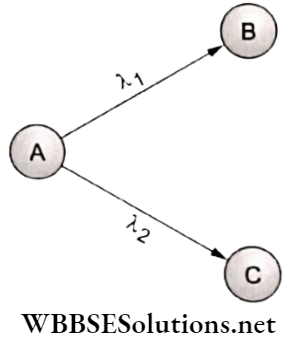
∴ net activity = \(\frac{d N_{\mathrm{A}}}{d t}=\frac{d N_{\mathrm{B}}}{d t}+\frac{d N_{\mathrm{C}}}{d t}\)

∴ \(\lambda_{\text {eff }} N_{\mathrm{A}}=\lambda_1 N_{\mathrm{A}}+\lambda_2 N_{\mathrm{A}}\)

⇒ \(\lambda_{\text {eff }}=\lambda_1+\lambda_2\)

⇒ \(\frac{1}{\lambda_{\text {eff }}}=\frac{1}{T_1}+\frac{1}{T_2}=\frac{T_1+T_2}{T_1 T_2}\)

∴ effective half-life = \(T_{\text {eff }}=\frac{T_1 T_2}{T_1+T_2}=\frac{4 \times 12}{16} \mathrm{y}=3 \mathrm{y}\)

∴ number of half-lives = n = \(n=\frac{12 y}{3 y}=4\)

∴ \(\frac{N}{N_0}=\left(\frac{1}{2}\right)^n=\left(\frac{1}{2}\right)^4=\frac{1}{16}=6.25 \%\)

Radioactivity Multiple Choice Questions And Answers Q16

Question 17. The half-life of a substance is 20 min. What is the time interval between its 33% decay and 67% decay?

  1. 40 min
  2. 25 min
  3. 20 min
  4. 30 min

Answer: 3. 20 min

Given that half-life = T1/2 = 20 min.

Assume that at a time t1, undecayed nuclei = (100- 33)%.

∴ N1 = (67%)N0.

Similarly, assume that at a time t2,

N2 = (100- 67)%. N0 = (33%)N0.

∴ \(\frac{N_1}{N_2}=\frac{N_0 \mathrm{e}^{-\lambda t_1}}{N_0 \mathrm{e}^{-\lambda t_2}} \Rightarrow \frac{67}{33}=\mathrm{e}^{\lambda\left(t_2-t_1\right)}\)

Taking \(\frac{67}{33}=2\), we have

⇒ \(2=\mathrm{e}^{\left(t_2-t_1\right) \ln 2 / T}=\mathrm{e}^{\ln 2^{\Delta t / T}}=2^{\Delta t / T}\)

∴ \(\frac{\Delta t}{T}=1\).

Hence, the required time interval is Δt = T1/2 = one half-life = 20 min

Question 18. A radioisotope X with a half-life of 1.4 x l09 y decays to Y, which is a stable isotope. A sample of a rock from a cave was found to contain X and Y in a ratio 1:7. The age of the rock is

  1. 1.96 x l09 y
  2. 3.92 x l09 y
  3. 8.40 x l09 y
  4. 4.20 x l09 y

Answer: 4. 4.20 x l09 y

Let us assume that at t = 0, the total number of active X nuclei = N0 which decay to Y nuclei such that Nx : NY =1: 7.

∴ \(N_{\mathrm{X}}=\frac{N_0}{8} \text { and } N_{\mathrm{Y}}=\frac{7 N_0}{8}\)

Now, \(N_{\mathrm{X}}=\frac{N_0}{8}=\left(\frac{1}{2}\right)^3 N_0\)

This occurs after 3 half-lives. Thus,

required time = t = \(3 T_{1 / 2}=3\left(1.4 \times 10^9 \mathrm{y}\right)=4.2 \times 10^9 \mathrm{y}\).

Alternative method

⇒ \(N_{\mathrm{X}}=\frac{N_0}{8}=N_0 \mathrm{e}^{-\lambda t}\)

⇒ \(8=2^3=\mathrm{e}^{\lambda t}\)

∴ \(\ln 2^3=\ln \mathrm{e}^{\lambda t} \Rightarrow 3 \ln 2=\lambda t\)

⇒ \(t=3\left(\frac{\ln 2}{\lambda}\right)=3 T=3\left(1.4 \times 10^9 \mathrm{y}\right)=4.2 \times 10^9 \mathrm{y}\)

Question 19. A sample of a radioactive material decays at the rate of 500 per second at a certain time. The activity falls to 200 per second after 50 min. What is the decay constant (λ) of the sample? (Given that In 2.5 = 0.916.)

  1. 6.10 x l0-4 s-1
  2. 3.05 x l0-4 s-1
  3. 5.0 x 10⁻⁴ s-1
  4. 1.0 x l0-4 s-1

Answer: 2. 3.05 x l0-4 s-1

Initial decay rate = A0 = 500 s-1.

⇒ A(t) = A0e-λt

⇒ 200 s-1 = (500 s-1 )e(5° min)

2.5 = eλ(50 min)

∴ In 2.5 = In eλ(50 min)

⇒ In 2.5 = λ(50 min).

Hence, decay constant = \(\frac{\ln 2.5}{50 \times 60 \mathrm{~s}}=\frac{0.916}{30} \times 10^{-2} \mathrm{~s}^{-1}\)

= \(3.05 \times 10^{-1} \mathrm{~s}^{-1}\).

20. In a radioactive material, the activity at a time t1 is R1, and at a later time t2, it is R2. If the decay constant of the material is λ then

  1. \(R_1=R_2 \mathrm{e}^{-\lambda\left(t_1-t_2\right)}\)
  2. \(R_1=R_2 \mathrm{e}^{\lambda\left(t_1-t_2\right)}\)
  3. \(R_1=R_2\left(\frac{t_2}{t_1}\right)\)
  4. R1 = R2

Answer: 1. \(R_1=R_2 \mathrm{e}^{-\lambda\left(t_1-t_2\right)}\)

We know that A(t) = A0e-λt.

∴ at \(t=t_1, R_1=R_0 \mathrm{e}^{-\lambda t_1} \text { and at } t=t_2, R_2=R_0 \mathrm{e}^{-\lambda t_2}\)

Hence, \(\frac{R_1}{R_2}=\mathrm{e}^{-\lambda\left(t_1-t_2\right)}\)

⇒ \(R_1=R_2 \mathrm{e}^{-\lambda\left(t_1-t_2\right)}\).

21. The half-life of a radioactive isotope X is 20 y. It decays to another element Y, which is stable. The two elements X and Y were found to be in the ratio 1: 7 in a sample of a given rock. The age of the rock is estimated to be

  1. 40 y
  2. 100 y
  3. 60 y
  4. 80 y

Answer: 3. 60 y

The solution is similar to that of Q.18.

Only the half-life is changed to T1/2 = 20 y.

Hence, the age of the rock will be 3 half-lives, i.e., T1/2 = 3(20 y) = 60 y

22. The activity of a radioactive sample is measured as N0 counts per minute at t = 0 and N0/e counts per minute at t = 5 min. The time period at which the activity reduces to half its value is

  1. \(\ln \frac{2}{5} \min\)
  2. \(\frac{5}{\ln 2} \min\)
  3. \(5 \log 2 \mathrm{~min}\)
  4. \(5 \ln 2 \mathrm{~min}\)

Answer: 4. \(5 \ln 2 \mathrm{~min}\)

At t = 0, activity = N0.

At t = 5 min,

activity = \(\frac{N_0}{\mathrm{e}}=N_0 \mathrm{e}^{-\lambda(5 \mathrm{~min})}\)

⇒ \(\lambda(5 \mathrm{~min})=1 \Rightarrow \lambda=\frac{1}{5 \mathrm{~min}}\)

When the activity reduces to half, the time taken is one half-life. Thus,

∴ \(t=T_{1 / 2}=\frac{\ln 2}{\lambda}=\frac{\ln 2}{1 / 5 \mathrm{~min}}=(5 \ln 2) \mathrm{min}\).

Question 23. A radioactive isotope is being produced at a constant rate α per second. Its decay constant is λ. If N0 is the number of nuclei at a time t = 0, the maximum possible number of nuclei is

  1. \(N_0+\frac{\alpha}{\lambda}\)
  2. \(N_0\)
  3. \(\frac{\lambda}{\alpha}+N_0\)
  4. \(\frac{\alpha}{\lambda}\)

Answer: 4. \(\frac{\alpha}{\lambda}\)

The number of nuclei present will be maximum when the decay rate is equal to the rate at which isotopes are being produced.

Now, rate of decay = \(=\left|\frac{d N}{d t}\right|=N_0 \lambda e^{-\lambda t}=\lambda N\) and rate of formation = a.

∴ λN = α

Hence, the maximum number of nuclei is N = α/λ.

Question 24. If the half-life of a radioactive sample is 69.3 h, how much of the initial number will decay between the tenth and eleventh hours?

  1. 1%
  2. 2%
  3. 3%
  4. 4%

Answer: 1. 1%

The number of active nuclei at the time t1 = 10 h is N1 = N0e-10λ, and that at the time t2 =11 h is N2 = N0e-11λ.

∴ percentage decay = \(\frac{N_1-N_2}{N_1} \times 100 \%\)

⇒ \(\frac{N_0 \mathrm{e}^{-10 \lambda}-N_0 \mathrm{e}^{-11 \lambda}}{N_0 \mathrm{e}^{-10 \lambda}} \times 100 \%=\left(1-\frac{1}{e^\lambda}\right) \times 100 \%\)

Given that half-life = \(T_{1 / 2}=69.3 \mathrm{~h}=\frac{\ln 2}{\lambda}=\frac{0.693}{\lambda}\)

∴ decay constant = λ = 0.01 h-1 .

∴ \(\% \text { decay }=\left(1-\frac{1}{\mathrm{e}^{0.01}}\right) \times 100 \%=(1-0.99) \times 100 \%=1 \%\)

Question 25. Two radioactive materials A and B have their decay constants 10λ and λ respectively. If initially they have the same number of nuclei, the ratio of the number of nuclei of A and B will be 1/e after a time period of

  1. \(\frac{1}{9 \lambda}\)
  2. \(\frac{1}{11 \lambda}\)
  3. \(\frac{1}{10 \lambda}\)
  4. \(\frac{11}{10 \lambda}\)

Answer: 1. \(\frac{1}{9 \lambda}\)

For the element A, \(N_{\mathrm{A}}=N_0 \mathrm{e}^{-10 \lambda t}\)

For the element B, \(N_{\mathrm{B}}=N_0 \mathrm{e}^{-\lambda t}\)

∴ \(\frac{N_{\mathrm{A}}}{N_{\mathrm{B}}}=\frac{1}{\mathrm{e}}=\frac{\mathrm{e}^{-10 \lambda t}}{\mathrm{e}^{-\lambda t}}=\frac{1}{\mathrm{e}^{9 \lambda t}}\)

∴ \(9 \lambda t=1 \Rightarrow t=\frac{1}{9 \lambda}\)

“types of radioactive decay “

Question 26. A sample of a radioactive material A that has an activity of 10 mCi (given that 1 Ci = 3.7 x 10¹⁰ decays per second) has twice the number of nuclei as another sample of a different radioactive material B, which has an activity of 20 mCi. The correct choices for the half-lives of A and B would then be respectively

  1. 20 d and 10 d
  2. 5 d and 10 d
  3. 10 d and 40 d
  4. 20 d and 5 d

Answer: 4. 20 d and 5 d

The activity (A) of a radioactive sample is the rate of disintegration. So,

⇒ \(A=\left|\frac{d N}{d t}\right|=\lambda N=\left(\frac{\ln 2}{T}\right) N\),

where T is the half-life of the material.

∴ \(\frac{A_{\mathrm{A}}}{A_{\mathrm{B}}}=\frac{N_{\mathrm{A}}}{N_{\mathrm{B}}} \cdot \frac{T_{\mathrm{B}}}{T_{\mathrm{A}}} \Rightarrow \frac{10 \mathrm{mCi}}{20 \mathrm{mCi}}=\frac{2 N_{\mathrm{B}}}{N_{\mathrm{B}}} \cdot \frac{T_{\mathrm{B}}}{T_{\mathrm{A}}}\)

∴ \(\frac{T_{\mathrm{A}}}{T_{\mathrm{B}}}=\frac{4}{1}\)

This is true for the option (4).

Question 27. Using a nuclear counter, the count rate of particles emitted from a radioactive source is measured. At t = 0, it was 1600 per second, and at t = 8 s, it was 100 per second. The count rate observed at t = 6 s is close to

  1. 400 s-1
  2. 200 s-1
  3. 150 s-1
  4. 300 s-1

Answer: 2. 200 s-1

The count rate is the same as the activity, i.e., A = \(A=\left|\frac{d N}{d t}\right|\)

But \(N=N_0 \mathrm{e}^{-\lambda t}\)

So, \(A=\left|\frac{d N}{d t}\right|=\lambda N_0 \mathrm{e}^{-\lambda t}\)

A(t) = A(0)e-λt.

Given that A(0) = 1600 s-1 and A(8) = 100s-1.

⇒ \(\frac{A(0)}{A(8)}=\frac{1600}{100}=\mathrm{e}^{\lambda .8} \Rightarrow 2^4=\left(\mathrm{e}^{2 \lambda}\right)^4\)

⇒ \(\mathrm{e}^{2 \lambda}=2 \Rightarrow \lambda=\frac{1}{2} \ln 2=\ln \sqrt{2}\)

At t = 6 s,

∴ \(A(t)=A(6 \mathrm{~s})=N_0 \mathrm{e}^{-6 \lambda}=\left(1600 \mathrm{~s}^{-1}\right) \mathrm{e}^{-6 \ln \sqrt{2}}=\frac{1600 \mathrm{~s}^{-1}}{8}=200 \mathrm{~s}^{-1}\).

Question 28. Two radioactive samples A and B have their decay constants 5λ and λ respectively. At a time t = 0, the samples have equal numbers of active nuclei. The time taken for the ratio of the numbers of nuclei to become 1/e2 will be

  1. \(\frac{2}{\lambda}\)
  2. \(\frac{1}{\lambda}\)
  3. \(\frac{1}{4 \lambda}\)
  4. \(\frac{1}{2 \lambda}\)

Answer: 4. \(\frac{1}{2 \lambda}\)

⇒ \(\frac{N_{\mathrm{A}}}{N_{\mathrm{B}}}=\frac{N_0 \mathrm{e}^{-5 i t}}{N_0 \mathrm{e}^{-\lambda, t}}=\mathrm{e}^{-4 i t}\) → (1)

Bur \(\frac{N_{\mathrm{A}}}{N_{\mathrm{B}}}=\frac{1}{\mathrm{e}^2}=\mathrm{e}^{-2}\) → (2)

From (1) and (2)

∴ \(4 \lambda t=2 \Rightarrow t=\frac{1}{2 \lambda}\)

Question 29. The half-lives of two radioactive samples A and B are 10 min and 20 min respectively. If initially a sample has equal numbers of the nuclei of A and B then after 60 min the ratio of the decayed numbers of the nuclei A and B will be

  1. 1: 8
  2. 9: 8
  3. 8: 1
  4. 3: 8

Answer: 2. 9: 8

The number of active nuclei at a time t is N = \(N_0 \mathrm{e}^{-\lambda t}\)

⇒ \(\Delta N=N_0-N=N_0\left(1-\mathrm{e}^{-\lambda t}\right)\)

∴ \(\frac{\Delta N_{\mathrm{A}}}{\Delta N_{\mathrm{B}}}=\frac{1-\mathrm{e}^{-\lambda_{\mathrm{A}} t}}{1-\mathrm{e}^{-\lambda_{\mathrm{B}} t}}=\frac{1-\mathrm{e}^{-\left[(\ln 2) / T_{\mathrm{A}}\right] t}}{1-\mathrm{e}^{-\left[(\ln 2) / T_{\mathrm{B}}\right] t}}\)

⇒ \(\frac{1-\mathrm{e}^{-[(\ln 2) / 10] \times 60}}{1-\mathrm{e}^{-[(\ln 2) / 20] \times 60}}=\frac{1-\frac{1}{2^6}}{1-\frac{1}{2^3}}=\frac{63}{64} \times \frac{8}{7}=\frac{9}{8}\)

∴ \(\Delta N_{\mathrm{A}}: \Delta N_{\mathrm{B}}=9: 8\).

Question 30. At a time t = 0, the activity of two radioactive elements A and B are equal. After a time t = T, the ratio of their activities decreases according to e-3t. If the half-life of A is In 2, the half-life of B will be

  1. 4 In 2
  2. \(\frac{1}{4} \ln 2\)
  3. \(\frac{1}{2} \ln 2\)
  4. 2 In 2

Answer: 2. \(\frac{1}{4} \ln 2\)

For the given samples of A and B,

⇒ \(A_{\mathrm{A}}=A_0 \mathrm{e}^{-\lambda_{\mathrm{A}} t} \text { and } A_{\mathrm{B}}=A_0 \mathrm{e}^{-\lambda_{\mathrm{B}} t}\)

∴ \(\frac{A_{\mathrm{B}}}{A_{\mathrm{A}}}=\mathrm{e}^{\left(\lambda_{\mathrm{A}}-\lambda_{\mathrm{B}}\right) t}\)

Given that \(\frac{A_{\mathrm{B}}}{A_{\mathrm{A}}}=\mathrm{e}^{-3 t}\)

Hence, \(\left(\lambda_{\mathrm{A}}-\lambda_{\mathrm{B}}\right) t=-3 t\)

But \(\lambda_{\mathrm{A}}=\frac{\ln 2}{T_{\mathrm{A}}}=\frac{\ln 2}{\ln 2}=1\)

So, \(\lambda_{\mathrm{B}}=4\)

∴ \(T_{\mathrm{B}}=\frac{\ln 2}{\lambda_{\mathrm{B}}}=\frac{1}{4} \ln 2\).

Question 31. The (9/16)th part of a radioactive sample remains active after a time t. What fraction of the same remains undecayed after a time t/2?

  1. \(\frac{9}{16}\)
  2. \(\frac{5}{8}\)
  3. \(\frac{3}{4}\)
  4. \(\frac{4}{7}\)

Answer: 3. \(\frac{3}{4}\)

In the first case,

⇒ \(\frac{9}{16} N_0=N_0 \mathrm{e}^{-\lambda t} \Rightarrow \frac{9}{16}=\mathrm{e}^{-\lambda t}\)

In the second case,

⇒ \(x N_0=N_0 \mathrm{e}^{-\lambda t / 2} \Rightarrow x^2=\mathrm{e}^{-\lambda t}\)

∴ \(x^2=\frac{9}{16} \text { and } x=\frac{3}{4}\)

Question 32. A radioactive nucleus A decays into B (having a half-life of 10 s) and into C (having a half-life of 100 s). The equivalent half-life for both emissions is

  1. 6 s
  2. 9 s
  3. 2 s
  4. 3 s

Answer: 2. 9 s

The rate of disintegration is given by

⇒ \(-\frac{d N}{d t}=\lambda_1 N+\lambda_2 N=\left(\lambda_1+\lambda_2\right) N\)

∴ \(\lambda_{\text {eq }} N=\left(\lambda_1+\lambda_2\right) N\)

⇒ \(\lambda_{\text {eq }}=\lambda_1+\lambda_2 \Rightarrow \frac{\ln 2}{T}=\frac{\ln 2}{T_1}+\frac{\ln 2}{T_2}\)

∴ \(T=\frac{T_1 T_2}{T_1+T_2}=\frac{(10 \mathrm{~s})(100 \mathrm{~s})}{110 \mathrm{~s}}=\frac{100}{11} \mathrm{~s} \approx 9 \mathrm{~s}\).

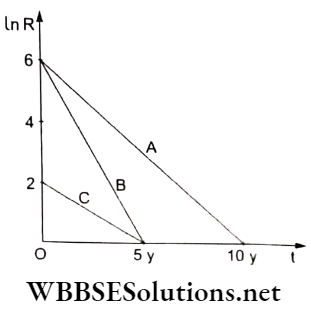
33. The activities of three radioactive samples A, B, and C are represented by the lines A, B, and C in the figure. Their half-lives \(T_{1 / 2}(\mathrm{~A}), T_{1 / 2}(\mathrm{~B}), T_{1 / 2}(\mathrm{C}) \) are in the ratio

Radioactivity Multiple Choice Questions And Answers Three Radioactive Samples Q33

  1. 2: 1 : 3
  2. 4 : 3: 1
  3. 3 : 2: 1
  4. 2: 1: 1

Answer: 1. 2: 1 : 3

Activity = \(|R|=R_0 \mathrm{e}^{-\lambda t}\)

∴ \(\ln R=\ln R_0-\lambda t=\ln R_0-\left(\frac{\ln 2}{T}\right) t\)

The slope of the given graph is -X.

∴ \(\lambda_{\mathrm{A}}=\frac{6}{10}, \lambda_{\mathrm{B}}=\frac{6}{5} \text { and } \lambda_{\mathrm{C}}=\frac{2}{5}\)

∴ \(T_{\mathrm{A}}: T_{\mathrm{B}}: T_{\mathrm{C}}=\frac{10}{6}: \frac{5}{6}: \frac{5}{2}=2: 1: 3\)

Semiconductor Devices And Communication Systems Notes

Semiconductor Devices And Communication Systems Synopsis

Conductivity (σ) of a conductor: This is given by

∴ \(\sigma=\frac{\text { current density }(j)}{\text { electric field }(E)}=\frac{n e v}{E}=n e \mu\)

where μ = mobility of electrons and v = drift speed of electrons.

The conductivity of a semiconductor: This is given by

∴ [laytex]\sigma=n_{\mathrm{e}} e \mu_{\mathrm{e}}+n_{\mathrm{h}} e \mu_{\mathrm{h}}[/latex]

where the subscripts e and h respectively represent electrons and holes.

Resistance of a p-n junction:

  1. Static (or DC) resistance = \(R=\frac{V}{I}\), where V = operating voltage.
  2. Dynamic (or AC) resistance = \(r=\frac{\Delta V}{\Delta I}\)

This is the reciprocal of the slope of the I-V characteristic.

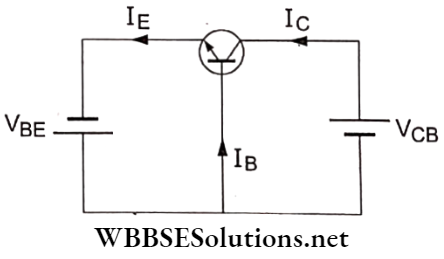
The emitter, collector, and base currents in a transistor are related by the equation Ie = Ic + Ib.

notes of semiconductor class 12

α- and β-parameters of a transistor: These two parameters are given by

∴ \(\alpha=\frac{I_{\mathrm{c}}}{I_{\mathrm{e}}} \text { and } \beta=\frac{I_{\mathrm{c}}}{I_{\mathrm{b}}}=\frac{\alpha}{1-\alpha}\)

Voltage gain = \(\frac{V_{\text {out }}}{V_{\text {in }}}=\frac{I_{\mathrm{c}} R_{\mathrm{L}}}{I_{\mathrm{b}} R_{\mathrm{BE}}}=\beta\left(\frac{R_{\mathrm{L}}}{\dot{R}_{\mathrm{BE}}}\right)\)

Power gain = (voltage gain)(current gain)

⇒ \(\beta\left(\frac{R_{\mathrm{L}}}{R_{\mathrm{BE}}}\right)\left(\frac{I_{\mathrm{c}}}{I_{\mathrm{b}}}\right)=\beta^2\left(\frac{R_{\mathrm{L}}}{R_{\mathrm{BE}}}\right)\)

A logic gate is an electric device that performs a logical operation on one or more binary inputs and produces a single binary output.

Semiconductor Devices And Communication Systems Notes

Symbols and Boolean expressions for basic logic gates and their truth tables:

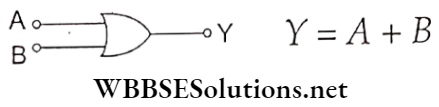
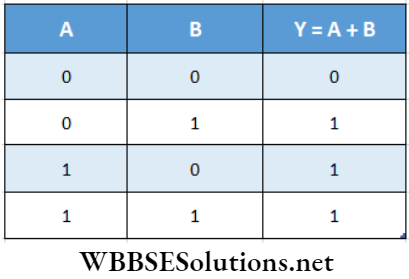
(1) OR gate:

Semiconductor Devices And Communication Systems Synopsis OR Gate

Semiconductor Devices And Communication Systems Synopsis OR Gate

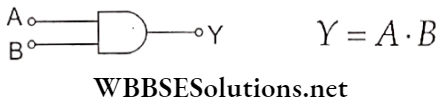
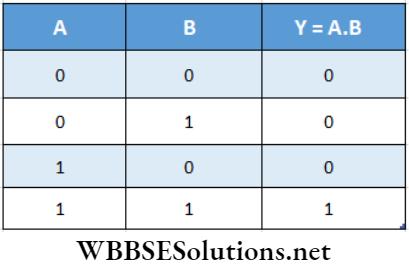
(2) AND gate:

Semiconductor Devices And Communication Systems Synopsis AND Gate

“semiconductor pdf “

Semiconductor Devices And Communication Systems Synopsis AND Gate

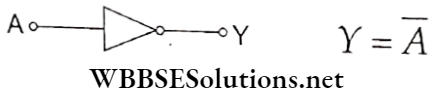
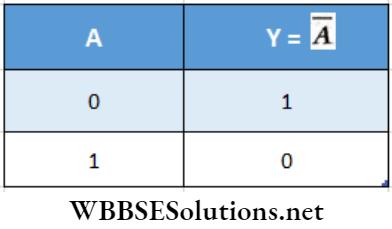
(3) NOT gate:

Semiconductor Devices And Communication Systems Synopsis NOT Gate

Semiconductor Devices And Communication Systems Synopsis NOT Gate

semiconductors physics class 12

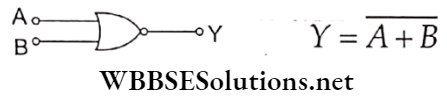
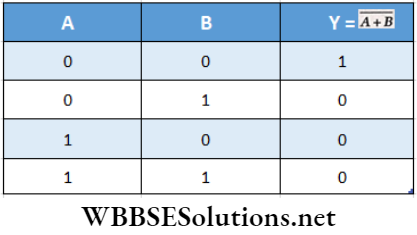
(4) NOR gate:

Semiconductor Devices And Communication Systems Synopsis NOR Gate

Semiconductor Devices And Communication Systems Synopsis NOR Gate

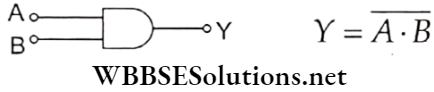
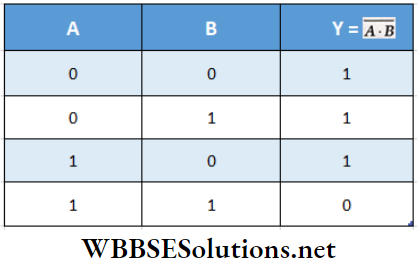
(5) NAND gate:

Semiconductor Devices And Communication Systems Synopsis NAND Gate

Semiconductor Devices And Communication Systems Synopsis NAND Gate

Range: The maximum distance from the transmitter (which sends the signals) to the receiving station (where the signals are received) with sufficient strength is called the range. It is given by

⇒ \(d=\sqrt{2 R_{\mathrm{E}} h}\)

where RE = the earth’s radius and h = height of the antenna.

Class 11 Physics Class 12 Maths Class 11 Chemistry
NEET Foundation Class 12 Physics NEET Physics

Maximum line-of-sight (LoS) distance:

⇒ \(d=\sqrt{2 R h_1}+\sqrt{2 R h_2}\)

where h1 and h2 are the heights of the transmitting and receiving antennas.

Modulated and carrier waves:

(1) Carrier wave: ec = Ec cos ωct.

(2) Modulating signal: em = Em cos ωmt.

(3) Amplitude of the modulated wave = Ec + Em cos ωmt.

“semiconductor devices class 12th “

(4) Modulated wave:

e = (Ec + Em cos ωmt) cos ωct

⇒ \(E_{\mathrm{c}}\left(1+\frac{E_{\mathrm{m}}}{E_{\mathrm{c}}} \cos \omega_{\mathrm{m}} t\right) \cos \omega_{\mathrm{c}} t\)

⇒ Ec (1 + m cos ωmt) cos ωct,

“semiconductor device class 12 “

where \(m=\frac{E_m}{E_c}\) is the modulation index

∴ \(E_{\mathrm{c}} \cos \omega_{\mathrm{c}} t+\frac{m E_{\mathrm{c}}}{2} \cos \left(\omega_{\mathrm{c}}-\omega_{\mathrm{m}}\right) t+\frac{m E_{\mathrm{c}}}{2} \cos \left(\omega_{\mathrm{c}}+\omega_{\mathrm{m}}\right) t\)

Transistor Multiple Choice Questions And Answers

Transistor

Question 1. For a CE transistor amplifier, the audio-signal voltage across the collector resistor of 2 kΩ resistance is 4 V. The current-amplification factor of the transistor is 100 and the base resistance is1 kΩ then the input-signal voltage is

  1. 10 mV
  2. 20 mV
  3. 30 mV
  4. 15 mV

Answer: 2. 20 mV

The voltage gain (or voltage amplification) is given by

⇒ \(A_v=\frac{\text { output voltage }\left(V_{\mathrm{o}}\right)}{\text { input voltage }\left(V_{\mathrm{i}}\right)}\)

⇒ \(A_v=\frac{I_C R_C}{I_B R_B}\) → (1)

Given that collector resistance = Rc = 2 kΩ,

current amplification factor = \(\beta=\frac{I_{\mathrm{C}}}{I_{\mathrm{B}}}=100\),

base resistance = RB = 1 kΩ

and output voltage = Vo = 4V.

From (1),

⇒ \(A_v=\beta\left(\frac{R_{\mathrm{C}}}{R_{\mathrm{B}}}\right)=100 \times \frac{2 \mathrm{k} \Omega}{1 \mathrm{k} \Omega}=200\)

∵ \(A_v=\frac{V_{\mathrm{o}}}{V_{\mathrm{i}}}=200\)

∴ input voltage = \(V_{\mathrm{i}}=\frac{V_{\mathrm{o}}}{200}=\frac{4 \mathrm{~V}}{200}=20 \mathrm{mV}\).

Transistor Multiple Choice Question And Answer

Question 2. In a CE transistor amplifier, the audio-signal voltage across the collector is 3 V. The resistance of the collector is 3 kΩ. If the current gain is 100 and the base resistance is 2 kΩ, the voltage and power gains of the amplifier are respectively

  1. 200 and 1000
  2. 15 and 200
  3. 150 and 15000
  4. 20 and 2000

Answer: 3. 150 and 15000

Given that voltage across the collector = output voltage = Vo = 3 V,

collector resistance = output load = Ro = 3 kΩ,

is transistor in neet syllabus 2023

current gain = β =Io/Ii =100 .

and input resistance = base resistance = Ri = 2 kΩ.

∴ voltage gain = \(\frac{V_{\mathrm{o}}}{V_{\mathrm{i}}}=\frac{I_{\mathrm{o}} R_{\mathrm{o}}}{I_{\mathrm{i}} R_{\mathrm{i}}}=\beta\left(\frac{3 \mathrm{k} \Omega}{2 \mathrm{k} \Omega}\right)=100 \times 1.5=150\)

Now, power gain = (current gain)(voltage gain)

∴ \(\beta\left(\frac{V_{\mathrm{o}}}{V_{\mathrm{i}}}\right)=100 \times 150=1500\)

Read And Learn Also NEET Physics Multiple Choice Question and Answers

Question 3. A transistor is operated in the common-emitter configuration at Vc = 2 V such that a change in the base current from 100 μA to 200 μA produces a change in the collector current from 5 mA to 10 mA. The current gain is

  1. 150
  2. 75
  3. 50
  4. 100

Answer: 3. 50

The change in the base current is ΔIB = 200 μA-100 μA =100 μA.

The corresponding change in the collector current is

ΔIC=10 mA- 5 mA = 5 mA.

By definition,

∴ current gain = \(\beta=\frac{\Delta I_{\mathrm{C}}}{\Delta I_{\mathrm{B}}}=\frac{5 \mathrm{~mA}}{100 \mu \mathrm{A}}=\frac{5 \times 10^{-3}}{100 \times 10^{-6}}=\frac{5000}{100}=50\)

Question 4. A transistor is operated in the CE configuration at a constant collector voltage of Vc =15 V such that a change in the base current from 100 μA to 150 μA produces a change in the collector current from 5 mA to 10 mA. The current gain β is

  1. 75
  2. 50
  3. 100
  4. 67

Answer: 3. 100

Given that ΔIB =150 μA – 100 μA = 50 μA.

The corresponding collector current is ΔIC = 10 mA – 5 mA = 5 mA

∴ current gain = \(\beta=\frac{\Delta I_C}{\Delta I_B}=\frac{5 m A}{50 \mu \mathrm{A}}=100\)

Question 5. An n-p-n transistor is connected in the common-emitter (CE) configuration in a given amplifier. A load resistor of resistance 800 Ω, is connected in the collector circuit, and the voltage drop across it is 0.8 V. If the current-amplification factor is 0.96 and the input resistance of the circuit is 192 Ω, the voltage gain and the power gain of the amplifier will respectively be

  1. 3.69 and 3.84
  2. 4 and 3.84
  3. 4 and 4
  4. 4 and 3.69

Answer: 2. 4 and 3.84

Given that load resistance = Ro = 800 Ω,

voltage drop across the load = Vo = 0.8 V,

current amplification factor = \(\beta=\frac{I_C}{I_B}=0.96\)

and input resistance = RB = 192 Ω.

∴ voltage gain = \(\frac{V_0}{V_{\mathrm{i}}}=\frac{I_{\mathrm{C}} R_{\mathrm{C}}}{I_{\mathrm{B}} R_{\mathrm{B}}}=\left(\frac{800 \Omega}{192 \Omega}\right)(0.96)=4\)

Hence, power gain = (current gain)(voltage gain)

∴ \(\left(\frac{I_{\mathrm{C}}}{I_{\mathrm{B}}}\right)\left(\frac{V_{\mathrm{o}}}{V_{\mathrm{i}}}\right)=\beta\left(\frac{V_{\mathrm{o}}}{V_{\mathrm{I}}}\right)=0.96 \times 4=3.84\)

Question 6. For a transistor with Ic/IE = 0.96, the current gain in the common emitter configuration is

  1. 12
  2. 48
  3. 24
  4. 6

Answer: 3. 24

In a transistor,

⇒ \(I_{\mathrm{E}}=I_{\mathrm{C}}+I_{\mathrm{B}}\)

⇒ \(\frac{I_{\mathrm{E}}}{I_{\mathrm{C}}}=1+\frac{I_{\mathrm{B}}}{I_{\mathrm{C}}}\)

⇒ \(\frac{1}{0.96}=1+\frac{I_{\mathrm{B}}}{I_{\mathrm{C}}} \Rightarrow \frac{I_{\mathrm{B}}}{I_{\mathrm{C}}}=\frac{4}{96}=\frac{1}{24}\)

∴ current gain = \(\frac{I_{\mathrm{C}}}{I_{\mathrm{B}}}=24\)

Question 7. The correct relationship of the two current gains a and p in a transistor is

  1. \(\beta=\frac{1+\alpha}{\beta}\)
  2. \(\alpha=\frac{\beta}{1+\beta}\)
  3. \(\alpha=\frac{\beta}{1-\beta}\)
  4. \(\beta=\frac{\alpha}{1+\alpha}\)

Answer: 2. \(\alpha=\frac{\beta}{1+\beta}\)

In a transistor,

⇒ \(\alpha=\frac{I_{\mathrm{C}}}{I_{\mathrm{E}}} \text { and } \beta=\frac{I_{\mathrm{C}}}{I_{\mathrm{B}}}\)

Now, emitter current = collector current + base current

⇒ \(I_{\mathrm{E}}=I_{\mathrm{C}}+I_{\mathrm{B}}\)

⇒ \(\frac{I_{\mathrm{E}}}{I_{\mathrm{C}}}=1+\frac{I_{\mathrm{B}}}{I_{\mathrm{C}}} \Rightarrow \frac{1}{\alpha}=1+\frac{1}{\beta}=\frac{\beta+1}{\beta}\)

∴ \(\alpha=\frac{\beta}{1+\beta}\).

Question 8. In the common-base configuration of a transistor, ΔIc/ΔIE = 0.98. Then, the current gain in the common-emitter configuration of the transistor will be

  1. 98
  2. 24.5
  3. 4.9
  4. 49

Answer: 4. 49

In the common-base configuration, the current gain is given by

⇒ \(\alpha=\frac{\Delta I_{\mathrm{C}}}{\Delta I_{\mathrm{E}}}=0.98\)

In the common-emitter configuration, the current gain is given by

is transistor in neet syllabus 2023

⇒ \(\beta=\frac{\Delta I_{\mathrm{C}}}{\Delta I_{\mathrm{B}}}=\frac{\Delta I_{\mathrm{C}}}{\Delta I_{\mathrm{E}}-\Delta I_{\mathrm{C}}}\)    [∵IE = IC + IB]

∴ \(\frac{1}{\frac{\Delta I_{\mathrm{E}}}{\Delta I_{\mathrm{C}}}-1}=\frac{1}{\frac{1}{\alpha}-1}=\frac{\alpha}{1-\alpha}=\frac{0.98}{1-0.98}=\frac{0.98}{0.02}=49\)

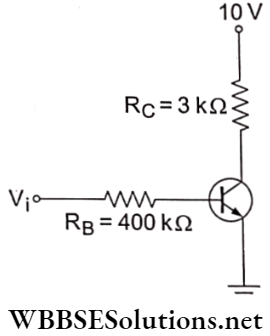
Question 9. In the circuit shown in the adjoining figure, when the input voltage of the base resistance is 10 V, VBE is zero, and VCE is also zero. The value of β is

Transistor Multiple Choice Questions And Answers Circuit Q9

  1. 196
  2. 154
  3. 105
  4. 133

Answer: 4. 133

Given that input voltage = Vi =10 V and base resistance = RB = 400 kΩ = 400 x l03 Ω; the load resistance in the collector circuit is Rc = 3 kΩ = 3 x 10³ Ω. Also, VBE = 0 V, VCE = 0 V, and VCC =10 V.

∴ Vi – VBE = RBIB ⇒ 10 V – 0 V = (400 x 103 Ω.)IB.

∴ base current = \(I_{\mathrm{B}}=\frac{10 \mathrm{~V}}{4 \times 10^5 \Omega}=25 \mu \mathrm{A}\)

Again, in the output circuit,

⇒ \(V_{\mathrm{CC}}-V_{\mathrm{CE}}=I_{\mathrm{C}} R_{\mathrm{C}}\)

⇒ \(I_{\mathrm{C}}=\frac{V_{\mathrm{CC}}-V_{\mathrm{CE}}}{R_{\mathrm{C}}}=\frac{10 \mathrm{~V}-0 \mathrm{~V}}{3 \times 10^3 \Omega}=\frac{10 \mathrm{~V}}{3 \times 10^3 \Omega}=3.33 \mathrm{~mA}\)

∴ \(\beta=\frac{I_{\mathrm{C}}}{I_{\mathrm{B}}}=\frac{3.33 \mathrm{~mA}}{25 \mu \mathrm{A}}=\frac{3.33}{25} \times 10^3=133\)

Question 10. An amplifier has a voltage gain of Av = 1000. The voltage gain in dB is

  1. 20 dB
  2. 60 dB
  3. 3 dB
  4. 30 dB

Answer: 2. 60 dB

Voltage gain = (20 log Av) dB = (20 log 1000) dB

= (20 log 103) dB = 60 dB.

Question 11. Which of the following statements about a transistor is not true?

  1. The emitter is heavily doped.
  2. The base is thin.
  3. The base is lightly doped.
  4. The collector region is smaller compared to the emitter region in size.

Answer: 4. The collector region is smaller compared to the emitter region in size.

In a transistor, the middle layer called the base, is very thin (width ≈1 μm) and very lightly doped. The emitter is heavily doped and the collector is moderately doped. As regards the contact area, the collector has a comparatively larger area than the base and the emitter.

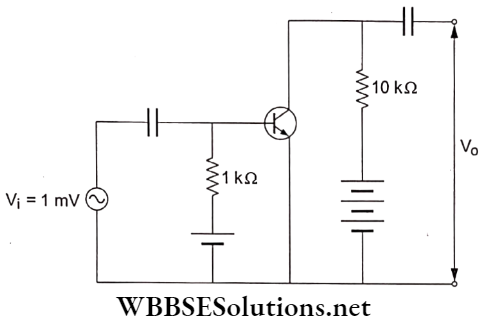
Question 12. In the given figure, an n-p-n transistor in the common-emitter configuration has a current gain of β = 100. The output voltage (Vo) of the amplifier will be

Transistor Multiple Choice Questions And Answers n-p-n Transistor Q12

  1. 10 V
  2. 10 mV
  3. 1.0 V
  4. 0.1 V

Answer: 3. 1.0 V

Given that current gain = \(\beta=\frac{I_{\mathrm{C}}}{I_{\mathrm{B}}}=100\)

input resistance = RB = 1 kΩ,

and output load resistance = RC =10 kΩ.

Now, base current = \(\frac{\text { input voltage }}{\text { input resistance }}\)

⇒ \(I_B=\frac{1.0 \mathrm{mV}}{1 \mathrm{k} \Omega}=\frac{1.0 \times 10^{-3} \mathrm{~V}}{1 \times 10^3 \Omega}=1.0 \times 10^{-6} \mathrm{~A}\)

∴ collector current = IC = βIB = 100 x 10-6 A = 10-4 A.

Hence, output voltage = Vc = ICRC = (10-4 A)(10 kΩ)

= (10-4 A)(104 Ω) = 1.0 V.

Class 11 Physics Class 12 Maths Class 11 Chemistry
NEET Foundation Class 12 Physics NEET Physics

Question 13. A transistor connected in the common-emitter mode contains a load resistance of 5 kΩ and an input resistance of 1 kΩ. If the input peak voltage is 5 mV and the current gain is 50, find the voltage gain.

  1. 500
  2. 50
  3. 250
  4. 125

Answer: 3. 250

Given that load resistance = RC = 5 kΩ,

input resistance = Ri = 1 kΩ, input voltage = Vi = 5 mV,

and current gain = β = 50.

∴ voltage gain = \(A_v=\frac{\text { output voltage across } \mathrm{R}_{\mathrm{C}}}{\text { input voltage }}\)

∴ \(\frac{R_{\mathrm{C}} I_{\mathrm{C}}}{R_{\mathrm{i}} I_{\mathrm{B}}}=\beta\left(\frac{R_{\mathrm{C}}}{R_{\mathrm{i}}}\right)=50\left(\frac{5 \mathrm{k} \Omega}{1 \mathrm{k} \Omega}\right)=250\).

Question 14. The current gain for a transistor working as a common-base amplifier is 0.96. If the emitter current is 7.2 ma, the base current is

  1. 0.39 mA
  2. 0.43 mA
  3. 0.29 mA
  4. 0.35 mA

Answer: 3. 0.29 mA

In the common-base configuration,

current gain = \(\alpha=\frac{I_{\mathrm{C}}}{I_{\mathrm{E}}}=0.96\)

Given that IE = 7.2 mA. Hence, collector current = IC = 0.96 x 7.2 mA.

∴ base current = IB = IE– IC

is transistor in neet syllabus 2023

= 7.2 mA -0.96(7.2 mA)

= (7.2 mA)(l-0.96) = (7.2 mA)(0.04)

= 0.288 mA ~ 0.29 mA.

Question 15. For a common-emitter transistor, the input current is 5 pA, the voltage gain is β = 100, and the circuit is operated at a load resistance of 10 kΩ. The voltage between the collector and the emitter will be

  1. 12.5 V
  2. 5 V
  3. 7.5 V
  4. 10 V

Answer: 2. 5 V

Given that input current = IB = 5 μA, current gain = β =100, and load resistance = RC = 10 kΩ.

∵ \(\beta=\frac{I_{\mathrm{C}}}{I_{\mathrm{B}}}=100\),

∴collector current = IC = 100IB = 100(5 μA) = 500 μA.

∴ output voltage = ICRC = (500 μA)(10 kΩ)

= 500 x 10-6 x 10 x 103 V = 5 V.

Question 16. Consider an n-p-n transistor amplifier in the common-emitter mode. The current gain of the transistor is 100. If the collector current changes by 1 mA, what will be the change in the emitter current?

  1. 1.1mA
  2. 1.01mA
  3. 10 mA
  4. 0.01mA

Answer: 2. 1.01mA

For an n-p-n transistor in the CE mode,

current gain = \(\beta=\frac{\Delta I_{\mathrm{C}}}{\Delta I_{\mathrm{B}}} \Rightarrow 100=\frac{1 \mathrm{~mA}}{\Delta I_{\mathrm{B}}}\)

∴ the change in the base current will be

⇒ \(\Delta I_{\mathrm{B}}=\frac{1 \mathrm{~mA}}{100}=0.01 \mathrm{~mA}\)

Hence, the change in the emitter current will be

∴ ΔIE = ΔIC + ΔIB = 1 mA + 0.01 mA = 1.01 mA.

Question 17. If the collector current is 120 mA, the base current is 2 mA, and the resistance gain is 3, what is the power gain?

  1. 180
  2. 10800
  3. 1.8
  4. 18

Answer: 2. 10800

Current gain = \(\beta=\frac{I_{\mathrm{C}}}{I_{\mathrm{B}}}=\frac{120 \mathrm{~mA}}{2 \mathrm{~mA}}=60\)

∴ power gain = β2 x resistance gain = 602 x 3 = 10800.

Question 18. In a common-base amplifier, the phase difference between the input-signal voltage and the output voltage is

  1. zero
  2. \(\frac{\pi}{2}\)
  3. \(\frac{\pi}{4}\)
  4. π

Answer: 1. zero

In a transistor amplifier in the CB configuration, the input and output voltages are in the same phase. So, the phase difference is zero.

Question 19. To use a transistor as an amplifier,

  1. The emitter-base junction is forward-biased and the base-collector junction is reverse-biased
  2. No bias voltages are required
  3. Both junctions are forward-biased
  4. Both junctions are reverse-biased

Answer: 1. The emitter-base junction is forward-biased and the base-collector junction is reverse-biased

The adjoining figure shows an n-p-n transistor in the CB configuration as an amplifier. This is used when a low input impedance is required. Due to the forward bias in the input, the base-emitter junction acts as a forward-biased p-n junction diode and has a low input impedance. The output across the base-collector junction acts as a reversed-biased junction diode. Hence, a common base amplifier has a high output impedance. An amplifier with a low input impedance and a high output impedance provides a high voltage gain.

Transistor Multiple Choice Questions And Answers Q19

Question 20. When an n-p-n transistor is used as an amplifier,

  1. Holes move from the emitter to the base
  2. Holes move from the base to the emitter
  3. Electrons move from the collector to the base
  4. Electrons move from the base to the collector

Answer: 4. Electrons move from the base to the collector

As shown in the diagram of the preceding question, collector current(Ic) has been shown to flow from the collector to the base. Hence, electrons move from the base to the collector.

Question 21. The voltage gain (Av) of the given amplifier is

Transistor Multiple Choice Questions And Answers Amplifier Q21

  1. 1000
  2. 100
  3. 10
  4. 9.9

Answer: 2. 100

The voltage gain in an operational amplifier is given by

⇒ \(A_v=\frac{V_{\mathrm{o}}}{V_{\mathrm{i}}}=\frac{R_{\mathrm{f}}}{R_{\mathrm{i}}}\)

∴ \(A_v=\frac{100 \mathrm{k} \Omega}{1 \mathrm{k} \Omega}=100\).

Question 22. The transfer ratio p of a transistor is 50. The input resistance of the transistor when used in the common-emitter configuration is 1 kΩ. The peak value of the collector AC current for an AC input voltage of 0.01 V peak is

  1. 100 μA
  2. 0.01 mA
  3. 0.25 mA
  4. 500 μA

Answer: 4. 500 μA

Given that input resistance = \(R_{\mathrm{B}}=1 \mathrm{k} \Omega\)

and base current = \(I_{\mathrm{B}}=\frac{V_{\mathrm{B}}}{R_{\mathrm{B}}}=\frac{0.01 \mathrm{~V}}{1000 \Omega}=10^{-5} \mathrm{~A}\)

Now, \(\beta=\frac{I_{\mathrm{C}}}{I_{\mathrm{B}}} \Rightarrow 50=\frac{I_{\mathrm{C}}}{10^{-5} \mathrm{~A}}\)

∴ collector current = Ic = 50 x 10-5 A = 500 x 10-6 A = 500 μA.

Question 23. An oscillator is nothing but an amplifier with

  1. A positive feedback
  2. A negative feedback
  3. A large gain
  4. No feedback

Answer: 1. A positive feedback

In an oscillator, part of the output signal is fed back to the amplifier input in such a way that the feedback signal is regenerated, reamplified, and fed back again to maintain a constant output signal. Hence, an oscillator is an amplifier with a positive feedback

Question 24. The input signal given to a CE amplifier Physics having a voltage gain of 150 is

\(V_{\mathrm{i}}=(2 \mathrm{~V}) \cos \left(15 t+\frac{\pi}{3}\right)\)

The corresponding output signal will be

  1. \((300 \mathrm{~V}) \cos \left(15 t+\frac{\pi}{3}\right)\)
  2. \((75 \mathrm{~V}) \cos \left(15 t+\frac{2 \pi}{3}\right)\)
  3. \((2 \mathrm{~V}) \cos \left(15 t+\frac{5 \pi}{3}\right)\)
  4. \((300 \mathrm{~V}) \sin \left(15 t+\frac{4 \pi}{3}\right)\)

Answer: 4. \((300 \mathrm{~V}) \sin \left(15 t+\frac{4 \pi}{3}\right)\)

Voltage gain = \(\frac{V_o}{V_i}=150\)

∴ Vo = 150Vi = 150 x 2 V = 300 V.

The phase difference between the input and the output is n. Hence, the output signal voltage is

∴ \(V_{\mathrm{o}}=(300 \mathrm{~V}) \sin \left(15 t+\frac{\pi}{3}+\pi\right)=(300 \mathrm{~V}) \sin \left(15 t+\frac{4 \pi}{3}\right)\)

Question 25. In a common-emitter(CE) amplifier having volta gain G, the transistor used has a transconductance of 0.03 mho and a current gain of 25. If the above transistor is replaced with another one having a transconductance of 0.02 mho and a current gain of 20, the voltage gain will be

  1. \(\frac{2}{3} G\)
  2. 1.5G
  3. \(\frac{1}{3} G\)
  4. \(\frac{5}{4} G\)

Answer: 1. \(\frac{2}{3} G\)

Transconductance = \(g_{\mathrm{m}}=\frac{\Delta I_{\mathrm{C}}}{\Delta V_{\mathrm{B}}}=\frac{\Delta I_{\mathrm{C}}}{\Delta I_{\mathrm{B}} R_{\mathrm{i}}}=\frac{\beta}{R_{\mathrm{i}}}\)

and voltage gain = \(A_v=\frac{V_{\mathrm{o}}}{V_{\mathrm{i}}}=\frac{I_{\mathrm{C}} R_{\mathrm{L}}}{I_{\mathrm{B}} R_{\mathrm{i}}}=\beta\left(\frac{R_{\mathrm{L}}}{R_{\mathrm{i}}}\right)=\left(\frac{\beta}{R_{\mathrm{i}}}\right) R_{\mathrm{L}}\)

∴ Av = gm RL

Now, since Av = G (given),

⇒ \(G=g_{\mathrm{m}} R_{\mathrm{L}} \Rightarrow G \propto g_{\mathrm{m}}\)

∴ \(\frac{G^{\prime}}{G}=\frac{g_{\mathrm{m}}^{\prime}}{g_{\mathrm{m}}} \Rightarrow G^{\prime}=G\left(\frac{g_{\mathrm{m}}^{\prime}}{g_{\mathrm{m}}}\right)=\frac{0.02}{0.03} G=\frac{2}{3} G\)

Question 26. A common-emitter amplifier has a voltage gain of 50, an input impedance of 100 Ω, and an output impedance of 200 Ω. The power gain of the amplifier is

  1. 50
  2. 1000
  3. 500
  4. 1250

Answer: 4. 1250

Power gain = (voltage gain)(current gain)

⇒ \(\left(\frac{V_{\mathrm{o}}}{V_{\mathrm{i}}}\right)\left(\frac{I_{\mathrm{o}}}{I_{\mathrm{i}}}\right)=\left(\frac{V_{\mathrm{o}}}{V_{\mathrm{i}}}\right)\left(\frac{V_{\mathrm{o}} / R_{\mathrm{o}}}{V_{\mathrm{i}} / R_{\mathrm{i}}}\right)=\left(\frac{V_{\mathrm{o}}}{V_{\mathrm{i}}}\right)^2\left(\frac{R_{\mathrm{i}}}{R_{\mathrm{o}}}\right)\)

Given that voltage gain = \(\frac{V_{\mathrm{o}}}{V_{\mathrm{i}}}=50 \text { and } \frac{R_{\mathrm{i}}}{R_{\mathrm{o}}}=\frac{100 \Omega}{200 \Omega}=\frac{1}{2}\)

∴ power gain = \((50)^2 \times \frac{1}{2}=1250\)

Question 27. The voltage gain of an amplifier with a 9% negative feedback is 10. The voltage gain without any feedback will be

  1. 10
  2. 100
  3. 1.25
  4. 90

Answer: 2. 100

The voltage gain of an amplifier is given by = \(A_v=\frac{V_{\mathrm{o}}}{V_{\mathrm{i}}}\)

∴ AoVi= Vo

If p is the feedback fraction then

Av (vi – βvo) = vo

is transistor in neet syllabus 2023

⇒ \(\frac{V_0}{V_{\mathrm{i}}}=\frac{A_v}{1+\beta A_v}\)

Given that \(\frac{V_o}{V_i}=10 \text { and } \beta=9 \%=0.09\)

∴ \(10=\frac{A_v}{1+0.09 A_v} \Rightarrow A_v=10+0.9 A_v \Rightarrow A_v=100\)

Hence, the voltage gain without any feedback is 100.

Question 28. An n-p-n transistor conducts when

  1. The collector is positive and at the same potential as the base
  2. Both the collector and the emitter are negative with respect to the base
  3. Both the collector and the emitter are positive with respect to the base
  4. The collector is positive and the emitter is negative with respect to the base

Answer: 4. The collector is positive and the emitter is negative with respect to the base

In a transistor, the input side (base-emitter junction) is forward-biased and the output side (collector-base junction) must be reverse-biased. Hence, for an. n-p-n transistor, the collector is positive and the emitter is negative, as shown in the adjoining diagram.

Transistor Multiple Choice Questions And Answers Transistor Q28

Question 29. One way in which the operation of an n-p-n transistor differs from that of a p-n-p transistor is

  1. The emitter junction injects minority carriers into the base region of the p-n-p transistor
  2. The emitter injects holes into the base of the p-n-p transistor and electrons into the base region of the n-p-n transistor
  3. The emitter injects holes into the base of the n-p-n transistor
  4. The emitter junction is reverse-biased in the n-p-n transistor

Answer: 2. The emitter injects holes into the base of the p-n-p transistor and electrons into the base region of the n-p-n transistor

The emitter of a p-n-p transistor injects holes (majority carriers) into the base, whereas in an n-p-n transistor, the emitter injects electrons (majority carriers) into the base region.

Question 30. The input resistance of a silicon transistor is 100 Ω. The base current is changed by 40 μA, which results in a change in the collector current by 2 mA. This transistor is used as a common-emitter amplifier with a load resistance of 4 kΩ. The voltage gain of the amplifier is

  1. 4000
  2. 1000
  3. 2000
  4. 3000

Answer: 3. 2000

Given that input resistance =Ri=100 Ω, output load resistance = Ro = 4000Ω, change in the base current = ΔIB = 40 μA, and the corresponding change in the collector current = ΔIc — 2 mA.

voltage gain = \(A_{\mathrm{v}}=\frac{\Delta V_{\mathrm{o}}}{\Delta V_{\mathrm{i}}}=\left(\frac{R_{\mathrm{o}}}{R_{\mathrm{i}}}\right)\left(\frac{\Delta I_{\mathrm{C}}}{\Delta I_{\mathrm{B}}}\right)\)

∴ \(\left(\frac{4000 \Omega}{100 \Omega}\right)\left(\frac{2 \times 10^{-3} \mathrm{~A}}{40 \times 10^{-6} \mathrm{~A}}\right)=2000\)

Question 31. For a transistor to be active,

  • The base, emitter, and collector regions should have similar sizes and doping concentrations
  • The base region must be very thin and lightly doped
  • The emitter-base junction is forward-biased and the base-collector junction is reverse-biased
  • Both the emitter-base junction and the base-collector junction are forward-biased

Which one of the following pairs of statements is correct?

  1. (2) and (3)
  2. (3) and (4)
  3. (4) and (1)
  4. (1) and (2)

Answer: 1. (2) and (3)

The middle layer (base) in a transistor is very thin and very lightly doped. The emitter-base junction is always forward-biased, whereas the collector-base junction is reverse-biased.

Question 32. The given transistor operates in the saturation region. Find the value of VBB. (Given that Ro = 200 Q, Ri = 100 kΩ, VCC=3V, VBE = 0.7 VCC = 0 and β = 200.)

Transistor Multiple Choice Questions And Answers Transistor Region Q32

  1. 7.5 V
  2. 8.2 V
  3. 4.2 V
  4. 6.6 V

Answer: 2. 8.2 V

The voltage between the collector and the emitter is

⇒ \(V_{\mathrm{CE}}=V_{\mathrm{CC}}-I_{\mathrm{C}} R_{\mathrm{o}}=0 \text { (given) }\)

∴ \(3 \mathrm{~V}=I_{\mathrm{C}}(200 \Omega) \Rightarrow I_{\mathrm{C}}=\frac{3}{200} \mathrm{~A}=15 \mathrm{~mA}\)

∵ \(\beta=\frac{I_{\mathrm{C}}}{I_{\mathrm{B}}}=200 \text { (given) }\),

∴ base current = \(I_{\mathrm{B}}=\frac{I_{\mathrm{C}}}{200}=\frac{15 \mathrm{~mA}}{200}=0.075 \mathrm{~mA}=75 \mu \mathrm{A}\)

For the closed loop containing the base and the emitter,

⇒ \(V_{\mathrm{BE}}=V_{\mathrm{BB}}-I_{\mathrm{B}} R_{\mathrm{i}}\)

⇒ \(V_{\mathrm{BB}}=0.7 \mathrm{~V}+(75 \mu \mathrm{A})(100 \mathrm{k} \Omega)\)

∴ \(0.7 \mathrm{~V}+\left(75 \times 10^{-6} \times 10^5 \mathrm{~V}\right)=8.2 \mathrm{~V}\)

Question 33. The transfer characteristic curve of a transistor having input and output resistances of 100 Ω and 100 kΩ respectively is given in the adjoining 10 mA figure. The voltage gain and the power gain are respectively

Transistor Multiple Choice Questions And Answers Power Gain Q33

  1. 5 x l04 and 2.5 x l06
  2. 2.5 x 10⁴ and 2.5 x 10⁶
  3. 3.5 x l04 and 5 x l05
  4. 4 x 10⁴ and 5 x 10⁶

Answer: 1. 5 x l04 and 2.5 x l06

Voltage gain = \(\frac{\text { output voltage }}{\text { input voltage }}\)

∴ \(\left(\frac{I_{\mathrm{C}}}{I_{\mathrm{B}}}\right)\left(\frac{R_{\mathrm{o}}}{R_{\mathrm{i}}}\right)=\left(\frac{5 \mathrm{~mA}}{100 \mu \mathrm{A}}\right)\left(\frac{100 \mathrm{k} \Omega}{100 \Omega}\right)\)

⇒ \(\frac{5 \times 10^{-3} \mathrm{~A}}{100 \times 10^{-6} \mathrm{~A}} \times \frac{100 \times 10^3 \Omega}{100 \Omega}=5 \times 10^4\)

∴ power gain = (voltage gain)(current gain)

⇒ \(\left(5 \times 10^4\right)\left(\frac{I_{\mathrm{C}}}{I_{\mathrm{B}}}\right)=\left(5 \times 10^4\right)\left(\frac{5 \mathrm{~mA}}{100 \mu \mathrm{A}}\right)\)

⇒ (5 x 10⁴)(50) = 2.5 x 10⁶.

Question 34. An n-p-n transistor operates as a common-emitter amplifier with a power gain of 60 dB. The input resistance is 100 Ω and the output load resistance is 10 kΩ. The current gain β is

  1. 3
  2. 60
  3. 102
  4. 6 x l02

Answer: 3. 102

Power gain = (current gain)(voltage gain)

⇒ \(\beta\left(\frac{V_{\mathrm{o}}}{V_{\mathrm{i}}}\right)=\beta\left(\frac{I_{\mathrm{o}} R_{\mathrm{o}}}{I_{\mathrm{i}} R_{\mathrm{i}}}\right)=\beta^2\left(\frac{R_{\mathrm{o}}}{R_{\mathrm{i}}}\right)\)

Given that power gain = 60 dB = 10 log \(\left(\frac{B^2 R_{\mathrm{o}}}{R_{\mathrm{i}}}\right)\)

∴ \(\frac{\beta^2 R_{\mathrm{o}}}{R_{\mathrm{i}}}=10^6 \Rightarrow \beta^2\left(\frac{10 \mathrm{k} \Omega}{100 \Omega}\right)=10^6\)

⇒ β2 =104.

∴ current gain = β =100

Question 35. An n-p-n transistor is used in the common-emitter configuration as an amplifier with a load resistance of 1 kΩ. A signal voltage of 10 mV is applied across the base-emitter junction. This produces a 3 mA change in the collector current and a 15 μA change in the base current of the amplifier. The input resistance and the voltage gain are respectively

  1. 0.33 kΩ and 300
  2. 0.67 kΩ and 300
  3. 0.33 kΩ and 1.5
  4. 0.67 kΩ and 200

Answer: 2. 0.67 kΩ and 300

Given that RC=1 kΩ =1000 Ω, input voltage = Vi =10 mV, change in the collector current = ΔIc = 3 mA, and ΔIB =15 μA.

is transistor in neet syllabus 2023

∴ input resistance = \(R_{\mathrm{i}}=R_{\mathrm{BE}}=\frac{\Delta V_{\mathrm{i}}}{\Delta I_{\mathrm{B}}}=\frac{10 \mathrm{mV}}{15 \mu \mathrm{A}}=\frac{2}{3} \times 10^3 \Omega\)

∴ voltage gain = \(\frac{V_{\mathrm{o}}}{V_{\mathrm{i}}}=\frac{\Delta I_{\mathrm{C}} R_{\mathrm{C}}}{\Delta I_{\mathrm{B}} R_{\mathrm{i}}}=\frac{\left(3 \times 10^{-3} \mathrm{~A}\right)(1000 \Omega)}{\left(15 \times 10^{-6} \mathrm{~A}\right)\left(\frac{2}{3} \times 10^3 \Omega\right)}=300\)

Question 36. In the given diagram, the supply voltage (VBB) can vary from zero to 5.0 V, VCC = 5 V, βDC = 200, and VBE =1.0 V. The minimum base current and the input voltage at which the transistor will go to saturation are respectively

Transistor Multiple Choice Questions And Answers Supply Voltage Q36

  1. 25 μA and 2.8 V
  2. 2.0 μA and 2.8 V
  3. 25 μA and 3.5 V
  4. 20 μA and 3.5 V

Answer: 3. 25 μA and 3.5 V

In a transistor, saturation occurs when VCE = 0.

Applying the loop rule in the given loop, we have

VCE – VCC + ICRC = 0

⇒ VCE = 0 = VCC – ICRC

⇒ \(I_{\mathrm{C}}=\frac{V_{\mathrm{CC}}}{R_{\mathrm{C}}}=\frac{5 \mathrm{~V}}{1 \mathrm{k} \Omega}=5 \times 10^{-3} \mathrm{~A}\)

∴ \(\beta_{\mathrm{DC}}=\frac{I_{\mathrm{C}}}{I_{\mathrm{B}}}=200 \text { (given) }\)

∴ base current = \(I_{\mathrm{B}}=\frac{I_{\mathrm{C}}}{200}=\frac{5 \times 10^{-3} \mathrm{~A}}{200}=25 \mu \mathrm{A}\)

Again applying the loop rule for the base-emitter closed loop, we obtain

VBE – VBB + IBRB= 0

⇒ VBB = (25 x 10-6 A)(100 x103 Ω) +1 V

= 3.5 V.

Transistor Multiple Choice Questions And Answers Loop Rule Q36

Transistor Multiple Choice Questions And Answers Closed Loop Q36

Question 37. A common-emitter amplifier circuit built using an n-p-n transistor is shown in the figure. Its DC current gain is 250, Rc =1, and VCC = 10V. What is the minimum base current for VCC to reach saturation?

Transistor Multiple Choice Questions And Answers Common Emitter Amplifier Circuit Q37

  1. 10μA
  2. 100 μA
  3. 40 μA
  4. 7 μA

Answer: 3. 40 μA

Given that DC current gain = \(\frac{I_{\mathrm{C}}}{I_{\mathrm{B}}}=250, R_{\mathrm{C}}=1 \mathrm{k} \Omega \text { and } V_{\mathrm{CC}}=10 \mathrm{~V}\)

For saturation, VCE = 0.

Thus, VCC = ICRC

is transistor in neet syllabus 2023

⇒ \(I_{\mathrm{C}}=\frac{V_{\mathrm{CC}}}{R_{\mathrm{C}}}=\frac{10 \mathrm{~V}}{1 \times 10^3 \Omega}=1 \times 10^{-2} \mathrm{~A}\)

Now, \(\frac{I_{\mathrm{C}}}{I_{\mathrm{B}}}=250\)

∴ base current = \(I_{\mathrm{B}}=\frac{I_{\mathrm{C}}}{250}=\frac{10^{-2} \mathrm{~A}}{250}=40 \mu \mathrm{A}\)

Logic Gates Multiple Choice Question And Answers

Logic Gates

Question 1. The logic gate represented in the adjoining figure is

Logic Gates Multiple Choice Question And Answers Logic Gate Q1

  1. An OR gate
  2. A NOT gate
  3. A NAND gate
  4. An XOR gate

Answer: 1. An OR gate

The output of the combination of the two given gates represents an OR gate.

G1 is a NOR gate, which gives the output \(Y^{\prime}=\overline{A+B}\).

Two identical inputs in a NOR gate give the same output as a NOT gate.

Thus, \(\bar{Y}=\overline{Y^{\prime}}=\overline{\overline{A+B}}\) = A + B.

Hence, it is an OR gate.

The truth table for this gate is as under.

Logic Gates Multiple Choice Question And Answers OR Gate Output Q1

This output corresponds to an OR gate.

Logic Gates Multiple Choice Question And Answers OR Gate Q1

Logic Gates Multiple Choice Question And Answers

Question 2. The given combination of gates is equivalent to

Logic Gates Multiple Choice Question And Answers Gates Is Equivalent Q2

  1. An AND gate
  2. An OR gate
  3. A NOR gate
  4. A NOT gate

Answer: 3. A NOR gate

The output of the combination of the given gates (G1 and G2) with a NOT gate is the same as that of a NOR gate.

The output of G1 (a NOR gate) is \(Y^{\prime}=\overline{A+B}\).

The G2 gate is equivalent to a NOT gate.

Hence, \(Y^{\prime \prime}=\overline{Y^{\prime}}=\overline{\overline{A+B}}\) = A + B.

Finally, through a NOT gate, \(Y=\overline{A+B}\), which is the output of a NOR gate. This is also indicated by the following truth table.

The output corresponds to that of a NOR gate.

Logic Gates Multiple Choice Question And Answers NOR Gate Output Q2

Logic Gates Multiple Choice Question And Answers NOR Gate Q2

Question 3. Which logic gate is represented by the given combination of logic gates?

Logic Gates Multiple Choice Question And Answers Combination Of Logic Gates Q3

  1. OR
  2. NAND
  3. AND
  4. NOR

Answer: 3. AND

The truth table for the given combination of gates is shown below. In the given circuit, there are two NOT gates whose outputs Y1 and Y2 are complements of A and B. These inputs to the given NOR gate give the final output Y as that of an AND gate.

Logic Gates Multiple Choice Question And Answers AND Gate Output Q3

The truth table shows that when both the inputs are high then only we are getting a high value of the output, otherwise zero. This corresponds to an AND gate.

Logic Gates Multiple Choice Question And Answers AND Gate Q3

Question 4. The output in the given circuit is

Logic Gates Multiple Choice Question And Answers Circuit Q4

  1. (A + B).\(\bar{B}\)
  2. (A.B).\(\bar{B}\)
  3. (A + B).B
  4. (A.B) + B

Answer: 1. (A + B).\(\bar{B}\)

The output Y’ of the OR gate. G1 is Y’ = A + B and the output of G2 is \(\bar{B}\). G3 is an AND gate whose output is

\(Y=Y^{\prime} \cdot B=(A+B) \cdot \bar{B}\)

Logic Gates Multiple Choice Question And Answers AND Gate Q4

Question 5. The symbolic representations of four logic gates are shown below.

Logic Gates Multiple Choice Question And Answers Four Logic Gates Q5

Pick out the combination that represents the symbols for the AND, NAND, and NOT gates respectively.

  1. (3), (2), and (1)
  2. (2), (4), and (3)
  3. (3), (2), and (4)
  4. (2), (3), and (4)

Answer: 3. (3), (2), and (4)

Read And Learn Also NEET Physics Multiple Choice Question and Answers

The symbols given in the question are for the

  1. OR,
  2. AND,
  3. NOT and
  4. NAND gates

“logic gates questions with answers “

Question 6. The circuit given here is equivalent to

Logic Gates Multiple Choice Question And Answers Q6

  1. An AND gate
  2. A NAND gate
  3. A NOR gate
  4. A OR gate

Answer: 3. A NOR gate

The output of the (NOR gate) G1 is \(Y^{\prime}=\overline{A+B}\)

The output of the (NAND gate) G2 is Y” = \(Y^{\prime \prime}=\overline{Y^{\prime}}=\overline{A+B}=A+B\)

The output of the (NOT gate) G3 is Y = Y” = A + B.

This final output corresponds to a NOR gate, which is confirmed by the truth table given below.

Logic Gates Multiple Choice Question And Answers NOR Gate Truth Table Q6

Logic Gates Multiple Choice Question And Answers NOR Gate Output Q6

Question 7. To get an output of 1 for the following circuit, the correct choice for the inputs is

Logic Gates Multiple Choice Question And Answers Q7

  1. A = 1, B = 0, C = 0
  2. A = 1, B = 1, C = 0
  3. A = 1, B = 0, C = 1
  4. A = 0, B = 1, C = 0

Answer: 3. A = 1, B = 0, C = 1

The output of G1 (an OR gate) is Y’ = A + B.

The output Y of G2 (an AND gate) is Y = (A + B).C

For Y =1, we have C = 1, and either A = 0 and B =1 or A =1 and B = 0 or A = 1 and B = 1.

Hence, option (3) gives a correct combination.

Logic Gates Multiple Choice Question And Answers OR Gate Q7

Question 8. What are the respective values of the output Y in the given circuit when all three inputs (A, B, C) are first 0 and then 1?

Logic Gates Multiple Choice Question And Answers Q8

  1. 0 and 1
  2. 0 and 0
  3. 1 and 0
  4. 1 and 1

Answer: 3. 1 and 0

The output of the AND gate G1 is Y’ = A.B

The output of the NAND gate G2 is \(Y=\overline{Y^{\prime} \cdot C}=\overline{(A \cdot B) \cdot C}\)

If A = B = C = 0 then Y = \(\bar{0}\) = 1.

If A = B = C =1 then Y = \(\bar{1}\) = 0.

This can be shown by the truth table given below.

Logic Gates Multiple Choice Question And Answers NAND Gate Truth Table Q8

Logic Gates Multiple Choice Question And Answers NAND Gate Q8

Question 9. The output Y in the logic circuit shown in the figure will be

Logic Gates Multiple Choice Question And Answers Logic Circuit Q9

  1. \(Y=\bar{A} \cdot \bar{B}\)
  2. \(Y=\overline{A \cdot B}\)
  3. Y = A.B
  4. Y = \(Y=\overline{A+B}\)

Answer: 3. Y = A.B

In the given circuit, G1 is a NAND gate and G2 acts as a NOT gate.

⇒ \(Y^{\prime}=\overline{A \cdot B}\)

and \(Y=\overline{Y^{\prime}}=\overline{\overline{A \cdot B}}=A \cdot B\) → (1)

Now, (1) is the Boolean expression for an AND gate.

Logic Gates Multiple Choice Question And Answers Boolean Q9

Question 10. In the given circuit, the values of the output Y for all possible inputs A and B are expressed by the truth table

Logic Gates Multiple Choice Question And Answers Q10

Logic Gates Multiple Choice Question And Answers Truth Table Q10

Answer: 4.

In the given diagram, G1 represents a NOR gate and G2 is effectively NOT gate.

The output of G1 is \(Y^{\prime}=\overline{A+B}\) and the final output is \(Y=\overline{Y^{\prime}}=\overline{\overline{A+B}}=A+B\) which represents the Boolean expression for an OR gate. The truth table is given below.

This corresponds to the option (4).

Logic Gates Multiple Choice Question And Answers Boolean Expression For OR Gate Q10

Class 11 Physics Class 12 Maths Class 11 Chemistry
NEET Foundation Class 12 Physics NEET Physics

Question 11. The diagram shown in the adjoining figure performs the logic operation of a/an

Logic Gates Multiple Choice Question And Answers Logic Operation Q11

  1. OR gate
  2. AND gate
  3. XOR gate
  4. NAND gate

Answer: 2. AND gate

Gx is a NAND gate whose output is \(Y^{\prime}=\overline{A \cdot B}\).

A NAND gate with one input is equivalent to a NOT gate. Thus, the final output is \(Y=\overline{Y^{\prime}}=\overline{\overline{A \cdot B}}\) = A.B, which is the Boolean expression for an AND gate.

Thus, the given combination of gates performs the logic operation of an AND gate.

“logic gate questions and answers pdf “

Question 12. Which of the following gates will have an output of 1?

Logic Gates Multiple Choice Question And Answers Q12

  1. 1
  2. 2
  3. 3
  4. 4

Answer: 2. 2

  1. Is a NAND gate with the output Y = \(\overline{1 \cdot 1}=\overline{1}\) = 0.
  2. Is a NAND gate with the output Y = \(\overline{0 \cdot 1}=\overline{0}\) = 1.
  3. Is a NOR gate with the output Y = \(\overline{1+1}=\overline{1}\) = 0.
  4. Is an XOR gate with the output Y = 0.

Thus, only (2) will give an output of 1.

Question 13. The given figure shows a logic operation with two inputs A and B and the output C. The voltage waveforms across A, B, and C are as given. The logic circuit represents a/an

Logic Gates Multiple Choice Question And Answers Voltage Waveforms Q13

  1. NOR gate
  2. AND gate
  3. OR gate
  4. NAND gate

Answer: 3. OR gate

The values of the inputs A and B and the output C as given in waveforms are shown in the following table.

The values of the output C indicate that the logic circuit represents an OR gate.

Logic Gates Multiple Choice Question And Answers Waveforms Q13

Question 14. The adjoining figure shows a logic circuit with two inputs A and B and the output Y. The voltage waveforms of A, B, and Y are given in the figure. The logic circuit represents

Logic Gates Multiple Choice Question And Answers Q14

  1. A NOR gate
  2. An OR gate
  3. A NAND gate
  4. An AND gate

Answer: 3. A NAND gate

The values of the inputs A and B and the output Y at different time intervals are shown in the following table.

The values of the output Y indicates that the. logic operation is of a NAND gate.

Logic Gates Multiple Choice Question And Answers Time Intervals Q14

Question 15. The figure given here shows a logic circuit with two inputs A and B and the output C. The voltage waveforms of A, B, and C are shown in the figure. The logic circuit is for a/an

Logic Gates Multiple Choice Question And Answers Logic Circuit Q15

  1. AND gate
  2. NAND gate
  3. OR gate
  4. NOR gate

Answer: 1. AND gate

The values of the inputs A and B and the output C at different time intervals are shown below in a tabular form.

The values of the output C correspond to the logic operation of an AND gate.

Logic Gates Multiple Choice Question And Answers Time Intervals Q15

Question 16. The correct Boolean operation represented by the circuit diagram shown is

Logic Gates Multiple Choice Question And Answers Boolean Operation Q16

  1. AND
  2. OR
  3. NAND
  4. NOR

Answer: 3. NAND

According to the given logic circuit, the LED will glow when both A and B are OFF (A = B = 0) or when either A or B is OFF.

The LED will not glow when it is short-circuited by closing both A and B (A = B = 1).

This is expressed in the following truth table, which gives the Boolean expression \(Y=\overline{A \cdot B}\) corresponding to a NAND gate.

Logic Gates Multiple Choice Question And Answers Q16

Question 17. The truth table for the circuit given in the adjoining figure is

Logic Gates Multiple Choice Question And Answers Circuit Q17

Logic Gates Multiple Choice Question And Answers Truth Table Q17

“logic gate questions and answers “

Answer: 2.

Let Y1 be the output of the given OR gate. With Y1 and A as the inputs in the NAND gate, the circuit produces the final output Y as shown in the following truth table.

Logic Gates Multiple Choice Question And Answers Final Output Q17

Question 18. To get an output of 1 at R in the given logic circuit, the input values must be

Logic Gates Multiple Choice Question And Answers Q18

  1. X = 0 and Y = 0
  2. X = 1 and Y = 0
  3. X = 1 and Y = 1
  4. X = 0 and Y = 1

Answer: 2.

The given logic circuit can be redrawn as shown in the given figure. The final output R is obtained as given in the truth table shown below.

Thus, to get an output of 1 at R, the values of the inputs must be X =1 and y = 0.

Logic Gates Multiple Choice Question And Answers Logic Circuit Q18

Logic Gates Multiple Choice Question And Answers Table Q18

Question 19. The output of the given combination of logic gates is

Logic Gates Multiple Choice Question And Answers Q19

  1. \(A \cdot \bar{B}\)
  2. \(\bar{A} \cdot B\)
  3. A.B + \(\overline{A \cdot B}\)
  4. \(A \cdot \bar{B}+\bar{A} \cdot B\)

Answer: 1. \(A \cdot \bar{B}\)

The logic circuit has been redrawn as shown here. The corresponding truth table is shown below.

Logic Gates Multiple Choice Question And Answers Circuit Q19

Logic Gates Multiple Choice Question And Answers Truth Table Q19

This output Y is the same as that produced by the \(A \cdot \bar{B}\) gate shown below.

Logic Gates Multiple Choice Question And Answers Circuit Corresponding Q19

Hence, the given circuit corresponds to the Boolean expression \(Y=A \cdot \bar{B}\).

Question 20. The given logic circuit is equivalent to a/an

Logic Gates Multiple Choice Question And Answers Q20

  1. AND gate
  2. NOR gate
  3. NANDgate
  4. OR gate

Answer: 4. OR gate

The truth table for the given logic circuit is shown below.

The output Y corresponds to an OR gate. Thus, the given logic circuit represents an OR gate.

Note: Y = \(\bar{A} \cdot \bar{B}\) = A + B

“logic gate questions and answers “

Logic Gates Multiple Choice Question And Answers Logic Circuit Q20

Logic Gates Multiple Choice Question And Answers Truth Table Q20

Question 21. The output of the given combination of gates is equivalent to a/an

Logic Gates Multiple Choice Question And Answers Q21

  1. AND gate
  2. OR gate
  3. NOR gate
  4. NAND gate

Answer: 1. AND gate

The symbol NOT Gate acts as a NOT gate.

Hence, the Boolean expression for the output will be

∴\(\overline{(\overline{A+A})+(\overline{B+B})+(\overline{C+C})}=\overline{\bar{A}+\bar{B}+\bar{C}}=A \cdot B \cdot C\)

Hence, the given combination of gates is equivalent to an AND gate.

Question 22. The figure given below shows a logic circuit with two input signals A and B.

Logic Gates Multiple Choice Question And Answers Two Input Signals Q22

The output signal y is given by the graph

Logic Gates Multiple Choice Question And Answers Output Signal Graph Q22

Answer: 3.

For the given logic gate, Y = \(\overline{\bar{A} \cdot \bar{B}}\) = A + B.

The truth table and the corresponding output are given below. The circuit is equivalent to an OR gate.

Logic Gates Multiple Choice Question And Answers OR Gate Graphy Q22

Logic Gates Multiple Choice Question And Answers OR Gate Table Q22

“logic gate questions and answers “

Question 23. For the given logic circuit, the truth table is

Logic Gates Multiple Choice Question And Answers Q23

Logic Gates Multiple Choice Question And Answers Truth Table Q23

Answer: 4.

The output Y for the given logic circuit corresponds to an AND gate, whose truth table is given in option (4). This can be seen in the following table.

Logic Gates Multiple Choice Question And Answers AND Gate Table Q23

Communication Systems Multiple Choice Questions And Answers

Communication Systems

Question 1. From a television tower of height h, the maximum distance up to which TV signals can be received is proportional to

  1. h-1/2
  2. h1/2
  3. h2
  4. h

Answer: 2. h1/2

The maximum range for the reception of TV signals is given by

⇒ \(d=\sqrt{2 R_{\mathrm{E}} h}\)

where RE is the earth’s radius and h is the height of the transmitting antenna.

∴ Thus, d ∝ h1/2.

Question 2. The area covered by a TV transmitting antenna of a height of 50 m is

  1. 120 π km2
  2. 1440π km2
  3. 640π km2
  4. 320π km2

Answer: 3. 640π km2

Given that the height of the transmitting antenna = h = 50 m.

Now, the maximum range for the reception of TV signals is \(d=\sqrt{2 R_{\mathrm{E}} h}\)

∴ area covered = A = nd2 = π(2Rh)

= π(2 x 6400 km x 50 m) = 640π km2.

Communication Systems Multiple Choice Question And Answers

Question 3. If the height H of a TV transmitting antenna is doubled, the range d covered initially would become

  1. 2d
  2. √2d
  3. 3d
  4. 4d

Answer: 2. √2d

Initial covering range = d = \(\sqrt{2 R_{\mathrm{E}} H}\)

If the height is doubled, the new range is

∴ \(d=\sqrt{2 R_{\mathrm{E}}(2 H)}=\sqrt{2}\left(\sqrt{2 R_{\mathrm{E}} H}\right)=\sqrt{2} d\).

digital communications mcq

Question 4. In short-wave communications, waves of which of the following frequencies will be reflected by the ionospheric layer having an electron density of 1011 m-3?

  1. 18 MHz
  2. 10 MHz
  3. 12 MHz
  4. 2 MHz

Answer: 4. 2 MHz

The critical frequency is the highest frequency above which the electromagnetic waves penetrate the ionosphere and below which the waves are reflected from the ionosphere. The critical frequency is given by \(f_c=9 \sqrt{N_{\max }}\) Hz, where Nmax is the maximum electron density (inm-3).

Given that Nmax = 1011

Hence, \(f_c=9 \sqrt{10^{11}} \mathrm{~Hz}=9 \times 10^5 \sqrt{10} \mathrm{~Hz}=2.8 \times 10^6 \mathrm{~Hz} \approx 2 \mathrm{MHz}\)

digital communications mcq

Read And Learn Also NEET Physics Multiple Choice Question and Answers

Question 5. For satellite communications, which waves are used?

  1. Ground waves
  2. Space waves
  3. Microwaves
  4. Sky waves

Answer: 2. Space waves

Space waves travel in a straight line from the transmitting antenna to the receiving antenna. Space waves are used for line-of-sight communications as well as satellite communications.

Question 6. A long-distance communication between two points on the earth is achieved by

  1. Satellites
  2. Line-of-sight (LoS) transmissions
  3. Space waves
  4. Sky waves

Answer: 4. Sky waves

Sky waves are used for long-distance communications between two points on the earth.

Question 7. For sky-wave communications of 10-MHz signals, the appropriate number density of electrons in the ionospheric layer will be approximately

  1. 1.2 x l012 m-3
  2. 1022 m-3
  3. 104 m-3
  4. 1014 m-3

Answer: 1. 1.2 x l012 m-3

Given that critical frequency = fc =10 MHz = 10  x 106 Hz.

We know that \(f_{\mathrm{c}}=9 \sqrt{N_{\max }} \mathrm{Hz}\)

∴ \(10 \times 10^6 \mathrm{~Hz}=9 \sqrt{N_{\max }} \mathrm{Hz}\)

⇒ \(N_{\max }=\frac{\left(10^7\right)^2}{81}=1.2 \times 10^{12}\)

Hence, the number density of electrons must be 1.2 x 10¹² m-3.

digital communications mcq

Question 8. The given circuit diagram shows an AM demodulator. For a good demodulation of an AM signal of carrier frequency fc, the value of RC is given by the relation

Communication Systems Multiple Choice Questions And Answers Circuit Q8

  1. \(R C=\frac{1}{f_c}\)
  2. \(R C \geq \frac{1}{f_c}\)
  3. \(R C \leq \frac{1}{f_c}\)
  4. \(R C \gg \frac{1}{f_{\mathrm{c}}}\)

Answer: 4. \(R C \gg \frac{1}{f_{\mathrm{c}}}\)

For high-frequency carrier waves, the capacitive reactance \(\left(X_c=\frac{1}{\omega_c C}\right)\) must be small for the carrier to bypass.

Hence, \(R C \gg \frac{1}{f_c}\).

Question 9. If the modulation index is 0.5 and the power of the carrier wave is 2 W, the total power in the modulated wave will be

  1. 0.25 W
  2. 1.0W
  3. 0.5 W
  4. 2.25 W

Answer: 4. 2.25 W

If Pc is the power of the carrier wave, the power of the modulated wave will be

⇒ \(P_{\mathrm{m}}=P_{\mathrm{c}}\left(1+\frac{m^2}{2}\right)\) where m the modulation index.

Given that m = 0.5 and Pc = 2 W.

Hence, \(P_{\mathrm{m}}=(2 \mathrm{~W})\left(1+\frac{1}{2} \times \frac{1}{4}\right)=\frac{9}{8} \times 2 \mathrm{~W}=2.25 \mathrm{~W}\)

digital communications mcq

Question 10. A modulating wave of voltage 5 V and frequency 10 MHz was superimposed on a carrier wave of frequency 20 MHz and voltage 20 V. Then, the modulation index is

  1. 2.43
  2. 1.25
  3. 0.25
  4. 64

Answer: 3. 0.25

Given that the amplitude of the modulating voltage is Am = 5 V and that of the carrier voltage is Ac = 20 V.

Hence, the modulation index is

∴ \(\mu=\frac{A_{\mathrm{m}}}{A_{\mathrm{c}}}=\frac{5 \mathrm{~V}}{20 \mathrm{~V}}=0.25\)

Question 11. If the highest modulating frequency of a wave is 5 kHz, the number of stations that can be accommodated in a bandwidth of 150 kHz will be

  1. 10
  2. 15
  3. 5
  4. none of these

Answer: 2. 15

The number of stations to be accommodated is

∴ \(N=\frac{\text { bandwidth }}{\text { bandwidth per station }}=\frac{150 \mathrm{kHz}}{2 \times 5 \mathrm{kHz}}=\frac{150}{10}=15\)

digital communications mcq

Question 12. A message signal of frequency 100 MHz and peak voltage 100 V is used to execute an amplitude modulation on a carrier wave of frequency of 300 GHz and peak voltage 400 V. The modulation index and the difference between the two sideband frequencies are respectively

  1. 4 and 2 x l05 Hz
  2. 0.25 and 2 x l07 Hz
  3. 4.0 and 1 x 10⁸ Hz
  4. 0.25 and 2 x 10⁸ Hz

Answer: 4. 0.25 and 2 x 10⁸ Hz

Modulation index = \(\mu=\frac{V_{\mathrm{m}}}{V_{\mathrm{c}}}=\frac{100 \mathrm{~V}}{400 \mathrm{~V}}=0.25\)

The frequencies of the sidebands are f1 = fc + fm and f2 = fc – fm.

∴ Δf = f1 – f2 = 2fm = 2(100 MHz) = 200 MHz = 2 X 10⁸ Hz.

Class 11 Physics Class 12 Maths Class 11 Chemistry
NEET Foundation Class 12 Physics NEET Physics

Question 13. Given below in the left column are different modes of communication using the kinds of waves given in the right column.

From the options given below, find the most appropriate match between the entries in the left and the right columns.

  1. A-Q B-S C-P D-R
  2. A-S B-Q C-R D-P
  3. A-R B-P C-S D-Q
  4. A-Q B-P C-R D-S

Answer: 1. A-Q B-S C-P D-R

In optical fiber communications with glass fibers, light waves in the infrared region between 1300 nm and 1550nm are used for low attenuation and absorption. So, A → Q.

Radar is a detection system that uses radio waves to detect aircraft, ships, guided missiles, etc. Hence, B → S.

Ultrasound, or ultrasonic, waves (frequencies greater than 20 kHz) are used in sonar, as these waves can penetrate water to long distances (because of their higher frequencies and very short wavelengths). So, C → P.

Mobile phones, or cell phones, operate with radio frequencies, which are a form of electromagnetic energy located in the electromagnetic spectrum around microwaves. Hence, D → R.

Question 14. A signal A cos ωt is transmitted using V0 sin ω0t as the carrier wave. The correct amplitude-modulated (AM) signal is

  1. \(V_0 \sin \omega_0 t+A \cos \omega t\)
  2. \(V_0 \sin \omega_0 t+\frac{A}{2} \sin \left(\omega_0-\omega\right) t+\frac{A}{2} \sin \left(\omega_0+\omega\right) t\)
  3. \(\left(V_0+A\right) \cos \omega t \cdot \sin \omega_0 t\)
  4. \(V_0 \sin \omega_0(1+0.01 A \sin \omega t) t\)

Answer: 2. \(V_0 \sin \omega_0 t+\frac{A}{2} \sin \left(\omega_0-\omega\right) t+\frac{A}{2} \sin \left(\omega_0+\omega\right) t\)

In amplitude modulation, the amplitude of the carrier wave is varied in accordance with the variation in the signal voltage to be communicated. Thus, the modulated signal is

⇒ \(V(t)=\left(V_0+A \cos \omega t\right) \sin \omega_0 t=V_0 \sin \omega_0 t+\frac{A}{2}\left(2 \cos \omega t \sin \omega_0 t\right)\)

∴ \(V_0 \sin \omega_0 t+\frac{A}{2} \sin \left(\omega_0-\omega\right) t+\frac{A}{2} \sin \left(\omega_0+\omega\right) t\).

Question 15. The wavelength of a carrier wave in a modern optical-fiber communications network is close to

  1. 600. nm
  2. 100 nm
  3. 2400 nm
  4. 1500 nm

Answer: 4. 1500 nm

In optical-fiber communications, the carrier waves used are part of the infrared region which has wavelengths close to 1500 nm.

digital communications mcq

Question 16. A TV transmission tower has a height of 140 m and the receiving antenna is 40 m. What is the maximum distance up to which signals can be broadcast from this tower in the LoS mode? (Given that the radius of the earth = 6400 km.)

  1. 65 km
  2. 80 m
  3. 40 km
  4. 48 km

Answer: 1. 65 km

The maximum line-of-sight distance between the transmitting and receiving antennas is given by

⇒ \(d=\sqrt{2 R_{\mathrm{E}} h_{\mathrm{T}}}+\sqrt{2 R_{\mathrm{E}} h_{\mathrm{R}}}\)

where RE = radius of the earth = 6400 x 103 m,

hT = height of the transmitter = 140 m

and hR = height of the receiver = 40 m.

∴ \(d=\sqrt{2\left(64 \times 10^5 \mathrm{~m}\right)(140 \mathrm{~m})}+\sqrt{2\left(64 \times 10^5 \mathrm{~m}\right)(40 \mathrm{~m})}\)

∴ \((8000 \mathrm{~m})(\sqrt{28}+\sqrt{8})=(8 \mathrm{~km})(5.29+2.83)=64.96 \mathrm{~km} \approx 65 \mathrm{~km}\)

Question 17. In a communication system, only one percent frequency of a signal of wavelength 800 .nm can be used as the bandwidth. How many channels of 6 MHz bandwidth can broadcast this signal?

  1. 3.75 x l06
  2. 6.25 x 10⁵
  3. 3.86 x lO6
  4. 4.87 x 10⁵

Answer: 3. 3.86 x lO6

Signal wavelength = λ = 800 nm = 800 x 10-9 m.

The corresponding frequency is

⇒ \(f=\frac{c}{\lambda}=\frac{3 \times 10^8 \mathrm{~m} \mathrm{~s}^{-1}}{8 \times 10^{-7} \mathrm{~m}}=3.75 \times 10^{14} \mathrm{~s}^{-1}\)

∴ total bandwidth used for communications = 1% of f

= 3.75 x 10¹² s-1

∴ the total number of channels is

∴ \(N=\frac{\text { total bandwidth }}{\text { signal bandwidth }}=\frac{3.75 \times 10^{12} \mathrm{~Hz}}{6 \times 10^6 \mathrm{~Hz}}=6.25 \times 10^5\)

digital communications mcq

Question 18. The modulation frequency of an AM radio station is 250 kHz, which is 10% of the carrier wave. If another AM station approaches you to get a license, what broadcast frequency will you allot?

  1. 2000 kHz
  2. 2250 kHz
  3. 2900 kHz
  4. 2750 kHz

Answer: 1. 2000 kHz

If fc and fm respectively are the frequencies of the carrier wave and the modulating signal, the maximum and minimum frequencies of the bandwidth are fmax = fc+ fm and fmin = fc – fm respectively.

To avoid overlapping, the next broadcast frequencies will be f1 = fc ± 2fm, f2 = fc ± 3fm,…

Hence, for the next broadcast frequency,

f1 = fc + 2fm and f1‘ = fc – 2fm.

Given that fm = 250 kHz and fc = 10fm = 2500 kHz.

f1 = [2500 + 2(250)] Hz = 3000 kHz

and f1‘ = [2500- 2(250)] Hz = 2000 kHz.

Question 19. An amplitude-modulated signal is given by V(t) = 10[1 + 0.3 cos (2.2 x 10⁴ )t]sin (5.5 x 10⁵ )t, where t is in seconds. The sideband frequencies are approximately

  1. 892.5 kHz and 857.5 kHz
  2. 91 kHz and 84 kHz
  3. 178.5 kHz and 171.5 kHz
  4. 1785 kHz and 1715 kHz

Answer: 2. 91 kHz and 84 kHz

From the given expression of the modulated signal,

ωm = 2πfm = 2.2 x 10⁴ rad s-1

and ωc = 2πfc = 5.5 x 10⁵ rad s-1.

The sideband frequencies are fc ± fm.

Thus, the upper sideband is

⇒ \(f_1=f_{\mathrm{c}}+f_{\mathrm{m}}=\frac{10^4}{2 \pi}(55+2.2) \mathrm{Hz}=\frac{5}{\pi}(57.2) \mathrm{kHz}=91.08 \mathrm{kHz}\)

and the lower sideband is

∴ \(f_2=f_{\mathrm{c}}-f_{\mathrm{m}}=\frac{10^4}{2 \pi}(55-2.2) \mathrm{kHz}=\frac{5}{\pi}(52.8) \mathrm{kHz}=84 \mathrm{kHz}\)

These approximately correspond to the option (2).

Question 20. An amplitude-modulated signal is given in the figure. Which of the following best describes the given signal?

Communication Systems Multiple Choice Questions And Answers Amplitude Modulated Signal Q20

  1. [1 + 9 sin (2π X 104 )t]sin (2.5π x 105 )t V
  2. [9 + sin (2π x 104 )t]sin (2.5π X 105 )t V
  3. [9 + sin (4π x 104 )t]sin (5π X 105 )t V
  4. [9 + sin (2.5π X 105 )t]sin (2π x 104 )t V

Answer: 2. [9 + sin (2π x 104 )t]sin (2.5π X 105 )t V

From the given diagram of the modulated signals,

maximum amplitude = Ac + Am = 10 V

and minimum amplitude = Ac – Am = 8 V.

∴ Ac = 9 V and Am = 1 V.

∴ the angular frequency of the carrier is

⇒ \(\omega_c=\frac{2 \pi}{T_c}=\frac{2 \pi}{8 \times 10^{-6}} \mathrm{~s}^{-1}=2.5 \pi \times 10^5 \mathrm{~s}^{-1}\)

Similarly \(\omega_{\mathrm{m}}=\frac{2 \pi}{T_{\mathrm{m}}}=\frac{2 \pi}{100 \times 10^{-6}} \mathrm{~s}^{-1}=2 \pi \times 10^4 \mathrm{~s}^{-1}\)

Substituting these values in the equation for the modulated signal, cm = (Ac + Am sin ωmt)sin ωct, we get

cm = [9 + sin (2π x 104)t]sin (2.5K X 105 )t V

digital communications mcq

Question 21. A 100-V carrier wave is made to vary between 160 V and 40 V by a modulating signal. What is the modulation index?

  1. 0.5
  2. 0.8
  3. 0.4
  4. 0.6

Answer: 4. 0.6

Vmax = Vc + Vm = 160 V and Vmin = Vc – Vm = 40 V.

∴ Vc = 100 V and Vm = 60 V.

∴ modulation index = \(\mu=\frac{V_{\mathrm{m}}}{V_{\mathrm{c}}}=\frac{60 \mathrm{~V}}{100 \mathrm{~V}}=0.6\)

Question 22. To double the covering range of a TV transmission tower, its height should be multiplied by

  1. 2
  2. 4
  3. 2
  4. \(\frac{1}{\sqrt{2}}\)

Answer: 2. 4

The covering range for communications is given by \(d=\sqrt{2 R_E h}\), where RE is the radius of the earth and h is the height of the transmission tower.

When the range is doubled, \(2 d=\sqrt{2 R_E h^{\prime}}\)

∴ \(\frac{h^{\prime}}{h}=4 \Rightarrow h^{\prime}=4 h\)

Question 23. In a line-of-sight radio communication, a distance of about 50 km is kept between the transmitting and receiving antennas. If the height of the receiving antenna is 70 m, the minimum height of the transmitting antenna should be

  1. 51 m
  2. 40 m
  3. 32 m
  4. 20 m

Answer: 3. 32 m

For line-of-sight radio communications,

⇒ \(\sqrt{2 R_{\mathrm{E}} h_{\mathrm{T}}}+\sqrt{2 R_{\mathrm{E}} h_{\mathrm{R}}} \geq d=50 \mathrm{~km}\)

∴ \(\sqrt{2(6400 \mathrm{~km}) h_{\mathrm{T}}}+\sqrt{2(6400 \mathrm{~km})(70 \mathrm{~m})} \geq 50 \mathrm{~km}\)

⇒ \(\sqrt{2(6400 \mathrm{~km}) h_{\mathrm{T}}} \geq 50 \mathrm{~km}-30 \mathrm{~km}=20 \mathrm{~km}\)

∴ \(h_{\mathrm{T}} \geq \frac{(20 \mathrm{~km})^2}{12800 \mathrm{~km}}=31.25 \mathrm{~m} \Rightarrow h_{\mathrm{T}} \geq 31.25 \mathrm{~m}\).

Hence, the minimum height of the transmitter is (hT)min = 32 m.

digital communications mcq

Question 24. The physical sizes of the transmitting and receiving antennas in a communication system are

  1. Inversely proportional to the carrier frequency
  2. Independent of both the carrier and modulating frequencies
  3. Inversely proportional to the modulating frequency
  4. Proportional to the carrier frequency

Answer: 1. Inversely proportional to the carrier frequency

In communication systems, the size of the transmitting or receiving antenna is directly proportional to the wavelength (λ).

Thus, \(l \propto \lambda \Rightarrow l \propto \frac{1}{\omega_{\mathrm{c}}}\)

Question 25. In an amplitude-modulator circuit, the carrier wave is given by c(t) = 4 sin 20000πt, while the modulating signal is given by m(t) = 2 sin 2000πt. The values of the modulation index and the lower sideband frequency are respectively

  1. 0.2 and 9 kHz
  2. 0.5 and 9 kHz
  3. 0.5 and 10 kHz
  4. 0.4 and 10 kHz

Answer: 2. 0.5 and 9 kHz

Given that Ac = 4 units, Am = 2 units, ωc = 20000π and ωm = 2000π.

∴ fc = 10000 Hz and fm = 1000 Hz.

∴ modulation index = \(\mu=\frac{A_{\mathrm{m}}}{A_{\mathrm{c}}}=\frac{2}{4}=0.5\)

Lower sideband = fc – fm = 10 kHz – 1 kHz = 9 kHz.

Magnetic Effect of Current Multiple Choice Questions And Answers

Magnetic Effect of Current

Question 1. Three straight wires parallel to each other carry the same steady current I in the same direction. They are placed perpendicular to the plane of the paper, as shown in the figure. The magnitude of the force per unit length on the middle wire B is given by
Magnetic Effect of Current Multiple Choice Questions And Answers Three Straight Wires Parallel To Each Other Q1

  1. \(\frac{\mu_0 I^2}{2 \pi d}\)
  2. \(\frac{2 \mu_0 I^2}{\pi d}\)
  3. \(\frac{\mu_0 I^2}{\sqrt{2} \pi d}\)
  4. \(\frac{\sqrt{2} \mu_0 I^2}{\pi d}\)

Answer: 3. \(\frac{\mu_0 I^2}{\sqrt{2} \pi d}\)

Like currents attract, so the forces acting on the middle wire are equal in magnitude \(\left(f=\frac{\mu_0 I^2}{2 \pi d}\right)\)and mutually perpendicular. Hence, the net force per unit length is \(\sqrt{2} f=\frac{\mu_0 I^2}{\sqrt{2} \pi d}\).

Magnetic Effect of Current Multiple Choice Question And Answers

Question 2. A long straight wire of radius carries a steady current I. The current is uniformly, distributed over its cross-section. The ratio of the magnetic fields B and B’ radial distances \(\frac{a}{2}\) and 2a respectively from the axis of the wire is

  1. \(\frac{1}{2}\)
  2. 1
  3. 4
  4. \(\frac{1}{4}\)

Answer: 2. 1

Currentper unit area of cross section = \(\frac{I}{\pi a^2}\).

According to Ampere’s circuital law, at r = \(\frac{a}{2}\),

⇒ \(B=\frac{\mu_0}{2 \pi \frac{a}{2}}\left[\frac{I}{\pi a^2} \cdot \pi\left(\frac{a}{2}\right)^2\right]=\frac{\mu_0 I}{4 \pi a}\)

At r = 2a B’ = \(\frac{\mu_0}{2 \pi(2 a)} I=\frac{\mu_0 I}{4 \pi a}\)

∴ B: B’ = 1.
Magnetic Effect of Current Multiple Choice Questions And Answers Current Per Unit Area Q2

“mcq on magnetic effect of electric current “

Question 3. A 250-tum rectangular coil of length 2.1 cm and width 1.25 cm carries a steady current of 85μA and is subjected to a magnetic field of strength 0.85 T. The work done for rotating the coil by 180° against the torque is

  1. 1.5pJ
  2. 4.55pJ
  3. 9.5pJ
  4. 2.3pJ

Answer: 3. 9.5pJ

Given,N = 250, l = 2.1 cm, b =1.25 cm, I = 85 nA, B= 0.85 T, θ =180°.

The magnetic moment of the coil is

m = NAI = (250)(2.1 x1.25 x 10-4 m2 )(85 x 10-6 A).

Work done for rotation through 180° is

W = mB (1- cos θ)= mB (l- cos 180°)= 2mB

⇒ 2(250)(2.1 x 1.25 x 10-4 m2)(85 x 10-6 A)(0.85 T)

∴ 9.48 x 10⁻⁶ J = 9.5 nJ.

Read And Learn Also NEET Physics Multiple Choice Question and Answers

Question 4. A circular loop of wire and a long straight wire carry currents I1 and I2 respectively as shown in the figure. Assuming that these are coplanar, the magnetic field at the center of the circular loop will be zero when the separation H is
Magnetic Effect of Current Multiple Choice Questions And Answers A Circular Loop Of Wire And Long Straight Wire Carry Currents Q4

  1. \(\frac{I_1 R}{\pi I_2}\)
  2. \(\frac{I_2 R}{\pi I_1}\)
  3. \(\frac{\pi I_2 R}{I_1}\)
  4. \(\frac{\pi I_1 R}{I_2}\)

Answer: 2. \(\frac{I_2 R}{\pi I_1}\)

The magnetic field at the center of the circular coil due to its own current is \(B_1=\frac{\mu_0 I_1}{2 R}\) directed normally outward. The magnetic field at the center of the circular loop due to the straight current is \(B_2=\frac{\mu_0 I_2}{2 \pi H}\) directed normally inward.

For the magnetic field at the center to be zero,

∴ \(\frac{\mu_0 I_2}{2 \pi H}=\frac{\mu_0 I_1}{2 R} \Rightarrow H=\frac{I_2 R}{\pi I_1}\).

Question 5. The ratio of the magnetic field on the axis of a current-carrying circular coil of radius and at a distance x from the center of the coil to the magnetic field at its center will be

  1. \(\left(1+\frac{x^2}{a}\right)^{-3 / 2}\)
  2. \(\left(1+\frac{a^2}{x^2}\right)^{-1 / 2}\)
  3. \(\left(1+\frac{a^2}{x^2}\right)^{-2}\)
  4. \(\left(1+\frac{a^2}{x^2}\right)^{-3}\)

Answer: 1. \(\left(1+\frac{x^2}{a}\right)^{-3 / 2}\)

The magnetic field at a distance of x from the center of the circular coil is

⇒ \(B_1=\frac{\mu_0 I a^2}{2\left(a^2+x^2\right)^{3 / 2}}\),

and the magnetic field at the center is

⇒ \(B_2=\frac{\mu_0 I}{2 a}\)

⇒ ratio \(\frac{B_1}{B_2}=\frac{\mu_0 I a^2}{2\left(a^2+x^2\right)^{3 / 2}} \cdot \frac{2 a}{\mu_0 I}\)

∴ \(\frac{a^3}{\left(a^2+x^2\right)^{3 / 2}}=\left(1+\frac{x^2}{a^2}\right)^{-3 / 2}\).

Question 6. Magnetic energy per unit volume is represented by

  1. \(\frac{B^2}{2 \mu_0^2}\)
  2. \(\frac{B^2}{\mu_0}\)
  3. \(\frac{2 B^2}{\mu_0}\)
  4. \(\frac{B^2}{2 \mu_0}\)

Answer: 4. \(\frac{B^2}{2 \mu_0}\)

Magnetic energy density = \(\frac{U}{\text { volume }}=\frac{B^2}{2 \mu_0}\).

Question 7. The magnetic field at a distance from a straight wire carrying a steady current is proportional to

  1. \(\frac{1}{a}\)
  2. \(\frac{1}{a^2}\)
  3. \(\frac{1}{\sqrt{a}}\)
  4. \(\frac{1}{a^{3 / 2}}\)

Answer: 1. \(\frac{1}{a}\)

The magnetic field due to a straight wire at a distance a is \(B=\frac{\dot{\mu}_0 I}{2 \pi a} \Rightarrow B \propto \frac{1}{a}\).

“mcqs on magnetic effects of electric current “

Question 8. A long straight wire carries a steady current of 10 A. An electron travels perpendicular to the plane containing this wire at a distance of 0.1 m with a velocity of 5.0 x 10⁶ m s-1. The force acting on the electron due to the current in the wire is

  1. 1.6 x 10⁻¹⁷ N
  2. 2.4 x10⁻¹⁷N
  3. 0.6 x 10⁻¹⁷ N
  4. zero

Answer: 4. zero

The magnetic field lines due to a straight current are concentric circles with the center on the wire itself. Hence, the direction of the field \(\vec{B}\) and the velocity of the electron \(\) will either be parallel or antiparallel (θ= 0 or n).

∴ Hence, \(\vec{F}=q(\vec{v} \times \vec{B})=(-e) v B \sin \theta=0\).

Question 9. The force per unit length between two straight, parallel, current-carrying wires separated by a distance of 0.02 m is 2 x 10⁻³ N m-1. If the current in one conductor is 10 A then that in the other conductor is

  1. 2 A
  2. 5A
  3. 10 A
  4. 20A

Answer: 4. 20A

The force per unit length between two straight, parallel currents is

⇒ \(F=\frac{\mu_0 I_1 I_2}{2 \pi d} \mathrm{Nm}^{-1}\)

Given, I1 =10 A, d= 0.02 m,F = 2 x 10⁻³ N m-1.

Substituting the values,

⇒ \(\left(2 \times 10^{-3} \mathrm{~N} \mathrm{~m}^{-1}\right)=\left(2 \times 10^{-7} \mathrm{H} \mathrm{m}^{-1}\right) \frac{(10 \mathrm{~A}) I_2}{2 \times 10^{-2} \mathrm{~m}}\)

∴ I2 = 20 A.

Question 10. A steady current flows through a loop. The direction of the current and the shape of the loop are shown in the figure. The magnetic field at the common center O is \(\frac{\mu_0 I}{R}\) times (OA = R, OB = 2R, ∠AOD = 90°)
Magnetic Effect of Current Multiple Choice Questions And Answers Current Flows Through A Loop Q10

  1. \(\frac{5}{16}\), out of the plane of the paper
  2. \(\frac{5}{16}\), into the plane of the paper
  3. \(\frac{7}{16}\), out of the plane of the paper
  4. \(\frac{7}{16}\), into the plane of the paper

Answer: 4. \(\frac{7}{16}\) into the plane of the paper

The magnetic field at the center O due to both the segments will be directed into the plane of the paper and hence will add up. Magnetic field due to the arc of radius R is

⇒ \(B_1=\frac{3}{4} \frac{\mu_0 I}{2 R}\)

and due to the arc of radius 2R is

⇒ \(B_2=\frac{1}{4} \frac{\mu_0 I}{2(2 R)}=\frac{\mu_0 I}{16 R}\)

∴ \(B_{\text {net }}=B_1+B_2=\frac{7}{16}\left(\frac{\mu_0 I}{R}\right)\)

Question 11. A wire carrying a steady current I has the shape shown in the adjoining figure. The linear parts of the wire are very long and parallel to the x-axis while the semicircular portion, of radius R, lies in the yz-plane. The magnetic field at O is
Magnetic Effect of Current Multiple Choice Questions And Answers A Wire Carrying A Steady Current Q11

  1. \(\vec{B}=\frac{\mu_0}{4 \pi} \frac{I}{R}(\pi \hat{i}+2 \hat{k})\)
  2. \(\vec{B}=-\frac{\mu_0}{4 \pi} \frac{I}{R}(\pi \hat{i}-2 \hat{k})\)
  3. \(\vec{B}=-\frac{\mu_0}{4 \pi} \frac{I}{R}(\pi \hat{i}+2 \hat{k})\)
  4. \(\vec{B}=\frac{\mu_0}{4 \pi} \frac{I}{R}(\pi \hat{i}-2 \hat{k})\)

Answer: 3. \(\vec{B}=-\frac{\mu_0}{4 \pi} \frac{I}{R}(\pi \hat{i}+2 \hat{k})\)

The magnetic field at the center O of the semicircle

  1. Due to the semicircular currents \(\vec{B}_1=\frac{\mu_0 I}{4 R}(-\hat{i})\) and
  2. Due to the straight currents is \(\overrightarrow{B_2}=2\left(\frac{\mu_0}{4 \pi R} I\right)(-\hat{k})\).

Hence, the net field at O is

∴ \(\vec{B}=\overrightarrow{B_1}+\overrightarrow{B_2}=-\frac{\mu_0}{4 \pi} \frac{I}{R}(\pi \hat{i}+2 \hat{k}) .\)

Question 12. An electron moving in a circular orbit of radius r makes n revolutions per second. The magnetic field produced at the center has a magnitude of

  1. \(\frac{\mu_0 n e}{2 \pi r}\)
  2. \(\frac{\mu_0 n^2 e}{r}\)
  3. \(\frac{\mu_0 n e}{2 r}\)
  4. Zero

Answer: 3. \(\frac{\mu_0 n e}{2 r}\)

The motion of an electron revolving in a circular path is equivalent to an electric current \(I=\frac{e}{T}\) = ne.

The magnetic field at the center is

∴ \(B=\frac{\mu_0 I}{2 r}=\frac{\mu_0 n e}{2 r}\).

Question 13. An electron with a kinetic energy of 10 eV is undergoing a uniform circular motion in a plane perpendicular to a uniform magnetic field of 10-4 T. The orbital radius of the electron is

  1. 11 cm
  2. 18 cm
  3. 16 cm
  4. 12 cm

Answer: 1. 11 cm

The magnetic force \((\vec{F}=q \vec{v} \times \vec{B})\) provides the required centripetal force \(\left(=\frac{m v^2}{r}\right)\).

Hence, for θ = 90°, \(\frac{m v^2}{r}=q v B\)

⇒ mv = qBr => m2v2 = q2B2r2  →(1)

KE of the electron is

⇒ \(E=\frac{1}{2} m v^2=10 \mathrm{eV}\).

⇒ mv2 = 2E.    →(2)

Dividing (1) by (2),

⇒ \(\frac{m^2 v^2}{m v^2}=\frac{q^2 B^2 r^2}{2 E}\)

⇒ radius of the orbit = t = \(\frac{\sqrt{2 m E}}{q B}\).

Substituting the values,

⇒ \(r=\frac{\sqrt{2\left(9.1 \times 10^{-31} \mathrm{~kg}\right)\left(10 \times 1.6 \times 10^{-19} \mathrm{~J}\right)}}{\left(1.6 \times 10^{-19} \mathrm{C}\right)\left(10^{-4} \mathrm{~T}\right)}\)

∴ 1.06 X 10 cm ≈11 cm.

Question 14. A deuteron of kinetic energy 50 keV is describing a circular orbit of radius 0.5 min a plane perpendicular to a magnetic field B. The kinetic energy of the proton that describes a circular orbit of radius 0.5 m in the same plane with the same magnetic field is

  1. 25keV
  2. 100 keV
  3. 50keV
  4. 200 keV

Answer: 2. 100 keV

The force experienced by a charged particle during circular motion in a magnetic field is given by

⇒ \(q v B=\frac{m v^2}{r}\)

⇒ Momentum = p = mv = qBr and KE = \(\frac{p^2}{2 m}=\frac{q^2 B^2 r^2}{2 m}\).

For a deuteron, KE = 50 keV, and q, B, and r are the same for both the deuteron and the proton.

⇒ Now, \(\mathrm{KE} \propto \frac{1}{m}\)

⇒ Hence, \(\frac{50 \mathrm{keV}}{E}=\frac{m_P}{m_D}=\frac{1}{2}\)

∴ KE of proton = E = 100 keV.

Question 15. The cyclotron frequency of an electron gyrating in a magnetic field of 1 T is approximately

  1. 280 MHz
  2. 28 GHz
  3. 280 GHz
  4. 2.8 GHz

Answer: 2. 28 GHz

Cyclotron frequency = \(f=\frac{q B}{2 \pi m}\).

Substituting the values,

⇒ \(f=\frac{\left(1.6 \times 10^{-19} \mathrm{C}\right)(1.0 \mathrm{~T})}{2(3.14)\left(9.1 \times 10^{-31} \mathrm{~kg}\right)}=28 \times 10^9 \mathrm{~Hz}=28 \mathrm{GHz}\).

“magnetic effects of electric current class 10 question answer “

Question 16. A conductor AB carrying a steady current I1 is placed near another long wire CD carrying a steady current I2, If the wire AB is free to move, it will have
Magnetic Effect of Current Multiple Choice Questions And Answers A Conductor AB Carrying A Steady Current Q16

  1. Only rotational motion
  2. Only translational motion
  3. Rotational as well as translational motion
  4. Neither rotational nor translational motion

Answer: 3. Rotational as well as translational motion

The magnetic field to the right of the CD is directed perpendicularly inward into the plane of die paper in which the wire AB is placed. The forces f1,f2,…, will depend upon distance from CD and they decrease with an increase in d.

Hence, there will be a net force parallel to CD producing translational motion and a torque about B which will produce a rotational motion. Hence, there will be rotational as well as translational motion.
Magnetic Effect of Current Multiple Choice Questions And Answers Q16

Question 17. Two conducting wires carrying

  1. Parallel currents repel each other
  2. Antiparallel currents attract each other
  3. Antiparallel currents repel each other
  4. Antiparallel currents of equal magnitudes attract each other

Answer: 3. Antiparallel currents repel each other

When two wires carry parallel currents, the force on each wire is due to the magnetic field produced by the other. Like (or parallel) currents always attract and unlike (or antiparallel) currents always repel.

Question 18. An uncharged particle is moving with a velocity of \(\vec{V}\) through a nonuniform magnetic field as shown. The velocity v would be
Magnetic Effect of Current Multiple Choice Questions And Answers Nonuniform Magnetic Field Q18

  1. Maximum at A and B
  2. Minimum at A and B
  3. Minimum at M
  4. The same at all points

Answer: 4. The same at all points

An uncharged particle does not interact with a magnetic field, so its velocity will be the same at all points (in terms of both magnitude and direction).

If the particle is charged and moves parallel to the magnetic field, the force \(|\vec{F}|=q v B \sin 0^{\circ}=0\), so the velocity is the same at all points.

Question 19. A coil in the shape of an equilateral triangle of side l is suspended between the poles of a permanent magnet such that \(\vec{B}\) is in the plane of the coil. If due to a current I in the triangle, a torque x acts on the coil, the side of the triangle is

  1. \(\frac{2}{\sqrt{3}}\left(\frac{\tau}{B I}\right)^{1 / 2}\)
  2. \(\frac{2}{\sqrt{3}}\left(\frac{\tau}{B I}\right)\)
  3. \(2\left(\frac{\tau}{\sqrt{3} B I}\right)^{1 / 2}\)
  4. \(\frac{1}{\sqrt{3}} \frac{\tau}{B}\)

Answer: 3. \(2\left(\frac{\tau}{\sqrt{3} B I}\right)^{1 / 2}\)

The magnetic moment of the current loop is

⇒ \(\vec{m}=I \vec{A}, \text { where } A=\frac{1}{2} \times l \times \frac{\sqrt{3}}{2} l=\frac{\sqrt{3} l^2}{4}\).

The magnitude of the torque in magnetic field B will be x = mB sin θ.

∴ Intially, \(\theta=90^{\circ} \cdot \tau=A I B=\frac{\sqrt{3}}{4} l^2 I B \Rightarrow l=\left(\frac{4 \tau}{\sqrt{3} I B}\right)^{1 / 2}=2\left(\frac{\tau}{\sqrt{3} I B}\right)^{1 / 2}\).

Question 20. A charged particle (charge q) is revolving in a circle of radius R with a uniform speed ν. The associated magnetic moment μ, is given by

  1. \(\frac{q v R}{2}\)
  2. \(\frac{q v R^2}{2}\)
  3. qvR
  4. qvR2

Answer: 1. \(\frac{q v R}{2}\)

Equivalent current, \(I=\frac{q}{T}=\frac{q v}{2 \pi R}\)

Associated magnetic moment

∴ \(m=I A=\frac{q v}{2 \pi R} \cdot \pi R^2=\frac{q v R}{2}\).

Question 21. A rectangular loop carrying a steady current I1 is situated coplanar near a long straight wire carrying a steady current I2. The wire is parallel to one of the sides of the loop as shown in the figure. Then, the current loop will
Magnetic Effect of Current Multiple Choice Questions And Answers A Rectangular Loop Q21

  1. Move away from the wire
  2. Move towards the wire
  3. Rotate about an axis parallel to the wire
  4. Remain stationary

Answer: 2. Move toward the wire

The coil PQRS is situated coplanar with the straight current-carrying wire. Force f1 on PQ is attractive and force f2 on RS is repulsive. Forces f3 and f4 are equal and opposite. Since f1 > f2, the current loop will move towards the wire.
Magnetic Effect of Current Multiple Choice Questions And Answers The Coil Q21

Question 22. A charged particle enters a magnetic field \(\vec{B}\) with initial velocity \(\vec{v}\), making an angle of 45° with \(\vec{B}\). The path of the particle will be

  1. An ellipse
  2. A circle
  3. A straight line
  4. A helix

Answer: 4. A helix

The velocity \(\vec{V}\) of the charged particle has two components: one component is parallel to the field = \(v_1=v \cos \theta\) and the other component is perpendicular to file field = \(v_{\perp}=v \sin \theta\).

The vcomponent provides the centripetal force for circular motion and the vcomponent moves the particle ahead along the field. Because of this combined motion, the path followed by the charged particle will be a helix.
Magnetic Effect of Current Multiple Choice Questions And Answers Q22

Question 23. The earth’s magnetic field at a given point is 0.5 x 10⁻⁵ Wb m-2. This field is to be annulled by the magnetic field at the center of a circular conducting loop of radius 5.0 cm. The current required to be flown in the loop is nearly

  1. 0.2 A
  2. 4 A
  3. 40 A
  4. 0.4 A

Answer: 4. 0.4 A

The magnetic field at the center of a current-carrying circular coil is \(B=\frac{\mu_0 I}{2 R}\).

This must balance the earth’s field% = 0.5 x 10⁻⁵ T.

⇒ \(I=\frac{2 B_{\mathrm{H}} R}{\mu_0}=\frac{2\left(0.5 \times 10^{-5} \mathrm{~T}\right)\left(5.0 \times 10^{-2} \mathrm{~m}\right)}{4(3.14)\left(10^{-7} \mathrm{H} \mathrm{m}^{-1}\right)}\)

∴ 0.398 A = 0.4 A.

Question 24. A particle of mass m, charge q, and kinetic energy E enters a transverse uniform magnetic field B. After 3 s, the kinetic energy of the particle will be

  1. 2E
  2. 3E
  3. E
  4. 4E

Answer: 3. E

The magnetic force \(\vec{F}\) on a moving charged particle in a magnetic field is given by \(\vec{F}=q(\vec{v} \times \vec{B})\). Since \(\vec{F}\) is perpendicular to velocity \([\vec{V}/latex], the work done is zero, so the change in KE is zero. Hence, KE will remain unchanged as E.

Question 25. A particle of charge q and mass m enters a magnetic field [latex]\vec{B}\), perpendicularly. If the kinetic energy of the particle is E, five frequencies of revolution in its circular path will be

  1. \(\frac{q B}{\pi m}\)
  2. \(\frac{q B}{2 \pi m}\)
  3. \(\frac{q B E}{2 \pi m}\)
  4. \(\frac{q B}{2 \pi E}\)

Answer: 2. \(\frac{q B}{2 \pi m}\)

The magnetic forceF= qvB provides the required centripetal force \(\frac{m v^2}{r}\).

Hence, \(\frac{m v^2}{r}=q v B \Rightarrow \frac{m}{r} \frac{2 \pi r}{T}=q B\)

∴ frequency of revolution = f = \(\frac{1}{T}=\frac{q B}{2 \pi m}\).

Question 26. A uniform magnetic field acts at right angles to the direction of the motion of electrons. As a result, the electrons move in a circular path of radius 2 cm. If the speed of the electrons is doubled, the radius of the circular path will become

  1. 2 cm
  2. 4 cm
  3. 1cm
  4. 0.5 cm

Answer: 2. 4 cm

Since \(\frac{m v^2}{R}=q v B\), the radius of the circular path is R = \(\frac{m v}{q B}=\left(\frac{m}{q B}\right) v=k v\)

When the speed doubled, R’ = k (2v)

⇒ \(\frac{R^{\prime}}{R}=\frac{k(2 v)}{k v}=2 \Rightarrow R^{\prime}=2 R=2(2 \mathrm{~cm})=4 \mathrm{~cm}\).

Question 27. A charged particle moving with a velocity \(\vec{v}=v \hat{i}\) is subjected to a uniform magnetic field \(\vec{B}=-B \hat{i}\). As a result, the particle will

  1. Move along a helical path around the X-axis
  2. Startmovingin a circular yz-plane
  3. Retard along the x-axis
  4. Remain unaffected

Answer: 4. Remain unaffected

Given, \(\vec{v}=v \hat{i} \text { and } \vec{B}=-B \hat{i}\).

⇒ \(\vec{F}=q(\vec{v} \times \vec{B})=q v B(\hat{i}) \times(-\hat{i})=0\)

Since the force is zero, the particle’s motion will remain unaffected.

Question 28. A positively charged particle moving due east enters a region of uniform magnetic field directed vertically upwards. The particle will

  1. Continue to move due east
  2. Get deflected vertically upwards
  3. Move in a circular orbit with increased speed
  4. Move in a circular path with its speed unchanged

Answer: 4. Move in a circular path with its speed unchanged

Given, \(\vec{v}=v \hat{i} \text { and } \vec{B}=B \hat{k}\).

The magnetic force on the charged particle inside the magnetic field,

⇒ \(\vec{F}=q \vec{v} \times \vec{B}=q v B(\hat{i} \times \hat{k})=-q v B \hat{j}\).

The particle moves towards the right, following a circular path with speed unchanged.

“magnetic effects of electric current class 10 question answer “
Magnetic Effect of Current Multiple Choice Questions And Answers The Magnetic Force On The Charged Particle Q28

Question 29. Two charges +q and -q are attached to the two ends of a light rod of length L as shown in the figure. The system is given a velocity \(\vec {V}\) perpendicular to the magnetic field \(\vec{B}\). The magnetic force on the system of charges and the magnitude of the force on one charge of the system are respectively
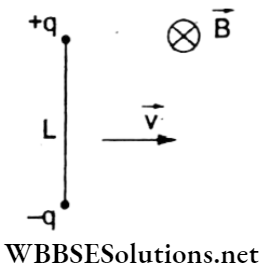
Magnetic Effect of Current Multiple Choice Questions And Answers The Two Ends Of The Light Rod Q29

  1. 0,0
  2. 2qvB, 0
  3. 0, qvB
  4. 2qvB, qvB

Answer: 3. 0, qvB

Since \(\vec{F}=q \vec{v} \times \vec{B}=q(v \hat{i}) \times(-B \hat{k})\)

⇒ \(q v B(-\hat{i} \times \hat{k})=q v B \hat{j}\).

Forces acting on the two charged particles will be equal and opposite along the y-axis, so the net force on the system is zero while the magnitude of the force on one single particle will be qvB.
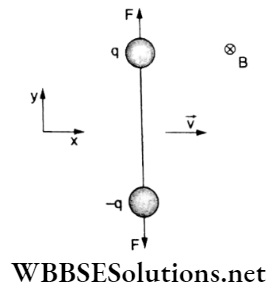
Magnetic Effect of Current Multiple Choice Questions And Answers Q29

Question 30. In the trajectory of the particles in a uniform magnetic field, which particle has the highest e/m value?
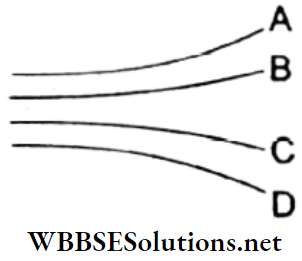
Magnetic Effect of Current Multiple Choice Questions And Answers Trajectory Of The Particle In A Uniform Magnetic Field Q30

  1. A
  2. B
  3. C
  4. D

Answer: 4. D

For the curved path followed by a moving charge a magnetic field,

⇒ \(q v B=\frac{m v^2}{R} \Rightarrow \frac{q}{m}=\frac{v}{B R}=\frac{k}{R}\)

⇒ \(\text { ratio } \frac{q}{m} \propto \frac{1}{R}\).

For the smallest radius of curvature R, the ratio \(\) is maximum, which is true for D.

Class 11 Physics Class 12 Maths Class 11 Chemistry
NEET Foundation Class 12 Physics NEET Physics

Question 31. An electron is traveling along the x-direction. It encounters a magnetic field in the y-direction. Its subsequent motion will be a

  1. Straight line along the x-direction
  2. Circle in the xz-plane
  3. Circle in the yz-plane
  4. Circle in the xy-plane

Answer: 2. Circlein the xz-plane

Given that \(\vec{v}=v \hat{i} \text { and } \vec{B}=B \hat{j}\). Hence, \(\vec{F}=q(\vec{v} \times \vec{B})=q v B(\hat{i} \times \hat{j})=q v B \hat{k}\).

The centripetal force is along the z-direction. Hence, the path followed will be a circle in the xz-plane.

Note: The axis of the circular path followed will be the direction of the magnetic field, which is along the y-axis, so the plane of motion will be the xz-plane.

Question 32. A current-carrying coil is subjected to a uniform magnetic field. The coil will orient itself such that its plane becomes

  1. Inclined at 45 to the magnetic field
  2. Inclined at any arbitrary angle to the magnetic field
  3. Parallel to the magnetic field
  4. Perpendicular to the magnetic field

Answer: 4. Perpendicular to the magnetic field

A current-carrying coil is equivalent to a magnetic dipole whose magnetic moment is \(\vec{m}=I \vec{A}\).

In a magnetic field, it has PE = U = \(-\vec{m} \cdot \vec{B}=-I(\vec{A} \cdot \vec{B})=-I A B \cos \theta\),

where θ= the angle between the normal to the area and the magnetic field. For the system to be stable, PE = minimum, so θ= 0.

Hence, the plane of the coil must be perpendicular to the field.

Question 33. The magnetic field due to a current of 0.1 A flowing through a circular coil of radius 0.1 m and 1000 turns at the center is

  1. 0.2 T
  2. 2 x 10⁻⁴
  3. 6.28 x 10⁻⁴ T
  4. 98 x 10-4 T

Answer: 3. 6.28 x 10⁻⁴ T

\(B=\frac{\mu_0 N I}{2 R}\)

Given that/= 0.1 A,R= 0.1 m,N = 103

∴ \(B=\frac{\left(2 \pi \times 10^{-7}\right)\left(10^3\right)(0.1) \mathrm{T}}{0.1}=2(3.14)\left(10^{-4}\right) \mathrm{T}=6.28 \times 10^{-4} \mathrm{~T}\).

Question 34. If a charged particle enters a region where \(\vec{E}\) and \(\vec{B}\) fields are mutually perpendicular then will

  1. Always move in the direction of \(\vec{B}\)
  2. Always move in the direction of \(\vec{E}\)
  3. Always undergo circular motion
  4. May emerge undeflected from the fields

Answer: 4. May emerge undeflected from the fields

The Lorentz force is given by

⇒ \(\vec{F}=\vec{F}_{\text {elec }}+\vec{F}_{\text {mag }}=q \vec{E}+q \vec{v} \times \vec{B}\)

When the charged particle enters the region of crossed fields, it experiences electric and magnetic forces in opposite directions and may emerge undeflected when \(q E=q v B \Rightarrow v=\frac{E}{B}\).

Question 35. The magnetic field \(\overrightarrow{d B}\) due to a small element \(\overrightarrow{d l}\) at a distance \(\vec{r}\) carrying a steady current I will be

  1. \(\overrightarrow{d B}=\frac{\mu_0}{4 \pi} I\left(\frac{\overrightarrow{d l} \times \vec{r}}{r}\right)\)
  2. \(\overrightarrow{d B}=\frac{\mu_0}{4 \pi} I^2\left(\frac{\overrightarrow{d l} \times \vec{r}}{r^2}\right)\)
  3. \(\overrightarrow{d B}=\frac{\mu_0}{4 \pi} I^2\left(\frac{\overrightarrow{d l} \times \vec{r}}{r}\right)\)
  4. \(\overrightarrow{d B}=\frac{\mu_0}{4 \pi} I\left(\frac{\overrightarrow{d l} \times \vec{r}}{r^3}\right)\)

Answer: 4. \(\overrightarrow{d B}=\frac{\mu_0}{4 \pi} I\left(\frac{\overrightarrow{d l} \times \vec{r}}{r^3}\right)\)

According to the Biot-Savartlaw, the magnetic field at point O will be \(d B=\frac{\mu_0}{4 \pi} \frac{I d l \sin \theta}{r^2}\) which will be directed perpendicularly into the plane of the paper. In vector notation,

⇒ \(\overrightarrow{d B}=\frac{\mu_0}{4 \pi} \frac{I \overrightarrow{d l} \times \hat{r}}{r^2}=\frac{\mu_0}{4 \pi} I\left(\frac{\overrightarrow{d l} \times \vec{r}}{r^3}\right)\)
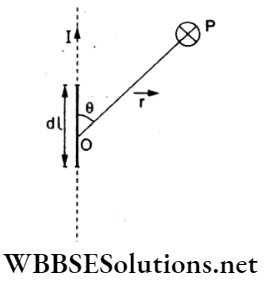
Magnetic Effect of Current Multiple Choice Questions And Answers Biot-Savart Law Q35

Question 36. Abeam of monoenergetic electrons is moving at a constant velocity through a region having mutually perpendicular electric and magnetic fields of intensities 20 V mf1 and 0.5 T respectively at right angles to the direction of motion of the electrons. The velocity of the electrons must be

  1. 8ms-1
  2. 40 ms-1
  3. 20 ms-1
  4. 10 ms-1

Answer: 3. 20 ms-1

For the beam of electrons to emerge undeflected through the crossed \(\vec{E}\) and \(\vec{B}\) fields, the electric and magnetic forces must balance each other.

Hence, qE = qvB

∴ \(v=\frac{E}{B}=\frac{20 \mathrm{Vm}^{-1}}{0.5 \mathrm{~T}}=40 \mathrm{~m} \mathrm{~s}^{-1}\).

Question 37. Two electric currents are .flowing perpendicular to each other as shown in the figure. AB and CD are perpendicular lines symmetrically placed relative to the currents. Where should we expect the resultant magnetic field to be zero?
Magnetic Effect of Current Multiple Choice Questions And Answers Two Electric Currents Are Flowing Perpendicular Q37

  1. On AB
  2. On CD
  3. On both AB and CD
  4. On both OD and BO

Answer: 1. On AB

The directions of the magnetic fields due to straight currents are shown close to the wires by Θ indicating a direction out of the paper and ⊗ indicating a direction the paper.

In the 1st and 3rd quadrants, the directions of the fields are in opposite directions so they cancel out, while in the 2nd and 4th quadrants, they are in the same direction.

Hence, the magnetic field will be zero on the line AB
Magnetic Effect of Current Multiple Choice Questions And Answers The Direction Of The Magnetic Field Q37

Question 38. Two straight wires are held perpendicular to the plane of the paper and are 5 m apart. They carry steady currents of 2.5 A and 5.0 A in the same direction. The magnitude of the magnetic field at a point midway between the wires will be

  1. \(\frac{\mu_0}{4 \pi} T\)
  2. \(\frac{\mu_0}{2 \pi} T\)
  3. \(\frac{3 \mu_0}{2 \pi} T\)
  4. \(\frac{3 \mu_0}{4 \pi} T\)

Answer: 2. \(\frac{\mu_0}{2 \pi} T\)

The magnetic field midway between two parallel, straight currents is in opposite directions. Hence, B = B1 – B2.

⇒ Here, \(B_1=\frac{\mu_0 I_1}{2 \pi d} \text { and } B_2=\frac{\mu_0 I_2}{2 \pi d}\)

∴ \(B=\frac{\mu_0}{2 \pi d}\left(I_2-I_1\right)=\frac{\mu_0}{2 \pi(5 \mathrm{~m}) / 2}(5.0-2.5) \mathrm{A}=\frac{\mu_0}{2 \pi} \mathrm{T}\)

“magnetic effects of electric current class 10 question answer “

Question 39. The magnetic field at the center of a circular coil of a single turn is B. If the same wire is coiled into two turns, the magnetic field at the center for file same current will be

  1. \(\frac{B}{4}\)
  2. \(\frac{B}{2}\)
  3. 2B
  4. 4B

Answer: 4. 4B

When the coil has a single turn, \(B=\frac{\mu_0 I}{2 R}\).

When it has two turns,

⇒ \(2\left(2 \pi R^{\prime}\right)=2 \pi R \Rightarrow R^{\prime}=\frac{R}{2}\)

∴ Now \(B^{\prime}=\frac{\mu_0 N I}{2 R^{\prime}}=\frac{\mu_0 2 I}{2 R / 2}=\frac{4 \mu_0 I}{2 R}=4 B\).

Question 40. A charged particle moves through a magnetic field in a direction perpendicular to it. Then, the

  1. Acceleration remains unchanged
  2. Velocity remains unchanged
  3. The speed of the particle remains unchanged
  4. The direction of the particle’s motion remains unchanged

Answer: 3. The Speed of the particle remains unchanged

For a charged particle moving through the magnetic field, the work done is zero, so the speed of the particle remains unchanged.

Question 41. An electron revolves in a circular orbit with a uniform speed v. It produces a magnetic field B at the center. The radius of the circle is proportional to

  1. \(\frac{B}{v}\)
  2. \(\frac{v}{B}\)
  3. \(\sqrt{\frac{v}{B}}\)
  4. \(\sqrt{\frac{B}{v}}\)

Answer: 3. \(\sqrt{\frac{v}{B}}\)

Speed = \(v=\frac{2 \pi R}{T}\)

⇒ equivalent current = \(I=\frac{e}{T}=\frac{e v}{2 \pi R}\)

The magnetic field at the center is

⇒ \(B=\frac{\mu_0 I}{2 R}=\frac{\mu_0}{2 R}\left(\frac{e v}{2 \pi R}\right)\)

⇒ \(R^2=\frac{\mu_0 e v}{4 \pi B}=\left(\frac{\mu_0 e}{4 \pi}\right) \frac{v}{B}\)

∴ \(R^2 \propto \frac{v}{B} \Rightarrow R \propto \sqrt{\frac{v}{B}}\).

Question 42. A conducting circular loop of radius R is connected to a long, straight wire which carries a steady current I as shown. The magnetic field at the center O of the loop is
Magnetic Effect of Current Multiple Choice Questions And Answers A Conductor Circular Loop Q42

  1. Directed into the plane of the loop
  2. Directed out of the plane of the loop
  3. Dependent on the angle of 0
  4. Zero for all values of 0

Answer: 4. Zero for all values of 0

If B1 and B2 are the magnetic fields at the center O due to the upper branch and lower branch of the loop then

⇒ \(\frac{B_1}{B_2}=\frac{I_1 h_1}{I_2 l_2}, \text { since } B=\frac{\mu_0 I l}{4 \pi d^2}=k(I l)\)

⇒ But, \(\frac{I_1}{I_2}=\frac{R_2}{R_1}=\frac{\sigma l_2}{\sigma l_1}=\frac{l_2}{l_1}\) where a = resistance per unit length

∴ \(\frac{B_1}{B_2}=\left(\frac{l_2}{l_1}\right)\left(\frac{l_1}{l_2}\right)=1 \Rightarrow B_1=B_2\)

Since B1 and B2 are in opposite directions, Bnet at O= 0 for all values of 0.

Question 43. A beam of electrons emerges undeflected through mutually perpendicular electric and magnetic fields. If the electric field is switched off and the same magnetic field is maintained, the electrons move

  1. In an elliptical orbit
  2. In a circular orbit
  3. Along a parabolic path
  4. Along a straight line

Answer: 2. In a circular orbit

In a magnetic field, the path followed by a charge moving perpendicular to the field will be circular.

Question 44. The magnetic force acting on a particle with charge (-2 μC) in a magnetic field of 2T directed along the y-direction, when the particle velocity is \(\vec{v}=(2 \hat{i}+3 \hat{j}) \times 10^6 \mathrm{~m} \mathrm{~s}^{-1}\), is

  1. 8N in the +z direction
  2. 4N in the +z direction
  3. 8N in the -y direction
  4. 8N in the -z-direction

Answer: 4. 8N in the -z-direction

Given that q = \(\left(-2 \times 10^{-6} C\right), \vec{B}=(2 T) \hat{j}\)

⇒ and velocity = \(\vec{v}=(2 \hat{i}+3 \hat{j}) \times 10^6 \mathrm{~m} \mathrm{~s}^{-1}\)

⇒ Magnetic force = \(\vec{F}=q(\vec{v} \times \vec{B})\)

⇒ \(\left(-2 \times 10^{-6} \mathrm{C}\right)(2 \hat{i}+3 \hat{j})\left(10^6 \mathrm{~m} \mathrm{~s}^{-1}\right) \times(2 \hat{j} T)\)

∴ \(-4(2 \hat{k}) N=-8 \hat{k} N=8 N\) along the z-direction.

Question 45. A square current-carrying loop is suspended in a uniform magnetic field acting in the plane of the loop. If the force on one arm of the loop is \(\vec{F}\), the net force on the remaining three arms is

  1. \(3 \vec{F}\)
  2. \(2 \vec{F}\)
  3. \(-\vec{F}\)
  4. \(-3 \vec{F}\)

Answer: 3. \(-\vec{F}\)

The current-carrying square loop, when placed in a uniform magnetic field such that the direction of B is parallel to the plane of the coil, then the force acting on arm PQ is directed perpendicularly into the plane of the paper, while that on RS will be perpendicularly out of the plane of the paper. Both have equal magnitude, i.e., \(\left|\vec{F}_1\right|=\left|\vec{F}_2\right|=I B l\) but are in opposite directions.

Thus, \(\vec{F}_2=-\vec{F}\)

Since currents through QR and PS are along the line of a magnetic field \(\vec{B}\), they do not experience any magnetic force.
Magnetic Effect of Current Multiple Choice Questions And Answers Current Carrying Square Loop Q45

Question 46. A beam of cathode rays is subjected to crossed electric \(\vec{E}\) and magnetic \(\vec{B}\) fields. The electric field is adjusted by regulating the potential difference V between the electrodes such that the beam emerges undeflected. The specific charge of the cathode rays is given by

  1. \(\frac{B^2}{2 V E^2}\)
  2. \(\frac{2 V B^2}{E^2}\)
  3. \(\frac{2 V E^2}{B^2}\)
  4. \(\frac{E^2}{2 V B^2}\)

Answer: 4. \(\frac{E^2}{2 V B^2}\)

The kinetic energy gained by the accelerating voltage V is

⇒ \(\frac{1}{2} m v^2=q V\)

Specific charge = \(\frac{q}{m}=\frac{v^2}{2 V}\)

For cathode rays to emerge undeflected,

∴ \(v=\frac{E}{B} \text {, hence } \frac{q}{m}=\frac{1}{2 V}\left(\frac{E}{B}\right)^2=\frac{E^2}{2 V B^2}\).

Question 47. A square conducting loop ABCD, carrying a steady current I2, is placed near and coplanar with a long straight conductor XY, carrying a steady current I1 as shown in the figure. The net force on the loop will be
Magnetic Effect of Current Multiple Choice Questions And Answers A Square Conducting Loop Q47

  1. \(\frac{2 \mu_0 I_1 I_2}{2 \pi}\)
  2. \(\frac{\mu_0 I_1 I_2 L}{2 \pi}\)
  3. \(\frac{2}{3} \frac{\mu_0 I_1 I_2 L}{\pi}\)
  4. \(\frac{2 \mu_0 I_1 I_2}{3 \pi}\)

Answer: 4. \(\frac{2 \mu_0 I_1 I_2}{3 \pi}\)

Forces on sides BC and AD are equal and opposite.

The attractive force on side AB is

⇒ \(F_1=\frac{\mu_0 I_1 I_2 L}{2 \pi L / 2}=\frac{\mu_0 I_1 I_2}{\pi}\)

Repulsive force on the side CD is

⇒ \(F_2=\frac{\mu_0 I_1 I_2 L}{2 \pi(3 L / 2)}=\frac{\mu_0 I_1 I_2}{3 \pi}\)

∴ \(F_{\text {net }}=\left(F_1-F_2\right)=\frac{\mu_0 I_1 I_2}{\pi}-\frac{\mu_0 I_1 I_2}{3 \pi}=\frac{2 \mu_0 I_1 I_2}{3 \pi}\)
Magnetic Effect of Current Multiple Choice Questions And Answers Q47

Question 48. The magnetic field at the center O of the arc, as shown in the figure, is
Magnetic Effect of Current Multiple Choice Questions And Answers Magnetic Field At The Centre Q48

  1. \(\frac{2 I}{r}(\pi+\sqrt{2}) \times 10^{-7} \mathrm{~T}\)
  2. \(\frac{2 I}{r}\left(\frac{\pi}{4}+\sqrt{2}\right) \times 10^{-7} \mathrm{~T}\)
  3. \(\frac{I}{r}(\pi+\sqrt{2}) \times 10^{-7} \mathrm{~T}\)
  4. \(\frac{I}{r}\left(\frac{\pi}{4}+\sqrt{2}\right) \times 10^{-7} \mathrm{~T}\)

Answer: 2. \(\frac{2 I}{r}\left(\frac{\pi}{4}+\sqrt{2}\right) \times 10^{-7} \mathrm{~T}\)

The distance of each straightpart from thecentreOisd =rcos 45° = \(\frac{r}{\sqrt{2}}\).

The field due to each segment is directed perpendicularly into the plane of the paper, so the fields add up.

\(B_1=\frac{\mu_0 I}{4 \pi d}=\frac{\mu_0 I}{4 \pi r / \sqrt{2}}=\frac{\sqrt{2} \mu_0 I}{4 \pi r}\)

⇒ \(B_2=\frac{\mu_0 I}{4(2 r)}=\frac{\mu_0 I}{8 r}\)

∴ Bnet = B1 + B2 + B3 = 2B1+ B2    [∵ B3 = B1]

⇒ \(\frac{\sqrt{2} \mu_0 I}{2 \pi r}+\frac{\mu_0 I}{8 r}=\frac{I}{r} 2 \sqrt{2} \times 10^{-7}+\frac{I}{r} \frac{\pi}{2} \times 10^{-7}\)

⇒  \(\frac{I}{r}\left(2 \sqrt{2}+\frac{\pi}{2}\right) \times 10^{-7} \mathrm{~T}=\frac{2 I}{r}\left(\frac{\pi}{4}+\sqrt{2}\right) \times 10^{-7} \mathrm{~T}\)

“magnetic effects of electric current class 10 question answer “

Question 49. A particle of charge q and mass m starts moving from the origin under the action of an electric field \(\vec{E}=E_0 \hat{i}\) and a magnetic field \(\vec{B}=B_0 \hat{i}\) at a velocity \(\vec{v}=v_0 \hat{j}\). The speed of the particle will become \(\frac{\sqrt{5}}{2} v_0\) after a time

  1. \(\frac{m v_0}{q E_0}\)
  2. \(\frac{m v_0}{2 q E_0}\)
  3. \(\frac{\sqrt{3} m v_0}{2 q E_0}\)
  4. \(\frac{\sqrt{5} m v_0}{2 q E_0}\)

Answer: 2. \(\frac{m v_0}{2 q E_0}\)

Given that \(\vec{E}=E_0 \hat{i}, \vec{B}=B_0 \hat{i} \text { and } \vec{v}=v_0 \hat{j}\).

Since v is perpendicular to \(\vec{}B\), the path will be circular, while the electric field will push (accelerate) the particle along the x-direction with acceleration \(a_x=\frac{q E_0}{m}\).

⇒ At time t, \(v_x=0+a_x t=\frac{q E_0}{m} t\).

Due to the magnetic field, the speed always remains constant(= v0) and perpendicular to the x-axis.

the magnitude of the resultant velocity,

⇒ \(v=\sqrt{v_x^2+v_y^2}=\sqrt{v_0^2+\left(\frac{q E_0}{m} t\right)^2}\)

⇒  \(\left(\frac{\sqrt{5}}{2} v_0\right)^2=v_0^2+\frac{q^2 E_0^2}{m^2} t^2\)

∴  \(t=\frac{m v_0}{2 g E_0}\).

Question 50. A wire of mass 100 g and length 1 m carries a steady current of 5 A. It is balanced in mid-air by a uniform magnetic field B. The value of B is

  1. 0.1 TI
  2. 0.2 T
  3. 0:ST
  4. 0.6 T

Answer: 2. 0.2 T

For balance, the force due to the magnetic field FB = IIB, and the weight

W= mg must balance each other. Thus, IIB = mg

∴ \(B=\frac{m g}{I l}=\frac{\left(100 \times 10^{-3} \mathrm{~kg}\right)\left(10 \mathrm{~m} \mathrm{~s}^{-2}\right)}{(5 \mathrm{~A})(1 \mathrm{~m})}=0.2 \mathrm{~T}\).

Question 51. When a charged particle enters a uniform magnetic field with uniform velocity, its trajectory can be

  • A straight line
  • A circle
  • A helix
  1. (1) only
  2. (1) or (2)
  3. (1) or (3)
  4. Any one of (1), (2) and (3)

Answer: 4. Any one of (1), (2) and (3)

When the direction of the charged particle is parallel or antiparallel to the \(\vec{B}\)-field, the force \((\vec{F}=q \vec{v} \times \vec{B})\) is zero and hence the path will be a straight line. When \(\vec{V}\) and \(\vec{B}\) are perpendicular to each other, the path will be circular. And when the angle between \(\vec{V}\)and \(\vec{B}\) is 0(≠ 90°), the path will be helical. Hence, all the three paths are possible.

Question 52. The magnetic field due to a straight current-carrying cylindrical conductor of uniform cross-section of radius R is represented by
Magnetic Effect of Current Multiple Choice Questions And Answers Cylindrical Conductor Of Uniform Cross Section Of Radius Q52

Answer: 2.

The magnetic fields inside a current-carrying cylindrical conductor of
radius R are as follows.

⇒ \(\text { For } 0<r<R, B=\frac{\mu_0 I}{2 \pi R^2} r \Rightarrow B \propto r\).

This represents a straight line through the origin.

⇒ \(\text { For } r>R, B=\frac{\mu_0 I}{2 \pi r} \Rightarrow B \propto \frac{1}{r}\).

This represents a nonlinear decrease (rectangular hyperbola) of B with r.

Hence, option (2)is correct.

Question 53. When a charged particle moving with a velocity \(\vec{V}\) is subjected to a magnetic field \(\vec{B}\), the force exerted on it is nonzero. This implies that the angle between

  1. \(\vec{B}\) and \(\vec{V}\) is necessarily
  2. \(\vec{V}\) and \(\vec{B}\) can have any value other than 90°
  3. \(\vec{V}\) and \(\vec{B}\) can have any value other than 0° and 180°
  4. \(\vec{V}\) and \(\vec{B}\) is either zero or 180°

Answer: 3. \(\vec{V}\) and \(\vec{B}\) can have any value other than 0° and 180°

The force on a charged particle in a magnetic field is

⇒ \(\vec{F}=q(\vec{v} \times \vec{B})\)

⇒ F- qvBsin 0, when0 is the angle between \(vec{V}\) and \(vec{B}\).

For θ= 0 or 180°, F= 0. So, for the force to be nonzero, θ can have any value other than 0° and 180°.

Question 54. A current loop in a magnetic field

  1. Experiences a torque whether the field is uniform or nonuniform in all orientations
  2. Can be equilibrium in one orientation
  3. Can be in equilibrium in two orientations and both the equilibrium states are unstable
  4. Can be equilibrium in two orientations, one is stable while the other is unstable

Answer: 4. Can be equilibrium in two orientations, one is stable while the other is unstable

A current loop is equivalent to a magnetic dipole with magnetic moment \(\), where the area vector \(\vec{A}\) is perpendicular to the plane of the coil.

In a magnetic field B, the potential energy

⇒ \(U=-\vec{m} \cdot \vec{B}=-m B \cos \theta\)

For θ = 0°, U = -mB = minimum, which corresponds to stable equilibrium.

For θ =180°, U = +mB = maximum, which corresponds to unstable equilibrium.

Question 55. An electron is moving in a circular path under the influence of a transverse magnetic field of 3.57 x 10⁻² T. If the specific charge of the electron is 1.76 x 10¹¹ C kg-1, the frequency of revolution of the electron is

  1. 100 MHz
  2. 1 GHz
  3. 62.8 MHz
  4. 6.28 MHz

Answer: 2. 1 GHz

Frequency of revolution is \(f=\frac{q B}{2 \pi m}=\left(\frac{q}{m}\right) \frac{B}{2 \pi}\)

Given, specific charge \(\left(\frac{q}{m}\right)\) of an electron = 1.76xlOn Ckg-1 and magnetic field = B= 3.57 x10⁻² T.

⇒ frequency = \(f=\left(1.76 \times 10^{11} \mathrm{C} \mathrm{kg}^{-1}\right)\left(\frac{3.57 \times 10^{-2} \mathrm{~T}}{2 \times 3.14}\right)\)

∴ 1.0 x 10⁹Hz=1 GHz

Question 56. A long cylindrical wire of radius b carries a steady current I distributed uniformly over its cross-section. The magnitude of the magnetic field at a point inside the wire at a distance from the axis is

  1. \(\frac{\mu_0 I a}{2 \pi b^2}\)
  2. \(\frac{\mu_0 I b}{2 \pi a^2}\)
  3. \(\frac{\mu_0 I a}{2 \pi b}\)
  4. \(\frac{\mu_0 I b}{2 \pi a}\)

Answer: 1. \(\frac{\mu_0 I a}{2 \pi b^2}\)

Consider the Amperian circular loop of radius a coaxial with the axis of the cylindrical wire. Currently enclosed in the loop is

⇒ \(I_0=\frac{I \cdot \pi a^2}{\pi b^2}=\frac{I a^2}{b^2}\)

Applying Ampere’s circuital law

⇒ \(\oint \vec{B} \cdot \overrightarrow{d l}=B \cdot 2 \pi a=\mu_0 I_0=\mu_0 \frac{I a^2}{b^2}\)

∴ \(B=\frac{\mu_0 I a}{2 \pi b^2}\)
Magnetic Effect of Current Multiple Choice Questions And Answers Amperian Circular Loop Q56

Question 57. A moving charge produces

  1. A magnetic field only
  2. An electric field only
  3. Both magnetic and electric fields
  4. Neither an electric nor a magnetic field

Answer: 3. Both magnetic and electric fields

A stationary charge produces an electric field only. While moving, it acts as a current element and thus produces a magnetic field in addition to an electric field.

Question 58. A charged particle is released from rest in a region that comprises the uniform electric field \(\vec{E}=E_0 \hat{i}\) and uniform magnetic field \(\vec{B}=B_0 \hat{i}\). The charged particle (neglect gravity)

  1. Will remain at rest
  2. Will move along the x-axis with a uniform velocity
  3. Will move along the x-axis with a uniform acceleration
  4. Will follow a parabolic path

Answer: 3. Will move along the x-axis with a uniform acceleration

A charged particle at rest will not experience a force in a magnetic field, but an electric field \(\vec{E}\) will exert a force \(\vec{F}_{\text {elec }}=q \vec{E}=q E_0 \hat{i}\) on it and the particle will start moving with a constant acceleration \(\vec{a}=\frac{\vec{F}}{m}=\frac{q E_0 \hat{i}}{m}\).

⇒  Since velocity \(\vec{V}\) and \(\vec{B}\) are both along the x-axis, magnetic force \(\vec{F}_B=q(\vec{v} \times \vec{B})=q v B \sin \theta=0\).

So, the motion will be along the x-axis with uniform acceleration.

Question 59. Ionized hydrogen atoms and a-particles with the same momenta enter perpendicular to a constant magnetic field B. The ratio of the radii of their paths rH: rα will be

  1. 2:1
  2. 1:2
  3. 4:1
  4. 1:4

Answer: 1. 2:1

For the motion of a charged particle in a constant magnetic field, the centripetal force is

⇒ \(\frac{m v^2}{r}=q v B \Rightarrow r=\frac{m v}{q B}=\frac{p}{q B}\)

⇒ For \(\mathrm{H}: r_{\mathrm{H}}=\frac{p}{e B} ; \text { for } \alpha \text {-particle }: r_\alpha=\frac{p}{(2 e) B}\)

∴ \(r_{\mathrm{H}}: r_\alpha=2: 1\).

Question 60. A cylindrical conductor of radius R is carrying a constant steady current. Which of the following correctly represents the plot of the magnitude of the magnetic field B with a distance d from the axis of the conductor?
Magnetic Effect of Current Multiple Choice Questions And Answers A Cylindrical Conductor Of Radius Q60

Answer: 3.

Current per unit base area of the cylindrical conductor = \(\frac{I}{\pi R^2}\)

According to Ampere’s circuital law,

⇒ \(\oint \vec{B} \cdot \overrightarrow{d l}=\mu_0 \Sigma I\)

Thus, ford \(d<R, B \cdot 2 \pi d=\frac{\mu_0 I \pi d^2}{\pi R^2}\)

⇒ \(B=\frac{\mu I}{2 \pi R^2} d \Rightarrow B \propto d\)

This represents a straight line from d =0tod= R

⇒ \(d>R, B \cdot 2 \pi d=\mu_0 I\)

∴ \(B=\left(\frac{\mu_0 I}{2 \pi}\right) \frac{1}{d}=k\left(\frac{1}{d}\right)\).

This represents a rectangular hyperbola, as in (3).

Question 61. If two protons are moving with speed v= 4.5 x 10⁵ m s-1 parallel to each other then the ratio of the electrostatic and magnetic forces between them is

  1. 4.4 x 10⁵
  2. 2.2 x 10⁵
  3. 3.3 x 10⁵
  4. l.l x 105

Answer: 1. 4.4 x 10⁵

The electrostatic force between the two protons is \(F_{\text {elec }}=\frac{1}{4 \pi \varepsilon_0} \frac{q^2}{r^2}\)

Moving charge is equivalent to a current I, where Idl = qv.

⇒ Magnetic field = B = \(\frac{\mu_0}{4 \pi} \frac{I d l}{r^2}=\frac{\mu_0}{4 \pi} \frac{q v}{r^2}\)

⇒ Hence, magnetic force = \(F_{\text {mag }}=q v B=\frac{\mu_0}{4 \pi} \frac{q^2 v^2}{r^2}\)

∴ Ratio \(\frac{F_{\text {elec }}}{F_{\text {mag }}}=\frac{\frac{1}{4 \pi \varepsilon_0} \frac{q^2}{r^2}}{\frac{\mu_0}{4 \pi} \frac{q^2 v^2}{r^2}}=\frac{9 \times 10^9}{10^{-7}} \frac{1}{\left(4.5 \times 10^5\right)^2}=4.4 \times 10^5\).

Question 62. Find the magnetic field at the center O. Given that 1 = 2.5 A and r = 5 cm.
Magnetic Effect of Current Multiple Choice Questions And Answers Magnetic Field At Centre Q62

  1. \(\pi\left(1+\frac{1}{\pi}\right) \times 10^{-5} \mathrm{~T}\)
  2. \(\pi\left(1+\frac{1}{\pi}\right) \times 10^{-6} \mathrm{~T}\)
  3. \(\pi\left(\frac{\pi+1}{\pi}\right) \times 10^{-6} \mathrm{~T}\)
  4. \(\left(\frac{\pi+1}{\pi}\right) \times 10^{-6} \mathrm{~T}\)

Answer: 1. \(\pi\left(1+\frac{1}{\pi}\right) \times 10^{-5} \mathrm{~T}\)

The magnetic field at the center

Due to the straight current = \(\frac{\mu_0 I}{2 \pi r}\) (inward),

Due to the circular current = \(\frac{\mu_0 I}{2 r}\) (inward).

Hence, the net field B = \(\frac{\mu_0 I}{2 r}\left(1+\frac{1}{\pi}\right)=\frac{2 \pi \times 10^{-7} \times 2.5}{\left(5 \times 10^{-2}\right)}\left(1+\frac{1}{\pi}\right)\)

∴ \(\pi\left(1+\frac{1}{\pi}\right) \times 10^{-5} \mathrm{~T}\)

Question 63. Two infinitely long parallel current-carrying conducting wires are shown in the figure. If the magnetic field at A is zero, the value of I is
Magnetic Effect of Current Multiple Choice Questions And Answers Two Infinitely Long Parallel Current Carrying Conducting Wires Q63

  1. 50 A
  2. 15 A
  3. 30 A
  4. 25 A

Answer: 3. 30 A

The magnetic field at A due to current I is

⇒ \(B_1=\frac{\mu_0 I}{2 \pi d}=\frac{\mu_0 I}{2 \pi(27 \mathrm{~cm})}\), direct outward.

Due to a current of 10 A, \(B_2=\frac{\mu_0(10 \mathrm{~A})}{2 \pi(9 \mathrm{~cm})}\), directed inward.

Given, = 0 => \(\frac{\mu_0 I}{2 \pi(27 \mathrm{~cm})}=\frac{\mu_0(10 \mathrm{~A})}{2 \pi(9 \mathrm{~cm})}\).

Hence, I = 30 A.

Question 64. Find the ratio of the strengths of E- and B-fields due to a point charge moving at a constant velocity of 4.5 x 10⁵ m s-1.

  1. 2 x 10¹¹
  2. 2 x l08
  3. 3 x 10¹¹
  4. 3 x l08

Answer: 1. 2 x 10¹¹

Electric field is E = \(\frac{1}{4 \pi \varepsilon_0} \frac{q}{r^2}\), and magnetic field is B = \(B=\frac{\mu_0}{4 \pi} \frac{q v}{r^2}\).

⇒ \(\frac{E}{B}=\frac{\left(9 \times 10^9\right) \frac{q}{r^2}}{\left(10^{-7}\right) \frac{q v}{r^2}}=\frac{9 \times 10^{16}}{v}=\frac{9 \times 10^{16}}{\frac{9}{2} \times 10^5}=2 \times 10^{11}\).

Question 65. Find the magnetic field inside a toroid along its axis if its average radius = 0.5 cm, current flowing through it = 1.5 A, number of turns = 250, and relative permeability = 700.

  1. 8.5 T
  2. 5.7 T
  3. 10.5 T
  4. 12.7 T

Answer: 3. 10.5 T

The magnetic field B inside a toroid is

B.2πR= uNI

⇒ \(B=\frac{\mu_r \mu_0 N I}{2 \pi R}=\frac{700\left(4 \pi \times 10^{-7}\right)(250)(1.5)}{2 \pi\left(0.5 \times 10^{-2}\right)}=10.5 \mathrm{~T}\).

Question 66. The current density in a solid cylindrical wire of radius R, as a function of radial distance r, is given by j = j0 \(\left(1-\frac{r}{R}\right)\) The total current in the radial region r = 0 to r = will be

  1. \(\frac{3}{64} \pi R^2 j_0\)
  2. \(\frac{1}{128} \pi R^2 j_0\)
  3. \(\frac{5}{32} \pi R^2 j_0\)
  4. \(\frac{5}{96} \pi R^2 j_0\)

Answer: 4. \(\frac{5}{96} \pi R^2 j_0\)

Current density is

⇒ \(j=\frac{d I}{d A}=\frac{d I}{2 \pi r d r}\)

⇒ \(d I=j \cdot 2 \pi r d r=j_0\left(1-\frac{r}{R}\right) 2 \pi r d r\)

Total current is

⇒ \(I=\int d I=j_0 \cdot 2 \pi \int_0^{R / 4}\left(1-\frac{r}{R}\right) r d r\)

⇒ \(2 \pi j_0\left[\frac{r^2}{2}-\frac{1}{R} \frac{r^3}{3}\right]_0^{R / 4}\)

∴ \(2 \pi j_0\left[\frac{R^2}{32}-\frac{R^2}{64 \times 3}\right]=\frac{5}{96} \pi R^2 j_0\).

Question 67. Consider a closed current-carrying semicircular loop That carries a steady current I as shown in the figure. Find the magnetic force per unit length on a small element at the center O.
Magnetic Effect of Current Multiple Choice Questions And Answers Closed Current Carrying Semicircular Loop Q67

  1. \(\frac{\mu_0 I^2}{4 r}\)
  2. \(\frac{\mu_0 I^2}{2 r}\)
  3. \(\frac{2 \mu_0 I^2}{r}\)
  4. \(\frac{\mu_0 I^2}{r}\)

Answer: 1. \(\frac{\mu_0 I^2}{4 r}\)

The magnetic field at the center of the semicircular current loop is B = \(\frac{\mu_0 I}{4 r}[latex]

Magnetic force per unit length = [latex]\frac{I B \Delta l}{\Delta l}=I B=\frac{\mu_0 I^2}{4 r}\).

Question 68. An electron in a hydrogen atom revolves in the n = 3 states. Find the magnetic field at the center.

  1. 9T
  2. 0.1 T
  3. 0.5 T
  4. 0.05 T

Answer: 4. 0.05 T

The radius of the 3rd orbit in a hydrogen atom is r = n2a0 = 9a0, where a0 = Bohr radius = 5.3 x 10⁻¹¹m.

Equivalent current = I = \(\frac{e}{T}=\frac{e v}{2 \pi r}\)

The magnetic field at the center is

⇒ \(B=\frac{\mu_0 I}{2 r}=\frac{\mu_0}{2 r} \cdot \frac{e v}{2 \pi r}=\frac{\mu_0}{4 \pi} \frac{e}{r^2} v\)

⇒ \(\frac{\mu_0}{4 \pi} \frac{e}{\left(9 a_0\right)^2} \cdot \frac{v_1}{3}=\frac{\left(10^{-7}\right)\left(1.6 \times 10^{-19}\right)}{\left(9 \times 5.3 \times 10^{-11}\right)^2} \frac{2.2 \times 10^6}{3}\)

∴ 0.05 T.

Question 69. A proton is projected with a velocity \(\vec{v}=2 \hat{i} \mathrm{~m} \mathrm{~s}^{-1}\) in a region in which a magnetic field \(\vec{B}=(\hat{i}+3 \hat{j}+4 \hat{k}) \mu \mathrm{T}\) and an electric field \(\vec{E}=10 \hat{i} \mu \mathrm{V} \mathrm{m}^{-1}\) exist. The magnitude of the net acceleration of the proton is

  1. 1414 m s-2
  2. 1200 m s-2
  3. 700 m s-2
  4. 400 m s-2

Answer: 1. 1414 m s-2

The force due to the electric field is

⇒ \(\vec{F}_1=q \vec{E}=q\left(10 \times 10^{-6}\right) \hat{i}\)

The force due to the magnetic field

⇒ \(\overrightarrow{F_2}=q(\vec{v} \times \vec{B})=q(2 \hat{i}) \times(\hat{i}+3 \hat{j}+4 \hat{k}) \times 10^{-6}\)

⇒ \(q(6 \hat{k}-8 \hat{j}) \times 10^{-6}\)

⇒ \(\vec{a}=\frac{\vec{F}_1}{m}+\frac{\vec{F}_2}{m}=\frac{q}{m}[10 \hat{i}-8 \hat{j}+6 \hat{k}] \times 10^{-6}\)

⇒ \(|\vec{a}|=\frac{1.6 \times 10^{-19}}{1.6 \times 10^{-27}} \times 10^{-6} \sqrt{100+64+36} \mathrm{~m} \mathrm{~s}^{-2}\).

∴ 100 x 102 m s-2 = 1414m s-2.

Question 70. Find the force per unit length at P.
Magnetic Effect of Current Multiple Choice Questions And Answers Force Per Unit Length Q70

  1. 10-2 N m-1
  2. 3 x 10⁻⁴ N m-1
  3. 0.3 N m-1
  4. 10-4 N m-1

Answer: 4. 10-4 N m-1

The magnetic field at P due to each semi-infinite straight wire is \(\frac{\mu_0 I}{4 \pi d}\) directed into the plane of the paper. Hence, thenet field atP is B = \(\frac{\mu_0 I}{2 \pi d}\).

Force per unit length is

\(\frac{\Delta F}{\Delta l}=B I=\frac{\mu_0 I^2}{2 \pi d}=\frac{\left(2 \times 10^{-7} \cdot \mathrm{H} \mathrm{m}^{-1}\right)(5 \mathrm{~A})^2}{\left(5 \times 10^{-2} \mathrm{~m}\right)}=10^{-4} \mathrm{~N} \mathrm{~m}^{-1}\).

Question 71. Find the magnetic field at the center P of a square loop with each side of length 20 cm.
Magnetic Effect of Current Multiple Choice Questions And Answers Magnetic Field At The Centre P Of A Square Loop Q71

  1. 122 x l0-6 T
  2. 6 x 10⁻⁴ T
  3. 12 x l0-6 T
  4. 62 x l0-6 T

Answer: 1. 122 x l0-6 T

The field at P due to each straight current is

⇒ \(B_{\mathrm{P}}=\frac{\mu_0}{4 \pi} \frac{I}{d}\left(\sin 45^{\circ}+\sin 45^{\circ}\right)=\frac{\mu_0 I}{4 \pi d} \cdot \frac{2}{\sqrt{2}}(\text { directed inward })\).

The net field at the center is

∴ \(B=4 B_{\mathrm{P}}=\frac{\mu_0 I}{4 \pi d} \cdot \frac{8}{\sqrt{2}}=\frac{\left(10^{-7} \mathrm{H} \mathrm{m}^{-1}\right)(3 \mathrm{~A}) 8}{\left(10 \times 10^{-2} \mathrm{~m}\right) \sqrt{2}}=12 \sqrt{2} \times 10^{-6} \mathrm{~T}\).

Question 72. Two coaxial circular loops having the same radius R=10 cm have the same current I = 3.5 A flowing through them. If the separation between their centers is 10 cm, find the magnitude of the net magnetic field at point P.
Magnetic Effect of Current Multiple Choice Questions And Answers Two Coaxial Circular Loops Q72

  1. \(\frac{50 \mu_0}{\sqrt{5}} \mathrm{~T}\)
  2. \(\frac{20 \mu_0}{\sqrt{5}} \mathrm{~T}\)
  3. \(\frac{56 \mu_0}{\sqrt{5}} \mathrm{~T}\)
  4. \(\frac{50 \mu_0}{\sqrt{3}} \mathrm{~T}\)

Answer: 3. \(\frac{56 \mu_0}{\sqrt{5}} \mathrm{~T}\)

The magnetic field at P due to each circular current loop will have the same magnitude and the same direction (towards the right) so the fields add up.

Hence, the net field is

⇒ \(B=2 \frac{\mu_0 I R^2}{2\left(R^2+x^2\right)^{3 / 2}}, \text { where } I=3.5 \mathrm{~A}, R=10 \mathrm{~cm}, x=5 \mathrm{~cm} \text {. }\).

∴ \(B=\frac{\mu_0(3.5 \mathrm{~A})\left(10 \times 10^{-2} \mathrm{~m}\right)^2}{\left[\left(10^{-1} \mathrm{~cm}\right)^2+\left(0.5 \times 10^{-1} \mathrm{~m}\right)^2\right]^{3 / 2}}=\frac{56 \mu_0}{\sqrt{5}} \mathrm{~T}\).

Question 73. The currents through two parallel wires are I2 with I1>I2. When the currents are in the same direction, the magnetic field at a point midway between the wires is 10T. If the direction of the current is reversed in one of the wires, the magnetic field becomes 30 μT The ratio I1/I2 is

  1. 1
  2. 2
  3. 3
  4. 4

Answer: 2.  2

When the currents are in the same direction,

⇒ \(B_1=\frac{\mu_0\left(I_1-I_2\right)}{2 \pi d}=10 \mu \mathrm{T}\)

When the currents flow in opposite directions,

⇒ \(B_2=\frac{\mu_0\left(I_1+I_2\right)}{2 \pi d}=30 \mu \mathrm{T}\)

∴ \(\frac{I_1+I_2}{I_1-I_2}=\frac{3}{1} \Rightarrow \frac{I_1}{I_2}=2\)
Magnetic Effect of Current Multiple Choice Questions And Answers Currents Are In The Same Direction Q73

Question 74. A thin ring of radius 10 cm carries a uniformly distributed charge. The ring rotates at a constant angular speed of 40K rad s-1 about its axis, perpendicular to its plane. If the magnetic field at its center is 3.8 x 10⁻⁹ T then the charge carried by the ring is close to (given that μ0 = 4n x 10-7 N A-2 )

  1. 3 x 10⁻⁵ C
  2. 2 x 10⁻⁶ C
  3. 4 x 10⁻⁵ C
  4. 7 x 10⁻⁶ C

Answer: 1. 3 x 10⁻⁵ C

A revolving circular coil with charge Q and time period T is equivalent to a current I = \(=\frac{Q}{T}=\frac{Q \omega}{2 \pi}\)

It produces a magnetic field B at the center, where

⇒ \(B=\frac{\mu_0 I}{2 R}=\frac{\mu_0 Q_\omega}{4 \pi R}\)

⇒ \(Q=\frac{4 \pi R \cdot B}{\mu_0 \omega}=\frac{4 \pi\left(10 \times 10^{-2} \mathrm{~m}\right)\left(3.8 \times 10^{-9} \mathrm{~T}\right)}{\left(4 \pi \times 10^{-7} \mathrm{~N} \mathrm{~A}^{-2}\right)\left(40 \pi \mathrm{rad} \mathrm{s}^{-1}\right)}\)

∴ \(\frac{3.8}{4 \pi} \times 10^{-4} \mathrm{C} \approx 3.0 \times 10^{-5} \mathrm{C}\).

Question 75. Two straight wires A and B carrying steady current I1 and I2 as shown in the figure have a separation d between them. A third wire C carrying a steady current I is to be placed parallel to them at a distance x from A such that the net force acting on it is zero. The possible values of x are
Magnetic Effect of Current Multiple Choice Questions And Answers Two Straight Wires Q75

  1. \(x=\left(\frac{I_2}{I_1+I_2}\right) d \text { and } x=\left(\frac{I_2}{I_1-I_2}\right) d\)
  2. \(x=\left(\frac{I_1}{I_1-I_2}\right) d \text { and } x=\left(\frac{I_2}{I_1+I_2}\right) d\)
  3. \(x= \pm \frac{I_1 d}{\left(I_1-I_2\right)}\)
  4. \(x=\left(\frac{I_1}{I_1+I_2}\right) d \text { and } x=\left(\frac{I_2}{I_1-I_2}\right) d\)

Answer: 3. \(x= \pm \frac{I_1 d}{\left(I_1-I_2\right)}\)

The third wire C will never experience zero force when lying between five two wires A and B carrying currents I1 and I2 in opposite directions. Let C be placed at a distance x to the left of A. The forces due to I1 and I2 will be in opposite directions leading to zero net force. Hence,

⇒ \(\frac{\mu_0 I_1 I}{2 \pi x}=\frac{\mu_0 I_2 I}{2 \pi(d+x)} \Rightarrow x=\frac{I_1 d}{I_2-I_1}=-\frac{I_1 d}{I_1-I_2}\).

When C is placed to the right of B at a distance x from A then

⇒ \(\frac{\mu_0 I_1 I}{2 \pi x}=\frac{\mu_0 I_2 I}{2 \pi(x-d)} \Rightarrow x=\frac{I_1 d}{I_1-I_2}\).

∴ \(\text { Hence, } x= \pm\left(\frac{I_1 d}{I_1-I_2}\right)\).

Question 76. A proton, an electron, and a helium nucleus have the same energy in circular motion in a plane due to a magnetic field perpendicular to the plane. If rp, re and rHe are their respective radii then

  1. \(r_{\mathrm{e}}>r_{\mathrm{p}}=r_{\mathrm{He}}\)
  2. \(r_{\mathrm{e}}>r_{\mathrm{p}}>r_{\mathrm{He}}\)
  3. \(r_{\mathrm{e}}<r_{\mathrm{p}}<r_{\mathrm{He}}\)
  4. \(r_{\mathrm{e}}<r_{\mathrm{p}}=r_{\mathrm{He}}\)

Answer: 4. \(r_{\mathrm{e}}<r_{\mathrm{p}}=r_{\mathrm{He}}\)

For a charged particle moving in a magnetic field, the centripetal force is

⇒ \(F=q v B=\frac{m v^2}{r}\)

Momentum = p = mv = qBr,

⇒ The KE = E = \(\frac{p^2}{2 m}=\frac{q^2 B^2 r^2}{2 m} \Rightarrow r^2 \propto \frac{m}{q^2}\)

Since E is the same for p, e, and He+,

⇒ \(r_{\mathrm{p}}^2: r_{\mathrm{e}}^2: r_{\mathrm{He}}^2=\frac{m_{\mathrm{p}}}{e^2}: \frac{m_{\mathrm{e}}}{e^2}: \frac{4 m_{\mathrm{p}}}{(2 e)^2}\)

⇒ latex]r_{\mathrm{p}}: r_{\mathrm{e}}: r_{\mathrm{He}}=\sqrt{m_{\mathrm{p}}}: \sqrt{m_{\mathrm{e}}}: \sqrt{m_{\mathrm{p}}}[/latex]

∴ rp < re = rHe.

Question 77. A current loop having two circular arcs joined by two radial lines is shown in the figure. It carries a steady current of 10 A. The magnetic field at point O will be close to [Take θ = 45°]
Magnetic Effect of Current Multiple Choice Questions And Answers Two Circular Arcs Joined By Two Radial Lines Q77

  1. 1.6 x 10⁻⁵ T
  2. 1.0 X 10⁻⁷ T
  3. 1.5 x 10⁻⁷ T
  4. 1.5 x 10⁻⁵ T

Answer: 1. 1.6 x 10⁻⁵ T

The magnetic field at O due to element SP is

⇒ \(B_1=\frac{1}{8} \frac{\mu_0 I}{2 R_1}\)

⇒ (directed into the plane) and due to element QR, \(B_2=\frac{1}{8} \frac{\mu_0 I}{2 R_2}\) (directed outward).

∴ net field = B = B2 – B1 = \(\frac{\mu_0}{1 \times 4}\left(\frac{I}{R_2}-\frac{I}{R_1}\right)\)

⇒ \(\frac{\pi}{4} \times\left(10^{-7} \mathrm{H} \mathrm{m}^{-1}\right)\left(\frac{10 \mathrm{~A}}{3 \times 10^{-2} \mathrm{~m}}-\frac{10 \mathrm{~A}}{5 \times 10^{-2} \mathrm{~m}}\right)\)

∴ \(\frac{\pi 10^{-5}}{4}\left(\frac{20}{15}\right) \mathrm{T}=\frac{\pi}{3} \times 10^{-5} \mathrm{~T} \approx 1 \times 10^{-5} \mathrm{~T}\).
Magnetic Effect of Current Multiple Choice Questions And Answers Magnetic Field Q77

Question 78. An insulated thin rod of length l has a linear charge density \(\rho(x)=\rho_0 \frac{x}{l}\) on it. The rod is rotated about an axis passing through the origin (x = 0) and perpendicular to the rod, making η rps. The time-averaged magnetic moment of the rod is

  1. \(\eta \rho_0 l^3\)
  2. \(\pi \eta \rho_0 l^3\)
  3. \(\frac{\pi}{3} \eta \rho_0 l^3\)
  4. \(\frac{\pi}{4} \eta \rho_0 l^3\)

Answer: 4. \(\frac{\pi}{4} \eta \rho_0 l^3\)

The element of length dr at a distance r from O contains charge

⇒ \(d Q=\rho(r) d r=\rho_0 \frac{r}{l} d r\)

The circular motion of this charges electric current

⇒ \(I=\frac{d Q}{T}=(d Q) f=\frac{\eta \rho_0 r d r}{l}\)

Where frequency f = ηrps

The equivalent magnetic moment will be

⇒ \(d m=L A=\frac{n \rho_0 r d r}{l} \cdot \pi r^2\)

Net magnetic momentis

∴ \(m=\int d m=\frac{\pi}{l} \eta \rho_0 \int_0^l r^3 d r=\frac{\pi}{4} \eta \rho_0 l^3\)
Magnetic Effect of Current Multiple Choice Questions And Answers Q78

Question 79. One of two conducting wires of length L is bent in the form of a circular loop and a circular coil of N identical turns is formed from the other. If the same current is passed through, the ratio of the magnetic field at the center of the loop to that at the center of the coil will be

  1. \(\frac{1}{N}\)
  2. N
  3. \(\frac{1}{N^2}\)
  4. N2

Answer: 3. N2

The magnetic field at the center of the current-carrying circular coil is \(B=\frac{\mu_0 N I}{2 R}\)

In case(1),

\(N_1=1, R=\frac{L}{2 \pi}\)

∴ \(B_1=\frac{\mu_0 I}{2 L / 2 \pi}=\frac{\mu_0 \pi I}{L}\)

In case (2),

\(N_2=N, R_2=\frac{L}{2 \pi N}\)

∴ \(B_2=\frac{\mu_0 I N}{2 L / 2 \pi N}=\frac{\mu_0 \pi I N^2}{L}\)

⇒ \(\frac{B_1}{B_2}=\frac{\mu_0 \pi I}{L} \times \frac{L}{\mu_0 I N^2 \pi}=\frac{1}{N^2}\).

Question 80. A particle of mass m and charge q is in a region containing
\(\vec{E}=(2 \hat{i}+3 \hat{j}) \mathrm{V} \cdot \mathrm{m}^{-1}\) and \(\vec{B}=(4 \hat{j}+6 \hat{k}) \mathrm{T}\) T. The charged particle is shifted from the origin to the point P(l, 1) along a straight path. The magnitude of the total work done is

  1. 5q
  2. (2.5)q
  3. (0.35)4
  4. (0.15)4

Answer: 1. 5q

When a charged particle enters a region containing \(\vec{E}[latex] and [latex]\vec{B}[latex], work is done only by the electric field.

Thus, W = [latex]\vec{F} \cdot \overrightarrow{d r}=q \vec{E} \cdot \overrightarrow{d r}\)

⇒ \(q(2 \hat{i}+3 \hat{j}) \cdot(\hat{i}+\hat{j})\)

∴ q (2+3) = 5q J.

Question 81. Two infinitely long identical wires are bent at 90° and placed in such a way that the segments LP and QM are along the x-axis, while segments PS and QN are parallel to the y-axis. If OP = OQ = 4cm the magnitude of the magnetic field at O is 10-4 T and the two wires carry equal currents, the magnitude of the current in each wire and the direction of the magnetic field at O will
Magnetic Effect of Current Multiple Choice Questions And Answers Two Infinitely Long Identical Wires Q81

  1. 40 A, perpendicularly out of the page
  2. 20 A, perpendicularly into the page
  3. 20 A, perpendicularly out of the page
  4. 40 A, perpendicularly into the page

Answer: 2. 20 A, perpendicularly into the page

Since O lies on the x-axis, currents along the x-axis will not contribute to the magnetic field at O. The field due to the current along the y-axis at O is \(\frac{1}{2}\left(\frac{\mu_0 I}{2 \pi d}\right)\) due to each wire.

The net magnetic field at O will be

⇒ \(B_0=2\left(\frac{1}{2} \frac{\mu_0 I}{2 \pi d}\right)=10^{-4} \mathrm{~T} \quad \text { (given) }\)

⇒ \(2\left(10^{-7} \mathrm{H} \mathrm{m}^{-1}\right) \frac{I}{\left(4 \times 10^{-2} \mathrm{~m}\right)}=10^{-4} \mathrm{~T}\).

∴ \(I=2 \times 10 \mathrm{~A}=20 \mathrm{~A}, \vec{B}_0\) is directed into theplane of the paper.

Question 82. Two very long, straight, and insulated wires are kept at 90° with each other in the xy-plane as shown in the figure. These wires carry currents of equal magnitude. I, whose directions are shown in the figure. Thenetmagnetic field at point P will be
Magnetic Effect of Current Multiple Choice Questions And Answers Two Very Long, Straight And Insulated Wires Q82

  1. \(\frac{\mu_0 I}{2 \pi d}(\hat{x}+\hat{y})\)
  2. \(-\frac{\mu_0 I}{2 \pi d}(\hat{x}+\hat{y})\)
  3. Zero
  4. \(\frac{\mu_0 I}{\pi d}\)

Answer: 3. Zero

The magnetic field at P due to the current along the x-axis s given by

⇒ \(\vec{B}_1=\frac{\mu_0}{2 \pi} \frac{I}{d}(+\hat{k})\)

and that due to the current along the they-axis is

⇒ \(\vec{B}_2=\frac{\mu_0}{2 \pi} \frac{I}{d}(-\hat{k})\)

∴ \(\vec{B}=\vec{B}_1+\vec{B}_2=0\).
Magnetic Effect of Current Multiple Choice Questions And Answers Q82

Question 83. A conducting square loop carrying a steady current I has a magnitude of magnetic dipole moment. If the shape of this square loop is changed to circular and the current I remains unchanged, the magnitude of the dipole moment of the circular loop will be

  1. \(\frac{m}{\pi}\)
  2. \(\frac{4 m}{\pi}\)
  3. \(\frac{3 m}{\pi}\)
  4. \(\frac{2 m}{\pi}\)

Answer: 2. \(\frac{4 m}{\pi}\)

The magnetic moment of a current loop is

m = IA = I(a2), where a = side of square

When shaped into a circle, 4a= 2πR

⇒ \(R=\frac{2 a}{\pi} \text { and area } \pi R^2=\frac{4 \pi a^2}{\pi^2}\)

⇒ resultant magnetic moment

∴ \(m^{\prime}=I\left(\pi R^2\right)=\left(I a^2\right)\left(\frac{4}{\pi}\right)=\frac{4 m}{\pi}\).

Question 84. The magnitude of the magnetic field at the centroid of an equilateral triangular loop of side 1 m which is carrying a steady current of 10 A is
Magnetic Effect of Current Multiple Choice Questions And Answers Magnetic Field At The Centroid Of An Equilateral Triangular Loop Q84

  1. 3 μT
  2. 1 μT
  3. 18 μT
  4. 9 μT

Answer: 3. 18 pT

The magnetic field at the centroid of the equilateral triangle due to each of its sides will be the same(= B0 ) and directed into the plane of the paper.

From ΔOQN, \(\frac{Q N}{O N}=\tan 60^{\circ}=\sqrt{3}\)

⇒ \(O N=d=\frac{1}{2 \sqrt{3}}\)

The magnetic field at O due to side QR,

⇒ \(B_0=\frac{\mu_0 I}{4 \pi d}\left[\sin 60^{\circ}+\sin 60^{\circ}\right]\)

⇒ \(\frac{10^{-7}(10 \mathrm{~A}) \sqrt{3}}{\left(\frac{1}{2 \sqrt{3}} \mathrm{~m}\right)} \mathrm{T}=60 \times 10^{-7} \mathrm{~T}\)

Net field= 3 B0 =180 x 10-7 T = 18 μT.
Magnetic Effect of Current Multiple Choice Questions And Answers Centroid Of The Equilateral Triangle Q84

Question 85. Find the magnetic field at point P due to a straight line segment AB of length 6 cm carrying a steady current of 5 A.
Magnetic Effect of Current Multiple Choice Questions And Answers The Magnetic Field Q85

  1. 3.0 x 10⁻⁵ T
  2. 2.0 x 10⁻⁵ T
  3. 2.5 x 10⁻⁵ T
  4. 1.5 x 10⁻⁵ T

Answer: 4. 1.5 x 10⁻⁵ T

Due to line segment AB, the magnetic field at P will be

⇒ \(B=\frac{\mu_0}{4 \pi} \frac{I}{d}(\sin \theta+\sin \theta)\)

∴ \(\left(10^{-7} \mathrm{H} \mathrm{m}^{-1}\right) \frac{(5 \mathrm{~A})}{\left(4 \times 10^{-2} \mathrm{~m}\right)}\left[\frac{3}{5}+\frac{3}{5}\right]=1.5 \times 10^{-5} \mathrm{~T}\).
Magnetic Effect of Current Multiple Choice Questions And Answers Line Segment Q85

Question 86. A proton moving at 10 m s-1 enters a uniform magnetic field of 2.0 mT, making an angle of 60° with the direction of the magnetic field. Find the pitch of its spiral trajectory.

  1. 30 πm
  2. 50 πm
  3. 80 μπm
  4. l0 μπm

Answer: 3. 80 μπm

The helical path followed by the proton has time period T \(\frac{2 \pi m}{q B}\) and the proton moves forward with velocity component \(v_{\|}=v \cos \theta\).

∴ pitch = \((v \cos \theta) \frac{(2 \pi m)}{q B}\)

⇒ \(\frac{\left(10 \mathrm{~m} \mathrm{~s}^{-1}\right)\left(\cos 60^{\circ}\right)(2 \pi)\left(1.6 \times 10^{-27} \mathrm{~kg}\right)}{\left(1.6 \times 10^{-19} \mathrm{C}\right)\left(2 \times 10^{-3} \mathrm{~T}\right)}\).

⇒ 5n x 10-5 m = 50π μm.
Magnetic Effect of Current Multiple Choice Questions And Answers Helical Path Q86

Question 87. A square loop of side 2a carrying a steady current I is kept in the xz-plane with its center at the origin. A long wire carrying the same Steady current I is placed parallel to the z-axis and passes through the point (0, h, 0), where b » a. The magnitude of the torque on the loop about the z-axis will be

  1. \(\frac{\mu_0 I^2 a^2 b}{2 \pi\left(a^2+b^2\right)}\)
  2. \(\frac{\mu_0 I^2 a^2}{2 \pi b}\)
  3. \(\frac{2 \mu_0 I^2 a^2}{\pi b}\)
  4. \(\frac{2 \mu_0 I^2 a^2 b}{\pi\left(a^2+b^2\right)}\)

Answer: 3. \(\frac{2 \mu_0 I^2 a^2}{\pi b}\)

The magnetic moment of the current loop is \(\vec{m}\) = (A I) \hat{j}=\left(4 a^2 I\right) \hat{j}

The magnetic field due to a straight current at a distance b (around the current loop and in its plane) is

⇒ \(\vec{B}=\left(\frac{\mu_0 I}{2 \pi b}\right) \hat{i}\).

∴ Torque = \(|\vec{\tau}|=|\vec{m} \times \vec{B}|=\left(4 a^2 I\right)\left(\frac{\mu_0 I}{2 \pi b}\right)=\frac{2 \mu_0 I^2 a^2}{\pi b}\).

Question 88. A charged particle of mass m having charge q is undergoing uniform circular motion in a uniform magnetic field. It equivalent magnetic moment is

  1. \(-\frac{m v^2}{B^2} \vec{B}\)
  2. \(-\frac{m v^2}{2 B^2} \vec{B}\)
  3. \(-\frac{m v^2}{2 \pi B^2} \vec{B}\)
  4. \(\frac{m v^2}{2 B^2} \vec{B}\)

Answer: 2. \(-\frac{m v^2}{2 B^2} \vec{B}\)

Let the charged particle moving with a speed v describe anticlockwise a circular path in \(\vec{B}\) field directed inward.

Magnetic force \(q|(\vec{v} \times \vec{B})|=\frac{m v^2}{r}\).

Orbital Radius \(r=\frac{m v}{q B}\) and frequency

⇒ \(f=\frac{1}{T}=\frac{q B}{2 \pi m}\).

Hence, equivalent current is I = \(=\frac{q}{T}=\frac{q^2 B}{2 \pi m}\).

⇒ Magnetic momentis \(\mu=L A=\frac{q^2 B}{2 \pi m} \pi\left(\frac{m v}{q B}\right)^2=\frac{m v^2}{2 B}\).

Since the current is anticlockwise, the magnetic moment is directed outward (against \(\vec{B}\)).

∴ Hence, \(\vec{\mu}=\frac{m v^2}{2 B}(-\hat{B})=-\frac{m v^2}{2 B^2} \vec{B}\).
Magnetic Effect of Current Multiple Choice Questions And Answers Anticlockwise A Circular Path Q88

Question 89. A regular hexagonal loop of side 10 cm and a total of 50 turns carries a steady current I. The magnetic field at the center O in units of \(\frac{\mu_0 I}{\pi}\) is
Magnetic Effect of Current Multiple Choice Questions And Answers Regular Hexagonal Loop Q89

  1. 2503
  2. 500√3
  3. 3003
  4. 4003

Answer: 2. 500√3

The magnetic field at the center O due to each side of the hexagon is given by

⇒ \(B_0=\frac{\mu_0 I}{4 \pi d}\left(\sin 30^{\circ}+\sin 30^{\circ}\right) 50\)

⇒ \(\frac{\mu_0 I 50}{4 \pi a \frac{\sqrt{3}}{2}}=\frac{\mu_0 I}{\pi}\left(\frac{50}{2 a \sqrt{3}}\right)\)

∴ Total field = B = \(6 B_0=\frac{\mu_0 I}{\pi}\left(\frac{6 \sqrt{3} \times 50}{6 \times 10 \times 10^{-2} \mathrm{~m}}\right) \mathrm{T}=\frac{\mu_0 I}{\pi}(500 \sqrt{3}) \mathrm{T}\)
Magnetic Effect of Current Multiple Choice Questions And Answers Hexagon Q89

Question 90. A particle carrying charge 1|iC moves with a velocity \(\vec{v}=(4 \hat{i}+6 \hat{j}+3 \hat{k}) \mathrm{m} \mathrm{s}^{-1}\) in a uniform magnetic field of \((3 \hat{i}+4 \hat{j}-3 \hat{k}) \mathrm{mT}\). The force exerted on the charged particle in units of 10-9 N is

  1. \(-0.3 \hat{i}+2.1 \hat{j}+0.4 \hat{k}\)
  2. \(-3 \hat{i}+0.21 \hat{j}+0.4 \hat{k}\)
  3. \(-30 \hat{i}+21 \hat{j}-2 \hat{k}\)
  4. \(-0.3 \hat{i}+0.21 \hat{j}+0.04 \hat{k}\)

Answer: 3. \(-30 \hat{i}+21 \hat{j}-2 \hat{k}\)

The force on a moving charge in a magnetic field,

\(\vec{F}=q(\vec{v} \times \vec{B})=q\left|\begin{array}{ccc}
\hat{i} & \hat{j} & \hat{k} \\
4 & 6 & 3 \\
3 & 4 & -3
\end{array}\right|\)

⇒ \(q[(-18-12) \hat{i}+(9+12) \hat{j}+(16-18) \hat{k}]\)

⇒ \(\left(10^{-6} \mathrm{C}\right)(-30 \hat{i}+21 \hat{j}-2 \hat{k}) \mathrm{mT} \mathrm{m} \mathrm{s}^{-1}\).

⇒ \(10^{-9}(-30 \hat{i}+21 \hat{j}-2 \hat{k}) \mathrm{N}\).

Question 91. Conducting wires in the form of two concentric circular arcs of radii R1 and R2 carrying a steady current of 2 A are shown in the figure. The ratio of magnetic fields \(\frac{B_1}{B_2}\) produced by them at the center is
Magnetic Effect of Current Multiple Choice Questions And Answers Conducting Wires In The Form Of Two Concentric Circular Arcs Q91

  1. \(\frac{5}{6}\)
  2. \(\frac{6}{5}\)
  3. \(\frac{3}{4}\)
  4. \(\frac{4}{3}\)

Answer: 2. \(\frac{6}{5}\)

The magnetic field at the centre of the circular arcs subtending an angle of 0 at the centre will be

⇒ \(B=\frac{\mu_0 I}{2 R} \frac{\theta}{2 \pi}=\frac{\mu_0 I \theta}{4 \pi R}\)

The field at O due to the inner arc is

⇒ \(B_1=\frac{\mu_0 I_1}{4 \pi R_1}\left(2 \pi-\frac{\pi}{2}\right)=\frac{3 \mu_0 I_1}{8 R_1}\)

and that due to the outer arc is

⇒ \(B_2=\frac{\mu_0 I_2}{4 \pi R_2}\left(2 \pi-\frac{\pi}{3}\right)=\frac{5 \mu_0 I_2}{12 R_2}\)

∴ ratio = \(\frac{B_1}{B_2}=\frac{3}{8} \times \frac{12}{5} \times \frac{I_1}{I_2} \times \frac{R_2}{R_1}=\frac{9}{10} \times\left(\frac{2 \mathrm{~A}}{2 \mathrm{~A}}\right) \times\left(\frac{4 \mathrm{~cm}}{3 \mathrm{~cm}}\right)=\frac{6}{5}\).

Electromagnetic Induction Multiple Choice Questions And Answers

Electromagnetic Induction

Question 1. A coil of resistance 400 Ω. is placed in a magnetic field. If the magnetic flux Φ (Wb) linked with the coil varies with time t (s) as Φ = 50t2 + 4, the current in the coil at t = 2 s is

  1. 0.5 A
  2. 0.1 A
  3. 2A
  4. 1A

Answer: 1. 0.5 A

Induced emf = \(\varepsilon=\left|\frac{d \phi}{d t}\right|=\frac{d}{d t}\left(50 t^2+4\right)=100 t \mathrm{~V}\)

∴ Current = I = \(\frac{\varepsilon}{R}=\frac{(100 \times 2) \mathrm{V}}{400 \Omega}=0.5 \mathrm{~A}\).

Electromagnetic Induction Multiple Choice Question And Answers

Question 2. The magnetic flux linked with a coil is given (in Weber) by the equation Φ = 5t2+3t-l6. The induced emf in the coil in the fourth second will be

  1. 210 V
  2. 10 V
  3. 108 V
  4. 145 V

Answer: 2. 10 V

Magnetic flux = Φ = (5t2 + 3t-16) Wb.

⇒ Induced emf = \(\varepsilon=\left|\frac{d \phi}{d t}\right|=\frac{d \phi}{d t}=(10 t+3) \mathrm{V}\)

At t= 3 s, ε1 = (30+ 3) V= 33 V.

At t= 4 S, ε2 = (40+ 3) V = 43 V

∴ Induced emf in the 4th second, ε – ε2– ε1 = 43 V – 33 V = 10 V.

electromagnetic induction question

Read And Learn Also NEET Physics Multiple Choice Question and Answers

Question 3. A long solenoid has 1000 turns. When a current of 4.0 A flows through it, die magnetic flux linked with each turn of the solenoid becomes 4 x10⁻³ Wb. The self-inductance of the solenoid is

  1. 3H
  2. 4H
  3. 1H
  4. 2H

Answer: 3. 1H

Magnetic flux (Φ) linked with a coil is proportional to the current (I) through it,

i.e., Φ ∝ I or ty = LI.

Here Φ = NΦ0 = (1000)(4 x10⁻³ Wb)= 4 Wb

\(L=\frac{\phi}{I}=\frac{4 \mathrm{~Wb}}{4.0 \mathrm{~A}}=1.0 \mathrm{H}\).

Question 4. The adjoining figure shows a conducting circular loop of radius r placed near a long straight wire carrying a steady current I. Which of the following options is true?

Electromagnetic Induction Multiple Choice Questions And Answers Conducting Circular Loop Q4

  1. The induced current will be clockwise.
  2. The induced current will be anticlockwise.
  3. The induced current will change periodically.
  4. No current will be induced.

Answer: 4. No current will be induced.

When a steady current flows through the conductor XY, the magnetic field \(\left(B=\frac{\mu_0 I}{2 \pi r}\right)\) also be steady. Hence, the magnetic flux linked with the circular loop will not vary with time, thus the emf induced will be zero and no current will flow through the loop.

Question 5. A rectangular conducting loop is placed coplanar near a long straight wire carrying a current 7. If the current increases continuously then which of the given options will be true for the current induced in the loop?

Electromagnetic Induction Multiple Choice Questions And Answers Rectangular Conducting Loop Q5

  1. The induced current will be clockwise.
  2. The induced current will be anticlockwise.
  3. No current is induced.
  4. The direction of the induced current will change periodically.

Answer: 1. The induced current will be clockwise.

When current I flow through the straight conductor, the magnetic field produced will be directed perpendicularly out of the plane of the loop and magnetic flux will be linked. With the continuous increase in I, magnetic flux will also increase. According to Lenz’s law, the induced
current will be directed clockwise to oppose the increasing flux.

Question 6. A conducting circular loop having 10 turns is placed in a uniform magnetic field B = 0.04 T with its plane perpendicular to the magnetic field. Assume that the radius of the loop starts shrinking at a constant rate of 2.0 mm s-1. The induced emf in the loop at an instant when its radii are 4 cm will be approximately

  1. 2 μ V
  2. 40 μ V
  3. 200 μ V
  4. 400 μ V

Answer: 3. 200 μ V

Instantaneous flux through the circular loop is

Φ = NAB ⇒ Φ = N(πR2)B.

∴ \(\frac{d \phi}{d t}=(N \pi B) 2 R \frac{d R}{d t}\).

Hence, induced emf = \(\varepsilon=\frac{d \phi}{d t}=2 \pi N B R \frac{d R}{d t}\).

Given, B = 0.04 T, N =10, R = 4 x 10⁻² m

⇒ and \(\frac{d R}{d t}=2.0 \mathrm{~mm} \mathrm{~s}^{-1}=2.0 \times 10^{-3} \mathrm{~m} \mathrm{~s}^{-1}\)

Substituting the values,

ε = 2(3.14)(10)(0.04 T)(4 x 10⁻² m)(2 x 10⁻³ ms-1)

= 20 x 10-5 V= 200 pV.

Question 7. A square loop ABCD carrying a steady current I1 is placed coplanarly near a long straight conducting wire XY which carries a steady current I2. The net force on the loop will be

Electromagnetic Induction Multiple Choice Questions And Answers Square Loop Q7

  1. \(\frac{\mu_0 I_1 I_2}{2 \pi}\)
  2. \(\frac{2 \mu_0 I_1 I_2 L}{3 \pi}\)
  3. \(\frac{\mu_0 I_1 I_2 L}{2 \pi}\)
  4. \(\frac{2 \mu_0 I_1 I_2}{3 \pi}\)

Answer: 4. \(\frac{2 \mu_0 I_1 I_2}{3 \pi}\)

The magnetic field around AB due to straight current is

⇒ \(B_1=\frac{\mu_0 I_2}{2 \pi(L / 2)}=\frac{\mu_0 I_2}{\pi L}\)

The force of attraction on AB (towards the left) is

⇒ \(F_1=I_1 B_1 L=\frac{\mu_0 I_1 I_2}{\pi}\)

Similarly, the force of repulsion (F2) on CD is

⇒ \(F_2=I_1 B_2 L=I_1\left(\frac{\mu_0 I_2 L}{2 \pi(3 L / 2)}\right)=\frac{\mu_0 I_1 I_2}{3 \pi}\).

The net force on the loop is

⇒ \(F=F_1-F_2=\frac{\mu_0 I_1 I_2}{\pi}\left(1-\frac{1}{3}\right)=\frac{2}{3} \frac{\mu_0 I_1 I_2}{\pi}\).

Forces on BC and AD are equal and opposite, hence do not contribute to the net force.

electromagnetic induction question

Question 8. At a place the earth’s magnetic field 4 x 10⁻⁵ Wb m-2 is directed perpendicular to the plane of a conducting coil of radius R = 5 cm. If \(\frac{\mu_0}{4 \pi}=10^{-7} \mathrm{TmA}^{-1}\), how much current is induced in the circular loop?

  1. 40 A
  2. 4 A.
  3. 0.4 A
  4. 0 A

Answer: 4. 0 A

Magnetic flux linked with the coil is Φ = BA which is constant in the given question. Hence, there will be no induced emf and no induced current.

Question 9. A circular coil of radius 10 cm, 500 turns, and resistance 2 Q is placed with its plane perpendicular to the horizontal component of the earth’s magnetic field. It is rotated about its vertical diameter through 180° in 0.25 s. The current induced in the coil is (a horizontal component of the earth’s magnetic field at that place is 3.0 x10⁻⁵ T)

  1. 1.9 mA
  2. 2.9 mA
  3. 3.9 mA
  4. 4.9 mA

Answer: 1. 1.9 mA

Magnetic flux = \(\oint=N(\vec{B} \cdot \vec{A})=N B A \cos \theta\)

The angle θ has changed from 0° to 180°.

Change in magnetic flux is

ΔΦ = NBAcos 0°- NBAcos 180°= 2NBA.

Average induced emf is

⇒ \(\varepsilon=\frac{\Delta \phi}{\Delta t}=\frac{2 N B A}{\Delta t}\)

Induced current is

⇒ \(I=\frac{\varepsilon}{R}=\frac{2 N B A}{R \Delta t}\)

Substituting the values

∴ \(I=\frac{2(500)\left(3.0 \times 10^{-5} \mathrm{~T}\right)\left(\pi \times 10^{-2} \mathrm{~m}^2\right)}{(2 \Omega)(0.25 \mathrm{~s})}=1.88 \times 10^{-3} \mathrm{~A}=1.9 \mathrm{~mA}\).

Question 10. A small piece of metal wire is dragged across a gap between the pole pieces of a magnet in 0.4 s. If the magnetic flux between the pole pieces is 8 x 10⁻⁴ Wb then the induced emf in the wire is

  1. 4 mV
  2. 8 mV
  3. 2 mV
  4. 6 mV

Answer: 3. 2 mV

Motional emf induced in a conductor cutting the magnetic field lines is

⇒ \(\varepsilon=B l v=B l \frac{y}{t}\), where yis the spread of the magnetic field.

∴ \(\varepsilon=\frac{B(l y)}{t}=\frac{B A}{t}=\frac{\phi}{t}\)

Given, Φ = 8 x 10⁻⁴ Wb and t = 0.4 s.

∴ \(\varepsilon=\frac{8 \times 10^{-4} \mathrm{~Wb}}{0.4 \mathrm{~s}}=2 \times 10^{-3} \mathrm{~V}=2 \mathrm{mV}\).

Question 11. The north pole of a bar magnet is moved towards a conducting circular ring along its axis. The direction of the induced current in the ring will be

  1. Towards south
  2. Towards north
  3. Anticlockwise
  4. Clockwise

Answer: 3. Anticlockwise

When the north pole moves towards the ring, the magnetic flux through the ring (directed inward) will increase. According to Lenz’s law, induced current in the coil will oppose the. increasing inward flux, hence producing an outward field. This outward field will be due to anticlockwise current.

Question 12. A thin semicircular conducting ring PQR of radius r is falling with its plane vertical in a horizontal magnetic field B as shown in the figure. The potential difference developed across the ring when its speed is v is

Electromagnetic Induction Multiple Choice Questions And Answers Thin Semicircular Conducting Ring Q12

  1. Zero
  2. \(\frac{1}{2}\)With P at higher potential
  3. πBr2v with P at a higher potential
  4. 2Bvr with R at a higher potential

Answer: 4. 2Bvr with R at a higher potential

Motional emf induced in the semicircular ring will be

B.v. (effective length)= Bv(PR)= Bv2r.

The effective length is the length joining the free ends. Thus, ε = 2Bvr.

According to the relation \(\vec{F}=q(\vec{v} \times \vec{B})\) positive charge will accumulate at R, so R will be at higher potential.

Question 13. The current I through an inductor varies with time according to the plot shown in the figure. Which one of the following is the correct representation of the variation of voltage with time in the coil?

Electromagnetic Induction Multiple Choice Questions And Answers Q13

Electromagnetic Induction Multiple Choice Questions And Answers Current Through An Indicator Q13

Answer: 3.

The induced voltage in an inductor is \(|V|=L\left(\frac{d I}{d t}\right), \text { where } \frac{d I}{d t}\) = slope of I~t graph. From f = 0 to \(\frac{T}{2}, \frac{d I}{d t}\) = positive and constant, whereas from \(t=\frac{T}{2} \text { to } T, \frac{d I}{d t}\) = constantbut negative.

Hence, the plot in option (3) corresponds to the true variation v~t.

Question 14. The current I flowing through a coil varies with time as shown in the figure. The variation of induced emf with time would be

Electromagnetic Induction Multiple Choice Questions And Answers Q14

Electromagnetic Induction Multiple Choice Questions And Answers The Variation Of Induced emf With Time Q14

Answer: 3.

Induced emf in an inductor is \(\varepsilon=-L\left(\frac{d I}{d t}\right), \text { where } \frac{d I}{d t}\) is the slope of I-t graph. From the given figure, during the time interval 0 to \(\frac{T}{4}, \frac{d I}{d t}\) is positive and constant, so £ = negative and constant. For the interval \(\frac{T}{4} \text { to } \frac{T}{2}, \frac{d I}{d t}=0\), so emf = 0; for \(t=\frac{T}{2} \text { to } t=\frac{3 T}{4}, \frac{d I}{d t}\) negative and constant, so emf = positive and constant. This corresponds to option (3).

Question 15. A circular disc of radius 0.2m is placed in a uniform magnetic field B = \(\left(\frac{1}{\pi}\right) \mathrm{Wb} \mathrm{m}^{-2}\) in such a way that its axis makes an angle of 60° with \(\vec{B}\). The magnetic flux linked with the disc is

  1. 0.02 Wb
  2. 0.01 Wb
  3. 0.06 Wb
  4. 0.08 Wb

Answer: 1. 0.02 Wb

Magnetic flux <j) is a scalar quantity and is given by the dot product of \(\vec{B}\) and \(\vec{A}\) (area vector).

⇒ Thus, \(\phi=\vec{B} \cdot \vec{A}=B A \cos \theta\).

where θ = angle between \(\vec{B}\) and the outward normal to the area vector.

∴ \(\phi=\left(\frac{1}{\pi} W_{b ~ m^{-2}}\right)\left(\pi \times 0.04 \mathrm{~m}^2\right) \cos 60^{\circ}=0.02\).

electromagnetic induction question

Question 16. The magnetic flux linked with a coil of resistance R changes by an amount ΔΦ in a time Δt. The total quantity of electric charge q that flows through the coil during the time At is given by

  1. \(q=\frac{\Delta \phi}{\Delta t}\)
  2. \(q=R \frac{\Delta \phi}{\Delta t}\)
  3. \(q=\frac{1}{R} \frac{\Delta \phi}{\Delta t}\)
  4. \(q=\frac{\Delta \phi}{R}\)

Answer: 4. \(q=\frac{\Delta \phi}{R}\)

Induced emf = \(\varepsilon=\frac{d \phi}{d t}\)

But, \(I=\frac{d q}{d t}=\frac{\varepsilon}{R}=\frac{1}{R}\left(\frac{d \phi}{d t}\right)\)

⇒ \(d q=\frac{1}{R} d \phi\)

∴ Total charge = q = \(\int d q=\frac{1}{R} \int_{\phi_1}^{\phi_2} d \phi=\frac{\phi_2-\phi_1}{R}=\frac{\Delta \phi}{R}\)

Question 17. A conductor of length 0.4 m is moving uniformly with a speed of 7 m s-1 perpendicular to a uniform magnetic field of intensity 0.9 Wb m-2. The induced emf across the conductor is

  1. 1.26 V
  2. 5.04 V
  3. 2.52 V
  4. 25.2 V

Answer: 3. 2.52 V

Motional emf = ε = Blv.

Given, B = 0.9 T, l = 0.4 m and v = 7 m s-1.

∴ ε = (0.9 T)(0.4 m)(7 ms-1 ) = 2.52 V

Question 18. A rectangular coil of 20 turns and an area of cross-section 25 cm2 has a resistance of 100 Ω. If a magnetic field that is perpendicular to the plane of the coil changes at a constant rate of 1000 T s-1, the current in the coil is

  1. 1 A
  2. 5 A
  3. 0.5 A
  4. 50 A

Answer: 3.

Induced emf is

⇒ \(|\mathcal{E}|=\frac{d \phi}{d t}=N A \frac{d B}{d t}=(20)\left(25 \times 10^{-4} \mathrm{~m}^2\right)\left(10^3 \mathrm{~T} \mathrm{~s}^{-1}\right)=50 \mathrm{~V}\)

current through the coil,

∴ \(I=\frac{\varepsilon}{R}=\frac{50 \mathrm{~V}}{100 \Omega}=0.5 \mathrm{~A}\).

Question 19. A uniform magnetic field of 2 x 10⁻² T is directed into the plane of a coil of area 100 cm2 having 50 turns. The average emf induced in the coil is 0.1 V when it is removed from the field in t seconds. The value of t is

  1. 10 s
  2. 1 s
  3. 0.01 s
  4. 0.1 s

Answer: 4. 0.1 s

Average emf induced is

⇒ \(\varepsilon=\frac{\Delta \phi}{\Delta t}\)

Hence, ΔΦ= NAB-0 = NAB, Δt = t, and 8 = 0,1 V.

⇒ \(0.1 \mathrm{~V}=\frac{50\left(100 \times 10^{-4} \mathrm{~m}^2\right)\left(2 \times 10^{-2} \mathrm{~T}\right)}{t}\).

∴ t = 0.1 s.

Question 20. In the circuit shown in the figure, what will happen if the contact is broken?

Electromagnetic Induction Multiple Choice Questions And Answers Circuit Q20

  1. The bulb will become suddenly bright.
  2. The bulb will become suddenly dim.
  3. The bulb will fuse.
  4. None of these will happen

Answer: 1. The bulb will become suddenly bright.

In the steady state, the glow in the bulb stays constant. As the contact is broken, there is a sudden change in flux, so back emf \(\frac{\Delta \phi}{\Delta t}\) becomes large. This will make the bulb suddenly very bright.

Question 21. In a region of uniform magnetic field B = 10-2 T, a circular coil of radius 30 cm and resistance π2 Q is rotated about an axis that is perpendicular to the direction of B and which forms a diameter of the coil. If the coil rotates at 200rpm, the amplitude of the alternating current induced in the coil is

  1. 2 mA
  2. 6 mA
  3. 30 mA
  4. 200 mA

Answer: 2. 6 mA

Let at any instant the normal to circular coil make an angle 0 with \(\vec{B}\), so the instantaneous magnetic flux is

⇒ \(\phi=\vec{B} \cdot \vec{A}=B A \cos \theta\)

Induced emf is

⇒ \(\mathcal{E}=-\frac{d \phi}{d t}=B A\left(\frac{d \theta}{d t}\right) \sin \theta\)

ε = BAωsin ωt= ε0 sin ωt,

where ε0 = peak voltage.

the peak value of induced current is

⇒ \(I_0=\frac{\varepsilon_0}{R}=\frac{B A \omega}{R}\)

∴ \(\frac{\left(10^{-2} \mathrm{~T}\right)\left(\pi \times 900 \times 10^{-4} \mathrm{~m}^2\right)(200 \times 2 \pi)}{\left(\pi^2 \Omega\right)(60 \mathrm{~s})}=6 \mathrm{~mA}\).

image

Question 22. The current in an inductor with L = 40 mH is increased uniformly from 1 A to 11 A in 4 ms. The emf induced in the inductor is

  1. 4 V
  2. 0.4 V
  3. 100 V
  4. 440 V

Answer: 3. 100 V

Given, L = 40 mH = 40 x 10-3 H, Δl= 10 A and Δt= 4 ms = 4 x 10⁻³ s.

The average emf induced in the inductor is

∴ \(|\mathcal{E}|=L \frac{\Delta I}{\Delta t}=\frac{\left(40 \times 10^{-3} \mathrm{H}\right)(10 \mathrm{~A})}{\left(4 \times 10^{-3} \mathrm{~s}\right)}=100 \mathrm{~V}\).

Question 23. If the number of turns per unit length of a solenoid is doubled then the self-inductance of the solenoid will

  1. Be halved
  2. Be doubled
  3. Remain unchanged
  4. Be quadrupled

Answer: 4. Be quadrupled

Self-inductance of a solenoid is

⇒ \(L=\frac{\mu_0 N^2 A}{l}=\mu_0\left(\frac{N}{l}\right)^2 A l=\mu_0 n^2 A l\)

Where \(\frac{N}{l}\) = n = number of turns per unit length.

Thus, L ∝ n2.

∴ L’= k(2n)2 = Akn2 = 4L.

electromagnetic induction question

Question 24. What is the self-inductance of a coil that induces 5 V when the current changes from 3.5 A to 2.5 A in one millisecond?

  1. 500 H.
  2. 5 mH
  3. 50H
  4. 5H

Answer: 2. 5 mH

\(\varepsilon=L \frac{\Delta I}{\Delta t}\)

Hence, self-inductance is

∴ \(L=\frac{\varepsilon}{\left(\frac{\Delta I}{\Delta t}\right)}=\frac{5 \mathrm{~V}}{\frac{(3.5-2.5) \mathrm{A}}{10^{-3} \mathrm{~s}}}=5 \times 10^{-3} \mathrm{H}=5 \mathrm{mH}\).

Question 25. A long solenoid has 500 turns. When a current of 2 A is passed through it, the resulting magnetic flux linked with each turn of the solenoid is 4 x 10⁻³ Wb. The self-inductance of the solenoid is

  1. 2H
  2. 1H
  3. 2.5H
  4. 4H

Answer: 2. 1H

Given, N= 500, 1= 2 A, and Φ0 = 4 x 10⁻³ Wb per turn.

Now, Φ -= NΦ0 = LI.

Hence, self-inductance is

⇒ \(L=\frac{N \phi_0}{I}=\frac{(500)\left(4 \times 10^{-3} \mathrm{~Wb}\right)}{(2 \mathrm{~A})}=1 \mathrm{H}\).

Question 26. A varying current in a coil changes from 10 A to zero in 0.5 s. If the average emf induced in the coil is 220 V, the self-inductance of the coil is

  1. 5H
  2. 6H .
  3. 11H
  4. 12H

Answer: 3. 11H

Given, Δl =10 A, Δt = 0.5 s and ε = 220 V.

∴ \(L=\frac{N \phi_0}{I}=\frac{(500)\left(4 \times 10^{-3} \mathrm{~Wb}\right)}{(2 \mathrm{~A})}=1 \mathrm{H}\).

Question 27. A 100-mH coil carries a steady current of 1 A. The energy stored in its magnetic field is

  1. 0.5 J
  2. 0.05 J
  3. 1 J
  4. 0.1 J

Answer: 2. 0.05 J

Magnetic energy stored in an inductor is

∴ \(U=\frac{1}{2} L I^2=\frac{1}{2}\left(100 \times 10^{-3} \mathrm{H}\right)(1 \mathrm{~A})^2=0.05 \mathrm{~J}\).

Question 28. A wire loop is rotated in a magnetic field. The frequency of change of direction of the induced emf is

  1. Once per revolution
  2. Twice per revolution
  3. Four times per revolution
  4. Six times per revolution

Answer: 2. Twice per revolution

In a coil rotating in a magnetic field, an alternating emf ε = ε0 sinωt is induced which is shown in the adjoining diagram. In one cycle (t = 0 to t = T), there are two instants (at P and Q) when emf changes its direction.

Electromagnetic Induction Multiple Choice Questions And Answers Coil Rotating In A Magnetic Field Q28

Question 29. A coil of wire of a certain radius has 100 turns and a self-inductance of 15 mH. The self-inductance of a similar second coil of 500 turns will be

  1. 75 mH
  2. 375 mH
  3. 15 mH
  4. None of these

Answer: 2. 375 mH

Self-inductance of a solenoid is

⇒ \(L=\frac{\mu_0 N^2 A}{l}=15 \mathrm{mH}=\frac{\mu_0 A}{l}(100)^2\)

If the total number of turns N is increased from 100 to 500 then

∴ \(L^{\prime}=\frac{\mu_0 A}{l}(500)^2=25 L=25(15 \mathrm{mH})=375 \mathrm{mH}\).

Question 30. The self-inductance of a coil having 400 turns is 10 mH. The magnetic flux through the cross-section of the coil corresponding to current 2mA is

  1. 2 x 10⁻⁵ Wb
  2. 2 x 10⁻³ Wb
  3. 3 x 10⁻⁵ Wb
  4. 8 x 10⁻³ Wb

Answer: 4. 8 x 10⁻³ Wb

Magnetic flux Φ linked with a coil is Φ = NLI.

Substituting the values,

Φ = (400)(10 x 10-3 H)(2 x 10⁻³ A) = 8 x 10⁻³ Wb.

Question 31. Two solenoids of equal number of turns have their lengths and radii in the same ratio 1: 2. The ratio of their self-inductances will be

  1. 1:2
  2. 2:1
  3. 1:1
  4. 1:4

Answer: 1. 1:2

Self-inductance of a solenoid is

⇒ \(L=\frac{\mu_0 N^2 A}{l}\)

For the same value of N,

∴ \(\frac{L_1}{L_2}=\left(\frac{A_1}{A_2}\right)\left(\frac{l_2}{l_1}\right)=\left(\frac{r_1}{r_2}\right)^2\left(\frac{l_2}{l_1}\right)=\left(\frac{1}{2}\right)^2\left(\frac{2}{1}\right)=\frac{1}{2}\).

Question 32. When magnetic flux changes by 2 x 10⁻² Wb and current changes by 0.01 A, the coefficient of mutual inductance is

  1. 4H
  2. 2H
  3. 3H
  4. 8H

Answer: 2. 2H

We know that Φ2 = MI1

⇒ ΔΦ2 = MΔI1

⇒ \(M=\frac{\Delta \phi_2}{\Delta I_1}=\frac{2 \times 10^{-2} \mathrm{~Wb}}{1 \times 10^{-2} \mathrm{~A}}=2 \mathrm{H}\).

electromagnetic induction question

Question 33. Mutual inductance M between two concentric coils of radii 1 m and 2 m is

  1. \(\frac{\mu_0 \pi}{2}\)
  2. \(\frac{\mu_0 \pi}{8}\)
  3. \(\frac{\mu_0 \pi}{4}\)
  4. \(\frac{\mu_0 \pi}{10}\)

Answer: 3. \(\frac{\mu_0 \pi}{4}\)

Let I1 be the current through the outer ring.

The magnetic field produced at the center is

⇒ \(B_1=\frac{\mu_0 I_1}{2 R}\)

Magnetic flux linked with the inner coil is

Φ2 = B1A2 = B1πr2.

∵ Φ2 = MI1

∴ \(M=\frac{\phi_2}{I_1}=\frac{B_1 \pi r^2}{I_1}\)

⇒ \(\left(\frac{\mu_0 I_1}{2 R}\right)\left(\frac{\pi r^2}{I_1}\right)=\frac{\mu_0 \pi}{2}\left(\frac{r^2}{R}\right)\)

∴ \(\frac{\mu_0 \pi}{2}\left(\frac{1 \mathrm{~m}}{2 \mathrm{~m}}\right)=\frac{\mu_0 \pi}{4}\).

Electromagnetic Induction Multiple Choice Questions And Answers Current Through The Outer Ring Q33

Question 34. Two coils of self-inductances 2 mH and 8 mH are placed so close together that the effective flux in one coil is completely linked with the other. The mutual inductance between these coils is

  1. 10 mH
  2. 6 mH
  3. 4 mH
  4. 16 mH

Answer: 3. 4 mH

For maximum flux linkage between two coils, M = √L1L2, where M = mutual inductance between the two coils, and L1, and L2 are the self-inductances of the two coils.

Given, L1 = 2 mH, = 8 mH.

Hence, M = √L1,L2 = √(2 mHK8 mH) = 4 mH.

Question 35. If the rotational speed of a dynamo armature is doubled then the induced emf will

  1. Become half
  2. Become two times
  3. Become four times
  4. Remain unchanged

Answer: 2. Become two times

The induced voltage in a dynamo is

V= V0 sin ωt = ABNωsin ωt,

where CD = angular frequency and V0 is the voltage amplitude.

When ω is doubled, the induced voltage is also doubled.

Question 36. A conducting ring of radius 1 meter is placed in a uniform magnetic field B of 0.01 T, oscillating with a frequency of 100 Hz with its plane perpendicular to B. What will be the induced electric field?

  1. π V m-1
  2. 10 V m-1
  3. 62 V m-1
  4. 2 V m-1

Answer: 4. 2 V m-1

Induced emf is

⇒ \(|\mathcal{E}|=\frac{d \phi}{d t}=\frac{d}{d t}(B A)=\pi r^2 \frac{d B}{d t}\)  →(1)

If E is the electric field induced in the ring then

⇒ \(\varepsilon=\int E \cdot d l=E \cdot 2 \pi r\)  →(2)

From (1) and (2),

⇒ \(E \cdot 2 \pi r=\pi r^2\left(\frac{2 B}{T / 2}\right)\),

since the magnetic field changes from +B to -B in time T/2

∴ \(E=\frac{2 r B}{T}=2 r B f=2(1.0 \mathrm{~m})(0.01 \mathrm{~T})\left(100 \mathrm{~s}^{-1}\right)=2 \mathrm{~V} \mathrm{~m}^{-1}\).

electromagnetic induction question

Question 37. A circular coil of cross-sectional area 4 cm2 has 10 turns. It is placed at the center of a long solenoid that has 15 turns per cm and a cross-section of 10 cm2, as shown in the Question figure. The axis of the coil coincides with the axis of the solenoid. What is their mutual inductance?

Electromagnetic Induction Multiple Choice Questions And Answers Circular Coil Of Cross Sectional Area Q37

  1. 7.54 μH
  2. 9.54 μH
  3. 8.54 μH
  4. 10.54 μH

Answer: 1. 7.54 μH

The magnetic field well inside the solenoid is

B = μ0nI1

The magnetic flux linked with the coil at the center is

Φ2 = BAN = (μ0nI1)AN.

If M = mutual inductance,

Φ2 =MI1

⇒ \(M=\frac{\phi_2}{I_1}=\frac{\left(\mu_0 n I_1\right) A N}{I_1}=\mu_0 n A N\)

Given, N =10, A = 4 cm2 = 4 x 10⁻⁴ m2 and n = 1500 m-1.

M = (4π x 10-7H m-1)(1500 m-1)(4 x10⁻⁴ m2)(10)

= 7.54 x 10⁻⁶  H = 7.54 μH.

Question 38. The mutual inductance of two coils can be increased by

  1. Decreasing the number of turns in the coils
  2. Increasing the number of turns in the coils
  3. Winding the coils on a wooden core
  4. None of these

Answer: 2. Increasing the number of turns in the coils

Mutual inductance between two coils is

⇒ \(M=\frac{\mu_0 N_1 N_2 A}{l}\)

M can be increased by increasing N1 and N2 which are the number of turns in the coil.

Class 11 Physics Class 12 Maths Class 11 Chemistry
NEET Foundation Class 12 Physics NEET Physics

Question 39. A long solenoid of diameter 0.1 m has 2 x 10⁴ turns per meter. At the center of the solenoid, a coil of 100 turns and a radius of 1.0 cm is placed with its axis coinciding with the axis of the solenoid. The current in the solenoid reduces at a constant rate from 4 A to 0 A in 0.05 s. If the resistance of the coil is 10π2 Ω, the total charge flowing through the coil during this time is

  1. 32π μC
  2. 16 μC
  3. 32 μC
  4. 16tc μC

Answer: 3. 32 μC

Given, the radius of the solenoid = r1 = 0.05 m and the number of turns per meter = 2 x 10⁴ m-1.

For the small coil, N =100, r2 = 1 x 10⁻² m, resistance, R=10π2 Ω.

The magnetic field through the small coil is

B = μ0nl.

Magnetic flux linked with the coil is

Φ = NBA= Nπr22 μ0nl.

The induced current through the coil is

⇒ \(\frac{d Q}{d t}=I=\frac{|\mathcal{Q}|}{R}=\frac{1}{R} \frac{d \phi}{d t} \Rightarrow Q=\frac{1}{R} \int_0^\phi d \phi=\frac{\phi}{R}\)

∴ \(Q=\frac{100\left(\pi \times 10^{-4} \mathrm{~m}^2\right)\left(4 \pi \times 10^{-7} \mathrm{H} \mathrm{m}^{-1}\right)\left(2 \times 10^4 \mathrm{~m}^{-1}\right)(4 \mathrm{~A})}{10 \pi^2 \Omega}\).

= 32 x l0-6C = 32 μC.

Question 40. A rectangular coil of size 12 cm x 10 cm having 50 turns is suspended vertically in a uniform magnetic field of strength 0.2 Wb m-2. The coil carries a steady current of 2 A. If the plane of the coil is inclined at an angle of 30° with the direction of the magnetic field, the torque required to keep the coil in stable equilibrium will be

  1. 0.24 N m
  2. 0.15N m
  3. 0.20 N m
  4. 0.12N m

Answer: 3. 0.20 N m

The magnetic dipole moment of the rectangular coil is m = NLA.

It is directed along the perpendicular to the plane of the coil.

⇒ Torque = \(\vec{\tau}=\vec{m} \times \vec{B} \Rightarrow|\vec{\tau}|=N I A B \sin \theta\)

Given, N = 50, I = 2 A, A =120 x 10-4 m2, B = 0.2 T, and θ= angle between the normal to the plane of the coil and the field

= 90°- 30°= 60°.

Substituting the values, the required torque tomaintainequilibriumis

∴ \(\tau=(50)(2 \mathrm{~A})\left(120 \times 10^{-4} \mathrm{~m}^2\right)(0.2 \mathrm{~T})\left(\frac{\sqrt{3}}{2}\right)=0.20 \mathrm{~N} \mathrm{~m}\).

electromagnetic induction question

Question 41. In an inductor of self-inductance L = 2 mH, current changes with time according to the relation I = t2e-t. At what time the induced emf is zero?

  1. 4 s
  2. Is
  3. 3s
  4. 2s

Answer: 4. 2s

Induced emf in an inductor is

⇒ \(\varepsilon=L \frac{d I}{d t}=L \frac{d}{d t}\left(t^2 e^{-t}\right)=L\left(2 t e^{-t}-t^2 e^{-t}\right)=L e^{-t}\left(2 t-t^2\right)\).

For induced emf to be zero,

t2 – 2t = 0 ⇒ t = 2s.

Question 42. Two coils have a mutual inductance of 5 x 10⁻³ H. The current changes in the first coil according to the equation I = I0 sinωt, where I0 =10 A and ω = 100π rad s-1. The maximum value of the emf induced in the second coil is

  1. 27π V
  2. 5π V
  3. 4π V
  4. π V

Answer: 2. 5π V

In mutual induction, induced emf in coil 2 (=ε2) is equal to \(M\left(\frac{d I_1}{d t}\right)\), where I1 is the currentin coil 1.

⇒ \(\varepsilon_2=M \frac{d I_1}{d t}=M \frac{d}{d t}\left(I_0 \sin \omega t\right)=M I_0 \omega \cos \omega t\).

Hence, the peak value of the induced emf in coil 2 is

∴ \(\varepsilon_{20}=M I_0 \omega=\left(5 \times 10^{-3} \mathrm{H}\right)(10 \mathrm{~A})\left(100 \pi \mathrm{s}^{-1}\right)=5 \pi \mathrm{V}\).

Question 43. A rectangular, a square, a circular, and an elliptical loop, all in the xy-plane are pulled out of a uniform magnetic field with a constant velocity \(\vec{v}=v \hat{i}\). The magnetic field is directed along the negative z-axis. The induced emf during the passage of these loops, out of the field region, will not remain constant for

  1. The rectangular, circular, and elliptical loops
  2. The circular and elliptical loops
  3. The elliptical loop only
  4. Any of the four loops

Answer: 2. The circular and elliptical loops

For the rectangular plate, the area pulled out per second is constant, so the induced emf during its passage out of the field will remain constant with time.

Electromagnetic Induction Multiple Choice Questions And Answers Rectangular Plate Q43

For the circular and elliptical loops, the length of the chord changes, so the area pulled out per second varies, and hence induced emf will vary with time.

Electromagnetic Induction Multiple Choice Questions And Answers Circular And Elliptical Loops Q43

Question 44. A conducting ring of radius r with N turns lies in a horizontal plane. A uniform magnetic field B exists in the vertical direction. If the ring spins about its vertical axis with an angular velocity ω, the emf induced in the ring will be

  1. πr2
  2. \(\frac{1}{2} \pi r^2 B \omega\)
  3. πr2B
  4. Zero

Answer: 4. Zero

When the conducting ring spins about the vertical axis, the magnetic flux <}> linked with the ring remains constant, i.e., Φ = NAB, so the induced emf,

∴ \(|\mathcal{E}|=\frac{d \phi}{d t}=0\)

Electromagnetic Induction Multiple Choice Questions And Answers Conducting Ring Spins Q44

Question 45. In the given circuit, switch X is joined to Y for a long time, and then X is joined to Z. The total heat produced in R2 is

Electromagnetic Induction Multiple Choice Questions And Answers Q45

  1. \(\frac{1}{2} \frac{L E^2}{R_2^2}\)
  2. \(\frac{1}{2} \frac{L \mathcal{E}^2}{R_1^2}\)
  3. \(\frac{1}{2} \frac{L \mathcal{E}^2}{2 R_1 R_2}\)
  4. \(\frac{1}{2} \frac{L \mathcal{E}^2 R_2}{R_1^3}\)

Answer: 2. \(\frac{1}{2} \frac{L \mathcal{E}^2}{R_1^2}\)

When the switch X is joined to Y, the steady current through the closed circuit is I = \(I=\frac{\varepsilon}{R_1}\) and the magnetic energy ’stored in the inductor is

⇒ \(U_B=\frac{1}{2} L I^2=\frac{1}{2} \frac{L \mathcal{E}^2}{R_1^2}\)

When X and Z are joined, this magnetic energy UB appears as heat energy in R2.

Question 46. A small coil of radius r is placed at the center of a large coil of radius R, where R » r. The two coils are coplanar. The mutual inductance between the coils is proportional to

Electromagnetic Induction Multiple Choice Questions And Answers Mutual Inductance Between The Coils Q46

  1. \(\frac{r}{R}\)
  2. \(\frac{r^2}{R}\)
  3. \(\frac{r^2}{R^2}\)
  4. \(\frac{r}{R^2}\)

Answer: 2. \(\frac{r^2}{R}\)

Let the current in the outer ring be I.

∴ magnetic field at the centre = \(B=\frac{\mu_0 I}{2 R}\)

Magnetic flux linked with the coil at the center is

⇒ \(\phi=B A=\frac{\mu_0 I}{2 R} \cdot \pi r^2\)

∵ Φ = MI.

⇒ \(M=\frac{\phi}{I}=\frac{\mu_0 I \pi r^2}{2 R I}=\frac{\mu_0 \pi}{2} \frac{r^2}{R}=k\left(\frac{r^2}{R}\right)\).

∴ Hence, \(M \propto \frac{r^2}{R}\).

electromagnetic induction question

Question 47. A capacitor of capacitance C is initially given a charge Q and then connected to an inductor of inductance L by closing tire switch S. The peak current flowing through the circuit at any later time will be

Electromagnetic Induction Multiple Choice Questions And Answers Capacitor Of Capacitance Q47

  1. \(\frac{Q}{2 \sqrt{L C}}\)
  2. \(\frac{Q}{\sqrt{L C}}\)
  3. \(\frac{2 Q}{\sqrt{L C}}\)
  4. \(\frac{2}{\pi} \frac{Q}{\sqrt{L C}}\)

Answer: 2. \(\frac{Q}{\sqrt{L C}}\)

Current through the inductor will be maximum when the total energy associated with the capacitor is transferred to the inductor.

⇒ Thus, \(\frac{Q^2}{2 C}=\frac{1}{2} L I_0^2\)

∴ Peak current = \(I_0=\frac{Q}{\sqrt{L C}}\)

Question 48. When a charged capacitor is connected across a pure inductor, electrical oscillations are executed, and the charge Q on the capacitor and the current I through the inductor vary with time sinusoidally. The phase difference between Q and I is

  1. π
  2. \(\frac{\pi}{4}\)
  3. \(\frac{\pi}{2}\)
  4. Zero

Answer: 3. \(\frac{\pi}{2}\)

During LC oscillation,

⇒ \(\frac{Q^2}{2 C}+\frac{1}{2} L I^2=\text { constant }\)

Differentiating the above equation twice w.r.t. time, we get

⇒ \(\frac{d^2 Q}{d t^2}=-\frac{1}{\sqrt{L C}} Q\), Which gives the charge Q as a function of time.

Here, Q = Q0 cos cof and I = \(I=\frac{d Q}{d t}=-Q_0 \omega \sin \omega t=Q_0 \omega \cos \left(\omega t+\frac{\pi}{2}\right)\)

∴ Thus, the phase difference between Q and I is \(\frac{\pi}{2}\).

Question 49. A current-carrying conducting flat coil has a magnetic moment \(\vec{m}\). It is placed in a magnetic field \(\vec{B}\) such that \(\vec{m}\) and \(\vec{B}\) antiparallel. The coil is

  1. Not in equilibrium
  2. In neutral equilibrium
  3. In stable equilibrium
  4. In unstable equilibrium

Answer: 4. In unstable equilibrium

The potential energy of a magnetic: dipole of the moment \(\vec{m}\) placed in a magnetic field\(\vec{B}\) is

⇒ \(U=-\vec{B} \cdot \vec{m}=-m B \cos \theta\)

⇒ When \(\vec{m}\) and \(\vec{B}\) are anti-parallel,

0=180°, so U = +mB.

The dipole is in stable equilibrium when PE is minimum (= -mB at θ= 0°) and in unstable equilibrium when PE is maximum (- +mB at θ= 180°).

Hence, the coilisin unstable equilibrium.

Question 50. In the given figure, the conducting ring B is free to move along the horizontal axis of an electromagnet A. The current through A can be altered.

Electromagnetic Induction Multiple Choice Questions And Answers Q50

  1. If I increase, A will repel B
  2. If I increase, A will attract B
  3. If I decreases, A will repel B
  4. If I increase, A will undergo a to-and-fro motion

Answer: 1. If I increases, A will repel B

When the current through coil A increases, the magnetic flux linked with the conducting ring also increases and emf is induced in B. According to Lenz’s law, since the cause of induced emf in the die ring is increasing magnetic flux, the ring will be repelled by A so as to decrease the linked magnetic flux.

Question 51. A ring of radius r and resistance R falls vertically. It is always in contact with two vertical rails which are joined at the top. The rails are without friction and have negligible resistance. A uniform magnetic field of magnitude B exists perpendicular to the plane of the ring and the rails. When the speed of the ring is v, the current in section PQ will be

Electromagnetic Induction Multiple Choice Questions And Answers A Ring Q51

  1. \(\frac{2 B r v}{R}\)
  2. \(\frac{4 B r v}{R}\)
  3. \(\frac{8 B r v}{R}\)
  4. Zero

Answer: 3. \(\frac{8 B r v}{R}\)

Emf induced across the diameter of the ring is £- B(2r)v and each half of the ring has resistance \(\frac{R}{2}\). The circuit can be redrawn as shown in the adjoining figure.

From loop rule,

⇒ \(\frac{I}{2}\left(\frac{R}{2}\right)-\varepsilon=0\)

∴ \(I=\frac{4 \varepsilon}{R}=\frac{4(2 B v r)}{R}=\frac{8 B r v}{R}\)

Electromagnetic Induction Multiple Choice Questions And Answers Diameter Of The Ring Q51

Question 52. The network shown in the figure is part of a complete circuit. At an instant when the current I is 5 A and is decreasing at a rate of 103 A s-1 then VA-VB is

Electromagnetic Induction Multiple Choice Questions And Answers Network Q52

  1. 15V
  2. 20V
  3. -15 V
  4. -5V

Answer: 3. -15 V

From the given figure,

⇒ \(V_{\mathrm{A}}-V_{\mathrm{B}}=\left(V_{\mathrm{A}}-V_{\mathrm{a}}\right)+\left(V_{\mathrm{a}}-V_{\mathrm{b}}\right)+\left(V_{\mathrm{b}}-V_{\mathrm{B}}\right)\)

⇒ \(L\left(\frac{d I}{d t}\right)-\varepsilon+R I\)

⇒ \(\left(5 \times 10^{-3} \mathrm{H}\right)\left(-10^3 \mathrm{~A} \mathrm{~s}^{-1}\right)-15 \mathrm{~V}+(5 \mathrm{~A})(1 \Omega)\)

∴ \(-5 V-15 V+5 V=-15 V\).

Electromagnetic Induction Multiple Choice Questions And Answers Q52

Question 53. The adjoining figure shows a conducting wire PQ sliding on two parallel conducting rails separated at a distance d. A uniform magnetic field B exists in the region directed perpendicularly into the plane of the paper. The force required to keep the wire sliding at a constant velocity v will

Electromagnetic Induction Multiple Choice Questions And Answers Adjoining Q53

  1. Depends on v alone
  2. Depend on \(\vec{B}\) alone
  3. Depend on both v and \(\vec{B}\)
  4. Be zero

Answer: 4. Be zero

Magnetic force on a current-carrying wire moving in a magnetic field is given by

⇒ \(\vec{F}=I(\vec{l} \times \vec{B})\),

where I is the current through the conductor. In the given case both the ends of the rails are open, so no current flows through, and hence force on PQ is zero.

Question 54. The adjoining figure shows a circuit that contains three. identical resistors with resistance R = 9.0 Ω each, two identical inductors L = 2 mH each, a capacitor of 10 μF, and a battery with emf ε = 18 V. The current I through the battery just after the switch S is closed is

Electromagnetic Induction Multiple Choice Questions And Answers Circuit That Contains Three Identical Resistors Q54

  1. 0.4 A
  2. 4.0 A
  3. 0 A
  4. 2 mA

Answer: 2. 4.0 A

When the switch is closed, the instantaneous current distribution through various branches is shown in the figure. At t= 0, the inductor offers high resistance so no current throughbranch AB. Current is equally divided at C in two branches as the capacitor acts as a conductor at t = 0.

⇒ Hence, net resistance = \(=\frac{9}{2} \Omega\)(in parallel combination).

Current through the battery is

⇒ \(I=\frac{\varepsilon}{R / 2}=\frac{18}{9 / 2} \mathrm{~A}=4 \mathrm{~A}\)

Electromagnetic Induction Multiple Choice Questions And Answers Switch Q54

Question 55. In which of the following devices the eddy current effect is not used?

  1. Induction furnace
  2. Electromagnet
  3. Magnetic braking in train
  4. Electric heater

Answer: 4. Electric heater

Eddy currents are loops of electrical current induced within conductors by a time-varying magnetic field within the conductor following Faraday’slaw of EMI. The electric heater does not involve eddy current but it converts electrical energy into Joule heat.

Question 56. An 800-turn coil of effective area 0.05 m2 is kept perpendicular to a magnetic field of 5 x 10⁻⁵ T. When the plane of the coil is rotated by 90° about any of its coplanar axes in 0.1 s, the emf induced in the coil will be

  1. 2 V
  2. 0.2 V
  3. 2 x 10⁻³V
  4. 0.02 V

Answer: 4. 0.02 V

Magnetic flux, \(\phi=N \vec{A} \cdot \vec{B}=N A B \cos \theta\), where 0 is the angle between \(\vec{B}\) and the normal to the area of the coil. Initially 0= 0° and finally 0= 90° during the time duration Af= 0.1 s.

According to Faraday’s law, induced emf is

⇒ \(\varepsilon=-\frac{\Delta \phi}{\Delta t}=-\frac{\phi_{\mathrm{f}}-\phi_{\mathrm{i}}}{\Delta t}=-\frac{N B A \cos 90^{\circ}-N B A}{0.1 \mathrm{~s}}\)

∴ \(\frac{N B A}{0.1 \mathrm{~s}}=\frac{(800)\left(5 \times 10^{-5} \mathrm{~T}\right)\left(0.05 \mathrm{~m}^2\right)}{0.1 \mathrm{~s}}=0.02 \mathrm{~V}\).

Question 57. If maximum energy is stored in the capacitor at time t = 0 then the time at which current in the circuit during LC oscillation will be maximum is

Electromagnetic Induction Multiple Choice Questions And Answers Maximum Energy Q57

  1. \(\frac{\pi}{2} \mathrm{~ms}\)
  2. 3 ms
  3. \(\frac{\pi}{4} \mathrm{~ms}\)
  4. ms

Answer: 3. \(\frac{\pi}{4} \mathrm{~ms}\)

The variation in magnetic energy UB (associated with L) and electrical energy UE (associated with C) with time is shown in the diagram. When electrical energy with a capacitor is maximum, magnetic energy with L is zero. After one fourth of oscillation \(\left(t=\frac{T}{4}\right), u_B\), is maximum (with current maximum). But the time period is T = 2piLC

⇒ Hence, required time = \(t=\frac{T}{4}=\frac{\pi}{2} \sqrt{L C}=\frac{\pi}{2} \sqrt{\left(25 \times 10^{-3} \mathrm{H}\right)\left(10 \times 10^{-6} \mathrm{~F}\right)}\)

∴ \(\frac{\pi}{2} \times 5 \times 10^{-4} \mathrm{~s}=\frac{\pi}{4} \mathrm{~ms}\)

Electromagnetic Induction Multiple Choice Questions And Answers Variation Of Magnetic Energy Q57

Question 58. Let f1 be the frequency of LC oscillation. If a resistance R is also added to it in series, the frequency becomes f2. The ratio \(\frac{f_2}{f_1}\) will be

  1. \(\sqrt{1+\frac{R^2 C}{4 L}}\)
  2. \(\sqrt{1-\frac{R^2 C}{4 L}}\)
  3. \(\sqrt{1+\frac{R^2 C}{L}}\)
  4. \(\sqrt{1-\frac{R^2 C}{L}}\)

Answer: 2. \(\sqrt{1-\frac{R^2 C}{4 L}}\)

In an LC circuit (in the absence of resistance), the angular frequency is \(\omega_1=2 \pi f_1=\frac{1}{\sqrt{L C}}\)

In the presence of resistance Rin the circuit

⇒ \(\omega_2^2=\omega_1^2-\left(\frac{R}{2 L}\right)^2\)

⇒ \(\omega_1^2-\omega_2^2=\frac{R^2}{4 L^2}\)

⇒ \(\omega_1^2\left(1-\frac{\omega_2^2}{\omega_1^2}\right)=\frac{R^2}{4 L^2}\)

⇒ \(\frac{1}{L C}\left(1-\frac{\omega_2^2}{\omega_1^2}\right)=\frac{R^2}{4 L^2}\)

⇒ \(\frac{\omega_2^2}{\omega_1^2}=1-\frac{R^2}{4 L^2} \times L C=1-\frac{R^2 C}{4 L}\)

∴ \(\frac{f_2}{f_1}=\sqrt{1-\frac{R^2 C}{4 L}}\)

Question 59. A solid metal cube of length 2cm is moving in the positive direction at a constant speed of 6 s-1. There is a uniform magnetic field of 0.1 T in the positive z-direction. The potential difference between the two faces of the cube perpendicular to the x-axis is

  1. 2 mV
  2. 12 mV
  3. 6 mV
  4. l mV

Answer: 2. 12 mV

Motional emf (£ =Bfo) induced in each of the four edges of the cube parallel to the r-axis are parallel Hence, PD between the two faces of the cube perpendicular to the r-axis will be

⇒ \(\mathcal{E}=B l v=(0.1 \mathrm{~T})\left(2 \times 10^{-2} \mathrm{~m}\right)\left(6 \mathrm{~m} \mathrm{~s}^{-1}\right)\)

∴ \(12 \times 10^{-3} \mathrm{~V}=12 \mathrm{mV}\)

Question 60. The self-induced emf of a coil is 25 V. When the current through this coil is changed at a uniform rate from 10 A to 25 A in 1 s, the change in the magnetic energy linked with the coil is

  1. 437.5 J
  2. 740 J
  3. 637.5 J
  4. 540 J

Answer: 1. 437.5 J

Induced emf in an inductor is

⇒ \(|\mathcal{E}|=L \frac{d I}{d t}\)

⇒ \(25 \mathrm{~V}=L \frac{(25 \mathrm{~A}-10 \mathrm{~A})}{1 \mathrm{~s}} \Rightarrow L=\frac{25}{15} \mathrm{H}=\frac{5}{3} \mathrm{H}\)

Change in magnetic energy linked with the inductor is

∴ \(\Delta U=\frac{1}{2} L\left(I_1^2-I_2^2\right)=\frac{1}{2}\left(\frac{5}{3} \mathrm{H}\right)\left(625 \mathrm{~A}^2-100 \mathrm{~A}^2\right)=437.5 \mathrm{~J}\).

Question 61. A circular conducting loop is made of a thin wire having a cross-sectional area of 3.5 x 10⁻² m2 and a resistance of 10 Ω. It is placed perpendicular to a time-dependent magnetic field B(t)= (0.4 T)sin (0.5πt). The field is uniform in space. The net charge that flows through the loop during t = 0 to t =1.0 s is close to

  1. 6 mC
  2. 21 mC
  3. 7 mC
  4. 1.4 mC

Answer: 4. 1.4 mC

Induced emf = \(|\mathcal{E}|=\frac{d \phi}{d t}\)

Induced current= I = \(\frac{1}{R} \frac{d \phi}{d t}\)

⇒ Net charge = Q = \(\int I d t=\frac{1}{R} \int d \phi=\frac{1}{R}[A B]_{t=0}^{t=1 \mathrm{~s}}\)

⇒ \(\frac{A}{R} B_0\left[\sin \frac{\pi}{2} t\right]_0^1=\frac{\left(3.5 \times 10^{-2} \mathrm{~m}^2\right)(0.4 \mathrm{~T})}{(10 \Omega)}\)

∴ \(1.4 \times 10^{-3} \mathrm{C}=1.4 \mathrm{mC}\).

Question 62. The figure shows a square loop L of side 5 cm which is connected to a network of resistances. The whole 5 cm set-up is moving towards the right with a uniform velocity of 1cm s-1. At some instant, a part of L is in a uniform magnetic field of 1 T perpendicular to the plane of the loop. If the resistance of L is 1.7 Ω, the current in the loop at that instant will be close to

Electromagnetic Induction Multiple Choice Questions And Answers Square Loop Q62

  1. 170 μA
  2. 50 μA
  3. 11.5 μA.
  4. 60 μA.

Answer: 1. 170 μA

Equivalent resistance across BD of the bridge

⇒ \(R_1=\frac{4 \Omega \times 2 \Omega}{6 \Omega}=\frac{4}{3} \Omega=1.3 \Omega\)

Resistance of loop L is = 1.7 Ω.

Total resistance=R = R1 + R2= 1.3 Ω+ 1.7 Ω= 3.0 Ω

Motional emf induced = ε = Blv

⇒ \((1.0 \mathrm{~T})\left(5 \times 10^{-2} \mathrm{~m}\right)\left(1 \times 10^{-2} \mathrm{~m} \mathrm{~s}^{-1}\right)\)

⇒ \(5 \times 10^{-4} \mathrm{~V}\).

current in the loop is

∴ \(I=\frac{\varepsilon}{R}=\frac{5 \times 10^{-4} \mathrm{~V}}{3 \Omega}=1.66 \times 10^{-4} \mathrm{~A} \approx 1.7 \times 10^{-4} \mathrm{~A}=170 \mu \mathrm{A}\).

Question 63. Two coils P and Q are separated, by some distance. When a current of 3 A flows through coil P, a magnetic flux of 10-3 Wb is linked with Q. No current is passed through Q. When no current is passed through P and a current of A is passed through Q, the flux through P is

  1. 3.67 x 10⁻⁴ Wb
  2. 6.67 x 10⁻³ Wb
  3. 3.67 x 10⁻³ Wb
  4. 6.67 x 10⁻⁴ Wb

Answer: 4. 6.67 x 10⁻⁴ Wb

Let M be the mutual inductance between the coils P and Q. Thus, magnetic flux linked with Q =M x current in P.

⇒ \(\phi_{\mathrm{Q}}=M I_{\mathrm{P}} \Rightarrow 10^{-3} \mathrm{~Wb}=M(3 \mathrm{~A})\)

⇒ \(M=\frac{10^{-3}}{3} \mathrm{H}\)

⇒ Next, \(\phi_{\mathrm{P}}=M I_{\mathrm{Q}}=\left(\frac{10^{-3}}{3} \mathrm{H}\right)(2 \mathrm{~A})=0.667 \times 10^{-3} \mathrm{~Wb}\)

∴ \(\phi_P=6.67 \times 10^{-4} \mathrm{~Wb}\).

Question 64. The circuit shown in the figure has two identical resistors with R = 5 Ω and an inductor with mH. An ideal battery of 15 V is connected to the circuit. When switch S is closed, the current through the battery after a long time will be

Electromagnetic Induction Multiple Choice Questions And Answers Two Identical Resistors Q64

  1. 5.5 A
  2. 7.5 A
  3. 6 A
  4. 3 A

Answer: 3. 6 A

The inductor offers high resistance at t= 0 and becomes conducting after a long time. Thus, the effective resistance in the circuit is R/2 and L is ineffective when a steady state is reached. Thus,

∴ \(I=\frac{\varepsilon}{R / 2}=\frac{15 \mathrm{~V}}{\frac{5}{2} \Omega}=6 \mathrm{~A}\).

Question 65. A 10-m-long horizontal wire extends from northeast to southwest. It is falling with a speed of 50 m s-1 at a right angle to the horizontal component of the earth’s magnetic field of 0.30 x 10⁻⁴ T. The value of the induced emf in the wire is

  1. 15 mV
  2. 0.3 mV
  3. 2.5 mV
  4. 1.1 mV

Answer: 1. 15 mV

Given, the length of the wire = l =10 m; velocity = p = 50 m s-1; horizontal component of earth’s magnetic field = B = 0.30 x 10⁻⁴ T.

Since the wire falls perpendicular to the magnetic field, motional emf induced will be

∴ \(\varepsilon=B l v=\left(0.3 \times 10^{-4} \mathrm{~T}\right)(10 \mathrm{~m})\left(50 \mathrm{~m} \mathrm{~s}^{-1}\right)=15 \mathrm{mV}\).

Question 66. There are two long coaxial solenoids of the same length l. The inner and outer coils have radii r1 and r2 and the numbers of turns per unit length are n1 and n2 respectively. The ratio of mutual inductance to the self-inductance of the inner coil is

  1. \(\frac{n_2}{n_1} \frac{r_1}{r_2}\)
  2. \(\frac{n_2}{n_1} \frac{r_2^2}{\frac{n_1^2}{2}}\)
  3. \(\frac{n_2}{n_1}\)
  4. \(\frac{n_1}{n_2}\)

Answer: 3. \(\frac{n_2}{n_1}\)

Let N1 and N2 be the total numbers of turns in the inner and outer solenoids of the same length l.

Mutual conductance between them is

⇒ \(M=\mu_0 \frac{N_1 N_2 A}{l}\)

Self-inductance of the inner coil is

⇒ \(L=\mu_0 \frac{N_1^2 A}{l} \text {, where } A=\pi r_1^2\)

∴ \(\frac{M}{L}=\frac{N_2}{N_1}=\frac{n_2 l}{n_1 l}=\frac{n_2}{n_1}\)

Question 67. A coil of radius r is rotating about its diameter with angular frequency (0 in a uniform magnetic field B. Find the peak voltage developed. (Given that r = 10 cm, B = 5 x 10⁻⁵ T, and time period for rotation = 0.4 s.)

  1. 3 x 10⁻⁵ V
  2. 2.5 x 10⁻⁵ V
  3. 5 x 10⁻⁵ V
  4. 5 x 10⁻⁶  V

Answer: 2. 2.5 x 10⁻⁵ V

Instantaneous magnetic flux = Φ = AB cos ωt and induced voltage = \(V=-\frac{d Q}{d t}=A B \omega \sin \omega t\)

Peak voltage is

⇒ \(V_0=A B \omega=\pi r^2 B \frac{2 \pi}{T}=2 \pi^2 \frac{B r^2}{T} \)

⇒ \(2(10)\left(5 \times 10^{-5} \mathrm{~T}\right) \frac{\left(10 \times 10^{-2} \mathrm{~m}\right)^2}{(0.4 \mathrm{~s})}\)

∴ \(2.5 \times 10^{-5} \mathrm{~V}\).

Question 68. An elliptical ring having N turns and of semimajor and semiminor axes a and b respectively rotates about its major axis with angular frequency in a uniform magnetic field B such that the axis of rotation is perpendicular to the direction of the field. If the resistance of the ring is R, the average power produced is

  1. \(\frac{\pi^2 N^2 a^2 b^2 B^2 \omega^2}{2 R}\)
  2. \(\frac{\pi^2 N^2 a^2 b^2 B^2 \omega^2}{4 R}\)
  3. \(\frac{\pi^2 N^2 a^2 b^2 B^2 \omega^2}{R}\)
  4. \(\frac{\pi^2 N^2 a^2 b^2 \omega^2 B^2}{3 R}\)

Answer: 1. \(\frac{\pi^2 N^2 a^2 b^2 B^2 \omega^2}{2 R}\)

Rotating coil in a magnetic field generates AC voltage whose peak voltage = V0 = ANBω.

For a pure resistive coil, average power,

⇒\(P=I_{\mathrm{rms}} V_{\mathrm{rms}}=\frac{1}{2} V_0 I_0=\frac{V_0^2}{2 R}\)

∴ \(P=\frac{1}{2 R}(\pi a b N B \omega)^2=\frac{\pi^2 N^2 a^2 b^2 B^2 \omega^2}{2 R}\).

Question 69. A bar magnet moves through a coil with a constant velocity. Which one of the given options correctly represents the deflection of the galvanometer?

Electromagnetic Induction Multiple Choice Questions And Answers Bar Magnetic Q69

Electromagnetic Induction Multiple Choice Questions And Answers Q69

Answer: 2.

The deflection in the galvanometer follows Lenz’s law.

  1. When the magnet approaches the coil, the induced current opposes its motion showing the deflection towards the left.
  2. When the magnet is well inside the coil, the flux remains unchanged showing null deflection.
  3. When the magnet moves out of the coil, the direction of the induced current is reversed so as to attract the receding magnet.

This is given in option (2).

Question 70. A 30-cm-long wire of uniform cross-section with a diameter of 4 mm forming a square loop is placed in a magnetic field with its plane perpendicular to the field. If the field changes at a constant rate of 0.032 T s-1, find the current induced in the loop. (Given that the resistivity of the material of wire is 1.23 x l0-8 Ωm.)

  1. 0.34 A
  2. 0.43 A
  3. 0.61 A
  4. 0.53 A

Answer: 3. 0.61 A

Resistance of the wire is

⇒ \(R=\rho \frac{l}{A}=\rho \frac{l}{\pi r^2}\)

⇒ \(\frac{\left(1.23 \times 10^{-8} \Omega \mathrm{m}\right)\left(30 \times 10^{-2} \mathrm{~m}\right)}{(3.14)\left(2 \times 10^{-3} \mathrm{~m}\right)^2}=2.94 \times 10^{-4} \Omega\)

∴ \(I=\frac{\mathcal{E}}{R}=\frac{A d B / d t}{R}=\frac{(0.3 \mathrm{~m})^2\left(32 \times 10^{-3} \mathrm{~T}^{\prime} \mathrm{s}^{-1}\right)}{16\left(2.94 \times 10^{-4} \Omega\right)}=0.61 \mathrm{~A} .\)

Question 71. An infinitely long straight wire XY carries a steady current L A rectangular wire frame with one side open is placed in the dieplane of the straight wire. A sliding connector PQ of resistance R slides with constant velocity as shown. The current induced in the connector as a function of time is

Electromagnetic Induction Multiple Choice Questions And Answers Infinitely Long Straight Wire Q71

  1. \(\frac{\mu_0}{2 \pi} \frac{I v l}{R r}\)
  2. \(\frac{\mu_0}{4 \pi} \frac{I v l}{R r}\)
  3. \(\frac{2 \mu_0}{\pi} \frac{I v l}{R r}\)
  4. \(\frac{\mu_0}{\pi} \frac{\mathrm{I} v \mathrm{l}}{R r}\)

Answer: 1. \(\frac{\mu_0}{2 \pi} \frac{I v l}{R r}\)

As the connector PQ moves, it cuts the magnetic field lines produced by the straight current I. Thus, motional emf = \(B l v=\frac{\mu_0 I}{2 \pi r} v l\) is induced and current induced = \(\frac{B l v}{R}=\frac{\mu_0 I v l}{2 \pi r R}\).

Question 72. Two concentric circular coils C1 and C2 are placed in the xy-plane. C1 has 200 turns and a radius of 1 cm, C2 has 500 turns and a radius of 20 cm. Coil C2 carries a time-dependent current I(t)= (5t2-2t+3) A, where t is time in seconds. The emf induced in C1 (in mV) at t=1 s is

  1. \(\frac{\pi^2}{25}\)
  2. \(\frac{2 \pi^2}{25}\)
  3. \(\frac{\pi^2}{50}\)
  4. \(\frac{3 \pi^2}{50}\)

Answer: 2. \(\frac{2 \pi^2}{25}\)

Given, R1 = lcm, N1= 200, R2 = 20 cm, N2 = 200.

The magnetic field produced by C2 at its center is

⇒ \(B_2=\frac{\mu_0 I N_2}{2 R_2}\)

Magnetic flux linked with coil C1 is

⇒ \(\phi_1=A_1 B_2=\left(\pi R_1^2 N_1\right)\left(\frac{\mu_0 N_2}{2 R_2}\right) I(t)\)

Induced emf is

⇒ \(\varepsilon=\left|\frac{d \phi_1}{d t}\right|=\frac{\pi N_1 N_2 \mu_0 R_1^2}{2 R_2} \frac{d I(t)}{d t}\)

⇒ \(\frac{\pi(200 \times 500)\left(4 \pi \times 10^{-7}\right)\left(10^{-2}\right)^2}{2\left(20 \times 10^{-2}\right)} \cdot \frac{d}{d t}\left(5 t^2-2 t+3\right)\)

∴ \(8 \pi^2 \times 10^{-5} \mathrm{~V}=\frac{2 \pi^2}{25} \mathrm{mV}\).

Alternating Current Multiple Choice Questions And Answers

Alternating Current

Question 1. The reactance of an inductance of 0.01 H at 50 Hz AC is

  1. 1.04 Ω
  2. 3.14 Ω
  3. 0.59 Ω
  4. 6.28 Ω

Answer: 2. 3.14 Ω

Inductive reactance is

XL = ωL = 2πfL

= 2(3.14)(50 s-1)(1.0 x 10⁻² H) = 3.14 Ω

Alternating Current Multiple Choice Question And Answers

Question 2. In an AC circuit, an alternating voltage ε = 200√2 sin lOOt V is connected to a capacitor of capacitance 1 p, F. The rat value of the current in the circuit is

  1. 100 mA
  2. 200 mA
  3. 20 mA
  4. 10 mA

Answer: 3. 20 mA

The voltage of the AC source is

S = (200√2 V)sin l00t = ε0 sin ωt.

Capacitive reactance is

⇒ \(X_C=\frac{1}{\omega C}=\frac{1}{(100)\left(10^{-6} \mathrm{~F}\right)}=10^4 \Omega\)

Peak value of current = \(I_0=\frac{\varepsilon_0}{X_C}\)

∴ rms value of current is

∴ \(I_{\mathrm{rms}}=\frac{I_0}{\sqrt{2}}=\frac{1}{\sqrt{2}} \frac{\varepsilon_0}{X_{\mathrm{C}}}=\frac{200 \sqrt{2} \mathrm{~V}}{\sqrt{2}\left(10^4 \Omega\right)}=20 \times 10^{-3} \mathrm{~A}=20 \mathrm{~mA}\).

Question 3. An AC voltage is applied to resistance R and an inductor L in series. If R and the inductive reactance are both equal to 3 Ω, the phase difference between the applied voltage and the current in the circuit is

  1. \(\frac{\pi}{4}\)
  2. \(\frac{\pi}{2}\)
  3. Zero
  4. \(\frac{\pi}{6}\)

Answer: 1. \(\frac{\pi}{4}\)

In an LR circuit, the phase difference 0 between the current and the voltage is given by

⇒ \(\tan \theta=\frac{\text { reactance }}{\text { resistance }}=\frac{X_L}{R}=\frac{3 \Omega}{3 \Omega}=1=\tan 45^{\circ}\).

∴ phase difference = \(\theta=45^{\circ}=\frac{\pi}{4}\).

Question 4. A coil of self-inductance L is connected in series with a bulb B and an AC source. The brightness of the bulb decreases when

  1. The frequency of the AC source is decreased
  2. The number of turns in the coil is reduced
  3. A capacitor of reactance Xc = XL is included in the same circuit
  4. An iron rod is inserted into the coil as a core

Answer: 4. An iron rod is inserted into the coil as a core

The brightness of the bulb is due to current I flowing through it.

Current, \(I_0=\frac{V_0}{X_L}=\frac{V_0}{\omega L}\)

Brightness will decrease if ω and L increase. L can be increased by inserting an iron rod in the coil of self-inductance L as the core.

Alternating Current Multiple Choice Questions And Answers Brightness Of The Bulb Q4

Question 5. A series RC circuit is connected to an alternating voltage source. Consider the following two situations.

  1. When the capacitor is air-filled
  2. When the capacitor is mica-filled

If the current through the resistor is I and the voltage across the capacitor is V then

  1. V1 < V2
  2. V1 > V2
  3. l1 > I2
  4. V1 = V2

Answer: 2. V1 > V2

The current amplitude in the series RC circuit is

⇒ \(I_0=\frac{V_0}{\sqrt{R^2+X_C^2}}\)

∴  the voltage across the capacitor is

⇒ \(V_{\mathrm{C}}=I_0 X_{\mathrm{C}}=\frac{V_0}{\sqrt{1+\frac{R^2}{X_C^2}}}=\frac{V_0}{\sqrt{1+\omega^2 C^2 R^2}}\)

  1. When the capacitor is air-filled, \(V_1=\frac{V_0}{\sqrt{1+\omega^2 C^2 R^2}}\)
  2. and when it is mica filled, \(V_2=\frac{V_0}{\sqrt{1+\omega^2 k^2 C^2 R^2}}\),

where K is the dielectric constant of mica.

Since K>1, therefore V1 > V2.

Question 6. In the given circuit, the readings of voltmeters V1 and V2 are 300 V each. The readings of the voltmeter V3 and ammeter A are respectively

Alternating Current Multiple Choice Questions And Answers Voltmeter Q6

  1. 150 V, 2.2 A
  2. 220 V, 2.2 A
  3. 220 V, 2.0 A
  4. 100 V, 2.0 A

Answer: 2. 220 V, 2.2 A

Since the voltage across L and C are in opposite phases and have equal values, they cancel each other.

The current in the circuit is

⇒ \(I=\frac{V}{R}=\frac{220 \mathrm{~V}}{100 \Omega}=2.2 \mathrm{~A}\)

The potential drop across the resistor is

VR = IR = (2.2 A)(100 Ω) = 220 V.

reading of voltmeter V3 and ammeter A is 220 V and 2.2 A respectively.

Question 7. In a circuit, L, C, and R are connected in series with an alternating voltage source of frequency f. The current leads the voltage by 45°. The value of C is

  1. \(\frac{1}{2 \pi f(2 \pi f L-R)}\)
  2. \(\frac{1}{2 \pi f(2 \pi f L+R)}\)
  3. \(\frac{1}{\pi f(2 \pi f L+R)}\)
  4. \(\frac{1}{\pi f(2 \pi f L-R)}\)

Answer: 2. \(\frac{1}{2 \pi f(2 \pi f L+R)}\)

In the LCR circuit, the phase difference θ between the current and voltage is given by

⇒ \(\tan \theta=\frac{X_C-X_L}{R}=\tan 45^{\circ} \text { (given) }\)

∴ \(\mathrm{X}_{\mathrm{C}}-\mathrm{X}_{\mathrm{L}}=R \Rightarrow \mathrm{X}_{\mathrm{C}}=\frac{1}{2 \pi f C}=2 \pi f L+R \Rightarrow C=\frac{1}{2 \pi f(2 \pi f L+R)}\)

Question 8. An LCR series circuit is connected to an alternating voltage source. At resonance, the instantaneous voltage and the current through the circuit will have a phase difference of

  1. \(\frac{\pi}{2}\)
  2. π
  3. \(\frac{\pi}{4}\)
  4. Zero

Answer: 4. Zero

Peak current in the LCR circuit is

⇒ \(I_0=\frac{V_0}{\sqrt{R^2+\left(\omega L-\frac{1}{\omega C}\right)^2}}\)

At resonance as the circuit is purely resistive,

reactance \(X=\omega L-\frac{1}{\omega C}=0\)

and phase difference between the current and the voltage is given by

⇒ \(\tan \theta=\frac{X_L-X_C}{R}=0 \Rightarrow \theta=0\)

Hence, the phase difference is zero.

Question 9. In a series LCR circuit, the voltage across resistance, capacitance, and inductance is 10 V each. If the capacitor is short-circuited, the voltage across the inductance will be

  1. 20 V
  2. 10 V
  3. 10√2V
  4. \(\frac{10}{\sqrt{2}} \mathrm{~V}\)

Answer: 4. \(\frac{10}{\sqrt{2}} \mathrm{~V}\)

In the LCR series circuit,

VR = VL = VC = 10 V

⇒ IR = IXL = IXc = 10 V

⇒ R = XL = Xc

When the capacitor is short-circuited, the circuit becomes an LR circuit for which current,

⇒ \(I=\frac{V_0}{\sqrt{R^2+X_{\mathrm{L}}^2}}=\frac{V_0}{\sqrt{2 R^2}}=\frac{V_0}{R \sqrt{2}}=\frac{10}{R \sqrt{2}}\).

PD across the inductor is

∴ \(V_{\mathrm{L}}=I X_{\mathrm{L}}=I R=\frac{10}{\sqrt{2}} \mathrm{~V}\).

Question 10. In a given series LCR circuit, R = 4 Ω, XL = 5Ω, and Xc = 8 Ω. The current

  1. Leads the voltage by \(\tan ^{-1}\left(\frac{5}{8}\right)\)
  2. Leads the voltage by \(\tan ^{-1}\left(\frac{3}{4}\right)\)
  3. Lags the voltage by \(\tan ^{-1}\left(\frac{3}{4}\right)\)
  4. Lags the voltage by \(\tan ^{-1}\left(\frac{5}{8}\right)\)

Answer: 2. Leads the voltage by \(\tan ^{-1}\left(\frac{3}{4}\right)\)

Since Xc > XL, the current leads the voltage by an angle of θ. From the impedance triangle,

⇒ \(\tan \theta=\frac{X_C-X_L}{R}=\frac{8 \Omega-5 \Omega}{4 \Omega}=\frac{3}{4}\)

∴ \(\theta=\tan ^{-1}\left(\frac{3}{4}\right)\)

Alternating Current Multiple Choice Questions And Answers Impedance Triangle Q10

Question 11. In a series LCR circuit, the phase difference between the applied voltage and current is

  1. Positive when XL > Xc
  2. Positive when Xc > XL
  3. 90°

Answer: 1. Positive when XL > Xc

In a series LCR circuit, the voltage leads the current when XL > Xc, so \(\tan \theta=\frac{X_L-X_C}{R}\) is positive

Question 12. An AC source of 20 V, 50 Hz is connected across R and C as shown in the figure. The voltage across R is 12 V. The voltage across C is

Alternating Current Multiple Choice Questions And Answers Q12

  1. 8 V
  2. 10 V
  3. 16 V
  4. None of these

Answer: 3. 16 V

Current through the series RC circuit is

⇒ \(I=\frac{V}{\sqrt{R^2+X_C^2}}\)

⇒ \(V^2=I^2 R^2+I^2 X_{\mathrm{C}}^2=V_{\mathrm{R}}^2+V_{\mathrm{C}}^2 \)

∴ \((20 \mathrm{~V})^2=(12 \mathrm{~V})^2+V_{\mathrm{C}}^2 \Rightarrow V_{\mathrm{C}}=16 \mathrm{~V}\)

Question 13. For a series LCR circuit, the power loss at resonance is

  1. I2ωC
  2. \(\frac{V^2}{\omega C}\)
  3. I2R
  4. \(\frac{V^2}{\left(\omega L-\frac{1}{\omega C}\right)}\)

Answer: 3. I2R

Power loss in a series LCR circuit is

⇒ \(P=I_{\text {rms }} V_{\text {rms }} \cos \theta=\frac{1}{2} \frac{V_0^2}{Z}=\frac{V_0^2}{2 \sqrt{R^2+\left(X_L-X_C\right)^2}}\)

At resonance, the circuit is purely resistive because XL = Xc

∴ Power loss = \(\frac{V_0^2}{2 R}=\frac{I_0^2 R}{2}=I_{\text {rms }}^2 R\)

Question 14. A 20-mH inductor, a 50-pF capacitor, and a 40-Ω resistor are connected in series across an AC voltage source V =10sin 340t. The power loss in the circuit is

  1. 0.67 W
  2. 0.89 W
  3. 0.76 W
  4. 0.51 W

Answer: 4. 0.51 W

Given, V = l0sin 340t = V0 sin ωt, R = 40 Ω, C = 50 μF, L= 20 mH.

Power loss in the circuit is

⇒ \(P=\frac{V_{\mathrm{rms}}^2}{\mathrm{Z}} \cos \theta=\frac{V_{\mathrm{rms}}^2}{\mathrm{Z}} \frac{R}{\mathrm{Z}}\)

⇒ \(\frac{\left(V_0 / \sqrt{2}\right)^2 R}{Z^2}=\frac{V_0^2 R / 2}{R^2+\left(\omega L-\frac{1}{\omega C}\right)^2}\)

Substituting the given values,

⇒ \(P=\frac{(10 \mathrm{~V})^2(40 \Omega)}{2} \cdot \frac{1}{(40 \Omega)^2+\left(340 \times 20 \times 10^{-3} \Omega-\frac{1 \Omega}{340 \times 50 \times 10^{-6}}\right)^2}\)

∴ \(\frac{100 \times 40}{2(1600+2704)} W \approx 0.5 W\).

Question 15. In an AC circuit, the potential difference across the resistance, capacitance, and inductance is 80 V, 40 V, and 100 V respectively. The power factor of this circuit is

  1. 0.4
  2. 0.8
  3. 0.04
  4. 1.0

Answer: 2. 0.8

The power factor of a series LCR circuit is expressed by,

⇒ \(\cos \theta=\frac{R}{\sqrt{R^2+\left(X_L-X_C\right)^2}}=\frac{V_R}{\sqrt{V_R^2+\left(V_L-V_C\right)^2}}\)

Given, VR = 80 V, Vc = 40 V and VL =100 V

∴ Power factor = \(\frac{80}{\sqrt{80^2+(100-40)^2}}=\frac{80}{100}=0.8\)

Question 16. Power dissipation in an LCR series circuit connected to an AC source of voltage ε is

  1. \(\frac{\mathcal{E}^2 R}{\left[R^2+\left(\omega L-\frac{1}{\omega C}\right)^2\right]}\)
  2. \(\frac{\mathcal{E}^2 R}{\left[R^2+\left(\omega L+\frac{1}{\omega C}\right)^2\right]}\)
  3. \(\frac{\mathcal{E}^2 \sqrt{R^2+\left(\omega L-\frac{1}{\omega C}\right)^2}}{R}\)
  4. \(\frac{\varepsilon^2 R^2+\left(\frac{1}{\omega C}\right)^2}{\omega L}\)

Answer: 1. \(\frac{\mathcal{E}^2 R}{\left[R^2+\left(\omega L-\frac{1}{\omega C}\right)^2\right]}\)

Power dissipation in a series LCR circuit is

⇒ \(P=I_{\mathrm{rms}} \varepsilon_{\mathrm{rms}} \cos \theta\)

∴ \(\frac{\varepsilon_{\mathrm{ms}}^2}{\mathrm{Z}} \frac{R}{\mathrm{Z}}=\frac{\varepsilon_{\mathrm{rms}}^2 R}{\mathrm{Z}^2}=\frac{\varepsilon_{\mathrm{rms}}^2 R}{\left[R^2+\left(\omega L-\frac{1}{\omega C}\right)^2\right]}\)

Question 17. A resistance R draws power P when connected to an AC source. If an inductance is now placed in series with the resistance such that the impedance of the circuit becomes Z, the power drawn will be

  1. \(P\left(\frac{R}{Z}\right)\)
  2. \(P \sqrt{\frac{R}{Z}}\)
  3. \(P\left(\frac{R}{Z}\right)^2\)
  4. P

Answer: 3. \(P\left(\frac{R}{Z}\right)^2\)

With resistance R alone in an AC circuit, the power dissipation is

⇒ \(P=\frac{V^2}{R} \Rightarrow V^2=P R\)

With inductance connected in series with a resistor, the power dissipated is

∴ \(P^{\prime}=\frac{V^2}{Z} \cdot \cos \theta=\frac{V^2}{Z} \frac{R}{Z}=(P R) \frac{R}{Z^2}=P\left(\frac{R}{Z}\right)^2\).

Question 18. In an AC circuit, the potential differences across an inductance and a resistance joined in series are respectively 16 V and 20 V. The total potential difference of the source is

  1. 20 V
  2. 25.6 V
  3. 31.9 V
  4. 53.5 V

Answer: 2. 25.6 V

The voltage across different elements in an AC circuit follows the vector addition rule. Here VR = 20 V and VL =16 V, the phase difference between them being 90°. Hence, the total potential difference is

∴ \(V=\sqrt{V_{\mathrm{R}}^2+V_{\mathrm{L}}^2}=\sqrt{(20 \mathrm{~V})^2+(16 \mathrm{~V})^2}=\sqrt{656} \mathrm{~V}=25.6 \mathrm{~V}\).

Question 19. When a 100-V DC is applied across a coil, a current of 1 A flows through it. When a 100-V AC of frequency 50 Hz is applied across the same coil, only 0.5 A flows. The inductance of the coil is

  1. 55 mH
  2. 0.55 mH
  3. 0.55 H
  4. 5.5 mH

Answer: 3. 0.55 H

In a DC circuit, = \(I=\frac{V}{R}\)

∴ \(1 \mathrm{~A}=\frac{100 \mathrm{~V}}{R} \Rightarrow R=100 \Omega\)

In an AC circuit, = \(I=\frac{V}{Z}\)

⇒ \(\frac{1}{2} A=\frac{100 \mathrm{~V}}{Z} \Rightarrow Z=200 \Omega\)

But Z2 = R2 + ω2L2 ⇒ (200 Ω)2 = (100 Ω)2 + (I00πL)2

∴ \(L=\frac{\sqrt{300 \times 100}}{100 \pi} \mathrm{H}=\frac{\sqrt{3}}{\pi} \mathrm{H}=0.55 \mathrm{H}\).

Question 20. What is the value of inductance L for which the current is maximum in a series LCR circuit with C =10 μF and to =1000 s-1?

  1. 1 mH
  2. 10 mH
  3. 100 mH
  4. Cannot be calculated unless R is known

Answer: 3. 100 mH

In a series LCR circuit, the current is maximum when the circuit is purely resistive, the net reactance is zero (current and voltage are in the same phase).

Hence, \(X_L-X_C=0 \Rightarrow \omega L=\frac{1}{\omega C}\).

inductance is

∴ \(L=\frac{1}{\omega^2 \mathrm{C}}=\frac{1}{\left(10^3 \mathrm{~s}^{-1}\right)^2(10 \mu \mathrm{F})}=\frac{1}{10} \mathrm{H}=0.1 \mathrm{H}=100 \mathrm{mH}\)

Question 21. The reactance of a capacitor of capacitance C is X. If both the frequency and capacitance are doubled then the new reactance will become

  1. \(\frac{x}{4}\)
  2. \(\frac{x}{2}\)
  3. X
  4. 2X

Answer: 1. \(\frac{x}{4}\)

Capacitive reactance is \(X=\frac{1}{\omega C}\)

∴ New reactance is X’ = \(\frac{1}{(2 \omega)(2 C)}=\frac{1}{4}\left(\frac{1}{\omega C}\right)=\frac{X}{4}\).

Question 22. In an AC circuit, the voltage (V) and the current (I) at any instance are given by

V = V0 sin cot and I- I0 sin (ωt – Φ) respectively.

The average power in the circuit over one cycle of AC is

  1. \(\frac{V_0 I_0}{2}\)
  2. \(\frac{V_0 I_0}{2} \sin \phi\)
  3. \(\frac{V_0 I_0}{2} \cos \phi\)
  4. \(V_0 I_0\)

Answer: 3. \(\frac{V_0 I_0}{2} \cos \phi\)

Average power is

∴ \(P=I_{\mathrm{rms}} V_{\mathrm{rms}} \cos \phi=\frac{I_0}{\sqrt{2}} \frac{V_0}{\sqrt{2}} \cos \phi=\frac{I_0 V_0}{2} \cos \phi\)

Question 23. A transformer having an efficiency of 90% is working on 200 V and 3 kW power supply. If the current in the secondary coil is 6 A, the voltage across the secondary coil and the current in the primary coil are respectively

  1. 300 V, 15 A
  2. 450 V, 30 A
  3. 450 V, 15 A
  4. 600 V, 15 A

Answer: 3. 450 V, 15 A

Effidency = \(\frac{\text { output power }}{\text { input power }}=90 \%=0.9\).

Primary voltage = Vp = 200 V.

Power in primary coil = 3 kW = 3000 W.

output power = 0.9 x Vp = 0.9 x 3000 W = 2700 W.

Since the current in the secondary coil is Is = 6 A,

power output = ISVS

⇒ 2700 W = (6 A)(VS) ⇒ VS = 450 V.

For current Ip the power in the primary coil = IpVp

⇒ 3000W = Ip (200V) ⇒ Ip = 15A.

Class 11 Physics Class 12 Maths Class 11 Chemistry
NEET Foundation Class 12 Physics NEET Physics

Question 24. A transformer with an efficiency of 80% works at 4 kW and 100 V. If the secondary voltage is 200 V then the primary and secondary currents are respectively

  1. 40 A and 16 A
  2. 40 A and 20 A
  3. 16 A and 40 A
  4. 20 A and 40 A

Answer: 1. 40 A and 16 A

Input power = 4000 W.

Input voltage = 100 V.

Output (secondary) voltage = 200 V.

⇒ Since efficiency = \(\eta=\frac{\text { output }}{\text { input }} \Rightarrow 0.8=\frac{\text { output }}{4000 \mathrm{~W}}\)

Power in secondary = 200 W.

For the primary circuit, 4000 W = (100 V)Ip.

primary current = Ip = 40 A.

For the secondary circuit, 3200 W = (200 V)Is.

secondary current = Is = 16 A.

Question 25. A series resonant LCR circuit has a Q-factor of 0.4. If R = 2 kΩ and C = 0.1 μF then the value of the inductance is

  1. 0.1 H
  2. 2 H
  3. 64 mH
  4. 5 H

Answer: 3. 64 mH

Q-factor of a series LCR resonant circuit is

⇒ \(Q=\frac{1}{R} \sqrt{\frac{L}{C}}\).

L = Q2R2C = (0.4)2(2000 Ω)2(0.1 X 10⁻⁶ F) = 0.064 H = 64mH.

Question 26. A wire of resistance R is connected in series with an inductor of inductance ωL. The quality factor of the RL circuit is

  1. \(\frac{R}{\omega L}\)
  2. \(\frac{\omega L}{R}\)
  3. \(\frac{R}{\sqrt{R^2+\omega^2 L^2}}\)
  4. \(\frac{\omega L}{\sqrt{R^2+\omega^2 L^2}}\)

Answer: 2. \(\frac{\omega L}{R}\)

Q-factor = \(2 \pi \frac{\text { energy stored }}{\text { energy dissipation per cycle }}\)

∴ \(=2 \pi \frac{L I_{\mathrm{rms}}^2}{\left(I_{\mathrm{ms}}^2 R\right) / f}=2 \pi \frac{L f}{R}=\frac{\omega L}{R}\).

Question 27. Which of the following combinations should be selected for better tuning of an LCR circuit used for communication?

  1. R = 20, L = 1.5H, C = 35 μF
  2. R = 25, L = 2,5H, C = 45 μF
  3. R = 15, L = 3.5H, C = 30 μF
  4. R = 25, L = 1.5H, C = 45 μF

Answer: 3. R = 15, L = 3.5H, C = 30 μF

For better and sharp tuning, the quality factor \(Q=\frac{1}{R} \sqrt{\frac{L}{C}}\) must be high. Hence, the value of R = minimum (=15 Ω), L = maximum (= 3.5 H), and C = minimum (= 30 μF). Thus, the true option is (c).

Question 28. A capacitor of capacitance 2 μF is connected to the tank circuit of an oscillator oscillating with a frequency of 1 kHz. If the current flowing in the circuit is 2 mA, the voltage across the capacitor will be

  1. 0.16 V
  2. 0.32 V
  3. 0.48 V
  4. 15.9 V

Answer: 1. 0.16 V

Voltage across die capacitor is \(V_C=I \cdot X_C=\frac{I}{2 \pi f C}\)

Substituting the values,

∴ \(V_{\mathrm{C}}=\frac{\left(2 \times 10^{-3} \mathrm{~A}\right)}{2(3.14)\left(1000 \mathrm{~s}^{-1}\right)\left(2 \times 10^{-6} \mathrm{~F}\right)}=0.16 \mathrm{~V}\).

Question 29. In an ideal parallel LC circuit, the capacitor is charged by connecting it to a DC source which is then disconnected. The current in the circuit

  1. Becomes zero instantaneously
  2. Grows monotonically
  3. Decays monotonically
  4. Oscillates instantaneously

Answer: 4. Oscillates instantaneously

A charged capacitor when connected across an inductor constitutes an oscillatory circuit in which the current oscillates instantaneously.

Question 30. Alternating current cannot be measured by a DC ammeter because

  1. AC cannot pass through a DC ammeter
  2. AC changes direction
  3. The average value of current for one complete cycle is zero
  4. DC ammeter will get damaged

Answer: 3. Average value of current for one complete cycle is zero

A DC ammeter cannot measure alternating current because the average value of AC over one complete cycle is zero.

Question 31. An LCR series combination is connected across an AC voltage source. When L is removed from the circuit, the phase difference between the voltage and the current in the circuit is \(\frac{\pi}{3}\). If instead C is removed from the circuit, the phase difference is again \(\frac{\pi}{3}\). The power factor of the circuit is

  1. \(\frac{1}{\sqrt{2}}\)
  2. \(\frac{1}{2}\)
  3. 1
  4. \(\frac{\sqrt{3}}{2}\)

Answer: 3. 1

When L is removed, the combination becomes a series RC circuit in which current leads the voltage by \(\frac{\pi}{3}\), where tan \(\frac{\pi}{3}=\frac{X_C}{R}\).

⇒ Similarly, when C is removed, the phase difference is again \(\frac{\pi}{3}\), for which for \(\frac{\pi}{3}=\frac{X_L}{R}\).

Thus, XL = Xc, and for the LCR circuit, the power factor is

∴ \(\cos \theta=\frac{R}{Z}=\frac{R}{\sqrt{R^2+\left(X_L-X_C\right)^2}}=\frac{R}{R}=1\) [∵ XL = Xc].

Question 32. With the decrease of current in the primary coil from 2 A to zero value in 0.01 s, the emf generated in the secondary coil is 1000 V. The mutual inductance of the two coils is

  1. 1.25 H
  2. 2.50 H
  3. 5.00 H
  4. 10.00 H

Answer: 3. 5.00 H

For two inductively coupled coils,

⇒ \(\phi_2=M I_1 \Rightarrow\left|\varepsilon_2\right|=\frac{d \phi_2}{d t}=M \frac{\Delta I_1}{\Delta t}\)

∴ \(1000 \mathrm{~V}=M \frac{2 \mathrm{~A}-0}{0.01 \mathrm{~s}}=M\left(200 \mathrm{~A} \mathrm{~s}^{-1}\right) \Rightarrow M=5.00\)H.

Question 33. A 220-V input is supplied to a transformer. The output circuit draws a current of 2.0 A at 440 V. If the efficiency of the transformer is 80%, the current drawn by the primary windings of the transformer is

  1. 3.6 A
  2. 2.8 A
  3. 2.5 A
  4. 5.0 A

Answer: 4. 5.0 A

Given, Vp = 220 V, Is = 2.0 A, VS = 440 V.

Output power = ISVS, = (2 A)(440 V) = 880 W.

Since Efficiency = \(\eta=0.8=\frac{\text { output watt }}{\text { input watt }}=\frac{880 \mathrm{~W}}{\text { input watt }}\)

⇒ input power = \(\frac{880 \mathrm{~W}}{0.8}=1100 \mathrm{~W}\)

But input power = IpVp = Ip(220 V) =1100 W.

∴ Primary Current = \(I_{\mathrm{p}}=\frac{1100 \mathrm{~W}}{220 \mathrm{~V}}=5.0 \mathrm{~A}\).

Question 34. A transformer is used to light a 100 W-110 V lamp from a 220-V main. If the main current is 0.5 A, the efficiency of the transformer is approximately

  1. 30%
  2. 10%
  3. 90%
  4. 50%

Answer: 3. 90%

To light the bulb,

power in secondary = Ws = 100 W.

Supply through the primary has

Vp = 220 V, Ip =0.5 A.

Input power = IpVp =(0.5 A)(220 V) =110 W.

Hence, the efficiency of the transformer is

∴ \(\eta=\frac{\text { output watt }}{\text { input watt }}=\frac{100 \mathrm{~W}}{110 \mathrm{~W}}=\frac{10}{11}=0.9=90 \%\).

Question 35. The primary and secondary coils of a transformer have 50 and 1500 turns respectively. If the magnetic flux Φ linked with the primary coil is given by Φ = Φ0 – 4t, where Φ is in Weber, t is in second, and Φ0 is a constant, the output voltage across the secondary coil is

  1. 90 V
  2. 30 V
  3. 120 V
  4. 220 V

Answer: 3. 120 V

The ratio of voltage in terms of turn ratio is given by

⇒ \(\frac{V_{\mathrm{s}}}{V_p}=\frac{N_{\mathrm{s}}}{N_{\mathrm{p}}}=\frac{1500}{50}=30\)

In the primary circuit, magnetic flux is

Φ = Φ0 + 4t.

So, the voltage in the primary circuit is

∴ \(V_{\mathrm{p}}=\left|\frac{d \phi}{d t}\right|=4 \Rightarrow V_{\mathrm{s}}=30\left(V_{\mathrm{p}}\right)=30 \times 4 \mathrm{~V}=120 \mathrm{~V}\)

Question 36. A transformer works on the principle of

  1. Self-induction
  2. Mutual induction
  3. Inverter
  4. Converter

Answer: 2. Mutual induction

In a transformer, the magnetic flux from the primary coil is linked with the secondary one and the transformer works on the principle of mutual induction.

Question 37. The quantity that remains unchanged in a transformer is

  1. Voltage
  2. Current
  3. Frequency
  4. None of these

Answer: 3. Frequency

The frequency of the input AC voltage remains the same in the primary as well as in the secondary circuit.

Question 38. The primary winding of a transformer has 500 turns whereas its secondary one has 5000 turns. The primary is connected to an AC supply of 20 V-50 Hz. The secondary will have an output of

  1. 2 V, 5 Hz
  2. 2 V, 50 Hz
  3. 200 V, 50 Hz
  4. 200 V, 500 Hz

Answer: 2. 2 V, 50 Hz

Given, Np = 500, NS = 5000, Vp = 20 V, f = 50 Hz..

⇒ Since \(\frac{V_{\mathrm{s}}}{V_{\mathrm{p}}}=\frac{N_{\mathrm{s}}}{N_{\mathrm{p}}} \text {, hence } \frac{V_{\mathrm{s}}}{20 \mathrm{~V}}=\frac{5000}{500}=10\)

∴ output voltage = VS = 200 V, but frequency = f= 50 Hz remains unchanged.

Question 39. A step-up transformer operates on a 230-V line and supplies a current of 2 A to a load. The ratio of the primary and the secondary windings is 1: 25. The current in the primary coil is

  1. 12.5 A
  2. 25 A
  3. 50 A
  4. 15 A

Answer: 3. 50 A

Given, \(V_{\mathrm{p}}=230 \mathrm{~V}, I_{\mathrm{s}}=2 \mathrm{~A}, \frac{N_{\mathrm{p}}}{N_{\mathrm{s}}}=\frac{1}{25}\).

⇒ Since, \(\frac{V_{\mathrm{p}}}{V_{\mathrm{s}}}=\frac{N_{\mathrm{p}}}{N_{\mathrm{s}}}, \text { so } \frac{230 \mathrm{~V}}{V_{\mathrm{s}}}=\frac{1}{25}\).

∴ output voltage = VS = (230 V) x 25.

Assuming 100% efficiency,

input power = output power

⇒ IpVp = IsVS

⇒ Ip(230 V) = (2 A)(230 x 25 V).

∴ current in the primary = Ip = 50 A

Question 40. The quantity that is increased in a step-down transformer is

  1. Voltage
  2. Current
  3. Power
  4. Frequency

Answer: 2. Current

In an ideal step-down transformer,

⇒ \(\frac{V_{\mathrm{s}}}{V_{\mathrm{p}}}=\frac{N_{\mathrm{s}}}{N_{\mathrm{p}}}\)

Since Ns < Np, so VS < Vp.

But VpIp = VSIs, so Is > Ip, the current is increased.

Question 41. The turn ratio of a step-up transformer is 1: 2. If a Leclanche cell of 1.5 V is connected across the input, what is the voltage across the output?

  1. 1.5 V .
  2. 0.0 V
  3. 3 V
  4. 0.75 V

Answer: 2. 0.0 V

A transformer works only with AC in which the change of magnetic flux with time induces a voltage. Therefore, with a DC source, there will be zero output in the secondary.

Question 42. A coil of inductive reactance 31 Ω. has a resistance of 8 Ω. It is placed in series with a capacitor of capacitive reactance 25 Ω. The combination is connected to an AC source of 110 V. The power factor of the circuit is

  1. 0.50
  2. 0.80
  3. 0.64
  4. 0.33

Answer: 2. 0.80

The power factor of a series LCR AC circuit is

⇒ \(\cos \phi=\frac{R}{Z}=\frac{R}{\sqrt{R^2+\left(X_L-X_C\right)^2}}\)

Given, R =8Ω, XL = 31Ω, Xc = 25 Ω.

∴ Power factor = \(\frac{8}{\sqrt{8^2+(31-25)^2}}=\frac{8}{10}=0.8\).

Question 43. In an AC circuit with voltage V and current I, the power dissipated is

  1. VI
  2. \(\frac{1}{2} V I\)
  3. \(\frac{1}{\sqrt{2}} V I\)
  4. Dependent on the phase difference between V and I

Answer: 4. Dependent on the phase difference between V and I

Power dissipation in an AC circuit is

P =  Irms Vrms CosΦ.

This depends on the value of the angle Φ, which is the phase difference between the current and voltage.

Question 44. A 50-Hz AC current of crest value 1 A flows through the primary of a transformer. If the mutual inductance between the primary and the secondary is 0.5 H, the crest voltage induced in the secondary is

  1. 75V
  2. 150 V
  3. 100 V
  4. None of these

Answer: 3. 100 V

Flux Φ in the secondary coil is proportional to the current Ip in the primary.

Hence,

⇒ \(\phi_{\mathrm{s}} \propto I_{\mathrm{p}} \Rightarrow \phi_{\mathrm{s}}=M I_{\mathrm{p}}\)

Induced voltage in the secondary is

⇒ \(V_{\mathrm{s}}=\left|\frac{d \phi_{\mathrm{s}}}{d t}\right|=M \frac{\Delta I_{\mathrm{p}}}{\Delta t}\)

⇒ Hence M = \(0.5 \mathrm{H}, \frac{\Delta I_{\mathrm{p}}}{\Delta t}=\frac{1 \mathrm{~A}-(-1 \mathrm{~A})}{T / 2}=\frac{4 \mathrm{~A}}{T}=(4 \mathrm{~A}) f\)

Thus, the voltage induced in the secondary is

∴ VS = (0.5 H)(4 A)(50 s1) =100 V.

Question 45. Consider a series AC circuit containing L = 1.0 H, C = 10 μF, and R, =100 Ω. Find the lower angular frequency corresponding to a half-power point.

  1. 266
  2. 170
  3. 230
  4. 366

Answer: 1. 266

The frequency interval between the half power points in a series LCR resonant circuit is given by

⇒ \(\Delta \omega=\omega_2-\omega_1=\frac{R}{L}\)

Since resonance frequency, \(\omega_0=\frac{1}{\sqrt{L C}}\), so

⇒ \(\omega=\omega_0 \pm \frac{R}{2 L}=\frac{1}{\sqrt{(1 \mathrm{H})\left(10^{-5} \mu \mathrm{F}\right)}} \pm \frac{100 \Omega}{2(1.0 \mathrm{H})}\)

⇒ \(=316.2 \mathrm{rad} \mathrm{s}^{-1} \pm 50 \mathrm{rad} \mathrm{s}^{-1}\)

∴ \(366.2 \mathrm{rad} \mathrm{s}^{-1} \text { and } 266.2 \mathrm{rad} \mathrm{s}^{-1}\)

Question 46. In a transformer, the number of turns in primary is 500 and that in secondary is 10. If the load resistance is 10 Ω and the voltage in the secondary circuit is 50 V then the current in the primary circuit is

  1. 0.2 A
  2. 0.3 A
  3. 0.4 A
  4. 0.1 A

Answer: 4. 0.1 A

Given, Np = 500, Ns =10, Vs = 50 V, RL =10 Ω.

Since \(\frac{V_{\mathrm{s}}}{V_{\mathrm{p}}}=\frac{N_{\mathrm{s}}}{N_{\mathrm{p}}} \Rightarrow V_{\mathrm{p}}=\frac{N_{\mathrm{p}}}{N_{\mathrm{s}}} \cdot V_{\mathrm{s}}=\frac{500}{10} \times 50 \mathrm{~V}=2500 \mathrm{~V}\)

Current in the secondary is

⇒ \(I_{\mathrm{s}}=\frac{V_{\mathrm{s}}}{R_{\mathrm{L}}}=\frac{50 \mathrm{~V}}{10 \Omega}=5 \mathrm{~A}\).

Now, input power = output power

Vp. Ip = VS . IS

current in the primary is

∴ \(I_{\mathrm{p}}=\frac{V_{\mathrm{s}} \cdot I_{\mathrm{s}}}{V_{\mathrm{p}}}=\frac{(50 \mathrm{~V})(5 \mathrm{~A})}{(2500 \mathrm{~V})}=0.1 \mathrm{~A}\)

Question 47. A transformer with turn ratio \(\frac{N_{\mathrm{p}}}{N_{\mathrm{s}}}\) = 50 is connected to a 120-V AC supply. If the resistance in the primary and secondary circuits is 1.5 kΩ and 1Ω respectively, find the power output.

  1. 11.4 W
  2. 5.76 W
  3. 2.3 W
  4. 12.4 W

Answer: 2. 5.76 W

Turn ratio is

⇒ \(\frac{N_{\mathrm{p}}}{N_{\mathrm{s}}}=50=\frac{V_{\mathrm{p}}}{V_{\mathrm{s}}}=\frac{120 \mathrm{~V}}{V_{\mathrm{s}}}\)

⇒ \(V_{\mathrm{s}}=\frac{120}{50} \mathrm{~V}\)

Since, \(R_{\mathrm{s}}=1 \Omega \text {, so } I_{\mathrm{s}}=\frac{V_{\mathrm{s}}}{R_{\mathrm{s}}}=\frac{120}{50} \mathrm{~A}\)

∴ Power output = \(I_s V_s=\left(\frac{120}{50}\right)^2 \mathrm{~W}=\frac{144}{25} \mathrm{~W}=5.76 \mathrm{~W}\).

Question 48. Find the energy stored in the inductor of an LCR circuit at resonance. Given that V =10 V, R = 10 Ω, and L =1 H.

  1. 2J
  2. 4J
  3. 0.5 J
  4. 10 J

Answer: 3. 0.5 J

At resonance, the circuit is purely resistive, and the current

⇒ \(I=\frac{V}{R}=\frac{10 \mathrm{~V}}{10 \Omega}=1 \mathrm{~A}\)

Energy in the inductor is

∴ \(U=\frac{1}{2} L I^2=\frac{1}{2}(1 \mathrm{H})(1 \mathrm{~A})^2=0.5 \mathrm{~J}\)

Question 49. A transformer consisting of 300 turns in the primary and 150 turns in the secondary gives an output power of 2.2 kW. If the current in the secondary coil is 10 A then the input voltage and current in the primary coil are

  1. 440 V, 5 A
  2. 440 V, 20 A
  3. 20 V, 10 A
  4. 220 V, 20 A

Answer: 1. 440 V, 5 A

Given, Np = 300, Ns =150.

Output power = ISVS = 2.2 kW = 2200 W.

Current in secondary is IS =10 A.

(10A)(VS) = 2200W ⇒ Vs = 220 V

⇒ \(\frac{V_{\mathrm{p}}}{V_{\mathrm{s}}}=\frac{N_{\mathrm{p}}}{N_{\mathrm{s}}} \Rightarrow \frac{V_{\mathrm{p}}}{220 \mathrm{~V}}=\frac{300}{150} \Rightarrow V_{\mathrm{p}}=440 \mathrm{~V}\).

Assuming no power loss,

⇒ \(I_{\mathrm{p}} V_{\mathrm{p}}=2200 \mathrm{~W} \Rightarrow I_{\mathrm{p}}=\frac{2200 \mathrm{~W}}{440 \mathrm{~V}}=5 \mathrm{~A}\).

Thus, the input voltage and input current are 440 V and 5 A respectively.

Question 50. An alternating voltage V(t) = 220sin l00πt volt is applied across a purely resistive load of 50 Ω. The time taken for the current to rise from half of the peak value to the peak value is

  1. 2.2 ms
  2. 5 ms
  3. 3.3 ms
  4. 7.2 ms

Answer: 3. 3.3 ms

In a resistive circuit, current and voltage are in the same phase. Thus,

I = I0 sin l00πt.

For current to increase from 0 to \(\frac{I_0}{2}\),

⇒ \(\frac{I_0}{2}=I_0 \sin 100 \pi t_1\)

⇒ \(\sin \frac{\pi}{6}=\sin 100 \pi t_1 \Rightarrow t_1=\frac{1}{600} \mathrm{~s}\)

For the current to increase from 0 to I0,

I0 = I0 sin 100 πt2

⇒ \(\sin \frac{\pi}{2}=\sin 100 \pi t_2 \Rightarrow t_2=\frac{1}{200} \mathrm{~s}\)

So, the required time interval is

∴ \(\Delta T=t_2-t_1=\left(\frac{1}{200}-\frac{1}{600}\right) \mathrm{s}=3.3 \mathrm{~ms}\).

Question 51. A series AC circuit containing an inductor (20 mH), a capacitor (120 μF), and a resistor (60 Ω) is driven by an AC source of 24 V, 50 Hz. The energy dissipated in the circuit in 60 s is

  1. 3.39 x 10³ J
  2. 5.65 x 10² J
  3. 2.26 x 10³ J
  4. 5.17 x 10² J

Answer: 4. 5.17 x 10² J

Energy dissipated is

E = power x time

= (Irms . Vrms Cos Φ) time

⇒ \(\frac{V_{\mathrm{rms}}^2 \times R}{\mathrm{Z}^2} t=\frac{V_{\mathrm{rms}}^2 R t}{R^2+\left(\mathrm{X}_{\mathrm{L}}-X_{\mathrm{C}}\right)^2}\)

Given, Vrms, = 24 V, R = 60Ω, t = 60 s,

XL = ωL = (100π)(20 x 10-3) O = 2π Ω,

⇒ \(X_C=\frac{1}{\omega C}=\frac{1}{100 \pi \times 120 \times 10^{-6}} \Omega=\frac{1000}{12 \pi} \Omega\)

∴ \(E=\frac{(24)^2(60)(60) \mathrm{J}}{3600+(26.5-6.28)^2}=\frac{3600 \times(24)^2}{3600+(20.3)^2} \mathrm{~J}=517.7 \mathrm{~J}=5.17 \times 10^2 \mathrm{~J}\).

Question 52. A power transmission line feeds input power at 2300 V to a stepdown transformer with its primary windings having 4000 turns. The output power is delivered at 230 V by the transformer. If the current through the primary coil is 5 A and the efficiency is 90%, the output current would be

  1. 45 A
  2. 50 A
  3. 25A
  4. 35A

Answer: 1. 45 A

Given, Vp = 2300 V, Np = 4000, VS = 230 V, Ip = 5 A.

Input power = Ip x Vp = (5 A)(2300 V) = (23 x 5 x 100) W.

Output power = \(\frac{90}{100} \times(23 \times 500) \mathrm{W}=450 \times 23 \mathrm{~W}\)

Now, ISVS = (450 x 23) W

⇒ \(I_s=\frac{(450 \times 23) \mathrm{W}}{V_s}=\frac{(450 \times 23) \mathrm{W}}{230 \mathrm{~V}}=45 \mathrm{~A}\).

Question 53. In the given circuit, R1 =10 Ω, R2 = 20 Ω, L = (√3/10) H and C =(√3/2) pF. Current through the L-R1 path is I1 and through the C-R2 path is I2. The voltage of the AC source is given by V = 200√2 sin l00t V. The phase difference between It and I2 is

Alternating Current Multiple Choice Questions And Answers Circuit Q53

  1. 60°
  2. 150°
  3. 90°

Answer: 3. 150°

Capacitive reactance is

⇒ \(X_C=\frac{1}{\omega C}=\frac{10^6}{100 \times \frac{\sqrt{3}}{2}} \Omega=\frac{20000}{\sqrt{3}} \Omega\)

Current I2 leads the voltage by where

⇒ \(\tan \phi_1=\frac{X_C}{R}=\frac{20000}{\sqrt{3} \times 20}=\frac{1000}{\sqrt{3}}\)

hence Φ1 ≈ 90° (lead).

Inductive reactance is

⇒ \(X_L=\omega L=100 \times \frac{\sqrt{3}}{10} \Omega=10 \sqrt{3} \Omega\)

Current I1 lags behind the voltage by Φ2, where

⇒ \(\tan \phi_2=\frac{X_L}{R}=\frac{10 \sqrt{3}}{10}=\sqrt{3}, \text { hence } \phi_2=60^{\circ}(\mathrm{lag})\)

Hence, a phase difference between and I2 is

∴ Φ = Φ1 – Φ2 = 90°- (-60°) =150°.

Question 54. A circuit connected to an AC source of emf ε = ε0 sin l00t with t in seconds gives a phase difference of π/4 between the emf ε and current I. Which of the following circuits will exhibit this?

  1. RL circuit with R =1 kΩ and L=10 mH
  2. RC circuit with R-1 kΩ and C =10 μF
  3. RL circuit with R =1 kΩ and L =1 mH
  4. RC circuit with R =1 kΩ and C =1 μF

Answer: 2. RC circuit with R-1 k£2 and C =10 μ F

Given, ω =100 rad s-1 and phase difference, \(\phi=\frac{\pi}{4}\)

But \(\tan \phi=\frac{X}{R}\), hence R = reactance (XL OR Xc ).

Since R = 1kΩ =1000 Ω, hence with C =10 μF,

⇒ \(X_C=\frac{1}{\omega C}=\frac{1}{100 \times 10 \times 10^{-6}}=10^3 \Omega=1 \mathrm{k} \Omega\).

This is true with option (2).

Question 55. One kilogram of water at 20 °C is heated in an electric kettle whose heating element has a mean resistance of 20Ω. The supply voltage is V = (200√2 V)sin l00πt. Ignoring heat loss by the kettle, the time taken for water to evaporate fully is close to

  1. 22 minutes
  2. 16 minutes
  3. 3 minutes
  4. 10 minutes

Answer: 1. 22 minutes

Heat absorbed by water to boil and turn into steam is

Q = mCωΔT + mL

=1 x 4200 x (100- 20) J +1 x 2250 x 103 J

= (336000 + 2250 x 103) J = 2586 x 103 J.

The energy supplied by the power source is

∴ \(p \times t=\frac{V_{\mathrm{rms}}^2}{R} t=\frac{(200)^2 t}{20} \mathrm{~J} \Rightarrow t=\frac{2586 \times 10^3 \times 20}{4 \times 10^4} \mathrm{~s} \approx 22 \mathrm{~min}\).

Question 56. An AC circuit has R = 100 Ω, C = 2 μP, and L = 80 mH, connected in series. The quality factor of the circuit is

  1. 0.5
  2. 2
  3. 20
  4. 400

Answer: 2. 2

∴ \(Q=\frac{1}{R} \sqrt{\frac{L}{C}}=\frac{1}{100 \Omega} \sqrt{\frac{80 \times 10^{-3} \mathrm{H}}{2 \times 10^{-6} \mathrm{~F}}}=2\)

Question 57. In a series LR circuit, a power of 400 W is dissipated from a 250 V-50 Hz AC source. The power factor of the circuit is 0.8. In order to bring the power factor to unity a capacitor of value C is added to. The series LR circuit. Taking C = \(\left(\frac{n}{3 \pi}\right) \mu \mathrm{F}\), the value Of n is

  1. 200
  2. 400
  3. 300
  4. 500

Answer: 2. 400

Power factor = cos θ = 0.8

⇒ \(\tan \theta=\frac{3}{4}=\frac{X_{\mathrm{L}}}{R} \Rightarrow X_{\mathrm{L}}=\frac{3}{4} R, Z=\sqrt{R^2+X_{\mathrm{L}}^2}=\frac{5 R}{4}\)

Power consumed is

⇒ \(P=I_{\mathrm{V}} V_{\mathrm{V}} \cos \theta=\frac{V_{\mathrm{V}}^2}{Z} \frac{R}{Z}\)

∴ \(R=\frac{P Z^2}{V_{\mathrm{U}}^2}=\frac{(400 \mathrm{~W})}{(250 \mathrm{~V})^2}\left(\frac{5}{4} R\right)^2 \Rightarrow R=100 \Omega\),

so XL = 75 n.

For the power factor to be, the circuit will be purely resistive, the reactance XL – Xc = 0.

⇒ \(X_C=\frac{1}{2 \pi f C}=75 \Omega\)

∴ C=\(\frac{1}{2 \pi\left(50 \mathrm{~s}^{-1}\right)(75 \Omega)}=\left(\frac{400}{3 \pi}\right) \mu \mathrm{F}\)

n = 400.

Question 58. In an LR AC circuit, the impedance is 100 Ω and the phase difference between the current and voltage is 45°. If the frequency of the voltage source is 1 kHz, what is the inductance of the coil?

  1. \(\frac{20 \sqrt{2}}{\pi} \mathrm{mH}\)
  2. \(\frac{50 \sqrt{2}}{\pi} \mathrm{mH}\)
  3. \(\frac{25 \sqrt{2}}{\pi} \mathrm{mH}\)
  4. \(25 \sqrt{2} \mathrm{mH}\)

Answer: 3. \(\frac{25 \sqrt{2}}{\pi} \mathrm{mH}\)

In an AC circuit,

∴ \(\sin \theta=\frac{X}{Z} \Rightarrow \frac{1}{\sqrt{2}}=\frac{\omega L}{Z} \Rightarrow L=\frac{Z}{\sqrt{2} \omega}=\frac{100 \Omega}{\sqrt{2} \cdot 2 \pi \times 1000}=\frac{25 \sqrt{2}}{\pi} \mathrm{mH} .\).

Question 59. In the given LCR circuit, the heat capacity of the resistor is 100 J K-1. The time t required to increase the temperature of the resistor by 10 °C is

Alternating Current Multiple Choice Questions And Answers Heat Capacity Of The Resistor Q59

  1. 20 s
  2. 30 s
  3. 40 s
  4. 10 s

Answer: 1. 20 s

In the given AC circuit,

V0 = 25 V, Z = \(\sqrt{R^2+\left(X_L-X_C\right)^2}=\sqrt{4^2+3^2}\)Ω = 5Ω.

Average power is

⇒ \(P=\frac{1}{2} I_0 V_0 \cos \theta=\frac{V_0^2}{2 Z} \frac{R}{Z}=\frac{(25 \mathrm{~V})^2}{2(5 \Omega)^2} \cdot 4 \Omega=50 \mathrm{~W}\)

Heat absorbed by the resistor is

H = power x t = (100 J K-1)(10 K) =1000 J

∴ \(t=\frac{H}{\text { power }}=\frac{1000 \mathrm{~J}}{50 \mathrm{~J} \mathrm{~s}^{-1}}=20 \mathrm{~s}\).

Question 60. The switch S in the LR circuit is closed at f = 0. Find the time when the energy stored in the inductor becomes 1/n times the maximum energy stored in it during the growth of the current.

Alternating Current Multiple Choice Questions And Answers Switch Q60

  1. \(\frac{L}{R} \ln \left(\frac{\sqrt{n}}{\sqrt{n}+1}\right)\)
  2. \(\frac{L}{R} \ln \left(\frac{\sqrt{n}}{\sqrt{n}-1}\right)\)
  3. \(\frac{L}{R} \ln \left(\frac{\sqrt{n}+1}{\sqrt{n}}\right)\)
  4. \(\frac{L}{R} \ln \left(\frac{\sqrt{n}-1}{\sqrt{n}}\right)\)

Answer: 2. \(\frac{L}{R} \ln \left(\frac{\sqrt{n}}{\sqrt{n}-1}\right)\)

The maximum energy stored in the inductor is

⇒ \(U_0=\frac{1}{2} L I_0^2\)

Current growth is

⇒ \(I=I_0\left(1-e^{-\frac{R}{L} t}\right) \Rightarrow \frac{1}{n}\left(\frac{1}{2} L I_0^2\right)=\frac{1}{2} L I_0^2\left(1-e^{-\frac{R}{L} t}\right)^2\)

∴ \(\frac{1}{\sqrt{n}}=1-e^{-\frac{R}{L} t} \Rightarrow e^{\frac{R}{L} t}=\frac{\sqrt{n}}{\sqrt{n}-1} \Rightarrow t=\frac{L}{R} \ln \left(\frac{\sqrt{n}}{\sqrt{n}-1}\right)\).

Question 61. In a series LCR circuit, the rms voltages measured across the inductor L, the capacitor C, and the resistor R are found to be in the ratio VL: Vc: VR = 1: 2: 3. If the rms voltage of the AC source is 100 V then VR is close to

  1. 50V
  2. 70V
  3. 90V
  4. 100V

Answer: 2. 70V

Let VL =V, Vc = 2V and VR = 3V.

net voltage, VS = \(\sqrt{V_{\mathrm{R}}^2+\left(V_{\mathrm{C}}-V_{\mathrm{L}}\right)^2}=\sqrt{9 V^2+V^2}=\sqrt{10 V^2}=\sqrt{10} V\)

Given that supply voltage, VS =100 V

⇒ \(\sqrt{10} \mathrm{~V}=100 \mathrm{~V} \Rightarrow V=\frac{100}{\sqrt{10}} \mathrm{~V}\)

∴ \(V_{\mathrm{R}}=3 \mathrm{~V}=3\left(\frac{100}{\sqrt{10}}\right) \mathrm{V}=94.8 \mathrm{~V} \approx 90 \mathrm{~V}\)

Question 62. A 40-μF capacitor is connected to a 200-V, 50-Hz AC source. The rms value of the current in the circuit is nearly

  1. 2.05 A
  2. 2.5 A
  3. 25.1 A
  4. 1.7 A

Answer: 2. 2.5 A

Given, Vrms = 200 V, C = 40 x 106 F, and ω = 2πf = I00π rad s-1.

Capacitive reactance = \(X_C=\frac{1}{\omega C}\)

The RMS value of the current is

⇒ \(I_{\mathrm{rms}}=\frac{V_{\mathrm{rms}}}{X_{\mathrm{C}}}=V_{\mathrm{rms}} \cdot \omega \mathrm{C}\)

(200 V)(100π rad s-1)(40 x l0-6 F)

= (O.8)(3.14) A = 2.51 A.

Magnetism And Matter Multiple Choice Questions And Answers

Magnetism And Matter

Question 1. A bar magnet oscillates in the earth’s magnetic field with a period T. What happens to its period and motion if its mass is quadrupled?

  1. Its motion remains simple harmonic with time period = T/2.
  2. Its motion remains simple harmonic with time period = 2T1.
  3. Its motion remains simple harmonic with time period = 4T.
  4. Its motion remains simple harmonic and the time period remains nearly constant.

Answer: 2. Its motion remains simple harmonic with time period = 2T1.

The time period of a bar magnet oscillating in a magnetic field B is

⇒ \(T=2 \pi \sqrt{\frac{I}{m B}}\)

where I = moment of inertia about the axis of oscillation.

⇒ But I = \(M k^2 \Rightarrow T \propto \sqrt{\text { mass }}\)

⇒ \(\frac{T_2}{T_1}=\sqrt{\frac{4 M}{M}}=\sqrt{4}=2, \text { so } T_2=2 T_1\)

∴ Its motion will be SHM with time period 2T1.

Read And Learn Also NEET Physics Multiple Choice Question and Answers

Question 2. A coil in the shape of an equilateral triangle of side l is suspended between the pole pieces of a permanent magnet such that \(\vec{B}\) is in the plane of the coil. If due to a current i in the triangle a torque τ acts on it, the side l of the triangle is

  1. \(\frac{2}{\sqrt{3}}\left(\frac{\tau}{B i}\right)\)
  2. \(2\left(\frac{\tau}{\sqrt{3} B i}\right)^{1 / 2}\)
  3. \(\frac{2}{\sqrt{3}}\left(\frac{\tau}{B i}\right)^{1 / 2}\)
  4. \(\frac{1}{\sqrt{3}}\left(\frac{\tau}{B i}\right)\)

Answer: 2. \(2\left(\frac{\tau}{\sqrt{3} B i}\right)^{1 / 2}\)

The area of the triangle is

⇒ \(A=\frac{1}{2}(l)\left(\frac{\sqrt{3}}{2} l\right)=\frac{\sqrt{3}}{4} l^2\)

Magnetic moment of the current loop,

⇒ \(\vec{m}=i A=\frac{\sqrt{3}}{4} l^2 i\) is directed along the normal to its plane.

Thus, angle between \(\vec{B}\) and \(\vec{m}\) is 90° and the torque is

⇒ \(\tau=m B \sin 90^{\circ}=\frac{\sqrt{3}}{4} i l^2 B\)

∴ Side, l = \(l=\sqrt{\frac{4 \tau}{\sqrt{3} i B}}=2\left(\frac{\tau}{\sqrt{3 i B}}\right)^{1 / 2}\)

Magnetism And Matter Multiple Choice Question And Answers

Question 3. A bar magnet having a magnetic moment of 2 x 10⁴ J T-1 is free to rotate in a horizontal plane. A horizontal magnetic field B = 6 x 10⁻⁴ T exists in the space. The work done in taking the magnet slowly from the direction of the field to a direction 60° from the field is

  1. 12 J
  2. 6 J
  3. 2J
  4. 6.6 J

Answer: 2. 6 J

Given that magnetic moment = m = 2 x l04 J T-1, magnetic field = B = 6 x l0-4 T-1, deflection = θ = 60°.

Hence, work done is

∴ \(W=m B(1-\cos \theta)=\left(2 \times 10^4 \mathrm{~J} \mathrm{~T}^{-1}\right)\left(6 \times 10^{-4} \mathrm{~T}\right)\left(\frac{1}{2}\right)=6 \mathrm{~J}\)

Question 4. A short bar magnet of magnetic moment 0.4 J T-1 is placed in a uniform magnetic field of 0.16 T. The magnetic is in stable equilibrium when the potential energy is

  1. 0.064 J
  2. -0.064 J
  3. -0.082 J
  4. Zero

Answer: 2. -0.064 J

The potential energy of a magnetic dipole in a magnetic field is

⇒ \(U=-\vec{m} \cdot \vec{B}=-m B \cos \theta\)

For stable equilibrium, PE must have a minimum obtained at θ = 0°.

PE in stable equilibrium is

∴ \(U=-m B \cos 0^{\circ}=-\left(0.4 \mathrm{~J} \mathrm{~T}^{-1}\right)(0.16 \mathrm{~T})=-0.064 \mathrm{~J}\)

Question 5. A vibration magnetometer placed in a magnetic meridian has a small bar magnet. The magnet executes angular SHM with a time period of 2 s in the earth’s horizontal magnetic field1 of 24 μ T. When a horizontal field of 18 μ T is produced opposite the earth’s field by placing a current-carrying wire, the new time period of the magnet will be

  1. 1s
  2. 2s
  3. 3 s
  4. 4 s

Answer: 4. 4 s

Time period = \(T=2 \pi \sqrt{\frac{I}{m B}}\)

Since I and m are constant,

⇒ \(T \propto \frac{1}{\sqrt{B}}\)

⇒ \(\frac{T_1}{T_2}=\sqrt{\frac{B_2}{B_1}}=\sqrt{\frac{B_1-B}{B_1}}=\sqrt{\frac{24 \mu \mathrm{T}-18 \mu \mathrm{T}}{24 \mu \mathrm{T}}}=\frac{1}{2}\).

But T1 = 2 s, hence T2 = 2T1 = 4 s.

Question 6. A charged particle (charge q) is moving in a circle of radius R with a uniform speed v. The associated magnetic moment fi is given by

  1. qvR2
  2. \(\frac{q v R^2}{2}\)
  3. \(\frac{q v R}{2}\)
  4. qvR

Answer: 3. \(\frac{q v R}{2}\)

Current = I = \(\frac{q}{T}=\frac{q v}{2 \pi R}\)

The associated magnetic moment is

∴ \(m=I A=\frac{q v}{2 \pi R} \cdot \pi R^2=\frac{q v R}{2}\).

class 12th physics magnetism and matter

Question 7. If the file magnetic dipole moment of an atom of diamagnetic material, paramagnetic material, and ferromagnetic material is denoted by μp, μd,  and μf respectively then.

  1. \(\mu_{\mathrm{d}}=0 \text { and } \mu_{\mathrm{p}} \neq 0\)
  2. \(\mu_d \neq 0 \text { and } \mu_p=0\)
  3. \(\mu_{\mathrm{p}}=0 \text { and } \mu_{\mathrm{f}} \neq 0\)
  4. \(\mu_{\mathrm{d}} \neq 0 \text { and } \mu_{\mathrm{f}} \neq 0\)

Answer: 1. \(\mu_{\mathrm{d}}=0 \text { and } \mu_{\mathrm{p}} \neq 0\)

Diamagnetic substances do not have magnetic dipole moments \(\left(\mu_{\mathrm{d}}=0\right)\) and have negative susceptibility.

∴ However, paramagnetic magnets have positive magnetic moments. Thus, \(\mu_d=0, \mu_p \neq 0\)

Question 8. A bar magnet is hung by a thin cotton thread in a uniform horizontal magnetic field and is in an equilibrium state. The energy required to rotate it by 60° is W. Now the torque required to keep the magnet in this new position is
  1. \(\frac{w}{\sqrt{3}}\)
  2. \(\sqrt{3} W\)
  3. \(\frac{\sqrt{3} W}{2}\)
  4. \(\frac{2 W}{\sqrt{3}}\)

Answer: 2. \(\sqrt{3} W\)

Work done to rotate the magnet by 60° is

⇒ \(W=m B(1-\cos \theta)=m B\left(1-\cos 60^{\circ}\right)=\frac{m B}{2}\)

mB = 2W.

The torque required to maintain the deflected position is

∴ \(\tau=m B \sin 60^{\circ}=2 W \cdot \frac{\sqrt{3}}{2}=\sqrt{3} W\).

Question 9. A bar magnet of magnetic moment m is placed at right angles to a magnetic induction B. If a force F is experienced by each pole of the magnet, the length of the magnet will be

  1. \(\frac{m B}{F}\)
  2. \(\frac{B F}{m}\)
  3. \(\frac{m F}{B}\)
  4. \(\frac{F}{m B}\)

Answer: 1. \(\frac{m B}{F}\)

The torque on the magnet at 0 = 90° is τ = mBsin 90° = mB.

But, τ = F.l.

∴ Hence, length of the magnet = l = \(\frac{m B}{F}\)

Question 10. A magnetic needle suspended parallel to a magnetic field requires √3 f of work to turn it through 60. The torque needed to maintain it in this position will be

  1. 23 J
  2. 3J
  3. 3 J
  4. \(\frac{3}{2} \mathrm{~J}\)

Answer: 2. 3J

⇒ \(W=m B\left(1-\cos 60^{\circ}\right)=\frac{m B}{2}\)

The required torque to maintain the deflected position is

∴ \(\tau=m B \sin 60^{\circ}=(2 W) \frac{\sqrt{3}}{2}=\sqrt{3} W=\sqrt{3}(\sqrt{3} \mathrm{~J})=3 \mathrm{~J}\).

Question 11. There are four lightweight rod samples A, B, C, and D respectively. They are separately suspended by threads. A bar magnet is slowly brought near each sample and the following observations are noted.

  • A is feebly repelled.
  • B is feebly attracted.
  • C is strongly attracted.
  • D remains unaffected.

Which one of the following is true?

  1. B is of a paramagnetic material.
  2. C is of a diamagnetic material.
  3. D is of a ferromagnetic material.
  4. A is of a nonmagnetic material.

class 12th physics magnetism and matter

Answer: 1. B is of a paramagnetic material.

With a bar magnet,

A ferromagnetic material is strongly attracted,

A paramagnetic material is feebly attracted,

A diamagnetic material is feebly repelled and

A nonmagnetic material remains unaffected.

Hence, A is diamagnetic, B is paramagnetic, C is ferromagnetic and D is nonmagnetic.

Question 12. The work done in turning a magnet of magnetic moment m by an angle of 90° from the meridian is n times the corresponding work done to turn it through an angle of 60°. The value of n is given by

  1. \(\frac{1}{2}\)
  2. \(\frac{1}{4}\)
  3. 2
  4. 1

Answer: 3. 2

\(W_1=m B\left(1-\cos 90^{\circ}\right)=m B . \quad W_2=m B\left(1-\cos 60^{\circ}\right)=\frac{m B}{2}\).

Given, \(W_1=n W_2, \text { hence } m B=n \frac{m B}{2} \Rightarrow n=2\).

Question 13. To protect sensitive equipment from the external magnetic field, it should be

  1. Surrounded by fine copper sheet
  2. Placed inside an iron can
  3. Wrapped with insulation around it while passing current through it
  4. Placed inside an aluminum can

Answer: 2. Placed inside an iron can

When sensitive equipment is placed inside a soft iron can, it will be shielded from the influence of an external magnetic field.

Question 14. A bar magnet of magnetic moment \(\vec{m}\) is placed in a magnetic field of B. The torque exerted on it is

  1. \(\vec{m}+\vec{B}\)
  2. \(\vec{m} \cdot \vec{B}\)
  3. \(-\vec{m} \cdot \vec{B}\)
  4. \(-\vec{B} \times \vec{m}\)

Answer: 4. \(-\vec{B} \times \vec{m}\)

Torque on a magnet = \(\vec{\tau}=\vec{m} \times \vec{B}=-\vec{B} \times \vec{m}\).

Question 15. Two bar magnets having the same geometry with magnetic moments m and 2m are first placed in such a way that their like poles are together and their time period of oscillation is T1.  Next, when the polarity of one of the magnets is reversed, their time period of oscillation becomes T2. Thus,

  1. T1 < T2
  2. T1 = T2
  3. T1 > T2
  4. T2 = ∞

Answer: 1. T1 < T2

Magnetic dipole moments are vectors.

When like poles are together, \(\vec{m}=\vec{m}_1+\vec{m}_2\) and when unlike poles are together, \(\vec{m}=\vec{m}_1-\vec{m}_2\).

Corresponding time periods are

⇒ \(T_1=2 \pi \sqrt{\frac{I}{\left(m_1+m_2\right) B}}, T_2=2 \pi \sqrt{\frac{I_1}{\left(m_1-m_2\right)}}\)

∴ T1 < T2.

Question 16. The following figures show the arrangement of two identical bar magnets in different configurations. Which arrangement has the highest net magnetic dipole moment?

Magnetism And Matter Multiple Choice Questions And Answers Arrangement Of Two Identical Bar Magnets In Different Configurations Q16

  1. 1
  2. 2
  3. 3
  4. 4

Answer: 3. 3

Magnetic dipole moment is a vector quantity for which the resultant magnetic moment is

⇒ \(m=\sqrt{m_1^2+m_2^2+2 m_1 m_2 \cos \theta}\)

For

  1. θ = 90°,
  2. θ =180°,
  3. θ = 30° and
  4. θ = 60°.

Thus, m is the maximum for (3).

class 12th physics magnetism and matter

Question 17. A tape recorder records sound in the form of

  1. Magnetic energy
  2. Electrical energy
  3. Variable resistance on the tape
  4. Magnetic field on the tape

Answer: 4. Magnetic field on the tape

A tape recorder records sound in the form of a magnetic field on the tape. As the tape rubs against the recording head, it applies a magnetic field that is proportional to the input signal. The signal orients the magnetic particles in a specific format which acts as indicators of the signal stored.
Question 18. Domain formation is a necessary feature of

  1. Ferromagnetism
  2. Paramagnetism
  3. Diamagnetism
  4. All of these

Answer: 1. Ferromagnetism

The magnetic domain is a region within a ferromagnetic material in which the magnetization is in a uniform direction, so domain formation is an essential feature of ferromagnetism.

Class 11 Physics Class 12 Maths Class 11 Chemistry
NEET Foundation Class 12 Physics NEET Physics

Question 19. Field lines due to Earth’s horizontal magnetic field are

  1. Concentric circles
  2. Curved lines
  3. Parallel and straight lines
  4. Elliptical

Answer: 3. Parallel and straight lines

Earth’s magnetic field varies in magnitude and direction from place to place. The horizontal components are parallel and straight.

Question 20. Which of the following is true regarding diamagnetic substances (the symbols have their usual meaning)?

  1. \(\mu_{\mathrm{r}}>1, \chi_m>1\)
  2. \(\mu_{\mathrm{r}}>1, \chi_{\mathrm{m}}<1\)
  3. \(\mu_{\mathrm{r}}<1, \chi_{\mathrm{m}}<0\)
  4. \(\mu_r<1 ; \chi_m>1\)

Answer: 3. \(\mu_{\mathrm{r}}<1, \chi_{\mathrm{m}}<0\)

For a diamagnetic substance, susceptibility is negative \(\left(\chi_m<0\right)\) and relative permeability is less than unity \(\left(\mu_{\mathrm{r}}<1\right)\). This corresponds to option (3).

Question 21. A bar magnet made of steel has a magnetic moment of 2.5 A m2 and a mass of 6.6 g. The intensity of magnetization of the magnet is (take the density of steel = 7.9 x 10³ kg m-3 )

  1. 1.0 x 10⁶ A m-1
  2. 2.0 x 10⁻⁶ A m-1
  3. 3.0 x 10⁶ A m-1
  4. 3.0 x 10⁻² A m-1

Answer: 3. 3.0 x 10⁶ A m-1

Given, magnetic moment = m = 15 A m2.

The volume of the sample is

⇒ \(V=\frac{\text { mass }}{\text { density }}=\frac{6.6 \times 10^{-3} \mathrm{~kg}}{7.9 \times 10^3 \mathrm{~kg} \mathrm{~m}^{-3}}=\frac{6.6}{7.9} \times 10^{-6} \mathrm{~m}^3\)

The intensity of magnetization is

∴ \(I=\frac{m}{V}=\frac{2.5 \mathrm{~A} \mathrm{~m}^2}{\left(\frac{66}{79} \times 10^{-6} \mathrm{~m}^3\right)}=\frac{2.5 \times 79}{66} \times 10^6 \mathrm{~A} \mathrm{~m}^{-1}=3 \times 10^6 \mathrm{~A} \mathrm{~m}^{-1}\).

class 12th physics magnetism and matter

Question 22. A rectangular coil of length 0.12 m and width 0.1 m having 50 turns of wire is suspended vertically in a uniform magnetic field of strength 0.2 Wb m-2. The coil carries a steady current of 2 A. If the plane of the coil is inclined at an angle of 30° with the direction of the field, the torque required to keep the coil in stable equilibrium will be

  1. 0.24 N m
  2. 0.12 N m
  3. 0.15 N m
  4. 0.20 N m

Answer: 4. 0.20 N m

Area of the rectangular coil = A = (0.12 m)(0.1 m) =12 x10-3 m2,

N = 50 turns, magnetic field = B = 0.2T, current = I = 2 A,

The angle between area vector and field = θ = 60°.

The required torque to maintain a stable equilibrium is

T = mBsin θ = (IAN)Bsin 60°

∴ \((2 \mathrm{~A})\left(12 \times 10^{-3} \mathrm{~m}^2\right)(50)(0.2 \mathrm{~T}) \frac{\sqrt{3}}{2}=0.20 \mathrm{~N} \mathrm{~m}\).

Question 23. A current loop in a magnetic field

  1. Can be in equilibrium in two orientations but the equilibrium states are unstable
  2. Can be in equilibrium in two orientations, one stable while the other unstable
  3. Experiences a torque whether the field is uniform or nonuniform in all orientations
  4. Can be in equilibrium in one orientation

Answer: 2. Can be in equilibrium in two orientations, one stable while the other unstable.

A current loop of magnetic moment \(\vec{m}\) can stay in equilibrium at two positions, one with θ = 0° and PE = -mB (= minimum) when equilibrium is stable, and other with θ =180° and PE = +mB(= maximum) when the equilibrium is unstable

Question 24. A bar magnet of length l and magnetic dipole moment m is bent in the form of an arc as shown in the figure. The new magnetic dipole moment will be

Magnetism And Matter Multiple Choice Questions And Answers Magnetic Dipole Moment Q24

  1. \(\frac{2 m}{\pi}\)
  2. \(\frac{m}{2}\)
  3. m
  4. \(\frac{3 m}{\pi}\)

Answer: 4. \(\frac{3 m}{\pi}\)

The magnetic moment of the bar magnet is m = pm l, where pm = magnetic pole strength. When bent into the form of an arc,

⇒ \(l=\frac{\pi}{3} r \Rightarrow r=\frac{3 l}{\pi}\)

Hence, the magnetic moment is

∴ \(m^{\prime}=p_{\mathrm{m}} r=\frac{p_{\mathrm{m}} 3 l}{\pi}=\frac{3 m}{\pi}\).

Magnetism And Matter Multiple Choice Questions And Answers Magnetic Moment Of The Bar Q24

Question 25. If θ1 and θ2 are the apparent angles of dip observed in two vertical planes mutually perpendicular to each other then the true angle of dip (θ) is given by

  1. \(\tan ^2 \theta=\tan ^2 \theta_1+\tan ^2 \theta_2\)
  2. \(\cot ^2 \theta=\cot ^2 \theta_1-\cot ^2 \theta_2\)
  3. \(\cot ^2 \theta=\cot ^2 \theta_1+\cot ^2 \theta_2\)
  4. \(\tan ^2 \theta=\tan ^2 \theta_1-\tan ^2 \theta_2\)

Answer: 3. \(\cot ^2 \theta=\cot ^2 \theta_1+\cot ^2 \theta_2\)

True dip θ at a place is given by

⇒ \(\tan \theta=\frac{B_{\mathrm{V}}}{B_{\mathrm{H}}}\)

\(\cot ^2 \theta=\left(\frac{B_{\mathrm{H}}}{B_{\mathrm{V}}}\right)^2\) →(1)

In plane 1, inclined ata with the magnetic meridian,

⇒ \(\tan \theta_1=\frac{B_{\mathrm{V}}}{B_{\mathrm{H}_1}}=\frac{B_{\mathrm{V}}}{B_{\mathrm{H}} \cos \alpha}\)

⇒ \(\cot ^2 \theta_1=\left(\frac{B_{\mathrm{H}}}{B_{\mathrm{V}}}\right)^2 \cos ^2 \alpha\) →(2)

Similarly, in plane 2,

⇒ \(\cot ^2 \theta_2=\left(\frac{B_{\mathrm{H}}}{B_{\mathrm{V}}}\right)^2 \sin ^2 \alpha\) →(3)

Adding (2) and (3),

∴ \(\cot ^2 \theta_1+\cot ^2 \theta_2=\left(\frac{B_{\mathrm{H}}}{B_{\mathrm{V}}}\right)^2=\cot ^2 \theta\)

Magnetism And Matter Multiple Choice Questions And Answers True Dip Q25

Question 26. A compass needle which is allowed to move in a horizontal plane is taken to a geomagnetic pole. It will

  1. Become rigid showing no movement
  2. Stay in any position
  3. Stay in the north-south direction only
  4. Stay in the east-west direction only

Answer: 2. Stay in any position

At the geomagnetic pole, the magnetic field lines are vertical. So, the component of the magnetic field in the horizontal direction will be zero. Hence, the compass needle constrained to move in a horizontal plane will stay in any position.

class 12th physics magnetism and matter

Question 27. Two identical bar magnets are fixed with their centers at a distance d apart. A stationary charge Q is placed at P in the gap between the two magnets at a distance D from the center O as shown in the figure. The force on the charge Q is

Magnetism And Matter Multiple Choice Questions And Answers Two Magnetic Bar Magnets Are Fixed Q27

  1. Zero
  2. Directed along OP
  3. Directed along PO
  4. Directed perpendicular to the plane of the paper

Answer: 1. Zero

Force on a charge q in a magnetic field B is \(\vec{F}=q(\vec{v} \times \vec{B})\).

Hence, the force on the stationary charge Q at P will be zero since ν = 0.

Question 28. Curie temperature is the temperature above which a

  1. Paramagnetic material becomes ferromagnetic material
  2. Ferromagnetic material becomes diamagnetic material
  3. Ferromagnetic material becomes paramagnetic material
  4. Paramagnetic material becomes diamagnetic material

Answer: 3. Ferromagnetic material becomes paramagnetic material

Curie temperature is the temperature above which a ferromagnetic substance loses its ferromagnetism and becomes paramagnetic.

Question 29. Nickel shows ferromagnetic properties at room temperature. If the temperature is increased beyond Curie’s temperature then it will show

  1. Anti-ferromagnetism
  2. No magnetic property
  3. Diamagnetism
  4. Paramagnetism

Answer: 4. Paramagnetism

Nickel (a ferromagnetic substance) when heated above the Curie temperature, becomes paramagnetic.

Question 30. In which of the following, the magnetic susceptibility does not depend on temperature?

  1. Diamagnetism
  2. Ferromagnetism
  3. Paramagnetism
  4. None of these

Answer: 1. Diamagnetism

Magnetic susceptibility of a diamagnetic substance is small and negative \((x<0)\) which does not depend on temperature.

Question 31. The magnetic moment of a diamagnetic atom is

  1. Much greater than one
  2. One
  3. Between zero and one
  4. Equal to zero

Answer: 4. Equal to zero

In diamagnetic materials all the electrons are paired so there is no permanent magnetic moment per atom.

Question 32. The magnetic susceptibility is negative for

  1. Ferromagnetic materials only
  2. Paramagnetic and ferromagnetic materials
  3. Diamagnetic materials only
  4. Paramagnetic materials only

Answer: 3. Diamagnetic materials only

Magnetic susceptibility for diamagnetic materials is negative.

Question 33. Electromagnets are made of soft iron because soft iron has

  1. Low retentivity and high coercivity
  2. High retentivity and high coercivity
  3. Low retentivity and low coercivity
  4. High retentivity and low coercivity

Answer: 3. Low retentivity and low coercivity

An electromagnet retains its magnetism as long as current flows through its windings and becomes an ordinary piece of iron in the absence of current.

Hence, electromagnets are made of soft iron which has low retentivity and coercivity.

Question 34. If a diamagnetic substance is brought near the north or south pole of a bar magnet, it is

  1. Repelled by the North Pole and attracted by the South Pole
  2. Attracted by the North Pole and repelled by the South Pole
  3. Attracted by both poles
  4. Repelled by both poles

Answer: 4. Repelled by both the poles

A diamagnetic substance moves from the stronger part of the magnetic field to the weaker part. Hence, it will be repelled by both the magnetic poles of a magnet.

Question 35. According toCurie’slaw, the magnetic susceptibility χ of a magnetic substance is proportional to absolute temperature T as

  1. \(\frac{1}{T}\)
  2. T
  3. \(\frac{1}{T^2}\)
  4. \(T^2\)

Answer: 1. \(\frac{1}{T}\)

According to Curie’s law, susceptibility \((\chi)\) is inversely proportional to temperature (T), thus \(\chi \propto \frac{1}{T}\).

Question 36. The angle of dip at a certain place where the horizontal and vertical components of the earth’s magnetic field are equal is

  1. 30°
  2. 75°
  3. 60°
  4. 45°

Answer: 4. 45°

The angle of dip (δ) at a place is given by tan \(\delta=\frac{B_{\mathrm{V}}}{B_{\mathrm{H}}}\), where By and Bn are BH the components of a magnetic field along the vertical and horizontal directions. Given, Bv = BH; so tan δ =1 ⇒ δ = 45°.

Question 37. The angles of dip at the poles and the equator respectively are

  1. 30° and 60°
  2. 0° and 90°
  3. 45° and 90°
  4. 90° and 0°

Answer: 4. 90° and 0°

A freely suspended needle always aligns its axis parallel to the magnetic field. At geomagnetic poles, field lines are vertical, so dip δ = 90°. At the equator, field lines are horizontal, so dip δ = 0°

Question 38. The temperature of transition from ferromagnetic property to paramagnetic property is called

  1. Transition temperature
  2. Critical temperature
  3. Curie temperature
  4. Triple temperature

Answer: 3. Curie temperature

Curie temperature is the temperature at which a ferromagnetic material changes to a paramagnetic material.

Question 39. The relation between magnetic moment m and angular velocity is

  1. \(m \propto \omega\)
  2. \(m \propto \sqrt{\omega}\)
  3. \(m \propto \omega^2\)
  4. None of these.

Answer: 1. \(m \propto \omega\)

The magnetic moment of a current loop is m = IA.

For a charge revolving in a circular orbit,

⇒ \(m=I A=\frac{q}{T} \pi r^2=q\left(\frac{v}{2 \pi r}\right) \pi r^2\)

⇒ \(q \frac{\omega r^2}{2}=\left(\frac{1}{2} q r^2\right) \omega\).

Thus, m ∝ CD.

Question 40. Due to the earth’s magnetic field, charged cosmic ray particles

  1. Can never reach the poles
  2. Can never reach the equator
  3. Require less kinetic energy to reach the equator
  4. Requires greater kinetic energy to reach the equator than the poles

Answer: 4. Require greater kinetic energy to reach the equator than the poles

The earth’s magnetic field is along the vertical at the poles and along
the horizontal at the equator. At the poles, the magnetic force on charged particles \((\vec{F}=q \vec{v} \times \vec{B})\) is zero since the angle between \(\vec{V}\) and \(\vec{B}\) is 0. But at the equator, v and B are mutually perpendicular, i.e., θ = 90° and the deflecting force is maximum. Thus, only particles with greater KE can reach the equator.

Question 41. At point A on the earth’s surface the angle of dip δ = +25°. At point B on the earth’s surface the angle of dip δ = -25°. We can conclude that

  1. A and B are both located in the northern hemisphere
  2. A is located in the southern hemisphere and B is located in the northern hemisphere
  3. A is located in the northern hemisphere and B is located in the southern hemisphere
  4. A and B are both located in the southern hemisphere.

Answer: 3. A is located in the northern hemisphere and B is located in the southern hemisphere

The dip is called positive if the north pole of the magnetic needle faces downward and negative if it points upward. The dip is zero at the equator and increases positively in the. northern hemisphere and negatively in the southern hemisphere as one approaches the magnetic pole where it is 90°. Hence, the dip is positive in the northern hemisphere (place A) and negative in the southern hemisphere (place B).

class 12th physics magnetism and matter

Question 42. A perfectly diamagnetic sphere has a small concentric spherical cavity at its center which is filled with a paramagnetic substance. The whole system is placed in a uniform magnetic field \(\vec{B}\). The field inside the paramagnetic substance is

Magnetism And Matter Multiple Choice Questions And Answers Diamagmetic Sphere Q42

  1. \(\vec{B}\)
  2. Much stronger than \(|\vec{B}|\) I but opposite to \(\vec{B}\)
  3. Much larger than \(\vec{B}\) and parallel to \(\vec{B}\)
  4. Zero

Answer: 4. Zero

Diamagnetic substances do not allow magnetic field lines to pass through them. Hence, the field inside is zero.

Question 43. An iron rod of susceptibility 599 is subjected to a magnetizing field of 1200 A m-1. The permeability of the material is \(\left(\mu_0=4 \pi \times 10^{-7} \mathrm{~T} \mathrm{~mA}^{-1}\right)\)

  1. \(8.0 \times 10^{-5} \mathrm{~T} \mathrm{~mA}^{-1}\)
  2. \(2.4 \pi \times 10^{-5} \mathrm{~T} \mathrm{~mA}^{-1}\)
  3. \(2.4 \pi \times 10^{-7} \mathrm{~T} \mathrm{~mA}^{-1}\)
  4. \(2.4 \pi \times 10^{-4} \mathrm{~T} \mathrm{~mA}^{-1}\)

Answer: 4. \(2.4 \pi \times 10^{-4} \mathrm{~T} \mathrm{~mA}^{-1}\)

Relative permeability = \(\left(\frac{\mu}{\mu_0}\right)=\mu_{\mathrm{r}}=1+\chi, \text { where } \chi=\text { susceptibility }\)

⇒ \(\mu=\mu_0(1+\chi)\)

⇒  (4π x 10-7 T m A-1)(1 + 599) .

⇒  (600)(4π)(10-7 T m A-1)

∴ 2.4π x lO-4T m A-1.

Question 44. There are two magnets P and T. P is used as a permanent magnet while T is used in transformers. Then,

  1. P has high retentivity and low coercivity
  2. P has low retentivity and high coercivity
  3. T has low coercivity and low retentivity
  4. T has high coercivity and high retentivity

Answer: 3. T has low coercivity and low retentivity

Steel has high coercivity and high retentivity due to which it is used in the making of permanent magnets.

Soft iron has low retentivity and low coercivity due to which it is used in the making of laminated cores in transformers and electromagnets.

Question 45. The controlling torque on a bar magnet making an angle of 30° with the direction of the uniform magnetic field of strength 0.06 T is 0.018 N m. Find the work done by an external force in deflecting it from the configuration of minimum potential energy to that of maximum potential energy.

  1. 0.036 J
  2. 0.018 J
  3. 0.072 J
  4. 0.18 J

Answer: 3. 0.072 J

Torque = t = mBsin θ

⇒ \(m=\frac{\tau}{B \sin \theta}=\frac{0.018 \mathrm{Nm}}{0.06 \mathrm{~T} \times \sin 30^{\circ}}\)

= \(\frac{0.018}{0.06 \times 0.5}=0.6 \mathrm{~A} \mathrm{~m}\)

Potential energy is

⇒ \(U=-\vec{m} \cdot \vec{B}=-m B \cos \theta\)

⇒ \(U_{\min }=-m B \cos 0^{\circ}=-m B\)

⇒ \(U_{\max }=-m B \cos \pi=+m B\)

work done by the external agent is

∴ W = ΔU = 2mB = 2(0.6 A m)(0.06 T) = 0.072 J.

Question 46. An iron rod of volume 10-3 m3 and relative permeability 1000 is placed as a core in a solenoid with 10 turns cm-1. If a steady current of 0.5 A is passed through the solenoid then the magnetic moment of the solenoid will be

  1. 500 A m2
  2. 500 x 102 A m2
  3. 0.5 x 10² A m2
  4. 5000 A m2

Answer: 1. 500 A m2

B = μH =μrμ0H = μ0(H+I),

where I = magnetization = \(\frac{\text { magnetic moment }(m)}{\text { volume }(V)}\)

μrH = H+I ⇒ I = (μr-1)H = (μr– l)nI

⇒ \(\frac{m}{V}=\left(\mu_r-1\right) n I\)

⇒ m = (1000-1)(10 x100 m-1)(0.5 A)(10-3 m3)

∴ (999)(103 x 0.5)(10-3) A m2 ≈ 500 A m2.

Question 47. A paramagnetic sample shows a net magnetization of 6 A m-1 when it is placed in an external magnetic field of 0.4 T at a temperature of 4 K. When placed in an external field of 0.3 T at a temperature of 24 K, the magnetization will be

  1. 0.75 A m-1
  2. 2.25 A m-1
  3. 1.75 A m-1
  4. 4 A m-1

Answer: 1. 0.75 A m-1

According to Curie’s law,

susceptibility \(\chi \propto \frac{1}{T}\)

⇒ \(\frac{I}{H} \propto \frac{1}{T}, \text { hence } \frac{I T}{H}=\text { constant }\)

∴ \(\frac{I_1 T_1}{H_1}=\frac{I_2 T_2}{H_2} \Rightarrow \frac{\left(6 \mathrm{~A} \mathrm{~m}^{-1}\right)(4 \mathrm{~K})}{(0.4 \mathrm{~T})}=\frac{I_2(24 \mathrm{~K})}{(0.3 \mathrm{~T})} \Rightarrow I_2=0.75 \mathrm{~A} \mathrm{~m}^{-1}\)