WBBSE Class 9 History Short Answer Questions

WBBSE Class 9 History Short Answer Questions

WBBSE Class 9 History Chapter 7 The League Of Nations And The United Nations Organization MCQs

WBBSE Chapter 7 The League Of Nations And The United Nations Organisation Multiple Choice Questions

Question 1. The League of Nations was formed after-

  1. First World War
  2. Second World War
  3. First Balkan War
  4. Second Balkan War

Answer: 1. First World War

Question 2. President Wilson belonged to

  1. France
  2. USA
  3. Italy
  4. Spain

Answer: 2. USA

Question 3. Which of the following personalities was most active in the establishment of the League of Nations?

  1. Woodrow Wilson
  2. Clemenceau
  3. Lloyd George
  4. Orlando

Answer: 1. Woodrow Wilson

Question 4. The country which did not join the League of Nations was-

  1. Germany
  2. Britain
  3. America
  4. Spain

Answer: 3. America

Read and Learn More WBBSE Class 9 History Multiple Choice Questions

Question 5. The session of the League of Nations was held in a year-

  1. Once
  2. Twice
  3. Thrice
  4. Weekly

Answer: 1. Once

Class 9 History Chapter 5 WBBSE

Question 6. The executive body of the League of Nations was called-

  1. Security Council
  2. Secretariat
  3. Executive Board
  4. Board of Directors

Answer: 1. Security Council

Question 7. The highest officer of the Secretariat of the League of Nations was called-

  1. Secretary-General
  2. Chairman
  3. General Secretary
  4. Collector

Answer: 1. Secretary General

WBBSE Class 9 History Chapter 7 The League Of Nations And The United Nations Organization MCQs

WBBSE Class 9 League of Nations MCQs

Question 8. Russia joined the League of Nations in

  1. 1933
  2. 1934
  3. 1936
  4. 1938

Answer: 2. 1934

Question 9. Japan gave up the membership of League of Nations in

  1. 1933
  2. 1938
  3. 1992
  4. 1900

Answer: 1. 1933

NEET Biology Class 9 Question And Answers WBBSE Class 9 History Notes WBBSE Solutions for Class 9 Life Science and Environment
WBBSE Class 9 Geography And Environment Notes WBBSE Class 9 History Multiple Choice Questions WBBSE Class 9 Life Science Long Answer Questions
WBBSE Solutions for Class 9 Geography And Environment WBBSE Class 9 History Long Answer Questions WBBSE Class 9 Life Science Multiple Choice Questions
WBBSE Class 9 Geography And Environment Multiple Choice Questions WBBSE Class 9 History Short Answer Questions WBBSE Solutions For Class 9 Maths
WBBSE Solutions for Class 9 History WBBSE Class 9 History Very Short Answer Questions WBBSE Solutions for Class 9 Physical Science and Environment

Question 10. Which treaty set up the League of Nations?

  1. Treaty of Sevres
  2. Treaty of Versailles
  3. Treaty of St. Germain
  4. Treaty of Trianon

Answer: 2. Treaty of Versailles

Class 9 History West Bengal Board

Question 11. The prestige of the League of Nations was generally satisfactory till –

  1. 1920
  2. 1930
  3. 1940
  4. 1950

Answer: 2. 1930

Question 12. In the beginning, the country which was not allowed membership was-

  1. France
  2. Britain
  3. Britain
  4. Canada

Answer: 2. Britain

United Nations Organization MCQs for Class 9

Question 13. Which nation was a member of the League of Nations during its entire existence?

  1. Japan
  2. France
  3. Germany
  4. Russia

Answer: 2. France

Question 14. Which of the following is not associated with the organisation of the League?

  1. A secretariat
  2. A world bank
  3. A court of international justice
  4. An assembly

Answer: 2. A world bank

Question 15. The UNO was founded on-

  1. 24 October 1945
  2. 29 October 1946
  3. 24 October 1947
  4. 25 October 1946

Answer: 1. 24 October 1945

Question 16. The number of judges in the International Court of Justice is-

  1. 15
  2. 16
  3. 17
  4. 18

Answer: 1. 15

Class 9 History West Bengal Board

Question 17. The UN Charter was finalised and became effective-

  1. San Francisco, 24 October, 1945
  2. Paris, 5 March 1944
  3. Yalta, 2 February 1945
  4. None of these.

Answer: 1. San Francisco, 24 October 1945

Question 18. Trygve Lie, the first Secretary General of UNO, was from-

  1. USA
  2. Norway
  3. Korea
  4. France

Answer: 2. Norway

Understanding UN Functions MCQs

Question 19. The term of office of a judge of the International Court of Justice is-

  1. 6 years
  2. 8 years
  3. 7 years
  4. 9 years

Answer: 4. 9 years

Question 20. The number of principal organs of the United Nations is-

  1. 6
  2. 5
  3. 4
  4. 3

Answer: 1. 6

Question 21. The following is not associated with the UN-

  1. ILO
  2. WHO
  3. ASEAN (Association for South East Asian Nations)
  4. IMF

Answer: 3. ASEAN (Association for South East Asian Nations)

Examples of Multiple Choice Questions on International Organizations

Question 22. Which of the following is not a chief organ of the UNO?

  1. International Labour Organisation
  2. Security Council
  3. International Court of Justice
  4. General Assembly

Answer: 1. International Labour Organisation

Question 23. The full form of ILO is-

  1. Internal Labour Organisation
  2. International Labour Organisation
  3. International Lawyers’ Organisation
  4. Internal Labour Office

Answer: 2. International Labour Organisation

Question 24. UNO was established after-

  1. Russo-Japanese war
  2. First World War
  3. Second World War
  4. The Battle of Waterloo

Answer: 3. Second World War

Question 25. Atlantic Charter was declared by-

  1. Roosevelt and Churchill
  2. Churchill and Stalin
  3. Jawaharlal Nehru and Stalin
  4. None of the above

Answer: 1. Roosevelt and Churchill

Question 26. The UN Charter was ratified in 1945 by-

  1. 25 nations
  2. 33 nations
  3. 51 nations
  4. 37 nations

Answer: 3. 51 nations

WBBSE Class 9 History Chapter 7 The League Of Nations And The United Nations Organization VSAQs

Class 9 History WBBSE Chapter 7 The League Of Nations And The United Nations Organisation Very Short Answer Questions

Question 1. What were the three principal organs of the League of Nations?
Answer:

The three principal organs of the League of Nations were:

  1. The Assembly.
  2. The Council and
  3. The Secretariat.

Question 2. Who could become members of the General Assembly of the League of Nations?
Answer: All the states which were members of the League of Nations were essentially members of the General Assembly.

Question 3. How were new members admitted to the League Assembly?
Answer: Any member could be admitted to the League Assembly by a vote of assent by the existing members.

Question 4. Name the two great powers that were not members of the League in the beginning.
Answer: The two great powers that were not members of the League, in the beginning, were USA and Germany.

Read and Learn More WBBSE Class 9 History Very Short Answer Questions

Question 5. Who elected the temporary members of the League Council?
Answer: The temporary members of the League Council were elected by the League Assembly.

Question 6. Name the countries which first elected as members of the League Council.
Answer: The countries that were first elected as members of the League Council were England, France, Italy, and Japan.

WBBSE Class 9 League of Nations SAQs

Question 7. What were the two autonomous bodies of the League of Nations?
Answer:

The two autonomous bodies of the League of Nations were:

  1. The Permanent Court of International Justice and
  2. The International Labour Organisation.

Question 8. When was the first session of the League convened?
Answer: The first session of the League was convened in 1920.

Question 9. Where was the first session of the League of Nations held?
Answer: The first session of the League of Nations was held in the city of Geneva, Switzerland.

Question 10. When was the last session of the League of Nations held?
Answer: The last session of the League of Nations was held on 14th December 1939.

Question 11. What is Covenant?
Answer: The Constitution of the League of Nations is called Covenant.

Question 12. How was the Secretary General of the League of Nations appointed?
Answer: The Secretary General of the League of Nations was appointed by the Council through the formal approval of the Assembly was necessary.

Question 13. When was the Permanent Court of International Justice opened and where?
Answer: The Permanent Court of International Justice was opened in 1922 in Hague, the erstwhile capital of Holland.

Question 14. What was the function of the Permanent Court of International Justice?
Answer: The function of the Permanent Court of International Justice was to settle international disputes which might be referred to by the Council of the League and interpret international treaties and other legal complications.

Question 15. In which year the Aland Islands issue was settled by the League of Nations?
Answer: In 1921 the Aland Islands issue was settled by the League of Nations.

United Nations Organization SAQs for Class 9

Question 16. Which commission was appointed by the League of Nations to determine the cause of the Japanese invasion of Manchuria?
Answer: The Lytton Commission was appointed by the League of Nations to determine the cause of the Japanese invasion of Manchuria.

WBBSE Class 9 History Chapter 7 The League Of Nations And The United Nations Organization VSAQs

History Class 9 WBBSE Chapter 7 The League Of Nations And The United Nations Organisation

Question 17. Who selected the name United Nations Organisation?
Answer: The name United Nations Organisation was selected by the American President Franklin Roosevelt.

Question 18. From where did Franklin Roosevelt select the name United Nations Organisation?
Answer: Franklin Roosevelt selected the name United Nations Organisation from Lord Byron’s poem ‘The Childe Harold’s Pilgrimage’.

Question19. When was the UNO established and where?
Answer: The UNO was first established on 24 October 1945, in New York, USA.

Practice SAQs for Class 9 History: League of Nations and UN

Question 20. For how many years and by whom are the members of the Security Council elected?
Answer: The members of the Security Council are elected for two years by the members of the General Assembly.

NEET Biology Class 9 Question And Answers WBBSE Class 9 History Notes WBBSE Solutions for Class 9 Life Science and Environment
WBBSE Class 9 Geography And Environment Notes WBBSE Class 9 History Multiple Choice Questions WBBSE Class 9 Life Science Long Answer Questions
WBBSE Solutions for Class 9 Geography And Environment WBBSE Class 9 History Long Answer Questions WBBSE Class 9 Life Science Multiple Choice Questions
WBBSE Class 9 Geography And Environment Multiple Choice Questions WBBSE Class 9 History Short Answer Questions WBBSE Solutions For Class 9 Maths
WBBSE Solutions for Class 9 History WBBSE Class 9 History Very Short Answer Questions WBBSE Solutions for Class 9 Physical Science and Environment


Question 21. How are new members admitted to the UNO?
Answer: New members are admitted to the UNO on the recommendation of the Security Council and by a vote of assent by 2/3 of the existing members of the General Assembly.

Question 22. How many members are there in the Security Council of the UNO at present?
Answer: There are 15 members of the Security Council of the UNO at present.

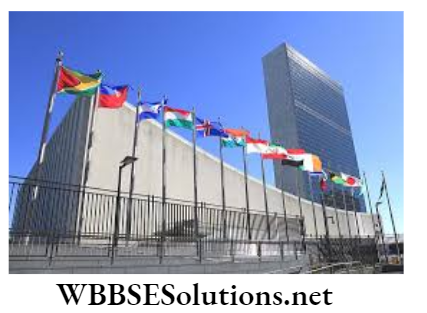
WBBSE Class 9 History Chapter 7 The League Of Nations And The United Nations Organization VSAQs United Nations Building, New York

Key SAQs on Formation of the League of Nations

Question 7. What is the seventh principle enumerated in the UN Charter?
Answer: The seventh principle enumerated in the UN Charter is that the UN would not interfere in matters strictly within the domestic jurisdiction of any state.

Question 8. How many principles have been mentioned in the UN Charter?
Answer: Seven principles have been mentioned in the UN Charter.

Question 9. How many charter members were there in the UNO?
Answer: There were 51 charter members in the UNO.

History Class 9 WBBSE

Question 10. Which countries are the five members of the Security Council with the power of Veto?
Answer: The five members of the Security Council who have the power of Veto are the USA, USSR, England, France, and China.

Question 11. What is the judicial organ of the United Nations?
Answer: The judicial organ of the United Nations is the International Court of Justice.


Question 12. How many judges are there in the International Court of Justice?
Answer: There are 15 judges in the International Court of Justice.

Question 13. How are the judges of the International Court of Justice elected?
Answer: The judges of the International Court of Justice are elected by the General Assembly and the Security Council.

Question 14. Name two organizations under the Economic and Social Council.
Answer: The two organizations under the Economic and Social Council are UNESCO (United Nations Educational Scientific and Cultural Organisation) and FAO (Food and Agricultural Organisation).

Question 15. What does UNICEF stand for?
Answer: UNICEF stands for United Nations International Children’s Emergency Fund.

Examples of Short Answer Questions on International Organizations

Question 16. Where is the headquarters of WHO?
Answer: The headquarters of WHO is in Geneva.

Question 17. What does WHO stand for?
Answer: WHO stands for World Health Organisation.

Question 18. What does UNESCO stand for?
Answer: UNESCO stands for United Nations Educational, Scientific and Cultural Organisation.

History Class 9 WBBSE

Question 19. What is the composition of the Trusteeship Council?
Answer: The Trusteeship Council is composed of the representatives of permanent members of the Security Council, representatives of all those states which hold the administration of colonies, and some representatives elected by the General Assembly.

Question 20. How is the head of the Secretariat of UNO appointed?
Answer: The head of the Secretariat, the Secretary-General, is appointed by the General Assembly on the recommendation of the Security Council.

Understanding UN Functions SAQs

Question 21. Who is the present secretary general of UNO?
Answer: The present secretary general of UNO is Antonio Guterres.

Question 22. When and where was the United Nations Declaration signed?
Answer: On 1 January 1942 the United Nations Declaration was signed in Washington.

Question 23. Where is the headquarters of the  Food and Agriculture Organisation (FAO)?
Answer: The headquarters of the Food and Agriculture Organisation is located in Rome.

WBBSE Class 9 History Chapter 7 The League Of Nations And The United Nations Organization SAQs

WBBSE Chapter 7 The League Of Nations And The United Nations Organisation Short Answer Questions

Question 1. How was the League of Nations founded?
Answer: League Of Nations Founded:-

The terrible repercussions of the First World War (1914-18) strongly impacted the people’s minds and made them cry out for peace.

President Woodrow Wilson of the United States of America took the initiative. He planned to establish a world peace organisation known as the League of Nations which would solve disputes peacefully.

Thus, the League of Nations was not only an expression of the call to peace but also a means of promoting it.

WBBSE Class 9 History Chapter 7 The League Of Nations And The United Nations Organization SAQs President Woodrow Wilson

WBBSE Class 9 League of Nations SAQs

Question 2. With what aim was the League of Nations founded?
Answer: Aim Of The League Of Nations Founded:-

After the First World War (1914-18) an international peace organisation known as the League of Nations was established in 1920 with the following aims in view:

  1. To prevent armed conflict and to promote international peace and cooperation,
  2. To establish honourable relations among different nations,
  3. To promote international disarmament to reduce tension and
  4. To find out ways and means for peaceful settlement of international disputes.

Read and Learn More WBBSE Class 9 History Short Answer Questions

WBBSE Class 9 History Chapter 7 The League Of Nations And The United Nations Organization SAQs Flag of League Of Nations

Question 3. Describe the structure of the League of Nations.
Answer: Structure Of The League Of Nations:-

The League of Nations had four main. Organs, the first of which was the Assembly consisting of representatives of every member state, meeting once a year in Geneva.

The second organ was the Council i.e., the executive committee composed of one representative from each of the five permanent states (Great Britain, France, Germany, Italy and Japan) and temporarily of nine other member states, chosen by the Assembly.

The third was the permanent Secretariat, located at Geneva the main function of which was to prepare reports for the consideration of the Assembly and the Council. The fourth organ was the Permanent Court of International Justice which was a court of arbitration for the settlement of international disputes with its office at Hague.

WBBSE Class 9 History Chapter 7 The League Of Nations And The United Nations Organization SAQs

United Nations Organization SAQs for Class 9

Question 4. Write a note on the Covenant of the As United States did not accept the League of Nations.
Answer: The Constitution of the League of Nations called the Covenant consisted of 26 articles among which the tenth, twelfth and sixteenth articles were of great significance.

Under the tenth article of the Covenant, the members of the League of Nations promised to respect the political independence and territorial integrity of the member countries of the League.

According to the twelfth article, the members unanimously decided to solve their problems, through mutual negotiations.

The sixteenth article made it clear that if any member country of the League of Nations declared war and violated settlements, that country would be declared the enemy of all nations and her aggression would be faced with all might.

NEET Biology Class 9 Question And Answers WBBSE Class 9 History Notes WBBSE Solutions for Class 9 Life Science and Environment
WBBSE Class 9 Geography And Environment Notes WBBSE Class 9 History Multiple Choice Questions WBBSE Class 9 Life Science Long Answer Questions
WBBSE Solutions for Class 9 Geography And Environment WBBSE Class 9 History Long Answer Questions WBBSE Class 9 Life Science Multiple Choice Questions
WBBSE Class 9 Geography And Environment Multiple Choice Questions WBBSE Class 9 History Short Answer Questions WBBSE Solutions For Class 9 Maths
WBBSE Solutions for Class 9 History WBBSE Class 9 History Very Short Answer Questions WBBSE Solutions for Class 9 Physical Science and Environment

Question 5. Give an account of the General Assembly of the new permanent members. The function of the League of Nations.
Answer: The League of Nations functioned through several organs, the most important of which was the Assembly. All the states which were members of the League were essentially members of the Assembly. Every member state could send three representatives, although no state had more than one vote.

The function of the Assembly of the League was:

  1. To establish world peace.
  2. To resolve international disputes.
  3. To extend international security and
  4. To work for safeguarding the interests of minorities.

Question 6. Who were the members of the League Council?
Answer:

The members of the League Council were divided into two divisions:

  1. Permanent members and
  2. Temporary members.

There were five permanent members of the Council, viz, Great Britain, USA, France, Italy and Japan. As the United States did not accept membership in the League of Nations, the number of permanent members remained at only four.

The number of temporary members was four. Later on, the number of permanent members was increased to six and temporary members to nine. Germany and Russia became the new permanent members.

Key SAQs on Formation of the League of Nations

Question 7. Give an account of the Council of the League of Nations.
Answer: Council Of The League Of Nations:-

The League Council comprised nine four temporary members. The five permanent members of which five were permanent and members were Great Britain, the USA, France, Italy membership the League, the number of and Japan. As the USA did not accept the number of permanent members permanent members remained only four. Later increased to six. Germany and Russia became the new permanent members.

The functions of the League Council were:

  1. To discuss various international disputes and to resolve them.
  2. To make efforts to stop a war and to reduce armament.
  3. Summoning of international conferences to resolve disputes.

Question 8. Who are the permanent members of the League Council?
Answer: Permanent Members Of The League Council:-

The Council of the League consisted of four permanent members. Later the number of members was increased to six. England, France, Italy and Japan were permanent members. Later on, Russia and Germany were admitted as permanent members.

Question 9. What were the main functions of the League Council?
Answer:

The main functions, of the League Council, were:

  1. To discuss various international disputes and to resolve them.
  2. To make efforts to stop war and to reduce armaments.
  3. Summoning of international conferences to resolve disputes.

Understanding UN Functions SAQs

Question 10. What was the function of the Secretariat and their obligations to the League. of the League of Nations?
Answer: The function of the Secretariat of the League of Nations was:

  1. To list the subjects to be considered in the Assembly.
  2. To preserve the documents and necessary papers regarding the minutes of the meetings, settlements and treaties concluded among the member states,
  3. To offer necessary suggestions for effecting modifications in the treaties.

Question 11. Mention any two causes of the failure of the League of Nations.
Answer: Two causes for the failure of the League of Nations were:

The League was never able to make itself truly ‘representative of the entire world. Countries like the USA, Germany, Russia, Italy and Japan were not members of the League at different stages and no international organisation can be successful if some of the great powers remain outside of it.

The League had no army, navy or air force of its own nor was it in a position to apply economic sanction on the Great Powers which looked after their interests instead of fulfilling

Question 12. Who is known as the ‘Father of the League of Nations? Who was the first secretary-general of the league?
Answer:

  1. US President Woodrow Wilson is known as the ‘Father of the League of Nations’.
  2. The first secretary general of the League of Nations was Eric Drummond.

Question 13. Mention two features of the League of Nations.
Answer:

Two features of the League of Nations were:

  1. To settle international disputes by peaceful means.
  2. To settle all international legal disputes among the members of the league.

WBBSE Chapter 7 The League Of Nations And The United Nations Organisation Short Answer Questions 

Question 14. How did the United Nations Organisation come into being?
Answer: United Nations Organisation:-

The League of Nations collapsed under the impact of the Second World War and the allied powers felt the need for a world peace organisation.

Winston Churchill, Prime Minister of Britain and Franklin Roosevelt, President of the USA announced the Atlantic Charter where the term ‘United Nations’ was first adopted.

In the Moscow Conference (1943) Britain, the USA, Russia and China were unanimous that an international peace organisation should be set up. This resolution was confirmed in the Dumbarton Oaks Conference (1944) and the Yalta Conference (1945).

Representatives of 50 nations met in San Francisco (1945) and prepared a Charter for world peace called the UN Charter. On 24 October 1945, the United Nations Organisation (UNO) came into existence.

Question 2. What are the principal aims (objectives) of the UNO?
Answer: The principal aims (objectives) of the UNO established after the Second World War are:

  1. To maintain world peace, prevent armed conflict among nations, promote the peaceful settlement of international disputes and remove international tension.
  2. To promote education, culture and health of mankind and to promote the economic condition of the poor and underdeveloped nations.

WBBSE Class 9 History Chapter 7 The League Of Nations And The United Nations Organization SAQs Flag of the UNO

Question 3. What is the UN Charter?
Answer: UN Charter:-

Between April and June 1945 representatives of 50 nations who were directly or indirectly involved in the war against the Axis Powers (Germany, Italy and Japan) met at a conference in San Francisco. The Big Four (Britain, France, USA, and Russia) dominated the conference and prepared a charter for world peace called the UN Charter.

Class 9 History WBBSE

Question 4. What are the basic principles of UNO?
Answer: The basic principles of UNO are:

  1. All the members, big or small, to enjoy the rights and benefits would sincerely carry out their duties as per the UNO charter.
  2. All the members shall settle international disputes by peaceful means.
  3. UNO would not interfere in the internal affairs of any country.
  4. All members would enjoy the same sovereign status.
  5. All members pledge to help.
  6. All members would safeguard world peace.

WBBSE Class 9 History Chapter 7 The League Of Nations And The United Nations Organisation SAQs Basic Priniciples of the UNO

Practice SAQs for Class 9 History: League of Nations and UN

Question 5. Write a note on membership of the UNO.
Answer:

Membership Of The UNO:-

  1. The membership of the UNO is open to all peace-loving nations of the world which accept the obligation of the UNO and are willing to carry out these obligations.
  2. 51 states who signed the UN Charter are the original members of the UN.
  3. Any member could be admitted to the UN on the recommendation of the Security Council and by a vote of assent by of the existing members of the General Assembly.
  4. America, England, France, Russia and China are the permanent members of the UN Security Council.
  5. If member countries persistently violate the principles of the Charter they may be expelled by the General Assembly on the recommendation of the Security Council.

Question 6. What is the function of the International Court of Justice?
Answer: Function Of The International Court Of Justice:-

The function of the International Court of Justice is to solve the legal disputes that arise between different countries e.g. interpretation of treaties, application of principles of international law to a particular dispute or situation and settling issues of commensurate compensation for breach of international law etc. It also gives legal advice to the Security Council and the General Assembly.

Question 7. What is FAO and WHO?
Answer: FAO And WHO:-

FAO and WHO are two specialised agencies of the Economic and Social Council. FAO is the Food and Agricultural Organisation and WHO is the World Health Organisation.

Question 8. What are the six main organs of the UNO?
Answer:

The six main organs of the United Nations organisation are:

  1. The General Assembly.
  2. The Security Council.
  3. The Economic and Social Council.
  4. The Trusteeship Council.
  5. The International Court of Justice and
  6. The Secretariat.

WBBSE Class 9 History Chapter 7 The League Of Nations And The United Nations Organization SAQs Organs of the UNO

Question 9. Why is 24 October celebrated as United Nations Day?
Answer: 24 October Celebrated As United Nations Day:-

Between April and June of 1945, representatives of 50 nations who were directly or indirectly involved in the war against the Axis Powers met at a conference led by Britain, France, the USA and Russia at San Francisco and prepared a charter for world peace called the UN Charter. The Charter became officially effective on 24 October. So this day is celebrated as the United Nations Day.

Question 10. What is ‘Veto’?
Answer: Veto:-

The foremost responsibility of the Security Council is the maintenance of international peace and security. All the five permanent members of the Security Council (USA, USSR, UK, France and China) must agree on all important issues.

A negative vote by any one permanent member is called a ‘Veto’. If the Veto is exercised, then the proposal or resolution is considered not passed. So on this issue, the Security Council cannot take any action.

Class 9 History Solutions WBBSE

Question 11. What are the different specialised agencies of the Economic and Social Council?
Answer: The different specialised agencies of the Economic and Social Council are:

  1. ILO (International Labour Organisation).
  2. UNESCO (United Nations Educational Scientific and Cultural Organisation).
  3. WHO (World Health Organisation).
  4. FAO (Food and Agricultural Organisation).
  5. IMF(International Monetary Fund)

Key Themes in UN History for SAQs

Question 12. What is the composition of the General Assembly?
Answer: Composition Of The General Assembly:-

The General Assembly of the UNO consists of all member states of the United Nations Organisation. Each member state can send five representatives to the session of the General Assembly. The total strength of the UN General Assembly is now 193.

Question 13. What is the composition of the Security education, and improvement of the standard of the Council of the United Nations Organisation? Or, Write a note on the membership of the Security Council.
Answer: The most important organ of the UNO is the Security Council. There are two types of members Permanent and non-permanent. Five permanent members are the USA, USSR, UK, France and China. The ten non-permanent members are elected by the General Assembly for a term of two years.

Question 14. Name the permanent members of the Security Council of the UNO.
Answer:

The permanent members of the Security Council of the UNO are:

  1. America.
  2. England.
  3. France.
  4. Soviet Russia.
  5. China.

WBBSE Class 9 History Chapter 7 The League Of Nations And The United Nations Organization SAQs Main Committees of General Assembly of the UNO

Question 15. What are the functions of UNESCO?
Answer: Functions Of UNESCO:-

UNESCO deals with the issues of economic and social welfare and works for the preservation of human rights across the globe. This body fights against illiteracy and devotes itself to the protection of health, and the spread of living of the people. The task before UNESCO includes education, social science, natural science, mass communication, cultural activities and relief services.

Question 16. What are the functions of WHO?
Answer: Functions Of WHO:-

WHO (World Health Organisation) organises campaigns throughout the world against diseases such as pox, plague, smallpox, cholera and others. It undertakes medical research to find out the causes of diseases, improve vaccines and train medical research and aid workers.

Question 17. What are the functions of UNICEF?
Answer: Functions Of UNICEF:-

The function of UNICEF is to help the establishment improve the condition of member countries improve the health condition of their children and save the lives of sick or starving children in the world who suffer from malnutrition, hunger and different kinds of diseases. It also looks after social welfare and vocational training of children. It also helps in the production of inexpensive books for children.

Examples of Short Answer Questions on International Organizations

Question 18. What are the functions of the Security countries? An indirect function of the Trustee- Council of the UNO?
Answer: The functions of the Security Council of the UNO are:

  1. To maintain international peace and security,
  2. To investigate all disputes and recommend ways and means for a peaceful settlement,
  3. To take action against a defaulting state and ask its members to send military forces to control a dangerous
    situation.

Question 19. What are the functions of the Economic and Social Council?
Answer: The functions of the Economic and Social Council (ECOSOC), a non-political organ of the UNO are:

  1. To promote the economic and social advancement of all people,
  2. Planning of economic development, financial and technical assistance to underdeveloped countries, industrialisation of backward countries, improvement of education and aid to the world’s needy children,
  3. To appoint special committees from time to time to study specific problems.

Question 20. Write a short note on the International Labour Organisation (ILO).
Answer: International Labour Organisation (ILO):-

The headquarters of the International Labour Organisation was established in Geneva. All the member-states were also members of the International Labour Organisation. The main aim behind its establishment was to improve the condition of the labourers in different countries.

Question 21. Write a note on the function of the Trusteeship Council.
Answer: Function Of The Trusteeship Council:-

After World War II, some underdeveloped countries were placed under the supervision of the Council. The primary task of the Council is to look after the economic, social, political and cultural development of these Countries.

An Indirect function of the Trusteeship Council is to eliminate the possibility of rivalry among powerful nations of the world for the exploitation of underdeveloped nations.

Question 22. What is the function of the head of the Secretariat?
Answer: Function Of The Head Of The Secretariat:-

The head of the Secretariat, the Secretary-General, prepares an annual progress report of the UNO and places it before the General Assembly. He has the right to draw the attention of the Security Council to any matter which in his opinion, may threaten international security.

Question 23. When was the Yalta Conference held? Name the countries which took part in the Yalta Conference.
Answer:

  1. The Yalta Conference was held in 1945.
  2. The countries which took part in the Yalta Conference were the USA, Britain and Russia.

Question 24. When and where was the Atlantic Charter signed?
Answer: Atlantic Charter:-

The Atlantic Charter was signed on 11 August 1941. Winston Churchill, the Prime Minister of Britain, and Franklin Roosevelt, President of the USA met together on a warship called the ‘Prince of Wales’ in the Atlantic Ocean near Newfoundland and signed the Atlantic Charter.

Question 25. What is the importance of the Atlantic Charter?
Answer: Importance Of The Atlantic Charter:-

The Atlantic Charter is important because it contained the aims and fundamental principles for the reconstruction of the post-Second World War. An indication to set up a world organisation for the preservation of peace in the world was given in this Charter. In this Charter, the term ‘United Nations’ was first adopted.

Question 26. Mention two limitations of the UNO.
Answer:

Limitations Of The UNO:-

  1. The first limitation of the UNO is that the right of absolute veto has been given to each of the ‘Big Five (USA, UK, France, China and Russia). The Big Powers have always on several occasions misused this right in their self-interest.
  2. UNO has not achieved success in gaining the cooperation of all the ‘Big Five’ at a time on the question of the enforcement of the decision of the Security Council with the help of an international army.

WBBSE Class 9 History Chapter 7 The League Of Nations And The United Nations Organization SAQs United Nations Office at Geneva

Question 27. Give an account of the success and failure of the League of Nations.
Answer: Success And Failure Of The League Of Nations:-

The League of Nations utterly failed in its fundamental aim to prevent war and to maintain peace and order in the world permanently. The world had to witness again the Second World War in 1939 which proved the failure of the League.

On the other hand, if we evaluate the work of the League of Nations we find that the League tried its best to solve political disputes and the controversies which arose among different countries. In addition to this, the League acted also in the social and humanitarian fields for the benefit of mankind.

WBBSE Class 9 History Chapter 6 The Second World War And Its Aftermath MCQs

WBBSE Class 9 History West Bengal Board Chapter 6 The Second World War And Its Aftermath Multiple Choice Questions

Question 1. The main cause of World War II was the

  1. Balkan War
  2. World War 1
  3. Russo-German War
  4. Anglo-French War

Answer: 2. World War 1

Question 2. Chamberlain took assurance from Hitler that Germany would be satisfied by

  1. Occupation of Rhineland
  2. Occupation of Poland
  3. Cession to her of Sudetenland
  4. Cession to her of Baltic states

Answer: 2. Occupation of Poland

Question 3. A secret additional pact to divide Poland was made between-

  1. Russia and Germany
  2. Germany and Italy
  3. Italy and France
  4. England and France

Answer: 1. Russia and Germany

Question 4. To plan global military strategy, top Allied leaders held a series of conferences such as the ones at

  1. Versailles
  2. Tehran
  3. Paris
  4. Berlin

Answer: 2. Tehran

Read and Learn More WBBSE Class 9 History Multiple Choice Questions

Question 5. At the Munich Conference in 1938, a region of this nation was given to Adolf Hitler by the British and the French-

  1. Czechoslovakia
  2. Holland
  3. Poland
  4. Austria

Answer: 1. Czechoslovakia

WBBSE Class 9 Second World War MCQs

Question 6. Which Allied army fought its way to Berlin and reached the city first?

  1. England
  2. Soviet Russia
  3. France
  4. USA

Answer: 2. Soviet Russia

WBBSE Class 9 History Chapter 6 The Second World War And Its Aftermath MCQs

Key MCQs on Aftermath of World War II

Question 7. When did Hitler become Chancellor of Germany?

  1. 1793
  2. 1795
  3. 1796
  4. 1801

Answer: 2. 1795

Question 8. What was the last major attempt at a peaceful resolution with Germany before the outbreak of World War II?

  1. Potsdam Conference
  2. The Washington Conference
  3. The Munich Conference
  4. Yalta Conference

Answer: 3. The Munich Conference

Key Themes in WWII History for MCQs

Question 9. The main Axis Powers of World War II consisted of-

  1. Germany, Finland, Japan
  2. Germany, Italy, Japan
  3. Germany, Russia, Italy
  4. Germany, Italy, Belgium

Answer: 2. Germany, Italy, Japan

Question 10. The term ‘D-Day’ refers to

  1. Allied invasion of the coast of Normandy
  2. Allied invasion of Italy
  3. Allied invasion of Germany
  4. Allied invasion of Poland

Answer: 1. Allied invasion of the coast of Normandy

Question 11. World War II broke out on-

  1. 1 September 1938
  2. 3 September 1939
  3. 5 December 1933
  4. 9 August 1937

Answer: 2. 3 September 1939

Understanding Political Changes Post-World War II MCQs

Question 12. What agreement did Hitler defy when the invasion of the USSR began?

  1. Hitler-Stalin agreement
  2. Molotov-Ribbentrop Pact
  3. Comprehensive Nuclear Test Ban Treaty
  4. Treaty of Versailles

Answer: 2. Molotov-Ribbentrop Pact

Class 9 History West Bengal Board

Question 13. What day was the invasion of Normandy or D-Day?

  1. 6 June 1943
  2. 12 May 1940
  3. 6 June 1944
  4. 3 September 1946

Answer: 3. 6 June 1944

Question 14. What caused the United States to enter the war on the side of the Allies?

  1. Germany’s invasion of France
  2. Germany’s invasion of Poland
  3. Japan’s attack on Pearl Harbour
  4. Russia’s entry into the war

Answer: 3. Japan’s attack on Pearl Harbour

Question 15. A great supporter of aggressive nationalism-

  1. Churchill
  2. Stalin
  3. Hitler
  4. Roosevelt

Answer: 3. Hitler

Question 16. The top allied leaders held a conference in

  1. Normandy
  2. Venice
  3. Tehran
  4. Moscow

Answer: 3. Tehran

Question 17. European Recovery Programme was announced by

  1. Hitler
  2. Goering
  3. Mussolini
  4. George Marshall

Answer: 4. George Marshall

Practice MCQs for Class 9 History: The Second World War

Question 18. The United Nations Organisation was established-

  1. To divide Germany into four zones
  2. To establish international peace
  3. To supervise the working of Germany
  4. To preserve neutrality among the allies

Answer: 2. To establish international peace

Question 19. Mussolini occupied the Greek island of Corfu in 1923.

  1. Italy deserved Corfu Island.
  2. Italy accused Greece of killing several Italians.
  3. Italy was deprived of getting Corfu
  4. Island at the Paris Peace Conference (1919).

Answer: 2. Italy accused Greece of killing several Italians.

Question 20. Japan and Germany signed the Anti-Comintern Pact in 1936.

  1. Japan and Germany planned to occupy Manchuria of China.
  2. Japan and Germany wanted to stop England’s efforts.
  3. Japan and Germany wanted to stop the progress of Communism.

Answer: 3. Japan and Germany wanted to stop the progress of Communism.

NEET Biology Class 9 Question And Answers WBBSE Class 9 History Notes WBBSE Solutions for Class 9 Life Science and Environment
WBBSE Class 9 Geography And Environment Notes WBBSE Class 9 History Multiple Choice Questions WBBSE Class 9 Life Science Long Answer Questions
WBBSE Solutions for Class 9 Geography And Environment WBBSE Class 9 History Long Answer Questions WBBSE Class 9 Life Science Multiple Choice Questions
WBBSE Class 9 Geography And Environment Multiple Choice Questions WBBSE Class 9 History Short Answer Questions WBBSE Solutions For Class 9 Maths
WBBSE Solutions for Class 9 History WBBSE Class 9 History Very Short Answer Questions WBBSE Solutions for Class 9 Physical Science and Environment


Question 21. Munich Agreement (1939) was failed.

  1. France was not interested in signing the Munich Agreement.
  2. England was not interested in signing the Munich Agreement.
  3. Hitler seized the whole of Czechoslovakia.

Answer: 3. Hitler seized the whole of Czechoslovakia.

Question 22. Mussolini invaded and occupied Abyssinia in Africa.

  1. Abyssinia was located between Somaliland and Eritrea which were under Italian rule.
  2. Abyssinia attacked Italian the border.
  3. Abyssinia was previously under Italian rule.

Answer: 1. Abyssinia was located between Somaliland and Eritrea which were under Italian rule.

Examples of Multiple Choice Questions on WWII Events

Question 24. America formed NATO after World War II.

  1. To be saved from the war in future.
  2. To counter the aggression of communist Russia.
  3. To plan the Third World War.

Answer: 2. To counter the aggression of communist Russia.

Question 25. After World War II, the Cold War started between the USA and the USSR.

  1. Mutual suspicion grew between the two powers after the war.
  2. Cold War was the inevitable consequence of World War.
  3. The USA and USSR no longer agreed to participate in a direct conflict.

Answer: 1. Mutual suspicion grew between the two powers after the war.

WBBSE Class 9 History Chapter 6 The Second World War And Its Aftermath VSAQs

WBBSE Class 9 History Chapter 6 The Second World War And Its Aftermath Very Short Answer Questions

Question 1. Which treaty is known as a ‘dictated peace’?
Answer: The Treaty of Versailles is known as a ‘dictated peace’.

Question 2. What is the name of the republic that was established after 1918 in Germany?
Answer: The name of the Republic that was established after 1918 in Germany was known as the Weimer Republic.

Question 3. On which date did the Second World War begin?
Answer: The Second World War began on 1st September 1939.

Question 4. Who was the Prime Minister of England when the Second World War started?
Answer: Neville Chamberlain was the Prime Minister of England when the Second World War started.

Read and Learn More WBBSE Class 9 History Very Short Answer Questions

Question 5. Who was the Prime Minister of France when the Second World War broke out?
Answer: Daladier was the Prime Minister of France when the Second World War broke out.

Question 6. Who was the founder of the Nazi Party?
Answer: The founder of the Nazi Party was Hitler.

Question 7. When did Germany withdraw from the League of Nations?
Answer: Germany withdrew from the League of Nations in 1933.

Question 8. Which country was first attacked by Hitler during the Second World War?
Answer: Poland was first attacked by Hitler during the Second World War.

Question 9. Which port of Poland was demanded by Hitler?
Answer: Danzig, a port in Poland was demanded by Hitler.

WBBSE Class 9 History Chapter 6 The Second World War And Its Aftermath VSAQs

WBBSE Class 9 Second World War VSAQs

Question 10. Who was Hindenburg?
Answer: Hindenburg was the President of the German Republic.

Question 11. Which country other than Germany and Italy was part of the Axis group of nations?
Answer: Japan was part of the Axis group of nations other than Germany and Italy.

Question 12. Which British Prime Minister appeased Germany?
Answer: The British Prime Minister who appeased Germany was Neville Chamberlain.

Question 13. When did Japan attack Manchuria?
Answer: Japan attacked Manchuria in 1931.

Question 14. Which British warships were drowned by German U-boats?
Answer: The British warships HMS Courageous and the HMS Royal Oak were drowned by German U-boats.

Question 15. Who was Mac Arthur?
Answer: Mac Arthur was an American military General.

Question 16. Which American naval base in the Pacific Ocean was attacked by Japan?
Answer: The American naval base at Pearl Harbour was attacked by Japan.

Question 17. In which year was Pearl Harbour attacked by Japan?
Answer: Pearl Harbour was attacked by Japan in 1941.

Question 18. In which year did Hitler attack Russia?
Answer: Hitler attacked Russia in 1941.

Key VSAQs on Aftermath of World War II

Question 19. In which year did Japan surrender to the Allies during the Second World War?
Answer: Japan surrendered to the Allies during the Second World War in 1945.

Question 20. When did the Second World War come to an end?
Answer: The Second World War came to an end in 1945.

WBBSE Class 9 History

Question 21. Where is Pearl Harbour located?
Answer: Pearl Harbour is located on the island of O’ahu in Hawaii.

Question 22. Who were the US Presidents during World War II?
Answer: Franklin Delano Roosevelt and Harry S Truman both served as United States Presidents during World War II.

Question 23. Name the World War II General who went on to become President of the United States of America.
Answer: The World War II General Eisenhower went on to become the President of the United States of America.

Question 24. In which year was the Tehran Conference held?
Answer: The Tehran Conference was held in 1944.

Question 25. In which year was the San Francisco Conference held?
Answer: The San Francisco Conference was held in 1945.

NEET Biology Class 9 Question And Answers WBBSE Class 9 History Notes WBBSE Solutions for Class 9 Life Science and Environment
WBBSE Class 9 Geography And Environment Notes WBBSE Class 9 History Multiple Choice Questions WBBSE Class 9 Life Science Long Answer Questions
WBBSE Solutions for Class 9 Geography And Environment WBBSE Class 9 History Long Answer Questions WBBSE Class 9 Life Science Multiple Choice Questions
WBBSE Class 9 Geography And Environment Multiple Choice Questions WBBSE Class 9 History Short Answer Questions WBBSE Solutions For Class 9 Maths
WBBSE Solutions for Class 9 History WBBSE Class 9 History Very Short Answer Questions WBBSE Solutions for Class 9 Physical Science and Environment


Question 26. Who is the author of the poem ‘The White Man’s Burden’?
Answer: The author of the poem ‘The White Man’s Burden’ is Rudyard Kipling.

Question 27. What is the concept of ‘The White Man’s Burden’?
Answer: ‘The White Man’s Burden’ is the idea that white people are superior to the non-white races and so, colonial rulers must take care of and ‘civilise’ the native inhabitants of their colonies.

Understanding Causes of the Second World War VSAQs

Question 28. When and between whom was the Russo-German Non-Aggression Pact signed?
Answer: The Russo-German Non-Aggression Pact was signed on 23 August 1939 between Russian foreign minister Molotov and German foreign minister Ribbentrop.

Question 29. After which incident did the USA join the Second World War?
Answer: When Japan attacked the US naval base at Pearl Harbour, USA joined the World War II.

Question 30. What was the direct cause of the Second World War?
Answer: The direct cause of the Second World War was Hitler’s attack on Poland.

Question 31. Which day is known as the ‘D-Day’ (Deliverance Day)?
Answer: 6th June 1944 is known as the ‘D-Day’.

WBBSE Class 9 History

Question 32. Who followed the policy of appeasement?
Answer: The Prime Minister of Britain, Neville Chamberlain and Edouard Daladier, the Premier of France followed this policy.

Question 33. Name the countries which took part in the Second World War.
Answer: The countries which took part in the Second World War were Germany, Italy, Japan, Britain, France, Soviet Union, USA, Poland, Yugoslavia, Romania, Greece, Austria, Czechoslovakia, Hungary, Holland, Belgium, Finland, Bulgaria, Albania, Norway, Denmark etc.

Question 34. When did the Second World War come to an end?
Answer: The Second World War came to an end on 2 September 1945.

Question 35. For how many years did the Second World War continue?
Answer: The Second World War started on 1 September 1939 and ended on 2 September, 1945-so the war continued for 6 years.

Question 36. What was the aim of the Versailles Treaty?
Answer: The Treaty of Versailles aimed to weaken Germany both economically and militarily.

Question37. In which year was the Battle of Britain fought?
Answer: The Battle of Britain was fought in 1940.

Question 38. What was the main reason for the defeat of Germany in the Second World War?
Answer: The main reason for the defeat of Germany in the Second World War was the conspiracy of the German generals and the discontent of the soldiers.

Question 39. Name the Czar of Russia who established his capital at Leningrad.
Answer: The Czar of Russia who established his capital at Leningrad was Peter the Great.

Question 40. Who followed the ‘One by one policy’?
Answer: Hitler, the German dictator, followed the ‘One by one policy.

Practice VSAQs for Class 9 History: The Second World War

Question 41. Why was Hitler in favour of a union between Germany and Austria?
Answer: Hitler was in favour of the union between Germany and Austria as a sizeable number of Germans lived in Austria.

Question 42. Under whose leadership did the Russian
Answer: Under the leadership of Marshall Zhukov’s army defeated the Germans. the Russian army defeated the Germans.

History Class 9 WBBSE

Question 43. How did the USA become the arsenal of democracy?
Answer: The USA became the arsenal of democracy when the American Senate enacted the Lend-Lease Act in March 1941 and allowed the US government to offer warships, warplanes and other weapons to the Allied powers to fight against Fascism.

Question 44. Which Act made the USA the ‘Arsenal of Democracy’?
Answer: The Lend-Lease Act enacted by the American Senate in 1941 made the USA the ‘Arsenal of Democracy’.

Question 45. Which day is regarded as a date which will live in infamy in the USA?
Answer: The day which is regarded as a date which will live in infamy in the history of the USA is 7 December 1941 as Japan bombed the US naval base at Pearl Harbour on this day.

Question 46. When was ‘Victory-in-Europe Day’ observed?
Answer: Germany surrendered to the Allied Powers formally on May 7, 1945, and the whole of Europe observed May 8, 1945, as ‘the Victory-in-Europe Day’.

Question 47. What was the Grand Alliance?
Answer: The USA, Great Britain and Soviet Russia allied against the Axis powers which is known as the Grand Alliance.

Question 48. What was the ‘Lend-Lease Act’?
Answer: The American Senate enacted the Lend-Lease Act in March 1941 and allowed the US government to offer warships, warplanes and other weapons to the Allied powers to fight against fascism.

Question 49. Under whose leadership did the German soldiers start ‘Operation Barbarossa’?
Answer: The German soldiers started ‘Operation Barbarossa’ under the leadership of Hitler.

Question 50. When and by whom was the Anglo-Russian Alliance signed?
Answer: Churchill, the British Prime Minister, concluded the Anglo-Russian Alliance of 1941.

Question 51. Which incident made the Far East the centre of war during World War II?
Answer: The Japanese attack on the US naval base at Pearl Harbour made the Far East the centre of war during World War II.

Examples of Very Short Answer Questions on WWII Events

Question 52. After which invasion did the ‘Beginning of the End’ of Germany start under the leadership of Hitler?
Answer: After the invasion of Russia, the ‘Beginning of the end’ of Germany started under the leadership of Hitler.

Question 53. Name the two atom bombs dropped by the USA on Japan.
Answer: The USA dropped the atomic bombs named ‘Little Boy on Hiroshima and ‘Fat Man’ on Nagasaki in Japan.

History Class 9 WBBSE

Question 54. Why did Hitler attack Poland?
Answer: After the Munich Pact, Hitler demanded the use of the port of Danzig and also the Polish corridor to reach the port. When Poland refused this demand, Hitler attacked Poland.

Question 55. What was the aim of Hitler’s foreign policy?
Answer: Hitler’s foreign policy aimed at German expansion in East Europe to carve out some ‘Living Space’ (Lebensraum) for the surplus German population.

Class 9 History WBBSE Chapter 6 The Second World War And Its Aftermath Very Short Answer Questions

Question 56. Who first popularised the term ‘Cold War’?
Answer: The term ‘Cold War’ was first popularised by Walter Lipmann.

Question 57. Name the two parties in the Cold War.
Answer:

The two parties in the Cold War were

  1. United States of America and
  2. Soviet Russia.

Question 58. Which two superpowers were the main rivals in the Cold War?
Answer:

The two superpowers who were the main rivals in the Cold War were

  1. United States of America and
  2. Soviet Russia.

Question 59. What does NATO stand for?
Answer: NATO stands for North Atlantic Treaty Organisation.

Class 9 History WBBSE

Question 60. What does SEATO stand for?
Answer: SEATO stands for South East Asia Treaty Organisation.

Question 61. In which year was the Truman Doctrine proclaimed?
Answer: The Truman Doctrine was proclaimed in 1947.

Question 62. In which year was the Marshall Plan proclaimed?
Answer: The Marshall Plan was proclaimed in 1947.

Important Figures in WWII History VSAQs

Question 63. What is meant by Third World countries?
Answer: A group of developing countries in Asia, Africa and South America which achieved independence after the Second World War were known as the Third World countries.

Question 64. When was the UNO established?
Answer: UNO was established on 24 October 1945.

Question 65. What is the Non-Alignment policy?
Answer: Non-alignment policy which aims at ensuring international peace, means keeping away from the two military blocks led by the USA and USSR and solving all international conflicts and disputes peacefully through cooperation.

Question 66. To which country did Admiral Karl Donitz belong during the Second World War?
Answer: Karl Donitz was the admiral of Germany during the Second World War.

Question 67. Who wrote the poem ‘The White Man’s Burden’?
Answer: Rudyard Kipling wrote the poem ‘The White Man’s Burden’.

Question 68. In which essay did Rabindranath criticise radical nationalism?
Answer: Rabindranath in his essay ‘The Crisis in Civilisation’ criticised radical nationalism.

Key Themes in WWII History for VSAQs

Question 69. What is V-2? Which country used the V-2 during the Second World War?
Answer:

  1. V-2 was the rocket used during the Second World War.
  2. V-2, the long-range rocket was used by Germany during the Second World War.

Question 70. Which country used the V-2 rocket and against whom?
Answer: During the Second World War Germany used a V-2 rocket against England.

Question 71. Who coined the term ‘Third World’?
Answer: Alfred Sauvy coined the term ‘Third World’.

Class 9 History WBBSE

Question 72. What was the name of the atomic bomb dropped on the Japanese city of Hiroshima?
Answer: The name of the atomic bomb dropped on the Japanese city of Hiroshima is ‘Little Boy’.

Question 73. Which day is celebrated as Hiroshima and Nagasaki Day?
Answer: August 9 is celebrated as Hiroshima and Nagasaki Day.

Question 74. Name the international organisation established after the Second World War.
Answer: The international organisation established after the Second World War was the United Nations Organisation (UNO).

WBBSE Class 9 History Chapter 6 The Second World War And Its Aftermath SAQs

WBBSE Class 9 History Chapter 6 The Second World War And Its Aftermath Short Answer Questions

Question 1. Name the Allied and Axis powers in the Second World War.
Answer: Allied And Axis Powers In The Second World War:-

In the Second World War, the Allied powers were England, France, the USSR, the USA and China. The Axis powers were Italy, Germany and Japan.

WBBSE Class 9 History Chapter 6 The Second World War And Its Aftermath SAQs Second World War

WBBSE Class 9 Second World War SAQs

Question 2. Through which military campaign did Mussolini try to fulfil his imperial ambition?
Answer: The fascist government under Mussolini became hungry for colonies and Mussolini tried to fulfil his imperial ambitions through his military campaign in the East African country of Ethiopia (Abyssinia). In 1935 he attacked Ethiopia to exploit its minerals and raw materials for industrial development and Ethiopia was formally annexed in 1936.

Read and Learn More WBBSE Class 9 History Short Answer Questions

Question 3. Write a note on the bombing by the USA at Hiroshima and Nagasaki.
Answer: Bombing By USA At Hiroshima And Nagasaki:-

The USA prepared a plan to drop a newly discovered atomic bomb on Japan on August 6, 1945.

The atomic bomb was dropped on Hiroshima, an industrial town in Japan, which destroyed half the city and caused 80,000 deaths. This was the first use of the atomic bomb during World War II.

On August 9, a second atomic bomb was dropped in Nagasaki in Kyum, destroying the whole municipal area and killing 40,000 people. The whole world was alarmed at the extensive destructive capacity of these new weapons.

WBBSE Class 9 History Chapter 6 The Second World War And Its Aftermath SAQs Mushroom Cloud Over Hiroshima

Key SAQs on Aftermath of World War II

Question 4. Why did Hitler sign the Munich Pact?
Answer: Hitler Sign The Munich Pact:-

England and France followed the policy of appeasement towards Hitler and signed the Munich Pact in 1938. Hitler agreed to sign the Munich Pact because-

  1. Germany was authorised to occupy four border provinces of Czechoslovakia within ten days.
  2. The Czechoslovakian government was forced to release all the political prisoners of Sudeten- land. This territory was also given to Germany.

WBBSE Class 9 History Chapter 6 The Second World War And Its Aftermath SAQs

Understanding Causes of the Second World War SAQs

Question 5. Which incident forced the USA to join the Second World War?
Answer: The sudden Japanese air attack with 360 aircraft struck the American fleet at Pearl Harbour in the Hawaiian Islands on 7 December 1941″ and wiped out all the American planes on the ground there. This incident at Pearl Harbour forced the USA to join the Second World War.

NEET Biology Class 9 Question And Answers WBBSE Class 9 History Notes WBBSE Solutions for Class 9 Life Science and Environment
WBBSE Class 9 Geography And Environment Notes WBBSE Class 9 History Multiple Choice Questions WBBSE Class 9 Life Science Long Answer Questions
WBBSE Solutions for Class 9 Geography And Environment WBBSE Class 9 History Long Answer Questions WBBSE Class 9 Life Science Multiple Choice Questions
WBBSE Class 9 Geography And Environment Multiple Choice Questions WBBSE Class 9 History Short Answer Questions WBBSE Solutions For Class 9 Maths
WBBSE Solutions for Class 9 History WBBSE Class 9 History Very Short Answer Questions WBBSE Solutions for Class 9 Physical Science and Environment

WBBSE Class 9 History Short Answer Questions On The Second World War

Question 6. Write a note on the Battle of Leningrad.
Answer: Battle Of Leningrad:-

At the initial stage of the Second World War, the German army achieved great success. They besieged Leningrad.

The Soviet army followed the ‘Scorched Earth’ policy and guerilla model of warfare. As a result, the Nazi forces began to retreat. At the beginning of 1942, Leningrad was vacated by the Russian Red Army.

WBBSE Class 9 History Chapter 6 The Second World War And Its Aftermath SAQs Siege Of Leningrad

Question 7. Which book is known as the ‘Bible of the Nazi Party’? Who was its author?
Answer:

  1. ‘Mein Kampf is known as the Bible of the Ans.! In 1933 Germany withdrew from the Nazi Party.
  2. Its author was Hitler.

Question 8. Why did Germany withdraw from the League of Nations?
Answer: In 1933 Germany Withdrew from the League of Nations. According to the terms of the Treaty of Versailles Germany was disarmed. Germany’s demands for military parity with other European powers were refused by the Western powers, so Germany withdrew itself from the League of Nations.

Question 9. What was the Vichy government?
Answer: Vichy Government:-

A puppet French government led by Petain was established under the control of Germany in France. As Vichy was the capital of this new French government it was also called the Vichy Government.

Practice SAQs for Class 9 History: The Second World War

Question 10. When was the Yalta Conference held? Name the countries which took part in the Yalta Conference.
Answer:

  1. The Yalta Conference was held in 1945.
  2. The countries which took part in the Yalta Conference were the USA, Britain and Russia.

Question 11. Name three prominent leaders who attended the Yalta Conference. Name any two military alliances which came into being as a consequence of the Cold War.
Answer:

Three prominent leaders who attended the Yalta Conference were

  1. Roosevelt, the President of America
  2. Churchill, the British Prime Minister and
  3. Stalin, the President of the USSR.

Two military alliances which came into being as a consequence of the Cold War were

  1. NATO (North Atlantic Treaty Organisation) and
  2. Warsaw Pact.

WBBSE Class 9 History Chapter 6 The Second World War And Its Aftermath Franklin SAQs Roosevelt and Stalin

Examples of Short Answer Questions on WWII Events

Question 12. What is Operation Barbarossa?
Answer: Operation Barbarossa:-

On June 22, 1941, Nazi Germany and its allies began a massive invasion of the Soviet Union under Operation Barbarossa.

Hitler changed the original name Operation Fritz to Operation Barbarossa to refer to Frederick Barbarossa, the Holy Roman Emperor, who had set out to conquer the Holy Land in 1190.

Question 13. What is Seigfreid Line?
Answer: Seigfreid Line:-

Seigfreid Line was a line of defensive forts and tank defences built along the German western frontier opposite the French Maginot Line in the 1930s and greatly expanded in 1941.

Question 14. Name the principal dictators of Europe who rose to power after the First World War.
Answer: The principal dictators of Europe who rose to power after the First World War were Mussolini of Italy, Hitler of Germany and General Franco of Spain.

Question 15. What were the main aims of Hitler’s foreign policy?
Answer: The main aims of Hitler’s foreign policy were:

  1. To revise the humiliating Treaty of Versailles.
  2. To unify Germany and to unite all German-speaking people into one Reich.
  3. The eastward expansion of Germany to achieve ‘Lebensraum’ (Living space).
  4. To make Germany a powerful nation and to destroy communism.

Question 16. What is the significance of Italy’s attack on Abyssinia?
Answer: The significance of Italy’s attack on Abyssinia was:

  1. It exposed the weakness of the League of Nations.
  2. The prestige of the League of Nations was damaged.
  3. Italy’s attack on Abyssinia encouraged Hitler in his aggressive policy.
  4. Italy and Germany came closer together.

Question 17. What steps were taken by the League of Nations when Italy attacked Abyssinia?
Answer: When Italy attacked Abyssinia, the League of Nations declared Italy as an aggressor country. Moreover, the League of Nations directed the member countries of the League to stop all sorts of commercial relationships with Italy.

Question 18. Why did Hitler and Mussolini come closer to each other and become allies?
Answer: The reasons why Hitler and Mussolini came closer to each other and became allies were:

  1. Both were against the Treaty of Versailles signed in 1919.
  2. France was the enemy of both Italy and Germany.
  3. Both countries were supporters of aggressive nationalism.

Question 19. Give some examples of the Anglo-French policy of appeasement.
Answer: Some examples of the Anglo-French policy of appeasement were:

  1. Italy’s attack on Abyssinia.
  2. Franco’s military regime was supported by Hitler and Mussolini during the Spanish Civil War.
  3. The occupation of Austria by Germany, England and France remained inactive during the aggressive policy of Italy and Germany.

WBBSE Chapter 6 Short Questions On World War II Events And Aftermath

Question 1. How can you explain the Second World War as a struggle between Fascism and Nazism versus Democratic ideals?
Answer: The Second World War was in fact, the struggle of two contradictory principles, i.e., Fascism and Nazism versus democratic principles.

England, France and America were the supporters of the principles of democracy, while the principles of autocracy were fully supported by Nazi Germany and Fascist Italy. Thus war was inevitable between the supporters of these two contradictory principles.

Question 2. What is UNRRA?
Answer: UNRRA:-

As a result of the Second World War, there was destruction, devastation and despair in the whole of Europe.

In order to regenerate the economy of the devastated countries United Nations Relief and Rehabilitation Administration (UNRRA) was set up in 1943 in Washington, USA.

It was an international body to provide relief to countries liberated from the German occupation. This economic recovery programme provided substantial economic help to war-ravaged countries like Poland, Italy, Yugoslavia, Czechoslovakia, Greece, Austria etc.

Question 3. What was the ‘Fulton Speech’?
Answer: Fulton Speech:- On 5 March 1946, former British Prime Minister Winston Churchill delivered a speech at Westminster College, Fulton in the state of Missouri, USA.

He warned that a large part of Europe from Stettin to Triest had passed under the ‘iron curtain’ of the Soviet Union. He warned that America should become alert otherwise the Soviet Union would one day conquer the entire continent of Europe.

Important Figures in WWII History SAQs

WBBSE Class 9 History Chapter 6 The Second World War And Its Aftermath Winston SAQs Churchill

Question 4. What is the Marshall Plan?
Answer: Marshall Plan:-

The American Foreign Secretary, George Marshall, in a lecture at Harvard University, spoke of a plan for the economic resurgence of war-ravaged countries like France, Britain, Belgium, Italy, West Germany etc.

Marshall observed, “Logically, the United States should do whatever it can do to assist in the return of normal economic health in the world, without which there can be no political stability and no assured peace.

” This plan of Marshall which wanted to save Europe from poverty, hunger and lawlessness is known as the Marshall Plan, a programme to finance the recovery of the European economy.

Question 5. What is internationalism?
Answer: Internationalism:-

Internationalism is a movement which advocates economic and political cooperation among nations for the benefit of all. It is the belief that countries can achieve more advantages by working together and trying to understand each other than by arguing and fighting wars with each other.

Question 6. What is nationalism?
Answer: Nationalism:-

Nationalism is a collective state of mind or consciousness in which people believe their primary duty is loyalty to the nation-state. It implies national superiority and glorifies various national virtues. It is a political or social philosophy in which the welfare of the nation-state as an entity is considered paramount.

Key Themes in WWII History for SAQs

Question 7. What do you mean by ultranationalism?
Answer: Ultranationalism:-

Nationalism is an ideology that emphasises devotion and loyalty to a nation or nation-state. Ultranationalism is an extreme form of nationalism. It is simply extreme devotion to one’s nation and the paramount importance of advancing it regardless of the effect on any other nation.

Question 8. What was decided at the Potsdam Conference?
Answer: The decisions arrived at the Potsdam Conference were

  1. Germany will be identified. The Nazi Party would be banned and its leaders would be tried as war criminals.
  2. Germany will be demilitarized
  3. Germany’s large industrial factories would be dissolved.

Question 9. What are the features of ultra-nationalism?
Answer: The features of ultranationalism are as follows:

  1. It is an extreme form of nationalism.
  2. It believes in the superiority of one’s nation.
  3. It glorifies national identity.
  4. It includes elements of racism and fanaticism which can lead to conflict.
  5. It may involve contempt for other nations.”
  6. It supports authoritarian political arrangements.

Question 10. Name the leaders who joined the Potsdam Conference.
Answer: The leaders who joined the Potsdam Conference were Joseph Stalin of Russia, Harry S Truman of the USA and Clement Attlee of Britain.

WBBSE Class 9 History Short Answer Questions On Chapter 6

Question 11. How was Germany divided after the Second World War?
Answer: After the Potsdam Conference, Germany was divided into four occupied zones: France in the southwest, the United States in the south, Great Britain in the northwest and the Soviet Union in the east. Berlin, the capital of Germany was also divided into four occupied zones.

Question 12. Mention some military equipment used during the Second World War.
Answer: Some military equipment used during the Second World War were machine guns, long-range rockets, handguns, marine, mortar, grenade launchers, submarines, modern tanks, mines etc.

Question 13. What do you understand by the term stand by the term ‘Third World’?
Answer: While the post-1945 world saw a ‘bi-polar’ world (divided into USA and Soviet spheres of influence), it also witnessed the emergence of the ‘Third World’.

A group of countries in Asia, Africa and Latin (South) America which achieved independence after the Second World War and did not formally belong to either of the two rival blocs and later launched the Non-Alignment Movement in international relations is known as the Third World.

WBBSE Class 9 History Chapter 6 The Second World War And Its Aftermath LAQs

Class 9 History WBBSE Chapter 6 The Second World War And Its Aftermath Long Answer Questions

Question 1. What were the causes of the Second World War?
Answer: The causes of the Second World War which broke out on 13 September 1939 may be discussed as follows:

Unjust terms of the Treaty of Versailles: The Treaty of Versailles (1919) imposed unjust and humiliating terms on defeated Germany and therefore the Germans continued to nourish their grievances against the Treaty of Versailles.

Hitler’s ambition to become master of Europe: Hitler became the dictator of Germany in 1934 and began to violate the humiliating terms of the Treaty of Versailles.

Weakness of the League of Nations: The League of Nations which had been formed to prevent future war became weak and aggressive nations like Germany, Italy and Japan defied the League openly.

Read and Learn More WBBSE Class 9 History Long Answer Questions

Lack of cooperation between England and France: There was very little cooperation between England and France, the two important powerful member countries of the League of Nations. France wanted to take action against Germany for denying the terms of the Treaty of Versailles, but England did not give full support to this and Hitler took full advantage of this.

Italy’s ambition to become a world power: Italy, which became one of the most powerful nations in Europe, captured Abyssinia in 1936. Italy’s ambition to become a world power with the help of the Nazi leader of Germany was also a cause of anxiety for England, France and Russia and they apprehended danger from Italy.

Class 9 History Solutions WBBSE

Japanese Imperialism: After the First World War Japan became a warlike nation and conquered Manchuria and half of China in 1939. The war between China and Japan later merged into the Second World War.

Immediate cause: The immediate cause of the Second World War is to be found in a series of acts of aggression by Hitler. Germany annexed Austria and then demanded Sudetenland from Czechoslovakia. Soon after Germany swallowed up the remaining portion of Czechoslovakia and demanded Danzig from Poland. Britain, France and Poland allied to resist German aggression upon Poland.

Meanwhile, Great Britain and France were engaged in negotiations with Russia. But the world was surprised by the news that Germany and Russia had concluded a Non-Aggression Pact for 10 years (1939) and this emboldened Hitler to invade Poland without any formal declaration of war. So Great Britain and France declared war against Germany in September 1939 and the World War II began.

WBBSE Class 9 Second World War LAQs

Question 2. The fundamental cause of World War II must be sought in the Treaty of Versailles- Discuss.
Answer:

The Fundamental Cause Of World War II Must Be Sought In The Treaty Of Versailles:-

  1. The Treaty of Versailles has been called ‘a dictated treaty’ which was imposed upon vanquished Germany by the victorious Allied Powers. The delegates of Germany were not invited to the Paris Peace Conference (1919) and the treaty was revengeful.
  2. The treaty did not adhere to the principle of self-determination. The right of self-determination was not applied for Sudetenland which was transferred to Czechoslovakia. It led to a loss of balance of power in Europe.
  3. While England and France increased their colonies, German colonies were confiscated in the name of good government.
  4. The provinces of Alsace and Lorraine were taken away from Germany and were given back to France. The Saar Valley on the western frontier of Germany was handed over to France for fifteen years after which the fate of the region was to be settled by a plebiscite. The port of Danzig was also snatched away from the possession of Germany.
  5. Germany was saddled with a huge reparation amount by the Treaty which was impossible for her to pay.
  6. The German bared of staff or general of the army was. Dissolved. Germany had to surrender her fleet to the Allies. According to Wilson’s Fourteen Points, it was decided that all the states would reduce their war armaments. But this clause was only applied to Germany.

WBBSE Class 9 History Chapter 6 The Second World War And Its Aftermath LAQs

Key LAQs on Aftermath of World War II

Question 3. How did the failure of the League of Nations constitute a cause of the Second World War?
Answer: Failure Of The League Of Nations Constitute A Cause Of The Second World War:-

The terrible effects of the First World War (1914-18) had stunning effects on the minds of the people and made them cry for peace. President Wilson of America took the initiative and made a plan for the League the primary object of which was to prevent Nations which was established in 1920, armed conflict.

Many international problems arose after the First World War. At first, the problems were comparatively easy and the League of Nations was able to solve some of them by peaceful methods. But the League’s inability to control the Great Powers became quite evident in the thirties which constituted a cause of the Second World War.

In 1931 when Japan swallowed Manchuria the League did not adopt any penal measure against Japan, the grievances of China’s failure of the League and the autocrats of different remained unredressed. Encouraged by the countries also started aggression totally ignoring the League of Nations.

In 1935 Italy under the dictatorship of Mussolini invaded and occupied Ethiopia (Abyssinia) in Africa. Ethiopia complained to the League and a decision was made by the League Council to enforce economic sanctions against Italy. However, Italy did not obey the League’s order and resigned from the League of Nations.

During the Spanish Civil War, the League was unable to adopt effective measures to restore peace in Spain and to prevent external intervention. Franco became victorious and this added to German confidence. For this reason, the Spanish Civil War is regarded as the stage rehearsal for the Second World War. The failure of the League made Hitler and Mussolini bolder.

Immediately after the assumption of dictatorial power Hitler withdrew Germany from the Disarmament Conference in 1933 and from the League of Nations. Within a few years, Hitler swallowed Austria and Czechoslovakia (1938-39) and invaded Poland in 1939.

The invasion of Poland by Germany was the signal for the outbreak of the Second World War. In no case could the League of Nations prevent or restrict Hitler’s aggressions. Thus the failure of the League of Nations in different international disputes constitute a cause of the Second World War.

NEET Biology Class 9 Question And Answers WBBSE Class 9 History Notes WBBSE Solutions for Class 9 Life Science and Environment
WBBSE Class 9 Geography And Environment Notes WBBSE Class 9 History Multiple Choice Questions WBBSE Class 9 Life Science Long Answer Questions
WBBSE Solutions for Class 9 Geography And Environment WBBSE Class 9 History Long Answer Questions WBBSE Class 9 Life Science Multiple Choice Questions
WBBSE Class 9 Geography And Environment Multiple Choice Questions WBBSE Class 9 History Short Answer Questions WBBSE Solutions For Class 9 Maths
WBBSE Solutions for Class 9 History WBBSE Class 9 History Very Short Answer Questions WBBSE Solutions for Class 9 Physical Science and Environment

Question 4. Describe the Second World War.
Answer:

Second World War:-

The shameful Treaty of Versailles (1919) was imposed on Germany after the First World War (1914-18) by the Allied powers. Hitler rejected the Treaty of Versailles and invaded Poland in 1939 which led to the outbreak of the Second World War. Germany occupied half of Poland. After conquering Denmark and Norway, Germany turned westward and attacked Holland and Belgium. Germany occupied France in 1940. Then Germany invaded Russia and at the Battle of Stalingrad Germany was defeated.

WBBSE Class 9 History Chapter 6 The Second World War And Its Aftermath LAQs Newspaper excerpt on Japanese Surrender

Understanding Political Changes Post-World War II

Fascist Italy invaded North Africa after joining World War Newspaper excerpt on the Japanese surrender Il as an ally of Germany. Italy was defeated by Anglo-American forces. Anglo-American forces landed at Normandy in France and attacked Germany. At last, Germany was defeated after strong resistance.

Germany was attacked by the Russians in the East Frontier and the Anglo-French-American army in the western frontier and Germany surrendered. The eastern bank of river Elb was occupied by Russia and the western bank of Elb was occupied by Anglo-American forces.

WBBSE Class 9 History Chapter 6 The Second World War And Its Aftermath LAQs Spatial Expansion during Second World war'

In the Far East Japan invaded Manchuria in 1931 and China in 1936. She attacked and destroyed the American naval base at Pearl Harbour in 1941 and joined the Second World War. After the defeat of Germany and Italy, the Allies attacked Japan in full force. After atom bombs were dropped on Hiroshima and Nagasaki, Japan surrendered to the Allies. With the fall of Japan, the Second World War came to an end.

Question 5. Give an account of the struggle between Soviet Russia and Germany.
Answer:

Struggle Between Soviet Russia And Germany:-

The Russo-German Non-Aggression Pact was signed in 1939 for 10 years between Russia and Germany. Hitler violated this pact and attacked Russia in 1941. He did this because he feared that Russia was fast building its defence and increasing its armaments. He suspected that Russia might attack Germany. Without warning, Hitler sent three large armies across Russia’s western frontier. Vast areas of Russia were under Nazi control.

WBBSE Class 9 History Chapter 6 The Second World War And Its Aftermath LAQs Struggle between Soviet Russia and Germany

Step-by-Step Guide to Answering LAQs on the Second World War

But the Germans were still not complete victors. The Russians adopted guerilla tactics and a ‘scorched earth policy to harass the GermAnswer: The Germans could not capture key cities of Leningrad, Moscow, Stalingrad and Sebastopol. The German soldiers were halted due to the severe winter. Hitler ordered a limited withdrawal in 1942.

Hitler in the meantime was planning a new offensive which was to concentrate on the Caucasus oil field. Despite the resistance of the Russians, the German army occupied the Don. His objective was to capture Caucasus and Stalingrad. Exhausted by immense distance and extreme winter Germany failed to capture Stalingrad. In 1942 Hitler decided to break off the offensive.

Question 6. Write a note on the Japanese attack on Pearl Harbour.
Answer:

Japanese Attack On Pearl Harbour:-

On December 7, 1941, the Japanese launched a surprise attack on the US Naval Base at Pearl Harbour. The Japanese destroyed many US ships and killed many soldiers. It was this attack that forced the US to enter World War II. Pearl Harbour is located in Hawaii on the island of O’ahu. Hawaii is located in the Pacific Ocean between California and Japan. During the time of World War II, Hawaii was not a state, but a US territory.

WBBSE Class 9 History Chapter 6 The Second World War And Its Aftermath LAQs Japanese attack on Pearl Harbor

World War II had been raging in Europe and Asia for 2 years but the US had not entered the war. Japan was trying to take over much of Asia and was worried about the US Navy in Hawaii. Japan decided to strike the Pearl Harbour to cripple the US navy and to prevent the US from attacking them.

The attack on Pearl Harbour came as a complete surprise. Hundreds of Japanese fighter planes and bombers flew to Pearl Harbour and attacked the US warships. The bombers dropped bombs and torpedoes on the US warships while the fighter planes attacked the US fighter planes on the ground.

Several US ships were destroyed. The next day, December 8, 1941, the US declared war on Japan. Three days later Japanese allies, Germany and Italy, declared war on the US. The US was now a major part of World War II.

Attack on Pearl Harbour: Part of the Pacific Theatre of World War II
Date 7 December 1914
Place Pearl Harbour, Hawaii Territory, United States
Result Japanese major tactical Victory                                                            US  declaration of war on  Japan                                                             Italy and Germany declared war on the United States                             United States entry into the Second World War.


Practice LAQs for Class 9 History: The Second World War

Question 7. Discuss the role of the USA in the Second World War.
Answer:

Role Of USA In The Second World War:-

USA followed a policy of neutrality towards international politics after the First World War. She did not join the Second World War and kept herself aloof from the war. But when Japan attacked the US naval base at Pearl Harbour on 7 December 1941, the USA joined the war.

Deviation from the path of neutrality:
During World War II, the USA was sympathetic towards the Allied powers. In 1939 the American legislature allowed the USA to help the Western democratic states and sell arms and ammunition to them. This policy was known as the ‘Cash and Carry Policy’.

It was a policy to preserve neutrality while aiding the Allies. It allowed the sale of arms, ammunition and war. Materials to belligerents (countries engaged in war) as long as the recipients arranged for transportation using their ships and paid immediately in cash, assuming all risk in transportation.

System of conscription:
In the USA a system of conscription was introduced. According to this, all youths in the age group between 21 and 31 were obliged to join the army.

Lend-lease Act:
The American Senate enacted the Lend-Lease Act in March 1941 and allowed the US government to offer warships, warplanes and other weapons to the Allied Powers to fight against fascism. The USA became the arsenal of democracy.

Incident of Pearl Harbour:
Japan. Attacked the American fleet at Pearl Harbour in the Hawaiian islands on 7 December 1941 with 360 aircraft and wiped out all the American planes on the ground there. This incident forced the USA to join the Second World War.

Key Themes in Second World War History for LAQs

Question 8. What were the causes of the defeat of the Axis Powers in the Second World War?
Answer:

Axis Powers In The Second World War:-

In the Second World War (1939-45) the Axis powers (Germany, Italy and Japan) were defeated by the Allied powers (England, France, Russia, USA and China).

The causes of the defeat of the Axis Powers are as follows:

  1. The Axis Powers were not equipped for a major world war and could not withstand the combined attack of three advanced nations Britain, the USA and the Soviet Union.
  2. Germany produced all sorts of wonderful gadgets during World War except the one that mattered: the atomic bomb. Germany’s nuclear project was disjointed and poorly supported.
  3. Hitler relied on the strength of the German airforce which was outnumbered due to the entry of the USA and the Soviet Union.
  4. The German attackers believed that Soviet Communism was a corrupt and primitive system that would collapse. But the air and tank armies were reorganised and the technology available was hastily modernised to match the Germans.
  5. Spain was a member of the Axis Powers during the war, but it never committed troops to the effort. Led by Fascist dictator Francisco Franco, the country steadfastly refused to enter into the thrall.
  6. The Allied Powers who wanted to establish democracy had world sympathy behind them which the Axis Powers failed to get.
  7. The people of the territories conquered by the German armies were harshly treated and the Nazis faced opposition from the conquered territories.
  8. Intrigue among the German Generals also contributed to the defeat of Germany.
  9. When the USA joined the war, the power of the Allies exceeded all that Germany, Japan and her allies could summon together and led to the defeat of Germany.
  10. Hitler’s high ambition and dominating nature were also responsible for his failure. He was suspicious and even distrusted his lieutenants like Goering and Himmler which brought about his downfall.

WBBSE Class 9 History Chapter 6 The Second World War And Its Aftermath LAQs Cartoon on World War II

WBBSE Chapter 6 The Second World War And Its Aftermath

Question 9. What was the impact of the Second World War on contemporary history?
Answer: The Second World War (1939-45) was a momentous event which changed the whole world.

The impact of the war on contemporary history is as follows:

  1. After the Second World War two great powers called ‘Superpowers’ emerged- the United States of America and the Union of the Soviet Socialist Republic.
  2. The powers like Britain and France which were important before the war were pushed to the background.
  3. In the struggle between the two ideologies-democracy and communism, the latter emerged with more strength.
  4. During 1946-47 the government of Poland, Czechoslovakia, Yugoslavia, Albania, Bulgaria, Hungary, and Romania were converted into communist dictatorships.
  5. Democracy remained in Western Europe.
  6. The post-war world saw a growing tension among the Allies- between East and West, and more specifically between Russia and the United States. The result was the Cold War.
  7. To counteract communism the Western responses were the Truman Doctrine, Marshall Plan and the North Atlantic Treaty Organisations. The Warsaw Pact was the Soviet response.
  8. After the Second Nations emerged which refused to join either World War, a third force i.e., the Non-aligned two power blocks.
  9. The Second World War quickened the national feeling among the people of the colonies all over the world. Many of the colonised countries of which India was one, won their independence through an anti-imperialist movement. Between 1945 and 1960 no less than 40 countries revolted against colonialism and won their independence.
  10. International organisations like the U.N.O was established in 1945 for the maintenance of peace and security throughout the world.

WBBSE Class 9 History Chapter 6 The Second World War And Its Aftermath LAQs Statistics of second World war

Examples of Long Answer Questions on Global Impact of WWII

Question 10. Write a note on the qualitative and quantitative changes brought about by the destructiveness of the Second World War.
Answer: The Second World War which broke out in 1939 continued for a long period of six years and came to an end in 1945. The war is known as the most destructive of all wars fought ever before. There was worldwide destruction of life and wealth. The vast destruction of material wealth and loss of human life during the war could not be exactly estimated.

  1. In the war, at least 57 million people lost Leningrad and Stalingrad completely their lives. About 7.5 million Russians, 3.5 million Germans, 2.2 million Chinese, and 1.2 million Japanese lost their lives. Many people died in Korea, Italy, Canada, Greece, Belgium, Romania, Bulgaria, and Hungary.
  2. The USA dropped atomic bombs on Hiroshima and Nagasaki. About 70 thousand people in Hiroshima and 40 thousand people in Nagasaki died. At least 6 million Jews were killed by the Nazi government.
  3. It is estimated that nearly one lac crore rupees must have been spent over the war by the nations which participated in it. Great Britain alone had to suffer the economic loss of about 2000 crore rupees. The national property of various countries of the world was destroyed in the war. The European economy collapsed with 70% of the industrial infrastructure destroyed.
  4. Destruction of the property was the highest in Russia. Due to the German attack vast areas of Russia including destroyed. Not only was there a loss of lives, but many cities and industrial areas of Russia were destroyed. But Japan suffered the most. In Hiroshima and Nagasaki, houses and causes were destroyed. At least 30% people of in 60 big cities became homeless in Japan. In Britain and France, thousands of houses and roads were destroyed.


WBBSE Class 9 History Chapter 6 The Second World War And Its Aftermath LAQs The destructive of World War II

WBBSE Class 9 History Chapter 5 Europe In The Twentieth Century MCQs

WBBSE Chapter 5 Europe In The Twentieth Century Multiple Choice Questions

Question 1. The Bolshevik Revolution broke out in Russia in

  1. 1916
  2. 1918
  3. 1915
  4. 1917

Answer:  4. 1917

Question 2. The formation of the Union of the Soviet Socialist Republic was formally declared in

  1. 1920
  2. 1922
  3. 1921
  4. 1923

Answer: 2. 1922

Question 3. The Bolsheviks captured power in Russia by the November Revolution

  1. July Revolution
  2. February Revolution
  3. October Revolution

Answer: 4. October Revolution

WBBSE Class 9 History Chapter 5 Europe In The Twentieth Century MCQs

WBBSE Class 9 Europe in the Twentieth Century MCQs

Question 4. A special secret police was formed by the Bolsheviks called-

  1. Duma
  2. Cheka
  3. Soviets
  4. Aurora

Answer: 2. Cheka

Question 5. What was the date and year of Bloody Sunday?

  1. 9 January 1905
  2. 4 April 1906
  3. 12 January 1905
  4. 9 August 1906

Answer: 1. 9 January 1905

Question 6. Rasputin was-

  1. Minister
  2. Mystic Saint
  3. Czar of Russia
  4. ClA close relative of Czar

Answer: 2. Mystic Saint

Read and Learn More WBBSE Class 9 History Multiple Choice Questions

Question 7. The Bolshevik Revolution was led by

  1. Stalin
  2. Trotsky
  3. Lenin
  4. None of them

Answer: 3. Lenin

Question 8. Who was known as ‘Czar The Liberator’?

  1. Czar Alexander II
  2. Czar Nicholas II
  3. Czar Alexander III
  4. Czar Nicholas III

Answer: 1. Czar Alexander II

Key MCQs on World War I and II for Class 9

Question 9. The leadership in the march to St. Petersburg by the workers was given by

  1. Stalin
  2. Trotsky
  3. Father Gapon
  4. Lenin

Answer: 3. Father Gapon

NEET Biology Class 9 Question And Answers WBBSE Class 9 History Notes WBBSE Solutions for Class 9 Life Science and Environment
WBBSE Class 9 Geography And Environment Notes WBBSE Class 9 History Multiple Choice Questions WBBSE Class 9 Life Science Long Answer Questions
WBBSE Solutions for Class 9 Geography And Environment WBBSE Class 9 History Long Answer Questions WBBSE Class 9 Life Science Multiple Choice Questions
WBBSE Class 9 Geography And Environment Multiple Choice Questions WBBSE Class 9 History Short Answer Questions WBBSE Solutions For Class 9 Maths
WBBSE Solutions for Class 9 History WBBSE Class 9 History Very Short Answer Questions WBBSE Solutions for Class 9 Physical Science and Environment

Question 10. The emperor of Russia is called-

  1. Sultan
  2. Kaiser
  3. Czar
  4. Chancellor

Answer: 3. Czar

Question 11. Who was the first to be proclaimed the Czar of Russia?

  1. Czar Alexander I
  2. Alexander II
  3. Nicholas II
  4. Ivan IV

Answer: 4. Ivan IV

Question 12. Who first introduced Czarism?

  1. Mikhail Romanov
  2. Czar Peter the Great
  3. Alexander II
  4. Ivan IV

Answer: 4. Ivan IV

Question 13. Czarism ended in the year-

  1. 1905
  2. 1900
  3. 1917
  4. 1927

Answer: 3. 1917

Understanding Political Changes in 20th Century Europe MCQs

Question 14. The father of modern Russia-

  1. Ivan IV
  2. Nicholas II
  3. Czar Peter the Great
  4. Alexander I

Answer: 3. Czar Peter the Great

Question 15. The Romanov dynasty came to an end during the reign of-

  1. Nicholas I
  2. Alexander II
  3. Alexander I
  4. Nicholas II

Answer: 4. Nicholas II

Question 16. The Russian Revolution broke out during the reign of-

  1. Nicholas I
  2. Nicholas II
  3. William II
  4. Ivan IV

Answer: 2. Nicholas II

Question 17. The party which gave leadership in the Russian Revolution of 1917 was-

  1. Bolshevik Party
  2. Young Italy
  3. Menshevik Party
  4. Nazi Party

Answer: 1. Bolshevik Party

Question 18. The leader of the November Revolution was-

  1. Lvov
  2. Trotsky
  3. Kerensky
  4. Lenin

Answer: 4. Lenin

Question 19. Who put forward the ‘April Thesis’?

  1. Trotsky
  2. Karl Marx
  3. Stalin
  4. Lenin

Answer: 4. Lenin

Question 20. The meaning of ‘Pravda’ is-

  1. Truth
  2. People
  3. Iron
  4. Communism

Answer: 1. Truth

Question 21. Leningrad was seized during the reign of-

  1. Nicholas
  2. Peter the Great
  3. Alexander II
  4. Catherine

Answer: 2. Peter the Great

Practice MCQs for Class 9 History: Europe in the 20th Century

Question 22. The meaning of Iskra, the newspaper published by Lenin-

  1. New life
  2. Spark
  3. Truth
  4. Iron

Answer: 2. Spark

Question 23. The nihilist movement broke out during the reign of-

  1. Peter the Great
  2. Alexander II
  3. Nicholas I
  4. Nicholas II

Answer: 2. Alexander II

Question 24. Father of Socialism in Russia-

  1. Karl Marx
  2. Engels
  3. Stalin
  4. Lenin

Answer: 4. Lenin

Question 25. The Third Comintern was established in

  1. Moscow
  2. Bombay
  3. Tashkent
  4. Geneva

Answer: 1. Moscow

Question 26. The leadership of the Red Army to Petrograd on 7 November 1917 was given

  1. Trotsky
  2. Kerensky
  3. Lenin

Answer: 2. Trotsky

Question 27. The first socialist country in the world is-

  1. United Kingdom
  2. Poland
  3. America
  4. Soviet Russia

Answer: 4. Soviet Russia

Question 28. ‘The New Economic Policy was introduced by Stalin

  1. Gapon
  2. Lenin
  3. Turgenev

Answer: 3. Lenin

Question 29. The Paris Peace Conference took place in-in19

  1. 1920
  2. 1921
  3. 1922

Answer: 1. 1919

Question 30. ‘Fourteen Points’ were put before Germany by

  1. by George
  2. Woodrow Wilson
  3. Orlando
  4. Clemenceau

Answer: 2. Woodrow Wilson

Question 31. The country which did not join the League of Nations-

  1. Germany
  2. England
  3. America
  4. Spain

Answer: 3. America

Examples of Multiple Choice Questions on European Conflicts

Question 32. Lusitania was-

  1. A country in Europe
  2. The name of a ship
  3. The name of a captain
  4. The name of an island

Answer: 2. The name of a ship

Question 33. The American President during World War I was-

  1. Woodrow Wilson
  2. Abraham Lincoln.
  3. George Washington
  4. George Barlow

Answer: 1. Woodrow Wilson

Question 34. President Wilson belonged to

  1. Btoain
  2. America
  3. China
  4. Japan

Answer: 2. America

Question 35. The First World War broke out in

  1. 19 in 1915
  2. 1913
  3. 1914

Answer: 4. 1914

Question 36. The First World War came to an end in

  1. 191 in 1918
  2. 1916
  3. 1920

Answer: 2. 1918

Question 37. The Paris Peace Conference took place in

  1. 1918 in 19
  2. 1920
  3. 1921

Answer: 2. 1919

Question 38. Who of the following was most active in the establishment of the League of Nations?

  1. Lloyd George
  2. Orlando
  3. Clemenceau
  4. Woodrow Wilson

Answer: 4. Woodrow Wilson

Question 39. The League of Nations was formed after-

  1. World War I
  2. World War II
  3. A First Balkan War
  4. 2nd Balkan War

Answer: 1. World War I

Question 40. Archduke Francis Ferdinand was assassinated in

  1. Bosnia-Herzegovina
  2. Sarajevo
  3. Poland

Answer: 3. Sarajevo

Question 41. The Great Depression of 1929 first started in

  1. Germaninrance
  2. America
  3. Spain

Answer: 3. America

Question 42. Which period is known as the ‘Era of Armed Peace’?

  1. 1920-1939
  2. 1939-1945
  3. 1871-1913
  4. 1914-1918

Answer: 3. 1871-1913

Question 43. Sarajevo was the capital of-

  1. Serbia
  2. Bosnia
  3. Hungary
  4. Austria

Answer: 2. Bosnia

Class 9th History Chapter 5 WBBSE

Question 44. In 1920 the Treaty of Sevres was signed with

  1. Russia
  2. Hungary
  3. Turkey
  4. Austria

Answer: 3. Turkey

Question 45. Where was the World Economic Conference held?

  1. Ukraine
  2. London
  3. Cuba
  4. Holland

Answer: 2. London

Question 46. Nazism cropped up after the First World War in-

  1. Italy
  2. Russia
  3. Spain
  4. Germany

Answer: 4. Germany

Question 47. Hitler became the Prime Minister of Germany in

  1. 1931
  2. 1938
  3. 1933
  4. 1934

Answer: 3. 1933

Question 48. The swastika was the symbol of the

  1. Communithearty
  2. Nazi Party
  3. Socialist Party
  4. Fascist Party

Answer: 2. Nazi Party

Question 49. Mussolini’s party came to be known as

  1. Fascist Pasy
  2. Nazi Party
  3. Socialist Party
  4. Communist Party

Answer: 1. Fascist Party

Important Figures in 20th Century Europe MCQs

Question 50. The members of the Fascist party were known as

  1. Red Shirt
  2. Black Shirts
  3. Brown Shirts
  4. Blue Shirts

Answer: 2. Black Shirts

Question 51. The leader of the Spanish Civil War was-

  1. Goebbels
  2. GeneralGoebbels
  3. Hitler
  4. Himmler

Answer: 2. General Franco

Question 52. Mussolini assumed the title-

  1. Czar
  2. Kaiser
  3. Fuhrer
  4. Il Duce

Answer: 4. Il Duce

Question 53. Fascism rose in-

  1. Spain
  2. Russia
  3. Germany
  4. Italy

Answer: 4. Italy

Question 54. In Germany Nazi dictator, the ship was established by-

  1. Bismarck
  2. Franco
  3. Hitler
  4. None of the above

Answer: 3. Hitler

Question 55. General Franco was the dictator of-

  1. Germany
  2. Spain
  3. Italy
  4. France

Answer: 2. Spain

Question 56. Japan withdrew from the League of Nations in

  1. 1930
  2. 1931
  3. 1932
  4. 1933

Answer: 4. 1933

Question 57. Weimer Republic was established in

  1. Spain
  2. Franin
  3. Germany
  4. Italy

Answer: 3. Germany

Question 58. The first President of the Weimer Republic was-

  1. Hitler
  2. Friedrich Ebert
  3. August Bebel
  4. General Franco

Answer: 2. Friedrich Ebert

Question 59. The last President of the Weimer Republic was

  1. Friedrich Ebert
  2. Hitler
  3. Drexler
  4. Hindenburg

Answer: 4. Hindenburg

Question 60. The Word ‘Fuhrer’ means-

  1. Prime Minister
  2. Leader
  3. Dictator
  4. Administrator

Answer: 2. Leader

Key Themes in 20th Century European History for MCQs

Question 61. Victor Emmanuel was the king of-

  1. Spain
  2. Bulgaria
  3. Germany
  4. Italy

Answer: 4. Italy

Question 62. The first President of the Spanish Republic was-

  1. Chamberlain
  2. Victor Emmanuel
  3. Franco
  4. Nice to Zamora

Answer: 4. Nice to Zamora

Question 63. ‘Lebensraum’ means-

  1. Living space
  2. Party
  3. Leader
  4. German Parliaments

Answer: 1. Living space

Question 64. Goebbels was the Minister of Propaganda of-

  1. Germany
  2. Spain
  3. Italy
  4. Cuba

Answer: 1. Germany

Question 65. The worst sufferers in Nazi Germany were the-

  1. Jews
  2. Muslims
  3. Christians
  4. Russians

Answer: 1. Jews

Question 66. Hitler chose the war as the way out of the approaching-

  1. Political
  2. Border crisis
  3. Economic crisis
  4. Religious crisis

Answer: 3. Economic crisis

Question 67.  In 1921, Lenin announced a New Economic Policy.

  1. Lenin wanted to establish his dominance in the country’s economy.
  2. Lenin wanted to give more benefits to the workers than to any other class.
  3. Lenin Wanted to save the country from the economic crisis.

Answer: 3.  Lenin Wanted to save the country from the economic crisis.

Question 68.  Czar Nicholas II issued the ‘October Manifesto’.

  1. He wanted to reform Russia.
  2. He wanted to resist the revolution through compromise.
  3. He wanted to create a revolution in the industrial sector.

Answer: 2. He wanted to resist the revolution through compromise.

Question 69. The Russian peasants supported the Bolsheviks in the Russian Revolution of 1917.

  1. The Bolsheviks promised to redistribute the land owned by the nobility.
  2. The Bolsheviks promised to introduce modern technology to Russian farms.
  3. Bolsheviks promised to redistribute the land owned by the government.

Answer: 3. The Bolsheviks promised to redistribute the land owned by the government.

Question 70.  America joined the First World War.

  1. American ships were destroyed by Germany.
  2. Germany contained America.
  3. Germany joined France against America.

Answer: 1. American ships were destroyed by Germany.

Question 71. By the Treaty of Versailles Germany was demilitarized.

  1. To establish a balance of power.
  2. To take control of German arms.
  3. So that Germany could not disturb peace in the future.

Answer:  1. To establish a balance of power.

Question 72. The Great Depression of 1929 was a period of severe economic crisis.

  1. Some banking policies were unsound and had led to the over-expansion of credit.
  2. Consumer goods were relatively inexpensive.
  3. A wave of strikes had paralyzed industries.

Answer: 1. Some banking policies were unsound and had to the over-expansion of credit.

Question 73. In 1931, the Hoover Moratorium was announced.

  1. To save the world from an economic crisis.
  2. To provide financial assistance to different European countries.
  3. To save America’s economy.

Answer: 1. To save the world from an economic crisis.

Question 74.  The Spanish Civil War is known as the ‘Little World War’.

  1. World War II began in Spain.
  2. The powerful countries of Europe were directly and indirectly involved in this war.
  3. Spain was inhabited by people of different ethnicities.

Answer: 2. The powerful countries of Europe were directly and indirectly involved in this war.

Question 75.  Hitler and Mussolini supported the Spanish leader Franco.

  1. Hitler and Mussolini realized that Franco’s rebellion was beneficial for Spain.
  2. By supporting Franco, Hitler and Mussolini sought. to strengthen their dictatorial regime.
  3. Hitler and Mussolini thought that, if they did not support Franco, he would attack them in the future.

Answer: 2.  By supporting Franco, Hitler and Mussolini sought. to strengthen their dictatorial regime.