WBBSE Class 8 School Science Chapter 11 Plant Kingdom and The Environment Around Us VSAQs

WBBSE Chapter 11 Plant Kingdom And The Environment Around Us VSAQs

Question 1. State the source of coal and petroleum.
Answer:

Source of coal and petroleum:

Coal and petroleum are fossil substances of plant origin.

Question 2. Which chemical is responsible for the spiciness of black pepper?
Answer:

Piperine.

Question 3. Is bamboo a flowering plant?
Answer:

Yes, bamboo is a tribe of flowering perennial evergreen plants.

Question 4. Mention two uses of bamboo.
Answer:

Two uses of bamboo:

Bamboo is used in decorations, building construction, clothing, cooking, etc.

Question 5. Name an invasive aquatic plant species.
Answer:

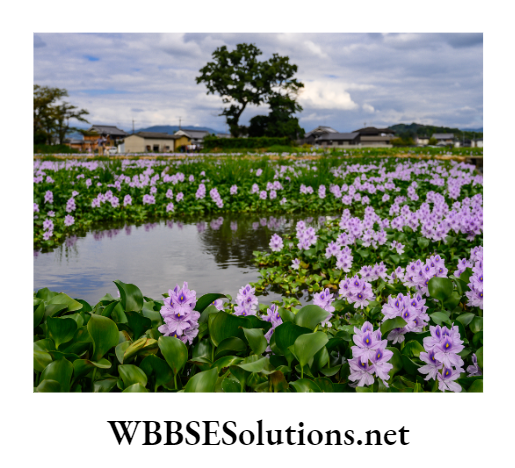
Water hyacinth is an invasive aquatic plant species.

Read And Learn More WBBSE Solutions For Class 8 School Science Very Short Answer Type Questions

Question 6. Write the botanical name of the sal tree.
Answer:

Botanical name of the sal tree:

The botanical name of the sal tree is Shorea robusta.

Question 7. Name one of the most important sources of hardwood timber in India.
Answer:

Sal is one of the most important sources of hardwood timber in India.

WBBSE Class 8 School Science Chapter 11 Plant Kingdom and The Environment Around Us VSAQs

Question 8. What is the origin of the name “Sundarban”?
Answer:

The origin of the name “Sundarban”:

The name Sundarbans is supposed to be derived from the name of the plant Sundari.

WBBSE Class 8 Plant Kingdom very short answer questions

Question 9. Name a mangrove tree.
Answer:

Sundari is a mangrove tree.

Question 10. Name a disease of the Sundari plant.
Answer:

Top-dying disease of Sundari trees.

Question 11. Name a spice obtained from a flower bud.
Answer:

Cloves are obtained from flower buds.

Question 12. Where vanilla is obtained?
Answer:

Vanilla is obtained from the undeveloped fruit of an orchid.

Very short answer questions on environment for Class 8

Question 13. Write one important use of cinnamon.
Answer:

Important Use of cinnamon:

Cinnamon bark is widely used as a spice.

Question 14. Write the scientific name of the turmeric plant.
Answer:

Scientific Name Of the turmeric plant:

Curcuma longa is the scientific name of the turmeric plant.

Question 15. Which compound present in garlic possesses antimicrobial properties?
Answer:

Allicin.

Question 16. Name two medicinal uses of turmeric.
Answer:

Two Medicinal uses of turmeric:

Turmeric is used for arthritis, heartburn (dyspepsia), stomach pain, diarrhea, intestinal gas, stomach bloating, loss of appetite, jaundice, liver problems, and gallbladder disorders.

Question 17. What are the main types of cardamom?
Answer:

Main types of cardamom:-

Two main types – green and black.

Question 18. Name two ingredients of “Garam Masala”.
Answer:

Ingredients of “Garam Masala”:

A typical Indian version of garam masala contains- black and white peppercorns, cloves, cinnamon or cassia bark, nutmeg and mace, black and green cardamom pods, Bay leaf, caraway, etc.

WBBSE Chapter 11 plant kingdom quick answer solutions

Question 19. Write the scientific name of garlic.
Answer:

Scientific Name Of Garlic:

The scientific name of garlic is Allium sativum.

Question 20. What is ethnobotany?
Answer:

Ethnobotany:-

Ethnobotany is the study of traditional human uses of plants.

WBBSE Solutions For Class 8 School Science Long Answer Type Questions WBBSE Solutions For Class 8 School Science Short Answer Type Questions
WBBSE Solutions For Class 8 School Science Very Short Answer Type Questions WBBSE Solutions For Class 8 School Science Review Questions
WBBSE Solutions For Class 8 School Science Solved Numerical Problems WBBSE Solutions For Class 8 School Science Experiments Questions
WBBSE Solutions For Class 8 Maths WBBSE Class 8 History Notes
WBBSE Class 8 History Multiple Choice Questions WBBSE Solutions For Class 8 History
WBBSE Solutions For Class 8 Geography


Question 21. What toiletries can be prepared from neem oil?
Answer:

Neem oil is used for preparing cosmetics such as soap, shampoo, balms, and creams as well as toothpaste.

Question 22. Name a fruit used as a purgative.
Answer:

Bael fruit is used as a purgative.

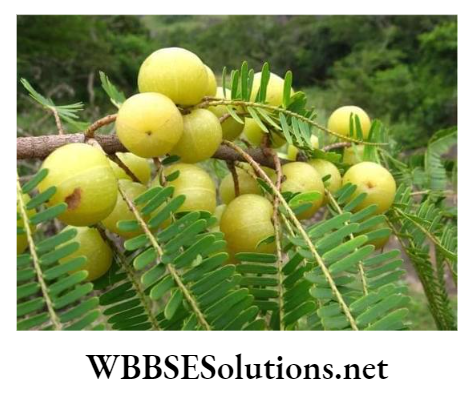
Question 23. Mention one health benefit of Amalaki
Answer:

Health Benefit Of Amalaki:

Amlaki inhibits, the aging process and prevents the common cold.

Question 24. What are the constituents of Triphala?
Answer:

Constituents of Triphala:

Amlaki, Behera, and heritage.

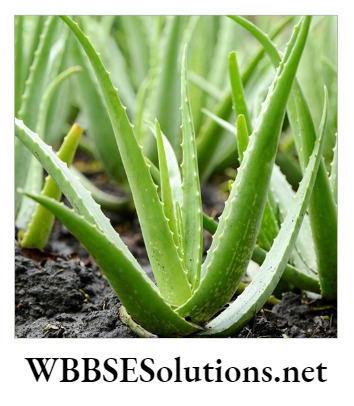
Question 25. Write the botanical name of Ghritakumari.
Answer:

Botanical name of Ghritakumari:

Aloe year is the botanical name of Ghritakumari.

Question 26. What is the health benefit of Curcumin?
Answer:

Health Benefit Of Curcumin:

A compound called curcumin is found in turmeric. Due to its presence, turmeric has the ability to kill microbes (antimicrobial property).

Question 27. Mention the scientific name of the plant from which Tabashir is obtained.
Answer:

Bambusa arundinacea.

WBBSE Class 8 Science practice very short answer questions on environment

Question 28. Find the odd one out:
Answer:

Curcumin, Allicin, Piperine, Raubasine Piperine, since it is. responsible for the hot taste of black pepper. The other three chemicals have medicinal (antimicrobial or anti-bacterial) properties.

Question 29. Which component of Bael, apart from mucilage, helps to remove constipation?
Answer:

Pectin.

Question 30. Who is known as the “queen of spices” and why?
Answer:

Queen of spices:

Small cardamom is referred to as the “queen of spices” because of its very pleasant aroma and taste.

Question 31. Name a sweet dish in which cardamom is used
Answer:

Milk custard.

Question 32. Which is known as the “king of spices”?
Answer:

King of spices:

Black pepper, since it is the world’s most traded spice.

Question 33. Name the two types of roots found in the sundry plant.
Answer:

Types of roots found in the sundry plant:

Breathing root: pneumatophores Supporting adventitious root: stilt roots.

Environmental concepts summary with very short answers for Class 8

Question 34. Where is the center for Conservation of the Sundri plant located?
Answer:

Jharkhali of Sunderban

Question 35. Why does raw garlic have a pungent odor?
Answer:

Raw garlic contains Allin, a sulfur-containing compound. Allin gets converted into Allicin in contact with the enzyme called alliinase. This is responsible for the pungent odor of garlic.

WBBSE Class 8 School Science Chapter 2 Element Compound And Chemical Reaction VSAQs

WBBSE Chapter 2 Element Compound And Chemical Reaction VSAQs

Question 1. In photosynthesis, which form of energy is converted into chemical energy?
Answer:

In photosynthesis, light energy is converted into chemical energy.

Question 2. What is required to initiate a chemical reaction?
Answer:

Energy is required to initiate a chemical reaction.

Question 3. Mention a reaction which is induced/initiated by light.
Answer:

Photosynthesis is a reaction which is induced/initiated by light. Here, green plants can utilize solar energy (in the form of visible light) to produce glucose from carbon dioxide and water. The process can be represented in a simplified way as follows:

⇒ \(6 \mathrm{CO}_2+6 \mathrm{H}_2 \mathrm{O} \stackrel{\text { light }}{\longrightarrow} \mathrm{C}_6 \mathrm{H}_{12} \mathrm{O}_6+6 \mathrm{H}_2 \mathrm{O}\)

Question 4. Give one example, where a chemical reaction is initiated by applying pressure.
Answer:

In crackers, a mixture of potassium chlorate and sulphur explodes when pressure is applied to them, Give one example, where a chemical reaction is initiated by electricity.

WBBSE Solutions For Class 8 School Science Chapter 2 Element Compound And Chemical Reaction Vsaqs

Read And Learn More WBBSE Solutions For Class 8 School Science Very Short Answer Type Questions

Question 5. Give one example, where a chemical reaction is initiated by electricity.
Answer:

When an electric spark is passed through a mixture of hydrogen and oxygen gas, water will be formed. If no current is passed through it, no chemical change will take place.

⇒ \(2 \mathrm{H}_2+\mathrm{O}_2 \rightarrow 2 \mathrm{H}_2 \mathrm{O}\)

Question 6. What do you mean by a catalyst?
Answer:

Catalyst:

A substance which can alter the rate of a chemical reaction without undergoing any net change in its chemical composition at the end of the chemical reaction is called a catalyst.

Question 7. Write the name and formula of baking soda. Baking soda is sodium bicarbonate.
Answer:

Its formula is NaHCO3.

Question 8. Give an example of a catalyzed reaction. During the preparation of ammonia (NH3) from nitrogen and hydrogen gas, finely divided iron powder is used as a catalyst. So this is an example of a catalyzed reaction.
Answer:

⇒ \(\mathrm{N}_2+3 \mathrm{H}_2 \rightarrow 2 \mathrm{NH}_3 (Finely divided iron powder used as catalyst)\)

Question 9. What catalyst is used during the industrial process of manufacture of sulphuric acid?
Answer:

Industrially sulphuric acid is prepared by the reaction of sulphur dioxide and oxygen in the presence of a vanadium pentoxide (V2O5) catalyst.

⇒ \(2 \mathrm{SO}_2+\mathrm{O}_2 \rightarrow 2 \mathrm{SO}_3
\left\{\right. catalyst: Vanadium pentoxide \left.\left(\mathrm{V}_2 \mathrm{O}_5\right)\right\}\)

Question 10. Give an example of an enzyme-catalyzed reaction.
Answer:

Example Of An Enzyme-Catalyzed Reaction:

Urease is an enzyme. It catalyzes the hydrolysis of urea into ammonia and carbon dioxide.

⇒ \(\mathrm{NH}_2 \mathrm{CONH}_2+\mathrm{H}_2 \mathrm{O} \rightarrow 2 \mathrm{NH}_3+2 \mathrm{CO}_2\)

Question 11. Write the name of an enzyme which is found in our stomach.
Answer:

Pepsin is an enzyme which is found in our stomach.

Question 12. What do you mean by an exothermic reaction?
Answer:

Exothermic Reaction: Chemical reactions which proceed with the evolution of heat energy are called exothermic reactions.

Question 13. What do you mean by an endothermic reaction?
Answer:

Endothermic Reaction: Chemical reactions which proceed with the absorption of heat energy are called endothermic reactions.

Question 14. Give an example of an exothermic reaction.
Answer:

Example Of An Exothermic Reaction:

The combustion of methane is an example of an exothermic reaction.

⇒ \(\mathrm{CH}_4+2 \mathrm{O}_2 \rightarrow \mathrm{CO}_2+2 \mathrm{H}_2 \mathrm{O}+\text { heat }(\mathrm{Q})\)

WBBSE Solutions For Class 8 School Science Long Answer Type Questions WBBSE Solutions For Class 8 School Science Short Answer Type Questions
WBBSE Solutions For Class 8 School Science Very Short Answer Type Questions WBBSE Solutions For Class 8 School Science Review Questions
WBBSE Solutions For Class 8 School Science Solved Numerical Problems WBBSE Solutions For Class 8 School Science Experiments Questions
WBBSE Solutions For Class 8 Maths WBBSE Class 8 History Notes
WBBSE Class 8 History Multiple Choice Questions WBBSE Solutions For Class 8 History
WBBSE Solutions For Class 8 Geography


Question 15. Give an example of an endothermic reaction.
Answer:

Example Of An Endothermic Reaction:

Passage of steam over heated coke produces carbon monoxide and hydrogen. Heat is absorbed during the process. This is an endothermic reaction.

⇒ \(\mathrm{C}+\mathrm{H}_2 \mathrm{O} \rightarrow \mathrm{CO}+\mathrm{H}_2-\text { heat }(\mathrm{Q})\)

Question 16. When ammonium chloride is dissolved in water in a test tube, what type of change is occurred?
Answer:

When ammonium chloride is dissolved in water, heat is absorbed and as a result, droplets of water condense in the outer surface of the test tube which becomes cold. But this is a physical change and not a chemical change.

Question 17. Name a gas which is used in welding.
Answer:

Acetylene (C2H2) is used for welding.

Question 18. Name one gaseous oxidizing agent and one gaseous reducing agent.
Answer:

Oxygen is an oxidizing agent and hydrogen is a reducing agent.

Question 19. Name the oxidant and reductant in the reaction Fe + Cu2+ = Fe2+ + Cu.
Answer:

⇒ \(\mathrm{Fe}-2 \mathrm{e} \rightarrow \mathrm{Fe}^{2+}:\)This is oxidation and Fe is the reductant

⇒ \(\mathrm{Cu}^{2+}+2 \mathrm{e} \rightarrow \mathrm{Cu}:\)This is the reduction and Cu2+ is the oxidant

Question 20. Name an enzyme that can decompose peroxide compounds.
Answer:

Catalase enzyme.

Question 21. \(\mathrm{Sn}^{2+} \rightarrow \mathrm{Sn}^{4+}+2 \mathrm{e} \rightarrow\) Is this oxidation or reduction reaction?
Answer:

Since the loss of electron means oxidation hence \(\mathrm{Sn}^{2+} \rightarrow \mathrm{Sn}^{4+}+2 \mathrm{e} \rightarrow\) is an oxidation reaction. Sn2+ is the reducing agent.

Question 22. What do you mean by rancidity?
Answer:

Rancidity:

The condition produced by aerial oxidation of fats and oils in food marked by unpleasant smell and taste is called rancidity.

Question 23. Name 1. a reducing agent that contains oxygen and 2. an oxidizing agent that does not contain oxygen.
Answer:

  1. Sulphur dioxide (SO2 )
  2. Ferric chloride (FeCl3)

Question 24. What is autocatalysis?
Answer:

Autocatalysis:

In certain reactions, one of the products acts as a catalyst. This phenomenon is known as autocatalysis.

Acetic acid (CH3COOH) and ethyl alcohol (C2H5OH) are produced in the hydrolysis of ethyl acetate (CH3COOC2H5). This reaction is initially very slow but acetic acid acts as an auto-catalyst in the reaction and gradually increases the rate of the reaction.

⇒ \(\mathrm{CH}_3 \mathrm{COOC}_2 \mathrm{H}_5+\mathrm{H}_2 \mathrm{O} \rightarrow \mathrm{CH}_3 \mathrm{COOH}+\mathrm{C}_2 \mathrm{H}_5 \mathrm{OH} .\)

Question 25. Give an example of exothermic physical change.
Answer:

Example Of Exothermic Physical Change:

When some concentrated sulphuric acid is added to water taken in a beaker, the acid dissolves with the evolution of heat. This is an example of exothermic physical change.

Question 26. Mention two simple household methods to prevent the rancidity of food.
Answer:

The development of rancidity of food can be prevented by:

  1. keeping food in a refrigerator
  2. storing food away from light

WBBSE Solutions For Class 8 School Science Chapter 11 Plant Kingdom and The Environment Around Us Review Questions

Chapter 11 Plant Kingdom And The Environment Around Us Review Questions

Question 1. Playing a vital role in the world health care system, a group of plants is known as “local heritage with global importance.”

  1. Flowering
  2. Medical
  3. Ornamental
  4. Cereal

Answer: 1. Medical

Question 2. Plants regulate the

  1. Water cycle
  2. Carbon cycle
  3. Both and are correct
  4. None is correct

Answer: 3. Both and are correct

Question 3. Oxygen produced by plants is a byproduct of

  1. Chemosynthesis
  2. Photosynthesis
  3. Solar radiation
  4. Transpiration

Answer: 2. Photosynthesis

Question 4. Bamboos belong to the

  1. Grass family
  2. Shrub family
  3. Tree Family
  4. Herb family

Answer: 1. Grass family

Question 5. Bamboo grows

  1. Very fast
  2. Very slow
  3. Moderately
  4. None of these

Answer: 1. Very fast

Read And Learn More WBBSE Solutions For Class 8 School Science Review Questions

Question 6. Bamboo flowers are observed

  1. Frequently
  2. Annually
  3. Rarely
  4. Monthly

Answer: 3. Rarely

Question 7. Bamboo shoots are used as

  1. Food
  2. Poison
  3. Rarely
  4. Monthly

Answer: 1. Food

Question 8. Water hyacinth is an aquatic plant native to the

  1. Gangetic plains
  2. Antarctica
  3. Amazon basin
  4. Decan plateau

Answer: 3. Amazon basin

WBBSE Class 8 Plant Kingdom review questions

Question 9. Water hyacinth reproduces primarily by way of

  1. Seeds
  2. Runners or stolons
  3. Flowers
  4. Buds

Answer: 2. Runners or stolons

WBBSE Solutions For Class 8 School Science Chapter 11 Plant Kingdom and The Environment Around Us Review Questions

Question 10. Water hyacinth may

  1. Be invasive species
  2. Form breeding ground for mosquitoes
  3. Block water flow
  4. All of these

Answer: 4. All of these

Question 11. Sal tree is large and

  1. Subdeciduous
  2. Coniferous
  3. Non-flowering
  4. Evergreen

Answer: 1. Subdeciduous

Question 12. Sal tree is native to the

  1. Europe
  2. America
  3. Indian subcontinent
  4. South America

Answer: 3. Indian subcontinent

Question 13. Sundari is a/an

  1. Edible plant
  2. Mangrove plant
  3. Aquatic plant
  4. Orchid

Answer: 2. Mangrove plant

Review questions on environment for Class 8 Science

Question 14. Sundari plants belong to the genus

  1. Mangifera
  2. Ficus
  3. Heritiera
  4. None of these

Answer: 3. Heritiera

WBBSE Solutions For Class 8 School Science Long Answer Type Questions WBBSE Solutions For Class 8 School Science Short Answer Type Questions
WBBSE Solutions For Class 8 School Science Very Short Answer Type Questions WBBSE Solutions For Class 8 School Science Review Questions
WBBSE Solutions For Class 8 School Science Solved Numerical Problems WBBSE Solutions For Class 8 School Science Experiments Questions
WBBSE Solutions For Class 8 Maths WBBSE Class 8 History Notes
WBBSE Class 8 History Multiple Choice Questions WBBSE Solutions For Class 8 History
WBBSE Solutions For Class 8 Geography


Question 15. The pigment curcumin is found in

  1. Turmeric
  2. Cardamom
  3. Ginger
  4. Garlic

Answer: 1. Turmeric

Question 16. Herbs are obtained from the leaves of

  1. Herbaceous plants
  2. Herbivores
  3. Sal plants
  4. Cactus

Answer: 1. Herbaceous plants

Question 17. Triphala contains plenty of

  1. Vitamin a
  2. Vitamin b
  3. Vitamin d
  4. Vitamin c

Answer: 4. Vitamin c

Question 18. Black pepper is native to

  1. North Bengal
  2. South India
  3. Sikkim
  4. Jammu & Kashmir

Answer: 2. South India

WBBSE Chapter 11 environmental science review questions

Question 19. Cinnamon is a spice obtained from the

  1. Seeds
  2. Inner bark
  3. Roots
  4. Fruits

Answer: 2. Inner bark

Question 20. Cinnamon bark is widely used as a

  1. Spice
  2. Food
  3. Medicine
  4. Pigment

Answer: 1. Spice

Question 21. Turmeric (Curcuma longa) is a plant of the

  1. Ginger family
  2. Bamboo family
  3. Grass family
  4. None of these

Answer: 1. Ginger family

Question 22. The chemical substance that is present in clove and has antibacterial properties is
known as

  1. Allicin
  2. Piperine
  3. Eugenol
  4. Vinblastine

Answer: 3. Eugenol

Question 23. There are two main types of cardamom

  1. Red and green
  2. Green and black
  3. Black and red
  4. Sweet and sour

Answer: 2. Green and black

Question 24. Garam masala is

  1. Spice mixture
  2. Syrup
  3. Food
  4. Medicine

Answer: 1.

Question 25. Ginger is indigenous to

  1. India
  2. Europe
  3. Southern china
  4. America

Answer: 3. Southern china

Environmental concepts summary and review questions for Class 8

Question 26. Garlic is a species in the

  1. Onion genus
  2. Paddy genus
  3. Medicinal genus
  4. Grass genus

Answer: 1. Onion genus

Question 27. Garlic flavor is

  1. Sweet
  2. Pungent
  3. Bitter
  4. Chilly

Answer: 2. Pungent

Question 28. Garlic contains

  1. Allicin
  2. Alium
  3. Aluminium
  4. Piperin

Answer: 1. Allicin

Question 29. The medicine Bashir is prepared from

  1. Water hyacinth
  2. Aloe vera
  3. Turmeric
  4. Bamboo

Answer: 4. Bamboo

Question 30. Neem is a tree in the

  1. Mahogany family
  2. Grass family
  3. Plant family
  4. Shrub family

Answer: 1. Mahogany family

Question 31. Bael is a species of tree native to

  1. Europe
  2. South america
  3. India
  4. Africa

Answer: 3. India

Question 32. Amlaki is the richest natural source of

  1. Vitamin a
  2. Vitamin c
  3. Vitamin d
  4. Vitamin b complex

Answer: 2. Vitamin c

Question 33. The three fruits of Triphala are

  1. Amlaki, amla and neem
  2. Amlaki, bael and haritaki
  3. Amlaki, haritaki and bahera
  4. Bael, haritaki and neem

Answer: 3. Amlaki, haritaki and Behera

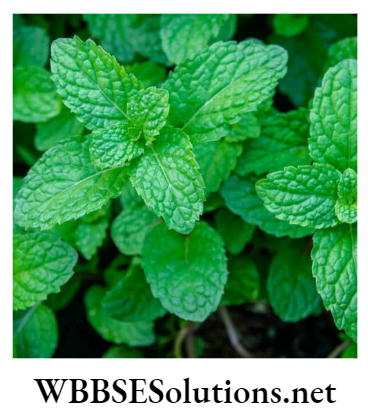
Question 34. Menthol is found from

  1. Mint
  2. Methanol
  3. Methi
  4. Mustard

Answer: 1. Mint

Question 35. The anti-pyretic component is present in

  1. Nayantara
  2. Emblica
  3. Emblica
  4. Aloe vera

Answer: 4. Aloe vera


Chapter 11 Plant Kingdom And The Environment Around Us Fill In The Blanks

Question 1. Everything we indirectly from eat comes directly or indirectly from __________
Answer: Plants

Question 2. __________ is produced by plants, as a by-product of photosynthesis.
Answer: Oxygen

Question 3. __________ is a tribe of flowering perennial evergreen plants in the grass family.
Answer: Bamboo

Question 4. Many __________ only flowers at intervals as long as 65 or 120 years.
Answer: Bamboos

Question 5. Bamboo __________ are a common food in some part of the world.
Answer: Shoots

Question 6. Water hyacinth is often considered a highly problematic __________ plant species.
Answer: Invasive

Question 7. When not controlled, water __________ will cover lakes and ponds entirely.
Answer: Hyacinth

Question 8. Sal is a large sub __________ tree.
Answer: Deciduous

WBBSE Class 8 Science practice review questions on environment

Question 9. Sundri is a medium-sized evergreen tree which __________
Answer: Mangrove

Question 10. __________is found in the forests in India.
Answer: Sundarbans

Question 11. The name __________ is supposed to be derived from the name of the plant, Sundari. A is a dried seed, fruit, root, bark, or vegetable substance primarily used for flavoring, coloring, or preserving food.
Answer: Spice

Question 12. Herbs and spices are obtained from __________.
Answer: Plants

Question 13. Black __________ is a flowering vine cultivated for its fruit.
Answer: Pepper

Question 14. Cinnamon is a __________ obtained from the inner bark of several trees.
Answer: Spice

Question 15. Turmeric is a rhizomatous herbaceous perennial plant of the __________ family.
Answer: Ginger

Question 16. There are two main types of cardamom-green and __________.
Answer: Black

Question 17. Ginger is a flowering plant whose __________ is widely used as a spice or a medicine.
Answer: Rhizome

Question 18. The source of garlic’s distinctive odor is __________
Answer: Allicin

Question 19. __________leaves are dried in India and placed in cupboards to prevent insects from eating the clothes and also while storing rice in tins.
Answer: Neem

Question 20. Beal is also known as __________ apple.
Answer: Stone

Question 21. The nutritional facts of __________ include bi of flavonoids, flavones, polyphenols, and carotenoids.
Answer: Amalaki

Question 22. __________ or Sadabahar is an evergreen subshrub or herbaceous plant.
Answer: Nayantara

Question 23. Pudina leaf, fresh or dried, is the culinary source of __________.
Answer: Mint

Question 24. Mint oil is also used as an environmentally friendly __________ for its ability to kill some common pests.
Answer: Insecticide

Question 25. Aloe vera is a __________ plant species.
Answer: Succulent

Question 26. Aloe vera is used in traditional medicine as a multipurpose __________treatment.
Answer: Skin


Chapter 11 Plant Kingdom And The Environment Around Us Identify as True Or False

Question 1. Green plants give off oxygen in the process called photosynthesis.
Answer: True

Question 2. Coal and petroleum are fossil substances of plant origin.
Answer: True

Question 3. Plants directly regulate the Nitrogen cycle.
Answer: False

Question 4. Bamboo is a non-flowering plant.
Answer: False

Question 5. Most bamboo species flower infrequently.
Answer: True

Question 6. Flutes are made of bamboo.
Answer: True

Question 7. Water hyacinth is often considered a highly problematic invasive species.
Answer: True

Examples of plant kingdom review questions for Class 8

Question 8. When not controlled, water hyacinths will cover lakes and ponds entirely.
Answer: True

Question 9. Water hyacinth control is very easy.
Answer: False

Question 10. Sal tree is seldom completely leafless.
Answer: False

Question 11. Sundri is one of the most important sources of hardwood timber in India.
Answer: False

Question 12. The name of the plant Sundari is supposed to be derived from the name Sundarbans.
Answer: False

Question 13. A spice is a dried seed, fruit, root, bark, or vegetable substance primarily used for flavoring, coloring or preserving food.
Answer: True

Question 14. Herbs and spices are obtained from industry.
Answer: False

Question 15. Black pepper is a flowering vine cultivated for its
Answer: True

Question 16. Black pepper is native to South Bengal.
Answer: False

Question 17. Black pepper has long been recognized as a sedative.
Answer: False

Question 18. Cinnamon is a spice that is used in both sweet and savory foods.
Answer: True

Question 19. Turmeric is a rhizomatous herbaceous perennial plant.
Answer: True

Question 20. Cardamom is a spice made from the seeds of several plants in the genera Curcuma.
Answer: False

Question 21. Turmeric has antifungal properties.
Answer: False

Question 22. There are three main types of cardamom- green, black, and red.
Answer: False

Question 23. Black cardamom is also known as Nepal cardamom.
Answer: True

WBBSE Chapter 11 exercises review solutions

Question 24. Ginger produces a hot, fragrant kitchen spice.
Answer: True

Question 25. Garlic is a species of the ginger genus.
Answer: False

Question 26. Neem (Azadirachta indica), is a tree in the mahogany family.
Answer: True

Question 27. Sal oil is used for preparing cosmetics such as soap, shampoo, balms and creams as well as toothpaste.
Answer: False

Question 28. In traditional Indian medicine, dried and fresh fruits of the plant Amlaki are used.
Answer: True

Question 29. Nayantara has long been cultivated for herbal medicine and as an ornamental plant.
Answer: True

Question 30. Dried mint is usually preferred over fresh mint when storage of the mint is not a problem.
Answer: False

Question 31. Ghritakumari is a succulent plant species
Answer: True


Chapter 11 Plant Kingdom And The Environment Around Us Match The Columns


WBBSE Solutions For Class 8 School Science Chapter 11 Plant Kingdom and The Environment Around Us match the following
Answer: A-2, B-1,C-4,D-3

WBBSE Solutions For Class 8 School Science Chapter 11 Plant Kingdom and The Environment Around Us match the following.2
Answer: A-4, B-3,C-1,D-2

WBBSE Solutions For Class 8 School Science Chapter 11 Plant Kingdom and The Environment Around Us match the following.3
Answer: A-1, B-3,C-2,D-4

WBBSE Solutions For Class 8 School Science Chapter 11 Plant Kingdom and The Environment Around Us match the following.4
Answer: A-5, B-2,C-6,D-1,E-3


WBBSE Notes For Class 8 School Science Chapter 11 Plant Kingdom and The Environment Around Us

Chapter 11 Plant Kingdom and The Environment Around Us


Introduction-Why Plants are Important?

Plants are the backbone of all life on Earth and an essential resource for human well-being. Just think about how your everyday life depends on plants.

Plants are essential to the balance of nature and people’s lives. Green plants, i.e., those possessing chlorophyll, manufacture their food and give off oxygen in the process called photosynthesis, in which water and carbon dioxide are combined by the energy of light.

Plants are the ultimate source of food and metabolic energy for nearly all animals, which cannot manufacture their food. Besides foods (e.g., grains, fruits, and vegetables), plant products vital to humans include wood and wood products, fibers, drugs, oils, latex, pigments, and resins. Coal and petroleum are fossil substances of plant origin.

Thus plants provide people not only sustenance but shelter, clothing, medicines, fuels, and the raw materials from which innumerable other products are made.

Read And Learn More WBBSE Notes For Class 8 School Science

Some significant plants in our surroundings are briefly described below.

Bamboo

Bamboo is a tribe of flowering perennial evergreen plants in the grass family with solid nodes and hollow internodes. In bamboo, the vascular bundles in the cross section are scattered throughout the stem instead of in a cylindrical arrangement.

WBBSE Solutions For Class 8 School Science Chapter 11 Plant Kingdom and The Environment Around Us Bamboo

Bamboos are some of the fastest-growing plants in the world, due to a unique rhizome-dependent system. Bamboos are of notable economic and cultural significance in South Asia, Southeast Asia, and East Asia, being used for building materials, as a food source, and as a versatile raw product.

WBBSE Solutions For Class 8 School Science Chapter 11 Plant Kingdom and The Environment Around Us Bamboo grove

Bamboo has a higher compressive strength than wood, brick, or concrete and a tensile strength that rivals steel. The word bamboo comes from the Kannada term bambu, which was introduced to English.

Ecology: Bamboo is one of the fastest-growing plants on Earth, with reported growth rates of 250 cm (98 in) in 24 hours.

However, the growth rate is dependent on local soil and climatic conditions, as well as species and a more typical growth rate for many commonly cultivated bamboos in temperate climates is in the range of 3—10 centimeters (1.2—3.9 in) per day during the growing period.

Primarily growing in regions of warmer climates during the late Cretaceous period, vast fields existed in what is now Asia.

Some of the largest timber bamboos can grow over 30 m (98 ft) tall and be as large as 1520 cm (5.9-7.9 in) in diameter.

However, the size range for mature bamboo is species-dependent, with the smallest bamboo reaching only several inches high at maturity.

Unlike all trees, individual bamboo stems, or culms, emerge from the ground at their full diameter and grow to their full height in a single growing season of three to four months.

Over the next 2-5 years (depending on species), the fungus begins to form on the outside of the culm, which eventually penetrates and overcomes the culm.

Around 5-8 years later (species and climate dependent), the fungal growths cause the culm to collapse and decay.

WBBSE Class 8 Plant Kingdom notes

Mass flowering: Most bamboo species flower infrequently. In fact, many bamboos only flower at intervals as long as 65 or 120 years.

These taxa exhibit mass flowering (or gregarious flowering), with all plants in a particular cohort flowering over a several-year period.

The lack of environmental impact on the time of flowering indicates the presence of some sort of “alarm clock” in each cell of the plant which signals the diversion of all energy to flower production and the cessation of vegetative growth.

This mechanism, as well as the evolutionary cause behind it, is still largely a mystery.

Mass fruiting also has direct economic and ecological consequences, however. The huge increase in available fruit in the forests often causes a boom in rodent populations, leading to increases in disease and famine in nearby human populations.

For example, devastating consequences occur when the Melocanna bambusoides population flowers and fruits once every 30-35 years around the Bay of Bengal.

The death of the bamboo plants following their fruiting means the local people lose their building material, and the large increase in bamboo fruit leads to a rapid increase in rodent populations.

As the number of rodents increases, they consume all available food, including grain fields and stored food, sometimes leading to famine.

These rats can also carry dangerous diseases, such as typhus, typhoid, and bubonic plague, which can reach epidemic proportions as the rodents increase in number.

In any case, flowering produces masses of seeds, typically suspended from the ends of the branches. These seeds will give rise to a new generation of plants that may be identical in appearance to those that preceded the flowering,

or they may produce new cultivars with different characteristics, such as the presence or absence of striping or other changes in the coloration of the culms.

General Uses for Bamboo: Bamboo has been used for many applications, from a food source to a building material.

1. Decorations: From picture frames to room dividing screens, bamboo can make some elegant and exotic decorations for the home,

2. Building materials: More and more furniture, flooring, and even homes are being built with bamboo. Bamboo is a popular building material in South and East Asia and in South Pacific Islands.

Bamboo stems have also been extensively used to construct numerous footbridges over canals and streams.

3. Fabrics and clothing: a fabulous trend right now is bamboo fibers being used in fabrics and clothing since the diameter of bamboo fibers measures less than 3 mm.

Bedding made of bamboo fibers is as soft as or softer than most cotton beddings and drapes with the look of silk without the expense.

Food items and Cooking:

The young stem, basal part of the stem, and leaves of bamboo are chief food items of the Giant panda of China, the Red panda of Nepal and India, and the Lemur of Madagascar. Gorillas primarily eat bamboo. It is also the food of elephants and chimpanzees.

After extracting toxic substances, various delicious dishes have been prepared in different Asian countries by using the soft young stems of bamboo.

Certain beverages are also prepared from these young stems. A type of insect grows at the base of bamboo plants growing in the Yunan provinces of China and in countries like Laos, Myanmar, and Thailand. They feed on the young stems of bamboo. The local people use the larva of these insects as their food.

Cooking with bamboo is nothing new in Asian culture. Hollow stems of bamboo have been used in different places in South Africa for warming soups and as pots for cooking rice.

Bamboo-made utensils are also used extensively for cooking purposes. Bamboo cutting boards are notoriously good for not dulling blades or knives as quickly, while bamboo utensils like wooden spoons are excellent for not scratching the bottoms of expensive nonstick cookware.

Medicine: Tabashir, a medicine for asthma, colds and cough, and other infectious diseases, is made from silicon dioxide and silicic acid derived from the internodes of a bamboo species called Bambusa arundinacea.

Agriculture: Bamboo started out as a natural plant in most places, but has become a large part of agriculture. From being the main crop of a farm to be harvested for other uses, or as the channel linings for irrigation systems, bamboo fits naturally into agriculture.

Weapons: While this is rarely seen anymore, bamboo was once used to make many different types of weapons. From blow guns to archery bows and arrows, bamboo was used to make light but strong weapons for many centuries.

Instruments: Hollow tubes make excellent instruments, whether it is a flute or a drum, and bamboo is one of the best bases for instruments.

Need and strategies for conservation: With the increasing population pressure, natural stands of bamboo are being indiscriminately cut for fuel wood, and furniture.

The common practice of ‘jhum’ (a form of shifting cultivation) cultivation in the northeastern states has resulted in the genetic erosion of several bamboo species; overexploitation of some species for fuel wood and for the cottage industry has endangered others.

Large areas where bamboo occurs have been declared as National Bamboo Reserve areas and provenances in the natural habitats are being maintained.

Considering the limitation in seed supply, vegetative methods for ex-situ conservation and tissue culture work have been started in Asian countries.

Water Hyacinth

Water hyacinth (Eichhornia crassipes), is an aquatic plant native to the Amazon basin and is often considered a highly problematic invasive species outside its native range.

Description: Water hyacinth is a free-floating perennial aquatic plant (or hydrophyte) native to tropical and sub-tropical South America.

With broad, thick, glossy, ovate leaves, water hyacinth may rise above the surface of the water as much as 1 meter in height.

The leaves are 10-20 cm across and float above the water’s surface. They have long, spongy, and bulbous stalks. The feathery, freely hanging roots are purple-black.

An erect stalk supports a single spike of 8-15 conspicuously attractive flowers, mostly lavender to pink in color with six petals.

Plant Kingdom and Environment summary

One of the fastest growing plants known, water hyacinth reproduces primarily by way of runners or stolons, which eventually form daughter plants.

Each plant can produce thousands of seeds each year, and these seeds can remain viable for more than 28 years. Some water hyacinths were found to grow up to 2 to 5 meters a day in some sites in South-East Asia.

The common water hyacinth [Eichhornia crassipes) are vigorous growers known to double their population in two weeks.

Invasive species: Water hyacinth has been widely introduced in North America, Asia, Australia, Africa, and New Zealand. In many areas, it has become an important and pernicious invasive species.

In New Zealand, it is listed on the National Pest Plant Accord which prevents it from being propagated, distributed, or sold. In large water areas such as Louisiana, the Kerala Backwaters in India, Tonle Sap in Cambodia, and Lake Victoria it has become a serious pest.

When not controlled, water hyacinth will cover lakes and ponds entirely; this dramatically impacts water flow, blocks sunlight from reaching native aquatic plants, and starves the water of oxygen, often killing fish (or turtles).

The plants also create a prime habitat for mosquitos, the classic vectors of disease, and a species of snail known to host a parasitic flatworm that causes schistosomiasis (snail fever).

WBBSE Solutions For Class 8 School Science Chapter 11 Plant Kingdom and The Environment Around Us Water hyacinth

Uses

Phytoremediation, wastewater treatment: The roots of Eichhornia crassipes naturally absorb pollutants, including lead, mercury, and strontium-90, as well as some organic compounds believed to be carcinogenic, in concentrations 10,000 times that in the surrounding water Water hyacinths can be cultivated for wastewater treatment.

Water hyacinth is reported for its efficiency in removing about 60-80 % nitrogen and about 69% of potassium from water. The roots of water hyacinth were found to remove particulate matter and nitrogen in a natural shallow eutrophicated wetland.

Polluted water from gold mine areas can be treated by vegetables in Taiwan. Javanese sometimes cook and eat the green parts and inflorescence.

Medicinal use: In Kedah (Java), the flowers are used for medicating the skin of horses. The species is a “tonic.”

In the Philippines, Thailand, and Vietnam stems of water hyacinth are used for embroidery and as fiber for the garment industry.

  1. The dry stem is used to manufacture baskets and furniture. Fibers of the plant are also used to make paper.
  2. Water hyacinth is a good source of biogas as it contains appreciable amounts of nitrogen.
  3. Since water hyacinth contains a high amount of protein and nitrogen, it is also used as fodder. However excess use can lead to toxicity.

Control: Water hyacinth control is difficult. The most effective method of control depends on prevention. Make sure to control the nutrient levels in your pond or lake to prevent rapid and explosive growth.

Do not introduce water hyacinths to new ponds unless you are willing to monitor them and take action if their growth gets out of control.

It is advised that you only introduce water hyacinths to your ornamental water gardens. Introducing it into natural water bodies invites trouble.

When harvesting or otherwise removing water hyacinth, do not discard it in the natural waterway, instead put it into a compost pile.

Sal

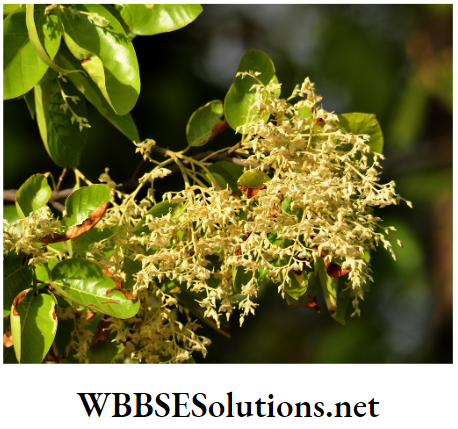
Sal (Shorea robusta) is a large sub-deciduous tree. It is up to 30 meters high. Sal trees is seldom completely leafless. It has large leathery leaves and yellowish flowers.

They have a tough texture. Young trees have a linear crown, which becomes rounder and flatter with aging. The sapwood is whitish in color, thick, and less durable.

The heartwood becomes dark brown to black on exposure. The wood pores are filled with resin.

Distribution and description: This tree is native to the Indian subcontinent, ranging south of the Himalayas, from Myanmar in the east to Nepal, India, and Bangladesh.

WBBSE Solutions For Class 8 School Science Chapter 11 Plant Kingdom and The Environment Around Us sal Shrea robusta

Understanding Plant Kingdom for Class 8

In India, it extends from Assam, Bengal, Odisha, and Jharkhand west to the Shivalik Hills in Haryana, east of the Yamuna. The range also extends through the Eastern Ghats and to the eastern Vindhya and Satpura ranges of central India.

Sal is moderate to slow growing and can attain heights of 30 to 35 m and a trunk diameter of up to 2-2.5 m. The leaves are 10-25 cm long and 515 cm broad.

In wetter areas, it is evergreen; in drier areas, it is dry-season deciduous, shedding most of the leaves between February to April, and leafing out again in April and May.

Uses:

Wood: Sal is one of the most important sources of hardwood timber in India, with hard, coarse-grained wood that is light in color when freshly cut, but becomes dark brown with exposure.

The wood is resinous and durable, and is sought-after for construction, although not well suited to planning and polishing.

The wood is especially suitable for constructing frames for doors and windows, floors of boats, jetties of ships,s, and footbridges over streams.

Leaves: The dry leaves of sal are a major source for the production of leaf plates called paravail and leaf bowls in northern and eastern India.

The leaves are also used fresh to serve ready-made paan (betelnut preparations) and small snacks such as boiled black grams, golgappa, etc.

The used leaves/plates are readily eaten by goats and cattle that roam the streets freely. The tree has therefore protected northern India from a flood of styrofoam and plastic plates that would have caused tremendous pollution. The leaves are also used in rural areas as fuel.

Resin: Sal tree resin is used as an astringent in Ayurvedic medicine, and to make spirit and varnish.

Seeds: Sal seeds and fruit are a source of lamp oil and vegetable fat. Shorea robusta seed oil is extracted from the seeds and used as cooking oil after refining.

Tannin: Tannin derived from sal bark finds application in the leather industry.

Sal tree is worshipped among the Buddhists and Hindus in India. It is mentioned in many scriptures that the Buddha was born and died under the Sal tree.

The Sal tree has special significance in the festivals and marriages of Adivasi. A pole of the Sal tree is considered very important and unless the bridegroom sits on the altar made of the tree of Sal, the marriage has no meaning.

It also holds great value in the lives of the indigenous populace of the Chotanagpur plateau. It is the main attraction of the festival of Sarhul, which means the Sal Blossoms Festival. The whole festival revolves round the Sal tree.

Sundri

Sundri is a small or medium-sized evergreen tree that is found in the inland zone of mangrove forests in India. The Botanical name of Sundri is Heritiera fomes.

The name Sundarbans is supposed to be derived from the name of the plant, Sundari. It is adapted to flourishing high tides once dominated in the forest, and to the low saline and freshwater zone.

The other species of Sundari, H. littoral, is mostly found in the western part of the Sundarbans. Sundri is small to a medium-sized evergreen tree, which grows occasionally to a height of about 25 meters, typically with a twisted, stunted stem, and thin, wavy buttresses.


WBBSE Solutions For Class 8 School Science Chapter 11 Plant Kingdom and The Environment Around Us Sundri small or medium sized evergreen tree

Plant classification for Class 8 students

The bark of this tree is grey in color and it is longitudinally furrowed. The leaves of Sundri are simple, ovate, oblong, or elliptic, and are 12.5 to 20 centimeters long and 5 to 10 centimeters wide, coriaceous, glabrous, shining above, silvery, and scaly beneath.

The flowers of Sundri are small, orange-colored, unisexual, and up to 18 centimeters long. The fruit is ellipsoid, 2.5 centimeters long, with a rudder-like ridge, glabrous and glossy.

Sundri is distributed widely in the Old World tropics, in eastern Africa, and from India eastwards throughout Southeast Asia to tropical Australia, Hawaii, and New Caledonia.

In India, this tree is found, never commonly, in the inland zone of mangrove forests along the coasts of peninsular India, the Sundarbans in West Bengal state, and the Andaman Islands it is often planted in gardens.

Uses:

Fruits and seeds: The fruits of Sundri are considered stomachic and tonic. A decoction of the seeds of this medicinal plant of India is given to relieve dysentery and diarrhea. The twigs are used as toothbrushes and the seeds of Sundri are edible.

Timber: The tree is the chief source of timber among the people of the surrounding districts of the Sundarbans; the annual production is about 250,000 cu ft; wood is hard, red in color, used mostly in boat building, and in making hardboard, furniture, etc; wood also yields good quality charcoal. They are a common source of fuel also.

The Sundari plants are declining because of overexploitation, and also due to top-dying diseases; about 50 percent of the trees suffer from top-dying diseases; increased salinity is also considered responsible for the decline.

Spices and Plants

A spice is a dried seed, fruit, root, bark, or vegetable substance primarily used for flavoring, coloring, or preserving food.

Many spices have antimicrobial properties. This may explain why spices are more commonly used in warmer climates, which have a more infectious disease, and why the use of spices is prominent in meat, which is particularly susceptible to spoiling.

A spice may have other uses, including medicinal, religious ritual, cosmetics or perfume production, or as a vegetable. For example, turmeric roots are consumed as a vegetable, and garlic as an antibiotic.

The spice trade developed throughout South Asia and the Middle East in around 2000 BCE with cinnamon and pepper, and in East Asia with herbs and pepper.

Indian spices include a variety of spices grown across the Indian subcontinent (a sub-region of South Asia). With different climates in different parts of the country, India produces a variety of spices, many of which are native to the Subcontinent, while others were imported from similar climates and have since been cultivated locally for centuries.

We often use the words herb and spice interchangeably. Herbs and spices are obtained from plants. Herbs and spices are used primarily for adding flavor and aroma to food.

And both are best used fresh but can be saved by drying. While there are similarities, there also are subtle differences between herbs and spices.

Herbs are obtained from the leaves of herbaceous (non-woody) plants. They are used for savory purposes in cooking and some have medicinal value. Herbs often are used in larger amounts than spices.

Spices are obtained from roots, flowers, fruits, seeds, or bark. Spices are native to warm tropical climates and can be woody or herbaceous plants.

Spices often are more potent and stronger flavored than herbs; as a result, they typically are used in smaller amounts. Some spices are used not only to add taste but also as a preservative.

Examples of Spices:

  1. Cinnamon – the bark of the cinnamon tree
  2. Ginger-root
  3. Cloves – flower bud
  4. Saffron – stigma (female reproductive part) of Saffron crocus
  5. Nutmeg – seed
  6. Vanilla – undeveloped fruit of an orchid
  7. Cumin – seed

Black pepper: Black pepper (Piper nigrum) is a flowering vine cultivated for its fruit, which is usually dried and used as a spice and seasoning.

The fruit, known as a peppercorn when dried, is approximately 5 millimeters (0.20 in) in diameter, dark red when fully mature, and, like all drupes, contains a single seed.

Peppercorns, and the ground pepper derived from them, may be described simply as pepper, or more precisely as black pepper (cooked and dried unripe fruit), green pepper (dried unripe fruit), and white pepper (ripe fruit seeds).

Black pepper is native to south India and is extensively cultivated there and elsewhere in tropical regions. Currently, Vietnam is the world’s largest producer and exporter of pepper.

WBBSE Solutions For Class 8 School Science Chapter 11 Plant Kingdom and The Environment Around Us black pepper


Uses:

Dried ground pepper has been used since antiquity for both its flavor and as a traditional medicine. Black pepper is the world’s most traded spice.

It is one of the most common spices added to European cuisine and its descendants. The spiciness of black pepper is due to the chemical piperine. It is ubiquitous in the modern world as a seasoning and is often paired with salt.

Apart from spicy value, black pepper is also used as a preservative for meat and other perishable food items.
The health benefits of black pepper include relief from respiratory disorders, coughs, the common cold, constipation, indigestion, anemia, impotency, muscular strains, dental disease, pyorrhea, diarrhea, and heart disease.

Black pepper (Piper nigrum)stimulates the taste buds in such a way that an alert is sent to the stomach to increase hydrochloric acid secretion, thereby improving digestion.

Hydrochloric acid is necessary for the digestion of proteins and other food components in the stomach. Black pepper has long been recognized as a carminative,

(a substance that helps prevent the formation of intestinal gas), a property likely due to its beneficial effect of stimulating hydrochloric acid production.

In addition, black pepper has diaphoretic (promotes sweating), and diuretic (promotes urination) properties.

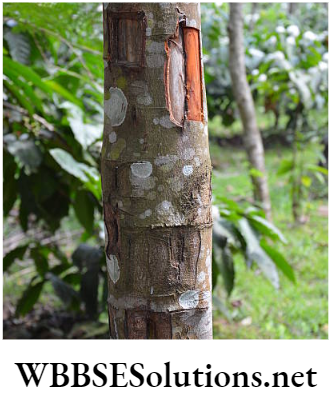
Cinnamon: Cinnamon is a spice obtained from the inner bark of several trees from the genus Cinnamomum that is used in both sweet and savory foods.

The inner bark of a tropical evergreen tree, harvested during the rainy season when pliable and then dried into curls sold as sticks or ground into a powder. With its warm, sweet flavor, cinnamon is one of the biggest workhorses on the spice shelf.

WBBSE Solutions For Class 8 School Science Chapter 11 Plant Kingdom and The Environment Around Us Cinnamon


Uses:

Cinnamon bark is widely used as a spice. It is principally employed in cookery as a condiment and flavoring material.
It is used in the preparation of chocolate, especially in Mexico, which is the main importer of cinnamon.

It is also used in many dessert recipes, such as apple pie, doughnuts, and cinnamon buns as well as spicy candies, coffee, tea, hot cocoa, and liqueurs.


WBBSE Solutions For Class 8 School Science Chapter 11 Plant Kingdom and The Environment Around Us Cinnamon Bark

Medicinal plants and their uses Class 8

In the Middle East, cinnamon is often used in savory dishes of chicken and lamb. In the United States, cinnamon and sugar are often used to flavor cereals, and bread-based dishes, such as toast, and fruits, especially apples; a cinnamon-sugar mixture is even sold separately for such purposes.

It is also used in Turkish cuisine for both sweet and savory dishes. It can also be used in pickling. Cinnamon powder has long been an important spice in enhancing the flavor of Persian cuisine, used in a variety of thick soups, drinks, and sweets.

It has been prized for its medicinal properties for thousands of years. Besides using it in cooking, cinnamon is also thought to have health benefits.


The naturally sweet taste may help some people reduce their sugar intake. In Ayurveda, cinnamon is used as a remedy for diabetes, indigestion, and colds. Volatile oil prepared from cinnamon provides relief for arthritic pain.

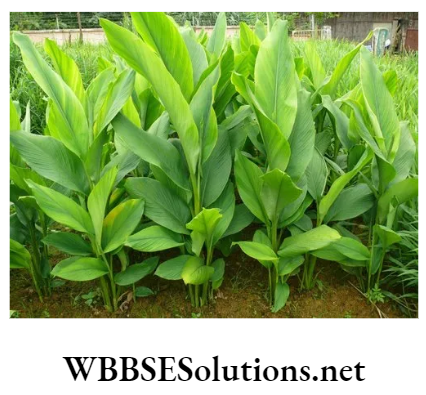
Turmeric: Turmeric (Curcuma longa) is a rhizomatous herbaceous perennial plant of the ginger family. It is native to southwest India and needs temperatures between 20 and 30°C (68 and 86’F) and a considerable amount of annual rainfall to thrive.

Plants are gathered annually for their rhizomes and propagated from some of those rhizomes in the following season. India, a significant producer of turmeric, has regional names based on language and country.

WBBSE Solutions For Class 8 School Science Chapter 11 Plant Kingdom and The Environment Around Us Tumeric

When not used fresh, the rhizomes are boiled for about 30-45 minutes and then dried in hot ovens, after which they are ground into a deep-orange-yellow powder commonly used as a spice in Indian cuisine and curries, for dyeing, and to impart color to mustard condiments.

One active ingredient is curcumin, which has a distinctly earthy, slightly bitter, slightly hot peppery flavor and a mustardy smell.

Turmeric plants reach up to 1 m tall. Highly branched, yellow to orange, cylindrical, aromatic rhizomes are found. The leaves are alternate and arranged in two rows.

They are divided into leaf sheath, petiole, and leaf blade. From the leaf sheaths, a false stem is formed. The petiole is 50 to 115 cm long.

The simple leaf blades are usually 76 to 115 cm long and rarely up to 230 cm. They have a width of 38 to 45 cm and are oblong to an elliptic narrowing at the tip.

Uses:

We probably know turmeric as the main spice in curry. It has a warm, bitter taste and is frequently used to flavor or color curry powders, mustards, butter, and cheeses.

But the root of turmeric is also used widely to make medicine. In food and manufacturing, the essential oil of turmeric is used in perfumes, and its resin is used as a flavor and color component in foods.

It has been known as poor man’s saffron because it offers a less expensive alternative yellow coloring. Turmeric is mostly used in flavored milk drinks, cultured milk, and desserts to obtain lemon and banana colors in dairy.

ln turmeric, curcumin is the primary pigment and is generally used in various food industries as a food color. Turmeric is added at higher levels to sausages, pickles, relishes, sauces, dry mixes, and fish due to its original usage as a spice.

Due to the presence of a compound called curcumin in turmeric, it has the ability to kill microbes. Turmeric keeps the liver healthy. It is effective in controlling anemia due to the presence of a good amount of iron in it. Turmeric also controls blood cholesterol levels.

Turmeric is used for arthritis, heartburn (dyspepsia), stomach pain, diarrhea, intestinal gas, stomach bloating, loss of appetite, jaundice, liver problems, and gallbladder disorders.

It is also used for headaches, bronchitis, colds, lung infections, fibromyalgia, leprosy, fever, menstrual problems, and cancer. Other uses include depression. Alzheimer’s disease, water retention, worms, and kidney problems.

Some people apply turmeric to the skin for pain, ringworm, bruising, leech bites, eye infections, inflammatory skin conditions, soreness inside of the mouth, and infected wounds.

Women in India apply turmeric before taking bath as its antibacterial property protects the skin from infects and protects it from harsh sunlight.

WBBSE Solutions For Class 8 School Science Chapter 11 Plant Kingdom and The Environment Around Us turmeric plant


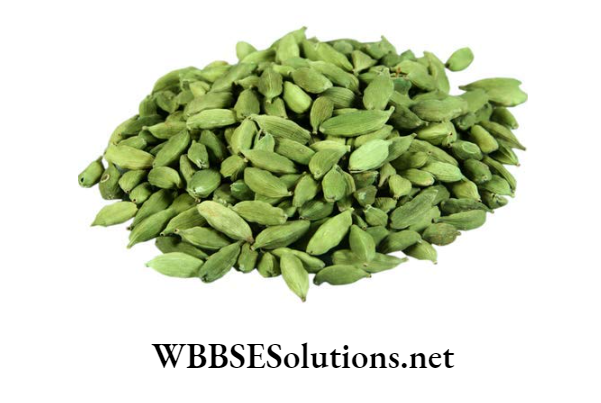
Cardamom: Cardamom is a spice made from the seeds of several plants in the genera Elettaria and Amomum. Both genera are native to India, Pakistan, Nepal, and Bhutan; they are recognized by their small seed pods, triangular in cross-section and spindle-shaped, with a thin, papery outer shell and small black seeds.

There are two main types of cardamom:

True or green cardamom (or, when bleached, white cardamom comes from the species Elettaria cardamomum and is distributed from India to Malaysia.

Black cardamom, also known as brown, greater, longer, or Nepal cardamom, comes from two species, Amomumcostatum and Amomum subulatum, which are distributed mainly in Asia and Australia.

Uses: Both forms of cardamom are used as flavorings and cooking spices in both food and drink and as medicine.

Besides being used as flavourant and spice in foods, cardamom-flavored tea, also flavored with cinnamon, is consumed as a hot beverage in Bangladesh, India, and Pakistan.

Cardamom has a strong, unique taste, with an intensely aromatic, resinous fragrance. Black cardamom has a distinctly smokey, though not bitter, aroma, with a coolness some consider similar to mint.

WBBSE Solutions For Class 8 School Science Chapter 11 Plant Kingdom and The Environment Around Us elachi

Green cardamom is one of the most expensive spices by weight but little is needed to impart flavor. It is best stored in pod form because once the seeds are exposed or ground, they quickly lose their flavor.

It is a common ingredient in Indian cooking and is often used in baking in Nordic countries, in particular Sweden and Finland.

In the Middle East, green cardamom powder is used as a spice for sweet dishes, as well as a traditional flavoring in coffee and tea. Cardamom is used to a wide extent in savory dishes.

‘In Asia, both types of cardamom are widely used in both sweet and savory dishes, particularly in the south. Both are frequent components in spice mixes, such as Indian and Nepali masalas and Thai curry pastes.

Green cardamom is often used in traditional Indian sweets and in masala chai (spiced tea). Both are also often used as a garnish in basmati rice and other dishes. Individual seeds are sometimes chewed and used in much the same way as chewing gum.

Green cardamom is broadly used in South Asia to treat infections in teeth and gums, to prevent and treat throat troubles, congestion of the lungs and pulmonary tuberculosis, inflammation of eyelids, and digestive disorders.

It also is used to break up kidney and gall stones and was reportedly used as an antidote for both snake and scorpion venoms.

Amomum is used as a spice and as an ingredient in traditional medicine systems of the traditional Chinese medicine in China, in Ayurveda in India, Pakistan, Japan, Korea, Nepal, and Vietnam.

Among other species, varieties, and cultivars, Amomum villosum cultivated in China, Laos, and Vietnam is used in traditional Chinese medicine to treat stomach problems, constipation, dysentery, and other digestion problems.

Garam masala, which literally means hot (garam) spice (masala), is a popular spice blend used throughout India and neighboring countries too.

It is a powder made of several types of spices and is added in small quantities at the end of the cooking process, or along with the tempering.

A typical Indian version of garam masala contains- black and white peppercorns, cloves, cinnamon or cassia bark, nutmeg and mace, black and green cardamom pods, Bay leaf, caraway, etc. Garam masala can be used alone or along with other seasonings and spice powders.

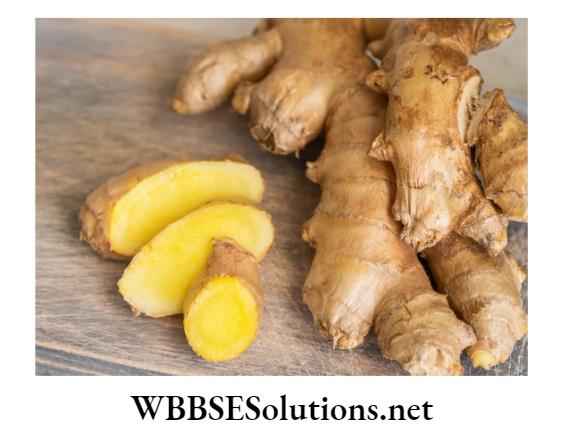
Ginger: Ginger [Zingiber officinale) is a flowering plant whose rhizome, ginger root, or simply ginger, is widely used as a spice or a medicine.

It is a herbaceous perennial that grows annual stems about a meter tall bearing narrow green leaves and yellow flowers.

Ginger is indigenous to southern China and was spread eventually to other parts of Asia and subsequently to West Africa and the Caribbean. India is now the largest producer of ginger.


WBBSE Solutions For Class 8 School Science Chapter 11 Plant Kingdom and The Environment Around Us ginger


Uses:

Ginger produces a hot, fragrant kitchen spice, vinegar, or sherry as a snack or cooked as young ginger rhizomes are juicy and fleshy with ingredients in many dishes.

They can be steen-ea very mild taste. They are often pickled in boiling water to make ginger tea, to which honey is often added; sliced orange or lemon fruit may be added.

Ginger can be made into candy or ginger wine. Mature ginger rhizomes are fibrous and nearly dry. The juice from ginger roots is often used as a spice.

In Indian recipes and is a common ingredient in Chinese, Korean, Japanese, Vietnamese, and many South Asian cuisines for flavoring dishes such as seafood, meat, and vegetarian dishes. The rhizome (underground stem) is used as a spice and also as a medicine.

It can be used fresh, dried, and powdered, or as a juice or oil. Ginger is commonly used to treat various types of stomach problems, including motion sickness, morning sickness, colic, upset stomach, gas, diarrhea, nausea caused by cancer treatment, nausea, and vomiting after surgery, as well as loss of appetite.

Other uses include pain relief from arthritis or muscle soreness, upper respiratory tract infections, cough, and bronchitis.

Ginger is also sometimes used for chest pain, low back pain, and stomach pain. Some people pour fresh juice on their skin to treat burns. The oil made from ginger is sometimes applied to the skin to relieve pain.

Garlic: Allium sativum, commonly known as garlic, is a species in the onion genus. With a history of human use of over 7,000 years, garlic is native to central Asia and has long been a staple in the Mediterranean region, as well as a frequent seasoning in Asia, Africa, and Europe.

It was known to Ancient Egyptians and has been used for both culinary and medicinal purposes. Allium sativum is a bulbous plant.

It grows up to 1.2 m (4 ft) in height. It produces hermaphrodite flowers. Pollination occurs by bees and other insects.
The garlic plant’s bulb is the most commonly used part of the plant.

With the exception of the single clove types, garlic bulbs are normally divided into numerous fleshy sections called cloves.

Garlic cloves are used for consumption (raw or cooked) or for medicinal purposes. They have a characteristic pungent, spicy flavor that mellows and sweetens considerably with cooking.

Other parts of the garlic plant are also edible. The leaves and flowers (bulbils) on the head (spathe) are sometimes eaten.


WBBSE Solutions For Class 8 School Science Chapter 11 Plant Kingdom and The Environment Around Us garlic

WBBSE Environmental Science Plant Kingdom guide

Uses:

Garlic is widely used around the world for its pungent flavor as a seasoning or condiment. Garlic may be applied to different kinds of bread, usually in a medium of butter or oil, to create a variety of classic dishes, such as garlic bread, garlic toast, etc.

Garlic is a herb. It is best known as a flavoring for food. But over the years, garlic has been used as a medicine to prevent or treat a wide range of diseases and conditions.

Fresh cloves or supplements made from the clove are used for medicine. Garlic contains a compound called Allicin. It has antimicrobial properties.

Garlic is used for many conditions related to the heart and blood system. These conditions include high blood pressure, high cholesterol, coronary heart disease, heart attack, and hardening of the arteries (atherosclerosis).

Some of these uses are supported by science. Garlic actually may be effective in slowing the development of atherosclerosis and seems to be able to modestly reduce blood pressure.

Some people use garlic to prevent colon cancer, rectal cancer, stomach cancer, breast cancer, prostate cancer, and lung cancer. It is also used to treat prostate cancer and bladder cancer.

Garlic has been tried for treating an enlarged prostate (benign prostatic hyperplasia; BPH), diabetes, osteoarthritis, hayfever (allergic rhinitis), traveler’s diarrhea, high blood pressure late in pregnancy (pre-eclampsia), cold, and flu.

It is also used for building the immune system, preventing tick bites, and preventing and treating bacterial and fungal infections.

Other uses include the treatment of fever, coughs, headache, stomach ache, sinus congestion, gout, rheumatism, hemorrhoids, asthma, bronchitis, shortness of breath, low blood pressure, Jow blood sugar, high blood sugar, and snakebites.

It is also used for fighting stress and fatigue and maintaining healthy liver function. Some people apply garlic oil to their skin to treat fungal infections, warts, and corn.

There is some evidence supporting the topical use of garlic for fungal infections like ringworm, jock itch, and athlete’s foot; but the effectiveness of garlic against warts and corn is still uncertain.

Some people apply garlic oil to their skin to treat fungal infections, warts, and corn. There is some evidence supporting the topical use of garlic for fungal infections like ringworm, jock itch, and athlete’s foot; but the effectiveness of garlic against warts and corn is still uncertain.

Medicinal Plants

Medicinal plants have been identified and used throughout human history. Plants have the ability to synthesize a wide variety of chemical compounds.

They are used to perform important biological functions to defend against attack from infectious and disease-causing microorganisms and also detoxification and well-being of the body.

At least 12,000 such compounds have been isolated so far; a number estimated to be less than 10% of the total. Chemical compounds in plants.

Mediate their effect on the human body through processes identical to those already well understood for the chemical compounds in conventional drugs; thus herbal medicines do not differ greatly from conventional drugs in terms of how they work.

The use of plants as medicines predates written human history. Ethnobotany(the study of traditional human uses of plants) is recognized as an effective way to discover future medicines.

The use of herbs to treat disease is almost universal among non-industrialized societies and is often more affordable than purchasing expensive modern pharmaceuticals.

The World Health Organization (WHO) estimates that 80 percent of the population of some Asian and African countries presently uses herbal medicine for some aspect of primary health care.

In India, Ayurveda medicine has used many herbs such as turmeric possibly as early as 1900 BC.

Earliest Sanskrit writings such as the Rig Veda, and Atharva Veda are some of the earliest available documents detailing the medical knowledge that formed the basis of the Ayurveda system.

Many other herbs and minerals used in Ayurveda were later described by ancient Indian herbalists such as Charaka and Sushruta during the 1st millennium BC.

The Sushruta Samhita attributed to Sushruta in the 6th century BC describes 700 medicinal plants, 64 preparations from mineral sources, and 57 preparations based on animal sources.

A brief account of Indian medicinal plants is mentioned below.

Neem

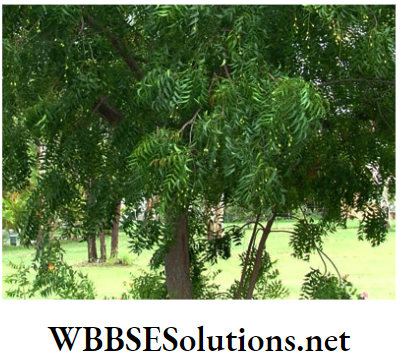
Neem (Azadirachta indica), is a tree in the mahogany family. It is one of two species in the genus Azadirachta and is native to India and the Indian subcontinent including Nepal, Pakistan, Bangladesh, and Sri Lanka.

WBBSE Solutions For Class 8 School Science Chapter 11 Plant Kingdom and The Environment Around Us neem tree

Neem is a fast-growing tree that can reach a height of 15-20 meters (49-66 ft), rarely 35-40 meters (115— 131 ft). It is evergreen, but in severe drought, it may shed most or nearly all of its leaves.

The branches are wide and spreading. The fairly dense crown is roundish and may reach a diameter of 15-20 meters (49-66 ft) in old, freestanding specimens.

General uses:

  1. Neem leaves are dried in India and placed in cupboards to prevent insects from eating the clothes and also while storing rice in tins.
  2. Neem leaves are dried and burnt in tropical regions to keep away mosquitoes as Ayurveda herb. Neem is also used in baths.
  3. Neem contains chemicals that might help reduce blood sugar levels, heal ulcers in the digestive tract, prevent conception, kill bacteria, and prevent plaque formation in the mouth.
  4. The tender shoots and flowers of the neem tree are eaten as a vegetable in India. In West Bengal, young neem leaves are fried in oil with tiny pieces of eggplant (brinjal).
  5. The dish is called nim begun and is the first item during a Bengali meal that acts as an appetizer. It is eaten with rice


Medicinal property: Neem products are believed to be anthelmintic, antifungal, antidiabetic, antibacterial, antiviral, contraceptive, and sedative.

Neem oil Is used for pain in the ear, gum, and tooth. Neem seed is used in viral epidemics and arthritis. The bitter tasted tonic made from the bark of the root and stem is useful in breaking periodic sequences of fevers (like malaria).

Neem oil is used for healthy hair, to improve liver function, detoxify the blood, and balance blood sugar levels. Neem leaves have been used to treat skin diseases like eczema, psoriasis, etc. The juice of neem leaves is useful for diabetes.

Other uses

Toiletries: Neem oil is used for preparing cosmetics such as soap, shampoo, balms, and creams as well as toothpaste.

Toothbrush: Traditionally, slender neem twigs (called datum are first chewed as a toothbrush and then split as a tongue cleaner.

Tree: Besides its use in traditional Indian medicine, the neem tree is of great importance for its anti-desertification properties and possibly as a good carbon dioxide sink.

Cosmetics: Neem is perceived in India as a beauty aid. Powdered leaves are a major component of at least one widely used facial cream. Purified neem oil is also used in nail polish and other cosmetics.

Bird repellent: Neem leaf boiled in water can be used as a very cost-effective bird repellent, especially for sparrows.

Lubricant: Neem oil is non-drying and it resists degradation better than most vegetable oils. In rural India, it is commonly used to grease cart wheels.

Fertilizer: Neem has demonstrated considerable potential as a fertilizer. Neem cake is widely used to fertilize cash crops, particularly sugarcane and vegetables.

Honey: In parts of Asia neem honey commands premium prices, and people promote apiculture by planting neem trees.

Soap: 80% of India’s supply of neem oil is now used by neem oil soap manufacturers. Additionally, it is antibacterial and antifungal, soothing, and moisturizing. It can be made with up to 40% neem oil.

Against pox viruses: In Tamilnadu, people who are affected by pox viruses are generally made to lie in a bed made of neem leaves and branches. This prevents the spreading of pox virus to others and has been in practice since the early centuries.

Bael

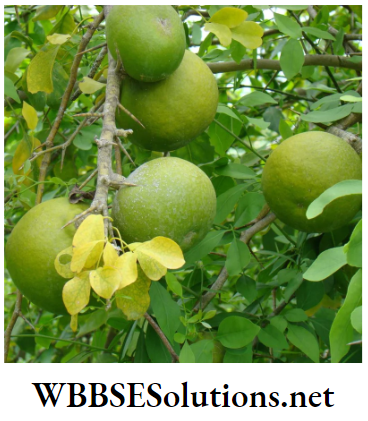
Aegle marmelos, commonly known as bael, Bengal quince, golden apple, stone apple, and wood apple, is a species of tree native to India.

It is present throughout Southeast Asia as a naturalized species. The tree is considered to be sacred by Hindus. Its fruits are used in traditional medicine and as a food throughout its range.

The bael fruit has a smooth, woody shell with a green, gray, or yellow peel. It takes about 11 months to ripen on the tree and can reach the size of a large grapefruit or pomelo, and some are even larger.

The shell is so hard it must be cracked with a hammer or machete. The fibrous yellow pulp is very aromatic. It has been described as tasting of marmalade and smelling of roses. Numerous hairy seeds are encapsulated in slimy mucilage.

WBBSE Solutions For Class 8 School Science Chapter 11 Plant Kingdom and The Environment Around Us bael

Importance of plants in the environment for Class 8

Medicinal use:

Bael fruit contains pectin and mucilage. The fruit is usually sliced and sun-dried. The hard leathery slices are then immersed in water.

They are prescribed for a number of diseases such as gastrointestinal diseases, piles, edema, jaundice, vomiting, obesity, pediatric disorders, gynecological disorders, urinary complaints, and as a rejuvenation.

Juice of Bael fruit is good for diarrhea patients. Unripe or partly ripe fruit increases appetite and digestive power. Bael leaves, fruit, and roots have antibiotic power.

Other Uses;

The fruit is eaten fresh or dried. If fresh, the juice is strained and sweetened to make a drink similar to lemonade. It can be made into sharbat (Hindi) or belpana, a refreshing drink made of pulp with water, sugar, and lime juice, mixed, left to stand for a few hours, strained, and put on ice.

One large bael fruit may yield five or six liters of sharbat.

The plant and its certain parts (leaves and fruits) are of religious importance since the tree is regarded as one of the sacred trees of Indian heritage.

Emblica (Amlaki)

Phyllanthus emblica, also known as emblic, amlaki, or amla from Sanskrit Amalia, is a deciduous tree. It is known for its edible fruit of the same name.

The tree is small to medium in size, reaching 8 to 18 m in height, with a crooked trunk and spreading branches. The branchlets are glabrous or finely pubescent, 10-20 cm long, and usually deciduous;

the leaves are simple, subsessile, and closely set along branchlets, light green, resembling pinnate leaves. The flowers are greenish-yellow.

The fruit is nearly spherical, light greenish yellow, quite smooth, and hard on appearance, with six vertical stripes or furrows.

Ripening in autumn, the berries are harvested by hand after climbing to the upper branches bearing the fruits. The taste of Indian gooseberry (amla) is sour, bitter, and astringent, and it is quite fibrous.

In India, it is common to eat gooseberries steeped in salt water and turmeric to make sour fruits palatable.

WBBSE Solutions For Class 8 School Science Chapter 11 Plant Kingdom and The Environment Around Us emblica

Medicinal use:

The nutritional facts of Amlaki include bioflavonoids, flavones, polyphenols, and carotenoids. It is the richest natural source of vitamin C available on this planet.

The unique thing about amlaki fruit is the ascorbic acid found is nearly indestructible even by burning or drying it. This makes the richest bio-availability of Vitamin C in this fruit which plays a significant role in the synthesis of neurotransmitters.

It is also required for collagen and carnitine synthesis, important molecules that produce energy from the fat cells whenever required.

  1. Health Benefits of Amlaki
  2. Amlaki inhibits the aging process and prevents the common cold.
  3. Amlaki is a nutritional powerhouse and is hence used to boost immunity and restore the body’s vitality.
  4. Amlaki provides energy to vital organs and is hence used in chronic illness recovery.
  5. Amlaki helps in regulating blood glucose levels in diabetic patients.
  6. Amlaki facilitates the absorption of iron in the body and improves hemoglobin levels. Amlaki possesses potent anti-inflammatory action and is hence used in various gastrointestinal tract inflammation such as gastritis.
  7. Amlaki contains natural digestive enzymes and is hence used in indigestion.
  8. Amlaki promotes spermatogenesis.
  9. Amlaki reduces serum cholesterol and high blood pressure.
  10. In Chinese traditional therapy, this fruit is used to treat throat inflammation.

Other use:

Popularly used in inks, shampoos, and hair oils, the high tannin content of Indian gooseberry fruit serves as a mordant for fixing dyes in fabrics.

Amla shampoos and hair oil are traditionally believed to nourish the hair and scalp and prevent premature grey hair.

Triphala: Literally meaning “three fruits”, Triphala is a traditional Ayurvedic herbal formulation consisting of three fruits native to the Indian subcontinent Amlaki (Emblica officinalis), Bibhitaki or Bahera (Terminalia bellirica) and Haritaki (Terminalia chebula).

Triphala is most commonly known for its use as a gentle bowel tonic, helpful in digestion and supporting regular bowel movements.

The combination of the three fruits has a synergistic effect to bolster many other systems as well. In addition to the Gl tract, Ayurveda uses Triphala to support healthy respiratory, cardiovascular, urinary, reproductive, and nervous systems.

Triphala has also been shown to be a powerful antioxidant, protecting cells from the damaging effects of free radicals

Nayantara

Nayantara (Catharanthus) Nayantara or Sadabahar or Periwinkle or Madagascar rosy periwinkle is an evergreen subshrub or herbaceous plant. This plant grows 1 m tall.

The leaves are oval to oblong, 2.5-9 cm long and 1-3.5 cm broad, glossy green, hairless, with a pale midrib and a short petiole 1-1.8 cm long; they are arranged in opposite pairs.

The flowers are white to dark pink with a darker red center, with a basal tube 2.5-3 cm long and a corolla 2-5 cm diameter with five petal-like lobes.

The fruit is a pair of follicles 2-4 cm long and 3 mm broad. In the wild, it is an endangered plant; the main cause of decline is habitat destruction by slash-and-burn agriculture.

It is also however widely cultivated and is naturalized in subtropical and tropical areas of the world.

WBBSE Solutions For Class 8 School Science Chapter 11 Plant Kingdom and The Environment Around Us nayantara catharanthus

Medicinal Uses:

In traditional Chinese medicine, extracts from it have been used against numerous diseases, including diabetes, malaria, and Hodgkin’s lymphoma.

The leaf of Catharanthus is a good medicine for diabetes. The plant has dysentery and hemorrhage-resistant properties. The alkaloid Raubasine found in the root of the plant helps to remove obstacles in blood circulation.

Two other alkaloids called Vincristine and Vinblastine are found in the plant and are used to treat blood cancer and other types of cancers.

Its alkaloids are hypotensive, sedative and have tranquilizing properties, and are anti-cancerous. It helps in relieving muscle pain, depression of the central nervous system, and wasps stings.

Other Uses:

As an ornamental plant, it is appreciated for its hardiness in dry and nutritionally deficient conditions, popular in subtropical gardens where temperatures never fall below 5°C to 7°C, and as a warm-season bedding plant in temperate gardens.

It is noted for its long flowering period, throughout the year in tropical conditions, and from spring to late autumn, in warm temperate climates. Full sun and well-drained soil are preferred.

Mint (Pudina)

Mentha (also known as mint) is a genus of plants in the mint family. The species are not clearly distinct and estimates of the number of species vary from 13 to 18.

Hybridization between some of the species occurs naturally. Many other hybrids, as well as numerous cultivars, are known in cultivation.

While the species that make up the Mentha genus are widely distributed and can be found in many environments, most grow best in wet environments and moist soils.

WBBSE Solutions For Class 8 School Science Chapter 11 Plant Kingdom and The Environment Around Us Mint

Mints will grow 10-120 cm tall and can spread over an indeterminate area. Due to their tendency to spread unchecked, some mints are considered invasive.

Mints are aromatic, almost exclusively perennial, rarely annual, herbs. They have wide-spreading underground and overground stolons and erect, square, branched stems.

The leaves are arranged in opposite pairs, from oblong to lanceolate, often downy, and with a serrated margin. Leaf colors range from dark green and gray-green to purple, blue, and sometimes pale yellow when dry they are usually dark green or green.

The flowers are white to purple and produced in false whorls called verticillasters. The corolla is two-lipped with four subequal lobes, the upper lobe usually the largest. The fruit is a nutlet, containing one to four seeds.]

Medicinal Uses:

  1. Pudina is used as a carminative and an expectorant.
  2. The plant is highly effective in treating headaches, rhinitis, cough sore throat, colic, and vomiting.
  3. It serves as a good blood cleanser since it is antiseptic and anti-bacterial.
  4. Pudina plays a significant role in alleviating swollen gums, mouth ulcers, and toothaches.
  5. Crushed and bruised pudina leaves are used in treating insect bites.
  6. The decoction and infusion of its leaves and stems help in fever, stomach aches, dysmenorrheal, and diuresis.
  7. Fresh leaves of pudina are crushed and sniffed for dizziness. Crushed leaves are also applied on the forehead and temple, to cure headaches.
  8. The menthol extracted from the plant is used in preparing balms.

Aloe Vera

Aloe vera (Ghritakumari) is a succulent plant species. The species is frequently cited as being used in herbal medicine since the beginning of the first century AD.

Extracts from Aloe vera are widely used in the cosmetics and alternative medicine industries, being marketed as variously having rejuvenating, healing, or soothing properties.

Aloe is one of the great healing agents among herbs. Indian aloe or Ghritkumari is a form of cactus. Aloes have long been in use for a host of diseases, particularly those connected with the digestive system and skin disorders.

it contains enzymes, polysaccharides, and nutrients that exhibit antibacterial and antifungal action. Aloe vera is useful in liver and spleen disorders, skin problems (scars, pimples, dermatitis, minor wounds or burns, etc.), external sores, hair problems, and eye troubles.

It is used as a flavoring agent in many culinary preparations.

Other Uses:

The leaf, fresh or dried, is the culinary source of mint. Fresh mint is usually preferred over dried mint when storage of the mint is not a problem.

The leaves have a warm, fresh, aromatic, sweet flavor with a cool aftertaste, and are used in teas, beverages, jellies, syrups, candies, and ice creams.

Mint essential oil and menthol are extensively used as flavorings in breath fresheners, drinks, antiseptic mouth rinses, toothpaste, chewing gum, desserts, and candies, such as mint (candy) and mint chocolate.

The substances that give the mints their characteristic aromas and flavors are menthol and pulegone. Mint was originally used as a medicinal herb to treat stomach aches and chest pains.

There are several uses in traditional medicine and preliminary research for possible use in treating irritable bowel syndrome.

Menthol from the mint essential oil (40-90%) is an ingredient of many cosmetics and some perfumes. Menthol and mint essential oil are also used in aromatherapy which may have clinical use to alleviate post-surgery nausea.

Mint oil is also used as an environmentally friendly insecticide for its ability to kill some common pests such as wasps, hornets, ants, and cockroaches, and has small white teeth.

The flowers are produced in summer on a spike up to 90 cm (35 in) tall, each flower being pendulous, with a yellow tubular corolla 2-3 cm (0.8-1.2 in) long.

Medicinal Uses:

Aloe vera is used in traditional medicine as a multipurpose skin treatment. Aloe vera is used on facial tissues where it is promoted as a moisturizer and anti-irritant to reduce chafing of the nose.

Cosmetic companies commonly add sap or other derivatives from Aloe vera to products such as makeup, tissues, moisturizers, soaps, sunscreens, incense, shaving cream, or shampoos.

Aloe vera gel is effective in treating psoriasis, seborrhea, dandruff, minor burns, and skin abrasions, as well as radiation-induced skin injuries.

Aloe vera juice (also called latex) taken by mouth is a powerful laxative. Aloe vera gel taken orally (by mouth) seems to help people with diabetes by lowering blood sugar levels.

It may also help to lower cholesterol. Extracts of aloe vera leave contain vitamins, minerals, amino acids, and fatty acids.

It is used to reduce acidity, and inflammation of bone joints, and to reduce fever (antipyretic to reduce mental stress and tension.

WBBSE Solutions For Class 8 School Science Chapter 11 Plant Kingdom and The Environment Around Us Alovera

WBBSE Class 8 School Science Chapter 10 Biodiversity Environmental Crisis and Conservation of Endangered Animals LAQs

WBBSE Chapter 10 Biodiversity, Environmental Animals Long Answer Questions

Question 1. Forests can grow and regenerate on their own for reasons. Mention the anthropogenic factors that are threatening wildlife.
Answer:

Forests can grow and regenerate on their own:-

The dead part of trees, dead animals, and animal wastes keep on collecting on the forest floor. The decomposers act on the dead plant and animal matter and animal wastes and convert them into humus.

  1. The hummus mixes with the forest soil and makes it fertile. The animals and birds of the forest, wind, and water disperse the seeds of trees on the forest soil.
  2. The seeds obtain nutrients and water from the forest soil and germinate to form seedlings. The seedlings grow to form trees.
  3. The growing of new trees regenerates the forest naturally. The animals help the forests to grow and regenerate in two ways:
  4. The dead animals and animal wastes decay to provide nutrients to the forest soil and make it fertile.
  5. The animals carry out pollination and dispersal of seeds throughout the forest. Thus the forest can grow and regenerate on its own.
  6. The anthropogenic factors responsible for threatening wildlife are-
  7. indiscriminate use of natural resources belonging to forests.
  8. Mass-scale deforestation for urbanization, road expansion, expansion of cultivable land, etc.
  9. Habitat destruction of wildlife.
  10. Pollution, global warming, and climate change
  11. Introduction of exotic species
  12. Poaching and overhunting to fuel the illegal trade of animal parts

WBBSE Solutions For Class 8 School Science Chapter 10 Biodiversity Environmental Crisis and Conservation of Endangered Animals Long Answer Type Questions

Read And Learn More WBBSE Solutions For Class 8 School Science Long Answer Type Questions

Question 2. Write about the vertical stratification of forests. Mention some importance of forests.
Answer:

The Vertical stratification of a forest:-

Evergreen forests, such as the Amazon Rainforest and the tropical rain forests have a peculiar structure, in terms of the layers in which the trees are organized.

This organization is shaped mainly by abiotic factors such as humidity, sunlight, wind, etc. There are six basic layers namely the emergent, canopy, understory, shrub layer, herb layer, and forest floor.

The Emergent layer: The Emergent layer is made up of the tallest trees, spaced out, usually with straight branch-free trunks (large trees are about 16ft in diameter), with a crown on the tops.

They are about 100 ft – 200 ft tall with supporting buttress roots spreading up to about 20-30ft. The trees have small pointed leaves, which are adapted to withstand wind action over tree tops.

Trees here are in constant sunlight. Birds such as hummingbirds and parrots are common. Animals here tend to be lightweight and include the Sloth and the Spider, Monkey. The Brazil Nut tree and Kapok Tree are common trees in this emergent layer.


WBBSE Solutions For Class 8 School Science Chapter 10 Biodiversity, Environmental Crisis and Conservation of Endangered Animals The vertical stratification of a forest

WBBSE Class 8 Biodiversity long answer questions

The Canopy: The Canopy is the layer that stops sunlight and rainwater from getting to the layers below it.

The trees grow up to about 130 ft and have broader leaves and drip spouts. This leaf feature makes rainwater drip down quickly rather than staying on the leaves.

There are millions of insects and animals in this layer as they have enough food to keep them there. Common animals include squirrels, monkeys, reptiles, bats, and a variety of birds.

Visibility is low from the thickness of leaves and the network of branches. As a result, animal sounds are loudest in this layer because they communicate with sounds.

The Understory: The Understory has fewer trees, but lots of shrubs and small trees growing up to about 12 ft high – The area is made up of carnivores, many of which have climbing abilities.

Animals are also larger in size and heavier than animals in the other layers. They include scorpions, armadillos, wild cats, mongooses, lizards, snakes, and a variety of insects.

The Shrub layer: The shrub layer consists of mature shrubs and bushes and lies just below the understory. It has a smaller vegetation which is between 3 ft to 6 ft in height from the forest floor.

The animals such as deer and bears obtain a lot of food from the shrub layer of vegetation. Many of the shrubs depend on animals for the dispersal of their seeds. There is not much sunlight in the shrub layer.

The Herb layer: The herb layer is the lowest layer of vegetation in the forest having leafy plants belonging to herbs, ferns, and grasses.

This layer ranges from the forest floor to about 3ft in height. Very little sunlight remains for the plants in the herb layer.

The plants grow and flower early in the season so as to get sufficient sunlight before the canopy leaves open and obstructs sunlight. Most of the plants in the herb layer have short life cycles.

The Forest Floor: The forest floor is the ground level of the structure. It has shallow soils of poor quality, with microorganisms and life- forms feeding on decaying matter on the floor.

The moist, dark conditions aid decomposition of organic matter, and nutrients are quickly absorbed by the trees and other plants on them. There is very little light here. Animals that are found here are herbivores and

Importance of Forests

Forests and biodiversity are key to all life forms. Forests have always had great importance to people. Prehistoric people got their food mainly by hunting and gathering wild plants.

Many of these people lived in the forest and were a natural part of it. With the development of civilization, people settled in cities. But they still went to the forest to get timber and hunt. Below is some more importance of forests:

Watershed: Forests serve as a watershed. This is because almost all water ultimately comes from rivers and lakes and from forest-derived water tables. Some rivers running through forests are also kept cool and prevented from drying out.

Habitat and Ecosystems: Forests serve as a home (habitat) to millions of animals. Think . of the many types of reptiles (snakes and lizards) wild animals, butterflies and insects, birds, and tree-top animals as well as all those that live in the forest streams and rivers.

Animals form part of the food chain in the forests. All these different animals and plants are called biodiversity, and the interaction with one another and with their physical environment is what we call an ecosystem.

Healthy ecosystems can better withstand and recover from a variety of disasters such as floods and wildfires.

Economic benefits: Forests are of immense economic importance to us. For example, plantation forests provide humans with timber and wood, which are exported and used in all parts of the world.

They also provide tourism income to inhabitants (people living in or close to forests) when people visit to see the best of nature.

Climate control: Climate control and atmosphere purification are key for human existence. Trees and soils help regulate atmospheric temperatures through a process called evapotranspiration. This helps to stabilize and cool the climate.

Additionally, they enrich the atmosphere by absorbing bad gases (for example C02 and .other greenhouse gases) and producing oxygen. Trees also help to remove air pollutants.

Control of soil erosion and flood: The roots of trees and plants growing in the forest bind the topsoil particles and hold the soil together. Due to this, strong winds and flowing rainwater are not able to carry away the topsoil. Hence soil erosion is prevented.

The cover of trees and many layers of vegetation in the forest softens the effect of heavy rain on the soil due to which the soil does not become loose. Thus, forest help in the conservation of soil.

The forest floor is covered with a lot of decaying material and small vegetation which absorbs most of the rainwater which falls down during heavy rain.

The roots of trees help the rainwater to seep into the forest ground and raise the water table. The forest releases this absorbed water slowly and steadily into rivers through the soil.

By holding back rainwater and then releasing it slowly into rivers, the forests prevent the occurrence of floods in the rivers.

Long answer type questions on environmental crisis for Class 8

Question 3. what is a forest fire? Write about its causes and effects.
Answer:

Forest fires

Forest fire causes imbalances in nature and endangers biodiversity by reducing faunal and floral wealth.

Causes of a forest fire: Traditionally Indian forests have been affected by fires. The menace has been aggravated by the rising human and cattle populations and the consequent increase in demand for forest products by individuals and communities.

Causes of forest fires can be divided into two broad categories: environmental (which is beyond control) and human-related (which is controllable).

WBBSE Solutions For Class 8 School Science Chapter 10 Biodiversity, Environmental Crisis and Conservation of Endangered Animals Forest fires


1. Environmental causes

These are largely related to climatic conditions such as temperature, wind speed, and direction, level of moisture in soil and atmosphere, and duration of dry spells.

Other natural causes are the friction of bamboo swaying due to high wind velocity, rolling stones that result in sparks setting off fires in highly inflammable leaf litter on the forest floor, volcanic eruption, lightning, etc.

2. Human-related cause

These result from human activity as well as methods of forest management. These can be intentional or unintentional, for example-

fire set by grazers and gatherers of various forest products to facilitate the gathering of minor forest produce like flowers of Madhuca indica and leaves of Diospyros melanoxylon.

  1. The centuries-old practice of shifting cultivated land by firing forest.
  2. The use of fires by villagers to ward off wild animals.

WBBSE Chapter 10 conservation of endangered animals long answers

Question 4. How do mangroves excrete excess salt from their body? Mention the names of two endangered animals present in the mangrove forest. Do desert travelers take the help of which is plants to quench their thirst?
Answer:

Terrestrial mangrove vegetation cannot tolerate salts measuring more than 33-38g in one thousand grams of marine water. Excess salt causes toxicity in the plant tissues.

They eliminate the excess salt partially through the glands present in their roots and leaves. Besides these, the plants also eliminate salt by shedding off leaves.

Estuarine crocodiles and River Terrapin (River turtles) are some of the endangered animals of mangrove forest.
The desert travelers quench their thirst with the help of Saguaro cactus. They collect water by cutting their expanded trunk.

Question 5. What is the full form of IUCN? What is Red Data Book? What do you mean by ex-situ conservation?
Answer:

IUCN:-

The world’s most comprehensive inventory of the global conservation status of biological status is published by IUCN as the Red Data Book.

Species are classified by IUCN Red Book into nine groups, specified through criteria such as rate of decline, population size, geographic distribution, and distribution fragmentation. The IUCN aims to re-evaluate the data of species every five years if possible or at least every ten years.

Question 6. What is Agenda 21? Mention the crisis factors that the Gangetic dolphins are facing due to human activities. Name the world’s first Dolphin sanctuary.
Answer:

Agenda 21:-

The Earth Summit 1992 produced the Rio Declaration on Environment and Development and Agenda 21. Agenda 21 is a comprehensive plan to work together to protect the environment through sustainable development.

Crisis of Gangetic dolphins:

Excessive water pollution is a serious threat to the lives of dolphins. The number of fish is dwindling due to water pollution. Hence the dolphins are endangered due to lack of food.

The depth of water in the river is decreasing due to the construction of dams and silting. The emergence of sandbars are dividing the river into small parts.

This is hindering the movement of the dolphins. As a result, the communication between the different groups of dolphins is lost. The small and segregated dolphins are facing breeding problems.

Dolphins are sometimes dead due to entrapment in fishing nets. The world’s first dolphin sanctuary, Vikramshila Gangetic Dolphin Sanctuary has been set up in 1991 between Sultanganj and Kahalgao of Bihar.

Question 7. When do Arctic animals lay eggs? Briefly describe some adaptive features of penguins.
Answer:

Most Arctic animals avoid giving birth to their young ones in the intense cold period.

  1. The scarcity of food compels them to adopt such behavior. Animals start establishing their territory at the end of spring.
  2. They lay eggs or give birth to young ones during the short summer days. However, female Polar bears give birth in winter.
  3. Some of the adaptive features of penguins are:
  4. Penguin is black and white in color but still, it merges well with the white background of ice and snow.
  5. They have thick skin and a layer of fat below the skin to protect them from excessive cold.
  6. They live together in large numbers. Penguins huddle together to keep themselves warm.
  7. Penguins have streamlined bodies, flipper-like wings, and webbed feet which make them good swimmers.

In-depth explanations of environmental issues for Class 8

Question 8. How many types of camels are there? Describe the lifestyles of people living in the desert.
Answer:

The camels are of two types: 1. humped (Arabian camel) and 2. two-humped (Bactrian Camel).

Though life in the desert is hard, people have been living in the desert since prehistoric days.

1. People living in the Namib desert are known as Bushmen. They dig holes in the sand and live there. They hunt animals using bow and arrow. They eat the animals by roasting them.

2. San Bushmen are the people living in the Kalahari desert. They make holes in wet sand and then suck the water by inserting a strong hollow grass stem.

WBBSE Solutions For Class 8 School Science Long Answer Type Questions WBBSE Solutions For Class 8 School Science Short Answer Type Questions
WBBSE Solutions For Class 8 School Science Very Short Answer Type Questions WBBSE Solutions For Class 8 School Science Review Questions
WBBSE Solutions For Class 8 School Science Solved Numerical Problems WBBSE Solutions For Class 8 School Science Experiments Questions
WBBSE Solutions For Class 8 Maths WBBSE Class 8 History Notes
WBBSE Class 8 History Multiple Choice Questions WBBSE Solutions For Class 8 History
WBBSE Solutions For Class 8 Geography


They use empty Ostrich eggs as water pots. They can easily understand that water is present in the sand by seeing the texture of the sand.

3. Tuareg, the tribes living in the Sahara desert, make huts with grasses found in the desert. They also make sand tunnels and live within them.

4. The Red Indians of the American desert live together. Every house has quite a number of rooms. These stone-made houses are called Pueblo.

5. The nomadic people who live in the Thar desert are Wardha, Bhil, Gadi-Lohar, etc.

6. The Beduins of the Sahara and Arabian desert wear long loose dresses which cover their whole body. They travel miles together at a stretch on camels and take rest in tents for a few intermediate days.

Question 9. What are the functions of the rhino horn? What role does a rhino play in the grassland ecosystem?
Answer:

Functions of the rhino horn:-

Name two vulture rehabilitation centers in India. The rhinoceros uses its horn to search for food by digging in the soil to find out roots of trees. It also uses the horn to fight other male rhinos in the breeding season.

The one-horned rhino exerts various influences on the grassland ecosystem:

1. It digs up the soil with the horn. This opens up the possibility of new seed germination. This in turn enriches and expands the grassland. As a result, the prey population of the predators, ie. the number of herbivores, increases.

2. The rhino defecates in the same place. When the dunghill rises to a certain height, the rhino levels it with its horn.

The excreta contains nutrients in high proportion. When seeds are egested out after 3-7 days of ingestion and they fall on the excreta, germination occurs.

Thus dispersal of seeds takes place. Sometimes birds also take away some of these seeds to other places to carry out the dispersal.

Two significant vulture rehabilitation centers are Pinjar of Haryana and Rajabhatkhawa of North Bengal.

WBBSE Class 8 Science practice long answer questions on conservation

Question 10. Describe the methods of biodiversity conservation using a line diagram. Name three endangered animals of India. How is the conservation of fishing cats being carried out?
Answer:

Conservations of Biodiversity

Conservation is the protection, preservation, management, or restoration of wildlife and natural resources such as forests and water.

Through the conservation of biodiversity and the survival of many species and habitats which are threatened due to human activities can be ensured. There is an urgent need, not only to manage and conserve biotic wealth but also to restore degraded ecosystems.

Types of Conservation

Conservation can broadly be divided into two types: In-situ conservation and Ex-situ conservation. Biodiversity Conservation

in-situ Conservation: In-situ conservation is on-site conservation or the conservation of genetic resources in natural populations of plant or animal species, such as forest genetic resources in natural populations of tree species.

It is the process of protecting an endangered plant or animal species in its natural habitat, either by protecting or cleaning up the habitat itself or by defending the species from predators.

It is applied to the conservation of agricultural biodiversity in agro-forestry by farmers, especially those using unconventional farming practices.

In-situ conservation is being done by declaring the area as a protected area. In India following types of natural habitats are being maintained:

  1. National parks
  2. Wildlife sanctuaries
  3. Biosphere reserves

India has over 600 protected areas, which include over 90 national parks, over 500 animal sanctuaries, and 15 biosphere reserves.

Ex-Situ Conservation; Ex-situ conservation is the preservation of components of biological diversity outside their natural habitats.

This involves the conservation of genetic resources, as well as wild and cultivated species, and draws on a diverse body of techniques and facilities.

Such strategies include the establishment of botanical gardens, zoos, conservation strands and genes, pollen seeds, seedlings, tissue cultures, and DNA banks.

Some endangered animals in India

The world is filled with endangered species of animals, many of which can be found in India. While some of these species are critically endangered, some are near threatened and some are even extinct.

There are some species that are left in such few numbers that the next generation may not be able to ever see them if nothing is done for their conservation.

While we hope that more efforts are taken to conserve these species, here’s a list of some endangered animals that you can find in different parts of India.

1. Bengal Tiger

The Bengal Tiger is the national animal of both, India and Bangladesh. The tiger’s coat is yellow to light orange, with stripes ranging from dark brown to black. The number of tigers has reduced dramatically in the past few years, due to poaching and human-tiger conflict.

Can be spotted at Tadoba National Park, Ranthambore National Park, Sundarbans National Park, Sariska Tiger Reserve, Jim Corbett National Park, and Bandhavgarh National Park. [Snow Leopard The snow leopard is a large cat native to the mountain ranges in Central and South Asia.

Snow leopards have long, thick fur, and their base color varies from smoky gray to yellowish tan, with whitish underparts.

Can be spotted: at Hemis National Park, Ladakh, Nanda Devi National Park, Uttarakhand, Dibang Wildlife Sanctuary, Arunachal Pradesh,]

WBBSE Solutions For Class 8 School Science Chapter 10 Biodiversity, Environmental Crisis and Conservation of Endangered Animals Bengal tiger

2. Asiatic Lion

Asiatic Lion aka the Indian Lion or Persian Lion is a lion subspecies that is endangered. It differs from the African lion by less inflated auditory bullae, a larger tail tuft, and a less developed mane.

Can be spotted: at Gir Forest National Park, Gujarat.

WBBSE Solutions For Class 8 School Science Chapter 10 Biodiversity, Environmental Crisis and Conservation of Endangered Animals Asiatic lion


3. Snow Leopard

The snow leopard is a large cat native to the mountain ranges in Central and South Asia. Snow leopards have long, thick fur, and their base color varies from smoky gray to yellowish tan, with whitish underparts.

Can be spotted at: Hemis National Park, Ladakh, Nanda Devi National Park, Uttarakhand, Dibang Wildlife Sanctuary, Arunachal Pradesh, Kibber Wildlife Sanctuary, Lahaul Spiti, Himachal Pradesh, Pin Valley National Park, Great Himalayan National Park, Kullu, Himachal Pradesh.

WBBSE Solutions For Class 8 School Science Chapter 10 Biodiversity, Environmental Crisis and Conservation of Endangered Animals Snow leopeard

4. Blackbuck

The Blackbuck is an ungulate species of antelope and it is near threatened. The main threat to this species is poaching, predation, habitat destruction, overgrazing, inbreeding, and sanctuary visitors.

Can be spotted: at Guindy National park, Tamil Nadu, Rollapadu, Andhra Pradesh, Chilka, Odisha.


WBBSE Solutions For Class 8 School Science Chapter 10 Biodiversity, Environmental Crisis and Conservation of Endangered Animals black buck

5. Red Panda

Red Panda is also known as a lesser panda or red cat-bear. It is an arboreal mammal native to the eastern Himalayas. Red Panda’s population is on a decrease given to habitat loss and fragmentation, poaching, and inbreeding depression.

Can be spotted: at Sikkim, Arunachal Pradesh, and West Bengal’s Khangchendzonga and Namdapha National Park.


WBBSE Solutions For Class 8 School Science Chapter 10 Biodiversity, Environmental Crisis and Conservation of Endangered Animals red panda

Understanding biodiversity long answers for Class 8

6. The Nilgiri Tahr:

The Nilgiri Tahr is an ungulate, endemic to the Nilgiri Hills. Nilgiri tahrs are stocky goats with short, coarse fur and a bristly mane.

Can be spotted: at Eravikulam National Park, Nilgiri Hills, Anaimalai Hills, Periyar National Park, and Palni Hills.


WBBSE Solutions For Class 8 School Science Chapter 10 Biodiversity, Environmental Crisis and Conservation of Endangered Animals the nilgiri tahr


7. Kashmir Red Stag (Hangul)

The Kashmir stag also known as Hangul is a critically endangered species. This deer has a light rump patch without including the tail. Each of its antlers consists of 5 tines.

Wildlife Sanctuary, OveraAru, Sind Valley, and in the forests of Kishtwar and Bhaderwah, all of which are a part of Jammu and Kashmir.

WBBSE Solutions For Class 8 School Science Chapter 10 Biodiversity, Environmental Crisis and Conservation of Endangered Animals Kashmir red stag

8. Lion-Tailed Macaque

The Lion-tailed macaque is an Old World Monkey, endemic to the Western Ghats of South India. Its outstanding characteristic is the silver-white mane that surrounds the head from the cheeks down to the chin.

Can be spotted: at Silent Valley National Park, Kerala, Papanasam part of the KalakkadMundanthurai Tiger Reserve, Tamil Nadu, and Sirsi-Honnavara rainforests of NorthWestern Ghats in Karnataka.


WBBSE Solutions For Class 8 School Science Chapter 10 Biodiversity, Environmental Crisis and Conservation of Endangered Animals lion tailed macaque

Key long answer questions about environmental conservation for Class 8

9. Indian Bison (Gaur)

Indian Bison is the largest extant bovine, native to South Asia and South-East Asia. The bison are highly threatened by poaching for trade to supply international markets.

Can be spotted: at Arignar Anna Zoological Park, Chennai, and Chinnar Wildlife Sanctuary, Kerala.

WBBSE Solutions For Class 8 School Science Chapter 10 Biodiversity, Environmental Crisis and Conservation of Endangered Animals indian bison gaur

10. Vultures

Vultures were once the most abundant large birds of prey and nature’s scavengers across the world, including the Indian subcontinent.

But today they are one of the most endangered bird species. This has not only resulted in the near-total disappearance of a magnificent bird from our skies but also jeopardized health and cleanliness in the countryside and caused unnatural changes in the natural food chain.

The species breeds mainly on cliffs but is known to use trees to nest in Rajasthan. Like other vultures it is a scavenger, feeding mostly on carcasses of dead animals which it finds by soaring over the savannah and around human habitation.

They often move in flocks. For centuries, vultures have been silently performing a very important task in the cycle of nature.  They are Nature’s Custodians of Cleanliness. They have been revered in most ancient cultures for the role they play in the ecosystem.

For instance, in India, they appear as Jatayu and Sampati in the great epic Ramayan. They have been playing a lion’s share in disposing of the carcasses of dead animals, both wild and domestic, along with other lesser scavengers such as jackals, hyenas, dogs, crows, and kites.

Between 2000-2007 annual decline rates of this species and the slender-billed vulture averaged over sixteen percent. The cause of this has been identified as poisoning caused by the veterinary drug diclofenac.

Diclofenac is a nonsteroidal anti-inflammatory drug (NSAID) and when given to working animals it can reduce joint pain and so keep them working for longer.

The drug is believed to be swallowed by vultures with the flesh of dead cattle who were given diclofenac in the last days of life.

Diclofenac causes kidney failure in several species of vultures. In March 2006 the Indian Government announced its support for a ban on the veterinary use of diclofenac.

Another NSAID, meloxicam, has been found to be harmless to vultures and should prove to be an acceptable substitute for diclofenac.

When meloxicam production is increased it is hoped that it will be as cheap as diclofenac. As of August 2011, the ban for veterinary use for approximately a year did not prevent diclofenac use across India.

Small numbers of birds have bred across peninsular India, in Karnataka and Tamil Nadu. Captive breeding programs for several species of Indian vulture have been started.

The vultures are long-lived and slow in breeding, so the programs are expected to take decades. Vultures reach breeding age at about five years old.

It is hoped that captive-bred birds will be released to the wild when the environment is clear of diclofenac.


WBBSE Solutions For Class 8 School Science Chapter 10 Biodiversity, Environmental Crisis and Conservation of Endangered Animals vulture


11. Gangetic Dolphins

The Ganges River dolphin (or susu, blind dolphin, Gangetic dolphin, South Asian River Dolphin) inhabits the Ganges-Brahmaputra- Meghna and Karnaphuli-Sangu river systems of Nepal, India, and Bangladesh.

This vast area has been altered by the construction of more than 50 dams and other irrigation-related projects, with dire consequences for the river dolphins. The scientific name is – Platanista gangetica.

Physical Description: A long thin snout, rounded belly, stocky body, and large flippers are characteristics of the Ganges River dolphin.

Although its eye lacks a lens (this species is also referred to as the “blind dolphin”), the dolphin still uses its eye to locate itself.

The species has a slit similar to a blowhole on the top of the head, which acts as a nostril. The dolphin has the peculiarity of swimming on one side so that its flipper trails the muddy bottom.

Females are larger than males and attain a maximum size of 2.67 m. Males are about 2.12 m. The color of the dolphin is grayish brown. The calves and young ones are dark in color but as the animal grows in size, the color lightens.

WBBSE Solutions For Class 8 School Science Chapter 10 Biodiversity, Environmental Crisis and Conservation of Endangered Animals gaint dolphin

Examples of long answer questions on biodiversity for Class 8

Ecology and Habitat:

The species is found exclusively in freshwater habitats. In Nepal, it inhabits Clearwater and rapids. In Bangladesh and India, individuals live in rivers that flow slowly through the plains.

The Ganges River dolphin favors deep pools, eddy counter-currents located downstream of the convergence of rivers and of sharp meanders, and upstream and downstream of mid-channel islands/

Susu shares its habitat with crocodiles, freshwater turtles, and wetland birds, many of which are fish eaters and potential competitors. with dolphins.

Why is this species important? The presence of dolphins in a river system signals a healthy ecosystem. Since the river dolphin is at the apex of the aquatic food chain,

Its presence in adequate numbers symbolizes greater biodiversity in the river system and helps keep the ecosystem in balance.

What are the main threats to the Ganges River dolphin? Dolphins are in danger because of less habitat area due to the construction of dams, fishing, and pesticide.

They are also killed for meat and oil. Dolphins in India come under extinct animals due to polluted rivers and poaching.

Every year nearly 100 Dolphins are getting killed by humans. If anyone kills the Dolphin, or if anyone has the body parts of the Dolphin, will be treated as a crime they will be punished.

Conservation: India has declared Ganga Dolphin as the National Aquatic Animal of India. The Ganges River Dolphin is a rare species of dolphin found only in India and neighboring countries.

There are various conservation works going on in the Sanctuary Areas to protect the National Aquatic Animal of India. Vikramshila Gangetic dolphin sanctuary is the only protected area for the endangered Gangetic dolphins in Asia.

It is located in the Bhagalpur District of Bihar, India. Only a few hundred dolphins remain in India, of which half are found here.

WWF-India and Aaranyak an NGO have been working closely with various government departments to protect these blind river Dolphins of India.

One horned rhinoceros

The Indian rhinoceros (Rhinoceros unicornis), also called the greater one-horned rhinoceros and Indian one-horned rhinoceros.

Listed as a vulnerable species, the large mammal is primarily found in India’s Assam, West Bengal, and in protected areas in the Terai of Nepal, where populations are confined to the riverine grasslands in the foothills of the Himalayas.

The Indian rhinoceros once ranged throughout the entire stretch of the Indo-Gangetic Plain, but excessive hunting reduced their range drastically. Today, more than 3,000 rhinos live in the wild.

WBBSE Solutions For Class 8 School Science Chapter 10 Biodiversity, Environmental Crisis and Conservation of Endangered Animals one horned rhinoceros.jpg


Physical description: The Indian rhinoceros has thick grey-brown skin with pinkish skin folds and a black horn. Its upper legs and shoulders are covered in wart-like bumps.

It has very little body hair, aside from eyelashes, ear fringes, and tail brushes. Males have huge neck folds. Its skull is heavy with a basal length above 60 cm (24 in) and an occiput above 19 cm (7.5 in).

Its nasal horn is slightly back-curved with a base of about 18.5 cm (7.3 in) by 12 cm (4.7 in) that rapidly narrows until a smooth, even stem part begins about 55 mm (2.2 in) above the base. In captive animals, the horn is frequently worn down to a thick knob.

The rhino’s single horn is present in both males and females but not in newborns young. The black horn is our keratin, like human fingernails, and starts to show after about six years.

In most adults, the caches have a length of about 25 cm (9.8 in), but has been recorded up to 57.2 cm (22.5 in) in length.

Distribution and habitat: One-homed rhinos once ranged across the entire northern part of the infant Subcontinent along the Indus, Ganges, and Brahmaputra River basins, from Pakistan to the Indian-Burmese border, including Bangladesh and the southern parts of Nepal and Bhutan.

They may have also occurred in Myanmar, southern China, and Indochina. Today, their range has further shrunk to a few pockets in southern Nepal, northern Bengal, and the Brahmaputra Valley.

Ecology and behavior: Rhinos are mostly solitary creatures, with the exception of mothers and calves and breeding pairs, although they sometimes congregate in bathing areas.

Dominant males tolerate males passing through their territories except when they are in mating season when dangerous fights break out. They are active at night and early morning.

They are very good swimmers. Indian rhinos bathe -regularly. The folds in their skin trap water and hold it even when they come back on land.

Indian rhinos have few natural enemies, except for tigers, which sometimes kill unguarded calves, but adult rhinos are less vulnerable due to their size.

They have excellent senses of hearing and smell, but relatively poor eyesight. The Indian rhinoceros makes a wide variety of vocalizations.

Diet: Indian rhinoceros are grazers. Their diets consist almost entirely of grasses, but they also eat leaves, branches of shrubs and trees, fruits, and submerged and floating aquatic plants. They feed in the mornings and evenings.

Reproduction: Captive males breed at five years of age, but wild males attain dominance much later when they are larger.

In one five-year field study, only one rhino estimated to be younger than 15 years mated successfully. Captive females breed as young as four years of age but in the wild,

They usually start breeding only when six years old, which likely indicates they need to be large enough to avoid being killed by aggressive males. Their gestation period is around 15.7 months, and their birth interval ranges from 3451 months.

Threats: Sport hunting became common in the late 1800s and early 1900s. Indian rhinos were hunted relentlessly and persistently.

Poaching for rhinoceros horn became the single most important reason for the decline of the Indian rhino after conservation measures were put in place from the beginning of the 20th century when legal hunting ended. From 1980 to 1993,692 rhinos were poached in India.

Poaching, mainly for the use of the horn in traditional Chinese medicine, has remained a constant and has led to decreases in several important populations.

The enormous reduction in the range of rhinos was mainly caused by the disappearance of alluvial plain grasslands. Today, the need for land by the growing human population is a threat to the species.

Many of the protected areas with rhinos have now reached the limit of the number of individuals they can support. This leads to human-rhino conflict as rhinos leave the boundaries of the protected areas to forage in the surrounding villages.

Conservation: The Indian and Nepalese governments have taken major steps towards Indian rhinoceros conservation, especially with the help of the World Wide Fund for Nature (WWF) and other non-governmental organizations. In 1910, all rhino hunting in India became prohibited.

In 1984, five rhinos were relocated to Dudhwa National Park — four from the fields outside the Pabitora Wildlife Sanctuary and one from Goalpara.

Thanks to rigorous conservation efforts, their numbers have increased dramatically since 1975. By 2012, conservation efforts saw the population grow to over 3,000 in the Terai Arc Landscape of India and Nepal and the grasslands of Assam and north Bengal in northeast India.

Fishing Cat

Larger than a domestic cat, the Fishing Cat Prionailurus vibe minus is well adapted to catching fish, its primary prey.
One remarkable feature is the layered structure of their fur, a crucial adaptation to life in the water. Next to the skin lies a layer of short hair so dense that water cannot penetrate it.

  1. Like snug-fitting thermal underwear, this coat helps keep the animal warm and dry even during chilly fishing expeditions.
  2. Sprouting up through the first coat is another layer of long guard hairs which gives the cat its pattern and glossy sheen.

Distribution: Fishing Cats have a discontinuous distribution in South East Asia, northern India, and Sri Lanka. On the island of Java, it has become scarce and apparently restricted to a few coastal wetlands.

Threats: Expansion of roads, housing, shopping malls, and human habitation is reducing bushy jungles or wetlands. Factories and brick kilns are also being constructed here and there. As a result, the habitat and source of natural food for fishing cats are decreasing day by day.

They are also being killed by humans when they are compelled to intrude upon human habitat in search of ducks and hens. Hence their number is endangered.

Conservation: Locally common in some areas of eastern India and Bangladesh, they have become increasingly difficult to locate throughout the remainder of their range.

The scarcity of recent records suggests that over the past decade, they have undergone a serious and significant population decline.

Even in protected wetlands and former Fishing Cat study areas, researchers have been unable to document their presence. Fishing cats are listed as endangered on the lUCN’s Red List of Threatened Species.

They are threatened by habitat loss and hunting for food and fur. People have drained many wetland areas to make room for farmland and roads.

Pollution from industries has poisoned rivers and streams where fishing cats once fed. However, fishing cats appear to do well in suburban habitats, so they may prove more adaptable to human activities than some other species.

The fishing cat is the state animal of West Bengal. In the Bengali language, the fishing cat is known as ‘mach-baghrol’.’ mach means fish, and ‘bagha’ means tiger. The name is due to their tiger-like appearance and fish-eating habit.


WBBSE Solutions For Class 8 School Science Chapter 10 Biodiversity, Environmental Crisis and Conservation of Endangered Animals fishing cat


WBBSE Class 8 School Science Chapter 10 Biodiversity Environmental Crisis and Conservation of Endangered Animals SAQs

WBBSE Chapter 10 Biodiversity, Environmental Animals Short Answer Type Questions

Question 1. Why is there no waste in a forest? Name some plants of mangrove forest.
Answer:

There Is no waste in a forest:-

When the animals die in a forest, they are eaten up by scavengers (vultures, jackals, etc). The decomposers (bacteria and fungi) decompose the dead plant matter, dead animals, and animal wastes present in the forest into mineral salts (in the form of humus), water, and COy which go into soil and air (and hence recycled for the growth of new vegetation).

Since dead animals are eaten up and the materials present in dead plants, dead animals, and animal wastes are recycled, therefore there is no waste left in a forest. Garjan, Garan, Kankra, Keora, Pasur, etc are the plants found in the mangrove forest.

Read And Learn More WBBSE Solutions For Class 8 School Science Short Answer Type Questions

Question 2. What is a forest? Mention a few forest products that are put to use.
Answer:

Forest:-

A forest is a large area of land covered with trees or other woody vegetation. Hundreds of more precise definitions of forest are used throughout the world, incorporating factors such as tree density, tree height, land use, legal standing, and ecological function.

According to the widely- -used United Nations Food and Agriculture Organization definition, forests covered an area of approximately 30.6 percent of the world’s land area in 2015.

Components of forests


WBBSE Solutions For Class 8 School Science Chapter 10 Biodiversity, Environmental Crisis and Conservation of Endangered Animals Compents of forests

WBBSE Class 8 Biodiversity short answer questions

Plants: A forest has many plants (including trees) that are called producers or autotrophs.

Animals: The animals of a forest are called consumers. They may be herbivores or carnivores. The animals are together called heterotrophs.

Decomposers: The microorganisms that break down the dead parts of plants and dead bodies of animals into simple substances such as mineral salts, C02, and water (which can be reused by plants) are called decomposers. These include fungi, bacteria, etc which are saprotrophs.

The decomposers return the nutrients present in dead plants and animals to the soil to maintain the supply of nutrients to the plants. prevent the piling up of dead plants, dead animals, and animal wastes inside the forest by carrying out decomposition.

Scavengers: Those animals that eat dead animals are called scavengers. Vultures, crows, jackals, etc are scavengers. They eat up dead bodies to keep the forest environment clean.

The forest is an ecosystem of self-sufficient units of living things and nonliving environments

WBBSE Solutions For Class 8 School Science Long Answer Type Questions WBBSE Solutions For Class 8 School Science Short Answer Type Questions
WBBSE Solutions For Class 8 School Science Very Short Answer Type Questions WBBSE Solutions For Class 8 School Science Review Questions
WBBSE Solutions For Class 8 School Science Solved Numerical Problems WBBSE Solutions For Class 8 School Science Experiments Questions
WBBSE Solutions For Class 8 Maths WBBSE Class 8 History Notes
WBBSE Class 8 History Multiple Choice Questions WBBSE Solutions For Class 8 History
WBBSE Solutions For Class 8 Geography


Question 3. How does a mother octopus take care of the eggs and the young ones?
Answer:

Mother octopus lays small eggs of round shape like the size of grapes. She guards the eggs until they are hatched. She does not even go to eat, lest crab or other animals harm the eggs.

WBBSE Class 8 School Science Chapter 10 Biodiversity Environmental Crisis and Conservation of Endangered Animals SAQs

The mother octopus looks after the progenies till she dies by inches due to starvation. The baby octopuses spread out after the eggs are hatched. Lastly, the body of the mother octopus sinks slowly under the water in the ocean.

Question 4. Give examples of the biodiversity of temperate coniferous forests.
Answer:

Examples of the biodiversity of temperate coniferous forests:-

Dominant tree species found in temperate coniferous forests include cedar, cypress, Douglas fir, pine, spruce and redwood.

There are some deciduous trees such as maple, and mosses and ferns are common. Examples of animals that live in temperate coniferous forests are deer, marmot, elk, black bear, salmon, spotted owl, etc.

Question 5. What is meant by plantation forests?
Answer:

Plantation Forests:-

Planted forests are generally defined according to the extent of human intervention in the forest’s establishment and/or management, which depends, to a large extent, on the purpose of growing the forest. Examples include Sal, Teak, coconut, and betel plantations.

Question 6. What is Savanna?
Answer:

Savanna:-

Savanna is grassland with scattered individual trees. Savannas of one sort or another cover almost ha If the surface of Africa (about five million square miles, generally central Africa) and large areas of Australia, South America, and India.

The climate is the most important factor in creating a savanna. Savannas are always found in warm or hot climates where the annual rainfall is from about 50.8 to 127 cm (20-50 inches) per year.

Short answer questions on environmental crisis for Class 8

Question 7. Explain some common adaptations of Xerophytic plants.
Answer:

Some Common Adaptations Of Xerophytic Plants:-

Xerophytes resist the dryness of the desert and can live for many years with the help of a little bit of water. Some of the adaptations that they exhibit are as follows:

  1. Xerophytes store water in their bodies. As a result, their root and trunk become very large and thick.
  2. They have thorns in place of leaves.
  3. They limit water loss by having a covering called a cuticle all over the body.
  4. The roots of a few plants penetrate deep into the soil, digging sands in search of water. The root caps are very strong.
  5. To prevent water loss, a very limited number of stomata are present in the leaves.

Question 8. What is a forest fire? How it is caused?
Answer:

Forest Fire:-

A forest fire is an uncontrolled fire occurring in nature. Sometimes, the forest fire is so large that it takes a long time for the firefighting crews to gain control of the situation.

This could result in massive destruction. Causes of forest fires can be of two types- environmental and human-related. Climatic conditions are the factors that have the greatest impact on the extent of forest fires.

The forest is most vulnerable in spring and summer seasons when there are long dry spells. Weather conditions such as precipitation and wind, as well as the layout of the terrain, are important factors in determining the size of the forest fire. Lightning strikes and volcanic eruptions are other environmental causes.

It is estimated that as many as nine out of ten forest fires are caused by humans, although the causes of a significant number of forest fires remain unknown.

The most common cause of such fires is the use of open flames and disposable barbecue grills. Even a cigarette that is not properly extinguished can cause a forest fire.

Question 9. Mention a few causes of deforestation.
Answer:

Deforestation

Deforestation is the permanent destruction of forests in order to make the land available for other uses. anthropogenic forest fires, pollution, and climate change are all having negative impacts on forest biological diversity.

As forests are degraded, so too is biological diversity. This degradation lowers the resilience of forest ecosystems and makes it more difficult for them to cope with changing environmental conditions.

fires lit intentionally by people living around forests for cooking. It has been estimated that 90% of forest fires in India are man-made.

Effects of a forest fire: Fires are a major cause of forest degradation and have wide-ranging adverse ecological, economic, and social impacts, including:

  1. Loss of valuable timber resources, Loss of biodiversity, and extinction of plants and animals,
  2. Loss of wildlife habitat and depletion of wildlife,
  3. Loss of natural regeneration and reduction in forest cover,
  4. Loss of carbon sink resources and increase in the percentage of C02 in the atmosphere,
  5. Ozone layer depletion, soil erosion, frequent flooding, climate change, etc.
  6. Health problems leading to diseases,
  7. Loss of livelihood for tribal people.

Causes: There are many causes of deforestation. The WWF reports that half of the trees illegally removed from forests are used as fuel.

Understanding biodiversity short answers for Class 8

Some other common reasons are:

  1. To make more land available for housing and urbanization,
  2. To harvest timber to create commercial items such as paper, furniture, and homes,
  3. To create ingredients that are highly prized consumer items, such as the oil from palm trees,
  4. To create room for cattle ranching.

Deforestation and climatic change: The main problem caused by deforestation is the impact on the global carbon cycle. Gas molecules that absorb thermal infrared radiation are called greenhouse gases.

If greenhouse gases are in large enough quantity, they can force climate change The deforestation of trees not only lessens the amount of carbon stored, but it also releases carbon dioxide into the air.

This is because when trees die, they release the stored carbon. Deforestation is the second largest anthropogenic (human-caused) source of carbon dioxide in the atmosphere, ranging between 6 percent and 17 percent.

Carbon isn’t the only greenhouse gas that is affected by deforestation. Water vapor is also considered a greenhouse gas.

The impact of deforestation on the exchange of water vapor and carbon dioxide between the atmosphere and the terrestrial land surface is the biggest concern with regard to the climate system. Changes in their atmospheric concentration will have a direct effect on climate.

Other effects of deforestation: Forests are complex ecosystems that affect almost every species on the planet. When they are degraded, it can set off a devastating chain of events both locally and around the world.

Question 10. Write about the biodiversity of Northern West Bengal forests.
Answer:

Biodiversity of Northern West Bengal forests:-

In North Bengal, the forest areas are mainly situated in the Terai-Duars region. However, the zone is interspersed with human settlements, tea gardens, rail, and roadways.

Trees like sal, Gamhar, Odal, Khair, Sishu, and Emblica are observed in the Dooars and Terai forests and plants like Rhododendrons and Pine are in the slopes of the high mountains of North Bengal.

This region of the state is the habitat of other large mammals like the Rhinoceros, Tiger, and Gaur,s, and many other smaller vertebrates, like deer, wild goats, hares, wild hens, and peacocks.

There are 16 mammals listed in the Red Data Book of IUCN. The forests here host 50-60% of the species richness of the state. Notified Protected Areas cover 1225 sq. km i.e., 55% of the forests in Northern Bengal.

Question 11. Write about the zones of an ocean.
Answer:

Zones of an ocean:-

The open water of the ocean is known as the limnetic or pelagic zone; the oceanic zone refers exclusively to waters not lying over the continental shelf and neritic refers to those coastal waters over the shelves.

In the oceans, the benthic zones are the littoral, which here means the area between high tide and 100 m deep and has nothing to do with plant life;

it includes the continental shelf, which extends to about 100 m deep; the bathyal zone which extends to 2000 m (below the photic zone or LCP), the abyssal zone from 2000 to 4000 m, and the deep oceans or hadal zone from 4000 to 10,000 m.

WBBSE Chapter 10 conservation of endangered animals short answers

Question 12. What is bioluminescence?
Answer:

Bioluminescence:-

Bioluminescence is the production and emission of light by a living organism (mostly marine) that reside at 200-1000 m depth of the ocean.

It is a form of chemoluminescence. Bioluminescence occurs widely in marine vertebrates and invertebrates, as well as in some fungi, microorganisms including some bioluminescent bacteria, and terrestrial invertebrates such as fireflies.

Luciferin, a protein-bound pigment, and Luciferase, an enzyme, are present in the bodies of bioluminescent organisms. In the presence of the enzyme, a chemical reaction between luciferin and oxygen occurs transforming chemical energy into light energy. This produces cool light or bioluminescence.

Other than this, some marine animals develop a symbiotic relationship with light-producing bacteria to produce light. Bioluminescence helps organisms to search for food, attract prey, for mimicry and self-defense, etc.

Question 13. What are planktons?
Answer:

Planktons:-

Plankton is the foundation of the ocean food web. The word plankton comes from the Greek word “plankton” which means drifting.

Planktons, marine and freshwater organisms that, because they are non-motile or because they are too small or too weak to swim against the current, exist in a drifting, floating state.

The term plankton is a collective name for all such organisms and includes certain algae, bacteria, protozoans, crustaceans, mollusks, and coelenterates, as well as representatives from almost every other phylum of animals.

Planktons consist of phytoplankton and zooplankton. Phytoplanktons live in the euphotic zone and can do photosynthesis. Diatoms, kelp, and Dinoflagellates are phytoplanktons.

Zooplanktons are mainly larvae of marine animals that float on the upper layer of the ocean. They cannot swim but drift around to avoid enemies or search for food. All of them are not microscopic.

Question 14. Name the following desert plants.
Answer:

  1. the bark of these trees is used as p.o.c d bowl
  2. the wood of these plants is used to make houses and strong ropes
  3. these plants protect the sand dunes of the desert.
  4. Joshua plant
  5. Saguaro cactus
  6. Mesquite plant

Question 15. What is aestivation? Why are Gerbils called Kangaroo rats?
Answer:

Aestivation:-

When the temperature in the desert rises, some animals go to deep sleep. This phenomenon is called aestivation. The rate of heartbeat and respiration falls during this time.

Gerbils are small rat-like nocturnal animals. They live inside the sand by digging it. They can jump like a kangaroo. Hence they are known as Kangaroo rats.

Key short answer questions about environmental conservation for Class 8

Question 16. What is fire algae? Name a few algae that are found in the saline water of the ocean.
Answer:

Fire Algae:-

Dinoflagellates are called fire algae as their all members show bioluminescence. Green algae, Golden and Yellow-green algae, Brown algae, Red algae, Dinoflagellates, and blue-green algae are found in saline water.

Question 17. Write briefly about how jellyfish and squids carry out locomotion.
Answer:

Jellyfishes And Squids Carry Out Locomotion:-

Jellyfish: Jellyfish are the major non-polyp form of individuals of the phylum Cnidaria. They are typified as free-swimming marine animals consisting of a gelatinous umbrella-shaped bell and trailing tentacles.

The bell can pulsate for locomotion while stinging tentacles can be used to capture prey. Jellyfish are found in every ocean, from the surface to the deep sea.

Jellyfish have tiny stinging cells in their tentacles to stun or paralyze their prey before they eat them. Inside their bell-shaped body is an opening that is their mouth. They eat and discard waste from this opening.


WBBSE Solutions For Class 8 School Science Chapter 10 Biodiversity, Environmental Crisis and Conservation of Endangered Animals jelly fish


Squid and Cuttlefish: The Squid is an invertebrate (animal without a backbone) that swims in the oceans. This mollusk is closely related to the octopus.

Squids can change the color of their skin to mimic their environment and hide from predators. Squids are soft-bodied cephalopods.

They move by squirting water from the mantle through the siphon, using a type of jet propulsion. When in danger, squid squirt a cloud of dark ink in order to confuse their attacker and allow the squid to escape. Squids reproduce by releasing eggs into the water.

Cuttlefish have a unique internal shell, the cuttlebone. Despite their name, cuttlefish are not fish but mollusks. Cuttlefish have large, W-shaped pupils, eight arms, and two tentacles furnished with denticulated suckers, with which they secure their prey.

Cuttlefish eat small mollusks, crabs, shrimp, fish, octopodes, worms, and other cuttlefish. Their predators include dolphins, sharks, fish, seals, seabirds, and other cuttlefish.


WBBSE Solutions For Class 8 School Science Chapter 10 Biodiversity, Environmental Crisis and Conservation of Endangered Animals Squid and cuttle fish.jpg


WBBSE Chapter 10 exercises short answer solutions

Question 18. How do polar bears survive in the Arctic region? The polar bear lives in the extremely cold climate of the Arctic region due to the following adaptations:
Answer:

  1. The polar bear has a white color that matches its surroundings. This helps it to catch its prey and also protects it from its predators.
  2. The polar bear has two thick layers of fur on its body that protect it from extreme cold by preventing heat loss from the body.
  3. It also has fur on its feet and toes that protects it when it walks on snow and ice.
  4. The polar bear has a thick layer of fat under the skin.
  5. The polar bear has a rounded body and small ears to keep the body surface area to a minimum (compared to the body weight) to reduce heat loss from the exposed surface.
  6. The polar bear has big paws to walk on snow without sinking.
  7. He is a good swimmer.
  8. A polar bear has a strong sense of smell that helps in locating and catching its prey for food.

Question 19. What are deserts? Mention the types of deserts.
Answer:

Deserts:-

A desert is an endless barren area of land where little precipitation occurs and consequently living conditions are hostile for plant and animal life.

The lack of vegetation exposes the unprotected surface of the ground to the processes of denudation. Deserts are found in the western part of North America, Western Asia, Central Australia, South America, and South and North Africa.

The two major classifications are hot and cold. Many, such as the Sahara, Thar, etc. are very hot during the day and have cold nights, but there are also deserts such as the Atacama in South America or the Gobi in Asia which remain frozen day and night.

Question 20. Mention the crisis that the penguins are facing today.
Answer:

The crisis of penguins is described as follows:

  1. The loss of sea ice due to global warming is harming Emperor penguin chicks and adults. Emperor penguins rear their chicks on land-locked sea ice.
  2. When sea ice breaks up before the chicks mature, chicks get swept into the water and are likely to die. For adults, the loss of sea ice leads to lower food availability which can result in increased mortality.
  3. Penguin colonies have been slaughtered by men for their fat. Soaps and oils are manufactured from penguin oil. Penguin oil is also used to prepare medicines.
  4. Penguin feathers are used to make clothes, hats, shoes, and bags.

Question 21. Write briefly about the adaptations of a camel.
Answer:

Desert adaptations

Plants and animals living in the desert need special adaptations to survive in harsh environments. Plants tend to be tough and wiry with small or no leaves, water-resistant cuticles, and often spines to deter herbivory.

Some annual plants germinate, bloom, and die in the course of a few weeks after rainfall while other long-lived plants survive for years and have deep root systems able to tap underground moisture.

Animals need to keep cool and find enough food and water to survive. Many are nocturnal and stay in the shade or underground during the heat of the day.

They tend to be efficient at conserving water, extracting most of their needs from their food, and concentrating their urine. Some animals remain in a state of dormancy for long periods, ready to become active again when the rare rains fall.

They then reproduce rapidly while conditions are favorable before returning to dormancy. People have struggled to live in deserts and the surrounding semi-arid lands for millennia.

Nomads have moved their flocks and herds to wherever grazing is available and oases have provided opportunities for a more settled way of life.

The cultivation of semi-arid regions encourages the erosion of soil and is one of the causes of increased desertification. Desert farming is possible with the aid of irrigation and the Imperial Valley in California provides an example of how previously barren land can be made productive by the import of water from an outside source.

Many trade routes have been forged across deserts, especially across the Sahara Desert, with caravans of camels carrying salt, gold, ivory, and other goods. Some mineral extraction also takes place in deserts and the uninterrupted sunlight gives the potential for the capture of large quantities of solar energy.

Desert Plants

Desert plants have two main adaptations- the ability to collect and store water, and features that reduce water loss. Plants that have adapted by altering their physical structure are called xerophytes.

Xerophytes, such as cacti, usually have special ways of storing and conserving water. They often have few or no leaves, which reduces water loss.

Phraetophytes are plants that have adapted to living in the desert by growing very long roots, allowing them to get their moisture deep within the earth, at or near the water table.

Below are a few of the plants you will see in the desert. Interesting facts are also given for each plant

Cactus: The cactus family is one of the most easily recognized plant families in the world. Their beautiful blossoms, thick stems, and unusual shapes attract thousands of people to the desert each year. Cacti show variations between the individual species.

They range from the three-inch fishhook cactus nestled in a rock crevice to the towering saguaro cactus which reaches heights of 30 to 40 feet. Cactus grow on rocky hillsides, alluvial fans, and in barren washes throughout the desert.

Cactus take advantage of the lightest rainfall by having roots close to the soil surface. The water is quickly collected by the roots and stored in thick, expandable stems for the long summer drought.

The fleshy stems of the barrel cactus are pleated like an accordion and shrink as moisture is used up. These pleats also channel water to the base of the plant during rain showers.

When water is no longer available in the summer, many desert shrubs drop their leaves and become dormant. Cactus continue to photosynthesize because they have fixed spines instead of leaves.

The green stems produce the plant’s food but lose less water than leaves because of their sunken pores and a waxy coating on the surface of the stem. The pores close during the head of the day and open at night to release a small amount of moisture.


WBBSE Solutions For Class 8 School Science Chapter 10 Biodiversity, Environmental Crisis and Conservation of Endangered Animals cactus.jpg


Joshua plants: The Joshua tree, the largest of the yuccas, grows only in the Mojave Desert. Natural stands of this picturesque, spike-leafed evergreen grow nowhere else in the world.

Its height varies from 15-40 feet with a diameter of 1-3 feet. They grow 2 to 3 inches a year, take 50 (2)to 60 years to mature, and can live 150 years. It is a large desert plant with spiky leaves.

It also has a fruit which is food for desert animals. The Joshua tree provides food and shelter for many desert animals.


WBBSE Solutions For Class 8 School Science Chapter 10 Biodiversity, Environmental Crisis and Conservation of Endangered Animals joshua plants.


Saguaro cactus: The Saguaro cactus, is composed of a tall, thick, fluted, columnar stem, 18 to 24 inches in diameter, often with several large branches (arms) curving upward.

The stem of the Saguaro Cactus stores all of its water. The stem is green Photosynthesis occurs in the top area of the stem instead of in the leaves.

This plant has another adaptation that is hidden from us. This is its large network of roots – that extend far away from its trunk. The roots collect water after rain.

Stored in the pleated expandable stem, the water keeps the saguaro alive until the next rain. Saguaro fruit is used in jam and woody skeletons are used in building materials.

The skin is smooth and waxy, and the trunk and stems have stout and 2-inch spines clustered on their ribs. When water is absorbed, the outer pulp of the Saguaro can expand like an accordion, increasing the diameter of the stem and in this way, can increase its weight by up to a ton.


WBBSE Solutions For Class 8 School Science Chapter 10 Biodiversity, Environmental Crisis and Conservation of Endangered Animals saguaro cactus

Examples of biodiversity short answer questions for Class 8

Mesquite plants: Mesquite trees are usually in most of their range they are the size of a shrub. Older trees can reach a height of 20 to 30 ft.

They have narrow, compound leaves 50 to 75 mm (2 to 3 inches) long that are sharply pointed. Mesquite is an extremely hardy, drought-tolerant plant because it can draw water from the water table through its long taproot (recorded at up to 190 ft in depth).

However, it can also use water in the upper part of the ground, depending upon availability. The tree can regenerate from a piece of root left in the soil. New growth of mesquite has tough, needle-sharp thorns up to 3 inches


WBBSE Solutions For Class 8 School Science Chapter 10 Biodiversity, Environmental Crisis and Conservation of Endangered Mesquite plants


Desert Animals

Lack of water creates a survival problem for all desert organisms, animals, and plants alike. But animals have an additional problem — they are more susceptible to extremes of temperature than plants.

Animals receive heat directly by radiation from the sun, and indirectly, by conduction from the substrate (rocks and soil) and convection from the air.

Among the thousands of desert animal species, there are almost as many remarkable behavioral and structural adaptations developed for avoiding excess heat.

Some interesting desert animals are-

Camel: A camel stands from 1.8 m to just over 2 meters tall at the shoulders, and weighs from 250 to 680 kilograms.

Its rope-like tail is over 50 centimeters long. Camels seem larger than they are because of their thick, woolly fur, which may be all shades of brown, from nearly white to almost black.

An Arabian camel’s fur is short and helps protect its body from heat. A Bactrian camel’s fur is longer. It may grow about 25 centimeters long on the animal’s head, neck, and humps.

Camels have many adaptations that allow them to live successfully in desert conditions. Deserts are hot and dry. Common adaptions are-

A camel can go a week or more without water, and they can last for several months without food. They can drink up to 32 gallons (46 liters) of water in one drinking session.

Camels store fat in the hump, not water. The fat can be metabolized for energy.

Unlike most mammals, a healthy camel’s body temperature fluctuates (changes) throughout the day from 34°C to 41.7°C (93°F-107°F.) This allows the camel to conserve water by not sweating as the environmental temperature rises.

  1. Camels’ feet are wide so they can walk on the sand more easily. Their huge feet help them to walk on sand without sinking into it.
  2. Camels have thick lips so they can eat the prickly desert plants without feeling pain.
  3. The color of their bodies helps them to blend into their environment.
  4. Camel’s ears are covered with hair, even on the inside. The hair helps keep out sand or dust that might blow into the animal’s ears.
  5. Winds blow sand all around, so a camel has long eyelashes. It has nostrils that can open and close.

WBBSE Solutions For Class 8 School Science Chapter 10 Biodiversity, Environmental Crisis and Conservation of Endangered Animals camels.jpg


Horned lizards: The numerous species of horned lizards, all members of the genus Phrynosoma, have very wide, flattened, toad-like bodies.

The tail is short but broad at the base. In most species, the back of the head and temples are crowned with a prominent row of sharp, pointed horns. The tail and sides are fringed with sharp spines.

To the uninitiated, their dragon-like appearance is quite formidable. The squat form and head armor has given rise to the name “horny toad,” “horned toad” and “horned lizards.” However, since there is a true toad with horns, it is best that we speak of this genus as the “horned lizards.”

WBBSE Solutions For Class 8 School Science Chapter 10 Biodiversity, Environmental Crisis and Conservation of Endangered Animals Horned lizards.


Their colors are pleasing. The back and head are soft desert gray. The markings are in pastel shades of tan, brown, red, or yellow.

The underparts are pale, yellowish-gray. The overall colors are generally close to the predominant color of the soil. Color changes from light to dark (or reverse) can occur within a few minutes.

Rattlesnake: Rattlesnakes are easily recognized animals. There are 32 known species of rattlesnakes that live in North and South America.

Rattlesnakes are mainly associated with arid and desert rocky areas, but they can be also found in forests, prairies, and swampy habitats. Rattlesnakes are known for their relatively heavy bodies and diamond-shaped heads.

They are considered to be the newest or most recently evolved snakes in the world. Rattlesnakes have either a rattle or a partial rattle made of interlocking rings, or segments of keratin,

The same material our fingernails are made of When vibrated, the rattle creates a hissing sound that warns off potential predators. It is an extremely effective and highly evolved predator-avoidance system.

Another rattlesnake characteristic is the “pit” on each side of the head, which is a heat-sensitive organ for locating prey.


WBBSE Solutions For Class 8 School Science Chapter 10 Biodiversity, Environmental Crisis and Conservation of Endangered Animals rattele snake


Gerbil: The gerbil (kangaroo rat) is a small rodent, similar in many ways to the mouse and the hamster. Gerbils have long tails like a mouse which the gerbil is able to shed should the tail get trapped.

This self-defense mechanism allows the gerbil to escape predators, leaving them with just a tail. Gerbils have sharp claws which the gerbils use to burrow their way into the sandy grounds of the temperatures may get very cold at night.

Gerbils tend to stay inside their burrows during the hottest parts of the day and the coolest parts of the night. The temperatures within the burrow are more moderate than the temperatures outside.


WBBSE Solutions For Class 8 School Science Chapter 10 Biodiversity, Environmental Crisis and Conservation of Endangered Animals gerbil.jpg

Some other desert animals are-

  1. Desert Bighorn Sheep,
  2. Scorpion,
  3. Ostriches,
  4. Addax Antelope.

Thar, the great Indian desert also called the ocean of sand is home to many species of birds, reptiles, and wild animals. The various desert animals and plants are adapted to survive in adverse climatic conditions.

The animals of the great thar desert include numerous species of reptiles, desert scorpions, mongoose, red foxes, chinkara, and falcons.

Indian Bustard, Blackbuck, and wild cat are a few species that are fast vanishing in other parts of India but can be spotted here. The ship of the desert, Camels are the first animal that comes to mind when talking about a wildlife safari in the desert.

Some people grow crops like bajra, jawar, wheat, and mustard seeds. There are also many industries (textiles, sugar, cement, fertilizers, etc.) and mines (lead, zinc, iron ore, etc.) that provide people of this region with means of livelihood.

Handicrafts and jewelry made in Rajasthan are sold in many parts of India and the world. The women of Rajasthan wear colorful with an odhani or chunni.

The men wear dhoti-kurta with turbans to protect themselves from the harsh sun. People in the desert travel on camels or carts pulled by camels.

The camel is a very useful animal in the desert. Most houses in the desert region have flat roofs and small windows. The walls are thick to keep the heat out and let the house remain cool.

The main festivals of Rajasthan are the Desert Festival, Gangaur, Teej, Holi, Dussehra, Diwali, and Id. Jaipur is the capital of Rajasthan.

Short answers on environmental issues for Class 8

Question 22. Write briefly about cactus as food.
Answer:

Cactus as a food: Edible cactus is also known as nopales. This vegetable is popular in Mexico and other Central American countries, parts of Europe, the Middle East, India, North Africa, and Australia.

Its popularity is increasing in the United States. Edible cactus is characterized by its fleshy oval leaves (typically called pads or paddles) of the nopal (prickly pear) cactus.

With a soft but crunchy texture that also becomes a bit sticky when cooked, edible cactus tastes similar to a slightly tart green bean, asparagus, or green pepper. Cactus pads contain beta carotene, iron, and some B vitamins, and are good sources of both vitamin C and calcium

Question 23. What is a rattle of a rattlesnake?
Answer:

A Rattle Of A Rattlesnake:-

The rattle is found at the tip of the rattlesnake’s tail. The snake uses the rattle to warn potential aggressors to back off or to distract prey.

The famous rattle noise comes from the sound created when hollow and bony doughnut-like segments in the rattle bang together. Rattles are segments of keratin that fit loosely inside one another at the end of the snake’s tail.

These segments knock against each other to produce a buzzing sound when the snake holds its tail vertically and vibrates the rattle. Each time a rattlesnake sheds its skin it adds another segment to the rattle.

Question 24. What are Polar Regions? Write about the adaptations of polar organisms.
Answer:

Life in Polar Region

The Polar Regions are the most inhospitable places on the planet. For centuries humankind has tried and often failed to reach and study both the Arctic and Antarctic Circles, losing life and limb in the process.

Polar habitats are located at the very top and very bottom of the earth. They are cold, and windy and have a lot of snow and ice.

It’s even too cold for trees to grow. Tundra takes up a lot of the area of polar habitats. It’s the only place where any plants can grow, but the ground only thaws just enough for short grasses and moss-tree roots can’t go as far down into the ground as they need to because it’s frozen.

Animals who live in polar regions have adapted by having thick fur or feathers, and hunting fish or each other rather than relying on plants.

Question 25. How is a climatic change affecting Antarctic penguins?
Answer:

How is a climatic change affecting Antarctic penguins?

The Antarctic continent is warming as a whole, but the Antarctic Peninsula—the northernmost region that juts out towards South America—is warming faster than any other place in the Southern Hemisphere.

Because of this rapid warming, sea ice along the western Antarctic Peninsula is shrinking in size, and the sea-ice season is shorter.

The loss of sea ice is harming Emperor penguin chicks and adults. Emperor penguins rear their chicks on land-locked sea ice.

When sea ice breaks up before their chicks have matured and grown their waterproof feathers, chicks that are swept into the ocean are likely to die.

For adults, the loss of sea ice can lead to lower food availability, which can result in increased mortality.

WBBSE Class 8 Science practice short answer questions on conservation

Question 26. Write about the effect of global warming in Antarctica.
Answer:

The main threats facing Antarctica

Global warming —This results in a loss of sea ice and land-based ice, which is the greatest long-term threat to the region.

Already some ice shelves have collapsed and ice slopes and glaciers have retreated. Oceanic acidification (from extra dissolved carbon dioxide) is already leading to the loss of some marine snails thought to have a significant part to play in the oceanic carbon cycle.

The breeding Oil spills from tourist ships and fishing boats have affected animals in Antarctica. Because of the oil spills, life in Antarctica will get sick or die.

The people in Antarctica have been dropping rubbish and pollutants. This has affected animals in Antarctica.
Eco-tourists traveling to Antarctica are adding to global warming which is melting the polar ice caps, new research has found.

Both science and tourism have the potential to damage the very qualities that draw them to Antarctica. The main threats facing Antarctica populations and ranges of some penguin species have already been altered.

Increased tourism — with the accompanying pollutants that accompany ships and aircraft, the possibility of oil spills, and the effects of lots of people and infrastructure on wildlife and the wider environment.

Pollution — CFCs and other ozone depleters are responsible for the ozone hole that has appeared over Antarctica for over 30 years, chemicals produced thousands of miles away are found in Antarctic ice and in the bodies of wildlife.

Discarded equipment, chemicals, and oil can degrade the landscape. Fishing nets, plastic, lines, hooks, etc. carried by sea can result in great suffering or loss of life by birds, fish, and marine mammals.

Exploration and exploitation of mineral reserves, oil, and gas- Not currently economically viable, but as the need becomes greater and as technology advances, this will become an increasing threat.

The Antarctic Treaty bans all mining and mineral exploitation indefinitely, though this comes up for review in 2048 (in other words, it isn’t really banned indefinitely at all).

Direct impacts associated with the development of infrastructure for scientific bases and programs- The construction of buildings and related facilities such as roads, fuel storage, runways, etc. are damaging the natural ecosystems of the entire area.

Question 27. What is IUCN? State its role in the conservation of biodiversity.
Answer:

IUCN and its role in conservation

The International Union for Conservation of Nature and Natural Resources (IUCN) is an international organization working in the field of nature conservation and sustainable use of natural resources.

It is involved in data gathering and analysis, research, field projects, advocacy, lobbying, and education. lUCN’s mission is to “influence, encourage and assist societies throughout the world to conserve nature and to ensure that any use of natural resources is equitable and ecologically sustainable.”

Question 28. What is the ecological importance of vultures?
Answer:

The Ecological Importance Of Vultures:-

For centuries, vultures have been silently performing a very important task of scavenging in the cycle of nature. They are Nature’s Custodians of Cleanliness.

They dispose of the carcasses of dead animals, both wild and domestic, along with other lesser scavengers such as jackals, hyenas, dogs, crows, and kites. As a result, pathogenic organisms do not get the chance to spread an epidemic.

Question 29. Write about the measures to conserve Ganga Dolphins.
Answer:

Conservation: India has declared Ganga Dolphin as the National Aquatic Animal of India. The Ganges River Dolphin is a rare species of dolphin found only in India and neighboring countries.

There are various conservation works going on in the Sanctuary Areas to protect the National Aquatic Animal of India. Vikramshila Gangetic dolphin sanctuary is the only protected area for the endangered Gangetic dolphins in Asia.

It is located in the Bhagalpur District of Bihar, India. Only a few hundred dolphins remain in India, of which half are found here.

WWF-India and Aaranyak an NGO have been working closely with various government departments to protect these blind river Dolphins of India.

Question 30. Write briefly about the social life of the Indian rhinoceros.
Answer:

Social Life Of The Indian Rhinoceros:-

The Indian rhinoceros forms a variety of social groupings. Adult males are generally solitary, except for mating and fighting.

Adult females are largely solitary when they are without calves. Mothers will stay close to their calves for up to four years after their birth, sometimes allowing an older calf to continue to accompany her once a newborn calf arrives.

Sub-adult males and females form consistent groupings, as well. Groups of two or three young males will often form on the edge of the home ranges of dominant males, presumably for protection in numbers.


WBBSE Class 8 School Science Chapter 10 Biodiversity Environmental Crisis and Conservation of Endangered Animals VSAQs

WBBSE Chapter 10 Biodiversity Environmental Very Short Answer Type Questions

Question 1. What is biodiversity?
Answer:

Biodiversity:-

Biological diversity or biodiversity is a term we use to describe the variety of life on earth from all sources including terrestrial, aquatic, and marine ecosystems and the ecological – complexes of which they are part.

Question 2. What is the conservation of biodiversity? Conservation is the protection, preservation,
Answer:

management or restoration of wildlife and . natural resources such as forests and water.

Question 3. What is a forest?
Answer:

Forest:-

A forest is a large area of land covered with trees or other woody vegetation.

Question 4. What is a tropical rainforest?
Answer:

Tropical Rainforest:-

The tropical rainforest is a hot, moist biome found near Earth’s equator.

Question 5. What are temperate forests?
Answer:

Temperate Forests:-

The term ‘temperate forest’ is very broad. It covers the forests found between the tropical and subtropical regions and the barren, treeless lands of the far north and extreme south.

Read And Learn More WBBSE Solutions For Class 8 School Science Very Short Answer Type Questions

Question 6. What is a conifer?
Answer:

Conifer:-

A tree that bears cones and needle-like or scale-like leaves that is typically evergreen.

WBBSE Class 8 School Science Chapter 10 Biodiversity Environmental Crisis and Conservation of Endangered Animals VSAQs

Question 7. What is a savanna?
Answer:

Savanna:-

A savanna or savannah is a grassland ecosystem characterized by the trees being sufficiently widely spaced so that the canopy does not close.

Question 8. What is grassland?
Answer:

Grassland:-

Grasslands are characterized as lands dominated by grasses rather than large shrubs or trees.

WBBSE Class 8 Biodiversity concise answer questions

Question 9. Name the vertical layers of a forest.
Answer:

There are six basic layers namely the Emergent, Canopy, Understory, shrub layer, herb layer, and Forest floor.

WBBSE Solutions For Class 8 School Science Long Answer Type Questions WBBSE Solutions For Class 8 School Science Short Answer Type Questions
WBBSE Solutions For Class 8 School Science Very Short Answer Type Questions WBBSE Solutions For Class 8 School Science Review Questions
WBBSE Solutions For Class 8 School Science Solved Numerical Problems WBBSE Solutions For Class 8 School Science Experiments Questions
WBBSE Solutions For Class 8 Maths WBBSE Class 8 History Notes
WBBSE Class 8 History Multiple Choice Questions WBBSE Solutions For Class 8 History
WBBSE Solutions For Class 8 Geography


Question 10. What is a forest canopy?
Answer:

Forest Canopy:-

The canopy is the layer that stops sunlight and rainwater from getting to the layers below it.

Question 11. What is a forest fire?
Answer:

Forest Fire:-

A forest fire is an uncontrolled fire occurring in nature.

Question 12. What is deforestation?
Answer:

Deforestation:-

Deforestation is the permanent destruction of forests to make the land available for other uses.

Question 13. Name two ‘Dooars’ forests of North Bengal.
Answer:

Dooars Jungle in North Bengal are Buxa, Gorumara, Jaldapara, Neora Valley, Bindu, Jaldhaka, Jhalong, Malbazar, Samsung.

Question 14. What is a mangrove?
Answer:

Mangrove:-

A tree or shrub that grows in tidal, chiefly tropical, coastal swamps, having numerous tangled roots that grow above ground and form dense thickets.

Very short answer questions on environmental crisis for Class 8

Question 15. Name two mangrove plants of Sundarban. Mangrove plants like Sundari, Garan, Geoa, Keora, Hetal, Golpata,
Answer:

Garjan, Dhundul, Champa, etc. are found in Sundarban.

Question 16. Name a mangrove tiger land.
Answer:

Sundarbans is the only mangrove tiger land on the globe.

Question 17. What is an ocean?
Answer:

Ocean:-

An ocean is a body of saline water that composes much of a planet’s hydrosphere.

Question 18. What is bioluminescence?
Answer:

Bioluminescence:-

Bioluminescence is the production and emission of light by a living organism.

WBBSE Chapter 10 Conservation of endangered animals very short answers

Question 19. What are the types of plankton?
Answer:

Types Of Plankton:-

There are two types of plankton: tiny plants- called phytoplankton and weak-swimming animals called zooplankton.

Question 20. What is plankton?
Answer:

Plankton:-

Plankton is a diverse group of aquatic organisms (both plants and animals) that live in the water column and cannot swim against a current.

Question 21. What are sea anemones and sea pens?
Answer:

Sea Anemones And Sea Pens:-

These are marine invertebrate animals belonging to phylum Cnidaria.

Question 22. What are sharks?
Answer:

Sharks:-

Sharks are a group of marine fish characterized by a cartilaginous skeleton.

Question 23. What is pollution?
Answer:

Pollution:-

Pollution is the introduction of harmful contaminants that are outside the norm for a given ecosystem.

Environmental crisis summary with very short answers for Class 8

Question 24. What is a desert?
Answer:

Desert:-

A desert is a barren area of land where little precipitation occurs and consequently living conditions are hostile for plant and animal life.

Question 25. What are the main types of deserts?
Answer:

Main Types Of Deserts:-

There are two major types of deserts: hot and dry, and cold.

Question 26. What is an oasis?
Answer:

Oasis:-

An oasis is an area made fertile by a source of fresh water in an otherwise dry and arid region.

Question 27. Name a desert bird.
Answer:

Ostrich is a desert bird.

Question 28. Name an animal with hygroscopic skin.
Answer:

The numerous species of horned lizards, all members of the genus Phrynosoma, have hygroscopic skin.

Question 29. What do you mean by nomads?
Answer:

Nomads:-

Some people travel from one place to another in search of food for themselves and their animals. Such people are called banjaras or nomads.

WBBSE Class 8 Science practice very short answer questions on conservation

Question 30. What are Polar Regions?
Answer:

Polar Regions:-

The polar regions of Earth are the regions of Earth surrounding its geographical poles (the North and South Poles).

Question 31. What are the Arctic and Antarctica?
Answer:

Arctic And Antarctica:-

The northern polar region is called the Arctic, and in the south, the polar region is the continent of Antarctica.

Question 32. What is hibernation?
Answer:

Hibernation:-

A deep sleep that animals take during cold months.

Question 33. What is Tundra?
Answer:

Tundra:-

A region without any trees, and where the subsoil is always frozen (the soil below topsoil).

Question 34. What is wildlife?
Answer:

Wildlife:-

Wildlife traditionally refers to non-domesticated animal species, but has come to include all plants, fungi and other organisms which grow or live wild in an area without being introduced by humans.

Question 35. Write the full form of IUCN.
Answer:

IUCN:-

International Union for Conservation of Nature and Natural Resources.

Examples of biodiversity very short answer questions for Class 8

Question 36. What are the principal types of biodiversity conservation?
Answer:

Conservation can broadly be divided into two types: In-situ conservation and Ex-situ conservation.

Question 37. Name the national animal of India.
Answer:

The Bengal Tiger is the national animal of India.

Question 38. Where in India, the Asian lion is found?
Answer:

Gir Forest National Park, Gujarat.

Question 39. What is NSAID?
Answer:

NSAID:-

Non-steroidal anti-inflammatory drug, e.g.Diclofenac.

Question 40. Why diclofenac is harmful to vultures?
Answer:

Diclofenac causes kidney failure in several species of vultures.

Question 41. Write the scientific of Gangetic Dolphin.
Answer:

The scientific name is – Platanista gangetica.

Question 42. Name two national parks of West Bengal, where rhinoceros are conserved.
Answer:

Jaldapara National Park and Gorumara National Park.

Question 43. Name the locomotory organ of starfish.
Answer:

Tube feet.

Understanding biodiversity very short answers for Class 8

Question 44. What is the rhinoceros horn made up of?
Answer:

Keratin, a kind of protein.

Question 45. What is the house of Red Indians of American deserts known as?
Answer:

The stone-made houses are called Pueblo.

Question 46. Name the National Aquatic animal of India.
Answer:

The Gangetic Dolphin.

Question 47. Name a mammal of the Arctic region that undergoes migration.
Answer:

Reindeer.

Question 48. What is an algal bloom?
Answer:

Algal Bloom:-

When the nutrients present in chemical fertilizers and sewage mix with ocean water, the number of phytoplanktons increases enormously covering the ocean surface. This situation is termed an algal bloom which decreases the transparency of seawater.

Question 49. Which is the most noticeable animal of the Thar desert?
Answer:

Blackbuck.

Question 50. What type of animal is Arctic Tern?
Answer:

A type of bird.

WBBSE Chapter 10 exercises very short answer solutions

Question 51. How do dolphins come to know about their surroundings?
Answer:

Dolphins throw a type of sound with the help of an organ called the dorsal bursa present in the nasal cavity. When that sound returns after getting obstructed by any object, the dolphins understand what lies ahead and how far it is by hearing the echo. This process is termed echolocation.

Question 52. Why do birds migrate?
Answer:

Birds Migrate Because

The purpose of migration is to escape the extremely cold winter climate and survive in warmer regions where there is plenty of food.

Question 53. How do squids get rid of their enemy?
Answer:

When attacked, the squids flee by making fools of their enemies by spraying a brownish fluid and thus making the water turbid.

Question 54. Mention one importance of kelp
Answer:

Importance Of Kelp:-

Kelp is the most important herb to supplement iodine.

Question 55. Name two natural environmental circumstances in which deep sea creatures are to adapt.
Answer:

Intense pressure and darkness.

WBBSE Solutions For Class 8 School Science Chapter 10 Biodiversity Environmental Crisis and Conservation of Endangered Animals Review Questions

Chapter 10 Biodiversity, Environmental Animals Review Questions MCQs

Question 1. The biodiversity of a place does not include its

  1. Animals
  2. Minerals
  3. Plants
  4. Ecosystem

Answer: 2. Minerals

Question 2. The total number of species on earth ranges roughly from-

  1. 5 To 10 million
  2. 1.7-2 million
  3. More than 50 million
  4. Not known

Answer: 1. 5 To 10 million

Question 3. Boreal forests occupy the

  1. Subarctic zone
  2. Temperate zone
  3. Tropical zone
  4. Mediterranean zone

Answer: 1. Subarctic zone

WBBSE Solutions For Class 8 School Science Chapter 10 Biodiversity Environmental Crisis and Conservation of Endangered Animals Review Questions

Question 4. Broadleaf evergreen forests are found in

  1. Arctic zone
  2. Equatorial zone
  3. Temperate zone
  4. Subarctic zone

Answer: 3. Temperate zone

Question 5. Not found in coniferous forest

  1. Cedar
  2. Pine
  3. Palms
  4. Redwood

Answer: 3. Palms

Read And Learn More WBBSE Solutions For Class 8 School Science Review Questions

Question 6. Mangrove forest is found in

  1. Pond margins
  2. Brackish water area
  3. Hilly regions
  4. Upper Gangetic plain

Answer: 2. Brackish water area

Question 7. The forest floor is the

  1. Ground level
  2. Canopy
  3. Underground layer
  4. Shrub layer

Answer: 1. Ground level

Question 8. Forests do not provide

  1. Timber
  2. Cane
  3. Essential oil
  4. Sand

Answer: 4. Sand

Question 9. Forest fires may be

  1. Caused by animals
  2. Due to the curse of god
  3. Anthropogenic
  4. Due to mudslide

Answer: 3. Anthropogenic

Question 10. Deforestation is

  1. Degradation of forest
  2. Destruction of forest
  3. Improper use of forest
  4. Joint forest management

Answer: 2. Destruction of forest

WBBSE Solutions For Class 8 School Science Long Answer Type Questions WBBSE Solutions For Class 8 School Science Short Answer Type Questions
WBBSE Solutions For Class 8 School Science Very Short Answer Type Questions WBBSE Solutions For Class 8 School Science Review Questions
WBBSE Solutions For Class 8 School Science Solved Numerical Problems WBBSE Solutions For Class 8 School Science Experiments Questions
WBBSE Solutions For Class 8 Maths WBBSE Class 8 History Notes
WBBSE Class 8 History Multiple Choice Questions WBBSE Solutions For Class 8 History
WBBSE Solutions For Class 8 Geography


Question 11. Which of the following is not a function of the forests?

  1. Maintenance of the water cycle
  2. Causing soil erosion
  3. Bringing sufficient rain
  4. Preventing flash flood north Bengal

Answer: 2. Causing soil erosion

Question 12. Forests contain

  1. Whales
  2. Horned toad
  3. Rhinoceros dalma hills is in
  4. Asiatic lion

Answer: 3. Rhinoceros Dalma hills is in

Question 13. Dalma hills are in

  1. West Bengal
  2. Gujarat
  3. Jharkhand
  4. Madhya Pradesh

Answer: 3. Jharkhand

Question 14. Mangrove forests are found in

  1. Jaldapara
  2. Sundarban
  3. Glr
  4. Bethuadahari

Answer: 2. Sundarban

Question 15. Which of the following will help in the conservation of forests?

  1. Recycling of paper bags
  2. Recycling of jute bags
  3. Recycling of cotton bags
  4. Recycling of plastic bags

Answer: 1. Recycling of paper bags

Question 16. Oceans do not contain

  1. Photic zone
  2. Aphotic zone
  3. Dephotic zone
  4. Hadal zone

Answer: 3. Dephotic zone

WBBSE Chapter 10 conservation of endangered animals review questions

Question 17. A biome characterized by hot summer, warm winter, and treeless vegetation is

  1. Temperate desert
  2. Steppe grassland
  3. Savannah grassland
  4. Tropical desert

Answer: 1. Temperate desert

Question 18. The principal chemical reaction in bioluminescence involves the light-emitting pigment

  1. Luciferin
  2. Luciferase
  3. Rhabdome
  4. Hirudin

Answer: 1. Luciferin

Question 19. Which of the following does not live in polar regions?

  1. Reindeers
  2. Toucans
  3. Penguins
  4. Seals

Answer: 2. Toucans

Question 20. Planktons may be

  1. Phytoplankton and plankton
  2. Phytoplankton and zooplankton
  3. Nekton and benthos
  4. Hydrophytes and halophytes

Answer: 2. Phytoplankton and zooplankton

Question 21. Diatoms are the most common type of

  1. Phytoplankton
  2. Zooplankton
  3. Plants
  4. Akaryota

Answer: 1. Phytoplankton

Question 22. Dinoflagellates may cause

  1. High tide
  2. Low tide
  3. Red tide
  4. Brown tide

Answer: 3. Red tide

Environmental crisis summary and review questions for Class 8

Question 23. Kelp is a type of

  1. Brown algae
  2. Blue-green algae
  3. Zooplankton
  4. Red algae

Answer: 1. Brown algae

Question 24. Zooplanktons are

  1. Movable planktons
  2. Euglenoids
  3. Planktons found in zoo gardens
  4. Animal planktons

Answer: 4. Animal plankton

Question 25. Which of the following is not a function of the crowns of forest trees during the daytime?

  1. Absorb oxygen from the air
  2. Form a green cover
  3. Carryout photosynthesis
  4. Absorb solar energy

Answer: 1. Carryout photosynthesis

Question 26. Sea pens are

  1. Plants
  2. Molluscs
  3. Cnidarians
  4. Arthropods

Answer: 3. Cnidarians

Question 27. San bushmen are the people living in

  1. Namib desert
  2. Kalahari Desert
  3. Thar desert
  4. Sahara Desert

Answer: 2. Kalahari desert

Question 28. Corals are

  1. Animals
  2. Plants
  3. Minerals
  4. Soil

Answer: 1. Animals

WBBSE Class 8 Science practice review questions on conservation

Question 29. The illegitimate behavior (s) of humans threatening wildlife is/are:

  1. Deforestation
  2. Habitat destruction,
  3. Overhunting
  4. All of these

Answer: 4. All of these

Question 30. An example of a cephalopod mollusk is

  1. Jellyfish
  2. Octopus
  3. Starfish
  4. Corals

Answer: 2. Octopus

Question 31. The animal which is not endangered among the following is

  1. Asiatic lion
  2. Indian elephant
  3. One horned rhinoceros
  4. Snow leopard

Answer: 2. Indian elephant

Question 32. Starfishes perform locomotion by

  1. Tube foot
  2. Muscular foot
  3. Fins
  4. Shells

Answer: 1. Tube foot

Question 33. The skeleton of a shark is

  1. Calcareous
  2. Bony
  3. Cartilaginous
  4. Muscular

Answer: 3. Cartilaginous

Question 34. Characteristic of the mangroves of Sunderbans is

  1. Pneumatophores
  2. Vivipary
  3. Prop roots
  4. All of these

Answer: 4. All of these

Question 35. The outer dorsal shell of a turtle is known as

  1. Carapace
  2. Plastron
  3. Shield
  4. Dermal denticle

Answer: 1. Carapace

Question 36. Whales are

  1. Mammals
  2. Fishes
  3. Sharks
  4. Amphibians

Answer: 1. Mammals

Question 37. Algal bloom is

  1. The lack of algae in the lake
  2. The enormous growth of phytoplankton on the ocean surface
  3. Abundant oxygen in water’s surface
  4. Abundant oil on the ocean surface

Answer: 2. Enormous growth of phytoplankton on the ocean surface

Question 38. Identify the animal which is seen at the south pole but not in the north pole and that one which is at the north pole but not at the south pole.

  1. Seals and whales
  2. Penguins and polar bears
  3. Whales and dolphins
  4. Seals and dolphins

Answer: 2. Penguins and polar bears

Question 39. The existence of Gangetic dolphins is endangered due to

  1. Entrapment in fishing nets
  2. Decreasing the depth of water
  3. The emergence of sand bars
  4. All of these

Answer: 4. All of these

Question 40. Most oases are supplied by

  1. Underground water
  2. Sufficient rainfall
  3. Sea water
  4. None

Answer: 1. Underground water

Question 41. The state animal of west Bengal is

  1. Royal Bengal tiger
  2. Fishing cat
  3. Gangetic dolphin
  4. Estuarian crocodile

Answer: 2. Royal Bengal tiger

Understanding biodiversity review questions for Class 8

Question 42. Fruit of which plant in the desert looks like a watermelon?

  1. Saguaro cactus
  2. Ordinary cactus
  3. Mesquite plant
  4. Esturian crocodile

Answer: 1. Saguaro cactus

Question 43. Desert plants are called

  1. Bryophytes
  2. Mesophytes
  3. Xerophytes
  4. Halophytes

Answer: 3. Xerophytes

Question 44. Cacti are

  1. Xerophytes
  2. Halophtes
  3. Epiphytes
  4. Hydrophytes

Answer: 1. Xerophytes

Question 45. Asian camels have

  1. Two humps
  2. One hump
  3. No hump
  4. Three hump

Answer: 1. Two humps

Question 46. Horned lizards have

  1. Hydrophobic skin
  2. Hygroscopic skin
  3. Horny skin
  4. Cornifed skin

Answer: 2. Hygroscopic skin

Question 47. The following adaptive feature which is not found in xerophytes is

  1. They have thorns instead of leaves
  2. A limited number of stomata
  3. Broad lamina for effective photosynthesis
  4. The dead body of starfish

Answer: 3. Broad lamina for effective photosynthesis

Question 51. The death of the last individual of a species is called

  1. Endemism
  2. Extinction
  3. Bloom
  4. Species diversity

Answer: 2. Extinction

Question 52. A deep sleep that animals take during cold months is known as

  1. Aestivation
  2. Hibernation
  3. Resting sleep
  4. Burrowing sleep

Answer: 2. Hibernation

Question 53. Polar bears have

  1. A thick layer of fat under the skin
  2. White body color
  3. A thick coat of insulated fur
  4. All of these

Answer: 4. All of these

Question 54. Penguins are found in

  1. Arctic regions
  2. Antarctic regions
  3. Himalayan regions
  4. Siberian regions

Answer: 2. Antarctic regions

Question 55. Ozone layer depletion is

  1. Due to pollution
  2. A natural phenomenon
  3. Due to excessive warming
  4. Due to volcanism

Answer: 1. Due to pollution

Question 56. Which of the following adaptations is not found in desert animals?

  1. Some animals are nocturnal
  2. Deep sleep or aestivation
  3. Presence of operculum
  4. Presence of very long legs

Answer: 3. Presence of operculum

Question 57. Literally ‘Eskimo’ means

  1. Banjara
  2. People who build igloos
  3. People who eat raw meat
  4. Warriors

Answer: 3. People who eat raw meat

Question 58. The red list is published by

  1. Red Cross
  2. Wwf
  3. Who
  4. Iucn

Answer: 4. Iucn

Question 59. Which is not a process of biodiversity conservation?

  1. In-vitro
  2. In-situ
  3. Ex-situ
  4. Tissue culture

Answer: 1. In-vitro

Key review questions about biodiversity for Class 8

Question 60. An example of in-situ conservation is

  1. Seed bank
  2. Gene bank
  3. Botanical garden
  4. National park

Answer: 4. National park

Question 61. Wildlife is destroyed mostly when

  1. There is a lack of proper care
  2. Mass-scale hunting for trade
  3. Its natural habitat is destroyed
  4. Natural calamity occurs

Answer: 3. Its natural habitat is destroyed

Question 62. The lion-tailed macaque is endemic to

  1. Sikkim
  2. West Bengal
  3. Western ghats of south India
  4. Nepal

Answer: 3. Western ghats of south India

Question 63. Diclofenac is very harmful for

  1. Cattles
  2. Vultures
  3. Human
  4. Migratory birds

Answer: 2. Vultures

Question 64. Dolphins are

  1. Mammals
  2. Fishes
  3. Birds
  4. Lizards

Answer: 2. Fishes

Question 65. Indian rhinoceros is endemic to

  1. Assam, west bengal
  2. Bihar, Jharkhand
  3. Gujarat, Maharashtra
  4. Sikkim, Arunachal Pradesh

Answer: 1. Assam, west bengal


Chapter 10 Biodiversity Environmental Animals Fill In The Blanks

Question 1. Biodiversity is a term we use to describe the variety of life on____________.
Answer: Earth

Question 2. A____________is a large area of land covered 19- with trees or other woody vegetation.
Answer: Forest

Question 3. ____________forests occupy the subarctic zone and are generally evergreen and coniferous.
Answer: Boreal

Question 4. Tropical are ____________ found near the equator.Answer:
Answer: Rainforests

Question 5. Animals living in temperate deciduous forests must be adapted to cold ____________.
Answer: Winters

Question 6. ____________ forests inhabit the cold, windy regions around the poles.
Answer: Coniferous

Question 7. Grasslands are characterized as lands dominated by ____________ rather than large shrubs or trees.
Answer: Grasses

Question 8. ____________is grassland with scattered individual trees.
Answer: Savanna

Question 9. ____________forest is found in silt-rich, saline (brackish water) habitats worldwide.
Answer: Mangrove

Question 10. The forest floor is the level of the ____________structure.
Answer: Ground

Question 11. Plantation ____________ provides humans with timber and wood.
Answer: Forests

Question 12. For the rural population,____________ is an important source of energy for cooking and heating.
Answer: Wood

Question 13. Forest____________ causes imbalances in nature and endangers biodiversity by reducing faunal and floral wealth.
Answer: Fire

Question 14. ____________is the permanent destruction of forests in order to make the land available for other uses.
Answer: Deforestation

Question 15. In the ____________ delta, Sundri trees are found, which provide durable hard timber.
Answer: Ganga- Brahmaputra

Question 16. protect coastal areas from tiger land on ____________ the globe.
Answer: Mangroves

Question 17. erosion,____________stormis thesurgeonly mangroveand tsunamis.
Answer: Sundarbans

Question 18. An is a body of saline water that co poses much of a planet’s ____________ hydrosphere.
Answer: Ocean

Examples of biodiversity review questions for Class 8

Question 19. The open water of the ocean is known as the ____________ or pelagic zone.
Answer: Limnetic

Question 20. The littoral region consists of three subzones called the zone, the intertidal zone, and the sublittoral zone.
Answer: Supralittoral

Question 21. ____________is the production and emission of light by a living organism.
Answer: Bioluminescence

Question 22. The word ____________ comes from the Greek word “plankton” which means drifting.
Answer: Plankton

Question 23. There are two types of plankton- phytoplankton and are like both plants and animals.
Answer: Zooplankton

Question 24. ____________are like both plants and animals.
Answer: Dinoflagellates

Question 25. Kelp, also known as ____________ is an herb that comes from deep under the sea.
Answer: Brown algae

Question 26. Although Sea Anemones look like flowers, they are predatory ____________.
Answer: Animals

Question 27. The ____________was named after the quill pen which it looks like.
Answer: Sea pen

Question 28. They are typified as free-swimming marine animals consisting of gelatinous umbrella-shaped bells and trailing tentacles.
Answer: Jellyfish

Question 29. Generally,____________ cuttlefish are a group of marine animals and represent a part of that group.
Answer: Squids

Question 30. Starfish usually have ____________ arms.
Answer: 5

Question 31. Sharks are a group of ____________ fish characterized by a skeleton.
Answer: Sperm

Question 32. Unlike other turtles, ____________ retract their legs and head into their shells.
Answer: Pollution

Question 33. The smallest whale is the dwarf whale which as an adult is only 8.5 feet (2.6 m) long.
Answer: Deserts

Question 34. is the introduction of harmful contaminants that are outside the norm for a given ecosystem.
Answer: Pollution

Question 35. cover about one-fifth of the Earth’s surface and occur where rainfall is less than 50 cm/year.
Answer: Desert

Question 36. There are two major types of deserts:____________ and ____________
Answer: Hot, cold

Question 37. An ____________ is a desert area made fertile by a source of fresh water in an otherwise dry and arid region.
Answer: Oasis

Question 38.____________ takes advantage of the lightest rainfall by having roots close to the soil surface.
Answer: Cactus

Question 39. Lack of water creates a survival problem for all ____________ organisms, animals and plants alike.
Answer: Desert

Question 40. Contrary to popular misconception, camels do not store water in their ____________.
Answer: Humps

Question 41. All horned lizards are members of the genus ____________
Answer: Phyrynosoma

Question 42. The gerbil ____________is a small rodent, similar in many ways to the mouse and the hamster.
Answer: Kangaroo rat

Question 43. People in the desert travel on carts pulled by ____________
Answer: Camels

Question 44. In the south, the polar region is the continent of ____________.
Answer: Antarctica

Question 45. ____________ is a deep sleep that animals take during cold months.
Answer: Hibernation

Question 46. Polar ____________ roam the Arctic ice sheets and swim in that region’s coastal waters.
Answer: Bears

Question 47. In the water, ____________ typically feeds on krill and fish.
Answer: Penguins

Question 48. The hole above Antarctica covers 27 million km[ Biodiversity refers to the wide variety of ecosystems, living organisms, and their 3. environment.] [Conservation is the protection, preservation, 4. management, or restoration of wildlife and].
Answer: Ozone

Question 49. Wildlife traditionally refers to ____________ animal species.
Answer: Non- Domesticated

Question 50. The International Union for Conservation of Nature and Natural Resources (IUCN) is an international organization working in the field of nature conservation and sustainable use of ____________.
Answer: Natural resources

Question 51. Conservation can broadly be divided into two types: conservation ____________ and conservation.
Answer: In-situ, Ex-Situ

Question 52. ____________conservation is the preservation of components of biological diversity outside their natural habitats.
Answer: Ex-situ

Question 53. The Bengal ____________is the national animal of India.
Answer: Tiger

Question 54. ____________causes kidney failure in several species of vultures.
Answer: Diclofenac

Question 55. Ganges River dolphins are found exclusively in ____________ habitat.
Answer: Freshwater

Question 56. India has declared Ganga Dolphin as the National ____________ Animal of India.
Answer: Aquatic

Question 57. The Indian ____________ has thick grey-brown skin with pinkish skin folds and a black horn.
Answer: Rhinoceros


Chapter 10 Biodiversity, Environmental Animals Identify As ‘True’ Or ‘False’

Question 1. Biodiversity refers to the wide variety of ecosystems, living organisms, and their environment.
Answer: True

Question 2. Conservation is the protection, preservation, management, or restoration Of wildlife and natural resources such Question as forests and water.
Answer: True

Question 3. A forest Is a large area of land covered with trees or other woody vegetation.
Answer: True

Question 4. Forests account for 75% of the gross Primary productivity of the earth’s biosphere.
Answer: True

Question 5. Boreal forests occupy the tropical zone and are generally evergreen and coniferous.
Answer: False

Question 6. Coniferous forests inhabit the cold, windy regions around the poles.
Answer: True

Question 7. Montane forests are also known as rainforests.
Answer: False

Question 8. Grasslands are characterized as lands dominated by large shrubs or trees.
Answer: False

Question 9. Savanna is grassland with scattered individual trees.
Answer: True

Question 10. Trees and large shrubs are present in temperate grasslands.
Answer: False

Question 11. Mangrove forest is found in silt-rich, saline (brackish water) habitats worldwide.
Answer: True

WBBSE Chapter 10 exercises review solutions

Question 12. There are six basic layers of forest- namely the emergent, canopy, understory, shrub layer, herb layer and forest floor.
Answer: True

Question 13. The forest floor is the underground level.
Answer: False

Question 14. Forests serve as a home (habitat) to millions of animals.
Answer: True

Question 15. For the rural population, wood is an important source of food.
Answer: False

Question 16. Fodder from the forest forms an important source for plants.
Answer: False

Question 17. Tree roots bind the soil and prevent erosion caused by wind or water.
Answer: True

Question 18. Forest fire causes imbalances in nature and endangers biodiversity by reducing faunal and floral wealth.
Answer: False

Question 19. Fires are not a cause of forest degradation.
Answer: True

Question 20. Reforestation is the permanent destruction of forests in order to make the land available for other uses.
Answer: False

Question 21. The main problem caused by deforestation is the impact on the global nitrogen cycle.
Answer: False

Question 22. Northern West Bengal is one important tiger habitat.
Answer: False

Question 23. The Terai is a belt of marshy grasslands, savannas, and forests at the base of the Himalayas range in India.
Answer: True

Question 24. Dooars Jungle in North Bengal are-Buxa, Gorumara, Jaldapara, etc.
Answer: True

Question 25. Dalma hills are in Jharkhand.
Answer: True

Question 26. In the Ganga-Bramhaputra delta, mango trees are found, which provide durable hard timber.
Answer: False

Question 27. Mangroves protect coastal areas from erosion, storm surge, and tsunamis.
Answer: True

Question 28. Sundarbans is the only mangrove tiger land on the globe.
Answer: False

Question 29. An ocean is a body of water that composes much of a planet’s hydrosphere.
Answer: True

Question 30. The open water of the ocean is known as the halal zone.
Answer: False

Question 31. The photic zone of the open ocean consists of the epipelagic and mesopelagic zones.
Answer: False

Question 32. Bioluminescence is the production and emission of light by a non-living organism.
Answer: False

Question 33. There are two types of plankton: tiny plants- called phytoplankton, and weak-swimming animals-called zooplankton.
Answer: False

Question 34. Dinoflagellates are like both plants and animals.
Answer: False

Question 35. Kelp, also known as brown algae, is an herb that comes from deep under the sea.
Answer: False

Question 36. Sea Anemones look like flowers and they are small plants.
Answer: False

Question 37. Jellyfish are the major non-polyp form of individuals of the phylum Echinodermata.
Answer: False

Question 38. Lobsters are vertebrates with a hard protective exoskeleton.
Answer: False

Question 39. An octopus is a cephalopod mollusk.
Answer: False

Question 40. Cuttlefish are a group of marine animals and squids represent as a part of that group.
Answer: False

Question 41. Starfish usually have five arms.
Answer: True

Question 42. Sharks are a group of fish characterized by a cartilaginous skeleton.
Answer: True

Question 43. Whales are large, intelligent, aquatic fishes.
Answer: False

Question 44. Oil spills cause huge damage to the marine environment.
Answer: True

Question 45. Deserts cover about one-third of the earth’s surface.
Answer: False

Question 46. There are three major types of deserts: hot, dry, and cold.
Answer: False

Question 47. An oasis is an area made fertile by a source of fresh water in an otherwise dry and arid region.
Answer: True

Question 48. Plants tend to be tough and wiry with small or no leaves, water-resistant cuticles, and often spines to deter herbivory.
Answer: True

Question 49. Many desert animals are nocturnal and stay in the shade or underground during the heat of the day.
Answer: True

Question 50. The edible cactus is also known as a nomad.
Answer: False

Question 51. Camels do not store water in their humps.
Answer: True

Question 52. Rattlesnakes have a rattle made of interlocking rings or segments of keratin.
Answer: True

Question 53. Polar habitats are located in the very east and very west of the globe.
Answer: False

Question 54. Iceberg is a big lump of ice that has broken off from the polar ice cap and floated away.
Answer: True

Question 55. Penguins are well known for their swimming abilities.
Answer: True

Question 56. Many people in the Arctic today live in modern towns and cities.
Answer: True

Question 57. Antarctic ice comprises almost 70% of the earth’s fresh water.
Answer: True

Question 58. IUNC stands for Indian Union for Conservation of Nature and Natural Resources.
Answer: False

Question 59. Species are classified by the IUCN Red List into five groups.
Answer: False

Question 60. In-situ conservation is the preservation of components of biological diversity outside their natural habitats.
Answer: False

Question 61. Vulture is a scavenger, feeding mostly on the carcasses of dead animals.
Answer: True

Question 62. Dolphins are in danger because of less habitat area due to the construction of dams, fishing, and pesticide.
Answer: True


Chapter 10 Biodiversity, Environmental Animals Match The Columns


WBBSE Solutions For Class 8 School Science Chapter 10 Biodiversity, Environmental Crisis and Conservation of Endangered Animals match the following
Answer: A-4,B-3,C-1,D-2

WBBSE Solutions For Class 8 School Science Chapter 10 Biodiversity, Environmental Crisis and Conservation of Endangered Animals match the following 2
Answer: A-4,B-2,C-1,D-3                                                                                                      

WBBSE Solutions For Class 8 School Science Chapter 10 Biodiversity, Environmental Crisis and Conservation of Endangered Animals match the following 3
Answer: A-3,B-1,C-4,D-2                                   

WBBSE Solutions For Class 8 School Science Chapter 10 Biodiversity, Environmental Crisis and Conservation of Endangered Animals match the following 4
Answer: A-5,B-4,C-2,D-3

WBBSE Notes For Class 8 School Science Chapter 10 Biodiversity Environmental Crisis and Conservation of Endangered Animals

Chapter 10 Biodiversity Environmental Crisis and Conservation of Endangered Animals


Introduction

Living organisms are characterized by diversity. Our earth supports nearly 5 to 10 million species of plants and animals.

Biodiversity (or Biological diversity) is defined as the variability among living organisms from all sources including terrestrial, marine, and other aquatic ecosystems and the ecological complexes of which they are part.

Biodiversity is the foundation of life on earth. It is crucial for the functioning of ecosystems which provide us with products and services without which we couldn’t live.

Oxygen, food, fresh water, fertile soil, medicines, shelter, protection from storms and floods, stable climate and recreation – all have their source in nature and healthy ecosystems.

But biodiversity gives us much more than this. We depend on it for our security and health; it strongly affects our social relations and gives us freedom and choice.

WBBSE Notes For Class 8 School Science Chapter 10 Biodiversity Environmental Crisis and Conservation of Endangered Animals

WBBSE Class 8 Biodiversity notes

Conservation is the protection, preservation, management, or restoration of wildlife and natural resources such as forests and water.

Through the conservation of biodiversity, the survival of many species and habitats which are threatened due to human activities can be ensured.

Other reasons for conserving biodiversity include securing valuable Natural Resources for future generations and protecting the well-being of ecosystem functions.

Read And Learn More WBBSE Notes For Class 8 School Science

Forest

A forest is a large area of land covered with trees or other woody vegetation. Hundreds of more precise definitions of forest are used throughout the world, incorporating factors such as tree density, tree height, land use, legal standing, and ecological function.

According to the widely- used United Nations Food and Agriculture Organization definition, forests covered an area of approximately 30.6 percent of the world’s land area in 2015.

Components of forests


WBBSE Solutions For Class 8 School Science Chapter 10 Biodiversity, Environmental Crisis and Conservation of Endangered Animals Compents of forests

Environmental Crisis and Conservation Class 8

Plants: A forest has many plants (including trees) that are called producers or autotrophs.

Animals: The animals of a forest are called consumers. They may be herbivores or carnivores. The animals are together called heterotrophs.

Decomposers: The microorganisms which break down the dead parts of plants and dead bodies of animals into simple substances such as mineral salts, C02, and water (which can be reused by plants) are called decomposers. These include fungi, bacteria, etc which are saprotrophs.

The decomposers return the nutrients present in dead plants and animals to the soil to maintain the supply of nutrients to the plants. prevent the piling up of dead plants, dead animals, and animal wastes inside the forest by carrying out decomposition.

Scavengers: Those animals which eat dead animals are called scavengers. Vultures, crows, jackals, etc are scavengers. They eat up dead bodies to keep the forest environment clean.

The forest is an ecosystem of self-sufficient units of living things and nonliving environment

Classification of forests

Forests can be classified in different ways and to different degrees of specificity. One such way is in terms of the biome in which they exist, combined with the leaf longevity of the dominant species (whether they are evergreen or deciduous).

Another distinction is whether the forests are composed predominantly of broadleaf trees, coniferous (needle-leaved) trees, or mixed. Forests come in all shapes and sizes. The many different types of forests are generally classified according to location and climate.

1. Tropical rainforests: Year-round high temperatures and abundant rainfall make this a dense, lush forest. Tropical rainforests are found near the equator.

They are vital storehouses of biodiversity on the planet, and yet face severe threat today, with much of their original extent depleted.

Trees in tropical rainforests grow between 82 and 115 feet tall and are typically broad-leafed trees. Other plants include ferns, vines, mosses, palms, and orchids.

2. Subtropical dry forests: These are found to the south and north of the tropical forests. The climate here is warm year-round with low rainfall. The trees here are adapted to resist the summer drought.

3. Mediterranean forests: These forests are found to the south of the temperate regions around the coasts of the Mediterranean sea, California, Chile, and Western Australia.

The growing season is short and almost all trees are evergreen, but mixed hardwood and softwood. Pine, Oak, and Berber tree are found here.

4. Temperate forests: Found in such places as eastern North America, Northeastern Asia, and Western and Eastern Europe. Temperate forests need only the input of sunlight for their functioning.

The nonliving things are air, water, and soil. Living organisms like plants interact with soil, water, air, and sunlight to carry out photosynthesis.

Living organisms like plants, and animals interact with each other through food chains. Decomposers play their role when the living components of a forest die.

This process goes on and on like an unending chain. are a mix of deciduous and coniferous evergreen trees. There are well-defined seasons with a distinct winter and sufficient rainfall.


WBBSE Solutions For Class 8 School Science Chapter 10 Biodiversity, Environmental Crisis and Conservation of Endangered Animals classifaction of forests

Biodiversity conservation for Class 8

Maple, oak, and birch trees are some examples of the deciduous trees that dominate these forests. There are also small numbers of evergreen trees such as pines and fir.

Animals living in temperate deciduous forests must be adapted to cold winters. Common species found in temperate deciduous forests include red foxes, hawks, woodpeckers, and cardinals.

5. Coniferous forests: Coniferous forests inhabit the cold, windy regions around the poles. There are both hardwoods and conifers found in this region.

The conifers are evergreen and structurally adapted to withstand the long drought-like conditions of the long winters, whereas the hardwoods are deciduous.

Evergreen conifers dominate these forests. Due to the high levels of precipitation and moderate temperatures, there is a long growing season, resulting in trees that grow very tall.

Dominant tree species found in temperate coniferous forests include cedar, cypress, Douglas fir, pine, spruce, and redwood. There are some deciduous trees such as maple, and mosses and ferns are common.

Examples of animals that live in temperate coniferous forests are deer, marmot, elk, black bear, salmon, spotted owl, etc.

6. Montane forests: These are also known as cloud forests because they receive most of their precipitation from the mist or fog that comes up from the lowlands.

Some of these montane woodlands and grasslands are found in high-elevation tropical, subtropical, and temperate zones. Plants and animals in these forests are adapted to withstand the cold, wet conditions and intense sunlight. Trees are mainly conifers.

Coniferous trees like pine, deodar, silver fir, spruce, and cedar abound in such forests. Kashmir stag, spotted deer, wild sheep, jackrabbit, Tibetan antelope, yak, snow leopard, squirrels, Shaggy horn wild ibex, bear, rare red panda, sheep, and goats are the common animals in these forests.

Plantation forests: There are around 140 million hectares of “plantation forests” in the world, accounting for around 7% of global forest cover.

The productivity of planted forests, in terms of supplying a sustainable volume of timber and fiber, is usually greater than natural forests. Plantations produce around 40% of industrial wood.

Both the plantation area and contribution to world wood production are projected to continue to increase in the foreseeable future.

7. Grasslands: Grasslands are characterized as lands dominated by grasses rather than large shrubs or trees.

There are two main divisions of grasslands: Savanna is grassland with scattered individual trees.

1. Savannas of one sort or another cover almost half the surface of Africa (about five million square miles, generally central Africa) and large areas of Australia, South America, and India.

The climate is the most important factor in creating a savanna. Savannas are always found in warm or hot climates where the annual rainfall is from about 50.8 to 127 cm (20-50 inches) per year.

The savannas experience a surgery of new life at this time. For example, many antelope calves are born. With so much grass to feed on, mothers have plenty of milk.

Calves die if the rains fail to come. Other animals (which do not all occur in the same savanna) include giraffes, zebras, buffaloes, kangaroos, mice, moles, gophers, ground squirrels, snakes, worms, termites, beetles, lions, leopards, hyenas, and elephants.

2. Temperate grasslands are characterized as having grasses as the dominant vegetation. Trees and large shrubs are absent. Temperatures vary more from summer to winter, and the amount of rainfall is less in temperate grasslands than
in savannas.

The fauna (which do not all occur in the same temperate grassland) include gazelles, zebras, rhinoceroses, wild horses, lions, wolves, prairie dogs, jackrabbits, deer, mice, coyotes, foxes, skunks, badgers, blackbirds, grouses, meadowlarks, quails, sparrows, hawks, owls, snakes, grasshoppers, leafhoppers and spiders.

9. Mangrove forests: Mangrove forest is found in silt-rich, saline (brackish water) habitats worldwide, generally along large river deltas, estuaries, and coastal areas.

It is characterized by low tree diversity, almost exclusively mangroves, with a low broken canopy. Mangroves are evergreen trees and shrubs that are well adapted to their salty and swampy habitat by having breathing roots (pneumatophores) that emerge from the oxygen-deficient mud to absorb oxygen.

Mangrove swamps are home to numerous bizarre amphibious fish species like the mudskippers of eastern Africa to Australia. In West Bengal, these forests can be seen at Sunderbans.

The Vertical stratification of a forest

Evergreen forests, such as the Amazon Rainforest and the tropical rain forests have a peculiar structure, in terms of the layers in which the trees are organized.

This organization is shaped mainly by abiotic factors such as humidity, sunlight, wind, etc. There are six basic layers namely the emergent, canopy, understory, shrub layer, herb layer, and forest floor.

The Emergent layer: The Emergent layer is made up of the tallest trees, spaced out, usually with straight branch-free trunks (large trees are about 16ft in diameter), with a crown on the tops.

They are about 100 ft – 200 ft tall with supporting buttress roots spreading up to about 20-30ft. The trees have small pointed leaves, which are adapted to withstand wind action over tree tops.

Trees here are in constant sunlight. Birds such as hummingbirds and parrots are common. Animals here tend to be lightweight and include the Sloth and the Spider, Monkey. The Brazil Nut tree and Kapok Tree are common trees in this emergent layer.


WBBSE Solutions For Class 8 School Science Chapter 10 Biodiversity, Environmental Crisis and Conservation of Endangered Animals The vertical stratification of a forest

WBBSE Chapter 10 Environmental Science summary

The Canopy: The Canopy is the layer that stops sunlight and rainwater from getting to the layers below it.

The trees grow up to about 130 ft and have broader leaves and drip spouts. This leaf feature makes rainwater drip down quickly rather than staying on the leaves.

There are millions of insects and animals in this layer as they have enough food to keep them there. Common animals include squirrels, monkeys, reptiles, bats, and a variety of birds.

Visibility is low from the thickness of leaves and the network of branches. As a result, animal sounds are loudest in this layer because they communicate with sounds.

The Understory: The Understory has fewer trees, but lots of shrubs and small trees growing up to about 12 ft high – The area is made up of carnivores, many of which have climbing abilities.

Animals are also larger in size and heavier than animals in the other layers. They include scorpions, armadillos, wild cats, mongooses, lizards, snakes, and a variety of insects.

The Shrub layer: The shrub layer consists of mature shrubs and bushes and lies just below the understory. It has a smaller vegetation which is between 3 ft to 6 ft in height from the forest floor.

The animals such as deer and bears obtain a lot of food from the shrub layer of vegetation. Many of the shrubs depend on animals for the dispersal of their seeds. There is not much sunlight in the shrub layer.

The Herb layer: The herb layer is the lowest layer of vegetation in the forest having leafy plants belonging to herbs, ferns, and grasses.

This layer ranges from the forest floor to about 3ft in height. Very little sunlight remains for the plants in the herb layer.

The plants grow and flower early in the season so as to get sufficient sunlight before the canopy leaves open and obstructs sunlight. Most of the plants in the herb layer have short life cycles.

The Forest Floor: The forest floor is the ground level of the structure. It has shallow soils of poor quality, with microorganisms and life- forms feeding on decaying matter on the floor.

The moist, dark conditions aid decomposition of organic matter, and nutrients are quickly absorbed by the trees and other plants on them. There is very little light here. Animals that are found here are herbivores and

Importance of Forests

Forests and biodiversity are key to all life forms. Forests have always had great importance to people. Prehistoric people got their food mainly by hunting and gathering wild plants.

Many of these people lived in the forest and were a natural part of it. With the development of civilization, people settled in cities. But they still went to the forest to get timber and hunt. Below is some more importance of forests:

Watershed: Forests serve as a watershed. This is because almost all water ultimately comes from rivers and lakes and from forest-derived water tables. Some rivers running through forests are also kept cool and prevented from drying out.

Habitat and Ecosystems: Forests serve as a home (habitat) to millions of animals. Think . of the many types of reptiles (snakes and lizards) wild animals, butterflies and insects, birds, and tree-top animals as well as all those that live in the forest streams and rivers.

Animals form part of the food chain in the forests. All these different animals and plants are called biodiversity, and the interaction with one another and with their physical environment is what we call an ecosystem.

Healthy ecosystems can better withstand and recover from a variety of disasters such as floods and wildfires.

Economic benefits: Forests are of immense economic importance to us. For example, plantation forests provide humans with timber and wood, which are exported and used in all parts of the world.

They also provide tourism income to inhabitants (people living in or close to forests) when people visit to see the best of nature.

Climate control: Climate control and atmosphere purification are key for human existence. Trees and soils help regulate atmospheric temperatures through a process called evapotranspiration. This helps to stabilize and cool the climate.

Additionally, they enrich the atmosphere by absorbing bad gases (for example C02 and .other greenhouse gases) and producing oxygen. Trees also help to remove air pollutants.

Control of soil erosion and flood: The roots of trees and plants growing in the forest bind the topsoil particles and hold the soil together. Due to this, strong winds and flowing rainwater are not able to carry away the topsoil. Hence soil erosion is prevented.

The cover of trees and many layers of vegetation in the forest softens the effect of heavy rain on the soil due to which the soil does not become loose. Thus, forest help in the conservation of soil.

Conservation of endangered animals Class 8

The forest floor is covered with a lot of decaying material and small vegetation which absorbs most of the rainwater which falls down during heavy rain.

The roots of trees help the rainwater to seep into the forest ground and raise the water table. The forest releases this absorbed water slowly and steadily into rivers through the soil.

By holding back rainwater and then releasing it slowly into rivers, the forests prevent the occurrence of floods in the rivers.

Uses of forests

People began life on this planet as forest dwellers. They were food gatherers and depended on the forest for all their needs: food, clothing, and shelter.

They gradually became food growers, clearing a small patch in the forest to grow food. But they continued to depend on forests to meet a lot of their needs. Even today people depend on the forest for paper, timber, fuelwood, medicine, and fodder.

Fuel wood: For the rural population, wood is an important source of energy for cooking and heating. They prefer smaller stems as these are easier to collect and carry. Some of the wood is converted to charcoal and used for cooking.

Fodder: Fodder from the forest forms an important source for cattle and other grazing animals in hilly and arid regions and during a drought.

There are many varieties of grasses, trees, and shrubs that are nutritious for livestock. Trees that produce a large crown above the reach of cattle are preferred.

Fencing: Fences created with trees and shrubs are preferred in developing countries as they are cheap to maintain yet give protection.

Species that have thorns or are prickly and have stiff branches and leaves that are not edible are preferred. These species should be fast-growing, hardy, and long-lived.

Windbreaks and shelter belts: Trees grown for windbreaks should be bushy and sturdy to withstand strong winds, both hot and cold.

Along the Saurashtra coast in India, Casuarina has successfully been planted to check degradation due to salt-laden coastal winds. A species of Prosopis planted along the desert border in Haryana and Gujarat has successfully halted the advance of the desert.

Soil erosion check: Tree roots bind the soil and prevent erosion caused by wind or water. Leaf fall also provides a soil cover that further protects the soil. Casuarina planted coastal region has helped in binding the sand and stabilizing the sand dunes in the area.

Soil improvement: Some species of trees have the ability to return nitrogen to the soil through root decomposition or fallen leaves. Such trees are planted to increase the nitrogen content of the soil.

Forest products and their uses

Timber: More than 1500 species of trees are commercially exploited for timber in different parts of India. It is used in timber-based industries such as plywood, sawmilling, paper and pulp, and particle boards.

Bamboo: These are common in the northeastern and southwestern parts of India, growing along with the deciduous or evergreen forest.

The main commercial uses of bamboo are as timber substitutes, fodder, and raw material for baskets, paper and pulp, and other small-scale industries.

Cane: Cane or rattan are the stems of a climber plant and are used for a large number of household items. It is used to make walking sticks, polo sticks, baskets, picture frames, screens, and mats.

Grasses: There are hundreds of varieties of grasses in the country that are used for a number of purposes. Lemon grass, Palmrose grass, bhabhi, and khus grass are some of them.

Fruit: Fruit trees are an important source of income and food for the rural house hold. In some areas, fruit trees are commonly planted along the field borders and around the wells. Mango, coconut, orange, pear, jackfruit, and many others grow wild in the forest.

Medicinal use: Since time immemorial humans have been depending on the forest to cure them of various ailments.

Even today man is dependent on the forest for herbs and plants to fight against disease. Of all the medicinal trees found in India, the neem is the most important.

Leaves, bark, and other parts of many other trees also have medicinal value and are used to make various ayurvedic medicines.

Fiber: Plant fiber has many different uses. Soft fibers such as jute are derived from the stems of the plant. Hard fiber from the leaves of hemp and sisal is used to make fabrics for various applications.

Coir, another form of fiber from the fruit of the coconut, is used to make ropes.

Floss: The fruits of many species of Indian trees produce silky floss. The most common of these is simul. It is used to make cotton wool, mattresses, and pillows.

Essential oils: Tropical grasses such as lemongrass, citronella, and khus are the source of essential oils. Oil is distilled from the wood of various species such as sandalwood, agar, and pine.

Oil is also derived from the leaves of certain plants and trees such as eucalyptus; camphor, wintergreen, and pine. These oils are used for making soaps, cosmetics, incense, pharmaceuticals, and confectionery.

Problems of Forest

In the last 8000 years, about 45% of the Earth’s original forest cover has disappeared, most of which was cleared during the past century.

The Food and Agriculture Organization of the United Nations (FAO) recently estimated that about 13 million hectares of the world’s forests are lost due to deforestation each year.

The annual net loss of forest area between 2000 and 2005 was 7.3 million hectares (equivalent to the net loss of 0.18 percent of the world’s forests).

The mechanisms that cause deforestation, fragmentation, and degradation are varied and can be direct or indirect. However, the most important factors associated with the decline of forest biological diversity are of human origin.

The conversion of forests to agricultural land, overgrazing, unmitigated shifting cultivation, unsustainable forest management, the introduction of invasive alien plant and animal species, infrastructure development (e.g. road building, hydro-electrical development, urban sprawl), mining and oil exploitation,

Forest fires

Forest fire causes imbalances in nature and endangers biodiversity by reducing faunal and floral wealth.

Causes of a forest fire: Traditionally Indian forests have been affected by fires. The menace has been aggravated by the rising human and cattle populations and the consequent increase in demand for forest products by individuals and communities.

Causes of forest fires can be divided into two broad categories: environmental (which is beyond control) and human-related (which is controllable).

WBBSE Solutions For Class 8 School Science Chapter 10 Biodiversity, Environmental Crisis and Conservation of Endangered Animals Forest fires


1. Environmental causes

These are largely related to climatic conditions such as temperature, wind speed, and direction, level of moisture in soil and atmosphere, and duration of dry spells.

Other natural causes are the friction of bamboo swaying due to high wind velocity, rolling stones that result in sparks setting off fires in highly inflammable leaf litter on the forest floor, volcanic eruption, lightning, etc.

2. Human-related cause

These result from human activity as well as methods of forest management. These can be intentional or unintentional, for example-

fire set by grazers and gatherers of various forest products to facilitate the gathering of minor forest produce like flowers of Madhuca indica and leaves of Diospyros melanoxylon.

  1. The centuries-old practice of shifting cultivated land by firing forest.
  2. The use of fires by villagers to ward off wild animals.

Deforestation

Deforestation is the permanent destruction of forests in order to make the land available for other uses. anthropogenic forest fires, pollution, and climate change are all having negative impacts on forest biological diversity.

As forests are degraded, so to is biological diversity. This degradation lowers the resilience of forest ecosystems and makes it more difficult for them to cope with changing environmental conditions.

fires lit intentionally by people living around forests for cooking. It has been estimated that 90% of forest fires in India are man-made.

Effects of a forest fire: Fires are a major cause of forest degradation and have wide-ranging adverse ecological, economic, and social impacts, including:

  1. Loss of valuable timber resources, Loss of biodiversity, and extinction of plants and animals,
  2. Loss of wildlife habitat and depletion of wildlife,
  3. Loss of natural regeneration and reduction in forest cover,
  4. Loss of carbon sink resources and increase in the percentage of C02 in the atmosphere,
  5. Ozone layer depletion, soil erosion, frequent flooding, climate change, etc.
  6. Health problems leading to diseases,
  7. Loss of livelihood for tribal people.

Causes: There are many causes of deforestation. The WWF reports that half of the trees illegally removed from forests are used as fuel.

Some other common reasons are:

  1. To make more land available for housing and urbanization,
  2. To harvest timber to create commercial items such as paper, furniture, and homes,
  3. To create ingredients that are highly prized consumer items, such as the oil from palm trees,
  4. To create room for cattle ranching.

Deforestation and climatic change: The main problem caused by deforestation is the impact on the global carbon cycle. Gas molecules that absorb thermal infrared radiation are called greenhouse gases.

If greenhouse gases are in large enough quantity, they can force climate change The deforestation of trees not only lessens the amount of carbon stored, but it also releases carbon dioxide into the air.

This is because when trees die, they release the stored carbon. Deforestation is the second largest anthropogenic (human-caused) source of carbon dioxide in the atmosphere, ranging between 6 percent and 17 percent.

Carbon isn’t the only greenhouse gas that is affected by deforestation. Water vapor is also considered a greenhouse gas.

The impact of deforestation on the exchange of water vapor and carbon dioxide between the atmosphere and the terrestrial land surface is the biggest concern with regard to the climate system. Changes in their atmospheric concentration will have a direct effect on climate.

Other effects of deforestation: Forests are complex ecosystems that affect almost every species on the planet. When they are degraded, it can set off a devastating chain of events both locally and around the world.

North Bengal forests and their problems

In North Bengal, the forest areas are mainly situated in the Terai-Duars region. However, the zone is interspersed with human settlements, tea gardens, rail, and roadways.

This region of the state is the habitat of other large mammals like the Rhinoceros, Tigers, Gaur, and many other smaller vertebrates. The forests here host 50-60% of the species richness of the state.

Notified Protected Areas to cover 1225 sq. km i.e., 55% of the forests in Northern Bengal, There is nearly 2200 sq. km of elephant habitat in Northern West Bengal.

Eastern Duars Elephant Reserve was constituted in 2002 for better management of the elephant population here. The railroad cuts across 1 National Park, 1 Tiger Reserve, and 3 sanctuaries of this region.

Northern Bengal houses about 1.5% of the total elephant population in India. The Terai (“moist land”) is a belt of marshy grasslands, savannas, and forests at the base of the Himalayas range in India.

The Terai zone is inundated yearly by the monsoon-swollen rivers of the Himalayas The Dooars or Duars are flood plains at the foothills of the eastern Himalayas.

Duar means door in both Assamese and Bengali languages. This region is divided by the Sankosh river into the eastern and the western Duars consisting of an area of 8,800 square kilometers (3,400 square mile).

Dooars Jungle in North Bengal is- Buxa, Gorumara, Jaldapara, Neora Valley, Bindu, Jaldhaka, Jhalong, Malbazar, and Samsung.

In earlier times, the wild elephant management problem was endemic only in the Duars region of North Bengal. As time passed, the problem surprisingly erupted in Southern Bengal, in 1987.

A large number of elephants (gradually increasing) from Dalma hills in Jharkhand have started migrating to the densely populated Midnapore, Bankura, and Purulia districts during August- September (now July- August), every year.

Man-animal conflict is a major concern for wildlife management in North Bengal. The tea industry and the timber industry have resulted in a large number of settlements close to forest areas.

Increased demand for cultivable land, newer railway tracks, highways, etc have resulted in large-scale deforestation.

Uncontrolled poaching and illegal trade of animal products are major threats. Man-animal conflicts are mainly the attacks of elephants in agricultural fields and nearby human settlements, attacks of bison and rhinoceros, and those involving leopards.


WBBSE Solutions For Class 8 School Science Chapter 10 Biodiversity, Environmental Crisis and Conservation of Endangered Animals dooars.jpg


Mangrove forests

Mangroves are various large and extensive types of trees up to medium height and shrubs that grow in saline coastal sediment habitats in the tropics and subtropics.

The Mangrove tidal forests are found in the areas of coasts influenced by tides. Mud and silt get accumulated on such coasts. Dense Mangroves are common varieties with roots of plants submerged underwater.

In the Ganga-Bramhaputra delta, Sundri trees are found, which provide durable hard timber. Palm, coconut, kora, and agar, also grow in some parts of the delta.

The Sundarbans mangrove forest, the largest such forest in the world (140,000 ha), lies on the delta of the Ganges, Brahmaputra, and Meghna rivers on the Bay of Bengal.

It is adjacent to the border of India’s Sundarbans World Heritage site inscribed in 1987. The area is known for its wide range of fauna, including 260 bird species, the Bengal tiger, and other threatened species such as the estuarine crocodile and the Indian python.

Importance of Mangroves

The mangrove’s massive root system is efficient at dissipating wave energy. Likewise, they slow down tidal water so that its sediment is deposited as the tide comes in, leaving all except fine particles when the tide ebbs. Mangroves protect coastal areas from erosion, storm surges (especially during hurricanes), and tsunamis.

Sundarban Biosphere Reserve: Special features Sundarbans is the only mangrove tiger land on the globe.

Sundarban mangrove forests comprising more than 60% of the total Indian mangroves form the largest nursery for fish and shellfish and are responsible for the coastal fishery of the whole of eastern India.

Mangrove plant association of Sundarbans exhibit more generic/species diversity than any large mangrove reserve on the earth.

Sundarban harbors a good number of endangered plants and animals, e.g., the Bengal Tiger, Estuarine crocodile, fishing cat, Salvador Lizard, Gangetic Dolphin, Batagur (river terrapin), Marine turtles, horseshoes, etc.

It saves Kolkata and neighboring metropolises from annual low-pressure catastrophes, acting as an effective wind barrier.

Crisis of mangrove forest: One of the largest serious threat to its ecosystem from poaching mangrove forests in the world and a unique tiger and rampant felling of trees habitat, the Sunderbans in West Bengal is facing

Global warming compounds the dangers to the Sundarbans. These low-lying mangrove forests are highly susceptible to the effects of sea-level rise—including inundation of coastal areas, increased exposure to storm surges, increased coastal erosion, and rising salinity in ground and surface waters.

Presently both the height of water and salinity of the water is increasing with the rapid rate of global warming. Due to this, several trees have started decreasing in significant numbers. The lives of animals like tigers, estuarian crocodiles, and river turtles are also threatened for the same reason.

Another problem threatening the Sunderbans’ mangrove ecology is the collection of tiger prawn seeds. People of the region have no alternative sources of income from farming.

Thus, people have turned to collecting tiger prawn seeds, using nylon nets, which are dragged along the river banks. In the process, apart from destroying mangrove seedlings and eliminating the possibility of a regeneration of mangroves along the river banks, several species of fish are also destroyed.


WBBSE Solutions For Class 8 School Science Chapter 10 Biodiversity, Environmental Crisis and Conservation of Endangered Animals importance of mangroves.jpg


Life Under the Sea

An ocean is a body of saline water that composes much of a planet’s hydrosphere. On Earth, an ocean covers seven-tenths of the planet’s surface. Oceans cover about 70% of the Earth’s surface.

The oceans contain roughly 97% of the Earth’s water supply. Life on Earth originated in the seas, and the oceans continue to be home to an incredibly diverse web of life. The oceans of Earth serve many functions, especially affecting the weather and temperature.

Ocean zones

The Ocean is not just one habitat, it is many habitats. Some ocean habitats get lots of sun and some get none We can classify ocean habitats by the amount of sunlight that they get we call them ocean zones exclusively for waters not lying over the continental shelf and neritic refers to those coastal waters over the shelves.

In the oceans, the benthic open water of the ocean is known as the limnetic or pelagic zone; the oceanic zone refers to Life on Earth originating in the seas, and the oceans continue to be home to an incredibly diverse web of life. The oceans of Earth serve many functions, especially affecting the weather and temperature.

Zones are the littoral, which here means the area between high tide and 100 m deep and has nothing to do with plant life; it includes the continental shelf, which extends to about 100 m deep; the bathyal zone which extends to 2000 m (below the photic zone), the abyssal zone from 2000 to 4000 m, and the deep oceans or hadal zone from 4000 to 10,000 m.

WBBSE Solutions For Class 8 School Science Chapter 10 Biodiversity, Environmental Crisis and Conservation of Endangered Animals Ocean zone.webp


Marine Life Zones

The littoral zone can refer to the shoreline of a body of fresh or saltwater and also means any area close to the water or influenced by the water.

For a freshwater biome, the littoral zone is the area with abundant light close to the shore. The littoral zone in a pond or lake allows for prolific photosynthetic activity and consequently hosts almost all of the aquatic plant life.

Because the water is so near to littoral zones, both freshwater and saltwater, the organisms existing here are often found in dunes or estuaries.

Everything except areas near the coast and the sea floor is called the pelagic zone. The opposite term is the demersal zone which is the water near and affected by the coast or the sea floor. The pelagic zone is divided into epipelagic, mesopelagic, bathypelagic, abyssopelagic, and hadopelagic zones.

The epipelagic zone stretches from the surface down to 200 m and is home to the greatest biodiversity in the sea, largely because of the availability of sunlight that enables photosynthetic organisms to thrive. Both marine plants and animals are found here.


WBBSE Solutions For Class 8 School Science Chapter 10 Biodiversity, Environmental Crisis and Conservation of Endangered Animals Zonation in the oceans


Bioluminescence

Bioluminescence is the production and emission of light by a living organism. It is a form of chemiluminescence. Bioluminescence occurs widely in marine vertebrates and invertebrates, as well as in some fungi, microorganisms including some bioluminescent bacteria, and terrestrial invertebrates such as fireflies.

WBBSE Solutions For Class 8 School Science Chapter 10 Biodiversity, Environmental Crisis and Conservation of Endangered Animals Bioluminescence


From 200-1,000 m is the mesopelagic zone, a twilight zone where some light filters through but does not reach a level of brightness necessary for photosynthesis to occur.

The bathypelagic zone is from 1,000-4,000 m and is completely dark. Bioluminescent organisms are some of the strangest marine creatures of the deep life here.

Most animals in the abyssopelagic zone, located from 4,000 m down, are blind and colorless due to the complete lack of light. The name, “abyssopelagic” comes from the Greek meaning “bottomless abyss”, in times when it was thought that the deep ocean never ended.

The photic zone (with light) of the open ocean consists of the epipelagic and mesopelagic zones. The aphotic zone (without light) of the open ocean consists of all the zones lower in the ocean.

The lower zones are often simply grouped into the aphotic zone by marine biologists due to their similarities. The uses of bioluminescence by animals include counter-illumination camouflage, mimicry of other animals, for example, to lure prey, and signaling to other individuals of the same species, such as to attract mates.

Deep in the ocean, where sunlight can no longer penetrate, lies an incredible world of darkness. And against all odds, this just happens to be the location of one of nature’s most impressive artificial light shows.

The creatures here have evolved their own ways of dealing with the darkness. Through a process known as bioluminescence, they have developed the ability to use a chemical called Luciferin within their bodies to produce light.

Luciferin is a protein-bound pigment and Luciferase is an enzyme. In presence of this enzyme, a chemical reaction between luciferin and oxygen occurs transforming chemical energy into light energy.

If you have ever seen a firefly then you have witnessed the same process in action. Bioluminescence is mainly a marine phenomenon. It is not found in

Marine life

There are thousands of species of marine life, from tiny zooplankton to enormous whales. Each is adapted to the specific habitat it occupies. Marine biology classifies species based on the environment rather than on taxonomy.

Throughout the oceans, marine organisms must deal with several things that are less of a problem for life on land:

  1. Regulating salt intake
  2. Obtaining oxygen
  3. Adapting to water pressure
  4. Dealing with wind, waves, and changing temperatures
  5. Getting enough light.

Planktons: Plankton is the foundation of the ocean food web. The word plankton comes from the Greek word “plankton” which means drifting.

Plankton, marine and freshwater organisms that, because they are non-motile or because they are too small or too weak to swim against the current, exist in a drifting, floating state.

The term plankton is a collective name for all such organisms and includes certain algae, bacteria, protozoans, crustaceans, mollusks, and coelenterates, as well as representatives from almost every other phylum of animals.

Large floating seaweeds (for example, Sargassum) and various related multicellular algae are not considered plankton but pleuston. Organisms resting or swimming on the surface film of the water are called neuston (e.g., the alga Ochromonas).

There are two types of plankton: tiny plants- called phytoplankton, and weak-swimming animals-called zooplankton. Plankton is the basic food source for a variety of marine species, from tiny fish larvae such as cod all the way up to giant baleen whales.

Both zooplankton and phytoplankton not only play a vital role in the stability of the marine ecosystem, but they also serve as an indicator of water health, since they are affected by slight changes in the environment.

Plants

Various plants are found-

1. Phytoplankton: Phytoplankton is made of very tiny-usually one-celled plants. Since plants make their own food and release oxygen as a byproduct, all the other living things in the ocean depend on them directly or indirectly for food or oxygen.

It is estimated that 80% of the oxygen on earth is produced by phytoplankton.

2. Diatoms are the most common type of phytoplankton. They are single-celled yellow algae whose cell walls contain a lot of silica, a glass-like substance.

The actual diatom fits inside this cell wall, with one half of the wall fitting over the second half, like a lid. The name diatom actually means “cut in two” in Greek.

There are many different kinds of diatoms, and they come in a variety of shapes—disk-shaped, needle-shaped, or linked together in chains.

WBBSE Solutions For Class 8 School Science Chapter 10 Biodiversity, Environmental Crisis and Conservation of Endangered Animals Diatoms.webp


3. Dinoflagellates: are like both plants and animals. They can move through the water using two flagella in grooves along their body, yet they can also produce their own food like plants.

WBBSE Solutions For Class 8 School Science Chapter 10 Biodiversity, Environmental Crisis and Conservation of Endangered Animals Dianoflagellates.jpg


Two species of dinoflagellates, Gonyaulax and Gymnodinium, are the cause of the dangerous red tide. When their populations get large, the reddish-colored dinoflagellates not only make the surrounding water appear to be tinted red, they can produce a variety of toxic effects, including fish mortality and paralytic shellfish poisoning.

4. Kelp: Kelp also known as brown algae, is a herb that comes from deep under the sea. It is, essentially, seaweed that thrives on sunlight and takes in the host of nutrients and minerals present in the water around it.

This makes kelp an interesting and necessary supplement for those seeking to adopt a healthier lifestyle; indeed kelp is believed to have many benefits and serves a multitude of purposes. Kelp is the number one herb for supplementing iodine.


WBBSE Solutions For Class 8 School Science Chapter 10 Biodiversity, Environmental Crisis and Conservation of Endangered Animals kelp.jpg


Animals

Oceans are by far the largest animal habitat on earth. The oceans are so huge it is hard for scientists to explore them. Information on ocean animals is not as complete as information on land animals.

It is known that animal life can be found at all depths of the ocean, from the surface to the deepest trenches that are over seven miles below the surface.

Some ocean animals spend most of their life in the waters near the land. Others live most of their life in the deeper open sea. Even though the open sea is the largest habitat, it is estimated that only five percent of the world’s animal species live there.

Some interesting marine animals are-

1. Zooplankton: Zooplanktons are heterotrophic (Sometimes detritivorous) plankton. Plankton are organisms drifting in oceans, seas, and bodies of fresh water.

The word zooplankton is derived from the Greek ‘zoon’ meaning ‘animal’ and ‘plankton’, meaning ‘wanderer’ or ‘drifter’. Individual zooplankton is usually microscopic, but some (such as jellyfish) are larger and visible to the naked eye.

2. Sea Anemone: Although Sea Anemones look like flowers, they are predatory animals. These invertebrates have no skeleton at all.

They live attached to firm objects in the seas, usually the sea floor, rock, or coral, but they can slide around very slowly. Sea anemones are very long-lived.

Hermit crabs sometimes attach sea anemones to their shells for camouflage. Sea Anemones come in many shapes, sizes, and colors. Radially symmetric, they have a columnar body with a single body opening, the mouth, which is surrounded by tentacles.

The tentacles protect the anemone and catch its food; they are studded with microscopic stinging capsules. Sea Anemones are usually about 1 to 4 inches (2.510 cm) across, but a few grow to be 6 feet (1.8 m) across.


WBBSE Solutions For Class 8 School Science Chapter 10 Biodiversity, Environmental Crisis and Conservation of Endangered Animals Sea anemone.jpg

Biodiversity and its importance for Class 8

3. Sea Pen: Sea pens, is any of the 300 species of colonial invertebrate marine animals of the phylum Cnidaria. The sea pen was named after the quill pen which it looks like.

The sea pen is not actually one animal but rather consists of many separate animals called polyps living in a colony. The polyps look like miniature sea anemones each with eight tentacles.

They live at many depths from shallow waters down to deep seas in tropical and temperate waters worldwide. They prefer deeper waters where turbulence is less likely to uproot them. Sea pens can have a chunky, more club-like appearance or a feather-like appearance.


WBBSE Solutions For Class 8 School Science Chapter 10 Biodiversity, Environmental Crisis and Conservation of Endangered Animals sea pen


4. Jellyfish: Jellyfish are the major non-polyp form of individuals of the phylum Cnidaria. They are typified as free-swimming marine animals consisting of a gelatinous umbrella-shaped bell and trailing tentacles.

The bell can pulsate for locomotion while stinging tentacles can be used to capture prey. Jellyfish are found in every ocean, from the surface to the deep sea.

Jellyfish have tiny stinging cells in their tentacles to stun or paralyze their prey before they eat them. Inside their bell-shaped body is an opening that is their mouth. They eat and discard waste from this opening.


WBBSE Solutions For Class 8 School Science Chapter 10 Biodiversity, Environmental Crisis and Conservation of Endangered Animals jelly fish


5. Corals: Corals are animals. However, corals make a calcium carbonate skeleton that looks similar to a rock and have a symbiotic relationship with plant-like cells called zooxanthellae.

The zooxanthellae living in the soft tissue of a coral polyp use sunlight to produce food through photosynthesis and create a byproduct that the coral can use as food.

Thus, zooxanthellae provide corals with food; in return, the coral provides the zooxanthellae with shelter and nutrients. Hard corals are often called reef builders because their skeletons provide support for other corals and other organisms.


WBBSE Solutions For Class 8 School Science Chapter 10 Biodiversity, Environmental Crisis and Conservation of Endangered Animals Corals.jpg


6. Lobsters: Lobsters are invertebrates with a hard protective exoskeleton. Lobsters have 10 walking legs; the front three pairs bear claws, the first of which is larger than the others.

Although, like most other arthropods, lobsters are largely bilaterally symmetrical, some genera possess unequal, specialized claws.

They have long bodies with muscular tails and live in crevices or burrows on the sea floor. Three of their five pair? pf legs have claws, including the first pair, which are usually much larger than the others.

Highly prized as seafood, lobsters are economically important and are often one of the most profitable commodities in the coastal areas they populate.


WBBSE Solutions For Class 8 School Science Chapter 10 Biodiversity, Environmental Crisis and Conservation of Endangered Animals Lobsters.jpg


Octopus: An octopus is a cephalopod mollusk. It has two eyes and four pairs of arms and it is bilaterally symmetric. An octopus has a hard beak, with its mouth at the center point of its arms.

An octopus has no internal or external skeleton, allowing it to squeeze through tight places. Octopuses are among the most intelligent and behaviorally flexible of all invertebrates.

Octopuses inhabit many diverse regions of the ocean, including coral reefs, pelagic waters, and the ocean floor. They have numerous strategies for defending themselves against predators,

including the expulsion of ink, the use of camouflage and displays, their ability to jet quickly through the water, and their ability to hide. An octopus trails its eight arms behind it as it swims.


WBBSE Solutions For Class 8 School Science Chapter 10 Biodiversity, Environmental Crisis and Conservation of Endangered Animals Octopus.jpg


8. Squid and Cuttlefish: The Squid is an invertebrate (animal without a backbone) that swims in the oceans. This mollusk is closely related to the octopus.

Squids can change the color of their skin to mimic their environment and hide from predators. Squids are soft-bodied cephalopods.

They move by squirting water from the mantle through the siphon, using a type of jet propulsion. When in danger, squid squirt a cloud of dark ink in order to confuse their attacker and allow the squid to escape. Squids reproduce by releasing eggs into the water.

Cuttlefish have a unique internal shell, the cuttlebone. Despite their name, cuttlefish are not fish but mollusks. Cuttlefish have large, W-shaped pupils, eight arms, and two tentacles furnished with denticulated suckers, with which they secure their prey.

Cuttlefish eat small mollusks, crabs, shrimp, fish, octopodes, worms, and other cuttlefish. Their predators include dolphins, sharks, fish, seals, seabirds, and other cuttlefish.


WBBSE Solutions For Class 8 School Science Chapter 10 Biodiversity, Environmental Crisis and Conservation of Endangered Animals Squid and cuttle fish.jpg


9. Starfish: Starfish are interesting animals that also live along the beaches. Starfish have many different colors. Starfish usually have 5 arms.

Each arm has rows of tube feet that are used in crawling, attaching to things, and feeding. All starfish can grow back arms, that they have lost. Starfish have flattened bodies with their mouth located underneath its body.

Their skin is rough and leathery and usually have spines. Starfish eat and digest food outside of their bodies. Most starfish are scavengers, feeding on a lot of different plants or animals.

Although sea stars live underwater and are commonly called “starfish,” they are not fish. They do not have gills, scales, or fins like fish do and they move quite differently from fish.


WBBSE Solutions For Class 8 School Science Chapter 10 Biodiversity, Environmental Crisis and Conservation of Endangered Animals Star fish.jpg

10. Sharks: Sharks are a group of fish characterized by a cartilaginous skeleton, five to seven-gill slits on the sides of the head, and pectoral fins that are not fused to the head.

They range in size from the small dwarf lantern shark, a deep sea species of only 17 centimeters (6.7 in) in length, to the whale shark, the largest fish in the world, which reaches approximately 12 meters (39 ft) in length.

Sharks are found in all seas and are common to depths of 2,000 meters (6,600 ft). There are more than 465 known species of sharks living in our oceans today.

Sharks are apex predators at or near the top of their marine food chains, and they regulate the populations of species below them.

WBBSE Solutions For Class 8 School Science Chapter 10 Biodiversity, Environmental Crisis and Conservation of Endangered Animals whales.jpg

Sea turtles: Sea turtles, sometimes called marine turtles, are reptiles. Sea turtles are one of the Earth’s most ancient creatures.

The seven species that can be found today have been around for 110 million years, since the time of the dinosaurs. The sea turtle’s shell or “carapace” is streamlined for swimming through the water.

Unlike other turtles, sea turtles cannot retract their legs and head into their shells. Their color varies between yellow, greenish and black depending on the species.

WBBSE Solutions For Class 8 School Science Chapter 10 Biodiversity, Environmental Crisis and Conservation of Endangered Animals Sea turtles.jpg


12. Whales: Whales are large, intelligent, aquatic mammals. They breathe air through blowhole(s) into their lungs (unlike fish who breathe using gills).

Whales have sleek, streamlined bodies that move easily through the water. They are the only mammals, other than sea cows, that live their entire lives in the water, and the only mammals that have adapted to life in the open oceans.

The biggest whale is the blue whale, which grows to be about 94 feet (29 m) long – the height of a 9- story building. These enormous animals eat about 4 tons of tiny krill each day, obtained by filter feeding through baleen.

Adult blue whales have no predators except men. The smallest whale is the dwarf sperm whale which as an adult is only 8.5 feet (2.6 m) long.


WBBSE Solutions For Class 8 School Science Chapter 10 Biodiversity, Environmental Crisis and Conservation of Endangered Animals whales.jpg


Ocean pollution

From plastic bags to pesticides – most of the waste we produce on land eventually reaches the oceans, either through deliberate dumping or from runoff through drains and rivers. This includes:

Oil: Oil spills cause huge damage to the marine environment. Crude oil contains various toxic substances. The layer of oil deters oxygen to get dissolved in water.

As a result, marine life dies due to wanting oxygen. Oil spills cause lesions on the skin, and inflammation in the eyes, mouth, nose, and the organs of marine animals.

Oil spills destroy the heat and water-insulating capacity of marine animals. As a result, they die easily after coming in direct contact with very cold ocean water. When the birds preen their oil-soaked feathers with their beak, the oil enters their body and damages the internal organs.


Fertilizers: Fertilizer runoff from farms and lawns is a huge problem for coastal areas. The extra nutrients cause eutrophication – the flourishing of algal blooms that deplete the water’s dissolved oxygen and suffocate other marine life.

Garbage: Solid garbage also makes its way to the ocean. Plastic bags, balloons, glass bottles, shoes, and packaging material – if not disposed of correctly, almost everything we throw away can reach the sea.

Big-sized plastic bags get stuck in the alimentary canal of marine animals creating a block in the path of food. As a result, animals die due to starvation or infection.

Sewage disposal: This sewage can also lead to eutrophication. In addition, it can cause human disease and lead to beach closures.

Toxic chemicals: Almost every marine organism, from the tiniest plankton to whales and polar bears, is contaminated with man-made chemicals, such as pesticides and chemicals used in common consumer products.

CO emission: The sea absorbs C02. With the increase of C02 in the environment, the acidity of seawater is increasing. This affects aquatic animals like squids, fishes, etc as they find it difficult to get the dissolved oxygen from the acidic ocean for respiration through their gills.

Excessively acidic seawater destroys the carbonate shells of snails, oysters, and corals. These animals are facing increasing difficulty in forming their shells.

Deserts cover about one-fifth of the Earth s surface and occur where rainfall is less than 50 cm/year. Although most deserts, such as the Sahara of North Africa and the deserts of the southwestern U.S.,

Mexico and Australia, occur at low latitudes, and another kind of desert, cold deserts, occur in the basin and range area of Utah and Nevada and in parts of western Asia.

such as the deserts have a considerable amount of specialized vegetation, as well as specialized vertebrates and occur invertebrate animals The biggest desert is northern Africa’s Sahara Desert;

it covers roughly 3,500,000 square miles (9,065,000 square kilometres). The driest deserts are the Atacama desert of northern Chile, South America, and the Lut Desert in eastern Iran; these extreme deserts get less than half an inch (about 1 centimeter) of precipitation each year – and it is from condensed fog, and not from rain.

WBBSE Solutions For Class 8 School Science Chapter 10 Biodiversity, Environmental Crisis and Conservation of Endangered Animals major deserts on earth


Types of deserts

There are two major types of deserts: hot and dry, and cold.

1. Hot and dry desert

The four major North American deserts of this type are the Chihuahuan, Sonoran, Mojave, and Great Basin. Others outside the U.S. include the Southern Asian realm, Neotropical (South and Central America), Ethiopian (Africa), and Australian.

The seasons are generally warm throughout the year and very hot in the summer. The winters usually bring little rainfall. Temperatures exhibit daily extremes because the atmosphere contains little humidity to block the Sun’s rays.

Desert surfaces receive a little more than twice the solar radiation received by humid regions and lose almost twice as much heat at night.

The mean annual temperatures range from 20-25° C. The extreme maximum ranges from 43.5-49° C. Minimum temperatures sometimes drop to -18° C.

Canopy in most deserts is very rare. Plants are mainly ground-hugging shrubs and short woody trees. Leaves are “replete” (fully supported with nutrients) with water-conserving characteristics.

They tend to be small, thick, and covered with a thick cuticle (outer layer). In the cacti, the leaves are much reduced (to spines) and photosynthetic activity is restricted to the stems.

Some plants open their stomata (microscopic openings in the epidermis of leaves that allow for gas exchange) only at night when evaporation rates are lowest.

These plants include yuccas, ocotillo, turpentine bush, prickly pears, false mesquite, sotol, ephedras, agaves, and brittlebush. The animals include small nocturnal (active at night) carnivores.

The dominant animals stay inactive in protected hideaways during the hot day and come out to forage at dusk, dawn, or at night when the desert is cooler.

WBBSE Solutions For Class 8 School Science Chapter 10 Biodiversity, Environmental Crisis and Conservation of Endangered Animals hot and dry deserts.jpg


2. Cold desert

These deserts are characterized by cold winters with snowfall and high overall rainfall throughout the winter and occasionally over the summer.

They occur in the Antarctic, Greenland, and the Nearctic realm. They have short, moist, and moderately warm summers with fairly long, cold winters. The mean winter temperature is between 2 to 4° C and the mean summer temperature is between 21-26° C.

The winters receive quite a bit of snow. The mean annual precipitation ranges from 15-26 cm. Annual precipitation has reached a maximum of 46 cm and a minimum of 9 cm.

The heaviest rainfall of the spring is usually in April or May. In some areas, rainfall can be heavy in autumn. The soil is heavy, silty, and salty.

It contains alluvial fans where the soil is relatively porous and drainage is good so that most of the salt has been leached out.
The plants are widely scattered. Plant heights vary between 15 cm and 122 cm.

The main plants are deciduous, most having spiny leaves. Widely kangaroo mice, pocket mice, grasshopper mice, distributed animals are jackrabbits, kangaroo rats, and antelope ground squirrels.

WBBSE Solutions For Class 8 School Science Chapter 10 Biodiversity, Environmental Crisis and Conservation of Endangered Animals cold deserts

Oasis

An oasis is an area made fertile by a source of fresh water in an otherwise dry and arid region. Oases (more than one oasis) are irrigated by natural springs or other underground water sources.

They vary in size from a cluster of date palms around a well or a spring to a city and its irrigated cropland. Dates, cotton, olives, figs, citrus fruits, wheat, and corn (maize) are common oasis crops.

Underground water sources called aquifers supply most oases. In some cases, a natural spring brings the underground water to the surface. At other oases, manmade wells tap the aquifer.

Rivers that flow through some deserts provide permanent sources of water for large, elongated oases. The fertile Nile River valley and delta in Egypt, supplied with water from the Nile River, is an example of this type of large oasis. At 22,000 square kilometers, it might be the largest oasis in the world.


WBBSE Solutions For Class 8 School Science Chapter 10 Biodiversity, Environmental Crisis and Conservation of Endangered Animals osasis.jpg

Biodiversity examples for Class 8 students

Desert adaptations

Plants and animals living in the desert need special adaptations to survive in harsh environments. Plants tend to be tough and wiry with small or no leaves, water-resistant cuticles, and often spines to deter herbivory.

Some annual plants germinate, bloom, and die in the course of a few weeks after rainfall while other long-lived plants survive for years and have deep root systems able to tap underground moisture.

Animals need to keep cool and find enough food and water to survive. Many are nocturnal and stay in the shade or underground during the heat of the day.

They tend to be efficient at conserving water, extracting most of their needs from their food, and concentrating their urine. Some animals remain in a state of dormancy for long periods, ready to become active again when the rare rains fall.

They then reproduce rapidly while conditions are favorable before returning to dormancy. People have struggled to live in deserts and the surrounding semi-arid lands for millennia.

Nomads have moved their flocks and herds to wherever grazing is available and oases have provided opportunities for a more settled way of life.

The cultivation of semi-arid regions encourages the erosion of soil and is one of the causes of increased desertification. Desert farming is possible with the aid of irrigation and the Imperial Valley in California provides an example of how previously barren land can be made productive by the import of water from an outside source.

Many trade routes have been forged across deserts, especially across the Sahara Desert, with caravans of camels carrying salt, gold, ivory, and other goods. Some mineral extraction also takes place in deserts and the uninterrupted sunlight gives the potential for the capture of large quantities of solar energy.

Desert Plants

Desert plants have two main adaptations- the ability to collect and store water, and features that reduce water loss. Plants that have adapted by altering their physical structure are called xerophytes.

Xerophytes, such as cacti, usually have special ways of storing and conserving water. They often have few or no leaves, which reduces water loss.

Phraetophytes are plants that have adapted to living in the desert by growing very long roots, allowing them to get their moisture deep within the earth, at or near the water table.

Below are a few of the plants you will see in the desert. Interesting facts are also given for each plant

Cactus: The cactus family is one of the most easily recognized plant families in the world. Their beautiful blossoms, thick stems, and unusual shapes attract thousands of people to the desert each year. Cacti show variations between the individual species.

They range from the three-inch fishhook cactus nestled in a rock crevice to the towering saguaro cactus which reaches heights of 30 to 40 feet. Cactus grow on rocky hillsides, alluvial fans, and in barren washes throughout the desert.

Cactus take advantage of the lightest rainfall by having roots close to the soil surface. The water is quickly collected by the roots and stored in thick, expandable stems for the long summer drought.

The fleshy stems of the barrel cactus are pleated like an accordion and shrink as moisture is used up. These pleats also channel water to the base of the plant during rain showers.

When water is no longer available in the summer, many desert shrubs drop their leaves and become dormant. Cactus continue to photosynthesize because they have fixed spines instead of leaves.

The green stems produce the plant’s food but lose less water than leaves because of their sunken pores and a waxy coating on the surface of the stem. The pores close during the head of the day and open at night to release a small amount of moisture.


WBBSE Solutions For Class 8 School Science Chapter 10 Biodiversity, Environmental Crisis and Conservation of Endangered Animals cactus.jpg


Joshua plants: The Joshua tree, the largest of the yuccas, grows only in the Mojave Desert. Natural stands of this picturesque, spike-leafed evergreen grow nowhere else in the world.

Its height varies from 15-40 feet with a diameter of 1-3 feet. They grow 2 to 3 inches a year, take 50 (2)to 60 years to mature, and can live 150 years. It is a large desert plant with spiky leaves.

It also has a fruit which is food for desert animals. The Joshua tree provides food and shelter for many desert animals.


WBBSE Solutions For Class 8 School Science Chapter 10 Biodiversity, Environmental Crisis and Conservation of Endangered Animals joshua plants.


Saguaro cactus: The Saguaro cactus, is composed of a tall, thick, fluted, columnar stem, 18 to 24 inches in diameter, often with several large branches (arms) curving upward.

The stem of the Saguaro Cactus stores all of its water. The stem is green Photosynthesis occurs in the top area of the stem instead of in the leaves.

This plant has another adaptation that is hidden from us. This is its large network of roots – that extend far away from its trunk. The roots collect water after rain.

Stored in the pleated expandable stem, the water keeps the saguaro alive until the next rain. Saguaro fruit is used in jam and woody skeletons are used in building materials.

The skin is smooth and waxy, and the trunk and stems have stout and 2-inch spines clustered on their ribs. When water is absorbed, the outer pulp of the Saguaro can expand like an accordion, increasing the diameter of the stem and in this way, can increase its weight by up to a ton.


WBBSE Solutions For Class 8 School Science Chapter 10 Biodiversity, Environmental Crisis and Conservation of Endangered Animals saguaro cactus


Mesquite plants: Mesquite trees are usually in most of their range they are the size of a shrub. Older trees can reach a height of 20 to 30 ft.

They have narrow, compound leaves 50 to 75 mm (2 to 3 inches) long that are sharply pointed. Mesquite is an extremely hardy, drought-tolerant plant because it can draw water from the water table through its long taproot (recorded at up to 190 ft in depth).

However, it can also use water in the upper part of the ground, depending upon availability. The tree can regenerate from a piece of root left in the soil. New growth of mesquite has tough, needle-sharp thorns up to 3 inches


WBBSE Solutions For Class 8 School Science Chapter 10 Biodiversity, Environmental Crisis and Conservation of Endangered Mesquite plants


Desert Animals

Lack of water creates a survival problem for all desert organisms, animals, and plants alike. But animals have an additional problem — they are more susceptible to extremes of temperature than plants.

Animals receive heat directly by radiation from the sun, and indirectly, by conduction from the substrate (rocks and soil) and convection from the air.

Among the thousands of desert animal species, there are almost as many remarkable behavioral and structural adaptations developed for avoiding excess heat.

Some interesting desert animals are-

Camel: A camel stands from 1.8 m to just over 2 meters tall at the shoulders, and weighs from 250 to 680 kilograms.

Its rope-like tail is over 50 centimeters long. Camels seem larger than they are because of their thick, woolly fur, which may be all shades of brown, from nearly white to almost black.

An Arabian camel’s fur is short and helps protect its body from heat. A Bactrian camel’s fur is longer. It may grow about 25 centimeters long on the animal’s head, neck, and humps.

Camels have many adaptations that allow them to live successfully in desert conditions. Deserts are hot and dry. Common adaptions are-

A camel can go a week or more without water, and they can last for several months without food. They can drink up to 32 gallons (46 liters) of water in one drinking session.

Camels store fat in the hump, not water. The fat can be metabolized for energy.

Unlike most mammals, a healthy camel’s body temperature fluctuates (changes) throughout the day from 34°C to 41.7°C (93°F-107°F.) This allows the camel to conserve water by not sweating as the environmental temperature rises.

  1. Camels’ feet are wide so they can walk on the sand more easily. Their huge feet help them to walk on sand without sinking into it.
  2. Camels have thick lips so they can eat the prickly desert plants without feeling pain.
  3. The color of their bodies helps them to blend into their environment.
  4. Camel’s ears are covered with hair, even on the inside. The hair helps keep out sand or dust that might blow into the animal’s ears.
  5. Winds blow sand all around, so a camel has long eyelashes. It has nostrils that can open and close.

WBBSE Solutions For Class 8 School Science Chapter 10 Biodiversity, Environmental Crisis and Conservation of Endangered Animals camels.jpg


Horned lizards: The numerous species of horned lizards, all members of the genus Phrynosoma, have very wide, flattened, toad-like bodies.

The tail is short but broad at the base. In most species, the back of the head and temples are crowned with a prominent row of sharp, pointed horns. The tail and sides are fringed with sharp spines.

To the uninitiated, their dragon-like appearance is quite formidable. The squat form and head armor has given rise to the name “horny toad,” “horned toad” and “horned lizards.” However, since there is a true toad with horns, it is best that we speak of this genus as the “horned lizards.”

WBBSE Solutions For Class 8 School Science Chapter 10 Biodiversity, Environmental Crisis and Conservation of Endangered Animals Horned lizards.


Their colors are pleasing. The back and head are soft desert gray. The markings are in pastel shades of tan, brown, red, or yellow.

The underparts are pale, yellowish-gray. The overall colors are generally close to the predominant color of the soil. Color changes from light to dark (or reverse) can occur within a few minutes.

Rattlesnake: Rattlesnakes are easily recognized animals. There are 32 known species of rattlesnakes that live in North and South America.

Rattlesnakes are mainly associated with arid and desert rocky areas, but they can be also found in forests, prairies, and swampy habitats. Rattlesnakes are known for their relatively heavy bodies and diamond-shaped heads.

They are considered to be the newest or most recently evolved snakes in the world. Rattlesnakes have either a rattle or a partial rattle made of interlocking rings, or segments of keratin,

The same material our fingernails are made of When vibrated, the rattle creates a hissing sound that warns off potential predators. It is an extremely effective and highly evolved predator-avoidance system.

Another rattlesnake characteristic is the “pit” on each side of the head, which is a heat-sensitive organ for locating prey.


WBBSE Solutions For Class 8 School Science Chapter 10 Biodiversity, Environmental Crisis and Conservation of Endangered Animals rattele snake


Gerbil: The gerbil (kangaroo rat) is a small rodent, similar in many ways to the mouse and the hamster. Gerbils have long tails like a mouse which the gerbil is able to shed should the tail get trapped.

This self-defense mechanism allows the gerbil to escape predators, leaving them with just a tail. Gerbils have sharp claws which the gerbils use to burrow their way into the sandy grounds of the temperatures may get very cold at night.

Gerbils tend to stay inside their burrows during the hottest parts of the day and the coolest parts of the night. The temperatures within the burrow are more moderate than the temperatures outside.


WBBSE Solutions For Class 8 School Science Chapter 10 Biodiversity, Environmental Crisis and Conservation of Endangered Animals gerbil.jpg

Some other desert animals are-

  1. Desert Bighorn Sheep,
  2. Scorpion,
  3. Ostriches,
  4. Addax Antelope.

Thar, the great Indian desert also called the ocean of sand is home to many species of birds, reptiles, and wild animals. The various desert animals and plants are adapted to survive in adverse climatic conditions.

The animals of the great thar desert include numerous species of reptiles, desert scorpions, mongoose, red foxes, chinkara, and falcons.

Indian Bustard, Blackbuck, and wild cat are a few species that are fast vanishing in other parts of India but can be spotted here. The ship of the desert, Camels are the first animal that comes to mind when talking about a wildlife safari in the desert.

Some people grow crops like bajra, jawar, wheat, and mustard seeds. There are also many industries (textiles, sugar, cement, fertilizers, etc.) and mines (lead, zinc, iron ore, etc.) that provide people of this region with means of livelihood.

Handicrafts and jewelry made in Rajasthan are sold in many parts of India and the world. The women of Rajasthan wear colorful with an odhani or chunni.

The men wear dhoti-kurta with turbans to protect themselves from the harsh sun. People in the desert travel on camels or carts pulled by camels.

The camel is a very useful animal in the desert. Most houses in the desert region have flat roofs and small windows. The walls are thick to keep the heat out and let the house remain cool.

The main festivals of Rajasthan are the Desert Festival, Gangaur, Teej, Holi, Dussehra, Diwali, and Id. Jaipur is the capital of Rajasthan.

Life in Polar Region

The Polar Regions are the most inhospitable places on the planet. For centuries humankind has tried and often failed to reach and study both the Arctic and Antarctic Circles, losing life and limb in the process.

Polar habitats are located at the very top and very bottom of the earth. They are cold, and windy and have a lot of snow and ice.

It’s even too cold for trees to grow. Tundra takes up a lot of the area of polar habitats. It’s the only place where any plants can grow, but the ground only thaws just enough for short grasses and moss-tree roots can’t go as far down into the ground as they need to because it’s frozen.

Animals who live in polar regions have adapted by having thick fur or feathers, and hunting fish or each other rather than relying on plants.

Even though they are both at the “ends of the earth,” the Arctic and Antarctic differ in many ways. The Antarctic is a vast ice-covered ocean surrounded by land.

The pack ice ranges in thickness from a few inches to over 6 feet, below which are the two-mile-deep basins of seawater just above the freezing point.

The icy surface of the Arctic Ocean is thin enough to be traversed by icebreakers, especially in summer when the extent of the ice is at a minimum. Since the ice sheets are constantly shifting, there is no actual pole marking 90 degrees north.

WBBSE Solutions For Class 8 School Science Chapter 10 Biodiversity, Environmental Crisis and Conservation of Endangered Animals Life style of people living in deserts


Facts of the polar region

  1. Polar habitats are located in the very north and very south of the globe – the two pole ends of the Earth.
  2. The northern polar region is called the Arctic, and in the south, the polar region is the continent of Antarctica.

Polar habitats have just two seasons – summer and winter (but even summer is normally very cold). In the summer, it is light for 24 hours a day (right at the north and south poles, the sun doesn’t set for six whole months when it is summer) and in the winter it is dark for 24 hours a day.

Polar habitats have tundra, which is ground that is nearly always frozen. The very top of it will thaw in the summer months so grasses and mosses can grow, but there isn’t enough room for tree roots in the non-frozen soil.

Because it is too cold for trees to grow in arctic habitats, animals find other places to live such as holes in the ground, or in caves made from snow.

Animals in the arctic also can’t rely too much on eating plants. Most are carnivores (they eat meat) and hunt for fish as well as smaller animals.

Polar habitats get very, very cold – it can get as cold as -50°C in the Arctic, and temperatures in Antarctica have been as cold as -89°C.

Animals in polar regions have adapted to survive in these extreme conditions. They have thick fur or feathers, blend in with the white snow, or hibernate during the coldest winter months.

The mass of ice at the very tip of the north and south poles is called the polar ice cap. It is always frozen, although the size of the ice cap changes when bits on the edge of it melt during the summer months.

Global warming is changing polar habitats, especially in the Arctic. This means that animals like the polar bear and Arctic fox are becoming endangered.

Some terminologies associated with polar region

Hibernation – a deep sleep that animals take during cold months; they don’t need to eat much or to be too warm, so hibernating helps them survive times when it’s very, very cold in the winter.

  1. Iceberg – a big lump of ice that has broken off from the polar ice cap and floated away. Icebergs are very dangerous for ships.
  2. Ice shelf/ice sheet – a thick layer of ice on top of the land.

Tundra – a region without any trees and where the subsoil is always frozen (the soil below topsoil); topsoil will defrost just enough for lichen, moss, and some grasses to grow.

Migration- Polar landscapes are home to a rich diversity of wildlife, both on land and within the seas. Some polar animals have evolved to survive life in the deep cold while others,

such as birds and whales, migrate long distances each summer, drawn by the abundant food supply or ideal nesting grounds in the Arctic. Animals change their living areas because they may get more food, better places to build nests, or more sunlight somewhere else.


WBBSE Solutions For Class 8 School Science Chapter 10 Biodiversity, Environmental Crisis and Conservation of Endangered Animals


Animals of the Polar region

Polar bear: Polar bears roam the Arctic ice sheets and swim in that region’s coastal waters. They are very strong swimmers, and their large front paws, which they use to paddle, are slightly webbed.

Some polar bears have been seen swimming hundreds of miles from land—though they probably cover most of that distance by floating on sheets of ice.

Polar bears live in one of the planet’s coldest environments and depend on a thick coat of insulated fur, which covers a warming layer of fat.

Fur even grows on the bottom of their paws, which protects against cold surfaces and provides a good These powerful predators typically prey on seals.

In search of this quarry they frequent areas of shifting, cracking ice where seals may surface to breathe air.


Polar fishes: Polar fishes, whose body temperatures are close to that of their environment, survive the freezing of their body fluids through the secretion of a range of antifreeze molecules.

One class of fish antifreeze, the antifreeze glycoproteins (whose activity is critically dependent on the presence of specific sugars), is particularly remarkable in that essentially identical molecules are synthesized in grip on ice.

The bear’s stark white coat provides camouflage in the surrounding snow and ice. But under their fur, polar bears have black skin—the better to soak in the sun’s warming rays. presumably function to inhibit the potentially lethal growth of ice crystals internalized through injury.


WBBSE Solutions For Class 8 School Science Chapter 10 Biodiversity, Environmental Crisis and Conservation of Endangered Animals Polar fishes

Penguins of Antarctica: There are 17 species of penguins some of which are found as far north as the equator.

Penguins are categorized into three families:

Brush-tail, crested, and king/ emperor penguins. Of the 17 species only six are found in Antarctica (Adlies, Chinstraps, Emperors, Gentoos, Macaronis, and Rockhoppers).

Penguins often are referred to as “flippered flyers” due to their effortless movement through the water and their possible evolution from gull-like birds.

WBBSE Solutions For Class 8 School Science Chapter 10 Biodiversity, Environmental Crisis and Conservation of Endangered Animals penguines


Its believed that 40-50 million years ago, while Antarctica broke away from Gondwanaland, penguins also were separating to form their own species.

Originally, indigenous to warmer climates, penguins adapted to the cold as Antarctica made its move southward.
Part of their adaptation to the cold includes oily, unwettable feathers which cover the outer layers of penguins (and what gives that distinguished, well-dressed look).

Underneath is a layer of soft down feathers and under that a thick layer of fat. This keeps the penguins so warm they will actually fluff their feather to release trapped heat in order to cool down.

In addition to their fine attire, penguins are well known for their swimming abilities. Using their flippers for propulsion and their feet as a rudder, penguins can swim in excess of 12 mph (20 kph).

Through the use of air sacs to protect their lungs, penguins can stay underwater for 15 to 20 minutes and dive as deep as 275 feet (900 meters).

In the water, penguins typically feed on krill and fish. The dietary habits of penguins are relatively easy to monitor.

Krill-eating penguins excrete pink guano, while those eating fish leave behind white guano. The yolks of penguins’ eggs often are red denoting the consumption of krill.

How is a climatic change affecting Antarctic penguins?

The Antarctic continent is warming as a whole, but the Antarctic Peninsula—the northernmost region that juts out towards South America—is warming faster than any other place in the Southern Hemisphere.

Because of this rapid warming, sea ice along the western Antarctic Peninsula is shrinking in size, and the sea-ice season is shorter.

The loss of sea ice is harming Emperor penguin chicks and adults. Emperor penguins rear their chicks on land-locked sea ice.

When sea ice breaks up before their chicks have matured and grown their waterproof feathers, chicks that are swept into the ocean are likely to die.

For adults, the loss of sea ice can lead to lower food availability, which can result in increased mortality.

People of the Arctic region

Life in the planet’s polar regions can be incredibly difficult. Bitterly cold winds whip across the landscape. Winter temperatures can reach deep into the negatives and the winter night can last for months.

But these seemingly barren landscapes are home to a rich diversity of wildlife— both on land and under the sea surface—that has evolved to survive these harsh conditions.

WBBSE Solutions For Class 8 School Science Chapter 10 Biodiversity, Environmental Crisis and Conservation of Endangered Animals people of antaritaca


Millions of people also live in the Arctic, but Antarctica has no permanent inhabitants. Antarctica is protected by a 1959 treaty that established the continent as a place to be used only for peace and science—through several thousand scientists and support staff periodically inhabiting the area in the pursuit of research.

Residents of the Arctic include a number of indigenous groups as well as more recent arrivals from more southern latitudes.

In total, only about 4 million people live in the Arctic worldwide, and in most countries, indigenous people make up a minority of the Arctic population.

Pollution in polar regions

Arctic people today face many changes to their homes and environment. Climate change is causing sea ice to melt and permafrost to thaw, threatening coastal villages with bigger storms and erosion.

And the declining sea ice means that the Arctic Ocean could open up for commercial shipping or tourist cruises.
Antarctica and the surrounding Southern Ocean provide scientists with a unique place to study what is happening with the environment and global warming.

Using ice cores drilled out from deep in the Antarctic ice sheet, they can find information about the world’s climate and weather going back thousands of years.

Both the Antarctic and Arctic regions provide us with an excellent example of what pollution is doing to our global environment.

Ice is melting and breaking away at alarming rates and threatening these delicate ecosystems. Studying these effects will help scientists develop models that may lead to solutions for dealing with pollution and climate change.


Some interesting facts about Antarctica and the Environment:

The ozone hole above Antarctica covers 27 million km[ Global warming — This results in a loss of sea ice and land-based ice, which is the greatest long] [term threat to the region.

Already some ice shelves have collapsed and ice slopes and glaciers have retreated. Oceanic acidification (from extra dissolved carbon dioxide) is already leading to the loss of some marine snails thought to have a significant part to play in the oceanic carbon cycle. The breeding].

Antarctic ice which at its thickest reaches 5 km in depth, comprises almost 70% of the earth’s fresh water. If all of the ice in Antarctica melted, sea levels would rise between 50 and 60 m.

This may not seem like a lot, but coastal cities like New York, London, and Hong Kong would be flooded. We can all do our part by trying to be environmentally friendly in our day-to-day activities.

  1. This way we can help ensure that the penguins (in the South) and the polar bears (in the North) will thrive in their natural habitats.
  2. Oil spills from tourist ships and fishing boats have affected animals in Antarctica. Because of the oil spills, life in Antarctica will get sick or die.
  3. The people in Antarctica have been dropping rubbish and pollutants. This has affected animals in Antarctica.
  4. Eco-tourists traveling to Antarctica are adding to global warming which is melting the polar ice caps, new research has found.
  5. Both science and tourism have the potential to damage the very qualities that draw them to Antarctica.


WBBSE Solutions For Class 8 School Science Chapter 10 Biodiversity, Environmental Crisis and Conservation of Endangered Animals iucn and its role in conservation


The main threats facing Antarctica

Global warming —This results in a loss of sea ice and land-based ice, which is the greatest long-term threat to the region.

Already some ice shelves have collapsed and ice slopes and glaciers have retreated. Oceanic acidification (from extra dissolved carbon dioxide) is already leading to the loss of some marine snails thought to have a significant part to play in the oceanic carbon cycle.

The breeding Oil spills from tourist ships and fishing boats have affected animals in Antarctica. Because of the oil spills, life in Antarctica will get sick or die.

The people in Antarctica have been dropping rubbish and pollutants. This has affected animals in Antarctica.
Eco-tourists traveling to Antarctica are adding to global warming which is melting the polar ice caps, new research has found.

Both science and tourism have the potential to damage the very qualities that draw them to Antarctica. The main threats facing Antarctica populations and ranges of some penguin species have already been altered.

Increased tourism — with the accompanying pollutants that accompany ships and aircraft, the possibility of oil spills, and the effects of lots of people and infrastructure on wildlife and the wider environment.

Pollution — CFCs and other ozone depleters are responsible for the ozone hole that has appeared over Antarctica for over 30 years, chemicals produced thousands of miles away are found in Antarctic ice and in the bodies of wildlife.

Discarded equipment, chemicals, and oil can degrade the landscape. Fishing nets, plastic, lines, hooks, etc. carried by sea can result in great suffering or loss of life by birds, fish, and marine mammals.

Exploration and exploitation of mineral reserves, oil, and gas- Not currently economically viable, but as the need becomes greater and as technology advances, this will become an increasing threat.

The Antarctic Treaty bans all mining and mineral exploitation indefinitely, though this comes up for review in 2048 (in other words, it isn’t really banned indefinitely at all).

Direct impacts associated with the development of infrastructure for scientific bases and programs- The construction of buildings and related facilities such as roads, fuel storage, runways, etc. are damaging the natural ecosystems of the entire area.

Conservation of Wildlife

What is wildlife?

Wildlife traditionally refers to non-domesticated animal species but has come to include all plants, fungi, and other organisms which grow or live wild in an area without being introduced by humans.

Wildlife can be found in all ecosystems. Deserts, forests, rain forests, plains, grasslands, and other areas including the most developed between 1970 and 2014, according to a report by the World Wildlife Fund.

Wildlife of India

The wildlife in India comprises a mix of species of different types of organisms. India is home to Bengal tigers, Indian lions, deer, pythons, wolves, foxes, bears, crocodiles, camels, wild dogs, monkeys, snakes, antelope species, varieties of bison, and the Asian elephant.

The region’s rich and diverse wildlife is preserved in 89 national parks, 18 Bio-reserves, and 400+ wildlife conservation societies and organizations that work tirelessly to save wild lands and wildlife through international conservation and education.

They also work to promote more efficient use of the Earth’s resources and energy to reduce pollution. Human influence over the Earth’s ecosystems has been so extensive within the last 10,000 years

Wildlife conservation

Wildlife conservation is the science of analyzing and protecting the Earth’s biological diversity. Biodiversity on Earth today consists of many millions of distinct biological species.

Wildlife conservation is the process of individuals and organizations protecting and preserving these species through conservation education, and preservation of habitat.

There are many wildlife urban sites, all have distinct forms of wildlife. While the term in popular culture usually refers to animals that are untouched by human factors, most scientists agree that much wildlife is affected by human activities.

The global wildlife population has decreased by 52 percent from conservation societies and organizations work tirelessly to save wild lands and wildlife through international conservation and education.

They also work to promote more efficient use of the Earth’s resources and energy to reduce pollution. Human influence over the Earth’s ecosystems has been so extensive within the last 10,000 years that scientists have difficulty estimating the total number of species lost in this era.

The rates of deforestation, reef destruction, wetlands filling, and other human acts are proceeding much faster than a human assessment of the Earth’s species.

The overpopulation of humans on the Earth has been the main threat. With overpopulation comes mass agriculture, deforestation, overgrazing, slash-and-burn urban development, pesticide use, and global warming.

An endangered species is a population of an organism that is at risk of becoming extinct because it is few in number and/or is threatened by changing environment.

Many countries have laws offering protection to these species.

IUCN and its role in conservation

The International Union for Conservation of Nature and Natural Resources (IUCN) is an international organization working in the field of nature conservation and sustainable use of natural resources.

It is involved in data gathering and analysis, research, field projects, advocacy, lobbying, and education. lUCN’s mission is to “influence, encourage and assist societies throughout the world to conserve nature and to ensure that any use of natural resources is equitable and ecologically sustainable.”

IUCN categories: Species are classified by the IUCN Red List into nine groups, set through criteria such as rate of decline, population size, area of geographic distribution, and degree of population and distribution fragmentation.

  1. Extinct (EX) – No known individuals remaining.
  2. Extinct in the wild (EW) – Known only to survive in captivity, or as a naturalized population outside its historic range.
  3. Critically endangered (CR) – Extremely high risk of extinction in the wild.
  4. Endangered (EN) – High risk of extinction in the wild but not in the near future.
  5. Vulnerable (VU) – High risk of endangerment in the wild in the distant future.
  6. Near Threatened (NT) – Likely to become endangered in the near future.
  7. Least concern (LC) – Lowest risk and does not qualify for a more at-risk category. Widespread and abundant taxa are included in this category.
  8. [Taxa=A taxonomic category or group, such as a phylum, order, family, genus, or species.]
  9. Data Deficient (DD) – Not enough data to make an assessment of its risk of extinction.
  10. Not evaluated — rids evaluated against the criteria.

When discussing the IUCN Red List, the official term “threatened” is a grouping of three categories-Critically Endangered, Endangered, and Vulnerable

Why is biodiversity in crisis?

Every day species’ extinctions are continuing at up to 1,000 times or more the natural rate. The extinction of not only individual species but also habitat destruction, land conversion for agriculture and development, climate change, pollution, and the spread of invasive species are only some of the threats responsible for today’s crisis.

Threats to biodiversity are numerous and human activity is responsible for most of them.

Habitat loss and degradation affect 86% of all threatened birds, 86% of the threatened mammals assessed, and 88% of the threatened amphibians.

Introduction of Invasive Alien Species that establish and spread outside their normal distribution. Some of the most threatening invasive species include cats and rats, green crabs, zebra mussels, the African tulip tree, and the brown tree snake.

Introductions of alien species can happen deliberately or unintentionally, for example, by organisms “hitch-hiking” in containers, ships, cars, or soil.

Over-exploitation of natural resources. Resource extraction, hunting, and fishing for food, pets, and medicine.
Pollution and diseases. For example, excessive fertilizer use leads to excessive levels of nutrients in soil and water.

Human-induced climate change. For example, climate change is altering migratory species patterns and increasing coral bleaching.

Conservations of Biodiversity

Conservation is the protection, preservation, management, or restoration of wildlife and natural resources such as forests and water.

Through the conservation of biodiversity and the survival of many species and habitats which are threatened due to human activities can be ensured. There is an urgent need, not only to manage and conserve biotic wealth but also to restore degraded ecosystems.

Types of Conservation

Conservation can broadly be divided into two types: In-situ conservation and Ex-situ conservation. Biodiversity Conservation

in-situ Conservation: In-situ conservation is on-site conservation or the conservation of genetic resources in natural populations of plant or animal species, such as forest genetic resources in natural populations of tree species.

It is the process of protecting an endangered plant or animal species in its natural habitat, either by protecting or cleaning up the habitat itself or by defending the species from predators.

It is applied to the conservation of agricultural biodiversity in agro-forestry by farmers, especially those using unconventional farming practices.

In-situ conservation is being done by declaring the area as a protected area. In India following types of natural habitats are being maintained:

  1. National parks
  2. Wildlife sanctuaries
  3. Biosphere reserves

India has over 600 protected areas, which include over 90 national parks, over 500 animal sanctuaries, and 15 biosphere reserves.

Ex-Situ Conservation; Ex-situ conservation is the preservation of components of biological diversity outside their natural habitats.

This involves the conservation of genetic resources, as well as wild and cultivated species, and draws on a diverse body of techniques and facilities.

Such strategies include the establishment of botanical gardens, zoos, conservation strands and genes, pollen seeds, seedlings, tissue cultures, and DNA banks.

Some endangered animals in India

The world is filled with endangered species of animals, many of which can be found in India. While some of these species are critically endangered, some are near threatened and some are even extinct.

There are some species that are left in such few numbers that the next generation may not be able to ever see them if nothing is done for their conservation.

While we hope that more efforts are taken to conserve these species, here’s a list of some endangered animals that you can find in different parts of India.

1. Bengal Tiger

The Bengal Tiger is the national animal of both, India and Bangladesh. The tiger’s coat is yellow to light orange, with stripes ranging from dark brown to black. The number of tigers has reduced dramatically in the past few years, due to poaching and human-tiger conflict.

Can be spotted at Tadoba National Park, Ranthambore National Park, Sundarbans National Park, Sariska Tiger Reserve, Jim Corbett National Park, and Bandhavgarh National Park. [Snow Leopard The snow leopard is a large cat native to the mountain ranges in Central and South Asia.

Snow leopards have long, thick fur, and their base color varies from smoky gray to yellowish tan, with whitish underparts.

Can be spotted: at Hemis National Park, Ladakh, Nanda Devi National Park, Uttarakhand, Dibang Wildlife Sanctuary, Arunachal Pradesh,]

WBBSE Solutions For Class 8 School Science Chapter 10 Biodiversity, Environmental Crisis and Conservation of Endangered Animals Bengal tiger

2. Asiatic Lion

Asiatic Lion aka the Indian Lion or Persian Lion is a lion subspecies that is endangered. It differs from the African lion by less inflated auditory bullae, a larger tail tuft, and a less developed mane.

Can be spotted: at Gir Forest National Park, Gujarat.

WBBSE Solutions For Class 8 School Science Chapter 10 Biodiversity, Environmental Crisis and Conservation of Endangered Animals Asiatic lion


3. Snow Leopard

The snow leopard is a large cat native to the mountain ranges in Central and South Asia. Snow leopards have long, thick fur, and their base color varies from smoky gray to yellowish tan, with whitish underparts.

Can be spotted at: Hemis National Park, Ladakh, Nanda Devi National Park, Uttarakhand, Dibang Wildlife Sanctuary, Arunachal Pradesh, Kibber Wildlife Sanctuary, Lahaul Spiti, Himachal Pradesh, Pin Valley National Park, Great Himalayan National Park, Kullu, Himachal Pradesh.

WBBSE Solutions For Class 8 School Science Chapter 10 Biodiversity, Environmental Crisis and Conservation of Endangered Animals Snow leopeard

4. Blackbuck

The Blackbuck is an ungulate species of antelope and it is near threatened. The main threat to this species is poaching, predation, habitat destruction, overgrazing, inbreeding, and sanctuary visitors.

Can be spotted: at Guindy National park, Tamil Nadu, Rollapadu, Andhra Pradesh, Chilka, Odisha.


WBBSE Solutions For Class 8 School Science Chapter 10 Biodiversity, Environmental Crisis and Conservation of Endangered Animals black buck

Understanding environmental crisis for Class 8

5. Red Panda

Red Panda is also known as a lesser panda or red cat-bear. It is an arboreal mammal native to the eastern Himalayas. Red Panda’s population is on a decrease given to habitat loss and fragmentation, poaching, and inbreeding depression.

Can be spotted: at Sikkim, Arunachal Pradesh, and West Bengal’s Khangchendzonga and Namdapha National Park.


WBBSE Solutions For Class 8 School Science Chapter 10 Biodiversity, Environmental Crisis and Conservation of Endangered Animals red panda

6. The Nilgiri Tahr:

The Nilgiri Tahr is an ungulate, endemic to the Nilgiri Hills. Nilgiri tahrs are stocky goats with short, coarse fur and a bristly mane.

Can be spotted: at Eravikulam National Park, Nilgiri Hills, Anaimalai Hills, Periyar National Park, and Palni Hills.


WBBSE Solutions For Class 8 School Science Chapter 10 Biodiversity, Environmental Crisis and Conservation of Endangered Animals the nilgiri tahr


7. Kashmir Red Stag (Hangul)

The Kashmir stag also known as Hangul is a critically endangered species. This deer has a light rump patch without including the tail. Each of its antlers consists of 5 tines.

Wildlife Sanctuary, OveraAru, Sind Valley, and in the forests of Kishtwar and Bhaderwah, all of which are a part of Jammu and Kashmir.

WBBSE Solutions For Class 8 School Science Chapter 10 Biodiversity, Environmental Crisis and Conservation of Endangered Animals Kashmir red stag

8. Lion-Tailed Macaque

The Lion-tailed macaque is an Old World Monkey, endemic to the Western Ghats of South India. Its outstanding characteristic is the silver-white mane that surrounds the head from the cheeks down to the chin.

Can be spotted: at Silent Valley National Park, Kerala, Papanasam part of the KalakkadMundanthurai Tiger Reserve, Tamil Nadu, and Sirsi-Honnavara rainforests of NorthWestern Ghats in Karnataka.


WBBSE Solutions For Class 8 School Science Chapter 10 Biodiversity, Environmental Crisis and Conservation of Endangered Animals lion tailed macaque

9. Indian Bison (Gaur)

Indian Bison is the largest extant bovine, native to South Asia and South-East Asia. The bison are highly threatened by poaching for trade to supply international markets.

Can be spotted: at Arignar Anna Zoological Park, Chennai, and Chinnar Wildlife Sanctuary, Kerala.

WBBSE Solutions For Class 8 School Science Chapter 10 Biodiversity, Environmental Crisis and Conservation of Endangered Animals indian bison gaur

10. Vultures

Vultures were once the most abundant large birds of prey and nature’s scavengers across the world, including the Indian subcontinent.

But today they are one of the most endangered bird species. This has not only resulted in the near-total disappearance of a magnificent bird from our skies but also jeopardized health and cleanliness in the countryside and caused unnatural changes in the natural food chain.

The species breeds mainly on cliffs but is known to use trees to nest in Rajasthan. Like other vultures it is a scavenger, feeding mostly on carcasses of dead animals which it finds by soaring over the savannah and around human habitation.

They often move in flocks. For centuries, vultures have been silently performing a very important task in the cycle of nature.  They are Nature’s Custodians of Cleanliness. They have been revered in most ancient cultures for the role they play in the ecosystem.

For instance, in India, they appear as Jatayu and Sampati in the great epic Ramayan. They have been playing a lion’s share in disposing of the carcasses of dead animals, both wild and domestic, along with other lesser scavengers such as jackals, hyenas, dogs, crows, and kites.

Between 2000-2007 annual decline rates of this species and the slender-billed vulture averaged over sixteen percent. The cause of this has been identified as poisoning caused by the veterinary drug diclofenac.

Diclofenac is a nonsteroidal anti-inflammatory drug (NSAID) and when given to working animals it can reduce joint pain and so keep them working for longer.

The drug is believed to be swallowed by vultures with the flesh of dead cattle who were given diclofenac in the last days of life.

Diclofenac causes kidney failure in several species of vultures. In March 2006 the Indian Government announced its support for a ban on the veterinary use of diclofenac.

Another NSAID, meloxicam, has been found to be harmless to vultures and should prove to be an acceptable substitute for diclofenac.

When meloxicam production is increased it is hoped that it will be as cheap as diclofenac. As of August 2011, the ban for veterinary use for approximately a year did not prevent diclofenac use across India.

Small numbers of birds have bred across peninsular India, in Karnataka and Tamil Nadu. Captive breeding programs for several species of Indian vulture have been started.

The vultures are long-lived and slow in breeding, so the programs are expected to take decades. Vultures reach breeding age at about five years old.

It is hoped that captive-bred birds will be released to the wild when the environment is clear of diclofenac.


WBBSE Solutions For Class 8 School Science Chapter 10 Biodiversity, Environmental Crisis and Conservation of Endangered Animals vulture


11. Gangetic Dolphins

The Ganges River dolphin (or susu, blind dolphin, Gangetic dolphin, South Asian River Dolphin) inhabits the Ganges-Brahmaputra- Meghna and Karnaphuli-Sangu river systems of Nepal, India, and Bangladesh.

This vast area has been altered by the construction of more than 50 dams and other irrigation-related projects, with dire consequences for the river dolphins. The scientific name is – Platanista gangetica.

Physical Description: A long thin snout, rounded belly, stocky body, and large flippers are characteristics of the Ganges River dolphin.

Although its eye lacks a lens (this species is also referred to as the “blind dolphin”), the dolphin still uses its eye to locate itself.

The species has a slit similar to a blowhole on the top of the head, which acts as a nostril. The dolphin has the peculiarity of swimming on one side so that its flipper trails the muddy bottom.

Females are larger than males and attain a maximum size of 2.67 m. Males are about 2.12 m. The color of the dolphin is grayish brown. The calves and young ones are dark in color but as the animal grows in size, the color lightens.

WBBSE Solutions For Class 8 School Science Chapter 10 Biodiversity, Environmental Crisis and Conservation of Endangered Animals gaint dolphin

Ecology and Habitat:

The species is found exclusively in freshwater habitats. In Nepal, it inhabits Clearwater and rapids. In Bangladesh and India, individuals live in rivers that flow slowly through the plains.

The Ganges River dolphin favors deep pools, eddy counter-currents located downstream of the convergence of rivers and of sharp meanders, and upstream and downstream of mid-channel islands/

Susu shares its habitat with crocodiles, freshwater turtles, and wetland birds, many of which are fish eaters and potential competitors. with dolphins.

Why is this species important? The presence of dolphins in a river system signals a healthy ecosystem. Since the river dolphin is at the apex of the aquatic food chain,

Its presence in adequate numbers symbolizes greater biodiversity in the river system and helps keep the ecosystem in balance.

What are the main threats to the Ganges River dolphin? Dolphins are in danger because of less habitat area due to the construction of dams, fishing, and pesticide.

They are also killed for meat and oil. Dolphins in India come under extinct animals due to polluted rivers and poaching.

Every year nearly 100 Dolphins are getting killed by humans. If anyone kills the Dolphin, or if anyone has the body parts of the Dolphin, will be treated as a crime they will be punished.

Conservation: India has declared Ganga Dolphin as the National Aquatic Animal of India. The Ganges River Dolphin is a rare species of dolphin found only in India and neighboring countries.

There are various conservation works going on in the Sanctuary Areas to protect the National Aquatic Animal of India. Vikramshila Gangetic dolphin sanctuary is the only protected area for the endangered Gangetic dolphins in Asia.

It is located in the Bhagalpur District of Bihar, India. Only a few hundred dolphins remain in India, of which half are found here.

WWF-India and Aaranyak an NGO have been working closely with various government departments to protect these blind river Dolphins of India.

One horned rhinoceros

The Indian rhinoceros (Rhinoceros unicornis), also called the greater one-horned rhinoceros and Indian one-horned rhinoceros.

Listed as a vulnerable species, the large mammal is primarily found in India’s Assam, West Bengal, and in protected areas in the Terai of Nepal, where populations are confined to the riverine grasslands in the foothills of the Himalayas.

The Indian rhinoceros once ranged throughout the entire stretch of the Indo-Gangetic Plain, but excessive hunting reduced their range drastically. Today, more than 3,000 rhinos live in the wild.

WBBSE Solutions For Class 8 School Science Chapter 10 Biodiversity, Environmental Crisis and Conservation of Endangered Animals one horned rhinoceros.jpg


Physical description: The Indian rhinoceros has thick grey-brown skin with pinkish skin folds and a black horn. Its upper legs and shoulders are covered in wart-like bumps.

It has very little body hair, aside from eyelashes, ear fringes, and tail brushes. Males have huge neck folds. Its skull is heavy with a basal length above 60 cm (24 in) and an occiput above 19 cm (7.5 in).

Its nasal horn is slightly back-curved with a base of about 18.5 cm (7.3 in) by 12 cm (4.7 in) that rapidly narrows until a smooth, even stem part begins about 55 mm (2.2 in) above the base. In captive animals, the horn is frequently worn down to a thick knob.

The rhino’s single horn is present in both males and females but not in newborns young. The black horn is our keratin, like human fingernails, and starts to show after about six years.

In most adults, the caches have a length of about 25 cm (9.8 in), but has been recorded up to 57.2 cm (22.5 in) in length.

Distribution and habitat: One-homed rhinos once ranged across the entire northern part of the infant Subcontinent along the Indus, Ganges, and Brahmaputra River basins, from Pakistan to the Indian-Burmese border, including Bangladesh and the southern parts of Nepal and Bhutan.

They may have also occurred in Myanmar, southern China, and Indochina. Today, their range has further shrunk to a few pockets in southern Nepal, northern Bengal, and the Brahmaputra Valley.

Ecology and behavior: Rhinos are mostly solitary creatures, with the exception of mothers and calves and breeding pairs, although they sometimes congregate in bathing areas.

Dominant males tolerate males passing through their territories except when they are in mating season when dangerous fights break out. They are active at night and early morning.

They are very good swimmers. Indian rhinos bathe -regularly. The folds in their skin trap water and hold it even when they come back on land.

Indian rhinos have few natural enemies, except for tigers, which sometimes kill unguarded calves, but adult rhinos are less vulnerable due to their size.

They have excellent senses of hearing and smell, but relatively poor eyesight. The Indian rhinoceros makes a wide variety of vocalizations.

Diet: Indian rhinoceros are grazers. Their diets consist almost entirely of grasses, but they also eat leaves, branches of shrubs and trees, fruits, and submerged and floating aquatic plants. They feed in the mornings and evenings.

Reproduction: Captive males breed at five years of age, but wild males attain dominance much later when they are larger.

In one five-year field study, only one rhino estimated to be younger than 15 years mated successfully. Captive females breed as young as four years of age but in the wild,

They usually start breeding only when six years old, which likely indicates they need to be large enough to avoid being killed by aggressive males. Their gestation period is around 15.7 months, and their birth interval ranges from 3451 months.

Threats: Sport hunting became common in the late 1800s and early 1900s. Indian rhinos were hunted relentlessly and persistently.

Poaching for rhinoceros horn became the single most important reason for the decline of the Indian rhino after conservation measures were put in place from the beginning of the 20th century when legal hunting ended. From 1980 to 1993,692 rhinos were poached in India.

Poaching, mainly for the use of the horn in traditional Chinese medicine, has remained a constant and has led to decreases in several important populations.

The enormous reduction in the range of rhinos was mainly caused by the disappearance of alluvial plain grasslands. Today, the need for land by the growing human population is a threat to the species.

Many of the protected areas with rhinos have now reached the limit of the number of individuals they can support. This leads to human-rhino conflict as rhinos leave the boundaries of the protected areas to forage in the surrounding villages.

Conservation: The Indian and Nepalese governments have taken major steps towards Indian rhinoceros conservation, especially with the help of the World Wide Fund for Nature (WWF) and other non-governmental organizations. In 1910, all rhino hunting in India became prohibited.

In 1984, five rhinos were relocated to Dudhwa National Park — four from the fields outside the Pabitora Wildlife Sanctuary and one from Goalpara.

Thanks to rigorous conservation efforts, their numbers have increased dramatically since 1975. By 2012, conservation efforts saw the population grow to over 3,000 in the Terai Arc Landscape of India and Nepal and the grasslands of Assam and north Bengal in northeast India.

Fishing Cat

Larger than a domestic cat, the Fishing Cat Prionailurus vibe minus is well adapted to catching fish, its primary prey.
One remarkable feature is the layered structure of their fur, a crucial adaptation to life in the water. Next to the skin lies a layer of short hair so dense that water cannot penetrate it.

  1. Like snug-fitting thermal underwear, this coat helps keep the animal warm and dry even during chilly fishing expeditions.
  2. Sprouting up through the first coat is another layer of long guard hairs which gives the cat its pattern and glossy sheen.

Distribution: Fishing Cats have a discontinuous distribution in South East Asia, northern India, and Sri Lanka. On the island of Java, it has become scarce and apparently restricted to a few coastal wetlands.

Threats: Expansion of roads, housing, shopping malls, and human habitation is reducing bushy jungles or wetlands. Factories and brick kilns are also being constructed here and there. As a result, the habitat and source of natural food for fishing cats are decreasing day by day.

They are also being killed by humans when they are compelled to intrude upon human habitat in search of ducks and hens. Hence their number is endangered.

Conservation: Locally common in some areas of eastern India and Bangladesh, they have become increasingly difficult to locate throughout the remainder of their range.

The scarcity of recent records suggests that over the past decade, they have undergone a serious and significant population decline.

Even in protected wetlands and former Fishing Cat study areas, researchers have been unable to document their presence. Fishing cats are listed as endangered on the lUCN’s Red List of Threatened Species.

They are threatened by habitat loss and hunting for food and fur. People have drained many wetland areas to make room for farmland and roads.

Pollution from industries has poisoned rivers and streams where fishing cats once fed. However, fishing cats appear to do well in suburban habitats, so they may prove more adaptable to human activities than some other species.

The fishing cat is the state animal of West Bengal. In the Bengali language, the fishing cat is known as ‘mach-baghrol’.’ mach means fish, and ‘bagha’ means tiger. The name is due to their tiger-like appearance and fish-eating habit.


 

WBBSE Solutions For Class 8 School Science Chapter 10 Biodiversity, Environmental Crisis and Conservation of Endangered Animals fishing cat


WBBSE Class 8 School Science Chapter 9 Endocrine System and Adolescence LAQs

WBBSE Chapter 9 Endocrine System And Adolescence Long Answer Questions

Question 1. What is chemical coordination? Why are hormones called chemical messengers? Name the hormone secreted by the human heart.
Answer:

Chemical Coordination:-

The animal body has two levels of coordination: nervous coordination and chemical coordination.

Chemical coordination occurs through the endocrine system by secreting hormones that stimulate or inhibit one or more physiological processes for the welfare of the body.

Chemical coordination aims to maintain the balance of the internal chemical environment of the body. Hormones are informational molecules that carry the message of metabolic changes from the endocrine glands to the target cells or organs.

Hormones play a major role in maintaining the balance of the internal chemical environment through their integrated action throughout the body.

These are secreted at one part of the body and then transported by the blood to another part for stimulating or inhibiting one or more physiological processes.

WBBSE Solutions For Class 8 School Science Chapter 9 Endocrine System and Adolescence Long Answer Type Questions

Since the function of the hormone is chemically at sites far away from their places of origin, they are known as chemical messengers.

The atria of the heart secrete the hormone called Atrial natriuretic peptide (ANP).

Read And Learn More WBBSE Solutions For Class 8 School Science Long Answer Type Questions

Question 2. How many lobes are there in the Pituitary gland? Name the hormones secreted by it.
Answer:

Pituitary Gland:

Although it is no bigger than a pea, the pituitary gland, located at the base of the brain just beneath the hypothalamus, is considered the most important part of the endocrine system.

It’s often called the “master gland” because it makes hormones that control several other endocrine glands.
The production and secretion of pituitary hormones can be influenced by factors such as emotions and seasonal changes.

To accomplish this, the hypothalamus relays information sensed by the brain (such as environmental temperature, light exposure patterns, and feelings) to the pituitary.

The tiny pituitary gland is divided into two lobes: the anterior lobe and the posterior lobe.
The anterior lobe regulates the activity of the thyroid, adrenals, and reproductive glands. Among the hormones it produces are:

  1. Growth hormone,
  2. Prolactin
  3. Adrenocorticotropic hormone (ACTH),
  4. Thyroid-stimulating hormone (TSH),
  5. Luteinizing hormone (LH),
  6. Follicle-stimulating hormone (FSH).

The other lobe of the pituitary gland is called the posterior pituitary which controls different physiological functions of the body, it produces the following two hormones:

  1. Oxytocin,
  2. Antidiuretic hormone (ADH) or vasopressin.

The pituitary also secretes endorphins, chemicals that act on the nervous system to reduce sensitivity to pain. In addition, the pituitary secretes hormones that signal the ovaries and testes to make sex hormones. The pituitary gland also controls ovulation and the menstrual cycle in women.

The posterior lobe of the pituitary releases antidiuretic hormone, which helps control body water balance through its effect on the kidneys and urine output; and oxytocin, which triggers the contractions of the uterus that occur during labor.

WBBSE Class 8 Endocrine System Long Answer Questions

Question 3. In a tabular form mention the hormones of the anterior pituitary, adrenal gland, and ovary and- state their functions.
Answer:


WBBSE Solutions For Class 8 School Science Chapter 9 Endocrine System and Adolescence endocrine glands ,Their hormones and the action of hormone

WBBSE Chapter 9 Endocrine System Study Guide

Question 4. Write notes on gigantism and dwarfism.
Answer:

Problems with The Endocrine System:

Too much (hyperfunction) or too little (hypofunction) of any hormone can be harmful to the body. For example, if the pituitary gland produces too much growth hormone, a child may grow excessively tall. If it produces too little, a child may be abnormally short.

Endocrine disorders are typically grouped into two categories:

An endocrine disease that results when a gland produces too much or too little of an endocrine hormone, is called a hormone imbalance.

Endocrine disease is due to the development of lesions (such as nodules or tumors) in the endocrine system, which may or may not affect hormone levels.

The following are just a few of the many disorders that can result from an improperly functioning endocrine system.

1. Gigantism (acromegaly) and other growth hormone problem: Acromegaly is a disorder in which the anterior pituitary produces too much growth hormone (GH).


WBBSE Solutions For Class 8 School Science Chapter 9 Endocrine System and Adolescence gigantism.jpg

This causes an increased growth in bone and soft tissue, especially in the extremities—nose, jaw, fingers, and toes. If the disorder occurs in children who have not yet fully developed, the increased levels of GH also result in the exceptional growth of the long bones. This condition, a variation of acromegaly, is known as gigantism.

2. Pituitary dwarfism: Pituitary dwarfism or growth hormone deficiency is a condition in which the pituitary gland does not make enough growth hormone. This results in a child’s slow growth pattern and unusually small stature (below average height).

3. Hyperthyroidism: Hyperthyroidism is a condition in which the levels of thyroid hormones in the blood are excessively high.
Symptoms may include weight loss, nervousness, tremors, excessive sweating, increased heart rate and blood pressure, protruding eyes, and swelling in the neck from an enlarged thyroid gland (goiter).


WBBSE Solutions For Class 8 School Science Chapter 9 Endocrine System and Adolescence Hyperthyrodism.jpg

Chapter 9 Endocrine System and Adolescence Detailed Answers

4. Hypothyroidism: Hypothyroidism is when the levels of thyroid hormones in the blood are abnormally low. Thyroid hormone deficiency slows body processes and may lead to fatigue, a slow heart rate, dry skin, weight gain, constipation, and, in kids, slowing growth and delayed puberty.


WBBSE Solutions For Class 8 School Science Chapter 9 Endocrine System and Adolescence hypothyroidism.jpg


5. Diabetes mellitus: Disorder in which the body’s cells cannot absorb glucose, either because the pancreas does not produce enough insulin or the cells do not respond to the effects of insulin that are produced. It has two types.

Type-1 Diabetes:

When the pancreas fails to produce enough insulin, type 1 diabetes (previously known as juvenile diabetes) occurs. Type 1 diabetes can cause long-term complications, including kidney problems, nerve damage, blindness, early coronary heart disease, and stroke.

To control their blood sugar levels and reduce the risk of developing diabetes complications, kids need regular injections of insulin.

Type-2 Diabetes :

Unlike type 1 diabetes, in which the body can’t produce normal amounts of insulin, in type 2 diabetes the body is unable to respond to insulin normally.

Children and teens with this condition tend to be overweight, and it is believed that excess body fat plays a role in the insulin resistance that characterizes the disease.


WBBSE Solutions For Class 8 School Science Chapter 9 Endocrine System and Adolescence diabetes

Endocrine System and Adolescence WBBSE Comprehensive Answers

6. Adrenal insufficiency: This condition is characterized by decreased function of the adrenal cortex and the consequent underproduction of adrenal corticosteroid hormones.

The symptoms of adrenal insufficiency may include weakness, fatigue, abdominal pain, nausea, dehydration, and skin changes.

7. Addison’s disease: Disorder in which the adrenal cortex underproduces cortisol and aldosterone, resulting in the disruption of numerous bodily functions.

8. Cushing syndrome: If the condition is due to a tumor in the pituitary gland that produces excessive amounts of corticotropin and stimulates the adrenals to overproduce corticosteroids, it’s known as Cushing’s disease.

Symptoms may take years to develop and include obesity, growth failure, muscle weakness, easy bruising of the skin, acne, high blood pressure, and psychological changes. Moon face- a rounded shape of the face that develops from a specific pattern of fat distribution.

9. Precocious puberty: Body changes associated with puberty may occur at an abnormally young age in some kids if the pituitary hormones that stimulate the gonads to produce sex hormones rise prematurely.

WBBSE Solutions For Class 8 School Science Long Answer Type Questions WBBSE Solutions For Class 8 School Science Short Answer Type Questions
WBBSE Solutions For Class 8 School Science Very Short Answer Type Questions WBBSE Solutions For Class 8 School Science Review Questions
WBBSE Solutions For Class 8 School Science Solved Numerical Problems WBBSE Solutions For Class 8 School Science Experiments Questions
WBBSE Solutions For Class 8 Maths WBBSE Class 8 History Notes
WBBSE Class 8 History Multiple Choice Questions WBBSE Solutions For Class 8 History
WBBSE Solutions For Class 8 Geography


10. Polycystic ovary syndrome: Overproduction of androgens interferes with the development of eggs and their release from the female ovaries. PCOS is a leading cause of infertility.

WBBSE Class 8 Science Long Answer Solutions

Question 5. Mention the characteristic features of hormones. What do you mean by calorigenic hormones?
Answer:

The general characteristics of hormones are as follows:

Hormones are secreted by ductless endocrine glands directly into the blood. These are never stored in any other place of the animal or human body for future use except the secreting glands.

  1. Chemically hormones are either proteins or nan proteinous in nature.
  2. The secretion of 6f hormones Is regulated by the nervous system through a feedback mechanism.

Most hormones are highly soluble ‘in water ’and are conducted freely in the bloodstream. soluble hormones are conducted In a bound state with transport protein.

Hormones can not act on the secretory cells ‘from where these are secreted. They generally act at a Site remote from their place of production after being transported through the circulatory system.

Hormones are destroyed and excreted immediately after their functions are over. Thyroid hormones (Thyroxine and Triiodothyronine) are known as calorigenic hormones because they increase oxygen uptake and tissue metabolism of the human body.

Question 6. What are the types of diabetes mellitus? Describe them.
Answer:

Question 7. What is an anti-diabetic hormone? What happens due to the hyposecretion of the hormone? What is the full form of ADH?
Answer:

Anti-diabetic hormone:

Insulin secreted from the pancreas is known as an antidiabetic hormone. Hyposecretion of insulin leads to Diabetes mellitus type I.

It used to be called juvenile-onset diabetes because it often begins in childhood. As a result movement of glucose from the blood to the cell is hampered.

The person becomes weak. The functional power of the kidney, heart, and eye is reduced. ADH stands for Antidiurectic hormone.

Question 8. Write about some of the normal changes going on for teens.
Answer:

Some of the normal changes going on for teens:

  1. With the onset of puberty, preteens and teenagers experience rapid growth and changes in their bodies, develop sexually, and become increasingly aware of their body image.
  2. Teens develop their own morals, values, and self-direction; they test limits and try on different points of view; they develop a conscience.
  3. Social skills continue to develop and include romantic relationships.
  4. Teens have an increased awareness of self, which can include feeling self-conscious and fluctuating high or low self-esteem,
  5. Teens continue to develop cognitively, with an increased capacity for problem-solving, decision-making, and abstract thinking;
  6. however, their thinking is still more impulsive than adults; for example, the mere presence of peers can encourage them to engage in risky behavior.

WBBSE Class 8 Science Important Long Answer Questions

Question 9. Describe the psychological and cognitive changes occurring during adolescence.
Answer:

Changes during Adolescence:

Physical

  1. Physical changes (e.g., growth spurt and skeletal and structural changes) are rapid and visually apparent.
  2. Considerable diversity in physical developmental rates occurs due to genetics, environmental factors, and health issues.
  3. Distinct gender differences are evident in size, strength, and age of growth spurt (e.g., girls around age 12 and boys around age 14).
  4. Self-esteem changes due to adolescents’ home and school lives.
  5. Preoccupations with the self lead to critical self-examination and subsequently to the formation of self-perceptions.
  6. Argumentative and aggressive behaviors become evident and often disturb parents and teachers.

Psychosocial

  1. Friendships form and social interactions increase, which have the potential for boosting self-esteem and reducing anxiety.
  2. Distinct gender differences occur in socialization patterns (e.g., females tend to have smaller numbers of close friends and males tend to have larger “social networks”).
  3. Allegiance and affiliation shift from parents and teachers to friends and peers.
  4. Social tasks and situations are handled without adult supervision and advice.

Cognitive

  1. Higher levels of cognitive functioning (e.g., reasoning and higher-level thought processes) develop.
  2. Moral and ethical choices are now possible and often guide behavior.
  3. Development diversity leads to varying abilities to think and reason.
  4. Cognitive ability is often affected by overall socialization.
  5. Perspectives about past, present and future developments that allow enhanced perspectives of time.
  6. Language and overall verbalization skills increase, allowing improved communication in both school and home situations.

WBBSE Class 8 Science Chapter 9 Descriptive Questions

Question 10. Write briefly about the problems of the adolescence stage.
Answer:

Problems of Adolescence Stage:

The problems of adolescence may be summarized in the following manner:

1. Sex Problems

We have read that all the aspects of adolescent development are basically conditioned by physical changes. The onset of puberty gives the physical excitement never experienced before.

The adolescent reacting to these experiences is excited, often without realizing what is happening to him. Some react with pleasure or excitement and some others experience shame, disgust, confusion, anxiety, and guilt. They may lead to sexual maladjustment.

2. Emotional Problem

Heightened emotionality is a major problem of adolescence. Adolescents experience excessive emotion and they do not have sufficient control over violence.

Excitability and anger may find expression in their destructive form and may lead to law and order problems. The emotion of love, suspicion, jealousy, frustration, and revengefulness is very common among adolescents. Thus emotional immaturity is a major problem in adolescence.

3. Social Problem

Every society has its own customs and traditions, which it wants to maintain. Every individual has to follow these social values but often adolescents think all these are outdated and they are not willing to obey

This leads to conflicts. Physical development has many social implications. Sexual development necessarily includes heterosexual orientation and they want to take part in social activities with the opposite sex.

The denial of this desire often makes them discontented and restless. Drug addiction is a major social problem during adolescence.

Drugs are powerful chemicals that when taken into the body change the functions of the body, influence the mind, and therefore, sometimes even change the behavior of the person.

Adolescent boys and girls should avoid drugs to maintain physical, mental and social well-being which are necessary to live a purposeful, fruitful, and satisfying life in this world. Thus, a number of social problems disturb adolescents.

Long Answer Format for Class 8 Endocrine System

Question 11. Describe the various aspects of life skill education.
Answer:

Various aspects of life skill education:

The various aspects of life skill education are as follows:

  1. “Self-awareness c A person needs to identify his/her likes, dislikes, successes, and failures and learn to control them, effectively.
  2. Critical thinking involves proper analysis of problems and behavior.
  3. Decision Making decision needs to be taken by overcoming the confused thinking pattern.

Creative thinking: A person should participate in various creative arts like drama, painting, song, or other cultural activities to gain gradual control over emotions.

Problem-solving: It encompasses quick identification of the root cause of the problem and its solution.

Interpersonal communication: A person has to be a patient listener. Simultaneously a person should also learn to speak and communicate properly.

Interpersonal relationship: It is important to make good and healthy relationships with family members and friends to balance personal and working life.

Empathy: It is important to treat others’ problems as own one after a proper .. understanding of others’ feelings.

Stress management: Areas of mental pressure need to be identified and suitable measures …. should be practiced to reduce them.

Emotion management: It is necessary to control the uncontrolled expressions of happiness, anger, or sorrow that would otherwise affect somebody’s health and increase unnecessary mental stress.