WBBSE Solutions For Class 8 Maths Algebra Chapter 6 Fraction By Formulae

Algebra Chapter 6 Fraction By Formulae

Fraction By Formulae Introduction

A very important topic in algebra is to resolve an expression into factors. In the previous chapter, we studied some of the very important formulae. In this chapter, our aim is to apply those formulae to resolve algebraic expressions into factors.

The sum and difference of two cubes

In the previous chapter we have seen that, (a + b) (a2 – ab + b²) = a3 + b 3 and

(a – b) (a2 + ab + b2) = a3 – b3.

Thus, we may conclude that the two factors of a3 + b3 are (a + b) and (a2 – ab + b2),

and also the two factors of a3 – b3 are (a – b) and (a2 + ab + b2).

We may also verify the above two formulae from the reverse direction as shown below

a3 + b3 = a3 + a2b – a2b – ab2 + ab2 + b3

= a2(a + b) – ab(a + b) + b2(a + b)

= (a + b) (a2 – ab + b2).

a3 – b3 = a3 – a2b + a2b – ab2 + ab2 – b3

= a2(a – b) + ab(a – b) + b2(a – b)

= (a – b) (a2 + ab + b2)

Read And Learn More WBBSE Solutions For Class 8 Maths

Algebra Chapter 6 Fraction By Formulae Some Examples of Factors

Example 1

Factorize: x3 + 64.

Solution :

Given:

x3 + 64

x3 + 64 = (x)3 + (4)3

= (x + 4) {(x)2 – x.4 + (4)2}

= (x + 4) (x2 – 4x + 16)

x3 + 64 = (x + 4) (x2 – 4x + 16)

Example 2

Factorize: 8a3 – 27b3.

Solution :

Given:

8a3 – 27b3.

8a3 – 27b3 = (2a)3 – (3b)3

= (2a – 3b) {(2a)2 + 2a.3b + (36)2}

= (2a – 3b) (4a2 + 6ab + 9b2)

8a3 – 27b3 = (2a – 3b) (4a2 + 6ab + 9b2)

WBBSE Class 8 Fraction by Formulae Notes

Example 3

Factorize: a6 – b6.

Solution :

Given:

a6 – b6

a6 – b6 = (a3)2 – (b3)2

= (a3 + b3) (a3 – b3)

= (a + b) (a2-ab+b2) (a-b) (a2+ab + b2)

a6 – b6 = (a + b) (a2-ab+b2) (a-b) (a2+ab + b2)

Example 4

Factorize: 3x3 + 375.

Solution :

Given:-

3x3 + 375

3x3 + 375 = 3(x3 + 125) = 3{(x)3 + (5)3}

= 3(x + 5) {(x)2 – x.5 + (5)2}

= 3(x + 5) (x2 – 5x + 25)

3x3 + 375 = 3(x + 5) (x2 – 5x + 25)

Example 5

Factorize: a4b- ab4.

WBBSE Solutions For Class 8 School Science Long Answer Type Questions WBBSE Solutions For Class 8 School Science Short Answer Type Questions
WBBSE Solutions For Class 8 School Science Very Short Answer Type Questions WBBSE Solutions For Class 8 School Science Review Questions
WBBSE Solutions For Class 8 School Science Solved Numerical Problems WBBSE Solutions For Class 8 School Science Experiments Questions
WBBSE Solutions For Class 8 Maths WBBSE Class 8 History Notes
WBBSE Class 8 History Multiple Choice Questions WBBSE Solutions For Class 8 History
WBBSE Solutions For Class 8 Geography


Solution :

Given: a4b- ab4

a4 b- ab4

= ab(a3 – b3)

= ab(a – b) (a2 + ab + b2)

a4b- ab4 = ab(a – b) (a2 + ab + b2)

Understanding Fraction Operations in Algebra

Example 6

Factorize : a3 + 3a2 b+ 3ab2 + 2b3.

Solution :

Given:

a3 + 3a2 b + 3ab2 + 2b3

a3 + 3a2 b + 3ab2 + 2b3

= a3 + 3a2 b+ 3ab2 + b3 + b3

= (a + b)3 + (b)3

= (a + b + b) {(a + b)2 – (a + b).b + (b)2}

= (a + 2b) (a² + 2ab + b2 – ab – b2 + b2)

= (a + 2b) (a2 + ab + b2)

a3 + 3a2 b + 3ab2 + 2b3 = (a + 2b) (a2 + ab + b2)

WBBSE Solutions For Class 8 Maths Algebra Chapter 6 Fraction By Formulae

Example 7

Factorize : 8a3 + 36a2b + 54ab2 + 27b3.

Solution :

Given:

8a3 + 36a2 b + 54ab2 + 27b3

8a3 + 36a2 b + 54ab2 + 27b3

= (2a)3 + 3 (2a)2 x 3b + 3 x 2a (3b)2 + (3b)3

= (2a + 3b)3

= (2a + 3b) (2a + 3b) (2a + 3b)

8a3 + 36a2 b + 54ab2 + 27b3 = (2a + 3b) (2a + 3b) (2a + 3b)

Example 8

Factorize: 35 – a3 + 6a2 – 12a.

Solution :

Given:

35 – a3 + 6a2 – 12a

35 – a3 + 6a2 – 12a

= 27 + 8 – a3 + 6a2 – 12a

= 27 – (a3 – 6a2 + 12a – 8)

= 27 – {(a)3 – 3.(a)2.2 + 3.a.(2)2 – (2)3}

= (3)3 – (a – 2)3

= {3 – (a – 2)} {(3)2 + 3.(a – 2) + (a – 2)2}

= (3 – a + 2) (9 + 3a – 6 + a² – 4a + 4)

= (5 – a) (a2 – a + 7)

35 – a3 + 6a2 – 12a = (5 – a) (a2 – a + 7)

Step-by-Step Guide to Adding and Subtracting Fractions

Example 9

Factorize : 8(a + b)3 + 27(6 + c)3.

Solution :

Given:

8(a + b)3 + 27(6 + c)3.

8(a + b)3 + 27(b + c)3 = {2(a + b)}3 + {3(b + c)}3

= (2a + 2b)3 + (3b + 3c)3

= (2a + 2b + 3b + 3c) {(2a + 2b)2 – (2a + 2b) (3b + 3c) + (3b + 3c)2}

= (2a + 5b + 3c) {(2a)2 + 2 x 2a x 2b + (2b)2 – (6ab + 6ac + 6b2 + 6bc) + (3b)2 + 2 x 3b x 3c + (3c)2}

= (2a + 5b + 3c) {4a2 + 8ab + 462 – 6ab – 6ac – 6b2 – 6bc + 9b2 + 18bc + 9c2}

= (2a + 56 + 3c) (4a² + 7b² + 9c2 + 2ab + 12bc – 6ac)

8(a + b)3 + 27(6 + c)3.= (2a + 56 + 3c) (4a² + 7b² + 9c2 + 2ab + 12bc – 6ac)

Example 10

Factorize : x3 + y3 – x(x2 – y2) + y(x + y)2.

Solution :

Given

x3 + y3 – x(x2 – y2) + y(x + y)2.

x3 + y3 – x(x2 – y2) + y(x + y)2

= (x +y)(x2-xy +y2) -x(x +y)(x-y) +y(x+y)

= (x+y) {(x²-xy+y³)-x(x-y)+y(x+y)}

= (x + y) {x2– xy + y2 – x2 + xy + xy + y2}

= (x +y) (xy + 2y2)

= (x+y) y(x + 2y)

= y(x + y) (x + 2y)

x3 + y3 – x(x2 – y2) + y(x + y)2. = y(x + y) (x + 2y)

Practice Problems on Fractions for Class 8

Example 11

Factorize : x3 + 9x2 + 21x + 26.

Solution :

Given:

x3 + 9x2 + 21x + 26.

x3 + 9x2 + 21 x + 26

= (x)3 + 3(x)2 + 3x (3)2 + (3)3 – 1

= (x + 3)3 – (1)3

= (x + 3 – 1) {(x + 3)2 + (x + 3)1 + (1)2}

= (x + 2) {x2 + 3x + 9 + x + 3 + 1} .

= (x + 2) (x2 + 7x + 13)

x3 + 9x2 + 21x + 26. = (x + 2) (x2 + 7x + 13)

Example 12

Factorize : x3 – 6xy + 12x2 y- 8y3 – z + 3z2  – 3z + 1.

Solution:

Given:

x3 – 6x2y + 12xy2 – 8y3 – z3 + 3z2 – 3z + 1

x3 – 6x2y + 12xy2 – 8y3 – z3 + 3z2 – 3z + 1

= (x)3 – 3(x)2 2y + 3x(2y)2 – (2y)3 – {(z)3 – 3(z)2 x 1 + 3z(1)2 – (1)3}

= (x – 2y)3 – (z-1)3

= {(x-2y) – (z-1)}{(x-2y)2 + (x-2y) . (z-1) + (z-1)2}

= (x – 2y – z +1)(x2 + 4y2 + z2 – 4xy + zx – 2yz – x + 2y – 2z +1)

x3 – 6x2y + 12xy2 – 8y3 – z3 + 3z2 – 3z + 1 = (x – 2y – z +1)(x2 + 4y2 + z2 – 4xy + zx – 2yz – x + 2y – 2z +1)

Examples of Multiplying and Dividing Fractions

Example 13

Factorize : 16a3 – 54(a – b)3.

Solution :

Given

16a3 – 54(a – b)3

16a3 – 54(a – b)3

= 2[8a3 – 27(a – b)3]

= 2[(2a)3 – {3(a – b)}3]

= 2{(2a)3 – (3a – 3b)3}

= 2(2a – 3a + 3b){(2a)2 + 2a(3a – 3b) + (3a – 3b)2}

= 2(36 – a)(4a2 + 6a2 — 6ab + 9a2 – 18ab + 9b2)

= 2(36 – a)(19a2 — 24ab + 9b2)

16a3 – 54(a – b)= 2(36 – a)(19a2 — 24ab + 9b2)

Example 14

Factorize: 8 – a3 + 3a2b – 3ab2 + b3.

Solution :

Given:

8 – a3 + 3a2b – 3ab2 + b3

8 – a3 + 3a2b- 3ab2 + b3 = 8 – (a3 – 3a2 b+ 3ab2 – b3)

= (2)3 – (a – b)3

= (2 – a + b){(2)2 + 2(a – b) + (a – b)2}

= (2 – a + b)(4 + 2a — 2b + a2 – 2ab + b2)

= (2 – a + b)(a2 — 2ab + b2 + 2a – 2b + 4)

8 – a3 + 3a2b – 3ab2 + b3 = (2 – a + b)(a2 — 2ab + b2 + 2a – 2b + 4)

Conceptual Questions on Fractions and Their Applications

Example 15

Factorize : m3 – n3 – m(m2 – n2) + n(m – n.)2.

Solution :

Given

m3 – n3 – m(m2 – n2) + n(m – n.)2

m3 – n3 – m(m2 – n2) + n(m – rc)2

= (m – n)(m2 + mn + n2) – m(m + n)(m – n) + n(m – n)2

= (m – n)(m2+ mn + n2– m2– mn+mn – n2)

= (m – n)(mn)

= mn(m – n)

m3 – n3 – m(m2 – n2) + n(m – n.)2 = mn(m – n)

Example 16

Factorize : 8x3+12x2+6x – y3+9y2-27y + 28.

Solution :

Given

8x3+12x2+6x – y3+9y2-27y + 28.

8x3+ 12X2 + 6x – y3 + 9y2 – 27y + 28

= 8x3 + I2x2 + 6x + 1 -y3 + 9y2 – 27y + 27

= (2x)3 + 3 (2x)2 x 1 + 3 x 2x (1)2 + 1- {(y)3-3y2x3 + 3y(3)2-(3)3}

= (2x + 1)3 – (y – 3)3

= {(2x + 1) – (y – 3)}{(2x + 1)2 + (2x + 1)(y – 3) + (y – 3)2}

= (2x + 1 – y + 3)(4x2 + 4x + 1 + 2xy – 6x + y – 3 + y2 – 6y + 9)

= (2x – y + 4 x 4x2 + 2xy + y2 -2x- 5y + 7)

8x3+12x2+6x – y3+9y2-27y + 28. = (2x – y + 4 x 4x2 + 2xy + y2 -2x- 5y + 7)

Example 17

Factorize : x3-9y3– 3xy(x-y)

Solution :

Given 

x3-9y3– 3xy(x-y)

x3 – 9y3 – 3xy (x – y)

= [x3-y3– 3xy (x – y)] – 8y3

= (x- y)3 – 8y3

= (x- y)3 – (2y)3

= {(x – y)-2y} . {(x – y)2 + (x – y) . 2y + (2y)2}

= (x- 3y).(x2 – 2xy + y2 + 2xy – 2y2 + 4y2)

= (x-3y). (x2 + 3y2)

x3-9y3– 3xy(x-y) = (x-3y). (x2 + 3y2)

Example 18

Factorize : a3 – 9b3 + (a + b)3

Solution :

Given

a3 – 9b3 + (a + b)3

a3 – 9b3+ (a + b)3

= a3 – b3 + (a + b)3 – 8b3

= a3 – b3 +(a + b)3 – (2b)3

= (a – b) (a2 + ab + b2) + {(a + b) – 2b}. {(a + b)2 + (a + 6).2b + (2b)2}

= (a – b) (a2 + ab + b2) + (a – b) (a2 + 4ab + 7b2) = (a – b)(a2 + ab + b2 +a2 + 4ab + 7b2)

= (a – b).(2a2 + 5ab + 3b2)

a3 – 9b3 + (a + b)3 = (a – b).(2a2 + 5ab + 3b2)

Example 19

Resolve into factors : 2x3 – 3x2 + 3x  1

Solution :

Given:

2x3 – 3x2 + 3x  1

2x3 – 3x2 + 3x – 1 = x3 + x3 – 3x2 + 3x – 1

= x3 + (x – l)3

= {x + (x – 1)} {x2 – x.(x – 1)+ (x – l)2}

= (2x – 1) (x2 – x2 + x + x2 – 2x + 1)

= (2x – 1) (x2 – x + 1)

2x3 – 3x2 + 3x 1 = (2x – 1) (x2 – x + 1)

Example 20

Resolve into factors : a3 – 12a – 16

Solution :

Given:

a3 – 12a – 16

a3 – 12a – 16

= a3 + 8 – 12a – 24

= a3 + 23 – 12(a + 2)

= (a + 2) (a2 – 2a +22) – 12(a + 2)

= (a + 2) (a2 – 2a + 4 – 12)

= (a + 2) (a2 – 2a – 8)

= (a + 2). (a2 – 4a + 2a – 8)

= (a + 2) {a(a – 4) + 2 (a – 4)}

= (a + 2) (a – 4) ( a + 2)

a3 – 12a – 16 = (a + 2) (a – 4) ( a + 2).

WBBSE Solutions For Class 8 Maths Algebra Chapter 5 Formulae And Their Applications

WBBSE Chapter 5 Formulae And Their Applications

Formulae and Their Applications Introduction

In class 7 you have studied the deduction of formulae for (a + b)2, (a – b)2, and a2 – b2. In this chapter, we shall deduce the formulae for

(a + b)3, (a – b)3, a3 + b3 and a3 – b3, and by the application of these formulae we shall try to solve some algebraic problems.

Formulae of (a + b)³ and (a – b)³

1. (a + b)3=a3 + 3a2 b+ 3ab2 + b3

= a3 + b3 + 3ab (a + b).

Proof : (a + b)3 = (a + b)2 (a + b)

= (a2 + 2ab + b2) (a + b)

= a3 + a2 b+ 2a2 b+ 2ab2 + ab2 + b3

= a3 + 3 a2b + 3 ab2 + b3.

Also, (a + b)3 = a3 + 3a2b+ 3ab2 + b3

= a3 + b3 + 3 a2b + 3ab2

= a3 + b3 + 3ab (a + b).

2. (a – b)3 = a3– 3a2b+ 3ab2 – b3

= a3 – b3 – 3ab (a – b).

Proof : (a – b)3 = (a – b)2 (a – b)

= (a2 – 2a6 + 62) (a – b)

= a3 – a2b- 2a2b+ 2ab2 + ab2 – b3

= a3 – 3a2b+ 3ab2 – b3.

Also, (a – b)3 = a3 – 3a2b+ 3ab2 – b3

= a3 – b3 – 3a2 b+ 3ab2

= a3 – b3 — 3ab (a – b).

WBBSE Solutions For Class 8 Maths Algebra Chapter 5 Formulae And Their Applications

WBBSE Class 8 Formulae and Applications Notes

Geometric representation of the formula

 (a + b)³ = a3 + 3a2b+ 3ab2 + b3

Read And Learn More WBBSE Solutions For Class 8 Maths

Prepare two cubes of sides 6 cm and 4 cm. Next prepare three parallelopipeds whose length and breadth are 6 cm each and height is 4 cm. Prepare three more parallelopipeds whose length and breadth are 4 cm each and height is 6 cm. Thus we get altogether eight solids.

The total volume of these eight solids = (63 + 3 x 62 x 4 + 3 x 6 x 42 + 43) cc.

Now, if we arrange these eight solids in a proper manner we get a single cube, the length of each side of which is (6 + 4) cm, and therefore its volume is

(6 + 4)3 cc.

(6 + 4)3 = 63 + 3 x 62 x 4 + 3 x 6 x 42 + 43

Now, taking 6 cm = a, 4 cm = 6,

we get, (a + b)3 = a3 + 3 a2b + Sab2 + b3.

Understanding Algebraic Formulas for Class 8

Some examples on: (a+b)3= a3+3a2b +3ab2+b3

Example 1

Find the cube of (2x + 3y).

Solution :

Given (2x + 3y).

Cube of (2x + 3y)

= (2x + 3y)3

= (2x)3+ 3 x (2x)2x 3,y + 3 x 2x (3y)2+(3y)3

= 8x² + 36x²y + 54xy2 + 27y3

Cube of (2x + 3y) = 8x² + 36x²y + 54xy2 + 27y3

Example 2

Find the cube of (ab + cd).

Solution :

Given:

(ab + cd)

Cube of (ab + cd)

= (ab + cd)3

= (ab)3 + 3 (ab)2 x cd + 3ab x (cd)2 + (cd)3

= a3b3 + 3a2b2cd + 3abc2d2 + c3d3

Cube of (ab + cd) = a3b3 + 3a2b2cd + 3abc2d2 + c3d3

WBBSE Solutions For Class 8 School Science Long Answer Type Questions WBBSE Solutions For Class 8 School Science Short Answer Type Questions
WBBSE Solutions For Class 8 School Science Very Short Answer Type Questions WBBSE Solutions For Class 8 School Science Review Questions
WBBSE Solutions For Class 8 School Science Solved Numerical Problems WBBSE Solutions For Class 8 School Science Experiments Questions
WBBSE Solutions For Class 8 Maths WBBSE Class 8 History Notes
WBBSE Class 8 History Multiple Choice Questions WBBSE Solutions For Class 8 History
WBBSE Solutions For Class 8 Geography


Example 3

Find the cube of 101 with the help of the formula.

Solution :

Given Number 101.

Cube of 101

= (101)3 = (100 + 1)3

= (100)3 + 3 (100)2 x 1 + 3 x 100 (1)2 + (1)3

= 1000000 + 30000 + 300 + 1

= 1030301

Cube of 101 = 1030301

Common Algebraic Identities for Class 8

Example 4

Using the formula find the value of (64)3+ 3x(64)2x36 + 3x(64)x (36)2+(36)3.

Solution :

Given Formula:

(64)3+ 3x(64)2x36 + 3x(64)x (36)2+(36)3.

If we assume that 64 = a and 36 = b,

then the given expression becomes,

a3 + 3a26 + 3a62 + 63 = (a + 6)3

= (64 + 36)3 [Since a = 64, b= 36]

= (100)3

= 1000000

(64)3+ 3x(64)2x36 + 3x(64)x (36)2+(36)3 = 1000000

Example 5

With the help of the formula find the value of: 3.75 x 3.75 x 3.75 + 3 x 3.75 x 3.75 x 2.25 + 3 x 3.75 x 2.25 x 2.25 + 2.25 x 2.25 x 2.25.

Solution :

Given Formula:

3.75 x 3.75 x 3.75 + 3 x 3.75 x 3.75 x 2.25 + 3 x 3.75 x 2.25 x 2.25 + 2.25 x 2.25 x 2.25.

Assuming 3.75 = a

and 2.25 = 6 the given expression becomes,

a x a x a+3 x a x a x 6+3 x a x b x b+ b x b x b

= a3 + 3a2b+ 3ab2 + b3 = (a + b)3

= (3.75 + 2.25)3    [Since a = 3.75 and b = 2.25]

= (6.00)3

= 216

3.75 x 3.75 x 3.75 + 3 x 3.75 x 3.75 x 2.25 + 3 x 3.75 x 2.25 x 2.25 + 2.25 x 2.25 x 2.2 = 216

Example 6

If x = 2, then find the value of 27x3 + 54x2 + 36x + 8.

Solution :

Given :

x = 2

27x3 + 54x2 + 36x + 8

Substitute x = 2 In Above Equation

= (3x)3 + 3 (3x)2 x 2 + 3 (3x) x (2)2 + (2)3

= (3x + 2)3

= (3 x 2 + 2)3 [Since x = 2]

= (6 + 2)3

= (8)3

= 512

27x3 + 54x2 + 36x + 8 = 512

Example 7

If a + b – 2, then what is the value of a3 + b3 + 6ab?

Solution :

a + b = 2

Cubing both sides we get, (a + b)3 = (2)3

or, a3 + b3 + 3ab (a + b) = 8

or, a3 + 63 + 3ab x 2 = 8 [Since a + b = 2]

or, a3 + b3 + 6ab

= 8

a3 + b3 + 6ab = 8

Example 8

If xy(x + y) = 1, then what is the value x³ + y³ – 1 / x³y³?

Solution:

xy(x + y) = 1

or, x + y = 1/xy

Cubing both sides we get,

xy(x+y) = (1/xy)³

or, x3 +y3 + 3xy (x + y) = 1/x³y³

or, x3 +y +3×1=1/x³y³       [Since xy(x +y) = 1]

or, x³ + y³ +3 = 1/x³y³

or, x³ + y³ – 1/x³y³

= -3

x³ + y³ – 1 / x³y³ = -3

Example 9

If 2x + 1/3x =4, then prove that, 27x3 + 1/8x³ = 189.

Solution:

2x + 1/3x = 4

Multiplying both sides by 3/2 we get,

3x + 1/2x = 6

Cubing both sides,

(3x)³ + (1/2x)³ + 3.3x. 1/2x. (3x + 1/2x) = (6)³

or, 27×3 + 1/8×3 + 9/2 . 6 = 216

or, 27×3 + 1/8×3  27 = 216

or, 27×3 + 1/8×3 = 189 (Proved)

Example 10

If (a2 + b2)3 = (a3 + b3)2, then a/b + b/a = what?

Solution :

(a2 + b2)3  = (a3 + b3)2

or, (a2)3 + 3. (a2)2 . b2 + 3.a2. (b2)2 + (b2)3

= (a3)2 + 2a3 b3 + (b3)2

or, a3 + 3a4 b2 + 3a2 b4 + b6 = a6 + 2a3 b3 + b6

or, 3a4b2 + 3a2b4 = 2a3b3

or, 3/2 (a/b + b/a) = 1

or, a/b + b/a = 2/3

Step-by-Step Guide to Applying Algebraic Formulas

Example 11

If a + 1/ (a-5) = 7, then what is the value of (a – 5)3 + 1/ (a – 5)3

Solution:

a + 1/ (a-5) = 7

or, a – 5 + 1/ a- 5 = 2

cubing both sides we get,

\((a-5)^3+\left(\frac{1}{a-5}\right)^3+3 \cdot(a-5) \cdot \frac{1}{(\dot{a}-5)}(a-5\) \(\left.+\frac{1}{a-5}\right)=(2)^3\)

\(\text { or, }(a-5)^3+\frac{1}{(a-5)^3}+3.1 .2=8\) \(\text { or, }(a-5)^3+\frac{1}{(a-5)^3}+6=8\) \(\text { or, }(a-5)^3+\frac{1}{(a-5)^3}=2\)

Example 12

If 3x + 3/x = 2, then x3 + 1/x3 + 2 = what?

Solution:

\(3 x+\frac{3}{x}=2\) \(\text { or, } x+\frac{1}{x}=\frac{2}{3}\)

cubing both sides we get

\(x^3+\frac{1}{x^3}+3 \cdot x \cdot \frac{1}{x} \cdot\left(x+\frac{1}{x}\right)=\left(\frac{2}{3}\right)^3\) \(\text { or, } x^3+\frac{1}{x^3}+3 \cdot \frac{2}{3}=\frac{8}{27}\) \(\text { or, } x^3+\frac{1}{x^3}+2=\frac{8}{27}\)

Example 13

Simplify : (2x + 3y)3 + 3(2x + 3y)2 (2x – 3y) + 3 (2x + 3y) (2x – 3y)2 + (2x – 3y)3.

Solution :

Let, 2x + 3y = a and 2x – 3y = b

Then the given expression = a3 + 3a2b + 3ab2 + b3

= (a + b)3 = {2x + 3y + 2x – 3y}3       [Putting a = 2x + 3y, b = 2x – 3y]

= (4x)3

= 64X3

(2x + 3y)3 + 3(2x + 3y)2 (2x – 3y) + 3 (2x + 3y) (2x – 3y)2 + (2x – 3y)3 = 64X3

Example 14

Simplify: (2a – b)3 + (2a+b)3 +12a(4a2– b2).

Solution :

The given expression = (2a – b)3 + (2a + b)3 + 12a(4a2 – b2)

= (2a – b)3 + (2a + b)3 + 3 (4a2 – b2) x 4a

= (2a- b)3 + (2a + b)3 + 3 (2a – b) (2a + b)

{(2a – b) + (2a + b)} Let, 2a – b = x

and 2a + b = y

Then the given expression = x3 + y3 + 3xy (x + y)

= (x + y)3

= (2a – b + 2a + b)3        [Putting = 2a – b, y = 2a + b]

= (4a)3

= 64a3

(2a – b)3 + (2a + b)3 + 12a(4a2 – b2) = 64a3

Practice Problems on Algebraic Formulas

Example 15

Find the cube of x + y + z.

Solution :

Cube of (x + y + z)

= (x + y + z)3

= {(x + y) + z}3

= (x + y)3 + 3(x + y)2 z + 3(x + y) (z)2 + (z)3

= x3 + 3x2y + 3xy2 + y3 + 3z (x2 + 2xy + y2) + 3 z2(x + y) + z3

= x3 + 3x²y + 3xy2 + y3 + 3x2z + 6xyz + 3yxz + 3 xz2 + 3yz2 + z3

= x3 + y3 + z3 + 3x2y + 3xy2 + 3 x2z + 3 xz2 + 3y2z + 3yz² + 6 xyz

Cube of (x + y + z) = x3 + y3 + z3 + 3x2y + 3xy2 + 3 x2z + 3 xz2 + 3y2z + 3yz² + 6 xyz

Example 16

Find the cube of 2x + 3y + 4z.

Solution :

Cube of (2x + 3y + 4z)

= (2x + 3y + 4z)3

= {(2x + 3y) + 4z}3

= (2x + 3y)3+3(2x + 3y)2x4z + 3 (2x +3y)(4 z)2 + (4 z)3

= (2x)3 + 3(2x)2 x 3y + 3 x 2x (3y)2 + (3y)3 + 12z {(2x)2 + 2 x 2x x 3y + (3y)2} + 3 x I622 (2x + 3y) + 64z3

= 8x3 + 36x2y + 54xy2 + 27y3 + 48x2z + 144xyz + 108y2z+ 96xz2 + 144yz2 + 64z3

Cube of (2x + 3y + 4z) = 8x3 + 36x2y + 54xy2 + 27y3 + 48x2z + 144xyz + 108y2z+ 96xz2 + 144yz2 + 64z3

Geometric representation of the formula (a- b)3= a3 – 3a2b + 3ab2-b3

First of all, prepare two cubes of sides 6 cm and 4 cm and also a set of three parallelopipeds of length 10 cm, breadth 6 cm, and height 4 cm.

Now, if we arrange these five solids in a proper manner we get a single cube, the length of each side of which is 10 cm. It is found that, if we remove, the three parallelopipeds of length 10 cm, breadth 6 cm, and height 4 cm and also the cube of side 4 cm from the new cube of side 10 cm then we shall be left with the cube of side 6 cm.

∴ 63 = 103 – 3 x 10 x 6 x 4 – 43.

Now since 6 = 10 – 4, the above relation gives

(10 – 4)3 = 103 – 3 x 10 (10 – 4) x 4 – 43

or, (10 – 4)3= 103 – 3x 102 x 4 + 3x 10 x 42 – 43

Now taking 10 cm = a and 4 cm = b,

we get, (a – b)3 = a3 – 3a2b + 3ab2 – b3.

Some examples on :

(a – b)3 = a3 – 3a2 b+3ab2 – b3

Example 1

Find the cube of (3a – 4b).

Solution :

Cube of (3a – 4b)

= (3a – 4b)3

= (3a)3 – 3 (3a)2 x 4b + 3 x 3a (4b)2 – (4b)3

= 27a3 – 108a2b + 144ab2 – 64b3

Cube of (3a – 4b) = 27a3 – 108a2b + 144ab2 – 64b3

Example 2

Find the cube of (pq – rs).

Solution :

Cube of (pq – rs)

= (pq – rs)3

= (PQ)3 – 3 (pq)²rs + 3pq (rs)2 – (rs)3

= p3q3 – 3p2q2rs + 3pqr2s2 – r3s3

Cube of (pq – rs) = p3q3 – 3p2q2rs + 3pqr2s2 – r3s3

Example 3

Expand : (5x – 1/5x)³

Solution :

(5x – 1/5x)³

= (5x)³ – 3. (5x)² . 1/5x + 3. 5x . (1/5x)² – (1/5x)³

= 125x³ -15x + 3/5x – 1/ 125 x³

(5x – 1/5x)³ = 125x³ -15x + 3/5x – 1/ 125 x³

Example 4

Find the cube of 99 with the help of the formula.

Solution :

Cube of 99

= (99)3

= (100 – 1)3

= (100)3-3 (100)2 x 1 + 3 x 100 x (1)2 – (1)3

= 1000000 – 30000 + 300 -1

= (1000000 + 300) – (30000 + 1)

= 1000300 – 30001

= 970299

Cube of 99 = 970299

Examples of Real-Life Applications of Algebraic Formulas

Example 5

Using the formula find the value of (75)3-3 x (75)2x 25 + 3 x 75 x (25)2 – (25)3.

Solution:

If we assume that 75 = a and 25 = b

then the given expression becomes, a3 – 3a2b + 3ab2 – b3 = (a – b)3

= (75 – 25)3        [Since a = 75, b = 25]

= (50)3

= 125000

(75)3-3 x (75)2x 25 + 3 x 75 x (25)2 – (25)3 = 125000

Example 6

With the help of the formula find the value of: 5.25 x 5.25 x 5.25 – 3 x 5.25 x 5.25 x 1.25 + 3 x 5.25 x 1.25 x 1.25 – 1.25 x 1.25 x 1.25.

Solution:

Given 5.25 x 5.25 x 5.25 – 3 x 5.25 x 5.25 x 1.25 + 3 x 5.25 x 1.25 x 1.25 – 1.25 x 1.25 x 1.25.

Assuming 5.25 = a and 1.25 = b

the given expression becomes,

= a x a x a-3 x a x a x b + 3 x a x b x  b – b x b x b

= a3 – 3a2b + 3a62 – b3

= (a – b)3

= (5.25 – 1.25)3 [Since a = 5.25 and b = 1.25]

= (4.00)3

=64

5.25 x 5.25 x 5.25 – 3 x 5.25 x 5.25 x 1.25 + 3 x 5.25 x 1.25 x 1.25 – 1.25 x 1.25 x 1.25 =64

Example 7

If x – 1 and y = 2, then find the value of 125x3 – 300x²y + 240xy2 – 64y3.

Solution :

Given x = 1 And y = 2

125x3 – 300x2y + 240ry2 – 64y3

= (5x)3 – 3 (5x)2 x 4y + 3 x 5x (4y)2 – (4y)3

= (5x – 4y)3

= (5 x 1 – 4 x 2)3 [Since x = 1 and y = 2]

= (5 – 8)3

= (- 3)3

= – 27

125x3 – 300x²y + 240xy2 – 64y= – 27

Example 8

If x – y = 5, then what is the value of x3 – y3 – 15xy?

Solution :

Given:

x-y = 5

Cubing both sides we get, (x – y)3 = (5)3

or, x3 – y3 – 3xy (x – y) = 125

or, x3– y3 – 3xy.5 = 125

or, x3– y3 – 15xy = 125

= 125.

x3 – y3 – 15xy = 125.

Alternative method :

x3 – y3 – 15xy

= x3 – y3 – 3xy x 5

= x3 – y3 – 3xy x (x – y) [x – y = 5]

= (x- y)3

= (5)3

= 125

Example 9

If 2x – 2/x = 3, then what is the value of 8×3 – 8/x3?

Solution:

Given 2x – 2/x = 3

\(\left(2 x-\frac{2}{x}\right)^3=(3)^3\) \(\text { or, }(2 x)^3-\left(\frac{2}{x}\right)^3-3 \times 2 x \times \frac{2}{x}\left(2 x-\frac{2}{x}\right)=27\) \(\text { or, } 8 x^3-\frac{8}{x^3}-12 \times 3=27\left[\text { Since } 2 x-\frac{2}{x}=3\right]\) \(\text { or, } 8 x^3-\frac{8}{x^3}=27+36=63\)

Key Terms Related to Algebraic Formulas

Example 10

Simplify : (2a + 3d)3 – 3(2a + 3b)2 (2a – 3b) + 3(2a + 3b) (2a – 3b)2– (2a – 3b)3.

Solution:

Given :-

(2a + 3d)3 – 3(2a + 3b)2 (2a – 3b) + 3(2a + 3b) (2a – 3b)2– (2a – 3b)3.

Let, 2a + 3b = x and 2a – 3b = y

Then the given expression = x3 – 3x?y + 3xy2 – y3

= (x – y)3

= {(2a + 3b) – (2a – 3b)}3        [Putting x = 2a + 3b and y – 2a – 3b]

= (2a + 3b – 2a + 3b)3

= (6b)3

= 216b3

(2a + 3d)3 – 3(2a + 3b)2 (2a – 3b) + 3(2a + 3b) (2a – 3b)2– (2a – 3b)3 = 216b3

Example 11

Simplify : (3a – 2b)3 – (2a – b)3 – 3(3a – 2b)(2a-b)(a – b).

Solution :

Given :

(3a – 2b)3 – (2a – b)3 – 3(3a – 2b)(2a-b)(a – b).

Let, 3a -2b = x and 2a – b = y

∴ x – y = (3a – 2b) – (2a – b)

= 3a – 2b – 2a + b = a – b

Then the given expression

= x3– y3 – 3xy (x – y)

= (x – y)3

= (a – b)3 [Since x – y = a – b]

= a3– 3a2 b+ 3ab2 – b3

(3a – 2b)3 – (2a – b)3 – 3(3a – 2b)(2a-b)(a – b) = a3– 3a2 b+ 3ab2 – b3

Example 12

Find the cube of a + b – c.

Solution :

Given :- a + b – c

Cube of a + b – c = (a + b – c)3 = {(a + b) – c}3

= (a + b)3 – 3 (a+b)2 c+3 (a + b) (c)2-(c)3

= a3 + 3a2b + 3ab2 + b3 – 3c (a2 + 2ab + b2) + 3c2 (a+b) – c3

= a3 + 3a26 + 3ab2 + b3 – 3a2c – 6abc – 3b2c + 3c2a + 3bc2 – c3

= a3 + 63 – c3 + 3a2 b+ 3ab2 – 3a2c + 3ac2 – 3b2c + 3bc2 – 6abc

Cube of a + b – c = a3 + 63 – c3 + 3a2 b+ 3ab2 – 3a2c + 3ac2 – 3b2c + 3bc2 – 6abc

Example 13

Find the cube of a + 2b – 3c.

Solution:

Given: a + 2b – 3c

Cube of a + 2b – 3c

= (a + 2b – 3c)3

= {(a + 2b) – 3c}3

= (a + 2b)3 – 3.(a + 2b)2. 3c + 3(a + 2b). (3c)2 – (3c)3

= a3 + 3 (a)2 x 2b + 3a (2b)2 + (2b)3 – 9c (a2 + 4ab + 4b2) + 27c2 (a + 26) – 27c3

= a3 + 6a2b + 12ab2 + 8b3 – 9a2c – 36abc – 36b2c + 27c2a+ 54bc2 – 27c3.

Cube of a + 2b – 3c = a3 + 6a2b + 12ab2 + 8b3 – 9a2c – 36abc – 36b2c + 27c2a+ 54bc2 – 27c3.

Formulae of a3+ b3 and a3 – b3

1.  We have seen that,

(a + b)3 = a3 + b3 + 3ab (a + b)

Therefore, a3+b3 = (a +b)3-3ab (a+b).

2. We have seen that,

(a – b)3 = a3 – b3 — 3ab (a – b)

Therefore, a3 – b3 = (a- b)3 + 3ab (a – b)

Some Examples

Example 1

What should be multiplied with a2 – ab + b2 so that the product will be the sum of two cubes?

Solution :

(a + b) (a2 – ab + b2) = a3 + b3,

which is the sum of two cubes.

a + b

Example 2

What should be multiplied with a2 + ab + b2, so that the product will be the difference between two cubes?

Solution :

(a – b)(a2 + ab + b2) = a3 – b3,

which is the difference of two cubes.

= a – b

Conceptual Questions on Algebraic Applications

Example 3

If the sum of the cubes of the two quantities is equal to the cube of their sum, then either at least one of them will be equal to zero or their sum will be zero.

Solution :

Let the two quantities be x and y x3 + y3 = (x + y)3

or, x3 + y3 = x3 + y3 + 3xy(x + y)

or, 3xy(x + y) = 0

or, xy(x + y) = 0

∴ Either r = 0 or, y = 0

or x+y = 0 Hence proved.

Example 4

If a + b = 5 and ab = 4, then what is the value of a3 + b3?

Solution :

Given a + b = 5 And ab = 4

a3 + b3 = (a + b)3 – 3ab (a + b)

= (5)3 – 3 x 4 x 5 [Since a + b = 5 and ab = 4]

= 125 – 60

= 65

a3 + b= 65

Example 5

If P3 + q3 – 152 and p + q = 8, then what is the value of pq?

Solution :

Given P3 + q3 – 152 And p + q = 8.

We know that,

(p + q)3 = p3 + q3 + 3pq (p + q)

or, (8)3 = 152 + 3pq x 8

or, 512 = 152 + 24pq

or, pq = 360/24

= 15

Example 6

If x + 1/x = √3, then what is value of x³ + 1/x³

Solution:

Given x + 1/x = √3.

x³ + 1/x³ = (x + 1/x)³ – 3x 1/x  . ( x + 1/x)

= (√3)³ – 3√3

= 3√3 – 3√3

= 0

x³ + 1/x³ = 0

Example 7

If 3x + 1/2x = 5, then what is the value of 27x³ + 1/8x³?

Solution:

Given 3x + 1/2x = 5.

27x³ + 1/8x³ = (3x)³ + (1/2x)³

= (3x + 1/2x)³ – 3 x 3x 1/2x .(3x +1/2x)

= (5)³ – 9/2 x 5

= 125 – 45/2

= 250 – 45 / 2

= 205/2

= 102 ½

27x³ + 1/8x³ = 102 ½

Example 8

Find the product of (3x + 4y) and (9x² – I2xy + 16y2) with the help of the formula.

Solution :

Given (3x + 4y) And (9x² – I2xy + 16y2)

(3x + 4y) (9X2 – 12xy + 16y2)

= (3x + 4y) {(3x)2 – 3x x 4y + (4y)2}

= (3x)3 + (4y)3 = 27x3 + 64y3

The required product = 27x3 + 64y3.

Example 9

Find the product of (2x – y) and (4x2 + 2xy + y2) with the help of the formula.

Solution :

Given

(2x – y) And (4x2 + 2xy + y2)

(2x – y) (4X2 + 2xy + y2)

= (2x – y) {(2x)2 + 2xy + (y)2}

= (2x)3 – (y)3

= 8x3 – y3

The required product = 8x3 – y3.

Example 10

If a – b = 5 and ab = 3, then what is the value of a3 – b3?

Solution :

Given

a – b = 5

ab = 3

a3 – b3 = (a – b)3 + 3ab (a – b)

= (5)3 + 3 x 3 x 5

= 125 + 45

= 170

a3 – b3  = 170

Example 11

If a – b = 1 and a3 – b3 = 61, then what is the value of ab?

Solution :

Given a – b = 1 And a3 – b3 = 61.

(a – b)3 = a3 – b3 – 3ab(a – b)

or, (1)3 = 61 – 3ab x 1

or, 3ab = 61 – 1 = 60

or, ab = 60/3

= 20

ab = 20

Example 12

If 2x – 1/3x, then what is the value of 8x³ – 1/27x³?

Solution:

Given 2x – 1/3x

8x³ – 1/27x³ = (2x)³ – (1/3x)³

= (2x – 1/3x) + 3 x 2x x 1/3x (2x – 1/3x)

= (3)³ + 2 x 3        [Since 2x -1/3x = 3]

= 27 + 6

= 33

8x³ – 1/27x³ = 33

Example 13

If 3a – 3/a + 1 = 0, what is the value of a³ – 1/a³ + 2?

Solution:

Given, 3a – 3/a + 1 = 0 And Given Equation a³ – 1/a³ + 2

or, 3(a – 1/a) = – 1

or, (a- 1/a) = – 1/3

Now, a³ – 1/a³ + 2

= (a – 1/a) + 3.a.1/a(a – 1/a) + 2

= (-1/3)³ + 3.(-1/3) + 2        [a – 1/a = – 1/3]

= – 1/27 – 1 + 2

= 1 – 1/27

= 26/27

a³ – 1/a³ + 2 = 26/27

Example 15

If p + 1/ p+2 = 1, then what is the value of (p+2)³ + 1/(p+2)³

Solution:

Given \(p+\frac{1}{p+2}=1\)

or, \(p+\frac{1}{p+2}=1\)

Now , \((p+2)^3+\frac{1}{(p+2)^3}\)

\(=\left[(p+2)+\frac{1}{(p+2)}\right]^3-3 \cdot(p+2) \cdot \frac{1}{(p+2)}\) \(\left[(p+2)+\frac{1}{(p+2)}\right]\) \(=[p+2+1-p]^3-3 \cdot[p+2+1-p]\) \(\left[\frac{1}{p+2}=1-p\right]\) \(=3^3-3.3=27-9=18\)

(p+2)³ + 1/(p+2)³ = 18

WBBSE Solutions For Class 8 Maths Algebra Chapter 4 Division Of Polynomials

WBBSE Solutions For Class 8 Maths Algebra Chapter 4 Division Of Polynomials

Division of Polynomials Introduction

In class 7 you have studied the method of division of a polynomial by a single term divisor. In this chapter, we shall extend our idea on this topic. Here we shall discuss the method of division of a polynomial by a divisor having more than one term.

Rules for division

In order to divide one polynomial by another, first of all, we arrange both dividend and divisor in the ascending or descending power of the alphabetic symbol. Here we should remember only the index law, xm ÷ xn = xm-n

At first, the first term of the dividend is divided by the first term of the divisor. This is taken as the first term of the quotient. All the terms of the divisor are now multiplied by this term and each term of the product is placed under the corresponding term of the dividend. Subtracting this product from the dividend we get the second step of the dividend. Now dividing the first term of this new dividend by the first term of the divisor, we get the second term of the quotient. By this term, we again multiply the whole divisor and we subtract this product from the second step of the dividend. Repeating this process as far as possible we get the final quotient.

Read And Learn More WBBSE Solutions For Class 8 Maths

Algebra Chapter 4 Division Of Polynomials Some examples of division

Example 1

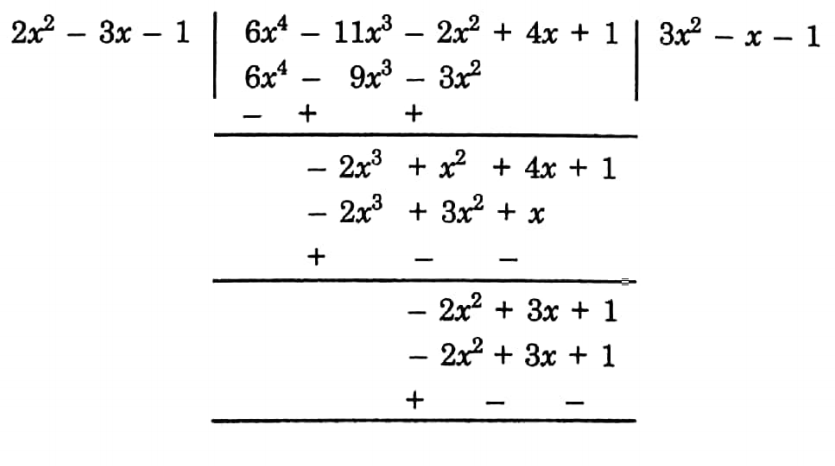
Divide 6x4 – 11 x3 – 2X2 + 4x + 1 by 2x2 -3x -1.

Solution : 

Given:-

6x4 – 11 x3 – 2X2 + 4x + 1 And 2x2 -3x -1.

WBBSE Solutions For Class 8 Maths Algebra Chapter 4 Division Of Polynomials ex 1

The required quotient = 3x² – x – 1

WBBSE Class 8 Division of Polynomials Notes

Example 2

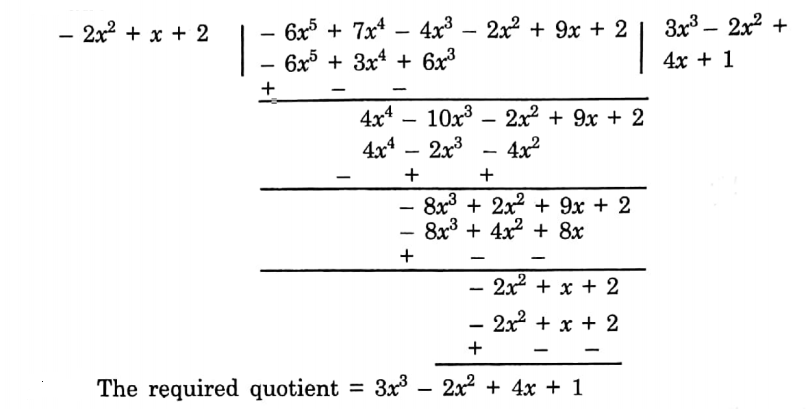
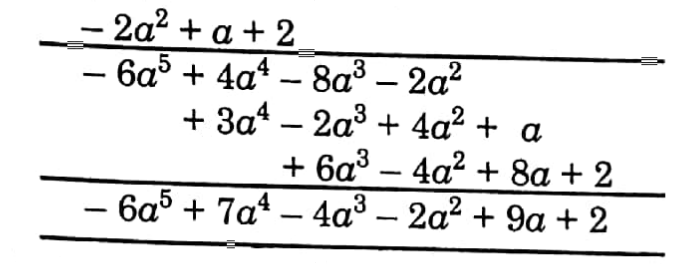
Divide – 6x5 + 7x4  4x3  2x2 + 9x + 2 by – 2x2 + x + 2.

Solution:

Given:-

– 6x5 + 7x4  4x3  2x2 + 9x + 2 And – 2x2 + x + 2.

WBBSE Solutions For Class 8 Maths Algebra Chapter 4 Division Of Polynomials ex 2

Example 3

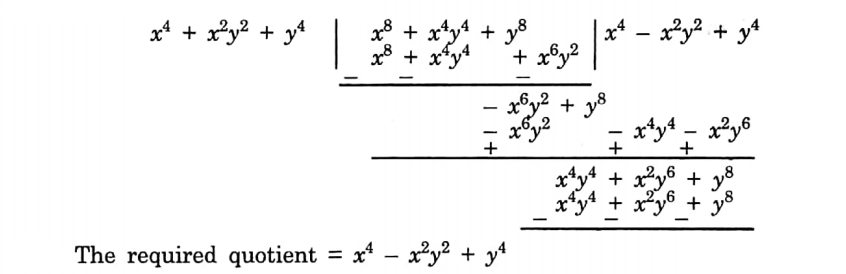
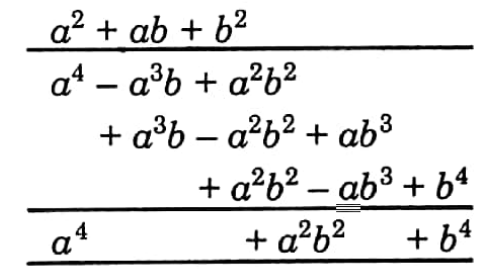
Divide x8 + x4y4 + y8 by x4 + x²y2 + y4.

Solution :

Given:-

x8 + x4y4 + y8 And x4 + x²y2 + y4.

WBBSE Solutions For Class 8 Maths Algebra Chapter 4 Division Of Polynomials ex 3

Example 4

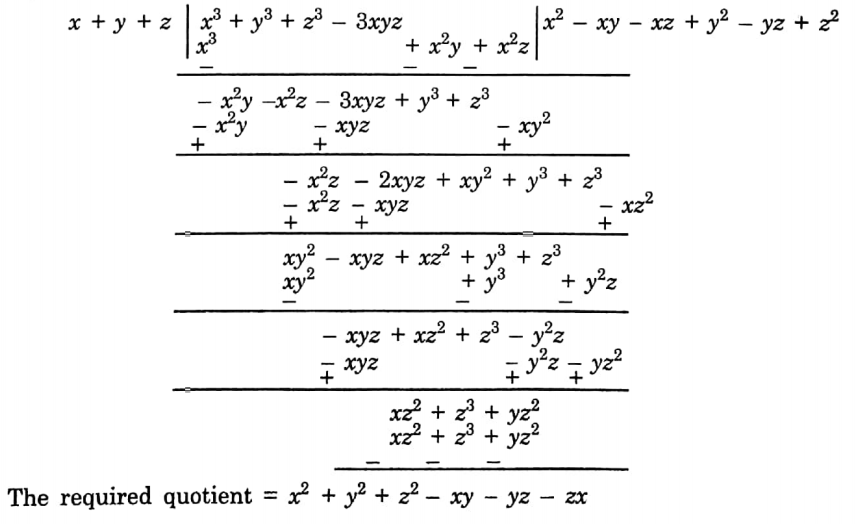
Divide x3 + y3 + z3 – 3xyz by x + y + z.

Solution :

Given:-

x3 + y3 + z3 – 3xyz And x + y + z.

WBBSE Solutions For Class 8 Maths Algebra Chapter 4 Division Of Polynomials ex 4

Understanding Polynomial Division Techniques

WBBSE Solutions For Class 8 School Science Long Answer Type Questions WBBSE Solutions For Class 8 School Science Short Answer Type Questions
WBBSE Solutions For Class 8 School Science Very Short Answer Type Questions WBBSE Solutions For Class 8 School Science Review Questions
WBBSE Solutions For Class 8 School Science Solved Numerical Problems WBBSE Solutions For Class 8 School Science Experiments Questions
WBBSE Solutions For Class 8 Maths WBBSE Class 8 History Notes
WBBSE Class 8 History Multiple Choice Questions WBBSE Solutions For Class 8 History
WBBSE Solutions For Class 8 Geography


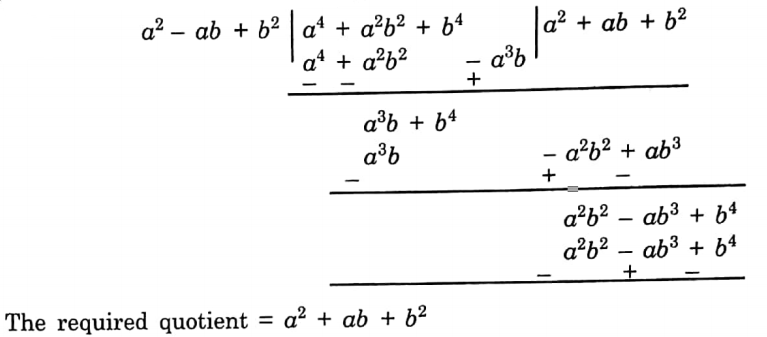
Example 5 

Divide a4+ a2b2 + b4 by a² -ab + b²

Solution:

Given:-

a4+ a2b2 + b4 And a² -ab + b²

WBBSE Solutions For Class 8 Maths Algebra Chapter 4 Division Of Polynomials ex 5

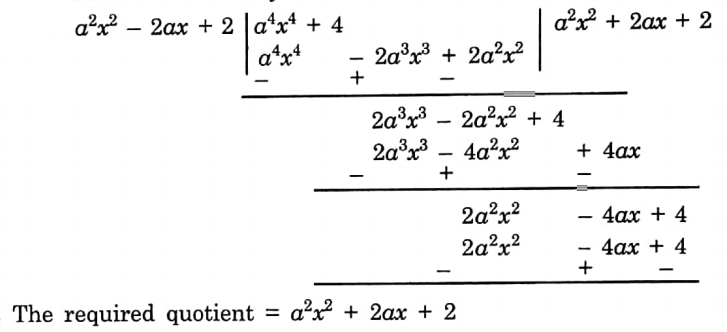
Example 6

WBBSE Solutions For Class 8 Maths Algebra Chapter 4 Division Of Polynomials

Divide a4x4+ 4 by a²x² – 2ax + 2.

Solution:

Given

a4x4+ 4 And a²x² – 2ax + 2.

WBBSE Solutions For Class 8 Maths Algebra Chapter 4 Division Of Polynomials ex 6

Step-by-Step Guide to Dividing Polynomials

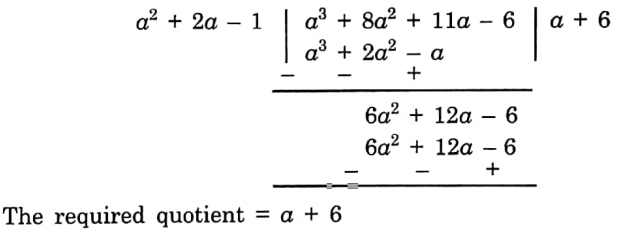
Example 7

Divide a³ + 8a² + 11a -6 by a² + 2a -1.

Solution:

Given

a³ + 8a² + 11a -6 And a² + 2a -1.


WBBSE Solutions For Class 8 Maths Algebra Chapter 4 Division Of Polynomials ex 7

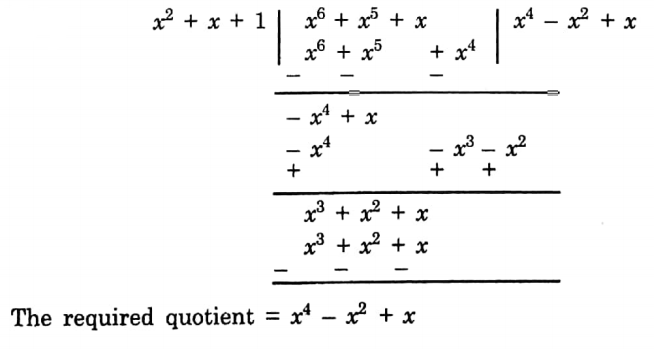
Example 8

Divide x6+ x5+ x by x² + x +1.

Solution:

Given

x6+ x5+ x And x² + x +1.

WBBSE Solutions For Class 8 Maths Algebra Chapter 4 Division Of Polynomials ex 8

Inexact division

In arithmetic when we divide a number by another number there may or may not be any remainder. For example when we divide 40 by 5 then there is no remainder i.e., 40 is exactly divisible by 5. But when we divide 38 by 5 then the quotient is 7 and the remainder is 3. Likewise, in algebra, when we divide one expression by another there may or may not be any remainder. Thus, when we divide an algebraic expression by another and there is a remainder then such division is called an inexact division. If q is the quotient and r is the remainder when b is divided by a,

then the complete quotient = q + r/a.

Practice Problems on Polynomial Division

Example 1

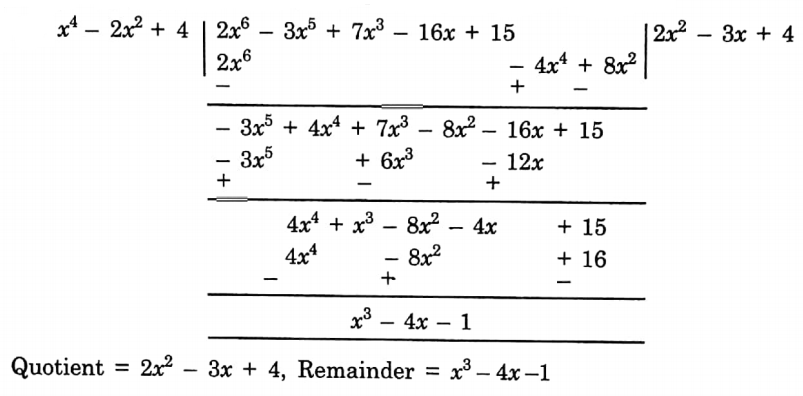
Divide 2x6– 3x6+ 7x³ -16x +15 by x4– 2x² +4.

Solution:

Given:-

2x6– 3x6+ 7x³ -16x +15 And x4– 2x² +4.

WBBSE Solutions For Class 8 Maths Algebra Chapter 4 Division Of Polynomials ex 4.1

Example 2

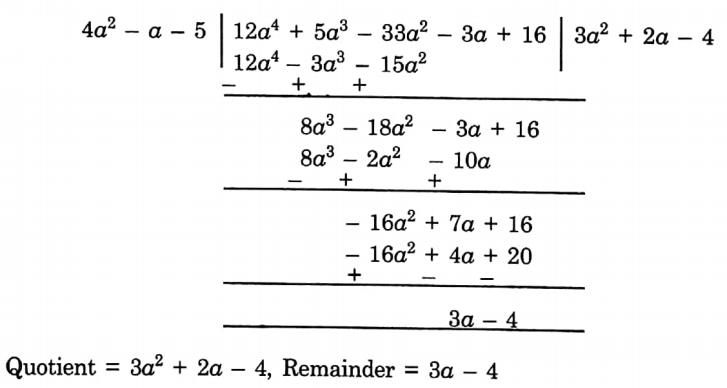
Divide 12a4+ 5a³ -33a² -3a + 16 by 4a² – a – 5.

Solution:

Given:

12a4+ 5a³ -33a² -3a + 16 And 4a² – a – 5.

WBBSE Solutions For Class 8 Maths Algebra Chapter 4 Division Of Polynomials ex 4.2

Division by the method of ‘detached coefficients

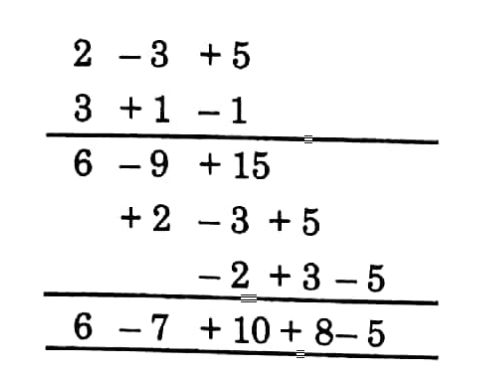
There is another method of division of two polynomials. In this method, we only write successive coefficients of the dividend and divisor and then divide as before. After obtaining the quotient and remainder in terms of coefficients the alphabetic symbol is Written with successive power. If any term containing a particular power is absent either in the dividend or in the divisor, then the corresponding coefficient is taken as zero.

Example 1

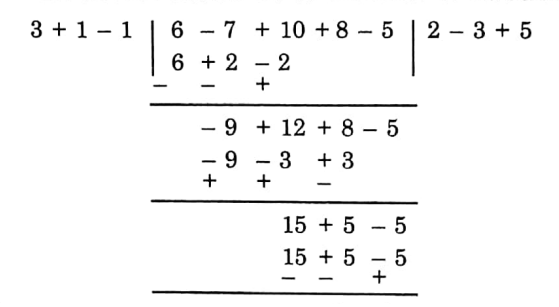
Divide 6x4 – 7x3 + 10x2 + 8x – 5 by 3x2 + x – 1.

Solution :

Given 6x4 – 7x3 + 10x2 + 8x – 5 And 3x2 + x – 1.

Let us first detach the coefficients of the dividend and divisor.

WBBSE Solutions For Class 8 Maths Algebra Chapter 4 Division Of Polynomials ex 5.1

Obviously, the highest power of x in the quotient is x2. Hence, the required quotient is 2x2 – 3x + 5.

6x4 – 7x3 + 10x2 + 8x – 5 / 3x2 + x – 1 = 2x2 – 3x + 5.

Examples of Dividing Monomials and Polynomials

Example 2

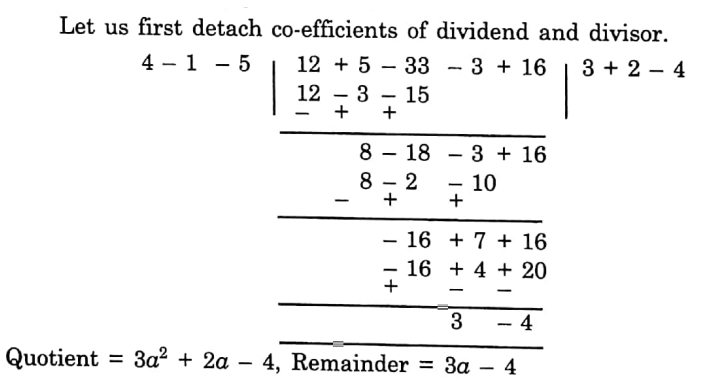
Divide 12a4 + 5a3 – 33a2 – 3a + 16 by 4a2 – a – 5.

Solution:

Given:

12a4 + 5a3 – 33a2 – 3a + 16 And 4a2 – a – 5.

Let us first detach the coefficients of the dividend and divisor.

WBBSE Solutions For Class 8 Maths Algebra Chapter 4 Division Of Polynomials ex 5.2

Quotient = 3a2 + 2a – 4, Remainder = 3a – 4.

WBBSE Solutions For Class 8 Maths Algebra Chapter 3 Multiplication Of Polynomials

WBBSE Solutions For Class 8 Maths Algebra Chapter 3 Multiplication Of Polynomials

Multiplication of Polynomials Introduction

You know that when two or more expressions are related to each other by the sign of addition or subtraction then a polynomial is formed and each expression of that polynomial is called a term. In this chapter, our aim is to multiply two polynomials each with more than two terms. So, in fact, this chapter is nothing but an extension of the same topic which we studied in class VII.

Rules for multiplication

Here we shall discuss the rules for multiplication in brief. The following four rules are common in any type of algebraic multiplication.

1.Commutative law : a x b = b x a.

2.Associative law : a x (b x c) = (a x b) x c.

3. Distributive law : 

1. a x (b + c) = a x b + a x c.

2. (a + b) x c = a x c + b x c.

4. Index law :

1. xm x xn = xm+n

2. (Xm)n = xmn

3. xº = 1.

WBBSE Solutions For Class 8 Maths Algebra Chapter 3 Multiplication Of Polynomials

When we multiply two polynomials we generally arrange the terms of the multiplicand and those of the multiplier in the ascending or descending powers of a variable (which is expressed by a letter of the English alphabet.)

Read And Learn More WBBSE Solutions For Class 8 Maths

Algebra Chapter 3 Multiplication Of Polynomials Some examples of multiplication

Example 1

Multiply : a² – ab + b² by b²+ ab + a².

Solution:

Given:-

a² – ab + b² And b²+ ab + a².

When arranged in the descending powers of a multiplicand

= a2 – ab + b2 and multiplier = a2 + ab + b2.

Now, a2 – ab + b2

WBBSE Solutions For Class 8 Maths Algebra Chapter 3 Multiplication Of Polynomials 1

The required product = a4+a2b2+b4

a² – ab + b² X b²+ ab + a² = a4+a2b2+b4

WBBSE Class 8 Multiplication of Polynomials Notes

Example 2

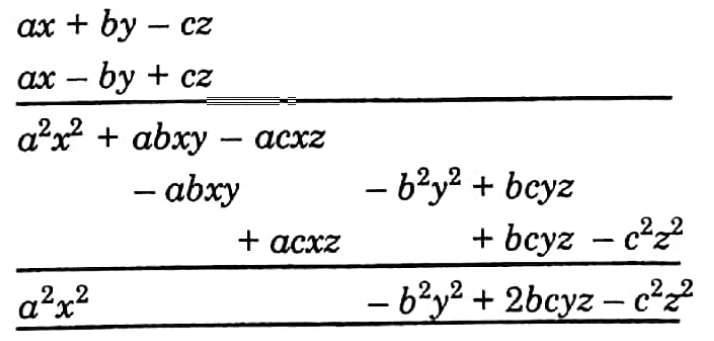
Multiply ax + by – cz by ax – by + cz.

Solution :

Given:-

ax + by – cz And ax – by + cz.

WBBSE Solutions For Class 8 Maths Algebra Chapter 3 Multiplication Of Polynomials 2

The required product = a²x² – b²y² – c²z² + 2bcyz

ax + by – cz X ax – by + cz. = a²x² – b²y² – c²z² + 2bcyz

Example 3

Multiply : 4a – 2a² + 1 + 3a³ by 2 – 2a² + a.

Solution:

Given

4a – 2a² + 1 + 3a³ And 2 – 2a² + a.

Arranging in the descending powers of a,

we get,

multiplicand = 3a3 – 2a2 + 4a + 1,

multiplier = – 2a2 + a + 2.

Now, 3a3 – 2a2 + 4a + 1

WBBSE Solutions For Class 8 Maths Algebra Chapter 3 Multiplication Of Polynomials 3

Understanding Polynomial Multiplication

Example 4

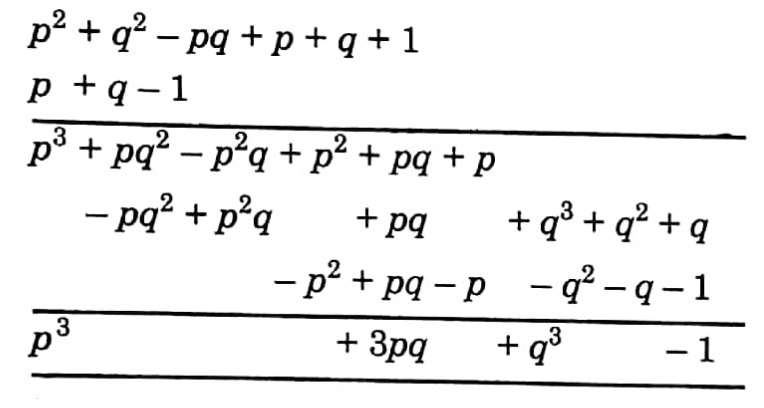
Multiply: p² + g² – pq + p + q + 1 by p + q -1.

Solution :

Given

p² + q² – pq + p + q + 1 And p + q -1.

WBBSE Solutions For Class 8 Maths Algebra Chapter 3 Multiplication Of Polynomials 4

The required product = p³ + q³ -1 + 3pq

p² + g² – pq + p + q + 1 And p + q -1.= p³ + q³ -1 + 3pq

Example 5

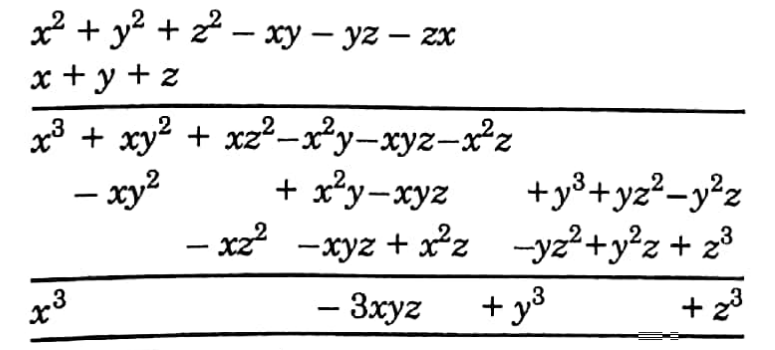
Multiply x² + y2 + z2 – xy – yz – zx by  +y+ z.

Solution :

Given

x² + y2 + z2 – xy – yz – zx And  +y+ z.

WBBSE Solutions For Class 8 Maths Algebra Chapter 3 Multiplication Of Polynomials 5

The required product = x³ +y³ +z³ – 3xyz

x² + y2 + z2 – xy – yz – zx by  +y+ z. = x³ +y³ +z³ – 3xyz

Step-by-Step Guide to Multiply Polynomials

Example 6

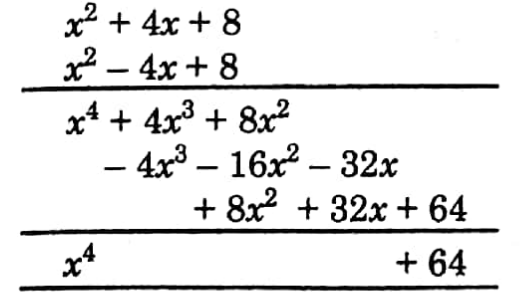
Multiply : x2 + 4x + 8 by x2 – 4x + 8.

Solution:

Given:-

x2 + 4x + 8 And x2 – 4x + 8.

WBBSE Solutions For Class 8 Maths Algebra Chapter 3 Multiplication Of Polynomials 6

The required product = x4 + 64

x2 + 4x + 8 X x2 – 4x + 8. = x4 + 64

Example 7

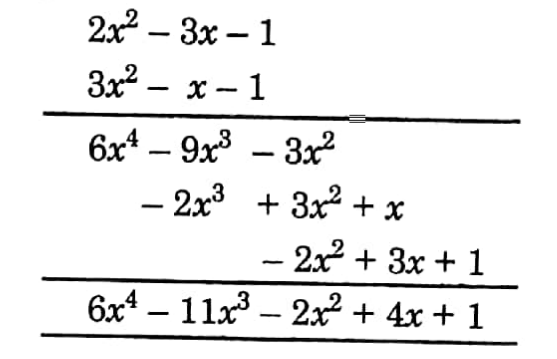
Multiply: 2x² – 3x – 1 by 3x2 – x – 1.

Solution :

Given

2x² – 3x – 1 And 3x2 – x – 1.

WBBSE Solutions For Class 8 Maths Algebra Chapter 3 Multiplication Of Polynomials 7

Practice Problems on Multiplying Polynomials

Example 8

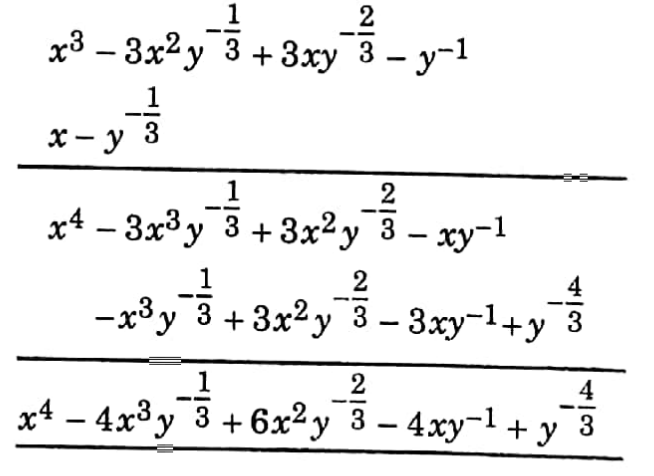
Multiply: \(x^3-3 x^2 y^{-\frac{1}{3}}+3 x y^{\frac{2}{3}}-y^{-1} \text { by } x-y^{-\frac{1}{3}}\)

Solution:

Given

\(x^3-3 x^2 y^{-\frac{1}{3}}+3 x y^{\frac{2}{3}}-y^{-1} \text { And } x-y^{-\frac{1}{3}}\)

WBBSE Solutions For Class 8 Maths Algebra Chapter 3 Multiplication Of Polynomials 8

The required product = \(x^4-4 x^3 y^{-\frac{1}{3}}+6 x^2 y^{-\frac{2}{3}}-4 x y^{-1}+y^{-\frac{4}{3}}\)

Example 9

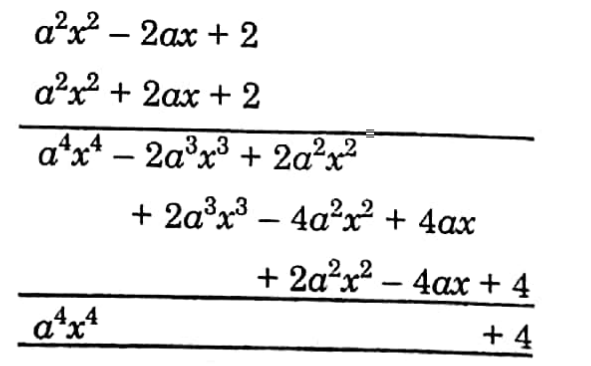
Multiply : a²x² – 2ax + 2 by a²x² + 2ax + 2.

Solution:

Given

a²x² – 2ax + 2 by a²x² + 2ax + 2.

WBBSE Solutions For Class 8 Maths Algebra Chapter 3 Multiplication Of Polynomials 9

The required product = a4x4 + 4

a²x² – 2ax + 2 X a²x² + 2ax + 2. = a4x4 + 4

Examples of Multiplying Binomials and Trinomials

Example 10

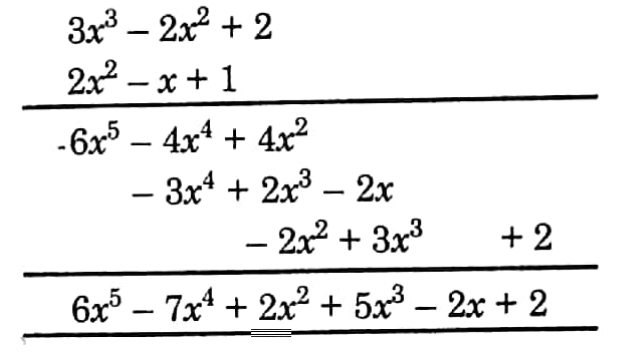
Multiply : 3x³ – 2x² + 2 by 2x² – x + 1.

Solution:

Given

3x³ – 2x² + 2 And 2x² – x + 1.

WBBSE Solutions For Class 8 Maths Algebra Chapter 3 Multiplication Of Polynomials 10

The required product = 6x5– 7x4 + 5x3 + 2x2 – 2x + 2

3x³ – 2x² + 2 X 2x² – x + 1 = 6x5– 7x4 + 5x3 + 2x2 – 2x + 2

Multiplication of more than two polynomials

In order to multiply more than two polynomials first of all we multiply any two polynomials by the method already discussed. After that, we take this product as the multiplicand and the third polynomial as the multiplier. We then find the new product. In the next stage, we multiply this product by the fourth polynomial (if any). Proceeding in this way we complete the process of multiplication.

WBBSE Solutions For Class 8 School Science Long Answer Type Questions WBBSE Solutions For Class 8 School Science Short Answer Type Questions
WBBSE Solutions For Class 8 School Science Very Short Answer Type Questions WBBSE Solutions For Class 8 School Science Review Questions
WBBSE Solutions For Class 8 School Science Solved Numerical Problems WBBSE Solutions For Class 8 School Science Experiments Questions
WBBSE Solutions For Class 8 Maths WBBSE Class 8 History Notes
WBBSE Class 8 History Multiple Choice Questions WBBSE Solutions For Class 8 History
WBBSE Solutions For Class 8 Geography


Example 1

Find the continued product of : (a2 + ab + b2), (a – b), and (a3 + b3).

Solution :

Given

(a2 + ab + b2), (a – b), And (a3 + b3).

WBBSE Solutions For Class 8 Maths Algebra Chapter 3 Multiplication Of Polynomials 11

Conceptual Questions on Polynomial Operations

Example 2

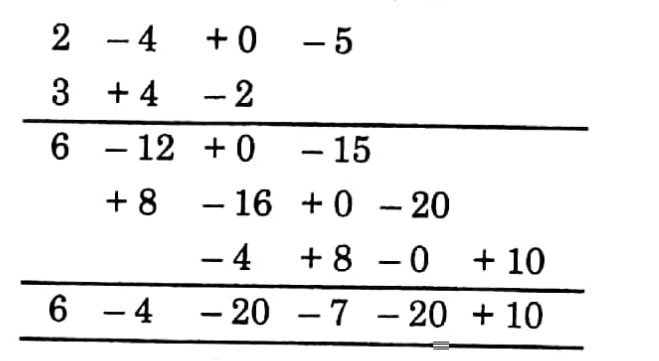
Multiply : 2x3 – 4X2 – 5 by 3X2 + 4x – 2.

Solution:

Given:-

2x3 – 4X2 – 5 And 3X2 + 4x – 2.

Let us first detach the coefficients of the multiplicand and multiplier.

Since the term containing x is absent in the multiplicand we take the co-efficient of x as 0.

WBBSE Solutions For Class 8 Maths Algebra Chapter 3 Multiplication Of Polynomials 12

WBBSE Solutions For Class 8 Maths Algebra Chapter 2 Rational Number

WBBSE Solutions For Class 8 Maths Algebra Chapter 2 Rational Number

Natural Numbers

The numbers, which were known to us in the beginning, were used to count something. These numbers are natural numbers. Thus, 1, 2, 3, 4… to infinity are called natural numbers.

Whole Numbers

When 0 is included with natural numbers, then they form whole numbers or integers. Thus, 0, 1, 2, 3, 4… to infinity are called

Positive and Negative Integers

whole numbers or integers.
The numbers 0, 1, 2, 3, 4… etc. are called positive integers, and -1, -2, -3, -4, … are negative integers.

WBBSE Class 8 Rational Numbers Notes

Rational Number

Any number of the form p/q where p and q are both integers and q * 0 is called a rational number. While writing a rational number usually take the denominator as a positive integer p and express p/q in the lowest form.

Example : 3/8, 8/11, -7/12 etc.

are the rational numbers. All natural numbers, integers, and fractions are included in rational numbers. We can imagine the natural number 5 as a rational number. Because 5 =5/1 therefore, it can be expressed in the form p/q where p =5 and q = 1, p and q are both integers and q ≠ 0.

But √2 is not a rational number because it cannot be expressed in the form p/q where p and q are integers. In fact,  √2 = 1.414213…

Any decimal fraction and recurring decimal fraction may be expressed in the form p/q where p and q are integers.

Therefore, they are also rational numbers.

Read And Learn More WBBSE Solutions For Class 8 Maths

Example: 0.5 = 5/10 = 1/2;

0.9 = 9/9 = 1/1

The numbers which are not rational are called irrational numbers. Examples of some irrational numbers are

WBBSE Solutions For Class 8 Maths Algebra Chapter 2 Rational Number

Some Decisions

1. Sum of two integers is an integer: 7 + 8=15.

2.  Product of two integers is an integer: 7 x 8 = 56.

3. The difference between two integers in a positive or negative integer: 8-4 = 4,

4-8

= -4.

4. The quotient of two integers is not always an integer: 7÷8 = 7/8,

8 ÷ 7 = 8/7.

(Only when two numbers are the same their quotient is an integer. For example, 5÷5 = 1.)

Some more decisions

If a and b are two rational numbers :

1.  a + b is a rational number.

For example 1/2 + 2/3

Given That, a + b is a rational number.

Adding The Terms 1/2 And 2/3

= 3+4 / 6

= 7/6.

Here, 7/6 is a rational number.

2. a – b is a rational number.

For example 1/2 – 2/3

Given That, a – b is a rational number

So Subtracting The Terms 1/2 And 2/3

= 3-4 / 6

= -1/6. 

Here, is a rational number.

Understanding Rational Numbers in Algebra

3. a x b is a rational number.

For example 1/2 x 2/3 

Given a x b is a rational number.

So Multiply The Terms 1/2 And 2/3

1/2 x 2/3

= 1/3.

Here, 1/3 is a rational number.

4. a÷b is a rational number.

For example 1/2 ÷ 2/3

Given a ÷ b is a rational number.

= 1/2 ÷ 2/3

= 3/4

Here, 3/4 is a rational number.

Some Properties of rational numbers

1. If a and b are two rational numbers, then a + b = b + a.

That means rational numbers obey the commutative law of addition.

For example 1/2 + 2/3

= 3+4 / 6

= 7/6

2/3 + 1/2

= 4+3/6

= 7/6

∴ 1/2 + 2/3 = 2/3 + 1/2.

2. If a and b are two rational numbers, then a – b ≠ b – a.

That means the rational numbers do not obey the commutative law of subtraction.

That means the rational numbers do not obey the commutative law of subtraction.

1/2 – 2/3

= 3-4 / 6

= -1/6

2/3 – 1/2

= 4-3/6

= 1/6

∴ 1/2 – 2/3 ≠ 2/3 – 1/2.

3. If a and b are two rational numbers, then a x b = b x a.

That means rational numbers obey the commutative law of multiplication.

1/2 x 2/3 = 1/3

2/3 x 1/2 = 1/3

∴ 1/2 x 2/3 = 2/3 x 1/2.

4. If a and b are two rational numbers, then a + b x b + a.

That means the rational numbers do not obey the commutative law of division.

1/2 ÷ 2/3 = 1/2 x 3/2 = 3/4

2/3 ÷ 1/2 = 2/3 x 2/1 = 4/3

∴ 1/2 ÷ 2/3 ≠ 2/3 ÷ 1/2.

Properties of Rational Numbers Explained

Some more Properties of rational

1.  If a, 6, and c are three rational numbers then, a + (b + c) = (a + b) + c.

That means the rational numbers obey the associative law of addition

1/2 + (2/3 + 3/4 ) = 1/2 + 8+9 / 12

= 1/2 + 17/12+= 6+17 / 12+= 23/12

(1/2 + 2/3 ) + 3/4 = 3+4 / 6 + 3/4

= 7/6 + 3/4

= 14+9 / 12

= 23/12

∴ 1/2 + (2/3 + 3/4) = (1/2 + 2/3) + 3/4.

2. If a, b, and c are three rational numbers then, a – (b – c) * (a – b) – c.

That means rational numbers do not obey the associative law of subtraction.

1/2 – (2/3 – 3/4) = 1/2 – (8-9 / 12)

= 1/2 + 1/12

= 6+1 / 12

= 7/ 12

(1/2 – 2/3 – 3/4 = 3-4 / 6 – 3/4

= -1/6 – 3/4

= -2-9 / 12

= -11/12

∴ 1/2 – (2/3 – 3/4) ≠ (1/2 – 2/3) – 3/4.

3. If a, b, and c are three rational numbers then, z x ( b x c) = (a x b) x c.

That means rational numbers obey the associative law of multiplication.

1/2 x (2/3 x 3/4) = 1/2 x 1/2

= 1/4

(1/2 x 2/3 ) x 3/4 = 1/3 x 3/4

= 1/4

∴ 1/2 x (2/3 x 3/4) = (1/2 x 2/3) x 3/4.

Practice Problems on Rational Numbers

4. If a, b, and c are three rational numbers then, a ÷ (6 ÷ c) ≠ (a ÷ b) ÷ c.

That means rational numbers do not obey the associative law of divisions.

\(\frac{1}{2} \div\left(\frac{2}{3} \div \frac{3}{4}\right)=\frac{1}{2} \div\left(\frac{2}{3} \times \frac{4}{3}\right)\) \(=\frac{1}{2} \div \frac{8}{9}=\frac{1}{2} \times \frac{9}{8}=\frac{9}{16}\) \(\left(\frac{1}{2} \div \frac{2}{3}\right) \div \frac{3}{4}=\left(\frac{1}{2} \times \frac{3}{2}\right) \div \frac{3}{4}=\frac{3}{4} \times \frac{4}{3}=1\) \(\frac{1}{2} \div\left(\frac{2}{3} \div \frac{3}{4}\right) \neq\left(\frac{1}{2} \div \frac{2}{3}\right) \div \frac{3}{4} \text {. }\)

Distributive law

If a, b, and c are three rational numbers then,

a(b + c) = ab + ac

a(b – c) = ab – ac

\(\frac{1}{2}\left(\frac{2}{3}+\frac{3}{4}\right)=\frac{1}{2}\left(\frac{8+9}{12}\right)=\frac{1}{2} \times \frac{17}{12}=\frac{17}{24}\) \(\frac{1}{2} \times \frac{2}{3}=\frac{1}{3}, \frac{1}{2} \times \frac{3}{4}=\frac{3}{8}\) \(\frac{1}{2} \times \frac{2}{3}+\frac{1}{2} \times \frac{3}{4}=\frac{1}{3}+\frac{3}{8}=\frac{8+9}{24}=\frac{17}{24}\) \(\frac{1}{2}\left(\frac{2}{3}+\frac{3}{4}\right)=\frac{1}{2} \times \frac{2}{3}+\frac{1}{2} \times \frac{3}{4}\) \(\text { Similarly, } \frac{1}{2}\left(\frac{2}{3}-\frac{3}{4}\right)=\frac{1}{2} \times \frac{2}{3}-\frac{1}{2} \times \frac{3}{4} \text {. }\)

Algebra Chapter 12 Equations Some Examples

Example 1

Find the opposite number of addition.

1. – 3/7

2. 15/17.

Solution:

1. The opposite number of addition of – 3/7 is 3/7 because,

= – 3/7 + 3/7

= -3+3 / 7

= 0/7

= 0.

– 3/7 the opposite number of addition = 0.

2. The opposite number of addition of 15/17 is – 15/17 because,

= 15/17 – 15/17

= 15-15 / 17

= 0/17

= 0.

15/17 the opposite number of addition = 0.

Examples of Adding and Subtracting Rational Numbers

Example 2

What do you mean by the reciprocal of a rational number?

Solution :

The number by which, if a rational number is multiplied to get 1 as a product is called the reciprocal or opposite number with respect to the multiplication of that rational number. It is also known as multiplicative inverse.

For Example,  the reciprocal of 5/7  is 7/5  because

5/7 x 7/5 = 1

Example 3

For any rational number x show that -(-x) = x.
 

Solution :

Let, 3/7 be any rational number.

The opposite number with respect to the addition of 3/7 is – 3/7

Again, the opposite number with respect to the addition of – 3/7 is 3/7

∴ – (-x) = x.

Example 4 

Find the product: – 4/5 x 3/7 x 15/16 x – 14/9

Solution:

The given expression

= ( – 4/5 x 15/16 ) x (3/7 x – 14/9)

= – 3/4 x -2/3

= 1/2.

( – 4/5 x 15/16 ) x (3/7 x – 14/9) = 1/2.

Example 5

Find the value of 3/7 + (-6/11) + (-8/21) + 5/22.

Solution :

The given expression

= { 3/7 + (-8 / 21)} + (-6/11 + 5/22}

= 9-8 / 21 + (-12 + 5) / 22

= 1/21 – 7/22

= 22-147 / 462

= -125 / 462.

{ 3/7 + (-8 / 21)} + (-6/11 + 5/22} { 3/7 + (-8 / 21)} + (-6/11 + 5/22}

Finding Rational Numbers Between Two Values

Example 6

Write 4 rational numbers between 1 and 2.

Solution :

1. If x and y be two rational numbers such that x < y, then 1/2 ( x + y)is a rational number between x and y.

Observe how this rule is applied here

1 rational number between 1 and 2

= 1/2 (1+2)

= 3/2

4 rational numbers between 1 and 2 = 3/2

2. Again, 1 rational number between 1 and 3/2

= 1/2(1+2)

= 1/2(1 + 3/2)

= 5/4

1 rational number between 1 and 3/2 = 5/4

3. 1 rational number between 1 and 5/4

= 1/2 (1 + 5/4)

= 9/8

1 rational number between 1 and 5/4 = 9/8

4. 1 rational number between 1 and 9/8

= 1/2 (1 + 9/8)

= 17/16

1 rational number between 1 and 9/8 = 17/16

∴ 4 rational numbers between 1 and 2 are,

17/16, 9/8, 5/4, 3/2.

Example 7

Write 4 rational numbers equivalent to 2/3.

Solution :

\(\frac{2}{3}=\frac{2 \times 2}{3 \times 2}=\frac{4}{6}, \quad \frac{2}{3}=\frac{2 \times 3}{3 \times 3}=\frac{6}{99},\) \(\frac{2}{3}=\frac{2 \times 4}{3 \times 4}=\frac{8}{12}, \quad \frac{2}{3}=\frac{2 \times 5}{3 \times 5}=\frac{10}{15}\)

∴ 4 rational numbers equivalent to 2/3 are,

4/6, 6/9, 8/12, 10/15.

Conceptual Questions on Operations with Rational Numbers

Example 8

Write the rational number 4 as the

1. sum and

2. difference between two irrational numbers.

Solution :

1. 4 = (2 + √3) + (2 – √3).

2. 4 = (√3 + 2) – (√3 – 2).

Example 9

What should be added to 7/12 to get – 4/12?

Solution :

Let the required number be x.

Then, 7/12 + x = – 4/15

or, x = – 4/15 – 7/12

= -(4/15 + 7/12)

= – (16+35 / 60)

= – 51/60

= – 17/20.

WBBSE Solutions For Class 8 School Science Long Answer Type Questions WBBSE Solutions For Class 8 School Science Short Answer Type Questions
WBBSE Solutions For Class 8 School Science Very Short Answer Type Questions WBBSE Solutions For Class 8 School Science Review Questions
WBBSE Solutions For Class 8 School Science Solved Numerical Problems WBBSE Solutions For Class 8 School Science Experiments Questions
WBBSE Solutions For Class 8 Maths WBBSE Class 8 History Notes
WBBSE Class 8 History Multiple Choice Questions WBBSE Solutions For Class 8 History
WBBSE Solutions For Class 8 Geography


Example 10

The sum of two rational numbers is -3. If one of them is 1/3, then find the other one.

Solution :

Given That,

The sum of two rational numbers is -3.

one of them is 1/3.

Let the other number be x.

Then, x + 1/3 = -3

or, x = – 3 – 1/3

or, x = -(3+1/3)

= -(9+1 / 3)

= -10/3

Example 11

Find the reciprocal of -5/2 x 32/15.

Solution: 

Given -5/2 x 32/15.

We have, \(-\frac{5}{8} \times \frac{32}{15}=-\frac{5 \times 32^4}{3 \times 15_3}=-\frac{4}{3}\)

∴ Reciprocal of \(-\frac{5}{8} \times \frac{32}{15}\)

= Reciprocal of \(-\frac{4}{3}\)

= \(\frac{3}{4}\)

Example 12

If x = 3 and y = 2, then find the value of (3x-4y)y-x ÷ (4x-3y)2y-x

Solution:

Given

x = 3 And y = 2.

We have, (3x -4y) = (3 x 3 – 4 x 2)

= (9 – 8)

= 1

(3x-4y)y-x ÷ (4x-3y)2y-x  = 1

(4x – 3y) = (4 x 3 – 3 x 2) = (12 – 6) = 6

∴ \((3 x-4 y)^{y-x} \div(4 x-3 y)^{2 y-x}\)

= \(\frac{(3 x-4 y)^{y-x}}{(4 x-3 y)^{2 y-x}}=\frac{(1)^{2-3}}{(6)^{2 \times 2-3}}=\frac{(1)^{-1}}{(6)^{4-3}}\)

= \(\frac{(1)^{-1}}{6}=\frac{1}{1 \times 6}=\frac{1}{6}\)

WBBSE Solutions For Class 8 Maths Algebra Chapter 1 Commutative Associative and Distributive Laws

WBBSE Solutions For Class 8 Maths Algebra Chapter 1 Commutative Associative and Distributive Laws

Commutative Associate and Distributive Introduction

In class 7 you have studied commutative, associative, and distributive laws, the application of four basic operations on polynomials, the deduction of some formulae, simple factorization of quadratic expressions, and the formation of linear equations of one variable and their solution. Here we shall discuss those topics in brief for recapitulation.

Commutative, Associative, and Distributive laws

We know that if a and b are any two integers then

1. The commutative law of addition is, a+ b = b + a

2. The commutative law of multiplication is, a x b = b x a

3. Associative law of addition is, (a+ b) + c = a + (b + c)

4. The associative law of multiplication is, (a x b) x c = a x (b x c)

5. The distributive law of multiplication is

1. (a + b) x c = a x c + b x c

2. ax (b + c) = ax b + ax c

3. (a – b) x c = a x c – b x c

4. a x (b – c) – ax b~ ax c

6. The distributive law of division is

1. (a + b)÷ c = a + c + b ÷ c

2. (a-b) ÷ c = a + c-b ÷ c

But c ÷ (a + b) ≠ c + a + c ÷ b

and c ÷ (a-b) ≠ c + a- c ÷ b

Read And Learn More WBBSE Solutions For Class 8 Maths

Algebra Chapter 1 Commutative Associative and Distributive Laws Some problems with Commutative, Associative, and Distributive laws

Example 1

Rewrite 4 + 7 + 9 in two different ways such that a single bracket is used in each case.

Solution:

Given 4 + 7 + 9

Given Sum In Two Different Ways Such That A Single Bracket Is Used In Each Case:-

4 + 7 + 9 = (4+ 7)+ 9 and 4 + 7 + 9 = 4 + (7 + 9)

Example 2

Add the sum of 6 and 8 with 5 and find the result.

Solution :

Given Sum Of 6 And 8 With 5.

5 + (6 + 8)

= 5+ 14

= 19

The Result Is 19.

WBBSE Solutions For Class 8 Maths Algebra Chapter 1 Commutative Associative and Distributive Laws

WBBSE Class 8 Commutative Law Notes

Example 3

Prove that: (a + b + c) x = ax + bx + cx.

Solution :

Given (a + b + c) x

(a + b + c)x

= (a + d)x [assuming b + c = d]

= ax + dx [by distributive law]

= ax + (b + c)x [putting d = b + c]

= ax + bx + cx (Proved).

(a + b + c) x = ax + bx + cx.

Example 4

Simplify a/ a-b + b / b-4.

Solution :

The given expression = a / a-b + b/b-a

= a / a-b + b / – (a-b)

= a/ a-b – b/ a-b

= a-b / a-b

= 1

a / a-b + b/b-a = 1

Example 5

Simplify : -2-[-2-{-2-(2-3-2)}].

Solution :

The given expression = – 2-[- 2-{- 2-(2-3-~2)}]

= – 2 -[-2 – {- 2 – (2 – 1)}]

= – 2 – [- 2 – {- 2 – 1}]

= – 2 – [- 2 – {- 3}]

= – 2 – [- 2 + 3]

= -2 – [1]

= – 2 – 1

= – 3

– 2-[- 2-{- 2-(2-3-~2)}] = – 3

Example 6

Simplify : x-[y + {x-(y-x-y)}]

Solution :

The given expression = x[y + {x-{y-x-y)}]

= x-\y + {x -(y – x + y)}]

= x-\y+{x-{2y- *)}]

= x-[y + {x-2y + x}]

-x-{y + {2x- 2y}]

= x-\y + 2x-2y]

= x-[2 x-y]

= x-2x + y

= y-x

x[y + {x-{y-x-y)}] = y-x

Polynomial

If there are many terms in an algebraic expression then, it is called a polynomial. For example, a + 5b – 8c + 9d + 7e + 8f – 11x is a polynomial.

If there is only one term in an expression, then it is called a monomial.

For example, 5x is a monomial.

If there are two or three terms, then they are called binomial and trinomial respectively.

For example, 5a + 6b is a binomial and 7a – 12b + 8c is a trinomial.

Example 1

Find the sum of 4x2, – 3x², 7x2.

Solution :

The required sum = 4x2, – 3x², 7x2

= (4x2 + 7x2) – 3x2

= 11x– 3x2

= 8x2

4x2, – 3x², 7x= 8x2

Example 2

Find the sum of : – 2xy, 5xy, 9.xy and -7xy.

Solution :

Here, the required sum

= – 2xy + 5xy + 9xy – 7xy

= (5xy + 9xy) – (2xy + 7xy)

= 14xy – 9xy

= 5 xy

– 2xy + 5xy + 9xy – 7xy = 5 xy

Understanding Associative Law in Algebra

Example 3

Find the sum of the following expressions:

5x – 8y + z,

– 2x + 7y – 5z, 

3s + 5y + 3z.

Solution :

\(\begin{array}{r}
5 x-8 y+z \\
-2 x+7 y-5 z \\
3 x+5 y+3 z \\
\hline 6 x+4 y-z \\
\hline
\end{array}\)

The required sum = 6x+4y-z

Example 4

Simplify : 5a2 + 2d2 + 2ab + 3a2 – 6b2 – 5ab + 3a.

Solution :

The given expression

5a2 + 2d2 + 2ab + 3a2 – 6b2 – 5ab + 3a

= 5a2 + 2b2 + 2ab + 3a2 – 6b2 – 5ab + 3a

= (5a2 + 3a2) + (2 b2 – 6 b2) + (2ab – 5ab) + 3a

= 8a2 – 4b2 – 3ab + 3a

5a2 + 2d2 + 2ab + 3a2 – 6b2 – 5ab + 3a. = 8a2 – 4b2 – 3ab + 3a

Subtraction

The quantity from which the subtraction is to be made is called minuend. The quantity which is to be subtracted is called subtrahend. The result obtained after subtraction is called the difference or remainder. By subtraction of b from a, we mean the addition of the negative of b with a. It means that a – b = a + (- b).

Example 1

Subtract 5xy from 12xy.

Solution :

Given 5xy And 12xy

12xy – 5xy = 7xy

Example 2

Subtract – 9xy from 25xy

Solution:

25xy – (- 9xy) = 25xy + 9xy = 34xy.

Example 3

Subtract 5a2 + 4b2 + 2c2 from 7a2 – 3b2 + 8c2.

Solution :

Given 5a2 + 4b2 + 2c2 And 7a2 – 3b2 + 8c2.

\(\begin{array}{r}
7 a^2-3 b^2+8 c^2 \\
5 a^2+4 b^2+2 c^2 \\
-\quad- \\
\hline 2 a^2-7 b^2+6 c^2 \\
\hline
\end{array}\)

Example 4

What is to be added with a2 – ab + 2b2 to get a2 + b2?

Solution :

The required expression = (a2 + b2) – (a2 – ab + 2b2)

= a2 + b2 – a2 + ab – 2 b2

= (a2 – a2) + (b2 – 2b2) + ab

= – b2 + ab

(a2 + b2) – (a2 – ab + 2b2) = – b2 + ab

Multiplication

In the case of algebraic multiplication of two quantities, the sign of the product is V when the two quantities are of the same sign and the sign of the product is ‘—’ when the two quantities are of opposite signs.

This may be explained in brief as follows :

(+ x) x (+ y) = + xy

(+ x) x (- y) = – xy

(- x) x (+ y) = -xy

(- x) x (- y) = + xy

In case of finding the product of the same variable having different powers, we follow the rule xm x xn = xm+n

Example 1

Multiply : 7x3 by 2x4

Solution :

Given 7x3 by 2x4

7x3 x 2x4 = 7 x 2 x x3 x x4

= 14 x x3+4 

= 14 x x7

= 14x7

7x3 x 2x= 14x7

Example 2

Find the product ;

(- 5p2q) x (3pq2) x (- 2p²q²).

Solution :

Given

(- 5p2q) x (3pq2) x (- 2p²q²)

The required product = (- 5p2q) x (3pq2) x (- 2p2q2)

= (- 5) x 3 x (-2) x p2+1+2 x q1+2+2

= 30p5q5

(- 5p2q) x (3pq2) x (- 2p2q2) = 30p5q5

Example 3

Multiply : – 3p2q5r by – 7p3g2r5.

Solution :

Given – 3p2q5r And – 7p3g2r5

The required product = (- 3p2g5r) x (- 7p3q2r5)

= (- 3) x (- 7) x p2+3 x g5+2 x r1+5

= 21p5q7r6

(- 3p2g5r) x (- 7p3q2r5) = 21p5q7r6

Distributive Law Explained with Examples

Example 4

Find the product: (1/2 xy²) x (- 2/3 xy4) x (3x³y).

Solution :

Given

(1/2 xy²) x (- 2/3 xy4) x (3x³y)

= (1/2 xy²) x (- 2/3 xy4) x (3x³y).

= 1/2 x (- 2/3) x 3 x x1+1+3 y2+4+1

= (-1) x x² x y7

= -x5y7

(1/2 xy²) x (- 2/3 xy4) x (3x³y). = -x5y7

Example 5

Multiply :7a +3b by 2a – b.

Solution :

Given 7a +3b by 2a – b

\(\begin{aligned}
& 7 a+3 b \\
& 2 a-b \\
& \hline 14 a^2+6 a b \\
& \quad-7 a b-3 b^2 \\
& \hline 14 a^2-a b-3 b^2 \\
& \hline
\end{aligned}\)

The required product = 14a²-ab-3b²

Division

In the case of algebraic division of the form

a/b = c, we call a dividend, b the divisor, and c the quotient.

If the dividend and the divisor are of the same sign, then the sign of the quotient will be + and if the dividend and the divisor are of opposite signs the sign of the quotient will be -.

This may be explained in brief as follows :

\(\frac{(+x)}{(+y)}=+\frac{x}{y}\) \(\frac{(+x)}{(-y)}=-\frac{x}{y}\) \(\frac{(-x)}{(+y)}=-\frac{x}{y}\) \(\frac{(-x)}{(-y)}=+\frac{x}{y}\)

In the case of finding the quotient of the same variable having different powers, we follow the rule xm ÷ xn = xm+n.

We shall also take x° = 1.

Example 1

Divide 35a4b8 by 5a2b2.

Solution : 

Given 35a4b8 And 5a2b2

=35a4b8 / 5a2b2

= 7a4-2b8-2

= 7a²b6

35a4b8 / 5a2b2 = 7a²b6

Example 2

Divide (- 81m5n6) by (- 27m2n2).

Solution :

Given (- 81m5n6) And (- 27m2n2)

The required quotient

=(- 81m5n6) / (- 27m2n2).

= 3m5-2n6-2

= 3m³n4

(- 81m5n6) / (- 27m2n2) = 3m³n4

Example 3

Divide 4x5 + 3x4 + 8x3 + 7x by x2.

Solution :

The required quotient 4x5 + 3x4 + 8x3 + 7x/ x²

\(=\frac{4 x^5+3 x^4+8 x^3+7 x^2}{x^2}=\frac{4 x^5}{x^2}+\frac{3 x^4}{x^2}+\frac{8 x^3}{x^2}+\frac{7 x^2}{x^2}\) \(=4 x^{5-2}+3 x^{4-2}+8 x^{3-2}+7 x^{2-2}\) \(=4 x^3+3 x^2+8 x^1+7 x^0\) \(=4 x^3+3 x^2+8 x+7\)

Example 4

Divide 13m²n4 + 16m³n³-20m4n² by 4m²n².

Solution:

Given 13m²n4 + 16m³n³-20m4n² And 4m²n²

= \(\frac{12 m^2 n^4+16 m^3 n^3-20 m^4 n^2}{4 m^2 n^2}\)

= \(\frac{12 m^2 n^4}{4 m^2 n^2}+\frac{16 m^3 n^3}{4 m^2 n^2}-\frac{20 m^4 n^2}{4 m^2 n^2}\)

= \(3 n^2+4 m n-5 m^2\)

Some important formulae

In the previous class, you learned the following three formulae :

1. (a + b)2= a2 + 2ab + b2.

2. (a – b)2– a2 – 2ab + b2.

3. a2– b2 – (a + b) (a – b).

Also using the first two formulae the following five formulae can be established:

1. a2+ b2 = (a + b)2 – 2ab

2. a2+ b2 = (a – b)2 + 2ab

3. (a + b)2= (a – b)2 + 4ab

4. (a – b)2= (a + b)2 – 4ab.

5. ab = (a+b / 2)² – (a-b / 2)²

WBBSE Solutions For Class 8 School Science Long Answer Type Questions WBBSE Solutions For Class 8 School Science Short Answer Type Questions
WBBSE Solutions For Class 8 School Science Very Short Answer Type Questions WBBSE Solutions For Class 8 School Science Review Questions
WBBSE Solutions For Class 8 School Science Solved Numerical Problems WBBSE Solutions For Class 8 School Science Experiments Questions
WBBSE Solutions For Class 8 Maths WBBSE Class 8 History Notes
WBBSE Class 8 History Multiple Choice Questions WBBSE Solutions For Class 8 History
WBBSE Solutions For Class 8 Geography


Algebra Chapter 1 Commutative Associative and Distributive Laws Some Examples

Example 1

Find the square of (a + 2b).

Solution :

Given (a + 2b):-

Square of (a + 2b).

= (a + 2b)2

= (a)2 + 2.a.2b + (2b)2

= a2+ 4 ab+ 4 b2

Square of (a + 2b). = a2+ 4 ab+ 4 b2

Example 2

Find the square of 101.

Solution :

Given 101

Square of 101 = (101)2

= (100 + 1)2

= (100)2 + 2 x 100 x 1 + (1)2

= 10000 + 200 + 1

= 10201

Square of 101 = 10201

Example 3

Simplify: (7x + 4y)2 – 2(7x+4y)(7x-4y)+(7x-4y)2.

Solution:

Given (7x + 4y)2 – 2(7x+4y)(7x-4y)+(7x-4y)2.

Let, 7x+4y = a and 7x – 4y = b.

Hence, the given expression

\(=a^2-2 a b+b^2\) \(=(a-b)^2\) \(=\{(7 x+4 y)-(7 x-4 y)\}^2\) \(=(7 x+4 y-7 x+4 y)^2\) \(=(8 y)^2=64 y^2\)

Example 4

Simplify : 0.82 x 0.82 + 2 x 0.82 x 0.18 + 0.18 x 0.18.

Solution :

Given 0.82 x 0.82 + 2 x 0.82 x 0.18 + 0.18 x 0.18.

Let, a = 0.82 and b = 0.18

Then the given expression

=a x a + 2 x a x b + b x b

= a2 + 2 ab + b2

= (a + b)2

= (0.82 + 0.18)2

= (1.00)2

= (1)2

= 1

0.82 x 0.82 + 2 x 0.82 x 0.18 + 0.18 x 0.18 = 1

Short Notes on Properties of Operations in Algebra

Example 5

Find the square of x + 2y – 3z.

Solution :

Given x + 2y – 3z.

Square of x + 2y – 3z

= (x + 2y – 3s)2

= (x + 2y)2 – 2x(;c + 2y)x3z + (32)2

= (x)2 + 2x x 2y + (2y)2 – 6z(x + 2y) + 9z²

= x2 + 4xy + 4y² – 6zx – 12yz + 9Z2

= x2 + 4y2 + 9Z2 + 4xy – 12yz – 6zx

x + 2y – 3z = x2 + 4y2 + 9Z2 + 4xy – 12yz – 6zx

Example 6

If x + y = 2 and x-y= 1, then find the value of 8xy (x² + y²).

Solution :

Given x + y = 2 and x-y= 1.

8xy(x² + y2) = 4xy x 2(x² + y²)

= {(x² + y)2 -(x- y)2} {(x + y)2 + (x- y)2}

= {(2)2 — (1)2}{(2)2 + (1)2}

= (4 – 1) (4 + 1)

= 3 x 5

= 15

8xy(x² + y2) = 15

Example 7

If 2x + 3y = 9 and xy = 3, find the value of 4x2 + 9y².

Solution :

Given 2x + 3y = 9 And xy = 3.

4x2 + 9y²

= (2x)2 + (3y)2

= (2x + 3y)2 – 2.2x3y

= (2x + 3y)2 – 12xy

= (9)2 – 12.3

= 81-36

=45

4x2 + 9y² =45

Example 8

Express 35 as the difference between two squares.

Solution :

Given Number 35:-

35 = 7×5

= (7+5 / 2)² – (7-5 / 2)2

= (12/2)2 – (2/2)2

= (6)2 – (1)2

35 = (6)2 – (1)2

Key Differences Between Commutative and Associative Laws

Expression For The Difference Between Two Squares 35 = (6)2 – (1)2.

Example 9

Find the continued product of (a + b), (a-b), (a2 + b2), (a4 + b4).

Solution :

The required product = (a + b) (a – b) (a2 + b2) (a4 + b4)

= (a2 – b²) (a2 + b2) (a4 + b4)

= {(a2)2 – (b2)2} (a4 + b4)

= (a4 – b4) (a4 + b4)

= (a4)2 – (b4)2

= a8 – b8

(a + b) (a – b) (a2 + b2) (a4 + b4) = a8 – b8

Example 10

Express as the product of two expressions: a2 – 4ab + 4b2 – 4.

Solution :

Given a2 – 4ab + 4b2 – 4.

a2 – 4ab + 4b2 – 4

= (a)2 – 2 x a x 2b + (2b)2 – 4

= (a – 2b)² – (2)2

= (a – 2b + 2) (a – 2b – 2)

a2 – 4ab + 4b2 – 4 = (a – 2b + 2) (a – 2b – 2)

Factor

If the product of two or more expressions is equal to another expression, then those expressions are called the factors of the product.

For example: If p x q x r = x, then the expressions p, q, and r are called the factors of x. Therefore, by factorization of the expression x, three factors p, q, and r are obtained.

Different methods of factorization

1. If a polynomial contains one or more common factors in each of its terms then the common factor (or factors) are taken outside the bracket according to the distributive law and the remaining portion is kept inside the bracket.

For Example: a2b + ab + ab2

= ab(a + 1 + b)

= a x b x (a + b + 1).

x3y2 + x2y3 = x2y2(x+y)

= x x x x y x y x (x+y).

a2b + ab + ab= x x x x y x y x (x+y).

2. Some quadratic expressions may be factorized by using the formulae ; (a + b)2 = a2+ 2ab + b2, (a – b)2 = a2 – 2ab + b2.

For Example: x2 + 4xyz + 4y2z2

Given (a + b)2 = a2+ 2ab + b2, (a – b)2 

= (x)2 + 2x x 2yz + (2yz)2

= (x + 2yz)2

= (x + 2yz) (x+ 2yz).

Again, 4a2 – 12ab + 9b2

= (2a)2 – 2 x 2a x 3b + (3b)2

= (2a – 3b)2

= (2a – 3b) (2a – 3b).

(a + b)2 = a2+ 2ab + b2, (a – b)2 = a2 – 2ab + b2 = (2a – 3b) (2a – 3b).

3. Applying the formula a2 – b2 = (a + b) (a – b), some quadratic expressions may be factorized.

For Example 25X2 – 81y2

= (5x)2 – (9y)2

= (5x + 9y) (5x – 9y).

25X2 – 81y2 = (5x + 9y) (5x – 9y).

4. Some expressions may be factorized by simultaneous application of the formulae of (a +b)2 [or (a – b)2] and a2 – b2.

For Example a4+ 4

= (a2)2 + (2)2

= (a2)2 + 2 x a2 x 2 + (2)2 – 4a2

= (a2 + 2)2 – (2a)2

= (a2 + 2 + 2a) (a2 + 2 – 2a)

= (a2 + 2a +2) (a2 – 2a + 2).

a4+ 4 = (a2 + 2a +2) (a2 – 2a + 2).

Algebra Chapter 1 Commutative Associative and Distributive Laws Some examples of factorization

Example 1

Factorize : 4a4b- 6a3b2 + 12a2

Solution:

Given

4a4b- 6a3b2 + 12a2

4a4b – 6a3 b2+ 12a2 + b3

= 2a2b(2a2 – 3ab + 6b2)

4a4b- 6a3b2 + 12a2b³  = 2a2b(2a2 – 3ab + 6b2)

Example 2

Factorize : x2 – (a + b)x + ab.

Solution:

Given

x2 – (a + b)x + ab.

x2 -(a +b)x+ ab

= x2 – ax – bx + ab

= x(x – a) – b(x – a)

= (x – a) (x – b)

x2 -(a +b)x+ ab = (x – a) (x – b)

Examples of Distributive Law in Real Life

Example 3

Factorize : 9(x – y)2 – 25(y – z)2.

Solution :

Given

9(x – y)2 – 25(y – z)2.

9(x – y)2 – 25(y – z)2

= {3(x – y)}2 – {5(y – z)}2

= (3x – 3y)2 – (5y – 5z)2

= {(3x – 3y) + (5y – 5z)} {(3x – 3y) – (5y – 5z)}

= (3x – 3y + 5y – 5z) (3x – 3y – 5y + 5z)

= (3x + 2y – 5z) (3x – 8y + 5z)

9(x – y)2 – 25(y – z)= (3x + 2y – 5z) (3x – 8y + 5z)

Example 4

Factorize : x4 + x2y2 + y4.

Solution :

Given

x4 + x2y2 + y4.

x4 + x2y2 + y4

= (x2)2 + 2.x2.y2 + (y2)2 – x2y2

= (x2 + y2)2 – (xy)2

= (x2 + y2 + xy) (x2 + y2 – xy)

x4 + x2y2 + y4 = (x2 + y2 + xy) (x2 + y2 – xy)

Example 5

Resolve into factors : x2 – y2 – 6xa+ 2ya + 8a².

Solution :

Given

x2 – y2 – 6xa+ 2ya + 8a².

x2 – y2 – 6xa + 2ya + 8a2

= x2 — 6xa + 9a2 – y2 + 2ya – a2

= x2 – 2.x. 3a + (3a)2 – (y2 – 2ya + a2)

= (x – 3a)2 – (y – a)2

= {(x – 3a) + (y – a)} {(x – 3a) – (y – a)}

= (x – 3a + y – a) (x – 3a – y + a)

= (x + y – 4a) (x – y – 2a)

x2 – y2 – 6xa + 2ya + 8a2 = (x + y – 4a) (x – y – 2a)

Example 6

Three factors of an expression are a ,a+1/a, and a-1/a; find the expression.

Solution:

Given

Three factors of an expression are a ,a+1/a, and a-1/a

The required expression= a(a+1/a)(a-1/a)

= a(a²-1/a²)

= a³-1/a

Linear equations of a single variable

A linear equation is one in which the power of the variable is one. In the previous class, you learned the method of finding solutions of linear equations of one variable. The procedure followed in solving such an equation can be expressed in brief:

1. If x + a = b, then x = b

2. If x- a = b, then x = a + b.

3. If ax = b, then x = b/a

4. If x/a = b, then x = ab.

Algebra Chapter 1 Commutative Associative and Distributive Laws Some examples of equation

Example 1

Solve: 1/2(x+1) + 1/3(x+2) = 13(x-2) + 4(13-x).

Solution :

Given 1/2(x+1) + 1/3(x+2) = 13(x-2) + 4(13-x).

16 – 5(7x – 2) = 13(x – 2) + 4(13 – x)

or, 16 – 35x + 10 = 13x – 26 + 52 – 4x

or, 26 – 35x = 26 + 9x

or,-35x – 9x = 26-26

or, x = 0 / -44

∴ x = 0

1/2(x+1) + 1/3(x+2) = 13(x-2) + 4(13-x) = 0

Example 2

Solve : 3(x – 1) – (x + 2) = x + 2(x – 1).

Solution :

Given 3(x – 1) – (x + 2) = x + 2(x – 1).

3(x – 1) – (x + 2) = x + 2(x – 1)

or, 3x – 3 – x – 2 = x + 2x – 2

or, 2x – 5 = 3x – 2

or, 2x – 3x = 5 – 2

or, – x = 3

or, x = – 3

WBBSE Class 8 Algebra Chapter Summary

Example 3

Solve: 1/2(x + l) + 1/3(x + 2) + 1/4(x + 3) = 16.

Solution :

Given 1/2(x + l) + 1/3(x + 2) + 1/4(x + 3) = 16.

Multiplying both sides of the given equation by 12 we get,

6(x + 1) + 4(x + 2) + 3(x + 3) = 192

or, 6x + 6 + 4x + 8 + 3x + 9 = 192

or, 13x + 23 = 192 or, 13* = 192 – 23

or, 13x = 169

or, x = 169/13

∴ x = 13

Example 4

Solve: ax/b – bx/a = a²-b².

Solution :

Given ax/b – bx/a = a²-b².

\(\frac{a x}{b}-\frac{b x}{a}=a^2-b^2\) \(\text { or, } x\left(\frac{a}{b}-\frac{b}{a}\right)=a^2-b^2\) \(\text { or, } x\left(\frac{a^2-b^2}{a b}\right)=a^2-b^2\) \(\text { or, } x=a^2-b^2 \times \frac{a b}{a^2-b^2}\) \(\text { or, } x=a b\)

Example 5

Solve: x+4 / 5 + x+3 / 4 = x + 11/6.

Solution :

Given x+4 / 5 + x+3 / 4 = x + 11/6.

Multiplying both sides of the given equation by 60 we get,

12(x+4) + 15(x+3) = 10(x+11)

or, 12x + 48 + 15x + 45 = 10x + 110

or, 27x + 93 = 10x + 110

or, 27x -10 x = 110 – 93

or, 17x = 17

or, x = 17/17

= 1

x = 1

Example 6

Of the total number of fruits with a fruit vendor, 1/5 was mango, 1/4 was an apple, 2/5 was lichi and the rest 60 were oranges. Find the total number of fruits with the vendor.

Solution :

Given

Total Number Of Fruits With A Fruit Vendor Are

1/5 Was Mango,

1/4 Was An Apple,

2/5 Was Lichi, And

Rest 60 Were Oranges.

Let the total number of fruits be x.

∴ x/5 + x/4 + 2x/5 + 60 = x

or, 4x + 5x + 8x / 20= x – 60

or, 17x = 20x – 1200

or, 17x – 20x = -1200

or, -3x = -1200

or, 3x = 1200

or, x = 1200/3

= 400

The total number of fruits is 400.

Example 7

Half of a number is greater than 1/5th of it by 6. Find the number.

Solution:

Given

Half of a number is greater than 1/5th of it by 6.

Let, the number be x.

.’. Half of the number =x/2 and 1/5th of the number = x/5.

According to the question,

x/2 = x/5 + 6

or, x/2 – x/5 = 6

or, 5x – 2x /10 = 6

or, 3x/10 = 6

or, x = 6 x 10/3

= 20

The number is 20.

Example 8

The present age of the father is 7 times that of the son. After 10 years, the age of the father will be 3 times that of the son. Find the present age of the son.

Solution :

Given

The present age of the father is 7 times that of the son.

After 10 years, the age of the father will be 3 times that of the son.

Let, the present age of the son be x years then the present age of the father is 7x years. After 10 years –

age of son will be (x + 10) years and age of father will be (7x + 10) years

According to the question,

7x + 10 = 3(x+10)

or, 7x + 10 = 3x + 30

or, 7x -3x = 30 – 10

or, 4x = 20

or, x = 20/4

= 5

The present age of the son is 5 years.

Conceptual Questions on Algebraic Laws

Example 9

If the sum of three consecutive numbers is 90, then find the numbers.

Solution:

Given The Sum Of Three Consecutive Numbers is 90

Let, the three consecutive numbers be x, x +1, x + 2.

According to the question,

x + x + 1 + x + 2 = 90

or, 3x + 3 = 90

or, 3x = 90 – 3

= 87

or, x = 87/3

= 29

∴ The numbers are:

29, 29+1,29+2, or 29, 30, 31.

The numbers are 29, 30, and 31.

Example 10

1/3rd of the bamboo is with mud, 1/4th of it is in water, and 5 meters above the water. What is the length of the bamboo?

Solution :

Given

1/3rd Of The Bamboo Is With Mud.

1/4th Of It Is In Water And 5 Meters Above The Water.

Let, the length of the bamboo be x meters.

Length of the bamboo within mud = x/3

meters and length of the bamboo within water = x/4 meters.

According to the question,

x – (x/3 + x/4) = 5

or, x – (4x+3x / 12) = 5

or, x – 7x/12 = 5

or, 5x/12 = 5

or, x = 5 x 12/2

= 12

The length of the bamboo is 12 meters.

Example 11

The sum of the digits of a two-digit number is 10. If 18 is subtracted the digits are reversed. What is the number?

Solution:

Given

The sum of the digits of a two-digit number is 10.

If 18 is subtracted the digits are reversed.

Let, the digit in the units place be x then the digit in the tens place is 10 – x.

Therefore, the number is 10 x (10 -x) + x

If the digits are reversed the number = 10x + 10 -x = 9x + 10

According to the question.

100 – 9x – 18

or, x = 4

∴ The required number = 100 – 9 x 4

= 100 – 36

= 64

The number is 64.

Example 12

The denominator of a fraction is 2 more than its numerator and if 3 is added to the numerator and 3 is subtracted from the denominator, then the fraction becomes equal to 7/3. What is the fraction?

Solution :

Given

The denominator of a fraction is 2 more than its numerator and if 3 is added to the numerator and 3 is subtracted from the denominator, then the fraction becomes equal to 7/3.

Let, the numerator of the fraction = x,

then denominator = x + 2

Therefore, the fraction = x / x+2

According to the question,

x+3 / x+2-3 = 7/3

or, x+3 / x-1 = 7/3

or, 7x -7 = 3x+9

or, 7x -3x = 7+9

or, 4x = 16

or, x = 16/4

= 4

∴ The fraction = 4/4+2

= 4/6

The fraction is 4/6

Example 13

The present age of the father is 3 times that of the son. After 15 years the age of the father will be twice the age of the son. What are the present ages of the father and the son?

Solution :

The present age of the father is 3 times that of the son.

After 15 years the age of the father will be twice the age of the son.

Given

Let, the present age of the son be x years. Then the present age of the father is 3* years.

After 15 years age of the son will be (x + 15) years

After 15 years age of the father will be

(3x + 15) years

According to the question,

3x + 15 = 2(x+15)

or, 3x + 15 = 2xx+30

or, x = 15

∴ The present age of the son = is 15 years and the present age of the father = 15 x 3 years = 45 years.

The present age of the son is 15 years and the present age of the father is 45 years.

Example 14

Divide 830 into two parts such that 30% of one part is 4 more than 40% of the other.

Solution :

Given

Given Number 830

We Need To Divide 30% of one part is 4 more than 40% of the other:-

Let, two parts be x and (830 – x).

According to the question,

x x 30/100 = (830 – x ) x 40/100 + 4

or, 3x/10 = 2(830 – x ) / 5 + 4

or, 3x/10 – 1660 – 2x / 5 = 4

or, 3x-3320+4x / 10 = 4

or, 7x – 3320 = 40

or, 7x = 3360

or, x = 3360 / 7

= 480.

∴ One part is 480 and the other part = (830 – 480)

= 350

∴ 480 and 350.

Example 15

The numerator of a fraction is 2 less than its denominator. If 1 is added with the numerator and denominator then the fraction becomes 4/5. Find the fraction.

Solution :

Given

The numerator of a fraction is 2 less than its denominator. If 1 is added with the numerator and denominator then the fraction becomes 4/5.

Let, the denominator of the fraction = x

and numerator = x – 2

Therefore, the fraction = x – 2 / x

According to the question,

x-2+1 / x+1 = 4/5

or, x-1 / x+1 = 4/5

or, 5x – 5 = 4x + 4

or, x=9

∴ The fraction = 9-2 / 9

= 7/9.

WBBSE Solutions For Class 8 Maths Arithmetic Chapter 6 Time and Work

WBBSE Solutions For Class 8 Maths Arithmetic Chapter 6 Time and Work

Time and Work Introduction

Some people perform a certain amount of work in a specific time. So there are three elements connected with the problems with time and work which are

1. The number of men,

2. The amount of work and
3. The span of time.

Relation between the amount of work and the span of time

If the number of men is not altered then more time will be required if the number of work increases. Let 20 persons take 15 days to plough 10 bighas of land. We have to determine the time required to plough 20 bighas of land by those 20 persons.

Here, the number of persons is unaltered. Therefore, more time will be required if the number of work increases, and less time will be required if the amount of work decreases.

Hence, in this case

20 persons plough 10 bighas of land in 15 days

20 persons plough 1 bigha of land in 15/10 days

20 persons plough 20 bighas of land in 15/10 x 20 days

= 30 days.

WBBSE Class 8 Time and Work Notes

Relation between the number of persons and the amount of work

If the span of time remains unaltered then more work will be done if the number of persons is increased. Let in 20 days, 10 persons can plough 15 bighas of land. We have to determine the number of bighas of land that 20 persons can plough in 20 days.

Read And Learn More WBBSE Solutions For Class 8 Maths

Here the number of days is unaltered. Therefore, if the number of persons is increased the amount of work will also increase, and if the number of persons is decreased the amount of work will also decrease.

Hence, in this case, in 20 days

10 persons can plow 15 bighas of land

1 person can plough 15/10 bighas of land

20 persons can plough 15/10 x 20 bighas of land

= 30 bighas of land

Relation between the number of persons and period

If the amount of work is unaltered then less time will be required if the number of persons is increased. Let, 20 persons take 30 days to plough 20 bighas of land. We have to determine the time required by 40 persons to plow 20 bighas of land.

Here, the amount of work is unaltered. Therefore, less time will be required if the number of persons is increased and more time will be required if the number of persons is decreased.

Therefore, in this case, to plow 20 bighas of land—

20 persons take 30 days

1 persons take 30 x 20 days

40 persons take 30 x 20 / 40 days

= 15 days

Relation among many persons, amount of work, and time

From the above discussion, we see that,

1. When several persons are unaltered, the amount of work is proportional to the period.

2. When the time is unaltered, the amount of work is proportional to the number of persons.

3. When the amount of work is unaltered, the number of persons is inversely proportional to the period. We may express the above relationships with the help of the following diagram.
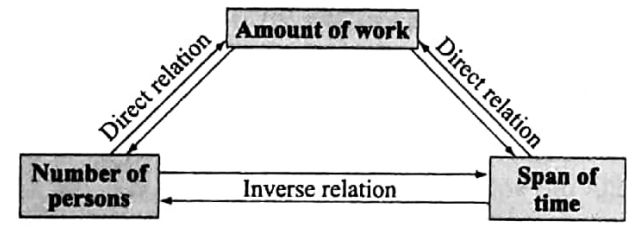
WBBSE Solutions For Class 8 Maths Chapter 6 Time and Work 1

Important information related to time and work

1. If a person can finish a piece of work in n days, then the work done by the person in 1 day = 1/n th part of the work.

2. If a person completes 1/n th part of a work in one day, then the time taken by the person to finish complete work = n days.

3. If A is n times as good a worker as B, then the Ratio of work done by A and B at the same time = n: 1.

4. If the number of workers to do a certain work is changed in the ratio m: n, then the ratio of time taken to finish the work changes in the ratio n: m.

5. One day’s work = 1/ Number of days required to complete the work

6. Number of days required to complete a work = 1/one day’s work

7. Number of days required to do a total work to do certain work = total work today / one day’s work.

WBBSE Solutions For Class 8 Maths Arithmetic Chapter 6 Time and Work

Some problems with time and work

Example 1

A cultivator can plough 6 bighas of land in 12 days. How many bighas of land will he plough in 36 days?

Solution :

Given:

A cultivator can plough 6 bighas of land in 12 days.

Number of days                   Measure of land

12                                             6 bighas

36                                             x bighas (say)

Since, the measure of land ploughed is directly proportional to the number of days,

∴ 12/36 = 6/x

or, 12 x x = 36 x 6

or, x = 36 x 6 / 12

= 18

18 bighas of land.

Alternative method :

In 12 days the cultivator can plough 6 bighas of land

In 1 day the cultivator can plough 6/12 bighas of land

In 36 days the cultivator can plough

6/12 x  36 bighas of land = 18 bighas of land.

Example 2

A carpenter can prepare 3 almirahs in 4 days. How many days will it take to prepare 12 almirahs?

Solution :

Given:

A carpenter can prepare 3 almirahs in 4 days.

Number of almirahs                       Number of days

3                                                            4

12                                                        x (say)

Since the number of almirahs prepared is directly proportional to the number of days.

∴ 3/12 = 4/x

or, 3x = 12 x 4

or,

x = 12 x 4 / 3

= 16

He will take 16 days.

Alternative method :

That carpenter can make,

3 almirahs in 4 days

1 almirah in 4/3 days

12 almirahs in  4/3 x 12 days

= 16 days.

16 days will it take to prepare 12 almirahs

Understanding Time and Work Problems

Example 3

6 men can do work in 30 days. In how many days will 20 men do the work?

Solution :

Given:

6 men can do work in 30 days.

Number of men             Number of days

6                                         30

20                                     x (say)

Since the number of days is inversely proportional to the number of men

∴ 20/6 = 30/x

or, 20 x x = 30 x 6

or, x = = 9

They will do the work in 9 days.

WBBSE Solutions For Class 8 School Science Long Answer Type Questions WBBSE Solutions For Class 8 School Science Short Answer Type Questions
WBBSE Solutions For Class 8 School Science Very Short Answer Type Questions WBBSE Solutions For Class 8 School Science Review Questions
WBBSE Solutions For Class 8 School Science Solved Numerical Problems WBBSE Solutions For Class 8 School Science Experiments Questions
WBBSE Solutions For Class 8 Maths WBBSE Class 8 History Notes
WBBSE Class 8 History Multiple Choice Questions WBBSE Solutions For Class 8 History
WBBSE Solutions For Class 8 Geography


Alternative method :

6 men can do the work in 30 days

1 man can do the work in 30 x 6 days

20 men can do the work in 30 x 6 / 20

= 9 days.

In 9 days will 20 men do the work

Example 4

A man can make 500 machine parts in 4 days working 7 hours per day. If he works for 7 days at the rate of 6 hours per day, then how many machine parts will be produced?

Solution :

Given:

A man can make 500 machine parts in 4 days working 7 hours per day. If he works for 7 days at the rate of 6 hours per day.

Total time in 4 days at the rate of 7 hours per day = (7×4) hours = 28 hours.

Total time in 7 days at the rate of 6 hours per day = (7×6) hours = 42 hours.

Total time                            Number of machine parts

28 hours                                     500

42 hours                                   x (say)

Since, the number of machine parts produced is directly proportional to the total time,

∴ 28/42 = 500/x

or, 28 x x = 500 x 42

or, x = 500 x 42 / 25

= 750

750 machine parts will be produced.

Alternative method :

That man can make

In 28 hours, 500 machine parts

In 1 hour, 500/28 machine parts

In 42 hours, 500 x42 / 28 machine parts

= 750 machine parts.

Example 5

15 people can finish work in 10 days working 8 hours per day. In how many days will 25 persons finish the work if they work 6 hours per day?

Solution :

Given:

15 people can finish work in 10 days working 8 hours per day.

Number of persons          Number of Hours       per day days

15                                             8                                    10

25                                            6                                     x (say)

Since the number of days is inversely proportional to the number of persons and is also inversely proportional to the number of hours per day, therefore,

\(\left.\begin{array}{rl}
25: 15 \\
6 & : 8
\end{array}\right\}:: 10: x\)


or, x 15 x 8 x 10 / 25 x 6

= 8

They will finish the work in 8 days.

Alternative method :

15 persons, working 8 hours a day can finish the work in 10 days

1 person, working 8 hours a day can finish the work in 10 x 15 days

1 person, working 1 hour a day can finish the work in 10 x 15 x 8 days

25 persons, working 1 hour a day can finish the work in 10 x 15 x 8 / 25 days

25 persons, working 6 hours a day can finish the work in 10 x 15 x 8 / 6 x 25days

= 8 days

Step-by-Step Guide to Solving Time and Work Questions

Example 6

Ram and Shyam individually can do work in 6 hours and 8 hours respectively. How long will it take to finish the work if they work together?

Solution :

Given:

Ram and Shyam individually can do work in 6 hours and 8 hours respectively.

Ram can finish the work in 6 hours.

In 1 hour Ram can do 1/6 part

Shyam can finish the work in 8 hours

In 1 hour Shyam can do 1/8 part.

Thus, in 1 hour Ram and Shyam can do (1/6 + 1/8) part

= 4+3 / 24 part

= 7/24 part

Now, Ram and Shyam can do 7/24 part of the work in 1 hour

1 part of the work in 24/7 hours = 3 3/7 hours

They will finish the work in 3 3/7 hours.

Example 7

A and B individually complete a work in 10 hours and 12 hours respectively. If they do work together then in how many hours they will complete the work ?

Solution :

Given :

A and B individually complete a work in 10 hours and 12 hours respectively.

A can finish the work in 10 hours

In 1 hour A can do 1/10 part

B can finish the work in 12 hours

In 1 hour B can do 1/12 of part

Thus, in 1 hour A and B together can do (1/10 + 1/12) part

= 6+5 / 60 part

= 11/60 part

Now, A and B can do

11/60 part of the work in 1 hour

∴  1 part of the work in 60/11 hour

= 5 5/11 hours

They will complete the work in 5 5/11 hours.

Example 8

Rahim and Karim can finish the work in 3 days. They worked together for 2 days and after 2 more days. In how many days can Karim alone finish the work?

Solution :

Given:

Rahim and Karim can finish the work in 3 days. They worked together for 2 days and after 2 more days.

In 3 days Rahim and Karim can do 1 part

In 1 day Rahim and Karim can do 1/3 part

In 2 days Rahim and Karim can do 2/3 part

After 2 days the part of the work left = (1 – 2/3)

= 1/3 and Rahim alone can do this work in 2 days.

Now, in 2 days Rahim can do 1/3 part

in 1 day Rahim can do 1/6 part

In 1 day Karim alone can do (1/3 – 1/6) part

= 2-1 / 6

= 1/6 part of the work.

∴ Karim alone can do 1/6 part of the work in 1 day

Karim alone can do 1 part of the work in 6 days

Karim alone can finish the work in 6 days.

Example 9

Ram, Shyam, and Jadu will paint the windows of a house. Ram, Shyam, and Jadu separately can complete the work in 12, 4 and 6 days. If they do the work together, then how many days they will take to complete the work?

Solution :

Given:

Ram, Shyam, and Jadu will paint the windows of a house. Ram, Shyam, and Jadu separately can complete the work in 12, 4 and 6 days

In 12 days Ram can do 1 part

In 1 day Ram can do 1/12 part

In 4 days Shyam can do 1 part

In 1 day Shyam can do 1/4 part

In 6 days Jadu can do 1 part

In 1 day Jadu can do 1/6 part

∴ Ram, Shyam, and Jadu together can do in one day = ( 1/12 + 1/4 + 1/6) part

= 1+3+2 /12 part

= 6/12 part

= 1/2 part.

∴ The three together can do 1/2 part in 1 day

∴ They together can do 1 part in 2 days

They will complete the work in 2 days

Example 10

The work of 2 men is equal to that of 4 women. 4 men and 7 women can do work in 40 days. How long will 12 men and 6 women take to finish the work?

Solution :

Given:

The work of 2 men is equal to that of 4 women. 4 men and 7 women can do work in 40 days.

Work of 2 men = work of 4 women

Work of 1 men = work of 4/2 women

= work of 2 women

∴ Work of 4 men and 7 women

= work of (8+7) women

= work of 15 women.

Again, the work of 12 men and 16 women

= work of (24+6) women

= work of 30 women

Now, 15 women can do the work in 40 days

1 woman can do the work in 40 x 15 days

3. women can do the work in 40×15 / 30 days

= 20 days

They will finish the work in 20 days.

Example 11

A and B can complete a work separately in 20 and 25 days respectively. After 10 days of their working together, they both left. C came and completed the remaining work in 3 days. If C alone would do the work, how many days he would take to complete the work?

Solution:

Given:

A and B can complete a work separately in 20 and 25 days respectively.

After 10 days of their working together, they both left. C came and completed the remaining work in 3 days.

A and B together in 1 day can do (1/20 + 1/25) part

= 5+4 / 100 part

= 9/100 part

∴ A and B together in 10 days can do = 9/100 x 10 part

= 9/10 part

∴ C does (1 – 9/10) part

= 1/10 part of the work

C can do 1/10 part in 3 days

∴ C can do 1 part in 3 x 10 days

= 30 days

C can complete the work in 30 days.

Example 12

A, B, and C individually can do a piece of work in 10 days, 12 days, and 15 days respectively. They did the work alone for 1 day individually. How much work will be left after that?

Solution :

Given:

A, B, and C individually can do a piece of work in 10 days, 12 days, and 15 days respectively. They did the work alone for 1 day individually.

In 10 days A can do 1 part

In 1 day A can do 1/10 of part

In 12 days B can do 1 part

In 1 day B can do 1/12 part

In 15 days C can do 1 part

In 1 day C can do 1/15 of part

If A, B, and C work alone for 1 day individually, then the total work performed

= (1/10 + 1/12 + 1/15) part

= (6 + 5 + 4 / 60) part

= 15/60 part

= 1/4 part

∴ Remaining work = (1-1/4) part

= 3/4 part

3/4 part of the work will be left

Practice Problems on Time and Work for Class 8

Example 13

A and B can do a piece of work in 10 days and 15 days respectively. An alone did the work for 4 days and then B alone did it for 5 days. Thereafter C did the remaining work in 8 days. How long will they take to complete the work together?

Solution :

Given:

A and B can do a piece of work in 10 days and 15 days respectively.

An alone did the work for 4 days and then B alone did it for 5 days.

Thereafter C did the remaining work in 8 days.

In 10 days A can do 1 part

In 1 day A can do 1/10 part

In 4 days A can do 4/10 of part

= 2/5 part

In 15 days B can do 1 part

In 1 day B can do 1/15 part

In 5 days B can do 5/15 part

= 1/3 part

Therefore, A and B do (2/5 + 1/3) part

= (6+5 / 15) part

= 11/15 part of the work.

∴ Remaining work = ( 1 – 11/15) part

= 4/15 part

In 8 days C can do 4/15 of part

In 1 day C can do 4/ 15 x 8 part

= 1/30 part

Hence, in 1 day A, B, and C can do ( 1/10 + 1/15 + 1/30 ) part

= (3 + 2 + 1 / 30 ) part

= 6/30 part

= 1/5 part

.’. A, B, and C together can do 1/5 part in 1 day

A, B, and C together can do 1 part in 5 days.

They will complete the work in 5 days.

Example 14

A, B, and C can do a piece of work in 10 days, 12 days, and 15 days respectively. They started the work jointly. After 3 days B became ill and went away. How long will A and C take to finish the work?

Solution :

Given:

A, B, and C can do a piece of work in 10 days, 12 days, and 15 days respectively.

They started the work jointly. After 3 days B became ill and went away.

In 1 day A, B, and C can do

(1/10 + 1/12 + 1/150part

= (6+5+4 / 40)part

= 15/60 part

= 1/4 part

∴ In 3 days A, B, and C can do 3/4 part.

∴ Remaining work = (1-3/4) part

= 1/4 part

Also, in 1 day A and C can do (1/10 + 1/15) part

= (3+2 / 30) part

= 5/30 part

= 1/6 part

Hence, A and C can do 1/6 part in 1 day

A and C can do 1 part in 6 days

A and C can do 1/4 part in 6/4 days

= 3/2

= 1 1/2 days.

A and C will do the remaining work in 1 1/2 days.

Example 15

Ram and Shyam can complete a work in 20 days, Shyam and Jadu can complete that work in 15 days, and Ram and Jadu can complete that work in 20 days. How long will they take to do the work together? If Ram, Shyam, and Jadu work individually then calculate the time that will be taken by each of them separately.

Solution :

Given:

Ram and Shyam can complete a work in 20 days, Shyam and Jadu can complete that work in 15 days, and Ram and Jadu can complete that work in 20 days.

Ram and Shyam together can do it in 1 day 1/20 part

Shyam and Jadu together can do in 1 day 1/15 part

Ram and Jadu together can do in 1 day 1/20 part

2 x (Ram + Shyam + Jadu) together can do in 1 day

= (1/20 + 1/15+ 1/20) part

= 3+4+3 / 60 part

= 10/60 part

= 1/6 part

∴ Ram, Shyam, and Jadu together can do in 1 day 1/12 part

They do 1/12 part in 1 day

They do 1 part in 12 days

Now, in 1 day, Ram can do (1/12 – 1/15) part

= 5 – 4 /60 part

= 1/60 part

Ram can do 1/60 part in 1 day

Ram can do 1 part in 60 days

In 1 day, Shyam can do (1/12 -1/12) part

= 5-3 / 60 part

= 2/60 part

= 1/30 part

Shyam can do 1/30 part in 1 day

Shyam can do 1 part in 30 days

In 1 day Jadu can do (1/12 – 1/20 )part

= 1/30 part

Jadu can do 1/30 part in 1 day

Jadu can do 1 part in 30 days

The three together will do the work in 12 days.

Ram alone in 60 days,

Shyam alone in 30 days

and Jadu alone in 30 days.

Example 16

Ram, Shyam, and Jadu individually can complete a work in 5, 6, and 10 days respectively. They started doing the work together. After 2 days Ram went away. Find in how many days Shyam and Jadu will complete the remaining work.

Solution :

Given:

Ram, Shyam, and Jadu individually can complete a work in 5, 6, and 10 days respectively. They started doing the work together.

After 2 days Ram went away.

In 1 day Ram, Shyam, and Jadu can do (1/5 + 1/6 + 1/10) part

= 6+5+3 / 30 part

= 14/30 part

= 7/15 part

∴ In 2 days Ram, Shyam, and Jadu can do the 14/15 part.

∴ Remaining work = (1 – 14/15) part

= 1 1/5 part

Shyam and Jadu can do in 1 day (1/6 + 1/10) part

= (5+3 / 30)part

= 8/30 part

= 4/15 part

Shyam and Jadu can do 4/15 part in 1 day

Shyam and Jadu can do 1 part in 15/4 days

1/15 part in 15/4 x 1/15 days

= 1/4 days

Shyam and Jadu will complete the remaining work in 1/4 day.

Example 17

Ram and Shyam can do the work individually in 10 days and 15 days respectively. At first, Ram alone worked for 4 days, then Shyam alone worked for 5 days and left. Jadu came and completed the remaining work in 4 days. If Ram, Shyam, and Jadu would work together find in how many days they would complete the work.

Solution :

Given:

Ram and Shyam can do the work individually in 10 days and 15 days respectively.

At first, Ram alone worked for 4 days, then Shyam alone worked for 5 days and left.

Jadu came and completed the remaining work in 4 days.

In 10 days Ram can do 1 part

In 1 day Ram can do 1/10 part

In 4 days Ram can do 4/10 part = 2/5 part

In 15 days Shyam can do 1 part

In 1 day Shyam can do 1/15 part

In 5 days Shyam can do 5/15 part = 1/3 part

Ram and Shyam together do (2/5 + 1/3) part

= 6+5 / 15 part

= 11/15 part

∴ Jadu does(1 – 11/15)part

= 4/15 part

In 4 days Jadu can do 4/15 part

∴ In 1 day Jadu can do 1/15 part

In 1 day Ram, Shyam, and Jadu can do (1/10 + 1/15 + 1/15) part

= (3+2+2 / 30) part

The three together can do 7/30 part in 1 day

The three together can do 1 part in 30/7 days

= 4 2/7 days

They will complete the work in 4 3/7 days.

Conceptual Questions on Applications of Time and Work

Example 18

A and B can do a piece of work in 6 days, B and C can do it in 9 days and A and C can do it in 12 days. How long will it take to do the work separately?

Solution :

Given:

A and B can do a piece of work in 6 days, B and C can do it in 9 days and A and C can do it in 12 days.

A and B together can do in 1 day 1/6 part

B and C together can do in 1 day 1/9 part

A and C together can do in 1 day 1/12 part

2 x (A, B, and C)together in 1 day do (1/6 + 1/9 +1/12) part

= 6+4+3 / 36 part

= 13/36 part

A, B, and C together in 1 day do 13/72 part = 13-8 / 72 part

= 5/72 part

∴ A does the work in 72/5 days = 14 2/5 days

In 1 day B does (13/72 – 1/12) part

= 13-6/72 part

= 7/72 part

∴ B does the work in 72/7 days = 10 2/7 days

In 1 day C does (13/72 – 1/6)part

= 13-12 /72part

= 1/72 part

C does the work in 72 days.

A will do the work in 14 2/5 days, B in 10 2/7 days, and C in 72 days.

Example 19

A and B together can do a piece of work in 20 days. They worked together for 15 days and then B went away. A finished the remaining work in 12 days. How many days would A and B take if they worked individually?

Solution:

Given:

A and B together can do a piece of work in 20 days.

They worked together for 15 days and then B went away.

A finished the remaining work in 12 days.

A and B together can do the work in 20 days

In 20 days they can do 1 part

In 1 day they can do 1/20 part

In 15 days they can do 15/20 part = 3/4 part

∴ Remaining work = (1 – 3/4) part

= 1/4 part

A can-do 1/4 part in 12 days

∴ A can do 1 part in 12 x 4 days = 48 days

B can do in 1 day(1/20 – 1/48) part

= 12-5 / 240 part

= 7/240 part

∴ B can do the work in 240/7 days = 34 2/7 days

A can do the work in 48 days and B can do the work in 34 2/7 days.

Example 20

A and B together can do a piece of work in 8 days. They worked together for 5 days and then B went away. The work was finished after 6 more days. In how many days will B alone finish the work?

Solution:

Given:

A and B together can do a piece of work in 8 days.

They worked together for 5 days and then B went away. The work was finished after 6 more days.

A and B together can do the work 8 days

In 8 days they do 1 part

In 1 day they do 1/8 part

In 5 days they do 5/8 part

∴ Remaining work = ( 1- 5/8)part

= 3/8 part

A can-do 3/8 part work in 6 days

∴ A can do 1 part work in 6 x 8/3 days

= 16 days

A and B together can do in 1 day 1/8 part

A alone can do in 1 day 1/16 part

∴ B alone can do in 1 day (1/8 – 1/16) part

= (2-1 / 16) part

= 1/16 part

∴ B alone can do the work in 16 days

B alone can do the work in 16 days

Pipes and Cisterns

A cistern or water tank has two types of pipes connected to it one which fills it up called the inlet and the other which empties it out called the outlet.

Since the nature of the work of the two pipes is exactly opposite, hence the work done by the inlet is considered positive whereas the work done by the outlet is considered negative. If an inlet fills up a cistern in n hours, then in 1 hour it will fill up 1/n th part of the cistern.

If an outlet empties a full cistern in m hours, then in 1 hour 1/m th part of the cistern will be emptied out by it.

Some problems with pipes and cisterns

Example  1

There are two pipes for taking water from the municipality water tank. The tank becomes empty in 4 hours by the two pipes separately. If both the pipes remain open calculate when the full tank will be empty.

Solution:

Given:

There are two pipes for taking water from the municipality water tank. The tank becomes empty in 4 hours by the two pipes separately.

By the two pipes in 1 hour can be emptied (1/4 + 1/4) part

= 1/2 part

∴ 1/2 part can be emptied in 1 hour

1 part

can be emptied in 2 hours

The full tank will be empty in 2 hours.

Example 2

There are three pipes in a tank. With these 3 pipes separately the tank can be filled up in 18, 21 and 24 hours respectively,

(a) If the 3 pipes remain open together find when the tank will be filled with water,

(b) If the first two pipes would remain open find the time to fill up the tank with water,

(c) If the last two pipes would remain open find the time to fill up the tank.

Solution :

Given:

There are three pipes in a tank. With these 3 pipes separately the tank can be filled up in 18, 21 and 24 hours respectively,

1. If the 3 pipes remain open together then in 1 hour (1/18 + 1/21 + 1/24) part

= 20+24+21 / 504 part

= 73/504 part is filled.

∴ 73/504 part is filled in 1 hour

1 part is filled in 504/73 hours

= 6 66/73 hours

2. If the first two pipes remain open together then in 1 hour (1/18 + 1/21)part

= 7+6 / 126 part

= 13/126 part is filled

∴ 13/126 part is filled in 1 hour

1 part is filled in 126/13 hours

= 9 9/13 hours

3. If the last two pipes remain open together then in 1 hour(1/24 +1/24) part

= 8+7 / 168 part

= 15/168 part is filled.

15/168 part is filled in 1 hour

1 part is filled in 168/15 hours

= 11 3/15 hours

= 11 1/5 hours

Examples of Time and Work Calculations

Example 3

The tank of a house can be filled up in 30 minutes by the municipality water supply pipe. All household work can be done by opening the all pipes in 4 hours. If one day the water supply pipe remains open for 25 minutes, calculate how long work can be done with that water?

Solution :

Given:

The tank of a house can be filled up in 30 minutes by the municipality water supply pipe. All household work can be done by opening the all pipes in 4 hours. If one day the water supply pipe remains open for 25 minutes.

By the water of 30 minutes, work can be done for 4 hours

By the water of 1-minute work can be done for 4/30 hours

By the water of 25 minutes, work can be done for 4/30 x 25 hours

= 10/3 hours

= 3 1/3 hours

=3 hours 20 minutes

3 hours 20 minutes work can be done.

Example 4

The first and second pipes of a tank can fill it in 8 hours and 10 hours respectively. Both the pipes remained open together for 4 hours. What part of the empty tank will be filled?

Solution :

Given:

The first and second pipes of a tank can fill it in 8 hours and 10 hours respectively. Both the pipes remained open together for 4 hours.

By the first and the second pipe, in 1 hour (1/8 + 1/10)part

= (5+4 / 40) part

= 9/40 part of the tank is filled.

∴ In 4 hours, 9/40 x 4 part

= 9/10 part of the tank is filled.

9/10 part of the tank is filled.

Example 5

A cistern can be filled by two taps A and B in 6 minutes and 3 minutes respectively. How long will it take to fill the empty cistern if the two taps are opened simultaneously?

Solution :

Given:

A cistern can be filled by two taps A and B in 6 minutes and 3 minutes respectively.

In 6 min tap A can fill 1 part of the cistern

In 1 min tap A can fill 1/6 part of the cistern

In 3 min tap B can fill 1 part of the cistern

In 1 min tap B can fill 1/3 part of the cistern

∴ In 1 minute, taps A and B can fill (1/6 + 1/3)part

= 1+2 / 6 part

= 1/2 part.

∴ Taps A and B together can fill 1/2 part of the cistern in 1 minute

1 part of the cistern in 2 minutes

The empty cistern will be filled in 2 minutes.

Example 6

A water tank may be filled in 10 minutes by a pipe. Through a hole at the bottom of the tank, the tank may be emptied in 20 minutes. Without closing the hole if the inlet pipe is opened then how long will it take to fill the empty tank?

Solution :

Given:

A water tank may be filled in 10 minutes by a pipe.

Through a hole at the bottom of the tank, the tank may be emptied in 20 minutes.

By the inlet pipe

In 10 minutes, 1 part is filled

In 1 minute, 1/10 part is filled

By the hole at the bottom of the tank

In 20 minutes, 1 part is emptied

In 2 minutes, 1/20 part is employed

Without closing the hole if the inlet pipe is opened

in 1 minute (1/10 – 1/20)part

= 1/20 part is filled.

1/20 part is filled in 1 minute

1 part is filled in 20 minutes

The empty tank will be filled in 20 minutes.

Example 7

Two taps A and B can fill a cistern in 6 minutes and 12 minutes respectively. Tap C can empty it in 8 minutes. If the three taps are opened simultaneously, then how long will it take to fill the empty cistern?

Solution :

Given:

Two taps A and B can fill a cistern in 6 minutes and 12 minutes respectively. Tap C can empty it in 8 minutes. If the three taps are opened simultaneously.

By tap A, in 1 minute, 1/6 part of the cistern is filled.

By tap B, in 1 minute, 1/12 part of the cistern is filled.

By the two taps A and B, in 1 minute, (1/6 +1/12)part

= 3/12 part

= 1/4 part of the cistern is filled.

By tap C, in 1 minute, 1/8 part of the cistern is emptied.

Therefore, if the three taps are in operation simultaneously, then in 1 minute(1/4 – 1/8)part

= 1/8 part is filled.

Therefore, 1/8 part is filled in 1 minute

1 part is filled in 8 minutes

The empty cistern will be filled in 8 minutes.

Example 8

1/4 part of a cistern is empty, and the remaining portion is filled with water. Then two taps A and B are fitted with it. The tap A can fill the cistern in 8 minutes and tap B can empty it in 4 minutes. If the two taps A and B are opened simultaneously, then how long will it take to empty the cistern ?

Solution :

Given:

1/4 part of a cistern is empty, and the remaining portion is filled with water.

Then two taps A and B are fitted with it.

The tap A can fill the cistern in 8 minutes and tap B can empty it in 4 minutes.

1/4 part of the cistern is empty.

∴ (1-1/4)part or 3/4 part is filled with water.

Now, in 1 minute tap B can empty 1/4 part and in 1 minute tap A can fill 1/8 part

∴ If taps A and B are opened simultaneously, then(1/4 – 1/8)part

= 1/8 part is emptied in 1 minute.

1/8 part is emptied in 1 minute

1 part is emptied in 8 minutes

384 part is emptied in 8 x 3/4 minutes

= 6 minutes

The cistern will be empty in 6 minutes.

Example 9

A cistern has 3 pipes A, B, and C; A and B can fill it in 3 and 4 hours respectively, and C can empty it in 1 hour. If the pipes be opened in order at 3, 4, and 5 P.M., when will the cistern be empty?

Solution :

Given:

A cistern has 3 pipes A, B, and C; A and B can fill it in 3 and 4 hours respectively, and C can empty it in 1 hour. If the pipes be opened in order at 3, 4, and 5 P.M.

In 1 hour, pipe A can fill 1/3 part, pipe B can fill 1/4 part and pipe C can empty 1 part.

Now, at 5 P.M.

when the pipe C is opened(2 x 1/3 + 1/4)part

= (2/3 + 1/4)part

= (8+3 / 12)part

= 11/112 part of the cistern is filled.

When all the three pipes are in operation, in 1 hour, (1 – 1/3 +1/4) part

= (1 – 7/12)part

= 5/12 part is emptied.

∴ 5/12 part is emptied in an hour

1 part is emptied in 12/5 hours

11/12 part in emptied in 12/5 x 11/12 hours

= 11/5 hours

= 2 hours 12 minutes

Hence, the cistern will be empty for 2 hours 12 minutes after 5 P.M.

i.e., at 7-12 P.M.

The cistern will be empty at 7-12 P.M.

Example 10

A tank has two pipes A and B. A can fill the tank with water in 8 hours and B can empty it in 12 hours. If the pipe A be opened first and the pipes be opened alternatively one at a time for 1 hour each, in how many hours will the tank be filled up ?

Solution :

Given:

A tank has two pipes A and B. A can fill the tank with water in 8 hours and B can empty it in 12 hours.

If the pipe A be opened first and the pipes be opened alternatively one at a time for 1 hour each

In the first hour, pipe A fills 1/8 part of the tank.

In the second hour, pipe A is stopped and pipe B empties 1/12 part of the tank.

Thus in every two successive hours(1/8 – 1/12)part

= (3-2 / 24) part

= 1/24 part of the tank is filled.

This process will continue until there remains a portion of the tank that can be filled by pipe A alone within 1 hour.

Thus, we have to find the time when (1- 1/8) part

= 7/8 part of the tank is filled up.

Now,

1/24 part of the tank is filled in 2 hours

1 part of the tank is filled in 2 x 24 hours

7/8 part of the tank is filled in 2 x 24 x 7/8 hours

= 42 hours

Pipe A fills the remaining | part of

the tank in 1 hour and there is no necessity of opening the second pipe after that. .’. The tank will be filled in (42 + 1) hours = 43 hours.

The tank will be filled in 43 hours.

Example 11

There are 3 pipes connected to a cistern. By these three pipes individually the cistern can be filled in 20, 12, and 15 hours respectively. When the cistern was empty the first pipe only was open for some time. After this, the first pipe was closed and the other two pipes were opened simultaneously and the remaining part was filled in 3 hours. How long was the first pipe open?

Solution :

Given:

There are 3 pipes connected to a cistern. By these three pipes individually the cistern can be filled in 20, 12, and 15 hours respectively.

When the cistern was empty the first pipe only was open for some time.

After this, the first pipe was closed and the other two pipes were opened simultaneously and the remaining part was filled in 3 hours.

By the second and the third pipe in 1 hour (1/12 + 1/15)part

= (5+4 / 60)part

= 9/60 part

= 3/20 part is filled.

By the second and the third pipe in 3 hours

3 x 3/20 part

= 9/20 part is filled.

∴ The first pipe fills(1 – 9/20) part = 11/20 part

By the first pipe, 1 part is filled in 20 hours

By the first pipe, the 11/20 part is filled in 20 x 11/20 hours = 11 hours.

The first pipe was open for 11 hours.

WBBSE Solutions For Class 8 Maths Arithmetic Chapter 5 Percentage

WBBSE Solutions For Class 8 Maths Arithmetic Chapter 5 Percentage

Introduction

You are familiar with the word ‘per cent’ from your childhood. Perhaps you have heard your parents say that ‘my son has scored 95 per cent marks’, ‘at present bank interest is only 6 per cent per annum, ‘a bookseller allows 15 per cent commission’ etc. In fact, the per cent is an abbreviation of the Latin word per centum meaning per hundred. A fraction with a denominator of 100 is called

per cent. For example, 7/100 = 7 per cent. 

Per cent is denoted by the symbol “%”.

Necessity of percentage

Sometimes it becomes necessary to compare two fractions. For this purpose, we convert the fractions so that both of them have a common denominator. Then we can say that the fraction having a greater numerator, is greater than the two fractions. Let us consider an example. Suppose, there are two schools in your locality.

In school A, 225 students have passed out of 300 students and in school B, 288 students have passed out of 360 students. In order to compare the performance of the two schools, we have to compare the ratios 225/300

and 288/360

Now, 225/300= 3/4

= 3 x 25 / 4 x 25

= 75/100

and, 288/360 = 4/5

4 x 20 / 5 x 20

= 80/100

Now, it is obvious that 80/100>75/100

Therefore, the performance of school B is better than that of A. Thus it becomes easy for us to compare two results when two fractions are converted to fractions having a common denominator of 100.

Read And Learn More WBBSE Solutions For Class 8 Maths

Important Formulae

1. To convert a percentage into a corresponding fraction: The number is to be written as the numerator and 100 as the denominator. Subsequently, the fraction is to be reduced to its simplest form.

Example: 10% = 10/100 

= 1/10

2. To convert a fraction into a corresponding percentage: The fraction is to be multiplied by 100 with an addition of the % symbol at the end.

Example: 2/5 = (2/5 x100)%

= 40%

WBBSE Class 8 Percentage Notes

3. To convert a percentage into a corresponding decimal: The percentage sign is to be removed and the decimal point is to be shifted in the number by two places to the left. 

Example: 5% = 0.05

4. To convert a decimal into a corresponding percentage: The decimal point in the number is to be shifted by two places to the right and the % symbol is to be added at the end.

Example: 0.453 = 45.3%

5. To find a given percentage of a quantity: The percentage is to be written as a fraction followed by multiplication by the quantity given.

Example: 1. x% of y = x/100 x y

2. 10% of 500 = 10/100 x 500

= 50

6. To express a given quantity as a percentage of another quantity of the same kind: The given quantity is to be divided by the other quantity followed by multiplication of the result by 100 and subsequent addition of the % symbol.

Example:

1. x as percentage of y = (x/y x 100)%

2. 20 as a percentage of ₹500 

= (20/500 x 100)%

7. To find a quantity from a given percentage of the quantity: The given quantity is to be divided by the percentage after expressing it as a fraction. 

Example :

If 20% of full marks is 40 then, full marks = 40++20

=40×100/20

= 200.

WBBSE Solutions For Class 8 Maths Arithmetic Chapter 5 Percentage

8. To find the percentage change in a quantity: The change (either increase or decrease) in the quantity is to be written as the numerator and the original quantity as the denominator followed by multiplication of the fraction by 100

1. If a quantity increases by x, percentage increase = (x/original quantity x 100 )%.

Example: An increase of 5 over the original price of a commodity of 20 means, the percentage increase

= (5/20 x 100) %

= 25%

2. If a quantity increases by x %, the new quantity

= (1+ x / 100) x original quantity

or, original quantity = new quantity / 1+ x/100

Understanding Percentage Calculations

Example: An increase of 5% over the original price of a commodity of ₹200 means,

new price=₹ [(1+5/100)×200]= ₹210.

3. If a quantity decreases by x, the percentage decrease

= (x/original quantity x 100) %

Example: A decrease of 5 over the original price of a commodity of * 50 means, a percentage decrease

=(5×100)% = 10%.

4. If a quantity decreases by x%, the new quantity

= (1-x/100)x original quantity

or, original quantity = new quantity / 1- x/100

Example: A decrease of 10% over the original price of a commodity of 70 means,

new price =₹[(1-10/100)×70]= ₹63.

9. To compare between two quantities X and Y when X>Y (given) :

1. The percentage by which greater quantity (X) is greater than smaller quantity (Y),

% increase = (X-Y/Y x 100)%.

Example: The percentage by which the unit cost of 50 per kg of a certain variety of sugar is greater than that of 40 per kg of another variety is,

% increase = (50 – 40×100)% 

= 25%

2. The percentage by which the smaller quantity (Y) is less than the bigger quantity (X),

% decrease = (X-Y/ Y x 100) %.

Example: For the above-quoted example of the unit cost of two varieties of sugars,

% decreases = (50-40 / 50 x 100)% = 20%

3. When X exceeds Yby p%, then Y is Less than X by (p / 100+p x 100)%.

4. when Y is less than X by p%, then X is more than Y by (p / 100-p x 100)%

WBBSE Solutions For Class 8 Maths Arithmetic Chapter 5 Percentage

Chapter 5 Percentage Some examples Of Percentage

Example 1

Convert each of the following fractions into a per cent:

1. 1/4,

2. 1/2,

3. 3/4,

4. 3/8.

Solution:

1. 1/4 = 1/4 x 100%

= 25%

2. 1/2 = 1/2 x 100%

= 50%

3. 3/4 = 3/4 x 100%

= 75%

4. 3/8 = 3/8 x 100%

= 75/2%

= 37 1/2%

Step-by-Step Guide to Finding Percentages

Example 2

Convert each of the following per cent into a vulgar fraction :

1. 25%,

2.6 2/3%,

3. 12 1/2 %,

4. 16 2/3 %.

Solution:

1. 25% = 25/100

= 1/4

2. 6 2/3% = 20/3 x 100

= 1/15

3. 12 1/2 % = 25/ 2 x 100

= 1/8

4. 16 2/3% = 50 / 3 x 100

= 1/6

WBBSE Solutions For Class 8 School Science Long Answer Type Questions WBBSE Solutions For Class 8 School Science Short Answer Type Questions
WBBSE Solutions For Class 8 School Science Very Short Answer Type Questions WBBSE Solutions For Class 8 School Science Review Questions
WBBSE Solutions For Class 8 School Science Solved Numerical Problems WBBSE Solutions For Class 8 School Science Experiments Questions
WBBSE Solutions For Class 8 Maths WBBSE Class 8 History Notes
WBBSE Class 8 History Multiple Choice Questions WBBSE Solutions For Class 8 History
WBBSE Solutions For Class 8 Geography


Example 3

Convert each of the following percents into a decimal:

1. 25%,

2. 22.5%,

3. 41 2/3%,

4. 75%

Solution:

1. 25% = 25/100

= 0.25

2. 22.5% = 22.5/100

0.225

25% = 0.225

3. 41 2/3 % = 125 / 3 x 100

= 5/3 x 4

= 5/12

= 0.416

41 2/3 % = 0.416

4. 75% = 75/100

= 0.75

75% = 0.75

Example 4

Convert each of the following decimals into a per cent:

1. 0.28,

2. 0.125,

3. 1.25,

4. 2.75.

Solution:

1. 0.28 = 28/100

= 28%

0.28 = 28%

2. 0.125 = 125/100

= 125 / 10 x 100

= 2.5%

0.125 = 2.5%

3. 1.25 = 125/100

= 125%

1.25 = 125%

4. 2.75 = 275/100

= 275%

2.75 = 275%

Example 5

Find 25% of ₹300.

Solution:

Given:

25% And ₹300

25% of ₹300 = ₹300 x 25/100

= ₹75

25% of ₹300 = ₹75

Example 6

The ratio of hydrogen and oxygen in the water is 2:1. Find the percentage of hydrogen and oxygen in the water.

Solution:

Given:

The ratio of hydrogen and oxygen in the water is 2:1.

Since the ratio of hydrogen and oxygen in water is 2:1 therefore,

amount of hydrogen

= 2/3 part

= 2/3 x 100%

= 200/3 %

= 66 2/3 %

amount of oxygen

= 1/3 part

= 1/3 x 100%

= 100/3 %

= 33 1/3%

Hydrogen 66 2/3%, oxygen 33 1/3%.

Example 7

What per cent is 2 kg 250 gms of 0.72 quintals? 

Solution:

Given:

2 kg 250 gms And 0.72 Quintals.

2 kg 250 gms = 2.25 kg

0.72 quintals = 72 kg

∴ The required percent = 2.25/72 x 100 %

= 3.125%

3.125% per cent is 2 kg 250 gms of 0.72 quintals

Practice Problems on Percentages for Class 8

Example 8

A factory used to produce 1500 bottles per month. Now 1695 bottles are produced there per month. Find the percentage of increase of production in that factory. 

Solution :

Given:

A factory used to produce 1500 bottles per month. Now 1695 bottles are produced there per month.

Previously, 1500 bottles were produced. Now 1695 bottles are produced. Production of bottles has increased by (1695 – 1500) 195 per month.

In 1500 the increase is 195

In 1 the increase is 195/1500

In 100 the increase is 195/1500 x 100 

= 13

The percentage of increase in production is 13%

Example 9

What per cent is ₹ 20 of ₹ 50?

Solution:

Given:

₹ 20 And ₹ 50.

The required percent = ₹20/₹50 x 100%

= 40%

The required percent = 40%

Example 10

The quantity of Nitrogen, Oxygen and Carbon dioxide in the air is 75.6%, 23.04% and 1.36%. Find the quantity of each in 25 litres of air.

Solution:

Given:

The quantity of Nitrogen, Oxygen and Carbon dioxide in the air is 75.6%, 23.04% and 1.36%.

In 25 litres of air, 

quantity of Nitrogen = 25 litres × 75.6% 

= 18.9 litres

quantity of Oxygen = 25 litres x 23.04%

= 5.76 litres

quantity of Carbon dioxide = 25 litres × 1.36% 

= 0.34 litre 

Nitrogen 18.9 litres, 

Oxygen 5.76 litres, 

Carbon dioxide 0.34 litre.

Example 11

40% of the number is 48. What is the number?

Solution:

Given:

40% of the number is 48.

40% of the number = 48

or, 1% of the number = 48/40

or, 100% of the number = 48/40 x 100

= 120

The number is 120.

Example 12

A man purchased a book from a book stall. He got discounts of 10% and 5% respectively. How much did the man pay if the price of the book was printed as 200? 

Solution:

Given:

A man purchased a book from a book stall. He got discounts of 10% and 5% respectively.

The printed price of the book is 200. 

Discount on the first time

 =200  x  10/100 

=20 

Price of the book after the first discount 

=(200-20)

=180 

Discount at the second time

= 180 × 5/100

=9

Price of the book after the second discount

= (180 – 9)

= 171

The price of the book is 171.

Example 13

Out of 40 students in a school, 16 failed. Find the percentage of successful candidates.

Solution :

Given:

Out of 40 students in a school, 16 failed.

The number of students who failed = 16

∴  The number of students passed = (40 – 16) = 24

.’. Out of 40 students the number of successful candidates = 24

Out of 1 student number of successful candidates = 24/40

Out of 100 students a successful 24

candidates = 24/40 x 100

= 60

The percentage of successful candidates is 60%.

Examples of Real-Life Applications of Percentages

Example 14

The length of each side of a square is increased by 10%. Find the percentage of increase in its area.

Solution:

Given:

The length of each side of a square is increased by 10%.

Let, the length of the side of the square = a units

Area of the square = a2 sq units.

After increasing 10% the length of the beach

side = (a+a x 10/100) units

= (a + a/10)units

= 11a / 10 units

∴ Area = (11a / 10)² sq units

= 121a²/100 sq units

∴ Increase in area = (121a² / 100 – a²)sq units = 21a² / 100 sq units

In a2 sq units the area increases by

21 a/ 100 sq units

In 1 sq unit, the area increases by

21 a² / a2 x 100 sq units

In 100 sq units, the area increases by

21/100 x 100 sq units = 21 aq units

It will increase by 21%

Example 15

Out of 350 mangoes in a basket, 210 mangoes were distributed among some students. Find the percentage of mangoes left in the basket.

Solution :

Given:

Out of 350 mangoes in a basket, 210 mangoes were distributed among some students.

The original number of mangoes = 350

Number of mangoes distributed = 210

Number of mangoes left in the basket = (350-210)

= 140

Therefore, percentage of the mangoes left

= 140/350  x 100 = 40 350

40% of the mangoes were left in the basket.

Example 16

15% discount L obtained if the bill of electricity is paid on time. A man got a discount of ₹ 54 by paying the bill on time. What was the amount of the bill

Solution :

Given:

15% discount L obtained if the bill of electricity is paid on time. A man got a discount of ₹ 54 by paying the bill on time.

If a discount of ₹ 15 is obtained then the amount of the bill is ₹ 10

If a discount of ₹ 1 is obtained then the amount of the bill is ₹ 100 / 15

If a discount of ₹ 54 is obtained then the

amount of the bill is ₹ 100 x 54 / 15

= ₹ 360

The amount of the bill was ₹ 360.

Example 17

Ram scored 642 marks out of 800 and Shyam scored 515 marks out of 700 in an examination. Whose performance was better ?

Solution :

Given:

Ram scored 642 marks out of 800 and Shyam scored 515 marks out of 700 in an examination.

Out of 800 marks, Ram scored 642 marks

.’. Out of 100 marks, Ram scored

642 x100 / 800 = 80.25 marks

Out of 700 marks, Shyam scored 5115 marks

∴ Out of 100 marks, Shyam scored

515 x 100 / 700

= 73.57 marks

Ram’s performance was better.

Example 18

The price of sugar has increased by 20%. Find the percentage decrease in the monthly use of sugar to keep the expenses of sugar unaltered.

Solution :

Given

The price of sugar has increased by 20%.

What price of sugar of ₹ 100 has become ₹ 120.

Therefore, on ₹ 120 the expenses should be decreased by ₹ (120 – 100)

= ₹ 20.

On ₹ 120 expenses should be decreased by ₹ 20

On ₹ 1 expenses should be decreased by

₹20 / 120

On ₹ 100 expenses should be decreased by

₹ 20/120 x 100

= ₹ 100/6

= ₹ 50/3

= ₹ 16 2/3

Monthly use of sugar decreased by 16 2/3%

Example 19

Ram’s income is greater than Shyam’s income by 20%. Find the per cent by which Shyam’s income is less than Ram’s income.

Solution :

Given:

Ram’s income is greater than Shyam’s income by 20%.

If Shyam’s income is ₹ 100, then Ram’s income is ₹ 120.

.’. Shyam’s income is less than Ram’s income by ₹ (120 – 100)

= ₹ 20.

.’. In ₹ 120, Shyam’s income is less than Ram’s income by ₹ 20

In ₹ 1, Shyam’s income is less than Ram’s income by ₹ 20/120

In ₹ 100, Shyam’s income is less than Ram’s income ₹ 20/100 x 100

= ₹ 50/3

= ₹ 16 2/3

Shyam’s income is 16 2/3% less than Ram’s income.

Example 20

When water freezes into ice, its volume is increased by 10%. By what per cent the volume will be decreased if ice melts into water.

Solution :

Given:

When water freezes into ice, its volume is increased by 10%.

100 c.c. water freezes into 110 c.c. ice.

When ice melts into the water the volume decreases in 110 cc volume = (110 – 100) c.c.

= 10 c.c.

In 110 c.c., volume decreases by 10 c.c.

In 1 c.c., volume decreases by 10/110 c.c.

In 100 c.c., volume decreases by 10/110 x 100 c.c.

= 100/11 c.c.

= 9 1/11 c.c.

The volume will be decreased by 9 1/11%

Example 21

Due to the increase in the price of sugar by 25%, a family decreases the consumption of sugar by 15%. As a result of this, what will be the percentage increase or decrease in the expenditure of sugar of that family?

Solution :

Given

Due to the increase in the price of sugar by 25%, a family decreases the consumption of sugar by 15%.

Let, the price of sugar be ₹ x per kg and the consumption of sugar be y kg.

At present

price of 1 kg of sugar is ₹ x

∴ The price of y kg of sugar is ₹ xy

Due to a 25% increase, the price of sugar per kg

= ₹ (x + x x 25/100)

= ₹ (x + x/4)

= ₹ 5x / 4

Due to a 15% decrease, in the consumption of sugar

= (y – y x 15/100)kg

= (y – 3y/20) kg

= 17y/20 kg

After rising the price

Price of 1 kg of sugar = ₹ 5x/4

Price of 17y/20 kg of sugar = ₹ 5x/4 x 17y/20

= ₹ 17xy/16

.’. Expenditure increases by

₹ (17xy / 16 – xy)

= ₹ xy/16

On ₹ xy, expenditure increases by ₹ xy/16

On ₹ 1, expenditure increases by ₹ xy / 16 x 1/xy

On ₹ 100, expenditure increases by ₹ 100/16

= ₹25/4

= ₹ 6 1/4

Expenditure will increase by 6 1/4%

Conceptual Questions on Applications of Percentages

Example 22

Due to the use of the high-yielding seed, a man has got a 55% production hike in paddy cultivation. But for this production, the cost of cultivation has increased by 40%. Previously a yield of ₹ 3000 was produced by investing ₹1200. Find whether his income will be increased or decreased and by how much after using a high-yielding seed.

Solution :

Given:

Due to the use of the high-yielding seed, a man has got a 55% production hike in paddy cultivation.

But for this production, the cost of cultivation has increased by 40%. Previously a yield of ₹ 3000 was produced by investing ₹1200.

Previously, the yield of ₹ 3000 was produced by investing ₹ 1200 (cost).

.’. Income was = (3000 – 1200)

= ₹ 1800

After increasing 40% the present cost of cultivation = ₹ 1200 x 140/100 = ₹ 1680

After increasing by 55% the present yield

= ₹ 3000 x 155/100

= ₹ 4650

Therefore, at present income

= ₹ (4650 – 1680)

= ₹ 2970

Therefore, income has increased by = ₹ (2970 – 1800)

= ₹ 1170

Income has increased by ₹ 1170.

Example 23

The length, breadth and height of a room are 15 m, 10 m and 5 m respectively, If the length, breadth and height be increased by 10%, find the percentage increase in the area of four walls.

Solution :

Given:

The length, breadth and height of a room are 15 m, 10 m and 5 m respectively, If the length, breadth and height be increased by 10%.

Area of the four walls of the room

= 2 x (15 + 10) x 5 sq m

= 2x25x5sqm

= 250 sq m

After a 10% increment

length becomes (15 + 15 x 10 / 100)m

= 16.5m

breadth becomes (10 + 10 x 10 / 100) m

= 11 m

height becomes (5 + 5 x 10 / 100) m

= 5.5 m

∴ Area of the four walls becomes 2 x (16.5 + 11) x 5.5 sq m

= 2 x 27.5 x 5.5 sq m

= 302.5 sq m

.’. The area of four walls increases by (302.5 – 250) sq m

= 52.5 sq m.

In 250 sq m area increases by 52.5 sq m

In 1 sq m area increases by 52.5/250 sq m

In 100 sq m area increases by 52.5 x 100 / 250 sq m

= 21 sq m.

The area of the four walls increases by 21%.

Example 24

In a legislative election, 80% of voters cast their votes and the winning candidate got 65% of the cast votes. Find the percentage of total votes he got.

Solution:

Given:

In a legislative election, 80% of voters cast their votes and the winning candidate got 65% of the cast votes.

Let, the total number of voters = x

∴ Cast votes =  x x 80/100

= 4x/5

The Winning candidate has got votes

= 4x/5 x 65/100

= 13x/25

∴ Out of x votes, he has got 13x/25 votes

Out of 1 vote, he has got 13x / 25 x x votes

Out of 100 votes, he has got 13 x 100 / 25 votes

= 52 votes

the winning candidate got 52% of the total votes.

Example 25

In an examination 52% of the examinees failed in English, 42% failed in Mathematics and 17% failed in both the subjects. If 115 examinees passed in both subjects, find the total number of examinees.

Solution:

Given:

In an examination 52% of the examinees failed in English, 42% failed in Mathematics and 17% failed in both the subjects.

If 115 examinees passed in both subjects.

(52 – 17)% or, 35% of examinees failed only in English.

(42 – 17)% or 25% of examinees failed only in Mathematics.

17% of examinees failed in both subjects.

Therefore, altogether (35 + 25 + 17)% or, 77% of examinees failed.

Hence, (100 – 77)% or, 23% of examinees passed in all.

If 23 examinees pass then the total number of examinees is 100

If 1 examinee pass then the total number of examinees is  100/23

If 115 examinees pass then the total number of examinees is 100 x 115 / 23

= 500

The total number of examinees is 500.

Key Terms Related to Percentages

Example 26

The students of the school have passed 85% in Bengali, 70% in Mathematics and 65% in both subjects scoring A+. If the number of students is 120 then how many students

1. got A+ in both subjects,

2. got A+ only in Mathematics,

3. got A+ only in Bengali,

4. did not get an A+ in any subject.

Solution :

Given:

The students of the school have passed 85% in Bengali, 70% in Mathematics and 65% in both subjects scoring A+.

If the number of students is 120.

1. Number of students who got A+ in both the 65

subjects = 120 x 65/100

= 78

2. Got A+ only in Mathematics (70 – 65)% = 5%

.’. Number of students who got A+ only in Mathematics = 12 x 5/100

= 6

3. Got A+ only in Bengali = (85 – 65)% = 20%

∴ number of students who got A+ in, 20

Bengali only = 120 x 20/100

= 24.

4. Got A+ in neither subject = {120 – (78 + 6 + 24)}

= 12 students.

Got A+ in neither subject = 12 students.

Example 27

The income of a man was increased by 20% and later decreased by 20%. Find the percentage of change in his income.

Solution:

Given:

The income of a man was increased by 20% and later decreased by 20%.

If the initial income is ₹ 100 then it increases to ₹ 120.

Later, on ₹ 100 income decreases by ₹  20

Later, on ₹ 1 income decreases by ₹  20/100

Later, on ₹ 120 income decreases by ₹  20/100 x 120

= ₹ 24

Therefore, income increases by ₹ 100 by ₹ 20 and then decreases by ₹ 24.

∴ Income decreases by 4%.

Example 28

The length of a rectangle is increased by 15% and the breadth is decreased by 15%. Find the percentage increase or decrease in area.

Solution :

Given:

The length of a rectangle is increased by 15% and the breadth is decreased by 15%

Let, the length be x units and breadth be y units, then area = xy sq units.

After increasing by 15%, the length becomes

= (x + x x 115/100) units = (x + 3x/20) units

= 23x/20 units.

After decreasing by 15%, the breadth becomes

= (y – y x 15/100)units

= (y – 3y/20)units

= 17y/20 units

∴ New area = 23x/20 x 17y/20 sq units

= 391 xy/400 sq units

∴ Area decreases by  (xy – 391 xy/400) sq units = 9xy/400 sq units

on xy sq units area decreases by = 9xy/400 sq units

on 1 sq units area decreases by = 9xy/400xy sq units

on 100 sq units, the area decreases by = 9/400 x 100 sq units

= 9/4 sq units

The area will decrease by 2 1/4 %.

Example 29

In annual sports, 20% of the students took part in the 100 m race. 15% of the students in the 200 m sprint and 10% of the students in the long jump event. 5% of the students took part in all these three events. Find the number of students who did not take part in any of the events if the total number of students in the school was 780. (No students took part in two events).

Solution :

Given:

In annual sports, 20% of the students took part in the 100 m race. 15% of the students in the 200 m sprint and 10% of the students in the long jump event.

5% of the students took part in all these three events.

Took part only in 100 m race (20 – 5)% or, 15% students

Took part only in 200 m race (15 – 5)% or, 10% students

Took part only in long jump (10 – 5)% or, 5% students

∴ Took part in one or three events = (15 + 10 + 5 + 5)% or, 35% of students

∴ Took part in neither event (100 – 35)%

or, 65% of students.

∴ Took part in neither event 780 x 65/100

= 507 students.

507 students did not take part in any event.

Example 30.

A panchayat family spends 40% of the government grant on health, 35% on education and 30% of the grant for education for literacy projects. If the expenditure for the literacy project is ₹ 210000 then find

1. Total amount of grant,

2. Expenditure on education and

3. Expenditure for health.

Solution :

Given:

A panchayat family spends 40% of the government grant on health, 35% on education and 30% of the grant for education for literacy projects.

If the expenditure for the literacy project is ₹ 210000.

Let, ‘s total government grant = ₹ x

Expenditure for health = ₹ x x 40/100

= ₹ 2x / 5

Expenditure for education = ₹ x x 35/100

= ₹ 7x/20

Expenditure for a literacy project = ₹ 7x/20 x 30/100

= ₹21 x / 200

According to the question, 21x/200 = 210000

or, x = 21000 x 200/21

= 2000000

Expenditure for education = ₹ 7 x 2000000 / 20

= 700000

Expenditure for education = ₹ 2 x 2000000 / 5

= ₹ 800000

1. Total grant = ₹ 2000000,

2. expenditure for education  ₹ 700000 and

3. expenditure for health = ₹ 800000.

Example 31

Due to the use of the high-yielding seed, a man has got a 30% production hike in paddy cultivation. But for this production, the cost of cultivation has increased by 35%. Previously a yield of ₹ 1220 was produced by investing ₹ 450. Find by how much his income will be increased after using high-yielding seeds.

Solution :

Given:

Due to the use of the high-yielding seed, a man has got a 30% production hike in paddy cultivation.

But for this production, the cost of cultivation has increased by 35%. Previously a yield of ₹ 1220 was produced by investing ₹ 450.

Previously yield of ₹ 1220 was produced by investing ₹ 450.

Income was = ₹ (1220 – 450) = ₹ 770

After increasing by 35% the present cost of cultivation = ₹ 450 x 135/100

= ₹ 607.50

After increasing by 30% the present yield = ₹ 1220 x 130/100

= ₹ 1586

∴ After present income = ₹ (1586 – 607.50)

= ₹ 978.50

∴ Income has increased by = ₹ (378.50 – 770)

= ₹ 208.50

Income has increased by ₹ 208.50.

Example 32

20000 examinees were to appear in an examination. But 5% of them were absent. 60% of the examinees who had appeared in the examination passed. If the ratio of the examinees passed in the first, second and third divisions is 1:2:3, find the number of examinees passed in each division.

Solution :

Given:

20000 examinees were to appear in an examination.

But 5% of them were absent. 60% of the examinees who had appeared in the examination passed.

If the ratio of the examinees passed in the first, second and third divisions is 1:2:3.

The total number of examinees = 20000

∴  Number of absentees

= 20000 x 5%

= 1000

∴ Number of examinees present

= 20000 – 1000

= 19000

∴ The number of examinees passed

= 19000 x 60/100

= 11400

Now, the ratio of examinees passed in the first, second and third divisions is 1:2:3.

∴ Passed in the first division = 11400/6 x 1

= 1900

Passed in second division = 11400/6 x 2

= 3800

Passed in third division = 11400/6 x 3

= 5700

First division = 1900,

second division = 3800

and third division = 5700.

WBBSE Solutions For Class 8 Maths Arithmetic Chapter 4 Mixture

WBBSE Solutions For Class 8 Maths Chapter 4 Mixture

Mixture Introduction

Different types of problems in arithmetic can be solved by the application of the ratio and proportion methods. The mixture is one of them. The concept of ratio and proportion is directly applied to the problems with the mixture. So we may consider the present chapter as an exercise of our previous knowledge. In fact, in this chapter, we aim to investigate several types of problems on a mixture and to obtain their solutions by the application of ratio and proportion. 

4.2 Mixture

First of all, let us try to find what a mixture means.

In our practical life sometimes we need to mix two or more articles of different values and in different quantities to produce an article of a different value and quality. This is known as a mixture.

Thus a mixture is defined as a combination of two or more articles or ingredients. Diagrammatically, a mixture can be represented as:

Ingredient #1 +  Ingredient # 2

+………..= Mixture

While analyzing mixture problems, the following cases may arise : 

1. In some cases we are to determine the value of a mixture when the quantity and value of each ingredient are known. 

2. Sometimes we are to find the ratio in which two or more ingredients are to be mixed to obtain a mixture of a given value. 

3. Also there are some cases where we are to increase or decrease the quantities of the ingredients of a mixture and to find the new ratio of the ingredients of the mixture.

WBBSE Class 8 Mixture Notes

4.3 Different types of mixture 

In your physical science book, you will study, in detail, the different types of mixtures. Here we shall mainly confine our attention to the following two types of mixture.

1. Mixture of solid in solid.

2. Mixture of liquid in liquid.

Read And Learn More WBBSE Solutions For Class 8 Maths

Chapter 4 Mixture Some problems with a mixture

Example 1

In a mixed fertilizer the ratio of urea to potash is 3: 7. If 8 kg of urea is further added to 40 kg of this type of fertilizer, then find the new ratio of urea to potash. 

Solution:

Given:

In a mixed fertilizer, the ratio of urea to potash is 3: 7

If 8 kg of urea is further added to 40 kg of this type of fertilizer

Let, in 40 kg of the fertilizer the quantity of urea be 3x kg and that of potash be 7x kg. 

∴ 3x+7x=40

or, 10x = 40

or, x = 40/10 = 4

∴ quantity of urea in the mixed fertilizer

3 x 4 kg = 12 kg and quantity of potash 

=7×4 kg 28 kg.

If 8 kg of urea is added to this mixture; then the new mixture will contain, (12 +8) kg or 20 kg of urea and 28 kg of potash. Hence, in the new mixture, the ratio of urea to potash = 20: 28 = 5:7. 

The new ratio of urea to potash is 5:7.

Understanding Mixture Problems in Mathematics

Example 2

The ratio of water and Dettol in 36 liters of Dettol-water is 5: 1. What volume of Dettol should be added to the mixture so that the ratio of water and Dettol becomes 3:1?

Solution:

Given:

The ratio of water and Dettol in 36 liters of Dettol water is 5: 1.

In 36 liters of Dettol water,

volume of water = 36 x 5/6 litres = 30 litres

volume of Dettol = 36 × 1/6 litres = 6 litres

Let, if x liters of Dettol be mixed with the solution; 

then the ratio of water and Dettol will be 3: 1.

∴ 30 / 6+x

= 3/1

or, 3x+18= 30 

or, 3x= 30-18

or, 3x= 12 

or, x = 12/3 

= 4

4 volumes of  Dettol should be added to the mixture so that the ratio of water and Dettol becomes 3:1

WBBSE Solutions For Class 8 Maths Arithmetic Chapter 4 Mixture

Example 3

49 kg of blended tea contains Assam and Darjeeling tea in a ratio of 5: 2. What quantity of Darjeeling tea is to be added to the mixture to make the ratio of Assam to Darjeeling tea 2:1? 

Solution:

Given:

49 kg of blended tea contains Assam and Darjeeling tea in a ratio of 5: 2.

Let, in the 49 kg of blended tea, the quantity of Assam tea be 5x kg and that of Darjeeling tea be 2x kg.

∴ 5x+2x=49

or, 7x=49

or, x = 49/7 = 7

∴ Quantity of Assam tea = 5 x 7 kg = 35 kg 

Quantity of Darjeeling tea = 2 × 7 kg = 14 kg 

Let y kg of Darjeeling tea is to be added to the mixture so that the ratio of Assam tea. to Darjeeling tea becomes 2: 1.

∴ 35/14+y

= 2/1

Or. 2y + 28 = 35

2y= 35-28 = 7

or, y = 7/2

= 3.5

The required quality of Darjeeling tea is 3.5 kg.

Step-by-Step Guide to Solving Mixture Problems

Example 4

In a certain type of brass the ratio of copper and zinc is 5:2. What will be the ratio of copper and zinc in 28 kg of such brass if 4 kg of copper is added to it? 

Solution:

Given:

In a certain type of brass the ratio of copper and zinc is 5:2.

In 28 kg of brass

weight of copper = 28/7 × 5 kg 

= 20 kg

weight of zinc = 28/7 x 2 kg 

= 8 kg

If 4 kg of copper is mixed with this brass the ratio of copper and zinc becomes 

= 20+4/8

= 24/8

= 3:1

The new ratio of copper and zinc is 3:1.

Example 5

Two containers contain 16 liters and 20 liters of mixtures of milk and water. The ratios of water and milk in the two containers are 3: 1 and 4: 1 respectively. If the entire mixture of both containers is poured into a third container, what will be the new ratio of milk and water in that container?

Solution:

Given:

Two containers contain 16 liters and 20 liters of mixtures of milk and water.

The ratios of water and milk in the two containers are 3: 1 and 4: 1 respectively.

In the first container, the ratio of water and milk is 3:1 and the total quantity of mixture= is 16 liters.

Quantity of water = 3/4 x 16 liters = 12 liters[ 3 parts out of 4 are water]

Quantity of milk = 1/4 x 16 litres = 4 liters

In the second container, the ratio of water and milk is 4: 1 and the total quantity of the mixture = 20 liters.

∴ Quality of water = 4/5 x 20 liters = 16 liters

Quantity of milk = 1/5 x 20 liters = 4 liters

Hence, the ratio of milk and water in the third container

= 4+4 / 12+16

= 8/28

= 2/7

= 2:7

The new ratio of milk and water is 2:7

WBBSE Solutions For Class 8 School Science Long Answer Type Questions WBBSE Solutions For Class 8 School Science Short Answer Type Questions
WBBSE Solutions For Class 8 School Science Very Short Answer Type Questions WBBSE Solutions For Class 8 School Science Review Questions
WBBSE Solutions For Class 8 School Science Solved Numerical Problems WBBSE Solutions For Class 8 School Science Experiments Questions
WBBSE Solutions For Class 8 Maths WBBSE Class 8 History Notes
WBBSE Class 8 History Multiple Choice Questions WBBSE Solutions For Class 8 History
WBBSE Solutions For Class 8 Geography


Example 6

In a phenyl water solution of 60 liters the ratio of phenyl and water is 2:23. How much phenyl should be added to this solution so that the ratio of phenyl and water becomes 9:46?

Solution:

Given:

In a phenyl water solution of 60 liters the ratio of phenyl and water is 2:23.

In 60 liters of phenyl water solution,

volume of phenyle= 60/25 x 2 litres

= 24/5 liters

volume of water = 60/25 x 23 liters

= 276/5 liters

Let, if x liters of phenyle be mixed with the solution then the ratio of phenyle and

water will be 9:46.

∴ 24/5 + x / 276/5 = 9/46

or, 24+5x / 276 = 9/46

or, 230x + 1104

= 2484

or, 230x = 2484 – 1104

= 1380

or, x = 1380/230

= 6

The required quality of phenyle is 6 liters

Example 7

In an alloy of brass the ratio of copper to zinc is 7: 4. If 6 kg of zinc be added to 33 kg of such a quality of brass, then find the new ratio of copper to zinc.

Solution:

Given:

In an alloy of brass the ratio of copper to zinc is 7: 4.

In that alloy

weight of copper = (33 x 7/11)kg

= 21 kg

weight of zinc = (33 x 44/11)kg

= 12 kg

If 6 kg of zinc is added then the weight of zinc becomes (12+6)kg

= 18kg

:. New ratio of copper to zinc = 21/18

= 7/6

= 7:6.

The new ratio of copper to zinc is 7: 6.

Example 8

A mason has prepared a masonry mixture with sand and cement in a ratio of 7:1. But after the brick work done, it is seen that 72 kg of the mixture remains. He added more cement to this mixture and the ratio of sand and cement became 6: 1. What quantity of cement was mixed?

Solution :

Given:

A mason has prepared a masonry mixture with sand and cement in a ratio of 7:1.

But after the brick work done, it is seen that 72 kg of the mixture remains.

He added more cement to this mixture and the ratio of sand and cement became 6: 1.

In 72 kg of the mixture,

weight of sand = 72/8 x 7kg

= 63kg

weight of cement= 72/8 x 1 kg

= 9 kg

Let, if x kg of cement is mixed then the ratio of sand and cement will be 6:1.

∴ 63 / 9+x

= 6/1

or, 6x + 54

= 63

or, 6x = 63-54

= 9

or, x = 9/6

= 3/2

= 1.5

1.5 kg of comment was mixed.

Practice Problems on Mixtures for Class 8

Example 9

The ratio of the volumes of water and glycerine in 240 cc. of glycerine mixed with water is 1: 3. What additional volume of water and glycerine become 2: 3?

Solution:

Given:

The ratio of the volumes of water and glycerine in 240 cc. of glycerine mixed with water is 1: 3.

In that mixture

volume of water = (240 x 1/4)cc.

= 60cc.

volume of glycerine = (240 x 3/4)cc.

= 180cc.

Let, x cc. of water is to be added so that the ratio of water and glycerine becomes 2 : 3.

∴ 60+x / 180

= 2/3

or, 3x + 180 = 360

or, 3x = 360 – 180

or, 3x = 180

or, x = 180/3

= 60

The required quantity of water is 60cc.

Example 10

The ratio of copper, zinc, and nickel in a type of German silver is 4:3:2. How many 54 kg of zinc should be added to 54 kg of this type of German silver so that their ratio becomes 6:5:3?

Solution :

Given:

The ratio of copper, zinc, and nickel in a type of German silver is 4:3:2.

In 54 kg of German silver,

weight of copper = 54/9 x 4kg

= 24 kg

weight of zinc = 24/9 x 3 kg

= 18 kg

Let, x kg of zinc is to be added.

∴ 24/18+x = 6/5

or, 6x +108 = 120

or, 6x=120 – 108

= 12

or, x= 12/6

= 2

The required quantity of zinc is 2 kg.

Example 11

In a glass of beverage, syrup, and water are in the ratio 3: 1. What fraction of the quantity of beverage should be replaced by water to make the ratio 1: 1?

Solution :

Given

In a glass of beverage, syrup, and water are in the ratio 3: 1.

In that beverage

the syrup is 3/4 part and the water is 1/4 part.

In order to make the ratio 1: 1 syrup will be 1/2 part and water will be 1/2 part

.. syrup to be withdrawn = (3/4 – 1/2) part

= 1/4 part

Now,

3 parts of syrup are in 4 parts of the beverage

1 part of syrup is in 4/3 parts of the beverage

1/4 part of syrup is in 4/3 x 1/4 parts of the beverage

= 1/3 parts of the beverage

1/3 part of the beverage should be replaced.

Example 12

In two different kinds of washing powder the ratios of soda and soap powder are 2 : 3 and 4: 5. Find the part of soap powder in the new washing powder which is prepared by mixing 10 kg of first washing powder with 18 kg of second washing powder.

Solution: 

Given:

In two different kinds of washing powder the ratios of soda and soap powder are 2 : 3 and 4: 5.

In 10 kg of first washing powder,

weight of soda = 10 /5 x 2 kg = 4 kg

weight of soap powder = 10/5 x 3 kg

= 6kg

In 18 kg of second washing powder,

weight of soda = 18/9 x 4 kg

= 8 kg

weight of soap powder = 18/9 x 5 kg

= 10 kg

∴ Total weight of washing powder

= (10 + 18) kg = 28 kg

Total weight of soap powder

= (6 + 10) kg = 16 kg

∴ In the new washing powder, the part of soap powder =16/28

= 4/7

There is 4/7 part of soap powder in the new washing powder.

Example 13

Syrup and water are in the ratio 3: 2 and 45 respectively in the two vessels. What the volume of the second mixture is to be mixed with 3 liters of first mixture so that the volume of syrup and water in the new mixture becomes equal?

Solution:

Given:

Syrup and water are in the ratio 3: 2 and 45 respectively in the two vessels.

Let, x liters of the second mixture is to be

mixed with 3 liters of the first mixture.

In the 3 liters of the first mixture

the volume of syrup = 3 x 3/5 liters

= 9/5 liters

the volume of water = 3 x 2/5 liters

= 6/5 liters

In the x liters of the second mixture

volume of syrup = x x 4/9 liters

= 4x/9 liters

volume of water = x x 5/9 liters

=5x/9 liters

∴ According to the problem,

4x/9 + 9/5 =  5x/9 + 6/5

or, 5x/9 – 4x/9 = 9/5 – 6/5

or, x/9 = 3/5

or, x = 27/5

= 5 2/5

The required volume of 2nd mixture is 5 2/5

Examples of Ratio and Mixture Problems

Example 14

3 similar glasses of equal size are filled with beverages. The ratios of water and syrup in these three glasses are 3:1, 5:3, and 9:7 respectively. The beverage of three glasses is poured into a big vessel. What is the ratio of water and syrup in the new vessel?

Solution:

Given:

3 similar glasses of equal size are filled with beverages.

The ratios of water and syrup in these three glasses are 3:1, 5:3, and 9:7 respectively.

The beverage of three glasses is poured into a big vessel.

In the first glass, water is 3/4 part and syrup is 1/4 part

In the second glass, water is 5/8 part and syrup is 3/8 part

In the third glass, water is 9/16 part and syrup is 7/16 part

∴ Total water

= (3/4 +5/8 +9/16) part

= 12+10+9 / 16 part

= 31/16 part.

Total syrup

= (1/4 + 3/8 + 7/16) part

= 4+6+7 / 16 part

= 17/16 part

∴ water: syrup = 31/16:17/16

= 31:17

The ratio of water and syrup in the new vessel is 31:17.

Example 15

In a mixture, the ratio of the first and second liquid is 2: 3 and that in another mixture is 5: 4. Find the ratio in which these two mixtures should be mixed so that in the new mixture the two liquids be in equal volume.

Solution:

Given:

In a mixture, the ratio of the first and second liquid is 2: 3 and that in another mixture is 5: 4.

Let, x liters of the first mixture be mixed

with y liters of the second mixture so that

in the new mixture, the two liquids be in equal volume.

In x liters of the first mixture

the volume of the first liquid = x x 2/5 liter

= 2x/5 liter

In y liters of the second mixture

the volume of the first liquid = y x 4/9 liter

= 4y/9 liter

According to the question,

2x/5 + 5y/9 = 3x/5 + 4y/9

or, 5y/9 – 4y/9

= 3x/5 – 2x/5

or, y/9=x/5

or, x/y = 5/9

or, x:y = 5:9

The required ratio is 5:9.

Example 16

In a vessel of beverage, the ratio of syrup and water is 5:2. What part of the beverage should be removed and replaced by water so that the volume of syrup and water becomes equal?

Solution :

Given:

In a vessel of beverage, the ratio of syrup and water is 5:2.

In that beverage, the syrup is 5/7 part and the water is 2/7 part.

In order to make the quality of syrup and water equal, the syrup will be 1/2 part and the water will be 1/2 part.

.. Syrup to be withdrawn = (5/7 – 1/2) part

= 10-7 / 14 part

= 3/14 part

Now, 5 parts of syrup are in 7 parts of the beverage

1 part of syrup is in 7/5 parts of the beverage

3/14 parts of syrup is in 7/5 x 3/14 parts of beverage = 3/10 parts of beverage

3/10 part of the beverage should be removed.

Example 17

The ratio of water and syrup in three glasses of equal volume is 5: 1, 5:3, and 5: 7 respectively. If the three mixtures be poured in a big vessel find the ratio of syrup and water in that vessel.

Solution :

Given:

The ratio of water and syrup in three glasses of equal volume is 5: 1, 5:3, and 5: 7 respectively.

Let, the volume of each glass of equal

volume be x c.c.

In the first glass, the volume of water is 5x/6c.c.

and that of syrup is x/6c.c.

In the second glass, the volume of water is 5x/8 c.c and that of syrup is 7x/12 c.c.

Hence, in the big vessel, the ratio of syrup and water

= \(\frac{\frac{x}{6}+\frac{3 x}{8}+\frac{7 x}{12}}{\frac{5 x}{6}+\frac{5 x}{8}+\frac{5 x}{12}}=\frac{\frac{4 x+9 x+14 x}{24}}{\frac{20 x+15 x+10 x}{24}}\)

= \(\frac{27 x}{24} \times \frac{24}{45 x}=\frac{27}{45}=\frac{3}{5}=3: 5\)

The ratio of syrup and water is 3:5.

Conceptual Questions on Applications of Mixtures

Example 18

There are three kinds of liquid in a beverage of 700 liters. The ratio of the first and second liquids is 2: 3 and the ratio of the second and the third liquid is 4: 5. What quantity of the first and the second liquid be mixed with the third beverage so that the ratio of the three liquids will be 6:5:3?

Solution:

Given:

There are three kinds of liquid in a beverage of 700 liters.

The ratio of the first and second liquids is 2: 3 and the ratio of the second and the third liquid is 4: 5.

In 700 liters of beverage,

the first liquid second liquid

= 2:3= (2x 4): (3 x 4) = 8:12

the second liquid third liquid

= 4:5= (4 x 3): (5 x 3) = 12:15

∴ First liquid: Second liquid: Third liquid

= 8:12:15

∴ The volume of the first liquid = 700/35 x 8 liters

= 160 liters

Volume of second liquid = 700/35 x 12 liters

= 240 liters

Volume of third liquid = 700/35 x 115 liters

300 liters

Let, x liters of the first liquid is to be mixed.

∴ 160 + x / 300

= 6/3

= 2

or, x + 160 = 600.

or, x = 600 – 160

= 440

Again. let y liters of the second liquid is to be mixed.

∴ 240 + y / 300 = 5/3

or, 3y + 720 = 1500

or, 3y + 720 = 1500

or, 3y = 1500 – 720

= 780

or, y = 780/3

= 260

The first liquid is 440 liters and the second liquid is 260 liters.

Example 19

In two types of mixed tea, the ratios of Darjeeling and Assam tea are 27 and 1:5 respectively. Find the ratio in which these two types of tea should be mixed so that the new ratio of Darjeeling and Assam tea will be 1: 4.

Solution:

Given:

In two types of mixed tea, the ratios of Darjeeling and Assam tea are 27 and 1:5 respectively.

Let, x kg of the first type of tea should be mixed

with y kg of the second type of tea, so that the In the first bottle, phenyle is the ratio of Darjeeling and Assam tea in the

mixed tea will be 1: 4.

Now, in x kg of the first type of tea

weight of Darjeeling tea = x x 2/9 kg

= 2x/9kg

and weight of Assam tea = x x 7/9 kg

= 7x/9 kg

In y kg of second type tea

weight of  Darjeeling tea = y x 1/6 kg

= y/6 kg

and weight of Assam tea = y x 5/6 kg

= 5y/6kg

According to the question,

\(\frac{\frac{2 x}{9}+\frac{y}{6}}{\frac{7 x}{9}+\frac{5 y}{6}}=\frac{1}{4} \quad \text { or, } \frac{\frac{4 x+3 y}{18}}{\frac{14 x+15 y}{18}}=\frac{1}{4}\)


or, 4x + 3y / 14x + 15y = 1/4

or, 16x + 12y = 14x + 15y

or, 16x – 14x = 15y – 12y

or, 2x = 3y

or, x:y = 3:2

The required ratio = 3:2.

Key Terms Related to Mixtures and Ratios

Example 20

The ratio of the volumes of the three bottles is 5:3:2. These three bottles are filled with a solution of phenyle and water. The ratio of phenyle and water in the three bottles is 2:3, 1:2, and 1:3 respectively.2/3 part of the first bottle, 1/2 part of the second bottle, and 2/3 part of the third bottle are mixed together. Find the ratio of phenyle and water in the new mixture.

Solution:

Given:

The ratio of the volumes of the three bottles is 5:3:2.

These three bottles are filled with a solution of phenyle and water.

The ratio of phenyle and water in the three bottles is 2:3, 1:2, and 1:3 respectively.

2/3 part of the first bottle, 1/2 part of the second bottle, and 2/3 part of the third bottle are mixed together.

In the first bottle, phenyle is 2/5 part and water is 3/5 part.

In the second bottle, phenyle is 1/3 part and water is 2/3 part.

In the third bottle, phenyle is 1/4 part and water is 3/4 part.

Since, the ratio of the volumes of the three bottles is 5:3:2 and 1/3 part of the first bottle, 1/2 part of the second bottle and 2/3 part of the third bottle are mixed together, therefore,

total phenyle

\(=\left(\frac{5}{10} \times \frac{1}{3} \times \frac{2}{5}+\frac{3}{10} \times \frac{1}{2} \times \frac{1}{3}+\frac{2}{10} \times \frac{2}{3} \times \frac{1}{4}\right) \text { part }\) \(=\left(\frac{1}{15}+\frac{1}{20}+\frac{1}{30}\right) \text { part }\) \(=\frac{4+3+2}{60} \text { part }=\frac{9}{60} \text { part }\) \(=\left(\frac{5}{10} \times \frac{1}{3} \times \frac{3}{5}+\frac{3}{10} \times \frac{1}{2} \times \frac{2}{3}+\frac{2}{10} \times \frac{2}{3} \times \frac{3}{4}\right) \text { part }\) \(=\left(\frac{1}{10}+\frac{1}{10}+\frac{1}{10}\right) \text { part }=\frac{3}{10} \text { part }\) \(=\frac{9}{60}: \frac{3}{10}=\frac{9}{60} \times \frac{10}{3}=\frac{1}{2}=1: 2\)

The ratio of phenyle and water is 1:2.

Example 21

In two types of brass, the ratios of copper to zinc are 8: 3 and 15: 7 respectively. If the two types of brass be mixed in the ratio 5: 2 a new type of brass is obtained. Find the ratio of copper to zinc in this new type of brass.

Solution:

Given

In two types of brass, the ratios of copper to zinc are 8: 3 and 15: 7 respectively.

If the two types of brass be mixed in the ratio 5: 2 a new type of brass is obtained.

Let, 5x kg of the first type of brass be mixed

with 2x kg of the second type of brass. In 5x kg of the first type of brass

weight of copper = (5x x 8/11)kg

= 40x/11 kg

and weight of zinc = (5x x 3/11)kg

= 15x/11 kg

In 2x kg of the second type of brass

weight of copper = (2x x 15/22)kg

= 15x/11 kg

and weight of zinc = (2x x 7/22) kg

7x/11 kg

In the new type of brass, the ratio of copper to zinc

\(=\frac{\frac{40 x}{11}+\frac{15 x}{11}}{\frac{15 x}{11}+\frac{7 x}{11}}=\frac{\frac{55 x}{11}}{\frac{22 x}{11}}=\frac{55 x}{11} \times \frac{11}{22 x}=5: 2\)

The ratio of copper to zinc is 5:2

Example 22

In two types of stainless steel, the ratios of chromium and steel are 2 11 and 5: 21 respectively. In what ratio should the two types of stainless steel be mixed so that the ratio of chromium to steel in the mixed type is 7:32? 

Solution:

Given:

In two types of stainless steel, the ratios of chromium and steel are 2: 11 and 5: 21 respectively.

Let, x kg of the first type of stainless steel be mixed with y kg of the second type. In the x kg of the first type of stainless steel-

weight of chromium = x x2/12 kg

= 2x/13kg

weight of steel = x x11/13 kg

= 11x / 13 kg

In the y kg of the second type of stainless steel 

weight of chromium = y x 5/26 kg

= 5y/26 kg

weight of steel = y x 21/26 kg

= 21y/26 kg

According to the question

\(\frac{\frac{2 x}{13}+\frac{5 y}{26}}{\frac{11 x}{13}+\frac{21 y}{26}}=\frac{7}{32} \quad \text { or, } \frac{\frac{4 x+5 y}{26}}{\frac{22 x+21 y}{26}}=\frac{7}{32}\)

or, \(\frac{4 x+5 y}{22 x+21 y}=\frac{7}{32}\)

or, 128x + 160y = 154x + 147y

or, 154x – 128x = 160y – 147y

or, 26x = 13y

or, \(\frac{x}{y}=\frac{13}{26} \quad \text { or, } x: y=1: 2\)

The ratio is 1:2

Example 23

1/3rd and 1/4th parts of two vessels of equal volume are filled with fruit juice. Water is now added to the vessels to full capacity and they are mixed in a third vessel. What is the ratio of fruit juice to water in the third vessel?

Solution:

Given

1/3rd and 1/4th parts of two vessels of equal volume are filled with fruit juice. Water is now added to the vessels to full capacity and they are mixed in a third vessel.

In the first vessel

1/3rd part is filled with fruit juice and 

therefore (1-1/3)

or, 2/3rd part is filled with water.

In the second vessel –

1/4th past is filled with fruit juice and 

Therefore (1-1/4)

or, the 3/4th part is filled with water.

In the third vessel the ratio of fruit juice to water

\(=\frac{\frac{1}{3}+\frac{1}{4}}{\frac{2}{3}+\frac{3}{4}}=\frac{\frac{4+3}{12}}{\frac{8+9}{12}}=\frac{7}{12} \times \frac{12}{17}=7: 17\)

The ratio of fruit juice to water is 7: 17.

Example 24

Pure milk contains 89% water. If in a sample of milk, there is 90% water; then find the quantity of water mixed in 22 liters of such milk. 

Solution:

Given:

Let, x liters of water have been mixed. Now, in this 22 liters of milk mixed with 90

water, the quantity of water =22 x 90/100

litres = 99/5 litres.

Now, there were (22-x) liters of pure milk before water was mixed.

The quantity of water in this pure milk of (22-x) liters is, (22-x) x89/100 liters = (979/50 – 89x/100) liters.

So, 979/50 – 89x/100 + x = 99/5

or, x – 89x/100 = 99/5 – 979/50

or, 11x/100 = 11/50

or, x = 11/50 x 100/11

= 2

The required quantity of water is 2 liters.

Example 25

The ratio of land-region and water-region of the earth is 1: 2. If this ratio be 2: 3 in the Northern Hemisphere find it in the Southern Hemisphere.

Solution:

Given:

The ratio of land-region and water-region of the earth is 1: 2.

If this ratio be 2: 3 in the Northern Hemisphere.

1/3rd of the earth is land-region

and 2/3rd of the earth is water-region 

Land-region in the Northern Hemisphere

= 2/5th of the Northern Hemisphere

= (1/2 x 2/5) th of the earth = 1/5th of the earth water-region in the Northern Hemisphere

= 3/5th of the Northern Hemisphere

= (1/2 x 3/5)th of the earth = 3/10th of the earth Land-region in the Southern Hemisphere

=(1/3-1/5)th of the earth = 2/15th of the earth

= 4/15th of the Southern Hemisphere water region in the Southern Hemisphere

=(2/3 – 3/10)th of the earth = 11/30th of the earth = 11/15th of the Southern Hemisphere.

∴ In the Southern Hemisphere the ratio of land-region and water-region

= 4/15:11/15 = 4:11

The ratio is 4:11.

WBBSE Solutions For Class 8 Maths Arithmetic Chapter 3 Rule Of Three

WBBSE Solutions For Class 8 Maths Chapter 3 Rule Of Three

Introduction

Some problems in arithmetic may be solved by more than one method. For example, the problems that can be solved by the unitary method can also be solved by applying the idea of proportion. So in this chapter, we aim to solve those problems that we have solved earlier by using the unitary method. This new technique of solving arithmetical problems based on the idea of proportion is the ‘Rule of Three’.

The Rule of Three

You know that when three terms of a proportion are known we can find the fourth term. Since the fourth term of a proportion can be identified when any three terms of the said proportion are given, this method is known as the ‘Rule of Three’. This method is nothing but finding a fourth proportional to the three given quantities.

When 5, 7, or more odd numbers of quantities in any proportion are given and we are to find from them the 6th, 8th, etc. quantity then this method is known as the multiple rules of three.

Read And Learn More WBBSE Solutions For Class 8 Maths

How to solve a problem by the Rule of Three

1. The numerical value of the required quantity is taken as x, and it is placed in the fourth position of the proportion. Let us take a problem. If 5 bottles of medicines cost 1000, then how much would 8 bottles cost? In this problem, the cost of 8 bottles is the required

quantity to be found out. Hence the numerical value of the required quantity (i.e. the cost of 8 bottles) is to be taken as x and it is to be placed in the fourth position of the proportion. 

2. The given similar quantity is placed in the third position of the proportion. In the above problem, a similar quantity as x is the given cost of 5 bottles. Hence, 1000 is to be placed in the third position of the proportion.

3. We have to determine from the subject- a matter of the problem whether the required quantity will be less than or greater than the given similar quantity. These two cases are better understood by the concept of variation.

1. Direct variation: In a direct variation, the increase in one quantity (the number) causes an increase in the other quantity (the cost), and a decrease in one quantity causes a decrease in the other quantity.

Our problem with the cost of bottles of medicines is of this type since the more the number of bottles, the more the cost, and the less the number of bottles, the less the cost. The required quantity of cost of 8 bottles is more than the cost of 5 bottles. 

WBBSE Class 8 Rule of Three Notes

2. Inverse variation In an inverse variation the increase in one quantity causes a decrease in the other quantity and a decrease in one quantity causes an increase in the other quantity. Let us take another example. If 8 men can do a piece of work in 12 days then how long will 16 men take to do the same work?

Let the required time be x days. In this problem, since the number of men increases, therefore, the number of days would decrease. Hence, the value of x will be less than 12 days. 

4. When x is smaller than the quantity placed in the third position then between the other two quantities the greater one is placed in the first position and the smaller one is placed in the second position of the proportion.

5. When x is greater than the quantity placed in the third position then between the other two quantities the smaller one is placed in the first position and the greater one is placed in the second position of the proportion.

Some problems with the Rule of  Three

Example 1

12 men can do a piece of work in 15 days. How long will 10 men take to do the same work?

Solution :

Given:

12 men can do a piece of work in 15 days.

Let, the required time be x days. Then the data can be arranged as,

Number of men                   Number of pens

12                                               8

10                                             12

Here, since the number of men decreases, therefore the number of days will increase. Hence, the value of x will be greater than 15

∴ 10/12 = 15/x

or, 10x = 15 x 13

or, x = 15 x 12 / 10

= 18

The required time is 18 days

18 days will 10 men take to do the same work

Understanding Direct and Inverse Proportions

Example 2

A man bought 15 kg of rice for 390. How much he would require if he would have bought 17 kg of rice?

Solution:

Given:

A man bought 15 kg of rice for 390.

Let, the required price be ₹ x. Then the data can be arranged as

Quantity of rice (in kg)        Expenditure (in ₹)

    15                                             360                                                                                   

     17                                              x

In this case, the quantity of rice has increased, therefore expenditure will also increase. Hence, the value of x will be greater than 390.

∴ 15/17 = 390/x

or, x = 390 x 17 / 17

= 442

The required expenditure is ₹ 442

Example 3

The price of 8 pens is 120. Find the price of 12 such pens. 

Solution :

Given:

The price of 8 pens is 120.

 Let, the required expenditure be ₹ x. Then the data can be arranged as,

Number of pens                       Price(in ₹)

8                                                     120

12                                                       x

Here, since the number of pens increases, therefore the price will also increase.

Hence, the value of x will be greater than 1120

∴ 8/12 = 120/x

or, 8x = 12 x 120

or, x = 12 x 120 / 8

= 180

The required price is ₹ 180.

Step-by-Step Guide to Solving Rule of Three Problems

Example 4

A man will make 4 shirts of the same size with 20 meters of cloth. How many meters of cloth he will have to purchase to make 12 such shirts?

Solution:

Given:

A Man Will Make 4 Shirts Of The Same Size With 20 Meters Of Cloth.

Let, he will have to purchase x meters of cloth. Then the data can be arranged as, 

No. of shirts                   Cloth (in meters)

4                                             20

12                                            X

Since the number of shirts has increased, therefore the quantity of cloth will also increase. Hence, the value of x will be greater than 20.
∴ 4/12 = 20/x

or, x =  20 x 12 / 4

= 60

He will have to purchase 60 meters of clothes.

WBBSE Solutions For Class 8 Maths Arithmetic Chapter 3 Rule Of Three

Example 5

If the price of 7 meters of cloth is 126, then find how long cloth can be obtained by ₹ 81.

Solution:

Given:

If the price of 7 meters of cloth is 126.

Let, the required length of the cloth be x meters. Then the data can be arranged as,

Price (in ₹)                             Length of cloth (in meters)

126                                                 7

81                                                   x

Here, since the price decreases, therefore the length of the cloth will also decrease.

Hence, the value of x will be less than 7.

∴ 126/81 = 7/x

or, x x 126 = 81 x 7

or, x = 81 x 7 / 126

= 4.5

4.5 meters long cloth can be obtained.

WBBSE Solutions For Class 8 School Science Long Answer Type Questions WBBSE Solutions For Class 8 School Science Short Answer Type Questions
WBBSE Solutions For Class 8 School Science Very Short Answer Type Questions WBBSE Solutions For Class 8 School Science Review Questions
WBBSE Solutions For Class 8 School Science Solved Numerical Problems WBBSE Solutions For Class 8 School Science Experiments Questions
WBBSE Solutions For Class 8 Maths WBBSE Class 8 History Notes
WBBSE Class 8 History Multiple Choice Questions WBBSE Solutions For Class 8 History
WBBSE Solutions For Class 8 Geography


Example 6

It took 15 days for 30 laborers to dig a pond. In how many days 25 laborers could have completed the said work?

Solution:

Given:

It took 15 days for 30 laborers to dig a pond

Let, the required time be x days. Then the data can be arranged as,

No. of laborers No. of days

30                                           15

25                                            x

Here, since the no. of laborers has decreased therefore no. of days will increase. Hence, the value of x will be greater than 15.

∴ 25/30 = 15/x

or, x = 30 x 15 / 25

= 18

The required time is 18 days.

Example 7

12 men can do a piece of work in 30 days. How many more men will be required to do it in 20 days?

Solution: 

Given:

12 men can do a piece of work in 30 days.

Let, x men will do the work in 20 days.

Number of days                        Number of men

30                                                      12

20                                                        x

Here, since the number of days decreases, therefore the number of men will increase.

Hence, the value of x will be greater than 12.

∴ 20/30 = 12/x

or, 20x = 30 x 12

or, x = 30 x 12 / 20

= 18

Since 12 men were already there, si (18-12) or, 6 more men will be required.

6 more men will be required.

Examples of Direct Proportion Problems

Example 8

A man reached a certain place in 5 hours by driving the car at a speed of 40 km/hr. How long it would have taken to reach the same place if he would drive the car at 50 km/hr?

Solution:

Let, the required time be x hours. Then the data can be arranged as,

Speed of the car (km/hr)                                 Time (hour)

40                                                                           5

50                                                                          x

Since the speed of the car has increased, therefore, less time will be required.

Hence, the value of x will be less than 5.

∴ 50/40 = 5/x

or, x = 5 x 40 / 50

= 4

The Required time is 4 hours.

Example 9

2 men or 3 boys can finish a work in 48 days. In how many days will 4 men and 6 boys finish the work?

Solution:

 Work of 2 men = Work of 3 boys

∴ Work of 1 men = work of 3/2 boys

Work of 4 men = work of 3/2 x 4 boys

= work of 6 boys

∴ Work of 4 men and 6 boys (6+6) boys = Work of 12 boys. 

Now, the problem is, if 3 boys can finish a work in 48 days, then in how many days will 12 boys finish the work?

Let, the required number of days be x.

Number of boys                           Number of days 

3                                                            48

12                                                            x

Here, since the number of boys increases, therefore the number of days will decrease.

Hence, the value of x will be less than 48.

∴ 12/3 = 48/x

or, 12 x x = 48 x 3

or, x = 48 x 3 /12

= 12

The required time is 12 days.

Key Terms Related to Proportions and Ratios

Example 10

There was a stock of food for 9 days to cater for the needs of 4000 people at a shelter camp. After 3 days 1000 people left the camp for another place. In how many days the rest of the people will consume the remaining food?

Solution:

After 3 days there was food for 6 days and the number of people reduced to 3000. Let, the required no. of days be x. Then the data can be arranged as,

No. of people                      No. of days 6

4000                                              6

3000                                              x

Since the number of people has reduced therefore the number of days will increase.

Hence, the value of x will be greater than 6.

∴ 3000/4000 = 6/x

or, x = 6 x 4000 / 3000

= 8

The required no .of days = is 8 days.

Example 11

In a camp of 4000 men, there was a stock of food for 190 days. After 30 days 800 men left the camp. How many days will the rest of the food last?

Solution :

After 30 days, the number of days left = (190-30)

= 160 

and present number of men = (4000-800)

= 3200.

Now the problem is if there is a stock of food for 4000 men for 160 days, then how many days will it last for 3200 men.

Let the number of days be x. Then,

Number of men                          Number of days

4000                                                 160

3200                                                   x

Here, since the number of men decreases, therefore the number of days will increase.

Hence, the value of x will be greater than 160.

∴ 3200/4000 = 160/x

or, x x 3200 = 160 x 4000

or, x = 160 x 4000/3200

=200

The rest of the food will last for 200

Example 12

42 laborers of a farm can cultivate the entire land of the farm in 24 days. But suddenly 6 laborers became ill. How many days it will take to cultivate the entire land of the farm by the rest of the laborers?

Solution:

Due to the illness of 6 laborers the number of laborers became 42 – 6 = 36. Let, the required time be x days. Then the data can be arranged as,

No. of laborers No. of days

42                                                              24

36                                                               x

Since the number of laborers has decreased, therefore the number of days will increase. Hence, the value of x will be greater than 24.

∴ 36/42 = 24/x

or, x = 42 x 24 / 36

= 28

The required time is 28 days

Example 13

15 men can earn ₹ 1200 in 30 days. How much will 75 men earn in 5 days?

Solution:

Given:

15 men can earn ₹ 1200 in 30 days

Let the required money be ₹ x. Then the problem is

Number of men                Number of days          Earned money

15                                            30                                ₹ 1200

75                                             5                                ₹ x

Since the earned money increases with the increase in the number of men and decreases with the decrease in the number of days.

∴ \(\left.\begin{array}{l}
15: 75 \\
30: 5
\end{array}\right\}:: 1200: x\)

or, x = 75 x 5 x 1200 / 15 x 30

= 1000

They will earn ₹ 1000.

Example 14

It takes 27 days to make 1000 spare parts by 16 numbers of machines. How many days will it take to make the same number of spare parts if additional two machines are installed? 

Solution:

Given:

27 days to make 1000 spare parts by 16 numbers of machines.

Since two machines are installed the number of machines becomes 18.

Let, the required time be x days. Then the data can be arranged as,

No. of machines                            Time (in days)

16                                                          27

18                                                            x

Since the number of machines has increased therefore less time will be required.

Hence the value of x will be less than 27.

∴ 18/16 = 27/x

or, x = 27 x 16 / 18

= 24

The required time is 24 days.

Example 15

A contractor undertook a 12 km long road construction job scheduled to be completed in 350 days. After employing 45 men for 200 days, he found that only 4½ km of road was completed. How many additional men must be engaged to finish the work in time?

Solution:

Given:

A contractor undertook a 12 km long road construction job scheduled to be completed in 350 days

After employing 45 men for 200 days, he found that only 4½ km of road was completed.

After 200 days, the number of days left = (350-200) = 150.

The length of the road remained unfinished = (12 – 9/2)km

= 15/2 km.

Now let us calculate, if 45 men can finish 9/2 km of road in 200 days then how many men will finish 15/2 km of road in 150

Number of days              Length of road                   Number of men

200                                       9/2km                                    45

150                                       15/2km                                  x

Since, the number of men increases with the increase in the length of the road, the decrease in the number of days and it increases in the length of the road,

\(\left.\begin{array}{c}
150: 200 \\
\frac{9}{2}: \frac{15}{2}
\end{array}\right\}:: 45: x\)

or, x = 200 x 445 x 15/2 / 150 x 9/2

= 200 x 45 x 15 / 150 x 9

= 100

∴ Additional men required = (100-45)

= 55

55 more men are required.

 Example 16

A pump of 5 H.P. can lift 36000 liters of water in 8 hours. How long it will take to lift 63000 liters of water by a 7 H.P. pump? 

Solution:

Given:

A pump of 5 H.P. can lift 36000 liters of water in 8 hours.

Let, the required time be x hours. Then the data can be arranged as,

H.P. of pump           Volume of water                 Time

5                                   36000 liters                    8 hours

7                                   63000 litres                   x hours

Since, if the H.P. of the pump increases, then the time decreases, and if the volume of water increases the time increases, therefore,

\(\left.\begin{array}{c}
7: 5 \\
36000: 63000
\end{array}\right\}:: 8: x\)

or, x = 5 x 63000 x 8 / 7 x 36000

= 10

The required time is 10 hours.

Example 17

There are two motors of 5 H.P. and 3 H.P. in a factory. The 5 H.P. motor requires 20 units of electricity in 8 hours. How many units will be required if 3 H.P. motor works for 10 hours?

Solution :

Given:

There are two motors of 5 H.P. and 3 H.P. in a factory.

The 5 H.P. motor requires 20 units of electricity in 8 hours.

Let, x units of electricity will be required. Then the data can be arranged as, 

H.P. of motor                Time                      Electricity required

5                                   8 hours                       20 units

3                                   10 hours                     x units

If the H.P. of the motor decreases less electricity is required and if time is increased more electricity is required, therefore,

\(\left.\begin{array}{l}
5: 3 \\
8: 10
\end{array}\right\}:: 20: x\)

or, x = 20 x 3 x 10 / 5 x 8

= 15

15 units will be required.

Example 18

In a loom, 14 weavers can weave 210 sarees in 12 days. How many extra weavers have to be employed to weave 300 sarees in 10 days?

Solution:

Given:

In a loom, 14 weavers can weave 210 sarees in 12 days

Let x number of weavers can weave 300 sarees in 10 days. Then the data can be

No. of days                        No. of sarees                        No. of weavers

12                                             210                                      14

10                                             300                                        x

Since the quantity of work done increases if the number of people increases and the number of sarees increases if the number of weavers increases, therefore,

\(\left.\begin{array}{l}
10: 12 \\
210: 300
\end{array}\right\}:: 14: x\)

or, x = 14 x 12 x 300 / 10 x 210

= 24

∴ Extra weavers have to be employed

= (24-14)

= 10

10 extra weavers have to be employed.

Example 19

A company has got the work of unloading goods from a ship in 10 days. 280 people have been employed for this purpose. After 3 days it is seen that 1/4th of the work has been completed. How many extra people are to be engaged to complete the work in time? 

Solution:

Given:

A company has got the work of unloading goods from a ship in 10 days.

280 people have been employed for this purpose. After 3 days it is seen that 1/4th of the work has been completed.

Work left = (1-1/4) = 3/4th part and number of days left = (10-3) days = 7 days. 

Let, x people are to be engaged to complete the work in time. Then the data can be arranged as,

Quantity of work                  No. of days                  No. of people

1/4                                               3                                    280

3/4                                               7                                      x

Since the number of days decreases if the number of weavers increases and the number of days increases if the number of people decreases,

\(\left.\begin{array}{c}
\frac{1}{4}: \frac{3}{4} \\
7: 3
\end{array}\right\}:: 280: x\)

or, x = 3/4 x 3 x 280 / 1/4x 7

= 360

∴ Extra people will be required

= (360 – 280)

= 80

80 Extra people will be required.

Example 20

A power-loom is 2 1/4  times more powerful than a hand-loom. 12 hand-looms weave 1080 meters in length of cloth in 18 days. How many power looms will be required to weave 2700 meters length of cloth in 15 days? 

Solution:

Given:

A power-loom is 2 1/4  times more powerful than a hand-loom. 12 hand-looms weave 1080 meters in length of cloth in 18 days.

Let, the number of handlooms is x. 

Then the data can be arranged as,

Length of cloth                           No.of days                       No.of hand-looms

1080 meters                                  18                                           12

2700 meters                                   15                                           x

Since, the length of cloth increases if the number of looms increases and the number of days decreases if the number of looms increases, therefore,

\(\begin{aligned}
& 1080: 2700 \\
& 15: 18 \quad\}:: 12: x
\end{aligned}\)

or, x = 2700 x 18 x 12 / 1080 x 15

= 36

9/4 hand-looms = 1 power-loom

1 hand-loom = 4/9 power-loom

36 hand-looms = 4/9 x 36 power-looms

= 16 power-looms

Required no of power looms is 16.

Conceptual Questions on Applications of the Rule of Three

Example 21

2400 bighas of land of a cooperative society can be cultivated by 25 farmers in 36 days. It was seen that half of the land of the society could be cultivated in 30 days after purchasing a tractor. Find the power of the tractor equivalent to the number of farmers.

Solution:

Given:

2400 bighas of land of a cooperative society can be cultivated by 25 farmers in 36 days

It was seen that half of the land of the society could be cultivated in 30 days after purchasing a tractor

Let, the power of the tractor is equivalent to x number of farmers. The data can be arranged as,

Quality of land                      No.of days                         No.of farmers

2400 bighas                              36                                        25

1200 bighas                               30                                         x

Since, if the quantity of land increases the number of farmers increases and if the number of days decreases, then the number of farmers increases, therefore,

\(\left.\begin{array}{l}
2400: 1200 \\
30: 36
\end{array}\right\}:: 25: x,\)

or, x = 1200 x 36 x 25 / 2400 x 30

= 15

1 tractor is equivalent to 15 farmers.

Example 22

A ship takes 25 days to sail from Kolkata to Cochin. The ship started with 36 sailors for each of which 850 gm of food was allotted per day. But the ship rescued 15 sailors from another sinking ship after 13 days of journey and the ship reached Cochin in 10 days increasing the speed. What will be the quantity of food each sailor required to reach Cochin safely and the entire storage of food would be consumed by this time? 

Solution:

Given:

If the 15 sailors are rescued then the number of sailors becomes (36 +15)= 51. 

If 13 days go out of 25 days the number of days remaining = (25-13) = 12.

Now, the food which lasts 12 days for 36

sailors will have to last 10 days for 51 sailors. 

The data can be arranged as,

No. of sailors                       No. of days                 Food allotted per head per day

36                                           12                                        850 gm

51                                            10                                        x gm(say)

If the number of sailors increases the food allotted per head per day decreases and if the number of days decreases the food allotted per head per day increases, therefore,

\(\left.\begin{array}{l}
51: 36 \\
10: 12
\end{array}\right\}:: 850: x\)


or, x = 850 × 36 × 12 / 51 x 10

= 720

The required quantity of food is 720 gm.

Example 23

36 people of a certain village can construct 120 meters of road in 8 days by working 6 hours daily. Another 6 people were involved in this work and the duration of work each day was increased by 2 hours. Find the length of the road to be constructed now in 9 days. 

Solution:

Given:

36 people of a certain village can construct 120 meters of road in 8 days by working 6 hours daily.

Another 6 people were involved in this work and the duration of work each day was increased by 2 hours.

Let x meters of the road may be constructed. 

The data may be arranged as,

No.of people                    Daily time                 No.of days                    Length of road

36                                    6 hr                             8                                 120 meters

42                                    8hr                              9                                   x meters

If the number of people increases, daily time increases, and if the number of days increases, then the length of the road increases, therefore,

\(\left.\begin{array}{rl}
36 & : 42 \\
6 & : 8 \\
8 & : 9
\end{array}\right\}:: 120: x\)

or, x = 42 x 8 x 9 x 120 / 36 x 6 x 8

= 120

The length of the road is 210 meters.

Example 24

250 people can excavate a pond of size 50 meters long, 35 meters wide, and 5.2 meters deep in 18 days by working 10 hours daily. How many days it will take for 300 people to excavate a pond of size 65 meters long, 40 meters wide, and 5.6 meters deep by working 8 hours daily?

Solution:

Given:

250 people can excavate a pond of size 50 meters long, 35 meters wide, and 5.2 meters deep in 18 days by working 10 hours daily.

Volume of the first pond = 50 x 35 x 5.2 cu m

= 9100 cu m

Volume of the second pond = 65 × 40 × 5.6 cu m

= 14560 cu m

Let, the number of days is = x. Then the data can be arranged as,

No.of people                       Volume of pond                  Daily working time                  No.of days

250                                         9100 cu m                             20 hours                                    18

300                                         14560 cu m                            8 hours                                      x

250 Since, the number of people increases if the number of days decreases and the volume of the pond increases if the number of days increases and if daily working time increases the number of days decreases, therefore,

\(\left.\begin{array}{rl}
300 & : 250 \\
9100 & : 14560 \\
8 & : 10
\end{array}\right\}:: 18: x\)


or, x = 18 x 250 x 14560 x 10 / 300 x 9100 x 8

= 30

The required no. of days is 30 days.

Example 25

24 men take 6 days more to finish a piece of work than 33 men take to finish it. How long will 44 men take to finish the work? 

Solution:

Given:

24 men take 6 days more to finish a piece of work than 33 men take to finish it.

Let, 33 men take x days to finish the work. 

Then 24 men take (x+6) days to finish it. 

No. of men                      No. of days

33                                         x

24                                      x+6

Since, the number of days increases with the decrease in the number of men, therefore,

24/33 = x/x+6

or, 33x = 24x + 144

or, 33x – 24x = 144

or, 9x = 144

or, x = 144/9

= 16

∴ 33 men do the work in 16 days

Let, 44 men do the work in y days

No. of men                                    No. of days

33                                                    16

44                                                     y

∴  44/33 = 16/y

or, 4/3 = 16/y

or, 4y= 48

or, y = 12

They will finish the work in 12 days.

Example 26

In a camp, there is a stock of food for 20 days. After one week 100 more people took shelter in the camp and the food lasted for 11 days. In the beginning how many people were there? 

Solution:

Given:

In a camp, there is a stock of food for 20 days.

After one week 100 more people took shelter in the camp and the food lasted for 11 days.

Let, in the beginning, x people were there. 

After 1 week (207) 

or, 13 days remain.

No.of people                                 No.of days

x                                                        13

(100 + x)                                            11

Since the number of days decreases as the number of men increases, therefore,

100 + x / x = 13/11

or, 13x = 11x + 1100

or, 13x – 11x = 1100

or, 2x = 1100 

or, x = 550

In the beginning, there were 550 people.

Example 27

24 men take 12 days to prepare a pond. How many more men will be required to prepare a pond in 8 days?

Solution:

Given:

24 men take 12 days to prepare a pond.

Let, x men prepare the pond in 8 days.

No.of days                               No.of men

12                                             24

8                                               x

Here, since, the number of days has decreased, therefore, more men will be required. Therefore, the value of x will be greater than 24.

∴ 8/12 = 24/x

or, 8x = 24 x 12

or, x = 24 x 12 / 8

= 36

Since there were already 24 men, therefore (3624) or 12 more men will be required.

12 more men will be required.

Example 28

In a book written by hand, there are 105 pages and 25 lines on each page, and 8 words in each line. If that book is so printed that there will be 30 lines on each page and 10 words on each line, then what will be the number of pages of the book? 

Solution:

Given:

In a book written by hand, there are 105 pages 25 lines on each page, and 8 words in each line.

If that book is so printed there will be 30 lines on each page and 10 words on each line.

Let the number of pages of the book be x.

No.of lines on each page                         No.of words in each line                     No.of pages

25                                                                            8                                                105

30                                                                           10                                                 x

Since, as the number of lines on each page will increase, the number of pages will decrease and as the number of words in each line will increase, the number of pages will decrease.

Therefore,

\(\left.\begin{array}{l}
30: 25 \\
10: 8
\end{array}\right\}:: 105: x\)

or, \(x=\frac{25 \times 8 \times 105}{30 \times 10}=70\)


The number of pages of the book will be 70.