WBBSE Solutions for Class 10 Maths

Arithmetic

Algebra

WBBSE Solutions for Class 10 Maths

Solid Geometry

Mensuration

Trigonometry

Statistics

WBBSE Solutions For Class 10 Maths Solid Geometry Chapter 2 Theorems Related To Angles In A Circle

WBBSE Solutions For Class 10 Maths Solid Geometry Chapter 2 Theorems Related To Angles In A Circle

Angles In A Circle

Let ABCD is a. circle and O is its centre. Points A, B, C and D are on the circle.

WBBSE Solutions For Class 10 Maths Solid Geometry Chapter 2 Theorems Related To Angles In A Circle

If A, D and B, D are joined, then there is produced an angle ∠ADB. Then ∠ADB is called the angle in the circle produced by the arc \(\overparen{\mathrm{AB}}\).

Since D lies on the circumference, the angle ∠ADB is also called angle in circumference.

Similarly, ∠BAC, ∠ACB, ∠BDC, ∠CAD are all angles in a circle, which are produced by the arcs \(\overparen{\mathrm{BC}}, \overparen{\mathrm{AB}}, \overparen{\mathrm{BC}}, \overparen{\mathrm{CD}}\) respectively.

WBBSE Solutions for Class 10 History WBBSE Solutions for Class 10 Geography and Environment
WBBSE Class 10 History Long Answer Questions WBBSE Solutions for Class 10 Life Science And Environment
WBBSE Class 10 History Short Answer Questions WBBSE Solutions for Class 10 Maths
WBBSE Class 10 History Very Short Answer Questions WBBSE Solutions for Class 10 Physical Science and Environment
WBBSE Class 10 History Multiple Choice Questions


Hence, any angle on the circle or on the circumference of a circle which is produced by any arc of the circle is called the angle in a circle.

Observe that by joining the two end points of an arc with a point situated on the opposite side of the arc and also on the circumference of the circle, we can get an angle in a circle.

 WBBSE Solutions for Class 10 Maths

However, since there exists infinitely many points on the opposite side of the fixed arc, we can draw an infinite number of angles’ in a circle.

Thus the number of angles in a circle produced by a fixed arc is infinite.

WBBSE Solutions For Class 10 Maths Solid Geometry Chapter 2 Theorems Related To Angles In A Circle Number Of Angles In A Circle Fixed Arc Is Infinte

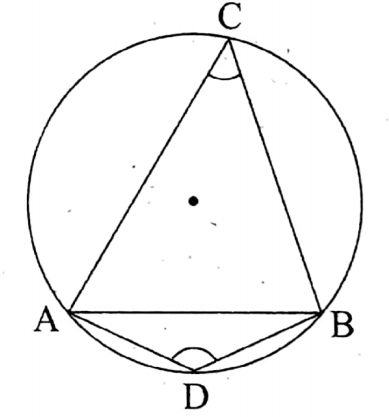
Again, the chord produced by joining the two end points of an arc, we can construct more than one angle in a circle on both the sides of this chord.

Such as, in the given two angles in a circle are ∠ACB (on the upper side) and ADB (on the lower side) produced by the arc \(A \overparen{D D} \text { and }  \overparen{A C B}\) respectively.

WBBSE Solutions For Class 10 Maths Solid Geometry Chapter 2 Theorems Related To Angles In A Circle

Characteristics of angles in circle 

  1. The vertex of angle in circle always lies on the circumference of the circle.
  2. The centre of the circle may or may not within the region of the angle in circle.
  3. Any angle in circle must be produced by an arc of the circle.
  4. Infinite number of angles in circle can be made by an arc of the circle.
  5. Angle in circle may be either acute, obtuse or right angle.

WBBSE Solutions For Class 10 Maths Solid Geometry Chapter 2 Theorems Related To Angles In A Circle Central Angle

Let ABC be a circle with centre at O. \(\overparen{\mathrm{AB}}\) is any arc of the circle.

Now, joining A, O and B, O by straight lines we get an angle ∠AOB at O. This angle ∠AOB is called the central angle.

Hence the front angle produced by an arc of the circle is called the central angle.

In the given ∠AOB, ∠BOC, ∠BOD are all central angles, which are produced by the arcs \(\overparen{\mathrm{AB}}, \overparen{\mathrm{BC}} \text { and } \overparen{\mathrm{BD}}\) respectively.

It must be noticed that both ∠AOB and reflex ∠AOB are produced by the arc AB.

Hence two and only two central angles can be constructed by a certain arc one of which is a reflex angle.

WBBSE Solutions For Class 10 Maths Solid Geometry Chapter 2 Theorems Related To Angles In A Circle

Characteristics of central angles 

  1. The vertex of any central angle always lie on the centre of the circle.
  2. Two and only two central angles can.be constructed by a fixed arc of a circle, one of which is a reflex angle.
  3. The value of a central angle may be either an acute or an obtuse or a right-angle or a reflex angle.
  4. The range of a central angle is from 0° to 360° including the both.
  5. The central angle produced by the entire circumference of a circle is 360° and that produced by the circumference of a semi-circle is 180°.

Relation between angle in circle and its central angle produced by any arc of a circle 

WBBSE Solutions For Class 10 Maths Solid Geometry Chapter 2 Theorems Related To Angles In A Circle Relation Between Angle In Circle And Central Angle

In the above discussion, we have seen that by any arc of a circle both angle in circle and central angle can be constructed, So, it is the question that is their any relation between them?

Let the central angle produced by an arc AB of a circle with centre at O be ∠AOB and ∠ACB be its angle in circle.

If we measure these two angles ∠AOB and ∠ACB by a protractor, we shall see that ∠AOB = 2 ∠ACB, i.e., the angle which an arc of a circle subtends at the centre is double the angle which it subtends at any point on the remaining part of the circumference.

We shall now logically prove this theorem by geometric method.

Solid Geometry Chapter 2 Theorems Related To Angles In A Circle

Angles In A Circle Theorem

Theorem: Prove that the front angle formed at the centre of a circle by an arc, is the double of the angle formed by the same arc at any point on the circle.

Given: ∠AOB is the central angle of the circle with centre at O, produced by the arc APB and ∠ACB is the angle at any point on the circle formed by the same arc APB.

To prove: We have to prove that ∠AOB = 2 ∠ACB.

WBBSE Solutions For Class 10 Maths Solid Geometry Chapter 2 Theorems Related To Angles In A Circle Theorem-1

WBBSE Solutions For Class 10 Maths Solid Geometry Chapter 2 Theorems Related To Angles In A Circle Theorem-2

WBBSE Solutions For Class 10 Maths Solid Geometry Chapter 2 Theorems Related To Angles In A Circle Theorem-3

WBBSE Solutions For Class 10 Maths Solid Geometry Chapter 2 Theorems Related To Angles In A Circle Theorem-4

According to the length of the arc APB, these may be of three types, In Number (1) and (4), APB is a minor arc, In number, (2) APB is a semi circle and in number (3), APB is a major arc.

We shall have to prove that theorem for all the cases.

Construction: Let us join C. O and CO is produced upto D.

Proof: In ΔAOC. OA = OC (radii of same circle)

∴ ∠OCA = ∠OAC [in all the mages]

Again, tor the ΔAOC, in every cases, external ∠AOD = internally opposite (∠OAC + ∠OCA)

= ∠OCA + ∠OCA [∠OAC = ∠OCA] = 2 ∠OCA …….. (1)

Again, in ΔBQC, OB = OC [radii of same circle]

Similar is the case, when CO of ΔBOC is produced upto D, external ∠BOD = internally opposite (∠OCB + ∠OBC)

= ∠OCB + ∠OCB [∠OBC = ∠OCB]

= 2 ∠OCB……….(2)

Now in the cases of (1) arid (2), ∠AOD + ∠BOD = 2 ∠OCA + 2 ∠OCB

or, ∠AOB = 2 (∠OCA + ∠OCB) or, ∠AOB = 2 ∠ACB

In the (3), ∠AOD + ∠BOD – 2 ∠OCA + 2 ∠OCB

or, reflex ∠AOB = 2 (∠OCA + ∠OCB)

or, reflex ∠AOB = 2 ∠ACB

In the (4), let us subtract (1) from (2) to get,

∠BOD + ∠AOD = 2 ∠OCB + 2 ∠OCA

or, ∠AOB = 2 (∠OCB – ∠OCA) or, ∠AOB – 2 ∠ACB

∴ in every cases, ∠AOB = 2 ∠ACB (proved)

Solid Geometry Chapter 2 Theorems Related To Angles In A Circle

Angles In A Circle Multiple Choice Questions

“WBBSE Class 10 angles in a circle solved examples”

Example 1. In the given, O is the centre of the circle and PQ is one of its diameter, then the value of x is

  1. 140
  2. 40
  3. 80
  4. 20

WBBSE Solutions For Class 10 Maths Solid Geometry Chapter 2 Theorems Related To Angles In A Circle Multiple Choice Question Example 1

Solution: In the given, ∠POR = 140° (Given),

∴ ∠ROQ = 180° – 140° = 40°

Now, the angle in circle produced by the arc \(\overparen{Q R}\)

= ∠QSR and the central angle = ∠ROQ.

∴ ∠QSR = \(\frac{1}{2}\)∠ROQ [by theorem] = \(\frac{1}{2}\) x 40° = 20°

∴ x° = ∠QSR = 20°, ∴ x = 20,

∴ 4. 20 is correct.

The value of x is 4. 20.

Example 2. In the given, if O is the centre of the circle, then the value of x is

  1. 70
  2. 60
  3. 40
  4. 200

WBBSE Solutions For Class 10 Maths Solid Geometry Chapter 2 Theorems Related To Angles In A Circle Multiple Choice Question Example 2

Solution: In the given, ∠POQ = 140°, ∠POR = 80°

∴ ∠QOR = 360° – (∠POQ + ∠POR)

= 360° – (140° + 80°) = 360° – 220° = 140°

Again, the angle in circle produced by the arc \(\overparen{Q R}\) = ∠QPR = x° and the central angle = ∠QOR = 140°

∴ ∠QPR = \(\frac{1}{2}\)∠QOR [by theorem]

= \(\frac{1}{2}\) x 140° =70°, x° = 70° ∴ x = 70

∴ 1. 70 is correct.

The value of x is 1. 70.

Example 3. In the given, if O is the centre of the circle and BC be any diameter of it, then the value of x is

  1. 60
  2. 50
  3. 100
  4. 80

WBBSE Solutions For Class 10 Maths Solid Geometry Chapter 2 Theorems Related To Angles In A Circle Multiple Choice Question Example 3

Solution: In the given, ∠OAB = 50°, ∠ADC = x°,

Now, OA = OB (radii of same circle)

∴ ∠OAB = ∠OBA – 50° [∠OAB – 50°]

∴ ∠AOC = internally opposite (∠OAB + ∠OBA) = 50° + 50° = 100°

Again, the angle in circle produced by the circular arc \(\overparen{A C}\) = ∠ADC = x° and central angle = ∠AOC = 100°

∴ ∠ADC =  \(\frac{1}{2}\) ∠AOC [by theorem]

or, ∠ADC = \(\frac{1}{2}\) x 100° [∠AOC = 100°] .

. or, x° = 50°, x = 50,

∴ 2. 50 is correct.

The value of x is 2. 50.

Example 4. O is the circumcentre of triangle ABC. If ∠OAB = 50°, then the value of ∠ACB is

  1. 50°
  2. 100°
  3. 40°
  4. 80°

WBBSE Solutions For Class 10 Maths Solid Geometry Chapter 2 Theorems Related To Angles In A Circle Multiple Choice Question Example 4

Solution:

Given

O is the circumcentre of triangle ABC. If ∠OAB = 50°

Let us join O, B.

Now, OA = OB (radii of same circle)

∴ ∠OBA – ∠OAB = 50° (Given)

∴ ∠AOB = 180° – (∠OBA + ∠OAB) = 180° – (50° + 50°) = 180° – 100° = 80°

Now, the angle in circle produced by the arc \(\overparen{Q R}\) = ∠ACB and the central angle = ∠AOB = 80°

∴ ∠ACB = \(\frac{1}{2}\) ∠AOB [by theorem] = \(\frac{1}{2}\)  x 80° = 40°

∴ 3. 40° is correct.

The value of x is 3. 40° .

Example 5. In the given, if O is the centre of the circle, then the value of ∠POR is 

  1. 20°
  2. 40°
  3. 60°
  4. 80°

WBBSE Solutions For Class 10 Maths Solid Geometry Chapter 2 Theorems Related To Angles In A Circle Multiple Choice Question Example 5

Solution: In the given, ∠OPQ = 10°, ∠ORQ = 40°

∴ OP = OQ [radii of same circle]

∴ ∠OQP = ∠OPQ = 10° (Given)

Again, OQ = OR (radii of same circle)

∴ ∠OQR = ∠ORQ = 40° (Given)

Now, ∠PQR = ∠OQR – ∠OQP [according to the image]

= 40° – 10° = 30° [∠OQR = 40° and ∠OQP = 10°]

Then, the angle in circle produced by the arc \(\overparen{P R}\) = ∠PQR = 30° and the central angle = ∠POR

∴ ∠POR = 2 ∠PQR [by theorem]

. = 2 x 30° [∠PQR = 30°] .

= 60°

∴ 3. 60°  is correct.

The value of x is 3. 60°.

Solid Geometry Chapter 2 Theorems Related To Angles In A Circle Angles In A Circle True Or False

Example 1. The number of angles in a circle produced by an fixed arc is infinite.

Solution: True

Example 2. The vertex of angle in circle does not always lie on the circumference of the circle.

Solution: False.

Solid Geometry Chapter 2 Theorems Related To Angles In A Circle Angles In A Circle Fill In The Blanks

Example 1. On the same circular arc, the angle in circle is _______ of its central angle.

Solution: Half [by theorem]

Example 2. The lengths of the chords AB and AC of the circle with centre at O are equal. If ∠APB and ∠AQC are two of its angle in circle, the values of the angles are ______

Solution: Equal

Example 3. If O be the circum-centre of an equilateral triangle, then the value of the front central angle produced by any one of its sides is equal to ______.

Solution: 120°, since, let ABC be an equilateral triangle.

∴ ∠BAC = ∠ABC = ∠ACB = 60°.

Now, the front central angle produced by BC = ∠BOC.

The angle in circle produced by BC = ∠BAC.

∴ by theorem, ∠BOC = 2 ∠BAC = 2 x 60° = 120° [∠BAC = 60°]

Solid Geometry Chapter 2 Theorems Related To Angles In A Circle Angles In A Circle Short Answer Type Questions

“Theorems related to angles in a circle for Class 10 Maths”

Example 1. In the adjacent O is the centre of the circle. If ∠OAB = 30°, ∠ABC = 120°, ∠BCO = y° and ∠COA = x°, then find the values of x and y.

Solution:

Given :

In the adjacent O is the centre of the circle. If ∠OAB = 30°, ∠ABC = 120°, ∠BCO = y° and ∠COA = x°

WBBSE Solutions For Class 10 Maths Solid Geometry Chapter 2 Theorems Related To Angles In A Circle Short Answer Type Question Example 1

According to the given, ∠AOC = x°, ∠ABC = 120°, ∠OCB = y°, ∠BAC = 30°

Now, the central angle produced by the arc AC = reflex ∠AOC and angle in circle = ∠ABC =120°

∴ reflex ∠AOC = 2 x ∠ABC [by theorem] = 2 x 120° – 240°

Then ∠COA – 360° – reflex ∠AOC = 360° – 240° – 120°

∴ x° = 120° ⇒ x= 120

Again, ∠AOC + ∠OCB + ∠OAB + ∠ABC = 360 [the sum of 4 angles of a quadrilateral is 360°]

or, 120° + y° + 30° + 120° = 360°

or, y° + 270° = 360° or, y° = 360° – 270° or y° = 90°

∴ x = 120 and y = 90.

The values of x and y 120 and 90.

Example 2. O is the circumcentre of AABC and D is the mid-point of BC. If ∠BAC = 40°, then find the value of ∠BOD.

Solution:

Given :

O is the circumcentre of AABC and D is the mid-point of BC. If ∠BAC = 40°

WBBSE Solutions For Class 10 Maths Solid Geometry Chapter 2 Theorems Related To Angles In A Circle Short Answer Type Question Example 2

D is the mid-point of BC, BD = CD

Now, in triangles ΔBOD and ΔCOD, OB = OC [radii of tire same circle], BD = CD and ∠OBD = ∠OCD [OB = OC]

∴ Δ BOD = Δ COD [by the condition of S-A-S congruent]

∴ ∠BOD = ∠COD [similar angles of congruent triangles]

∴ ∠BOC = 2 ∠BAC [by theorem]

= 2 x 40° [∠BAC – 40°] = 80°

Then from(1) we get, ∠BOD = \(\frac{1}{2}\)∠BOC = \(\frac{1}{2}\) x 80° [∠BOC = 80°] = 40°

The value of ∠BOD = 40°

Example 3. Three points A, B and C lie on a circle with centre at O in such a way that AOCB is a parallelogram. Find the value of ∠AOC. 

Solution:

Given :

Three points A, B and C lie on a circle with centre at O in such a way that AOCB is a parallelogram.

WBBSE Solutions For Class 10 Maths Solid Geometry Chapter 2 Theorems Related To Angles In A Circle Short Answer Type Question Example 3

We know that sum of any two adjacent angles of a parallelogram is 180°.

∴ ∠AOC + ∠OAB = 180° ……(1)

Again, the central angle produced by the arc \(\overparen{A C}\) = reflex ∠AOC and angle in circle = ∠ABC

∴ by the theorem, reflex ∠AOC = 2 ∠ABC or, 360° – ∠AOC = 2 ∠AOC [∠ABC = ∠AOC, since opposite angles of any parallelogram are equal.]

or, 360° = 3 ∠AOC or, ∠AOC = \(\frac{360^{\circ}}{3}\) or, ∠AOC = 120°

∴ ∠AOC = 120°

“Chapter 2 angles in a circle exercises WBBSE solutions”

Example 4. The circumcentre of the isosceles triangle ABC is O and ∠ABC = 120°. It the radius of the circle be 5 cm, then determine the length of AB. 

Solution:

Given :

The circumcentre of the isosceles triangle ABC is O and ∠ABC = 120°. It the radius of the circle be 5 cm

WBBSE Solutions For Class 10 Maths Solid Geometry Chapter 2 Theorems Related To Angles In A Circle Short Answer Type Question Example 4

Let us join O, A; O, B and O, C.

The central angle produced by the arc AC = reflex ∠AOC and angle in circle = ∠ABC = 120°

By theorem, reflex ∠AOC = 2 ∠ABC.

or, 360° – ∠AOC = 2 x 120°

or, 360° – ∠AOC = 240°

or, ∠AOC =360° – 240° = 120° ……..(1)

Again, in ΔABC, AB = BC [ABC is isosceles]

Now, in ΔOAB and ΔOCB, OA = OC [radii of same circle] A

B = BC and OB is common to both.

∴ ΔOAB = ΔOCB [by the condition of S-S-S congruent]

∴ ∠AOB = ∠BOC [similar angles of congruent triangles]

Now, ∠ABO + ∠CBO = ∠ABC = 120°

or, ∠ABO + ∠ABO = 120° [∠OBA = ∠OBC]

or, 2 ∠ABO = 120° or, ∠ABO = \(\frac{120^{\circ}}{2}\) = 60°

Again, ∠AOB + ∠COB = ∠AOC = 120° [by (1)]

or, ∠AOB + ∠AOB = 120° [∠COB = ∠AOB]

or, 2 ∠AOB = 120° or, ∠AOB = \(\frac{120^{\circ}}{2}\) =60°.

∴ in ΔAOB, ΔAOB = ∠ABO = 60°

∴ ΔAOB is equilateral.

∴ AB = AO = 5 cm [AO = radius = 5 cm]

Hence the required length of AB = 5 cm.

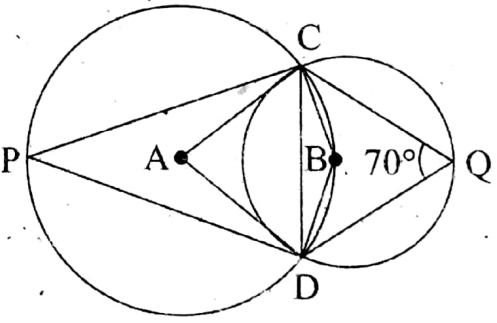
Example 5. Two circles with centres A and B intersect each other at points C and D. The centre B of the other circle lies on the circle with centre A. If ∠CQD = 70°, then find the value of ∠CPD.

Solution:

Given :

Two circles with centres A and B intersect each other at points C and D. The centre B of the other circle lies on the circle with centre A. If ∠CQD = 70°

WBBSE Solutions For Class 10 Maths Solid Geometry Chapter 2 Theorems Related To Angles In A Circle Short Answer Type Question Example 5

Let us join A, C; B, C; A, D and B, D.

Now, in the circle with centre at B, angle in circle produced by the arc \(\overparen{C D}\) = ∠CQD and central angle = ∠CBD.

∴ by theorem, ∠CBD = 2 ∠CQD = 2 x 70° [∠CQD = 70°] =140°

Again, in the circle with centre A, the central angle produced by p the arc \(\overparen{C P D}\)= reflex ∠CAD and angle in circle = ∠CBD.

∴ by theorem, reflex ∠CAD = 2 ∠CBD

or, 360° – ∠CAD = 2. x 140° [∠CBD = 140°] or, ∠CAD = 360° – 280° = 80°

Again, in the circle with centre A, the central angle produced by the arc \(\overparen{C D}\) = ∠CAD and its angle in circle = ∠CPD.

By theorem, ∠CAD = 2 ∠CPD or, 80° – 2 ∠CPD [∠CAD = 80°]

or, ∠CPD = \(\frac{80^{\circ}}{2}\) = 40°

Hence the value of ∠CPD = 40°

“Class 10 Maths angle theorems in circles explained”

Solid Geometry Chapter 2 Theorems Related To Angles In A Circle Angles In A Circle Long Answer Type Questions

Example 1. In the isosceles ΔABC, AB = AC. The circumcentre of ΔABC is O and the centre O lies on the opposite side of BC in which A lies. If ∠BOC = 100°, then find the value of ∠ABC and ∠ABO.

Solution:

Given :

In the isosceles ΔABC, AB = AC. The circumcentre of ΔABC is O and the centre O lies on the opposite side of BC in which A lies. If ∠BOC = 100°,

WBBSE Solutions For Class 10 Maths Solid Geometry Chapter 2 Theorems Related To Angles In A Circle Long Answer Type Question Example 1

In ΔBOC, OB = OC [radii of same circle]

∴ ∠OBC = ∠OCB

or, ∠OBC + ∠OBC = ∠OCB + ∠OBC

or, 2 ∠OBC = 180° – ∠BOC or, 2 ∠OBC = 180° – 100°

or, 2 ∠OBC = 80° or, ∠OBC = \(\frac{80^{\circ}}{2}\) = 40°.

Again, the central angle produced by the arc BC = ∠BOC and the angle in circle = ∠BAC.

By theorem, ∠BOC = 2 ∠BAC.

or ∠BAC = \(\frac{1}{2}\) ∠BOC = \(\frac{1}{2}\) x 100° =50°

Now, ∠ABC = 180° – (∠ACB + ∠BAC)

= 180° – ∠ABC – 50° [∠ACB = ∠ABC and ∠BAC = 50°]

= 130°-∠ABC

or, 2 ∠ABC = 130° or, ∠ABC = \(\frac{130^{\circ}}{2}\) = 65°

Then ∠ABO – ∠ABC – ∠OBC – 65° – 40° = 25°

Hence ∠ABC = 65 ° and ∠ABO = 25°

Example 2. In the adjoining, if O is the centre of the circumcircle of ΔABC and ∠AOC = 110°, find the value of ∠ABC

Solution:

Given :

In the adjoining, if O is the centre of the circumcircle of ΔABC and ∠AOC = 110°,

WBBSE Solutions For Class 10 Maths Solid Geometry Chapter 2 Theorems Related To Angles In A Circle Long Answer Type Question Example 2

The angle in circle produced by the major arc \(\overparen{A B}\) = ∠ABC and the centre angle = reflex ∠AOC.

∴ by theorem, reflex ∠AOC = 2 ∠ABC or, 360° – ∠AOC = 2 ∠ABC

or, 360° – 110° = 2 ∠ABC [∠AOC = 110°]

or, 250° = 2 ∠ABC 250°

or, ∠ABC = \(\frac{250^{\circ}}{2}\) = 125°

∴ ∠ABC = 125°

Example 3. O is the centre of the circle. If ∠AOD = 40° and ∠ACD = 35° then find the values of ∠BCO and ∠BOD.

Solution:

Given :

O is the centre of the circle. If ∠AOD = 40° and ∠ACD = 35°

WBBSE Solutions For Class 10 Maths Solid Geometry Chapter 2 Theorems Related To Angles In A Circle Long Answer Type Question Example 3

The central angle produced by the arc \(\overparen{A B}\) = ∠AOB and the angle in circle = ∠ACB = 35° (Given)

∴ by theorem, ∠AOB = 2 ∠ACB = 2 x 35° = 70°

Again, the central angle produced by \(\overparen{A D}\) = ∠AOD and angle in circle = ∠ACD or ∠ACO.

∴ by theorem, ∠AOD = 2 ∠ACO

or, 40° = 2 ∠ACO [∠AOD = 40° (Given)]

or, ∠ACO = \(\frac{40^{\circ}}{2}\) = 20°

Now, ∠BCO = ∠ACB = 35° + 20° = 55° [∠ACB = 35° (Given) and ∠ACO = 20°]

and ∠BOD = ∠AOD + ∠AOB = 40° + 70° = 110° [∠AOD = 40° (Given) and ∠AOB = 70°] ∠BCO = 55° and ∠BOD = 110°

Example 4. Like the adjoining figure, draw two circles with centres C and D which intersect each other at the points A and B. Draw a straight line through A which intersects the circle with centre C at the point P and the circle with centre D at the point Q.

Prove that (1) ∠PBQ = ∠CAD; (2) ∠BPC = ∠BQD.

Solution:

Given :

Like the adjoining figure, draw two circles with centres C and D which intersect each other at the points A and B.

WBBSE Solutions For Class 10 Maths Solid Geometry Chapter 2 Theorems Related To Angles In A Circle Long Answer Type Question Example 4

In the circle with centre C, the central angle produced by the chord AP = ∠ACP and angle in circle = ∠ABP.

By theorem, ∠ACP = 2 ∠ABP or ∠ABP = \(\frac{1}{2}\) ∠ACP….(1)

Again, in the circle with centre at D, the central angle produced by the chord AQ = ∠ADQ and angle in circle ∠ABQ.

∴ by theorem, ∠ADQ = 2 ∠ABQ or, ∠ABQ = \(\frac{1}{2}\) ∠ADQ …(2)

Then, adding (1) and (2) we get,

∠ABP + ∠ABQ = \(\frac{1}{2}\) ∠ACP+ \(\frac{1}{2}\) ∠ADQ

or, ∠PBQ = \(\frac{1}{2}\)(∠ACP + ∠ADQ) = \(\frac{1}{2}\) (180° – 2 ∠PAC +180°- 2 ∠QAD)

[∠ACP + ∠PAC + ∠APC – 180°]

or, ∠ACP + ∠PAC + ∠PAC – 180° or, ∠ACP – 180° – 2 ∠PAC

Similarly, ∠ADQ = 180° – 2 ∠QAD

or, ∠PBQ = \(\frac{1}{2}\)[360° -2 (∠PAC + ∠QAD)] = \(\frac{1}{2}\) [360° -2 (180° – ∠CAD)]

= \(\frac{1}{2}\) [360° – 360° + 2 ∠CAD] = \(\frac{1}{2}\) x 2 ∠CAD = ∠CAD

∴ ∠PBQ = ∠CAD. [Proved (1)]

Now, let us join B, C and B, D

CP = CB (radii of same circle), ∠BPC = ∠PBC ……. (3)

BD = DQ (radii of same circle), ∠DBQ = ∠DQB……. (4)

Now, from (1) we get, ∠PBQ = ∠CAD.

or, ∠PBA + ∠QBA = ∠CAB + ∠DAB .

or, ∠PBC + ∠CBA + ∠DBA – ∠DBQ – ∠CAB + ∠DAB

or, ∠PBC + ∠CAB + ∠DAB – ∠DBQ = ∠CAB + ∠DAB

[CB = CA, ∴ ∠CBA = ∠CAB]

DB = DA, ∴ ∠DBA = ∠DAB

or, ∠PBC – ∠DBQ = 0 or, ∠PBC = ∠DBQ or, ∠BPC = ∠BQD [∠CBP = ∠BPC and ∠DBQ = ∠BQD]

∴ ∠BPC = ∠BQD. [Proved (2)]

Hence (1) ∠PBQ = ∠CAD and (2) ∠BPC = ∠BQD (Proved)

“Understanding angles in a circle for Class 10”

Example 5. Each of two equal circles passes through the centre of the other and the two circles intersect each other at the points A and B. If a straight line through the point A intersects the two circles at points C and D, prove that ABCD is an equilateral triangle.

Solution:

Given :

Each of two equal circles passes through the centre of the other and the two circles intersect each other at the points A and B. If a straight line through the point A intersects the two circles at points C and D

WBBSE Solutions For Class 10 Maths Solid Geometry Chapter 2 Theorems Related To Angles In A Circle Long Answer Type Question Example 5

Let the two circles with centres at P and Q respectively are equal.

The two circles intersect each other at A and B.

The straight line CD passes through A and intersects the circle with centre P at C and with centre Q at D.

To prove: We have to prove that ΔBCD is equilateral.

Construction: Let us join P, Q; A, P; B, P; A, Q and B, Q. Let PQ intersects AB at S.

Proof: In triangles ΔAPS and ΔBPS, AP = BP [radii of same circle]

AS = BS [S is the mid-point of AB] and PS is common to both.

∴ ΔAPS ≅ ΔBPS, ∴ ∠APS = ∠BPS [similar angles of congruent triangles]……. (1)

Now, in the circle with centre at P, the angle in circle produced by the arc AB = ∠ACB and the central angle = ∠APB.

∴ ∠APB = 2 ∠ACB [by theorem]

or, ∠APS + ∠BPS = 2 ∠ACB

or, ∠APS + ∠APS = 2 ∠ACB

or, 2 ∠APS = 2 ∠ACB or, ∠APS = ∠ACB…… (2)

Also in the circle with centre at Q, the central angle produced by the arc \(\overparen{A D B}\) = reflex ∠AQB and angle in circle = ∠APB.

∴ by theorem, reflex ∠AQB = 2 ∠APB

or, 360° – ∠AQB – 2 ∠APB

or, 360° – ∠APB -2 ∠APB

[∠AQB = ∠APB,

Since ΔAPS = ΔAQS ⇒  ∠APS = ∠AQS,

Similarly, ∠BPS = ∠BQS]

or, 360° = 3 ∠APB or, ∠APB = \(\frac{360^{\circ}}{3}\) = 120°

or, 2 ∠APS =120° [∠APB = 2 ∠APS]

or, ∠APS = \(\frac{120^{\circ}}{2}\) = 60°

∴ ∠ACB = 60° [from (2)]

Similarly, it can be proved that ∠BDC = 60°

∴ the other angle of ΔBCD is 60°.

i.e., in mangle BCD, ∠BCD = ∠BDC = ∠CBD = 60° .

Hence ΔBCD is an equilateral triangle. (Proved).

Example 6. S is the centre of the circumcircle of ΔABC and if AD ⊥ BC, prove that ∠BAD = ∠SAC.

Solution:

Given :

S is the centre of the circumcircle of ΔABC and if AD ⊥ BC

WBBSE Solutions For Class 10 Maths Solid Geometry Chapter 2 Theorems Related To Angles In A Circle Long Answer Type Question Example 6

S is the centre of the circum-circle of ΔABC,

∴ SA = SB = SC.

Also, AD ⊥ BC, ∠ADB = 90°, ∠ABD + ∠BAD = 90°

or, ∠ABD = 90° – ∠BAD……(1)

Now, in the circle with centre S, the central angle produced by the chord AC = ∠ASC and angle in circle = ∠ABC

∴ ∠ASC = 2 ∠ABC…… (2)

But SA = SC [radii of same circle]

∴ ∠SAC = ∠SCA….. (3)

Then, ∠ASC + ∠SAC + ∠SCA = 180°

or, ∠ASC + ∠SAC + ∠SAC = 180° [from (3)] .

or, ∠ASC + 2 ∠SAC = 180°

or, 2 ∠ABC + 2 ∠SAC – 180° [by (2)]

or, ∠ABC + ∠SAC = 90° [dividing by 2]

or, ∠ABD + ∠SAC = 90° [∠ABC and ∠ABD are same angle]

or, 90° – ∠BAD + ∠SAC = 90° [from (1)]

or, ∠SAC – ∠BAD = 0 or, ∠SAC = ∠BAD

Hence ∠BAD = ∠SAC (Proved)

Example 7. Two chords AB and CD of a circle with centre O intersect each other at point P. Prove that ∠AOD + ∠BOC = 2 ∠BPC. If ∠AOD and ∠BOC are supplementary to each other, then prove that the two chords are perpendicular to each other.

Solution:

Given :

Two chords AB and CD of a circle with centre O intersect each other at point P. Prove that ∠AOD + ∠BOC = 2 ∠BPC. If ∠AOD and ∠BOC are supplementary to each other

In the circle with centre at O, the two chords AB and CD intersect each other at P.

WBBSE Solutions For Class 10 Maths Solid Geometry Chapter 2 Theorems Related To Angles In A Circle Long Answer Type Question Example 7

To prove: We have to prove that ∠AOD + ∠BOC = 2 ∠BPC and AB ⊥ CD when ∠AOD + ∠BOC = 180°.

Construction: Let us join O, A; O,B; O, C; O, D and B, D.

Proof: The central angle produced by the arc \(\overparen{\mathrm{AD}}\) = ∠AOD and angle in circle = ∠ABD.

∴ ∠AOD = 2 ∠ABD [by theorem] ……….(1)

Again, the central angle produced by the arc BC = ∠BOC and angle in circle = ∠BDC.

∴ ∠BOC = 2 ∠BDC (2) [by theorem]

Now, adding (1) and (2) we get, . ‘ .

∠AOD + ∠BOC = 2 ∠ABD + 2 ∠BDC = 2 (∠ABD + ∠BDC)…….(3)

But by producing DP of ΔPBD upto C, the produced external ∠BPC = internally opposite (∠PBD + ∠BDP) = internally opposite (∠ABD + ∠BDC)

[they are same angles]

∠ABD + ∠BDC = ∠BPC

∴ from (3) we get, ∠AOD + ∠BOC = 2 ∠BPC.

∴ ∠AOD + ∠BOC = 2 ∠BPC. (Proved)

Now, if ∠AOD + ∠BOC = 180°, then we get, 180° = 2 ∠BPC or, ∠BPC = = 90°

Hence AB ⊥ CD [∠BPC = 90°] [Proved]

“Step-by-step solutions for angles in circles Class 10”

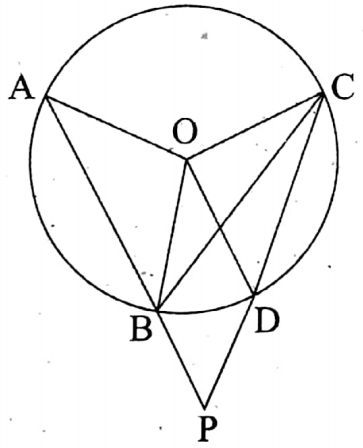
Example 8. If two chords AB and CD of a circle with centre O, when produced intersect each other at the point P, prove that ∠AOC – ∠BOD = 2 ∠BPC.

Solution:

Given :

If two chords AB and CD of a circle with centre O, when produced intersect each other at the point P,

Let AB and CD be two chords of the circle with centre at O. Produced AB and CD intersect at P.

WBBSE Solutions For Class 10 Maths Solid Geometry Chapter 2 Theorems Related To Angles In A Circle Long Answer Type Question Example 8

To prove: We have to prove that ∠AOC – ∠BOD = 2 ∠BPC

Construction: Let us join B, C.

Proof: The central angle produced by the arc \(\overparen{\mathrm{AC}}\) = ∠AOC and angle in circle = ∠ABC.

∠AOC = 2 ∠ABC…. (1) [by theorem]

Again, the central angle produced by the arc BD = ∠BOD and angle in circle = ∠BCD

∴ ∠BOD = 2 ∠BCD…… (2) [by theorem]

Now, subtracting (2) from (1) we get,

∠AOC – ∠BOD – 2 ∠ABC – 2 ∠BCD ….(3)

Again, by producing PB of ABPC we get, external ∠ABC.

∴ ∠ABC = internally opposite (∠BPC + ∠BCP)

or, ∠ABC = ∠BPC + ∠BCD.

or, 2 ∠ABC = 2 ∠BPC + 2 ∠BCD [multiplying by 2] or, 2 ∠ABC – 2 ∠BCD = 2 ∠BPC

∴ from (3) we get, ∠AOC – ∠BOD = 2 ∠BPC.

Hence, ∠AOC – ∠BOD = 2 ∠BPC. (Proved)

Example 9. Draw a circle with the point A of quadrilateral ABCD as centre which passes through the points B, C and D. Prove that ∠CBD + ∠CDB = \(\frac{1}{2}\) ∠BAD.

Solution:

WBBSE Solutions For Class 10 Maths Solid Geometry Chapter 2 Theorems Related To Angles In A Circle Long Answer Type Question Example 9

Let a circle be drawn with centre at A of the quadrilateral ABCD, which passes through B, C and D.

To prove: We have to prove that ∠CBD + ∠CDB = \(\frac{1}{2}\)∠BAD.

Construction: Let us join A, B; B, C; C, D; D, A; B, D and C, A.

Proof: The central angle produced by the arc \(\overparen{\mathrm{BC}}\) = ∠BAC and angle in circle = ∠BDC .

∴ ∠BDC = \([\frac{1}{2}\)∠BAC…… (1) [by theorem]

Again, the central angle produced by \(\overparen{\mathrm{CD}}\) = ∠CAD and angle in circle = ∠CBD

∴ ∠CBD = \([\frac{1}{2}\) ∠CAD… ….(2) [by theorem]

Then, adding (1) and (2) we get,

∠BDC + ∠CBD = \(\frac{1}{2}\)∠BAC + \(\frac{1}{2}\) ∠CAD = \(\frac{1}{2}\) (∠BAC + ∠CAD) = \(\frac{1}{2}\) ∠BAD.

Hence ∠CBD + ∠CDB \(/frac{1}{2}\) = \(/frac{1}{2}\) ∠BAD.

Example 10. O is the circumcentre of ΔABC and OD is perpendicular on the side BC prove that ∠BOD = ∠BAC

Solution:

Given :

O is the circumcentre of ΔABC and OD is perpendicular on the side BC

WBBSE Solutions For Class 10 Maths Solid Geometry Chapter 2 Theorems Related To Angles In A Circle Long Answer Type Question Example 10

The circumcentre of ΔABC is O and OD ⊥ BC.

To prove: We have to prove that ∠BOD = ∠BAC

Construction: Let us join O, A; O, B; and O, C.

Proof: In ΔBOD and ΔCOD, OB = OC [radii of same circle],

∠OBD = ∠OCD [OB = OC] and ∠BDO = ∠CDO [each is right angle]

∴ ΔBOD ≅ ΔCOD [by the condition of A-A-S congruence]

∴ ∠BOD = ∠COD [similar angles of congruent triangles]

∴ ∠BOC = ∠BOD + ∠COD = ∠BOD + ∠BOD [∠COD = ∠BOD] = 2 ∠BOD……. (1)

Now, the central angle produced by the chord BC = ∠BOC and angle in the circle = ∠BAC.

∴ ∠BOC = 2 ∠BAC [by theorem]……(2)

Then adding (1) and (2) we get,

2 ∠BOD = 2 ∠BAC or, ∠BOD = ∠BAC

Hence ∠BOD = ∠BAC (Proved)

Solid Geometry Chapter 2 Theorems Related To Angles In A Circle Central Angle

We have seen earlier that the number of angles in circle produced by the same circular arc in the same circle are infinity.

Now the question arises is there any relation among these infinite number of angles in circle?

Let in a circle with centre at O, ∠ACB and ∠ADB are two angles in circle produced by the arc APB.

We shall see that if these two angles are measured by a protractor, then the two angles are equal.

Hence angles in the same segment of a circle are equal.

We shall now prove this theorem logically by the geometric method.

Solid Geometry Chapter 2 Theorems Related To Angles In A Circle Central Angle Theorem

Theorem: Prove that angles in the same segment of a circle are equal.

WBBSE Solutions For Class 10 Maths Solid Geometry Chapter 2 Theorems Related To Angles In A Circle Center Angle Theorem

Given: Let ∠ACB and ∠ADB are two angles in a circle with centre at O, produced by the circular arc \(\overparen{\mathrm{APB}}\)

To prove: ∠ACB = ∠ADB

Construction: Let us join O, A and O, B

Proof: ∠ACB is an angle in circle and ∠AOB is it’s central angle both produced by the same arc \(\overparen{\mathrm{APB}}\) of the circle.

∴ ∠AOB = 2 ∠ACB….. (1)

Similarly, ∠ADB is an angle in circle and ∠AOB is the central angle both produced by the circular arc APB of the circle.

∴ ∠AOB = 2 ∠ADB …… (2)

Now, from (1) and (2) we get, 2 ∠ACB = 2 ∠ADB, or, ∠ACB = ∠ADB

Hence angles in the same segment of a circle are equal (Proved).

Solid Geometry Chapter 2 Theorems Related To Angles In A Circle Concylic Points

Three or more than three points are said to be concyclic if they lie on the same circle.

Such as, in the adjoining, the points A, B, C, and D lie on the circle with centre O. So, the points A, B, C, D are concyclic.

WBBSE Solutions For Class 10 Maths Solid Geometry Chapter 2 Theorems Related To Angles In A Circle Concyclic Points

There are some properties and characteristics of concyclic points.

Such as, the opposite angles of the quadrilateral which is obtained by joining the four concyclic points are supplementary to each other.

Again, if a line segment joining two points subtends equal angles at two other points on the same side of it, then the four points are concyclic.

We shall now logically prove this theorem by the geometric method.

Solid Geometry Chapter 2 Theorems Related To Angles In A Circle Concylic Points Theorem

“Examples of angle theorems for WBBSE Class 10 Maths”

Theorem: Prove that if a line segment joining two points subtends equal angles at two other points on the same side of it, then four points are concyclic.

WBBSE Solutions For Class 10 Maths Solid Geometry Chapter 2 Theorems Related To Angles In A Circle Concyclic Points Theorem

Given: Let the line segment joining two points A and B subtend equal angles ∠ACB and ∠ADB, i.e., ∠ACB = ∠ADB.

To prove: We have to prove that A, B, C, D are concyclic.

Construction: Let us draw the circle passing through three non-collinear points A, B and C.

Proof: If the circle constructed above passes through the fourth point D, then the theorem is proved.

But if the circle does not pass through D, it will intersect AD or produced AD at a point.

Let the circle does not pass through D and intersect AD at E. Let us join E, B.

Now, ∠ACB = ∠AEB [angles in the same segment of a circle]

But given that ∠ACB = ∠ADB = ∠AEB = ∠ADB

But it is impossible since any external angle of a triangle can never be equal to its internally opposite angles.

So the circle passing through the three non-collinear points A, B, C must pass through point D.

Hence the four points A, B, C and D are concyclic. (Proved)

In the following examples, the various application of the above theorems are discussed thoroughly.

Solid Geometry Chapter 2 Theorems Related To Angles In A Circle Concylic Points Multiple Choice Questions

Example 1. In the adjoining figure, O is the centre of the circle; if ∠ACB = 30°, ∠ABC = 60°, ∠DAB = 35° and ∠DBC = x°, then the value of x is

  1. 35
  2. 70
  3. 65
  4. 55

WBBSE Solutions For Class 10 Maths Solid Geometry Chapter 2 Theorems Related To Angles In A Circle Concyclic Points Multiple Choice Question Example 1

Solution:

Given

In the adjoining figure, O is the centre of the circle; if ∠ACB = 30°, ∠ABC = 60°, ∠DAB = 35° and ∠DBC = x°

∠DBC and ∠CAD are two angles in circle produced by the same arc \(\overparen{\mathrm{CD}}\) with centre at O.

∴ ∠DBC = ∠CAD……(1)

Now, in ΔABC, ∠ACB = 30° and ∠ABC = 60°

∴ ∠BAC = 180° – (∠ACB + ∠ABC)

= 180° – (30° + 60°) = 180° – 90° = 90°

Again, ∠DAB = 35° (Given),

∴ ∠CAD = ∠BAC – ∠DAB = 90° – 35° = 55°

∴ from (1) we get, ∠DBC = ∠CAD = 55°, x° = 55°

Hence x = 55

∴ 4. 55 is correct.

Example 2. In the adjoining, O is the centre of the circle; if ∠B AD = 65°, ∠BDC = 45°, then the value of ∠CBD is

  1. 65°
  2. 45°
  3. 40°
  4. 20°

WBBSE Solutions For Class 10 Maths Solid Geometry Chapter 2 Theorems Related To Angles In A Circle Concyclic Points Multiple Choice Question Example 2

Solution:

Given

In the adjoining, O is the centre of the circle; if ∠B AD = 65°, ∠BDC = 45°,

∠BAC = ∠BDC = 45° [∠BDC = 45° (Given)]

Again, ∠BAD = 65° (Given), ∠CAD = ∠BAD – ∠BAC = 65° – 45° = 20°

Now, both ∠CAD and ∠CBD are angles in circle produced by the same arc \(\overparen{\mathrm{CD}}\) of the circle.

∴ ∠CAD = ∠CBD

But ∠CAD = 20°, ∠CBD = 20°

∴ 4. 20° is correct.

Example 3. In the adjoining, O is the centre of the circle. If ∠AEB = 110°, ∠CBE = 30°, then the value of ∠ADE is

  1. 70°
  2. 60°
  3. 80°
  4. 90°

WBBSE Solutions For Class 10 Maths Solid Geometry Chapter 2 Theorems Related To Angles In A Circle Concyclic Points Multiple Choice Question Example 3

Solution:

Given

In the adjoining, O is the centre of the circle. If ∠AEB = 110°, ∠CBE = 30°,

In the circle with centre at O, the angles in circle produced by the arc AB are ∠ADB and ∠ACB.

∴ ∠ADB = ∠ACB…….(1)

Now, if the side CE of ABCE be produced to A, then the external angle ∠AEB produced is equal to the internally opposite (∠CBE + ∠BCE),

i.e., ∠AEB = ∠CBE + ∠BCE

or, 110° = ∠CBE + ∠BCE [∠AEB =110° (Given)]

or, ∠BCE = 110° – ∠CBE or, ∠BCE = 110° – 30° [∠CBE = 30° (Given)]

or, ∠ACB = 80° [∠BCE and ∠ACB are same angles]

∴ ∠ADB = ∠ACB = 80° [from (1)] or, ∠ADB = 80°

∴ 3. 80° is correct.

Example 4. In the adjoining, O is the centre of circle. If ∠BCD = 28°, ∠AEC = 38°, then the value of ∠AXB is 

  1. 56°
  2. 94°
  3. 38°
  4. 28°

WBBSE Solutions For Class 10 Maths Solid Geometry Chapter 2 Theorems Related To Angles In A Circle Concyclic Points Multiple Choice Question Example 4

Solution:

Given

In the adjoining, O is the centre of circle. If ∠BCD = 28°, ∠AEC = 38°

In the circle with centre at O, the angles ∠BAD and ∠BCD are both angles in circle produced by the arc \(\overparen{\mathrm{BD}}\).

∴ ∠BAD = ∠BCD = 28° (Given)

Again, ∠AEC = 38°, ∴ ∠ADC = (∠AEC + ∠DAB)

[external ∠ADC = internally opposite (∠AEC + ∠DAE)]

∴ ADC = 38° + ∠BAD [∠DAB and ∠BAD are same angles] – 38° + 28° = 66°

Again, ∠AXB = internally opposite (∠XDC + ∠XCD)

= ∠ADC + ∠BCD = 66° + 28° = 94°

∴ 2. 94°  is correct.

Example 5. In the adjoining, O is the centre of the circle and AB is its a diameter. If AB ∥ CD, ∠ABC = 25°, then the value of ∠CED is

  1. 80°
  2. 50°
  3. 25°
  4. 40°

WBBSE Solutions For Class 10 Maths Solid Geometry Chapter 2 Theorems Related To Angles In A Circle Concyclic Points Multiple Choice Question Example 5

Solution:

Given

In the adjoining, O is the centre of the circle and AB is its a diameter. If AB ∥ CD, ∠ABC = 25

Let us join B, D and A, D.

AB ∥ CD, ∴ ∠ABD + ∠CDB = 180°……..(1)

Again, in the circle with centre at O, ∠CED and ∠CBD are two angles in circle produced by the arc \(\overparen{\mathrm{AD}}\),

∴ ∠CED = ∠CBD…. (1)

Now, ∠ABC = 25° (Given), ∴ ∠BCD = 25° [AB ∥ CD, alternate angle]

Again, ∠ADC = ∠ABC [angles in the same segment of the circle]

AB is a diameter,

∴ ∠AOB is the central angle and angles in circle is ∠ADB both produced by the arc \(\overparen{\mathrm{AEB}}\).

∴ ∠ADB = \(\frac{1}{2}\)∠AOB = \(\frac{1}{2}\) x 180° = 90° [∴ ∠AOB is a straight angle]

Then ∠BDC = ∠ADC + ∠ADB = 25° + 90° = 115°

∴ in ΔBCD, ∠CBD = 180° – (∠BCD + ∠BDC) = 180° – (25° + 115°) = 180° – 140° = 40°

from (1) we get, ∠CED = ∠CBD = 40°

∴ 4. 40° is correct.

Solid Geometry Chapter 2 Theorems Related To Angles In A Circle Concylic Points True Or False

Example 1. In the adjoining AD and BE are perpendicular to BC and AC respectively of the ΔABC. The four points A, B, D, E are concyclic.

WBBSE Solutions For Class 10 Maths Solid Geometry Chapter 2 Theorems Related To Angles In A Circle Concyclic Points True Or False Example 1

Solution: True,

since the angles ∠AEB and ∠ADB are on the same side of AB.

Now, ∠AEB and ∠ADB are both right angles, ∠AEB = ∠ADB.

Hence the four points A, B, D, E are concyclic.

Example 2. In ΔABC, AB = AC; BE and CF are respectively the bisectors of ∠ABC and ∠ACB and intersect the sides AC and AB at the points E and F respectively. Then the four points B, C, E, F are not concyclic.

WBBSE Solutions For Class 10 Maths Solid Geometry Chapter 2 Theorems Related To Angles In A Circle Concyclic Points True Or False Example 2

Solution: False

since in ΔABC, AB = AC.

∴ ∠ABC = ∠ACB or, \(\frac{1}{2}\)∠ABC = \(\frac{1}{2}\)∠ACB

or, \(\frac{1}{2}\)∠EBC = ∠BCF [BE and CF are the bisectors of ∠ABC and ∠ACB respectively.]

Now, in ΔBEC and ΔBFC we get,

∠EBC = ∠BCF, ∠ECB = ∠FBC and BC is common to both.

∴ ΔBEC ≅ ΔBFC [by the A-A-S condition of congruency]

∴ ∠BEC = ∠BFC.

But they are two such angles on the same side of BC at the points E and F that they are equal.

∴ B, C, E, F are concyclic.

But given that B, C, E, F are not concyclic.

Hence the given statement is false.

Solid Geometry Chapter 2 Theorems Related To Angles In A Circle Concylic Points Fill In the Blanks

Example 1. All angles in the same segment of a circle are _____

Solution: Equal

Example 2. If the line segment joining two points subtends equal angle at two other points on the same side, then the four points are ______

Solution: Concyclic

Example 3. If two angles on the circle formed by two arcs are equal, then the lengths of arcs are ______

Solution: Equal.

Solid Geometry Chapter 2 Theorems Related To Angles In A Circle Concylic Points Short Answer Type Questions

Example 1. In the adjoining, O is the centre of the circle AC is the diameter and chord DE is parallel to the diameter AC. If ∠CBD = 60°, find the value of ∠CDE.

Solution:

Given :

In the adjoining, O is the centre of the circle AC is the diameter and chord DE is parallel to the diameter AC. If ∠CBD = 60°,

WBBSE Solutions For Class 10 Maths Solid Geometry Chapter 2 Theorems Related To Angles In A Circle Concyclic Points Short Answer Type Question Example 1

Let us join D, O. Then the central angle produced by the chord CD is ∠COD. and the angle in circle by the same chord CD is ∠CBD.

∴ ∠COD = 2 ∠CBD or, ∠COD = 2 x 60° or, ∠COD =120°

∴ in ΔCOD, ∠OCD + ∠ODC = 180° – ∠COD = 180° – 120°

[the sum of three angles of a triangle is 180°]

∴ ∠OCD + ∠OCD = 60° [∠ODC = ∠OCD]

or, 2 ∠OCD = 60° or, ∠OCD = \(\frac{60^{\circ}}{2}\) = 30°

Again, AC | | DE, ∴ ∠ACD = ∠CDE [alternate angles]

or, ∠CDE = ∠OCD [∠ACD and ∠OCD are same angles]

Hence the value of ∠CDE – 30°.

Example 2. In the adjoining, QS is the bisector of an angle ∠PQR, if ∠SQR = 35° and ∠PRQ = 32°, then find the value of ∠QSR.

Solution:

Given :

In the adjoining, QS is the bisector of an angle ∠PQR, if ∠SQR = 35° and ∠PRQ = 32°,

WBBSE Solutions For Class 10 Maths Solid Geometry Chapter 2 Theorems Related To Angles In A Circle Concyclic Points Short Answer Type Question Example 2

Let us join O, Q and O, R. .

Now, ∠QOR is the central angle produced by the arc QR and ∠QPR and ∠QSR are two angles in circle produced by the same arc QR.

∴ ∠QOR = 2 ∠QPR ……. (1) and ∠QOR – 2 ∠QSR …… (2)

∴ from (1) and (2) we get, 2 ∠QPR = 2 ∠QSR or, ∠QPR = ∠QSR.

Now, ∠PQR = 2 ∠SQR [QS is the bisector of ∠PQR]

= 2 x 35° = 70° and ∠PRQ – 32° [Given]

∴ ∠QPR = 180° – (∠PQR + ∠PRQ)

= 180° – (70° + 32°) [∠PQR = 70° and ∠PRQ = 32°]

= 180° – 102° = 78°

Hence ∠QSR = 78°.

“WBBSE Mensuration Chapter 2 practice questions on angles”

Example 3. In the adjoining, O is the centre of the circle and AB is the diameter. If AB and CD are mutually perpendicular to each other and ∠ADC = 50°, then find the value of ∠CAD.

Solution:

Given :

In the adjoining, O is the centre of the circle and AB is the diameter. If AB and CD are mutually perpendicular to each other and ∠ADC = 50°,

WBBSE Solutions For Class 10 Maths Solid Geometry Chapter 2 Theorems Related To Angles In A Circle Concyclic Points Short Answer Type Question Example 3

The angles in circle produced by the chord AC are ∠ADC and ∠ABC.

∴ ∠ABC = ∠ADC = 50°

Again, the central angle = ∠AOB and angle in circle = ∠ACB both produced by the arc \(\overparen{A D B}\).

∴ ∠AOB = 2 ∠ACB or, 180° = 2 ∠ACB [∠AOB = straight angle = 180°]

or, ∠ACB = \(\frac{180^{\circ}}{2}\) = 90°

Then ∠CAB = 180° – (∠ACB + ∠ABC) [sum of three angles of a triangle is 180°]

= 180° – (90° + 50°) = 180° – 140° = 40°

Again, AB and CD are perpendiculars to each other. Let AB and CD intersect each other at E.

∴ ∠EAD = 180° – (∠ADE + ∠AED)

= 180° – (50° + 90°) [∠ADE = ∠ADC = 50° and ∠AED = 90°]

= 180° – 140° = 40°

Now, ∠CAD = ∠EAC + ∠EAD

= 40° + 40° = 80° [∠EAC = ∠CAB = 40° and ∠EAD = 40°] .

∴ ∠CAD = 80°

Example 4. In the adjoining, O is the centre of the circle and AB = AC; if ∠ABC = 32°, then find the value of ∠BDC. 

Solution:

Given :

In the adjoining, O is the centre of the circle and AB = AC; if ∠ABC = 32°,

WBBSE Solutions For Class 10 Maths Solid Geometry Chapter 2 Theorems Related To Angles In A Circle Concyclic Points Short Answer Type Question Example 4

In ΔABC, AB = AC; ∠ABC = ∠ACB = 32°

[∠ABC = 32°]

Now, ∠ACB and ∠ADB are angles in circle, produced by the chord AB.

∴ ∠ADB = ∠ACB = 32°….(1)

Again, ∠ABC and ∠ADC are two angles in circle, produced by the chord AC,

∴ ∠ADC = ∠ABC = 32°……(2)

Also, ∠BDC = ∠ADB + ∠ADC = 32° + 32° = 64° [from (1) and (2)]

∴ ∠BDC = 64°.

Example 5. In the adjoining, BX and CY are the bisectors of ∠ABC and ∠ACB respectively. If AB = AC and BY = 4 cm, then find the length of AX. 

Solution:

Given :

In the adjoining, BX and CY are the bisectors of ∠ABC and ∠ACB respectively. If AB = AC and BY = 4 cm

WBBSE Solutions For Class 10 Maths Solid Geometry Chapter 2 Theorems Related To Angles In A Circle Concyclic Points Short Answer Type Question Example 5

In ΔABC, AB = AC, ∴ ∠ABC = ∠ACB

or, \(\)∠ABC = ∠ACB

or, ∠ABX = ∠BCY [BX and CY are the bisectors of ∠ABC and ∠ACB respectively.]

∴ by the converse theorem of theorem 35, arc AX = arc BY = 4 cm [BY = 4cm (Given)]

Hence the length of AX = 4cm.

Solid Geometry Chapter 2 Theorems Related To Angles In A Circle Concylic Points Long Answer Type Questions

Example 1. O is the orthocentre of ΔABC and AD ⊥ BC. If AD is produced it intersects the circumcircle of ΔABC at the point G. Prove that OD = DG.

Solution:

Given :

O is the orthocentre of ΔABC and AD ⊥ BC. If AD is produced it intersects the circumcircle of ΔABC at the point G.

WBBSE Solutions For Class 10 Maths Solid Geometry Chapter 2 Theorems Related To Angles In A Circle Concyclic Points Long Answer Type Question Example 1

The perpendiculars AD, BE and CF on the sides BC, CA and AB respectively of ΔABC intersect each other at O.

So, O is the orthocentre of ΔABC. When AD is extended it intersects the circumcircle with centre P at point G.

To prove: We have to prove that OD = DG.

Construction: Let us join C, G.

Proof: ∠BAG and ∠BCG are two angles in circle, produced by the arc \(\overparen{B G}\).

∴ ∠BAG = ∠BCG.

or, 90° – ∠ABD = ∠BCG [AD ⊥ BC, ∴ ∠ADB = 90°]

or, 90° – (90° – ∠BCF) = ∠BCG [CF ⊥ AB, ∴ ∠BFC = 90°] or, ∠BCF = ∠BCG

or, ∠OCD = ∠GCD [∠BCF and ∠OCD also ∠BCG and ∠GCD are same angles]

∴ ∠OCD = ∠GCD …(1)

Now, in ΔCOD and ΔCGD,

∠CDO = ∠CDG [each is right angle],

∠OCD = ∠GCD [from (1)] and CD is common to both.

∴ ΔCOD ≅ ΔCGD [by the A-A-S condition of congruency]

∴ OD = DG [similar sides of congruent triangles]

Hence OD = DG (Proved)

Example 2. I is the centre of the incircle of ΔABC; produced AI intersects the circumcircle of that triangle at the point P. Prove that PB = PC = PI.

Solution:

Given :

I is the centre of the incircle of ΔABC; produced AI intersects the circumcircle of that triangle at the point P.

WBBSE Solutions For Class 10 Maths Solid Geometry Chapter 2 Theorems Related To Angles In A Circle Concyclic Points Long Answer Type Question Example 2

I is the incentre of ΔABC.

∴ ∠IBC = ∠IBA, ∠IAB = ∠IAC and ∠ICB = ∠ICA

∴ ∠IAB = ∠IAC, ∴ ∠PAB = ∠PAC

∴ PB = PC [by the converse theorem]…..(1)

Again, ∠BCP and ∠BAP are two angles in circle produced by the arc \(\overparen{P B}\).

∴ ∠BCP = ∠BAP

or, ∠PBC = ∠BAP [PB = PC, ∴ ∠BCP = ∠PBC]

Now, external ∠BIP of ΔAIB = internally opposite

(∠IAB + ∠IBA) = ∠IAB + ∠IBC

= ∠BAP + ∠IBC [∠IAB and ∠BAP are same angles]

= ∠PBC + ∠IBC

[∠PBC = ∠BAP] = ∠IBP

∴ ∠BIP + ∠IBP

∴ PB = BI or, [PB = PI, radius of same circle]……(2)

∴from (1) and (2) we get, PB = PC = PI. (Proved)

Example 3. Ankita drew two circles which intersect each other at the points P and Q. Through the point P two straight lines are drawn so that they intersect one of the circles at the points A and B and the other circle at the points C and D respectively. Prove that ∠AQC = ∠BQD.

Solution:

Given :

Ankita drew two circles which intersect each other at the points P and Q. Through the point P two straight lines are drawn so that they intersect one of the circles at the points A and B and the other circle at the points C and D respectively.

WBBSE Solutions For Class 10 Maths Solid Geometry Chapter 2 Theorems Related To Angles In A Circle Concyclic Points Long Answer Type Question Example 3


Given: Two circles with centres at O and O’ respectively intersect each other at the points P and Q.

Through the point P two straight lines APC and BPD are drawn which intersect the first circle at A and B and the second circle at C and D respectively.

To prove: We have to prove that ∠AQC = ∠BQD

Construction: Let us join A. Q; B, Q; C, Q and D, Q.

Proof: ∠APB and ∠AQB are two angles in circle produced by the arc AB in the circle with centre at O.

∴ ∠APB = ∠AQB ……. (1)

Again ∠CQD and ∠CPD are two angles in circle produced by the arc \(\overparen{C D}\) in the circle with centre at O’.

∴  ∠CQD = ∠CPD…..(2) .

But ∠APB = ∠CPD [opposite angles]

∴ ∠AQB = ∠CQD [from (1) and (2)]

Now, ∠AQD + ∠AQB = ∠AQD + ∠CQD [∠AQB = ∠CQD]

or, ∠BQD = ∠AQC

∴ ∠AQC = ∠BQD (Proved)

Example 4. Two chords AB and CD of a circle are perpendicular to each other. If a perpendicular drawn to AD from the point of intersection of those two chords AB and CD is produced to meet BC at the point E, prove that the point E is the mid-point of BC. 

Solution:

Given :

Two chords AB and CD of a circle are perpendicular to each other. If a perpendicular drawn to AD from the point of intersection of those two chords AB and CD is produced to meet BC at the point E

WBBSE Solutions For Class 10 Maths Solid Geometry Chapter 2 Theorems Related To Angles In A Circle Concyclic Points Long Answer Type Question Example 4

AB ⊥ CD, ∴ ∠APD = ∠BPC = 90°

∴ ∠ADP = 90° – ∠DAP……. (1)

Now, ∠ADC and ∠ABC are two angles in circle, produced by the arc \(\overparen{A C}\).

∴ ∠ADC = ∠ABC…….(2)

Again, ∠BPE = ∠APF [opposite angles]…… (3)

Now, ∠APF – 90° – ∠PAF [∠AFP = 90°]

= ∠ADP [∠APD = 90°]……..(4)

From (3) and (4) we get, ∠BPE = ∠ADP = ∠ADC = ∠ABC = ∠PBE

∴ in ΔBPE, ∠BPE = ∠PBE. ∴BE = PE……….. (5)

Similarly, it can be proved that CE = PE…….(6)

Then from (5) and (6) we get, BE = CE

Hence E is the mid-point of BC. (Proved)

Example 5. If in a cyclic quadrilateral ABCD, AB = DC, then prove that AC = BD. [GP-X]

Solution:

Given :

If in a cyclic quadrilateral ABCD, AB = DC

WBBSE Solutions For Class 10 Maths Solid Geometry Chapter 2 Theorems Related To Angles In A Circle Concyclic Points Long Answer Type Question Example 5

In the cyclic quadrilateral ABCD, AB = DC

∴ the angles in circle produced by the chords AB and CD are equal.

∴ ∠ACB = ∠ADB ……. (1) and

∠CBD = ∠CAD…….(2)

Moreover ACB = ∠CBD [AB = DC] in ΔEBC, ∠ECB = ∠EBC, ∴ BE = CE

Again, ∠ADB = ∠CAD [AB = DC]

∴ in ΔEAD, ∠EAD = ∠EDA  ∴DE = AE

Now, AE + CE = DE + BE [AE = DE and CE = BE]

or, AC = BD (Proved)

Example 6. OA is the radius of a circle with centre at O, AQ is its chord and C is any point on the circle. A circle passes through the points O, A, C intersects the chord AQ at the point P. Prove that CP = PQ.

Solution:

Given :

OA is the radius of a circle with centre at O, AQ is its chord and C is any point on the circle. A circle passes through the points O, A, C intersects the chord AQ at the point P.

WBBSE Solutions For Class 10 Maths Solid Geometry Chapter 2 Theorems Related To Angles In A Circle Concyclic Points Long Answer Type Question Example 6

Given: OA is the radius of the circle with centre at O and AQ is its chord. C is any point on the circle.

A circle passes through the points O, A, C intersects the chord AQ at the point P. Let us join C, P.

To prove: We have to prove that CP= PQ

Construction: Let us join O, C; O, Q and O, P.

Proof: In the circle APOC, ∠OAP and ∠OCP are two angles in circle produced by the chord OP,

∴ ∠OAP = ∠OCP……. (1)

Again, in ΔOAQ, OA = OQ [radii of the same circle]

∴ ∠OAQ = ∠OQA……..(2)

from (1) and (2) we get, ∠OCP = ∠OQA …… (3)

∴ CP = PQ [in ΔCPQ, ∠QCP = ∠CQP]

Hence CP = PQ (Proved).

Example 7. The triangle ABC is inscribed in a circle, the bisectors AX, BY and CZ of the angles ∠BAC, ∠ABC and ∠ACB intersect at the points X, Y, Z, on the circle respectively. Prove that AX is perpendicular to YZ. 

Solution:

Given :

The triangle ABC is inscribed in a circle, the bisectors AX, BY and CZ of the angles ∠BAC, ∠ABC and ∠ACB intersect at the points X, Y, Z, on the circle respectively.

WBBSE Solutions For Class 10 Maths Solid Geometry Chapter 2 Theorems Related To Angles In A Circle Concyclic Points Long Answer Type Question Example 7

Let ΔABC is inscribed in the circle with centre at O. AX, BY and CZ are the bisectors of ∠BAC, ∠ABC and ∠ACB respectively and intersect the circle at X, Y and Z respectively.

Let AX, BY and CZ intersect each other at O. Then O is the incentre of the circle. Again, let AX intersect YZ at the point E.

To prove: We have to prove that AX ⊥ YZ, i.e., AE ⊥ YZ

Proof: ∠ABY = ∠CBY (BY is the bisector of ∠ABC]

∴ arc AY = arc CY [by the converse]

∴ Similarly, arc BX = arc CX and arc AZ = arc BZ.

[angles in the same segment of a circle are equal.]

Again, arc AZ and arc BZ produced two equal central angles.

∴ ∠AOZ = ∠BOZ…..(1)

Similarly, ∠AOY = ∠COY [arc AY = arc CY]

or, ∠AOY = ∠BOZ [opposite angles] …… (2)

∴ ∠AOZ = ∠AOY or, ∠EOZ = ∠EOY …..(3)

Now, in ΔEOY and ΔEOZ, OY = OZ (radii of same circle),

∠EOY = ∠EOZ [from (3)] and OE is common to both.

∴ ΔEOY ≅ ΔEOZ [by the S-A-S condition of congruency]

∴ ∠OEY = ∠OEZ [similar angles of congruent triangles]

But these two angles are adjacent obtained when the line segment OE stands upon the line segment YZ and they are equal.

∴ each is right angle, i.e., ∠OEY = ∠OEZ = right angle.

∴ OE ⊥ YZ or AX ⊥ YZ.

∴ AX is perpendicular to YZ. (Proved)

Example 8. ΔABC is inscribed in a circle,, the bisectors of the angles ∠BAC, ∠ABC and ∠ACB intersect at the points X, Y, Z on the circle respectively. Prove that in ΔXYZ, ∠YXZ = 90 – \(\frac{1}{2}\) ∠BAC

Solution:

Given :

ΔABC is inscribed in a circle,, the bisectors of the angles ∠BAC, ∠ABC and ∠ACB intersect at the points X, Y, Z on the circle respectively.

Given: ΔABC is inscribed in the circle with centre at O.

The bisectors of ∠BAC, ∠ABC, and ∠ACB intersect the circle at the points X, Y and Z respectively. Let us join the points X, Y; Y, Z and Z, X.

To prove: ∠YXZ = 90° – \(\frac{1}{2}\)∠BAC.

Proof: ∠AXZ and ∠ACZ are two angles in circle produced by the arc AZ,

∴ ∠AXZ = ∠ACZ……..(1)

Similarly, ∠AXY and ∠ABY are two angles in circle produced by the arc AY.

∴ ∠AXY = ∠ABY…….. (2)

Now, adding (1) and (2) we get,

∠AXZ + ∠AXY = ∠ACZ + ∠ABY

or, ∠YXZ=\(\frac{1}{2}\)∠C+\(\frac{1}{2}\)∠B=\(\frac{1}{2}\) (∠C + ∠B)

= \(\frac{1}{2}\) (180° -∠A) [∠A + ∠B + ∠C = 180°]

= 90° –\(\frac{1}{2}\)∠A =90°-\(\frac{1}{2}\)∠BAC

Hence ∠YXZ = 90° –\(\frac{1}{2}\)∠BAC. [Proved]

Example 9. The isosceles triangle ABC is inscribed in the circle with centre at O. If AP be a diameter passsing through A, then show that AP is the internal bisector of ∠BPC.

Solution:

Given :

The isosceles triangle ABC is inscribed in the circle with centre at O. If AP be a diameter passsing through A

WBBSE Solutions For Class 10 Maths Solid Geometry Chapter 2 Theorems Related To Angles In A Circle Concyclic Points Long Answer Type Question Example 9

Given: ΔABC is an isosceles triangle of which AB = AC.

O is the centre of the circle in which ΔABC is inscribed and AP is a diameter of the circle.

To prove: AP is the internal bisector of ∠BPC, i.e., ∠APB = ∠APC.

Construction: Let us join the points O, B; O, C; B,P and C, P.

Proof: In ΔABC, AB = AC, ∴ ∠AOB = ∠AOC [equal segments of a circle produce equal front angles at the centre.]

or, 2 ∠APB = 2 ∠APC or, ∠APB = ∠APC.

Hence AP is the internal bisector of ∠BPC. (Proved)

Example 10. In ΔABC, AB = AC and E is any point on the extended BC. The circumcircle of ΔABC intersects AE at the point D. Prove that ∠ACD = ∠AEC.

Solution:

Given :

In ΔABC, AB = AC and E is any point on the extended BC. The circumcircle of ΔABC intersects AE at the point D.

WBBSE Solutions For Class 10 Maths Solid Geometry Chapter 2 Theorems Related To Angles In A Circle Concyclic Points Long Answer Type Question Example 10

Given: In ΔABC, AB = AC and E is any point on the produced BC.

The circumcircle of ΔABC intersects AE at point D.

To prove: We have to prove that ∠ACD = ∠AEC

Construction: Let us join B. D.

Class 10 Maths Wbbse Solutions

Proof: External ∠ACB of AΔACE = internally opposite (∠AEC + ∠CAE) = ∠AEC + ∠CBD [the angles produced by CD, ∠CAD = ∠CBD]

or, ∠ACB – ∠CBD = ∠AEC or, ∠ABC – ∠CBD = ∠AEC [AB = AC. ∴ ∠ACB = ∠ABC]

or, ∠ABD =∠AEC

or, ∠ACD = ∠AEC [the angles in circle produced by AD. ∠ABD = ∠ACD]

∴ ∠ACD = ∠AEC (Proved)

Solid Geometry Chapter 2 Theorems Related To Angles In A Circle Angle In Semi Circle

In your previous classes you have learnt about what a semi-circle is. If a circle is divided into two equal parts by cutting it through any of its diameters, then each part of the two is called a semi-circle.

If we take any point P on the circumference of a semi-circle, then the angle obtained by joining two end points of the diameter of the semi-circle with the point P is called an angle in the semi-circle.

WBBSE Solutions For Class 10 Maths Solid Geometry Chapter 2 Theorems Related To Angles In A Circle Angle In Semi Circle

For example, in the following figure. AB is the diameter of the semi-circle and O is its centre. P1, P2, P3, P4 are four points on its circumference.

If we join the endpoints A and B of the diameter AB with the points P1, P2, P3, P4 respectively by some straight lines, we get the angles ∠AP1B, ∠AP2B, ∠AP3B and ∠AP4B.

Then these angles are called angles in a semi-circle. Now it is the question that what the value of these angles are and is there any relation among them.

If we measure these angles with hands-on trial, then we shall see that all these angles are equal and the value of each of them is 1 right angle, i.e..

∠AP1B = ∠AP2B = ∠AP3B = ∠AP4B= 1 right angle.

Hence angle in a semi-circle is a right angle.

We shall now prove this theorem logically by the method of geometry.

Solid Geometry Chapter 2 Theorems Related To Angles In A Circle Angle In Semi Circle Theorem

Theorem: Prove that angle in a semi-circle is a right angle.

WBBSE Solutions For Class 10 Maths Solid Geometry Chapter 2 Theorems Related To Angles In A Circle Angle In Semi Circle Theorem

Given: ∠ACB is an angle in a semi-circle in a circle with centre at O.

To prove ∠ACB = 1 right angle or 90°.

Proof : In the circle with centre at O, ∠AOB is the front angle and ∠ACB is the front angle in circle both produced by the same arc \(\overparen{A P B}\).

∴ ∠AOB = 2 ∠ACB ……. (1)

Now, ∠AOB = 1 straight angle [AOB is a line segment]

= 2 right angles or 180°.

∴ from (1) we get, 2 ∠ACB = 2 right angles or 180° or, ∠ACB = 1 right angle or 90°

∴ ∠ACB = 1 right angle or 90°.

Hence angle in a semi-circle is a right angle. (Proved)

In a similar way, by taking any angle in a semicircle we can prove that an angle in a semi-circle is a right angle.

We have discussed much more of the application of this theorem in the following examples.

Solid Geometry Chapter 2 Theorems Related To Angles In A Circle Angle In Semi Circle Multiple Choice Questions

Example 1. If PQ be a diameter of a circle with centre at O and if PR = RQ, then the value of ∠RPQ is

  1. 30°
  2. 90°
  3. 60°
  4. 45°

WBBSE Solutions For Class 10 Maths Solid Geometry Chapter 2 Theorems Related To Angles In A Circle Angle In Semi Circle Multiple Choice Question Example 1

Solution: PQ is a diameter of the circle with centre at O and R is any point on its circumference.

∴ ∠PRQ = 90° [by theorem]

Again, PR = RQ, ∴ ∠RPQ = ∠RQP…… (1) [opposite angles of equal sides of a triangle are equal]

Now, in ΔPQR, ∠PQR + ∠QRP + ∠ZRPQ = 180° [sum of three angles of a triangle is 180°]

or, ∠PQR + ∠RPQ + 90° = 180° [by (1) and ∠PRQ = 90°]

or, ∠RPQ + ∠RPQ + 90° = 180° [by (1) and ∠PRQ = 90°]

or, 2 ∠RPQ = 180° – 90° or, 2 ∠RPQ = 90°

or, ∠RPQ = \(\frac{90^{\circ}}{2}\)= 45° ∴ ∠RPQ = 45°

∴ 4. 45° is correct.

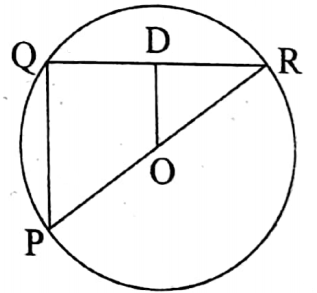
Example 2. QR is a chord of the circle with centre at O and POR is a diameter of it. OD is perpendicular to QR. If OD = 4 cm, then the length of PQ is

  1. 4 cm
  2. 2 cm
  3. 8 cm
  4. None of these

WBBSE Solutions For Class 10 Maths Solid Geometry Chapter 2 Theorems Related To Angles In A Circle Angle In Semi Circle Multiple Choice Question Example 2

Solution: OD ⊥ QR, ∴ ∠ODR = 1 right angle

Again, POR is a diameter of the circle with centre at O.

∴ ∠PQR is an angle is semicircle.

∴ ∠PQR = 1 right angle.

∴OD || PQ and ∠PRQ is common to both ΔPQR and ΔODR. ΔPQR and ΔODR are similar triangles.

∴ \(\frac{O D}{P Q}=\frac{O R}{P R}\)

or, [/latex]\frac{4}{P Q}=\frac{O R}{2 O R}[because \mathrm{PR}=2 O R][/latex]

or, \(\frac{4}{P Q}=\frac{1}{2} \text { or, } P \mathrm{PQ}=8\)

∴ the length of PQ = 8 cm.

∴ 3. 8 cm is correct

Aliter: POR is a diameter of the circle with centre at O.

∴ ∠PQR is an angle in semicircle.

∴ ∠PQR = 1 right angle or 90°

∴ ΔPQR is a right-angled triangle of which PR is the hypotenuse.

∴ PR2 = PQ2 + QR2 …….(1) [by Pythagoras’ theorem]

Again, OD ⊥ QR, where is a chord of the circle.

∴ D is the mid-point of QR,

∴ DR = \(\frac{1}{2}\) QR.

∴ ΔODR is a right-angled triangle of which OR is the hypotenuse.

∴ OR2 = OD2 + DR2

or, \(\left(\frac{1}{2} \mathrm{PR}\right)^2=4^2+\left(\frac{1}{2} \mathrm{QR}\right)^2\)

\(\cdot\left[\mathrm{OR}=\frac{1}{2} \mathrm{PR} \text { and } \mathrm{DR}=\frac{1}{2} \mathrm{QR} \text { and } \mathrm{OD}=4 \mathrm{~cm}\right]\) \(\frac{\mathrm{PR}^2}{4}=16+\frac{\mathrm{QR}^2}{4}\)

or, PR2 = 64 + QR2 ……(2)

Now, from (1) and (2), we get,

PQ2+ QR2 = 64 + QR2

or, PQ2 = 64 or, PQ = √64 = 8.

∴ the length of PQ = 8 cm.

∴ 3. 8cm is correct.

Example 3. AOB is a diameter of a circle. When the chords AC and BD are extended they meet at the point E. If ∠COD = 40°, then the value of ∠CED is 

  1. 40°
  2. 80°
  3. 20°
  4. 70°

WBBSE Solutions For Class 10 Maths Solid Geometry Chapter 2 Theorems Related To Angles In A Circle Angle In Semi Circle Multiple Choice Question Example 3

Solution:

Given

AOB is a diameter of a circle. When the chords AC and BD are extended they meet at the point E. If ∠COD = 40°

Let us join B, C and C, D. AOB is the diameter of the circle With centre at O.

∴ ∠ACB is an angle in semicircle.

∴ ∠ACB = 90°…..(1)

Again, ∠BCE = 180° – ∠ACB = 180° – 90° [from (1)] = 90°…..(2)

Now, the front central angle produced by the chord CD is ∠COD = 40° and the front angle in circle is ∠CBD.

∴ ∠CBD = \(\frac{1}{2}\)∠COD

or,∠CBE = \(\frac{1}{2}\) x 40° = 20°…..(3) [∠CBD and ∠CBE are same angles]

So from ΔBCE we get, ∠BEC + ∠BCE + ∠CBE = 180°

or, ∠BEC + 90° + 20° = 180° [from (2) and (3)] or, ∠BEC = 180° – 110° = 70°

∴ ∠BEC = 70°

∴ 4. 70° is correct.

Example 4. AOB is a diameter of a circle, If AC = 3 cm and BC = 4 cm, then the length of AB is

  1. 3 cm
  2. 4 cm
  3. 5 cm
  4. 8 cm

WBBSE Solutions For Class 10 Maths Solid Geometry Chapter 2 Theorems Related To Angles In A Circle Angle In Semi Circle Multiple Choice Question Example 4

Solution: AOB is a diameter of the circle with centre at O. ∠ACB is an angle in a semicircle

∴ ∠ACB = 90°

∴ from the right-angled triangle ABC by Pythagoras theorem we get,

AB2 = AC2 + BC2 = 32 + 42 = 25 [AC = 3 cm and BC = 4cm]

∴ AB = √25 = 5 the length of AB = 5cm

∴ 3. 5 cm is correct.

Solid Geometry Chapter 2 Theorems Related To Angles In A Circle Angle In Semi Circle True Or False

Example 1. The angle in circle produced by a minor axis is an obtuse angle.

Solution: False since it will be an acute angle.

WBBSE Solutions For Class 10 Maths Solid Geometry Chapter 2 Theorems Related To Angles In A Circle Angle In Semi Circle True Or False Example 1

Example 2. O is the mid-point of AB in ΔABC and OA = OB – OC; If a circle is drawn by taking AB as diameter, then the circle will pass through point C.

Solution: True, since OA = OB = OC is also a radius of the circle with centre at O, so the circle will pass through the point C.

WBBSE Solutions For Class 10 Maths Solid Geometry Chapter 2 Theorems Related To Angles In A Circle Angle In Semi Circle True Or False Example 2

Solid Geometry Chapter 2 Theorems Related To Angles In A Circle Angle In Semi Circle Fill In The Blanks

Example 1. Semicircular angle is a ______ angle.

Solution: Right

Example 2. The angle in the segment of a circle which is less than a semi-circle is an _________ angle

Solution: Obtuse

Example 3. The circle drawn with hypotenuse of a right angled triangle as diameter passes through the _______

Solution: Angular angle

Solid Geometry Chapter 2 Theorems Related To Angles In A Circle Angle In Semi Circle Short Answer Type Questions

Example 1. In the adjoining, O is the centre of the circle and AB is the diameter. If ∠BCE = 20°, ∠CAE = 25°, then find the value of ∠AEC.

Solution:

Given :

In the adjoining, O is the centre of the circle and AB is the diameter. If ∠BCE = 20°, ∠CAE = 25°

WBBSE Solutions For Class 10 Maths Solid Geometry Chapter 2 Theorems Related To Angles In A Circle Angle In Semi Circle Short Answer Type Question Example 1

The angles in circle produced by the chord CA are ∠AEC and ∠ABC.

∴ ∠AEC = ∠ABC…… (1)

Again, the angles in circle produced by the chord BE are ∠BAE and ∠BCE.

∴ ∠BAE = ∠BCE – 20° [∠BCE = 20°]

Similarly, the angles in circle produced by the chord CE are ∠CBE and ∠CAE,

∴ ∠CBE = ∠CAE = 25° [∠CAE = 25°]

Again, ∠AEB is a semicircular angle, ∠AEB = 90°

Then, in ΔABE, ∠ABE = 180° – (∠BAE + ∠AEB) = 180° – (20°+ 90°) = 70°

∴ ∠ABC = ∠ABE – ∠CBE = 70°-25° = 45°

∴ from (1) we get, ∠AEC = ∠ABC = 45° ∴ ∠AEC = 45°

Example 2. In isosceles triangle ABB = AC; if a circle is drawn with the side AB as diameter, then the circle intersects the side BC it the point D. When BD = 4 cm. find the length of CD.

Solution:

Given :

In isosceles triangle ABB = AC; if a circle is drawn with the side AB as diameter, then the circle intersects the side BC it the point D. When BD = 4 cm.

WBBSE Solutions For Class 10 Maths Solid Geometry Chapter 2 Theorems Related To Angles In A Circle Angle In Semi Circle Short Answer Type Question Example 2

Let O is the mid-point of AB.

The circle drawn with centre at O intersects the side BC at the point D.

Let us join A. D. Then ∠ADB is a semi-circular angle.

∴ ∠ADB = 90°, ∴ ∠ADC = 90°

Now in ΔABD and ΔACD, we have AB = AC, ∠ABD = ∠ACD and ∠ADB = ∠ADC.

∴ ΔABD = ΔACD [by die A-A-S condition of congruency ]

∴ BD = CD [similar sides of congruent triangles]

But BD = 4 cm (Given); CD = 4 cm.

Example 3. Two chords AB and AC of a circle are perpendicular to each other. If AB = 4 cm and AC = 3cm, then find the radius of the circle. 

Solution:

Given :

Two chords AB and AC of a circle are perpendicular to each other. If AB = 4 cm and AC = 3cm,

WBBSE Solutions For Class 10 Maths Solid Geometry Chapter 2 Theorems Related To Angles In A Circle Angle In Semi Circle Short Answer Type Question Example 3

AB and AC are perpendicular to each other.

∠BAC = 90°,

∴ ΔABC is a right-angled triangle of which BC is the hypotenuse.

∴ BC2 = AB2 + AC2 [by Pythagoras theorem] = 42+ 32 = 16 + 9 = 25

∴ BC = √25 = 5

Now, BC is one of the diameters of the circle.

∴ radius of the circle = \(\frac{5}{3}\) cm = 2.5 cm

Example 4. Two chords PQ and PR of a circle are perpendicular to each other. If the radius of the circle be r cm. then find the length of the chord QR. 

Solution:

Given :

Two chords PQ and PR of a circle are perpendicular to each other. If the radius of the circle be r cm.

WBBSE Solutions For Class 10 Maths Solid Geometry Chapter 2 Theorems Related To Angles In A Circle Angle In Semi Circle Short Answer Type Question Example 4

PQ and PR are perpendicular to each other, ∠QPR = 90°

∴ ∠QPR is a semicircular angle.

∴ QR is a diameter.

Since QR is a diameter of the circle,

radius of the circle = r cm (Given)

∴ QR = 2r cm.

Example 5. AOB is a diameter of a circle. C is a point on the circle. If ∠OBC = 60°, then find the value of ∠OCA

Solution:

Given :

AOB is a diameter of a circle. C is a point on the circle. If ∠OBC = 60°

WBBSE Solutions For Class 10 Maths Solid Geometry Chapter 2 Theorems Related To Angles In A Circle Angle In Semi Circle Short Answer Type Question Example 5

AOB is a diameter of a circle.

C is a pont on circle

∴ ∠ACB = 1 right angle or 90°

Again, in ΔOBC, OB = OC (radii of same circle)

∴ ∠OCB = ∠OBC = 60° [∠OBC = 60° (Given)]

∴ ∠OCA= ∠ACB – ∠OCB OCB = 90° – 60° = 30°

∴ ∠OCA = 30°

 Example 6. In the adjoining, O is the centre of a circle and AB is one of its diameters. The length of the chord CD is equal to the radius of the circle. When AC and BD are extended, they intersect each other at a point P. Find the value of ∠APB.

Solution:

Given :

In the adjoining, O is the centre of a circle and AB is one of its diameters. The length of the chord CD is equal to the radius of the circle. When AC and BD are extended, they intersect each other at a point P.

WBBSE Solutions For Class 10 Maths Solid Geometry Chapter 2 Theorems Related To Angles In A Circle Angle In Semi Circle Short Answer Type Question Example 6

Let us join B, C.

Now, AB is the diameter of the circle,

∴ ∠ACB = 90° [semi-circular angle]

Again in ΔCOD, OC = OD = CD (Given)

∴ ΔCOD is an equilateral triangle.

∴ each angle of the triangle = 60° ∴ ∠COD = 60°

Now, the central angle produced by the chord CD is ∠COD and angle in circle is ∠CBD.

∴ ∠COD = 2 ∠CBD or, 60° = 2 ∠CBD or, ∠CBD = 30°

∴ in ΔPBC, ∠PCB = 90° [∠ACB = 90°], ∠PBC = ∠CBD = 30°.

∴ ∠BPC = 180° – (∠PCB + ∠PBC) = 180° – (90° + 30°) = 180° – 120° = 60°

∴ ∠APB = 60° [∠BPC = ∠APB]

Solid Geometry Chapter 2 Theorems Related To Angles In A Circle Angle In Semi Circle Long Answer Type Questions

Example 1. The angle B of the AABC is a right angle. If a circle is drawn with AC as diameter, then it intersects AB at a point D. Then which one of the following is correct?

  1. AB > AD
  2. AB = AD
  3. AB < AD
  4. AB ≠ AD

Solution:

WBBSE Solutions For Class 10 Maths Solid Geometry Chapter 2 Theorems Related To Angles In A Circle Angle In Semi Circle Long Answer Type Question Example 1

Given

The angle B of the AABC is a right angle. If a circle is drawn with AC as diameter, then it intersects AB at a point D.

The angle B of ΔABC is a right angle.

∴ ∠ABC is a semicircular angle.

∴ AC is a diameter of the circle.

∴ The circle drawn with AC as diameter intersects AB at a point B, i.e., B and D are the same points.

∴ AB = AD

∴ 2. AB = AD is correct.

Example 2. Prove that the circle drawn with any one of the equal sides of an isosceles triangle as diameter bisects the unequal side.

Solution:

WBBSE Solutions For Class 10 Maths Solid Geometry Chapter 2 Theorems Related To Angles In A Circle Angle In Semi Circle Long Answer Type Question Example 2

Let in ΔABC, AB = AC. The circle drawn with AB as diameter intersects BC at a point D.

To prove: D is the mid-point of BC, i.e., BD = CD.

Proof: The circle intersects BC at a point D.

∴ ∠ADB is a semi-circular angle.

∴ ∠ADB = 90° ⇒ ∠ADC = 90°

Again, in ΔABC, AB = AC

∴ ∠ABC = ∠ACB or, ∠ABD = ∠ACD

So, in ΔABD and ΔACD, ∠ADB = ∠ADC [each is 90°]

∠ABD = ∠ACD and AD is common to both.

ΔABD = ΔACD [by the A-A-S condition of congruency]

∴ BD = CD. [Similar sides of congruent triangle]

Hence D is the mid-point of BC, i.e., the circle bisects the unequal side. [Proved]

Example 3. Parama drew two circles which intersect each other at the points P and Q. If the diameters of the two circles are PA and PB respectively, then prove that A, Q, B are collinear.

Solution:

Given :

Parama drew two circles which intersect each other at the points P and Q. If the diameters of the two circles are PA and PB respectively,

WBBSE Solutions For Class 10 Maths Solid Geometry Chapter 2 Theorems Related To Angles In A Circle Angle In Semi Circle Long Answer Type Question Example 3

Let two circles with centres O and O’ intersect each other at P and Q.

PA is a diameter of the circle with centre at O and PB is also a diameter of the circle with centre at O.

To prove: A, Q and B are collinear.

Construction: Let us join P, Q.

Proof: In the circle with centre at O, ∠AQP is a semi-circular angle. ∴ ∠PQA = 1 right angle.

Again, in the circle with centre at O’, ∠BQP is a semicircular angle. ∴ ∠PQB = 1 right angle.

Now, ∠PQA + ∠PQB = 1 right angle + 1 right angle.

or, ∠AQB = 2 right angle or, ∠AQB = 180° or, ∠AQB =1 straight angle.

∴ ∠AQB – 1 straight angle.

Hence the points A, Q, B are collinear. (Proved)

Example 4. Debanjan drew a line segment PQ of which mid-point is R and two circles are drawn with PR and PQ as diameter. Debaratee drew a straight line through the point P which intersects the first circle at the point S and the second circle at the point T. Prove that PS = ST. 

Solution:

Given :

Debanjan drew a line segment PQ of which mid-point is R and two circles are drawn with PR and PQ as diameter. Debaratee drew a straight line through the point P which intersects the first circle at the point S and the second circle at the point T.

WBBSE Solutions For Class 10 Maths Solid Geometry Chapter 2 Theorems Related To Angles In A Circle Angle In Semi Circle Long Answer Type Question Example 4

Let O be the centre of the circle drawn with PR as the diameter.

Let us join S,R and T, R. Since PR is a diameter. ∴ ∠PSR = 90° [Semicircular angle]

Obviously, ∠TSR = 90°, [Since PST is a straight line, so that ∠PST = 1 straight line = 180°]

Now in ΔPSR and ΔTSR, PR = TR [radii of same circle with centre at R]

∠PSR = ∠TSR [ each is right angle] and SR is common to both.

∴ Δ PSR = Δ TSR [by the R-H-S condition of congruency]

∴ PS = ST [similar sides of two congruent triangles]

Hence PS = ST. (Proved)

Example 5. Three points P, Q, R lie on a circle. The two perpendiculars PQ and PR at the point P intersect the circle at the points S and T respectively. Prove that RQ = ST.

Solution:

Given :

Three points P, Q, R lie on a circle. The two perpendiculars PQ and PR at the point P intersect the circle at the points S and T respectively.

WBBSE Solutions For Class 10 Maths Solid Geometry Chapter 2 Theorems Related To Angles In A Circle Angle In Semi Circle Long Answer Type Question Example 5

Three points P, Q, R are on the circle with centre at O. PS ⊥ PQ and PT ⊥ PR.

To prove RQ = ST.

Construction: Let us join the points Q, S; R, T; P, S and S, T.

Proof: PS ⊥ PQ, ∴ ∠QPS = 90°

∴ ∠QPS is a semi-circular angle.

∴ QS is a diametet, of which O is the mid point ∴ OQ = OS = radius

Similarly, PT ⊥ PR, ∴ ∠RPT = 90°

∴ ∠RPT is the semi-circular angle.

∴ RT is a diameter of which O is the mid-point.

∴ OR = OT = Radius.

Now, in Δ’s OQR and ΔOST, OQ = OS [radii of same circle]

∴ OR = OT [for similar reason] and ∠QOR = ∠SOT [opposite angles]

∴ ΔOQR ≅ ΔOST [by the S-A-S condition of congruency]

∴ QR = ST [similar sides of congruent triangles]

Hence RQ = ST. (Proved)

Example 6. ABC is an acute-angled triangle. AP is the diameter of the circumcircle of the triangle ABC; BE and CF are perpendiculars on AC and AB respectively and they intersect each other at the point Q. Prove that BPCQ is a parallelogram. 

Solution:

Given :

ABC is an acute-angled triangle. AP is the diameter of the circumcircle of the triangle ABC; BE and CF are perpendiculars on AC and AB respectively and they intersect each other at the point Q.

WBBSE Solutions For Class 10 Maths Solid Geometry Chapter 2 Theorems Related To Angles In A Circle Angle In Semi Circle Long Answer Type Question Example 6

ΔABC is an acute angled triangle. BE ⊥ AC and CF ⊥ AB and BE and CF intersect each other at a point Q.

AP is the diameter of the circumcircle of ΔABC.

To prove: BPCQ is a parallelogram.

Construction: Let us join O, C.

Proof: AP is a diameter of the circle. ∴ ∠ABP and ∠ACP are both semi circular angles.

∴ ∠ABP = ∠ACP = 90°……(1)

CF ⊥ AB, ∴ ∠CFB = 90°

∴ ∠FBQ = 90° – ∠FQB…….(2)

Again, BE⊥ AC, ∴ ∠BEC = 90°, ∴ ∠ECQ = 90° – ∠CQE . . . (3)

But ∠FQB = ∠CQE [Opposite angles]

∴ from (2) and (3) we get, ∠FBQ = ∠ECQ

Then ∠PBQ = ∠PBA – ∠FBQ = ∠ACP – ∠ECQ

[∠PBA =∠ACP and ∠FBQ = ∠ECQ] = ∠PCQ

∴  two opposite angles ∠PBQ and ∠PCQ of the quadrilateral BPCQ are equal.

Hence by the property of parallelogram, BPCQ is a parallelogram.

Example 7. The internal and external bisectors of the vertical angle of a triangle intersect the circumcircle of the triangle at the points P and Q. Prove that PQ is a diameter of the circle. 

Solution:

The internal and external bisectors of the vertical angle of a triangle intersect the circumcircle of the triangle at the points P and Q.

WBBSE Solutions For Class 10 Maths Solid Geometry Chapter 2 Theorems Related To Angles In A Circle Angle In Semi Circle Long Answer Type Question Example 7

Given: AP is the internal bisector of the vertical angle ∠A of the ΔABC and AE is the external bisector of the vertical ∠A of ΔABC and they intersect the circumcircle of the ΔABC at the points P and Q respectively.

To prove: PQ is the diameter of the circle.

Proof: ∠BAC + ∠CAD = 1 straight angle = 180° or, \(\frac{1}{2}\)∠BAC + \(\frac{1}{2}\) ∠CAD = 90° [dividing by 2]

or, ∠PAC + ∠CAE = 90° [AP is the internal bisector of ∠A and AE is the external bisector of ∠A]

or, ∠PAQ = 90°

∴ ∠PAQ is a semicircular angle.

Hence PQ is a diameter of the circle. (Proved)

Example 8. AB and CD are two diameters of a circle. Prove that ADBC is a rectangle.

Solution:

Given :

AB and CD are two diameters of a circle.

WBBSE Solutions For Class 10 Maths Solid Geometry Chapter 2 Theorems Related To Angles In A Circle Angle In Semi Circle Long Answer Type Question Example 8

AOB and COD are two diameters of the circle with centre at O.

To prove: ADBC is a rectangle.

Construction: Let us join A, D; D, B; B, C and C, A.

Proof: AOB is a diameter. ∴ ∠ACB and ∠ADB are two semi-circular angles.

∠ACB = 1 right angle and ∠ADB = 1 right angle.

∴ Two opposite angles of the quadrilateral ADBC are both right angles.

Similarly, COD is a diameter. ∴ ∠CAD and ∠CBD are both semi-circular angles.

∴ ∠CAD = 1 right angle and ∠CBD = 1 right angle.

∴ Two other opposite angles of the quadrilateral ADBC are also right angles.

Again, in ΔAOD and ΔBOC, OA = OB, OD = OC [radii of same circle] and ∠COD = ∠BOC [opposite angles]

∴ ΔAOD ≅ ΔBOC [by the S-A-S condition of congruency]

∴ AD = BC [similar sides of congruent triangles] .

Similarly, it can be proved that AC = BD.

∴ opposite sides of the quadrilateral are equal and each of its angles is a right angle.

Hence ADBC is a rectangle. (Proved)

Example 9. AB is diameter and AC is a chord of the circle with centre at O. The radius parallel to AC intersects the circle at D. Prove that D is the mid-point of the arc BC.

Solution:

Given :

AB is diameter and AC is a chord of the circle with centre at O. The radius parallel to AC intersects the circle at D.

WBBSE Solutions For Class 10 Maths Solid Geometry Chapter 2 Theorems Related To Angles In A Circle Angle In Semi Circle Long Answer Type Question Example 9

AB is a diameter of the circle with centre parallel to AC intersect the arc BC at the point D.

We have to prove that D is the mid-point of the arc BC.

Construction: Let us join O, C.

Proof: AC || OD and OC is the transversal of them,

∴ ∠OCA = ∠COD [alternate angle]…….. (1)

Again OA = OC [radii of same circle]

∴ ∠OCA = ∠OAC……..(2)

Now, ∠BOC = ∠BOD + ∠COD

or, internally opposite (∠OCA + ∠OAC) = ∠BOD + ∠COD

or, ∠COD  + ∠OAC = ∠BOD + ∠COD [by (1)]

or, ∠OAC = ∠BOD or, ∠COD = ∠BOD [by (1)]

∴ ∠BOD = ∠COD, i.e. the two central angles produced by BD and CD are equal.

∴ arc BD = arc CD.

Hence D is the mid-point of the arc BC. (Proved)

Example 10. Two circles intersect each other at the points P and Q. A straight line passing through P intersects one circle at A and the other circle at B. A straight line passing through Q intersect the first circle at C and the second circle at D. Prove that AC || BD.

Solution:

Given :

Two circles intersect each other at the points P and Q. A straight line passing through P intersects one circle at A and the other circle at B. A straight line passing through Q intersect the first circle at C and the second circle at D.

WBBSE Solutions For Class 10 Maths Solid Geometry Chapter 2 Theorems Related To Angles In A Circle Angle In Semi Circle Long Answer Type Question Example 10

Let two circles with centres at O and O’ intersect each other at the points P and Q respectively.

A straight line passing through P intersects the circle with centre O at the point A and the circle with centre O’ at the point B.

Another straight line passing through Q also intersects the first circle at C and the second circle at D.

We have to prove that AC || BD.

Construction: Let us join P, Q.

Proof: ΔPQC is a cyclic quadrilateral.

∴ ∠PAC + ∠PQC = 180° …….(1) [opposite angles of a cyclic quadrilateral are supplementary.]

Again, BPQD is also a cyclic quadrilateral.

∴ ∠PBD + ∠PQD = 180°……. (2) [for similar reason]

Now, adding (1) and (2) we get,

∠PAC + ∠PBD +∠PQC + ∠PQD = 360°

or, ∠PAC + ∠PBD + 180° = 360° [∠PQC + ∠PQD = 1 straight angle =180°] .

or, ∠PAC + ∠PBD = 360° – 180°

or, ∠PAC + ∠PBD = 180° .

i.e, the sum of two adjacent angles on the same side of the transversal AB of the two line segments AC and BD is 180°.

Hence AC || BD (Proved)

Example 11. ABC is a cyclic equilateral triangle. If D be any point on the circular arc BC on the opposite side of the point A, then prove that DA = DB + DC

Solution:

Given :

ABC is a cyclic equilateral triangle. If D be any point on the circular arc BC on the opposite side of the point A

WBBSE Solutions For Class 10 Maths Solid Geometry Chapter 2 Theorems Related To Angles In A Circle Angle In Semi Circle Long Answer Type Question Example 11

Let ABC be a cyclic equilateral triangle inside the circle with centre at O.

D is any point on the circular arc BC on the opposite side of the point A.

We have to prove that DA = DB + DC.

Construction: Let us cut a part DE from DA equal to DC, i.e., DC = DE and let us join C, E.

Proof: In ΔCDE, DC = DE [as per construction]

∴ ∠DCE = ∠DEC …….(1)

∴ ΔABC is an equilateral triangle,

∠BAC – ∠ACB = ∠CBA = 60° and AB = BC = CA……..(2)

Now, two angles in circle produced by the arc AC are ∠ADC and ∠ABC

∴ ∠ADC = ∠ABC = 60° [by (2)]

∴ ∠CDE = 60°……(3)

∴ in ΔCDE, ∠CDE + ∠DCE + ∠DEC = 180° or, 60° + ∠DCE + ∠DCE = 180° [from (1) and (3)]

or, 2 ∠DCE = 180° – 60° or, ∠DCE = \(\frac{120^{\circ}}{2}\) = 60°.

∴ ∠DEC = 60°, i.e., each and every angle of ΔCDE is 60°, ΔCDE is equilateral.

∴ CD = DE = CE………(4)

Now, ∠ACE + ∠BCE = ∠ACB = 60° = ∠DCE = ∠BCD + ∠BCE

∴ ∠ACE = ∠BCD ……….(5)

Again, in Δ’s ACE and ΔBCD

∠CAE = ∠CBD [both are angles in circle produced by the same chord CD.]

∴ ∠ACE = ∠BCD [by (5)] and AC = BC [ΔABC is equilateral]

∴ ΔACE = ΔBCD [by the A-A-S condition of congruency]

∴ AE = BD [similar sides of congruent triangles]…….. (6)

Therefore, DA = DE + AE = DC + BD [DE = DC and AE = BD]

Hence DA = DB + DC (Proved).

WBBSE Solutions For Class 10 Maths Solid Geometry Chapter 1 Theorems Related To Circle

Solid Geometry Chapter 1 Theorems Related To Circle

What is circle and its different parts

Circle:

Definition of a circle, different parts of a circle, such as centre, radius, diameter, circumference, chord, etc. What are concentric and congruent circles, you have already learnt it.

Some properties and characteristics of a circle have also been discussed there. So, we shall discuss here no more about them.

In this chapter, we shall at first discuss about some properties and theorems related to a circle.

You know that the straight line joining any two points on the circumference of a circle is called a chord of the circle. If that straight line passes through the centre of the circle, then it is called the diameter of the circle.

Diameter is the greatest chord of a circle and the number of diameters of a circle is infinity. Any chord of a circle divides it in two parts.

If the two parts be equal, then each part is called a semi-circle Whereas, if the two parts are not equal, then the greater part is called Major segment and the smaller part is known as Minor segment.

If the centres of some tildes be the same, then they are called concentric circles. The radii of the concentric circles are not equal.

 WBBSE Solutions for Class 10 Maths

However, if instead of different centres, the radii of two or more than two circles be equal, then they are known as Equal or congruent circles.

Any chord of a circle subtends an angle at the centre of the circle.

Such as, in the following figures, the chord AB together with two of its radii OA and OB have subtended an angle ∠AOB at the centre of the circle, chord PQ together with two radii PX and QX of the circle have subtended an angle ∠PXQ at the centre of the circle and the chord RS along with two of its radii YR and YS have subtended an angle ∠RYS at the centre of the circle.

WBBSE Solutions For Class 10 Maths Solid Geometry Chapter 1 Theorems Related To Circle Equal Or Congruent Circles

Now if the lengths of the chords be equal, i.e., if AB = PQ = RS, then ∠AOB = ∠PXQ – ∠RVS, i.e., the subtended angles are equal.

So, we can say that the chords of the circle, making equal subtended angles at the centre arc equal in length.

It is true conversely.

WBBSE Solutions for Class 10 History WBBSE Solutions for Class 10 Geography and Environment
WBBSE Class 10 History Long Answer Questions WBBSE Solutions for Class 10 Life Science And Environment
WBBSE Class 10 History Short Answer Questions WBBSE Solutions for Class 10 Maths
WBBSE Class 10 History Very Short Answer Questions WBBSE Solutions for Class 10 Physical Science and Environment
WBBSE Class 10 History Multiple Choice Questions


To determine the centre of a circle 

Let ABCD be a given circle. We have to determine the centre of this circle. Then at first, we construct the chords AB and CD. Then let us construct the perpendicular bisector PM and QN of AB and CD respectively.

Let PM and QN intersect each other at O. Then O is the centre of that circle.

Thus by drawing perpendicular bisectors of any two chords of a circle we can determine the centre of the circle.

WBBSE Solutions For Class 10 Maths Solid Geometry Chapter 1 Theorems Related To Circle Determine The Center Of The circle

To draw a circle passing through three non-collinear points and theorem related to it 

Let A, B and C are three non-collinear points. We have to draw a circle passing through these three points.

Since the circle will pass through A, B and C, the centre of the circle must be equidistant from A, B and C.

Now to locate a point equidistant from A, B and C, we first draw the line segments AB and BC.

WBBSE Solutions For Class 10 Maths Solid Geometry Chapter 1 Theorems Related To Circle A Circle Passing Through Three Non Collinear Points

Then let us draw the perpendicular bisectors of AB and BC. Let MN and PQ be two perpendicular bisectors of AB and CD respectively and MN and PQ intersect at O.

Then point O will be equidistant from points A, B and C, i.e. O is the centre of the circle.

Now, taking O as the centre and OA or OB or OC as the radius, let us draw a circle. Then that circle will be the required circle.

Now the question is, is it possible to draw an other circle passing through these three points? In reply we can say that one and only one circle can be drawn through these three non-collinear points.

Since, the non-collinear points A, B and C are fixed, So both AB and BC are also fixed.

As a result the perpendicular bisectors of AB and BC are also fixed and which assures that the. centre O is also a fixed point. That is why the radius OA is fixed.

So, one and only one circle can be drawn through three non-collinear fixed points.

We shall now prove this theorem with perfect reason geometrically.

WBBSE Solutions For Class 10 Maths Solid Geometry Chapter 1 Theorems Related To Circle

Solid Geometry Chapter 1 Theorems Related To Circle Theorems

Theorem 1. Prove that only one circle can be drawn through three non-collinear points.

Given: Let A, B and C be three non-collinear points.

To prove: We shall have to prove that, one and only one circle can be drawn through these three non-collinear points.

WBBSE Solutions For Class 10 Maths Solid Geometry Chapter 1 Theorems Related To Circle Theorem 1

Construction: Let us join points A, B and B, C.

Thus we get two line segments AB and BC.

Now, let us draw perpendicular bisectors PQ of AB and RS of BC respectively.

Let PQ and RS intersect each other at point O.

PQ and RS intersect the line segments AB and BC at M and N respectively.

Let us join O, A, O, B and O, C and taking O as the centre, OA, OB or OC as the radius, let us draw a circle. Then this circle is our required circle.

Proof: In ΔOAM and ΔOBM, AM = BM

[PM is the perpendicular bisector of AB.]

∠OMA = ∠OMB [each is rightangle] and OM is common to both.

∴ ΔOAM ≅ ΔOBM

OA = OB [corresponding sides of congruent triangles]

Similarly, it can be proved that OB =’ OC.

∴ OA = OB = OC

∴ the circle drawn by taking O as the centre and OA as the radius must passes through the points A, B and C which are non-collinear.

Hence one and only one circle can be drawn through three non-collinear points. (Proved)

We have seen in above that the centre of a circle lies on the perpendicular bisector of any chord of the circle.

Conversely, if perpendiculars are drawn to any chord (except the diameter) of a circle, then that perpendicular bisects the chord.

We shall now prove this logically by the process of geometry.

Theorem 2. The perpendicular drawn to any chord (except the diameter) from the centre of a circle bisects the chord.

Given: Let AB is a chord (except a diameter) and OP ⊥ AB when OP intersects AB at P.

To prove: We shall have to prove that OP bisects AB, i.e., AP = PB.

WBBSE Solutions For Class 10 Maths Solid Geometry Chapter 1 Theorems Related To Circle Theorem 2

Construction •: Let us join O, A and O, B.

Proof: OP ⊥ AB, both ΔOAP and ΔOBP are right-angled.

Now in ΔOAP and ΔOBP, ∠OPA = ∠OPB, [each is rightangle]

hypotenuse OA = hypotenuse OB [radii of same circle] and OP is common to both.

∴ ΔOPA = ΔOPB [As per R – H – S congruency]

∴ AP = PB [corresponding sides of congruent triangles]

∴ AP = PB (Proved)

We shall now prove the converse theorem logically.

Theorem 3. (Converse theorem of theorem 2) Prove that if any straight line passing through the centre of a circle bisects any chord, which is not a diameter, then the straight line will be perpendicular on that chord.

Given: Let PQ is a chord of the circle with the centre at O and M is the middle point of PQ, i.e., PM = QM.

To prove: We shall have to prove that OM ⊥ PQ, i.e., OM is perpendicular to the chord PQ.

WBBSE Solutions For Class 10 Maths Solid Geometry Chapter 1 Theorems Related To Circle Theorem 3

Construction: Let us join O, P and O, Q.

Proof: In ΔOPM and ΔOQM, OP = OQ [radius of the same circle]

PM = QM [M is the middle point of PQ.] and OM is common to both.

∴ ΔOPM ≅ OQM [By the condition of S – S – S congruency of triangles]

∴ ∠OMP = ∠OMQ [similar angles of two congruent triangles]

But they are two adjacent angles too, obtained when OM stands upon PQ and they are equal to each other.

∴ each angle is a right angle, i.e., ∠OMP = ∠OMQ = 1 right angle.

∴ OM ⊥ PQ. (Proved)

In the following examples how the above theorems have been applied in real problems is discussed thoroughly.

Solid Geometry Chapter 1 Theorems Related To Circle Multiple Choice Questions

Example 1. AB is a diameter of a circle with centre O, and AC = CB; the value of ∠CAB is

  1. 40°
  2. 45°
  3. 50°
  4. 55°

WBBSE Solutions For Class 10 Maths Solid Geometry Chapter 1 Theorems Related To Circle AB is A Diameter Of A Circle With Center O And AC=CB

Solution:

Given:

AB is a diameter of a circle with centre O, and AC = CB

∠ACB = 90° [Semi Circle angle]

In ΔABC, AC = CB

∠CAB = ∠ABC = \(\frac{180^{\circ}-90^{\circ}}{2}\) = 45°

∴ The correct answer is 2. 45°

The value of ∠CAB is 2. 45°.

Example 2. POR diameter of a circle. If PR = 12 cm, QR = 16 cm, then the length of PQ is

  1. 10 cm
  2. 20 cm
  3. 30 cm
  4. 40 cm

WBBSE Solutions For Class 10 Maths Solid Geometry Chapter 1 Theorems Related To Circle POR Is Diameter Of A Circle

Solution:

Given

POR diameter of a circle. If PR = 12 cm, QR = 16 cm

In ΔPQR. ∠PRQ = 90° [Semi Circular angle]

PQ2 = PR2 + QR2 [From Pythagoras theorem]

= (12° + 162) cm2 = (144 + 256) cm2

= 400 cm2

PQ = √400 = 20 cm

∴ The correct answer is 2. 20 cm

The length of PQ is 2. 20 cm

Example 3. The lengths of two chords AB and CD of the circle with centre at O are equal. If ∠AOB = 60°, then the value of ∠COD is

  1. 40°
  2. 50°
  3. 60°
  4. 70°

WBBSE Solutions For Class 10 Maths Solid Geometry Chapter 1 Theorems Related To Circle The Length Of Two Chords AB And CD Of The Circle With Center At O Are Equal

Solution:

Given:

The lengths of two chords AB and CD of the circle with centre at O are equal. If ∠AOB = 60°

We know that equal chords of a circle subtend equal angles at the centre. the chords AB and CD also subtend equal angles at the centre.

∠AOB = ∠COD or, 60° = ∠COD.

Hence. ∠COD = 60°

∴ 3. 60° is correct.

The value of ∠COD is  3. 60°

Example 4. The radius of a circle is 13 cm and one of its chord is 10 cm. Then the distance of the chord from the centre is

  1. 12 cm
  2. 14 cm
  3. 16 cm
  4. 20 cm

WBBSE Solutions For Class 10 Maths Solid Geometry Chapter 1 Theorems Related To Circle O Is The Center Of The Circle And OC Perpendicular To AB

Solution:

Given:

The radius of a circle is 13 cm and one of its chord is 10 cm.

Let the length of the chord AB is 10 cm.

O is the centre of the circle and OC ⊥ AB.

∴ the required distance = OC.

As per the question, the radius of the circle, OA =13 cm,

Now, from the right angled triangle OAC, we get,

OA2 = OC2 + AC2 [OA = hypotenuse]…….. (1) [by Pythagoras theorem]

Again, OC ⊥ AB, ∴C is the mid-point of AB.

AC= \(\frac{1}{2}\) AB = \(\frac{1}{2}\) x 10 cm = 5 cm

∴ from (1) we get, 132 = OC2 + 52 [OA = 13 cm]

or, 169 = OC2 + 25

or, OC2 =169-25

or, OC2 = 144

⇒ OC = √144 =12

Hence the required distance = 12 cm

∴ 1. 12 is correct.

The distance of the chord from the centre is 1. 12

Example 5. If O is the centre of circle and QR is the diameter then the value of x is

  1. 45°
  2. 55°
  3. 60°
  4. 70°

WBBSE Solutions For Class 10 Maths Solid Geometry Chapter 1 Theorems Related To Circle O Is the C Center Of The Circle And QR Is The Diameter

Solution: In ΔPOQ, OP = OQ [radii of same circle]

∴ ∠OQP = ∠OPR = 55°

i.e. ∠PQR = 55°

∠PSR = ∠PQR [angles in the same segment]

x° = 55°

∴ The correct answer is 2. 55°

Example 6. O is the centre of circle, ∠BAC = x°, ∠AOC = 70° and ∠AOB = 130°, then the value of x is

  1. 60°
  2. 80°
  3. 100°
  4. None of these

Solution:

Given

O is the centre of circle, ∠BAC = x°, ∠AOC = 70° and ∠AOB = 130°

∠BOC = 360° – ∠AOB – ∠AOC

= 360° – 130° – 70° = 160°

∠BAC = \(\frac{1}{2}\) ∠BOC ; x°= \(\frac{1}{2}\) x 160°, x° = 80°

∴ The correct answer is 2. 80°

The value of x is 2. 80°

Example 7. The centre of two concentric circles is O. A straight line intersects one of the circles at A and B and the other circle at C and D respectively. If AC = 5 cm, then the length of BD is

  1. 2.5 cm
  2. 5 cm
  3. 3 cm
  4. 6 cm

WBBSE Solutions For Class 10 Maths Solid Geometry Chapter 1 Theorems Related To Circle Center Of Two Concentric Circles Is O

Solution:

Given:

The centre of two concentric circles is O. A straight line intersects one of the circles at A and B and the other circle at C and D respectively.

Let AB intersects the greater one of two concentric circles with centre at O at points A and B and the smaller one at C and D.

∴ Let OP ⊥ CD, OP ⊥ AB.

∴ P is the mid-point of both CD and AB.

∴ PC = PD and PA – PB

Now, BD = PB – PD

= PA – PC [PB = PA and PD = PC] = AC

= 5 cm [AC = 5 cm given]

∴  length of BD = 5cm

∴ 2. 5 cm is correct.

The length of BD is 2. 5 cm

Solid Geometry Chapter 1 Theorems Related To Circle True Or False

Example 1. The lengths of the radii of two congruent circles are equal.

Solution: The statement is true.

Example 2. The arc is a line segment.

Solution: The statement is false.

Example 3. PS and QT are the perpendiculars on side QR and RP of the triangle PQR. P, Q, S, T are concyclic.

Solution: ∠PTQ = ∠PSQ = 90° as a line segment PQ joining two points P and Q subtends equal angles at two other points S and T on the same of PQ.

∴ P, Q, S, T points are concyclic.

WBBSE Solutions For Class 10 Maths Solid Geometry Chapter 1 Theorems Related To Circle PS And QT Are Perpendicular On Side QR And RP Of The Triangle

∴ The statement is true.

Example 4. The opposite angle of a cyclic quadrilateral is complimentary.

Solution: The statement is false.

Solid Geometry Chapter 1 Theorems Related To Circle Fill In The Blanks

Example 1. All angles in the same segments are ______

Solution: Equal

Example 2. The vertics of square is _____

Solution: Concyclic.

Example 3. If the ratio of two chords AB and CD of a circle with its centre O is 1 : 1, then ∠AOB : ∠COD = ______

Solution: Ratio of length of chord AB and CD of a circle with its centre O is 1 : 1.

∴ AB = CD

∠AOB = ∠COD

∠AOB : ∠COD =1:1

WBBSE Solutions For Class 10 Maths Solid Geometry Chapter 1 Theorems Related To Circle Two chords AB And CD Of A Circle With Its Center O

∴ 1:1.

Solid Geometry Chapter 1 Theorems Related To Circle Short Answer Type Questions

“WBBSE Class 10 circle theorems solved examples”

Example 1. Two equal circles of radius 13 cm intersect each other and the length of their common chord is 10 cm. Find the distance between the centres of the circles.

Solution:

Given:

Two equal circles of radius 13 cm intersect each other and the length of their common chord is 10 cm.

Let A and B be two centres of the circle and PQ is their common chord.

WBBSE Solutions For Class 10 Maths Solid Geometry Chapter 1 Theorems Related To Circle Short Answer Type Questions Example 1

Let the distance between the centres be AB which intersects PQ at O.

∴ O is the mid-point of PQ [AO ⊥ PQ]

∴ PO = \(\frac{1}{2}\) PQ = \(\frac{1}{2}\) x 10 cm = 5 cm. [PQ = 10 cm]

According to the question, PA = 13 cm.

Now, in the right-angled triangle AOP, PA2 = OP2 + OA2

or, (13)2 = (5)2 + OA2 [PA = 13 cm, OP = 5 cm]

or, 169 = 25 + OA2 or, OA2 = 169 – 25 or, OA2 = 144 or, OP = 12

∴ AB = 2 x OA [OA = OB]

or, AB = 2 x 12 cm or, AB = 24 cm.

Hence the distance between the centres of the circles is 24 cm.

Example 2. The lengths of two chords AB and CD of a circle with its centre O are equal. If ∠AOB = 60° and CD = 5 cm, then calculate the length of the radius of the circle.

Solution:

Given:

The lengths of two chords AB and CD of a circle with its centre O are equal. If ∠AOB = 60° and CD = 5 cm

WBBSE Solutions For Class 10 Maths Solid Geometry Chapter 1 Theorems Related To Circle Lenth Of Two Chords AB And CD Of A Circle With Its Center O Are Equal

In ΔAOB, OA = OB [radii of same circle] ∴∠OAB = ∠OBA

Now, ∠AOB + ∠OAB + ∠OBA = 180°

or, 60° + ∠OAB + ∠OAB = 180° [∠OBA = ∠OAB]

or, ∠OAB + ∠OAB = 180° – 60°

or, 2 ∠OAB = 120° or ∠OAB = 60°

In ΔOAB, ∠OAB = ∠OBA = ∠AOB = 60°

∴ ΔAOB is. equilateral, ∴ OA = OB = AB

But AB = CD – 5 cm, ∴ OA = OB = 5 cm

∴ Radius of the circle = 5 cm

Example 3. R is any point in a circle with its centre O. If the length of the radius is 10 cm and OR = 6cm, then determine the least of the chord passing through the point R.

Solution:

Given:

R is any point in a circle with its centre O. If the length of the radius is 10 cm and OR = 6cm

WBBSE Solutions For Class 10 Maths Solid Geometry Chapter 1 Theorems Related To Circle Short Answer Type Questions Example 3

Let PQ is a chord passing through R of the circle with centre at O.

Let us join O, R.

According to the question, OP = 10 cm and OR 6cm

Now, length of PQ will be least if OR is a perpendicular to PQ.

∴ ΔOPR is a right angled triangle.

∴ OP2 = PR2 + OR2 or, (10)2 = PR2 + (6)2

or, 100 = PR2 + 36 or, PR2 =100 – 36 or, PR2 = 64

∴ PR = √64 =8

Again, OR ⊥ PQ, ∴ R is the mid-point of PQ.

∴ PQ = 2 x PR = 2 x 8 cm = 16 cm.

Hence the required least length = 16 cm.

“Theorems related to circles for Class 10 Maths”

Example 4. The two circles with their centres at P and Q intersect each other, at the points A and B. Through point A, a straight line parallel to PQ intersects the two circles at the points C and D respectively. If PQ = 7 cm, then determine the length of CD.

Solution:

Given:

The two circles with their centres at P and Q intersect each other, at the points A and B. Through point A, a straight line parallel to PQ intersects the two circles at the points C and D respectively. If PQ = 7 cm

WBBSE Solutions For Class 10 Maths Solid Geometry Chapter 1 Theorems Related To Circle Long Answer Type Questions Example 7

Let PM ⊥ CD and QN _⊥ CD.

∴ PQ ∥ CD, ∴ PQ = MN.

Now, PQ = 7 cm, ∴ MN = 7 cm.

Also, MN = AM + AN

or, MN = \(\frac{1}{2}\) AC + \(\frac{1}{2}\) AD [PM ⊥ AC ⇒ AM = \(\frac{1}{2}\) AC and

QN ⊥ AD ⇒ AN = \(\frac{1}{2}\) AD.] or, MN = \(\frac{1}{2}\) (AC + AD)

or, 7 = \(\frac{1}{2}\)  x CD [AC + AD = CD] or, CD = 7×2 = 14

∴ the length of the chord CD = 14 cm.

Example 5. AB is a diameter and ∠ACB is a Semicircular angle of a circle of radius 4 cm in length. If BC = 2√7 cm, find the length of AC. 

Solution:

Given:

AB is a diameter and ∠ACB is a Semicircular angle of a circle of radius 4 cm in length. If BC = 2√7 cm

WBBSE Solutions For Class 10 Maths Solid Geometry Chapter 1 Theorems Related To Circle Short Answer Type Questions Example 5

∠ACB = 90°

In ΔACB, AC2 + BC2 = AB2 ⇒ AC2=AB2-BC2

= {(2×4)2-(2√7)2} cm2

⇒ AC = \(\sqrt{64-28}\) cm = √36 cm = 6 cm

Example 6. If the ratio of three consecutive angles of a cyclic quadrilateral is 1 : 2 : 3 then determine the first and third angles. 

Solution:

Given:

If the ratio of three consecutive angles of a cyclic quadrilateral is 1 : 2 : 3

First angle = x°,

Second angle = 2x° and third angle = 3x°. [x is common multiple and x > 0]

The opposite angles a circle quadrilateral are supplementary.

∴ x° + 3x° = 180°

⇒ 4x° = 180°

⇒ x° = \(\frac{180^{\circ}}{4^{\circ}}\)

∴ First angle is 45° [First angle = x° as per question]

The measurement of third angle is 3x° = 3 x 450 = 135° [Third angle = 3x° as per question]

∴ First angle is 45° and third angle is 135°.

“Chapter 1 circle theorems exercises WBBSE solutions”

Example 7. Side AB of a cyclic quadrilateral ABCD is produced to the points if ∠XBC = 82° and ∠ADB = 47°, then the find the value of ∠BAC.

Solution:

Given:

Side AB of a cyclic quadrilateral ABCD is produced to the points if ∠XBC = 82° and ∠ADB = 47°

WBBSE Solutions For Class 10 Maths Solid Geometry Chapter 1 Theorems Related To Circle Short Answer Type Questions Example 7

In cyclic quadrilateral ABCD.

Exterior ZXBC = interior opposite ∠ABC = 82° = ∠ADC – ∠BDC = ∠ADC – ∠ADB

= 82° – 47° = 35°

∠BAC = ∠BDC [angles in the same segment] = 35°

∴ The value of ∠BAC = 35°

Example 8. If PQRS is a cyclic parallelogram, then find the value of ∠QPR.

Solution:

WBBSE Solutions For Class 10 Maths Solid Geometry Chapter 1 Theorems Related To Circle Short Answer Type Questions Example 8

In cyclic parallelogram PQRS

∠P + ∠R=180° .

Again, ∠P + ∠R [as PQRS is parallelogram]

∠P +∠P = 180° or, 2 ∠A = 180°

or, ∠A = 90° [ cyclic parallelogram is a rectangular]The value of ∠QPR = 90°

Solid Geometry Chapter 1 Theorems Related To Circle Long Answer Type Questions

“Class 10 Maths circle theorem proofs”

Example 1. If the length of a chord of a circle is 48 cm and the distance of this chord from the centre is 7 cm, then find the length of the chord, the distance of which from the centre is 15 cm.

Solution:

Given:

If the length of a chord of a circle is 48 cm and the distance of this chord from the centre is 7 cm

WBBSE Solutions For Class 10 Maths Solid Geometry Chapter 1 Theorems Related To Circle Long Answer Type Questions Example 1

Let AB and PQ are two chords of the circle with the centre at O.

OC and OD are two perpendiculars drawn from O to AB and PQ respectively.

As per the question, OC = 7 cm

AB = 48 cm, OD = 15 cm, PQ = ?

Now, AB = 48 cm, ∴ BC = \(\frac{1}{2}\) x 48 cm = 24 cm

Then, from the right-angled triangle OBC we get,

OB2 = BC2 + OC2 or, OB2 = (24)2 + (7)2

or, OB2 = 576 + 49 or, OB2 = 625 or, OB = √625 = 25

OQ = 25 cm [OB = OQ (radii of same circle)]

Again, in right-angled triangle OQD, OQ2 = OD2 + DQ2

or, (25)2 = (15)2 + DQ2 or, 625 = 225 + DQ2

or, DQ2 = 625 – 225 or, DQ2 = 400 or, DQ = √400 = 20

∴ PQ = 2DQ = 2 x 20 cm = 40 cm.

Hence length of the chord PQ = 40 cm.

Example 2. The two circles with centres X and Y intersect each other at points A and B, A is joined with the mid-point S of XY and the perpendicular on SA through the point A is drawn which intersects the two circles at the points P and Q. Prove that PA = AQ.

Solution:

Given:

The two circles with centres X and Y intersect each other at points A and B, A is joined with the mid-point S of XY and the perpendicular on SA through the point A is drawn which intersects the two circles at the points P and Q.

WBBSE Solutions For Class 10 Maths Solid Geometry Chapter 1 Theorems Related To Circle Long Answer Type Questions Example 2

Let us draw two perpendiculars XM and YN on PA and AQ respectively.

Let us join X, A and Y, A

XM ⊥ PA, ∴AM = \(\frac{1}{2}\) PA…..(1)

Again, YN ⊥ AQ ∴ AN = \(\frac{1}{2}\) AQ…..(2)

Now, S is the mid-point XY,

∴ AS ⊥ XY [the line segment joining two centres of two intersecting circles bisect their common chord in right angles.]

∴ in right-angled triangles AXS and AYS, we get, XS = YS [S is the mid-point of XY]

∴ ∠ASX = ∠ASY [each is right angle] and AS is common to both.

∴ ΔAXS ≅ ΔAYS, XA = YA [similar sides of two congruent triangles]’ Now, XY and PQ are both perpendiculars to AS.

∴ XY ∥ PQ.

Again, XM and YN are both perpendicular to PQ,

∴ XM = YN

Now, in ΔAXM and ΔAYN, XA = YA, SX = SY and SA is common to both.

∴ ΔAXM ≅ΔAYN [by the S-S-S condition of congruency]

∴ AM = AN [similar sides of congruent triangles]

or, \(\frac{1}{2}\) PA = \(\frac{1}{2}\) AQ [from (1) and (2)]

or, PA = AQ, ∴ PA = AQ (Proved)

“Understanding circle theorems in Class 10 Maths”

Example 3. If the angle-bisector of two intersecting chords of a circle passes through its centre, then prove that the two chords are equal.

Solution:

Given:

If the angle-bisector of two intersecting chords of a circle passes through its centre,

WBBSE Solutions For Class 10 Maths Solid Geometry Chapter 1 Theorems Related To Circle Long Answer Type Questions Example 3

Let the two chords AB and AC of the circle with centre at O intersect each other at A.

The bisector AO of the internal angle ∠BAC passes through the centre O.

We have to prove that AB = AC.

Construction: Let us join O, B and O, C.

Proof: In ΔAOB and ΔAOC,

∠OBA = ∠OAB [OB = OA = radii of same circle]

= ∠OAC [∠OAB = ∠OAC, given ]

= ∠OCA [OC = OA = radii of same circle ] i..e., ∠OBA = ∠OCA and ∠OAB = ∠OAC and OA is common to both.

By the condition of A-A-S congruency of congruent triangles, ΔAOB ≅ ΔAOC

∴AB = AC [similar sides of congruent triangles.]

∴ the chords AB and AC are equal. (Proved) .

Example 4. The two parallel chords AB and CD with the lengths of 10 cm and 24cm in a cirlce are situated on the opposite sides of the center. If the distance between two chords AB and CD is 17cm, then calculate the length of the radius of the circle.

Solution:

Given:

The two parallel chords AB and CD with the lengths of 10 cm and 24cm in a cirlce are situated on the opposite sides of the center. If the distance between two chords AB and CD is 17cm,

WBBSE Solutions For Class 10 Maths Solid Geometry Chapter 1 Theorems Related To Circle Long Answer Type Questions Example 4

Let the length of the chord AB is 10 cm of the circle with centre at O and that of CD is 24 cm.

PQ is a straight line through O, which is perpendicular to both AB and CD.

∴ OP ⊥ AB ⇒ P is the mid-point of AB.

∴ AP = \(\frac{1}{2}\) AB = \(\frac{1}{2}\) x 10cm = 5cm

Again, OQ ⊥ CD ⇒Q is the mid-point of CD.

∴ DQ = \(\frac{1}{2}\) CD = \(\frac{1}{2}\) x 24 cm = 12 cm .

As per question, PQ = 17 cm, ∴ if OP = x cm, then OQ = (17 – x) cm.

Now, from the right-angled triangle OAP, we get, OA2 = AP2 + OP2

or, OA2 = (5)2 + (x)2 or, OA2 = 25 + x2 …….(1)

Again, from OQD right-angled triangle we get, OD2 = DQ2 + OQ2

or, OD2 = (12)2 + (17 – x)2 or, OD2 = 144 + (17 – x)2

or, OA2 = 144 + (17 – x)2 (2) [OD = OA = radii of same circle]

Then from (1) and (2) we get, 144 + (17 – x)2 = 25 + x2

or, (17 – x)2 – x2 = 25 – 144 or, (17 – x + x) (17 – x – x) = – 119

or, 17 (17 – 2x) = – 119 or, 17 – 2x = – 7 or, 2x = 24 or, x = 12

from (1) we get, OA2 = 25 + (12)2 = 25 + 144 = 169

∴ OA = √l69 = 13

Hence the required radius of the circle = 13 cm.

Example 5. The two chords AB and AC of a circle are equal. Prove that the bisector of ∠BAC passes through the centre.

Solution:

Given:

The two chords AB and AC of a circle are equal.

WBBSE Solutions For Class 10 Maths Solid Geometry Chapter 1 Theorems Related To Circle Long Answer Type Questions Example 5

Let AB and AC are two equal chords of the circle with centre at O.

Let us join A, O and let it be produced to D.

We have to prove that AD passes through O, i.e it is sufficient to prove that AD is the bisector of ∠BAC.

Construction: Let us join O, B and O, C. ^

Proof: In ΔAOB and ΔAOC, OB = OC (radii of same circle) AB = AC (given) and OA is common to both.

∴ ΔAOB ≅ ΔAOC [by the condition of S-S-S congruence of triangles]

∴ ∠OAB = ∠OAC [similar angles of congruent triangles]

∴ AO or AD is the bisector of ∠BAC

Hence the bisector of ∠BAC passes through the centre. (Proved)

Example 6. Write with proof which of the chords passing through any point in a circle will be the least.

Solution:

WBBSE Solutions For Class 10 Maths Solid Geometry Chapter 1 Theorems Related To Circle Long Answer Type Questions Example 6

Infinite number of chords can be drawn through a point in a circle.

Among them the chord of which the line segment obtained by joining the centre and the internal point is a perpendicular bisector will be the least in length.

Because, we know that so far as the perpendicular distance of the chords from the centre increases, the length of the chord proportionately diminishes and among the chords which can be drawn through this point, the perpendicular distance from the centre of that chord will be the greatest, i.e., the perpendicular distance of that chord from the centre will be the greatest.

Hence the length of that very chord will be the least.

Mathematically, let P be any point in the circle with centre at O. Let us join O, P.

Let us draw a line segment CD such that CD is perpendicular to OP at P and which intersects the circle at C and D.

Then CD is a chord passing through P. Let AB be another chord passing through P.

We have to prove that the chord CD is smaller.

Construction: Let us draw OQ ⊥ AB

Proof: ∠OQP = 1 right angle [OQ ⊥ AB]

In ΔOPQ, ∠OQP > ∠OPQ ⇒ OP > OQ.

[the side opposite to greater angle is greater than the side opposite to smaller angle.]

i.e.., the perpendicular distance of the chord CD from the centre O is greater than that of the chord AB.

So, the chord CD is at a greater distance than that of AB from the centre.

∴ the chord CD is smaller than the chord AB.

In a similar way, it can be proved that all the chords passing through P are greater than the chord CD.

Hence CD is the least chord. (Proved)

“Step-by-step solutions for circle theorems Class 10”

Example 7. The centres of two circles are P and Q; they intersect at points A and B. The straight line parallel to the line segment PQ through the point A intersects the two circles at points C and D. Prove that CD = 2PQ.

Solution:

Given:

The centres of two circles are P and Q; they intersect at points A and B. The straight line parallel to the line segment PQ through the point A intersects the two circles at points C and D.

WBBSE Solutions For Class 10 Maths Solid Geometry Chapter 1 Theorems Related To Circle Long Answer Type Questions Example 7

Let us draw PM ⊥ CA and QN ⊥ AD

∴ AM = \(\frac{1}{2}\) CA and AN = \(\frac{1}{2}\) AD

∴ AM + AN = \(\frac{1}{2}\) CA + \(\frac{1}{2}\) AD or, MN = \(\frac{1}{2}\) (CA + AD)

or, MN = \(\frac{1}{2}\) CD ………(1)

Again, CD | | PQ and PM ⊥ CD and QN ⊥ CD, ∴ PQ = MN

∴ PQ = \(\frac{1}{2}\) CD [from (1)] or, CD = 2PQ

∴ CD = 2PQ (proved)

Example 8. In the circle of the adjoining with its centre at O, OP ⊥ AB; if AB = 6 cm and PC = 2 cm, then find the length of radius of the circle.

Solution:

Given:

In the circle of the adjoining with its centre at O, OP ⊥ AB; if AB = 6 cm and PC = 2 cm,

WBBSE Solutions For Class 10 Maths Solid Geometry Chapter 1 Theorems Related To Circle Long Answer Type Questions Example 8

Let us join O, A. Then the radius of the circle is OA.

Now, AB = 6 cm,

∴ AP = \(\frac{1}{2}\) AB, [p is mid-point of AB]

or, AP = \(\frac{1}{2}\) x 6 cm

∴ AP = 3cm……..(1)

Again, in the right-angled triangle AOP, OA2 = AP2 + OP2

or, OA2 = (3)2 + (OC – 2)2 [OP = OC – 2]

or, OA2 = 9 + OC2 – 4 OC + 4

or, OA2 = 13 + OA2 – 4 OC

or, 0 = 13-4 OC or, 4 OC = 13 or, OC = \(\frac{13}{4}\) = 3.25

Hence the radius = 3.25 cm.

Example 9. The length of the radius of a circle with its centre is 6 cm and the length of its chord MN is 10 cm. Calculate the distance of the chord MN from the centre P.

Solution:

Given:

The length of the radius of a circle with its centre is 6 cm and the length of its chord MN is 10 cm.

WBBSE Solutions For Class 10 Maths Solid Geometry Chapter 1 Theorems Related To Circle Long Answer Type Questions Example 9

Let PO ⊥ MN

∴ distance of chord MN from P = PO.

∴ O is the mid-point of MN.

∴ MO = \(\frac{1}{}\) MN = \(\frac{1}{2}\) x 10 cm = 5 cm.

Now, in the right-angled triangle PMO PM2 = PO2 + MO2

or, (10)2 + PO2 + (6)2 or, 100 = PO2 + 36

or, PO2 = 64 or, PO = 8 .

∴ the required distance of MN from the correct P = 8 cm.

Example 10. The length of the diameter of a circle with its centre at O is 34 cm. The distance of the chord AB from the point O is 8 cm. Calculate the length of the chord AB.

Solution:

Given:

The length of the diameter of a circle with its centre at O is 34 cm. The distance of the chord AB from the point O is 8 cm.

WBBSE Solutions For Class 10 Maths Solid Geometry Chapter 1 Theorems Related To Circle Long Answer Type Questions Example 10

Let OC ⊥ AB

∴ C is the mid-point of AB. i.e. AC = \(\frac{1}{2}\) AB or, AB =2AC

∴ OC ⊥AB, ∴distance of AB from O = OC = 8 cm

Now, diameter of the circle = 34 cm

∴ Now Radius = \(\frac{34}{2}\) cm =17 cm.

Also, in right-angled mangle OAC we get,

OA2 = OC2 + AC2

or, (17)2 = (8)2 + AC2, or, 289 = 64 + AC2

or, AC2 = 289 – 64 = 225

⇒ AC = √225 = 15

∴ AB = 2AC = 2 x 15 cm = 30 cm

∴ Length of the chord AB = 30 cm

WBBSE Solution For Class 10 Maths Algebra Chapter 4 Variation

Algebra Chapter 4 Variation What Is Variation

WBBSE Class 10 Variation Overview

Variation is a relation between two variables, from which we can find the value of one of the variables with respect to the other.

That is, there is such a relation that if the changes of the value of one variable cause the change of the value of the other proportionally, then we say that one variable varies directly to the other, i.e., the simple variation relation exists between the variables.

For example, distance is in direct variation with time, i.e., in more time more distance, and in less time less distance should be traveled.

Similarly, the circumference and radius of a circle are in direct variation.

Variation sign 

To indicate the variation between two variables we generally use the sign “∝” Thus if x and y are in direct variation, we write x∝y.

Algebra Chapter 4 Variation Different Types Of Variation

Variation is of three types, Namely

  1. Direct variation;
  2. Inverse variation; and
  3. Joint variation;

1. Direct variation:

If two variables are interrelated in such a way that changes in value of any one of them directly cause a change in the value of the other proportionally, then this type of variation is called direct variation.

For example, the number of books and their cost prices varies directly, i.e., if the number of books be increased, then the total value of the books increases. Similarly, if the number of books be decreased, then the total value of the books also decreases.

[If the decrease or increase of one variable directly causes the decrease or increase of the other variable, then it can not be said certainly that the two variables are in direct variation unless this decrease or increase occurs at a fixed rate of proportion.]

2. Inverse Variation:

If the decrement of one of the variables causes the increment of the other variable and the increment of one of the variables causes the decrement of the other variable, then we say that the variables are in inverse variation.

For example, to reach a certain place, if the speed be increased, then the time to be required to reach the place should be decreased.

Further, for a fixed amount of food, if the number of man increases, then the number of days in which they can feed them, decreases and vice versa.

Thus if a and b are in inverse variation, then a ∝ \(\frac{1}{b}\)

WBBSE Solutions for Class 10 History WBBSE Solutions for Class 10 Geography and Environment
WBBSE Class 10 History Long Answer Questions WBBSE Solutions for Class 10 Life Science And Environment
WBBSE Class 10 History Short Answer Questions WBBSE Solutions for Class 10 Maths
WBBSE Class 10 History Very Short Answer Questions WBBSE Solutions for Class 10 Physical Science and Environment
WBBSE Class 10 History Multiple Choice Questions


3. Joint variation:

Sometimes we see that the value of one variable depends on the values of more than one independent variables.

One variable is said to vary jointly as a number of other variables when it varies directly as their product.

Thus if x ∝ yz, i.e., x = kyz [k ≠0 being a constant], then x varies jointly as y and z.

For example, the area of a triangle varies jointly as its base and altitude.

If a ∝ bc, then we say that a varies jointly as b and c.

For example, the quantity of work jointly varies as the number of man engaged in the work and the number of days required to complete the work.

 WBBSE Solutions for Class 10 Maths

Variation constant:

If x ∝ y, then x = ky, here k≠ 0 is said to be variation constant.

That is, the certain rate, of proportion at which two variables vary is known as variation constant.

The value of the variation constant may or may not depend on the variables, but may depend on some other objects.

Algebra Chapter 4 Variation Theorem Of Joint Variation

Theorem: If x varies as y when z remains unchanged and x varies as z when y remains unchanged, then x will vary as the product of y and z when both y and z vary.

Proof: By given condition, x∝ y, when z in constant ……. (1)

and x ∝ z, when y is constant…… (2)

∴ By (1) we get x = k1y where k1≠0 is the variation constant.

From (2) we get, k1y ∝ z  ⇒ k1∝ z  (as y is a constant)

⇒ k1 = k2z, k2 ≠ 0 is the variation constant.

∴ From (1) we get x = k2z. y [k1 = k2z]

⇒ x = k2yz ⇒ x ∝ yz [k2 ≠ 0 constant]

Hence, x ∝ y and x ∝ z ⇒ x ∝ yz (Proved)

WBBSE Solution For Class 10 Maths Algebra Chapter 4 Variation

Algebra Chapter 4 Variation Properties Of Variation Examples

Example 1. If A ∝ B, then B ∝ A.

Solution:

Proof: Given that A ∝ B, ∴ A = k. B

or, B = \(\frac{1}{k}\) A = mA (when \(\frac{1}{k}\) = m) and m = constant

∴ B = mA [Where m is variation constant]

∴ B ∝ A. (Proved)

Example 2. If A ∝ B, then Am ∝ Bm

Solution:

Proof: Given that A ∝ B, ∴ A = kB (k = variation constant)

⇒ Am= (kB)m or, Am = km. Bm

⇒ Am = nBm when n = km

∴ Am ∝ Bn (n = km =constant) (Proved)

Example 3. If A ∝ B and B ∝ C, then A ∝ C.

Solution:

Proof: Given that A ∝ B ⇒ A = k1B (k1 = variation constant)

Again, B ∝ C ⇒ B = k2C (k2 = variation constant)

∴ From A = k1B, we get, A = k1k2C [B = k2C]

⇒ A = kC when k = k1k2

⇒ A ∝ c (k = variation constant)

Hence A ∝ C. (Proved)

Example 4. If A ∝ BC, then B ∝ \(\frac{A}{c}\) and C ∝ \(\frac{A}{b}\) 

Solution:

Proof: Given that A ∝ BC ⇒ A = k.BC (Where k = variation constant)

⇒ B = \(\frac{1}{k}.\frac{A}{C}\)

⇒ B = m. \(\frac{A}{C}\) [When m = \(\frac{1}{k}\)]

∴ B ∝ \(\frac{A}{C}\) [when m = \(\frac{1}{k}\)]

Again, A ∝ BC ⇒ A = k.BC (k = variation constant)

⇒ C = \(\frac{1}{k}.\frac{A}{B}\)

⇒ C = m. \(\frac{A}{B}\) [When m = \(\frac{1}{k}\)]

∴ C ∝ \(\frac{A}{B}\) [m =\(\frac{1}{k}\)= variation constant]

Hence B ∝ \(\frac{A}{C}\) and C ∝ \(\frac{A}{C}\)(Proved)

Direct Variation Explained

Example 5. If A ∝ B, then AC ∝ BC (where C is either a constant or variable).

Solution:

Proof: Given that A ∝ B ⇒ A = k.B, (k = variation constant)

⇒ AC = k.BC

∴ AC ∝ BC (k = variation constant)

∴ AC ∝ BC. (Proved)

Example 6. If A ∝ c and B ∝ c, then (A ± B) ∝ c and AB ∝ c2.

Solution:

Proof: A ∝ C  ⇒ A = k1C {k1 = variation constant ≠ 0)

B ∝ C ⇒ B = k2C (k2 = variation constant ≠ 0)

Now, A ± B = k1C ± k2C = (k1± k2) C

∴ A ± B = kC [When k = k1± k2 = constant ]

∴ A ± B ∝ c (Proved) [k = variation constant ]

Again, A ∝ C  ⇒ A = k1C (k1 = variation constant)

and B ∝ c ⇒ B = k2C (k2 = variation constant)

∴ AB = k1C x k2C = k1k2C2 = kC2 [When k = k1k2 = constant]

∴ AB = kC2.

∴ AB ∝ C2 (Proved) [k = variation constant]

Example 7. If A ∝ B and C ∝ D, then AC ∝ BD and \(\frac{A}{C}\)∝ \(\frac{B}{D}\)

Solution:

Proof: A ∝ B ⇒ A = k1B (where k1= variation constant ≠ 0)

C ∝ D ⇒ C = k2D (where k2 = variation constant ≠ 0)

∴ AC = (k1B)(k2D) = k1k2 BD = kBD (when k1k2 = k = constant]

∴ AC = k.BD

∴ AC ∝ BD [k = variation constant ]

Again, A ∝ B ⇒ A = k1B (where k1≠ 0 = variation constant)

C ∝ D ⇒ C = k2D (where k2 ≠ 0 = variation constant)

\(\frac{\mathrm{A}}{\mathrm{C}}=\frac{k_1 \mathrm{~B}}{k_2 \mathrm{D}}=\frac{k_1}{k_2} \cdot \frac{\mathrm{B}}{\mathrm{D}}=k \cdot \frac{\mathrm{B}}{\mathrm{D}}\)

(when \(\frac{k_1}{k_2}\)=k = constant)

∴ \(\frac{\mathrm{A}}{\mathrm{C}} \doteq k \cdot \frac{\mathrm{B}}{\mathrm{D}}\) (when k≠0= variation constant)

∴ \(\frac{\mathrm{A}}{\mathrm{C}} \propto \frac{\mathrm{B}}{\mathrm{D}}\)

∴ AC ∝ BD and \(\frac{\mathrm{A}}{\mathrm{C}} \propto \frac{\mathrm{B}}{\mathrm{D}}\) (proved)

Inverse Variation Concepts

Example 8. If x ∝ y and y ∝ z, then (x2 + y2 + z2) ∝ (xy + yz + zx)

Solution:

Proof : x ∝ y ⇒ x = k1y (where k1≠0 = variation constant)

y ∝ z ⇒ y = k2z (where k2≠0= variation constant)

∴ x = k1.(k2z) = k1k2 z.

Now, x2+ y2+z2 = (k1k2z)2 + (k2z)2 +z2

= k12k22z2 + k22z2 + z2

= z2 (k12k22+ k22+1) …..(1)

and xy + yz + zx = (k1k2z)(k2z)+(k2z)z + z(k1k2z)

= k1k22z2 + k2z2 + k1k2z2

= k2z2(k1k2 +1 + k1)

= k2z2 (1 + k1+ k1k2) ……..(2)

∴ Dividing (1) by (2) we get,

\(\frac{x^2+y^2+z^2}{x y+y z+z x}\)

= \(\frac{z^2\left(k_1^2 k_2^2+k_2^2+1\right)}{k_2 z^2\left(1+k_{\mathrm{I}}+k_1 k_2\right)}\)

= \(\frac{1+k_2^2+k_1^2 k_2^2}{k_2\left(1+k_1+k_1 k_2\right)}\)

= k(let), [where k ≠0= \(\frac{1+k_2^2+k_1^2 k_2^2}{k_2\left(1+k_1+k_1 k_2\right)}\)]

∴ \(\frac{x^2+y^2+z^2}{x y+y z+z x}\) = k

⇒ x2 + y2+ z2 = k (xy + yz + zx) (where k ≠ 0 = variation constant)

∴ (x2 + y2 + z2) ∝ (xy + yz.+ zx). (Proved).

Algebra Chapter 4 Variation Multiple Choice Questions

Example 1. If (x + y) ∝ (x – y), then

  1. x = y
  2. x ∝ y
  3. x ∝ \(\frac{1}{y}\)
  4. y ∝ \(\frac{1}{x}\)

Solution:

Given

(x + y)∝(x- y)

∴ (x + y) = k (x – y) [where k = non-zero constant]

or, \(\frac{x+y}{x-1}=\frac{k}{1}\)

or, \(\frac{x+y+x-y}{x+y-x-y}=\frac{k+1}{k-1}\)

or, \(\frac{2 x}{2 y}=\frac{k+1}{k-1}\)

or, \(x=\left(\frac{k+1}{k-1}\right) x y\)

∴ x ∝ y [because \(\frac{k+1}{k-1}\)=constant]

∴ 2. x ∝ y

(x + y)∝(x- y) then x ∝ y

Example 2. If x ∝ y and y = 24 when x = 6; if y = 20, then the value of x is

  1. 3
  2. 4
  3. 5
  4. 6

Solution:

x ∝ y ⇒ x = ky(where k= non-zero constant)…….. (1)

Given that y = 24 when x = 6

∴ 6 = k x 24 ⇒ k = \(\frac{6}{24}\) = \(\frac{1}{4}\)

∴ from (1) we get, x = \(\frac{1}{4}\) y …..(2)

Putting, y = 20 in (2) we get, x = \(\frac{1}{4}\) x 20 or, x = 5

∴ 3. 5

The value of x is 5

Example 3. If x ∝ y and y ∝ z then

  1. x ∝ z
  2. y ∝ xz
  3. z ∝\(\frac{x}{y}\)
  4. \(\frac{1}{x}\)∝\(\frac{1}{z}\)

Solution: y ∝ z

∴ y = kz [k = variation constant]

Again, x ∝ z (variation constant)

∴ x = my [ m = variation constant]

= m x kz, or, x = mk x z

∴ x ∝ z[mk= constant]

∴ 1. x ∝ z is correct.

x ∝ y and y ∝ z then x ∝ z

Example 4. If a ∝ \(\frac{1}{b}\)

  1. ab = 1
  2. a = \(\frac{1}{b}\)
  3. b = \(\frac{1}{a}\)
  4. ab = non zero constant

Solution: a ∝ \(\frac{1}{b}\) ⇒ a = k. \(\frac{1}{b}\) [where k = non zero constant]

∴ ab = k ⇒ xy = non zero constant

∴ 4. ab = non zero constant

Example 5. 1. If x ∝ yz, then

  1. y = xz
  2. z ∝ xy
  3. z ∝ \(\frac{x}{y}\)
  4. z ∝ \(\frac{y}{x}\)

Solution: x ∝ yz

∴ x = kyz [k = variation constant]

or, z = \(\frac{1}{k}.\frac{x}{y}\)

or, z ∝ \(\frac{x}{y}\).\(\frac{1}{k}\)

∴ 3. z ∝ \(\frac{x}{y}\)

Example 6. If x2 -y2 ∝ xy, then (x+y) ∝ (x -y) = 

  1. x + y ∝ x – y
  2. \(\frac{x}{y}\) ∝ \(\frac{x}{y}\)
  3. x = \(\frac{1}{y}\)
  4. None of these

Solution: x2 + y2 = 2kxy [ 2k is a non-zero constant]

or, \(\frac{x^2+y^2}{2 x y}=k\)

or, \(\frac{x^2+y^2+2 x y}{x^2+y^2-2 x y}=\frac{k+1}{k-1}\) [by components dividends]

or, \(\frac{(x+y)^2}{(x-y)^2}=\frac{k+1}{x-1}\)

∴ \(\frac{x+y}{x-y}= \pm \sqrt{\frac{k+1}{k-1}}=\mathrm{c}\)= constant

∴ x + y ∝ x – y

∴ 1. x + y ∝ x – y

Example 7. If x ∝ y2 and y = 8 when x = 16; If x = 64 then the positive values of y is

  1. 8
  2. 16
  3. 32
  4. 64

Solution: x ∝ y2

∴ x = ky2 (where k = non-zero constant)…..(1)

As per question, y = 8 when x = 16

∴ from (1) we get, 16 = k.82

or, 16 = 64k  or, k = \(\frac{16}{24}\) = \(\frac{1}{4}\)

∴ x = \(\frac{1}{4}\) y2 [from(1)]….(2)

Now, putting x = 64 in (2) we get, 64 = \(\frac{1}{4}\) y2

or, y2 = 256 or, y = √256 = ±16

∴ y = 16 (taking positive value)

∴ 2. 16

Algebra Chapter 4 Variation Write True Or False

Example 1. If x ∝ \(\frac{1}{y}\) is a non xero variation constant

Solution: x ∝ \(\frac{1}{y}\) ⇒ xy = k (k is anon zero variation constant)

∴ The statement is true

Example 2. If x ∝ \(\frac{1}{y}\) and y ∝ \(\frac{1}{z}\), then xy ∝ z

Solution: \(x=\frac{k_1}{y}, y=\frac{k_2}{z}\) (k1, k2 non zero variation constant)

\(x=\frac{k_1}{y}=\frac{k_1}{k_2}=\frac{k_1}{k_2} \cdot z\)

∴ x ∝ z

∴ The statement is false

Variation Problems with Solutions

Example 3. If \(y-z \propto \frac{1}{z}, z-x \propto \frac{1}{y}, x-y \propto \frac{1}{z}\), sum of three variations constant is-1.

Solution: \(y-z=\frac{\kappa_1}{x}, \quad z-x=\frac{\kappa_2}{y}, \quad x-y=\frac{k_3}{z}\)

(k1,k2,k3 are non-zero variation constants)

Now, k1 + k2 + k3 = xy – xz + yz – xy + xz – yz = 0

∴ The statement is false.

Example 4. If x ∝ y then \(\frac{x}{y}\) = non zero variation constant

Solution: x ∝ y  ∴ x = ky (k = non zero variation)

or, \(\frac{x}{y}\) = k

∴ \(\frac{x}{y}\) = non-zero variation constant

∴ The statement is true.

Algebra Chapter 4 Variation Fill In The Blanks

Example 1. If x ∝ z and y ∝ z, then xy ∝√z = ______

Solution: x ∝ z  ∴ x = k1z [k1= variation constant] …..(1)

and y ∝ z  ∴ y = k2z [k2= varaition constant]….(2)

∴ x x y = k1z x k2z [By multiplication 1 and 2]

or, xy = k1k2z or, xy ∝ z2   [k1k2= constant]     

∴ xy ∝ z2

xy ∝√z = xy ∝ z2

Example 2. If x ∝ y, then xn∝ ______

Solution: x ∝ y  ⇒ x= ky (k = non zero variation constant)

⇒ \((x)^n=(k y)^n\) (takimg n th power)

⇒ \(x^n=k^n\)

⇒ \(x^n=m y^n\) (when m=\(k^n \neq 0\) = variation constant)

⇒ xn ∝ yn (m = non zero variation constant)

∴ xn ∝ yn

xn∝ = xn ∝ yn

Example 3. If x ∝ y, then xn  ∝ ______

Solution: x ∝ y ∴ x = ky [k = variation constant]

or, xn = kn.yn ∴ xn ∝ yn [kn = constant]

∴ xn ∝ yn

xn  ∝ = xn ∝ yn

Example 4. If x ∝ y, then y ∝ _____

Solution: x ∝ y ∴ x = kxy (k = variation constant)

or, y = \(\frac{1}{k}\) ∴ y ∝ x \(\frac{1}{k}\)

∴ y ∝ x

y ∝ =  y ∝ x

Algebra Chapter 4 Variation Short Answer Type Questions

Example 1. If x ∝ y, y ∝ z, and z ∝ x  then find the product of three non-zero varaition constant.

Solution: x ∝ y ⇒ x = k1y (k1 = non zero variation constant)

⇒ k1 = \(\frac{x}{y}\)….(1)

y ∝ z ⇒ y = k2z (k2= non zero variation constant)

⇒ k2 = \(\frac{y}{z}\)….(2)

z ∝ x ⇒ z = k3x (k3 = non zero variation constant)

⇒ k3 = \(\frac{z}{x}\)….(3)

Now, multiplying (1), (2) and 93) we get, k1k2k3 = \(\frac{x}{y}\) x \(\frac{y}{z}\) x \(\frac{z}{x}\).

or, k1k2k3 = 1

Hence the product of non zero variation constant is 1

Example 2. If x ∝ \(\frac{1}{y}\) and y ∝ \(\frac{1}{z}\) then find if there be any relation of direct or inverse variation between x and z.

Solution: x ∝ \(\frac{1}{y}\) ⇒ x = k1 \(\frac{1}{y}\) [where k1 ≠ 0 = varation constant) ….(1)

Again, y ∝ \(\frac{1}{z}\) ⇒ y = k2 \(\frac{1}{z}\) [where k2 ≠ 0 = varation constant) ….(2)

Now, pitting, y = k2 \(\frac{1}{z}\) in (1) we get,

\(x=\frac{k_1}{k_2 \cdot \frac{1}{z}}=\frac{k_1}{k_2} \cdot z=\dot{k} z\) [when \( k=\frac{k_1}{k_2} \neq 0\)]

∴ x = k. z (where k ≠0 = variation constant)

∴ x ∝ z(k ≠0 = variation constant)

∴ x and z are in direct variation.

Applications of Variation in Real Life

Example 3. If x ∝ yz and y ∝ zx, then prove that z is anon zero varaition constant.

Solution: x ∝ yz ⇒ x = k1 .yz (k1 ≠0 = variation constant)

⇒ y = \(\frac{x}{k_1 z}\) …(1)

Again, y∝ zx ⇒ y = k2.zx (k2 ≠0 = variation constant)

⇒ \(\frac{x}{k_1 z}=k_2 \cdot z x\) …..[from (1)]

⇒ z2=k1k2

⇒ \(z=\sqrt{k_1 k_2}\) ….(2)

Since k1, k2 are non-zero variation constants,

∴ √k1k2 is a non-zero variation constant.

⇒ z is a non-zero variation constant.

Hence z is a non-zero variation constant (proved).

Example 4. If x ∝ y2  and y ∝ zx, then prove that z is a non zero varaition constant.

Solution: x ∝ y2 ⇒ x = k. y2…..(1)  (when k ≠ 0 = varaition constant)

If x = a, y = 2a, ∴ from (1) we get, a = k (2a)2

⇒ a = k.4a2 ⇒ k = \(\frac{a}{4 a^2}=\frac{1}{4 a}\)

∴ from (1) we get. x =\(\frac{1}{4a}\) y2 ⇒ y2 = 4ax.

Hence the required relation between x and y is y2 = 4ax.

Example 5. If b ∝ a3 and a increases in the ratio of 2: 3 then find in what ratio b will be increases.

Solution: b ∝ a3 ⇒ b = k.a3 (when k ≠ 0 = varaition constant) ….(1)

Now, a increases in the ratio 2: 3

Now putting a x \(\frac{3}{2}\) = \(\frac{3a}{2}\) in stead of a in (1) we get

\(b=k \cdot\left(\frac{3 a}{2}\right)^3 \Rightarrow b=k \cdot \frac{27 a^3}{8}\)….(2)

Now,  from (1) and (2) we get, the required ratio

= \(\frac{k a^3}{k \cdot \frac{27 a^3}{8}}=\frac{8}{27}=8: 27\)

Hence b will be increased in the ratio 8: 27

Example 6. If (y-z) ∝ \(\frac{1}{x}\), (z-x) ∝ \(\frac{1}{y}\) and (x-y) ∝ \(\frac{1}{z}\) then find the sum of three variation constants

Solution:

Given

(y-z) ∝ \(\frac{1}{x}\) ⇒ y – z = k1 \(\frac{1}{x}\) (where k1≠ 0 = variation constant)

⇒ k1 = x(y-z) ….(1)

(z-x) ∝ \(\frac{1}{y}\)

⇒ z – x = k2 \(\frac{1}{y}\) (where k2≠ 0 = variation constant)

⇒ k2 = y(z-x) ….(2)

Also,

(x-y) ∝ \(\frac{1}{z}\)

⇒ x – y = k3 \(\frac{1}{z}\) (where k3≠ 0 = variation constant)

⇒ k3 = z(x-y) ….(3)

Now, adding (1) + (2) + (3) we get

k1 + k2 + k3 = x (y – z) + y (z – x) + z (x – y)

= xy – xz + yz – xy + zx -yz = 0

∴ k1 + k2 + k3 = 0.

Hence the sum of three variation constants = 0

Example 7. If (x + y) ∝ (x- y), then prove that (x2 + y2) ∝ xy.

Solution: (x + y)∝ (x- y) ⇒ x + y = k (x- y) (where k ≠0 = variation constant)

⇒ (x + y)2 = k2 (x- y)2 (squaring both the sides)

⇒  x2 + 2xy+ y2 = k2 (x2-2xy + y2)

⇒ x2 + y2 = k2 (x2+ y2)—2k2xy- 2xy.

⇒ (x2 + y2) – k2 (x2 + y2) =- 2k2xy – 2xy

⇒ x2+ y2– k2 (x2 + y2) = – xy (2k2 + 2)

⇒ (x2 +y2)(1- k2) =- (2k2 + 2) xy

⇒ (x2+ y2)(k2– 1) = (2k2 + 2) xy

⇒ \(x^2+y^2=\frac{\left(2 k^2+2\right) x y}{k^2-1}\)

⇒ \(x^2+y^2=\frac{2 k^2+2}{k^2-1} \cdot x y\)

⇒ \(x^2+y^2=m x y\)

(where m= \(\frac{2 k^2+2}{k^2-1} \neq 0\))

⇒ \(x^2+y^2 \propto x y\) [because m ≠0 = variation constant]

∴ \(\left(x^2+y^2\right) \propto x y\)(Proved)

Graphing Direct and Inverse Variation

Example 8. If (x + y)∝(x – y), then show that (x3 + y3)∝(x3 – y3).

Solution: (x + y)∝(x – y) ⇒ (x+y) = k(x-y) (where k ≠0= varaition constant)

⇒ \(\frac{x+y}{x-y}=k\)

⇒ \(\frac{x+y+x-y}{x+y-x+y}=\frac{k+1}{k-1}\) [by componendo and dividendo]

⇒ \(\frac{2 x}{2 y}=\frac{k+1}{k-1}\)

⇒ \(\frac{x}{y}=\frac{k+1}{k-1}=m (let)\)

[when \(\frac{k+1}{k-1}=m\)]

⇒ \(\frac{x}{y}^3\) =m3(Cubing both sides)

⇒ \(\frac{x^3}{y^3}=m^3\)

⇒ \(\frac{x^3+y^3}{x^3-y^3}=\frac{m^3+1}{m^3-1}\) [by componendo and dividendo]

⇒ \(\frac{x^3+y^3}{x^3-y^3}=n\) [where \(n=\frac{m^3+1}{m^3-1} \neq 0\)

⇒ \(x^3+y^3=n\left(x^3-y^3\right) and n \neq 0=\) variation constant

⇒ \(\left(x^3+y^3\right) \propto\left(x^3-y^3\right)\) (Proved)

Algebra Chapter 4 Variation Long Answer Type Questions

Example 1. A taxi of Bipinbabu travels 14 km path in 25 minutes. Applying theory of variation find how much path he will go in 5 hours by driving taxi with same speed.

Solution:

Given:

A taxi of Bipinbabu travels 14 km path in 25 minutes. Applying theory of variation

Let the distance = S and time = t.

We know that the distance travelled and the time required are always, in direct variation.

∴ S ∝ t ⇒ S = kt ……(1) (where k≠ 0 = variation constant)

As per question, S = 14 km and t = 25 minutes.

∴ from (1) we get, 14 = k.25 ⇒ k = \(\frac{14}{25}\)

∴ from (1), S = \(\frac{14}{25}\) t …..(2)

Now, 5 hours = 5 x 60 minutes = 300 minutes.

∴ from (2) we get, S = \(\frac{14}{25}\) x 300 or, S = 168.

∴ The required path = 168 km.

Example 2. A box pf sweets is divided among 24 children of class one of your school, they will get 5 sweets each. Calculate by applying theory of variation how many sweets would each get, if the number of the children is reduced by 4. 

Solution:

Given:

A box pf sweets is divided among 24 children of class one of your school, they will get 5 sweets each.

Let the number of children = B and the number of sweets obtained by each child = A.

∴ B varies inversely as A, since if the number of children increases, the number of sweets obtained by each will be decreased.

∴ B ∝ \(\frac{1}{A}\) ⇒ B = k . \(\frac{1}{A}\) …..(1)

(where k ≠ 0 = v.c) [v.c. = variation constant]

As per the question, if B = 24, then A = 5.

∴ We get from (1), 24 = k.\(\frac{1}{5}\) ⇒ k = 120.

∴ by (1) we get, B = 120. \(\frac{1}{A}\)

⇒ B = \(\frac{120}{A}\) ….(2)

Then if B = 24 – 4 = 20, we get from (2), 20 = \(\frac{120}{A}\) or, A = \(\frac{120}{20}\) = 6.

Hence each child will get 6 sweets.

Variation Constants Explained

Example 3. 50 villagers had taken: 18 days to dig a pond. Calculate by using theory of variation how many extra persons will be required to dig the pond in 15 days. 

Solution: Let the number of persons = M and the number of days = D.

∴ If the number of persons increases, the number of days will decrease.

∴ M varies inversely as D.

∴ M ∝ \(\frac{1}{D}\)

⇒  M = k. \(\frac{1}{D}\) [where k ≠ 0=v.c.]

⇒ M = \(\frac{k}{D}\) ….(1)

As per question, if M = 50, then D = 18.

∴ from (1) we get, 50 = \(\frac{K}{18}\) ⇒ k = 900.

∴ M = \(\frac{900}{D}\) …..(2) [from (1)]

Now, putting D = 15 we get, m = \(\frac{900}{15}\) = 60.

∴ The extra persons = 60 – 50 = 10.

Hence the required number of extra persons = 10.

Example 4. y varies directly with square root of xand y = 9 when x = Find the value of x when y = 6.

Solution: As per question, y ∝ √x ⇒ y = k√x …..(1)

(where k = non-zero variation constant)

When x = 9, y = 9

∴ 9 = k√9 [by (1)] .

or, 9 = k.3 or, k = \(\frac{9}{3}\) = 3.

∴ from (1) we get, y = 3√x …..(2)

Now, when y = 6, from (2) we get, 6 = 3√x

or, √x =\(\frac{6}{3}\) = 2

or, x = (2)2 = 4 [Squaring both the sides]

∴ The required value of x = 4.

Example 5. x varies directly with y and inversely with z. When y = 5, z = 9, then x = \(\frac{1}{6}\). Find the relation among three variables x, y and z and if y = 6 and z = \(\frac{1}{5}\), then calculate the value of x.

Solution: x varies directly with yand inversely with z.

∴ x ∝ \(\frac{y}{z}\)

⇒ x = k. \(\frac{y}{z}\) ….(1) (where k ≠ 0= varaition constant)

As per question, if y = 5 and z = 9 then x  = \(\frac{1}{6}\)

∴ from (1) we get, \(\frac{1}{6}\) = k. \(\frac{5}{9}\)

or, k = \(\frac{9}{5 \times 6}=\frac{3}{10}\)

∴ (1) becomes, x = \(\frac{3}{10}\). \(\frac{y}{z}\) ….(2)

Hence the required relation between x, y and z is x = \(\frac{3y}{10z}\)

Now, if y = 6 and z = \(\frac{1}{5}\), then from (2) we get,

\(x=\frac{3}{10} \times \frac{6}{\frac{1}{5}} \text { or, } x=\frac{3 \times 6 \times 5}{10 \times 1}=9\)

Hence the required path of x = 9.

Example 6. x varies directly with y and inversely with z. If y = 4, z = 5, then x = 3. Again if y = 16, z = 3, then find tha value of x.

Solution: x varies directly with y  and inversely with z.

∴ x ∝ \(\frac{y}{z}\)

⇒ x = k. \(\frac{y}{z}\)…..(1) (where k≠0 = varaition constant)

As per question, if y = 4, z=5, then x =3

∴ from(1) we get, 3 = k. \(\frac{4}{5}\) or, k = \(\frac{15}{4}\)

Then (1) becomes, x = \(\frac{15}{4}\). \(\frac{y}{z}\)….(2)

Now, putting y = 16  and z = 30 in (2) we get, \(x=\frac{15}{4} \times \frac{16}{30}\) or, x = 2

Hence the required value of x = 2

Example 7. If(x+y) ∝ (x-y) then prove that (ax + by) ∝ (px + qy) where a, b, p, q are non-zero variation constant. 

Solution: (x+ y)∝ (x- y) ⇒  x + y = k (x – y), (where k ≠ 0 = variation constant)

\(\begin{aligned}
\Rightarrow \frac{x+y}{x-y}=k & \Rightarrow \frac{x+y+x-y}{x+y-x+y}=\frac{k+1}{k-1} \text { (by componendo and dividendo) } \\
& \Rightarrow \frac{2 x}{2 y}=\frac{k+1}{k-1} \\
& \Rightarrow \frac{x}{y}=\frac{k+1}{k-1} \\
& \Rightarrow \frac{a x}{b y}=\frac{a(k+1)}{b(k-1)} \\
& \Rightarrow \frac{a x+b y}{b y}=\frac{a(k+1)+b(k-1)}{b(k-1)} \cdots \ldots \ldots \ldots(1)
\end{aligned}\)

Again, \(\begin{aligned}
\frac{x}{y}=\frac{k+1}{k-1} & \Rightarrow \frac{p x}{q y}=\frac{p(k+1)}{q(k-1)} \\
& \Rightarrow \frac{p x+q y}{q y}=\frac{p(k+1)+q(k-1)}{q(k-1)}
\end{aligned}\)…..(2)

Now, dividing (1) by (2) we get,

\(\frac{\frac{a x+b y}{b y}}{\frac{p x+q y_a}{q y}}=\frac{\frac{a(k+1)+b(k-1)}{b(k-1)}}{\frac{p(k+1)+q(k-1)}{q(k-1)}} \text {. }\)

or, \(\quad \frac{a x+b y}{p x+q y} \times \frac{q}{b}=\frac{a(k+1)+b(k-1)}{p(k+1)+q(k-1)} \times \frac{q}{b}\)

or, \(\frac{a x+b y}{p x+q y}=\frac{a(k+1)+b(k-1)}{p(k+1)+q(k-1)}\)

or, \(\frac{a x+b y}{p x+q y}=\frac{a(k+1)+b(k-1)}{p(k+1)+q(k-1)}=m(let)\)

∴ a, b, p, q, k are non-zero variation constant.

∴ m is also a non-zero constant.

∴ \(\frac{a x+b y}{p x+q y}=m \neq 0\)

⇒ ax + by = m (px + qy)

⇒ (ar + 6y) ∝ (px + qy) (m = nonzero variation constant.)

Hence (ax + by) ∝ (px + qy). (proved)

[ Aliter: (x + y) ∝ (x – y) ⇒ x+y = k(x-y)

\(\begin{aligned}
& \Rightarrow \frac{x+y}{x-y}=k \\
& \Rightarrow \frac{x+y+x-y}{x+y-x+y}=\frac{k+1}{k-1} \text { [by componendo and dividendo] } \\
& \Rightarrow \frac{2 x}{2 y}=m(\text { let })\left[\text { when } m=\frac{k+1}{k-1} \neq 0\right] \\
& \Rightarrow \frac{x}{y}=m \Rightarrow x=m y
\end{aligned}\)

Now, \(\frac{a x+b y}{p x+q y}=\frac{a \times m y+b y}{p \times m y+q y}=\frac{y(a m+b)}{y(p m+q)}\)

= \(\frac{a m+b}{p m+q}=k(l e t)\left[\text { when } k=\frac{a m+b}{p m+q} \neq 0\right]\)

∴ \(\frac{a x+b y}{p x+q y}=k\)

⇒ a x+by=k (px+q y)

∴ (ax+by) ∝ (p x+q y) (proved) [k ≠0 = 0variation constant]

Example 8. If a2 + b2 ∝ ab, then prove that (a + b) ∝ (a – b).

Solution: (a2+ b2) = k. ab [when

= (a2 +b2^ = k.ab [when k ≠ 0 = variation constant]

∴ a2 + b2 = k.ab …….(1)

⇒ (a + b)2 – 2ab = k.ab

⇒ (a + b)2 = kab + 2ab

⇒ (a + b)2 = k+2)ab ….(2)

Again, a2 + b2 = k.ab

⇒ a2 + b2-2ab = k. ab- 2ab

⇒ (a – b)2 = (k- 2) ab…..(3)

Now, dividing (2) by (3) we get, \(\frac{(a+b)^2}{(a-b)^2}=\frac{(k+2) a b}{(k-2) a b}\)

or, \(\frac{(a+b)^2}{(a-b)^2}=\frac{(k+2)}{(k-2)}\) = m(let) ≠ 0 [\(\frac{(k+2)}{(k-2)}\) ≠ 0]

or, (a + b)2 = m (a – b)2

or, a + b = √m(a-b)

or, (a +b) ∝ (a – b) [√m≠ 0 = variation constant]

Hence (a + b)∝ (a – b) . (Proved)

Example 9. If (x3+ y3) ∝ (x3– y3), then prove that (x+ y) ∝ (x – y).

Solution: (x3+ y3) ∝ (x3-y3)

⇒ x3+y3 = k(x3-y3) [when k ≠ 0 = variation constant]

⇒ \(\frac{x^3+y^3}{x^3-y^3}=k\)

⇒ \(\frac{x^3+y^3+x^3-y^3}{x^3+y^3-x^3+y^3}=\frac{k+1}{k-1}\) [by componendo and dividendo]

⇒ \(\frac{2 x^3}{2 y^3}\)=\(\frac{k+1}{k-1}\)

⇒ \(\frac{x^3}{y^3}=\frac{k+1}{k-1}\)

⇒ \(\left(\frac{x}{y}\right)^3=\frac{k+1}{k-1}\)

⇒ \(\frac{x}{y}=\sqrt[3]{\frac{k+1}{k-1}}=m(\text { let }) \neq 0\)

⇒ \(\frac{x+y}{x-y}=\frac{m+1}{m-1} \text { [by componendo and dividendo] } \\\)

⇒ \(\frac{x+y}{x-y}=n\left[\text { when } n=\frac{m+1}{m-1} \neq 0\right]\)

⇒ x+y = n(x-y)

∴ (x + y) ∝ (x-y) (Proved) [n ≠ 0 = variation constant]

Word Problems on Variation for Class 10

Example 10. If 15 framers can cultivate 8 bighas of land in 5 days, determine by using theory of varaition the number of days required by 10 framers to cultivate 12 bighas of land.

Solution: Let the number of farmers = F, the amount of land = G and the number of days = D.

if the number of farmers be increased, the amount of cultivated land also increases, but the number of days will decrease.

∴ F varies directly with G, but inversely with D.

\(\mathrm{F} \propto \frac{\mathrm{G}}{\mathrm{D}} \Rightarrow \mathrm{F}=k \cdot \frac{\mathrm{G}}{\mathrm{D}}\)

[when k ≠ 0 = variation constant]

∴ \(\mathrm{F}=k \cdot \frac{\mathrm{G}}{\mathrm{D}}\) …..(1)

As per question, if F = 15, G = 18 then, D = 5

∴ from (1) we get, 15 = \(k \cdot \frac{18}{5} \Rightarrow k=\frac{75}{18}=\frac{25}{6}\)

∴ (1) becomes, \(F=\frac{25}{6} \cdot \frac{\mathrm{G}}{\mathrm{D}}\) ….(2)

Now, putting F = 10, G = 12 in (2) we get, 10 = \(\frac{25}{6}\). \(\frac{12}{D}\)or, 10D = 50 or, D = \(\frac{50}{10}\) = 5.

Hence the required number of days = 5.

Example 11. Volume of a sphere varies directly with the cube of its radius. Three solid spheres having length of 1\(\frac{1}{2}\), 2 and 2\(\frac{1}{2}\) metres diameter are melted and a new sphere is formed. Find the length of diameter of the new sphere. [Consider that the volume of sphere remains same before and after melting.]

Solution:

Given:

Volume of a sphere varies directly with the cube of its radius. Three solid spheres having length of 1\(\frac{1}{2}\), 2 and 2\(\frac{1}{2}\) metres diameter are melted and a new sphere is formed.

Let the volume of the sphere = V and radius = R.

As per question, V ∝ R3 or, V = k. R3 (1)[ When k = non-zero variation constant ]

Now, putting \(\mathrm{R}=\frac{1 \frac{1}{2}}{2}=\frac{3}{4}, \mathrm{R}=\frac{2}{2}=1 \text { and } \mathrm{R}=\frac{2 \frac{1}{2}}{2}=\frac{5}{4}\) respectively in (1)

we get, V1 = k. \(\left(\frac{3}{4}\right)^3\) or, 64 V1 = 27k ….(2)

V2 = k. (1)3 or, V2 = k …..(3)

and V3 = k. \(\left(\frac{5}{4}\right)^3\) or, 64 V3 = 125k ….(4)

when volumes of the first, second and third spheres are V1, V2 and V3 respectively.

∴ Total volume, V = V1+V2 + V3.

= \(\frac{27 k}{64}+k+\frac{125 k}{64}=\frac{27 k+64 k+125 k}{64}\)

= \(\frac{216 k}{64}=\frac{54 k}{16}=\frac{27 k}{8}\)

Now putting V = \(\frac{27 k}{8}\) in (1) we get, \(\frac{27 k}{8}\) = k. R3

or, \(\mathrm{R}^3=\frac{27}{8}[because k \neq 0] \text { or, } \mathrm{R}^3=\left(\frac{3}{2}\right)^3 \text { or, } \mathrm{R}=\frac{3}{2}\)

∴ The radius of the new sphere = \(\frac{3}{2}\) metres

∴ Diameter of new sphere = 2 x \(\frac{3}{2}\) metres = 3 metres

Hence the required diameter of the new sphere = 3 metres.

Example 12. y is a sum of two variables, one of which varies directly with x and another varies inversely with x. When x = 1, then y = – 1 and when x = 3, then y = 5. Find the relation between x and y.

Solution: Let the variables are p and q, where p ∝ x and q ∝ \(\frac{1}{x}\)

⇒ p = k1x and q =\(\frac{k_2}{x}\), [k1, k2 ≠0]

As per question y  = p +q

⇒ \(y=k_1 x+\frac{k_2}{x}\) …..(1)

Now, if x = 1, then y = -1 \(k_1 1+\frac{k_2}{1}\)

or, k1 + k2 = -1 ….(2)

Also, if x = 3, then y = 5,

∴ from (1) we get, 5 = k1.3 + \(\frac{k_2}{3}\) or, 15 = 9k1 + k2 or, 9k1 +k2 = 15 ……(3)

Then subtracting (2) from (3) we get 8k1 = 16 ⇒ k1= 2

From (2) we get, k1 = – 1 -2 = – 3.

∴ (1) becomes y = 2x- \(\frac{3}{x}\)

Hence the required relation between x and y is y = 2x- \(\frac{3}{x}\)

Example 13. If a ∝ b and b ∝ c, then show that (a3b3 +b3c3 + c3a3) ∝ abc (a3 + b3 + c3).

Solution: a ∝ b ⇒ a – k1b (k1= non – zero variation constant)

b ∝ c ⇒ b = k2c (k2 = non – zero variation constant)

∴ a k1k2c.

Now, \(\frac{a^3 b^3+b^3 c^3+c^3 a^3}{a b c\left(a^3+b^3+c^3\right)}\)

= \(\frac{\left(k_1 k_2 c\right)^3\left(k_2 c\right)^3+\left(k_2 c\right)^3\left(c^3\right)+c^3 \cdot\left(k_1 k_2 c\right)^3}{k_1 k_2 c \cdot k_2 c \cdot c\left\{\left(k_1 k_2 c\right)^3+\left(k_2 c\right)^3+c^3\right\}}\)

= \(\frac{k_1^3 k_2{ }^6 c^6+k_2^3 c^6+k_1^3 k_2^3 c^6}{k_1 k_2{ }^2 c^3\left(k_1^3 k_2^3 c^3+k_2^3 c^3+c^3\right)}\)

= \(\frac{k_2^3 c^6\left(k_1^3 k_2^3+1+k_1^3\right)}{k_1 k_2^2 c^6\left(k_1^3 k_2^3+k_2^3+1\right)}\)

= \(\frac{k_2\left(k_1^3 k_2^3+k_1^3+1\right)}{k_1\left(k_1^3 k_2^3+k_2^3+1\right)}\)

= Non zero constant [k1 and k2 ≠ 0]

= k(let)

∴ a3b3+ b3c3 + c3a3 = k{abc (a3 + b3 + c3)}

∴ a3b3 + b3c3 + c3a3 ∝ abc (a3 + b3 + c3) [k ≠ 0 = variation constant.] (Proved)

Example 14. To dig a well of x: dcm deep, one part of the total expenses varies directly with x and other . part varies directly with x2. If the expenses of digging wells of 100 dcm and 200 dcm depths are ₹ 5000 and ₹ 12000 respectively, calculate the expenses of digging a well of 250 dcm depth.

Solution:

Given:

To dig a well of x: dcm deep, one part of the total expenses varies directly with x and other . part varies directly with x2. If the expenses of digging wells of 100 dcm and 200 dcm depths are ₹ 5000 and ₹ 12000 respectively

Let total expenses = ₹ E, two parts of which are p and q, where p ∝ x and q ∝ x2

∴ p = k1x, k1 = non -zero variation and constant and q = k2x2, k2 =  non-zero variation constant

∴ E = p + q = k1x + k2x2

(where k1, k2 ≠ 0 = constant) ….(1)

As per question, expenses of 100 dcm is ₹ 5000

∴ from(1) we get, 5000 = k1 x 100 + k2 x (100)2

or, 50 = k1 + 100 k2

∴ k1 + 100 k2 = 50 …….(2)

Again, expenses of 200 dcm is ₹ 12000

∴ from (1) we get, 12000 = k1 x 200 + k2 (200)2

or, 12000 =  200 k1 + 40000 k2 or, 60 = k1 + 200 k2

∴ k1+ k2 200 = 60 …….(3)

Now, subtracting (2) from (3) we get, 100 k2 = 10 or, k2 = \(\frac{10}{100}\) = \(\frac{1}{10}\)

Then from (2) we get, \(k_1+100 \times \frac{1}{10}=50 \text { or, } k_1+10=50\)

or, k1 = 40

∴ becomes, \(\mathrm{E}=40 x+\frac{1}{10} x^2\) ….(4)

Now, putting x = 250 in (4) we get,

\(\begin{aligned}
\mathrm{E} & =40 \times 250+\frac{1}{10} \times(250)^2 . \\
& =10000+\frac{1}{4} \times 62500 .
\end{aligned}\)

= 1000 + 6250 = 16250

Hence to dig a well of depth 250 dcm the expenses is ₹16250

Example 15. Volume of a cylinder is in joint variation with square of the length of radius of base and its height. Ratio of radii of bases of two cylinders is 2 : 3 and ratio of their heights is 5 : 4 then find the ratio of their volumes.

Solution:

Given:

Volume of a cylinder is in joint variation with square of the length of radius of base and its height. Ratio of radii of bases of two cylinders is 2 : 3 and ratio of their heights is 5 : 4

Let the volume of the cylinder = V,

Radius of the base = R and height = H.

As per question, V ∝ R2H ⇒ V = k.R2H (where k ≠ 0 = variation constant).

Now, the volumes of the cylinders be V1 and V2 and their radii are 2r and 3r respectively and heights are 5h and 4h respectively. [ratio of radii = 2:3 and ratio of heights = 5:4]

∴ from (1) we get, V1 = k. (2r)2. 5h = 20 kr2h [R = 2r and H = 5h] and V2 = k. (3r)2. 4h = 36 kr2h [R = 3r and H = 4h]

∴ \(\frac{\mathrm{V}_1}{\mathrm{~V}_2}=\frac{20 k r^2 h}{36 k r^2 h}=\frac{5}{9}\)

∴ V1 : V2 = 5: 9

∴ The ratio of the volumes of the cylinders is 5 : 9.

Example 16. An agricultural co-operative society of village Narayanpur has purchased a tractor. Previously 2400 bighas of land were cultivated by 25 ploughs in 36 days. Now half of the land can be cultivated only by that tractor in 30 days. Calculate by using the theory of variation, the number of ploughs work equally with one tractor.

Solution:

Given:

An agricultural co-operative society of village Narayanpur has purchased a tractor. Previously 2400 bighas of land were cultivated by 25 ploughs in 36 days. Now half of the land can be cultivated only by that tractor in 30 days.

Let the quantity of land = G bighas,

Number of Ploughs = P and time of cultivation = D days.

We know that if number of ploughs is constant, then the quantity of land varies directly with time of cultivation, i.e., G ∝ D when P is constant.

Again, if time of cultivation is constant, the quantity of land varies directly with number of ploughs, i.e.., G ∝ P, when D is constant.

Then by theorem of joint variation, G ∝ PD (where P and D are both variables) ⇒ G = k. PD

(where k ≠ 0 = variation constant)

∴ G = k. PD …….. (1)

As per question, if G = 2400 and P = 25, then D = 36

∴ from (1) we get, 2400 = k. 25 x 36.

or, k = \(\frac{2400}{25 \times 36}=\frac{96}{36}=\frac{8}{3}\)

∴ (1) becomes G = \(\frac{8}{3}\) PD ………(2)

Now putting G = \(\frac{2400}{2}\) =1200 and D = 30 in (2) we get,

\(1200=\frac{8}{3} \times P \times 30 \text { or, } \mathrm{P}=\frac{1200 \times 3}{8 \times 30}=15\)

Hence the required number of ploughs work equally with one tractor is 15.

Example 17. Volume of a sphere varies directly with cube of length of its radius and surface area of sphere varies directly with the square of the length of radius. Prove that the square of volume of sphere varies directly with cube of its surface area. 

Solution:

Given:

Volume of a sphere varies directly with cube of length of its radius and surface area of sphere varies directly with the square of the length of radius.

Let volume of sphere = V, Area of surface = A and Radius = R.

As per question, V ∝ R3

⇒  V = k1R3 (when k1 ≠ 0 = variation constant.)

∴ V = k1R3…………(1)

Also, A ∝ R2 ⇒ A = k2.R2 ……..(2) (when k2 ≠ 0 = variation constant).

Now, from (1) we get, R3 \(=\frac{\mathrm{V}}{k_1} \text { or, } \mathrm{R}=\sqrt[3]{\frac{\mathrm{V}}{k_1}}\)

∴ from(2) we get, \(\mathrm{A}^3=k_2^3 \cdot \frac{\mathrm{V}^2}{k_1^2} \text { or, } \quad \mathrm{V}^2=\frac{k_1^2}{k_2^3} \cdot \mathrm{A}^3\)

or, V2 = k.A3 [when \(k=\frac{k_1^2}{k_2^3}\) ≠ 0, k1,k2 ≠0]

⇒ V2 ∝ A3 .[k = non-zero variation constant ] .

Hence the square of volume of sphere varies directly with cube of its surface area. (Proved)

Example 18. The value of diamond varies as the square of its weight. A diamond broke into three pieces whose weights are in the ratio 3:4:5. For this, there is a loss of ₹9400. Find the value of the original diamond.

Solution:

Given :

The value of diamond varies as the square of its weight. A diamond broke into three pieces whose weights are in the ratio 3:4:5. For this, there is a loss of ₹9400.

Let the weight of the diamond = m gm and its value = ₹ A.

As per question, A ∝ m2 ∴ a = km2 [k ≠ 0 =variation constant]

Let the weights of three pieces of diamond be 3n gm, 4n gm and 5n gm.

∴ The weight of the original diamond = (3 n + 4n + 5n) gm = 12n gm.

∴ The values of the three pieces are respectively

A1 = ₹ k (3n)2 = ₹ 9kn2

A2 =₹ k (4n)2 = ₹ 16kn2

A3 = ₹ k (5n)2 = ₹ 25kn2 (where k ≠ 0 = variation constant)

Also, the value of the original diamond = ₹ k.(12n)2 = ₹ 144 kn2. .

∴ Loss for breaking = ₹ {144 kn2 – (9kn2 + 16kn2 + 25kn2)} = ₹ 94 kn2

As per question, 94 kn2 = 9400 ∴kn2 = 100.

∴ The value of the original diamond = ₹ 144 kn2

= ₹ 144 x 100 = ₹ 14400.

Hence the yalue of the original diamond = ₹ 14400.

Example 19. A heavy particle while falling freely from rest under gravitational altraction the distance through which it falls varies directly as the square of the time taken to fall up to the distance. The particle falls through 125 metres in 5 seconds. Through what distance will it fall in 10 seconds ? What distance will it traverse in the 10th second? 

Solution:

Given

A heavy particle while falling freely from rest under gravitational altraction the distance through which it falls varies directly as the square of the time taken to fall up to the distance. The particle falls through 125 metres in 5 seconds.

Let distance = hm and the time required to traverse that distance = t second.

As per question, h ∝ t2 or, h = kt2 (where k ≠ 0 = variation constant)

∴ h = kt2 ……(1)

Now, if t = 5, then h = 125, ∴ 125 = k.(5)2 ⇒ k = \(\frac{125}{5}\) = 5.

∴ from (1) we get, h = 5t2 …….(2)

∴ putting t = 10 in (2) we get, h = 5 x (10)2

= 5 x 100 = 500.

Again, putting t = 9 we get, h = 5 x (9)2 = 5 x 81 = 405.

Now distance traverse in 10th second

= (Distance travelled in 10 seconds) – (Distance travelled in 9 seconds)

= (500 – 405) m = 95 m.

∴ The particle falls 500 m in 10 seconds and 95 m in 10th second.

Example 20. A locomotive engine without wagons can go 24 miles an hour and its speed is diminished as the square root of the number of wagons attached with 4 wagons its speed is 20 miles an hour. Find the maximum number of wagons with which the engine can move. 

Solution:

Given:

A locomotive engine without wagons can go 24 miles an hour and its speed is diminished as the square root of the number of wagons attached with 4 wagons its speed is 20 miles an hour.

Let the speed diminished by m mile / hour and the number of wagons = n.

As per question, m ∝ √n or, m = k. √n…….(1) (when k ≠ 0 = variation constant)

Now, if 4 wagons be attached with the engine, its speed diminishes by

(24 – 20) mile / hour = 4 mile / hour.

∴ from (1) we get, 4 = k. √4 or, 2k = 4 or, k = 2.

∴ (1) becomes, m = 2√n ……(2)

Putting m = 24 in (2) we get, 24 = 2√n

⇒ √n = 12 ⇒ n = (12)2 = 144.

∴ the engine will be speedless if 144 wagons are attached with it.

Hence the required maximum number of wagons = 144 – 1 = 143.

Example 21. The weekly expenses of a hostel are partly constant and partly vary directly as the number of inmates. If the expenses are ₹ 2000 when the number of inmates is 120 and ₹ 1700 when the number is Find the number of inmates when the expenses are ₹1880.

Solution:

Given

The weekly expenses of a hostel are partly constant and partly vary directly as the number of inmates. If the expenses are ₹ 2000 when the number of inmates is 120 and ₹ 1700

Let the expenses be ₹ yand the number of inmates = x.

As per question, y = k1+ k2x ……… (1)

[where k1 = constant and k2 ≠ 0 = variation constant ]

As per question, if x = 120, then y = 2000.

∴ from (1) we get, 2000 = k1+ k2 x 120

or, k1 + 120 k2= 2000 …..(2)

Again, if x = 100, then y = 1700.

∴ from (1) we get, 1700 = k1+ k2x 100

or, k1 + 100 k2 = 1700 …..(3)

Now, subtracting (3) from (2) we get,

20k2 = 300 or, k2 = 15.

∴ from (2) we get, k1 + 120 x 15 = 2000

⇒ k1 = 2000 – 1800

⇒ k1 = 200

∴ from (1) we get, y = 200 + 15x……….(4)

so, putting y = 1880 in (4) we get, 1880 = 200 + 15x or, 15a = 1880 – 200

or, 15x =1680 or, x = \(\) = 112.

Hence the required number of inmates =112.

WBBSE Solutions For Class 10 Maths Algebra Chapter 2 Ratio And Proportion

WBSSE Solutions For Class 10 Maths Algebra Chapter 2 Ratio And Proportion Different Types Of Ratio

WBBSE Class 10 Ratio and Proportion Overview

Ratio of equality 

If the terms of a ratio are equal, then it is called a ratio of equality.

For example, 2: 2; a: a; b: b are all ratios of equality.

Ratio of inequality 

If the terms of a ratio are unequal, then it is called a ratio of inequality.

For example, 3:5; 6:7; a: b; c : d are all ratios of inequality.

Ratio of greater inequality 

If the antecedent of a ratio is greater than its consequent, then the ratio is called a ratio of greater inequality.

For example, 6: 5 (6 >5), 11: 10 (11 > 10), etc.

Ratio of less inequality 

If the antecedent of a ratio is less than its consequent, then the ratio is called a ratio of less inequality.

For example, 3: 4 (3 < 4), 6: 7 (6 < 7), etc.

 WBBSE Solutions for Class 10 Maths

Inverse ratio 

If in two ratios, the antecedent of one is consequent of the other and the consequent of one is the antecedent of the other, then the ratios are called inverse ratios of each other.

For example, 4 : 3 is the inverse ratio of 3: 4. b: a is the inverse ratio of a: b and vice versa. Any one of two inverse ratios is called the reciprocal of the other ratio.

[The product of a ratio with its inverse ratio is always 1.]

WBBSE Solutions for Class 10 History WBBSE Solutions for Class 10 Geography and Environment
WBBSE Class 10 History Long Answer Questions WBBSE Solutions for Class 10 Life Science And Environment
WBBSE Class 10 History Short Answer Questions WBBSE Solutions for Class 10 Maths
WBBSE Class 10 History Very Short Answer Questions WBBSE Solutions for Class 10 Physical Science and Environment
WBBSE Class 10 History Multiple Choice Questions


Simple and Compound or mixed ratios 

Simple ratios 

The ratios of the type ₹ 4 :  ₹5; c : d; x: y are called simple ratios.

Mixed or Compound ratios 

The ratio that is generated by taking the products of the antecedents of all the ratios as the antecedent and the product of all the consequents as the consequent, is called the mixed or compound ratio of that ratio.

For example, the mixed or compound ratio of the ratios a: b and c : d is ac: bd.

In general, the mixed or compound ratio of the ratios a1:b1;a2:b2;a3:b3;…..; an: bn is (a1a2a3…….an)(b1b2b3……bn) is

Duplicate ratio 

The ratio which is made by taking the square of the antecedent of a given ratio as the antecedent and the square of the consequent of the given ratio as the consequent is called the duplicate ratio of the given ratio.

For example, the duplicate ratio of a given ratio a: b is a2:b2

In other words, if two ratios are the same, then the mixed or compound ratio of them is called the duplicate ratio of that ratio.

WBBSE Solutions For Class 10 Maths Algebra Chapter 2 Ratio And Proportion

Sub-duplicate ratio 

The ratio which is made by taking the square root of the antecedent of a given ratio as the antecedent and the square root of the consequent of the given ratio as the consequent is called the sub-duplicate ratio of the given ratio.

For example, the sub-duplicate ratio of the ratio (a: b) is the ratio (√a: √b)

Understanding Ratios in Everyday Life

Triplicate ratio 

The ratio which is made by taking the cube of the antecedent of a given ratio as the antecedent and the cube of the consequent of the given ratio as the consequent is called the triplicate ratio of the given ratio.

For example, the triplicate ratio of the given ratio a: b is a: b

In other words, the mixed or compound ratio of three same given ratios is called the triplicate ratio of the ratios.

For example, a: b; a: b; a: b are three same ratios. The mixed or compound ratio is

a x a x a :b x b x b = a3: b3

∴ triplicate ratio of a: b is a3: b3

Sub-triplicate ratio 

The ratio which is made by taking the cube-root of the antecedent of a given ratio as the antecedent and the cube-root of the consequent of the given ratio as the consequent is called the sub-triplicate ratio of the ratios.

For example, the sub-triplicate ratio of 1: 8 is \(\sqrt[3]{1}: \sqrt[3]{8}\) = 1:2

Similarly, the sub-triplicate ratio of a: b is \(\sqrt[3]{a}: \sqrt[3]{b}\)

Algebra Chapter 2 Ratio And Proportion Examples

Example 1. Calculate what ratio and x2: yz will form the mixed ratio xy: z2.

Solution: Let a: b and x2: yz will form the mixed ratio xy: z2.

∴ a x x2 : b x yz = xy : z2

or, \(\frac{a x^2}{b y z}=\frac{x y}{z^2}\)

or, \(\frac{a}{b}=\frac{x y \times y z}{x^2 \times z^2}=\frac{y^2}{x z}\)

∴ a:b =y2 :xz

Hence the required ratio is y2:xz

Example 2. Find the compound ratio of the inverse ratios of the ratios \(x^2: \frac{y z}{x}, y^2: \frac{z x}{y} \text { and } z^2: \frac{x y}{z}\)

Solution: The inverse ratios of the ratios \(x^2: \frac{y z}{x}, y^2: \frac{z x}{y} \text { and } z^2: \frac{x y}{z}\) respectively.

∴ their compound ration

= \(\left(\frac{y z}{x} \times \frac{z x}{y} \times \frac{x y}{z}\right):\left(x^2 \times y^2 \times z^2\right)\)

=x y z:\(x^2 y^2 z^2\)

= \(\frac{x y z}{x^2 y^2 z^2}=1: x y z\)

Hence the required compound ratio = 1:xyz

Example 3. Find the compound ratio of the ratios (x + y) : (x – y), (x2 + y2) : (x + y)2 and (x2 – y2)2 : (x4 – y4).

Solution: The compound ratio of the ratios (x + y):(x-y),(x2+y2):(x + y)2 and (x2-y2) :(x4-y4).

= \((x+y)\left(x^2+y^2\right)\left(x^2-y^2\right)^2:(x-y)(x+y)^2\left(x^4-y^4\right)\)

= \(\frac{(x+y)\left(x^2+y^2\right)\left(x^2-y^2\right)^2}{(x-y)(x+y)^2\left(x^4-y^4\right)}\)

= \(\frac{(x+y)\left(x^2+y^2\right)\{(x+y)(x-y)\}^2}{(x-y)(x+y)^2\left(x^2+y^2\right)\left(x^2-y^2\right)}\)

= \(\frac{(x+y)^2(x-y)^2}{(x-y)(x+y)\left(x^2-y^2\right)}=\frac{(x+y)(x-y)}{x^2-y^2}\)

= \(\frac{x^2-y^2}{x^2-y^2}=\frac{1}{1}=1: 1\)

Hence the required compound ratio = 1:1

Example 4. If A: B = 2 : 3, B: C = 4: 5, and C : D = 6: 7, then find A : D.

Solution:

Given

A: B = 2 : 3, B: C = 4: 5, and C : D = 6: 7,

We have, A: B = 2:3

⇒ \(\frac{A}{B}\) = \(\frac{2}{3}\) ….(1)

B: C = 4: 5

⇒ \(\frac{B}{C}\) = \(\frac{4}{5}\) ….(2)

C: D = 6: 7

⇒ \(\frac{C}{D}\) = \(\frac{6}{7}\) ….(3)

Now applying (1) x (2) x (3) we get

\(\frac{A}{B} \times \frac{B}{C} \times \frac{C}{D}\)

= \(\frac{2}{3} \times \frac{4}{5} \times \frac{6}{7}\)

⇒ \(\frac{A}{D}=\frac{16}{35}\)

⇒ A: D = 16: 35

∴ A: D = 16: 35

Example 5. If a: b = 2 : 3, b: c = 4:7, then find a: b: c.

Solution:

Given

a: b = 2 : 3, b: c = 4:7

We have, a : b =(2 : 3) x 4 = 8 : 12 ….(1)

b : c = (4 : 7) x 3 = 12 : 21 …(2)

[Here b has been made equal.]

∴ a:b:c = 8 : 12: 21.

Example 6. If p: q = 5: 7 and p – q = – 4, then find the value of (3p+ 4q).

Solution:

Given

p: q = 5: 7 and p – q = – 4

We have, p: q = 5: 7

or, \(\frac{p}{q}\) = \(\frac{5}{7}\) = \(\frac{5k}{7k}\)[k≠0]

∴ Let p = 5k and q = 7k.

Also, p- q =-4 or, 5k – 7k = – 4

or, -2k =-4 or, k = \(\frac{-4}{-2}\)= 2.

∴ p = 5k = 5 × 2 = 10 and q = 7k = 7 × 2 = 14.

∴ 3p+ 4q= 3 × 10 + 4 × 14 = 30 + 56 = 86.

Hence the required value = 86.

Proportion Problems with Solutions

Example 7.  If x: y = 5: 7, then find (2y – x) : (3x + y).

Solution: We have, x : y = 5 : 7

or, \(\frac{x}{y}\) = \(\frac{5}{7}\)

⇒ \(\frac{x}{y}\) = \(\frac{5k}{7k}\)

∴ Let x = 5k and y =7k

Now, (2y-x):(3x+ y) =

= \(\frac{2 y-x}{3 x+y}=\frac{2 \times 7 k-5 k}{3 \times 5 k+7 k}\)

= \(\frac{14 k-5 k}{15 k+7 k}=\frac{9 k}{22 k}=\frac{9}{22}=9: 22\)

Hence (2y-x):(3x+y) = 9:22

Algebra Chapter 2 Ratio And Proportion Short Answer Type Questions

Example 1. If (5x- 3y) : (2x+ 4y) = 11 : 12, then find x: y

Solution: Given that, (5x – 3y) : (2x+ 4y)= 11 : 12

or, \(\frac{5 x-3 y}{2 x+4 y}=\frac{11}{12}\)

or, 60x – 36y = 22x + 44y

or, 60x – 22x = 44y + 36y

or, 38x = 80y

or, \(\frac{x}{y}=\frac{80}{38} \quad \text { or, } \quad \frac{x}{y}=\frac{40}{19}\)

∴x: y = 40: 19

Example 2. What term should be subtracted from each term of the ratio a: b to make the ratio mini

Solution: Let x should be subtracted from each term.

As per question, (a – x) : (b – x) = m : n

or, \(\frac{a-x}{b-x}=\frac{m}{n}\)

or, mb – mx = na – nx .

or, nx – mx = na – mb

or, x (n – m) = na – mb

or, \(x=\frac{n a-m b}{n-m}=\frac{b m-a n}{m-n}\)

Here \(\frac{b m-a n}{m-n}\) should be subtracted

Example 3. What term should be added to the antecedent and subtracted from the consequent of ratio 4:7. to make a compound ratio of 2 : 3 and 5:4?

Solution: Let the number be x

As per question, (4 + x) : (7 – x) = 2 x5 : 3 x 4.

[the compound ratio of the ratios 2 : 3 and 5:4 = 2×5:3×4]

or, \(\frac{4+x}{7-x}=\frac{2 \times 2}{3 \times 4}\)

or, \(\frac{4+x}{7-x}=\frac{5}{6}\)

or, 24+6x = 35-5x

or, 6x+5x = 35-24 or, 11x = 11

or, \(\frac{11}{11}\) = 1

Hence the required number = 1

Types of Ratios Explained

Example 4. If (10x + 3y) : (5x + 2y)= 9:5, then show that (2x+y) : (x + 2y) = 11 : 13.

Solution: (10x + 3y6) : (5x + 2y)= 9:5

or, \(\frac{10 x+3 y}{5 x+2 y}=\frac{9}{5}\)

or, 50x+ 15y = 45x + 18y

or, 50x-45x = 18y – 15y

or, 5x = 3y or, \(\frac{x}{y}\)= \(\frac{3}{5}\)

or, \(\frac{x}{y}\)= \(\frac{3k}{5k}\) [k≠0] .

∴ let x = 3k and y = 5k.

Now, (2x+y):(x+2y) = \(\frac{2 x+y}{x+2 y}\)

= \(\frac{2 \times 3 k+5 k}{3 k+2 \times 5 k}\)

= \(\frac{6 k+5 k}{3 k+10 k}=\frac{11 k}{13 k}=\frac{11}{13}\)

Hence (2x+y):(x+2y)  = 11: 13

Algebra Chapter 2 Ratio And Proportion Long Answer Type Questions

Example 1. If a: b = 3: 4 and x: y – 4: 5, then find the value of \(\frac{3 a x-b y}{5 b y-7 a x}\)

Solution: Given that, a: b = 3: 4,

∴ \(\frac{a}{b}\) = \(\frac{3}{4}\)

Again, x: y = 4: 5 or, \(\frac{x}{y}\) = \(\frac{4}{5}\)

Now, Given the quantity

= \(\frac{3 a x-b y}{5 b y-7 a x}=\frac{\frac{3 a x}{b y}-1}{5-\frac{7 a x}{b y}}\) [Dividing by]

= \(\frac{3 \cdot \frac{a}{\dot{b}} \cdot \frac{x}{y}-1}{5-7 \cdot \frac{a}{b} \cdot \frac{x}{y}}\)

= \(\frac{3 \times \frac{3}{4} \times \frac{4}{5}-1}{5-7 \times \frac{3}{4} \times \frac{4}{5}}\)

= \(\frac{\frac{9}{5}-1}{5-\frac{21}{5}}=\frac{\frac{9-5}{5}}{\frac{25-21}{5}}=\frac{\frac{4}{5}}{\frac{4}{5}}=1\)

Hence the requires value = 1

Example 2. What number should be added to each term of the ratio 2a: 3b so that the ratio of the additions will be c : d?

Solution: Let the number x should be added to each term.

As per question, (2a + x) : (3b + x) = c : d

or, \(\frac{2 a+x}{3 b+x}=\frac{c}{d}\)

or, 2ad + dx = 3 bc + cx

or, dx – cx = 3 bc – 2ad

or, x (d – c) = 3 bc – 2ad

or, \(x=\frac{-(2 a d-3 b c)}{d-c}\)

or, x= \(\frac{-(2 a d-3 b c)}{-(c-d)}\)

or, \(x=\frac{2 a d-3 b c}{c-d}\)

Hence the required number = \(x=\frac{2 a d-3 b c}{c-d}\)

Example 3. For what value of x, the duplicate ratio of \(\frac{x+a}{x+b} \text { is } \frac{a}{b}\)

Solution: Duplicate ratio of

\(\frac{x+a}{x+b} \text { is } \frac{(x+a)^2}{(x+b)^2}=\frac{x^2+2 x a+a^2}{x^2+2 x b+b^2}\)

As per question, \(\frac{x^2+2 x a+a^2}{x^2+2 x b+b^2}\) = \(\frac{a}{b}\)

or, ax2 + 2 abx + ab2 = bx2 + 2abx +a2b

or, ax2 – bx2 = a2b – ab2 or, x2 (a – b) = ab (a – b)

or, \(x^2=\frac{a b(a-b)}{(a-b)}=a b\)

∴ x2= ab

∴ x = ±√ab

Value of x = ±√ab

Example 4. If the triplicate of the ratio (x + a): (x + b) is a : 6, then prove that x3– 3abx – ab (a + b) = 0.

Solution:

Given

The triplicate of (x + a): (x+b) is \(\frac{(x+a)^3}{(x+b)^3}\)

As per question, \(\frac{(x+a)^3}{(x+b)^3}\) = \(\frac{a}{b}\)

or, a(x + b)3 =b(x + a)3

or, a(x3 +3x2b + 3xb2 + b3)= b(x3 +3x2a + 3xa2 +a3)

or, ax3 + 3 abx2 + 3 ab2x + ab3 = bx3 + 3 abx2 + 3 a2bx + a3b

or, ax3 -bx3 + 3ab2x – 3a2bx + ab3 -a3b = 0.

or, x3(a-b)-3abx(a-b)-ab(a2-b2) = 0

or, x3 (a – b) – 3abx (a-b)- ab (a +b)(a -b) = 0

or, (a-b){x3 – 3abx – ab (a + b)} = 0

or, x3 – 3abx-ab(a + b) = [a≠b, a-b≠0]

∴ x3 – 3abx – ab(a + b) = 0. (Proved)

Algebra Chapter 2 Ratio And Proportion Proportion

If four quantities are such that the ratio between the first and second is equal to the ratio between the third and fourth, then the four quantities form a proportion and the quantities are called proportionate,

i.e., if four quantities a, b, c, and d be such that \(\frac{a}{b}\) = \(\frac{c}{d}\) or, a: b = c : d, then a, b, c, d are called proportional.

The first and fourth terms of this proportion are called extreme terms and the second and the third terms are called middle terms or means. The fourth term is also known as fourth proportional.

∴ \(\frac{a}{b}\)= \(\frac{c}{d}\) or, ad = bc, the product of the extreme terms of four proportional quantities is equal to the product of its middle terms.

This mathematical operation is known as cross-multiplication.

It is easy to calculate the rest terms among the four quantities if any three terms are given.

Since any ratio when multiplied or divided by any non-zero real number does not change its value, so the value of any proportion does not change if it is multiplied or divided by any non-zero real number.

Algebra Chapter 2 Ratio And Proportion Continued Proportion

If amongst the three quantities, the ratio between the first and the second quantity is equal to the ratio between the second and the third quantity, then the quantities are called continued proportional.

Mathematically, three quantities a, b, and c will be continued proportional if a: b = b: c or, \(\frac{a}{b}\)= \(\frac{c}{d}\) be

or, b2 = ac.

Here the middle term b is said to be the mean proportional of the other two terms a and c.

Also, the third term c is said to be third proportional of the other two.

Algebra Chapter 2 Ratio And Proportion Formulae Related To Proportion

Finding the Fourth Proportional

Alternendo 

If a, b, c, and d are in continued proportion,

i.e., if  \(\frac{a}{b}\)= \(\frac{c}{d}\) =  then \(\frac{a}{c}\)= \(\frac{b}{d}\)

This process is known as alternendo.

Invertendo 

If a, b, c, and d are in continued proportional,

i.e., if \(\frac{a}{b}\)= \(\frac{c}{d}\) then \(\frac{b}{a}\)= \(\frac{d}{c}\)

This process is known as inverted.

Proof: a, b, c, d are in continued proportion,

∴ \(\frac{a}{b}\)= \(\frac{c}{d}\)

or, \(1 \div \frac{a}{b_i}=1 \div \frac{c}{d} \text { or, } 1 \times \frac{b}{a}=1 \times \frac{d}{c} \text { or, } \frac{b}{a}=\frac{d}{c}\)

Componendo 

If a, b, c, d are in continued proportion or if \(\frac{a}{b}\) = \(\frac{c}{d}\)

then \(\frac{a+b}{b}=\frac{c+d}{d}\)

This process is known as components.

Proof:

\(\frac{a}{b}=\frac{c}{d} \text { or, } \frac{a}{b}+1=\frac{c}{d}+1 \text { or, } \frac{a+b}{b}=\frac{c+d}{d}\)(Proved)

Dividend 

If a, b, c, d are in continued proportion or if \(\frac{a}{b}\) = \(\frac{c}{d}\)

then \(\frac{a-b}{b}=\frac{c-d}{d}\)

This process is known as dividendo.

Proof:

\(\frac{a}{b}=\frac{c}{d} \text { or, } \cdot \frac{a}{b}-1=\frac{c}{d}-1 \text { or, } \frac{a-b}{b}=\frac{c-d}{d}\)(Proved)

Componendo and Dividendo 

If a, b, c, d are in continued proportion or if \(\frac{a}{b}\) = \(\frac{c}{d}\),

then \(\frac{a+b}{a-b}=\frac{c+d}{c-d}\)

This process is known as componendo and dividendo.

Proof: \(\frac{a}{b}=\frac{c}{d}\), ∴ \(\frac{a+b}{b}=\frac{c+d}{d}\) (by component)

Again, \(\frac{a-b}{b}=\frac{c-d}{d}\)[by dividend)

Now, \(\frac{a+b}{b} \div \frac{a-b}{b}=\frac{c+d}{d} \div \frac{c-d}{d}\)

or, \(\frac{a+b}{b} \times \frac{b}{a-b}=\frac{c+d}{d} \times \frac{d}{c-d}\)

or, \(\frac{a+b}{a-b}=\frac{c+d}{c-d}\)

∴ \(\frac{a+b}{a-b}=\frac{c+d}{c-d}\) (Proved)

Algebra Chapter 2 Ratio And Proportion Formulae Related To Proportion Multiple Choice Questions

Example 1. The fourth proportion of 2, 3, and 4 is

  1. 6
  2. 8
  3. 10
  4. 12

Solution: Let the fourth proportional = x.

∴ \(\frac{2}{3}=\frac{4}{x}\)

or, 2 x=12

or, \(x=\frac{12}{2}\)

∴ 1. 6

The fourth proportion of 2, 3, and 4 is 6

Example 2. Third proportion of 4 and 6 is

  1. 6
  2. 9
  3. 12
  4. 18

Solution: Let the third proportional = x.

∴ 4, 6, and x are in continued proportion.

∴ \(\frac{4}{6}\) = \(\frac{6}{x}\)

or, 4x = 36

or, x = \(\frac{36}{4}\)

or, x = 9

∴ 2. 9

Third proportion of 4 and 6 is 9.

Example 3. The mean-proportional of 32 and 50 is

  1. 35
  2. 40
  3. 45
  4. 48

Solution: Let the mean-proportional = x

∴ 32, x, and 50 are in continued proportion.

∴ \(\frac{32}{x}\) = \(\frac{x}{50}\)

or, x2= 1600

or, x = √1600 = 40

∴ 2. 40

The mean-proportional of 32 and 50 is 40

Example 4. a is a positive number and if a: \(\frac{27}{64}\) = \(\frac{3}{4}\): a, then the value of a will be

  1. 9
  2. \(\frac{9}{16}\)
  3. \(\frac{16}{9}\)
  4. None of these

Solution: Given that a: \(\frac{27}{64}\) = \(\frac{3}{4}\): a

or, \(\frac{a}{\frac{27}{64}}=\frac{\frac{3}{4}}{a}\)

or, \(a^2=\frac{27}{64} \times \frac{3}{4}\)

or, \(a^2=\frac{81}{256}\)

or, \(a=\sqrt{\frac{81}{256}}=\sqrt{\left(\frac{9}{16}\right)^2}=\frac{9}{16}\)

∴ 2. \(\frac{9}{16}\)

The value of a will be  \(\frac{9}{16}\)

Example 5. If 2a = 3b = 4c, then a: b: c will be

  1. 3 : 4: 6
  2. 4: 3: 6
  3. 3 : 6: 4
  4. 6: 4: 3

Solution: Given that 2a = 3b = 4c

or, \(\frac{a}{\frac{1}{2}}=\frac{b}{\frac{1}{3}}=\frac{c}{\frac{1}{4}}\)

∴ a: b: c = \(\frac{1}{2}\): \(\frac{1}{3}\): \(\frac{1}{4}\)

[multiplying by 12]

∴ 4. 6: 4: 3

a: b: c will be 6: 4: 3

Example 6. If A: B = 5: 7 and B: C = 8: 9, then a: b: c will be

  1. 40: 56: 63
  2. 56: 40: 63
  3. 63: 56: 40

Solution: Two values of B are 7 and 8, and their L.C.M. is 56

A:B = 5:7 = 5×8:7×8 = 40:56

B : C = 8 : 9 = 8 x 7 : 9×7 = 56 : 63

∴ A : B : C = 40 : 56 : 63

Algebra Chapter 2 Ratio And Proportion Formulae Related To Proportion State Whether True Of False

Example 1.The compound or mixed ratio of the ratios ab: c2, bc: a2, and ca: b2 = 1: 2.

Solution: The compound ratio of the ratios ab: c2, bc: a2, and ca: b2

= (ab x bc x ca) : (c2 x a2 x b2)

= a2b2c2 : a2b2 c2 = 1:1

Hence the statement is false.

Example 2. x3y, x2y2and xy2 are in continued proportional.

Solution: The given three quantities are x3y, x2y2and xy3.

Now, \(\frac{x^3 y}{x^2 y^2}=\frac{x}{y}\)

Also, \(\frac{x^2 y^2}{x y^3}=\frac{x}{y}\)

i.e., \(\frac{x^3 y}{x^2 y^2}=\frac{x^2 y^2}{x y^3}\)

∴ The given quantities are in continued proportionality.

Hence the statement is true

Applications of Ratios in Mathematics

Example 3.  If (2x + 3y) : (6x -3y)= \(\frac{5}{2}\) then the value of x: y = 21: 26

Solution: (2x + 3y) : (6x -3y)= \(\frac{5}{2}\)

or, \(\frac{2 x+3 y}{6 x-3 y}=\frac{5}{2}\)

or, 2 (2x + 3y) = 5 (6x – 3y)

or, 4x+6y=30x-15y

or, 4x – 30x = – 15y – 6y

or, -26x = -21y

or, \(\frac{x}{y}\) = \(\frac{21}{26}\)

∴ x: y = 21: 26

Hence the statement is true

Algebra Chapter 2 Ratio And Proportion Formulae Related To Proportion Fill In The Blanks

Example 1. If x,y, and z are in continued proportion, then y is called the ____ proportion of x and z.

Solution: If x, y, and z are in continued proportion,

\(\frac{x}{y}\) = \(\frac{y}{z}\) ∴ y2 = xz

Here y is called the mean proportional of x and z.

Example 2. If x : 2= y : 5 = z : 8, then 50% of x = 20% of y = — % of z.

Solution: Given that x : 2 = y : 5 = z : 8.

or, \(\frac{x}{2}=\frac{y}{5}=\frac{z}{8}\)

or, \(\frac{x}{2} \times 100 \%=\frac{y}{5} \times 100 \%=\frac{z}{8} \times 100 \%\)

or, 50% of x = 20% of y = \(\frac{25}{2}\)% of z.

or, 50% of x = 20% of y = \(12 \frac{1}{2} \%\) of z.

Example 3. If the mean-proportional of (x-4) and (x-5) be then the value of x is _____

Solution: The- mean-proportional of (x – 4) and (x – 5) is x

∴ by definition, \(\frac{x-4}{x}=\frac{x}{x-5}\)

or, x2-4x -5x + 20 = x2

or, – 9x + 20 = 0

or, -9x = -20

or, x = \(\frac{-20}{-9}=2 \frac{2}{9}\)

Hence the value of x is \(2 \frac{2}{9}\)

Example 4. 3rd proportion of 3 and 6 is ____

Solution: The 3rd proportion be x

∴ 3, 6, and x are in continued proportion.

So, \(\frac{3}{6}\) = \(\frac{6}{x}\)

or, 3x = 6 x 6 or, x = \(\frac{6 \times 6}{3}\)

∴ x = 12

Hence the 3rd proportion of 3 and 6 is 12.

Algebra Chapter 2 Ratio And Proportion Formulae Related To Proportion Short Answer Type Questions

Example 1. If \(\frac{a}{2}=\frac{b}{3}=\frac{c}{4}=\frac{2 a-3 b+4 c}{p}\) then find the value of P.

Solution: \(\frac{a}{2}=\frac{b}{3}=\frac{c}{4}\)

= \(\frac{a \times 2-b \times 3+c \times 4}{2 \times 2-3 \times 3+4 \times 4}\)

= \(\frac{2 a-3 b+4 c}{4-9+16}=\frac{2 a-3 b+4 c}{11}\)

∴ \(\frac{a}{2}\) = \(\frac{b}{3}\) = \(\frac{c}{4}\)

= \(\frac{2 a-3 b+4 c}{11}=\frac{2 a-3 b+4 c}{p}\)

∴ p=11 .

Example 2. If \(\frac{3 x-5 y}{3 x+5 y}=\frac{1}{2}\) then find the value of \(\frac{3 x^2-5 y^2}{3 x^2+5 y^2}\)

Solution: Given that \(\frac{3 x-5 y}{3 x+5 y}=\frac{1}{2}\)

or, 6x = 10y = 3x + 5y or, 6x – 3x = 5y + 10y

or, 3x = 15y   or, x = \(\frac{15y}{3}\) or, x = 5y

∴ Given quantity

= \(\frac{3 x^2-5 y^2}{3 x^2+5 y^2}\)

= \(\frac{3 \times(5 y)^2-5 y^2}{3 \times(5 y)^2+5 y^2}\)

= \(\frac{75 y^2-5 y^2}{75 y^2+5 y^2}=\frac{70 y^2}{80 y^2}=\frac{7}{8}\)

Hence the required value = \(\frac{7}{8}\)

Example 3. If x,12,y, and 27 are in continued proportion then find the positive value of x and y.

Solution: x,12,y,27 are in continued proportion

∴ \(\frac{x}{12}=\frac{12}{y}\) or, xy = 144 …(1)

Again, 12, y, 27 are in continued proportion,

∴ \(\frac{12}{y}=\frac{y}{27}\)

or, y2 = 12 x 27

or, y2= 324 or, y = √324 = ±18

But y>0, y = 18

∴ from(1) we get, x X 18 = 144

or, \(\frac{144}{18}\) = 8

Hence x = 8 and y = 18

Example 4. If a: b = 3: 2 and b: c=3:2 then find the value of the ration(a+b): (b+c)

Solution: a: b = 3: 2

⇒ \(\frac{a}{b} ={3}{2}\)

∴ Let a = 3 k1 and b= 2k1 [k1≠ 0]

Also, b: c =3: 2

⇒ \(\frac{b}{c} ={3}{2}\)

∴ Let b = 3 k2 and c= 2k2 [k2≠ 0]

Now, (a+b):(b+c)

= \(\frac{a+b}{b+c}=\frac{3 k_1+2 k_1}{3 k_2+2 k_2}\)

= \(\frac{5 k_1}{5 k_2}=\frac{k_1}{k_2}\)….(1)

Again, \(\frac{a}{b}=\frac{3}{2}\)

⇒ \(\frac{3 k_1}{3 k_2}=\frac{3}{2}\)

⇒ \(\frac{k_1}{k_2}=\frac{3}{2}\)

∴ from (1) we get, \(\frac{a+b}{b+c}=\frac{3}{2}\)

Hence (a+b) : (b+c) = 3: 2

Example 5. If a : b = 3 : 4 and x: y = 5 : 7, then find the value of (3ax-by) : (4by -7ax)

Solution: Given that a: b = 3: 4

or, \(\frac{a}{b}=\frac{3}{4}\) or, \(a=\frac{3b}{4}\) …(1)

Again, x:y = 5: 7

or, \(\frac{x}{y}=\frac{5}{7}\)

or, \(x=\frac{5 y}{7}\)…(2)

Now, (3ax-by):(4 b y-7 a x)

= \(\frac{3 a x-b y}{4 b y-7 a x}\)

= \(\frac{3 \times \frac{3 b}{4} \times \frac{5 y}{7}-b y}{4 b y-7 \times \frac{3 b}{4} \times \frac{5 y}{7}}\)

= \(\frac{\frac{45}{28} b y-b y}{4 b y-\frac{15 b y}{4}}\)

=\(\frac{\frac{45 b y-28 b y}{28}}{\frac{16 b y-15 b y}{4}}\)

= \(\frac{\frac{17 b y}{28}}{\frac{b y}{4}}\)

= \(\frac{17 b y}{28} \times \frac{4}{b y}=\frac{17}{7}\)

Hence the required value = \(\frac{17}{7}\)

Aliter: Given that a: b = 3: 4

∴ Let a = 3k1, b = 4k1

Again, x : y = 5 : 1

∴ Let x = 5k2, y= 7k2. [k1, k2 ≠0]

∴ Given quantity = (3 ax – by) : (4by – 7ax)

= \(\frac{3 a x-b y}{4 b y-7 a x}\)

= \(\frac{3 \times 3 k_1 \times 5 k_2-4 k_1 \times 7 k_2}{4 \times 4 k_1 \times 7 k_2-7 \times 3 k_1 \times 5 k_2}\)

= \(\frac{45 k_1 k_2-28 k_1 k_2}{112 k_1 k_2-105 k_1 k_2}=\frac{17 k_1 k_2}{7 k_1 k_2}=\frac{17}{7}\)

Hence the required value = \(\frac{17}{7}\)

Example 6. Find the mean-proportional of (a + b)2 and (a – b)2.

Solution: Let the mean-proportional of (a+b)2 and (a -b)2 be x. 

∴ \(\frac{(a+b)^2}{x}=\frac{x}{(a-b)^2}\)

or, x2 = (a + b)2 x (a – b)2

or, x2 = {{a + b)(a – b)}2 or, x2 = (a2 – b2)2

or, x = ± (a2 – b2)

Hence the required mean proportional = ± (a2 – b2)

Algebra Chapter 2 Ratio And Proportion Formulae Related To Proportion Long Answer Type Questions

Example 1. If x: a = y: b = z: c, then prove that 

1. \(\frac{x^3}{a^2}+\frac{y^3}{b^2}+\frac{z^3}{c^2}=\frac{(x+y+z)^3}{(a+b+c)^3}\)

Solution: Given that x: a = y: b = z: c

or, \(\frac{x}{a}\)= \(\frac{y}{b}\)= \(\frac{z}{c}\) =k (k≠0) (let)

∴ x = ak, y= bk and z = ck

L.H.S \(=\frac{x^3}{a^2}+\frac{y^3}{b^2}+\frac{z^3}{c^2}\)

= \(\frac{(a k)^3}{a^2}+\frac{(b k)^3}{b^2}+\frac{(c k)^3}{c^2}\)

= \(\frac{a^3 k^3}{a^2}+\frac{b^3 k^3}{b^2}+\frac{c^3 k^3}{c^2}\)

= \(a k^3+b k^3+c k^3\)

= \(k^3(a+b+c)\)

RHS = \(\frac{(x+y+z)^3}{(a+b+c)^2}\)

= \(\frac{(a k+b k+c k)^3}{(a+b+c)^2}\)

= \(\frac{\{k(a+b+c)\}^3}{(a+b+c)^2}\)

= \(\frac{k^3(a+b+c)^3}{(a+b+c)^2}=k^3(a+b+c)\)

∴ L.H.S = R.H.S (proved)

2. (a2 + b2 + c2) (x2 + y2 + z2) = (ax + by + cz)2

Solution: Given that x: a = y: b = z: c

or, \(\frac{x}{a}\) = \(\frac{y}{b}\) = \(\frac{z}{c}\) =k (k≠0) (let)

∴ x = ak, y= bk and z = ck

LHS = (a2 + b2 + c2) (x2 + y2 + z2)

= (a2 +b2 +c2){(ak)2 + (bk)2 + (ck)2}

= (a2 +b2 +c2)(a2k2+b2k2 +c2k2)

= (a2 + b2 +c2).k2(a2 +b2 + c2) = k2(a2 +b2 + c2)

RHS = (ax + by + cz)2 = (a.ak + b.bk + c.ck)2

= (a2k + b2k + c2k)2  ={k (a2 +b2 + c2)}

= k2(a2+b2+c2)

∴ LHS = RHS

Example 2. If a : b = c : d, then show that \(\sqrt{a^2+c^2}: \sqrt{b^2+d^2}\)= (pa+ qc): (pb + qd)

Solution: Given that a: b = c: d

⇒ \(\frac{a}{b}\) = \(\frac{c}{d}\) = k(Let) [k≠0]

∴ a = bk and c=dk

Now, LHS = \(\sqrt{a^2+c^2}: \sqrt{b^2+d^2}\)

= \(\frac{\sqrt{a^2+c^2}}{\sqrt{b^2+d^2}}=\frac{\sqrt{(b k)^2+(d k)^2}}{\sqrt{b^2+d^2}}\)

=\(\frac{\sqrt{b^2 k^2+d^2 k^2}}{\sqrt{b^2+d^2}}\)

= \(\frac{\sqrt{k^2\left(b^2+d^2\right)}}{\sqrt{b^2+d^2}}\)

= \(\frac{k \sqrt{b^2+d^2}}{\sqrt{b^2+d^2}}\)=k

RHS = \((p a+q c):(p b+q d)=\frac{p a+q c}{p b+q d}\)

= \(\frac{p \times b k+q \times d k}{p b+q d}=\frac{k(p b+q d)}{(p b+q d)}\)=k .

∴ LHS = RHS

Example 3. If a: b = c: d = e: f then prove that (a2 + c2 + e2)(b2 + d 2 + f2)= (ab + cd + ef)2

Solution: Given that a: b = c: d = e: f

or, \(\frac{a}{b}\) = \(\frac{c}{d}\) = \(\frac{e}{f}\) = k(let) (k≠0)

∴ a =bk, c= dk and e = fk

Now, LHS = (a2+c2+e2)(b2+d2+f2)

= {(bk)2+(dk)2+(fk)2}(b2+d2+f2)

= (b2k2 +d2k2 + f2k2)(b2 +d2 +f2)

= k2(b2 +d2 + f2)(b2 +d2 +f2)

= k2(b2+d2+f2)2.

RHS= (ab + cd + ef)2 = (bk.b + dk.d+ fk.f)2

= (b2k + d2k + f2k)2 ={k(b2+d2+f2)}2

= k2(b2+d2+f2)2

LHS = RHS (proved)

Real-Life Examples of Proportions

Example 4. If a: b= b: c, then prove that 

1. \(a^2 b^2 c^2=\left(\frac{1}{a^3}+\frac{1}{b^3}+\frac{1}{c^3}\right)=a^3+b^3+c^3\)

Solution: Given that a: b = b :c

⇒ \(\frac{a}{b}\) = \(\frac{a}{b}\) =k(let), [k≠0]

∴ a=bk = ck.k = ck  and b= ck2 and b = ck

LHS = \(a^2 b^2 c^2\left(\frac{1}{a^3}+\frac{1}{b^3}+\frac{1}{c^3}\right)\)

= \(\frac{b^2 c^2}{a}+\frac{c^2 a^2}{b}+\frac{a^2 b^2}{c}\)

= \(\frac{(c k)^2 \cdot c^2}{c k^2}+\frac{c^2\left(c k^2\right)^2}{c k}+\frac{\left(c k^2\right)^2 \cdot(c k)^2}{c}\)

= c3+ c3k3+c3k6 = c3(1-k+k6)

RHS = a3 +b3 + c3 = (ck2)3 + (ck)3 +c3

= c3 +c3k3 +c3k6 =c3(1+ k3+k6) 

∴ LHS = RHS (proved)

2. \(\frac{a b c(a+b+c)^3}{(a b+b c+c a)^3}\) = 1

Solution: Given that a: b = b :c

⇒ \(\frac{a}{b}\) = \(\frac{a}{b}\) =k(let), [k≠0]

∴ a=bk = ck.k = ck  and b= ck2 and b = ck

LHS = \( \frac{a b c(a+b+c)^3}{(a b+b c+c a)^3}=\frac{c k^2 \cdot c k \cdot c\left(c k^2+c k+c\right)^3}{\left(c k^2 \cdot c k+c k \cdot c+c \cdot c k^2\right)^3}\)

= \(\frac{c^3 k^3\left\{c\left(k^2+k+1\right)\right\}^3}{\left(c^2 k^3+c^2 k+c^2 k^2\right)^3}=\frac{c^6 k^3\left(k^2+k+1\right)^3}{c^6 k^3\left(k^2+k+1\right)^3}\)=1

RHS = 1

∴ LHS = RHS(proved)

Example 5. If a, b, c, d are in continued proportion, then prove that (b – c)2 + (c – a)2 + (b-d)2 = (a-d)2

Solution: Since a, b, c, and d are in continued proportion,

\(\frac{a}{b}\) = \(\frac{b}{c}\) = \(\frac{c}{d}\) = k(let) [k≠0]

∴ a = bk,

= ck. k

= ck2

= dk.k2

= dk3

∴ b = ck,

= dk. k

= dk2

∴ c = dk

Now, LHS = (b- c)2+ (c- a)2 + (b – d)2

= (dk2 – dk)2+ (dk – dk3)2 + (dk2 – d)2

= d2k4 – 2d2k3 + d2k2 + d2k2– 2d2k4 + d2k6 + d2k4 – 2d2k2+ d2 = d2k6 – 2d2k3 + d2

RHS =(a-d)2

= (dk3 -d)2

= d2k6 -2d2k3 + d2

∴ LHS = RHS. (Proved)

Example 6. 1. If \(\frac{a}{b}\) = \(\frac{x}{y}\), then show that (a +b)(a2 + b2)x3 = (x + y)(x2 + y2) a3

Solution: \(\frac{a}{b}\) = k(let)[k≠0]

∴ a = bk and x = yk

Now, LHS = (a + b)(a2 + b2)x3

= (bk + b){(bk)2 + b2}.(yk)3 = b(k+ 1). b2 (k2 + 1).y3k3

= b3 (k + 1)(k2 + 1). y3k3

RHS = (x + y)(x2 + y2)a3

= (yk + y){(yk)2+y2}.(bk)3

= y(k + 1).y2(k2 + 1) .b3k3

= y3(k + 1)(k2 + 1) .b3k3

= b3(k + 1)(k2 + 1). y3k3

∴ LHS = RHS. (Proved)

2. If \(\frac{x}{l m-\dot{n}^2}=\frac{y}{m n-l^2}=\frac{z}{n l-m^2}\) then prove that lx + my + nz = 0

Solution: \(\frac{x}{l m-\dot{n}^2}=\frac{y}{m n-l^2}=\frac{z}{n l-m^2}\) = k(let)[k≠0]

∴ x = k (lm – n2), y=k(mn – l2), z = k(nl – m2)

or, lx – k(l2m – n2l), my = k (m2n – l2m), nz = k (n2l – m2n)

or, Ix + my + nz = k(l2m-n2l + m2n – l2m + n2l-m2n)

= k x 0 = 0

∴ lx + my + nz = 0(proved)

Word Problems on Ratios for Class 10

3. If \(\frac{x}{b+c-a}=\frac{y}{c+a-b}=\frac{z}{a+b-c}\) then show that (b-c)x + (c- a) y + (a – b) z = 0.

Solution: \(\frac{x}{b+c-a}=\frac{y}{c+a-b}=\frac{z}{a+b-c}\) = k(let)[k≠0]

∴ x = k(b + c- a), or, (b -c)x= k(b -c)(b + c-a)

or, (b – c)x= k (b2 – c2) – ak(b – c) ….(1)

y = k(c + a – b), or, (c- a)y = k(c – a)(c + a – b)

or, (c-a)y = k(c2– a2) -bk(c- a) …(2)

z = k(a + b-c), or, (a-b)z= k(a – b)(a + b-c)

or, (a- b)z = k (a2– b2) -ck(a- b) …(3)

∴ adding (1), (2) and (3) we get,

(b – c)x -K (c-a)y + (a – b)z = k(b2 -c2 + c2 -a2 + a2 – b2)- k (ab -ac + bc-ab+ ca- bc)

= k x 0 – k x 0 =0-0=0

∴ (b – c)x + (c- a)y + (a – b)z = 0 (Proved)

4. If \(\frac{x}{y}\) = \(\frac{a + 2}{a – 2}\) then show that \(\frac{x^2-y^2}{x^2+y^2}=\frac{4 a}{a^2+4}\)

Solution: Given that, \(\frac{x}{y}\) = \(\frac{a + 2}{a – 2}\)

or, \(\frac{x^2}{y^2}=\frac{(a+2)^2}{(a-2)^2}\) (Squaring)

or, \(\frac{x^2-y^2}{x^2+y^2}=\frac{(a+2)^2-(a-2)^2}{(a+2)^2+(a-2)^2}\) [Dividendo-componendo process]

or, \(\frac{\dot{x}^2-y^2}{x^2+y^2}=\frac{4 \cdot a \cdot 2}{2\left(a^2+2^2\right)}\)

or, \(\frac{x^2-y^2}{x^2+y^2}=\frac{4 a}{a^2+4}\)

∴ \(\frac{x^2-y^2}{x^2+y^2}=\frac{4 a}{a^2+4}\)(Proved)

5. If x = \(\frac{8ab}{a+b}\) then find the value of \(\left(\frac{x+4 a}{x-4 a}+\frac{x+4 b}{x-4 b}\right)\)

Solution: Given that x = \(\frac{8ab}{a+b}\)

or, \(\frac{x}{4a}\) = \(\frac{2b}{a+b}\)

or, \(\frac{x+4 a}{x-4 a}\)=\(\frac{2 b+a+b}{2 b-a-b}\)=\(\frac{a+3 b}{b-a}\) …(1)

Again, \(x=\frac{8 a b}{a+b}\)

or, \(\frac{x}{4 b}=\frac{2 a}{a+b}\)

or, \(\frac{x+4 b}{x-4 b}=\frac{2 a+a+b}{2 a-a-b}=\frac{3 a+b}{a-b}\)…(2)

∴ adding (1) and (2) we get,

\(\frac{x+4 a}{x-4 a}+\frac{x+4 b}{x-4 b}=\frac{a+3 b}{b-a}+\frac{3 a+b}{a-b}\)

= \(\frac{-a-3 b+3 a+b}{a-b}=\frac{2 a-2 b}{a-b}=\frac{2(a-b)}{(a-b)}=2\)

∴ \(\frac{x+4 a}{x-4 a}+\frac{x+4 b}{x-4 b}=2\).

6. 1. If \(\frac{a}{q-r}=\frac{b}{r-p}=\frac{c}{p-q}\) then prove that a+b+c = 0 = pq+qb+rc

Solution: \(\frac{a}{q-r}=\frac{b}{r-p}=\frac{c}{p-q}\) = k(let) [k≠0]

∴ a – k(q – r); b = k (r -p); c – k(p-q)

∴ a + b + c=k(q-r) + k(r-p) + k(p-q)

= k(q-r+r-p+p-q) = k x 0 = 0

Again, pa + qb + rc – p. k(q – r) + q. k (r – p) + r.k (p – q)

= k (pq – pr + qr – pq + pr – qr)

= k x 0 = 0.

∴ a + b + c = 0 = pa + qb + rc (Proved)

2. If \(\frac{ax + by}{a}\) = \(\frac{bx-ay}{b}\) then show that each ratio is equal to x.

Solution: Given that, \(\frac{ax + by}{a}\) = \(\frac{bx-ay}{b}\)

= \(\frac{a^2 x+a b y+b^2 x-a b y}{a^2+b^2}\) [by addendo process]

= \(\frac{x\left(a^2+b^2\right)}{\left(a^2+b^2\right)}=x\)

∴ each ratio = x

Example 8. 1. If \(\frac{a+b}{b+c}\) = \(\frac{c+d}{d+a}\) then prove that c =a or, a + b + c + d = 0

Solution: Given that \(\frac{a+b}{b+c}\)

or, \(\frac{a+b-b-c}{b+c}=\frac{c+d-d-a}{d+a}\) [by dividendo]

or, \(\frac{a-c}{b+c}=\frac{c-a}{d+a}\)

or, \(\frac{-(c-a)}{b+c}=\frac{c-a}{d+a}\)

or, \(\frac{-(c-a)}{b+c}-\frac{c-a}{d+a}=0\)

or, \(-(c-a)\left(\frac{1}{b+c}+\frac{1}{d+a}\right)=0\)

or, \(-(c-a)\left\{\frac{d+a+b+c}{(b+c)(d+a)}\right\}=0\)

or, \(\quad-(c-a)\left\{\frac{a+b+c+d}{(b+c)(d+a)}\right\}=0\)

∴ either c-a=0 or, \(\frac{a+b+c+d}{(b+c)(d+a)}=0\)

⇒ c = a or, a + b + c + d= 0 .

∴ either c = a or, a + b + c + d=0

2. If \(\frac{x}{b+c}\) = \(\frac{y}{c+a}\) = \(\frac{z}{a+b}\) then show that \(\frac{a}{y+z-x}\) = \(\frac{b}{z+x-y}\) = \(\frac{c}{x+y-z}\)

Solution: \(\frac{x}{b+c}\) = \(\frac{y}{c+a}\) = \(\frac{z}{a+b}\)

= \(\frac{y+z-x}{c+a+a+b-b-c}\) [applying addebdo process]

= \(\frac{y+z-x}{2a}\)

∴ each ratio = \(\frac{y+z-x}{2a}\) …(1)

Again, \(\frac{x}{b+c}\) = \(\frac{y}{c+a}\) = \(\frac{z}{a+b}\)

= \(\frac{z+x-y}{a+b+b+c-c-a}\) [applying addebdo process]

= \(\frac{z+x-y}{2b}\)

∴ each ratio = \(\frac{z+x-y}{2b}\)…(2)

Also, \(\frac{x}{b+c}\) = \(\frac{y}{c+a}\) = \(\frac{z}{a+b}\)

= \(\frac{x+y-z}{b+c+c+a-a-b}\) [applying addebdo process]

= \(\frac{x+y-z}{2c}\) …(3)

Now, from(1),(2) and(3) we get, \(\frac{y+z-x}{2a}\)=\(\frac{z+x-y}{2b}\)=\(\frac{x+y-z}{2c}\)

or, \(\frac{y+z-x}{a}\)=\(\frac{z+x-y}{b}\)=\(\frac{x+y-z}{c}\)

∴ \(\frac{a}{y+z-x}\) = \(\frac{b}{z+x-y}\) = \(\frac{c}{x+y-z}\) (proved)

3. If \(\frac{x+y}{3 a-b}=\frac{y+z}{3 b-c}=\frac{z+x}{3 c-a}\) then show that \(\frac{x+y+z}{a+b+c}=\frac{a x+b y+c z}{a^2+b^2+c^2}\)

Solution: \(\frac{x+y}{3 a-b}=\frac{y+z}{3 b-c}=\frac{z+x}{3 c-a}\)

= \(\frac{x+y+y+z+z+x}{3 a-b+3 b-c+3 c-a}\) [by addenda process]

= \(\frac{2(x+y+z)}{2(a+b+c)}=\frac{x+y+z}{a+b+c}\)

∴ each ratio \(\frac{x+y+z}{a+b+c}\) …(1)

Again, \(\frac{x+y}{3 a-b}=\frac{y+z}{3 b-c}=\frac{z+x}{3 c-a}\)

= \(\frac{x+y-y-z+z+x}{3 a-b-3 b+c+3 c-a}\) [by addenda process]

= \(\frac{2 x}{2 a-4 b+4 c}=\frac{x}{a-2 b+2 c}\)

= \(\frac{a x}{a^2-2 a b+2 c a}\) …(2)

Similarly, \(\frac{x+y}{3 a-b}=\frac{y+z}{3 b-c}=\frac{z+x}{3 c-a}\)

= \(\frac{b y}{2 a b + b^2-2 b c }\) …(3)

and \(\frac{x+y}{3 a-b}=\frac{y+z}{3 b-c}=\frac{z+x}{3 c-a}\)

= \(\frac{c z}{c^2-2 c a+2 b a}\) …(4)

Now, applying on (2) (3) and (4) we get

⇒ \(\frac{x+y}{3 a-b}=\frac{y+z}{3 b-c}=\frac{z+x}{3 c-a}\)

= \(\frac{a x+b y+c z}{a^2-2 a b+2 c a+2 a b+b^2-2 b c+c^2-2 c a+2 b c}\)..(5)

So, from (1) and (5) we get

⇒ \(\frac{x+y+z}{a+b+c}=\frac{a x+b y+c z}{a^2+b^2+c^2}\) (proved)

4. If \(\frac{x}{b}=\frac{y}{b}={z}{c}\) then show that \(\frac{x^2-y z}{a^2-b c}=\frac{y^2-z x}{b^2-c a}=\frac{z^2-x y}{c^2-a b}\)

Solution: \(\frac{x}{b}=\frac{y}{b}={z}{c}\) = k(let) [k≠0]

∴ x = ak, y = bk and z =ck

Now, \(\frac{x^2-y z}{a^2-b c}=\frac{(\dot{a} k)^2-(b k)(c k)}{a^2-b c}\)

= \(\frac{a^2 k^2-b c k^2}{a^2-b c}=\frac{k^2\left(a^2-b c\right)}{\left(a^2-b c\right)}=k^2\)….(1)

\( \frac{y^2-z x}{b^2-c a}=\frac{(b k)^2-c k \cdot a k}{b^2-c a}\)

= \(\frac{b^2 k^2-k^2 c a}{b^2-c a}=\frac{k^2\left(b^2-c a\right)}{b^2-c a}=k^2\) ….(2)

= \(\frac{z^2-x y}{c^2-a b}=\frac{(c k)^2-(a k)(b k)}{c^2-a b}\)

= \(\frac{c^2 k^2-a b k^2}{c^2-a b}=\frac{k^2\left(c^2-a b\right)}{\left(c^2-a b\right)}=k^2\)…(3)

∴ We get from (1), (2), and (3)

⇒ \(\frac{x^2-y z}{a^2-b c}=\frac{y^2-z x}{b^2-c a}=\frac{z^2-x y}{c^2-a b}\) (proved)

Example 9. If (a + b + c + d): (a + b – c – d) = (a- b + c – d) : (a – b – c + d), then prove that a: b = c:d.

Solution: (a + b + c + d) : (a + b – c-d)=(a – b + c – d) : (a – b – c + d)

or, \(\frac{a+b+c+d}{a+b-c-d}=\frac{a-b+c-d}{a-b-c+d}\)

or, \(\frac{a+b+c+d+a+b-c-d}{a+b+c+d-a-b+c+d}=\frac{a-b+c-d+a-b-c+d}{a-b+c-d-a+b+c-d}\)

[by componendo and dividendo process]

or, \(\frac{2(a+b)}{2(c+d)}=\frac{2(a-b)}{2(c-d)}\)

or, \(\frac{a+b}{c+d}=\frac{a-b}{c-d}\)

or, \(\frac{a+b}{a-b}=\frac{c+d}{c-d}\) [by alternative process]

or, \(\frac{a+b+a-b}{a+b-a+b}=\frac{c+d+c-d}{c+d-c+d}\) [by componendo and dividendo process]

or, \(\frac{2 a}{2 b}=\frac{2 c}{2 d}\)

or, \(\frac{a}{b}=\frac{c}{d}\)

∴ a: b = c: d(proved)

Example 10. 1. If \(\frac{a^2}{b+c}=\frac{b^2}{c+a}=\frac{c^2}{a+b}=1\) then show that \(\frac{1}{1+a}+\frac{1}{1+b}+\frac{1}{1+c}=1\)

Solution: \(\frac{a^2}{b+c}\) = 1

or, \(\frac{a}{b+c}\) = \(\frac{1}{a}\) [Dividing by a]

or, \(\frac{a}{a+b+c}\) = \(\frac{1}{a}\) [by componendo process]

∴ \(\frac{1}{1+a}  =\frac{a}{a+b+c}\) …(1)

Similarly, \(\frac{1}{1+b} =\frac{b}{a+b+c}\) …(2)

and, \( \frac{1}{1+c}=\frac{c}{a+b+c}\)….(3)

Now, by adding (1), (2) and (3) we get

⇒ \(\frac{1}{1+a}+\frac{1}{1+b}+\frac{1}{1+c}\)

= \(\frac{a}{a+b+c}+\frac{b}{a+b+c}+\frac{c}{a+b+c}\)

= \(\frac{a+b+c}{a+b+c}=1\)

∴ \(\frac{1}{1+a}+\frac{1}{1+b}+\frac{1}{1+c}\) = (proved)

2. If x2: (by + cz) = y2: (cz + ax) = z2: (ax + by) = 1 then show that \(\frac{a}{a+x}+\frac{b}{b+y}+\frac{c}{c+z}=1\)

Solution: x2: (by + cz) = y2: (cz + ax) = z2: (ax + by) = 1

or, \(\frac{x^2}{b y+c z}=\frac{y^2}{c z+a x}=\frac{z^2}{a x+b y}=1\)

∴ \(\frac{x^2}{b y+c z}=1\) ⇒\(\frac{x}{b y+c z}=\frac{1}{x}\) [Dividing by x]

⇒ \(\frac{a x}{b y+c z}=\frac{a}{x}\)[Multiplying by a]

⇒ \(\frac{a x}{a x+b y+c z}=\frac{a}{a+x}\) [by componendo process]

∴ \(\frac{a x}{a x+b y+c z}=\frac{a}{a+x}\) ….(1)

Similarly, it can be proved that

⇒ \(\frac{b y}{a x+b y+c z}=\frac{b}{b+y}\) ….(2)

and \(\frac{c z}{a x+b y+c z}=\frac{c}{c+z}\) ….(3)

Now, by adding (1), (2) and(3) we get

⇒\(\frac{a x}{a x+b y+c z}+\frac{b y}{a x+b y+c z}+\frac{c z}{a x+b y+c z}\)

= \(\frac{a}{a+x}+\frac{b}{b+y}+\frac{c}{c+z}\)

\(\begin{aligned}
& \frac{a x+b y+c z}{a x+b y+c z}=\frac{a}{a+x}+\frac{b}{b+y}+\frac{c}{c+z} \\
& 1=\frac{a}{a+x}+\frac{b}{b+y}+\frac{c}{c+z} \\
& \frac{a}{a+x}+\frac{b}{b+y}+\frac{c}{c+z}=1 . \quad \text { (Proved) }
\end{aligned}\)

Example 11. 1. If \(\frac{x}{x a+y b+z c}=\frac{y}{y a+z b+x c}=\frac{z}{z a+x b+y c}\) and x+y+z ≠0, then show that each ratio = \(\frac{1}{a + b + c }\)

Solution: \(\frac{x}{x a+y b+z c}=\frac{y}{y a+z b+x c}=\frac{z}{z a+x b+y c}\)

= \(\frac{x+y+z}{x a+y b+z c+y a+z b+x c+z a+x b+y c}\)

= \(\frac{x+y+z}{x(a+b+c)+y(a+b+c)+z(a+b+c)}\)

= \(\frac{x+y+z}{(a+b+c)(x+y+z)}\)

= \(\frac{1}{a+b+c}\) [because x+y+z ≠0]

Hence each ratio = \(\frac{1}{a + b + c }\) (proved)

2. If \(\frac{a}{y+z}=\frac{b}{z+x}=\frac{c}{x+y}\) then prove that \(\frac{a(b-c)}{\dot{y}^2-z^2}=\frac{b(c-a)}{z^2-\dot{x}^2}=\frac{c(a-b)}{x^2-y^2}\)

Solution: \(\frac{a}{y+z}=\frac{b}{z+x}=\frac{c}{x+y}\)

or, \(\frac{a}{y+z}=\frac{b-c}{z+x-x-y}\)

=\(\frac{b-c}{z-y}\)

∴ \(\frac{a}{y+z}=\frac{b-c}{z-y}\) ….(1)

Similarly, it can be proved that \(\frac{b}{z+x}=\frac{c-a}{x-z}\) ….(2)

and, \(\frac{c}{x+y}=\frac{a-b}{y-x}\) ….(3)

Now, expressions on the LHS (1), (2), and (3) are equal (Given).

∴ All 6 expressions of (1), (2), and (3) of both the sides are equal.

∴ \(\frac{a}{y+z} \times \frac{b-c}{z-y}=\frac{b}{z+x} \times \frac{c-a}{x-z}=\frac{c}{x+y} \times \frac{a-b}{y-x}\)

or, \(\frac{a(b-c)}{-(y+z)(y-z)}=\frac{b(c-a)}{-(z+x)(z-x)}=\frac{c(a-b)}{-(x+y)(x-y)}\)

or, \(\frac{a(b-c)}{y^2-z^2}=\frac{b(c-a)}{z^2-x^2}=\frac{c(a-b)}{x^2-y^2}\)

∴ \(\frac{a(b-c)}{y^2-z^2}=\frac{b(c-a)}{z^2-x^2}=\frac{c(a-b)}{x^2-y^2}\) (proved)

3. If \(\frac{b}{a+b}=\frac{a+c-b}{b+c-a}=\frac{a+b+c}{2 a+b+2 c}\)(where a+b+c≠0) then prove that \(\frac{a}{2}=\frac{b}{3}=\frac{c}{4}\)

Solution: \(\frac{b}{a+b}=\frac{a+c-b}{b+c-a}=\frac{a+b+c}{2 a+b+2 c}\)

or, \(\frac{2 b}{2(a+b)}=\frac{a+c-b}{b+c-a}=\frac{2(a+b+c)}{2(2 a+b+2 c)}\)

= \(\frac{2 b+a+c-b+2 a+2 b+2 c}{2 a+2 b+b+c-a+4 a+2 b+4 c}\)

= \(\frac{3 a+3 b+3 c}{5 a+5 b+5 c}\)

= \(\frac{3(a+b+c)}{5(a+b+c)}=\frac{3}{5}\) [because a+b+c ≠0]

∴ \(\frac{b}{a + b}\)=\(\frac{3}{5}\)

or, 5b = 3a+3b or, 5b-3b = 3a

or, 2b = 3a

or, \(\frac{a}{b}\) = \(\frac{2}{3}\)

or, \(\frac{a}{2}\) = \(\frac{b}{3}\) ….(1)

Again, \(\frac{a + c – b}{b + c – a}\) = \(\frac{3}{5}\)

or, 5a + 3a -5b -3b = 3c -5c

or, 8a – 8b = – 2c or, 8a – 12a = – 2c [2b=3a]

or, -4ac = -2c

or, \(\frac{a}{-2}\) = \(\frac{c}{-4}\) or, \(\frac{a}{2}\) = \(\frac{c}{4}\) ….(2)

From (1), (2) we get \(\frac{a}{2}\) = \(\frac{b}{3}\) = \(\frac{c}{4}\)

Hence \(\frac{a}{2}\) = \(\frac{b}{3}\) = \(\frac{c}{4}\) (proved)

4. If \(\frac{x}{y+z}=\frac{y}{z+x}=\frac{z}{x+y}\) then prove that the value of each ratio is equal to \(\frac{1}{2}\) or, (-1)

Solution: \(\frac{x}{y+z}=\frac{y}{z+x}=\frac{z}{x+y}\) = k(let) [k≠0]

∴ x = k (y + z); y = k (z + x); z = k (x + y).

Now, x + y + z = k (y + z) + k (z + x) + k (x + y) = k(y + z+ z+ x +x + y)

= k (2x + 2y + 2z) = 2 k (x + y + z)

or, x + y + z – 2k (x + y + z) = 0

or, (x + y + z)( 1 – 2k) = 0.

∴ either x + y + z = 0 or, 1 – 2k = 0

⇒ 2k = 1 ⇒ k = \(\frac{1}{2}\)

∴ each ratio = \(\frac{1}{2}\)

Again, x + y + z ⇒ y + z = -x

⇒ \(\frac{x}{y+z}=\frac{x}{-x}=-1\)

Similarly, z + x = -y

⇒ \(\frac{y}{z+x}=\frac{y}{-y}=-1\)

and x + y = -z

⇒ \(\frac{z}{x+y}=\frac{z}{-z}=-1\)

∴ \(\frac{x}{y+z}=\frac{y}{z+x}=\frac{z}{x+y}\) implies that the value of each ratio is equal to \(\frac{1}{2}\) or (-1) (proved)

WBBSE Solutions For Class 10 Maths Algebra Chapter 1 Quadratic Equation In One Variable

Algebra Chapter 1 Quadratic Equation In One Variable What Is Meant By A Quadratic Equation In One Variable

WBBSE Class 10 Quadratic Equations Overview

In class 9, you have studied a lot about polynomials in one variable. If in a polynomial, there is only one variable (i.e., x or y or z or any other variable), then it is called a polynomial in one variable.

For example, 4x + 7, 3y + 10, 10z + 1, etc. Now if the highest power of this variable (i.e., power of x, y, or z) be 2, then it is called a quadratic polynomial in one variable.

Such as x2 + 2x + 1, 3y2 + 7y + 10, 2z2 + 6z + 8, etc.

When equations are formed by these quadratic polynomials, then that equations are called quadratic equations in one variable.

Such as, x2 + 3x + 2 = 0, 4y2 + 5y – 6 = 0, etc.

WBBSE Solutions for Class 10 Maths

The standard form or General form of a quadratic equation in one variable 

ax2 + bx + c – 0, where a, b, c are reals and a ≠0.

So, the equations which can be expressed in the form ax2 + bx + c = 0, where a, b, c are reals and a≠0 are called quadratic equations in one variable with real coefficients.

The characteristics of a quadratic equation in one variable are 

  1. There will be only one variable;
  2. The highest power of the variables must be 2;
  3. The coefficients of the variables are all real; and
  4. The coefficient of the term consisting of the quadratic variable must be a non-zero real number.

To solve any real problem, we can express the problem in a quadratic equation in one variable, such as,

The length of a rectangular garden is 36 meters more than its breadth.

If the area of the garden be 460 square meters, then find the length and breadth of the garden.

To solve the above real problem, we can express the problem as a quadratic equation in one variable. For example,

Let the breadth of the garden be x m.

WBBSE Solutions For Class 10 Maths Algebra Chapter 1 Quadratic Equation In One Variable

∴ Length = (x+36)m

∴ Area of the garden = Length x Breadth

= (x + 36) x x sq.m. = (x2 + 36x) sq.m.

As per question, x2 + 36x = 460

or, x2 + 36x – 460 = 0, which is a quadratic equation in one variable (say x) with real coefficients.

By solving this equation we can determine the length and breadth of the garden.

WBBSE Solutions for Class 10 History WBBSE Solutions for Class 10 Geography and Environment
WBBSE Class 10 History Long Answer Questions WBBSE Solutions for Class 10 Life Science And Environment
WBBSE Class 10 History Short Answer Questions WBBSE Solutions for Class 10 Maths
WBBSE Class 10 History Very Short Answer Questions WBBSE Solutions for Class 10 Physical Science and Environment
WBBSE Class 10 History Multiple Choice Questions

Algebra Chapter 1 Quadratic Equation In One Variable What Is Meant By A Quadratic Equation In One Variable Multiple Choice Questions

Example 1. For what value of a, the equation (a – 2) x2 + 3x + 5 = 0 will not be a quadratic equation?

  1. 1
  2. 2
  3. 3
  4. 4

Solution: The given equation, (a- 2) x2 + 3x +5 = 0 will not be a quadratic equation if a – 2 = 0 (i.e., the coefficient of x2 is equal to 0), or, a = 2.

∴ 2. is correct.

Value of a is 2

Example 2. For what power of the variable of the equation x6-x3 – 2 = 0 will be a quadratic equation?

  1. 1
  2. 2
  3. 3
  4. 4

Solution:  x6– x3 – 2 = 0 or, (x3)2 – x3 – 2 = 0

or, y2 – y – 2 (when x3 = y) = 0

Now, y2-y-2 = 0 is a quadratic equation.

∴ The given equation is a quadratic equation with respect to x3

i.e, for the power 3 of the variable it is a quadratic equation.

∴ 3. is correct.

Example 3. If the expression = \(\frac{x}{4-x}=\frac{1}{3 x}\) (x≠0, x≠4) is expressed in the form of ax2 + bx + c = 0 (a≠0), then the co-efficient of x will be.

  1. 1
  2. 2
  3. 3
  4. 4

Solution: Given that \(\frac{x}{4-x}=\frac{1}{3 x}\)

or, 3x2 = 4 – x or, 3x2 + x – 4 = 0

∴ the co-efficient of at is equal to 1.

∴ 1 is correct.

Maths Solutions Class 10 Wbbse

The co-efficient of x will be 1

Example 4. Which of the following is a quadratic polynomial?

  1. x3– 7x + 2
  2. 4x5 -x (x + 2)
  3. 2x(x + 5) + 1
  4. 2x – 1

Solution: In the polynomial x3– 7x + 2, the highest power of the variable x is 3

∴ it is not a quadratic polynomial.

In the polynomial 7x- x (x + 2), the highest power of the variable x is 5.

∴ it is also not a quadratic polynomial.

The polynomial 2x (x + 5) + 1 = 2x2 + 10x + 1 can be expressed in the form  ax2+ bx + c, where a≠0.

∴ it is a quadratic polynomial.

In the polynomial 2x – 1, the highest power of the variable x is 1. So, it is not a quadratic polynomial.

∴ 2x(x + 5) + 1 is correct.

2x(x + 5) + 1 is a quadratic polynomial

Example 5. Write true or false

1. The equation x + \(\frac{1}{x}\)= 2 (x≠1) is not a quadratic equation in one variable.

Solution: False

since the given equation is x + \(\frac{1}{x}\) = 2

⇒ \( \frac{x^2+1}{x}\)=2

⇒ x2+1=2 x

⇒ x2-2 x+1=0

Which is a quadratic equation in one variable.

Hence the given statement is False.

2. The equation (x -1)3 = x (x2 – 1) iis a quadratic equation in one variable.

Solution: True

Since the given equation is (x – 1)3 = x (x2 – 1)

⇒ x3 – 3x2 + 3x – 1 = x3 – x

⇒ – 3x2 + 3x + x – 1 = 0

⇒ – 3x2 + 4x – 1 = 0

⇒ 3x2 – 4x + 1 = 0

which is the quadratic equation in one variable

Hence the given equation is True.

Example 6. Fill in the blanks

1. The co-efficient of x3in the equation (x + 1)3 = x (x2 + 1) is ______

Solution: 0

Since (x+ 1)3= x (x2+ 1)

⇒ x32 + 3X2 + 3x + 1 = x3 + x

⇒ 3x2 + 2x + 1 =0, where x3 does not belong

2. The given equation x-1 +x = t(t = constant) is a _______ equation in _______ variabler

Solution: quadratic, one

since x-1+ x = t

⇒ \(\frac{1}{x}\) + x = t

⇒ x2-tx+1=0

3. The quadratic equation ax2+ bx + c = 0 becomes a linear equation when a = _______

Solution: 0

since if a =0, then a2 + bx + c = 0 becomes bx + c, which is a linear

Algebra Chapter 1 Quadratic Equation In One Variable What Is Meant By A Quadratic Equation In One Variable Short Answer Type Questions

Understanding Quadratic Equations in One Variable

Example 1. Express the term 3x2 + 7x+ 23 = (x + 4)(x + 3) + 2 in the form of ax + bx +c = 0 (a≠0).

Solution: Given that Sx2+ 7x + 23 = (x + 4)(x + 3) + 2 *

or, 3x2 + 7x + 23 = x2 + 4x + 3x + 12 + 2

or, 3X2 + 7x + 23 = x2 + 7x + 14

or, 2x2 + 9 = 0 or, 2x2 + 0.x + 9 = 0

∴ the required quadratic equation of the form ax2 + bx + c = 0 (a ≠0) is 2x2 + 0.x + 9 = 0.

Example 2. Express the term (x + 2)3= x (x2 – 1) in the form ax2 + bx + c – 0 (a ≠ 0) of a quadratic equation and find the coefficient of x2, x, and x0.

Solution: Given that (x + 2)3= x (x2 – 1)

or, (x)3 + 3.x2.2 + 3. x.22 + 23 = x3 – x .

or, x3 + 6x2 + 12x + 8 = x3 – x

or, x3 + 6x2 + 12x + 8 – x3 + x = 0

or, 6X2 + 13x + 8 = 0

∴ the required quadratic equation is 6X2 + 13x + 8 = 0.

Here, coefficient of x2 = 6, coefficient of x = 13 and coefficient of x° = 8.

Example 3. Form a quadratic equation in one variable from the following statement(s) : The product of two consecutive positive odd numbers is 143.

Solution: Let n be any natural number.

Then (2n + 1) is an odd positive number. We know that the difference between two consecutive odd positive numbers is always 2.

∴ the next or the previous odd positive number of (2n+ 1) is (2n + 1 – 2) = 2n – 1

or, (2n + 1 + 2) = 2n + 3.

As per question, (2n – 1)(2n + 1) = 143 or, (2n + 1)(2n+ 3) = 143

or, (2n)2 – (1)2 = 143 or, 4n2 + 2n + 6n + 3 = 143.

or, 4n2 – 1= 143 or, 4n2 + 8n = 143 -3

or, 4n2 – 144 = 0 or, 4n2 + 8n – 140 = 0

or, n2 – 36 = 0 or, n2 + 2n – 35 = 0

Hence, the required quadratic equations are n2 – 36 = 0 and n2 +2n-35-0.

Example 4. Express the term x-1+\(\frac{1}{6}\) = 6(x≠0) in the form ax2 + bx + c where a, b, c are real numbers and a ≠0.

Solution: \(x-1+\frac{1}{x}\)=6

or, \(\frac{x^2-x+1}{x}\)=6

or, x2 – x + 1 = 6x

or, x2 – x + 1 – 6x = 0

or, x2 – 7x + 1 = 0

Hence the required form is x2 – 7x + 1 = 0

Algebra Chapter 1 Quadratic Equation In One Variable What Is Meant By A Quadratic Equation In One Variable Long Answer Type Questions

Example 1. Verify whether the following equation can be written in the standard form or not \(x+\frac{3}{x}=x^2\) (x≠0)

Solution: \(x+\frac{3}{x}=x^2\)

or, \(\frac{x^2+3}{x}=x^2\)

or  x2 + 3 = x3

or  x2 + 3 – x3 = 0

or -x3– x2 – x = 0

∴ the given equation can not be expressed as the standard form.

Example 2. The sum of the squares of two consecutive numbers is 313.

Solution:

Given:

The sum of the squares of two consecutive numbers is 313

Let x be any number.

∴ The next or the previous number of .y is (a + 1) and (x – 1) respectively.

As per the question, (x – 1)2 + x2 = 313 and x2 + (x + 1)2 = 313.

or, x2 – 2x +1 + x2 = 313 or, x2 + x2 + 2.y +1 = 313

or, 2x2 -2x-312 = 0 or, 2x2 + 2x -312 = 0.

or,  x2 – x – 156 = 0

or, x2+ x- 156 = 0.

Hence, the required quadratic equations in one variable are x2-x- 156 = 0 or, x2+ x – 156 = 0.

Standard Form of Quadratic Equations

Example 3. The diagonal of a rectangular field is 15 m and its length is 3 m more than its breadth.

Solution:

Given:

The diagonal of a rectangular field is 15 m and its length is 3 m more than its breadth

Let the breadth of the field be x m.

∴ length = (x + 3) m

∴ length of the diagonal = \(\sqrt{x^2+(x+3)^2}\) m (as per formula)

As per question, \(\sqrt{x^2+(x+3)^2}\) = 15

or, x2 + (x+ 3)2 = (15)2 (Squaring both sides)

or, x2 + x + 6x + 9 = 225

or, 2x2 + 6x + 9 – 225 = 0

or, 2x2+ 6x – 216 = 0

or, x2 + 3x – 108 = 0

Hence the required quadratic equation in one variable is x2 + 3x – 108 = 0.

Example 4. The distance between two stations is 300 km. A train went to the second station from the first station with uniform velocity. If the velocity of the train had been 5 km/hour more, then the time taken by the train to reach the second station would be lesser by 2 hours. 

Solution:

Given:

The distance between two stations is 300 km. A train went to the second station from the first station with uniform velocity. If the velocity of the train had been 5 km/hour more

Let the uniform velocity of the train be a km/hour.

∴ the time taken by the train to reach the second station is \(\frac{300}{x}\) hours.

It the uniform velocity of the train had been 5 km/hour more, the time taken by the train to reach the second station is \(\frac{300}{x+5}\) hours.

As per question,

\(\frac{300}{x}-\frac{300}{x+5}=2 \)

or, \(\frac{150}{x}-\frac{150}{x+5}=1\)

or, \(\quad \frac{150 x+750-150 x}{x(x+5)}=1\)

or, \(\frac{750}{x^2+5 x}=1\)

or, x2+5 x= 750

or, x2+5 x-750

Hence the required quadratic equation is x2+5 x-750 = 0

Example 5. One person bought some kg of sugar ₹80. If he would get 4 kg sugar more with that money, then the price of 1 kg sugar would be less by ₹1

Solution:

Given

One person bought some kg of sugar ₹80. If he would get 4 kg sugar more with that money

Let the person bought x kg of sugar in ₹80

∴ the rate of value of sugar = ₹\(\frac{80}{x}\)/kg.

If he would get 4 kg sugar more, then the rate of value of sugar would be ₹\(\frac{80}{x+4}\)/ kg.

As per question,

\(\frac{80}{x}-\frac{80}{x+4}=1\)

or, \(\frac{80 x+320-80 x}{x(x+4)}=1\)

or, \(\frac{320}{x^2+4 x}=1\)

or, x2 + 4x – 320 = 0.

Hence the required quadratic equation is x2 + 4x – 320 = 0.

Methods to Solve Quadratic Equations

Example 6. A clock-seller sold a clock by purchasing it at ₹336. The amount of his profit percentage is as much as the amount with which he bought the clock. 

Solution:

Given

A clock-seller sold a clock by purchasing it at ₹336. The amount of his profit percentage is as much as the amount with which he bought the clock.

Let the cost price of the clock = ₹x.

∴ Profit = ₹(336 – x) [selling price = ₹336]

∴ Percentage of profit = \(\frac{336-x}{x} \times 100 \%\)

As per the question,

\(\frac{336-x}{x} \times 100 \%=x \%\)

or, \(\frac{33600-100 x}{x}=x \)

or, x2 = 33600 – 100x

or, x2 + 100x – 33600 = 0

Hence the required quadratic equation is x2 + 100x – 33600 = 0.

Example 7. If the velocity of the stream is 2 km/hr, then the time taken by Ratanmajhi to cover 21 kms in downstream and upstream is 10 hours. 

Solution:

Given

If the velocity of the stream is 2 km/hr,

Let the velocity of the boat of Ratanmajhi = x km/hr.

∴ Velocity of the boat in downstream = (x + 2) km/hr and in upstream = (x – 2) km/hr.

∴ to reach 21 km in downstream, the time required = \(\frac{21}{x+2}\) hours

and to come back, the time required = \(\frac{21}{x-2}\) hours

As per question,

\(\frac{21}{x+2}+\frac{21}{x-2}=10\)

or, \(21\left(\frac{1}{x+2}+\frac{1}{x-2}\right)=10\)

or, \(21\left\{\frac{x-2+x+2}{(x+2)(x-2)}\right\}=10\)

or, \(21\left\{\frac{2 x}{x^2-2^2}\right\}=10\)

or, \(\frac{42 x}{x^2-4}=10\)

or, \( \frac{21 x}{x^2-4}=5 \)

or, 5 x2 -21x – 20 = 0

Hence the required quadratic equation is 5x2 -21x – 20 = 0

Example 8. The time taken to clean out a garden by Majid is 3 hours more than that by Mahim. Both of them together can complete the work in 2 hours.

Solution: Let the time taken by Mahim to clean out the garden be x hours.

∴ Time taken by Majid = (x + 3) hrs.

Now, in 2 hrs. Mahim works \(\frac{2}{x}\) part of the work and in 2 hrs.

Majid works \(\frac{2}{x+3}\) part of the work.

As per question, \(\frac{2}{x}+\frac{2}{x+3}=1\) {complete work = 1]

or, \(2\left(\frac{1}{x}+\frac{1}{x+3}\right)=1\)

or, \(2\left\{\frac{x+3+x}{x(x+3)}\right\}=1\)

or, \(2\left\{\frac{2 x+3}{x^2+3 x}\right\}=1\)

or, \(\frac{4 x+6}{x^2+3 x}=1\)

or, x2 + 3x = 4x + 6

or, x2 -x – 6 = 0

Hence the required quadratic equation is x2 -x – 6 = 0

Example 9. The unit digit of a two-digit number exceeds its tens digit by 6 and the product of two digits is less by 12 from the number. 

Solution: Let the tens digit of the number = x

∴ unit digit = (x + 6)

The number = x x 10 + x + 6 = 11x + 6.

As per question, x (x + 6) = 11x + 6 – 12

or, x2 + 6x = 11x – 6.

or, x2 + 6x-11x +6 = 0

or, x2 – 5x + 6 = 0.

Hence the required quadratic equation is x2 – 5x + 6 = 0.

Quadratic Formula Derivation

Example 10. There is a road of equal width around the outside of a rectangular playground having a length 45 m and breadth 40 m and the area of the road is 450 sq-m.

Solution: Let the breadth of the road = x m.

∴ the length of the field including road = (45 + x + x) m = (2x + 45) m.

and the breadth of the field including road = (40 + x + x) m = (2x + 40) m.

∴ Area of field including road = (2x + 45)(2x + 40) sq-m.

and area of field excluding road = 45 x 40 sq-m = 1800 sq-m.

∴ area of the road, = {(2x + 45)(2x + 40)- 1800} sq-m. . .

As per question, {(2x + 45)(2x + 40) – 1800} = 450.

or, 4x2 + 90x + 80x + 1800- 1800 = 450

or, 4x2 + 170.x-450 = 0

or, 2x2 + 85x – 225 = 0

Hence the required quadratic equation is 2x2 + 85x – 225 = 0.

Algebra Chapter 1 Quadratic Equation In One Variable Root Of A Quadratic Equation

We know that the general form of a quadratic equation in one variable is ax2 + bx + c = 0, where a, b, c are real numbers and a≠0.

By the term ‘roots of this equation,’ we generally denote those real numbers which satisfy this equation, i.e., if α be a real number such that aα2 +bα + c = 0, i.e., α satisfies the equation ax2 + bx + c – 0, then α is called a root of the equation ax2 + bx + c = 0.

Thus if β be a root of this equation ax2 + bx + c = 0, then αβ2 + bβ + c = 0.

So, the real numbers or quantities which satisfy a given quadratic equation are called the roots of that equation.

For example, let x2 + 3x + 2 = 0 be a given quadratic equation.

Putting x = – 1 in this equation we get, (-1)2 + 3 x (-1) + 2 = 1 -3 + 2 = 0; i.e., the real number (- 1), satisfy the quadratic equation x2 + 3x+ 2 = 0. .

∴ (- 1) is a root of the equation.

Algebra Chapter 1 Quadratic Equation In One Variable Number Of Roots

In the previous class we have studied that the number of zeroes of a quadratic equation is 2.

So, the number Of roots of the quadratic equations is always 2.

Although the roots may be equal or imaginary. Later on we shall discuss about this.

Algebra Chapter 1 Quadratic Equation In One Variable Determination Of Roots

To determine the roots of a quadratic equation given in standard form, i.e., in the form ax2 + bx + c = 0 (where a, b, c are real numbers and a ≠ 0), we generally factorize the quadratic equation into two linear factors and then equalize each of these factors with zero.

From there we determine the value of the variable by simplification. That value of the variable is called the root of the equation.

Again, to verify whether a given number or quantity is a root of the given quadratic equation or not, we examine the equality of LHS and RHS of the equation by putting this number or quantity in stead of the variable in both sides of the equation.

If the LHS and the RHS are equal, then we say that the given number or quantity is a root of the quadratic equation.

For example, let you have to verify whether (- 2) is a root of the quadratic equation 8x2 + 7x = 0 or not, then LHS = 8X2 + lx = 8 x (- 2)2 + 7 x (- 2)

= 32 – 14 = 18

= 18 ≠ 0 = RHS

Thus, LHS and RHS are not equal.

∴ (- 2) is not a root of the given equation 8x + 7x = 0.

Algebra Chapter 1 Quadratic Equation In One Variable Determination Of The Solution Of A Given Quadratic Equation

Determination of the solution of a given quadratic equation means that we want to determine those values of the variable by which the given equation is satisfied.

Since every root of a quadratic equation satisfies the equation, so each root is a solution of the given quadratic equation. For example,

The roots of the quadratic equation 8x2 + 7x = 0 is

We have, 8x2 + 7x = 0 or, x (8x + 7) = 0

⇒  either x = 0 or, 8x + 7 = 0 .

⇒ 8x = – 7

⇒ x = –\(\frac{7}{8}\)

∴ x = 0 or, x = –\(\frac{7}{8}\)

i.e.., the roots are 0 and –\(\frac{7}{8}\)

So, the solution of the quadratic equation 8x2 + 7x – 0 are x = 0 and x = –\(\frac{7}{8}\) and the roots are o and –\(\frac{7}{8}\).

Algebra Chapter 1 Quadratic Equation In One Variable Determination Of The Solution Of A Given Quadratic Equation Multiple Choice Questions

Example 1. The value of k for which \(\frac{2}{3}\) is a root of the quadratic equation 7x2 + kx- 3 = 0 is

  1. –\(\frac{1}{6}\)
  2. \(\frac{1}{6}\)
  3. \(\frac{5}{6}\)
  4. –\(\frac{5}{6}\)

Solution: 7x2+kx-3 = 0

or, \(7 \times\left(\frac{2}{3}\right)^2+k \times \frac{2}{3}-3=0\)

or, \(7 \times \frac{4}{9}+\frac{2 k}{3}-3=0\)

or, \(\frac{28+6 k-27}{9}=0\)

or, \(\frac{6 k+1}{9}=0\)

or, 6 k+1=0

or, 6 k=-1

or, \(k=-\frac{1}{6}\)

∴ 1. –\(\frac{1}{6}\)

Example 2. The value of k for which (-a) will be a root of the quadratic equation x2+3ax+k = 0

  1. a2
  2. -a2
  3. -2a2
  4. 2a2

Solution: We have, x2 + 3ax + k = 0

or, (-a)2 + 3 a.(-a) + k- 0 [ – a is a root]

or, a2 – 3a2 + k = 0

or, – 2a2 + k – 0

or, k = 2a2

∴ 1. 2a2 is correct.

Examples of Solving Quadratic Equations

Example 3. One root of the quadratic equation x2+ 2x+ 1 =0 is

  1. 0
  2. -1
  3.  1
  4. None of these

Solution:  x2+ 2x + 1 = 0

or, (x + 1)2 = 0 or, x + 1 = 0 or,x = – 1

∴ (- 1) is a root of the quadratic equation x2 + 2x + 1 =0.

∴ 2. -1 is correct.

One root of the quadratic equation x2+ 2x+ 1 =0 is -1

Example 4. One root of the quadratic equation x2– √3x- 6 = 0 is

  1. 4√3
  2. √3
  3. 2√3
  4. -2√3

Solution: We have, x2– √3x-6 = 0

or, x2 – (2√3 – √3)x-6 = 0

or, x2 – 2√3x +√3x -6 = 0 .

or, x(x-2√3) + √3(x-2√3) = 0

or, (x-2√3)(x+√3) = 0

∴ either (x-2√3) = 0 or, (x+√3) = 0

⇒ x = 2√3 ⇒ x = -√3

∴ 2√3 is a root of the given equation.

∴ 3. 2√3 is correct.

One root of the quadratic equation x2– √3x- 6 = 0 is 2√3

Example 5. Write true or false 

1. The value of k for which a will be a root of the quadratic equation x2 – 3ax – k = 0 is 4a2.

Solution: True

Since if a be a root of the given equation x + 3ax – k= 0 then

a2 + 3a.a – k = 0 ⇒ a2 + 3a2 – k = 0 ⇒  4a2 – k = 0 ⇒ k = 4a2

Hence the statement is True.

2. The quadratic equation x2– 2x + 1=0 have no real root.

Solution: False

Since we have x2– 2x + 1 = 0 ‘

or, (x – 1 )2 = 0 or, x – 1 = 0 or, x = 1

i.e..,1 is a real root of the given quadratic equation.

Hence the statement is False.

Example 6. Fill in the blanks 

1. The solutions of the quadratic equation x + \(\frac{1}{10}\) = \(\frac{10}{3}\) are _____ and ______

Solution: 3 and \(\frac{1}{3}\)

since, 3 + \(\frac{1}{3}\) = \(\frac{10}{3}\) and

\(\frac{1}{3}+\frac{1}{\frac{1}{3}}=\frac{1}{3}+3=\frac{10}{3}\)

Aliter: \(x+\frac{1}{x}=\frac{10}{3}\)

or, \(\frac{x^2+1}{x}=\frac{10}{3}\)

or, 3x2 + 3 =10x or, 3x2 – 10x + 3 =10

or, 3x2 – x – 9x + 3 = 0 or, x (3x – 1) – 3 (3x – 1) = 0

or, (3x – 1) (x – 3) = 0

∴ 3x – 1 = 0 or, x = \(\frac{1}{3}\); and x-3 = 0 or, x = 3

2. If one root of the quadratic equation 3x2-√3x-a = 0 be, √3, then the value of a is _____

Solution: 6

since 3(√5)2-√3.√3 – a= 0

or, 9 – 3 – a = 0 or, 6 – a = 0 or, a= 6

3. If 1 be a root of the equation x + kx-1 = 2, the value of k is _____

Solution: 1

since x + kx-1 =2

⇒ 1 + k.1-1 = 2

or, 1 + k = 2 or, k = 1

Algebra Chapter 1 Quadratic Equation In One Variable Determination Of The Solution Of A Given Quadratic Equation Short Answer Type Questions

Example 1. Solve: x +\(\frac{1}{x}\) = \(\frac{13}{6}\)

Solution: \(x+\frac{1}{x}=\frac{13}{6}\)

or, \(\frac{x^2+1}{x}=\frac{13}{6}\)

or, 6x2+ 6 = 3x

or, 6x2-13x + 6 = 0

or, 6x2-4x -9x + 6 = 0

or, 2x(3x-2) – 3(3x-2) = 0

or, (3x-2)(2x-3) = 0

Either 3x – 2 = 0

⇒3x = 2 ⇒ x = \(\frac{2}{3}\)

2x-3 = 0

⇒2x = 3 ⇒ x = \(\frac{3}{2}\)

∴ The required solution are x = \(\frac{3}{2}\) and x = \(\frac{2}{3}\)

Example 2. If one root of the quadratic equation 3x2+ √2x + a = 0 be √2 then find the value of a.

Solution: √2 is a root of the equation 3x2 + √2x + a = ().

∴ 3.(√2)2+ √2. √2+ a= 0 or, 6 + 2 + a = 0 or, a = – 8

∴ The value of a = – 8.

Example 3. Prove that the quadratic equation x2– 6x + 5 = 0 have the roots 1 and 5.

Solution: We have, x2– 6x + 5 = 0

or, x2 – (1 + 5)x + 5 = 0

or, x2 – x – 5x + 5 = 0

or, x(x-1)-5(x-1)= 0

or, (x – 1)(x – 5) = 0

Either x – 1 = 0 or, x – 5 = 0

⇒ x = 1 ⇒ y = 5.

∴ 1 and 5 are the roots of x2 – 6x + 5 = 0 (Proved)

Example 4. For what value of k, 1 is a root of the equation x + \(\frac{k}{x)\) = 2?

Solution: 1 is a root of the equation x + \(\frac{k}{x}\)= 2, we get,

1 + \(\frac{k}{x}\) = 2 or, 1 + k = 2 or, k = 2 – 1 or, k = 1.

∴ The required value of k is 1.

Algebra Chapter 1 Quadratic Equation In One Variable Determination Of The Solution Of A Given Quadratic Equation Long Answer Type Questions

Example 1. If two roots of the quadratic equation ax2+ 7x + b = 0 be \(\frac{2}{3}\) and – 3, then find the value of a and b.

Solution: \(\frac{2}{3}\) is a root of the equation ax2+ 7x + b =0,

We get, \(\left(\frac{2}{3}\right)^2\) + 7 x \(\frac{2}{3}\) + b = 0

or, \(\frac{4a}{9}\) + \(\frac{14}{3}\) + b = 0

or, 4a + 42 + 9b = 0 ….(1)

Again, since (- 3) is a root of the equation ax2 + 7x + b = 0,

we get, a x (- 3)2 + 7 x (- 3) + b = 0 or, 9a – 21 + b = 0

or, 81a – 189 + 9b = 0 ….. (2)

Now, subtracting (1) from (2) we get, 77a – 231 = 0

or, 77a= 231 or, a=\(\frac{231}{77}\)  or, a = 3.

Now putting a = 3 in (1) we get, 4 x 3 + 42 + 9b = 0 or, 12 + 42 + 9b = 0 ,

or, 9b + 54 = 0 or, b =- \(\frac{54}{9}\) or, b = – 6.

∴ The required values of a and b are a = 3, b = – 6.

Example 2. Solve 

1. (2x+ 1)2+ (a + 1)2 = 6x + 47.

Solution: 1. (2x + 1)2 + (x + 1)2 = 6x + 47

or, (2x)2 + 2.2x. 1 + (1)2 + (x)2 + 2.x. 1 + (1)2 = 6x + 47.

or, 4x2 + 4x + 1 + x2 + 2x + 1 = 6x + 47

or, 5x2 + 6x + 2 = 6x+ 47

or, 5x2 = 47-2 or, 5x2 = 45 or, x2 = 9 or, x = ± 3.

Hence the required solutions are a = 3 and x = – 3.

2. \(3 x-\frac{24}{x}=\frac{x}{3}(x \neq 0)\)

Solution: \(3 x-\frac{24}{x}=\frac{x}{3}(x \neq 0)\)

or, \(\frac{3 x^2-24}{x}=\frac{x}{3}\)

or, 2 – 5x + 2x2= 0

or, 8x2 – 72 = 0 or, 8(x2 – 9) = 0

or, x2 – 9 = 0

or, x2 = 9 or, x = ± 3.

Hence the required solutions are x = 3 and x = – 3.

3. \(\frac{2}{x^2}-\frac{5}{x}+2=0(x \neq 0)\)

Solution: \(\frac{2}{x^2}-\frac{5}{x}+2=0(x \neq 0)\)

or, \(\frac{2-5 x+2 x^2}{x^2}=0\)

or, 2- 5x + 2x2 = 0

or, 2x2 – 5x + 2 = 0

or, 2x2– (1 + 4)x + 2 = 0

or, 2x2– x – 4x + 2 = 0

or, x (2x – 1) – 2 (2x-1) = 0

or, (2x – 1)(x-2) = 0

∴ either 2x- 1 = 0 or, x – 2 = 0

⇒ 2x = 1 ⇒ x = 2

⇒ x = \(\frac{1}{2}\)

Hence the solutions are x = \(\frac{1}{2}\) and x = 2.

4. \(\frac{x-2}{x+2}+6\left(\frac{x-2}{x-6}\right)=1(x \neq-2,6)\)

Solution: \(\frac{x-2}{x+2}+6\left(\frac{x-2}{x-6}\right)=1(x \neq-2,6)\)

or, \(\frac{(x-2)(x-6)+6(x-2)(x+2)}{(x+2)(x-6)}=1\)

or, x2 -2x-6x + 12 + 6(x2 -22)= (x + 2)(x-6)

or, x2 -8x+ 12 +6x2 -24 = x2 -2x-6x-12 =

or, 7x2 – 8x – 12 – x2 – 2x + 6x + 12 =0

or, 6x2 – 4x = 0

or, 2x (3x – 2) = 0

∴ either 2x = 0 or, 3x – 2 = 0

⇒ x = 0  ⇒ 3x = 2 ⇒ x = \(\frac{2}{3}\)

Hence the required solution are x = 0 and x = \(\frac{2}{3}\)

5. \(\frac{x}{x+1}+\frac{x+1}{x}=2 \frac{1}{12}(x \neq 0,-1)\)

Solution: \(\frac{x}{x+1}+\frac{x+1}{x}=2 \frac{1}{12}(x \neq 0,-1)\)

or, \(a+\frac{1}{a}=\frac{25}{12}\)

putting \(\frac{x}{x+1}\)=a, \(\frac{x+1}{x}=\frac{1}{a}\)

or, \(\frac{a^2+1}{a}=\frac{25}{12}\)

or, 12a2 + 12 = 25a

or, 12a2 – 25a + 12 = 0

or, 12a2 – (9 + 16) a + 12 = 0 or, 12a2 – 9a – 16a + 12 = 0

or, 3a(4a – 3) – 4 (4a – 3) = 0 or, (4a – 3)(3a – 4) = 0

either 4a -3 = 0

⇒ 4a = 3

⇒ a = \(\frac{3}{4}\)

putting a = \(\frac{x}{x+1}\)

⇒ \(\frac{x}{x+1}=\frac{3}{4}\)

⇒ 4x = 3x + 3

⇒ 4x – 3x = 3

⇒ x = 3

or, 3a-4 = 0

⇒ 3a = 4

⇒ a = \(\frac{4}{3}\)

[putting a = \(\frac{x}{x+1}\)]

⇒ \(\frac{x}{x+1}=\frac{4}{3}\)

⇒ 3x = 4x + 4

⇒ 4x – 3x = -4

⇒ x = -4

Hence the required solution are x = 3 and x = -4

Applications of Quadratic Equations in Real Life

6. \(\frac{a x+b}{a+b x}=\frac{c x+d}{c+d x}\left(a \neq b, c \neq d, x \neq-\frac{a}{b},-\frac{c}{d}\right)\)

Solution: \(\frac{a x+b}{a+b x}=\frac{c x+d}{c+d x}\left(a \neq b, c \neq d, x \neq-\frac{a}{b},-\frac{c}{d}\right)\)

or, acx + be + ad2 + bdx = acx + bc2 + ad + bdx

or, adx2 – bcx2 = ad – bc

or, x2 (ad – bc) = ad – bc

or, x2 = \(\frac{a d-b c}{a d-b c}\)

or, x2 = 1

or, x = ±1

Hence the required solutions are x = 1, x = – 1

7. \((2 x+1)+\frac{3}{(2 x+1)}=4\left(x \neq \frac{1}{2}\right)\)

Solution: \((2 x+1)+\frac{3}{(2 x+1)}=4\left(x \neq \frac{1}{2}\right)\)

or, \(\frac{(2 x+1)^2+3}{2 x+1}=4\)

or, (2x +1)2 + 3 = 4 (2x + 1)

or, (2x)2 + 2.2x.1 + (1)2 + 3 = 8x + 4

or, 4x2 + 4x + 1 + 3 = 8x + 4

or, 4x2 – 4x = 0

or, 4x (x – 1) = 0

either 4x = 0 or, x – 1 = 0

⇒ x = 0 ⇒ x =1

Hence the required solutions are x = 0 and x = 1.

8. \(\frac{x+3}{x-3}+6\left(\frac{x-3}{x+3}\right)=5(x \neq 3,-3)\)

Solution: \(\frac{x+3}{x-3}+6\left(\frac{x-3}{x+3}\right)=5(x \neq 3,-3)\)

Let \(\frac{x+3}{x-3}=a\)

∴ \(\frac{x-3}{x+3}=\frac{1}{a}\)

∴ \(a+6 \times \frac{1}{a}=5\)

or, \(\frac{a^2+6}{a}=5\)

or, a2 + 6 = 5a or, a2 – 5a + 6 = 0

or, a2 – (2 + 3) a + 6 = 0

or, a2 – 2a – 3a + 6 = 0

or, a (a- 2) – 3 (a – 2) = 0

or, (a – 2)(a – 3) = 0

∴ either a -2 = 0

⇒ a = 2

⇒ \(\frac{x+3}{x-3}=2\)

⇒  2x-6=x + 3

⇒ 2x – x = 3 + 6

⇒ x = 9

or, a – 3 = 0

⇒ a = 3

⇒ \(\frac{x+3}{x-3}=3\)

⇒ 3x-9 = x + 3

⇒ 3x – x = 3+9

⇒ 2x = 12

⇒ x = 6

Hence the required solutions are x = 6 and x = 9.

9. \(\frac{x+1}{2}+\frac{2}{x+1}=\frac{x+1}{3}+\frac{3}{x+1}-\frac{5}{6}(x \neq-1)\)

Solution: \(\frac{x+1}{2}+\frac{2}{x+1}=\frac{x+1}{3}+\frac{3}{x+1}-\frac{5}{6}(x \neq-1)\)

or, \(\frac{x+1}{2}-\frac{x+1}{3}-\frac{3}{x+1}+\frac{2}{x+1}=-\frac{5}{6}\)

or, \(\frac{3 x+3-2 x-2}{6}-\frac{3-2}{x+1}=-\frac{5}{6}\)

or, \(\frac{x+1}{6}-\frac{1}{x+1}=-\frac{5}{6}\)

or, \(\frac{(x+1)^2-6}{6(x+1)}=-\frac{5}{6}\)

or, \(\frac{x^2+2 x+1-6}{x+1}=-5\)

or, x2+ 2x – 5 = -5x – 5

or, x2 + 7x + 0

or, x(x+7) = 0

∴ either x = 0 or, x + 7 =0

⇒ x = -7

Hence the required solutions are x = -a and x = -b

10. \(\left(\frac{x+a}{x-a}\right)^2-5\left(\frac{x+a}{x-a}\right)+6=0 \quad(x \neq a)\)

Solution: \(\left(\frac{x+a}{x-a}\right)^2-5\left(\frac{x+a}{x-a}\right)+6=0 \quad(x \neq a)\)

Let \(\frac{x+a}{\dot{x}-a}=y\)

∴ y2 – 5y + 6 = 0

or, y2 – (2 + 3)y + 6 = 0

or, y2 – 2y – 3y+ 6 = 0

or, y(y – 2) – 3(y – 2) = 0

or, (y – 2)(y – 3) = 0

either y – 2 =0

⇒ y = 2

⇒ \(\frac{x+a}{x-a}=2\)

⇒ 2x – 2a = x + a

⇒ x = 3a

or, y -3 = 0

⇒ y = 3

⇒ \(\frac{x+a}{x-a}=3\)

⇒ [putting y = \(y=\frac{x+a}{x-a}\)]

⇒ 3x – 3a = x + a

⇒ 2x = 4a

⇒ x = 2a

Hence the required solutions are x = 2a and x = 3a

11. \(\frac{1}{x}-\frac{1}{x+b}=\frac{1}{a}-\frac{1}{a+b} \quad(x \neq 0,-b)\)

Solution: \(\frac{1}{x}-\frac{1}{x+b}=\frac{1}{a}-\frac{1}{a+b} \quad(x \neq 0,-b)\)

or, \(\frac{x+b-x}{x(x+b)}=\frac{a+b-a}{a(a+b)}\)

or, \(\frac{b}{x(x+b)}=\frac{b}{a(a+b)}\)

or, \(\frac{1}{x(x+b)}=\frac{1}{a(a+b)}\)

or, x2 – bx = a2 + ab

or, x2 – a+ bx – ab = 0

or, (x +a)(x-a)+b(x-a) = 0

or, (x-a)(x+a+b) = 0

∴ either x – a = 0

⇒ x – a = 0

or, x + a + b = 0

Hence the required solutions are x = a and x = -(a+b)

12. \(\frac{1}{(x-1)(x-2)}+\frac{1}{(x-2)(x-3)}+\frac{1}{(x-3)(x-4)}=\frac{1}{6}(x \neq 1 ; 2,3,4)\)

Solution: \(\frac{1}{(x-1)(x-2)}+\frac{1}{(x-2)(x-3)}+\frac{1}{(x-3)(x-4)}=\frac{1}{6}(x \neq 1 ; 2,3,4)\)

or, \(\left(\frac{1}{x-2}-\frac{1}{x-1}\right)+\left(\frac{1}{x-3}-\frac{1}{x-2}\right)+\left(\frac{1}{x-4}-\frac{1}{x-3}\right)=\frac{1}{6}\)

or, \(\frac{1}{x-4}-\frac{1}{x-1}=\frac{1}{6}\)

or, \(\frac{x-1-x+4}{(x-4)(x-1)}=\frac{1}{6}\)

or, \(\frac{3}{x^2-4 x-x+4}=\frac{1}{6}\)

or, \(\frac{3}{x^2-5 x+4}=\frac{1}{6}\)

or, x2 – 5x + 4 = 18

or, x2 – 5x + 4 – 18 = 0

or, x2 – 5x – 14 = 0

or, x2 – (7-2)x – 14 = 0

or, or, x2 – 7x + 2x – 14 = 0

or, x(x-7) + 2(x-7) = 0

or, (x-7)(x+2) = 0

∴ either x – 7 = 0

⇒ x = 7

or, x + 2=0

⇒ x = -2

Hence the required equation are x = 7 and x = -2

13. \(\frac{a}{x-a}+\frac{b}{x-b}=\frac{2 c}{x-c}(x \neq a, b, c)\)

Solution: \(\frac{a}{x-a}+\frac{b}{x-b}=\frac{2 c}{x-c}(x \neq a, b, c)\)

or, \(\frac{a}{x-a}+\frac{b}{x-b}=\frac{c}{x-c}+\frac{c}{x-c}\)

or, \(\frac{a}{x-a}-\frac{c}{x-c}=\frac{c}{x-c}-\frac{b}{x-b}\)

or, \(\frac{a x-a c-c x+a c}{(x-a)(x-c)}=\frac{c x-b c-b x+b c}{(x-c)(x-b)}\)

or, \(\frac{x(a-c)}{x-a}=\frac{x(c-b)}{x-b}\) [because \(x \neq c \Rightarrow x-c \neq 0\)]

or, \(\frac{x(a-c)}{x-a}-\frac{x(c-b)}{x-b}=0\)

or, \(x\left[\frac{a-c}{x-a}-\frac{c-b}{x-b}\right]=0\)

∴ either x = 0

or, \(x\left[\frac{a-c}{x-a}-\frac{c-b}{x-b}\right]=0\)

or, \(\frac{a-c}{x-a}-\frac{c-b}{x-b}=0\)

⇒ \(\frac{(a-c)(x-b)-(x-a)(c-b)}{(x-a)(x-b)}=0\)

⇒ \(\frac{a x-c x-a b+b c-c x+a c+b x-a b}{(x-a)(x-b)}=0\)

⇒ a x+b x-2 c x+b c+c a-2 a b=0

⇒ x(a+b-2 c)=2 a b-b c-c a

⇒ \(x=\frac{2 a b-b c-c a}{a+b-2 c}\)

Hence the required solutions are x = 0 and \(x=\frac{2 a b-b c-c a}{a+b-2 c}\)

14. x2-(√3 + 2)x + 2√3 = 0

or, x2-√3x-2x + 2√3=0

or, x(x-√3)- 2(x-√3) = 0

or, (x-√3)(x-2) – 0

either x -√3 = 0 or, x – 2 = 0

⇒ x = √3  ⇒ x =2

Hence the required solution are x = √3 and x  = 2

Algebra Chapter 1 Quadratic Equation In One Variable Value Of The Variable

 In our real life we have to face some such problems which can be transformed into a quadratic equation in one variable that can be easily solved.

In this case, we assume a suitable part of the problem (generally the part which is to be determined) as the unknown variable.

Then we construct a quadratic equation that satisfies all the given conditions.

According to the above discussion, we determine the value of the variable by solving that quadratic equation.

The value of the variable thus obtained is the very solution of the given problem.

In the following examples, we have discussed much more about it.

Algebra Chapter 1 Quadratic Equation In One Variable Value Of The Variable

Multiple Choice Questions

Example 1. The number of roots of a quadratic equation is

  1. 1
  2. 2
  3. 3
  4. None of these

Solution: 2. 2.

Example 2. If ax2+ bx + c = 0 be a quadratic equation, then

  1. b≠0
  2. c≠0
  3. a≠0
  4. None of these

Solution: 3. a≠0

if a = 0, then the quadratic equation is transferred into a linear one.

Example 3. The highest power of the variable of a quadratic equation is 

  1. 1
  2. 2
  3. 3
  4. None of these

Solution: 2.2

Example 4. The equation 4(5x2 – 7x + 2) = 5(4x2– 6x + 3) is

  1. Linear
  2. Quadratic
  3. Cubic
  4. None of these

Solution: 1. Linear

Because, 4 (5x2-7x+ 2) = 5 (4x2– 6x + 3)

or, 20x2 – 28x + 8 = 20x2 – 30x+ 15

or, – 28x + 30x + 8-15 = 0

or, 2x – 7 = 0, which is a linear equation.

Example 5. Root/roots of the equation \(\frac{x^2}{x} = 6\) is/are

  1. 0
  2. 6
  3. 0 and 6
  4. – 6

Solution: 2. 6

Because, \(\frac{x^2}{x} = 6\)= 6 implies that x ≠0

∴ x = 6

Example 6. Write which of the following are true/false: 

1. (x- 3)2 = x2 – 6x + 9 is a quadratic equation 

Solution:

1. The statement is false

Because, (x – 3)2=x2 – 6x + 9

or, x2 – 6x + 9 = x2 – 6x + 9 or, 0 = 0.

2. 5 is the only one root of the equation x2=25

Solution: x2 = 25 ⇒ x = ± 5, i.e., the roots of the given equation are 2 in number, i.e.,

x = – 5 and x = 5.

∴ The statement is false.

Example 7. Fill in the blanks

1. If a= 0 and b ≠ 0 in the equation ax2 + bx + c = 0, then the equation is a _______ equation.

Solution:

1. ax2+ bx + c = 0 or,  0x2 + bx + c = 0 [a = 0]

or, bx + c — 0, which is a linear equation.

∴ linear equation.

2. The roots of the equation x2=6x are _____ and ____

Solution: x2 = 6x or, x2 – 6x = 0

or, x (x – 6) = 0.

∴ either x = 0 or, x – 6 = 0

⇒ x = 6

∴ the roots are 0 and 6.

Algebra Chapter 1 Quadratic Equation In One Variable Value Of The Variable

Short Answer Type Questions

Example 1. Find the value of a if 1 is a root of equation x2 + ax + 3 = 0. 

Solution: 1 is a solution of the equation x2+ ax + 3 = 0

∴ 12 + a.1+ 3 = 0 or, 1 + a + 3 = 0 or, a = – 4.

Example 2. Determine the other root of the equation x2– (2 + b)x + 6 = 0 if one of its roots is 2.

Solution: Since 2 is a root of the equation x2-(2 + b)x + 6 = 0, we get,

22 – (2 + b).2 + 6 = 0 or, 4 – 4 – 2b + 6 = 0

or, 2b = 6 or, b = \(\frac{6}{2}\) = 3.

Hence, the other root is 3.

Aliter: Product of the roots = \(\frac{6}{1}\) =6

One of the roots is 2.

∴ the other root is \(\frac{6}{2}\) = 3

Example 3. If 2 is a root of the equation 2x2+ kx + 4 = 0, then what is the value of the other root?

Solution: Product of the roots = \(\frac{4}{2}\) = 2 [by the formula, product of the roots = \(\frac{c}{a}\)]

One of the roots = 2, the other root = \(\frac{2}{2}\) = 1.

Example 4. The difference of a proper fraction and its reciprocal is \(\frac{9}{20}\) Then find the equation.

Solution: Let the proper fraction be \(\frac{1}{x}\) ∴ the reciprocal =x

As per question, \(\frac{6}{2}\) – x = \(\frac{9}{20}\)

Hence, the required equation is \(\frac{1}{x}\) – x = \(\frac{9}{20}\)

Example 5. If – 5 and – 7 be two roots of the equation ax2+ bx + 35 = 0, then find the values of a and b. 

Solution: ax2+ bx + 35 – 0

or, a.(- 5)2 + b. (-5) + 35 = 0 [(-5) is a root ]

or, 25a – 5b + 35 = 0

. or, 5a – b + 7 = 0….. (1)

Also, ax2 + bx + 35 = 0

or, a x (-7)2 + b x (-7) + 35 = 0 [(-7) is a root ]

or, 49a – 7b + 35 = 0

or, 7a – b + 5 = 0…..(2)

Now, subtracting (1) from (2), we get, 2a – 2 = 0 or, 2a = 2 or, a = 1.

Putting a = 1 in (1) we get, 5 x 1-b + 7 = 0

⇒ 5 -b + 7 = 0

⇒ 12 – b = 0 ⇒ b = 12.

Hence a = 1 and b = 12.

Algebra Chapter 1 Quadratic Equation In One Variable Value Of The Variable Long Answer Type Questions

Example 1. The difference of two positive whole numbers is 3 and the sum of their squares is 117. Find the two numbers.

Solution:

Given:

The difference of two positive whole numbers is 3 and the sum of their squares is 117.

Let one of the numbers = x,

∴ the other number = (x – 3) or (x + 3)

As per question, x2 + (x – 3)2 = 117

or, x2 + x2 – 6x + 9 = 177

or, 2x2 – 6x + 9 – 117 = 0

or, 2x2 – 6x – 108 = 0

or, x2 – 3x – 54 = 0

or, x2 – (9 – 6) x – 54 = 0

or, x2 – 9x + 6x – 54 = 0

or, x (x – 9) + 6 (x – 9) = 0

or, (x – 9)(x + 6) = 0

∴ either x – 9 = 0 or,x + 6 = 0

⇒ x = 9 or, x = -6

∴ x is positive,

∴ x = – 6.

and x2 + (x + 3)2 = 117

or, x2 + x2 + 6x + 9 = 117

or, 2x2 + 6x + 9 – 117 = 0

or, 2x2 + 6x – 108 = 0

or, x2 + 3x – 54 = 0

or, x2 + (9 – 6) x – 54 = 0

or, x2 + 9x – 6x – 54 = 0

or, x (x + 9) – 6 (x + 9) = 0

or, (x + 9)(x – 6) = 0

either x + 9 = 0 or, x-6 = 0

⇒ x = – 9 or, x = 6.

∴ x is positive, x ≠ – 9.

Hence the required two numbers are 6  and 9

Example 2. The base of a triangle is 18m more than double of its height. If the area of the triangle be 360 sq-, then find the height of the triangle. 

Solution:

Given:

The base of a triangle is 18m more than double of its height. If the area of the triangle be 360 sq

Let the height of the triangle = xm,

∴ its base = (2x + 18 ) m

∴ area of the triangle = \(\frac{1}{2}\) X (2x + 18) X x sq-m

= (x2 + 9x) sq-m.

As per question, x2 + 9x = 360

or, x2 + (24 – 15)x – 360 = 0

or, x2 + 24x – 15x – 360 = 0

or, x (x + 24) – 15 (x + 24) = 0

or, (x + 24)(x – 15) = 0

∴ either x + 24 = 0 or, x – 15 = 0

⇒ x = -24 ⇒ x = 15

But height can not be negative, ∴x ≠ -24.

∴ x = 15

Hence the height of the triangle is 15 m.

Graphing Quadratic Functions

Example 3. If 5 times of a positive whole number is 3 less than 2 times of its square, then find the number.

Solution:

Given:

If 5 times of a positive whole number is 3 less than 2 times of its square

Let the number = x (x > 0)

As per questions, 5x = 2x2 – 3

or, 2x2 – 5x – 3 = 0

or, 2x2– (6- 1)x – 3 = 0

or, 2x2 -6x + x- 3 = 0

or, 2x (x – 3) + 1 (x – 3) = 0

or, (x-3)(2x+1) = 0

∴ either x-3 = 0  or, 2x+1 = 0

⇒ x = 3 or, 2x = -1

or, x= –\(\frac{1}{2}\)

Since the number is a whole number,

x = 3

Hence the required positive whole number is 3.

Example 4. The distance between two places is 200 km. The time taken by motor car to travel from one place to another is less by 2 hrs than the time taken by a zeep car. If the speed of the motor car is 5 km/hr more than the speed of the zeep car, then find the speed of the motor car.

Solution:

Given:

The distance between two places is 200 km. The time taken by motor car to travel from one place to another is less by 2 hrs than the time taken by a zeep car. If the speed of the motor car is 5 km/hr more than the speed of the zeep car

Let the speed of the motor car be x km/hr.

∴ Speed of the zeep car = (x + 5) km/hr.

∴ The time taken by the motor car to travel 200 km is hr and by zeep car it is \(\frac{200}{x}\) hr

and by zeep car it is \(\frac{200}{x+5}\)

As per the question, \(\frac{200}{x}\)– \(\frac{200}{x+5}\) = 2

or, \(200\left(\frac{1}{x}-\frac{1}{x+5}\right)\) =2

or, \(200\left\{\frac{x+5-x}{x(x+5)}\right\}=2\) =2

or, \(200 \times \frac{5}{x^2+5 x} \) =2

or, 2(x2+5x) = 1000

or, x2 + (25 – 20)x – 500

or, x2 + 25x – 20x – 500 = 0

or, x(x+ 25) – 20 (x + 25) = 0

or, (x + 25)(x – 20) = 0

∴ either x+25 =0 or, x- 20 = 0

But speed can not be negative,∴ x = 20

∴ The required speed of the motor car is 20 km/hr.

Example 5. The tens’ digit of a two-digit number is less by 3 than the unit digit. If the product of the two digits is subtracted from the number, the result is 15. Find the unit digit of the number.

Solution:

Given:

The tens’ digit of a two-digit number is less by 3 than the unit digit. If the product of the two digits is subtracted from the number, the result is 15.

Let the unit digit be x

∴ The tens’ digit is (x- 3)

∴ the number = 10 (x – 3) + x.

= 10x – 30 + x = 11x – 30.

As per questions, (11x- 30) – x (x – 3) = 15.

or, 11x- 30 – x2 + 3x = 15

or, x2 -14x + 45 = 0

or, x2 – (5 + 9)x+ 45 = 0

or, x2 – 5x – 9x + 45 = 0

or, x (x – 5) – 9 (x-5) = 0

or, (x – 5)(x – 9) = 0

∴ either x-5 = 0 or, x – 9 = 0

⇒ x = 5 or, x = 9

Hence the unit digit is 5 or 9

Example 6. There are two pipes in the water reservoir of your school. Two pipes together take 11 \(\frac{1}{9}\) minutes to fill the reservoir. If the two pipes are opened separately, then one pipe would take 5 minutes more time than the other pipe. Calculate the time taken to fill the reservoir separately by each of the pipes. 

Solution:

Given :

There are two pipes in the water reservoir of your school. Two pipes together take 11 \(\frac{1}{9}\) minutes to fill the reservoir. If the two pipes are opened separately, then one pipe would take 5 minutes more time than the other pipe.

Let the first pipe can fill the reservoir separately in x minutes

∴ the second pipe can fill the reservoir separately in (x + 5) minutes.

Two pipes together can fill the reservoir in 1 minute

\(\left(\frac{1}{x}+\frac{1}{x+5}\right)\) part

= \(\frac{x+5+x}{x(x+5)}\) part

= \(\frac{2 x+5}{x^2+5 x}\) part of the reservoir.

So, the Two pipes together can fill the reservoir in 1 minute \(\frac{x^2+5 x}{2 x+5}\) part of it.

As per question, \(\frac{x^2+5 x}{2 x+5}\) = 11\(\frac{1}{9}\)

or, \(\frac{x^2+5 x}{2 x+5}=\frac{100}{9}\)

or, 9x2 +45x= 200x +500

or, 9x2 – 155x – 500 = 0

or, 9x2-(180-25)x-500 = 0

or, 9x2 – 180x + 25x – 500 = 0

or, 9x (x – 20) + 25 (x – 20) = 0

or, (x – 20)(9x + 25) = 0

∴ either x-20=0 or, 9x + 25 = 0 

⇒ x =20 or, 9x = – 25

⇒ x =20 or, x= –\(\frac{25}{9}\)

But the value of x can not be negative,

∴ x ≠ –\(\frac{25}{9}\)

∴ x = 20

Hence the first pipe in 20 minutes and the second pipe in 25 minutes can fill in the reservoir separately.‘

Example 7. Laxmi and Kartik together complete a work in 4 days. If they work separately, then the time taken by Kartik would be 6 days more than the time taken by Laxmi. Calculate the time taken by Laxmi alone to complete the work.

Solution:

Given:

Laxmi and Kartik together complete a work in 4 days. If they work separately, then the time taken by Kartik would be 6 days more than the time taken by Laxmi.

Let Laxmi alone complete the work in x

∴ Kartik alone can complete the work in (x + 6) days.

They together complete \(\left(\frac{1}{x}+\frac{1}{x+6}\right)\) part of the work in 1 day, i.e.,

they complete \(\frac{x+6+x}{x(x+6)}\) part

= \(\frac{2 x+6}{x^2+6 x}\) parts of the work in 1 day

∴ They together complete the work in \(\frac{x^2+6 x}{2x+6}\) days.

As per question, \(\frac{x^2+6 x}{2x+6}\) = 4

or, x2 + 6x = 8x + 24

or, x2 – 2x – 24 = 0

or, x2 – (6 – 4) x – 24 = 0

or, x2 – 6x + 4x – 24 = 0

or, x (x-6)+ 4 (x-6) = 0

or, (x – 6)(x + 4) = 0

∴ either x – 6 = 0 or, x + 4 = 0

⇒ x = 6  or, x = – 4.

But the number of days can not be negative, ∴ x ≠ – 4, ∴ x = 6.

Hence, Laxmi alone can complete the work in 6 days.

Example 8. If the price of 1 dozen pen is reduced by ₹6, then 3 more pens will be got at ₹30. Before the reduction of price, calculate the price of 1 dozen pen. 

Solution: Let the price of 1 dozen pen at present is ₹ x.

∴ in ₹ 30, at present \(\frac{12}{x}\) x 30pen = \(\frac{360}{x}\) pen are got.

If the price is reduced by ₹6 per dozen, then it becomes ₹(x – 6).

Then for ₹30 we get, \(\frac{12}{x-6}\)x30 pens = \(\frac{360}{x-6}\) pens.

As per question, \(\frac{360}{x-6}\) – \(\frac{360}{x}\) = 3

or, \(360\left(\frac{1}{x-6}-\frac{1}{x}\right)\)=3

or, \(120\left\{\frac{x-x+6}{(x-6) x}\right\}\)=1

or, \(120\left(\frac{6}{x^2-6 x}\right)=1\)

or, \(\frac{720}{x^2-6 x}=1\)

or, x2– 6x – 720 = 0

or, x2– (30 – 24) x – 720 = 0

or, x2– 30x + 24x – 720 = 0

or, x (x – 30) + 24(x – 30) = 0

or, (x – 30)(x + 24) = 0

∴ either x – 30 = 0 or, x + 24 = 0

⇒ x = 30 or, x = – 24.

But price of pens can not be negative,

∴ x≠- 24, x = 30.

Hence, before reduction of prices, the price of 1 dozen pen was ₹30.

Algebra Chapter 1 Quadratic Equation In One Variable Determination Of Roots Of Quadratic Equations By Expressing It In Perfect Squares Or Hindu Method

You have already known that the standard form of a quadratic equation is ax2 + bx + c = 0, where a, b, c are reals and a≠0.

To find the roots of this equation, we have taken the method of factorisation in the previous section.

In this section, to determine the roots- of this equation, we shall first express the equation as a perfect square.

Then we shall determine the roots

Now, ax2 + bx + c = 0,

or, \(x^2+\frac{b}{a} x+\frac{c}{a}=0\)  [Dividing by a, a≠0]

or, \(x^2+2 \cdot \frac{b}{2 a} \cdot x+\frac{c}{a}=0\)

or, \(x^2+2 \cdot x \cdot \frac{b}{2 a}+\left(\frac{b}{2 a}\right)^2+\frac{c}{a}=0+\left(\frac{b}{2 a}\right)^2\)

[Adding \(\left(\frac{b}{2 a}\right)^2\) in both the sides]

or, \(\left(x+\frac{b}{2 a}\right)^2+\frac{c}{a}=\frac{b^2}{4 a^2}\)

or, \(\left(x+\frac{b}{2 a}\right)^2=\frac{b^2}{4 a^2}-\frac{c}{a}\)

or, \(\left(x+\frac{b}{2 a}\right)^2=\frac{b^2-4 c a}{4 a^2}\) …(1)

∴ expressing the quadratic equation in perfect square we get,

\(\left(x+\frac{b}{2 a}\right)^2=\frac{b^2-4 c a}{4 a^2}\)

We can write from this equation \(x+\frac{b}{2 a}=\sqrt{\frac{b^2-4 a c}{4 a^2}}\)

[squaring on both sides]

or, \( x+\frac{b}{2 a}= \pm \frac{\sqrt{b^2-4 a c}}{2 a}\)

or, \( x=-\frac{b}{2 a} \pm \frac{\sqrt{b^2-4 a c}}{2 a}or, \)

or, \( x=\frac{-b \pm \sqrt{b^2-4 a c}}{2 a}\)

We know that a quadratic equation has at least two roots.

So, the roots are \(\frac{-b+\sqrt{b^2-4 a c}}{2 a} \text { and } \frac{-b-\sqrt{b^2-4 a c}}{2 a}\)

Hence the roots of a quadratic equation ax2 + bx + c = 0, where a, b, c are reals and a ≠ 0, are

\(\frac{-b+\sqrt{b^2-4 a c}}{2 a} \text { and } \frac{-b-\sqrt{b^2-4 a c}}{2 a}\)

It is known as Sreedhar Acharya’s formula of finding the roots of a quadratic equation.

It is also known as Hindu method of finding the roots of a quadratic equation.

According to the name of well-known Indian mathematician Sreedhar Acharya, this formula is called Sreedhar Acharya’s formula.

We can easily determine the roots of any quadratic equation with the help of this formula.

Example 1. Determine the roots of equation 3x2 + 2x-1=0applying Sreedhar Acharya’s formula.

Solution: The given equation is 3x2+ 2x – 1 = 0.

Comparing with the standard equation ax2 + bx + c = 0, we get , a = 3, b = 2 and c = – 1.

∴ The required roots are

\(\frac{-2 \pm \sqrt{(2)^2-4 \cdot 3 \cdot(-1)}}{23}=\frac{-2 \pm \sqrt{4+12}}{6}\)

= \(\frac{-2 \pm \sqrt{16}}{6}=\frac{-2 \pm 4}{6}=\frac{1}{3}\) [taking +sign]

and (-1) (taking – sign).

Hence the roots are : x = \(\frac{1}{3}\) and x = -1

Example 2. Expressing in a perfect square find the roots of the quadratic equation 10x2 – x – 3 = 0

Solution: Given that 10x2 – x – 3 = 0

or, \(x^2-\frac{x}{10}-\frac{3}{10}=0\)

[Note: Generally division is made by non-zero co-efficient of x2]

or, \(x^2-2 \cdot x \cdot \frac{1}{20}+\left(\frac{1}{20}\right)^2-\frac{3}{10}=0+\left(\frac{1}{20}\right)^2\)

[ Adding \(\left(\frac{1}{20}\right)^2\) on both sides]

or, \(\left(x-\frac{1}{20}\right)^2=\frac{1}{400}+\frac{3}{10}\)

or, \(\left(x-\frac{1}{20}\right)^2=\frac{1+120}{400}\)

or, \(\left(x-\frac{1}{20}\right)^2=\frac{121}{400}\)

∴ Expressing the given quadratic equation a perfect square we get,

\(x-\frac{1}{20}=\sqrt{\frac{121}{400}}\)

(taking square root of both sides)

or, x-\(\frac{1}{20}\) = ± \(\frac{11}{20}\)

or, x = \(\frac{1}{20}\) ± \(\frac{11}{20}\)

or, \(x=\frac{1 \pm 11}{20}\)

∴ The required roots are

\(x=\frac{1+11}{20}\) = \(x=\frac{3}{5}\)

and \(x=\frac{1-11}{20}\) = – \(x=\frac{1}{2}\)

Algebra Chapter 1 Quadratic Equation In One Variable Multiple Choice Questions

Example 1. The perfect square form of the quadratic equation ax2+ bx+ c = 0 (a ≠ 0) is

  1. \(\left(x+\frac{b}{2 a}\right)^2=\frac{b^2-4 a c}{4 a^2}\)
  2. \(\left(x-\frac{b}{2 a}\right)^2=\frac{b^2-4 a c}{4 a^2}\)
  3. \(\left(x+\frac{b}{2 a}\right)^2=\frac{b^2-4 a c}{4 a}\)
  4. \(\left(x-\frac{b}{2 a}\right)^2=\frac{b^2-4 a c}{4 a}\)

Solution: Given that ax2+ bx+ c = 0 (a ≠ 0)

or, \(\quad x^2+\frac{b}{a} x+\frac{c}{a}=0\)

or, \(x^2+2 \cdot x \cdot \frac{b}{2 a}+\left(\frac{b}{2 a}\right)^2+\frac{c}{a}=\left(\frac{b}{2 a}\right)^2\)

or, \(\left(x+\frac{b}{2 a}\right)^2=\frac{b^2}{4 a^2}-\frac{c}{a}\)

or, \(\left(x+\frac{b}{2 a}\right)^2=\frac{b^2-4 a c}{4 a^2}\)

Hence the required perfect square form is \(\left(x+\frac{b}{2 a}\right)^2=\frac{b^2-4 a c}{4 a^2}\)

∴ 2. \(\left(x-\frac{b}{2 a}\right)^2=\frac{b^2-4 a c}{4 a^2}\) is correct

Example 2. The perfect square form of the quadratic equation 5x2 + 23x + 120 = 0 is

  1. \(\left(x-\frac{23}{10}\right)^2=\left(\frac{17}{10}\right)^2\)
  2. \(\left(x+\frac{23}{10}\right)^2=\left(\frac{17}{10}\right)^2\)
  3. \(\left(x-\frac{23}{10}\right)^2=\left(\frac{19}{10}\right)^2\)
  4. \(\left(x+\frac{23}{10}\right)^2=\left(\frac{19}{10}\right)^2\)

Solution: Given that 5x2 + 23x + 120 = 0

or, \(x^2+\frac{23}{5} x+\frac{12}{5}=0\) [Dividing by 5 ]

or, \(x^2+2: x \cdot \frac{23}{10}+\left(\frac{23}{10}\right)^2+\frac{12}{5}=\left(\frac{23}{10}\right)^2\)

[Adding \(\left(\frac{23}{10}\right)^2\) in both the sides]

or, \(\left(x+\frac{23}{10}\right)^2=\frac{529}{100}-\frac{12}{5}\)

or, \(\left(x+\frac{23}{10}\right)^2=\frac{529-240}{100}\)

or, \(\left(x+\frac{23}{10}\right)^2=\frac{289}{100}\)

or, \(\left(x+\frac{23}{10}\right)^2=\left(\frac{17}{10}\right)^2\)

Hence the required perfect square form is \(\left(x+\frac{23}{10}\right)^2=\left(\frac{17}{10}\right)^2\)

∴ 2. \(\left(x+\frac{23}{10}\right)^2=\left(\frac{17}{10}\right)^2\)

Example 3. If the equation (x- 2)(x + 4) + 9 = 0 be expressed in the form ax2 + bx + c = 0 (a ≠ 0), then the value of b is

  1. 0
  2. 1
  3. 2
  4. 3

Solution: Given that (x – 2)(x + 4) + 9 = 0

or, x2 – 2x + 4x-8 + 9 = 0

or, x2 + 2x + 1 = 0

Comparing with the equation ax2 + bx + c = 0 we get, b = 2.

Hence b = 2.

∴ 3.2 is correct.

Example 4. If the equation (4x – 3)2 – 2 (x + 3) = 0 is expressed in the form ax2 + bx + c = 0 (a ≠ 0), then the value of a is

  1. – 26
  2. 26
  3. – 16
  4. 16

Solution: Given that (4x- 3)2-2 (x + 3) = 0

or, (4x)2 – 2.4x.3 + (3)2 – 2x – 6 = 0

or, 16x2 – 24x + 9- 2x-6 = 0

or, 16x2-26x + 3 = 0 .

Comparing with the equation ax2 + bx + c = 0 we get, a = 16.

Hence the required value of a is 16.

∴ 4.16 is correct.

Example 5. Write true or false

1. If the equation (x+2)(x-4)+10= 0 be expressed in the form ax2 + bx + c = 0 then the value of c is 2.

Solution: True

Since (x + 2) (x- 4) + 10 = 0

⇒ x2 + 2x – 4x – 8 + 10 = 0 .

⇒ x2-2x + 2 = 0

Comparing with ax2 + bx + c = 0 we get c = 2.

Hence the statement is true.

2. The perfect square form of the quadratic equation 3x2 + 17x + 11 = 0 is

\(\left(x+\frac{17}{6}\right)^2=\left(\frac{157}{6}\right)^2\)

Solution: False 3X2+ 17x +11=0

or, \(x^2+\frac{17}{3} x+\frac{11}{3}=0\) [Dividing by 3]

or, \((x)^2+2 \cdot x \cdot \frac{17}{6}+\left(\frac{17}{6}\right)^2=\frac{11}{3}+\left(\frac{17}{6}\right)^2\)

or, \(\left(x+\frac{17}{6}\right)^2=-\frac{11}{3}+\frac{289}{36}\)

or, \(\left(x+\frac{17}{6}\right)^2=\frac{-132+289}{36}\)

or, \(\left(x+\frac{17}{6}\right)^2=\frac{157}{36}\)

or, \(\left(x+\frac{17}{6}\right)^2=\left(\frac{\sqrt{157}}{6}\right)^2\)

Hence the statement is false.

Example 6. Fill in the blanks

1. The value of k is x= \(\frac{k \pm 7}{2}\) when the quadratic equation x2+x-12 = 0 is solved by Sreedhar Acharya’s formula is ____

Solution: k = 1

Since the given equation x2+x-12 = 0

∴ \( x =\frac{-1 \pm \sqrt{(a)^2-4.1 \times(-12)}}{2.1}\)

= \(\frac{-1 \pm \sqrt{1+48}}{2}\)

= \(\frac{-1 \pm \sqrt{49}}{2}=\frac{-1 \pm 7}{2}\) ….(1)

∴ Comparing (1) with x= \(\frac{k \pm 7}{2}\) we get k=-1

2. If the equation (3x – 1)2+ 2 (x – 3) = 0 is expressed in the form ax2 + bx + c = 0 (a ≠ 0), then the value of a is _______

Solution: – 4 ; since the given equation is (3x- 1)2 + 2 (x – 3) = 0

or, (3x)2 – 2.3×1 + (1)2 + 2x – 6 = 0

or, 9x2 – 6x + 1 + 2x – 6 = 0

or, 9x2 – 4x – 5 = 0 ….(2)

Comparing (2) with ax2 + bx + c = 0 we get, b = – 4.

Algebra Chapter 1 Quadratic Equation In One Variable Short Answer Type Questions

Example 1. Explain whether Sreedhar Acharya’s formula is applicable or not in solving the equation 4x2 + (2x-1)(2x + 1) = 4x (2x – 1)

Solution: Given that 4x2+ (2x – 1)(2x + 1) = 4x (2x – 1)

4x2 + (2x)2-(1)2 = 8x2-4x

or, 4x2 + 4x2 – 1 = 8x2– 4x

or, 8x2– 1 = 8x2 – 4x

or, 8x2– 1 – 8x2 + 4x = 0

or, 4x – 1 = 0, which is a linear equation.

Since the given equation is not a quadratic one, Sreedhar Acharya’s formula is not applicable in solving the equation.

Example 2. By applying Sreedhar Acharya’s formula what type of equations can we solve? 

Solution: Quadratic equations in one variable.

Example 3. What is the value of kif x = \(\frac{k+2}{10}\) when the quadratic equation 5x2 + 2x – 7 = 0 is solved by Sreedhar Acharya’s formula? 

Solution: Comparing the given equation 5x2+ 2x – 7 = 0 with ax2 + bx + c = 0 (a ≠0)

we get, a = 5, b = 2 and c = – 7

∴ According to Sreedhar Acharya s formula,

\(x=\frac{-b \pm \sqrt{b^2-4 a c}}{2 a}=\frac{-2 \pm \sqrt{(2)^2-4 \times 5 \times(-7)}}{2 \times 5}\)

= \(\frac{-2 \pm \sqrt{4+140}}{10}=\frac{-2 \pm \sqrt{144}}{10}=\frac{-2 \pm 12}{10}\)

= \(\frac{-2+12}{10} \text { (taking }+ \text { sign) and } \frac{-2-12}{10}\) (taking – sign)

Now given that x = \(\frac{k+12}{2} \cdots \cdots \cdots(1)\)

Also x= \(\frac{-2+12}{10} \cdots \cdots \cdots(2)\)

∴ Comparing (1) and (2), we get, k = – 2.

Hence the required value of k = – 2.

Example 4. Express the equation cx2+ ax + b = 0, c ≠0 in the form of a perfect square.

Solution: Given that cx2 + ax + b = 0

or, \(x^2+\frac{a}{c} x+\frac{b}{c}=0\)  [Dividing by c, c ≠ 0]

or, \(x^2+2 \cdot x \cdot \frac{a}{2 c}+\left(\frac{a}{2 c}\right)^2+\frac{b}{c}=0+\left(\frac{a}{2 c}\right)^2\)

or, \(\left(x+\frac{a}{2 c}\right)^2=\frac{a^2}{4 c^2}-\frac{b}{c}\)

or, \(\left(x+\frac{a}{2 c}\right)^2=\frac{a^2-4 b c}{4 c^2}\)

Hence the perfect square form is : \(\left(x+\frac{a}{2 c}\right)^2=\frac{a^2-4 b c}{4 c^2}\)

Algebra Chapter 1 Quadratic Equation In One Variable Long Answer Type Questions

Example 1. Multiplying LHS and RHS of the quadratic equation 5X2+ 23x + 12 = 0 by 5, find the roots of the equation using perfect square method.

Solution: Given that 5x2 + 23x +12 = 0

or, 25x2 + 115x + 60 = 0 [Multiplying by 5]

or,\((5 x)^2+2.5 x \cdot \frac{23}{2}+\left(\frac{23}{2}\right)^2=-60+\left(\frac{23}{2}\right)^2\)

[Adding \(\left(\frac{23}{2}\right)^2\) in both the sides]

or, \(\left(5 x+\frac{23}{2}\right)^2=-60+\frac{529}{4}\)

or, \(\left(5 x+\frac{23}{2}\right)^2 =\frac{-240+529}{4}\)

or, \(\left(5 x+\frac{23}{2}\right)^2 =\frac{289}{4}\)

or, \(\left(5 x+\frac{23}{2}\right)^2 =\left(\frac{17}{2}\right)^2\)

or, \(5 x+\frac{23}{2}= \pm \frac{17}{2}\)

or, \(5 x+\frac{23}{2}=\frac{17}{2}\) (taking + sign) and \(5 x+\frac{23}{2}=-\frac{17}{2}\) (taking – sign)

or, \(5 x=\frac{17}{2}-\frac{23}{2}\) or, \(5 x=-\frac{17}{2}-\frac{23}{2}\)

or, \(5 x=\frac{17-23}{2}\) or, \(5 x=\frac{-17-23}{2}\)

or, \(5 x=\frac{-6}{2}\) or, \(5 x=\frac{-40}{2}\)

or, 5x = -3 or, 5x = -20

or, x = – \(\frac{3}{5}\) or, x = -4

Hence the roots of the quadratic equation 5x2 + 23x + 12 = 0 are – \(\frac{3}{5}\) and (-4).

Example 2. Solve the following equations using Sreedhar Acharya’s formula :

1. (x-2)(x + 4) + 9 = 0

Solution: (x-2)(x + 4) + 9 = 0

or, x2 – 2x + 4x – 8 + 9 = 0

or, x2 + 2x +1 = 0 ….. (1)

Comparing (1) with ax2 + bx + c = 0, (a≠ 0) we get, a = 1,6 = 2 and c – 1

∴ according to Sreedhar Acharya’s formula we get,

= \( x=\frac{-2 \pm \sqrt{(2)^2-4.1 .1}}{2 \times 1}\)

or, \( x=\frac{-2 \pm \sqrt{4-4}}{2}\)

or, \( x=\frac{-2 \pm 0}{2}=\frac{-2}{2}=-1\)

Hence the required solution is x = – 1.

2. 10x2-x-3= 0

Solution: Given that 10x2-x-3= 0 …… (1)

Comparing (1) with ax2 + bx + c – 0 we get, a = 10, b = – 1 and c = – 3.

∴ by Sreedhar Acharya s formula we get,

\(x=\frac{-(-1) \pm \sqrt{(-1)^2-4 \times 10 \times(-3)}}{2 \times 10}\)

= \(\frac{1 \pm \sqrt{121}}{20}=\frac{1 \pm 11}{20}\)

=\(\frac{1+11}{20}\) [taking +sign] and \(\frac{1-11}{20}\) (taking }-sign)

= \(\frac{12}{20} \text { and } \frac{-10}{20}\)

= \(\frac{3}{5} \text { and }-\frac{1}{2}\)

Hence the required solutions are x = \(\frac{3}{5}\) and \(-\frac{1}{2}\)

3. 3x2+2x-1 =0

Solution: Comparing the given equation 3x2+2x-1 = 0 with a2x+bx +c = 0,(a 0) we get a = 3, b=2 and c = -1

By sreedhar acharya’s formula we get

\(x=\frac{-2 \pm \sqrt{(2)^2-4 \times 3 \times(-1)}}{2 \times 3}\)

=\(\frac{-2 \pm \sqrt{4+12}}{6}=\frac{-2 \pm \sqrt{16}}{6}=\frac{-2 \pm 4}{6}\)

= \(\frac{-2+4}{6}\) (taking +sign) and \(\frac{-2-4}{6}\)(taking – sign)

= \(\frac{2}{6} \text { and } \frac{-6}{6}\)

= \(\frac{1}{3} \text { and }(-1)\)

Hence the required solutions are x= \(\frac{1}{3} \text { and }(-1)\)

4. The given equation 25x2-30x+7=0 is compared with ax2+bx+c = 0,(a ≠0) and

Solution: we get a = 25, b = -30 and c= 7

∴ by Sreedhar Acharya’s formula we get,

x= \(\frac{-(-30)\pm\sqrt{(-30)^2-4\times 25 \times 7}}{2 \times \cdot 25}\)

or, \(x=\frac{30 \pm \sqrt{900-700}}{50}\)

or, \(x=\frac{30 \pm \sqrt{200}}{50}\)

or, \(x=\frac{30 \pm 10 \sqrt{2}}{50}\)

or, \(x=\frac{10(3 \pm \sqrt{2})}{50}\)

or, \(x=\frac{3+\sqrt{2}}{5}\) (taking + sign) and \(x=\frac{3-\sqrt{2}}{5}\) (taking – sign)

Hence the required solution are \(x=\frac{3+\sqrt{2}}{5}\) and \(x=\frac{3-\sqrt{2}}{5}\)

Example 3. Express the following mathematical problems in quadratic equations in one variable and solve them using Sreedhar Acharya’s formula 

1. Adhir has drawn a right-angled triangle whose length of hypotenuse is 6 cm more than twice of the shortest side. If the length of the third side is 2 cm less than the length of the hypotenuse, then calculate the lengths of the three sides of the right-angled triangle drawn by Adhir.

Solution:

Given:

Adhir has drawn a right-angled triangle whose length of hypotenuse is 6 cm more than twice of the shortest side. If the length of the third side is 2 cm less than the length of the hypotenuse

Let the length of the smallest side of the right-angled triangle be x cm.

∴ The length of the hypotenuse = (2x + 6) cm

and the length of the third side = (2x + 6 – 2) cm = (2x + 4) cm.

By Pythagoras’ theorem we get, (2x + 6)2 = x2 + (2x + 4)2

or, (2x + 6)2 – (2x + 4)2 = x2

or, (2x + 6 + 2x + 4)(2x + 6 – 2x – 4) = x2

or, (4x + 10) x 2 = x2

or, 8x + 20 = x2

or, x2 – 8x – 20 = 0 ……  (1)

Comparing (1) with ax2 + bx + c = 0, (a ≠ 0) we get, a= 1, 6 = – 8 and c = -20.

∴ by Sreedhar Acharya’s formula we get,

x= \(\frac{-(-8) \pm \sqrt{(-8)^2-4 \times 1 \times(-20)}}{2 \times 1}\)

or, \(x=\frac{8 \pm \sqrt{64+80}}{2}\)

or, \(x=\frac{8 \pm \sqrt{144}}{2}\)

or, \(x=\frac{8 \pm 12}{2}\)

∴ \(x=\frac{8+12}{2}\) (taking + sign) and x= \(\frac{8-12}{2}\)(taking – sign)

or, \(x=\frac{20}{2}\)

or, \(x=\frac{-4}{2}\)

or, x = 10 or, x = -2

But the length of a side can never be negative, x ≠ – 2, i.e., x = 10.

∴ Hypotenuse = (2x + 6) cm – (2 x 10 + 6) cm = 26 cm.

Third side = (2x + 4) cm = (2 x 10 + 4) cm = 24 cm.

Hence the sides of the triangle are 10 cm, 24 cm, and 26 cm.

2. If a two-digit positive number is multiplied by its unit digit, then the product is 189 and if the tens’ digit is twice of the unit digit, then calculate the unit digit.

Solution:

Given

If a two-digit positive number is multiplied by its unit digit, then the product is 189 and if the tens’ digit is twice of the unit digit

Let the unit digit = x, ∴ tens’s digit = 2x.

∴ the number = 10 x 2x + x = 20x + x = 21x.

As per question, 21x X x = 189, or, 21x2 = 189

or,x2 = \(\frac{189}{21}\) or x2 = 9 or, x = ± 3.

But the value of x can not be negative, ∴x= 3

Hence the required unit digit = 3

3. There is a squared park in the locality of Prodipbabu. The area of a rectangular park is 78 sq-m less than the twice of the area of that square-shaped park whose length is 5m more than the length of the side of that park and the breadth is 3 m less than the length of the side of that park. Calculate the length of the side of the square-shaped park.

Solution:

Given:

There is a squared park in the locality of Prodipbabu. The area of a rectangular park is 78 sq-m less than the twice of the area of that square-shaped park whose length is 5m more than the length of the side of that park and the breadth is 3 m less than the length of the side of that park.

Let the length of the side of the square-shaped park be x cm.

∴ Area of park = x2 sq-m.

As per question, (x+5)(x-3) = 2x2-78

or, x2+5x-3x-15 = 2x2-78

or, x2+2x-15 = 2x2-78

or, 2x2-78 – x2+5x-3x-15 = 0

or, x2 -2x -63 = 0 …(1)

Comparing(1) with ax2+bx+c=0 we get a = 1,b=-2 and c=-63

∴ by Sreedhar Acharya’s formula we get

x=\(\frac{-(-2) \pm \sqrt{(-2)^2-4 \times 1 \times-63}}{2 \times 1}\)

= \(\frac{2 \pm \sqrt{4+252}}{2}=\frac{2 \pm \sqrt{256}}{2}=\frac{2 \cdot \pm 16}{2}\)

= \(\frac{2+16}{2}\)[taking + sign] and \(x=\frac{2-16}{2}\)(taking – sign)

= 9 and x = -7

Both the length of a side can never be negative

∴ x ≠-7 ,x = 9

4. Joshep and Kuntal work in a factory. Joshep takes 5 minutes less time than Kuntal to make a product. Joshep makes 6 product more than Kuntal while working for 6 hours. Calculate the number of products Kuntal makes during that time.

Solution:

Given:

Joshep and Kuntal work in a factory. Joshep takes 5 minutes less time than Kuntal to make a product. Joshep makes 6 product more than Kuntal while working for 6 hours.

Let Kuntal makes x products in 6

∴ Joshep makes (x + 6) products in 6 hours.

∴ Kuntal makes 1 product in \(\frac{6}{x}\) hours = \(\frac{6}{x}\)x 60 minutes = \(\frac{360}{x}\) minutes.

and Joshep makes 1 product in \(\frac{6}{x+6}\) hours

= \(\frac{6}{x+6}\) X 60 minutes

= \(\frac{360}{x+6}\) minutes

As per question, \(\frac{360}{x}-{360}{x+6}\)

or, \(360\left(\frac{1}{x}-\frac{1}{x+6}\right)=5\)

or, \(72\left(\frac{1}{x}-\frac{1}{x+6}\right)=1\)

or, \(\frac{x+6-x}{x(x+6)}=\frac{1}{72}\) 

or, \(\frac{6}{x^2+6 x}=\frac{1}{72}\)

or, x2+6x=432

or, x2+6x-432 = 0….(1)

Comparing (1) with ax2 + bx + c = 0, (a ≠ 0) we get, a = 1, 6 = 6 and c = – 432.

∴ by Sreedhar Acharya’s formula we get

\( x=\frac{-6 \pm \sqrt{(6)^2-4 \times 1 \times(-432)}}{2 \times 1}\)

x= \( \frac{-6 \pm \sqrt{36+1728}}{2}\)

x= \( \frac{-6 \pm \sqrt{1764}}{2}\)

or, \( x=\frac{-6 \pm 42}{2}\)

∴ x = \(=\frac{-6+42}{2}\) (taking }+ sign) and x= \( \frac{-6-42}{2}\) (taking – sign) }

=\(\frac{36}{2}\) and \(x=\frac{-48}{2}\)

= 18 and x = -24

But the number of products can not be negative, x = 18.

Hence Kuntal makes 18 products in 6 hours.

5. The speed of a boat in still water is 8 km/hr. If the boat can go 15 kms downstream and 22 km upstream in 5 hours, then calculate the speed of the stream. 

Solution:

Given

The speed of a boat in still water is 8 km/hr. If the boat can go 15 kms downstream and 22 km upstream in 5 hours

Let the speed of the stream be x km/hr.

In still water the speed of the boat is 8 km/hr.

∴ the speed of boat in down-stream = (8 + x) km / hr and in up-stream = (8 – x) km / hr.

As per question, \(\frac{15}{8+x}+\frac{22}{8-x}=5\)

or, \(\frac{15(8-x)+22(8+x)}{(8+x)(8-x)}=5\)

or, \(\frac{120-15 x+176+22 x}{64-x^2}=5\)

or, 7x + 296 = 320 – 5X2

or, 5x2 + 7x + 296 – 320 = 0

or, 5x2 + 7x – 24 = 0 …. (1)

Comparing (1) with ax2+bx+c = 0 we get, a = 5, b = 7, c = -24

∴ x=\(\frac{-7 \pm \sqrt{(7)^2-4 \times 5 \times(-24)}}{2 \times 5}\)

= \(\frac{-7 \pm \sqrt{49+480}}{10}=\frac{-7 \pm \sqrt{529}}{10}\)

= \(\frac{-7 \pm 23}{10}=\frac{-7+23}{10}\)

= \(\frac{16}{10}\)[Taking sign]= \(\frac{8}{5}\)= \(1 \frac{3}{5}\)

Hence the speed of the stream is \(1 \frac{3}{5}\) km/hr

6. A superfast train runs having the speed 15 km/hr more than that of an express train. Leaving same station the superfast train reached at a station of 180 kms distance 1 hour before than the express train. Determine the speed of the superfast train in km/hr.

Solution:

Given

A superfast train runs having the speed 15 km/hr more than that of an express train. Leaving same station the superfast train reached at a station of 180 kms distance 1 hour before than the express train.

Let the speed of the superfast train was x km/hr.

∴ the speed of the express train was (x- 15) km/hr.

∴ to travel 180 km, time taken by the superfast train is \(\frac{180}{x}\) hr and by express train is \(\frac{180}{x-15}\)

As per questions, \(\frac{180}{x-15}\)  – \(\frac{180}{x}\) = 1

or, \(180\left(\frac{1}{x-15}-\frac{1}{x}\right)=1\)

or, \(\frac{x-x+15}{(x-15) x}=\frac{1}{180}\)

or, \(\frac{15}{x^2-15 x}=\frac{1}{180}\)

or, x2-15x = 2700

or, x2-15x – 2700 = 0 ….(1)

Comparing (1) with ax2+bx+c=0, (a≠0) we get a=1,b = -15  and c = -2700

∴ by Sreedhar Acharya’s formula we get,

x= \(\frac{-(-15) \pm \sqrt{(-15)^2-4 \times 1 \times(-2700)}}{2 \times 1}\)

or, \(x=\frac{15 \pm \sqrt{225+10800}}{2}\)

or, \(x=\frac{15 \pm \sqrt{11025}}{2}\)

or, \(x=\frac{15 \pm 105}{2}\)

\(x =\frac{15+105}{2} \text { (taking }+ \text { sign) and } x=\frac{15-105}{2}(\text { taking }- \text { sign) }\)

= \(\frac{120}{2} \text { and } x=\frac{-90}{2}\)

=60 and x=-45

But the speed of a train cannot be negative, x = 60.

Hence the speed of the superfast train was 60 km/hr

Algebra Chapter 1 Quadratic Equation In One Variable Nature Of Roots

Let x2 + 1 = 0 is a quadratic equation. From this we get, x2 = – 1 or x = ± √-1. But √-1 is not a real number, i.e., the roots of this equation is not real number. It is imaginary.

Thus, the roots of a quadratic equation in one variable is not always real.

So, it is a matter of thinking that is it possible .to determine whether the roots of a quadratic equation in one variable are real or unreal or not, without finding the roots of the equation.

In reply we see that in Sreedhar Acharya’s formula if the quadratic equation be of the form ax2 + bx + c = 0, then the roots will be

x \(=\frac{-b \pm \sqrt{b^2-4 a c}}{2 a}\)…..(1)

Now, in (1), all of a, b, and c are real and there is only one root-square \(\sqrt{b^2-4 a c}\) in this quantity.

Then if the value of (b2 -4ac) be 0 or any other positive quantity, then we can easily do the square-root of that quantity and get a real number as a result.

But if the value of the quantity (b2 – 4ac) be a negative number, i.e., if b2 – 4ac < 0, then taking square root of the quantity, we do not get any real number.

In these cases, we get an unreal or complex number.

This (b2– 4ac) quantity is called the discriminant of the quadratic equation ax2 + bx + c = 0 (a≠0)

Hence if the discriminant (b2 – 4ac) of a quadratic equation be-

  1. ≥ 0, i.e., if b2– 4ac ≥ 0, then the roots of the given equation will be real;
  2. < 0, i.e., if b2-4ac < 0, then the roots of the given equation will be unreal or imginary or complex.

Again, if 1. b2– 4ac = 0, then the roots of the given equation are real, equal, and rational.

Such as, the discriminant of the quadratic equation x2 + 2x + 1 = 0 is equal to 22 – 4.1.1 =0.

∴ the roots of the equation x2 + 2x + 1 = 0 are real, equal and rational.

2. if b2– 4ac > 0, then the roots of the quadratic equation in one variable ax2 + bx + c = 0 will be real, unequal, and irrational.

3. The irrational roots of the equation ax2+ bx + c = 0 (a≠0) occurs in pair-wise, i.e., if one root of the equation be irrational, then the other root will also be irrational.

∴ if p +√q, q ∉I be a root of the equation, then the other root will be conjugate irrational, i.e. of the form p-√q , q∉l.

4. However, if b2– 4ac < 0, then the roots of the given equation will be imaginary, unequal, and irrational. The unreal roots also occur pair-wise, i.e., if one root of the given equation be (α+ iβ), then the other root will be also the conjugate imaginary, unequal, and irrational.

∴ if one root of the given quadratic equation be α+ iβ, then its other root will be of the form α- iβ

Here, (α- iβ) is called the complex conjugate of (α+ iβ) and vice versa.

From the above discussion we can say that without solving a given quadratic equation in one variable, only determining its discriminant and observing the value of it, we can say or determine the nature of the roots of the given quadratic equation.

To find the quadratic equation if its roots are given

Let α and β be two given roots of a quadratic equation. Then the equation will be x2 – (α + β )x + αβ = 0.

For example, if two given roots of a quadratic equation be 2 and 3, then the equation will be x2-(2 + 3)x + 2 x 3 = 0 or, x2 – 5x + 6 = 0

Relation between roots and coefficients of the quadratic equation ax2+bx+c = 0(a ≠ 0)

If α and β be two roots of the quadratic equation ax2+ bx + c = 0 (a≠0) then

1. α + β = –\(\frac{b}{a}\)

2. αβ= –\(\frac{c}{a}\) where a, b and c are the coefficients of x2, x1 and x° respectively.

For example, let a and (3 be the roots of the quadratic equation x2 + 6x – 16 = 0, then α + β = – \(\frac{6}{1}\)

and αβ = – \(\frac{16}{1}\) or, αβ=-16 (Here, a = 1, b = 6 arid c =-16)

Proof of 1. 

From Sreedhar Acharya’s formula we know that the roots of the quadratic equations are

\(\frac{-b+\sqrt{b^2-4 a c}}{2 a} \text { and } \frac{-b-\sqrt{b^2-4 a c}}{2 a}\)

Now, let \(\alpha=\frac{-b+\sqrt{b^2}-4 a c}{2 a}\) and \(\beta=\frac{-b-\sqrt{b^2-4 a c}}{2 a}\)

∴ \(\alpha+\beta=\frac{-b+\sqrt{b^2-4 a c}}{2 a}+\frac{-b-\sqrt{b^2-4 a c}}{2 a}\)

= \(\frac{-b+\sqrt{b^2-4 a c}-b-\sqrt{b^2-4 a c}}{2 a}=\frac{-2 b}{2 a}=-\frac{b}{a}\)

∴ α + β = –\(\frac{b}{a}\)

Proof of 2.

\(\alpha \beta=\frac{-b+\sqrt{b^2-4 a c}}{2 a} \times \frac{-b-\sqrt{b^2-4 a c}}{2 a}\)

= \(\frac{(-b)^2-\left(\sqrt{b^2-4 a c}\right)^2}{(2 a)^2}=\frac{b^2-\left(b^2-4 a c\right)}{4 a^2}\)

= \(\frac{b^2-b^2+4 a c}{4 a^2}=\frac{4 a c}{4 a^2}=\frac{c}{a}\)

∴\(\alpha \beta=\frac{c}{a}\)

Algebra Chapter 1 Quadratic Equation In One Variable Nature Of Roots Multiple Choice Questions

Example 1. The sum of the roots of the quadratic equation x2-6x+2 = 0 is

  1. 2
  2. -2
  3. 6
  4. -6

Solution: The sum of the roots of the equation

=\(-\frac{\text { coefficient of } x}{\text { coefficient of } x^2} \)

= \(-\frac{-6}{1}=6\)

∴ 3. 6 is correct.

2. If the product of the roots of the quadratic equation x23x + k- 10 be (- 2), then the value of k is

  1. -2
  2. – 8
  3. 8
  4. 12

Solution: The product of the roots of the equation x2-3x + k = 10 or, x2 – 3x + k – 10 = 0

= \(\frac{\text { constant term }}{\text { coefficient of } x^2}\)

= \(\frac{k-10}{1}=k-10\)

As per question, k- 10 = – 2 or, k = – 2 + 10 = 8.

∴ 3. 8 is correct.

3. If the roots of the equation ax2+bx + c =0 (a ≠ 0) be equal, then

  1. \(c=-\frac{b}{2 a}\)
  2. \(c=\frac{b}{2 a}\)
  3. \(c=\frac{-b^2}{4 a}\)
  4. \(c=\frac{b^2}{4 a}\)

Solution: If the roots of the quadratic equation ax2+ bx + c= 0 (a≠ 0) be equal, then b2-4ac = 0 or b2 = 4ac or \(c=\frac{b^2}{4 a}\)

∴ 4. \(c=\frac{b^2}{4 a}\)

4. If α and β be the roots of the q equation 3x2 + 8x + 2 = 0 then the value of \(f\left(\frac{1}{\alpha}+\frac{1}{\beta}\right)\) is

Solution: If the roots of the equation 3x2 + 8x + 2 = 0 be α and β, then α+ β= –\(\frac{8}{3}\) and αβ = \(\frac{2}{3}\)

∴ \(\frac{1}{\alpha}+\frac{1}{\beta}=\frac{\beta+\alpha}{\alpha \beta}=\frac{-\frac{8}{3}}{\frac{2}{3}}=-4\)

∴ 3. \(c=\frac{-b^2}{4 a}\)

Example 2. Write true or false 

1. If α and β be the roots of the equation x2 – px + q = 0, then (α-1 + β-1) = \(\frac{p}{q}\)

Solution: True Since the given equation is x2– px + q = 0 and a and 3 are the roots of this equation.

∴α+ β = p and αβ = q.

Now, \(\begin{array}{r}
\alpha^{-1}+\beta^{-1}=\frac{1}{\alpha}+\frac{1}{\beta}=\frac{\beta+\alpha}{\alpha \beta} \\
=\frac{\alpha+\beta}{\alpha \beta}=\frac{p}{q}
\end{array}\)

Hence the statement is true.

2. If the roots of the equation px2 +px + r = 0 (p≠0) be equal, then q = 2√pr

Solution: False

If the roots of the equation px2 + qx + r = 0 [p≠0] be equal, then (- q)2 – 4pr = 0 or, q2 – 4pr = 0

or, q2 = 4pr or, q – ±2√pr

Hence the given statement is false.

Example 3. Fill In the Blanks

1. The ratio of the sum and the product of the roots of the equation 7x2-12x+18 = 0 is _____

Solution: The sum of roots of the equation 7x2-12x+18 = 0 is

\(-\frac{\text { coefficient of } x}{\text { coefficient of } x^2}\)

= \(-\frac{-12}{7}=\frac{12}{7}\)

and the product of the roots = \(\frac{\text { constant term }}{\text { coefficient of } x^2}=\frac{18}{7}\)

∴ Sum:Product = \(\frac{12}{7}\) : \(\frac{18}{7}\) = 12:18 =2:3

2. If the roots of the equation ax2 + bx + c = 0 (a ≠0) be reciprocal to each other, then c = _____

Solution: Let a be one of the roots of the equation ax2 +bx + c = 0 (a≠0).

∴ \(\frac{1}{\alpha}\) is another root of the equation

∴ \(\alpha+\frac{1}{\alpha}=-\frac{b}{a}\)……(1)

and \(\alpha \cdot \frac{1}{\alpha}=\frac{c}{a} or, 1=\frac{c}{a}\)

∴ c = a

3. If the roots of the equation ax2 + bx + c = 0 (a≠ 0) be negatively reciprocal to each other, then a + c =_____

Solution: Let a be a root of the equation ax2+ bx+ c = 0.

∴ another root = – \(\frac{1}{\alpha}\)

∴ \(\alpha+\left(-\frac{1}{\alpha}\right)=-\frac{b}{a}\) and \(\alpha \times-\frac{1}{\alpha}=\frac{c}{a}\)

or, \(\alpha-\frac{1}{\alpha}=-\frac{b}{a} \text { and }-1=\frac{c}{a}\)

or, c = -a or c+a = 0

∴ a+c= 0

4. If the sum of the roots of the equationx2x = k (2x – 1) be zero, then k = ______

Solution: Given that x2 – x = k (2x-1)

or, x2 – x = 2kx – k

or, x2 – x – 2kx+ k = 0

or, x2 – (2k + 1)x + k = 0 ….(1)

Now, the sum of the roots of the equation x2 – (2k + 1)x + k = 0 is zero.

∴ \(-\frac{\text { coefficient of } x}{\text { coefficient of } x^2}=0\)

or, \(-\frac{-(2 k+1)}{1}=0\) or, 2 k+1=0

or, 2 k=-1 or, k=\(-\frac{1}{2}\)

∴ k=\(-\frac{1}{2}\)

Algebra Chapter 1 Quadratic Equation In One Variable Nature Of Roots Short Answer Type Questions

Example 1. The sum of the roots of a quadratic equation is 14 and the product is 24, then find the quadratic equation. 

Solution: We know, the equation is x2 -(sum of the roots) x + (product of the roots) = 0

∴ x2– 14x + 24 = 0 [v sum of the roots =14 and product of the roots = 24.]

Hence the required equation is x2 – 14x + 24 = 0

Example 2. If the sum of the roots and product of the roots of the quadratic equation kx2+ 2x + 3k= 0 (k≠ 0) are equal, then find the value of k. 

Solution: The sum of the roots of the equation –

kx2+ 2x + 3k= 0 is equal to \(-\frac{\text { coefficient of } x}{\text { coefficient of } x^2}=-\frac{2}{k}\)

and product of the roots = \(\frac{\text { constant term }}{\text { coefficient of } x^2}=\frac{3 k}{k}=3\)

As per question, – \(\frac{2}{k}\) = 3 or, 3k = – 2 or, k = – \(\frac{2}{k}\)

Hence k = – \(\frac{2}{k}\)

Example 3. If the roots of the equation x2-22x + 105 = 0 be α and β, then find the value of (α – β).

Solution: Let the root of the equation x2– 22x + 105 = 0 be α and β.

α + β = \(-\frac{22}{1}\) = 22 and αβ = \(\frac{105}{1}\) = 105.

Now, (α -β)2 =(α + β)2-4αβ

= (22)2 – 4 x 105 = 484 – 420 = 64.

∴ α – β= √64 = ± 8.

Example 4. If one root of the equations x2 + bx + 12 = 0 and x2 + bx + q = 0 be 2, then find the value of q.

Solution: One root of the equation x2 + bx + 12 = 0 be 2,

∴ 22  + b.2 + 12 = 0 or, 4 + 2b +12 = 0  or, 2b +16 =0

or,  2 b= – 16 or, b = – \(\frac{16}{2}\) or, b = -8

Again, one root of the equation x2 + bx + q = 0 is 2.

∴ 22  + b.2 + q = 0 or, 4 + 2b +q= 0 or,4+2 x -8+q=0

or, 4 – 16 + q = 0 or, – 12 + q = 0 or, q = 12.

Hence q = 12.

Example 5. If the roots of the equation ax2+bx+c = 0 be α and β, then find \(\frac{\alpha^2}{\beta}+\frac{\beta^2}{\alpha}\)

Solution: Since the roots of the equation ax2 + bx + c = 0 are α and β

∴ α + β = \(\frac{b}{a}\) and α β = \(\frac{c}{a}\)

Now,\(\frac{\alpha^2}{\beta}+\frac{\beta^2}{\alpha}\)

= \(\frac{\alpha^3+\beta^3}{\alpha \beta}\)

= \(\frac{(\alpha+\beta)^3-3 \alpha \beta(\alpha+\beta)}{\alpha \beta}\)

= \(\frac{\left(-\frac{b}{a}\right)^3-3 \times \frac{c}{a} \times\left(-\frac{b}{a}\right)}{\frac{c}{a}}\)

=\(\frac{-\frac{b^3}{a^3}+\frac{3 b c}{a^2}}{\frac{c}{a}}\)

=\(\frac{\frac{-b^3+3 a b c}{a^3}}{\frac{c}{a}}\)

= \(\frac{-b^3+3 a b c}{a^3} \times \frac{a}{c}\)

= \(\frac{-b^3+3 a b c}{a^2 c}\)

∴ \(\frac{\alpha^2}{\beta}+\frac{\beta^2}{\alpha}\)

∴ \(\frac{3 a b c-b^3}{a^2 c}\)

Example 6. If the product of the roots of the equation x2 -3kx+2e2Xogek -1 = 0 be 7, then find the value of k.

Solution: Given that x2 – 3kx + 2e2logek -1 = 0

or, x2 – 3kx + 2e2logek2 -1 = 0

or, x2 – 3 kx + 2k2 -1=0

∴ \(e^{\log _e k^2}=k^2\)….(1)

The product of the equation (1) \(\frac{2 k^2-1}{1}=2 k^2-1\)

As per question, 2k2 -1=7

or, 2 k2 = 7+1 or, 2 k2 = 8 or, k2 = 4 or, k ± 2.

But the value of k can never be negative, since log of any negative number is undefined.

∴ k≠ – 2, i.e., k = 2.

Hence the required value of k = 2

Example 7. If one root of a quadratic equation be (3 + √2), then find the equation.

Solution: One of the roots of the given equation is (3 + √2), which is an irrational number.

∴ The another root of the equation must be the conjugate irrational number of (3 + √2), i.e., the other root of the equation is (3-√2).

∴ The sum of the roots = 3 + √2+3-√2=6 and the product of the roots = (3 + √2) (3 – √2)

∴ (3)2 -(√2)2 =9-2-7

Hence the required equation is x2 – 6x + 7 = 0.

Example 8. Find the roots of the quadratic equation |x|2-3|x| + 2 = 0 

Solution: We know that | x | =

x,  when x>0
0, when x = 0
-x when x<0 by the definition of absolute functions.

∴ from the given equation |x|2-3|x| + 2 = 0 we get x2-3x+ 2 = 0 when x>0

or, x2-x-2x + 2 = 0 or, x(x-1)-2(x-1) = 0

or, (x-1)(x-2) = 0

∴ either x-1 = 0 or, x-2 = 0

⇒ x = -1 or, x = -2

∴ x = ±1  and x = ±2

Hence the roots of the given equations are ±1  and x = ±2

Algebra Chapter 1 Quadratic Equation In One Variable Nature Of Roots Long Answer Type Questions

Example 1. If the roots of the quadratic equation (a2+ b2) x2 – 2 (ac + bd) x + (c2 + d2) = 0 be equal, then prove that \(\frac{a}{b}\) = \(\frac{c}{d}\)

Solution: The roots of the given equation are equal.

The discriminant of the equation must be zero,

i.e., {- 2(ac + bd)}2 – 4(a2 + b2)(c2 + d2) = 0

or, 4 (ac + bd)2 – 4 (a2c2 + b2c2 + a2d2 + b2d2) = 0

or, 4 (a2c2 + 2.ac.bd + b2d2) – 4 (a2c2 + b2c2 + a2d2 + b2d2) = 0

or, 4 a2c2 + 8abcd + 4b2d2 – 4 a2c2 – 4b2c2 – 4a2d2 – 4b2d2) = 0

or, 8abcd – 4a2d2 – 4b2c2 = 0

or, – (4a2d2 – 8abcd + 4b2c2) = 0

or, 4 (a2d2 – 2abcd + b2c2) = 0

or, (ad)2 – 2.ad.bc + (bc)2 = 0

or, (ad – bc)2 = 0 or, ad – bc = 0

or, ad = bc or, \(\frac{a}{b}\)= \(\frac{c}{d}\)

Hence proved.

Example 2. Prove that the quadratic equation 2(a2 + b2) x2 + 2 (a + b) x + 1 = 0 will have no real root if a≠b. 

Solution: The given equation will have no real root if its discriminant < 0, i.e., if

{2 (a + b)}2 -4 x 2(a2+b2) x 1<0.

⇒ 4 (a + b)2 – 8 (a2 + b2) < 0

⇒ 4 (a2 + 2ab + b2) – 8a2 – 8b2 < 0

⇒ 4a2 + 8ab + 4b2 – 8a2 – 8b2 < 0

⇒ – 4 a2 + 8 ab – 4b2 <0    ⇒ – 4 (a2 – 2ab + b2) < 0

⇒ – (a2 -2ab + b2) < 0 ⇒ – (a – b)2 < 0

But (a – b)2 is either 0 or any positive number. So, – (a – b)2 < 0 is true if a – b = 0 or, a = b.

∴ if a = b, then the given equation will have real roots.

Example 3. If α and β be the roots of the equation 5x2 + 2x – 3 = 0, then find the values of

  1. α2 + β2
  2. α3 + β3
  3. \(\frac{1}{\alpha}+\frac{1}{\beta}\)
  4. \(\frac{\alpha^2}{\beta}+\frac{\beta^2}{\alpha}\)

Solution: 1. Since α and β are the roots of the equation 5x2 + 2x – 3 = 0 then

\(\alpha+\beta=-\frac{2}{5} \text { and } \alpha \beta=\frac{-3}{5}\)  [as per formula]

Now, α2 + β2 = (α + β)2 – 2αβ

\(\begin{aligned}
& =\left(-\frac{2}{5}\right)^2-2 \times \frac{-3}{5} \\
& =\frac{4}{25}+\frac{6}{5}=\frac{4+30}{25}=\frac{34}{25}
\end{aligned}\)

Here, α2 + β2 = \(\frac{34}{25}\)

2. α3 + β3 = (α + β)3 -3αβ(α + β)3

\(\begin{aligned}
& =\left(-\frac{2}{5}\right)^3-3 \times \frac{-3}{5} \times \frac{-2}{5} \\
& =\frac{-8}{125}-\frac{18}{25}=\frac{-8-90}{125}=\frac{-98}{125}
\end{aligned}\)

Hence α3 + β3 = – \(\frac{98}{125}\)

3. \(\frac{1}{\alpha}+\frac{1}{\beta}=\frac{\beta+\alpha}{\alpha \beta}=\frac{\alpha+\beta}{\alpha \beta}\)

=\(\frac{-\frac{2}{5}}{-\frac{3}{5}}=\frac{2}{3}\)

Hence \(\frac{1}{\alpha}+\frac{1}{\beta}\) = \(\frac{2}{3}\)

4. \(\frac{\alpha^2}{\beta}+\frac{\beta^2}{\alpha} =\frac{\alpha^3+\beta^3}{\alpha \beta}\)

=\(\frac{(\alpha+\beta)^3-3 \alpha \beta(\alpha+\beta)}{\alpha \beta}\)

= \(\frac{\left(-\frac{2}{5}\right)^3-3 \times \frac{-3}{5} \times \frac{-2}{5}}{-\frac{3}{5}}\)

\(\left[because \alpha+\beta=\frac{-2}{5} \text { and } \alpha \beta=\frac{-3}{5}\right]\)

= \(\frac{-\frac{8}{125}-\frac{18}{25}}{-\frac{3}{5}}\)

=\(\frac{\frac{-8-90}{125}}{-\frac{3}{5}}=\frac{-\frac{98}{125}}{-\frac{3}{5}}\)

=\(-\frac{98}{125} \times-\frac{5}{3}=\frac{98}{75}\)

Hence \(\frac{\alpha^2}{\beta}+\frac{\beta^2}{\alpha}\) = \(\frac{98}{75}\)

Example 4. If one root of the equation ax2 + bx + c = 0 be double the another root of the equation, then prove that 2b2 = 9ac. 

Solution: Let one of the roots of the given equation be α.

As per question, the other root is 2α.

So, \(\alpha+2 \alpha=-\frac{b}{a}\)

or, \(3 \alpha=-\frac{b}{a}\)

or, \(\alpha=-\frac{b}{3 a}\)…(1)

Again \( \alpha \times 2 \alpha=\frac{c}{a}\)

or, \( 2 \alpha^2=\frac{c}{a}\)

or, \(2 \times\left(-\frac{b}{3 a}\right)^2=\frac{c}{a}\)

or, \(2 \times \frac{b^2}{9 a^2}=\frac{c}{a}\)

or, \(\frac{2 b^2}{9 a}=c\)

or, \(2 b^2=9 a c\)

Hence \(2 b^2=9 a c\)(Proved)

WBBSE Solutions For Class 10 Maths Arithmetic Chapter 2.1 Uniform Rate Of Increase And Decrease Solved Example Problems

Arithmetic Chapter 2.1 Uniform Rate Of Increase And Decrease Solved Example Problems

In this chapter, we shall discuss the uniform rate of increase or decrease of some events or objects.

All these objects affect directly or indirectly different events in our daily life or in our society.

Increase or Growth 

There are some objects or events such as, the population of any place, the height of trees, the weights of the children, etc, which increases uniformly as time is passed over.

In these cases, we say that there occurs some increment or growth in the respective Helds.

This increment or growth in unit time is known as rate of increase or rate of growth.

WBBSE Solutions for Class 10 Maths

Decrease or depreciation 

The values of some objects like machine, value of house, etc diminishes as time passes. This phenomenon of diminishing the values of objects is known as depreciation and the depreciation in unit time is called the rate of decrease or depreciation.

Formulas regarding uniform increase and decrease 

Let the present population of a city be P and the rate of uniform increase be R% then the population after n years

= \(\mathrm{P}\left(1+\frac{\mathrm{R}}{100}\right)^n\)

Also, if the uniform rate of increase in 1st year be R1%, in 2nd year be R2%, in 3rd year be R3%, ………..in n-th year be Rn%, then the population of the city after n years.

= \(P\left(1+\frac{\mathrm{R}_1}{100}\right)\left(1+\frac{\mathrm{R}_2}{100}\right)\left(1+\frac{\mathrm{R}_3}{100}\right) \cdots \cdots \cdots \cdots \cdots\left(1+\frac{\mathrm{R}_n}{100}\right)\)

Similarly, if the present value of an object be ₹P and if the rate of decrease of its value be R% per annum, then the value of the object after n years

= \(\mathrm{P}\left(1-\frac{\mathrm{R}}{100}\right)^n\)

and depreciation = \(₹\left\{P-P\left(1-\frac{\mathrm{R}}{100}\right)^n\right\}\)

WBBSE Solutions for Class 10 History WBBSE Solutions for Class 10 Geography and Environment
WBBSE Class 10 History Long Answer Questions WBBSE Solutions for Class 10 Life Science And Environment
WBBSE Class 10 History Short Answer Questions WBBSE Solutions for Class 10 Maths
WBBSE Class 10 History Very Short Answer Questions WBBSE Solutions for Class 10 Physical Science and Environment
WBBSE Class 10 History Multiple Choice Questions

Arithmetic Chapter 2.1 Uniform Rate Of Increase And Decrease Multiple Choice Questions

Example 1. In the case of compound interest, the rate of compound interest per annum for every year is

  1. Equal
  2. Unequal
  3. Both equal or unequal
  4. None of the above

Solution: 2. Unequal

The rate of compound interest per annum for every year is Unequal

ExampIe 2. In the case of compound interest

  1. The principal remains the same in every year;
  2. The principal changes every year;
  3. Every year the principal may remain the same or may change;
  4. None of the above

Solution: 2. The principal changes every year.

In the case of compound interest The principal changes every year.

WBBSE Solutions For Class 10 Maths Arithmetic Chapter 2.1 Uniform Rate Of Increase And Decrease Solved Example Problems

Example 3. If the present population of a village be P and the rate of uniform increase in population in every year be 2r%, then the population of the village after n years will be

1. \(\mathrm{P}\left(1+\frac{r}{100}\right)^n\)

2. \(\mathrm{P}\left(1+\frac{r}{50}\right)^n\)

3. \(\mathrm{P}\left(1+\frac{r}{100}\right)^{2 n}\)

4. \(\mathrm{P}\left(1-\frac{r}{100}\right)^n\)

Solution: 2. \(\mathrm{P}\left(1+\frac{r}{50}\right)^n\)

\(\left[because \mathrm{P}\left(1+\frac{2 r}{100}\right)^n=\mathrm{P}\left(1+\frac{r}{50}\right)^n \cdot\right]^{100}\)

The population of the village after n years will be \(\mathrm{P}\left(1+\frac{r}{50}\right)^n\)

Example 4. The present value of a machine be ₹2P and every year the value of it decreases by 2r%. Then the value of the machine after 2n years is 

1. \(\mathrm{P}\left(1-\frac{r}{100}\right)^n\)

2. \(=2 \mathrm{P}\left(1-\frac{r}{50}\right)^n\)

3. \(₹ \mathrm{P}\left(1-\frac{r}{50}\right)^{2 n}\)

4. \(₹ 2 \mathrm{P}\left(1-\frac{r}{50}\right)^{2 n}\)

Solution: 4. \(₹ 2 \mathrm{P}\left(1-\frac{r}{50}\right)^{2 n}\)

The value of the machine after 2n years is  \(₹ 2 \mathrm{P}\left(1-\frac{r}{50}\right)^{2 n}\)

Example 5. If interest is compounded at the interval of 3 months, the amount of the principal ₹a at the rate of compound interest of b % per annum after c years is

1. \(₹ a\left(1-\frac{b}{400}\right)^{4 c}\)

2. \(₹ a\left(1+\frac{b}{100}\right)^{4 c}\)

3. \(₹ a\left(1+\frac{b}{100}\right)^c\)

4. \(₹ a\left(1+\frac{b}{100}\right)^c\)

Solution: 2. \(₹ a\left(1+\frac{b}{100}\right)^{4 c}\)

Arithmetic Chapter 2.1 Uniform Rate Of Increase And Decrease  State Whether The Following Statement Is True Or False

“WBBSE Class 10 Uniform Rate of Increase examples”

Example 1. The compound interest of a certain sum of money for a certain period of time at a certain rate of compound interest per annum is less than the simple interest of the same sum of money for the same period of time and at the same rate of interest.

Solution: False

Example 2. In the case of compound interest the quantity of principal gradually increases.

Solution: True

Example 3. In the case of compound interest, the rate of interest changes every year.

Solution: False

Example 4. In the case of compound interest, the same quantity of interest is obtained in every year.

Solution: False

Example 5. In the case of compound interest the obtained interest is proportional to the period of time.

Solution: True

Arithmetic Chapter 2.1 Uniform Rate Of Increase And Decrease Fill In The Blanks

Example 1. If the increase of any object occurs at a certain rate with respect to a certain period of time, then it is called _______ increase.

Solution: Uniform

Example 2. If the decrease of any object occurs at a certain rate with respect to certain period of time, then it is called uniform ______

Solution: Decrease

Example 3. Compound interest = _______ – principal

Solution: Amount

Example 4. If the rate of compound interest decreases, then the quantity of compound interest also ______

Solution: Decreases

Example 5. For the 1st year, the simple and compound interest are the ______

Solution: Same

Arithmetic Chapter 2.1 Uniform Rate Of Increase And Decrease Short Answer Type Questions

“Solved problems on uniform rate of increase for Class 10”

Example 1. At a certain rate of compound interest, if a sum of money becomes double in n years, then find the period of time in which it will become 4 times.

Solution:

Given:

At a certain rate of compound interest, if a sum of money becomes double in n years

Let ₹x becomes double in nyears at the rate of compound interest r% per annum.

∴ \(x\left(1+\frac{r}{100}\right)^n=2 x\)

⇒ \(\left(1+\frac{r}{100}\right)^n=2 \) …….(1)

Also, let ₹ x become 4 times in t years at the same rate of interest r% per annum.

\(\begin{aligned}
& x \times\left(1+\frac{r}{100}\right)^t=4 x \\
& \Rightarrow\left(1+\frac{r}{100}\right)^t=4 \\
& \Rightarrow\left(1+\frac{r}{100}\right)^t=2^2 \\
& \Rightarrow\left(1+\frac{r}{100}\right)^{t^*}=\left\{\left(1+\frac{r}{100}\right)^n\right\}^2 \quad\left[because \text { by }(1), 2=\left(1+\frac{r}{100}\right)^n\right] \\
& \Rightarrow\left(1+\frac{r}{100}\right)^t=\left(1+\frac{r}{100}\right)^{2 n} \quad
\end{aligned}\)

Hence, in 2n years the given principal becomes 4 times.

Example 2. The value of a machine being decreased in n years at the rate of r% per year becomes ₹V. Find the value of the machine before n years

Solution:

Given:

The value of a machine being decreased in n years at the rate of r% per year becomes ₹V.

Let the value of the machine before n years was ₹x

As per question, \(x\left(1-\frac{r}{100}\right)^n=\mathrm{V}\)

⇒ \(x=\frac{\mathrm{V}}{\left(1-\frac{r}{100}\right)^n}=\mathrm{V}\left(1-\frac{r}{100}\right)^{-n}\)

Hence, before n yeras, the value of the machine was ₹\(\mathrm{V}\left(1-\frac{r}{100}\right)^{-n}\)

Example 3. At the end of 2nd and 3rd year, the compound interest of a sum of money is ₹880 and ₹968 respectively. What will be the rate of interest per annum?

Solution:

Given:

At the end of 2nd and 3rd year, the compound interest of a sum of money is ₹880 and ₹968 respectively.

Here the interest of ₹880 in 1 year = ₹(968 – 880) = ₹88.

Let the rate of interest be r% per annum.

∴ \(880\left(1+\frac{r}{100}\right)-880\)=88

or, \(880\left(1+\frac{r}{100}-1\right)\)=88

or, \(880 \times \frac{r}{100}\)=88

or, \(r=\frac{88 \times 100}{880}\)=10

Hence, the rate of interest is 10% per annum.

“Chapter 2.1 Uniform Rate of Decrease solutions WBBSE”

Example 4. What is the equivalent rate of compound interest per annum if the half-yearly compound interest be 10%?

Solution: Let the principal be ₹x.

∴ The amount of ₹x in 1 year at the rate of compound interest 10% compounded half-yearly

= \(₹ x \times\left(1+\frac{\frac{10}{2}}{100}\right)^{2 \times 1}\)

= \(₹ x \times\left(1+\frac{1}{20}\right)^2\)

= \(₹ x \times\left(\frac{21}{20}\right)^2\)

=\(₹ \frac{441 x}{440}\)

Let the equivalent rate be r%.

∴ \(x\left(1+\frac{r}{100}\right)^1=\frac{441 x}{400}\)

⇒ \(\frac{r}{100}=\frac{441}{400}-1\)

⇒ \(\frac{r}{100}=\frac{441-400}{400}\)

⇒ \(\frac{r}{100}=\frac{41}{400}\)

Hence, the required equivalent rate = 10.25% per annum.

Arithmetic Chapter 2.1 Uniform Rate Of Increase And Decrease Short Answer Type Questions Long Answer Type Questions

Example 1. The present population of the town is 16000. If the rate of increase of population be 5% per annum, then what will be the population of the town after 2 years?

Solution:

Given:

The present population of the town is 16000. If the rate of increase of population be 5% per annum

The present population = 16000

Rate of increase of population = 5% per annum.

Period of time = 2 years.

∴ The population of the town after 2 years

= \(16000 \times\left(1+\frac{5}{100}\right)^2\)

= \(16000 \times\left(1+\frac{1}{20}\right)^2\)

= \(16000 \times\left(\frac{21}{20}\right)^2\)

= \(16000 \times \frac{21 \times 21}{20 \times 20}\)

= 17640.

Hence, the population of the town after 2 years = 17640.

Example 2. The rate of increase of the population of a state is 2% per annum. If the present population of a state be 80000000, then what will be the population of the state after 3 years?

Solution:

Given:

The rate of increase of the population of a state is 2% per annum. If the present population of a state be 80000000

The present population of the state = 80000000.

The rate of increase of population = 2% per annum.

Time = 3 years.

∴ After 3 years the population of that state will be

= \(80000000 \times\left(1+\frac{2}{100}\right)^3\)

= \(80000000 \times\left(1+\frac{1}{50}\right)^3\)

= \(80000000 \times\left(\frac{51}{50}\right)^3\)

= \(80000000 \times \frac{51 \times 51 \times 51}{50 \times 50 \times 50}\)

Hence, the required population will be 84896640.

“Class 10 Maths exercises on uniform increase and decrease”

Example 3. The value of a machine of factory decreases by 10% per year. If the present value of the machine be ₹100000, then what will be its value of it after 3 years?

Solution:

Given:

The value of a machine of factory decreases by 10% per year. If the present value of the machine be ₹100000

The present value of the machine = ₹100000.

The rate of decrease = 10 % per year

Time = 3 years.

∴ The value of machine will b after 3 years

= \(₹ 100000\left(1-\frac{10}{100}\right)^3\)

= \(₹ 100000\left(1-\frac{1}{10}\right)^3=₹ 100000 \times\left(\frac{9}{10}\right)^3\)

= \(₹ 100000 \times \frac{9 \times 9 \times 9}{10 \times 10 \times 10}\)

= ₹72900

The value of machine will b after 3 years = ₹72900

Hence, the value of the machine after 3 years will be ₹72900.

Example 4. As a result of Sarba Siksha Abhiyan, the students leaving the school before completion, are re-admitted, so the number of students in a year is increased by 5% in comparison to the previous year. If, the number of such re-admitted students in a district be 3528 in the present year. Find the number of students re-admitted 2 years before in this manner.

Solution:

Given:

As a result of Sarba Siksha Abhiyan, the students leaving the school before completion, are re-admitted, so the number of students in a year is increased by 5% in comparison to the previous year. If, the number of such re-admitted students in a district be 3528 in the present year.

Let the number of re-admitted students be x.

Rate of increase of re-admission = 5% per annum.

∴ At the present year the number of students re-admitted

= \(x \times\left(1+\frac{5}{100}\right)^2=x \times\left(1+\frac{1}{20}\right)^2\)

= \(x \times\left(\frac{21}{20}\right)^2=\frac{441 x}{400}\)

As per the question, \(\frac{441x}{400}\) = 3528

or, \(x=\frac{3528 \times 400}{441}\)

or, x = 3200

Hence, the required number of students re-admitted before 2 years = 3200.

“WBBSE Class 10 Maths solved examples for uniform rates”

Example 5. The present population of a town is 576000. If the rate of increase of population be 6 \(\frac{2}{3}\) % per annum, then what was the population of the town before 2 years?

Solution:

Given:

The present population of a town is 576000. If the rate of increase of population be 6 \(\frac{2}{3}\) % per annum,

Let the population before 2 years was x.

The rate of increase of population =6 \(\frac{2}{3}\) % per annum. = \(\frac{20}{3}\) % per annum.

∴ The population of the town in present year

= \(x \times\left(1+\frac{\frac{20}{3}}{100}\right)^2\)

= \(x \times\left(1+\frac{1}{15}\right)^2 \)

= \(x \times\left(\frac{16}{15}\right)^2\)

= \(x \times \frac{16 \times 16}{15 \times 15}\)

As per question \(x \times \frac{16 \times 16}{15 \times 15}\) = 576000

⇒ \(x=\frac{576000 \times 15 \times 15}{16 \times 16}\)

= 506250

The population of the town in present year = 506250

Hence, the population of the town before 2 years was 506250.

Example 6. Through the publicity of the road-safety program, street accidents in the Purulia district are decreased by 10% in comparison to the previous year. If the number of street accidents in this year be 8748, then find the number of street accidents 3 years before in the district.

Solution:

Given:

Through the publicity of the road-safety program, street accidents in the Purulia district are decreased by 10% in comparison to the previous year. If the number of street accidents in this year be 8748

Let before 3 years the number of road accidents was x.

Rate of decrease of accidents = 10% per annum.

∴ The number of road-accidents in the present year

=\(x \times\left(1-\frac{10}{100}\right)^3\)

= \(x \times\left(1-\frac{1}{10}\right)^3\)

= \(x \times\left(\frac{9}{10}\right)^3\)

As per the question,

= \(x \times\left(\frac{9}{10}\right)^3=8748\)

⇒ \(x \times \frac{9 \times 9 \times 9}{10 \times 10 \times 10}=8748\)

⇒ \(x=\frac{8748 \times 10 \times 10 \times 10}{9 \times 9 \times 9}\)

⇒ x = 12000

Hence, the heights of the tree was 20 meters before 2 years.

“Understanding uniform rate of increase in Class 10 Maths”

Example 7. The height of a tree increases by 20% per annum. If the present height of the tree be 28.8 metres, then what was the height of the tree before 2 years?

Solution:

Given:

The height of a tree increases by 20% per annum. If the present height of the tree be 28.8 metres

Let the height of the tree was x metres before 2 years.

The rate of increase of height = 20% per annum.

∴ The present height of the tree

= \(x\left(1+\frac{20}{100}\right)^2\) metres.

= \(x \times\left(\frac{6}{5}\right)^2 \text { metres }=\frac{36 x}{25} \text { metres. }\)

As per question, \(\frac{36x}{25}\) = 28.8

or, \(x=\frac{28 \cdot 8 \times 25}{36}\)=20

Hence, the height of the tree was 20 metres before 2 years

Example 8. The weight of Sovanbabu is 80 kg. In order to reduce his weight, he started a regular morning walk. He decided to reduce his weight every year by 10%. Calculate the weight of Sovanbabu after 3 years. 

Solution:

Given:

The weight of Sovanbabu is 80 kg. In order to reduce his weight, he started a regular morning walk. He decided to reduce his weight every year by 10%.

The present weight of Sovanbabu = 80 kg.

Rate of decrease in weight per year = 10%.

∴ The weight of Sovanbabu will be after 3 years

= \(80 \times\left(1-\frac{10}{100}\right)^3 \mathrm{~kg}\)

= \(80 \times\left(\frac{9}{10}\right)^3 \mathrm{~kg}\)

= \(80 \times \frac{9 \times 9 \times 9}{10 \times 10 \times 10} \mathrm{~kg}\)

=58.32 kg.

Hence, after 3 years the required weight of Savanbabu will be 58-32 kg.

Example 9. At present, the sum of the number of students in all M. S. K. in a district is 3993. If the number of students increased in a year was 10% of its previous year, calculate the sum of the number of students 3 years before in all the M. S. K. in the district.

Solution:

Given:

At present, the sum of the number of students in all M. S. K. in a district is 3993. If the number of students increased in a year was 10% of its previous year

Let the number of students before 3 years was x.

The rate of increase of students per year = 10%.

∴ The number of students in the present year

= \(x \times\left(1+\frac{10}{100}\right)^3\)

= \(x \times\left(1+\frac{1}{10}\right)^3\)

= \(x \times\left(\frac{11}{10}\right)^3\)

As per question, \(x \times\left(\frac{11}{10}\right)^3\) = 3993

or, \(x=\frac{3993 \times 10 \times 10 \times 10}{11 \times 11 \times 11}\)

or, x = 3000

Hence, the required number of students was 3000 before three years.

“Step-by-step solutions for uniform rate problems Class 10”

Example 10. The present value of a machine of a factory is ₹180000. If the value of the machine decreases at the rate of 10% per annum, then what will be the value of the machine after 3 years?

Solution:

Given:

The present value of a machine of a factory is ₹180000. If the value of the machine decreases at the rate of 10% per annum

The present value of the machine = ₹180000.

Rate of decrease of the value = 10% per annum.

∴ The value og the machine will be after 3 years

= \(₹ 180000 \times\left(1-\frac{1}{10}\right)^3\)

= \(₹ 180000\left(\frac{10-1}{10}\right)^3\)

= \(₹ 180000 \times \frac{9 \times 9 \times 9}{10 \times 10 \times 10}\) =₹ 131220 .

Hence, the required value of the machine will be ₹131220 after 3 years.

Example 11. For the families having no electricity in their houses, a Panchayat samity of village Bakultala accepted a plan to offer electric connections. 1200 families in this village have no electric connection in their houses. In comparison to the previous year, it is possible to arrange electricity every year for 75% of the families having no electricity. Find the number of families without electricity after 2 years. 

Solution:

Given:

For the families having no electricity in their houses, a Panchayat samity of village Bakultala accepted a plan to offer electric connections. 1200 families in this village have no electric connection in their houses. In comparison to the previous year, it is possible to arrange electricity every year for 75% of the families having no electricity.

At present the no. of families having no electric connections = 1200.

Every year, the electric connection increases = 75%.

∴ Every year the no.of families having no electric connections decreases = 100 % – 75% = 25%.

∴  After 2 years the number of families having no electric connections will be

\(1200\times\left(1-\frac{25}{100}\right)^2\)

= \(1200 \times\left(1-\frac{1}{4}\right)^2\)

= \(1200 \times\left(\frac{3}{4}\right)^2\)

= \(1200 \times \frac{3 \times 3}{4 \times 4}\)=675

Hence, the number of families without electricity after 2 years will be 675.

Example 12. As a result of continuous publicity on harmful reactions in the use of cold drinks filled bottles, the number of users of cold drinks is decreased by 25% every year in comparison to the previous year. 3 years before number of users of cold drinks in a town was 80000. Find the number of users of cold drinks in the present year.

Solution:

Given:

As a result of continuous publicity on harmful reactions in the use of cold drinks filled bottles, the number of users of cold drinks is decreased by 25% every year in comparison to the previous year. 3 years before number of users of cold drinks in a town was 80000.

The number of users of cold drinks before 3 years is 80000.

Every year this number decreases by 25%

∴ At present this number will be

\(80000 \times\left(1-\frac{25}{100}\right)^3\)

= \(80000 \times\left(1-\frac{1}{4}\right)^3\)

= \(80000 \times\left(\frac{3}{4}\right)^3\)

= \(80000 \times \frac{3 \times 3 \times 3}{4 \times 4 \times 4}\)

= 33750

Hence, the required number of users of cold drinks in the present year is 33750.

“WBBSE Maths Chapter 2.1 solved exercises”

Example 13. As a result of publicity on smoking, the number of smoker is decreased by 6 \(\frac{1}{4}\) % every year in comparison to the previous year. If the number of smokers at present in a city is 33750, find the number of smokers in that city 3 years before.

Solution:

Given:

As a result of publicity on smoking, the number of smoker is decreased by 6 \(\frac{1}{4}\) % every year in comparison to the previous year. If the number of smokers at present in a city is 33750,

At present the number of smokers in the city = 33750.

Every year the number of smokers decreases by 6\(\frac{1}{4}\)% = \(\frac{25}{4}\) %

Let the number of smokers before 3 years was x.

∴ At present the number of smokers

\(x \times\left(1-\frac{25}{4 \times 100}\right)^3\)

=\( x \times\left(1-\frac{1}{16}\right)^3\)

= \( x \times\left(\frac{15}{16}\right)^3\)

As per question,

\(x \times\left(\frac{15}{16}\right)^3=33750\)

⇒ \(x \times \frac{15 \times 15 \times 15}{16 \times 16 \times 16}=33750 \)

⇒ \(x=\frac{33750 \times 16 \times 16 \times 16}{15 \times 15 \times 15}\)

⇒ x = 40960

Hence, the number smokers before 3 years was 40960.

Example 14. The population of a village is 20000. If the rate of birth be 4% per annum and the rate of death be 2% per annum, then find the population of the village after 2 years.

Solution:

Given:

The population of a village is 20000. If the rate of birth be 4% per annum and the rate of death be 2% per annum

Rate of birth = 4% per annum.

Rate of death = 2% per annum.

∴ Rate of growth of population = (4% – 2%) per annum

= 2% per annum

The present population of the village is 20000.

∴ The population of the village after 2 years will be

\(20000 \times\left(1+\frac{2}{100}\right)^2\)

= \(20000 \times\left(1+\frac{1}{50}\right)^2\)

= \(20000 \times\left(\frac{51}{50}\right)^2\)

= \(20000 \times \frac{51 \times 51}{50 \times 50}\)

Hence, the required population of the village after 2 years will be 20808.

“Uniform rate of increase and decrease practice problems WBBSE”

Example 15. The population of a town was 160000 before 3 years. If the rate of growth of population in these three years be 3%, 2.5% and 5% respectively, then find the population of the town at present.

Solution:

Given:

The population of a town was 160000 before 3 years. If the rate of growth of population in these three years be 3%, 2.5% and 5% respectively

The population of the town was 160000 before 3 years.

∴ before 2 years, the population of the town was

\(160000 \times\left(1+\frac{3}{100}\right)^1\)

= \(160000 \times \frac{103}{100}\)=164800

Also, before 1 year, the population of the town was

\(164800 \times\left(1+\frac{2 \cdot 5}{100}\right)^1\)

= \(164800 \times\left(\frac{102 \cdot 5}{100}\right)^1\) = 168920

At last, the population in the present year

= \(168920 \times\left(1+\frac{5}{100}\right)^1\)

= \(168920 \times\left(1+\frac{1}{20}\right)\)

=\(168920 \times \frac{21}{20}\)=177366 .

Hence, the population of the town at present is 177366.

Example 16. The present value of a car is ₹360000. If the value of the car decreases at the rate of 10% in the first year and in the next every year the rate of decrease is 20% per year. Then find the value of the car after 3 years.

Solution:

Given:

The present value of a car is ₹360000. If the value of the car decreases at the rate of 10% in the first year and in the next every year the rate of decrease is 20% per year.

The present value of the car = ₹360000.

The value of the car will be after one year

= \(₹ 360000 \times\left(1-\frac{10}{100}\right)^1\)

= \(₹ 360000 \times\left(1-\frac{1}{10}\right)\)

= \(₹ 360000 \times \frac{9}{10}\) = ₹324000

Hence, the value of the car will be ₹207360 after 3 years.

Example 17. This year the number of blood donners in a hospital is 24000. If the number of blood donners increases by 5% in every 6 months, then in how much time will the number of blood donners be 27783?

Solution:

Given:

This year the number of blood donners in a hospital is 24000. If the number of blood donners increases by 5% in every 6 months

This year the number of blood donners is 24000.

The number of blood donners increases by 5%in every 6 months; i.e., 10% in every year.

Let the required time be t years to reach the number of blood donners from 24000 to 27783.

As per question,

\(24000 \times\left(1+\frac{\frac{10}{2}}{100}\right)^{2 t}\)=27783

⇒ \(24000 \times\left(1+\frac{1}{20}\right)^{2 t}\)=27783

⇒ \(\left(\frac{20+1}{20}\right)^{2 t}\)

= \(\frac{27783}{24000}\)

⇒ \(\left(\frac{21}{20}\right)^{2 t}=\frac{27783}{24000}=\frac{9261}{8000}=\left(\frac{21}{20}\right)^3\)

⇒ \(\left(\frac{21}{20}\right)^{2 t}=\left(\frac{21}{20}\right)^3\)

⇒ t=3

⇒ \(t=\frac{3}{2}=1 \frac{1}{2}\)

Hence, after 1\(\frac{1}{2}\) years the number of blood donners will be 27783.

Example 18. The number of bicycles produced in the year 2012 and in the year 2015 are 80000 and 92610 respectively. Then find the rate of increase of production in percentage per annum.

Solution:

Given:

The number of bicycles produced in the year 2012 and in the year 2015 are 80000 and 92610 respectively.

The number of bicycles produced in 2012 is 80000.

The number of bicycles produced in 2015 is 92610.

Let the rate of increase of production in every year be r% and the time is 3 years.

As per question, \(8000 \times\left(1+\frac{r}{100}\right)^3\)

\(\begin{aligned}
& \left(1+\frac{r}{100}\right)^3=\frac{92610}{80000} \\
& \Rightarrow\left(1+\frac{r}{100}\right)^3=\left(\frac{21}{20}\right)^3 \\
& \Rightarrow 1+\frac{r}{100}=\frac{21}{20} \\
& \Rightarrow \frac{r}{100}=\frac{21}{20}-1 \\
& \Rightarrow \frac{r}{100}=\frac{21-20}{20} \\
& \Rightarrow \frac{r}{100}=\frac{1}{20} \Rightarrow r=5 .
\end{aligned}\)

Hence, the rate of increase of the production of bi-cycles is 5% per annum.

WBBSE Solutions For Class 10 Maths Arithmetic Chapter 2 Compound Interest Solved Example Problems

Arithmetic Chapter 2 Compound Interest Solved Example Problems

We have already noticed that interests are of two types:

Interest: 

  1. Simple Interest
  2. Compound Interest

In this chapter, we shall study only Compound interest.

Definition:

If the interest of a principal for a certain period of time (e.g., 3 months, 6 months, 1 year, etc) is added to the principal to get an amount and for the next period of time the interest is calculated on that amount taking as the principal, then this type of interest is called the compound interest.

Compound interest is simply denoted by C.I.

 WBBSE Solutions for Class 10 Maths

Conversion period or interest period:

The conversion period or interest period is a certain period of time at the end of which interest is calculated and added to the principal to get an amount which is treated as the new principal for the next or second period of time.

It is called the interest period. If no conversion period or interest period is noticed, then we shall have to take the interest period as 1 year.

Here, it is a must that for a certain principal for a certain period of time with a certain rate of interest, the compound interest is always greater than the simple interest.

For example, let a person takes a loan of ₹ 100 for 2 years at the rate of simple interest 10% per annum.

Now, the simple interest after 2 years = \(₹ \frac{100 \times 10 \times 2}{100}\) = ₹ 20.

So, to repay the loan, the person shall have to pay ₹ (100 + 20) = ₹ 120.

Now, if the person loans ₹100 for 1 year, then he have to pay back ₹(100 + 10) = ₹110.

WBBSE Solutions For Class 10 Maths Arithmetic Chapter 2 Compound Interest Solved Example Problems

But if he loans ₹100 for two years, i.e., for 1 year more, then he will have to pay back ₹110 and the simple interest of ₹110 for 1 year.

Now, the simple interest of ₹110 for 1 year at the rate of 10% per annum

= \(₹ \frac{110 \times 10 \times 1}{100}\)

Thus, after 2 years, the person will have to pay back ₹ (110 + 11) = ₹121 so as to clear his debt.

We can see that in the first case, i.e., for the simple interest, the interest is ₹ 20 and in the second case, i.e., for the compound interest, it is ₹(121- 100) = ₹21.

Clearly, in the second case the interest is ₹(21-20) =₹ 1 more.

WBBSE Solutions for Class 10 History WBBSE Solutions for Class 10 Geography and Environment
WBBSE Class 10 History Long Answer Questions WBBSE Solutions for Class 10 Life Science And Environment
WBBSE Class 10 History Short Answer Questions WBBSE Solutions for Class 10 Maths
WBBSE Class 10 History Very Short Answer Questions WBBSE Solutions for Class 10 Physical Science and Environment
WBBSE Class 10 History Multiple Choice Questions


To determine the compound interest 

Determine the compound interest of ₹ 500 for 2 years at the rate of 4% per annum.

Solution: For the first year, the principal = ₹ 500.

∴ Interest for the first year = \(\frac{500 \times 4 \times 1}{100}\) = ₹ 20

∴ Amount of the first year = ₹ (500 + 20) = ₹ 520.

∴ For next second year the principal = ₹ 520.

∴ Interest for the second year = \(₹ \frac{520 \times 4 \times 1}{100}\) =₹ 20.8

∴ Amount at the end of 2 years = ₹ (520 + 20.8) = ₹ 540-8.

∴ The required compound interest = ₹ (540.8 – 500) = ₹ 40-8.

Algebraic formulas regarding compound interest

Let the principal be ₹ P and the rate of compound interest be r% per annum.

∴ Interest of the first year = \(\frac{P \times r \times 1}{100}\)

= \(₹ \frac{Pr}{100}\)

∴ Amount of the first year = \(₹\left(P+\frac{P r}{100}\right)\)

= \(₹\left(1+\frac{r}{100}\right)\)

∴ Principal of the 2nd year = \(₹\left(1+\frac{r}{100}\right)\)

∴ Interest of the 2nd year = \(₹ \frac{P\left(1+\frac{r}{100}\right) \times r \times 1}{100}\)

= \(₹ \mathrm{P}\left(1+\frac{r}{100}\right) \times \frac{r}{100}\)

∴ Amount of the 2nd year

= \(₹ \mathrm{P}\left(1+\frac{r}{100}\right)+₹ \mathrm{P}\left(1+\frac{r}{100}\right) \times \frac{r}{100}\)

= \(₹\mathrm{P}\left(1+\frac{r}{100}\right)\left(1+\frac{r}{100}\right)\)

= \(₹ \mathrm{P}\left(1+\frac{r}{100}\right)^2\)

Similarly, the amount of the 3rd year = \(₹P\left(1+\frac{r}{100}\right)^3\)

According to the above trend, we find that for the principal ₹ P at the rate of r% per annum after n years, the amount

= \(₹ \mathrm{P}\left(1+\frac{r}{100}\right)^n\)

Formula 1

Amount of principal ₹P on n years at the rate of r % compound interest per annum

= \(=\mathrm{P}\left(1+\frac{r}{100}\right)^n\)

Formula 2

Interest of principal ₹P on n years at the rate of r % compound interest per annum

= \(=₹\left\{P\left(1+\frac{r}{100}\right)^n-\mathrm{P}\right\}\)

Formula 3

Interest of principal ₹P on n years at the rate of r % compound interest per annum when interests are calculated m times per year

= \(=₹ P\left(1+\frac{\frac{r}{m}}{100}\right)^{m n}\)

Formula 4 

If m = 2 in formula 3 ie.., intersects are calculated 2 times per year which means interests are calculated after every 6 months, then total amount after n years

= \(P\left(1+\frac{\frac{r}{2}}{100}\right)^{2 n}\)

Formula 5

If m = 4 in formula 3 ie.., intersects are calculated 4 times per year which means interests are calculated after every 4 months, then total amount after n years

= \(=P\left(1+\frac{\frac{r}{4}}{100}\right)^{4 n}\)

Formula 6

If the annual rate of compound interest in 1st year be r1%, in 2nd year be r1%, in 3rd year be r1% and ……. at last in n-th year be rn%, then the total amount of principal ₹ P in total n years

= \(₹ \mathrm{P}\left(1+\frac{r_1}{100}\right)\left(1+\frac{r_2}{100}\right)\left(1+\frac{r_3}{100}\right) \ldots \ldots \ldots \ldots \ldots\left(1+\frac{r_n}{100}\right)\)

Formula 7

If the principal be ₹ P at the rate of r% compound interest per annum and if the period of time be a fraction like 4 \(\frac{2}{3}\) years, then the amount

= \(\mathrm{P}\left(1+\frac{r}{100}\right)^4 \cdot\left(1+\frac{\frac{2}{3} r}{100}\right)\)

Arithmetic Chapter 2 Compound Interest Multiple Choice Questions

In the following examples how different types of compound interest are calculated have been discussed thoroughly.

Example 1. The sum of the principal and compound interest for a fixed period of time is termed as

  1. Compound interest
  2. Amount
  3. Simple interest
  4. Total interest

Solution: 2. Amount

Example 2. If principal is p and annual rate of compound interest is r%, then the amount for 3 years will be

  1. \(₹ r\left(1+\frac{p}{100}\right)^3\)
  2. \(₹ 3\left(1+\frac{r}{100}\right)^p\)
  3. \(₹ p\left(1+\frac{r}{100}\right)^3\)
  4. \(₹ p\left(1+\frac{r}{100}\right)^2\)

Solution: 3. \(₹ p\left(1+\frac{r}{100}\right)^3\)

Example 3. The amount on ₹1000 for 2 years at the rate of 5% compound interest per annum is

  1. ₹1102.50
  2. ₹1120.50
  3. ₹1021.50
  4. ₹1202.50

Solution: 1. ₹1102.50.

The required amount

= \( ₹ 1000\left(1+\frac{5}{100}\right)^2\)

= \( ₹ 1000\left(1+\frac{1}{20}\right)^2\)

= \(₹ 1000 \times \frac{21}{20} \times \frac{21}{20}\) =₹ 1102.50

Example 4. If the rate of compound interest for the first year is 4% and 2nd year is 5%, where the compound interest on ₹ 25000 for 2 years is

  1. ₹ 3200
  2. ₹ 2300
  3. ₹ 2302
  4. ₹2310

Solution: 2. ₹ 2300

Amount after 2 years = ₹ 25000 \(\left(1+\frac{4}{100}\right)\left(1+\frac{5}{100}\right)\)

= \(₹ 25000 \times \frac{26}{25} \times \frac{21}{20}\) = ₹ 27300

∴ The required compound interest = ₹ 27300 – ₹ 25000 = ₹ 2300

Example 5. At 5% compound interest per annum the compound interest on ₹ 10000 for 3 years is

  1. ₹1567.25
  2. ₹ 1567.52
  3. ₹ 1657.25
  4. ₹ 1576.25

Solution: 4. ₹ 1576.25.

The required compound interest

\(\begin{aligned}
& =₹ 10000\left(1+\frac{5}{100}\right)^3-₹ 10000 \\
& =₹ 10000\left(1+\frac{1}{20}\right)^3-₹ 10000 \\
& =₹ 10000\left\{\left(\frac{21}{20}\right)^3-1\right\} \\
& =₹ 10000\left(\frac{9261}{8000}-1\right) \\
& =₹ 10000 \times \frac{1261}{8000} \\
& =₹ \frac{10 \times 1261}{8}=₹ 1576.25
\end{aligned}\)

Arithmetic Chapter 2 Compound Interest Very Short Answer Type Questions

1. Write True Or False 

Example 1. If principal = ₹ p, rate of compound interest per annum = r% and time = n years, then the amount after 2 years is \(₹ p\left(1+\frac{r}{100}\right)^2\)

Solution: If principal = ₹p and rate of compound interest per annum for first, 2nd and 3rd year be r1%, r2% and r3% respectively, then total amount for 3 years

Solutions:

1. True, since simple interest after 1 year = \(₹ \frac{p \times r \times 1}{100}=₹ \frac{p r}{100}\)

∴ amount after 1 year = \(₹ \mathrm{p}+₹ \frac{\mathrm{pr}}{100}=₹ \mathrm{p}\left(1+\frac{r}{100}\right)\)

Again, simple interest of new principal \(₹ \mathrm{p}\left(1+\frac{r}{100}\right)\)

for 2nd year \(₹ \frac{p\left(1+\frac{\mathrm{r}}{100}\right) \times r \times 1}{100}\)

=\(₹ \frac{\operatorname{pr}\left(1+\frac{\mathrm{r}}{100}\right)}{100}\)

∴ Amount after 2 year

= \(₹ p\left(1+\frac{\mathrm{r}}{100}\right)+₹ \frac{\operatorname{pr}\left(1+\frac{\mathrm{r}}{100}\right)}{100}\)

= \(=₹ \mathrm{p}\left(1+\frac{\mathrm{r}}{100}\right)\left(1+\frac{\mathrm{r}}{100}\right)\)

= \(₹ \mathrm{p}\left(1+\frac{\mathrm{r}}{100}\right)^2\)

Hence amount after 2 years = \(=p\left(1+\frac{r}{100}\right)^2\)

2. False, since the total amount for 3 years

= \(₹ p\left(1+\frac{r_1}{1.00}\right)\left(1+\frac{r_2}{100}\right)\left(1+\frac{r_3}{100}\right)\)

2. Fill in the blanks 

Example 1. Principal and compound interest are ______ proportional.

Solution: Directly

Example 2. Interest = Amount.

Solution: Principal

Example 3. If principal = ₹ p. rate of compound interest be r% per annum and time period be n years,then _____=\(\frac{prt}{100}\) prt

Solution: Interest

Arithmetic Chapter 2 Compound Interest Short Answer Type Questions

“WBBSE Class 10 Compound Interest practice problems”

Example 1. If principal = ₹ p and rate of compound interest per annum for first, 2nd and 3rd year are r1%, r2% and r3% respectively, then find total amount for first year.

Solution:

Given

If principal = ₹ p and rate of compound interest per annum for first, 2nd and 3rd year are r1%, r2% and r3% respectively,

Interest for 1 year = \(₹ \frac{\mathrm{p} \times \mathrm{r}_1 \times 1}{100}\)

= \(₹ \frac{\mathrm{pr}_1}{100}\)

Total amount for first year = \(₹ \frac{\mathrm{pr}_1}{100}\)

Example 2. Calculate the amount on ₹ 20000 at the rate of 5% compound interest per annum for 2 years.

Solution: The required amount = \(₹ 20000\left(1+\frac{5}{100}\right)^2\)

= \(₹ 20000\left(1+\frac{1}{20}\right)^2\)

= \(₹ 20000 \times \frac{21}{20} \times \frac{21}{20}\) =₹ 22050

The required amount =₹ 22050

Example 3. If the rate of compound interest of principal ₹ p is r% per annum and the interest is compounded quarterly, i.e. the number of phase of compound interest in a year is 4, then find the amount for n years.

Solution:

Given

If the rate of compound interest of principal ₹ p is r% per annum and the interest is compounded quarterly, i.e. the number of phase of compound interest in a year is 4,

The required amount

= \(₹ \mathrm{p}\left(1+\frac{\frac{\mathrm{r}}{4}}{100}\right)^{4 \mathrm{n}}\)

= \(₹ \mathrm{p}\left(1+\frac{\mathrm{r}}{400}\right)^{4 \mathrm{n}}\)

The amount for n years = \(₹ \mathrm{p}\left(1+\frac{\mathrm{r}}{400}\right)^{4 \mathrm{n}}\)

Example 4. If the compound interest of principal ₹p is a% per annum and the interest is compounded half-yearly, then find the amount in n years.

Solution:

Given

If the compound interest of principal ₹p is a% per annum and the interest is compounded half-yearly,

The required amount

=\(₹ \mathrm{p}\left(1+\frac{\frac{\mathrm{a}}{2}}{100}\right)^{2 \mathrm{n}}\)

= \(₹ \mathrm{p}\left(1+\frac{\mathrm{a}}{200}\right)^{2 \mathrm{n}}\)

The amount in n years = \(₹ \mathrm{p}\left(1+\frac{\mathrm{a}}{200}\right)^{2 \mathrm{n}}\)

Example 5. Calculate the amount on ₹5000 at the rate of 8% compound interest per annum for 3 years.

Solution: The required amount

= \(₹ 5000\left(1+\frac{8}{100}\right)^3=₹ 5000\left(1+\frac{2}{25}\right)^3\)

= \(₹ 5000 \times\left(\frac{27}{25}\right)^3\) =₹ 6298.56

The required amount =₹ 6298.56

Example 6. In how much time ₹64000 will amount ₹68921 at the rate of 10% compound interest per annum if interest is compounded quarterly?

Solution: Here, p = ₹64000, A = ₹68921, r = 10.

Let the required time = n years

As per question,

A = \(p\left(1+\frac{\frac{\mathrm{r}}{4}}{100}\right)^{4 \mathrm{n}}\)

⇒ \(₹ 64000\left(1+\frac{\frac{10}{4}}{100}\right)^{4 n}\) =₹ 68921

or, \(\left(1+\frac{1}{40}\right)^{4 n}=\frac{68921}{64000}\)

or, \(\left(\frac{41}{40}\right)^{4 n}=\left(\frac{41}{40}\right)^3\)

⇒ 4n = 3

⇒ n = \(\frac{3}{4}\) = \(\frac{3}{4}\) x 12 months = 9 months

Hence the required time = 9 months.

“Easy compound interest examples for Class 10”

Example 7. Rina took a loan at the rate of 15% compound interest per annum. If she refunded ₹1290 after 2 years, then what sum of money did Rina take?

Solution:

Given

Rina took a loan at the rate of 15% compound interest per annum. If she refunded ₹1290 after 2 years,

Let the principal = ₹p.

As per the question,

\(₹ \mathrm{p}\left(1+\frac{15}{100}\right)^2=₹ 1290+₹ \mathrm{p}\)

or, \(\mathrm{p}\left(1+\frac{3}{20}\right)^2=1290+\mathrm{p} \text { or, } \mathrm{p}\left(\frac{23}{20}\right)^2=1290+\mathrm{p}\)

or, \(\mathrm{p}\left\{\left(\frac{23}{20}\right)^2-1\right\}=1290 \text { or, } \mathrm{p}\left(\frac{529}{400}-1\right)=1290\)

or, \(\mathrm{p} \times \frac{129}{400}=1290 \Rightarrow \mathrm{p}=\frac{1290 \times 400}{129} \Rightarrow \mathrm{p}=4000\)

Hence Rina took a loan of ₹4000.

Example 8. At what rate of compound interest per annum ₹10000 will amount ₹13310 in 3 years?

Solution: Let the rate be r% per annum

As per the question,

\(₹ 10000\left(1+\frac{r}{100}\right)^3=₹ 13310\)

or, \(\left(1+\frac{r}{100}\right)^3=\frac{13310}{10000}=\frac{1331}{1000}\)

or, \(\left(1+\frac{r}{100}\right)^3=\left(\frac{11}{10}\right)^3\)

⇒ \(1+\frac{r}{100}=\frac{11}{10}\)

⇒ \(\frac{r}{100}\) = \(\frac{11}{10}-1\)

⇒ \(\frac{r}{100}=\frac{1}{10}\)

or, r=10

Hence, the required rate = 10%

Example 9. At what rate of compound interest per annum a sum of money ₹32000 will amount ₹39753.50 in 1\(\frac{1}{2}\) years. When interest is compounded half-yearly?

Solution: Let the required rate = r%.

As per question,

\(₹ 32000\left(1+\frac{\frac{r}{2}}{100}\right)^{2 \times \frac{3}{2}}=₹ 39753 \cdot 50\)

or, \(\left(1+\frac{\mathrm{r}}{200}\right)^3=\frac{39753 \cdot 50}{32000}\)

or, \(\left(1+\frac{\mathrm{r}}{200}\right)^3=\frac{397535}{320000}\)

or, \(\left(1+\frac{\mathrm{r}}{200}\right)^3=\left(\frac{43}{40}\right)^3\)

⇒ \(1+\frac{\mathrm{r}}{200}=\frac{43}{40}\)

or, \(\frac{\mathrm{r}}{200}=\frac{43}{40}-1\)

or, \(\frac{r}{200}=\frac{3}{40}\)

or, r=15

Hence the require rate = 15%

Example 10. In how much time R 6400 will amount R 6561 at the rate of 5% compound interest when interest is compounded quarterly?

Solution: Let the required time = n years.

As per question, \(₹ 6400\left(1+\frac{\frac{5}{4}}{100}\right)^{4 \mathrm{n}}=₹ 6561\)

or, \(\left(1+\frac{1}{80}\right)^{4 n}=\frac{6561}{6400}\)

or, \(\left(\frac{81}{80}\right)^{4 n}=\frac{6561}{6400}\)

or, \(\left(\frac{81}{80}\right)^{4 n}=\left(\frac{81}{80}\right)^2\)

⇒ 4n = 2

⇒ n= \(\frac{2}{4}\) = \(\frac{2}{4}\) x 12 months = 6 months

Hence the required time = 6 months.

Arithmetic Chapter 2 Compound Interest Long Answer Type Questions

Example 1. At the rate of compound interest 5% per annum, find the amount of ₹ 80000 in 2\(\frac{1}{2}\) years.

Solution:

Given:

At the rate of compound interest 5% per annum

Here, the amount of principal (P) =₹ 80000,

at the rate of compound interest(r%) = 5% in 2 years

= \( ₹ 80000 \times\left(1+\frac{5}{100}\right)^2\)

= \(₹ 80000 \times\left(\frac{105}{100}\right)^2\)

= \(₹ 80000 \times \frac{105 \times 105}{100 \times 100}\) =₹ 88200 .

Then after 2 years the principal = ₹ 88200.

Now, at the rate of 5% per annum, the interest in next \(\frac{1}{2}\) year

= \(₹ \frac{88200 \times 5 \times 1}{2 \times 100}\) = ₹ 2205

∴ The amount in 2 \(\frac{1}{2}\) years = ₹(88200 + 2205) = ₹90405.

Hence, the required amount = ₹90405.

“Step-by-step solutions for Class 10 Compound Interest”
“WBBSE Maths Chapter 2 Compound Interest exercises”
“Understanding compound interest for Class 10 students”
“WBBSE Class 10 Maths solutions for compound interest”

Example 2. Anil has taken a loan of ₹2000 for 2 years at the rate of compound interest of 6% per annum. Find the compound interest he has to pay after 2 years.

Solution:

Given:

Anil has taken a loan of ₹2000 for 2 years at the rate of compound interest of 6% per annum.

Anil has taken a loam of ₹2000.

∴ Here principal (P) = ₹2000.

Rate of compound interest per annum = 6%

Period of time = 2 years.

∴ After 2 years, the amount

= \(₹ 2000 \times\left(1+\frac{6}{100}\right)^2\)

= \(₹ 2000 \times\left(\frac{106}{100}\right)^2\)

= \(₹ \frac{2000 \times 106 \times 106}{100 \times 100}\)

= ₹ 2247

∴ The compound interest = ₹ (2247.2 – 2000) = ₹ 247.2

Hence, Anil-has to pay compound interest ₹247.2 after 2 years.

Example 3. A poultry farmer took a loan of some money for 2 years at the rate of compound interest of 10%. If the compound interest paid by him be ₹3150, then find the quantity of loan Poultry farmer had lended.

Solution:

Given:

A poultry farmer took a loan of some money for 2 years at the rate of compound interest of 10%. If the compound interest paid by him be ₹3150

Let the quantity of loan be ₹x.

∴ The amount after 2 years of ₹x at the rate of compound interest of 10% per annum.

=\(₹ x \times\left(1+\frac{10}{100}\right)^2\)

= \(₹ x \times\left(\frac{110}{100}\right)^2 \cdot\)

The compound interest

= \(₹\left\{x\left(\frac{110}{100}\right)^2-x\right\}\)

= \(₹\left\{x\left[\frac{(110)^2}{(100)^2}-1\right]\right\}\)

= \(₹\left\{x\left[\frac{(110)^2-(100)^2}{(100)^2}\right]\right\}\)

= \(₹ \frac{x(110+100)(110-100)}{100 \times 100}\)

= \(₹ x \times \frac{210 \times 10}{100 \times 100}\)

As per question,

\(x \times \frac{210 \times 10}{100^2}=3150\)

⇒ x = \(₹ \frac{3150 \times 100 \times 100}{210 \times 10}\) =₹ 15000 .

Hence the required pricipal = ₹ 15000

“Step-by-step solutions for Class 10 Compound Interest”

Example 4. Find the principal which becomes ₹2979 after getting 10% compound interest per annum for 3 years.

Solution: Let the principal = ₹x

∴ The amount of ₹x in 3 years at the rate of compound interest of 10% per annum

= \(₹ x \times\left(1+\frac{10}{100}\right)^3\)

= \(₹ x \times\left(\frac{11}{10}\right)^3\)

= \(₹ x \times \frac{1331}{1000}\)

∴ The compound interest

= \(₹\left(x \times \frac{1331}{1000}-x\right)\)

=\(₹ \frac{1331 x-1000 x}{1000}=₹ \frac{331 x}{1000}\)

As per question, \(\frac{331 x}{1000}\) = 2979

⇒ x = \(\frac{2979 \times 1000}{331}\) = 9000

Hence, the required principal = ₹ 9000.

Example 5. Subhasis deposited some money in State Bank at the rate of 5% compound interest and he received amount ₹46305 after 2 years. Find how much money Subhasis had deposited in State Bank.

Solution:

Given:

Subhasis deposited some money in State Bank at the rate of 5% compound interest and he received amount ₹46305 after 2 years.

Let Subhasis had deposited ₹x in the State Bank.

∴ The amount of ₹x in 2 years at the rate of compound interest of 5% per annum,

= \(₹ x \times\left(1+\frac{5}{100}\right)^2=₹ x \times\left(\frac{105}{100}\right)^2\)

= \(₹ x \times \frac{105 \times 105}{100 \times 100}\)

As per question, \(x \times\left(\frac{105}{100}\right)^2=46305\)

⇒ \(x \times \frac{105 \times 105}{100 \times 100}=46305\)

⇒ \(x=\frac{46305 \times 100 \times 100}{105 \times 105}=42000\)

Hence Subhasis had deposited ₹42000 in the state bank.

“WBBSE Maths Chapter 2 Compound Interest exercises”

Example 6. Determine the difference between compound interest and simple interest on ₹ 8,000 for 3 years at 5% per annum

Solution: The amount on ₹ 8,000 for 3 years at 5% compound interest per annum

= \(₹ 8,000 \times\left(1+\frac{5}{100}\right)^3\)

= \(₹ 8,000 \times\left(\frac{105}{100}\right)^3\)

= \(₹ 8,000 \times \frac{105 \times 105 \times 105}{100 \times 100 \times 100}\) =₹ 9261

∴ The compound interest = ₹(9,261 – 8,000) = ₹1,261.

Again, the simple interest for 3 years of ₹8,000 at 5% per annum

= \(=₹ \frac{8000 \times 5 \times 3}{100}\) = ₹ 1,200

Hence, the required difference = ₹ (1,261 – 1,200) = ₹ 61.

Example 7. Find the sum of money if the difference between compound interest and simple interest for 2 years at the rate of 8% interest per annum is ₹ 96.

Solution: Let the sum of money be ₹ x.

∴ At the rate of 8% interest per annum the amount of ₹ x for 2 years = \(=₹\left(1+\frac{8}{100}\right)^2\)

∴ The compound interest

= \(₹\left\{x\left(1+\frac{8}{100}\right)^2-x\right\}=₹ x\left\{\left(1+\frac{8}{100}\right)^2-1\right\}\)

= \(₹ x\left\{\left(1+\frac{8}{100}\right)^2-(1)^2\right\}=₹ x\left\{\left(1+\frac{8}{100}+1\right)\left(1+\frac{8}{100}-1\right)\right\}\)

= \(₹ x\left(2+\frac{8}{100}\right) \times \frac{8}{100}=₹ x \times \frac{208}{100} \times \frac{8}{100}\)

= \(₹ \frac{1664 x}{10000}\)

Again, at the rate of 8% interest per annum, the simple interest of ₹ x for 2 years

= \( ₹ \frac{x \times 8 \times 2}{100}\)

= \(₹ \frac{8 x}{50}\)

∴ The required sum of money = ₹15000.

Example 8. Find the sum of money if the difference between compound interest and simple interest for 3 years becomes ₹775 at the rate of 10% per annum.

Solution: Let the sum of money be ₹ x.

∴ At the rate of 10% compound interest per annum, the amount of ₹x for 3 years

= \(₹ x\left(1+\frac{10}{100}\right)^3\)

= \(₹ x\left(1+\frac{1}{10}\right)^3=₹ x \times\left(\frac{11}{10}\right)^3\)

= \(₹ \frac{1331 x}{1000}\)

∴ Compound interest

= \(₹\left(\frac{1331 x}{1000}-x\right)\)

= \( ₹ \frac{1331 x-1000 x}{1000}\)

= \(₹ \frac{331 x}{1000}\)

Again at the rate of 10% interest per annum, the simple interest of ₹ x for 3 years.

= \(₹ \frac{x \times 10 \times 3}{100}\)

=\(₹ \frac{30 x}{100}\)

As per question, \(\frac{331 x}{1000}-\frac{30 x}{100}=775\)

⇒ \(\frac{331 x-300 x}{1000}=775\)

⇒ 31 x=775 x 1000

⇒ x= \(\frac{775 \times 1000}{31}=25000\)

∴ The required sum of money = ₹ 25000.

“Understanding compound interest for Class 10 students”

Example 9. If the rate of compound interest for the first and second year are 5% and 10% respectively, then find the compound interest on ₹5000 for 2 years.

Solution:

Given

If the rate of compound interest for the first and second year are 5% and 10% respectively,

The principal at the beginning = ₹5000.

The rate of compound interest = 5%; period of time = 1 year.

∴ Amount after first year =\(₹ 5000\left(1+\frac{5}{100}\right)\)

= \(₹ 5000\left(1+\frac{1}{20}\right)=₹ 5000 \times \frac{21}{20}=₹ 5250\)

∴ Principal at the end of the second year = ₹5250.

The rate of compound interest = 10%

Period of time = 1 year.

∴ The amount after second year = ₹5250(1 + \(\frac{10}{100}\)

∴ Compound interest = ₹(5775 – 5000). = ₹775.

∴ The required compound interest of ₹5000 for 2 years is 775.

Example 10. If the rate of compound interest for the first year be 3%, for the second year be 2% and for the third year be 1%, then find the sum of money, the amount of which for 3 years is ₹5305.53.

Solution:

Given

If the rate of compound interest for the first year be 3%, for the second year be 2% and for the third year be 1%,

Let the sum of money be ₹x.

∴ At the rate of 3% interest per annum, the amount of ₹x after first year

= \(₹ x \times\left(1+\frac{3}{100}\right)\) = \(₹ \frac{103 x}{100}\)

for the second year, the prinicipal = ₹ \(\frac{103 x}{100}\)

Again, at the rate of 2% compound interest per annum,

the mount of, ₹ \(\frac{103 x}{100}\) for 1 year

= \(₹ \frac{103 x}{100}\left(1+\frac{2}{100}\right)\)

= \(₹ \frac{103 x}{100} \times \frac{102}{100}\)

∴ For the third year the pricipal = \(₹ \frac{103 x}{100} \times \frac{102}{100}\)

At last, at the rate of 1% compound interest per annum,

the amoun of, \(₹ \frac{103 x}{100} \times \frac{102}{100}\) for year

= \(₹ \frac{103 x}{100} \times \frac{102}{100} \times\left(1+\frac{1}{100}\right)\)

= \(₹ \frac{103 x}{100} \times \frac{102}{100} \times \frac{101}{100}\)

= \(₹ \frac{101 \times 102 \times 103}{100 \times 100 \times 100} \cdot x\)

As per question, \(\frac{101 \times 102 \times 103}{100 \times 100 \times 100} . x=5305.53\)

⇒ x= \(\frac{5305.53 \times 100 \times 100 \times 100}{101 \times 102 \times 103}\)

⇒ x = 5000

∴ The required sum of money = ₹5000.

Example 11. If the simple interest of a certain sum of money for 1 year is X50 and compound interest for 2 years is X 102, then find the sum of money and the rate of interest.

Solution:

Given

If the simple interest of a certain sum of money for 1 year is X50 and compound interest for 2 years is X 102

Let the principal be X xand the rate of interest be r% per annum,

∴ at the rate of r %interest per annum, the simple interest of 1 year

= \(₹ \frac{x \times r \times 1}{100}\) = \(₹ \frac{r x}{100}\)

As per question, \(\frac{rx}{100}\) = 50

⇒ rx = 5000…..(1)

Again, at the rate of r% compound interest per annum of ₹x in 2 years, the amount

= ₹\(x\times\left(1+\frac{r}{100}\right)^2\)

∴ The compound interest

= \(₹\left\{x \times\left(1+\frac{r}{100}\right)^2-x\right\}\)

= \(₹ x\left[\left(1+\frac{r}{100}\right)^2-1\right]\)

= \(₹ x\left[\left(1+\frac{r}{100}+1\right)\left(1+\frac{r}{100}-1\right)\right]\)

= \(₹ x\left[\left(2+\frac{r}{100}\right) \times \frac{r}{100}\right]\)

= \(₹ \frac{x r}{100}\left(2+\frac{r}{100}\right)\)

= \(₹ \frac{5000}{100}\left(2+\frac{r}{100}\right) \quad[\text { by (1)] }\)

= \(₹ 50\left(2+\frac{r}{100}\right)=₹\left(100+\frac{r}{2}\right)\)

As per question, 100 + \(\frac{r}{2}\)=102

⇒ \(\frac{r}{2}\) =102-100

⇒ \(\frac{r}{2}\) = 2

⇒ r = 4

from (1) we get, 4x = 5000 [r = 4]

⇒ x = \(\frac{5000}{4}\) ⇒ x = 1250

∴The required sum of money = ₹1250 and rate of interest = 4% per annum.

Example 12. If simple interest and compound interest of a certain sum of money for two years are ₹8400 and ₹8652 respectively, then find the sum of money and the rate of interest.

Solution:

Given

If simple interest and compound interest of a certain sum of money for two years are ₹8400 and ₹8652 respectively,

Let the principal be ₹x and the rate of interest be r% per annum.

∴ The simple interest of ₹x in 2 years at the rate of r% per annum

= \(₹ \frac{x \times r \times 2}{100}=₹ \frac{2 x r}{100}\)

Again, the amount of ₹x for 2 years at the rate of r % per annum

= \(₹\left\{x \times\left(1+\frac{r}{100}\right)^2-x\right\}\)

= \(₹ x\left\{\left(1+\frac{r}{100}\right)^2-(1)^2\right\}\)

= \(₹ x\left(1+\frac{r}{100}+1\right)\left(1+\frac{r}{100}-1\right)\)

= \(₹ x\left(2+\frac{r}{100}\right) \times \frac{r}{100}\)

As per question, \(\frac{2xr}{100}\) = 8400

⇒ \(\frac{xr}{100}\) = 42000 ….(1)

and \(\frac{xr}{100}\) \(\left(2+\frac{r}{100}\right)\) = 8652 [by (1)]

⇒ \(4200\left(2+\frac{r}{100}\right)=8652\)

⇒ \(2+\frac{r}{100}=\frac{8652}{4200}\)

⇒ \(\frac{r}{100}=\frac{8652}{4200}-2\)

⇒ \(\frac{r}{100}=\frac{8652-8400}{4200}\)

⇒ \(r=\frac{252 \times 100}{4200}\)

⇒ r=6

Then, from(1) we get, \(\frac{x \times 6}{100}\)=4200[r=6]

⇒ \(x=\frac{4200 \times 100}{6}\)

⇒ x=70000

Hence, the required sum of money =₹70000 and the rate of interest = 6% per annum.

Example 13. Divide T 6305 into three parts in such a way that at the rate of compound interest of 5% per annum, the amounts of 1st part in 2 years, the amounts of 2nd part in 3 years and the amounts of 3rd part in 4 years are all equal.

Solution:

Given

The rate of compound interest of 5% per annum, the amounts of 1st part in 2 years, the amounts of 2nd part in 3 years and the amounts of 3rd part in 4 years are all equal.

Let the three parts be ₹x, ₹y and ₹ z respectively.

∴ x+y+z= 6305.. (1)

At the rate of 5% compound interest per annum,

The amount ₹x in 2 years

= \(₹ x\left(1+\frac{5}{100}\right)^2\)

= \(₹ x \times\left(\frac{21}{20}\right)^2\)

The amount ₹y in 3 years

= \(₹ y\left(1+\frac{5}{100}\right)^3\)

= \(₹ y\times\left(\frac{21}{20}\right)^3\)

The amount ₹z in 4 years

= \(₹ z\left(1+\frac{5}{100}\right)^4\)

= \(₹ z\times\left(\frac{21}{20}\right)^4\)

As per the question,

\(₹ x \times\left(\frac{21}{20}\right)^2\) = \(₹ y\times\left(\frac{21}{20}\right)^3\)

= \(₹ z\times\left(\frac{21}{20}\right)^4\) = k(let}

∴ \(₹ x \times\left(\frac{21}{20}\right)^2\) = k

⇒ \(x=k \times\left(\frac{20}{21}\right)^2=\frac{400 k}{441}\)

∴ \(₹ y\times\left(\frac{21}{20}\right)^3\) = k

⇒ \(y=k \times\left(\frac{20}{21}\right)^3=\frac{8000 k}{9261}\)

∴ \(₹ z\times\left(\frac{21}{20}\right)^4\)

⇒ \(z=k \times\left(\frac{20}{21}\right)^4=\frac{160000 k}{194481}\)

Then from(1) we get,

\(\frac{400 k}{441}+\frac{8000 k}{9261}+\frac{160000 k}{194481}\)=6305

⇒ \(k \times \frac{400}{441}\left(1+\frac{20}{21}+\frac{400}{441}\right)\)=6305

⇒ \(\frac{k \times 400}{441} \times\left(\frac{441+420+400}{441}\right)\)=6305

⇒ \(\frac{k \times 400}{441} \times \frac{1261}{441}\)=6305

⇒ \(k=\frac{6305 \times 441 \times 441}{400 \times 1261}\)

=\(\frac{441 \times 441}{80}\)

∴ \(x=\frac{400}{441} \times \frac{441 \times 441}{80}\)=2205

y= \(\frac{8000}{9261} \times \frac{441 \times 441}{80}\) =2100

z = \(\frac{160000}{194481} \times \frac{441 \times 441}{80}\) = 2000

∴ The required three parts of ₹6305 are ₹2205, ₹2100, ₹2000.

Example 14. Divide ₹3903 between A and B in such a way that at the rate of compound interest of 4% per annum, the amount obtained by A after 7 years is equal to the amount obtained by B after 9 years.

Solution: Let the sum of money given to A be ₹x and that given to B be ₹y.

Then, the amount obtained by A after 7 years at the rate of compound interest of 4% per annum

= \(₹ x \times\left(1+\frac{4}{100}\right)^7\)

= \(₹ x \times\left(\frac{26}{25}\right)^7\)

Similarly, the amount obtained by B after 9 years at the same rate of interest

= \(₹ y \times\left(1+\frac{4}{100}\right)\)

= \(₹ y \times\left(\frac{26}{25}\right)^9\)

As per the question,

= \( x \times\left(\frac{26}{25}\right)^7\)

= \( y \times\left(\frac{26}{25}\right)^9\)

⇒\( x=y \times\left(\frac{26}{25}\right)^{9-7}\)

⇒ \( x=y \times\left(\frac{26}{25}\right)^2\)

⇒ \(\frac{x}{y}=\frac{676}{625}\)

x: y = 676: 625

∴ Sum of money of A = ₹ 3903 x \(\frac{676}{676+625}\)

= ₹ 3903 x \(\frac{676}{1301}\)

= ₹ 3 x 676 = ₹2028

and sum of money of B = ₹ 3903 x \(\frac{625}{676+625}\)

= ₹ 3903 x \(\frac{625}{676+625}\)

= ₹ 3 x 625 = ₹ 1875

Hence, the required sum of money is ₹ 2028 obtained by A and the sum of money is ₹ 1875 obtained by B.

Example 15. A sum of money becomes 2 times at the rate of compound interest in 15 years. In how many years, it will become 8 times at the same rate of compound interest?

Solution:

Given

A sum of money becomes 2 times at the rate of compound interest in 15 years.

Let the principal be ₹x and the rate of compound interest per annum be r%

∴ The amount of ₹x in 15 years at the rate of compound interest of r% per annum

= \(₹ x\left(1+\frac{r}{100}\right)^{15}\)

As per question, \(x\left(1+\frac{r}{100}\right)^{15}\) = 2x

⇒ \(\left(1+\frac{r}{100}\right)^{15}\)=2 …(1)

Now, let the principal becomes 8 times in t years at the sane rate of compound interest

∴ \(x\left(1+\frac{r}{100}\right)^t\) =8 x

⇒ \(\left(1+\frac{r}{100}\right)^t\) =8

⇒ \(\left(1+\frac{r}{100}\right)^t=2^3\)

⇒ \(\left(1+\frac{r}{100}\right)^t\)

= \(\left\{\left(1+\frac{r}{100}\right)^{15}\right\}^3\)

\(\left[because 2=\left(1+\frac{r}{100}\right)^{15} \text { by (1) }\right]\)

⇒ \(\left(1+\frac{r}{100}\right)^t\)

= \(\left(1+\frac{r}{100}\right)^{45}\)

⇒ t=45 .

Hence, the required time = 45 years.

Example 16. The simple interest of a sum of money at the rate of 4% per annum in 3 years is ₹303.60. Then find the compound interest of the same principal at the same rate of compound interest in the same period of time.

Solution:

Given:

The simple interest of a sum of money at the rate of 4% per annum in 3 years is ₹303.60.

Let the principal be ₹x.

∴ The simple interest of ₹x at the rate of 4% simple interest per annum in 3 years.

= \(₹ \frac{x \times 4 \times 3}{100}\)= \(₹ \frac{3 x}{25}\)

As per question, \(\frac{3x}{25}\) = 303.60

⇒ x=\(\frac{303 \cdot 60 \times 25}{3}\)

⇒ x = 2530.

Hence the principal = ₹2530.

Now, the compound interest of ₹x in 3 years at the rate of 4% compound interest per annum.

= \( ₹ 2530 \times\left(1+\frac{4}{100}\right)^3-₹ 2530\)

= \(₹ 2530 \times\left\{\left(\frac{26}{25}\right)^3-1\right\}\)

= \( ₹ 2530 \times\left(\frac{17576}{15625}-1\right)\)

= \(₹ 2530 \times\left(\frac{17576-15625}{15625}\right)\)

= \(₹ 2530 \times \frac{1951}{15625}\)

= ₹315.905 = ₹315.91 (approx)

Hence, the required compound interest = ₹315.91 (approx).

Example 17. Atanu borrowed ₹64000 from a Cooperative bank. If the rate of interest per annum be 2.5 paisa per ₹1, then how much compound interest should Atanu have to pay to the Cooperative bank after 3 years?

Solution:

Given:

Atanu borrowed ₹64000 from a Cooperative bank. If the rate of interest per annum be 2.5 paisa per ₹1

The rate of interest = 2.5 paisa per ₹1

= (2.5 x 100)paisa per ₹100

= ₹2.5 per ₹100

= 2.5% per annum.

∴ At the rate of 2.5% compound interest per annum, the amount of ₹64000 in 3 years.

= \(₹ 64000\left(1+\frac{2 \cdot 5}{100}\right)^3\)

= \(₹ 64000\left(1+\frac{25}{1000}\right)^3\)

= \(₹ 64000\left(\frac{41}{40}\right)^3\)

= ₹ 68921

∴ The compound interest = ₹(68921 – 64000) = ₹4921.

Hence, the required compound interest = ₹ 4921.

“WBBSE Class 10 Maths solutions for compound interest”

Example 18. Anil took a loan of ₹20000 from a bank under the condition that he would repay the loan by three equal instalments. If the rate of compound interest of the bank be 5% per annum, then find the amount of money in each instalment.

Solution:

Given:

Anil took a loan of ₹20000 from a bank under the condition that he would repay the loan by three equal instalments. If the rate of compound interest of the bank be 5% per annum

Let each of the instalments be ₹100 and the principal of the first instalment be ₹x.

∴ \( x \times\left(1+\frac{5}{100}\right)\)=100

⇒ \( x \times\left(\frac{100+5}{100}\right)\)=100

⇒ \( x \times \frac{105}{100}=100 \)

⇒ \( x=\frac{100 \times 100}{105}=\frac{2000}{21}\)

Similarly, the principal of the second instalment

= \(₹ \frac{100 \times 100}{105} \times \frac{100}{105}\)= \(₹ \frac{40000}{441}\)

And the principal of the third instalment

= \(₹ \frac{100 \times 100}{105} \times \frac{100}{105} \times \frac{100}{105}\)

= \(₹\frac{800000}{9261}\)

∴ The total principle

= \(₹\left(\frac{2000}{21}+\frac{40000}{441}+\frac{800000}{9261}\right)\)

= \(₹\frac{2000}{21}\left(1+\frac{20}{21}+\frac{400}{441}\right)\)

= \(₹\frac{2000}{21}\left(\frac{441+420+400}{441}\right)\)

= \(₹\frac{2000}{21} \times \frac{1261}{441}\)

= \(₹\frac{2000000}{9261}\)

∴ If the principal be ₹ \(₹\frac{2000000}{9260}\) 2, then the instalment is ₹100

∴ If the principal be ₹1, then the instalment is \(₹\frac{100 \times 9261}{2000000}\)

∴ If the principal be ₹20000 then the instalment is \(₹\frac{100 \times 9261 \times 20000}{2000000}\)

= ₹9261

Hence, the amount of each instalment is ₹9261.

Example 19. The simple interest and compound interest of a certain sum of money for 2 years are ₹420 and ₹434.70 respectively. Find the sum of money and the rate of interest.

Solution:

Given:

The simple interest and compound interest of a certain sum of money for 2 years are ₹420 and ₹434.70 respectively.

Let the principal be ₹x and the rate of interest be r%

Then the simple interest of ₹x in 2 years

= \(₹ \frac{x \times r \times 2}{100}\)

As per question, \(\frac{2xr}{100}\) = 420

⇒ \(\frac{xr}{100}\) 210 ….(1)

Again, the compound interest of ₹x in 2 years

= \(₹\left\{x \times\left(1+\frac{r}{100}\right)^2-x\right\}\)

= \(₹ x \times\left\{\left(1+\frac{r}{100}\right)^2-(1)^2\right\}\)

= \(₹ x \times\left(1+\frac{r}{100}+1\right)\left(1+\frac{r}{100}-1\right)\)

= \(₹ x \times\left(2+\frac{r}{100}\right) \times \frac{r}{100}\)

=\( ₹ \frac{x r}{100}\left(2+\frac{r}{100}\right)\)

= \(₹ 420\left(2+\frac{r}{100}\right)\) [because by(1), \(\frac{x r}{100}\)=420]

As per question, \(210\left(2+\frac{r}{100}\right)\) =434.70

or, \(2+\frac{r}{100}\) =\(\frac{434 \cdot 70}{210}\)

or, \(\frac{200+r}{100}\) = \(\frac{43470}{210 \times 100}\)

or, 200+r = \(\frac{43470}{210}\)

or, 200 + r = 207

or, r = 207 – 200

or, r =7

∴ From(1) we get, \(\frac{x \times 7}{100}\) = 210

or, \(x=\frac{210 \times 100}{7}\) = 3000

Hence, the sum of money = ₹3000 and the rate of interest per annum is 7%

Example 20. Calculate at what rate of compound interest ₹5000 amount to ₹5408 in 2 years.

Solution: Let the compound interest be r%.

∴ The amount of ₹5000 in 2 years = \(₹ 5000 \times\left(1+\frac{r}{100}\right)^2\)

As per the question, \(5000 \times\left(1+\frac{r}{100}\right)^2\) = 5408

or, \(\left(1+\frac{r}{100}\right)^2=\frac{5408}{5000}\)

or, \(\left(1+\frac{r}{100}\right)^2=\frac{676}{625}\)

or, \(\left(1+\frac{r}{100}\right)^2=\left(\frac{26}{25}\right)\)

or, \(1+\frac{r}{100}=\frac{26}{25}\) (by taking square rooty of both sides)

or, \(\frac{r}{100}=\frac{26}{25}-1\)

or, \(\frac{r}{100}=\frac{1}{25}\)

or, \(r=\frac{1 \times 100}{25}=4\)

Hence, the rate of compound interest is 4% per annum.

Example 21. A person invested a sum of money in a bank under the condition that the bank will offer him compound interest. If the compound interest of two consecutive years be ₹225 and ₹238.50 respectively, then find the rate of compound interest per annum.

Solution:

Given:

A person invested a sum of money in a bank under the condition that the bank will offer him compound interest. If the compound interest of two consecutive years be ₹225 and ₹238.50 respectively

The compound interest in the second year = ₹238.50 and in the first year = ₹225.

∴ the interest of ₹225 in 1 year = ₹(238.50 – 225) = ₹13.50

= \(₹\frac{135}{10}\) = ₹ \(\frac{27}{2}\)

Let the rate of interest be r%

∴ \(225 \times\left(1+\frac{r}{100}\right)-225\)=\(\frac{27}{2}\)

⇒ \(225 \times\left(1+\frac{r}{100} \cdot 1\right)\)=\(\frac{27}{2}\)

⇒ \(225 \times \frac{r}{100}\)=\(\frac{27}{2}\)

⇒ \( r=\frac{27 \times 100}{2 \times 225}\)

⇒ r=6

Hence, the required rate of compound interest is 6% per annum.

Example 22. Calculate the compound interest on ₹5000 for 1 year at the rate of 8% compound interest per annum compounded at the interval of 6 months.

Solution: Here, the principal is ₹5000 and the rate of compound interest is 8% per annum.

Since the interest is compounded at the interval of 6 months, the period of time is 2 and the time is 1 year.

∴ The required amount

= \(₹ 5000 \times\left(1+\frac{\frac{8}{2}}{100}\right)^{2 \times 1}\)

= \(₹ 5000 \times\left(1+\frac{1}{25}\right)^2\)

=\(₹ 5000 \times\left(\frac{26}{25}\right)^2\)

= \(₹ 5000 \times \frac{26}{25} \times \frac{26}{25}\)=₹ 5408

∴ The compound interest = ₹(5408 – 5000) = ₹408.

Hence, the compound interest =₹408.

Example 23. Calculate the compound interest on ₹5250 for 9 months at the rate of 10% compound interest per annum compounded at the interval of 3 months.

Solution: Here the principal is ₹5250.

The rate of compound interest is 10%. Time = 9 months = \(\frac{9}{12}\) year = \(\frac{3}{4}\) year.

Since the interest is compounded at the interval of 3 months, the period is 4.

∴ The amount of ₹5250 in 9 months at the rate of 10% per annum

= \(₹ 5250 \times\left(1+\frac{\frac{10}{4}}{100}\right)^{\frac{3}{4} \times 4}\)

= \(₹ 5250 \times\left(1+\frac{10}{4 \times 100}\right)^3\)

= \(₹ 5250 \times\left(\frac{40+1}{40}\right)^3=₹ 5250\left(\frac{41}{40}\right)^3\)

= \(₹ 5250 \times \frac{41 \times 41 \times 41}{40 \times 40 \times 40}\)

=₹ 5653.67 (approx)

∴ The compound interest = ₹(5653.67 – 5250) = ₹403.67.

Hence, the compound interest of ₹5250 in 9 months is ₹403.67 (approx).

Example 24. Calculate at what rate of interest per annum will ₹60000 amount to ₹69984 in 2 years.

Solution: Let the compound interest be r% per annum.

Here the principal is ₹60000 and the time is 2 years.

∴ The amount of ₹60000 in 2 years = ₹60000 x \(\left(1+\frac{r}{100}\right)^2\)

As per question,

\(60000 \times\left(1+\frac{r}{100}\right)^2=69984\)

⇒ \(\left(1+\frac{r}{100}\right)^2=\frac{69984}{60000}\)

⇒ \(\left(1+\frac{r}{100}\right)^2=\frac{729}{625}\)

⇒ \(\left(1+\frac{r}{100}\right)^2\)

=\(\left(\frac{27}{25}\right)^2=\)

⇒ \(1+\frac{r}{100}=\frac{27}{25}\)

⇒ \(\frac{r}{100}=\frac{27}{25}-1 \Rightarrow \frac{r}{100}\)

=\(\frac{27-25}{25}\)

⇒ \(\frac{r}{100}=\frac{2}{25}\)

⇒ \(r=\frac{2 \times 100}{25}\)

⇒r=8

Hence, the rate of compound interest is 8% per annum.

Example 25. Calculate the principal which amounts ₹9826 after 18 months at the rate of compound interest 2.5% per annum when interest is compounded at the interval of 6 months.

Solution: Let the principal be ₹x.

The rate of compound interest per annum is 2 • 5% = \(\frac{5}{2}\) %

Time = 18 months = \(\frac{18}{12}\) years = \(\frac{3}{2}\)years

Since interest is compounded at the interval of 6 months, the period of time is 2.

∴ The amount of ₹x in \(\frac{3}{2}\)

= \(₹ x \times\left(1+\frac{\frac{5}{2 \times 2}}{100}\right)^{\frac{3}{2} \times 2}\)

= \(₹ x \times\left(1+\frac{1}{80}\right)^3\)

= \(₹ x \times\left(\frac{80+1}{80}\right)^3\)

= \(₹ x \times\left(\frac{81}{80}\right)^3\)

As per question

\(x \times\left(\frac{81}{80}\right)^3\) =9826

⇒ \(x \times \frac{81 \times 81 \times 81}{80 \times 80 \times 80}\) =9826

⇒ \(x=\frac{9826 \times 80 \times 80 \times 80}{81 \times 81 \times 81}\)

⇒ x = 9466.54(approx)

Hence, the required principal is ₹9466-54 (approx).

Example 26. Calculate in how many years will ₹300000 amount to ₹399300 at the rate of 10% compound interest per annum.

Solution: Here principal = ₹300000.

Rate of compound interest = 10% per annum, let the required time be t years.

∴ The amont of ₹300000 after t years =

= \(₹ 300000 \times\left(1+\frac{10}{100}\right)^t\)

= \(₹ 300000 \times\left(1+\frac{1}{10}\right)^t \)

= \(₹ 300000 \times\left(\frac{11}{10}\right)^t\)

As per question, \(₹ 300000 \times\left(\frac{11}{10}\right)^t\) = 399300

or, \(\left(\frac{11}{10}\right)^t=\frac{399300}{300000}\)

= \(\frac{1331}{1000}=\left(\frac{11}{10}\right)^3\)

= \(\left(\frac{11}{10}\right)^t=\left(\frac{11}{10}\right)^3\)

⇒ t =3

Hence the required time = 3 years.

Hence, the required time = 3 years.

Example 27. A sum of money was invested in a monetary fund for 2 years at the rate of compound interest of 20% per annum. If interest had been compounded at the interval of 6 months, then the compound interest would be ₹482 more of the same principal at the same rate of interest. Find the sum of money invested.

Solution:

Given:

A sum of money was invested in a monetary fund for 2 years at the rate of compound interest of 20% per annum. If interest had been compounded at the interval of 6 months, then the compound interest would be ₹482 more of the same principal at the same rate of interest.

Let the sum of money invested be ₹x

Then for the first case, the amount of ₹x after 2 years

= \(₹ x \times\left(1+\frac{20}{100}\right)^2\)

= \(₹ x \times\left(1+\frac{1}{5}\right)^2\)

= \(₹ x \times\left(\frac{5+1}{5}\right)^2\)

= \(₹ x \times\left(\frac{6}{5}\right)^2\)

= \(₹\frac{36x}{25}\)

Also, for the second case, the amount of ₹x after 2 yeras, the amount

= \(₹ x \times\left(1+\frac{\frac{20}{2}}{100}\right)^{2 \times 2}\)

= \(₹ x \times\left(1+\frac{1}{10}\right)^4=₹ x \times\left(\frac{11}{10}\right)^4\)

= \(₹ \frac{14641 x}{10000}\)

The sum of money invested = \(₹ \frac{14641 x}{10000}\)

Example 28. At the rate of compound interest of 8% per annum in how many years will the principal ₹40000 amount ₹46656?

Solution: Here, the principal is ₹40000.

The rate of compound interest = 8%

Let the required time be t years.

∴ The amount of ₹40000 in t years

= \(₹ 40000 \times\left(1+\frac{8}{100}\right)^t\)

= \(₹ 40000 \times\left(1+\frac{2}{25}\right)^t\)

= \(₹ 40000 \times\left(\frac{27}{25}\right)^t\)

As per question,

\(40000 \times\left(\frac{27}{25}\right)^t\) =46656

or,\(\left(\frac{27}{25}\right)^t\)=\(\frac{46656}{40000}\)

or, \(\left(\frac{27}{25}\right)^t\) =\(\frac{729}{625}\)

= \(\left(\frac{27}{25}\right)^2\)

⇒ t = 2

Hence, the required time = 2 years.

Example 29. Calculate the compound interest and amount on ₹1600 for 1 \(\frac{1}{2}\) years at the rate of 10% compound interest per annum compounded at the interval of 6 months.

Solution: Here principal = ₹1600, rate of interest = 10%, time = 1 \(\frac{1}{2}\) years

= \(\frac{3}{2}\) years, period = \(\frac{12}{6}\) = 2

Hence the required amount

= \(₹ 1600\left(1+\frac{\frac{10}{2}}{100}\right)^{\frac{3}{2} \times 2}\)

= \(₹ 1600\left(1+\frac{1}{20}\right)^3\)

= \(₹ 1600\left(\frac{21}{20}\right)^3\)

= \( ₹ \frac{1600 \times 21 \times 21 \times 21}{20 \times 20 \times 20}\)=₹1852.20

Required compound interest = ₹(1852.20 – 1600) = ₹252.20

Hence the required compound interest = ₹252.20 and the required amount = ₹1852.20.

WBBSE Solutions For Class 10 Maths Arithmetic Chapter 1 Simple Interest Solved Example Problems

Arithmetic Chapter 1 Simple Interest Solved Example Problems

WBBSE Class 10 Simple Interest Examples

In our daily life, we sometimes face a problem of shortage of required money to perform certain work. In such a situation, we generally borrow some money from-bank or any other monetary fund to complete the same work.

We have to pay some extra money more than the debt taken by us, after a certain time period to that very monetary fund. This very extra money paid by us to the fund is called interest, that is, we pay some interest to that monetary fund.

Moreover, we generally deposit our savings for a certain time to a bank or any other monetary fund. Here, the monetary fund pays some extra money to us after that certain period. This very extra money is also known as interest.

Interest is of two types:

  1. Simple Interest
  2. Compound Interest

In this chapter, we shall study only Simple Interest.

Definition: When interests are calculated only on the principal, then it is called simple interest.

Some definitions regarding simple interest:

WBBSE Solutions for Class 10 Maths

Principal: The quantity of money which is borrowed or which is invested, is known as principal.

Interest: After a certain time is over, the quantity of money which is given or taken, is known as interest.

Period: The duration of time by which debt is taken or given is known as a period.

Amount: The sum of principal and total interest is called the amount.

Rate of Interest:

The quantity of interest paid on some money for a certain time period is known as the rate of interest, e.g., the quantity of money paid on ₹100 for 1 year is called the percentage of interest per year.

For example, Yearly rate of interest = 5 % means that the total interest paid on t 100 for 1 year is ₹5.

Sometimes, interests are calculated on the basis of half-yearly, quarterly, and even on daily basis of time period.

Creditor: The person or the institution who gives a debt is generally known as a creditor.

Debtor: The person or institution who takes a loan is generally known as a debtor.

For example: If any person of any institution deposits some money to a bank, then the person or the institution is known as a creditor and the bank is known as a debtor.

There is a direct ratio between the principal, period, and the rate of interest.

WBBSE Solutions For Class 10 Maths Arithmetic Chapter 1 Simple Interest Solved Example Problems

Necessary formulae regarding simple interest :

1. Amount = Principal + Interest
2. Principal = Amount – Interest
3. Interest = Amount – Principal

Let Principal =₹P, rate of yearly simple interest = r % and period = t years, then the total interest, I = \(\frac{Prt}{100}\)

Thus, if any three of the quantities P, I, r, t are given, then the rest can be determined by this formula,

e.g., P = \(\frac{100 I}{rt}\), \(\frac{100 I}{Pt}\), \(\frac{100 I}{Pr}\)

WBBSE Solutions for Class 10 History WBBSE Solutions for Class 10 Geography and Environment
WBBSE Class 10 History Long Answer Questions WBBSE Solutions for Class 10 Life Science And Environment
WBBSE Class 10 History Short Answer Questions WBBSE Solutions for Class 10 Maths
WBBSE Class 10 History Very Short Answer Questions WBBSE Solutions for Class 10 Physical Science and Environment
WBBSE Class 10 History Multiple Choice Questions

Arithmetic Chapter 1 Simple Interest Examples Multiple Choice Questions

Example 1. If a principal amount doubles in 10 years, then the rate of yearly simple interest is

  1. 10%
  2. 15%
  3. 20%
  4. 25%

∴ 1. 10%

Solution: Let the principal be ₹ x and the yearly rate of simple interest be r %

If the principal amounts ₹ 2x in 10 years, then the interest =  ₹(2x – x) = ₹ x

∴ Total interest in 10 years =\(\frac{P rt}{100}\)= ₹ \(\frac{x \times r \times 10}{100}\) = ₹ \(\frac{x r}{10}\)

∴ \(\frac{xr}{10}\) = x

⇒ r = \(\frac{x \times 10}{x}\) = 10

∴ Rate of yearly simple interest = 10 %

Solved Simple Interest Problems for Class 10

Example 2. The total interest of any principal is ₹ x in x years at the rate of yearly simple interest x%. Then the principal is

  1. ₹ x
  2. ₹ 100 x
  3. ₹ \(\frac{100}{x}\)
  4. ₹ \(\frac{100}{x^2}\)

∴ 3. ₹ \(\frac{100}{x}\)

Solution:

Given

The total interest of any principal is ₹ x in x years at the rate of yearly simple interest x%.

Let the principal = ₹ P

Rate of interest = x %

Total interest = ₹ x.

We know that I = \(\frac{P rt}{100}\)

Here, \(\frac{\mathrm{P} \times x \times x}{100}\) = x

⇒ P = \(\frac{100}{x}\)

∴ The required principal = ₹ \(\frac{100}{x}\)

Example 3. A principal amounts double in 20 years at a certain rate of simple interest. At the same rate of interest the principal amounts triple in

  1. 30 years
  2. 35 years
  3. 40 years
  4. None of these.

∴ 3. 40 years.

Solution:

Given

A principal amounts double in 20 years at a certain rate of simple interest.

Let the principal be ₹ x and the rate of simple interest be r %

As per the question, the amount = ₹ 2x in 20 years.

∴ Interest = ₹ (2x – x) =₹ x

∴ \(\frac{x \times r \times 20}{100}\) =x

∴ r=\(\frac{100 \times x}{x \times 20}\) =5

∴ The required yearly rate of simple interest = 5%

If this principal amounts ₹ 3x, then the interest = ₹ (3x – x) = ₹ 2x

Let the required time = t years.

∴ \(\frac{x \times 5 \times t}{100}\) =2 x

⇒ t =\(\frac{2 x \times 100}{x \times 5}\) = 40

∴ The required time = 40 years.

Example 4. The total interest of a principal of ₹ 2000 in 18 months at the rate of yearly simple interest 6% is

  1. ₹ 160
  2. ₹ 180
  3. ₹ 200
  4. ₹ 220

Solution: 18 months = \(\frac{18}{12}\) years = \(\frac{3}{2}\) years

Here, P = ₹ 2000

Rate of interest, r % = 6 %

Period, t = \(\frac{3}{2}\) years

∴ Total interest =₹ \(\frac{2000 \times 6 \times 3}{2 \times 100}\) = ₹ 180

∴ The required total interest = ₹ 180.

Example 5. If the total interest of a principal in 6 years be 30% of the principal, then the total interest will be equal to the principal in

  1. 18 years
  2. 20 years
  3. 22 years
  4. 24 years

∴ 2. 20 years

Solution: Let the principal be ₹ x and the rate of yearly simple interest be r %

Then, the interest in 6 years = ₹ x X \(\frac{30}{100}\) = ₹ \(\frac{3x}{10}\)

∴ The rate of interest = 5 %

Also, let the required time = t years.

\(\frac{x \times 5 \times t}{100}=x \Rightarrow t=\frac{100 \times x}{5 \times x}=20\)

∴ The required time = 20 years.

Arithmetic Chapter 1 Simple Interest Examples Very Short Answer Type Questions

Understanding Simple Interest Calculations

Example 1. If the rate of simple interest per annum decreases from 4% to 3 \(\frac{3}{4}\)% then the yearly income of a person decreases by ₹ 60. Find the principal of that person.

Solution:

Given:

If the rate of simple interest per annum decreases from 4% to 3 \(\frac{3}{4}\)% then the yearly income of a person decreases by ₹ 60.

(4 – 3 \(\frac{3}{4}\))% = \(\frac{1}{4}\) %

As per question, ₹ \(\frac{1}{4}\) interest decreases when principal = ₹ 100

₹ 1 interest decreases when principal = ₹ I00 x 4

₹ 60 interest decreases when principal= ₹ 100 x 4 x 60 = ₹ 24000

Hence the required principal = ₹ 24000.

Example 2. If the rate of simple interest per annum be 6%, then find the simple interest of ₹ 3000 from 5th January 31st May of 2019.

Solution:

Given:

If the rate of simple interest per annum be 6%,

Here, the total number days are as follows:

January = 26 days
February = 28 days
March = 31 days
April = 30 days
May = 31 days

Total = 146 days

Now, 146 days = \(\frac{146}{365}\) years = \(\frac{2}{5}\) years

So, here principal, p = ₹ 3500 rate of interest, r% = 6%

Time, t = \(\frac{2}{5}\) years

We know that \(1=\frac{\text { prt }}{100}\)

= \(₹ \frac{30006 \times \frac{2}{5}}{100}\)

Hence the required simple interest = ₹ 72.

Example 3. Determine the total amount of ₹5000 at the rate of 7 \(\frac{1}{2}\) % simple interest per annum in 5 years.

Solution: Here, p = ₹5000, r = 7 \(\frac{1}{2}\) = \(\frac{15}{2}\)  and t = 5

∴ \(I=\frac{p r t}{100}=₹ \frac{5000 \times \frac{15}{2} \times 5}{100}= ₹ 1875\)

Hence the required amount = ₹ (5000 + 1875) = ₹ 6875.

Example 4. At what rate of simple interest in percent per annum, the ratio of principal and its interest after 20 years is 1: 1?

Solution: Let the rate of simple interest per annum = r %

Also, if the principal be ₹ p, then by the question, the simple interest = ₹ p.

Also, time, t = 20 years

∴ \(\begin{aligned}
& ₹ \frac{p}{8}=₹ \frac{p \times r \times 2}{100} \\
& r=\frac{100}{2 \times 8}=\frac{25}{4}=6 \frac{1}{4}
\end{aligned}\)

Hence the required rate of simple interest per annum = 5%,

Example 5. If the interest of a principal in 2 years be \(\frac{1}{8}\) of it, then find the rate of simple interest per annum.

Solution:

Given

If the interest of a principal in 2 years be \(\frac{1}{8}\) of it

Let the principal = ₹ p and rate of interest = r %

As per question, interest = ₹ p x \(\frac{1}{8}\) = ₹ \(\frac{p}{8}\)

Time, t = 2 years.

∴ \(\begin{aligned}
& ₹ \frac{p}{8}=₹ \frac{p \times r \times 2}{100} \\
& r=\frac{100}{2 \times 8}=\frac{25}{4}=6 \frac{1}{4}
\end{aligned}\)

Hence the required rate of simple interest per annum = 6 \(\frac{1}{4}\) %

Arithmetic Chapter 1 Simple Interest Examples Write True Or False

Example 1. The interest given or received for a certain period of time on a certain amount of principal is called “Total interest”.

Solution: True

Example 2. In return to the right of using the creditor’s money for a short time, according to the condition, the debtor gives him some extra money. This money is known as Rate of interest.

Solution: False

Arithmetic Chapter 1 Simple Interest Examples Fill In The Blanks

Example 1. The person who gives a debt is generally known as a ______

Solution: Creditor

Example 2. The sum of the principal and total amount is called the ______

Solution: Amount

Example 3. The amount of ₹ 2p in t years at the rate of simple interest of \(\frac{r}{2}\) % per annum is ₹ (2p + ______ )

Solution: \(\frac{prt}{100}\)

Example 4. The ratio of the principal and the amount (principal along with interest) in 1 year is 8: 9, the rate of simple interest per annum is _____

Solution: 12 \(\frac{1}{2}\) %, since let principal = ₹ 8x and amount = ₹ 9x.

∴ Interest = ₹ (9x – 8x) = ₹ x..

∴ Simple interest per annum = \(\frac{x}{8x}\) X 100% = \(\frac{25}{2}\) % = 12 \(\frac{1}{2}\) %.

Arithmetic Chapter 1 Simple Interest Examples Short Answer Type Questions

Step-by-Step Simple Interest Solutions

Example 1. The yearly income of Chandan babu becomes? 60 less when the yearly rate of simple interest becomes 3 \(\frac{3}{4}\) % decreasing from 4%. Then find the principal of Chandan babu.

Solution:

Given:

The yearly income of Chandan babu becomes? 60 less when the yearly rate of simple interest becomes 3 \(\frac{3}{4}\) % decreasing from 4%.

Let the principal of Chandan babu be ₹ x

Then the interest of 1 year at the rate of 4% = ₹ \(\frac{x \times 4 \times 1}{100}\) = ₹ \(\frac{x}{25}\)

Also, at the rate of 3 \(\frac{3}{4}\) % = \(\frac{15}{4}\) %,

the interest of 1 year = ₹ \(\frac{x \times 15 \times 1}{4 \times 100}\) = ₹ \(\frac{3 x}{80}\)

As per question, = \(\frac{x}{25}\) – \(\frac{3x}{80}\) = 60

⇒ \(\frac{16 x-15 x}{400}\) = 60

⇒ \(\frac{x}{400}\) =60

⇒ x = 400 x 60 = 24000

∴ The principal of Chandan babu = ₹ 24000.

Example 2. Find the interest of ₹ 300 from 3rd March to 15 May 2016 at the rate of annual simple interest of 6%.

Solution: Time = 28 days in March + 30 days in April +15 days in May.

=73 days = \(\frac{73}{365}\) year = \(\frac{1}{5}\) year.

∴ Total interest = \(₹ \frac{300 \times 6 \times 1}{100 \times 5}=₹ \frac{18}{5}= ₹ 3.60\)

∴ The required interest = ₹ 3.60.

Example 3. If the interest ot a principal in 10 years be \(\frac{2}{5}\) th part of itself, then find the yearly percentage of rate of simple interest.

Solution:

Given

If the interest ot a principal in 10 years be \(\frac{2}{5}\) th part of itself

Let the principal be ₹ x and the yearly rate of simple interest be r %

∴ The interest of 10 years = \( ₹ \frac{x \times r \times 10}{100}=₹ \frac{x r}{10}\)

∴ Amount = ₹ (x + \(\frac{xr}{10}\))

⇒ \(\frac{2x}{5}\) + \(\frac{2}{5}\) X \(\frac{xr}{10}\) = \(\frac{xr}{10}\)

⇒ \(\frac{2x}{5}\) = \(\frac{xr}{10}\) – \(\frac{xr}{25}\)

⇒ \(\frac{2x}{5}\)  = \(\frac{5xr-2xr}{50}\)

⇒ \(\frac{2x}{5}\) = \(\frac{3xr}{50}\)

⇒ r = \(\frac{2 x \times 50}{5 \times 3 x}=\frac{20}{3}=6 \frac{2}{3}\)

Annual rate of interest =6 \(\frac{2}{3}\) %

Example 4. Find the principal of which the monthly interest is ₹ 1 at the rate of 10% annual simple interest.

Solution: Let the principal be ₹ x.

Now, 1 month = \(\frac{1}{12}\) year.

∴ Simple interest = \(₹ \frac{x \times 10 \times 1}{100 \times 12}=₹ \frac{x}{120} \)

As per question, \(\frac{x}{120}\) = 1

⇒ x = 120

∴ The required principal = ₹ 120.

Example 5. At the two different rates of annual simple interest a certain quantity of Principal becomes double in 5 years and triple in 12 years. In what case the investment is profitable?

Solution:

Given:

At the two different rates of annual simple interest a certain quantity of Principal becomes double in 5 years and triple in 12 years.

Let the principal be ₹ x

The rate of annual simple interest for the first case be a% and that for the second case be b%.

As per the question, the interest for 1st case = ₹ (2x – x) = ₹ x .

and for the 2nd case = ₹ (3x – x) = ₹ 2x.

\(\frac{x \times a \times 5}{100}=x(\text { for the } 1 \text { st case }) \Rightarrow a=\frac{100 \times x}{x \times 5} \Rightarrow a=20\)

∴ For the 1st case, the rate of annual simple interest = 20%

Again, \(\frac{x \times b \times 12}{100}\) = 2x (for the 2nd case)

or, b = \(\frac{2 x \times 100}{x \times 12}\)

⇒ b = \(\frac{50}{3}\) = 16 \(\frac{2}{3}\)

For the 2nd case, the rate of annual simple interest =16 \(\frac{2}{3}\) %

Now, since the rate of annual simple, interest for the 1st case is better than that for the 2nd case.

∴ The investment is more profitable in the 1st case.

Example 6. ₹ 10 is given as a loan to someone in such a condition that he. will pay back the loan in 11 installments at the rate of ₹ 1 per installment. Find the rate of simple interest per annum.

Solution:

Given:

₹ 10 is given as a loan to someone in such a condition that he. will pay back the loan in 11 installments at the rate of ₹ 1 per installment.

Let the rate of annual simple interest be r %.
Here, ₹ 10 + simple interest of  ₹10 for 11 months.

= ₹10 + simple interest of ₹1 for (1 + 2 + 3 + . +10) months

= ₹ 10 + simple interest of ₹1 for 55 months

= Simple interest of ₹ 1 for 55 months.

= ₹1.

∴ \(\frac{1 \times 55 \times r}{100 \times 12}=1 \Rightarrow r=\frac{240}{11}=21 \frac{9}{11}\)

∴ The rate of simple interest = 21 % per annum.

Arithmetic Chapter 1 Simple Interest Examples Long Answer Type Questions

Practical Applications of Simple Interest

Example 1. Ashim took a loan of some money from a bank for opening a dairy farm at the rate of simple interest of 12% per annum. Every month he has to repay? 450 as. interest. Determine the loan amount taken by him.

Solution:

Given:

Ashim took a loan of some money from a bank for opening a dairy farm at the rate of simple interest of 12% per annum. Every month he has to repay? 450 as. interest.

Let the loan be ₹ x.

1 month = \(\frac{1}{2}\) year.

∴ Simple interest of ₹ x = ₹ \(\frac{x \times 12 \times 1}{100 \times 12}\) = ₹ \(\frac{x}{100}\)

As per question, \(\frac{x}{100}\)= 450

⇒ x = 450 x 100 = 45000

∴ The required loan = ₹ 45000.

Example 2. If the interest of  ₹ 219 in 1 day be 5 paise, then find the rate of simple interest in percent per annum.

Solution: Here, principal (P) = ₹ 219

Rate of interest = x % (let)

Period (t) = 1 day =\(\frac{1}{365}\) year

Simple interest = 5 paise = ₹ \(\frac{5}{100}\) = ₹ \(\frac{1}{20}\)

Example 3. Kamala deposited ₹ 20000 of her savings in two separate banks at the same time. The rate of simple interest per annum is of 6% in one bank and that of 7% in another bank after 2 years, if she gets ₹ 2560 in total as interest, then find the money she had deposited separately in each of two banks.

Solution:

Given:

Kamala deposited ₹ 20000 of her savings in two separate banks at the same time. The rate of simple interest per annum is of 6% in one bank and that of 7% in another bank after 2 years, if she gets ₹ 2560 in total as interest,

Let Kamala deposited ₹ x in the first bank.

∴ She had deposited ₹ (20000 – x) in the second bank.

Now, at the rate of 6% per annum, the simple interest of ₹ x in 2 years = ₹ \(\frac{x \times 6 \times 2}{100}\) =₹ \(\frac{12 x}{100}\)

Again, at the rate of 7% per annum, the simple interest of ₹ (20000 – x) in 20 years

= \(₹ \frac{(20000-x) \times 7 \times 2}{100}=₹ \frac{280000-14 x}{100}\)

As per question, \(\frac{12 x}{100}+\frac{280000-14 x}{100}=2560\)

or, \(\frac{12 x+280000-14 x}{100}=2560\)

or, 28000 – 2x = 256000

or, 2x = 2800000-256000

or, 2x = 24000

or, x = \(\frac{24000}{2}\) = 12000

∴ She deposited ₹ 12000 in the first bank.

∴ In the second bank she had deposited ₹ (20000 – 12000) = ₹ 8000.

∴ Kamala had deposited ₹ 12000 and ₹ 8000 respectively in the two banks.

Example 4. If a person get ₹ 1200 return as amount (principal along with interest) by depositing ₹ 800 in the bank at the rate of simple interest of 10% per annum, then calculate the time for which the money was deposited in the bank.

Solution:

Given:

If a person get ₹ 1200 return as amount (principal along with interest) by depositing ₹ 800 in the bank at the rate of simple interest of 10% per annum

Here, principal = ₹ 800; Amount = ₹ 1200.

∴ Interest = ₹ (1200 – 800) = ₹ 400

Let the required time = t years.

∴ \(\frac{800 \times 10 \times t}{100}\) = 400

⇒ t = \(\frac{400}{80}\) = 5

∴ The required time = 5 years.

Example 5. Sachindrababu takes a loan amount of ₹ 2,40,000 from a bank for constructing a building at the rate of simple interest of 12% per annum. After 1 year of taking the loan, he rents the house at the rate of ₹ 5200 per month, Then, determines the number of years he would take to repay his loan along with interest from the income of the house rent.

Solution:

Given:

Sachindrababu takes a loan amount of ₹ 2,40,000 from a bank for constructing a building at the rate of simple interest of 12% per annum. After 1 year of taking the loan, he rents the house at the rate of ₹ 5200 per month

Let Sachindrababu repay his loan along with interest after x years of the construction of the building.

Now, the house rent per month = ₹ 5200.

∴ Houserent of 1 year =₹ 5200 x 12 x

∴ Houserent of x years = ₹ 5200 x 12 x x.

Since, the house was rented after 1 year,

∴ The loan was repaid after (x + 1) years.

Now, the simple interest of ₹ 240000 in (x + 1) years

= ₹ \(\frac{240000 \times 12 \times(x+1)}{100}\)

= ₹ 2400 x 12 (x +1)

∴ Amount = ₹ {240000 + 2400 x 2 (x + 1)}

= ₹ 2400 [100 + 12x +12]

= ₹ 2400 (112 + 12x)

∴2400 (112 + 12x) = 5200 x 12x

⇒112 + 12x = \(\frac{5200 \times 12 x}{2400}\)

⇒ 14x = 112

⇒ x = \(\frac{112}{14}\) = 8

∴ The required time = (8 + 1) years = 9 years.

Word Problems on Simple Interest with Solutions

Example 6. Chandan got ₹ 100000 when he retired from his service. He deposited some of that money in the bank and rest of his money in the post office and got ^ 5400 in total per year as interest. If the rates of simple interest per annum in the bank and in the post office are 5% and 6% respectively, then find the money he had deposited in the bank and post office.

Solution:

Given:

Chandan got ₹ 100000 when he retired from his service. He deposited some of that money in the bank and rest of his money in the post office and got ^ 5400 in total per year as interest. If the rates of simple interest per annum in the bank and in the post office are 5% and 6% respectively

Let Chandan deposited ₹ x in the bank.

∴ He deposited ₹ (100000 -x)

Now, the simple interest of ₹ x in 1 year = \( ₹ \frac{x \times 5 \times 1}{100}=₹ \frac{5 x}{100}\)

Again, the simple interest of ₹ (100000 – x) in 1 year at the rate of 6% per annum

= \( ₹ \frac{(100000-x) \times 6 \times 1}{100}=₹ \frac{600000-6 x}{100}\)

As per question,

\(\begin{aligned}
& \frac{600000-6 x}{100}+\frac{5 x}{100}=5400 \\
& \frac{600000-6 x+5 x}{100}=5400
\end{aligned}\)

⇒ 600000 – X = 540000 ⇒ x = 600000 – 540000 = 60000.

∴ Chandan deposited ₹ 60000 in the bank.

∴ He deposited ₹ (100000 – 60000) = ₹ 40000 in the Post Office.

∴Chandan deposited ₹ 60000 in the bank and ₹ 40000 in the post-office.

Example 7. A bank gives 5% simple interest per annum. In that bank, Bhubanbabu deposits ₹ 15,000 at the beginning of the year, but withdraws ₹ 3000 after 3 months, and then again, after 3 months he deposits ₹ 8000. Determine the amount (principal along with interest) Bhubanbabu will get at the end of the year.

Solution:

Given:

A bank gives 5% simple interest per annum. In that bank, Bhubanbabu deposits ₹ 15,000 at the beginning of the year, but withdraws ₹ 3000 after 3 months, and then again, after 3 months he deposits ₹ 8000

3 months = \(\frac{3}{12}\) year = \(\frac{1}{4}\) year

Now, simple interest of 7 15000 in 3 months at the rate of 5% per annum

= \(₹ \frac{15000 \times 1 \times 5}{10.0 \times 4}\)

=₹ \(\frac{375}{2}\)

= ₹ 187.50

Withdrawing ₹ 3000, the principal becomes = ₹ (15000 – 3000) = ₹ 12000.

∴ Then the simple interest of ₹ 12000 in 3 months at the rate of 5% per annum

= \( ₹ \frac{12000 \times 5 \times 1}{100 \times 4}=₹ 150\)

The rest time = 1 year – ( 3 months + 3 months)

= 12 months – 6 months = 6 months

= \(\frac{6}{12}\) year = \(\frac{1}{2}\)

∴ The principal of the last months = ₹ (120000 + 8000) = ₹ 20000

∴ The simple interest of ₹  20000 in 6 months at the rate of 5% per annum.

= \(₹ \frac{12000 \times 5 \times 1}{100 \times 4}= ₹ 150\)

∴ The total interest = ₹ (500 + 150 + 187.50) = ₹ 837.50.

∴  Total amount = ₹(20000 + 837.50) = ₹ 20837.50.

∴ Bhubanbabu will get an amount ₹ 20837.50.

Simple Interest Formula Breakdown

Example 8. Ratanbabu deposits the money for each of his two sons in such a way that when the ages of each of his sons will be 18 years each one will get ₹ 120000. The rate of simple interest per annum in the bank is 10% and the present ages of his sons are 13 years and 8 years respectively. Determine the money, he had deposited separately in the bank for each of his sons.

Solution:

Given:

Ratanbabu deposits the money for each of his two sons in such a way that when the ages of each of his sons will be 18 years each one will get ₹ 120000. The rate of simple interest per annum in the bank is 10% and the present ages of his sons are 13 years and 8 years respectively.

Let Ratanbabu deposit ₹ x for his 13 yrs aged son and ₹ y for his 8 years aged son in the bank.

∴ Simple interest of ₹ x in (18 – 13) years = 5 years at the rate of 10% per annum

=₹ \(=\frac{x \times 10 \times 5}{100}=₹ \frac{x}{2}\)

Again, simple interest of ₹ y in (18 – 8) years = 10 years at the rate of 10% per annum

= \(₹ \frac{y \times 10 \times 10}{100}=₹ y\)

∴ The son of aged 13  will get at end of 18 years = \(=\left(x+\frac{x}{2}\right)=₹ \frac{3 x}{2}\)

Again, the sons of aged 8 will get at the end of 1.8 years = ₹ (y + y) = ₹ 2y.

As per question, \(\frac{3x}{2}\) = 120000

⇒  x = \(\frac{120000 \times 2}{3}\) = 80000

Again, 2y = 120000

⇒ y= \(\frac{120000}{2}\) = 60000

∴ Ratanbabu deposited ₹ 80000 and ₹ 60000 for the sons respectively in the bank.

Example 9. At the same rate of simple interest in percent per annum, if a principal becomes the amount of ₹7100 in 7 years and of ₹6200 in 4 years. Determine the principal and rate of simple interest in percent per annum.

Solution:

WBBSE Solutions For Class 10 Maths Arithmetic Chapter 1 Simple Interest Long Answer Type Question Example 9
∴ The interest of 4 years = ₹ \(\frac{900 \times 4}{3}\) = ₹ 1200

∴ Principal = ₹ (6200 – 1200) = ₹ 5000.

Let the rate of simple interest in percent per annum be r %.

∴ \(\frac{5000 \times r \times 4}{100}=1200\)

⇒ r =\(\frac{1200 \times 100}{5000 \times 4}=6\)

Principal = ₹ 5000 and rate of interest in percent per annum = 6%

Example 10. Soma auntie deposits ₹ 6,20,000 in such a way in three banks at the rate of simple interest of 5% per annum for 2 years, 3 years, and 5 years respectively so that the total interests in the 3 banks are equal. Calculate the money deposited by Soma’s auntie in each of the three banks.

Solution:

Given:

Soma auntie deposits ₹ 6,20,000 in such a way in three banks at the rate of simple interest of 5% per annum for 2 years, 3 years, and 5 years respectively so that the total interests in the 3 banks are equal.

Let Soma auntie deposit ₹ x, ₹ y, and ₹ z respectively in the 1st, 2nd, and 3rd banks.

As per the question, x + y + z = 620000 …….. (1)

The simple interest of ₹ x in 2 years at the rate of 5% per annum

= \(₹ \frac{x \times 5 \times 2}{100}=₹ \frac{x}{10}\)

At the same rate, simple interest of ₹ y in 3 years

= \(₹ \frac{y \times 5 \times 3}{100}=₹ \frac{3y}{20}\)

Also, at the same rate, simple interest of ₹ z in 5 years

= \(₹ \frac{z \times 5 \times 5}{100}=₹ \frac{z}{4}\)

As per question, \(\frac{x}{10}\) = \(\frac{3y}{20}\) =k (let)

⇒ 2x = 3y = 5z = k [Multiplying by 20]

⇒ x= \(\frac{k}{2}\),y = \(\frac{k}{3}\) and z = \(\frac{k}{5}\)

Now, putting these values of x, y, and z in (1) we get,

\(\frac{k}{2}\) + \(\frac{k}{3}\) + \(\frac{k}{5}\)= 620000

or, \(\frac{15 k+10 k+6 k}{30}\) = 620000

or, 31 k = 620000 x  30

or, k = \(\frac{620000 \times 30}{31}\)

or, k = 20000 x 30 = 600000

∴ x = \(\frac{600000}{2}\) = 300000

y = \(\frac{600000}{3}\) = 200000

z = \(\frac{600000}{5}\) = 120000

∴ Soma aunties deposited ₹ 300000, ₹ 200000, and ₹ 120000 respectively in three banks.

Example 11. Amitava deposits ₹ 1000 on the first day of every month in a monthly savings scheme. In the bank, if the rate of simple interest is 5% per annum, then determine the amount, Amitava will get at the end of 6 months.

Solution:

Given:

Amitava deposits ₹ 1000 on the first day of every month in a monthly savings scheme. In the bank, if the rate of simple interest is 5% per annum

As per the question, the money of Amitava that was deposited in 1st, 2nd, 3rd, ……. 6th month have to earn interest for 6 months, 5 months, 4 months, 3 months, ………, 1 month respectively.

∴ The total interest in 6 month

\(=₹\left(\frac{1000 \times 5 \times 6}{100 \times 12}+\frac{1000 \times 5 \times 5}{100 \times 12}+\frac{1000 \times 5 \times 4}{100 \times 12}+\ldots \ldots+\frac{1000 \times 5 \times 1}{100 \times 12}\right)\)

= \( ₹ \frac{1000 \times 5}{100 \times 12}(6+5+4+3+2+1)\)

= \( ₹ \frac{1000 \times 5}{100 \times 12} \times 21=₹ \frac{175}{2}=₹ 87 \cdot 50\)

∴Amitava will get an amount at ₹(6 x 1000 + 87.5)

= ₹ 6087.5 after 6 months

∴ Required amount = ₹ 6087.5

Example 12. Ashisbabu deposited ₹ 50000 for his son of age 10 years, in a monetary fund. The fund investing that money at the rate of 4% simple interest per annum, gave the son a quantity of ₹ 1200 at the end of every year. The annual expenses of the fund is ₹ 300. After fulfilling 18 years, what amount the boy will get from the fund?

Solution:

Given:

Ashisbabu deposited ₹ 50000 for his son of age 10 years, in a monetary fund. The fund investing that money at the rate of 4% simple interest per annum, gave the son a quantity of ₹ 1200 at the end of every year. The annual expenses of the fund is ₹ 300.

At the rate of 4% per annum, the interest of ₹ 50000 in 1 year

= \(₹ \frac{50000 \times 4 \times 1}{100}=₹ 2000\)

The annual expenses of the fund =₹ (1200 + 300) = ₹ 1500

∴ Rest of the money = ₹ (2000 – 1500) = ₹ 500 .

∴ After completion of 18 years, the total quantity of simple interest = ₹ (18 – 10) x 500 = ₹ 4000.

The total amount the boy will get from the fund at the end of 18 years = ₹ (50000 + 4000) = ₹ 54000.

∴ The required amount = ₹ 54000.

Example 13. In a bank if ₹ 4750 is deposited in simple interest, it becomes an amount of ₹ 6650 after a period of time of 4 years. According to the same rate of interest, in how many days ₹ 85000 will amount ₹ 106250?

Solution:

Given:

In a bank if ₹ 4750 is deposited in simple interest, it becomes an amount of ₹ 6650 after a period of time of 4 years.

Let the rate of simple interest be r % per annum.

In the first case, the amount = ₹ 6650, and the principal =₹ 4750.

∴ Interest = ₹ (6650 – 4750) = ₹ 1900.

Accordingly, we get, \(\frac{4750 \times r \times 4}{100}=1900\)

\( r=\frac{1900 \times 100}{4750 \times 4}=10 \)

∴ The rate of interest in percent per annum = 10%.

Also, let ₹ 85000 amounts ₹ 106250 in t years,

i.e., principal = ₹ 85000; Amount = ₹ 106250

∴ Interest = ₹ (106250 – 85000) = ₹ 21250.

∴ Rate of interest per annum = 10% and period of time = t years.

∴ \(\frac{85000 \times 10 \times t}{100}=21250\)

t=\(\frac{21250 \times 100}{85000 \times 10}=\frac{5}{2}=2 \frac{1}{2}\)

∴ ₹ 85000 amounts ₹ 106250 in 2 \(\frac{1}{2}\) years.

Example 14.  A certain money amounts ₹ 9440 on simple interest in 3 years. If the rate of simple interest be 25% increased per annum, then the money will become ₹ 9800 after same period of time. Find the principal and the rate of interest in percent per annum.

Solution:

Given:

A certain money amounts ₹ 9440 on simple interest in 3 years. If the rate of simple interest be 25% increased per annum, then the money will become ₹ 9800 after same period of time.

The difference between two given amounts = ₹ (9800 – 9440) =₹ 360.

Since the principal and period of time are the same, we can say that due to 25% increase of interest, the increase in amount is ₹ 360.

∴ 25% of interest =₹ 360. .

1% of interest = ₹ \(\frac{100}{25}\)

100% of interest = ₹ \(\frac{360 \times 100}{25}\)

∴ Simple interest in 3 years = ₹ 1440.

So, the principal = ₹ (9440- 1440) = ₹8000.

Now, let the rate of interest be r% in percent per annum

∴ \(\frac{8000 \times r \times 3}{100}=1440 \)

r= \(\frac{1440 \times 100}{8000 \times 3}=6\)

∴ The required principal = ₹ 8000 and rate of interest in percent per annum = 6%.

Example 15. If a debt of ₹ 4600 at a rate of simple interest 10% per annum, is to be repaid in 4 years, then what will be the installment per annum?

Solution:

Given:

If a debt of ₹ 4600 at a rate of simple interest 10% per annum, is to be repaid in 4 years,

Let the installment per annum be ₹ x.

As per question,

\(\left(x+\frac{x \times 10 \times 3}{100}\right)+\left(x+\frac{x \times 10 \times 2}{100}\right)+\left(x+\frac{x \times 10 \times 1}{100}\right)+x=4600\)

⇒ \(\left(x+\frac{3 x}{10}\right)+\left(x+\frac{2 x}{10}\right)+\left(x+\frac{x}{10}\right)+x=4600\)

⇒ \(\frac{13 x}{10}+\frac{12 x}{10}+\frac{11 x}{10}+x=4600\)

⇒ \(\frac{13 x+12 x+11 x+10 x}{10}=4600\)

⇒ \(\frac{46 x}{10}=4600 \Rightarrow x=\frac{4600 \times 10}{46}\)

⇒ x = 1000

∴ The installment per annum = ₹ 1000.

Real-Life Examples of Simple Interest

EXample 16. In a certain bank, the rate of simple interest in percent per annum during first 2 years is 3%, 6% during the next 3 years, and 9% during the rest of the years. If a person deposits some money to that bank, he gets an interest of ₹2760 after 10 years. Find the principal of the person.

Solution:

Given:

In a certain bank, the rate of simple interest in percent per annum during first 2 years is 3%, 6% during the next 3 years, and 9% during the rest of the years. If a person deposits some money to that bank, he gets an interest of ₹2760 after 10 years.

Let the person deposited ₹ x in the bank.

During first 2 years, he gets simple interest = \(₹ \frac{x \times 3 \times 2}{100}\)

= \(₹ \frac{3 x}{50}\)

During the next 3 years, he gets simple interest = \(₹ \frac{x \times 6 \times 3}{100}=₹ \frac{9 x}{50}\)

During the last (10-2-3) years = 5 years he gets simple interest = \(₹ \frac{x \times 9 \times 5}{100}\)

=\(₹ \frac{9 x}{20}\)

As per question,

\(\frac{3 x}{50}+\frac{9 x}{50}+\frac{9 x}{20}\)=2760

\(\frac{6 x+18 x+45 x}{100}=2760\)

∴ The required principal = ₹ 4000.

Example 17. The simple interest of a principal in 1 year and 9 months at the rate of simple interest of 5% per annum is ₹ 63 more than that of the same principal in 2 years and 4 months at the rate of simple interest of 4 \(\frac{1}{2}\) % per annum. Find the principal.

Solution:

Given:

The simple interest of a principal in 1 year and 9 months at the rate of simple interest of 5% per annum is ₹ 63 more than that of the same principal in 2 years and 4 months at the rate of simple interest of 4 \(\frac{1}{2}\) % per annum.

1 year and 9 months = \(\left(1+\frac{9}{12}\right) \text { years }=\frac{7}{4} \text { years }\)

Similarly, 2 years and 4 months = \(\left(2+\frac{4}{12}\right) \text { years }=\frac{7}{3} \text { years }\)

Now, let the principal be ₹ x.

So, the simple interest of ₹ x in \(\frac{7}{4}\) years at the rate of 5% simple interest per annum

= ₹ \(\frac{x \times 5 \times 7}{100 \times 4}=₹ \frac{7 x}{80}\)

Again, the simple interest of ₹ x in \(\frac{7}{3}\) years at the rate of 4 \(\frac{1}{2}\) % simple interest per annum

= \(₹ \frac{x \times 9 \times 7}{100 \times 2 \times 3}\)

= \(₹ \frac{21 x}{200}\)

As per the question,

= \(\frac{21 x}{200}-\frac{7 x}{80}=63 \Rightarrow \frac{42 x-35 x}{400}=63\)

or, \(\frac{7x}{400}\)

or, 7x = 63 x 400

or, x = \(\frac{63 \times 400}{7}\)

or, x = 3600

∴ The required principal = ₹ 3600.

Example 18. A gives some money to B at a rate of 5% and to C ₹ 800 more at a rate of 7% per annum. They repaid both loans after 5 years and so that C have to pay ₹ 1240 more than B. Find the quantities of money which both of them had debted.

Solution:

Given:

A gives some money to B at a rate of 5% and to C ₹ 800 more at a rate of 7% per annum. They repaid both loans after 5 years and so that C have to pay ₹ 1240 more than B

Let A have given a loan of ₹ x to B and ₹ (x + 800) to C.

∴ The simple interest of ₹ x in 5 years at the rate of 5% per annum = \(₹ \frac{x \times 5 \times 5}{100}=₹ \frac{x}{4}\)

∴ B have to pay \(₹\left(x+\frac{x}{4}\right)=₹ \frac{5 x}{4}\) after 5 years.

Again, the simple interest of ₹ (x + 800) in 5 years at the rate of 7% per annum

= \( ₹ \frac{(x+800) \times 7 \times 5}{100}\)

= \( ₹ \frac{35(x+800)}{100}=₹ \frac{35 x+28000}{100}\)

∴ C have to pay \(₹\left\{x+800+\frac{35(x+800)}{100}\right\}\)

= \( ₹ \frac{100 x+80000+35 x+28000}{100} \)

= \( ₹ \frac{135 x+108000}{100} \text { after } 5 \text { years }\)

As per question, \(\frac{135 x+108000}{100}-\frac{5 x}{4}=1240\)

⇒ \( \frac{135 x+108000-125 x}{100}=1240\)

⇒ 10 x+108000=124000

⇒ 10 x = 124000-108000

⇒ 10x = 16000

⇒ x = 1600.

∴ B had debted Rs. 1600 and C had debted x (1600 + 800) = ₹ 2400.

Example 19. A person took a loan of X 40000 at the rate of 10% simple interest per annum to construct a house. After 2 years he gave return ₹20000 to the bank. After more 2 years what amount should he return to the bank so as to repay his loan completely?

Solution:

Given:

A person took a loan of X 40000 at the rate of 10% simple interest per annum to construct a house. After 2 years he gave return ₹20000 to the bank.

At the rate of 10% per annum,

The simple interest of ₹ 40000 in 2 yeras = ₹ \(\frac{40000 \times 10 \times 2}{100}=₹ 8000\)

When the person gave ₹ 20000 to the bank, it will cut ₹ 8000 from ₹ 20000 as interest, and the rest of the money,

i.e. ₹(20000 – 8000) =₹ 12000 will be subtracted from the principal ₹ 40000.

Thus, for the next 2 years, the person will have to pay interest on the principal ₹(40000 – 12000) = ₹ 28000.

Now, the simple interest of ₹ 28000 in 2 years at the rate of 10% per annum = \(₹ \frac{28000 \times 10 \times 2}{100}\) = ₹ 5600.

∴ The total amount = ₹ (28000 + 5600) =₹ 33600.

Hence, the person have to pay ₹ 33600 to the bank after more 2 years so as to repay his loan completely.