WBBSE Class 9 Life Science Chapter 4 Microbes In Human Welfare Multiple Choice Questions

WBBSE Class 9 Life Science Chapter 4 Biology And Human Welfare Microbes In Human Welfare Multiple Choice Questions

Question 1. Microbes are—

  1. Virus
  2. Bacteria
  3. Protozoa
  4. All of these

Answer: 4. All of these

Question 2. The term ‘microbe’ was coined by—

  1. Robert Hook
  2. Sedillot
  3. Robert Brown
  4. Leeuwenhoek

Answer: 2. Sedillot

Question 3. Azolla maintains a symbiotic association with

  1. Azotobacter
  2. Clostridium
  3. Nostoc
  4. Anabaena

Answer: 4. Anabaena

Read and Learn More WBBSE Class 9 Life Science MCQs

Question 4. Which is not a bio-fertilizer?

  1. Rhizobium
  2. Azolla
  3. Agaricus
  4. Azotobacter

Answer: 3. Agaricus

Question 5. Some cyanobacteria are used as bio-fertilizer because—

  1. They are capable of trapping free O2 more than other plants
  2. They can solubilize phosphorus
  3. They can trap atmospheric nitrogen
  4. They help the soil to retain more water

Answer: 3. They can trap atmospheric nitrogen

WBBSE Class 9 Microbes in Human Welfare MCQs

Question 6. Bf for Bt-cotton stands for—

  1. Biologically transformed
  2. Biotechnology
  3. Bacillus thuringiensis
  4. None of these

Answer: 3. Bacillus thuringiensis

Question 7. Mycorrhiza is an—

  1. Association of fungi and algae
  2. Association of fungi and flowering plants
  3. Association of fungi and bacteria
  4. Association of algae and vascular plants

Answer: 2. Association of fungi and flowering plants

WBBSE Class 9 Life Science Chapter 4 Microbes In Human Welfare Multiple Choice Questions

Practice MCQs for Chapter 4 Microbes

Question 8. Cyanobacteria are—

  1. Chemosynthetic bacteria
  2. Photosynthetic prokaryotic microorganisms
  3. Non-photosynthetic nitrogen-fixing prokaryotic microorganisms
  4. Nitrogen-fixing protozoa

Answer: 2. Photosynthetic prokaryotic microorganisms

Question 9. A soil-dwelling nitrogen-fixing bacterium is—

  1. Anabaena
  2. Salmonella
  3. Clostridium
  4. Lactobacillus

Answer: 3. Clostridium

Question 10. Which of the following microorganisms can kill insect pests?

  1. Bacillus thuringiensis
  2. Leptomonas
  3. Nosema locustae
  4. All of these

Answer: 4. All of these

Important Questions on Microbial Functions for Class 9

Question 11. The virus used in the bio-control of insect pests is—

  1. Phage virus
  2. Rubella virus
  3. Nuclear Polyhedrosis Virus
  4. Lipovirus

Answer: 3. Nuclear Polyhedrosis Virus

NEET Biology Class 9 Question And Answers WBBSE Class 9 History Notes WBBSE Solutions for Class 9 Life Science and Environment
WBBSE Class 9 Geography And Environment Notes WBBSE Class 9 History Multiple Choice Questions WBBSE Class 9 Life Science Long Answer Questions
WBBSE Solutions for Class 9 Geography And Environment WBBSE Class 9 History Long Answer Questions WBBSE Class 9 Life Science Multiple Choice Questions
WBBSE Class 9 Geography And Environment Multiple Choice Questions WBBSE Class 9 History Short Answer Questions WBBSE Solutions For Class 9 Maths
WBBSE Solutions for Class 9 History WBBSE Class 9 History Very Short Answer Questions


Question 12. An anaerobic nitrogen-fixing non-symbiotic bacterium—

  1. Azotobacter
  2. Clostridium
  3. Rhizobium
  4. Azospirillum

Answer: 2. Clostridium

Question 13. VAM is a/an—

  1. Ectomycorrhiza
  2. Ectendomycorrhiza
  3. Endomycorrhiza
  4. Cyanobacterium

Answer: 3. Endomycorrhiza

Question 14. Granulosis virus and NPV are similar as both act as—

  1. Antibacterial substance
  2. Bio-control agents
  3. Biofertilizers
  4. Disease-causing agent for human

Answer: 2. Bio-control agents

Question 15. Bacteria used for controlling Japanese beetle—

  1. Bacillus thuringiensis
  2. Bacillus popular
  3. Bacillus subtilis
  4. Rhizobium fasciola

Answer: 2. Bacillus popular

Concepts Related to Microbes for MCQs

Question 16. Spodopterin, a bio-control agent for insect pests is composed of—

  1. Virus
  2. Bacteria
  3. Protozoa
  4. Fungus

Answer: 4. Fungus

Question 17. An example of cyanobacteria is—

  1. Anabaena
  2. Gleocapsa
  3. Oscillatoria
  4. All of these

Answer: 4. All of these

WBBSE Class 9 Life Science Question And Answer

Question 18. Mycorrhizae fungi association with—

  1. The root system of pine
  2. Leaf of fern
  3. Green algae
  4. None of these

Answer: 1. The root system of pine

Question 19. Application of Azolla in paddy fields is popularly practiced in—

  1. European countries
  2. South American states
  3. Southeast Asian countries
  4. All of these

Answer: 3. Southeast Asian countries

Question 20. Mycorrhiza is used as a bio-fertilizer because it—

  1. Can remove harmful heavy metals from the soil
  2. Can absorb water
  3. Can help in mineral absorption
  4. All of these

Answer: 4. All of these

Sample MCQs from WBBSE Class 9 Life Science Chapter 4

Question 21. An antibiotic-producing fungus is—

  1. Aspergillus
  2. Agaricus
  3. Penicillium
  4. Saccharomyces

Answer: 3. Penicillium

WB Class 9 Life Science Question Answer

Question 22. Nitrifying bacteria are—

  1. Parasitic bacteria
  2. Chemosynthetic bacteria
  3. Autotrophic bacteria
  4. None of these

Answer: 2. Chemosynthetic bacteria

Question 23. Bacteria that are capable of trapping atmospheric nitrogen are—

  1. Putrefying bacteria
  2. Nitrogen-fixing bacteria
  3. Denitrifying bacteria
  4. Nitrifying bacteria

Answer: 2. Nitrogen-fixing bacteria

Question 24. The bacterium, mostly used in the experiments of biotechnology is—

  1. Rhizobium
  2. Streptomyces
  3. Salmonella
  4. E.coli

Answer: 4. E.coli

Question 25. Rhizobium is a—

  1. Free-living, nitrogen-fixing bacteria
  2. Symbiotic, nitrogen-fixing bacteria
  3. Cyanobacteria
  4. Denitrifying bacteria

Answer: 2. Symbiotic, nitrogen-fixing bacteria

WBBSE Class 9 Life Science Question And Answer

Question 26. Application of Azolla in paddy field increases  soil.

  1. Phosphorus
  2. Nitrogen
  3. Sulphur
  4. Potassium

Answer: 2. Nitrogen

Question 27. Nostoc is a—

  1. Nitrogen-fixing protozoa
  2. Nitrogen-fixing cyanobacteria
  3. Symbiotic fungus
  4. Green algae

Answer: 2. Nitrogen-fixing cyanobacteria

Question 28. Which of the following organisms is not used as a bio-fertilizer?

  1. Rhizobium
  2. Lichen
  3. Azotobacter
  4. Azollci

Answer: 2. Lichen

Chapter 4 Life Science Quiz Questions on Microbes

Question 29. Insoluble phosphate of soil is transformed into soluble phosphate by—

  1. Azolla
  2. Nos toe
  3. Rhizobium
  4. Pseudomonas putida

Answer: 4. Pseudomonas putida

Question 30. Sweet pea plants can grow in infertile land because of—

  1. Azotobacter
  2. Clostridium
  3. Rhizobium
  4. Anabaena

Answer: 3. Rhizobium

Question 31. The microbe which does not have any role as a bio-fertilizer is—

  1. Bacteria
  2. Cyanobacteria
  3. Fungus.
  4. Protozoa

Answer: 4. Protozoa

Question 32. Cyanobacterial colony is formed in—

  1. Equisitum
  2. Cycas
  3. Psilotum
  4. Pinus

Answer: 2. Cycas

Study Tips for Class 9 Microbes MCQs

Question 33. A fungal bio-control agent is—

  1. Nosema
  2. Beauveria bassiana
  3. Popillajaponica
  4. Mattesia grandis

Answer: 2. Beauveria bassiana

WBBSE Class 9 Life Science And Environment Chapter 4 Immunity And Human Diseases Multiple Choice Questions

Chapter 4 Biology And Human Welfare Immunity And Human Diseases Multiple Choice Questions

Question 1. The word ‘immunize’ means—

  1. Exempt
  2. Recovery
  3. Health
  4. Hygiene

Answer: 1. Exempt

Question 2. Who is known as the father of immunology?

  1. Louis Pasteur
  2. Edward Jenner
  3. Alexander Fleming
  4. Robert Koch

Answer: 2. Edward Jenner

Read and Learn More WBBSE Class 9 Life Science MCQs

WB Class 9 Life Science Question Answer

WBBSE Class 9 Life Science And Environment Chapter 4 Immunity And Human Diseases MCQs

WBBSE Class 9 Immunity and Human Diseases MCQs

Question 3. Which of the following is not an immunological response?

  1. Formation of antibody in response to antigen
  2. Monocytes killing germs by phagocytosis
  3. Antibody formation by vaccination
  4. Killing germs by antibiotic

Answer: 4. Killing germs by antibiotic

Question 4. Which of the following is involved in immunity?

  1. Lymphocyte cells
  2. Plasma proteins
  3. Lymph and lymph gland
  4. All of these

Answer: 4. All of these

Question 5. Active immunity develops within the body by—

  1. The inflow of antibodies from the mother’s blood to fetal blood through placental circulation
  2. Blood transfusion.
  3. Primary infection of any antigenic pathogen
  4. Direct injection of antibodies into the body

Answer: 3. Primary infection of any antigenic pathogen

Question 6. Immunity against chicken pox that is developed by a person after the first infection from the same disease is—

  1. Innate immunity
  2. Active acquired immunity
  3. Passively acquired immunity
  4. None of these

Answer: 2. Active acquired immunity

Question 7. Passive immunity develops within the body by

  1. Direct injection of any attenuated germ
  2. The inflow of antibodies from mother to fetus through placental circulation
  3. Injection of a toxin, extracted from antigenic pathogen
  4. None of these

Answer: 2. The inflow of antibodies from mother to fetus through placental circulation

WB Class 9 Life Science Question Answer

Question 8. Chemically antigen is a—

  1. Polysaccharide
  2. Lipoprotein
  3. Glycoprotein
  4. All of these

Answer: 2. Lipoprotein

Question 9. Which one of the following is not related to the phagocytosis process—

  1. Macrophages
  2. Lymphocytes
  3. Neutrophils
  4. Monocytes

Answer: 2. Lymphocytes

NEET Biology Class 9 Question And Answers WBBSE Class 9 History Notes WBBSE Solutions for Class 9 Life Science and Environment
WBBSE Class 9 Geography And Environment Notes WBBSE Class 9 History Multiple Choice Questions WBBSE Class 9 Life Science Long Answer Questions
WBBSE Solutions for Class 9 Geography And Environment WBBSE Class 9 History Long Answer Questions WBBSE Class 9 Life Science Multiple Choice Questions
WBBSE Class 9 Geography And Environment Multiple Choice Questions WBBSE Class 9 History Short Answer Questions WBBSE Solutions For Class 9 Maths
WBBSE Solutions for Class 9 History WBBSE Class 9 History Very Short Answer Questions


Question 10. Select the correct option from the following—

  1. An IgG molecule has two antigen binding sites and one heavy and one light chain
  2. IgG molecule is composed of two light and two heavy chains
  3. An antigen-binding site of IgG is made up of two light chains
  4. An antigen-binding site of IgG is composed of two heavy chains

Answer: 2. IgG molecule is composed of two light and two heavy chains

WBBSE Class 9 Life Science And Environment Chapter 4 Immunity And Human Diseases Multiple Choice Questions

Key MCQs on Immunity for Class 9 Life Science

Question 11. The main immunoglobulin present in blood plasma is—

  1. IgA
  2. IgG
  3. IgM
  4. IgD

Answer: 2. IgG

Question 12. The immunoglobulin, which reaches the body of neonates through colostrum is—

  1. IgA
  2. IgG
  3. IgM
  4. IgD

Answer: 1. IgA

Question 13. The cell-mediated response involves—

  1. Helper T cells
  2. Plasma Cells
  3. Antibodies
  4. None of these

Answer: 1. Helper T cells

Question 14. Cytotoxic T cells kill—

  1. Healthy body cells
  2. Infected body cells
  3. Macrophages
  4. All of these

Answer: 2. Infected body cells

Question 15. T cells mature in—

  1. Bone marrow
  2. Blood
  3. Thymus gland
  4. Kidney

Answer: 3. Thymus gland

Human Diseases MCQs for Class 9 Life Science

Question 16. Helper T cells activate—

  1. Phagocytic macrophage
  2. Killer T cells
  3. B cells
  4. Both 2 and 3

Answer: 4. Both 2 and 3

WB Class 9 Life Science Question Answer

Question 17. An antiviral substance produced within a virus-infected cell to prevent the proliferation and spreading of virus is—

  1. Antigen
  2. Antibody
  3. Interferon
  4. Toxin

Answer: 3. Interferon

Question 18. The humoral response is related to—

  1. Ts-cells
  2. Tc-cells
  3. Antibodies
  4. None of these

Answer: 3. Antibodies

Question 19. In B cells ‘B’ indicates—

  1. B blood group
  2. B agglutinogen
  3. Beta antibody
  4. Bursa Fabricius

Answer: 4. Bursa Fabricius

Question 20. Which cells produce specific antibodies to inactivate antigens?

  1. T lymphocytes
  2. RBC
  3. Plasma cells
  4. Macrophages

Answer: 3. Plasma cells

Question 21. The formation of antibodies depends directly upon the—

  1. Cytotoxic T cells
  2. Helper T cells
  3. Monocytes
  4. Plasma cells

Answer: 4. Plasma cells

Practice MCQs for Chapter 4: Immunity and Diseases

Question 22. Memory cells, involved in immune response are formed by—

  1. Neutrophils
  2. Basophils
  3. Monocytes
  4. Lymphocytes

Answer: 4. Lymphocytes

Question 23. Memory cells are stored in—

  1. Brain
  2. Liver
  3. Spleen
  4. Kidney

Answer: 3. Spleen

Question 24. Which of the following is present in the cell membrane of mast cells and B lymphocytes?

  1. IgE
  2. IgG
  3. IgM
  4. IgA

Answer: 1. IgE

Question 25. The names of Sara Nelmes and James Phipps are related to—

  1. Smallpox vaccine
  2. Chickenpox vaccine
  3. Cowpox vaccine
  4. Cholera vaccine

Answer: 1. Smallpox vaccine

Question 26. Effectiveness of a vaccine is retained within the body by?

  1. Helper T cells
  2. Macrophage cells
  3. Memory T and B cells
  4. All lymphocytes

Answer: 3. Memory T and B cells

WB Class 9 Life Science Question Answer

Question 27. A disease, that has been completely eradicated by vaccination is—

  1. Diphtheria
  2. Smallpox
  3. Chickenpox
  4. Polio

Answer: 2. Smallpox

Question 28. Smallpox was declared officially as an eradicated disease by WHO in the year—

  1. 1977
  2. 1978
  3. 1796
  4. 1980

Answer: 4. 1980

Question 29. In attenuated vaccine—

  1. Dead germs are used
  2. Living but inactive germs are used
  3. Toxins from the germs are used
  4. A combination of bacteria and viruses is used

Answer: 2. Living but inactive germs are used

Important Concepts for MCQs on Immunity

Question 30. Killed germs are used to immunize against—

  1. Tetanus
  2. Plague
  3. Diphtheria
  4. All of these

Answer: 2. Plague

Question 31. DPT is a—

  1. Attenuated vaccine
  2. Inactive vaccine
  3. Toxoid
  4. Combination vaccine

Answer: 4. Combination vaccine

Question 32. BCG vaccine is applied to immunize babies against—

  1. Polio
  2. Whooping cough
  3. Tuberculosis
  4. Cholera

Answer: 3. Tuberculosis

Question 33. Orally administrate vaccine—

  1. Salic polio vaccine
  2. Sabin polio vaccine
  3. Cholera vaccine
  4. Rubella vaccine

Answer: 1. Salic polio vaccine

Question 34. Diarrhea may be caused by—

  1. Entamoeba
  2. Shigella
  3. Salmonella
  4. All of these

Answer: 4. All of these

Question 35. Which of the following diseases may be caused by protozoa, bacteria and even virus?

  1. Cholera
  2. Diphtheria
  3. Pneumonia
  4. Diarrhea

Answer: 4. Diarrhea

Sample MCQs from WBBSE Class 9 Life Science

Question 36. Prolonged diarrhea results into—

  1. Severe respiratory distress
  2. Dehydration of the body
  3. Very high fever
  4. Severe headache

Answer: 2. Dehydration of the body

Question 37. The organism acting as a vector for the diarrhea-causing pathogen is—

  1. House Fly
  2. Cockroach
  3. Both
  4. None of these

Answer: 1. House Fly

Question 38. Splenomegaly or enlargement of the spleen is a common symptom of—

  1. Tuberculosis
  2. Malaria
  3. Hepatitis B
  4. Dengue

Answer: 2. Malaria

Question 39. The feeling of extreme chill followed by a very high fever is the symptom of—

  1. Pneumonia
  2. Diphtheria
  3. Malaria
  4. Cholera

Answer: 3. Malaria

Question 40. Plasmodium, the pathogen of malaria is a type of—

  1. Bacteria
  2. Virus
  3. Fungus
  4. Protozoa

Answer: 4. Protozoa

Question 41. The vector of the malarial pathogen is—

  1. Female Anopheles mosquito
  2. Male Anopheles mosquito
  3. Female Culex mosquito
  4. Female Aedes mosquito

Answer: 1. Female Anopheles mosquito

Question 42. The vector of the dengue virus is—

  1. Female Anopheles mosquito
  2. Male Anopheles mosquito
  3. Female Culex mosquito
  4. Female Aedes mosquito

Answer: 4. Female Aedes mosquito

Chapter 4 Life Science Quiz Questions

Question 43. Soil dwelling bacterium that enters into the body through the wound is—

  1. Cory neb bacterium diphtheria
  2. Clostridium tetani
  3. Streptococcus pneumoniae
  4. All of these

Answer: 1. Cory neb bacterium diphtheria

Question 44. Inflammation of tonsil with layered white sheath indicates—

  1. Tuberculosis
  2. Pneumonia
  3. Diphtheria
  4. All of these

Answer: 3. Diphtheria

Question 45. Diphtheria is caused by—

  1. Mycobacterium
  2. Cory neb bacterium
  3. Streptococcus
  4. Plasmodium

Answer: 2. Cory neb bacterium

WB Class 9 Life Science Question Answer

Question 46. Respiratory droplets may cause infections like—

  1. Malaria, Cholera and Diarrhoea
  2. Diphtheria, Tuberculosis and Tetanus
  3. Tuberculosis, Diphtheria and Pneumonia
  4. Tuberculosis, Dengue and Diphtheria

Answer: 3. Tuberculosis, Diphtheria and Pneumonia

Question 47. Lock Jaw disease is caused by the infection of—

  1. Dengue virus-diphtheria
  2. Corynebacterium
  3. Mycobacterium tuberculosis
  4. Clostridium tetani

Answer: 4. Clostridium tetani

Question 48. Lungs are affected in—

  1. Tuberculosis and diarrhoea
  2. Pneumonia and tuberculosis
  3. Tuberculosis and dengue
  4. All of these

Answer: 2. Pneumonia and tuberculosis

Study Tips for Class 9 Immunity and Human Diseases MCQs

Question 49. Prolonged dry cough with quick loss of weight is a common indication of—

  1. Diphtheria
  2. Dengue
  3. Tuberculosis
  4. Pneumonia

Answer: 3. Tuberculosis

Question 50. Severe joint pain with high fever and occasional rash on the back and shoulder are the common symptoms of—

  1. Malaria
  2. chickenpox
  3. Pneumonia
  4. Dengue

Answer: 4. Dengue

Question 51. Transmission of which of the following diseases is caused by contaminated blood transfusion?

  1. Malaria, Tuberculosis and AIDS
  2. Malaria, Hepatitis B and AIDS
  3. Hepatitis A, Hepatitis B and AIDS
  4. AIDS only

Answer: 2. Malaria, Hepatitis B and AIDS

Question 52. Transmission of which of the following diseases are caused by contaminated food and water?

  1. Diarrhea
  2. Diarrhea and Hepatitis A
  3. Hepatitis A and Hepatitis B
  4. Hepatitis B only

Answer: 2. Diarrhea and Hepatitis A

WB Class 9 Life Science Question Answer

Question 53. Which of these diseases may be transmitted sexually?

  1. AIDS and Hepatitis B
  2. Hepatitis A and AIDS
  3. Tuberculosis and Hepatitis B
  4. Hepatitis B, Hepatitis A and AIDS

Answer: 1. AIDS and Hepatitis B

Question 54. Which of the following set of diseases are of viral origin?

  1. Hepatitis B, Hepatitis A, Dengue, and AIDS
  2. Dengue, Malaria and AIDS
  3. Tuberculosis and Pneumonia
  4. Hepatitis B, Hepatitis A, Tetanus, and AIDS

Answer: 2. Dengue, Malaria and AIDS

Question 55. Which cell of human body is damaged by HIV?

  1. Lymphocyte
  2. Eosinophil
  3. Macrophage
  4. Red blood cell

Answer: 1. Lymphocyte

Question 56. Which pathogen is not spread through blood?

  1. Hepatitis A
  2. Hepatitis B
  3. Malarial parasite
  4. HIV

Answer: 1. Hepatitis A

Question 57. The personal level of washing includes—

  1. Brushing teeth
  2. Bathing
  3. Cleaning hands before taking food
  4. All of these

Answer: 4. All of these

Question 58. Which is treated as the family level of washing?

  1. Bathing
  2. Cleaning toilet
  3. Cleaning hands
  4. All of these

Answer: 2. Cleaning toilet

Question 59. The social level of washing includes—

  1. Washing the door-step of your house
  2. Washing the water reservoir of your house
  3. Washing the toilets of rail station premises
  4. All of these

Answer: 3. Washing the toilets of rail station premises

Question 60. A disinfectant used for personal washing is—

  1. Bleaching powder
  2. Phenyl
  3. Hand sanitizer
  4. None of these

Answer: 3. Hand sanitizer

Question 61. A common but very effective disinfectant for cut wounds is—

  1. Soap
  2. Ethyl alcohol
  3. Methyl alcohol
  4. All of these

Answer: 4. All of these

Question 62. Consuming a ripe tomato by plucking it directly from the plant of a field is harmful, as it may carry—

  1. Eggs of parasitic worms
  2. Remnants of pesticides
  3. Dirt and mud
  4. All of these

Answer: 3. All of these

Question 63. Which organization has developed a global strategy to lift the standard of health of school children? .

  1. UNICEF
  2. UNO
  3. WHO
  4. None of these

Answer: 1. UNICEF

WBBSE Class 9 Life Science Chapter 4 Immunity And Human Diseases Long Answer Questions

Chapter 4 Biology And Human Welfare Immunity And Human Diseases Long Answer Type Questions

Question 1. Briefly describe the different types of immunity.

Answer:

Different types of immunity:

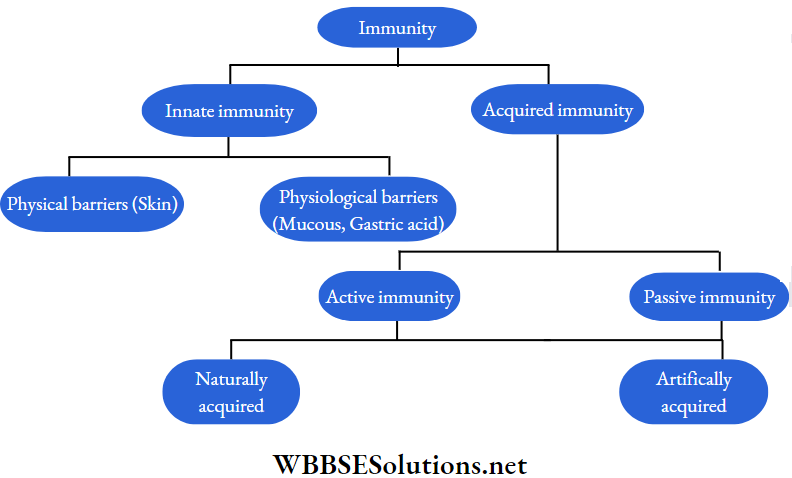
Immunity is of two types:

1 Innate or natural or non-specific Immunity:

Innate immunity refers to non-specific defense mechanisms that come into play immediately or within hours of an antigen’s appearance in the body. It consists of various types of physical, and physiological barriers.

Example: The skin (the physical barrier) prevents entry of microorganisms; mucous membrane, and acid of the stomach (physiological barrier) kill most microorganisms.

2 Acquired immunity or adaptive or specific Immunity:

The immunity that an individual acquires after birth is called acquired immunity. It is specific and mediated by antibodies or lymphocytes or both which make the antigen harmless. It is of two types, active immunity, and passive immunity.

Read and Learn More Class 9 Life Science Long Answer Questions

1. Active Immunity: In this case, a person’s own cells produce antibodies in response to infection or vaccination. It is slow and takes time for the formation of antibodies. It is long-lasting and harmless.

Active immunity may be natural or artificial:

1. A person who has recovered from an attack of smallpox measles or mumps develops natural active immunity.
2. Artificial active immunity is the resistance induced by vaccines. Examples of vaccines are BCG vaccine, MMR vaccine, etc.

WBBSE Class 9 Life Science Chapter 4 Immunity And Human Diseases Long Answer Questions

WBBSE Class 9 Immunity Long Answer Questions

2. Passive Immunity:

When ready-made antibodies are directly injected into an individual against foreign agents, it is called passive immunity. It provides immediate relief but is not long-lasting.

It may be natural or artificial:

1. Natural passive immunity is the resistance passively transferred from the mother to the fetus through the placenta or through colostrum (a yellowish fluid secreted initial days of lactation).
2. Artificial passive immunity is the resistance passively transferred to a recipient by the administration of antibodies. For example, Anti-tetanus serum (ATS) is prepared in horses by active immunization of horses with tetanus toxoid, withdrawal of blood, and separation of the serum. ATS is used for passive immunization against tetanus.

WBBSE Solutions For Class 9 Life Science And Environment Chapter 4 Biology And Human Welfare Giology And Human Welfare immunity

WBBSE Life Science And Environment Class 9 Solutions

Question 2 Write the characteristics or features of the antigen. How do you recognize antigens? Or, State the properties of the antigen.

Answer:

Characteristics/features of antigen:

The features or characteristics of antigen are as follows:

Foreignness:

The immune system normally discriminates between self and non-self such that only foreign molecules are immunogenic. When an antigen is introduced into an organism, the degree of its immunogenicity depends on the degree of its foreignness.

2 Molecular size:

In general, the larger the molecule the more immunogenic it is likely to be. The best immunogens tend to have a molecular mass approaching 100,000 Da. The immunogens with lower efficiency generally have a molecular size between 5000-10000 Da.

3 Chemical composition:

They are structural proteins in nature. Sometimes it may be composed of polysaccharides, lipids, and nucleic acid.

4 Antigen binding site:

It has a specific region that interacts with antibody (Ab) which is known as an epitope.

Properties of antigen:

Antigens can be recognized by some of their properties.

The properties of antigens are:

1 Antigenicity: The ability to cause the production of antibodies.
2 Antigenic specificity: The ability to enter into an interaction with the corresponding antibodies.
3 Allergenicity: Having the capacity to induce allergy (hypersensitivity).
4 Immunogenicity: Property inducing a detectable immune response.

NEET Biology Class 9 Question And Answers WBBSE Class 9 History Notes WBBSE Solutions for Class 9 Life Science and Environment
WBBSE Class 9 Geography And Environment Notes WBBSE Class 9 History Multiple Choice Questions WBBSE Class 9 Life Science Long Answer Questions
WBBSE Solutions for Class 9 Geography And Environment WBBSE Class 9 History Long Answer Questions WBBSE Class 9 Life Science Multiple Choice Questions
WBBSE Class 9 Geography And Environment Multiple Choice Questions WBBSE Class 9 History Short Answer Questions WBBSE Solutions For Class 9 Maths
WBBSE Solutions for Class 9 History WBBSE Class 9 History Very Short Answer Questions


Question 3. Mention the characteristic features of antibodies. Briefly describe the structure of the most common antibody present in human plasma.

Answer:

Characteristics features of antibodies:

Characteristic features of antibodies are as follows:

1. Antibodies are glycoproteins commonly called immunoglobulins.
2. The molecular weight of an antibody ranges from 150000 to 950000 Da.
3. Antibodies are antigen-specific.

Structure of antibody:

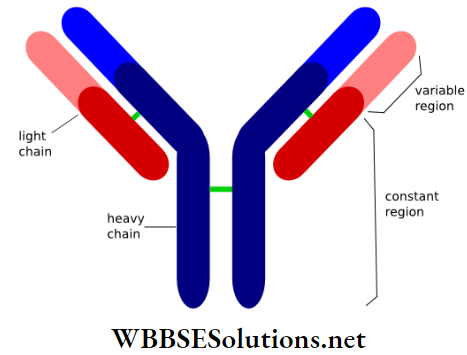
Immunoglobulin G or IgG is the most common antibody present in human plasma.

The structure of IgG is mentioned below:

1. The Immunoglobulin G molecule is a ‘Y-shaped structure.
2. Each molecule has a specific antigen-binding site, by which it attaches with a specific antigen to inactivate it.
3. The immunoglobulin molecule is composed of 4 polypeptide chains of which two are heavier and two others are lighter in weight. These chains remain attached to disulfide bonds.
4. The two forked arms are made up of one light and one heavy chain each. The stem arm of the IgG molecule is composed of two heavy chains.

WBBSE Solutions For Class 9 Life Science And Environment Chapter 4 Biology And Human Welfare structure of antibody

WBBSE Life Science And Environment Class 9 Solutions

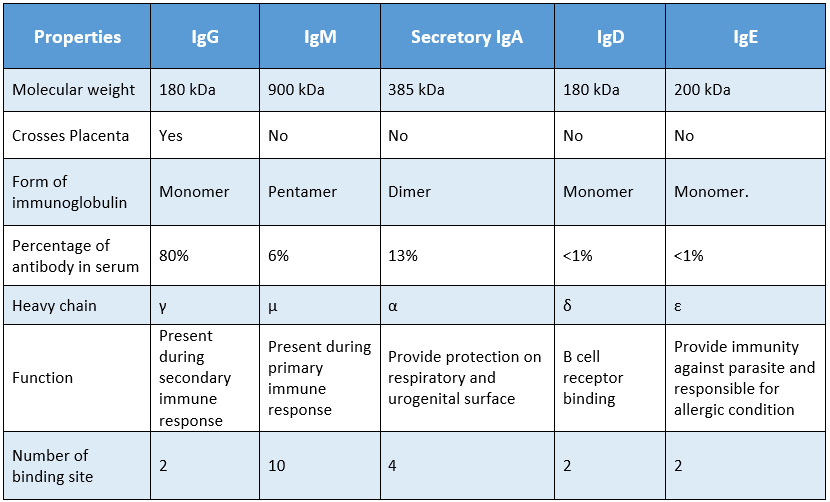
Question 4. Write a brief description of different types of immunoglobulins.

Answer:

Description of different types of immunoglobulins:

WBBSE Solutions For Class 9 Life Science And Environment Chapter 4 Biology And Human Welfare immunoglobulins

Practice Long Answer Questions on Immunity

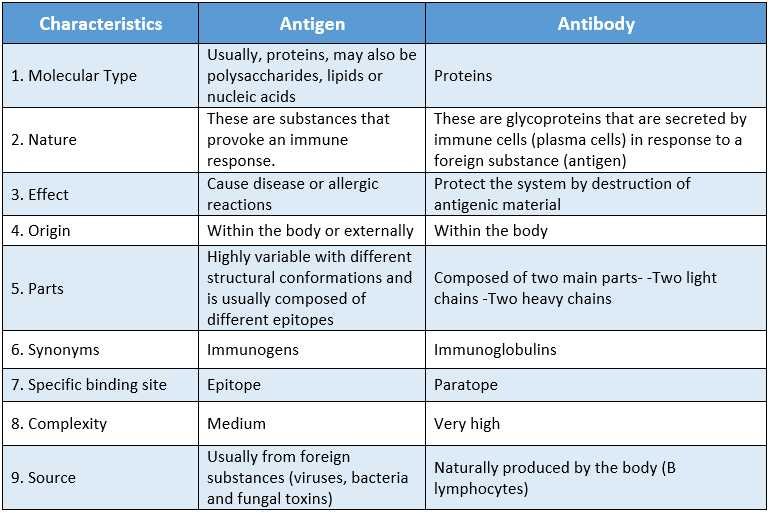
Question 5 Differentiate between antigen and antibody.

Answer:

Difference between antigen and antibody:

WBBSE Solutions For Class 9 Life Science And Environment Chapter 4 Biology And Human Welfare difference between antigen and antibody

WBBSE Life Science And Environment Class 9 Solutions

Question 6 What is humoral immunity? How does humoral immunity work?

Answer:

Humoral immunity:

The immune response, which involves the action of different B lymphocytes, like plasma cells, for producing antigen-specific antibodies and memory cells for neutralizing or eliminating toxins and pathogens in the blood and lymph is called humoral immunity.

Mechanism of humoral immunity:

Humoral immunity works for both primary and secondary immune responses. In primary response, B lymphocytes develop typical antibody-producing plasma cells. These cells produce antigen-specific antibodies. Antibodies work in the following four ways.

1 Agglutination:

By this process, antibodies agglutinate pathogens into clusters, which are then collectively phagocytized by macrophages.

2 Precipitation:

Some antigen molecules are clamped by antibodies and are precipitated.

3 Opsonisation:

Antibodies form a covering on the antigens so that the phagocytic cells can ingest packed antigens.

4 Neutralisation:

Certain toxic antigens are detoxified and inactivated by the antibodies. In secondary response memory, B cells play a major role. These cells are produced during a primary immune response and remain stored in the secondary lymphoid tissues for keeping the immunological behavior of the pathogen in memory of the body’s immune system. In case of another attack, these cells help in the quick activation of the body’s immune system.

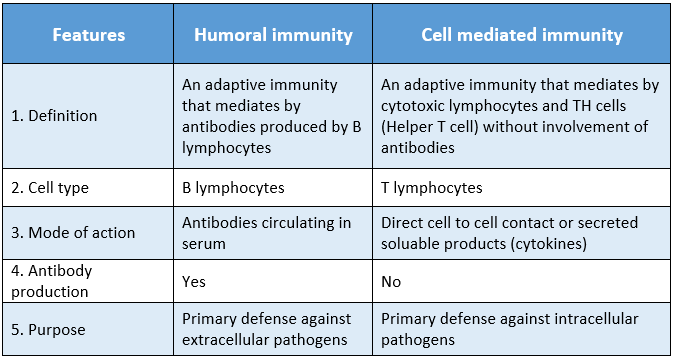
Question 7. Write the differences between humoral immunity and cell-mediated immunity.

Answer:

Difference between humoral and cell-mediated immunity:

WBBSE Solutions For Class 9 Life Science And Environment Chapter 4 Biology And Human Welfare features homaral and cell mediated immunity

Sample Long Answer Questions from WBBSE Class 9 Life Science

Question 8 Mention the roles of different T cells in the immune response. Mention the roles of different B cells in immune response.

Answer:

Roles of different T cells:

Different T cells or T lymphocytes play different roles in the immune response of the body.

They are as follows:

1. Cytotoxic T cells or T cells kill the infected cell, to destroy antigen-carrying pathogens within it.
2. Helper T cells or T cells enhance the activity of killer cells (a type of T cells), antibody-producing B cells, and phagocytic macrophages.
3. Suppressor T cells or T cells destroy T cells, TH cells, and B cells to stop immune response after the elimination of the antigens.

Roles of different B cells:

Different B cells or B lymphocytes play different roles in the immune response of the body.

They are as follows:

1. Plasma cells originated from B cells produce specific antibodies to inactivate antigens.
2. Memory B cells remain in lymph glands, keeping the nature of antigens in memory, and taking quick action in case of any further attack.

WBBSE Life Science And Environment Class 9 Solutions

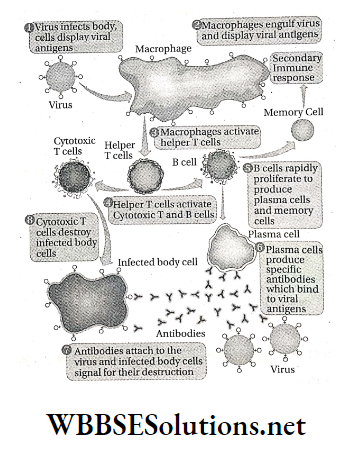
Question 9 Briefly describe the mechanism of the immune response against viral attack in the human body.

Answer:

Mechanism of the immune response against a viral attack:

The immune response is a complex process involving various cells and biochemical components inside the body.

The steps of the immune response against the viral antigen are as follows:

1. As any virus reaches the blood or attacks any body cells, large phagocytic macrophages engulf those infected cells. Soon viral antigens appear on the cell surface of macrophages.
2. High concentration of viral antigens on macrophage activates helper T lymphocytes in the blood.
3. Helper T cells immediately initiate the production of cytotoxic killer T cells, memory T cells, and B lymphocytes.
4. B lymphocytes proliferate very fast to produce plasma cells and memory B cells.
5. Plasma cells produce specific antibodies to bind and inactivate the virus before they get a chance to infect a cell.
6. Killer. T cells destroy the infected body cells along with viruses.
7. T and memory B cells stay in the body to recognize the same pathogen in case of further infection and to develop a quicker response.

WBBSE Solutions For Class 9 Life Science And Environment Chapter 4 Biology And Human Welfare immune response against a viral attack

Concepts Related to Immunology for Long Answers

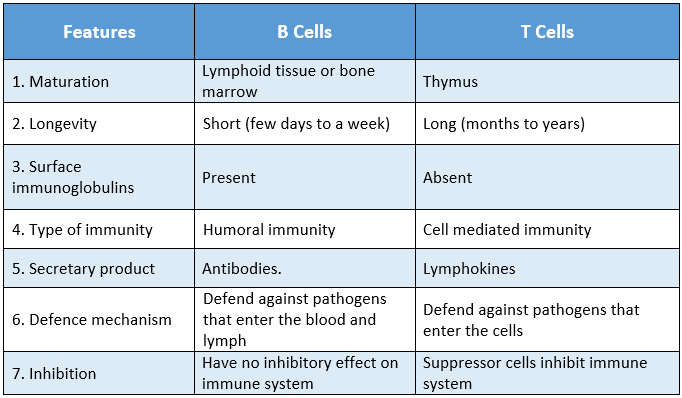
Question 10 Mention the differences between B cells and T cells.

Answer:

Differences between B cells and T cells:

WBBSE Solutions For Class 9 Life Science And Environment Chapter 4 Biology And Human Welfare differences between B cell and T cell

WBBSE Life Science And Environment Class 9 Solutions

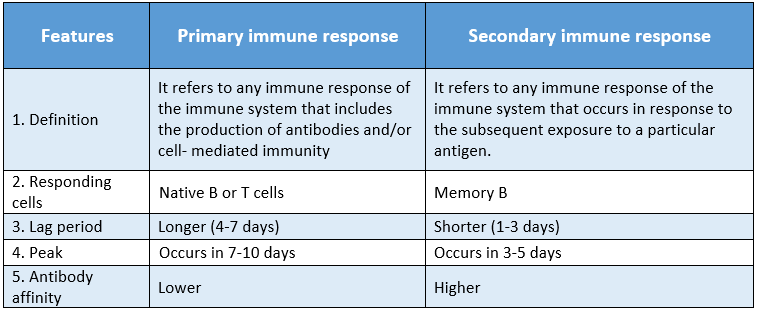
Question 11. Write the differences between primary immune response and secondary immune response.

Answer:

Difference between primary immune response and secondary immune response:

WBBSE Solutions For Class 9 Life Science And Environment Chapter 4 Biology And Human Welfare primary and secondary immune response

Question 12. Give a brief historical account of the discovery of the smallpox vaccine.

Answer:

Discovery of smallpox vaccine:

The scientific concept of vaccination was developed in the later half the of 18th century when a number of scientists and physicians were working hard to develop a vaccine against smallpox, the most deadly and contagious disease of that time.

Scientists noticed that most individuals, who once suffered from cowpox safely bypassed smallpox. But the search was on for long 25 years. Then Dr. Edward Jenner (1798) broke through the concept of vaccination.

He collected a little pus from a cowpox vesicle on the hand of Sarah Nelmes, a milkmaid, and introduced it into the arm of James Phipps, an eight year old boy. After two months, the boy was inoculated with the smallpox virus, but he did not develop the disease.

The modern concept of vaccination is standing in this story. After this discovery, the practice of vaccination took the correct route. After a long battle for about two centuries, smallpox has now been eradicated from the world.

Study Guide for Class 9 Life Science Immunity Questions

Question 13. What is a vaccine? Mention the basic working principles of vaccines to develop immunity in the body.

Answer:

Vaccine:

The vaccine is an antigenic material that is prepared with killed or weakened pathogens, part of pathogens, bacterial toxins, or microbial proteins, which do not cause illness but provide active acquired immunity against those pathogens when introduced into the body.

Working principle of vaccines:

By vaccination, a killed germ, attenuated (weakened) germ, toxoids (toxins collected from germs) or subunits (fragments of proteins from germs) are introduced into the body of an individual. These may be injected or administered orally.

As soon as the substance enters the body, antigens present in it, activate the immune system and initiate an immune response. T cells and B cells take a little time to inactivate such little quantity of antigens and this process is known as primary immune response.

However, in this case, the main function is done by memory B cells. These cells, produced during the immune response, are retained in lymph nodes such as the spleen, thymus, etc. for a long time.

In case of any future infection by the same germ, these memory cells recognize those antigens instantly and inactivate or destroy the attacker very fast. This process is recognized as a secondary immune response. Thus, a successful vaccination immunizes a person effectively.

WBBSE Class 9 Life Science Solutions

Question 14. Give a brief account of different types of vaccines.

Answer:

Types of vaccines:

With the development of science, new and advanced varieties of vaccines are being developed. Till date World Health Organization (WHO) has licensed vaccines for 25 diseases.

Different types of vaccines are:

1 Killed vaccine:

These vaccines contain killed pathogens. Vaccines of cholera, plague, and influenza are of this type.

2 Live attenuated vaccine:

By some laboratory techniques virulence of the pathogens are reduced to prepare this type of vaccines. Vaccines of mumps, measles, and rubella (MMR vaccine) are of this type.

3 Toxoid vaccine:

This type of vaccine is prepared by inactivated toxins from pathogens. Vaccines of tetanus and diphtheria are of this type.

4 Conjugate vaccine:

Generally, the polysaccharide of the bacterial capsule is attached to a protein to prepare this vaccine. The body’s immune system can recognize this conjugated protein and keep it in memory for future immune responses. Vaccine against Haemophilus influenza

5 Sub-unit vaccines:

This type of vaccine is prepared by small fragments of pathogenic protein. Vaccine against Hepatitis B is of this type.

6 Heterotypic vaccine:

This is prepared by pathogens, causing disease to other animals but less or non-virulent to humans. Vaccines of smallpox and tuberculosis are of this kind.

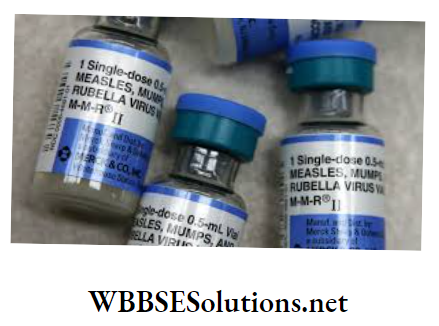
WBBSE Solutions For Class 9 Life Science And Environment Chapter 4 Biology And Human Welfare mmr vaccine

WBBSE Class 9 Life Science Solutions

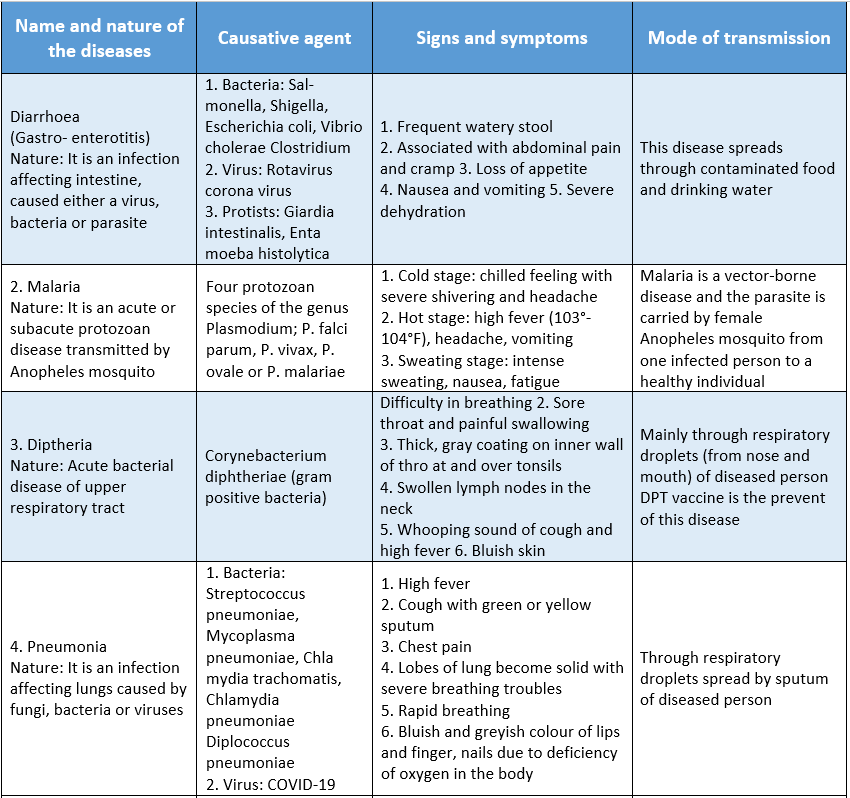
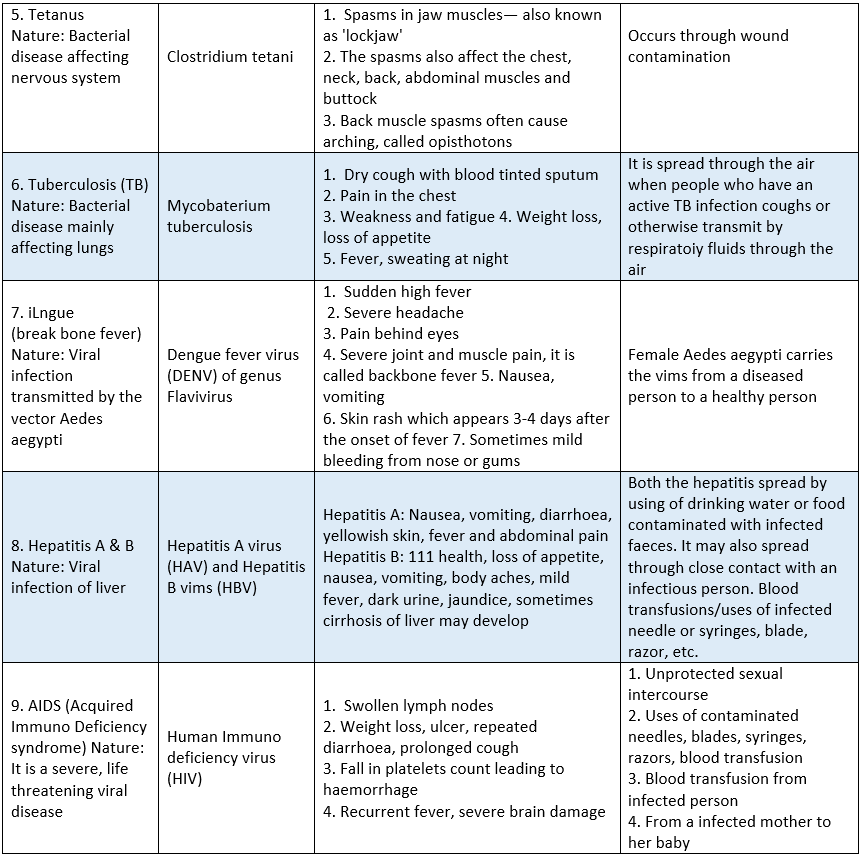
Question 15. Mention briefly about the nature, symptoms, and mode of transmission of some human diseases.

Answer:

Description of some human diseases:

WBBSE Solutions For Class 9 Life Science And Environment Chapter 4 Biology And Human Welfare description of human diseases

WBBSE Solutions For Class 9 Life Science And Environment Chapter 4 Biology And Human Welfare description of human diseases.

Question 16 Explain the importance of hand washing. Write the components use in washing.

Answer:

Importance of hand washing:

1 Reducing the number of infections:

Hand washing can prevent about 30% of diarrhea-related sicknesses and about 20% of respiratory infections (e.g. common cold, meningitis, flu, hepatitis A) and most types of infectious diseases.

2 Reducing child death:

About 1.8 million children under the age of 5 die every year from pneumonia and diarrhea-related diseases. Washing hands carefully and thoroughly can help children and childcare providers stay healthy.

3 To remove dirt:

Removing dirt through hand washing may even help prevent skin and eye infections.

Components used in washing:

1 Water:

Pure distilled water is the main component used in hand washing.

2 Soap and Detergent:

Water is not efficient for cleaning skin because fats and proteins which are components of organic oil are not readily dissolved in water. Removal of micro-organisms from the skin may be enhanced with the use of soaps and detergents.

3 Hand antiseptic:

Hand sanitizers containing a minimum of 60% to 70% alcohol are and efficient germ killer.

4 Shampoo:

Shampoos that contain selenium are effective in controlling dandruff. Dandruff is caused owing to fungal infection on the scalp.

5 Thimerosal:

An organic compound containing mercury can be used for disinfection of skin and instruments.

6 Wipes:

Hand washing with wipes is also recommended by CDC (Centers for Disease Control and Prevention). This washing is convenient during traveling when water and soap will not be available.

7 Toothpaste and mouthwash:

It is used in brushing teeth and washing mouth.

8 Disinfectant:

Phenyl, bleaching powder is applied in our surroundings to keep the environment clean.

WBBSE Class 9 Life Science Solutions

Question 17. Why and when should an individual wash their hands? Write down the proper method of washing hands.

Answer:

Reason of washing hands:

We take food with hand. We often touch our lips, face, and nose with our hands. By contaminated hands, germs or toxins may enter our body through the mouth, eyes, and nose. Therefore, one must wash the hands to stay healthy.

Time of washing hands:

Hands must be washed before:

1. Taking food
2. Cooking
3. Serving food
4. feeding and attending to a baby or a patient.

Proper washing of hands is a must after using the toilet, cleaning raw vegetables, fish, and meat, attending to a patient, sweeping and cleaning rooms and toilets, polishing shoes and tying shoe-laces, checking the air pressure of the cycle tire, coming home from outside, etc.

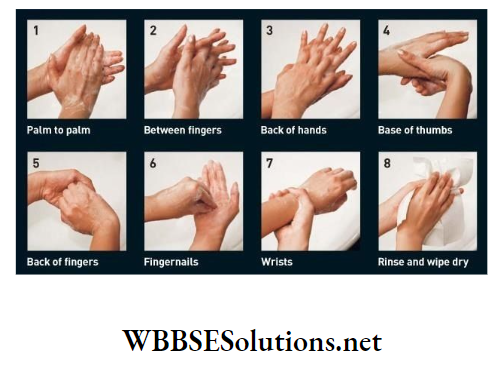
The proper method of washing hands:

The proper method of washing hands is mentioned below:

1. Wet your hands with clean water.
2. Take liquid hand-wash or soap in wet hands and rub it for one or two minutes to make rich foam.
3. Carefully rub in between all fingers.
4. Place the hands under running water and continue rubbing until the foam clears.
5. Close tap with a clean cloth and wipe the hand with a dry and clean towel.

WBBSE Solutions For Class 9 Life Science And Environment Chapter 4 Biology And Human Welfare proper hand washing

Question 18 Write a short note on the ‘WASH’ program of UNICEF. ‘WASH’ program of UNICEF

Answer:

The percentage of healthy children in a population is the index of development of a nation. But it is unfortunate that even in the 21st century, millions of children suffer from diarrhea and several other water-borne diseases.

This happens because of contaminated water, which occurs mostly due to a lack of proper sanitation. 44% of the global population defecates in open areas. Feces contain numerous germs, which easily contaminate water, especially during the rainy season.

In view of that, UNICEF (United Nations International Children’s Emergency Fund) has developed a global strategy to lift the standard of health of school children by providing them with adequate drinking water, infrastructure for proper sanitation, and a sense of hygiene.

This program is popularly known as ‘WASH’ (Water Sanitation Hygiene Programme). United Nations has set a goal for sustainable development of the standard of living of the world population in this millennium.

To reach the target, UNICEF has developed a strategy to maximize child survival rate by providing access to adequate drinking water, and sanitation facilities to schools all over the world along with education and nutrition.

WBBSE Class 9 Life Science Solutions

Question 19 Describe the WASH strategy taken by UNICEF to improve hygiene behavior among school children. How can the WASH program be made successful?

Answer:

WASH strategy to improve hygiene behavior among school children:

Schools are the places where a child spends most of the time of his or her life all through the development period. So UNICEF has developed the plan to make every school a child-friendly place.

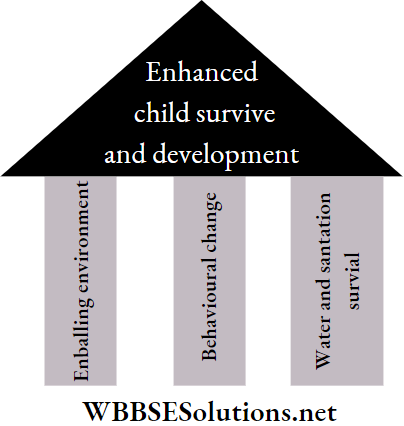
In view of that UNICEF has extended both monetary and strategic support to all developing countries of the world to develop infrastructure for child-friendly schools. The strategy to enhance child survival and development, UNICEF has encouraged a three-pillar approach.

The first is enabling a child-friendly environment in the school. Next is to improve hygiene behavior among the students and the third one is to build infrastructure for water supply and sanitation services.

WBBSE Solutions For Class 9 Life Science And Environment Chapter 4 Biology And Human Welfare three pillar approach of wash programme

Points to make WASH successful:

The points to make WASH successful are as follows:

1. Wash your hands with adequate water and soap before taking food and after using Three pillar approach of WASH toilets.
2. Always use sanitary toilets.
3. Clean raw fruits and vegetables before consuming.
4. Keep a close vigilance on drinking water sources to reduce contamination to zero.
5. Clean water storage containers every day.
6. Keep your domestic and school toilets clean.
7. Clip your nails regularly and do not let any filth to deposit under it.

Question 20. Mention different hygienic practices to secure the good health of a person as well as of society.

Answer:

Different types of hygienic practices:

The conditions or practices helpful to maintain health and to prevent diseases, especially through cleanliness are known as hygiene. Hygiene can be practiced in three different levels, i.e., personal, household, and social levels, which are mentioned below.

1 Personal level hygiene:

1. Cleaning hands before taking food, after using the toilet, and handling any unclean material.
2. Brushing teeth after taking a meal and before going to bed.
3. Taking a bath once or twice a day.
4. Trimming hair and clipping nails regularly.

2 Household level hygiene:

1. Washing and sun-drying clothing and bedding at regular intervals.
2. Cleaning utensils, kitchen equipment, raw vegetables, fish, and meat.
3. Cleaning toilets, basins, and sinks.
4. Cleaning and disinfecting water reservoirs.

3 Social level hygiene:

1. Cleaning of sewage system at regular intervals.
2. Maintaining general cleanliness in hospitals, educational institutions, marketplaces, railway stations, bus terminus, auditoriums, theaters, and other community places.
3. Regular cleaning and disinfecting of public toilets.

Chemical Bonding Class 11 Chemistry Short Answer Questions

Chemical Bonding And Molecular Structure Short Answer Type Questions

WBBSE Class 11 Short Answer Questions on Chemical Bonding

Question 1. Name the energy that is released during the formation of an ionic crystal.
Answer:

The energy that is released during the formation of an ionic crystal is 

“Lattice energy”

Question 2. Out of NaCI and MgO, which one has higher lattice energy?
Answer: MgO (each ion carries two unit charge).

Question 3. Elements belonging to which groups of the periodic table combine to form electrovalent compounds?
Answer: Highly electropositive metals of groups- 1 and 2 combine with the electronegative elements of groups- 15, and 16 and 7 to form electrovalent compounds.

Read and Learn More WBCHSE Class 11 Chemistry

Question 4. A+ and B2+ ions are isoelectronic, then which of the following information regarding their size is correct: 

  1. A+ > B2+ 
  2. A+ < B2+
  3. A+ = B2+

Answer: A+>B2+

Question 5. Arrange the following isoelectronic ions in increasing order of their ionic radii: X+, Y2+, A, and B2-.
Answer: Y2+ < X- < A- < B2-

Question 6. Designate the following changes as exothermic or endothermic:

  • A(g) A+(g) + e
  • B(g) + e→ B—(g)
  • X(s) → X(g)
  • A+(g) + B(g)→ AB

Answer: Endothermic; and exothermic.

Question 7. What is the coordination number of A+ and B ions if the geometry of the ionic crystal (AB) is cubic?
Answer: The coordination number of A+ and B ions will be 8

Question 8. Out of NaF, KCl, and MgO, which of the compounds exhibit isomorphism?
Answer: NaF and MgO are the two isomorphous compounds [Na (2,8), F (2,8); Mg2+ (2,8), O3 (2,8)]

Question 9. What is the geometry of the ionic crystal if the value of r+/r(radius ratio of the monovalent cation and anion) is in the range 0.225-0.414?
Answer: Tetrahedral

Question 10. Out of Sn2+ and Sn4+, which one is more stable?
Answer: Sn2+ ion is more stable due to the inert pair effect.

Question 11. The values dielectric constants of the solvents, A and B are x and y respectively. If \(\frac{1}{x}<\frac{1}{y}\), t lies in which solvent an ionic compound is more soluble?
Answer: if \(\frac{1}{x}<\frac{1}{y}\). Consequently, an ionic compound is more soluble in solvent A possessing a higher value of the dielectric constant.

Question 12. For the salt CaF2, ΔH°lattice > ΔH°hyd. Predict whether this salt is soluble in water or not.
Answer: CaF2 is insoluble in water.

Question 13. Which out of NaCl and CHC13 reacts with AgNO3 solution to give a precipitate of AgCl?
Answer:
NaCl (being an electrovalent compound, it gives Cl).

Chemical Bonding Class 11 Chemistry Short Answer Questions

Question 14. Which of the following are hypervalent compounds? CO2,CIF3, SO2, IF5.
Answer:
IF5 and ClF3 (the central atom has more than eight electrons in its valence shells)

Question 15. How many types of bonds are present in LiAlH4?
Answer:
3 types—electrovalent, covalent, and coordinate covalent bonds.

Question 16. Give examples of an anion and a cation which are isostructural with BF3 and CH4 respectively.
Answer:
NO-3 (trigonal planar) and NH+4 (tetrahedral).

Question 17. Arrange in order of decreasing size: sp, sp2, sp3
Answer:
sp3 > sp2 > sp.

Question 18. Give the hybridization of P in PCl5. Why are axial bonds longer as compared to equatorial bonds?
Answer:
sp3d. This is due to greater repulsion on the axial bond pairs by the equatorial bond pairs.

Question 19. Mention the change in hybridization (if any) of the Al -atom in the reaction: AlCl3 + Cl-> AlCl4.
Answer:
In AICI3, Al-atom is sp3 – hybridised, but in AlCl3, Al- atom is sp3,-hybridized.

Question 20. Is there any change in his hybridization of II and N atoms as a result of the following reaction?
\(\mathrm{BF}_3+\mathrm{NH}_3 \rightarrow \mathrm{F}_3 \mathrm{~B} \cdot \mathrm{NH}_3\)
Answer:
In the BF3 molecule, the B -atom is sp2 -hybridized, and In the Nil, molecule, the N -atom Is sp3 -hybridized. In the product molecule, both B and N atoms are sp3-hybridized.

Class 11 Physics Class 12 Maths Class 11 Chemistry
NEET Foundation Class 12 Physics NEET Physics

Question 21. Although the O-atoms In water and diethyl ether are sp3 -hybridized, the H —O —H and Et —O —Et bond angles arc different —why?
Answer:
Because of steric hindrance between two relatively bulkier C2H5 groups, the Et—O—Et bond angle is greater than the H—O—H bond angle.

Question 22. Draw the resonance structures of N2O obeying the octet rule
Answer:
\(: \ddot{\mathrm{N}}=\stackrel{+}{\mathrm{N}}=\ddot{\mathrm{O}}: \longleftrightarrow: \mathrm{N} \equiv \stackrel{+}{\mathrm{N}}-\ddot{\mathrm{O}}:\)

Question 23. Which Of the following hybrid orbitals possess two types of angles?

  • sp3,
  • sp2,
  • sp,
  • sp3d,
  • sp3d2,
  • sp3d3

Answer: sp3d and sp3d3

Question 24. Which of the following arcs isostructural?
\(\text { (2) } \mathrm{SO}_4^{2-}, \text { (2) } \mathrm{NO}_3^{-}, \text {(3) } \mathrm{NH}_4^{+}, \text {(4) } \mathrm{CO}_3^{2-} \text {, (5) } \mathrm{PO}_4^{3-}\)
Answer: BF3, NO3¯, and CO3²¯ are isostructural (trigonal planar and all the central atoms are sp² -hybridized) and SO32-, NH+4, and PO4-3 are isostructural (tetrahedral and all the central atoms are sp³ -hybridized).

Question 25. Give an example of an anion that is Isostructural with BF3.
Answer: [BeF]3

Question 26. Out of SF6 and SCI2, S has higher electronegativity in which of the compounds and why?
Answer: The electronegativity of S in SF6 is higher because SF6 S has a higher oxidation state.

Question 27. Arrange in the order of increasing ionic character C—H, F—H, Br—II, Na—I, K—F, and Li—Cl
Answer: C—H < Br—H < F—H < Li —Cl < Na —I < K—F

Question 28. What is of a molecule, AB2 if it has a definite dipole moment?
Answer: \(\left(_B \backslash {A}\backslash_B\right)\).

Question 29. The dipole moment of HF is 2.0 D. Calculate its value in coulomb-metre (c.m)
Answer: 0.6674 x 10⁻²⁹ c.m.

Question 30. N2O is polar even though it is linear- why?
Answer:

N2O is polar even though it is linear

The linear molecule N2O is polar asitisnot symmetrical.

Question 31. Arrange halobenzenes (C6Hg—X, X = F, Cl, Br, I) in the order of their increasing polarity.
Answer: C6H5F < C6H5Cl < C6H5Br < C6H5l.

Question 32. The dipole moment of a molecule, u = e x d. What is the value of d in the case of CCl4?
Answer: The resultant bond moment of the 2C—Cl bond is equal and opposite to that of the remaining 2C—Cl bonds. Hence there is no net dipole moment and so the value of u is zero.

Understanding Ionic Bonds: Short Answer Questions

Question 33. Arrange the following in the order of decreasing strengths: N —H–N, O —H—O, F—H—F.
Answer: F —H…F > O —H…O > N —H—N.

Question 34. Arrange the following interactions in the order of their increasing strengths: covalent bond, H- bonding, dipole-dipole interaction, and ran der Waals forces.
Answer: Wander Waals forces < dipole-dipole interaction < hydrogen bonding < covalent bond.

Question 35. Which of the following combinations of orbitals produce n -n-molecular orbitals?

  • 2pz– 2pz
  • 2ps + 2pz
  • 2z + 2pz
  • 2py + 2py

Answer: 2px– 2pX;2px + 2py

Question 36. What is the change in bond order, if an electron is added to a bonding MO?
Answer: Bond order increases with the addition of an electron to a bonding molecular orbital.

Question 37. According to MO theory which of the following combinations between the orbitals are not possible?

  • 2Pz > 2Pz
  • 2s > 2Py
  • ls, 2s
  • 2Px, 2Px

Answer: 2s > 2Py ;1s,2s

Question 38. Out of O and O2, which one has a greater ionization enthalpy and why?
Answer: O has greater ionization enthalpy. In O2, the first electron has to be removed from the π2px orbital, which has higher energy than the 2p -orbital of the O-atom.

Question 39. Sodium chloride is a solid with having high melting point but carbon tetrachloride is a liquid—why?
Answer:

Sodium chloride is a solid with having high melting point but carbon tetrachloride is a liquid

NaCl is an ionic compound. In the crystal of NaCl, the oppositely charged Na+ and Cl are held together by strong electrostatic forces of attraction. Hence a large amount of energy is required to bring the ions into the liquid state.

Hence, sodium chloride is a solid with having high melting point. Carbon tetrachloride (CCl4), on the other hand, consists of non-polar covalent molecules and the only force that operates among the molecules is the weak van der Waals force.

So, the molecules are weakly held together. Hence, carbon tetrachloride has a very low melting point and it is liquid at ordinary temperature.

Question 40. Sodium chloride is soluble in water but insoluble in benzene or hexane. Explain the observation.
Answer:

Sodium chloride is soluble in water but insoluble in benzene or hexane

Sodium chloride is an ionic solid and water is a polar solvent. Water molecules attract Na+ and Cl ions by their negative and positive poles respectively. As a result, the ions get detached from the crystal lattice and undergo solvation with the evolution of solvation energy. In this case, since the solvation energy is greater than lattice t energy, NaCl dissolves in water.

On the other hand, benzene and hexane are non-polar organic solvents and they cannot solvate Na+ and Cl ions. Hence, sodium chloride is’ insoluble in benzene or hexane.

Question 41. Nitrogen produces only NCI3 but phosphorus produces both PCl3 and PCl6. Give reasons
Answer:

The valence shell electronic configurations of nitrogen and phosphorus are as follows:

Both nitrogen and phosphorus contain 3 unpaired electrons in their valence shells. Using these unpaired electrons, they can form three covalent bonds with chlorine. In this way, NCl3 and PCl3 are produced.

Due to the presence of a vacant 3d -orbital in phosphorus, one 3selectron can be promoted to 3d -orbital and the five unpaired electrons thus obtained can form five covalent bonds with five chlorine atoms to produce PCl5. On the other hand, nitrogen has no d -d-orbital in its second shell. Unlike phosphorus, it cannot extend its covalency to five and hence, it cannot produce NCl5.

Question 42. Aqueous solution of hydrogen chloride is strongly acidic but the solution of hydrogen chloride in benzene is not at all acidic —why?
Answer:

Aqueous solution of hydrogen chloride is strongly acidic but the solution of hydrogen chloride in benzene is not at all acidic

Polar H —Cl molecules undergo complete ionization in water and produce H+ ions. Hence, aqueous solution of HCl becomes strongly acidic. On the other hand, HCl molecules do not undergo ionization in non-polar benzene. Because of this, HCl in benzene is not at all acidic.

⇒ \(\mathrm{H}_2 \ddot{\mathrm{O}}: \stackrel{\delta+}{+}+\overbrace{\mathrm{H}}^{\delta-} \mathrm{Cl} \longrightarrow \mathrm{H}_3 \mathrm{O}^{+}(a q)+\mathrm{Cl}^{-}(a q)\)

Question 43. MgO has a higher lattice energy than NaF. Why?
Answer:

MgO has a higher lattice energy than NaF

The lattice energy of an anionic compound increases with an increase in charge of the ions and decreases with the sum of the ionic radii. The charges on the two ions in MgO (Mg2+ and O2 ions) are twice those on the two ions in NaF ( Na+ and F ions). The sum of ionic radii of Mg2+ and O2 — ions (0.64 A+1.40 A = 2.04 A) is less than that of Na+ and F ions (0.95A+ 1.36A = 2.31A). Therefore, MgO has a higher lattice energy than that of NaF.

Question 44. SnCl4 is a covalent compound whereas SnCl2 is an ionic compound —why
Answer:

SnCl4 is a covalent compound whereas SnCl2 is an ionic compound

According to Fajan’s rule, a cation having a small size and high charge exerts a large polarising effect on the neighboring anion resulting in the development of a considerable amount of covalent character in the compound.

Sn4+ ions having a high charge and small size compared to those of Sn2+ ions polarise Cl ion to a greater extent. Therefore, SnCl4 behaves as a covalent compound whereas SnCl2 is an ionic compound.

Question 45. The ionic radius of Na+ is less than the atomic radius of Na+ but the ionic radius of Cl— is greater than the atomic radius of Cl —why?
Answer:

The ionic radius of Na+ is less than the atomic radius of Na+ but the ionic radius of Cl— is greater than the atomic radius of Cl

The Na+ ion has 11 protons in its nucleus but it has 10 extranuclear electrons. Since the number of electrons is less than that of protons, these electrons are attracted by the nucleus to a greater extent. Hence, the ionic radius of Na+ is smaller than that of having the same number of protons (11) and electrons (11).

On the other hand, the Cl ion has 17 protons in its nucleus but has 18 extranuclear electrons. Since the number of protons is less than that of electrons, the electrons are not strongly attracted by the nucleus. To be relieved of the strain of the electron-electron repulsion, the electron cloud gets more diffused. Hence, the ionic radius of Clis greater than the atomic radius of Cl.

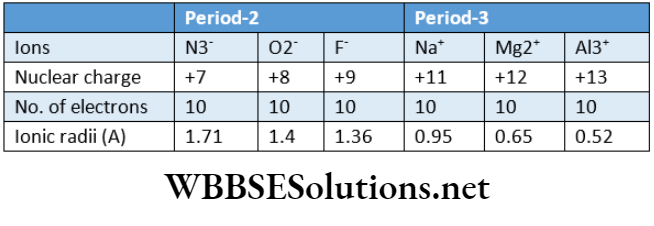
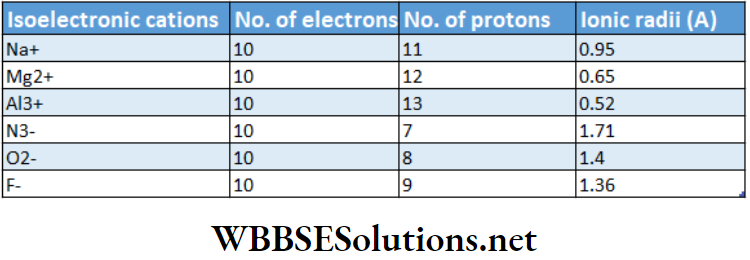
Question 46. Arrange Al3+, Na+, and Mg2+ ions in the decreasing order of their ionic radii and explain the order
Answer: The decreasing order of ionic radii of these three ions is: \(r_{\mathrm{Na}^{+}}>r_{\mathrm{Mg}^{2+}}>r_{\mathrm{Al}^{3+}}\) These three ions are isoelectronic and they contain 10 electrons each in their extra-nuclear shells.  Since the magnitude of nuclear charge gradually increases from Na to Al, the nuclear attractive force for the same number of electrons increases. As a result, their ionic radii gradually decrease.

Question 47. Arrange O2+, N3, and F ions in the decreasing order of their ionic radii and explain the order.
Answer: The ionic radii of these three ions decrease in the order:

⇒ \(r_{\mathrm{N}^{3-}}>r_{\mathrm{O}^{2-}}>r_{\mathrm{F}^{-}}\) ions 316 isoelectronic and they contain 10 electrons each in their extra-nuclear shells. As the number of protons goes on increasing from N3 to F ions, a nuclear attractive force for the same number of electrons gradually increases and as a consequence, their ionic radii gradually decrease i.e., their ionic radii follow the above sequence.

Question 48. Explain the following order of thermal stability of the carbonates of the alkaline earth metals: \(\mathrm{BaCO}_3>\mathrm{SrCO}_3>\mathrm{CaCO}_3>\mathrm{MgCO}_3\)

Answer: As the ionic potential of the metal ion increases, its attraction for the electron of the O-atom of CO ion increases. As a consequence, the tendency of thermal decomposition of the metal carbonate (MCO) to produce metal oxide (MO3) and carbon dioxide (CO2) increases. As the ionic potential increases progressively from Ba2+ to Mg2+, the thermal stability of the carbonates follows the given order.

Covalent Bonds Explained: Short Answer Format

Question 49. HCl is volatile but NaCl is not. Explain.
Answer:

HCl is volatile but NaCl is not

The volatility compound depends on its boiling point which in turn depends on the intermolecular attractive forces. The only attractive force that operates among the polar covalent HCl molecules is dipole-dipole attraction.

Since this attractive force is relatively weak, the boiling point of HO is low and it is volatile (at ordinary temperature, it is a gas). On the other hand, in the electrovalent compound NaCl, the oppositely charged Naÿ and Clions are held together by strong electrostatic forces of attraction in the crystal lattice, and because of this, at ordinary temperature, NaO is a non-volatile solid.

Question 50. What type of bond is formed between two elements, A and B if both of them are highly electronegative or they have huge differences in their electronegativities? Give examples.
Answer: If both the elements A and B are highly electronegative, the bond formed between them would be covalent For example, the bond between N and O in the NCl3 molecule is covalent However, if the elements differ widely in their electronegativities, the bond formed between them would be ionic. For example, in NaCl, the bond between Na and Cl isionic.

Question 51. Out of AlF3 and AICl3, which one is more covalent and why?
Answer: The electron cloud of a large anion is easily distorted by small cations and this results in greater covalency in the compound. The larger Cl ion is polarised to a greater extent than the smaller F ion and because of this AICl3 is more covalently natural than AlF3.

Question 52. Indicate the nature of chemical bonding present in each of the following compounds:

  • CH3OH,
  • NH3
  • CaC12
  • CaH2
  • K2O
  • CO2
  • Al2O2
  • NH4Cl
  • HCl
  • Mg3N2
  • Ci2O
  • NaBH4

Answer:

  • Covalent,
  • Covalent,
  • Electrovalent
  • Electrovnt lent,
  • Electrovalent
  • Covalent,
  • Electrovalont, electrovalent.
  • Covalent and co-ordinate covalent, covalent.
  • Electrovalent,
  • Covalent,
  • Electrovalent
  • Colvent and coordinate covalent.

Question 53. Which one between p and sp –orbitals have more directional characteristics and why?
Answer: The directional nature of the sp-orbital is greater than that of the orbital. Because the two lobes of p -p-orbitals are similar in size and possess the same electron density while one of the two lobes of sp -orbitals is larger and has higher electron density

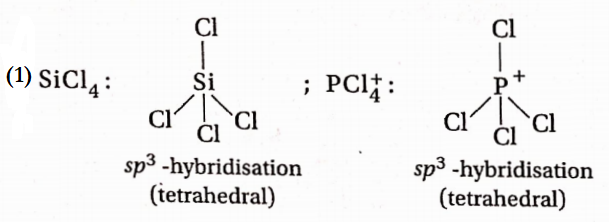
Question 54. In a certainpolar solvent, PCI- undergoes ionization as follows \(2 \mathrm{PCl}_5 \rightleftharpoons \mathrm{PCl}_4^{+}+\mathrm{PCl}_6^{-}\) Predict geometrical shapes of all the species involved.
Answer: The geometrical shapes of the molecules or ions can be predicted from the hybridization state of the central atom.

⇒ \(\text { For } \mathbf{P C l}_5: H=\frac{1}{2}[5+5-0+0]=\frac{10}{2}=5\)

Therefore, the central P-atom is sp3d-hybridized. Consequently, the molecule is a trigonal bipyramidal shape.

⇒ \(\text { For } \mathbf{P C l}_4^{+}: H=\frac{1}{2}[5+4-1+0]=\frac{8}{2}=4 \text {. }\)

Therefore, the central P-atom is sp3 -hybridized. Consequently, the geometrical shape of this ion is tetrahedral.

⇒ \(\text { For } \mathbf{P C l}_6^{-}: H=\frac{1}{2}[5+6-0+1]=\frac{12}{2}=6 \text {. }\)

Therefore, the central P-atom is sp3d2 hybridized. Consequently, the geometrical shape of the ion is octahedral.

Question 55. MgCl2 is linear but SnCl2 is angular—explain
Answer:

MgCl2 is linear but SnCl2 is angular

For \(H=\frac{1}{2}[2+2-0+0]=\frac{4}{2}=2,\) i.e.,, the central Mg -atom is sp -hybridised. Therefore, the molecule is linear. On the other hand, for SnCl2,\(H=\frac{1}{2}[4+2-0+0]=\frac{6}{2}=3,\) i.e. the central Sn-atom is sp2 -hybridised. Therefore, the two bond pairs and one lone pair present in the molecule are directed toward the comers of an equilateral triangle. Hence, the SnCl2 molecule is angular.

Question 56. Arrange the following in the increasing order of their polarities and explain with reason: B — Cl, Ba — Cl, Br — Cl, Cl — Cl
Answer: The increasing order of polarity of these bonds is: Cl — Cl<Cl — Br < Cl — B < Cl — Ba. The greater the difference in electronegativity between the covalently bonded atoms, the greater the polarity of the bond. The electronegativities of B, Ba, Br, and Cl follow the order: of Cl > Br > B > Ba. Consequently, the polarity of the bonds formed by these atoms with Cl-atom progressively increases.

Common Questions on Chemical Bonding for Class 11

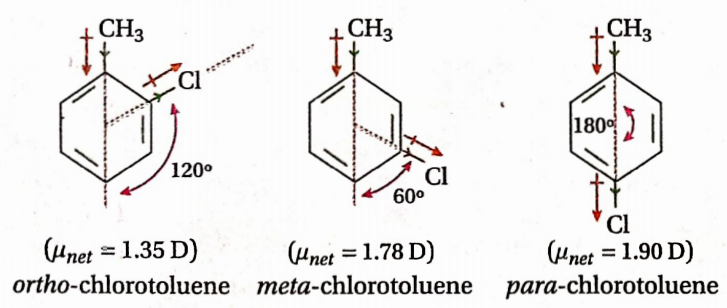
Question 57. Identify the three isomeric chlorotoluenes having dipole moments: 1.35D, 1.9D, and 1.78D.
Answer: Methyl group ( —CH3) can exert a +1 effect while Cl-atom exerts a -I effect. In p-chlorotoluene, -CH3 and -Cl group moments act linearly. So its dipole moment is equal to the sum of the two group moments. Hence, the dipole moment of this compound is maximum. -CH3 group moment is considered to act in the direction of the ring. Soin m-chlorotoluene, these two group moments act at an angle of 60°.

Hence, the dipole moment of m-chlorotoluene is somewhat less than that of its p-isomer. In o-chlorotoluene, these two group moments act at an angle of 120° and hence the dipole moment of this isomer is less than that of the m-isomer. Thus, dipole moments of 1.35D, 1.78D and 1.90D correspond to o-, m- and p-chlorotoluenes.
Chemical Bonding And Molecular Structure Methyl Group

Question 58. Which has the least dipole moment— 1-butene, cis- 2-butene, draws-2-butene and 2-methylpropene?
Answer: The structure of the given compounds is as follows
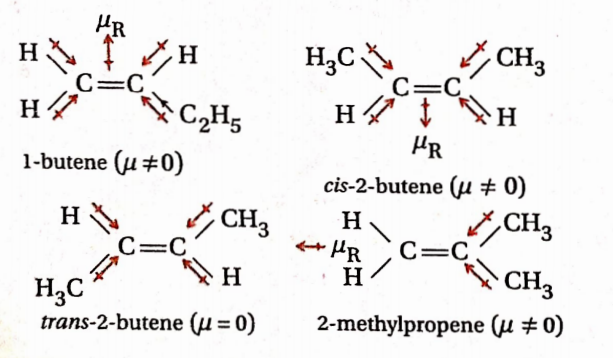
Chemical Bonding And Molecular Structure Trans2Butene

Question 59. What do you mean by hydrogen bond donor and hydrogen bond acceptor? Define protic and aprotic solvents. Give examples.
Answer:

Hydrogen bond donor and hydrogen bond acceptor

H-bonding represented as X—H—Y denotes the interaction between a donor species and an acceptor species. X—H is considered as a donor and Y is an acceptor of H.
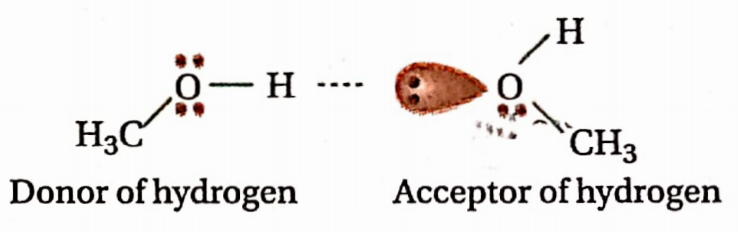
Chemical Bonding And Molecular Structure H Bonding Represtend As X,H,Y

Protic solvent: The solvent whose molecules can act as hydrogen-bond donors are called protic solvents. Water (H2O), ethanol (G2H5OH), acetic acid (CH3COOH), etc., are some common examples ofprotic solvents.

Aprotic solvent: The solvent whose molecules can’t act as a bond donor is known as aprotic solvent. Diethyl ether (C2H5OC2H5), methylene chloride (CH2C12), hexane [CH3(CH2)4CH3], etc., are some examples of aprotic solvents.

Question 60. The boiling point of water (100°C) is much higher than that of HF(19.5°C), even though they have similar molecular masses. Explain.
Answer:

The boiling point of water (100°C) is much higher than that of HF(19.5°C), even though they have similar molecular masses.

Each water molecule is involved in intermolecular H -bonding with four other water molecules but each HF molecule is involved in intermolecular H -bonding with two other HF molecules.

Therefore, the degree of molecular association in water is much higher than that in HF. Therefore, the boiling point of water is much higher than that of HF.
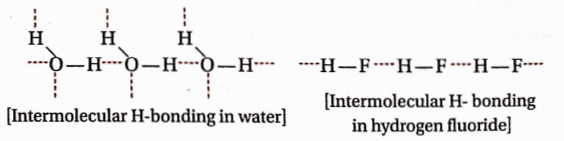
Chemical Bonding And Molecular Structure Intermolecular H-Bonding In Water

Question 61. Explain the following observations: Glycerol [HOCH2CH(OH)CH2OH] is a highly viscous liquid. When 30 mL of water is added to 30 mL of ethanol, the volume of the mixture becomes less than 60 ml.
Answer: A glycerol molecule contains three —OH groups. Hence glycerol molecules remain extensively associated through intermolecular H-bonding. This accounts for the high viscosity of glycerol.

The intermolecular H-bonding formed between ethanol and water is stronger than that formed in ethanol itself. When water is added to ethanol, the stronger intermolecular H-bonding between ethanol and water leads to a contraction of volume. So, when 30 mL of water is added to 30 mL of ethanol, the volume of the mixture becomes less than 60 mL.

Question 62. Arrange water, methanol, and dimethyl ether in increasing order of their viscosity and give reasons in favor of that order.
Answer: The greater the extent of intermolecular H-bonding, the greater the intermolecular attraction among different layers, and hence, the greater the viscosity of the compound.

Water molecules having two -OH groups have greater intermolecularH-bonding than methanol (CH3OH) molecules having only one -OH group. Dimethyl ether (CH3OCH3) having no -OH group does not remain associated through H-bonding. Therefore, the viscosity of these liquids follows the order: of dimethyl ether < methanol < water.

Question 63. At equilibrium, acetylacetone (CH3COCH2COCH3) exists mainly (80%) in enol form— explain.
Answer:

At equilibrium, acetylacetone (CH3COCH2COCH3) exists mainly (80%) in enol form

The enol-form of acetylacetone is stabilized by resonance. Besides this, its stability is further increased by strong intramolecular bonding. Similar stability in the case of keto form is not possible. Hence, at equilibrium, acetylacetone exists mainly in the enol form.
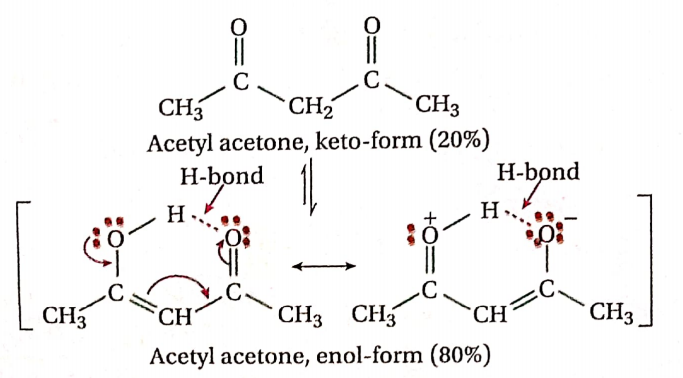
Chemical Bonding And Molecular Structure Intermolecular Enol form of acetyl acetone

Question 64. State the useful rule related to the solubility of a compound. Unlike ethane, ethanol dissolves in water. Explain and discuss in terms of energy change.
Answer: The useful rule relevant to the solubility of a compound is “like dissolves like” which means a polar solute dissolves in a polar solvent & a non-polar solute dissolves in a non-polar solvent Ethanol molecules get involved in intermolecular Hbonding with water molecules. So, ethanol readily dissolves in water.

On the other hand, non-polar ethane (CH3CH3) molecules are not capable of forming H -bonds with water molecules so ethane does not dissolve in water. Alternatively, it can be said that H-bonds between different ethanol and different water molecules are replaced by very similar H-bonds (in terms of energy) between water and ethanol molecules.

So, the dissolution of ethanol in water takes place readily. Since non-polar ethane molecules are not solvated by polar water molecules, no solvation energy is liberated. Thus, the energy required to separate the water molecules (associated with strong H -bonding) is not available, and so stronger H -bonds are not replaced by any other intermolecular forces. Hence, ethane does not dissolve in water.

Short Answer Questions on Types of Chemical Bonds

Question 65. Inert gases do not generally participate in chemical reactions—explain with reason.
Answer:

Inert gases do not generally participate in chemical reactions

Because of the very stable electronic configuration of the outermost shell, inert gases tend to exhibit the least chemical reactivity. The two possible reasons that can explain the stable electronic configuration, as well as the poor reactivity of inert gases, are as follows:

Since there are no odd electrons in the valence shell of inert gases, they have the least tendency to form a covalent bond by forming an electron pair i.e., they produce no covalent compounds.

Since the s-and p -p-orbitals of the valence shell are filled with electrons, the ionization enthalpy of inert gases is very high while their electron gain enthalpy is negligibly small. Hence, they exhibit the least tendency to form ionic compounds.

Question 66. The bond dissociation enthalpy of N2 is higher than that of N2 but the bond dissociation enthalpy of is higher than that of O2. Explain.
Answer:

The bond dissociation enthalpy of N2 is higher than that of N2 but the bond dissociation enthalpy of is higher than that of O2.

⇒ \(\begin{aligned}
& \mathrm{N}_2: K K\left(\sigma_{2 s}\right)^2\left(\sigma_{2 s}^*\right)^2\left(\pi_{2 p_x}\right)^2\left(\pi_{2 p_y}\right)^2\left(\sigma_{2 p_z}\right)^2 \\
& \mathrm{~N}_2^{+}: K K\left(\sigma_{2 s}\right)^2\left(\sigma_{2 s}^*\right)^2\left(\pi_{2 p_x}\right)^2\left(\pi_{2 p_y}\right)^2\left(\sigma_{2 p_z}\right)^1 \\
& \mathrm{O}_2: K K\left(\sigma_{2 s}\right)^2\left(\sigma_{2 s}^*\right)^2\left(\sigma_{2 p_z}\right)^2\left(\pi_{2 p_x}\right)^2\left(\pi_{2 p_y}\right)^2\left(\pi_{2 p_x}^*\right)^1\left(\pi_{2 p_y}^*\right)^1 \\
& \mathrm{O}_2^{+}: K K\left(\sigma_{2 s}\right)^2\left(\sigma_{2 s}^*\right)^2\left(\sigma_{2 p_z}\right)^2\left(\pi_{2 p_x}\right)^2\left(\pi_{2 p_y}\right)^2\left(\pi_{2 p_x}^*\right)^1
\end{aligned}\)

⇒ \(\begin{array}{|c|c|c|c|c|}
\hline \text { B.O. } & \mathbf{N}_2 & \mathbf{N}_2^{+} & \mathbf{O}_2 & \mathbf{O}_2^{+} \\
\hline \frac{\boldsymbol{N}_b-\boldsymbol{N}_a}{2} & \frac{8-2}{2}=3 & \frac{7-2}{2}=2.5 & \frac{8-4}{2}=2 & \frac{8-3}{2}=2.5 \\
\hline
\end{array}\)

The greater the value of bond order, the higher will be the value of bond dissociation enthalpy. Hence, the bond dissociation enthalpy of N is higher than that of N2 but the die bond dissociation enthalpy of O2 is lower than that of O2.

Question 67. Arrange the following species in order of their increasing bond lengths and explain: C2, C2, and C2-2.
Answer:

⇒ \(\begin{aligned}
& \mathrm{C}_2: K K^*\left(\sigma_{2 s}\right)^2\left(\sigma_{2 s}^*\right)^2\left(\pi_{2 p_x}\right)^2\left(\pi_{2 p_y}\right)^2, \\
& \mathrm{C}_2^{-}: K K\left(\sigma_{2 s}\right)^2\left(\sigma_{2 s}^*\right)^2\left(\pi_{2 p_x}\right)^2\left(\pi_{2 p_y}\right)^2\left(\sigma_{2 p_z}\right)^1 \\
& \mathrm{C}_2^{2-}: K K\left(\sigma_{2 s}\right)^2\left(\sigma_{2 s}^*\right)^2\left(\pi_{2 p_x}\right)^2\left(\pi_{2 p_y}\right)^2\left(\sigma_{2 p_z}\right)^2
\end{aligned}\)

⇒ \(\begin{array}{|c|c|c|c|}
\hline \text { B.0. } & \mathrm{C}_2 & \mathrm{C}_2^{-} & \mathrm{C}_2^{2-} \\
\hline \frac{N_b-N_a}{2} & \frac{6-2}{2}=2 & \frac{7-2}{2}=2.5 & \frac{8-2}{2}=3 \\
\hline
\end{array}\)

Since bond length is inversely proportional to bond order, the increasing sequence of bond length of the given species: C2 < C2 < C2

Question 68. Explain the following order of bond dissociation enthalpies: F—F < Cl—Cl < 0=0 < N = N
Answer: Since the size of the F -atom is smaller than that of the Cl -atom, the F—F bond length is less than the Cl—Cl bond length. Therefore, the die F —F bond dissociation enthalpy is expected to be higher than the Cl—Cl bond dissociation enthalpy. But actually, the reverse is true. In the F2 molecule, each F -atom contains three lone pairs of electrons. Because of their proximity, diese unshared electron pairs exert strong repulsive forces towards each other.

Similar forces of repulsion caused by the same number of lone pairs are much less in the case of Cl2 because of the larger size of Cl. So despite the smaller bond length, the die bond dissociation enthalpy of the F —F bond is less than the Cl—Cl bond dissociation enthalpy.

In the O2 molecule, the two 0 -atoms are attached by a double bond. Due to the presence of two unshared pairs of electrons in each 0- atom, the force of repulsion is relatively lower. So, 0=0 bond dissociation enthalpy is higher than the Cl —Cl bond dissociation enthalpy.

In an N2 molecule, the two N -atoms are linked together by a triple bond. Each N -atom contains only one unshared electron pair which causes minimum force of repulsion. Thus, the bond dissociation enthalpy of the N = N bond is the highest. Hence, the bond dissociation enthalpies of the bonds present in die given molecules follow’ the given sequence.

Question 69. Determine the shapes of the given molecules or ions:
\(\text {(1) } \mathrm{POCl}_3\left(2) \mathrm{CH}_3^{-} \text {(3) } \mathrm{CH}_3 \text { (4) } \mathrm{PO}_4^{3-} 6 \text (5) \mathrm{~F}_2 \mathrm{O}\right.\)
Answer: The p-atom in POCl, molecule is attached to the 0-atom by a double bond and to three Cl -atoms by three single bonds. The number of electrons in the valence shell of P-atom = 5 + 2 + 1 + 1 + 1 = 10. Out of these 10 electrons or 5 electron pairs,1 electron pair is involved in the formation of the bond which has no role in determining the shape of the molecule. According to VSEPR theory, four electron pairs are oriented tetrahedrally, i.e., the shape of the molecule is tetrahedral.

C-atom in CH3 ion is bonded to three H-atoms by three single bonds. The number of electrons in the valence shell of C-atom = 4 + 3 + 1 (for the negative charge) = 8. Out of these 8 electrons or 4 electron pairs, there are three bond pairs and one lone pair. According to VSEPR theory, the ion is pyramidal.

C-atom in the CH3 ion is bonded to three H -atoms by three single bonds. Thus, the number of electrons present in the valence shell of C =4 + 3-1 (for the positive charge) = 6. Because of the presence of 6 electrons or 3 electron pairs, the ion is trigonal planar.

The central P-atom in PO- ion is bonded to three O-atoms by three single bonds and one O-atom by a coordinate covalent bond. Thus, the number of electrons present in the valence shell of P-atom = 5 + 3 + 0=8 or 4 electron pairs (three covalent cr bond pairs and one coordinate cr bond pair). According to VSEPR theory, the four electron pairs are oriented tetrahedrally, i.e., the ion is tetrahedral.

The central O -atom in the F2O molecule is bonded to two F -atoms by two single bonds. The number of electrons in the valence shell of O -atom =6+1 + 1 =8. Out of these 8 electrons or 4 electron pairs, two are bond pairs and two are lone pairs. According to VSEPR theory, the shape of the molecule is angular or V-shaped.

Question 70. The molecule of any compound composed of two dissimilar elements Is always polar—justify the statement.
Answer:

The molecule of any compound composed of two dissimilar elements Is always polar

The statement is not always true. A diatomic molecule (A-B) consisting of two dissimilar elements of different electronegativities is always polar because there is no possibility of cancellation of the bond moment HCl, HF, etc., are examples of such molecules.

A poly-atomic molecule with two dissimilar elements may or may not be polar. The polarity of such a molecule depend of such a molecule depends on its geometrical shapes If the molecule is linear having a structure like A—B—A (i.e., the individual bond moments cancel out each other), it is polar and if not, it is polar.

The linear CO2 molecule, for example, is nonpolar because the two equal and opposite C2O bond moments cancel out each other. However, the angular H2O molecule is polar because the two O—H bond moments do not cancel out each other and there exists a resultant moment.

Question 71. Explain the following observations:

  1. H+2ion is more stable than H2 ion even though the bond orders of both ions are the same.
  2. When a magnet is dipped in a jar containing liquid oxygen, some oxygen molecules cling to it.
  3. O2 is more paramagnetic than O2.
  4. The molecular ion, HeH- does not exist

Answer: The antibonding,\(\sigma_{1 s}^*\) molecular orbital of the H2 ion contains one electron but the antibonding crÿs molecular orbital of the H2 ion contains no electron. Therefore, H2 ion is more stable than H2 ion, even though their bond orders are the same.

The electronic configuration oxygen molecule (O2) shows the presence of two unpaired electrons. This suggests that the molecule is paramagnetic. Thus, when a bar magnet is dipped in a jar of liquid oxygen, some molecules cling to

The electronic configurations of O2 and O2 show that the former contains two unpaired electrons (one in each \(\pi_{2 p_x}^*\) and \(\pi_{2 p_y}^*\) while the latter contains one unpaired electron in 7r2p. Therefore, O2 is more paramagnetic than O+2.

Total number of electrons in HeH- = 2 (for He) + 1 (for H ) + 1 (for the negative charge) = 4. Its electronic configuration is \(\left(\sigma_{1 s}\right)^2\left(\sigma_{1 s}^*\right)^2\) while the latter contains one unpaired electron in \(\pi_{2 p_x}^*\) Therefore, 02 is more paramagnetic than O+2.

Total number of electrons in HeH- = 2 (for He) + 1 (for H ) + 1 (for the negative charge) = 4. Its electronic configuration is \(\left(\sigma_{1 s}\right)^2\left(\sigma_{1 s}^*\right)^2\) So, bond
order \(=\frac{2-2}{2}=0\). hence, he- does not exist.

Key Concepts of Chemical Bonding: Short Answer Questions

Question 72. Is it correct to say that bond order always increases with the loss of electrons? Explain your answer.
Answer: The statement is not always correct When an electron is expelled from a bonding MO, the bond order decreases, but when an electron is expelled from an antibonding MO, the bond order increases.

For example, loss of an electron from \(\mathrm{H}_2\left(\sigma_{1 s}\right)^2\left(\sigma_{1 s}^*\right)^0 \text { to from } \mathrm{H}_2^{+}\left(\sigma_{1 s}\right)^1\left(\sigma_{1 s}^*\right)^0\) results in decrease of bond order. However, loss of an electron from \(\mathrm{H}_2^{-}\left(\sigma_{1 s}\right)^2\left(\sigma_{1 s}^*\right)^1 \text { to form } \mathrm{H}_2\left(\sigma_{1 s}\right)^2\left(\sigma_{1 s}^*\right)^0\) results in increase of bond order. Bond order of \(H_2^{+}=\frac{1}{2}(1-0)=\frac{1}{2}\mathrm{H}_2=\frac{1}{2}(2-0)=1 ; \mathrm{H}_2^{-}=\frac{1}{2}(2-1)=\frac{1}{2} \text {. }\)

Question 73. Identify polar and non-polar molecules from the following: Cl2, CHCl3, NH3, and BCl3, The dipole moment of the NF-, molecule is less than that of the NH3 molecule. Explain.
Answer: Polar Molecules: CHCH3 NH3,Non-polar Molecules: Cl2, BCI3

Question 74. X is the central atom of the XO2 molecule. If the dipole moment of the molecule is zero, indicate the hybridization state of X.
Answer: \(s p[O=X=O]\)

Question 75. Arrange the following compounds in increasing order of boiling point: HF, H2O, NH3
Answer: \(\mathrm{NH}_3<\mathrm{HF}<\mathrm{H}_2 \mathrm{O}\)

Question 76. Arrange the following molecules in increasing order of the number of lone pairs of electrons. H2O, PCl3, H2O, BF3.
Answer: Considering the lone pair of the central atom: BF3(0/p) < PCl3(l/p) < H2O(2/p)

Considering the lone pairs of all the atoms present in the molecule:

⇒ \(\begin{aligned}
& \mathrm{H}_2 \mathrm{O}<\mathrm{BF}_3<\mathrm{PCl}_3 \\
& (2 l p) \quad(9 l p) \quad(10 l p)
\end{aligned}\)

Question 77. Mention the state of hybridization of the central atom of the following molecules/ions: CO2, PH4, ClO3, CS2 Or, Write the resonating structures of the ClO4 ion
Answer:

⇒ \(\begin{array}{|c|c|c|c|c|}
\hline \text { Molecule/Ion } & \mathrm{CO}_3^{2-} & \mathrm{PH}_4^{+} & \mathrm{ClO}_3^{-} & \mathrm{CS}_2 \\
\hline \begin{array}{c}
\text { Hybridisation of } \\
\text { central atom }
\end{array} & s p^2 & s p^3 & s p^3 & s p \\
\hline
\end{array}\)

Question 78. Mention the nature of bonding of the following molecules/ions: CaH2, BH4, Na2O2, SiH4
Answer:

⇒ \(\begin{array}{|c|c|c|c|c|}
\hline \begin{array}{c}
\text { Molecule/ } \\
\text { Ions }
\end{array} & \mathrm{CaH}_2 & \mathrm{BH}_4^{-} & \mathrm{Na}_2 \mathrm{O}_2 & \mathrm{SiH}_4 \\
\hline \begin{array}{c}
\text { Nature of } \\
\text { bonding }
\end{array} & \text { ionic } & \begin{array}{c}
\text { covalent and } \\
\text { coordinate }
\end{array} & \begin{array}{c}
\text { ionic } \\
\text { and } \\
\text { covalent }
\end{array} & \text { covalent } \\
\hline
\end{array}\)

Question 79. Between N2O2, and NO2 molecules, which one is more polar? Explain.
Answer:
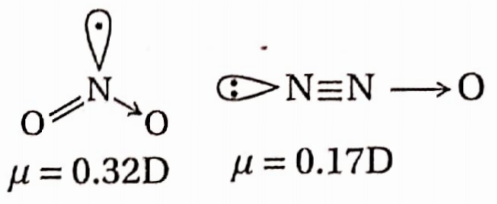
Chemical Bonding And Molecular Structure N2O Linear Molecule

N2O is a linear molecule. In this molecule the N bond moment and the moment due to the unshared electron pair act in opposite directions which decreases the dipole moment making the molecule less polar. However, the resulting dipole moment is large in NO2 due to its angular nature.

Question 80. Arrange the following ions in the increasing order of their ionic radii. F, Mg2+,Al3+, O2-
Answer: Al3+ < Mg2+ < F < O2-

Question 81. Arrange the following molecules in increasing order of their dipole moments: NH3, NF2, CBr4
Answer: CBr4<NF3<NH3

Question 82. How many (cr) and (a) bonds are present in buta-1,3- diyne?
Anwer: H—C=C—C=C—H <x -bonds: 5; n -bonds: 4 Buta-l,3-diyne

Question 83. What are the different types of bonds present in ammonium bromide molecules?
Answer: Ionic, covalent, and coordinate bonds.
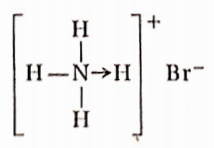
Chemical Bonding And Molecular Structure ionic covalent and coordinate bonds

Question 84. Draw the resonating structures of sulfate ion
Answer:
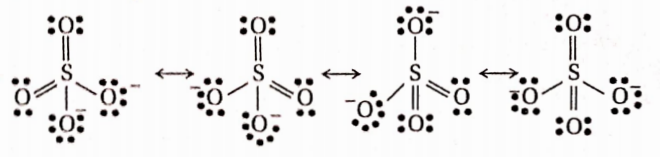
Chemical Bonding And Molecular Structure The resonating structures of sulphate ions

Practice Questions on Lewis Structures and Bonding

Question 85. Which of the H2O or H2S molecules has a greater bond angle? Explain. Between o-nitrophenol and p-nitrophenol, which one has a greater boiling point? Explain.
Answer: As the electronegativity O-atom is higher than S, the bond angle of H2O is larger than that of H2S.

Chemical Bonding And Molecular Structure The resonating structures of sulphate ions

Question 86. Which of the following is not paramagnetic—

  1. N2+
  2. Li2
  3. O2
  4. H2+

Answer: \(\mathrm{Li}_2:\left(\sigma_{1 s}\right)^2\left(\sigma_{1 s}^*\right)^2\left(\sigma_{2 s}\right)^2\)

Question 87. Which bond among the following is the least ionic—
Answer: In F—F, there is no electronegativity difference

Question 88. When hydrogen combines with oxygen, a polar covalent product is formed—explain. What types of bonds are present in KHF2
Answer: Hydrogen reacts with oxygen to form H2O as a covalent compound. Due to angular structure the resultant of the two O —H bond moments and the moment contributed by the lone pair act in the same direction. Hence, the H2O molecule is polar.

K+[F…..H —F]- Ionic, covalent and hydrogen bond.

Question 89. Write canonicals of ClO4 ion.
Answer:

Canonicals of ClO4 ion

⇒ \(\begin{aligned}
& \mathrm{H}_2:\left(\sigma_{1 s}\right)^2, \mathrm{~B} \cdot \mathrm{O}=\frac{1}{2}(2-0)=1 \\
& \mathrm{He}_2:\left(\sigma_{1 s}\right)^2\left(\sigma_{1 s}^*\right)^2, \mathrm{~B} \cdot \mathrm{O}=\frac{1}{2}(2-2)=0
\end{aligned}\)

As the bond order is zero, the He2 molecule has no existence.

Question 90. In which of the following conversions there are changes of hybridization and shape
Answer: BF3 molecule exhibits trigonal planar geometry with each F—B—F bond angle 120°. B-atom is sp2 hybridised.
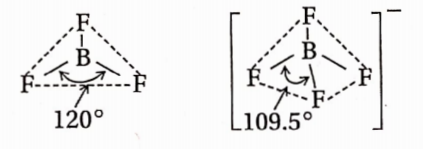
Chemical Bonding And Molecular Structure BF3 molecule

BF4 on the other hand exhibits tetrahedral geometry with each F —B —F bond angle 109.5°. B-atom is sp3 – hybridized.

Question 91. What are the types of hybridization of NH4, CO2-, H2S, and SO2? The C—0 bond is polar but CO2 does not have a dipole moment. Why?
Answer: In NH+4 and H2S the central atoms (N and S) undergoes sp3 hybridization. In CO2-3 the central atom C is sp2 hybridised. In SF6, the central atom S undergoes sp3d2 hybridization.

Question 92. The bond order of the He2+ ion is—
Answer: There is no electron present in the He2+ ion. Thus bond order = 0

Question 93. Which is not paramagnetic of the following— N+  CO  O- NO

⇒ \(\left(\sigma_{1 s}\right)^2\left(\sigma_{1 s}^*\right)^2\left(\sigma_{2 s}\right)^2\left(\sigma_{2 p_z}\right)^2\left(\sigma_{2 s}^*\right)^2\left(\pi_{2 p_x}\right)^2\left(\pi_{2 p_y}\right)^2\)

Question 94. Arrange die following compounds according to their increase of melting point: NaCl, MgCl2, AlCl3 Between NH2 and NF3 which one is more polar and why?
Answer: AlCl3 < MgCl2 < NaCl

Question 95. Why does the PCl5 exist but NCl5 does not? Why is BaSO4 not soluble in water?
Answer: For a compound to be soluble in H2O, its lattice enthalpy should be low compared to its hydration enthalpy. Since both Ba2+ and SO -are large, they stabilize each other to form a strong lattice. This leads to the insolubility of BaSO4 in water.

Question 96. Which has the smallest bond length—
Answer: O+2. Its bond order is 2.5 (maximum among the given species) and we know bond-length \(\propto \frac{1}{\text { bond order }}\)

Question 97. What is the hybridization state of the central atom in 1-3

  1. sp3
  2. dsp2
  3. sp3d2
  4. sp3d

Answer: 4. sp3d

Question 98. Both Br(g) and NO2(g) are reddish-brown gaseous substances. How will you chemically distinguish between them? What will be the order of covalent character of the following compounds?

  1. LIP
  2. LiCl
  3. LiBr
  4. Lil

Answer: 1. LIP

Question 99. The state of hybridization of the central atom of which of the following is sp3d2

  1. SP4
  2. PCI5
  3. SP6

Answer: 3. SP6

Question 100. Which of the following is the correct order of repulsive interaction of lone pair (Ip) and bond pair (bp) of electrons —

  1. Ip- Ip > Ip- bp > bp- bp
  2. Ip- bp > Ip- Ip > bp -bp
  3. bp- bp > Ip-Ip >Ip- bp
  4. Ip- Ip > bp- bp > Ip -bp

Answer: 1. Ip- Ip > Ip- bp > bp- bp

Question 101. Draw the canonicals of CO3. Why is the boiling point of H2O greater than that of II2S?
Answer: Due to the presence of extensive intermolecular H bonding in H2O, it has a higher boiling point than H2S.

Question 102. Write Lewis dot symbols for atoms of the following elements: Mg, Na, B, O, N, Br.
Answer:

⇒ \(\begin{array}{|c|c|c|c|c|c|c|}
\hline \text { Element } & \mathbf{M g} & \mathbf{N a} & \mathbf{B} & \mathbf{O} & \mathbf{N} & \mathbf{B r} \\
\hline \begin{array}{c}
\text { Atomic } \\
\text { No. }
\end{array} & 12 & 11 & 5 & 8 & 7 & 35 \\
\hline \text { E.C. } & 2,8,2 & 2,8,1 & 2,3 & 2,6 & 2,5 & 2,8,18,7 \\
\hline \begin{array}{c}
\text { Lewis } \\
\text { dot } \\
\text { structure }
\end{array} & \ddot{\mathrm{Mg}} & \dot{\mathrm{Na}} & \cdot \dot{\mathrm{B}} \cdot & \mathbf{\text { Ö: }} & \mathbf{: \mathrm { N } :} & \mathbf{: \mathrm { Br } :} \\
\hline
\end{array}\)

Short Answer Questions on Molecular Geometry and Bond Angles

Question 103. Write Lewis symbols for the following atoms and ions: S and S2-; Al and Al3+, H and H
Answer:

⇒ \(\begin{array}{|c|c|c|c|}
\hline \text { Element } & 16^{\mathbf{S}} & { }^{13} \mathbf{A l} & \mathbf{1}^{\mathbf{H}} \\
\hline \text { E.C. } & 2,8,6 & 2,8,3 & 1 \\
\hline \text { Atom } & : \dot{\mathrm{s}}: & \cdot \dot{\mathrm{Al}} \cdot & \mathrm{H} \cdot \\
\hline \text { Ion } & {\left[\:_0\right]^{2-}} & {[\mathrm{Al}]^{3+}} & {[\mathrm{H}:]^{-}} \\
\hline
\end{array}\)

Question 104. Although the geometries of NH3 and H2O molecules are distorted tetrahedral, the bond angle in water is less than that of ammonia. Discuss.
Answer: The difference in the bond angles of water (H2O) and ammonia (NH3) is due to the difference in the number of lone pairs and bond pairs in these two species. In NH3, N has 1 lone pair and 3 bond pairs while in H2O, O has 2 lone pairs and 2 bond pairs. The lone pair-bond pair repulsion in H2O is much more than in NH3. Hence, the bond angle around the central atom in H2O is relatively smaller than that in NH3.

Question 105. Explain the important aspects of resonance concerning the CO2-3 ion
Answer: When a single structure cannot explain all the properties of a molecule, some probable hypothetical structures (canonical structures) are used. The actual structure is called the resonance hybrid which is an intermediate of the canonical structures. This is termed resonance.

Carbonate ion (CO2-3) can be represented by a combination of the following 3 resonating structures in which CO2-3 is the resonance hybrid of the three canonical structures 1,2 and 3.

Question 106. H3PO3 can be represented by structures 1 and 2. Can these two structures be taken as the canonical forms of the resonance hybrid representing H2PO3? If not give reasons for the same.
Answer: These cannot be taken as canonical forms, since the position of the atoms has been changed.

Question 107. Although both CO2 and H2O are triatomic molecules, the shape of the H2O molecule is bent while that of CO2 is linear. Explain this based on the dipole moment.
Answer: The bond moments of two C=0 bonds in CO2 cancel each other, indicating the linear structure of CO2. However, the H2O molecule has a net dipole moment (0). Thus, the bond moments of two O —H bonds do not cancel each other. As a result, H2O has a bent structure.

Question 108. Define electronegativity. How does it differ from electron gain enthalpy?
Answer: The electronegativity of an element is the tendency or ability of its atom to attract the shared pair of electrons towards itself in a covalent bond. On the other hand, electron gain enthalpy is the energy released, when one mole of gaseous atoms of the element accepts electrons from gaseous un negative ion.

Question 109. Arrange in order of increasing ionic character in the molecules: LiF, KaO, N2, SO2, and CIF3.
Answer: The ionic character of a molecule depends on the difference in electronegativities of the atoms involved in bond formation and also on the geometrical arrangements of the bonds. Therefore, the increasing order of ionic character is given by— N2 < SO2 < ClF3 < K2O < LiF.

Question 110. The skeletal structure of CH6COOH as shown below is 4.8.2, correct, but the sonic of the bonds is shown incorrectly. Write the correct Lewis structure for acetic acid.
Answer: The skeletal structure of CH3COOH is correct, but according to Lewis’s theory the arrangement of electrons is not perfect. The correct Lewis structure of CH3COOH

Question 111. Apart from tetrahedral geometry, another possible geometry for CH4 is square planar with the four H atoms at the corners of the square and the C atom at its center. Explain why CH4 is not square planar.
Answer: According to VSEPR theory, shared electron pairs around the central atom in a covalent molecule lie apart at the farthest possible distance to minimize the electrostatic forces of repulsion between them. For tetrahedral geometry, the bond angle is 109°28 while for square planar geometry, the bond angle is 90°.

In square planar geometry, repulsions between the bond pairs are greater than that in the tetrahedral geometry. Consequently, methane assumes tetrahedral geometry instead of square planar geometry. However, for square planar geometry, the required hybridization is dsp² which is not possible for carbon as it has no orbitals in the valence shell.

Question 112. Explain why the BeH2 molecule has a zero dipole moment although the Be —H bonds are polar.
Answer: The BeH2 molecule is linear (H —Be —H). Its bond angle is 180°. The two Be —H bond moments are equal and opposite and hence cancel out each other.

Question 113. Describe the change in hybridization (if any) of the AI in the following reaction. AlCl3 + Cl AlCl-3
Answer: Using the equation \(H=\frac{1}{2}[V+X-C+A]\)

⇒ \(\text { In } \mathrm{AlCl}_3, \mathrm{H}=\frac{1}{2}(3+3-0+0)=3\)

∴ Hybrid state of Al = sp2

⇒ \(\text { In }\left[\mathrm{AlCl}_4\right]^{-}, \mathrm{H}=\frac{1}{2}(3+4-0+1)=4\)

∴ Hybrid State of Al= sp3

Question 114. Is there any change in the hybridization of B and N atoms as a result of the following reaction?

⇒ \(\mathrm{BF}_3+\mathrm{NH}_3 \rightarrow \mathrm{F}_3 \mathrm{~B} \cdot \mathrm{NH}_3\)

Answer: N in NH3 is the donor and B and BF3 are the acceptor. The hybrid state of B in BF3 is sp2 and that of Nin NH3 is sp3. In the compound F3B.NH3, both and B atoms are surrounded by 4 bond pairs. Thus both have a hybrid state of sp3. Hence, during combination, the hybrid state of B changes from sp2 to sp3 but that remains the same.

Question 115. Considering the x -x-axis as the intermolecular axis which out of the following will not form a sigma bond and why?

  1. Is, Is
  2. Is, 2px-,
  3. 2py, 2py
  4. Is, 2s.

Answer: σ -bond is formed between two atoms by the end-to-end (head-on) overlap of atomic orbitals. Hence form σ -bond. In the case of (3), if x -is considered as an intermolecular axis, then the n -bond will form due to lateral overlapping between py orbitals.

Question 116. Write the significance of a plus and a minus sign shown in representing the orbitals.
Answer:

The significance of a plus and a minus sign shown in representing the orbitals are

An orbital is a pictorial representation of wave function, where the ‘+’ and- ‘ sign represents the opposite phases of the wave.

The bonding molecular orbital is formed by a combination of ‘+’ with ‘+’ or ‘ with part of the electron waves whereas the antibonding molecular orbital is formed by the combination of ‘+’ with part.

MCQs for Class 11 Chemical Bonding and Molecular Structure

Chemical Bonding And Molecular Structure Multiple Choice Questions

Question 1. The Sp3d2-hybridization of the central atom of a molecule would be

  1. Wouldsquareleadplanarto— geometry
  2. Tetrahedral geometry
  3. Trigonal bipyramidal geometry
  4. Octahedral geometry

Answer: 4. Octahedral geometry

One s, three p, and two d -orbitals mix up together to form six equivalent Sp3d2-hybrid orbitals. The molecules, in which these orbitals are involved, have octahedral geometry.

Question 2. Which of the following is paramagnetic

  1. N2
  2. NO
  3. CO
  4. O3

Answer: 2. No

From a consideration of electron distribution in molecular orbitals of NO, it is known that it has one unpaired electron. So, NO molecule is paramagnetic.

Read and Learn More WBCHSE Class 11 Chemistry

Question 3. In the electron-dot structure, calculate the formal charge from left to right nitrogen atom, \(\ddot{\mathrm{N}}=\mathrm{N}=\ddot{\mathrm{N}}-\)

  1. -1,-1+1
  2. -1,+1,-1
  3. +1,-1,-1
  4. +1,-1,+1

Answer: 2. -1,+1,-1

Formal charge = No. of valence electrons in the atom No. of unshared electrons \(-\frac{1}{2}\) No. of shared electrons.

Chemical Bonding And Molecular Number of Shared Electrons

  • Formal charge on N-atom (1) =5-4- (4 ÷ 2) = -1
  • Formal charge on N-atom (2) = 5- 0- (8 ÷ 2) = 1
  • Formal charge onN-atom (3) = 5- 4- (4÷ 2) = -1

Question 4. Which of the following Compounds has the maximum volatility

Chemical Bonding And Molecular The Following Compounds Has Maximum Volatility

Answer: 3. Chemical Bonding And Molecular The Following Compounds Has Maximum Volatility. In O-hydroxy carboxylic acid, the —OH and —COOH groups are situated at two adjacent carbon atoms of the ring and are involved in intramolecular H-bond formation.
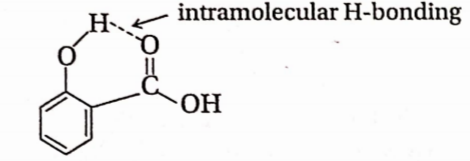
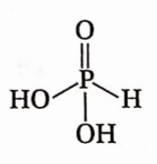
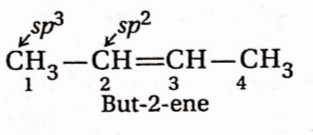
So, these molecules exist as discrete molecules and consequently, the compound has maximum volatility.

Chemical Bonding And Molecular The Following Compounds Has Maximum Volatility..

Question 5. The number of acid protons in H3PO3 is

  1. 0
  2. 1
  3. 2
  4. 3

Chemical Bonding And Molecular Number Of -OH Group

Answer: 3. 2 Number of the —OH group in H3PO3 is 2 and henceitis dibasic in nature.

Question 6. In 2-butene, which of the following statements is true—

  1. C1 —C2 bondis a sp3-sp3 tr – bond
  2. C2— C3 bond is a sp3-sp2 or- bond
  3. C1—C2 bond is a sp3-sp3 r-bond
  4. C1—C2 bond is a sp2-sp2 cr-bond

Answer: 3. C1—C2 bond is a sp3-sp2 r-bond

Chemical Bonding And Molecular In 2- Butene

Question 7. The paramagnetic behavior of B2 Is due to the presence of—

  1. 2 unpaired electrons πb MO
  2. 2 unpaired electrons in π* MO
  3. 2 unpaired electrons in σ* MO
  4. 2 unpaired electrons in σb MO

Answer: 1. The electronic configuration of B2 (10 electrons) is \(K K\left(\sigma_{2 s}\right)^2\left(\sigma_{2 s}^*\right)^2\left(\pi_{2 p x}\right)^1\left(\pi_{2 p y}\right)^1\)

Since the molecule contains two unpaired electrons in πbMO, it is paramagnetic.

Question 8. The state of hybridization of the central atom and the number of lone pairs over the central atom in POCl3 are-

  1. sp,O
  2. sp2O
  3. sp3,O
  4. dsp2,1

Answer: 3. The Geometrical shape of the POC13 molecule is tetrahedral. In POC13 central P-atom is sp3 hybridised and has no lone pair.

Question 9. CO is practically non-polar since—

  1. The cr -electron drift from c to o is almost nullified by the n -electron drift from 0 to c
  2. The tr -electron drift from o to c is almost nullified by the 7r -electron drift from c to o
  3. The bond moment is low
  4. There is a triple bond between c and O

Answer: 1. The cr -electron drift from c to o is almost nullified by the n -electron drift from 0 to c

Chemical Bonding And Molecular Co is practically Non- polar since

Oxygen donates an unshared pair of electrons to carbon and helps it to complete its octet by forming a dative n bond with it. As a result, a much stronger n -n-moment acts from oxygen to a carbon atom, and this moment is almost canceled by the cr -moment and the weak n -moment acting in the opposite direction. Hence, the polarity of the molecule is verylow.

MCQs For Class 11 Chemical Bonding and Molecular Structure

Question 10. The increasing order of the O —N —0 bond angle in the species NO2, NO+2, and NO2is—

  1. \(\mathrm{NO}_2^{+}<\mathrm{NO}_2<\mathrm{NO}_2^{-}\)
  2. \(\mathrm{NO}_2<\mathrm{NO}_2^{-}<\mathrm{NO}_2^{+}\)
  3. \(\mathrm{NO}_2^{+}<\mathrm{NO}_2^{-}<\mathrm{NO}_2\)
  4. \(\mathrm{NO}_2<\mathrm{NO}_2^{+}<\mathrm{NO}_2^{-}\)

Answer: None; the correct order is \(\mathrm{NO}_2<\mathrm{NO}_2^{-}<\mathrm{NO}_2^{+}\)

Chemical Bonding And Molecular Oxygen Donates An Unshared Pair Of Electron To Carbon

Question 11. The ground state electronic configuration of the CO molecule is-

  1. \(1 \sigma^2 2 \sigma^2 1 \pi^2 3 \sigma^2\)
  2. \(1 \sigma^2 2 \sigma^2 3 \sigma^2 1 \pi^2 2 \pi^2\)
  3. \(1 \sigma^2 2 \sigma^2 1 \pi^2 3 \sigma^2 2 \pi^2\)
  4. \(1 \sigma^2 1 \pi^4 2 \sigma^2 3 \sigma^2\)

Answer: 4. \(1 \sigma^2 1 \pi^4 2 \sigma^2 3 \sigma^2\)

The ground state outer electronic configuration of the CO molecule is \(1 \sigma^2 1 \pi^4 2 \sigma^2 3 \sigma^2\)

Question 12. In diborane, the number of electrons that account for bonding die bridges is

  1. Six
  2. Two
  3. Eight
  4. Four

Answer: 4. Four

Chemical Bonding And Molecular In Diborance, The Number Of Electrons

In diborane, each bridging B——H——B bond is formed by two electrons. Hence, four electrons account for bonding the bridges.

Question 13. In O2 and H2O2, the O — O bond lengths are 1.2lA and 1.48A respectively. In ozone, the average O —O bond length is

  1. 1.28A
  2. 1.18A
  3. 1.44A
  4. 1.526A

Answer: 1. Bond length is nearly average of O—O length in

Chemical Bonding And Molecular Bond Length Is Nearly Avrage

WBBSE Class 11 MCQs on Chemical Bonding

Question 14. In SOC12, the Cl—S—Cl and Cl—S—O bond angles are—

  1. 130°, 115°
  2. 106°, 96°
  3. 107°, 108°
  4. 96°, 106°

Answer: 4. 96°, 106°

IN SOC12, the Cl —S —Cl bond angle is 96° and the Cl — S —O bond angle is 106°, since multiple bonds create more repulsions than single bonds.

Question 15. The structure of XeF6 is experimentally determined to be a distorted octahedron. Its structure according to VSEPR theory is—

  1. Octahedron
  2. Trigonal bipyramid
  3. Pentagonal bipyramid
  4. Tetragonal bipyramid

Answer: 3. Pentagonal bipyramid

In XeF6, Xe is surrounded by 6 bond pairs and one lone pair. So, according to VSPER theory, the geometry (geometry of electron pairs) is pentagonal bipyramid.

Class 11 Physics Class 12 Maths Class 11 Chemistry
NEET Foundation Class 12 Physics NEET Physics


Question 16. In the case of heteronuclear diatomics of the type AB, where A is more electronegative than B, bonding MO resembles the character of A more than that of B. The statement—

  1. Is False
  2. Is True
  3. Cannot Be Evaluated Since the Data Is Not Sufficient
  4. Is True Only FOr Certaqin Systems

Answer: 2. Cannot Be Evaluated Since Data Is Not Sufficient

Chemical Bonding And Molecular More Electronegative

As A is more electronegative, there is less energy difference between the atomic orbital of A and bonding M.O. Hence, bonding M.O. resembles A more closely.

Question 17. The bond angle in NF3 (102.3°) is smaller than NH3 (107.2°). This is because of—

  1. Large size off compared to
  2. The large size compared to
  3. Opposite polarity of n in the two molecules
  4. Small size compared to a ton

Answer: 3. In NF3 molecules, the N—F bond pair is drawn

more towards the more electronegative F-atom. But in the NH3 molecule, the N—H bond pair is drawn more towards the more electronegative N-atom. Therefore, the extent of bp-bp repulsion in NH3 is more than that in NF3. As a consequence, the bond angle in NH3(107.2°) is greater than that of NF3(102.3°).

Question 18. The compound that will have a permanent dipole moment among the following is

Chemical Bonding And Molecular Permant Dipole Moment Means A zero value of dipole moment..

  1. 1
  2. 2
  3. 3
  4. 4

Answer: 1. Permanent dipole moment means a non-zero value of dipole moment. So, only compound (1) has a permanent dipole moment.

Chemical Bonding And Molecular Permant Dipole Moment Means A zero value of dipole moment

Question 19. Among the following structures, the one which is not a resonating structure of others is—

Chemical Bonding And Molecular The Following Structures The One Which Is Not A Resonating Structture Of Other Is

  1. 1
  2. 2
  3. 3
  4. 4

Answer: 

Chemical Bonding And Molecular The One Which Is Not A Resonating Structure Of Other Is

Structure (4) is not a resonance structure because it involves shifting a pair of electrons as well as an H-atom

Question 20. The correct order of decreasing length ofthe bond as indicated by the arrow in the following structures is—

Chemical Bonding And Molecular The Order Of Decreasing Length Of The Bond

  1. 1>2>3
  2. 2>13
  3. 3>2>1
  4. 1>3>2

Answer: 3. In general, C=C and C—C bond lengths are respectively 1.33A and 1.54A

Chemical Bonding And Molecular In General C=C ANd C-C Bond Lenghts

In structure I, n -electrons are delocalized over Ci — C2 and C2— C3 bonds. In structure II a pair of n electrons are delocalised Over C5-C6, C6-C7C6-C8

Important MCQs for Class 11 Molecular Structure

Question 21. The correct order of decreasing H—C—H angle in the following molecules is

Chemical Bonding And Molecular The Correct Order Of Decreasing g H-C-H Angle In The Foloowing Molecules Is

  1. 1>2>3
  2. 2>1>3
  3. 3>2>1
  4. 1>3>2

Answer: Overlapping is maximum when orbitals overlap “endon” i.e., via a -bonding, n -bonds overlap laterally. The overlap in cyclopropane is neither end-on nor lateral but in between. So, it is intermediate between cr -and n bonding.

Chemical Bonding And Molecular The Correct Order Of Decreasing g H-C-H Angle In The Foloowing Molecules Is,.

So, in order of decreasing H —C —H angle: 2 >1 > 3

Question 22. The correct order of decreasing length ofthe bond as indicated by the arrow in the following structures is—

Chemical Bonding And Molecular The Number Of Sp Hybridised Carbon.

  1. 1>2>3
  2. 2>1>3
  3. 3>2>1
  4. 1>3>2

Answer: 3. 3>2>1

Chemical Bonding And Molecular The Number Of Sp Hybridised Carbon

Question 23. Thenumberoflone pairs of electrons on the central atoms of H2O, SnCl2 PCl3, and XeF2 respectively, are

  1. 2,1,1,3
  2. 2,2,1,3
  3. 3,1,1,2
  4. 2,1,2,3

Answer: 4. Number of lone pairs of electrons present in the hybrid orbital, L = H- X- D [Where H: no. of orbitals involved in the hybridization, X: no. of monovalent atoms surrounding the central atom, D: no. of bivalent atoms attached to the central atom.

Question 24. The number of car and n -bonds present between the two carbon atoms of calcium carbide are respectively

  1. 1σ, 1π- bond
  2. 1σ, 2π- bond
  3. 2σ, 1π- bond
  4. \(1 \sigma, 1 \frac{1}{2} \pi \text {-bond }\)

Answer: 2. 1σ, 2π- bond

In calcium carbide, two carbon atoms are bonded by a triple bond. Thus between two carbon atoms, 1 cr, and 2/r bonds are present.

Question 25. Which of the following molecules have a shape like CO

  1. HgCl2
  2. SnCl2
  3. C2H2
  4. NO2

Answer: 1. HgCl2

Chemical Bonding And Molecular Structure The Following Molecules Have Shape lIke CO2

Question 26. The ground state magnetic property of B2 and C2 molecules will be—

  1. B, paramagnetic and C2 diamagnetic
  2. B, diamagnetic C2 paramagnetic
  3. Botii are diamagnetic
  4. Both are paramagnetic

Answer: 1. B, paramagnetic and C2 diamagnetic

MO electronic configuration of B2

⇒ \(K K\left(\sigma_{2 s}\right)^2\left(\sigma_{2 s}^*\right)^2\left(\pi_{2 p_x}\right)^1\left(\pi_{2 p_y}\right)^1\)

Mo electronic configuration of C2

⇒ \(\operatorname{KK}\left(\sigma_{2 s}\right)^2\left(\sigma_{2 s}^*\right)^2\left(\pi_{2 p_x}\right)^2\left(\pi_{2 p_y}\right)^2\)

In BO, there are unpaired electrons present which is paramagnetic. But in C9 there is no impaired electron and henceitis diamagnetic.

Question 27. The shape of XeFg- is—

  1. Square pyramidal
  2. Triangularbipyramidal
  3. Planar
  4. Pentagonal bipramidal

Answer: 3. Planar

⇒ \(\text { Here, } \mathrm{H}=\frac{1}{2}(8+5-0+1)=7\)

Central atom Xe: sp3d2 -hybridized

No. of lone pair of electronic Xe, L = (7-5-0) = 2

therefore XeF5 ionic planar.

Question 28. Which statements are correct for the peroxide ion—

  1. It has five filled anti-bonding molecular orbitals
  2. It is diamagnetic
  3. It has bond order one
  4. It is isoelectronic with neon

Answer: 1. MO electronic configuration of 0|~ (peroxide ion):

\(\left(\sigma_{1 s}\right)^2\left(\sigma_{1 s}^*\right)^2\left(\sigma_{2 s}\right)^2\left(\sigma_{2 s}^*\right)^2\left(\sigma_{2 p_z}\right)^2\) \(\left(\pi_{2 p x}\right)^2\left(\pi_{2 p y}\right)^2\left(\pi_{2 p_x}^*\right)^2\left(\pi_{2 p_y}^*\right)^2\)

Bond Order \(=\frac{N_b-N_a}{2}=\frac{10-8}{2}=1\)

Question 29. Which ofthe following has the strongest H-bond

  1. H-O…shape
  2. S-H….O
  3. F-H….F
  4. F-H….O

Answer: 3. F-H….F

Since fluorine is the most electronegative element F —H bond is more polar which forms the strongest H-bonding [F—H-—F] among the given compounds.

Question 30. B cannot form which ofthe following anions

  1. \(\mathrm{BF}_6^{3-}\)
  2. BH-4
  3. B(OH)-4
  4. BO-2

Answer: 1. \(\mathrm{BF}_6^{3-}\)

The stability of hydrides of group-15 decreases from NH3 to BiH3 due to an increase in the size of the central atom.

Question 31. Which of the following statements is wrong—

  1. Nitrogen cannot form an-inbound
  2. Single n-nbond is weaker than the single p-p bond
  3. N2O4 has two resonance structures
  4. The stability of hydrides increases from nh3 to bih3 due to the increase in size ofthe central atom.

Answer: 4. The stability of hydrides increases from NH3 to BiH3 due to the increase in size ofthe central atom.

Question 32. The Square Of IF7 is

  1. Square pyramid
  2. Trigonal bipyramid
  3. Octahedral
  4. Pentagonal bipyramid

Answer: 4. Pentagonal bipyramid

In IF7, the hybridization of the central atom is sp3d3 and its structure is a pentagonal bipyramid.

Question 33. The hybridization orbitals of N-atoinin NO-3, NO+2, and NH+4 are respectively—

  1. sp, sp2, sp3
  2. Sp2,sp,sp3
  3. Sp,sp3,s2
  4. sp2, sp3 sp

Answer: 2. Sp2,sp,sp3

Chemical Bonding And Molecular Structure The Hybridisation of orbitals of N-atom

Practice Questions on Hybridization and Bonding

Question 34. Among die following, die maximum covalent character is shown by

  1. FeCl2
  2. SnCl2
  3. AlCl3
  4. MgCl2

Answer: 3. AlCl3

The ionic potential (0) of the cations increases with the increase in cationic charge and decrease in cationic radii. Thus, the resulting compound possesses a more covalent
character. So, A1C13 exhibits maximum covalency.

Question 35. Iron exhibits +2 and +3 oxidation states. Which of the following statements about incorrect—

  1. Ferrous compounds are relatively more ionic than ferric compounds
  2. Ferrous compounds are less volatile than the corresponding ferric compounds
  3. Ferrous compounds are more easily hydrolyzed than the corresponding ferric compounds
  4. Ferrous oxide is more basic than ferric oxide

Answer: 3. Ferrous compounds are more easily hydrolyzed than the corresponding ferric compounds

The tendency of hydration increases with a decrease in the size of a cation. Ferrous ions are larger than ferric ions. Consequently, the ferric ion will be more easily hydrolyzed than the ferrous ion.
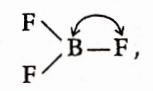
Question 36. Ortho-nitrophenol is less soluble in water than p – and m nitrophenols because—

  1. O-nitrophenol shows intramolecular-bonding
  2. O-nitrophenol shows intermolecular-bonding
  3. The melting point of o-nitrophenol is less than that of mand p-isomers
  4. O-nitrophenol is more volatile than those of m-and prisoners

Answer: 1. o-nitrophenol shows intramolecular H-bonding

In o-nitrophenol, —OH & —N02 groups are situated at two adjacent carbon atoms of the ring and involved in intramolecular bonding. So, o-nitrophenol is less soluble in water than p- and m- m-nitrophenol.

Question 37. The molecule having the smallest bond angle is

  1. AsCl3
  2. SbCl3
  3. PCl3
  4. NCL3

Answer: 2. SbCl3

The bond angle of a molecule increases with the increases in electronegativity or with the decrease in size of the central atom. Hence, the correct order of bond angle is: SbCl3 < ASC13 < PC13 < NCl3

Question 38. In which of the following pairs the two species are not isostructural

  1. PCI+6 and SiCl4
  2. PF5 and BrF5
  3. AlFg- and SF6
  4. CO6– and NO-3

Answer: 2. PF5 and BrF5

In molecule PF5, \(H=\frac{1}{2}\) [5 + 5- 0 + 0] = 5. Hybridisation of central atom(P): sp3d. Number of p lone pairs in the central atom (P): 0. Shape of the molecule: Trigonal bipyramidal.

For BrF5, Hybridisation of central atom (Br): sp3d2. Number of loner pairs in the central atom (Br): 1. Shape ofthe molecule: square pyramidal.

Question 39. The stability of the species Li2, Li2, and Li2 increases in the order of

  1. Li2<Li+2<Li-2
  2. Li22< Li+2 < Li2
  3. Li2<Li2<Li+2
  4. Li2<Li2<Li2

Answer: 2. Li2< Li-2 < Li2

⇒ \(\mathrm{Li}_2:\left(\sigma_{1 s}\right)^2\left(\sigma_{1 s}^*\right)^2\left(\sigma_{2 s}\right)^2\)

⇒ \(\begin{aligned}
& \mathrm{Li}_2^{+}:\left(\sigma_{1 s}\right)^2\left(\sigma_{1 s}^*\right)^2\left(\sigma_{2 s}\right)^1 \\
& \mathrm{Li}_2^{-}:\left(\sigma_{1 s}\right)^2\left(\sigma_{1 s}^*\right)^2\left(\sigma_{2 s}\right)^2\left(\sigma_{2 s}^*\right)^1
\end{aligned}\)

\(\begin{array}{|c|c|c|c|}
\hline \mathbf{B . 0} & \mathbf{L i}_{\mathbf{2}} & \mathbf{L i}_{\mathbf{2}}^{+} & \mathbf{L i}_{\mathbf{2}}^{-} \\
\hline \frac{N_b-N_a}{2} & \frac{2-0}{2}=1 & \frac{1-0}{2}=0.5 & \frac{2-1}{2}=0.5 \\
\hline
\end{array}\)

Question 40. In which ofthe following pairs of molecules/ions, both the species are not likely to exist—

  1. \(\mathrm{H}_2^{+}, \mathrm{He}_2^{2-}\)
  2. \(\mathrm{H}_2^{-}, \mathrm{He}_2^{2-}\)
  3. \(\mathrm{H}_2^{2+}, \mathrm{He}_2\)
  4. \(\mathrm{H}_2^{-}, \mathrm{He}_2^{2+}\)

Answer: 3. \(\mathrm{H}_2^{2+}, \mathrm{He}_2\)

⇒ \(\mathrm{H}_2^{2+}:\left(\sigma_{1 s}\right)^0\)

⇒ \(\mathrm{He}_2:\left(\sigma_{1 s}\right)^2\left(\sigma_{1 s}^*\right)^2\)

\(\begin{array}{|c|c|c|}
\hline \text { B.o. } & \mathbf{H}_2^{2+} & \mathbf{H e}_{\mathbf{2}} \\
\hline \frac{N_b-N_a}{2} & 0 & \frac{2-2}{2}=0 \\
\hline
\end{array}\)

Question 41. Which one of the following molecules is expected to exhibit diamagnetic behavior—

  1. C2
  2. N2
  3. O2
  4. S2

Answer: 1. C2

Question 42. The correct statement for the molecule, Csl3, is—

  1. It contains Cs+, I and lattice I2 molecule
  2. It is a covalent molecule
  3. It contains Cs+ and I2 ions
  4. It contains Cs3+ and I ions

Answer: 3. It contains Cs+ and I-3 ions

Cs cannot show a +3 oxidation state. So, Csl3 is formulated as Cs+ and I3 ions. It is a typical ionic compound.

Question 43. For which of the following molecules is significant μ≠ 0-

Chemical Bonding And Molecular Structure The Following Moleucles Signifiancant

  1. 3 and 4
  2. only 1
  3. 1 and 2
  4. only 3

Answer: 1. 3 and 4

Question 44. Which of the following alkaline earth metal sulfates has its hydration enthalpy greater than its lattice enthalpy—

  1. BaSO4
  2. SRSO4
  3. CaSO4
  4. BeSO4

Answer: 1. BaSO4

In the NO4 ion, the N atom is sp -hybridized. O=N=0

Question 45. In which of the following molecule Orion the hybridization state of the-atom is sp —

  1. NO+2
  2. NO-2
  3. NO-3
  4. NO2

Answer: 4. NO2

There is no unpaired electron in the MO electronic configuration of the CO molecule. Thus, it is not paramagnetic.

Question 46. Which one of the following is not paramagnetic-

  1. O2
  2. B2
  3. NO
  4. CO

Answer: 4. CO

KC1 is an electrovalent compound, it exists as K+ and Cl- ions

Question 47. The total number of one pair of electrons I-3 ion is

  1. 9
  2. 3
  3. 13
  4. 6

Answer: 1. 9

Question 48. Which ofthe following compounds contain(s) no covalent bond(s)—KC1, PH3, O2, B2H6, H2SO4

  1. KCL
  2. KCl, B2H6
  3. KClB2H6,PH3
  4. KCl, H2SO4

Answer: 1. KCL

KC1 is an electrovalent compound, it exists as K+ and Cl- ions

Question 49. According to molecular orbital theory, which of the following will not be a viable molecule—

  1. H-2
  2. H2-2
  3. He2+2
  4. He+2

Answer: 2. MO electronic configuration of H2-2 \(\left(\sigma_{1 s}\right)^2\left(\sigma_{1 s}\right)^2\)

Therefore Bond Order \(=\frac{2-2}{2}=0\)

Question 50. In which of the following pairs of molecules/ions, do the central atoms have sp2 hybridization—

  1. NO-2 And NH3
  2. BF3 And NO-2
  3. NH-2 And H2O
  4. BF3 And NH-2

Answer: 2. BF3 And NO-2

\(\begin{array}{|c|c|c|}
\hline \begin{array}{c}
\text { Molecule / } \\
\text { ion }
\end{array} & \text { Value of } \mathbf{H} & \begin{array}{c}
\text { Type of } \\
\text { hybridisation }
\end{array} \\
\hline \mathrm{BF}_3 & \mathrm{H}=\frac{1}{2}(3+3-0+0) & s p^2 \\
& =3 & \\
\hline \mathrm{NO}_2^{-} & \mathrm{H}=\frac{1}{2}(5+0-0+1) & s p^2 \\
\hline
\end{array}\)

Question 51. Considering the state of hybridization ofC-atoms, find out the molecule among the following which is linear-

  1. CH3—CH2—CH2—CH3
  2. CH3—CH=CH—CH3
  3. CH3—C=C—CH3
  4. CH2=CH—CH2—C=CH

Answer: 3. CH3—C=C—CH3

In the case of sp3, sp2, and sp hybridized carbons, the bond angle is 109°28′; 120° and 180° respectively. So, only image- is linear (excluding H-atoms)

Question 52. Which ofthe following structures is the most preferred and
hence of the lowest energy for SO3-

Chemical Bonding And Molecular Structure The Following Structures Is The Most Prefered and hence of lowest energy for SO3

Answer: 4. Has a maximum number of covalent bonds and hence is of the lowest energy.

Common Questions on Ionic vs. Covalent Bonds

Question 53. The correct order of increasing bond length of C—H C—O, C—C, and C=C is

  1. C—H < C=C < C—O < C—C
  2. C—C < C=C < C—0 < C—H
  3. C—0<C—H<C—C<C=C
  4. C—H<C—0<C—C<C=C

Answer: 4. C—H<C—0<C—C<C=C

⇒ \(\begin{aligned}
& \mathrm{C}-\mathrm{H}<\mathrm{C}=\mathrm{C}<\mathrm{C}-\mathrm{O}<\mathrm{C}-\mathrm{C} \\
& 107 \mathrm{pm} \quad 134 \mathrm{pm} \quad 141 \mathrm{pm} \quad 154 \mathrm{pm}
\end{aligned}\)

Question 54. Which of the two ions from the list given below have the geometry that is explained by the same hybridization of orbitals, NO2, NO3, NH2, NH4, SCN

  1. NO2 and NO3
  2. NH+4 and NO3
  3. SCN and NH2
  4. NO2 and NH2

Answer: 1. Increasing the order of bond length is

⇒ \(\begin{array}{|c|c|c|c|c|c|}
\hline \text { Ions } & \mathrm{NO}_3^{-} & \mathbf{N O}_2^{-} & \mathbf{N H}_2^{-} & \mathbf{N H}_4^{+} & \mathbf{S C N}^{-} \\
\hline \text { Hybridisation } & s p^2 & s p^2 & s p^3 & s p^3 & s p \\
\hline
\end{array}\)

Question 55. Which has the minimum bond length—

  1. O+2
  2. O2
  3. O22-
  4. O2

Answer: 1. O+2

⇒ \(\mathrm{O}_2^*: \mathrm{KK}\left(\sigma_{2 s}\right)^2\left(\sigma_{2 s}^*\right)^2\left(\sigma_{2 p_z}\right)^2\left(\pi_{2 p_1}\right)^2\left(\pi_{2 p}\right)^2\left(\pi_{2 p}^*\right)^1\)

⇒ \(\begin{aligned}
& \mathrm{O}_2^{-}: K K\left(\sigma_{2 s}\right)^2\left(\sigma_{2 s}^*\right)^2\left(\sigma_{2 p_z}\right)^2\left(\pi_{2 p_x}\right)^2\left(\pi_{2 p_y}\right)^2\left(\pi_{2 p_x}^*\right)^2\left(\pi_{2 p_y}^*\right)^1 \\
& \mathrm{O}_2^{2-}: K K\left(\sigma_{2 s}\right)^2\left(\sigma_{2 s}^*\right)^2\left(\sigma_{2 p_z}\right)^2\left(\pi_{2 p_x}\right)^2\left(\pi_{2 p_y}\right)^2\left(\pi_{2 p_x^*}^*\right)^2\left(\pi_{2 p_y}^*\right)^2
\end{aligned}\)

⇒ \(\mathrm{O}_2: K K\left(\sigma_{2 s}\right)^2\left(\sigma_{2 s}^*\right)^2\left(\sigma_{2 p_z}\right)^2\left(\pi_{2 p_x}\right)^2\left(\pi_{2 p_y}\right)^2\left(\pi_{2 p_x}^*\right)^1\left(\pi_{2 p_y}^*\right)^1\)

Question 56. Four diatomic species are listed below. Identify the correct order in which the bond order is increasing

  1. \(\mathrm{NO}<\mathrm{O}_2^{-}<\mathrm{C}_2^{2-}<\mathrm{He}_2^{+}\)
  2. \(\mathrm{O}_2^{-}<\mathrm{NO}<\mathrm{C}_2^{2-}<\mathrm{He}_2^{+}\)
  3. \(\mathrm{C}_2^{2-}<\mathrm{He}_2^{+}<\mathrm{O}_2^{-}<\mathrm{NO}\)
  4. \(\mathrm{He}_2^{+}<\mathrm{O}_2^{-}<\mathrm{NO}<\mathrm{C}_2^{2-}\)

Answer: 4. \(\mathrm{He}_2^{+}<\mathrm{O}_2^{-}<\mathrm{NO}<\mathrm{C}_2^{2-}\)

NO(7=8=15)

⇒ \(K K\left(\sigma_{2 s}\right)^2\left(\sigma_{2 s}^*\right)^2\left(\sigma_{2 p_z}\right)^2\left(\pi_{2 p_x}\right)^2\left(\pi_{2 p_y}\right)^2\left(\pi_{2 p_x}^*\right)^1\)

Question 57. During the change of O2 to O2 ion, the electron adds on which one ofthe following orbitals—

  1. π* -orbitals
  2. π – orbitals
  3. σ* orbital
  4. σ- orbital

Answer: 1. π* -orbitals

⇒ \(\mathrm{O}_2: K K\left(\sigma_{2 s}\right)^2\left(\sigma_{2 s}^*\right)^2\left(\sigma_{2 p_z}\right)^2\left(\pi_{2 p_x}\right)^2\left(\pi_{2 p_y}\right)^2\left(\pi_{2 p_x}^*\right)^1\left(\pi_{2 p_y}^*\right)^1\)

⇒ \(\mathrm{O}_2^{-}: K K\left(\sigma_{2 s}\right)^2\left(\sigma_{2 s}^*\right)^2\left(\sigma_{2 p_z}\right)^2\left(\pi_{2 p_x}\right)^2\left(\pi_{2 p_y}\right)^2\left(\pi_{2 p_x}^*\right)^2\left(\pi_{2 p y}^*\right)^1\)

Thus, the electron goes into the π*-orbital.

Question 58. The pair of species with the same bond order is

  1. \(\mathrm{O}_2^{2-}\)
  2. \(\mathrm{O}_2^{+}, \mathrm{NO}^{+}\)
  3. NO, CO
  4. N2, O2

Answer: 1. \(\mathrm{O}_2^{2-}\)

⇒ \(\mathrm{O}_2^{2-}: K K\left(\sigma_{2 s}\right)^2\left(\sigma_{2 s}^*\right)^2\left(\sigma_{2 p_z}\right)^2\left(\pi_{2 p_x}\right)^2\left(\pi_{2 p_y}\right)^2\left(\pi_{2 p_x}^*\right)^2\left(\pi_{2 p_y}^*\right)^2\)

⇒ \(\mathrm{B}_2: K K\left(\sigma_{2 s}\right)^2\left(\sigma_{2 s}^*\right)^2\left(\pi_{2 p_x}\right)^1\left(\pi_{2 p_y}\right)^1\)

\(\begin{array}{|c|c|c|}
\hline \text { Bond order } & \mathbf{O}_2^{2-} & \mathbf{B}_2 \\
\hline \frac{N_b-N_a}{2} & \frac{8-6}{2}=1 & \frac{4-2}{2}=1 \\
\hline
\end{array}\)

Note: B.O. of O2 = 2.5, N0+ = 3, NO = 2.5 CO = 3, N2 = 3 and O2 = 2]

Question 59. Which of the following species contains three bond pairs and one lone pair around the central atom—

  1. H2O
  2. BF2
  3. NH-2
  4. PCl2

Answer: 4. PCl3

Chemical Bonding And Molecular Structure The Following The Species Contains Threes Bond Pairs And One Lone Pair Around

Question 60. Bond order of 1.5 is shown by—

  1. O+2
  2. O-2
  3. O2-2
  4. O2

Answer: 2. O-2

⇒ \(\mathrm{O}_2^{+}: K K\left(\sigma_{2 s}\right)^2\left(\sigma_{2 s}^*\right)^2\left(\sigma_{2 p_z}\right)^2\left(\pi_{2 p_x}\right)^2\left(\pi_{2 p_y}\right)^2\left(\pi_{2 p_x}^*\right)^1\)

⇒ \(\begin{aligned}
& \mathrm{O}_2^{+}: K K\left(\sigma_{2 s}\right)^2\left(\sigma_{2 s}^*\right)^2\left(\sigma_{2 p_z}\right)^2\left(\pi_{2 p_x}\right)^2\left(\pi_{2 p_y}\right)^2\left(\pi_{2 p_x}^*\right)^2\left(\pi_{2 p_y}^*\right)^1 \\
& \mathrm{O}_2^{2-}: K K\left(\sigma_{2 s}\right)^2\left(\sigma_{2 s}^*\right)^2\left(\sigma_{2 p_z}\right)^2\left(\pi_{2 p_x}\right)^2\left(\pi_{2 p_y}\right)^2\left(\pi_{2 p_x^*}^*\right)^2\left(\pi_{2 p_y}^*\right)^2 \\
& \mathrm{O}_2: K K\left(\sigma_{2 s}\right)^2\left(\sigma_{2 s}^*\right)^2\left(\sigma_{2 p_z}\right)^2\left(\pi_{2 p_x}\right)^2\left(\pi_{2 p_y}\right)^2\left(\pi_{2 p_x}^*\right)^1\left(\pi_{2 p_y^*}\right)^1
\end{aligned}\)

\(\begin{array}{|c|c|c|c|c|}
\hline \begin{array}{c}
\text { Bond } \\
\text { order }
\end{array} & \mathbf{O}_2^{+} & \mathbf{O}_2^{-} & \mathbf{0}_2^{2-} & \mathbf{O}_2 \\
\hline \frac{N_b-N_a}{2} & \frac{8-3}{2}=2.5 & \frac{8-5}{2}=1.5 & \frac{8-6}{2}=1 & \frac{8-4}{2}=2 \\
\hline
\end{array}\)

Question 61. The following pairs are isostructural-

  1. BC13 and BrCl3
  2. NH3 and NO3-
  3. NF3 and BF3
  4. BF4 and NH+4

Answer: 4. BF2 and NH+4

If some bond pairs and lone pairs are the same for the given pairs, they are isostructural.

Chemical Bonding And Molecular Structure If Number Of Bond Pairs And LOne PAirs Are Same For The Given Pairs They Are Isostructural

Chemical Bonding And Molecular Structure If Number Of Bond Pairs And LOne PAirs Are Same For The Given Pairs They Are Isostructural.

Question 62. Which contains no n -bond—

  1. SO2
  2. NO2
  3. CO2
  4. H2O

Answer: 4. H2O

Chemical Bonding And Molecular Structure The contains no pi bond

Question 63. Which ofthe following lanthanoid ions is diamagnetic (Atnos. Ce=58, Sm=62,Eu=63, Yb70)-Chemical Bonding And Molecular Structure If Number Of Bond Pairs And LOne PAirs Are Same For The Given Pairs They Are Isostructural.

  1. EU2+
  2. Yb2+
  3. Ce2+
  4. Sm2+

Answer: 4. Sm2+

⇒ \(\begin{aligned}
& ; \mathrm{Sm}^{2+}(\mathrm{Z}=62):[\mathrm{Xe}] 4 f^6 \\
& \mathrm{Yb}^{2+}(\mathrm{Z}=70):[\mathrm{Xe}] 4 f^{14} \\
& \mathrm{Ce}^{2+}(\mathrm{Z}=58):[\mathrm{Xe}] 4 f^1 5 d^1 \\
& \mathrm{Eu}^{2+}(\mathrm{Z}=63):[\mathrm{Xe}] 4 f^7
\end{aligned}\)

Question 64. Which of the following is paramagnetic—

CN

NO+

CO

O2

Answer: 4. O2

MO electronic configuration of O-2(17):

⇒ \(K K\left(\sigma_{2 s}\right)^2\left(\sigma_{2 s}^*\right)^2\left(\sigma_{2 p_z}\right)^2\left(\pi_{2 p_x}\right)^2\left(\pi 2_{p_y}\right)^2\left(\pi_{2 p_x}^*\right)^2\left(\pi_{2 p_y}^*\right)^1\)

Owing to the presence of one unpaired electron, it is paramagnetic in nature.

Question 65. Which of the following is a polar molecule—

  1. SiF4
  2. XeF4
  3. BF3
  4. SF4

Answer: 4. SF4

SF4 has sp3d -hybridization and see-saw shape with 4 bond pairs and 1 lone pair and resultant u=0.

Question 66. XeF2 is isostructural with-

  1. SbCl3
  2. BaCL2
  3. TeF2
  4. ICI-2

Answer: 4. ICI-2

Question 67. Which species has a plane triangular shape-

  1. N3
  2. NO-3
  3. NO2
  4. CO2

Answer: 2. NO-3

Question 68. Which has the maximum dipole moment—

  1. CO2
  2. CH4
  3. NH3
  4. NF3

Answer: 3. NH3

Chemical Bonding And Molecular Structure The Maximum Dipole moment

In NH3, H is less electronegative than N and hence dipole moment of each N —H bond is towards N and creates a high net dipole moment.

Question 69. The formation ofthe oxide ion O2-(g), form oxygen atom requires first an exothermic and then an endothermic step as shown below

⇒ \(\begin{aligned}
& \mathrm{O}(\mathrm{g})+e^{-} \rightarrow \mathrm{O}^{-}(\mathrm{g}) ; \Delta H_f^0=-141 \mathrm{~kJ} \cdot \mathrm{mol}^{-1} \\
& \mathrm{O}^{-}(\mathrm{g})+e^{-} \rightarrow \mathrm{O}^{2-}(\mathrm{g}) ; \Delta H_f^0=+780 \mathrm{~kJ} \cdot \mathrm{mol}^{-1}
\end{aligned}\)

Thus, the process of formation of O2- in the gas phase is unfavorable even though O2- is isoelectronic with neon. It is because—

  1. Electron repulsion outweighs the stability gained by achieving noble gas configuration
  2. O-ion has a comparatively smaller size than o-atom
  3. Oxygen is more electronegative
  4. The addition of electronic o results in large-size ion

Answer: 1. Electron repulsion outweighs the stability gained by achieving noble gas configuration

Electron repulsion predominates over the stability gained by achieving noble gas configuration. Hence, the formation of O2- in the gas phase is unfavorable.

Question 70. In which of the following pairs, both the species are not isostructural—

  1. SiCl4, Pcl+4
  2. Diamond, siC
  3. NH3,PH3
  4. XeF4, XeO4

Answer: 4. XeF4, XeO4

Chemical Bonding And Molecular Structure The Follwing Pairss

Diamond and silicon carbide (SiC), are both isostructural because their central atom is sp3 hybridized and both have tetrahedral arrangements.

Chemical Bonding And Molecular Structure The Follwing Pairss.

Both NH3 and PH3 have pyramidal geometry.

XeF4 has sp3d2 hybridisation while XeO4 has sp3 hybridisation.

Chemical Bonding And Molecular Structure The Follwing Pairss..

Hence, XeF4 and XeO4 are notisostructural.

Question 71. Decreasing order of stability is-

  1. \(\mathrm{O}_2^{+}>\mathrm{O}_2>\mathrm{O}_2^{-}>\mathrm{O}_2^{2-}\)
  2. \(\mathrm{O}_2^{2-}>\mathrm{O}_2^{-}>\mathrm{O}_2>\mathrm{O}_2^{+}\)
  3. \(\mathrm{O}_2>\mathrm{O}_2^{+}>\mathrm{O}_2^{2-}>\mathrm{O}_2^{-}\)
  4. \(\mathrm{O}_2^{-}>\mathrm{O}_2^{2-}>\mathrm{O}_2^{+}>\mathrm{O}_2\)

Answer: 1. \(\mathrm{O}_2^{+}>\mathrm{O}_2>\mathrm{O}_2^{-}>\mathrm{O}_2^{2-}\)

Order of stability ∞ bond order.

therefore The order of stability ofthe given species,

⇒ \(\mathrm{O}_2^{+}>\mathrm{O}_2>\mathrm{O}_2^{-}>\mathrm{O}_2^{2-}\)

Bond order: 2.5 2 1.5 1

Question 72. Which one of the following compounds §hows the presence of intramolecular hydrogen bond-

  1. HCN
  2. Cellulose
  3. Conc.Acetic Acid
  4. H2O2

Answer: 2. Cellulose

Only cellulose can perform intramolecular bonding whereas the other compounds can perform intermolecular-bonding only.

Question 73. Which of the following pairs of ions are isoelectronic and isostructural-

  1. \(\mathrm{ClO}_3^{-}, \mathrm{SO}_3^{2-}\)
  2. \(\mathrm{CO}_3^{2-}, \mathrm{NO}_3^{-}\)
  3. \(\mathrm{ClO}_3^{-}, \mathrm{CO}_3^{2-}\)
  4. \(\mathrm{SO}_3^{2-}, \mathrm{CO}_3^{2-}\)

Answer: 2. \(\mathrm{CO}_3^{2-}, \mathrm{NO}_3^{-}\)

Both CO23 and NO3 have a total of 32 electrons and both are triangular planar shape

Question 74. Among the following, which one is a wrong statement—

  1. Pn-dn bonds are present in SO2
  2. SeF4 and CH4 have the same shape
  3. 1+3 has bent geometry
  4. PH3 and BiCl5 do not exist

Answer: 2. SeF4 and CH4 have same shape

The shape of CH4(sp3) is regular tetrahedron. However, in SeF4, the Se atom is sp3d-hybridized -hybridised and the presence of two lone pairs makes the molecule see-saw shaped.

MCQs on Bond Angles and Molecular Geometry

Question 75. The hybridizations of atomic orbitals of nitrogen in NO+2 NO-3 and NH+4 respectively are-

  1. Sp2, sp3 and sp
  2. sp, sp2 and sp3
  3. sp2, sp and sp3
  4. sp, sp3 and sp2

Answer: 2. sp, sp2 and sp3

⇒ \(\mathrm{NO}_2^{\oplus}(s p) \text {-linear; } \mathrm{NO}_3^{-}\left(s p^2\right) \rightarrow \text { trigonal planar }\mathrm{NH}_4^{\oplus}\left(s p^3\right) \text {-tetrahedral }\)

Question 76. Consider the molecules CH, NH3, and H20. Which of the given statements is false—

  1. The h—c—h bond angle in ch4, the h—n—h bond angle in nh3 & the h—o —h bond angle in h,0 are all greater than 90°
  2. The h—o —h bond angle in h20 is larger than the h—c—h bond angle in ch4
  3. The h—o —h bond anglein h20 is smaller than the h —n—h bond anglein nh3
  4. The h—c—h bond angle in ch4 is larger than the h—n—h bond anglein nh

Answer: 2. The h—o —h bond angle in h20 is larger than the h—c—h bond angle in ch4

Question 77. Predict the correct order among the following—

  1. Lone pair-lone pair > lone pair-bond pair > bond pair-bond pair
  2. Lone pair-lone pair > bond pair-bond pair > lone pairlonepair
  3. Bond pair-bond pair > lone pair-bond pair > lone pairlonepair
  4. Lone pair-bond pair > bond pair-bond pair > lone pairlonepair

Answer: 1. Lone pair-lone pair > lone pair-bond pair > bond pair-bond pair

According to VSEPR theory, Ip — Ip repulsion > Ip- bp repulsion > bp-bp repulsion.

Question 78. The charge-forming electron pair in the carbonation CH3C=C exists in

  1. sp -orbital
  2. 2p-orbital
  3. sp3 -orbital
  4. sp2 -orbital

Answer: 1. sp -orbital

CH3CHC-, triply bonded carbon atoms are sp hybridized. Thus forming an electron pair is in sp orbital

Question 79. Match the compound given in column 1 with the hybridization and shape given in column 2 and mark the correct option:

Chemical Bonding And Molecular Structure Match The Column 1 and 2 The Compound

Code: 1 2 3 4

  1. 4-1- 2- 3
  2. 1- 3- 4- 2
  3. 1- 2- 4-3
  4. 4- 3- 1 – 2

Answer: 2. 1- 3- 4- 2

Question 80. Which of the following pairs of species have the bond order

  1. O2, NO+
  2. CN, CO
  3. N2,O2
  4. CO, NO

Answer: 2. Total no. of electrons present in CN = 14

  • Total no. electrons present in CO = 14
  • MO electronic configuration of CO

⇒ \(\left(\sigma_{1 s}\right)^2\left(\sigma_{1 s}^*\right)^2\left(\sigma_{2 s}\right)^2\left(\sigma_{2 p_z}\right)^2\left(\sigma_{2 s}^*\right)^2\left(\pi_{2 p_x}\right)^2\left(\pi_{2 p_y}\right)^2\)

MO electronic Configuration of CN-

⇒ \(\left(\sigma_{1 s}\right)^2\left(\sigma_{1 s}^*\right)^2\left(\sigma_{2 s}\right)^2\left(\sigma_{2 s}^*\right)^2\left(\pi_{2 p_x}\right)^2\left(\pi_{2 p_y}\right)^2\left(\sigma_{2 p_z}\right)^2\)

⇒ \(\text { Bond order of } \mathrm{CO}=\frac{1}{2}(8-2)=3\)

⇒ \(\text { Bond order of } \mathrm{CN}^{-}=\frac{1}{2}(8-2)=3\)

Question 81. The species, having angles of 120° is—

  1. ClF3
  2. NCL3
  3. BCl3
  4. PH3

Answer: 3. BCl3

Question 82. Match the interhalogen compounds of column I with the geometry in column 2 and assign the correct code:

Chemical Bonding And Molecular Structure Match The Column 1 and 2

Code: (1) (2) (3) (4)

  1. 3-1- 4- 2
  2. 5- 4- 3- 2
  3. 4- 3 – 2- 1
  4. 3- 4 -1 -2

Answer: 1. 3-1- 4- 2

  • XX ⇒ linear (sp3d)
  • XX3 ⇒ T-shape (sp3d)
  • XXg ⇒ square pyramidal (sp3d2)
  • XXy ⇒ pentagonal bipyramidal (sp3d3)

Question 83. Consider the following species: CN+, CN-, NO, and CN Which one of these will have the highest bond order—

  1. CN
  2. NO
  3. CN+
  4. CN

Answer: 4. CN

  • \(\text { B.O. of } \mathrm{NO}=\frac{10-5}{2}=2.5\)
  • \(\text { B.O. of } \mathrm{CN}^{-}=\frac{10-4}{2}=3 \text {; }\)
  • \(\text { B.O. of } \mathrm{CN}=\frac{9-4}{2}=2.5 \text {; }\)
  • \(\text { B.O. of } \mathrm{CN}^{+}=\frac{8-4}{2}=2\)

Question 84. In the structure of C1F3, the number of lone pairs of electrons on central atom ‘Cl’ is-

  1. Three
  2. One
  3. Four
  4. Two

Answer: 4. Two

Chemical Bonding And Molecular Structure The Structure Of CLF3

Question 85. The decreasing order of bond angle is—

  1. BeCl2 > NO2 > SO2
  2. BeCl2 > SO2 > NO2
  3. SO2 > BeCl2 > NO2
  4. SO2>NO2>BeCl2

Answer: 1. BeCl2 > NO2 > SO2

Compound \(\begin{aligned}
& \mathrm{BeCl}_2>\mathrm{NO}_2>\mathrm{SO}_2 \\
& 180^{\circ} \quad 132^{\circ} \quad 119.5^{\circ} \\
&
\end{aligned}\)

Question 86. The dipole moment is minium in—

  1. NH3
  2. NF3
  3. SO2
  4. BF3

Answer: 4. BF3

BF3 has zero dipole moment.

Question 87. In BF3, the B —F bond length is 1.30 A when BF3 is allowed to be treated with mMe3 N, it forms an adduct, Me3 N→BF3, and the bond length of —F in the adduct is-

  1. Greater than 1.30A
  2. Smaller than 1.30A
  3. Equal to 1.30A
  4. None of these

Answer: 1. Greater than 1.30A

In BF3, there is backbonding in between fluorine and boron due to the presence of -orbital in boron.

Chemical Bonding And Molecular Structure Back Bondingback bonding imparts double-bond characteristics
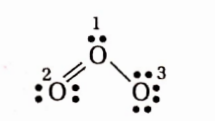
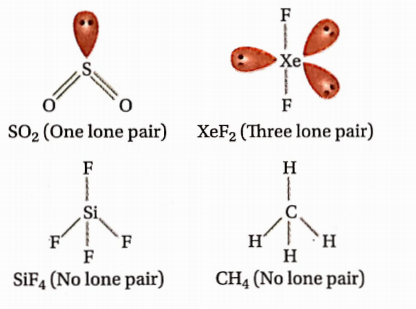
As BF3 forms adduct, the back bonding Is no longer present and thus double bond characteristic disappears. Hence, the bond becomes a bit longer than earlier (1.30A).

Question 88. The total number of antibonding electrons present in O2 will be

  1. 6
  2. 8
  3. 4
  4. 2

Answer: 1. MO electronic configuration of O2

\(\begin{aligned}
& \left(\sigma_{1 s}\right)^2\left(\sigma_{1 s}^*\right)^2\left(\sigma_{2 s}\right)^2\left(\sigma_{2 s}^*\right)^2\left(\sigma_{2 p_z}\right)^2\left(\pi_{2 p_x}\right)^2\left(\pi_{2 p_y}\right)^2 \\
& \left(\pi_{2 p_x}^*\right)^1\left(\pi_{2 p_y}^*\right)^1
\end{aligned}\)

Hence, the correct B.O. is O+2 → O-2 → 2-2

Question 89. Which ofthe following represents the correct bond order

  1. \(\mathrm{O}_2^{+}<\mathrm{O}_2^{-}>\mathrm{O}_2^{2-}\)
  2. \(\mathrm{O}_2^{+}<\mathrm{O}_2^{-}>\mathrm{O}_2^{2-}\)
  3. \(\mathrm{O}_2^{2-}>\mathrm{O}_2^{+}>\mathrm{O}_2^{-}\)
  4. \(\mathrm{O}_2^{+}>\mathrm{O}_2^{-}>\mathrm{O}_2^{2-}\)

Answer: 4. \(\mathrm{O}_2^{+}>\mathrm{O}_2^{-}>\mathrm{O}_2^{2-}\)

Question 90. In the O3 molecule, the formal charge on the central O-atom is—

  1. 0
  2. -1
  3. -2
  4. +1

Answer: 4. +1

Lewis gave the structure of the O3 molecule as

Chemical Bonding And Molecular Structure Lewis gave the structure

Using the relation, Formal charge = [Total no, of valence electrons in the free atom] – [Total no. of non-bonding (lone pair) electrons]-\(\frac{1}{2}\)[Total no. of bonding (shared) electrons]

The formal charge on central O -atom i.e., no. 1 = +1

Question 91. Four diatomic species are listed below in different sequences. Which of these represents the correct order of their increasing order

  1. \(\mathrm{C}_2^{2-}<\mathrm{He}_2^{+}<\mathrm{NO}<\mathrm{O}_2^{-}\)
  2. \(\mathrm{He}_2^{+}<\mathrm{O}_2^{-}<\mathrm{NO}<\mathrm{C}_2^{2-}\)
  3. \(\mathrm{O}_2^{-}<\mathrm{NO}<\mathrm{C}_2^{2-}<\mathrm{He}_2^{+}\)
  4. \(\mathrm{NO}<\mathrm{C}_2^{2-}<\mathrm{O}_2^{-}<\mathrm{He}_2^{+}\)

Answer: 2. \(\mathrm{He}_2^{+}<\mathrm{O}_2^{-}<\mathrm{NO}<\mathrm{C}_2^{2-}\)

According to molecular orbital theory, the energy level ofthe given molecules are

⇒ \(\mathrm{C}_2^{2-}-K K\left(\sigma_{2 s}\right)^2\left(\sigma_{2 s}^*\right)^2\left(\pi_{2 p_x}\right)^2\left(\pi_{2 p_y}\right)^2\left(\sigma_{2 p_z}\right)^2\)

⇒ \(\begin{aligned}
& \text { B.O. }=\frac{1}{2}[10-4]=3 \\
& \mathrm{He}_2^{+}-\left(\sigma_{1 s}\right)^2\left(\sigma_{1 s}^*\right)^1
\end{aligned}\)

⇒ \(\begin{aligned}
& \text { B.O. }=\frac{1}{2}[2-1]=\frac{1}{2}=0.5 \\
& \mathrm{O}_2^{-}-K K\left(\sigma_{2 s}\right)^2\left(\sigma_{2 s}^*\right)^2\left(\sigma_{2 p_z}\right)^2 \\
& \quad\left(\pi_{2 p_x}\right)^2\left(\pi_{2 p_y}\right)^2\left(\pi_{2 p_x}^*\right)^2\left(\pi_{2 p_y}^*\right)^1
\end{aligned}\)

⇒ \(\begin{aligned}
& \text { B.O. }=\frac{1}{2}[10-7]=1.5 \\
& \text { NO : }-K K\left(\sigma_{2 s}\right)^2\left(\sigma_{2 s}^*\right)^2\left(\sigma_{2 p_z}\right)^2 \\
& \qquad\left(\pi_{2 p_x}\right)^2\left(\pi_{2 p_y}\right)^2\left(\pi_{2 p_x}^*\right)^1\left(\pi_{2 p_y}^*\right)^0
\end{aligned}\)

⇒ \(\text { B.O. }=\frac{1}{2}[8-3]=2.5\)

So, the correct order of their increasing bond order is He+2 < O-2 < NO < C²-2

WBBSE Class 11 Practice MCQs for Chemical Bonding

Question 92. Which of the following molecules has more than one lone pair

  1. SO2
  2. XeF2
  3. SiF4
  4. CH4

Answer: 2. XeF2

Chemical Bonding And Molecular Structure The following molecules has more than one lone pair

Question 93. The ASF5 molecule is trigonal bipyramidal. The hybrid orbitals used by the As atoms for bonding are—

  1. \(d_{x^2-y^2}, d_{z^2}, s, p_x, p_y\)
  2. \(d_{x y}, s, p_x, p_y, p_z\)
  3. \(d_{x^2-y^2}, s, p_x, p_y\)
  4. \(s, p_x, p_y, p_z, d_z^2\)

Answer: 4. \(s, p_x, p_y, p_z, d_z^2\)

AsF5 has sp3d hybridisation. In sp2d hybridization, the dz2 orbital is used along with the ‘s’ and three ‘p’ orbitals to form three equatorial bonds and two equally strong axial bonds for a trigonal bipyramid

Question 94. H2O is polar, whereas BeF2 is not because—

  1. Electronegativity ofF is greater than that of O
  2. H2O involves H-bonding, whereas, BeF2 is a discrete molecule
  3. H2O is angular and BeF2 is linear
  4. H2O is linear and BeF2 is angular

Answer: 3. H2O is angular and BeF2 is linear

Because of the linear shape, dipole moments cancel each other in BeF2 (F—Be—F) and thus, it is non-polar, whereas H2O is V-shaped and hence, it is polar

Chemical Bonding And Molecular Structure Beacuse Of The Linear

Question 95. Which of the following have the same hybridization but are not isostructural

  1. C1F3 and l-3
  2. BrF3 and NH3
  3. CH4 and NH+4
  4. XeO3 and NH3

Answer: 1. C1F3 and l-3

  1. C1F3 (sp3d, T-shape); I3 (sp3d, linear)
  2. BrF3 (sp3d, T-shape); NH3 (sp3, pyramidal)
  3. CH4 (sp3, Tetrahedral); NH3 (sp3, Tetrahedral)
  4. XeO3 (sp3, Pyramidal); NH3 (sp3, Pyramidal)

Question 96. Which of the following pairs have different hybridization and the same shape—

  1. \(\mathrm{NO}_3^{-} \text {and } \mathrm{CO}_3^{2-}\)
  2. SO2 and NH2-
  3. XeF2 and CO2
  4. H2O and NH3

Choose The Correct Option

  1. 1 and 4
  2. 2 and 4
  3. 2 and 3
  4. None of these

Answer: 3. 2 and 3

  • NO-3 (sp2, trigonal planar);
  • CO2-3 (sp2, trigonal planar);
  • Same hybridization and the same shape.
  • SO2 (sp2, bent); NH2 (sp2, bent)

Different hybridization but the same shapes.

  • XeF2 (sp2d, linear); CO2 (sp, linear)
  • Different hybridization but the same shapes.
  • H2O (sp3angular); NH3 (sp3, pyramidal)

Question 97. Which of the following is correct regarding bond angles—

  1. SO2
  2. H2S<SO2
  3. SO2<H2S
  4. SBH3<NO+2

Choose the correct one

  1. 1 and 4
  2. 2, 1 and 4
  3. 1 and 3
  4. None of these

Answer: 1. 1 and 4

⇒ \(\begin{array}{ccccr}
\mathrm{SbH}_3 & \mathrm{H}_2 \mathrm{O} & \mathrm{H}_2 \mathrm{~S} & \mathrm{SO}_2 & \mathrm{NO}_2^{+} \\
91.3^{\circ} & 104.5^{\circ} & 109.5^{\circ} & 120^{\circ} & 180^{\circ}
\end{array}\)

Question 98. Which pair of molecules does not have an identical structure-

  1. I-3,BeF2
  2. O3,SO2
  3. BF2,ICI3
  4. BrF-4,XeF4

Answer: 3. BF3, ICI3

  1. BF3 —Trigonal planar
  2. IC13 —T-shape

Question 99. Which ofthe following order is correct—

  1. A1C13 < MgCl2 < NaCl: polarising power
  2. CO > CO2 > HCO-2 > CO2-3: bond length
  3. BeCl2 < NF3 < NH3 :dipole moment
  4. H2S > NH3 > SiH4 > BF3: bond angle

Answer: 3. A1C13 < MgCl2 < NaCl: polarising power

The polarising power of cations increases with the increasing charge.

⇒ \(\stackrel{(+1)}{\mathrm{NaCl}}<\stackrel{(+2)}{\mathrm{MgCl}_2}<\stackrel{(+3)}{\mathrm{AlCl}_2}\)

⇒ \(\text { Bond order } \propto \frac{1}{\text { Bond length }}\)

\(\text { Bond order }=\frac{\text { Bond order of each } \mathrm{C}-\mathrm{O} \text { bond }}{\text { Total no. of resonating structures }}\)

⇒ \(\begin{aligned}
& \mathrm{CO} \rightarrow \mathrm{C} \equiv \mathrm{O} \Rightarrow \frac{2+1}{1}=3.0 \\
& \mathrm{CO}_2 \rightarrow \mathrm{O}=\mathrm{C}=\mathrm{O} \Rightarrow \frac{2+2}{2}=2.0
\end{aligned}\)

Chemical Bonding And Molecular Structure Bond Order

Hence, the decreasing order of bond length is, CO2-3 > HCO2> CO2 > CO

Chemical Bonding And Molecular Structure Correct order of bond angle

The correct order of bond angle:

BF3 > SiH4 > NH3 > H2S
120° 109°28/ 107° 94°

Question 100. Which of the following has the maximum % of s- s-character

  1. N2H2
  2. N2H4
  3. NH3
  4. NH-2

Answer: 1. N2H2

Chemical Bonding And Molecular Structure the following has the maximum % of s- character

Question 101. Which of the following pairs does not have the same bond order-

  1. N2 and Cn-
  2. o+2 and no
  3. F-2 and O+2
  4. B22 and CN+

Answer: 1. N2 and Cn-

M.O. electronic configuration of N2(14):

⇒ \(\left(\sigma_{1 s}\right)^2\left(\sigma_{1 s}^*\right)^2\left(\sigma_{2 s}\right)^2\left(\sigma_{2 s}^*\right)^2\left(\pi_{2 p_x}\right)^2\left(\pi_{2 p_y}\right)^2\left(\pi_{2 p_z}\right)^2\)

⇒ \(\text { B.O. }=\frac{1}{2}\left(\mathrm{~N}_b-\mathrm{N}_a\right)=\frac{1}{2}(10-4)=3.0\)

M.O. electronic configuration of CN-(14):

⇒ \(\begin{aligned}
& \quad\left(\sigma_{1 s}\right)^2\left(\sigma_{1 s}^*\right)^2\left(\sigma_{2 s}\right)^2\left(\sigma_{2 s}^*\right)^2\left(\pi_{2 p_x}\right)^2\left(\pi_{2 p_x}\right)^2\left(\pi_{2 p_z}\right)^2 \\
& \text { B.O. }=\frac{1}{2}(10-4)=3.0
\end{aligned}\)

M.O. electronic configuration of O2(15):

⇒ \(K K\left(\sigma_{2 s}\right)^2\left(\sigma_{2 s}^*\right)^2\left(\sigma_{2 p_z}\right)^2\left(\pi_{2 p_x}\right)^2\left(\pi_{2 p_y}\right)^2\left(\pi_{2 p_x}^*\right)^1\)

⇒ \(\text { B.O. }=\frac{1}{2}(10-5)=2.5\) \text { B.O. }=\frac{1}{2}(10-5)=2.5

M.O. electronic configuration of NO(15):

⇒ \(K K\left(\sigma_{2 s}\right)^2\left(\sigma_{2 s}^*\right)^2\left(\sigma_{2 p_z}\right)^2\left(\pi_{2 p_x}\right)^2\left(\pi_{2 p_y}\right)^2\left(\pi_{2 p_x}^*\right)^1\)

⇒ \(\text { B.O. }=\frac{1}{2}(10-5)=2.5\)

M.O. electronic configuration of F-2( 19):

⇒ \(\begin{aligned}
& K K\left(\sigma_{2 s}\right)^2\left(\sigma_{2 s}^*\right)^2\left(\sigma_{2 p_z}\right)^2\left(\pi_{2 p_x}\right)^2 \\
& \left(\pi_{2 p_y}\right)^2\left(\pi_{2 p_x}^*\right)^2\left(\pi_{2 p_y}^*\right)^2\left(\sigma_{2 p_z}\right)^1 \\
&
\end{aligned}\)

⇒ \(\text { B.O. }=\frac{1}{2}(10-8)=1.0\)

M.O. electronic configuration of O²2-(18):

⇒ \(\begin{aligned}
& K K\left(\sigma_{2 s}\right)^2\left(\sigma_{2 s}^*\right)^2\left(\sigma_{2 p_z}\right)^2\left(\pi_{2 p_x}\right)^2\left(\pi_{2 p_y}\right)^2\left(\pi_{2 p_x}^*\right)^2\left(\pi_{2 p_y}^*\right)^2 \\
& \text { B.O. }=\frac{1}{2}(10-8)=1.0
\end{aligned}\)

M.O. electronic configuration of B²-2(12):

⇒ \(K K\left(\sigma_{2 s}\right)^2\left(\sigma_{2 s}\right)^2\left(\pi_{2 p_x}\right)^2\left(\pi_{2 p_y}\right)^2\)

⇒ \(\text { B.O. }=\frac{1}{2}(8-4)=2.0\)

M.O. electronic configuration of CN+(12):

⇒ \(K K\left(\sigma_{2 s}\right)^2\left(\sigma_{2 s}\right)^2\left(\pi_{2 p_x}\right)^2\left(\pi_{2 p_y}\right)^2 ; \text { B.O. }=\frac{1}{2}(8-4)=2.0\).

WBCHSE Class 11 Chemistry Notes For Periodic Trends of Elemental Properties

Periodic Trends In Properties Of The Elements

WBBSE Class 11 Periodic Trends Overview

The properties of elements can be divided into two categories:

Properties of individual atoms: The properties such as atomic and ionic radii, ionisation energy, electron affinity, electro negativity and valency are the properties of the individual atoms & are directly related to their electronic configurations.

Properties of groups of atoms: The properties such as melting point, boiling point, the heat of fusion, heat of vaporisation, atomic volume, density etc. are the bulk properties i.e., the properties of a collection of atoms and are related to their electronic configurations indirectly.

Periodic Table Of Elements Trends

All these properties which are directly or indirectly related to the electronic configurations of the elements are called atomic properties.

Since electronic configurations of the elements are periodic functions of their atomic numbers, these atomic properties are also periodic functions of atomic numbers of the elements. Thus, atomic properties are also called periodic properties.

Read and Learn More WBCHSE Class 11 Chemistry

Periodic Trends

Remember that, when we descend a group, the chemical properties ofthe elements remain more or less the same due to the same valence shell configuration, but there is a gradual change in physical properties due to a gradual change in the size ofthe atoms owing to the addition of new electronic shells.

WBCHSE Class 11 Chemistry Notes For Periodic Trends of Elemental Properties

Understanding Atomic Radius Trends for Class 11

Atomic size or atomic radius

If an atom is assumed to be a sphere, the atomic size is given by the radius of the sphere, called atomic radius.

Atomic size or atomic radius Definition: The distance from the centre of the nucleus to the outermost shell containing the electrons is called the atomic radius

Difficulties in precise measurement of atomic radius:

It is not possible to isolate a single atom for the measurement of its radius.

The electron cloud surrounding the nucleus does not have a sharp boundary as the probability of finding an electron can never be zero even at a large distance from the nucleus.

The magnitude of atomic radius changes from one bonded state to another.

Types of atomic radius: As already mentioned, the size of an atom varies from one environment to another.

Therefore, several kinds of atomic radii have been defined. These are—

  1. Covalent radius
  2. Metallic radius
  3. van der Waals radius.

Covalent radius: It is defined as one-half of the distance between the centres of two atoms of the same element bonded by a single covalent bond.

Class 11 Chemistry Classification Of Elements And Periodicity in Properties Covakent radius

Thus for homonuclear diatomic molecules, covalentradius\((r)=\frac{1}{2} x\)
internuclear distance.

Example: In the H2 molecule, the internuclear distance is = 0.74 A =74pm. So, covalent radius ofhydrogen atom=\(=\frac{1}{2} \times 0.74\) = 0.37 A= 37pm. lA = 10-10m, 1 pm = 10-12m.

For the heteronuclear diatomic molecule A—B, internuclear distance, rAB = rA + rB.

Therefore rA = rAB-rB rB = rAB-rA

[rA and rB represent radii ofthe atoms, A & B respectively]

Example: For HC1 molecule, internuclear distance, rHCl = L36A & covalent radius of hydrogen atom (rH) = 0.37 A

Therefore Covalent radius ofchlorine atom (rcl) = rHC1- rH = 1.36-0.37 = 0.99 A

Metallic radius: It is defined as one-half of the internuclear distance between two adjacent atoms in a metallic lattice.

Example: The distance between two adjacent copper atoms in solid copper is 2.56 A (determined by X-ray diffraction). Hence, the metallic radius ofcopperis1.28

A. Similarly, the metallic radii of sodium and potassium have been determined as 1.86 A and 2.31 respectively.

Note—covalent radii of Na and K are 1.54 A and 2.03 A.

Metallic radius is always greater than the covalent radius van der Waals radius: It is defined as one-half of the distance between the nuclei of two non-bonded neighbouring atoms belonging to two adjacent molecules of an element in the solid state.

Class 11 Chemistry Classification Of Elements And Periodicity in Properties Van der waals radius

Example: The distance between nuclei of two adjacent Cl -atoms of two adjacent chlorine molecules in a solid state is 3.6 A.

Ionization Energy Trends in the Periodic Table

Ionization Radius

So, the van der Waals radius of Cl-atom is \(\frac{3.6}{2}=1.8 \AA\) Since the 2 van der Waals force of attraction is weak even in the solid state, the internuclear distances between the atoms of two adjacent molecules held by van der Waals forces are much larger than those between covalently bonded atoms (which involve mutual overlap of atomic orbitals). Van der Waals radii are always greater than covalent radii. For example, the van der Waals radius ofchlorine is1.80 A while its covalent radius is 0.99 A.

Class 11 Chemistry Classification Of Elements And Periodicity in Properties Sequences of three type of atomic radii

The sequence of three types of atomic radii: van der Waals radius >Metallic radius > Covalentradius.

Variation of atomic radii or sizes in the periodic table: While moving from left to right across a period in the periodic table, atomic radii or atomic sizes progressively decrease.

Explanation: The principal quantum shell remains unchanged in the same period. So, the differentiating electrons enter the same shell but due to an increase in the number ofprotons, the positive charge of nucleus also increases.

So, the attractive force of the nucleus for electrons in the outermost shell also increases.

Hence, the atomic sizes, rather than the atomic radii of elements in the same period, gradually decrease with an increase in atomic number. In any period, the atomic size of the element of group LA is maximum and that of the halogen of group VILA is minimum.

Variation of atomic [covalent] radii of the elements of the third period (n = 3]

Class 11 Chemistry Classification Of Elements And Periodicity in Properties Variatioon of atmoic [Covalent] radii of the elements of thirs period [n=3]

Variation of atomic radii or sizes down a group: On moving down along any group of the periodic table, the atomic sizes rather the atomic radii of the elements increase remarkably.

Explanation: On moving down a group, a new electronic shell is added to each succeeding element, though the number of electrons in the outermost shell remains the same. This tends to increase the atomic size.

At the same time, there is an increase in nuclear charge with an increase in atomic number. This tends to decrease the size.

However, the effect of the increased nuclear charge is partly reduced by the shielding effect of the inner electronic shells. In practice, it is found that the effect of the addition of a new electronic shell is so large that it outweighs the contractive effect of the increased nuclear charge.

Hence, there occurs a gradual increase in atomic radii on moving down a group in the periodic table.

Variation of size in a group for heavier elements: On moving down a group, the relative rate of increase of atomic radii slow for heavier elements.

So, the differences in size for heavier species such as Cs (6s1) and Fr(7s1) of group-1 or Ba(6s2) and Ra(7s2) of group-2 are very small.

This is due to the presence of electrons in the inner d and f-orbitals having poor screening effect.

D and f-electrons do not screen the outer electrons effectively from the pull of the nucleus. There is only a small increase in size despite addition of a new electronic shell. Example— Na(l.54 A), K(2.03 A), Rb(2.16 A), Cs(2.35 A) etc.

In the case of transition elements, such a decrease in the atomic size is relatively less. Here the differentiating electron instead of entering the outermost orbit, goes to the penultimate (n- 1 )d -subshell which is closer to the nucleus.

However, due to the poor shielding effect of the additional d -electrons, there is a small increase in effective nuclear charge and hence, the decrease in the size with an increase in the atomic number is relatively small.

In the case of lanthanide elements, the differentiating electrons enter the (n – 2)/-orbital having a very poor shielding effect.

Class 11 Physics Class 12 Maths Class 11 Chemistry
NEET Foundation Class 12 Physics NEET Physics


So, In such cases, the increase in the effective nuclear charge is greater than that in the case of transition elements.

Thus, the decrease in atomic sizes of the lanthanides is much more regular and distinct as compared to the transition elements.

So, the difference in the extent of the decreased atomic sizes ofthese elements is due to their relative inability to screen the outermost electrons from attraction ofthe nucleus.

Class 11 Chemistry Classification Of Elements And Periodicity in Properties Covalent radiii[pm] of representative element

Class 11 Chemistry Classification Of Elements And Periodicity in Properties Variation Of atomic radii with atomic numbers across the second period

Class 11 Chemistry Classification Of Elements And Periodicity in Properties Variation of atomic radii with atomic numbers for group -1 metals

Electronegativity Trends Explained for Class 11

Screening effect or shielding effect: in multi-electron atoms, the electrons present in the inner shells shield the electrons in the valence shell from the pull of the nucleus.

It means that the electrons of the inner shells act as a screen between the nucleus and the electrons in the valence shell. This is known as the screening effect shielding effect.

Screening effect or shielding effect Definition: The ability of the inner electronic shells to shield the outer electrons from the attraction of the nucleus is called the screening effect or shielding effect.

The magnitude of the screening effect of electrons belonging to different subshells follows the sequence: s>p> d>f.

Important points regarding atomic (covalent) radius:

The alkali metals occupying positions at the extreme left side ofthe periodic table have the largest size in each period.

The halogens occupying positions at the right side of the periodic table have the smallest size in each period.

The noble gases present at the extreme right of the periodic table have larger atomic radii than those of the preceding halogens because van der Waals radii (but not covalent radii) are taken into consideration for noble gases.

Atomic Size Trend

In transition series {d -block elements), there is only a small decrease in size with successive increases in atomic number because the differentiating electrons enter into (n-l)d subshell, which partially shields the increased nuclear charge acting on the valence electrons. This is known as d contraction.

For the inner-transition series ( f-block elements), the decrease in atomic radii and wide increase in atomic number is relatively greater and more regular as compared to the transition series elements.

This is so because the differentiating electrons enter into (n- 2)f -subshell havingverypoor shielding effect.

In a group of representative elements, there is a continuous increase in atomic radii with an increase in atomic number.

On going down a group of transition elements, there is an increase in size from first member to second member as expected, but for higher members, the increase in size is quite small. This is due to lanthanide contraction. For example, Cu(1.28A), Ag(1.44A), Au (1.44A)etc.

Ionic radii

Ionic radii refers to the radii of the ions in the ionic crystals. Ionic radius may be defined as the effective distance from the centre of the nucleus of an ion to the point upto which it exerts its influence on the electron cloud.

Theoretically, the electron cloud may extend itself to a very large distance from the nucleus. So, it is not possible to measure the ionic radius directly.

It is measured indirectly as follows. The equilibrium distance between nuclei of adjacent cation and anion in an ionic crystal can be determined by X-ray analysis.

Class 11 Chemistry Classification Of Elements And Periodicity in Properties Ionic radii

Regarding ions as spheres, the internuclear distance may be taken as the sum of the radii of the adjacent ions. Knowing the radius of one, that ofthe other can be calculated. Several methods have been developed to fix the absolute value of at least one ion.

Pauling’s method is the most widely accepted and the values given here are based on this method.

For example, based on Pauling’s method, the radius ofthe Na+ion has been determined to be 0.95 A.

Again, the intemuclear distance between Na+ and Cl- ions in NaCl crystal is 2.76 A (from X-ray studies). So, (2.76-0.95) = 1.81 A.

Some characteristics of ionic radii:

The radius ofthe cation is always smaller than that of the neutral atom: A cation is formed loss of one or more electrons from the neutral atom (e.g., Na-e→Na+; Mg- 2e→Mg2+ ).

With the removal of electron (s) from an atom, the magnitude of nuclear charge remains the same while the number of electrons decreases. That means the same nuclear charge now acts on a decreased number of electrons.

As a result, effect of nuclear charge per electron increases and the electrons are more strongly attracted towards the nucleus. This causes a contraction in size ofthe cation.

In most cases, all the electrons from the outermost shell of the atom are completely removed so that the penultimate shell of the atom now becomes the outermost shell ofthe cation.

As a result, the size ofthe cation becomes smaller than that of the parent atom from which it is formed.

\(\begin{array}{cc}
\mathrm{Na}\left(1 s^2 2 s^2 2 p^6 3 s^1\right) \stackrel{-e}{\longrightarrow} & \mathrm{Na}^{+}\left(1 s^2 2 s^2 2 p^6\right) \\
r_{\mathrm{Na}}=1.54 \AA & r_{\mathrm{Na}^{+}}=0.95 \AA
\end{array}\)

When an element forms more than one type of cation, then the cationwithhigher chargewillbe smallerin size: The cations (e.g., Fe2+ and Fe3+) derived from a specific element contain same number of protons but different number of electrons.

The cation with a higher charge (e.g., Fe3+) contains fewer electrons and the effective nuclear charge per electron is greater, thereby causing a contraction in size.

Example: Ionic radius of Fe2+ = 0.75 A but ionic radius of Fe3+ = 0.60 A

The radius ofthe anionic is always greater than that ofthe neutral atom: An anion is formed by the gain of one or more electrons by a neutral atom (e.g., Cl+e→Cl-; O+2e→O2-)

This increases the number of electrons in the anion but the nuclear charge remains the same as that in the parent atom.

That means the same nuclear charge now acts on an increased number of electrons. As a result, effective nuclear charge per electron decreases and the electrons are less tightly held by the nucleus. This causes an increase in the size of the anion.

Furthermore, the addition of one or more electrons would result in increased repulsion among the electrons, thereby causing the expansion of the outermost electronic shell. This also causes an increase in the size of the anion

Chemical Reactivity of Elements: Periodic Trends

Example-1

\(\begin{array}{cc}
\mathrm{Cl}(17 p+17 e) \stackrel{+e}{\longrightarrow} \mathrm{Cl}^{-}(17 p+18 e) \\
r_{\mathrm{Cl}}=0.99 \AA & r_{\mathrm{Cl}^{-}}=1.81 \AA
\end{array}\)

Variation of ionic radii within a group:

For cations: Like covalent radii of atoms, the radii of cations also increase on moving down a group. This is primarily due to the addition of a new electronic shell at each succeeding member on moving down a group. Thus,

\(r_{\mathrm{Li}^{+}}<r_{\mathrm{Na}^{+}}<r_{\mathrm{K}^{+}}<r_{\mathrm{Rb}^{+}}\)

For anions: Like cationic radii, the radii of anions also increase on moving down a group. This is primarily due to the addition of a new electronic shell at each succeeding member on moving down a group. Thus, \(r_{\mathrm{F}^{-}}<r_{\mathrm{Cl}^{-}}<r_{\mathrm{Br}^{-}}<r_{1^{-}}\)

Class 11 Chemistry Classification Of Elements And Periodicity in Properties Variation of ionic radii of cations of Gr-1[1A] and anions of group- 17

Variation of ionic radii along a period:

For cations: On moving from left to right along a period, the radii of isoelectronic cations (cations having the same number of electrons) decrease progressively due to an increase in the magnitude of nuclear charge (i.e., an increase in the number of protons).

Thus, rNa+ > rMg2+ > rAl3+.

For anions: Onmovingfromlefttorightalong period, the radii of isoelectronic anions (anions having the same number of electrons) decrease progressively due to increase in the magnitude of nuclear charge [i.e., an increase in the number of protons). Thus, rN3¯ > rQ2‾ > rp¯

Class 11 Chemistry Classification Of Elements And Periodicity in Properties Variation Of ionic Radii Of Isoelecronic Ions

Variation of ionic radii of isoelectronic ions (cations or anions) belonging to the same or different periods:

Isoelectronic species Cations or anions or neutral atoms having the same number of electrons but different magnitude of nuclear charge [i.e., different number of protons) are called isoelectronic species.

A set of isoelectronic ions (belonging to periods 2 and 3) are shown in the following table. All the ions have an equal number (10) of extranuclear electrons but a different number of protons.

As we move from one member to another, the nuclear charge increases. Consequently, the electrons are pulled more and more strongly, thereby causing a gradual decrease in size.

Class 11 Chemistry Classification Of Elements And Periodicity in Properties Isoelectronic anions having same number of electrons

Note that the cation with a greater positive charge has a smaller radius while the anion with a greater negative charge has a greater radius.

For any atom or ion, (Z/e) oc(1f): where Z- atomic number or nuclear charge, e = number of electrons and r = atomic or ionic radius.

Since the quantity, Z -e varies inversely with ionic radius (r), so increase in the magnitude of Z/e brings about a decrease in the value of ionic radius, and a decrease in the magnitude of Zfe results in an increase in ionic radius.

Forinstance,in case of O -atoms,(Z/e) = 1 and for O2¯ ion, (Z/e) = (8/10) = 0.8. So, the ionic radius of O2¯ ion (1.40 A) is greater than the atomic radius of O-atom (0.66A).

Similarly for K-atom, (Z/e) = 1 and for K+ ion, (Z/e) = (19/18) = 1.05. Hence, the ionic radius of the K+ ion (1.33 A) is less than the atomic radius of the K -atom (2.27 A)

Important points to remember about ionic radii:

  1. The radius of the cationic is always smaller than that of the parent atom.
  2. Theradius of anion is always greater than that of the parent atom.
  3. The ionic radii (both cationic and anionic) in any group increase on moving down the group.
  4. The radii of isoelectronic cations decrease with increasing atomicnumber across a period.
  5. The radii of isoelectronic anions decrease with increasing atomicnumber across a period.
  6. The radii of isoelectronic cations or anions (of the same or different period) decrease with increasing atomic number.
  7. The sizes of cations (of the same element) decrease with increasing positive charge (e.g., rpe2+ > rFe3).

Atomic volume Definition: It is the volume occupied by the gram-atom (or mole atom) of an element at its melting point in the solid state.

Measurement: The gram-atomic mass of an element, when divided by its density, gives the atomic volume ofthe element.

Atomic masses. He plotted atomic volumes of different elements against the corresponding atomic masses and the curve thus obtained looked like a wave with several sharp peaks and broad minima.

The curve reveals that the atomic volumes of elements having similar properties are periodic functions of their atomic masses. For instance, l] Each peak ofthe curve is occupied by the first member of a period.

That means the reactive and light alkali metals, Li, Na, K, Rb, Cs and Fr occursuccessivelyat at the peaks. They have the largest atomic volumes.

The less reactive transition elements (e.g., Cr, Mn, Fe, Co, Ni )which are heavy and possess high melting points occupy the bottom portions ofthe curve.

Electronegative elements (e.g., F, Cl, Br, I) occupy the ascending portions of the curve (i.e., the left side of each peak) and their non-metallic character increases while moving towards the peak.

Each of the descending portions (i.e., the right side of each peak) of the curve is occupied by electropositive metals (e.g., Mg, Ca, Sr, Ba). v] Elements occupying similar positions on the curve are placed in the same group of the periodic table.

\(\text { Atomic volume }=\frac{\text { Gram-atomic mass }}{\text { Density }\left(\text { in } \mathrm{g} \cdot \mathrm{cm}^{-3}\right)}\)

Class 11 Chemistry Classification Of Elements And Periodicity in Properties Variation Of atomic volume with the change in atomic masses of different elements

Electron Affinity Trends Across the Periodic Table

Variation of atomic volume along s period: On moving from left to right along a period, the atomic volume of the elements gradually decreases to a minimum value and then increases successively and attains a maximum value the first member of the next period.

Variation of atomic volumes of elements belonging to the second and third periods

Class 11 Chemistry Classification Of Elements And Periodicity in Properties Variation of atomic volumes of elemnets belonging to second nad third periods

Variation of atomic volume down a group: On moving down a group, (i.e., with increasing atomic mass) the atomic volume of elements increases almost regularly due to successive addition of new principal quantum shells.

Metallic and non-metallic character

The metallic property or electropositive character of an element is measured as the tendency of its atom to form a cation with loss of electron (s). The more the tendency ofthe atom of an element to lose electrons, the more will be its metallic property.

Variation of metallic and non-metallic character across a period: In any period, as we move from left to right, the atomic size ofthe elements progressively decreases with a consequent steady increase in nuclear attractive force for the valence electrons; i.e., the valence electrons lose their freedom.

As a result, metallic property gradually decreases which is reflected in the fall of thermal and electrical conductivity of the elements. On the other hand, the non-metallic character ofthe elements increases along a period from left to right.

Explanation: Because of the large size of the metallic atoms, electrons in their valence shell are loosely held. So, they exhibit both thermal and electrical conductivity.

On the contrary, atoms of non-metals are smaller in size and hence their valence shell electrons are relatively strongly held therefore, they are thermally and electrically non-conductive. Moreover, non-metals have a strong tendency to form anions by gaining electrons. So, they are electronegative.

Metalloids like the nonmetals, are characterised by their small atomic sizes and their valence-electrons are more or less strongly confined.

However, at high temperatures, the confined electrons become mobile and contribute to electrical conductivity.

Example: Elements belonging to groups 1 and., Na and Mg are good conductors of of heat and electricity, and A1 in group 13 has moderate conductivity. Other elements of this period are either or conductors on-conductors.

Variation of the metallic and non-metallic character down a group: In the periodic table, as we move down a group, the metallic character gradually increases and consequently, the non-metallic character gradually decreases.

Explanation: Due to the introduction of new electronic shells, the hold of the nucleus on the valence electrons gradually decreases thereby making these electrons more and more mobile on moving down a group.

Consequently, metallic character increases with increasing atomic number. Thus in group 15, N and P are typical non-metals, As and Sb are metalloids and Bi is a typical metal. C in group-14 is a typical non-metal, Ge possesses metallic character while Pb and Sn are typical metals.

All transition elements as well as the elements oflanthanoid and actinoid series are typical metals. Transition elements are good conductors of heat and electricity. Coinage or noble metals (Cu, Ag, Au and Pt) have maximum thermal and electrical conductivity.

Class 11 Chemistry Classification Of Elements And Periodicity in Properties Positions of mentals, metalloids and non-mentals in periodic table

Variation of the metallic and non-metallic character of elements from the nature of their oxides: On moving across a period from left to right, metallic character decreases and within a group, the metallic character increases from top to bottom.

Generally, oxides of strongly electropositive elements are basic while oxides of strongly negative elements exhibit acidic character.

Example:

Oxides of the representative elements ofthe third period show that their basic character i.e., the metallic property gradually decreases while their acidic character i.e., non-metallic character gradually increases from left to right across the period.

Class 11 Chemistry Classification Of Elements And Periodicity in Properties Nature of oxides of elements of third period

Oxides of elements of group VA reveal that the acidic character progressively decreases while the basic character increases down a group. Hence, the non-metallic character gradually decreases and the metallic character gradually increases down a group.

Class 11 Chemistry Classification Of Elements And Periodicity in Properties Nature Of Oxides Of elements Belonging to group-5A

Oxidising and reducing properties

An oxidising agent can gain electrons while a reducing agent can donate electrons. So strong oxidising agents have a pronounced tendency to accept electrons and strong reducing agents give up electrons easily.

Variation of oxidising & reducing properties across a period:

On moving from left to right a period, nuclear charge increases by one unit and at the same time one electron is added to the same outermost shell in each succeeding element.

So nuclear pull on the electrons of the outermost shell increases with increasing atomic number.

Consequently, the tendency of an atom to give up electrons decreases and the reverse tendency i.e., the tendency to accept electrons increases on increasing atomic numbers over a period.

In other words, the elements on the right side of a period [Le., gr.-VA(15), VIA(16) and VIIA(17) elements] are good oxidising agents because they are good acceptors of electrons.

Trends in Metallic and Non-Metallic Character

Their oxidising power increases as: VA < VIA < VIIA. On the other hand, the elements on the left side of a period [le., gr-IA(l), IIA(2)] are good-reducing agents because they are good donors of electron. Their reducing power decreases as 1A > 2A > 3A

Example: Oxidisingpower: Na < Mg < A1 < Si < P < S < Cl

Reducing power: Na > Mg > Al > Si > P > S > Cl

Variation of oxidising and reducing properties down a group:

On moving down a group, a new electronic shell is added at each succeeding element. This tends to decrease the nuclear pull on the outer electrons.

But at the same time, there is an increase in nuclear charge with an increase in atomicnumber This tends to increase the nuclear pull on the outer electrons. In practice, it is found that the effect of the addition of a new electronic shell is greater than the effect of increased nuclear charge.

This means that, on moving down a group, nuclear pull on the outer electrons gradually decreases.

Consequently, reducing power gradually increases while the oxidising power gradually decreases on moving down a group in the periodic table.

Example: The oxidising power of halogens follows the order: of F(+2.87) > Cl(+1.36) > Br(+1.06) >I(+0.53). The reducing power of group-IIA metals follows the order:

Be(-1.85) < Mg(—2.37) < Ca(-2.87) < Sr(-2.89) < Ba(-2.90). where the quantities within the bracket indicate the standard reduction potential, £°ed(volt) at 25°C for the indicated (12X2 or M2+/M ).

Class 11 Chemistry Classification of Elements and Periodicity in Properties Question and Answers

Class 11 Chemistry Classification Of Elements And Periodicity In Properties Question And Answers

WBBSE Class 11 Periodicity Questions and Answers

Question 1. What is the basic theme of organization in the periodic table?
Answer:

Basic theme of organization in the periodic table

The basic theme of organization in the periodic table is to study different physical and chemical properties of all the elements and their compounds simply and systematically.

Elements belonging to the same group have similar physical and chemical properties.

So, if the physical and chemical property of any one element of a group is known, then it is possible to predict the physical and chemical properties of the remaining elements of that group.

Therefore, it is not important to keep in mind the physical and chemical properties of all elements in the periodic table.

Read and Learn More WBCHSE Class 11 Chemistry

Question 2. Which property did Medeleev use to classify the elements in his periodic table? Did he stick to that?
Answer: Mendeleev classified the elements based on their increasing atomic weights in the periodic table. He arranged almost 63 elements in order of their increasing atomic weights placing together elements with similar properties in a vertical column

He observed that while classifying elements in the periodic table according to increasing atomic weight, certain elements had different properties than those elements belonging to the same group.

For such cases, Mendeleev prioritized the properties of the element over its atomic weight.

So, he placed an element with a higher atomic weight before an element with a lower atomic weight.

For example, iodine [I (126.91)] with a lower atomic weight than tellurium [Te (127.61)] is placed after tellurium in group VII along with elements like fluorine, chlorine, etc., due to similarities in properties with these elements.

Thus, Mendeleev did not stick to his idea of classifying elements only according to the increasing atomic weights.

Visual Aids for Understanding Periodic Trends

Class 11 Chemistry Classification Of Elements And Periodicity In Properties Question And Answers

Understanding Periodic Trends: Short Answer Questions

Question 3. What is the basic difference in approach between Mendeleev’s Periodic Law & the Modern Periodic Law?
Answer:

The basic difference in approach between Mendeleev’s Periodic Law & the Modern Periodic Law

According to Mendeleev’s periodic law, the physical and chemical properties of elements are a periodic function of their atomic weights.

On the other hand, the modern periodic table states that the physical and chemical properties of the elements are a periodic function of their atomic numbers.

Thus the basic difference in approach between Medeleev’s periodic law and modern periodic law is the change in the basis of classification of elements from atomic weight to atomic number.

Based on quantum numbers, justify that the sixth period of the periodic table should have 32 elements.

In the modern periodic table, each period begins with the filling of a new principle energy level. Therefore, the sixth period starts with the filling of the principal quantum number, n = 6.

In the sixth period elements, the electron first enters the 6s -orbital, and then from left to right across a period the electrons enter the 4/, 5d, and 6p orbitals of the elements.

Filling of electrons in orbitals case of6th period continues till new principal energy level of quantum number, n = 7 begins, i.e., for elements of the sixth period, electrons fill up the 6s, 4/, 5d, and 6p orbitals total number of orbitals in this case =1 + 7 + 5 + 3 = 16. Since each orbital can accommodate a maximum of two electrons, there can be 16 X 2 or 32 elements in the sixth period.

Question 5. In terms of period and group where would you locate the element with Z = 114?
Answer: it is known that the difference between atomic numbers of the successive members of any group is 8,8,18,18 and 32 (from top to bottom). So, the element with atomic number 114 will lie just below the element with atomic number (114- 32) = 82.

The element with atomic number 82 is lead (Pb), which is a member of the 6th period belonging to group number 14 (p -block element). Thus the element with atomic number 114 takes its position in the 7th period and group- 14 (p -block element) ofthe periodic table.

Question 6. Write the atomic number of the element present in the third period & seventeenth group of the periodic table.
Answer:

The atomic number of the element present in the third period & seventeenth group of the periodic table are 

The general electronic configuration of the valence shell of the elements of group-17 (halogens) is ns2np5.

For the third period, n = 3. Therefore, the electronic configuration of the valence shell of the element ofthird period and group-17 Is 3ia3p1 and the complete electronic configuration of this element Is ls22s22p63s23p5.

There are a total of 17 electrons in this element. Thus, the element In the third period and seventeenth group of the periodic table has atomic number = 17.

Class 11 Physics Class 12 Maths Class 11 Chemistry
NEET Foundation Class 12 Physics NEET Physics


Question 7. Which clement do you think would have been named by—Lawrence Berkeley Laboratory and Seaborg’s group?
Answer: Lawrencium, Lr and Berkellum, UK. Seaborgium, Sg.

Question 8. Why do elements In the same group have similar physical and chemical properties?
Answer: Elements belonging to the same group have similar valence shell electronic configurations so they have similar physical and chemical properties.

Question 9. What do you mean by isoelectronic species? Name a species that will be isoelectronic with each of the given atoms or ions: F- Ar, Mg2+, Rb+.
Answer:

Isoelectronic species

Isoelectronic ions are ions of different elements that have the same number of electrons but different magnitudes of nuclear charge.

There are (9 + 1) or 10 electrons in F-. Isoelectronic species of F- are nitride (N3-) ion [7 + 3], oxide (O2-) ion [8 + 2], neon (Ne) atom [10], sodium (Na+) ion [11-1], magnesium (Mg2+) ion [12-2], aluminum (Al3+) ion [13-3].

There are 18 electrons in Ar. Isoelectronic species of Ar phosphide (P3-) ion [15 + 3], sulfide (S2-) ion [16 + 2]. chloride (Cl ion [17 + 1], potassium (K+) ion [19 -1], calcium (Ca2+) ion [20-2].

There are (12-2) = 10 electrons in Mg2t. Isoelectronic species of Mg2+ are nitride (N3-) ton [7 + 3], oxide (O2-) ion [8 + 2], fluoride (F-)ion [9+1] sodium (Na+) ion [11-1].

There are (37-1)- 36 electrons In Kb 1 . Isoelectronic species of Rb+ are bromide (Br-) Ion [35 + 1], krypton (Kr) atom [36], strontium (Sr2′) Ion [30-2].

Classification of Elements: Key Questions for Class 11

Question 12. Consider the given species: N3-, 02-, I1-, Nn+, Mg2+ and Al3+. What Is Common In them? Arrange them in the order of increasing ionic radii.
Answer: Each of the given ions has 10 electrons. Hence, they are all isoelectronic species. Ionic radii isoelectronic ions decrease with an increase in the magnitude of the nuclear charge.

The order of increasing nuclear charge of the given isoelectronic ions is N3- < O2- <F- < Na+ < Mg2+ < Al3+.

Therefore, the order of increasing ionic radii is: Al3+ < Mg2+ < Na+ < F- < O2- < N3-.

Question 13. What is the significance of the terms—’ isolated gaseous atom’ and ‘ground state’ while defining the ionization enthalpy and electron-gain enthalpy?
[Hint: Requirements for comparison purposes]
Answer: The ionization energy of an element is defined as the minimum amount of energy required to remove the most loosely bound electron from the valence shell of an isolated gaseous atom existing in its ground state to form a cation in the gaseous state.

Electron-gain enthalpy is defined as the enthalpy change involved when an electron is added to an isolated gaseous atom in its lowest energy state (ground state) to form a gaseous ion carrying a unit negative charge.

The force with which an electron gets attracted by the nucleus of an atom is influenced by the presence of other atoms in the molecule or the neighborhood. Thus, to determine the ionization enthalpy, the interatomic forces should be minimal.

Interatomic forces are minimal in the case of the gaseous state as the atoms are far apart from each other.

Consequently, the value of ionization enthalpy is less affected by the surroundings. Similarly, for electron affinity, the interatomic forces of attraction should be minimal for the corresponding atom. Tor Tills reason, the term ‘Isolated gaseous atom’ Is used while defining Ionisation enthalpy and electron-gain enthalpy.

Ground state means the state at which the atom exists In Its most stable state. If the atom Is In the excited state, then the amount of heat applied to remove an electron or the amount of heat liberated due to the addition of an electron is low.

So, for comparison, the term ‘ground state’ Is used while defining ionization enthalpy and electron-gain enthalpy.

Question 15. The energy of an electron in the ground state of the Hatom is -2.18 X 10⁻¹⁸J. Calculate the ionization enthalpy of atomic hydrogen in terms of J . mol-1. [Hint: Apply the idea of the mole concept.]
Answer:

Given

The energy of an electron in the ground state of the Hatom is -2.18 X 10⁻¹⁸J.

Amount of energy required to remove an electron from a hydrogen atom at ground state =Eog-El = 0-El = -(-2.18 X 10⁻¹⁸)J =2.18 X 10⁻⁸ J

Ionization enthalpy of atomic hydrogen per mole = 2.18 X 10“18 X 6.022 X 1023 = 1312.8 X 103 J.mol-1.

Common Questions on Atomic Radius and Ionization Energy

Question 17. How would you explain the fact that the first ionization enthalpy of sodium is lower than that of magnesium but its second ionization enthalpy is higher than that of magnesium?
Answer: image-

Evident that in both atoms, the valence electrons enter the 3s orbital. However, the nuclear charge of the Mg atom (+12) is greater than that of the Na atom (+11).

Again, the 3s orbital of the Mg atom being filled is more stable than half-filled.

3s -orbital of Na atom. Thus, the first ionization enthalpy of sodium is lower than that of magnesium.

On the other hand, the removal of one electron from the valence shell of the Na atom leads to the formation of the Na+ ion whose electronic configuration is highly stable (similar to inert gas, neon).

So high amount of energy is required to remove the second electron because it disturbs the stable electronic configuration. However, the electronic configuration of Mg+ is not as stable as that of Na+, but electronic configuration of Mg2+ is more stable as it is similar to the electronic configuration of the inert gas, neon.

So, less amount of energy is required to remove an electron from Mg+. Thus, the second ionization enthalpy of sodium is higher than that of magnesium.

Question 18. What are the various factors due to which the ionization enthalpy of the main group elements tends to decrease down a group?
Answer: The two factors are: atomic size and screening effect.

Question 19.First ionisation enthalpy values (in kjmol-1) of group-13 elements are: B = 801, A1 = 577, Ga = 579, In = 558 and T1 = 589. How would you explain this deviation from the general trend?
Answer:

Given

First ionisation enthalpy values (in kjmol-1) of group-13 elements are: B = 801, A1 = 577, Ga = 579, In = 558 and T1 = 589.

On moving down group-13 from B to Al, ionization enthalpy decreases due to an increase in atomic size and shielding effect which jointly overcome the effect of an increase in nuclear charge. However, ionization enthalpy increases slightly on moving from Al to Ga (2 kj.mol-1).

This is because due to poor shielding of valence electrons by 3d -electrons effective nuclear charge on Ga is slightly more than Al.

On moving from Ga to In, the shielding effect of all the inner electrons overcomes the effect of the increase in nuclear charge. Thus, the ionization enthalpy of In is lower than Ga.

Again, on moving from Into T1, there is a further increase in nuclear charge which overcomes the shielding effect of all electrons present in the inner shells including those of 4f- and 5d -orbitals. So, the ionization enthalpy of T1 is higher than In.

Short Answer Questions on Periodic Table Trends

Question 20. Which of the given pairs would have a more negative electron-gain enthalpy: O or F F or Cl?
Answer: 0 and F both belong to the second period. As one moves from O to F, atomic size decreases and nuclear charge increases. Due to these factors, the incoming electron enters the valence shell, and the amount of energy liberated in the case of F is more than that of O.

Again, Fatom (ls22s22p5) accepts one electron to form F- ion (lsz2s22p6) which has a stable configuration similar to neon. However, O-atom when converted to O- does not attain any stable configuration.

Thus energy released is much higher in going from F to F- than in going from 0 to 0-. So, the electron-gain enthalpy of is much more negative than that of O

WBCHSE Class 12 Physics  Alternating Current Short Answer Questions

Class 12 Physics Electromagnetic Induction And Alternating Current

Question 1. The 60pF capacitor is connected to a 110 V, 60 Hz ac supply. Determine the rms value of the current in the circuit. What is the net power absorbed by the circuit over a complete cycle?

Answer:

∴ \(I_{\mathrm{rms}}=\frac{V_{\mathrm{rms}}}{X_C}\)

Where, \(X_c=\frac{1}{2 \pi f C}=\frac{1}{2 \pi \times 60 \times 60 \times 10^{-6}} \Omega\)

and Vrms = 110V

Irms = 110(2π x 60 x 60 x 10-6)A = 2.49 A

The net power absorbed is zero as in the case of an ideal capacitor there is no power loss.

Question 2. Determine the resonant frequency ωr of a series LCR circuit with L = 2.0 H, C = 32 μF, and R = 10 Ω. What is the Q-value of this circuit?

Answer:

= \(\omega_r=\frac{1}{\sqrt{L C}}=\frac{1}{\sqrt{2 \times 32 \times 10^{-6}}}=125 \mathrm{~s}^{-1}\)

∴ \(Q=\frac{X_L}{R}=\frac{\omega_r L}{R}=\frac{125 \times 2}{10}=25\)

Read And Learn More WBCHSE Class 12 Physics Short Question And Answers

Question 3. A charged 30 μF capacitor is connected to a 27 mH inductor.

  1. What is the angular frequency of free oscillations of the circuit?
  2. If the initial charge on the capacitor is 6 mC then what is the total energy stored in the circuit initially? What is the total energy at a later time?

Answer:

  1. \(\omega_r=\frac{1}{\sqrt{L C}}=\frac{1}{\sqrt{27 \times 10^{-3} \times 32 \times 10^{-6}}}=1.1 \times 10^3 \mathrm{~s}^{-1}\)
  2. \(E=\frac{1}{2} \frac{Q^2}{C}=\frac{1}{2} \frac{\left(6 \times 10^{-3}\right)^2}{30 \times 10^{-6}}=0.6 \mathrm{~J}\)

There will be no change in total energy.

Question 4. A series LCR circuit with R = 20 Ω, L = 1.5 H, and C = 35 μF F is connected to a variable frequency 200 V ac supply. When the frequency of the supply equals the natural frequency of the circuit, what is the average power transferred to the circuit in one complete cycle?

Answer:

When natural frequency and supply frequency are equal, resonance occurs.

∴XL = XC    ∴Z = R

P = \(\frac{V^2}{Z}=\frac{V^2}{R}=\frac{200 \times 200}{20}=2000 \mathrm{~W}\)

WBCHSE Class 12 Physics Alternating Current Short Answer Questions

WBBSE Class 12 Alternating Current Short Answer Questions

Question 5. A radio can tune over the frequency range of a portion of the MW broadcast band: 800 kHz to 1200 kHz. If its LC circuit has an effective inductance of 200μH, what must be the range of the variable capacitor?

[Hint: for tuning, the natural frequency of the LC circuit should be equal to the frequency of the radio wave.]

Answer:

∴ \(f=\frac{1}{2 \pi \sqrt{L C}} \quad \text { or, } C=\frac{1}{4 \pi^2 f^2 L}\)

when L = 200 μH and f = 800 kHz,

∴ \(C_1=\frac{1}{4 \pi^2 \times 800 \times 800 \times 10^6 \times 200 \times 10^{-6}}\)

= 87.9 pF

when f = 1200 kHz,

∴ \(C_2=\frac{1}{4 \pi^2 \times 1200 \times 1200 \times 10^6 \times 200 \times 10^{-6}}\)

= 87.9 pF

The range of the capacitance should be between 87.9 pF and 197.8 pF, i.e., between 88 pF and 198 pF.

Question 6. A series LCR circuit is connected to a variable frequency 230 V source. L = 5.0 H, C = 80μF, R = 40Ω.

  1. Determine the source frequency for which resonance occurs in the circuit.
  2. Obtain the impedance of the circuit and amplitude of current at resonance.
  3. Determine the rms potential drop across L and C.
  4. Show that at resonance the potential drop across LC combination is zero.

Answer:

1. \(\omega_r=\frac{1}{\sqrt{L C}}=\frac{1}{\sqrt{5 \times 180 \times 10^{-6}}}=50 \mathrm{rad} \cdot \mathrm{s}^{-1}\)

2. At resonance impedance, Z = R = 40 H

∴ \(I_{\max }=\frac{V_{\max }}{R}=\frac{\sqrt{2} \times 230}{40}=8.1 \mathrm{~A}\)

3. Across L, VL = I x XL = IωL

∴ VL = 8.1 x 50 x 5 = 2025 V

Across \(C, V_C=\frac{I}{\omega C}=\frac{8.1}{50 \times 80 \times 10^{-6}}=2025 \mathrm{~V}\)

The potential drop across LC combination = VL – VC = 0.

Question 7. An LC circuit has L = 20 mH, C = 50μF and initial. charge 10 mC the resistance being negligible.

  1. What is the total energy stored initially? Is it conserved during the LC oscillator?
  2. What is the natural frequency of the circuit?
  3. After what time interval from the moment the circuit is switched on the energy stored is
    1. Completely electrical i.e., stored only in the capacitor and
    2. Completely magnetic, i.e., stored only in the inductor?
  4. At what time is the total energy shared equally between the inductor and the capacitor?
  5. If a resistor is inserted in the circuit, how much energy is dissipated as heat?

Answer:

1. Total Initial energy = \(\frac{1}{2} \frac{Q^2}{C}=\frac{1}{2} \frac{10^{-4}}{50 \times 10^{-6}}=1 \mathrm{~J}\)

If R = 0, then total energy is conserved.

2. \(\omega=\frac{1}{\sqrt{L C}}\)

∴ Resonance frequency,

⇒ \(\omega=\frac{1}{\sqrt{20 \times 10^{-3} \times 50 \times 10^{-6}}}=10^3 \mathrm{rad} \cdot \mathrm{s}^{-1}\)

⇒ \(f=\frac{\omega}{2 \pi}=\frac{10^3}{2 \times 3.14}=159 \mathrm{~Hz}\)

3. q = q0 cos ωt

1. When \(t=0, \frac{T}{2}, T, \frac{3 T}{2}, \ldots \ldots\)

then q = ±q0 i.e., the energy is completely electrical.

2. When \(t=\frac{T}{4}, \frac{3 T}{4}, \frac{5 T}{4}, \ldots \ldots\)

then q = 0 i.e., the energy is purely magnetic.

4. \(E=\frac{q^2}{2 C}=\frac{1}{2 C} q_0^2 \cos ^2 \omega t\)

when ωt = 45°, \(\cos \omega t=\frac{1}{\sqrt{2}}\)

∴ \(E=\frac{1}{2 C} \cdot q_0^2 \cdot \frac{1}{2}=\frac{1}{2}\left(\frac{q_0^2}{2 C}\right)=\frac{1}{2}\) x total energy

so, when \(\omega t=45^{\circ} \text { or } t=\frac{T}{8}, \frac{3 T}{8}, \frac{5 T}{8}, \cdots\) the energy is shared equally between the capacitor and inductor.

5. When a resistor is connected in the circuit, all the energy stored in the circuit (i.e., 1 J ) will be dissipated as heat energy since the LC oscillation will be damped and stop ultimately.

Real-Life Applications of AC and DC Currents

Question 8. A coil of inductance 0.50 H and resistance 100 Ω is connected to a 240 V, 50 Hz AC supply.

  1. What is the maximum current in the coil?
  2. What is the time lag between the voltage maximum and current maximum?
  3. If the circuit is connected to a high-frequency supply (240 V, 10 kHz ), what will be the answer to (1) and (2). From the answer explain the statement that at a very high frequency the presence of a inductor in the circuit nearly amounts to an open circuit.
  4. How does an inductor behave in a dc circuit after the steady state?

Answer:

1. \(I_{\max }=\frac{V_{\max }}{\sqrt{R^2+\omega^2 L^2}}=\frac{\sqrt{2} \times 240}{\sqrt{100^2+(2 \pi \times 50 \times 0.5)^2}}\)

= 1.82A

2. \(\tan \phi=\frac{X_L}{R}=\frac{2 \pi f L}{R}=\frac{2 \pi \times 50 \times 0.5}{100}=1.571\)

∴ Φ = tan-11.571 = 57.5°

∴ Time interval = \(\frac{T}{360} \times \phi=\frac{\phi}{360 f}\)

= \(\frac{57.5}{360 \times 50}=3.19 \times 10^{-3} \mathrm{~s}\)

3. ω = 2πf = 2π x 104 rad s-1.

∴ \(I_{\max }=\frac{V_{\max }}{\sqrt{R^2+\omega^2 L^2}}=\frac{240 \sqrt{2}}{\sqrt{100^2+4 \pi^2 \cdot 10^8 \cdot 5^2}}=0.011 \mathrm{~A}\)

∴ \(\phi=\tan ^{-1}\left\{\frac{X_L}{R}\right\}=\tan ^{-1}\left(\frac{2 \pi f L}{R}\right)\)

= \(\tan ^{-1} \frac{2 \pi \times 10^4 \times 0.5}{100}\)

= \(\tan ^{-1}(100 \pi) \approx \frac{\pi}{2}\)

∴ Time interval = \(\phi \cdot \frac{T}{360}=\frac{\phi}{360 f}\)

= \(\frac{90}{360 \times 10 \times 10^3}=0.25 \times 10^{-4} \mathrm{~s}\)

Imax is very small. So it can be concluded that at high frequencies an inductance behaves as an open circuit.

4. In a steady dc circuit, f = 0.

The inductance acts as a simple conductor.

Question 9. A circuit containing an 80 mH inductor and a 60μF capacitor in series is connected to a 230 V, 50 Hz supply. The resistance of the circuit is negligible.

  1. Obtain the current amplitude and rms values.
  2. Obtain rms values of potential drops across the inductor and capacitor.
  3. What is the average power transferred to the inductor?
  4. What is the average power transferred to the capacitor?
  5. What is the total average power absorbed by the circuit?

Answer:

1. \(I_{\max }=\frac{V_{\max }}{\sqrt{R^2+\left(X_L-X_C\right)^2}}\)

∴ XL = ωL = 100π x 80 x 10-3 = 25.12 Ω

∴ \(X_C=\frac{1}{\omega C}=\frac{1}{100 \pi \times 60 \times 10^{-6}}=53.03 \Omega\)

∴ \(I_{\max }=\frac{230 \sqrt{2}}{\sqrt{(25.12-53.03)^2}}=11.6 \mathrm{~A}\)

= \(I_{\mathrm{rms}}=\frac{I_{\max }}{\sqrt{2}}=\frac{11.6}{\sqrt{2}}=8.20 \mathrm{~A}\)

2. \(V_L=I_{\mathrm{rms}} \cdot \omega L=8.20 \times 25.12 \approx 206 \mathrm{~V}\)

∴ \(V_C=I_{\mathrm{rms}} \cdot \frac{1}{\omega C}=8.20 \times 53.03 \approx 435 \mathrm{~V}\)

3. Average power transferred to the inductor,

∴ \(P_L=V I \cos \phi=V I \cos \frac{\pi}{2}=0\)

4. Average power transferred to the capacitor,

∴ \(P_C=V I \cos \phi=V I \cos \frac{\pi}{2}=0\)

5. Average power absorbed by the circuit = 0

Question 10. A series LCR circuit with L = 0.12H, C = 480nF, and R = 23 Ω is connected to a 230 V variable frequency supply.

  1. What is the source frequency for which the current amplitude is maximum? Obtain this maximum value.
  2. What is the source frequency for which the average power absorbed by the circuit is maximum? Obtain the value of this maximum power.
  3. What is the Q-factor of the circuit?

Answer:

1. The current amplitude and average absorbed power both are maximum at the resonant frequency.

∴ \(f_0=\frac{1}{2 \pi \sqrt{L C}}=\frac{1}{2 \times 3.14 \sqrt{0.12 \times 480 \times 10^{-9}}}\)

= 663 Hz

The current amplitude is maximum when the source frequency is 663 Hz.

∴ \(I_{\max }=\frac{V_{\max }}{R}=\frac{230 \sqrt{2}}{23}=14.14 \mathrm{~A}\)

2. The average absorbed power is maximum when the source frequency is 663 Hz.

∴ \(P_{\mathrm{av}}=\frac{1}{2} I_{\max }^2 R=\frac{1}{2} \times(14.14)^2 \times 23=2300 \mathrm{~W}\)

3. \(Q=\frac{X_L}{R}=\frac{2 \pi f_0 \cdot L}{R}=\frac{2 \pi \times 663 \times 0.12}{23}=21.7\)

Common Questions on AC Power and Reactance

Question 11.

  1. In any ac circuit, is the applied instantaneous voltage equal to the algebraic sum of the instantaneous voltages across the series elements of the circuit?
  2. Is the same true for rms voltage?

Answer:

  1. Yes.
  2. No, it is not true for rms voltage because the potential differences across various parts of the circuit may not be in the same phase.

Question 12. Why a capacitor is used in the primary circuit of an induction coil?

Answer:

Whenever there is a break in the current, a large emf is induced in the circuit which is utilized in charging the capacitor. This prevents any spark in the circuit.

Question 13. When a choke is connected In series with a lamp in the DC line, the lamp shines brightly. The insertion of an Iron core in the choke does not affect the brightness. What happens In the case of ac line?

Answer:

An inductance acts as a simple conductor in a dc line, and reducing its self-inductance by introducing an iron core, does not affect the brightness of the lamp. In ac line the presence of inductance results in a drop of voltage. So the brightness of the lamp decreases. The introduction of the iron core further reduces the brightness of the lamp.

Question 14. Why a choke is needed with a fluorescent lamp with ac mains? Why a normal resistor cannot be used in place of the choke?

Answer:

An inductor can introduce a voltage drop in a circuit without any loss of power but a resistor gets heated during the process and some power is lost. A choke acts as an inductor in a circuit, so a choke is used in place of a resistor.

Question 15. A small town with a demand of 800 kW of power at 220 V is situated 15 km away from an electric plant generating power at 440 V. The resistance of the two-wire line carrying power is 0.5H.km-1. The line gets power from the line through a 4000-220 V step-down transformer at a substation in the town.

  1. Estimate the line power loss in the form of heat.
  2. How much power must the plant supply, assuming there is negligible power loss due to leakage?
  3. Characterize the step-up transformer at the plant.

Answer:

1. Total resistance of the line = 0.5 x 15 x 2 = 15 Ω rms current through the line,

∴ \(I_{\mathrm{rms}}=\frac{\text { power }}{\text { voltage }}=\frac{800 \times 1000}{4000}=200 \mathrm{~A}\)

∴ Power loss due to the generation of heat

= I2rms.R = (200)2 x 15 = 600 kW

2. Power supplied by the plant = 800 + 600 = 1400 kW

3. Voltage dropin the line

= Irms .R = 200 x 15 = 3000 V

∴ The plant transformer should supply (4000 + 3000) = 7000 V

∴ A 440 V/7000V step-up transformer should be used.

Question 16. An ac having a peak value of 1.41 ampere is used to heat a wire. A dc producing the same heating rate will be approximately.

  1. 1.41 A
  2. 2.0 A
  3. 0.705 A
  4. 1.0 A

Answer: 4. 1.0 A

The rms value of the alternating current,

∴ \(I_{\mathrm{rms}}=\frac{I_0}{\sqrt{2}}=\frac{1.41}{1.41}=1 \mathrm{~A}\)

Hence, the dc required to produce the same heating rate =1 A.

The option 4 is correct.

Question 17. An ac voltage e = E0 sin cot is applied across an ideal inductor of self-inductance [L]. Write down the peak current.

Answer:

Peak value of the current = \(\frac{E_0}{\omega L}\)[Inductive reactarpe = ωL]

Question 18. The instantaneous voltage from an ac source is given by e = 200 sin 314t volt. Find the rms voltage. What is the frequency of the source?

Answer:

Peak voltage = 200 V

Then, rms voltage = \(\frac{200}{\sqrt{2}}=141.4 \mathrm{~V}\)

Angular frequency, \(\omega=314 \mathrm{~Hz}\)

The frequency of the source = \(\frac{\omega}{2 \pi}=\frac{314}{2 \times 3.14}=50 \mathrm{~Hz}\)

Question 19. State the condition trader in which the phenomenon of resonance occurs in a series LCR circuit when ac voltage is applied. In a series LCR circuit, the current is in the same phase as the voltage. Calculate the value of self-inductance if the capacitor is 20 μF and the resistance used is 10 ohm with the ac source of frequency 50 Hz.

Answer:

Condition of resonance in a series LCR circuit:

∴ \(\omega L=\frac{1}{\omega C}\)

where a) = angular frequency of the source, L = self-inductance of the coil, and C = capacitance.

According to the question, electric current and emf are in the same phase in the LCR circuit, i.e., the circuit is in the resonance condition.

Here, ω = 2π x 50 = 2 x 3.14 x 50 = 314 Hz

C = 20 μF = 20 x 10-6 F = 2 x 10⁻⁵ F

Now, \(\omega L=\frac{1}{\omega C}\)

or, \(L=\frac{1}{\omega^2 C}=\frac{1}{(314)^2 \times\left(2 \times 10^{-5}\right)}=0.507 \mathrm{H}\)

Examples of Calculating RMS Values in AC Circuits

Question 20. Whatis Q-factor?

Answer:

Q-factor is a dimensionless parameter that describes how underdamped an oscillator or a resonator is.

Question 21.

  1. Compare between inductive reactance and capacitive reactance.
  2. In an LCR series combination, R = 400Ω, L = 100 mH and C= 1μF. This combination is connected to a 25 sin 2000t volt voltage source. Find the impedance of the circuit and the peak value of the circuit current.

Answer:

1. Inductive reactance, XL = coL increases with the increase of either frequency or inductance or both. Capacitive reactance, \(X_C=\frac{1}{\omega C}\) decreases with the increase of either frequency or capacitance or both.

2. 1st Part: Frequency of the source, ω = 200 rad/s

∴ Impedance,

∴ \(Z=\sqrt{R^2+\left(\omega L-\frac{1}{\omega C}\right)^2}\)

= \(\sqrt{400^2+\left(2000 \times 100 \times 10^{-3}-\frac{1}{200 \times 10^{-6}}\right)^2}\)

= \(\sqrt{16 \times 10^4+9 \times 10^4}=500 \Omega\)

2nd Part: Peak value of current,

∴ \(I_0=\frac{V_0}{R}=\frac{25}{400}=62.5 \mathrm{~mA}\)

Question 22.

  1. Why is the use of ac voltage preferred over dc voltage?
  2. The power factor of the LR circuit is \(\frac{1}{\sqrt{3}}\). If the frequency of ac is doubled, what will be the power factor?

Answer:

1. Ac voltage can be stepped up or stepped down using a transformer, which is essential for power transmission. and power consumption in daily life. In addition, any capacitor or inductor can be used as an active component in an ac circuit,.These advantages are not provided by dc voltages.

2. If the phase difference between the voltage and the current in the LR circuit is θ,

∴ \(\tan \theta=\frac{\omega L}{R}\)

From the figure, power factor,

∴ \(\cos \theta=\frac{R}{\sqrt{R^2+\omega^2 L^2}}\)

In the first case,

∴ \(\frac{R}{\sqrt{R^2+\omega^2 L^2}}=\frac{1}{\sqrt{3}} \quad \text { or, } \frac{R^2}{R^2+\omega^2 L^2}=\frac{1}{3}\)

or, ω2L2 = 3R2 – R2 = 2R2

In the second case, the frequency Is doubled. The new frequency Is 2ω.

∴ Power factor = \(\frac{R}{\sqrt{R^2+4 \omega^2 L^2}}=\frac{R}{\sqrt{R^2+4 \times 2 R^2}}\)

= \(\frac{R}{\sqrt{9 R^2}}=\frac{1}{3}\)

Alternating Current Phase Difference

Question 23. If the rotating speed of a dynamo is doubled, the induced electromotive force will be

  1. Doubled
  2. Halved
  3. Four times as much
  4. Unchanged

Answer: 1. Doubled

e = ωBANsin(ωt + α); if w is doubled then e is also doubled.

The option 1 is correct.

Question 24. The number of turns of the primary and secondary of a transformer are 500 and 5000 respectively. The primary is connected to a 20 V, 50 Hz ac supply. The output of the secondary will be

  1. 2 V, 50 Hz
  2. 200 V, 50 Hz
  3. 200 V, 5 Hz
  4. 200 V, 500 Hz

Answer: 2. 200 V, 50 Hz

Output voltage = \(20 \times \frac{5000}{500}=200 \mathrm{~V}\); the frequency will not change.

The option 2 is correct.

Question 25. What is the rms value of the current i = 5√2 sin 100 t A?

Answer:

rms value = \(\frac{\text { peak value }}{\sqrt{2}}=\frac{5 \sqrt{2}}{\sqrt{2}}=5 \mathrm{~A}\)

Question 26. In the circuit shown below, the switch Is kept In position a for n long time and is then thrown to position b. The amplitude of the resulting oscillating current Is given by

Alternating Current Resulting Oscillating Current

  1. \(B \sqrt{L / C}\)
  2. E/R
  3. Infinity
  4. \(E \sqrt{C / L}\)

Answer: 4. \(E \sqrt{C / L}\)

If the switch Is kept In position for a long time, the charge accumulated on the capacitor plates = EC.

When the switch Is thrown to position b, It behaves as a source of emf due to the accumulated charges.

Electromotive force = \(\frac{E C}{C}=E\)

As a result, the LC circuit changes to an oscillating circuit, whose angular frequency, \(\omega=\frac{1}{\sqrt{L C}}\)

∴ Maximum current through the circuit

= \(\frac{E}{\omega L}=\frac{E}{\frac{1}{\sqrt{L C}} \cdot L}=E \cdot \sqrt{\frac{C}{L}}\)

or, \(\frac{E}{1 / \omega C}=E \omega C=E \frac{1}{\sqrt{L C}} C=E \sqrt{\frac{C}{L}}\)

The option 4 is correct.

Question 27. When the frequency of the ac voltage applied to a series LCR circuit is gradually increased from a low value, the impedance of the circuit

  1. Monotonically increases
  2. First increases and then decreases
  3. First decreases and then increases
  4. Monotonically decreases

Answer: 3. First decreases and then increases

We know Z = \(\sqrt{\left(\omega L-\frac{1}{\omega C}\right)^2+R^2}\)

If \(\frac{d Z}{d \omega}=0 \text { then, } \omega=\frac{1}{\sqrt{L C}}\)

When \(\omega<\frac{1}{\sqrt{L C}}\) i.e., Z is a decreasing function. Again, when \(\omega>\frac{1}{\sqrt{L C}} \text { then } \frac{d Z}{d \omega}>0\) i.e., Z is a increasing function.

The option 3 is correct.

Question 28. An alternating current is flowing through a series LCR circuit. It is found that the current reaches a value of 1 mA at both 200 Hz and 800 Hz frequencies. What is the resonance frequency of the circuit?

  1. 600 Hz
  2. 300 Hz
  3. 500 Hz
  4. 400 Hz

Answer: 4. 400 Hz

For LCR circuit, \(I=\frac{V_0}{\sqrt{R^2+\left(\omega L-\frac{1}{\omega C}\right)^2}}\)

Since currents for frequencies 200 Hz and 800 Hz are the same,

∴ \(\frac{V_0}{\sqrt{R^2+\left(\omega_1 L-\frac{1}{\omega_1 C}\right)^2}}=\frac{V_0}{\sqrt{R^2+\left(\omega_2 L-\frac{1}{\omega_2 C}\right)^2}}\)

or, \(\left(\omega_1 L-\frac{1}{\omega_1 C}\right)= \pm\left(\omega_2 L-\frac{1}{\omega_2 C}\right)\) (1)

By interchanging the value of ω1 and ω2, the sign of the value of \(\left(\omega L-\frac{1}{\omega C}\right)\) may change. So, by considering’+’ sign in the left-hand side and the sign on the right-hand side of equation (1), we have

∴ \(\left(\omega_1 L-\frac{1}{\omega_1 C}\right)=-\left(\omega_2 L-\frac{1}{\omega_2 C}\right)\)

or, \(L C=\frac{1}{\omega_1 \omega_2} \quad \text { or, } \omega_1 \omega_2=\frac{1}{L C} \quad \text { or, } \omega_1 \omega_2=\omega_0^2\)

or, f1f2 = f20 [f0 – resonance frequency]

or, f0 = 400 Hz

The option 4 is correct

Class 11 Physics Class 12 Maths Class 11 Chemistry
NEET Foundation Class 12 Physics NEET Physics

Question 29. An inductor (L = 0.03 H) and a resistor (R = 0.15kΩ) are connected in series to a battery of 15 V in a circuit shown below. The key K1 has been kept closed for a long time. Then at t = 0, K1 is opened and key K2 is closed simultaneously. At t = 1 ms, the current in the circuit will be (e5 ≈ 150)

Alternating Current An Inductor And A Resistor Connected In Series To A Battery

  1. 100 mA
  2. 67 mA
  3. 6.7 mA
  4. 0.67 mA

Answer: 4. 0.67 mA

When the key K1 is closed, current through the inductor,

∴ \(I_0=\frac{e}{R}=\frac{15}{0.15 \times 10^3}=0.1 \mathrm{~A}\)

Here, t = 1 ms = 1-3 s

The time constant of the LR circuit,

∴ \(t_0=\frac{L}{R}=\frac{0.03}{0.15 \times 10^3}=2 \times 10^{-4} \mathrm{~s}\)

∴ \(\frac{t}{t_0}=\frac{10^{-3}}{2 \times 10^{-4}}=5\)

∴ \(I=I_0 e^{-t / t_0}=0.1 e^{-5}=\frac{0.1}{150}=0.67 \times 10^{-3} \mathrm{~A}\)

= 0.67 mA

The option 4 is correct

Question 30. An LCR circuit is equivalent to a damped pendulum. In an LCR circuit, the capacitor is charged to Q0 and then connected to the L and R as shown below:

Alternating Current LCR Circuit Is Equivalent To A Damped Pendulum

If a student plots graphs of the square of maximum charge (Q2max) on a capacitor with time (t) for two different values L1 and L2(L1 > L2) of L then which of the following represents this graph correctly? (Plots are schematic and not drawn to scale)

Alternating Current Plots Graphs

Answer: 1.

Damping of the charge of the capacitance occurs at an exponential rate.

Also, the greater the value of L, the greater the energy loss due to R.

The option 1. is correct.

Question 31. An arc lamp requires a direct current of 10 A at 80V to function. It is connected to a 220 V (rms), 50Hz ac supply, and the series inductor needed for it to work close to

  1. 80 H
  2. 0.08 H
  3. 0.044 H
  4. 0.065 H

Answer: 4. 0.065 H

When the clamp functions with dc, V = 80V, I = 10 A

Therefore, resistance of the lamp, \(R=\frac{V}{I}=\frac{80}{10}=8 \Omega\)

When the lamp and the inductor are connected to an ac source, the impedance of the circuit,

∴ \(Z=\sqrt{R^2+\omega^2 L^2}\)

The electric current in the circuit,

∴ \(I=\frac{V^{\prime}}{Z}=\frac{V^{\prime}}{\sqrt{R^2+\omega^2 L^2}} \text { or, } R^2+\omega^2 L^2=\left(\frac{V^{\prime}}{I}\right)^2\)

or, \(8^2+\omega^2 L^2=\left(\frac{220}{10}\right)^2 \text { or, } \omega^2 L^2=(22)^2-8^2\)

or, \(L=\frac{\sqrt{22^2-8^2}}{\omega}=\frac{\sqrt{30 \times 14}}{2 \pi \times 50}=0.065 \mathrm{H}\)

The option 4 is correct.

Question 32. For an RLC circuit driven with a voltage of amplitude vm and frequency \(\omega_0=\frac{1}{\sqrt{L C}}\) the current exhibits resonance. The quality factor, Q is given by

  1. \(\frac{R}{\left(\omega_0 C\right)}\)
  2. \(\frac{C R}{\omega_0}\)
  3. \(\frac{\omega_0 L}{R}\)
  4. \(\frac{\omega_0 R}{L}\)

Answer: 3. \(\frac{\omega_0 L}{R}\)

Q factor of RLC circuit = \(\frac{\omega_0}{\Delta \omega}=\frac{\omega_0}{\frac{R}{L}}=\frac{\omega_0 L}{R}\)

The option 3 is correct.

Question 33. In an ac circuit, the instantaneous emf and current is given by e = 100 sin 30t; \(i=20 \sin \left(30 t-\frac{\pi}{4}\right)\).

In one cycle of ac, the average power consumed by the circuit and the wattless current are, respectively

  1. \(\frac{50}{\sqrt{2}}, 0\)
  2. 50,0
  3. 50,10
  4. \(\frac{1000}{\sqrt{2}}, 10 \)

Answer: 4. \(\frac{1000}{\sqrt{2}}, 10 \)

⇒ \(P_{\mathrm{avg}}=e_{\mathrm{rms}} i_{\mathrm{rms}} \cos \phi_{3 \mathrm{~b}}=\frac{100}{\sqrt{2}} \times \frac{20}{\sqrt{2}} \times \frac{1}{\sqrt{2}}\left [∵ \phi_{9 \mathrm{rg}}, \frac{\pi}{4}\right]\)

= \(=\frac{1000}{\sqrt{2}}\)

The wattless current, \(i=i_{\mathrm{rms}} \cos \phi=\frac{20}{\sqrt{2}} \times \frac{1}{\sqrt{2}}=10\)

The option 4 is correct.

Question 34. A transformer having an efficiency of 90% is working on 200V and 3kW power supply. If the current in the secondary coil is 6A, the voltage across the secondary coil and the current in the primary coil respectively are

  1. 300V, 15A
  2. 450V, 15A
  3. 450V, 13.5A
  4. 600V, 15A

Answer: 2. 450V, 15A

Power of the secondary coil, Ps = VpIp

∴ \(I_p=\frac{3 \times 1000}{200}=15 \mathrm{~A}\)

Power of the secondary coil, Ps = V$IS

∴ \(V_s=\frac{P_s}{I_s}=\frac{P_p \times \frac{90}{100}}{6}=3 \times 1000 \times \frac{90}{100} \times \frac{1}{6}=450 \mathrm{~V}\)

The option 2 is correct.

Question 35. A resistance R draws power P when connected to an ac source. If an inductance is now placed in series with the resistance, such that the impedance of the circuit becomes Z, the power drawn will be:

  1. \(P\left(\frac{R}{Z}\right)^2\)
  2. \(P \sqrt{\frac{R}{Z}}\)
  3. \(P\left(\frac{R}{Z}\right)\)
  4. P

Answer: 1. \(P\left(\frac{R}{Z}\right)^2\)

The rms currents in the first and second cases are \(I=\frac{E}{R} and I^{\prime}=\frac{E}{Z}\), respectively.

∴ The pure inductor does not draw any power, then the respective powers drawn are \(P=I^2 R=\left(\frac{E}{R}\right)^2 R=\frac{E^2}{R}\)

and \(P^{\prime}=I^{\prime 2} R=\left(\frac{E}{Z}\right)^2 R=\frac{E^2}{R}\left(\frac{R}{Z}\right)^2=P\left(\frac{R}{Z}\right)^2\)

Option 1 is correct.

Question 36. A small signal voltage V(t) = V0 sinty t is applied across an ideal capacitor C.

  1. Over a full cycle, the capacitor C does not consume any energy from the voltage source
  2. Current I(t) is in phase with voltage V(t)
  3. Current I(t) leads voltage V(t) by 180°
  4. Current I(t) lags voltage V(t) by 90°

Answer: 1. Over a full cycle, the capacitor C does not consume any energy from the voltage source

The option 1 is correct

Question 37. An inductor 20mH, a capacitor 50 μF, and a resistor 40 Ω connected in series across a source of emf V = 10 sin 340 t. The power loss in ac circuit is

  1. 0.67W
  2. 0.76W
  3. 0.89W
  4. 0.51 W

Answer: 4. 0.51 W

Here, ω = 340 Hz

Inductive reactance, XL = ωL = 340 x 20 x 10-3 = 6.8H

Capacitive reactance, \(X_C=\frac{1}{\omega C}=\frac{1}{340 \times 50 \times 10^{-6}}=58.8 \Omega\)

Resistance, R = 40 Ω

Therefore, the impedance of the circuit,

∴ \(Z=\sqrt{R^2+\left(X_C-X_L\right)^2}\)

= \(\sqrt{40^2+(58.8-6.8)^2}=65.6 \Omega\)

Now, rms value of current, \(I_{\mathrm{rms}}=\frac{V_{\mathrm{rms}}}{Z}=\frac{10}{\sqrt{2} \times 65.6}\)

Power dissipated in the circuit,

P = \(V_{\mathrm{rms}} I_{\mathrm{rms}} \cos \theta=V_{\mathrm{rms}} I_{\mathrm{rms}} \frac{R}{Z}\)

= \(\frac{10}{\sqrt{2}} \times \frac{10}{\sqrt{2} \times 65.6} \times \frac{40}{65.6}=0.46 \mathrm{~W} \approx 0.51 \mathrm{~W}\)

The option 4 is correct.

Short Answer Questions on AC Voltage and Current Relationships

Question 38. An inductor 20 mH, a capacitor 100 μF, and a resistor 50 Ω are connected in series across a source of emf, V= 10 sin 314t. The power of the circuit is

  1. 2.74 W
  2. 0.43 W
  3. 0.79 W
  4. 1.13 W

Answer: 3. 0.79 W

∴ \(Z=\sqrt{R^2+\left(\omega L-\frac{1}{\omega C}\right)^2}\)

= \(\sqrt{(50)^2+\left[314 \times 20 \times 10^{-3}-\frac{1}{314 \times 100 \times 10^{-6}}\right]^2}\)

= 56.16 Ω

The power loss in the circuit,

∴ \(P=\left(\frac{V_{\mathrm{rms}}}{Z}\right)^2 \cdot R=\left(\frac{\frac{10}{\sqrt{2}}}{56.16}\right)^2 \times 50=0.79 \mathrm{~W}\)

The option 3 is correct.

Question 39. An alternating voltage given by V = 140 sin 314t is connected across a pure resistor of 50 Ω. Find

  1. The frequency of the source
  2. The rms current through the resistor.

Answer:

V = 140 sin 314t = V0 sin ωt

1. Frequency of the source,

∴ \(n=\frac{\omega}{2 \pi}=\frac{314}{2 \times 3.14}=50 \mathrm{~Hz}\)

2. \(I=\frac{V}{R}=\frac{140}{50} \sin 314 t=2.8 \sin 314 t=I_0 \sin \omega t\)

∴ \(I_{\mathrm{rms}}=\frac{I_0}{\sqrt{2}} \approx \frac{2.8}{1.4}=2 \mathrm{~A}\)

Question 40.

  1. For a given ac i = im sin ωt, show that the average power dissipated in a resistor R over a complete cycle is \(\frac{1}{2} i_m^2 R\)
  2. A light bulb is rated at 100 W for a 220 V ac supply. Calculate the resistance of the bulb.

Answer:

1. i = im sin cot, so v = im R sin cot

Power dissipated, P = vi = i2mRsin2cot

The average of sin2tot over a complete cycle = \(\frac{1}{2}\)

∴ Average power dissipated,

= \(\bar{P}=i_m^2 R \cdot \frac{1}{2}=\frac{1}{2} i_m^2 R\)

2. \(P=\frac{V^2}{R} \quad \text { or, } R=\frac{V^2}{P}=\frac{(220)^2}{100}=484 \Omega\)

Question 41. Why is the use of ac voltage preferred over dc voltage? Give two reasons.

Answer:

  1. Alternating voltages can be stepped up or down quite easily.
  2. Alternating power can be transmitted over a long distance with very small thermal loss using a high voltage-low current ac supply.

Question 42. A voltage V = V0sincut is applied to a series LCR circuit Derive the expression for the average power dissipated over a cycle. Under what condition is

  1. No power dissipated even though the current flows through the circuit,
  2. Maximum power dissipated in the circuit?

Answer:

  1. No power is dissipated if the pure resistance R in the circuit is zero.
  2. Maximum power is dissipated if the inductive and capacitative reactances cancel each other i.e., when the circuit impedance becomes equal to the pure resistance of the circuit(Z = R).

Question 43. In a series LR circuit, XL = R, and the power factor of the circuit is P1. When a capacitor with capacitance C such that XC = XL is put in series, the power factor becomes P2. Find out P1/P2.

Answer:

In a series LR circuit, power factor \(\left(P_1\right)=\frac{R}{Z}\)

Here, Z = impedance = \(\sqrt{R^2+X_L^2}\)

Here, \(Z=\sqrt{R^2+R^2}=\sqrt{2} R\)

∴ \(P_1=\frac{1}{\sqrt{2}}\)

In a series LCR Circuit, power factor \(\left(P_2\right)=\frac{R}{Z}\)

Where \(Z=\sqrt{R^2+\left(X_L-X_C\right)^2}=R\)

∴ P2 = 1

Hence, \(\frac{P_1}{P_2}=\frac{1}{\sqrt{2}}\)

Question 44.

  1. When an ac source is connected to an ideal capacitor, show that the average power supplied by the source over a complete cycle is zero.
  2. A bulb is connected in series with a variable capacitor and an ac source as shown. What happens to the brightness of the bulb when the key is plugged in and the capacitance of the capacitor is gradually reduced?

Alternating Current A Bulb Is Connected In Series With A Variable Capacitor And An Ac Source

Answer:

1. The instantaneous power supplied to the capacitor,

P = I0 cos(ωt) V0 sin(ωT)

P = I0 V0 cos(ωt) sin(ωt)

∴ \(P=\frac{I_0 V_0}{2} \sin (2 \omega t)\)

Therefore, the average power,

∴ \(\bar{P}=\frac{I_0 V_0}{2} \sin (2 \omega t)=\frac{I_0 V_0}{2} \sin (2 \omega t)\)

Now, the average of sin( 2<wt) over the cycle is zero.

∴ \(\bar{P}=0\)

2. The capacitance of the capacitor is gradually reduced. Therefore, the capacitive reactance \(X_C=\frac{1}{2 \pi f C}\) increases.

Therefore, essentially, the overall resistance of the circuit increases. This causes a reduction in the amount of current flowing through the circuit. Therefore, the brightness of the bulb reduces.

Question 45. A device X is connected to an ac source V = V0 sin ωt. The variation of voltage, current, and power in one cycle is shown in the following graph:

Alternating Current The Variation Of Voltage, Current And Power In One Cycle

  1. Identify the device X
  2. Which of the curves A, B, and C represent the voltage, current, and power consumed in the circuit? Justify your answer.
  3. How does its impedance vary with the frequency of the ac source? Show graphically.
  4. Obtain an an expression for the current in the circuit and its phase relation with ac voltage

Answer:

1. Device X is a capacitor.

2. B represents voltage because it is a sine wave. C represents current because current leads voltage by \(\frac{\pi}{2}\). A represents power because the average power cycle is zero.

3. Impendance, \(X_C=\frac{1}{\omega C}=\frac{1}{2 \pi f C}\)

Alternating Current Impedance Vary With Frequency Of The Ac Source

4. \(C=\frac{q}{V}\)

∴ q = CV = CV0 sinωt [∵ V = V0sin t]

∴ Current, \(I=\frac{d t}{d q}=\frac{d}{d t}\left(C V_0 \sin \omega t\right)=\omega C V_0 \cos \omega t\)

= \(\frac{V_0}{\frac{1}{\omega C}} \cos \omega t\)

∴ \(I=\frac{V_0}{\dot{X}_C} \sin \left(\omega t+\frac{\pi}{2}\right) \quad \text { or, } I=I_0 \sin \left(\omega t+\frac{\pi}{2}\right)\)

In a pure capacitive circuit current leads voltage by \(\frac{\pi}{2}\).

Question 46. Find the value of the phase difference between the current and the voltage hi the series LCR circuit shown below. Which one leads in phase: current or voltage?


Alternating Current The Value Of Phase Difference Between The Current And The Voltage In The Series LCR Circuit

Answer:

Given, V = V0 sin(1000t +Φ), R = 4000, C = 2μF,

L = 100 mH.

The standard equation is given by,

V = V0 sin (ωt + Φ)

∴ ω = 1000 Hz

Now, XL = ωL= 1000 x 100 x 10-3 = 102 = 100Ω

and \(X_C=\frac{1}{\omega C}=\frac{1}{1000 \times 2 \times 10^{-6}}=500 \Omega\)

The phase difference between the current and the voltage in the series LCR circuit is given by,

∴ \(\phi=\tan ^{-1}\left(\frac{X_C-X_L}{R}\right)\)

or, \(\phi=\tan ^{-1}\left(\frac{500-100}{400}\right)=\tan ^{-1} 1\)

∴ Φ = 45°

Since, XC > XL, therefore current leads in phase.

Question 47. Without making any other change, find the value of the additional capacitor, to be connected in parallel with the capacitor C, to make the power factor of the circuit unity.


Alternating Current Power Factor Of The Circuit Unity

Answer:

To make the power factor of the circuit unity,

Alternating Current Make Power Factor Of The Circuit Unity

XC = XL

∴ \(\frac{1}{\omega\left(C+C_1\right)}=100 \text { or, } \frac{1}{1000\left(C+C_1\right)}=100\)

or, \(C+C_1=\frac{1}{10^5}\)

or, \(C_1=\frac{1}{10^5}-C=10^{-5}-0.2 \times 10^{-5}=0.8 \times 10^{-5}\)

or, C1 = 8μF

Concepts of Phase Difference in Alternating Current

Question 48.

  1. Draw a labeled diagram of a step-up Transformer. Obtain the ratio of secondary to primary voltage in terms of several turns and currents in the two coils.
  2. A power transmission line feeds input power at 2200 V to a step-down transformer with its primary windings having 3000 turns. Find the number of turns in the secondary to get the power output at 220 V.

Answer:

Alternating Current Step-up Transformer

1. When an alternating potential Vp is applied to the primary coil, an emf (ep) is induced in it.

∴ \(e_p=-N_p \frac{d \phi}{d t}\)

It resistance of the primary coil is low, Vp = ep

∴ \(V_p=-N_p \frac{d \phi}{d t}\)

As the same flux is linked with the secondary coil with the help of a soft iron core due to mutual induction, emf (es) is induced in it.

∴ \(e_s=-N_s \frac{d \phi}{d t}\)

If the output circuit is open then, Vs = es

∴ \(V_s=-N_s \frac{d \phi}{d t}\)

Thus, \(\frac{V_s}{V_p}=\frac{N_s}{N_p}\)

For an ideal transformer, Pout = Pin

or, IsVs = IpVp

∴ \(\frac{V_s}{V_p}=\frac{I_p}{I_x}=\frac{N_s}{N_p}\)

For setup transformer \(\frac{N_s}{N_p}>1\).

In the case of dc voltage, flux does not change. Thus no emf is induced in the circuit.

2. Given, Vp = 2200 V, Np = 3000, Vs = 220 V

We know, \(\frac{V_s}{V_p}=\frac{N_s}{N_p} \quad \text { or, } N_s=\frac{N_p \cdot V_s}{V_p}=\frac{3000 \times 220}{2200}\)

∴ Ns = 300

Question 49. A device X is connected across an ac source of voltage V= V0sincot. The current through X is given as \(I=I_0 \sin \left(\omega t+\frac{\pi}{2}\right)\).

  1. Identify the device X and write the expression for its reactance.
  2. Draw graphs showing variation of voltage and current with time over one cycle of ac, for X.
  3. How does the reactance of device X vary with the frequency of the ac? Show this variation graphically.
  4. Draw the phasor diagram for the device X.

Answer:

1. Device X is a capacitor

∴ Capacitive reactance, \(X_C=\frac{1}{\omega C}=\frac{1}{2 \pi f C}\)

Alternating Current Variation Of Voltage And Current With Time Over One Cycle Of Ac

Alternating Current Reactance Of The Device With Frequency

Alternating Current Phasor

Question 50. The teachers of Geeta’s school took the students on a study trip to a power generating station, located nearly 200 km away from the city. The teacher explained that electrical energy is transmitted over such a long distance to their city, in the form of alternating current (ac) raised to a high voltage. At the receiving end in the city, the voltage is reduced to operate the devices. As a result, the power loss is reduced. Geeta listened to the teacher and asked questions about how the ac is conveyed to a higher or lower voltage.

  1. Name the device used to change the alternating voltage to a higher or lower value. State one cause for power dissipation in this device.
  2. Explain with an example, how power loss is reduced if the energy is transmitted over long distances as an alternating current rather than a direct current.
  3. Write two values each shown by the teachers and Geeta.

Answer:

1. 1st part: A Transformer is a device used to change the alternating voltage to a higher or lower value. 2nd part: One cause for power dissipation in this device is copper loss. Generally, copper wire is used to make primary and secondary coils. Due to Joule’s heating, some energy is dissipated as heat energy.

2. At the electric power producing station, a set-up transformer is used to increase the alternating voltage up to several kilovolts. So the electric current flowing through transmission wires decreases. As Joule’s heating is proportional to the square of current, the loss of electrical energy across transmission wires decreases due to a decrease in current.

3. Two values shown by teachers are

  1. sense of responsibility,
  2. good practical knowledge. Two values shown by Geeta are—
    • curiosity to learn,
    • critical thinking.


WBCHSE Class 12 Physics Alternating Current Questions And Answers

Physics Electromagnetic Induction And Alternating Current

Alternating Current Long Questions And Answers

Question 1. In an oscillating LC circuit the maximum charge on the capacitor is Q. When the charge Is stored equally between the electric and magnetic fields, what Is the charge on the capacitor?

Answer:

Maximum charge of the capacitor = Q

So total energy of the circuit = \(\frac{1}{2} \frac{Q^2}{C}\)

When the’ chat ge of the capacitor is q, then the energy stored in the electric field is \(\frac{1}{2} \frac{q^2}{C}\). At this stage energy stored in the magnetic field is \(\frac{1}{2} L i^2\).

If it is \(\frac{1}{2} \frac{q^2}{C}\), equal to the total energy

= \(\frac{1}{2} \frac{q^2}{C}+\frac{1}{2} L i^2=\frac{1}{2} \frac{q^2}{C}+\frac{1}{2} \frac{q^2}{C}=\frac{q^2}{C}\)

so, \(\frac{q^2}{C}=\frac{1}{2} \frac{Q^2}{C} \quad \text { or, } q^2=\frac{Q^2}{2} \quad \text { or, } q=\frac{Q}{\sqrt{2}}\)

Question 2. In an LCR circuit, capacitance is changed from C to 2C. For the resonant frequency to remain unchanged what should be the change in the value of inductance L?

Answer:

Resonant frequency \(f_0=\frac{1}{2 \pi \sqrt{L C}}\)

For f0 to be constant, LC = constant.

If C is made 2C and the changed value of L is L’

then, \(L C=L^{\prime} \cdot 2 C \quad \text { or, } L^{\prime}=\frac{L}{2}\)

Question 3. If the emf of an ac circuit is E = E0 sin ωt and current I = I0 cos ωt, what is the power dissipated in the circuit?

Answer:

∴ \(E=E_0 \sin \omega t ; I=I_0 \cos \omega t=I_0 \sin \left(\omega t+90^{\circ}\right)\)

So, phase difference, θ = 90°

Therefore, power factor = cos θ – cos90° = 0

i.e., power dissipated = 0

Question 4. What should be the nature of the graph of the impedance Z concerning frequency in an alternating LCR circuit?

Answer:

If f is the frequency, ω = 2πf

Impedance, \(Z=\sqrt{R^2+\left(\omega L-\frac{1}{\omega C}\right)^2}\)

If frequency, \(f_0=\frac{1}{2 \pi \sqrt{L C}}\)

then \(\omega_0=2 \pi f_0=\frac{1}{\sqrt{L C}} \quad \text { or, } \omega_0 L=\frac{1}{\omega_0 C}\).

Under this condition Z is minimum, i.e., Z = R.

If the frequency increases or decreases concerning this resonant frequency f0, Z will vary accordingly, as shown.

Alternating Current Nature Of Graph Of The Impedance

WBBSE Class 12 Alternating Current Q&A

Question 5. How does the wattless current conform to the principle of energy conservation?

Answer:

An alternating current through a pure inductor or pure capacitor is witnessed, which means that no part of the input energy is lost due to heating.

Instead, the electrical energy supplied from the alternating source is stored in the magnetic field of the inductor or the electrostatic field of the capacitor.

Because of this stored energy, the current continues to flow in the circuit, even if the alternating spruce is removed from the circuit.

WBCHSE Class 12 Physics Alternating Current Questions And Answers

Question 6. The current through a circuit is given by \(I=I_0 \sin (\omega t+\pi / 6)\) when the applied emf is V = V0sinωt. Find the power dissipated in the circuit in one complete cycle. Draw the. phasor diagram for the given current and voltage. What are the possible two elements in the circuit?

Answer:

Here, the current leads the voltage by a phase angle, \(\theta=\frac{\pi}{6}\)

So, the power dissipated in one complete cycle

∴ \(P=V_{\mathrm{rms}} I_{\mathrm{rms}} \cos \theta=\frac{V_0}{\sqrt{2}} \frac{I_0}{\sqrt{2}}\cos \frac{\pi}{6}\)

= \(\frac{1}{2} V_0 I_0 \cdot \frac{\sqrt{3}}{2}=\frac{\sqrt{3}}{4} V_0 I_0\)

This shows the phase relation for the given current and; voltage.

If the circuit contains two elements only, then these are a pure resistor R and a capacitor C, because the current leads the voltage in a CR circuit.

Alternating Current The Phase Relation For The Current And Voltage

Question 7. How does the resistance R change with the change in frequency of AC? Show graphically.

Answer:

As R is independent of frequency (f), the nature of the graph is a straight line, parallel to the frequency axis.

Alternating Current Resistance Change In Frequency

Class 11 Physics Class 12 Maths Class 11 Chemistry
NEET Foundation Class 12 Physics NEET Physics

Short Answer Questions on Alternating Current

Question 8. Sketch a graph to show how the reactance of an inductor varies as a function of frequency.

Answer:

We know, \(X_L=\omega L=2 \pi f L\) [∵\(f=\frac{\omega}{2 \pi}\)]

where f is the frequency of ac supply. For a given coil, L is constant.

∴ \(X_L \propto f\)

So, Inductive reactance is directly proportional to the frequency of the current. Thus f-XL graph is a straight line passing through the origin.

Alternating Current Reactance Of An Inductor Varies As A Function Of Frequency

Question 9. Sketch a graph to show how the reactance of a capacitor varies as a function of frequency.

Answer: We know, \(X_C=\frac{1}{\omega C}=\frac{1}{2 \pi f C}\) [∵ \(f=\frac{\omega}{2 \pi}\)]

For constant C, \(X_C \propto \frac{1}{f}\)

So, the capacitive reactance is inversely proportional to the frequency of the current. Thus, the f-XC graph is a rectangular hyperbola.

Alternating Current Reactance Of An Capacitor Varies As A Function Of Frequency

Question 10. How does an inductor behave in a dc circuit?

Answer:

An inductor, having a pure resistance R and a self-inductance L, has an impedance, \(Z=\sqrt{R^2+\omega^2 L^2}\) Here, ω = 2πf, where f = frequency of the electric source. Naturally, f = 0 for dc circuits; so, ω = 0, and Z = R.

This means that the inductor behaves as a pure resistance in dc circuits, whereas its inductance L, plays no role.

Question 11. The LC oscillations can be compared to mechanical oscillations of a block of mass m attached to a spring of force constant k. Explain.

Answer:

The LC oscillations are comparable to mechanical oscillations of a spring-mass system since both of them are simple harmonic motions.

Alternating Current LC Oscillations Of A Block Of Mass

The general equation for the oscillation of a pure LC circuit,

∴ \(\frac{d^2 q}{d t^2}+\frac{q}{L C}=0\) → (1)

Again, the equation for the mechanical oscillation of a spring-mass system,

∴ \(\frac{d^2 x}{d t^2}+\omega_0^2 x=0\) → (2)

Where, \(\omega_0=\sqrt{\frac{k}{m}}\)

Comparing equations (1) and (2), we may write that the LC oscillations and the mechanical oscillations of the spring-mass system are analogous.

The analogy is given below in tabular form.

Alternating Current LC Oscillations And The Mechanical Oscillations Of Spring Mass System

Practice Questions on Alternating Current for Class 12

Question 12. In the given circuit, the switch K2 iS opened, and the switch If, is closed at time t = 0. At time t = t0, the switch K1 is opened, and the switch K2 is simultaneously closed. Sketch the variation of the inductor current I with time.

Alternating Current The Variation Of The Inductor Current With Time

Answer:

Between time t = 0 and t = t0, the equation for the inductor current, \(L \frac{d I}{d t}=E \quad \text { or, } I=\frac{E}{L} t\)

For time t > t0, the equation for the inductor current,

∴ \(L\left(\frac{d I}{d t}\right)=0\)

or, \(I=I\left(t_0\right)=\frac{E t_0}{L} \text { (constant) }\)

Thus I increase linearly with a slope for t = 0 to t = t0.

For time t ≥ t0, I becomes a constant \(\left(=\frac{E t_0}{L}\right)\)

The variation of current (I) with time (t) is shown.

Alternating Current Inductor Current

Question 13. Show that In the free oscillation of an LC circuit, the sum of energies stored In the capacitor and the Inductor is constant in time.

Answer:

Energy stored in the capacitor at time t,

⇒ \(U_E=\frac{q^2}{2 C}=\frac{q_m^2}{2 C} \cos ^2 \omega t\)

Energy stored in the inductor at time t,

⇒ \(U_B=\frac{1}{2} L I^2=\frac{L}{2}\left[q_m \omega \sin \omega t\right]^2\)

= \(\frac{q_m^2}{2} L \omega^2 \sin ^2 \omega t=\frac{q_m^2}{2 L C} L \sin ^2 \omega t=\frac{q_m^2}{2 C} \sin ^2 \omega t\)

Therefore total energy,

∴ \(U=U_E+U_B=\frac{q_m^2}{2 C}\left(\cos ^2 \omega t+\sin ^2 \omega t\right)=\frac{q_m^2}{2 C}\).

Therefore, for free oscillations of an LC circuit, the net energy remains constant at all times.

Alternating Current Energy Is Stored In The Capacitor And The Inductor Is Constant In Time

WBCHSE Class 12 Physics Alternating Current Multiple Questions And Answers

Class 12 Physics Electromagnetic Induction And Alternating Current

Alternating Current Multiple Questions And Answers

Question 1. The internal resistance and internal reactance of an alternating current generator are Rg and Xg respectively. Power from this source is supplied to a load consisting of resisting Rg and reactance XL. For maximum power to be delivered from the generator to the load. The value of XL is equal to

  1. Zero
  2. Xg
  3. -Xg
  4. Rg

Answer: 3. -Xg

For maximum power, total reactance is zero.

Question 2. To reduce the resonant frequency in an LCR series circuit with a generator,

  1. The frequency of the generator should be reduced
  2. Another capacitor should be connected in parallel with the first capacitor
  3. The iron core of the inductor should be removed
  4. The dielectric in the capacitor should be removed

Answer: 2. Another capacitor should be connected in parallel with the first capacitor

∴ \(f=\frac{1}{2 \pi \sqrt{L C}}\)

To reduce f either L or C or both has to be increased.

Question 3. Which of the following combinations should be selected for fine-tuning an LCR circuit used for communication?

  1. R = 20 Ω, L = 1.5 H, C= 35 μF
  2. R = 25 Ω, L = 2.5 H, C = 45 μF
  3. R = 15 Ω, L = 3.5 H, C= 30 μR
  4. R = 25 Ω, L = 1.5 H, C = 45 μF

Answer: 3. R = 15 Ω, L = 3.5 H, C= 30 μR

LCR circuit used for communication should have a high Q-factor, \(Q=\frac{1}{R} \sqrt{\frac{L}{C}}\).

Question 4. The current through an ac circuit first increases and then decreases as its frequency is increased. Which among the following are most likely combination of the circuit?

  1. Inductorand capacitor
  2. Resistorandinductor
  3. Resistor and capacitor
  4. Resistor, inductor, and capacitor

Answer:

2. Resistorandinductor

4. Resistor, inductor and capacitor

Question 5. The current through an ac (series) circuit increases as the source frequency is increased. Which of the following is the most suitable combination of the circuit?

  1. Only resistor
  2. A resistor and an inductor
  3. A resistor and a capacitor
  4. Only capacitor

Answer:

3. Resistor and a capacitor

4. Only capacitor

WBCHSE Class 12 Physics Alternating Current Multiple Questions And Answers

WBBSE Class 12 Alternating Current MCQs

Question 6. When an ac voltage of 220 V is applied to a capacitor C

  1. The maximum voltage between plates is 220 V
  2. The current is in phase with the applied voltage
  3. The charge on the plates is in phase with the applied voltage
  4. The power delivered to the capacitor is zero

Answer:

3. The charge on the plates is in phase with the applied voltage

4. Power delivered to the capacitor is zero

P = vrms Irms cos Φ

∴ P = 0 [∴ Φ = 900 ]

Question 7. The line that draws the power supply to your house has

  1. Zero average current
  2. 220 V average voltage
  3. Voltage and current out of phase by 90°
  4. Voltage and current possibly differ in phase Φ such that \(|\phi|<\frac{\pi}{2}\)

Answer:

1. Zero average current

4. Voltage and current possibly differing in phase <p such that \(|\phi|<\frac{\pi}{2}\)

Since the line draws ac, the average current is zero. Again, since the line has some resistance (R ≠ 0), there is some phase difference between the voltage and current.

Question 8. An alternating current is given by the equation \(I=i_1 \sin \omega t+i_2 \cos \omega t\). The rms current is given by

  1. \(\left(i_2+i_1\right) / \sqrt{2}\)
  2. \(\left(i_2-i_1\right) / \sqrt{2}\)
  3. \(\sqrt{\left\{\left(i_1^2+i_2^2\right) / 2\right\}}\)
  4. \(\sqrt{\left\{\left(i_1^2+i_2^2\right) /(\sqrt{2})\right\}}\)

Answer: 3. \(\sqrt{\left\{\left(i_1^2+i_2^2\right) / 2\right\}}\)

Question 9. An ac having a peak value of 1.41 A is used to heat a wire. A dc producing the same heating rate will be of

  1. 1.41 A
  2. 2.0 A
  3. 0.705 A
  4. 1.0 A

Answer: 4. 1.0 A

Question 10. The general equation for the instantaneous voltage of a 50 Hz generator with a peak voltage of 220 V is

  1. 220 sin 50 πt
  2. 220 sin l00 πf
  3. ± 220 sin l00 πt
  4. 220 sin 25 π t

Answer: 2. 220 sin l00 πf

Question 11. The relation between angular velocity (ω) and driving frequency (f) of an alternating current is

  1. ω = 27 πf
  2. \(\omega=\frac{2 \pi}{f}\)
  3. \(f=\frac{2 \pi}{\omega}\)
  4. f =27 πω

Answer: 1. ω = 27 πf

Question 12. The form factor of an alternating voltage is the ratio of

  1. Peak value and rms value
  2. Peak value and average value
  3. rms value and average value
  4. rms value and peak value

Answer: 3. rms value and average value

Question 13. The value of an ac voltage at time 0 < t < \(\frac{\pi}{\omega}\) is given by V= V0 Sinot and at time \(\frac{\pi}{\omega} < t < \frac{2 \pi}{\omega}\) is given by V = -V0 Sin cyf. The average value of V for a complete cycle is

  1. \(\frac{V_0}{\sqrt{2}}\)
  2. \(\left(\frac{2}{\pi}\right) \mathrm{v}_0\)
  3. \(\frac{V_0}{2}\)
  4. Zero

Answer: 2. \(\left(\frac{2}{\pi}\right) \mathrm{v}_0\)

Question 14. The rms value of the potential difference V is shown.

Alternating Current Potential Difference

  1. \(\frac{V_0}{\sqrt{3}}\)
  2. \(V_0\)
  3. \(\frac{V_0}{\sqrt{2}}\)
  4. \(\frac{V_0}{2}\)

Answer: 3. \(\frac{V_0}{\sqrt{2}}\)

Hint: In this case, V = V0, when 0 ≤ t ≤ \(\frac{T}{2}\)

= 0, when \(\frac{T}{2}\) ≤ t ≤ T

∴ \(V_{\mathrm{rms}}^2=\frac{\int_0^T V^2 d t}{\int_0^T d t}=\frac{1}{T} V_0^2\left[\int_0^{T / 2} d t\right]=\frac{V_0^2}{2}\)

or, \(V_{\mathrm{rms}}=\frac{V_0}{\sqrt{2}}\)

Short Answer Questions on Alternating Current

Question 15. The rms value and frequency of an AC are 5A and 50 Hz respectively. The value of the current after \(\frac{1}{300}\)s from the time when its value becomes zero is

  1. \(5 \sqrt{2} \mathrm{~A}\)
  2. \(5 \sqrt{\frac{3}{2}} \mathrm{~A}\)
  3. \(\frac{5}{6} \mathrm{~A}\)
  4. \(\frac{5}{\sqrt{2}} \mathrm{~A}\)

Answer: 2. \(5 \sqrt{\frac{3}{2}} \mathrm{~A}\)

Hint: \(I=I_0 \sin \omega t=5 \sqrt{2} \sin \left(100 \pi \times \frac{1}{300}\right)\)

= \(5 \sqrt{2} \times \frac{\sqrt{3}}{2}=5 \sqrt{\frac{3}{2}} \mathrm{~A}\)

Series AC Circuits with R, L, C

Question 16. In an AC circuit containing capacitance, only the current

  1. Leads the voltage by 180°
  2. Is in phase with the voltage
  3. Leads the voltage by 90°
  4. Lags behind the voltage by 90°

Answer: 3. Leads the voltage by 90°

Question 17. In an LR circuit, the phase angle between alternating voltage and alternating current is 45°. The value of inductive reactance will be

  1. \(\frac{R}{4}\)
  2. \(\frac{R}{2}\)
  3. R
  4. Data insufficient

Answer: 3. R

Question 18. In an LCR series circuit, the capacitance is reduced to one-fourth, when in resonance. What change should be made in the inductance, so that the circuit remains in resonance?

  1. 4 times
  2. \(\frac{1}{4} \text { times }\)
  3. 8 times
  4. 2 times

Answer: 1. 4 times

Question 19. The phase difference between V and 1 of an LCR circuit in series resonance is

  1. π
  2. \(\frac{\pi}{2}\)
  3. \(\frac{\pi}{4}\)
  4. 0

Answer: 4. 0

Question 20. The reactance of an inductor of inductance \(\frac{1}{\pi}\) at frequency 50 Hz is

  1. \(\frac{50}{\pi} \Omega\)
  2. \(\frac{\pi}{50} \Omega\)
  3. 100
  4. 50

Answer: 3. 100

Question 21. which quantity in an AC circuit is not dependent on frequency?

  1. Resistance
  2. Impedance
  3. Inductive reactance
  4. Capacitative reactance

Answer: 1. Resistance

Class 11 Physics Class 12 Maths Class 11 Chemistry
NEET Foundation Class 12 Physics NEET Physics

Question 22. The condition of getting maximum current in an LCR series circuit is

  1. \(X_L=0\)
  2. \(X_C=0\)
  3. \(X_L=X_C\)
  4. \(R=X_L-X_C\)

Answer: 3. \(X_L=X_C\)

Real-Life Applications of AC Power Systems

Question 23. The series resonant frequency of an LCR circuit is f. If the capacitance is made,4, times the initial value, then the resonant frequency will become

  1. f/2
  2. 2f
  3. f
  4. f/4

Answer: 1. f/2

Question 24. A coil has a resistance of 30 Ω and inductive reactance of 20 Ω at 50 Hz frequency. If an AC source of 200V, 100 Hz is connected across the coil, the current in the coil will be

  1. 2.0 A
  2. 4.0 A
  3. 8.0 A
  4. \(\frac{20}{\sqrt{13}} \mathrm{~A}\)

Answer: 2. 4.0 A

Hint: In this case, R = 30Ω and XL = 20 Ω

∴ XL = ωL = 2nfL \f- frequency]

∴ \(\frac{X_L}{X_L^{\prime}}=\frac{f}{f^{\prime}} \quad \text { or, } \quad X_L^{\prime}=X_L \times\left(\frac{f^{\prime}}{f}\right)=20 \times\left(\frac{100}{50}\right)=40 \Omega\)

∴ \(Z=\sqrt{R^2+X_L^{\prime 2}}=\sqrt{(30)^2+(40)^2}=50\)

∴ [laex]I=\frac{V}{Z}=\frac{200}{50}=4 \mathrm{~A}[/latex]

Question 25. A fully charged capacitor C with initial charge q0 is connected to a coil of self-inductance L at t = 0. The time at which the energy is stored equally between the electric and the magnetic field is

  1. \(\frac{\pi}{4} \sqrt{L C}\)
  2. \(2 \pi \sqrt{L C}\)
  3. \(\sqrt{L C}\)
  4. \(\pi \sqrt{L C}\)

Answer: 1. \(\frac{\pi}{4} \sqrt{L C}\)

Hint: During discharging of capacitor C through inductance L, let at any instant, charge in capacitor be Q.

∴ Q = Q0 sin ωt

Maximum energy storedin capacitor \(=\frac{1}{2} \frac{Q_0^2}{C}\)

Let at an instant t, the energy be stored equally between electric and magnetic field. The energy stored in the electric field instant t is

⇒ \(\frac{1}{2} \frac{Q^2}{C}=\frac{1}{2}\left[\frac{1}{2} \frac{Q_0^2}{C}\right] \quad \text { or, } Q^2=\frac{Q_0^2}{2}\)

or, \(Q=\frac{Q_0}{\sqrt{2}} \quad \text { or, } Q_0 \sin \omega t=\frac{Q_0}{\sqrt{2}}\)

or, \(\omega t=\frac{\pi}{4} \quad \text { or, } t=\frac{\pi}{4 \omega}=\frac{\pi \sqrt{L C}}{4}\)  [∵\(\omega = \frac{1}{\sqrt{L C}}\)

Question 26. A voltage V0 sincot is applied across a series combination of resistance R and inductor L. The peak value of the current in the circuit is

  1. \(\frac{V_0}{\sqrt{R^2+\omega^2 L^2}}\)
  2. \(\frac{V_0}{\sqrt{R^2-\omega^2 L^2}}\)
  3. \(\frac{V_0}{\sqrt{R^2+\omega^2 L^2}} \sin \omega t\)
  4. \(\frac{V_0}{R}\)

Answer: 1. \(\frac{V_0}{\sqrt{R^2+\omega^2 L^2}}\)

Question 27. When an ideal choke is connected to an AC source of 100 V and 50 Hz, a current of 8 A flows through the circuit A current of 10A flows through the circuit when pure resistors are connected instead of the choke coil. If the two are connected in series with an AC supply of 100V and 40 Hz, then the current in the circuit is

  1. 10 A
  2. 8 A
  3. \(5 \sqrt{2} \mathrm{~A}\)
  4. \(10 \sqrt{2} \mathrm{~A}\)

Answer: 3. \(5 \sqrt{2} \mathrm{~A}\)

⇒ \(X_L=\omega L=\frac{100}{8}\)

∴ \(L=\frac{100}{8 \omega}=\frac{1}{8 \pi} \text { and } R=\frac{100}{10}=10 \Omega\)

When R and L are connected in series,

∴ \(Z=\sqrt{\left(\frac{1}{8 \pi} \times 2 \pi \times 40\right)^2+10^2}=10 \sqrt{2}\)

∴ \(I=\frac{V}{Z}=\frac{100}{10 \sqrt{2}}=5 \sqrt{2} \mathrm{~A}\)

Question 28. In an LCR circuit voltages across R, L, and C are 10V, 10V, and 20V respectively. The voltage between the two endpoints of the whole combination is

  1. 30 V
  2. 10√3 V
  3. 20 V
  4. 10√2 V

Answer: 4. 10√2 V

Question 29. In an ac circuit alternating voltage E = 200√2 sin100t volt is connected to a capacitor of capacity 1μF. The rms value of the current in the circuit is

  1. 10 mA
  2. 100 mA
  3. 200 mA
  4. 20 mA

Answer: 4. 20 mA

Hint: From the given equation, we may write

E0 = 200√2 V and ω = 100 rad/s

∴ \(X_C=\frac{1}{\omega C}=\frac{1}{100\left(1 \times 10^{-6}\right)}=10^4 \Omega\)

∴ \(I_{\mathrm{rms}}=\frac{E_{\mathrm{rms}}}{X_C}=\frac{\frac{E_0}{\sqrt{2}}}{X_C}=\frac{\frac{200 \sqrt{2}}{\sqrt{2}}}{10^4}=20 \mathrm{~mA}\)

Practice Problems on Alternating Current

Question 30. In the given network, readings of the ammeter (A) and the voltmeter (V) are respectively

Alternating Current Readings Of Ammeter And The Voltmeter

  1. 800 V, 2 A
  2. 220 V, 2.2 A
  3. 300 V, 2 A
  4. 100 V, 2 A

Answer: 2. 800 V, 2 A

Power in AC Circuits

Question 31. The power factor of an LR circuit carrying an ac of angular frequency ω is

  1. \(\frac{R}{\omega L}\)
  2. \(\frac{\omega L}{R}\)
  3. \(\frac{R}{\sqrt{R^2+\omega^2 L^2}}\)
  4. \(\frac{R}{\sqrt{R^2-\omega^2 L^2}}\)

Answer: 3. \(\frac{R}{\sqrt{R^2+\omega^2 L^2}}\)

Question 32. One of the conditions for getting a wattless current in an ac circuit is

  1. I = 0
  2. C = 0
  3. R = 0
  4. L = C

Answer: 3. R = 0

Question 33. If an emf E = E0 cos ωt is applied to a circuit, the current becomes I = I0 cos ωt What is the power factor of the circuit?

  1. Zero
  2. \(\frac{1}{\sqrt{2}}\)
  3. 1

Answer: 3. 1

Question 34. In an ac circuit, V and I are given by V = 100sin(100 t) V, and I = \(100 \sin \left(100 t+\frac{\pi}{3}\right)\) A respectively. The power dissipated in the circuit is

  1. 104 W
  2. 10 W
  3. 2500 W
  4. 5 W

Answer: 3. 2500 W

Hint: From the given equations for V we get,

v0  = 100 v, I0 and θ = \(\frac{\pi}{3}\)

Power, P = \(\frac{V_0 I_0}{2} \cos \theta=\frac{100 \times 100}{2} \cos \frac{\pi}{3}=2500 \mathrm{~W}\)

LC Oscillations

Question 35. The inductance and capacitance in a closed circuit are 20 mH and 2μF respectively. The natural frequency will be

  1. 796 Hz
  2. 5000 Hz
  3. 40 Hz
  4. 31400 Hz

Answer: 1. 796 Hz

Question 36. For an LC oscillator which one of the following is not true?

  1. It converts DC to AC current
  2. It can be used as a filter
  3. It can sustain stable oscillations only for frequencies less than the resonance frequency
  4. The resonance frequency is radians per second

Answer: 3. It can sustain stable oscillations only for frequencies less than the resonance frequency

AC Generator and Transformer

Question 37. An ideal transformer is used to decrease an alternating voltage from 880 V to 220 V. If the number of turns of its primary coil is 4000, then what is that in the secondary coil?

  1. 16000
  2. 4000
  3. 2000
  4. 1000

Answer: 4. 1000

Common Questions on AC Theory and Applications

Question 38. The core of any transformer is laminated to

  1. Increase the secondary voltage
  2. Reduce the energy loss due to eddy currents
  3. Reduce the energy loss due to hysteresis
  4. Make it robust

Answer: 2. Reduce the energy loss due to eddy currents

Question 39. In a non-ideal transformer, the primary and secondary voltages and currents are V1, I1, and V2, I2 respectively. The efficiency of the transformer is

  1. \(\frac{V_2}{V_1}\)
  2. \(\frac{I_2}{I_1}\)
  3. \(\frac{V_2 I_2}{V_1 I_1}\)
  4. \(\frac{V_1 I_1}{V_2 I_2}\)

Answer: 3. \(\frac{V_2 I_2}{V_1 I_1}\)

Question 40. The turns ratio of an ideal transformer is 1: n. The input-to-output power transfer ratio is

  1. 1:1
  2. l:n
  3. n:1
  4. 1: n2

Answer: 1. 1:1

Question 41. For the circuit,

Alternating Current The Circuit

  1. Mean value = I0
  2. rms value = \(\frac{I_0}{\sqrt{2}}\)
  3. Form factor = 1
  4. Form factor = \(\frac{1}{\sqrt{2}}\)

Answer:

1. Mean value = I0

3. Form factor = 1

Question 42. An emf of V = V0sin ωt is applied on a series LCR circuit. If there is no phase difference between the voltage and current, then

  1. \(I=\frac{V_0}{R} \sin \omega t\)
  2. \(\omega L=\frac{1}{\omega C}\)
  3. Effective power = \(\frac{V_0^2}{R}\)
  4. Ratio of terminal potential difference across L and R = \(\frac{1}{\omega C R}\)

Answer:

1. \(I=\frac{V_0}{R} \sin \omega t\)

2. \(\omega L=\frac{1}{\omega C}\)

4. ratio of terminal potential difference across L and R = \(\frac{1}{\omega C R}\)

Question 43. A coil of resistance 8 Ω and self-inductance 19.1 mH is connected with an AC source of peak voltage 200 V and frequency 50 Hz

  1. Reactance due to induction = 0.955 Ω
  2. The impedance of the circuit = 10 Ω
  3. rms value of current = 10√2 Ω
  4. Power dissipated = 2000 W

Answer:

2. The impedance of the circuit = 10 Ω

3. RMS value of current = 10√2 Ω

4. Power dissipated = 2000 W

Question 44. If only a capacitor is connected to an AC circuit

  1. Wattless current is obtained
  2. The current is 90° ahead of the voltage
  3. The current lags the voltage by 90°
  4. Effective power is inversely proportional to cuC

Answer:

1. Wattless current is obtained

2. The current is 90° ahead of voltage

Examples of AC Circuit Calculations

Question 45. The alternating current in an alternating circuit is given by I – I0 sin ωt. In this case

  1. The time taken by the current to reach maximum value I0 from zero is \(\frac{\pi}{2 \omega}\)
  2. The time taken by the current to reach maximum value I0 from zero is \(\frac{\pi}{4 \omega}\)
  3. The time taken by the current to reach rms value from zero is \(\frac{\pi}{4 \omega}\)
  4. The time taken by the current to reach -I0 from zero is \(\frac{\pi}{\omega}\)

Answer:

1. The time taken by the current to reach maximum value I0 from zero is \(\frac{\pi}{2 \omega}\)

3. The time taken by the current to reach rms value from zero is \(\frac{\pi}{4 \omega}\)

Question 46. In a series LCR circuit the resonant frequency f0, alternating voltage V = V0 sin ωt and current I = I0 sin(ωt+ θ). So if frequency

  1. f < f0 then θ > 0
  2. f < f0 then θ < 0
  3. f > f0 then θ > 0
  4. f > f0 then θ <0

Answer:

1. f < f0 then θ > 0

4. f > f0 then θ <0

Question 47. In an ideal transformer, the number of turns in the primary and secondary is N1 and N2, and current and power in the input and output are I1, I2, and P1, P2 respectively. Then

  1. \(I_2=I_1 \frac{N_1}{N_2}\)
  2. \(I_2=I_1 \cdot \frac{N_2}{N_1}\)
  3. P2 = P1
  4. \(P_2=P_1 \cdot \frac{N_1}{N_2}\)

Answer:

1. \(I_2=I_1 \frac{N_1}{N_2}\)

3. P2 = P1

Question 48. L, C, and R represent the inductance, capacitance, and reactance respectively. Which of the following combinations have the same dimensions as that of frequency?

  1. \(\frac{1}{R C}\)
  2. \(\frac{R}{L}\)
  3. \(\frac{1}{\sqrt{L C}}\)
  4. \(\frac{C}{L}\)

Answer:

  1. \(\frac{1}{R C}\)
  2. \(\frac{R}{L}\)
  3. \(\frac{1}{\sqrt{L C}}\)

Question 49. In a resonant LCR circuit,

  1. The power factor is zero
  2. The power factor is one
  3. Dissipated in the resistor is zero
  4. The power dissipated in the capacitor is zero

Answer:

2. The Power factor is one

4. The Power dissipated in the capacitor is zero

Question 50. Two LR circuits are shown. The change in current in this circuit is shown. Choose the correct options.

Alternating Current Two LR Circuits

  1. R1 > R2
  2. R1 = R2
  3. L1 > L2
  4. L1 < L2

Answer:

2. R1 = R2

4. L1 < L2