NEET Foundation Biology Chapter 1 The Fundamental Unit Of Life Short Answer Questions

Chapter 1 The Fundamental Unit Of Life Short Answer Type Question And Answers

Question 1. Discuss the structure and function of the plasma membrane.
Answer.

The structure and function of plasma membrane:

Delicate, elastic, and selectively permeable membrane. The membrane is almost made up of 75% phospholipids. It consists of proteins, cholesterol and polysaccharides.

Membrane is a semipermeable or selectively permeable membrane. It gives shape to cell and regulates the movement of molecules in and out of the cell.

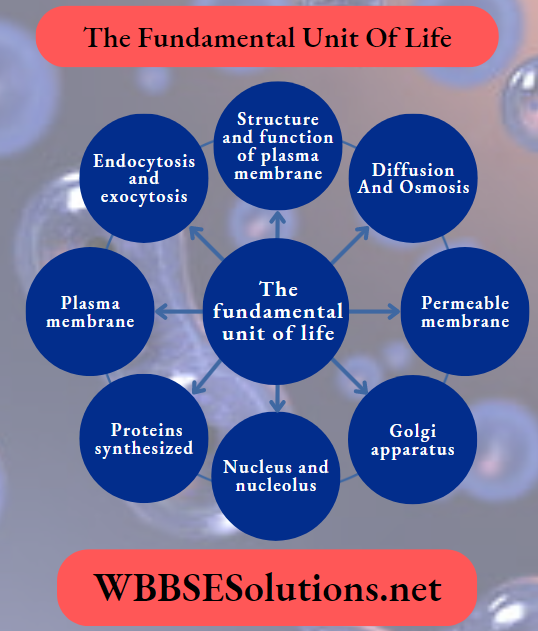
The Fundamental Unit Of Life

Fundamental Unit Of Life Question Answer

Read And Learn More NEET Foundation Short Answer Questions

Question 2. Define diffusion and osmosis.
Answer.

Diffusion And Osmosis:

Diffusion is the net movement of solute particles from a region of high concentration to the region of low concentration. Osmosis is the passage of water or solvent from a region of high solvent concentration through a semipermeable membrane to a region of low solvent concentration.

NEET Foundation Biology Chapter 1 The Fundamental Unit Of Life Short Answer Questions

Question 3. How do substances like CO2 and water move in and out of the cell? Discuss.
Answer.

Movement Of substances like CO2 and water move in and out of the cell:

The substances like CO2 and water move in and out of a cell through the process called diffusion from the region of concentrated region to low concentrated one. When the concentration of carbon dioxide and water is higher in external environment than that inside the cell, CO2 and water moves inside the cell. When the concentration outside the cell is low but it is high inside the cell, they move outwards.

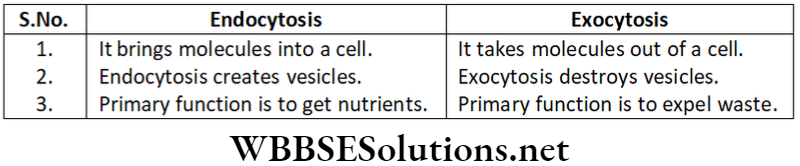
Question 4. Discuss the difference between endocytosis and exocytosis.
Answer.

The difference between endocytosis and exocytosis:

NEET Foundation Biology The Fundamental Unit Of Life Short Answer Type Question 4

Question 5. Why the plasma membrane is called a selectively permeable membrane?
Answer.

The plasma membrane is called a selectively permeable membrane:

Plasma membrane is called a selectively permeable membrane because it regulates the movement of substances from within to outside of the cell. This means that the plasma membrane allows the entry of some substances while preventing the movement of some other substance.

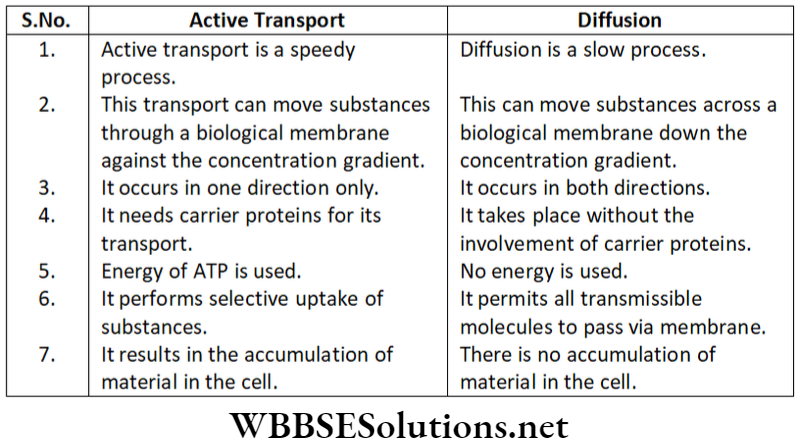
Question 6. Discuss the differences between active transport and diffusion.
Answer.

The differences between active transport and diffusion:

NEET Foundation Biology The Fundamental Unit Of Life Short Answer Type Question 6

Fundamental Unit Of Life Question Answer

Question 7. Discuss the function of Golgi apparatus.
Answer.

The function of Golgi apparatus:

  • Golgi apparatus acts as an assembly area for the storage, processing and packaging of various cellular secretions.
  • It is involved in the synthesis of cell wall, plasma membrane and lysosomes

Question 8. Discuss why mitochondria is known as the power house of the cell.
Answer.

Mitochondria is known as the power house of the cell:

Mitochondria are known as the powerhouse of cells because the energy required for various chemical activities needed to support life is released by mitochondria in the form of ATP (Adenosine triphosphate) molecules.

Question 9. What are dictyosomes?
Answer.

Dictyosomes:

In plant cells, Golgi apparatus is present in the form of freely distributed subunits called dictyosomes.

Class 11 Physics Class 12 Maths Class 11 Chemistry
NEET Foundation Class 12 Physics NEET Physics

Question 10. Why are lysosomes known as suicide bags?
Answer.

Lysosomes known as suicide bags:

Lysosomes are called suicide bags because in case of any disturbance of their cellular metabolism, they release their own enzymes to digest their own cell.

Question 11. Where are proteins synthesized inside the cell?
Answer.

The proteins are synthesized in the ribosome.

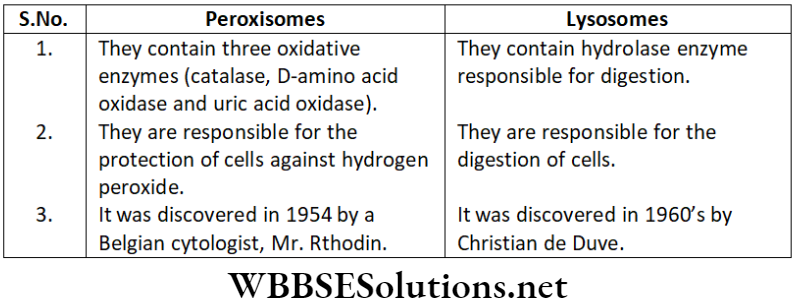
Question 12. Discuss the characteristic features of peroxisomes and lysosomes.
Answer.

The characteristic features of peroxisomes and lysosomes:

NEET Foundation Biology The Fundamental Unit Of Life Short Answer Type Question 12

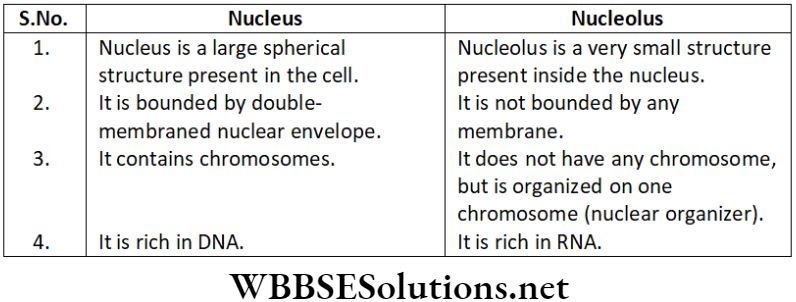
Question 13. What are the characteristic differences between nucleus and nucleolus?
Answer.

The characteristic differences between nucleus and nucleolus:

NEET Foundation Biology The Fundamental Unit Of Life Short Answer Type Question 13

Question 14. What would happen to the life of a cell if there was no Golgi apparatus?
Answer.

Golgi apparatus performs the function of a storage modification and packaging of products. If Golgi apparatus is not there, then the materials synthesized by cell will not be packaged and transported.

Question 15. Why the plasma membrane is called a selectively permeable membrane?
Answer:

The plasma membrane is called a selectively permeable membrane:

Plasma membrane is called a selectively permeable membrane because it regulates the movement of substances from within to outside of the cell. Selectively permeable describes the extreme selective nature of a membrane, wherein it specifically chooses certain molecules to pass. So, plasma membrane allows the entry of some substances while preventing the movement of some solutes.

Question 16. Who proposed the model called fluid mosaic model to explain the structure of functional cell membranes or plasma membranes?
Answer:

The model called fluid mosaic model to explain the structure of functional cell membranes or plasma membranes is proposed by

S. J. Singer and G. L. Nicolson (1972).

Question 17. Can you name the two organelles we have studied that contain their own genetic material?
Answer:

Mitochondria and plastids.

Question 18. If the organization of a cell is destroyed due to some physical or chemical influence, then what will happen?
Answer:

The organization of a cell is destroyed due to some physical or chemical influence:

If the organization of a cell is destroyed due to some physical or chemical influence then the cell will not be able to perform its basic functions, like digestion, excretion, respiration, etc. This may stop all the life activities and may come to an end.

Question 19. What is diffusion?
Answer:

Diffusion:

Diffusion is the net movement of solute particles from a region of high concentration to the region of low concentration.

Question 20. What would happen if the plasma membrane ruptures or breaks down?
Answer:

The plasma membrane ruptures or breaks down then

The cell will not be able to exchange material from its surroundings by diffusion. Due to this process, the protoplasmic material will disappear and the cell will die.

NEET Foundation Biology Chapter 1 The Fundamental Unit Of Life Multiple Choice Questions

Chapter 1 The Fundamental Unit Of Life Multiple Choice Question And Answers

Direction: Choose the correct option for each questions. There is only one correct response for each question.

Question 1. The study of cell structure under microscope is

  1. Cytology
  2. Cell biology
  3. Cytochemistry
  4. Anatomy

Answer. 1. Cytology

Question 2. Which of the following does not have cellular structure?

  1. PPLO
  2. Rickettsia
  3. Viruses
  4. Archaebacteria

Answer. 3. Viruses

Question 3. The smallest animal egg is of

  1. Ostrich
  2. Duck
  3. Human female
  4. Hen

Answer. 3. Human female

Read and Learn More NEET Foundation Multiple Choice Questions

Question 4. Protoplasm without nucleus is called

  1. Cytoplasm
  2. Ectoplasm
  3. Protoplasm
  4. Endoplasm

Answer. 1. Cytoplasm

Question 5. Hardness of woody tissue is due to

  1. Cellulose
  2. Silica
  3. Lignin
  4. Suberin

Answer. 3. Lignin

Question 6. A well-organized nucleus is present in

  1. Prokaryotes
  2. Eukaryotes
  3. Bacteria
  4. Both (a) and(c)

Answer. 2. Eukaryotes

Question 7. Human egg is larger than human sperm because it has

  1. Larger nucleus
  2. More membrane
  3. More cytoplasm
  4. All of these

Answer. 3. More cytoplasm

Question 8. Within a cell, the site of respiration (oxidation) is the

  1. Ribosome
  2. Golgi apparatus
  3. Mitochondria
  4. Endoplasmic reticulum

Answer. 3. Mitochondria

Question 9. Which of the following is called ‘Suicidal bag’?

  1. Centrosome
  2. Lysosome
  3. Mesosome
  4. Chromosome

Answer. 2. Lysosome

Question 10. Double membrane is absent in

  1. Mitochondrion
  2. Chloroplast
  3. Nucleus
  4. Lysosome

Answer. 4. Lysosome

Question 11. The cell organelle found only in plant is

  1. Golgi apparatus
  2. Mitochondria
  3. Plastids
  4. Ribosomes

Answer. 3. Plastids

NEET Foundation Biology Chapter 1 The Fundamental Unit Of Life Multiple Choice Questions

Question 12. Organisms lacking nucleus and membrane-bound organelles are called

  1. Diploids
  2. Prokaryotes
  3. Haploids
  4. Eukaryotes

Answer. 2. Prokaryotes

Question 13. Animal cell is limited by

  1. Plasma membrane
  2. Shell membrane
  3. Cell wall
  4. Basement membrane

Answer. 1. Plasma membrane

Question 14. The network of endoplasmic reticulum is present in the

  1. Nucleus
  2. Nucleolus
  3. Cytoplasm
  4. Chromosome

Answer. 3. Cytoplasm

Question 15. Lysosome are reservoirs of

  1. Fat
  2. RNA
  3. Secretory glycoprotein
  4. Hydrolytic Enzymes

Answer. 4. Hydrolytic Enzymes

Question 16. The membrane surrounding the vacuole of a plant cell is called

  1. Tonoplast
  2. Plasma membrane
  3. Nuclear membrane
  4. Cell wall

Answer. 1. Tonoplast

Question 17. Cell secretion is done by

  1. Plastids
  2. ER
  3. Golgi apparatus
  4. Nucleolus

Answer. 3. Golgi apparatus

Question 18. Centrioles are associated with

  1. DNA synthesis
  2. Reproduction
  3. Respiration
  4. Spindle formation

Answer. 4. Spindle formation

Question 19. Ribosomes are the centre for

  1. Respiration
  2. Photosynthesis
  3. Protein synthesis
  4. Fat synthesis

Answer. 3. Protein synthesis

Question 20. Plastid which can form all other types of plastids is

  1. Leucoplast
  2. Amyloplast
  3. Chloroplast
  4. Chromoplast

Answer. 1. Leucoplast

Question 21. A plant cell becomes turgid due to

  1. Plasmolysis
  2. Exosmosis
  3. Endosmosis
  4. Electrolysis

Answer. 3. Endosmosis

Question 22. Solute concentration is higher in the external solution

  1. Hypotonic
  2. Hypertonic
  3. Isotonic
  4. None of these

Answer. 2. Hypertonic

Question 23. A cell placed in hypertonic solution will

  1. Shrink
  2. Show plasmolysis
  3. Swell up
  4. No change in shape or size.

Answer. 3. Swell up

Question 24. The radiant energy of sunlight is converted to chemical energy and is stored as

  1. AMP
  2. ATP
  3. ADP
  4. APP

Answer. 2. ATP

Question 25. Which of the following organelle does not have membrane?

  1. Ribosome
  2. Nucleus
  3. Chloroplast
  4. Mitochondria

Answer. 1. Ribosome

Question 26. Root hair absorbs water from soil through

  1. Osmosis
  2. Active transport
  3. Diffusion
  4. Endocytosis

Answer. 1. Osmosis

Question 27. The number of lenses in compound light microscope is

  1. 3
  2. 2
  3. 4
  4. 1

Answer. 2. 2

Question 28. Identify the human cells which lack nucleus

  1. Platelets
  2. WBC
  3. RBC
  4. Nerve cells

Answer. 3. RBC

Question 29. Which of the following cellular part possess a double membrane?

  1. Nucleus
  2. Chloroplast
  3. Mitochondrion
  4. All of the above

Answer. 4. All of the above

Question 30. Cristae and oxysomes are associated with

  1. Mitochondria
  2. Plastids
  3. Golgi apparatus
  4. Plasma membrane

Answer. 1. Mitochondria

Question 31. Genetic information is stored in

  1. RNA
  2. DNA
  3. Ribosomes
  4. Lysosomes

Answer. 2. DNA

Question 32. Animal cells have

  1. Either few small vacuoles or may be absent
  2. One large vacuole
  3. Many large vacuoes
  4. Few small vacuoles

Answer. 1. Either few small vacuoles or may be absent

Question 33. Cell organelle that acts as supporting skeletal framework of the cell is

  1. Golgi apparatus
  2. Nucleus
  3. Mitochondria
  4. ER

Answer. 4. ER

Question 34. What would happen if lysosomes get ruptured inside the cells in which they are present?

  1. Cells will swell
  2. Cells will die
  3. Cells will shrink
  4. Nothing would happen

Answer. 2. Cells will die

Question 35. The cell wall of plant is chiefly composed of

  1. Hemicellulose
  2. Phospholipids
  3. Cellulose
  4. Proteins

Answer. 3. Cellulose

Question 36. Which of the following are characteristics of unicellular organisms?

(1) There is no division of labour.

(2) Life span of organism is long.

(3) Reproduction consumes the whole cell.

(4) Single cell performs one or few activities of the organism.

Select the correct option.

  1. (1) and (2)
  2. (2) and (3)
  3. (1) and (3)
  4. (4) and (1)

Answer. 3. (1) and (3)

Question 37. Which of the following are properties of a light microscope?

(1) It uses beams of electrons to illuminate objects.

(2) It uses beams of light to illuminate the object.

(3) Internal vacuum is not required.

(4) It uses glass lenses.

Select the correct option.

  1. (1) and (2)
  2. (2) and (3)
  3. (2), (3) and (4)
  4. (1), (3) and (4)

Answer. 3. (2), (3) and (4)

Question 38. Which of the following are characteristics of prokaryotic cells?

(1) Nucleolus is absent.

(2) It contains single chromosome.

(3) Cell division occurs by mitotic or meiotic cell division.

(4) Size of cell is generally large (5.100 mm).Select the correct option.

  1. (1) and (4)
  2. (1) and (2)
  3. (1), (2) and (3)
  4. (3) and (4)

Answer. 2. (1) and (2)

Question 39. Which of these are not the features of organelles?

(1) They may be external or internal to body of an organism.

(2) They coordinate to produce the cell.

(3) They are found in all eukaryotic cells.

(4) They are macroscopic.

Select the correct option.

  1. (1) and (2)
  2. (4) and (3)
  3. (1) and (4)
  4. (2) and (3)

Answer. 3. (1) and (4)

Question 40. Which of these options are not functions of ribosomes?

(1) It helps in the manufacture of protein molecules.

(2) It helps in the manufacture of enzymes.

(3) It helps in the manufacture of hormones.

(4) It helps in the manufacture of starch molecules.

Select the correct option:

  1. (1) and (2)
  2. (2) and (3)
  3. (3) and (4)
  4. (4) and (1)

Answer. 3. (3) and (4)

Question 41. Osmosis __________________

(1) is the spontaneous movement of water molecules through a selective permeable membrane (for example, plasma membrane).

(2) can occur in any medium.

(3) occurs only in liquid medium.

(4) does not require semipermeable membrane.

Select the correct option.

  1. (1) and (2)
  2. (2) and (3)
  3. (3) and (4)
  4. (4) and (1)

Answer. 4. (4) and (1)

Question 42. Endocytosis is __________________

(1) intake of extra-cellular fluid, droplets and macromolecules.

(2) intake of extracellular particles.

(3) growth of plasma membrane around the particle as pseudopodia.

(4) a nutritive process.

Select the correct option.

  1. (1) and (2)
  2. (2) and (3)
  3. (3) and (4)
  4. (4) and (1)

Answer. 4. (4) and (1)

Question 43. Nucleus __________________

(1) is without a covering membrane.

(2) represents the whole eukaryotic complex that contains the genetic information.

(3) is covered by a two membrane envelope.

(4) is a component of nucleoid.

Select the correct option.

  1. (1) and (2)
  2. (2) and (3)
  3. (3) and (4)
  4. (4) and 1

Answer. 2. (2) and (3)

Question 44. Chloroplasts __________________

(1) are green plastids

(2) are sites of photosynthesis

(3) are non-green coloured plastids

(4) do not contain lamellae

Select the correct option.

  1. (1) and (2)
  2. (2) and (3)
  3. (3) and (4)
  4. (4) and (1)

Answer. 1. (1) and (2)

Question 45. Chromosomes are made up of ______________

(1) DNA

(2) Protein

(3) O2

(4) CO2

Select the correct option.

  1. (1) and (2)
  2. (2) and (3)
  3. (3) and (4)
  4. (4) and (1)

Answer. 1. (1) and (2)

Question 46. Find out the false statement from the following.

(1) Cytoplasm is also called protoplasm.

(2) Mitochondria is the powerhouse of the cell.

(3) Golgi apparatus is involved with the formation of lysosomes.

(4) Ribosomes do not help in protein synthesis.

Select the correct option.

  1. (1) and (2)
  2. (1) and (3)
  3. (3) and (4)
  4. (1) and (4)

Answer. 4. (1) and (4)

Question 47. Who amongst the following were contributors to the cell theory?

(1) Theodor Schwann

(2) Matthias Schleiden

(3) Robert Hooke

(4) Robert Brown

Select the correct option.

  1. (1) and (2)
  2. (2) and (3)
  3. (3) and (4)
  4. (1) and (4)

Answer. 1. (1) and (2)

Question 48. Elephants eat grass and both have cells.

Read the following sentences regarding cells, and identify the correct ones.

(1) Grass cells have cell walls and vacuoles.

(2) Glass cells have cilia and chloroplast.

(3) Elephant cells are bigger than grass cells.

(4) Elephant cells have cell membrane and mitochondria.

Select the correct option.

  1. (1) and (2)
  2. (2) and (3)
  3. (3) and (4)
  4. (1) and (4)

Answer. 4. (1) and (4)

Question 49. A mature plant cell has

(1) Cell wall

(2) Plastids

(3) Centrioles

(4) Prominent golgi apparatus

Select the correct option.

  1. (1) and (2)
  2. (2) and (3)
  3. (3) and (4)
  4. (1) and (4)

Answer. 1. (1) and (2)

Question 50. Mitochondria

(1) Powerhouse of the cell

(2) Green in colour

(3) Performs oxidation of food.

(4) Consumes CO2 and liberates O2.

Select the correct option.

  1. (1) and (2)
  2. (2) and (3)
  3. (1) and (3)
  4. (1) and (4)

Answer. 3. (1) and (3)

Question 51. A major site for synthesis of lipids is

  1. Rough endoplasmic reticulum
  2. Smooth endoplasmic reticulum
  3. Symplast
  4. Nucleoplasm

Answer. 2. Smooth endoplasmic reticulum

Question 52. Which structure perform the function of mitochondria in bacteria?

  1. Nucleoid
  2. Ribosomes
  3. Cell wall
  4. Mesosomes

Answer. 4. Mesosomes

Question 53. The important site for the formation of glycoproteins and glycolipids is

  1. Golgi apparatus
  2. Plastid
  3. Lysosome
  4. Vacuole

Answer. 1. Golgi apparatus

Question 54. In eubacteria, cellular component that resembles eukaryotic cells is

  1. Nucleus
  2. Ribosomes
  3. Cell wall
  4. Plasma membrane

Answer. 4. Plasma membrane

Question 55. Peptide synthesis inside a cell takes place in

  1. Mitochondria
  2. Chromoplast
  3. Ribosomes
  4. Chloroplast

Answer. 3. Ribosomes

Question 56. Ribosomal RNA is actively synthesized in

  1. Lysosomes
  2. Nucleolus
  3. Nucleoplasm
  4. Ribosomes

Answer. 2. Nucleolus

Question 57. Nuclear membrane is absent in

  1. Penicillium
  2. Agaricus
  3. Volvox
  4. Nostoc

Answer. 4. Nostoc

Question 58. True nucleus is absent in

  1. Anabaena
  2. Mucor
  3. Vaucheria
  4. Volvox

Answer. 1. Anabaena

Question 59. Which of the following is not an inclusion body found in prokaryotes?

  1. Phosphate granule
  2. Cyanophycean granule
  3. Glycogen granule
  4. Polysome

Answer. 4. Polysome

Question 60. Which of the following are not membrane-bound?

  1. Ribosome
  2. Lysosome
  3. Mesosomes
  4. Vacuole

Answer. 1. Ribosome

Question 61. Which of the following structures is not found in prokaryotic cell?

  1. Ribosomes
  2. Mesosomes
  3. Plasma membrane
  4. Nuclear envelope

Answer. 4. Nuclear envelope

Question 62. Cell organelle containing hydrolytic enzymes is

  1. Microsome
  2. Ribosome
  3. Mesosome
  4. Lysosome

Answer. 4. Lysosome

Question 63. Who proposed the fluid mosaic model of plasma membrane?

  1. Camillo Golgi
  2. Schleiden and Schwann
  3. Singer and Nicolson
  4. Robert Brown

Answer. 3. Singer and Nicolson

Question 64. What is a tonoplast?

  1. Outer membrane of mitochondria.
  2. Inner membrane of chloroplast.
  3. Membrane boundary of the vacuole of plant cells.
  4. Cell membrane of plant cell.

Answer. 3. Membrane boundary of the vacuole of plant cells.

Question 65. Satin used to visualize mitochondria is

  1. Fast green
  2. Safranin
  3. Acetocarmine
  4. Janus green

Answer. 4. Janus green

Question 66. Who refined the cell theory?

  1. Schleiden
  2. Schwann
  3. Rudolf Virchow
  4. Robert Hooke

Answer. 3. Rudolf Virchow

Question 67. Example/s of prokarotic cells is/are

  1. Bacteria
  2. Kidney cells
  3. Interstitial cells
  4. Cork cells

Answer. 1. Bacteria

Question 68. In prokaryotic cells, ______ is present instead of nucleus.

  1. Nucleosome
  2. Nuclear pore
  3. Nuclear envelope
  4. Nucleoid

Answer. 4. Nucleoid

Question 69. A science student wants to view the plasma membrane and other cell organelles of a rabbit cell. Which of the following microscope should the student use?

  1. Light microscope
  2. Compound microscope
  3. Dissecting microscope
  4. Electron microscope

Answer. 4. Electron microscope

Question 70. Cell theory states that cells are structural and fundamental units of

  1. Plants
  2. Animals
  3. Both plants and animals
  4. Only microorganisms

Answer. 3. Both plants and animals

Question 71. The energy currency of cell is

  1. Mitochondria
  2. ATP
  3. FAD
  4. Glucose

Answer. 2. ATP

Question 72. Which of the following organelles is enclosed in a single membrane?

  1. Nuclei
  2. Lysosomes
  3. Chloroplast
  4. Mitochondria

Answer. 2. Lysosomes

Question 73. The electron microscope was developed by

  1. Huxley
  2. Knoll and Ruska
  3. Purkinje
  4. Robert Hooke

Answer. 2. Knoll and Ruska

Question 74. The idea of ‘Omnis Cellula e Cellula’ was given by

  1. Scheiden
  2. Rudolf Virchow
  3. Purkinje
  4. Schwann

Answer. 2. Rudolf Virchow

Question 75. The size of an organism is dependent on

  1. Size of the cell
  2. Number of cell
  3. Both (a) and (b)
  4. Shape of cells

Answer. 3. Both (a) and (b)

NEET Foundation Chemistry Chapter 3 Atoms And Molecules Long Answer Questions

Chapter 3 Atoms And Molecules Long Answer Type Question And Answers

Question 1. State the postulates of Dalton’s atomic theory.
Answer.

The postulates of Dalton’s atomic theory are:

  • Matter consists of very tiny particles calledatoms.
  • Atoms are of indivisible nature whichcannot be created or destroyed in a chemical reaction.
  • Mass and chemical properties of atoms of agiven element are identical.
  • Different element atoms have differentmasses and chemical properties.
  • Compounds are formed by combining atomsin the ratio of small whole numbers.
  • In a given compound, the relative numberand kinds of atoms are constant.

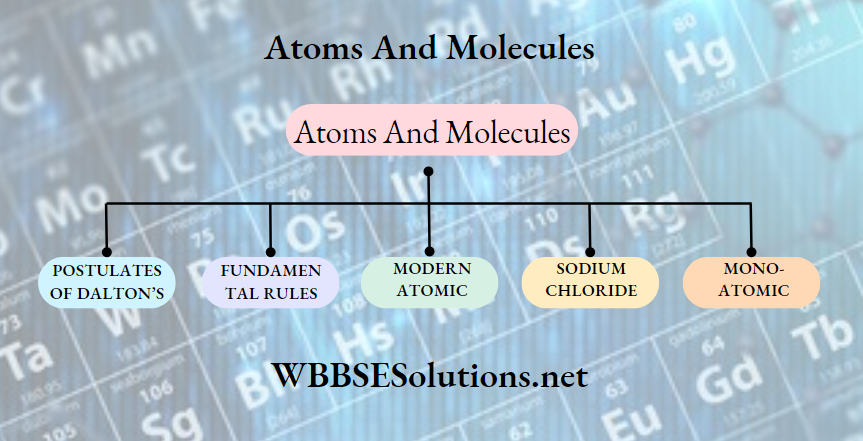
Atoms And Molecules

NEET Foundation Chemistry Chapter 3

Question 2. What are the fundamental rules of writing the chemical formula?
Answer.

There are three fundamental rules of writing chemical formula:

Read and Learn More NEET Foundation Long Answer Questions

  • The valencies of the elements must balance.
  • When a compound contains both metal and non-metal elements the name of metal comes first. Example: Sodium Chloride (NaCl)
  • In poly-atomic ion compounds, the ion is enclosed in bracket before writing the formula to indicate the ratio. In case the ion is mono-atomic then bracket is not required.

Question 3. What does the Dalton’s theory explain? How is it different from modern atomic theory?
Answer.

Dalton’s Atomic theory explains that:

  • All matter is made of atoms. Atoms are indivisible and indestructible.
  • All atoms of a given element are identical in mass and properties
  • Compounds are formed by a combination of two or more different kinds of atoms.
  • A chemical reaction is an arrangement of atoms.
Class 11 Physics Class 12 Maths Class 11 Chemistry
NEET Foundation Class 12 Physics NEET Physics

Dalton’s theory is different from modern atomic theory

Modern atomic theory is, of course, a little more involved than Dalton’s theory but the essence of Dalton’s theory remains valid. Today we know that atoms can be destroyed via nuclear reactions but not by chemical reactions.

Many heretofore unexplained chemical phenomena were quickly explained by Dalton with his theory. Dalton’s theory quickly became the theoretical foundation of chemistry.

NEET Foundation Chemistry Chapter 3

Question 4. What does a chemical formula indicate?
Answer.

Chemical Formula:

The chemical formula of a compound represents its chemical composition.

A chemical formula essentially indicates 2 things:

  • The elements which constitutes thatcompound and the number of each element in it.
  • The number of each constituent.

The atoms of the elements are indicated by the symbols and the number is indicated as a subscript with the symbol.

NEET Foundation Chemistry Chapter 3 Atoms And Molecules Multiple Choice Questions

Chapter 3 Atoms And Molecules Multiple Choice Question And Answers

Direction: Choose the correct option for each question. There is only one correct response for each question.

Question 1. Who was the first Indian Philosopher who postulated that matter is divisible?

  1. Maharshi Kanad
  2. Chanakya
  3. Swami Vivekananda
  4. Sarvapalli Radhakrishnan

Answer. 1. Maharshi Kanad

Question 2. Why is the symbol of silver written as Ag?

  1. The symbol of silver is derived from the French name ‘Agiol’.
  2. The symbol of silver is derived from the French name ‘Aglae’.
  3. The symbol of silver is derived from the Latin name ‘Argentum’.
  4. The symbol of silver is derived from the German name ‘Agapios’.

Answer. 3. The symbol of silver is derived from the Latin name ‘Argentum’.

Question 3. What do you mean by the atomicity of a molecule?

  1. The number of molecules in a substance.
  2. The number of atoms present in one molecule of a substance.
  3. The number of atoms bonded in a molecule of an element.
  4. The mass of an atom of an element.

Answer. 2. The number of atoms present in one molecule of a substance.

Read and Learn More NEET Foundation Multiple Choice Questions

Question 4. What do you mean by saying that the molecular mass of oxygen is 32?

  1. 1/1837 times the mass of a proton.
  2. The molecule of O2 is 32 times heavier as compared to 1/12th of the mass of an atom of the C-12 isotope.
  3. The molecule of O2 is 8 times heavier as compared to 1/12th of the mass of an atom of the C-12 isotope.
  4. None of the above

Answer. 2. A molecule of O2 is 32 times heavier as compared to 1/12th of the mass of an atom of the C-12 isotope.

Question 5. If 100 g of calcium carbonate on heating produces 44 g of carbon dioxide, how much quick lime will be formed?

  1. Quick lime will be 56 g
  2. Quick lime will be 72 g
  3. Quick lime will be 38 g
  4. Quick lime will be 44 g

Answer. 1. Quick lime will be 56 g

NEET Foundation Chemistry Chapter 3 Atoms And Molecules Multiple Choice Questions

Question 6. What was the postulate of Dalton’s atomic theory about the masses of atom?

  1. Atoms of an element have the same mass.
  2. Atoms of an element have less mass.
  3. Atoms of all substances are identical in all respects.
  4. Atoms are divisible particles.

Answer. 1. Atoms of an element have the same mass.

Question 7. What is atomic mass unit u?

  1. 1/6 of the mass of an atom of C-12 isotope.
  2. 1/2 of the mass of an atom of C-12 isotope.
  3. 1/12 of the mass of an atom of C-12 isotope.
  4. None of these

Answer. 3. 1/12 of the mass of an atom of C-12 isotope.

Question 8. Which of the following is not correct according to Dalton’s atomic theory?

  1. Matter is made up of atoms.
  2. Atoms of all substances are identical in all respects.
  3. Atoms are combined in a simple whole-number ratio.
  4. Atoms of two elements can combine to form more than one compound.

Answer. 2. Atoms of all substances are identical in all respects.

Question 9. Which of the following represents 1 u?

  1. Mass of C-12 atom
  2. Mass of O-16 atom
  3. 1/12 of the mass of the C-12 atom
  4. Mass of hydrogen molecule

Answer. 3. 1/12 of mass of C-12 atom

Question 10. Who formulated the law of constant composition?

  1. Dalton
  2. Proust
  3. Lavoisier
  4. Berzelius

Answer. 2. Proust

Question 11. What is the molecule C60 called?

  1. C60 is called the Atomic number.
  2. C60 is called Isobar.
  3. C60 is called a hydrogen bond.
  4. C60 is called Buckminster fullerene.

Answer. 4. C60 is called Buckminster fullerene.

Question 12. Why the atomic masses are not the actual masses of atoms?

  1. Atoms are very small particles therefore their actual masses are too small to be determined.
  2. Atoms combined in a simple whole number ratio.
  3. A group of atoms carrying a positive charge.
  4. None of these

Answer. 1. Atoms are very small particles therefore their actual masses are too small to be determined.

Question 13. Calculate the formula unit mass of Na2CO3 ⋅ 10H2O.

Atomic masses: Na = 23.0 u, C = 12.0 u, O = 16.0 u, H = 1.0 u.

  1. 390 u
  2. 288 u
  3. 286 u
  4. 199 u

Answer. 3. 286 u

Question 14. One of the following molecules has an atomic of four

  1. H2O
  2. NH3
  3. CH4
  4. CO2

Answer. 2. NH3

Question 15. Why is atomic mass taken asan average value?

  1. The mass of 1 mole of the substance is the molar mass of that substance.
  2. An element may have atoms with different masses present in a definite ratio.
  3. Atoms are very small particles; their actual masses are too small to be determined.
  4. All of above

Answer. 2. An element may have atoms with different masses present in a definite ratio.

Question 16. What is the actual mass of an atom of C-12 isotope?

  1. 0.990 × 10⁻²³ g
  2. 1.993 × 10⁻²³ g
  3. 1.992 × 10⁻²³ g
  4. 2.857 × 10⁻²³ g

Answer. 3. 1.992 × 10⁻²³ g

Question 17. Hydrogen was passed over heated 2 g copper oxide till only copper was left. The mass of copper obtained was 1.6 g. The percentage of oxygen in copper oxide is

  1. 80%
  2. 60%
  3. 40%
  4. 20%

Answer. 4. 20%

Question 18. Give one example of the molecule of a triatomic element.

  1. O3
  2. P3
  3. NH3
  4. P4

Answer. 1. O3

Question 19. Which of the following is the correct symbol for copper?

  1. Co
  2. Cr
  3. Cu
  4. Cp

Answer. 3. Cu

Question 20. The formula of copper sulphate is CuSO4. What is the valency of copper if the valency of SO4 is 2?

  1. 1
  2. 3
  3. 2
  4. 4

Answer. 3. 2

Question 21. In a sample of ammonia the mass ratio of nitrogen and hydrogen is 14:1. Find the ratio of N and H atoms in a molecule of ammonia. Relative atomic masses are: H = 1, N = 14.

  1. In ammonia the ratio by number of atoms = N:H = 2:3
  2. In ammonia the ratio by number of atoms = N:H = 1:3
  3. In ammonia the ratio by number of atoms = N:H = 1:14
  4. In ammonia the ratio by number of atoms = N:H = 1:4

Answer. 2. In ammonia the ratio by number of atoms = N:H = 1:3

Question 22. Hydrogen and oxygen combine in the mass ratio of 1:8 to form water. Calculate the mass of oxygen gas required to react completely with 3 g of hydrogen.

  1. 24 g
  2. 26 g
  3. 32 g
  4. 18 g

Answer. 1. 24 g

Question 23. What are the valencies of Al and carbonate in Al2(CO3)3?

  1. Aluminium is 3 and carbonate is 1
  2. Aluminium is 1 and carbonate is 2
  3. Aluminium is 3 and carbonate is 3
  4. Aluminium is 3 and carbonate is 2

Answer. 4. Aluminium is 3 and carbonate is 2

Question 24. Which one of the following is equal to one mole of N2?

  1. 14 g of nitrogen
  2. 20 grams of nitrogen
  3. 6.022 × 10²³ N2 molecules
  4. All the three

Answer. 3. 6.022 × 10²³ N2 molecules

Question 25. How was the postulate of Dalton’s atomic theory about the masses of atoms modified?

  1. Matter is made up of small particles which may be atoms or molecules.
  2. Atoms Mass can neither be created nor destroyed in a chemical reaction.
  3. Atoms of the same or different elements combine together to form molecules or compounds.
  4. Atoms of the same element may have different masses.

Answer. 4. Atoms of the same element may have different masses.

Question 26. Why has the symbol ‘u’ been replaced by ‘u’?

  1. Atomic mass unit is 1/12th of the mass of an atom of C-12 isotope.
  2. Atoms of an element have same mass.
  3. To avoid an ambiguity whether to take O-16 as the reference or average mass of isotopes of O-atoms.
  4. None of the above

Answer. 3. To avoid an ambiguity whether to take O-16 as the reference or average mass of isotopes of O-atoms.

Question 27. What do you understand by Gram Molar Volume?

  1. Volume occupied by one mole of the substance.
  2. Volume occupied by whole substance.
  3. Those compounds which are made up of only two elements.
  4. None of the three.

Answer. 1. Volume occupied by one mole of the substance.

Question 28. What is Avogadro’s number?

  1. The volume of the substance present in one mole of the substance.
  2. The number of particles of the substance present in one mole of the substance.
  3. It is defined as the units of positive or negative charge present on the ion.
  4. Molecular mass expressed in grams.

Answer. 2. The number of particles of the substance present in one mole of the substance.

Question 29. What do you understand by polyatomic cation?

  1. A group of atoms carrying a positive charge.
  2. A group of atoms carrying a negative charge.
  3. A group of atoms carrying both the charges.
  4. A group of atoms carrying neither positive charge nor negative charge.

Answer. 1. A group of atoms carrying a positive charge.

Question 30. How do you define mole in terms of mass?

  1. The sum of the atomic masses of all the atoms present in one unit of compound.
  2. Amount of the substance which has volume equal to 22400 mL at STP conditions.
  3. A mole of a substance is equal to the gram atomic mass of the substance.
  4. None of these

Answer. 3. A mole of a substance is equal to the gram atomic mass of the substance.

Question 31. Which of the following has maximum number of atoms?

  1. 18 g H2O
  2. 18 g of CH4
  3. 18 g of O2
  4. 18 g of CO2

Answer. 2. 18 g of CH4

Question 32. Which of the following would weigh the highest?

  1. 10 moles of H2O
  2. 0.2 mole of sucrose (C12 H22 O11)
  3. 2 moles of CaCO3
  4. 2 moles of CO2

Answer. 3. 2 moles of CaCO3

Question 33. A change in the physical state can be brought about

  1. Only when energy is given to the system.
  2. Only when energy is taken out from the system.
  3. When energy is either given to, or taken out from the system.
  4. Without any energy change.

Answer. 3. When energy is either given to, or taken out from the system.

Class 11 Physics Class 12 Maths Class 11 Chemistry
NEET Foundation Class 12 Physics NEET Physics

Question 34. Calculate the number of moles of magnesium present in a magnesium ribbon weighing 12 g. Molar atomic mass of magnesium is 24 g mol(raise to the power –1).

  1. 0.5 mole
  2. 1 mole
  3. 1.5 mole
  4. 2 mole

Answer. 1. 0.5 mole

Question 35. How do you define the valency of an element in a molecular compound?

(1) It’s combining capacity and is equal to the number of hydrogen atoms.

(2) Number of chlorine atoms.

(3) Ratio of molar should be equal.

(4) Double the number of oxygen atoms with

which one atom of the element combines.

  1. (1), (2) and (4)
  2. (1) and (3)
  3. (2) and (4)
  4. (1) and (2)

Answer. 1. (1), (2) and (4)

Question 36. One mole of CO2 means

(1) 6.022 × 10²³ molecules of CO2

(2) 22.4 L at STP

(3) 44 g of CO2

(4) 55 g of C

  1. (1) and (2)
  2. (1) and (3)
  3. (2) and (4)
  4. (1), (2) and (3)

Answer. 4. (1), (2) and (3)

Question 37. The Scientist Proust established which of the below mentioned law in the year 1779?

(1) In a chemical substance its constituent elements are present in definite proportions by mass.

(2) A pure compound has a definite composition by mass of its constituent elements.

(3) It is not possible to create or destroy the mass of a substance by chemical reactions.

(4) Atoms combine in whole numbers.

  1. (1), (2) and (4)
  2. (2) and (3)
  3. (1) and (2)
  4. All of the above

Answer. 3. (1) and (2)

Question 38. Which of the following are incorrect?

(1) Atoms are divisible particles.

(2) Atoms can be created or destroyed during a chemical reaction and all matter is made up of atoms.

(3) Mass of matter is due to the mass of atoms which constitute it.

(4) Atom and mass are not conserved.

  1. (2) and (4)
  2. (1), (2) and (3)
  3. (1), (2) and (4)
  4. All of the above

Answer. 3. (1), (2) and (4)

Question 39. Which of the following are monoatomic metallic elements?

(1) Sodium Na

(2) Copper Cu

(3) Aluminium Al

(4) All of above

  1. (4)
  2. (2) and (3)
  3. (1)
  4. None of the above

Answer. 1. (4)

Question 40. Which of the following statement about polyatomic ions are correct?

(1) A group of two or more atoms carrying a charge is called polyatomic ion.

(2) A polyatomic cation carries a charge.

(3) A polyatomic anion carries a negative charge.

(4) A polyatomic cation does not carry a charge

  1. (1), (3) and (4)
  2. (3) and (4)
  3. (1) and (4)
  4. (1), (2) and (3)

Answer. 4. (1), (2) and (3)

Question 41. Which of the following are the correct options?

(1) Law of conservation of mass is the law of indestructibility of matter.

(2) Atoms masses are the average relative masses of the atoms.

(3) Atoms may or may not be capable of free existence but molecules can always exist freely.

(4) A group of atoms carrying both the charges.

  1. (2) and (3)
  2. (1), (2) and (3)
  3. (1) and (3)
  4. (2) and (4)

Answer. 2. (1), (2) and (3)

Question 42. Which of the following support modified Dalton’s Atomic theory?

(1) It is not possible to create or destroy the mass of a substance by chemical reactions.

(2) Atoms of the same element have same chemical properties but they may have different physical properties.

(3) Atoms of an element have the same mass was proved wrong when it was found that an element may exist in atoms with different masses, e.g., chlorine atoms with masses 35 and 37 etc.

  1. (2) and (3)
  2. (1)
  3. (1) and (3)
  4. None of the above

Answer. 1. (2) and (3)

Question 43. Which of the following symbols of elements are incorrect?

(1) Cobalt Co

(2) Aluminium Al

(3) Carbon C

(4) Helium He

  1. (1), (3) and (4)
  2. (2), (3) and (4)
  3. (1), (2) and (3)
  4. All of above

Answer. 3. (1), (2) and (3)

Question 44. Which of the following correctly represents 360 g of water?

(1) 2 mole of H2O

(2) 20 moles of water

(3) 6.20 × 10²³ molecules of water

(4) 1.2044 × 1025 molecules of water

  1. (1) and (4)
  2. (2) and (4)
  3. (1) and (3)
  4. (3) and (2)

Answer. 2. (2) and (4)

Question 45. Calculate the mass of 1 mol of N atoms?

  1. 14 g
  2. 13 g
  3. 15 g
  4. None of these

Answer. 1. 14 g

Question 46. The smallest particle of matter which can exist independently is

  1. an atom
  2. a molecule
  3. an ion
  4. a radical

Answer. 2. a molecule

Question 47. Match the following;

(1) Sodium chloride (a) NaI

(2) Sodium bromide (b) NaCl

(3) Sodium iodide (c) NaBr

  1. (1) – A, (2) – C, (3) – B
  2. (1) – C, (2) – B, (3) – A
  3. (1) – B, (2) – C, (3) – A
  4. (1) – A, (2) – B, (3) – C

Answer. 3. (1) – B, (2) – C, (3) – A

Question 48. The relative molecular mass of copper (2) sulphate, CuSO4 is 160 and the relative molecular mass of water is 18. The percentage by mass of water in copper (2) sulphate crystals, CuSO4.5H2O is

  1. \(\frac{18}{160} \times 100\)
  2. \(\frac{5 \times 18}{160} \times 100\)
  3. \(\frac{5 \times 18}{(160+18)} \times 100\)
  4. \(\frac{5 \times 18 \times 100}{160+(5 \times 18)}\)

Answer. 4. \(\frac{5 \times 18 \times 100}{160+(5 \times 18)}\)

Question 49. Calculate the number of particles in 0.1 moles of carbon atoms?

  1. 6.022 × 10²³
  2. 6.022 × 10²²
  3. 6.021 × 10²¹
  4. None of these

Answer. 2. 6.022 × 10²²

Question 50. Which of the following ammonium salts will liberate the greatest amount of ammonia on heating?

  1. 1 mole of (NH4)3PO4
  2. 1 mole of (NH4)2SO4
  3. 1 mole of NH4Cl
  4. 1 mole of NH4NO3

Answer. 1. 1 mole of (NH4)3PO4

Question 51. Calculate the mass of 3.011 × 10²³ number of atoms of N?

  1. 7 g
  2. 7.5 g
  3. 6 g
  4. None of these

Answer. 1. 7 g

Question 52. The anion present in calcium hydride is

  1. H+
  2. H
  3. OH
  4. H3O+

Answer. 2. H

Question 53. The gas which has a molecular mass twice that of oxygen gas is

  1. CO2
  2. CO
  3. SO2
  4. H2S

Answer. 3. SO2

Question 54. The element which can form gases having two different atomicities is

  1. chlorine
  2. oxygen
  3. hydrogen
  4. nitrogen

Answer. 4. nitrogen

Question 55. Which of the following is a correct formula of the calcium carbonate?

  1. CaO
  2. CaCO2
  3. CaCO3
  4. None of these

Answer. 3. CaCO3

Question 56. The element which loses electrons to form ions with variable valencies is

  1. copper
  2. silver
  3. mercury
  4. all the above

Answer. 4. all the above

Question 57. The number of elements which are present in the compound ammonium phosphate is

  1. 2
  2. 3
  3. 4
  4. 5

Answer. 3. 4

Question 58. Ratio by mass of the element present in SO2 is

  1. 1: 1
  2. 1: 2
  3. 2: 1
  4. 3: 1

Answer. 1. 1: 1

Question 59. A plumbous ion is formed from lead atom by

  1. gaining one electron
  2. gaining two electrons
  3. losing one electron
  4. losing two electrons

Answer. 4. losing two electrons

Question 60. Which of the following is a correct formula of the copper nitrate?

  1. Cu (NO3)2
  2. NaNO3
  3. Mg (NO3)2
  4. None of these

Answer. 1. Cu (NO3)2

Question 61. The acid which does not contain a radical of a polyatomic group is

  1. sulphuric acid
  2. hydrochloric acid
  3. nitric acid
  4. phosphoric acid

Answer. 2. hydrochloric acid

Question 62. If the nitride of a metal M has the formula MN, what is the formula of its sulphide, carbonate and chloride?

  1. M2S3, M2(CO3)3, MCl
  2. MS3, M2CO3, MCl3
  3. MS, M(CO3)3, MCl
  4. M2S3, M2(CO3)3, MCl3

Answer. 4. M2S3, M2(CO3)3, MCl3

Question 63. According to the IUPAC recommendation “amu” has been replaced with “u”. “u” stands for

  1. universal mass
  2. ultimate mass
  3. unified mass
  4. unending mass

Answer. 3. unified mass

Question 64. Which of the following information is not conveyed by a chemical equation?

  1. The reactants taking part in the reaction
  2. The products formed in the reaction
  3. The speed of the reaction
  4. The ratio of the weights of reactants and products taking part in the reaction

Answer. 3. The speed of the reaction

Question 65. What are the values of the coefficients x, y and z in the following reaction?

x Mg + y N2 → z Mg3N2

  1. x = 1, y = 1, z = 1
  2. x = 1, y = 3, z = 1
  3. x = 1, y = 2, z = 1
  4. x = 3, y = 1, z = 1

Answer. 4. x = 3, y = 1, z = 1

Question 66. Elements X and Y react to form Xa Yb. Elements P and Q react to form Pm Qn. The formula of the compound formed between X and Q is

  1. XbQm
  2. XmQb
  3. XaQn
  4. XnQa

Answer. 2. XmQb

Question 67. 0.66 g of a hydrocarbon gave 1.32 g of carbon dioxide and 2.7 g of water on complete combustion. Which law of chemical combination does this example illustrate?

  1. Law of conservation of mass
  2. Law of constant proportions
  3. Both (a) and (b)
  4. None of the above

Answer. 1. Law of conservation of mass

Question 68. The ratio of the number of moles of copper, oxygen and copper (2) oxide in the reaction

Copper + Oxygen → Copper (2) oxide is

  1. 1: 1: 1
  2. 1: 2: 1
  3. 2: 1: 2
  4. 2: 2: 1

Answer. 3. 2: 1: 2

Question 69. An anion has

  1. more electrons than protons
  2. more protons than electrons
  3. more neutrons than protons
  4. more protons than neutrons

Answer. 1. more electrons than protons

Question 70. Atomic number of an element X is 9. Which of the following represents the correct equation for the ion formation of an atom of X?

  1. X – e → X
  2. X + e→ X
  3. X – e →X+
  4. X + e → X+

Answer. 2. X + e→ X

Question 71. An atom of X combines with 2 atoms of hydrogen. The valency of X is

  1. 1
  2. 2
  3. 3
  4. 4

Answer. 2. 2

Question 72. An element has 10 electrons in it atom. How many electrons are gained by the atom of the element to form an anion?

  1. 1
  2. 2
  3. 3
  4. zero

Answer. 4. zero

Question 73. Identify the incorrect statement.

  1. Molecular weight is equal to the sum of the atomic weights of the elements present in a compound.
  2. The composition by weight of the elements in a compound is known from the chemical formula.A chemical formula gives the number of atoms of each element present in one molecule of a compound.
  3. Molecular formula of a compound represents one atom of the compound.

Answer. 4. Molecular formula of a compound represents one atom of the compound.

Question 74. The number of Ca2+ and Cl ions in 222 g anhydrous CaCl2 is

  1. N0 ions of both Ca2+ and Cl
  2. 4N0 ions of Ca2+, 2N0 ions of Cl
  3. 2N0 ions of Ca2+, 4N0 ions of Cl
  4. 2N0 ions of Ca2+ and Cl

Answer. 3. 2N0 ions of Ca2+, 4N0 ions of Cl

Question 75. Which of the following correctly represents 360 g of water?

(1) 2 moles of H2O

(2) 20 moles of water

(3) 6.022 × 10²³ molecules of water

(4) 1.2044×1025 molecules of water

  1. (1)
  2. (1) and (4)
  3. (2) and (3)
  4. (2) and (4)

Answer. 4. (2) and (4)

Question 76. Which of the following statements is not true about an atom?

  1. Atoms are not able to exist independently
  2. Atoms are the basic units from which molecules and ions are formed
  3. Atoms are always neutral in nature
  4. Atoms aggregate in large numbers to form the matter that we can see,feel or touch

Answer. 1. Atoms are not able to exist independently

Question 77. The chemical symbol for nitrogen gas is

  1. Ni
  2. N2
  3. N+
  4. N

Answer. 2. N2

Question 78. The chemical symbol for sodium is

  1. So
  2. Sd
  3. NA
  4. Na

Answer. 4. Na

Question 79. Which of the following would weigh the highest?

  1. 0.2 mole of sucrose (C12 H22 O11)
  2. 2 moles of CO2
  3. 2 moles of CaCO3
  4. 10 moles of H2O

Answer. 3. 2 moles of CaCO3

Question 80. Which of the following has maximum number of atoms?

  1. 18 g of H2O
  2. 18 g of O2
  3. 18 g of CO2
  4. 18 g of CH4

Answer. 4. 18 g of CH4

Question 81. Which of the following contains maximum number of molecules?

  1. 1 g CO2
  2. 1 g N2
  3. 1 g H2
  4. 1 g CH4

Answer. 3. 1 g H2

Question 82. Mass of one atom of oxygen is

  1. \(\frac{16}{6.023 \times 10^{23}} 8\)
  2. \(\frac{32}{6.023 \times 10^{23}} g\)
  3. \(\frac{1}{6.023 \times 10^{23}} g\)
  4. 8 u

Answer. 1. \(\frac{16}{6.023 \times 10^{23}} 8\)

Question 83. 3.42 g of sucrose are dissolved in 18 g of water in a beaker. The number of oxygen atoms in the solution are

  1. 6.68 × 10²³
  2. 6.09 × 10²²
  3. 6.022 × 10²³
  4. 6.022 × 10²¹

Answer. 1. 6.68 × 10²³

Question 84. A change in the physical state can be brought about

  1. Only when energy is given to the system
  2. Only when energy is taken out from the system
  3. when energy is either given to, or taken out from the system
  4. without any energy change

Answer. 3. when energy is either given to, or taken out from the system

NEET Foundation Chemistry Chapter 3 Atoms And Molecules Short Answer Questions

Chapter 3 Atoms And Molecules Short Answer Type Question And Answers

Question 1. Calculate the molar mass of HNO3. [N = 14, O = 16, H = 1]
Answer.

Given:

Molar mass of HNO3.

H = 1 × 1 = 01

N = 14 × 1 = 14

O = 16 × 3 = 48

Total mass = 63 grams

Molar mass of HNO3 = 63 grams.

NEET Foundation Chemistry Chapter 3 Atoms And Molecules Short Answer Questions

Question 2. Calculate the formula mass of CaCl2. [Ca = 40, Cl = 35.5]
Answer.

Given:

1(Ca) + 2(Cl) 40 + 2 × (35.5) = 111 u

The formula mass of CaCl2 is 111 u.

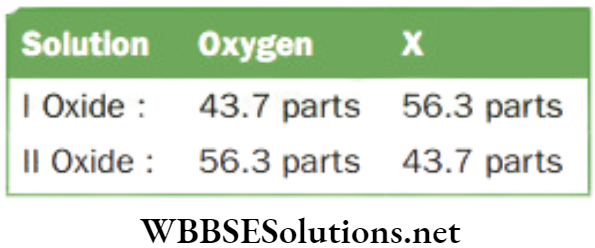
Question 3. A certain non-metal X forms two oxides 1 and 2. The mass percentage of oxygen in oxide 1 (X4O6) is 43.7, which is same as that of X in oxide 2. Find the formula of the second oxide.

NEET Foundation Chemistry Atoms And Molecules Short Answer Type Question 3

Answer.

Given

A certain non-metal X forms two oxides 1 and 2. The mass percentage of oxygen in oxide 1 (X4O6) is 43.7, which is same as that of X in oxide 2.

Now 43.7 parts of oxygen in I corresponds to = 6 oxygen atoms

Therefore, 56.3 parts of oxygen in II corresponds to

⇒ \(\frac{6 \times 56.3}{43.7}=7.730 \text { atoms }\)

Also 56.3 parts of X in 1 correspond to = 4 X atom

Therefore, 43.7 parts of X in 2 will correspond to

⇒ \(=\frac{4 \times 43.7}{56.3} \times 3.1 \times \text { atoms }\)

Now the atomic ration X : O in the second

Oxide = \(\frac{3.1}{3.1}: \frac{7.73}{3.1}\) or 1 : 25 or 2 : 5

The formula of the second oxide is X2O2.

Read And Learn More NEET Foundation Short Answer Questions

Question 4. Calculate the mass of 0.2 moles of water (O = 16, H = 1).
Answer.

Given:

Gram molecular weight of H2O = 2 × 1 + 16 = 18 g

1 mole of water weighs 18 g

Therefore, 0.2 moles of water weighs \(\frac{18}{1}\) × 0.2 = 3.6 g

Question 5. Calculate the volume of 7.1 g of chlorine (Cl = 35.5) at S.T.P.
Answer.

Given:

Gram Molecular Weight of Cl2 (one mole) = 35.5 × 2 = 71 g.

71 g of Cl2 at S.T.P occupies 22.4 litres

Therefore, 7.1 g of Cl2 at S.T.P occupies

⇒ \(\frac{22.4}{71} \times 7.1=2.24 \text { litres }\)

Question 6. The reaction between aluminium carbide and water takes place according to the following equation:

Al4C3 + 12H2O → 3CH4 + 4Al(OH)3

Calculate the volume of CH4 released from 14.4 g of Al4C3 by excess water at S.T.P. (C = 12, Al = 27)
Answer.

Given

CH4 released from 14.4 g of Al4C3 by excess water at S.T.P. (C = 12, Al = 27)

Molecular weight of Al4C3 is (27 × 4) + (12 × 3) = 144

144 g of Al4C3 produces 3 × 22.4 litres of CH4 at S.T.P

Therefore, 14.4 g Al4C3 produces \(\frac{3 \times 22.4}{144} \times\) 14.4

⇒ \(=\frac{967.7}{144}=6.72 \text { litres }\)

Question 7. How many litres of ammonia are present in 3.4 kg of it? (N = 14, H = 1)
Answer.

Given:

Gram molecular weight of NH3 = 14 + (1 × 3) = 17 g.

17 g of NH3 = 22.4 litres

Therefore, 3.4 × 10³g of NH3 = \(\frac{22.4}{17} \times 3.4 \times 10^3\)

= \(\frac{76160}{17}\)

= 4480 litres.

4480 litres of ammonia are present in 3.4 kg of it

Class 11 Physics Class 12 Maths Class 11 Chemistry
NEET Foundation Class 12 Physics NEET Physics

Question 8. Define a mole.
Answer.

Mole: A mole is the amount of substance that contains as many elementary entities as there are atoms in 12 grams in carbon 12 isotopes .

Question 2. Find out the molar mass of sulphuric acid.
Answer.

Formula of sulphuric acid = H2SO4

No. of atoms:

H = 2

S = 1

O = 4

Atomic mass:

H = 1

S = 32

O = 16

Molar mass= (2 × 1) + (1 × 32) + (4 × 16) = 98 g/mol

Molar mass of sulphuric acid is 98 g/mol

NEET Foundation Chemistry Chapter 3 Atoms And Molecules Short Answer Questions

Question 9. Calculate the number of moles and atoms in 240 grams of O (Oxygen) atom.
Answer.

Atomic Mass of O = 16 u

16 u of O = 1 atom of oxygen

16 g of O = 1 mole of oxygen

16 g of O = 6.022 × 10²³ atom of O

240 g of O = 15 moles of O

240 g of O = 15 × 6.022 × 1023 atoms

Therefore, 240 g of O = 90.33 × 10²³ atoms.

Question 10. Find out the weight of 120.44 × 10²³ molecules of water.
Answer.

Molecular mass of H2O = 18 u [(1 × 2) H + (16 × 1)O]

So, 1 mole = 18 g H2O

6.022 × 1023 = 18 g

120.44 × 1023 = (120.44 × 10²³/6.022 × 1023) × 18

= 20 × 18 = 360 g

The weight of 120.44 × 10²³ molecules of water = 360 g

Question 11. 6.6 g of CaCO3on heating gave 2.98 g CaO and 3.62 g CO2. Prove that these observations agree with law of conservation of mass.
Answer.

Given:

6.6 g of CaCO3on heating gave 2.98 g CaO and 3.62 g CO2.

CaCO3 → CaO + CO2

6.6g → 2.88 g + 3.52 g

Mass of the reactant = 6.4 g

Mass of the product = (2.98 + 3.62) g = 6.6 g

These results agree with the law of conservation of mass as the mass of reactants is equal to the mass of products.

Question 12. An 80.0 g sample of an unknown compound contains 16.4 g of hydrogen. What is the percent by mass of hydrogen in the compound?
Answer.

Given:

An 80.0 g sample of an unknown compound contains 16.4 g of hydrogen.

Mass of the compound = 80 g

Mass of hydrogen in the compound = 16.4 g

Therefore, the mass fraction of hydrogen in the unknown compound = (16.4/80) x 100% = 20.5%

Question 13. What is the importance of law of conservation of mass in everyday life?
Answer.

Importance of law of conservation of mass in everyday life: Law of conservation of mass is important to study to produce chemical reactions. Chemists can predict the amount of products that will be produced in a chemical reaction if they know the amount and identities of the reactants.

Question 14. What is the limitation of law of definite proportions?
Answer.

Limitation of law of definite proportions: The law of definite proportions does not hold good for those elements who are also present in different isotopic forms in a compound.

NEET Foundation Chemistry Chapter 4 Structure Of Atom Multiple Choice Questions

NEET Chemistry Structure Of Atom MCQs Chapter 4 Structure Of Atom Multiple Choice Question And Answers

Direction: Choose the correct option for each question. There is only one correct response for each question.

Question 1. On the basis of Rutherford’s model of an atom, which subatomic particle is present in the nucleus of an atom?

  1. Neutrons
  2. Neutral
  3. Electron
  4. Protons

Answer. 4. Protons

Question 2. What should be the pressure inside the discharge tube of the order of 0.001?

  1. The pressure should be very high.
  2. Pressure should be normal.
  3. The pressure should be very low.
  4. Pressure should be at a certain level.

Answer. 3. Pressure should be very low.

Question 3. Why Bohr’s orbits are called stationary states?

  1. It has got a fixed value of energy.
  2. Revolving orbit lose energy continuously.
  3. It is equal to the number of protons.
  4. It is equal to the sum of neutrons.

Answer. 1. It has a fixed value of energy.

Question 4. Which atom does not have any neutrons in the nucleus?

  1. Neutral atom
  2. Protons atom
  3. Electron atom
  4. Hydrogen atom

Answer. 4. Hydrogen atom

NEET Chemistry Structure of Atom MCQs 

Question 5. When alpha particles are sent through a thin metal foil, most of them go straight through the foil because

  1. Alpha particles are much smaller than electrons.
  2. Alpha particles are positively charged.
  3. Most part of the atom is space.
  4. Alpha particles move with low velocity.

Answer. 3. Most part of atom is space.

Read and Learn More NEET Foundation Multiple Choice Questions

Question 6. Rutherford’s scattering experiment showed for the first time that the atom has

  1. Electrons
  2. Nucleus
  3. Protons
  4. Neutrons

Answer. 2. Nucleus

Question 7. Why does a mica wheel mounted on an axle and placed in the path of cathode rays begin to rotate when cathode rays fall in?

  1. Cathode rays travel in straight line.
  2. Particles present in cathode rays are positively charged particles.
  3. Cathode rays consist of material particles travelling with high velocity.
  4. Cathode rays consist of material particles travelling with low velocity.

Answer. 3. Cathode rays consist of material particles travelling with high velocity.

NEET Foundation Chemistry Chapter 4 Structure Of Atom Multiple Choice Questions

Question 8. If the K and L shells of an atom are full, then what would be the total number of electrons in the atom?

  1. 4
  2. 10
  3. 12
  4. 8

Answer. 2. 10

Question 9. Which of the following statements is not correct?

  1. An atomic number is alwaysthe whole number.
  2. All atoms of the same element have same number of protons in the nucleus.
  3. Atoms of two elements contain the same number of protons in the nucleus.
  4. Atomic number of the element changes when it undergoes a chemical reaction.

Answer. 4. Atomic number of the element changes when it undergoes a chemical reaction.

Question 10. Which symbols are used to represent different Bohr’s orbit?

  1. K, L, N, M
  2. K, M, L, N
  3. K, M, N, L
  4. K, L, M, N

Answer. 4. K, L, M, N

Atomic Structure MCQs for NEET 

Question 11. What happens in the discharge tube if a high voltage is applied at gas pressure of one atmosphere?

  1. Current begin to flows between the electrodes.
  2. Glow disappears.
  3. No current flows between the electrodes.
  4. The colour of glow changes.

Answer. 3. No current flows between the electrodes.

Question 12. Atomic number of chlorine is 17. What will be the atomic number of chloride ion (Cl)?

  1. 17
  2. 11
  3. 10
  4. 18

Answer. 1. 17

Question 13. What do you mean by Valence electrons?

  1. Electrons presents in the duplet of the atom.
  2. Electrons increase in atomic number.
  3. Electrons presents in the outermost shell of the atom of an element.
  4. Total number of electrons present in the atom.

Answer. 3. Electrons presents in the outermost shell of the atom of an element.

Atomic Structure MCQs for NEET 

Question 14. What is the maximum number of electrons that can be present in the M-Shell?

  1. 18
  2. 16
  3. 12
  4. 10

Answer. 1. 18

Question 15. What are isobars?

  1. Atoms of same elements.
  2. Atomic numbers are same.
  3. Atoms of different elements having different atomic number.
  4. Atomic masses taken with average value.

Answer. 3. Atoms of different elements having different atomic number.

Question 16. How do we find the age of fossils i.e., sample of woods or dead animals?

  1. Geological dating
  2. Carbon dating
  3. Helium
  4. Isoelectronic

Answer. 2. Carbon dating

Question 17. If an element has 5 electrons in the outermost M-shell, what element is this?

  1. Iodine
  2. Cobalt
  3. Methane
  4. Phosphorus

Answer. 4. Phosphorus

Atomic Structure MCQs for NEET 

Question 18. Covalency is the number of electrons

  1. Sharing with other atoms
  2. Lost by an atom
  3. Gain by an atom
  4. Compound by an atom

Answer. 1. Sharing with other atoms

Question 19. Why helium does not take part in chemical reaction?

  1. Outermost shell has 8 electrons.
  2. Only one shell containing 2 electrons.
  3. Most of the elements have isotopes.
  4. Complete octet in the outermost shell.

Answer. 2. Only one shell containing 2 electrons.

Question 20. What is Radioisotopes?

  1. Some isotopes have unstable nuclei.
  2. Some isotopes have stable nuclei.
  3. Elements have different atomic numbers.
  4. Large amount of radiation is emitted.

Answer. 1. Some isotopes have unstable nuclei.

Question 21. Three isotopes of oxygen are known with mass number 16, 14 and 18. How do they differ from each other in term of electron, proton and neutrons?

  1. Same number of protons and neutrons but different number of electrons.
  2. Same number of electrons and neutrons but different number of protons.
  3. Same number of protons and electrons but different number of neutrons.
  4. None of above

Answer. 3. Same number of protons and electrons but different number of neutrons.

Question 22. How are positive ions formed?

  1. Gain of electrons in their outermost shell.
  2. Anion is equal to the number of electrons.
  3. Equal to the units of charger present on the ion.
  4. Loss of electrons by neutral atom.

Answer. 4. Loss of electrons by neutral atom.

Atomic Structure MCQs for NEET 

Question 23. If an atom contains one electron and one proton, will it carry any charge or not?

  1. The net charge on the atom will be more than 1.
  2. Yes, atom will carry the charge.
  3. No, atom will not carry any charge.
  4. None of above

Answer. 3. No, atom will not carry any charge.

Question 24. On the basis of Thomson’s model of an atom how the atom is neutral as a whole?

  1. Negative charge on the electrons is equal to positive charge of the sphere.
  2. Positive charge on the electrons is equal to positive charge of the sphere.
  3. Negative charge on the electrons is equal to negative charge of the sphere.
  4. None of above

Answer. 1. Negative charge on the electrons is equal to positive charge of the sphere.

Question 25. What is proton?

  1. An electron is that subatomic particle which carries one-unit negative charge.
  2. A smallest indivisible particle made up of electrons.
  3. A subatomic particle which carries one unit positive charge.
  4. Number of elements with low atomic number.

Answer. 3. A subatomic particle which carries one unit positive charge.

Structure of Atom NEET Questions 

Question 26. How do you determine the charge on the cathode rays?

  1. Atoms absorb energy
  2. Electric field deflected towards the positive plates
  3. Mass is equal to the mass of the atom of the gas taken
  4. None of above

Answer. 2. Electric field deflected towards the positive plates

Question 27. What is the origin of the anode rays?

  1. Atoms forming positive icons start moving towards cathode rays.
  2. Ratio is always same irrespective of the gas taken in the discharge tube.
  3. Atoms of different elements having different atomic number.
  4. Electrons presents in the duplet of the atom.

Answer. 1. Atoms forming positive icons start moving towards cathode rays.

Question 28. Helium atom has an atomic mass of 4 u and two protons in its nucleus. How many neutrons does it have?

  1. 4
  2. 8
  3. 2
  4. 6

Answer. 3. 2

Question 29. Oxygen atom has 8 electrons, 8 protons and 8 neutrons whereas sulphur atom has 16 electrons, 16 protons and 16 neutrons. Find out the mass number of oxygen and sulphur atoms.

  1. 16 and 32
  2. 8 and 32
  3. 32 and 16
  4. 8 and 16

Answer. 1. 16 and 32

Question 30. If K and L-shells of an atom are full, then what would be the total number of electrons in the atom?

  1. 18
  2. 12
  3. 08
  4. 10

Answer. 4. 10

Question 31. What are canal rays?

(1) They are anode rays

(2) They pass through the holes or canals in the cathode

(3) They travel in straight lines

(4) None of above

  1. (1) and (2)
  2. (1) and (3)
  3. None of above
  4. (1), (2), and (3)

Answer. 4. (1), (2), and (3)

Question 32. What is mass number?

(1) Sum of number of neutrons

(2) Average relative mass of its atoms

(3) Sum of number of protons

(4) Whole number of electrons

  1. (1) and (4)
  2. (1) and (2)
  3. (1) and (3)
  4. (1), (2), and (3)

Answer. 3. (1) and (3)

Question 33. How can we check that electrons are material particles?

(1) Electric field is applied on the cathode rays.

(2) Mica wheels mounted on an axle.

(3) Mica wheels placed in the path of cathode rays.

(4) Cathode rays deflected towards electric fields.

  1. (1) and (2)
  2. (2) and (4)
  3. (2) and (3)
  4. (1), (2), and (4)

Answer. 2. (2) and (4)

Class 11 Physics Class 12 Maths Class 11 Chemistry
NEET Foundation Class 12 Physics NEET Physics

Question 34. Which of the following is correct about cathode rays?

(1) They are deflected towards the positive plate of the electric field.

(2) The nature of cathode rays does not depend upon the nature of the material of the cathode.

(3) The nature of cathode rays depends upon the nature of the gas taken in the discharge tube.

(4) Cathode rays are made up of electrons.

  1. (1) and (2)
  2. (2) and (4)
  3. (2) and (3)
  4. (1), (2), and (4)

Answer. 4. (1), (2), and (4)

Structure of Atom NEET Questions 

Question 35. How many of the following are correct observation/conclusion from Rutherford’s scattering experiment?

(1) Nucleus is small but heavy.

(2) Nucleus always carries positive charge.

(3) The number of α-particles hitting the nucleus is very large.

(4) Atom is nearly 105 times greater than the size of the nucleus.

  1. (1) and (2)
  2. (2) and (4)
  3. (1), (2) and (4)
  4. (1), (2) and (3)

Answer. 3. (1), (2) and (4)

Question 36. Neutron is present in all atoms

(1) Protium

(2) Deuterium

(3) Tritium

(4) Helium

  1. (2), (3) and (4)
  2. (3) and (4)
  3. (1), (2) and (3)
  4. (1), (2) and (4)

Answer. 1. (2), (3) and (4)

Question 37. Isobars differ in number of

(1) Protons

(2) Electrons

(3) Neutrons

(4) Nucleons

  1. (1), (3) and (4)
  2. (2) and (4)
  3. (1), (2) and (3)
  4. (1), (2) and (4)

Answer. 3. (1), (2) and (3)

Question 38. Which of the following isotopes are not used in the treatment of cancer?

(1) P-32

(2) I-131

(3) Co-60

(4) U-235

  1. (1) and (2)
  2. (2) and (4)
  3. (1), (2) and (4)
  4. (2), (3) and (4)

Answer. 4. (2), (3) and (4)

Structure of Atom NEET Questions 

Question 39. The valency of which of the following elements is not zero?

(1) Hydrogen

(2) Helium

(3) Gold

(4) Silver

  1. (1) and (4)
  2. (1) and (2)
  3. (1) and (3)
  4. (1), (3) and (4)

Answer. 4. (1), (3) and (4)

Question 40. Which of the following are true for an element?

(1) Atomic number = number of protons + number of electrons

(2) Mass number = number of protons + number of neutrons

(3) Atomic mass = number of protons + number of neutrons

(4) Atomic number = number of protons + number of electrons

  1. (1) and (2)
  2. (1) and (3)
  3. (2) and (3)
  4. (2) and (4)

Answer. 4. (2) and (4)

Question 41. Positive ions are formed from the neutral atom by the

  1. Increase of nuclear charge
  2. Gain of protons
  3. Loss of electrons
  4. Loss of protons

Answer. 3. Loss of electrons

Question 42. A neutral atom (Atomic no. > 1) consists of

  1. Only protons
  2. Neutrons + protons
  3. Neutrons + electrons
  4. Neutrons + protons + electrons

Answer. 4. Neutrons + protons + electrons

NEET Foundation Chemistry Chapter 4 

Question 43. The mass of electron is

  1. 9.1083 × 10⁻³¹ kg
  2. 9.1083 × 10⁻²⁴ kg
  3. 9.1083 × 10⁻²⁸ kg
  4. 1.67 × 10⁻²⁴ kg

Answer. 1. 9.1083 × 10⁻³¹ kg

Question 44. Size of the nucleus is of the order

  1. 10-12 m
  2. 10-8 m
  3. 10-15 m
  4. 10-10 m

Answer. 3. 10-15 m

Question 45. In a given atom no two electrons can have the same values for all the four quantum numbers.

  1. Hund’s rule
  2. Aufbau principle
  3. Uncertainty principle
  4. Pauli’s exclusion principle

Answer. 2. Aufbau principle

NEET Foundation Chemistry Chapter 4 

Question 46. An explanation of the presence of three unpaired electrons in the nitrogen atom is given by

  1. Pauli’s principle
  2. Hund’s rule
  3. Aufbau principle
  4. uncertainty principle

Answer. 2. Hund’s rule

Question 47. The \(\frac{e}{m}\) ratio of an electron for all type of substances is

  1. constant
  2. less than one
  3. greater than one
  4. zero

Answer. 1. constant

Question 48. The ratio of charge and mass would be greater for

  1. Proton
  2. Electron
  3. Neutron
  4. Alpha

Answer. 2. Electron

Structure of Atom Multiple Choice Questions 

Question 49. A proton is identical to

  1. the nucleus of helium
  2. the nucleus of a hydrogen atom
  3. a molecule of a hydrogen
  4. an atom of hydrogen

Answer. 4. an atom of hydrogen

Question 50. The electron is

  1. α-ray particle
  2. β-ray particle
  3. Hydrogen ion
  4. Positron

Answer. 2. β-ray particle

Question 51. An α-particle is

  1. a hydrogen molecule
  2. a helium nucleus
  3. an electron
  4. a proton

Answer. 2. a helium nucleus

Question 52. A natural phenomenon that supports the experimental conclusion that atoms are divisible is

  1. allotropy
  2. radioactivity
  3. cracking
  4. None of these

Answer. 2. radioactivity

Question 53. Designation of an orbital with n = 6 and l = 4, is

  1. 6s
  2. 6d
  3. 6f
  4. 6p

Answer. 4. 6p

Structure of Atom Multiple Choice Questions 

Question 54. Which of the following nuclear particles is responsible for holding nucleons together in a nucleus?

  1. Protons
  2. Mesons
  3. Positrons
  4. Neutrons

Answer. 2. Mesons

Question 55. Though three fundamental particles are present in almost all elements. One element does not have

  1. neutron
  2. proton
  3. electron
  4. nucleons

Answer. 1. neutron

Question 56. The nucleus of the atom consists of

  1. Proton and neutron
  2. Proton and electron
  3. Neutrons and electron
  4. Proton, neutrons and electron

Answer. 1. Proton and neutron

Question 57. The size of nucleus is of the order of

  1. 10-12 m
  2. 10-8m
  3. 10-15 m
  4. 10-10 m

Answer. 3. 10-15 m

Question 58. A completely filled and half filled orbit is spherically symmetrical. Point out which has spherical symmetry.

  1. Na
  2. C
  3. Cl
  4. S

Answer. 1. Na

Structure of Atom Multiple Choice Questions 

Question 59. Mosley’s name is related with the discovery of

  1. Atomic mass
  2. Atomic number
  3. Neutrons
  4. Effective atomic number

Answer. 2. Atomic number

Question 60. Radius of first Bohr’s orbit of hydrogen atom is

  1. 0.529 Å
  2. 5.29 Å
  3. 2.59 Å
  4. 9.25 Å

Answer. 1. 0.529 Å

Question 61. If the value of En = –0.85 eV for hydrogen in which of the following excited state electron is present?

  1. 1st
  2. 2nd
  3. 3rd
  4. 4th

Answer. 4. 4th

Question 62. The atomic number of an element is 11 and its mass number is 23. The prespective number of electrons, protons and neutrons in this atom will be

  1. 11, 11, 12
  2. 11, 12, 11
  3. 12, 11, 11
  4. 23, 11, 23

Answer. 1. 11, 11, 12

Question 63. Number of electrons in the outer shell of the most stable or inert atoms is

  1. 1
  2. 4
  3. 6
  4. 8

Answer. 4. 8

Atomic Structure MCQs for NEET 

Question 64. Number of electrons in an element with atomic number X and atomic mass Y will be

  1. X – Y
  2. Y – X
  3. X + Y
  4. X

Answer. 4. X

Question 65. Which of the following pairs are isotopes?

  1. Oxygen and ozone
  2. Ice and steam
  3. Nitric oxide and nitrogen dioxide
  4. Hydrogen and deuterium

Answer. 4. Hydrogen and deuterium

Atomic Structure MCQs for NEET 

Question 66. The energy needed for sending electron from 1st Bohr orbit (n = 1) to second orbit (n = 2) of hydrogen atom is

  1. 13.6 eV
  2. 3.4 eV
  3. 10.2 eV
  4. 6.8 eV

Answer. 3. 10.2 eV

Question 67. Total number of neutrons in dipositive Zinc ion (Zn2+) with mass number 70 is

  1. 30
  2. 40
  3. 50
  4. 20

Answer. 2. 40

Question 68. Correct set of four quantum number for valence shell electron of Rubidium (at No. 37) is

  1. \(0,0,5, \pm \frac{1}{2}\)
  2. \(5,0,0,+\frac{1}{2}\)
  3. \(6,0,0,-\frac{1}{2}\)
  4. \(5,1,1,+\frac{1}{2}\)

Answer. 2. \(5,0,0,+\frac{1}{2}\)

Question 69. An atom of an element has 26 electrons and has a mass number 56. The nucleus of this atom contains _______ neutrons.

  1. 26
  2. 36
  3. 30
  4. 56

Answer. 3. 30

Atomic Structure MCQs for NEET 

Question 70. For an element with atomic number 19, the 19th electron will occupy

  1. L-shell
  2. M-shell
  3. N-shell
  4. K-shell

Answer. 2. M-shell

Chapter 4 Structure Of Atom Practice Exercies

NCERT Examples

Question 1. Which of the following correctly represent the electronic distribution in the Mg atom?

  1. 3, 8,
  2. 2, 8, 2
  3. 1, 8, 3
  4. 8, 2, 2

Answer. 2. 2, 8, 2

Question 2. Rutherford’s ‘alpha (α) particles scattering experiment’ resulted in to discovery of

  1. Electron
  2. Proton
  3. Nucleus in the atom
  4. Atomic mass

Answer. 3. Nucleus in the atom

Question 3. The number of electrons in an element X is 15 and the number of neutrons is 16. Which of the following is the correct representation of the element?

  1. 3115X
  2. 3116X
  3. 1615X
  4. 1516X

Answer. 1. 3115X

Structure of Atom Multiple Choice Questions 

Question 4. Dalton’s atomic theory successfully explained

(1) Law of conservation of mass

(2) Law of constant composition

(3) Law of radioactivity

(4) Law of multiple proportion

  1. (1), (2) and (3)
  2. (1), (3) and (4)
  3. (2), (3) and (4)
  4. (1), (2) and (4)

Answer. 4. (1), (2) and (4)

Question 5. Which of the following statements about Rutherford’s model of atom are correct?

(1) considered the nucleus as positively charged

(2) established that the a–particles are four times as heavy as a hydrogen atom

(3) can be compared to solar system

(4) was in agreement with Thomson’s model

  1. (1) and (3)
  2. (2) and (3)
  3. (1) and (4)
  4. only (1)

Answer. 1. (1) and (3)

Structure of Atom Multiple Choice Questions 

Question 6. Which of the following is true for an element?

(1) Atomic number = number of protons + number of electrons

(2) Mass number = number of protons + number of neutrons

(3) Atomic mass = number of protons = number of neutrons

(4) Atomic number = number of protons = number of electrons

  1. (1) and (2)
  2. (1) and (3)
  3. (2) and (3)
  4. (2) and (4)

Answer. 4. (2) and (4)

Question 7. In the Thomson’s model of atom, which of the following statements are correct?

(1) the mass of the atom is assumed to be uniformly distributed over the atom

(2) the positive charge is assumed to be uniformly distributed over the atom

(3) the electrons are uniformly distributed in the positively charged sphere

(4) the electrons attract each other to stabilise the atom

  1. (1), (2) and (3)
  2. (1) and (3)
  3. (1) and (4)
  4. (1), (3) and (4)

Answer. 1. (1), (2) and (3)

Structure of Atom Multiple Choice Questions 

Question 8. Rutherford’s α–particle scattering experiment showed that

(1) electrons have negative charge

(2) the mass and positive charge of the atom is concentrated in the nucleus

(3) neutron exists in the nucleus

(4) most of the space in atom is empty Which of the above statements are correct?

  1. (1) and (3)
  2. (2) and (4)
  3. (1) and (4)
  4. (3) and (4)

Answer. 2. (2) and (4)

Question 9. The ion of an element has 3 positive charges. Mass number of the atom is 27 and the number of neutrons is 14. What is the number of electrons in the ion?

  1. 13
  2. 10
  3. 14
  4. 16

Answer. 2. 10

Structure of Atom Multiple Choice Questions 

Question 10. Identify the Mg2+ ion from the where, n and p represent the number of neutrons and protons respectively

  1. NEET Foundation Chemistry Structure Of Atom Question 10 Diagram 1
  2. NEET Foundation Chemistry Structure Of Atom Question 10 Diagram 2
  3. NEET Foundation Chemistry Structure Of Atom Question 10 Diagram 3
  4. NEET Foundation Chemistry Structure Of Atom Question 10 Diagram 4

Answer. 

4. NEET Foundation Chemistry Structure Of Atom Question 10 Diagram 4

Question 11. In a sample of ethyl ethanoate (CH3COOC2H5) the two oxygen atoms have the same number of electrons but different number of neutrons. Which of the following is the correct reason for it?

  1. One of the oxygen atoms has gained electrons
  2. One of the oxygen atoms has gained two neutrons
  3. The two oxygen atoms are isotopes
  4. The two oxygen atoms are isobars.

Answer. 3. The two oxygen atoms are isotopes

Structure of Atom Multiple Choice Questions 

Question 12. Elements with valency 1 are

  1. always metals
  2. always metalloids
  3. either metals or non-metals
  4. always non-metals

Answer. 3. either metals or non-metals

Question 13. The first model of an atom was given by

  1. N. Bohr
  2. E. Goldstein
  3. Rutherford
  4. J.J. Thomson

Answer. 4. J.J. Thomson

Question 14. An atom with 3 protons and 4 neutrons will have a valency of

  1. 3
  2. 7
  3. 1
  4. 4

Answer. 3. 1

Question 15. The electron distribution in an aluminium atom is

  1. 2, 8, 3
  2. 2, 8, 2
  3. 8, 2, 3
  4. 2, 3, 8

Answer. 1. 2, 8, 3

Atomic Structure MCQs for NEET 

Question 16. Which of the following do not represent Bohr’s model of an atom correctly?

NEET Foundation Chemistry Structure Of Atom Question 16 Diagram

  1. (1) and (2)
  2. (2) and (3)
  3. (2) and (4)
  4. (1) and (4)

Answer. 3. (2) and (4)

Question 17. Which of the following statement is always correct?

  1. An atom has equal number of electrons and protons.
  2. An atom has equal number of electrons and neutrons.
  3. An atom has equal number of protons and neutrons.
  4. An atom has equal number of electrons, protons and neutrons.

Answer. 1. An atom has equal number of electrons and protons.

Question 18. Atomic models have been improved over the years. Arrange the following atomic models in the order of their chronological order

(1) Rutherford’s atomic model

(2) Thomson’s atomic model

(3) Bohr’s atomic model

  1. (1), (2) and (3)
  2. (2), (3) and (1)
  3. (2), (1) and (3)
  4. (3), (2) and (1)

Answer. 3. (2), (1) and (3)

Atomic Structure MCQs for NEET 

Chapter 4 Structure Of Atom Track Your learning Question And Answers

Question 1. First time the cathode ray experiment was done by:

  1. Rutherford
  2. Goldstein
  3. Chadwick
  4. Dalton

Answer. 2. Goldstein

Question 2. Complete mass of an atom is concentrated in the __________.
Answer. Molecule

Structure of Atom NEET Questions 

Question 3. Who discovered neutron?

  1. Chadwick
  2. Dalton
  3. Bohr
  4. Rutherford

Answer. 1. Chadwick

Question 4. __________ is present outside the nucleus.
Answer. Electron

Question 5. The term electron was coined by GJ Stoney. (True/False)
Answer. True

NEET Foundation Chemistry Chapter 4 Structure Of Atom Long Answer Questions

Chapter 4 Structure Of Atom Long Answer Type Question And Answers

Question 1. What happens when a Sodium atom becomes a Sodium Ion?
Answer.

Sodium atom becomes a Sodium Ion:

A sodium atom has 1 electron in its outer shell. It is in group 1 of the periodic table. When sodium reacts with non-metals (for example chlorine) it will lose its outer electron. Its outer shell will then have no electrons. It is as though the outer shell has vanished. The next shell in is full. This full inner shell becomes the new full outer shell.

NEET Foundation Chemistry Structure Of Atom Long Answer Type Question 1 Diagram 1

The sodium atom loses its outer electron to become a sodium ion. The sodium ion still has 11 protons (11 positive charges) but now only 10 electrons (10 negative charges). The sodium ion has an extra positive charge, shown by the + sign. All group 1 metals will form a 1+ ion when they react with non-metals.

The charge on the ion can also be shown as and the electron structure written as [2, 8]+ The charge on the sodium ion will make it react and form ionic bonds with other oppositely charged ions.

NEET Foundation Chemistry Structure Of Atom Long Answer Type Question 1 Diagram 2

NEET Foundation Chemistry Chapter 4

Structure Of Atom

Question 2. Draw a Dot diagram for a Chlorine Molecule.
Answer.

Dot diagram for a Chlorine Molecule:

Chlorine is a non-metal. A chlorine atom has 7 electrons in its outer shell. Chlorine is in group 7 of the periodic table. Two chlorine atoms will each share one electron to get a full outer shell and form a stable Cl2 molecule.

Read and Learn More NEET Foundation Long Answer Questions

See a picture of the shared electrons making a covalent bond in a chlorine molecule. Chlorine is a simple molecule.

NEET Foundation Chemistry Structure Of Atom Long Answer Type Question 2 Diagram

NEET Foundation Chemistry Chapter 4

Class 11 Physics Class 12 Maths Class 11 Chemistry
NEET Foundation Class 12 Physics NEET Physics

By sharing the two electrons where the shells touch each chlorine atom can count 8 electrons in its outer shell. These full outer shells with their shared electrons are now stable and the Cl2 molecule will not react further with other chlorine atoms. One pair of shared electrons form a single covalent bond.

There are no ions present (no + or − charges) in chlorine gas because the electrons are shared, not transferred from one atom to another. Chlorine does form hydrogen ions when it is dissolved in water to become chloric acid.

Question 3. Which particles are found in the Nucleus?
Answer.

Particles found in the Nucleus:

By sharing the two electrons where the shells touch each chlorine atom can count 8 electrons in its outer shell. These full outer shells with their shared electrons are now stable and the Cl2 molecule will not react further with other chlorine atoms. One pair of shared electrons form a single covalent bond.

There are no ions present (no + or − charges) in chlorine gas because the electrons are shared, not transferred from one atom to another. Chlorine does form hydrogen ions when it is dissolved in water to become chloric acid.

NEET Foundation Chemistry Structure Of Atom Long Answer Type Question 3 Diagram

The electron structure is 2, 8, 1. Each proton has an electrical charge of +1. Each electron has an electrical charge of −1. The neutron has no charge (it is neutral). An atom has the same number of protons and electrons so the overall charge is zero (it is neutral).

The mass of a neutron and a proton are the same. An electron is very much smaller, about 1 ÷ 2000 times the size of a proton although it has an equal and opposite electrical charge. The electrons, although tiny, take up most of the space of an atom.

This means that most of the space that an atom fills contains hardly any mass. An atom is mostly empty space with nearly all the mass centred at the nucleus.

Question 4. How isotopes are indicated?
Answer.

To Indicate Isotopes

  • List the mass number of an element after itsname or element symbol. For example, an isotope with 6 protons and 6 neutrons is carbon-12 or C-12. An isotope with 6 protons and 7 neutrons is carbon-13 or C-16.
  • The mass number may be given in the upperleft side of an element symbol. For example, the isotopes of hydrogen may be written as: 11H, 21H, 31H

NEET Foundation Chemistry Chapter 4

Question 5. Differentiate between isobars and isotopes.
Answer.

Difference between isobars and Isotopes

NEET Foundation Chemistry Structure Of Atom Long Answer Type Question 5

NEET Foundation Chemistry Chapter 4 Structure Of Atom Short Answer Questions

Chapter 4 Structure Of Atom Short Answer Type Questions

Question 1. What are cathode rays? How are they formed?
Answer.

Cathode rays:

Cathode rays are a stream of negatively charged particles. These particles called electrons are shot from the metal cathode of a discharge tube when an electric current is passed through a gas at a very low pressure. A discharge tube is a long glass tube having two metal electrodes.

Formation Of Cathode rays:

When the pressure of air in the discharge tube is reduced to 0.001 mm of mercury and a high voltage is applied to the electrode, the emission of light by air stops. But it is noticed that the wall of the discharge tube at the end opposite the cathode begins to glow with a greenish light. Since these rays are formed at the cathode they are known as cathode rays.

Structure Of Atoms

Read And Learn More NEET Foundation Short Answer Questions

Question 2. What is the relation between an Ion and a Noble Gas?
Answer.

Relation between an Ion and a Noble Gas:

The electron structures of ions and noble gases are the same. The noble gases are in group 0 of the periodic table. They will not react with other atoms because they have a full outer shell of electrons and no overall charge.

Atoms which have lost or gained electrons to form ions will also have a full outer shell of electrons but because they have a charge they will form ionic bonds with other oppositely charged ions.

Ions and noble gases both have a full outer shell of electrons and therefore can have the same electron structure. A Li1+  ion has the same electron structure as Helium. A Mg2+ ion has the same electron structure as a Na1+ ion and a O21- ion.

NEET Foundation Chemistry Chapter 4 Structure Of Atom Short Answer Questions

Question 3. What is a Giant Molecule?
Answer.

Giant Molecule:

A covalently bonded substance containing a huge number of atoms is called a giant molecule or a giant covalent lattice. There are four examples of molecules (made from non-metals) which form giant structures.

They are silicon, silicon dioxide and two forms of the element carbon called diamond and graphite (polymers are a different kind of large molecule). When two (or more) forms of an element exist in the same physical state, they are called allotropes.

Diamond and graphite are allotropes of carbon. Carbon can exist as fullerenes as well as diamond and graphite.

Question 4. Why graphite-a form of carbon conducts electricity?
Answer.

Graphite-a form of carbon conducts electricity:

Carbon as a reactant or electrode, then carbon is graphite not diamond. It is written C(gr) but is usually written as just C. The structure of graphite consists of many flat layers of hexagons.

The layers are called graphene sheets. Each carbon atom in the layer is joined by strong covalent bonds to only three other carbon atoms. Carbon is in group 4 of the periodic table and so it has four electrons in its outer shell.

Three of these electrons are used for covalent bonding in the graphite sheet. There are no covalent bonds between the layers and so the layers can easily slide over each other making graphite soft and slippery and an excellent lubricant. The fourth electron between the layers is delocalised, it’s a free electron present between the layers and allows graphite to conduct electricity and heat.

Class 11 Physics Class 12 Maths Class 11 Chemistry
NEET Foundation Class 12 Physics NEET Physics

Question 5. Define isotones.
Answer.

Isotones:

Isotones are the atoms that have the same neutron number but different number of proton. For example, 5616S, 3717Cl, 3818Ar, 3919K and 4020Ca are all isotones of 20 since they all contain 20 neutrons.

Question 6. What are radioactive isotopes?
Answer.

Radioactive isotopes:

Radioactive Isotope has an unstable combination of protons and neutrons, and that is why they have an unstable nucleus. Because these are unstable, hence they undergo decay and emit alpha, beta and gamma rays. Radioactive isotopes can be useful in different industries, such as food, agriculture, archaeology and medicine.

Question 7. How does Isotopes arise?
Answer.

Isotopes Arise:

Isotopes have same atomic number but different mass number and occur due to the presence of different number of neutrons in elements which have a same atomic number as mass number is the sum of the number of neutrons and protons.

NEET Foundation Chemistry Chapter 2 Is Matter Around Us Long Answer Questions

Chapter 2 Is Matter Around Us Pure Long Answer Type Question And Answers

Question 1. Does starch sol show Tyndall effect?
Answer.

Starch sol show Tyndall effect:

Scattering of light by particles in a colloid is Tyndall effect. Consider a situation, when a strong beam of light is passed through a colloidal solution, its path becomes visible when viewed from a direction at right angle to that of incident light. It is only observed when the size of the particles are larger than the wavelength of visible light.

Usually the particles of size which are in the range of 10–9 m to 10–6 m scatter the visible light. The intensity of Tyndall scattering increases with increase in the size of colloidal particles as well as the concentration.

In this case, as Starch sol is a lyophilic sol and its particles are very small and highly solvated. There is no difference in the refractive indices of dispersion medium (water) and dispersed phase (starch). Hence it shows only very weak or almost no Tyndall effect.

Is Matter Around Us Pure

NEET Foundation Chemistry Chapter 2

Question 2. Soluble substances cannot be separated through filtration as the particles of the solute are too small. So which techniques one need to follow to separate solutions?
Answer.

To separate the soluble substance whose solute particles are too small, one can use the following techniques:

Read and Learn More NEET Foundation Long Answer Questions

  • Evaporation is when you heat the solution so the solvent evaporates, which will leave the solute in the container as a residue of crystals.
  • Distillation is the same as evaporation but the gas (distillate) is collected and cooled to create distilled water.
  • Chromatography is a technique that is used to separate mixtures due to their solubility. A spot of the mixture is placed on filter paper and placed in water. The substances in the mixture with higher solubilities will move further up the filter paper.

Question 3. Explain the suitability of copper and aluminium that is used as electrical conducting materials.
Answer.

Suitability of:

  • Copper: It is used for the winding of electrical machines. High purity copper is obtained by electrolytic refining. Traces (0.1%) of iron, silicon or phosphorous seriously reduce the conductivity of copper. The conductivity of copper is also decreased when it is hard drawn into wires for use in machines. Annealing is therefore necessary before the material can be used in machines. Hard drawn copper because of its increased mechanical strength compared with annealed copper is used for conductors in low voltage overhead distribution lines. Long span lines of thin cross section require conductors of higher mechanical strength, which is achieved by adding small percentage of cadmium to copper. Copper is used in machine windings because it is easily workable without any likelihood of fracture.
  • Aluminium: Conductors are suitable for very high, ambient temperature. Use of aluminium as an electrical material particularly in aircraft industries has a considerable advantages because of the saving in weight. Aluminium because of its lightness is being used for bus bars. The current carrying capacity of aluminium is 75% that of copper and its density being approximately one third that of copper and aluminium bus bar is only about half the weight of copper bus bar of equal current carrying capacity. The steel reinforced aluminium conductor is extensively being used for long span transmission lines.
Class 11 Physics Class 12 Maths Class 11 Chemistry
NEET Foundation Class 12 Physics NEET Physics

Question 4. Differentiate between compounds and mixtures.
Answer.

Difference between compounds and mixtures:

NEET Foundation Chemistry Is Matter Around Us Pure Difference between mixture and compound

NEET Foundation Chemistry Chapter 2

Question 5. How will you separate the components of air?
Answer.

Steps involved in separation of the components of air:

  • First the air is filtered and the dust particlesare removed.
  • The air is then compressed under high pressure in a chamber.
  • It is then passed through a water condenserto lower its temperature.
  • The compressed air then moves into a separator where carbon dioxide separates out as dry ice.
  • The air now becomes cold and turns into aliquid because of repeated compression.
  • The liquid air then moves into the distillation column through expansion jet where it is warmed slowly.
  • The boiling point of liquid nitrogen is –196°Cso it boils out first to form liquid nitrogen gas.
  • Argon is collected next having a boilingpoint of –186°C and finally oxygen having aboiling point of –183°C is collected last.
  • The process is called fractional distillation.

NEET Foundation Chemistry Chapter 2 Is Matter Around Us Short Answer Questions

Chapter 1 Is Matter Around Us Pure Short Answer Type Question And Answers

Question 1. A solution contains 10 g of sugar in 20 g of water. Calculate the concentration in terms of mass-by-mass percentage of the solution.
Answer.

Given:

A solution contains 10 g of sugar in 20 g of water.

Mass of solute (sugar) = 10 g

Mass of solvent (water) = 20 g

⇒ \(\text { Mass of solution }=\frac{\text { mass of solute }}{\text { mass of solution }}\)

= 10 g + 20 g

= 30 g

Mass percentage of solution = mass of solute/mass of solution × 100

= 10/30 × 100

= 33.3 %

The concentration in terms of mass-by-mass percentage of the solution = 33.3 %

NEET Foundation Chemistry Chapter 2 Is Matter Around Us Short Answer Questions

Question 2. Suppose you had 1.00 moles of solute dissolved into 1.00 L of solution. What is the molarity?
Answer.

Given:

Suppose you had 1.00 moles of solute dissolved into 1.00 L of solution.

⇒ \(\text { Molarity }=\frac{\text { moles of solute }}{\text { volume of solution in liters }}\)

Molarity = \(\frac{1.00 \mathrm{~mol}}{1.00 \mathrm{~L}}\)

The answer is 1.00 M.

Read And Learn More NEET Foundation Short Answer Questions

Question 3. A 4 g sugar cube (C12H22O11) is dissolved in a 350 mL water. What is the molarity of the sugar solution?
Answer.

Given:

A 4 g sugar cube (C12H22O11) is dissolved in a 350 mL water.

Molarity (mol/L) = number of moles of solute (mol)/Volume of solvent (Litres)

Step 1: Determine number of moles of sucrose in 4 g

C12H22O11 = (12)(12) + (1)(22) + (16)(11)

C12H22O11 = 144 + 22+ 176

C12H22O11 = 342 g/mol

Divide this amount into the size of the sample

4 g/(342 g/mol) = 0.0117 mol

Step 2: Determine the volume of solvent in litres

350 mL × (1 L/1000 mL) = 0.350 L

Step 3: Determine the molarity of the solution

⇒ \(\text { Molarity }(\mathrm{mol} / \mathrm{L})=\frac{\text { number of moles of solute }(\mathrm{mol})}{\text { Volume of solvent }(\text { Litres })}\)

M = 0.0117 mol/0.350 L

M = 0.033 mol/L

The molarity of the sugar solution is 0.033 mol/L.

NEET Foundation Chemistry Chapter 2 Is Matter Around Us Short Answer Questions

Question 4. A mixture of gases was formed by combining 6.3 moles of O2 and 5.6 moles of N2. What is the mole fraction of nitrogen in the mixture?
Answer.

Given:

A mixture of gases was formed by combining 6.3 moles of O2 and 5.6 moles of N2.

Total number of moles with Ntotal = NN2+OO2 .

Ntotal = 6.3 moles + 5.6 moles

= 11.9 moles.

⇒ \(\mathrm{X}_{\text {(mole fraction) }}=\frac{\text { mole } \mathrm{N}_2}{\text { mole } \mathrm{N}_2+\text { moles } \mathrm{O}_2}\)

= (5.6 moles/11.9 moles)

= 0.47

The mole fraction of nitrogen in the mixture is 0.47.

Question 5. The absolute mass of a carbon atom is 12.0 unified atomic mass units. How many grams will a single oxygen atom weigh?
Answer.

Given:

The absolute mass of a carbon atom is 12.0 unified atomic mass units.

The absolute mass of the carbon atom is 12.0 u, Grams in a single oxygen atom weigh

= \(\frac{\text { absolute mass of carbon }}{\text { Avogadro’s Number }}\)

= (12 g/mol) ÷ (6.022 × 10²³ mol-1) × (4/3)

= 2.66 × 10⁻²³ g.

Question 6. Water is a compound. Explain.
Answer.

Given:

Water is a compound.

Yes, water is a compound as:

It cannot be separated into its constituents (Hydrogen and oxygen) by physical methods.

Its properties are entirely different from its constituents.

Energy in the form of heat and light is given out when water is formed by burning Hydrogen and Oxygen.

Composition of water is fixed. Water has fixed boiling point.

Question 7. Air is a mixture. Explain.
Answer.

Given:

Air is a mixture

Yes, Air is a mixture as:

Its composition is not always same.

Gases present in Air do not lose their identities. Its major constituents can be easily separated by physical method. No energy change takes place among the constituents of air.

Question 8. Is burning of candle a chemical or physical change?
Answer.

Given

Burning of candle a chemical or physical change:

When the candle is burnt, two changes occur:

  • Wax gets melts, which is a physical change
  • Thread and wax get burned, which is a chemical change.

So, the burning of a candle involves both physical and chemical change.

Question 9. When you mix two clear liquids, what kinds of observations would tell you that a chemical reaction occurred?
Answer.

A gas is produced.

The solid dissolves.

A precipitate forms.

You can see through the mixture.

Answer: A gas is produced and A precipitate forms.

Chapter 2 Is Matter Around Us Pure Master your Test Question And Answers

Question 1. List 4 examples of mixtures.
Answer.

4 examples of mixtures are:

  • Sand and Water
  • Salt and Water
  • Sugar and Water
  • Alcohol in Water

Question 2. How are mixtures classified?
Answer.

Mixtures are classified as follows:

  • Based on physical state of components: Solutions, Colloids, Suspensions
  • Based on their appearance: Homogeneous and Heterogeneous Mixtures

Question 3. Give 2 examples of each homogeneous and heterogeneous mixtures.
Answer.

Homogeneous Mixtures: Rainwater, Vinegar

Heterogeneous Mixture: Muddy Water, Chalk Powder in Water

Question 4. What is the major difference between a pure substance and a mixture?
Answer.

The major difference between a pure substance and a mixture

A pure substance is made up of only one type of particles and lacks contamination from any other type of of particle whereas, mixture is made up of two or more type of particles in variable proportion.

Question 5. Define a substance.
Answer.

Substance:

Substance is simply a pure form of matter, i.e., it contains only one type of atom or molecule.

Class 11 Physics Class 12 Maths Class 11 Chemistry
NEET Foundation Class 12 Physics NEET Physics

Chapter 2 Is Matter Around Us Pure Master Your Test Question And Answers

Question 1. When 5.0 g of solute is dissolved in 50 g of water at 298 K to get a saturated solution, then what is the solubility of the solute at the given temperature?
Answer.

Given:

When 5.0 g of solute is dissolved in 50 g of water at 298 K to get a saturated solution.

Weight of the solute in saturated solution = 5.0 g

Weight of solvent in saturated solution = 50 g

Solubility = (weight of the solute in saturated solution/weight of solvent in saturated solution) × 100

Solubility = \(\frac{5.0}{50} \times 100=10 \mathrm{~g}\)

Question 2. A solution contains 10 g of sugar in 20 g of water. Calculate the concentration in terms of mass by mass percentage of the solution and also by mass percentage of the solvent.
Answer.

Given:

A solution contains 10 g of sugar in 20 g of water.

Mass of solute (sugar) = 10 g

Mass of solvent (water) = 20 g

Mass of solution = Mass of solute + Mass of solvent

= 10 g + 20 g

= 30 g

Mass percentage of solution = Mass of solute/Mass of solution × 100

= \(\frac{10}{30} \times 100\)

= 33.3 %

Mass percentage of solvent = 100 – mass percentage of solute

= 100 – 33.3

= 66.7%

Question 3. Suppose you had 1.00 moles of solute dissolved into 1.00 L of solution. What’s the molarity?
Answer. 

Given:

1.00 moles of solute dissolved into 1.00 L of solution.

⇒ \(\text { Molarity }=\frac{\text { moles of solute }}{\text { volume of solution in litres }}\)

Molarity = \(\frac{1.00 \mathrm{~mol}}{1.00 \mathrm{~L}}\)

The answer is 1.00 M.

Question 4. A 4 g sugar cube (C12H22O11) is dissolved in a 350 mL water. What is the molarity of the sugar solution?
Answer.

Given:

A 4 g sugar cube (C12H22O11) is dissolved in a 350 mL water.

Molarity (mol/L) = number of moles of solute (mol)/Volume of solvent(Litres)

Step 1: Determine number of moles of sucrose in 4 g

C12H22O11 = (12) (12) + (1) (22) + (16) (11)

C12H22O11 = 144 + 22+ 176

C12H22O11 = 342 g/mol

divide this amount into the size of the sample

4 g/(342 g/mol) = 0.0117 mol

Step 2: Determine the volume of solvent in litres

350 mL × (1 L/1000 mL) = 0.350 L

Step 3: Determine the molarity of the solution

Molarity (mol/L) = number of moles of solute (mol)/Volume of solvent(Litres)

M = 0.0117 mol/0.350 L

M = 0.033 mol/L

The molarity of the sugar solution is 0.033 mol/L.

Question 5. A mixture of gases was formed by combining 6.3 moles of O2 and 5.6 moles of N2. What is the mole fraction of nitrogen in the mixture?
Answer.

Given:

A mixture of gases was formed by combining 6.3 moles of O2 and 5.6 moles of N2.

Total number of moles with ntotal = nN2 + nO2.

ntotal = 6.3 moles + 5.6 moles

= 11.9 moles.

X(molefraction) = (moles N2 /moles N2 + moles O2)

= (5.6 moles/11.9 moles)

= 0.47

The mole fraction of nitrogen in the mixture is 0.47.

Question 6. A solution contains 10 mL of alcohol in 20 mL of water. Calculate the volume by volume percentage of the solute.
Answer.

Given:

A solution contains 10 mL of alcohol in 20 mL of water.

Mass of solute (alcohol) = 10 mL

Mass of solvent (water) = 20 mL

Volume of solution = Volume of solute + volume of solvent

= 10 mL + 20 mL

= 30 mL

Volume percentage of solute = Volume of solute/Volume of solution × 100

= \(\frac{10}{30} \times 100\)

= 33.3 %

The volume by volume percentage of the solute = 33.3 %

Question 7. A solution contains 10 g of alcohol in 20 g of water. Calculate the concentration of the solution.
Answer.

Given:

A solution contains 10 g of alcohol in 20 g of water.

Mass of solute (alcohol) = 10 mL

Mass of solvent (water) = 20 mL

Mass of solution = Mass of solute + Mass of solvent

= 10 mL + 20 mL

= 30 mL

Concentration of Solution = Mass of solute/Mass of solution × 100

= \(\frac{10}{30} \times 100\)

= 33.3 %

The concentration of the solution = 33.3 %

Question 8. Express the concentration in ppm or ppb, when a solution with mass of 2.00 kg contains 6 mg of solute.
Answer.

Given

A solution with mass of 2.00 kg contains 6 mg of solute

Mass of solute = 6 mg

= 6 × 10⁻³ g

Mass of solution = 2.00 kg

= 2 × 10³ g

Ppm = (mass of solute/mass of solution) × 106

= (6 × 10⁻³ g / 2 × 10² g) × 106

= 3 ppm

Ppb = (mass of solute/mass of solution) × 109

= (6 × 10⁻³ g/2 × 103 g) × 109

= 3 × 10⁶ ppm

Chapter 2 Is Matter Around Us Pure Master your Test Question And Answers

Question 1. Define pure substances.
Answer.

Pure substances:

Pure substances in chemistry are defined as the substances that are made up of only one type of particles.

Question 2. How many types of elements are there?
Answer.

There are three types of elements: Metals, Metalloids and Non-Metals

Question 3. List some properties of metals.
Answer.

Properties of metal:

  • They have a lustre.
  • They conduct heat and electricity.
  • High melting point.
  • High density.
  • They are ductile.
  • They are malleable.
  • They are sonorous.

Question 4. What are metalloids?
Answer.

Metalloids:

A metalloid is a type of chemical elements which has properties of metals and non-metals.

Chapter 2 Is Matter Around Us Pure Master your Test Question And Answers

Question 1. Write two features of physical and chemical change.
Answer. 

Features of physical and chemical change:

  • When physical change occurs in a substance, no new substance is created. The substance will remain in its original state. When chemical change occurs in the substance, you will be able to produce a different kind of substance. This means you will lose the original substance and a new one will form.
  • A physical change is superficial and can possibly be reversed; a chemical change is complete and permanent.

Question 2. Give two examples of chemical changes.
Answer. 

Examples of chemical changes are:

  • Burning of wood
  • Rusting of Iron

Question 3. Give two examples of physical changes that you observe in nature.
Answer. 

Examples of physical changes are:

  • Plucking of flower
  • Cutting of trees