NEET Foundation Biology Chapter 5 Natural Resources Short Answer Questions

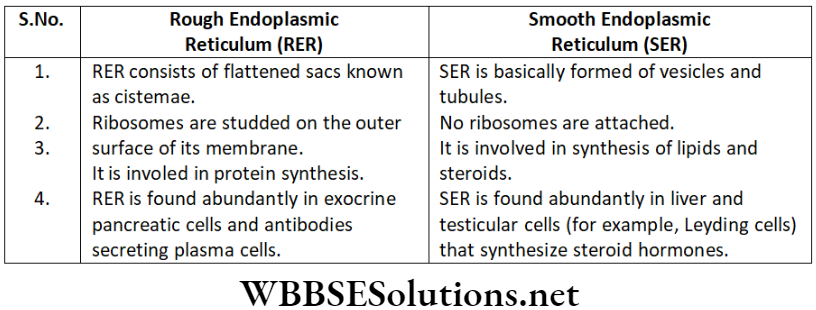
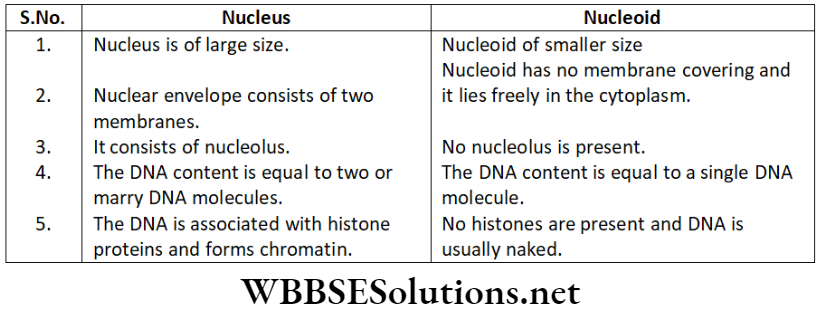
NEET Foundation Biology Chapter 5 Natural Resources SAQs

Chapter 5 Natural Resources Short Answer Type Question And Answers

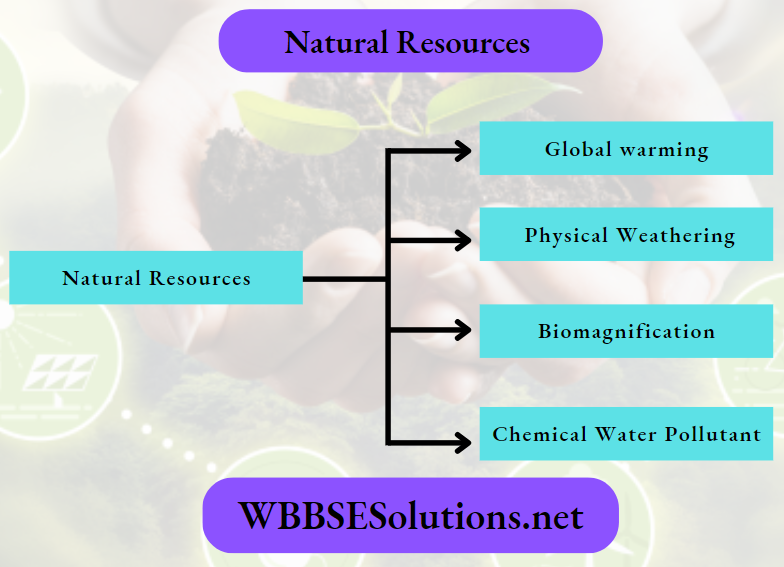
Question 1. What are the effects of global warming?
Answer.

The effects of global warming are:

  • The rise in temperature has led to the melting of glaciers, increasing the sea level.
  • Decrease in the production of crops due to the eruption of plant diseases, pests and growth of weeds as a result of an increase in the temperature.
  • The increase in the warmth of the atmosphere has led to a rise in the moisture-carrying capacity of the air.

Natural Resources

Read And Learn More NEET Foundation Short Answer Questions

Question 2. What do you understand by physical weathering?
Answer.

Physical Weathering:

Factors that contribute to physical weathering include temperature, rainwater, wind, ice, glaciers, snow, and running water. The roots of the plants also play a crucial role in weathering by penetrating into the crevices of the rocks.

Example: The freezing of water leads to the expansion of water in the rock crevices, which leads to the breakdown of rocks.

NEET Biology Natural Resources Short Answer Questions 

Natural Resources

NEET Foundation Biology Chapter 5 Natural Resources Short Answer Questions

Question 3. What are the advantages of rainwater harvesting?
Answer.

Advantages of rainwater harvesting are:

  • Checks soil erosion.
  • Raise water table.
  • Maintains supply of water during months of the year.
  • Control floods.
  • Reduce loss of water through run-off.

Question 4. What is biomagnification?
Answer.

Biomagnification:

It is also known as food chain magnification in a manner that organisms present at the top of the chain contain harmful chemicals, such as DDE, DDT, methyl mercury, etc. They may affect the organisms that feed on them. For example: Minimata disease in fish-eating population is a result of biomagnification of mercury in fishes.

Question 5. What are chemical water pollutants?
Answer.

Chemical Water Pollutants:

It includes organic wastes such as sewage, fertilizers, pesticides (DDT, DDE, BHC, etc.), PCBs (Polychlorinated biphenyls), detergents, inorganic chemicals (lead, nickel, mercury, arsenic, nitrates, fluorides, cadmium, etc.), inorganic impurities such as calcium and magnesium.

Chapter 5 Natural Resources SAQs for NEET Foundation 

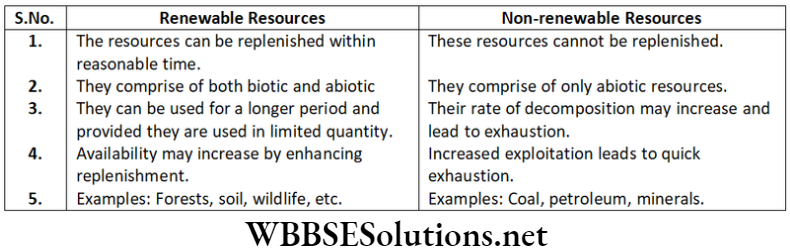
Question 6. Describe the characteristic features of renewable and non-renewable resources.
Answer.

The characteristic features of renewable and non-renewable resources:

NEET Foundation Biology Natural Resources Short Answer Type Question 6

Question 7. What do you understand by the term environment?
Answer:

Environment:

Everything that encompasses us acting as a life support system is termed as environment. It provides us food to eat, air to breathe, water to drink, and it fulfils our daily requirements to survive on earth.

Question 8. What is biosphere?
Answer:

Biosphere:

Biosphere refers to the region of earth’s crust and atmosphere, which is occupied by the living organisms.

Question 9. Who coined the term biosphere?
Answer:

Biosphere

The term ‘biosphere’ was coined by the geologist Eduard Suess.

Class 11 Physics Class 12 Maths Class 11 Chemistry
NEET Foundation Class 12 Physics NEET Physics

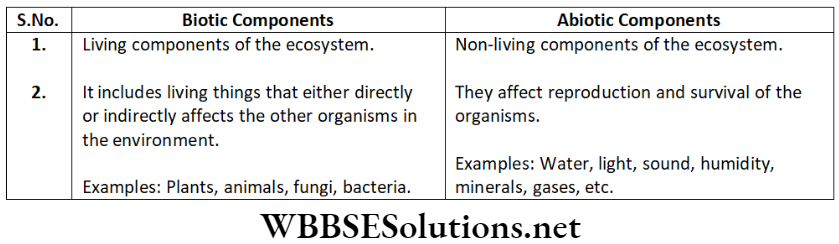
Question 10. What are the differences between biotic and abiotic components?
Answer:

The differences between biotic and abiotic components:

NEET Foundation Biology Natural Resources Differences between biotic and abiotic components

Question 11. All the living organisms are basically made up of C, N, S, P, H and O. How do they enter the living forms? Discuss.
Answer:

All the living organisms are basically made up of C, N, S, P, H and O.

Through photosynthesis and absorption from soil.

Question 12. How is our atmosphere different from the atmospheres on Venus and Mars?
Answer:

Our atmosphere contains gases like nitrogen, oxygen, carbon dioxide, water vapour and other gases in very small amount. Atmosphere of Venus and Mars have about 95% of carbon dioxide. So life is not possible.

Question 13. How does the atmosphere act as a blanket?
Answer:

The atmosphere acts as a blanket in the following ways.

  • It maintains the temperature on the surface of earth during day and night time.
  • It contains ozone in the upper layer which protects life from harmful ultraviolet radiation.

Question 14. What causes winds?
Answer:

Causes Of Winds:

The uneven heating of atmosphere in different regions of earth causes wind. The rotation of earth and the presence of mountain ranges also helps in the formation of wind, its blowing direction.

Question 15. How are clouds formed?
Answer:

Formation Of Clouds :

During day time water from different sources like pond, lake, river, sea, well, etc., gets evaporated and this water vapour rises with the hot air. At a specific height, the air cools and the water vapour condenses to form minute droplets and forms clouds. When these water drops become heavy, they precipitate and fall as rain.

NEET Foundation Biology Natural Resources Chapter SAQs 

Question 16. What do you understand by the term microclimate?
Answer:

Microclimate:

Microclimate refers to the difference in temperature observed over an area of just a few square metres or larger areas covering few kilometres.

Question 17. Why does the percentage of gases like oxygen, nitrogen and carbon dioxide remains almost the  same in the atmosphere?
Answer:

Cycling of these gases maintains consistency.

NEET Foundation Biology Chapter 5 Natural Resources Long Answer Questions

Chapter 5 Natural Resources Long Answer Type Question And Answers

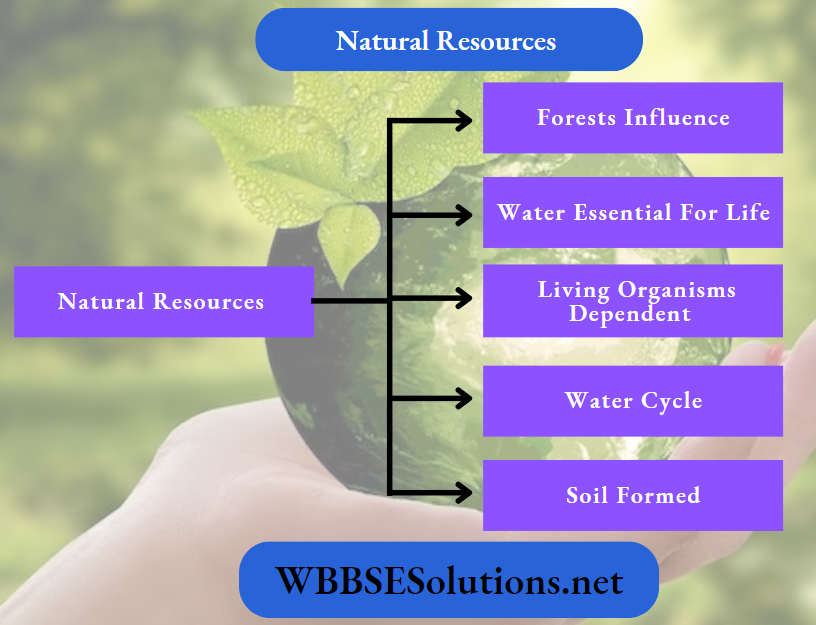
Question 1. Write a note on how forests influence the quality of our air, soil and water resources.
Answer.

Forests influence the quality of our air, soil and water resources as follows

Air:

  • It helps in purifying the air by absorbing pollutants.
  • It adds oxygen to the air and takes carbon dioxide gas during photosynthesis. Therefore, the greenhouse effect is controlled.
  • Transpiration helps in the formation of clouds, it maintains the temperature of surrounding area and gives cooling effect.

Soil:

  • Plants in forest hold the soil thereby preventing soil erosion.
  • It holds the soil which helps in increasing the underground water level.
  • Adds nutrients to the soil as lot of vegetation present in forest gets decomposed.

Water: Forest helps in bringing rain and increasing the level of water in underground levels.

Natural Resource

Natural Resources

Question 2. Why is water essential for life?
Answer.

Water is essential for life because:

Read and Learn More NEET Foundation Long Answer Questions

  • About 70% weight of human being is due to water.
  • All cellular processes takes place in water as a medium.
  • All reactions take place within our body and within the cells occur between substances that are dissolved in water.
  • Transportation of substances from one form to another takes place due to water.
  • Terrestrial life forms require fresh water for the transportation of substances and also to get rid of high amounts of wastes.

Question 3. How are living organisms dependent on the soil? Are organisms that live in water totally independent of soil as a resource?
Answer.

All living organisms are directly or indirectly dependent on soil. Plants obtain water and minerals from the soil and prepare food for themselves and animals. Other organisms that live in water are not totally independent of soil because the microbes growing on the soil in water are the primary producers in the soil which starts the food chain and even other microbes that live in soil helps in the decomposition of dead plants and animals in water to return the nutrients and other elements back to the water.

Class 11 Physics Class 12 Maths Class 11 Chemistry
NEET Foundation Class 12 Physics NEET Physics

Question 4. What are the different states in which water is found during the water cycle?
Answer.

The different states in which water is found during the water cycle:

The various states in which water is found during the water cycle are as follows.

  • Water in liquid state is present in various sources, such as lakes, rivers and underground water.
  • Water vapour in gaseous state, water evaporates from water bodies and due to transpiration by plants.
  • Clouds-condensed water vapour is present in clouds.
  • Water as rain or snowfall.

Question 5. How is soil formed?
Answer.

Formation Of Soil:

The factors that helps in the formation of soil and the process of formation are as follows.

  • Sun: Sun heats up rocks during the day so that they expand. At night, these rocks cool down and contract, this causes cracks in the rocks.
  • Water: Water during rainfall enter these cracks, if this water freezes, it exerts pressure on the cracks and the rocks break. When water flows, it wears the hard rock and carries small particles of rock down stream.
  • Wind: Strong winds erode rocks down, which rubs with each other and small particles are carried away by wind.
  • Living organisms: Organisms like lichen grows on the surface of the rock, they release certain substances that causes the rock surface to powder down and form a thin layer of soil.

NEET Foundation Biology Chapter 5 Natural Resources Multiple Choice Questions

Chapter 5 Natural Resources Multiple Choice Question And Answers

Direction: Choose the correct option for each question. There is only one correct response for each question.

Question 1. The ozone layer is contained within which layer of the atmosphere?

  1. Mesosphere
  2. Troposphere
  3. Stratosphere
  4. Ionosphere

Answer. 3. Stratosphere

Question 2. The rigid outer part of the earth which consists of the crust and upper mantle is called ________.

  1. Lithosphere
  2. Mesospheric mantle
  3. Asthenosphere
  4. Inner core

Answer. 1. Lithosphere

Question 3. Which gas, by volume, holds the highest percentage in the composition of dry air on Earth?

  1. Oxygen
  2. Nitrogen
  3. Carbon dioxide
  4. Argon

Answer. 2. Nitrogen

Question 4. On the basis of their continued availability, how will you classify the resources?

  1. Renewable and non-renewable
  2. Metallic and non-metallic
  3. Potential and actual.
  4. None of the above

Answer. 1. Renewable and non-renewable

Read and Learn More NEET Foundation Multiple Choice Questions

Question 5. Which instrument measures the pressure of the atmosphere?

  1. Galvanometer
  2. Hygrometer
  3. Pyrometer
  4. Barometer

Answer. 4. Barometer

Question 6. Which gas is filled in weather observation balloons?

  1. Nitrogen
  2. Helium
  3. Argon
  4. Oxygen

Answer. 2. Helium

Question 7. What is the process of seeping water into the ground known as?

  1. Infiltration
  2. Irrigation
  3. Aeration
  4. Sublimation

Answer. 1. Infiltration

Question 8. Identify which of the following is not a source of groundwater.

  1. Rainwater
  2. Aquifers
  3. Rivers
  4. Seawater

Answer. 4. Seawater

NEET Foundation Biology Chapter 5 Natural Resources Multiple Choice Questions

Question 9. Which term is used for the condensation of water vapour in the atmosphere that falls under gravity?

  1. Transpiration
  2. Evaporation
  3. Precipitation
  4. Desalination

Answer. 3. Precipitation

Question 10. Which of the given statements is not true for ozone?

  1. It is a pungent-smelling blue gas.
  2. It can treat gangrene and is used as a disinfectant.
  3. A molecule of ozone has three oxygen atoms.
  4. Low-level ozone is not harmful.

Answer. 4. Low-level ozone is not harmful.

Question 11. Water and air together constitute what percentage of soil composition?

  1. Around 10%
  2. Around 25%
  3. Around 50%
  4. Around 70%

Answer. 3. Around 50%

Question 12. Which layer of the soil is the bedrock?

  1. Horizon O
  2. Horizon A
  3. Horizon C
  4. Horizon R

Answer. 4. Horizon R

Question 13. Which is the most determining factor for soil structure?

  1. Parent rock
  2. Humus
  3. Water content
  4. Location

Answer. 2. Humus

Question 14. Water pollution results in the spread of many harmful diseases. Identify which one is not due to water pollution.

  1. Fluorosis
  2. Arsenicosis
  3. Lead poisoning
  4. Cystic fibrosis

Answer. 4. Cystic fibrosis

Question 15. Which of the following rocks do not allow seepage of water?

  1. Permeable rocks
  2. Impermeable rocks
  3. Stratified rocks
  4. None of these

Answer. 2. Impermeable rocks

Question 16. In which category can fungi be kept?

  1. Consumer
  2. Producer
  3. Decomposer
  4. None of these

Answer. 3. Decomposer

Question 17. Which of the following is not a greenhouse gas?

  1. CO2
  2. Nitrous oxide
  3. Methane
  4. Oxygen

Answer. 4. Oxygen

Question 18. What term is given to the process when plants absorb nitrogen through their roots from the soil?

  1. Nitrification
  2. Assimilation
  3. Denitrification
  4. Fixation

Answer. 2. Assimilation

Question 19. Living substances that contain carbon are called _______.

  1. Organic
  2. Inorganic
  3. Carbonic
  4. None of these

Answer. 1. organic

Question 20. Which of the given factors is responsible for the eutrophication of lakes?

  1. Industrial smoke
  2. Automobile exhaust
  3. Enrichment of water by nutrients
  4. None of these

Answer. 3. Enrichment of water by nutrients

Question 21. Which of the following is the International Day for ‘The Prevention of Ozone Layer’?

  1. September 12
  2. September 16
  3. December 16
  4. December 21

Answer. 2. September 16

Question 22. Identify the step which is not a part of the carbon cycle.

  1. Transpiration
  2. Respiration
  3. Photosynthesis
  4. Burning of fossil fuels

Answer. 1. Transpiration

Question 23. Which of the given facts is true for CFCs?

  1. CFCs have natural sources.
  2. CFCs are soluble in water.
  3. CFCs contain only carbon, chlorine and fluorine.
  4. All the above

Answer. 3. CFCs contain only carbon, chlorine and fluorine.

Question 24. Acid rain has high levels of _________.

  1. Nitric and sulphuric acids.
  2. Nitric and phosphoric acids.
  3. Phosphoric and carbonic acids.
  4. Sulphuric and phosphoric acids.

Answer. 1. Nitric and sulphuric acids.

Question 25. Which layer of the atmosphere is important for telecommunication on earth?

  1. Troposphere
  2. Ionosphere
  3. Mesosphere
  4. Thermosphere

Answer. 2. Ionosphere

Question 26. Identify which of the following is not a cause of soil erosion.

  1. Tilling
  2. Terrace farming
  3. Deforestation
  4. No embankments along the river banks.

Answer. 2. Terrace farming

Question 27. Which of the following is the chief source of minerals in soil?

  1. Plants
  2. Animals
  3. Parent rock
  4. bacteria

Answer. 3. Parent rock

Question 28. Which of the given sources of water cannot be included in freshwater sources?

  1. Glaciers
  2. Aquifers
  3. Sea
  4. Underground streams

Answer. 3. Sea

Question 29. Identify the soil formed by intense leaching due to heavy rains.

  1. Laterite soil
  2. Alluvial soil
  3. Black soil
  4. Mountain soil

Answer. 1. Laterite soil

Question 30. What are the chief sources of carbon on earth?

  1. Oceans
  2. Atmosphere
  3. Petroleum and its products.
  4. All of these

Answer. 4. All of these

Question 31. Why nitrogen is an important gas?

  1. It dilutes the activity of oxygen and thus, combustion of fuel takes place at a moderate rate.
  2. It is used in food preservation.
  3. Only (1)
  4. Both (1) and (2)

Answer. 4. Both (1) and (2)

Question 32. Read the sentences and choose the correct option.

1. Alluvial soil is formed by the deposition of silt and alluvium brought down by rivers.

2. Its main contents are organic and nitrogenous.

Select the correct option.

  1. Only statement 1 is correct.
  2. Only statement 2 is correct.
  3. Both are correct.
  4. Both are incorrect.

Answer. 1. Only statement 1 is correct.

Question 33. Which of the following is/are part/s of the water cycle?

  1. Precipitation
  2. Condensation
  3. Evaporation
  4. All of the above

Answer. 4. All of the above

Question 34. Which of the following is involved in ­adding CO2 back to the atmosphere?

  1. Respiration
  2. Combustion
  3. Decay and decomposition of organic remains
  4. Photosynthesis

Select the correct option.

  1. (1), (2), (3)
  2. (1), (2), (4)
  3. (2), (3)
  4. (1), (2)

Answer. 1. (1), (2), (3)

Question 35. Which of these is/are air pollutants?

  1. Nitrogen oxides
  2. Carbon monoxide
  3. Sulphur dioxide
  4. All of these

Answer. 4. All of these

Question 36. Which of these nitrogen-fixing bacteria play an important role in the nitrogen cycle?

  1. Rhizobium
  2. Azotobacter
  3. Anabaena
  4. All of these

Answer. 4. All of these

Question 37. Which of the given statements is true for renewable sources of energy?

  1. These are derived from natural processes.
  2. Most energy sources are fossil fuels.
  3. It is a form of clean energy.

Select the correct option.

  1. All are true.
  2. (1) and (3) are true.
  3. Only (2) is true.
  4. (2) and (3) are not true.

Answer. 2. (1) and (3) are true.

Question 38. Identify the wrong statement/s from the following.

  1. The increase of CO2 is due to increased afforestation.
  2. An increase in CO2 results in an increase of atmospheric temperature at the same rate.
  3. An increase in CO2 results in mthe elting of glaciers.
  4. All the above

Answer. 4. All the above

Question 39. Identify how are water vapours formed.

  1. Transpiration from plants
  2. Heating of water bodies
  3. Only (1)
  4. Both (1) and (2)

Answer. 4. Both (1) and (2)

Question 40. Which of the following makes use of CFCs?

  1. Blowing agents
  2. Refrigerators
  3. Both (1) and (2)
  4. Only (2)

Answer. 3. Both (1) and (2)

Question 41. Acid rain is caused by an increase in the atmosphere concentration of

  1. Ozone and dust
  2. SO2 and NO2
  3. SO3 and CO
  4. CO and CO2

Answer. 2. SO2 and NO2

Question 42. Maximum deposition of DDT will occur in

  1. Phytoplankton
  2. Crab
  3. Eel
  4. Sea gull

Answer. 4. Sea gull

Question 43. A lake with an inflow of domestic sewage rich in organic waste may result in

  1. drying of the lake very soon due to algal bloom
  2. an increased production of fish due to lot of nutrient
  3. death of fish due to lack of oxygen
  4. increased population of aquatic food web organism

Answer. 3. death of fish due to lack of oxygen

Question 44. Which one of the following pair is mismatched?

  1. Fossil fuel burning – release of CO2
  2. Nuclear power – radioactive waste
  3. Solar energy – greenhouse effect
  4. Biomass burning – release of CO2

Answer. 3. Solar energy – greenhouse effect

Question 45. Greenhouse effect is the cumulative result of the influences of certain gases. Indentify the gas which is not involved in this influence.

  1. Methane
  2. Chloroflurocarbons
  3. Nitrogen
  4. Carbon dioxide

Answer. 3. Nitrogen

Question 46. Soil conservation is a process in which

  1. Soil is aerated
  2. Soil erosion is allowed
  3. Sterile soil is made fertile
  4. Soil is protected against loss

Answer. 4. Soil is protected against loss

Class 11 Physics Class 12 Maths Class 11 Chemistry
NEET Foundation Class 12 Physics NEET Physics

Question 47. Plants die in water-logged soil because of

  1. Nutrient leaching
  2. Dilution of soil nutrient
  3. Stoppage of root respiration
  4. Dilution of cell sap

Answer. 3. Stoppage of root respiratio

Question 48. If more trees are grown in the industrial towns

  1. There will be rains
  2. Inhabitants will have more shades
  3. Oxygen will be replenished
  4. They will provide more fuel and food

Answer. 3. Oxygen will be replenished

Question 49. Depletion of forest result in

  1. Less rainfall
  2. Soil erosion
  3. Loss of fertility
  4. All the above

Answer. 4. All the above

Question 50. Which one of the following is an example of both organic and inorganic resources?

  1. Metallic ferrous ores
  2. Microbes
  3. Soil
  4. Air

Answer. 3. Soil

Question 51. Life supporting part of earth’s surface is known as

  1. Lithosphere
  2. Stratosphere
  3. Biosphere
  4. Ecotone

Answer. 3. Biosphere

Question 52. Harmful UV rays of the Sun are absorbed by

  1. Carbon dioxide
  2. Ozone
  3. Oxygen
  4. Helium

Answer. 2. Ozone

Question 53. One of the important gases that is responsible for greenhouse effect is

  1. CO2
  2. O2
  3. N2
  4. CO

Answer. 1. CO2

Question 54. Air is a mixture of gases with the following gas in maximum percentage

  1. Oxygen
  2. Hydrogen
  3. Nitrogen
  4. Carbon dioxide

Answer. 3. Nitrogen

Question 55. Biosphere includes:

  1. Hydrosphere
  2. Lithosphere
  3. Atmosphere
  4. All of the above

Answer. 4. All of the above

Question 56. Fertility of the soil is reduced by

  1. Decaying organic matter
  2. Crop rotation
  3. Intensive agriculture
  4. None

Answer. 3. Intensive agriculture

Question 57. Deforestation causes:

  1. Soil erosion
  2. Pollution
  3. Both of above
  4. None of these

Answer. 3. Both of above

Question 58. The average amount of CO2 in atmosphere is

  1. 0.3%
  2. 0.003%
  3. 3.0%
  4. 0.03%

Answer. 4. 0.03%

Question 59. The average amount of N2 in atmosphere is

  1. 78%
  2. 0.3%
  3. 7.8%
  4. 0.03%

Answer. 1. 78%

Question 60. Which substance is responsible for depletion of ozone layer?

  1. CO2
  2. CH4
  3. CFCs
  4. CO

Answer. 3. CFCs

Question 61. Which organism cannot fix atmosphere nitrogen?

  1. Rhizobium
  2. Nostoc
  3. Azatobacter
  4. E. coli

Answer. 4. E. coli

Question 62. Which gas causes ‘greenhouse effect’ and leads to global warming?

  1. Carbon monoxide
  2. Carbon disulphide
  3. Carbon dioxide
  4. Oxygen

Answer. 3. Carbon dioxide

Question 63. ‘Freeing’ of N2 gas from nitrates present in soil and water is known as

  1. Nitrification
  2. Ammonification
  3. Denitrification
  4. Nitrogen fixation

Answer. 3. Denitrification

Question 64. Harmful UV radiations coming from sun to earth are absorbed by

  1. O2
  2. CO2
  3. N2
  4. Ozone

Answer. 4. Ozone

Question 65. What would happen, if all the oxygen present in the environment is covered with ozone?

  1. We will be protected more
  2. It will become posionous and kill living forms
  3. Ozone is not stable, hence it will be toxic
  4. It will help harmful sun radiations to reach earth and damage many life forms.

Answer. 3. Ozone is not stable, hence it will be toxic

Question 66. The two forms of oxygen found in the atmosphere are

  1. Water and ozone
  2. Water and oxygen
  3. Ozone and oxygen
  4. Water and carbon dioxide

Answer. 2. Water and oxygen

Question 67. The process of nitrogen fixation by bacteria does not take place in the presence of

  1. molecular form of hydrogen
  2. elemental form of oxygen
  3. water
  4. elemental form of nitrogen

Answer. 2. elemental form of oxygen

Question 68. One of the following processes is not a step involved in the water cycle operating in nature

  1. evaporation
  2. transpiration
  3. precipitation
  4. photosynthesis

Answer. 4. photosynthesis

Question 69. Which of the following is not a greenhouse gas?

  1. Methane
  2. Carbon dioxide
  3. Carbon monoxide
  4. Ammonia

Answer. 4 Ammonia

Question 70. Which step is not involved in the carbon cycle?

  1. Photosynthesis
  2. Transpiration
  3. Respiration
  4. Burning of fossil fuels

Answer. 2. Transpiration

Question 71. The atmosphere of the earth is heated by radiations which are mainly

  1. radiated by the sun.
  2. re-radiated by land.
  3. re-radiated by water.
  4. re-radiated by land and water.

Answer. 4. re-radiated by land and water.

Question 72. If there were no atmosphere around the earth, then the temperature of earth will

  1. increase
  2. go on decreasing.
  3. increase during day and decrease during night.
  4. be unaffected.

Answer. 3. increase during day and decrease during night.

Question 73. What would happen if all the oxygen present in the environment is converted to ozone?

  1. We will be protected more.
  2. It will become poisonous and kill living forms.
  3. Ozone is not stable and hence, it will be toxic.
  4. It will help harmful sun radiations to reach earth and damage many life forms.

Answer. 2. It will become poisonous and kill living forms.

Question 74. Which one of the following factors does not lead to soil formation in nature?

  1. Sun
  2. Water
  3. Wind
  4. Polythene bags

Answer. 4. Polythene bags

Question 75. The two forms of oxygen found in the atmosphere are

  1. water and ozone.
  2. water and oxygen.
  3. ozone and oxygen.
  4. water and carbon dioxide.

Answer. 3. ozone and oxygen.

Question 76. The process of nitrogen fixation by bacteria does not take place in the presence of

  1. molecular form of hydrogen.
  2. elemental form of oxygen.
  3. water.
  4. elemental form of nitrogen.

Answer. 2. elemental form of oxygen.

Question 77. Rainfall patterns depend on

  1. the underground water table.
  2. the number of water bodies in an area.
  3. the density pattern of human population in an area.
  4. the prevailing season in an area.

Answer. 2. the number of water bodies in an area.

Question 78. Among the given options, which one is not correct for the use of large amount of fertilizers and pesticides?

  1. They are eco-friendly.
  2. They turn the fields barren after some time.
  3. They adversely affect the useful component from the soil.
  4. They destroy the soil fertility.

Answer. 1. They turn the fields barren after some time.

Question 79. The nitrogen molecules present in the air can be converted into nitrates and nitrites by

  1. a biological process of nitrogen fixing bacteria present in soil.
  2. a biological process of carbon fixing factor present in soil.
  3. any of the industries manufacturing nitrogenous compounds.
  4. the plants used as cereal crops in field.

Answer. 1. a biological process of carbon fixing factor present in soil.

Question 80. Which one of the following processes is not a step involved in the water-cycle operating in nature?

  1. Evaporation
  2. Transpiration
  3. Precipitation
  4. Photosynthesis

Answer. 4. Photosynthesis

Question 81. The term ‘water pollution’ can be defined in several ways. Which of the following statements does not give the correct definition?

  1. The addition of undesirable substances to water bodies.
  2. The removal of desirable substances from water bodies.
  3. A change in pressure of the water bodies.
  4. A change in temperature of the water bodies.

Answer. 3. A change in pressure of the water bodies.

Question 82. Which of the following is not a greenhouse gas?

  1. Methane
  2. Carbon dioxide
  3. Carbon monoxide
  4. Ammonia

Answer. 4. Ammonia

Question 83. Which of the following step is not involved in the carbon cycle?

  1. Photosynthesis
  2. Transpiration
  3. Respiration
  4. Burning of fossil fuels

Answer. 2. Transpiration

Question 84. ‘Ozone hole’ means

  1. a large sized hole in the ozone layer.
  2. thinning of the ozone layer.
  3. small holes scattered in the ozone layer.
  4. thickening of ozone in the ozone layer.

Answer. 2. thinning of the ozone layer.

Question 85. Ozone layer is getting depleted due to

  1. excessive use of automobiles.
  2. excessive formation of industrial units.
  3. excessive use of man-made compounds containing both fluorine and chlorine.
  4. excessive deforestation.

Answer. 3. excessive use of man-made compounds containing both fluorine and chlorine.

Question 86. Which of the following is a recently originated problem of environment?

  1. Ozone layer depletion
  2. Greenhouse effect
  3. Global warming
  4. All the above

Answer. 4. All the above

Question 87. When we breathe in air, nitrogen also goes inside along with oxygen. What is the fate of this nitrogen?

  1. It moves along with oxygen into the cells.
  2. It comes out with the CO2 during exhalation.
  3. It is absorbed only by the nasal cells
  4. Nitrogen concentration is already more in the cells so it is not at all absorbed.

Answer. 2. It comes out with the CO2 during exhalation.

Question 88. Top soil contains which of the following?

  1. Humus and living organisms only.
  2. Humus and soil particles only.
  3. Humus, living organisms and plants.
  4. Humus, living organisms and soil particles.

Answer. 4. Humus, living organisms and soil particles.

Question 89. Choose the correct sequence fromthe following.

  1. CO2 in atmosphere → Decomposers → Organic carbon in animals → Organic carbon in plants.
  2. CO2 in atmosphere → Organic carbon in plants → Organic carbon in animals → Inorganic carbon in soil.
  3. Inorganic carbonates in water → Organic carbon in plants → Organic carbon in animals → Scavengers.
  4. Organic carbon in animals → Decomposers → CO2 in atmosphere → Organic carbon in plants.

Answer. 2. CO2 in atmosphere → Organic carbon in plants → Organic carbon in animals → Inorganic carbon in soil.

Question 90. The major source of mineral in soil is the

  1. parent rock from which soil is formed.
  2. plants
  3. animals
  4. bacteria

Answer. 1. parent rock from which soil is formed.

Question 91. The total earth’s surface covered by water is

  1. 75%
  2. 60%
  3. 85%
  4. 50%

Answer. 1. 75%

Question 92. The biotic component of biosphere is not constituted by

  1. producers
  2. consumers
  3. decomposer
  4. air

Answer. 4. air

Question 93. An increase in carbon dioxide content in the atmosphere would not cause

  1. more heat to be retained by the environment.
  2. increase in photosynthesis in plants.
  3. global warming.
  4. abundance of desert plants.

Answer. 4. abundance of desert plants.

Question 94. Oxygen is returned to the atmosphere mainly by

  1. burning of fossil fuel.
  2. respiration
  3. photosynthesis
  4. fungi

Answer. 3. photosynthesis

Question 95. Low visibility during cold weather is due to

  1. formation of fossil fuel.
  2. unburnt carbon particles or hydrocarbons suspended in air.
  3. lack of adequate power supply.
  4. none of these

Answer. 2. unburnt carbon particles or hydrocarbons suspended in air.

Question 96. Growth of lichens on barren rocks is followed by the growth of

  1. moss
  2. ferns
  3. gymnosperms
  4. algae

Answer. 1. moss

Question 97. Marked temperature changes in aquatic environment can affect

  1. breeding of animals.
  2. more growth of aquatic plants.
  3. process of digestion in animals.
  4. availability of nutrients.

Answer. 1. breeding of animals.

Question 98. Soil erosion can be prevented by

  1. raising forests.
  2. deforestation.
  3. excessive use of fertilizer.
  4. overgrazing by animals.

Answer. 1. raising forests.

Question 99. What happens when rainfall on soil without vegetational cover?

  1. Rain water percolates in soil efficiently.
  2. Rain water causes loss of surface soil.
  3. Rain water leads to fertility of the soil.
  4. Rain water does not cause any change in soil.

Answer. 2. Rain water causes loss of surface soil.

Question 100. Oxygen is harmful for

  1. ferns
  2. nitrogen fixing bacteria
  3. chara
  4. mango tree

Answer. 2. nitrogen fixing bacteria

Question 101. The life supporting zone of the earth is

  1. lithosphere
  2. hydrosphere
  3. atmosphere
  4. biosphere

Answer. 4. biosphere

Question 102. Life cannot sustain on Mars and Venus because the major component in atmosphere is

  1. oxygen
  2. carbon dioxide
  3. nitrogen
  4. ozone

Answer. 2. carbon dioxide

Question 103. Atmosphere maintains the temperature of earth because

  1. it contains water vapour.
  2. it holds air, which is a bad conductor of heat.
  3. it reflects the heat rays.
  4. it absorbs the heat rays.

Answer. 2. it holds air, which is a bad conductor of heat.

Question 104. Molecules of proteins contain

  1. carbon
  2. nitrogen
  3. oxygen
  4. all of these

Answer. 4. all of these

Question 105. Which one of the following is an example of non-renewable resources?

  1. Wind
  2. Water
  3. Vegetation
  4. Coal and minerals

Answer. 4. Coal and minerals

NEET Foundation Biology Chapter 3 Diversity In Living Organisms Long Answer Questions

Chapter 3 Diversity In Living Organisms Long Answer Type Question And Answers

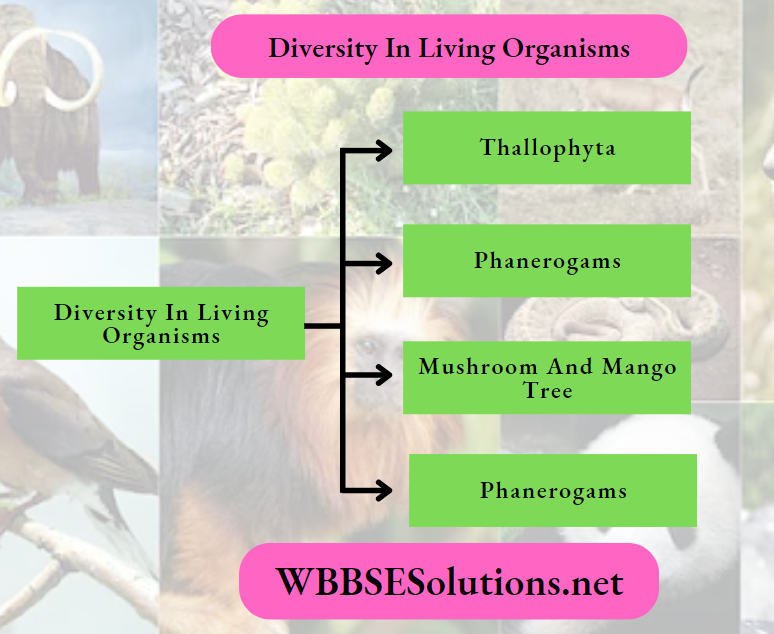
Question 1. Thallophyta, Bryophyta and Pteridophyta are known as ‘Cryptogams’. Gymnosperms and angiosperms are called ‘phanerogams’. Discuss why?
Answer.

Thallophyta, Bryophyta and Pteridophyta are known as ‘Cryptogams’. Gymnosperms and angiosperms are called ‘phanerogams’.

Thallophyta, Bryophyta and Pteridophyta are called ‘Cryptogams’ because the reproductive organs of these groups are inconspicuous or hidden. Seeds are absent. On the other hand, ‘Phanerogams’ include gymnosperms and angiosperms which have well-differentiated reproductive tissue and the embryo with stored food. Embryo develops into seed

Diversity In Living Organisms

Question 2. Which organism is more complex and evolved among bacteria, mushroom and mango tree. Give reasons.
Answer.

Mango tree is more complex and evolved because it is eukaryotic, autotrophic, terrestrial sporophyte with covered seed. The bacteria is unicellular prokaryote and fungi are heterotrophic, simple thallophyte with no tissue system

Read and Learn More NEET Foundation Long Answer Questions

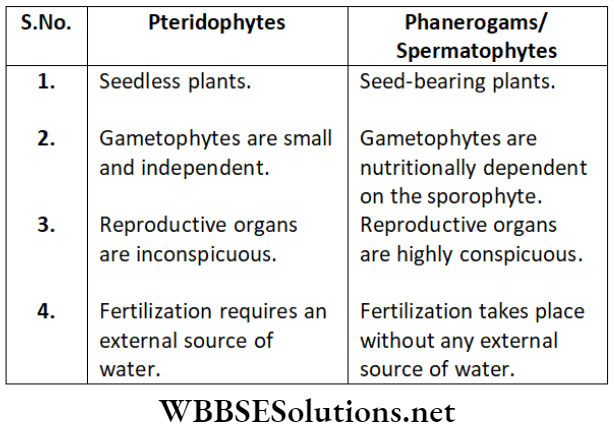
Question 3. Discuss the characteristics features between pteridophytes and spermatophytes.
Answer.

Differences between Pteridophytes and Phanerogams (Spermatophytes):

NEET Foundation Biology Diversity In Living Organisms Long Answer Type Question 3

Diversity Of Living Organisms

Question 4. List out some common features in cat,rat and bat.
Answer.

common features in cat,rat and bat:

Bat, rat and cat belongs to the class Mammalia and have the following common features.

  • All have notochord at some stage of life cycle.
  • All are warm blooded.
  • All have four-chambered heart.
  • All have skin covered with hair and with sweat and oil glands.
Class 11 Physics Class 12 Maths Class 11 Chemistry
NEET Foundation Class 12 Physics NEET Physics

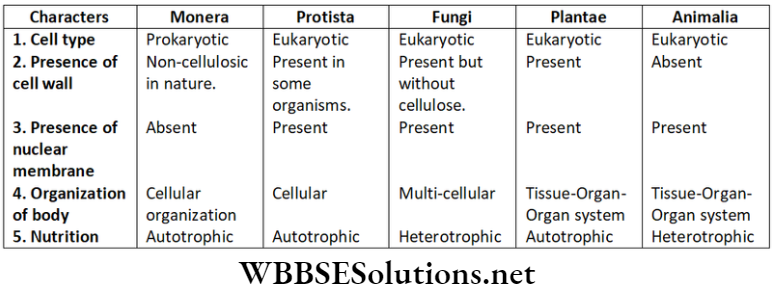
Question 5. Give the characteristics features of five-kingdom classification.
Answer.

The characteristics features of five-kingdom classification:

NEET Foundation Biology Diversity In Living Organisms Long Answer Type Question 5

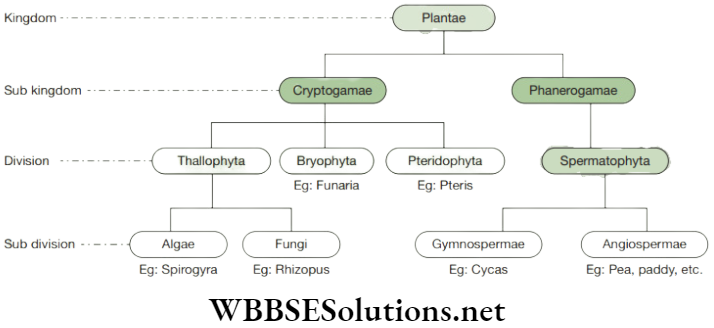
Question 6. Draw the flowchart to understand the plant classification.
Answer.

The flowchart to understand the plant classification:

NEET Foundation Biology Diversity In Living Organisms Long Answer Type Question 6

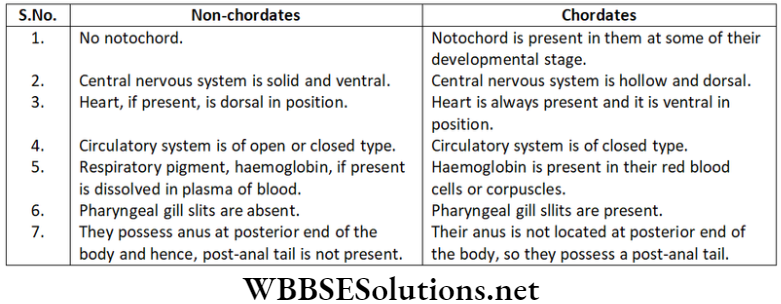
Question 7. Describe the features of chordates and non-chordates and how they are different from each other.
Answer.

Differences between Non-chordates and Chordates:

NEET Foundation Biology Diversity In Living Organisms Long Answer Type Question 7

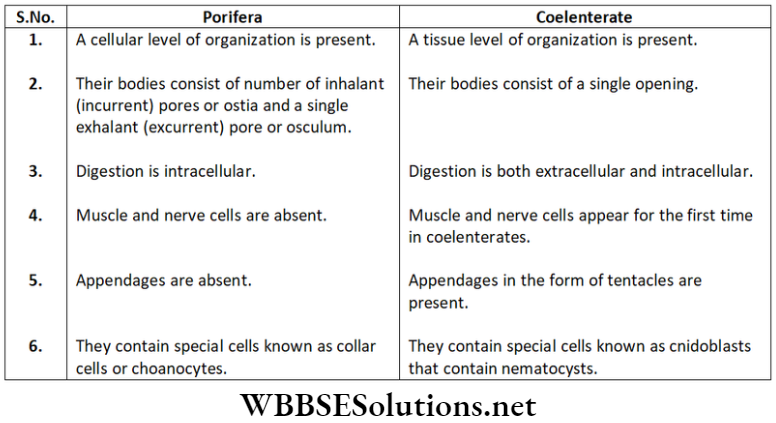
Question 8. Discuss how phylum Porifera and Coelenterata are different from each other.
Answer:

Difference between phylum Porifera and Coelenterata:

NEET Foundation Biology Diversity In Living Organisms Differences between Porifera and Coelenterata

Question 9. Explain how animals in Vertebrata are classified into further subgroups.
Answer:

Vertebrata is divided into two superclasses, namely Pisces and Tetrapoda. Animals of Pisces have streamlined body with fins and tails to assist in swimming. Animals of Tetrapoda have four limbs for locomotion.

Tetrapoda is further classified into the following classes.

  • Arnphibia: It is adapted to live in water and on land. Can breathe oxygen through skin when under water.
  • Reptilia: These are crawling animals. Skin is hard to withstand extreme temperatures.
  • Ves: Forelimbs are modified into wings to assist in flying. Beaks are present. Body is covered with feathers.
  • Mammalia: Mammary glands are present to nurture young ones. Skin is covered with hair. Most of the animals are viviparous.

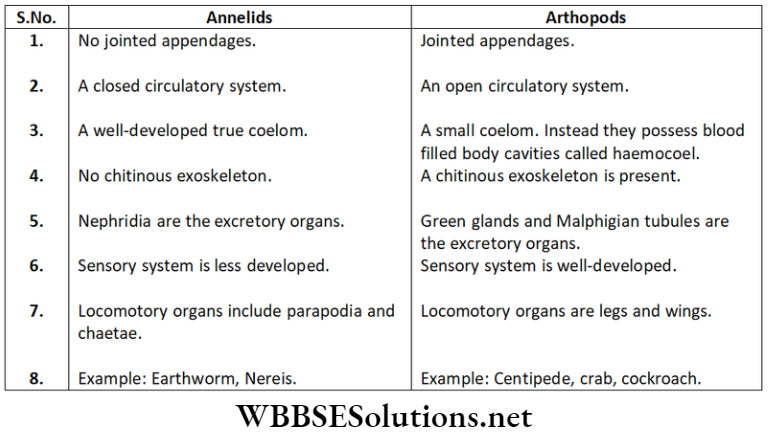
Question 10. Describe how phylum annelids and arthropods are different from each other. 

Answer:

Difference between Phylum annelids and Arthropods:

NEET Foundation Biology Diversity In Living Organisms Differences between Annelids and Athropods

Question 11. How would you choose between two characteristics to be used for developing a hierarchy in classification?
Answer:

The gross character will form the basis of the start of the hierarchy and the fine character will form the basis of further steps of a single hierarchy.

Example:

  • The presence of vertebral column in human beings can be taken under Vertebrata.
  • The presence of four limbs makes them members of Tetrapoda.
  • The presence of mammary glands keeps them under Mammalia.

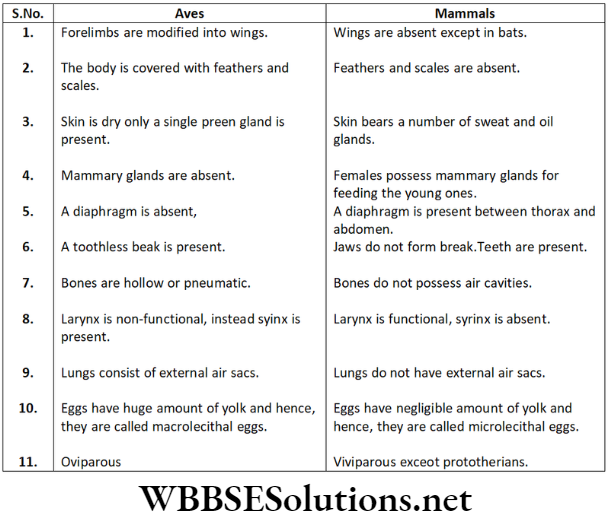
Question 12. Discuss the characteristics and features between Aves and Mammals.

Answer:

The characteristics features between Aves and Mammals.

NEET Foundation Biology Diversity In Living Organisms Characteristics features between Aves and Mammals

Question 13. What is notochord?
Answer:

Notochord Meaning:

Notochord is a primitive kind of endoskeleton that is present in all chordates at some stage of life cycle. Notochord gives longitudinal stiffening to the main body axis, a base for trunk muscles and an axis around which the vertebral column develops.

NEET Foundation Biology Chapter 3 Diversity In Living Organisms Short Answer Questions

Chapter 3 Diversity In Living Organisms Short Answer Type Question And Answers

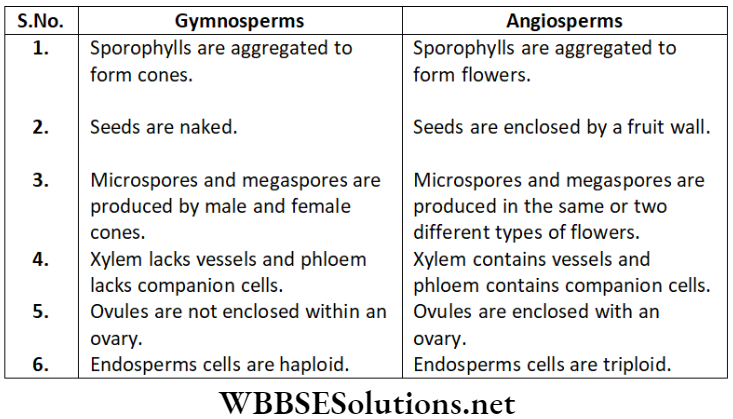
Question 1. Discuss how gymnosperms and angiosperms differ from each other.
Answer.

Differences between Gymnosperms and Angiosperms 

NEET Foundation Biology Diversity In Living Organisms Short Answer Question 1

Diversity In Living Organisms

Read And Learn More NEET Foundation Short Answer Questions

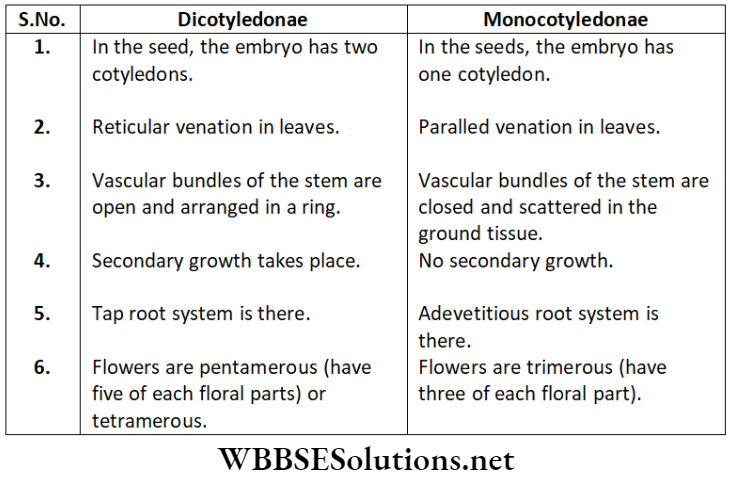
Question 2. Discuss the characteristics and features between dicotyledonae and monocotyledonae.
Answer.

Differences between Dicotyledonae and Monocotyledonae :

NEET Foundation Biology Diversity In Living Organisms Short Answer Question 2

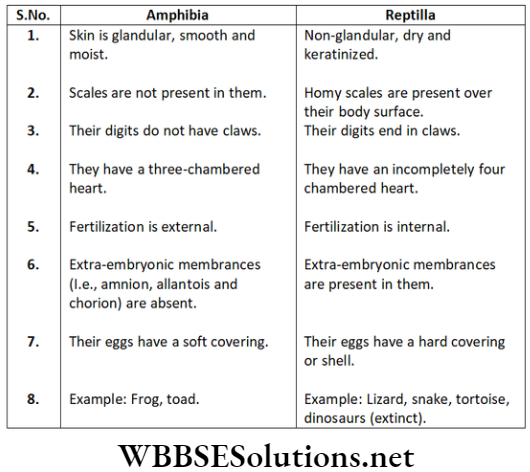
Question 3. Discuss the characteristics features between Amphibia and Reptilia.
Answer.

Differences between Amphibia and Reptilia:

NEET Foundation Biology Diversity In Living Organisms Short Answer Question 3

Diversity Of Living Organisms

Question 4. Discuss the characteristics features of Chordata.
Answer.

The characteristics features of Chordata:

  • A dorsal, hollow, tubular nerve cord is present.
  • A pliable rod known as notochord is present ventral to nerve cord and is replaced by a bone or cartilage to form a vertebral column in vertebrates. Paired gill-slits in the pharynx.
  • Body is bilaterally symmetrical, triploblastic and coelomate.
  • A post-anal tail is present at some stage of life.
  • Segmental muscles in an unsegmented trunk. Ventral heart with dorsal and ventral blood vessels and closed blood vascular system.
  • A complete digestive system is present. A  cartilaginous endoskeleton is present in vertebrates.

NEET Foundation Biology Chapter 3 Diversity In Living Organisms Short Answer Questions

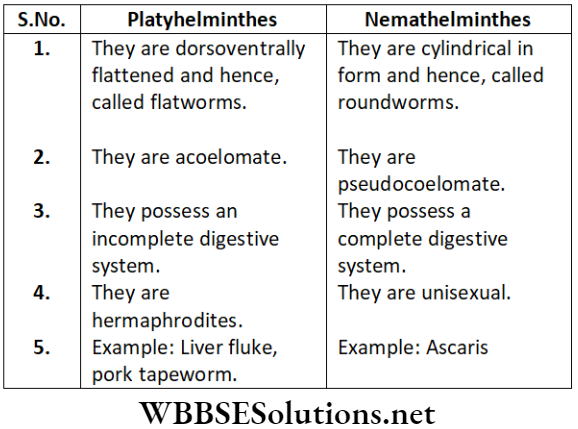
Question 5. Discuss the features of Platyhelminthes and Nematoda.
Answer.

Difference Between Platyhelminthes and Nematoda:

NEET Foundation Biology Diversity In Living Organisms Short Answer Question 5

Class 11 Physics Class 12 Maths Class 11 Chemistry
NEET Foundation Class 12 Physics NEET Physics

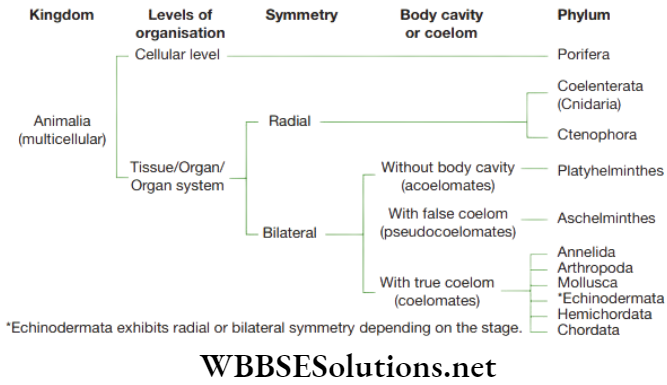
Question 6. Discuss the characteristics features animal kingdom when classified on the basis of common features.
Answer.

The characteristics features animal kingdom when classified on the basis of common features:

NEET Foundation Biology Diversity In Living Organisms Short Answer Question 6

Question 7. Describe how pteridophytes and phanerograms are different in features.
Answer.

Differences between Pteridophytes and Phanerogams (Spermatophytes):

NEET Foundation Biology Diversity In Living Organisms Long Answer Type Question 3

Chapter 3 Diversity In Living Organisms Master Your Test Question And Answers

Question 1. What is taxonomy?
Answer:

Taxonomy:

Taxonomy is the scientific study of identification, nomenclature and classification of organisms.

Question 2. What is binomial nomenclature?
Answer:

Binomial Nomenclature:

The naming system where every organism’s scientific names consist of two names, where the first name is the genus to which an organism belongs and the second name is the species to which it belongs

Question 3. Why do we classify organisms?
Answer:

Reason for Classification of organisms

For easier and convenient study, we classify organisms.

Question 4. Which of the following do you think is a more basic characteristic for classifying organisms?

  • The place where they live.
  • The kind of cells they are made of.

Answer: Classification based on living place is more basic as there can be wide variations in organisms living in each place.

Question 5. What do you understand by the term ‘Palaeontology’?
Answer:

Palaeontology:

The study of evidences of the past life in the form of fossils. With such a large repository of organisms, it would not be easy to study every living form separately at an individual level.

Question 6. What is the primary characteristic in which the first division of organisms is made?
Answer:

Primary characteristic in which the first division of organisms is made

Nature of cell is the primary characteristic in which the first division of organisms is decided. Based on this criterion, life forms can be classified into prokaryotes or eukaryotes.

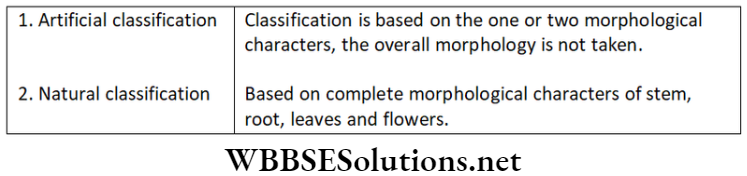
Question 7. What is the characteristics differences between natural and artificial classification systems?
Answer:

Difference between natural and artificial classification systems:

NEET Foundation Biology Diversity In Living Organisms Difference between natural and artificial classification

Question 8. On what basis are plants and animals put into different categories?
Answer:

On the following basis the plants and animals put into different categories

Mode of nutrition and the presence or absence of cell walls.

Question 9. What are the criteria for the five-kingdom classification?
Answer:

  • The complexity of eukaryotes and prokaryotes was considered.
  • Body organization was considered.
  • The mode of nutrition was studied.
  • The lifestyles of producers, consumers, and decomposers were considered.
  • A phylogenic relationship was taken.

Question 10. What is the criterion for the classification of organisms as belonging to the kingdom Monera or Protista?
Answer:

The criterion for the classification of organisms as belonging to the kingdom Monera or Protista

It is the presence or absence of a well-defined nucleus. Monera has no nuclear membrane, while Protista shows well-defined nucleus.

Question 11. What are lichens?
Answer:

Lichens:

They are the association of blue-green algae and fungi living in symbiotic relationship. The algal component of the lichens is called phycobiont, whereas the fungal component is called mycobiont.

Question 12. In which kingdom will you place an organism which is single-celled, eukaryotic and photosynthetic?
Answer:

Protista.

Question 13. What is psychology?
Answer:

Phycology

The study of algae is called phycology.

Question 14. In the hierarchy of classification, which grouping will have the smallest number of organisms with a maximum of characteristics in common, and which will have the largest number of organisms?
Answer:

Organisms belonging to kingdom Monera will have a small number of organisms with a maximum of characteristics in common and kingdom Animalia will have the largest number of organisms.

Question 15. Which division among plants has the simplest organisms?
Answer:

Thallophyta or algae.

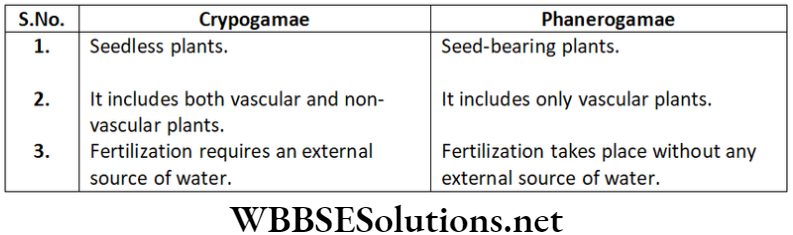
Question 16. Discuss the characteristics and features of cryptogamae and phanerogamae.
Answer:

Difference Between crypto game and Phanerogamae:

NEET Foundation Biology Diversity In Living Organisms Characteristics features of cryptogamae and phanerogamae

Question 17. How are pteridophytes different from the phanerogams?
Answer:

Pteridophytes have naked embryos and inconspicuous reproductive organs, whereas phanerogams have well-differentiated reproductive organs and covered embryos.

Question 18. Describe how algae and fungi are different from each other.
Answer:

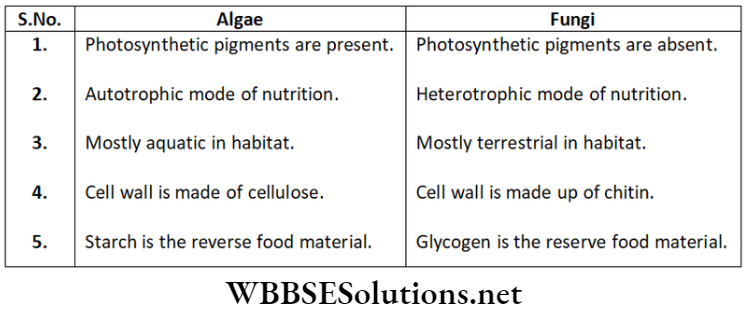
NEET Foundation Biology Diversity In Living Organisms Differences between algae and fungi

Question 19. How do gymnosperms and angiosperms differ from each other?
Answer:

Seeds are naked in gymnosperms and seeds are covered in angiosperms.

Question 20. What are the amphibians of the plant kingdom?
Answer:

Small, multicellular bryophyte plants are found in shady damp places. Hence, they are also called the amphibians of the plant kingdom.

Question 21. Discuss the characteristics and features of bryophytes and pteridophytes.
Answer:

Difference Between bryophytes and pteridophytes:

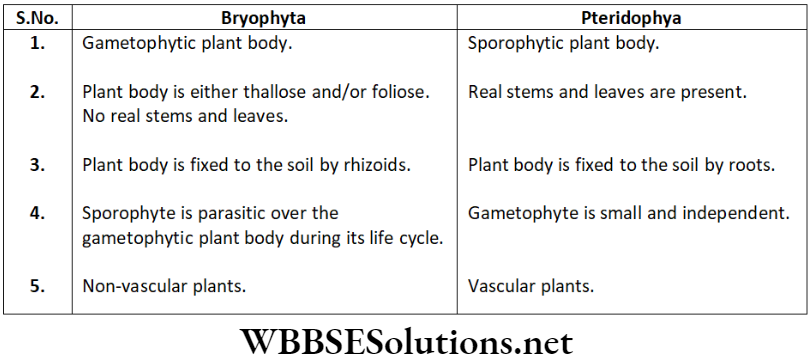
NEET Foundation Biology Diversity In Living Organisms Characteristics features of bryophytes and pteridophytes

NEET Foundation Biology Chapter 3 Diversity In Living Organisms Multiple Choice Questions

NEET Biology Chapter 3 Diversity In Living Organisms MCQs

Chapter 3 Diversity In Living Organisms Multiple Choice Question And Answers

Direction: Choose the correct option for each question. There is only one correct response for each question.

Question 1. Binomial nomenclature was given by

  1. R. H. Whittaker
  2. Linnaeus
  3. Aristotle
  4. Theophrastus

Answer. 2. Linnaeus

Question 2. The science of naming organism is called

  1. identification
  2. nomenclature
  3. classification
  4. taxonomy

Answer. 2. nomenclature

Question 3. The term biodiversity was coined by

  1. Rosen
  2. Linnnaeus
  3. Darwin
  4. Aristotle

Answer. 1. Rosen

Question 4. Which of the following categories contain least common features as compared to genus?

  1. Genus
  2. Division
  3. Class
  4. Family

Answer. 4. Family

NEET Biology Chapter 3 Diversity in Living Organisms MCQs

Read and Learn More NEET Foundation Multiple Choice Questions

Question 5. Taxon is the unit of

  1. order
  2. species
  3. genus
  4. taxonomy

Answer. 4. taxonomy

Question 6. Binomial nomenclature consists of two words

  1. genus and species
  2. order and family
  3. family and genus
  4. species and variety

Answer. 1. genus and species

Question 7. A plant body not differentiated into root, stem and leaves is termed as

  1. thallus
  2. mycelium
  3. hyphae
  4. herb

Answer. 1. thallus

NEET Foundation Biology Chapter 3 Diversity In Living Organisms Multiple Choice Questions

Question 8. The phylum of sedentary animals is

  1. Mollusca
  2. Echinodermata
  3. Porifera
  4. Both (a) and (b)

Answer. 3. Porifera

Question 9. Tapeworms is a members of the phylum

  1. Annelida
  2. Porifera
  3. Nematoda
  4. Platyhelminthes

Answer. 4. Platyhelminthes

Question 10. True coelom appeared for the first time in

  1. Mollusca
  2. Nematoda
  3. Annelida
  4. Arthropoda

Answer. 3. Annelida

Question 11. Phylum Chordata is named after the occurrence of

  1. notochord
  2. dorsal hollow nerve cord.
  3. occurrence of postnatal tail.
  4. presence of gill slits.

Answer. 1. notochord

Question 12. Naked seeds are present in

  1. Mango
  2. Lemon
  3. Pinus
  4. Mustard

Answer. 3. Pinus

Question 13. The book System of Nature was written by

  1. Linnaeus
  2. Haeckel
  3. Whittaker
  4. Robert Brown

Answer. 1. Linnaeus

Question 14. The book Origin of Species was written by

  1. Haeckel
  2. Robert Brown
  3. Darwin
  4. Linnaeus

Answer. 3. Darwin

Question 15. Real organs are absent in

  1. Mollusca
  2. Cnidaria
  3. Arthropoda
  4. Echinodermata

Answer. 2. Cnidaria

Question 16. Two-chambered heart occurs in

  1. crocodiles
  2. amphibians
  3. aves
  4. fish

Answer. 4. fish

Question 17. Which of the following feature is not a characteristic of Protochordata?

  1. Presence of notochord
  2. Bilateral symmetry and coelom
  3. Jointed leg
  4. Presence of circulatory system

Answer. 3. Jointed leg

Question 18. The locomotory organs of Echinodermata are

  1. parapodia
  2. tube feet
  3. muscular feet
  4. jointed legs

Answer. 2. tube feet

NEET Biology Chapter 3 Diversity in Living Organisms MCQs

Question 19. Which one is a true fish?

  1. Jelly fish
  2. Star fish
  3. Dogfish
  4. Silverfish

Answer. 3. Dogfish

Question 20. Comb jellies belong to

  1. Scyphozoa
  2. Hydrozoa
  3. Ctenophora
  4. Rhyzopus

Answer. 3. Ctenophora

Question 21. Which of the following is triploid in nature in angiosperm?

  1. Embryo
  2. Endosperm
  3. Cotyledons
  4. Anther

Answer. 2. Endosperm

Question 22. Pick the odd one out.

  1. Maize
  2. Grass
  3. Wheat
  4. Mango

Answer. 4. Mango

Question 23. Which of the following is not an aquatic animal?

  1. Filaria
  2. Hydra
  3. Jelly fish
  4. Corals

Answer. 1. Filaria

Question 24. Differentiation in segmental fashion occurs in which of the following?

  1. Starfish
  2. Leech
  3. Snails
  4. Ascaris

Answer. 2. Leech

Question 25. Five-kingdom classification was given by

  1. Morgan
  2. Linnaeus
  3. R.H.Whittaker
  4. Haeckel

Answer. 3. R.H.Whittaker

NEET Foundation Biology Diversity in Living Organisms MCQs 

Question 26. Carl von Linnaeus was involved with which branch of science?

  1. Morphology
  2. Taxonomy
  3. Physiology
  4. Medicine

Answer. 2. Taxonomy

Question 27. Amphibians do not have which of the following?

  1. Three chambered heart
  2. Gills or lungs
  3. Scales
  4. Mucous gland

Answer. 3. Scales

Question 28. Skeleton is made entirely of cartilage in

  1. Shark
  2. Tuna
  3. Rohu
  4. None of these

Answer. 1. Shark

Question 29. Well-defined nucleus is absent in which of the following?

  1. Diatoms
  2. Algae
  3. Yeast
  4. Blue-green algae

Answer. 4. Blue-green algae

Question 30. Tissue level organization is found in which of the following?

  1. Porifera
  2. Coelenterata
  3. Protozoa
  4. Round worms

Answer. 2. Coelenterata

Question 31. In higher chordates, notochordis transformedinto

(1) Cranium

(2) Limbs

(3) Vertebral column

(4) Canal system

Select the correct option.

  1. Only (1) and (2)
  2. Only (2) and (3)
  3. Only (3) and (4)
  4. Only (1) and (4)

Answer. 2. Only (2) and (3)

Question 32. Cnidaria is characterized by

(1) Nematoblasts

(2) Coelenteron

(3) Jointed legs

(4) Cellular level of organization

Select the correct option.

  1. Only (1) and (2)
  2. Only (2) and (3)
  3. Only (3) and (4)
  4. Only (1) and (4)

Answer. 1. Only (1) and (2)

Question 33. Bilateral symmetry means_____________

(1) Limbs and organs are paired.

(2) Limbs and organs occur all around the central axis.

(3) Cephalization is present.

(4) Cephalization is absent.

Select the correct option:

  1. Only (1) and (2)
  2. Only (2) and (3)
  3. Only (1) and (3)
  4. Only (3) and (4)

Answer. 3. Only (1) and (3)

Question 34. The characteristic features of Bryophyta is_____

(1) Plant body is sporophytic.

(2) They are vascular plants.

(3) Plant body is gametophytic.

(4) They are non-vascular in nature.

Select the correct option.

  1. Only (1) and (2)
  2. Only (2) and (3)
  3. Only (3) and (4)
  4. Only (1) and (4)

Answer. 3. Only (3) and (4)

NEET Foundation Biology Diversity in Living Organisms MCQs 

Question 35. Binomial nomenclature consists of two words

(1) Order

(2) Family

(3) Genus

(4) Species

Select the correct option.

  1. Only (1) and (2)
  2. Only (2) and (3)
  3. Only (1) and (4)
  4. Only (3) and (4)

Answer. 4. Only (3) and (4)

Question 36. Characteristic features of Fungi are

(1) Presence of photosynthetic pigments.

(2) The cell wall is made of chitin.

(3) The cell wall is made up of cellulose.

(4) Absence of photosynthetic pigments.

Select the correct option.

  1. Only (1) and (2)
  2. Only (2) and (4)
  3. Only (1) and (4)
  4. Only (3) and (4)

Answer. 2. Only (2) and (4)

Class 11 Physics Class 12 Maths Class 11 Chemistry
NEET Foundation Class 12 Physics NEET Physics

Question 37. Which among the following have open circulatory system?

(1) Arthropoda

(2) Mollusca

(3) Annelida

(4) Cnidaria

Select the correct option.

  1. Only (1) and (2)
  2. Only (2) and (3)
  3. Only (3) and (4)
  4. Only (1) and (4)

Answer. 1. Only (1) and (2)

NEET Foundation Biology Diversity in Living Organisms MCQs 

Question 38. Organisms without nucleus and cell organelles belong to

(1) Fungi

(2) Protista

(3) Archaebacteria

(4) Cyanobacteria

Select the correct option.

  1. Only (1) and (2)
  2. Only (2) and (3)
  3. Only (3) and (4)
  4. Only (1) and (4)

Answer. 3. Only (3) and (4)

Question 39. Which among the following has specialized tissue for conduction of water?

(1) Gymnospermae

(2) Bryophyta

(3) Thallophyta

(4) Pteridophyta

Select the correct option.

  1. Only (1) and (2)
  2. Only (2) and (3)
  3. Only (3) and (4)
  4. Only (1) and (4)

Answer. 4. Only (1) and (4)

Question 40. Which among the following have scales?

(1) Amphibians

(2) Pisces

(3) Reptiles

(4) Mammals

Select the correct option.

  1. Only (1) and (3)
  2. Only (3) and (4)
  3. Only (2) and (3)
  4. Only (1) and (2)

Answer. 3. Only (2) and (3)

Question 41. The characteristic features of Aves are

(1) Mammary glands are absent.

(2) Mammary glands are present.

(3) Forelimbs are modified into wings.

(4) Wings are absent.

Select the correct option.

  1. Only (1) and (2)
  2. Only (1) and (3)
  3. Only (2) and (3)
  4. Only (2) and (4)

Answer. 2. Only (1) and (3)

NEET Chapter 3 Biology MCQs Diversity in Living Organisms 

Question 42. Bony fishes are characterized by _______

(1) Cartilaginous endoskeleton

(2) 5–7 pairs of gill slits

(3) Terminal positioned mouth

(4) 4 pairs of gill slits

Select the correct option.

  1. Only (1) and (2)
  2. Only (2) and (3)
  3. Only (3) and (4)
  4. Only (1) and (4)

Answer. 3. Only (3) and (4)

Question 43. Annelids have ______________

(1) Unjointed appendages

(2) Closed circulatory system

(3) Jointed appendages

(4) Open circulatory system

Select the correct option.

  1. Only (1) and (2)
  2. Only (2) and (3)
  3. Only (3) and (4)
  4. Only (1) and (4)

Answer. 1. Only (1) and (2)

Question 44. Reptilia are characterized by ____________

(1) Three-chambered heart

(2) Incompletely four-chambered heart

(3) Fertilization is external

(4) Fertilization is internal

Select the correct option.

  1. Only (1) and (2)
  2. Only (2) and (4)
  3. Only (3) and (4)
  4. Only (1) and (4)

Answer. 2. Only (2) and (4)

NEET Chapter 3 Biology MCQs Diversity in Living Organisms 

Question 45. Male ascaris can be distinguished from female one by the______________

(1) Curved posterior

(2) Round shape end

(3) Presence of penial setae

(4) Straight posterior

Select the correct option.

  1. Only (1) and (2)
  2. Only (2) and (4)
  3. Only (3) and (4)
  4. Only (1) and (4)

Answer. 1. Only (1) and (2)

Question 46. The lowest category of classification is

  1. Phylum
  2. Genus
  3. Species
  4. Family

Answer. 3. Species

Question 47. The mode of nutrition in most fungi is

  1. Autotrophic
  2. Saprophytic
  3. Holozoic
  4. Symbiotic

Answer. 2. Saprophytic

Question 48. In Whittaker’s system of classification, unicellular organisms are kept under

  1. Monera
  2. Fungi
  3. Protista
  4. Protozoa

Answer. 3. Protista

Question 49. Pinus is a ___________ plant.

  1. Bryophytic
  2. Gymnospermous
  3. Pteridophytic
  4. Angiospermous

Answer. 2. Gymnospermous

Question 50. Find out incorrect sentence

  1. Protista includes unicelluar eukaryotic organisms.
  2. Whittaker considered cell sturcture, mode and source of nutrition for classifying the organisms in five kingdoms.
  3. Both Monera and Protista may be autotrophic and heterotrophic.
  4. Monerans have well defined nucleus.

Answer. 4. Monerans have well defined nucleus.

Question 51. Which among the following has specialized tissue for conduction of water?

(1) Thallophyta

(2) Bryophyta

(3) Pteridophyta

(4) Gymnosperms

  1. (1) and (2)
  2. (2) and (3)
  3. (3) and (4)
  4. (1) and (4)

Answer. 3. (3) and (4)

Question 52. Which among the following produce seeds?

  1. Thallophyta
  2. Bryophyta
  3. Pteridophyta
  4. Gymnosperms

Answer. 4. Gymnosperms

NEET Chapter 3 Biology MCQs Diversity in Living Organisms 

Question 53. Organisms without nucleus and cell organelles belong to

(1) fungi

(2) protista

(3) cyanobacteria

(4) archaebacteria

  1. (1) and (2)
  2. (3) and (4)
  3. (1) and (4)
  4. (2) and (3)

Answer. 2. (3) and (4)

Question 54. Which of the following is not a criterion for classification of living organisms?

  1. Body design of the organism
  2. Ability to produce one’s own food
  3. Membrane bound nucleus and cell organelles
  4. Height to the plant

Answer. 4. Height to the plant

Question 55. The book System a Nature was written by

  1. Linnaeus
  2. Haeckel
  3. Whittaker
  4. Robert Brown

Answer. 1. Linnaeus

Question 56. Karl von Linne was involved with which branch of science?

  1. Morphology
  2. Taxonomy
  3. Physiology
  4. Medicine

Answer. 2. Taxonomy

Question 57. 5-kingdom classification was given by

  1. Morgan
  2. R. Whittaker
  3. Linnaeus
  4. Haeckel

Answer. 2. R. Whittaker

Question 58. Well defined nucleus is absent in

  1. blue green algae
  2. diatoms
  3. algae
  4. yeast

Answer. 1. blue green algae

NEET Chapter 3 Biology MCQs Diversity in Living Organisms 

Question 59. The ‘Origin of Species’ is written by

  1. Linnaeus
  2. Darwin
  3. Haeckel
  4. Whittaker

Answer. 2. Darwin

Question 60. The most simple and primitive plants are

  1. bacteria
  2. algae
  3. protista
  4. fungi

Answer. 2. algae

Question 61. Which of the following organism lacks chlorophyll?

  1. Rhizopus
  2. Cycas
  3. Spirogyra
  4. Wheat

Answer. 1. Rhizopus

Question 62. Prokaryotic organisms are found in kingdom

  1. Protista
  2. Fungi
  3. Monera
  4. Plantae

Answer. 3. Monera

Question 63. To which group of animals, the nematocysts are unique:

  1. Cnidaria
  2. Porifera
  3. Platyhelminthes
  4. Annelida

Answer. 1. Cnidaria

Diversity in Living Organisms MCQs for NEET Preparation 

Question 64. Tube-within-tube plain is shown by:

  1. Coelenterates
  2. Flatworms
  3. Round worms
  4. Sponges

Answer. 3. Round worms

Question 65. Excretory organs of annelids are:

  1. Protonephridia
  2. Nephridia
  3. Green glands
  4. Kidneys

Answer. 2. Nephridia

Question 66. Study of molluscs is called:

  1. Malacology
  2. Conchology
  3. Mycology
  4. Phycology

Answer. 1. Malacology

Question 67. Aristotle’s lantern is found in:

  1. Star fish
  2. Brittle star
  3. Sea urchin
  4. Sea cucumber

Answer. 3. Sea urchin

Question 68. Link between animal kingdom and plant kingdom is:

  1. Euglena
  2. Amoeba
  3. Trypansoma
  4. Paramecium

Answer. 1. Euglena

Question 69. Metameric segmentation first appeared in:

  1. Platyhelminthes
  2. Annelida
  3. Cockroach
  4. Arthropoda

Answer. 2. Annelida

Question 70. The following vertebrate respires by skin:

  1. Fish
  2. Frog
  3. Crocodile
  4. Whale

Answer. 2. Frog

Diversity in Living Organisms MCQs for NEET Preparation 

Question 71. True coelom is lined with:

  1. Ectoderm
  2. Endoderm
  3. Mesoderm
  4. Ectoderm and endoderm

Answer. 3. Mesoderm

Question 72. Excretory cells of platyhelminthes are:

  1. Flame cells
  2. Nephridia
  3. Solenocytes
  4. Both (a) and (c)

Answer. 4. Both (a) and (c)

Question 73. Green glands present in some arthropod help in:

  1. Respiration
  2. Digestion
  3. Excretion
  4. None of these

Answer. 3. Excretion

Diversity in Living Organisms MCQs for NEET Preparation 

Question 74. Which of the following classes has largest number of animals?

  1. Pisces
  2. Reptilia
  3. Mammalia
  4. Insecta

Answer. 4. Insecta

Question 75. An open circulatory system occurs in the:

  1. Reptiles
  2. Birds
  3. Insects
  4. Annelids

Answer. 3. Insects

Question 76. In Panthera pardus, the genus name is

  1. Pardus
  2. Panthera
  3. None of these
  4. Both Panthera and pardus

Answer. 2. Panthera

Question 77. Name the field of biology that deals with the identification, nomenclature and classification of organisms.

  1. Systematics
  2. Biogeography
  3. Taxonomy
  4. Vernacular science

Answer. 3. Taxonomy

Question 78. The naming system where every organism’s scientific names consists of two names is called

  1. binomial nomenclature
  2. binary nomenclature
  3. bilateral nomenclature
  4. coded nomenclature

Answer. 1. binomial nomenclature

Question 79. ______ is the study of evidences of the past life in the form of fossils.

  1. Taxonomy
  2. Classification
  3. Palaeontology
  4. Systematics

Answer. 3. Palaeontology

NEET Biology Diversity in Living Organisms Practice Questions

Question 80. Which theory states that organisms with different variant forms leave different numbers of offspring to future generations?

  1. Perpetual change
  2. Common descent
  3. Graduation
  4. Natural selection

Answer. 4. Natural selection

Question 81. Which theory states that the large differences in anatomical characteristics that make different species originate through the accumulation of many small incremental changes over long duration of time?

  1. Perpetual change
  2. Common descent
  3. Graduation
  4. Natural selection

Answer. 3. Graduation

Question 82. _______ includes all organisms who share a set of distinguishing common characters.

  1. Order
  2. Phylum
  3. Kingdom
  4. Family

Answer. 3. Kingdom

Question 83. Which of the following archaea favour extremely hot and acidic environments like hot springs?

  1. Methanogens
  2. Thermoacidophiles
  3. Halophiles
  4. Eubacteria

Answer. 1. Methanogens

Question 84. Which of the following archaea grow in very salty environments?

  1. Methanogens
  2. Thermoacidophiles
  3. Halophiles
  4. Eubacteria

Answer. 3. Halophiles

Question 85. Blue-green algae is also known as

  1. Actinomycetes
  2. Enterobacteria
  3. Spirochaetes
  4. Cyanobacteria

Answer. 2. Enterobacteria

Question 86. In which of the following, blue-green algae and fungi live in symbiotic relationship?

  1. Rhizopoda
  2. Lichens
  3. Protista
  4. Protozoa

Answer. 3. Protista

Question 87. Which of the following lack locomotory organs?

  1. Sporozoa
  2. Ciliata
  3. Mastigophora
  4. Sarcodina

Answer. 4. Sarcodina

NEET Biology Diversity in Living Organisms Practice Questions

Question 88. The mode of nutrition in fungi is

  1. only saprotrophic.
  2. saprotrophic or parasitic.
  3. only parasitic.
  4. none of above

Answer. 2. saprotrophic or parasitic.

Question 89. Which of the following is not possessed by bacteria?

  1. Membrane bound organelles
  2. Nucleus
  3. Nucleolus
  4. All of these

Answer. 4. All of these

Question 90. Which sub-group in plant kingdom produces flowers?

  1. Angiosperms
  2. Fungi
  3. Mosses
  4. Ferns

Answer. 1. Angiosperms

Question 91. What does a bacteria lack?

  1. Endoplasmic reticulum
  2. DNA.
  3. Cell wall
  4. Cytoplasm

Answer. 1. DNA.

Question 92. What is the mode of nutrition in bacteria?

  1. Autotrophic
  2. Heterotrophic
  3. Autotrophic and heterotrophic
  4. None of these

Answer. 3. Autotrophic and heterotrophic

Question 93. In algae, asexual reproduction usually takes place by

  1. spores
  2. gametes
  3. single-celled sex organs
  4. embryo

Answer. 2. gametes

Question 94. Pteridophytes have sex organs that are

  1. unicellular only.
  2. multicellular without any jacket.
  3. multicellular and jacketed by sterile cells.
  4. bicellular

Answer. 3. multicellular and jacketed by sterile cells.

Question 95. Which of the following are known as the ‘Amphibians of Plant Kingdom’?

  1. Pteridophytes
  2. Bryophytes
  3. Gymnosperms
  4. Green algae

Answer. 4. Green algae

Question 96. Name the most primitive and simple seed plants.

  1. Pteridophytes
  2. Bryophytes
  3. Gymnosperms
  4. Angiosperms

Answer. 2. Bryophytes

NEET Biology Diversity in Living Organisms Practice Questions

Question 97. In which of the following the reproductive organs are hidden?

  1. Cryptogamae
  2. Phanerogamae
  3. Gymnosperms
  4. Angiosperms

Answer. 1. Cryptogamae

Question 98. Choose the vascular plants out of these.

  1. Mosses
  2. Liverworts
  3. Hornworts
  4. Ferns

Answer. 4. Ferns

Question 99. Which of the these are found filamentous?

  1. Spirogyra
  2. Euglena
  3. Chlamydomonas
  4. Amoeba

Answer. 1. Spirogyra

Question 100. Which of the following does a bacteria lack?

  1. Endoplasmic reticulum
  2. DNA
  3. Cell wall
  4. Cytoplasm

Answer. 1. Endoplasmic reticulum

Question 101. What is the phylum of octopus?

  1. Arthropoda
  2. Mollusca
  3. Annelida
  4. cnidarian

Answer. 2. Mollusca

NEET Biology Diversity in Living Organisms Practice Questions

Question 102. Gametophytic and sporophytic generations are seen in the life history of which of the following?

  1. Fungi
  2. Algae
  3. Ferns
  4. Diatoms

Answer. 3. Ferns

NEET Foundation Biology Chapter 2 Tissues Long Answer Questions

Chapter 2 Tissues Long Answer Type Question And Answers

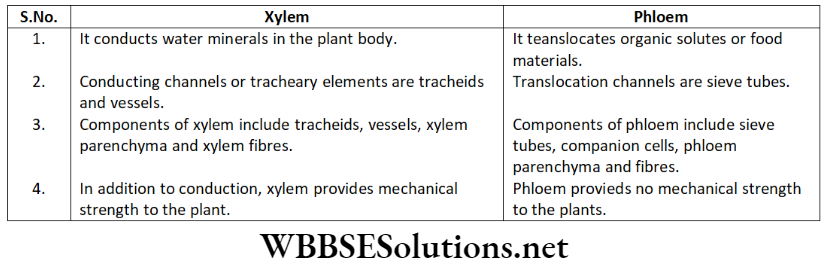
Question 1. Why are xylem and phloem called complex tissues? How are they different from each other?
Answer.

Xylem and phloem called complex tissues:

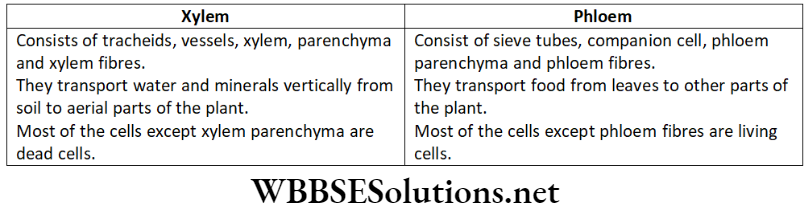
Both xylem and phloem consist of more than one type of cells, which coordinate to perform a common function.

NEET Foundation Biology Tissues Long Answer Type Question 1

Foundation Tissues

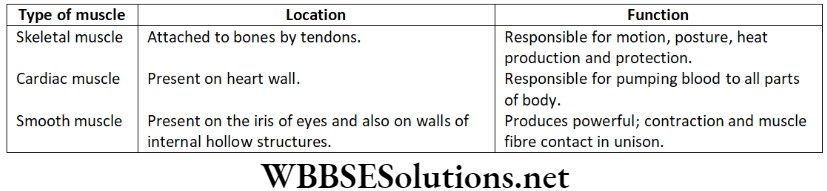
Question 2. Discuss the location and function of muscular tissue.
Answer.

The location and function of muscular tissue:

Muscle tissues help in body movements (local and gross). For example, blood is transported mainly due to the visceral muscles in the walls of the vessels.

NEET Foundation Biology Tissues Long Answer Type Question 2

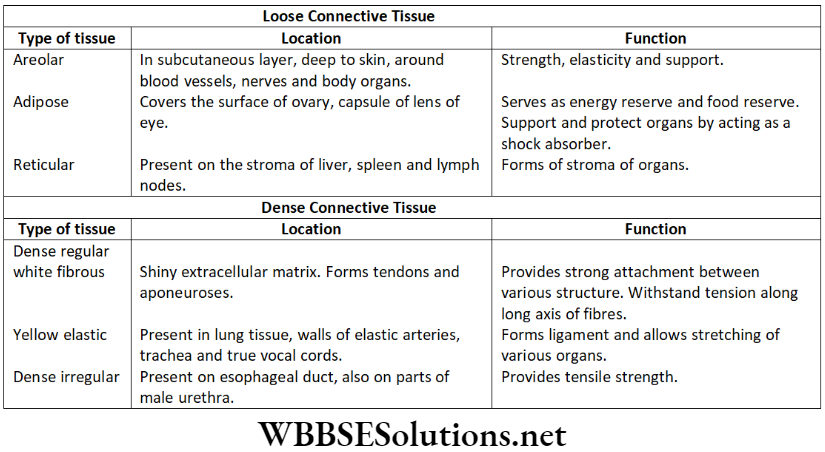
Question 3. Discuss the location and function of loose and dense connective tissue.
Answer.

Read and Learn More NEET Foundation Long Answer Questions

The location and function of loose and dense connective tissue:

NEET Foundation Biology Tissues Long Answer Type Question 3

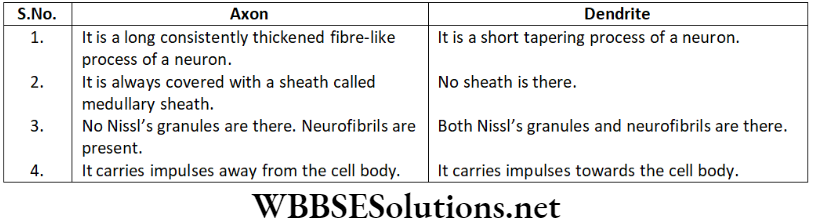
Question 4. How are axon and dendrite are different from each other?
Answer.

Axon and Dendrite are different from each other As Follows:

Differences between axon and dendrite.

NEET Foundation Biology Tissues Long Answer Type Question 4

Tissues Long Answer Type Question And Answers

Class 11 Physics Class 12 Maths Class 11 Chemistry
NEET Foundation Class 12 Physics NEET Physics

Question 5. Discuss the differences between tracheids and vessels.
Answer.

The differences between tracheids and vessels:

Differences between tracheids and vessels.

NEET Foundation Biology Tissues Long Answer Type Question 5

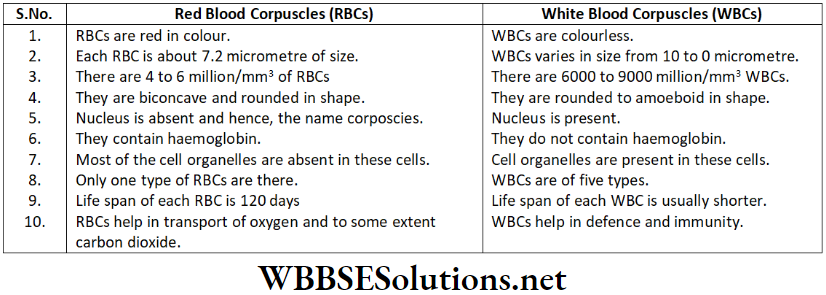
Question 6. Describe the characteristic between red and white blood cells.
Answer.

Differences between red blood corpuscles and white blood cells:

NEET Foundation Biology Tissues Long Answer Type Question 6

Question 7. Discuss the differences between squamous and columnar epithelium.
Answer:

The differences between squamous and columnar epithelium:

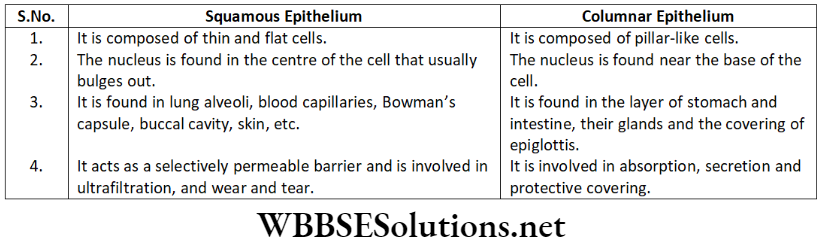
NEET Foundation Biology Tissues Master Your Test Question 1

Tissues 

Question 8. Describe the characteristic features between smooth, skeletal and cardiac muscles.
Answer:

The characteristic features between smooth, skeletal, and cardiac muscles:

NEET Foundation Biology Tissues Master Your Test Question 2

Question 9. What are ligaments?
Answer:

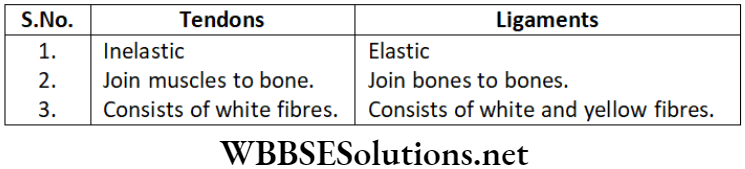
Ligaments: These are elastic structures that connect bones to bones. The ligament strengthens the joint and allows normal movement but prevents over-flexing.


Question 10. What are megakaryocytes?
Answer:

Megakaryocytes Meaning:

Blood platelets are very small, enucleated, fragile fragments of giant bone marrow cells termed as megakaryocytes.

Question 11. What are neurons?
Answer:

Neurons:

Neurons can receive stimuli from within or outside the body and conduct impulses or signals to various parts of the body. The impulse travels from one neuron to another neuron.

Question 12. Pavement epithelium is another name of

  1. Glandular epithelium
  2. Squamous epithelium
  3. Columnar epithelium
  4. Cuboidal epithelium

Answer. 2. Squamous epithelium

Question 13. Which one of the following forms germinal epithelium of gonads?

  1. Glandular epithelium
  2. Squamous epithelium
  3. Columnar epithelium
  4. Cuboidal epithelium

Answer. 4. Cuboidal epithelium

Tissues

Question 14. Which one of the following lines the trachea or wind pipe?

  1. Glandular epithelium
  2. Ciliated epithelium
  3. Columnar epithelium
  4. Cuboidal epithelium

Answer. 4. Cuboidal epithelium

Question 15. Each muscle cell is enclosed in a thin and distinct plasma membrane known as

  1. sarcolemma
  2. sarcoplasm
  3. sarcoreticulum
  4. cell wall

Answer. 1. sarcolemma

Question 16. Which of the following helps in the movement of food in the alimentary canal?

  1. Striated muscles
  2. Cardiac muscles
  3. Smooth muscles
  4. Striped muscles

Answer. 3. Smooth muscles

Question 17. Which of the following muscles undergo rapid contraction and can get tired and may need rest?

  1. Striated muscles
  2. Cardiac muscles
  3. Smooth muscles
  4. Straight muscles

Answer. 1. Striated muscles

Question 18. Which muscles are found in the walls of the heart?

  1. Striated muscles
  2. Cardiac muscles
  3. Smooth muscles
  4. Straight muscles

Answer. 2. Cardiac muscles

Question 19. ______ is the simplest and most widely distributed connective tissue.

  1. Dense regular connective tissue
  2. Adipose tissue
  3. Fluid connective tissue
  4. Areolar tissue

Answer. 4. Areolar tissue

Question 20. Tendons and ligaments are included in

  1. dense regular connective tissue
  2. adipose tissue
  3. fluid connective tissue
  4. areolar tissue

Answer. 1. dense regular connective tissue

Question 21. Which of the following keeps visceral organs in position, and forms shock-absorbing cushions around kidneys and eye balls?

  1. Dense regular connective tissue
  2. Adipose tissue
  3. Fluid connective tissue
  4. Areolar tissue

Answer. 2. Adipose tissue

NEET Foundation Biology Chapter 2 Tissues Multiple Choice Questions

NEET Biology Tissues MCQs

Chapter 2 Tissues Multiple-Choice Questions And Answers

Direction: Choose the correct option for each question. There is only one correct response for each question.

Question 1. A tissue is made up of

  1. a group of cells that perform similar or common functions.
  2. cells with similar structures but very different functions.
  3. same type of cells which form organs.
  4. cells with dissimilar structures and functions.

Answer. 1. a group of cells that perform similar or common functions.

Question 2. Which of the following involves the study of tissue?

  1. Cytology
  2. Embryology
  3. Histology
  4. Pathology

Answer. 3. Histology

Question 3. Which of the following is not a simple tissue

  1. Parenchyma
  2. Xylem
  3. Collenchyma
  4. Sclerenchyma

Answer. 2. Xylem

Read and Learn More NEET Foundation Multiple Choice Questions

Question 4. Parenchyma is a type of

  1. simple tissue
  2. complex tissue
  3. xylem
  4. phloem

Answer. 1. simple tissue

Question 5. The husk of coconut is made up of

  1. apical meristem
  2. intercalary meristem
  3. collenchyma
  4. sclerenchyma

Answer. 4. sclerenchyma

NEET Biology Tissues MCQs 

Question 6. Which tissue is responsible for the length of the plant?

  1. Apical meristem
  2. Lateral meristem
  3. Intercalary Meristem
  4. Epidermis

Answer. 1. Apical meristem

Question 7. Meristems help in

  1. absorption of water
  2. absorption of minerals
  3. translocation of food
  4. growth of the plants

Answer. 4. growth of the plants

Question 8. The apical meristem of the root is present

  1. only in radicles.
  2. in all the roots.
  3. only in tap roots.
  4. only in adventitious roots.

Answer. 2. in all the roots.

NEET Foundation Biology Chapter 2 Tissues Multiple Choice Questions

Question 9. Sieve tubes are present in

  1. phloem
  2. xylem
  3. collenchyma
  4. sclerenchyma

Answer. 1. phloem

Question 10. Collenchyma in plants provide

  1. flexibility
  2. buoyancy
  3. rigidity
  4. both (a) and (c)

Answer. 1. flexibility

NEET Biology Tissues MCQs 

Question 11. Girth of stem increases due to

  1. apical meristem
  2. lateral meristem
  3. intercalary meristem
  4. vertical meristem

Answer. 2. lateral meristem

Question 12. The term tissue was given by

  1. Robert Hooke
  2. Mayer
  3. Bichat
  4. Leeuwenhoek

Answer. 3. Bichat

Question 13. Which of the following components of xylem is living?

  1. Tracheids
  2. Vessels
  3. Xylem parenchyma
  4. Xylem fibres

Answer. 3. Xylem parenchyma

Question 14. Tissue that is absent in monocots is

  1. chlorenchyma
  2. sclerenchyma
  3. aerenchyma
  4. collenchyma

Answer. 4. Collenchyma

Question 15. Phloem in the plant performs the function of

  1. conduction of food
  2. conduction of water
  3. providing support
  4. photosynthesis

Answer. 1. conduction of food

NEET Biology Tissues MCQs 

Question 16. Parenchyma: Simple:: Phloem: ?

  1. Simple
  2. Collenchyma
  3. Complex
  4. Xylem

Answer. 3. Complex

Question 17. The tissue which is composed of flat cells that line body cavities is

  1. columnar
  2. cuboidal
  3. ciliated columnar
  4. squamous

Answer. 4. squamous

Question 18. Maximum intercellular substance is found in

  1. connective tissue
  2. nervous tissue
  3. epithelial tissue
  4. muscular tissue

Answer. 1. connective tissue

Question 19. The tissue connecting bone to bone is called

  1. tendon
  2. ligament
  3. areolar tissue
  4. adipose tissue

Answer. 2. ligament

Question 20. Fat is abundant in

  1. liver cells
  2. areolar tissue
  3. adipose tissue
  4. lymph glands.

Answer. 3. adipose tissue

NEET Biology Tissues MCQs 

Question 21. The mineral found in red pigment of human blood is

  1. Mg
  2. Fe
  3. Ca
  4. Cr

Answer. 2. Fe

Question 22. Which of the following tissues is mainly composed of dead cells?

  1. Phloem
  2. Epidermis
  3. Xylem
  4. Endodermis

Answer. 3. Xylem

Question 23. Largest blood cells are

  1. monocytes
  2. neutrophils
  3. lymphocytes
  4. basophils

Answer. 1. monocytes

Question 24. Fluid part of blood after removing corpuscles is

  1. Plasma
  2. Lymph
  3. Serum
  4. Vaccine

Answer. 1. Plasma

Question 25. Tendon is a structure which connects

  1. a bone with another bone
  2. a muscle with another muscle
  3. a nerve with a muscle
  4. a bone with a muscle

Answer. 4. a bone with a muscle

Animal Tissues MCQs for NEET 

Question 26. Which part of the bone is specialized to form blood cells?

  1. Haversian canal
  2. Red bone marrow
  3. Osteoblasts
  4. Osteocytes

Answer. 2. Red bone marrow

Question 27. Major inorganic component of bone is

  1. calcium phosphate
  2. calcium carbonate
  3. sodium hydroxide
  4. potassium hydroxide

Answer. calcium phosphate

Question 28. The unit of nervous system is

  1. cyton
  2. axon
  3. neuron
  4. dendrite

Answer. neuron

Question 29. Cartilage is not found in

  1. nose
  2. ear
  3. kidney
  4. larynx

Answer. 3. kidney

Question 30. The efferent part of neuron is

  1. axon
  2. dendrites
  3. cyton
  4. both (a) and (b)

Answer. 1. axon

Animal Tissues MCQs for NEET 

Question 31. The following are characteristic features of plant tissues.

(1) Dead supportive tissues are more abundant.

(2) There is differentiation of meristematic and permanent tissue.

(3) Differentiation of meristematic and permanent tissues is absent.

(4) Organization of tissues is complex.

Select the correct option.

  1. Only (1) and (2)
  2. Only (2) and (3)
  3. Only (3) and (4)
  4. Only (1) and (4)

Answer. 1. Only (1) and (2)

Question 32. Meristematic tissues are

(1) similar in structure.

(2) not similar in structure.

(3) have thin cell wall.

(4) have thick cell wall.

Select the correct option.

  1. Only (1) and (2)
  2. Only (1) and (3)
  3. Only (3) and (4)
  4. Only (1) and (4)

Answer. 2. Only (1) and (3)

Question 33. Parenchyma can be classified as

(1) thin walled living cells.

(2) thick walled living cells.

(3) distributed in almost all parts of the plant body.

(4) distributed mostly in the aerial parts of the plant body.

Select the correct option.

  1. Only (1) and (2)
  2. Only (1) and (3)
  3. Only (3) and (4)
  4. Only (1) and (4)

Answer. 2. Only (1) and (3)

Question 34. Which of the following are parts of the phloem?

(1) Sieve tubes

(2) Companion cells

(3) Tracheids

(4) Vessels

Select the correct option.

  1. Only (1) and (2)
  2. Only (1) and (3)
  3. Only (3) and (4)
  4. Only (1) and (4)

Answer. 1. Only (1) and (2)

Animal Tissues MCQs for NEET 

Class 11 Physics Class 12 Maths Class 11 Chemistry
NEET Foundation Class 12 Physics NEET Physics

Question 35. Complex permanent tissues of the plant are made up of

(1) more than one type of cells.

(2) only one type of cells.

(3) only xylem.

(4) xylem and phloem.

Select the correct option.

  1. Only (1) and (2)
  2. Only (1) and (3)
  3. Only (3) and (4)
  4. Only (1) and (4)

Answer. 4. Only (1) and (4)

Question 36. Xylem tissues transport

(1) water from root to plant.

(2) minerals from root to plant.

(3) food all through the plant.

(4) food to the leaves.

Select the correct option.

  1. Only (1) and (2)
  2. Only (1) and (3)
  3. Only (3) and (4)
  4. Only (1) and (4)

Answer. 1. Only (1) and (2)

Question 37. The characteristic features of squamous epithelium are

(1) component cells are pillar like.

(2) component cells are thin and flat.

(3) the nucleus lies in the centre of the cell.

(4) the nucleus is located near the base of the cell.

Select the correct option.

  1. Only (1) and (2)
  2. Only (2) and (3)
  3. Only (3) and (4)
  4. Only (1) and (4)

Answer. 2. Only (2) and (3)

Question 38. Tendons can be defined as

(1) inelastic

(2) elastic

(3) connects bone to bone

(4) joins muscles to bone

Select the correct option.

  1. Only (1) and (2)
  2. Only (1) and (3)
  3. Only (3) and (4)
  4. Only (1) and (4)

Answer. 4. Only (1) and (4)

Question 39. Cartilage is

(1) hard and inflexible

(2) porous

(3) flexible

(4) non-porous

Select the correct option.

  1. Only (1) and (2)
  2. Only (1) and (3)
  3. Only (3) and (4)
  4. Only (1) and (4)

Answer. 3. Only (3) and (4)

Question 40. Red blood corpuscles

(1) are colourless.

(2) are red in colour.

(3) nucleus is present.

(4) nucleus is absent.

Select the correct option.

  1. Only (1) and (2)
  2. Only (1) and (3)
  3. Only (3) and (4)
  4. Only (2) and (4)

Answer. 4. Only (2) and (4)

Animal Tissues MCQs for NEET 

Question 41. What will happen if a bone is dipped in HCl?

(1) Its mineral matters dissolve.

(2) Only organic matter is left.

(3) Mineral matter does not dissolve.

(4) Organic matter dissolves.

Select the correct option.

  1. Only (1) and (2)
  2. Only (1) and (3)
  3. Only (3) and (4)
  4. Only (1) and (4)

Answer. 1. Only (1) and (2)

Question 42. Blood corpuscles are made of

(1) red blood cells

(2) white blood cells

(3) lymph

(4) granulocytes

Select the correct option.

  1. Only (1) and (2)
  2. Only (1) and (3)
  3. Only (3) and (4)
  4. Only (1) and (4)

Answer. 1. Only (1) and (2)

Question 43. The following are functions of cartilage.

(1) It provides support and flexibility to the body parts.

(2) It smoothens surface at joins.

(3) It provides rigidity to the body parts.

(4) It makes surfaces rough.

Select the correct option.

  1. Only (1) and (2)
  2. Only (1) and (3)
  3. Only (3) and (4)
  4. Only (1) and (4)

Answer. 1. Only (1) and (2)

Question 44. Fluid connective tissues

(1) does not include blood and lymph.

(2) it includes blood and lymph.

(3) links the different parts of the body.

(4) doesn’t link the different parts of the body.

Select the correct option.

  1. Only (1) and (2)
  2. Only (2) and (3)
  3. Only (3) and (4)
  4. Only (1) and (4)

Answer. 2. Only (2) and (3)

Question 45. Which muscles act involuntarily?

(1) Striated muscles

(2) Smooth muscles

(3) Cardiac muscles

(4) Skeletal muscles

Select the correct option.

  1. Only (1) and (2)
  2. Only (2) and (3)
  3. Only (3) and (4)
  4. Only (1) and (4)

Answer. 2. Only (2) and (3)

Plant Tissues NEET MCQs 

Question 46. Plant length is increased by

  1. Apical meristems
  2. Lateral meristems
  3. Periblem
  4. Parenchyma

Answer. 1. Apical meristems

Question 47. The cell division is restricted to

  1. Meristematic cells
  2. Permanent cells
  3. Secretory cells
  4. All the above

Answer. 1. Meristematic cells

Question 48. Active divisions take place in the cells of

  1. Xylem
  2. Phloem
  3. Sclerenchyma
  4. Cambium

Answer. 4. Cambium

Question 49. Simple tissues are these

  1. Parenchyma, Xylem and collenchyma
  2. Parenchyma, collenchyma and Sclerenchyma
  3. Parenchyma, Xylem and Sclerechyma
  4. Parenchyma, Xylem and Phloem

Answer. 2. Parenchyma, collenchyma and Sclerenchyma

Question 50. Complex tissue consists of

  1. Different type of cells carrying out the same function
  2. Different types of cells carrying out different functions
  3. Same type of cells having the same origin and carry the same function
  4. Different types of cells having the same origin and carry the same function

Answer. 2. Different types of cells carrying out different functions

Plant Tissues NEET MCQs 

Question 51. The most common type of ground tissue is

  1. Epidermis
  2. Collenchyma
  3. Sclerenchyma
  4. Parenchyma

Answer. 4. Parenchyma

Question 52. Collenchyma differs from sclerenchyma in

  1. Retaining cytoplasm at maturity
  2. Having thick walls
  3. Having a wide lumen
  4. Being meristematic

Answer. 1. Having thick walls

Question 53. Whose living cells provide tensile and mechanical strength

  1. Collenchyma
  2. Sclerenchyma
  3. Phloem
  4. Sclereids

Answer. 1. Collenchyma

Question 54. Lignified elongated dead cells are

  1. Parenchyma
  2. Collenchyma
  3. Sclerenchyma
  4. None of the above

Answer. 3. Sclerenchyma

Question 55. Phloem in the plants perform the function of

  1. Conduction of food
  2. Conduction of water
  3. Providing support
  4. Photosynthesis

Answer. 1. Conduction of food

Plant Tissues NEET MCQs 

Question 56. Pavement epithelium is the name of

  1. Squamous epithelium
  2. Cuboidal epithelium
  3. Ciliated epithelium
  4. Columnar epithelium

Answer. 1. Squamous epithelium

Question 57. Brush bordered epithelium is found in

  1. Stomach
  2. Small intestine
  3. Fallopian tube
  4. Trachea

Answer. 2. Small intestine

Question 58. Ciliated epithelium is found in

  1. Tongue
  2. Oesophagus
  3. Trachea
  4. Uterus

Answer. 3. Trachea

Question 59. Which type of tissue forms glands?

  1. Epithelial
  2. Connective
  3. Nervous
  4. Muscle

Answer. 1. Epithelial

Question 60. What are the functions of goblet cells?

  1. Production of HCI
  2. Production of mucus
  3. Production of enzymes
  4. Production of hormones

Answer. 2. Production of mucus

Plant Tissues NEET MCQs 

Question 61. The end of a long bone is connected to another bone by

  1. Ligament
  2. Tendon
  3. Cartilage
  4. Muscle

Answer. 1. Ligament

Question 62. When boiled in water collagen changes into

  1. Gelatin
  2. Reticulin
  3. Elastin
  4. Myosin

Answer. 1. Gelatin

Question 63. Fluid part of blood after removal of ­corpuscles is

  1. Plasma
  2. Lymph
  3. Serum
  4. Vaccine

Answer. 1. Plasma

Question 64. Which are not true cells in the blood?

  1. Platelets
  2. Monocytes
  3. Basophils
  4. Neutrophils

Answer. 1. Platelets

Question 65. Sprain is caused by excessive pulling of

  1. Nerves
  2. Tendons
  3. Muscles
  4. Ligaments

Answer. 4. Ligaments

Chapter 2 Tissues NEET Questions 

Question 66. Tendon is a structure which connects

  1. A bone with another bone
  2. A muscle with a bone
  3. A nerve with a muscle
  4. A muscle with a muscle

Answer. 2. A muscle with a bone

Question 67. Which of the following plant tissues do not possess living protoplasm at maturity?

  1. Sclerenchyma
  2. Collenchyma
  3. Tracheids
  4. Epidermis

Answer. 1. Sclerenchyma

Question 68. White fibres of connective tissue are made up of

  1. Elastin
  2. Reticular fibre
  3. Collagen
  4. Myosin

Answer. 3. Collagen

Question 69. The study of tissues and their functions is known as

  1. histology
  2. physiology
  3. anatomy
  4. morphology

Answer. 1. histology

Question 70. Which one is a meristematic tissue?

  1. xylem
  2. parenchyma
  3. apical tissues
  4. phloem

Answer. 3. apical tissues

Chapter 2 Tissues NEET Questions 

Question 71. Tracheids are components of

  1. xylem
  2. phloem
  3. intercalary tissues
  4. collenchyma

Answer. 1. xylem

Question 72. Areolar tissue is a

  1. ligament
  2. connective tissue
  3. muscle
  4. nervous tissue

Answer. 2. connective tissue

Question 73. Which tissue provides mechanical strength to plants?

  1. parenchyma
  2. chlorenchyma
  3. collenchyma
  4. sclerenchyma

Answer. 4. sclerenchyma

Question 74. Ciliated epithelium is found in

  1. stomach
  2. intestine
  3. oesophagus
  4. trachea

Answer. 4. trachea

Question 75. Cardiac muscle fibres are

  1. striated and voluntary
  2. striated and involuntary
  3. non-striated and voluntary
  4. non-striated and involuntary

Answer. 2. striated and involuntary

Chapter 2 Tissues NEET Questions 

Question 76. Name the cambium present between phloem and xylem.

  1. Shoot cambium
  2. Root cambium
  3. Vascular cambium
  4. Cork cambium

Answer. 3. Vascular cambium

Question 77. Cambium found on lateral parts of plants on outer side is known as

  1. Vascular cambium
  2. Cork cambium
  3. Shoot cambium
  4. Root cambium

Answer. 2. Cork cambium

Question 78. In which of the following, pith and cortex never differentiates?

  1. Monocot stem
  2. Dicot stem
  3. Monocot root
  4. Dicot root

Answer. 1. Monocot stem

Question 79. For which of the following vital function, the death of protoplasm is a prerequisite?

  1. Transport of sap
  2. Transport of food
  3. Absorption of water
  4. Gaseous exchange

Answer. 1. Transport of sap

Question 80. Which of the following forms cork?

  1. Cork cambium (phellogen)
  2. Vascular cambium
  3. Phloem
  4. Xylem

Answer. 1. Cork cambium (phellogen)

Chapter 2 Tissues NEET Questions 

Question 81. Pericycle of roots produces

  1. Lateral roots
  2. Vascular bundles
  3. Adventitious buds
  4. Hydathodes

Answer. 1. Lateral roots

Question 82. Organization of shoot apex into corpus and tunica is governed chiefly by

  1. Planes of cell division
  2. Regions of meristematic activity
  3. Rate of cell growth
  4. Rate of shoot tip growth

Answer. 1. Planes of cell division

Question 83. Which of the following tissues has dead cells?

  1. Parenchyma
  2. Sclerenchyma
  3. Collenchyma
  4. Epithelial tissue

Answer. 2. Sclerenchyma

Question 84. Girth of stem increases due to

  1. Apical meristem
  2. lateral meristem
  3. intercalary meristem
  4. vertical meristem

Answer. 2. lateral meristem

Question 85. Meristematic tissues in plant are

  1. localized and permanent
  2. not limited to certain regions
  3. localized and dividing cells
  4. growing in volume.

Answer. 3. localized and dividing cells

Question 86. Flexibility in plants is due to

  1. collenchyma
  2. sclerenchyma
  3. parenchyma
  4. chlorenchyma

Answer. 1. collenchyma

Question 87. Parenchyma cells are

  1. relatively unspecified and thin walled
  2. thick waled and specialized
  3. lignified
  4. none of these

Answer. 1. relatively unspecified and thin walled

NEET Foundation Biology Chapter 2 

Chapter 2 Tissues Practice Exercises

Question 1. Which of the following tissues has dead cells?

  1. Parenchyma
  2. Sclerenchyma
  3. Collenchyma
  4. Epithelial tissue

Answer. 2. Sclerenchyma

Question 2. Find out the incorrect sentence from the following.

  1. Parenchymatous tissues have intercellular spaces.
  2. Collenchymatous tissues are irregularly thickened at corners.
  3. Apical and intercalary meristems are permanent tissues.
  4. Meristematic tissues, in its early stage, lack vacuoles.

Answer. 3. Apical and intercalary meristems are permanent tissues.

Question 3. Girth of stem increases due to

  1. apical meristem
  2. lateral meristem
  3. intercalary meristem
  4. vertical meristem

Answer. 2. lateral meristem

Question 4. Which cell does not have perforated cell wall?

  1. Tracheids
  2. Companion cells
  3. Sieve tubes
  4. Vessels

Answer. 2. Companion cells

Question 5. Intestine absorbs the digested food materials. What type of epithelial cells are responsible for that?

  1. Stratified squamous epithelium
  2. Columnar epithelium
  3. Spindle fibres
  4. Cuboidal epithelium

Answer. 2. Columnar epithelium

Question 6. A person met with an accident in which two long bones of hand were dislocated. Which among the following may be the possible reason?

  1. Tendon break
  2. Break of skeletal muscle
  3. Ligament break
  4. Areolar tissue break

Answer. 3. Ligament break

NEET Foundation Biology Chapter 2 

Question 7. While doing work and running, you move your organs, like hands, legs, etc. Which among the following is correct?

  1. Smooth muscles contract and pull the ligament to move the bones.
  2. Smooth muscles contract and pull the tendons to move the bones.
  3. Skeletal muscles contract and pull the ligament to move the bones.
  4. Skeletal muscles contract and pull the tendon to move the bones.

Answer. 4. Skeletal muscles contract and pull the tendon to move the bones.

Question 8. Which muscles act involuntarily?

(1) Striated muscles

(2) Smooth muscles

(3) Cardiac muscles

(4) Skeletal muslces

  1. (1) and (2)
  2. (2) and (3)
  3. (3) and (4)
  4. (1) and (4)

Answer. 2. (2) and (3)

Question 9. Meristematic tissues in plants are

  1. localized and permanent.
  2. not limited to certain regions.
  3. localized and dividing cells.
  4. growing in volume.

Answer. 3. localized and dividing cells.

Question 10. Which is not a function of epidermis?

  1. Protection from adverse condition
  2. Gaseous exchange
  3. Conduction of water
  4. Transpiration

Answer. 3. Conduction of water

Question 11. Which of the following sentence is incorrect?

  1. Blood has matrix containing proteins, salts and hormones.
  2. Two bones are connected with ligament.
  3. Tendons are non-fibrous tissue and fragile.
  4. Cartilage is a form of connective tissue.

Answer. 3. Tendons are non-fibrous tissue and fragile.

Question 12. Cartilage is not found in

  1. Nose
  2. Ear
  3. Kidney
  4. Larynx

Answer. 3. Kidney

NEET Foundation Biology Chapter 2 

Question 13. Fats are stored in human body as

  1. Cuboidal epithelium
  2. Adipose tissue
  3. Bones
  4. Cartilage

Answer. 2. Adipose tissue

Question 14. Bone matrix is rich in

  1. Fluoride and calcium.
  2. Calcium and phosphorus.
  3.  Calcium and potassium.
  4. Phosphorus and potassium.

Answer. 2. Calcium and phosphorus.

Question 15. Contractile proteins are found in

  1. Bones
  2. Blood
  3. Muscles
  4. Cartilage

Answer. 3. Muscles

Question 16. Voluntary muscles are found in

  1. alimentary canal
  2. limbs
  3. iris of the eye
  4. bronchi of lungs

Answer. 2. limbs

Question 17. Nervous tissue is not found in

  1. brain
  2. spinal cord
  3. tendons
  4. nerves

Answer. 3. tendons

Question 18. Nerve cell does not contain

  1. axon
  2. nerve endings
  3. tendons
  4. dendrites

Answer. 3. tendons

Question 19. Which of the following helps in the repair of tissue and fills up the space inside the organ?

  1. Tendon
  2. Adipose tissue
  3. Areolar
  4. Cartilage

Answer. 3. Areolar

Question 20. The muscular tissue which function through out the life continuously without fatigue is

  1. skeletal muscle
  2. cardiac muscle
  3. smooth muscle
  4. voluntary muscle

Answer. 2. cardiac muscle

NEET Foundation Biology Chapter 2 

Question 21. Which of the following cells is found in the cartilaginous tissue of the body?

  1. Mast cells
  2. Basophils
  3. Osteocytes
  4. Chondrocytes

Answer. 4. Chondrocytes

Question 22. The dead element present in the phloem is

  1. companion cells
  2. phloem fibres
  3. phloem parenchyma
  4. sieve tubes

Answer. 2. phloem fibres

Question 23. Which of the following does not lose their nucleus at maturity?

  1. Companion cells
  2. Red blood cells
  3. Vessel
  4. Sieve tube cells

Answer. 1. Companion cells

Question 24. In desert plants, the rate of water loss gets reduced due to the presence of

  1. cuticle
  2. stomata
  3. lignin
  4. suberin

Answer. 1. cuticle

Question 25. A long tree has several branches. The tissue that helps in the side ways conduction of water in the branches is

  1. collenchyma
  2. xylem parenchyma
  3. parenchyma
  4. xylem vessels

Answer. 4. xylem vessels

Question 26. If the tip of sugarcane plant is removed from the field, even then it keeps on growing in length. It is due to the presence of

  1. cambium
  2. apical meristem
  3. lateral meristem
  4. intercalary meristem

Answer. 4. intercalary meristem

Question 27. A nail is inserted in the trunk of a tree at a height of 1 metre from the ground level. After 3 years, the nail will

  1. move downwards.
  2. move upwards.
  3. remain at the same position.
  4. move sideways.

Answer. 3. remain at the same position.

Question 28. Parenchyma cells are

  1. relatively unspecified and thin walled.
  2. thick walled and specialized.
  3. lignified
  4. none of these

Answer. 1. relatively unspecified and thin walled.

Question 29. Flexibility in plants is due to

  1. collenchyma
  2. sclerenchyma
  3. parenchyma
  4. chlorenchyma

Answer. 1. collenchyma

NEET Foundation Biology Chapter 2 

Question 30. Cork cells are made impervious to water and gases by the presence of

  1. cellulose
  2. lipids
  3. suberin
  4. lignin

Answer. 3. suberin

Question 31. Survival of plants in terrestrial environment has been made possible by the presence of

  1. intercalary meristem
  2. conducting tissue
  3. apical meristem
  4. parenchymatous tissue

Answer. 2. conducting tissue

NEET Biology Tissues MCQs 

Question 32. Select the incorrect statement from the following.

  1. The nature of matrix differs according to the function of the tissue.
  2. Fats are stored below the skin and in between the internal organs.
  3. Epithelial tissues have intercellular spaces between them.
  4. Cells of striated muscles are multinucleate and unbranched.

Answer. 3. Epithelial tissues have intercellular spaces between them.

NEET Foundation Biology Chapter 2 Tissues Short Answer Questions

Chapter 2 Tissues Short Answer Type Question And Answers

Question 1. If a potted plant is covered with a glass jar, water vapours appear on the wall of glass jar. Explain why?
Answer.

If a potted plant is covered with a glass jar, water vapours appear on the wall of the glass jar

It occurs due to transpiration.

Foundation Tissues

Tissues Notes

Read And Learn More NEET Foundation Short Answer Questions

Question 2. Discuss the characteristics of meristematic tissue.
Answer.

The characteristics of meristematic tissue:

The cells are oval, rounded or polygonal in shape. The cells are living with thin cellulose walls and without any intercellular spaces The cells are rich in cytoplasm with very small vacuoles. The cells are diploid and undergoes mitosis. The cells do not contain reserve food materials, endoplasmic reticulum and plastids.

Question 3. Discuss the characteristics differences between sclerenchymatous fibres and sclereids.
Answer.

The characteristics differences between sclerenchymatous fibres and sclereids:

NEET Foundation Biology Tissues Short Answer Type Question 3

Question 4. What are sieve tubes?
Answer.

Sieve tubes:

These are slender, tube-like structures that consist of elongated thin-walled cells, placed end to end. The end walls of these cells are perforated by several pores and are known as sieve plates.

NEET Foundation Biology Chapter 2 Tissues Short Answer Questions

Question 5. Describe the differences between tendons and ligaments.
Answer.

The differences between tendons and ligaments:

NEET Foundation Biology Tissues Short Answer Type Question 5

Question 6. Discuss the differences between bone and cartilage.
Answer.

The differences between bone and cartilage:

NEET Foundation Biology Tissues Short Answer Type Question 6

Question 7. What are phagocytes?
Answer.

Phagocytes:

These are capable of phagocytosis and helps in the defence of body by engulfing bacteria and other foreign substances. Phagocytes are of two types, namely granulocytes and agranular leukocytes

Question 8. Discuss the differences between endocrine and exocrine glands.
Answer.

The differences between endocrine and exocrine glands:

NEET Foundation Biology Tissues Short Answer Type Question 8

Question 9. Describe characteristic features between unicellular and multicellular glands.
Answer.

Characteristic features between unicellular and multicellular glands:

NEET Foundation Biology Tissues Short Answer Type Question 9

Question 10. Discuss the differences between plant and animal tissues.
Answer:

The differences between plant and animal tissues:

NEET Foundation Biology Tissues Master Your Test Question 1.3

Question 11. What do you understand by the term ‘Division of labour’ in the organisms?
Answer:

‘Division of labour’ in the organisms:

Division of labor in organisms enables a smooth and efficient functioning in the body for better survival. Different functions are performed by different groups of cells in an organism, and this is called division of labour in the organisms.

Class 11 Physics Class 12 Maths Class 11 Chemistry
NEET Foundation Class 12 Physics NEET Physics

Question 12. What is histology?
Answer:

Histology:

The study of tissues is known as histology.

Question 13. What do you understand by tissue?
Answer:

Tissue:

Tissue is a group of cells that are similar in structure and organized together to perform a specific function.

Question 14. Where is apical meristem found?
Answer:

Apical Meristem:

Apical meristem is present at the growing tips of stems and roots. Their main function is to initiate growth in new cells of seedlings, at the tip of roots and shoots.

Question 15. Discuss the characteristics of plant tissues.
Answer:

The characteristics of plant tissues:

  • Plant tissues provide mechanical strength to the internal as well as external organs.
  • Provide elasticity and flexibility to the plant organs.
  • Plant tissues help in the transportation of materials across the plant body and prevents loss of water.
  • They undergo division to help the plants to grow both in length and girth.
  • The plant tissues are involved in many metabolic processes, such as photosynthesis, respiration, etc.

Question 16. What are meristematic tissues?
Answer:

Meristematic Tissues:

Meristematic tissue is a group of dividing cells that has the capacity to divide and re-divide and help in the growth of plants.

Question 17. What do you understand by the term histogen?
Answer:

Histogen:

Dermatogen produces epidermis, where periblem gives rise to cortex and endodermis and plerome to vascular bundle and pith. These three layers were termed as histogen.

Flowchart Of Tissue

Question 18. Discuss different types of meristematic tissues.
Answer:

Different types of meristematic tissues:

NEET Foundation Biology Tissues Master Your Test Question 5

Question 19. Discuss the characteristics features between meristematic and permanent tissue.
Answer:

The characteristics features between meristematic and permanent tissue:

NEET Foundation Biology Tissues Master Your Test Question 1.2

Question 20. How are simple tissues different from complex tissues in plants?
Answer:

Simple tissues are made up of one type of cells which coordinate to perform a common function. Complex tissues are made up of more than one type of cells. All these coordinate to perform a common function.

Question 21. How many types of elements together make up the xylem tissue? Name them.

Answer:

Xylem is a complex tissue. It is made up of the following four kinds of cells or elements.

  • Tracheids
  • Vessels
  • Xylem parenchyma
  • Xylem fibres

Question 22. Which tissue makes up the husk of coconut?
Answer:

The husk of a coconut is made up of sclerenchyma tissue.

Question 23. What are the constituents of phloem?
Answer:

Constituents Of Phloem:

Phloem is the food conducting tissue in plants. It is made up of four components as listed below.

  • Sieve tubes
  • Companion cells
  • Phloem parenchyma
  • Phloem fibres

Question 24. Discuss the differences between parenchyma, collenchyma and sclerenchyma.
Answer:

The differences between parenchyma, collenchyma and sclerenchyma:

NEET Foundation Biology Tissues Master Your Test Question 6

Question 25. Discuss the characteristics features between xylem and phloem.
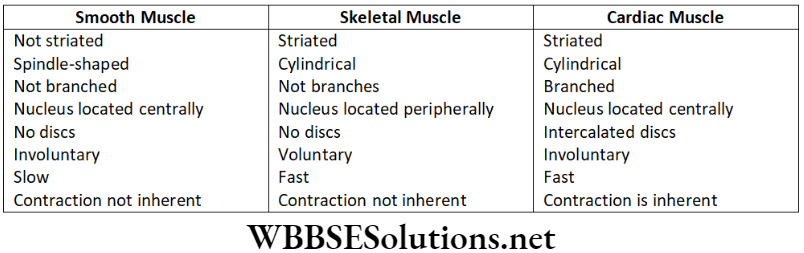
Answer:

The characteristics features between xylem and phloem:

NEET Foundation Biology Tissues Master Your Test Question 7

Question 26. What do you understand by stomata?
Answer:

Stomata:

Stomata are the pores found in the epidermis of leaves, stems and other organs, which are used to monitor gaseous exchange.

NEET Foundation Biology Chapter 1 The Fundamental Unit Of Life Long Answer Questions

Chapter 1 The Fundamental Unit Of Life Long Answer Type Question And Answers

Question 1. Discuss the differences between cell wall and plasma membrane.
Answer.

The differences between cell wall and plasma membrane:

NEET Foundation Biology The Fundamental Unit Of Life Long Answer Type Question 1

The Fundamental Unit Of Life

Question 2. How does an amoeba obtain its food?
Answer.

An Amoeba Obtain Its Food As Follows:

Amoeba obtains food using temporary fingerlike extensions on the cell surface which fuse over the food particle forming a food-vacuole. Complex substances are broken down into simpler ones inside the food vacuole which then diffuses into the cytoplasm. The remaining undigested material is moved to the surface of the cell and is thrown out resulting in excretion.
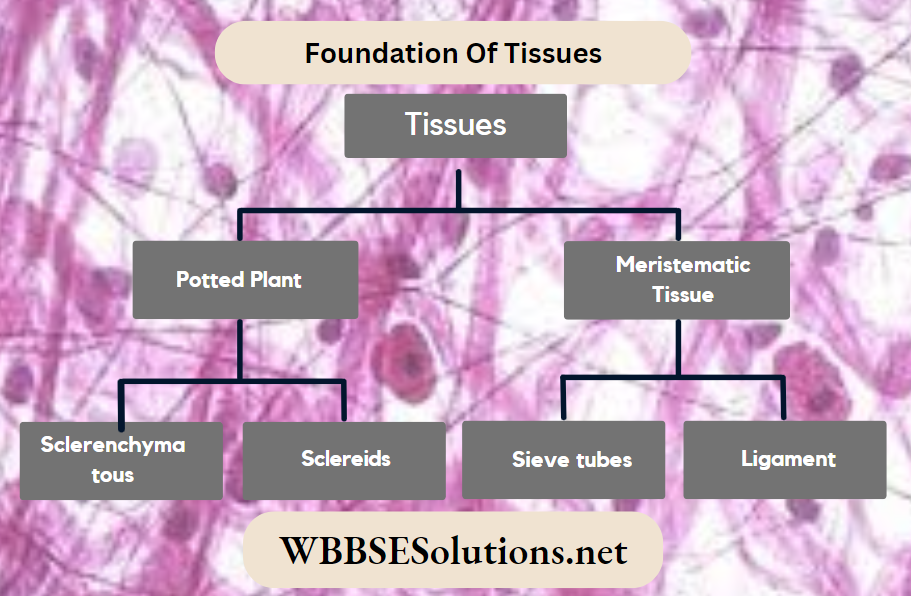
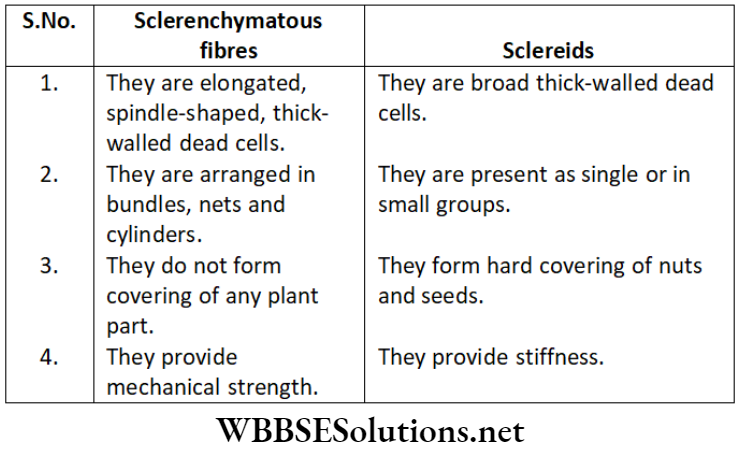
Read and Learn More NEET Foundation Long Answer Questions

The Fundamental Unit Of Life

Cell The Fundamental Unit Of Life

Question 3. Discuss the differences between mitochondria and chloroplast.
Answer.

The differences between mitochondria and chloroplast:

NEET Foundation Biology The Fundamental Unit Of Life Long Answer Type Question 3

Question 4. Explain the functions of lysosomes.
Answer.

The functions of lysosomes:

  • Lysosomes act as intracellular digestive system by destroying any foreign material that enters the cell and hence, these are called digestive bags. By doing this, they protect the cells from any harmful effect of foreign material such as from bacterial infection.
  • Lysosomes remove the worn out cellular organelles by digesting them so that new replacements are done. By doing this, they remove the cell debris. Thus, lysosomes act as a type of garbage disposal system of the cell. These are also known as demolition squads, scavengers and cellular housekeepers.
  • At the time of breakdown of cell structure, lysosomes may burst and the enzymes released eat up their own cells. Thus, lysosomes are also known as suicidal bags of a cell.
Class 11 Physics Class 12 Maths Class 11 Chemistry
NEET Foundation Class 12 Physics NEET Physics

Question 5. Discuss the functions and types of ribosomes.
Answer.

The functions and types of ribosomes:

  • Function: Ribosomes play a crucial role in the synthesis of proteins. These are the factories of protein in a cell. One ribosome cannot perform protein synthesis. In 1963, Gric and Hall published the detailed role of polyribosome in protein synthesis and showed that active units are no individual ribosome, instead a group of these units are known as polyribosomes.
  • Types of ribosomes: Basically, there are two types of ribosomes, such as 70S and 80S ribosomes. Here, S denotes Svedberg unit, which is the sedimentation coefficient that depicts how fast cell organelle sediments in an ultracentrifuge. Sedimentation coefficients cannot be additive.

Question 6. Discuss the differences between smooth endoplasmic reticulum and rough endoplasmic reticulum.
Answer.

The differences between smooth endoplasmic reticulum and rough endoplasmic reticulum:

NEET Foundation Biology The Fundamental Unit Of Life Long Answer Type Question 6

Question 7. Discuss the structure of nucleus.
Answer.

The structure of nucleus:

The nucleus is membrane-bounded, centrally located, spherical structure present in the eukaryotic cell. There are two nuclear membranes forming a nuclear envelope. There is a space between two nuclear membranes, which is connected to a system of membranes known as endoplasmic reticulum (ER).

The nuclear envelope makes the nucleus distinct from the cytoplasm. It also contains many pores called nuclear pores and consists of the liquid ground substance called nucleoplasm. Nuclear pores permit the transfer of substances between the nucleoplasm and the cytoplasm.

The nucleoplasm consists of the nucleolus and chromatin material. The nucleolus is not bounded by any membrane, and is rich in protein and RNA (ribonucleic acid), and thus, it acts as the site for ribosome production. Ribosomes help in protein synthesis in the cytoplasm.

Question 8. Discuss the differences between nucleus and nucleoid.
Answer.

The differences between nucleus and nucleoid:

NEET Foundation Biology The Fundamental Unit Of Life Long Answer Type Question 8