WBBSE Class 7 History Chapter 3 Some Aspects Of The Indian Society Economy And Culture Notes

WBBSE Class 7 History Chapter 3 Some Aspects Of The Indian Society Economy And Culture Introduction

Since the 7th century AD, there was a downturn in trade and commerce in many parts in northern India. The wretched condition of the towns caught the eyes of the travelers. From the middle of 7th century to the middle of the 12th century, trade and commerce started flourishing again. New trade routes and new cities had been founded.

Read and Learn More WBBSE Solutions For Class 7 History

  • During the middle of the 7th century to the middle of the 12th century trade and commerce became significant in the Indian economy along with agriculture.
  • Kanauj and Thaneswar grew as important administrative centres.

In contemporary society, there was the existence of groups such as ‘Samanta’, ‘Raja’, ‘Raunak’, etc. Many of them had control over certain regions.

Thus society was stratified into different classes comprising of the king, the group of leaders, and the common people. The temples played an important role in the economy of south India. Common people and artisans settled around the temples.

In the Chola administration, the king was assisted by a council of ministers. The kingdom was divided into provinces or Mandalams. A council called ‘Nagaram’ was set up to redress the problems of the traders.

WBBSE Class 7 History Chapter 3 Some Aspects Of The Indian Society Economy And Culture Notes

  • In the Pala-Sena age, Bengal’s economy was based on agriculture, industry, and trade. The king used to grant lands to religious institutions in the agrarian society. ‘Cowrie’ was the main medium of exchange.
  • The Bengali language emerged during the Pala age. Ancient Bengali language gradually came into existence from a degenerated Magadhi language in the Gauda-Bengali pattern.
  • Works of literature, grammar, religion, philosophy, and medicine were usually written in Sanskrit.
  • In the Pala age, Mahayana Buddhism merged with other philosophical thoughts and gave birth to religious concepts like Vajrayana or Tantrayana, Sahajayana, and Kalachakrayana.
  • During the Pala age, there was no recognition of gods or goddesses, nor any importance to hymns (mantras) and rituals in the religious concepts. The concept of a clear mind and soul was emphasized.

It was said that eternal deliverance or Nirvana could be achieved only by a pure soul.

During the closing years of the Pala reign, the Buddhist Siddhacharyas started to compose ‘Charyapada’. The charyapadas depicted the contemporary Bengal environment and the livelihood of the common people.

Besides, the early Bengali language gradually developed through charyapada.

WBBSE Class 7 Geography Notes WBBSE Solutions For Class 7 History
WBBSE Solutions For Class 7 Geography WBBSE Class 7 History Multiple Choice Questions
WBBSE Class 7 Geography Multiple Choice Questions WBBSE Solutions For Class 7 Maths


The Buddhist monasteries were the learning centers of the Buddhist philosophers. Moasteries of Nalanda, Odantapuri (near Nalanda), Vikramshil (near Bhagalpur), Sompuri (at Paharpur in Rajshahi district) Jagaddal (in North Bengal), Bikrampuri (in Deccan) are worth mentioning.

The art form of the Pala era is known as the eastern Indian style of art. The main architectures of the Pala age were stupa, vihara, and temple.

WBBSE Class 7 History Chapter 4 The Delhi Sultanate Notes

WBBSE Class 7 History Chapter 4 The Delhi Sultanate Introduction

Qutbuddin Aibak established Sultanate in India centered on Delhi. The Turkish sultans used the title ‘sultan’ instead of ‘King’ or ‘Emperor’. Starting from the 12th century, the rule continued for almost 300 years, is called Delhi Sultanate.

  • ‘Sultan’ is a title. Quite a few Turkish rulers used this title. In Arabic, the word ‘Sultan’ means authority, power, etc. The areas which came under the control of the Sultan was called the ‘Sultanate’.
  • After the death of Hazrat Muhammad, the Caliph was the chief ruler of the Islamic world. He ruled over the entire region that was under Islam.
  • Among the successors of Iltutmish, Razia was the worthiest. A section of nobles had objections about a female ruler. But eventually, Razia became the true successor of Iltutmish. Razia claimed herself to be ‘Sultan’ in her coins, not Sultana (wife of Sultan).

WBBSE Class 7 History Chapter 4 The Delhi Sultanate Notes

Balban was the first to establish a powerful centralized administration in Delhi. He increased the honor of the monarchy by introducing ‘Sijda’ and ‘Paibos’ in the court. Alauddin Khilji was the first Sultan to expand the territory of the dynasty to south India. He was the first to initiate some economic reforms by controlling market prices.

  • Sultan Muhammad bin Tughlaq was a controversial ruler of the Delhi Sultanate. He created controversy by shifting the capital, introducing copper coins, and so on.
  • Scholar and explorer Ibn Battuta came to India during Tughlaq’s reign. The name of his travelogue is ‘Al-Rihala’. The book is a reliable source of information about the reign of Muhammad bin Tughlaq.
  • Firoz Shah Tughlaq undertook some measures of social welfare, such as introducing a system of monetary grants to help the poor, opening a new department to solve the unemployment problem, improving the irrigation system, etc.
  • During the reign of Sayyid and Lodi Sultans, the territorial extent of the Sultanate was reduced.
  • The sultans of Delhi emphasized on military control.
  • The real head of the administration was the sultan himself. All powers of governance, the army, law, and the judiciary were in the hands of the Sultan.
WBBSE Class 7 Geography Notes WBBSE Solutions For Class 7 History
WBBSE Solutions For Class 7 Geography WBBSE Class 7 History Multiple Choice Questions
WBBSE Class 7 Geography Multiple Choice Questions WBBSE Solutions For Class 7 Maths


Apart from land revenue, house tax, grazing tax, and Jízya were collected during the Sultanate period. During the reign of Ilyas Shahis and the Hussain Shahis, the literature and culture of Bengal developed remarkably. During the closing years of the Sultanate, there was the rise of the Vijaynagar and Bahmani Kingdoms in the Deccan.

WBBSE Class 7 History Chapter 4 The Delhi Sultanate Multiple Choice Questions

WBBSE Class 7 History Chapter 4 The Delhi Sultanate Multiple Choice Questions

Question 1. After the death of Muhammad Ghori, Tajuddin Yaldoz gained control over

  1. Multan and Uchh
  2. Delhi and Lahore
  3. Ghazni
  4. Bengal

Answer: 3. Ghazni

Question 2. Muslim followers believed that person in charge of an Islamic territory is called

  1. Caliph
  2. Imam
  3. Sultan
  4. Muhammad

Answer: 1. Caliph

Read and Learn More WBBSE Class 7 History Multiple Choice Questions

Question 3. Iltutmish was Qutbuddin Aibak’s

  1. Son-In-Law
  2. Son
  3. Nephew
  4. Brother

Answer: 1. Son-In-Law

WBBSE Class 7 History Chapter 4 The Delhi Sultanate Multiple Choice Questions

Question 4. The ceremonial robe sent by the Caliph to Iltutmish was called

  1. Durbash
  2. Khutba
  3. Khilat
  4. Sijda

Answer: 3. Khilat

Question 5. The early Turkish Sultans were called

  1. Turks
  2. Turko-Afghans
  3. Ilbari Turks
  4. Hindustani

Answer: 3. Ilbari Turks

WBBSE Class 7 Geography Notes WBBSE Solutions For Class 7 History
WBBSE Solutions For Class 7 Geography WBBSE Class 7 History Multiple Choice Questions
WBBSE Class 7 Geography Multiple Choice Questions WBBSE Solutions For Class 7 Maths


Question 6. Paibos was introduced by

  1. Alltutmish
  2. Ghiyasuddin Balban
  3. Razia
  4. Alauddin Khilji

Answer: 2. Ghiyasuddin Balban

Question 7. Khilji Revolution was brought about by

  1. Alauddin Khilji
  2. Jalaluddin Khilji
  3. Zulfikar Khilji
  4. Mubarak Shah

Answer: 2. Jalaluddin Khilji

Question 8. The boundaries of the Delhi Sultanate were first extended to South India by

  1. Alauddin Khilji
  2. Ghiyasuddin Balban
  3. Muhammed bin Tughlaq
  4. Iltutmish

Answer: 1. Alauddin Khilji

Question 9. According to Ibn Batuta, the system of sending letters on horseback in India was called

  1. Dawa
  2. Mameluk
  3. Ulak
  4. Paibos

Answer: 3. Ulak

Question 10. The last Lodi Sultan was

  1. Bahlul Lodi
  2. Ibrahim Lodi
  3. Alauddin Alam Shah
  4. Sikandar Lodi

Answer: 2. Ibrahim Lodi

Question 11. Rumi is a military strategy of the

  1. Greeks
  2. Turks
  3. Afghans
  4. Romans

Answer: 2. Turks

Question 12. The First Battle of Panipat was fought in

  1. 1525
  2. 1526
  3. 1527
  4. 1529

Answer: 2. 1526

Question 13. The Caliph sent the royal scepter and the ceremonial robe to Iltutmish

  1. The Caliph loved Iltutmish.
  2.  Iltutmish requested the Caliph for the approval of his kingship and sent many costly gifts to him.
  3. Iltutmish was a close relative of the Caliph.

Answer: 2. Iltutmish requested the Caliph for the approval of his kingship and sent many costly gifts to him.

Question 14. Muhammad bin Tughlaq reintroduced the process of minting the name of the Khalifa/Caliph on his coins after banning it temporarily.

  1. The Caliph instructed Muhammad bin Tughlaq to inscribe his name on the coins.
  2. Muhammad bin Tughlaq had to face successive revolts.
  3. The Caliph threatened to impose his own control over the Delhi Sultanate.

Answer: 2. Muhammad bin Tughlaq had to face successive revolts.

Question 15. The Sultans of Delhi wanted to obtain the stamp of legitimacy from the Caliph.

  1. Questions were raised about the legitimate right of the Sultans of Delhi to rule.
  2. Delhi Sultans received power and recognition only by the will of a Caliph.
  3. The Sultans of Delhi got relief from the devastating Mongol attacks by recognizing the overlordship of the Caliph.

Answer: 1. Questions were raised about the legitimate right of the Sultans of Delhi to rule.

Question 16. Razia ultimately emerged as the successor of Iltutmish.

  1. Iltutmish had no son.
  2. Razia was supported by the Turkish nobility.
  3. Razia was the most capable of all the offsprings of Iltutmish.

Answer: 3. Razia was the most capable of all the offspring of Iltutmish.

Question 17. Several rulers of the Delhi Sultanate ruled for short periods for the first sixty years.

  1. None of the Sultans could prevent Mongol invasions.
  2. The ruling Sultans did not live long.
  3. There was no definite law of succession to the throne.

Answer: 3. There was no definite law of succession to the throne.

Question 18. Peasants of the Doab revolted during the reign of Muhammad bin Tughlaq.

  1. The Sultan increased revenue tax in the Doab region.
  2. Excess agricultural output was forcibly taken away from the peasants of the Doab.
  3. The Sultan tried to convert the peasant of the Doab to Islam.

Answer: 1. The Sultan increased revenue tax in the Doab region.

Question 19. Muhammad bin Tughlaq started the circulation of copper coins.

  1. There was a shortage of gold in the realm.
  2. There was a shortage of silver in the realm.
  3. There was a shortage of both gold and silver in the realm.

Answer: 3. There was a shortage of both gold and silver in the realm.

Question 20. Sikandar Lodi brought the Afghan chieftains under his control.

  1. Sikandar Lodi followed the traditional policy of the Afghans.
  2. Sikandar Lodi considered the Afghan chieftains as conspirators.
  3. Sikandar Lodi did not believe in sharing administrative power with the Afghan chieftains as per the traditional policy.

Answer: 3. Sikandar Lodi did not believe in sharing administrative power with the Afghan chieftains as per the traditional policy.

Question 21. Babur defeated Ibrahim Lodi in the First Battle of Panipat in 1526.

  1. Babur used the ‘Rumi’ war tactics and strong cannonades in the battle.
  2. Babur had a greater number of soldiers than Ibrahim Lodi.
  3. The commander-in-chief of Ibrahim Lodi helped Babur secretly.

Answer: 1. Babur used the ‘Rumi’ war tactics and strong cannonades in the battle.

Question 22. Ghiyasuddin Balban sent envoys to the Mongols.

  1. Balban wanted to set up friendly relations with the Mongols.
  2. This was a diplomatic plot devised by Balban.
  3. Balban wanted to negotiate with the Mongols by ceding some territories to them.

Answer: 2. This was a diplomatic plot devised by Balban.

Question 23. Alauddin Khilji increased taxes for the peasants in the Doab region to make provisions for the

  1. Salary of the administrators
  2. Salary of the soldiers
  3. Stabilised border outposts
  4. Centralised administration

Answer: 1. Salary of the administrators

Question 24. The Muslim rulers used to collect Jizya from the

  1. Muslims
  2. Non-Muslims
  3. Turks
  4. Mongols

Answer: 2. Non-Muslims

Question 25. Jizya was imposed for the first time in India at

  1. Delhi
  2. Multan
  3. Sindh
  4. Punjab

Answer: 3. Sindh

Question 26. During the reign of Alauddin Khilji markets were controlled by

  1. Amir
  2. Omrah
  3. Muqti
  4. Dewan-i-Riyasat

Answer: 4. Dewan-i-Riyasat

Question 27. In Delhi Sultanate, the land of the empire was divided into several large and small tracts called

  1. Iqta
  2. Muqti
  3. Subah
  4. Wali

Answer: 1. Iqta

Question 28. The rationing system was introduced by

  1. Sultan Razia
  2. Alauddin Khilji
  3. Iltutmish
  4. Balban

Answer: 2. Alauddin Khilji

Question 29. Kharaj refers to the tax imposed on

  1. Agricultural land
  2. House
  3. Forest land
  4. Horses

Answer: 1. Agricultural land

Question 30. During the reign of Alauddin Khilji, the number of markets were

  1. One
  2. Two
  3. Three
  4. Four

Answer: 4. Four

Question 31. To solve the problem of unemployment, an employment bureau was established by

  1. Muhammad bin Tughlaq
  2. Firoz Shah Tughlaq
  3. Alauddin Khilji
  4. Iltutmish

Answer: 2. Firoz Shah Tughlaq

Question 32. Firoz Shah Tughlaq imposed Jizya on the

  1. Brahmins
  2. Minors
  3. Women
  4. Slaves

Answer: 1. Brahmins

Question 33. Balban secured the forts of Tabarhind, Sunam, and Samana.

  1. To ensure the safety and security of the Delhi Sultanate from Mongol invasion Balban repaired old forts.
  2. Balban took up some measures for social welfare.
  3. Balban brought the Afghan Amirs under his control.

Answer: 1. To ensure the safety and security of Delhi Sultanate from Mongol invasion Balban repaired old forts.

Question 34. During Alauddin Khilji’s reign, the Shahna-i-Mandi and Dewan-i Riyasat looked after the markets.

  1. Alauddin Khilji was completely dependent on military power.
  2. Alauddin Khilji wanted to fix the prices of all daily commodities.
  3. Alauddin Khilji was the first Sultan of Delhi who extended his empire in the south.

Answer: 2. Alauddin Khilji wanted to fix the prices of all daily commodities.

Question 35. Alauddin Khilji collected ‘Kharaj’ along with Jizya.

  1. His objective was to decrease the political and economic power of the influential non-Muslims.
  2. He had to regulate the market price of essential commodities.
  3. His objective was to obtain the loyalty and gratitude of the Hindus.

Answer: 1. His objective was to decrease the political and economic power of the influential non-Muslims.

Question 36. Narasimha Saluva set up the Saluva dynasty at Vijayanagar.

  1. Virupaksha, the last ruler of the Sangam dynasty, was very weak.
  2. The region of Vijaynagar was very safe and secure.
  3. Vijaynagar was rich in natural and mineral resources.

Answer: 1. Virupaksha, the last ruler of the Sangam dynasty, was very weak.

Question 37. Vijayanagar was defeated in the Battle of Talikota.

  1. Vijayanagar had collapsed economically.
  2. The five Muslim States, formed by the breakdown of the Bahmani kingdom, fought together against Vijayanagar.
  3. The army of Vijayanagar was very weak.

Answer: 3. The army of Vijaynagar was very weak.

Question 38. The Brahmani Kingdom broke up into five independent Muslim States.

  1. After Mahmud Gawan’s death, the Brahmani Kingdom’s administration collapsed.
  2. Alauddin Khilji attacked the Brahmani realm.
  3. The nobles of the Brahmani kingdom rebelled against the central authority.

Answer: 1. After Mahmud Gawan’s death, the Brahmani Kingdom’s administration collapsed.

Question 39. Ilyas Shah occupied the throne of Lakhnauti in

  1. 1341
  2. 1342
  3. 1565
  4. 1556

Answer: 2. 1342

Question 40. The capital of Ilyas Shah was

  1. Lakhnauti
  2. Daulatabad
  3. Gaur
  4. Pandua

Answer: 4. Pandua

Question 41. The other name of Jalaluddin Muhammad Shah was

  1. Jadu
  2. Madhu
  3. Bidhu
  4. Sidhu

Answer: 1. Jadu

Question 42. Hussain Shah was a devotee of

  1. Nanak
  2. Kabir
  3. Sri Chaitanya
  4. Mirabai

Answer: 3. Sri Chaitanya

Question 43. Hussain Shah was regarded as the incarnation of

  1. Lord Krishna
  2. Brahma
  3. Vishnu
  4. Sri Chaitanya

Answer: 1. Lord Krishna

Question 44. The number of dynasties ruled in Vijayanagar was

  1. One
  2. Two
  3. Three
  4. Four

Answer: 4. Four

Question 45. ‘Amukta Malyada’ was written by

  1. Krishnadeva Raya
  2. Deva Raya II
  3. Mahmud Gawan
  4. Narasimha Saluva

Answer: 1. Krishnadeva Raya

Question 46. The capital of the Brahmani Kingdom was transferred to

  1. Bijapur
  2. Gulbarga
  3. Golconda
  4. Bidar

Answer: 4. Bidar

Question 47. The last dynasty of the Vijayanagar Empire

  1. Saluva
  2. Aravidu
  3. Tuluva
  4. Sangama

Answer: 2. Aravidu

Question 48. Vijayanagar was compared by the travelers with

  1. Rome
  2. Venice
  3. London
  4. Pisa

Answer: 1. Rome

Question 49. In the Delhi Sultanate, the total number of dynasties ruled

  1. One
  2. Two
  3. Three
  4. Five

Answer: 4. Five

Question 50. The last king of the Delhi Sultanate was

  1. Khizr Khan
  2. Sikandar Lodi
  3. Bahlul Lodi
  4. Ibrahim Lodi

Answer: 4. Ibrahim Lodi

Question 51. Iltutmish avoided the attacks of the

  1. Mongol
  2. Turks
  3. Afghans
  4. Habsis

Answer: 1. Mongol

WBBSE Class 7 History Chapter 3 Some Aspects Of The Indian Society Economy And Culture Multiple Choice Questions

WBBSE Class 7 History Chapter 3 Some Aspects Of The Indian Society Economy And Culture Multiple Choice Questions

Question 1. The temple became the focal point of in habitation and culture in South India.

  1. Kings and nobles donated tax-free land to temples.
  2. Canals were cut off from rivers to facilitate irrigation projects near temples.
  3. South Indian rulers constructed many temples.

Answer: 3. South Indian rulers constructed many temples.

Read and Learn More WBBSE Class 7 History Multiple Choice Questions

Question 2. Bengal’s economy was dependent on agriculture during the Pala-Sena era.

  1. The soil of Bengal became more fertile during the Pala-Sena era.
  2.  Arab traders began to dominate the western coast of India.
  3. Rulers levied taxes on crops produced by farmers.

Answer: 2. Arab traders began to dominate the western coast of India.

WBBSE Class 7 History Chapter 3 Some Aspects Of The Indian Society Economy And Culture Multiple Choice Questions

Question 3. In Chola administration, the kingdom was divided into

  1. Urs
  2. Mandalas
  3. Nagarams
  4. Nadus

Answer: 2. Mandalams

Question 4. Nagaram was set up

  1. To look after the trader’s interest
  2. For the formation of the industry
  3. For war
  4. For the development of agriculture

Answer: 1. To look after the trader’s interest

WBBSE Class 7 Geography Notes WBBSE Solutions For Class 7 History
WBBSE Solutions For Class 7 Geography WBBSE Class 7 History Multiple Choice Questions
WBBSE Class 7 Geography Multiple Choice Questions WBBSE Solutions For Class 7 Maths


Question 5. Chettys were

  1. Feudal Lords
  2. Vagabonds
  3. Traders
  4. Farmers

Answer: 3. Traders

Question 6. During the reign of which dynasty, two beautiful temples were built in Tagore and Gangaikondacholapuram?

  1. Pratihara
  2. Chalukya
  3. Chola
  4. Pushyavuti

Answer: 3. Chola

Question 7. In the Pala-Sena age, the economy of Bengal depended on

  1. Agriculture
  2. Trade
  3. Industry
  4. War

Answer: 1. Agriculture

Question 8. Sandhyakar Nandi named his epic as, Ramcharita.

  1. He wanted to spread the fame of Lord Rama through his work.
  2. He narrated the story of Lord Rama and Pala ruler, Rampala simultaneously per the Ramayana.
  3. Ramcharita is an adapted version of Valmiki’s Ramayana.

Answer: 2. He narrated the story of Lord Rama and Pala ruler, Rampala simultaneously in accordance with the Ramayana.

Question 9. Most non-Indian pupils at Nalanda University came from China.

  1. Majority of the Chinese were Buddhists.
  2. There were many Chinese professors at Nalanda.
  3. There was a special fund for the education of Chinese students.

Answer: 1. Majority of the Chinese were Buddhists.

Question 10. The propagation and influence of Buddhism declined during the Sena era.

  1. Sena rulers were anti-Buddhists.
  2. Sena rulers gave preference to Brahmanical religion.
  3. The number of Sudras increased in society.

Answer: 2. Sena rulers gave preference to Brahmanical religion.

Question 11. The abode of Dipankar Srijnan was called the ‘homestead of an atheist scholar.

  1. He did not believe in Brahmanism.
  2. He was a true atheist.
  3. He disobeyed the orders of the Brahmin Pandits and traveled to Tibet.

Answer: 1. He did not believe in Brahmanism.

Question 12. Charyapadas were based on the philosophy of

  1. Buddhism
  2. Jeevika
  3. Jainism
  4. Hinduism

Answer: 1. Buddhism

Question 13. Chakrapani Dutta wrote a book on

  1. Poem
  2. Mathematics
  3. Astrology
  4. Medical Science

Answer: 4. Medical Science

Question 14. The Bengali language originated during the time of

  1. The Mauryas
  2. The Palas
  3. The Kushanas
  4. The Senas

Answer: 2. The Palas

Question 15. During the Pala reign, works of literature, grammar, religion, philosophy, and medicine were usually written in

  1. Bengali
  2. Sanskrit
  3. Pali
  4. Magadhi

Answer: 2. Sanskrit

Question 16. The story of the Kaivarta revolt is found in

  1. Ramcharita
  2. Ramcharitmanas
  3. Charyapada
  4. Ramayana

Answer: 1. Ramcharita

Question 17. Pala kings were devoted to

  1. Buddhism
  2. Jainism
  3. Hinduism
  4. Islam

Answer: 1. Buddhism

Question 18. Dipankar Srijnan was one of the Mahacharyas of

  1. Nalanda
  2. Vikramshil
  3. Odantapuri
  4. Sompuri

Answer: 2. Vikramshil

Question 19. A lexicographer in the time of Lakshamansena was

  1. Sivananda
  2. Sridhar Das
  3. Srinivas
  4. Halayudh

Answer: 1. Sarvananda

Question 20. Who recovered the manuscripts of Charyapada from Nepal?

  1. Rakhaldas Bandyopadhyay
  2. Ramesh Chandra Dutta
  3. Alexander Cunningham
  4. Haraprasad Shastri

Answer: 4. Haraprasad Shastri

Question 21. According to Buddhism, the meaning of ‘Nirvana’ is

  1. Devotion
  2. Salvation
  3. Force
  4. Destruction

Answer: 2. Salvation

Question 22. Who composed ‘Geet Govinda’?

  1. Halayudh
  2. Vallalsena
  3. Joydev
  4. Jivak

Answer: 3. Joydev

Question 23. What was the main item of trade during the Pala-Sena ages?

  1. Cotton clothes
  2. Spices
  3. Fruits
  4. Coals

Answer: 1. Cotton clothes

Question 24. Feudalism was first introduced in Europe in the

  1. 9th century
  2. 11th century
  3. 10th century
  4. 12th century

Answer: 1. 9th century

Question 25. Irrigation was developed in Tamil Nadu by creating canals from the river

  1. Krishna
  2. Ganga
  3. Kaveri
  4. Godavari

Answer: 2. Kaveri

Question 26. In the Pala-Sena age, Bengal’s economy was based on

  1. Fishery
  2. Carpentry
  3. Artistry
  4. Agriculture

Answer: 3. Agriculture

Question 27. The economy of Bengal became age-dependent during the Pala-Sena period.

  1. The soil of Bengal in the Pala-Sena era became more fertile than before.
  2. On the western side of India, the maritime dominance of the Arab traders increased in the Pala-Sena era.
  3. The kings of the Pala-Sena period collected taxes from the farmers on their produce.

Answer: 2. On the western side of India, the maritime dominance of the Arab traders increased in the Pala-Sena era.

Question 28. In South India, human habitation grew up around the temple.

  1. The kings and the nobles donated rent-free lands to the temples.
  2. The system of irrigation was improved by digging canals from the rivers.
  3. The South Indian kings built up many temples.

Answer: 2. The irrigation system was improved by digging canals from the rivers.

Question 29. The Spread of Buddhism declined during the Sena age.

  1. Sena kings were Buddhists.
  2. Sena kings attached great importance to Brahmanism.
  3. The number of Sudras increased.

Answer: 2. Sena kings attached great importance to Brahmanism.

WBBSE Class 7 History Chapter 2 Some Aspects Of The Indian Political History Notes

WBBSE Class 7 History Chapter 2 Some Aspects Of The Indian Political History Introduction

We are the inhabitants of India. We live in a state of India called Paschimbanga (West Bengal). It was a part of the undivided Bengal and was known as Vanga, Bangla, etc.

Ancient Bengal was divided into different territorial divisions in various periods. These territorial divisions were Pundravardhana, Varendra, Vanga, Vangala, Radh-Suhma, Gauda, Samatata, and Harikel.

WBBSE Class 7 History Chapter 2 Some Aspects Of The Indian Political History Notes

Sasanka, the vassal of the Gupta Emperor, became the lord of Gauda. The capital of Sasanka was Karnasuvarna. After the death of Sasanka, Karnasuvarna became the capital of King Bhaskarvarman and Jayanaga.

During the reign of Sasanka, the officials or civil servants developed an administrative system called Gaudatantra.

After the death of Sasanka, for about a hundred years, from the middle of the 7th century to the middle of the 8th century, there was anarchy in Bengal. During this period, the Kshatriya, aristocrats, brahmin, and merchants—everyone controlled their own areas.

This situation was called Matsya- nyaya. A person called Gopala was elected to put an end to this anarchy. From this period (approximately 750 AD), the Pala rule in Bengal began.

After the foundation of Pala dynasty, Gopala included almost all of Bengal within his kingdom. His successor Dharmapala took part in the ‘Tripartite Struggle’ with the Rashtrakutas and the Pratiharas.

The domination of the Palas started to wane after Devapala. The power of the Pala ruler decreased after the Kaivarta revolt and the Pala dynasty came to end within fifty years after the death of Ramapala.

In the second half of the 11th century AD, during the reign of the Palas, the Kaivarta revolt took place in Bengal. Three leaders of the revolt were Divya (Divvok), Rudok, and Bhim.

The Sena rulers started to rule in Bengal in the 11th century. They were originally Brahmins but later became Kshatriyas. The two remarkable Sena rulers were Ballalsena and Lakshmanasena. Vijaysena was the first to expand the territory of the Sena dynasty.

The Sena dynasty came to an end with the invasion of the Turks (1204/1205 AD).

Other than Bengal, in the 7th and 8th century AD, a few new dynasties and kingdoms rose in both north and south India, such as Rashtrakuta, Chalukya, Chola, Gurjara- Pratihara, Pandya, etc.

WBBSE Class 7 Geography Notes WBBSE Solutions For Class 7 History
WBBSE Solutions For Class 7 Geography WBBSE Class 7 History Multiple Choice Questions
WBBSE Class 7 Geography Multiple Choice Questions WBBSE Solutions For Class 7 Maths


Since the 8th century AD, the Tripartite Struggle started over the control of Kanauj. The strife continued for almost 200 years and the three dynasties—Palas, Gurjara- Pratiharas, and Rashtrakutas, were destroyed.

The Cholas became the most powerful among the other dynasties of South India. The Cholas strengthened the commercial relationship with South-East Asian countries.

Hazrat Muhammad started preaching Islam from Mecca. The followers of Islam are known as Muslims. After the death of Hazrat Muhammad, the Caliphs were the leaders of Muslim community.

In the 11th and 12th century AD, Sultan Mahmud and Muhammad Ghori invaded India.

WBBSE Class 7 History Chapter 2 Some Aspects Of The Indian Political History Notes Gopalas Election

WBBSE Class 7 History Chapter 2 Some Aspects Of The Indian Political History Notes Powers In India

WBBSE Class 7 History Chapter 2 Some Aspects Of The Indian Political History Notes Tripartite struggle

WBCHSE Class 12 Physics Notes For Dual Nature Of Matter And Radiation

WBCHSE Class 12 Physics Notes Dual Nature Of Matter And Radiation Quantum Theory Introduction

Quantum theory or quantum physics Is the mainstay of modern physics. This theory is primarily applicable to the microscopic world, i.e., the physics of the atomic domain. The study of tills brunch started almost at the beginning of the twentieth century.

In quantum theory, we come across those phenomena or facts that are beyond our common experience and are non-realistic. Scientists who established the main foundation of this theory were also surprised to see the inferences obtained horn theoretical analysis of the theory. However, nil experiments conducted so far have strengthened the base of the theory.

Quantized quantity and quantum

Some quantities, obtained in daily life, can have only chosen values. These values are obtained, generally, by multiplying a primary value by an integer. Such quandaries are called quantized qiiantldcs and the primary value is called a quantum of the respective quantity.

As, the currency is quantized and previously, in Indian currency, 1 paisa was its quantum. It was possible to pay 1 rupee 6 paise or 106 paise but payment of 106.5 paise was not possible.

Read and Learn More Class 12 Physics Notes

Scientist Max Planck propounded his quantum theory in 1900 AD. Despite the astounding success of the wave theory of light, this theory cannot explain phenomena like black body radiations, photoelectric effect, atomic spectra, etc. To explain bthe lack body radiation spectrum, Max Planck introduced quantum theory. Later, the concept of photon particles, introduced by Einstein, established the theory more firmly.

Properties of an electron

1. Charge: Electron is negatively charged. The magnitude of charge of an electron is,

e = 1.6 ×10⁻¹⁹ C in SI

= 4.8 × 10⁻¹⁰ esu of charge in the CGS system

From different experiments, we learned that the charge of a body is a quantized quantity and the quantum of charge is the charge of an electron (e). So values of charges can be +2e, -5e, 1000, etc. but values like 1.5e, -2.be are nonrealistic.

2. Rest mass: Rest mass of an electron

m0 = 9.1 × 10⁻³¹ kg = 9.1 × 10⁻²⁸ g

If the speed of an electron In much less than the speed of light, there In no difference between its rest mass (m) and effective mass (m). Thus men of electron, m = m0

3. Kinetic energy of an electron electronvolt:

The velocity of electron Incrcane on being attracted by a positive potential and hence Its kinetic energy also Increases, On the other hand, when repelled by a negative potential, the velocity of the electron decreases. The kinetic energy of an electron Is usually expressed In the electronvolt (eV) unit.

WBCHSE class 12 physics notesElectronvolt Definition:

The change In kinetic energy of an unbound electron, as it travels across a potential difference of IV, is called 1eV.

1eV= charge of an electron × IV

= 1.6 × 10⁻¹⁹C × IV  = 1.6 × 10⁻¹⁹ J

∴ C.V = J

= 1.6 × 10-19×107 erg = 1.6 × 10⁻¹² erg

Electronvolt Is a very small unit compared to erg or joule. Hence, It is mainly used In nuclear or atomic physics only.

1keV = 103eV; 1 MeV = 106eV

Quarks

The discovery of quarks by Gell-Mann In 1964 has destroyed the myth that nucleons (protons and neutrons) are the fundamental particles of matter that are incapable of further division and that the charge on the electron was the smallest possible, charge existing In nature.

Quarks have been identified as the fundamental charged particles constituting baryons and mesons. So far, six quarks with their corresponding antiquarks \((\bar{u} \bar{d} \bar{c} \bar{s} \bar{t} \bar{b}\)) have been detected: up (u), down (d), charm (c), strange(s), top (f), bottom (b), with electric charge +\(\frac{2}{3}\)e, and – \(\frac{1}{3}\) e [to be taken alternately in that order], e being the electronic charge.

Thus, for example, a proton is composed of u, u, d, while a neutron is composed of u, d, d, held by mediator particles called gluons. Mesons are composed of quark-antiquark pairs. Incidentally, in the current view.

All matter consists of three kinds of particles: Leptons, quarks, and mediators, (details are beyond the scope of the present discussion).

WBCHSE Class 12 Physics Notes For Dual Nature Of Matter And Radiation

WBBSE Class 12 Dual Nature of Matter Notes

Dual Nature Of Matter And Radiation Quantum Theory Numerical Examples

1. What is the energy of a photoelectron, in electronvolt, moving with a velocity of 2 × 10⁷ m .s-1? (Given, mass of electron = 9.1 × 10⁻²⁸ g )
Solution:

Mass of electron = 9.1 × 10⁻²⁸ g = 9.1 × 10⁻³¹ kg

The kinetic energy of the electron

= ½mv² = ½ × ( 9.1 × 10⁻³¹)×( 2 × 10⁷)²J

= ½ × \(\left\{\frac{9.1 \times 10^{-31} \times\left(2 \times 10^7\right)^2}{1.6 \times 10^{-19}}\right\}\)eV

= 1137.5 eV

Dual Nature Of Matter And Radiation Photoelectric Effect

Photoelectric emission Definition:

The emission of electrons from matter (metals and non-metallic solids) as a consequence of the absorption of energy from electromagnetic radiation of very short wavelengths (such as visible and ultraviolet radiation), is called photoelectric emission.

Observation of Hertz and Contemporary Scientists

In 1887 German scientist Hertz observed that when ultraviolet rays fell on the negative electrode of a discharge tube, electric discharge occurred easily.

Subsequently in Hallwach’s experiment two zinc plates were placed in an evacuated quartz bulb and when ultraviolet rays fell on the plate connected to the negative terminal of the battery, immediately a current was found to flow in the circuit. But when the ultraviolet rays fell on the positive plate, there was no flow of current. He also noticed that, as soon as the ultraviolet rays were stopped, the current also stopped. Hallwachs however could not explain this phenomenon

In 1900 Lenard proved that when ultraviolet rays fell on a metallic plate, electrons were emitted from the plate and current was constituted due to the flow of electrons. Since in this case, the flow of current is due to light, it is called the photoelectric effect (photo = light). For this phenomenon, light of short wavelength or high frequency is more effective than light of long wavelength or low frequency. Alkali metals.

For example: Lithium, Sodium, Potassium, etc., exhibit a photoelectric effect even in ordinary visible light

Lenard’s experiment

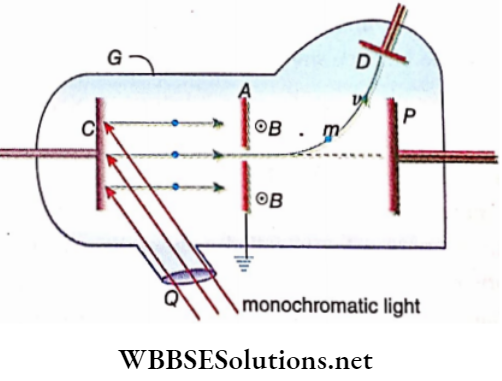
G is an evacuated glass bulb with a quartz window Q on its lower face C is a metal plate, kept at potential -V. Another plate A, having a hole at its center is kept at zero potential by earthing. Hence the potential difference between anode and cathode = 0- (-V) = V.

Now, the cathode is illuminated by a monochromatic beam of light, entering through the window. Here ultraviolet rays or visible light of small wavelengths are used according to the nature of cathode plate metal.

Suppose, due to the incidence of light, cathode C emits a beam of negatively charged particles having charge -q. These charged particles are attracted towards the positive plate A. So, the kinetic energy of each charged particle, just before reaching the plate is,

⇒ \(\frac{1}{2} m v^2=q V \quad \text { or, } \frac{q}{m}=\frac{v^2}{2 V}\) ………………………………… (1)

Where, m = mass of each charged particle and v = velocity of the charged particle

Dual Nature Of Matter And Radiation Lenards Experiment

A beam of these particles, passing through the hole of the anode is incident on the plate P, which is connected to an electrometer to detect the current. Now, between A and P, a magnetic field B is applied perpendicularly upward concerning the plane of the paper.

Due to this field, the charged particles are forced to move in circular paths. By controlling the magnetic field B, the particles are made incident on the plate D where they follow a circular path of radius of curvature R. The electrometer, connected with the plate D shows the current. Here, the magnetic force, acting on each particle

⇒ \(\vec{F}=-q \vec{v} \times \vec{B}\)

As \(\vec{v} \text { and } \vec{B}\) both are perpendicularÿ to each other, the magnitude of this force,

F =  \(\vec{v}\) = qvBsin 90°

= qvB

This force acts, as a centripetal force for the revolving particle.

⇒ \(q v B=\frac{m v^2}{R} \quad \text { or, } \frac{q}{m}=\frac{v}{B R}\)

Or, \(\left(\frac{q}{m}\right)^2=\frac{v^2}{B^2 R^2}\)………………………………….(2)

Dividing the equation (2) by equation (1) we get,

⇒ \(\frac{q}{m}=\frac{2 V}{B^2 R^2}\) ……………………………………. (3)

The value of \(\) can be evaluated by putting the values of V, R, and B in equation (3). From the experimental result thus obtained, Lenard, had shown that the value of \(\frac{q}{m}\) is the same as the specific charge of the electron,\(\frac{e}{m}\)  (= 1.76 × 10¹¹C . kg-1) previously known. From this result, it could be concluded that the emitted negatively charged particles from the cathode are electrons

Electrons emitted in this manner, are called photoelectrons. With proper arrangements, the motion of photoelectrons can be made unidirectional. The stream of unidirectional photoelectrons thus produced, develops a current, namely, photoelectric current

Work function

The minimum energy required to remove an electron from the surface of a particular substance to a point just outside the surface is called the work function of that substance.

Here the final position of an electron is far from the surface on the atomic scale but still close to the substance on a macroscopic scale.

Work function depends only on the nature of the metal and is independent of the method of acquiring energy by the electron. Work function is measured in electronvolt. Alkali metals like sodium and potassium have work functions lower than that of other metals but, nowadays, for photoelectric emission, suitable alloys are mostly used.

Short Notes on Wave-Particle Duality

Demonstrative Experiment

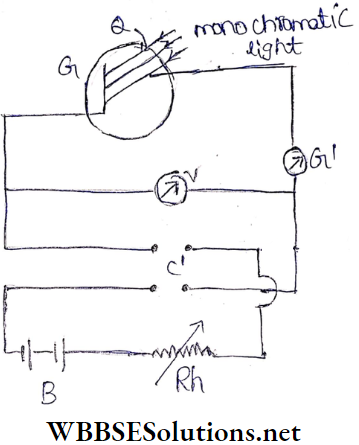
An evacuated glass bulb G with a quartz windowing is used. Through the window, a monochromatic beam of light is incident a plate T that can emit electrons. Plate T is generally coated. With an alkali metal (like sodium or potassium). When plate C is kept at a positive potential concerning T, it attracts photoelectrons emitted from T. Hence a current is set up in the circuit monochromatic.

This force acts, as a centripetal force for the revolving particle. qvB-Sg or, which can be recorded by the galvanometer G’. T is called photocathode and C is called anode. Rheostat Rh, in series with battery B, can be used to increase or decrease the potential difference V. Using the commutator C’, C can also be kept at negative potential concerning T.

Dual Nature Of Matter And Radiation Demonstrative Experiment

Ampere-Volt Characteristics Stopping Potential

Stopping Potential Definition:

The minimum negative potential of anode concerning photocathode, for which photoelectric current becomes zero, is called stopping potential

Keeping the frequency of light constant

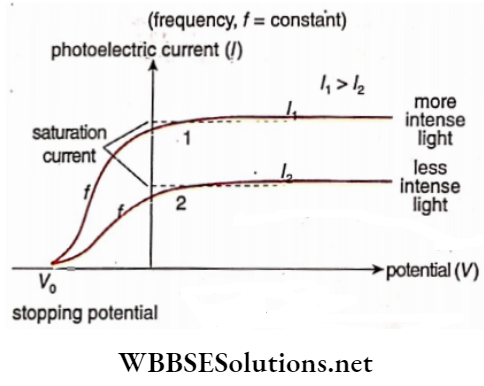
Graphs are drawn showing the dependence of I on V; where I = photoelectric current and V = potential difference between anode and cathode. Here a monochromatic light is used so that the frequency (f), of the incident light remains constant. 1 and 2 in this graph, represent I-V characteristics for different intensities of incident light.

Dual Nature Of Matter And Radiation Keeoing Frequency Of Light Constant

Detailed study of this graph reveals the following facts:

  1. Saturation current: Characteristic curves become horizontal for higher values of V. This shows that saturation current has been achieved. So, all the electrons, emitted by the photocathode, have been collected by the anode.
  2. Effect of intensity of incident light: At constant V, with a decrease in intensity i.e., the brightness of the incident, monochromatic light, the photoelectric current also decreases. Photoelectric current is directly proportional to the intensity of the incident light.
  3. Stopping potential: A When a negative potential is applied to anode concerning the photocathode, photoelectric Current docs do not show hut decreases gradually with an Increase In negative potential on C.

This Indicates that photoelectrons possess some Initial kinetic energy due to which they can reach the anode, overcoming the repulsive force of negative potential, With an Increase In the negative potential of the anode, the photoelectric current becomes zero ultimately. The negative potential at this stage Is called the stopping potential, cut-off potential, or cut-off voltage, VQ

The value of stopping potential depends on two factors:

  1.  Nature of the surface of the photocathode and
  2. Frequency of the incident lightAnalysing graphs 1 and 2, we see that stopping potential VQ does not depend on the intensity of incident light.

An increase in the intensity of incident light only increases the t£p value of the saturation current

Keeping the intensity of light constant

Graphs are drawn showing the dependence of I on V; where = photoelectric current and V = potential difference between anode and cathode. Lights of different frequencies but of the same intensity are used as incident light on the cathode. In this figure, graphs 1 and 2 represent the I-V characteristic curves for different frequencies

Dual Nature Of Matter And Radiation Keeping Intensity Of Light Constant

In this case, as the frequency of incident light on the photocathode increases the y-value of stopping potential also increases and vice versa. But SEflyÿtion current is independent of the frequency of light

Relation between kinetic energy of photoelectrons and stopping potential:

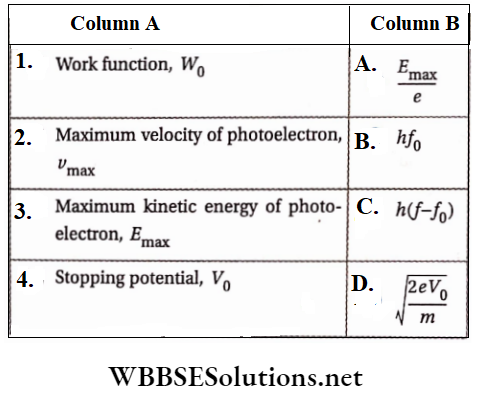
When, the anode potential becomes equal to the stopping potential V0, photoelectrons with even the highest kinetic energy, cannot reach the anode. Hence, the maximum kinetic energy of photoelectron (Emax) = loss of energy of electron for overcoming negative potential V0.

When an electron of charge e overcomes a negative potential VQ, loss of energy of electron = eV0. Thus,

Emax = eV0 …………………….. (1)

Also, if the maximum initial velocity of the electron is vmax, then

⇒ \(E_{\max }=\frac{1}{2} m v_{\max }^2\)

m = Mass of electron

⇒  \(\frac{1}{2} m v_{\max }^2=e V_0\)

⇒  \(v_{\max }=\sqrt{\frac{2 e V_0}{m}}\)

The maximum kinetic energy of an electron Is independent of the Intensity of light

Dual nature of matter and radiation notes 

Dual Nature Of Matter And Radiation Photoelectric Effect Numerical Examples

Example 1. The stopping potential for monochromatic light of a metal surface is 4V. What is the maximum kinetic energy of photoelectrons?
Solution:

From the relation, £max = eV0 we can say that, when the stopping potential is 4 V, maximum kinetic energy, Emax = 4eV.

Practice Problems on De Broglie Wavelength

Example 2. For a metal surface, the ratio of the stopping potentials for two different frequencies of incident light is 1: 4. What is the ratio of the maximum velocities in the two cases? max 
Solution:

Stopping potential oc maximum kinetic energy. Again maximum kinetic energy ∝ (maximum velocity)². Hence, stopping potential ∝ . (maximum velocity)².  If v1 and v2 are the maximum velocities in the two given cases, respectively then

⇒ \(\frac{1}{4}=\left(\frac{v_1}{v_2}\right)^2\)

i.e., v1= v2

= 1:2

Threshold Frequency or Cut-off Frequency

Threshold Frequency Definition:

The minimum frequency of incident radiation which can eject photoelectrons from the surface of a sub¬stance, is called the threshold frequency for that substance.

Frequency versus stopping potential graph:

In photoelectricity, neither the stopping potential nor maximum energy of photoelectrons is a constant quantity. Magnitudes of both V0 and Emax depend on

  1. The frequency of the incident light and
  2. The nature of the surface of the substance used.

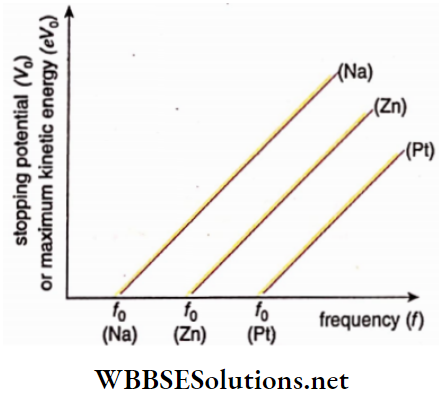
The relation between frequency and stopping potential for different metals is shown graphically

Characteristics of the graph:

For each substance, there is a certain frequency f0 of incident light, for which the maximum energy of photoelectrons becomes zero.

In other words, there is no emission of photoelectrons. Hence, whatever may be the intensity of incident radiation, no electron can leave the metal, surface for the light incident with a frequency equal to or less than f0 i.e., photoelectric emission stops. This f0 is the threshold frequency.

The maximum wavelength corresponding to the minimum frequency f0 is called the threshold wavelength. It is given by,

⇒ \(\lambda_0=\frac{c}{f_0}\) c= speed of light

Discussions:

  1. From what we see, the stopping potential or maximum kinetic energy increases as the frequency of incident radiation increases. Hence in practice, almost in all cases, ultraviolet rays are used, as the frequency of ultraviolet rays is much more than that of visible violet ray
  2. Alkali metals (For example,  sodium, potassium, cesium, etc.) emit photoelectrons even for comparatively low-frequency light.

Dual Nature Of Matter And Radiation Stopping Potential Or Maximum Kinetic Energy

Characteristics of Photoelectric Effect

  1. Photoelectric current is directly proportional to the intensity of the incident light.
  2. The maximum velocity or kinetic energy of the photoelectron is independent of the intensity of incident light. On the other hand, maximum velocity or kinetic energy increases with an increase in the frequency of the incident light.
  3. For a given material, there exists a certain minimum frequency (threshold frequency, f0) of incident light bel which no photoelectrohs are emitted. Photoelectric effect is usually prominent in the range of frequencies of yellow, to ultraviolet radiation.
  4. Threshold frequency is different for different materials. Photoelectrons emitted from the surface of a substance have any velocity between zero and maximum velocity.
  5. The emission of a photoelectron is an instantaneous process, which means that photoelectrons are emitted as soon as light falls on the metal surface. There is practically no time gap between these two incidents.
  6. The emission of photoelectrons makes the rest of the surface very slightly positively charged (this principle is followed in making photovoltaic cells). of electrons in, the photoelectric effect does not depend on the temperature of the surface

Important Definitions in Dual Nature of Matter

Photoelectric Cell

Photoelectric Cell Definition:

Cells, designed to convert light energy to electri¬ cal energy, based on the principle of the photoelectric effect, are photoelectric cells.

Photo-voltaic cell: 

In this cell, an emf is developed directly from the photoelectric effect. This cell is an electric cell as it works as a source of EMF without any aid of an auxiliary cell.

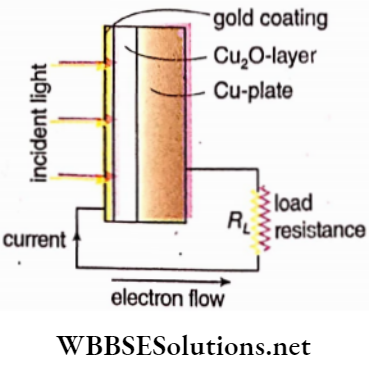
Description:

A copper plate is taken and on one surface, a layer of cuprous oxide (Cu2O) is deposited by the method of oxidation. Over this layer of Cu2O, using the evaporation technique, a very thin coating of gold or silver is applied. This coating is so thin that light, especially ultraviolet rays, can easily penetrate it and reach the layer of Cu2O.

Dual Nature Of Matter And Radiation Photo Electric Cell

Working principle:

When light Tails on Cu2O, photoelectrons are emitted. These electrons instantaneously spread over the gold or silver coating. As a result, this coating achieves a negative potential concerning the copper plate, i.e., an effective emf is developed between the copper plate and the gold or silver coating. This emf sets up a current in the load resistance (RL) used in the external circuit. This current is directly proportional to the intensity of incident light.

Use of photoelectric cells:

1. Automatic switch: In fire alarms, railway signals, streetlights, etc., automatic switches are made using photoelectric cells. QFJ Sound recording and reproduction: Photoelectric cells are used in sound recording and its reproduction, on the soundtrack of cinema and television.

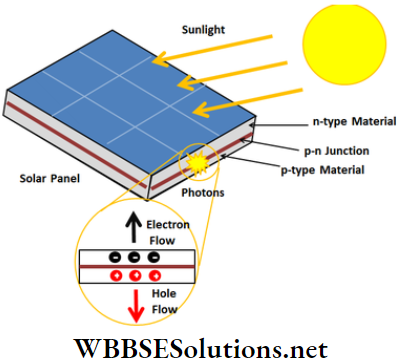
2. Solar cell: A photo-voltaic cell is used to construct a solar battery. This battery is indispensable in spaceships and artificial satellites-

Dual Nature Of Matter And Radiation Solar Cell

3. Television camera: In this device, the photoelectric cell is j used to convert optical images into video signals for television broadcasts.

4. Automatic counting device: A photoelectric cell is used to make an automatic counting device. The number of viewers entering or emerging from a hall can be counted with this device.

5. Automatic camera: A photoelectric cell is used in automatic cameras where the controlling of picture quality depends on the intensity of light.

Failure of Wave Theory of Light

The photoelectric effect cannot be explained by the concept of the wave theory of light. The following observations are in contradiction with the wave nature of light:

  1. Maximum kinetic energy of photoelectrons: According to wave theory, energy carried by light waves increases with an increase in the intensity of light. Hence, when the material surface is illuminated with highly intense light, the kinetic energy of emitted photoelectrons will be very high and it will not have any upper limit. But from the value of stopping potential V0, we see that the kinetic energy of the photoelectron cannot be more than e V0.
  2. Threshold frequency: A highly intense light wave, even of a frequency less than threshold frequency f0, carries a large amount of energy. This energy is sufficient to cause photoelectric emission. But no photoelectron is emitted in such cases. On the other hand, even a very low-intensity light beam of frequency greater than f0 can start photoelectric emission.
  3. The photoelectric effect is instantaneous: The energy carried by light waves incident on the surface of a substance needs a little time to be centralized in the limited space of an electron. Hence, there should be a time gap between the incidence of light waves on the surface and the emission of photoelectrons from the surface. But the photoelectric effect is instantaneous; that means there is no time gap between incidence and emission

Dual Nature Of Matter And Radiation Quantum Theory of Radiation

Photon:

It has already been stated that the photoelectric effect cannot be explained in terms of the wave theory of light. In 1905, Einstein used Planck’s quantum theory and introduced the concept of photon particles. Thus, he could explain the photoelectric effect. The particle concept of radiation is the basis of quantum theory.

The basic point of the theory is that electromagnetic radiation is not a wave by nature but consists of a stream of particles called photons.

Photons Properties:

The main properties of photons are:

  1. Photons are electrically neutral.
  2. Photons travel with the speed of light, which does change under any circumstances, (velocity of light, c = 3 × 10⁸ m . s-8 )
  3. The energy carried by a photon, E = hf; where f = frequency of radiation and h = Planck’s constant. The energy radiated increases with the increased number of photons in its stream and hence the intensity of radiation also increases
  4. According to Einstein’s theory of relativity, the vast mass of a particle is zero, if it trawls at the speed of light Hence, the vast mass of each photon is zero.
  5. According to the theory of relativity, if the rest mass of a particle is m0(1 and its momentum is p, the energy of the particle,

E = \(\sqrt{p^2 c^2+m_0^2 c^4}\),  In case of a photon, m0 = 0 ,

Hence E = pc, or p = \(\frac{E}{C}\)  = hf/c. Thus, despite the photon being a massless particle, it has a definite momentum.

Planck’s constant

It is a universal constant

Unit of h in SI = \(\frac{\text { unit of } E}{\text { unit of } f}=\frac{\mathrm{I}}{\mathrm{s}^{-1}}\) = j- s

Unit of h in CGS system = erg .s.

This unit is the same as the unit of angular momentum. Thus h is a measure of angular momentum

Value of h = 6.625 × 10⁻³⁴J . s =  6.625 × 10⁻²⁷J . s

Class 11 Physics Class 12 Maths Class 11 Chemistry
NEET Foundation Class 12 Physics NEET Physics

Relation between the wavelength of radiation and the photon energy

Energy of a photon, E = hf = \(\)

1 eV= 1.6. × 10-19J . s and 1 A° = 10-10m

Hence, expressing E in the eV unit and λ in the A° unit

λ A° = λ  × 10-10 m EeV = E × (1.6 ×10⁻¹⁹) J

Hence, E × (1.6 ×10⁻¹⁹) J =   \(\frac{\left(6.625 \times 10^{-34}\right) \times\left(3 \times 10^8\right)}{\lambda \times 10^{-10}}\)

Or,  E = \(\frac{\left(6.625 \times 10^{-34}\right) \times\left(3 \times 10^8\right)}{\left(1.6 \times 10^{-19}\right) \times \lambda \times 10^{-10}} \approx \frac{12422}{\lambda}\)

Usually, the number on the right-hand side is taken as 12400.

Hence

E = 12400/ λ(inÅ) eV

Dual nature of matter and radiation notes 

Dual Nature Of Matter And Radiation Quantum Theory Of Radiation Numerical Examples

Find the energy of a photon of wavelength 4950 A In eV ( h = 6.62 × 10⁻¹²  erg .s ). What is the momentum of this photon?
Solution:

A = 4950 A = 4950 ×10-8  cm

Hence energy of a photon

E = hf \(\frac{h c}{\lambda}=\frac{6.62 \times 10^{-27} \times 3 \times 10^{10}}{4950 \times 10^{-8}}\)

= 4.012 × 10⁻¹²  erg

= \(\frac{4.012 \times 10^{-12}}{1.6 \times 10^{-12}}\)

= 2.5 eV

Momentum of photon

p = \(\frac{E}{c}=\frac{4.012 \times 10^{-12}}{3 \times 10^{10}}\)

= 1.34 × 10⁻²² dyn. s

Example 2. Find the photons emitted per second by a source of power 25W. Assume, the wavelength of emitted light = 6000A°. h= 6.62 × 10⁻³⁴ J.s.
Solution:

λ = 6000 A° = 6000m × 10-10 ,c = 3 × 10⁸ m.s-1

Number of photons per shroud emitted by a source of power P Is,

n = \(\frac{p}{h f}=\frac{p}{h c / \lambda}=\frac{P \lambda}{h c}\)

n= \(\frac{25 \times 6000 \times 10^{-10}}{6,62 \times 10^{-34} \times 3 \times 10^8}\)

= 7.55 × 10¹⁹

Examples of Experiments Demonstrating Dual Nature

Example 3. The wavelength of ultraviolet light Is 3 × 10⁻⁵cm, What will be the energy of a photon of this light, in eV?  (C = 3 ×10⁻¹⁰ m.s-1 )
Solution:

Planck’s constant, h = 6.625 × 10⁻²⁷  erg .s

Wavelength, λ = 3 × 10⁻⁵ cm

The energy of a photon

E = \(\frac{h c}{\lambda}=\frac{\left(6.625 \times 10^{-27}\right) \times\left(3 \times 10^{10}\right)}{3 \times 10^{-5}} \mathrm{erg}\)

= \(\frac{\left(6.625 \times 10^{-27}\right) \times\left(3 \times 10^{10}\right)}{\left(3 \times 10^{-5}\right) \times\left(1.6 \times 10^{12}\right)} \mathrm{eV}\)

= 4.14 eV

Example 4. Work functions of three metals A, H, and C arc 1.92 eV, 2.0 eV, and 5.0 eV respectively. Which metal will emit photoelectrons when a light of wavelength 4100A is Incident on the metal surfaces?
Solution:

Energy of incident photon

E = hf

= \(h \cdot \frac{c}{\lambda}=\frac{6.625 \times 10^{-27} \times 3 \times 10^{10}}{4100 \times 10^{-8}} \mathrm{erg}\)

= \(\frac{6.625 \times 10^{-27} \times 3 \times 10^{10}}{1.6 \times 10^{-12} \times 4100 \times 10^{-8}} \mathrm{eV}\) ≈ 3.03 eV

Hence, this photon will be able to emit photoelectrons from metals A and B but not from C

Example 5. In a microwave oven, electromagnetic waves are generated having wavelengths of the order of 1cm. Find the energy of the microwave photon. (h = 6.33 × 10⁻³⁴ J.s).
Solution:

= 1 cm = 10-2 m; c = 3 × 10⁸ m .s-1

E = hf

= \(\frac{h c}{\lambda}=\frac{\left(6.63 \times 10^{-34}\right) \times\left(3 \times 10^8\right)}{10^{-2}}\)

= 1.989 × 10⁻²³ J

= \(\frac{1.989 \times 10^{-23}}{1.6 \times 10^{-19}}\) eV

= 1.24 × 10⁻⁴ 10 eV

Dual nature of matter and radiation notes 

Dual Nature Of Matter And Radiation Einstein’s Photoelectric Equation

Einstein made the following assumptions to explain the photoelectric effect.

Einstein’s postulates

IQ A beam of light is incident on a metal surface as streams of photon particles. The energy of each photon having frequency is, E = hf (h = Planck’s constant).

Incident photons collide with electrons of metal. The collision may produce either of the two effects: The o photon gets reflected with its full energy hf or the Q photon transfers its entire energy hf to the electron.

Einstein used the quantum theory of radiation to explain the photoelectric effect.

The entire energy hf of die incident photon, when transferred to an electron of the metal, is spent in two ways:

  1. A part of the energy is spent to release the electron from the metal whose minimum value is equal to the work function WQ of the metal. But, due to the interaction of positive and negative charges inside a metal, most of the electrons need more energy than WQ for release.
  2. Rest of the energy, changes to the kinetic energy of released electrons. These moving electrons are photoelectrons that can set up photoelectric current. If energy absorbed by the electron to leave from the metal surface is the least i.e., WQ, the emitted electron attains maximum kinetic energy

Hence, hf = W0+ Emax

Emax= hf – W0 ………………………..(1)

If the mass of an electron is m and the maximum velocity of a photoelectron is equation (1) we get,

½mv²max =  hf -W0 ……………………..(2)

Also, if V0 is the stopping potential for the incident light of frequency/, then Emax = eV0 (e = charge of an electron) Hence, from equation (1),

eV0 = hf-W0

Equations (1), (2), and (3) are practically the same. Each of these is called Einstein’s photoelectric equation. In most collisions of photons with electrons, there is no energy transfer and the photons are reflected with their full energy hf. Hence the probability of photoelectric emission from the metal surface is low and the strength of photoelectric current never becomes very high

Explanation of Photoelectric Effect by Quantum Theory

Einstein’s photoelectric equation is based on the quantum theory of radiation.

This equation correctly explains the following observations in the photoelectric effect:

1. The maximum kinetic energy of photoelectrons:

Work function W0 is a constant for a fixed material surface; also the frequency of monochromatic light, f is a constant. Hence, Emax = hf- W0, is also a constant. Thus, for fixed wavelength or fixed frequency of incident light, whatever may be the intensity, emitted photoelectrons cannot attain kinetic energy more than Emax

2. Threshold frequency:

The work function, JV0 is also a constant for a fixed material surface. If the frequency of incident light is decreased then as evident from equation Emax. = hf- W0, the value of £max will come down to zero for a certain value of f = f0 (say).

0= hf0– W0 Or, hf0 = W0

Or,  f0 = \(=\frac{W_0}{h}\) …………………………………(1)

If the value of f happens to be below f0, the energy of the photoelectron turns out to be negative and there is no photoelectron emission. Hence, f0 is the threshold frequency. Putting W0 = hf0 in Einstien’s photoelectric equation, Emax  = hf – W0 ,we get,

Emax  = hf – hf0 = h( f- f Emax  = h (f -f0 ) ………………………………(2)

Also, if λ and λ0 are the wavelength of the incident light and”threshold wavelength for the. metal surface respectively, then

f = c/λ and f0= c/λ0

c = Speed of light

Putting these values in equation (2), we get

Emax=  \(h c\left(\frac{1}{\lambda}-\frac{1}{\lambda_0}\right)\) …………………………..(3)

Equations (2)equation. and (3) are the other forms of the arc of Einstein’s photoelectric equation.

3. Photoelectric emission is instantaneous:

Energy transfer takes place between a photon of energy hf and an electron In the metal due to their elastic collision. Hence, there is no delay in photoelectron emission after the incidence of light.

4. Dependence of photoelectric current on the intensity of incident light:

An increase in the intensity of incident light of a constant frequency increases the number of photons incident on the surface of the material.

Hence, the number of collisions between the photons and electrons increases. So, more electrons are emitted which increases photoelectric current This agrees with the results obtained experimentally

Graphical representations of Einstein’s equation

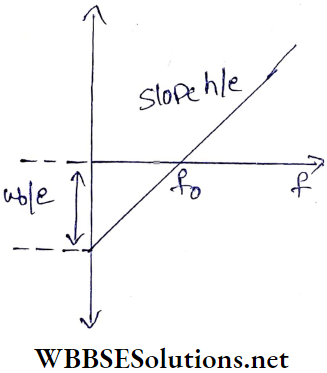
1. Frequency (f) versus stopping potential ( V0) graph:

From equation (3) we have,

eV0 = hf- W0

Or, V0 =  \(\frac{h}{e} f-\frac{W_0}{e}\)

The graph obtained by plotting V0 against f is a straight line of the type, y = mx + c Knowing the charge of an electron e,  Planck’s constant h can be calculated from the slope of the graph.

Work function W0 can be obtained from the Intercept \(\) in the y-axis. Also, the intercept with the x-axis gives the threshold frequency f0.

It is important to note that the gradient of the straight Line Is \(\) for all substances but Intercepts from y- and x-axes, and f0, respectively are different for different substances.

Dual Nature Of Matter And Radiation Graphical Representation Of Einsteins Equation

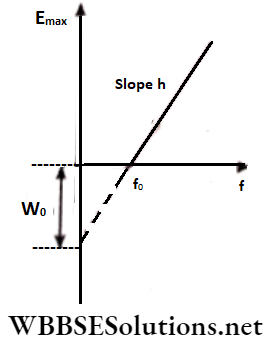
2. Frequency (f) versus maximum kinetic energy (Emax) graph:

From equation (1)

E0max = hf – W0

The graph obtained by plotting Emax against f is a straight line. Comparing the above relation with y = mx + c, we note

The slope of the graph is h, x -the axis Intercept is f0 and the y-axis intercept is – W0.

Dual Nature Of Matter And Radiation Frequency Versus Maximum Kinetic Energy

Class 12 Physics Dual Nature Notes

Dual Nature Of Matter And Radiation Einstein’s Photoelectric Equation Numerical Examples

Example 1. The work function for zinc Is 3.6 eV. If the threshold frequency for zinc is 9 × 10¹⁴ cps, determine the value of Planck’s constant. (1eV = 1.6× 10⁻¹² erg).
Solution:

Work function, W0 = 3.6eV = 3.6 ×  1.6 × 10-12 erg

Threshold frequency, f0 = 9 × 10¹⁴ cps = 9 × 10¹⁴ Hz

As, W0 = hf0

So, h = \(\frac{W_0}{f_0}=\frac{3.6 \times 1.6 \times 10^{-12}}{9 \times 10^{14}}\)

= 6.4 x  10-27  erg.s

Class 11 Physics Class 12 Maths Class 11 Chemistry
NEET Foundation Class 12 Physics NEET Physics

Example 2. The maximum kinetic energy of the released photoelectrons emitted from metallic sodium, when a light Is an Incident on It, is 0,73 eV. If the work function of sodium Is 1.82 eV, find the energy of the Incident photon In eV. Find the wavelength of incident light. (h = 6.63 × 10⁻²⁷erg s, eV = 1.6 × 10⁻¹² erg )
Solution:

From Einstein’s photoelectric equation, Emax hf – W0, we get the energy of the incident photon as,

E = hf = Emax + W0 = 0.73 + 1.82 = 2.55 eV

Hence wavelength of incident light, \(\)

∴ λ = \(\frac{h c}{E}=\frac{6.63 \times 10^{-27} \times 3 \times 10^{10}}{2.55 \times 1.6 \times 10^{-12}}\) cm

λ  = \(\frac{6.63 \times 10^{-27} \times 3 \times 10^{10} \times 10^8}{2.55 \times 1.6 \times 10^{-12}}\)A°

λ = 4875 A°

Example 3. Light of wavelength 6000A° is Incident on. a metal. To. release an electron from the metal surface, 1.77 eV of energy Is needed. Find the kinetic energy of the fastest photoelectron. What is the threshold frequency of the metal (h = 6.63 × 10⁻²⁷erg s, eV = 1.6 × 10⁻¹² erg ).
Solution:

The energy of a photon,

hf = \(h \frac{c}{\lambda}=\frac{6.62 \times 10^{-27} \times 3 \times 10^{10}}{6000 \times 10^{-16}} \mathrm{erg}\)

= \(\frac{6.62 \times 10^{-27} \times 3 \times 10^{10}}{6000 \times 10^{-8} \times 1.6 \times 10^{-12}} \mathrm{eV}\)

= 2.07 eV

As per Einstein’s photoelectric equation,

Emax  = hf – W0= 2. 07- 1. 77 = 0. 3eV

Threshold frequency,

⇒ \(\frac{W_0}{h}=\frac{1.77 \times 1.6 \times 10^{-12}}{6.62 \times 10^{-27}}\)

= 4.28 × 10¹⁴ Hz

Conceptual Questions on Heisenberg’s Uncertainty Principle

Example 4. The photoelectric threshold wavelength for a metal is  3800A°. Find the maximum kinetic energy of the emitted photoelectron, when ultraviolet radiation of length 2000A° is incident on the metal surface. Planck’s constant, h = 6.62 × 1034 J s
Solution:

Maximum kinetic energy of photoelectron,

Emax = hf-W0 = hf-hf0 = \(\frac{h c}{\lambda}-\frac{h c}{\lambda_0}\)

= hc \(h c\left(\frac{1}{\lambda}-\frac{1}{\lambda_0}\right)=h c \frac{\lambda_0-\lambda}{\lambda \lambda_0}\)

In this case, the wavelength of the incident light,

λ = 2000 A° = 2000 × 10-10 m = 2 × 10⁻⁷ m

Threshold wavelength

λ0 = \(3800 \times 10^{-10} \mathrm{~m}=3.8 \times 10^{-7} \mathrm{~m}\)

Hence, Emax  = \(\left(6.62 \times 10^{-34}\right) \times\left(3 \times 10^8\right) \times \frac{(3.8-2) \times 10^{-7}}{3.8 \times 2 \times 10^{-14}} \mathrm{~J}\)

= \(\frac{6.62 \times 10^{-34} \times 3 \times 10^8 \times 1.8}{3.8 \times 2 \times 10^{-7} \times 1.6 \times 10^{-19}} \mathrm{eV}\)

= 2.94 eV

Example 5. The threshold wavelength for photoelectric emission from a metal surface is 3800 A. Ultraviolet light of wavelength 2600A° is incident on the metal surface, 

  1. Find the work function of the metal and
  2. Maximum kinetic energy of emitted photoelectron. ( h= 6.63  × 1027 erg.s )

Solution:

Threshold wavelength

λ0 = 3800 A° =  3800 × 108  cm

∴ Work function,

W0 – hf0 = \(\frac{6.63 \times 10^{-27} \times 3 \times 10^{10}}{3800 \times 10^{-8}} \mathrm{erg}\)

= \(\frac{6.63 \times 10^{-27} \times 3 \times 10^{10}}{3800 \times 10^{-8} \times 1.6 \times 10^{-12}} \mathrm{eV}\)

= 3.27 eV

As Per Einstein’s photoelectric equation, the maximum kinetic energy of photoelectron, Emax = hf-W0

hf = kinetic energy of the incident photon

= hf0  \(h f_0 \times \frac{f}{f_0}=h f_0 \frac{c / \lambda}{c / \lambda_0}=h f_0 \frac{\lambda_0}{\lambda}\)

= \(3.27 \times \frac{3800}{2600}\)

= 4.78

Emax = 4.78 – 3.27 = 1.51 eV

Example 6. When radiation of wavelength 4940 A° is incident on a metal surface photoelectricity is generated. For a potential difference of 0.6 V between the cathode and anode, photocurrent stops. For another incident radiation, the stopping potential changes to 1.1V. Find the work function of the metal and wavelength of the second radiation. ( h= 6.63  × 1027 erg.s , e = 1.6 × 10¹⁹ C)
Solution:

For the first radiation, stopping potential V0 = 0.6V

∴ Maximum kinetic energy of photoelectron,

Emax  = eV0 = 0. 6eV

Wavelength, A = 4940 A° = 4940 × 108 cm

∴ The energy of an incident photon

= hf = \(h \frac{c}{\lambda}=\frac{6.6 \times 10^{-27} \times 3 \times 10^{10}}{4940 \times 10^{-8}}\)

= \(\frac{6.6 \times 10^{-27} \times 3 \times 10^{10}}{4940 \times 10^{-8} \times 1.6 \times 10^{-12}}\)

= 2.5 eV

If the work function of the metal is WQ, from Einstein’s equation

Emax= hf – W0

Or,  W0 = hf – Emax

= 2.5 -0.6

= 1.9 eV

For the second radiation, V’0 = 1.1V

Hence, E’max = 1.1 eV

∴ E’max = hf- W0

Or, hf’ = E’max + W0 = 1.1 + 1.9

= 3.0 eV

Hence, \(\frac{h f}{h f^{\prime}}=\frac{2.5}{3.0} \text { or, } \frac{f}{f^{\prime}}=\frac{5}{6}\)

Or, \(\frac{c / \lambda}{c / \lambda^{\prime}}=\frac{5}{6} \quad \text { or, } \frac{\lambda^{\prime}}{\lambda}=\frac{5}{6}\)

Or, λ’ = \(\lambda \times \frac{5}{6}=4940 \times \frac{5}{6}\)

= 4117 A°(approx)

Example 7. A stream of photons of energy 10.6 eV and intensity 2.0 W.m2 is incident on a platinum surface. The area of the surface is 1.0 × 10⁴ m2 and its work function is 5.6 eV. 0.53% of incident photons emit photoelectrons. Find the number of photoelectrons emitted per second and the maximum and minimum energies of the emitted photoelectrons in eV. ( 1eV = 1.6 × 10¹⁹ J)
Solution:

If the intensity of incident light is I, the energy incident on a surface area A is IA. Hence, number of photons incident per second n = \(\frac{I A}{h f}\)

If x% of photons help to emit photoelectrons, the number of photoelectrons emitted per second,

N = \(n \times \frac{x}{100}=\frac{I A x}{h f \cdot 100}\)

Given, I = 2.0 W m2 , A = 1.0 × 10⁴ m2

hf = 10.6 eV = 10.6 × 1.6 × 1019 J  and x = .0.53

N = \(\frac{2.0 \times 1.0 \times 10^{-4} \times 0.53}{10.6 \times 1.6 \times 10^{-19} \times 100}\)

= 6.25 × 1011

Minimum kinetic energy of emitted photoelectron = 0

Maximum kinetic energy, Emax = hf- W0 = 10.6 – 5.6 = 5 eV

Example 8. At what temperature would the kinetic energy of a gas molecule be equal to the energy of a photon of wavelength 6000A°? Given, Boltzmann’s constant,  k = 1.38 × 10²³J K1, Plank’s constant , h = 6.625 × 1034 J. s
Solution:

Let the required temperature be TK. We know, the kinetic energy of a gas molecule

= \(\frac{3}{2} k T=\frac{3}{2} \times 1.38 \times 10^{-23} \times T\)

Again, the kinetic energy of the photon

= \(h f=\frac{h c}{\lambda}=\frac{6.625 \times 10^{-34} \times 3 \times 10^8}{6000 \times 10^{-10}}\)

Hence,

= \(\frac{3}{2} \times 1.38 \times 10^{-23} \times T\)

= \(\frac{6.625 \times 10^{-34} \times 3 \times 10^8}{6000 \times 10^{-10}}\)

T = \(\frac{2}{3} \times \frac{6.625 \times 10^{-34} \times 3 \times 10^8}{1.38 \times 10^{-23} \times 6000 \times 10^{-10}}\)

= 1.6 × 10⁴ k

Example 9.  The ratio of the work functions of two metal surfaces is 1: 2. If the threshold wavelength of the photoelectric effect for the 1st metal is 6000 A°, what is the corresponding value for the 2nd metal surface?
Solution:

If the work function of 1st and 2nd metals be W0 and W’0 , respectively then

⇒ \(\frac{W_0}{W_0^{\prime}}=\frac{h f_0}{h f_0^{\prime}}=\frac{h c / \lambda_0}{h c / \lambda_0^{\prime}}=\frac{\lambda_0^{\prime}}{\lambda_0}\)

Or, \(\lambda_0^{\prime}=\lambda_0 \times \frac{W_0}{W_0^{\prime}}\)

= \(6000 \times \frac{1}{2}\)

= 3000 A°

Class 12 Physics Dual Nature Notes 

Example 10. The work function of a metal surface is 2 eV. The maximum kinetic energy of photoelectrons emitted from the surface for Incidence of light of wavelength 4140 A is 1 eV. What is the threshold wavelength of radiation for that surface
Solution:

From Einstein’s photoelectric equation,

Emax = hf-W0

Or hf = Emax  + W0= 1+2 = 3 eV

Now, \(\frac{h f}{W_0}=\frac{h f}{h f_0}=\frac{f}{f_0}=\frac{c / \lambda}{c / \lambda_0}=\frac{\lambda_0}{\lambda}\)

∴ λ0 =  \(\lambda \frac{h f}{W_0}\)

= 4140 ×\(\frac{3}{2}\)

= 6210A°

Example 11. The work function of a metal is 4.0 eV. Find the maximum value of the wavelength of radiation that can emit photoelectrons from the metal
Solution:

Let, threshold frequency = f0 , threshold wavelength λ0 and work function = W0

W0 =\(h f_0=\frac{h c}{\lambda_0} \text { or, } \lambda_0=\frac{h c}{W_0}\)

Given W0 = 4.0 eV = 4 × 1.6 × 1012 erg

We know, h = 6.60 × 1027 ergs. And

And c = 3 × 1010 cm .s1

λ0 = \(=\frac{6.60 \times 10^{-27} \times 3 \times 10^{10}}{1.6 \times 10^{-12} \times 4} \mathrm{~cm}\)

λ0 = 3.09375 × 105 cm≈ 3094 A°

Example 12. The maximum energies of photoelectrons emitted by a metal are E1 and E2 when the incident radiation has frequencies f1 and f2 respectively. Show that the Planks comment h and the work function W0 of the metal are \(\)
Solution:

According to Einstein’s photoelectric equation we here,

E= hf1 – W0 …………………………………(1)

E= hf2-W0 ……………………………..(2)

E1– E2 = h(f1-f2)

∴ h = \(\frac{E_1-E_2}{f_1-f_2}\) ………………………………….(3)

For E1 > E2

Again multiplying equation (1) by f2 and equation (2) by f1 we obtain.

E1f2= hf1f2 – f2W0 …………………………………..(4)

E2f1= hf1f2 – f1W0 ………………………………..(5)

Subtracting equation (5) from equation (4), we get

E1f2 – Ff = f1W0-f2W0= W2(f1-f2)

∴ W0 = \(\frac{E_1 f_2-E_2 f_1}{f_1-f_2}\)

Example 13. A photoelectric source is illuminated successively by monochromatic light of wavelength λ and λ/2 calculates the work function of the material of the source. If the maximum kinetic energy of the emitted photoelectric in the second case is 3 times that in the first case.
Solution:

We know the kinetic energy of emitted photoelectrons,

k = hf-W0 = \(\frac{h c}{\lambda}\) – W0

In the first case,

K1 = \(\frac{h c}{\lambda}\) – W0 = \(\frac{h c}{\lambda}\) – W

In the second case,

K2 = \(\) – W0 = \(\) – W

It is given that, K2 = 3K1

Or, 2hc/λ = W

= 3(hc/λ – W)

2W = hc/λ

∴ W= hc/2λ

Class 12 Physics Dual Nature Notes 

Dual Nature Of Matter And Radiation Nature Of Radiation: Wave-Particle Duality

Electromagnetic radiations, if assumed to be streams of photon particles, can explain phenomena like photoelectric emission, blackbody radiation, atomic spectra, etc. However the theory fails to explain other optical phenomena like Interference, diffraction, polarisation, etc.

On die other hand, the wave theory of radiation can interpret these phenomena successfully. Hence, depending on the type of experiment, radiation sometimes behaves like waves and sometimes like a stream of particles. Thus, theory and particle theory are not contradictory but complementary to each other. ‘Ibis Is railed wave-particle duality

Dual Nature Of Matter And Radiation Matter Wave

It has already been stated that radiation shows both wave nature and particle nature. But the fact that matter can show wave nature was unimaginable till 1924 when French physical Louis de Broglie put forward the theory that a stream of material particles may behave as a wave.

Most probably the following reasons led him to such a conclusion:

  1. Nature prefers symmetry. Hence, two physical entities, matter and energy must co-exist In symmetry,
  2. If radiation can have both particle and wave nature would also possess particle and wave nature,
  3. We know that a beam of light, which Is a wave, can transfer energy and momentum at different points of a substance, ‘similarly, a stream of particles can also transfer energy and momentum at different points of a substance. Therefore, this stream of particles may be a matter wave.

de Broglie’s hypothesis:

Matter also consists of waves. For a radiation of frequency f, the energy of a photon

E =hf Or, E = hc/λ

∴ c = fλ

Or, λ = \(\frac{h}{E / c}=\frac{h}{p}\) ………………………………… (1)

Where p is the momentum of the photon.

As per de Broglie’s hypothesis, equation (1) is also applicable to an electron or any other particle. In this case, A gives the wavelength of the electron (or particle) of momentum p and is known as the de Broglie wavelength.

Thus, substituting the values of Planck’s constant h and momentum of the particle p in equation (1), we get the de Broglie wavelength of the wave associated with the moving particle.

Hence a stream of any particle behaves like a beam of light, i.e., like a wave. The wave is known as the matter wave. The wavelength of this matter wave,

λ = \(\frac{h}{p}=\frac{h}{m \nu}\) ……………………………………. (2)

Where, m = mass of the particle, v = velocity of the particle, p = mv = momentum of the particle.

We can make the following inferences from the above relation connecting wavelength (a characteristic of the wave) And

Momentum (a characteristic of the particle) :

  1. If v = 0, then λ = ∞, it means the waves are associated with moving material particles only.
  2. The de Broglie wavelength does not depend on whether the moving particle is charged or uncharged. It means that matter waves are not electromagnetic waves because electromagnetic waves are produced from accelerated charged particles.
  3. If the mass m and the velocity v of the particle are large, the associated de Broglie wavelength becomes very small. If the momentum of the particle increases, the wavelength decreases.
  4. The wave nature and particle nature of any physical entity (matter or radiation) are mutually exclusive, i.e., if we consider the particle nature of radiation at any instant, the wave nature of radiation is to be excluded at that instant.

In 1927 C J Davisson and H. Germer of Bell Telephone, laboratories and George P Thomson of the University of Aberdeen, Scot¬ land, were able to show diffraction of electron streams and hence established experimentally the existence of matter waves

Hence, any moving stream of particle or matter exhibits interference, diffraction, and polarisation phenomena which can only be explained with wave theory.

Dual Nature Of Matter And Radiation Double Slit Experiments

The interference pattern, obtained by using a double slit type of experiment, using about 70000 moving electrons is shown in

Dual Nature Of Matter And Radiation de Broglie Wavelength Of Moving Electron

Let an electron of mass m move with velocity v. Its de Broglie wavelength is given by

λ = h/mv

If the kinetic energy of the electron is K, then

K = ½ mv² Or, v = \(\sqrt{\frac{2 K}{m}}\)

So, de Broglie wavelength is

λ = \(\frac{h}{m \sqrt{\frac{2 K}{m}}}=\frac{h}{\sqrt{2 m K}}\) ………………………………. (1)

Equation (1) is the expression for the de Broglie wavelength ofa moving particle in terms of its kinetic energy.

Now suppose an electron is at rest. It is accelerated through a potential difference V. The kinetic energy acquired by the electron is K = eV; e = charge of the electron.

On substituting the value of K in equation (1), the de Broglie wavelength associated with the electron is given by

λ = \(\frac{h}{\sqrt{2 m e V}}\) ……………………… (2)

Putting the values of h,e,m in ‘equation (2) we have,

λ = \(\frac{6.63 \times 10^{-34}}{\sqrt{2 \times 9.1 \times 10^{-31} \times 1.6 \times 10^{-19} \times V}}\)

= \(\frac{12.27 \times 10^{-10}}{\sqrt{V}} \mathrm{~m}\)

= \(\frac{12.27}{\sqrt{V}}\)

Wavelength of matter-wave

Let the velocity of an electron (mass = 9.1 × 1010 cm .s1), v = 107 m. s1. de Broglie wavelength of the electron

λ = \(\frac{h}{m v}=\frac{6.63 \times 10^{-34}}{\left(9.1 \times 10^{-31}\right) \times 10^7}\)

= \(\frac{h}{m v}=\frac{6.63 \times 10^{-34}}{\left(9.1 \times 10^{-31}\right) \times 10^7}\)

= 7.3 × 10⁻¹¹ cm .s1

= 0.73 A°

This wavelength is equivalent to the wavelength of X-rays.

1. Let the mass of a moving marble, m = 10 g = 0.01 kg, and its velocity, v = 10 m s-1. Then de Broglie wavelength of the marble

⇒ \(\frac{h}{m v}=\frac{6.63 \times 10^{-34}}{0.01 \times 10}\)

= 6.63 × 10⁻³³ cm .s1m

The value of this wavelength is too small to be measured or be observed by any known experiment Existence of such small wavelengths in electromagnetic radiation or any other real waves is still unknown to us

From the above discussions, we can infer that de Broglie’s hypothesis is of no use in the case of the macroscopic objects that we encounter in our daily lives.

The concept of matter waves is only Important In the case of particles of atomic dimensions.

Dual nature of matter class 12 notes 

Dual Nature Of Matter And Radiation de Broglie Wavelength Of Moving Electron Numerical Examples

Example 1. What is the de-Broglie- wavelength-related to an electron of energy 100 eV? (Given, the mass of the electron, m =  9.1 x 10⁻³¹ kg, e = 6.63 × 10⁻³⁴  J. s)
Solution:

Let the velocity of the electron be v. Its kinetic energy,

½ mv² = E

Or, m²v² = 2mE

Or, mv = \(\frac{h}{m v}=\frac{h}{\sqrt{2 m E}}\)

de Broglie wavelength related to the electron,

λ = \(\frac{h}{m \nu}=\frac{h}{\sqrt{2 m E}}\)

= \(\frac{6.63 \times 10^{-34}}{\sqrt{2 \times 9.1 \times 10^{-31} \times 100 \times 1.6 \times 10^{-19}}}\)

= 1.23 × 10⁻¹⁰ m = 1.23A°

Example 2. Calculate the momentum of a photon of frequency 5 × 10¹³ Hz. Given h = 6.6 × 10⁻³⁴ J.s and c= 3 × 10⁸ m.s-1
Solution:

de Broglie wavelength \(\frac{h}{m v}=\frac{h}{p}\)

Momentum p = h/λ

Therefore, the momentum of the photon.

p = \(\frac{h}{\lambda}=\frac{h f}{c}=\frac{\left(6.6 \times 10^{-34}\right) \times\left(5 \times 10^{13}\right)}{3 \times 10^3}\)

= 1.1 × 10⁻²⁸ kg.m.s-1

Example 3. The wavelength A of a photon and the de Broglie wavelength of an electron have the same value. Show that the energy of the photon \(\) kinetic energy of the electron. Here m, their usual meaning
Solution:

The energy of the photon. F. = hf = hc/λ

The kinetic energy of the electron

E’ = \(\frac{1}{2} m v^2=\frac{p^2}{2 m}\)

Where , p= mv= momentum

As p = \(\frac{h}{\lambda}\) So, E’ = \(\frac{h^2}{2 m \lambda^2}\)

E’ = \(\frac{h^2}{2 m \lambda^2}\)

Or, E =  \(\frac{E}{E^{\prime}}=\frac{h c}{\lambda} \cdot \frac{2 m \lambda^2}{h^2}=\frac{2 \lambda m c}{h}\)

E = \(\frac{2 \lambda m c}{h}\) E

Real-Life Applications of Dual Nature Concept

Example 4. An electron and a photon have the same de Hrogilr wave¬ length λ = I0-10m. Compare the kinetic energy of the electron with the total energy of the photon
Solution:

The kinetic energy of an electron having mass m and velocity v,  K =  ½ mv²

Wavelength λ  = h/mv

Or, v = h/m λ

∴ K =½ m. \(\frac{h^2}{m^2 \lambda^2}=\frac{h^2}{2 m \lambda^2}\)

The energy of the photon of wavelength λ, E \(\frac{h c}{\lambda}\)

∴  \(\frac{K}{E}=\frac{h^2}{2 m \lambda^2} \cdot \frac{\lambda}{h c}=\frac{h}{2 m \lambda c}\)

= \(\frac{6.6 \times 10^{-34}}{2 \times 9.1 \times 10^{-31} \times 10^{-10} \times 3 \times 10^8}\)

= 0.012<1

Hence, the kinetic energy- of the electron is lower than the total energy of the photon

Example 5. Calculate the de Broglie wavelength of an electron of kinetic energy 500 eV.
Solution:

The kinetic energy of an electron 500 eV means the electron is accelerated by the potential 500 V So, the de Broglie wavelength associated with the electron

λ = \(\frac{12.27}{\sqrt{500}}\)

= 0.55 A°

WBCHSE physics dual nature notes 

Dual Nature Of Matter And Radiation Experimental Study Of Matter-Wave

Davisson and Germer Experiment:

We physicists C J Davisson and L H Germer first established the reality of matter waves. The experiment conducted by them in the year 1927 is described below.

1. Davisson and Germer experiment:

The electrons evaporated from the heated filament (F) after coming out of the electron gun are passed through a potential difference V. Thus, they acquire a high velocity and hence increased kinetic energy.

These electrons are then directed through a narrow hole and are thus collimated into a unidirectional beam. The kinetic energy of each single electron of this beam is eV.

Arrangements are such that this beam impinges normally on a specially hewn nickel single crystal. Because of this impact, the electrons may be scattered in different directions through different angles ranging from 10° to 90°. The incident and scattered beams are generally referred to as the incident ray and scattered ray.

A collector D capable of rotating around the crystal measures the intensity of the rays scattered in different directions. What is measured in the process is the number of electrons collected per second

Dual Nature Of Matter And Radiation Davission And Germer Experiment

2. Davisson and Germer Observation:

The intensity I obtained for the different values of the angle of scattering θ of the scattered ray is expressed using a polar graph where the scattered intensity is plotted as a function of the scattering angle.

The convention in this respect is this:

  1. The point of incidence on the crystal is taken as the origin O of the graph
  2. The direction OP opposite the direction of the incident ray PO is taken as the standard axis of the graph.

Suppose, for a stream of particles with definite energy, which is incident on the p crystal, the scattering angles are θ1, θ2, and the corresponding intensities  I1, I2…….Hence, the line joining the points is represented by the polar coordinates (I1, θ1 ), (I2, θ2 ), …, etc.

Will be the polar Q graph indicating the result of the experiment. The polar coordinates of the points A and B are (I1, θ1 ) and (I2, θ2 ); that is, I1 = OA, I2 = OB, and θ1 = ∠AOP, θ2= ∠BOP. In this figure, the line OABQ joining the points A, B… is the polar graph.

Dual Nature Of Matter And Radiation Scattering Angles

In this experiment, if the kinetic energy of the incident electrons is considerably low [as for the 40 eV electrons,  then it is observed that the intensity I corresponding to changes in the angle of scattering from 10° to 90° keeps decreasing continuously, which does not indicate any characteristic property of the electron beam.

Dual Nature Of Matter And Radiation Incident Beam And Nickel Beam

After this, Davisson and Germer noticed that when the kinetic energy of the incident electrons is gradually increased, a distinct hump appears at 44 eV at a scattering angle of about 60°. The hump becomes most prominent at 54 eV and a scattering angle of 50°. At still higher potentials, the hump decreases until it disappears completely at 68.

If the nickel crystal is compared with a diffraction grating, it is observed that if an X-ray of wavelength 1.65A is incident normally on the nickel crystal instead of the electron beam, then also, a peak representing maximum intensity will be obtained at 50°

The angle of scattering. On the other hand, when the de Broglie formula for matter wave is applied, the de Broglie wavelength of 54 eV electrons is λ =  \(\frac{12.27}{\sqrt{54}}\) = 1.67A°

This striking similarity of the experimental value to the theoretical value according to de Broglie’s relation demonstrates the behavior of the electron stream as a matter wave. The experiment is termed an electron diffraction experiment as well

  1. The atoms of pure solids are arranged in crystal lattices of definite shapes. If an infinitely large number, say, 1020 or. more, if such crystals are aligned in a three-dimensional array to form a large piece of matter, then the specimen is called a single crystal. For example, the cubical grains of common salt thus formed are each a single crystal.
  2. Davisson and Germer used it for their experiment comparatively. slow-moving electrons with energy varying between 30 eV and 60 eV. Later on, G.P. Thomson successfully conducted a diffraction experiment with even high-energy electron beams; electrons of energy as high as 10 keV to 50 keV. In the subsequent years, the wave nature of other elementary particles, like the proton and the neutron, has also been established experimentally

The nature of matter-wave

According to de Broglie’s hypothesis, every moving particle can be represented as a matter wave, which, obviously, therefore, has to obey certain conditions

  1. Corresponding to a moving particle, a matter wave must also be a moving wave or progressive wave.
  2. The wave velocity must be equal to the particle velocity.
  3. Because the particle has a definite position at any time, the matter wave must be such that it can indicate the position of the particle at that time.

A pure sine curve cannot represent a matter wave, which means that no proper idea can be formed about the true nature of the matter wave from such curves. Let us suppose that a progressive wave moving in the positive  x-direction is given by

Ψ = a sin (ωt – kx + δ) where a = amplitude,  ω = angular velocity, fc= propagation constant; and  δ = phase difference

Dual Nature Of Matter And Radiation The Nature Of Matter Wave

  1. This wave extends from x = ∞ to -∞  with no dissipation or damping anywhere along the path. J fence, It can never Indicate the Instantaneous position of the moving partly, OH If it is assumed however that the matter wave Js analogs, to the pure sine wave, then it can be shown.
  2. That the velocity ofthe de Broglie wave turns out to be greater than the speed of light in a vacuum, which is Impossible contradicting Einstein’s special theory of relativity,

Moreover, a sine wave does not exist In nature. No real wave can extend from -∞ to +∞ without any damping. This implies that what we observe in reality is a wave group. For a practical example, consider the shape of waves formed when a stone is dropped in a pond. A wave group as shown comprising just a couple of wave crests and wave troughs is formed in the water and proceeds in circles over the water’s surface.

Wave group or wave packet:

If there is a superposition of two or more sine waves of different frequencies, then the waveform changes. If any such sine waves of continuously varying frequencies are superposed, the resultant wave that is formed has a general form like the one This is what is called wave group or wave packet.

Dual Nature Of Matter And Radiation Wave Group Or Wave Packet

Characteristics of wave packets are

This too is a progressive wave moving in a definite direction, in this case, along the + x-axis.

It is a localized wave, which means that it is limited within a rather small interval. Hence, such a wave group can indicate the possible instantaneous location of a moving particle.

It can be shown analytically that the velocity of such wave groups, \(\).  It is called group velocity. Rigorous calculation shows that vg = v; that is, the group velocity is equal to the particle velocity. Thus properly constituted wave group or wave packet alone can correctly represent a matter wave.

Wave function

It has to be noted with particular care that a matter wave is neither an elastic wave like a sound wave nor an electromagnetic wave like a light wave. This is because an elastic wave is associated with the vibration of particles in an elastic medium, whereas an electromagnetic wave involves the simultaneous vibrations of the electric field and the magnetic field vectors.

In analogy, u matter wave is associated with a quantity known as wave function – Ψ. The origin and propagation ofthe matter wave are perfectly consistent with the vibrations of this Ψ – function concerning position and time.

It can be noticed that while the moving particle exists at a particular point at a particular moment of its motion, the correspond¬ ing matter wave occupies an extent of space at that moment, rather than be limited to a point.

It can be inferred from quantum mechanics that this property is an inherent property of matter waves; a wave packet is never concentrated at a single point. The probability of the particle existing at a particular point at a particular time is given by Ψ², the modulus squared off,

Photon wave

We have seen, even before discussing wave-particle duality, that electromagnetic radiation has a dual nature too; radiation is sometimes represented by waves, at other times in terms of photon beams. It is possible also to represent moving photons by a corresponding waveform as is done with a moving particle.

A single photon will naturally be represented by a wave group. The only difference here is that this (photon) wave packet must be an electromagnetic wave packet with group velocity in vacuum or air equal to the velocity of light.

WBCHSE Physics Dual Nature Notes

Dual Nature Of Matter And Radiation Experimental Study Of Matter-Wave Numerical Examples

Example 1. Find de Broglie wavelength of the neutron at 127°C. Given, K = 1.38 × 10⁻²³ ; h = J. mol1.K1. Plank’s constant, h = 6.626 × 10⁻³⁴J.s. mass of neutron, m = 1.66 × 10⁻²⁷ kg.

Kinetic energy of neutron, E = \(\frac{3}{2}\) kT

We know E = ½ mv²

Or, 2Em = m²v²

Or, mv = \(\sqrt{2 E m}=\sqrt{2 m \times \frac{3}{2} k T}=\sqrt{3 m k T}\)

de Broglie wavelength

λ = \(\frac{h}{m v}=\frac{h}{\sqrt{3 m k T}}\)

= \(\frac{6.626 \times 10^{-34}}{\sqrt{3 \times 1.66 \times 10^{-27} \times 1.38 \times 10^{-23} \times 400}}\)

= 1.264 ×  10-10m

Example 2. Under what potential difference should an electron be accelerated to obtain electron waves of A = 0.6 A f Given, the mass of the electron, m = 9.1x 10⁻³¹  kg; Planck’s constant, h = 6.62 x 10⁻³⁴ J. s
Solution:

We know λ = ½mv²  = eV

∴ mv= \(\sqrt{2 m e V} \text { or, } \lambda=\frac{h}{\sqrt{2 m e V}}\)

Or, λ² =  \(\frac{h^2}{2 m e V} \text { or, } V=\left(\frac{h}{\lambda}\right)^2 \cdot \frac{1}{2 m e}\)

V =  \(\left(\frac{6.62 \times 10^{-34}}{0.6 \times 10^{-10}}\right)^2 \times \frac{1}{2 \times 9.1 \times 10^{-31} \times 1.6 \times 10^{-19}}\)

= 418.04 V

Example 3. An a -particle and a proton are accelerated from rest through the same potential difference V. Find the ratio of Broglie wavelengths associated with them.
Solution:

The kinetic energy of a particle of mass m.

E = \(\frac{p^2}{2 m}\)

Where p = \(\sqrt{2 m E}\)

So, de Broglie wavelength, λ = \(\frac{h}{p}=\frac{h}{\sqrt{2 m E}}\)

Now, if a particle of charge q is accelerated by applying potential difference V, then

E = qV

λ = \(\frac{h}{\sqrt{2 m q V}}\)

∴ λ ∝ \(\frac{1}{\sqrt{m q}}\) when V is constant

Hence \(\frac{\lambda_1}{\lambda_2}=\sqrt{\frac{m_2 \cdot q_2}{m_1 \cdot q_1}}\)

For proton and a -particle \(\frac{m_a}{m_p}=4, \frac{q_a}{q_p}\) = 2

∴ \(\frac{\lambda_p}{\lambda_a}=\sqrt{\frac{m_a}{m_p} \cdot \frac{q_a}{q_p}}\)

= \(=\sqrt{4 \times 2}\)

= 2 \(\sqrt{2}\)

Hence, the required ratio 2\(\sqrt{2}\):1

Example 4. For what kinetic energy of neutron will the associated de Broglie wavelength be 1.40 x 10⁻¹⁰ m? The mass of a neutron is 1.675 x 10⁻²⁷ kg and h = 6.63 x 10⁻³⁴ J
Solution:

If m is the mass and K is the kinetic energy of the neutron, the de Broglie wavelength associated with it is given by,

λ = \(\frac{h}{\sqrt{2 m K}}\)

Or, K = \(\frac{h^2}{2 m \lambda^2}=\frac{\left(6.63 \times 10^{-34}\right)^2}{2 \times 1.675 \times 10^{-27} \times\left(1.40 \times 10^{-10}\right)^2}\)

= 6.69 × 10⁻²¹ J

Example 5. Find the wavelength of an electron having kinetic energy 10eV.(h =  6.33 × 10⁻³⁴J me = 9 × 10-31 kg
Solution:

The kinetic energy of the electron,

E = ½ mv² = 10 eV = 10 × (1.6 x 10-19)J

m²v² = 2mE, or, momentum p = mv = \(\sqrt{2 m E }\)

The de Broglie wavelength of the electron,

λ = \(\frac{h}{\sqrt{2 m E}}=\frac{6.63 \times 10^{-34}}{\left[2 \times\left(9 \times 10^{-31}\right) \times\left(10 \times 1.6 \times 10^{-19}\right)\right]^{1 / 2}}\)

= 3.9 ×  10-10 m

= 3.9 A°

Example 6. An α – particle moves In a circular path of radius  0.83 cm in the presence of a magnetic field of 0.25 Wb/m². What is the de Broglie wavelength associated with the particle? ,
Solution:

The radius of a charged particle rotating in a circular path in a magnetic field

R = \(\frac{m v}{B q}\) or, mv = RBq

The de Broglie wavelength associated with the particle,

λ = \(\frac{h}{m v}=\frac{h}{R B q}\)

Here, R = 0.83 cm = 0.83 × 10⁻² m, B = 0.25 Wb. m²

q = 2e = 2 ×1.6 × 10-19C

[Since α – particle]

λ = \(\frac{6.6 \times 10^{-34}}{0.83 \times 10^{-2} \times 0.25 \times 2 \times 1.6 \times 10^{-19}}\)

= 0.01 A°

WBCHSE physics dual nature notes 

Dual Nature Of Matter And Radiation Very Short Questions And Answers

Question 1. Below a minimum frequency of light, photoelectric emis¬ sion does not occur Is the statement true or false?
Answer: True

Question 2. Above the threshold wavelength for a metal surface, even a light of low intensity can emit photoelectrons. Is the statement true?
Answer: No

Question 3. What will be the effect on the velocity of emitted photo¬ electrons if the wavelength of incident light is gradually
Answer: The velocity of electrons will increase

Question 4. Why are alkali metals highly photo-sensitive?
Answer: Work functions of alkali metals are very low

Question 5. Express in eV the amount of kinetic energy gained by an electron when it is passed through a potential difference of
Answer: 100 eV

Question 6. The photoelectric threshold wavelength for a metal is 2100 A. If the wavelength of incident radiation is 1800 A, will there be any emission of photoelectrons?
Answer: Yes

Question 7. Which property of photoelectric particles was discovered from Hertz’s experiment?
Answer: Property of negative charge

Question 8. Which property of photoelectric particles was measured
Answer: Specific charge

Question 9. What is the relation between the stopping potential VQ and the maximum velocity vmax of photoelectrons?
Answer:

⇒ \(\left[v_{\max }=\sqrt{\frac{2 e V_0}{m}}\right]\)

Question 10. How does the kinetic energy of photoelectrons change due to an increase in the intensity of incident light?
Answer: No change

Question 11. Give an example of the production of photons by electrons.
Answer: X-ray emission

Question 12. Give an example of the production of electrons by photons.
Answer: Photoelectric effect

Question 13. If the intensity of incident radiation on a metal surface is doubled what happens to the kinetic energy of the electrons emitted?
Answer: No change in KE

Question 14. Write down the relation between threshold frequency and photoelectric work function for a metal.
Answer: \(\left[f_0=\frac{W}{h}\right]\)

Question 15. Which property of light is used to explain the characteristics of the photoelectric effect?
Answer: Particle (photon) nature

Question 16. What is the rest mass of a photon?
Answer: Zero

Question 17. The wavelength of electromagnetic radiation is X . What is the energy of a photon of this radiation?
Answer: E =  hc/λ

Question 18. The light coming from a hydrogen-filled discharge tube falls on sodium metal. The work function of sodium is 1.82 eV and the kinetic energy of the fastest photoelectron is 0.73 eV. Fine, the energy of incident light.
Answer: 2.55 eV

Question 19. In the case of electromagnetic radiation of frequency f, what is the momentum of the associated photon?
Answer: hf/c

Question 20. If photons of energy 6 eV are incident on a metallic sur¬ face, the kinetic energy of the fastest electrons becomes 4eV. What is the value of the stopping potential?
Answer: 4V

Question 21. The threshold wavelength of a metal having work function W is X . What will be the threshold wavelength of a metal having work function 2W?
Answer: λ/2

Question 22. The work function of a metal surface for electron emission is W. What will be the threshold frequency of incident radiation for photoelectric emission?
Answer: W/h

Question 23. What is the effect on the velocity of the emitted photoelectrons if the wavelength of the incident light is decreased?
Answer: Velocity will increase

Question 24. Two metals A and B have work functions 4eV and 10 eV respectively. Which metal has a higher threshold wavelength
Answer: Metal A

Question 25. Ultraviolet light is incident on two photosensitive materials having work functions W1 and W2(W1 > W2). In which case will the kinetic energy of the emitted electrons be greater? Why
Answer: For the material of work function W2

Question 26. Is it possible to bring about the interference of electrons?
Answer: Yes

Question 27. What type of wave is suitable to represent the wave associated with a moving particle?
Answer: Wave Packet

Question 28. The wavelength of a stream of charged particles accelerated by a voltage Vis A. What will be the wavelength if the voltage is increased to 4 V?
Answer: λ /2

Question 29. The de Broglie wavelength of an electron and the wave¬ length of a photon are equal and its value is A = 10-10m. Which one has higher kinetic energy?
Answer: Photon

Question 32. An electron and a proton have the same kinetic energy. Identify the particle whose de Broglie wavelength would be
Answer: Electron

Question 36. The de Broglie wavelength of a particle of kinetic energy K is A. What would be the wavelength of the particle if its kinetic energy were K/4?
Answer: 2 λ

Question 37. The de Broglie wavelength associated with an electron accelerated through a potential difference V is A. What will be its wavelength when the accelerating potential is increased to 4 V?
Answer: λ /2

Question 38. What will be the kinetic energy of emitted photoelectrons if light of threshold frequency falls on a metal?
Answer: Zero

Question 39. What conclusion Is drawn from the Davisson-Germer experiment?
Answer:

The Davisson-Germer experiment proves the existence of matter waves. It can be concluded from the experiment that any stream of particles behaves as waves

Question 40. Name the phenomenon which shows the quantum nature of electromagnetic radiation.
Answer:

The phenomenon which shows the quantum nature of electromagnetic radiation is the photoelectric effect

Dual Nature Of Matter And Radiation Fill In The Blanks

Question 1. Maximum kinetic energy of photoelectrons depends on __________________ of light used but does not depend on the of light
Answer: Frequency, intensity

Question 2. In the case of photoelectric emission, the maximum kinetic energy of photoelectrons increases with an increase in the _______________ of incident light
Answer: Frequency

Question 3. Lenard concluded from his experiment that the particles emitted in the photoelectric effect are _________________
Answer: Electrons

Question 4. In the case of photoelectric emission, the maximum kinetic energy of emitted electrons depends linearly on the _________________ of incident radiation
Answer: Frequency

Question 5. Davison and Germer experimentally demonstrated the existence of _____________________ waves
Answer: Matter

Dual Nature Of Matter And Radiation Assertion Type

Direction: These questions have statement 1 and statement 2. Of the four choices given below, choose the one that best describes the two statements,

  1. Statement 1 Is true, statement 2 Is true; statement 2 Is the correct explanation for statement 1.
  2. Statement 1 Is true, statement 2 Is true; statement 2 Is not a correct explanation for statement 1.
  3. Statement 1 Is true, statement 2 Is false.
  4. Statement 1 Is false, and statement 3 is true.

Question 1.

Statement 1: Any light wave having a frequency less than 4.8 × 10¹⁴ Hz cannot emit photoelectrons from a metal surface having work function 2.0 eV.

Statement 2:  If the work function of a metal is W0 (in eV), then the maximum wavelength (in A°) of the light capable of initiating a photoelectric effect in the metal is \(\lambda_{\max }=\frac{12400}{W_0} \)

Answer: 1. Statement 1 Is true, statement 2 Is true; statement 2 Is the correct explanation for statement 1.

Question 2.

Statement 1: The energy of the associated photon max becomes half when the wavelength of the electromagnetic wave is doubled.

Statement 2: Momentum of a photon

= \(\frac{\text { energy of the photon }}{\text { velocity of light }}\)

Answer: 2. Statement 1 is true, and statement 2 Is true; statement 2 Is not a correct explanation for statement 1.

Question 3.

Statement 1: In the photoelectric effect the value of stopping potential is not at all dependent on the wavelength of the light

Statement 2: The maximum kinetic energy of the emitted photoelectron and stopping potential are proportional to each other.

Answer: 4. Statement 1 is false, and statement 3 is true.

Question 4.

Statement 1: The maximum surface velocity does not of increase the photo electron even if the intensity of the incident electromagnetic wave is increased.

Statement 2: Einstein’s photoelectric equation

½ mv²max = hf – W0

Where the symbols have their usual meaning

Answer: 1. 1. Statement 1 is true, statement 2 Is true; statement 2 Is the correct explanation for statement 1.

Question 5.

Statement 1: The stopping potential becomes double when the frequency of the incident radiation is doubled.

Statement 2: The work function of the metal and the threshold frequency of the photoelectric effect are proportional to each other.

Answer: 4. Statement 1 is false, and statement 3 is true.

Question 6.

Statement 1: If the kinetic energy of particles with different masses is the same, then the de Broglie wavelength ofthe particles is inversely proportional to their mass.

Statement 2: The momentum of moving particles is inversely proportional to their de Broglie wavelengths.

Answer: 4. Statement 1 is false, and statement 3 is true.

Question 7.

Statement 1: If a stationary electron is accelerated with a potential difference of IV, its de Broglie wavelength becomes 12.27 Å approximately.

Statement 2: The relation between the de Broglie length A and the accelerating potential V of an electron is given by λ  = \(\frac{12.27}{V}\) Å

Answer: 3. Statement 1 Is true, and statement 2 Is false.

Question 8.

Statement 1: A moving particle is represented by a progressive wave group.

Statement 2: A pure sinusoidal wave cannot represent the instantaneous velocity or position of a moving particle.

Answer: 1. Statement 1 Is true, statement 2 Is true; statement 2 Is the correct explanation for statement 1.

Question 9.

Statement 1: The wavelength of 100 eV photon is 124 Å.

Statement 2: The energy of a photon of wavelength λ in Å is

E = \(\frac{12400}{\lambda}\) eV

Answer: 1. Statement 1 Is true, statement 2 Is true; statement 2 Is the correct explanation for statement 1.

Question 10.

Statement 1: A proton, a neutron, and an a -particle are accelerated by the same potential difference. Their velocities will be in the ratio of 1: 1: √2.

Statement 2: Kinetic energy, E = qV =½mv²

Answer: 4. Statement 1 Is false, and statement 3 is true.

WBCHSE physics dual nature notes 

Dual Nature Of Matter And Radiation Match The Columns

Question 1. Light of fixed intensity is incident on a metal surface.’ Match the columns in case of the resulting photoelectric effect

Dual Nature Of Matter And Radiation Photoelectric Effect

Answer: 1-B, 2 – C, 3-D, 4-A

Question 2.

Dual Nature Of Matter And Radiation Photoelectric Effect.

Answer: 1-A, 2-C, 3-D, 4-B

Question 3. Several stationary charged particles are accelerated with appropriate potential differences so that their de Broglie wavelengths are the same

Dual Nature Of Matter And Radiation A Number Of Stationary Charged Particles

Answer: 1-B, 2-D, 3-A, 4-C

Question 4. The work function and threshold frequency of photoelecj trie emission of a metal surface are WQ and f respectively. Light of frequency/ is incident on the surface. The mass and charge of the electron are m and e respectively

Dual Nature Of Matter And Radiation Function And Threshold Frequency

Answer: 1-B, 2-D, 3-C, 4-A

WBCHSE Class 12 Physics Notes For Light Interference

WBCHSE Class 12 Physics Interference Notes

Light Wave And Interference Of Light Introduction

Light propagates through the vacuum or any medium in the form of waves l light wave is a transverse electromagnetic wave. Optical phenomena observed in daily life, as produced by slits or orifices, obstacles, reflecting planes, and refracting planes, have sizes many times more than the wavelength of light.

For example, the wavelength of visible light ranges from 4 × 10⁻⁵ cm but even a very small slit in the path of light generally lias a diameter not less than I mm ie, 0.1 hence, the diameter of the orifice (slit) Is 1000 times more than the wavelength of visible light. The wavelength of light is taken as zero. with respect to large orifices, slits, obstacles, reflecting surfaces or refracting surfaces, i.e., light is not considered as waves

However In cases, when the size of an orifice or obstacle, in the path of light is too small and is comparable to the wavelength of light, the wavelength of visible light can no more be taken as zero, light has to be considered waves

Read and Learn More Class 12 Physics Notes

Optics: This branch of physics deals with the properties of light

Optics is divided into two parts

  1. Geometrical optics and
  2. Physical optics.

Geometrical optics: In this branch of optics, it is assumed that the wavelength of light is negligible in comparison with the sizes of instruments used in experiments (like an orifice ot an obstacle).

Physical optics:  it is assumed that the sizes of Instruments used In the experiment (litre size of an orifice ot an obstacle) are i comparable with the wavelength of light

WBCHSE Class 12 Physics Notes For Interference

Light Wave And Interference Of Light Wavefront

Concept of wavefront

When a Stone is chopped in a reservoir, waves are set up on its still-wet surface. I tear the centre of disturbance, i.e., where the stone is dropped, waves spread out in all directions at constant velocity. Water particles ‘ however, do not spread out horizontally with the wave.

Instead, they vibrate vertically let us that at .in instant of time the displacement of a water p.irtirle. at some distance from the centre of the disturbance. Is m.minimum At the it moment, displacements of all water particles situated on the circumference of the circle of radius same as the distance of the point in reference, are maximum.

This implies that water particles on the circumference of all circles- concentric with the circle described above, should all circle- concentric with the circle described above, should be medium in the form of circles Hence. where spreading of a wave in a dimensional medium.

If a sphere is imagined with the outer of disturb nice a; its centre, all points lying on the surface of this inference sphere, ate In the same phase. In this case spherical wavefront is obtained. If the radius of the spherical spherical wavefront is obtained. If the radius of the spherical wavefront is large enough, a small part of the wavefront can be taken as a plane wavefront

Definition: As a wave generated from a source spreads in all diet nuns through the vacuum or a medium, the locus (line or surface) points it the path of the wave which is in equal phase at any moment Is called a wavefront

WBCHSE class 12 physics interference notes Different types of wavefronts

1. Spherical wavefront:

The waveforms formed during the propagation of light coming hum a point source are considered spherical in shape the locus of the points in the same phase is spherical I In, which is known as a spherical wavefront

2. Cylindrical wavefront:

The wavefront produced during the propagation of light coming from a line source (for example, a single slit) is considered cylindrical in shape

Class 12 Physics Unit 6 Optics Chapter 6 Light Wave And Interference Of Light Cylindrical Wavefront

3. Plane wavefront: The rays coming from infinity are parallel and the wavefront thus associated can be considered a plane wavefront

Class 12 Physics Unit 6 Optics Chapter 6 Light Wave And Interference Of Light Plane Wavefront

WBBSE Class 12 Light Interference Notes

Properties of wavefronts

  1. A perpendicular drawn at any point on a wavefront shows the direction of velocity of the wave at that point
  2. The velocity of a wave actually denotes the velocity of the wavefront. If v is the wave velocity, the velocity of each wavefront the perpendicular distance between two consecutive wavefronts in the same phase is called the wavelength of that wave.
  3. The phase difference between any two points located on the 1 same wavefront is zero

Ray: Perpendicular drawn to the wavefront is called Energy of a wave is transmitted from one part to another in a vacuum or in a medium along these rays. Direction of rays by yellow arrowhead.

Light-Wave And Interference Of Light Huygens’ Principle Of Wave Propagation

Dutch scientist Christian Huygens introduced a geometrical method suggesting the propagation of wavefront which is very useful in interpreting reflection, refraction, interference, diffraction etc,, of waves.From the position and shape at any subsequent time Huygens principle.

Huygens’ principle

Each point on a wavefront acts as a new source called a secondary source. From these secondary sources, secondary waves or wavelets generate and propagate in all directions at the same speed of the wave. The new wavefront at a later stage is simply the common envelope or tangential plane to these wavelets

Let S be a point source of light from which waves spread in all directions. At some instant of time, AB is a spherical wavefront

Class 12 Physics Unit 6 Optics Chapter 6 Light Wave And Interference Of Light Huygens Principle

According to Huygens’ principle, points P1,  P2, and P3 wavefront AB act as new sources, and wavelets from these sources spread out at the same speed. Small spheres each of radius ct (c = velocity of light) with centres P1,  P2, P3 respectively are imagined.

Clearly, wavelets produced by the secondary sources reach P1,  P2, P3 surfaces of these imaginary spheres after a time interval. Following Huygens’ Principle, the common tangential plane AJBJ, to the front surface of small spheres should be the new wavefront In the forward direction, after a time t. In this context, it is pointed out that A1B1 is also a spherical surface with a centre at S.

Wavefronts, close to a source of light are spherical. But when a wavefront is far enough from the source of light, the Wavefront is taken to be a plane wavefront

From Huygens’ method of tracing wavefronts, like wavefront, A1B1 another wavefront A2B2 is also obtained behind AB, which can be called back wavefront. But in Huygens’ opinion, there is no existence of such a back wavefront. Later this opinion was supported theoretically and also experimentally.

Verification of the Laws of Reflection

Using Huygens’ principle, laws of reflection of light can be proved. Reflection of a plane wavefront from a plane reflecting surface

Class 12 Physics Unit 6 Optics Chapter 6 Light Wave And Interference Of Light Laws Of Reflection

WBCHSE class 12 physics interference notes Short Notes on Young’s Double Slit Experiment

Let AC, part of a plane wavefront, perpendicular to the plane of paper, be incident on the surface of a plane reflector XY. Note that the plane wavefront and the plane of paper intersect each other along line AC. The plane of the paper and the plane of the reflector are also perpendicular to each other. According to Huygens! each point on wavefront AC acts as a source of secondary wavelet.

Let at time t = 0, one end of the wavefront touches the reflecting surface at A. At the same moment, wavelets form from each point on the wavefront AC. These wavelets gradually reach the reflector. After a time t say, wavelet from C reaches point F of the reflector. In accordance with Huygens’ principle, all points from A to F on the reflecting plane in turn generate wavelets. Hence by the time.

The wavelet from C reaches F, wavelet generated at A reaches D in the same medium. Centring point A, an arc of radius CF is drawn. Assuming c to be the speed of light in the medium under consideration, we have CF = ct. Tangent FD is drawn on the arc. FD is the reflected wavefront after time t.

Class 12 Physics Unit 6 Optics Chapter 6 Light Wave And Interference Of Light Reflected Wavefront On The Arc

The perpendiculars M1A and M2F drawn on the incident wavefront AC are the incident rays and the perpendiculars AM’1[ and FM’2 drawn on the reflected wavefront DF are the corresponding reflected rays. NA and N’F are the normals drawn at the points of incidence on the reflector.

.-. ∠M1AN = Angle of incidence

And ∠M’2FN’ = Angle of reflection (r)

According to

∠CAF = 90°- ∠NAC= ∠M1AC-∠NAC

= ∠M1AN =i

And ∠AFD = 90°-∠N’FD= ∠M2FD-∠N’FD

= ∠M’2FN’ = r

Now from ΔACF and ΔAFD, ∠AGF = ∠ADF = 90°,

CF = AD = ct and AF is the common side.

Hence the triangles are congruent.

∠CAF = ∠AFD

∴  Angle of incidence (i) = Angle of reflection (r)

Thus one of the laws of reflection is proved.

AC, FD and AF are the lines of intersection of the incident wavefront, reflected wavefront and plane of the reflector with the plane of paper respectively, which means AC, FD and AF lie on the plane of paper. Hence the perpendiculars to these lines, that is, incident ray (M1A or M2F), reflected ray (AM1′or FM’2) and the perpendicular to the reflector (AN or FN’) at the point of incidence lie on the same plane. Thus, the other law of reflection is also proved.

∴ sini = sin r -∠CAF = \(\frac{C F}{A F}\)

And in r = sin ∠AFD = \(\frac{A D}{A F}\)

Verification of the Laws of Refraction

Laws of refraction can also be proved using Huygens’ theory of wave propagation. Refraction of a plane wavefront in a plane refracting surface is shown in

Class 12 Physics Unit 6 Optics Chapter 6 Light Wave And Interference Of Light Laws Of Refraction

Let XY be a plane refracting surface which is the surface of separation of medium 1 and medium 2 . The speed of light in medium 1 is cx and in medium 2 is c2. Refractive indices of media 1 and 2 are μ1 and μ2  respectively.

Class 12 Physics Unit 6 Optics Chapter 6 Light Wave And Interference Of Light Refractive Indices Of Media

There fore μ1 = \(\frac{c}{c_1}\) and μ2 = \(=\frac{c}{c_2}\) where c is speed of light in vacuum

The refractive index of the medium 2 with respect to that of medium

μ2 = \(\frac{\mu_2}{\mu_1}=\frac{c / c_2}{c / c_1}=\frac{c_1}{c_2}\) ………………. (1)

Assume that, part of a plane wavefront normal to the plane of paper is incident on the surface of separation of two refractive media. The wavefront and the plane of paper intersect each other along the line AC. The plane of refraction XY is also at right angles to the plane of the paper.

According to Huygens’ principle, all the points on the wavefront AC act as sources of secondary wavelets. Suppose, at t = 0, one end of the wavefront touches the plane of the refracting medium at A.

At the same moment, wavelets form from each point on the die wavefront AC. These wavelets gradually reach the plane of the refracting surface. After a time t, say, the other end C of the wavefront touches F on the surface of separation.

Following Huygens’ principle, all points from A to F on the plane of separation will in turn generate wavelets. Hence, by the time the wavelet from C reaches F, wavelets are generated at A toward medium 2.

Centring point A, nt FD is drawn to the arc from point A to F on the time the wavelet from C reaches F, wavelets generated at A advance toward medium 2. Centring point A, an are of radius C2 t is drawn. Tangent FD is drawn to the arc from point F. FD is the refracted wavefront after time t.

Naturally , CF = c1t …………. (2)

And = AD = c2 t …………. (3)

The perpendiculars M1A and M2F wavefront AC are the incident rays and the perpendiculars AM1 and FM2 drawn on the refracted wavefront DF are the corresponding refracted rays. NA and NfF are the normals drawn at the points of evidence on the surface of separation

∠M1AN = angle of incidence (i)

and ∠M2FN’ = angle of refraction (r)

According to

∠CAF = 90°- ∠NAC= ∠M1AC-∠NAC

= ∠M1AN = i And ∠AFD = 90°-∠N’FD= ∠M’2FD- ∠N’FD

= ∠M2‘FN’ = r

∴ sini = sin ∠CAF = \(\frac{A D}{A F}\)

∴ \(\frac{\sin i}{\sin r}=\frac{\frac{C F}{A F}}{\frac{A D}{A F}}\)

⇒ \(\frac{C F}{A D}=\frac{c_1 t}{c_2 t}=\frac{c_1}{c_2}\)

Or, \(1 \mu_2=\frac{\mu_2}{\mu_1}\)

Hence Snell’s law of refraction is proved.

Practice Problems on Constructive and Destructive Interference

AC, FD and AF are the lines of intersection of the incident. wavefront, refracted wavefront, and the plane of refraction with ” the plane of paper respectively which means AC, FD, and AF lie on the plane of the paper.

Hence the perpendiculars on them, that is, incident ray (M1A or M2F), refracted ray (AM1‘ or FM1′) and perpendicular to the refracting surface (AN or FN’) I lie on the same plane. Thus the other law of refraction is also proved.

Relating to the above discussion live has been drawn for the refraction from a rarer to a denser medium. The entire proof can be done for the refraction from a denser to a rarer medium as well in the same manner.

The velocity of light changes while passing from one medium to another keeping its frequency unchanged.

From equation (1) we get

⇒ \(_1 \mu_2=\frac{c_1}{c_2}=\frac{n \lambda_1}{n \lambda_2}=\frac{\lambda_1}{\lambda_2}\) …………………….. (4)

∴ c = nλ; n – frequency of light

λ1 and λ2 are the wavelengths of light in media (1) and (2) respectively. It means, the wavelength of light changes due to refraction.

Light interference class 12 notes 

LightWave And Interference Of Light Huygens’ Principle Of Wave Propagation Numerical Examples

Example 1. A plane wavefront, after being Incident on a plane reflector at an angle of Incidence, reflects from It. Show that the Incident wavefront and the reflected wavefront are Inclined at an angle (180° -2i) with each other.
Solution:

AB and CD are the incident and reflected wavefronts respectively. On extending the wavefronts, they meet at E and the angle between them is 0. From ∠BAC =l and ∠DCA = r.

From ΔACE, 6 + 1+r = 180°

Or,  θ = 180- (i+r) Or, θ= 180 – 2i

∴ i = r

Class 12 Physics Unit 6 Optics Chapter 6 Light Wave And Interference Of Light Plane Wave Front Incident On A Plane Reflector

Example 2. The wavelength of a light ray in vacuum is 5896A What will be Its velocity and wavelength when It passes through glass? Given, the refractive index of glass = 1.5 and the velocity of light In vacuum = 3 × 10⁸ m. s-1
Solution:

Here, X = 5896A°, c = 3 × 10⁸ m .s-1 μg = 1.5

We know , \(\mu_g=\frac{c}{c_g}\)

Or, \(c_g=\frac{c}{\mu_g}\)

⇒ \(\frac{3 \times 10^8}{1.5}\)

= 2 × 10⁸ m. s-1

Again, nλ =c (in vacuum) nλg = cg (in glass)

⇒ \(\frac{n \lambda_g}{n \lambda}=\frac{c_g}{c}\)

= \(\lambda^c \frac{c_g}{c}=\frac{\lambda}{\mu_g}\)

= \(\frac{5896}{1.5}\)

= 3931 A°

Conceptual Questions on Wave Optics and Interference

Example 3. Refractive indices of glass with respect to water and air were 1.13 and 1.51 respectively. If the velocity of light In air is 3 × 10⁸ m. s-1 what will be The velocity in water
Solution:

We know, \({ }_a \mu_g=\frac{c_a}{c_g}\)

∴ \(1.51=\frac{3 \times 10^8}{c_g}\)

cg = Velocity of light in the glass

Or, \(c_g=\frac{3 \times 10^8}{1.51}\)

= 2 × 10⁸ m. s-1

Again , \({ }_{w^{\prime}}{ }_g=\frac{c_w}{c_g}\) = velocity of light in water

Or, 1.13 = \(\frac{c_w}{2 \times 10^8}\)

Or, cw = 2.26 × 10⁸ m. s-1

Class 11 Physics Class 12 Maths Class 11 Chemistry
NEET Foundation Class 12 Physics NEET Physics

Light interference class 12 notes 

Light Wave And Interference Of Light Principle Of Superposition Of Waves

Simultaneous propagation of a number of waves through the same space In a medium is called superposition During superposition, while one wave superposes on another, individual properties remain unaltered

Let us consider the situation where at any point in a medium a number of waves are incident at the same time. The displacement of the point would have been different if the waves passed through it individually. But as all the waves are incident at the same time, the point undergoes a resultant displacement (since displacement is a vector quantity). Clearly, resultant displacement is the vector sum of the displacements produced by each wave. This is the principle of superposition of waves. The principle can be expressed as follows

At any instant, the resultant displacement of appointing a medium due to the influence of a number of waves is equal to the vector sum of displacements produced by each individual wave at that point at that instant.

Light Wave And Interference Of Light Interference Of Light

Interference Of Light Definition :

When two light waves of the same frequency and amplitude (or nearly equal amplitude) superpose in a certain region of a medium, the intensity of the resultant light wave increases at certain points and decreases at some other points in that region.

This phenomenon is known as interference of light An increase in intensity of light is due to constructive interference and a decrease in intensity is due to destructive interference. The increase or decrease of intensity in the resultant light wave depends on the phase difference of the superposing light waves at that point.

The principle of superposition of waves is applicable to all types of | waves, that is for sound waves, light waves, and other electromagnetic waves, as well. An example of the superposition of waves is interference which was first demonstrated experimentally by Youngin in 1801.

Young’s Double Slit experiment

Young’s experimental arrangement is as follows. Two narrow slits A and B are made in close proximity to each other on an obstacle 0 placed in front of a source of a monochromatic light M. Being placed symmetrically about source M, slits A and B act as a pair of coherent sources when illuminated by the source If the laboratory is sufficiently dark,

Class 12 Physics Unit 6 Optics Chapter 6 Light Wave And Interference Of Light Youngs Double Slit Experiment

Alternate bright and dark lines can be seen on screen S placed behind O. These alternate dark and bright lines are called interference fringes

Constructive and destructive interferences

Assume that the amplitude of each of the two light waves of the same frequency is A. While propagating in the same direction through a medium they superpose at a point in the medium. The resultant amplitude at the point is equal to the vector sum of the amplitude of the original waves (by the principle of superposition of waves). If superposition takes place in the same phase, then the resultant amplitude = A + A = 2A.

As intensity is directly proportional to the square of amplitude, the resultant light will be four times as intense as the individual wave. This is called constructive interference. On the other hand, if superposition takes place in opposite phases, the resultant amplitude = A-A = 0 and the intensity of light is also zero. This is called destructive interference

If the phase difference or phase relation between two waves remains the same then the interference pattern at every point of the medium remains the same.

It may be noted that destructive interference does not imply the destruction of energy. No loss of energy takes place, only the energy of the dark points is transferred to that of the bright points so that the total energy of the incident waves remains constant. In other words, there is only redistribution of light energy over the region of superposition.

Light interference class 12 notes Analytical treatment of interference:

Let c and D be two sources of monochromatic light. The amplitude of each wave = A, wavelength = λ and speed = c.

Two light waves A moving in the same direction superpose at the point E. The A resultant displacement of point E due to superposition is the 1 algebraic sum of two individual displacements produced by the J two waves.

Distances of the point E from the two sources are x and (x+ δ), respectively. So the path difference of the waves at that point is δ . If y1 and y2 are the displacements of point E due to the waves produced from sources C and D In time t

⇒ \(y_1=A \sin \frac{2 \pi}{\lambda}(c t-x)\)

⇒  \(y_2=A \sin \frac{2 \pi}{\lambda}[c t-(x+\delta)]\)

The resultant displacement of point E

y = y1+ y2

⇒ \(A\left[\sin \frac{2 \pi}{\lambda}(c t-x)+\frac{\sin 2 \pi}{\lambda}\{c t-(x+\delta)\}\right]\)

⇒ \(2 A \sin \frac{2 \pi}{\lambda}\left\{c t-\left(x+\frac{\delta}{2}\right)\right\} \cdot \cos \frac{\pi \delta}{\lambda}\)

⇒  \(\sin C+\sin D=2 \sin \frac{C+D}{2} \cdot \cos \frac{C-D}{2}\)

Or, \(y=A^{\prime} \sin \frac{2 \pi}{\lambda}\left\{c t-\left(x+\frac{\delta}{2}\right)\right\}\) …………………. (2)

Where A’ = 2A \(\cos \frac{\pi \delta}{\lambda}\) …………………. (3)

The sine function in equation (1) suggests that the resultant wave is also a wave of velocity c and wavelength A.

Again equation (2) shows, that the amplitude A’ of the resultant wave is not equal to the amplitude of the two superposing waves but modified by their path difference δ.

Class 12 Physics Unit 6 Optics Chapter 6 Light Wave And Interference Of Light Analytical Treatment Of Interference

1. Condition for destructive interference:

If \(\delta=\frac{\lambda}{2}, \frac{3 \lambda}{2}\), \(\frac{5 \lambda}{2}\) ….. = \((2 n+1) \frac{\lambda}{2}\) (where n = 0 or any integer), \(\cos \frac{\pi \delta}{\lambda}\) = 0 and hence A’ = 0 and hence A’ = 0. Amplitude being zero

Intensity is also zero. Thus at points where the path difference between the waves are odd multiples of, the intensity of light is zero. These points are dark points. The two waves produce destructive interference at such points. This phase difference between the two waves at points where destructive interference takes place is

⇒ \(\Delta \phi=\frac{2 \pi}{\lambda}(2 n+1) \frac{\lambda}{2}=(2 n+1) \pi\)

∴ [since phase difference, path difference ]

2. Condition for constructive interference:

If = 0 , \(\frac{2 \lambda}{2}\), \(\frac{4 \lambda}{2}, \ldots=2 n \frac{\lambda}{2}\)(where n = 0 or any integer) that is A’ = 2A . Amplitude is the highest, and intensity is also the maximum.

Thus at points where the path difference between the waves is an even multiple of y the intensity of light is maximum. These points are bright points. Two waves produce constructive interference at these points

Thus the difference between the two waves at points where conNtrnctlvc Interference takes place Is

⇒ \(\Delta \phi=\frac{2 \pi}{\lambda} \cdot \frac{2 n \lambda}{2}\) = 2n

It Is to be noted that, point E is not a single point that satisfies equation (1). That Is, either of the conditions of destructive and constructive interference is obeyed not only at a single point In space but for a set of points.

The locus of the point E is, In general, hyperbolic. But when E is at a large distance from the sources C and D, compared to their mutual distance CD, the locus of E is effectively a straight line.

As a result, dark and bright straight lines are obtained instead of dark and bright points, due to destruc¬ tive and constructive interference, respectively. These are called dark and bright interference fringes

Class 12 Physics Unit 6 Optics Chapter 6 Light Wave And Interference Of Light Interferences

Interference of light physics class 12 Important Definitions in Light Interference

Intensity:

Clearly, interference of two waves results in a variation of intensity of light at different points. The amplitude of the resultant wave, A’ = 2A cos \(\cos \frac{\pi \delta}{\lambda}\) and therefore A’ can vary from 0 to ±2A.

As intensity is directly proportional to the square of amplitude, the value of intensity increases from 0 to 4A². That is maximum intensity can be four times the intensity of a single wave. IfI is the intensity at a point on the screen then,

I∝ A’²

⇒ \(4 A^2 \cos ^2 \frac{\pi \delta}{\lambda}\)

Or, I = \(k 4 A^2 \cos ^2 \frac{\pi \delta}{\lambda}\)

Or, \(I_0 \cos ^2 \phi\)

Io= 4A²k, (is the maximum intensity) and \(\frac{\pi \delta}{\lambda}\)

Hence the intensity in the region of superposition follows the cosine-squared rule. Variation of intensity with phase difference is shown below

Class 12 Physics Unit 6 Optics Chapter 6 Light Wave And Interference Of Light Variation Of Intensity

1. Let waves coming from two coherent sources of equal frequency be of amplitudes A1 and A2, intensities I1 and 12 with phase difference Φ.

1. On the superposition of two coherent waves, the expression for resultant amplitude is

⇒ \(A^{\prime 2}=A_1^2+A_2^2+2 A_1 A_2 \cos \phi\)

2. As intensity is directly proportional to the square of amplitude, the resultant intensity is

I = \(I_1+I_2+2 \sqrt{I_1 I_2} \cos \phi\)

⇒  \(I_{\max }=I_1+I_2+2 \sqrt{I_1 I_2}=\left(\sqrt{I_1}+\sqrt{I_2}\right)^2\)

And \(I_{\min }=\dot{I}_1+I_2-2 \sqrt{I_1 I_2}=\left(\sqrt{I_1}-\sqrt{I_2}\right)^2\)

3. Moreover, as the amplitude of bright fringe = A1+ A2 and amplitude of dark fringe =|A1A2|

⇒  \(\frac{I_{\max }}{I_{\min }}=\frac{\left(A_1+A_2\right)^2}{\left(A_1-A_2\right)^2}\)

2. If the sources are not coherent, the resultant intensity at any point will just be the sum of the intensities of the individual waves

Conditions of sustained interference:

  • Two light sources must be monochromatic and should emit waves of the same wavelength.
  • The amplitude of the waves should be equal or nearly equal.
  • There must always be a constant phase difference between the two waves. With the change in phase of any wave there: should be a simultaneous change in the other to the same extent.
  • Such pair of sources are called coherent sources

Formation of Coherent Sources

It has already been stated that for sustained interference, a pair of coherent sources is necessary. When sources are not coherent, the intensity at any point changes so rapidly that no interference fringe is observed in practice, and all points appear equally bright

Two similar but separate sources do not form coherent sources. Even two very close points on the same source are not coherent.

Hence there are special methods of creating coherent sources. Some are described below: 

  • In Young’s double slit experiment, two slits S1 and S2, kept at a fixed distance from light source S, act as coherent sources
  • In Lloyd’s single mirror experiment, a thin illuminated slit S and its virtual image, S’, formed due to reflection from a plane mirror, serve as a pair of coherent sources
  • In the experiment with Fresnel’s biprism, two virtual images and S2 of a source S, produced by refraction through the biprism 1, act as coherent sources

Class 12 Physics Unit 6 Optics Chapter 6 Light Wave And Interference Of Light Coherent Sources

Explanation of Formation of Interference Fringes

The formation of interference fringes can be explained by the principle of superposition of waves. In Young’s experiment, slits A and B are equidistant from source M. In that case, the secondary sources will also be coherent and hence in phase. Wavefronts from these two sources, propagate one after another

Class 12 Physics Unit 6 Optics Chapter 6 Light Wave And Interference Of Light Formation Of Interference Fringes

Through the space between the obstacle and the screen. Hence they superpose in solid line arcs to show wavefronts in the same phase. Broken line arcs, in between represent wavefronts in the opposite phase.

Clearly, waves coming from two sources proceeding towards the points a, c and e, superpose in the same phase. Thus amplitude of the resultant wave becomes maximum and constructive interference takes place along the lines leading to the points a, c and e on the screen.

On the other hand, waves are directed towards points b or d, superposing the opposite phase. Thus amplitude of the resultant wave is zero and destructive interference takes place. Therefore, interference fringes consisting of bright and dark lines are displayed on screen S.

The wavelength of monochromatic light be A, the path difference between two waves along the dark lines happens to be odd multiples \(\frac{\lambda}{2}\) of and that along bright lines, even multiples of \(\frac{\lambda}{2}\).

1. If white light is taken instead of monochromatic light in Young’s double slit experiment, the central bright fringe will be white and bright-coloured fringes will be observed on either side of the central fringe. This is because wavelengths of the colours, forming white are different and therefore each one produces its characteristic interference fringe pattern. Thus fringes of different colours are produced.

As the central line of the interference pattern is equidistant from each of the two coherent sources; the light of all component colours reaches phase and a bright white light is formed at that point.

2. The fringes disappear when one of the slits A or B is covered by an opaque plate and the screen gets illuminated with a uniform intensity.

3. If one of the slits is covered with translucent paper, fringes of the same width will be formed. But the bright band will look less bright and the dark band will look less dark.

Interference of light physics class 12 Width of interference fringes

In A and B are two coherent sources of monochromatic light, S is a screen, 2d = distance between A and B, O is the mid-point of AB, and D = perpendicular distance of AB from the screen. As AC = BC, waves starting from two of the sources in phase reach point C in phase. Hence, the resultant amplitude as well as intensity at C is maximum.

All points on the line perpendicular to the plane of the paper and passing through C will be equidistant from the I sources A and B. Thus a central bright fringe is formed which is a straight line.

Now a point P is taken at a distance x from C i.e., CP = x; AP and BP are joined. As the lengths of two paths are not equal there will be a phase difference between the waves reaching P from A and B. Thus whether constructive or

Destructive interference will take place at point P depending on the path difference between the two incoming waves

Class 12 Physics Unit 6 Optics Chapter 6 Light Wave And Interference Of Light Width Of Interference Fringes

From the

BP² = D² + (x+ d)² and AP² = D² + (x-d)²

BP² – AP² = (x+ d)²- (x-d)² = 4xd

Or, Bp- Ap = \(\frac{4 x d}{B P+A P}=\frac{4 x d}{2 D}=\frac{2 x d}{D}\) ……………… (1)

[Since D»d hence BP = AP ~D]

This path difference between the two waves in reaching P

Bp -Ap = \(\frac{2 x d}{D}\)

By the condition of interference, for n -th bright fringe at P, path difference

⇒ \(\delta=\frac{2 x_n d}{D}=2 n \cdot \frac{\lambda}{2}\) [n = 0, 1, 2……]

Or, \(\frac{D n \lambda}{2 d}\) ……………. (2)

xn is the distance of n -th bright fringe on either side of C] Taking n = 1, 2, 3 …, the positions of 1st, 2nd, 3rd etc. bright fringe, on either side of the central bright fringe, can be found out

For (n + 1) -th bright fringe

⇒ \(x_{n+1}=\frac{D(n+1) \lambda}{2 d}\) …………… (3)

So, the distance between two consecutive bright fringes

= \(x_{n+1}-x_n=\frac{D(n+1) \lambda}{2 d}-\frac{D n \lambda}{2 d}=\frac{D}{2 d} \cdot \lambda\)

By the condition for the formation of the n -th dark fringe at P is

⇒  \(\delta=\frac{2 x_n d}{d}=(2 n+1) \frac{\lambda}{2} \text { or, } x_n=\frac{D}{2 d}(2 n+1) \frac{\lambda}{2}\)

Taking n = 0, 1, 2 etc, positions of 1st, 2nd, 3rd, etc., dark fringes on either side of the central bright fringe can be found out

Hence for (n + 1) -th dark fringe

⇒ \(x_{n+1}=\frac{D}{2 d}\{2(n+1)+1\} \frac{\lambda}{2}\) ………………………….. (6)

Hence the distance between two consecutive dark fringes

= \(x_{n+1}-x_n=\frac{D}{2 d}\{2(n+1)+1\} \frac{\lambda}{2}-\frac{D}{2 d}(2 n+1) \frac{\lambda}{2}\)

= \(\frac{D}{2 d} \cdot \lambda\) ………………………….. (7)

Thus the distance between two consecutive bright or dark fringes is the same. This distance is called fringe width. Therefore if y is the fringe width then,

= \(\)………………………….. (8)

It is clear from equation (8) that

  1. Since there is no ‘n’ in the expression of y, it can be said that fringe width does not depend on the order of the fringe. All hinges are of the same width.
  2. Fringe width is directly proportional to the wavelength of light used. For a greater wavelength, fringe width increases, i.e., fringes will be wider. Similarly, for shorter wavelengths, fringes will be thinner.
  3. If the value of D is large, the fringe width will Increase.
  4. If the value of d is small, the fringe width will Increase.

Also If the total experiment is conducted In any other medium, wavelength decreases (\(\lambda^{\prime}=\frac{\lambda}{\mu}0\)  ). Hence, fringe width decreases.

Further, in whichever position the screen is placed In front of sources A and D, the interference pattern is always observed. As interference patterns are not restricted to a fixed place, these are called non-localised fringes.

Angular fringe width

If the angular position of the n-th fringe on the screen be Qn then,

⇒ \(\theta_n=\frac{x_n}{D}=\frac{\frac{D n \lambda}{2 d}}{D}=\frac{n \lambda}{2 d}\)

For (n + 1) -th fringe , \(\theta_{n+1}=\frac{(n+1) \lambda}{2 d}\)

So, the angular separation between two successive fringes i.e., the angular width of the fringe

⇒ \(\theta=\theta_{n+1}-\theta_n=\frac{(n+1) \lambda}{2 d}-\frac{n \lambda}{2 d}=\frac{\lambda}{2 d}\) …………………………………………… (9)

The angular width of the fringe does position of the screen

Angular width decreases with the Increase of the separation between the coherent sources and vice versa. 0 = R)

If the entire experiment Is performed Inside any liquid (refractive Index for say), the angular width decreases

Optical path

The equivalent optical path of the distance covered by a certain monochromatic light through a certain medium In a certain interval of time Is the path covered by light In the same Interval of time through a vacuum.

Suppose, the refractive Index of a medium for a certain monochromatic ray Is fi. The velocity of the ray In that medium Is v.

⇒ \(\frac{c}{v}\) Or, c= v ………………………………….. (10)

Where, c – velocity of light In vacuum]

Now If the said monochromatic light takes time t to travel through the said medium then,

v = \(\frac{x}{t}\)

And If light can travel distances in the same Interval of time through a vacuum then

c = \(\frac{l}{t}\)

Hence from equation (10), we get

⇒ \(\frac{l}{t}=\mu \cdot \frac{x}{t}\)

Or, l = μ. x

Here l,  according to the definition of optical path, Is the equivalent optical path of x.

For more than one medium, we can write optical path

l = \(\Sigma \mu_i x_i\)

Displacement of fringes due to the introduction of a thin plate:

A and H are two monochromatic, coherent sources of light, S’ It the screen, the 2d distance between A and U, 0 is the midpoint of AB, and Dr I perpendicular distance of All front of the screen.

Waves coining from two coherent sources produce an Interference pattern on the screen. Generally, point C Is the position of the central bright fringe as AC = BC. A point P Is considered on the screen. Now a glass plate is introduced perpendicularly in the path AP. Let its thickness be t and the refractive index of glass he mm. it results in the shifting of the entire fringe along with its central fringe.

This is caused by the difference in the velocity of light in air and glass

Class 12 Physics Unit 6 Optics Chapter 6 Light Wave And Interference Of Light Velocity Of Light In Air Glass

While moving from A to P, light travels a path (AP-t) through air (ft = 1) and a path t through glass

Hence optical path from A to P= (AP-t). 1+μ. 1

= Ap + t (-1)

Differences in optical paths from the points A and B

δ = Bp- Ap- t(μ-1)

= (Bp- Ap)- t(μ-1)

= \(\frac{2 x d}{D}-t(\mu-1)\)

If P is at the centre of n -th bright fringe

= \(\delta=2 n \cdot \frac{\lambda}{2}=n \lambda\) , where n = 0,1,2……..

= \(\frac{2 x d}{D}-t(\mu-1)=n \lambda\)

Or, x = \(\frac{D}{2 d}\{n \lambda+t(\mu-1)\}\)

Hence, because of the presence of a glass plate, a distance of n -th bright fringe from C, x = \(\frac{D}{2 d}\{n \lambda+t(\mu-1)\}\). Putting n = 0 in this equation we get the displacement of the central bright fringe due to the insertion of the plate

Let the displacement be x0

⇒ \(x_0=\frac{D}{2 d}(\mu-1)\)t

The refractive index of glass p is greater than 1, hence xQ is positive, i.e., the central bright fringe will move further from C towards the glass plate.

Putting n = 1, displacement of the 1st bright fringe l.e., xl is obtained.

∴  \(\frac{D}{2 d}\{n \lambda+t(\mu-1)\}\)

∴ Fringe width

y = \(x_1-x_0=\frac{D}{2 d}\{\lambda+(\mu-1) t\}-\frac{D}{2 d}(\mu-1) t=\frac{D}{2 d} \cdot \lambda\)

It proves that though a displacement occurs In fringe pattern due to introduction of a glass plate, fringe width remains unaltered

⇒ \(\frac{y}{\lambda}=\frac{2 D}{d}\) …………. (12)

From equations (11) and (12),

⇒ \(x_0=\frac{y}{\lambda}(\mu-1) t\) …………. (13)

If x0,y, t and A are known, the refractive index p of the material of the plate can be found out from equation (13).

Also if p is known, t can be calculated out.

Due to the introduction of the glass plate, if the central bright fringe shifts a distance equal to the length of m bright fringes, then

⇒ \(x_0=m y \quad \text { or, } \quad \frac{y}{\lambda}(\mu-1) t=m y\)

Or, \((\mu-1) t=m \lambda\)

Or, m = \(\frac{(\mu-1) t}{\lambda}\)

This equation gives the equivalent number of fringe width by which a displacement of total fringe pattern occurs.

Interference of light physics class 12 

Light Wave And Interference Of Light Interference Of Light Numerical examples

Example 1. A screen is placed at a distance of 5 cm from a point source. A 5 mm thick piece of glass with a refractive index of 1.5 is placed between them. What is the length of the call path between the source and the screen
Solution:

Length of air path between the source and screen = 5 – 0.5 = 4.5 cm

Airpath, equivalent to path through the glass plate

= Refractive index x thickness = 1.5 × 0.5 = 0.75 cm

length of optical path = 4.5 + 0.75 = 5.25 cm

Example 2. Two straight and parallel slits, 0.4 ap-ft sraOhiminated by a source of monochromatic light. Interference pattern of fringe width 0.5 mm I* produced 40 cm away from the sUts. Find the length of the light used.
Solution:

In this case 2d = 0.4 mm = 0.04 cm , y= 0.5 mm = 0.05cm, D = 40 cm

We know, the fringe width,

y = \(\frac{\lambda D}{2 d}\)

⇒ \(\lambda=\frac{2 d \cdot y}{D}=\frac{0.04 \times 0.05}{40}\)

5 × 10⁻⁵ cm

= 5000 × 10-8cm = 5000 A°

Real-Life Scenarios in Light Interference Experiments

Example 3.  In Young’s double-slit experiment on interference, the distance between two vertical slits was 0.5 mm and the distance of the screen from the plane of slits was 100 cm. It was observed that the 4th bright band was 2.945 mm away from the second dark band. Find the wavelength of light used.
Solution:

From it is observed that the distance between the second dark band to 4th bright band = 2.5 x bandwidth. If bandwidth or fringe width is y then,

2.5 × y = 2.945

⇒ \(\frac{2.945}{2.5}\)

= 1.178 mm

As, \(=\frac{D \lambda}{2 d}\)

So, \(\lambda=\frac{2 d \cdot y}{D}=\frac{0.05 \times 0.1178}{100}\)

= 5890 × 10-8 cm = 5890 A°

Class 12 Physics Unit 6 Optics Chapter 6 Light Wave And Interference Of Light Youngs Double Slit Experiment On Interference

Example 4. Monochromatic light of wavelength 6000A° was used to set up interference fringes. On the path of one of the interfering waves, a mica sheet 12 × 10-5 cm thick was placed when the central bright fringe was found to be displaced by a distance equal to the width of a bright fringe. What is the refractive index of mica?
Solution:

On placing the mica sheet, if the central bright fringe shifts by the distance of m number of bright fringes then

(μ-1)t = mλ

Here, m = 1, λ = 6000 A° = 6000 × 10-8 cm

t = 12× 10-5 cm

((μ-1) ×12× 10-5

= 1× 6000 × 10-8

Or, (μ-1) = \(\frac{1}{2}\)

Or, mm = 1.5

Example 5. A ray of light of wavelength 6 × 10⁻⁵cm, after passing through two narrow slits, 1mm apart, forms interference fringes on a screen placed lm away. Find the list between two successive bright bands Of the fringes.
Solution:

The distance between two successive bright bands is the fringe width

Width of the fringe \(, \lambda=6 \times 10^{-5}\)

D = 1m, λ = 6 × 10⁻⁵ cm

0.06cm

Example 6. In a double-slit experiment using monochromatic a screen at a light, interference fringes are formed at a particular distance from the slits. If the screen is moved towards the slits by 5 × 10⁻² m, then the fringe width changes by  3 × 10⁻²m. If the distance between the two slit is 10-3m, then determine the wavelength of the light used
Solution:

Fringe width , y = \(\frac{\lambda D}{2 d}\)

Here, A is the wavelength of light used, D is the distance of the screen from the slits, 2d is the separation between the slits. Here screen distance changes by ΔD and fringe width changes by Δy

\(\Delta y=\frac{\lambda \Delta D}{2 d}\)

Or, \(\lambda=\frac{\Delta y 2 d}{\Delta D}\)

Now , \(\Delta y=3 \times 10^{-3} \mathrm{~m}, 2 d=10^{-3} \mathrm{~m}, \Delta D=5 \times 10^{-2} \mathrm{~m}\)

λ = \(\frac{3 \times 10^{-5} \times 10^{-3}}{5 \times 10^{-2}}\)

= 6 × 10-2

= 6000 A°

Class 12 Physics Light Interference Notes

Example 7. In Young’s double slit experiment, the width of the fringe is 2.0 mm. Find the distance between the 9th bright band and the 2nd dark band. 
Solution:

It is seen from the distance of the 9th bright band from the second dark band

= 7.5 × width of fringe = 7.5  ×  0.2 cm = 1.5 cm

Class 12 Physics Unit 6 Optics Chapter 6 Light Wave And Interference Of Light Youngs Double Slit Experiment On Width Of Fringe

Example 8. Using light of wavelength 600 nm in Young’s double slit experiment 12 bands are found on one part of the screen. If the wavelength of light is changed to 400 nm, then what will be the number of bands on that part of the screen?
Solution:

In wavelength, λ1 = 600 nm = 600 × 10-9 m; the number of fringes, n1 = 12, fringe width y1 In the second case, wavelength, λ2 = 400 nm = 400 × 10-9 m’ number of fringes n2 and fringe width y2 first case, sucLet the distance between the slits and the screen be D, separation between the slits be 2d and length of the entire fringe pattern be x.

Now \(\frac{\lambda_1 D}{2 d}=\frac{600 \times 10^{-9} D}{2 d}\)

And n1 = \(\frac{x}{y_1}\)

Or, = \(12=\frac{x \times 2 d}{600 \times 10^{-9} D}\)

or x = \(\frac{12 \times 600 \times 10^{-9} D}{2 d}\)

Also, y= \(\frac{400 \times 10^{-9} D}{2 d}\)

n= \(\frac{x}{y_2}=\frac{12 \times 600 \times 10^{-9} D \times 2 d}{2 D \times 400 \times 10^{-9} D}\)

= 18

Example 9.  The green light of wavelength 5100 A° from- a narrow slit is incident on a double slit. The overall separation of 10 fringes on a screen 200 cm away is 2 cm, find the separation between the slits
Solution:

Width of 10 fringes, x = \(\frac{D}{2 d} \lambda\)

= 2 cm

Here, D = distance of this screen = 200 cm, 2d = separation between the two slits,  λ= wavelength of light = 5100A°

= 5100 × 10-8cm

2d = \(10 \frac{D}{x} \lambda=\frac{10 \times 200 \times 5100 \times 10^{-8}}{2}\)

= 51 × 10-3 = 0.051 cm

Example 10. The ratio of the intensities between two coherent light sources used in youngs double slit experiment, is n. Find the ratio of the intensities of the principle maximum and minimum of the band.

Let the intensities of the sources be I1 and I2 According to question, I1 = nI2

Now, if Imax and Imin are the intensities of central maximum and minima respectively then

⇒ \(\frac{\left(\sqrt{I_1}+\sqrt{I_2}\right)^2}{\left(\sqrt{I_1}-\sqrt{I_2}\right)^2}=\frac{\left(\sqrt{n} \cdot \sqrt{I_2}+\sqrt{I_2}\right)^2}{\left(\sqrt{n} \cdot \sqrt{I_2}-\sqrt{I_2}\right)^2}\)

= \(\frac{(\sqrt{n}+1)^2}{(\sqrt{n}-1)^2}=\frac{n+1+2 \sqrt{n}}{n+1-2 \sqrt{n}}\)

Example 11. In Young’s experiment, with a monochromatic light of wavelength 5890 A°, the seats are separated by a distance of 1mm. Find the angular width between two sucessive interference fringes
Solution:

Here, ,1 = 5890 A° = 5890 × 10-8cm and 2d = 1mm

= 0.1 cm

Angular width between two successive bright or dark bands

= \(\frac{\lambda}{2 d}=\frac{5890 \times 10^{-8}}{0.1}\) radian

= \(5890 \times 10^{-7} \times \frac{180}{\pi}\)

= 0.03 degree

Example 12. In Young’s double slit experiment, the angular width of a fringe formed on a distant screen is 0.1 0. The wavelength of the light used in the experiment is 6000A. What is the distance between the two slits?
Solution:

We know, the angular width of a fringe,

⇒ \(\theta=\frac{\lambda}{2 d}\)

= \(\frac{\lambda}{\theta}=\frac{6000 \times 10^{-10}}{\frac{\pi}{180} \times 0.1}=\frac{6000 \times 180 \times 10^{-10}}{\frac{22}{7} \times 0.1}\)

= 3.44 × 10⁻³ m

∴ Distance between the slits = 3.44 × 10⁻⁴m

Examples of Applications of Light Interference

Example 13. In the experiment, the path difference between two Interfering waves at a point on the screen is 167.5 times the wavelength of the monochromatic light used. Is the point dark or bright? If the path difference is 0.101 mm, find the wavelength of light used.
Solution: Path difference

167.5 = \(335 \times \frac{\lambda}{2}\)

Wavelength of light

As the number 335 is odd So the point in Question is darkpoint

Here, \(\frac{28}{335}=\frac{2 \times 0.101}{335}\)

⇒ \(6.03 \times 10^{-4}\)

= \(6.03 \times 10^{-4}\) x 107 A = 6030 A

Class 12 physics light interference notes

Example 14. The optical path traversed by a monochromatic ray of light are same while the ray either passes through a distance of 4 cm in glass or a distance of 4.5 cm in water. What is the refractive index of water if that of glass is 1. 53?
Solution:

As the optical path is the same in both cases.

So, μgxg= μwxw

Here, xg = distance travelled through glass and xw = distance travelled through water.

Or, \(\mu_w=\mu_g \cdot \frac{x_g}{x_w}\)

= \(1.53 \times \frac{4.0}{4.5}\)

= 1.36

Refractive index of water = 1.36

Light Wave And Interference Of Light Very Short Question And Answers

Waves and Wavefronts

Question 1. At what angle does a ray of light remain inclined to the wavefront?
Answer: \(\left[\frac{\pi}{2}\right]\)

Question 2. What will be the nature of the wavefront of light emitted from a line source?
Answer: Cylindrical

Question 3. Can two wavefronts of same wave cut each other?
Answer: No

Question 4. A plane wavefront is incident on a prism. What will be the nature of emergent wavefront?
Answer: Plane

Question 5. What is the relationship between the intensity and amplitude of a wave
Answer: Intensity is the square of amplitude

Question 6. If the path difference is A, what will be the phase difference?
Answer: 2 π

Question 7. Do the two electric bulbs connected to the same electric supply line behave as coherent sources?
Answer: No

Question 8. What is the path difference between two waves for constructive interference?
Answer: 2n\(\) n = 0,1,2…..

Question 9. What is the path difference between two waves for destructive interference?
Answer: \((2 n+1) \frac{\lambda}{2}\):, n – 0,1,2…..

Question 10. What is the most important condition for interference of light
Answer: The two light sources must be coherent

Question 11. If Young’s double slit experiment is performed by using a source of white light, then only white and dark fringe patterns is seen. Is the statement true or false?
Answer: False

Question 12. What change will you observe if the whole arrangement used in youngs double slit expeiment is immersed in water
Answer: Fringe lines become narrower

Question 13. For which colour oflight, in Young’s double slit experiment, will the fringe width be minimum?
Answer: For violet light

Question 14. In Young’s double slit experiment, if the distance between the two sources is increased, how will the fringe width be changed?
Answer: The width of wringer would be reduced

Question 15. Does interference of light give any information about the nature of light waves? (whether it is longitudinal or tranverse)
Answer: No

Question 16. What is the phase difference between two points situated on a wavefront
Answer: Zero

Light Wave And Interference Of Light Fill In The Blanks

Question 1. The source of a spherical wavefront is____________________
Answer: A point source

Question 2. If a spherical wavefront is propagated up to infinite distance, then a part of that wavefront is called _________________  front
Answer: Plane

Question 3. Two coherent monochromatic light sources produce constructive interference when the phase difference between them is_____________
Answer: 2nπ

Question 4. In case of interference oflight, when the path difference is odd multiplies of half wavelength, then_______ interference takes place _____________
Answer: Destructive

Question 5. In case of interference of light ____________ remains conserved
Answer: Energy

Question 6. If the distance between the two slits in Young’s double slit experiment is halved and the distance between the slit and the screen is doubled then the fringe width will be_ times the previous fringe width
Answer: Four

Question 7. If the light of a smaller wavelength is used in Young’s double slit experiment, then fringe width will be
Answer: Decreased

Question 8 . In Young’s double slit experiment, if a glass plate is placed perpendicular to the direction of propagation oflight, there will be a _________________ of interference fringe, and there would be in the fringe width
Answer: Displacement, No Change

Question 9.  In Young’s double slit experiment, if a glass plate is placed perpendicular to the direction of propagation oflight, there will be a ______________________of interference fringe, and there would be in the fringe width
Answer: Number of fringes

WBCHSE physics class 12 light interference

Light Wave And Interference Of Light Assertion Reason Type

Direction: These questions have statement 1 and statement 2. of the four choices given in below, choose the one best describes the two statements

  1. Statement 1 is true, statement 2 is true, and statement 2 is a correct explanation for statement 1.
  2. Statement 1 is true, statement 2 is true, and statement 2 is not a correct explanation for statement 1.
  3. Statement 1 is true, statement 2 is false.
  4. Statement 1 is false, statement 2 is true

Question 1. 

Statement 1: A ray of light entering from glass to air suffers from a change in frequency.

Statement 2: The velocity of light in glass is less than that in

Answer:  4. Statement 1 is false, statement 2 is true

Question 2.

Statement 1: If the phase difference between the tight waves passing through the slits in the Young’s experiment is n -radian, the central fringe will be dark.

Statement 2: Phase difference is equal to \(\frac{2 \pi}{\lambda}\) times the ath difference.

Answer:  2. Statement 1 is true, statement 2 is true, and statement 2 is not a correct explanation for statement 1.

Question 3.

Statement 1: Interference obeys the law of conservation of energy.

Statement 2: The energy is redistributed in case of interference.

Answer:  1. Statement 1 is true, statement 2 is true, and statement 2 is a correct explanation for statement 1.

Question 4.

Statement 1: When the apparatus in Young’s double slit experiment is immersed in a liquid the fringe width will increase

Statement 2: The wavelength oflight lh a liquid is a lesser titan than in air. That is \(\lambda^{\prime}=\frac{\lambda}{\mu}\)

Answer:  4. Statement 1 is false, statement 2 is true

Question 5. 

Statement 1: Interference pattern is obtained on a screen due to two identical coherent sources of monochromatic light. The intensity at the central part of the screen becomes one-fourth if one of the sources is blocked.

Statement 2: The resultant intensity is the sum of the intensities due to two sources.

Answer: 3. Statement 1 is true, statement 2 is false.

Question 6.

Statement 1: If the two interfering waves have Intensities in the ratio 9: 4, the ratio of maximum to minimum amplitudes becomes 3:2

Statement 2: Maximum amplitude = A1+A2 amplitude = A1-A2

Also \(\frac{I_1}{I_2}=\frac{\left(A_1\right)^2}{\left(A_2\right)^2}\)

Answer:  4. Statement 1 is false, statement 2 is true

Light Wave And Interference Of Light Match The Column

Question 1. Match the wavefronts in column 2 with their sources in column 1

Class 12 Physics Unit 6 Optics Chapter 6 Light Wave And Interference Of Light Wavefronts

Answer:  1- C, 2-A, 3-B

Question 2.

Class 12 Physics Unit 6 Optics Chapter 6 Light Wave And Interference Of Light Distance Between Slits

Answer: 1- C, 2- D, 3-B, 4-A

Question 3.

Class 12 Physics Unit 6 Optics Chapter 6 Light Wave And Interference Of Light Distance Between Slits Decreased

Answer:  1- B, 2- C, 3- A,D,5-C

Question 4. In Young’s double slit experiment the path difference, Ax =(S2P~ S1P). Now a glass slab is placed in front of the slit S2.

Class 12 Physics Unit 6 Optics Chapter 6 Light Wave And Interference Of Light Glass Slab

Now from the above information match the columns.

Class 12 Physics Unit 6 Optics Chapter 6 Light Wave And Interference Of Light Information Match The Columns

Answer:  1-A, 2-C, 3-E, 4-C

5. Column I shows four situations of Young’s double slit experimental arrangement with the screen placed far away from the slits S1 and S2 . In each of these cases S1P0 = S2P0

S1P1 – S2P2   \(\frac{\lambda}{4}\)

S1P1 – S2P2   \(\frac{\lambda}{3}\)

Where A is the wavelength of the light used. In cases 2, 3 and 4 a transparent sheet of refractive index p and thickness t is pasted on slit S2: The thickness of the sheets are different in different cases. The phase difference between the light waves reaching a point P on the screen from the two slits is denoted by S(P) and the intensity by I(P). Match each situation given in column I with the statement(s) in column valid for that situation

Class 12 Physics Unit 6 Optics Chapter 6 Light Wave And Interference Of Light Youngs Double Slit Experiment Arrangement With Screen

Answer: 1- A,D, 2- B, 3- E, 4- C,D,E

WBCHSE physics class 12 light interference

Light Wave And Interference Of Light Conclusion

1. Light wave is a transverse electromagnetic wave, As a wave generated from a source spreads hr all directions through vacuum or any medium, the locus (line or surface) of the points in the path of the wave in the same phase at any moment constitute a wavefront.

2. According tolUrygens’ principle, each point on a Wavefront acts as a secondary source oflight. It means that from each of these secondary sources secondary wavelets are produced and they spread all around with the same speed, Tire new wavefront at a later stage is simply the common envelope or tangential plane of these wavelets.

3. The principle of superposition of waves is that at any moment the resultant displacement at any point in a medium due to the influence of a number of waves Is equal to the vector sum of the displacements of the component waves at that point.

4. If two light waves having the same amplitude and

Frequency is superposed at any region In a medium the Intensity of the resultant light wave Increases at some points In that region and decreases at some other points. This phenomenon Is known as Interference of light.

The phenomena or Increase hr light Intensity Is called constructive Interference and the decrease In light Intensity Is called destructive interference.

5. To get sustained Interference fringes two coherent sources of light are necessary, 4 Scientist Thomas Young first experimentally demonstrated the Interference of light.

6. In Young’s double-slit experiment, It Is seen that the separation of two consecutive bright or dark hands is equal. This separation Is called fringe width. Fringe width is directly proportional to the wavelength of light

7. Let the two waves

y1 = \(A \sin \frac{2 \pi}{\lambda}(c t-x)\)

y2 = \(\lambda \sin \frac{2 \pi}{\lambda}\{c t-(x+\delta)\}\)

Superpose on each other to form interference. Then the resultant displacement produced at a point Is

y = \(=y_1+y_2=A^{\prime} \sin \frac{2 \pi}{\lambda}\left\{c t-\left(x+\frac{\delta}{2}\right)\right\}\)

Where A’ =\(2 A \cos \frac{\pi \delta}{\lambda}\) and δ – path difference between the two waves

8. For constructive Interference, \(2 n \cdot \frac{\lambda}{2}\)

Phase difference = 2nπ

And for destructive interference, δ = (2n+1) \(\frac{\lambda}{2}\)

Phase difference = (2n+1)π

Where n = 0 or any positive integers

In case of young double slit experiment the fringe width y = \(=\frac{D}{2 d} \cdot \lambda\)

Where D = Perpendicular distance of the screen from the

Plane of two monochromatic sources (slits), 2d = distance between two coherent sources, A = wavelength oflight used. Displacement of fringes due to the introduction of a thin plate on the path of one of the waves,

x = \(\frac{y}{\lambda}(\mu-1) t\)

Where y = fringe width, A = wavelength of light, t = thickness of the plate

Due to the inclusion of a glass plate if the central bright band is shifted through a distance of the previous m -bright bands, then (μ-1)t = mλ

WBCHSE Class 12 Physics Notes For Diffraction And Polarisation

WBCHSE Class 12 Physics Diffraction Notes

Diffraction And Polarisation Of Light

Diffraction And Polarisation Of Light Definition:

Light rays, while passing around the edges of an A obstacle or aperture, instead of traveling in a straight line, bend to some extent. This phenomenon is known as the diffraction of light.

We know from our daily experience that sound wave bends while passing around the edges of an obstacle or spreads in all directions while passing through a slit or aperture. The same thing happens with light waves. A thin tin sheet placed in sunlight casts its shadow on a wall. Sunrays can be treated as parallel rays and according to geometrical optics, they travel in a straight line. So, a sharp shadow of the thin tin sheet should be observed on the wall.

But if the shadow is examined carefully, it will be seen that the edges are not very distinct. The direction of the light wave changes while passing through the edges of an obstacle or through an aperture. This is called ‘diffraction’ of light

Read and Learn More Class 12 Physics Notes

In a blade formed by a diffraction monochromatic pattern, mm formed just outside the shadow of the blade is shown in an enlarged form. The shadow of the side of the blade is not very distinct. In diffraction due to slit or aperture, the deviation of the propagation of the wave depends on its wavelength and on the size of the slit or aperture

Comparison of diffraction Of light with diffraction of sound

The wavelength of an audible sound is sufficiently long (from 1.6 cm to 16 m). Even if there is a big hole in the line of propagation of the wave, the wave deviates considerably while passing through it. On the other hand, the wavelength of visible light is very small, 4000 A° -8000 A°.

Even a very fine slit, like the eye of a needle, is large enough in comparison to the wavelength oflight For a light wave, while passing through a slit large enough in comparison to its wavelength, there is no noticeable change in the direction of light, i.e., diffraction oflight isin distinguishable

Class 12 Physics Unit 6 Optics Chapter 7 Diffraction And Polarisation Of Light Comparision Of Diffraction Of Light With Diffraction

Now for the same wavelength oflight, as the aperture is gradually made finer, the diffraction of light becomes more distinct. On the other hand, a distinct diffraction can also be made to occur by increasing the wavelength oflight used, so that the slit can now be comparable in size with the wavelength of light .

WBCHSE Class 12 Physics Notes For Diffraction And Polarisation

WBBSE Class 12 Diffraction and Polarisation Notes

Some Special Conclusions: Observing the phenomenon of diffraction of light

The following conclusions can be drawn:

  • Like other waves, light also spreads like a wave
  • If the size of the apertures is much larger than the wavelength of light, diffraction of light is not easily detectable. In
  • In that case,  can be said that light travels in a straight line. In the case of a very fine aperture, when light hends from its straight path, we come to know of the limitations of geometrical optics. That is why, the rectilinear behavior of light according to geometrical optics is an approximate behavior.
  • When the edges of the obstacle or aperture are sharp, diffraction is more distinctly detectable.
  • Diffraction validates the wave theory of light, but it does not give any information about the nature of light waves (whether it is longitudinal or transverse).
  • As the wavelengths are long, sound waves and radio waves are diffracted more prominently than other kind of waves.

WBCHSE class 12 physics diffraction notes

Diffraction And Polarisation Of Light Comparison Between Interference And Diffraction Of Light

Similarity: Both interference and diffraction of light take place due to the superposition of waves. Diffraction fringes are formed mainly due to the interference of waves.

Dissimilarity: There are some basic differences between interference and diffraction of light. The differences are as follows

Difference Between Interference And Diffraction

Class 12 Physics Unit 6 Optics Chapter 7 Diffraction And Polarisation Of Light Difference Between Interference And Diffraction

Optics Diffraction And Polarisation Of Light Classification Of Diffraction

The phenomena of diffraction oflight can be classified mainly into two classes

  1. Fresnel diffraction and
  2. Fraunhofer diffraction.

1. Fresnel diffraction

  • The diffraction, where both the source of light and the screen, are at finite distances from the obstacle or the aperture is called Fresnel diffraction.
  • In this diffraction, wavefronts incident on screen are either spherical or cylindrical.
  • Obstacles with sharp edges, narrow slits, thin wires, small circular obstacles or holes etc. can produce Fresnel diffraction.

2. Fraunhofer diffraction

  • The diffraction, where the source of light and the screen are virtually at an infinite distance, is called Fraunhofer diffraction.
  • In this case, the incident wavefront is a plane. Single slit, double slit, diffraction grating etc. produce Fraunhofer diffraction

WBCHSE class 12 physics diffraction notes

Diffraction And Polarisation Of Light Fraunhofer Diffraction By Single Slit

Experimental arrangement

In this experiment of light from a monochromatic light source, Is made to a convex lens L1, through a narrow silt S. The slit S is held at e focus of the lens Lx. Hence, rays retracted from lens L1 parallel.

Classification-of-Diffraction-Phenomena-Fraunhofer-Diffraction-By-Single-Slit-1

This parallel beam of monochromatic light is incident normally on the slit AB placed perpendicular to the plane of the paper. The ray is now focussed by a convex lens I1 on a screen MN, where we observe diffraction fringes.  Instead of the screen, if the diffraction pattern is observed by an objective, the tire pattern will be observed in its focal plane

Class 12 Physics Unit 6 Optics Chapter 7 Diffraction And Polarisation Of Light Focal Plane

Short Notes on Fraunhofer and Fresnel Diffraction

 Fraunhofer Diffraction By Single Slit Explanation

According to geometrical optics, light rays merging out from the slit AB, if focussed by the lens L2, should produce a sharp image of the slit, at point O of the screen. But actually, this does not happen.

This is because light is passing through AB, and does not propagate in straight lines. Getting diffracted by AB, the light rays spread upwards of point A id downwards of point B. So with the formation of a sharp Image of the slit O, alternate bright ml dark diffraction fringes are produced on both sides of O

Central of principle maximum

Is the midpoint of the silt AB. CO Is the principal axis, the livery point of the plane wavefront, which Is an Incident on the slit, and Is of tho name phase. All wavelets originating from those points and proceeding parallel to CO are focussed by L2 at O. Since those wavelets have no path difference, they are In the same phase. So, they make constructive Interference, and point O appears very bright. O is called principal or control maximum. Simplified form of

Class 12 Physics Unit 6 Optics Chapter 7 Diffraction And Polarisation Of Light Central Or Principle Maximum

Conditions for the formation of minima and secondary maxima

Suppose, some wavelets after being diffracted through an angle  are focussed at Ox by the lens L2

Now, the condition for the formation of constructive or destructive interference at the point Ox depends on the path difference of the wavelets originating from A and B. From A, a perpendicular AP is drawn on BOx.

So the path difference between the wavelets emergent from points A and B =BP. Now, BP =AB sin ∠BAP = a sin θ

[where, AB = a- width of the slit]

1. For minima:

To obtain the condition for minima being formed at O1, slit AB is notionally divided into halves, AC and CB, i.e., AC = CB = \(\frac{a}{2}\)

Let the wavelength of incident monochromatic light = λ. If the path difference between two wavelets, originating from points A and C be  \(\frac{\lambda}{2}\)  they would cause destructive interference.

S°, the condition of formation of first minima on both sides of O for diffracting angle θ1 is,

⇒ \(\frac{a}{2} \sin \theta_1=\frac{\lambda}{2} \quad \text { or, } a \sin \theta_1=\lambda\)

Or, \(\sin \theta_1=\frac{\lambda}{a}\) …………………………… (1)

In general, the condition for the formation of n th minimum on both sides of O, for diffracting angle θn is, a side = nλ …………………………… (2)

Putting n = ±1, ±2, ±3,………….  in equation (2), we would get simultaneously, first, second, third etc. minima on either side of the principal maximum. Here, ± sign is used to indicate diffractions on either side of the central line.

2. For secondary maxima:

If the path difference of the wavelets emitted from A and B, BP = \(\frac{3 \lambda}{2}, \frac{5 \lambda}{2}, \cdots(2 n+1) \frac{\lambda}{2}\) then at points O2, O4, etc. they would produce first, second, etc. maxima. At these points, the two waves superpose in the same phase. These are called secondary maxima. If ‘ is the corresponding angle of diffraction for the nth secondary maximum, then

⇒ \(a \sin \theta_n^{\prime}=(2 n+1) \frac{\lambda}{2}\) ………………..(3)

[where, n = ±1, ±2, ±3……. etc.]

It is to be noted that the intensity of the secondary maxima gradually decreases

The linear distance of the nth minimum from the central maximum

Generally, the wavelength of visible light (for example, A = 5 × 10⁻⁷m) is much lower than the width of the slit (for example, a = 10-4m ). For such values of θ, sin θ ≈θ. With this approximation, equation (2) becomes

⇒ \(\theta_n=\frac{n \lambda}{a}\) …………………………(4)

Let the distance from principal maximum point 0 to n th minimum point On, OOn = xn and distance from screen to slit =D

As the value of θn is very small,  \(\theta_n=\frac{x_n}{D}\)

Putting the value of θn in equation (4) we get

⇒ \(a \cdot \frac{x_n}{D}=n \lambda \quad \text { or, } x_n=\frac{n \lambda D}{a}\) ………. (5)

Putting n = ±1,±2, ±3-” etc. in equation (5), linear distances of various minima from central maximum are obtained

Class 11 Physics Class 12 Maths Class 11 Chemistry
NEET Foundation Class 12 Physics NEET Physics

Width of central maximum

The angle between the first minima on either side of the central maximum is called the angular width of the central maximum.

According to equation (4), the angular spread of the central maximum on either side is

⇒ \(\theta=\frac{\lambda}{a}\)

Angular width of central maximum,

⇒ \(2 \theta=\frac{2 \lambda}{a}\) ……………………. (6)

Therefore, linear width of central maximum \(=D \cdot 2 \theta=\frac{2 D \lambda}{a}\) where D = distance of slit from the screen. If lens L2 is located very close to the slit AB, or if the screen MN is located far away from lens L2 > then D ≈the focal length of the lens (f).

In that case, linear width central maximum point In general, the condition for the formation of n th minimum on = \(\frac{2 f \lambda}{a}\)

WBCHSE class 12 physics diffraction notes

Diffraction And Polarisation Of Light Resolving Power Of Optical Instruments

Important Definitions in Diffraction and Polarisation

Two types of resolving power are relevant for different optical instruments: O Spatial resolving power and Q Spectral resolving power.

Spatial or angular resolving power

Our eye is an optical instrument. If two point objects (or their images) are very close to each other, our eyes may not see them as separate objects. They seem to be the same object or the same image. It can be verified by a simple experiment.

Let a white paper be fixed on a wall in front of us. On the paper black parallel lines are drawn at 2 mm distance apart. When we stand very close to the wall, we can see all the parallel lines. When we gradually move away from the wall, the angle formed by any two lines at our eye gets diminished and at one point it seems that die lines have merged with each other i.e., the lines can no longer be identified separately.

It can be inferred that whether two objects placed side by side can be differentiated, depends on the angle formed by the two objects at our eyes. It has been established through experiments that if the angle becomes less than 1 minute or \(\frac{1}{60}\) degree, eyes will not be able to see two objects separately.

This angle is called the angular limit of the resolution of our eyes. This means our eyes, as well as optical instrument, has their own limit of

Resolving images of two different objects located very near to each other:

  1. Limit of Resolution: The limit of Resolution is the smallest linear distance or the angular separation between two objects that can be directly seen through an optical instrument, is called the spatial limit of resolution of that instrument.
  2. Resolving power: The power or ability of an instrument to produce distinct separate images of two close objects, is called the spatial resolving power of the instrument.

Spatial resolving power is measured by the reciprocal of the limit of resolution. If Δx or is the linear or angular limit, then the resolving power would be \(\frac{1}{\Delta x} \text { or } \frac{1}{\Delta \theta}\) respectively

Spectral resolving power

Instruments like prism and diffraction grating are used to separate spectral lines of different wavelengths. For example, the D, and D2 lines of sodium spe trim have a separation of 6 A of wavelength between them. Usually, a prism cannot separate them, but a diffraction grating can. So we say that the limit of resolution of a grating is 6 A° or less, whereas that of a prism is greater than 6 A°.

If an optical instrument just resolves two spectral lines of wavelengths λ and λ + Δλ, then its limit of resolution is defined as Δλ and its spectral resolving power as \(\frac{\lambda}{\Delta \lambda}\)

Rayleigh criterion:

This defines the spectral limit of resolution of an optical instrument. Its statement is:

Two images are said to be just resolved when the central maxi¬ mum in the diffraction pattern due to one of them is situated at the first minimum in the diffraction pattern due to the other.

It is to be noted that, spatial resolving power is intimately related to spectral resolving power; because, to observe the spatial 1. on stars separation between two objects, we often have to use Instruments working on the principle of wavelength separation, phenomenon of diffraction, etc.

Resolving power of Microscope

If a microscope is able lo show the image, of two point objects, lying close lo each other, separably, then the reciprocal of the distance between these two objects is the resolving power of that microscope.

This power depends on the wavelength (λ) of light used, the refractive index (μ) of the medium between two objects and the objective of the microscope, and the cone angle (θ) formed by the radius of the objective on any one of the objects

If the internal distance between two objects is And, then the resolving power of the microscope’

R = \(\frac{1}{\Delta d}=\frac{2 \mu \sin \theta}{\lambda}\)

To increase the resolving power of a microscope, the objects and the objective of the instrument are immersed in oil. Hence, as the value of fj increases, the resolving power, R also increases.

The expression μ sinθ is called the numerical aperture of a microscope. It is a special characteristic of a microscope. It is mentioned in some microscopes

Common Questions on Polarisation of Light

Resolving power of Astronomical Telescope

When a telescope is able to analyze two separate distant objects lying closely, then the reciprocal of the angle subtended by the two objects at its objective is called the resolving power of that telescope.

If the angle subtended, by the two objects at the objective, be Δθ, then the resolving power of the telescope,

R = \(\frac{1}{\Delta \theta}=\frac{a}{1.22 \lambda}\)

[where a = diameter of the objective of the telescope]

Hence, if the diameter of the objective of the telescope is increased, its resolving power increases. Again if the wavelength of the incident light decreases, The resolving power increases.

  1. The angular spread Ad of a telescope depends solely on its objective. If the objective of a telescope is unable to analyze two stars located extremely far away, then these cannot be analyzed by the telescope even by increasing the magnification of its eye piece.
  2. To see different astronomical objects in the sky, telescopes widi an objective having a diameter 1mm or more are used

Polarisation of light class 12 notes

Diffraction And Polarisation Of Light Polarisation Of Light

Polarisation of light Definition:

The phenomenon of restricting the vibrations of the electric vector of a light wave along a particular axis in a plane perpendicular to the direction of the light wave is called polarisation of light.

The phenomena of interference and diffraction demonstrate that light propagates in the form of waves. Butitis is not understandable from interference and diffraction, whether the light waves are transverseorlongitudinalinnaturebecausebothlongitudinaland transverse waves exhibit interference and diffraction.

The topic of discussion of this section is the polarisation of light. This phenomenon of light distinctly proves that light waves are transverse in nature and not longitudinal like sound waves.

Polarisation of mechanical waves

Two narrow slits A and B are cut in the middle portions of two cardboards C1 and C2. A thin long string OE, tied at one end E to a rigid support is passed through the slits A and B

Class 12 Physics Unit 6 Optics Chapter 7 Diffraction And Polarisation Of Light Polarisation Of Mechanical Waves

Now holding the end O of the string, it is made to vibrate perpendicularly along the direction to result,is a taken transverse long wave OE, the advanced particles of the string will vibrate perpendicular to the x-axis, i.e., In the y: plane. Holding the end O, the string can be made to vibrate randomly i.e., In any direction in the yz plane. In that case, each particle of the string, in the intermediate portion of the string between O and A, will have two vertical components of transverse vibration along the y and z-axes

At first tire cardboards, C1 and C1 are so placed that both the slits A and B are parallel to y-axis. Clearly, the component of vibration will be obstructed by the slit A, but the y -component will pass through A without any obstruction and reach the section AB.

So in spite of random vibrations of the string in portion OA, the vibration of the string in section AB will be confined only along the y-axis. This phenomenon of converting the random vibrations of a transverse wave to unidirectional vibration is called polarization.

In this case, the transverse wave in section OA is unpolarised, but it turns into a polarised wave in die section AB by the slit A because the wave of this section (section AB ) vibrates only along the y-axis.

Since slit B is parallel to the y-axis, so the vibration of the wave along y-axis in the section AB, will pass through slit B also without any obstruction. Thus, the transverse wave will propagate up to point E.

Now if the slit B is rotated through 90° with respect to OE, then the slit becomes parallel to the z-axis. Clearly, the vibrations of the string of section AB along the y-axis, get completely obstructed by the slit B. So, no vibration exists in the section BE of the string i.e., the transverse wave cannot propagate along BE.

From the above discussion, it is clear that if the vibration is longitudinal, that is, parallel to the x-axis, then, they are not at all obstructed by slits A and B in any of their orientations. Thus the longitudinal wave can propagate up to point E. Hence, it can be said that polarisation is a phenomenon that is not exhibited by longitudinal waves. For example, sound wave is a longitudinal wave, hence sound wave is not polarised.

Unpolarised Light

In the usual sources of light like the sun, candle, electric lamp, etc., electrons, ions, or other charged particles vibrate randomly. Hence the transverse vibrations of the waves emitted from these sources have no definite direction.

This type of light is called ordinary light or unpolarised light.  In this case, the transverse vibration may be referred to as the sum of the two perpendicular components of equal amplitude.

Light is an electromagnetic wave. The electric field £ and the magnetic field B of this wave always vibrate perpendicular to the direction of the wave. The vibration is confined to a certain plane. The wave propagates in a direction perpendicular to the plane

The polarization of light can be easily explained by an experiment with tourmaline crystals.

Experiment with a tourmaline crystal

Tourmaline is a hexagonal crystal. The crystal cut in the form of a thin plate behaves almost like a transparent substance. The longest diagonal of the hexagonal crystal is called the crystallographic axis or optical axis C1 and C2 are two thin tourma¬ line crystal sheets and M1N1 and M2N2 are their optical axes respectively

Class 12 Physics Unit 6 Optics Chapter 7 Diffraction And Polarisation Of Light Experiment With A tourmaline Crystal

O is an ordinary source of light. Keeping the eye fixed at position E, one is looking towards O. Here x-axis is taken along OE. At first, the crystal C1 is placed on the way of the ray OE at location A in such a way that its optical axis M1N1 lies perpendicular to x -x-axis.

If the crystal is so placed, the intensity of light is found to be a little diminished. If the crystal is made to rotate about OE as the axis of rotation, the intensity of the transmitted light remains unchanged.

Now the crystal C2 is also placed at B on the way of the ray OE in such a way that the optic axes of both C1 and C2 are parallel to y -axis. It is found that light comes out undiminished in intensity in spite of C2 being placed.

But as the crystal C2 is rotated slowly about point B with OE as the axis of rotation, it is found that the intensity of light decreases. When the axis of C2 makes an angle 90° with the axis of C1i.e., crystallographic axis M2N2 becomes parallel to the z-axis, no light from the source reaches the eye. When C2 is rotated further, the intensity of the light gradually increases. When C2 is rotated through another 90°, i.e.,it is rotated through 180° from its initial position, light reappears with its earlier intensity

Explanation of the result of the experiment

The above experiment can be explained if we consider light waves as transverse nature and the crystallographic axes of the tourma¬ line crystals as narrow slits. The transverse vibrations of the light waves emitted from the source O are random in nature.

So, two perpendicular components of vibration along y and z-axes exist in each point of the section OA of the light ray. Since the axis M1N1 of the crystal C1 is placed parallel to y -y-axis, so the y -y-component of the transverse vibration of the light wave passes through the crystal, but the z -z-component is completely absorbed. Since one component is absorbed completely, the intensity of the transmitted light becomes half. Only y -the component of the transverse vibration of the light wave has been shown in section AB

Now if the crystallographic axis M2N2 of the crystal C2 also becomes parallel to y -the axis, the y -y-component of the transverse vibration passes through the crystal and reaches the eyes But by rotating the optical axis M2N2 through 90°, if it is placed parallel to z-axis, the crystal C2 absorbs the y component of the vibration completely.

So, no vibration exists in the section BE, lightwave is absent here. Hence no light reaches the eye  When crystal C2 is rotated through another 90° i.e., when total rotation is 180°, the optical axis M2N2 becomes parallel to the y-axis again, as a result, the y -component of the transverse vibration can pass through the crystal C2

Polarised Light Conclusion:

When an ordinary light wave passes through a tourmaline crystal or a similar medium, its random transverse vibrations are converted to a unidirectional transverse vibration.

This phenomenon is called polarisation of light and the light is called polarised light. In the, light of the section AB is called polarised light.

Any transverse wave, like a light wave can be polarised.

Polariser:

The instrument by which unpolarised light is made polarised is called a polariser. The tourmaline crystal C1 is called the polariser and the crystallographic axis M1N1 is called polarising axis.

Analyzer:

The instrument examines whether light is polarised or not and the type of polarization. Is called analyser. The tourmaline crystal C2 is called an analyzer because it examines whether the light is polarised or not and what type of polarization has been produced by the crystal C1.

When the crystallographic axes of the crystals C1, and C2 arc parallel, It is called the parallel position of polarizer and analyzer. When their crystallographic axes are perpendicular to each other, they are said to be in a crossed position.

Optics

Diffraction And Polarisation Of Light Plan Of Vibration And Plane Of Polarisation

Plane of vibration Definition: The plane in which the vibration of the polarised light remains confined is called the plane of vibration.

Plane of polarisation Definition: The plane containing the ray of light and perpendicular to the plane of vibration is called the plane of polarisation.

 Description:

The direction of propagation of the polarised light through the tourmaline crystal AB is shown. Light rays are advancing along x -the axis and the electric field of polarised light is vibrating along y -the y-axis, xy plane i.e., the plane ABCD is the plane of vibration of polarised light.

Class 12 Physics Unit 6 Optics Chapter 7 Diffraction And Polarisation Of Light Plane Vibration Of Polarised Light

Unit 6 Optics Chapter 7 Diffraction And Polarisation Of Light Plane Polarised Or Line arly Polarised Light

 Plane-polarised or linearly polarised light Definition: If the vibration of polarised light remains confined In a plane and takes place along a straight line, then it is called plane-polarised or linearly polarised light.

The vibration of an electric field of a light wave on a plane perpendicular to the direction of propagation of an ordinary light or unpolarised light can take place In any direction from a point. The direction of vibration In a particular plane perpendicular to the direction of propagation of a ray of light, Is shown by the arrowheads In different directions in that plane

Class 12 Physics Unit 6 Optics Chapter 7 Diffraction And Polarisation Of Light Directions In The Plane

Convention of representation of unpolarized and polarised light:

In the plane of the paper, unpolarUed and polarised lights are represented according to the following conventions.

Ordinary light i.e., unpolarised light has vibration In all directions In a plane, perpendicular to the direction of propagation of light  It is supposed to be made up of two mutually perpendicular vibrations. Hence ordinary unpolarized light is shown with dots and lines with arrows in opposite directions at the same time

Class 12 Physics Unit 6 Optics Chapter 7 Diffraction And Polarisation Of Light Representation Of Unpolarised And Polarised Light

If the polarised light has vibrations in the plane of the paper, it is shown with lines haring arrows in opposite directions perpendicular to its direction of propagation

If the vibration of polarised light in a direction perpendicular to the plane of the paper

They are shown by dots on the line of propagation:

  1. When unpolarised light is transmitted through an analyzer, its intensity is halved.
  2. 2. If polarised light is incident on an analyser dien die intensity of the transmitted light is given by Malus’ law.

Malus’ law:

When a beam of completely plane polarised light is incident on an analyzer, the resultant intensity of light (I) transmitted from the analyzer varies directly as the square of the cosine of the angle (θ) between the plane of transmission of the analyzer and polariser i.e

⇒ \(I \propto \cos ^2 \theta \text { or, } I=I_0 \cos ^2 \theta\)

Where I0 is the intensity of the light incident on the analyzer.

Diffraction And Polarisation Of Light Polarisation By Reflection

In 1808 French scientist E L Malus discovered that plane polar¬ ised light can be produced by reflection. He showed that when ordinary light i.e., unpolarised light is reflected from the surface of a transparent medium such as glass or water, the reflected light becomes partially plane polarised. The degree of polarisation depends upon the angle of incidence

Angle of polarisation Definition:

For a particular angle of incidence, the degree of polarisation by reflection is maximized. This angle of incidence is called the angle of polarisation or polarising angle

The magnitude of this angle depends on the nature of the reflecting surface and the wavelength of the Incident light

For glass, the polarising angle Is an hour, and for pine water, it Is about 53°

The experiment of polarisation by reflection

Let us sup. pose, a black glass plate is placed perpendicularly a sheet of paper. MM’ is the smooth upper surface of the plate This is the reflecting surface. As the glass is black, the possibility of more than one reflection of the refracted ray is less. An ordinary’ my of light AO is incident on the reflecting surface at an angle 5(5° and is reflected along OH. The reflected ray OB will be plane-polarised.

Class 12 Physics Unit 6 Optics Chapter 7 Diffraction And Polarisation Of Light Experiment Of Polarisation By Reflection

To examine, a tourmaline crystal ( T”) is placed OB and looked from point E located behind the crystal along BO. Now the crystal is rotated slowly about the reflected ray OB. It will be seen that at a particular position of the crystal, no light Is transmitted through the crystal. The crystal is again rotated from this position slowly and when the rotating angle becomes 90°, the Intensity of light transmitted by the crystal will be maximum. This proves that the reflected beam OB is polarised.

Polarisation by Reflection Explanation:

The transverse vibrations of ordinary incident light may be supposed to consist of two mutually perpendicular vibrations

  • One component in the plane of the paper i.e., lies in the plane of incidence and
  • The other perpendicular to the plane of paper i.e., lies parallel to the reflecting surface.

Whatever be the value of the angle of incidence on MM’s plane, the vibration of the second component will always be parallel to the reflecting surface. As a result, if the incident angle changes, the vibration of that component will be parallel with the reflecting plane MM’ but the vibrations of the first component will make varying angles with the reflecting plane. If light is incident at a polarising angle, the vibrations will be refracted from air to glass and get absorbed inside the glass i.e., these rays will not be reflected.

Only the second component will be reflected. Hence reflected ray OB is the plane polarised light. The plane perpendicular to the sheet of paper is the vibration plane of die-polarised light. So, it can be said that plane-polarised light can be produced by reflection

Polarisation Of Light Class 12 Notes

Diffraction And Polarisation Of Light Brewster S Law

When polarised light is incident at a polarising angle on the interface of two media of different refractive indices; a portion of that light is reflected and completely polarised and the other portion is refracted and partly polarised.

It has been found from the experiment that in the event of such an unreflective and refraction of an unpolarised light, incident polarising angle, the reflected ray and the refracted ray become mutually M perpendicular.It is to be mentioned here that this polarising angle is also called Brewster’s angle

Class 12 Physics Unit 6 Optics Chapter 7 Diffraction And Polarisation Of Light Brewsters Law

In ∠PON = angle of polarisation (polarising angle)

= ip and ∠QON’ is the corresponding angle of refraction = r.

Then , ip + r= 90°

Or, r = 90° – ip ………………………… (1)

Then, according to Snell’s law; \(\frac{\sin i_p}{\sin r}=\frac{\mu_2}{\mu_1}\)

[where μ 1 = refractive index of the medium of incidence

μ 2= refractive index of the medium refracting of incidence

⇒ \(\frac{\sin i_p}{\cos i_p}=\frac{\mu_2}{\mu_1}\)

Or,  \(\tan i_p=\frac{\mu_2}{\mu_1}\) ………………………… (2)

If both the incident ray and the reflected then px = 1

In that case, if refractive index of the refracting medium is taken as n, the equation (2) can be written as follows

tan ip = μ

i.e., the tangent of a polarising angle is numerically equal to the refractive, the index refractive of the index refractive of the index reflecting of a medium. depends this is Brewster’son the wavelength depends of on light wavelength.It can be said that the polarising angle also

Polarisation of light class 12 notes 

Diffraction And Polarisation Of Light Polarisation By Refraction Brewster S Law

When an ordinary (unpolarised) light is incident on the upper surface of a parallel-faced glass plate at the polarising angle, the reflected light is completely plane polarised but its intensity is very low.

A major portion (about 85%) of the incident ray is refracted and only a very small portion (15%) is reflected. The refracted ray is also partly polarised. The two planes of polarisation of completely polarised reflected ray and partly polarised refracted ray are at right angles to each other.

So it is not possible to get a strongly reflected beam of polarised light with the help of a single plate. To overcome this defect, a number of plane parallel glass plates are placed parallel to each other and an unpolarised light is allowed to fall on the first plate at the polarising angle.

Due to successive reflections, strong beams of polarised reflected light will be obtained. Ultimately two plane polarised light will be separated one reflected polarised light with vibrations perpendicular to the plane of the paper i.e., the plane of incidence, and another refracted polarised light with vibrations in the plane of the paper

Class 12 Physics Unit 6 Optics Chapter 7 Diffraction And Polarisation Of Light Polarisation By Refraction

Diffraction And Polarisation Of Light Double Refraction Or Birefringence

In 1669 Ramus Bartholin discovered that when an ordinary ray of light is incident perpendicularly on the surface of a calcite crystal, it splits into two rays due to refraction
one of the refracted rays obeys the laws of refraction and is called the ordinary ray or O -ray. The other refracted ray does not obey these laws hence it is called the extraordinary ray or E- ray Both of these rays are plane polarised in mutually perpendicular planes.

The phenomenon by virtue of which an unpolarised ordinary ray, on entering a crystalline substance,

Splits up into two rays:

  1. Herapathite la an organic compound whose chemical name is iodoquine sulphate.It is a dichroic crystal used to polarise light rays.
  2. Each polaroid hasaparticularplaneofpolarisation.Apolaroid allows only those incident unpolarised light rays to refract, whose vibration plane is parallel to the polarisation plane of the polaroid. The direction of this polarisation plane of the polaroid is called the transmission axis

Class 12 Physics Unit 6 Optics Chapter 7 Diffraction And Polarisation Of Light Transmission Axis

  • Uses of PolaroidWith the help of polaroids, plane polarised light can be produced and analyzed very easily at a low cost
  • Polaroids are widely used as polarising sunglasses.
  • Polaroids are used to eliminate the headlight glare in motor cars.
  • Polaroids are used as glass windows in trains and airplanes to control the intensity of light coming from outside.
  • In calculators and watches, letters and numbers are formed by liquid crystal display (LCD) through the polarisation of light.
  • Polaroid films are used in making 3D cinema or picture

Class 12 Physics Diffraction Notes

Diffraction And Polarisation Of Light Numerical Examples

Example 1.  For producing a Fraunhofer diffraction fringe, a screen, Is placed 2m away from a single narrow slit. If the width of the slit is 0.2 mm, It is found that the first minimum lies 5 mm on either side of the central maximum. Find the wavelength of the incident light
Solution:

We know, if the distance between n nth minimum and the Central maximum is, the

⇒ \(x_n=\frac{n D \lambda}{a}\)

Or, 0.5 = \(\frac{1 \times 200 \times \lambda}{0.02}\)

[Here , n= 1 xn = 5mm = 0.5 cm , D = 2m = 200 cm , a= 0.2 mm = 0.02 cm ]

⇒\(\frac{0.5 \times 0.02}{1 \times 200}\)

= 5000 × 10-8  cm

= 5000 A°

Example 2. A single narrow slit of width 0.1 mm, with a parallel beam of light of wavelength 600 ×  10-9 m. An interference fringe is formed on a screen 40 cm away from the slit. At what distance, will the third minimum band be formed from the central maximum band?
Solution:

We know, if the distance of the nth minimum from the central maximum is xn, then

⇒ \(x_n=\frac{n D \lambda}{a}\)

[Here, n = 3, a = 0.1 mm = 0.01 cm D = 40 cm and A = 600 ×  10-9 m=  600 ×  10-7 cm ]

⇒ \(\frac{3 \times 40 \times 600 \times 10^{-7}}{0.01}\)

= 0.72 cm

Practice Problems on Diffraction Patterns

Example 3. A Fraunhofer diffraction pattern is formed by light, of wavelength 600 nm, through a slit of width 1.2 μm. Find the angular position of the first minimum and the angular width of the central maximum.
Solution:

If the angular position of the first minimum with respect to the central maximum be θ, then

sin θ = \(\frac{\lambda}{a}=\frac{600 \times 10^{-9}}{1.2 \times 10^{-6}}\)

= 0.5 = \(\frac{1}{2}\)

= sin 30°

θ = 30° [ Here , = 600 nm = 600 ×  10-9 m

a = 1.2 μm = 1.2 ×  10-6 m

∴ Angular width of central maximum = 2θ = 2 × 30° = 60°

Example 4.  A Fraunhofer diffraction pattern is formed by a light wave of frequency 5 × 10⁻⁴ Hz through a slit of width m. Find the angular width of the central maximum [ Velocity of light in vaccum] = 5 × 10⁻⁸m.s-1

The angular width on either side of the central maximum

⇒ \(\frac{\lambda}{a}=\frac{c}{\nu a}\)

= \(\frac{c}{\nu}\)

= \(\frac{3 \times 10^8}{5 \times 10^{14} \times 10^{-2}}\)

[Here, ν = 5 × 10¹⁴ Hz

a = 10-2M , C = 3 × 10⁻⁸m.s-1

= 0.6 × 10⁻⁴ rad

∴ Angular width of central maximum = 2 = 1.2 × 10⁻⁴ rad

Example – 5. A single narrow slit of width It Illuminated by a monochromatic parallel ray of light of wavelength 700 nm. Find the value of an In each cate following the given conditions

First minimum for 30 diffraction angle and

First secondary maximum for 30° diffraction angle

From the conditions of formation of n nth minimum,

a sin = n λ

a sin 30° = 1 × 700 × 10-9 m

Since θ = 30°, n= 1

And λ = 700 nm = 700 × 10-9 m]

a = \(\frac{700 \times 10^{-9}}{\frac{1}{2}}=14 \times 10^{-7}\)

From the condition of formation of n nth secondary maximum

a sin = (2n +1) \(\frac{\lambda}{2}\)

Or, a sin = \(\frac{3}{2} \times 700 \times 10^{-9}\)

= 30° for 1st secondary maximum, n = 1 and λ = 700 nm e 700 × 10-9  m

∴ a = 21 × 10-7 m

Real-Life Scenarios in Diffraction Experiments

Example 6. A Star Is observed through a telescope. The diameter of the objective of the telescope is 203.2 cm. The wave¬ length of the light, corning from the star to the tele¬ scope U 6600A. Find the resolving power of the telescope.
Solution:

Resolving power of a telescope

R = \(\frac{a}{1.22 \lambda}=\frac{203.2}{1.22 \times 6600 \times 10^{-8}}\)

= \(2.52 \times 10^6\)

= 2.52 × 10⁻⁶

Here, the diameter of the objective of the telescope,

a =  203.2 cm

And wavelength of the Incident light, λ =  6600 A° = 6600× 10-8cm

Example 7. Find the Brewster angle for *|r to glass transmission.(R.1. of glass = 1.5)
Solution:

If the refractive index of glass relative to air is p and the polarising angle he ip, then according to Brewster’s law we have,

μ = tan ip Or, tan ip = 1.5

ip = tan-1 (1.5) = 56. 3

Class 12 Physics Diffraction Notes

Example 8. A single narrow till of width a U Illuminated by white light or whal value of a will the for minimum of rd light of wavelength 650 nm, lie al point PI For what wavelength of the Incident light will the first secondary maximum lie at point P?
Solution:

From the condition of formation of the first minimum at point P.

a sin θ = nλ

Here, n = 1 ,  θ= 30° and A 650 nm

a sin 30° = 1 × 650 or, a = 1300 nm

a sin θ = \((2 n+1) \frac{\lambda^{\prime}}{2}\)

Or, a sin θ = \(\frac{3}{2} \lambda^{\prime}\)

[Here, A’ – wavelength to be determined and n Or, \(\lambda^{\prime}=\frac{2}{3} a \sin \theta\)

= \(\frac{2}{3} \times 1300 \times \frac{1}{2}\)

= 433.33

The required wavelength a 433.33 nm

Example 9. The refractive Index of glass la 1.55. What is the polarising angle? Determine the angle of refraction for the polarising angle.
Solution:

If the refractive index of glass relative to air be μ and the polarising angle be ip, then according to Brewster’s law we have.

μ = tan ip  or, tan ip = 1.55

ip =  tan-1(1.55) = 57. 17°

Again for Incidence at the polarising angle,

ip  + r = 90° [here r =  angle of refraction]

Or, r = 90°- ip = 90°- 57.17º = 32.83

Conceptual Questions on Light Interference and Diffraction

Example 10. The critical angle of n transparent crystal is 30°, What is the polarising angle of the crystal?
Solution:

If μ is the refractive Index and θc. is the critical angle of the crystal, then

μ = \(\frac{1}{\sin \theta_c}=\frac{1}{\sin 30^{\circ}}\) = 2

From Brewster’s law, we have

tan ip

[Here ip = polarising angle]

Or, tan ip = 2 Or, ip= tan-1 (2) = 63. 43°

Example 11. Determine the polarising angle of the light ray moving from the water of a refractive index of 1.33 to a glass with a refractive index of 1.5
Solution:

From Brewster’s law, we have,

⇒ \(_w \mu_g=\tan i_p\)

[Here  ip = Polarising angle]

Or, \(\frac{a^{\mu_g}}{{ }_a \mu_w}=\tan i_p\)

Or, \(\frac{1.5}{1.33}=\tan i_p\)

Or, tan ip = 1.13

Or, ip = tan-1 (1.13) = 48. 5

Example 12. When sun rays is incident at an angle 37 on the water surface, the reflected ray gets completely plane polarised. Find the angle of refraction and refractive Index of water
Solution:

According to the question, angle of incidence

= (90° -37°) = 53°

The angle of polarization, ip = 53°

Now,  ip + r = 90°

Or, r = 90° – ip

Or, r = 90°- 53°= 37°

According to Brewster’s law, the refractive index of water

μ = tan ip = tan 53 °= 1.327

Class 12 physics diffraction notes 

Diffraction And Polarisation Of Light Synopsis

1. When a wave passes close to the edges of an obstacle or an aperture, the direction of motion of the wave gets changed. This is called the diffraction of the wave.

2. Light is a wave, so it has the property of diffraction. Light, while passing around the edges of an obstacle or an aperture, bends a little departing from straight-line propagation. This incident is called the diffraction of light.

3. As wavelength increases, the amount of bending i.e., dif¬ fraction also increases. Hence sound waves and radio waves are diffracted more as their wavelengths are large.

4. Fringes of diffraction are formed due to interference of the waves.

5. There are two types of diffraction phenomena. They are— O Fresnel’s diffraction and Fraunhofer’s diffraction.

6. In Fresnel’s diffraction, the source of light and the screen on which the diffraction pattern is observed are at finite distances from the obstacle or aperture.

7. On the other hand/ In Fraunhofer’s diffraction, the source of light and the screen are virtually at an Infinite distance from the obstacle or aperture. Single narrow silt produces Fraunhofer’s diffraction.

8. Single narrow slits produce diffraction fringes on the screen. On either side of the central maximum, minima and secondary maxima are formed. The intensity of the secondary maxima gradually decreases.

9. If a microscope is just able to sec two objects, lying close to each other, separately, then the reciprocal of the distance between the two objects Is the resolving power of that microscope.

10. When a telescope Is able to analyse distinctly two separate objects lying closely, then the reciprocal of the angle subtended by the two objects at the objective of the telescope, Is called its resolving power.

11. Light emitted from the usual sources like the sun, candle, electric lamp etc. are unpolarised light.

12. Hit phenomenon of restricting the vibrations of an electric vector of a light wave along a particular direction of axis, In a plane perpendicular to the direction of the light wave. Is called the polarisation of light

13. When an unpolarized light wave passes through a tourma¬ line crystal or similar medium, its random transverse vibrations are converted into a unidirectional transverse vibration.

14. Polarisation proves that a light wave is transverse Sound waves can not he polarised as is a longitudinal wave.

The plane in which the wave. vibration of the polarised light remains confined is called a plane of vibration. The plane drawn through the light rays which are perpendicular to the plane ol vibration Is called the plane of polarization

15. Plane-polarised light can be produced by reflection. For a particular angle of incidence, the degree of polarisation by the reflection is maximum. This angleofincidenceiscalledangle polarization or Brewster’s angle. The magnitude of this angle depends on the nature of the reflecting surface.

16. When a ray of light is incident at the interface of two media at a polarising angle, the reflected and the refracted rays become perpendicular to each other.

17. Brewster’s law: The tangent of the polarising angle is numerically equal to the refractive index of the refracting medium.

18. When an ordinary ray of light (unpolarised ray) is incident perpendicularly on the surface of a calcite crystal, it splits into two rays due to refraction. One of the refracted rays is called an ordinary ray or O -ray which obeys the common

19. Laws of refraction and the other is called extraordinary ray or E -ray which does not obey these laws. This Incident Is called double refraction or birefringence. The crystals In which double refraction takes place are called double-refracting crystals. Examples of such crystals are calcite, quartz, tourmaline, etc.

20. Double refracting crystals are classified Into two types

  1. Negative crystal and positive crystal.
  2. In negative crystals (tourmaline, calcite),

μo > μE ,> VE>Vo

And in positive crystals (ice, quartz),

μo > μE ,> Vo>VE

21. A polaroid is a polarising sheet or film by which polarised light can be produced.

In the single-slit experiment, the condition for the formation of the nth minimum

a sin n = n λ

Where n = ±1,±2,±3, , a = width of the slit

λ = wavelength of light used and 8n = diffraction angle]

22. Distance of nth minimum from the central maximum,

⇒ \(x_n=\frac{n \lambda D}{a}\)

Where D= distance of the screen from the slit

Condition for the formation of the nth secondary maximum

⇒ \(a \sin \theta_n^{\prime}=(2 n+1) \frac{\lambda}{2}\)

Where n = +1, ±2, etc

23. Angular width of central maximum = \(\frac{2 \lambda}{a}\)

24. Linear width of central maximum = \(\frac{2 \dot{D} \lambda}{a}\)

Malus’ law: I = Io = cos²θ

Where  Io = Intensity of the light incident on the analyzer.

25. Brewster’s law: pt = tan ip

Where n – refractive index of the refracting medium with respect to air, ip = angle of polarization.

26. ip + r = 90°; where r = angle of refraction

Examples of Applications of Diffraction and Polarisation

Diffraction And Polarisation Of Light Very Short Questions And Answers

Question 1. Do the sound waves have the property of diffraction?
Answer: Yes

Question 2. What idea does diffraction of light give about the nature of light waves?
Answer: Gives no idea

Question 3. Why do we feel more diffraction in sound waves than in light waves?
Answer:  As the wavelength of sound is larger than the light wave

Question 4. While passing around the comer of an obstacle, the bending with the increase of the wavelength of light
Answer: Increases

Question 5. What should be the nature of the incident wavefront ir case of Fresnel’s diffraction? Answer: Spherical or cylindrical diffraction

Question 6. A single slit produces ‘ diffraction [Fill in the blank].
Answer: Fraunhofer

Question 7. In Fresnel’s diffraction, the source of light is located at a distance from the aperture (silt)
Answer: Finite

Question 8. If the wavelength of the incident light in a single slit is increased, the Fraunhofer’s diffraction bands will be
Answer: Wider

Question 9. In a single slit diffraction, the intensity of secondary maxima gradually
Answer: Decreases

Question 10. How does the angular width of the central maximum change when the slit width is increased?
Answer: Angular width will decrease

Question 11.. Instead of violet light if red light is used in the formation of
the diffraction pattern in a single slit, the diffraction band will be wider—is the statement correct
Answer: Yes

Question 12. In single-slit diffraction, what is the condition for the formation of the first minimum point?
Answer: [a sin θ= λ, where a = width of the slit

Question 13. In a single slit diffraction, what is the expression of the linear width of the central maximum?
Answer:

a sin = \(\frac{3}{2} \lambda\) λ , where a = width of the slit

Question 14. In a single slit diffraction, what is the expression of the linear width of the central maximum?
Answer:

Linear width = 2f \(\frac{d}{a}\)

Question 15. What is called the power of an optical instrument to produce distinctly separate images of two close objects?
Answer: Resolving power

Question 16. What does the polarisation of light prove about the nature of
Answer: Lightwave is transverse

Question 17. Why do ultrasonic waves not exhibit polarisation?
Answer: Because the ultrasonic wave is a longitudinal wave

Question 18. When light is polarised, how does its intensity change?
Answer: Intensityis reduced

Question 19. What is the angle between the plane of polarisation and the direction to propagation to polarised light?
Answer: 0

Question 20. Tourmaline is a hexagonal crystal. The longest diagonal of the crystal is known as
Answer: Optic axis

Question 21. If a beam of light has its vibrations restricted to one plane instead of different planes, itis called
Answer: Polarisation

Question 22. The plane containing the direction of propagation of light and perpendicular to the plane of vibration is called
Answer: Plane of polarization

Question 23. A ray of light incident on a medium at a polarising angle. What will be the angle between the reflected and the refracted rays?
Or
An unpolarised ray of light is incident on a rectangular glass block at Brewster’s angle. What will be the angle between the reflected and the refracted rays?

Answer: 90°

Question 24. If the polarising angle for the air-glass interface is 56°, what will be the angle of refraction in glass?
Answer: 34°

Question 25. What is the relation between the polarising angle ip and refractive index μ of the medium?
Answer:  μ tan ip

Question 26. For a slab, the polarising angle is rad. What is the refractive index of the slab?
Answer: 1.732

Question 27. The angle of polarisation for glass is about
Answer: 56

Question 28. The particular angle of incidence, which is the refractive index of the slab
Answer: 1.732

Question 29. If Brewster’s angle be θ, then the magnitude of the critical angle is [Fill in the blank
Answer: sin-r5 ?(cotθ)

Question 30. Give an example of a double-refracting crystal
Answer: Tourmaline

Question 31. The ordinary ray i.e., O-ray obeys the general laws of refraction of light—is the statement correct?
Answer: Yes

WBCHSE Physics Class 12 Polarization Notes

Diffraction And Polarisation Of Light Fill In The Blanks

Question 1. Between sound and light, _______________ bends more while passing around the comer of an obstacle
Answer: Sound

Question 2. While passing around the tall buildings, radio wave produces ____________ but ___________ does not
Answer:  Diffraction, Light waves

Question 3. Intensity of all fringes in diffraction pattern are____________
Answer: Not same

Question 4. Small spherical obstacle produces ________________ diffraction
Answer: Fresnel type

Question 5. What is the phenomenon of diffraction more pronounced in a single slit?
Answer: Fraunhofer

Question 6. Resolving power of a telescope ___________ with the increase of the diameter of its objective
Answer: Increase

Question 7. Sunray, sodium light, and light of an automobile __________________ which of these lights are polarised?
Answer: None of these is polarised.

Question 8. Quartz is a ________________crystal
Answer: Opposite

Question 9. If refractive indices of a positive crystal for O-ray and E-ray are mu and mu respectively, then mu E will be _____________ than mu o
Answer: Less

Question 10. Use of ___________ instead of glass in high-quality sunglasses is more pleasant for eyes
Answer: Polaroid

Question 11. In the case of negative crystals, the velocity of the E-ray is than that of the O-ray _______________________
Answer: Greater

Diffraction And Polarisation Of Light Assertion  Reason Type

Direction: These questions have statement 1 and statement 2 Of the four choices given below, choose. the one that best describes the two statements.

  1. Statement 1 is true, statement 2 is true; statement 2 is the correct explanation for statement 1
  2. Statement 1 is true, statement 2 is true; statement 2 is not a correct explanation for statement 1. ’
  3. Statement 1 is true, statement 2 is false.
  4. Statement 1 is false, and statement 2 is true.

Question 1.

Statement 1: To observe the diffraction of light, the size of the obstacle or aperture should be of the order of 10-7 m.

Statement 2: 10-7 m is the order of Wavelength of visible light.

Answer: 1. Statement 1 is true, statement 2 is true; statement 2 is the correct explanation for statement 1

Question 2.

Statement 1: We cannot get a diffraction pattern from a wide slit illuminated by monochromatic light.

Statement 2:  In the diffraction pattern all the bright bands are not of the same intensity.

Answer: 2. Statement 1 is true, statement 2 is true; statement 2 is not a correct explanation for statement 1. ’

Question 3.

Statement 1: The revolving power of a telescope increases on decreasing the aperture ofits objective lens.

Statement 2: Resolving power of a telescope, R =

Answer: 4. Statement 1 is false, statement 2 is true.

Question 4.

Statement 1: In a single slit experiment, the greater is the wavelength of the light used, the greater is the width of the central maximum.

Statement 2: The width of the central maximum is directly proportional to the wavelength of light used.

Answer: 1. These questions have statement 1 and statement 2 Of the four choices given below, choose. the one that best describes the two statements.

Question 5.

Statement 1: The value of polarising angle is independent of the color of incident light.

Statement 2: The polarising angle depends on the refractive index of the medium.

Answer: 4. Statement 1 is false, statement 2 is true.

Question 6.

Statement 1: The electromagnetic waves of all wavelengths can be polarised.

Statement 2: Polarisation is independent of the wavelengths of electromagnetic waves.

Answer: 1. These questions have statement 1 and statement 2 Of the four choices given below, choose. the one that best describes the two statements.

Question 7.

Statement 1: Diffraction can be seen clearly if the edge of the obstacle or slit is very sharp.

Statement 2: As the size of the slit is much larger than the wavelength, it is very difficult to capture the effect of diffraction by the naked eye.

Answer: 2. Statement 1 is true, statement 2 is true; statement 2 is not a correct explanation for statement 1.

WBCHSE physics class 12 polarization notes

Diffraction And Polarisation Of Light Match The Columns

Question 1. In column 1, some optical incidents and in column 2 some .experiments are mentioned. The experiment which the experiment is verified is to be matched

Class 12 Physics Unit 6 Optics Chapter 7 Diffraction And Polarisation Of Light Some Optical Incidents

Answer: 1-C, 2-D,3- B, 4- A

Question 2. Factors on which the width of central maximum, formed due to single slit Fraunhofer diffraction, depends are to be matched.

Class 12 Physics Unit 6 Optics Chapter 7 Diffraction And Polarisation Of Light Central Maximum Of Single Slit Fraunhofer Diffraction

Answer: 1-B, 2-D,3- A, 4- A

WBCHSE Class 12 Physics Notes For Refraction Of Light

WBCHSE Class 12 Physics Notes

Refraction Of Light

Refraction Of Light Definition:

When a ray of light travelling in one medium enters another medium obliquely, the ray changes its direction at the interface. This phenomenon is known as the refraction of light. CD be the plane of separation of the media—air and glass

It is called a refracting surface. The ray AO incident obliquely at 0, changes direction after refraction and goes along the line OB. NON’ is drawn perpendicular to the surface of separation. The perpendicular to CD, NON’ is called normal. AO is the incident ray and OB is the refracted ray. The angle between the incident ray and the normal to the surface of separation at the point of incidence is called the angle of incidence

The angle between the refracted ray and the normal to the surface of separation is called the angle of refraction (r).
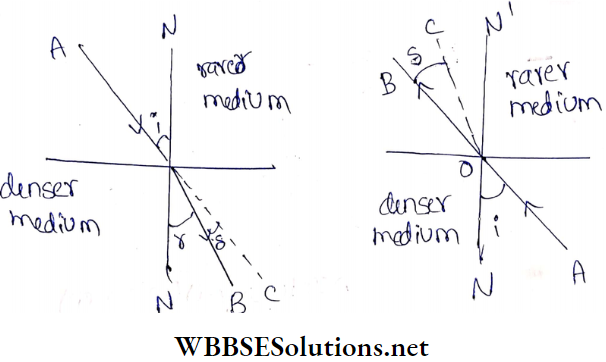
Class 12 Physics Unit 6 Optics Chapter 2 Refraction Of Light Deviation Of Ray

Refraction from rarer to denser medium:

If the ray travels from an optically rarer medium to a denser medium, say from air to glass, the refracted ray bends towards the normal. Here i>r.

Refraction from denser to the rarer medium:

If the ray travels from denser to rarer medium, say from glass to air, the refracted ray bends away from the normal Here r>i.

Read and Learn More Class 12 Physics Notes

Refraction Of Light Laws Of Refraction

Refraction of light is governed by the following two laws, called
laws of refraction.

  1. The incident ray, the refracted ray and the normal at the point of incidence lie on the same plane.
  2. The ratio of the sine of the angle of Incidence to the sine of the angle of refraction is constant.
  3. This constant depends on the nature of the two concerned media and the colour of the ray used.

This second law of refraction is known as Snell’s law, named after Willebrord Snellius (1580-1626)

Refractive Index

If i is the die angle of incidence and r is the angle of refraction, then according to the second law,

⇒ \(\frac{\sin i}{\sin r}=\mu\) (pronounced as ‘mu’) = constant.

This constant is called the refractive index of the second medium concerning the first medium.

The value of the refractive index depends on:

  1. Nature of the two concerned media and
  2. Colour of the Incident light.

Whatever may be the value of the angle of incidence, the value of the refractive index will remain constant if the colour of the incident light (i.e., frequency) and the two media remain unchanged

Μ has no unit

Short Notes on Snell’s Law

Normal Incidence:

If a ray of light is incident perpendicularly on a refracting surface, then / = 0. According to Snell’s law

π sinr = sin 0 = 0 or, r = 0

So, the ray suffers no deviation

Relative refractive index:

When light passes from medium a into another medium b, the ratio of the sine of the angle of incidence to the sine of the angle of refraction is called the refractive index of medium b concerning medium a. It is denoted by and i.e.,

aμb=  \(\frac{\sin i}{\sin r}\)

[i = angle of incidence, r = angle of refraction]

This refractive index is called the relative refractive index. According to the principle of reversibility of light—a ray of light will follow the same path if its direction of travel is reversed.

Following this principle, we can say that the ray BO in medium b when incidents at an angle r on the interface of the second medium a, refracts at an angle i along the path OA. Comparing this figure with it is the opposite phenomenon.
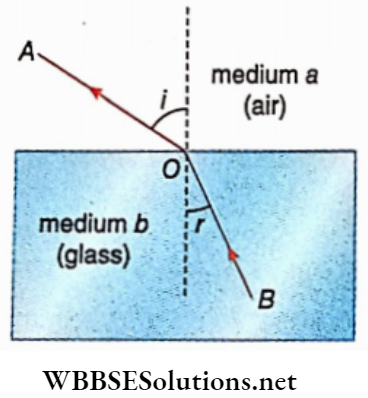
Class 12 Physics Unit 6 Optics Chapter 2 Refraction Of Light Relative Refraction Index

Thus, \(b^{\mu_a}=\frac{\sin r}{\sin i}\)

Here bμa is the refractive index of medium a concerning medium b.

So, \(a_a \mu_b \times{ }_b \mu_a=\frac{\sin i}{\sin r} \times \frac{\sin r}{\sin i}\)

= 1

Or, aμb = \(\frac{1}{b^\mu}\)

For example, if the refractive index of water concerning air is \(\frac{4}{3}\), then the refractive index of air concerning water is\(\frac{3}{4}\)

WBCHSE class 12 physics notes Absolute refractive index:

When light is refracted from a vacuum to another medium, the ratio of, the sine of the angle of incidence to the sine of the angle of refraction is called the absolute refractive index of the medium

If the angle of incidence is i and the angle of refraction is r, then the absolute refractive index of the medium,

⇒ \(\mu=\frac{\sin i}{\sin r}\)

Therefore, the relative refractive index of a medium concerning a vacuum is the absolute refractive index of that medium. The refractive index of a vacuum is 1.

In general, the refractive index of a medium relative to an air medium is considered as the refractive index of that medium. But it is not absolute, 1 refractive index of the medium

It is an experimental fact that the difference in the values of the refractive index of a medium concerning air and its absolute refractive index is very small. For example, at STP, the absolute refractive index of air is 1.0002918. So the refractive index of any medium concerning air may be considered as its absolute refractive index

For example, the refractive index of glass is 1.5 which means that the refractive index of glass concerning air is 1.5. At STP, the absolute refractive index of air is 1.0002918 and the refractive index of glass concerning air is 1.5. Thus, the absolute refractive index of glass = \(\frac{1.5}{1.0002918}\) = 49956 ≈1.5 The Absolute refractive index of a medium is denoted by μ. If there is more than one medium μ1, μ2, μ3 then is used.
WBCHSE Class 12 Physics Notes For Refraction Of Lights

WBBSE Class 12 Refraction of Light Notes

Optical Density of a Medium

If the absolute refractive index (μ1) of any medium is greater than that of another medium (μ2), then the first medium is called optically denser and the second medium is called optically rarer. So, μ12 if then medium 1 is optically denser concerning medium 2 i.e., medium 2, is optically rarer concerning medium 1.

The optical density of a medium has no relation with its physical density or specific gravity. For example, the specific gravity of turpentine oil is 0.87 and that of water is 1. But the refractive index of turpentine oil is 1.47 and that of water is 1.33.

The refractive index of a medium depends on the colour of the incident light. It is greater for blue or violet than for red. The refracted ray in the case of violet light bends more than in the case of red light. The refractive index for yellow light is midway between these two.

So unless otherwise stated, the refractive index of a medium refers to yellow light.

Refractive indices of a few substances:
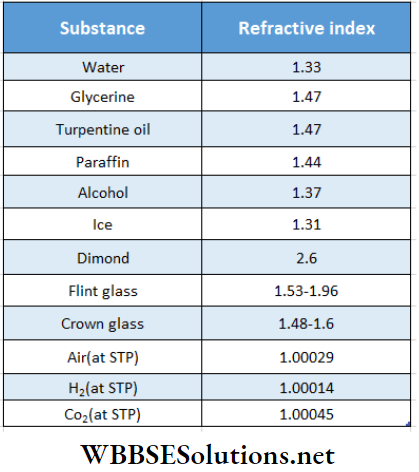
Class 12 Physics Unit 6 Optics Chapter 2 Refraction Of Light Refractive Indices Of A New Substances

Refractive Index and Related Terms

Relation between the velocity of light and refractive index:

According to the wave theory of light, the velocity of light is different in different media. If pt is the absolute refractive index of a medium, then

μ = \(\frac{\text { velocity of light in vacuum }(c)}{\text { velocity of light in that medium }(v)}\)

∴ Speed of light in free space = ft x speed of light in that medium

For any medium μ > 1, so speed of light in a vacuum is greater than that in any medium. Thus, the speed of light is maximum in a vacuum.

Accordingly, if and is the refractive index of the medium b concerning medium a, then

⇒ \(a^{\mu_b}=\frac{\text { velocity of light in medium } a}{\text { velocity of light in medium } b}\)

= \(\frac{v_a}{v_b}\)

Medium b is denser than medium a then aμb > 1 and in this case va>vb.

The velocity of light in a denser medium is less than the velocity of light in a rarer medium. The velocity of light in a medium decreases with the increase of its refractive index.

Thus if the velocity of light in medium b is lesser, i.e., medium b is optically denser, and aμb > 1 i.e., sin i>sinr or i< r. Thus, the angle of refraction is less than the angle of incidence, so the refracted ray bends towards the normal.

From the above discussion, it is clear that refraction variation in the speed of light in different media

Relation between relative refractive index and absolute refractive index:

If μ a and μb are absolute refractive indices of media a and b respectively

⇒ \(\mu_a=\frac{c}{v_a} \text { and } \mu_b=\frac{c}{v_b}\)

So relative refractive index of medium b concerning medium a,

⇒ \({ }_a=\frac{v_a}{v_b}=\frac{\frac{c}{v_b}}{\frac{c}{v_a}}=\frac{\mu_b}{\mu_a}\)

Relation of the wavelength of light with refractive index:

The relative refractive index between two media depends on the wavelength of light. Cauchy’s equation for the dependence of refractive index on the wavelength of light is

⇒ \(\mu=A+\frac{B}{\lambda^2}\)
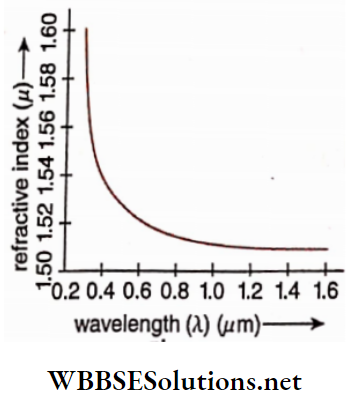
Class 12 Physics Unit 6 Optics Chapter 2 Refraction Of Light Relation Of Wavelength Of Light

Here A and B are two constants; their values are different in different media. The refractive index of a medium decreases if the wavelength of light increases. The graph shows the variation of n with μ  with λ of BK7 glass.

In a medium apart from free space different coloured light travels at different speeds. In a particular medium red travels the fastest and violet travels the slowest. Thus refractive index of any medium for the red colour is the lowest and that for the violet colour is the highest. This is the reason why white light is dispersed

Relation of temperature with refractive index:

Generally, the refractive index of a medium decreases if the temperature of the medium increases. For a solid medium this change is small, for a liquid it is moderate and for a gas it is remarkable

It is to be remembered that, velocity, intensity and wave¬ length of light change due to refraction but its frequency and phase remain unchanged

WBCHSE class 12 physics notes Generalised Form of Snell’s Law

Let AB be the surface of the separation of two media 1 and 2. Medium 2 is denser and medium 1 is rarer. PO is the incident ray at the point O on the surface of separation and OQ is A the refracted ray at the point O . Let angle of incidence = i1 angle of refraction = i2

By Snells law \(\frac{\sin l_1}{\sin i_2}\)

We known \({ }_1 \mu_2=\frac{\mu_2}{\mu_1}\)

∴ \(\begin{equation}\frac{\sin i_1}{\sin i_2}=\frac{\mu_2}{\mu_1} \quad \text { or, } \mu_1 \sin i_1=\mu_2 \sin i_2\end{equation}\) …………………………. (1)

So for n number of media, it can be written as

\(\mu_1 \sin i_1=\mu_2 \sin i_2=\cdots=\mu_n \sin i_n\) …………………. (2)

This equation is known as the generalised form of Snell’s law

WBCHSE class 12 physics notes

Refraction Of Light Laws Of Refraction Numerical Examples

Example 1. A ray of light is incident from water on the surface of separation of air and water at an angle of 30°. Calculate the angle of refraction in air mu \(\frac{4}{3}\)
Solution:

Let the angle of refraction of the ray of light in the air be r

Since the ray of light is refracted from water to air,

⇒ \(w^\mu{ }_a=\frac{\sin i}{\sin r}\)

Or, \(\frac{1}{a^{\mu_w}}=\frac{\sin 30^{\circ}}{\sin r}\)

Or, \(\frac{1}{\frac{4}{3}}=\frac{1}{2 \sin r}\)

Or, \(2 \sin r=\frac{4}{3}\)

Or, \(\sin r=\frac{2}{3}\)

= 0.666

= sin 41.8°

or = r= 41.8°
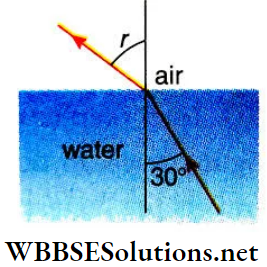
Class 12 Physics Unit 6 Optics Chapter 2 Refraction Of Light Refraction In Air

Example 2. A ray of light is incident on a block of glass in such a way that the angle between the refracted ray and the refracted ray is 90°. Determine the relation between the angle of incidence refractive index of
Solution:

Here angle of incidence = i

The angle of reflection = i, angle of refraction = r

The angle between the reflected ray and the refracted ray = 90°

According to the

i+90°+r= 180°

Or, r = 90°-i

The refractive index of glass,

μ = \(\mu=\frac{\sin i}{\sin r}=\frac{\sin i}{\sin \left(90^{\circ}-i\right)}\)

= \(\frac{\sin i}{\cos i}\)

= tan i
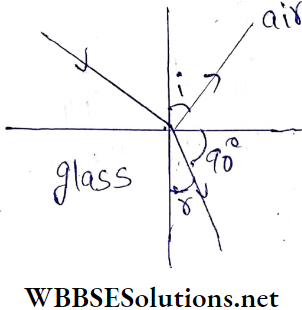
Class 12 Physics Unit 6 Optics Chapter 2 Refraction Of Light Reflected Ray

Example 3.  The refractive index of glass is 1.5 and the refractive index of water is 1.33. If the velocity of light in glass is 2 × 10⁸ m s1 what is the velocity of light In water?
Solution:

μg = \(\frac{\text { velocity of light in vacuum }}{\text { velocity of light in glass }\left(v_g\right)}\)

Or, velocity light in a vacuum

Again, \(\mu_w=\frac{\text { velocity of light in vacuum }}{\text { velocity of light in water }\left(v_w\right)}\)

Or, Velocity of light in vacuum = μw. vw

μg vg= μw vw

Or, \(\frac{\mu_g v_g}{\mu_w}=\frac{1.5 \times 2 \times 10^8}{1.33}\)

= 2.26x × 108 m s1

Practice Problems on Refractive Index

Example 4. A monochromatic -ray of light-, is refracted from the vacuum. to a medium of refractive index pi. Determine the relation of the wavelengths of light in vacuum and in glass
Solution:

μ = \(\frac{c}{v}=\frac{n \lambda_0}{n \lambda}=\frac{\lambda_0}{\lambda}\)

So, λ0 = μ λ

[Here, c and v are the velocities of light in vacuum and the medium respectively; n = frequency of light, which remains unchanged on refraction λ0, λ = wavelengths in vacuum and in the medium respectively.]

Example 5. If a ray of light is incident on a plate inside the water at an angle of 45°, what is the angle of refraction inside the plate? Given that the absolute refractive Indices of the plate and water are 1.88 and 1.33 respectively.
Solution:

Let the angle of refraction inside,n-rriDT.tile plate be r

Here , \(w^{\mu_g}=\frac{\sin i{ }^0}{\sin r} \text { or, } \frac{\mu_g}{\mu_w}=\frac{\sin i}{\sin r}\)

Or, \(\frac{1.88}{1.33}=\frac{\sin 45^{\circ}}{\sin r}\)

Or, in r = \(\frac{1}{\sqrt{2}} \times \frac{1.33}{1.88}\) = 0.5

= \(\frac{1}{2}\)= sin 30°

r = 30°

Class 11 Physics Class 12 Maths Class 11 Chemistry
NEET Foundation Class 12 Physics NEET Physics

Example 6. How much time will sunlight take to pass through the glass window of thickness 4 mm ? μ of glass =1.5.
Solution:

Velocity of sunlight in a vacuum or air,

C = 3×10⁻⁸m s-1

Thus velocity in a medium of refractive index μ

u = \(v\frac{c}{\mu}\)

So, to cross a thickness d, the time taken by light,

t = \(\frac{d}{v}=\frac{d \mu}{c}\)

= \(\frac{\left(4 \times 10^{-3}\right) \times 1.5}{3 \times 10^8}\)

[here d= 4 mm = 4 ×10m]

= 2 × 10-11 s

Example 7. Green light of wavelength 5460 A°Is incident on an airglass interface. If the refractive index of glass is 1.5 what will be the wavelength of light In glass?
Solution:

The wavelength of the light in air, A0 = 5460 A°

The refractive index of glass concerning air, μ = 1.5

If the wavelength of the light In glass is λ, then

= \(\frac{\lambda_0}{\lambda}\)

Or, λ = \(\frac{\lambda_0}{\mu}=\frac{5460}{1.5}\)

= 3640 A°

WBCHSE class 12 physics notes

Refraction Of Light Deviation Of A Ray

During reflection or refraction, the change In the direction of the tight is called its deviation.

The angle between the refracted ray and the direction of the incident ray gives the measure of deviation.

Deviation of incident ray AO, which after refraction proceeds along OD instead of OC. So the deviation of ray, S = ∠BOC
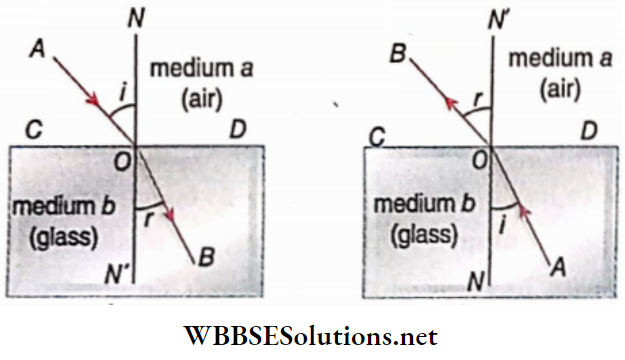
Class 12 Physics Unit 6 Optics Chapter 2 Refraction Of Light Medium Glass And Medium Air

Now, δ = ∠BOC = ∠N’OC- ∠N’OB

= ∠AON- ∠N’OB = i-r

We know. If the angle of Incidence Increases, the angle of refraction also Increases

For normal Incidence, i = 0 thus r = 0 and so δ = 0 (minimum).

For  i = 90°, δ Is maximum

For refraction to a rarer medium from a denser medium, the angle of refraction is greater than the angle of incidence, l.e., r> i.

Now, δ = ∠BOC = ∠N’OB- ∠N’OC

=∠N’OB-  ∠AON =r – i

Optics

Refraction Of Light Image Due To Refraction

Suppose, a beam of rays from a point object after refraction reaches our eyes in another medium. Now if dierefracted rays are produced backwards they are nice at a point It seems that the refracted rays are diverging from die second point. The second point Is the image of the lift’s first point. The image of any point object is formed in the same way. Thus a complete image of the object is formed.

If the object Is situated In a denser medium and Is viewed from a rarer medium, It appears (closer to the surface of separation. For example, If we look at a fish inside water in a pond it appeals nearer to the surface than the actual position.

If the object Is situated in a rarer medium and Is viewed from a denser medium, it appears to move away from the surface of separation, for example, our earth is surrounded by a thick atmospheric layer composed of different gases. Starlight comes to our eyes through this atmosphere. Hence we are the observers on Earth in a denser medium whereas the stars are in a vacuum i.e., in the rarer medium. So, the animal position of a star Is far behind its normal viewing position.

Object In denser medium end eyes In rarer medium:

Let the refractive indices of the two media a and b be μ1 and μ2, respectively and μ11, An object P situated in a is viewed from b. The surface of separation of a and b is a plane surface. A ray of light from P incident perpendicularly at A proceeds along AB without changing its direction. Another oblique ray PC incident at C is refracted along CD.

The refracted rays A B and CP when produced backwards meet at Q . So when the two refracted rays reach the rays of the observer. It will appear as if tyre two rays are coming from Q . So Q h the virtual Image of p.  In this case, the image rises towards the surface of the separation
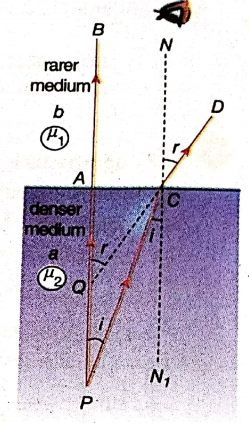
Class 12 Physics Unit 6 Optics Chapter 2 Refraction Of Light Denswe Medium And Eye In Rarer

If the angle of incidence and the angle of refraction are l and r.

⇒ \(\frac{\mu_2}{\mu_1}=\frac{\sin r}{\sin i}=\frac{\tan r}{\tan i}=\frac{A C / A Q}{A C / A P}=\frac{A P}{A Q}\)

For near-normal viewing, points A and C are close enough. So sin0 *s tarif

Hence, \(\frac{\mu_2}{\mu_1}=\frac{\sin r}{\sin i}=\frac{\tan r}{\tan l}=\frac{A C / A Q}{A C / A P}=\frac{A P}{A Q}\)………………………….(1)

If the observer is In the air then μ1  = 1

Putting μ1 = 1 and μ2 =μ  (say) In equation (1) and writing AP = u, AQ =  v

We have \(\mu=\frac{A P}{A Q}=\frac{u}{v}\)

If d is die real deeds of the object then

μ = \(\frac{d}{\text { apparent depth of the object }}\)

Or, Apparent depth of the object = \(\frac{d}{\mu}\)

Hence apparent displacement

x = PQ = AP-AQ = d- \(\frac{d}{\mu}\)

= \(d\left(1-\frac{1}{\mu}\right)\)

Therefore, the apparent displacement of an object depends on the real depth (d) of the object and the refractive index (/z) of the denser medium.

The refractive index of water concerning air is|. If an object immersed in water is observed vertically from above the water, then its apparent displacement.

x = \(d\left(1-\frac{1}{4 / 3}\right)=\frac{d}{4}\)

General case:

The apparent depth of an object when viewed from the air through successive media of thicknesses d1 d2, d3 ‘ ……….. dn having refractive indices μ1,  μ2, μ3 ‘ ……….. μn  respectively is

= \(\frac{d_1}{\mu_1}+\frac{d_2}{\mu_2}+\frac{d_3}{\mu_3}+\cdots+\frac{d_n}{\mu_n}=\sum_{i=1}^n \frac{d_i}{\mu_i}\)

Its apparent displacement is

⇒ \(d_1\left(1-\frac{1}{\mu_1}\right)+d_2\left(1-\frac{1}{\mu_2}\right)+d_3\left(1-\frac{1}{\mu_3}\right)+\cdots+d_n\left(1-\frac{1}{\mu_n}\right)\)

= \(\sum_{i=1}^n d_i\left(1-\frac{1}{\mu_i}\right)\)

Object in rarer medium and eye in denser medium:

Let the refractive indices of the two media a and b be μ2 and μ2 respectively and μ2 > μ1 An object P is situated in the medium b and it is seen from the medium. The surface of separation of a and b is a plane surface.

A ray of light from P is incident perpendicularly at point A on the surface of separation and proceeds straight along AB through the medium a without changing its direction. Another oblique ray PC is incident at C and proceeds along CD after j refraction. The refracted rays AB and CD when produced backwards meet at Q. So when the two refracted rays reach the observer, they will.
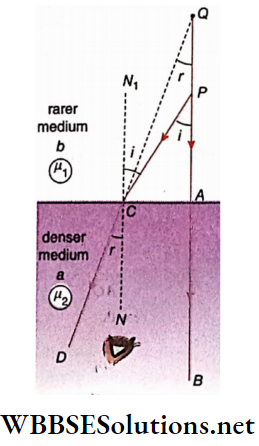
Class 12 Physics Unit 6 Optics Chapter 2 Refraction Of Light Rarer Medium And Eye

Appears to him that the two rays are coming from Q. So Q is the virtual image of P. In this case, the image appears to move farther away from the surface of separation.

If the angle of incidence and the angle of refraction of the incident ray at C are i and r respectively, then according to Snell’s law

μ1 sin i= μ2sin r

∴ \(\frac{\mu_2}{\mu_1}=\frac{\sin i}{\sin r}=\frac{\sin \angle P C N_1}{\sin \angle N C D}\)

Since the two lines PAB and NjCiV are parallel

∠PCN1 = ∠APC and ∠NCD = ∠AQC

⇒ \(\frac{\mu_2}{\mu_1}=\frac{\sin \angle A P C}{\sin \angle A Q C}=\frac{\frac{A C}{C P}}{\frac{A C}{C Q}}=\frac{C Q}{C P}\)

If the points A and C are very close to each other i.e., if the ray PC is not so oblique, then CP ≈ AP and CQ ≈ AQ

∴ \(\frac{\mu_2}{\mu_1}=\frac{A Q}{A P}\)…………. (3)

If the rarer medium in which the object is situated is air then = 1.

Putting μ1 = 1 and μ2= p (say) in equation (3) we get

⇒ \(\mu=\frac{A Q}{A P}\)

The refractive index of the denser medium concerning air apparent height of the object from

= \(\frac{\text { the surface of separation }}{\text { real height of the object from the surface of separation }}\)

If the real height of the object, AP = μd, then

= \(\mu\frac{\text { apparent height of the object }(A Q)}{d}\)

Or, AQ = μd ………………… (4)

So the apparent displacement of the object

=PQ = AQ – AP – μd-d = (μ-1) d

WBCHSE class 12 physics notes General case:

The apparent height of an object in the air when viewed from a medium of refractive index pn through successive media of thicknesses d1 d2, d3 ‘ ……….. dn having refractive indices, μ1,  μ2, μ3 ‘ ……….. μn   respectively is

⇒ \(\mu_1 d_1+\mu_2 d_2+\cdots+\mu_n d_n=\sum_{i=1}^n \mu_i d_i\)

Its apparent displacement is

⇒ \(\left(\mu_1-1\right) d_1+\left(\mu_2-1\right) d_2+\cdots+\left(\mu_n-1\right) d_n\)

= \(\sum_{i=1}^n\left(\mu_i-1\right) d_i\)

Let an object in a medium of refractive index fly be viewed from a medium of refractive index  Then we have,

= \(\frac{\text { Apparent depth of the object }}{\text { real depth of the object }}=\frac{\mu_2}{\mu_1}\)

=  \({ }^1 \mu_2\)

If the object is situated in a comparatively denser medium, then μ12.

In that case, apparent depth < real depth. If the object is situated in a comparatively rarer medium then μ12 In that case, apparent depth > real depth

Image Formed by Oblique Incident Rays

In the last section, we talked of almost normal viewing. For more B oblique incidence, the apparent displacement is higher
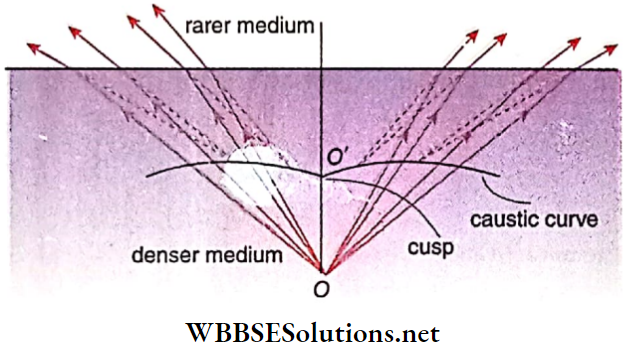
Class 12 Physics Unit 6 Optics Chapter 2 Refraction Of Light Oblique Incident Rays

A point object O in an optically denser medium (say, water) is viewed from a rarer medium (say, air), at different angles. For different positions of the observer, the locus of the different positions of the image is a curved line. This curved line is called a caustic curve. The curve has two parts. These two parts meet at a point O’, known as the cusp. The image of an object at O when viewed vertically downward, is formed, at O’.  shows how the images A’, B’, C’, etc. of different points A, B, C, etc. on the base of a vessel or tank containing water will appear to an observer located at a given position. It is evident
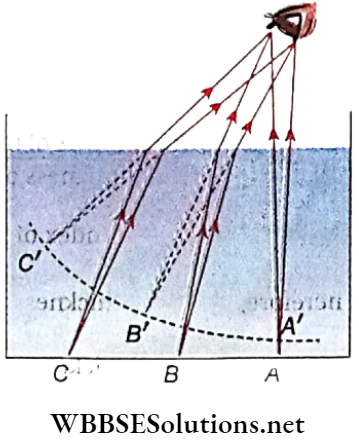
Class 12 Physics Unit 6 Optics Chapter 2 Refraction Of Light Cusp Of Vertically Downward

The image for normal incidence is at the lowest position. The other images go on rising as the oblique rays from the base produce the images. The image of the base of the vessel will be a curved surface indicated by A’B’C’. With the increase of the distance of the base of the vessel from the eye, the curved surface appears, to rise higher. So if an observer stands in a shallow pond having equal depth everywhere, it appears to him that the pond near his feet is the deepest

Image of an Object under a Parallel Slab

ABCD is a parallel glass slab. Its thickness is d and its refractive index μ,  P is a point object placed in air under the surface AB of the slab. A ray of light PX normally incident on AB goes undeviated along XY. Another ray PQ incident obliquely is refracted along QR. After that, the ray is further refracted along RS. Since the two faces AB and DC of the glass slab are parallel, the rays

PQ and RS will be parallel. So an observer from above the slab will see the image of P at P’. PP’ is the apparent displacement of the point object towards the observer. The normal NQN1 at Q intersects P’R at M. The quadrilateral PP’MQ is a parallelogram

PP’ = QM

The Apparent Displacement of the point object

∴ \(d\left(1-\frac{1}{\mu}\right)\)

PQ and RS will be parallel. So an observer from above the slab will see the image of P at P’. PP’ is the apparent displacement of the point object towards the observer.

The normal NQN1 at Q intersects P’R at M. The quadrilateral PP’MQ is a parallelogram.

∴ PP’ = QM

∴ The apparent displacement of the point object

= PP’ = QM

= d(1- \(\frac{1}{\mu}\))

So the apparent displacement of an object does not depend on the position of the object under the lower face of the glass slab. It only depends on the thickness of the slab (d) and the refrac¬ index of its material (μ).

 Optics

Refraction Of Light Some Examples Of Refraction

A coin immersed in water:

A coin is placed at the bottom of a pot such that the coin is just not visible. If eyes are set at the same position and the pot is now filled with water, the coin becomes visible. Because the rays from P are refracted from denser to rarer medium and are bent away from the normal, they reach our eyes. As a result, the refracted rays appear to diverge from P’, i.e., the virtual image of the coin is formed at P’, situated above the coin.
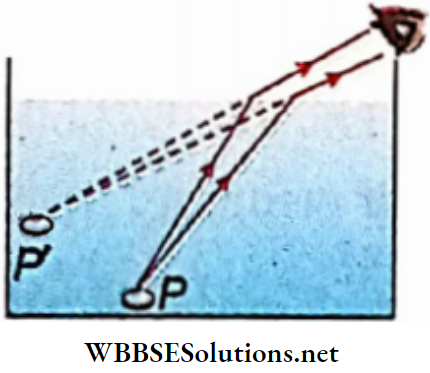
Class 12 Physics Unit 6 Optics Chapter 2 Refraction Of Light A Coin Immersed In Water

A rod partly immersed in water:

Let a straight rod be partly immersed in water. When the rod is held obliquely in water, the portion of the rod in water will appear to be bent upward [Fig. 2.20]. The reason is the same as above. The light rays coming from the portion immersed in water are refracted from denser to rarer medium and hence bent away from the normal. So point A of the rod appears to be raised at B. This happens for every point of the immersed portion of the rod
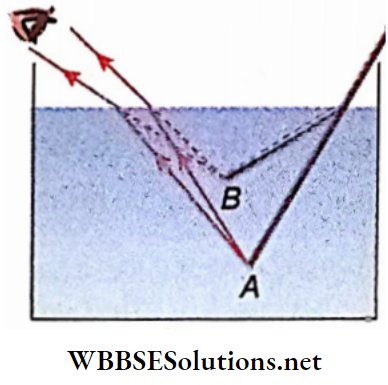
Class 12 Physics Unit 6 Optics Chapter 2 Refraction Of Light A Rod Partly Immersed In Water

Object and medium having approximately equal refractive index:

An object becomes invisible when it is sur¬ rounded by a medium having a nearly equal refractive index. Since the refractive indices of both of them are almost the same, negligible refraction does occur from their surface of separation, and for refraction lending of light is negligible. i.e., it travels undefeated. As a result, the surface of separation is not visible. ff99Wt9rf . The refractive indices of glycerine and glass are almost equal. So when a glass rod is immersed in glycerine thiqÿrod is not visible

Multiple images in a thick glass mirror:

If an object is placed in front of a thick mirror with silvered glass at the mirror at the back if a surface object is viewed from a slanting direction, a series of images are formed.

When ray PA is incident on the front face at point A, a very small portion of the light is reflected along AK producing a faint image at P1. The remaining larger portion of the light is refracted into the mirror along AB and is reflected along BC from the silvered surface. A large portion of this reflected ray within the glass comes out along CL producing the second image P2 which is the brightest of all the images.

The remaining part of the ray CD is reflected from surface Y to the silvered surface where it is again reflected. The process continues and gradually fainter images are formed. The different images lie on the line drawn perpendicular to the surface X from the object P.
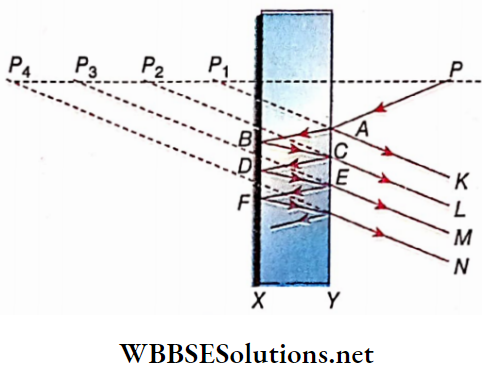
Class 12 Physics Unit 6 Optics Chapter 2 Refraction Of Light Multiple Iamges In A Thick Glass Mirror

The ray BC, which is the first reflected ray from the silvered surface, is the brightest and it travels along CL. Consequently, image P2 is the brightest. Hence the brightest second image is considered to be the image of the object. The more oblique the incident rays are, the more the amount of reflection from the front surface of the mirror and the brightness of the image P1 will increase accordingly

Apparent thickness of thick glass mirror:

In the case of a water-filled bowl, the depth of the bowl appears to be less. Similarly, a thick glass mirror seems to be less thick than it is.

We have, \( \frac{\text { real thickness of mirror }}{\text { apparent thickness of mirror }}\)

= Refractive index of glass = \(\frac{3}{2}\)

Therefore, the apparent thickness of a mirror

= \(\frac{2}{3 }\) × Real thickness of the mirror

Refraction Of Light Class 12 Notes

Refraction Of Light Some Examples Of Refraction Numerical Examples

Example 1. There is a mark at the bottom of the beaker. A liquid with a refractive index of 1.4 is poured into it. If the depth then determines how much the (liquid is 3.5 cm mark appears to rise when it is viewed from above.
Solution:

If the object is in a denser medium and the observer is in a rarer medium, the refractive index of the denser medium relative to the rarer medium

= \(\frac{\text { real depth of the object }}{\text { apparent depth of the object }}\)

Or, 1.4 = \(\frac{3.5}{\text { apparent depth of the object }}\)

Or, apparent depth of the object = \(\frac{3.5}{1.4}\)

= 2.5 cm

Apparent upward displacement of the mark

= 3.5 – 2.5 = 1cm

Example 2.  There is a black spot at the bottom of a rectangular glass slab of thickness d and refractive index μ. When the spot is viewed perpendicularly from above, the spot appears to be shifted through a distance \(\frac{(\mu-1) d}{\mu}\) towards the observer. Prove it.
Solution:

The real depth of the black spot from the upper surface of

Let the apparent depth of the black spot from the upper surface of the glass slab be d2

Refractive index of glass \(\mu=\frac{d}{d_1}\)

Or, \(d_1=\frac{d}{\mu}\)

∴ The apparent displacement of the black spot towards the observed

= \(d-d_1=d-\frac{d}{u}\)

= \(d\left(1-\frac{1}{\mu}\right)=d\left(\frac{\mu-1}{\mu}\right)\)

Example 3.  In a beaker partly filled with water, the depth of water seems to be 9 cm. On pouring more water into it, the real depth of water is increased by 4cm. Now the apparent depth of water seems to be 12cm. Determine the refractive index of water and the initial depth of water in the beaker.
Solution:

Let the refractive index of water be ft and the initial| depth of water in the beaker be x.

μ = \(\frac{x}{9}\)

or, x = 9μ

When more water is poured into the beaker, the real depth of water becomes (x + 4) cm.

In the second case, μ = \(\frac{x+4}{12}\)

Or, 12 μ = x + 4 or; 12 μ = 9 μ + 4 Or, 3 μ= 4

∴ μ = \(\frac{4}{3}\)

μ = 1.33

Initial depth of water in the beaker.

x = 9 μ = 9 ×  \(\frac{4}{3}\)

= 12cm

Important Definitions in Refraction

Example 4. A small air—bubble exists inside a transparent cube of side 15 cm each. The apparent distance of the bubble observed from one face is 6 cm and from the opposite face its apparent distance becomes 4 cm. Determine the real distance of the bubble from the first face and the refractive index of the material of the cube
Solution:

Let the real distance of the bubble from the first face be x cm.

The real distance of the bubble from the opposite face = (15-x) cm

Let the refractive index of the material of the cube be ft.

We know if the object lies in a denser medium and eye in the rarer medium,

μ = \(\frac{\text { real distance }}{\text { apparent distance }}\)

In the first case , μ=  \(\frac{x}{6}\)

In the second case,  μ  = \(\frac{15-x}{4}\)

⇒ \(\frac{x}{6}=\frac{15-x}{4}\)

Or, 4x = 90- 6x

Or, 10x = 90

Or, x = 9cm and

mu = \(\frac{9}{6}\) = 1.5

Therefore, the real distance of the bubble from the first face is 9 cm and the refractive index of the material of the cube is 1.5

Example 5. A vessel is filled with two mutually immiscible liquids with refractive indices μ1  and μ2. The depths of the two liquids are d1 and d2 respectively. There is a mark at the bottom of the vessel. Show that the apparent depth of the mark when viewed normally is given by \(\left(\frac{d_1}{\mu_1}+\frac{d_2}{\mu_2}\right)\)
Solution:

The image of P is formed at Q due to refraction at the surface of separation B of the 1st and 2nd liquid. Another final image due to refraction in air from the second liquid is formed at R

For the first refraction:

⇒ \(\frac{\mu_1}{\mu_2}=\frac{B P}{B Q}\)

Or, \(B Q=\frac{\mu_2}{\mu_1} \cdot B P\)

⇒ \(\frac{\mu_2}{\mu_1} d_1\)

For the second refraction:

⇒ \(\frac{\mu_2}{1}=\frac{A Q}{A R}\)

Or, \(A R=\frac{A Q}{\mu_2}\)

= \(\frac{1}{\mu_2}(A B+B Q)\)

Or, \(A R=\frac{1}{\mu_2}\left(d_2+\frac{\mu_2}{\mu_1} d_1\right)\)

= \(\frac{d_2}{\mu_2}+\frac{d_1}{\mu_1}\)

The apparent depth of the mark P when viewed normally

= AR = \(\frac{d_1}{\mu_1}+\frac{d_2}{\mu_2}\)
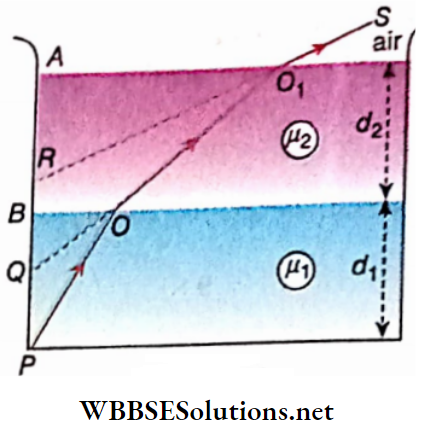
Class 12 Physics Unit 6 Optics Chapter 2 Refraction Of Light Mutually Immiscible Liquids

Example 6. A rectangular slab of refractive index [i is placed on another slab of refractive index 3. Both the slabs are of ror. the displacement of the image? the same dimensions. There is a coin at the bottom of the lower slab. What should be the value of n such that when viewed normally from above, the coin appears to be at the surface of separation of the two slabs?
Solution:

Let the thickness of each slab be d. According to the question the apparent depth of the coin =d

d = \(\frac{d}{\mu}+\frac{d}{3}\)

Or, 1= \(\frac{1}{\mu}+\frac{1}{3}\)

Or, \(\frac{1}{\mu}=\frac{2}{3}\)

Or, \(\frac{3}{2}\)

= 1.5

Example 7. A tank contains ethyl alcohol of a refractive index of 1.35 The depth of alcohol is 308 cm. A plane mirror is placed horizontally at a depth of 154 cm in it. An; object is placed 254 mm above the mirror. Calculate the apparent depth of the image formed by the mirror
Solution:

Depth of the mirror =1.54 m; object distance from the mirror = 0.254 m

The image of the object is formed at a distance of 0.254 m behind the mirror

= \(\frac{\text { real depth }}{\mu}\)

=\(\frac{1.794}{1.35}\)

= 1.33m

Example 8. A 20mm thick layer of water \(\left(\mu=\frac{4}{3}\right)\) 35mm thick layer of another liquid \(\left(\mu=\frac{7}{5}\right)\) = ‘ in a tank. A small coin lies at the bottom of the tank. Determine the apparent depth of the coin when viewed normally from above the water
Solution:

Real depth of the coin d+d = 20+ 35 = 55m m

∴ A parent depth of the coin

= \(\frac{d_1}{\mu_1}+\frac{d_2}{\mu_2}=\frac{20}{\frac{4}{3}}+\frac{35}{\frac{7}{5}}\)

= 15+ 25

= 40 mm

Refraction Of Light Class 12 Notes 

Example 9. If a point source is placed at a distance of 18 cm from the pole of a concave mirror, its image is formed at a distance of 9 cm from the mirror. A glass slab of thickness 6 cm is placed between the point source and the mirror such that the parallel faces of the glass slab remain perpendicular to the principal axis of the mirror the refractive index of glass is 1.5 what will be the displacement of the image?
Solution:

Let P be the position of the object and in the absence of the glass slab, Q be the position of the image formed by the concave mirror

u = 18 cm,

OQ = v= 9 cm

According to \(\frac{1}{v}+\frac{1}{u}=\frac{1}{f}\) we get,

= \(\frac{1}{-9}+\frac{1}{-18}=\frac{1}{f}\)

Or, f= -6 cm

If the glass slab of thickness 6 cm is placed between the point I source and the concave mirror, apparent displacement of the I Point source will take place towards the mirror. The rays coming from P appear to come from P’ after refraction.

The apparent displacement of P

PP’ = \(d\left(1-\frac{1}{\mu}\right)\)

= 6\(\left(1-\frac{1}{1.5}\right)\)

= 2cm

So in the second case, object distance u = -(18- 2) = -16 cm ; f = -6 cm; v = ?

We know, \(\frac{1}{v}+\frac{1}{u}=\frac{1}{f}\) Or, \(\frac{1}{v}+\frac{1}{-16}=\frac{1}{-6}\)

Or, \(\frac{1}{v}=\frac{1}{-6}+\frac{1}{16}=\frac{-10}{96}\)

Or, v = \(-\frac{96}{10}\)

= – 9.6 cm

Displacement of the image

QQ’ = OQ’ OQ – OQ = 9.6- 9 = 0.6 cm

Example 10. A plane is made of glass with a thickness of 1.5 cm. Its back surface is coated with memory. A man is standing at a distance of 50 cm from the front face of the mirror. If he looks at the mirror normally, where can he find his image behind the front face of the mirror? The refractive index of glass  = 1.5 
Solution:

The real depth of the mercury-coated surface from the upper surface of the mirror = 1.5 cm

If the apparent depth of the mercury coated mercury  cm, then \(\frac{1.5}{x}\) = 1.5 or, x= 1 cm

So the mercury-coated surface appears to be at n distance of 1 cm from the front face of the mirror.

‘Therefore, the distance of the man from the appetent position of the mercury-coated surface a = 50 +1  cm

So the distance of the Image from the apparent position of the mercury-coated surface =  51 cm

The distance of the Image of the man from the front tuifnee of the mirror =51 + 1 = 52 an

Example 11.  An observer can see the topmost point of a narrow rod of height through a small hole  The rod Is placed Inside a beaker. The beaker’s height is 3h and its radius Is h. When the beaker Is filled up to 2 h of its height with a liquid the observer can see the entire rod. What Is the value of the refractive Index of the liquid?
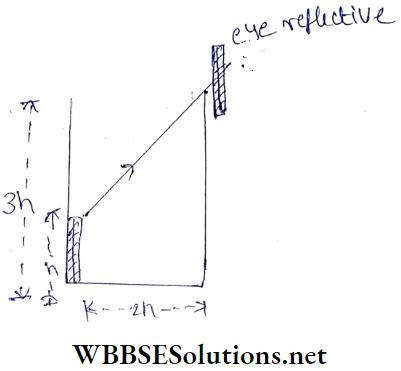
Class 12 Physics Unit 6 Optics Chapter 2 Refraction Of Light A Ray Light The Beaker Height And Radius

Solution:

Let us assume that  PQ is a thin straight rod kept in a beaker. B Is a small hole in the wall of the beaker. When the beaker is filled with a liquid up to a height of 2h, then Q can be seen through hole B.

Here, QD ray propagates through the liquid and gets refracted along DB in the air

According to ABRP is a square midpoint of the diagonal PB.
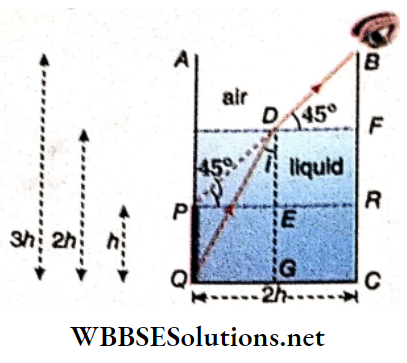
Class 12 Physics Unit 6 Optics Chapter 2 Refraction Of Light A Ray Light MidPoint Of The Diagnoal

Here DE= PE = h

Again, ∠BDP = 45°  [∴ ∠DPE ]

Since the object was placed in the denser medium, according to Snell’s law

⇒ \(\frac{1}{\mu}=\frac{\sin i}{\sin r}=\frac{\frac{Q G}{Q D}}{\sin 45}\)

Or, \(\frac{1}{\mu}=\frac{\frac{h}{\sqrt{5 h}}}{\frac{1}{\sqrt{2}}}\)

Since,  QD2=QG2+GD2=h2+(2 h)2= 5 h2

Or, \(\frac{1}{\mu}=\sqrt{\frac{2}{5}} \quad \text { of, } \mu=\sqrt{\frac{5}{2}}\)

Therefore, the required refractive Index of the liquid is \(\sqrt{\frac{5}{2}}\)

Example 12. A ray of light Incident at the Interface of glass and water at an angle of Incidence i. If the ray finally emerges parallel to the surface of water Then what will be the value of μg?
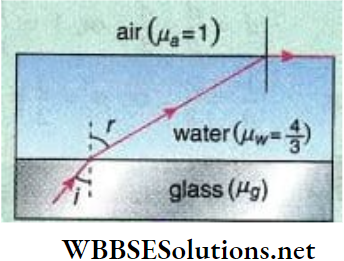
Class 12 Physics Unit 6 Optics Chapter 2 Refraction Of Light Interface Of Glass

Solution:

When refraction occurs due to the propagation of light rays from glim to water, we may write from Snell’s law,

⇒ \(\mu_g \sin i=\mu_w \sin r\) …………..(1)

Again, when refraction occurs due to the propagation of light rays from water to air, we may write from Snail * law

⇒ \(\mu_g \sin i=\mu_w \sin r\) …………..(2)

Therefore, the required refractive Index of glass is \(\frac{1}{\sin i}\)

Refraction Of Light Critical Angle’s Total Internal Reflection

We know, in refraction from denser to a rarer medium light | bents away from the normal. As a result angle of refraction ’ becomes larger than the angle of incidence.

L line AB represents the surface of the separation of water and air.

Ray P1 O travelling through water is incident at O on the surface- of separation. A part of the ray is reflected into the water along OR1 and another part is refracted into the air along OQ1:  The angle of refraction ∠Q1ON is greater than the angle of incidence ∠P1 ON1. The greater the angle of incidence, the greater the angle of refraction and in each case, both reflection and refraction will take place.

For a particular value of the angle of incidence, the angle of refraction becomes 90°, so that the refracted ray grazes the surface of separation. This limiting angle of incidence in the denser medium is called the critical angle for the two given media. Thus, ∠P2ON1 = critical angle (θc). In this case, the angle of refraction ∠NOQ2 = 90°. Here also a part of the incident ray is reflected to water along OR2.
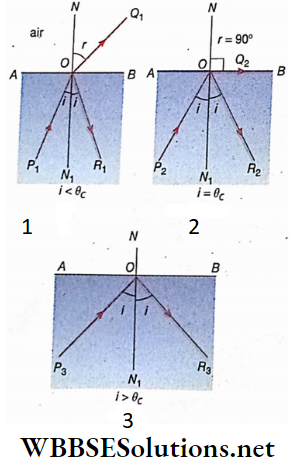
Class 12 Physics Unit 6 Optics Chapter 2 Refraction Of Light Critical Angle Of Total Internal Reflection

If the angle of incidence exceeds the critical angle i.e., if i  > θc [as in the case of the incident rayP3O ] no part of the incident ray is refracted in the second medium. The ray is completely reflected along OR3 into the first medium. This phenomenon is called total internal reflection. In this case, the surface of the separation of the two media behaves as a mirror.

Critical angle:

It is that particular angle of incidence of a ray of light for a given pair of media, passing from denser one to rarer one, for which the corresponding angle of refraction is equal to 90 0 and the refracted ray grazes along the surface of the interface separating the two media. The critical angle of a pair of media depends on the colour of the incident light and the nature of the two media.

For example, in the case of two particular media, the critical angle for red light is greater than that for violet light. Again, the critical angle of water to air is 49°, while that of glass to air is 42°. The statement, ‘critical angle of glass to air is 42° ‘ means that a . ray of light from glass being incident on the surface of separation of glass and water at an angle of 42°, should go along the surface of separation after refraction i.e., the refracted angle will be 90°.

Total internal reflection:

When a ray of light travelling from a denser medium to a rarer medium is incident at the surface of separation of the two media at an angle greater than the critical angle for the media, there is no refraction; rather the whole of the incident ray is reflected. This phenomenon is known as total internal reflection.

Refraction of light class 12 notes Condition of total internal reflection:

The conditions to be satisfied for total internal reflection are as follows

  1. The light must travel from a denser to a rarer medium.
  2. The angle of incidence must be greater than the critical angle for the two media

Reason for using the term “total’:

In ordinary reflection, a part of the incident light is reflected from the surface of separation and the rest is refracted. But in the case of internal reflection, no part of the incident light is refracted, rather the entire portion of the incident light is reflected to the first medium from the surface of separation of the two media. So this reflection is called total reflection.

Relation between critical angle and refractive index of the denser medium:

Let ∠P2ON1 = θc = critical angle between the two media, water and air, which

Impliesair concerning the angle to water of refraction is aμw, which is then 90°. If the refractive index

aμw = \(\frac{\sin \theta_c}{\sin 90^{\circ}}\)

Or,  sin θc = \(\frac{1}{a^{\mu_w}}\)

So, the value of critical depends on the refractive index of one medium concerning another

If the medium is a and b the,

⇒ \(\sin \theta_c=\frac{1}{b^{\mu_a}}=\frac{1}{\begin{array}{r}
\text { refractive index of denser medium } \\
\text {concerning rarer medium }
\end{array}}\)

= \(\frac{\mu_b}{\mu_a}=\frac{\text { absolute refractive index of medium } b}{\text { absolute refractive index of medium } a}\)

Refraction Of Light Critical Angle’s Total Internal Reflection Numerical Examples

Example 1. If the absolute refractive index of a medium is \(\sqrt{2}\), calculate the critical angle of glass to the medium. Given
Solution:

If the refractive index of glass concerning air is aμg, then

aμg= \(\frac{1}{\sin \theta_c}=\frac{1}{\sin 30^{\circ}}\)

= 2

If the refractive index of glass concerning the medium is mμg, then

aμg= \(\frac{a^{\mu_g}}{{ }_a \mu_m}\)

= \(\frac{2}{\sqrt{2}}\)

= \(\sqrt{2}\)

If the critical angle of glass to the medium is #c, then

sin = \(\sin \theta_c=\frac{1}{m^\mu}\)

= \(\frac{1}{m^\mu}=\frac{1}{\sqrt{2}}\)

= sin 45

Or, θc = 45

Example 2.  The refractive index of carbon disulphide for red light is 1.634 and the difference in the values of the critical angle for red and blue light at the surface of separation of carbon disulphide and air is 0°56/. What is the value of the refractive index of carbon disulphide for blue light
Solution:

Let the refractive index of carbon disulphide for red light = and circle angle =

Now, sin θr = \(\frac{1}{\mu_r}=\frac{1}{1.634}\)

= 0.6119 = sin 37.73

θr = 37.73

Let the critical angle for blue light be θb. The refractive index increases as the wavelength of light decreases. So the critical angle decreases.

∴ θbr

According to the Question,

θb = 37.73°-0°.56′

= 37.73°-0.93°

= 36.8°

So refractive index of carbon disulphide for blue light,

μb = \(\frac{1}{\sin \theta_b}=\frac{1}{\sin 36^{\circ} 48^{\prime}}\)

= \(\frac{1}{\sin 36.8^{\circ}}=\frac{1}{0.599}\)

= 1.669

Example 3. The refractive index of-diamond is 2.42,-which proves that all the beams of rays having an angle of incidence of more than 25° will be reflected, [sin 24.41° = 0.4132]
Solution:

If the critical angle is θc then

Sin θc = \(\frac{1}{\mu}=\frac{1}{2.42}\)

= 0.4312° = sin 24.41°

θc  = 24.41°

We know that if the angle of incidence of a ray of light is greater than the critical angle, the ray will be reflected. Here the critical angle is 24.41°. So rays of light having an angle of incidence greater than 25° will be reflected

Example 4. A ray of light will go from diamond to glass. What should be the minimum angle of incidence at the surface of separation of the two media, diamond and glass, so that the ray of light cannot be refracted in glass? μ of glass =1.51 and μ of diamond = 2.47; sin37.69° = 0.61134
Solution:

If the light ray is incident at the surface of separation of the two media diamond and glass at a critical angle, the ray is grazingly refracted in the glass. If the critical angle is QQ then

sin θc = \(\frac{1}{g^{\mu_d}}=\frac{1}{\frac{\mu_d}{\mu_g}}\)

= \(\frac{\mu_g}{\mu_d}=\frac{1.51}{2.47}\)

= 0.61134

= sin 37.69°

∴ θc  = 37.69°

So if the angle of incidence of a light ray is greater than 37.69° it | cannot be refracted in glass.

∴  Required minimum angle of incidence =37.69°

Refraction of light physics class 12 Examples of Applications of Refraction

Example 5. cube has a refractive Index μ1. There is a plate of refractive Index μ221) A ray travelling through the air is incident on the side face of the cube. The refracted ray Is an Incident on the upper face of the cube at the minimum angle for total internal reflection to occur. Finally, the reflected ray emerges from the opposite face. Show that if the angle of emergence Is Φ then sin = \(\sqrt{\mu_1^2-\mu_2^2}\)
Solution:

PQ = incident ray on the side face of the cube, QR = refracted ray inside 0′ the cube, S = reflected ray from the upper face of the cube, ST = emergent ray from the opposite face.

Let the critical angle for total reflection be θc

According to the question θ’c ≈θc

⇒ \(\sin \theta_c^{\prime} \approx \sin \theta_c=\frac{1}{2^{\mu_1}}=\frac{1}{\frac{\mu_1}{\mu_2}}=\frac{\mu_2}{\mu_1}\)

Angle of incidence of the ray RS = l = 90° – θc and angle of refraction -tf>

⇒ \(\sin \theta_c^{\prime} \approx \sin \theta_c=\frac{1}{2^{\mu_1}}=\frac{1}{\frac{\mu_1}{\mu_2}}=\frac{\mu_2}{\mu_1}\)  = Refractive index of air with respect to the cube

= \(\frac{1}{\text { refractive index of the cube with respect to air }}\)

Or, \(\frac{\sin i}{\sin \phi}=\frac{1}{\mu_1}\)

Or, sin Φ = μ1 sin i

= \(\mu_1 \sin \left(90^{\circ}-\theta_c\right)=\mu_1 \cos \theta_c\)

= \(\mu_1, \sqrt{1-\sin ^2 \theta_c}\)

= \(\mu_1 \sqrt{1-\frac{\mu_2^2}{\mu_1^2}}=\sqrt{\mu_1^2-\mu_2^2}\)
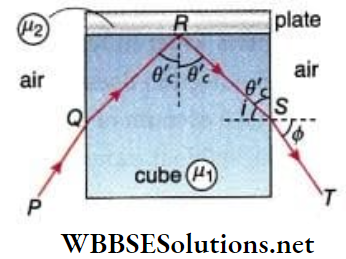
Class 12 Physics Unit 6 Optics Chapter 2 Refraction Of Light A Cube Refractive Index

Example 6. A ray of light travelling through a denser medium is incident at an angle i in a rarer medium. If the angle between the reflected ray and the refracted ray is 90° show that the critical angle of the two media, \(\theta_c=\sin ^{-1}(\tan i)\) 
Solution:

Suppose the angle of refraction in the medium =r

From  we get

i+ 90° + r = 180°

Or, r = 90° – i

According to Snell’s law.

⇒\(\frac{\sin l}{\sin r}={ }_1 \mu_2=\frac{\mu_2}{\mu_1}\)

Or, \(\frac{\sin i}{\sin \left(90^{\circ}-i\right)}=\frac{\mu_2}{\mu_1}\)

Or, \(\frac{\sin i}{\cos i}=\frac{\mu_2}{\mu_1}\)

Or, \(\tan i=\frac{\mu_2}{\mu_1}\)

If the critical angle for the two media is θc, then

⇒ \(\sin \theta_c=\frac{1}{{ }_2 \mu_1}\)

= \(\frac{1}{\frac{\mu_1}{\mu_2}}=\frac{\mu_2}{\mu_1}\)

= tan i

Or, \(\theta_c=\sin ^{-1}(\tan i)\)
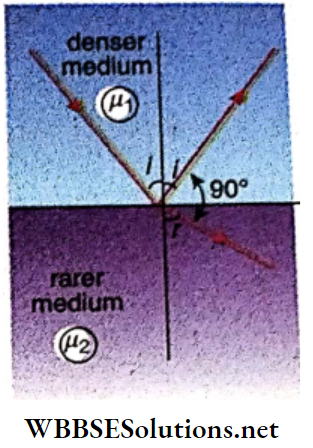
Class 12 Physics Unit 6 Optics Chapter 2 Refraction Of Light A Ray Light A Ray Of Light Travelling A Denser Medium

Example 7. A nail Is fixed up perpendicularly at the centre of a circular wooden plate. Keeping the nail at the bottom, the circular plate Is made to float In water. What should be the maximum ratio of the radius of the plate and the length of the nail so that the nail will be out of vision? Refractive index of water \(\frac{4}{3}\)
Solution:

AB Is the circular wooden plate and CD is the nail. Suppose, the radius of the plate =r and the length of the nail =h Since the nail Is not seen from the air, the angle of incidence of the ray DA will be greater than 0 and the ray will be reflected.
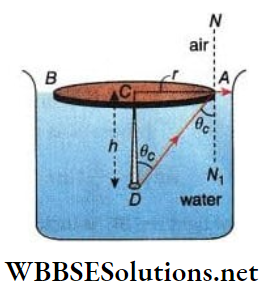
Class 12 Physics Unit 6 Optics Chapter 2 Refraction Of Light A Nail Is Fixed Perpendicularly At The Centre

We know, \(\sin \theta_c=\frac{1}{a^\mu{ }_w}=\frac{3}{4}\)

⇒  \(\cos \theta_c=\sqrt{1-\frac{9}{16}}=\frac{\sqrt{7}}{4}\)

⇒ \(\tan \theta_c=\frac{\frac{3}{4}}{\frac{\sqrt{7}}{4}}=\frac{3}{\sqrt{7}}\)

Or, \(\frac{r}{h}=\frac{3}{\sqrt{7}}\)

This is the required ratio

Example 8.  The Critical angle of glass relative to a liquid is 57° 20′. Calculate the velocity of light in the liquid. Given,  μ of glass = 1.58, velocity of light in vacuum = 3×10⁸ m s-1 sin 57° 20′ = 0.8418
Solution:

Critical angle of glass relative to the liquid,

θc = 57°20′

If the refractive index of glass concerning the liquid is {fiR then.

sinθc =\(\frac{1}{\nu_g}=\frac{1}{\frac{\mu_g}{\mu_l}}=\frac{\mu_l}{\mu_g}\)

⇒ \(\frac{\mu_l}{\mu_g}=\sin 57^{\circ} 20^{\prime}\)

= 0.8418

Or, \(\mu_l=0.8418 \times \mu_g=0.8418 \times 1.58\)

Again , \(\mu_l=\frac{\text { velocity of light in vacuum }}{\text { velocity of light in the liquid }}\)

The velocity of the light in the liquid

= \(\frac{3 \times 10^8}{\mu_l}=\frac{3 \times 10^8}{0.8418 \times 1.58}\)

= \(2.255 \times 10^8 \mathrm{~m} \cdot \mathrm{s}^{-1}\)

Example 9.  A transparent solid cylindrical rod has a refractive Index of. It Is surrounded by air. A light ray Is Incident at the midpoint of one end of the rod.  Determine the incident angle 8 for which the light ray grazes along the wall of the rod
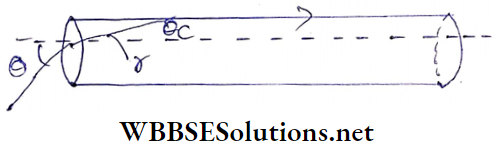
Class 12 Physics Unit 6 Optics Chapter 2 Refraction Of Light Light Ray Grazes Along The Wall Of The Rod

Solution:

For refraction of light at point B, we can write by applying Snell’s law

1 × sin θ = μ sin r

[where μ is the refractive index of the solid material)

or, sin θ = \(\frac{2}{\sqrt{3}} \sin r\) ……………………… (1)

The light ray BC is incident on point C making critical angle θc and propagates along CD

Thus, from Snell’s law,

μ = \(\frac{1}{\sin \theta_c}\)

Or, \(\theta_c=\sin ^{-1}\left(\frac{1}{\mu}\right)\)

=\(\sin ^{-1}\left(\frac{\sqrt{3}}{2}\right)\)

= 60°

r = 180°- (60° + 90°) = 30°

Hence from equation (1), we can write

θc = \(\frac{2}{\sqrt{3}} \sin 30^{\circ}=\frac{1}{\sqrt{3}}\)

Or, \(\sin ^{-1}\left(\frac{1}{\sqrt{3}}\right)\)
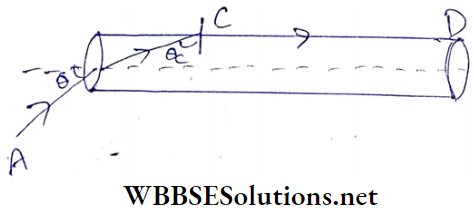
Class 12 Physics Unit 6 Optics Chapter 2 Refraction Of Light Snells Law

Examples of Total Internal Reflection

A test tube dipped in water: A glass test tube half filled with water is held obliquely in a beaker containing water

The empty portion of the Immersed test tube appears shining if It is seen from above. This happens due to the total internal reflection of light. For the empty portion of the tube, the light goes from a denser to a rarer medium. Rays which are incident at angles greater than the critical angle of glass and air (48.5°) arc are reflected. So this portion of the glass appears shining.
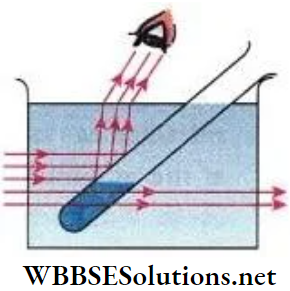
Class 12 Physics Unit 6 Optics Chapter 2 Refraction Of Light A Test Tube Dipped In Water

A portion of the tube filled with water does not glow because here light enters water In test tube from water in a beaker. Thus, total internal reflection does not occur here. In this discussion, we do not take into account the existence of the glass wall of the tube due to its negligible thickness.

A metal ball coated wHb lampblack Immersed In water:

If a metal ball coated will lampblack Is Immersed in water, the ball appears shining. Due to the coating of the lamp¬ black. a thin layer of air surrounds the surface of the ball. Rays incident at an angle greater than the critical angle of water and air, are reflected. The ball appears shining when the reflected rays reach the eyes of the observer.

Refraction of light physics class 12 Glass tumbler full of water:

A glass tumbler full of water Is held above eye level. If the upper surface of water In the tumbler is seen from any one side, the surface appears shining. Rays coming from the side of the tumbler are incident on the surface of the separation of water and air. Hence total internal reflection takes place at particular angles of slantness and the surface of the water appears shining.
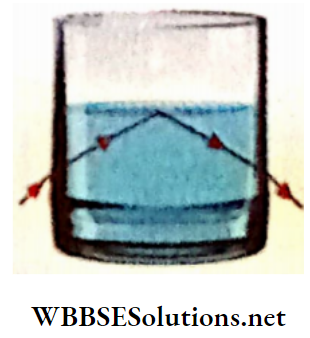
Class 12 Physics Unit 6 Optics Chapter 2 Refraction Of Light Glass Tumbler Full Of Water

Air bubbles:

The air bubbles rising through the water look shiny. Rays travelling through water are incident on the surface of the air bubbles. Those rays which are incident at angles greater than the critical angle are reflected. When these reflected rays reach the eyes of the observer, the hubbies appear shining. For the same reason, air bubbles existing In paper weights appear to be shining

Natural Examples Of Total Internal Reflection

Mirage: It Is an optical Illusion brought about by total internal reflection. There are two types of mirage, one observed in hot regions and the other observed In extremely cold regions.

1. Inferior mirage or mirage in the desert:

People travelling through the desert sometimes see water at a distant place which is an optical illusion, called an inferior mirage, or simply, a mirage.

During daytime, the lower regions of the atmosphere become hot¬ ter than the upper regions. So density of air in the lower regions is less than that in the higher regions. Let us consider the atmo¬ sphere to be made up of layers of air, one above the other. A ray of light starting from a distant tree (P) and travelling downward happens to be going from a denser to a rarer medium.
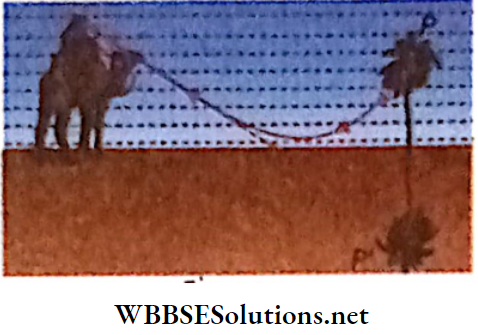
Class 12 Physics Unit 6 Optics Chapter 2 Refraction Of Light Inferior Mirage Or Mirage In Desert

So its angle of incidence at consecutive layers goes on increasing gradually till it exceeds the critical value when it is reflected due to total internal reflection. The traveller sees an inverted virtual image (P’) of the tree. Secondly, due to continuous temperature changes, there exists a temperature gradient in the layers which undergo a continuous change of density and hence in the refractive index as well. So the path of the rays coming through the layers of air is also continuously changing. Hence to the traveller, the image of the tree appears to be swaying. This completes the illusion of a pond lined with trees.

 2. Superior mirage or mirage in cold countries:

In cold countries, the temperature of air In the lower regions is lower than that of the upper region. So the density of air in the lower region is greater than that of the upper region. A ray of light starting from an object (P) travelling upwards, finds itself going from denser to rarer medium

So its angle of incidence at consecutive layers of air gradually increases till it reaches the critical value. Then it is reflected due to total internal reflection. To an observer, the ray appears to come from a point above, thus giving the impression that an inverted object (P’) is floating in the air which is an optical illusion. This phenomenon is called a superior mirage
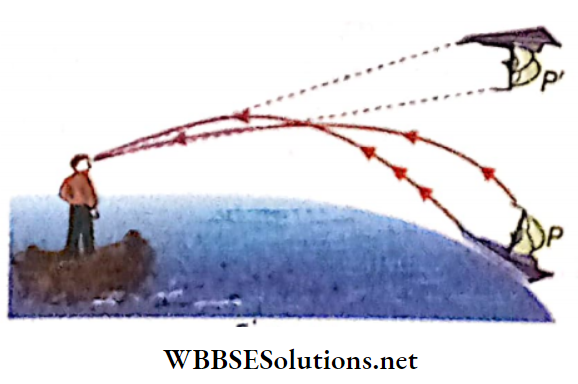
Class 12 Physics Unit 6 Optics Chapter 2 Refraction Of Light Superior Mirage

View of an observer inside water:

To the eye of an observer or a fish Inside water, all objects above water appear to exist in n cone of semi-vertical angle <19° which Is the critical angle of water and air. This happens due to total Internal reflec¬ tion of light.

If a ray of light travelling from a denser medium is Incident at the critical angle, the refracted ray grazes the surface of separation. Conversely, if a ray of light travelling from a rarer medium is incident at an angle of 90°, the angle of refraction In the denser medium becomes equal to the critical angle. The critical angle of water and air is 49°. So if a ray of light S1A coming from the rising sun AS1, along the surface of water reaches eye E along the direction AE, then the angle of refraction in water becomes 49°

As the eye cannot follow ray AS1, an observer inside water will sec the rising sun along the line EAC and this line will make an angle of 49° with the line OE. Similarly, the setting sun S2 will be seen along the line EBD and this line also will make an angle of 49° with the line OE. So all the objects above water appear to exist in a cone of angle 98° to the eye of a fish or observer underwater.
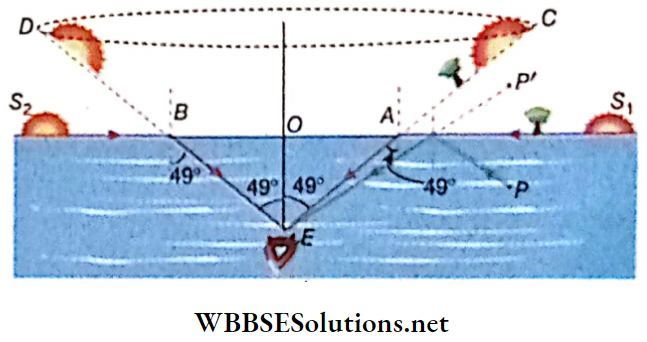
Class 12 Physics Unit 6 Optics Chapter 2 Refraction Of Light Eye Of A fish Or Observe Under Water

It Is to be noted that the sun describes an arc of 180° to earthbound observers but to the eyes of a fish it describes an arc of 98°.

1.  Surface of water to the eye of an observer inside water:

The diameter of the circular base of the cone AEB is AB. If an observer keeping his eye on E looks at the circular section of water, he can see any object lying above water. But If the observer looks at the rest of the portion of water other than the circular portion, then

  1. He cannot see any object above water, rather
  2. He can see the images of the objects inside the water.

Reason explaining 1st Incident:

Any ray of light coming from outside water can reach point E only through the circular section but cannot reach point E if it comes through die remaining portion.

Reason explaining 2nd Incident:

Suppose the ray of light emerging from the object situated In water, reaches die point E after reflection from the surface of water. This reflection will take place from the surface of the water excluding the circular portion.

This reflection will be a total reflection. For example, if a ray of light from the object P situated inside water, is incident on the surface of water, the angle of incidence exceeds 49°. So, the ray after total reflection from the surface of the water reaches the eye of the observer and he observes the dead object, at P’.

So to the observer situated inside water, the surface of the water appears as a mirror with a circular hole in it, because he sees the objects situated outside water through the circular section and sees the images of the objects inside water in die remaining action of the surface of the water. The radius of the circular hole is OA or OB.

2. Determination of the radius of the hole:

Let the radius of the hole =OA = OB = r and OE – h. If the critical angle is θ then ∠OEA = Qc

⇒ \(\tan \theta_c=\frac{O A}{O E}=\frac{r}{h}\)

Or, \(r=h \tan \theta_c=h \frac{\sin \theta_c}{\cos \theta_c}\)

= \(h \frac{\sin \theta_c}{\sqrt{1-\sin ^2 \theta_c}}\)

Since ( sin \(\theta_c=\frac{1}{\mu}\))

= \(h \frac{\frac{1}{\mu}}{\sqrt{1-\frac{1}{\mu^2}}}\)

r = \(\frac{h}{\sqrt{\mu^2-1}}\)

Refraction of light physics class 12 Sparkling of diamond:

Diamond is notable for its sparkle and shine. This characteristic of a diamond is based on total internal reflection. The refractive index of a diamond is 2.42 and its critical angle relative to air is only 24.4°. This value is quite small as compared to other pairs of media.

Therefore, there is a high probability of total internal reflection in the case of diamond. If the diamond is cut properly, it will have a large number of faces. Ray of light entering through one face undergoes total internal reflection at several faces. As the rays of light enter through many faces and are confined inside they emerge together through only a few faces, these faces appear to sparkle and shine

Transmission of Light through Optical Fibre

Optical fibre:

A beam of light can be sent from one place to another through an optical fibre made of glass, quartz or optical-grade plastic, by following successive total internal reflections. As water can be sent from one place to another through a hollow pipe, a fibre can allow light to flow through it from one place to another. Hence, an optical fibre is often loosely called a light pipe.

Construction and principle of action:

An optical fibre is a long and very thin pipe. Its diameter is about 10 × 10-6 metres. The internal section of the die pipe is called the core. It is a die core through which light travels from one point to another. Above the core, there is a coating of a substance having a refractive index less than that of the core. This coating is called cladding.

A ray of light entering die fibre through one face undergoes successive total internal reflections at the surface of separation of core and cladding and emerges through the other face [Fig. 2.38].: As total internal reflection of light takes place inside a fibre, the intensity of the light remains almost the same.
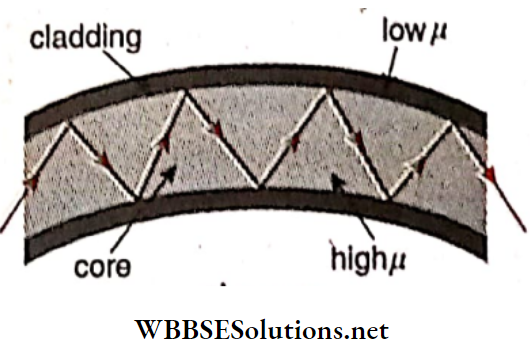
Class 12 Physics Unit 6 Optics Chapter 2 Refraction Of Light Constraction And Principle Of Action

The image of a large object cannot be sent through a single fibre. In that case, bundles of fibres or cables of fibres are used. A cable contains about a thousand fibres. The image of an object is focused on one end of the bundle. If the order of die fibres is properly maintained, the image obtained at the other end will be an exact reproduction. In, the letter ‘T’ has been focussed at one end of the die bundle and an exact image of ‘T’ has been obtained. Light rays from the different portions of ‘T’ travel through the different fibres and form a die image at the other end
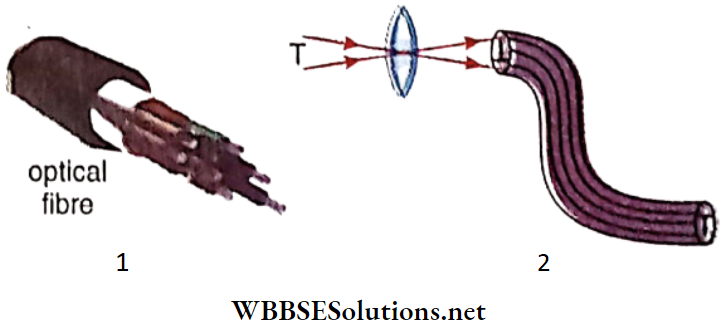
Class 12 Physics Unit 6 Optics Chapter 2 Refraction Of Light Different Fibers

Application of optical fibre:

  • Optical fibres are extensively used in medical science and the field of communication.
  • These are used to study the interior parts of the body which are inaccessible to the bare eye, for example, lungs, tissues, intestines etc. It can be used to transmit high-intensity laser light inside the body for medical purposes.
  • These are used for sending signals from one place to another. This signal is mainly digital. It is information that the signal carries.
  • This information is used in telephone, television, fax, computer etc. It is to be noted that, different digital signals may be sent through the same fibre at the same time, without any chance of overlapping.
  • So many times it is needed to collect samples inside from human body to identify disease. For this purpose, optical fibre is used. Besides, optical fibre is used for operation inside the human body. Thus, in most cases, no major excising is needed outer part of the body

Advantages of optical fibre over copper wire:

  • Comparatively less power Is required to send a signal,
  • The loss in energy Is much less
  • The capacity of carrying information is approximately times.
  • There exists no influence of any external electromagnetic wave signal.
  • Electrical resistance is much more.
  • It is very light.
  • killVelocity of the signal is very fast (approximately equal to that of light in vacuum).
  • The possibilities of the illegal usage of the signal are very low.

Refraction Of Light Physics Class 12

Refraction Of Light  Transmission of Light through Optical Fibre Numerical Examples

Example 1. A point source of light is placed at a depth of h below the calm surface of the water. From the source, light rays can only be transmitted to air through a definite circular section,

  1. Draw the circular section of the surface of the water by ray diagram and mark its radius r.
  2. Determine the angle of incidence of a ray of light incident at any point on the circumference of the circular plane. [Given: refractive index of water,\(\frac{4}{3}\) = 48°36′ = sin-1 0.7501 ]
  3. Show that r= \(\frac{3}{\sqrt{7}} h\)

Solution:

Let MN be the open surface of water. O is the source of light at a depth h below the surface of water. Light rays incident on the surface of the water from 0 at angles less than critical angle transmit in air after refraction. At points A and B the light rays are incident at angles equal to the critical angle (θ). So the refracted rays at these two
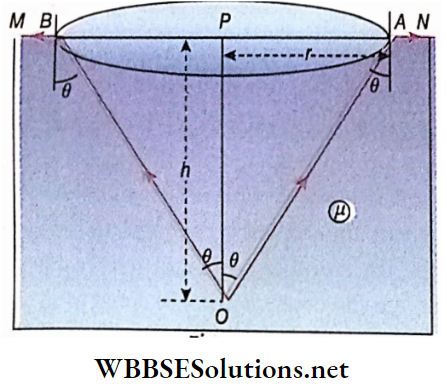
Class 12 Physics Unit 6 Optics Chapter 2 Refraction Of Light Refracted Rays

Points graze along the surface of separation. So the light rays will transmit outside water only through the circular section of radius r =  AP = PB.  If the rays are Incident on the surface of water excluding this circular section, the»7 will be reflected from (be surface of the water and will return to water,

Let the angle of Incidence be θ.

⇒ \(\sin \theta=\frac{1}{a^{\mu_w}}=\frac{1}{\mu}=\frac{3}{4}\)

= sin 48°36′ or, = 48° 36′

From the triangle AOP,

⇒ \(\tan \theta=\frac{A P}{O P}=\frac{r}{h} \quad \text { or, } \frac{\sin \theta}{\cos \theta}=\frac{r}{h}\)

Or,\(\frac{\frac{1}{\mu}}{\sqrt{1-\frac{1}{\mu^2}}}=\frac{r}{h}\)

∴ \(\sin \theta=\frac{1}{\mu}\)

Or, \(r=\frac{h}{\sqrt{\mu^2-1}}=\frac{h}{\sqrt{\frac{16}{9}-1}}=\frac{3}{\sqrt{7}}\)

Example 2.  The water in a pond has a refractive Index| of light and is placed 4 m below the surface of the water. Calculate the minimum radius of an opaque disc that needs to be floated on water so that light does not come out.
Solution:

Minimum radius of the opaque disc,

r = \(\frac{h}{\sqrt{\mu^2-1}}=\frac{4}{\sqrt{\left(\frac{5}{3}\right)^2-1}}\)

= \(\frac{4}{\frac{4}{3}}\)

= 3m

Conceptual Questions on Lenses and Mirrors

Example 3. Shows a longitudinal cross-section of an optical fibre made of glass with a refractive index of 1.68. The pipe is coated with a material of a refractive index of 1.44. What is the range of the angles of the incident rays with the axis of the pipe for which total reflection inside the fibre can take place?
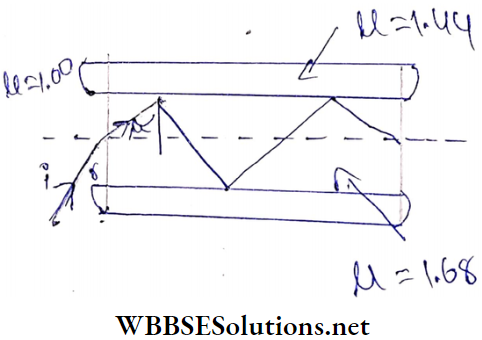
Class 12 Physics Unit 6 Optics Chapter 2 Refraction Of Light Longitudinal Cross Section

Solution:

The refractive index of the outer coating concerning the glass pipe

⇒ \(g_g \mu_c=\frac{a^{\mu_c}}{a^{\mu_g}}=\frac{1.44}{1.68}\)

If the critical angle for the total reflection is θ, then

sinθ = \(\frac{1}{c^{\mu_g}}\)

= \(\frac{1.44}{1.68}\)

= 0.857 or, 59°

Thus’ total reflection takes place when i’ > 59° or when r < rmaxwhere rmax= 90° – 59° = 31°

So if the maximum angle of incidence on the fibre is imax then,

sin imax  = μgsir r max= 1.68 sin 31° = 0.865

Imax  = 60°

So, the range of the angles of incidence for total internal reflection inside the fibre is from 0° to 60°.

Example 4. In which direction will the sun appear to set if the observer is inside the water of a pond? Refractive index of water, μ – 1.33.
Solution:

For a setting sun, the incident rays graze along the surface of the water, i.e., angle of incidence = 90°

∴ According to Snell’s law

μw= \(\frac{\sin i}{\sin r} \)

Or,   1.33 \(=\frac{\sin 90^{\circ}}{\sin r}\)

sir r  = \( \frac{1}{1.33}\)

= 0.7518

= sin 48.75°

r = 48.75°

Therefore, to see the setting sun the observer in water should look at an angle of 48.75° with the normal.

Refraction Of Light Atmospheric Refraction

Apparent position Of a star: The whole atmosphere surrounding the earth may be supposed to be divided into different horizontal layers. As the height above the earth’s surface increases, the density of the air decreases. Due to this, the refractive index of air also decreases with the increase in altitude. For this reason, the ray from a star S (say) proceeding towards the earth’s surface cannot travel straight but continually bends towards the normal at the surface of separation due to refraction as it penetrates from rarer to denser layers

This ray after several refractions reaches the observer at O. But our vision cannot follow the curved path OS. A tangent OS’ is drawn on OS at O . So, the observer sees the star at S’. This phenomenon is called atmospheric refraction.
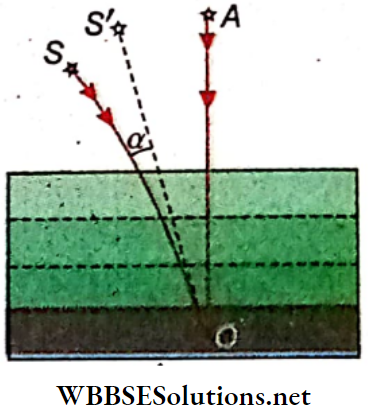
Class 12 Physics Unit 6 Optics Chapter 2 Refraction Of Light Atmospheric Refraction

Visibility of the sun before sunrise and after sunset:

The diameter of the sun subtends an angle of 0.5° at the eye of an observer on Earth. This value is equal to the deviation of sun¬ light due to atmospheric refraction, when at the horizon. So, the sun appears to just touch the horizon during sunset and sunrise when it is actually below it. What we see therefore is the raised image of the sun, formed due to atmospheric refraction. As a result, we see the sun a few minutes after sunset or before sunrise. Now, the sun covers a distance equal to its diameter in 2 min.

So, the sun becomes visible another 2 min earlier at sunrise and also remains visible for another 2 min after the actual sunset. Consequently, 4 min are added to the length of a day. This value is valid for observations from the equatorial region. At higher latitudes, this time increases

The oval shape of the sun when It Is near the horizon:

During sunrise or sunset, the lower edge of the sun remains nearer to the horizon than its upper edge. So, the rays coming from the lower edge of the sun are incident on an atmospheric layer at a larger angle than that for the rays coming from its upper edge. As the refracting angle increases with the increase of the incident angle, the rays coming from the lower edge bend more than the others due to multiple refractions at different atmo¬ spheric layers. As a result, the vertical diameter of the Sun appears to be reduced whereas the horizontal diameter remains unaffected.

Twinkling of Stars:

Due to atmospheric refraction, we see the stars twinkle. Light rays from the stars situated far and far away from us come to our eyes passing through various layers of air. The temperature of the layers does not remain constant and changes continuously. So the density of the various layers also. changes.

Again the refractive index of the layers changes with the change of density. So, when the rays of light from a star come to our eyes, the direction of the path of the rays changes continuously. As a result, the amount of light reaching our eyes also changes continuously. It seems as if the brightness of the stars is changing. So the stars appear twinkling.

As the planets are nearer to us than the stars, more amount of light comes to us. Therefore, the change in brightness of the planets due to changes in the refractive index of various layers of air is negligible. We cannot detect it with our eyes. So it appears that the planets are emitting light steadily.

Class 12 Physics Refraction Notes

Refraction Of Light Thin Prism

Thin Prism Definition:

The prism, whose refracting angle is very small (not more than 10°), is called a thin prism.

Deviation produced by a thin prism:

ABC is a thin prism. A ray PQ is incident on the refracting face AB nearly normally. For nearly normal incidence, i1 ≈ 0, i2≈0. If n is the refractive index of the material of the prism, then

μ = \(\frac{\sin i_1}{\sin r_1}=\frac{i_1}{r_1} \quad \text { or, } i_1=\mu r_1\)

And \(\mu=\frac{\sin i_2}{\sin r_2}=\frac{i_2}{r_2} \quad \text { or, } i_2=\mu r_2\)

Or,

So, the deviation of the ray

⇒ \(\delta=i_1+i_2-A=\mu r_1+\mu r_2-A=\mu\left(r_1+r_2\right)-A\)

= μA – A

Since = r1+r2 = A

= (μ- 1)
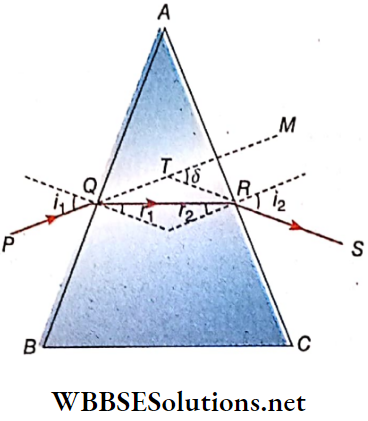
Class 12 Physics Unit 6 Optics Chapter 2 Refraction Of Light Deviation Produced By A Prism

Again, if the ray PQ is incident on the face AB normally, then

i1= r1 = 0. So, A = r2
.
Therefore, the deviation of the ray,

δ = i1 + i2 – A = μr2-A =μA-A = (μ -1 )A

So, for normal and nearly normal incidence, the deviation of the array in a thin prism, δ = (μ-1)A

Thus it is seen that for normal or nearly normal incidence, the deviation of a ray in a thin prism depends only on the refract¬ ing angle of the prism and the refractive index of its material but not on the angle of incidence. So if the angle of the incidence is small, the deviation of a ray in the case of a thin prism remains constant.

Refraction Of Light Thin Prism Numerical Examples

Example 1. A very thin prism deviates a ray of light through 5°. If the refractive index of the material of the prism is 1.5, what is the value of the angle of the prism?
Solution:

The angle of deviation for a thin prism,

δ = (μ-1)A

Here  δ = 5° and μ = 1.5

Therefore from equation (1) we get,

5° = (1.5 -1)A or, A = 10°

Example 2. A prism haying refracting angle 4°. Is placed in the air. Calculate the angle of deviation of a ray incident nor¬ mally or nearly normally on It. The refractive index of the material of the prism| = \(\frac{3}{2}\)
Solution:

The refracting angle of the prism, A = 4°. So it is a thin prism. We know that the deviation of a ray in a thin prism for. normal or nearly normal incidence is given by,

⇒  \(\delta=(\mu-1)\)A

⇒ \(\delta=\left(\frac{3}{2}-1\right) \times 4^{\circ}\)

= 2°

Example 3. A thin prism with a refracting angle of 5° and having refractive index of 1.6 is kept adjacent to another thin prism having a refractive index of 1.5 such that one is inverted concerning the other. An incident ray falling vertically on the first prism passes through the second prism without any deviation. Calculate the refracting angle of the second prism.
Solution:

According to the condition,

1– 1)A2 = (μ2– 1)A2

(1.6-1) × 5° = (1.5-1)A2

Or, A2 =\(\frac{0.6 \times 5^{\circ}}{0.5}\)

So the refracting angle of the second prism = 6°

Limiting Angle of a Prism for No Emergent Ray

A ray of light incident on a refracting surface of a prism may not emerge from the second refracting surface. It depends on the refracting angle of the prism. Every prism has a limiting value of its refracting angle. Light can emerge from the prism if the angle of the prism is equal to or less than this critical value, otherwise, no light can emerge from the prism.
Class 12 Physics Unit 6 Optics Chapter 2 Refraction Of Light Limiting Angle Of A Prism For No Emergent Ray

Let ABC be the principal section of a prism  PQRS is the path of a ray through the prism placed in the air where ray RS grazes along the second face AC.

Let the angles of incidence and refraction at the face AB be i1 and r1 respectively and the corresponding angles at the face AC be r2 and i2, where i2 = 90°.

So, r2 = θc, the critical angle between glass and air. If the refracting angle of prism A is equal to the limiting angle, then the ray incident at an angle of incidence fj to the face AB of the prism makes a grazing emergence along the second refracting surface AC

A= r1+r2 ……………….(1)

For refraction at Q

⇒ \(\sin i_1=\mu \sin r_1 \quad \text { or, } r_1=\sin ^{-1}\left(\frac{\sin i_1}{\mu}\right)\)

For refraction At R,

⇒ \(\sin 90^{\circ}=\mu \sin r_2 \quad \text { or, } r_2=\sin ^{-1}\left(\frac{1}{\mu}\right)\)

Or, \(\theta_c=\sin ^{-1}\left(\frac{1}{\mu}\right)\)

From equation (1) we get, A = \(A=\sin ^{-1}\left(\frac{\sin i_1}{\mu}\right)+\sin ^{-1}\left(\frac{1}{\mu}\right)\) …………. (2)

Special cases:

Limiting angle of the prism for normal incidence on the first face: When ray, PQ is incident on the face AB normally, then fj = 0. In this case, if the emergent ray grazes along the surface AC then from equation (2) we get,

A = \(\sin ^{-1}\left(\frac{\sin 0}{\mu}\right)+\sin ^{-1}\left(\frac{1}{\mu}\right)=\sin ^{-1}\left(\frac{1}{\mu}\right)=\theta_c\)

Hence, the ray can emerge from the prism through its second surface till the refracting angle of the prism remains less than its critical angle. But as the refracting angle of the prism becomes greater than its critical angle, no ray emerges from the surface AC. Then the face AC acts as a total reflecting surface.

Limiting angle of the prism for grazing incidence on the first face:

For grazing incidence on the face AB, i1 = 90° Then from equation (2) we get

A = \(=\sin ^{-1}\left(\frac{\sin 90^{\circ}}{\mu}\right)+\sin ^{-1}\left(\frac{1}{\mu}\right)\)

= \(\sin ^{-1}\left(\frac{1}{\mu}\right)+\sin ^{-1}\left(\frac{1}{\mu}\right)=2 \sin ^{-1}\left(\frac{1}{\mu}\right)=2 \theta_c\)

So, if the refracting angle of the prism is greater than 20C and if a ray is incident on the face AB grazing the surface, then it will be reflected from the face AC. It means the ray will not emerge in the air through the face AC. Hence, no emergent ray will be obtained.

Thus, from the above discussions we conclude that for any incidence no ray can emerge from the prism If the angle of the prism is greater than twice the critical angle for the material concerning the surrounding medium.

Refraction Of Light Limiting Angle Of Incidence For No Emergent Ray From A Given Prism

Just like a prism has a limiting refracting angle for no emergent ray, a prism with a definite refracting angle also possesses a limiting angle of incidence for no emergent ray from it. If the angle of incidence i1 becomes less than this limiting incident angle, then there will be no corresponding emergent ray.

Let ABC be the principal section of a prism. The ray of light PQ is incident at Q on the face AB. After refraction through the prism, the emergent ray RS grazes the second face AC of the prism.
Class 12 Physics Unit 6 Optics Chapter 2 Refraction Of Light Limiting Angle Of Incidence For No Emergent Ray From A Given Prism

Let the angles of incidence and refraction at the face AB be i1 and r1 the corresponding angles at the face AC be r2 and i2 respectively. Here, i2 = 90° .

Now, the angle of the prism, A = r1 + r2 – constant.

From, A = r1 + r2; we get, r2 = A – r1 , reduces with the decrease of it. Again, r1 increases with the decrease of r1

Now, if r2 is greater than θc the ray QR is reflected from the face AC inside the prism and it does not emerge in the air.

So when r1 = θc then i1 = limiting angle of incidence.

If μ is the refractive index of the material of the prism then

⇒ \(\sin \theta_c=\frac{1}{\mu}\)

⇒ \(\cos \theta_c=\sqrt{1-\sin ^2 \theta_c}=\sqrt{1-\frac{1}{\mu^2}}=\frac{\sqrt{\mu^2-1}}{\mu}\)

Considering the refraction of the ray at Q we have,

⇒ \(\cos \theta_c=\sqrt{1-\sin ^2 \theta_c}=\sqrt{1-\frac{1}{\mu^2}}=\frac{\sqrt{\mu^2-1}}{\mu}\)

= \(\cos \theta_c=\sqrt{1-\sin ^2 \theta_c}=\sqrt{1-\frac{1}{\mu^2}}=\frac{\sqrt{\mu^2-1}}{\mu}\)

= \(\sin i_1=\mu \sin r_1=\mu \sin \left(A-r_2\right)\)

Since A = r1+r2

= \(\mu \sin \left(A-\theta_c\right)=\mu\left[\sin A \cos \theta_c-\cos A \sin \theta_c\right]\)

= \(\mu\left[\sin A \cdot \frac{\sqrt{\mu^2-1}}{\mu}-\cos A \cdot \frac{1}{\mu}\right]\)

= \(\mu\left[\sin A \cdot \frac{\sqrt{\mu^2-1}}{\mu}-\cos A \cdot \frac{1}{\mu}\right]\)

= \(\sin A \sqrt{\mu^2-1}-\cos A\)

Or, i1 = \(i_1=\sin ^{-1}\left[\sin A \sqrt{\mu^2-1}-\cos A\right]\)

This is the limiting angle of incidence. If the angle of incidence is less than this limiting angle, no ray will emerge from the second face of the prism

Class 12 physics refraction notes

Refraction Of Light Limiting Angle Of Incidence For No Emergent Ray From A Given Prism Numerical Examples

Example 1. To get an emergent ray from a right-angled prism its refractive index should not exceed \(\sqrt{2}\) —prove it.
Solution:

The condition of getting an emergent ray from a prism is that the refracting angle of the prism should be equal to or less than twice the value of the critical angle

A≤ 2θc Or, 90°≤ 2θ

Or, θc ≥ 45°

∴ sin θc ≥ sin 45° ,Or, sin θc ≥ \(\frac{1}{\sqrt{2}}\)

∴  \(\sin \theta_c=\frac{1}{\mu}\)

∴ \(\frac{1}{\mu}\frac{1}{\sqrt{2}}\)

Or, \(\sqrt{2}\)

Example 2. The refractive index of a prism having a refracting angle of 75° is \(\sqrt{2}\). What should be the minimum angle of incidence on a refracting surface so that the ray will emerge from the other refracting surface of the prism?

Solution: According to the question, the emergent angle is i2 = 90°.

So for refraction at the second face of the prism

μ = \(\frac{\sin i_2}{\sin r_2}=\frac{\sin 90^{\circ}}{\sin r_2}\)

Or, \(\sin r_2=\frac{1}{\mu}=\frac{1}{\sqrt{2}}\)

= sin 45°

Or, r2 = 45°

We, know A= r1 +r2

75= r1 + 45°

Or, r1 = 30°

For refraction at the first face

μ = \(\frac{\sin i_1}{\sin r_1}\)

Or, \(\sqrt{2}=\frac{\sin i_1}{\sin 30^{\circ}}\)

Or, \(\sin i_1=\sqrt{2} \times \frac{1}{2}=\frac{1}{\sqrt{2}}\)

= sin 45°

Or, i1 = 45°

The required angle of incidence = 45°

Real-Life Scenarios in Refraction Experiments

Example 3. Find the value of the limiting angle of incidence if the refractive index of the material of the prism is 1.333 and the angle of the prism is 60°
Solution:

Here, the refractive index of the material of the prism, mu = 1.333; the angle of the prism, A = 60°

⇒ \(i_L=\sin ^{-1}\left[\sin A \sqrt{\mu^2-1}-\cos A\right]\)

= \(\sin ^{-1}\left[\frac{\sqrt{3}}{2} \sqrt{(1.333)^2-1}-\frac{1}{2}\right]\)

= \(\sin ^{-1}(0.2633)\)

= 15.27°

Example 4. The refracting angle of the prism is 60° and its refractive J index is Jl. What should be the minimum angle of | incidence on the first refracting surface so that the ray | can emerge somehow from the second refracting our face?
Solution:

Let i be the limiting angle of incidence, then

sin i = \(\sqrt{\mu^2-1} \cdot \sin A-\cos A\)

= \(\sqrt{\frac{7}{3}-1} \cdot \sin 60^{\circ}-\cos 60^{\circ}\)

= \(\frac{2}{\sqrt{3}} \cdot \frac{\sqrt{3}}{2}-\frac{1}{2}\)

= \(1-\frac{1}{2}=\frac{1}{2}\)

i = 30

Example 5. The refractive index of the material of a prism is \(\)  and the refracting angle is 90°. Calculate the angle of minimum deviation and the corresponding angle of incidence. Show that the limiting angle of incidence for getting emergent ray is 45°
Solution:

Here, the refractive index of the material of the prism,

M = \(\sqrt{\frac{3}{2}}\)

The angle of prism A =  90°

μ = \(\frac{\sin \frac{A+\delta_m}{2}}{\sin \frac{A}{2}}\)

Or, \(\sqrt{\frac{3}{2}}=\frac{\sin \frac{A+\delta_m}{2}}{\sin 45^{\circ}}\)

⇒ \(\sin \frac{A+\delta_m}{2}=\sqrt{\frac{3}{2}} \times \frac{1}{\sqrt{2}}=\frac{\sqrt{3}}{2}\)  = sin 60°

⇒  \(\frac{A+\delta_m}{2}\)  = 60°

Or, A + δm = 120°

δm = 120° – 90° = 30°

For minimum deviation, i1= i2

δm = i1+ i2 -A

30° = 2i1 – 90

Or, 2i1 = 120°

Or, i2= 60°

Or minimum deviation angle of indecency = 60

To obtain the emergent ray I be the limiting angle of incidence. Then

sini = \(\sqrt{x^2-1} \sin x-\cos 4\)

= \(\sqrt{\frac{3}{2}-1} \cdot \sin 90^{\circ}-\cos 90^{\circ}=\frac{1}{\sqrt{2}}\)

= sin 45°

= 45°

Example 6. The refractive index of a prism is \(\sqrt{2}\). A ray of light is incident on the prism grazing along one of its refracting surfaces. What should be the limiting angle of the prism for no emergent ray from the other face?
Solution:

If The limiting angle of the prism for no emergent ray is A, then

A = \(2 \sin ^{-1} \frac{1}{\mu}\)

= \(2 \sin ^{-1} \frac{1}{\sqrt{2}}=2 \times 45^{\circ}\)

= 90°

Refraction Of Light Conclusion

1. When a ray of light enters a medium from another medium through the interface of the two media, then the path of the rav changes its direction and this phenomenon is known as refraction of light.

2. Laws of refraction:

  • The incident ray, the refracted ray and the normal to the refracting surface at the point of incidence lie on the same plane.
  • The sine of the angle of incidence bears a constant ratio to the sine of the angle of refraction. The value of this constant depends on the nature of the pair of media concerned and the colour of the incident light.

3. Relative refractive index:

When a ray of light is refracted from a medium a to another medium b then the ratio of the sine of the angle of Incidence to the sine of the angle of refraction is called the refractive index of the medium b concerning the medium a. This refractive index is called the relative refractive index.

4. Absolute refractive index:

When a ray of light is refracted from the vacuum to any other medium then the ratio of the sine of the angle of incidence to the sine of the angle of refraction is called the absolute refractive index of that medium.

5. Critical angle:

When a ray of light is refracted from a denser medium to a rarer medium than for a particular angle of incidence in the denser medium, the angle of refraction in the rarer medium is 90° i.e., the refracted ray grazes along the interface of the .two media. Then that particular angle of incidence is called the critical angle for the pair of media.

6. Total internal reflection:

While passing from a denser medium to a rarer medium, if a ray of light is incident on the surface of separation between the angle greater than the critical angle for the two media involved, the ray of light is reflected to the denser medium without undergoing refraction in the rarer medium. This phenomenon is known as the total internal reflection of light.

Through optical fibres tight rays can be transmitted from one place to another in the straight or curved path by successive total internal reflections. f If a ray of light from a rarer medium is incident on a prism of denser medium then after refraction through the prism, the ray of tight bends towards the base of tyre prism. -f In the case of reflection or refraction, the change of direction of tight is called deviation.

4- Minimum deviation:

For any prism, there is a certain angle of incidence for which the angle of deviation becomes minimum or the least. This angle of deviation is called the angle of minimum deviation for the prism.

At minimum deviation, the angle of incidence becomes equal to the angle of emergence.

5. Thin prism:

If the refracting angle of a prism is very small (not more than 10° ) then it is called a thin prism.

6. Total reflecting prism:

If the principal section of a prior made of crown glass is a right-angled isosceles triangle then the prism makes a total Internal reflection of light for any incidence on it hence this type of prism is called a total reflecting prism.

7. During the refraction of light, the velocity, intensity and wavelength of light change but its frequency and phase remain constant.

8. If there is a parallel glass slab in the path of light then Ugh rays remain undefeated after refraction through it but lateral displacement of light rays will occur.

9.  \(\frac{\sin i}{\sin r}={ }_a \mu_b=\frac{\mu_b}{\mu_a}\)

μa = absolute refractive index of medium a, nb = absolute refractive index of medium b, afib = relative refractive index of medium b concerning the medium a.

10.  \(\frac{\sin i}{\sin r}={ }_a \mu_b=\frac{\mu_b}{\mu_a}\)

[ va = velocity of light in the medium a, vb= velocity of tight in the medium b ]

⇒  \(\mu=\frac{c}{v}\)

[n = absolute refractive index of a medium, v = velocity of light in that medium, c = velocity of tight in vacuum]

[v= – frequency of the wave, A = wavelength]

11. \(a^{\mu_b}=\frac{v_a}{v_b}\)

The relation between (i and A given by scientist Cauchy

12. \(\mu=\frac{c}{v}\)

Deviation of a ray of tight due to refraction,

= i~r [i = angle of incidence, r = angle of refraction]

13. Lateral displacement of a ray of tight after suffering refraction through a parallel plate glass slab

= \(t \sin i_1\left[1-\frac{\cos i_1}{\sqrt{\mu^2-\sin ^2 i_1}}\right]\)

[where, i- the angle of incidence on the front surface of the tin slab, t = thickness of the slab, (J- = refractive index of the material of the slab]

If the angle of incidence ij is very small then lateral displacement = \(t i_1\left(1-\frac{1}{\mu}\right)\)

14. General formula ofSnell’s law:

μ1 sin= μ2sin2 =  μ3 sin3 = ………………. = μ3 sin i3

15. The apparent position of an object due to refraction:

The refractive index of rarer medium =; refractive index c denser medium = μ1

1. If the object is in a denser medium and the observer is in: a rarer medium:

The refractive index of the denser medium with respect to the rarer medium real depth of the object from
= \(=\frac{\text { the surface of separation }(d)}{\text { apparent depth of the object from the surface of separartion}}\)

= \(\frac{\mu_2}{\mu_1}\)

2. If the object Is In the rarer medium and the observer is in a denser medium: The refractive index of the denser medium concerning the rarer medium apparent height of the object from

= \(\frac{\text { the surface of separation }\left(d^{\prime}\right)}{\text { real height of the object from the surface of separation (d)}}\)

16. The refractive index of glass

=\(\frac{\text { real thickness of a thick mirror }}{\text { apparent thickness of a thick mirror }}\)

⇒ \(\frac{1}{b^{\mu_a}}=\frac{\mu_b}{\mu_a}\)

[where, A = r1+r2]

17. Deviation of a ray of light after refraction through a prism,

[i = angle of incidence on the first face of the prism, i’μa = angle of emergence from the second face to the prism, r1

= angle of refraction In the first face, = angle of incidence in the second face, A = refracting angle of the prism]

18. In case of minimum deviation, i1 = i2 = i (say)

r1 = r2 = r (say)

19. In that case, the minimum deviation, δ

m = 2i-r and A = 2r.

20. Relation between refractive index (fi) and minimum deviation (8m ) :

μ\(\frac{\sin \left(\frac{A+\delta_m}{2}\right)}{\sin \frac{A}{2}}\)

21. For the normal and nearly normal incidence of a ray of light, deviation in the case of a thin prism,

⇒ δ = (μ-1)A

22. Limiting the angle of a prism for no emergent light from a prism

⇒ \( \sin ^{-1}\left(\frac{\sin i_1}{\mu}\right)+\sin ^{-1}\left(\frac{1}{\mu}\right)\)

When iy = 0 , then A>θc; when iy = 90°, then A >2θc.

Limiting value of the angle of incidence in case of definite prism for no emergent light from it,

⇒\(i_1=\sin ^{-1}\left[\sin A \sqrt{\mu^2-1}-\cos A\right]\)

23. A ray of light passes through n number of media of refractive indices, μ1,  μ2, μ3, ……………….. μn respectively. The planes of the media are parallel. If the emergent ray from the n -th medium is parallel to the ray incident on the first medium, then μ1 = μ2

24. For a hollow prism, the angle of the prism is A ≠ 0 but the angle of deviation is δ = 0.

25. A container of depth 2d is half filled with a liquid of refractive index μ1 and μ2    the remaining half is filled with another liquid of refractive index When seen from the top, the apparent depth of the container is

⇒ \(d\left(\frac{1}{\mu_1}+\frac{1}{\mu_2}\right)\)

26. An observer is situated at a depth h in a water body. The water surface appears as a porous circular mirror to

 27. If a parallel plane glass slab of thickness t is kept in the path of a beam of converging rays, then the displacement of the intersecting point of the rays,

⇒ \(O O^{\prime}=x=\left(1-\frac{1}{\mu}\right) t\)
Class 12 Physics Unit 6 Optics Chapter 2 Refraction Of Light PArallel Plane Glass Slab Of Thickness

To transmit through a glass slab of thickness t and refractive index μ, time taken by light is, where c is the velocity of light in vacuum \(\frac{\mu t}{c}\)

WBCHSE Physics Class 12 Refraction Notes

Refraction Of Light Very Short Questions

Question 1. What is the angle of deviation due to the refraction of a ray of light incident perpendicularly on a refracting surface?
Answer: Zero

Question 2. Arrange the following media according to the increasing optical density Air, diamond, glass, water, glycerine.
Answer:

Air < Water < Glycerine < Glass < Diamond]

Question 3. Can the value of absolute refractive index of a medium be
Answer: No

Question 4. State the relation of velocity of light with refractive index
Answer:

⇒ \(\left[\mu=\frac{c}{v}\right]\)

Question 5. The refractive index of a medium depends on temperature’—is the statement correct or wrong?
Answer: Correct

Question 6. Arrange the following media according increasing velocity of light through them: vacuum, diamond, water, air, glass
Answer:

Diamond < Glass < Water < Air < Vacuum

Question 7. Does the velocity of light in a vacuum depend on

  1. Wavelength of light
  2. Frequency of light
  3. Intensity of light?

Answer: No

Question 8 If water is heated, how refractive index it will change?
Answer: Decrease

Question 9. The refractive index of glass is 1.5. What is the velocity of light
Answer: [2 × 10⁸m/s].

Question 10. Can the relative refractive index of a medium concerning another be less than unity?
Answer: Yes

Question 11. The refractive index of a medium is a physical quantity having no dimension and no unit—is the statement true or
Answer: True

Question 12. A light ray of wavelength 4500 A enters a glass slab of refractive index 1.5, from the vacuum. What is the wavelength of light inside the slab?
Answer: 30000 A°

Question 13. For which colour of light is the refractive index of glass the minimum?
Answer: Red

Question 14. If the frequency of light increases will there be any change in the refractive index of the medium?
Answer: No

Question 15. For which colour of light is the refractive index of glass a maximum?
Answer: Violet

Question 16. Does the refractive index of glass depend on the colour of light? If so, how?
Answer: Yes, the refractive index increases with the decrease of wavelength

Question 18. When a ray of light is incident on a plane normally, then what is the value of the angle of refraction?
Answer: Zero

Question 17. If for refractive index of water relative to air is \(\), what will be the refractive index of air relative to water
Answer:

⇒ \(\frac{3}{4}\)

Question 18. When light travels from air to glass, how does its wavelength change? less than 1
Answer: Wavelength decreases

Question 19. The absolute refractive index of water and glass are \(\frac{4}{3}\) and \(\frac{3}{2}\). What is the ratio of velocity of light in glass and water?
Answer: [8:9]

Question 20. what is the value of the product of the refractive index of relative of the first medium and that of the first-second medium relative to the second medium?
Answer: 1

Question 21. For what angle of incidence the lateral shift produced by a parallel-sided glass plate is zero?
Answer: For i = 0

Question 22. For what angle of incidence the lateral shift produced by a parallel-sided glass plate is maximum?
Answer: For i = 90°

Question 23. what is the maximum lateral shift produced by a parallel-sided glass plate of thickness t?
Answer: t

Question 24. The bird descends vertically downwards in the direction of a pond during its flight. To a fish which is underwater and directly below the bird, what will be the apparent position of the bird?
Answer:

The bird’s apparent position will be slightly above its actual position i.e., the bird will appear higher up than it is

Question 25. An object lying inside a pond is viewed by a man from above (air) along a horizontal plane. Now if the man moves away from the object keeping his eyes along the same horizontal plane, how will the apparent depth of the object change?
Answer: Decrease along the caustic curve

Question 26. A transparent cube of glass of refractive index n and thickness ‘t is placed on a spot of ink drawn on white paper. When the spot is viewed from above (air) normally, the spot appears to shift through a distance of At towards the observer. What is the value of Δt?
Answer:

⇒ \(\left[\left(l-\frac{1}{\mu}\right) t\right]\)

Question 27. If a straight rod is held obliquely in water how does the immersed portion of the rod appear?
Answer: Refraction of light

Question 28. Multiple images are formed in a thick mirror. Which Image looks brightest?
Answer: Second images

Question 29. If a completely transparent object has to be made Invisible In a vacuum, what should be the value of its relative Index?
Answer: 1

Question 30. What Is the critical angle of light when passing from water \(\left(\mu \text { of water }=\frac{4}{3}\right)\)
Answer: 49

Question 31. For which colour of light is the critical angle between glass and air minimum?
Answer: Violet

Question 32. What are the factors of light which are responsible for creating mirages?
Answer: Refraction and total internal reflection]

Question 33. In which direction do we have to look to see the setting sun if we are underwater? (μw = 1.33)
Answer: At an angle of 49° with the normal drawn at the surface of the water]

Question 34. From sunrise to sunset, the sun subtends an angle of 180’ to our eyes. What will be the value of this angle to an observer underwater?
Answer: 98°

Question 35. Light passes through an optical fibre following which physical phenomenon?
Answer: Total internal reflection

Question 36. What is the approximate value of the refractive index of a diamond
Answer: 2.42

Question 37. what kind of image is formed in a desert by the formation
Answer: Virtual

Does critical depend on the colour of life

Question 38. The angular altitude at which we see a star is not its actual angular altitude’—is the statement true or false?
Answer: True

Question 39. The sun appears to be elliptical during sunset. What is the reason behind it?
Answer: Refraction of light

Question 40. Under what condition the angle of deviation of a refracted ray through a prism will be minimal?
Answer: If the angle of incidence and the angle of emergence are equal

Question 41. If the medium surrounding the four faces of a prism is denser an the entire material of the prism, then in which direction will the light rays bend when emerging from the prism?
Answer: It will bend upwards, towards the prism apex

Question 42. How can an inverted image be made erect by using a total reflecting prism?
Answer: By total internal reflection on the hypotenuse of a right-angled

Question 43. ‘When light travels from a rarer medium to a prism which is a denser medium, a light ray bends towards the base of the prism. Is the statement true or false?
Answer: True

Question 44. At the position of minimum deviation, what is the nature of the path of a light ray through a prism?
Answer: Symmetrical

Question 45. For a thin prism on what factor does the magnitude of the angle of deviation of light rays depend?
Answer: Angle of incidence

Question 47. what will be the angle of deviation of a ray of light incident normally on any smaller side of a total reflecting prism?
Answer: 90°c

Refraction Of Light Fill In The Blanks

Question 1. Which of the following_________________wavelength, frequency or velocity does not change during the refraction of light?
Answer: Frequency

Question 2. For any particular medium, the refractive index is greater If the wavelength of light is____________________ 
Answer: Small

Question 3. If μa,  μb and μc are the absolute refractive indices of three media then aμb × bμc  _________________________
Answer: aμc

Question 4. When a man stands inside a shallow pond the depth of water at that place appears___________________places appear comparatively___________________ and the depth of other 
Answer: Maximum, Less

Question 5. Critical angle of which pair of medium is lesser___________air and water or air and diamond
Answer: Air and Diamond

Question 6. We see the sun ___________________ a few minutes ___________________ sunset or sunrise
Answer: After, Before

Question 7. If a ray of light moves from a ___________________ medium to a ___________________, total internal reflection does not take place
Answer:
Rarer, Denser

WBCHSE physics class 12 refraction notes

Refraction Of Light Assertion Reason Type

Direction: These questions have statement 1 and statement 2 of the four characters given below, choose t=the one that best describes the two statements

  1. Statement 1 is true, statement 2 is true, and statement 2 is a correct explanation for statement 1.
  2. Statement 1 is true, statement 2 is true, and statement 2 is not a correct explanation for statement 1
  3. Statement I is true, and statement 2 is false
  4. Statement 1 is false statement 2 is true

Question 1. 

Statement 1: The Greater the refractive index of a medium or denser the medium, the lesser the velocity of light In that medium

Statement 2: Refractive index is inversely proportional to velocity.

Answer: 1.  Statement 1 is true, statement 2 is true, and statement 2 is a correct explanation for statement 1.

Question 2.

Statement 1: The critical angle of the light passing from glass to is minimal for violet colour

Statement 2: The wavelength of violet light is greater than the light of other colours

Answer: 3. Statement I is true, and statement 2 is false

Question 3.

Statement 1: The twinkling of the star is due to the reflection of light

Statement 2: The velocity of light changes while going from one medium to the other.

Answer: 4. Statement 1 is false statement 2 is true

Question 4.

Statement 1: The relative refractive index of a medium can be less than unity.

Statement 2: The angle of incidence is equal to the angle of refraction

Answer: 3. Statement I is true, and statement 2 is false

Question 5.

Starement 1: When a ra> of light enters glass from atr. Its frequency changes

Sutrmem 2: The velocity of light in glass is less than that in oil.

Answer: 4. Statement 1 is false statement 2 is true

Question 6.

Statement 1: The refractive index of a medium Is Inversely proportional to temperature

Statement 2: Refractive index U is directly proportional to the density of the medium.

Answer: 2. Statement 1 is true, statement 2 is true, and statement 2 is not a correct explanation for statement 1

Question 7. 

Statement 1: The velocity of light rays* of different colours is the same. But the velocity of the light rays is different for anv another medium.

Statement 2: If v = velocity of light in the respective

Answer: 1.  Statement 1 is true, statement 2 is true, and statement 2 is a correct explanation for statement 1.

Question 8.

Statement 1: The linages formed the total lniern.il reflections are much brighter than those formed by lenses.

Statement 2: There Is no loss of Intensity during total Internal reflection

Answer: 1.  Statement 1 is true, statement 2 is true, and statement 2 is a correct explanation for statement 1.

Refraction Of Light Match The Columns

Question 1. 
Class 12 Physics Unit 6 Optics Chapter 2 Refraction Of Light Deviative Angles

Answer:  1- A, C, 2-A, C, 3- B, 4- 4, 5- A, C

Question 2.
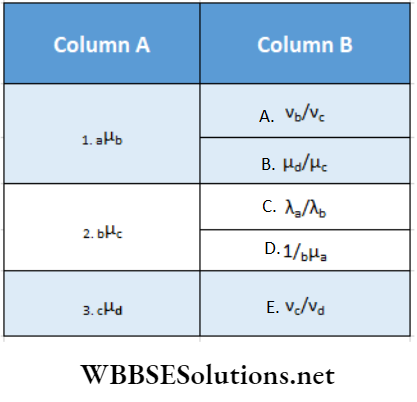
Class 12 Physics Unit 6 Optics Chapter 2 Refraction Of Light Deviative Angles.

Answer: 1-C, D, 2- A, 3- B, E

Question 3.
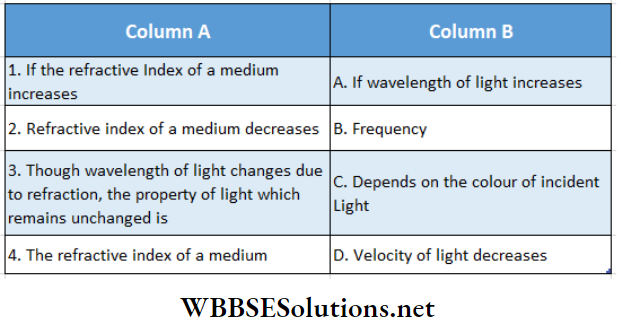
Class 12 Physics Unit 6 Optics Chapter 2 Refraction Of Light Refractive Index Medium

Answer: 1- D, 2- A, 3- B, 4. C

μ1, μ2 and μ3 are the refractive indices of the first, second and third medium respectively

Question 4.
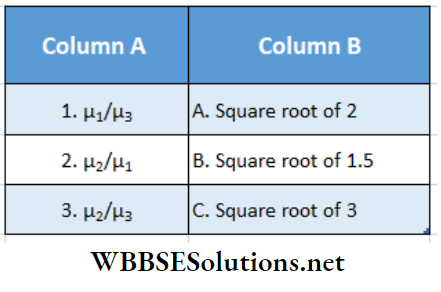
Class 12 Physics Unit 6 Optics Chapter 2 Refraction Of Light Square Roots

Answer: 1- B, 2-1, 3 -C
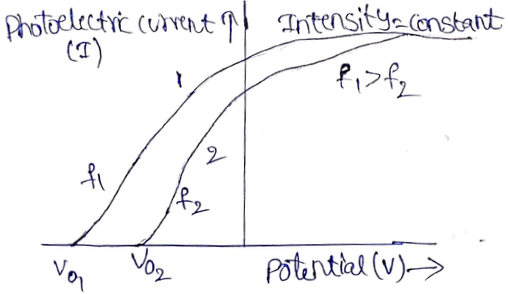
WBCHSE Class 12 Physics Digital Electronics & Logic Gates Short Answer Questions

Digital Electronics & Logic Gates Short Questions And Answers

Question 1. Convert the number (120)3 into decimal.
Answer:

(120)2 = (1 × 32) + (2 × 31) + (0 × 30)

= 9 + 6 + 0 = (15)10

Question 2. Assume that the first and the second digits of any binary system are 7 and 6, respectively. Convert (76)10 into this binary system.
Answer:

Digital Circuit First And Second Digits Of Binary System

Conceptual Questions on Sequential Circuits

(76)10 = (1001100)2

Here, we have to take 0 → 7 and 1→ 6.

Therefore, according to the given binary process,

(76)10 = (6776677)2

Read And Learn More WBCHSE Class 12 Physics Short Question And Answers

Question 3. Express 39 as a binary number
Answer:

Digital Circuit Express 39 Binary System

∴ (39)10 = (10011)2

Question 4. Why is it called a universal gate?
Answer:

NOR gate can be used to obtain all the possible gates by using it as a basic building. This is why it is called the universal gate. It may be used to realize the basic logic functions OR, AND, and NOT

WBBSE Class 12 Digital Electronics Short Q&A

Class 11 Physics Class 12 Maths Class 11 Chemistry
NEET Foundation Class 12 Physics NEET Physics

Question 5. What is the decimal equivalent of the binary number 100117
Answer:

(1 × 24) + (0 × 23)  (1 × 22) (1 × 21) +(1 × 20)

= (16 + 0 + 0 + 2+ 1)

= (19)10

WBCHSE Class 12 Physics Digital Electronics And Logical Gates Short Answer Questions

Question 6. If two Inputs of n NAND gate arc are joined, what type of gate is formed
Answer:

If the joining of two inputs implies that the inputs are short-circuited, then the two inputs are generally the same. If the input is A, then the output of the NAND gate

Y = \(\overline{A \cdot A}=\bar{A}\)

Hence, in this case, a NOT gate Is formed

Question 7. Write down the value of \((\bar{X}+X) \text { and }(X \cdot \bar{X})\) in Boolean algebra
Answer:

⇒ \(\bar{X}+X\)= 1

⇒ \(X \cdot \bar{X}\) = 0

Question 8.  The Input waveforms A and B to a logic gate. 

Digital Circuit Logic Gate And Logic Symbol

Answer:

Digital Circuit Logic Gate And Logic Symbol.

Short Answer Questions on Digital Circuits

Question 9.  The figure shows the Input waveforms A and B for the AND gate. 

Digital Circuit Output Waveforms

Output waveform will ho as follows:

Digital Circuit Output Waveforms.