NEET Foundation Chemistry Chapter 2 Is Matter Around Us Long Answer Questions

Chapter 2 Is Matter Around Us Pure Long Answer Type Question And Answers

Question 1. Does starch sol show Tyndall effect?
Answer.

Starch sol show Tyndall effect:

Scattering of light by particles in a colloid is Tyndall effect. Consider a situation, when a strong beam of light is passed through a colloidal solution, its path becomes visible when viewed from a direction at right angle to that of incident light. It is only observed when the size of the particles are larger than the wavelength of visible light.

Usually the particles of size which are in the range of 10–9 m to 10–6 m scatter the visible light. The intensity of Tyndall scattering increases with increase in the size of colloidal particles as well as the concentration.

In this case, as Starch sol is a lyophilic sol and its particles are very small and highly solvated. There is no difference in the refractive indices of dispersion medium (water) and dispersed phase (starch). Hence it shows only very weak or almost no Tyndall effect.

Is Matter Around Us Pure

NEET Foundation Chemistry Chapter 2

Question 2. Soluble substances cannot be separated through filtration as the particles of the solute are too small. So which techniques one need to follow to separate solutions?
Answer.

To separate the soluble substance whose solute particles are too small, one can use the following techniques:

Read and Learn More NEET Foundation Long Answer Questions

  • Evaporation is when you heat the solution so the solvent evaporates, which will leave the solute in the container as a residue of crystals.
  • Distillation is the same as evaporation but the gas (distillate) is collected and cooled to create distilled water.
  • Chromatography is a technique that is used to separate mixtures due to their solubility. A spot of the mixture is placed on filter paper and placed in water. The substances in the mixture with higher solubilities will move further up the filter paper.

Question 3. Explain the suitability of copper and aluminium that is used as electrical conducting materials.
Answer.

Suitability of:

  • Copper: It is used for the winding of electrical machines. High purity copper is obtained by electrolytic refining. Traces (0.1%) of iron, silicon or phosphorous seriously reduce the conductivity of copper. The conductivity of copper is also decreased when it is hard drawn into wires for use in machines. Annealing is therefore necessary before the material can be used in machines. Hard drawn copper because of its increased mechanical strength compared with annealed copper is used for conductors in low voltage overhead distribution lines. Long span lines of thin cross section require conductors of higher mechanical strength, which is achieved by adding small percentage of cadmium to copper. Copper is used in machine windings because it is easily workable without any likelihood of fracture.
  • Aluminium: Conductors are suitable for very high, ambient temperature. Use of aluminium as an electrical material particularly in aircraft industries has a considerable advantages because of the saving in weight. Aluminium because of its lightness is being used for bus bars. The current carrying capacity of aluminium is 75% that of copper and its density being approximately one third that of copper and aluminium bus bar is only about half the weight of copper bus bar of equal current carrying capacity. The steel reinforced aluminium conductor is extensively being used for long span transmission lines.
Class 11 Physics Class 12 Maths Class 11 Chemistry
NEET Foundation Class 12 Physics NEET Physics

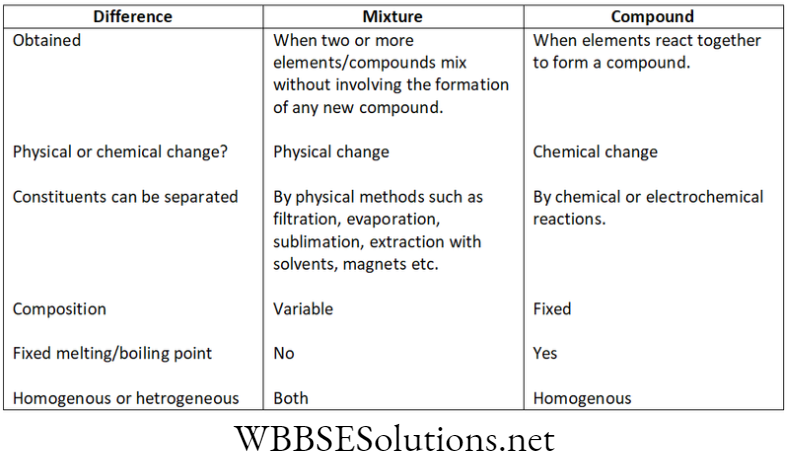
Question 4. Differentiate between compounds and mixtures.
Answer.

Difference between compounds and mixtures:

NEET Foundation Chemistry Is Matter Around Us Pure Difference between mixture and compound

NEET Foundation Chemistry Chapter 2

Question 5. How will you separate the components of air?
Answer.

Steps involved in separation of the components of air:

  • First the air is filtered and the dust particlesare removed.
  • The air is then compressed under high pressure in a chamber.
  • It is then passed through a water condenserto lower its temperature.
  • The compressed air then moves into a separator where carbon dioxide separates out as dry ice.
  • The air now becomes cold and turns into aliquid because of repeated compression.
  • The liquid air then moves into the distillation column through expansion jet where it is warmed slowly.
  • The boiling point of liquid nitrogen is –196°Cso it boils out first to form liquid nitrogen gas.
  • Argon is collected next having a boilingpoint of –186°C and finally oxygen having aboiling point of –183°C is collected last.
  • The process is called fractional distillation.

NEET Foundation Chemistry Chapter 2 Is Matter Around Us Short Answer Questions

Chapter 1 Is Matter Around Us Pure Short Answer Type Question And Answers

Question 1. A solution contains 10 g of sugar in 20 g of water. Calculate the concentration in terms of mass-by-mass percentage of the solution.
Answer.

Given:

A solution contains 10 g of sugar in 20 g of water.

Mass of solute (sugar) = 10 g

Mass of solvent (water) = 20 g

⇒ \(\text { Mass of solution }=\frac{\text { mass of solute }}{\text { mass of solution }}\)

= 10 g + 20 g

= 30 g

Mass percentage of solution = mass of solute/mass of solution × 100

= 10/30 × 100

= 33.3 %

The concentration in terms of mass-by-mass percentage of the solution = 33.3 %

NEET Foundation Chemistry Chapter 2 Is Matter Around Us Short Answer Questions

Question 2. Suppose you had 1.00 moles of solute dissolved into 1.00 L of solution. What is the molarity?
Answer.

Given:

Suppose you had 1.00 moles of solute dissolved into 1.00 L of solution.

⇒ \(\text { Molarity }=\frac{\text { moles of solute }}{\text { volume of solution in liters }}\)

Molarity = \(\frac{1.00 \mathrm{~mol}}{1.00 \mathrm{~L}}\)

The answer is 1.00 M.

Read And Learn More NEET Foundation Short Answer Questions

Question 3. A 4 g sugar cube (C12H22O11) is dissolved in a 350 mL water. What is the molarity of the sugar solution?
Answer.

Given:

A 4 g sugar cube (C12H22O11) is dissolved in a 350 mL water.

Molarity (mol/L) = number of moles of solute (mol)/Volume of solvent (Litres)

Step 1: Determine number of moles of sucrose in 4 g

C12H22O11 = (12)(12) + (1)(22) + (16)(11)

C12H22O11 = 144 + 22+ 176

C12H22O11 = 342 g/mol

Divide this amount into the size of the sample

4 g/(342 g/mol) = 0.0117 mol

Step 2: Determine the volume of solvent in litres

350 mL × (1 L/1000 mL) = 0.350 L

Step 3: Determine the molarity of the solution

⇒ \(\text { Molarity }(\mathrm{mol} / \mathrm{L})=\frac{\text { number of moles of solute }(\mathrm{mol})}{\text { Volume of solvent }(\text { Litres })}\)

M = 0.0117 mol/0.350 L

M = 0.033 mol/L

The molarity of the sugar solution is 0.033 mol/L.

NEET Foundation Chemistry Chapter 2 Is Matter Around Us Short Answer Questions

Question 4. A mixture of gases was formed by combining 6.3 moles of O2 and 5.6 moles of N2. What is the mole fraction of nitrogen in the mixture?
Answer.

Given:

A mixture of gases was formed by combining 6.3 moles of O2 and 5.6 moles of N2.

Total number of moles with Ntotal = NN2+OO2 .

Ntotal = 6.3 moles + 5.6 moles

= 11.9 moles.

⇒ \(\mathrm{X}_{\text {(mole fraction) }}=\frac{\text { mole } \mathrm{N}_2}{\text { mole } \mathrm{N}_2+\text { moles } \mathrm{O}_2}\)

= (5.6 moles/11.9 moles)

= 0.47

The mole fraction of nitrogen in the mixture is 0.47.

Question 5. The absolute mass of a carbon atom is 12.0 unified atomic mass units. How many grams will a single oxygen atom weigh?
Answer.

Given:

The absolute mass of a carbon atom is 12.0 unified atomic mass units.

The absolute mass of the carbon atom is 12.0 u, Grams in a single oxygen atom weigh

= \(\frac{\text { absolute mass of carbon }}{\text { Avogadro’s Number }}\)

= (12 g/mol) ÷ (6.022 × 10²³ mol-1) × (4/3)

= 2.66 × 10⁻²³ g.

Question 6. Water is a compound. Explain.
Answer.

Given:

Water is a compound.

Yes, water is a compound as:

It cannot be separated into its constituents (Hydrogen and oxygen) by physical methods.

Its properties are entirely different from its constituents.

Energy in the form of heat and light is given out when water is formed by burning Hydrogen and Oxygen.

Composition of water is fixed. Water has fixed boiling point.

Question 7. Air is a mixture. Explain.
Answer.

Given:

Air is a mixture

Yes, Air is a mixture as:

Its composition is not always same.

Gases present in Air do not lose their identities. Its major constituents can be easily separated by physical method. No energy change takes place among the constituents of air.

Question 8. Is burning of candle a chemical or physical change?
Answer.

Given

Burning of candle a chemical or physical change:

When the candle is burnt, two changes occur:

  • Wax gets melts, which is a physical change
  • Thread and wax get burned, which is a chemical change.

So, the burning of a candle involves both physical and chemical change.

Question 9. When you mix two clear liquids, what kinds of observations would tell you that a chemical reaction occurred?
Answer.

A gas is produced.

The solid dissolves.

A precipitate forms.

You can see through the mixture.

Answer: A gas is produced and A precipitate forms.

Chapter 2 Is Matter Around Us Pure Master your Test Question And Answers

Question 1. List 4 examples of mixtures.
Answer.

4 examples of mixtures are:

  • Sand and Water
  • Salt and Water
  • Sugar and Water
  • Alcohol in Water

Question 2. How are mixtures classified?
Answer.

Mixtures are classified as follows:

  • Based on physical state of components: Solutions, Colloids, Suspensions
  • Based on their appearance: Homogeneous and Heterogeneous Mixtures

Question 3. Give 2 examples of each homogeneous and heterogeneous mixtures.
Answer.

Homogeneous Mixtures: Rainwater, Vinegar

Heterogeneous Mixture: Muddy Water, Chalk Powder in Water

Question 4. What is the major difference between a pure substance and a mixture?
Answer.

The major difference between a pure substance and a mixture

A pure substance is made up of only one type of particles and lacks contamination from any other type of of particle whereas, mixture is made up of two or more type of particles in variable proportion.

Question 5. Define a substance.
Answer.

Substance:

Substance is simply a pure form of matter, i.e., it contains only one type of atom or molecule.

Class 11 Physics Class 12 Maths Class 11 Chemistry
NEET Foundation Class 12 Physics NEET Physics

Chapter 2 Is Matter Around Us Pure Master Your Test Question And Answers

Question 1. When 5.0 g of solute is dissolved in 50 g of water at 298 K to get a saturated solution, then what is the solubility of the solute at the given temperature?
Answer.

Given:

When 5.0 g of solute is dissolved in 50 g of water at 298 K to get a saturated solution.

Weight of the solute in saturated solution = 5.0 g

Weight of solvent in saturated solution = 50 g

Solubility = (weight of the solute in saturated solution/weight of solvent in saturated solution) × 100

Solubility = \(\frac{5.0}{50} \times 100=10 \mathrm{~g}\)

Question 2. A solution contains 10 g of sugar in 20 g of water. Calculate the concentration in terms of mass by mass percentage of the solution and also by mass percentage of the solvent.
Answer.

Given:

A solution contains 10 g of sugar in 20 g of water.

Mass of solute (sugar) = 10 g

Mass of solvent (water) = 20 g

Mass of solution = Mass of solute + Mass of solvent

= 10 g + 20 g

= 30 g

Mass percentage of solution = Mass of solute/Mass of solution × 100

= \(\frac{10}{30} \times 100\)

= 33.3 %

Mass percentage of solvent = 100 – mass percentage of solute

= 100 – 33.3

= 66.7%

Question 3. Suppose you had 1.00 moles of solute dissolved into 1.00 L of solution. What’s the molarity?
Answer. 

Given:

1.00 moles of solute dissolved into 1.00 L of solution.

⇒ \(\text { Molarity }=\frac{\text { moles of solute }}{\text { volume of solution in litres }}\)

Molarity = \(\frac{1.00 \mathrm{~mol}}{1.00 \mathrm{~L}}\)

The answer is 1.00 M.

Question 4. A 4 g sugar cube (C12H22O11) is dissolved in a 350 mL water. What is the molarity of the sugar solution?
Answer.

Given:

A 4 g sugar cube (C12H22O11) is dissolved in a 350 mL water.

Molarity (mol/L) = number of moles of solute (mol)/Volume of solvent(Litres)

Step 1: Determine number of moles of sucrose in 4 g

C12H22O11 = (12) (12) + (1) (22) + (16) (11)

C12H22O11 = 144 + 22+ 176

C12H22O11 = 342 g/mol

divide this amount into the size of the sample

4 g/(342 g/mol) = 0.0117 mol

Step 2: Determine the volume of solvent in litres

350 mL × (1 L/1000 mL) = 0.350 L

Step 3: Determine the molarity of the solution

Molarity (mol/L) = number of moles of solute (mol)/Volume of solvent(Litres)

M = 0.0117 mol/0.350 L

M = 0.033 mol/L

The molarity of the sugar solution is 0.033 mol/L.

Question 5. A mixture of gases was formed by combining 6.3 moles of O2 and 5.6 moles of N2. What is the mole fraction of nitrogen in the mixture?
Answer.

Given:

A mixture of gases was formed by combining 6.3 moles of O2 and 5.6 moles of N2.

Total number of moles with ntotal = nN2 + nO2.

ntotal = 6.3 moles + 5.6 moles

= 11.9 moles.

X(molefraction) = (moles N2 /moles N2 + moles O2)

= (5.6 moles/11.9 moles)

= 0.47

The mole fraction of nitrogen in the mixture is 0.47.

Question 6. A solution contains 10 mL of alcohol in 20 mL of water. Calculate the volume by volume percentage of the solute.
Answer.

Given:

A solution contains 10 mL of alcohol in 20 mL of water.

Mass of solute (alcohol) = 10 mL

Mass of solvent (water) = 20 mL

Volume of solution = Volume of solute + volume of solvent

= 10 mL + 20 mL

= 30 mL

Volume percentage of solute = Volume of solute/Volume of solution × 100

= \(\frac{10}{30} \times 100\)

= 33.3 %

The volume by volume percentage of the solute = 33.3 %

Question 7. A solution contains 10 g of alcohol in 20 g of water. Calculate the concentration of the solution.
Answer.

Given:

A solution contains 10 g of alcohol in 20 g of water.

Mass of solute (alcohol) = 10 mL

Mass of solvent (water) = 20 mL

Mass of solution = Mass of solute + Mass of solvent

= 10 mL + 20 mL

= 30 mL

Concentration of Solution = Mass of solute/Mass of solution × 100

= \(\frac{10}{30} \times 100\)

= 33.3 %

The concentration of the solution = 33.3 %

Question 8. Express the concentration in ppm or ppb, when a solution with mass of 2.00 kg contains 6 mg of solute.
Answer.

Given

A solution with mass of 2.00 kg contains 6 mg of solute

Mass of solute = 6 mg

= 6 × 10⁻³ g

Mass of solution = 2.00 kg

= 2 × 10³ g

Ppm = (mass of solute/mass of solution) × 106

= (6 × 10⁻³ g / 2 × 10² g) × 106

= 3 ppm

Ppb = (mass of solute/mass of solution) × 109

= (6 × 10⁻³ g/2 × 103 g) × 109

= 3 × 10⁶ ppm

Chapter 2 Is Matter Around Us Pure Master your Test Question And Answers

Question 1. Define pure substances.
Answer.

Pure substances:

Pure substances in chemistry are defined as the substances that are made up of only one type of particles.

Question 2. How many types of elements are there?
Answer.

There are three types of elements: Metals, Metalloids and Non-Metals

Question 3. List some properties of metals.
Answer.

Properties of metal:

  • They have a lustre.
  • They conduct heat and electricity.
  • High melting point.
  • High density.
  • They are ductile.
  • They are malleable.
  • They are sonorous.

Question 4. What are metalloids?
Answer.

Metalloids:

A metalloid is a type of chemical elements which has properties of metals and non-metals.

Chapter 2 Is Matter Around Us Pure Master your Test Question And Answers

Question 1. Write two features of physical and chemical change.
Answer. 

Features of physical and chemical change:

  • When physical change occurs in a substance, no new substance is created. The substance will remain in its original state. When chemical change occurs in the substance, you will be able to produce a different kind of substance. This means you will lose the original substance and a new one will form.
  • A physical change is superficial and can possibly be reversed; a chemical change is complete and permanent.

Question 2. Give two examples of chemical changes.
Answer. 

Examples of chemical changes are:

  • Burning of wood
  • Rusting of Iron

Question 3. Give two examples of physical changes that you observe in nature.
Answer. 

Examples of physical changes are:

  • Plucking of flower
  • Cutting of trees

NEET Foundation Chemistry Chapter 2 Is Matter Around Us Multiple Choice Question And Answers

Chapter 2 Is Matter Around Us Multiple Choice Question And Answers

Direction: Choose the correct answer for the following questions.

Question 1. Which of these cannot be placed under the category of elements?

  1. Gold
  2. Diamond
  3. Chalk
  4. Cadmium

Answer. 3. Chalk

Question 2. Identify the heterogeneous mixture:

  1. Soda water
  2. Hair spray
  3. Sea water
  4. Lemonade

Answer. 2. Hair spray

Question 3. Which of these elements are liquid in the state?

  1. Bromine
  2. Chlorine
  3. Iodine
  4. Helium

Answer. 1. Bromine

Question 4. The simplest form of matter, which cannot be sub, divided further by chemical/physical method is_______.

  1. Elements
  2. Compounds
  3. Mixtures
  4. None of these

Answer. 1. Elements

Read and Learn More NEET Foundation Multiple Choice Questions

Question 5. Under which category would you place ‘smoke’?

  1. Solution of solid in liquid
  2. Solution of solid in gas
  3. Solution of gas in solid
  4. Solution of liquid in gas

Answer. 2. Solution of solid in gas

Question 6. A dilute solution is one in which:

  1. The amount of solvent is much more than solute.
  2. The amount of solvent is not much more than solute.
  3. Solute and solvent are in equal proportion.
  4. Proportion does not matter at all.

Answer. 1. Amount of solvent is much more than solute.

NEET Foundation Chemistry Chapter 2 Is Matter Around Us Multiple Choice Question And Answers

Question 7. From the given table, choose the correct option

Colloidal solution     Dispersion medium        Dispersion phase

  1. Emulsion               liquid                                 solid
  2. Foam                    liquid-liquid
  3. Gel                       solid                                   liquid
  4. Solid                    solid                                   gas
    aerosol

Answer. 3. Gel solid liquid

Question 8. Which combination of elements is present in ammonium chloride?

  1. Nitrogen, oxygen, chlorine
  2. Hydrogen and chlorine
  3. Nitrogen and hydrogen
  4. Nitrogen, hydrogen, chlorine

Answer. 4. Nitrogen, hydrogen, chlorine

Question 9. Face cream is an example of___________?

  1. Foam
  2. Emulsion
  3. Aerosol
  4. Solid foam

Answer. 2. Emulsion

Question 10. In the tincture of iodine, the solute is____

  1. Water
  2. Alcohol
  3. Solid iodine
  4. Liquid iodine

Answer. 3. Solid iodine

Question 11. Which of these is a perfect example of liquid in solid solution?

  1. German silver
  2. Lemonade
  3. Blue vitriol
  4. Clouds

Answer. 3. Blue vitriol

Question 12. Which is the correct arrangement concerning the decreasing order of the size of the particles?

  1. Suspension > true solution > colloid
  2. Suspension > colloid > true solution
  3. True solution > suspension > colloid
  4. Colloid > true solution > suspension

Answer. 2. Suspension > colloid > true solution

Question 13. Sumit wants to separate coloured dye from blue ink. Which separating technique should he opt for?

  1. Separating funnel method
  2. Evaporation method
  3. Sublimation method
  4. Centrifugation method

Answer. 2. Evaporation method

Question 14. What kind of change is involved in the burning of magnesium wire in the air?

  1. Only physical
  2. Only chemical
  3. Both physical and chemical
  4. None of these

Answer. 2. only chemical

Question 15. The process of speeding up of sedimentation by adding chemicals like alum is called __________?

  1. Sedimentation
  2. Decantation
  3. Centrifugation
  4. Coagulation

Answer. 4. Coagulation

Class 11 Physics Class 12 Maths Class 11 Chemistry
NEET Foundation Class 12 Physics NEET Physics

Question 16. Which of these is not a physical change?

  1. Dissolution
  2. Fermentation
  3. Sublimation
  4. Condensation

Answer. 2. Fermentation

Question 17. Identify which of these is not an example of a homogeneous mixture:

  1. Air
  2. Beach sand
  3. Blood
  4. Gun powder

Answer. 2. Beach sand

Question 18. Crystallization is used to separate which of the following combinations?

  1. Solid – solid (heterogeneous)
  2. Solid-liquid (heterogeneous)
  3. Solid-liquid (homogeneous)
  4. Liquid-liquid (homogeneous)

Answer. 3. Solid – liquid (heterogeneous)

Question 19. Which of these does not exhibit the Tyndall effect?

  1. The cloud-free sky appears blue.
  2. A small beam of light from projectors in a cinema hall.
  3. A beam of light enters a room through a hole.
  4. All of these exhibit the Tyndall effect.

Answer. 1. Cloud-free sky appears blue.

Question 20. Which non-metal has a lustrous appearance?

  1. Bromine
  2. Iodine
  3. Phosphorous
  4. Sulphur

Answer. 2. Iodine

Question 21. The colloidal particles always move in _________ motion

  1. Straight
  2. Circular
  3. Zig zag
  4. Parallel

Answer. 3. Zig zag

Question 22. As a part of a homework assignment, a student was asked to prepare a molecular solution. Which of the following solutions he must not prepare?

  1. Magnesium hydroxide in water
  2. Alcohol in water
  3. CuSO4 in water
  4. Ethanoic acid in water

Answer. 1. Magnesium hydroxide in water

Question 23. In which of the following will the technique of chromatography be used?

  1. To separate sand from water.
  2. Water treatment plants.
  3. Distilling pure water from a salt solution.
  4. Separate different colour pigments from leaf extracts.

Answer. 4. Separate different colour pigments from leaf extracts.

Question 24. In a colloidal system, which combination of dispersed phase and dispersed medium is not possible?

  1. Solid–solid
  2. Solid–gas
  3. Liquid-liquid
  4. Gas–gas

Answer. 4. Gas-gas

Question 25. In which group will Germanium occupy its place?

  1. Metals
  2. Non-metals
  3. Gases
  4. Metalloids

Answer. 4. Metalloids

Question 26. Taking fog into consideration, which is the correct option?

  1. Solute–liquid; solvent–gas
  2. Solute–gas; solvent–solid
  3. Solute–gas; solvent–gas
  4. Solute–solid; solvent–gas

Answer. 1. Solute-liquid; solvent-gas

Question 27. Which of the given statements is incorrect about suspensions?

  1. The sediments of particles settle down in a suspension.
  2. It is a type of heterogeneous mixture.
  3. The size of the particles is less than 100 nm.
  4. The suspension is translucent or opaque.

Answer. 3. The size of the particles is less than 100 nm.

Question 28. An alloy is a mixture of two or more elements. Bronze is an alloy of___________?

  1. Copper and tin
  2. Copper and zinc
  3. Copper and silver
  4. Copper and nickel

Answer. 1. Copper and tin

Question 29. Which is the incorrect pair?

  1. Growth of a plant: chemical change
  2. Boiling of an egg: chemical change
  3. Cloud formation :chemical change
  4. Burning of paper: chemical change

Answer. 3. Cloud formation: chemical change

Question 30. Oil and water are separated bya  sea separating funnel. What could be the justification?

  1. Difference in temperature
  2. Difference in pressure
  3. Difference in density
  4. All of the above

Answer. 3. Difference in density

Question 31. Given below is the characteristic of mixtures. Which of these is/are not true?

1. A mixture has no definite melting point

2. A mixture is always homogeneous

3. Water is an example of mixture

4. A mixture has a definite boiling point

  1. All are correct
  2. 1 and 4 are correct
  3. Only 1 is incorrect
  4. Only 1 is correct

Answer. 4. Only 1 is correct

Question 32. Which of these can be classified as elements?

Salt, water, hydrogen, sodium, oxygen

  1. Salt , water
  2. Hydrogen, sodium, oxygen
  3. All of these
  4. None of these. All are mixtures

Answer. 2. Salt , water

Question 33. Identify what will happen if wheat flour is added to a glass of water and stirred properly?

  1. A suspension is formed
  2. The suspension particles settle down after some time
  3. Both of (a) and (b)
  4. None of the above because it is not a suspension but a true solution

Answer. 3. Both of (a) and (b)

Question 34. Solid – solid homogeneous mixture can be separated by:

  1. Distillation
  2. Crystallization
  3. Evaporation
  4. All of the above

Answer. 4. All of the above

Question 35. Air is a mixture, why, choose proper reasons:

1. It has no fixed chemical formula

2. It varies in its composition

3. It involves energy change

  1. All are correct
  2. Only 1 and 2 are correct
  3. Only 3 is correct
  4. Only 2 and 3 are correct

Answer. 2. Only 1 and 2 are correct

Question 36. Which of the following are not physical changes?

(1) Juice freezes in refrigerator

(2) Gasoline is ignited

(3) Rusting of iron rod

(4) Water evaporates from the river

  1. (1) and (3)
  2. (1) and (4)
  3. (2) and (3)
  4. All of the above

Answer. 3. (2) and (3)

Question 37. Which of the given alloys does not have only metals as its constituents?

(1) Amalgam

(2) Invar

(3) Type metal

(4) Steel

  1. (1), (2), (3)
  2. (3) and (4)
  3. (1) and (2)
  4. (2), (3), (4)

Answer. 2. (3) and (4)

Question 38. Which statement is/are correct for mixtures?

1. Mixture may contain only solids

2. Mixture may contain only liquids

3. Mixture cannot contain only gases

4. Substances in different states cannot make a mixture

  1. 1 and 2
  2. 1 and 3
  3. 2 and 3
  4. 1, 2, 4

Answer. 1. 1 and 2

Question 39. The colloidal solution of water in air is/are____?

  1. Clouds
  2. Fog
  3. Mist
  4. All of the above

Answer. 4. All of the above

Question 40. Why water is supposed to be a compound and not a mixture? Choose the correct statements:

1. It has a definite formula

2. The properties of water are same as its constituents Hydrogen and oxygen

3. It has a fixed boiling point

  1. Only 1
  2. Only 2
  3. Only 3
  4. 1 and 3

Answer. 4. 1 and 3

Question 41. A mixture of sodium chloride and sulphur can be separated by the following set of processes. Identify the correct one.

  1. Addition of water, filtration, evaporation of water
  2. Addition of carbon disulphide, filtration, evaporation of carbon disulphide
  3. Sublimation
  4. Both (a) and (b)

Answer. 4. Both (a) and (b)

Question 42. Which of the following gives a true solution in water?

  1. Starch
  2. Sugar
  3. Chalk powder
  4. Egg albumin

Answer. 2. Sugar

Question 43. Oxygen is separated from nitrogen by fractional distillation. Which of the following statements gives the reason for choosing the above method of separation?

  1. Oxygen is more dense than nitrogen
  2. Oxygen is more reactive than nitrogen
  3. The boiling points of the liquefied gases are different
  4. Oxygen is more soluble in water than nitrogen

Answer. 3. The boiling points of the liquefied gases are different

Question 44. Which of the following gives a colloidal solution in water?

  1. Common salt
  2. Alum
  3. Sand
  4. Starch.

Answer. 4. Starch.

Question 45. Which of the following is not a compound?

  1. Common salt
  2. Water
  3. Iron filings
  4. Copper sulphate

Answer. 3. Iron filings

Question 46. Potassium nitrate crystals can be separated from sand using one of the following set of processes. Identify which one?

  1. Filter, dissolve, evaporate, crystallise
  2. Dissolve, evaporate, crystallise, filter
  3. Dissolve, evaporate, filter, crystallise
  4. Dissolve, filter, evaporate, crystallise

Answer. 4. Dissolve, filter, evaporate, crystallise

Question 47. Which of the following is not a mixture?

  1. Soil
  2. Air
  3. Steam
  4. Milk

Answer. 3. Steam

Question 48. From which of the following mixtures can the underlined substance be obtained by adding water, stirring and filtering?

  1. Calcium carbonate and sodium chloride
  2. Iron and magnesium
  3. Copper sulphate and potassium chloride
  4. Ethanol and ethanoic acid

Answer. 1. Calcium carbonate and sodium chloride

Question 49. Which of the following is not a physical change?

  1. Freezing of water
  2. Mixing or iron filings and sulphur
  3. Cooking of food
  4. Evaporation of alcohol

Answer. 4. Evaporation of alcohol

Question 50. Odd one among the following, which does not belong to the set is

  1. Graphite
  2. Gold
  3. Germanium
  4. Ice

Answer. 4. Ice

Question 51. The process used to remove solids from water during water treatment is

  1. centrifugation
  2. filtration
  3. sublimation
  4. all the above

Answer. 2. filtration

Question 52. Which of the following is not a chemical change?

  1. Electrolysis of water
  2. Boiling of water
  3. Digestion of food
  4. Burning of magnesium ribbon in oxygen to form magnesium oxide

Answer. 2. Boiling of water

Question 53. Which of the following is a liquid metal?

  1. Copper
  2. Mercury
  3. Bromine
  4. Silver

Answer. 2. Mercury

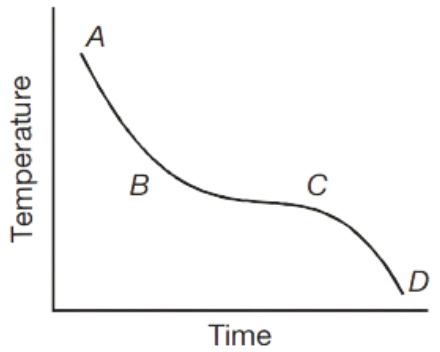
Question 54. A sample of a pure solid compound is heated until it melts completely. The compound is then allowed to cool until it solidifies again. The graph shows how the temperature of the compound changes with time.

NEET Foundation Chemistry Is Matter Around Us Pure Question 54

In which region of the graph both the liquid and the solid are present?

  1. A to B
  2. C to D
  3. B to C
  4. A to B and C to D

Answer. 3. B to C

Question 55. Which of the following pairs does not contain both elements?

  1. Carbon, silicon
  2. Helium, nitrogen
  3. Bronze, zinc
  4. Copper, silver.

Answer. 3. Bronze, zinc

Question 56. Brass contains

  1. Gold and copper
  2. Copper and zinc
  3. Zinc and silver
  4. Copper and silver

Answer. 2. Copper and zinc

Question 57. Fog and smoke are colloids of the type aerosol. Which of the following is different in both?

  1. Dispersed phase
  2. Dispersion medium
  3. Both (a) and (b)
  4. None of the above

Answer. 1. Dispersed phase

Question 58. Which of the following is not a pure substance?

  1. Mercury
  2. Sugar
  3. Blood
  4. Salt

Answer. 3. Blood

Question 59. Which pairs of substance are both mixtures?

  1. Air, sea water
  2. Sea water, ethanol
  3. Iron, water
  4. Lime water, marble

Answer. 1. Air, sea water

Question 60. Gases can be obtained from air by the process of

  1. Fractional distillation
  2. Condensation
  3. Crystallisation
  4. Evaporation

Answer. 1. Fractional distillation

Question 61. Which method cannot be used for separating solution of solid in liquid?

  1. Distillation
  2. Separating funnel
  3. Crystallisation
  4. Evaporation

Answer. 2. Separating funnel

Question 62. Sodium chloride is a considered as a pure substance because

  1. it is a solid at room temperature
  2. it contains only one type of particles
  3. its composition remains the same throughout
  4. Both (b) and (c)

Answer. 4. Both (b) and (c)

Question 63. Which of the following is a mixture?

  1. Calcium oxide
  2. Carbon dioxide
  3. Soil
  4. Coal

Answer. 3. Soil

Question 64. A mixture consists of a soluble solid in a liquid. Which method is most suitable for obtaining both the compounds?

  1. Fractional distillation
  2. Sublimation
  3. Distillation
  4. Evaporation

Answer. 3. Distillation

Question 65. In coloured gemstones, the dispersing medium and dispersed phase are

  1. solid, gas
  2. solid, liquid
  3. gas, solid
  4. solid, solid

Answer. 4. solid, solid

Question 66. Which of the following procedures will helpto determine whether a colourless liquid is a solution of a salt or pure water?

  1. Filtration
  2. Sedimentation and decantation
  3. Evaporation
  4. Chromatography

Answer. 3. Evaporation

Question 67. Odd one among the following which does not belong to the set is?

  1. Gun powder
  2. Air
  3. Graphite
  4. Brass

Answer. 3. Graphite

Question 68. Which of the following is a liquid non-metal?

  1. Copper
  2. Mercury
  3. Bromine
  4. Silver

Answer. 3. Bromine

Question 69. Tyndall effect is observed when

  1. sunlight passes through a small hole in a closed room
  2. a beam of light from a torch is directed on a starch solution
  3. sunlight enters a dense forest through spaces between the branches of trees

Answer. 3. sunlight enters a dense forest through spaces between the branches of trees

Question 70. Match the methods of separation with the physical properties of the substances on which they are based.

(1) Distillation (P) Difference in density

(2) Separation using a separating funnel (Q) Difference in solubility

(3) Filtration (R) Difference in boiling point

  1. (1) – P, (2) – R, (3) – Q
  2. (1) – Q, (2) – P, (3) – R
  3. (1) – Q, (2) – R, (3) – P
  4. (1) – R, (2) – P, (3) – Q

Answer. 4. (1) – R, (2) – P, (3) – Q

Question 71. Which of the following is not an emulsion?

  1. Mayonnaise
  2. Egg Yolk
  3. Shaving foam
  4. Cold Cream

Answer. 2.Egg Yolk

Question 72. Stirring Sulphur in carbon disulphide produces:

  1. Colloidal Solution
  2. Suspension
  3. True Solution
  4. Carbon trisulphide

Answer. 3. True Solution

Question 73. A solution with water as the solvent is called a/an ___________ solution.
Answer. Aqueous

Question 74. A solution in which the solute particles have a diameter below 1 nm is called a/an _________ solution.
Answer. True

Question 75. Which of the following statements are true for pure substances?

(1) Pure substances contain only one kind of particles

(2) Pure substances may be compounds or mixtures

(3) Pure substances have the same composition throughout

(4) Pure substances can be exemplified by all elements other than nickel

  1. (1) and (2)
  2. (1) and (3)
  3. (3) and (4)
  4. (2) and (3)

Answer. 2. (1) and (3)

Question 76. Rusting of an article made up of iron is called

  1. corrosion and it is a physical as well as chemical change
  2. dissolution and it is a physical change
  3. corrosion and it is a chemical change
  4. dissolution and it is a chemical change

Answer. 3. corrosion and it is a chemical change

Question 77. A mixture of sulphur and carbon disulphide is

  1. heterogeneous and shows Tyndall effect
  2. homogeneous and shows Tyndall effect
  3. heterogeneous and does not show Tyndall effect
  4. homogeneous and does not show Tyndall effect

Answer. 4. homogeneous and does not show Tyndall effect

Question 78. Tincture of iodine has antiseptic properties. This solution is made by dissolving

  1. iodine in potassium iodide
  2. iodine in vaseline
  3. iodine in water
  4. iodine in alcohol

Answer. 4. iodine in alcohol

Question 79. Which of the following are homogeneous in nature?

(1) ice

(2) wood

(3) soil

(4) air

  1. (1) and (3)
  2. (2) and (4)
  3. (1) and (4)
  4. (3) and (4)

Answer. 3. (1) and (4)

Question 80. Which of the following are physical changes?

(1) Melting of iron metal

(2) Rusting of iron

(3) Bending of an iron rod

(4) Drawing a wire of iron metal

  1. (1), (2) and (3)
  2. (1), (2) and (4)
  3. (1), (3) and (4)
  4. (2), (3) and (4)

Answer. 3. (1), (3) and (4)

Question 81. Which of the following are chemical changes?

(1) Decaying of wood

(2) Burning of wood

(3) Sawing of wood

(4) Hammering of a nail into a piece of wood

  1. (1) and (2)
  2. (2) and (3)
  3. (3) and (4)
  4. (1) and (4)

Answer. 1. (1) and (2)

Question 82. Two substances, A and B were made to react to form a third substance, A2B according to the following reaction: 2 A + B → A2 B Which of the following statements concerning this reaction are incorrect?

(1) The product A2B shows the properties of substances A and B

(2) The product will always have a fixed composition

(3) The product so formed cannot be classified as a compound

(4) The product so formed is an element

  1. (1), (2) and (3)
  2. (2), (3) and (4)
  3. (1), (3) and (4)
  4. (2), (3) and (4)

Answer. 3. (1), (3) and (4)

Question 83. Two chemical species X and Y combine together to form a product P which contains both X and YX + Y → PX and Y cannot be broken down into simpler substances by simple chemical reactions. Which of the following concerning the species X, Y and P are correct?

(1) P is a compound

(2) X and Y are compounds

(3) X and Y are elements

(4) P has a fixed composition

  1. (1), (2) and (3)
  2. (1), (2) and (4)
  3. (2), (3) and (4)
  4. (1), (3) and (4)

Answer. 4. (1), (3) and (4)

NEET Foundation Notes For Chemistry Chapter 1 Matter In Our Surrounding

NEET Foundation Notes For Chemistry  Chapter 1 Matter In Our Surrounding

Matter

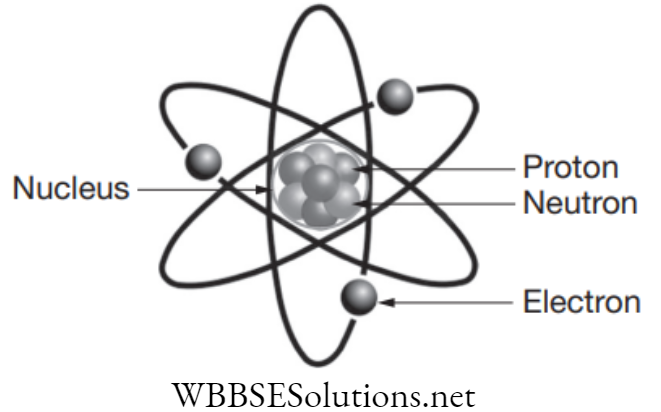
Matter is anything that has mass and takes up space. Matter consists of various types of particles like atoms, molecules and ions, which are further divided into electrons, protons and neutrons. Atoms are considered to be the basic unit of matter which may or may not exist independently.

They have their own chemical properties. Combination of atoms creates molecules. Combination of molecules and/or atoms forms compounds.

Read and Learn More: NEET Foundation Notes

The earth and all that it was meant to constitute arose from five core elements, which Indian philosophy recognizes as ‘panchatatva’. The word ‘panchatatva’ originates from Sanskrit, where ‘panch’ stands for five and ‘tatva’ indicates elements. Everything on this planet is composed of five basic elements, namely, Akash (space), Vayu (air), Jal (water), Agni (fire) and Prithvi (Earth).

It is thus true that all natural life including plants, animals and humanity at large are combination of these five elements.

NEET Foundation Chemistry Matter In Our Surrounding Combination of molecules

Matter In Our Surrounding

NEET Foundation Notes For Chemistry  Chapter 1 Matter In Our Surrounding

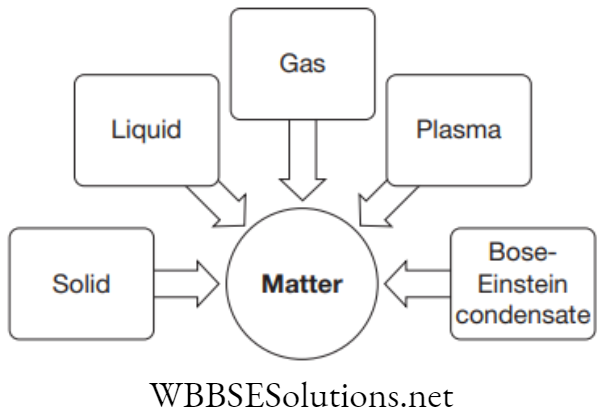
Matter exists in several states. The commonly known states are solid, liquid and gas. Besides these, some other states of matter also exist viz. Plasma and Bose-Einstein condensate.

On a fundamental level these are the elements that make matter as they have mass and volume. But photons on the other hand are not considered matter as it lacks mass and volume. A photon is defined as a bundle (or quantum) of electromagnetic (or light) energy. Photons are always in motion and, in a vacuum, have a constant speed of light to all observers.

Matter can be defined as any substance which has mass and occupies space. All solids, liquids and gases in the surroundings of earth are made up of matter. According to several researches, matter is made up of tiny particles which are bonded together. These particles cannot be seen but as a whole matter can be seen, touched or felt.

NEET Foundation Chemistry Matter In Our Surrounding Classification of matter

NEET Foundation Chemistry Matter In Our Surrounding Different states of matter

Example: a book, a car, a letter, a hand set, a piece of wood, a tree, a bag, etc.

Mass is the amount of matter a substance is made up of. It is the scientific measure of the amount of the constituents of an object. It’s SI unit is kilograms (kg) and often expressed in grams (g) as well.

The mass of a substance remains constant irrespective of its location in the universe. It means that the mass is not affected by gravitation or any other types of forces.

Class 11 Physics Class 12 Maths Class 11 Chemistry
NEET Foundation Class 12 Physics NEET Physics

Matter In Our Surroundings

Volume is the three-dimensional space occupied by matter. It’s SI unit is cubic metres (m3), but can also be expressed in litres (L), millilitres (mL) etc. Volume of the solids can be measured by measuring their height, length and width.

Similarly, the volume of the liquids and gas can be measured by the space that they occupy in a marked vessel.

Physical Nature of Matter

As per old school theories, nature of matter has two views:

  • One believed that matter can be broken into unlimited pieces as it is continuous. Greek philosophers Plato and Aristotle belong to this school of thought.
  • The other set believed that the process of subdivision is limited. Matter comes to a stage where the tiny particles cannot be subdivided. They believed matter has particulate nature i.e., it is made up of tiny particles. The smallest indivisible particle of matter was called ‘atom’ from the Greek word ‘atomos’ for ‘indivisible’.

The modern view of atom was given by John Dalton in 1803. He believed in two types of constituent particles atoms and compound atoms (presently known as molecules).

Matter is made up of atoms and all chemical properties of matter can be explained on its basis. Molecules are important in explaining physical properties of matter.

Characteristics of Matter

The basic characteristics of matter are discussed below:

  • Continuous movement of particles.
  • Intermolecular attraction between particles.
  • Space between particles.

On the basis of above mentioned characteristics, matter is classified into three states namely: solid, liquid and gas.

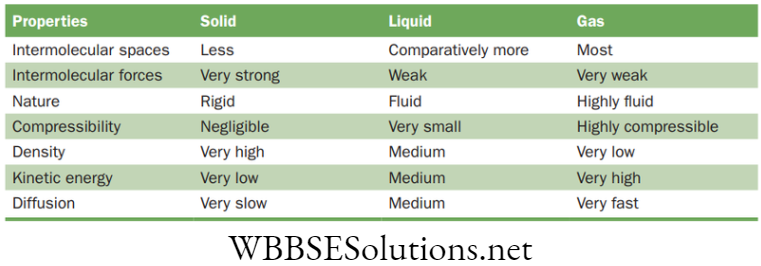
NEET Foundation Chemistry Matter In Our Surrounding Characterstics of intermolecular particle in different states

Solid

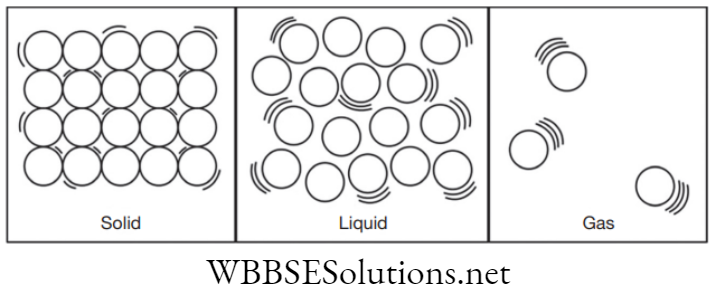
  • Intermolecular forces of attraction are strong between particles.
  • Their pattern is predetermined (lattice).
  • Due to strong forces of attraction even on vibration, atoms cannot change position therefore, have fixed volume and shape.
  • Due to strong intermolecular forces, the kinetic energy is very low.
  • The process of diffusion is either absent or extremely low, if present.
  • Due to close arrangement of particles, the matter is very dense.
  • Due to very limited intermolecular space, the compressibility is almost absent.

Liquid

  • Intermolecular forces of attraction are moderate.
  • Pattern is not pre-determined; they take up the shape of the container in which they are stored.
  • Due to weak forces of attraction, liquid particles slide past each other.
  • The kinetic energy is more than the solid.
  • The density is relatively less.
  • Diffusion takes place at higher rates than solids.
  • Due to more intermolecular space, compressibility is higher than solids.

Gas

  • Intermolecular forces of attraction in gases is negligible.
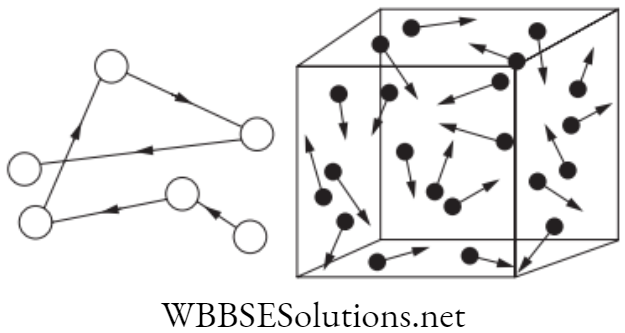
  • Particles are far apart from each other and their movement is quick and rapid.
  • Due to large intermolecular space they collide with each other and bounce in all directions.
  • Weak intermolecular force of attraction results in very high kinetic energy.
  • Process of diffusion is very fast.
  • Density is very low due to large intermolecular space.
  • Presence of large intermolecular space makes the gas highly compressible.
  • Difference between solid, liquid and gas

NEET Foundation Chemistry Matter In Our Surrounding Difference between solid, liquid and gas

NEET Foundation Notes For Chemistry  Chapter 1 Matter In Our Surrounding States of Matter

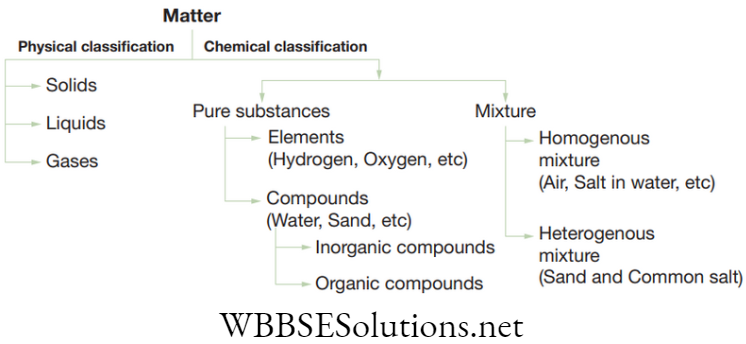
Matter can be classified mainly in two ways as discussed below.

By its physical state – solid, liquid, or gas,

By its chemical composition – element, compound or mixture.

NEET Foundation Chemistry Matter In Our Surrounding Physical and chemical classification of matter

Physical State of Matter

Matter can exist in three states – solid, liquid and gas. These three states of matter have different properties. Water is the best example of a substance that naturally exists in all the three states – solid (ice), liquid (water), gas (vapour).

Intermolecular forces hold the molecules together while the thermal energy functions in the opposite direction, i.e., to move them away from each other. It is the sum of the opposite forces, i.e., intermolecular and thermal which determines whether the matter is solid, liquid or gas.

If intermolecular force is greater than thermal force then the matter will be in solid state. By increasing thermal energy, state of matter may change, i.e., it may convert solid into liquid or liquid into gas.

Solid State of Matter

A solid has a definite size and shape which does not change its state without any external condition. Example: A piece of wood, a stone, etc. But on application of external forces, the solid changes shape. Example: With continuous hammering, gold is shaped into thin sheets.

In solids, particles are very close to each other due to strong intermolecular force which keeps these particles in a fixed position. Due to this factor, solids are hard and rigid and cannot be compressed. When the atoms are forced to come closer, the intermolecular force becomes repulsive.

With an increase in thermal energy, the kinetic energy of the molecules increases resulting in conversion of solid into liquid. The temperature at which the conversion of solid state to liquid state takes place is called melting point.

NEET Foundation Chemistry Matter In Our Surrounding Solid

Liquid State of Matter

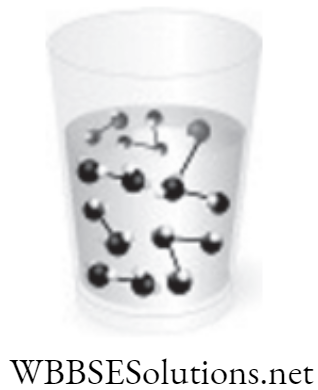
Water is the best example of liquid. Liquid has a definite volume but does not have a definite shape. Example: Mustard oil and kerosene oil, etc. A liquid has a definite volume.

The particles in liquid are not as densely packed as in solids due to weak intermolecular forces between them. The particles do not stay at a fixed positions like solids and move around due to the space available. The particles move away due to weak intermolecular forces and get attracted to other molecules that approach them in movement.

The particles can slide off each other as they can break away from each other and get attracted while approaching the other molecules. Similarly as in solid, liquid molecules also repulse on the attempt of getting the molecules closer by applying pressure. Due to this, pressure does not have much effect on volume of liquids.

NEET Foundation Chemistry Matter In Our Surrounding Liquid state

Gaseous State of Matter

Gas is not physically seen but is present in the surroundings. The gas takes up the whole volume of the container, irrespective of its size. Intermolecular force in gases is the least of all states due to which the particles move freely, moving far apart giving it no shape. Due to the space in molecules, on application of pressure they can be brought closer.

This is why gases are highly compressible. It can be compressed much more than liquids and solids, but to an extent. Volume of gas is also affected by temperature. If the temperature increases, the volume of the gas also increases. Example: Wind, CNG, oxygen cylinder.

NEET Foundation Chemistry Matter In Our Surrounding Gas state

With advanced technology scientists are accepting five states of matter: solid, liquid, gas, plasma and Bose–Einstein condensate.

1. Plasma: The particles in plasma are super energetic and super excited. They are in form of ionised gases. Example: The fluorescent tube and neon sign bulbs.

2. Bose–Einstein condensate: If a very light density gas (1/100000) is cooled at super low temperatures a new matter is found. This matter is considered to be 5th state of matter. This matter was found by Cornell, Ketterle and Wieman in 2001 (received Nobel Prize for the same).

The whole discovery is based on some calculations which were performed by the Indian physicist Satyendra Nath Bose in 1920. Albert Einstein predicted a new state of matter by building upon Bose’s calculation. So, the newly discovered 5th matter is called Bose–Einstein condensate (BEC).

Brownian Motion

Brownian motion or the Brownian movement was given by Scottish botanist Robert

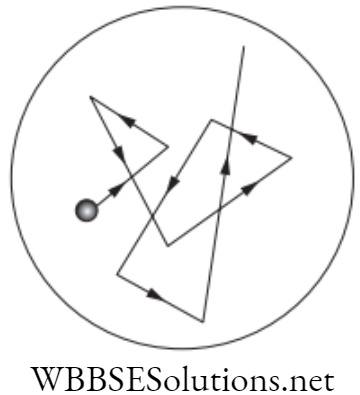
Brown (1827). Brownian motion is the random movement of particles suspended in a fluid (liquid or gas) resulting from their collision with the fast-moving atoms or molecules in the gas or liquid.

In a given medium, a number of particles are subjected to Brownian motion with no choice of direction for the random movement, then in a particular span of time the particles will spread uniformly throughout the medium.

NEET Foundation Chemistry Matter In Our Surrounding Brownian movement

NEET Foundation Chemistry Matter In Our Surrounding Particles moving from indefinite direction

If X and Y are two adjacent regions and X has twice as particles than Y, then the probability of particles moving from X to Y is double than the probability of particles moving from Y to X.

The process by which the particles move from high density to low density to spread evenly in whole region is called diffusion. Examples: Pollutants through the atmosphere, diffusion of calcium through bone tissue in living organisms.

Example:

  • When the crystal of potassium permanganate is placed in a beaker of water, the water slowly turns purple on its own, without stirring.
  • This mixing of water and the crystals of potassium permanganate takes on its own as both potassium permanganate crystal and water are made up of tiny particles.
  • When the crystals of potassium permanganate are put in water, then its particles start separating from one another.
  • These purple colour particles of potassium permanganate get evenly spread throughout the water, thus making the whole water look purple.
  • The whole water looks purple, as on dissolving, the particles of potassium permanganate get into the spaces among the particles of water.

NEET Foundation Notes For Chemistry  Chapter 1 Matter In Our Surrounding Matter Changes Its State

Substances convert from one state to another with temperature and surrounding pressure working as catalysts. If the pressure is constant then temperature remains as the only determining factor. For example, the atmospheric pressure. The temperature is increased to a point where the change takes place and then it stays constant till the conversion is complete.

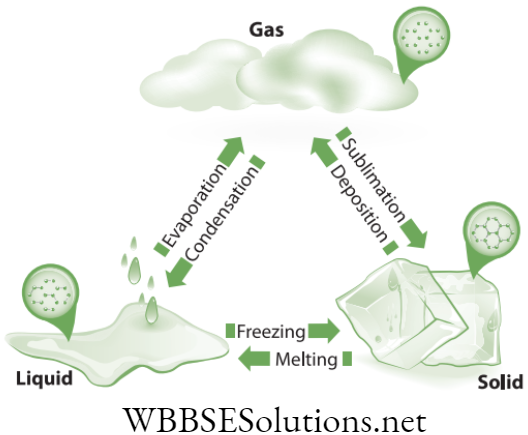
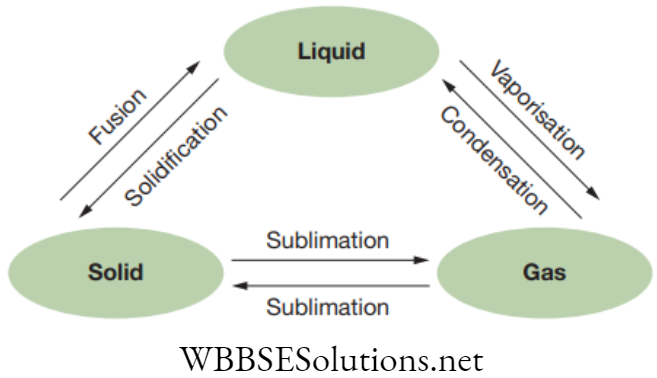
On heat application, the state changes from solid to liquid to gas except few which directly converts from solid to gas. On cooling, the conversion of state is from gas to liquid to solid except few which directly converts from gas to solid.

Processes of change of state

NEET Foundation Chemistry Matter In Our Surrounding Processes of change of state

Processes of Change of State

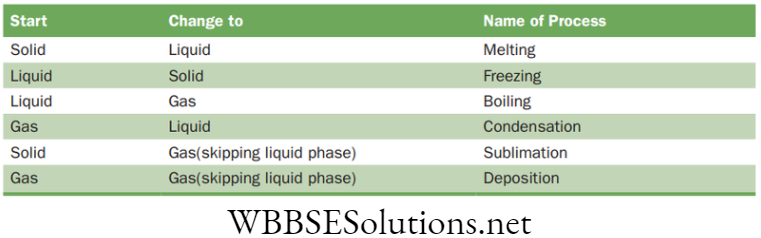
  • Melting: When the solid is heated, the particles receive thermal energy which results in faster vibration in them. With increase in temperature, the vibrations keep on increasing. At a particular temperature the vibrations increase so much that they break their ordered structure. At this point the solid converts into liquid. The process is called melting and the temperature is called melting point.
  • Freezing: It is the opposite process of melting. When the temperature of a liquid is decreased, the vibrations in the particles become restricted. At a particular temperature the vibrations become so restricted that the matter gets confined in a fixed order. At this point the liquid converts into solid. The process is called freezing and the temperature is called freezing point.
  • Boiling: When the liquid is heated the particles start moving faster. At one point the movement becomes so fast that they break away from each other. The liquid converts into gas. The process is called boiling and the temperature is called as boiling point. However, the conversion of liquid into gas may start long before reaching the boiling point. This process is called as evaporation.
  • Condensation: It is the opposite of evaporation. In this process the temperature of gas is decreased which results in decrease in the movement of particles. At one point the movement becomes so restricted that the particles join together converting gas into liquid. The process is called condensation and the temperature is called dew point.
  • Sublimation: There is a point of temperature and pressure at which a substance can exist in solid liquid and gas stages. It is known as ‘Triple Point’. Below this point the solid directly converts into gas skipping the liquid phase with increase in temperature.
  • Deposition: It is the process in which the gas directly converts into solid skipping the liquid phase. It opposite of sublimation. When the condensation takes place at below freezing point the gas directly converts into solid. Frosting is a common example of this.

Effect of Change of Temperature

On exposure to heat a solid expands. The expansion is small. On receiving thermal energy the particles vibrate more rapidly in their position and take up more space. On providing more thermal energy the particles become more energetic and leave their determined positions leading to change of state, i.e., solids melts into liquid.

On giving thermal energy to liquid it converts to a gas. This takes place because kinetic energy of the particles becomes so high that they can overcome the intermolecular force within the liquid. Therefore, liquid is converted into gas (vapour).

NEET Foundation Chemistry Matter In Our Surrounding Interconversion of matter

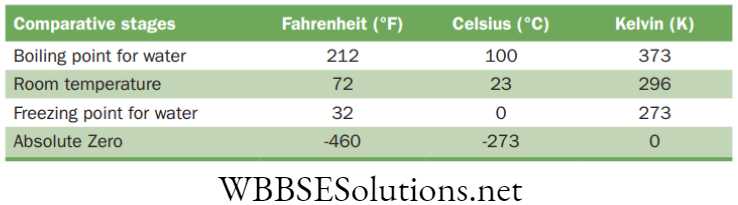
There are three most prevalent scales to measure temperature in our surroundings. These are Fahrenheit, Celsius and Kelvin. Fahrenheit scale is based on 32 degree for freezing point and 212 degree for boiling point of water. Celsius is based on 0 degree for freezing point and 100 degree for boiling point.

Kelvin scale is based on 0 degree for absolute zero. Kelvin is related with Celsius scale as it also has a difference of 100 degrees between freezing point and boiling point of water. These scales can be converted between each other as follows:

K = 273.15 + ˚C ˚C = (5/9) × (˚F – 32) ˚F = (9/5) × (˚C + 32)

Measures of scaling temperature

NEET Foundation Chemistry Matter In Our Surrounding Measures of scaling temperature

Latent Heat

When the water is vaporised from the surface, it needs energy to convert from liquid state to gaseous state. The water absorbs this heat energy from the environment. This energy does not heat up the water but is used in converting from liquid to gas.

This heat which is required to change the state of matter, is called Latent heat. Due to absorption of this heat energy, the surface becomes cool.

Example: When a person who is sweating due to high temperature stands near a fan, the air circulated through fan evaporates the moisture from the skin and feels a cooling effect in this process.

It does not cause temperature change as it is used for changing the state of substance. At molecular level it can be understood as the energy which is required to overcome the intermolecular attraction and is very essential in order to change the state.

For example, when water boils, the temperature of water remains constant at 100°C. The additional heat is absorbed in converting the liquid into vapour and is carried by the vapour. This energy is released during condensation.

Types of Latent Heat

  1. Latent heat of fusion
  2. Latent heat of vaporization

1. Latent heat of fusion: The amount of heat energy that is required to change 1 kg of solid into liquid at atmospheric pressure at its melting point is called latent heat of vaporisation. The latent heat of fusion of ice is 3.34 × 10⁵ Joules per kilogram.

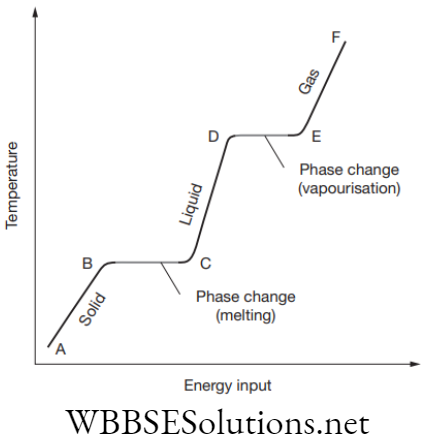
2. Latent heat of vaporization: The amount of heat which is required for converting 1 kilogram of the liquid (at its boiling point) to vapour or gas, without any change in temperature. When the temperature of the solid substance is measured on heating, the following graph is obtained:

The temperature change with energy input. In this, phase changes are indicated by flat regions where heat energy used to overcome attractive forces between molecules.

NEET Foundation Chemistry Matter In Our Surrounding Graphical representation of latent heat of vaporization

Explanation

  • At point A, the substance is in its solid phase, heating it, brings the temperature up to its melting point but the material still remains a solid at point B.
  • As it is heated further, the energy from the heat source breaks the bond which holds the atoms in place. This takes place from B to C.
  • At point C the entire solid has been transformed into the liquid phase.
  • From now onwards energy which is added goes into the kinetic energy of the particles in raising the temperature (C to D).
  • At point D the temperature has reached its boiling point but it is still in the liquid phase.
  • In D to E, thermal energy is overcoming the bonds and the particles have enough kinetic energy to escape from the liquid.
  • The substance now is entering the gas phase.
  • Beyond E, if you further heat the substance under pressure it can raise the temperature still further. This is how a pressure cooker works.

Specific Latent Heat

The heat energy required to boil or melt a particular substance is known as specific latent heat of that substance. It is measured in terms of amount of energy required to change the state of one kilogram of substance.

Example: Specific latent heat of water is 334 kilojoule/kg for melting and 2260 kJ/kg for boiling.

Effect of Change of Pressure

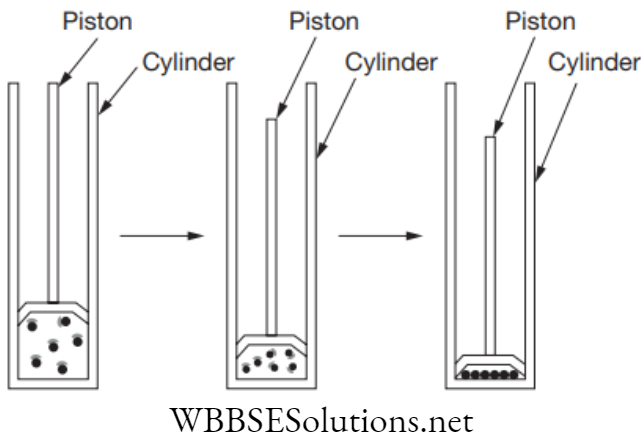
Gas can be compressed by applying pressure because of large intermolecular space and weak intermolecular force.

When thermal energy is provided to a gas, kinetic energy of the particles increases. They start moving more freely and at much higher speed. On the pressure being constant the intermolecular distance also increases and the volume of the gas increases.

At a fixed temperature pure solid turns to liquid. This particular temperature is called melting point of that particular solid substance. Liquid on cooling converts into solid at a particular temperature.

This temperature is called freezing point of that particular liquid substance. The temperature at which a liquid boils and is converted into a gas is boiling point of the liquid.

NEET Foundation Chemistry Matter In Our Surrounding Effect of change of pressure

NEET Foundation Notes For Chemistry  Chapter 1 Matter In Our Surrounding Evaporation

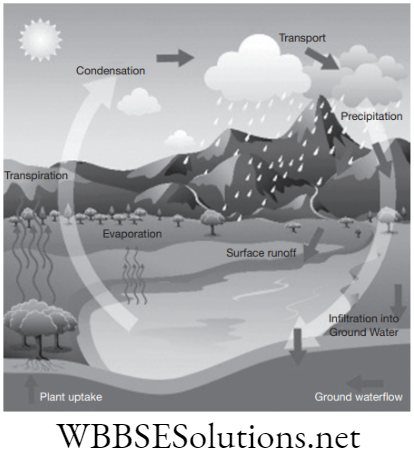
It is a phenomenon of changing liquid into vapour at any temperature below its boiling point, i.e., water changes from a liquid to a gas or vapour form. Water boils at 100°C, but it begins to evaporate at 32°C. As the temperature increases, the rate of evaporation also increases.

NEET Foundation Chemistry Matter In Our Surrounding Water Cycle

The rate of evaporation depends on the temperature and it also depends on the amount of water present to evaporate.

Factor Effecting Evaporation

  • Temperature: Evaporation is affected by temperature, higher the temperature of the liquid then higher is the rate of the molecules to escape from the surface
  • Humidity of surrounding air: Humidity is inversely proportional to evaporation. Higher the humidity, lower is the evaporation.
  • Boiling point: If the boiling point of the liquid is lower the evaporation starts at relatively lower temperatures due to weak inter-particle interaction.
  • Surface area of liquid: Large surface area enables more number of molecules to be exposed for evaporation. This results in faster evaporation.
  • Movement of air: Higher air movement results in faster evaporation as the moisturised air mass is quickly replaced by another dry air mass.
  • Pressure: Atmospheric pressure and rate of evaporation are inversely proportional to each other. So, if the atmospheric pressure decreases the rate of evaporation increases.

NEET Foundation Notes For Chemistry  Chapter 1 Matter In Our Surrounding Fill In The Blanks

Question 1. __________ is the densest state of matter.
Answer. Solid

Question 2. Solids have tendency to maintain shape because they are _________.
Answer. Rigid

Question 3. Gases have neither definite shape nor definite ____________.
Answer. Volume

Question 4. Conversion of gas to liquids is called __________.
Answer. Condensation

Question 5. The freezing point of pure water is _________.
Answer. 0°C

Question 6. The boiling point of alcohol is 1000C. In Kelvin scale it is equal to ___________.
Answer. 373K

Question 7. The temperature at which vapour changes into liquids is called ___________.
Answer. Liquefication point

Question 8. ___________ is an example of subliming solid.
Answer. Ammonium chloride

Question 9. ___________ exert pressure on the walls of the container.
Answer. Gases

Question 10. Matter is made up of ______________.
Answer. Particles

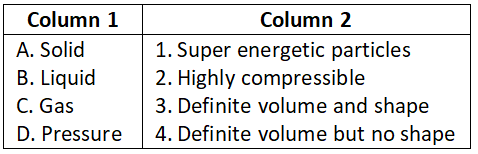
NEET Foundation Notes For Chemistry  Chapter 1 Matter In Our Surrounding Match the Column

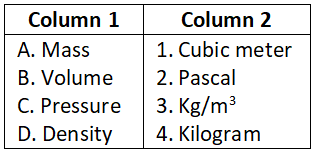
Question 1. Match the physical quantities with the SI units:

NEET Foundation Chemistry Matter In Our Surrounding Correct Option 1

Select the correct option:

  1. A-1, B-3, C-2, D-4
  2. A-3, B-2, C-4, D-1
  3. A-3, B-1, C-2, D-4
  4. A-4, B-1, C-2, D-3

Answer. 4. A-4, B-1, C-2, D-3

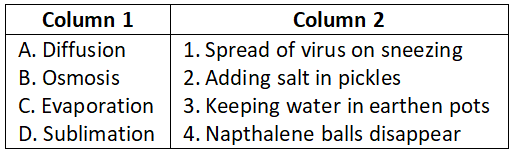
Question 2. Match the following

NEET Foundation Chemistry Matter In Our Surrounding Correct Option 2

Select the correct option:

  1. A-3, B-4, C-2, D-1
  2. A-3, B-2, C-4, D-1
  3. A-3, B-1, C-2, D-4
  4. A-4, B-2, C-1, D-3

Answer. 1. A-3, B-4, C-2, D-1

Question 3. Match the following

NEET Foundation Chemistry Matter In Our Surrounding Correct Option 3

Select the correct option:

  1. A-1, B-3, C-2, D-4
  2. A-4, B-1, C-2, D-3
  3. A-1, B-2, C-3, D-4
  4. A-3, B-1, C-2, D-4

Answer. 3. A-1, B-2, C-3, D-4

NEET Foundation Notes For Chemistry  Chapter 1 Matter In Our Surrounding Assertion Reason

For the following questions, the options will remain as follows:

  1. Both A and R are correct and R is the explanation of A
  2. Both A and R are correct, but R is not the logical explanation of A
  3. A is correct but R is incorrect
  4. A is incorrect but R is correct

Question 1. Assertion: People usually prefer desert coolers on a hot, dry day.
Reason: Low humidity increases the rate of evaporation of water.
Answer. 1. Both A and R are correct and R is the explanation of A

Question 2. Assertion: Solid does not fill its container completely.
Reason: The particles of solid are very closely packed.
Answer. 2. Both A and R are correct, but R is not the logical explanation of A

Question 3. Assertion: We should wear cotton clothes in summers.
Reason: Cotton is less expensive.
Answer. 3. A is correct but R is incorrect

NEET Foundation Notes For Chemistry  Chapter 1 Matter In Our Surrounding Comprehension Passage

Read the passage and answer the questions:

Latent Heat

The term latent means hidden. The latent heat of a substance is the amount of heat absorbed by a unit mass of the substance to change its state without change of temperature. Its SI unit is Joules per kilogram. Latent heat is of two types:

  1. Latent heat of fusion
  2. Latent heat of vaporization

The Latent heat of fusion of a solid is the quantity of heat in Joules required to convert 1 kg of solid (at its melting point) to liquid, with no change in temperature.

The Latent heat of vaporization of a liquid is the quantity of heat in Joules required to convert 1 kg of the liquid (at its boiling point) to gas with no change in temperature.

Specific Heat

It is the amount of heat which is required to raise the temperature of a unit mass of the substance by 1°C.

The symbol is C or S. The specific heat varies slightly with temperature. This is due to the change which occurs in the structure of molecules in a substance with change in temperature. The unit of specific heat is Joules per kilogram per degree Celsius


NEET Foundation Chemistry Chapter 1 Matter In Our Surrounding Short Answer Questions

Chapter 1 Matter In Our Surrounding Short Answer Type Question And Answers

Question 1. A small quantity of a gas is let into a large evacuated chamber, then how much of the chamber gets filled with the gas?
Answer.

A small quantity of a gas is let into a large evacuated chamber

The entire chamber gets filled with the gas, because the gas molecules have very weak intermolecular forces of attraction. This permits the gas molecules to diffuse and fill up the entire chamber.

Matter In Our Surrounding

Question 2. Why do solids not diffuse into one another?
Answer.

Solids not diffuse into one another:

Solids have very little intermolecular spaces and intermolecular force of attraction between molecules of solid is very high which prevents diffusion of molecules of one solid into another solid.

NEET Foundation Chemistry Chapter 1 Matter In Our Surrounding Short Answer Questions

Question 3. What happens when a liquid is heated?
Answer.

When a liquid is heated:

When liquid is heated, heat which is absorbed by the liquid, increases the average kinetic energy of the particles in the liquid, thus increasing its temperature.

NEET Foundation Chemistry Chapter 1

Question 4. Why does water boil at a lower temperature at higher altitudes?
Answer.

Water boil at a lower temperature at higher altitudes:

Boiling occurs at a point where vapour pressure becomes equal to the external atmospheric pressure. At higher altitudes as atmospheric pressure is less, so less thermal energy is required to make vapour pressure equal to the atmospheric pressure.

Read And Learn More NEET Foundation Short Answer Questions

Question 5. What is the principle used in a pressure cooker?
Answer.

principle used in a pressure cooker:

In the pressure cooker, when the pressure in the enclosed volume above the liquid reaches greater values than the atmospheric pressure, then the temperature of boiling water within the cooker gets greater than the normal boiling temperature. Hence, cooking become faster in pressure cooker.

Question 6. Why the volume of a gas increases when heated?
Answer.

Volume of a gas increases when heated:

In gases, the intermolecular forces of attraction among the molecules are weak but the kinetic energy of the molecules is high. When energy is supplied in the form of heat, the kinetic energy of the gas molecules gets further increase but as the attractive forces are weak, the gas molecules move and spread apart to occupy a greater volume.

Question 7. When a glass beaker containing water and a large crystal of potassium permanganate is kept aside for a few hours, what change do you observe after sometime?
Answer.

When a glass beaker containing water and a large crystal of potassium permanganate is kept aside for a few hours

The solution is colourless in the beginning. After a few minutes the water at the bottom of the beaker gets dark pink, while water towards the top, is light pink. After a few more minutes, the entire liquid becomes uniformly dark pink in colour.

Question 8. What is the significance of knowing the boiling point of a substance?
Answer.

Significance of knowing the boiling point of a substance:

The significance of knowing the boiling point of a substance is:

The boiling point of a liquid indicates the strength of the force of attraction between the particles of the liquid. The higher the boiling point of a liquid, the stronger is the force of attraction between the particles of that liquid.

The boiling point of the compound helps in its identification. The measurement of the boiling point of a liquid is the criterion for purity of the substance. Apure sample of water will always boil at 100°C.

NEET Foundation Chemistry Chapter 1

Question 9. Why does ice have a lower density than water? Explain.
Answer.

Ice have a lower density than water:

Although ice is a solid, it floats on water because it has low density or less mass per unit volume when compared to water. Most of the substances are denser in their solid state, but water is different. This peculiarity of water reflects on the structure of ice.

Question 10. Give 5 examples of diffusion from our daily lives.
Answer.

5 examples of diffusion from our daily lives:

The 5 examples of diffusion from our daily lives are:

A tea bag placed in the hot water will diffuse into water.

Adding edible colors in a liquid will diffuse the color.

Stirring sugar in hot tea will help it diffuse quicker.

When cooking pasta, the water diffuses into noodles, making them bigger and moister.

If you water wilted plants, the water will diffuse into the plants, making them firmer

Class 11 Physics Class 12 Maths Class 11 Chemistry
NEET Foundation Class 12 Physics NEET Physics

Question 11. Liquid nitrogen is used as a commercial refrigerant to flash freeze foods. Nitrogen boils at -196°C. What is this temperature on the Kelvin temperature scale?
Answer.

Given:

Liquid nitrogen is used as a commercial refrigerant to flash freeze foods. Nitrogen boils at -196°C.

Nitrogen boils at -196°C.

We know,

K = °C + 273

⇒ K = –196 + 273

= 77 K

On Kelvin temperature scale, Nitrogen boils at 77 K.

Question 12. What is the essential criteria for anything to be considered as matter? Which of the following cannot be considered as matter?

Coconuts, thoughts, chair, warmth, computer, almonds

Answer. It is essential to occupy space and have mass for anything to be considered as matter. Out of all, thoughts and warmth are not matter as they neither have mass nor they occupy space.

Question 13. Which characteristic of particles is responsible for the following?

  1. Diffusion of gases
  2. Rigidity of solids
  3. Tendency of a gas to fill up the container in which it is kept

Answer.

  • Diffusion of gases takes place due to movement of particles.
  • Rigidity of solids is due to negligible intermolecular spaces between the particles.
  • Tendency of a gas to fill up the container in which it is kept is due to negligible intermolecular force of attraction.

NEET Foundation Chemistry Chapter 1

Question 14. If you could magnify a coin down to the particle level, what two observations could you make about the particles?
Answer.

The two observations we could make about the particles will be:

  • There is negligible intermolecular space.
  • The particles are tightly packed together.

Question 15. Give an example of a substance in which ions are present.
Answer.

Example of a substance in which ions are present

Salt is a substance in which ions are present.

Question 16. What is photon?
Answer.

Photon:

A photon is defined as a bundle (or quantum) of electromagnetic (or light) energy. Photons are always in motion and, in a vacuum, have a constant speed of light to all observers.

NEET Foundation Chemistry Chapter 1 Matter In Our Surrounding Multiple Choice Questions

WBBSE Chapter 1 Matter In Our Surrounding Multiple Choice Question And Answers

Direction: Choose the correct option for each question. There is only one correct response for each question.

Question 1. Which of the following characteristics is not true for matter?

  1. It occupies space
  2. It has mass
  3. It has inertia
  4. It is least affected by gravity

Answer. 4. It is least affected by gravity

Question 2. In which of the given combinations would the rate of diffusion be slowest?

  1. Between two different gases
  2. Between two different liquids
  3. Between a liquid and a solid
  4. Between two solids

Answer. 4. Between two solids

Question 3. The intermolecular force will be very weak in which of the following:

  1. A piece of wood
  2. Steam
  3. Milk
  4. Sugar crystals

Answer. 2. Steam

Question 4. The temperature at which the vapour pressure of any liquid becomes equal to atmospheric pressure is known as__________.

  1. Boiling point
  2. Melting point
  3. Freezing point
  4. Triple point

Answer. 1. Boiling point

Read and Learn More NEET Foundation Multiple Choice Questions

Question 5. What do you understand by fusion?

  1. Inter-conversion of solid into liquid
  2. Converting liquid to solid
  3. Converting liquid to gas
  4. Inter-conversion of gas into solid

Answer. 1. Inter-conversion of solid into liquid

Question 6. How can the evaporation of liquids be increased?

  1. By increasing the humidity
  2. By contracting the surface area
  3. By increasing the temperature
  4. All of the above

Answer. 3. By increasing the temperature

Question 7. What is the correct order of evaporation?

  1. Petrol > alcohol > water > kerosene
  2. Petrol > kerosene > water > alcohol
  3. Alcohol > Petrol > kerosene > water
  4. Petrol > alcohol > kerosene > water

Answer. 4. Petrol > alcohol > kerosene > water

Question 8. The major constituent of cooking gas is _______?

  1. Ethane
  2. Propane
  3. Butane
  4. Methane

Answer. 3. Butane

NEET Foundation Chemistry Chapter 1 Matter In Our Surrounding Multiple Choice Questions

Question 9. We have often seen the naphthalene balls that we put in our clothes disappear after some time. What could be the phenomenon?

  1. Evaporation
  2. Sublimation
  3. Diffusion
  4. Contraction

Answer. 2. Sublimation

Question 10. What happens to the temperature when a solid melts?

  1. It increases
  2. It decreases
  3. It remains same
  4. First increases then decreases

Answer. 3. It remains the same

Question 11. What is the correct unit of weight?

  1. Kelvin
  2. Newton
  3. Pascal
  4. None of these

Answer. 2. Newton

Question 12. In condensation, there is ________.

  1. Loss of energy
  2. Gain of energy
  3. Neither gain nor loss of energy
  4. Loss of energy in the beginning followed by gain

Answer. 2. Gain of energy

Question 13. For a state of matter to be a liquid, which of the given conditions is true?

  1. The is above the room temperature at the atmospheric pressure.
  2. The substance’s boiling point is above the room temperature under the atmospheric pressure.
  3. The boiling point of the substance is below the room temperature at the atmospheric pressure.
  4. None of these

Answer. 2. The boiling point of the substance is above the room temperature under the atmospheric pressure.

Question 14. We can often see large volumes of gases in small cylinders. How is this possible?

  1. Gases can sublime
  2. Gases can solidify
  3. Gases can evaporate
  4. Gases can compress

Answer. 4. Gases can compress

Question 15. We can often see people adding salt to water while boiling stuff like kidney beans or potatoes. Why?

  1. The boiling point of water increases
  2. The boiling point of water decreases
  3. It enhances taste
  4. None of the above

Answer. 1. The boiling point of water increases

Question 16. Reena was in a hurry, so she sipped her hot tea in a saucer instead of cup. Why?

  1. Tastes better
  2. Cools quickly in saucer than cup
  3. Easy to hold
  4. All of the above

Answer. 2. Cools quickly in saucer than cup

Question 17. What will happen if an inverted cylinder of hydrogen gas is placed upon a cylinder of nitrogen oxide?

  1. Both gases will move upwards
  2. Both will move down
  3. Hydrogen will move down but nitrogen oxide will remain as it is
  4. Hydrogen will move downwards and nitrogen oxide will move upwards

Answer. 4. Hydrogen will move downwards and nitrogen oxide will move upwards

Question 18. What can you say about particles of matter?

  1. These are very small
  2. These attract each other
  3. These have spaces between them
  4. All of the above

Answer. 4. All of the above

Question 19. Identify the odd one out taking state of matter into consideration:

  1. Sponge
  2. Lemonade
  3. A stretched rubber band
  4. A metal block

Answer. 2. Lemonade

Question 20. Which of these is correct for diffusion?

  1. Diffusion takes place only in gases.
  2. Diffusion takes place only in liquids.
  3. Diffusion does not take place in solids.
  4. Diffusion takes place in all the three states of matter, viz. solids, liquids, gases.

Answer. 4. Diffusion takes place in all the three states of matter, viz. solids, liquids, gases.

Question 21. From the given options, which metal has the highest melting point?

  1. Fe
  2. W
  3. B
  4. Cr

Answer. 2. W

Question 22. How can gases be liquefied?

  1. Increase the pressure, increase the temperature
  2. Increase the pressure, lower the temperature
  3. Lower the pressure, increase the temperature
  4. Lower the pressure, lower the temperature

Answer. 2. Increase the pressure, lower the temperature

Question 23. What is plasma?

  1. A state of matter
  2. A type of gas
  3. Combination of three states of matter
  4. None of the above

Answer. 1. A state of matter

Question 24. Which of these is not an example of diffusion?

  1. When we bake, the smell of cake spreads.
  2. We put salt in pickles.
  3. When we sneeze, the virus spread.
  4. Smell of the burning incense stick spreads in the house.

Answer. 2. We put salt in pickles.

Question 25. Which state of matter will have maximum fluidity?

  1. Liquids
  2. Gases
  3. Both have equal fluidity
  4. None of the two possess fluidity

Answer. 2. Gases

Question 26. In which of the following conditions, the rate of evaporation will be low?

  1. Humidity of air is low
  2. Surface area is increased
  3. Increasing the temperature of the liquid
  4. Decreased wind speed

Answer. 4. Decreased wind speed

Question 27. Which of the following will have highest intermolecular force of attraction?

  1. Dry ice
  2. CO2
  3. H2O
  4. Liquid ethyl alcohol

Answer. 1. Dry ice

Question 28. The change of state from vapour to liquid is known as __________.

  1. Condensation
  2. Evaporation
  3. Diffusion
  4. Sublimation

Answer. 1. Condensation

Question 29. What is the conversion of solid state to liquid state known as?

  1. Fusion
  2. Diffusion
  3. Vaporization
  4. Sublimation

Answer. 1. Fusion

Question 30. Why does ice have cooling effects and steam has burning effects?

  1. Water molecules have low energy in ice and high energy in steam.
  2. Water molecules have high energy in ice and low energy in steam.
  3. Both have same molecular energy but ice take energy from body so has a cooling effect.
  4. None of these

Answer. 1. Water molecules have low energy in ice and high energy in steam.

Question 31. Who discovered the random movement of particles?

  1. John Dalton
  2. Robert Brown
  3. Kanada
  4. None of these

Answer. 2. Robert Brown

Question 32. When potassium permanganate is put in water, the colourless water attains purple colour. What could be the possible reasons?

1. The particles of water and potassium permanganate are in motion.

2. The process of diffusion is taking place.

3. The process of sublimation is taking place.

4. Only the particles of potassium permanganate are moving.

  1. Option (1) only
  2. Options (1) and (2)
  3. Options (1) and (3)
  4. Only option (4)

Answer. 2. Options (1) and (2)

Question 33. Which two gases dissolve in water by diffusion?

  1. Nitrogen and helium
  2. Nitrogen and oxygen
  3. Oxygen and carbon dioxide
  4. Carbon dioxide and helium

Answer. 3. Oxygen and carbon dioxide

Question 34. According to Robert Brown observation, which of the given statements is/are correct?

1. The speed of particles decrease with increase in temperature.

2. The speed of particles increase with increase in temperature.

3. The particles move in a linear motion.

4. The particles move in a zigzag motion.

  1. 1 and 4
  2. 1 and 3
  3. 2 and 3
  4. 2 and 4

Answer. 4. 2 and 4

Question 35. Which of the following will have a fixed volume

  1. Only solids
  2. Only liquids
  3. Only gases
  4. Both solids and Liquids

Answer. 4. Both solids and Liquids

Question 36. Latent heat of vaporization causes state change at which temperature?

  1. 100 degree C
  2. 373 K
  3. Below boiling point of liquid
  4. Both (a) and (b)

Answer. 4. Both (a) and (b)

Question 37. Out of the given statements, which two statements are not true:

1. Evaporation takes place at the surface of the liquid but boiling takes place throughout the mass of liquid.

2. Evaporation is a rapid process, boiling is a slow process.

3. Evaporation takes place at constant temperature.

4. Boiling takes place at constant temperature.

  1. 1 and 2
  2. 2 and 3
  3. 1 and 3
  4. 3 and 4

Answer. 2. 2 and 3

Class 11 Physics Class 12 Maths Class 11 Chemistry
NEET Foundation Class 12 Physics NEET Physics

Question 38. Identify which of the following show evaporation:

  1. Obtaining common salt from sea water
  2. Sweating
  3. Drying of clothes
  4. All of the above

Answer. 4. All of the above

Question 39. What can you say about plasma?

1. It is a mixture of free electrons and ions

2. It contains only electrons

3. It can also be artificial

  1. 1 is correct, but 2 and 3 are incorrect
  2. Only 1 is incorrect
  3. 1 and 3 are correct
  4. Only 2 is correct

Answer. 3. 1 and 3 are correct

Question 40. Choose the correct statement/s

1. Gases have high densities

2. Liquids have high compressibility

3. Solids have minimum kinetic energy of particles

  1. Only 1
  2. Only 2
  3. Only 3
  4. 1 and 3

Answer. 3. Only 3

Question 41. Why does alcohol exist in liquid state at room temperature?

  1. It is highly compressible
  2. Its melting point is below room temperature
  3. It possess strong intermolecular force
  4. Both (a) and (b)

Answer. 4. Both (a) and (b)

Question 42. Which of the following has the strongest interparticle forces at room temperature?

  1. Oxygen
  2. Water
  3. Bromine
  4. Iron

Answer. 4. Iron

Question 43. The characteristic features of solids are

  1. Definite shape
  2. Definite size
  3. Definite shape and size
  4. Definite shape, size and rigidity

Answer. 4. Definite shape, size and rigidity

Question 44. Which is not a property of solids

  1. Solids are always crystalline in nature
  2. Solids have high density and low compressibility
  3. The diffusion of solids is very slow
  4. Solids have definite volume

Answer. 1. Solids are always crystalline in nature

Question 45. Which of the following is matter?

  1. Love
  2. Thought
  3. Cold
  4. Cold drink

Answer. 4. Cold drink

Question 46. Which one of the following statements is not correct about the three states of matter?

  1. Molecules of a solids posses least energy whereas those of a gas possess highest energy
  2. The density of solid is highest whereas that of gases is lowest
  3. Gases like liquids possess definite volumes
  4. Molecules of a solids possess vibratory motion

Answer. Gases like liquids possess definite volumes

Question 47. The change of state from gas to liquid is called

  1. Fusion
  2. Condensation
  3. Sublimation
  4. Vaporization

Answer. 2. Condensation

Question 48. Which of the following has highest intermolecular forces of attraction?

  1. Liquid water
  2. Liquid ethyl alcohol
  3. Gaseous CO2
  4. Solid CO2

Answer. 4. Solid CO2

Question 49. Arrange the following substances in the increasing order of intermolecular forces of attraction

1. Salt

2. Water

3. Carbondioxide

  1. (3) < (2) < (1)
  2. (3) > (2) > (1)
  3. (2) < (1) > (3)
  4. (1) < (2) > (3)

Answer. 1. (3) < (2) < (1)

Question 50. The change of state from solid to gas is called

  1. Fusion
  2. Condensation
  3. Sublimation
  4. Vaporization

Answer. 3. Sublimation

Question 51. The change of state from liquid to vapour is called

  1. Fusion
  2. Condensation
  3. Sublimation
  4. Vaporization

Answer. 4. Vaporization

Question 52. Kinetic energy of molecules is highest in

  1. Gases
  2. Solids
  3. Liquids
  4. Solutions

Answer. 1. Gases

Question 53. Dry ice is

  1. Water in solid state
  2. Water in gaseous state
  3. CO2 in liquid state
  4. CO2 in solid state

Answer. 4. CO2 in solid state

Question 54. The physical state of water at 10ºC is

  1. Solid
  2. Liquid
  3. Gas
  4. May be solid or liquid

Answer. 3. Gas

Question 55. The substance which can readily sublime is

  1. Ammonium chloride
  2. Sodium chloride
  3. Hydrochloric acid
  4. Chlorine gas.

Answer. 1. Ammonium chloride

Question 56. The large volumes of gases can be put into small volumes of cylinders because of their property known as

  1. Sublimation
  2. Compressibility
  3. Evaporation
  4. Solidification.

Answer. 2. Compressibility

Question 57. 0ºC temperature may be written in Kelvin scale as

  1. 300 K
  2. 273 K
  3. 27 K
  4. All of the above

Answer. 2. 273 K

Question 58. Which of the following is not a matter?

  1. Chair
  2. Air
  3. Smell
  4. Cold drink

Answer. 3. Smell

Question 59. 400 K temperature may be written in celsius scale as

  1. 300ºC
  2. 127ºC
  3. 27ºC
  4. 573ºC

Answer. 2. 127ºC

Question 60. The physical state of water at 0ºC is

  1. Ice
  2. Vapour
  3. Dry ice
  4. None of these

Answer. 1. Ice

Question 61. 500 K temperature may be written in celsius scale as

  1. 227ºC
  2. 500ºC
  3. Both (a) and (b)
  4. None of these

Answer. 1. 227ºC

Question 62. The temperature at which a liquid changes into gas is known as

  1. Melting point
  2. Transition point
  3. Boiling point
  4. Kelvin point.

Answer. 3. Boiling point

Question 63. Which of the following factor does not increase the rate of evaporation?

  1. Increase of temperature
  2. Increase in wind speed
  3. Increase in surface area
  4. Increase in humidity

Answer. 2. Increase in wind speed

Question 64. Which of the following statement is correct?

  1. Liquids have fixed shape
  2. Gases have a fixed volume and a fixed shape
  3. Liquids can be compressed easily
  4. Gases can be compressed easily

Answer. 4. Gases can be compressed easily

Question 65. Which of the following is correct regarding evaporation

  1. It causes cooling
  2. It is a surface phenomenon
  3. The rate of evaporation increases with increases in temperature
  4. All of these

Answer. 4. All of these

Question 69. The quantity of matter present in an object is called its:

  1. Weight
  2. Gram
  3. Mass
  4. Density

Answer. 3. Mass

Question 70. Which of the following is not matter

  1. Blood
  2. Moon rock
  3. Electron
  4. Humidity

Answer. 4. Humidity

Question 71. Which of the following is an incorrect statement:

  1. Matter is continuous in nature.
  2. Of the three state of matter, the one that is most compact is solid state.
  3. In solid state interparticles space (i.e., empty space) is minimum.
  4. The density of solid is generally more than that of a liquid

Answer. 1. Matter is continuous in nature.

Question 72. Put of the following which is the densest state of matter?

  1. Solids
  2. Liquids
  3. Gases
  4. Plasmas

Answer. 4. Plasmas

Question 73. As of the 1990s, scientists have proved the existence of how many states of matter?

  1. Two
  2. Three
  3. Four
  4. Five

Answer. 1. Two

Question 74. _________is any substance which has mass and occupies space.
Answer. Matter

Question 75. Who of the following gave the modern definition of matter consisting of atom and molecule?

  1. John Dalton
  2. J C Bose
  3. Albert Einstein
  4. N. Tesla

Answer. 1. John Dalton

Question 76. Which of the following is called fifth state of matter?

  1. Plasma
  2. Iodide
  3. Super-heated gases
  4. Bose–Einstein condensate

Answer. 4. Bose-Einstein condensate

Question 77. ________ is random movement of particles suspended in a fluid (liquid or gas) resulting from their collision with the fast-moving atoms or molecules in the gas or liquid.
Answer. Brownian motion

Question 78. 99% of the universe consists of which state of the matter?

  1. Solid
  2. Liquid
  3. Gas
  4. PlasmaAnswer. 4. Plasma

Question 6. The process by which the particles move from high density to low density to spread evenly in whole region is called ___________.
Answer. Diffusion

Question 79. The boiling point of alcohol is 78°C. What is this temperature in Kelvin scale:

  1. 373 K
  2. 351 K
  3. 375 K
  4. 78 K

Answer. 2. 351 K

Question 80. In which phenomena water changes into water vapour below its B.P.?

  1. Evaporation
  2. Condensation
  3. Boiling
  4. No such phenomena exist

Answer. 1. Evaporation

Question 81. The liquid which has the highest rate of evaporation is:

  1. Petrol
  2. Nail- polish remover
  3. Water
  4. Alcohol

Answer. 1. Petrol

Question 82. The state of matter which consists of super energetic particles in the form of ionized gases is called:

  1. Gaseous state
  2. Liquid state
  3. Bose- Einstein condensate
  4. Plasma state

Answer. 4. Plasma state

Question 83. The force that binds the particles of matter together is known as:

  1. Intermolecular space
  2. Bond
  3. Intermolecular force
  4. Nuclear force

Answer. 3. Intermolecular force

Question 84. The change of a liquid into vapour is called:

  1. Vapourization
  2. Solidification
  3. Sublimation
  4. None of these

Answer. 1. Vapourization

Question 85. Which is the process by which the solid converts directly into gas?

  1. Deposition
  2. Sublimation
  3. Freezing
  4. Condensation

Answer. 2. Sublimation

Question 86. Higher the humidity _______ is the evaporation.

Answer. Inversely, lower

Question 87. What happens to the temperature of the surface when evaporation takes place?

  1. Increase
  2. Decreases
  3. Remains unchanged
  4. First increases then decreases

Answer. 2. Decreases

Question 88. Which of the following does not increase the rate of evaporation?

  1. Surface area
  2. Humidity of air
  3. Atmospheric pressure
  4. Wind direction

Answer. 4. Wind direction

Question 89. Which of the following is the point at which gas converts into liquid?

  1. Freezing point
  2. Boiling point
  3. Dew point
  4. Melting point

Answer. 3. Dew point

Question 90. In which year the Nobel Prize on Bose’s formula was given?

  1. 2001
  2. 2002
  3. 1920
  4. 1925

Answer. 1. 2001

Question 91. Which one of the following sets of phenomena would increase on raising the temperature?

  1. Diffusion, evaporation, compression of gases
  2. Evaporation, compression of gases, solubility
  3. Evaporation, diffusion, expansion of gases
  4. Evaporation, solubility, diffusion, compression of gases

Answer. 3. Evaporation, diffusion, expansion of gases

Question 92. Seema visited a Natural Gas Compressing Unit and found that the gas can be liquefied under specific conditions of temperature and pressure. While sharing her experience with friends she got confused. Help her to identify the correct set of conditions

  1. Low temperature, low pressure
  2. High temperature, low pressure
  3. Low temperature, high pressure
  4. High temperature, high pressure

Answer. 3. Low temperature, high pressure

Question 93. The property to flow is unique to fluids. Which one of the following statements is correct?

  1. Only gases behave like fluids
  2. Gases and solids behave like fluids
  3. Gases and liquids behave like fluids
  4. Only liquids are fluids

Answer. 3. Gases and liquids behave like fluids

Question 94. During summer, water kept in an earthen pot becomes cool because of the phenomenon of

  1. diffusion
  2. transpiration
  3. osmosis
  4. evaporation

Answer. 4. evaporation

Question 95. A few substances are arranged in the increasing order of ‘forces of attraction’ between their particles. Which one of the following represents a correct arrangement?

  1. Water, air, wind
  2. Air, sugar, oil
  3. Oxygen, water, sugar
  4. Salt, juice, air

Answer. 3. Oxygen, water, sugar

Question 96. On converting 25°C, 38°C and 66°C to Kelvin scale, the correct sequence of temperature will be

  1. 298 K, 311 K and 339 K
  2. 298 K, 300 K and 338 K
  3. 273 K, 278 K and 543 K
  4. 298 K, 310 K and 338 K

Answer. 1. 298 K, 311 K and 339 K

Question 97. Choose the correct statement of the following

  1. conversion of solid into vapours without passing through the liquid state is called vapourisation.
  2. conversion of vapours into solid without passing through the liquid state is called sublimation.
  3. conversion of vapours into solid without passing through the liquid state is called freezing.
  4. conversion of solid into liquid is called sublimation.

Answer. 2. conversion of vapours into solid without passing through the liquid state is called sublimation.

Question 98. The boiling points of diethyl ether, acetone and n-butyl alcohol are 35°C,56°C and 118°C respectively. Which one of the following correctly represents their boiling points in Kelvin scale?

  1. 306 K, 329 K, 391 K
  2. 308 K, 329 K, 392 K
  3. 308 K, 329 K, 391 K
  4. 329 K, 392 K, 308 K

Answer. 3. 308 K, 329 K, 391 K

Question 99. Which condition out of the following will increase the evaporation of water?

  1. Increase in temperature of water
  2. Decrease in temperature of water
  3. Less exposed surface area of water
  4. Adding common salt to water

Answer. 1. Increase in temperature of water

Question 100. In which of the following conditions, the distance between the molecules of hydrogen gas would increase?

1. Increasing pressure on hydrogen contained in a closed container

2. Some hydrogen gas leaking out of the container

3. Increasing the volume of the container of hydrogen gas

4. Adding more hydrogen gas to the container without increasing the volume of the container

  1. (1) and (3)
  2. (1) and (4)
  3. (2) and (3)
  4. (2) and (4)

Answer. 3. (2) and (3)

Question 101. What is the unit of latent heat?

Answer. J/kg

Question 102. The value of latent heat of vaporization of water in cal/g is _______

  1. 220
  2. 330
  3. 540
  4. None of these

Answer. 3. 540

Question 103. Identify which conversion will require larger amount of energy?

1. 1 kg of ice at 0°C _______ 1 kg of water at 0°C.

Answer. Doesn’t require more energy.

2. 1 kg of water at 100°C _______ 1 kg of steam at 100°C.

Answer. Will require more energy.

NEET Foundation Notes For Physics Chapter 1 Motion

NEET Foundation Notes For Physics  Chapter 1 Motion

Motion Definition Physics

In our day to day life, we find some objects are either moving or at rest. For instance, flying birds, crawling insects, moving cars and buses, walking people, running dogs etc., all are moving from one place to another. There are times when things seem to be static for some while moving for others. To understand it better, imagine you are travelling in a bus.

The bus is moving, in one direction and trees on the roadside are left behind. The passenger will feel as if the trees  are moving back but literally the trees are at their own place.

Motion can be of different types. Sometimes you see an object  moving straight, circular, rotating or vibrating or a combination of two or more types.

Read and Learn More: NEET Foundation Notes

This chapter will help you to learn the motion in various types. We will also learn motion with the help of graphs and equations.

NEET Foundation Physics Rotating top

Motion

NEET Foundation Notes For Physics  Chapter 1 Motion

Movement of any object from one position to another position with respect to observer is called motion. As we have discussed, each object in the universe is always rotating. The location of an object is specified by the reference point which is normally called origin.

Position and Reference Point

Motion of any object is defined by its position with respect to the observer. Basically, position is the location of the object. Reference point is the point from which the location of object is measured. It is often called object. Any object can be located with the help of reference point and its direction. To understand this better, let us analyze the following example.

Example: Rahul’s school is 4 km south from his home. Here, the position of the school is specified with respect to Rahul’s home. Therefore, Rahul’s home is the origin.

To describe the position of an object, it is important to specify the origin.

NEET Foundation Physics Example of rahul

We can choose this reference point according to our convenience. The origin is needed to specify the position of an object.

Motion can be of different types depending upon the type of path by which the object is going through.

  1. Circulatory motion/circular motion: In a circular path.
  2. Linear path: In a straight line path.
  3. Oscillatory and Vibratory motion: To and fro path with respect to origin.

Motion along a Straight Line

Motion is described as a change in position of an object with respect to time. The simplest type of motion is the motion along the straight line. For example, motion of lift.

When a body is moving in a straight path, it is known as motion in a straight line. It is also known as one dimensional motion or rectilinear motion. For example, stone falling down vertically, car moving in a straight path. The common thing among these examples is that, there is no movement of the object in lateral direction.

Representation of One Dimensional Motion

The path of one dimensional motion can be represented by a straight line parallel to X-axis, if X-axis is taken in the direction of motion. Each point on the straight line represents the position of a particle at different instants. The position of a particle at any instant t is expressed by specifying the x coordinate at that instant. Then as the particle moves, its x coordinate will change with time t.

NEET Foundation Physics Representation of one dimensional motion 1

Example: The position of a pebble falling freely and vertically downwards at different instants is given in the below table:

NEET Foundation Physics Example of pebble falling

The motion of the pebble can be represented by choosing a proper scale for x on a straight line along X-axis. Here X-axis represents the vertically downward direction.

NEET Foundation Physics Representation of one dimensional motion

Types Of Motion Physics

Position in Straight Line Motion

  • Positive sign shows position in right (position) direction
  • Negative sign shows position in left (negative) direction
  • Zero is usually considered as reference point or origin

Scalars and Vectors

Physical quantities that can be defined using magnitude only are known as scalar quantities. For example distance, speed, mass, density, temperature. Physical quantities that can be defined only if both its magnitude and direction are specified are called vector quantities. For example velocity, acceleration, force, torque.

Uniform Motion and Non-Uniform Motion

Uniform Motion

When an object covers equal distances in equal intervals of time, it is said to be in ­uniform motion. If a distance vs time graph is plot for uniform motion, it will be a straight line inclined to the time axis.

Class 11 Physics Class 12 Maths Class 11 Chemistry
NEET Foundation Class 12 Physics NEET Physics

Non-uniform Motion

When an object covers unequal distances in equal intervals of time, it is said to be in non-uniform motion. Example: Car moving in a crowded street. If the distance vs time graph is plotted of non-uniform motion, it would be a curve inclined to time axis.

Difference between uniform and non-uniform motion

NEET Foundation Physics Difference between uniform and non-uniform motion

NEET Foundation Physics Uniform motion

NEET Foundation Physics Non-uniform motion

State of a Body

The state of the body is defined in context to the origin which can be chosen according to our convenience. It can be described in two ways:

  • State of motion: When an object changes its position with respect to the origin in a time interval, it is said to be in a state of motion.
  • State of rest: When an object does not changes its position with respect to the origin in a time interval, it is said to be in state of rest. Example 1 below depicts the state of rest of a stone.

State of rest and motion are relative to each other. Example 2 below shows how they are relative in nature.

Example 1: A stone lying on the ground is said to be at rest because it does not change its position with respect to the surrounding.

Example 2: A person sitting in a moving train is at state of rest with respect to its fellow passenger, whereas the same person is in state of motion with respect to the trees and buildings outside the train.

Distance and Displacement

The length of the path traversed by a body irrespective of its direction is called distance travelled by the object. The path is not necessarily straight. The shortest distance from the initial to the final position of the body is called ­displacement. It is in direction from the initial position to the final position. The SI unit of distance and displacement is same i.e., metre (m).

Example: In an object is moving from point A to point B. The total length from A to B is determined as the distance moved by the body while the length of straight line AB with respect to the direction from A to B (Shown by dotted line) is called ­displacement of the body.

The quantities like distance and displacement are known as physical quantities. The magnitude of a physical quantity depicts the size, length or amount of the physical quantity.

NEET Foundation Physics Motion of a body from A to B

  1. Scalar quantity: The physical quantity that has only magnitude, i.e., the size is called scalar quantity. Scalar quantity has no direction.
  2. Vector quantity: The physical quantity that has magnitude as well as direction is called vector quantity.

Distinction Between Distance and Displacement

Distinguish features between distance and displacement

NEET Foundation Physics Distinguish features between distance and displacement

NEET Foundation Notes For Physics  Chapter 1 Motion Measuring the Rate of Motion

Speed

The speed of an object is the rate of change of distance with time. Numerically, speed is the distance travelled by the body in 1 second. Each object takes different time to cover the same distance. The rate at which objects move may vary. The rate of motion of an object can be measured by finding out the distance travelled by the object in unit time which is called speed.

Speed with Distance

Speed is a scalar quantity because it is one dimensional measurement of a quantity. It is represented by the letter u or v, where u stands for initial speed and v stands for final speed. Speed of a body is calculated by dividing the distance travelled by the object by the time taken for it to complete that distance. Numerically, it is expressed as:

\(\text { Speed }=\frac{\text { Distance }}{\text { Time }}\)

If an object travels a distance s in time t, then speed v is equal to: v = s/t where, v = speed;

s = Distance travelled;

t = time taken.

Instantaneous speed is the speed of a particle at a given instant. It is defined as the ratio of the distance traveled in a extremely small interval of time tending to zero.

Unit of Speed

\(\text { Unit of speed }=\frac{\text { Unit of distance }}{\text { Unit of time }}=\frac{\mathrm{m}}{\mathrm{s}}=\mathrm{m} / \mathrm{s} \text { or } \mathrm{ms}^{-1}\)

Uniform Speed

An object is said to be moving with uniform speed if it covers equal distances in equal intervals of time through out its motion.

Example: The motion of a ball on a frictionless plane surface is with uniform speed.

Non-uniform Speed

An object is said to be moving with a non-uniform or variable speed if it covers ­unequal distances in equal intervals of time.

Example: The motion of a ball on a rough surface and motion of a car in a crowded street.

The speed of objects with non-uniform speed is calculated by their instantaneous speed and average speed.

Instantaneous Speed

When the speed of the object keeps on changing constantly with time, its speed at any point of time is called instantaneous speed.

\(\text { Instantaneous speed }=\frac{\text { Distance travelled in a short time interval }}{\text { Time interval }}\)

The unit of measurement of the instantaneous speed is meter per second [m/s]. The value of the instantaneous speed coincides with the magnitude of the instantaneous velocity at that point. Instantaneous speed is measured by speedometer.

Average Speed

The ratio of total distance travelled by the object to the total time of journey is called its average speed. Numerically, it is expressed as:

\(\text { Average Speed }=\frac{\text { Total distance travelled }}{\text { Total time taken }}\)

In case of an object moving with uniform speed, the instantaneous speed and the ­average speed are equal. average speed of some objects in m/s and in km/h.

NEET Foundation Physics The average speeds of the moving objects

Velocity

The velocity of an object is the distance travelled per second by the object in a specified direction.

Formula

\(\text { Velocity }=\frac{\text { distance travelled in a given direction }}{\text { time taken }}\)
  1. It is a vector quality.
  2. Symbol of velocity is u or v.
  3. Magnitude and direction should be known for velocity.

Unit

The S.I. unit of velocity is m/s and C.G.S. unit is cm/s.

Uniform Velocity

If an object travels equal distances in equal intervals of time along a particular direction, then the object is said to be moving with a uniform velocity. Since displacement is a vector, equal displacement implies the body is moving along a straight line path. Thus, a body moving with uniform velocity is in motion along a straight line path with a constant speed.

Example: Rain droplets touch the earth surface with uniform velocity.

If an object moves with a uniform velocity v , the displacement S of the object in a time interval t is given as

\(\vec{S}=\vec{v} t\vec{S}=\vec{v} t\)

Non-uniform Velocity

If an object travels unequal distances in a particular direction in equal intervals of time or it moves equal distances in equal intervals of time, but its direction of motion does not remain the same, then the velocity of the object is said to be non-uniform.

Example: Drop a ball from some height. Ball has non-uniform velocity as its speed keeps increasing.

Instantaneous Velocity

For an object with variable velocity, the velocity of the object at a certain instant is called its instantaneous velocity. The direction of instantaneous velocity is along the tangent drawn to the curve describing the path at that instant if the body undergoes curvilinear motion.

Formula

\(\text { Instantaneous velocity }=\frac{\text { distance travelled in small time interval }}{\text { time interval }}\)

Average Velocity

If the velocity of an object moving in a particular direction changes with time, the ratio of displacement to the time taken in completing a journey is called average velocity.

Formula

\(\text { Average velocity }=\frac{\text { displacement }}{\text { total time taken }}\)

Speed and Velocity are not Equal in Magnitude

When an object moves in a straight line the speed and velocity and their magnitudes are same.

But the magnitude changes when:

  1. Object does not move in a straight line; or
  2. Object changes its direction.

It has been illustrated below.

NEET Foundation Physics Boy travelling from home to school

A boy goes to school from home by running in the east direction. The distance between home and school is 100 m. He reaches the school in 50 seconds.

\(\text { Speed }=\frac{\text { Distance }}{\text { Time }}\)

Therefore, \(\frac{100 \mathrm{~m}}{50 \mathrm{~s}}=2 \mathrm{~m} / \mathrm{s}\)

\(\text { Velocity }=\frac{\text { Displacement }}{\text { Time }}\)

= \(\frac{100 \mathrm{~m}}{50 \mathrm{~s}}=2 \mathrm{~m} / \mathrm{s}\)

In this example the magnitude of speed and velocity of the boy are same.

Let us take another example to illustrate when the magnitude of speed and velocity is different.

A boy goes to school from home in the morning and comes back in the evening. The distance between home and school is 100 m. He reaches the school in 50 seconds and comes back also in 50 seconds.

NEET Foundation Physics Boy travelling from home to school and back to home

Distance travelled by the boy = 100 m + 100 m.

Time taken = 50 s + 50 s

\(\text { Speed }=\frac{\text { Distance }}{\text { Time }}\)

Speed = \(\frac{(100+100) \mathrm{m}}{(50+50) \mathrm{s}}\)

= \(\frac{200 \mathrm{~m}}{100 \mathrm{~s}}\)

= 2 m/s i.e. 2 ms-1

\(\text { Velocity }=\frac{\text { Displacement }}{\text { Time }}\)

The boy runs 100 m to east then 100 m to west,

Therefore, Displacement = 100 m – 100 m

Displacement = 0

Velocity = \(\frac{0}{100}=0 \mathrm{~m} / \mathrm{s}\)

Distinction between speed and velocity

NEET Foundation Physics Distinction between speed and velocity

NEET Foundation Notes For Physics  Chapter 1 Motion Graphical Representation of Motion

Motion can be understood easily with the help of the graphs. In this section, we will try to understand different type of motion with the help of graphs. It gives a clear and easy way to understand the motion of an object. If an object moves in a straight line it is called linear motion.

Linear motion can be understood with the help of graphs in the following three ways: (1) Distance-Time graph (2) Velocity-Time graph (3) Acceleration-Time graph.

Distance–Time Graphs

The change in the position of the object with time can be represented on the distance – time graph. The distance-time graph convey us the following information:

  1. It describes the nature of the body i.e., whether its in rest, uniform motion or non-uniform motion.
  2. We can pin-point the position of the body at any instant of time.
  3. We can calculate the speed of the body through the slope of the curve.

When an object is moving with a uniform velocity, the distance-time graph is always a straight line.

NEET Foundation Physics Distance - time graph

The above graph represents that the distance travelled by the object is directly ­proportional to the time taken. The diagonal line in the graph shows that the distance is increasing at a uniform rate. Distance–time graph is used to calculate the speed of an object.

Distance–Time Graph for Uniform Speed

The distance- time graph or a straight line graph for a body moving at uniform speed is always a straight line as body in uniform motion, body moves equal distance in equal time interval.

NEET Foundation Physics Calculation of velocity with distance - time graph

In order to calculate the velocity, consider points A and B on the diagonal line. S1 and S2 are the points on Y axis where A and B points touch horizontally. T1 and T2 are the points on X axis where A and B touch vertically.

Distance = BC

= S2 − S1

Time = AC

= T2 – T1

\(\text { Slope }=\frac{\text { change in } y}{\text { change in } x}=\frac{B C}{A C}\)

v = \(\frac{\left(S_2-S_1\right)}{\left(T_2-T_1\right)}\)

Where v = velocity

(S2 – S1) = interval of distance

(T2 – T1) = interval of time

Therefore,

\(\text { Velocity }=\frac{\text { distance }}{\text { time }}\)

Distance–Time Graph for Non-uniform Speed

This is also known as curved graph. The distance – time graph is plotted for an object moving with non-uniform speed, the slope of graph will not be a straight line. The rising trend of slope shows the increasing trend of velocity.

NEET Foundation Physics Distance - time graph with non-uniform speed

NEET Foundation Physics Distance - time graph parallel to time axis when body is at rest

The above graph is not a straight line because object is moving with an accelerated ­motion. The graph has a rising trend of slope which means the increasing trend of velocity.

The distance time graph is parallel to time axis when the body is at rest.

To calculate speed of body at any point say P, first draw two perpendiculars on time axis and distance axis say PA and PB respectively.

Speed of object = \(\frac{\mathrm{PA}}{\mathrm{PB}}\)

Here, PA represents distance travelled by body and PB represents time taken by body.

Velocity – Time Graph

NEET Foundation Physics Velocity - time graph

In the above graph, time is represented along x-axis while velocity is represented along y-axis.

Velocity is a vector quantity.

  1. Positive velocity means object is moving in a direction away from the source.
  2. Negative velocity means object is moving towards the source.

Determination of Displacement from Velocity–time Graph

As we know, displacement is equal to the product of velocity and time, therefore, the area covered between velocity-time sketch and x-axis determines the displacement of the object.

NEET Foundation Physics Velocity - time graph for a moving object

In the above, the enclosed area that is above the x-axis is the positive displacement while the enclosed area below the x-axis is the negative displacement.

Total displacement is the sum of both positive and negative displacement.

Example: Consider  x-axis shows time in seconds and y-axis shows ­velocity in m/s.

Area of trapezium above x axis = \(\frac{1}{2}\) × (sum of parallel sides) × height

= \(\frac{1}{2}\) × (30 + 5) × 60

= \(\frac{1}{2}\) × 35 × 60

= 1050 m

Area of triangle = \(\frac{1}{2}\) × base × height

= \(\frac{1}{2}\) × 25 × 40 = 500 m

Displacement of object = area of trapezium – area of triangle

= 1050 m – 500 m

= 550 m

Distance travelled by object = area of trapezium + Area of triangle

= 1050 m + 500 m

= 1550 m

Determination of Acceleration from Velocity–time Graph

\(\text { Acceleration }=\frac{\text { change in velocity }}{\text { time taken }}\)

= Slope of velocity – time

NEET Foundation Physics Velocity - time graph for uniform velocity

  1. Case 1: If the object is moving with uniform velocity, the velocity-time graph is a straight line parallel to the time axis.
  2. Case 2: If the object is moving with uniform acceleration, the velocity-time graph is a straight line inclined to the time axis. The slope of the line gives the acceleration.

NEET Foundation Notes For Physics  Chapter 1 Motion Acceleration–Time Graph

NEET Foundation Physics Acceleration - time graph

In the above graph, time is on x axis and acceleration is on y axis (Fig. 1.14). Through this graph, we can calculate the change in speed in a certain time interval.

The area enclosed between the acceleration-time sketch and the time axis determines the change in speed of the object. There are various cases discussed below:

NEET Foundation Physics Acceleration - time graph for motion with uniform velocity

Case 1:

  1. If the object is stationary or if it is moving with uniform velocity, the acceleration is zero.
  2. The acceleration-time graph in this case is a straight line coinciding with the time axis.

Case 2:

  • If the velocity of body in motion increases uniformly with time, the acceleration is constant.
  • The acceleration-time graph in this case is a straight line parallel to time axis.

Case 3:

NEET Foundation Physics Acceleration - time graph for uniform retardation

  • If the velocity of the object decreases at a constant rate, the retardation is constant.
  • The acceleration-time graph is a straight line parallel to the time axis on the negative acceleration axis.

Case 4:

  • If the velocity of the object changes in an irregular manner, the acceleration is variable.
  • The acceleration-time graph will be a curve of any shape in this case.

NEET Foundation Notes For Physics  Chapter 1 Motion Equations of Motion by Graphical Method

For an object moving with a uniform acceleration, the following three equations give the relationship between initial velocity (u), final velocity (v), acceleration (a), time of journey (t) and distance travelled (S).

1. v = u + at

2. S = \(\frac{1}{2}(u+v) t\)

= ut + \(\frac{1}{2} a t^2\)

3. v2 = u2 + 2aS

Equation for Velocity–Time Relation

NEET Foundation Physics Graph showing the linear motion with uniform acceleration

The initial velocity of an object is u which gradually increases to v in time t. The graph shows change in velocity.

Initial velocity (at t = 0) = OA = u

Final velocity ( at t = t) = OC = v

Acceleration a = Slope of the line AB

a = EB/AE

= AC/OD

= (OC – OA)/OD

= (v – u)/t

at = v – u

v = u + at

Equation for Position–Time Relation

Distance S travelled in time t = area of trapezium OABD

S = area of rectangle OAED + area of triangle ABE

S = OA × OD + ½ x BE x AE

S = u × t + ½ × (v – u) × t

As we know v – u = at

Therefore, S = ut + \(\frac{1}{2} a t^2\)

Equation for Position–Velocity Relation

Distance S travelled in time t = area of trapezium OABD

= \(\frac{1}{2}(O A+D B) \times O D\)

= \(\frac{1}{2}(u+v) \times t\)

As we know t = (v-u)/a

Therefore, S = \(\frac{1}{2}(u+v)\left(\frac{v-u}{a}\right)\)

= \(\frac{1}{2}\left(\frac{v^2-u^2}{a}\right)\)

2 a S = v2 – u2

v2 = u2 + 2aS

NEET Foundation Notes For Physics  Chapter 1 Motion Uniform Circular Motion

An object is said to be in uniform circular motion when it moves in a circular path at a constant speed. The moving object is ­accelerating in a circle. Accelerating objects are the one who keeps changing their velocity, either the speed or direction. The object moving in a circular motion has a constant speed.

There can be different closed tracks where an object moves. It can be rectangular, hexagonal, octagonal or circular.

Velocity changes either due to the change in magnitude or direction of the motion or due to both. If an object runs with a uniform speed in a rectangular track, he has to run fast at the corners in order to keep himself in track. Same goes for hexagonal and octagonal tracks.

If the object is moving with a velocity of constant magnitude in a circular path, his velocity will change only if he changes his direction.

NEET Foundation Physics Uniform circular motion

NEET Foundation Notes For Physics  Chapter 1 Motion Fill in the Blanks

Question 1. Negative acceleration is called ______.
Answer. Retardation

Question 2. The shortest distance between the initial and final position is ______.
Answer. Displacement

Question 3. The speed of 10 m/s in km/h would be ______.
Answer. 36 Km/h

Question 4. Velocity -time graph of a body at rest would be a ______.
Answer. Coincides with time axis

Question 5. Speedometer of bikes show ______ speed.
Answer. Instantaneous

Question 6. Uniform motion suggests that the ______ of the body is constant.
Answer. Speed

Question 7. The equation of motion v = u + at can be applied for a body having ______ acceleration.
Answer. Constant

Question 8. In uniform circular motion, ______ is uniform.
Answer. Speed

Question 9. The SI unit of the rate of change of velocity is ______.
Answer. Acceleration

Question 10. In a rectilinear motion, the path of the moving object is ______.
Answer. Straight line

Question 11. An object is said to be in uniform circular motion when it moves in a circular path at a ______.
Answer. Constant Speed

Question 12. Accelerating objects are the one who keeps changing their __________.
Answer. Velocity

Question 13. Velocity changes due to the change in ____________ of the motion.
Answer. magnitude or direction

Question 14. _______________ is the rate of change of velocity with time.
Answer. Acceleration

Question 15. Acceleration can only be positive. (True/False)
Answer. False

Question 16. The acceleration produced by the earth is called ________________.
Answer. Acceleration due to gravity

NEET Foundation Notes For Physics  Chapter 1 Motion Match the Columns

Question 1. Match the following units and choose the correct code.

NEET Foundation Physics Motion Correct Option 1

Select the correct option:

  1. A-1, B-2, C-3, D-4
  2. A-4, B-3, C-2, D-1
  3. A-2, B-1, C-4, D-3
  4. A-3, B-4, C-1, D-2

Answer. 3. A-2, B-1, C-4, D-3

Question 2. Match the following equations where u = initial velocity v = final velocity, a = acceleration, t = time of journey and S = distance travelled.

NEET Foundation Physics Motion Correct Option 2

Select the correct option:

  1. A-1, B-2, C-3, D-4
  2. A-4, B-3, C-2, D-1
  3. A-2, B-3, C-1, D-4
  4. A-1, B-3, C-2, D-4

Answer. 3. A-2, B-3, C-1, D-4

Question 3. Match the following.

NEET Foundation Physics Motion Correct Option 3

Select the correct option:

  1. A-1, B-2, C-3, D-4
  2. A-4, B-3, C-2, D-1
  3. A-1, B-2, C-4, D-3
  4. A-3, B-4, C-1, D-2

Answer. 3. A-1, B-2, C-4, D-3

Question 4. Choose the correct code.

NEET Foundation Physics Motion Correct Option 4

Select the correct option:

  1. A-1, B-2, C-3, D-4
  2. A-4, B-3, C-2, D-1
  3. A-1, B-2, C-4, D-3
  4. A-3, B-4, C-1, D-2

Answer. 2. A-4, B-3, C-2, D-1

Question 5. Choose the correct option.

NEET Foundation Physics Motion Correct Option 5

Select the correct option:

  1. A-2, B-1, C-4, D-3
  2. A-4, B-3, C-2, D-1
  3. A-1, B-2, C-4, D-3
  4. A-3, B-4, C-1, D-2

Answer. 1.  A-2, B-1, C-4, D-3

NEET Foundation Notes For Physics  Chapter 1 Motion Assertion Reasoning

Direction: For the following questions the options will remain the following:

  • Both A and R are correct and R is correct explanation of A.
  • Both A and R are correct but R is not a logical explanation of A.
  • A is correct but R is incorrect.
  • R is correct but A is incorrect.
  1. Assertion: When object moves with uniform velocity, displacement – time graph is a straight line inclined to the time axis.
    Reason: Displacement increases by the same amount in each second.
  2. Assertion: When an object is moving with linear velocity, the slope of the graph is always a straight line.
    Reason: The diagonal line shows that the distance is increasing at a non-uniform rate.
  3. Assertion: If object is moving with a uniform retardation, v = u – at where u = initial velocity, v = final velocity, a = acceleration, t = time of journey.
    Reason: a will be negative.

NEET Foundation Physics Chapter 1 Motion Multiple Choice Questions

Chapter 1 Motion Multiple Choice Question And Answers

Direction: Choose the correct option for each question. There is only one correct response for each question.

Question 1. Which statement is correct regarding displacement:

  1. It is a vector quantity
  2. It is a scalar quantity
  3. It depends upon the path followed by the object
  4. It is always a positive

Answer. 1. It is a vector quantity

Question 2. Raindrops touching the earth’s surface is an example of of the following:

  1. Non – Uniform velocity
  2. Uniform velocity
  3. Average velocity
  4. Instantaneous velocity

Answer. 2. Uniform velocity

Question 3. Choose the correct equation of motion

  1. v = u + at
  2. v = a + ut
  3. v = t + au
  4. v = u at

Answer. 1. v = u + at

Read and Learn More NEET Foundation Multiple Choice Questions

Question 4. What does the following graph show?

NEET Foundation Physics Question 4

  1. Velocity-time graph for non-uniform velocity
  2. Velocity-time graph for uniform velocity
  3. Velocity-time graph for non-uniform acceleration
  4. Velocity-time graph for uniform acceleration

Answer. 2. Velocity-time graph for uniform velocity

NEET Foundation Physics Chapter 1 Motion Multiple Choice Questions

Question 5. Which of the following statements is ­correct?

  1. Displacement can be zero.
  2. Displacement cannot be zero.
  3. Magnitude of displacement is greater than the distance travelled by the object.
  4. Its magnitude is greater than the displacement travelled by the object.

Answer. 1. Displacement can be zero.

Question 6. The magnitude of the average velocity of car is equal to its average speed when it is moving in a

  1. circle
  2. crowded street
  3. straight line
  4. race

Answer. 3. straight line

Question 7. Which among the following distance-time graphs shows uniform motion

  1. NEET Foundation Physics Question 7 Diagram 1
  2. NEET Foundation Physics Question 7 Diagram 2
  3. NEET Foundation Physics Question 7 Diagram 3
  4. NEET Foundation Physics Question 7 Diagram 4

Answer.

  1. NEET Foundation Physics Question 7 Diagram 1

Question 8. What does an equation v = u + at describe?

  1. Position is a function of time
  2. Position is a function of velocity
  3. Velocity is a function of time
  4. Velocity is a function of position

Answer. 3. Velocity is a function of time

Question 9. A bus has an acceleration of 10 m/s2 in a straight line. How much velocity is increased in 10 s?

  1. 50
  2. 100
  3. 200
  4. 300

Answer. 2. 100

Class 11 Physics Class 12 Maths Class 11 Chemistry
NEET Foundation Class 12 Physics NEET Physics

Question 10. A ball is moving in a circular path of radius r. After completing a semi-circle, its displacement is

  1. r
  2. 2r
  3. r/2
  4. 4r

Answer. 2. 2r

Question 11. The ratio of displacement to distance of a moving object is

  1. 8 1
  2. < 1
  3. > 1
  4. = 1

Answer. 1. 8 1

Question 12. Tom is riding in a giant wheel which is revolving with a constant speed of 50 m/s. Here Tom is ________.

  1. Moving without acceleration
  2. Moving with uniform velocity
  3. Moving with non-uniform velocity
  4. Moving with acceleration

Answer. 4. Moving with acceleration

Question 13. Which of the following statements are ­correct regarding speed?

  1. Speed is a scalar quantity
  2. It is represented by letter u or v
  3. Speed of a body is a distance travelled by it per unit time
  4. All the above

Answer. 4.  All the above

Question 14. Free fall of a ball is the example of which of the following:

  1. Variable acceleration
  2. Acceleration due to gravity
  3. Uniform acceleration
  4. None of the above

Answer. 3. Uniform acceleration

Question 15. If the velocity of an object is directly proportional to the time elapsed, then the object is moving with ________.

  1. Uniform speed
  2. Variable acceleration
  3. Variable speed
  4. Uniform acceleration

Answer. 4. Uniform acceleration

Question 16. What does slope of speed Vs time graph give us?

  1. Speed
  2. Velocity
  3. Acceleration
  4. Displacement

Answer. 3. Acceleration

Question 17. When the distance of moving object is directly proportional to length of time, object moves with ________.

  1. Constant speed
  2. Zero displacement
  3. Zero speed
  4. Constant acceleration

Answer. 1. Constant speed

Question 18. The rate of change of displacement with time is called ________.

  1. Speed
  2. Velocity
  3. Displacement
  4. Acceleration

Answer. 2. Velocity

Question 19. When a graph of one quantity versus another results in a straight line, the quantities are ________.

  1. Both constant
  2. Equal
  3. Directly proportional
  4. Inversely proportional

Answer. 3. Directly proportional

Question 20. A boy travels a distance πr along the circumference of a circle of radius r. Displacement of the boy is ________.

  1. 0
  2. r
  3. 2r
  4. 2πr

Answer. 3. 2r

Question 21. The motion of an object in a circular path with a constant speed is known as ________.

  1. Uniform circular motion
  2. Displacement
  3. Acceleration
  4. Velocity

Answer. 1. Uniform circular motion

Question 22. If an object is moving around the sun with a constant speed in a circular path, the motion is called ________.

  1. Uniform motion
  2. Variable motion
  3. Non-accelerated motion
  4. Accelerated motion

Answer. 4. Accelerated motion

Question 23. Which quantity changes in uniform circular motion?

  1. Speed
  2. Velocity
  3. Acceleration
  4. Retardation

Answer. 2. Velocity

Question 24. Which of the following statement is correct

  1. The average speed of a moving body can be zero.
  2. The average speed of a moving body cannot be zero.
  3. The displacement of a moving body cannot be zero.
  4. The displacement of a moving body is always greater than zero.

Answer. 2. The average speed of a moving body cannot be zero.

Question 25. When an object covers unequal distance in equal interval of time, then the motion is called ________.

  1. Uniform motion
  2. Non-Uniform motion
  3. Accelerated motion
  4. Zero motion

Answer. 2. Non-Uniform motion

Question 26. Which equation is correct for distance S where u = initial velocity, a = ­acceleration, t = time of journey.

  1. \(u t+\frac{1}{2} a t^2\)
  2. ut
  3. a + ut
  4. a × ut

Answer. 1. \(u t+\frac{1}{2} a t^2\)

Question 27. A boy while travelling in a moving car sees the road side trees moving ________.

  1. Forward
  2. Backward
  3. Still
  4. Upwards

Answer. 2. Backward

Question 28. An object will continue to accelerate until ________.

  1. The resultant force on it begins to decrease.
  2. The resultant force on its zero.
  3. The resultant force is at angle to its motion.
  4. The resultant force on it is increased continuously.

Answer. 2. The resultant force on its zero.

Question 29. A satellite is revolving around the Earth with a radius of 42250 km. What will be its speed if it takes 24 hours to revolve around the earth.

  1. 2020 m/s
  2. 3334.83 m/s
  3. 5639.99 m/s
  4. 3073.74 m/s

Answer. 4. 3073.74 m/s

Question 30. The odometer of an automobile measures ________ .

  1. Distance
  2. Time
  3. Speed
  4. Velocity

Answer. 1. Distance

Question 31. The distance travelled per second by a moving object in a particular direction is called its________.

  1. Speed
  2. Velocity
  3. Acceleration
  4. Detardation

Answer. 2. Velocity

Question 32. What all information can be obtained from the velocity–time graph other than velocity and time.

  1. Acceleration
  2. Displacement
  3. Retardation
  4. None of the above

Answer. 

2. Acceleration

3. Displacement

Question 33. Which of the following statements are correct

  1. Zero distance covered and zero displacement.
  2. Zero speed at an instant but non zero acceleration at the same time.
  3. Zero speed and zero velocity.
  4. Acceleration opposite to the direction of motion.

Answer. 

2. Zero speed at an instant but non zero acceleration at the same time.

4. Acceleration opposite to the direction of motion.

Question 34. Which of the following equations are correct where u = initial velocity, a = acceleration, t = time of journey and S = distance travelled v = final velocity.

  1. v = u + at
  2. S = \(u t+\frac{1}{2} a t^2\)
  3. v2 = u2+ 2aS
  4. v = u – at

Answer. 

  1. v = u + at
  2. S = \(u t+\frac{1}{2} a t^2\)
  3. v2 = u2+ 2aS

Question 35. Choose the correct statements

  1. If change in velocity is not same in the same intervals of time, it is called non-variable acceleration.
  2. If change in velocity is not same in the same intervals of time, it is called variable acceleration.
  3. The uniform acceleration is one when equal changes in velocity take place in equal intervals of time.
  4. The non-uniform acceleration is one when equal changes in velocity take place in equal intervals of time.

Answer. 

2. If change in velocity is not same in the same intervals of time, it is called variable acceleration.

4. The uniform acceleration is one when equal changes in velocity take place in equal intervals of time.

Question 36. Choose the incorrect statement

  1. Acceleration is the rate of change of velocity with time
  2. Acceleration is the rate of change of distance with time.
  3. Acceleration is the rate of change of displacement with time.
  4. Acceleration is the rate of change of time with velocity.

Answer. 

2. Acceleration is the rate of change of distance with time.

3. Acceleration is the rate of change of displacement with time.

4. Acceleration is the rate of change of time with velocity.

Question 37. Velocity–time graph is used to determine

  1. Displacement of the object in a certain time interval
  2. Acceleration of the body
  3. Velocity
  4. Time

Answer. 

  1. Displacement of the object in a certain time interval
  2. Acceleration of the body
  3. Velocity
  4. Time

Question 38. A quantity has a value of −8.0 m/s. it can be said as

  1. velocity of body
  2. acceleration of body
  3. speed of body
  4. position of body

Answer. 1. velocity of body

Question 39. A car travels 1/3rd distance on a straight road with a velocity of 10 km/hr, next 1/3rd with velocity 20 km/hr and the last 1/3rd with velocity 60 km/hr. What is the average velocity of the car in the whole journey?

  1. 4 km/hr
  2. 6 km/hr
  3. 12 km/hr
  4. 18 km/hr

Answer. 4. 18 km/hr

Question 40. The area under a graph between two quantities is given in the unit m/s. The quantities are

  1. speed and time
  2. distance and time
  3. acceleration and time
  4. velocity and time

Answer. 2. distance and time

Question 41. A motor ship covers the distance of 300 km between two localities on a river in 10 hrs downstream and in 12 hrs upstream. Find the flow velocity of the river assuming that these velocities are constant.

  1. 2.0 km/hr
  2. 2.5 km/hr
  3. 3 km/hr
  4. 3.5 km/hr

Answer. 2. 2.5 km/hr

Question 42. In the motion of tip of minute hand of a clock, after one hour

  1. the displacement is zero
  2. distance covered is zero
  3. average speed is zero
  4. instanteneous velocity is zero

Answer. 1. the displacement is zero

Question 43. Driver of a train travelling at 115 km/hr sees on a same track, 100 m infront of him, a slow train travelling in the same direction at 25 km/hr. The least retardation that must be applied to faster train to avoid a collision is

  1. 3.125 m/s2
  2. 3.5 m/s2
  3. 2.75 m/s2
  4. 3.0 m/s2

Answer. 1. 3.125 m/s2

Question 44. The ampere is the SI unit of

  1. temperature
  2. amount of substance
  3. electric current
  4. luminous intensity

Answer. 3. electric current

Question 45. Distance of the moon from the earth is 4  × 108 m. The time taken by a radar signal transmitted from the earth to reach the moon is

  1. 5.2 s
  2. 1.3 s
  3. 2.6 s
  4. 0.70 s

Answer. 2. 1.3 s

Question 46. The prefix to denote 10–9 is

  1. hecta
  2. nano
  3. tera
  4. deca

Answer. 2. nano

Question 47. A stone is dropped into a well in which the level of water is h, below the top of the well. If v is velocity of sound, then time T after which the splash is heard is equal to

  1. \(\frac{2 h}{v}\)
  2. \(\sqrt{\frac{2 h}{v}}+\frac{h}{g}\)
  3. \(\sqrt{\frac{2 h}{g}}+\frac{h}{v}\)
  4. \(\sqrt{\frac{h}{2 g}}+\frac{2 h}{v}\)

Answer. 3. \(\sqrt{\frac{2 h}{g}}+\frac{h}{v}\)

Question 48. Magnitude of a vector is never

  1. zero
  2. fraction
  3. negative
  4. positive

Answer. 3. negative

Question 49. A stone weighing 3 kg falls from the top of a tower 100 m high and buries itself 2 m deep in the sand. The time of penetration is:

  1. 0.09 sec
  2. 0.9 sec
  3. 2.1 sec
  4. 1.3 sec

Answer. 1. 0.09 sec

Question 50. S.I. unit of velocity is

  1. m
  2. m/s
  3. m/s
  4. m2/s

Answer. 3.  m/s

Question 51. The velocity of a body at any instant is 10 m/s. After 5 sec, velocity of the particle is 20 m/s. The velocity at 3 seconds before is

  1. 8 m/sec
  2. 4 m/sec
  3. 6 m/sec
  4. 7 m/sec

Answer. 2. 4 m/sec

Question 52. A body is moving along a straight line at 20 m/s undergoes an acceleration of −4 m/s2. After 2 seconds, its speed will be

  1. 8 m/s
  2. 12 m/s
  3. 26 m/s
  4. 38 m/s

Answer. 2. 12 m/s

Question 53. A body covers 200 cm in the first 2 sec.and 220 cm in next 4 sec. What is the velocity of the body at the’ end of 7th second?

  1. 40 cm/sec
  2. 20 cm/sec
  3. 10 cm/sec
  4. 5 cm/sec

Answer. 3. 10 cm/sec

Question 54. Consider the graph shown in figure which of following is correct?

NEET Foundation Physics Question 54 Diagram

  1. Region OA (uniform acceleration) and Region OB (uniform retardation)
  2. Region OA (constant acceleration) and Region AB (variable acceleration)
  3. Region OA (uniform velocity) and Region AB (constant acceleration)
  4. Region of OA (uniform acceleration) and Region AB (zero acceleration)

Answer. 4. Region of OA (uniform acceleration) and Region AB (zero acceleration)

Question 55. A boat takes 2 hrs. to travel 8 km and back in still water lake with water velocity of 4 km/hr, then the time taken for going upstream of 8 km and coming back is:

  1. 120 min
  2. 160 min
  3. 200 min
  4. none of these

Answer. 2. 160 min

Question 56. Consider the graph shown which of following is correct

NEET Foundation Physics Question 56 Diagram

  1. Region OA (variable acceleration) and Region AB (zero acceleration)
  2. Region OA (constant acceleration) and Region AB (variable acceleration)
  3. Region OA (constant velocity) and Region AB (variable velocity)
  4. Region OA (non-uniform velocity) and Region AB (non-uniform velocity)

Answer. 1. Region OA (variable acceleration) and Region AB (zero acceleration)

Question 57. If two bodies of different masses m1 and m2 are dropped from differnet heights h1 and h2, then ratio of the times taken by the two to drop through these distances is

  1. h1 : h2
  2. h2/h1
  3. \(\sqrt{h_1}: \sqrt{h_2}\)
  4. h12 : h22

Answer. 3. \(\sqrt{h_1}: \sqrt{h_2}\)

Question 58. A ball is dropped on the floor from a height of 10 m. It rebounds to a height of 2.5 m. If the ball is in contact with the floor for 0.01 sec, then average acceleration during contact is

  1. 2100 m/s2
  2. 1400 m/s2
  3. 700 m/s2
  4. 400 m/s2

Answer. 1. 2100 m/s2

Question 59. The acceleration of a point on the rim of flywheel 1 m in diameter, if it makes 1200 revolutions per minute is

  1. 8π m/s2
  2. 80π2 m/s2
  3. 800π2 m/s2
  4. none of these

Answer. 3. 800π2 m/s2

Question 60. A stone is thrown vertically upward with an initial velocity u from the top of a tower, reaches the ground with a velocity 3u. The height of the tower is:

  1. \(\frac{3 u^2}{8}\)
  2. \(\frac{4 u^2}{g}\)
  3. \(\frac{6 u^2}{g}\)
  4. \(\frac{9 u^2}{g}\)

Answer. 2. \(\frac{4 u^2}{g}\)

Question 61. The relationship between average speed, time and distance is

  1. Average speed = distance × time
  2. Average speed = \(\frac{\text { total distance }}{\text { total time }}\)
  3. Time = average speed/distance
  4. Distance = average speed × time

Answer. 2. Average speed = \(\frac{\text { total distance }}{\text { total time }}\)

Question 62. If a ball is thrown up with a certain velocity. It attains a height of 40 m and comes back to the thrower, then

  1. total distance covered by it is 40 m
  2. total displacement covered by it is 80 m
  3. total displacement is zero
  4. total distance covered by it is zero

Answer. 3. total displacement is zero

Question 63. A phonograph record on turn table rotates at 30  rpm. The linear speed of a point on the record at the needle at the beginning of the recording when it is at a distance of 14 cm from the centre is

  1. 22 cm/sec
  2. 44 cm/sec
  3. 48 cm/sec
  4. 52 cm/sec

Answer. 2. 44 cm/sec

Question 64. Acceleration of a body projected upwards with a certain velocity is

  1. 9.8 m/s2
  2. –9.8 m/s2
  3. zero
  4. insufficient data

Answer. 2. –9.8 m/s2

Question 65. A body moving along a circular path has

  1. both constant speed
  2. constant velocity
  3. no radial acceleration
  4. no tangential velocity

Answer. 1. both constant speed

Question 66. If a body of mass 0.10 kg is moving on circular path of diameter 1.0 m at the rate of 10 revolutions per 31.4 sec, then centripetal force acting on the body (n = 3.14) is

  1. 0.2 Newton
  2. 2.0 Newton
  3. 0.02 Newton
  4. 20.0 Newton

Answer. 1. 0.2 Newton

Question 67. The earth’s radius is 6400 km. It makes one revolution about its own axis in 24 hrs. The centripetal acceleration of a point on its equator is nearly

  1. 340 cm/s2
  2. 34 cm/s2
  3. 3.4 cm/s2
  4. 0.34 cm/s2

Answer. 3. 3.4 cm/s2

Question 68. A particle is moving in a circular path of radius r. The displacement after half a circle would be:

  1. Zero
  2. p r
  3. 2r
  4. 2p r

Answer. 3. 2r

Question 69. A body is thrown vertically upward with velocity u, the greatest height h to which it will rise is,

  1. u/g
  2. u2/2g
  3. u2/g
  4. u/2g

Answer. 2. u2/2g

Question 70. The numerical ratio of displacement to ­distance for a moving object is

  1. always less than 1
  2. always equal to 1
  3. always more than 1
  4. equal or less than 1

Answer. 4. equal or less than 1

Question 71. If the displacement of an object is proportional to square of time, then the object moves with

  1. uniform velocity
  2. uniform acceleration
  3. increasing acceleration
  4. decreasing acceleration

Answer. 2. uniform acceleration

Question 72. From the given below v – t graph, it can be inferred that the object is

NEET Foundation Physics Question 5

  1. in uniform motion
  2. at rest
  3. in non-uniform motion
  4. moving with uniform acceleration

Answer. 1. in uniform motion

Question 73. Suppose a boy is enjoying a ride on a merry-go-round which is moving with a constant speed of 10 m s–1. It implies that the boy is

  1. at rest
  2. moving with no acceleration
  3. in accelerated motion
  4. moving with uniform velocity

Answer. 3. in accelerated motion

Question 74. Area under av – t graph represents a physical quantity which has the unit

  1. m2
  2. m
  3. m3
  4. m s-1

Answer. 2. m

Question 75. Four cars A, B, C and D are moving on a levelled road. Their distance versus time graphs are shown in figure below. Choose the correct statement

NEET Foundation Physics Question 8

  1. Car A is faster than car D.
  2. Car B is the slowest.
  3. Car D is faster than car C.
  4. Car C is the slowest.

Answer. 2. Car B is the slowest.

Question 76. Which of the following figures represents uniform motion of a moving object correctly?

  1. NEET Foundation Physics Question 9 Diagram 1
  2. NEET Foundation Physics Question 9 Diagram 2
  3. NEET Foundation Physics Question 9 Diagram 3
  4. NEET Foundation Physics Question 9 Diagram 4

Answer.

  1. NEET Foundation Physics Question 9 Diagram 1

Question 77. Slope of a velocity – time graph gives

  1. the distance
  2. the displacement
  3. the acceleration
  4. the speed

Answer. 3. the acceleration

Question 78. In which of the following cases of motions, the distance moved and the magnitude of displacement are equal?

  1. If the car is moving on straight road
  2. If the car is moving in circular path
  3. The pendulum is moving to and fro
  4. The earth is revolving around the Sun

Answer. 1. If the car is moving on straight road

Question 79. ______ is the rate of change of velocity with time.

  1. Displacement
  2. Acceleration
  3. Speed
  4. Velocity

Answer. 2. Acceleration

Question 80. If change in velocity is not same in the same intervals of time, it is called ______ acceleration.

  1. Variable
  2. Uniform
  3. Zero
  4. Non-zero

Answer. 1. Variable

Question 81. ______ is the decrease in velocity per ­second.

  1. Retardation
  2. Acceleration
  3. Speed
  4. Velocity

Answer. 1. Retardation

Question 82. The equation of acceleration (a) is

  1. Distance/time
  2. Time/distance
  3. Time × Distance
  4. Change in Velocity/time Interval

Answer. 4. Change in Velocity/time Interval

Question 83. The S.I. unit of velocity is ______.

  1. cm/s
  2. m/s
  3. kg/s
  4. g/s

Answer. 2. m/s

Question 84. C.G.S. unit of velocity is ______.

  1. cm/s
  2. m/s
  3. kg/s
  4. g/s

Answer. 1. cm/s

Question 85. If an object travels equal distances in equal intervals of time along a particular direction, the object is said to be moving with a ______.

  1. Uniform speed
  2. Non-uniform speed
  3. Uniform velocity
  4. Non-uniform velocity

Answer. 1. Uniform speed

Question 86. Equation of speed is ______.

  1. Distance/time
  2. Time/distance
  3. Velocity/time
  4. Acceleration/time

Answer. 1. Distance/time

Question 87. The ______ of an object is the distance traveled per second by the object in a specified direction.

  1. Speed
  2. Velocity
  3. Acceleration
  4. Time

Answer. 2. Velocity

Question 88. When an object covers equal distances in equal intervals of time, it is known as _____ motion.

  1. Uniform
  2. Non-uniform
  3. Distance
  4. Displacement

Answer. 1. Uniform

Question 89. Distance is always _____.

  1. Negative
  2. Positive
  3. Zero
  4. Neutral

Answer. 2. Positive

Question 90. The S.I. unit of distance is ____.

  1. cm
  2. m
  3. kg
  4. g

Answer. 2. m

Question 91. The shortest distance from the initial to the final position of a body is called the magnitude of _______.

  1. Distance
  2. Mass
  3. Displacement
  4. Velocity

Answer. 3. Displacement

Question 92. The C.G.S. unit of distance is ______.

  1. Centimetre
  2. Metre
  3. Kilogram
  4. Gram

Answer. 2. Metre

NEET Foundation Physics Chapter 1 Motion Short Answer Questions

Chapter 1 Motion Short Answer Type Question And Answers

Question 1. A car starts from rest and accelerates uniformly over a time of 5.21 seconds for a distance of 110 m. Determine the acceleration of the car.
Answer. 

Given:

A car starts from rest and accelerates uniformly over a time of 5.21 seconds for a distance of 110 m.

Distance S = 110 m

Time t = 5.21 s

Initial Velocity u = 0

S = u × t + 0.5 × a × t2 = 110

= 0 × 5.21 + 0.5 a × 5.21 × 5.21

a = \(\frac{110}{13.57}\)

= 8.10 m/s2

The acceleration of the car = 8.10 m/s2

Read And Learn More NEET Foundation Short Answer Questions

Question 2. A bullet leaves a rifle with a muzzle velocity of 521 m/s. While accelerating through the barrel of the rifle, the bullet moves a distance of 0.840 m. Determine the acceleration of the bullet (assume a uniform acceleration).
Answer.

Given:

A bullet leaves a rifle with a muzzle velocity of 521 m/s. While accelerating through the barrel of the rifle, the bullet moves a distance of 0.840 m.

Initial velocity u = 0 m/s

Final velocity v = 521 m/s

Distance S = 0.840 m

v2 = u2 + 2 x a x S

(521 m/s)2 = (0 m/s)2 + 2 x (a) x (0.840 m)

271441 m2/s2 = (0 m/s)2 + (1.68 m) x a

(271441 m2/s2)/(1.68 m) = a

a = 1.62 × 10⁵ m/s2

The acceleration of the bullet = 1.62 × 10⁵ m/s2

NEET Foundation Physics Chapter 1 Motion Short Answer Questions

Question 3. A bus decreases its speed from 80 km h−1 to 60 kmh-1 in 5 s. Find the acceleration of the bus.
Answer. 

Given:

A bus decreases its speed from 80 km h−1 to 60 kmh−1 in 5 s.

The initial speed of bus u = 80 km/hr

= 80 × 5/18 = 22.22 m/s.

Final speed of bus v = 60 km/hr

= 60 × 5/18 = 16.66 m/s.

Time taken to decrease the speed t = 5 s

Acceleration a = (v – u )/t

= 16.66 – 22.22/5

= −1.112 m/s2

The acceleration of the bus = −1.112 m/s2

Question 4. A particle traveling along a straight line with a constant speed covers distance AB = 600 m in 20  s and returns to the starting point A in another 30 s. Calculate its

  1. Average speed and
  2. Average velocity

Answer.

Given:

A particle traveling along a straight line with a constant speed covers distance AB = 600 m in 20  s and returns to the starting point A in another 30 s.

Average speed = \(\frac{\text { Total distance travelled }}{\text { Time taken }}\)

= \(\frac{(600 m+600 m)}{(20 s+30 s)}\)

= \(\frac{1200 \mathrm{~m}}{50 \mathrm{~s}}\)

= 24ms-1

Class 11 Physics Class 12 Maths Class 11 Chemistry
NEET Foundation Class 12 Physics NEET Physics

Question 5. An electron describes a semicircular path of radius 14 cm is 4.4 µs. Calculate its

  1. Speed
  2. Velocity

Answer. 

Given:

An electron describes a semicircular path of radius 14 cm is 4.4 µs.

(1) \(\text { Speed }=\frac{\text { Distance travelled }}{\text { Time taken }}\)

i.e., \(v=\frac{\text { Length of semicircle }}{\text { Time }}\)

i.e., v = \(\frac{\pi r}{t}\)

v = \(\frac{22}{7} \times \frac{14 \times 10^{-2} \mathrm{~m}}{4.4 \times 10^{-6} \mathrm{~s}}\)

= \(\frac{44}{4.4} \times 10^4 \mathrm{~ms}^{-1}\)

= 1 × 10⁵ ms-1

(2) \(\text { Velocity }=\frac{\text { Displacement }}{\text { Time }}\)

\(=\frac{\text { Diameter of the circle }}{\text { Time }}\)

= \(\frac{2 r}{t}\)

= \(\frac{2 \times 14 \times 10^{-2} \mathrm{~m}}{4.4 \times 10^{-6} \mathrm{~s}}\)

= \(\frac{280}{44} \times 10^4 \mathrm{~ms}^{-1}\)

= 6.38 × 10⁴ ms-1

Question 6. An airplane needs a velocity of 360 km/hr for takeoff. If it starts from rest and accelerates at the rate of 4 ms−2, what must be the minimum length of the runway?
Answer. 

Given:

An airplane needs a velocity of 360 km/hr for takeoff. If it starts from rest and accelerates at the rate of 4 ms−2,

Given u = 0

v = 360 km/hr

= \(360 \times \frac{1000}{3600}=100 \mathrm{~ms}^{-1}\)

a = 4 ms-2

S =?

∴ v2 = u2 + 2aS

1002 = 02 + 2 × 4 × S

100 × 100 = 8 S

∴ \(S=\frac{100 \times 100}{8}=1250 \mathrm{~m}\)

So, the minimum length of the runway = 1250 m

Question 7. A metro train starts from station X and accelerates uniformly at the rate of 2 ms-2 for 10 s. Then, it maintains its speed for the next 60 s. The driver then applies the brakes and brings the train to rest at station Y in the next 5  seconds. Plot a velocity-time graph of the Metro train and find the distance between the two stations X and Y.
Answer. 

Given:

A metro train starts from station X and accelerates uniformly at the rate of 2 ms-2 for 10 s. Then, it maintains its speed for next 60 s.

The driver then applies the brakes and brings the train to rest at station Y in the next 5  s.

NEET Foundation Physics Total distance travelled

Total distance traveled by the metro train = Area of trapezium ABCD

= \(\frac{1}{2} B M \times(A D+B C)\)

= \(\frac{1}{2} \times 20(75+60)\)

= 10 × 135

= 1350 m

The distance between the two stations X and Y = 1350 m

Question 8. What do you mean by an object at rest?
Answer:

Object at rest:

If an object does not change its position with respect to its surroundings then it is said to be at rest.

Question 9. How do distance and displacement vary from each other?
Answer:

Distance and displacement vary from each other:

The shortest distance traveled by an object in a definite direction is termed as displacement. On the other hand, distance is the total length of the path covered by an object, irrespective of the direction it takes.

Question 10. Differentiate between scalar and vector quantity.
Answer:

Difference between scalar and vector quantity:

The physical quantity that has magnitude but no direction is called sa calar quantity. Vector quantity, on the other hand, is a physical quantity which has both magnitude and direction.

Question 11. An athlete completes a round of a circular track of diameter 200 m in 20 seconds. Calculate (1) the distance traveled by the athlete (2) the magnitude of the displacement of the athlete at the end of 1 minute and 10 seconds. 
Answer: 

Given:

An athlete completes a round of a circular track of diameter 200 m in 20 s.

Here, the diameter of the track, D = 200 m

Therefore, the length of the circular track = circumference of the circular track

= 2πr = π (2r) = πD

= \(\frac{22}{7} \times 200=628.57 \mathrm{~m}\)

(1) Distance travelled in 20 s = length of circular track = 628.57 m

Distance travelled in 1 s = \(\frac{628.57}{20} \mathrm{~m}=31.43 \mathrm{~m}\)

Distance traveled in 1 minute and 10 s (or 70 s)

= \(\frac{628.57}{20} \mathrm{~m} \times 70\)

= 2199.99 = 2200 m

(2) Number of rounds completed in 20 s = 1

Number of rounds completed in 70 s

= \(\frac{1}{20} \times 70\)

= \(3 \frac{1}{2}\)

When an athlete completes 3 rounds his displacement is zero

The position of the athlete in the next 1/2 round is just opposite to his starting point

So displacement of the athlete at the end of 1 minute and 10 s = diameter of the circular track = 200 m

Question 12. Define speed. Write its SI unit.
Answer:

Speed:

Speed is defined as the rate of change of distance with respect to time. The distance traveled by a body in unit time interval is called speed. Its SI unit is metre/second (m/s).

Question 13. Differentiate between uniform and non-uniform speed.
Answer:

Difference between uniform and non-uniform speed:

An object is said to be at uniform speed if it travels an equal distance in equal intervals of time through its motion. An object is said to be moving with non-uniform speed if it covers unequal distances in equal intervals of time.

Question 14. Define uniform and non-uniform velocity.
Answer:

Uniform And Non-Uniform Velocity:

If an object travels an equal distance in an equal interval of time in a specified direction, then the object is said to be moving with uniform velocity. While if an object travels an unequal distance in an equal interval of time in a specified direction, then the object is said to be moving with non-uniform velocity.

Question 15. A car travels a distance of 3 km in 5 minutes. Calculate the speed in cm/s.
Answer:

Given:

A car travels a distance of 3 km in 5 minutes.

Distance = 3 km

As we know 1 km = 1000 m, 1 m = 100 cm

Therefore, 3 km = 3 × 1000 × 100 = 300000 cm

Time = 5 minutes

1 min = 60 sec

Therefore, 5 min = 5 × 60 = 300 s

\(\text { Speed }=\frac{\text { distance }}{\text { time }}\)

Speed = 300000/300 = 1000 cm/s

∴ The speed of the car is 1000 cm/s

Question 16. A ball travels 15 m in 5 seconds then another 15 m distance in 2 seconds. What is the average speed of the ball?
Answer:

Given:

A ball travels 15 m in 5 seconds then another 15 m distance in 2 seconds.

Total distance travelled by the ball = 15 m + 15 m = 30 m

Total time taken = 5 + 2 = 7 s

Average speed = total distance traveled/total time taken

= 30/7

= 4.28 m/s

∴ The average speed of the ball = 4.28 m/s

NEET Foundation Physics Chapter 1 Motion Long Answer Questions

Chapter 1 Motion Long Answer Type Question And Answers

Question 1. The given figure shows the velocity-time graph of a bus travelling along a straight road for 24 minutes. Describe its motion. Find

  1. its retardation
  2. total distance travelled by the bus

NEET Foundation Physics Long Answer Question 1

Answer.

Given:

The given figure shows the velocity-time graph of a bus travelling along a straight road for 24 minutes.

(1) Acceleration a = \(\frac{v-u}{t}\)

= \(\frac{(0-25) \mathrm{kmhr}^{-1}}{4 \text { minutes }}\)

= \(-\frac{\left(25 \times \frac{5}{18}\right)}{4 \times 60 \mathrm{~s}} \mathrm{~ms}^{-1}\)

= \(-\frac{125}{18 \times 4 \times 60} \mathrm{~ms}^{-2}\)

= −0.0289 ms-2

∴ Retardation of the bus = 0.0289 ms-2

(2) Total distance travelled = Area of OSQP + Area of ∆QSR

Read and Learn More NEET Foundation Long Answer Questions

= \((N P \times N S)+\frac{1}{2} \times S R \times Q S\)

= \(25 \mathrm{kmhr}^{-1} \times 18 \mathrm{~min}+\frac{1}{2} \times 25 \times 6\)

= \(\begin{aligned}
& \left(25 \times \frac{5}{18}\right) \mathrm{ms}^{-1} \times(18 \times 60) \mathrm{s} \\
& +\frac{1}{2} \times\left(25 \times \frac{5}{18}\right) \mathrm{ms}^{-1} \times 6 \times 60 \mathrm{~s}
\end{aligned}\)

= 25 × 5 × 60 + 25 × 5 × 10

= 7500 + 1250

= 8750 m

Total distance travelled by the bus = 8750 m

Question 2. Barrel of a rifle is 60 cm long. A bullet initially at test, when fired from the rifle, leaves the barrel with a velocity of 300 ms−1. Find

  1. Acceleration of the bullet
  2. Time taken by the bullet to emerge from the rifle

Answer. 

Given:

Barrel of a rifle is 60 cm long. A bullet initially at test, when fired from the rifle, leaves the barrel with a velocity of 300 ms−1.

Given u = 0

v = 300 ms-1

S = 60 cm = 0.60 m

a = ?

t = ?

(1) ∵ v2 = u2 +2aS

3002 = 0 + 2 × a × 0.6

∴ 1.2 a = 300 × 300

a = \(\frac{300 \times 300}{1.2}\)

= 300 × 250

∴ a = 7.5 × 10⁴ ms-2

Acceleration of the bullet = 7.5 × 10⁴ ms-2

(2) ∵ v = u + at

300 = 0 + 7.5 × 10⁴t

∴ 7.5 × 10⁴ t = 300

∴ t = \(\frac{300}{7.5 \times 10^4}\)

∴ t = 4 × 10⁻³ s

Time taken by the bullet to emerge from the rifle = 4 × 10⁻³ s

Class 11 Physics Class 12 Maths Class 11 Chemistry
NEET Foundation Class 12 Physics NEET Physics

Question 3. When a truck was travelling on a horizontal road with 72 km/hr, its brakes failed. It is found that the truck comes to a complete halt after travelling 100 m on the road. How much retardation is produced in the truck by the road friction?
Answer. 

Given:

When a truck was travelling on a horizontal road with 72 km/hr, its brakes failed. It is found that the truck comes to a complete halt after travelling 100 m on the road.

Given u = 72 km/hr-1

= 72 × \(\frac{5}{18} \mathrm{~ms}^{-1}\)

= 20 ms-1

v = 0

S = 100 m

a = ?

∵ v2 = u2 +2aS

0 = (20)2 + 2 × a × 100

∴ 200 a = −400

∴ a = −2 ms-2

∴ Retardation of the truck = 2 ms-2

Question 4. In a cathode ray tube, an electron travels from rest from cathode to anode, a distance of 50 cm. When it reaches the anode, it has a velocity of 3 × 10⁷ ms-1. Find

  1. Acceleration of the electron
  2. Time it takes to reach the anode.

Answer. 

Given:

In a cathode ray tube, an electron travels from rest from cathode to anode, a distance of 50 cm.

Given u = 0

v = 3 × 10⁷ ms-1

S = 50 cm = 0.50 m

a = ?

t = ?

(1) ∵ v2 = u2 + 2aS

(3 × 10⁷)2 = 0 + 2 × a × 0.5

9 × 1014 = a

∴ a = 0.9 × 10¹⁵ ms-2

Acceleration of the electron = 0.9 × 10¹⁵ ms-2

(2) ∵ v = u + at

v = at (∵ u = 0)

∴ t = \(\frac{v}{a}=\frac{3 \times 10^7}{9 \times 10^{14}}=0.33 \times 10^{-7} \mathrm{~s}\)

Time it takes to reach the anode = 0.33×10⁻⁷ s

Question 5. A train 150 m long is running with a constant speed of 54 km/hr. How long will it take to cross

  1. a signal?
  2. a platform 300 m long?

Answer. 

Given:

A train 150 m long is running with a constant speed of 54 km/hr.

Speed of the train = 54 km/hr-1

= 54 × \(\frac{5}{18}\)

= 15 ms-1

(1) To cross a signal means to travel a distance equal to its length.

NEET Foundation Physics Speed of the train

∵ Time = \(\frac{\text { Distance }}{\text { Speed }}=\frac{l}{v}=\frac{150 \mathrm{~m}}{15 \mathrm{~ms}^{-1}}=10 \mathrm{~s}\)

10 s it will take to cross the signal

(2) To cross a platform the train has to cover a

distance = L + l = 300 m + 150 m

= 450 m

∵ Time = \(\frac{S}{v}=\frac{450 \mathrm{~m}}{15 \mathrm{~ms}^{-1}}=30 \mathrm{~s}\)

Question 6. An express train (E) and a goods train (G) are travelling with constant speeds of 45 ms-1 and 15  ms-1 respectively. By mistake, they were on same track and approaching each other. When they were 500 m apart, drivers of both the trains realise the mistake and immediately applied brakes to produce retardation of 3 ms-2 and 2  ms-2 respectively. Will they be able to avert ­accident?
Answer.

Given:

An express train (E) and a goods train (G) are travelling with constant speeds of 45 ms-1 and 15  ms-1 respectively. By mistake, they were on same track and approaching each other. When they were 500 m apart, drivers of both the trains realise the mistake and immediately applied brakes to produce retardation of 3 ms-2 and 2  ms-2 respectively.

Distance S1 travelled by express train before coming to rest can be found out using:

v2 = u2 +2as

0 = (45)2 + 2(−3)S1

6 S1 = 2025

∴ \(S_1=\frac{2025}{6}=337.5 \mathrm{~m} .\)

Similarly distance travelled by goods train before coming to rest is given by

v2 = u2 +2as

⇒ 0 = 152 + 2(−2)S2

⇒ 4 S2 = 225

∴ S2 = 56.25 m

Total distance travelled by them before coming to rest S = S1 + S2 = 337.5 m + 56.25 m

= 393.75 m

Since they were initially 500 m apart, there are still (500 − 393.25) m = 106.25 m apart.

So, there is no accident.

Question 7. Elaborate distance–time graph with a diagram.
Answer. 

Distance–time graph with a diagram:

NEET Foundation Physics Calculation of velocity with distance-time graph

In order to calculate the velocity, consider points A and B on the diagonal line. S1 and S2 are the points on y-axis where A and B points touch horizontally. T1 and T2 are the points on x-axis where A and B touch vertically.

Distance = BC

= S2 – S1

Time = AC

= T2 – T1

\(\text { Slope }=\frac{\text { Change in } y \text { axis }}{\text { Change in } x \text { axis }}\)

AB = \(\frac{B C}{A C}\)

v = \(\frac{\left(S_2-S_1\right)}{\left(T_2-T_1\right)}\)

Where v = velocity

(S2 – S1) = Interval of distance

(T2 – T1) = Interval of time

Therefore, Velocity = \(\frac{\text { Distance }}{\text { Time }}\)

Question 8. Deduce the equation for

  1. Velocity – Time relation
  2. Position – Time relation
  3. Position – Velocity relation

Answer. 

For the object moving with a uniform acceleration, the following three equations give the relationship between initial velocity (v), acceleration (a), time of journey (t) and distance travelled (S).

NEET Foundation Physics Object Moving

(1) Equation for Velocity-Time relation:

Consider the above figure: The initial velocity of an object is u which gradually increases to v in time t. The graph shows uniform velocity.

Initial velocity (at t = 0) = OA = u

Final velocity (at t = t) = OC = v

Acceleration a = Slope of the line AB

a = EB/AE

= AC/OD

= (OC – OA)/OD

= (v – u)/t

at = v – u

v = u + at

(2) Equation for Position–Time Relation:

Consider the above figure:

Distance S travelled in time t = Area of trapezium OABD

= Area of rectangle OAED + Area of triangle ABE

= \(O A \times O D+\frac{1}{2} \times B E \times A E\)

= \(u \times t+\frac{1}{2} \times(v-u) \times t\)

As we know

v – u = at

Therefore,

S = \(u t+\frac{1}{2} a t^2\)

(3) Equation for Position-Velocity Relation:

Consider the above figure:

Distance S travelled in time t = Area of trapezium OABD

= \(\frac{1}{2}(O A+D B) \times O D\)

= \(\frac{1}{2}(u+v) \times t\)

As we know

t = (v – u)/a

Therefore,

S = \(\frac{1}{2}(u+v)\left(\frac{v-u}{a}\right)\)

= \(\frac{1}{2}\left(\frac{v^2-u^2}{a}\right)\)

2aS = v2 – u2

v2 = u2+ 2aS

Question 9. The distance between the house and the school of a girl is 3.6 km. If she takes 6 minutes to reach then her school by car, calculate her speed in m/s. Also express her speed in km/h.
Answer. 

Given:

The distance between the house and the school of a girl is 3.6 km.

Distance, S = 3.6 km = 3.6 × 10³m

Time, t = 6 min = 6 × 60 = 360 s = 6/60 h

Speed, v = ?

Using formula

v = S/t

v = 3.6/6/60

v = 3.6 × 60/6

v = 36 km/h

Also,

v = 3.6 × 10³/360

v = 10 m/s