NEET Foundation Chemistry Chapter 3 Atoms And Molecules Long Answer Questions

Chapter 3 Atoms And Molecules Long Answer Type Question And Answers

Question 1. State the postulates of Dalton’s atomic theory.
Answer.

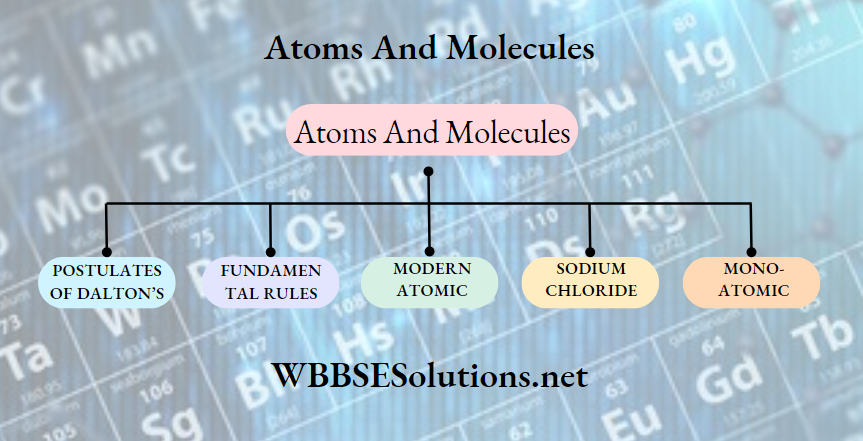
The postulates of Dalton’s atomic theory are:

  • Matter consists of very tiny particles calledatoms.
  • Atoms are of indivisible nature whichcannot be created or destroyed in a chemical reaction.
  • Mass and chemical properties of atoms of agiven element are identical.
  • Different element atoms have differentmasses and chemical properties.
  • Compounds are formed by combining atomsin the ratio of small whole numbers.
  • In a given compound, the relative numberand kinds of atoms are constant.

Atoms And Molecules

NEET Foundation Chemistry Chapter 3

Question 2. What are the fundamental rules of writing the chemical formula?
Answer.

There are three fundamental rules of writing chemical formula:

Read and Learn More NEET Foundation Long Answer Questions

  • The valencies of the elements must balance.
  • When a compound contains both metal and non-metal elements the name of metal comes first. Example: Sodium Chloride (NaCl)
  • In poly-atomic ion compounds, the ion is enclosed in bracket before writing the formula to indicate the ratio. In case the ion is mono-atomic then bracket is not required.

Question 3. What does the Dalton’s theory explain? How is it different from modern atomic theory?
Answer.

Dalton’s Atomic theory explains that:

  • All matter is made of atoms. Atoms are indivisible and indestructible.
  • All atoms of a given element are identical in mass and properties
  • Compounds are formed by a combination of two or more different kinds of atoms.
  • A chemical reaction is an arrangement of atoms.
Class 11 Physics Class 12 Maths Class 11 Chemistry
NEET Foundation Class 12 Physics NEET Physics

Dalton’s theory is different from modern atomic theory

Modern atomic theory is, of course, a little more involved than Dalton’s theory but the essence of Dalton’s theory remains valid. Today we know that atoms can be destroyed via nuclear reactions but not by chemical reactions.

Many heretofore unexplained chemical phenomena were quickly explained by Dalton with his theory. Dalton’s theory quickly became the theoretical foundation of chemistry.

NEET Foundation Chemistry Chapter 3

Question 4. What does a chemical formula indicate?
Answer.

Chemical Formula:

The chemical formula of a compound represents its chemical composition.

A chemical formula essentially indicates 2 things:

  • The elements which constitutes thatcompound and the number of each element in it.
  • The number of each constituent.

The atoms of the elements are indicated by the symbols and the number is indicated as a subscript with the symbol.

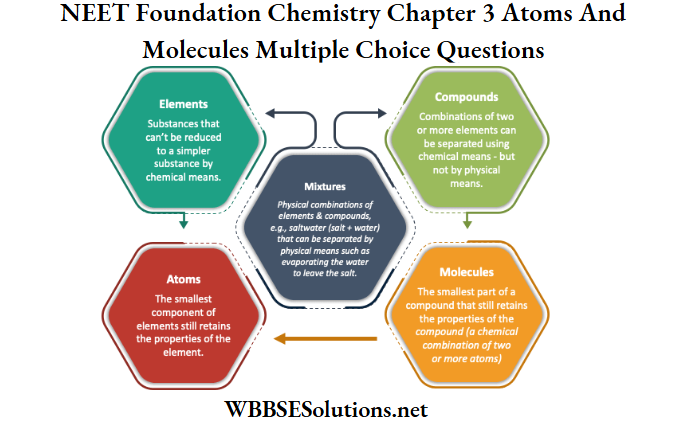
NEET Foundation Chemistry Chapter 3 Atoms And Molecules Multiple Choice Questions

Chapter 3 Atoms And Molecules Multiple Choice Question And Answers

Direction: Choose the correct option for each question. There is only one correct response for each question.

Question 1. Who was the first Indian Philosopher who postulated that matter is divisible?

  1. Maharshi Kanad
  2. Chanakya
  3. Swami Vivekananda
  4. Sarvapalli Radhakrishnan

Answer. 1. Maharshi Kanad

Question 2. Why is the symbol of silver written as Ag?

  1. The symbol of silver is derived from the French name ‘Agiol’.
  2. The symbol of silver is derived from the French name ‘Aglae’.
  3. The symbol of silver is derived from the Latin name ‘Argentum’.
  4. The symbol of silver is derived from the German name ‘Agapios’.

Answer. 3. The symbol of silver is derived from the Latin name ‘Argentum’.

Question 3. What do you mean by the atomicity of a molecule?

  1. The number of molecules in a substance.
  2. The number of atoms present in one molecule of a substance.
  3. The number of atoms bonded in a molecule of an element.
  4. The mass of an atom of an element.

Answer. 2. The number of atoms present in one molecule of a substance.

Read and Learn More NEET Foundation Multiple Choice Questions

Question 4. What do you mean by saying that the molecular mass of oxygen is 32?

  1. 1/1837 times the mass of a proton.
  2. The molecule of O2 is 32 times heavier as compared to 1/12th of the mass of an atom of the C-12 isotope.
  3. The molecule of O2 is 8 times heavier as compared to 1/12th of the mass of an atom of the C-12 isotope.
  4. None of the above

Answer. 2. A molecule of O2 is 32 times heavier as compared to 1/12th of the mass of an atom of the C-12 isotope.

Question 5. If 100 g of calcium carbonate on heating produces 44 g of carbon dioxide, how much quick lime will be formed?

  1. Quick lime will be 56 g
  2. Quick lime will be 72 g
  3. Quick lime will be 38 g
  4. Quick lime will be 44 g

Answer. 1. Quick lime will be 56 g

NEET Foundation Chemistry Chapter 3 Atoms And Molecules Multiple Choice Questions

Question 6. What was the postulate of Dalton’s atomic theory about the masses of atom?

  1. Atoms of an element have the same mass.
  2. Atoms of an element have less mass.
  3. Atoms of all substances are identical in all respects.
  4. Atoms are divisible particles.

Answer. 1. Atoms of an element have the same mass.

Question 7. What is atomic mass unit u?

  1. 1/6 of the mass of an atom of C-12 isotope.
  2. 1/2 of the mass of an atom of C-12 isotope.
  3. 1/12 of the mass of an atom of C-12 isotope.
  4. None of these

Answer. 3. 1/12 of the mass of an atom of C-12 isotope.

Question 8. Which of the following is not correct according to Dalton’s atomic theory?

  1. Matter is made up of atoms.
  2. Atoms of all substances are identical in all respects.
  3. Atoms are combined in a simple whole-number ratio.
  4. Atoms of two elements can combine to form more than one compound.

Answer. 2. Atoms of all substances are identical in all respects.

Question 9. Which of the following represents 1 u?

  1. Mass of C-12 atom
  2. Mass of O-16 atom
  3. 1/12 of the mass of the C-12 atom
  4. Mass of hydrogen molecule

Answer. 3. 1/12 of mass of C-12 atom

Question 10. Who formulated the law of constant composition?

  1. Dalton
  2. Proust
  3. Lavoisier
  4. Berzelius

Answer. 2. Proust

Question 11. What is the molecule C60 called?

  1. C60 is called the Atomic number.
  2. C60 is called Isobar.
  3. C60 is called a hydrogen bond.
  4. C60 is called Buckminster fullerene.

Answer. 4. C60 is called Buckminster fullerene.

Question 12. Why the atomic masses are not the actual masses of atoms?

  1. Atoms are very small particles therefore their actual masses are too small to be determined.
  2. Atoms combined in a simple whole number ratio.
  3. A group of atoms carrying a positive charge.
  4. None of these

Answer. 1. Atoms are very small particles therefore their actual masses are too small to be determined.

Question 13. Calculate the formula unit mass of Na2CO3 ⋅ 10H2O.

Atomic masses: Na = 23.0 u, C = 12.0 u, O = 16.0 u, H = 1.0 u.

  1. 390 u
  2. 288 u
  3. 286 u
  4. 199 u

Answer. 3. 286 u

Question 14. One of the following molecules has an atomic of four

  1. H2O
  2. NH3
  3. CH4
  4. CO2

Answer. 2. NH3

Question 15. Why is atomic mass taken asan average value?

  1. The mass of 1 mole of the substance is the molar mass of that substance.
  2. An element may have atoms with different masses present in a definite ratio.
  3. Atoms are very small particles; their actual masses are too small to be determined.
  4. All of above

Answer. 2. An element may have atoms with different masses present in a definite ratio.

Question 16. What is the actual mass of an atom of C-12 isotope?

  1. 0.990 × 10⁻²³ g
  2. 1.993 × 10⁻²³ g
  3. 1.992 × 10⁻²³ g
  4. 2.857 × 10⁻²³ g

Answer. 3. 1.992 × 10⁻²³ g

Question 17. Hydrogen was passed over heated 2 g copper oxide till only copper was left. The mass of copper obtained was 1.6 g. The percentage of oxygen in copper oxide is

  1. 80%
  2. 60%
  3. 40%
  4. 20%

Answer. 4. 20%

Question 18. Give one example of the molecule of a triatomic element.

  1. O3
  2. P3
  3. NH3
  4. P4

Answer. 1. O3

Question 19. Which of the following is the correct symbol for copper?

  1. Co
  2. Cr
  3. Cu
  4. Cp

Answer. 3. Cu

Question 20. The formula of copper sulphate is CuSO4. What is the valency of copper if the valency of SO4 is 2?

  1. 1
  2. 3
  3. 2
  4. 4

Answer. 3. 2

Question 21. In a sample of ammonia the mass ratio of nitrogen and hydrogen is 14:1. Find the ratio of N and H atoms in a molecule of ammonia. Relative atomic masses are: H = 1, N = 14.

  1. In ammonia the ratio by number of atoms = N:H = 2:3
  2. In ammonia the ratio by number of atoms = N:H = 1:3
  3. In ammonia the ratio by number of atoms = N:H = 1:14
  4. In ammonia the ratio by number of atoms = N:H = 1:4

Answer. 2. In ammonia the ratio by number of atoms = N:H = 1:3

Question 22. Hydrogen and oxygen combine in the mass ratio of 1:8 to form water. Calculate the mass of oxygen gas required to react completely with 3 g of hydrogen.

  1. 24 g
  2. 26 g
  3. 32 g
  4. 18 g

Answer. 1. 24 g

Question 23. What are the valencies of Al and carbonate in Al2(CO3)3?

  1. Aluminium is 3 and carbonate is 1
  2. Aluminium is 1 and carbonate is 2
  3. Aluminium is 3 and carbonate is 3
  4. Aluminium is 3 and carbonate is 2

Answer. 4. Aluminium is 3 and carbonate is 2

Question 24. Which one of the following is equal to one mole of N2?

  1. 14 g of nitrogen
  2. 20 grams of nitrogen
  3. 6.022 × 10²³ N2 molecules
  4. All the three

Answer. 3. 6.022 × 10²³ N2 molecules

Question 25. How was the postulate of Dalton’s atomic theory about the masses of atoms modified?

  1. Matter is made up of small particles which may be atoms or molecules.
  2. Atoms Mass can neither be created nor destroyed in a chemical reaction.
  3. Atoms of the same or different elements combine together to form molecules or compounds.
  4. Atoms of the same element may have different masses.

Answer. 4. Atoms of the same element may have different masses.

Question 26. Why has the symbol ‘u’ been replaced by ‘u’?

  1. Atomic mass unit is 1/12th of the mass of an atom of C-12 isotope.
  2. Atoms of an element have same mass.
  3. To avoid an ambiguity whether to take O-16 as the reference or average mass of isotopes of O-atoms.
  4. None of the above

Answer. 3. To avoid an ambiguity whether to take O-16 as the reference or average mass of isotopes of O-atoms.

Question 27. What do you understand by Gram Molar Volume?

  1. Volume occupied by one mole of the substance.
  2. Volume occupied by whole substance.
  3. Those compounds which are made up of only two elements.
  4. None of the three.

Answer. 1. Volume occupied by one mole of the substance.

Question 28. What is Avogadro’s number?

  1. The volume of the substance present in one mole of the substance.
  2. The number of particles of the substance present in one mole of the substance.
  3. It is defined as the units of positive or negative charge present on the ion.
  4. Molecular mass expressed in grams.

Answer. 2. The number of particles of the substance present in one mole of the substance.

Question 29. What do you understand by polyatomic cation?

  1. A group of atoms carrying a positive charge.
  2. A group of atoms carrying a negative charge.
  3. A group of atoms carrying both the charges.
  4. A group of atoms carrying neither positive charge nor negative charge.

Answer. 1. A group of atoms carrying a positive charge.

Question 30. How do you define mole in terms of mass?

  1. The sum of the atomic masses of all the atoms present in one unit of compound.
  2. Amount of the substance which has volume equal to 22400 mL at STP conditions.
  3. A mole of a substance is equal to the gram atomic mass of the substance.
  4. None of these

Answer. 3. A mole of a substance is equal to the gram atomic mass of the substance.

Question 31. Which of the following has maximum number of atoms?

  1. 18 g H2O
  2. 18 g of CH4
  3. 18 g of O2
  4. 18 g of CO2

Answer. 2. 18 g of CH4

Question 32. Which of the following would weigh the highest?

  1. 10 moles of H2O
  2. 0.2 mole of sucrose (C12 H22 O11)
  3. 2 moles of CaCO3
  4. 2 moles of CO2

Answer. 3. 2 moles of CaCO3

Question 33. A change in the physical state can be brought about

  1. Only when energy is given to the system.
  2. Only when energy is taken out from the system.
  3. When energy is either given to, or taken out from the system.
  4. Without any energy change.

Answer. 3. When energy is either given to, or taken out from the system.

Class 11 Physics Class 12 Maths Class 11 Chemistry
NEET Foundation Class 12 Physics NEET Physics

Question 34. Calculate the number of moles of magnesium present in a magnesium ribbon weighing 12 g. Molar atomic mass of magnesium is 24 g mol(raise to the power –1).

  1. 0.5 mole
  2. 1 mole
  3. 1.5 mole
  4. 2 mole

Answer. 1. 0.5 mole

Question 35. How do you define the valency of an element in a molecular compound?

(1) It’s combining capacity and is equal to the number of hydrogen atoms.

(2) Number of chlorine atoms.

(3) Ratio of molar should be equal.

(4) Double the number of oxygen atoms with

which one atom of the element combines.

  1. (1), (2) and (4)
  2. (1) and (3)
  3. (2) and (4)
  4. (1) and (2)

Answer. 1. (1), (2) and (4)

Question 36. One mole of CO2 means

(1) 6.022 × 10²³ molecules of CO2

(2) 22.4 L at STP

(3) 44 g of CO2

(4) 55 g of C

  1. (1) and (2)
  2. (1) and (3)
  3. (2) and (4)
  4. (1), (2) and (3)

Answer. 4. (1), (2) and (3)

Question 37. The Scientist Proust established which of the below mentioned law in the year 1779?

(1) In a chemical substance its constituent elements are present in definite proportions by mass.

(2) A pure compound has a definite composition by mass of its constituent elements.

(3) It is not possible to create or destroy the mass of a substance by chemical reactions.

(4) Atoms combine in whole numbers.

  1. (1), (2) and (4)
  2. (2) and (3)
  3. (1) and (2)
  4. All of the above

Answer. 3. (1) and (2)

Question 38. Which of the following are incorrect?

(1) Atoms are divisible particles.

(2) Atoms can be created or destroyed during a chemical reaction and all matter is made up of atoms.

(3) Mass of matter is due to the mass of atoms which constitute it.

(4) Atom and mass are not conserved.

  1. (2) and (4)
  2. (1), (2) and (3)
  3. (1), (2) and (4)
  4. All of the above

Answer. 3. (1), (2) and (4)

Question 39. Which of the following are monoatomic metallic elements?

(1) Sodium Na

(2) Copper Cu

(3) Aluminium Al

(4) All of above

  1. (4)
  2. (2) and (3)
  3. (1)
  4. None of the above

Answer. 1. (4)

Question 40. Which of the following statement about polyatomic ions are correct?

(1) A group of two or more atoms carrying a charge is called polyatomic ion.

(2) A polyatomic cation carries a charge.

(3) A polyatomic anion carries a negative charge.

(4) A polyatomic cation does not carry a charge

  1. (1), (3) and (4)
  2. (3) and (4)
  3. (1) and (4)
  4. (1), (2) and (3)

Answer. 4. (1), (2) and (3)

Question 41. Which of the following are the correct options?

(1) Law of conservation of mass is the law of indestructibility of matter.

(2) Atoms masses are the average relative masses of the atoms.

(3) Atoms may or may not be capable of free existence but molecules can always exist freely.

(4) A group of atoms carrying both the charges.

  1. (2) and (3)
  2. (1), (2) and (3)
  3. (1) and (3)
  4. (2) and (4)

Answer. 2. (1), (2) and (3)

Question 42. Which of the following support modified Dalton’s Atomic theory?

(1) It is not possible to create or destroy the mass of a substance by chemical reactions.

(2) Atoms of the same element have same chemical properties but they may have different physical properties.

(3) Atoms of an element have the same mass was proved wrong when it was found that an element may exist in atoms with different masses, e.g., chlorine atoms with masses 35 and 37 etc.

  1. (2) and (3)
  2. (1)
  3. (1) and (3)
  4. None of the above

Answer. 1. (2) and (3)

Question 43. Which of the following symbols of elements are incorrect?

(1) Cobalt Co

(2) Aluminium Al

(3) Carbon C

(4) Helium He

  1. (1), (3) and (4)
  2. (2), (3) and (4)
  3. (1), (2) and (3)
  4. All of above

Answer. 3. (1), (2) and (3)

Question 44. Which of the following correctly represents 360 g of water?

(1) 2 mole of H2O

(2) 20 moles of water

(3) 6.20 × 10²³ molecules of water

(4) 1.2044 × 1025 molecules of water

  1. (1) and (4)
  2. (2) and (4)
  3. (1) and (3)
  4. (3) and (2)

Answer. 2. (2) and (4)

Question 45. Calculate the mass of 1 mol of N atoms?

  1. 14 g
  2. 13 g
  3. 15 g
  4. None of these

Answer. 1. 14 g

Question 46. The smallest particle of matter which can exist independently is

  1. an atom
  2. a molecule
  3. an ion
  4. a radical

Answer. 2. a molecule

Question 47. Match the following;

(1) Sodium chloride (a) NaI

(2) Sodium bromide (b) NaCl

(3) Sodium iodide (c) NaBr

  1. (1) – A, (2) – C, (3) – B
  2. (1) – C, (2) – B, (3) – A
  3. (1) – B, (2) – C, (3) – A
  4. (1) – A, (2) – B, (3) – C

Answer. 3. (1) – B, (2) – C, (3) – A

Question 48. The relative molecular mass of copper (2) sulphate, CuSO4 is 160 and the relative molecular mass of water is 18. The percentage by mass of water in copper (2) sulphate crystals, CuSO4.5H2O is

  1. \(\frac{18}{160} \times 100\)
  2. \(\frac{5 \times 18}{160} \times 100\)
  3. \(\frac{5 \times 18}{(160+18)} \times 100\)
  4. \(\frac{5 \times 18 \times 100}{160+(5 \times 18)}\)

Answer. 4. \(\frac{5 \times 18 \times 100}{160+(5 \times 18)}\)

Question 49. Calculate the number of particles in 0.1 moles of carbon atoms?

  1. 6.022 × 10²³
  2. 6.022 × 10²²
  3. 6.021 × 10²¹
  4. None of these

Answer. 2. 6.022 × 10²²

Question 50. Which of the following ammonium salts will liberate the greatest amount of ammonia on heating?

  1. 1 mole of (NH4)3PO4
  2. 1 mole of (NH4)2SO4
  3. 1 mole of NH4Cl
  4. 1 mole of NH4NO3

Answer. 1. 1 mole of (NH4)3PO4

Question 51. Calculate the mass of 3.011 × 10²³ number of atoms of N?

  1. 7 g
  2. 7.5 g
  3. 6 g
  4. None of these

Answer. 1. 7 g

Question 52. The anion present in calcium hydride is

  1. H+
  2. H
  3. OH
  4. H3O+

Answer. 2. H

Question 53. The gas which has a molecular mass twice that of oxygen gas is

  1. CO2
  2. CO
  3. SO2
  4. H2S

Answer. 3. SO2

Question 54. The element which can form gases having two different atomicities is

  1. chlorine
  2. oxygen
  3. hydrogen
  4. nitrogen

Answer. 4. nitrogen

Question 55. Which of the following is a correct formula of the calcium carbonate?

  1. CaO
  2. CaCO2
  3. CaCO3
  4. None of these

Answer. 3. CaCO3

Question 56. The element which loses electrons to form ions with variable valencies is

  1. copper
  2. silver
  3. mercury
  4. all the above

Answer. 4. all the above

Question 57. The number of elements which are present in the compound ammonium phosphate is

  1. 2
  2. 3
  3. 4
  4. 5

Answer. 3. 4

Question 58. Ratio by mass of the element present in SO2 is

  1. 1: 1
  2. 1: 2
  3. 2: 1
  4. 3: 1

Answer. 1. 1: 1

Question 59. A plumbous ion is formed from lead atom by

  1. gaining one electron
  2. gaining two electrons
  3. losing one electron
  4. losing two electrons

Answer. 4. losing two electrons

Question 60. Which of the following is a correct formula of the copper nitrate?

  1. Cu (NO3)2
  2. NaNO3
  3. Mg (NO3)2
  4. None of these

Answer. 1. Cu (NO3)2

Question 61. The acid which does not contain a radical of a polyatomic group is

  1. sulphuric acid
  2. hydrochloric acid
  3. nitric acid
  4. phosphoric acid

Answer. 2. hydrochloric acid

Question 62. If the nitride of a metal M has the formula MN, what is the formula of its sulphide, carbonate and chloride?

  1. M2S3, M2(CO3)3, MCl
  2. MS3, M2CO3, MCl3
  3. MS, M(CO3)3, MCl
  4. M2S3, M2(CO3)3, MCl3

Answer. 4. M2S3, M2(CO3)3, MCl3

Question 63. According to the IUPAC recommendation “amu” has been replaced with “u”. “u” stands for

  1. universal mass
  2. ultimate mass
  3. unified mass
  4. unending mass

Answer. 3. unified mass

Question 64. Which of the following information is not conveyed by a chemical equation?

  1. The reactants taking part in the reaction
  2. The products formed in the reaction
  3. The speed of the reaction
  4. The ratio of the weights of reactants and products taking part in the reaction

Answer. 3. The speed of the reaction

Question 65. What are the values of the coefficients x, y and z in the following reaction?

x Mg + y N2 → z Mg3N2

  1. x = 1, y = 1, z = 1
  2. x = 1, y = 3, z = 1
  3. x = 1, y = 2, z = 1
  4. x = 3, y = 1, z = 1

Answer. 4. x = 3, y = 1, z = 1

Question 66. Elements X and Y react to form Xa Yb. Elements P and Q react to form Pm Qn. The formula of the compound formed between X and Q is

  1. XbQm
  2. XmQb
  3. XaQn
  4. XnQa

Answer. 2. XmQb

Question 67. 0.66 g of a hydrocarbon gave 1.32 g of carbon dioxide and 2.7 g of water on complete combustion. Which law of chemical combination does this example illustrate?

  1. Law of conservation of mass
  2. Law of constant proportions
  3. Both (a) and (b)
  4. None of the above

Answer. 1. Law of conservation of mass

Question 68. The ratio of the number of moles of copper, oxygen and copper (2) oxide in the reaction

Copper + Oxygen → Copper (2) oxide is

  1. 1: 1: 1
  2. 1: 2: 1
  3. 2: 1: 2
  4. 2: 2: 1

Answer. 3. 2: 1: 2

Question 69. An anion has

  1. more electrons than protons
  2. more protons than electrons
  3. more neutrons than protons
  4. more protons than neutrons

Answer. 1. more electrons than protons

Question 70. Atomic number of an element X is 9. Which of the following represents the correct equation for the ion formation of an atom of X?

  1. X – e → X
  2. X + e→ X
  3. X – e →X+
  4. X + e → X+

Answer. 2. X + e→ X

Question 71. An atom of X combines with 2 atoms of hydrogen. The valency of X is

  1. 1
  2. 2
  3. 3
  4. 4

Answer. 2. 2

Question 72. An element has 10 electrons in it atom. How many electrons are gained by the atom of the element to form an anion?

  1. 1
  2. 2
  3. 3
  4. zero

Answer. 4. zero

Question 73. Identify the incorrect statement.

  1. Molecular weight is equal to the sum of the atomic weights of the elements present in a compound.
  2. The composition by weight of the elements in a compound is known from the chemical formula.A chemical formula gives the number of atoms of each element present in one molecule of a compound.
  3. Molecular formula of a compound represents one atom of the compound.

Answer. 4. Molecular formula of a compound represents one atom of the compound.

Question 74. The number of Ca2+ and Cl ions in 222 g anhydrous CaCl2 is

  1. N0 ions of both Ca2+ and Cl
  2. 4N0 ions of Ca2+, 2N0 ions of Cl
  3. 2N0 ions of Ca2+, 4N0 ions of Cl
  4. 2N0 ions of Ca2+ and Cl

Answer. 3. 2N0 ions of Ca2+, 4N0 ions of Cl

Question 75. Which of the following correctly represents 360 g of water?

(1) 2 moles of H2O

(2) 20 moles of water

(3) 6.022 × 10²³ molecules of water

(4) 1.2044×1025 molecules of water

  1. (1)
  2. (1) and (4)
  3. (2) and (3)
  4. (2) and (4)

Answer. 4. (2) and (4)

Question 76. Which of the following statements is not true about an atom?

  1. Atoms are not able to exist independently
  2. Atoms are the basic units from which molecules and ions are formed
  3. Atoms are always neutral in nature
  4. Atoms aggregate in large numbers to form the matter that we can see,feel or touch

Answer. 1. Atoms are not able to exist independently

Question 77. The chemical symbol for nitrogen gas is

  1. Ni
  2. N2
  3. N+
  4. N

Answer. 2. N2

Question 78. The chemical symbol for sodium is

  1. So
  2. Sd
  3. NA
  4. Na

Answer. 4. Na

Question 79. Which of the following would weigh the highest?

  1. 0.2 mole of sucrose (C12 H22 O11)
  2. 2 moles of CO2
  3. 2 moles of CaCO3
  4. 10 moles of H2O

Answer. 3. 2 moles of CaCO3

Question 80. Which of the following has maximum number of atoms?

  1. 18 g of H2O
  2. 18 g of O2
  3. 18 g of CO2
  4. 18 g of CH4

Answer. 4. 18 g of CH4

Question 81. Which of the following contains maximum number of molecules?

  1. 1 g CO2
  2. 1 g N2
  3. 1 g H2
  4. 1 g CH4

Answer. 3. 1 g H2

Question 82. Mass of one atom of oxygen is

  1. \(\frac{16}{6.023 \times 10^{23}} 8\)
  2. \(\frac{32}{6.023 \times 10^{23}} g\)
  3. \(\frac{1}{6.023 \times 10^{23}} g\)
  4. 8 u

Answer. 1. \(\frac{16}{6.023 \times 10^{23}} 8\)

Question 83. 3.42 g of sucrose are dissolved in 18 g of water in a beaker. The number of oxygen atoms in the solution are

  1. 6.68 × 10²³
  2. 6.09 × 10²²
  3. 6.022 × 10²³
  4. 6.022 × 10²¹

Answer. 1. 6.68 × 10²³

Question 84. A change in the physical state can be brought about

  1. Only when energy is given to the system
  2. Only when energy is taken out from the system
  3. when energy is either given to, or taken out from the system
  4. without any energy change

Answer. 3. when energy is either given to, or taken out from the system

NEET Foundation Chemistry Chapter 3 Atoms And Molecules Short Answer Questions

Chapter 3 Atoms And Molecules Short Answer Type Question And Answers

Question 1. Calculate the molar mass of HNO3. [N = 14, O = 16, H = 1]
Answer.

Given:

Molar mass of HNO3.

H = 1 × 1 = 01

N = 14 × 1 = 14

O = 16 × 3 = 48

Total mass = 63 grams

Molar mass of HNO3 = 63 grams.

NEET Foundation Chemistry Chapter 3 Atoms And Molecules Short Answer Questions

Question 2. Calculate the formula mass of CaCl2. [Ca = 40, Cl = 35.5]
Answer.

Given:

1(Ca) + 2(Cl) 40 + 2 × (35.5) = 111 u

The formula mass of CaCl2 is 111 u.

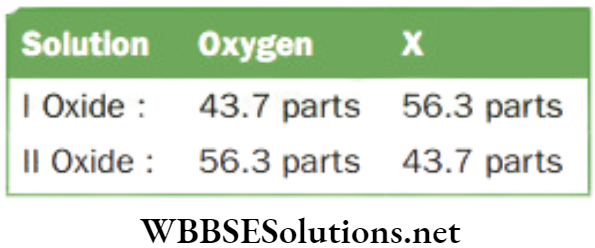
Question 3. A certain non-metal X forms two oxides 1 and 2. The mass percentage of oxygen in oxide 1 (X4O6) is 43.7, which is same as that of X in oxide 2. Find the formula of the second oxide.

NEET Foundation Chemistry Atoms And Molecules Short Answer Type Question 3

Answer.

Given

A certain non-metal X forms two oxides 1 and 2. The mass percentage of oxygen in oxide 1 (X4O6) is 43.7, which is same as that of X in oxide 2.

Now 43.7 parts of oxygen in I corresponds to = 6 oxygen atoms

Therefore, 56.3 parts of oxygen in II corresponds to

⇒ \(\frac{6 \times 56.3}{43.7}=7.730 \text { atoms }\)

Also 56.3 parts of X in 1 correspond to = 4 X atom

Therefore, 43.7 parts of X in 2 will correspond to

⇒ \(=\frac{4 \times 43.7}{56.3} \times 3.1 \times \text { atoms }\)

Now the atomic ration X : O in the second

Oxide = \(\frac{3.1}{3.1}: \frac{7.73}{3.1}\) or 1 : 25 or 2 : 5

The formula of the second oxide is X2O2.

Read And Learn More NEET Foundation Short Answer Questions

Question 4. Calculate the mass of 0.2 moles of water (O = 16, H = 1).
Answer.

Given:

Gram molecular weight of H2O = 2 × 1 + 16 = 18 g

1 mole of water weighs 18 g

Therefore, 0.2 moles of water weighs \(\frac{18}{1}\) × 0.2 = 3.6 g

Question 5. Calculate the volume of 7.1 g of chlorine (Cl = 35.5) at S.T.P.
Answer.

Given:

Gram Molecular Weight of Cl2 (one mole) = 35.5 × 2 = 71 g.

71 g of Cl2 at S.T.P occupies 22.4 litres

Therefore, 7.1 g of Cl2 at S.T.P occupies

⇒ \(\frac{22.4}{71} \times 7.1=2.24 \text { litres }\)

Question 6. The reaction between aluminium carbide and water takes place according to the following equation:

Al4C3 + 12H2O → 3CH4 + 4Al(OH)3

Calculate the volume of CH4 released from 14.4 g of Al4C3 by excess water at S.T.P. (C = 12, Al = 27)
Answer.

Given

CH4 released from 14.4 g of Al4C3 by excess water at S.T.P. (C = 12, Al = 27)

Molecular weight of Al4C3 is (27 × 4) + (12 × 3) = 144

144 g of Al4C3 produces 3 × 22.4 litres of CH4 at S.T.P

Therefore, 14.4 g Al4C3 produces \(\frac{3 \times 22.4}{144} \times\) 14.4

⇒ \(=\frac{967.7}{144}=6.72 \text { litres }\)

Question 7. How many litres of ammonia are present in 3.4 kg of it? (N = 14, H = 1)
Answer.

Given:

Gram molecular weight of NH3 = 14 + (1 × 3) = 17 g.

17 g of NH3 = 22.4 litres

Therefore, 3.4 × 10³g of NH3 = \(\frac{22.4}{17} \times 3.4 \times 10^3\)

= \(\frac{76160}{17}\)

= 4480 litres.

4480 litres of ammonia are present in 3.4 kg of it

Class 11 Physics Class 12 Maths Class 11 Chemistry
NEET Foundation Class 12 Physics NEET Physics

Question 8. Define a mole.
Answer.

Mole: A mole is the amount of substance that contains as many elementary entities as there are atoms in 12 grams in carbon 12 isotopes .

Question 2. Find out the molar mass of sulphuric acid.
Answer.

Formula of sulphuric acid = H2SO4

No. of atoms:

H = 2

S = 1

O = 4

Atomic mass:

H = 1

S = 32

O = 16

Molar mass= (2 × 1) + (1 × 32) + (4 × 16) = 98 g/mol

Molar mass of sulphuric acid is 98 g/mol

NEET Foundation Chemistry Chapter 3 Atoms And Molecules Short Answer Questions

Question 9. Calculate the number of moles and atoms in 240 grams of O (Oxygen) atom.
Answer.

Atomic Mass of O = 16 u

16 u of O = 1 atom of oxygen

16 g of O = 1 mole of oxygen

16 g of O = 6.022 × 10²³ atom of O

240 g of O = 15 moles of O

240 g of O = 15 × 6.022 × 1023 atoms

Therefore, 240 g of O = 90.33 × 10²³ atoms.

Question 10. Find out the weight of 120.44 × 10²³ molecules of water.
Answer.

Molecular mass of H2O = 18 u [(1 × 2) H + (16 × 1)O]

So, 1 mole = 18 g H2O

6.022 × 1023 = 18 g

120.44 × 1023 = (120.44 × 10²³/6.022 × 1023) × 18

= 20 × 18 = 360 g

The weight of 120.44 × 10²³ molecules of water = 360 g

Question 11. 6.6 g of CaCO3on heating gave 2.98 g CaO and 3.62 g CO2. Prove that these observations agree with law of conservation of mass.
Answer.

Given:

6.6 g of CaCO3on heating gave 2.98 g CaO and 3.62 g CO2.

CaCO3 → CaO + CO2

6.6g → 2.88 g + 3.52 g

Mass of the reactant = 6.4 g

Mass of the product = (2.98 + 3.62) g = 6.6 g

These results agree with the law of conservation of mass as the mass of reactants is equal to the mass of products.

Question 12. An 80.0 g sample of an unknown compound contains 16.4 g of hydrogen. What is the percent by mass of hydrogen in the compound?
Answer.

Given:

An 80.0 g sample of an unknown compound contains 16.4 g of hydrogen.

Mass of the compound = 80 g

Mass of hydrogen in the compound = 16.4 g

Therefore, the mass fraction of hydrogen in the unknown compound = (16.4/80) x 100% = 20.5%

Question 13. What is the importance of law of conservation of mass in everyday life?
Answer.

Importance of law of conservation of mass in everyday life: Law of conservation of mass is important to study to produce chemical reactions. Chemists can predict the amount of products that will be produced in a chemical reaction if they know the amount and identities of the reactants.

Question 14. What is the limitation of law of definite proportions?
Answer.

Limitation of law of definite proportions: The law of definite proportions does not hold good for those elements who are also present in different isotopic forms in a compound.

NEET Foundation Chemistry Multiple Choice Question And Answers

Chemistry Multiple Choice Question And Answers

Question 1. Air is a/an

  1. element
  2. compound
  3. mixture
  4. colloid

Answer. 3. mixture

Question 2. All the following are examples of chemical change, except

  1. magnetising of iron nail
  2. rusting of iron rod
  3. digestion of food
  4. souring of milk

Answer. 1. magnetising of iron nail

Question 3. Atomic number of an element gives

  1. the number of electrons in its atom
  2. the number of nucleons in its atom
  3. the weight of the atom of the element
  4. the total number of elementary particles in its atom

Answer. 1. the number of electrons in its atom

Question 4. Conversion of a substance directly from solid to vapour state is known as

  1. vapourization
  2. sublimation
  3. decomposition
  4. ionization

Answer. 3. decomposition

Question 5. Cooking oil can be converted into vegetable ghee by the process of

  1. hydrogenation
  2. distillation
  3. crystallization
  4. oxidation

Answer. 4. oxidation

Question 6. Colloids

  1. are true solutions
  2. are suspensions of one phase in another
  3. are two-phase systems
  4. contain only water soluble substances

Answer. 2. are suspensions of one phase in another

Question 7. Colloids are purified by

  1. peptization
  2. coagulation
  3. condensation
  4. dialysis

Answer. 1. peptization

Question 8. Distillation at reduced pressure is used for liquids which have

  1. high boiling points
  2. low boiling points
  3. high volatility
  4. decomposed before their boiling points

Answer. 4. decomposed before their boiling points

Question 9. Gases have

  1. a definite shape but not volume
  2. a definite volume and shape
  3. a definite volume but not shape
  4. neither definite volume nor shape

Answer. 4. neither definite volume nor shape

Question 10. Isotopes of an element

  1. are physically identical with each other
  2. are chemically identical with each other
  3. are not identical with each other
  4. have the same mass numbers

Answer. 2. are chemically identical with each other

Question 11. Milk is an example of

  1. sol
  2. gel
  3. emulsion
  4. suspension

Answer. 3. emulsion

Question 12. Of all the gases present in the air, which one of the following is the highest in percentage?

  1. Carbon dioxide
  2. Hydrogen
  3. Nitrogen
  4. Oxygen

Answer. 3. Nitrogen

Question 13. Of the following particles, the particle having the least mass is

  1. meson
  2. neutron
  3. electron
  4. proton

Answer. 3. electron

Question 14. The atomic weight of uranium is

  1. 237
  2. 238
  3. 226
  4. 242

Answer. 2. 238

Question 15. The charge on the electron is

  1. 1.6 × 10⁻¹⁶ C
  2. 1.5 × 10⁻¹⁶ C
  3. –1.6 × 10⁻¹⁹ C
  4. 1.6 × 10¹⁹ C

Answer. 3. –1.6 × 10⁻¹⁹ C

Question 16. The chemical name of table salt is

  1. potassium chloride
  2. sodium chloride
  3. calcium chloride
  4. sodium hyposulphate

Answer. 2. sodium chloride

Question 17. The difference between isotopes of an element is due to the presence of a different number of

  1. protons
  2. neutrons
  3. electrons
  4. photons

Answer. 2. neutrons

Question 18. The ejection of electrons when a metal surface is irradiated is called

  1. black body radiation
  2. photoelectric effect
  3. zeeman effect
  4. atomic spectrum

Answer. 2. photoelectric effect

Question 19. The major constituent of air is

  1. nitrogen
  2. carbon dioxide
  3. oxygen
  4. hydrogen

Answer. 1. nitrogen

Question 20. The mass number of a nucleus is

  1. always less than its atomic number
  2. the sum of the number of protons and neutrons present in the nucleus
  3. always more than the atomic weight
  4. a fraction

Answer. 2. the sum of the number of protons and neutrons present in the nucleus

Question 21. The mass of one Avogadro number of helium atom is

  1. 1.00 g
  2. 4.00 g
  3. 8.00 g
  4. 4 × 6.02 × 1023 g

Answer. 3. 8.00 g

Question 22. The maximum capacity of any orbital is

  1. 2
  2. 6
  3. 14
  4. Cannot be determined unless the principal quantum number is known

Answer. 2. 6

Question 23. The melting point of copper is

  1. 1,083°C
  2. 732°C
  3. 327°C
  4. 1,835°C

Answer. 1. 1,083°C

Question 24. The most abundant rare gas in the atmosphere is

  1. He
  2. Ne
  3. Ar
  4. Xe

Answer. 3. Ar

Question 25. The nuclear particles that are assumed to hold nucleons together are

  1. electrons
  2. positrons
  3. neutrons
  4. mesons

Answer. 4. mesons

Question 26. The nucleus of a hydrogen atom consists of

  1. one proton + one neutron
  2. one proton + two neutrons
  3. one neutron only
  4. one electron only

Answer. 3. one neutron only

Question 27. Tritium has an atomic number of

  1. 3
  2. 2
  3. 1
  4. 4

Answer. 1. 3

Class 11 Physics Class 12 Maths Class 11 Chemistry
NEET Foundation Class 12 Physics NEET Physics

Question 28. Which of the following has the same atomic number and atomic weight?

  1. Hydrogen
  2. Helium
  3. Oxygen
  4. Nitrogen

Answer. 2. Helium

Question 29. Which of the following is a chemical change?

  1. evaporation of water
  2. burning of candle
  3. glowing of an electric bulb
  4. liquefaction of air

Answer. 1. evaporation of water

Question 30. Which of the following is a mixture?

  1. gunpowder
  2. iron sulphate
  3. brass
  4. dry ice

Answer. 4. dry ice

Question 31. Which of the following is incorrect?

  1. Mercury: Hg
  2. Silver: Ag
  3. Sodium: Na
  4. Potassium: Ka

Answer. 2. Silver: Ag

Question 32. Which of the following is not a chemical action?

  1. Burning of coal
  2. Conversion of water into steam
  3. Digestion of food
  4. Burning of paper

Answer. 2. Conversion of water into steam

Question 33. A small quantity of a mixture of two days can be separated by

  1. fractional distillation
  2. paper chromatography
  3. sublimation
  4. steam distillation

Answer. 4. steam distillation

Question 34. Bohr model of an atom could not account for

  1. emission spectrum
  2. absorption spectrum
  3. line spectrum of hydrogen
  4. fine spectrum

Answer. 1. emission spectrum

Question 35. Camphor can easily be purified by the process of

  1. sublimation
  2. distillation
  3. crystallization
  4. sedimentation

Answer. 2. distillation

Question 36. Gunpowder is a mixture of

  1. sulphur, carbon and phosphorus
  2. sulphur, charcoal and nitre
  3. sulphur, charcoal and carbon
  4. carbon, nitrogen and chlorine

Answer. 3. sulphur, charcoal and carbon

Question 37. Match the following columns

List I                     List II

A. Mercury          1. Element

B. Oxygen           2. Compound

C. Water             3. Mixture

D. Air Codes       4. Metal

A      B     C     D

1      2      3     4

4      3      2     1

4      1      2     3

4      2      3     1

Answer. 3. 4 1 2 3

Question 38. Blue colour of the sky is due to

  1. absorption of light by dust particles
  2. reflection of light by dust particles
  3. scattering of light by dust particles
  4. the presence of clouds which are a colloidal dispersion of water particles in air

Answer. 1. absorption of light by dust particles

Question 39. If NA is Avogadro‘s number, then number of electrons in 4.2 g of azide ions (N3) is

  1. 2 NA
  2. 4.2 NA
  3. 1.6 NA
  4. 3.6 NA

Answer. 2. 4.2 NA

Question 40. The number of atoms present in 21.6 g of silver (atomic weight = 108) are same as the molecules in

  1. 1.8 g of H2O
  2. 12 moles of KMnO4
  3. 0.6 N H2SO4
  4. 4.6 g of C2H5OH

Answer. 1. 1.8 g of H2O

Question 41. 19.7 kg of gold was recovered from a smuggler. how many atoms of gold were recovered?

(Au = 197)

  1. 6.02 × 1025
  2. 6.02 × 1024
  3. 6.02 × 10²³
  4. 6.02 × 10²²

Answer. 1. 6.02 × 1025

Question 42. Butter is an example of

  1. gel
  2. emulsion
  3. sol
  4. foam

Answer. 3. sol

Question 43. An element M has an atomic number 9 and atomic mass 19. Its ion will be presented by

  1. M
  2. M2+
  3. M
  4. M2-

Answer. 2. M2+

Question 44. Milk is

  1. fat dispersed in milk
  2. fat dispersed in water
  3. water dispersed in fat
  4. water dispersed in oil

Answer. 2. fat dispersed in water

Question 45. the formula of the compound is A2B5. The number of electrons in the outermost orbits of A and B respectively are

  1. 6 and 3
  2. 5 and 6
  3. 5 and 2
  4. 2 and 3

Answer. 4. 2 and 3

Question 46. Milk is a mixture of

  1. fats and water
  2. carbohydrates and water
  3. carbohydrates, fats and water
  4. carbohydrates, fats, proteins and water

Answer. 2. carbohydrates and water

Question 47. Swelling of a sprained foot is reduced by soaking in hot water containing a large amount of common salt. This is because of a phenomenon called

  1. osmosis
  2. plasmolysis
  3. electrolysis
  4. dialysis

Answer. 4. dialysis

Question 48. The percentage, by weight, of water in the human body is

  1. 20
  2. 40–45
  3. 5–10
  4. 70–75

Answer. 4. 70–75

Question 49. The so-called fourth state of matter refers to

  1. mercury
  2. LPG
  3. dry ice
  4. plasma

Answer. 3. dry ice

Question 50. Which of the following cannot be purified by sublimation?

  1. iodine
  2. camphor
  3. citric acid
  4. naphthalene

Answer. 2. camphor

Question 51. Which of the following gases in air unites with many metals?

  1. hydrogen
  2. oxygen
  3. helium
  4. carbon dioxide

Answer. 1. hydrogen

Question 52. Why does milk curdle?

  1. fermentation of lactose
  2. reaction of microbes
  3. overheating
  4. fungus growth

Answer. 3. overheating

Question 53. A fractionating column is a glass apparatus used to

  1. separate magnetic solids from nonmagnetic solids
  2. separate a mixture in water
  3. separate two or more liquids
  4. extract oils from vegetable matter

Answer. 1. separate magnetic solids from nonmagnetic solids

Question 54. In case of a chemical change, which of the following is generally affected?

  1. electron
  2. proton
  3. neutron
  4. nucleus

Answer. 1. electron

Question 55. In the natural ‘water cycle’, water gets purified by

  1. evaporation and condenzation
  2. sedimentation
  3. filtration
  4. distillation

Answer. 3. filtration

Question 56. Neutrons are obtained by

  1. bombardment of radium with a-particles
  2. bombardment of beryllium with a particles
  3. radioactive disintegration of uranium
  4. None of these

Answer. 2. bombardment of beryllium with a particles

Question 57. Radioactive isotope of hydrogen is

  1. Hydride ion
  2. Tritium
  3. Protium
  4. Deuterium

Answer. 3. Protium

Question 58. The British physicist who received the 1923 Nobel Prize in Physics for discovering the electron is

  1. John Dalton
  2. James Chadwick
  3. J J Thomson
  4. E Rutherford

Answer. 2. James Chadwick

Question 59. The number of electrons present in H+ is

  1. zero
  2. one
  3. two
  4. three

Answer. 3. two

Question 60. The smallest particle of a pure substance showing all the properties is

  1. always an atom
  2. always a molecule
  3. may be an atom or a molecule
  4. a proton

Answer. 2. always a molecule

Question 61. The total energy of an electron revolving round the nucleus is

  1. less than zero
  2. zero
  3. more than zero
  4. more than zero in some atoms and less than zero in other atoms

Answer. 1. less than zero

Question 62. When hydrogen nuclei trap neutrons, they become

  1. hydrogen atoms
  2. deuterons
  3. tritium atom
  4. beta rays

Answer. 2. deuterons

Question 63. Which of the following statements concerning an electron is false?

  1. It is a particle
  2. It has wave properties
  3. Its path is bent by a magnet
  4. It gives out energy while moving in orbit

Answer. 4. It gives out energy while moving in orbit

Question 64. Which of the following statements is true?

  1. The ‘free’ electron outside the atom can have only discrete energy, in accordance with the quantum theory
  2. The electron inside the atom can have a continuous range of energies
  3. The kinetic energy of a free electron outside the atom can have any value in a continuous range
  4. None of these

Answer. 3. The kinetic energy of a free electron outside the atom can have any value in a continuous range

Question 65. _________is the simplest form of matter.

  1. Liquid
  2. Solid
  3. Gas
  4. Plasma

Answer. 3. Gas

Question 66. A solution can be

  1. Dilute and concentrated
  2. Saturated and dilute
  3. Saturated and unsaturated
  4. Supersaturated and saturated

Answer. 2. Saturated and dilute

Question 67. Alpha rays are actually

  1. 1 protons 2 neutrons
  2. 2 protons 2 electrons
  3. 2 protons 2 neutrons
  4. 2 protons 1 neutrons

Answer. 3. 2 protons 2 neutrons

Question 68. Atomic weight of Ca is

  1. 20
  2. 40
  3. 45
  4. 80

Answer. 2. 40

NEET Foundation Physics Multiple Choice Questions

Physics Check Your Understanding

Question 1. Which of the following is different from others?

  1. Wavelength
  2. Velocity
  3. Frequency
  4. Amplitude

Answer. 4. Amplitude

Question 2. If a force of 250 N acts on a body, the momentum acquired is 125 kgms-1, what is the period for which force acts on the body?

  1. 0.5s
  2. 0.2s
  3. 0.4s
  4. 0.25 s
  5. 125 × 250 s

Answer. 1. 0.5s

Question 3. The escape velocity on the surface of the earth is 11.2 kms-1. If mass and radius of a planet is 4 and 2 times respectively than that of earth, what is escape velocity from the planet?

  1. 11.2kms-1
  2. 1.112kms-1
  3. 15.8kms-1
  4. 22.4kms-1
  5. None of these

Answer. 5. None of these

Question 4. Which is constant for a satellite in an orbit?

  1. Velocity
  2. Kinetic energy
  3. Angular momentum
  4. Potential energy
  5. Acceleration

Answer. 4. Acceleration

Question 5. A boy walks to his school at a distance of 6 km with a speed of 2.5kmh-1 and walks back with a constant speed of 4 kmh-1. His average speed for round trip expressed in kmh-1 is

  1. 24/13
  2. 40/13
  3. 3
  4. 4.8

Answer. 1. 24/13

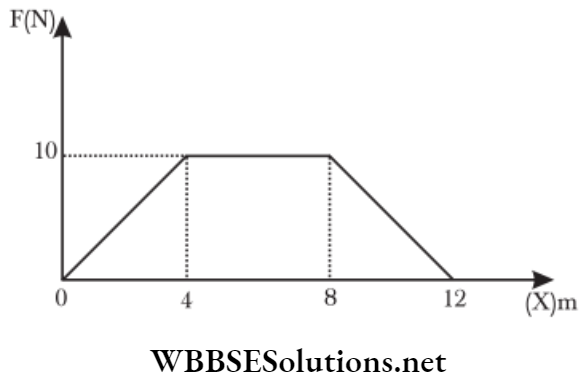
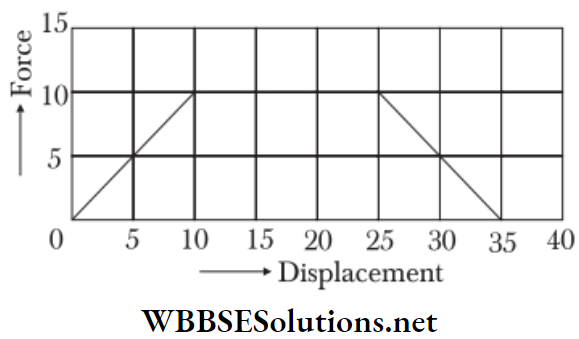
Question 6. A particle of mass 0.1kg is subjected to a force which varies with distance as shown below. If it starts its journey from rest at x = 0, its velocity at x = 12m is

NEET Foundation Physics Multiple Choice Questions A particle of mass

  1. 0ms-1.
  2. 20 √2 ms-1 .
  3. 20 √3 ms-1 .
  4. 40ms-1.

Answer. 3. 20√3ms-1 .

Question 7. A particle reaches its highest point when it has covered exactly one half of its horizontal range. The corresponding point on the displacement time graph is characterized by

  1. negative slope and zero curvature
  2. zero slope and negative curvature
  3. zero slope and positive curvature
  4. positive slope and zero curvature

Answer. 2. zero slope and negative curvature

Question 8. A ball thrown upward with a velocity of 100 ms-1. It will reach the ground after

  1. 10s
  2. 20s
  3. 5s
  4. 40s

Answer. 1. 10s

Question 9. Which of the following quantity is expressed as force per unit area?

  1. Work
  2. Pressure
  3. Volume
  4. Area

Answer. 1. Work

Question 10. A bullet of mass 0.1kg is fired with a speed of 100ms-1, the mass of gun is 50kg. The velocity of recoil is

  1. 0.2ms-1.
  2. 0.1ms-1.
  3. 0.5ms-1.
  4. 0.05ms-1.

Answer. 3. 0.5ms-1.

Question 11. A body of mass 2kg moving with a velocity of 3ms-1collides head on with a body of mass 1 kg moving with a velocity of 4 ms-1 in the opposite direction. After collision the two bodies stick together and move with common velocity which in the units ms-1 is equal to

  1. 1/4
  2. 1/3
  3. 2/3
  4. 3/4

Answer. 2. 1/3

Question 12. In a satellite if the time of revolution is T, then KE is proportional to

  1. \(\frac{1}{T}\)
  2. \(\frac{1}{T^2}\)
  3. \(\frac{1}{T^3}\)
  4. \(T^{-\frac{2}{3}}\)

Answer. 3. \(\frac{1}{T^3}\)

Question 13. The initial velocity of a particle is u(at2 = 0) and the acceleration f is given by a.t. Which of the following relations is valid?

  1. v = u + at2
  2. v = u + 1/2 at2
  3. v = u + at
  4. v = u

Answer. 3. v = u + at

Question 14. Which of the following four statements is false?

  1. A body can have zero velocity and still be accelerated.
  2. A body can have a constant velocity and still have a varying speed.
  3. A body can have a constant speed and still have a varying velocity.
  4. The direction of the velocity of a body can change when its acceleration is constant.

Answer. 2. A body can have a constant velocity and still have a varying speed.

Question 15. When a bicycle is in motion but not pedalled, the force of friction exerted by the ground on the two wheels is such that it acts

  1. in the backward direction on the front wheel and in the forward direction on the rear wheel
  2. in the forward direction on the front wheel and in the backward direction on the rear wheel
  3. in the forward direction on both the wheels
  4. in the backward direction on both the wheels

Answer. 3. in the forward direction on both the wheels

Class 11 Physics Class 12 Maths Class 11 Chemistry
NEET Foundation Class 12 Physics NEET Physics

Question 16. A body dropped from a height h with an initial speed zero, strikes the ground with a velocity 3 kmh1. Another body of same mass is dropped from the same height ‘h’ with an initial speed u’ = 4 kmh-1. Find the final velocity of second body, with which it strikes the ground.

  1. 3kmh-1
  2. 4kmh-1
  3. 5kmh-1
  4. 12kmh-1

Answer. 3. 5kmh-1

Question 17. If the increase in the kinetic energy of a body is 22%, then the increase in the momentum is nearly

  1. 22%
  2. 44%
  3. 10%
  4. 300%

Answer. 3. 10%

Question 18. A car moves for half of its time at 80 kmh-1 and for rest half of time at 40 kmh-1. The total distance covered is 60 km. What is the average speed of the car?

  1. 60 kmh-1
  2. 80 kmh-1
  3. 120 kmh-1
  4. 180 kmh-1

Answer. 1. 60 kmh-1

Question 19. The engine of a car produces acceleration 4 ms-2 in the car. If this car pulls another car of same mass, what will of the acceleration produced?

  1. 8ms-2
  2. 2ms-2
  3. 4ms-2
  4. 1/2 ms-2

Answer. 4. 1/2 ms-2

Question 20. Two bodies of 4g and 16g have same kinetic energy. What is the ratio of their momenta?

  1. 1:4
  2. 1:2
  3. 2:1
  4. 4:1

Answer. 1. 1:4

Question 21. A motor car is moving with speed 30ms-1 on a circular path of radius 500m. Its speed is increasing at the rate of 2ms-2, what will be its resultant acceleration?

  1. 2.5ms-2
  2. 2.7ms-2
  3. 2ms-2
  4. 4.5ms-2

Answer. 3. 2ms-2

Question 22. The distance of the centres of moon and earth is D. The mass of earth is 81 times the mass of the moon. At what distance from the centre of the earth, the gravitational force will be zero?

  1. \(\frac{D}{2}\)
  2. \(\frac{2 D}{3}\)
  3. \(\frac{4 D}{3}\)
  4. \(\frac{9 D}{10}\)

Answer. 4. \(\frac{9 D}{10}\)

Question 23. A ball of mass m moving with a constant velocity strikes against a ball of same mass at rest. If e = coefficient of restitution, then what will be the ratio of the velocity of two balls after the collision?

  1. \(\frac{1-e}{1+e}\)
  2. \(\frac{e-1}{e+1}\)
  3. \(\frac{1+e}{1-e}\)
  4. \(\frac{2+1}{e-1}\)

Answer. 1. \(\frac{1-e}{1+e}\)

Question 24. An inelastic ball is dropped from a height of 100m. Due to earth, 20% of its energy is lost. To what height the ball will rise?

  1. 80 m
  2. 40 m
  3. 60 m
  4. 20 m

Answer. 1. 80 m

Question 25. What remains constant when the earth revolves around the sun?

  1. Angular momentum
  2. Linear momentum
  3. Angular kinetic energy
  4. Linear kinetic energy

Answer. 3. Angular kinetic energy

Question 26. Where will it be profitable to purchase 1 kilogram sugar?

  1. At poles
  2. At equator
  3. At 45° latitude
  4. At 40° latitude

Answer. 1. At poles

Question 27. What remains constant in the field of central force?

  1. Potential energy
  2. Kinetic energy
  3. Angular momentum
  4. Linear momentum

Answer. 3. Angular momentum

Question 28. A body is rolling without slipping on a horizontal surface and its rotational kinetic energy is equal to the translational kinetic energy. The body is a

  1. disc
  2. sphere
  3. cylinder
  4. ring.

Answer. 3. cylinder

Question 29. If a body of mass 200 g falls from a height 200m and its total potential energy is converted into kinetic energy at the point of contact of the body with earth surface, then what is the decrease in potential energy of the body at the contact? (Take g = 10ms-2)

  1. 200J
  2. 400J
  3. 600J
  4. 900J

Answer. 4. 900J

Question 30. If momentum is increased by 20%, then kinetic energy increases by

  1. 44%
  2. 55%
  3. 66%
  4. 77%

Answer. 1. 44%

Question 31. Who among the following gave first the experimental value of G?

  1. Cavendish
  2. Copernicus
  3. Brook Teylor
  4. None of these

Answer. 1. Cavendish

Question 32. If a body starts from rest and travels 120cm in the 6th second then what is the acceleration?

  1. 0.20ms-2
  2. 0.027ms-2
  3. 0.218ms-2
  4. 0.03ms-2

Answer. 2. 0.027ms-2

Question 33. There are two bodies of masses 100 kg and 10,000 kg separated by a distance 1 m. At what distance from the smaller body, the intensity of gravitational field will be zero?

  1. 1/9m
  2. 1/10m
  3. 1/11m
  4. 10/11m

Answer. 3. 1/11m

Question 34. If the radius of the earth shrinks by 1.5% (mass remaining same), then the value of acceleration due to gravity changes by

  1. 1%
  2. 2%
  3. 3%
  4. 4%

Answer. 2. 2%

Question 35. Adjacent figure belows shows the force displacement the graph of a moving body. The work done in displacing body from x = 0 m to x = 35m is equal to

NEET Foundation Physics Multiple Choice Questions The Force Displacement the graph of a moving body

  1. 50J
  2. 25J
  3. 250J
  4. 200J

Answer. 1. 50J

Question 36. A solid of relative density D is floating in a liquid of density d. If v be the volume of solid submerged in the liquid and V be the total volume of the solid, then

  1. uV = dD
  2. \(\frac{V}{v}=\frac{D}{d}\)
  3. \(\frac{v}{V}=\frac{D}{d}\)
  4. DV = (1+d)v

Answer. 3. \(\frac{v}{V}=\frac{D}{d}\)

Question 37. A ball of mass m1 and an another ball of mass m2 are dropped from equal height. If time taken by the ball are t1 and t2, respectively then

  1. \(t_1=\frac{t_2}{2}\)
  2. t1 = t2
  3. t1 = 4t2
  4. \(t_1=\frac{t_2}{4}\)

Answer. 1. \(t_1=\frac{t_2}{2}\)

Question 38. A person is observing two trains; one is approaching him with a velocity of 4 ms-1, while the other is receding from him with the same velocity. If both the trains blow their respective whistles of frequency 240 hertz, the beat frequency heard by the observer will be (speed of sound in air = 320ms-1)

  1. 6
  2. 3
  3. zero
  4. 12

Answer. 1. 6

Question 39. One siren which is giving a sound of frequency 1000Hz, is going away from a stationary observer towards a wall with the speed of 10 ms-1. What is the frequency of sound heard directly from the siren? Speed of sound in air is 330ms-1?

  1. 970Hz
  2. 971Hz
  3. 972Hz
  4. 975Hz

Answer. 2. 971Hz

Question 40. In which medium sound travels faster?

  1. Steel
  2. Water
  3. Air
  4. Vacuum

Answer. 1. Steel

Question 41. Two sound waves of slightly different frequencies propagating in the same direction produce beats due to

  1. interference
  2. diffraction
  3. polarization
  4. refraction

Answer. 1. interference

Question 42. The frequency of a sound wave is f and its velocity is v. If the frequency is increased to 4f, the velocity of the wave will be

  1. v
  2. 2v
  3. 4v
  4. v/4

Answer. 1. v

Question 43. A source of sound of frequency 500Hz is moving towards an observer with velocity 30ms-1. The speed of sound is 330ms-1. The frequency heard by the observer will be

  1. 550Hz
  2. 458.3Hz
  3. 530Hz
  4. 454.5Hz

Answer. 1. 550Hz

Question 44. Two sound sources emit sound of wavelength l. They are fixed apart at a given distance. A listener moves with a velocity u along the line joining the two sources. The number of beats heard by him per second is

  1. \(\frac{u}{2 \lambda}\)
  2. \(\frac{2 u}{\lambda}\)
  3. \(\frac{u}{\lambda}\)
  4. \(\frac{u}{3 \lambda}\)

Answer. 2. \(\frac{2 u}{\lambda}\)

Question 45. A man is standing between two parallel cliffs and fires a gun. If he hears first and second echos after 1.5 s and 3.5 s respectively, the distance between the cliffs is (velocity of sound in air = 340ms-1)

  1. 1190m
  2. 850m
  3. 595m
  4. 510m

Answer. 2. 850m

Question 46. Ultrasonic signals sent from SONAR returns to it after reflection from a rock after a lapse of 1 s. If the velocity of ultrasound in water is 1,600ms-1, the depth of the rock in water is

  1. 300m
  2. 400m
  3. 500m
  4. 800m

Answer. 4. 800m

Question 47. Sound waves in air is always

  1. longitudinal
  2. transverse
  3. stationary
  4. electromagnetic

Answer. 1. longitudinal

Question 48. Rutherford’s ∝ scattering particle concludes that

  1. there is a heavy mass at centre
  2. electrons are revolving around the nucleus
  3. Both (a) and (b)
  4. None of these

Answer. 1. there is a heavy mass at centre

Question 49. A heavenly body that emits radio signals at regular intervals of time is called a

  1. quasar
  2. white dwarf
  3. red giant
  4. pulsar

Answer. 4. pulsar

Question 50. A large ship can float but a steel needle sinks because of

  1. viscosity
  2. surface tension
  3. density
  4. None of these

Answer. 4. None of these

Question 51. A moving body on earth ordinarily comes to rest by itself because of the

  1. law of inertia
  2. forces of friction
  3. conservation of momentum
  4. gravity

Answer. 2. forces of friction

Question 52. A person climbing a hill bends forward in order to

  1. avoid slipping
  2. increase speed
  3. reduce fatigue
  4. increase stability

Answer. 4. increase stability

Question 53. A piece of rock was brought from the moon to earth. Then

  1. its mass alone changed
  2. its weight alone changed
  3. both mass and weight changed
  4. neither its mass nor its weight changed

Answer. 2. its weight alone changed

Question 54. A red light is used in a traffic signal because

  1. it has the longest wavelength and can be easily noticed from a long distance
  2. it is beautiful
  3. it is visible even to people with bad eyesight
  4. None of these

Answer. 1. it has the longest wavelength and can be easily noticed from a long distance

Question 55. A shell, initially at rest suddenly explodes into two equal fragments A and B. Which one of the following is observed?

  1. A and B move in the same direction with the same speed.
  2. A and B move in the same direction with different speeds.
  3. A and B move in opposite directions with the same speed.
  4. A and B move in opposite directions with different speeds.

Answer. 3. A and B move in opposite directions with the same speed.

Question 56. A shooting star is

  1. a small star moving away from the earth at a very high speed
  2. a fast moving satellite that shines by sunlight
  3. a heavenly object that shines because it is heated by the friction of the earth’s atmosphere as it falls at a great speed
  4. a star of an extremely high density

Answer. 2. a fast moving satellite that shines by sunlight

Question 57. A shooting star is basically a

  1. meteor
  2. supernova
  3. comet trail
  4. disturbance in atmosphere

Answer. 1. meteor

Question 58. A sprayer works on the principle expounded by

  1. Newton
  2. Archimedes
  3. Boyle
  4. Pascal

Answer. 4. Pascal

Question 59. A tennis ball will bounce

  1. higher on the hills than on plains
  2. higher on the plains than on hills
  3. equally on the hills and plains
  4. higher either on the hills or on plains depending upon the ground friction

Answer. 1. higher on the hills than on plains

Question 60. A unit of energy is the same as that of

  1. work
  2. power
  3. force
  4. acceleration

Answer. 1. work

Question 61. An electric bulb produces a loud sound when broken because

  1. the air rushes into the partial vacuum in the bulb
  2. the gas inside it explodes
  3. the glass is brittle
  4. the gas inside it suddenly expands

Answer. 1. the air rushes into the partial vacuum in the bulb

Question 62. An iron hammer lying in the sun appears much hotter than its wooden handle because

  1. iron is at a higher temperature
  2. iron is darker than wood
  3. iron absorbs more heat
  4. iron is a good conductor of heat

Answer. 4. iron is a good conductor of heat

Question 63. An object moving around in a circle is moving with a

  1. uniform velocity
  2. uniform speed
  3. variable velocity
  4. variable speed

Answer. 3. variable velocity

Question 64. As the train starts moving, a man sitting inside leans backwards because of

  1. inertia of rest
  2. inertia of motion
  3. moment of inertia
  4. conservation of mass

Answer. 1. inertia of rest

Question 65. By what process heat transmitted from the filament of an evacuated electric bulb to the glass?

  1. Conduction
  2. Convection
  3. Radiation
  4. Heat cannot be transmitted through a vacuum

Answer. 3. Radiation

Question 66. Cathode rays were discovered by

  1. Rutherford
  2. J J Thomson
  3. Lord Kelvin
  4. Dirac

Answer. 2. J J Thomson

Question 67. Choose the only scalar quantity from the following:

  1. Energy
  2. Torque
  3. Momentum
  4. Force

Answer. 1. Energy

Question 68. Choose the only vector quantity from the following:

  1. Energy
  2. Length
  3. Density
  4. Torque

Answer. 4. Torque

Question 69. Clouds float in the atmosphere because of their low

  1. temperature
  2. speed
  3. pressure
  4. density

Answer. 4. density

Question 70. Cloudy nights are warmer because

  1. clouds prevent radiation of heat from the ground into the air
  2. of low atmospheric pressure
  3. of the compact density of air
  4. more dust particles gather in the air

Answer. 1. clouds prevent radiation of heat from the ground into the air

Question 71. Energy is not carried by

  1. transverse progressive waves
  2. longitudinal progressive waves
  3. stationary waves
  4. electromagnetic waves

Answer. 3. stationary waves

Question 72. Gravitational constant (G) is an example of

  1. non-dimensional constant
  2. dimensional constant
  3. numeric constant
  4. quantity without dimensions

Answer. 2. dimensional constant

Question 73. If a shell from a canon bursts in the air, the total kinetic energy

  1. increases
  2. decreases
  3. remains constant
  4. may increase or decrease

Answer. 1. increases

Question 74. If a train were to move with the velocity of light, its length would be

  1. infinite
  2. zero
  3. finite
  4. unchanged

Answer. 2. zero

Question 75. If the distance between two charges is halved, then the force between them becomes

  1. half
  2. double
  3. four times
  4. one-fourth

Answer. 3. four times

Question 76. Intensity of sound has

  1. an objective existence
  2. a subjective existence
  3. no existence
  4. both subjective and objective existence

Answer. 1. an objective existence

Question 77. Sound of frequency below 20 Hz are called

  1. audio sounds
  2. infrasonics
  3. ultrasonics
  4. supersonics

Answer. 2. infrasonics

Question 78. Sound travels fastest in

  1. air
  2. water
  3. vacuum
  4. steel

Answer. 2. water

Question 79. Sound travels fastest through

  1. vacuum
  2. steel
  3. water
  4. air

Answer. 2. steel

Question 80. Sound waves in air are

  1. transverse
  2. longitudinal
  3. electromagnetic
  4. polarized

Answer. 2. longitudinal

NEET Foundation Chemistry Notes For Chapter 4 Structure Of Atom

NEET Foundation Chemistry Notes For  Chapter 4 Structure Of Atom

Notes Of Structure Of Atom

As we have learnt in previous chapters, Matter is anything that occupies space and has mass and is made up of tiny particles called as atom. Different types of matter exists because of the different atoms that consists them. Now the question that comes to the mind is that: (i) how these atoms are different from each other? (2) Is it true that the atoms are indivisible, or they can be further divided?

These answers will be provided it the following chapter, where we will learn about the sub-atomic particles and how they were discovered. This chapter will also entail the reason behind the different properties of atoms due to which the matter is varied.

At the end of the 19th century, scientists were facing difficulties to reveal the actual structure of atom and were not able to explain the properties associated with them. There were series of experiments that elucidated the structure of atom.

Atoms are not divisible was first indicated by the study of static electricity and the conditions under which they are conducted.

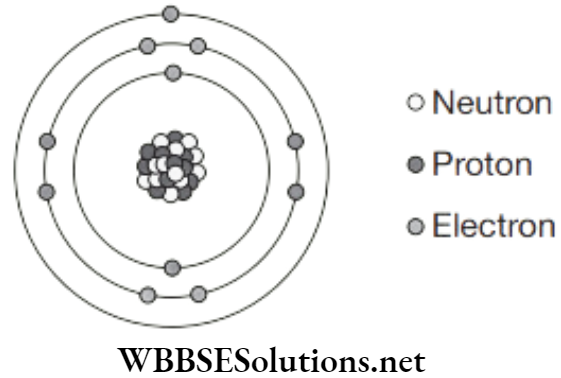
NEET Foundation Chemistry Structure of Atom

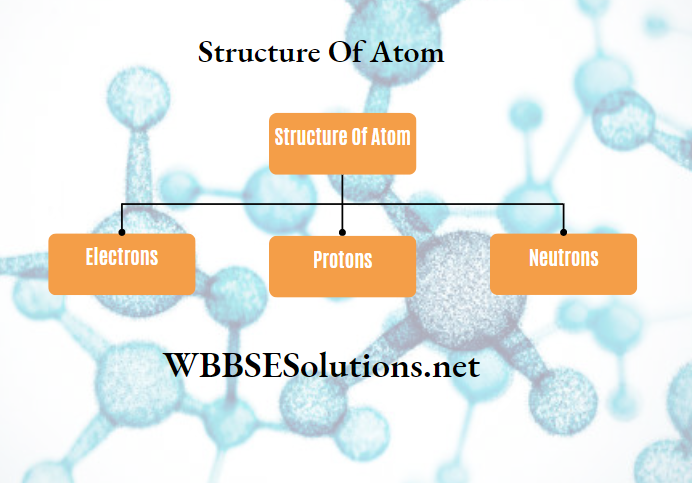
Structure Of Atom

NEET Foundation Chemistry Notes For  Chapter 4 Structure Of Atom Charged Particles in Matter

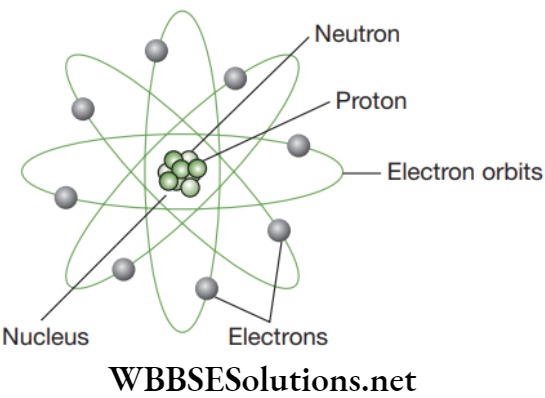
There are almost 120 known elements in the periodic table. The atoms of different elements have different numbers of electrons, protons, and neutrons. Every element is unique and has an atomic number. That number tells you the number of protons in every atom of the element. The atomic number is also called the proton number.

Read and Learn More: NEET Foundation Notes

Atom is labeled with a “+”, “−”, or a “0.” Those symbols refer to the charge of the particle. Charges are also found in tiny particles of matter.

The electron always has a “−”, or negative charge. The proton always has a “+”, or positive charge. If the charge of an entire atom is “0”, or neutral, there are equal numbers of electrons and protons. The third particle is the neutron. It has a neutral charge, also known as a charge of zero.

Electrons

Electrons are negatively charged particles, which were discovered by J. J. Thomson in cathode ray experiment. The term electron was coined by GJ Stoney.

How the Electrons were Discovered?

Discovery of electrons

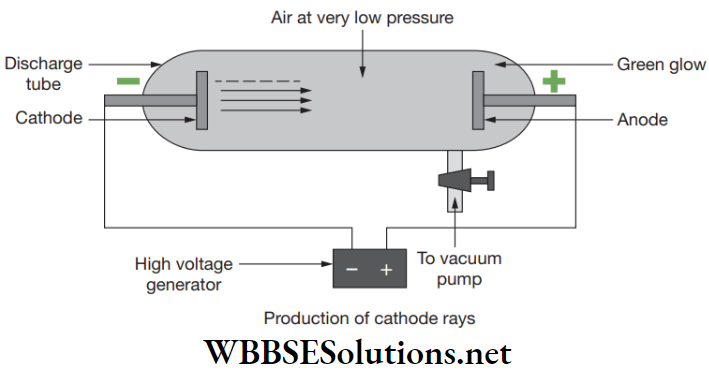
J. J. Thomson constructed a glass tube from which the air was pumped out and a high electrical voltage among the two electrodes which was placed at either end of the tube was is applied.

He detected that a stream of particle coming out from the negatively charged electrode called cathode to positively charged electrode called anode. This ray is called cathode ray, whole construction is called cathode ray tube and the particles were called electrons.

NEET Foundation Chemistry Structure Of Atom Cathode ray tube

Atomic Structure Notes

Protons

E Goldstein, in 1886 found that anode emits positively charged particles called protons in an anode ray experiment. These positively charged radiations are produced in discharge tube from the anode called canal rays. In 1909, Rutherford discovered proton in his famous gold foil experiment.

Class 11 Physics Class 12 Maths Class 11 Chemistry
NEET Foundation Class 12 Physics NEET Physics

Neutrons

Neutrons were discovered by James Chadwick in 1932 and are neutrally charged particles. It stays inside the nucleus of an atom except hydrogen.

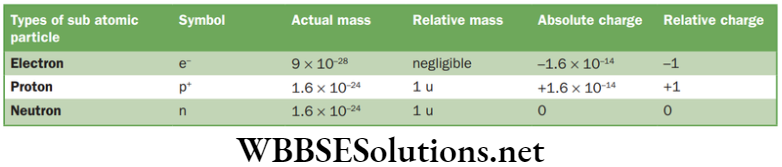
Comparison of three sub-atomic particles

NEET Foundation Chemistry Structure Of Atom Comparison of three sub-atomic particles

How to Determine the Number of Proton, Electron and Neutron?

Gather Information

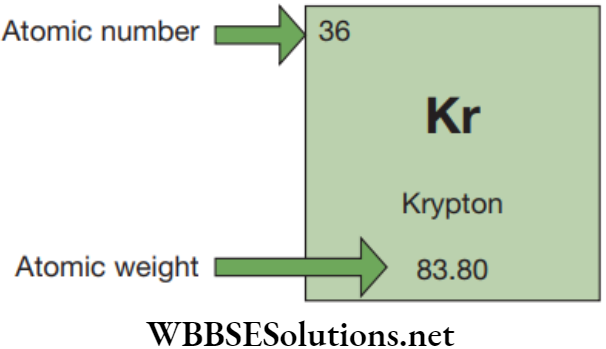
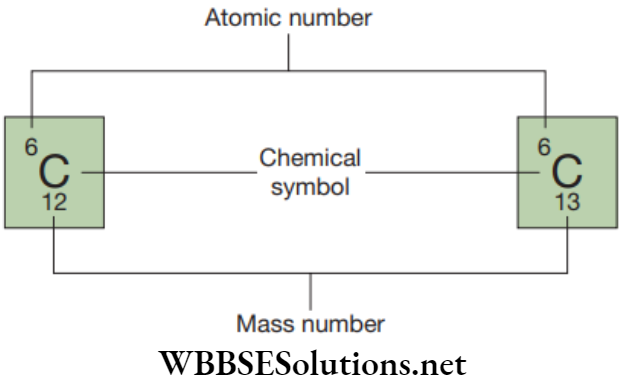
Find some information about your element, such as its atomic number (located in the upper left corner) and atomic weight (located on the bottom).

Consider an example for Krypton:

NEET Foundation Chemistry Structure Of Atom Representation of atomic number and atomic weight

Find the Number of Protons

The atomic number is the number of protons in an atom of an element. In our example, Krypton’s atomic number is 36, so it has 36 protons in its nucleus.

Find the Number of Electrons

Atoms must have equal numbers of protons and electrons. So, atom of Krypton must contain 36 electrons since it contains 36 protons.

Find the Number of Neutrons

The atomic weight measures the total number of particles present in an atom’s nucleus. As the nucleus is made up of protons and neutrons. So,

Mass Number = (Number of Protons) + (Number of Neutrons)

For Krypton, this equation becomes:

84 = (Number of Protons) + (Number of Neutrons)

84 = 36 + (Number of Neutrons) {Number of proton is calculated above}

Number of neutrons = 84 − 36

Number of neutrons = 48

NEET Foundation Chemistry Notes For Chapter 4 Structure of an Atom

Atomic models mainly explain the structure of an atom and also gave us an idea about how subatomic particles behave.

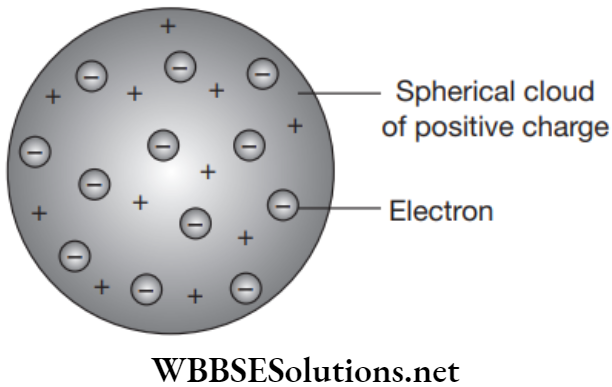
Thomson Model or Water Melon or Plum Pudding Model

In 1897, Thompson proposed that the structure of an atom is similar to that of a Christmas pudding. In this, atom is a positively charged sphere in which the electrons are embedded and the magnitude of positive and negative charge is same inside an atom so the net charge inside an atom is zero.

NEET Foundation Chemistry Structure Of Atom Thomson Model

Thomson Model Limitations

  • It could not explain the result of scattering experiment performed by Rutherford.
  • It did not give any experimental evidence in its support.

Rutherford’s Model or Planetary Model

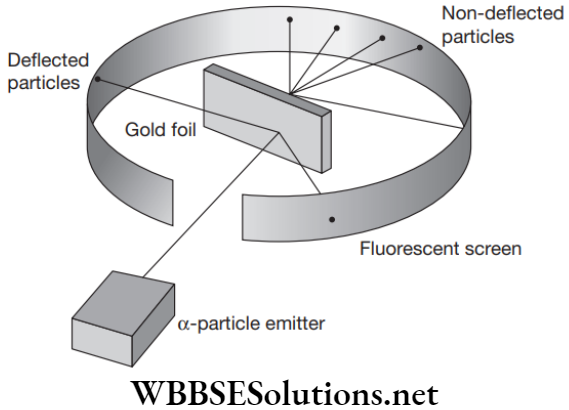
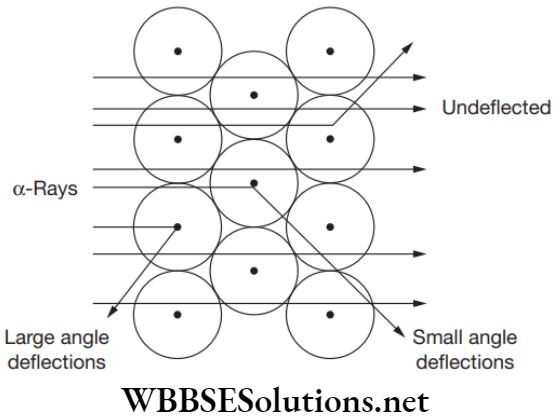
In gold foil experiment, Rutherford bombarded a beam of alpha particles on an ultrathin gold foil of thickness about 1000 atoms. He uses alpha particles, as these are doubly charged helium ions which moves fast and has a considerable amount of energy.

Rutherford’s Model  Method

Fast moving alpha particles were bombarded on thin gold foil and after passing to the foil they hit the screen.

NEET Foundation Chemistry Structure Of Atom Rutherford's Model

Rutherford’s Model  Observations

  • Most of the alpha particles pass through the foil without getting deflected, which means that most of the space inside the atom is empty.
  • Some of the alpha particles were deflected by small angle, which means that the positive charge of the atom occupies very little space.
  • Some of the alpha particles rebound back, which means the entire positive charge and mass of the atom is concentrated in a very small volume inside an atom.

NEET Foundation Chemistry Structure Of Atom Rutherford's observation

Rutherford’s Model  Conclusions

  • All the positively charged particles are present in small space inside the atom called nucleus.
  • Electrons revolve around the nucleus.
  • Most of the space inside an atom is empty.
  • Total positive charge in nucleus is same as total negative charge on all electrons of atom, so the net charge of an atom is zero.

Rutherford’s Model  Limitations

  • Rutherford proposed that the electrons revolve around the nucleus in fixed paths called orbits. But according to Maxwell, an accelerated charged particle such as electron always emits an electromagnetic radiation and this radiation would carry energy from the motion of the electron which would come at the cost of shrinking of orbits. So, the electrons would collapse in the nucleus.
  • Rutherford did not say anything about the arrangement of electrons in an atom.

Bohr’s Atomic Model

In 1913, Neil Bohr proposed a model of atomic structure.

He proposed:

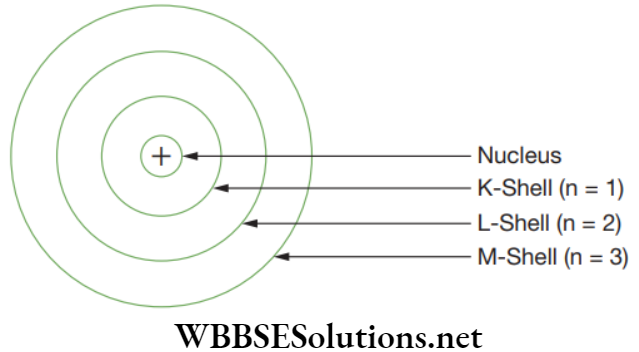
  • Electrons revolve around a positively charged nucleus in a certain orbit.
  • The whole mass of the atom is concentrated in the nucleus.
  • Electrons while revolving in an orbit do not radiate energy.
  • Orbits or shell are called energy levels, and are represented by the letter K, L, M, N … or by numbers n = 1, 2, 3 …
  • Energy level is associated with the definite amount of energy.
  • Energy changes when an electron jumps from one energy level to another.

NEET Foundation Chemistry Structure Of Atom Bohr's model of atom

With his model, Bohr explained how electrons jump from one orbit to another either by emitting or absorbing the energy in fixed quanta. Like, if an electron jumps from one orbit which is closer to the nucleus, it must emit energy which is equal to the difference of the energies of the two orbits.

Similarly, when an electron jumps to a larger orbit, it absorbs a light equal in energy to the difference in orbits.

Bohr’s orbits are called stationary states because the energies of orbits in which the electrons revolve are fixed.

Bohr’s Atomic Model Photoelectric Effect

There is immediate ejection of electrons from the surface of metal when light beam of certain frequency strikes on it. This is known as the photoelectric effect.

Heisenberg’s Uncertainty Principle

This principle states that it is impossible to decide both simultaneously and accurately position and momentum of a microscopic moving particle.

Quantum Numbers

They are used to specify the orbitals and the electrons. We will also discuss the principal quantum number, azimuthal quantum number, spin and magnetic quantum number.

Pauli’s Exclusion Principle

It is not possible for an atom to have all 4 quantum numbers same for two electrons.

Hunds’ Rule of Maximum Multiplicity

The pairing of orbitals of the atom is started only when each orbital has occupied one electron.

Schrödinger Wave Equation

The Schrödinger wave equation is used to find the probability of presence of electron. This place where probability of finding electron is highest is known as orbital.

NEET Foundation Chemistry Notes For  Chapter 4 Structure Of Atom Track Your learning Question And Answers

Question 1. The is immediate ejection of electrons from the surface of metal when light beam of certain frequency strikes on it is known as the ____________.
Answer. Photoelectric effect

Question 2. The Schrödinger wave equation is used to find the probability of presence of electron. (True/False)
Answer. True

Question 3. The place where probability of finding electron is highest is known as ____________.
Answer. Orbital

Question 4. ____________ are used to specify the orbitals and the electrons.
Answer. Quantum numbers

Question 5. Electrons while revolving in an orbit radiate energy. (True/False)
Answer. False

Chapter 4 Structure Of Atom Distribution of Electrons in Different Orbits

Electronic configuration is an arrangement of electrons in various shells of an atom of the element.

Electronic configurations describe electrons as each moves independently in an orbital. Mathematically, configurations is described by Slater determinants or configuration state functions.

According to the laws of quantum mechanics, if systems have only one electron, then its energy is associated with each electronic configuration and, on certain conditions, electrons are able to move from one configuration to another either by emitting or absorbing the quantum of energy, in form of photon.

Maximum number of electron which can be accommodated in any energy level is 2n2, where n = 1, 2, 3 … The maximum number of electrons which can be placed in an orbit is 8. Stepwise filling of shells is followed, like unless and until earlier shell is filled then only it can accommodate another shell.

Filling of orbits takes place from inside to outside. Maximum number of electrons in a given shell are:

  • K-shell, n = 1: Maximum electrons = 2n2, 2(1)2 = 2
  • L-shell, n = 2: Maximum electrons = 2n2, 2(2)2 = 8
  • M-shell, n = 3: Maximum electrons = 2n2, 2(3)2 = 18
  • N-shell, n = 4: Maximum electrons = 2n2, 2(4)2 = 32

Examples:

Electronic Configuration of Hydrogen (H)

Atomic number of hydrogen = 1

So, number of electrons = 1

Maximum number of electrons in 1st orbit = 2

Since, hydrogen has only one electron, so, it will reside in 1st orbit i.e in K-shell

Thus, electronic configuration of hydrogen:

Hydrogen and number of orbit present in hydrogen = 1

Electronic Configuration of Lithium (Li)

Atomic number of Lithium = 3

So, number of electrons = 3

Since the maximum number of electrons in 1st orbit, i.e., in K-shell= 2, so, after accommodating 2 electrons in 1st orbit, the third electron will go in 2nd orbit, i.e., in L-shell

Thus, electronic configuration of lithium is: Lithium and number of orbit in Lithium atom = 3.

Electronic Configuration of Calcium (Ca)

Atomic number of calcium = 20

So, number of electrons = 20

Electronic configuration of calcium is: Calcium and number of orbit in calcium = 4

NEET Foundation Chemistry Notes For  Chapter 4 Structure Of Atom Valency

It is the number of electrons which an atom must either give away or take in order to attain a stable electronic configuration. Valence electrons are the electrons present in the outermost orbit of an atom, thus determining the valency of an atom. Atom can obtain a stable configuration, either by:

  • Losing an electron
  • Gaining an electron
  • Sharing an electron

Valency = 8-valence electrons

Example:

Sulphur: It has 16 electrons.

Electronic configuration: n = 1, or K=1: 2 electrons

n = 2, or L = 2: 8 electrons

n = 3, or M = 3: 6 electrons

Its electronic configuration is 2,8,6. It has six electrons in its outermost orbit, so it requires two more electrons to complete its outermost orbit (M-shell). So it either takes two electrons to other atom or share electrons from another atom just to complete its octet.

Magnesium: It has 12 electrons.

Electronic configuration: n = 1, or K=1: 2 electrons

n = 2, or L = 2: 8 electrons

n = 3, or M = 3: 2 electrons

Magnesium molecule has an electronic configuration 2,8,2. It has two electrons in its outermost orbit, so it requires six more electrons to complete its outermost orbit (M-shell). So it will either donate its two electrons to other atom or share electrons from another atom just to complete its octet.

Valency of some elements

NEET Foundation Chemistry Structure Of Atom Valency of some elements

NEET Foundation Chemistry Notes For  Chapter 4 Structure Of Atom Atomic Number and Mass Number

Atomic Number

It is represented by Z. It is the number of protons which are present in the nucleus of an atom. The conventional symbol Z comes from the German word Atom zahl which means atomic number.

It uniquely identifies a chemical element, it’s an uncharged atom, and an atomic number is also equal to the number of electrons.

Atomic number = number of proton

As number of proton is equal to number of electron in an atom, so:

Atomic number = number of proton = number of electron

Example, carbon’s atomic number (Z) is 6 as it has 6 protons. The number of neutrons may vary to produce isotopes, which are atoms of the same element that have different numbers of neutrons. The number of electrons can also be different in atoms of the same element, thus producing ions. For example, iron, Fe, can exist in its neutral state, or in the +2 and +3 ionic states.

Atomic number of some elements

NEET Foundation Chemistry Structure Of Atom Atomic number of some elements

How to calculate atomic number?

To calculate the atomic number for krypton: 3684Kr

Number of Protons = Atomic Number = 36

Number of Electrons = Number of Protons = Atomic Number = 36

Mass Number or Nucleon Number

It is the total number of neutrons and proton present in an atom. It is represented by A.

Mass number = Number of protons + number of neutron

To calculate the number of neutrons in an atom

  • Number of Neutrons = Mass Number (A) − Atomic Number (Z)or,
  • Number of Neutrons (in an atom) = Nucleon Number (A) − Proton Number (Z)

The atomic number, Z, must not be confused with the mass number, A, as mass number is the number of nucleons i.e., the total number of protons and neutrons present in the nucleus of an atom. The number of neutrons, N, is known as the neutron number of the atom.

Thus, A = Z + N.

Where: A = Mass number

Z = Atomic number

N = Number of neutrons.

Protons and neutrons have approximately the same mass and the mass defect of nucleon binding is small as compared to the nucleon mass, the atomic mass of any atom. This approximation of mass is used to calculate the number of neutrons in an element by simply subtracting the number of protons from the mass number.

Example

Carbon:

Mass number is 12

Number of proton = 6 and number of neutron = 6.

Carbon has an atomic number of six and two stable isotopes with mass numbers of twelve and thirteen, respectively. So, its average atomic mass is 12.01.

NEET Foundation Chemistry Structure Of Atom Carbon

NEET Foundation Chemistry Notes For  Chapter 4 Structure Of Atom Fill in the Blanks

Question 1. The atomic number of an atom having 11 electrons is ____________.
Answer. 11

Question 2. Electrons are ____________ charged particles.
Answer. Negatively

Question 3. ____________ are the smallest of the three particles that make up atoms.
Answer. Electrons

Question 4. There are almost ____________ known elements in the periodic table.
Answer. 120

Question 5. Neutrons were discovered by ____________.
Answer. James Chadwick

Question 6. Mass of an electron is ____________ gram.
Answer. 9 x 10-28

Question 7. ____________ mainly explain the structure of an atom.
Answer. Atomic models

Question 8. Alpha particles are doubly charged ____________.
Answer. Helium ions

Question 9. Electrons revolve around a positively charged nucleus in a certain ____________.
Answer. Orbit

Question 10. The chemical properties of isotopes of a single element are nearly ____________.
Answer. Identical

Question 11. ____________ is the number of protons which are present in the nucleus of an atom.
Answer. Atomic number

Question 12. Mass number is the number of ________.
Answer. Nucleons

Question 13. Electronic configurations describe ________ as each move independently in an orbital.
Answer. Electrons

Question 14. Mathematically, configurations is described by _________.
Answer. Slater determinants

Question 15. Filling of orbits takes place from __________.
Answer. Inside to Outside

Question 16. ____________ = 8 valence electrons.
Answer. Valency

Question 17. ____________ is the number of electrons which an atom must either give away or take to attain a stable electronic configuration.
Answer. Valency

Question 18. ____________ has an electronic configuration of 2,8,6.
Answer. Sulphur

Question 19. Valency of carbon is 4. (True/False)
Answer. True

Question 20. __________ are the atoms having same mass number but different atomic number.
Answer. Isobars

Question 21. Isotones are the atoms that have the same neutron number but different number of proton. (True/False)
Answer. True

Question 22. _________ are different forms of a single element.
Answer. Isotopes

NEET Foundation Chemistry Notes For  Chapter 4 Structure Of Atom True Or False

Question 1. Atomic number = number of proton = number of electron. (True/False)
Answer. True

Question 2. The number of electrons may vary in an atom to produce isotopes. (True/False)
Answer. False

Question 3. Protons and neutrons have approximately the same mass. (True/False)
Answer. True

NEET Foundation Chemistry Notes For  Chapter 4 Structure Of Atom Match the Column

Question 1. Match the following and choose the correct code:

NEET Foundation Chemistry Structure Of Atom Correct option 1

Select the correct option:

  1. A-4, B-1, C-3, D-2
  2. A-2, B-4, C-3, D-1
  3. A-3, B-4, C-1, D-2
  4. A-2, B-1, C-3, D-4

Answer. 3. A-3, B-4, C-1, D-2

Question 2. Match the following and choose the correct code:

NEET Foundation Chemistry Structure Of Atom Correct option 2

Select the correct option:

  1. A-2, B-1, C-3, D-4
  2. A-2, B-3, C-1, D-4
  3. A-1, B-3, C-4, D-2
  4. A-3, B-1, C-4, D-2

Answer. 2. A-2, B-3, C-1, D-4

Question 3. Match the following and choose the correct code:

NEET Foundation Chemistry Structure Of Atom Correct option 3

Select the correct option:

  1. A-3, B-1, C-4, D-2
  2. A-2, B-3, C-1, D-4
  3. A-2, B-3, C-4, D-1
  4. A-4, B-1, C-2, D-3

Answer. 4. A-4, B-1, C-2, D-3

NEET Foundation Chemistry Notes For  Chapter 4 Structure Of Atom Assertion Reasoning

For the following questions the options will remain the following:

  1. Both A and R are correct and R is correct explanation of A.
  2. Both A and R are correct but R is not a logical explanation of A.
  3. A is correct but R is incorrect.
  4. R is correct but A is incorrect.

Question 1. Assertion: Cathode rays glow in the entire tube at 1 mm pressure
Reason: The colour emitted depends upon the nature of the gas taken in the tube. If neon gas is taken, the light emitted is reddish orange.

Answer. 2. Both A and R are correct but R is not a logical explanation of A.

Question 2. Assertion: One unit positive charge corresponds to one proton.
Reason: The number of units of positive charge on the nucleus of an atom is equal to the number of protons present in nucleus.

Answer. 1. Both A and R are correct and R is correct explanation of A.

Question 3. Assertion: An atom is positively charged sphere in which electrons are embedded.
Reason: The protons are electrically neutral.

Answer. 3. A is correct but R is incorrect.

NEET Foundation Chemistry Notes For  Chapter 4 Structure Of Atom Comprehension Passage

As per Thomson’s model of the atom, an atom has both negative and positive charges which are equal in number and magnitude. So, they balance each other as a result of which atom as a whole is eletrically neutral. On the basis of Rutherford’s model of an atom, protons are present in the nucleus of an atom.

If α-particle scattering experiment is carried out using a foil of any metal as thin as gold foil used by Rutherford, there would be no change in observations. But since other metals are not so malleable so, such a thin foil is difficult to obtain. If we use a thick foil, then more α-particles would bounce back and no idea about the location of positive mass in the atom would be available with such a certainty.

The three sub-atomic particles of an atom are protons, electrons and neutrons. An electron is a negatively charged particle, whereas a proton is a positively charged particle. The magnitude of their charges is equal. Therefore, an atom containing one electron and one proton will not carry any charge. Thus, it will be a neutral atom.

If the number of electrons in the outermost shell of the atom of an element is less than or equal to 4, then the valency of the element is equal to the number of electrons in the outermost shell. On the other hand, if the number of electrons in the outermost shell of the atom of an element is greater than 4, then the valency of that element is determined by subtracting the number of electrons in the outermost shell from 8.

The distribution of electrons in chlorine, sulphur, and magnesium atoms are 2, 8, 7; 2, 8, 6 and 2, 8, 2 respectively. The valency of an element is the combining capacity of that element. The valency of an element is determined by the number of valence electrons present in the atom of that element.

Question 1. What will be the valency of the element in the outermost shell of the atom of an element is less than or equal to 4?

  1. More than the number of electrons.
  2. Equal to the number of electron.
  3. Less than the number of electrons.
  4. No one of above

Answer. 2. Equal to the number of electron.

Question 2. On the basis of Rutherford’s model of an atom where does protons presents?

  1. In the nucleus of an atom.
  2. In the neutron of an atom.
  3. All the protons and neutrons of the atom are contained in the nucleus.
  4. No one of above

Answer. 1. In the nucleus of an atom.

Question 3. What will happen if α-particle scattering experiment is carried out using a thick foil?

  1. Particles will cross the foil.
  2. Particles won’t cross the foil.
  3. Particles will bounce back.
  4. Nothing will happen.

Answer. 3. Particles will bounce back.

Question 4. As per Thomson’s model of the atom, what kind of charge an atom consists?

  1. Positive
  2. Negative
  3. Both negative and positive
  4. No charge

Answer. 3. Both negative and positive

Question 5. How the valency of an element is determined?

  1. Number of electrons present in the atom of that element.
  2. Atom containing one electron and one proton.
  3. The total number of electrons in a carbon atom.
  4. Atomic number is equal to the number of protons.

Answer. 1. Number of electrons present in the atom of that element.

Question 5. The maximum number of electrons which can be placed in an orbit is:

  1. 8
  2. 7
  3. 5
  4. 4

Answer. 1. 8

Question 6. Which of the following exhibit similar chemical behavior?

  1. Isotopes
  2. Isotones
  3. Isobars
  4. All the above

Answer. 1. Isotopes

NEET Foundation Chemistry Chapter 4 Structure Of Atom Multiple Choice Questions

NEET Chemistry Structure Of Atom MCQs Chapter 4 Structure Of Atom Multiple Choice Question And Answers

Direction: Choose the correct option for each question. There is only one correct response for each question.

Question 1. On the basis of Rutherford’s model of an atom, which subatomic particle is present in the nucleus of an atom?

  1. Neutrons
  2. Neutral
  3. Electron
  4. Protons

Answer. 4. Protons

Question 2. What should be the pressure inside the discharge tube of the order of 0.001?

  1. The pressure should be very high.
  2. Pressure should be normal.
  3. The pressure should be very low.
  4. Pressure should be at a certain level.

Answer. 3. Pressure should be very low.

Question 3. Why Bohr’s orbits are called stationary states?

  1. It has got a fixed value of energy.
  2. Revolving orbit lose energy continuously.
  3. It is equal to the number of protons.
  4. It is equal to the sum of neutrons.

Answer. 1. It has a fixed value of energy.

Question 4. Which atom does not have any neutrons in the nucleus?

  1. Neutral atom
  2. Protons atom
  3. Electron atom
  4. Hydrogen atom

Answer. 4. Hydrogen atom

NEET Chemistry Structure of Atom MCQs 

Question 5. When alpha particles are sent through a thin metal foil, most of them go straight through the foil because

  1. Alpha particles are much smaller than electrons.
  2. Alpha particles are positively charged.
  3. Most part of the atom is space.
  4. Alpha particles move with low velocity.

Answer. 3. Most part of atom is space.

Read and Learn More NEET Foundation Multiple Choice Questions

Question 6. Rutherford’s scattering experiment showed for the first time that the atom has

  1. Electrons
  2. Nucleus
  3. Protons
  4. Neutrons

Answer. 2. Nucleus

Question 7. Why does a mica wheel mounted on an axle and placed in the path of cathode rays begin to rotate when cathode rays fall in?

  1. Cathode rays travel in straight line.
  2. Particles present in cathode rays are positively charged particles.
  3. Cathode rays consist of material particles travelling with high velocity.
  4. Cathode rays consist of material particles travelling with low velocity.

Answer. 3. Cathode rays consist of material particles travelling with high velocity.

NEET Foundation Chemistry Chapter 4 Structure Of Atom Multiple Choice Questions

Question 8. If the K and L shells of an atom are full, then what would be the total number of electrons in the atom?

  1. 4
  2. 10
  3. 12
  4. 8

Answer. 2. 10

Question 9. Which of the following statements is not correct?

  1. An atomic number is alwaysthe whole number.
  2. All atoms of the same element have same number of protons in the nucleus.
  3. Atoms of two elements contain the same number of protons in the nucleus.
  4. Atomic number of the element changes when it undergoes a chemical reaction.

Answer. 4. Atomic number of the element changes when it undergoes a chemical reaction.

Question 10. Which symbols are used to represent different Bohr’s orbit?

  1. K, L, N, M
  2. K, M, L, N
  3. K, M, N, L
  4. K, L, M, N

Answer. 4. K, L, M, N

Atomic Structure MCQs for NEET 

Question 11. What happens in the discharge tube if a high voltage is applied at gas pressure of one atmosphere?

  1. Current begin to flows between the electrodes.
  2. Glow disappears.
  3. No current flows between the electrodes.
  4. The colour of glow changes.

Answer. 3. No current flows between the electrodes.

Question 12. Atomic number of chlorine is 17. What will be the atomic number of chloride ion (Cl)?

  1. 17
  2. 11
  3. 10
  4. 18

Answer. 1. 17

Question 13. What do you mean by Valence electrons?

  1. Electrons presents in the duplet of the atom.
  2. Electrons increase in atomic number.
  3. Electrons presents in the outermost shell of the atom of an element.
  4. Total number of electrons present in the atom.

Answer. 3. Electrons presents in the outermost shell of the atom of an element.

Atomic Structure MCQs for NEET 

Question 14. What is the maximum number of electrons that can be present in the M-Shell?

  1. 18
  2. 16
  3. 12
  4. 10

Answer. 1. 18

Question 15. What are isobars?

  1. Atoms of same elements.
  2. Atomic numbers are same.
  3. Atoms of different elements having different atomic number.
  4. Atomic masses taken with average value.

Answer. 3. Atoms of different elements having different atomic number.

Question 16. How do we find the age of fossils i.e., sample of woods or dead animals?

  1. Geological dating
  2. Carbon dating
  3. Helium
  4. Isoelectronic

Answer. 2. Carbon dating

Question 17. If an element has 5 electrons in the outermost M-shell, what element is this?

  1. Iodine
  2. Cobalt
  3. Methane
  4. Phosphorus

Answer. 4. Phosphorus

Atomic Structure MCQs for NEET 

Question 18. Covalency is the number of electrons

  1. Sharing with other atoms
  2. Lost by an atom
  3. Gain by an atom
  4. Compound by an atom

Answer. 1. Sharing with other atoms

Question 19. Why helium does not take part in chemical reaction?

  1. Outermost shell has 8 electrons.
  2. Only one shell containing 2 electrons.
  3. Most of the elements have isotopes.
  4. Complete octet in the outermost shell.

Answer. 2. Only one shell containing 2 electrons.

Question 20. What is Radioisotopes?

  1. Some isotopes have unstable nuclei.
  2. Some isotopes have stable nuclei.
  3. Elements have different atomic numbers.
  4. Large amount of radiation is emitted.

Answer. 1. Some isotopes have unstable nuclei.

Question 21. Three isotopes of oxygen are known with mass number 16, 14 and 18. How do they differ from each other in term of electron, proton and neutrons?

  1. Same number of protons and neutrons but different number of electrons.
  2. Same number of electrons and neutrons but different number of protons.
  3. Same number of protons and electrons but different number of neutrons.
  4. None of above

Answer. 3. Same number of protons and electrons but different number of neutrons.

Question 22. How are positive ions formed?

  1. Gain of electrons in their outermost shell.
  2. Anion is equal to the number of electrons.
  3. Equal to the units of charger present on the ion.
  4. Loss of electrons by neutral atom.

Answer. 4. Loss of electrons by neutral atom.

Atomic Structure MCQs for NEET 

Question 23. If an atom contains one electron and one proton, will it carry any charge or not?

  1. The net charge on the atom will be more than 1.
  2. Yes, atom will carry the charge.
  3. No, atom will not carry any charge.
  4. None of above

Answer. 3. No, atom will not carry any charge.

Question 24. On the basis of Thomson’s model of an atom how the atom is neutral as a whole?

  1. Negative charge on the electrons is equal to positive charge of the sphere.
  2. Positive charge on the electrons is equal to positive charge of the sphere.
  3. Negative charge on the electrons is equal to negative charge of the sphere.
  4. None of above

Answer. 1. Negative charge on the electrons is equal to positive charge of the sphere.

Question 25. What is proton?

  1. An electron is that subatomic particle which carries one-unit negative charge.
  2. A smallest indivisible particle made up of electrons.
  3. A subatomic particle which carries one unit positive charge.
  4. Number of elements with low atomic number.

Answer. 3. A subatomic particle which carries one unit positive charge.

Structure of Atom NEET Questions 

Question 26. How do you determine the charge on the cathode rays?

  1. Atoms absorb energy
  2. Electric field deflected towards the positive plates
  3. Mass is equal to the mass of the atom of the gas taken
  4. None of above

Answer. 2. Electric field deflected towards the positive plates

Question 27. What is the origin of the anode rays?

  1. Atoms forming positive icons start moving towards cathode rays.
  2. Ratio is always same irrespective of the gas taken in the discharge tube.
  3. Atoms of different elements having different atomic number.
  4. Electrons presents in the duplet of the atom.

Answer. 1. Atoms forming positive icons start moving towards cathode rays.

Question 28. Helium atom has an atomic mass of 4 u and two protons in its nucleus. How many neutrons does it have?

  1. 4
  2. 8
  3. 2
  4. 6

Answer. 3. 2

Question 29. Oxygen atom has 8 electrons, 8 protons and 8 neutrons whereas sulphur atom has 16 electrons, 16 protons and 16 neutrons. Find out the mass number of oxygen and sulphur atoms.

  1. 16 and 32
  2. 8 and 32
  3. 32 and 16
  4. 8 and 16

Answer. 1. 16 and 32

Question 30. If K and L-shells of an atom are full, then what would be the total number of electrons in the atom?

  1. 18
  2. 12
  3. 08
  4. 10

Answer. 4. 10

Question 31. What are canal rays?

(1) They are anode rays

(2) They pass through the holes or canals in the cathode

(3) They travel in straight lines

(4) None of above

  1. (1) and (2)
  2. (1) and (3)
  3. None of above
  4. (1), (2), and (3)

Answer. 4. (1), (2), and (3)

Question 32. What is mass number?

(1) Sum of number of neutrons

(2) Average relative mass of its atoms

(3) Sum of number of protons

(4) Whole number of electrons

  1. (1) and (4)
  2. (1) and (2)
  3. (1) and (3)
  4. (1), (2), and (3)

Answer. 3. (1) and (3)

Question 33. How can we check that electrons are material particles?

(1) Electric field is applied on the cathode rays.

(2) Mica wheels mounted on an axle.

(3) Mica wheels placed in the path of cathode rays.

(4) Cathode rays deflected towards electric fields.

  1. (1) and (2)
  2. (2) and (4)
  3. (2) and (3)
  4. (1), (2), and (4)

Answer. 2. (2) and (4)

Class 11 Physics Class 12 Maths Class 11 Chemistry
NEET Foundation Class 12 Physics NEET Physics

Question 34. Which of the following is correct about cathode rays?

(1) They are deflected towards the positive plate of the electric field.

(2) The nature of cathode rays does not depend upon the nature of the material of the cathode.

(3) The nature of cathode rays depends upon the nature of the gas taken in the discharge tube.

(4) Cathode rays are made up of electrons.

  1. (1) and (2)
  2. (2) and (4)
  3. (2) and (3)
  4. (1), (2), and (4)

Answer. 4. (1), (2), and (4)

Structure of Atom NEET Questions 

Question 35. How many of the following are correct observation/conclusion from Rutherford’s scattering experiment?

(1) Nucleus is small but heavy.

(2) Nucleus always carries positive charge.

(3) The number of α-particles hitting the nucleus is very large.

(4) Atom is nearly 105 times greater than the size of the nucleus.

  1. (1) and (2)
  2. (2) and (4)
  3. (1), (2) and (4)
  4. (1), (2) and (3)

Answer. 3. (1), (2) and (4)

Question 36. Neutron is present in all atoms

(1) Protium

(2) Deuterium

(3) Tritium

(4) Helium

  1. (2), (3) and (4)
  2. (3) and (4)
  3. (1), (2) and (3)
  4. (1), (2) and (4)

Answer. 1. (2), (3) and (4)

Question 37. Isobars differ in number of

(1) Protons

(2) Electrons

(3) Neutrons

(4) Nucleons

  1. (1), (3) and (4)
  2. (2) and (4)
  3. (1), (2) and (3)
  4. (1), (2) and (4)

Answer. 3. (1), (2) and (3)

Question 38. Which of the following isotopes are not used in the treatment of cancer?

(1) P-32

(2) I-131

(3) Co-60

(4) U-235

  1. (1) and (2)
  2. (2) and (4)
  3. (1), (2) and (4)
  4. (2), (3) and (4)

Answer. 4. (2), (3) and (4)

Structure of Atom NEET Questions 

Question 39. The valency of which of the following elements is not zero?

(1) Hydrogen

(2) Helium

(3) Gold

(4) Silver

  1. (1) and (4)
  2. (1) and (2)
  3. (1) and (3)
  4. (1), (3) and (4)

Answer. 4. (1), (3) and (4)

Question 40. Which of the following are true for an element?

(1) Atomic number = number of protons + number of electrons

(2) Mass number = number of protons + number of neutrons

(3) Atomic mass = number of protons + number of neutrons

(4) Atomic number = number of protons + number of electrons

  1. (1) and (2)
  2. (1) and (3)
  3. (2) and (3)
  4. (2) and (4)

Answer. 4. (2) and (4)

Question 41. Positive ions are formed from the neutral atom by the

  1. Increase of nuclear charge
  2. Gain of protons
  3. Loss of electrons
  4. Loss of protons

Answer. 3. Loss of electrons

Question 42. A neutral atom (Atomic no. > 1) consists of

  1. Only protons
  2. Neutrons + protons
  3. Neutrons + electrons
  4. Neutrons + protons + electrons

Answer. 4. Neutrons + protons + electrons

NEET Foundation Chemistry Chapter 4 

Question 43. The mass of electron is

  1. 9.1083 × 10⁻³¹ kg
  2. 9.1083 × 10⁻²⁴ kg
  3. 9.1083 × 10⁻²⁸ kg
  4. 1.67 × 10⁻²⁴ kg

Answer. 1. 9.1083 × 10⁻³¹ kg

Question 44. Size of the nucleus is of the order

  1. 10-12 m
  2. 10-8 m
  3. 10-15 m
  4. 10-10 m

Answer. 3. 10-15 m

Question 45. In a given atom no two electrons can have the same values for all the four quantum numbers.

  1. Hund’s rule
  2. Aufbau principle
  3. Uncertainty principle
  4. Pauli’s exclusion principle

Answer. 2. Aufbau principle

NEET Foundation Chemistry Chapter 4 

Question 46. An explanation of the presence of three unpaired electrons in the nitrogen atom is given by

  1. Pauli’s principle
  2. Hund’s rule
  3. Aufbau principle
  4. uncertainty principle

Answer. 2. Hund’s rule

Question 47. The \(\frac{e}{m}\) ratio of an electron for all type of substances is

  1. constant
  2. less than one
  3. greater than one
  4. zero

Answer. 1. constant

Question 48. The ratio of charge and mass would be greater for

  1. Proton
  2. Electron
  3. Neutron
  4. Alpha

Answer. 2. Electron

Structure of Atom Multiple Choice Questions 

Question 49. A proton is identical to

  1. the nucleus of helium
  2. the nucleus of a hydrogen atom
  3. a molecule of a hydrogen
  4. an atom of hydrogen

Answer. 4. an atom of hydrogen

Question 50. The electron is

  1. α-ray particle
  2. β-ray particle
  3. Hydrogen ion
  4. Positron

Answer. 2. β-ray particle

Question 51. An α-particle is

  1. a hydrogen molecule
  2. a helium nucleus
  3. an electron
  4. a proton

Answer. 2. a helium nucleus

Question 52. A natural phenomenon that supports the experimental conclusion that atoms are divisible is

  1. allotropy
  2. radioactivity
  3. cracking
  4. None of these

Answer. 2. radioactivity

Question 53. Designation of an orbital with n = 6 and l = 4, is

  1. 6s
  2. 6d
  3. 6f
  4. 6p

Answer. 4. 6p

Structure of Atom Multiple Choice Questions 

Question 54. Which of the following nuclear particles is responsible for holding nucleons together in a nucleus?

  1. Protons
  2. Mesons
  3. Positrons
  4. Neutrons

Answer. 2. Mesons

Question 55. Though three fundamental particles are present in almost all elements. One element does not have

  1. neutron
  2. proton
  3. electron
  4. nucleons

Answer. 1. neutron

Question 56. The nucleus of the atom consists of

  1. Proton and neutron
  2. Proton and electron
  3. Neutrons and electron
  4. Proton, neutrons and electron

Answer. 1. Proton and neutron

Question 57. The size of nucleus is of the order of

  1. 10-12 m
  2. 10-8m
  3. 10-15 m
  4. 10-10 m

Answer. 3. 10-15 m

Question 58. A completely filled and half filled orbit is spherically symmetrical. Point out which has spherical symmetry.

  1. Na
  2. C
  3. Cl
  4. S

Answer. 1. Na

Structure of Atom Multiple Choice Questions 

Question 59. Mosley’s name is related with the discovery of

  1. Atomic mass
  2. Atomic number
  3. Neutrons
  4. Effective atomic number

Answer. 2. Atomic number

Question 60. Radius of first Bohr’s orbit of hydrogen atom is

  1. 0.529 Å
  2. 5.29 Å
  3. 2.59 Å
  4. 9.25 Å

Answer. 1. 0.529 Å

Question 61. If the value of En = –0.85 eV for hydrogen in which of the following excited state electron is present?

  1. 1st
  2. 2nd
  3. 3rd
  4. 4th

Answer. 4. 4th

Question 62. The atomic number of an element is 11 and its mass number is 23. The prespective number of electrons, protons and neutrons in this atom will be

  1. 11, 11, 12
  2. 11, 12, 11
  3. 12, 11, 11
  4. 23, 11, 23

Answer. 1. 11, 11, 12

Question 63. Number of electrons in the outer shell of the most stable or inert atoms is

  1. 1
  2. 4
  3. 6
  4. 8

Answer. 4. 8

Atomic Structure MCQs for NEET 

Question 64. Number of electrons in an element with atomic number X and atomic mass Y will be

  1. X – Y
  2. Y – X
  3. X + Y
  4. X

Answer. 4. X

Question 65. Which of the following pairs are isotopes?

  1. Oxygen and ozone
  2. Ice and steam
  3. Nitric oxide and nitrogen dioxide
  4. Hydrogen and deuterium

Answer. 4. Hydrogen and deuterium

Atomic Structure MCQs for NEET 

Question 66. The energy needed for sending electron from 1st Bohr orbit (n = 1) to second orbit (n = 2) of hydrogen atom is

  1. 13.6 eV
  2. 3.4 eV
  3. 10.2 eV
  4. 6.8 eV

Answer. 3. 10.2 eV

Question 67. Total number of neutrons in dipositive Zinc ion (Zn2+) with mass number 70 is

  1. 30
  2. 40
  3. 50
  4. 20

Answer. 2. 40

Question 68. Correct set of four quantum number for valence shell electron of Rubidium (at No. 37) is

  1. \(0,0,5, \pm \frac{1}{2}\)
  2. \(5,0,0,+\frac{1}{2}\)
  3. \(6,0,0,-\frac{1}{2}\)
  4. \(5,1,1,+\frac{1}{2}\)

Answer. 2. \(5,0,0,+\frac{1}{2}\)

Question 69. An atom of an element has 26 electrons and has a mass number 56. The nucleus of this atom contains _______ neutrons.

  1. 26
  2. 36
  3. 30
  4. 56

Answer. 3. 30

Atomic Structure MCQs for NEET 

Question 70. For an element with atomic number 19, the 19th electron will occupy

  1. L-shell
  2. M-shell
  3. N-shell
  4. K-shell

Answer. 2. M-shell

Chapter 4 Structure Of Atom Practice Exercies

NCERT Examples

Question 1. Which of the following correctly represent the electronic distribution in the Mg atom?

  1. 3, 8,
  2. 2, 8, 2
  3. 1, 8, 3
  4. 8, 2, 2

Answer. 2. 2, 8, 2

Question 2. Rutherford’s ‘alpha (α) particles scattering experiment’ resulted in to discovery of

  1. Electron
  2. Proton
  3. Nucleus in the atom
  4. Atomic mass

Answer. 3. Nucleus in the atom

Question 3. The number of electrons in an element X is 15 and the number of neutrons is 16. Which of the following is the correct representation of the element?

  1. 3115X
  2. 3116X
  3. 1615X
  4. 1516X

Answer. 1. 3115X

Structure of Atom Multiple Choice Questions 

Question 4. Dalton’s atomic theory successfully explained

(1) Law of conservation of mass

(2) Law of constant composition

(3) Law of radioactivity

(4) Law of multiple proportion

  1. (1), (2) and (3)
  2. (1), (3) and (4)
  3. (2), (3) and (4)
  4. (1), (2) and (4)

Answer. 4. (1), (2) and (4)

Question 5. Which of the following statements about Rutherford’s model of atom are correct?

(1) considered the nucleus as positively charged

(2) established that the a–particles are four times as heavy as a hydrogen atom

(3) can be compared to solar system

(4) was in agreement with Thomson’s model

  1. (1) and (3)
  2. (2) and (3)
  3. (1) and (4)
  4. only (1)

Answer. 1. (1) and (3)

Structure of Atom Multiple Choice Questions 

Question 6. Which of the following is true for an element?

(1) Atomic number = number of protons + number of electrons

(2) Mass number = number of protons + number of neutrons

(3) Atomic mass = number of protons = number of neutrons

(4) Atomic number = number of protons = number of electrons

  1. (1) and (2)
  2. (1) and (3)
  3. (2) and (3)
  4. (2) and (4)

Answer. 4. (2) and (4)

Question 7. In the Thomson’s model of atom, which of the following statements are correct?

(1) the mass of the atom is assumed to be uniformly distributed over the atom

(2) the positive charge is assumed to be uniformly distributed over the atom

(3) the electrons are uniformly distributed in the positively charged sphere

(4) the electrons attract each other to stabilise the atom

  1. (1), (2) and (3)
  2. (1) and (3)
  3. (1) and (4)
  4. (1), (3) and (4)

Answer. 1. (1), (2) and (3)

Structure of Atom Multiple Choice Questions 

Question 8. Rutherford’s α–particle scattering experiment showed that

(1) electrons have negative charge

(2) the mass and positive charge of the atom is concentrated in the nucleus

(3) neutron exists in the nucleus

(4) most of the space in atom is empty Which of the above statements are correct?

  1. (1) and (3)
  2. (2) and (4)
  3. (1) and (4)
  4. (3) and (4)

Answer. 2. (2) and (4)

Question 9. The ion of an element has 3 positive charges. Mass number of the atom is 27 and the number of neutrons is 14. What is the number of electrons in the ion?

  1. 13
  2. 10
  3. 14
  4. 16

Answer. 2. 10

Structure of Atom Multiple Choice Questions 

Question 10. Identify the Mg2+ ion from the where, n and p represent the number of neutrons and protons respectively

  1. NEET Foundation Chemistry Structure Of Atom Question 10 Diagram 1
  2. NEET Foundation Chemistry Structure Of Atom Question 10 Diagram 2
  3. NEET Foundation Chemistry Structure Of Atom Question 10 Diagram 3
  4. NEET Foundation Chemistry Structure Of Atom Question 10 Diagram 4

Answer. 

4. NEET Foundation Chemistry Structure Of Atom Question 10 Diagram 4

Question 11. In a sample of ethyl ethanoate (CH3COOC2H5) the two oxygen atoms have the same number of electrons but different number of neutrons. Which of the following is the correct reason for it?

  1. One of the oxygen atoms has gained electrons
  2. One of the oxygen atoms has gained two neutrons
  3. The two oxygen atoms are isotopes
  4. The two oxygen atoms are isobars.

Answer. 3. The two oxygen atoms are isotopes

Structure of Atom Multiple Choice Questions 

Question 12. Elements with valency 1 are

  1. always metals
  2. always metalloids
  3. either metals or non-metals
  4. always non-metals

Answer. 3. either metals or non-metals

Question 13. The first model of an atom was given by

  1. N. Bohr
  2. E. Goldstein
  3. Rutherford
  4. J.J. Thomson

Answer. 4. J.J. Thomson

Question 14. An atom with 3 protons and 4 neutrons will have a valency of

  1. 3
  2. 7
  3. 1
  4. 4

Answer. 3. 1

Question 15. The electron distribution in an aluminium atom is

  1. 2, 8, 3
  2. 2, 8, 2
  3. 8, 2, 3
  4. 2, 3, 8

Answer. 1. 2, 8, 3

Atomic Structure MCQs for NEET 

Question 16. Which of the following do not represent Bohr’s model of an atom correctly?

NEET Foundation Chemistry Structure Of Atom Question 16 Diagram

  1. (1) and (2)
  2. (2) and (3)
  3. (2) and (4)
  4. (1) and (4)

Answer. 3. (2) and (4)

Question 17. Which of the following statement is always correct?

  1. An atom has equal number of electrons and protons.
  2. An atom has equal number of electrons and neutrons.
  3. An atom has equal number of protons and neutrons.
  4. An atom has equal number of electrons, protons and neutrons.

Answer. 1. An atom has equal number of electrons and protons.

Question 18. Atomic models have been improved over the years. Arrange the following atomic models in the order of their chronological order

(1) Rutherford’s atomic model

(2) Thomson’s atomic model

(3) Bohr’s atomic model

  1. (1), (2) and (3)
  2. (2), (3) and (1)
  3. (2), (1) and (3)
  4. (3), (2) and (1)

Answer. 3. (2), (1) and (3)

Atomic Structure MCQs for NEET 

Chapter 4 Structure Of Atom Track Your learning Question And Answers

Question 1. First time the cathode ray experiment was done by:

  1. Rutherford
  2. Goldstein
  3. Chadwick
  4. Dalton

Answer. 2. Goldstein

Question 2. Complete mass of an atom is concentrated in the __________.
Answer. Molecule

Structure of Atom NEET Questions 

Question 3. Who discovered neutron?

  1. Chadwick
  2. Dalton
  3. Bohr
  4. Rutherford

Answer. 1. Chadwick

Question 4. __________ is present outside the nucleus.
Answer. Electron

Question 5. The term electron was coined by GJ Stoney. (True/False)
Answer. True

NEET Foundation Chemistry Chapter 4 Structure Of Atom Long Answer Questions

Chapter 4 Structure Of Atom Long Answer Type Question And Answers

Question 1. What happens when a Sodium atom becomes a Sodium Ion?
Answer.

Sodium atom becomes a Sodium Ion:

A sodium atom has 1 electron in its outer shell. It is in group 1 of the periodic table. When sodium reacts with non-metals (for example chlorine) it will lose its outer electron. Its outer shell will then have no electrons. It is as though the outer shell has vanished. The next shell in is full. This full inner shell becomes the new full outer shell.

NEET Foundation Chemistry Structure Of Atom Long Answer Type Question 1 Diagram 1

The sodium atom loses its outer electron to become a sodium ion. The sodium ion still has 11 protons (11 positive charges) but now only 10 electrons (10 negative charges). The sodium ion has an extra positive charge, shown by the + sign. All group 1 metals will form a 1+ ion when they react with non-metals.

The charge on the ion can also be shown as and the electron structure written as [2, 8]+ The charge on the sodium ion will make it react and form ionic bonds with other oppositely charged ions.

NEET Foundation Chemistry Structure Of Atom Long Answer Type Question 1 Diagram 2

NEET Foundation Chemistry Chapter 4

Structure Of Atom

Question 2. Draw a Dot diagram for a Chlorine Molecule.
Answer.

Dot diagram for a Chlorine Molecule:

Chlorine is a non-metal. A chlorine atom has 7 electrons in its outer shell. Chlorine is in group 7 of the periodic table. Two chlorine atoms will each share one electron to get a full outer shell and form a stable Cl2 molecule.

Read and Learn More NEET Foundation Long Answer Questions

See a picture of the shared electrons making a covalent bond in a chlorine molecule. Chlorine is a simple molecule.

NEET Foundation Chemistry Structure Of Atom Long Answer Type Question 2 Diagram

NEET Foundation Chemistry Chapter 4

Class 11 Physics Class 12 Maths Class 11 Chemistry
NEET Foundation Class 12 Physics NEET Physics

By sharing the two electrons where the shells touch each chlorine atom can count 8 electrons in its outer shell. These full outer shells with their shared electrons are now stable and the Cl2 molecule will not react further with other chlorine atoms. One pair of shared electrons form a single covalent bond.

There are no ions present (no + or − charges) in chlorine gas because the electrons are shared, not transferred from one atom to another. Chlorine does form hydrogen ions when it is dissolved in water to become chloric acid.

Question 3. Which particles are found in the Nucleus?
Answer.

Particles found in the Nucleus:

By sharing the two electrons where the shells touch each chlorine atom can count 8 electrons in its outer shell. These full outer shells with their shared electrons are now stable and the Cl2 molecule will not react further with other chlorine atoms. One pair of shared electrons form a single covalent bond.

There are no ions present (no + or − charges) in chlorine gas because the electrons are shared, not transferred from one atom to another. Chlorine does form hydrogen ions when it is dissolved in water to become chloric acid.

NEET Foundation Chemistry Structure Of Atom Long Answer Type Question 3 Diagram

The electron structure is 2, 8, 1. Each proton has an electrical charge of +1. Each electron has an electrical charge of −1. The neutron has no charge (it is neutral). An atom has the same number of protons and electrons so the overall charge is zero (it is neutral).

The mass of a neutron and a proton are the same. An electron is very much smaller, about 1 ÷ 2000 times the size of a proton although it has an equal and opposite electrical charge. The electrons, although tiny, take up most of the space of an atom.

This means that most of the space that an atom fills contains hardly any mass. An atom is mostly empty space with nearly all the mass centred at the nucleus.

Question 4. How isotopes are indicated?
Answer.

To Indicate Isotopes

  • List the mass number of an element after itsname or element symbol. For example, an isotope with 6 protons and 6 neutrons is carbon-12 or C-12. An isotope with 6 protons and 7 neutrons is carbon-13 or C-16.
  • The mass number may be given in the upperleft side of an element symbol. For example, the isotopes of hydrogen may be written as: 11H, 21H, 31H

NEET Foundation Chemistry Chapter 4

Question 5. Differentiate between isobars and isotopes.
Answer.

Difference between isobars and Isotopes

NEET Foundation Chemistry Structure Of Atom Long Answer Type Question 5

NEET Foundation Chemistry Chapter 4 Structure Of Atom Short Answer Questions

Chapter 4 Structure Of Atom Short Answer Type Questions

Question 1. What are cathode rays? How are they formed?
Answer.

Cathode rays:

Cathode rays are a stream of negatively charged particles. These particles called electrons are shot from the metal cathode of a discharge tube when an electric current is passed through a gas at a very low pressure. A discharge tube is a long glass tube having two metal electrodes.

Formation Of Cathode rays:

When the pressure of air in the discharge tube is reduced to 0.001 mm of mercury and a high voltage is applied to the electrode, the emission of light by air stops. But it is noticed that the wall of the discharge tube at the end opposite the cathode begins to glow with a greenish light. Since these rays are formed at the cathode they are known as cathode rays.

Structure Of Atoms

Read And Learn More NEET Foundation Short Answer Questions

Question 2. What is the relation between an Ion and a Noble Gas?
Answer.

Relation between an Ion and a Noble Gas:

The electron structures of ions and noble gases are the same. The noble gases are in group 0 of the periodic table. They will not react with other atoms because they have a full outer shell of electrons and no overall charge.

Atoms which have lost or gained electrons to form ions will also have a full outer shell of electrons but because they have a charge they will form ionic bonds with other oppositely charged ions.

Ions and noble gases both have a full outer shell of electrons and therefore can have the same electron structure. A Li1+  ion has the same electron structure as Helium. A Mg2+ ion has the same electron structure as a Na1+ ion and a O21- ion.

NEET Foundation Chemistry Chapter 4 Structure Of Atom Short Answer Questions

Question 3. What is a Giant Molecule?
Answer.

Giant Molecule:

A covalently bonded substance containing a huge number of atoms is called a giant molecule or a giant covalent lattice. There are four examples of molecules (made from non-metals) which form giant structures.

They are silicon, silicon dioxide and two forms of the element carbon called diamond and graphite (polymers are a different kind of large molecule). When two (or more) forms of an element exist in the same physical state, they are called allotropes.

Diamond and graphite are allotropes of carbon. Carbon can exist as fullerenes as well as diamond and graphite.

Question 4. Why graphite-a form of carbon conducts electricity?
Answer.

Graphite-a form of carbon conducts electricity:

Carbon as a reactant or electrode, then carbon is graphite not diamond. It is written C(gr) but is usually written as just C. The structure of graphite consists of many flat layers of hexagons.

The layers are called graphene sheets. Each carbon atom in the layer is joined by strong covalent bonds to only three other carbon atoms. Carbon is in group 4 of the periodic table and so it has four electrons in its outer shell.

Three of these electrons are used for covalent bonding in the graphite sheet. There are no covalent bonds between the layers and so the layers can easily slide over each other making graphite soft and slippery and an excellent lubricant. The fourth electron between the layers is delocalised, it’s a free electron present between the layers and allows graphite to conduct electricity and heat.

Class 11 Physics Class 12 Maths Class 11 Chemistry
NEET Foundation Class 12 Physics NEET Physics

Question 5. Define isotones.
Answer.

Isotones:

Isotones are the atoms that have the same neutron number but different number of proton. For example, 5616S, 3717Cl, 3818Ar, 3919K and 4020Ca are all isotones of 20 since they all contain 20 neutrons.

Question 6. What are radioactive isotopes?
Answer.

Radioactive isotopes:

Radioactive Isotope has an unstable combination of protons and neutrons, and that is why they have an unstable nucleus. Because these are unstable, hence they undergo decay and emit alpha, beta and gamma rays. Radioactive isotopes can be useful in different industries, such as food, agriculture, archaeology and medicine.

Question 7. How does Isotopes arise?
Answer.

Isotopes Arise:

Isotopes have same atomic number but different mass number and occur due to the presence of different number of neutrons in elements which have a same atomic number as mass number is the sum of the number of neutrons and protons.

NEET Foundation Notes For Chemistry Chapter 2 Is Matter Around Us

NEET Foundation Notes For Chemistry  Chapter 2 Is Matter Around Us Pure

Matter Around Us

How to be sure whether the products brought from the market are pure? Is the word ‘pure’ written on the packs enough to tell us that the substance is pure? What does this ‘pure’ means? For a layman, pure means that the product is without any adulteration.

But according to scientists, these are actually mixtures which aren’t pure. For example, when we buy milk, we often find ‘pure’ written on it but for a scientist, it is a mixture of fat, protein, water etc. For a scientist, A pure substance consists of a single type of particles. It is a pure single form of matter.

Anything that has mass and takes up space is considered as matter. So, matter is everything including your desk, clothes, food, and buildings, etc. All matters are not of same kind. Matter can be classified into two categories—mixtures or substances.

NEET Foundation Chemistry Is Matter Around Us Pure Mixtures or substances

NEET Foundation Notes For Chemistry  Chapter 2 Is Matter Around Us Pure Substances

Substance is simply a pure form of matter, i.e., it contains only one type of atom or molecule. While mixture contains a combination of different atoms or molecules and is therefore an impure ‘substance’. Substances refer to either an element or a compound—but not a mixture, as ‘substance’ always has a definite composition.

Read and Learn More: NEET Foundation Notes

Examples of substance:

  • Iron is an element; therefore, it is also a substance.
  • Methane is a compound; therefore, it is also a substance.

Examples of non-substances:

  • Salt water is not a substance, because it is a mixture of two substances, i.e., sodium chloride and water. Its composition and properties are not fixed.
  • Gasoline is not a substance; as it is mixture of hydrocarbons and depending on the composition of the gasoline in a mixture, the properties of gasoline vary.

A pure substance has definite and constant composition with distinct chemical properties. Pure substance is any single type of material that was not contaminated by any another substance.

Examples of pure substances include elements and compounds, such as:

  • Water
  • Diamond
  • Gold
  • Sodium chloride
  • Ethanol
  • Brass
  • Bronze

Examples of substance, which are not pure are:

  • Rocks
  • An orange
  • Wheat
  • Light bulb
  • A shoe
  • A sandwich


NEET Foundation Chemistry Is Matter Around Us Pure Classification of matter

As described in the above, Matter is anything, which occupies space and has mass. Matter is broadly classified as pure substance and mixture.

  • A pure substance is made of only one type of particle or matter. Example: Sugar, distilled water.
  • Mixture is made up of two or more than two different types of particle or mater. Example: Apple juice, as it is made of water, sugar and fruit juice.

Difference between pure substance and mixtures

NEET Foundation Chemistry Is Matter Around Us Pure Difference between pure substance and mixtures 1

NEET Foundation Notes For Chemistry  Chapter 2 Is Matter Around Us Pure Mixture

Is Matter Around Us Pure

Mixture is made up of two or more than two different substances that are mixed and are not combined chemically. Substances in a mixture combine physically; their identities are retained and are mixed in the form of solutions, suspensions, and colloids.

Is Matter Around Us Pure Example: Air, is a mixture of different gases.

Types of Mixture: There exist different types of mixture depending on the nature of its components, and the appearance of the mixture. Based on their appearance, mixtures are classified.

Difference between pure substance and mixtures

NEET Foundation Chemistry Is Matter Around Us Pure Difference between pure substance and mixtures

Based on the physical state of components, mixtures are classified as (Table 2.3).

Main properties of the three families of mixture

NEET Foundation Chemistry Is Matter Around Us Pure Main properties of the three families of mixture

NEET Foundation Notes For Chemistry  Chapter 2 Is Matter Around Us Pure Solution

Solution is a mixture of two or more components in which the minor component (the solute) is uniformly distributed within the major component (the solvent). Scientists say that solutions are homogenous systems as all its constituents are evenly spread out and are thoroughly mixed.

Class 11 Physics Class 12 Maths Class 11 Chemistry
NEET Foundation Class 12 Physics NEET Physics

Components of a Solution

Component which is dissolved is solute, and is present in small amount. Solution may or may not be in the same state of matter as the solute. Medium in which solute is dissolved is solvent and is present in large amount; it is in the same state of matter as the solvent.

Can Anything Become a Solution

Solutions can be solids dissolved in liquids. When you work with chemistry or even cook in your kitchen, you will usually be dissolving solids into liquids. Solutions can also be gases dissolved in liquids, such as carbonated water. There can also be gases in other gases and liquids in liquids.
NEET Foundation Notes For Chemistry Chapter 2 Is Matter Around Us

If you mix things up and they stay at an even distribution, it is a solution. Solution can be solid–solid, as they usually start as solid/gas/liquid–liquid solutions and then harden at room temperature. Example of Solid–Solid is alloys with all types of metals at room temperature.

Solutions can be:

  • Solids dissolved in liquids: Sugar in water
  • Gases dissolved in liquids: Carbon dioxide in soda gas in other gas: Air
  • Liquids in liquids: Gasoline
  • Gas dissolved in solid: Hydrogen in palladium metal
  • Liquid dissolved in solid: Dental filling
  • Solid dissolved in Solid: Metal alloys such as brass.

Depending on the nature of the solvent, Solutions can be classified as:

  • Solid solutions: Solvent is solid
  • Liquid Solutions: Solvent is liquid
  • Gaseous Solution: Solvent is gas.

How to make a Solution?

Solution is made by dissolving the solute in the solvent. Simple solution consists of two substances, which are evenly mixed together, also called binary solution. One of them is called solute and the other is the solvent.

Binary Solution

Mixture of two liquids are completely miscible with one another. The boiling point of binary solution depends upon the composition of the solution so formed and the range of boiling point is:

  • Binary Solution may lie between the boiling points of clean liquids.
  • Binary Solution may lie above the boiling points of clean liquids.
  • Binary Solution may lie below the boiling points of clean liquids.

NEET Foundation Chemistry Is Matter Around Us Pure Components of solution

Binary Solution Example: Alcohol and water

Types of binary solution:

  • Solids dissolved in solid: Alloys
  • Liquid dissolved in solid: Dental filling
  • Gas dissolved in solid: Hydrogen in palladium metal
  • Solids dissolved in liquids: Sugar in water
  • Liquids dissolved in liquids: Gasoline
  • Gases dissolved in liquids: Carbon dioxide in soda
  • Solid dissolved in Gas: Camphor in air
  • Gas in other gas: Air
  • Solid dissolved in Solid: Metal alloys such as brass.
  • Liquid dissolved in gas: Air

Properties of a Solution

  • The particles of solute are the size of individual small molecules, 1 nanometre is the maximum diameter for a solute particle.
  • In a gravity environment, the solution will not be separated due to any difference in the density of the materials in the solution.
  • It does not separate by common fibre filter; in fact an entire solution will pass through the filter.
  • Once it is completely mixed, it became homogeneous.
  • The mixture appears clear rather than cloudy.
  • The solute is completely dissolved into the solvent up to a point characteristic of the solvent, solute, and temperature. At a saturation point, the solvent can no longer dissolve any more of the solute. If there is a saturation point, the point is distinct and characteristic of the type of materials and temperature of the solution.
  • The solution shows an increase in boiling point as the amount of solute is increased.
  • The solution shows a decrease in melting point as the amount of solute is increased.

Difference between Solutions and Mixtures: Mixture is a combination of two or more than two substances which are not chemically united and do not exist in fixed proportions to each other. Most natural substances are mixtures.

Different Types of Solution

  • Aqueous and Non-Aqueous Solution: Solution in which water acts as a solvent is aqueous solution (Solution of common salt or sugar in water) and the solution in which any other liquid acts as a solvent is non-aqueous solution (Solution of sulphur in carbon disulphide).
  • Saturated, Unsaturated and Supersaturated Solution:
    • Solution in which no more solute can be dissolved at a particular temperature as it contains maximum amount of solute that can be dissolved into it and if more solutes are added then they will get settle at the bottom.
    • Solution in which more solute can be dissolved at a given temperature is Unsaturated solution.
    • Solution may temporary contain more solute than a saturation level at a particular temperature, then a solution is called as supersaturated solution.
  • Concentrated and dilute solution: Solution having larger proportion of solute is concentrated and the one having lesser proportion of solute is dilute solution.
  • True solution: In this, particles of the solute are thoroughly mixed with the solvent so that they cannot be separated from each other.

Solubility: Maximum amount of solute in grams which can be dissolved in 100 grams of the solvent at a given temperature to form a saturated solution.

⇒ \(\text { Solubility }=\frac{\text { weight of the solute in saturated solution }}{\text { weight of solvent in saturated solution }}\)

Alloy: Alloys are homogeneous mixtures of two or more than two metals or it may be a mixture of metal and a non-metal, which cannot be separated into their components by any physical methods.

Substance In Common Use

Alloy can be described as a ‘mixture of metals’. The best way to think of an alloy is that it is a material, which is made up of at least two different kinds of chemical elements, one of which is a metal.

The most important metallic component of an alloy is called main metal, the parent metal, or the base metal and the other components of an alloy can be either metals or non-metals and it is present in much smaller quantity. Alloy can sometimes be a compound. Atoms from inside are arranged in a regular structure known as crystalline lattice.

Different types of alloys and their composition

NEET Foundation Chemistry Is Matter Around Us Pure Different types of alloys and their composition

Concentration of Solution: It is the amount of solute, which is present in a given amount either by mass or by volume of solution, or it is the amount of solute that dissolved in a given mass or volume of solvent.

⇒ \(\text { Concentration of solution }=\frac{\text { Amount of solute }}{\text { Amount of solution }}\)

Ways of expressing the concentration of a solution are:

  • Mass by mass percentage of a solution = \(\frac{\text { mass of solute }}{\text { mass of solution }} \times 100\)
  • Mass by volume percentage of a solution = \(\frac{\text { mass of solute }}{\text { volume of solution }} \times 100\)
  • Parts per Million Or Parts per Billion (ppm or ppb)

Parts per Million is used for expressing concentration of trace amount of substance present in the total amount of solution.

It can be calculated as:

ppm = \(\left(\frac{\text { mass of solute }}{\text { mass of solution }}\right) \times 10^6\)

ppb = \(\left(\frac{\text { mass of solute }}{\text { mass of solution }}\right) \times 10^9\)

There are many ways to represent the relative amounts of solute and solvent in a solution and those ways are:

  • Molarity
  • Molality
  • Mole Fraction

Molarity

Molarity tells the number of moles of solute present in exactly one litre of a solution.

To calculate the molarity of a solute in a solution, one should know:

  • The moles of solute present in the solution.
  • The volume of solution containing the solute.

To calculate molarity, use the equation:

\(\text { Molarity }=\frac{\text { Moles of solute }}{\text { Volume of solution in liters }}\)

Molality

Molality tells us the number of moles of solute, which are dissolved in exactly one kilogram of solvent.

To calculate the molality of a solute in a solution, one should know:

  • The moles of solute present in the solution.
  • The mass of solvent (in kilograms) in the solution.

To calculate molality, use the equation:

⇒ \(\text { Molarity }=\frac{\text { Moles of solute }}{\text { Mass of solvent in kilograms }}\)

Mole Fraction

The mole fraction, X, of a component in a solution is the ratio of the number of moles of that component to the total number of moles of all components in the solution.

  • To calculate mole fraction, one should know:
  • The number of moles of each component present in the solution.

The mole fraction of A, XA, in a solution consisting of A, B, C … is calculated using the equation:

⇒ \(\mathrm{X}_{\mathrm{A}}=\frac{\text { Moles of } \mathrm{A}}{\text { mass of } \mathrm{A}+\text { moles of } \mathrm{B}+\text { moles of } \mathrm{C}+\cdots}\)

To calculate the mole fraction of B, XB, use:

⇒ \(X_B=\frac{\text { Moles of } B}{\text { mass of } A+\text { moles of } B+\text { moles of } C+\cdots}\)

Question 4. Which among the following is a heterogeneous mixture?

  1. Rainwater
  2. BrassMuddy
  3. Water
  4. Vinegar

Answer. 3. Muddy Water

Fill In The Blanks

Question 1. A ____________ is a material made up of two or more substances.
Answer. Mixture

Question 3. A _____________ has sharp melting and boiling point.
Answer.Pure Substance

Question 1. Alloys are mixtures of two or more than two __________________. 
Answer. Metals

Question 2. Molarity tells the number of moles of solute present in exactly one litre of a solution. (True/False)
Answer. True

Question 3. To calculate mole fraction, one should know _________ of each component in the solution. 
Answer. No. of moles

Question 4. Concentration of solution = Amount of solute/_________. 
Answer. Amount of Solution

NEET Foundation Notes For Chemistry  Chapter 2 Is Matter Around Us Pure Suspension

Non-homogeneous systems like mixture of sodium chloride and iron fillings in which solids are dispersed in liquids are called suspensions. The solute particles do not dissolve but remain suspended throughout the bulk of the medium in a heterogeneous mixture. The particles of a suspension are visible to the naked eye.

It contains solid particles, which are sufficiently large for sedimentation; size of a particle must be larger than one micrometre. The internal phase, which is solid, is dispersed throughout the external phase, which is fluid through mechanical mixing.

Example: Sand in water, in this the suspended particles are visible under a microscope and are settled over time if left undisturbed.

Properties of Suspension

  • It is a heterogeneous mixture.
  • The particles of a suspension can be seen through naked eye.
  • The particles scatter a beam of light passing through it which make its path visible.
  • The solute particles settle down when a suspension is left undisturbed which shows that it is unstable. They can be separated from the mixture by filtration.

Suspensions are classified based on the dispersed phase and the dispersion medium, where the former is essentially solid while the latter may be a solid, a liquid, or a gas.

NEET Foundation Notes For Chemistry  Chapter 2 Is Matter Around Us Pure Colloidal Solution

In colloid, particles are uniformly spread throughout the solution, because of the relatively smaller size of particles. However, in reality, a colloidal solution is a heterogeneous mixture, example, milk and water.

Because of the small size of colloidal particles, we cannot see them with naked eyes, but these particles can scatter a beam of visible light. This scattering of a beam of light is called Tyndall effect.

Properties of Colloid

  • It is heterogeneous in nature. The particles can be seen only through powerful microscope.
  • The size of particles in a colloid lies between 10-9 m to 10-7 m.
  • Colloidal particles can easily pass through the pores of a filter paper. Therefore, colloidal particles cannot be separated by filtration.
  • Colloids are unstable; particles tend to come together and settle down.
  • When viewed under a microscope, the colloidal particles are seen to be moving in a random (zigzag) fashion called Brownian motion.
  • Particles scatter the beam of light and make its path visible.

Tyndall Effect

Tyndall effect can be observed when a fine beam of light enters a room through a small hole and then the light get scattered in the room. The particles of dust and smoke present in the room get visible due to this scattering of light.

So, Tyndall effect is the scattering of light, as a light beam passes through a colloid, all suspension particles present in the colloid get scatter and reflects under the light, thus makes the beam of light visible.

Where one can observe the Tyndall effect?

When sunlight passes through the canopy of a dense forest, the mist contains tiny droplets of water that acts as particles of colloid and is dispersed in air.

NEET Foundation Chemistry Is Matter Around Us Pure Sodium of copper sulphate does not show Tyndall effect

The Tyndall effect is caused by the reflection of light through small particles in suspension in a transparent medium. Tyndall Effect can be seen when headlight beams are visible on foggy nights.

Tyndall effect can be easily seen by using a laser pointer, which is aimed at the mist from the ultrasonic humidifier’s mist. In liquids, the Tyndall effect can be easily seen by using a laser pointer. If you dilute milk and then pass the beam of the laser, it will be easily seen as it travels through the liquid.

NEET Foundation Chemistry Is Matter Around Us Pure Tyndall effect on various objects

Tyndall effect, which is shown above, uses a laser pointer. The glass on the left contains 5 ppm of HVAC colloidal silver and the one, which is present on the right side, is from the tap after the bubbles have settled out.

For any particular particle size, Tyndall effect will increase linearly with the concentration (ppm). Since Tyndall will increase to the third power of particle size for any given concentration, it is very difficult to use Tyndall effect to determine the concentration of a sol. Tyndall can be used as a go/no go test to determine if a colloid is present, not its concentration. common examples of colloid.

Common examples of colloid

NEET Foundation Chemistry Is Matter Around Us Pure Common examples of colloid

The solute-like component or the dispersed particles in a colloid, form the dispersed phase.

Component in which the dispersed phase is suspended is known as the dispersing medium. Colloids are classified according to the state, which are solid, liquid, or gas of the dispersing medium and the dispersed phase. A few common examples are given.

Emulsion

It is a colloidal solution in which dispersing medium and dispersed phase both are liquid. An emulsion is a mixture of two immiscible substances. One substance (the dispersed phase) is dispersed in the other (the continuous phase). Example – milk, butter, face cream, etc.

An emulsion is termed an oil/water (o/w) emulsion if the dispersed phase is an organic material and the continuous phase is water or an aqueous solution and is termed water/oil (w/o) if the dispersed phase is water or an aqueous solution and the continuous phase is an organic liquid (an “oil”).

A w/o emulsion is sometimes called an inverse emulsion. Its properties that are the opposite of those of an emulsion. Its use is, therefore, not recommended.

Electrophoresis and Coagulation

Electrophoresis It is the motion of dispersed particles relative to a fluid under the influence of a spatially uniform electric field. It is caused by the presence of a charged interface between the particle surface and the surrounding fluid.

Coagulation Process by which the colloidal particles are separated by addition of small amount of electrolyte is coagulation. It is carried by addition of electrolyte like Sodium chloride, barium chloride.

Difference between true solution, suspension and colloidal solution

NEET Foundation Chemistry Is Matter Around Us Pure Difference between true solution, suspension and colloidal solution

NEET Foundation Notes For Chemistry  Chapter 2 Is Matter Around Us Pure Separating the Components of a Mixture

Most of the natural substances are not pure. There are different methods of separation used to get an individual component from a mixture. Heterogeneous mixtures can be separated into its constituents by simple physical methods like handpicking, sieving.

To get coloured component (dye) from blue/black ink, heat the beaker containing water and place a watch glass containing ink over it, water from ink get separated by the process of evaporation and only dye is left behind in the watch glass.

  • Sometimes the solid particles in a liquid are very small and pass through a filter paper. For such particles, the filtration technique is used. Such mixtures are separated by centrifugation. The principle is that the denser particles are forced to the bottom and the lighter particles stay at the top when spun rapidly.
  • To separate a mixture of two immiscible liquids a separating funnel is used, which works on the principle that immiscible liquids separate out in layers depending on their densities.
  • To separate mixtures, which contain a sublimable volatile component from a non-sublimable impurity, the sublimation process is used.
  • To separate a mixture of two miscible liquids the method is used called distillation and is used for the separation of components of a mixture, which contains two miscible liquids which boil without decomposition and have sufficient difference in their boiling points.

Evaporation To get coloured component (dye) from blue/ black ink

Blue or black dye, can be separated from ink by the process of evaporation. As we know that ink is a colloidal solution, as it is a heterogeneous mixture of dye and water, heating it leads to the evaporation of water and leaves behind the dye in the watch glass.

Procedure to separate coloured component from blue/black ink:

  • Heat the beaker containing water.
  • Place a watch glass over it ink
  • After some time, water from ink get separated by the process of evaporation and only ink is left behind in the watch glass.

NEET Foundation Chemistry Is Matter Around Us Pure Separation of coloured component from ink

Centrifugation

Sometimes the solid particles in a liquid are very small that they get pass through a filter paper. For such particles the filtration technique cannot be employed, such mixtures are separated by centrifugation. The principle is that the denser particles are forced to the bottom and the lighter particles stay at the top when spun rapidly.

In the method of centrifugation, the centripetal and centrifugal forces are used to separate lighter and heavier components of mixture of two immiscible liquids. This process is used to separate very small solids particles from a liquid mixture.

Consider an example of milk, which is a mixture of fat, water, and other constituents. By using centrifugation, most of the fat can be separated from milk as fat is suspended throughout the milk which is separated out using the method of centrifugation.

Centrifugation Procedure:

When milk is churned rapidly, water which is heavier than fat, moves away from the centre of centrifuge while fat is forced towards the bottom, which is drained out.

Centrifugation Applications:

  • Used in dairies and home to separate butter from cream.
  • Used in washing machines to squeeze out water from wet clothes.
  • Used in diagnostic laboratories for blood and urine tests.

Separating Funnel

To separate a mixture of two immiscible liquids. Separating funnel is used to separate two immiscible liquids.

Decantation is used to separate the components from a mixture of two immiscible liquids (mixture of oil and water). In a mixture of two immiscible liquids, lighter one and heavier one form separate layer. The lighter one can be separated after settling of mixture, carefully in another container.

In the process of decantation some of the heavier liquid also poured out with lighter one. Therefore, components from a mixture of two immiscible liquids; can be separated more easily and accurately using a separating funnel.

Separating Funnel Applications

  • In the extraction of iron from its ore, the lighter slag is removed from the top by this method to leave the molten iron at the bottom in the furnace.
  • To separate mixture of oil and water.

Sublimation

To separate mixtures of sublimable volatile component from a non-sublimable impurity, the sublimation process is used.

There are many substances which get converted into gas from solid when heated, and converted from gas to solid when cooled without converting into liquid. Such substances are known as sublime. Example of such substance are: ammonium chloride, naphthalene balls, camphor, etc.

Sublimation Procedure

  • Take the mixture of ammonium chloride and common salt.
  • Heat the mixture in a China dish (note: cover the china dish with an inverted funnel).
  • Plug the cotton in the opening of the funnel.
  • After heating, ammonium chloride is converted into vapour and gets deposited over the inner surface of funnel; due to cooling.
  • This leaves the common salt in China dish.
  • Ammonium chloride can be taken out by scratching from the inner wall of funnel.

Distillation

Distillation is used to separate a mixture of two miscible liquids, and is used for the separation of components of a mixture which contains two miscible liquids which boil without decomposition and have sufficient difference in their boiling points.

If you want to separate a mixture of two or more miscible liquids whose difference in boiling points is less than 25 K, then fractional distillation process is used.

Fractional distillation is used to separate different gases from air, different fractions from petroleum products etc. Apparatus of fractional distillation is similar to that of simple distillation and in fractional distillation; fractionating column is fitted in between the distillation flask and the condenser.

A simple fractionating column is a tube, which is packed with glass beads, which provide surface for the vapours to cool and condense repeatedly. Most of the natural substances are not pure. There are different methods of separation used to get an individual component from a mixture.

Heterogeneous mixtures can be separated into its constituents by simple physical methods like handpicking, sieving.

To Obtain Different Gases from Air

Air is a homogeneous mixture, which can be separated into its components by fractional distillation.

If you want oxygen gas from air, separate out all the other gases present in the air. The air is compressed by increasing the pressure and is then cooled by decreasing the temperature to get liquid air. This

liquid air is then allowed to warm-up slowly in a fractional distillation column, where gases are separated at different heights depending upon their boiling points.

Fractional distillation of liquid air is a process, which converts air into a liquid form and then allows it to be portioned out into layers and separated from one another. Because pure oxygen and nitrogen have a number of applications, this is a useful technique.

NEET Foundation Chemistry Is Matter Around Us Pure To obtain different gases from air

To perform this separation on air, it must be first cooled down to a very low temperature so that it liquefies. Once this is done, air is then passed into the bottom of a fractionating column, in which the temperature until the oxygen and nitrogen in the air separates from one another. From there, two tubes separately pipe off the gases.

This process can be repeated on the oxygen, as there are still trace amounts of argon found in the oxygen. Pure nitrogen, oxygen and argon can be removed from the air by the end of the final fractional distillation. The nitrogen is used in a number of different settings, especially the food and grocery industries.

NEET Foundation Chemistry Is Matter Around Us Pure Separation of the components of air

Steps involved in separation of the components of air:

  • First the air is filtered and the dust particles are removed.
  • The air is then compressed under high pressure in a chamber.
  • It is then passed through a water condenser to lower its temperature.
  • The compressed air then moves into a separator where carbon dioxide separates out as dry ice.
  • The air now becomes cold and turns into a liquid because of repeated compression.
  • The liquid air then moves into the distillation column through expansion jet where it is warmed slowly.
  • The boiling point of liquid nitrogen is –196°C so it boils out first to form liquid nitrogen gas.
  • Argon is collected next having a boiling point of –186°C and finally oxygen having a boiling point of –183°C is collected last.
  • The process is called fractional distillation

Chromatography

Chromatography is a technique used for separating the components, or solutes, of a mixture based on the relative amounts of each solute, which is distributed between a moving fluid stream called mobile phase and a contiguous stationary phase. The mobile phase may be either a liquid or a gas, while the stationary phase is either a solid or a liquid.

Chromatography is a differential migration from a narrow initial zone. Electrophoresis is another member of this group, but it is used mostly in biological labs and forensic labs. In electrophoresis, driving force is an electric field, which exerts different forces on solutes of different ionic charge.

The resistive force is the viscosity of the non-flowing solvent. The combination of these forces yields ion mobilities peculiar to each solute.

It is used to separate

  • Colours in a dye;
  • Pigments from natural colours; and
  • Drugs from blood.

Crystallization

Crystallization is one of the very important purification techniques. Crystalline compounds are generally purified via crystallization process.

In crystallization, the impure substance is dissolved in a suitable solvent till it become a supersaturated solution by heating the solute in its solution form. Filtration of the hot solution is carried out so that if the hot solution contains any impurities, they can be filtered out.

Filtrate is then cooled and crystals of pure substance is obtained. The liquid left behind is called mother liquor. The crystals formed are separated by either decanting the mother liquor or by the process of filtration.

Crystallization is a process that separates a pure solid in the form of crystals from its solution. It is better than evaporation due to following reasons:

  • Some solids get charred or they decompose on heating to dryness.
  • Some impurities may remain dissolved in the solution which on evaporation contaminates the solid.

Crystallization Applications

  • Purification of salt that we get from sea-water.
  • In the pharmaceutical industry, crystallization is used as a separation and purification process.
  • Separation of crystals of alum from impure samples.

NEET Foundation Notes For Chemistry  Chapter 2 Is Matter Around Us Pure Water Purification System in Cities

In cities, drinking water is supplied from water works. A flow diagram of typical water system.

Water purification plays an important role in ensuring access to safe drinking water. Systems are in place to ensure the on-going quality of water, including water quality testing. The testing helps ensure that the water treatment process results in a product that meets federal water quality guidelines.

Water analysis involves looking for several kinds of contaminants, including unsafe levels of organic, inorganic, microbial and/or radioactive contaminants.

NEET Foundation Chemistry Is Matter Around Us Pure Typical water system

Screening

Water from lakes, rivers or the ground passes through a screen as it enters the water treatment plant. When the water source is a lake or river, the screen serves an important function, keeping out large natural contaminants such as plants and wood, or fish. If ground water is used, screening may not be necessary since the water has passed through layers of the earth in what is essentially a natural screening function.

Coagulation

Treatment plant workers add alum and other chemicals to the water, which cause tiny sticky particles, or floc to form. This floc attracts dirt particles, making them eventually heavy enough to sink to the bottom of the water storage tank.

Sedimentation

The water and floc flow into a sedimentation basin. As the water sits there, the heavy floc settle to the bottom, where they remain until removal.

Filtration

Water passes through layers of gravel, sand and perhaps charcoal, which serve to filter out any remaining particles. The gravel layer is often about one foot deep and the sand layer is about 2½ feet deep.

Disinfection

Water goes into a closed tank or reservoir. Chlorine or other disinfecting chemicals kill any remaining microorganisms or bacteria in the water and help keep the water clean until distribution. If a water treatment facility uses ground water as its only water source, disinfection may be the only step required to sufficiently treat the water. After it is disinfected, the purified water sits in the closed tank or reservoir until it flows through pipes to homes and businesses.

Let us summarize the separation of mixtures

NEET Foundation Chemistry Is Matter Around Us Pure Let us summarize the separation of mixtures

NEET Foundation Notes For Chemistry  Chapter 2 Is Matter Around Us Pure Physical and Chemical Changes

Properties which can be observed and can be specified like colour, hardness, rigidity, fluidity, density, melting point, boiling point, etc., are the physical properties. The inter conversion of states is a physical change as it occurs without a change in composition of the substance.

Ice, water and water vapour all of these look different and also display different physical properties, but are chemically same.

Water and cooking oil are liquid but their chemical characteristics are different. They differ in odour and in flammability as oil burns in air whereas water extinguishes fire. So, it is chemical property of oil which makes it different from water.

Burning is also a chemical change, as in this one substance reacts with another and undergo a change in chemical composition. Chemical change always brings change in the chemical properties of matter and as a result new substances. A chemical change is also called chemical reaction.

Difference between physical and chemical change

NEET Foundation Chemistry Is Matter Around Us Pure Difference between physical and chemical change

Features of Physical and Chemical Changes

  • When physical change occurs in a substance, no new substance is created. The substance will remain in its original state.
  • When chemical change occurs in the substance, you will be able to produce a different kind of substance. This means you will lose the original substance and a new one will form.
  • A physical change is superficial and can possibly be reversed; a chemical change is complete and permanent.
  • Physical change occurs faster and sometimes instantaneously. Most chemical changes, on the other hand, take longer time to become discernible.
  • With physical change, you are not transforming the original molecular composition of the substance. But with chemical change, the molecular structure is being transformed thus you will get a new substance.
  • A chemical change may also cause a physical change; a physical change alone cannot lead to a chemical change.
  • Physical reactions can or cannot be initiated but chemical reactions start only after they are initiated.
  • Energy changes are small in a physical reaction when compared to a chemical reaction.
  • Chemical changes take place on the molecular level but physical changes are concerned with energy and states of matter.

NEET Foundation Notes For Chemistry  Chapter 2 Is Matter Around Us Pure Types of Pure Substances

Substances can be classified as elements or compounds on the basis of their chemical composition.

Elements

In 1661, Boyle was the first scientist who used the term element. Antoine Laurent Lavoisier (1743–94), a French chemist, was the first to establish an useful definition for element and defines an element as a basic form of matter which cannot be broken down into simpler substances by chemical reactions.

Elements can be normally divided into:

  • Metal
  • Non-metals
  • Metalloids.

Metals

Most elements are metals. It includes alkali metals, alkaline earth metals, transition metals, lanthanides and actinides. On the periodic table, metals are separated from non-metals by a zig-zag line stepping through carbon, phosphorus, selenium, iodine and radon. These elements and those to the right of them are non-metals.

Elements just to the left of the line may be termed metalloids or semi-metals and have properties intermediate between those of the metals and non-metals. The physical and chemical properties of the metals and nonmetals may be used to tell them apart.

Properties of metal:

  • They have a lustre.
  • They conduct heat and electricity.
  • High melting point.
  • High density.
  • They are ductile.
  • They are malleable.
  • They are sonorous.

Examples: gold, silver, copper, iron, sodium, potassium, etc.

Non-metals

Non-metals, with the exception of hydrogen, are located on the right side of the periodic table. Some elements that are non-metals are hydrogen, carbon, nitrogen, phosphorus, oxygen, sulphur, selenium etc.

Properties of non-metal:

  • They do not have lustre.
  • They are poor conductors of heat and electricity.
  • They are not ductile.
  • They are not malleable.
  • They are not sonorous.

Examples: hydrogen, oxygen, iodine, carbon (coal, coke),

Metalloids

Elements having an intermediate property of both metals and non-metals.

Example: boron, silicon, germanium etc.

Compounds

Substance that is composed of two or more than two elements and is chemically combined with one another in a fixed proportion is called compounds.

Properties of compound are entirely different from its constituents which can be separated by physical means. Each compound has a fixed and sharp melting point. It is homogenous in nature. Energy in form of heat and light is either evolved or absorbed during the formation of a compound.

Example: Water, alcohol.

Compounds can also be classified as:

  1. 1. Inorganic and organic compounds of the basis of their structures.
  2. 2. Acids, bases and salts on the basis of their properties.

Difference between elements and compound

NEET Foundation Chemistry Is Matter Around Us Pure Difference between elements and compound

Important Terms to remember

NEET Foundation Chemistry Is Matter Around Us Pure Important Terms To Remember

NEET Foundation Notes For Chemistry  Chapter 2 Is Matter Around Us Pure Classroom Corner Fill In the Blanks

Question 1. The phenomenon of crystallization is based on _________ of solution. 
Answer. Heating

Question 2. The major components of air can be separated by ____________.
Answer. Fractional distillation

Question 3. ____________ is the solvent for Sulphur.
Answer. Carbon disulphide

Question 4. Blood is a type of a __________.
Answer. Mixture

Question 5. Brass is a/an _______.
Answer. Alloy

Question 6. Carbon is an example of _________.
Answer. Non-metal

Question 7. Ammonium chloride is an example of ____________.
Answer. Sublime

Question 8. ___________ do not scatter the light.
Answer. True solutions

Question 9. Particles of __________ are unstable.
Answer. Suspension

Question 10. A solution in which the solvent is not water is called ________ solution.
Answer. Non-aqueous

Question 11. In ___________ elements are chemically joined. 
Answer. Compounds

Question 12. ____________ are not ductile. 
Answer. Non-Metals

Question 13. The constituents of a __________ can be separated by physical methods.
Answer. Mixture

Question 14. Cooking is an example of __________ change.
Answer. Chemical

Question 15. A chemical change is usually irreversible. (True/False)
Answer. True

Question 16. No new product is formed in chemical change. (True/ False)
Answer. False

Question 17. __________ change is a process in which the substance experiences a change in its physical properties.
Answer. Physical

Question 18. Melting of wax is a __________ process.
Answer. Physical

NEET Foundation Notes For Chemistry  Chapter 2 Is Matter Around Us Pure Match the Column

Question 1. Match the following separation techniques with the respective mixtures

NEET Foundation Chemistry Is Matter Around Us Pure Correct Option 1

Select the correct option:

  1. A-1, B-3, C-2, D-4
  2. A-3, B-2, C-4, D-1
  3. A-3, B-1, C-2, D-4
  4. A-4, B-2, C-1, D-3

Answer. 2. A-3, B-2, C-4, D-1

Question 2. Match the following separation techniques with the respective mixtures

NEET Foundation Chemistry Is Matter Around Us Pure Correct Option 2

Select the correct option:

  1. A-2, B-3, C-1, D-4
  2. A-1, B-2, C-4, D-3
  3. A-2, B-4, C-1, D-3
  4. A-3, B-1, C-4, D-2

Answer. 3. A-2, B-4, C-1, D-3

Question 3. Match the following separation techniques with the respective mixtures

NEET Foundation Chemistry Is Matter Around Us Pure Correct Option 3

Select the correct option:

  1. A-3, B-4, C-1, D-2
  2. A-3, B-2, C-4, D-1
  3. A-1, B-4, C-2, D-3
  4. A-4, B-2, C-1, D-3

Answer. 1. A-3, B-4, C-1, D-2

NEET Foundation Notes For Chemistry  Chapter 2 Is Matter Around Us Pure Assertion Reason Type

For the following questions, the options will remain as follows:

  1. Both A and R are correct and R is the explanation of A
  2. Both A and R are correct, but R is not the logical explanation of A
  3. A is correct but R is incorrect
  4. A is incorrect but R is correct

Question 1. Assertion: The mixture of ammonium chloride and sand is separated by sublimation
Reason: Sand does not sublime, ammonium chloride sublimes
Answer. 1. Both A and R are correct and R is the explanation of A

Question 2. Assertion: Cream is separated from milk by centrifugation
Reason: Milk is a heterogeneous mixture
Answer. 2. Both A and R are correct, but R is not the logical explanation of A

Question 3. Assertion: Alum is used in the purification of water
Reason: Alum decreases the rate of sedimentation
Answer. 3. A is correct but R is incorrect

NEET Foundation Notes For Chemistry  Chapter 2 Is Matter Around Us Pure Comprehension Passage

Read the passage and answer the questions:

Element is the simplest form of a pure substance which cannot be divided further into another simple substance. Thus, we can say that it is made up of only one kind of atoms. Out of 114 elements known today, 92 are natural and rest are made by man. Elements can be classified as:

Metals, non-metals, metalloids, inert gases.

To identify the elements, usually a symbol is assigned, e.g., C is the symbol for carbon. Elements are different from compounds, as they cannot be broken down further, whereas a compound can be broken down .both elements and compounds are pure substances.

Question 1. Which of the following elements is not solid at room temperature?

  1. Bi
  2. As
  3. Rn
  4. Br

Answer. 4. Br

Question 2. What can you say about sugar?

  1. It is an element
  2. It is a compound
  3. It is a mixture
  4. It is an alloy

Answer. 2. It is a compound

Question 3. Rn, Ar, Xe are all symbols of _________?

  1. Metals
  2. Non metals
  3. Metalloids
  4. Noble gases

Answer. 4. Noble gases

Question 4. Which of the following is a compound?

  1. Chlorine
  2. Gold
  3. Calcium Chloride
  4. Iron

Answer. 2. Gold

Question 5. The best method to separate the components of ink:

  1. Evaporation
  2. Vaporization
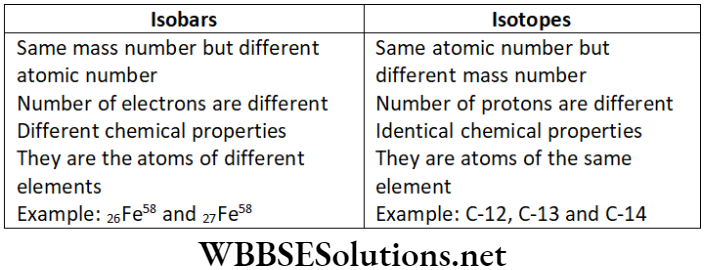
  3. Distillation
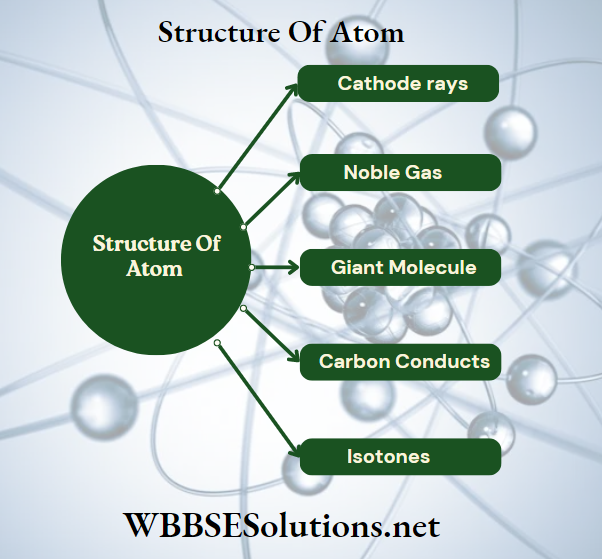
  4. Sublimation
Answer. 1. Evaporation