WBBSE Solutions For Class 9 Geography And Environment Chapter 6 Hazards And Disasters

WBBSE Chapter 6 Hazards And Disasters Long Answer Questions 

Question 1. What is meant by hazard and disaster?
Answer:

Hazard And Disaster:-

A dangerous condition or event that threatens or has the potential to cause injury to life or damage to property or the environment is known as a hazard. Hazards can be classified into two broad categories-natural and man-made.

Read and Learn Also WBBSE Solutions for Class 9 Geography And Environment

A disaster is an event or series of events that result in casualties and damage or loss of property, environment and livelihood on such a scale that is beyond the normal capacity of the affected community to sustain. A landslide that occurs on a hill slope can be termed a hazard. But when this same landslide causes casualties and damage to life and property on the slope, it becomes a disaster.

Question 2 What are the characteristics of hazard?
Answer:

The characteristics of hazard are as follows-

1. Most of the hazards are difficult to predict and occur all of a sudden.
2. Hazards may be nature-induced, human-induced or even a combination of both.
3. The expansion of hazard is generally over smaller areas and its magnitude is comparatively low.
4. Hazards have the potential to cause injury to life or damage to property or the environment.
5. Hazards with higher potential lead to disasters.

Question 3 Discuss the main characteristics of a disaster.
Answer:

The main characteristics of a disaster are as follows-

1. Distressed normal life: Normal public lives and activities are hampered and disrupted because of a disaster.

2. Casualties: A large number of human and animal life are devastated by a disaster. Damages and loss of property also take place.

3. Magnitude: The magnitude of a disaster is not always the same. They vary from intense to moderate.

4. Speed of occurrence: Disasters can be slow and predictable, or they may even be sudden and temporary.

5. Affects the environment: The negative environmental effects of disasters are by and large severe and persist for a long.

6. Dysfunctioning of essential services: The functioning of essential services such as transport and communication gets disrupted.

7. Combined effect of several factors: A disaster is a combination of hazard, vulnerability and insufficient capacity or measures to reduce the potential chances of risk.

WBBSE Solutions For Class 9 Geography And Environment Chapter 6 Hazards And Disasters

Question 4 Explain and classify hazards.
Answer:

Hazards:-

A dangerous condition or event that threatens or has the potential for causing injury to life or damage to property or the environment is known as a hazard. Hazards can be classified into the following types-
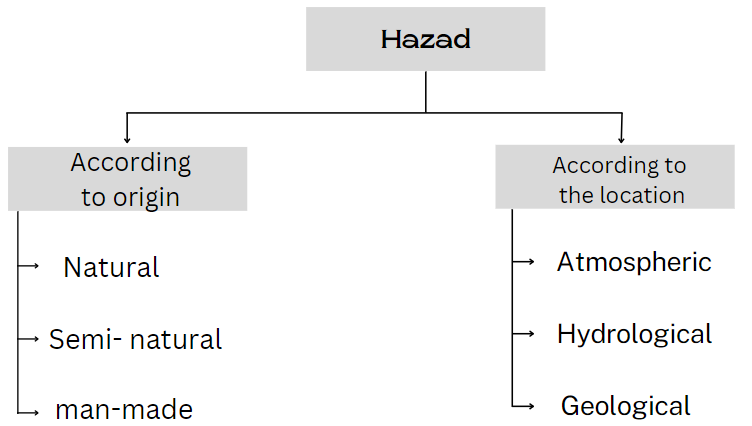
WBBSE Solutions For Class 9 Geography And Environment Chapter 6 hazard

The following broad categories of hazards are discussed below-

1. Natural hazard: Natural hazards characterise those elements of the physical environment that are detrimental to human beings and are caused by forces extraneous to them. More precisely, the term ‘natural hazard’ refers to all atmospheric, hydrological and geological phenomena that, because of their location, intensity and frequency have the potential to affect adversely humans. beings, their constructions or their activities.

2. Semi-natural hazard: Hazards that are caused by the combination of natural and man-induced processes are known as semi-natural hazards. For instance, a landslide is a semi-natural hazard as it can be caused by natural processes (such as heavy or prolonged rainfall, earthquakes, volcanic eruptions, and slope undercutting by rivers) and can also be caused by human activities (such as slope excavation and loading, land use changes, irrigation, blasting vibrations, water leakage from utilities and such. others).

3. Man-made hazard: Man-made hazards are caused by elements like unscientific human activity, negligence or error, superstition or the failure of a man-made system. Man-made hazards can be controlled by increasing awareness among communities. According to the location, hazards can be classified into the following-

1. Atmospheric hazard: These hazards have their root in the atmosphere. For example, cloudbursts, cyclones and others.

2. Hydrological hazard: These hazards have their root in the water bodies. For example, floods, tsunamis and others.

3. Geological hazard: These hazards have their root in the interior of the Earth. Landslides, earthquakes and others are examples of geological hazards.

NEET Biology Class 9 Question And Answers WBBSE Class 9 History Notes WBBSE Solutions for Class 9 Life Science and Environment
WBBSE Class 9 Geography And Environment Notes WBBSE Class 9 History Multiple Choice Questions WBBSE Class 9 Life Science Long Answer Questions
WBBSE Solutions for Class 9 Geography And Environment WBBSE Class 9 History Long Answer Questions WBBSE Class 9 Life Science Multiple Choice Questions
WBBSE Class 9 Geography And Environment Multiple Choice Questions WBBSE Class 9 History Short Answer Questions WBBSE Solutions For Class 9 Maths
WBBSE Solutions for Class 9 History WBBSE Class 9 History Very Short Answer Questions WBBSE Solutions for Class 9 Physical Science and Environment


WBBSE Class 9 Geography Chapter 6 Hazards And Disasters Solutions

Question 5 What is meant by natural hazard? Give example.
Answer:

Natural Hazard:-

A hazard that is typically caused by nature and there is no human intervention is called a natural hazard.

Characteristics:

1. The main characteristics of a natural hazard are
2. It is only caused by nature. This type of hazard is entirely unmodified by human activities.

Effects: Natural hazards temporarily disrupt normal human life. It may also damage the property, environment and human life.

Examples: earthquakes, volcanism, cyclones, landslides, etc.

Question 6 What is meant by semi-natural hazard? Give example.
Answer:

Semi-Natural Hazard:-

A hazard caused by the combined effects of natural and man-induced processes is known as a semi-natural hazard.

Characteristics:

1. The main characteristics of semi-natural hazards are- Semi-natural hazards are caused by combined effects of nature and man.
2. These hazards occur due to improper uses of man’s knowledge and technology.

Effect: Sometimes this type of hazard causes disaster for its severity.

Example: Flood that occurs due to sudden release of water from reservoirs within a short period of time. Every flood is a natural hazard but the level of damage caused by the hazard is further increased by the intervention of man. Both the role of man and nature are important for occurrence of this type of hazard.

Question 7 What is meant by a man-induced hazard? Give example.
Answer:

Man-Induced Hazard:-

A hazard caused by the influence of ignorance, unconsciousness, superstitions, unscientific thinking, violence, etc. is known as a man-induced hazard.

Characteristics:

1. The main characteristics of man-induced hazards are- There is no role of natural force for these hazards.
2. Small self-interests and unconscious activities of humans are the main causes of these hazards.

Effect: This kind of hazard lags behind the social system and temporarily disrupts livelihood.

Example: Earthquakes that occur due to experimental explosions of atomic bombs, communal riots, etc.

Question 8 Discuss the causes of man-induced hazards.
Answer:

Causes Of Man-Induced Hazards:-

The hazards that are caused by elements like human intent, negligence, unscientific activities, superstition or failure of a man-made system are known as man-induced hazards. The notable causes of man-induced hazards are as follows-

1. Unscientific activities: Faulty and unscientific activities often lead to man-induced hazards. For instance, unplanned construction of houses on the hill slopes, faulty farming on the hill slopes or even carving roads across the slopes of hills intensifies the probability of landslides.

2. Illiteracy: Illiteracy leads to a lack of knowledge, intolerance and even negligence. All these lead to common man-induced hazards like arson, civil disorder and even terrorist activities.

3. Ungoverned population growth: Ungoverned population growth can lead to competition for scarce resources and susceptibility to diseases, that in turn, may cause civil strife and even loss of human life. 4. Riot: Ethnic conflict or communal riot causes hazards due to superstition, bigotry etc. It damages human life and property which disrupts social and economic life.

Understanding Hazards And Disasters In Class 9 Geography WBBSE

Question 9 Explain the various types of natural disasters.
Answer:

Various Types Of Natural Disasters:-

A natural event or a series of natural events that results in casualties and damages, is known as a natural disaster. They can be classified as follows-

1. Geophysical disaster: Disasters that are caused due to tectonic disturbances are called geophysical disasters. Earthquakes and volcanisms are examples of geophysical disasters.

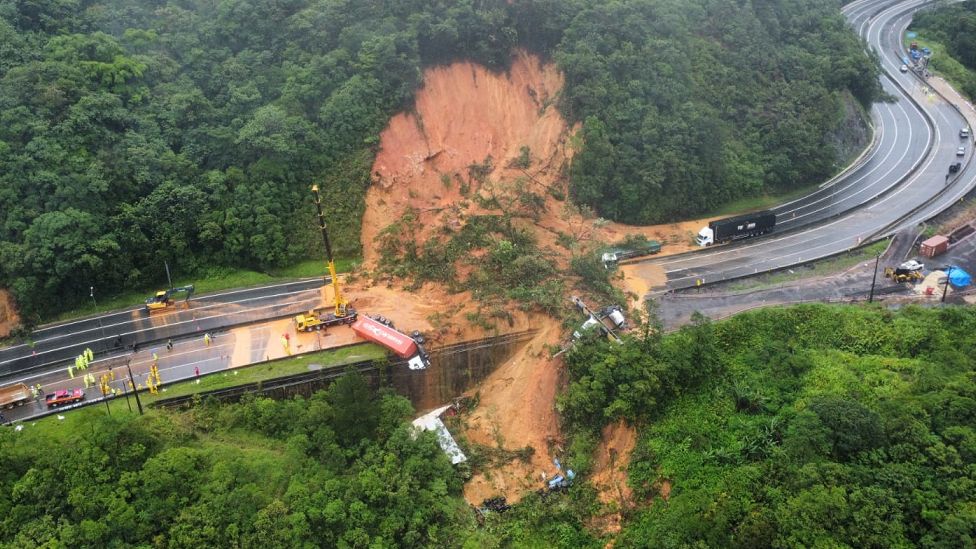
2. Landform-process-related disaster: Landform processes like riverbank erosion, landslides in mountainous areas, coastal erosion due to sea waves, etc., may give rise to disasters if they occur on a macro-scale.
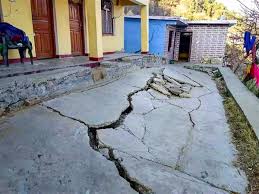
WBBSE Solutions For Class 9 Geography And Environment Chapter 5 Weathering Geophysical disaster earth quake

WBBSE Solutions For Class 9 Geography And Environment Chapter 6 hazard and disasters

3. Meteorological/Climatic disaster: Disas- terms that are caused by extreme weather events are known as meteorological disasters. Storms, tropical cyclones, heat or cold waves, floods and droughts are examples of meteorological disasters.

4. Extraterrestrial disaster: Disasters that are caused by asteroids, meteoroids, comets and other extra-terrestrial elements striking the Earth are called extra-terrestrial disasters.

Example: Meteorite strikes.
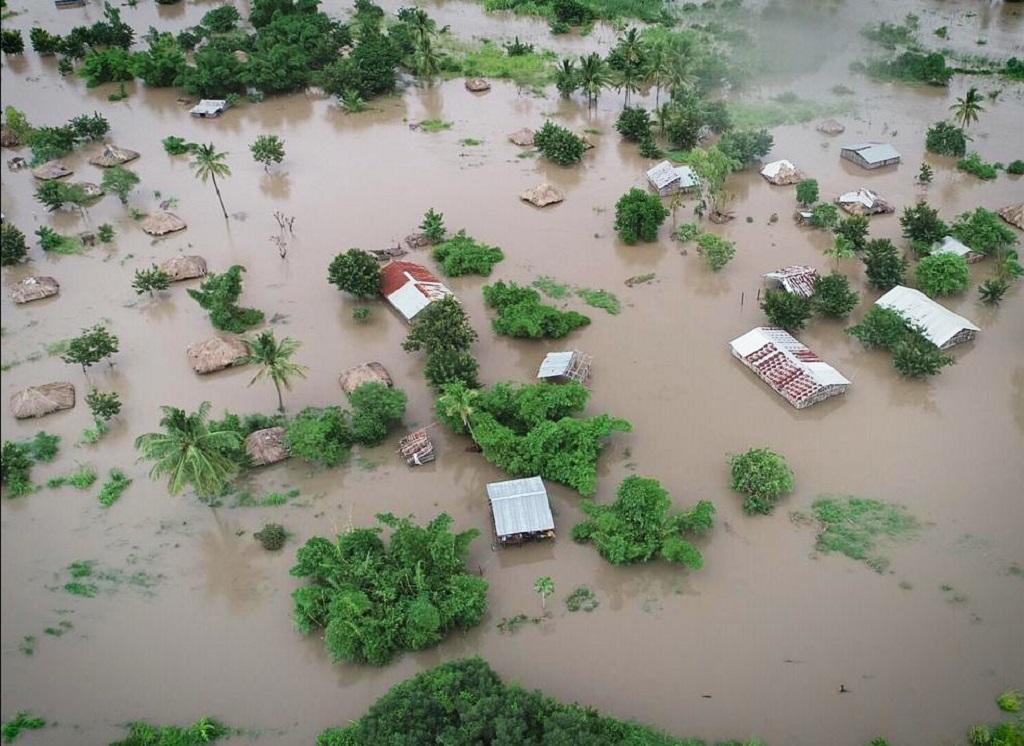
WBBSE Solutions For Class 9 Geography And Environment Chapter 6 hazard and disasters climatic disaster

5. Soil disaster: Various causes like soil erosion, an increase in salinity of soil and loss of fertility are the reasons for soil disaster. Excessive salinity of the soil hampers productivity and results in scarcity of food.

Example: This type of disaster frequently occurs in Rajasthan.

Economic disaster: An economic disaster is the widespread disruption or collapse of a national or regional economy, possibly causing financial loss, hoarding, famine, inflation, etc.
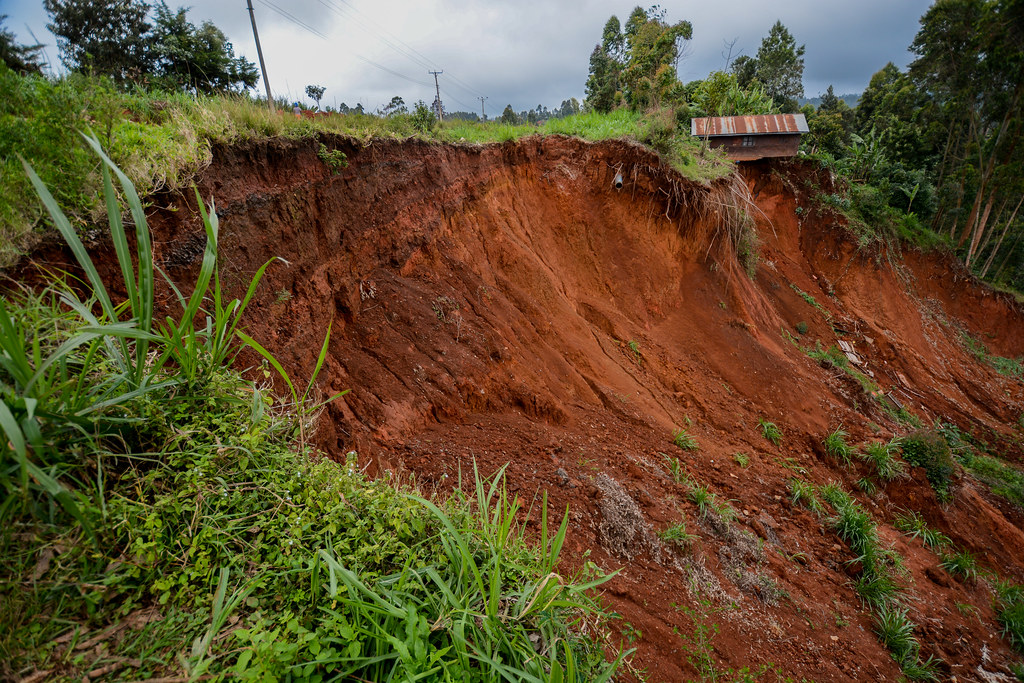
WBBSE Solutions For Class 9 Geography And Environment Chapter 6 hazard and disasters soil erosion

Question 10 Explain the various types of man- swKv induced or man-made disasters.
Answer:

Various Types Of Man- SwKv Induced Or Man-Made Disasters:-

An event or series of events that results in casualties and damages by man-induced causes is known as a man-induced disaster.

They can be classified as follows—

1. Technology-related disaster: A techno¬logy-related disaster is the failure of modern systems, like, unchecked exhaust fumes from vehicles, untreated wastes from industries, and leakage of radioactive minerals from nuclear. power plants, etc., which harms people and also pollutes the environment.

WBBSE Solutions For Class 9 Geography And Environment Chapter 6 hazard and disasters soil erosion

2. Economic disaster: An economic disaster is the widespread disruption or collapse of a national or regional economy, possibly causing financial loss, hoarding, famine, inflation, etc.
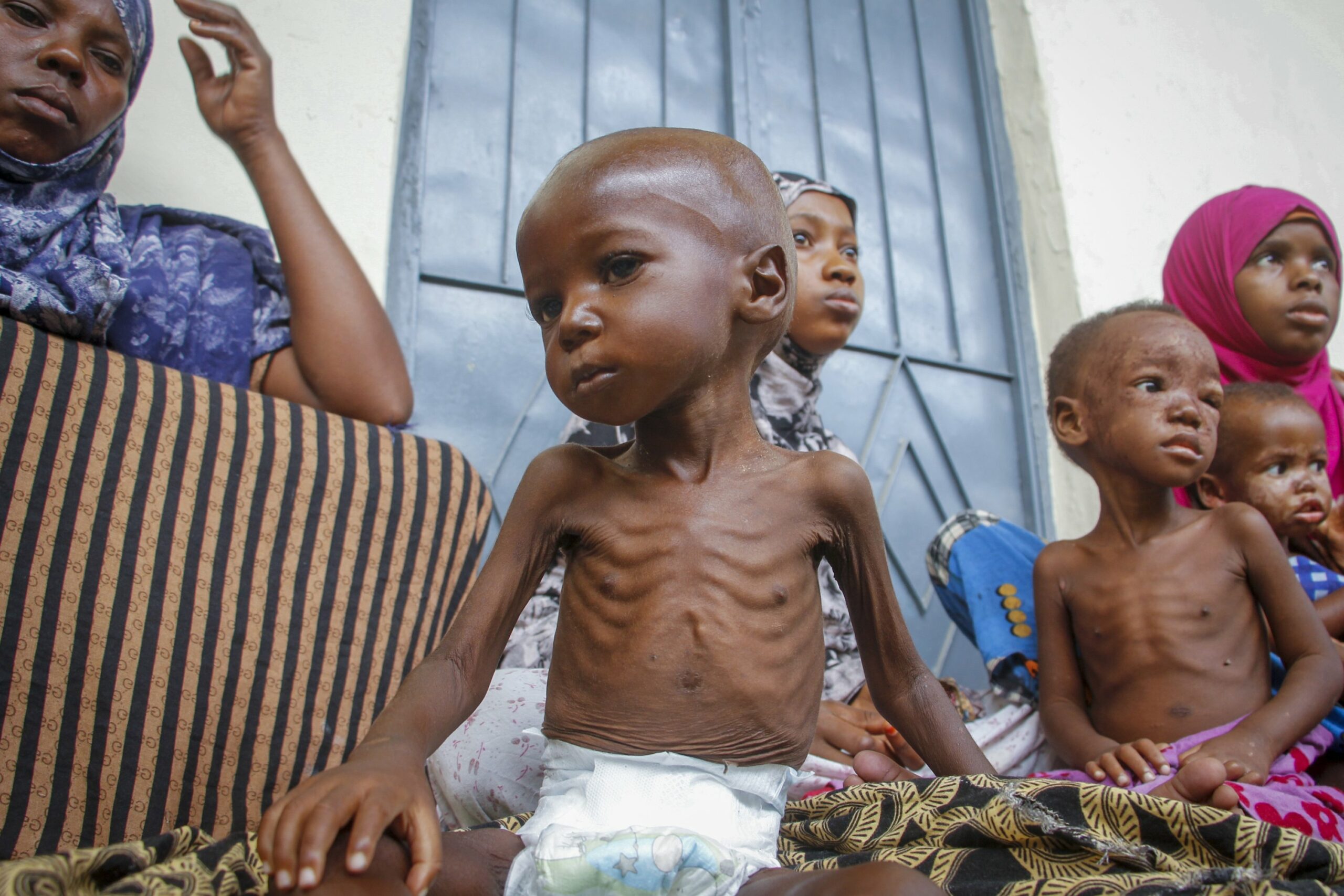
WBBSE Solutions For Class 9 Geography And Environment Chapter 6 hazard and disasters famine

3. Biological disaster: Disasters caused due to the exposure of human beings to toxins, and viruses leading to epidemics, are known as biological disasters. Extinction of any species is also possible.
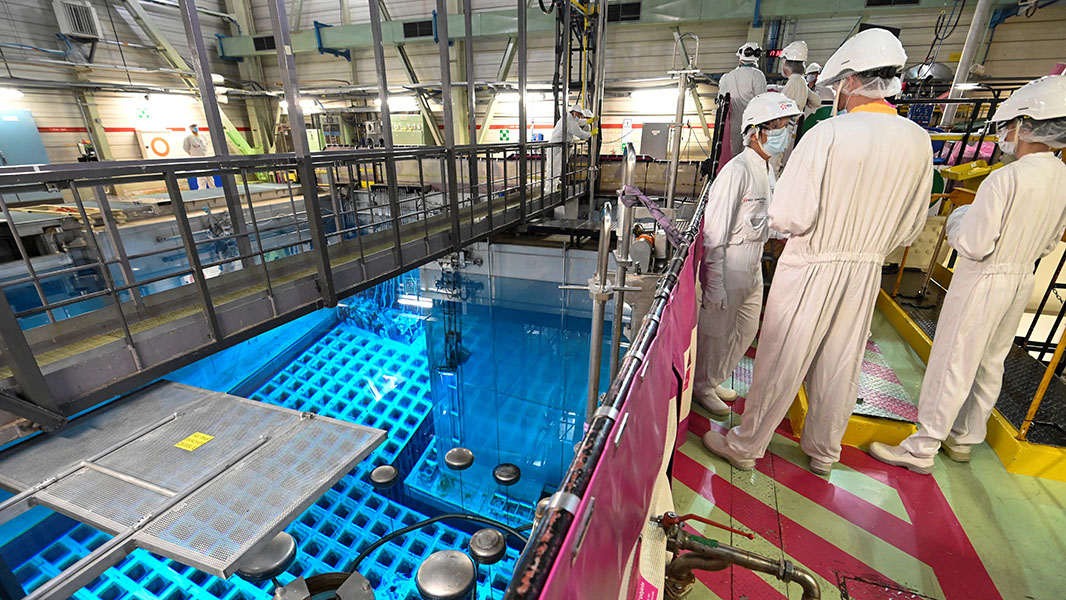
WBBSE Solutions For Class 9 Geography And Environment Chapter 5 Weathering nuclear reaction

4. Disasters due to other complex emergencies: These involve a breakdown of administration, riots, religious conflicts, war, etc.

Question 11 What are the differences between hazard and disaster?
Answer:

The differences between natural hazards and disasters are as follows—


Point of difference                Hazard     Disaster
1. Concept A dangerous condition or event that threatens or has the potential for causing injury to life or damage to property or the environment is known as a hazard. A disaster is an event or series of events that results in casualties and damage or loss of property, infrastructure, environment, essential services or means of livelihood on such a scale that is beyond the normal capacity of the affected community to sustain.
2. Extent The extent of the impact is limited to a smaller region. The extent of impact runs to a comparatively larger area.
3. Nature Hazards lead to disaster. Disasters are impacts of hazards.
4. Casualty Hazards have the potential for causing injury to life, but may not always be fatal. Disasters result in casualties.
5. Economic damages — Accounts for damage or loss of property that is lesser in comparison to disasters. Accounts for damage or loss of property that is at a scale which is beyond the normal capacity of the area to sustain.
6. Sub-types Hazards can be classified into three broad categories—natural, semi-natural and man-made. Disasters can be classified into two broad categories—natural disasters and man-made disasters.
7. Control Hazards are manageable and precautions can be taken to a certain level. Disasters are unmanageable and precautions cannot be taken most of the time.


Question 12 What are the differences between natural hazards and man-made hazards?
Answer:

The differences between natural and man-made hazards are as follows—


Point of difference                         Natural hazard      Man-made hazard 
1. Concept Natural hazards characterise those elements of the physical environment that are detrimental to human beings and are caused by forces extraneous to us. Man-made hazards are caused by an element of human intent, negligence or error or involving a failure of a manmade system.
2. Extent It has a widespread impact. The extent of the impact is lesser, the nuclear explosion being an exception.
3. Control Natural hazards cannot be resisted or controlled but precautions can be taken. Man-made hazards can be controlled by increasing awareness among communities.


Question 13 What is meant by flash flood? What are the main causes of the occurrence of flash floods?
Answer:

Flash Flood:-

A flash flood can develop within a few hours of heavy rainfall. Flash floods can be highly dangerous and have the potential to instantly turn a gasping rivulet into a thundering channel of water that sweeps away everything in its path. Most of the casualties from flooding occur due to flash floods. The intensity of flash floods cannot be classified.

The causes of flash floods can be classified into two categories. They are—

1. Natural causes of flash floods: The natural causes of flash floods are—

1. Rapid rain: A flash flood may occur when it rains rapidly on saturated soil or dry soil with poor absorption ability. The run-off collects in gullies and streams and as they join to form larger volumes, it often exceeds the carrying capacity of the stream. This may lead to the occurrence of flash floods.

2. Volcanic eruption: A flash flood may also occur in areas on or near volcanoes, when glaciers may have been melted by the intense heat after eruptions.

3. Thunderstorms: Multiple or slow-moving thunderstorms occurring over the same area can also produce a flash flood.

4. Cloud burst: Cloud bursts result in excessive rainfall in a short time which can produce flash floods.

2. Man-induced causes of flash floods: Dam failure is extremely destructive and can create a flash flood. In such an event, the energy of the water stored behind even a small dam is capable of causing loss and damage to life and property in the downstream areas of the dam.

Class 9 Geography WBBSE Chapter 6 Hazards And Disasters

Question 14 What are the natural causes of floods?
Answer:

The natural causes of flood are as follows—

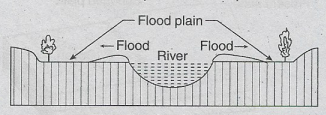
1. Excessive rainfall: Excessive rainfall occurring over a prolonged time causes a flood. Due to this excessive rainfall, the discharge of a river exceeds the capacity of its channel to carry it. Thus the river overflows its banks causing a flood. Therefore, excessive rainfall is positively related to flood.
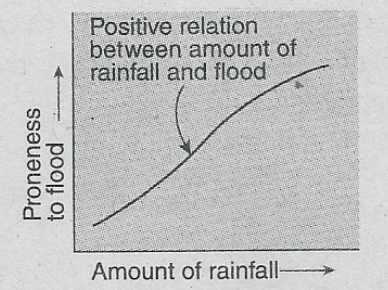
WBBSE Solutions For Class 9 Geography And Environment Chapter 6 hazard and disasters rainfall and flood

2. The shape of a river course: The probability of flood increases if the course of a river is meandering rather than straight since the flow of the river is hindered by obstacles along its course and hence overflowing occurs.
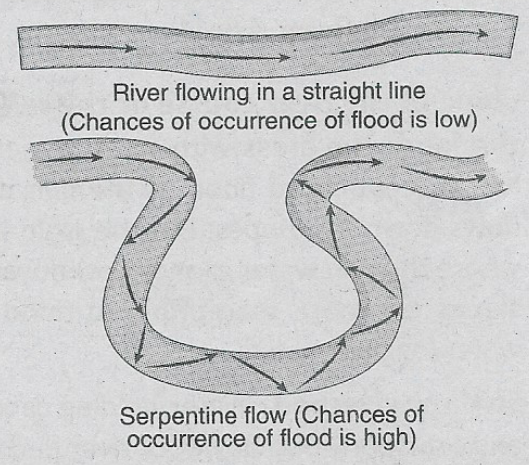
WBBSE Solutions For Class 9 Geography And Environment Chapter 6 hazard and disasters The shape of a river course influences flooding

3. Snowmelt: During the warm summers, the glacial snow in the mountains melts down. This results in the flow of a large amount of water downslope within a short period of time. As the ground is almost frozen, water cannot penetrate or be absorbed. The water, therefore, flows off the surface and runs into lakes, streams and rivers. This causes excess water to spill over the respective banks and results in snow-melt floods.

4. Shape of the drainage basin: The possibility of flash flood increases in a drainage basin that is circular in shape rather than the elongated one. This is because, in the latter case, rivers have the capacity to carry water over long distances.
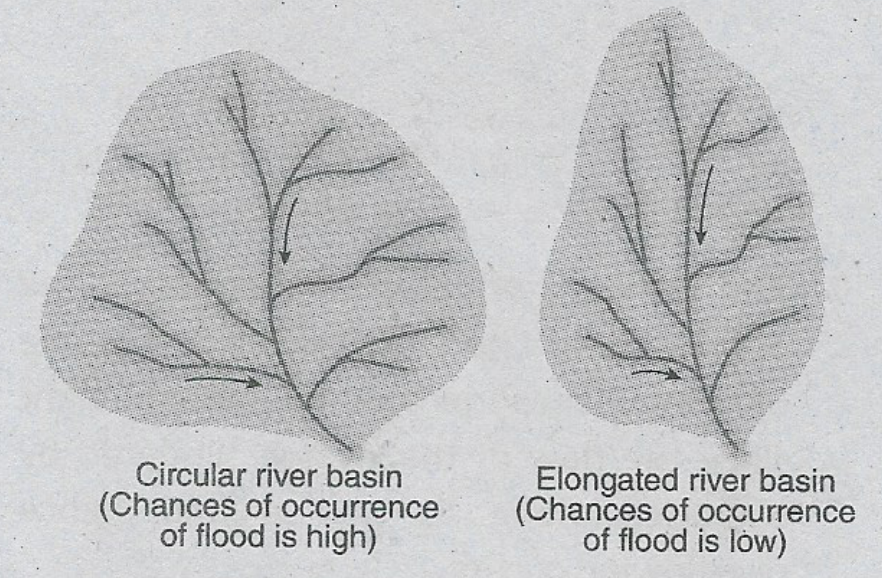
WBBSE Solutions For Class 9 Geography And Environment Chapter 6 hazard and disasters The shape of the drainage basin influences flooding

5. Slope of the river course or the relief of the land: The areas with steep slopes are less susceptible to flood as rainwater flows down the slopes. But the plain lands where the rainwater cannot flow down the slopes are more susceptible to flood and waterlogging.

6. Shallow riverbed: Water holding capacity and transportation power of the river decrease due to the sediment action on the riverbed over a long time which makes the riverbed shallow. As a result, normal rainfall causes floods in the river.

7. Cyclonic storm and intensity of tide: Spate and flood may occur in coastal regions due to cyclonic storms. Similarly, at the time of a new moon and full moon the excess water that enters the river from the sea, causes a flood.

Question 15 Briefly describe the causes of man-made floods.
Answer:

The main causes of man-made floods are—

1. Deforestation: Vegetation cover prevents soil erosion and also controls the amount of precipitation.
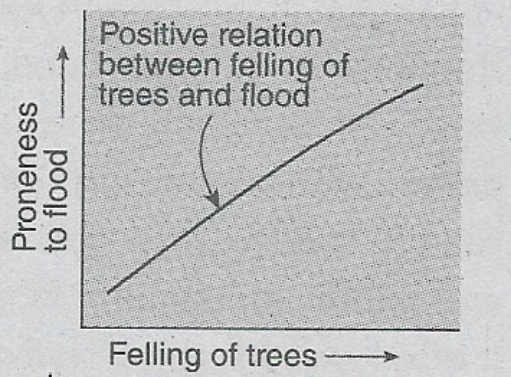
WBBSE Solutions For Class 9 Geography And Environment Chapter 6 hazard and disasters Realtion between deforstation and flood

Deforestation increases soil erosion and the sedimentation of the eroded materials on the riverbed over a long period of time makes the riverbed shallow. As a result, the possibility of the occurrence of flooding increases.

2. Modification of the catchment area: The land-use pattern of the catchment area changes with the increasing number of settlements, urbanisation, industrialisation and the change in agricultural patterns. All these may subsequently lead to flooding.

3. Change in the course of the river: Artificial modification in the course of a river such as the construction of dams, development of irrigation systems and such others to satisfy human needs may also lead to flooding in the long run.

Question 16 Explain the negative impacts of floods.
Answer:

The various negative impacts of the flood are as follows—

1. Impacts on physical nature: The impacts of the flood on physical nature are—
1. Floods can cause water pollution,
2. it disrupts the environmental balance,
3. It can cause soil pollution.

2. Impacts on the ecosystem: The impacts of the flood on the ecosystem are—
1. Flood destroys the standing crops and other small vegetation covers,
2. It disrupts the food chain,
3. It causes inadequacy of food for herbivores,
4. a large number of animals and birds may die due to floods.

4. Impacts on the human: The impacts of the flood on the human being—
1. It hampers agricultural activities,
2. It causes loss of life and damage to property,
3. flood results in water-borne diseases (such as Cholera and Typhoid),
4. It disrupts public life by destroying settlements, communication and transport systems.

Question 17 Differentiate between flood caused by snow melt water and flood caused by rain
Answer:

The differences between floods caused by snow melt water and flood caused by rain are as follows—

Point of difference The flood caused by snow melt water The flood caused by rain
1. Extent The flood caused by the melting of snow extends over a larger area. The flood caused by heavy rainfall extends over a lesser stretch of area.
2. Region It occurs mostly in the downstream areas of the hill slopes. It occurs in the plains, mostly near the river banks.
3. Season It mostly occurs in summer. It mostly occurs during the monsoon season.


Question 18 Discuss the causes of droughts.
Answer:

Causes Of Droughts:-

The causes of droughts can be classified into two categories.

They are—

1. Natural causes of drought:

The important natural causes of drought are—

1. Temperature rise: A rise in land and sea surface temperature increases evaporation leading to droughts.

2. Change in atmospheric circulation: Atmospheric circulation patterns influence the moisture content of the atmosphere. Reduction in atmospheric moisture due to the change of these circulation patterns reduces the average precipitation, which causes droughts.

3. Lack of soil moisture: Soil moisture content can also, influence the occurrence of drought. If the soil is dry, then there is little or no water available to evaporate. Consequently, the incoming sunlight can only continue to warm the surface, thereby making conditions hotter and drier, thus beginning the chain of events leading towards drought.

2. Man-induced causes of drought:

The main-induced causes of drought are—

1. Reckless deforestation: Reckless deforestation that leads to a decrease in atmospheric as well as soil moisture, increases the probability of drought.

2. Unplanned urbanisation: Unplanned urbanisation that restricts the replenish¬ment of groundwater level and subsequently puts pressure on water resources, may cause drought conditions.

Question 19 Classify and discuss the various types of drought based on water availability.
Answer:

Various Types Of Drought based on Water Availability:-

Based on water availability, droughts can be classified into three categories—

1. Meteorological drought: A drought is categorised as a meteorological drought when actual rainfall over an area is significantly less than the normal amount of rainfall. Meteorological droughts need to be defined specifically in particular regions as the atmospheric conditions that result in deficiencies of precipitation vary highly from region to region. Meteorological drought can also be defined as the actual precipitation departures from average amounts on monthly, seasonal or annual time scales.

Drought can be classified into the following sub-types—

1. Mild drought: When rainfall is 11% to 25% less than normal rainfall.
2. Moderate drought: When rainfall is 26% to 50% less than normal rainfall.
3. Severe drought: When rainfall is less than 50% of the normal rainfall.

2. Hydrological drought: A hydrological drought occurs when there is a marked depletion of surface water causing very low stream flow and drying of lakes, reservoirs and rivers. Therefore, hydrological drought is related to periods of precipitation deficits in the surface or subsurface water supply.

It can again be classified into two types—

1. Surface water drought: This is caused when ponds, lakes and rivers dry up due to inadequate rainfall.

2. Groundwater drought: When the level of groundwater decreases due to a deficit of rainfall, groundwater drought occurs.

3. Agricultural drought: An agricultural drought occurs when inadequate soil moisture produces acute crop stress and affects productivity in the long run. Inadequate topsoil moisture during the planting stage may obstruct germination, leading to low plant populations per hectare and a reduction of final yield. However, if topsoil moisture is sufficient for early growth, insufficiencies in subsoil moisture at this early stage may not impact final yield if subsoil moisture is replenished as the growing season progresses or if precipitation meets plant water needs.

Question 20 Classify drought on the basis of the time period.
Answer:

Classification Of Droughts On The Basis Of The Time Period:-

Droughts differ in the time and period of their occurrence. Thornthwaite delineated drought as follows—

1. Permanent drought: It occurs mostly in arid desert regions. Crop production is not possible without irrigation, due to inadequate rainfall. In these areas, the xerophyte type of vegetation is generally observed. For example, cacti, thorny shrubs, etc.

2. Seasonal drought: It occurs in areas with clearly defined wet and dry climates. Seasonal drought occurs due to large-scale seasonal circulation. This occurs mainly in monsoon areas.

3. Contingent drought: This results due to irregular and variable rainfall, especially in humid and sub-humid regions. The occurrence of such droughts may coincide with growth periods of the crops when the water needs are critical and the greatest, resulting in the severity of the effects i.e., yield reduction.

Question 21 Briefly discuss the impacts of drought.
Answer:

Droughts create immense environmental and socio-economic impacts. The impacts are as follows-

1. Impact on the environment:

1. The ecological balance is disturbed due to enhanced soil erosion (due to loss of soil moisture).
2. The fertility of soil decreases.
3.  Loss or destruction of vegetation cover may lead to desertification of the region.
4. Spread of diseases in wild animals and migration of wildlife may be observed because of reduced food and water supplies.
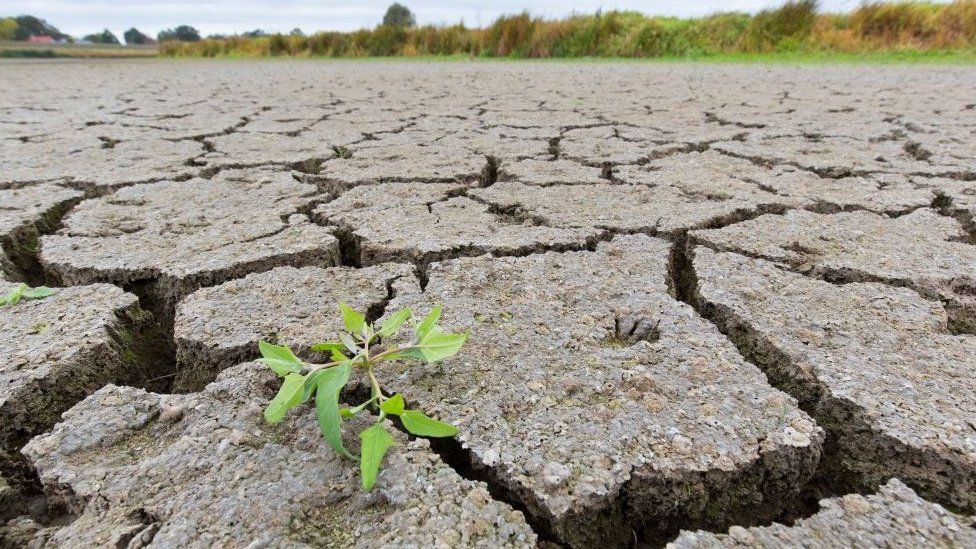
 

WBBSE Solutions For Class 9 Geography And Environment Chapter 6 hazard and disasters cracked soil due to drought

2. Impact on the ecosystem:

1. It causes damage to plants and animals.
2. plants struggle to survive due to the hampering of the process of photosynthesis.
3. Food scarcity is noticed for the herbivorous animals that lead to the death of a vast number
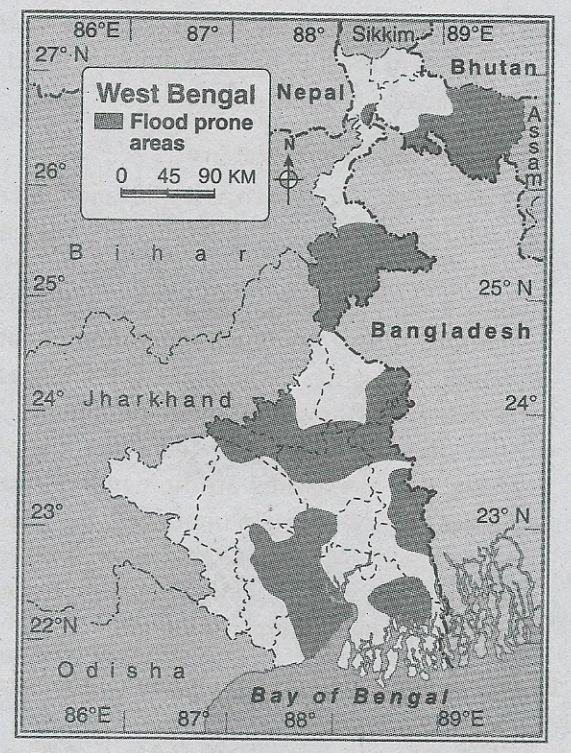
WBBSE Solutions For Class 9 Geography And Environment Chapter 6 hazard and disasters the flood prone areas of west bengal

4. Impact on the population:

1. Lack of precipitation may subsequently lead to lesser replenishment of groundwater and as a result, the groundwater level falls. This makes irrigation more difficult and many farmers become jobless.
2. Excessive drought conditions may lead to famine and starvation becomes a common picture.
3. Many people die due to a lack of nutrition and tremendous heat.
4. Droughts lead to international and intra-national migration.

Question 22 Briefly explain the causes of drought in India.
Answer:

The main causes of drought in India are—

1. Natural causes:

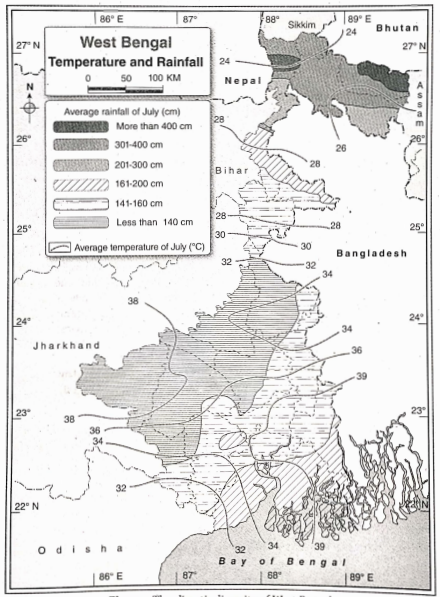
1. India is a monsoon-dominated country. So, if the southwest monsoon wind arrives late than its normal arrival time, then it creates a drought condition.
2. Break in monsoon or a persisting long dry period within the monsoon season causes drought.
3. If the monsoon winds retreat before the normal time, drought conditions prevail.
4. Each state of India does not receive an equal amount of precipitation during monsoons. This areal difference in precipitation may cause drought.
5. In El Nino years, the normal patterns of precipitation and atmospheric circulation get disrupted. This is also an important reason for drought in India.,

2. Man-induced causes:

1. The amount of water vapour in the atmosphere decreases due to excessive deforestation, causing a lack of sufficient precipitation and eventually drought.
2. Some other man-induced causes of drought in India are urbanisation, industrialisation, pollution, etc.

Question 23 Differentiate between meteorological drought and agricultural drought.
Answer:

The differences between meteorological and agricultural drought are as follows—

Point of difference Meteorological drought Agricultural drought
1. Concept  Meteorological drought occurs when actual rainfall over an area is significantly less than the climatological mean. Agricultural drought occurs when inadequate soil moisture produces acute crop stress and affects productivity.
2. Dependency It is not dependent on agricultural drought. It is dependent on meteorological drought.
3. Impact It has a widespread impact. The extent of the impact is lesser than meteorological drought.


Question 24 Write three differences between meteorological and hydrological drought.
Answer:

The difference between meteorological and hydrological drought is as follows-

Point of difference Meteorological drought Hydrological drought
1. Concept Meteorological drought occurs when actual rainfall is less than normal rainfall and causes dry weather conditions. Hydrological drought occurs when inadequate soil moisture produces acute crop stress and affects productivity.
2. Dependency It is dependent on the atmospheric temperature and the amount of rainfall. It is dependent on the amount of groundwater.
3. Cause This kind of drought occurs due to inadequate rainfall. This kind of drought occurs due to the water shortage in the river basin.


Question 25 What are the impacts of earthquakes?
Answer:

The impacts of earthquakes can be devastating. Some of the most commonly observed impacts of earthquakes are as follows—

1. People may be killed or injured.

2. Built landscapes such as houses may be ‘ destroyed.

3. Transport and communication links may be interrupted and shops and businesses may be destroyed. This can subsequently lead to difficulty in trade.

4. Water pipes may burst and water supplies may be contaminated.

5. Fires can spread due to gas pipe explosions that can even lead to forest fires in certain areas.

6. Landslides may occur.

7. Tsunamis may cause flooding in coastal areas.

8. Can lead to social unrest and heedless looting may take place.

Question 26 Explain why the Himalayan regions are prone to earthquakes.
Answer:

The Himalayan Regions Are Prone To Earthquakes:-

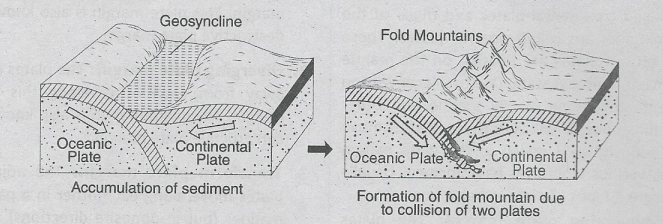
The Himalayan mountain range was formed due to the collision of Indian and Eurasian plates – a process that began at least 50 million years ago. Where the two plates converge, the Indian plate plunges below the Eurasian. The two plates continue to rub against each other due to the northward movement of the Indian plate-this continuously generates immense geological stress. This builds up pressure, leads to seismic vulnerability and is later released as earthquakes.

The east-west lying fault line that separates these two plates is known as the Main Himalayan Thrust (MHT). Since there is no historical evidence of earthquakes iri several portions of the Himalayan arc, it is predicted that there is potential energy available to generate large earthquakes.

Question 27 Briefly discuss the natural causes of the Earthquake.
Answer:

The natural causes of the earthquake are as follows—

1. Plate tectonics: Due to prevailing high temperature and pressure, convection currents evolve in the viscous mantle below the earth’s crust. These convection currents cause the plates (parts of the earth’s crust) to move in different directions and at different speeds from those of the adjacent ones which at times cause earthquakes.

2. Isostatic causes: Isostasy is the state of gravitational equilibrium between the Earth’s lithosphere and asthenosphere and in this process of trying to attain a hydrodynamic equilibrium, earthquakes may take place.

3. Formation of fold mountains: Formation of new fold mountains may also result in the occurrence of earthquakes.

4. Volcanism: Volcanic activity may also cause earthquakes.

5. Landslides and avalanches: During landslides and avalanches a huge mass of snow, ice and rocks slide down along the steep slopes of mountains/that may cause earthquakes.

6. Meteorite: Meteorite impacts could cause larger earthquakes than has ever been observed. A Meteor crater in Arizona in the United States is an example.

7. Collapse of subterranean cavities: The removal of minerals and other materials from the Earth may cause instability, leading to the sudden collapse of subterranean cavities, which may cause local tremors. In karst areas, due to the action of underground water, the sudden collapse of the ground surface also causes an earthquake.

Question 28 Briefly explain the anthropogenic causes of earthquakes.
Answer:

Anthropogenic Causes Of Earthquakes:-

Unplanned anthropogenic activities may lead to earthquakes.

For example—

1. Faulty construction of dams: It is well-accepted that large dams can cause earthquakes. Dams cause earthquakes due to the extra pressure of water created in the minor cracks and fissures in the ground under and near a reservoir.

2. Nuclear testing: Nuclear testing may also trigger earthquakes. As an example, in 1999, an earthquake occurred due to the explosion of nuclear testing at Pokhran in Rajasthan.

3. Dynamite blasting for road construction: Blasting of rocks by dynamite for the construction of roads may trigger earthquakes.

4. Collapsed roof of the mines: Earthquakes can occur locally due to the collapsing of the roof of the mines if the pit mines are not perfectly filled with sand. This kind of earthquake often occurs at Ranigange.

Question 29 ‘Mountainous regions are prone to landslides.’ Why?
Answer:

Mountainous Regions Are Prone To Landslides:-

Landslides are mainly associated with mountainous regions. This is because of the following reasons—

1. Geological causes: Weak or sensitive materials of the hill-slopes and the abundance of weathered materials make the mountainous regions prone to landslides.

2. Climatic causes: Mountainous regions are inclined to freeze-thaw cycles and wetter conditions promote organic activity and associated weathering. Soil slopes and rocks are weakened through saturation by heavy rain or snow melt. Moreover, winter snowstorms may produce avalanche-like conditions. All these together cause a landslide-prone condition.

3. Human causes: Landslides are frequently caused by the undercutting of slopes during road construction or when fill materials are dumped onto already less stable slopes. Defectively constructed mine tailing piles, dams and waste landfills may result in landslides. Construction of houses on hill- slopes and reckless deforestation are the most commonly observed causes of landslides in the hills.

Question 30 Briefly discuss the natural causes of landslides.
Answer:

The natural causes of landslides are as follows—

1. Intense and prolonged rainfall: Prolonged and intense rainfall is the immediate and direct cause of landslides where water acts as a lubricant. With prolonged and intense rainfall large amounts of rainwater seep into the soil that results in an increase in water pressure in the pores of the soil. Thus the friction and internal cohesion of slope materials reduce, which subsequently destabilises the slopes and causes landslides.
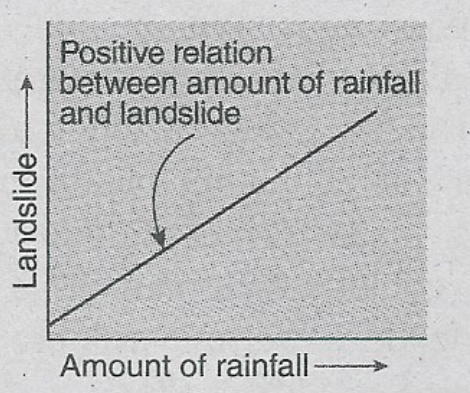
WBBSE Solutions For Class 9 Geography And Environment Chapter 6 hazard and disasters realtion beteen rainfall and landslide

2. Earthquake: Earthquakes can trigger landslides in the hill slopes if the magnitude reaches 6 and above.

3. Slope gradient: Slopes with steeper gradients are more prone to landslides as gravity has more influence on these slopes, increasing their sliding force.

4. Loose materials: Unstable materials like large boulders increase the vulnerability of the slope which leads to landslides.

5. Topography: Any cracked or faulted topography is weaker than any other type of topography, which causes landslides.

6. Nature of soil: The predominance of pebbles and sand makes the soil loose, which causes landslides.

Question 31 Briefly discuss man-induced causes of landslides.
Answer:

The man-induced causes of landslides are as follows—

1. Deforestation: Large-scale deforestation can make a place vulnerable to landslides. The roots of the trees hold the soil in place. But excessive deforestation in hilly regions makes the soil loose. As a result, the regions become landslide prone.
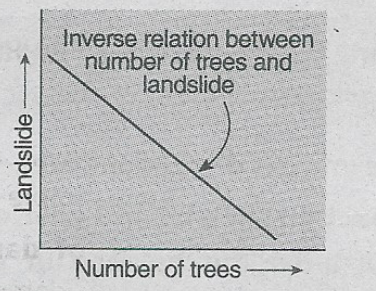
WBBSE Solutions For Class 9 Geography And Environment Chapter 6 hazard and disasters Realtion between deforstation and land slide

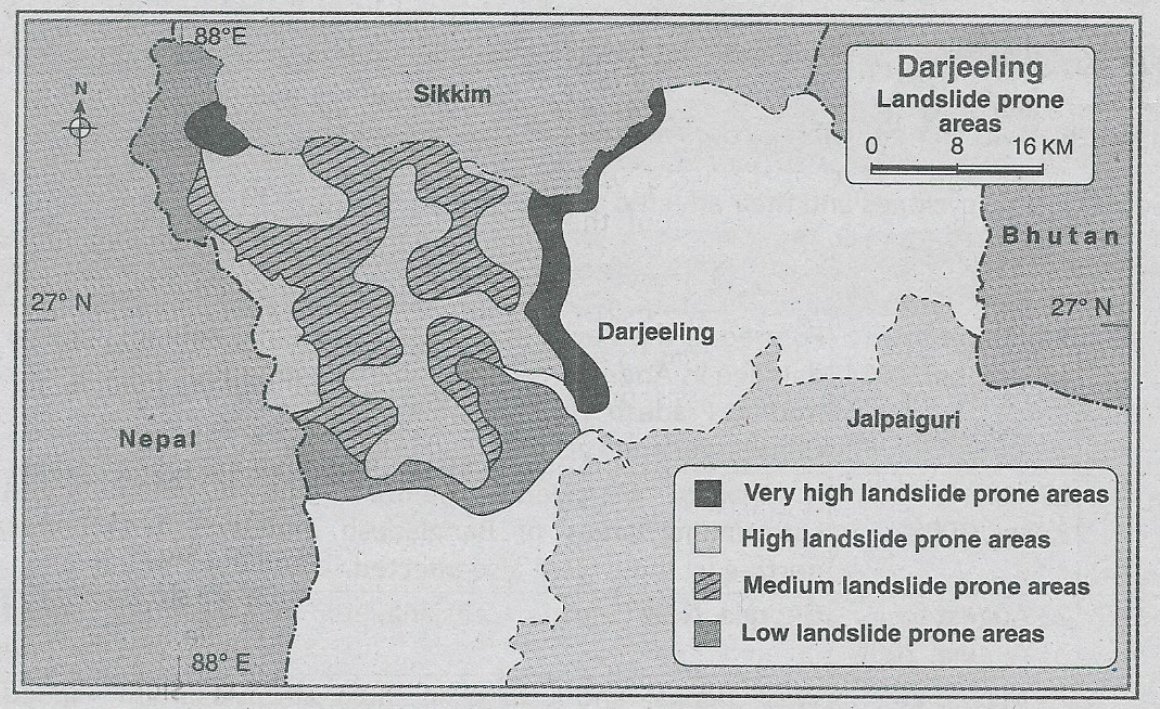
WBBSE Solutions For Class 9 Geography And Environment Chapter 6 hazard and disasters land slide prone areas of darjeeling district of west bengal

2. Urbanization: Unscientific construction of roads and houses on steep slopes disturbs soil stability, which may lead to landslides.

3. Shifting cultivation: Shifting cultivation is an unsustainable practice that depletes the soil nutrients and reduces the forest cover, causing landslides.

4. Overgrazing: Overgrazing may result in land degradation that may subsequently lead to landslides.
For example, Darjeeling district is one of the most landslide-prone districts of West Bengal. The Paglajhora region is highly prone to landslides due to both natural factors and increasing human activities for the last five decades.

Question 32 Briefly discuss the impacts of a cyclone.
Answer:

The impacts of a cyclone are—

1. Impact on the physical environment:

1. Disturbs the balance of the ecosystem: Vast number of animals and birds die due to the occurrence of a cyclone that subsequently leads to the imbalance of the local ecosystem.

2. Occurrence of the flood: Heavy rainfall may accompany a cyclone, which may lead to a devastating flood.

3. Coastal erosion: The strong waves formed by a cyclone near the coast may result in coastal erosion.

2. Impact on human beings:
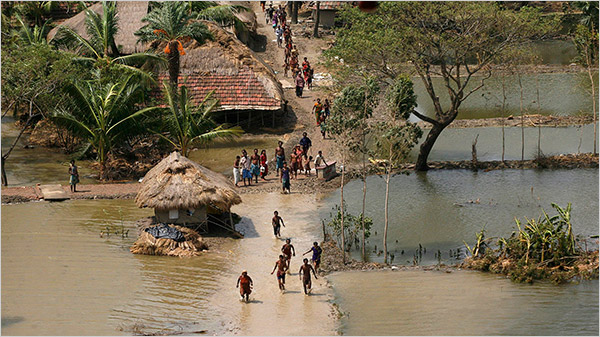
WBBSE Solutions For Class 9 Geography And Environment Chapter 6 hazard and disasters destruction done by the cyclone alia

1. Loss of life: Huge loss of human and animal life occurs due to cyclones. Vast areas of vegetation cover are also destroyed due to cyclones.

2. Loss of property: Cyclones disrupt communication and transport systems. They ravage and inundate the agricultural fields and subsequently may cause food scarcity. They also hamper public life by destroying houses.

3. Spread of epidemics: The water gets polluted due to cyclones, resulting in water-borne diseases. Epidemics like Cholera may spread from this polluted water.

Question 33 Write about some terrible cyclones and their affected areas.
Answer:

Some terrible cyclones and their affected areas are-

 Cyclone Time of occurrence Affected areas  Speed of cyclone
1. Hudhud 7 October to 14 October 2014 Formed in the Bay of Bengal and caused damage in Andaman and Nicobar island, Andhra Pradesh Visakhapatnam, Odisha, Chhattisgarh and also in Madhya Pradesh, Maximum speed was about 260km/hour.
2. Nargis 27 April to 3 May 2008 It mainly damaged Myanmar but surrounding areas of Bangladesh and north-east India were also affected. Maximum speed was about 165-215 km/hour.
3. Katrina  23 August to 31 August 2005 Georgia, New Orleans, Louisiana, etc. Maximum speed was about 200 km/hour
4. Aila 25 May to 27 May 2009 West Bengal and Odisha in India and Bangladesh. Maximum speed was about 110-120 km/hour.


Question 34 What are the causes for the origination of a tsunami?
Answer:

The major causes of tsunamis are—
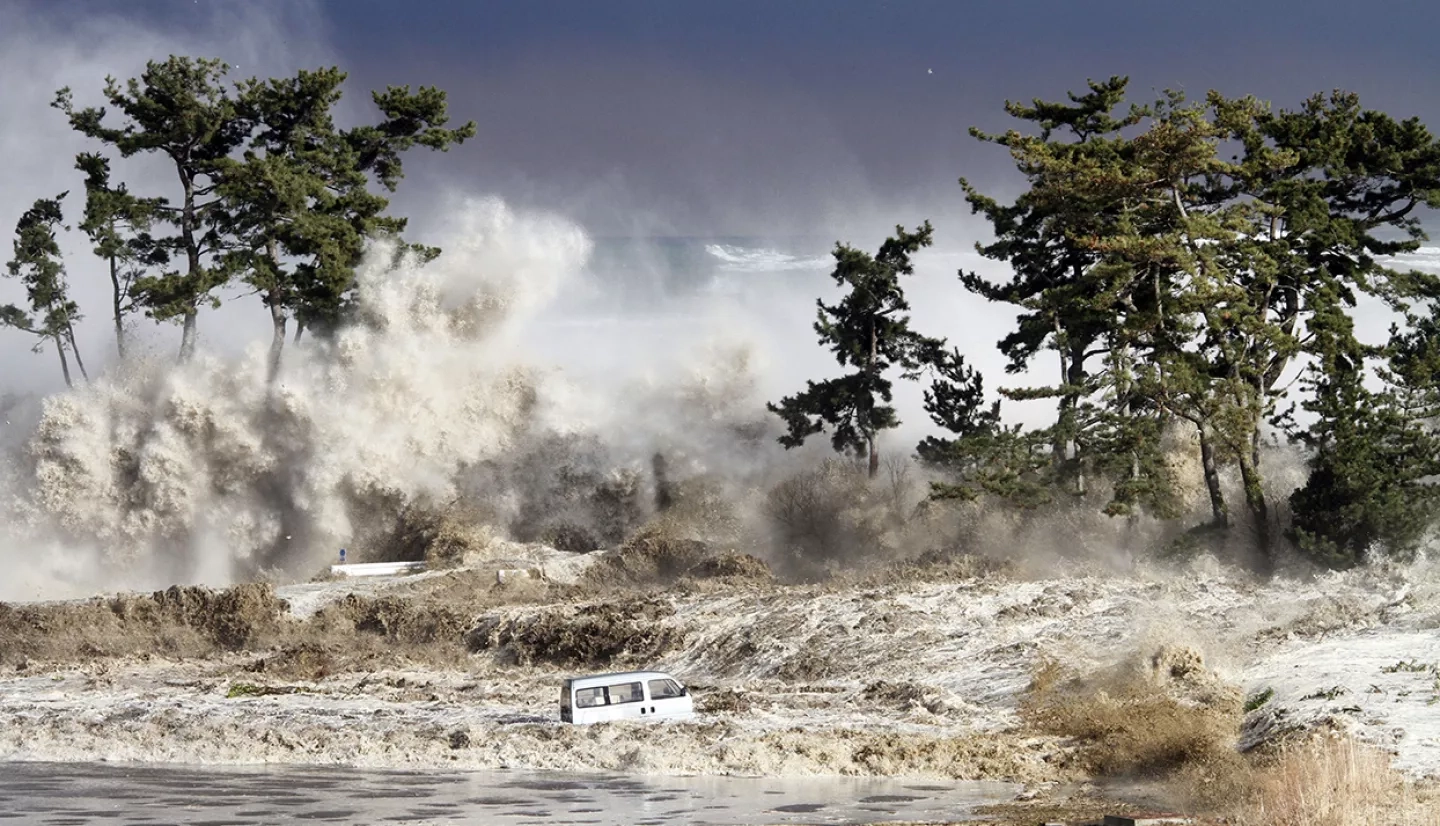
WBBSE Solutions For Class 9 Geography And Environment Chapter 6 hazard and disasters Tusanami

1. Submarine earthquake: Most severe earthquakes occur in convergent boundaries where an ocean plate slides under a continental plate. All earthquakes do not generate tsunamis. To generate a- tsunami, the fault where the earthquake occurs must be underneath or near the ocean. It must also cause vertical movement of the sea floor over a large area. Earthquakes originating at shallow depths of the seabed (focus) are responsible for the most destructive tsunamis.

2. Landslides: Landslides resulting in rockfalls, submarine landslides or slumps can generate tsunamis. For example, the movement of a significant amount of earth for the construction of an airport triggered an underwater landslide in 1980 in southern France. This resulted in a devastating tsunami hitting the harbour of Thebes.

3. Eruption of the volcano: Volcanic eruptions can generate waves as a result of sudden displacement of water giving rise to tsunamis. For example, one of the most devastating tsunamis was ever recorded on August 26, 1883, after the explosion and collapse of the Krakatoa in Indonesia.

4. Extraterrestrial collision: Although tsunamis caused by extra-terrestrial collisions such as meteors and asteroids- induced tsunamis have not been recorded in recent history and the possibilities are rare, tsunamis may be generated by such extra-terrestrial collisions.

Question 35 Briefly discuss the effects of tsunamis.
Answer:

The major effects of tsunamis are—

1. Physical changes: Tsunami may result in various physical changes. For example, the islands of Andaman and Nicobar experienced widespread devastation because of a tsunami in 2004. Some smaller islands in the Nicobars have entirely vanished and some others have changed shape, such as Trinket which has been split into two parts after the tsunami.

2. Change in soil characteristics: Tsunami may result in a change in the characteristics of soil, especially soil salinity. The coastal regions are bounded by vast expanses of salty, marine waters and thus the salinity of the soil may increase at certain times. This may negatively affect soil fertility and productivity.

3. Damages the marine ecosystem: Tsunamis cause great damage and even devastation to the marine ecosystem.

4. Shortening the length of the day: The massive earthquake that struck Sumatra in 2004 has shortened the length of the earth’s day. The intense tremor of 9.1 magnitudes has accelerated the spin of the earth, shortening the length of the 24 hours day by 6.8 microseconds.

5. Casualties: Tsunamis are generally very devastating and cause huge loss of life for humans and animals. The tsunami waves in the morning hours of December 26, 2004, around the Bay of Bengal caused an official death toll of 812 and the unofficial death toll is estimated to be about 7,000.

6. Damage to property: Tsunamis generally cause great damage to property, especially in coastal regions. Huge losses of houses, roads, agricultural fields, and factories are caused by tsunamis.

Question 36 Write a short note on the blizzard.
Answer:

A blizzard is a severe storm condition characterised by low temperatures, strong winds and heavy snow. Blizzards can restrict visibility to near zero. Blizzards have a negative impact on the local economy.

Characteristics: The main characteristics of blizzard are—

1. Strength of wind: Winds that are at least 56 kilometres per hour or greater than the normal snowstorm are identified as blizzards.

2. Visibility: The visibility is reduced to almost 400 metres or even to zero at times.

3. Duration: Most blizzards last for a duration almost 3 hours.

Location: The occurrence of blizzards is most prominent in the countries of Antarctica, northern parts of North America, Canada, north of Europe and Asia as well as in New South Wales in Australia. Apart from these, the snowcapped high mountainous regions also experience blizzards.

Question 37 Discuss with examples how a blizzard can cause hazards or disaster. Or, Briefly discuss the effects of blizzard.
Answer:

During blizzards, winds combined with fleeting snow produce extreme conditions and disrupt normal living conditions.

The hazards caused by blizzards are as follows—

1. Physical illness: The extreme cold winds during blizzards are a cause of great discomfort to the local people which may subsequently lead to physical illness and may even cause hypothermia. Such as, in 1972, four thousand people died due to the effect of a blizzard in Iran.

2. Disrupts transport system: The thick layers of snow that accumulate during blizzards may disrupt the local transport system. Blizzards paralyse the transport system and leave the roads in unsafe conditions. For example, from March 11 to 14, 1888, a blizzard dumped an average of 1 metre of snow over southeast New York and the southern part of New England. It killed over 400 people, of which New York City alone recorded 200 deaths.

3. Flood: The sudden rise in temperature that may follow a blizzard can prove to be damaging as the rapid snow-melt water may trigger serious floods and other fatal accidents.

4. Disrupts public life: Blizzards generally disrupt public life by interrupting transport, electricity and water supplies and also normal day-to-day life by interrupting health and educational facilities.

Question 38 Discuss briefly the causes of volcanism.
Answer:

The major causes of volcanism are as follows—

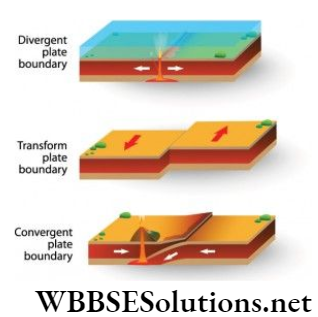
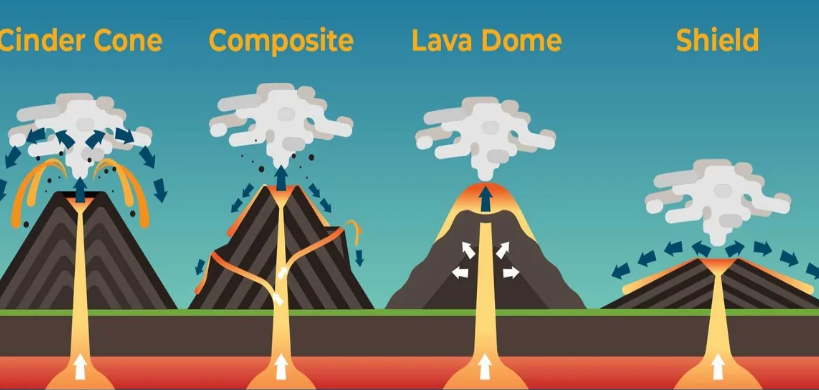
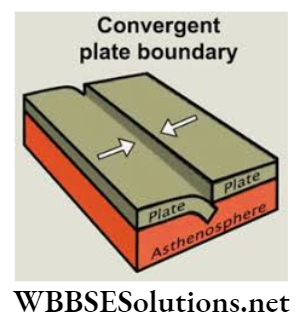
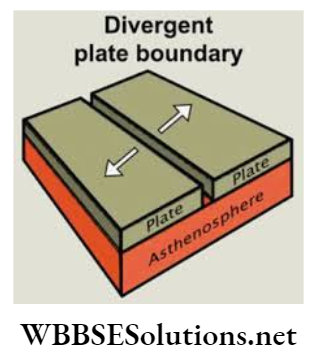
1. Plate tectonics: The earth’s crust is divided into a number of tectonic plates moving in different directions and at different speeds. At the convergent plate boundaries, the plates move towards each other, at the divergent plate boundaries the plates move away from each other and at the transform plate boundary, the plates slide past each other horizontally. These boundaries are geologically active and the movement of the plate gives rise to the occurrence of volcanoes.

2. The buoyancy of the magma: As a rock inside the earth melts, its volume increases,
producing magma that is less dense than the surrounding rock. This lighter magma rises up because of its buoyancy. Since the density of the magma between the zone of its generation and the surface is less than that of the surrounding and overlying rocks, the magma will reach the surface and erupt.

3. The pressure from the dissolved gases in the magma: Magma contains dissolved volatiles like water, sulphur dioxide and carbon dioxide. The amount of dissolved gases in the magma at atmospheric pressure is zero but rises with increasing pressure. When magma moves toward the surface, the solubility of the water in the magma decreases, and excess water separates from the magma as bubbles. The closer it gets to the surface, the more water comes from the magma, increasing the gas and magma ratio in the magma tube. When the volume of bubbles reaches about 75%, the magma turns into partially molten and solid fragments and it erupts explosively.

4. Injection of new magma into an already filled magma chamber: As an additional amount of magma enters a chamber that is already at its full capacity, the new magma causes some of the existing magma to move to the surface and erupt.

5. Release of energy: A volcanic event occurs when there is a sudden or continued release of energy caused by magma movement near the surface. The energy can be in the form of earthquakes, gas emission at the surface, release of heat through geothermal activity, explosive release of gases and the non-explosive extrusion or intrusion of magma.

Question 39 Briefly discuss the impacts of vulcanicity.
Answer:

The impacts of vulcanicity have been shown broadly—
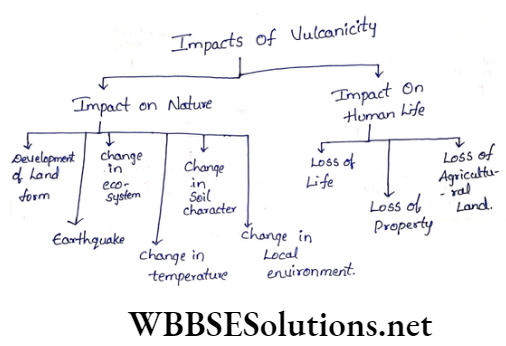
WBBSE Solutions For Class 9 Geography And Environment Chapter 6 hazard and disasters impacts of vulcanicity

1. Impact on nature:
Vulcanicity impacts nature in various ways—

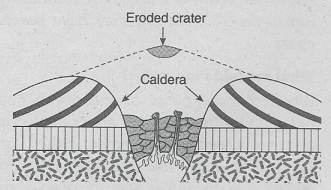
1. Development of landforms: Different types of landforms like caldera, cinder cones, laccolith, dykes, sills, etc., are formed due to vulcanicity.

2. Earthquakes: When explosions take place during volcanic eruptions on a massive scale, earthquakes may be felt in adjoining areas.

3. Change in the ecosystem: The ecological balance of the affected area is disturbed as many species of plants and animals become endangered.

4. Change in temperature: The temperature of the surrounding areas of a volcanic eruption increases.

5. Change in soil character: Soil characteristics get changed as lava spreads across the land.

6. Change in the local environment: Local environment is considerably changed. For example, there is a possibility of acid rain as a reaction to toxic gases released during vulcanicity.

2. Impact on human life: Vulcanicity also affects human life—

1. Loss of life: A massive loss of life occurs as a result of vulcanicity. For example, about 3600 people died in the coastal areas of Java when the Krakatoa volcano erupted in 1883.

2. Loss of property: Huge loss of properties like buildings, transport networks, and industries occurs and the economic life of the whole region is affected.

3. Loss of agricultural land: Large tracts of land are rendered infertile as a result of being covered by hot molten lava gushing out of the volcanoes. For example, the famous Barren Island of Andaman and Nicobar.

Question 40 Briefly discuss the causes of a forest fire.
Answer:

The main causes of forest fires are-

1. Natural causes:

The natural causes of forest fires are—

1. If lightning strikes, dry leaves of trees or tree trunks may get ignited.
2. In the dry season, a boulder coming down a mountain slope may give rise to a spark that leads to a fire.
3. A vol¬canic eruption may also cause a forest fire.

2. Man-made causes:

The man-made causes of forest fires are—

1. When a forest is burnt for clearing land for agricultural activities like in shifting cultivation, the fire may spread, causing a forest fire.
2. The fire used for cooking in tents by mountaineers may also cause forest fires.
3. If a lit cigarette is discarded by someone unmindfully on the forest floor, the dry leaves on the forest floor may cause a fire to break out.

Question 41 What are the effects of a forest fire?
Answer:
The effects of forest fires can be categorised into two sub-types. They are as follows—

1. Primary effects:

Primary effects of forest fires are—

1. Casualties and injury to people and animals who are caught in the flames.
2. Damages to property and possessions.
3. Burning of vegetation and crops.
4. Release of large amounts of smoke.

2. Secondary effects:

The secondary effects of forest fires are—

1. Health troubles for people as a result of the smoke and ash.
2. Loss of jobs for agricultural workers whose animals and crops get destroyed.
3. Diminution in the tourist industry, leading to loss of jobs and restriction to recreational areas.
4. Soil erosion and landslides because there is less vegetation to bind the soil together.
5. Loss of habitats for animals may lead to the extinction of some species.

Question 42 What remedial measures can be taken to prevent the occurrence of forest fires?
Answer:

The different measures that can be taken to prevent forest fires are—

1. Do not throw any inflammable object or lighted objects on the forest floor,
2. Remove dry leaves and parts of plants and trees to safe corners as much as possible,
3. Keep pets and other valuables at a safe distance
4. Dig a circular canal and make arrangements for adequate water around the zone of forest fire,
5. Act as per emergency instructions broadcast by radio or other devices during a forest fire,
6. Arrange awareness programmes for forest dwellers and people residing in forests regarding measures to save their lives.

Question 43 What are the favourable conditions that cause avalanches?
Answer:

The favourable conditions that cause avalanches are-

1. Slope of the land: It has been observed that avalanches are a common occurrence on slopes ranging from 35°-45° and concave slopes are more favourable than convex slopes of the mountain.

2. Excessive snowfall: Avalanches are influenced by the amount of snow or ice on the mountain tops. Excessive snowfall increases the possibility of avalanches.

3. Smoothness of slope: In comparison to forested or vegetated slopes, bare and smooth slopes act as a trigger for avalanches.

4. Size of ice crystals: Since bigger ice crystals are weak and break easily, they are more prone to initiate an avalanche compared to compacted or packed ice.

5. Sun rays: Since the sun’s rays warm up the ice, they lead to avalanches.

6. Wind flow: Winds blowing from varying directions loosen up the ice and initiate an avalanche.

7. Human interference: Human activities such as cutting down of trees, construction of roads, explosion by dynamite, ice sports etc., increase the possibility of avalanches.

8. Melting of the snow: Sun rays warm up the snow on the hill slope and thus the snow gradually melts. As a result, avalanches occur and melted snow moves down the slope.

9. Earthquake: Earthquake causes crack in the snow which results in avalanches.

Chapter 6 Hazards And Disasters Short Answer Questions

Question 1 Discuss the importance of disaster management.
Answer:

Importance Of Disaster Management:-

The main purpose of disaster management is to reduce losses in all spheres such as, social, economic, environmental etc.
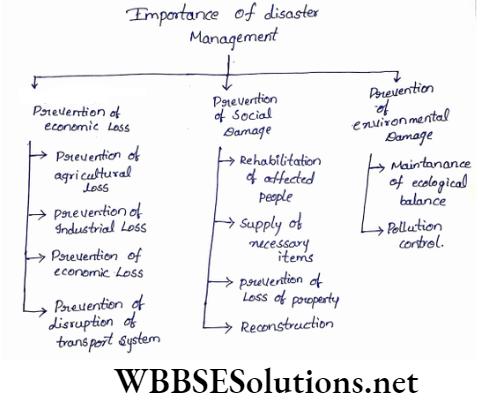
WBBSE Solutions For Class 9 Geography And Environment Chapter 6 hazard and disasters disaster management

1. Prevention of economic loss:

1. Prevention of agricultural loss: The fertility of the land diminishes and the salinity of soil may also increase as a result of floods, droughts, earthquakes etc. Proper infrastructure can be developed for the cultivation of crops if a forecast of any disaster is made.

2. Prevention of industrial loss: Various industrial products and infrastructure are damaged which can be restored by undertaking proper disaster management programmes.

3. Prevention of economic loss: The economy of any region is hampered as a result of loss in agricultural and industrial, sectors due to natural calamities. Appropriate disaster management measures can be taken to reduce such economic losses.

4. Prevention of disruption of transport system: When the transport system is disrupted due to calamities like, landslides, earthquakes etc., alternative modes of transport can be arranged to alleviate the problem.

2. Prevention of social damage:

1. Rehabilitation of affected people: A damaged area can be restored to its original normal state by acting on an emergency basis and on a war footing.

For example—
Rapid action taken for rescuing people and rehabilitating them would be of immense help.

2. Supply of necessary items: Supply of necessary items like food, water, shelter, etc., is possible through aid by state and central governments.

1. Prevention of loss of property: If a warning is issued prior to the disaster, much of the damage caused to life and property can be minimised.

2. Reconstruction: Disaster management also helps to rebuild properties (like houses, buildings, etc., quickly that are damaged.

3. Prevention of environmental damage:

1. Maintenance of ecological balance: By adopting appropriate measures of disaster management, the damage incurred to the environment can be reversed.

2. Pollution control: Disaster management helps to control pollution.

For example—
Afforestation along the bank of a river helps to prevent the erosion of soil and the subsequent sedimentation of river beds. As a result, floods are prevented and eventually soil pollution is controlled. Besides that, planting trees help to control air pollution.

Question 2 Adoption of disaster management techniques can be used to reduce the after-effects of a disaster
Answer:

The occurrence of most natural disasters cannot be stopped but measures can be taken to reduce the after-effects. The organization and management of resources and responsibilities for dealing with all humanitarian aspects of emergencies, in particular, preparedness, response and recovery in order to lessen the impact of disasters is termed disaster management.

The procedures to be followed are as follows—

1. Preventive measures:
Even before the actual disaster occurs there are some prior measures that can be taken to reduce the intensity of the disaster. Such as-

1. Conducting awareness programmes,
2. Compiling suitable laws,
3. Conducting proper regional surveys and preparing maps,
4. Forecast of the disaster can be transmitted through radio and television channels to the common people.

2. Remedial measures:
These measures are taken once the disaster has hit a region. There are two stages of remedial measures—

1. The first stage involves the rescue and recovery of the affected people and providing them with relief facilities like food, medicine, clothing, temporary houses and others.
2. The second stage involves working towards recovery in order to lessen the impact of disasters and revert to normal conditions. The measures taken under this stage are re-establishing the communication systems, rebuilding the roads, houses, and schools and working towards the supply of electricity, and safe drinking water.

Question 3 What are the pre-disaster measures that should be taken?
Answer:

Pre-disaster measures that should be taken care of—

1. Data collection: Data related to causative factors of disasters should be collected.

For example—
In the case of floods and droughts, rainfall data for the past few years should be taken.

2. Data analysis and mapping: The collected data is then analysed to determine the intensity and extent of the disaster and mapping are done on the basis of analysed data.

3. Research: After mapping, thorough research is undertaken in order to assess past conditions and future predicaments.

4. Forecast: If a proper forecast is done through data analysis using modern technology, the amount of loss or damage caused by any disaster can be minimised.

5. Training: Training can be imparted to all including common people, army personnel etc., by the authorities at the centre, state and district levels so that the loss and damage incurred in a disaster are minimal.

6. Duty distribution: After proper training, duties and responsibilities are determined for all the people. It helps to prevent disaster and also helps to deal with it.

7. Increase public awareness: Steps should be taken to increase public awareness and precautionary measures should be taken.
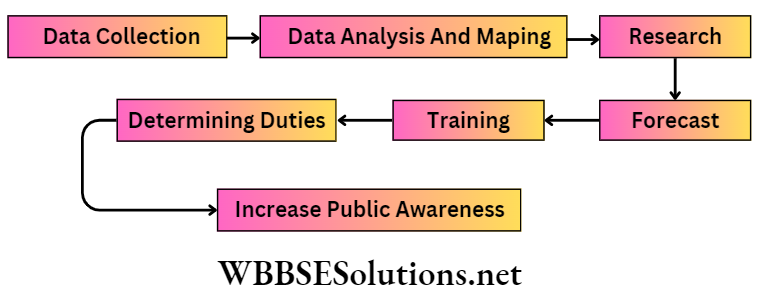
WBBSE Solutions For Class 9 Geography And Environment Chapter 6 hazard and disasters disaster management data collection

Question 4 what measures are undertaken after a disaster?
Answer:

Measures that are disasters are-

1. Rescue operations: These are undertaken on an emergency basis by both the local people and army personnel in order to save a maximum number of people and animals.

2. Relief operations: Relief materials are distributed to the people of the affected area by central and state government ‘agencies and the extent of loss and damage is estimated. Preventive measures are taken to control the further deterioration of the situation. Medicines, food and safe drinking water are also provided to the affected people.

3. Temporary shelter arrangements: If the intensity of the disaster gradually increases, necessary steps should be taken to shift the disaster stricken people quickly from the disaster-affected areas to safe and secure places. Besides, security arrangements also have to be made for the prevention of theft, looting, etc. in disaster-affected areas.

Question 5 Briefly discuss the post-disaster measures
Answer:

Some important post-disaster measures are—

1. Rehabilitation: Normal life can be restored by providing aid and making arrangements for the reconstruction of damaged houses, roads, transport and other civic amenities and services including agricultural and industrial establishments. Temporary shelters have to be made on an urgent basis.

2. Reconstruction: A host of measures can be taken, like planning different projects and creating jobs in different sectors, to normalise the economic condition of the affected people.
For example—
In drought-prone areas, watershed projects, irrigation projects etc., can aid in reducing the chances as well as the impact (where a disaster has already taken place) of such disasters.

Although natural calamities like earthquakes, volcanicity, etc., cannot be prevented and are beyond human control. Proper pre-disaster planning by conducting surveys and analysing previously recorded data can reduce the impact of such a calamity. By providing precautionary measures and spreading general awareness in the concerned areas, the disastrous effects can be minimised.

Question 6 Discuss the disaster-prone
Answer:

Disaster-Prone:-

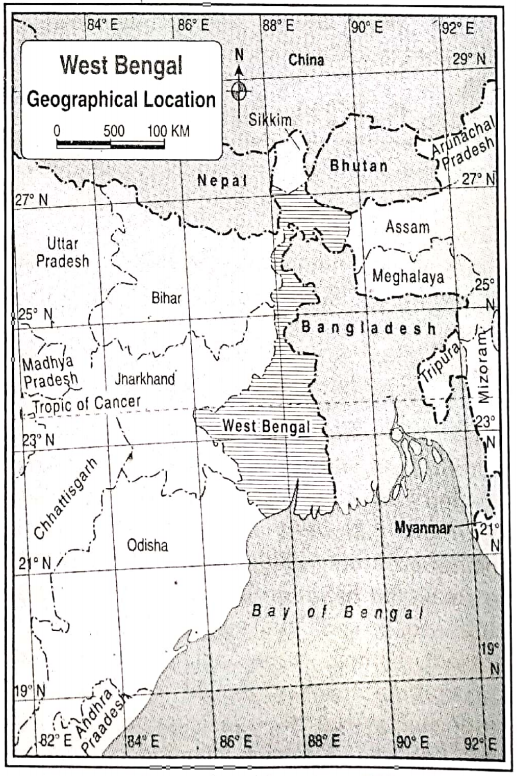
The disaster-prone regions in West Bengal are as follows—

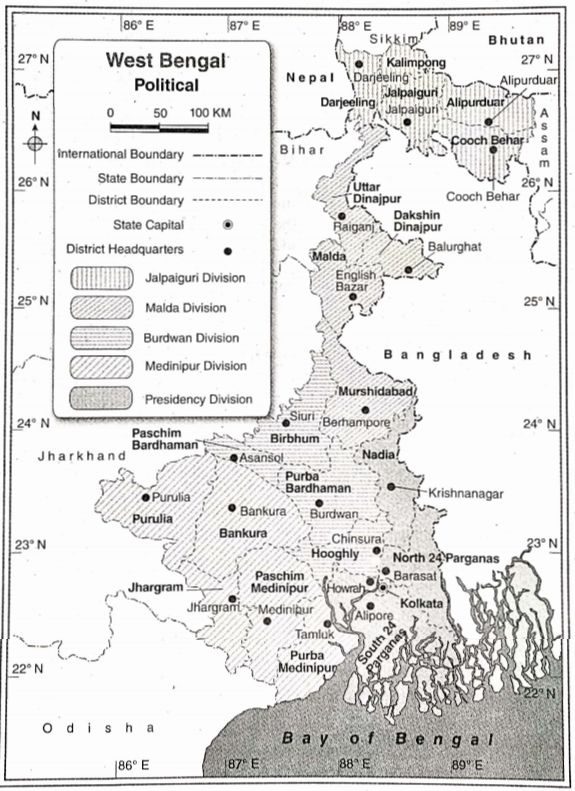
1. The Darjeeling-Himalayan region: This region frequently experiences landslides and floods.

2. The Sunderban region: This region frequently experiences tropical cyclones and floods.

3. The plateau region: The areas under Purulia, Paschim Medinipur, Bankura, Purba and Paschim Bardhaman and
the western part of Birbhum fall under the plateau region. This region frequently experiences the wrath of droughts.

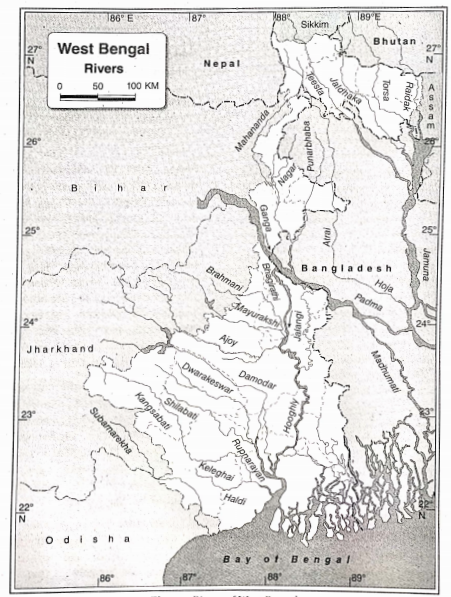
4. The plain region: The plain region consists of the areas that are situated on the bank of the river Ganga or near the Ganga plain in West Bengal. This region experiences heavy monsoons and thus is prone to flood.

Question 7 What measures should be taken to control floods?
Answer:

The measures that should be taken to control flood are—

1. Less human interference in the land: If climatic conditions change naturally, rainfall intensity decreases and as a result, there would be lesser floods. 0 Watershed management and proper drainage system, afforestation, changing the slope by constructing terraces, control of overgrazing, contour-farming etc., can check the occurrence of floods.

2. Barrage construction and dredging:
1. Construct barrages and reservoirs to store excess water from rivers,
2. Construct dykes or dams across rivers at specific locations in order to prevent flooding of low-lying areas, 3. regular dredging of the river bed is needed to lower the level of silt for smooth flow of river water.

3. Proper planning:
1. Implementation of strict laws to bar the construction of houses etc., in flood-prone areas along rivers,
2. Dredging and reclaiming dead and decaying rivers,
3. Increasing public awareness through propaganda and advertisements— by these methods, losses incurred due to floods can be reduced.

Question 8 what measures should be taken during floods to control them?
Answer:

Measures to be taken during floods are—
1. Stay back at home, or at a higher ground when the level of floodwater rises.
2. Keep the following items handy-polythene packets, cord, torch, matchbox, candles, important documents, dry clothes, dry food, radio, mosquito net, pure drinking water etc.
3. Switch off all electrical switches and appliances, close taps and lock gas cylinders.
4. Wait for relief to arrive from government agencies, NGOs etc., and abide by the advice given by them instead of panicking.

Question 9 What measures should be taken to prevent drought?
Answer:

Measures that should be taken to prevent droughts are—

1. Conservation of water: Conservation and appropriate use of water are necessary to prevent drought.

2. Recharge of groundwater: To keep the water supply intact throughout the year, groundwater reservoirs should be recharged properly. Seepage from the ponds and reservoirs can help to recharge the groundwater storage.

3. Dry farming: To stop the excessive use of water in agriculture and to prevent droughts, dry farming should be practised. The use of draught-resistant seeds should be encouraged.

4. Rainwater harvesting: The collection and storage of- rainwater from a roof-like surface and using it properly for irrigation and other domestic purposes is known as rainwater harvesting. It helps to recharge groundwater reservoirs that prevent drought.

5. Stop the wastage of water: Wastage of water in various ways must be checked. It helps to conserve water and also prevent drought.

6. Other measures:

Some other measures that should be taken to prevent drought are—

1. Construction of artificial reservoirs,
2. Increase the efficiency of irrigation, which reduces water wastage,
3. arrange proper distribution of relief to drought-hit victims, etc.

Question 11 What measures should be taken before and during an earthquake?
Answer:

Measures that should be taken before and during an earthquake to control and manage such disaster are as follows—

1. Measures to be taken before an earthquake:

1. Earthquake-resistant houses should be constructed for the people living in an earthquake-prone areas.
2. The basic amenities needed for survival, like drinking water, food, torch, candles, etc., should be stored in adequate amounts.
3. People should also know how to contact the nearest fire station, health-centre etc., in case of exigencies.

2. Measures to be taken during an earthquake:

1. One should leave the house and move to any vacant, open place.

2. One can take shelter beneath any sturdy furniture, like a table, bed, etc.

3. Electricity, gas and water connections should be promptly disconnected when an earthquake strikes.

4. Any kind of inflammable objects like matchboxes, candles, and gas ovens should not be used.

5. One should not try to jump from windows or doors from great heights.

6. People must keep a safe distance from the electrically conductive wire and equipment. It is not advisable to take shelter beneath any multi-storeyed building or tree and should immediately move to any open or vacant place announcements made outside the house.

Question 12 What are the measures that need to be taken to minimise the effects of landslides?
Answer:

Measures that need to be taken to minimise the effects of landslides are—

1. Proper planning should be done after surveying landslide-prone areas.
2. Geological survey is needed and the data should be used while constructing houses, roads, bridges, etc. (in accordance with the local geological structure, rock types, soil, underground water table conditions, etc.)
3. Safe and secured shelters should be constructed near landslide-prone areas beforehand.
4. Felling of trees should be prevented and measures like afforestation should be adopted.
5. The weak and unstable slopes of the mountains should be guarded by putting boulders or concrete in a planned way.
6. Awareness must be created among the local residents regarding the dangerous impacts of landslides.

Question 13 Discuss the measures to be taken for dealing with a cyclonic storm.
Answer:

Measures to be taken for dealing with a cyclonic storm is—

1. Houses should not be constructed on reclaimed land since they have weak foundations. Moreover, storerooms should be made for stocking essential items that would be used during a storm.
2. Important and valuable documents and items should be transferred to a safe place as soon as the announcement of an upcoming storm is made.
3. Foodstuffs like dry food and essential medicines (especially for children and the aged, and for treatment of the injured) should be well-stocked.
4. There should be alternative means of transport and one should be in continuous touch with various governmental and non¬governmental agencies.

Question 14 Discuss the measures to be taken during and after the cyclonic storm.
Answer:

Measures to be taken during a cyclonic storm: Measures to be taken during a cyclonic storm is—

1. A calm mind should be maintained during such a calamity, instead of being panicky and paying attention to rumours.

2. One can take shelter under heavy furniture like a bed or table during a storm.

3. All electrical switches should be turned off.

4. It is not advisable to take shelter near doors and windows or underneath trees.

Measures to be taken after a cyclonic storm: Measures to be taken after a cyclonic storm are—

1. Proper arrangements should be made after assessing the damage caused by such storms.

2. Relief should be arranged properly by contacting local voluntary organisations.

3. First aid should be provided to the injured and doctors should be pooled in for the proper functioning of the healthcare system.

4. Rapid action should be taken by the government to reconstruct shelters and other infrastructural facilities by making a reconnaissance survey of the area and proper estimation.

Question 15 What are the measures to be taken in case of a tsunami forecast?
Answer:

Measures to be taken in case of a tsunami forecast are—

1. Prior warning to the coastal people should be sent by the tsunami warning centre since they receive signals of earthquakes on the seabed (which act as a trigger to cause tsunamis after a. certain gap of time) via satellites.
2. People should be evacuated and removed from the coastal areas to safer and higher grounds.
3. Fishermen should be restricted from going out to the sea for fishing.
4. Tourism activities should be stopped in the coastal areas.
5. The areas on the mouth of rivers, (where they meet the sea) should be avoided by people.

Question 16 Discuss the role of a student in taking measures for disaster management.
Answer:

The students have a major role to play to manage disasters. Usually, there are 3 steps of disaster management—

1. pre-disaster stage,
2. during the disaster stage,
3. post-disaster stage.

1. Pre-disaster stage:

1. Evaluation of risk: The students must have an idea of the area in which they reside and how much it is prone to a disaster. They should be aware of their neighbours and all the members of their family.

2. Spread of awareness: Any place or area can experience a disaster, hence mock drills must be done to make people aware of what measures can be taken to combat it.

For example—

If, any area is prone to flood, how should people reach higher grounds to save themselves, what types of food and medicines they should carry with them, etc., must be rehearsed?

3. Arranging the essential documents: Disasters like floods/cyclones, and earthquakes are sudden events. So, students should keep their essential documents like voter cards, adhaar cards, pan cards, results and certificates, bank documents, etc. close by at the time of quick escape.

Chapter 6 Hazards And Disasters Very Short Answer Questions

Question 1 What is meant by a hazard?
Answer:

Hazard:-

A dangerous condition or event that threatens or has the potential to cause injury to life or damage to property or the environment is known as a hazard.

Question 2 What is meant by a disaster?
Answer:

Disaster:-

A disaster is an event or series of events that results in casualties and damage or loss of property, infrastructure, environment, essential services or means of livelihood on such a scale that is beyond the normal capacity of the affected Community to sustain.

Question 3 What are natural hazards?
Answer:

Natural Hazards:-

Hazards that are typically caused by nature and without any human intervention are known as natural hazards. Examples- Earthquakes, floods, etc.

Question 4 What is meant by a semi-natural hazard?
Answer:

Semi-Natural Hazard:-

Hazards that are caused by the combination of natural and man-induced processes are known as semi-natural hazards. For instance, a landslide is a semi-natural hazard as it can be caused by natural processes (such as heavy or prolonged rainfall, earthquakes, volcanic eruptions, etc.) and can also be caused by man-made activities (such as slope excavation and loading, land use changes, irrigation, and such others).

Question 5 What is meant by a flood?
Answer:

Flood:-

A flood may be defined as a situation caused due to the overflow of rivers and other waterbodies due to an excess supply of water.

Question 6 What is meant by a flash flood?
Answer:

Flash Flood:-

A flash flood can develop within a few hours of heavy rainfall. Flash floods can be highly dangerous and have the potential to instantly turn a gasping rivulet into a thundering channel of water that sweeps away everything in its path. Most of the casualties from flooding occur as a result of flash floods. The intensity of flash floods cannot be classified. Desert regions are vulnerable to flash floods.

Question 7 How can dam failure cause floods?
Answer:

Dam Failure Causes Floods:-

Dams are the water storage or diversion barriers that seize water upstream in reservoirs. Dam failure involves. the over¬topping, breach or collapse of a dam. It is an extremely destructive occurrence and in such an event, the energy of the water stored behind even a small dam is capable of causing loss and damage to life and property. For example,-in 1977, Tamil Nadu experienced a dam failure from the Kodaganar Dam that led to over-topping by flood waters.

Question 8 What is meant by drought?
Answer:

Drought:-

Drought may be defined as a situation caused due to lack of rainfall or scarcity of rainfall for a long period. According to the Indian Meteorological Department (IMD), an area is considered to be affected by drought, if it receives less than 75% rainfall than its normal value.

Question 9 What is meant by meteorological drought?
Answer:

Meteorological Drought:-

A drought is categorised as a meteorological drought when actual rainfall over an area is significantly less than the climatological mean. Definitions of meteorological droughts must be region-specific as the atmospheric conditions that result in deficiencies of precipitation are highly variable from region to region.

Question 10 What is meant by hydrological drought?
Answer:

Hydrological Drought:-

A drought is categorised as a hydrological drought when there is a marked depletion of surface water causing very low stream flow and drying of lakes, reservoirs and rivers. Therefore, hydrological drought is related to the effects of periods of precipitation deficits on surface or subsurface water supply.

Question 11 What is meant by agricultural drought?
Answer:

Agricultural Drought:-

The situation when soil moisture is insufficient and results in a lack of crop growth and production, is known as agricultural drought. Agricultural drought has a huge impact on the economy of the country.

Question 12 What is a cyclone?
Answer:

Cyclone:-

A cyclone is a giant whirlwind or a very strong wind system moving rapidly in a cylindrical or funnel shape about a centre of low atmospheric pressure over tropical or subtropical waters. It advances at a speed of about 30 to 50 kilometres per hour and often brings heavy rain.

Question 13 Name the districts of West Bengal that are prone to drought.
Answer:

Districts Of West Bengal That Are Prone To Drought:-

The western uplands of West Bengal consisting of the districts of Bankura, Birbhum, the western part of Paschim Medinipur, jhargram and Purulia are the most drought-prone districts of the state.

Question 14 What is meant by a landslide?
Answer:

Landslide:-

A landslide is the movement of rocks or debris down a slope. Landslides occur when gravitational and other types of shear stress within a slope exceeds the shear strength of the materials that form the slope. Landslides are also known as landslips, slope failure, etc.

Question 15 What is meant by a snowstorm?
Answer:

Snowstorm:-

A snowstorm is a severe weather condition where precipitation falls in the form of snow and creates a hazardous condition. It is characterised by low temperatures, strong winds and enormous quantities of either falling or blowing snow.

Question 16 Where do snowstorms mostly occur?
Answer:

Occur Of  Snowstorms:-

People experience snowstorms in middle-latitude to high-latitude areas during winter. The occurrence of snowstorms is most prominent in Antarctica, northern parts of North America, Canada, north of Europe and Asia as well as in New Sout Wales in Australia. The snowcapped high mountainous regions also experience snowstorms.

Question 17 Name the most commonly faced hazards and disasters in West Bengal.
Answer:

The most Commonly Faced Hazards And Disasters In West Bengal Are:-

The most commonly faced hazards and disasters in West Bengal are drought, flood, landslides and tropical cyclones.

Question 18 What is meant by the forest fire?
Answer:

Forest Fire:-

A forest fire, also known as a wildland fire or wildfire, is an uncontrolled fire often occurring in forest areas. The blazes are fueled by lightning, volcanic eruptions, pyroclastic flow from active volcanoes, heat waves, droughts, and cyclical climate changes. as El Nino as well as human carelessness. It is observed that more than four out of every five forest fires are human-induced. Forest fires often begin unnoticed, but they spread quickly at a speed that extends up to 23 kilometres an hour igniting bushes, trees, homes and agricultural resources.

Question 19 Name the districts of West Bengal that are prone to cyclones.
Answer:

Districts Of West Bengal That Are Prone To Cyclones Are:-

The coastal area in West Bengal mostly faces the wrath of tropical cyclones. The districts of Purba Medinipur, North and South 24 Parganas, Howrah, Hooghly and Kolkata are more susceptible to the hazard caused due to tropical cyclones.

Question 20 Name the districts of West Bengal that are prone to flood.
Answer:

Districts Of West Bengal That Are Prone To Flood Are Given Below:-

West Bengal is one of the most flood-prone states of India. The flood-prone areas of West Bengal include low-lying areas, coastal regions and regions along rivers downstream from dams.

The flood-prone districts of West Benga I can be classified into two groups—

1. Districts of North Bengal: Cooch Behar, Jalpaiguri, Malda, Uttar and Dakshin Dinajpur.

2. Districts of South Bengal: Nadia, Howrah, Murshidabad, North and South 24 Parganas, Hooghly, Purba and Paschim Bardhaman, Birbhum, Purba and Paschim Medinipur.

Question 21 Classify drought on the basis of medium.
Answer:

On the basis of medium drought can be classified into two types—

1. Soil drought: It is the condition when soil moisture depletes and falls short of meeting the potential evapotranspiration of the crop.

2. Atmospheric drought: This occurs due to low humidity, and dry and hot winds that cause the desiccation of plants.
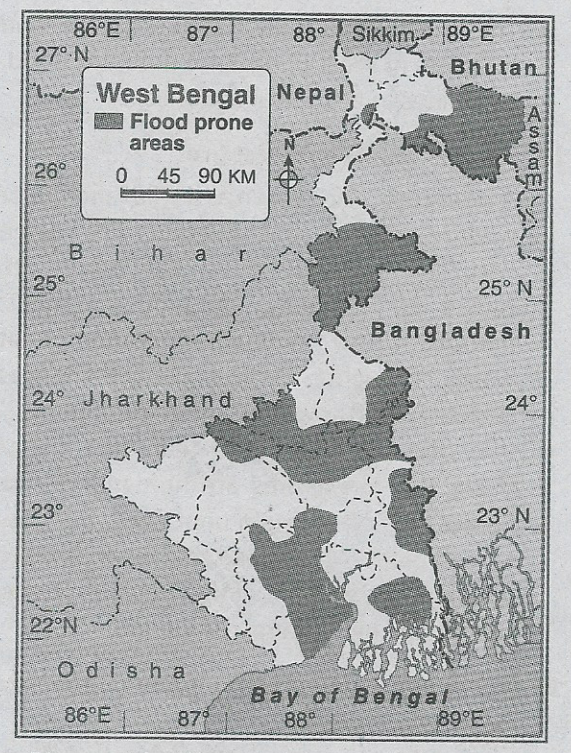
WBBSE Solutions For Class 9 Geography And Environment Chapter 6 hazard and disasters the flood prone areas of west bengal

Question 22 What is meant by an earthquake?
Answer:

Earthquake:-

Seismic waves are produced when some form of energy stored in the earth’s crust is abruptly released. This happens usually when masses of rock layers push one another abruptly. Therefore, earthquakes or any sudden shaking of the ground are caused by seismic waves originating within the earth’s crust.

Question 23 What is meant by a tsunami?
Answer:

Tsunami:-

A catastrophic ocean wave, generally caused by an earthquake on the seabed by an underwater or coastal landslide or by the eruption of a volcano is known as a tsunami. It is derived from a Japanese word meaning harbour waves. It is also commonly referred to as a seismic sea wave or tidal wave.

Question 24 What is meant by volcanism?
Answer:

Volcanism:-

Volcanism is the process that refers to hot molten magma escaping from the earth’s core, cooling down and forming hard rocks. Volcanism can be of three types depending on the place where it occurs.

They are as follows—

1. Extrusive volcanism: Molten lava that escapes the earth and reaches the surface is known as extrusive volcanism.

2. Intrusive volcanism: Molten magma that cools and hardens beneath the surface of the earth is known as intrusive volcanism.

3. Plutonic volcanism: Molten magma that cools and hardens deep beneath the surface of the earth, far below the crust is known as plutonic volcanism.

Question 25 What is an avalanche?
Answer:

Avalanche:-

When accumulated snow and ice slide down along the steep slopes (35°-45°) of mountains, encompassing a wide area, it is called an avalanche. At the higher altitude of the mountain slopes, the upper part of the accumulated ice breaks apart from the underlying layer of ice. It hurls down along the steep slopes as a vast expanse of white sheets mainly due to the earth’s gravity. This phenomenon mostly occurs during the winter months and is a common feature in the mountainous areas of the Himalayas and the Alps.

Question 26 What is meant by a disaster-prone area?
Answer:

Disaster-Prone Area:-

An area that has already faced one or more types of hazards is demarcated as a disaster-prone area. This is because the area is prone to several kinds of hazards. For example, Darjeeling and Kalimpong districts and the coastal area of Purba Medinipur district of West Bengal are landslides and cyclone-prone areas respectively.

Question 1 What is vulnerability?
Answer:

Vulnerability:-

Vulnerability can be defined as the impaired capability of, any individual or group to conceive of, cope with, resist and recover from the impact of a natural, semi-natural or man-induced hazard. Vulnerability develops when an individual or a small group is isolated, insecure and defenceless, before or after they face any hazard, shock or stress. In this context, more preparedness to face a disaster means lesser vulnerability.

Question 2 Name the districts of West Bengal that are prone to flood.
Answer:

The flood-prone districts of West Bengal can be classified into two groups—

1. Districts of North Bengal: Cooch Behar, Jalpaiguri, Malda, Uttar and Dakshin Dinajpur.

2. Districts of South Bengal: Nadia, Howrah, Murshidabad, North and South 24 Parganas, Hooghly, Bardhaman, Birbhum, Paschim Medinipur and Purba Medinipur.

Question 3 What are the three phases in a disaster management cycle?
Answer:

The three phases in a disaster management cycle are—

1. pre-disaster phase,
2. during the disaster phase,
3. post-disaster phase.

4. What is meant by disaster management?
Answer:

Disaster Management:-

Disaster is any kind of temporary or permanent damage entailing a loss of human life and disruption of normal activities (due to natural or man-made causes) and cannot be dealt with without external aid. Disaster management is the means to control and restore such a disruptive situation (through various measures).

Chapter 6 Hazards And Disasters Fill In The Blanks

1. A region is considered to be drought-prone if it receives an average annual rainfall less than 75 % of its normal value.

2. The centre of a cyclone is known as its eye

3. The Richter scale is used to measure the magnitude of earthquakes

4. The average speed at which grass fires spread can be up to 22km/hour

5. Forest fire is a semi-natural hazard.

6. One of the deadliest snowstorms in history occurred in Iran in the year 1972

7. Low pressure prevails at the centre of a whirlwind.

8. Darjeeling is an example of a landslide-prone district in West Bengal.

9. The possibility of flash floods is higher in a circular river basin.

10. Avalanches are more likely to occur on convex slopes.

11. Cyclone AHA hit West Bengal in the year 2009

12. Phailin is a cyclone

13. Blizzard is a type of snowstorm

14. The Kedarnath temple was affected severely due to a flash flood in 2013.

15. One of the most accepted weather conditions for hurricanes to develop is that the temperature of the ocean waters must be above 26° C

16. Agricultural droughts can develop quickly during a dry spell if absolutely no rain is observed and the soil does not have enough water to sustain crops.

17. The disaster is a cause hazard.

18. Famine is an acute shortage of food that causes people to die of starvation.

19. About 12 % of the total land mass in India is prone to flood.

20. Most tsunamis occur on the Pacific coast.

21. Air pollution occurs due to volcanic eruptions.

22. Cooch Behar is a flood-prone district in West Bengal.

23. Extreme disasters like famine occur as a result of drought

24. Extreme Growth of the population is a type of man-induced disaster.

25. Disaster is an extreme condition or hazard

26. A cyclone is known as a Hurricane in the Caribbean Sea.

27. The most earthquake-prone region of India is Aila 

28. In the year 2009, the severe cyclone that affected West Bengal is known as 26° C

29. Phailin storm developed in the Bay of Bengal

30. Purulia is an example of a drought-prone district in West Bengal.

31. Irrigation facility is necessary for drought-prone areas.

32. Students play an important role in disaster management.

33. The influence of cyclones can be felt more in the coastal region of southern West Bengal.

34. The Ring Dam is constructed for the prevention of flood

35. Distribution of proper medicine and food to disaster victims is a part of relief management.

36. One should go out of the house during an earthquake.

37. Dry farming is a measure that may prevent drought

Chapter 6 Hazards And Disasters Write True Or False 

1. Plutonic earthquakes are deep-focus earthquakes, the depth of disturbances being between 250 km and 700 km approximately. True 

2. The downward flow of magma is known as a ‘plume’. false 

3. Not all hazards can be termed as disasters. True 

4. When a river flows in a straight direction, the possibility of flood decreases. True 

5. Whirlwinds are common in the hills. false 

6. Most avalanches occur on slopes with an angle of inclination between 35° and 45° approximately. false 

7. A tornado is a severe cyclone. True 

8. Avalanches most commonly occur on the leeward slopes of mountains. True 

9. Earthquakes are one of the main causes of tsunamis. True 

10. Snowstorms are one of the major natural disasters faced by the people of Sunderbans. false 

11. Remote sensing and GIS help in disaster management. false 

12. Fujiyama is a volcano in India. false 

13. Snowstorms reduce visibility sharply. false 

14. When floods occur, old alluvium accumulates on a floodplain. false 

15. Droughts are generally categorised into 5 classes. false 

16. Narcondam and Barren are two volcanoes in India. True 

17. Snowfall is a man-made disaster. false 

18. Ecosystems are affected enormously due to landslides. True 

19. Damages caused by disasters are much greater than those caused by hazards. True 

20. A tornado is a man-made hazard. false 

21. Acid rain does not cause any damage to the aquatic ecosystem. false 

22. Reckless deforestation can cause landslides in hilly regions. True 

23. A seismograph is used to measure the intensity of tsunamis. false 

24. Avalanches are more likely to occur on concave slopes. false 

25. For hurricanes to develop, the temperature of the ocean waters must be above 26° C. True 

26. Blizzards are common in Antarctica. True 

27. According to the Irrigation Commission, drought is a situation that occurs in a region where the annual rainfall is less than 75% of the normal rainfall. True 

28. A seismograph is used to know the movement of earthquakes. True 

29. If the intensity of the hazard increases, there is a possibility of disaster. True 

30. Both P and S waves are known as surface waves. false 

31. Soil moisture increases due to excessive withdrawal of groundwater.

32. Drought is a slow-onset disaster. True 

33. Blizzard is also known as an avalanche. false 

34. Many people died at Bhuj in Gujarat due to a severe earthquake. True

35. Uttarakhand is an earthquake-prone region in India. True 

36. The western part of West Bengal is a region prone to man-induced floods. True 

37. Awareness of the people is important for the prevention of disaster. True 

38. Cloud burst affected region of West Bengal is Purulia. false

39. The east coast of India is a tsunami-affected region. True 

40. During an earthquake, one should leave the house and move to any vacant place.

41. Houses of Darjeeling and Kalimpong are built of wood due to the effect of the cyclone. false

Chapter 6 Hazards And Disasters Match The Column

1.

Left Column Right Column
1. Landslide A.Plains
2. River bank erosion B. Forest regions
3.  Forest fire C. Polar regions
4. Snowstorm D.  Mountains

Answer: 1-D,2-A,3-B,4-C

2.

Left Column Right Column
1. Natural hazard A. War
2. Semi-natural hazard B. Volcano
3. Man-made hazard C. Landslide

 Answer: 1-B,2-C,3-A

3.

Left Column Right Column
1. Drought A.Ministry of Home Affairs
2. Flood B. Ministry of Agriculture
3. Chemical accidents C. Department of health and family welfare
4. Epidemic D. Ministry of Water Resources

Answer: 1-B,2-D,3-A,4-C

Chapter 6 Hazards And Disasters Answer In One Word

Question 1. Which type of hazard is easiest to manage?
Answer: Man-made hazards.

Question 2. Which force is one of the factors behind the occurrence of avalanches?
Answer: Gravitational force.

Question 3. Which type of hazard is a Tornado?
Answer: Natural hazard.

Question 4. Name a man-made cause for landslides in the mountains.
Answer: Reckless deforestation.

Question 5. What type of disaster may occur if no rain falls for a long period?
Answer: Drought.

Question 6. In Which type of climate is snowfall a common affair?
Answer: Extremely cold climate.

Question 7. Which instrument is used to measure the intensity of earthquakes?
Answer: Seismograph.

Question 8. Which type of hazard is a volcano?
Answer: Natural hazard.

Question 9. Name a semi-natural hazard.
Answer: Landslide.

Question 10. Name a man-made disaster.
Answer: War.

Question 11. Name a flood-prone district in West Bengal.
Answer: Cooch Behar.

Question 12. Give a non-tectonic cause of earthquakes.
Answer: Nuclear testing.

Question 13. Cite a recent example of a very severe cyclonic storm that occurred in India.
Answer: Aman.

Question 14. Name the wind that influences the occurrence of both droughts and floods in India.
Answer: Monsoon wind.

Question 15. Into how many divisions can hazards be classified?
Answer: Three.

Question 16. In which year was Uttarakhand affected severely due to a flash flood?
Answer: 2013.

Question 17. Which disaster destroyed the city of St. Pierre in 1902?
Answer: Volcanic eruption.

Question 18. Which type of natural hazard occurs when trees rub against each other?
Answer: Forest fire.

Question 19. What percentage of the total land area in India is prone to flood?
Answer: 12

Question 20. Name a disaster that may result in landslides.
Answer: Earthquake.

Question 21. Which kind of disaster can be prevented by adopting proper patterns and methods of land use on the hill slopes?
Answer: Landslides.

Question 22. Which area of India is mostly affected by tsunamis?
Answer: Coastal regions.

Question 23. Which mountain range in India is most prone to earthquakes?
Answer: The Himalayas.

Question 24. What are the adverse effects resulting from natural processes of the Earth called?
Answer: Natural hazards.

Question 25. Which type of disaster may result due to faulty and unscientific methods of farming in the hills?
Answer: Landslides.

Question 26. Cite an example of a geological disaster.
Answer: Earthquake.

Question 27. Cite an example of a hazard associated with landscape change.
Answer: River bank erosion.

Question 28. Which type of disaster are whirlwinds and snowstorms?
Answer: Atmospheric disaster.

Question 29. What type of disaster may result due to human intent, negligence or a failure of a man-made system?
Answer: Man-made disaster.

Question 30. Which type of disaster may occur due to sudden heavy rainfall in the hills?
Answer: Flash flood.

Question 31. Name a natural cause of earthquakes.
Answer: Movement of the earth’s plate.

Question 32. Name a man-made cause of earthquakes.
Answer: Nuclear tests.

Question 33. What is the rapid flow of snow down a sloping surface known as?
Answer: Avalanche.

Question 34. Which region in West Bengal is most prone to landslides?
Answer: The hilly regions in Darjeeling.

Question 35. What is planning to cope with disasters known as?
Answer: Disaster management.

Question 36. Which type of rain causes damage to the aquatic ecosystem?
Answer: Acid rain.

Question 37. Which type of hazard may lead to a disaster in the forest regions?
Answer: Forest fires.

Question 38. What kind of disaster results from excessive rainfall?
Answer: Flood.

Question 39. Into how many divisions can seismic waves be classified?
Answer: Three.

Question 40. What type of disaster devastated the city of Bhuj in Gujarat in 2001?
Answer: Earthquake.

Question 41. Name one of the most prominent causes of tsunamis.
Answer: Earthquake.

Question 43. In which type of drainage basin is the probability of flash floods highest?
Answer: Circular drainage basin.

Question 42. What type of disaster is the Phailin?
Answer: Very severe tropical cyclone.

Question 44. Which type of disaster is most prominent in the coastal regions of South Bengal?
Answer: Cyclone.

Question 45. On which slopes are avalanches more likely to occur?
Answer: Convex slopes.

Question 46. Which type of disaster is most prominent in the Darjeeling district of West Bengal?
Answer: Landslide.

Question 47. Which type of disaster is most prominent in the Puruiia district of West Bengal?
Answer: Drought.

Question 48. Cite an example of a type of severe cyclone.
Answer: Tornado.

Question 49. What are deep-focus earthquakes known as?
Answer: Plutonic earthquakes.

Question 50. Name two important volcanoes in India.
Answer: Narcondam and Barren.

Question 51. What is the helpless condition caused due to the occurrence of hazards and disasters known as?
Answer: Vulnerability.

Question 52. Which type of hazard is global warming?
Answer: Man-induced hazard.

Question 53. Which kind of disaster is more common in the fluvial plain region?
Answer: Flood.

Question 54. On which coast of India does cyclone Fani hit first?
Answer: Coast of Odisha.

Question 55. Which sea was the source of cyclone Fani?
Answer: Bay of Bengal.

Question 56. What type of cyclone is Fani?
Answer: Tropical cyclone.

Question 57. Into how many sub-types can disaster management be mainly classified?
Answer: Two.

Question 58. To control which type of disaster does the Ministry of Water Resources play a significant role?
Answer: Flood.

Question 59. Which ministry is responsible for dealing with the Integrated Drought Management Programme in India?
Answer: Ministry of Agriculture.

Question 60. What are the main reasons for the construction of wooden houses in mountainous regions?
Answer: Landslides and earthquakes.

Question 61. Name a ‘Tsunami warning method’.
Answer: (Deep-ocean Assessment and Reporting of Tsunamis).

Question 62. Name a recent cyclone in India.
Answer: Aman (2020)

WBBSE Solutions For Class 9 Geography And Environment Chapter 8 West Bengal

Chapter 8 West Bengal Topic A Location And Administrative Division Of West Bengal Long Answer Type Questions

Question 1 Describe the restructuring of West Bengal after the independence of India.
Answer:

Restructuring of West Bengal after independence:

There was no state known by the name of West Bengal before India’s independence on August 15, 1947. At that time, the undivided Bengal was known as ‘Bangladesh’.

The different stages of evolution of the administrative regions of West Bengal from previous Bangladesh are mentioned below—

1. In 1947 when India was divided, Bengal was divided too. One-third of the land area of Bengal formed West Bengal, while the rest went on to form East Pakistan. The Boundary Commission was formed in 1947 under the leadership of the English lawyer Radcliff Brown. He marked the boundary between West Bengal and Bangladesh.

2. Religion was the major basis of the partition of Bengal. The majority of non-Muslims formed West Bengal and Bangladesh was formed where the Muslim community was the majority. At that point of time in 1947, the total area comprising West Bengal was 78,000 sq. km.

3. The Islampur sector of Bihar was annexed to the district of West Dinajpur of West Bengal in 1947.

4. The French colonies of Chandannagar and Gaurhati were included in West Bengal.

5. The Mahananda Corridor was formed after including the Bengali-speaking region of the eastern Purnea district of Bihar (in accordance with the law of reconstruction of states).

Read and Learn Also WBBSE Solutions for Class 9 Geography And Environment

6. A self-governed region of Darjeeling Gorkha Hill Board (‘Parshad’) was formed including the hilly region of the Darjeeling district of West Bengal in 1988.

7. In 1986, the 24 Parganas district of West Bengal was divided into two districts-^ North 24 Parganas and South 24 Parganas.

8. In 1992, the district of West Dinajpur was divided into Uttar Dinajpur and Dakshin Dinajpur. The corridor named ‘Teen Bigha’ was leased to Bangladesh, which included the district of Cooch Behar, the bordering regions of Makaliganj and Kuchilbari.

9. In 2002, the district of Medinipur was divided into two districts  Paschim Medinipur and Purba Medinipur.

10. The latest change in the administrative boundary of West Bengal was the formation of the Alipurduar district (from the Jalpaiguri district) on 25 June 2014.

11. Kalimpong district was formed from Darjeeling district on 14 February 2017.

12. Jhargram district was formed from Paschim Medinipur district on 4 April 2017 and Purba and Paschim Bardhaman districts were formed on 7 April 2017 by splitting the Bardhaman district.

Question 2 Write about the neighboring countries and states of West Bengal.
Answer:

Neighbouring states of West Bengal:

1. Bihar: Bihar is located to the west of West Bengal. Its area is 94163 sq. km. The capital of Bihar is Patna. Besides Ganga (which is the main river of Bihar), other rivers which flow through this state are Kosi, Gandak, Son, etc.

2. Jharkhand: It is located on the western side of West Bengal covering an area of 79714 sq. km. Its capital is Ranchi. The main river of this state is Mayurakshi. Jharkhand is also called the ‘Mineral State of India’.

3. Assam: It is located to the east of West Bengal and its total area is 78438 sq. km. The capital of Assam is Dispur. The main river here is the Brahmaputra. The famous Majuli island, which is the largest riverine island in the world has formed over this river.

4. Odisha: It is located on the southwestern side of West Bengal with an area of 155707 sq. km. Its capital is Bhubaneshwar. The main river of this state is Mahanadi. Puri is a famous religious as well as tourist center of Odisha.

5. Sikkim: it is located in the northern part of West Bengal covering an area of 7096 sq. km. Its capital is Gangtok. The highest peak of Sikkim is the Kangchenjunga and the longest river is Teesta.

WBBSE Solutions For Class 9 Geography And Environment Chapter 8 West Bengal

Question 3 Write a note on the administrative divisions of west Bengal.
Answer:

Administrative divisions of west Bengal:

west Bengal is divided into 23 districts. The districts are divided into sub-divisions and blocks. Apart from this, the districts are also divided into five administrative divisions namely Presidency, Burdwan, Jalpaiguri, Medinipur, and Malda.

The districts of West Bengal and their headquarters are (listed in the following table—

Administrative Division                Name of the District Area (sq. km| Population 1 (2011) Density (per sq. km) Headquarters Founding Year
1. Jalpaiguri division Jalpaiguri 2844 3872846 622 Jalpaiguri 1947
Alipurduar 3383 1700000 400 Alipurduar 2014
Darjeeling 3149 1846823 586 Darjeeling 1947
Cooch Behar 3387 2819086 832 Cooch Behar 1950
 Kalimpong 1054 251642 239  Kalimpong 7017
2. Malda division Murshidabad 5324 7103807 1334 Berhampore 1947
Uttar Dinajpur 3140 3007134 958 Raigan, 1992
Dakshm Dinajpur Malda 2219 3988845 755 Balurgnat English Bazar 1992
3. Burdwan division Birbhum 4S45 3502404 771 Source 1947
Hooghly Purba Bardhaman 3149 5519145 1753 Chinsurah 1947
5433 4835532 890 Bardhaman 2017
Paschlm Bardhaman 1603 2882031 1798 Asansol 2017
4. Medinipur division Bankura 6882 3596674 522 Bankura 1947
Purba Medinipur 4736 5095875 1076 Tamluk 2002
Paschim Medinipur 9345 5913457 633 Medinipur 2002
Puruiia 6259 2930115 468 Puruiia 1956
Jhargram 3038 1136548 370 Jhargram 2017
5. Presidency division North    24 Parganas 4094 0.10009781 2444 Bara sat 1986
South 24 Parganas 9660 8161961 844 Alipore 1986
Howrah 1467 4850029 3306 Howrah 1947
Nadia 3927 5167600 1315 Krishnanagar 1947
Kolkata 185 4496694 24306 Kolkata 1947


WBBSE Solutions For Class 9 Geography And Environment Chapter 8 west bengal administrative divisions of west bengal

Question 4 Discuss the importance of West Bengal as a state.
Answer:

Importance of West Bengal as a state: West Bengal has immense importance as a state because of the following reasons

1. Area: West Bengal comprises about 2.7% of the total area of India.

2. International border: West Bengal has an international border with Bangladesh, Nepal, and Bhutan. Pertaining to the length of the international border, West Bengal ranks second in India.

3. Population: In terms of population, West Bengal ranks fourth in the country and comprises about 7.5% of the total population of India.

4. Population density: West Bengal has the second highest population density (1029 persons per sq. km) just after Bihar.

5. Agricultural production: Among all the states of India, West Bengal occupies the top position in the production of rice, jute, and fish. In the case of potato and tea production, West Bengal ranks second whereas, for coal mining, it occupies the seventh position.

6. Industry: West Bengal has a significant position in case of iron and steel industry, engineering industry, and tea industry.

7. Commercial position: Kolkata, the capital of West Bengal, is the second largest city in India (in terms of population). Apart from this, it is also the largest commercial center in eastern India. Kolkata has the largest commercial port and an international airport.

8. Diverse physical features: West Bengal is the only state in India where both the Himalayan mountain range and the Bay of Bengal are found. Apart from these, flood plains, plateaus, rivers & islands are also found here.

NEET Biology Class 9 Question And Answers WBBSE Class 9 History Notes WBBSE Solutions for Class 9 Life Science and Environment
WBBSE Class 9 Geography And Environment Notes WBBSE Class 9 History Multiple Choice Questions WBBSE Class 9 Life Science Long Answer Questions
WBBSE Solutions for Class 9 Geography And Environment WBBSE Class 9 History Long Answer Questions WBBSE Class 9 Life Science Multiple Choice Questions
WBBSE Class 9 Geography And Environment Multiple Choice Questions WBBSE Class 9 History Short Answer Questions WBBSE Solutions For Class 9 Maths
WBBSE Solutions for Class 9 History WBBSE Class 9 History Very Short Answer Questions WBBSE Solutions for Class 9 Physical Science and Environment


Question 1 Describe the rivers of West Bengal.
Answer:

Rivers of West Bengal:

The rivers are divided on the basis of source, the direction of flow, the amount of water carried, type of delta, etc.

The divisions are as follows—

1. Rivers of North Bengal,
2. Ganga and its tributaries running through the central part,
3. Rivers of the western plateau and Rarh region,
4. Southern Sunderban region and its rivers,
5. Rivers of the sandy areas of the Kanthi region.

1. Rivers of North Bengal: The rivers of North Bengal are snowed. They originate from the Himalayan region and flow from north to south according to the slope. The rivers are Teesta, Jaldhaka, Mahananda, Sankosh, Raidak, Torsa, etc.

1. Teesta: It originates from the Jemu glacier in the Sikkim Himalayas. Teesta is the main river of North Bengal, flows through the districts of Darjeeling and Jalpaiguri, and drains into the Jamuna in Bangladesh.

2. Jaldhaka: It rises from the hilly regions of the Sikkim-Bhutan border and flows through the districts of Jalpaiguri and Cooch Behar before draining into the Jamuna in Bangladesh.

3. Mahananda: This river rises in the Darjeeling Himalayas, flows south, and drains into the Ganga. Balaton river is its tributary.

2. Ganga and its tributaries running through the central part: The main river of West Bengal is the Ganga. It emerges from the Gangotri glacier near Gomukh in Uttarakhand and traverses a great distance before entering West Bengal through Dhulian in Murshidabad. Here, the river gets divided into two parts, one is the Hooghly river in West Bengal and the other enters as Padma in Bangladesh. The Hooghly river flows south and drains into the Bay of Bengal. The distributaries of Ganga and Padma are Ichamati, Churni, Jalangi, etc.

3. Rivers of the western plateau and Rarh region: These rivers are rain-fed. The slope of the land is from west to east and southeast and the rivers originating from the Chota Nagpur Plateau flow accordingly.

The rivers of this region are—
Damodar,
Dwarkeswar,
Shilabati,
Kangsabati,
Ajoy,
Miayurakshi,
Dwarka, etc.

1. Damodar: The river rises from the Khamarpat Hills in the Palamau district of Jharkhand and drains in the Bhagirathi-Hooghly. One of its distributaries, Mundeswari drains into the Rupnarayan river.

2. Rupnarayan: It is the combined flow of rivers Dwarakeswarand Shilabati, both rise from the western plateau region and flow southwest. Rupnarayan drains into the Hooghly river.

3. Other rivers: Other important rivers of this region include the Kangsabati, Ajay, Mayurakshi, Dwarka, etc

WBBSE Solutions For Class 9 Geography And Environment Chapter 8 west bengal rivers of west bengal

4. Rivers of Sundarbans: Numerous rivers of this region are tide-fed and flow towards the west. Saptamukhi, Matla, Raimangal, Bidyadhari, etc., are the rivers of Sundarbans.

5. Rivers of the Kanthi region: The rivers of this region are tide-fed. Rasulpur and Champa are the rivers of the sandy area of Kanthi.

Question 2: Describe briefly the rivers of North Bengal.
Answer:

Rivers of North Bengal:

Most rivers of North Bengal are fed by rainwater and glaciers. These rivers originate from different regions of the Himalayan range and according to the slope of the land, flow from north to south.

A brief description of the rivers of North Bengal is given below—

1. Teesta: It is the most important river in North Bengal. Teesta originates from the Jemu glacier, flows through the districts of Darjeeling and Jalpaiguri and finally drains into the Jamuna river of Bangladesh.

2. Jaldhaka: This river originates from the mountainous terrains of the Sikkim-Bhutan border, flows through the districts of Jalpaiguri and Cooch Behar and finally meets the Jamuna river in Bangladesh.

3. Mahananda: This river originates near the Mahaldiram Hills of the Himalayan range and flows southwards. It finally flows into the Ganga and its main tributary is the Balasun river.

4. Others: Some of the other notable rivers of North Bengal are Sankosh, Raidak, and Torsa.

Question 3 Describe the rivers of the plateau iSM region of West Bengal.
Answer:

Rivers of the plateau region of West Bengal

The characteristic features of the rivers in the plateau region of West Bengal are-

1. The rivers of the western plateau Most of the region are the tributaries of the Bhagirathi- Hooghly.
2. The rivers originated from the Chota Nagpur Plateau region.
3. Most of the rivers flow towards the east and southeast according to the slope of the land.
4. These are rain-fed rivers and thus their water content reduces in seasons other than monsoons.

The major rivers of this region are—

1. Damodar: It originates from the Khamarpat Hills of Palamau district in Jharkhand and joins river Hooghly downstream. One of its distributaries, Mundeswari, drains into the Rupnarayan. Damodar was a flood-prone river before the conceptualization of the Damodar Valley Project, and was thus known as the ‘Sorrow of Bengal’.

2. Kasai or Kangsabati: It originates from the Ajodhya Hills of the Purulia district and flows to the southeast to meet the river Keleghai. The combined flow of these two rivers is river Haldi, which meets river Hooghly. Kumari river is a tributary of this river.

3. Dwarakeswer and Shilai, or Shilabati: The combined flow of these two rivers near Ghatal in Paschim Medinipur is known as Rupnarayan. (It then meets river Hooghly near Geonkhali in Purba Medinipur.

4. Mayurakshi: It originates from the Chota Nagpur Plateau and flows through the state of Jharkhand. Later it enters the Birbhum district of West Bengal and joins river Bhagirathi at the end. The right bank tributaries of river Mayurakshi include Bakreswar and Kopai, and the left bank tributaries are Brahmani and Dwarka.

5. Ajoy: It originates from the Chota Nagpur Plateau and flows through the southern boundary of Birbhum district and then meets river Bhagirathi near Katwa in Purba Bardhaman district.

6. Others: Another important river of this region is Subarnarekha. It originates from the Chota Nagpur Plateau in Jharkhand and flows through the southern part of the Jhargram district of West Bengal and Odisha and then drains into the Bay of Bengal.

Question 4 Give a brief description of the rivers flowing through the Rarh Plain and the Ganga Delta region. Write the characteristics of the rivers of the Sundarban region.
Answer:

Rivers of the Rarh Plain: Most rivers of the Rarh Plain originate from the Chota Nagpur Plateau and flows across the western plateau region. These rivers either flow from west to east or from west to southeast.

Some important rivers of the Rarh Plain are briefly described below—

1. Damodar: This river originates from the Khamarpat Hills of the Palamu district in Jharkhand. It flows through the western plateau and the Rarh Plain and drains into the Bhagirathi-Hooghly river. Mundeswari, a distributary of Damodar flows into the Rupnarayan river.

2. Rupnarayan: The rivers Dwarekeswar and Shilai (or Shilabati) meet near Ghatal to form the Rupnarayan river. This river finally drains into the Hooghly river near Geonkhali.

3. Others: Some other notable rivers of this region are—

Kangsabati,
Ajoy,
Bakreswar,
Mayurakshi, and
Dwarka.

Rivers of the Ganga Delta region:

The Bhagirathi-Hooghly river is the most important river in this region. It flows through the western margin of the deltaic region in a north-south direction. Some rivers of this region which flow to the east of the Bhagirathi-Hooghly are Bhairab, Jalangi, Mathabhanga, Ichamati, and Churni. These rivers flow from north to south as per the slope of the land. The rivers, Bhairab, Jalangi, and Mathabhanga are the distributaries of the river Padma. Among these, Mathabhanga and J’alangi have drained into the Bhagirathi river. The southern part of the Mathabhanga river is called Churni. Ichamati is the distributary of Mathabhanga which finally drains into the Bay of Bengal. The slope of the Ganga Delta region is low and so the rivers here take a meandering course and form many estuaries, creeks, and water bodies.

Some other rivers of the Sundarban region which are fed by tidal water are—

Raimangal,
Malta,
Gosaba, and
Bidyadhari, etc.

Characteristics of the rivers of the Sundarban region: Most rivers of the Sundarban region are fed by tidal water, such as-

Saptamukhi,
Malta,
Raimangal,
Bidyadhari, etc.

The characteristics of these rivers are—

1. The rivers are perennial as they are tide-fed.
2. The rivers have saline water.
3. The length of these rivers is short i.e., they have a short course.
4. These rivers have formed estuaries.
5. The mouth of these rivers are quite wide.
6. These rivers finally drain into the Bay of Bengal.

Question 1 Write a note on the characteristics of the climate of West Bengal. In which region of West Bengal are winter clothes required even in summer?
Answer:

Characteristics of the climate of West Bengal: The main characteristics of the climate of West Bengal are—

1. Change of seasons: The main characteristic of the climate of West Bengal is the season change. Summer, monsoon, autumn, and winter are the four main seasons of West Bengal, that change in a cyclical way. Apart from that, before the arrival of winter, the dewy season is observed is known as late autumn, while spring marks the beginning of summer

2. Extensive impact of tropical monsoon wind: In summer the hot southwestern monsoon winds and in winter the dry north-eastern monsoon winds blow over the state. These two winds bring hot-humid summers and cold-dry winters in West Bengal, respectively.

3. Opposite direction of winds: In West Bengal, the direction of the wind in summer is opposite to the direction of the wind in winter.

4. Wet summer and dry winter: Generally rainfall occurs in summer, so the summer is basically wet and humid. On the other hand, winter is dry in West Bengal. But a little amount of rainfall occurs due to western disturbances.

5. Northern region is rainfall prone: As a result of the southwest monsoon winds, stations in West Bengal receive heavy rainfall in its Northern Himalayan region. The hilly regions of West Bengal receive an average rainfall of 400 cm annually

6. Entire West Bengal except the mountainous region has a moderate type of climate: As the northern part of West Bengal is a mountainous area, summers are pleasant here but winters are bitterly cold. In the rest of West Bengal, the annual range of temperature is not very high. A pleasant climate prevails in the plains and coastal regions. The western plateau area (especially Purulia) experiences high summer temperatures. In the Darjeeling district of the northern mountainous region, summer temperature (16°C) being low, winter clothes are required in the summer as well. The temperature rapidly decreases here at night. Darjeeling in the northern region of West Bengal requires winter clothes even in summer.

Question 2 Give an account of the climatic characteristics of different seasons in West Bengal.
Answer:

The climate of West Bengal in different seasons: Indian Meteorological Department has classified the climate of West Bengal into four types. They are summer, monsoon, autumn, and winter. The late autumn season just before the onset of winter and the spring season just before the onset of summer is also noticeable.

1. Summer:

1. Duration: This season lasts from March to May. As the Sun moves towards the Tropic of Cancer from the Equator, the temperature in West Bengal gradually increases.

2. Characteristics:

1. About 30°C is the standard normal temperature of West Bengal during summer. But in the western plateau region, the temperature reaches up to 45°C. Purulia district Xperience the maximum temperature and a dry hot wind called ‘loo’ is rampant during this season here,
2. Since the mountainous areas have high altitudes, temperatures are low here and the coastal regions experience moderate or maritime climates. The temperature in the mountainous area of Darjeeling is 12°C-18°C.
3. Thunderstorms accompanied by lightning called ‘Kalbaishakhi’ are a common feature that usually occurs during afternoons in the summer season. Rainfall is often accompanied by hailstorms.

WBBSE Solutions For Class 9 Geography And Environment Chapter 8 west bengal the climatic diversity of west bengal


2. Monsoon:

1. Duration: This season lasts from June to September. The rainy season usually convenes in early June. It establishes itself in West Bengal with heavy rainfall, starting from the second week of June with the entry of moisture-laden southwest monsoon wind.

1. Characteristics:

1. Under the influence of the moisture-laden monsoon winds, the highest amount of rainfall is experienced in the mountainous region of the north (an average of about 400 cm),

2. The rainfall amount gradually decreases towards the south. In the plains of North Bengal it is 200-250cm and in the delta region it is 150-200cm. But the coastal regions receive a comparatively higher amount of rainfall,

3. The average rainfall amount in the rainy season is 175 cm in West Bengal,

4. The Highest amount of rainfall is recorded in the Buxaduar region (535cm) and the least amount in the PuruSia district (75 cm). Compared to the summer season, the temperature is quite low during this time.

3. Autumn:

1. Duration: This season lasts from October to November. Autumn arrives when the Sun moves from the Equator to the Tropic of Capricorn, i.e., at the end of September and the beginning of October.

1. Characteristics:

1. The south-west monsoon winds retreat from West Bengal which results in decreasing amount of rainfall,
2. The average temperature in this season is about 30°C.
3. During the retreating monsoon season, thunderstorms having their origin in the Bay of Bengal are common. These thunderstorms are known as ‘Ashwiner Jhar’.

4. Winter:

1. Duration: Winter in West Bengal lasts from December to February. The sun is directly overhead the Tropic of Capricorn during this time.

Characteristics:

1. Cold and dry north-east monsoon winds begin to blow during this period,
2. The temperature of West Bengal is much lower during this time (it is 4°C-7°C in the mountainous region, 16°C and 10°C in the southern and western parts of the state respectively),
3. Generally winter is dry in West Bengal and the weather is stable,
4. Occasionally a little rainfall occurs under the influence of low depressions in northwest India. These are known as ‘western disturbances’.

Question 3 Explain the influence of monsoon winds on the climate of West Bengal.
Answer:

Influence of monsoon Winds on the climate of West Bengal:

Two different types of winds blow over West Bengal—

1. Humid south-west monsoon wind that blows during summer, and
2. Dry northeast monsoon wind that blows during winter. These two winds are mainly responsible for regulating the climate of West Bengal.

1. Change of season:

The climate of West Bengal can be divided into 4 seasons according to the onset and retreat of these two wind systems.

These are—

1. Pre-monsoon or summer season,
2. Monsoon or rainy season when the south-west monsoon winds are active,
3. Retreat of the south-west monsoon winds or autumn season, and
4. Onset of northeast monsoon winds or winter season.

2. Determine climatic characteristics: Not only the demarcation of seasons but also the climatic characteristics of West Bengal are influenced by the nature of monsoon winds.

3. Low temperature during winter: The northeast monsoon winds blow from the north towards the south during winter (from December to February). Since these winds are cold, the temperature drops in West Bengal and it is known as the winter season. Rainfall does not occur in this season as these winds are dry.

4. High temperature during summer: The northeast monsoon winds start retreating from West Bengal at the end of February and the southwest monsoon winds arrive during the interim period (from March to May). As a result, the temperature rises, and this period is known as summer.

5. Excessive rainfall during the rainy season: The southwest monsoon wind blows over West Bengal from June to September. Since this wind is moisture-laden, the sky is overcast and rainfall occurs. This season is called the rainy season or monsoon season.

6. Clear sky during autumn: From October to November, the southwest monsoon winds retreat. As a result, the sky becomes clear and the temperature gradually decreases.

Question 1 Write the classification of soil in West Bengal and describe them in brief.
Answer:

Classification of soil in West Bengal:

According to soil scientists soil is formed by the combined effect of climate, biosphere, relief, parental rock, and time. For the variation of these soil-forming elements, the soil of West Bengal can be classified into different types.

They are—

WBBSE Solutions For Class 9 Geography And Environment Chapter 8 west Bengal soil of west Bengal

1. Soil of hilly region:

1. Location: This type of soil is mostly found in the districts of Darjeeling, Jalpaiguri, Alipurduar, parts of Cooch Behar, etc.

2. Characteristics:

1. This is a type of podsol soil,
2. This soil is mostly brown in color,
3. The fertility of this soil is medium.
4. Crops produced: Tea, orange, cinchona, etc. are cultivated in this soil.

2. Soil of terai region:

1. Location: This type of soil is found at the foothills of the Himalayas.

2. Characteristics:

1. This type of soil is full of pebbles,
2. This soil is grey in color,
3. The soil fertility is medium.

3. Crops produced: Paddy, wheat, tea, and potato are cultivated in this soil.

WBBSE Solutions For Class 9 Geography And Environment Chapter 8 west bengal distribution of soils of west bengal


3. Soil of plateau region:

1. Location: This soil is mostly found in Purulia, Bankura, Birbhum, Paschim Bardhaman, Paschim Medinipur, Jhargram, and Dakshin Dinajpur.

3. Characteristics:

1. In this region, mostly two types of soil are found laterite soil at the west and red soil at the east,
2. Laterite soil is red in color and hard as a brick. This soil is infertile and the water holding capacity is very low.
3. Red soil is also red in color. The texture of this soil is fine and the iron content is very high. The water holding capacity of this soil is low and that is why for cultivation irrigation is very important.

3. Crops produced: Paddy (in a small amount), corn, potato, tobacco, etc. are the main crops produced.

4. Soil of the plain region:

1. Location: This type of soil is mostly found in Uttar Dinajpur, Murshidabad, Nadia, Purba Bardhaman, North and South 24 Parganas, Howrah, Hooghly, etc.

2. Characteristics:

1. This type of soil is mostly acidic in nature,
2. This soil is mainly formed by the deposition of rivers. So, the amount of silt, sand, and clay is high ‘in this soil,
3. This is fertile soil, mostly known as sedimentary soil or alluvial soil,
4. The old sedimentary soil is red in color and less fertile. On the other hand, new sedimentary soil is brown in color and more fertile.

3. Crops produced: Paddy, wheat, jute, sugarcane, etc. are the main crops.

5. Soil of coastal region:

1. Location: This type of soil is mainly found in the Sundarbans and Kanthi coastal regions in West Bengal.

2. Characteristics:

1. This soil is saline in nature,
2. The texture of this soil is very fine,
3. Water holding capacity of this soil is low.
4. This soil is black in color and infertile in nature.

3. Crops produced: In this soil, the amount of salt is very high. That is why, with the help of rainwater harvesting the salinity of the soil is controlled which helps to cultivate crops like paddy (in a small amount), vegetables, coconut, betel nut, watermelon, etc.

Question Describe the natural vegetation of west Bengal.

Answer:

Natural Vegetation of West Bengal:

West Bengal is a monsoon-dominated state. So, the natural vegetation is directly influenced by the monsoon climate.

1. Vegetation of northern hilly region:

Location: Darjeeling, Jalpaiguri, Alipurduar, Kalimpong districts.

3. Evergreen trees: These trees are grown up to an altitude of 1000 m from the foothills. The main trees in this category are sal, Segun, Shishu, Marjan, bamboo, etc.

2. Temperate deciduous and coniferous trees: Temperate forest is found mainly between 1000m to 3000m altitude. Between this region, deciduous trees are grown in the lower altitudes, and coniferous trees are grown in the upper altitudes. The important trees of this region are oak, maple, pine, spruce, deodar, birch, etc.

3. Alpine trees: These trees are grown between 3000 m and 4000 m of altitude. The mostly found trees are silver pine, rhododendron, etc.

WBBSE Solutions For Class 9 Geography And Environment Chapter 8 west Bengal natural vegetation of west Bengal

2. Vegetation of northern terai and doors region:

3. Location: Terai and doors regions of Darjeeling, Jalpaiguri, and Alipurduar districts.

3. Characteristics:

1. Due to the high amount of rainfall, the trees are evergreen in nature,
2. The forest is concentrated at the foothills of the mountains.

3. Main trees: Sal, Segun, Khair, cane, bamboo, etc.

3. Vegetation of the western plateau region:

3. Location: Purulia, Bankura, Paschim Medinipur, Paschim Bardhaman, Jhargram, the western part of Birbhum district, etc.

3. Characteristics:

1. Trees of this region lose their leaves in the dry season,
2. This forest is called a deciduous forest,
3. This forest is not dense.

3. Main trees: Arjun, shimul, sal, Palash, mahua, etc.

4. Vegetation of plain region:

3. Location: Uttar and Dakshin Dinajpur, Malda, Murshidabad, North and South 24 Parganas Purba and Paschim Medinipur, Purba Bardhaman, Howrah and Birbhum districts.

3. Characteristics:

1. The forest in this region is dispersed in nature,
2. Trees are mainly deciduous in nature,
3. Trees are medium in size and they are mainly hardwood trees
4. This forest has been mostly cleared because of population and agriculture.

3. Main trees: Banyan, mango, tamarind, bel, Jamun, asthma, jackfruit, etc.

5. Vegetation of the delta region:

1. Location: North and South 24 Parganas, the coastal areas of the Bay of Bengal

2. Characteristics:

1. These trees are mainly grown in saline soil.
2. They have breathing roots and stilt roots.
3. Viviparous germination is found in these trees.
4. These trees are commonly known as mangrove trees.

3.Main trees: Sundari, garart, geoa, (netal, hogla, keora, etc.

WBBSE Solutions For Class 9 Geography And Environment Chapter 8 west bengal distribution of natural vegetation of west bengal

Question 1 What are the reasons for the development of industries in West Bengal?
Answer: Reasons for the development of industries in West Bengal: Among all human activities, industrial development is the most prominent one. Industries help to process different types of raw materials into various useful commodities that are beneficial for mankind.

The factors causing industrial development may be grouped onto two types—
1. Geographical factors and
2. Economic factors.

1. Geographical factors: The geographical factors behind the improvement of industries in West Bengal are as follows—

1. Importance of raw materials: Raw material is the most important factor for industrial development. Certain characteristics of raw materials are important—

1. Nature of utility of raw materials,
2. Erishability of raw materials,
3. Use of alternative raw materials.

2. Availability of power/energy: Energy is required to run the equipment for processing the raw materials. Thermal power and hydroelectricity are the two most widely used powers.

3. Congenial climate: Certain industries need specific climatic conditions. For example—a dry climate for the leather industry, a sunny climate for the film industry,

4. Supply of water: A large amount of water is required for any industry. Teesta, Torsa, Jaldhaka, Raidak, Damodar, Mahananda, and Bhagirathi- Hooghly are the major rivers of West Bengal. Thus an adequate supply of water is also a favorable factor for the development of industries.

5. Presence of Kolkata and Haldia ports: The presence of parts like Kolkata and Haldia helps in international trade through waterways. Import of machinery and other necessary equipment and export of finished products of different industries via these ports create a favorable environment for the establishment of industries in West Bengal.

2. Economic factors: Most important economic factors for the development of industries in West Bengal are as follows—

1. Advanced transport system: Since the raw materials have to be brought to the industrial sites and the finished products are to be taken to the domestic markets as well as for export, the transport system plays a vital role. Developed transport networks and accessibility are therefore important factors for industrial development.

2. Availability of labor: Labour is essential for industrial development. The abundance of skilled labor is important for industrial development. Since West ‘ Bengal is densely populated, labor is readily available.

3. Huge capital: Capital is needed for acquiring land for industries, bringing equipment, wages for laborers, and procuring raw materials. Various governmental and non-governmental institutions have invested huge capital in industrial development in West Bengal.

4. Falta and Kulpi in south 24 parganas,
1. Leather complex at Bantala in Kolkata,
2. Monikanchan SEZ (Saltlake) in Kolkata,
4. Saltlake electronic city in Kolkata.

5. Demand and market: If there is no demand for a particular commodity, production of that commodity is not required. This is the reason why demand and accessible markets are important factors for the development of industries. Products that are produced on an industrial farm in West Bengal have a huge market in India.

3. Political stability: Industrialists can invest in establishing industries if there is political stability instead of frequent change of power in any country or state.

Question 2 Give an account of the main industries of West Bengal.
Answer: Main industries of West Bengal: Although West Bengal is mainly an agricultural state, industries have also flourished here. The main industries of West Bengal are- iron and steel, jute and tea, food processing, cotton textile, tourism, information technology (IT), etc.

1. Iron and steel industry: The first iron and steel industry was established in Kulti (Paschim Bardhaman) in 1870. Another one was established in Burnpur in 1918. The Durgapur industrial belt has developed due to the abundant availability of iron ore, coal, water, electricity, labor, etc., in this region.

2. Jute industry: West Bengal is the leading producer of jute in India. The first jute industry was established in 1855 in Rishra (Hooghly district). At present, there are about 59 jute mills located on either side of river Hooghly.

3. Cotton textile industry: The cultivation of cotton does not take place in West Bengal, but based on the imported cotton, the cotton textile industry has developed here. The first cotton-textile industry was established in Ghusuri (Howrah district). Other centers are in Serampore, Shyamnagar, Sodepur, etc.

4. Tea industry: This is an important industry in West Bengal. The first tea industry was established in 1834. Tea estates were established in Darjeeling, Jalpaiguri, Cooch Behar, etc., There are about 343 tea estates in West Bengal.


WBBSE Solutions For Class 9 Geography And Environment Chapter 8 west bengal main industries of west bengal

5. Food processing industry: The food processing industry has developed in West Bengal due to its great demand. Kolkata, Shankarpur, Dumdum, Barasat, and Malda are the main food processing centers in West Bengal.

6. Tourism industry: The tourism industry has developed around various centers like religious places, hilly areas, sea beaches, educational centers, big cities, historical places, etc. Important tourist places of West Bengal are=Koikata (Victoria Memorial, Alipore Zoo, etc.), Sundarbans, Digha, Darjeeling, etc.

7. Information technology industry: This industry has developed in West Bengal and holds an important position in the state. The Electronics Complex (Software Park) of -Salt Lake near Kolkata is famous and further development of this industry is taking place here.

Question 4 Discuss the factors leading to the development of the iron and steel industry in West Bengal.
Answer: Factors leading to the development of the iron and steel industry in West Bengal: The main factors that have led to the development of the iron and steel Industry in West Bengal may be grouped into two types—1. Geographical factors, 2. Economical factors.

1. Geographical factors: Main geographical factors that help to develop iron and steel industries in West Bengal are as follows—

1. Accessibility of raw materials: Ramiganj, Andal, etc. of Paschim Bardhaman are important coal mines of West Bengal. Jharia, India’s largest coal mine is located near West Bengal. Thus coal is easily available in this region. In addition to this iron ore and limestone are also available in this region which helps to develop the iron and steel industry in West Bengal.

2. Favourable climate: The climate of West Bengal is ideal for growing jute. It helps to develop the jute industry in this state.

3. Availability of power sources: Easy availability of power in West Bengal has contributed much to the growth of the jute industry here.

2. Economic causes:
The main economic causes are as follows—

1. Developed communication system: West Bengal is well-connected to the rest of India through roads, railways, and waterways. This plays an important role in the development of the jute industry.

WBBSE Solutions For Class 9 Geography And Environment Chapter 8 west bengal jute

2. Availability of labor: The availability of cheap labor from West Bengal and its neighboring states like Bihar, Jharkhand
, and Odisha has helped in the development of the jute industry.

3. Port facility: The port at Kolkata in West Bengal facilitates the export of jute products and the import of necessary equipment, which further helps in the development of the jute industry.

Question 5 Discuss the problems and prospects of the iron and steel industry of West Bengal.
Answer: Problems of the iron and steel industry:
The main problems of the iron and steel industry of West Bengal are—

1. Unavailability of raw materials when required: Since only coal is available in West Bengal, other raw materials of the iron and steel industry have to be brought from Jharkhand and Odisha. Thus raw materials are not always available as needed. It results in low productivity.

2. Lack of modern technology: Lack of modern technology and equipment are the main problem for the development of iron and steel industries in West Bengal.

3. Unavailability of adequate skilled labor: Although there is an abundance of laborers in West Bengal the number of adequate skilled laborers is very less. It is one of the major constraints for the development of the iron and steel industry.

Question 6 Give an account of the cottage industry of West Bengal.
Answer: Cottage industries in West Bengal: The industry which is involved in the production of goods made by the members of the household with little capital investment and ordinary equipment is known as the cottage industry. Lakhs of people in West Bengal are engaged in cottage industries and the role of those industries has a major contribution, especially in the rural economy.

The various industries here include—

1. Cotton textile industry (‘Tant’): A majority of the people engaged in the cottage- industries are working in the ‘Tant’ industry. In West Bengal, about 6,66,514 people are engaged in this industry either on a full-time or a part-time basis. These textiles are usually woven by hand-driven machines or gadgets. Shantipur and Phulia of Nadia district and Dhanekhali of Hooghly district, Bankura, and Bishnupur are famous for this type of industry. engaged in this industry either on a full-time or a part-time basis. These textiles are usually woven by hand-driven machines or gadgets. Shantipur and Phulia of Nadia district and Dhanekhali of Hooghly district, Bankura, and Bishnupur are famous for this
type of industry.

WBBSE Solutions For Class 9 Geography And Environment Chapter 8 west bengal cottage industries

WBBSE Solutions For Class 9 Geography And Environment Chapter 8 west bengal cottage industries 2

Clay industry: Kumartuli of Kolkata is famous for making clay idols, Krishnanagar for clay dolls, and Bankura and Bishnupur for terracotta products. Moreover, almost everywhere in the state of West Bengal, clay utensils, pots, etc., are made (especially in the villages) and many people are engaged in it.

3. ‘Bidi’ industry: ‘Bidi’ is made by, filling tobacco into dried ‘kendu’ leaves which are collected from the forests. A large number of people of West Bengal depend on ‘bidi’ making for their livelihood. Aurangabad, Raghunathganj of Murshidabad district, North and South 24 Parganas and Purulia district abound in such a ‘bidi’ making industry.

4. Mat industry: The sticks used for making mats are actually a type of aquatic plant. This industry is famous in Purba and Paschim Medinipur districts.

5. Jute products: Many articles like threads, ropes, carpets, mattresses, bags, and other decorative items for households are produced from jute in the villages of West Bengal. Kaliganj of Nadia district is well known for the weaving of jute fibers and dyeing them.

6. Wooden furniture: Many carpenters in West Bengal are engaged in making beds, wardrobes, chairs, tables, benches, doors, windows, etc.

7. Articles made from iron: Articles like sickles, hammers, axe, spades, plows and other household items are made from iron.

8. Others: Besides these, many industries like molasses-making, silk industry, bamboo products, making of musical instruments, toys as well as articles made of brass and bronze, machines used in rice mills, etc., are scattered all over West Bengal.

Question 7 Discuss the importance of small-scale industries in West Bengal.
Answer: Importance of small-scale industries: Small-scale industries are a grade higher than cottage industries. The total financial investment ranges from Rs.75 lakhs to 1.5 crores involving the construction of small factories, machines, etc. Small-scale industries are very significant in West Bengal.

The importance of small-scale industries is as follows—

1. Financial investment: Investments in small-scale industries are of medium range. However, the overall financial investment is quite large indicating the importance of such industries.

2. Employment: Many people are employed in small-scale industries which has led to the economic development of West Bengal. About 20 lakh people are engaged in the leather industry alone.

3. Huge exports: A large market has developed for the products of small-scale industries both in India and abroad. Thus, a huge amount of foreign exchange is earned from this industry. Items like leather goods, silk, cotton textile, gold jewelry, ceramic products, etc., are especially exported.

4. Development of domestic trade and commerce: As a result of the flourishing small-scale industries, domestic or internal trade and commerce have increased. It is helpful for the economic development of the country.

5. Increase in infrastructure: Roads, electricity, water supply, and other infrastructural facilities have developed around any area where small-scale industries are developing.

Question 8 Discuss the development of the food processing industry in West Bengal.
Answer: Development of the food processing industry in West Bengal: The food processing industry is one of the oldest industries in the history of mankind. At present, various food processing industries have developed in Kolkata, Barasat, Malda, Shankarpuir, Paschim Bardhaman, Dumdum, etc.

The causes of the development of the food processing industry in West Bengal are—

1. Supply of high-quality raw materials: Varieties of agricultural crops(grains, vegetables), animals, and seafood are the raw materials of the food processing industry. The adequate supply of these raw materials has helped in the development
of the industry.

2. Development of technology: Food products are perishable. To maintain the quality of the products, high technology is required, which is available in West Bengal.

WBBSE Solutions For Class 9 Geography And Environment Chapter 8 west bengal Food processing industries of west bengal

3. Development of transport system: The process of gathering fish, meat, and fruit which rot fast have to be produced in the processing house with the help of a good transport system which is available in West Bengal.

4. Food habits: The demand for processed food is high in West Bengal. This makes it a flourishing center for the food processing industry.

5. Government policy: Government policies are quite favorable towards food processing industries in West Bengal.

Question 9 What is the tourism industry? What are the causes of the development of the tourism industry in West Bengal?
Answer: Tourism industry: When people travel from one place to another for entertainment, leisure, business, and educational purposes and attain satisfaction, it is called tourism. When the development of infrastructural facilities like roads, hotels, resorts, etc., are made for such purposes, it is then considered an industry.

Causes of development of tourism industry in West Bengal: Main causes of the development of the tourism industry in West Bengal are—

1. Diversity in the physical environment: The lofty and majestic Himalayan mountains in the north, the beautiful Bay of Bengal to the south, the physical features of the western plateau, Terai, Dooars of the northern part, and Sundarbans of the southern part provide an exquisite variety of natural or scenic beauty in West Bengal which has led to the development of tourism industry here.

2. Historical and cultural centers: Historical, cultural, and religious centers like Haldia; Murshidabad, Kolkata, Santiniketan, Bandel, Imambara, etc. attract tourists from different parts of the world.

3. Transport facility: All the major tourist centers are connected with a good network of roads, railways, airways, waterways, air-conditioned buses, helicopters, steamers, etc. These have benefited tourists to travel from one place to another.

4. Development of hotels and resorts: New hotels and resorts have come up in historical places. Eco-resorts and tree houses are attracting tourists in the Terai and Oooars in the northern and Sundarbans in the southern part of the state.

5. Tourist guides: The tourist guides make people aware of the tourist places, such as the importance of these places and the conservation of heritage sites, etc. They aid in the development of the tourism industry.

6. Local festivals: Sharadiya Festival of Kolkata, Poushmela of Santiniketan, Jagadhatri Puja of Chandannagar, Kolkata’s New Year celebration, etc., have led to the development of the tourism industry.

Question 10 What is the Information Technology industry? What are the causes of the development of the IT industry in West Bengal?
Answer: The information Technology industry: Collection of data, their analysis, research, change, and modification by using computers and telecommunication is called the Information Technology (IT) industry.

The main parts of the IT industry are—

1. Production of software,
2. Telephone,
3. Data collection and its preservation or storage,
4. Exchange of data and information.

Causes of development of the IT industry:
The main causes of the development of the IT industry in West Bengal are—

1. Abundance of human resource: Human resource is the main resource of this industry. Knowledge of software, hardware, etc., imparted to students from the school level has contributed to the development of this industry.

2. Availability of vocational training: In West Bengal, vocational training related to Information Technology is imparted in quite a number of reputed institutions. Many skilled workers are the products of these institutions.

3. Outsourcing: Most of the IT work comes from foreign countries. Thus, work from foreign countries can be done sitting at home in West Bengal itself. The profit earned by foreign countries is very large since the work is done at a much cheaper rate.

4. Sufficient investment: Big companies like IBM, TCS, Infosys, Wipro, and Siemens invest much capital in this industry. Besides them, other organizations have also come forward to invest nowadays.

5. Infrastructural development: Infrastructure and other amenities of Rajarhat, Salt Lake, Siliguri, Kalyani, etc., have been developed to a great extent by the Government of West Bengal. They include the development of roads, electricity, drinking water, transport, communication, etc. Thus, this industry has great potential in the coming days.

Question 1 What is the state?main cities and towns of West Bengal? Give an account of Kolkata as the
Answer: The main cities and towns of West Bengal:
The census of India has designated those places as cities that have the following criteria—a population of more than 5000, a population density of more than 400 persons per sq km, and at least 75% of the people engaged in non-agricultural activities.

The major cities of West Bengal include Kolkata, Darjeeling, Jalpaiguri, Siliguri, Alipurduar, Cooch Behar, Durgapur, Krishnanagar, Bolpur, Raniganj, English Bazar, Medinipur, Bankura, Malda, Bardhaman, Asansol, Haldia, Berhampore, Purulia, Shantipur, Chakdah, Ranaghat, Nabadweep, Balurghat, Chandannagar, Barrackpore, Howrah, Alipore, Barasat, Kalyani, Bongaon, Basirhat, etc.

WBBSE Solutions For Class 9 Geography And Environment Chapter 8 west bengal main cities and ytowns of west bengal

Kolkata as the capital of West Bengal: Kolkata is the capital city of West Bengal. Thus it is of much importance in this state.

1. Location: The capital of West Bengal, Kolkata is situated on the left bank of river Hooghly about 130 km inland from the mouth of river Ganga. This is one of the most significant cities in India.

2. Year of establishment: Job Charnock, the governor of the East India Company established the city of Calcutta on August 24, 1690. The three villages of Sutanuti, Govindapur, and Kalikata were united to form this city. Calcutta was the capital of India under British rule till 1911. In 2001, the government of West Bengal decided to change the name of Calcutta to Kolkata officially. Information technology center Science City Jariavpur University Marble Palace

WBBSE Solutions For Class 9 Geography And Environment Chapter 8 west bengal places to visit at kolkata


3. Importance of the city of Kolkata:
Kolkata is a very important city. Some of the important features of Kolkata are as follows—

1. Commercial capital: Having an area of about 185 sq. km, Kolkata is India’s main commercial center and the capital of West Bengal.

2. City of Palaces: Kolkata boasts of having quite a number of beautiful palaces and heritage buildings (like the Marble Palace of Raja Rajendra Mullick in north Kolkata, Rabindranath Tagore’s house in Jorasanko, Palace of Sovabazar, etc.). This is why Kolkata is known as the ‘City of Palaces’.

3. Population: Kolkata is one of the most important cities in India the city’s, population is about 4496694 (2011) and the population density is about 24306 persons per sq. km (2011).

4. Centre of education, culture, trade, and commerce: Kolkata is the main center of education, culture, trade, and commerce of east and north-east India.

5. Industrial center: Many industries have developed with Kolkata as its center, like, the jute industry, engineering industry, textile industry, paper industry, etc.

6. Centre of communication: Kolkata is the headquarter of the eastern and south-eastern railways. Dumdum, the only international airport in east India, is in Kolkata. National Highways like NH 2, NH 34, NH 35, and NH 6 alt pass through Kolkata.

7. Others:
Other significant features of Kolkata are—
(i) The only underground metro railway in eastern India is located here,
(ii) Kolkata is the main port of West Bengal,
(iii) The popular tourist spots of Kolkata are—Museum, Alipore Zoo, Victoria Memorial Hall, Birla Planetarium, Science City, etc.
(iv) As per the book entitled ‘City of Joy’ by the famous author Dominique Lapierre, the people of Kolkata are ever-happy in spite of all the sufferings endured by them. That is why it is called the ‘City of Joy’.

Question 2 Mention the major ports of West Bengal. State the importance of Kolkata port.
Answer: Major ports of West Bengal: The term ‘port’ has been derived from the Latin word ‘parte’ meaning ‘entrance door. In other words, a port means a place where entry is made between land and sea and also from sea to land through which transport or flow of goods and passengers is made. The major ports of West Bengal are Kolkata (located on the left bank of river Hooghly) and Haldia. They are riverine ports.

Importance of Kolkata port: Kolkata is a riverine port. About 130 km inland from the Bay of Bengal, it is located on the left bank of the river Hooghly. The hinterland of Kolkata port covers an area of about 13 lakh sq km. Kolkata port plays a vital role in the economic development of West Bengal.

WBBSE Solutions For Class 9 Geography And Environment Chapter 8 west bengal vkolakata port

1. Control over trade: Kolkata port has a very significant role in the economy of West Bengal) and even north-east India as well as Nepal and Bhutan. The exports and imports of this vast region are all handled by this port.

2. Earning foreign exchange: Since international trade is carried out through this port, the city earns foreign exchange.

3. Aid to industries: Products of West Bengal) like jute products, coal, tea (from Assam, Darjeeling), iron-ore (from Bihar and Odisha), mica, etc., are all exported from this port.

4. Aid to agriculture: Fertilisers, pesticides, equipment, etc., required for agricultural practices are imported through this port.

5. Employment opportunities: Lakhs of people are either directly or indirectly influenced by this port for getting employment opportunities in the agricultural, industrial, trade, and commerce sectors, etc. Besides, a large number of people also get employment as laborers within the port area itself.

6. Development of transport: Taking advantage of the Kolkata port, a good network of roads, railways, and water transport has developed not only in West Bengal but also throughout northeast India.

7. Import of food crops: Since West Bengal is not totally self-dependent on food crops produced in the state, a lot has to be imported through the Kolkata port. These are the reasons why the port of Kolkata is such a significant port among all other ports of West Bengal.

Question 3 Discuss the reasons for the rise and fall of Kolkata port.
Answer: Reasons for the rise or development of Kolkata port: The conducive factors leading to the development of Kolkata port are—

1. British interest: The port of Kolkata was established in the nineteenth century during the British period. They established it on the banks of river Hooghly in order to facilitate the transport of industrial raw materials, defense equipment, etc to India.

2. Navigability of Bhagirathi-Hooghly river: Since the depth of the river is more and the navigability of this river is quite high, ships could ply smoothly through this river to the sea.

3. Resource-rich hinterland: The Kolkata port has a huge hinterland encompassing almost the whole of eastern India. This region has rich natural resources like tea, jute, rice, etc., (agricultural) as well as coal, iron ore, mica, etc., (minerals), along with forest-based resources. Besides, the established industries of tea, jute, engineering, cement, paper, etc., have made this region densely populated.

4. Availability of labor: Kolkata is a densely populated metropolis, and laborers, required for port activities are easily available.

5. Developed transport system: Kolkata is linked to all parts of eastern India through a well-developed transport network like the south-eastern railway, national highways (like NH 6 and NH 34), etc.

6. Conducive physical environment: The areas in and around Kolkata have the advantage of having flat places and delta, congenial moderate climate, etc., which are all conducive to the development of a port.

7. Location of the center of trade: Kolkata being the main industrial and trade center of eastern India, has naturally developed as a port.

Reasons for the downfall of Kolkata port: This port is gradually losing its significance due to the following factors—

1. Decrease in navigability of Kolkata port: Due to continuous siltation on the river bed over a long period of time, the river bed has risen and therefore navigability has decreased. As a result, ships cannot ply much inland from the sea through this river.

2. Meandering nature of river: Numerous meanders of the river from its mouth to the Kolkata port, hinder the smooth plying of big ships inland.

3. Presence of huge sandbars in the river: The river has about 14-15 big sandbars stretching from the mouth of the river to Kolkata port. This is why large ships cannot enter Kolkata port easily.

4. Lack of space and infrastructure in the port: Due to lack of space, many ships cannot be anchored at the same time. Lack of jetties also hampers the loading and unloading of larger quantities of materials from ships. This industry helps in the economic development of West Bengal. The tourist sites of West Bengal are

Question 4 Discuss the various tourism sites of West Bengal.
Answer: Tourism sites of West Bengal: Traveling from one place to another either for business, leisure or for entertainment purposes is called tourism. Tourist guides, agencies, etc., are part of the tourism industry.

WBBSE Solutions For Class 9 Geography And Environment Chapter 8 west bengal major tourist centre of west bengal

This industry helps in the economic development of West Bengal. The tourist sites of West Bengal are—


Nature of tourist center Centre District     Places of attraction
1. Town or city 1. Kolkata Kolkata Victoria Memorial, Alipore Zoo, Museum, etc.
2. Jhargram Paschim Medinipur Salbani, Jhargram Rajbari, etc.
3. Chandannagar Hooghly Laldighi, Aliadurg, French museum, house of Rashbehari Bose. etc.
4 Krishnanagar Nadia Rajbari. Roman Catholic church, etc.
2. Mountains and hills 1. Darjeeling Darjeeling Rock garden. Tea gardens, Kangchenjunga, Tiger hill, etc.
2. Ayodhya Hills Purulia Tribal house. Sitakunda. etc.
3. Susunia Hill Bankura Vishalakshi temple, Gandheswari river, etc.
3. Sea beaches 1. Digha Purba Medinipur Sea beach, Amarabati park. Snake Park. etc.
2. Shankarpur Purba Medinipur Sea beach, fishing port, etc.
3. Bakkhali South 24 Parganas Henry island, the temple of Banadevi. etc.
4. Forests 1. Sundarbans North and South 24 Parganas Sagar Island. Sajnekhali, Lothian island. Mangrove forests (famous for Royal Bengal Tigers, mangrove trees, and other animal and plant species), etc.
2. Jaldapara Alipurduar Jaldapara National Park (famous for one-horned rhinoceros, bison, elephant, etc.)
5. Historical places 1. Bishnupur Bankura Rashmancha,    Madanmohan temple, Chinnamasta temple. Lalbandh, Jamunabandh, etc.
2. Plassey Murshidabad Mango orchard, Vijay Minar, House of Nawab, Hazarduarl, etc.
6. Religious places 1. Belur Math Howrah Ramakrishna Math and Mission, Museum, etc.
2. Ghutiari Sharif South 24 Parganas Gazi Baba’s bazar, Mecca pukur, etc.
3. Tarapith Birbhum Tarapith temple, crematorium on banks of Dwarka river, etc.
7. Cultural places  1. Santiniketan Birbhum Visva-Bharati University. Tagore’s Ashram,    Ballavpur    Wildlife Sanctuary, Khoai, etc.
2. Jorasanko Thakurbari Kolkata Thakurbari Museum (famous for antiques used by the Tagore family and Basanta Utsab.


WBBSE Solutions For Class 9 Geography And Environment Chapter 8 west bengal .spots


Chapter 8 West Bengal Short Explanatory Answer Type Questions

Question 1 Write a note on the location of West Bengal.
Answer:

Location Of West Bengal:-

West Bengal is a state located in the eastern region of India. In terms of area, West Bengal holds the 14th position among the 28 states in India. The latitudinal extent of the state is 21°38’N from the south to 27°10’N to the north whereas the longitudinal extent is 85°50’E from the west to 89°50’E to the east. The Tropic of Cancer passes across the districts of Nadia, Purba Bardhaman, Bankura, and Purulia.

From north to south, West Bengal extends about 650 km, and from west to east, it extends about 325 km. West Bengal is surrounded by land on three sides and by sea on one side. West Bengal shares its boundary with Sikkim and Bhutan in the north. It is bounded by Bangladesh in the east, Assam in the northeast, the Bay of Bengal in the south, Odisha in the southwest, Nepal in the northwest, and Jharkhand and Bihar in the west.

WBBSE Solutions For Class 9 Geography And Environment Chapter 8 west bengal Geographical location of west bengal

Question 2 What Is the significance of the geographical location of West Bengal?
Answer:

West Bengal is located on the eastern side of India. The Himalayas are located to the north and the Bay of Bengal to the south of West Bengal.

The geographical location of West Bengal is significant in many ways—

1. The cold winds from the northern part are not able to reach West Bengal because of the location of the Himalayas which acts as a barrier in the north. It also protects us from foreign invasion.

2. The Bay of Bengal, located to the south of West Bengal protects the state from foreign invasion and also helps in international trade. The Kolkata and Haldia ports play a vital role in carrying out trade via sea.

3. The seasonal variation and rich biodiversity of West Bengal are a result of its geographical location.

Question 3 What do you mean by the municipality and municipal corporation?
Answer:

Like the other states of India, all autonomous institutions of West Bengal are divided into two categories—

1) Rural and
2)Urban.

Panchayat is a rural autonomous institution. Municipalities have been established in small and medium towns whereas the large cities are under municipal corporations. At present, the number of municipalities and municipal corporations in West Bengal is 130 and 6 respectively.

The six municipal corporations are—

Kolkata,
Howrah,
Asansol,
Durgapur,
Siliguri, and
Chandannagar.

Question 4 Give an idea about the Zilla Parishad KsiW. Jn West Bengal.
Answer:

Idea About The Zilla Parishad KsiW. Jn West Bengal

The panchayat system in West Bengal is a three-tier system in which the topmost tier is Zilla Parishad at the district level (according to the West Bengal Panchayat Act). The state government has formed a Zilla Parishad for each district according to its name except for the Darjeeling district.

A Zilla Parishad is formed by the following members—

1. President of Panchayat Samiti of respective districts,
2. members elected by the voters of each block, and not exceeding three,
3. members of Lok Sabha and legislative assembly from the respective districts, except elected ministers from the district,
4. Rajya Sabha members who are also the voters in their respective districts but not ministers.

Question 5 Briefly write about the Panchayat samiti in West Bengal.
Answer:

Panchayat Samiti In West Bengal:-

According to the West Bengal Panchayat Act, 1973, Panchayat Samiti is the second tier of the Panchayat system. There is a Panchayat Samiti in every block. Each block is developed by the aggregation of some villages. According to Panchayat Act, the overall responsibility of block development is entrusted to the Panchayat Samiti. The state government names the Panchayat Samiti according to the name of the block.

Panchayat Samiti is were formed by the following members—

1. By virtue of their positions, heads of the panchayat within a block become members of the Panchayat Samiti,
2. Not more than 3 members of every gram panchayat area within a block are elected by the electoral committee.

Question 6 Give an idea of Gram Panchayat in West Bengal.
Answer:

Gram Panchayat In West Bengal:-

The lowest level of the three-tier Panchayat System is Gram Panchayat. According to the Panchayat Act, of 1973, a village, constitutes a single mouse or multiple mouzas along with their adjacent areas The state government will form a Gram Panchayat as per the name of the village. Voters of every village elect the members of the Gram Panchayat. The number of elected members in a Gram Panchayat may be a minimum of five and a maximum of twenty-five. The head of a Gram Panchayat is the head of the Panchayat.

Question 1 Why is the Terai region of west Bengal also known as the ‘Dooars’ or ‘Duars’?
Answer:

Terai Region Of West Bengal Also Known As The ‘Dooars’ Or ‘Duars’:-

The word ‘Terai’ means low marshy ground. The sloping foothills in the southern part of the Himalayan range in North Bengal have an abundance of pebbles, wetlands, and dense forests. Thus, this region has a wet and
damp environment and is called the ‘Terai’ region. On the other hand, the Terai region also serves as the gateway to Bhutan, i.e., the door to Bhutan is the Terai. region. For this reason, the Terai region is also called the ‘Dooars’ or ‘Duars’.

There are 23 districts in West Bengal that are grouped into 5 administrative divisions—The word ‘Tal’ means lowland or lake. The intermediate region between Mahananda and Kalindi rivers in Malda, the whole of Cooch Behar, some areas to the south of Jalpaiguri, and some areas to the north of Uttar Dinajpur are low-lying plains, which are termed as ‘Tal’. In these low-lying plains, the rivers such as Mahananda, Kalindi, Jaldhaka, Torsa, etc. flow very slowly, often changing their courses and the riverbeds of these rivers are quite shallow. Thus, these rivers overflow their banks during the heavy showers in the monsoon season. For this reason, the plains of North Bengal are extremely flood-prone.

There are 23 districts in West Bengal which are grouped into 5 administrative divisions—The western plateau region of West Bengal is rich in mineral resources. Fluge amounts of coal, fire clay; moderate quantities of china clay, dolomite, limestone, quartz, apatite, manganese graphite, etc., and a small amount of iron ore are found in this region. This plateau is ancient and is an extension of the Chota Nagpur Plateau. Thus, the western plateau region of West Bengal has an abundance of different types of general resources.

Question 4 ‘The Gangetic delta region has a high density of population/ Explain.
Answer:

The Gangetic delta region is one of the world’s most densely populated regions.

The causes of the such high density of population are discussed below—

1. Plain relief: The plain relief is ideal for agriculture as well as transport and communication.

2. Moderate climate: The moderate climate and adequate rainfall are the causes of the high density of the population in this region.

3. Fertile alluvial soil: The soil of the deltaic region is made up of alluvial soil (silt) which is very fertile and suitable for agriculture.

4. Development of transport: The area is covered by an extensive network of railways, and roadways.

5. Job opportunities: This region is well-developed in both agriculture and industry and so job opportunities are plenty here.

Question 5 Differentiate between the physiography of the northern hilly region and the western plateau region.
Answer:

Physiography Of The Northern Hilly Region And The Western Plateau Region:-

The northern hilly region of West Bengal includes the districts of Darjeeling, Kalimpong, and Alipurduar. On the other hand, the entire districts of Purulia, Jhargram, Paschim Medinipur, Paschim Bardhaman, Bankura, and the western part of Birbhum fall under the western plateau region.

The differences between the physiography of the northern hilly region and the western plateau region of West Bengal are as follows—


point  of difference Physiography of northern hilly region Physiography of the western plateau region
1. Age This landform is comparatively new. This landform is comparatively ancient.
2. Origin The Indian subcontinent plate converges with the Siberian plate due to tectonic movement. The northern hilly region has formed at this convergent boundary. Ancient highlands have been eroded gradually for a Dong period of time by exogenic forces which have resulted in the formation of this plateau region of low elevation.
3. Characteristic features High peaks, canyons, and steep slopes are the main characteristic features of this region. Undulating highlands, erosional plateaus, and isolated hills of low elevation are the characteristic features of this region.
3. Slope It slopes from north to south. It slopes from west to east and southeast.


Question 1 Why West Bengal is known as a riverine or riparian state?
Answer:

West Bengal Is Known As A Riverine Or Riparian State:-

West Bengal is a riverine or riparian state with many rivers, tributaries, distributaries, etc. They all have formed a drainage network. The sources of these rivers are the Himalayan Range and the western plateau or Chota Nagpur Plateau. These rivers drain into the Bay of Bengal. In addition to this, there are several tide-fed rivers in the Sunderban region. On one hand, all these rivers flowing across the state have made the plains of the state fertile one by their silt deposition, on the other hand, the water from these rivers is used for household, agricultural, industrial, and various other purposes. Hence, it will not be wrong to call West Bengal a gift of the Ganga, Bhagirathi, and their tributaries and distributaries. Thus, it is called a riverine or a riparian state.

Question 2 What are the characteristics of a river of North Bengal?
Answer:

Characteristics Of A River Of North Bengal:-

Teesta,
Torsa,
Dhaka,
Mahananda,
Sankosh,
Raidak, etc are notable rivers of North Bengal.

Characteristics of these rivers are as follows—

1. Snowfed rivers: Most of the rivers are snow-fed but some rivers have originated from springs.
2. Follow the slope of land: Rivers flow towards the south and southeast according to the slope of the land.
3. Entry into Bangladesh: Most of the rivers of this region ultimately enter Bangladesh and join the river Jamuna (Brahmaputra). Though some of the rivers also meet the river
Padma.
4. Perenniality: Being snowed, the rivers carry water throughout the year and are thus perennial rivers.
5. Presence of strong currents: The rivers flow rapidly in mountainous regions and have strong currents. So they form narrow V-shaped alleys known as gorges in their course and these strong water currents are tapped for hydroelectric power generation.
6. Proneness to flood: The rivers are prone to flooding as they enter the plains from the mountainous regions.

Question 3 State the characteristics of rivers of the plateau area of West Bengal.
Answer:

The characteristics of the river of the plateau area of West Bengal are:

1. The rivers are the tributaries of the Bhagirathi-Hooghly river.
2. The rivers originate from the Chota Nagpur Plateau region.
3. The rivers are rainfed and so they remain dry except during the rainy season.
4. The rivers flow from west to east or southeast.

Question 4 Give an account of the rivers of the Rarh Plain and the Gangetic Delta.
Answer:

Rivers of the Rarh Plain: Most of the rivers in this region have their sources in the Chota Nagpur Plateau and they either flow to the east or southeast from the west, following the slope of the land. For example, the Damodar river originates from the Khamarpat Hills of the Palamau district of Jharkhand and meets the Bhagirathi-Hooghly to its east. A branch of river Damodar, known as Mundeswari meets the Rupnarayan river. The combined flow of the Dwarakeswar and Shilabati rivers, after flowing towards the southeast, is known as Rupnarayan which meets the Hooghly river. Other notable rivers of this region include Kangsabati, Ajoy, Bakreswar, Mayurakshi, Dwaraka, etc.

Rivers of Gangetic Delta: The major river of this delta region is the Bhagirathi-Hooghly and its important tributaries are Ichamati, Churni, Jalangi, etc. These rivers flow from north to south over the deltaic plains. Besides, many rivers of the Sunderbans are fed by tidal waters, such as Raimangal, Malta, Gosaba, Bidyadhari, etc.

Question 5 Why are most of the rivers of the plateau region in West Bengal east flowing?
Answer:

Notable rivers of the western plateau of West Bengal are Ajoy, Mayurakshi, Damodar, Rupnarayan, Brahmani, Kopai, Dwarakeswar, Shilabati, etc. Most of the rivers have originated from the Chota Nagpur Plateau in the west and then they flow from west to east in the western plateau region according to the slope of the land.

Most of the rivers meet the river Bhagirathi- Hooghly at different places. The general slope of the western plateau is from west to east. Hence, most of the rivers flow in this direction. These rivers are mainly rainfed in nature. Thus, in the rainy season, most of the rivers cause floods in the adjacent areas due to excessive rainfall.

Question 6 ‘The rivers of the western plateau region of West Bengal dry up during the dry season.’Why?
Answer:

The famous rivers of the western plateau region are the Damodar, Ajoy, Mayurakshi, Kangsabati, etc. The rivers dry up in the dry season because—

1. Rainfed river: Most of the rovers of the plateau area are fed rainwater, so it has water only during the rainy season.

2. High temperature: The temperature of the summer season is about 40°C and hence the rate of evaporation is also very high during this time which leads to the drying up of water bodies.

3. Impact of dams: Various dams and reservoirs have been built in this area, which store the water and also regulates the water flow in rivers. Thus, in the lower courses of the river, the amount of water gets reduced as a result of this.

Question 7 Why was river Damodar called the ‘Sorrow of Bengal’?
Answer:

Damodar Called The ‘Sorrow Of Bengal’:-

Damodar is the main river of the western plateau and the Rarh region. The Damodar river rises in the Khamarpat Hills of the Palamau district of Jharkhand. It flows for a distance of 541km through the states of Jharkhand and West Bengal. The river has several tributaries, such as Barakar, Konar, etc in its upper course, i.e., in the Chota Nagpur Plateau region. Excessive rainfall in the upper course of the river during monsoon raises the water level in its lower course in West Bengal and floods the adjacent areas.

This used to be a yearly phenomenon in the lower course of the river affecting the districts of Bardhaman, Bankura, Howrah, Hooghly, etc. A huge loss of life and property was the outcome of these floods, especially for the people residing along the banks of the river. This is why river Damodar was called the ‘Sorrow of Bengal’. However, the Damodar Valley Multipurpose Project has hugely helped to regulate the floods.

Question 8 Why Kangsabati is called the ‘Sorrow of Medinipur’?
Answer:

Kangsabati Is Called The ‘Sorrow Of Medinipur’:-

River Kangsabati has its source in the Ajodhya Hills of Purulia and flows through the Bankura, Paschim Medinipur, and Purba Medinipur districts. It meets river Haldi and drains into the Bay of Bengal. Due to a steep gradient in the upper course, the river water does not remain stagnated and flows according to the slope. But the gradient is very low in the lower course i.e., in the Purba Medinipur district, and thus flooding occurs as a result of heavy rainfall in the upper course. Since these floods result in massive destruction of life and property here, Kangsabati is called the ‘Sorrow of Medinipur’.

Question 9 why are ‘khanris’ creeks found in the Sunderban region of West Bengal?
Answer:

The mouth of wide rivers is usually known as ‘khanris’ or creeks. The numerous small channel-like waterbodies in the interior of the Sunderbans are known as ‘khanris’. The sea water enters through these channels into the interiors of Sunderbans as an action of regular tides. The same water again recedes during ebb. This regular advancement and recession of water have led to the formation of permanent channel—like waterbodies of short length called ‘khanris’. The ones that have a longer length are called rivers. E. g., Saptamukhi, Jhilli, etc. The regular tidal action through the mouths of these khanris has led to the widening of the mouths and the gradual narrowing down of these channels towards the interior of the land.

Question 10 Discuss the utilization of waterbodies, rivers, canals, wells, etc.
Answer:

Waterbodies are very important to mankind. The various utilization of waterbodies rivers, canals, wells, etc. are as follows-

1. Agricultural purpose: The state of West Bengal is agriculture oriented. Irrigational practices depend mainly on rivers, canals, etc.

2. Transportation purpose: The river Bhagirathi-Hooghly is an important component of West Bengal’s transportation system.

3. Drinking water and other household purpose: The purified water is utilized for drinking purposes. Other household chores such as cleaning, washing, and cooking also involve the use of water.

4. Industrial purpose: Water from rivers, canals, etc., contribute mostly to the development of the industrial sector and the process of manufacturing in factories. For example, many industries have developed on the banks of the river Hooghly.

5. Plantation: Water is used in social afforestation and agricultural afforestation. Huge amounts of water are used for planting trees in the western plateau region.

6. Generation of electricity: The production of hydroelectric power is done from river dams.
For example, from the waters of Mython, Panchet, and Tilaiya dams on the river Damodar, hydroelectricity is produced.

WBBSE Solutions For Class 9 Geography And Environment Chapter 8 west bengal various uses of water


Question 11 Delineate the multivarious uses of groundwater in West Bengal.
Answer:
The multivarious uses of groundwater in West Bengal are as follows—

1. Agriculture: Groundwater is used in areas where there are no rivers or other water bodies for irrigation.
2. Drinking water: Groundwater is mainly used for drinking purposes.

3. Domestic purpose: Domestic or household works like cooking, washing clothes, cleaning rooms, etc., are done using groundwater.

Question 12 Discuss the disadvantages of excessive utilization of surface water in West Bengal.
Answer:

The disadvantages of excessive utilization of surface water in West Bengal are as follows—

1. Dwindling the number of waterbodies and water scarcity: Excessive use of surface water for several household chores leads to a decrease in the amount of water in the waterbodies and drying up of the existing ones in the dry seasons.

2. Water resources being affected: Excessive use of surface water affects aquatic resources and also disturbs the aquatic ecosystem.

3. Livelihoods affected: People dependent on fisheries and related livelihoods are often affected if the waterbodies dry up or if the aquatic resources are hampered due to excessive use of surface water.

4. Rise in water pollution: Excessive people being dependent on dwindling waterbodies results in aggravated water pollution.

5. Depletion in the groundwater reserve: Excessive use of surface water hampers the recharge of groundwater through seepage. Thus, the level of groundwater decreases and gets polluted as well.

Question 13 What are the disadvantages of excessive use of groundwater?
Answer:

The disadvantages of excessive use of groundwater are as follows—

1. Arsenic contamination: The excessive use of groundwater results in the deposition of fluoride in groundwater and it causes diseases like black foot and cancer. In West Bengal, Nadia, Murshidabad, Uttar, Dakshin Dinajpur, Bardhaman, and Howrah, Hooghly districts are affected by arsenic pollution.

2. Increase of salinity: There is a presence of different types of salt from the rock layers mixed with groundwater. The excessive use of groundwater increases the salinity of the soil. The districts of Nadia and Bardhaman face this problem and there is a scarcity of drinking water over here as a result.

3. Subsidence of land: Excessive withdrawal of underground water leads to the subsidence of land. Kolkata and its adjacent areas are vulnerable to land subsidence in the future due to the excessive withdrawal of groundwater.

4. Depletion in the groundwater level: Unregulated withdrawal 0f groundwater has led to a fall in the groundwater level in most regions of West Bengal.

Question 14 Why is the groundwater level of the western plateau region not high?
Answer:

The groundwater level of Purulia, Bankura ‘ Paschim Medinipur, Birbhum, Jhargraim Paschim Bardhaman i.e.,

The western plateau region is not high because—

1. The rainfall is very low in the plateau area, so the level of groundwater remains low.

2. The slope of the area is from west to east, so it does not allow the water to stand and infiltrate below.

3. The land is made of hard rocks which prevent water infiltration into the lower layers.

Question 15 Why man is responsible for the reduction of the amount of groundwater?
Answer:

The storage of water in permeable rock beds is called groundwater. This groundwater level is decreasing day by day as a result of its withdrawal and exploitation by man for various purposes.

Some of them are—

1. Increased demand for drinking water: Since the population is increasing at a fast pace, the groundwater level is gradually lowering as a result of its uncontrolled withdrawal from wells, tube wells, etc.

2. Urbanisation: Increasing urbanization has led to increased concretization (of roads, pavements, buildings, etc.) and a decrease in open spaces. Hence the rainwater is not able to infiltrate or seep through the rock layers. As a result of this, the groundwater level is depleting day by day.

3. Agriculture: Since cultivation is done throughout the year, even during the dry season (with the help of irrigation—mostly relying on groundwater), the groundwater resources get depleted.

Question 16 Write the differences between rivers of hilly regions and rivers of plateau regions.
Answer:

The differences between rivers of hilly regions and rivers of plateau regions are as follows—


Question 17 What are the differences between the rivers of North Bengal and the rivers of South Bengal?
Answer: The differences between the rivers of North Bengal and the rivers of South Bengal are as follows—

Question 1 Discuss the impact of a season change on human life.
Answer:

The impact of season change is observed not only on the human body and mind but also on the. livelihood and economy of the region.

1. Impact on body and mind: The change of season affects the human body and mind heavily. For example, extremely hot weather brings tiredness and excessive cold temperature causes lethargy.

2. Change in cultivation: Different crops are cultivated in different seasons. For example, vegetables grow well in winter. Winter is also ideal for cultivating ‘Rabi’ crops and the rainy season is for ‘Kharif’ crops.

3. Change in diet: The diet of human beings changes according to the season because people consume seasonal fruits and vegetables available in the market.

4. Change in biological processes: The duration of days and nights vary according to different seasons. Thus, the biological clock of the human body changes accordingly.

5. Impact on festivals and tourism: Durga puja, the main festival of West Bengal, is celebrated in autumn. Picnics, circuses, fairs, etc. are held in winter. All these seasonal activities create employment, that affects human life.
Season change also impacts tourism. For example, hilly regions attract more tourists during winter.

6. Increase of diseases: Several diseases are caused due to season change. For example, colds and coughs during the rainy season chicken pox in spring, etc., are seasonal diseases.

Question 2 What is ‘EI Nino’? What influences does ‘EI Nino’ have on the arrival of monsoon winds in west Bengal?
Answer:

Concept of ‘EI Nino’:

EI Nino’ is a local term meaning ‘Jesus Christ’. The warm current moving towards the south on certain years, in the Pacific Ocean, along eastern Peru, the western part of Ecuador, etc., is called El Nino. Effect of El Nino on the monsoon winds in,

West Bengal: In the years which are affected by El Nino, the southwest monsoon winds become less active, although its direct influence is not fully established. However, a link always exists between the occurrence of the El Nino phenomena and the prevalence of drought, conditions in India. Since the southwest monsoon winds blow over West Bengal, along with the entire Indian subcontinent in general, El Nino influences the climate of West Bengal too. It is commonly seen that El Nino years coincide with drought conditions in West Bengal.

Question 3 Discuss the main climatic factors of West Bengal.
Answer:

The main climatic factors of West Bengal are—

1. Tropic of Cancer: Since the Tropic of Cancer (2334° N) passes through West Bengal, the state (except the mountainous region of Darjeeling) is warm in nature.

2. Monsoon winds: The moisture-laden southwest monsoon winds blow over West Bengal during the rainy season causing widespread rainfall. Again, the dry north-east monsoon winds blow over the state causing no rainfall. These winds are cold since they arrive from mountainous areas. Thus, West Bengal experiences cold weather devoid of rainfall during the winter months.

3. Altitude of the land: There is an inverse relationship between altitude and temperature. With every 1000 meters of ascent, the temperature drops at the rate of 6.4°C, and hence the temperature decreases with an increase in altitude. Since the Himalayan mountain regions are greater in altitude as compared to the plains, they have much lower temperatures.

4. Location of the Bay of Bengal: Since the Bay of Bengal lies to the south of West Bengal, it has a moderate climate with no extreme temperature.

5. Location of the Himalayan mountains: The Himalayas are aligned from west to east across the northern part of the state. On one hand, it is responsible for causing rainfall (relief or orographic rainfall), while on the other, it acts as a barrier and prevents the cold winds (north-east monsoon winds) from blowing over the state during the winter months of hilly region and the climate of the plateau.

WBBSE Solutions For Class 9 Geography And Environment Chapter 8 west bengal direction of monsoon winds in west bengal

Question 4 Write the differences between the climate of the hilly region and the climate of the coastal region.
Answer:

The differences between the climate of the hilly region and that of the plateau region are as follows –

Point of difference                   The climate of the hilly region The climate of Platean region
1. Temperature The average summer temperature is 16*C and the average winter temperature is 4 degrees C-5’C. The average summer temperature is 40’C and the average winter temperature is 100 ‘C-12’C
2. Rainfall The annual amount of rainfall in this region is more than 400 cm. The annual amount of rainfall in this region is between lOOcm-lSO cm.
3. Relative humidity The relative humidity of this region is high throughout the year. The relative humidity of this region is low throughout the year, except rainy season.
4. Nature of climate  Wet and cold temperate climate prevails in this region. A dry and extreme type of climate prevails in this region.


Question 5 Write the difference between the climate of the hilly region and the climate of the coastal region.
Answer:

The differences between the climate of the hilly region and the climate of the coastal region are as follows—

Point of difference  The climate of the hilly region The climate of the coastal region
 1. Temperature  The average summer temperature is 16 C    and the average winter temperature is 4’C-S’C. The climate in coastal region’s Average summer temperature is 30C and the average winter temperature is 25C.
2. Rainfall Annual rainfall is 400 cm in this region. Annual rainfall is 200 cm in this region
3. Cyclone In this climate, cyclones generally do not occur. In this climate, cyclones occur during autumn.
4. Snowfall. Occasionally snowfall and hailstorms occur in the winter and summer seasons respectively. Occasionally hailstorm summer season but snowfall never occurs.
5. Fog. Foggy weather prevails most of the time of the year. foggy weather prevails only in winter seasons

Question 1 Classify the agricultural crops that are Produced in west Bengal.
Answer: Agricultural crops that are produced in West Bengal can be classified on a different basis.

They are—

1. On the basis of the season: On the basis of season, the crops of West Bengal can be classified into three types—

1. Kharif crops: Crops like a man (a type of Paddy), jute, sugarcane, etc. that are sown in the rainy season and harvested in winter are called Kharif crops.

2. Rabi crops: Crops like wheat, barley, jowar, gram, potato, etc. that are sown in winter and harvested at the beginning of summer are called rabi crops.

3. Zaid crops: Crops like maize, groundnut, vegetables, and fruits that are sown in spring i.e. month of February-March, and harvested at the beginning of monsoon i.e., the month of June are called Zaid crops.

2. On the basis of use: On the basis of use, the crops of West Bengal can be classified into two types—

1. Food crops: Amongst the agricultural crops rice, wheat, barley, maize, etc. are called food crops, because these crops are cultivated mainly to use as food.

3. Commercial crops: Agricultural crops like tea, jute, etc. are cultivated mainly to sell in the market for profit. These crops are called commercial crops.

They are three types—

1. Plantation crops: Crops that are cultivated in a large garden or estate with the help of modern technology, mainly for export are called plantation crops. Examples—are tea, coffee, rubber, etc.

2. Fibre crops: Crops that are cultivated for the production of fiber or thread are called fiber crops. Examples—are cotton, jute, mesta, etc.

3. Horticulture: Horticulture is the cultivation of fruits, flowers, and vegetables with the help of modern technology.

Question 2 What is the importance of irrigation in West Bengal?
Answer: Irrigation is one of the key components for agricultural development in West Bengal, because—

1. To reduce the uncertainty of monsoon: In West, Bengal rainfall is dependent mainly on the southwest monsoon. This wind is uncertain thus causing flood or drought. Therefore, irrigation is important to reduce the uncertainty of agriculture in West Bengal.

2. For cultivation of rabi crops: Winter is almost dry in West Bengal. At this time irrigation is needed for the cultivation of rabi crops.

3. For cultivation of a high-yielding variety of crops: To fulfill the need for food for the growing population of West Bengal, cultivation of a high-yielding variety of crops is necessary. For this adequate amount of water is required throughout the year. That is why irrigation is important in West Bengal to maintain the water supply.

4. To reduce spatial variation of water holding capacity of soil: Different types of soil are found in different districts of West Bengal. Each of the soil has a different texture, which affects its water-holding capacity. Coarse-textured soil has a poor water-retaining capacity, that needs proper irrigation for cultivation.

5. For water supply in dry region: The Western Plateau region of West Bengal receives less amount of rainfall. That is why irrigation is important in this region of West Bengal for cultivation throughout the year.

Question 3 ‘The plain region of West Bengal is ideal for paddy and jute cultivation/— Explain.
Answer: In the plain region of West Bengal comprising Uttar and Dakshin Dinajpur, Malda, Murshidabad, Nadia, Purba, Bardhaman, Hooghly, North and South 24 Parganas districts, production of jute and paddy are quite high.

Because—

1. Extensive plain land: Plain and flat land is needed for the cultivation of paddy and jute. Thus, plain areas are better for cultivation than the hilly and plateau regions.

2. Fertile soil: The fertile silty soil is ideal for the cultivation of paddy and jute and this type of soil is found in the plain region (including the Gangetic plain) of West Bengal.

3. Availability of labor: The availability of cheap labor is important for the cultivation of paddy and jute. Since the plains are densely populated, labor is abundant and readily available.

Question 4 ‘Agriculture in the Terai region is not developed’—Explain why.
Answer: The Terai region comprises the subdivisions of Siliguri, Jalpaiguri, and Alipurduar. The area is made up of Unconsolidated sediments. The average altitude of the area ranges from 75 m to 150 m above sea level. Teesta, Torsa, Jaldhaka, Raidak, Sankosh, Mahananda, etc., deposit cobbles, pebbles, and other finer sediments here. So, the region is not suitable for agriculture. On the other hand, the humid conditions are not favorable for cultivation here. However, tobacco and small quantities of paddy, and various types of fruits are cultivated here.

Question 5 ‘Agriculture is well-developed in the Gangetic delta/—Why?
Answer: The Gangetic delta region is famous for agriculture. Most of the people here depend on agriculture for their livelihood. The reasons for the development of agriculture here are-

1. Extensive plain area: The delta region is flat and plain and so it is favorable for agricultural practice as well as irrigation facilities.

2. Fertile silty soil: The area is made up of silty sedimentary soil which is fertile and therefore favorable for agriculture.

3. Appropriate temperature and rainfall: The temperature and rainfall of the tropical area are appropriate. Paddy, jute, and vegetables are cultivated here.

4. High density of population: High density of population provides abundant labor required for agricultural practice. The demand for food is also high in this region. That is the reason why agricultural productivity is high here.

Question 6 What is the importance of agriculture in the economy of West Bengal?’
Answer: The importance of agriculture in the economy of West Bengal is unlimited.
These are as follows—

1. Source of employment: About 70% population of West Bengal is engaged in agriculture. Around 53%-55% of the laborers are engaged in agriculture either directly or indirectly. Agriculture thus provides ample job opportunities to the people of the state.

2. Development of agriculture-oriented industry: Tea, jute, and food processing industries are agro-based industries. These industries are dependent on agriculture for development.

3. Foreign exchange: The two major agricultural crops of West Bengal are—tea and jute. The export of these two crops helps in earning foreign exchange.

4. Prosperity of the fertilizer industry: Various fertilizers are used for the production of crops and this has led to the prosperity of this industry.

Question 7 What are the problems that West Bengal is facing in agriculture?
Answer:
Although agriculture in West Bengal has great importance,
it is facing several problems—

1. Lack of irrigation: Much of the land could not be brought under irrigation yet and so agricultural productivity in certain areas of West Bengal is hampered.

2. Dependency on monsoon winds: Agriculture of West Bengal is mainly dependent on monsoon winds. Any fluctuation in the wind pattern causes the loss of crops.

3. Limited use of high-quality seeds, fertilizers & pesticides: High-quality seed fertilizers, and pesticides are not used everywhere and hence agricultural productivity is low in West Bengal.

4. Use of primitive methods: Old and primitive agricultural methods like plows, sickles, and animals are still used. Modern implements are not used.

5. Low capital: The capital investment for agriculture is very low.

6. Low market price: The market price of produced crops is very low. Many farmers commit suicide out of frustration.

Question 1 Why is Howrah called the ‘Glasgow of India’?
Answer: The headquarters of the Howrah district is Howrah. Howrah, the second largest city of West Bengal is located opposite Kolkata on the western bank of the Hooghly river. Howrah is an important town in the Hooghly industrial region. The jute industry, engineering industry, cotton, textile, and other industries are developed here. A large number of engineering industries are situated here like the Glasgow city of England, so the city is called the ‘Glasgow of India’

Question 2 Why is Durgapur called the ‘Steel city?
Answer:  Durgapur is one of the modern industrial cities in West Bengal. Here the engineering industries are highly developed. The Durgapur Steel Plant (DSP), Alloy Steel Plant (ASP), and Central Mechanical Research Institute are located here. In the steel factory of Durgapur, ‘stainless steel’ is made by mixing chromium and nickel. With the help of the joint venture of Canada and Japan, alloy steel is manufactured here. The variety of steel projects has made Durgapur a ‘Steel City’.

Question 3 Durgapur is called the ‘Ruhr of India’.
Answer: Ruhr is a small tributary river of the river Rhine of Germany. Industries have developed in this area based on coal found in abundance here.
The whole region is called the Ruhr Industrial Region. In West Bengal, coal is found in the Damodar river valley of Paschim Bardhaman district. The iron and steel industry, cement industry, engineering industry, etc. have developed here based on the available storage of coal. That is why Durgapr is called the Ruhr of India

Question 4 Write a short note on IISCO.
Answer: The first iron and steel industry in India was established in Kulti in 1870 and another one was established in Burnpur in 1918. The Indian Iron and Steel Company (IISCO) is the collaboration of these two plants. During the fifth five-year plan another iron and steel plant was established at Durgapur in Paschim Bardhaman district with the help of IISCO. Later it was amalgamated with a government organization named SAIL.

Causes of development: The main causes of the development of IISC are as follows—

1. Availability of coal from Raniganj and Jharia coal mines;

2. Accessibility of iron ore from Noamudi, Gua in Jharkhand and Gorumahisani, Badampahar in Odisha;

3. Available other raw materials such as limestone (Birmitrapur), manganese (Gangpur), and dolomite;

4. Abundance of water from Damodar and Barakar rivers;

5. Availability of power resources from Durgapur and Mejia thermal power plants developed here. A large number of engineering industries are situated here like the Glasgow city of England, so the city is called the ‘Glasgow of India’.

Question 5 Discuss the problems and prospects of the tourism industry in West Bengal.
Answer:
Problems of the tourism industry in West Bengal: The main problems of the tourism industry in West Bengal are—

1. Lack of modern technology: The modern technology that is used by developed countries for the food processing industry is not available in West Bengal.

2. Lack of crop preservation: In West Bengal, the lack of proper crop preservation techniques decreases industrial demand.

3. Prospects of the food processing industry: The food processing industry is gaining importance. Adequate help from the Government, food park, cold storage, plans by the center, awareness regarding preservation, and control of pollution will help the growth of the food processing industry.

Question 1 Discuss the causes of the development of the Haldia port.
Answer: The causes of the development of the Haldia Port are as follows—
1. As support to help the Kolkata port: The importance of Kolkata port has decreased since the navigability of the river
Hooghly has decreased due to siltation. As a result, big ships are not able to enter the port. This is the reason why the port of Haldia has been established at the junction of the Hooghly and Haldi rivers.

2. Easy availability of land: Easy availability of land has facilitated the infrastructural development of the Haldia port.

3. Fulfilling the demand for trade and commerce: The import and export of raw materials and products through Haldia port fulfill the demand for trade and commerce and this helps in the development of this port.

Question 2 Why is Siliguri called ‘North-east India’? Gateway of Northeast India?
Answer: Siliguri is the headquarters of the Darjeeling district. NH 31 and NH 34 pass through this town. These national highways are connected with Bihar, West Bengal, Assam, Arunachal Pradesh, Nagaland, Manipur, Mizoram and
Tripura. The eastern railway, north-eastern railway, and Bagdogra airport are located here, which connect Kolkata, Patna, and Guwahati. This is why Siliguri is known Gateway of Northeast India.

Question 3 What are the bases of origin of cities in West Bengal?
Answer: West Bengal has the second highest population density (1028 persons per sq. km) in India, after Bihar. The bases of the origin of cities in
West Bengal is as follows—

1. Educational and cultural center: Proper educational and recreational facilities enhance the growth of a city. People are also attracted to the cultural center of a region, which helps to develop a city. Example—Shantiniketan.

2. Tourist center: A famous tourist spot always attracts people from different places. It helps to grow restaurants, lodges and other business opportunities that lead to the origin of a city. Example— Darjeeling.

3. Commercial center: A commercial center always tends to grow business and supports employment, which helps to develop a city. Example—Haldia.

4. Industrial center: An industrial center always tends to increase productivity which increases employment facilities and leads to population growth. As a result, a city develops. Example—Asansol.

5. Mining center: Cities may also develop around mines, because of employment opportunities and other socio-economic facilities. Example—Raniganj city around a coal mine.

Question 4 Write about a tourist spot in West Bengal.
Answer: A brief description of a tourist spot in West Bengal is given below—

1. Location: An important tourist spot in West Bengal is Darjeeling. It is a famous hill station located in the eastern Himalayas.

2. Communication: Darjeeling hill station can be reached from Siliguri through the roadways or by the toy train.

3. Climate: Due to the high altitude, the weather of this place is very pleasant in summer, and snowfall may occur in winter. Spring and summer are the ideal time to visit Darjeeling.

4. Places of attraction:
1. Tiger hill is famous for the stunning view of sunrise and Kanchanjunga peak.
2. Mall is the heart of Darjeeling.
3. Himalayan Mountaineering Institute is an important place for mountaineers.
4 Adjacent areas of Darjeeling like, Mirik, Kurseong, etc. are also famous places to visit. On the way up the hill from the plain, the beauty of the forest is mesmerizing.

Question 5 The importance of the Kolkata port is declining gradually. why?
Answer: Kolkata was considered one of the best ports in India. However, its importance is declining due to the following reasons—

1. Decrease in navigability of the Bhagirathi-Hooghly river: The regular deposition of sediment (silt and sand) has
decreased the navigability of the BhagirathiHooghly river. Thus, the entry of big ships is becoming difficult in Kolkata port.

2. Meandering nature of Hooghly river: Numerous big and small meanders exist on the Hooghly river (from its mouth to Kolkata port). This causes difficulties for the ships to enter.

3. Other causes: Since other ports like Paradip, Visakhapatnam, Haldia, etc., have been established, the hinterland of Kolkata port has decreased. Moreover, excessive taxes, labor dissatisfaction, etc., are also diminishing the importance of the Kolkata port.

Question 6 ‘The underdeveloped Sundarbans region/called aExplain.backward or underdeveloped region.’Explain.
Answer: The Sundarbans are called a backward or underdeveloped region because of the following reasons—

1. Agricultural problem: The area is comprised of saline soil. Besides, outdated and traditional methods of cultivation are
prevalent here which are not favorable for agricultural development.

2. Lack of mineral resources: Mineral resources have not been found in this region. Thus industries based on these minerals have not developed here.

3. Underdeveloped transport: The area is riverine in nature and so roadway and railway facilities are not developed here properly. Boats and steamers are the main modes of transport in this region.

4. Lack of electricity: Many small islands here are devoid of electricity. Thus, even small industries have not developed here.

5. Natural hazards: Oceanic cyclones, tsunamis, floods, breaking of dams, etc., are the main problems of this region. They cause much loss of life and property in this region.

Question 7 ‘The Sundarban area has a low population/ Why?
Answer:
The Sundarban area has a low population because—

1. The agricultural land available is very small.

2. The soil is saline and so agricultural production is low.

3. Irrigation facility is poor in this region.

4. Transport and communication are outdated and underdeveloped.

5. There is no industry in this area.

6. Frequent occurrence of natural hazards like cyclones, and floods.

7. Presence of insects, snakes, and wild animals tigers are the main causes wild of the low population in this system is

Question 8 Kolkata and Howarah are called ‘Twin Cities’ Explain.
Answer: The two main and significant cities of West Bengal are Kolkata and Howrah. These cities are located on either bank of the river Hooghly. Kolkata is located on the eastern bank and is the capital of West Bengal, while Howrah which is the main industrial city of West Bengal lies on the western bank of the Hooghly river. These two cities are connected by two bridges that have been built over the river Hooghly— the Hpwrah Bridge or Rabindra Setu and Second Hooghly Bridge or Vidyasagar Setu. Kolkata is the center of trade and commerce, politics, and culture. On the other hand, Howrah is known as the ‘Glasgow of India’ and stands out as an important industrial center. These two cities are dependent on each other and this is the reason why they are called ‘Twin Cities’.

Chapter 8 West Bengal Short Answer Type Questions

Question 1 How many seasons are observed in West Bengal?
Answer:

Seasons Observed In West Bengal:-

There are 4 seasons in West Bengal. They are summer, monsoon, autumn, and winter.

Question 2 What do you mean by western disturbance?
Answer:

Western Disturbance:-

During winter, cyclonic storms originating in the Mediterranean region, cause low pressure and sudden winter rain in northwest India. Such a weather phenomenon is called a western disturbance.

Question 3 What is ‘Ashwiner Jhar’?
Answer:

Ashwiner Jhar:-

Generally, West Bengal does not experience rainfall during autumn. But sometimes the cyclones formed in the Bay of Bengal during autumn cause thunderstorms. This is known as ‘Ashwiner Jhar’.

Question 4 What is’Kalbaisakhi’?
Answer:

Kalbaisakhi:-

During the early summer months, West Bengal and its adjoining areas are affected by thunderstorms and even hail storms, especially in the late afternoons. These storm winds blow from the northwest direction and thus are known as ‘Norwester’ or ‘Kalbaisakhi’.

Question 5 Where does snowfall occur in West Bengal?
Answer: The northern part of West Bengal, i.e., the Himalayan mountainous region experiences snowfall due to higher altitude, as the temperature decreases to below freezing point.

Question 1 What were the earlier administrative divisions of West Bengal?
Answer:

The three earlier administrative divisions of West Bengal were—

1. Presidency division,
2. Bardhaman division,
3. Jalpaiguri division.

Question 2 Write about the subdivision and block administration of West Bengal.
Answer:

Subdivision And Block Administration Of West Bengal:-

West Bengal is divided into 23 districts for conducting administrative activities properly. Each district is divided into a number of sub-divisions. A Sub-Divisional Officer (SDO) is in charge of each subs division. Further, each sub-division is divided into a number of blocks. The head of the block administration is called Block Development Officer (BDO). BDO works under the supervision of SDO.

Question 3 What are the administrative divisions of West Bengal?
Answer:

West Bengal is divided into five administrative divisions namely—

1. Jalpaiguri division,
2. Malda division,
3. Burdwan division,
4. Medinipur division and
5. Presidency division.

Question 1 What are the main physiographic divisions of West Bengal?
Answer:

The main physiographic divisions of West Bengal are—

1. Northern hilly region,
2. western plateau region and
3. plain region.

Question 2 What is Mahananda Corridor?
Answer:

Mahananda Corridor:-

The southern part of Jalpaiguri district, the southern part of Cooch Behar district, Uttar and Dakshin Dinajpur districts, and Malda district together form the plain region. North Bengal. The narrow river valley of the Mahananda river which flows from north to south connects the plains of Jalpaiguri and Cooch Behar in the north with the plains of Malda in the south. This narrow valley is called the Mahananda corridor.

Question 3 What is Tal?
Answer:

Tal:-

In the southern part of Cooch Behar and Jalpaiguri districts and the western part of Malda district there are scattered marshes and lowlands which are flood-prone regions. These are locally called ‘Tals’ as the word ‘Taly means lowland or lake.

Question 4 What is Bhabar?
Answer:

Bhabar:-

The sand, silt, and pebbles brought down by the rivers from the Himalayan mountains get deposited in the foothills, giving it a gentle slope. Such a feature is known as the Terai in North Bengal. The rocky land of the Terai region which is covered by forests is known as Bhabar.

Question 5 What is Barendrabhumi?
Answer:

Barendrabhumi:-

In the eastern part of Malda and South Dinajpur, the gently undulating highland formed of laterite soil and old alluvial soil is known as ‘Barendrabhumi’.

Question 6 What is Diara?
Answer:

Diara:-

The region in the southern part of Malda district, along the banks of the river Ganga which is made up of new alluvial soil and is very fertile, is called Diara.

Question 7 What is Bagri?
Answer:

Bagri:-

The region of the Gangetic delta plain which includes the eastern part of Murshidabad and the entire Nadia and North 24 Parganas districts, where the Bhagirathi river and its distributaries do not deposit any silt, i.e., the formation of the delta has almost stopped is known as Bagri. This region is also an inactive delta region.

Question 8 Where is the Rarh plain located?
Answer:

Location Of Rarh plain:-

The intermediate area between the plateau region in the west and Bhagirathi-Hooghly in the east is called the Rarh plain. This region includes the eastern part of Bankura, the western part of Murshidabad, the eastern part of Paschim Bardhaman, the northern and eastern part of Birbhum, and the entire districts of Purba Bardhaman, Purba Medinipur, Howrah, and Hooghly.

Question 9 Where is the active delta of West Bengal found?
Answer:

Active Delta Of West Bengal:-

The active delta of West Bengal is usually found in the southern and eastern parts of South 24 Parganas (i.e., the Sundarbans) and the southern part of North 24 Parganas. In this region, the process of delta formation is still going on.


Chapter 8 West Bengal fill in the blanks with suitable words

1. West Bengal was founded on 15 August 1947

2. Siliguri is known as the of India.North-east gateway

3. Darjeeling district is the ‘Crown of West Bengal’.

4. Burdwan division of West Bengal has 4 districts.

5. From north to south West Bengal extend for about 650 km.

Chapter 8 West Bengal If the statement is true, write True if false, write false against the following

1. Bangladesh lies to the west of West Bengal. False 

2. The highest peak in the Darjeeling district is Gorgaburu. False 

3. Haryana is a neighboring state of West Bengal. False 

4. The Jalpaiguri division of West Bengal has five districts. True

5. In the northern part, Bihar is one of the most important neighboring states of West Bengal. False 

6. West Bengal has 19 districts at present.  False 

7. The second largest neighboring country of West Bengal is Bangladesh. False 

8. Ayodhya hill is located in Purulia. True 

9. Kathmandu, the capital of Nepal, is an important tourist place. True


Chapter 8 West Bengal Match The Left Column With The Right Column


Left column   Right column 
1. The newest district of west Bengal A. Tropic of cancer (231/2N)
2. major latitude that passes through west Bengal B. Jharkhand
3. Neighbouring state of west Bengal C. Kolkata
4. Capital of West Bengal D. Paschim bardhaman

 Answer: 1-D,2-A,3-B,4-C


Chapter 8 West Bengal Answer in one or two words

Question 1 What is the total area of West Bengal?
Answer: 88752 sq. km.

Question 2 Which are the newly formed districts of West Bengal?
Answer: Purba Bardhaman and Paschim Bardhaman (7 April 2017).

Question 3 Which district in West Bengal occupies the largest area?
Answer: South 24 Parganas.

Question 4 How many districts do West Bengal have?
Answer: 23 districts.

Question 5 What is the percentage of West Bengal’s area with respect to that of India?
Answer: 2.69%.

Question 6 In which year was Alipurduar formed?
Answer: 2014.

Question 7 What is the capital of Jharkhand?
Answer: Ranchi.

Question 8 What is the capital of Assam?
Answer: Dispur.

Question 9 In which year was Medinipur classified into two administrative divisions?
Answer: January 1, 2002.

Question 10 Krishnanagar lies in which district?
Answer: Nadia.

Question 11 Which district in West Bengal is called the ‘Queen of hill stations’?
Answer: Darjeeling.

Question 12 What is the name of the newest district in West Bengal?
Answer: West Bardhaman (2017).

Question 13 Which administrative division of West Bengal does the Kolkata district belong to?
Answer: Presidency division.

Chapter 8 West Bengal Topic B Physiography Long Answer Type Questions


Chapter 8 West Bengal Short Explanatory Answer Type Questions


Chapter 8 West Bengal Short Answer Type Questions

Chapter 8 West Bengal Fill In The Blanks With Suitable Words


1. The Singalila mountain divides Nepal from Darjeeling.

2. The highest peak of Ajodhya hill is Gorgaburu

3. The word’Terai’means marshy land

4. The word ‘Rarh’ means dry rocky Hand in Santhali.

5. The mountain range lies in the Himalayas north of West Bengal.

6. Barendrabhumi is an old plain.

7. The highest peak of the western plateau region in West Bengal is Gorgaburu.

8. Southern part of the Bhagirathi river is known as Hooghly


Chapter 8 West Bengal If the statement is true, write True if false, write false against the following

1. A mountain pass known as Buxa is situated in the northern mountainous region of the Alipurduar district. True 

2. Susunia is the highest bill in the plateau region of West Bengal. false 

3. The ancient region of South Dinajpur and Malda districts, composed of alluvial soil is called ‘Barendrabhumi’. True 

4. The northern part of the Ganga delta is called the active delta. false 

5. The plateau region of West Bengal is [trade of granite and gneiss rocks. True 

6.’Terai’ means dry rocky land.  false 

7. Purulia district of West Bengal falls under the plateau region. True 

8. The highest peak of Mama-Bhagne Hills is Gorgaburu. false 

9. Ajodhya Hills is located in the Purulia district. True 

10. Mama-Baghne Hills are located in the Bankura district. false 

11. Purbasha is the largest island of West Bengal. false 

12. Sabargram is the highest peak of the Durpin Dara range. false 


Chapter 8 West Bengal Match the left column with the right column


1.

Left Column Right Column
1. Singalila A. Gorgaburu
2. Ajodhya Hills B.  Rishi
3. Darjeeling Himalayas C. Sandakhphu
4. Darjeeling Kurseong Range D. Tiger Hill

Answer: 1-C,2-A,3-B,4-D

2.

Left Column      Right Column
1. Ajodhya Hills A. Bankura
2. Susumu Hills B. Jhargram
3. Belpahari C. Birbhum
4. Mama Bhagne Hills D. Purulia

Answer: 1-D,2-A,3-B,4-C


Chapter 8 West Bengal Answer in one or two words

Question 1 Which is the highest peak of West Bengali
Answer: Sandakhphu (3665 m).

Question 2 What is the meaning of ‘Dooars’?
Answer: Door.

Question 3 On which side of the Teesta river does the Terai plain lie?
Answer: Western side.

Question 4 In which part of West Bengal is the Himalayas located?
Answer: Northern side.

Question 5 What is the meaning of ‘Tal’?
Answer: Lake.

Question 6 In which district are the Panchet hills Located?
Answer: Purulia.

Question 7 In which district are the Susunia hills located?
Answer: Bankura.


Chapter 8 West Bengal Topic C River And Water Resources Long Answer Type Questions


Chapter 8 West Bengal Short Explanatory Answer Type Questions


Chapter 8 West Bengal Short Answer Type Questions

Question 1 what is groundwater?
Answer:

Groundwater:-

Groundwater refers to water present underground. When rainwater seeps through the soil layers and gets accumulated under the ground in the permeable rock layers, it is called groundwater.

Question 2 What are the sources of irrigation in West Bengal?
Answer:

Sources Of Irrigation In West Bengal:-

Irrigation in West Bengal is carried out through wells, tube wells, and canals.

Question 3 Why does the river water of Teesta often pose a threat?
Answer:

River Water Of Teesta Often Pose A Threat:-

Teesta is the main river of North Bengal. It is extremely swift-flowing in this mountainous area, but when it enters the plains, the river velocity decreases. This river gets flooded when it is in a spate during the monsoons. The river overflows its banks and floods its adjacent plain lands to a great extent thereby causing much loss to the life and property of the people. This is the reason why the Teesta often poses a threat.

Question 4 Why is the river Bhagirathi-Hooghly called the ‘Lifeline of West Bengal’?
Answer:

River Bhagirathi-Hooghly Called The ‘Lifeline Of West Bengal’:-

The Bhagirathi-Hooghly river is the most significant river in West Bengal. Many tributaries join this river on both banks. This has resulted in the formation of a great plain and delta in the southern part of West Bengal. The plain formed is ideal. cultivation of crops. River Hooghly has an important role to play in supplying water to the industries located on either bank, supplying drinking and domestic water to the towns and cities, supplying water for irrigation to the agricultural fields, and even acting as waterways (river transport). This is the reason why it is called the ‘Lifeline of West Bengal’.

Question 5 Mention two harmful effects of over-exploitation of groundwater.
Answer: Over-exploitation of groundwater has many harmful effects.

Two of its effects are as follows—
1. continuous lowering of groundwater level (both pre-monsoon and post-monsoon),
2. arsenic contamination in groundwater.


Chapter 8 West Bengal Fill in the blanks with suitable words


1. Rasulpur river flows through the
KanthiDigha coastal area.

2. A distributary of the Ganga river which enters Bangladesh is Padma

3. Hot springs are found in Bakreshwar in birbhum district of West Bengal.

4. Rivers of North Bengal are snow-fed

5. The northern rivers, being swift flowing, Hydroelectric power generation.

6. Damodar river is called the ‘sorrow of West Bengal’.

7. Teesta river causes destructive

8. Damodar river drains into the Hooghly

9. The rivers of the plateau region are rainfed

10. A right bank tributary of the Teesta river is ranged

13. The Teesta river originates from the jump glacier of Sikkim.

14. A hot spring is located in the Bakreshwar district.

15. Among the rivers of the western plateau region SubarnarekhaS river joins the Bay of Bengal.

16. Damodar river originates from the Khamarpat hills of the Chota Nagpur Plateau.

17. Mayurakshi river originates from the strikeout hills of the Chotanagpur plateau.

Chapter 8 West Bengal If The Statement Is True Write’true And If False Write False Against The Following

1. Teesta is a rainfed river of West Bengal. False 

2. The origin of the Damodar river is the Jemu glacier in the Eastern Himalayas. False 

3. The rivers of the Sundarbans are swift-flowing. False 

4. The local name of Kangsabati is ‘Kansai’. True 

5. Rivulets known as ‘khanris’ are noticed along with the rivers of the Sundarban region. True 

6. Hooghly is a tributary of Kangsabati. False 

7. West Bengal is called the ‘Land of Rivers’. False 

8. Brahmani river is called the ‘Sorrow of Medinipur’. True 

9. Water that is released from the Damodar Canal causes floods in the Rarh region. False

10. Haldi river flows through the Paschim Medinipur district. True 

11. An irrigation canal of West Bengal is Kangsabati Dam. True 

12. The origin of the Jaldhaka river is Big Lake. True


Chapter 8 West Bengal Match the left column with the right column

1.

Left column  Right column
1. River of the north A. Malta
2. River of the plateau region B.Teesta
3. River of the plain C. Ajoy
4. River of sundarbans D. Ichamati

Answer: 1-B,2-C,3-D,4-A


Chapter 8 West Bengal Answer In One Or Two Words

Question 1 Name two snow-fed rivers of West Bengal.
Answer: Teesta, Mahananda.

Question 2 Which is the longest river in North Bengal?
Answer: Mahananda.

Question 3 What is the combined flow of the Dwarkeshwar and Shilai rivers called?
Answer: Rupnarayan.

Question 4 What is the combined flow of the Kangsabati and Keleghai called?
Answer: Haldi.

Question 5 The Sevoke bridge spans across which river?
Answer: River Teesta.

Question 6 Name a river that flows over the western plateau area.
Answer: Damodar.

Question 7 Name a tributary of the Teesta river.
Answer: Rangpo.

Question 8 Name two rivers of the Sundarbans.
Answer: Malta and Bidyadhari.

Question 9 Name two tributaries of the Damodar river.
Answer: Konar and Barakar.

Question 10 Name two tributaries of the Bhagirathi.
Answer: Mayurakshi and Ajoy.

Question 11 Name a distributary of Damodar.
Answer: Mundeswari.

Question 12 Which river bisects the mountainous area of north Bengal?
Answer: Teesta.


Chapter 8 West Bengal Topic D Climate Long Answer Type Questions


Chapter 8 West Bengal Short Explanatory Answer Type Questions


Chapter 8 West Bengal Short Answer Type Questions


Chapter 8 West Bengal Fill In The Blanks With Suitable Words

1. The ‘Ashwiner Jhar’ storm occurs in West Bengal during autumn

2. The driest district of West Bengal is Purulia.

3. The duration of summer winds blowing from the Bay of Bengal cause rainfall all over West Bengal.

4. Monsoon seasons are mainly observed in West Bengal.

6. The wettest district of West Bengal is four

7. Climate of West Bengal’s season can be seen from December in Tropical monsoon nature.

8. Winter seasons can be seen from December to February in West Bengal.

Chapter 8 West Bengal If The Statement Is True, Write True And If False Write False Against The Following

1. Rainfall in West Bengal occurs due’ to south-west monsoon winds. True 

2. Rainy season prevails in West Bengal from June to September. True 

3. The driest district of West Bengal is Bankura. False

4. West Bengal experiences a cold temperate type of climate. False

5. The storms that occur during autumn in West Bengal are called the ‘Aswiner Jhar’ storms. False

6. Being at a higher altitude Darjeeling has a moderate type of climate. True 

7. Trade wind controls the climate of West Bengal. False

8. Most of the rainfall in West Bengal occurs due to the effect of southwest monsoon winds. False

9. The number of rainfall increases from the Darjeeling mountain region to the river Ganges. True 

10. In the Month of July, the wind blows mainly from the south-eastern direction in West Bengal. False

11. Meaning of monsoon is stormy wind. True

12. Meaning of monsoon in a stormy wind. False


Chapter 8 West Bengal Match The Left Column With The Right Column

Left column  Right column 
1. Extremely hot A. Darjeeling
2. Extremely cold B.Purulia
3. Extremely dry C. Buxaduar
4. Extremely humid D. Asansol

Answer: 1-D,2-A,3-B,4-C


Chapter 8 West Bengal Answer in one Or Two words

Question 1 Which area in West Bengal receives the maximum rainfall?
Answer: Buxaduar in Alipurduar.

Question 2 Which is the hottest district in West Bengal?
Answer: Bankura.

Question 3 Which wind influences West Bengal’s climate the most?
Answer: Monsoon wind,

Question 4 Which is the most famous animal of falda para National Park?
Answer: One-horned rhinoceros.

Question 5 In West Bengal, when do western disturbances occur?
Answer: Winter.

Question 6 Which two districts in West Bengal have laterite soil?
Answer: Purulia and Jhargram.

Question 7 Name two trees of the Western Plateau region.
Answer: Arjun and should.

Question 8 Name two -trees belonging to the plain region.
Answer: Mango and Jamun.

Question 9 Which district of West Bengal experiences cyclones frequency?
Answer: Purba Medinipur.

Question 10 What are the seasons of West Bengal?
Answer: Summer, monsoon, autumn, and winter.


Chapter 8 Topic E Soil And Natural Vegetation Long Answer Type Questions


Chapter 8 West Bengal Short Explanatory Type Questions

Question 1 Differentiate between the natural vegetation of the northern hilly region and the natural vegetation of the coastal region of West Bengal.
Answer:

Differences between the natural vegetation of the northern hilly region and the coastal region of West Bengal are as follows—


Point of difference The natural vegetation of the northern hilly region The natural vegetation of the coastal region
1. Location This type of vegetation can be seen in the Darjeeling, Kalimpong, and Alipurduar districts in the northern part of West Bengal. This type of vegetation can be seen in the deltaic part of North and South 24 Parganas and coastal areas of Paschim Medimpur district in the southern pan of West Bengal.
2. Nature of Vegetation Evergreen trees like Shishu. Marjan, sal, teak, bamboo, etc grow in the Himalayan foothills upto 1000 m altitude, mu forest of evergreen and deciduous trees like oak, maple, laurel, etc, grow between 1000 m-2500 m altitude, and coniferous trees like pine, fir. deodar, etc cover the mountain slope between 2500 m-<1000 m altitude, and alpine meadows lie above 4000m altitude of this hilly region. Mangrove vegetation like Sundari, Garan, gewa, hental, etc grow in the active deltaic region of West Bengal This is the largest mangrove forest in India, popularly known as Sundarbans. Trees like eucalyptus and Casuarina (locally called Jha). etc are seen in the sandy region of Purba Mcdmipur.
3. Characteristics These trees are tall, use of the leaves decreases gradually with height. These trees are short, they have breathing roots to absorb oxygen from the atmosphere and stilted roots to support the main trunk Site of the leaves is small in most of the trees.


Question 2 What are the differences between the natural vegetation of the hilly region and the hilly vegetation plateau region of West Bengal?
Answer:

Differences between the natural vegetation of the hilly region and the natural plateau region are as follows—


Point of difference  The natural vegetation of the hilly region The natural vegetation of the plateau region
1. Nature In the hilly region, natural vegetation changes with the change of elevation. Alpine meadows lie above 4000 m altitude, coniferous forests lie between 2500m-4000m altitude, mixed forests of evergreen and deciduous trees grow between 1000m-2500m altitude and hardwood broadleaved evergreen trees lie at the foothills of Himalayas upto 1000 m altitude. Homogeneity of climate can be seen in the plateau region, which is favorable for the growth of deciduous trees such as mahua, sal, tendu, Irish, Palash, shim, etc. The trees grow in a scattered manner and have a mix of broad and small leaves.
2. Diversity of leaves The amount of temperature and rainfall decreases gradually from the foothills to higher altitudes. As a result, the trees of the foothills have broad leaves and their size decreases with height. In this region, trees have both broad and small leaves and they lose their leaves seasonally.
3. Amount and Density This type of natural vegetation covers 60% of the total vegetation of West Bengal. The density of this forest is high. In the plateau region, the amount and density of the forest are very low.


Chapter 8 West Bengal Short Answer Type Questions

Question 1 What type of soil is found in the plains of West Bengal?
Answer: In the plain region of West Bengal, river-borne fertile silt and silty loam soil are found.

Question 2 Where is saline soil found in West Bengal?
Answer: Saline soil is found in the active delta (Sundarban) region of the southern part of West Bengal.

Question 3 State the characteristics of mangrove forests.
Answer: some of the characteristics of mangrove forests are as follows—

1. The trees have stilt roots to hold them firmly on the soil even during tidal surges.
2. Since the trees are often immersed in tidal waters, they have aerial roots or pneumatophores, which help in the process of respiration.
3. The trees carry out viviparous germination.
4. These trees are evergreen in nature.

Question 4 What is gully or khoai erosion?
Answer: Red soil-rich region in and around Shantiniketan in the Birbhum district is prone to continuous rill, gully, sheet, and ravine erosions. Therefore, the elevation of the land is decreasing day by day, which further leads to the formation of various landforms.


Chapter 8 West Bengal Fill In The Blanks

1. Extensive occurrence of sudden trees has led to the etymology of ‘Sundari’.

2. Stilt roots and pneumatophores are found in mangrove forests.

3. Rhododendron is an alpine tree.

4. Saline soil is found in the coastal region of West Bengal.

5. Laterite soil is red in color.

6. Soil is very fertile in the plain region.

Chapter 8 West Bengal If The Statement Is True to Write True And If False Write False Against The Following

1. Laterite soil is found in the Rarh region. True 

2. Pneumatophores are found in Sundari trees. True 

3. Coastal soil is favorable for coconut cultivation. True 

4. The saline soil of Sundarbans is alkaline in nature. True 

5. Khoai erosion is seen in the Rarh region. False

6. Podsol soil is found in the Bankura and Purulia districts of West Bengal. True 

7. Goran tree is found in the western plateau region of West Bengal. False

8. Natural vegetation of Sundarbans is called mangrove forest. True

9. Laterite soil is ideal for cultivation. False


Chapter 8 West Bengal Match the left column with the right column

1.


Left Column Right Column
1.  Podsol soil A. Gangetlc plain
2.  Laterite soil B. Northern hilly region
3. Saline soil C.  Coastal plain
4. Alluvial soil D. Western plateau region

Answer: 1-B,2-D,3-C,4-A

2.

Left Column Right Column
1.  Pine A. Dry deciduous forest
2.  Golpata B.  Evergreen forest
3.  Shishu C.  Mangrove forest
4.  Palash D.  Coniferous forest

Answer: 1-B,2-D,3-C,4-A


Chapter 8 West Bengal Answer In Or Two Words

Question 1 Which region of West Bengal accounts for the maximum forest cover?
Answer: Northern hilly region.

Question 2 Which district accounts for the maximum forest cover in West Bengal?
Answer: Darjeeling.

Question 3 What is the color of mountainous soil?
Answer: Brown.

Question 4 Where did the name ‘Sundarbans’ originate from?
Answer: Sundari trees.

Question 5  What is the type of soil in the plain region?
Answer: Fertile alluvial soil.

Question 6 Where is the saline soil found in West Bengal?
Answer: Southern coastal area of the active delta.

Question 7 Which place in West Bengal has been designated as UNESCO World Heritage Site?
Answer: Sundarbans.

Question 8 Name one sanctuary of West Bengal.
Answer: Mahananda Wildlife Sanctuary.

Question 9 Name two districts of West Bengal where laterite soil is found.
Answer: Purulia and Jhargram.

Question 10 Name a tree found in the plains of West Bengal.
Answer: Mango tree.

Question 11 Name one sanctuary of West Bengal.
Answer: Mahananda Wildlife Sanctuary.

Question 12 Which animal is the forest in Jaldapara famous for?
Answer: One-horned rhino.

Chapter 8 west Bengal Topic F Agriculture

Question 1 What are the characteristics of agriculture in West Bengal?
Answer: Characteristics of agriculture in West Bengal: Climate of West Bengal is tropical monsoon type. The impact of monsoon is great on the agricultural practices of West Bengal.

Characteristics of agriculture in West Bengal are—

1. Monsoon-dependent agriculture: Agricultural practices of West Bengal are largely dependent on the southwest monsoon wind. The Kharif crops are cultivated based on the arrival of monsoon rain. Thus crop cultivation is hampered because of the uncertainty of the monsoon rain.

2. Intensive agriculture: The population density of West Bengal is very high. Therefore, the demand for food is also very high. That is why intensive agriculture is practiced in West Bengal.

3. Labour-intensive agriculture: The agricultural practices of West Bengal are labor-intensive since the use of machines is minimal. The farmers cultivate their fields with outdated implements like plows and bullocks.

4. Livelihood-based agriculture: The agricultural practices of West Bengal are for the livelihood of the people. The cultivated crops are consumed by the farmers themselves since the surplus is very less.

5. Crop rotation system: The crop rotation system is followed to retain the fertility of the soil. A single piece of land is thus cultivated more than once to produce various crops.

6. Importance of paddy cultivation: Since rice is the staple food of the people of West Bengal, paddy is cultivated in abundance. Moreover, the fertile silty soil of the delta regions as well as the warm and humid climate is conducive for paddy cultivation.

7. Development of irrigation and cultivation of rabi crops: In winter, rabi crops are cultivated with the help of irrigation. The productivity of rabi crops is increased with the help of irrigation by wells, tube-wells, and canals. The capacity of irrigation has been increased which facilitates productivity.

8. Production of fishing and poultry farming besides crop cultivation: Since the main food of West Bengal comprises fish, egg, meat, etc., poultry farming is gaining importance along with pisciculture besides the cultivation of crops.

9. Agricultural development programs: The development of agriculture has increased with the help of five-year plans and a 3-tier Panchayat Management System.

10. Forecast of Green Revolution: After Greem Revolution, many modern measures have been taken in the agricultural practice of West Bengal. It helps to increase the production of crops in West Bengal.

Question 2 Give an account of the main agricultural crops of West Bengal.
Answer: Main agricultural crops of West Bengal: The fertile silty soil is found almost everywhere in West Bengal except the hilly and plateau regions. This soil has a great influence on agricultural productivity in West Bengal. The main agricultural crops of West Bengal are

Paddy: West Bengal holds the first position in terms of the production of paddy in India. About 91% of food grains in West Bengal are comprised of paddy.

Areas of cultivation: Purba Bardhaman, Murshidabad, Birbhum, Bankura, Nadia, North 24 Parganas, Howrah, Hooghly, South 24 Parganas, Purba Medinipur, Cooch Behar, Uttar Dinajpur, etc. are the main paddy producing districts of West Bengal.

Types of paddy: Based on the seasonal characteristics, three types of paddy are cultivated in West Bengal.

These are—
1. Aman,
2. Aus and
3. Boro.

1. Aman: This type of paddy is sown in July and harvested in November. Aman is cultivated in Birbhum and Bardhaman (previous) districts.

2. Aus: This variety of paddy is sown in April-May and harvested in August.

3. Boro: This type of paddy is sown in November-December and harvested in March-April.

2. Jute: West Bengal is one of the most ” important centers of jute production in India. Jute is the most important cash crop of West Bengal. So, jute cultivation influences the economy of West Bengal on a large scale.
Areas of cultivation: Howrah, Hooghly, Uttar, Dakshin Dinajpur, Murshidabad, and Malda are the major jute-producing areas of West Bengal.

3. Tea: West Bengal holds the second position in terms of the production of tea, and is quite consistent in its productivity. Tea cultivation is largely practiced in the hilly slopes of the northern regions.

Areas of cultivation: Best quality tea is produced in Darjeeling in West Bengal. Important tea-producing centers of Darjeeling are Happy Valley, Kurseong, Makaibari, Bijanbari, etc. Tea is also produced in the foothills of the Himalayas of the Dooars region. Important tea-producing centers of Dooars are Mai, Binaguri, Madarihat, Chelsea, Naxalbari, Kumargram, Nagarkata, etc.

Different types of crops that are cultivated in West Bengal can be classified as follows—

Type of Crops Examples
 1. Food grains  Paddy, wheat, corn, lentils, etc.
2. Plantation crops Tea, cinchona, indigo, etc.
3. Fibre crops Jute, shon, mesta, etc.
4. Fruits Mango, jackfruit, papaya, banana, litchi, pineapple, guava, etc.
5. Vegetables Potato, onions, stripped gourd, cauliflower, cabbage, brinjal, ridge gourd, etc.
6. Other crops Coconut, pan/betel leaf, cashew nuts, sugarcane, tobacco, oil seeds, etc.


Question 3 Give an account of rice-producing of paddy-producing regions of West Bengal. What are the conducive factors for the cultivation of paddy or rice?
Answer: Rice-producing regions of West Bengal: The staple diet of most of the people of West Bengal is rice. Intensive cultivation is practiced in West Bengal. The same piece of land is utilized for growing different types of paddy like ‘Aus’, ‘Aman’, and ‘Boro’, based on seasonal characteristics. Moreover, high- a yielding variety of seeds like, ‘Jaya’, ‘Ratna’, ‘Padma’, etc. are cultivated to reap maximum productivity from the land.
Almost in every district of West Bengal paddy is cultivated. On the basis of the amount of production, the rice-producing regions can be divided into two types.

These are—

1. Primary rice-producing regions: Purba and Paschim Bardhaman, Nadia, Birbhum, Hooghly, Howrah, North 24 Parganas, Malda, Murshidabad, Purba, and Paschim Medinipur, Uttar and Dakshin Dinajpur, etc. are the main rice producing areas.


WBBSE Solutions For Class 9 Geography And Environment Chapter 8 west bengal rice producing regions of west bengal

2. Secondary rice-producing regions: Darjeeling, Kalimpong, Alipurduar, Jalpaiguri, Cooch Behar, Purulia, South 24 Parganas, Jhargram, etc. are the secondary rice-producing areas.

Conducive factors for the cultivation of paddy are—

1. Natural/Physical factors:

1. Rainfall: High amount of rainfall is needed during paddy cultivation. Annual rainfall of 150-200 cm is suitable.
However, if annual rainfall is below 100 cm, irrigation is necessary. Thus, paddy cultivation in West Bengal mainly depends on rainfall.

2. Temperature: About 10°C-20°C temperature is needed from the time of planting to the time of sapling. 35°C – 37°C temperature is needed at the time of harvesting.

3. Soil: Fertile silty or alluvial soil is needed for paddy cultivation. Besides, loamy, clayey and sandy soils, laterite soil of the ‘Terai’ and hilly soil are also suitable for paddy cultivation.

4. Land: Though all types of land are suitable, plains which are flat are ideal for paddy cultivation. This is the reason why riverine flood plains are ideal for paddy cultivation.

2. Man-made factors:

1. Labour: Being a labor-intensive cultivation, the densely populated regions produce more paddy.

2. Transport: Since rapid and developed modes of transport are needed, areas having such facilities are ideal for paddy cultivation.

3. Demand: Demand is high, particularly in the densely populated region and paddy cultivation has gained much importance here.

Question 4 What are Jute producing districts 3.a1. ;0f west Bengal? Write about the factors that influence jute production.
Answer: Jute-producing districts of West Bengal: Jute is one of the main cash crops of West Bengal. It is a fiber crop and West Bengal is the largest producer of this crop.

Jute-producing districts of West Bengal are—

1. Primary jute-producing districts: Nadia, Murshidabad, North and South 24 Parganas, Howrah, Hooghly, etc. are the main jute-producing districts of West Bengal.

2. Secondary jute-producing districts: Cooch Behar, Jalpaiguri, Malda, Uttar, and Dakshin Dinajpur, Purba Medinipur, Purba Bardhaman, etc. are the secondary jute-producing districts of West Bengal.

Factors influencing jute production: Factors that influence jute production in West Bengal are—

1. Physical factors:
1. Temperature: About 22°C-35°C temperature is needed for jute cultivation.

2. Humidity: Humidity for jute cultivation must be within 57%-97%.

3. Rainfall: About 100 cm-200 cm of rainfall is needed for jute cultivation. Less than 100 cm of rainfall may disrupt production.

3. Land: Flat and fertile land with proper irrigation facilities is needed for jute cultivation. Because waterlogged land is harmful to jute plants.

WBBSE Solutions For Class 9 Geography And Environment Chapter 8 west bengal jute producing regions of west bengal

2. Man-made factors:

1. Labour: Sufficient number of labor is required for jute cultivation.

2. Fertilizers: Fertilizers that are made of nitrogen, potassium, and phosphorus are good for jute production. Proper use of fertilizer and pesticides are also required.

3. Transport: Jute is a cash crop and proper transport facilities are needed for commercial benefits.

4. Other: Market demand for jute products is also an important factor. Jute products are biodegradable and eco-friendly. Nowadays demand for jute is huge.


Question 5 Mention the tea-producing regions of West Bengal. Describe the conducive factors for tea cultivation.
Answer: Tea-producing regions of West Bengal: Tea is a mild beverage and is a commercial/cash crop. Tea plantations are mostly found in tropical and subtropical regions. West Bengal ranks second in the production of tea in India.

Tea-producing regions of West Bengal can be classified into— 1. primary and 2. secondary regions.

1. Primary tea-producing regions:
Best-quality flavored tea is produced in the Darjeeling district. Along the hilly slopes ranging between 900 m to 2000 m altitude, terraces have been made for tea plantations. The most important tea producers here are Happy Valley, Sukhiapokhri, Kurseong, Makaibari, Bijanbari, etc.

2. Secondary tea-producing regions: Some other tea plantations are seen in Kalimpong, Jalpaiguri, and the foothills of the Himalayas in the district of Alipurduar. Tea is also produced in the foothills of the Himalayas of the Dooars region. Important tea-producing centers of Dooars are Mai, Binaguri, Madarihat, Chelsea, Naxalbari, Kumargram, Nagarkata, etc.

Conducive factors for tea cultivation: Conducive factors for the cultivation of tea can be grouped into—

1. Physical environment: The important factors are—

1. Relief: Relief is an important factor in the cultivation of tea. Sloping land where water does not stand is required for tea cultivation and that is why hilly slopes are ideal locations. Since hilly soil areas are prone to erosion, terraces have been prepared along the contours for tea plantations.

2. Climate: Hot and wet climates having a high amount of rainfall are necessary since they influence the flavor, color, and taste of tea. Rainfall ranging between 150 cm and 200 cm, an average annual temperature of 20°C-30°C, and a summer temperature of 27°C, is ideal for southwest monsoon. This wind is uncertain thus causing flood or drought. Therefore, irrigation is important to reduce the uncertainty of agriculture in West Bengal. for tea cultivation. Snowfall is harmful to tea plantations.

3. Soil: Fertile, acidic, iron and manganese-bearing soils are ideal for tea cultivation. However, sufficient amounts of nitrogen, zinc, and potassium are also needed.

2. Man-made factors: Some of the important man-made factors are—

1. Capital: Capital is needed for the maintenance of tea gardens, labor wages, implements fertilizers, pesticides, etc.

2. Labour: Skilled workers are required to pick tea leaves. A large number of laborers are required for the tea
processing work.

3. Transport: Developed transport system is essential for exporting after processing it (since tea plantations are
located in hilly areas).

4. Others: Besides the above factors, advanced technology, demand for tea, administrative facilities, market, etc.,

Chapter 8 West Bengal Short Explanatory Answer Type Questions


Chapter 8 West Bengal Short Answer Type Questions

Question 1 West Bengal is famous for the cultivation of which crops?
Answer: West Bengal is famous for the cultivation of crops such as paddy, jute, tea, etc.

Question 2 Which districts of West Bengal are well-known for paddy cultivation?
Answer: Purba Bardhaman, Paschim Bardhaman Nadia, Murshidabad, Hooghly, North and South 24 Parganas, Purba and Paschim
Medinipur districts of West Bengal are well-known for paddy cultivation.

Question 3 Which is the best place for tea cultivation in West Bengal?
Answer: In the northern parts of Darjeeling and Jalpaiguri districts and some places of North Dinajpur, tea is well-cultivated.

Question 4 How many types of paddy are cultivated in West Bengal on the basis of seasons?
Answer: Three types of paddy are cultivated in West Bengal based on the seasons in which they are cultivated —
1. Aman (July- November)
2. Aus (April-August)
3. Boro (November – March)

Question 5 What are the two main characteristic features of agriculture in West Bengal?
Answer:
The two main characteristics of agriculture in West Bengal are—

1. Agriculture is dependent on monsoon winds.
2. Agriculture is labor-intensive.

Question 6 On the basis of seasons, how many types can the crops of West Bengal be divided?
Answer:
On the basis of seasons, the crops of West Bengal can be classified into two types—
1. Kharif crops—paddy, jute, etc.
2. Rabi crops—wheat, potatoes, etc.
3. Zaid crops—maize, groundnut, vegetables, etc.

Question 7 Name the high-yielding variety of jute seeds.
Answer: The high-yielding variety of jute seeds are— Chaitali, Basudev, Sobujsona D-154, JRC- 1108, etc.

Question 8 Mention some tea-producing areas of Darjeeling.
Answer: Happy Valley, Sukhiapokhri, Kurseong, Makaibari, Bijanbari, etc., are some of the notable tea-producing areas of Darjeeling.

Question 9 Name some of the tea-producing areas of the Dooars and Terai region.
Answer: Mai, Jayanti, Chalsa, Nagarkata, Madarihat, Kumargram, etc., are some of the tea-producing areas of the Dooars and Terai region.

Question 10 Write about the uses of jute.
Answer: Jute is the main fiber crop of West Bengal. Its main uses are—
1. Ropes, hawser, etc are made of Jute.
2. Jute is used for the manufacturing of clothes and garments.
3. Jute is used for making a large variety of products such as Hessians, sacks, bags, gunny bags, etc.
4. Dolls, fancy things for house decoration, etc. are made of Jute.
5. Door mats, carpets, and papers are also made of jute.


Chapter 8 West Bengal Fill In The Blanks With Suitable Words

1. Purba district is known as the ‘Rice bowl’ of West Bengal.

2. Jute Bardhaman is called golden fiber.

3. Sabujsona is a high-yielding jute seed.

If The Statement Is True, Write True And If False, Write False Against The Following

1. The main commercial crop of West Bengal is potatoes. False 

2. Tea is a cash crop. True

3. Crops that are cultivated for earning money, are called cash crops. True

4. lute is the main agricultural crop of the Rarh region. True

5. Oolong tea is very famous in China. True

6. Purba Bardhaman district is called the ‘Rice bowl of West Bengal’. True

7. Kharif crops are sown in the winter season. False

Chapter 8 West Bengal Match The Left Column With The Right Column

1.

WBBSE Solutions For Class 9 Geography And Environment Chapter 8 west bengal match.
Answer: 1-D,2-C,3-B,4-A

Chapter 8 West Bengal Answer In One Or Two Words

Question Which position does West Bengal hold in India in terms of paddy cultivation?
Answer: First.

Question 2 Name two commercial crops grown in West Bengal.
Answer: Tea and jute.

Question 3 Name a jute research institute in West Bengal.
Answer: Nilgunj near Barrackpore.

Question 4 Which two types of plantation crops are grown in West Bengal?
Answer: Tea and cinchona.

Question 5 Name two food crops grown in West Bengal.
Answer: Paddy and wheat.

Question 6 Name two fiber crops grown in West Bengal.
Answer: Jute and shon.

Question 7 Name an aromatic variety of rice which grows in West Bengal.
Answer: Gobindobhog.

Question 8 What are the main crops of West Bengal?
Answer: Rice, Jute, Tea, etc.

Question 9 Name the associate port of Kolkata.
Answer: Haldia.

Chapter 8 West Bengal Topic G Industry Long Answer Type Questions


Chapter 8 west Bengal Short Explanatory Answer Type Questions


Chapter 8 West Bengal Short Answer Type Questions

Question 1 What is information technology?
Answer: Information technology refers to the storage, receiving, sending, coding, decoding, and editing of data with the help of computers and telecommunication.

Question 2 What are the different parts of the information technology industry?
Answer: Collection of data, analysis of collected data, research, transformation, and deletion of data through the computer and telecommunication systems are used for business purposes.
The main sections of IT industries are software production, telephone service, center for data collection and maintenance, data exchange centers, etc.

Question 3 State the major companies associated with the food processing industry of West Bengal.
Answer: The major food processing companies are— Mother Dairy, Haldiram’s, Anmol Biscuit Limited, Raja Biscuit, K C Das and Sons, etc.

Question 4 Where and when was the first jute mill established in West Bengal?
Answer: The first jute mill was established in Rishra of the Hooghly district of West Bengal in 1855.

Question 5 When and where was the first cotton mill established in Kolkata?
Answer: The first cotton mill was established in 1818 in Ghusuri of Howrah.

Question 6 What is outsourcing?
Answer: The process of carrying out work in a comparatively cheaper way and increasing the standard and skill of a company, by an overseas organization is called outsourcing. Since the service cost is less in India, much of the work from America and Europe are sent here (in the form of data) which is processed and sent back. Kolkata is a leading provider of outsourcing.

Question 7 What is the food processing industry?
Answer: The industry that deals with the packaging and processing of food is called the food processing industry. In this industry, food that is perishable and cannot be consumed directly is processed through different scientific processes, like preservation, refrigeration, canning, irradiation, drying, salting, smoking, and fermentation. Examples—are fruit juice, jam, jelly, pickle, and chips-producing industries.


Chapter 8 West Bengal Fill in the blanks with suitable words

1. Durapur is called the ‘Ruhr of India’.

2. The first iron and steel industry was established at Kulti in West Bengal in 1870.

3. The product quality of food processing industries in West Bengal at Barasat


Chapter 8 West Bengal If The Statement Is True, Write True, And If False Write False Against The Following


1. Rajarhat-Newtown is an information technology hub in Kolkata. True 

2. Haldia is an important industrial zone of West Bengal. True 

3. Siliguri is called the ‘Iron and Steel City. False 

4. Howrah is known as the ‘Sheffield of India’. True 

Chapter 8 West Bengal Match the Left column with the Right column

1.

Left Column  Right Column
 1. Iron and Steel  A. Budge Budge
2. Tea B. Durgapur
3. Jute C.  Rajarhat
4. Information and – Technology D. Alipurduar

Answer:1-B,2-D,3-A,4-C

2.

Left Column Right Column
1. Cotton-textile industrial center  A. Sea beach of Digha
2. Jute industrial centre B. Shankarpur
3. Tourism center C. Ghusuri in Howrah district
4.  Food-processing center D. Rishra in Hooghly district

Answer:1-C,2-D,3-A,4-B


Chapter 8 West Bengal Answer in One Or Two Words

Question 1 Which city is called the ‘Ruhr of India’?
Answer: Durgapur.

Question 2 Name two areas of the fish processing industry.
Answer: Shankarpur and Jaunput.

Question 3 Name two areas of the milk processing industry.
Answer: Dankuni and Asansol.

Question 4 Name two centers of mineral water
Answer: processing in West Bengal Kalyani and Berhampore.

Question 5 Name two food parks of West Bengal.
Answer: Shankarpur and Kakdwip.

Question 6 Which city is called the ‘Glasgow of India’?
Answer: Howrah.

Question 7 What is the full form of SEZ?
Answer: Special Economic Zone.

Question 8 What is the main industry of Hooghly industrial belt?
Answer: Jute industry (in dissenting opinion engineering industry).

Question 9 What is the full name of SAIL?
Answer: Steel Authority of India limited.

Question 10 Which is the largest cottage industry in West Bengal?
Answer: Handloom industry.

Question 11 Which industry is called the ‘Sunset industry’ in India?
Answer: Jute industry (In dissenting opinion petrochemical industry).

Question 12 Where has the rope-making industry developed in Wet Bengal?
Answer: Uluberia in Howrah district.

Chapter 8 West Bengal Topic H City, Port And Tourist Place Long Answer Type Questions


Chapter 8 west Bengal Short Explanatory Answer Type Questions

Chapter 8 West Bengal Short Answer Type Questions

Question 1 What is a city?
Answer:

City:-

A city is a place where the minimum population is at least 5000 and the population density is more than 400 per sq km and at least 75% of the total population is engaged in non-agricultural activities. For example, Asansol.

Question 2 What is megalopolis?
Answer:

Megalopolis:-

The Greek word ‘Megas’ means big. Megalopolis means a big city. It has a population of more than 10 lakhs. For example, Koikata.

Question 3 Mention some of the tourist places in Kolkata.
Answer:

Tourist Places In Kolkata:-

The tourist places of Koikata are—Indian Museum, Victoria Memorial Hall, Birla Planetarium, Science City, etc.

Question 4 Who established the city of Kolkata and when?
Answer:

City Of Kolkata:-

Kolkata was founded by Job Charnock in 1690. The city was founded by combining the 3 villages of Kolkata, Sutanuti, and Gobindapur.


Chapter 8 West Bengal Fill The Blanks With Suitable Words

1. Apart from Kolkata, Haldia is an important part of West Bengal.

2. Kolkata is called the ‘City of Palaces’.

3. As per the census report, 2011, the population of West Bengal is 91,276,115

4. As per the census report, 2011, the population density of West Bengal is 1028 person/sq km

5. Hazarduari is situated in the Murshidabad district

6. The biggest city of the Ganga delta region is Kolkata

7. A tourist spot in West Bengal is a tiger

8. According to population density West Bengal ranks second position in India.

9. Imambara is located in the Hooghly district.

10. English Bazar is the headquarters of Malda district.

11. Siliguri is the Gateway of north-east


Chapter 8 West Bengal If The Statement Is True, Write True, And If False Write False Against The Following

1. The highest railway station in India is Ghoom. True 

2. Pedong is a small town near Kalimpong. True 

3. A historical tourist spot in West Bengal is Hazarduari. True 

4. Darjeeling is a hill station. True 

5. The headquarters of Murshidabad district is Chin sura. False

6. Kolkata and Howrah are called Twin Cities. True 

7. Sajnekhali is a spectacular spot in the Sundarbans. True 

8. Berhampore is called the ‘City of Palaces’. False

9. Hoogly port is a contemporary or supportive port of Kolkata port. False

10. Bird sanctuary is located in the Jalpaiguri district. False


Chapter 8 West Bengal Matches The Left Column With The Right Column

1.

Left Column Right Column
1. Glasgow of India A. Durgapur
2. Ruhr of India B. Siliguri
3. Capital of west bengal C. Howrah
4. Gateway to northeast India D. Kolkata

Answer: 1-C,2-A,3-D,4-B

2.

Left Column Right Column
1. Jaldapara A. Botanical garden
2. Shibpur B. Hazarduri
3. Murshidabad C. Victoria memorial
4. Kolkata D. One-horned rhinoceros

Answer: 1-D,2-A,3-B,4-C

Chapter 8 West Bengal Answer In One Or Two Words

Question 1 Balurghat is the headquarters of which district?
Answer: Dakshin Dinajpur.

Question 2 Which city is called the ‘City of Joy’?
Answer: Kolkata.

Question 3 What is the capital of West Bengal?
Answer: Kolkata.

Question 4 In which district is Bolpur located?
Answer: Birbhum.

Question 5 Which is the ‘commercial hub’ of north Bengal?
Answer: Siliguri.

Question 6 Name the associate port of Kolkata.
Answer: Haldia.

Question 7 How many ‘million cities’ are there in West Bengal?
Answer: Two.

Question 8 In which district is the Iscon temple located?
Answer: Nadia.

Question 9 What is the main attraction of Jaldapara National Park?
Answer: One-horned rhinoceros.

Question 10 Which city is called ‘the black diamond city’ of West Bengal?
Answer: Asansol.


Chapter 8 West Bengal Map Pointing

Question 1 Locate the following with appropriate symbols and names on an outline map of West Bengal.
Answer:

1. Northern hilly region of West Bengal
2. Haldia port
3. River Damodar
4. A main rice-producing region
5. An iron and steel industrial region
6. A jute industrial region
7. Krishnanagar
8. Coastal soil region
9. A newly formed district
10. A food processing industrial center

WBBSE Solutions chapter 8 west bengal map 1

Question 2 Locate the following with appropriate symbols and names on an outline map of west bengal
Answer:

1. River Bhagirathi
2. Kolkata
. A place receiving high rainfall
4. Mangrove forest
5. The main tea-producing region
6. A thermal power plant
7. Santiniketan
8. Balurghat
9. Rarh plains
10. River Ajoy

WBBSE Solutions chapter 8 west bengal map 2

Question 3 Locate the following with appropriate symbols and Bengal.
Answer:

1. Ajodhya hills
2. RiverTeesta
3. Digha
4. Bakreswars. The soil of the plateau region
6. Siliguri
7. Kolkata port
8. An iron and steel industrial center
9. Sandakphu
10. A jute-producing region

WBBSE Solutions chapter 8 west bengal map 3


Question 4 Locate the following with appropriate symbols and names on an outline map of West Bengal
Answer:

1. The coldest district of west bengal
2. Bakkhail
3. River Ganga
4. plateau region of west bengal
5. Soil of the terai region
6. A historical region place
7. jaldapara national park
8. Tropic of cancer
9. Haldia indusrtrial region
10. An active delta region

WBBSE Solutions chapter 8 west bengal map 4

Question 5 Locate the following with appropriate symbols and names on an outline map of West Bengal
Answer:

1. A hill station
2. Plains of North Bengal
3. River Mahananda
4. An information technology industrial center
5. City of Palaces
6. Alipurduar
7. Berhampore
8. A food processing research center
9. Susunia Hills
10. A land port


WBBSE Solutions chapter 8 west bengal map 5

WBBSE Solutions For Class 9 Geography And Environment Chapter 7 Resources Of India

WBBSE Chapter 7 Resource Of India Long Answer Questions

Question 1. Classify iron ore. What are the uses of iron ore?
Answer:

Classification of iron ore: the basis of the amount of pure iron ore which is obtained after hauling up the mineral from the mine, it can be divided into four categories.

These are—

Type of iron ore Amount of iron ore (in %) Colour Salient features
1. Magnetite (Fe304) >72% Black Iron ore of superior quality.
2. Haematite (Fe203) 60%-70% Red, Dark brown Salient features: Abundantly found good quality iron ore.
3. Limonite (2Fe203, 3H20) 40%-60% Yellowish brown Iron ore of medium quality.
4. Siderite (FeC03) 40%-50% Greyish brown, greyish yellow Iron ore of the most inferior quality.
 

Uses of iron ore: Iron ore can be melted down to obtain pure iron from which cast iron and pig iron are produced. Steel is produced by mixing proportionate amounts of manganese, ‘ nickel, tungsten, etc. with pure iron.

These iron and steel are used for various purposes, such as—

1. For manufacturing tools and instruments like boilers, radiators, etc.,
2. For manufacturing ships, railway engines, wheels of trains, cycles, etc.,
3. For manufacturing different types of weapons used in warfare, e.g.—tanks, rifles, etc.
4. for making agricultural implements like an axe, ploughs, tractors, etc.,
5. Objects used for domestic purposes like scissors, knives, needles, etc.,
6. Construction of houses like rods, frills, etc.,
7. For making vehicles used in transport, like buses, trucks, automobiles, etc. Besides these, iron and steel are also used in the manufacture of factories, bridges, etc. This age is known as the ‘Iron Age’ because of the excessive use of iron and steel, in modern civilisation.

Read and Learn Also WBBSE Solutions for Class 9 Geography And Environment

Question 2 Give an account of iron ore mining areas in India. Mention the reserves and the trade capacity of India in iron ore.
Answer:

Distribution of iron ore in India:

The areas of iron-ore mining in India are—


State Area of mining Important information
1. Odisha Gorumahisani,    Sulaipat,    Badampahar (Mayurbhanj district), Banshpani, Thakurani, Bagiaburu, Kiriburu (Keonjhar District), Bonai, Barsura (Sundergarh district), Daitari (Cuttack), Amarkot (Koraput district), Sambalpur. 1. Odisha ranks first in Iron ore mining in India, 2. Haematite Iron Ore (iron content is more than 60%) is found here.
2. Chattisgarh Dalli Rajhara (Durg district), Bailadila, Raoghat (Bastar district). 1. Chattishgarh holds the second position in the mining of iron ore. 2. Best quality Haematite iron ore is found here.
3. Karnataka Baba Budangiri (Chikmagalur district), Sandur-Hospet, Donimalai, Devagiri, Kumaraswnmi and Ramandurg (Bellary), Huliyar/Kudramukh (Chitradurga district), Arasul (SKlmoga district). Karnataka holds the third position in the mining of iron ore.
4. Jharkhand Area of mining Meghahatburu, Gua, Jamda,    Kiriburu, Noamundi, Chiriya, Notuburu, Pansiraburu, Dublabera (West Singbhum district), Daltonganj (Paiamou district). 1. Jharkhand ranks fourth in the mining of iron ore. 2. Best quality Haematite iron ore is found here.
5. Goa Bicholim, Sirigao, Pirna, Mapusa, Onda. Satari, Sanguem, Ponda.’ Goa holds the fifth position in the mining of iron ore.
6. Other states Khammam, Krishna, Ananthpur, Telengana, Andhra, Jabalpur (Madhya Pradesh), Chandrapur (Maharashtra), Jaipur, Alwar, Bundi, Bhilwara, Udaipur (Rajasthan), Mahendragar (Haryana), Kangra (Himachal Pradesh), Salem (Tamil Nadu).


WBBSE Solutions For Class 9 Geography And Environment Chapter 7 Resouces of india india iron ore

State-wise production of iron ore (2016-2017)

State Production (‘000 ton)
Odisha 99614
Chattisgarh 31068
Karnataka. 26363
Jharkhand 21335


State Production (‘000 ton)
Goa 8933
Madhya Pradesh 1730
Maharastra 1321
Rajasthan 1228


Reserves and trade of iron ore in India:

Reserves and trade of iron ore in India are as follows—

Reserves: India has a reserve of about 3328 crore tonnes of iron ore. In the year 2015-16, India exported 50 lakh tons and imported 48 lakh tons of iron ore.

Trade: Japan, South Korea, Germany, Italy, and China, are some of the countries which import iron ore from India. South Africa, Oman, Brazil, and Australia are some of the countries that export iron ore to India.

WBBSE Solutions For Class 9 Geography And Environment Chapter 7 Resources Of India

Question 3. Give an account of coal giving its classification.
Answer:

Classification of coal

The main component of coal is carbon. Other matters like volatile matter, moisture and other impurities are also present in coal. On the basis of the percentage of carbon present in coal.

It is classified into four groups—

Type of coal Amount of carbon                               Other components Quality Production concerning the world’s total coal production
Volatile matter (in %) Moisture (in %)
1. Anthracite 85%*95% 3%-5% Residual Superior quality (best) 0.05
2. Bituminous 50%-85% 10%-30% Residual Residua! Moderately good quality, Low quality About 80% About 15%
3. Lignite 35%-50%  20%-35% Residual Worst quality Not used much


Anthracite:
It is the best quality of coal. It has 85%-95% of carbon content but is scarcely found in India. It is hard and shiny black. It does not emanate smoke a burn. It is usually used in houses for temperature control. When the control room

Bituminous: This type of coal is moderately good and the carbon content is 50%-85%. Most of the world’s coal reserves are of this type. It is black but is not so shiny. It is not very hard and gives off smoke when burnt. Coke is produced from this type of coal and it is used extensively in the iron and steel industry. Besides, it is also used to produce water vapour, and most of the by-products are obtained from this type of coal.

Lignite: This is inferior in quality, and the carbon content ranges from 35%-50%. It is black or brown and gives off smoke when burnt. It is used to keep houses warm and also to produce water vapour.

Peat: This contains less than 35% of carbon and that is why peat is not considered to be coal by many geologists. When brunt, wood is found in it and the odour of the smoke is also that of wood. Its fuel efficiency is less, generates very little heat and emanates much smoke. When the carbon content of coal is very high (about 99%) it is called graphite and the lead of pencil is made from it.

NEET Biology Class 9 Question And Answers WBBSE Class 9 History Notes WBBSE Solutions for Class 9 Life Science and Environment
WBBSE Class 9 Geography And Environment Notes WBBSE Class 9 History Multiple Choice Questions WBBSE Class 9 Life Science Long Answer Questions
WBBSE Solutions for Class 9 Geography And Environment WBBSE Class 9 History Long Answer Questions WBBSE Class 9 Life Science Multiple Choice Questions
WBBSE Class 9 Geography And Environment Multiple Choice Questions WBBSE Class 9 History Short Answer Questions WBBSE Solutions For Class 9 Maths
WBBSE Solutions for Class 9 History WBBSE Class 9 History Very Short Answer Questions WBBSE Solutions for Class 9 Physical Science and Environment


Question 4. Mention the different uses of the by-products of coal.
Answer:

By-products of coal and their use: By-products of coal are used for different purposes, like—

1. Tar:

After processing tar, several matters are obtained, like—

  1. Bitumen: It is used for constructing roads.
  2. Creosote: A variety of pesticides are developed from it.
  3. Naphthalene: It is used as a pesticide.
  4. Phenol: It is used primarily as a pesticide.

WBBSE Solutions For Class 9 Geography And Environment Chapter 7 Resouces of india india by products of coal

2. Toluene or TNT: It is used to produce explosives.
3. Saccharine: It is sweeter than sugar and is mainly used as a medicine.
4. Ammonium Sulphate: It is used as a freezing agent and fertiliser.
5. Benzol: It is used to make paints.
6. Pyridine: It is used to obtain paint and is also used to vulcanise rubber.

There are numerous by-products (about 1,500 according to some and even more than 15,000 according to others) of coal, most of which are used as raw materials in the chemical industries and therefore boost this industry.

WBBSE Class 9 Geography Chapter 7 Detailed Solutions For Resources Of India

Question 5. 33x Give a brief account of the coal mining areas in India. Mention the coal reserves and the trade of coal.
Answer: Coal mining areas in India: The coal extracting regions in India are discussed under two subheads.
These are—

1. Coal of the Gondwana Age: This type of coal originated about 28-30 million years ago. About 99% of India’s coal reserves belong to this age.

This coal is mainly of the bituminous type. The regions from where Gondwana coal is extracted are as follows—

Region  Location  Important information 
1. Damodar Valley Jharia, Bokaro, Karanpura, Giridih, Ramgarh, Daltonganj (Jharkhand), Raniganj, Asansol, Mejia, Jamuria, Andal (West Bengal). 1. Jharkhand holds the first position in coal mining in India. 2. 40% of the coking coal reserves of India are concentrated in Jharia.
3. West Bengal ranks fourth among coal-producing states.
2. Mahanadi Valley Talcher, Sambalpur (Odisha), Korba (Chattisgarh). Odisha ranks second among the coal-producing states of India.
3. Son Valley Jhilimili, Bishrampur, Chirimiri (Chattisgarh),    Umaria, Sohagpur,    Singrauli, Patharkhera (Madhya Pradesh). 1. Chattisgarh holds the third position in the production of coal in India.
2. Madhya Pradesh ranks fifth among the coal-producing states.
4. Godavari Valley Singareni, Antargaon, Tandur, Yellandu,    Kothagudem, Karlapalli, Kamaram (Andhra Pradesh including Telangana). Andhra Pradesh including Telangana holds the sixth position in coal production in India.
5. Wradha and Wainganga Valley Warora, Chandrapur, Ballarpur, Rajura, Umrer, Wani, Kampti. Maharashtra holds the seventh position in coal production in India.
6. Other areas Rangit (Sikkim), Mirzapur (Uttar Pradesh), Panandhro, Bharuch (Gujarat), Udhampur (Jammu and Kashmir), Makum (Assam), Neyveli (Tamil Nadu).


2. Coal of the Tertiary Age: During the formation of the Himalayas, about 6-7 million years ago, this type of coal was deposited. This coal is mostly of lignite type.
The regions from which Gondwana coal is extracted are as follows—

1. Makum, Najira, Jeypore, Janji, and Disai in Assam;
2. Namphuk, Namchuk and others in Arunachal Pradesh;
3. Cherrapunji, Mawlynnong and Tura in Meghalaya;
4. Bagrakot near Darjeeling and Teenjharia in West Bengal;
5. Kalakot, Methka, Chakar and Ladda in Jammu and Kashmir;
6. Umarsar in Gujarat;
7. Palana in the Bikaner district of Rajasthan;
8. Bharkala in Kerala;
9. Neyveli in the South Arcot district of Tamil Nadu; Neyveli is the largest storehouse of lignite coal in India.
Production of coal in India (2016-2017)— State Coal reserves (in crore tons)

WBBSE Solutions For Class 9 Geography And Environment Chapter 7 Resouces of india coal mining areas of india

Reserves and trade of coal in India are as follows—

1. Reserves: Coal reserves in India is about 31515 crore tonnes. India ranks fifth in the world in terms of coal reserves.

2. Trade: Small quantities of coal are exported to Pakistan, Sri Lanka, Bangladesh, Myanmar, Japan, Nepal, Hong Kong and other countries. Coal is imported from South Africa, Australia, China, Ukraine and Russia.

Question 6. What are the sources of conventional energy? Discuss the advantages and disadvantages of conventional energy.
Answer:

Sources of conventional energy:

The sources of power which have been in use over long periods and are still used abundantly are called conventional sources of energy. For example, coal, mineral oil etc.

Advantages and disadvantages of using conventional sources of power:

1. Advantages: The advantages of using conventional sources of energy are as follows—

1. Easy to access: Since they have been in use for ages, the technology used for their development and use is known and easily accessible.

2. Easy to transport: Even if a country does not possess a particular source of energy, it can import that energy from another country where it is available.

2. Disadvantages:

The disadvantages of using conventional sources of energy are as follows—

1. Harmful to the environment: Environmental pollution is caused by the use of most conventional sources of power.
2. Exhaustible: Since most of these conventional sources are limited, exhaustible or non-renewable, they are depleted after being used over long periods.
3. Capital intensive: Huge capital and the latest technology are needed to procure, use and develop such sources.
4. Create differences: The use of conventional sources of power creates differences between developed and developing countries.

Question 7. What are the favourable locational factors for the development of hydroelectric power? Mention the major hydroelectric power plants of India.
Answer:

Favourable locational factors for the development of hydroelectric power:

Favourable locational factors for the development of hydroelectric power can be classified into—

1. Natural or physical factors and 2. Non-physical factors.

1. Natural or physical factors: Natural and physical factors to generate hydroelectric power are—

1. Rugged or mountainous terrain: Swift-flowing rivers flowing over rugged terrain can be tapped for generating hydroelectricity. South Indian rivers flow over such terrains and hence are conducive to generating hydroelectric power.

2. Regular and abundant water: A continuous supply of water in the rivers, either through rainfall or the melting of snow, is needed for producing hydroelectric power.

3. Ice-free winters and moderate summers: Such conditions prevail in South India, where the rivers do not freeze in winter or the river water is not exposed to evaporation due to excessive temperature in summer.

4. Presence of forests: If the source region of a river is forested, soil erosion is prevented, which in turn, prevents siltation of the river bed. Besides, rainfall is also influenced by the vegetative cover of forests.

5. Geological structure: Hydroelectric power stations are usually built in geologically stable areas. This is why, although North India has more potential for generating hydroelectricity, it is not exploited. Being geologically stable, more hydroelectricity is generated in South India.

2. Non-physical factors: Non-physical factors to generate hydroelectricity are—

1. Highly Developed Technology,
2. Sufficient Capital,
3. Huge Demand For Electricity In The Area And Its Vicinity,
4. Lack Of Other Sources Of Power Like Coal, Petroleum, Etc.,
5. Developed Transport System,
6. Easy Availability Of Skilled Labour, Etc.

Hydroelectric power plants in India:

Names of the major hydroelectric power plants in India are given in the following table—


Region State Hydroelectric power plants
1. North India Jammu and Kashmir Salal, lower Jhelum
Himachal Pradesh Pong, Dehar
Punjab Bhakra Nangal
Uttarakhand Terai, Ramaganga, Yamuna (Stage 1-IV)
2. East India Jharkhand Panchet, Tilaiya
West Bengal Jaldhaka
Odisha Hirakud
3. West India  Gujarat Ukai
Maharashtra Koyna (Largest), Bhivpuri
Rajasthan Rana Pratap Sagar, Jawahar Sagar
4. South India Karnataka Sharavathi, Bhadra, Jog, Kalinadi, Tungabhadra
Andhra Pradesh (including Telangana) Nagarjuna Sagar, Srisailam
Tamil Nadu Kodayar
Kerala Idukki, Sabarigiri
5. North-east India Sikkim Rangit
Banipur Loktak
Meghalaya kyrdemkulai


WBBSE Solutions For Class 9 Geography And Environment Chapter 7 Resouces of india india important hydroelectric plants of india

Question 8. Give an account of the thermal power plants in India. Why are the thermal power plants concentrated in eastern India?
Answer:

Thermal power plants in India: Important thermal power plants in India are—

Region Location
1. East India Durgapur, Farakka, Bandel, Budge Budge, Santaldih, Mejia (Largest in West Bengal), Bakreshwar and Kolaghat (West Bengal); Bokaro Patratu Chandrapura and Tenughat (Jharkhand); Talcher, lb valley, Angul and Rourkela (Odisha); Kahalgaon, Muzaffarpur and Barauni (Bihar)
2. North-east India Bongaigaon, Kathalguri and Namrup (Assam)
Singrauli, Anpara, Obra and Harduaganj (Uttar Pradesh); Panipat, Guru Hargobind and Guru Nanak Dev (Punjab); Badarpur and Indraprastha (Delhi); Tau Devi Lai and Faridabad (Haryana).
3. North India Singrauli, Anpara, Obra and Harduaganj (Uttar Pradesh); Panipat, Guru Hargobind and Guru Nanak Dev (Punjab); Badarpur and Indraprastha (Delhi); Tau Devi Lai and Faridabad (Haryana).
4. Middle-western India Korba (Chhattisgarh); Satpura, Vindhyachal (Largest) and Amarkantak (Madhya Pradesh); Chandrapur, Trombay, Koradi and Nasik, Bhusawal and Parli (Maharashtra); Wanakbori, Gandhinagar, Ukai, Dhuvaran and Sabarmati (Gujarat); Suratgarh, Kota and Anta (Rajasthan).
5. South India Never, Mettur, Tuticorin (Tamil Nadu); Raichur (Karnataka); Ramagundam, Vijayawada and Kottagudem (Andhra Pradesh including Telangana).


Reasons for the concentration of thermal power plants in eastern India:

The reasons for the concentration of thermal power plants in eastern India are as follows—

1. Easy availability of coal: The eastern part of India has the richest reserves of coal. Asansol-Raniganj in West Bengal; Jharia, Bokaro, Karanpura, Giridih in Jharkhand; Talcher, Rampur in Odisha etc. are well-known for coal reserves.

2. Huge electricity demand: The four states of West Bengal, Bihar, Jharkhand and Odisha are all densely populated. Besides a host of industries in this region, like, the Hooghly industrial area of West Bengal, Jamshedpur-Ghatshila industrial area, Sindri-Bakaro-Dhanbad industrial area, Raurkela industrial area in Odisha are located here. As a result of this, there is a huge demand for electricity in these areas.

3. Scarcity of other sources of power:
1. Eastern India does not produce mineral oil and natural gas.
2. There is a dearth of hydroelectricity production since swift-flowing perennial rivers are not present here abundantly. That is why coal-based thermal power has found importance.

4. Historical reason: Since the British period, the source of power used by the Calcutta Electric Supply Corporation is 100% thermal power based. The thermal power plants under CESC are Mulajore Kashipur, Metiaburuj, Titagarh, Budge Budge etc. The power consumed by the industries in Kolkata and its surrounding areas is met by these plants.

5. Other facilities:
1. Developed transport infrastructure is available in this region, like, National Highways—NH-2, 6, 23, 31, 33 etc. and eastern and southeastern railway lines.
2. Cheap and abundant labour and skilled technologists are available for thermal power plants.
3. Government policy for the development of industries in this region has also paved the way for the overall development and concentration of thermal power plants in this region.

Question 9. What are the advantages of generating hydroelectricity in South India compared to North India? What is the economic importance of hydroelectricity?
Answer:

Advantages of generating hydroelectricity in South India as compared to North India: There are differences in the geographical factors of South and North India in terms of the generation of it hydroelectricity.

They are—

1. Abundant flow of water: Rivers of South India receive an abundant supply of rainwater which allow a smooth flow of river water as compared to snow-fed Himalayan rivers of North India.

2. Natural swift-flowing rivers: The terrain being rugged in nature, the rivers of South India are swift-flowing in comparison to North Indian rivers which mostly flow over plain areas.

3. Swift long courses: North Indian rivers flow over mountainous regions and plain regions. The length of North Indian rivers is long but these rivers flow over a short distance in the mountainous regions. Since only the upper course of a river is favourable for generating hydroelectricity, North Indian rivers are not so favourable for generating hydroelectricity. But all the rivers of South India flow over a long distance in the plateau region. Thus, these swift-flowing rivers are more favourable for generating hydroelectricity. Hence many hydel power stations have been set up in South India in comparison to North India.

4. Nature of rocks: The underground physical structure of peninsular India comprises of impermeable rocks. Large reservoirs can be constructed to store water, to be used throughout the year for generating hydroelectricity.

5. Lack of other resources: The lack of resources like coal and mineral oil in South India has compelled South India to use hydroelectric power more, as compared to North India where coal and mineral oil are concentrated, especially in the east and north-eastern parts. It is due to the above facts that South India generates more hydroelectricity than North India.

Economic importance of hydroelectricity:

The economic importance of hydroelectricity is as follows—

1. Hydroelectricity is a flow resource, and hence it is renewable and inexhaustible. Hence, non-renewable and exhaustible resources like mineral oil can be conserved by using hydroelectricity.
2. Environmental pollution is not caused by hydroelectricity.
3. Hydroelectric power is comparatively cheaper,
4. A number of economic purposes like those of irrigation, flood control, fisheries or pisciculture, and others are served through the generation of hydroelectric power.

Step-By-Step Answers For Resources of India Class 9 WBBSE Geography

Question 10. Mention the advantages of hydroelectric power as compared to other sources of power. What are the disadvantages of producing hydroelectricity?
Answer:

Advantages of hydroelectric power as compared to other sources of power:

The advantages of hydroelectric power as compared to other sources of power are as follows—

1. Unlimited resource: Hydroelectric power is inexhaustible or renewable and is known as flow energy. On the other hand, coal, mineral oil, natural gas, Uranium Thorium, etc. are exhaustible or fund energy resources and are prone to depletion due to continuous exploitation.

2. Cost of production is less: Although at the initial stage, the cost incurred for setting up a hydel power plant is more, the recurring expenditure is less and is thus economical in the long run, unlike other sources of power.

3. Environment-friendly: Since no smoke or dust is generated during the generation, hydroelectric power. Hence, it is clean energy and environmentally friendly.

4. Heat generated is more: Hydroelectricity generates more heat as compared to coal and mineral oil resources and as such hydel plants are constructed near those industries which require more energy and heat. For example, the aluminium smelting industry.

5. Easily transportable: Hydroelectricity can be easily transported through transmission lines from one place to another. Whereas, in the case of coal and mineral oils vehicles are used or pipelines are constructed which are expensive as well.

6. Requires less labour: As compared to coal and mineral oil where a large number of labourers are required at every stage of production, hydroelectricity requires a minimum labour force.

7. Various economic benefits: Multiple benefits are derived from hydel projects, for example, irrigation, flood control, fisheries or pisciculture, transport etc.

Disadvantages of producing hydroelectric power:

The disadvantages of producing hydroelectricity are as follows-

1. Establishment of the hydel project near the source: The Hydel Project has to be established at or very near the source of swift-flowing rivers, whereas, raw materials for other sources of power can be transported.

2. Cannot be stored: There is no scope to store hydroelectricity.

3. Huge capital investment and lack of developed technology: Developing and underdeveloped countries cannot meet the huge capital and technological demands.

4. Loss of biodiversity: Since dams have to be constructed across rivers and reservoirs for storing water have to be constructed, large tracts of land are lost, thereby resulting in the destruction of forest vegetative cover and biodiversity (flora and fauna).

5. Problem of rehabilitation: Since many people lose their land and property it becomes very difficult to provide their shelter/homes as well as means of livelihood.

Question 11. Give a comparative study of coal, petroleum and hydroelectric power
Answer:

Comparative study between coal, petroleum and hydroelectric power:

A comparative study of coal, petroleum and hydroelectric power is—


Point of comparison Coal  Petroleum  Hydroelectric power
1. Nature U is a non-renewable 1 resource which is gradually getting exhausted. It is a non-renewable resource which is gradually getting it is a renewable resource which will not be exhausted and can be used over and over.
2. Use It is used as a raw material and also as fuel. It is used as a raw material and also as fuel. It is used as a source of power, but not as a raw material.
3. By-products Many by-products are | obtained from coal. Many by-products are obtained from petroleum. No by-products are obtained.
4. Storage It can be stored after being mined from the interior of the Earth. It can be stored after being out from the interior of the Earth. It cannot be stored and has to be immediately utilised after production.
5. Transportation cost It is a hard and heavy substance,    with high transportation costs. It is liquid in form and coal.  It can easily have transportation distributed at a cost less than that of a transmission line, coal
6. Recurring cost The cost of production. Though the initial cost of coal is high, and its cost of production is lower, the recurring cost is lower than the recurring cost of petroleum. Though the initial cost of production is lower, the recurring cost is high Though the initial cost is quite high, the recurring cost is low.
7. Electricity-producing capacity The capacity of electricity production is lower than that of petroleum and hydroelectricity. The capacity of electricity production is higher than that of coal. The capacity of electricity production is higher than that of coal or petroleum.


Question 12.  Write the Differences between thermal power and hydropower
Answer: Differences between thermal power and hydropower:
A comparison between thermal power and hydropower is given below—


Point of difference Thermal power Hydel Power
1. Sources Resources like Coal and petroleum are used for production. A torrential flow of water is used for production.
2. Nature It is non-renewable and exhaustible. It is renewable and inexhaustible.
3. Production cost Though its primary cost is low, the recurring cost is quite high. Its primary cost is very high, though the recurring cost is low.
4. Location Thermal power plants are not required to be built near coal-extracting or oil-extracting areas. Hydel power plants have to be built near the banks of a swift-flowing river.
5. Maintenance cost Maintenance costs are high. Maintenance cost is low.
6. Cost of construction The cost of construction and the time taken for construction is quite low. The cost of construction is quite high. Skilled labour is required for construction.
7. Effect on the environment It causes environmental pollution and loss of biodiversity. No environmental pollution or Loss of biodiversity is seen due to hydel power projects.


Question 13. What is nuclear power? What are the uses of nuclear power in India?
Answer:

Nuclear power:

The energy which is generated by the fusion or fission of the nucleus of a radioactive atom, such as Uranium-238, is called nuclear energy or power. Nuclear energy is produced from Uranium, Thorium, Plutonium, Lithium, etc. 15 per cent of the total energy generated in the world comes from nuclear power.

Uses of Nuclear Power:

1. Nuclear power is used to generate electricity,
2. It is used to supply energy to artificial satellites.
3. Nuclear power is used for the desalination of seawater.
4. Nuclear power is also used for running submarines, ships, etc.
5. It is used for producing geothermal energy and for medical purposes.
6. It is used for the extraction of copper and manganese. It is also used as fuel in various industries.

About 12,000 MW (Megawatts) of electricity is generated from only a pound of uranium or plutonium, whereas about 6,000 tonnes of coal is needed to produce the same amount of electricity. This is the reason why nuclear energy has many possibilities.

WBBSE Solutions For Class 9 Geography And Environment Chapter 7 Resouces of india nuclear power plants of india

Question 14.  What are the merits and demerits of using nuclear power?
Answer:

Merits of using nuclear power:

Nuclear energy is produced by the fusion or fission of the nucleus of an atom. The merits of using nuclear power are as follows—

1. More production of energy: A large amount of energy can be produced by using uranium, thorium etc. For example, about 12,000 MW of electricity can be obtained from a pound of Uranium only.

2. Establishing a nuclear power plant: A nuclear power plant can be established at any place requiring a small quantity of raw material such as uranium, and electricity capital.

3. Low cost of production: Nuclear energy can be produced by using less capital. Thus, electricity can be produced at a low cost.

4. Does not cause environmental pollution directly: Although nuclear wastes are toxic, the environment is not directly polluted.

Demerits of using nuclear power:

The demerits of using nuclear power are as follows—

1. Problem of radiation: The effect of radiation as a result of using nuclear power is harmful as it causes cancer and other diseases and affects life adversely.

2. Problem in production: The raw materials of nuclear power have not been utilised on an economical basis. The cost of production is high since Deuterium oxide has to be bought from Uranium-rich countries.

3. Lack of advanced technology: Production of nuclear power requires advanced technologies which are not readily available in many countries.

4. Harmful mankind: In many cases, nuclear power is used to harm human lives.

5. Too expensive: A nuclear power plant’s longevity is about 30-40 years. After that, a new power plant has to be constructed which involves huge costs at any point in time.

WBBSE Geography And Environment Chapter 7 Class 9 Resources Of India

Question 15. What are the sources of non-conventional energy? Discuss the advantages and disadvantages of non-conventional energy sources.
Answer:

Sources of non-conventional energy:

Those sources of power which are used sparsely at present but have huge potential to be used in the future are called non-conventional sources of power. For example, solar power and wind power.

Advantages and disadvantages of using non-conventional sources of power:

1. Advantages:

1. Eco-friendly: Its use does not lead to environmental pollution.
2. Less expensive: Too much capital is not required since they are used in small amounts.
3. Inexhaustible: Since they are not limited, inexhaustible or renewable, there is no fear of them being depleted.
4. Huge availability: Such sources of energy are easily available in most parts of any country.

2. Disadvantages:

1. Since they are nonconventional and sparsely used, technology is not easily available.
2. They are not available in the same amount at all places in all the countries of the world. For example, tidal power cannot be tapped except in coastal areas, again, solar power is not available in frigid zones. Wind power is also not suitable for tapping in all places.
3. Such sources of non-conventional power can not be transported from one country to another.

Question 16. State the distribution of non-conventional energy in India and also its usage.
Answer:

Distribution of non-conventional energy in India and its usage:

The distribution and usage of non-conventional forms of energy in India are shown below—


Non-  conventional energy

Distribution

Use

1. Solar energy Uttar Pradesh (Barabanki), West Bengal    (Jamuria),    Rajasthan (Phalodi, Jodhpur), Himachal Pradesh, Gujarat (Patan, Mithapur, Rajkot), Madhya    Pradesh (Bhagwanpur, Ujaas), Andhra Pradesh (Kadiri), Lakshadweep, Andaman and Nicobar Islands, etc. 1. Used for lighting.
2. Used for heating water.
3 Used for cooking.
2. Wind energy West Bengal (Frazerganj, Sagar Island), Chennai, Hyderabad, Gujarat (Lamba), Tamil Nadu (southern coastal areas). 1. Used for pumping water for irrigation.
2. Used for electricity production.
3. Water pumps are run by wind power.
3. Geothermal energy Himachal Pradesh (Mamkaran), West Bengal (Bakreshwar), Gujarat (Cambay), Maharashtra (Jalgaon). 1. Used for keeping rooms warm.
2. Used for melting ice or snow.
3. Used for the production of electricity.


Question 17. Discuss the uses of solar power. What are the merits and demerits of solar power?
Answer:

Solar Power:

Light and heat that are generated from the sun continuously are called Solar power. Nowadays, this solar energy is tapped to produce electricity by using silicon solar cells or photovoltaic cells. From the resource point of view, solar energy is a flow resource, renewable and universally available (ubiquitous).

Merits and demerits of using solar power:

Merits:

1. Renewable: Solar power is an unlimited resource and it is renewable.
2. Sufficient Supply: Sufficient solar power can be tapped even on cloudy days.
3. Eco-friendly: It is an environmentally friendly energy.
4. Easy to access plants: Several small, medium and large solar power plants can be established.

Demerits:

1. Variation based on location: Since sunlight is not evenly distributed throughout the world, solar power cannot be produced everywhere.
1. High production cost: Since the cost of production is relatively high, developing nations cannot use solar power on a large scale.
2. Lack of technology: The technology used is not available easily everywhere.

Question 18. What are the major uses of solar energy? What is the utility of solar heating systems?

Answer:

Major uses of solar energy: Major uses of solar energy are as follows—

1. Roads, several houses, health centres, industries, and educational institutions are all lit up by using solar power.
2. Solar power is used for heating purposes in households of confined countries and for heating water as well.

WBBSE Solutions For Class 9 Geography And Environment Chapter 7 Resouces of india csolar power production

3. It is also used as fuel for cooking purposes.
4. Salt is obtained by processing seawater with the help of solar power which has been in practice for a long time.
5. It is used to ripen crops.
6. Electricity is produced directly from sunlight by using photovoltaic cells. The use of solar power is ever-increasing since it is used for producing electricity, lighting the roads, signals for railway lines, running
small water pumps and a host of other domestic purposes.

Utility of solar heating system: Through the solar heating system, sunlight is used for a variety of processes, like –

1. Solar dryer: The air is dehumidified by blowing hot air thereby conserving the crops.

2. Solar lumber kiln: Wood is dried by this method.

3. Solar desalination: Fresh drinking water is obtained from the saline seawater through the process of alternate evaporation and condensation process.

4. Solar distillation: Water is purified by solar heating by using alternate evaporation and condensation techniques.

5. Solar cooker: This is the easiest, simplest and most useful gadget used by us by harnessing solar energy. This gadget uses the reflection method for heating.

Question 20. What are the merits and demerits of wind power?
Answer:

Wind energy:

The energy which is produced by harnessing wind speed by windmills is called wind energy. This is a non-conventional and renewable (Flow) resource. Wind speed is at maximum within 100 meters from the earth’s surface.

WBBSE Solutions For Class 9 Geography And Environment Chapter 7 Resouces of india wind turbine

Merits of using wind power:

1. Environment-friendly: Environmental not cause pollution is not caused by producing or using wind energy.

2. Unlimited: Being a flow resource its availability is unlimited and is renewable.

3. Simple technology required: Wind energy can be generated by using simple technology.

4. Low cost: A wind power plant (windmills) can be constructed at a low cost and repairing the machinery is also relatively cheap.

5. Used for various purposes: Wind power can be used for hauling water, grinding wheat etc.

Demerits of using wind power:

1. Sound pollution: High waves of sound are generated when windmills operate causing sound pollution.

2. Dependant on the wind: The problem is caused as a result of varying wind speeds and changes in the direction of the wind.

3. Less amount of energy produced: Electricity produced by wind power is relatively less in amount.

4. Region-based: Wind power can only be harnessed in coastal areas, open deserts and mountainous areas.

5. Awareness: It is not yet universally used due to a lack of awareness.

Question 21. Whatmeritsis geothermal and demritsenergy? of geothermal What are energy?
Answer:

Geothermal energy:

The energy which is derived from the interior of the earth is called geothermal energy. Heat has been accumulating in the earth’s interior over a long period of time. It has been observed through investigation that
with every 1 km of depth below the earth’s surface, temperature rises at the rate of 25 C. Geothermal energy does not cause environmental pollution. India generates only a small amount of such energy.

Merits of using geothermal energy:

1. Unlimited resource: Since its availability is unlimited in nature, its continuous use does not cause depletion of these resources.

2. Environment-friendly: Toxic gases do not emanate as a result of using wind power and so it does not cause environmental pollution.

3. Continuous use: This type of energy can be used throughout the year continuously during the day and night time.

4. Easy production: Geothermal energy can be produced easily.

Demerits of using geothermal energy:

1. Expensive: The initial cost of establishing a wind power plant is quite high.

2. Low production: It can meet local demand only as its production is low.

3. Lack of technology: The technology is available only in developed countries of the world.

4. Region based: This type of energy is not well-distributed and occurs in pockets in certain regions and hence cannot be used universally.

Question 22. Why are nonconventional forms of energy given importance in India?
Answer:

Reasons for giving importance to the use of non-conventional sources of energy in India:

The sources of energy which are less used presently but have the potential of being extensively in the future are called non-conventional sources of power.

For example—

1. Solar power,
2. Wind power,
3. Tidal energy,
4. Power from sea waves
5. Geothermal energy

Reasons for giving importance to using such sources of power in India are as follows—

1. Ever-increasing demand for energy: In a fast, developing country like India demand for energy is increasing rapidly. However, India possesses limited reserves of mineral oil and natural gas. Huge costs are incurred to import power from foreign countries. This is the reason why utmost importance is now being given to tapping non-conventional sources of power.

2. Limited reserves of coal: Besides being limited in nature, coal is available only in certain pockets of India.

3. Limited production of hydroelectric power: Although India has huge potential for developing hydroelectricity (being a country with many swept-flowing, perennial and snow-fed rivers, they have not been exploited properly. That is why stress is laid on developing non-conventional sources of power.

4. Abundance of non-conventional sources of power: Since they are renewable in nature and unlimited in supply, sources like solar power, wind- power, tidal energy and others have huge potential to be developed and used.

5. Other sources of power are expensive: Production and use of coal and petroleum are expensive and so a shift towards using non-conventional sources of power is endorsed.

6. Production using small amounts of capital: Since non-conventional sources of power can be used in small amounts, much less capital is required to tap and use them.

7. Environment-friendly: The use of non-conventional sources of power does not lead to environmental pollution, unlike conventional sources. Due to this, importance is being given to the development of non-conventional sources of power in India despite its present weak economic condition.

Question 23. What are resources?
Answer:  Concept of resource:

The resource is a word that is frequently used to express something.

Previous concept: In the early period, only natural products like iron ore, coal, and petroleum were considered resources.

Zimmerman’s concept: According to Zimmerman (1957), a famous resource specialist, “Resource does not mean any object or matter, it is its function and process which makes that object or matter beneficial to man by fulfilling his demand.” In other words, the utility or function of any object or matter which is capable of meeting any demand is a resource. Thus ‘Resource is a medium through which a demand is fulfilled, be it an individual or a social demand.

Present concept: Nowadays, the resource is defined as something from which a benefit is produced and that has some utility. A tangible or intangible thing or substance that fulfils the personal and social needs of human beings by its function is called a resource.

Example-

  1. The presence of coal is not considered a resource, but the utility and functionality of coal concerning human demand are considered a resource.
  2. Unused land is not a resource. The land will be considered a resource when different types of crops (rice, wheat, etc.) are cultivated.
  3. Coal, iron ore, and land are tangible substances because these have a physical existence but, substances like knowledge, education, intellect, social harmony, etc. are intangible because these do not have any physical existence. Therefore, these are non-material resources which have function and utility.

Earth Summit concept: Earth Summit held in Rio de Janeiro, Brazil in 1992 defined resource as anything which may have some functions that not only satisfy human needs at a given end but also ensure the conservation of the biosphere.

Example: Coal is used for its heat and light after being taken out of the mines and then it is called a resource. At the same time, it has to be seen that the fume emanating from using coal does not pollute the environment.

Question 24. Classify resources with examples.
Answer: Classification of resources:

Resources can be classified based on the following-


Basis of classification Categories of resources Examples
1. On the basis of resources -creating factors  1. natural
2. human resources
3. cultural resources 
1. sunlight mineral resources water etc.
2. On the basis of biological factors 1. Organic resources CD Inorganic resource 1. fish, milk, wool etc.
2. Oxygen, iron ore, water etc,
3. On the basis of the difference between the stability and depletion of resources 1 Exhaustible or non-renewable resources 2. Inexhaustible or renewable resources 3. Renewable or replenishable resources 4. Temporarily reduced renewable resources 5. Usable or recyclable resources 1. Mineral oil. coal, copper etc
2. Solar power, hydroelectric power, thermal energy etc
3. forest, grasslands etc. indiscriminate Feng of trees (deforestation), damaging biodiversity etc.
4. Discarded aeon. AXiminium or scrap etc.
4. On the basis of availability 1. Existing resources
2. Potential resources
1. Hydroelectric power of the USA.
2. Hydroelectric power of Kenya and Congo
5. On the basis of distribution and 1. Resources available universally
2. Resources eas available
3. Rare resources
4. Equities or unique resources
1. Oxygen in the atmosphere
2. Water, sod etc.
3. Tin. petroleum etc.
4. Cryolite
6. On the basis of resource perception 1. Tangible resources
2. intangible resources
1. Coal, Iron ore etc
2. Education, law. innovative ideas etc.
7. On the basis of ownership of resources 1. individual resources
2. Social resources
3. National Resources
4. International resources
1. House, land, health etc.
2. School, library, hospital, etc.
3. Rivers, mines etc.
4. Ozane layer In the atmosphere, oceans, Antarctica landmass etc


Question 25. Give an account of different types of resources in India. Or, India is a resource-rich country Explain.
Answer:

Different types of resources in India:

There are a variety of resources in India. They are as follows—

1. Land resources:

The total area of India is about 32 lakhs 87 thousand sq. km. India has the largest agricultural land among Asian countries and the. largest irrigated area in the world.

2. Water resources:

  1. India is a land of rivers. Rivers like the Ganga, Indus, Brahmaputra, Mahanadi, Godavari, Krishna, Kaveri etc. with their large water content flow through India.
  2. These rivers play an important role in areas of hydroelectric power production, water transport, supply of drinking water and irrigation water, deposition of fertile silt etc.
  3. even though groundwater reserves are limited in amount, they are being utilised for drinking as well as irrigation purposes.

3. Forest resources:

  1. Forests cover about 21.05 per cent of the total geographical area of India (India State Forest Report, 2011),
  2. Valuable timber and other by-products are obtained from these forests.

4. Animal resources:

  1. India is rich in biodiversity, especially in fauna (animal life). In terms of domestic animals and cattle, like goats, sheep, cows, buffaloes, yaks, etc. India ranks first in the world.
  2. Huge quantities of milk and milk products, meat, hides and skins, eggs etc. are produced from these goats, sheep, pigs, poultry (ducks and hens) etc.

5. Fish resources:

In India fish is caught both from inland fresh-water rivers, lakes and ponds as well as from saline waters of the oceans (from the continental shelves of the oceans). India ranks sixth in fish production in the world and second in the production of inland fisheries.

6. Agricultural resources:

  1. Since India is an agricultural country, large quantities of paddy, wheat, sugarcane, cotton, jute, oilseeds etc. are cultivated in the fertile plains and river valleys.
  2. Besides, large quantities of tea, coffee, rubber, coconut, different types of spices, fruits and vegetables are also produced here.

7. Mineral resource:

  1. India is rich in resources such as coal, iron ore, bauxite, mica, manganese, limestone etc.
  2. However, petroleum is scarce in India.

8. Industrial resources:

  1. India is quite developed in industries like cotton-textile, iron and steel, sugar, engineering, tea, jute, information technology, jewellery etc.

9. Human resources:

  1. India has the second largest population in the world after China. Hence, India has a strong labour force.
  2. The world’s largest productive population (young population) is in India. From the above discussion, it can be concluded that India is a resource-rich country.

Question 26. What is the need for conserving resources? Give an account of the measures taken to conserve resources.
Answer:

Need for conserving resources:

1. The ecological balance is maintained by conserving resources.
2. Natural growth is preserved in the case of biological or biotic resources.
3. Resources are retained to be used for the next generation (as a result of sustainable development of resources).
4. Economic growth is accelerated.
5. In some cases, resource conservation may also come to our aid during disaster management.

Measures are taken to conserve resources:

1. To increase the longevity of conventional resources like coal, and mineral oil by using renewable and non-conventional resources like solar power, wind energy etc.,
2. To curb the wastage of resources by application of proper technology,
3. To increase awareness and change man’s perception, for example, the use of steel instead of wood in furniture-making (forests can be preserved in this way),
4. To enhance the functional capacity of resources, for example, the development of a multi-purpose river valley project can be encouraged by building more dams across rivers,
5. Re-using and recycling resources. For example, damaged aluminium utensils can be melted to manufacture new utensils,
6. To collect resources by using scientific methods,
7. To conserve resources by implementing government policies,
8. To protect resources from being damaged by natural disasters,
9. To control population growth worldwide, so that demand for resources is reduced.

Question 7. How is mineral oil formed? Classify mineral oil.
Answer:

Formation of mineral oil:

The term ‘petroleum’ has been derived from the Latin word ‘petra’ meaning rock and ‘oleum’ meaning oil. Thus, the oil that is found in rocks is called petroleum rock oil or mineral oil. According to scientists, mineral oil is formed in two ways— organic way and inorganic way.

1. Organic way: Scientists say that the dead remains of plants and animals which were embedded within the layers of sedimentary rocks over long periods (5-6 million years) in the Tertiary age have been exposed to pressure and heat and as a result of a change in its chemical composition, mineral oil is formed.

2. Inorganic way: According to a Russian scientist, Shakhnin, mineral oil is formed as a result of the chemical reaction of water with the carbide present in sedimentary rocks.

Usually, the mineral oil deposits are found accumulated in the anticlinal parts of fold mountains and they are known as ‘pools. The bottom-most part of such an anticline contains heavy water overlaid by light mineral oil and natural gas is found on the topmost part. Deep wells are dug and unrefined mineral oil is brought out to the surface to be refined thereafter.

Classification of mineral oil:

Based on differences in chemical composition, mineral, oil can be classified into three types—

1. Paraffin-based crude oil: This oil contains high amounts of light hydrocarbon (E.g.— methane). Petrol, wax (paraffin) and high-grade lubricating oil are derived from this, which is used extensively.

2. Asphalt-based crude oil: It is sticky in nature and black in colour. It contains heavy hydrocarbon. Its use is comparatively less. Large quantities of asphalt or bitumen are obtained from it besides some oil derived for running cars.

3. Mixed-based crude oil: This type is of medium quality. Both heavy and light types of oil are mixed and this type of oil is used both as fuel and as a lubricant. The chemical composition of this type of oil varies both in terms of quantities and locations.

WBBSE Solutions For Class 9 Geography And Environment Chapter 7 Resouces of india presence of mineral oil in the interiror of the earth

Question 28. Give a brief account of the oil and petroleum-producing regions in India. Mention the petroleum trade that is carried out in India.
Answer:

Oil and petroleum-producing regions in India: Oil and petroleum-producing regions of India are—


Region  Place/ Centre Important information
1. Dariya region of the Arabian Sea Continental Shelf of the Arabian Sea (162 km West of Mumbai), now known as Mumbai High. 1. The oilfield was explored by ONGC and production began in 1974.
2. Maharashtra ranks first among petroleum-producing states in India.
3. Floating platforms named Sagar Vikash and Sagar Samrat drill oil from the sea bed.
4. Oilfields have recently been discovered in areas near Mumbai Dariya, for example, Basin, Daman Dariya, Gaskar and others (all on the sea bed).
2. Rajasthan Mangala, Saraswati, Bhagyam, Rageswari blocks in the district of Barmer. Rajasthan ranks second among oil-producing states in India. Mangala is the largest oilfield in Rajasthan.
3. Gujarat Olpad    (Surat),    Ankleshwar, Kosamba, Dahej (Bharuch), Kheda (Kheda district), Dholka, Sanand, Nawagam and Kari (Ahmedabad), Mehsana, Kalol (Mehsana), Lunej in Khambat, and other areas. Gujarat ranks third in India in the production of mineral oil.
 4. Assam Place/ Cenhe Digboi, Naharakatiya, Rudrasagar, Moran (Upper Brahmaputra Valley), Hugrijan (Dehang Valley), Badarpur, Masimpur (Surma Valley), Lakoa, Tiok, Geliki, Tinali, Kamrup, and others. 1. Assam ranks fourth among petroleum-producing states. 2. Naharkatiya produces maximum oil presently.
3. First oilfield was drilled at Digboi (1889), Digboi is also the deepest oilfield in India.
5. Other Bhuvangiri, Salem, Kovilappal, Nariman (Tamil Nadu), Kharsang, Ningoru (Arunachal Pradesh), Godavari and Krishna delta (Andhra Pradesh including Telangana). Reliance industries have recently started mining oil from the seabed in Andhra Pradesh, which is about 50 km from Kankinara.


WBBSE Chapter 7 Resource Of India Short Answer Questions

Question 1. Define resources.
Answer:

Concept of resource: Resource is a word that is frequently used to express something.

Previous concept: In the early period, only natural products like iron ore, coal, and petroleum were considered resources.

Zimmerman’s concept: According to Zimmerman (1957), a famous resource specialist, “Resource does not mean any object or matter, it is actually its function and process which makes that object or matter beneficial to man by fulfilling his demand.” In other words, the utility or function of any object or matter which is capable of meeting any demand is a resource. Thus ‘Resource is a medium through which a demand is fulfilled, be it an individual or a social demand.

Present concept: Nowadays, the resource is defined as something from which a benefit is produced and that has some utility. A tangible or intangible thing or substance that fulfils the personal and social needs of human beings by its function is called a resource.

Example-

1. Presence of coal is not considered a resource, but the utility and functionality of coal in relation to human demand are considered a resource.

2. Unused land is not a resource. The land will be considered a resource when different types of crops (rice, wheat, etc.) are cultivated.

3. Coal, iron ore, and land are tangible substances because these have a physical existence but, substances like knowledge, education, intellect, social harmony, etc. are intangible because these do not have any physical existence. Therefore, these are non-material resources which have function and utility.

Earth Summit concept: Earth Summit held in Rio de Janeiro, Brazil in 1992 defined resource as anything which may have some functions that not only satisfy human needs at a given end but also ensure the conservation of the biosphere.

For example, Coal is used for its heat and light after being taken out of the mines and then it is called a resource. At the same time, it has to be seen that the fume emanating from using coal does not pollute the environment.

Question 2. Describe the functional theory of resources.
Answer:

Functional Theory Of Resources:-

Resources are very important to mankind. The resource does not refer to a thing or substance, resource is the utility and functionality of a thing or a substance that satisfies human needs. The ability to satisfy the personal and social needs of human beings is known as utility and i.e. resource. For example, the existence of coal beneath the Earth’s surface is not considered a resource, the ability of energy generation is the functionality of coal through which man satisfies their own needs. Therefore, the functionality of coal is a resource.

Similarly, the land is not considered a resource, but the fertility and function of the land are a resource. Intangible things or substances are also considered resources. For this, knowledge, intellect, education, social harmony, etc. are also considered resources, because these have functionality which fulfils human needs. Thus, functionality is the main criterion or characteristic of a resource.

Question 3. What are the controlling factors of the resources?
Answer:

The controlling factors of resources are—

1. Culture: Cultural development brings changes to the functionality of the resources. In this way, neutral stuff is turned into resources.

2. Place and time: The utility of an object changes with the changing place and course of time. For example, in the early period, radioactive material was considered a barrier in the course of development but at present, this is used to generate power in developed countries.

3. Technology: Technology or mechanical efficiency has increased the functionality of a resource. Demand, population etc. are also important to control the functionality of a resource.

Question 4. Describe the functional theory of resources used and creating resources?
Answer:

There are 3 main factors responsible for creating resources—

1. Nature,
2. Man,
3. Culture.

1. Nature: Nature acts as a resource-creating factor in two ways—

1 By providing all the materials and
2. By providing the environment to create resources.

2. Man: Resource is created for man and by man. Man plays a dual role in course of resource creation and consumption. Man is the most important resource-creating factor.

3. Culture: Culture plays an important role as a resource-creating factor. Culture is the combined product of man and nature. They play important roles in creating resources either individually or in a combined manner. For example—in early times, coal was found lying idle in nature as natural stuff. Later, a man with his ingenuity and cultural advance learnt to excavate coal from beneath the earth’s surface and started to put it to use for his own benefit. Thus, in this care, nature, man and culture have all played their roles in a combined way.

Question 5. What is meant by natural or physical, human and cultural barriers or obstacles? Or, What are the natural, human and cultural resistance?
Answer:

Natural Or Physical, Human And Cultural Barriers Or Obstacles:-

The phenomena which cause harm to man by hampering the growth of resources, are called barriers or resistance.

They are—

1. Natural barrier/Natural resistance: When a natural or physical phenomenon acts as a barrier in the creation of a resource, it is called a natural barrier or natural resistance. For example, severe storms, thunderstorms, cyclones, floods etc.

2. Human barrier/Human resistance: When human activities interfere with the creation of resources it is called a human barrier or human resistance. Example War, Scarce Population, Over Population.

3. Cultural barrier/Cultural resistance: When any cultural factor acts as a barrier to creating resources, it is called a cultural barrier or cultural resistance. Examples of religious fanaticism, superstition, etc.

Question 6. How does man hinder the creation and development of resources?
Answer:

Man Hinder The Creation And Development Of Resources:-

Demand is the sole factor for the creation of resources for man. Man himself creates resources to be used for his own benefit. Again, the man himself acts as a hindering factor in creating and developing resources to satisfy his needs.

Some human activities that impede the creation of resources are as follows—

1. Over-exploitation of resources: Over-exploitation and over-usage of resources have led to the permanent depletion of resources.

2. Deforestation: There is a constant and indiscriminate destruction of forests (deforestation) which results from man’s greed and self-centeredness.

3. Unscientific way of farming: Soil is polluted and fertility is also decreased as a result of unscientific farming.

4. Social problems: Huge quantities of resources are being destroyed in many parts of the world as a result of warfare, revolts, riots etc. Thus, a man not only creates resources out is also responsible for destroying them.

Question 7. Make a comparison between fund resources and flow resources.
Answer:

A comparison between fund resources and flow resources is as follows—


Point of comparison Fund resources Flow resources
1. Amount The amount of fund resources are specific and limited.  The amount of flow resources is indefinite and unlimited.
2. Exhaustibility Fund resources are exhausted due to gradual or regular usage. Flow resources do not exhaust due to gradual or regular usage. But anything or material is exhausted in terms of time.
3. Distribution These resources are available in some specific places of the world. Their resources are available universally.
4. Transportability Fund resources cause is transportable. Flow resources are non-transportable.
5. Usage Fund resources are used as raw materials in the industry. Flow resources are used to generate power.
6. Environmental pollution Usage of fund resources causes pollution. Flow resources are generally eco-friendly.


Question 8. Write the difference between materialistic and non-materialistic resources.
Answer:

The difference between materialistic and non-materialistic resources are as follows—


Point of difference  Materialistic resources  Non-materialistic resources
1. Tangibility Materialistic resources are tangible in nature. Non-materialistic resources Non-materialistic resources are intangible in nature.
2. Visibility These resources have physical existence and can be seen with our eyes. These resources cannot be seen with our eyes as they do not have any physical existence.
3. Source Sources of these resources are directly or indirectly connected with nature. Mainly man creates these types of resources.


Question 9. Write the differences between renewable and non-renewable resources.
Answer:

The differences between renewable and non-renewable resources are as follows—


Point of difference  Renewable resources Non-renewable resources
1. Exhaustibility  Renewable resources do not exhaust due to gradual or regular usage.  Non-Renewable resources exhaust due to gradual or regular usage.
2. Replenishment These resources replenish on their own. These resources can not be renewed or replenished.
3. Cost effective Renewable resources are more cost-effective. Non-renewable resources are less cost-effective.


Question 10. Write the differences between exhaustible and inexhaustible resources.
Answer:

The differences between exhaustible and inexhaustible resources are as follows—


Point Of Difference Exhaustible Resources  Inexhaustible Resources
1. Recycled/ Renewed The exhaustible resource cannot be renewed or recycled. Inexhaustible resources are renewed or recycled.
2. Cost-effective Procurement of this resource is costly. Procurement of this resource is not so costly. It is more cost-effective.
3. Environment pollution The usage of these resources may cause environmental pollution. There is no risk of environmental pollution due to the usage of these resources.


Question 11. What are the differences between neutral stuff and resources?
Answer:

The differences between neutral stuff and resources are as follows—


point of difference Neutral stuff  Resources
 1. Utility Neutral stuff does not have any utility. For example, barren land. Resources have utility, for example, coal.
2. Nature The concept of neutral stuff is static in nature. The concept of resources is dynamic.
3. Importance/ Significance The significance of its usage is very low The significance of its usage is higher, very low.


Question 12. Write the differences between conventional and non-conventional sources of energy.
Answer:

The differences between conventional sources of energy and non-conventional sources are as follows—


point of difference  Conventional sources of energy Non Conventional sources of energy
1. Usage This type of energy has been in use for a long period of time. E.g.—coal. The use of this type of energy has gained popularity recently. E.g.-tidal energy.
 2. Environment pollution Except for hydroelectricity, the use of all other conventional sources of energy causes environmental pollution.  The use of non-conventional sources of energy does not cause any pollution.
3. Storage Sources of this type of energy are exhaustible (except hydroelectricity). Sources of this type of energy are inexhaustible.


Question 13. Write the differences between tangible and intangible resources.
Answer:

The main differences between tangible and intangible resources and social resources are as follows—

Point of difference Tangible resources Intangible resources 
1. Tangibility These resources are tangible in nature. For example, minerals, crops, forests, etc. These resources are intangible in nature. For example, skill, education, health, etc.
2. Visibility These resources have physical existence and can be seen with our eyes. These resources can not be seen with our eyes as they do not have any physical existence.


Question 14. What are the differences between personal/individual and social resources?
Answer:

The main differences between personal/individual resources and social resources are as follows—


Point of difference Personal / Individual resources  Social resources
1. Concept Personal resources are owned/ controlled by an individual. For example, house, car, and education. Social resources are owned/controlled by the whole society. For example, schools, hospitals, etc.
2. Durability The social durability of this type of resource is low. Its use is restricted to one or a few persons. This resource is more for the use of general people. It is used for the benefit of many people in society.
3. Creation This resource is created by an individual or he gets it as hereditary ownership/legacy. This type of resource is created by the collective effort of many people from within the society.


Question 15. What are the differences between biotic and abiotic resources?
Answer:

The differences between biotic or organic and abiotic or inorganic resources are as follows—


Point of difference Biotic or organic resources  Abiotic or inorganic resources
1. Concept Resources that are obtained from living organisms are biotic resources. For example, fish, forest, and cattle. Resources that are obtained from nonliving objects are known as abiotic resources. For example, water, minerals, etc.
2. Durability It is a renewable resource. If used properly this resource can last for a long time. Though mostly this type of resource is non-renewable, it is not destroyed quickly


Question 16. ‘Man is sometimes responsible for destroying resources.’ Explain.
Answer:

Man not only creates resources but also destroys them. For example—

1. Forests are lost due to the indiscriminate felling of trees, thereby causing irreversible damage to the ecosystem.
2. Fertility of the land is diminished as a result of unscientific agricultural practices.
3. Quantities of fish are reduced as a result of excessive and unscientific methods of fishing.
4. Resources are destroyed as a result of warfare, and riots.
5. Pollution of water, land and wind is caused as a result of excessive use of fossil fuels.

Question 17. Why is the use of conventional sources of energy reducing day by day in modern times?
Answer:

The reasons for the decreasing use of conventional sources of energy are—

1. Depletion: Various sources of conventional energy like coal, mineral oil etc, have already diminished due to over-exploitation.

2. Pollution: Except for hydroelectric power, all other conventional sources of energy lead to pollution.

3. Expensive: Conventional sources of energy are more expensive.

Question 18. Man is both the creator and destroyer of resources.’ Explain.
Answer:

Man Is Both The Creator And Destroyer Of Resources:-

Man creates resources. All the resources by him. He uses and benefits from these resources which he creates using his intellect, knowledge, technical skill etc.

On the other hand, man is a destroyer of resources. Some resources are depleted after over-exploitation and excessive use by man. Resources are lost as a result of man’s ignorance and never-ending greed. Riots and warfare also damage resources. Prof Zimmerman has called it a ‘dual role of man’.

Question 19. Why population is called a resource?
Answer:

Population Is Called A Resource:-

Population is considered to be a resource if it possesses relevant philosophy, wisdom and super functionality. According to Prof. Zimmerman, ‘Man’s own wisdom is his, main resource,’ this acts as an opener of the world’s resources.

The supply of labour is supported by the size of the population. It is man’s demand that creates resources. Higher-quality resources are created by people with more advanced knowledge and technical skill. A well-educated and technically skilled population is a valuable resource for any country. In India, most of people cannot be considered a resource as they do not have the necessary skill. Smaller countries like Canada, Australia and others also can not develop the full potential of the resources due to scarce population.

Complete Guide To Resources Of India In Class 9 WBBSE Geography

Question 20. Why is iron considered to be an aid in modern civilisation and industrialisation?
Answer:

Iron Considered To Be An Aid In Modern Civilisation And Industrialisation:-

Iron is the carrier of modern civilisation. It is because of its multifarious use and importance, that the modern age is known as the iron age.

Iron aids in modern civilisation and industrialisation in the following ways—

1. Iron is used to manufacture pig iron or iron lumps.
2. A host of industries is dependent on iron such as industries related to the manufacturing of tools and machinery, the light and heavy engineering industry, the automobile industry, the Manufacturing of alloys, building construction materials, agricultural implements and a number of household products are also made from iron.

Question 21. Why iron is called a fund resource?
Answer:

Iron Is Called A Fund Resource:-

Fund resources are exhaustible in nature and the amount of fund resources is specific and limited. Iron is called a fund resource because the reserve of iron is limited and even iron is not available in every place in the world. The reserve of iron is gradually decreasing due to excessive use. Though a small amount of iron can be restored through the process of recycling but in future, these will be exhausted.

Question 22. What is coke?
Answer:

Coke:-

When the grade of bituminous coal is improved through various processes in a coke furnace, it is called coke. The impurities present in coal such as inorganic matter, soil, rocky matter, water, etc. are removed through processing in a coke oven or furnace and the quality of coal is thus improved.

Coke is used in the following ways—

1. Used for the purpose of producing thermal power.
2. It is widely used for the extraction of metal from the original ore.

Question 23. Why is coal known as a stratified organic rock?

Answer:

Coal Known As A Stratified Organic Rock:-

When plant remains are buried underground over millions of years, intense heat and pressure exerted on them bring about a change. The carbon accumulated in the trunks of these trees and plants undergoes chemical reactions which turn them into coal. The coal is accumulated in between the layers or strata of sedimentary rocks and this is actually a hydrocarbon compound. Since coal is formed as a result of the accumulation of plant remains and as a stratified sedimentary formation, it is called a stratified organic rock.

Question 25. What are the differences between coal from Gondwana Age and coal from Tertiary Age?
Answer:

The differences between coal from Gondwana Age and coal from Tertiary Age are as follows—


State Coal reserves (in crore tons)
1. Jharkhand 8244
2. Odisha 7728.5
3. Chattisgarh 5666.1
4. West Bengal 3166.7
5. Madhya Pradesh 2767.3
6. Telangana 2146.4
7. Maharashtra 1225.9
8. Andhra Pradesh 158.1


Question 26. Why coal is known as a ‘black diamond’?
Answer:

Coal is known as ‘black diamond’ because of the following reasons—

1. Composition: Coal and diamond are both made up of carbon.

2. Value: A diamond is a valuable gem. At the same time because of its multiple use and importance, coal is also highly valuable in modern times.

3. Utility: A diamond is a valuable gem, thus it is used in the jewellery-making industry. Coal is also used in various industries (like iron and steel, cement etc.) as a raw material. Thus, coal is known as a ‘black diamond’ due to its multiple uses.

Question 27. Give a brief account of the uses of coal.
Answer:

The uses of coal in India are as follows—

1. For the production of thermal power: About 74 per cent of coal is used as a raw material for the production of thermal power in India.

2. In the iron and steel industry: 5 per cent of coal is used to smelt iron ore in the iron and steel industry.

3. In the cement plant: About 4 per cent of India’s coal is used as fuel in the cement industry. Ash produced by burning coal is also used to manufacture cement.

4. For domestic purposes: About 14 per cent of India’s coal is used as fuel for domestic purposes (cooking etc.)

5. In other areas/spheres:

1. A small amount of coal is used in steam engines.
2. By-products like ammonia, creosote etc. are used for making fertilisers.
3. Bitumen is used for constructing roads and tar is used for constructing houses.

Question 28. What is ‘Sagar Samrat’ and ‘Sagar Vikash’?
Answer:

Sagar Samrat And Sagar Vikash:-

The two floating vessels or ships on platforms, which are used for drilling oil. from the sea-bed in the Mumbai-Dariya region are called ‘Sagar Samrat’ and ‘Sagar Vikash’. These two vessels are responsible aammmtgas for drilling and exploiting the largest quantity of mineral oil in India.

Question 29. What are the by-products of petroleum?
Answer:

By-products of petroleum are—

1. Asphalt Or Peat,
2. Naphtha,
3. Carbon Black,
4. Vaseline.
All these are used as raw materials in a host of industries.

WBBSE Geography Class 9 Chapter 7 Resources of India exam Preparation

Question 30. Make a comparative study between conventional and non-conventional energy.
Answer:

The comparative study between conventional and non-conventional energy is given below—

Point of comparison Conventional energy Non-conventional energy
1. Concept This energy is produced by using traditional age-old processes. This energy is produced by using eco-friendly sources.
2. Sources Coal, petroleum, natural gas, radioactive substances, and swift-flowing rivers are the sources of this kind of energy. Sunlight, wind, tides, and geothermal energy are the sources of this type of energy.
3. Power  intensity A huge amount of energy can be produced by using conventional methods. So large-scale industries have a high demand for this type of energy. It is used in small amounts for household purposes, or for small-scale industries. A large amount of energy has not been produced through this source yet.
4. Capital Huge capital is needed. Capital requirement is less.
5. Impact on the environment It is not eco-friendly and hurts the environment. It is eco-friendly in nature and has no adverse effect on the environment.
6. Importance As a large amount of energy can be produced through this source, the conventional source of energy is very important. But it is quite uncertain whether this source would be important! in the future. As less amount of energy is produced through this source, less importance is given to it. But there is a high chance that this form of energy will gain importance in the near future.


Question 31. Discuss the distribution of solar energy in India.
Answer:

Distribution of solar energy: The centres of solar energy production and their production capacity in various states are—

State Centre Production capacity (%)
1. Gujarat Patan, Mithapur, Rajkot, SuCendranagar 49.9
2. Rajasthan Pokhran, Jodhpur, Phalodi 38.89
3. Madhya Pradesh Bhagwanpur, Ojas 9.15
4. Andhra Pradesh and Telangana Kadiri 3.18
5. Maharashtra Katol, Osmanabad, Mulsi 1.38
6. Tamil Nadu Coimbatore 1.14
7. Odisha Paper 0.99
8. Uttar Pradesh Barabanki 0.91
9. Karnatak Belgaum, Kolar 0.69
10. West Bengal Jamuria 0.15


Question 32. Discuss the distribution of geothermal energy in India.
Answer:

Distribution of geothermal energy: The production centres of geothermal energy in various states and union territories are

State Production (‘000 ton)
Odisha 99614
Chattisgarh 31068
Karnataka 26363
Jharkhand 21335


State Production (‘000 ton)
Goa 8933
Madhya Pradesh 1730
Maharastra 1321
Rajasthan 1228

Question 33. What do you know about ONGC?
Answer:

ONGC:-

The full form of ONGC is Oil and Natural Gas Corporation Limited. It was established in the year 1956 and is a government organisation. Its headquarters is located in Vasant Kunj, New Delhi (earlier in Dehradun, Uttarakhand).

The importance of ONGC is as follows-

1. This organisation carries out surveys to locate mineral oil and natural gas in different parts of India.
2. Most of the mineral oil of India is hauled up by this organisation.
3. It also operates in various countries outside India.

Question 34. What do you understand by fossil fuel?
Answer: Fossil Fuel:-

When sediments are laid down layer by layer on the sea-bed or bottom of a lake or a wetland, remains of plants and animals get trapped in between them. Gradually, as a result of pressure exerted by the overlying horizontal layers of sediments, as well as the heat generated from beneath the earth’s interior, these remains turn into fossils. Over long periods, these fossils lead to the formation of coal. Mineral oil and natural gas are produced from their oceanic micro-organisms, bacteria, plant cells etc. All these are the main sources of fuel and since they are derived from fossils they are called fossil fuels.

Question 35. Write the names of the oil refineries in India.
Answer:

Oil Refineries In India:-

There are 23 oil refineries in India which are undertaken in the government and private sectors.

These are-

1. Assam: Digboi, Guwahati, Bongaigaon, Numaligarh, Noonmati;
2. Gujarat: Koyali, Jamnagar, Vadinar, Essar;
3. Tamil Nadu: Manali, Nagapattinam;
4. Maharashtra: Trombay 1 and 2;
5. West Bengal: Haldia;
6. Andhra Pradesh: Tatipaka, Visakhapatnam;
7. Bihar: Barauni;
8. Uttar Pradesh: Mathura;
9. Haryana: Panipat;
10. Kerala: Kochi;
11. Karnataka: Mangalore;
12. Punjab: Bathinda.
13. Madhya Pradesh: Bina.

Question 36. ‘Mineral oil is found only in sedimentary rocks.’ Explain.
Answer:

Mineral Oil Is Found Only In Sedimentary Rocks:-

According to geologists, the remains of oceanic organisms are prone to much heat and pressure by the laying down of sediments (horizontally) on the ocean bed. They are ultimately converted to a liquid form. Water, oil and gas are trapped in between the layers of sedimentary rocks. The articles of the folded sedimentary rocks contain oil and gas. Sandstone and limestone, (being a more porous rock) are usually the storing places of oil. This is the reason why mineral oil is found only in sedimentary rocks.

Question 37. Why petroleum is called ‘liquid gold’?
Answer:

Petroleum Is Called Liquid Gold:-

Gold is an expensive and widely used metal. In the same way, petroleum is also an important fossil fuel used for running cars, buses, trucks, railway engines, ships, steamers etc. In modern times our transport system is dependent on petroleum. It is because of these values petroleum has been compared to gold and is called ‘liquid gold’.

Question 38. Give a brief account of the uses of mineral oil in India.
Answer:

Mineral oil is used for many purposes in India, like—

1. In the transport industry: The by-products of mineral oil like petrol. And diesel is used to run buses, trucks, railway engines, automobiles, cars, ships, aeroplanes, motorcycles, etc.

2. For producing mineral power: By-products like furnace oil, high-speed diesel oil etc. are used for producing thermal power.

3. For defence: Enormous amounts of diesel and petrol are used for running different types of military vehicles. Thus, it is of utmost importance in this field.

4. In agriculture: Various by-products of mineral oil are used for irrigation, making fertilisers, pesticides, and medicines and also for running tractors, harvesters etc.

5. As raw materials for industries: Numerous industries in India have developed based on the by-products of mineral oil. For example, plastic, detergent, paint, synthetic fibre, synthetic rubber, aromatic articles and other chemical industries.

6. Other utilities: Gas produced from mineral oil is used for cooking, as lubricants for machines, for constructing roads, using asphalt, for lighting kerosene lamps, etc.

Question 39. Make a comparative study between metallic and non-metallic minerals.
Answer:

The comparative study between metallic and non-metallic minerals is given below


Point of comparison Metallic minerals Non-metallic minerals
1. Concept Metallic minerals are minerals in which metals are present. Non-metallic minerals do not contain any metal in them.
2. Nature Metallic minerals are weight-losing raw materials. These are non-weight-losing materials.
3. Physical properties They are good conductors of heat and electricity and are malleable in nature. They are poor conductors of heat and electricity, malleable and not as hard as metallic minerals.
4. Origin They are mostly found in igneous and metamorphic rock. They are mostly found in sedimentary rocks.


Question 40. What are the sources of conventional energy?
Answer:

Sources Of Conventional Energy:-

The sources of conventional energy are coal, mineral oil or petroleum, swift-flowing rivers, and radioactive minerals like Uranium, Thorium, etc. These sources of energy are being utilised over long periods of time.

Question 41. What are the main conventional energy resources of India?
Answer:

Conventional Resources Of India Are-

1. Power or energy derived from coal and mineral oil.
2. Hydroelectricity is produced from swift¬ flowing mountainous rivers.
3. Nuclear All important energy power derived from radio-active minerals like Uranium, Thorium, etc.

Question 42. Mention the names of two thermal-power centres in West Bengal.
Answer:

Two thermal power centres in West Bengal are—

1. Kolaghat and
2. Bandel. Kolaghat is the most important thermal power project in West Bengal.

Question 43. What are the raw materials used for producing nuclear energy?
Answer:

Raw Materials Used For Producing Nuclear Energy:-

Uranium, thorium, plutonium, heavy water, hydrogen etc. are the raw materials used for producing nuclear energy.

Question 44. What do you know about NTPC?
Answer: NTPC:-

NTPC or National Thermal Power Corporation was established in 1975. The main objective of this organisation is to investigate and create more thermal power belts under the ever-increasing demand for electricity in India. At present, there are altogether 16 thermal power-based and 7 giant gas-based power centres in India established by NTPC. Farakka in West Bengal is such an example.

Question 45. What is the importance of purpose river valley projects?
Answer:

Purpose River Valley Projects:-

when the dam is continued across is flowing the river for many producing hydroelectricity. No fossil fuel is used purposes and for the inhabitants of the region, it is called a multi-purpose river valley projects

Importance:

The importance of multipurpose river valley projects is—
1. To ensure irrigation during dry seasons,
2. To control floods by controlling the flow of water in rivers,
3. To generate hydroelectric power,
4. To supply drinking water,
5. To construct bridges, roads and railways,
6. For pisciculture or raising fish in the reservoir constructed behind the dam,
7. For the promotion of tourism in and around the dam,
8. To use the river as a waterway (water transport) etc.

Question 46. ‘Hydroelectricity is an environment-friendly energy/ Explain.
Answer:

Hydroelectricity Is An Environment-Friendly Energy:-

The water of swift-flowing rivers is used for the river the water thus stored is used for many producing hydroelectricity. No fossil fuel is used for the economic benefit of the production of hydroelectricity hence it is pollution free. During the production of hydroelectricity, no poisonous gas or smoke emanated. Hence, hydroelectricity is considered to be environment-free energy.

Question 47. ‘India lags in the production of nuclear power in comparison to other countries of the world/ Explain.
Answer:

India Lags In The Production Of Nuclear Power In Comparison To Other Countries Of The World:-

About 15 per cent of all electricity produced in the world is derived from nuclear power. According to scientists, one pound of uranium or plutonium can produce about 12,000 MW of electricity. Thorium, hydrogen, lithium etc. are also capable of producing nuclear energy. In India, of all the electricity produced, only 3 per cent comprises nuclear power. The total potential of producing nuclear energy from the existing nuclear power stations in India amounts to 4780 MW/hours.

The reasons for the low production of nuclear power in India are—

1. Lack of raw materials: Reserves of uranium and thorium are meagre in India. Lack of raw materials is thus a hindrance to producing nuclear energy.

2. Too expensive: A huge amount of money is needed to build up the infrastructure of a nuclear power plant which is a problem for India.

3. Social problems: A lot of social stigmas exist for the setting up of nuclear power plants.

Question 48. Why hydroelectric power is called ‘white coal’?
Answer: Hydroelectric Power Is called ‘White Coal’:

Coal is the major resource for producing electricity. However, it is an exhaustible resource and also causes pollution. That is why hydroelectric power is produced by rotating a turbine on a swift-flowing river. It is an inexhaustible resource and can be used over and over.

Hydroelectric power is eco-friendly and thus it is more important nowadays. Taking into consideration the importance of hydroelectric power and comparing it with coal, hydroelectric power is called ‘White coal’. power derived from radio-active minerals like Uranium, Thorium, etc.

WBBSE Chapter 7 Resource Of India Very Short Answer Questions

Question 1. What is neutral stuff?
Answer:

Neutral Stuff:-

Materials which are available in nature and are of no use are called neutral stuff. For example, a piece of rocky barren land.

Question 2. What are the two main features of a resource?
Answer:

The two main features of resources are—

1. Utility: To fill in the gap of demand for resources.
2. Functionality: It meets the paucity of the supply of resources of mankind by providing its utility.

For example, thermal power is derived from burning fossil fuel and this is its utility. When this thermal power becomes beneficial to mankind by way of many facilitating activities, this is its functionality.

Question 3. What are natural resources?
Answer:

Natural Resources:-

The resources which are easily available from nature are called natural resources. For example, sunlight, wind, fertile soil along river banks, etc.

Question 4. What are non-renewable or exhaustible resources?
Answer:

Non-renewable or Exhaustible Resources:-

Resources which are available in nature in limited quantities and diminish in a continual process of utilisation and cannot be replaced or replenished after being utilised are called non-renewable or exhaustible resources. For example, coal, mineral oil, etc.

Question 5. What are renewable or inexhaustible resources?
Answer:

Renewable Or Inexhaustible Resources:-

Resources which are easily available in nature and can be used over and over again without getting depleted, are called renewable or inexhaustible resources. For example, sunlight, wind, sea waves, etc.

Question 6. What is a regional resource?
Answer:

Regional Resource:-

The resource which is available in and restricted to any particular region is called a regional resource. For example, coal, iron ore, gold, etc.

Question 7. What is a biotic resource?
Answer:

Biotic Resource:-

The resource which is obtained from the biological (flora and fauna) world is called an abiotic resource. For example, wood, milk, meat, etc.

Question 8. What is an intangible resource?
Answer:

Intangible Resource:-

The resource which cannot be touched is called an intangible resource. This type of resource can be obtained from the cultural environment of mankind. For example, education, skill, etc.

Question 9. What is a potential resource?
Answer:

Potential Resource:-

The resource which is available in nature and also has utility and functionality, but cannot be exploited and used due to inaccessibility of the places where it is found is, called a potential resource. For example, the vast iron-covered land in Antarctica.

Question 10. What is a unique resource?
Answer:

Unique Resource:-

The resource i.e. rare and available only in one place on the Earth is known as a uniquity or unique resource. For example, the natural cryolite of Greenland.

Question 11. What is the conservation of resources?
Answer:

Conservation Of Resources:-

The term conservation means to preserve a certain thing for a specific purpose. When a resource is utilised in a limited way scientifically, reducing its over-exploitation and wastage and thereby preserving that particular resource, is called conservation of the resource. The concept of reducing (the exploitation and use), re-using and re-cycling is applied here.

Question 12. What are mineral resources?
Answer:

Mineral Resources

The resources which are derived from digging or drilling of the Earth’s surface are called mineral resources. For example, coal, mineral oil or petroleum etc. These resources have specific physical and chemical compositions.

Question 13. What are the aims of conserving resources?
Answer:

The aims of conserving resources are—

1. To preserve the quality of environmental resources,
2. To conserve the resource for the next generation (sustainable development),
3. To increase the utility and function of resources,
4. To prevent wastage of resources.

Question 14. Discuss the salient features of resources.
Answer:

Resource is a matter which is capable of fulfilling the lack of supply or demand.

The salient features of a resource are its-

1. Utility,
2. Function,
3. Acceptability,
4. applicability,
5. Universal Demand,
6. Availability,
7. Restricted Or Limitedness,
8. Reducibility,
9. Environment-Friend¬Liness,
10. Capability- Of Conserving Biodiversity.

Question 15. What are cultural resources?
Answer:

Cultural Resources

Cultural resources are those resources which are developed by the brain power of man such as knowledge, skill, literacy, etc. Man is the creator of cultural resources.

Question 16. What are the obstacles to resources?
Answer:

Obstacles To Resources:-

Factors which act as barriers to creating resources or destroying resources are considered to be obstacles to resources. For example, storms, war, etc.

Question 17. What are national resources?
Answer:

National Resources:-

Those resources which are under the control of any state or country are called national resources.

Question 18. What are social resources?
Answer:

Social Resources:-

Resources which are under the control of society and fulfil the demands of society are called social resources. For example, school, college, hospital, etc.

Question 19. What are international resources?
Answer:

International Resources:-

Resources which do not belong to any individual or any country, but are meant for mankind as a whole are called international resources. For example, oceans, Antarctica, the ozone layer, etc.

Question 20. What are resource-creating factors?
Answer:

Resource-Creating Factors:-

The resource-creating factors are of three types—nature, human and culture. They play important roles in creating resources either individually or in a combined manner.

Question 21. What is the recycling of resources?
Answer:

Recycling Of Resources:-

The process by which waste materials are converted into new resources is called recycling. For example, broken or damaged iron, and aluminium objects are transformed into new materials by melting in factories.

Question 22. Where is coal found in Jharkhand?
Answer:

Coal is found in Jharia, Bokaro, Karanpur, Giridih, Ramgarh, and Daltonganj areas of the Damodar valley in Jharkhand. Jharkhand ranks first in the production of coal in India.

Question 23. Give the names of three coal mines in India.
Answer:

The three coal mines of India are—

1. The coal belt of Damodar Valley: This is the richest coal belt in India. Raniganj, Jharia etc. are important coal mines here.

2. The coal belt or Mahanadi Valley: Talcher, Rampur in Odisha and Korbain Chattisgarh.

3. The coal belt of Son Valley: Umarie in Madhya Pradesh and JhilimiQi in Chattisgarh.

Question 24. Name the oldest coal mine in India.
Answer: The oldest coal mine in India is Raniganj. For the first time, coal was hauled in 1774.

WBBSE Chapter 7 Resources Of India Fill In The Blanks

1. A substance or matter which has functionality and is utility called a resource.

2. After discovering a new resource the utility of an older resource is reduced

3. A resource may be both tangible and intangible.

4. Innovative thinking of a man is a type of human resource.

5. Three main resources creating components are nature, man and culture

6. 21.05 per cent of the land is covered by forest in India.

7. Most of the iron ore of India is of the Haematite variety.

8. Steel is an example of an alloy.

9. The mineral reserve of India is the Chotanagpur plateau

10. The superior quality of iron ore is magnetite

11. Coal is called black diamond

12. The main lignite mine in South India is Neyveli

13. The primary stage of coal is peat

14. Lignite coal is also known as brown coal.

15. Saccharine is a by-product of coal.

16. Graphite is the metamorphic form of coal.

17. About 99 per cent of the coal in India belongs to the Gondwana Age.

18. The oldest coal mine in India is Raniganj.

19. India’s 1 per cent of coal belongs to the Tertiary Age.

20. Jharia is the largest coal mine in India.

21. Carbon is the main component of coal.

22. Coal is divided into four types based on carbon content.

23. There is 50-85 per cent of the carbon in bituminous coal.

24. The word ‘Petroleum’ has been derived from the Latin word ‘petra’ meaning rock

25. Petroleum is called liquid gold.

26. A notable oil refinery in eastern India is Haldia

27. The oil extracted from the oilfield is called Crude oil.

28. Petroleum is found in sedimentary

29. Mukta oilfield is situated in the Arabian Sea which is 100 km away from the northwest of Mumbai.

30. The headquarters of ONGC is situated in Vasanth Kunj, Delhi

31. The headquarters of OIL is located in Noida

32. Sagar Samrat is an oil extraction rig in Mumbai High.

33. Bandel in West Bengal is a thermal power-producing centre.

34. Uranium is a raw material of nuclear

35. Hydroelectric power is also known as white coal.

36. Jaldhaka is a hydroelectric power centre in West Bengal.

Chapter 7 Resources Of India Write True Or False

1. Solar power is an example of an inexhaustible resource. True 

2. The biggest solar power plant has come up in Lambda of Gujarat. False

3. By using alternate energy pollution can be checked. True 

4. The famous wind-energy-producing centre is Mandvi in Gujarat. True 

5. Manikaran of Himachal Pradesh is a geothermal power station. True 

6. Non-conventional energy is too expensive. False

7. Noonmati is famous for its oil refinery. True 

8. Petroleum is known as liquid gold.  True 

9. Mumbai High is the newest oil refinery in India. false

10. Sagar Samrat is an oil drilling ship. True 

11. Mumbai High produces the largest amount of mineral oil or petroleum. True 

12. Petroleum is found particularly in the sedimentary rock strata. True 

13. Mumbai High and its adjacent continental shelf is the largest oil extraction region of India. True

14. Anthracite is the best quality of coal. True

15. Baba Budan Hills of Karnataka is noted for coal mines. false

16. Coal is an example of a fossil fuel. True

17. Coal reserves of India are mainly of lignite type. false

18. Anthracite is a superior quality of coal. True

19. Huge quantities of coal are found in Gorumahisani in Odisha. false

20. India not only exports coal but also imports. True

21. Huge not only exports coal but also Damodar Valley. True

22. Magnetite is an example of superior-quality coal. False

23. The superior quality of iron is haematite. False

24. Steel is an alloy. True

25. India exports iron ore to China. True

26. South India produces more hydroelectricity than North India. True 

27. A lesser amount of raw material is needed to produce nuclear power. True 

28. Jaldhaka is a thermal power plant in West Bengal. false

29. Atomic Energy Commission India was established under the supervision of Indian nuclear physicist Homi Jehangir Bhabha in Mumbai in 1948. True

Chapter 7 Resources Of India Match The Columns

1.

Left column   Right column 
1. Bokaro A. hydroelectric
2. Hirakud B.Wind energy centre
3. Lambda C. Geothermal power
4. Manikaran D. Thermal power centre

Answer: 1-D,2-A,3-B,4-C

2.

Left column   Right column 
1. Largest wind energy centre in India A. Charanka (Gujarat)
2. Largest solar park in India B.Kalpasar
3. Tidal power centre C. muppandal
4. Geothermal energy centre D. Puga valley

Answer: 1-C,2-A,3-B,4-D

3.

Left column   Right column 
1. largest thermal power station in India A. Sidrapong
2. oldest and largest nuclear power station B. Tarapur
3. first hydroelectric power generation C. Koyna
4. largest hydroelectric station in India D. Mundra


Answer: 1-D,2-B,3-A,4-C

4.

Left column   Right column 
1. Diesel-based thermal power plant A. Dadri
2. Natural gas-based thermal power plants B.Nathp chakra (Himachal Pradesh)
3. Coal-based thermal power plant C. Dabhol
4. hydroelectricity generation centre D. Kozhikode

Answer: 1-D,2-C,3-A,4-B

5.

Left column  Right column 
1. superior quality of iron ore A. Wrought iron
2. Lowest quality of iron ore B. siderite
3. superior quality of iron C. Bog iron
4. Low-grade iron D. Magnetite

Answer: 1-D,2-B,3-A,4- C

6.

Left column  Right column 
1. oldest and deepest oilfield in India A. Ankleshwar
2. Largest India coalfield in India B. Nahaerkatiya
3. Largest coalfield in India C. Digboi
4. coalfield of tertiary age in India D. Mumbai high

Answer: 1-C,2-D,3-A,4-B

7.

Left column  Right column
1. Biotic resources A. Railway
2. Abiotic resources B. school
3. Social resources C.Fish
4. National Resources D. Iron ore

Answer: 1-C,2-D,3-B,4-A

8.

Left column  Right column 
1. Exhaustible resources A. sunshine
2. Flow resources B. Coal
3. Uniquities resources C. forest
4. Renewable resources D. Commercial cryolite

Answer: 1-B,2-A,3-D,4-C

9.

Left column  Right column 
1. Superior quality of coal A. peat
2. lowest quality of coal B. Lignite
3. coke is related to C. Anthracite
4. brown coal D. Bituminous

Answer: 1-C,2-A,3-D,4-B

10.

Left column  Right column 
1. Oldest coalfield in India A. Nevyveli
2. Largest India coalfield in India B. Raniganj
3. Largest  coalfield in India C. Makum
4. coalfield of tertiary age in India D. Jharia

Answer: 1-B,2-A,3-D,4-C

Chapter 7 Resources Of India Answer In One Or Two Words

Question 1. Which type of resource is found in only one place in the world?
Answer: Uniquity or unique resource.

Question 2. What are those matters which do not have any utility or function known as?
Answer: Neutral stuff.

Question 3. What is the capability of fulfilling the gap of resources called?
Answer: Utility.

Question 4. What are the resources which are derived from nature called?
Answer: Natural resources.

Question 5. What are the resources derived from the biological world called?
Answer: Biotic or biological resources.

Question 6. What are the resources which cannot be touched known as?
Answer: Intangible resources.

Question 7. What type of resource involves man’s knowledge, intellect and technical skill?
Answer: Cultural resource.

Question 8. What type of resources are under the control of a country?
Answer: National resources.

Question 9. How many types of barriers are there to creating resources?
Answer: Three.

Question 10. Under what type of resources can the resources of Antarctica be categorised?
Answer: International resource.

Question 11. What is India’s rank in the world in terms of the total population?
Answer: Second.

Question 12. What is India’s rank in the world in terms of iron ore export?
Answer: Fifth.

Question 13. How many types of iron are found based on the purity of ore?
Answer: There are four types.

Question 14. Name a place in Odisha where iron is found.
Answer: Gorumahisani.

Question 15. Mineral Resources of India
Answer: Coal

Question 16. Give an example of fossil fuel.
Answer: Coal

Question 17. Which type of coal can be regarded as the best quality?
Answer: Anthracite.

Question 18. What type of coal is usually used for industrial purposes?
Answer: Bituminous.

Question 19. What are the two by-products of coal?
Answer: Bitumen, coal tar.

Question 20. What is the lead of a pencil made of?
Answer: Graphite.

Question 21. Which element is most abundant in mineral oil?
Answer: Hydrocarbon.

Question 22. What is the other name for petroleum?
Answer: Liquid gold

Question 23. Which region in India produces the maximum amount of mineral oil?
Answer: Western India.

Question 24. Where is the potential mineral oil reserve in West Bengal found?
Answer: Sundarban area.

Question 25. What is ‘Sagar Samrat’?
Answer: Floating ship used for drawing up mineral oil.

Question 26. Which is the deepest oil field in India?
Answer: Digboi.

Question 27. How many types of mineral oil can be classified based on variations in chemical composition?
Answer: There are three types.

Question 28. What is the name of the oil-accumulated sedimentary rock?
Answer: Rock oil or Petroleum.

Question 29. Write the name of the oldest oilfield in India.
Answer: Digboi in Assam {first petroleum was extracted in 1889).

Question 30. Write the full name of OIL.
Answer: Oil India Limited.

Question 31. Which conventional energy is known as white coal?
Answer: Hydroelectric power.

Question 32. Which process is more commonly used to produce nuclear power?
Answer: Nuclear fission.

Question 33. Name a nuclear power station in south India.
Answer: Kalpakkam.

Question 34. Name a nuclear power station which is under construction in Maharashtra
Answer: Jaitapur.

Question 35. What is the percentage of nuclear power in terms of total world production of electricity?
Answer: 15 per cent.

Question 36. How much electricity is produced from one pound of uranium?
Answer: About 12,000 MW.

Question 37. Which type of energy can prevent pollution?
Answer: Alternative energy.

Question 38. What type of energy can be generated from the Durgaduani region of Sundarbans?
Answer: Tidal energy.

Question 39. Where does India stand in the production of wind energy?
Answer: Fifth in the world.

Question 40. Give an example of a renewable resource
Answer: Sunlight / Solar power.

Question 41. What type of fuel does not pollute nature?
Answer: Green fuel

Question 42. Which type of energy production is being stressed nowadays in India?
Answer: Alternative energy.

Question 43. Which type of energy can be generated by using wind speed?
Answer: Wind energy.

Question 44. Which cell helps to convert solar energy to thermal energy?
Answer: Silicon solar cell or Photovoltaic cell.

WBBSE Solutions For Class 9 Geography And Environment Chapter 9 Maps And Scale

Chapter 9: Maps And Scale Introduction

Scale is the ratio between the length of two points on the map and the distance between those two points on the ground. A scale of a map can be represented in various forms. A map is a graphic representation of the features of the Earth’s surface as drawn on flat paper, according to a specific scale and on a specific map projection, using internationally accepted signs and symbols.

Any map can be 100% correct due to the representation of a three-dimensional Earth on a two-dimensional plane. Still, efforts are made to draw a map closest to its actuality on a two-dimensional plane. A small-scale map depicts a large area on paper. Wall maps, atlases, etc. are examples of small-scale maps.

On a large-scale map, a small area is depicted on paper in a larger form. A cadastral map or matza map is an example of a large-scale map. Mauza is the lowest administrative unit in India. Its other name is census village. The scale of a cadastral map or matza map is usually 16 inches to 1 mile.

Thematic Map depicts a specific theme or subject on a map. But sometimes a thematic map depicts more than one subject. If it does so, then certainly the other subjects complement the main one. The conventional signs, symbols and use of colours in a map are explained through an index. That is why the index is called the key of a map. An index may also be labelled as a legend.

There are three types of scales that are used in a map. They are—statement scale, fractional scale and graphical scale.

Statement scale is a type of map scale expression in which the relation between the distance of two points on a map and the actual ground distance between those two points is expressed in the form of a written statement.

Representative fraction is a type of map scale expression in which, the relation between the distance of two points on a map and the actual ground distance of those two points is expressed in a ratio.

A type of map scale expression in which, the relation between the distance of two points on a map and the actual ground distance of those two points is expressed with the help of a graphical representation is known as a graphical scale. denoted by the sea, and curved lines denote the waves approaching the island.

Chapter 9 Maps And Scale Topic A Map Long Answer Type Questions

Question 1: Give a brief account of the history of the development of maps.
Answer:

History Of The Development Of Maps:-

A brief account of the history of the development of maps: When the world or a part of it is represented on a flat piece of paper drawn to a specific scale and map projection, using universally accepted conventional signs and some basic principles, it is called a map.

1280px-The_Babylonian_map_of_the_world,_from_Sippar,_Mesopotamia.


The history of map-making is quite old— about 4000 years. It can be discussed as follows—
According to anthropologists, the maps drawn by the Eskimos, Red Indians, and Marshall Island dwellers are quite old. Charts were made on palm leaves that were attached to narrow frames, and shells of snails or fish bones were used. Straight lines were drawn to denote the sea, and curved lines to denote the waves approaching the island.

WBBSE solution class 9 geograghy and enviroment chapter 9 map and scale columbus

The people of Babylon were the first to divide a circle into 360 parts. The four cardinal points—north, south, east and west, were also first used by them while drawing maps. The Greeks were experts in Mathematics and Astrology. They were responsible for drawing the lines of the Equator, Tropics of Cancer and Capricorn, and North and South Poles on a spherical world. Eratosthenes was the most well-known person who could draw maps accurately. Herodotus (485 BC – 425 BC) believed that the Earth was round, comprising Asia, Europe and Libya. Ptolemy drew a map of the world as well as 26 regional maps published in his book ‘Geographia’.

Many sailors while exploring different parts of the world, drew maps of newly discovered lands. Columbus was the most famous among them. Ramesses II, the Egyptian Pharaoh, drew a map of his empire for the convenience of tax and revenue collection. The science of map-making (cartography) was thus initiated, and it gained much importance at that time.

Question 2: What is a map? Classify the different types of maps.
Answer:

Map:

A map is a graphic representation of the features of the Earth’s surface as drawn on flat paper, according to a specific scale and on a specific map projection, using internationally accepted signs and symbols.

Different types of maps: There are different types of maps on the basis of different aspects.

They are —
1. Classification of maps based on the scale:
1. Small-scale maps: When a map is drawn in a small dimension on a piece of paper, representing a bigger land surface, a small scale is used. These are known as small-scale maps.’

WBBSE solution class 9 geograghy and enviroment chapter 9 map and scale map flow chart

Advantages:
(a) As the scale is small, a bigger area can be represented on a smaller dimension of space or a piece of paper.
(b)The whole world or a part of it can be represented on paper.

Disadvantages:
(a) Various symbols are used to show different components on the map, which might not be easily understandable by a layman.
(b) Due to the smaller space or dimension, details of the area cannot be shown.

Examples: Wall map, international map, navigation map, etc.

2. Medium-scale maps: When any large area is divided into smaller areas on a medium scale to be represented on paper (i.e., a map), it is called a medium-scale map. Example- topographical maps.

3. Large-scale maps: When a small area is shown on a larger scale, it is known as a large-scale map. Example—cadastral maps.

2. Classification of maps based on utility:

1. General map: When a map can be easily used or understood by the common people, it is known as a general map. Example— district map of West Bengal.

2. Special map: When a map is drawn for any specific purpose, it is known as a special map. Example—physical map of India.

3. Classification of maps based on information or data:

1. Qualitative map: This map shows the qualitative aspect of any geographical feature.
2. Quantitative map: This map shows the quantity-wise variation of geographical features, such as altitude, area, etc. Example—population density map of India, dots and sphere maps, etc.

4. Classification of maps based on topic or theme:

1. Physical map: This type of map shows the physical features of any area. Examples- relief map, climate map, etc.
2. Cultural map: When any cultural aspect is shown on a map, it is called a cultural map. Usually, the socio-economic or political aspects are depicted in such maps. Examples—social map, economic map, etc.

WBBSE Solutions For Class 9 Geography And Environment Chapter 9 Maps And Scale

Question 3 Write a note on the contributions of the important cartographers.
Answer:

Note on the contributions of the important cartographers:

The Greek philosopher, Anaximander (610 B.C. B-546 BC), was the first to draw a map of a human settlement according to scale. In his map, Greece was shown in the centre of Europe and the land portion of the world was surrounded by seas on all sides.

The Greek philosopher, Eratosthenes (276 BC-194 BC), is known as the ‘Father of Geography’. He was the pioneer in using lines of latitudes and longitudes on accurately drawn maps.
Hecataeus (550 BC-476 BC) slightly modified the map drawn by Anaximander and drew it accurately with more descriptive details. This was a map showing Eurasia.
Herodotus (484 B-425 BC) is known as the ‘Father of History’. He believed that the area of land between the coastal areas of India and Spain was surrounded by seas and oceans. He divided the Earth into Asia, Europe and Libya.

WBBSE solution class 9 geograghy and enviroment chapter 9 map and scale map of herodotus

Several other scholars also gave importance to drawing maps. Among them, there can be a mention of the Roman philosopher Strabo (64 BC-24 AD) and Claudius Ptolemy (90 AD- 168 AD). Ptolemy drew about 26 regional maps of different parts of the world.

In the later period, Chinese geographers and scientists drew maps on the basis of grids. Zhang Heng (78 AD-139 AD), Fi Sui (224 AD-271 AD), Chu Su Pin (1273 AD-1337 AD), etc., were well-known for drawing maps. Fi Sui is known as the ‘Father of Map Science’. This person drew the political map of China on a large scale in 276 AD.

WBBSE solution class 9 geograghy and enviroment chapter 9 map and scale ptolemy's map

In the middle ages, an Arabian geographer Al Idrisi (1099 AD-1161 AD) tried to draw maps as well. In the later period, Columbus, Magellan, James Cook and several other explorers made huge improvements in the methods of map-making.
In modern days, Cartography has hugely digitised with the application of Geographic Information System (GIS) techniques. But, these ancient cartographers are the ones who laid down the foundation of map-making.

NEET Biology Class 9 Question And Answers WBBSE Class 9 History Notes WBBSE Solutions for Class 9 Life Science and Environment
WBBSE Class 9 Geography And Environment Notes WBBSE Class 9 History Multiple Choice Questions WBBSE Class 9 Life Science Long Answer Questions
WBBSE Solutions for Class 9 Geography And Environment WBBSE Class 9 History Long Answer Questions WBBSE Class 9 Life Science Multiple Choice Questions
WBBSE Class 9 Geography And Environment Multiple Choice Questions WBBSE Class 9 History Short Answer Questions WBBSE Solutions For Class 9 Maths
WBBSE Solutions for Class 9 History WBBSE Class 9 History Very Short Answer Questions WBBSE Solutions for Class 9 Physical Science and Environment


Question 4 What is a thematic map? Classify thematic maps and describe each type.
Answer:

Thematic map:

A thematic map is based on the physical and cultural aspects of an area.

Classification and description of thematic maps: Thematic maps can be of two types— physical maps and cultural maps.

WBBSE solution class 9 geograghy and enviroment chapter 9 map and scale thematic map

1. Physical map: This map shows the physical features, like relief, climate, and so on, of any place. Physical maps can be of various types

1. Relief map: This map helps to identify the altitude, slope, rock types, etc. E.g., the hilly, plateau and plain regions of India can easily be identified from the relief map of India.

2. Climate map: This map is based on climatic features like air pressure, rainfall, wind, cloudiness, etc. E.g., from the
rainfall map of India, we can have an idea of the areas receiving high and low rainfall.

3. Vegetation map: The types of natural vegetation os shown on such a map. E.g., from the natural vegetation map of India, evergreen, deciduous, and coniferous forests can be identified.

4. Soil map: it is drawn based on the characteristics of the soil of a region. E.g., the soil map of India reveals that the Gangetic Plain has silt, the Rajasthan region has sand, and the Deccan Plateau region has black cotton soil.

5. Others: Space-related topics such as the location of stars and planets, and also rock types, drainage basins and other such features on the Earth’s surface are shown on these maps.

2. Cultural map: The cultural aspects, like social, political, historical, economic, etc., of a particular region are shown on maps called cultural maps.

1. Social map: The maps drawn based on social aspects such as population distribution, tribal population density, linguistic data etc., are called social maps. E.g. a map is drawn of the different languages spoken in India.

2. Economic map: These maps show the distribution and characteristics of agricultural, mineral, forest, and industrial products. E.g. the mineral map of India shows how the Chota Nagpur Plateau region is rich in minerals.

3. History map: These maps show the historic places of the past, boundaries of the kingdoms and empires, etc. E.g. the expanse of the Mughal Empire shown on the historical map of India.

Question 5: What are the uses of maps? Write about its importance.
Answer:

Uses of maps:

A map is an important tool for geographers, and its importance is immense.

Its different uses are as follows—

1. It is extremely valuable for the study of history, geography, tourism, etc.
2. Precise locations (exact latitudinal and longitudinal values) can be determined from a map.
3. Large-scale maps are used if one wants to study a small part of any area intensively.
4. Maps are very important for defence personnel.
5. All changes in international and national boundaries are demarcated on maps.
6. Maps are used to show physical features and the distribution of resources.
7. Special maps (drawn on specific map projections) are used to determine the routes of planes and ships,
8. Maps are used to teach History and Geography lessons in. classrooms.
9. Maps are used to plan the development of any area and for a host of other purposes.

Importance of maps:

1. Complex topics are easily comprehended by students with the help of maps.
2. Maps are useful in giving an idea and analysing the physical and cultural features of any area.
3. Maps are important for the developmental planning of any region or local area.
4. Maps are also valuable for governance and administrative purposes.
5. Even a layman can read a map and analyse it to get a clear idea of any area as required.

Question 6: What are the subdivisions of small and large-scale maps? Why are mauza maps drawn?
Answer:

The subdivisions of small and large-scale maps:

The subdivisions of small-scale maps are —

1. Wall maps: Wall maps are drawn on a large sheet of paper showing different continents and countries.

2. Atlas or book of maps: Various maps based on different themes are drawn and published in the form of a book known as an atlas.

3. International maps: They are drawn on a 1 unit = 1 million unit scale. Besides, maps related to aviation, navigational charts, etc., are also maps of this type.

WBBSE solution class 9 geograghy and enviroment chapter 9 map and scale Mauza map

The subdivisions of the large-scale maps are

1. Blueprint: They are made to build houses, local area demarcation, plan cities, towns, etc.

2. Mauza maps: These are drawn to collect land revenue by the governmental (Land Revenue and Survey Department) agencies.

3. Topographical maps: In this type of map, different physical features, as well as cultural features, are depicted using various conventional signs and symbols. These maps play an important role in planning the development of any area (local or regional).

Reasons for drawing maze maps: Any property or land division based on surveys, any city or village with details of houses, land or plot boundaries, agricultural land, grasslands and so on are drawn on these maps. These are also called cadastral maps. In India, the Survey Department of the government publishes such maps to collect land revenue. These are large-scale maps. In India, maize maps are usually drawn on a scale of 16 inches = 1 mile.

Question 7: What is a topographical map? Note on its characteristics and importance.
Answer:

Topographical Map:

A topographical map shows the physical features and cultural composition of an area using symbols.
The word ‘topography’ originated from the Greek words ‘topos’, meaning a place and ‘graphos’, meaning to write.

WBBSE solution class 9 geograghy and enviroment chapter 9 map and scale topo graphical map

Characteristics and importance: The characteristics and importance of a topographical map are as follows—

Characteristics:

The characteristic features of a topographical map are—

1. It has a fixed index number.
2. These maps have a fixed scale. E.g.— 1: 50,000.
3. The latitudes and longitudes are extended equally.
4. Specific colours and symbols are used in the maps.
5. The physical and cultural features of an area are shown here.
6. Topographical map is drawn on the basis of primary data through the survey.

Importance: Topographical maps are important for the following reasons—
1. The physical and cultural features are shown together.
2. The nature of the area can be known easily.
3. This type of map is important for the conservation of national resources. E.g. Forest resources.
4. This type of map is important for the planning of regional development.
5. This type of map is very useful for the construction of roads and railways.

Question 8 Which components are used for drawing a map? Give examples.
Answer:

Components Used For Drawing A Map:

When the world or a part of it is represented on paper as a map, the following components are of vital importance—

1. Scale: Any part of the Earth’s surface can be shown on paper in a reduced or enlarged form with the help of specific scales.

2. Map projection: The graticules (longitudes and latitudes) on which the map is drawn is known as a map projection.

3. Paper or flat surface: A paper or a flat surface on which the map is to be drawn is required.

4. Choosing a subject or theme: Specific themes, subjects or topics have to be determined before drawing a map.

5. Selecting alphabets: This has to be done for writing the heading, scale, north line, index or key, etc.

6. Indicating the north line: If the latitudes and longitudes are not shown on the map the north line has to be drawn to indicate the north direction by this sign ‘N’.

7. Drawing boundaries: Different symbols for boundaries showing the country, states, districts, coastal areas, etc., have to be chosen and marked on the map.

8. Index or Legend: An index is required as a key to the conventional signs and symbols used on a map.

For example, in  9.12 (given on the next page) it can be observed that—

1. The scale of the map is 1 cm = 50 km (approximately).

2. On the basis of map projection the map has been drawn with a latitudinal extent of 22°N —27°N and longitudinal extent of 86°E—89°E.

3. The map is drawn on a flat surface, i.e., on paper.

4. The theme of the map is—’Rivers of West Bengal’.

5.’Rivers’ is written on the top (northwest corner) of the map.

6. N Symbo| is used in the map to indicate the north direction.

7. Different symbols which are internationally approved are used to show the boundaries of a country, states, districts and coastal areas.

WBBSE solution class 9 geograghy and enviroment chapter 9 map and scale a map with all its components


Chapter 9 Map And Scales Short Explanatory Answer Type Questions

Question 1 What is the importance of a map?
Answer:

Importance Of A Map:-

A map is a drawing that is done in accordance with a particular scale and a specific projection using lines of latitude and longitude and internationally accepted colours, symbols, etc., from which many geographical data can be obtained.

The importance of a map is unparalleled. A few of them are as follows—


WBBSE solution class 9 geograghy and enviroment chapter 9 map and scale world map

1. Universality: A map is used not only by a geographer but also by people from various other professions. Thus, it has a universal value.

2. Main tool of geographers: A map is the main tool of a geographer. An idea about the geographical aspects of any region of the world can be made by studying maps.

3. Administrative work: A map is necessary for several administrative purposes. For example, a cadastral map is of utmost importance in the collection of land revenue and taxes.

4. Defence purposes: Military personnel plan their routes in any region using the map of that part. Topographical maps play a major role in this respect. Besides, maps are of great use to tourists visiting unknown areas.

Question 2 What are the different types of quantitative maps?
Answer:

There are various types of quantitative maps. They are as follows—

1. Isoline maps: The maps where lines are drawn joining different places having the same values (of air pressure, rainfall, etc.) are known as isoline maps.

These maps can be of various types-

1. Isobar Maps,
2. Isotherm Maps,
3. Isohyet maps,
4. Isohaline Maps,
5. Isohel Maps,
6. contour line maps, etc.

2. Symbolic maps or maps with conventional signs: Several internationally accepted signs and symbols are used to draw these maps.

These can be of various types—

1. Dot distribution maps,
2. Circle maps, etc.

3. Geometric maps: These maps include—

1. Spherical Maps,
2. Choropleth Maps,
3. Flow Maps, etc.

Question 3 Name the tropical maps included in different series.
Answer:

The various topographical maps included in different series are—

1. International series map: These maps are drawn according to international treaties. The scale of the maps of this series is 1: 100000. Any area spanning over 4° x 4° latitudinal and longitudinal extent is covered in this map.

2. South Asian series: Iran, Afghanistan, Saudi Arabia, India, Pakistan, Sri Lanka, Bangladesh, China, Myanmar, Thailand, Vietnam, etc., are included in this series. The scale used in the series is 1: 200000. It spans over an area of 8° x 12° latitudinal and longitudinal extent.

3. Series of India and her neighbouring countries: These maps are drawn to a scale of 1: 1000000 . An area spanning over 4° x 4° latitudinal and longitudinal extent is covered in this map.

4. Map of the Survey of India department: For the ease of conducting surveys, the Survey of India department has divided the Indian subcontinent from 64° East to 100° East and 4° North to 40° North into 4° x 4° grids.

Question 4 What is a political map? Mention some of its characteristics.
Answer:

Political Map:-

A map that depicts districts, subdivisions, boundaries and important places of states and countries is known as a political map. The political map of every district depicts its subdivisions, CD Block, municipal towns, important offices, etc.

Some of the characteristics of political maps are—

1. Different administrative blocks are demarcated using lines and several symbols.
2. The bordering/neighbouring countries, states, and districts are all shown on this map.
3. An idea about the political and administrative conditions of the area depicted can be made from these maps.

Question 5 What do you mean by a globe? Discuss its importance.
Answer:

Globe:-

A globe is a small model or representation of the Earth. It is of much importance to geographers as well as people in other professions.

The importance of the globe is as follows—

1. An overall picture of the whole world can be obtained from a globe.
2. An idea about the concept of scales can be made by observing a globe.
3. An idea about the exact (locations of oceans, seas and continents can be made from a globe. © The spinning of the globe gives an idea about the rotation of the Earth.

Question 6 ‘Topographical maps are of utmost importance to geographers.’ Explain.
Answer:

A topographical map is of vital importance to geographers because—

1. Determining the relationship between physical and cultural environment: The relationship between different physical and cultural aspects of the environment can be determined through these maps, and this knowledge is valuable for geographers.

2. Nature of a region: Natural vegetation and relief (rivers, hills, plateaus, plains, etc.) of any area can be easily determined from these maps.

3. Useful in developmental planning: The construction of roads, railways, etc., together with local and regional planning, is done based on topographical maps.

Question 7 What are the advantages and disadvantages of a topographical map?
Answer:

The advantages of a topographical map are as follows—

1. Information about different natural and cultural features of the area is available from the topographical map.
2. Distance between two places on the ground can be easily calculated with the help of a topographical map scale.
3. Topographical map helps to know about the transportation (roadways, railways, etc.) and communication system (post office, telegraph line, etc.) of an area.
4. Relation between natural and cultural elements of an area can be easily identified by a topo map.
5. This map is particularly useful for defence and geographical research (with planning) purposes.

The disadvantages of topographical maps are as follows—

1. Topographical maps cannot be changed rapidly with respect to time. Therefore, sometimes huge differences can be noticed in the reality.
2. This map cannot be read without knowing the symbols and signs properly.
3. Topographical map-making is subject to time, effort and capital investment.
4. Details of each plot are not available in topographical maps.

Question 8 What are the characteristics of a maize map or cadastral map? Write the importance of this map.
Answer:

The main characteristics of cadastral maps are as follows—

1. Cadastral map is a type of large-scale map. It contains a detailed description of the land.
2. The scale of a cadastral map is usually 16 inches to 1 mile.
3. It contains all types of village and urban land use.
4. In this map, the detail of each land is recorded according to its J.L. NO. or Jurisdiction List Number.

The importance of cadastral maps is as follows—

1. A cadastral map contains the description of houses and plots of urban and village areas, by which regional development can be managed well.
2. The role of the cadastral map is utmost to determine the land uses and collection of land revenue.

Question 9 Differentiate between a glode and a map.
Answer:

The differences between a globe and a map are as follows—

Point of difference      Globe  Map 
1. Nature    It is a three-dimensional representation of the world  It is a two-dimensional representation of the world
2. Determination of distance Determining the distance between two points is difficult on a globe. Determination of the distance between two points is relatively easy on a map.
3. Uses It is less useful than a map. It is more useful than a globe.


Question 10 What are the differences between a small-scale map and a large-scale map?
Answer:

The differences between a small-scale and a large-scale map are as follows—


Point of difference Small scale map Large scale map
1. Concept  A large area is depicted in a smaller form on paper in this type of map.  A small area is depicted in a larger form on paper In this type of map.
2. Scale The ratio of the scale is small, for example, 1:1000000. The ratio of the scale is large, for example, 1:4000.
3. Data obtained Loss details are shown in this type of map, for example, a wall map. More details are shown in this type of map, for example, a cadastral map.


Question 11 What are the differences between a qualitative map and a quantitative map?
Answer:

The differences between a qualitative and a quantitative map are as follows—


Point of difference  Qualitative map Quantitative map
 1. Concept  Qualitative aspects of various geographical factors arc expressed in these maps. E.g.—Landuse map. Quantitative aspects of various geographical factors are expressed in these maps. E.g —Isotherm map.
2. Measurement Geographical components cannot be measured in these maps. Geographical components can be measured properly in these maps.
3. Statistical use These maps are not useful for statistical purposes. These maps are of much use for statistical purposes.


Question 12 Write the differences between a physical map and a cultural map.
Answer:

The differences between a physical map and a cultural map

Point of difference Physical map Cultural map
1. Concept This type of map shows the physical features of a geographical region. This type of map shows the cultural aspects of a particular region.
2. Components/ Features Separate maps are drawn depicting each physical feature in this case. Different components or features are depicted together in these maps.
3. Example Tectonic map, a relief map, weather map. vegetation map, etc. Social, political, regional, land use maps, etc.


Question 13 Differentiate between the topographical map and the cadastral map.
Answer:

The differences between a topographical map and a cadastral map are as follows—

Point of difference Topographical map  Cadastral map 
1. Concept The distribution of physical and cultural aspects of a region is shown in this type of map.  Data related to land use is represented in this type of map.
2. Scale These maps are drawn on medium or small scales. These maps are drawn only on a large scale.
3. Composition Physical and cultural aspects are shown using internationally accepted symbols in these maps. Lakes, fields, schools, etc., are shown on these maps.
4. Uses These maps are used in surveys of resources and defence purposes. These maps are used for the collection of land revenue and taxes.


Chapter 9 Map And Scales Short Answer Type Questions

Question 1 What is a map?
Answer:

Map:-

A map is a graphic representation of the features on the Earth’s surface. It is drawn on flat paper using a specific scale, and with internationally accepted signs and symbols.

Question 2 How were maps made in ancient times?
Answer:

Maps Made In Ancient Times As Follows:-

The maps drawn by the Eskimos, Red Indians and the inhabitants of Marshall Island are considered to be the most ancient by archaeologists. They made maps by tying the scales of fishes and shells of molluscs to slender structures using palm leaves.

Question 3 Who first used the sense of direction while drawing a map?
Answer:

The Babylonians first used the sense of directions—east, west, north and south while drawing a map.

Question 4 Based on the scale, how many types of maps are there and what are they?
Answer:

Types Of Maps:-

On the basis of scale, maps are of three ‘ types— small-scale maps, medium-scale maps and large-scale maps.

Question 5. What are the advantages of a small-scale map?
Answer:

The advantages of a small-scale map are as follows—

1. In small-scale maps, the area shown is larger.
2. The whole world, or parts of it, can be shown on a single piece of paper.

Question 6 What are the advantages of a large-scale map?
Answer:

The advantages of a large-scale map are as follows—

1. A small area can be shown in greater detail.
2. Different features can be marked on the map using internationally accepted symbols.

Question 7 What are the main components used for drawings maps?
Answer:

Main Components Used For Drawings Maps:-

The main components used for drawing a map are scale, projection, a plane surface, subject or theme, a north arrow, and drawing of boundary lines.

Question 8 What is a blueprint?
Answer:

Blueprint:-

The plan of construction of a house, market, town, etc., drawn beforehand using a specific scale, is called a blueprint. The scales of a blueprint are usually 1:500, 1: 1250,1 inch to 8 feet, etc.

Question 9 What type of map is a topographical map?
Answer:

A topographical map is a medium or small-scale map. The scale ranges between 1: 50000 and 1: 10000000.

Question 10 What is a cadastral map?
Answer:

Cadastral Map:-

A map that shows the shape of plots of land, the areas and boundaries along with specific ‘dag’ numbers in a village, drawn to a particular scale, is known as a cadastral map. The scale of a cadastral map is usually 16 inches to 1 mile. These maps are used for the collection of land revenue and taxes.

Question 11 What is the use of a cadastral map?
Answer:

Use Of A Cadastral Map:-

Cadastral maps are used by land revenue offices for the collection of land revenue. These maps are also used for drawing land use maps.

Question 12 Based on purpose and utility, maps can be divided into how many types?
Answer:

Maps can be of two types— general map (e.g., map of India and its neighbouring countries) and special map (e.g., map of roadways of an area).

Question 13 What is a quantitative map?’
Answer:

Quantitative Map:-

A quantitative map is a map that gives a statistical representation or quantitative aspect of the various elements in a geographical region. For example, population density map of India.

Question 14 What is a thematic map?
Answer:

Thematic Map:-

A map that represents any natural or cultural component of a region is known as a thematic map. At times, more than one component may also be depicted on such maps, where there is one primary subject and others are auxiliary subjects. For example, weather map.

Question 15 What is a physical map?
Answer:

Physical Map:-

A map that shows physical features, such as relief, rivers, etc., of an area, is known as a physical map.

Question 16 What is a cultural map?
Answer:

Cultural Map:-

A map that represents cultural features, such as religion, language, distribution of population, etc., of an area is known as a cultural map.

Question 17 What is a reduced map?
Answer:

Reduced Map:-

When a map is depicted in a smaller form, it is known as a reduced map and the process is known as reduction. In this case, the scale of the map gets enlarged.

Question 18 What is an enlarged map?
Answer:

Enlarged Map:-

When a map is depicted in a larger form, it is known as an enlarged map and the process is known as enlargement. In this case, the scale of the map gets reduced.

Question 19 Which kind of maps are used for making atlases?
Answer:

Kinds Of Maps Are Used For Making Atlases Are Given Below:-

Small-scale maps are used for making atlases or the globe. Details of a particular region cannot be shown accurately in these maps.

Question 20 What is a weather map?
Answer:

Weather Map:-

A weather map shows the components of the weather of a particular place, such as temperature, humidity, rainfall, air pressure, cloudiness, etc. Weather forecasts can be made based on these maps.

Question 21 What do you understand by a political map?
Answer:

Political Map:-

A political map shows the location of a country, its boundaries, states, capitals, location of administrative centres, etc. The political and administrative structure of any country or region can be observed from such a map.

Question 22 What is a relief map?
Answer:

Relief Map:-

A map that depicts the altitude or depth of different regions on the Earth’s surface, and gives a representation of hills, mountains, plateaus and plains, is known as a relief map. Contour lines are generally used to depict the relief features on these maps.

Question 23 What is the importance of symbols in a map?
Answer:

Importance Of Symbols In A Map:-

All the features of a particular geographical region cannot be shown on a map. Hence, only the necessary features (according to the purpose of the map) are shown on it with the help of symbols. These symbols are accepted universally.

Question 24 Why can’t detailed data cannot be shown on small-scale maps?
Answer:

Many details cannot be shown on small-scale maps because—

1. Use of symbols: Since a large area is depicted in a small space, it is not possible to mark each feature with a symbol. Hence small scale maps cannot depict all features, in detail.
2. Complicated topics: Physical, cultural, and economic features (thematic maps) cannot be shown on a small-scale map, and therefore the interpretation of these complicated themes is not possible.

Chapter 9 Map And Scale Multiple Choice Type Questions [Mcq Type]

Write the correct answer from the given alternatives

1. The concept of a rectangular Earth was proposed by—
1. Eratosthenes
2. Herodotus
3. Hecataeus
4. Ptolemy

Answer: 2. Herodotus

2. The number of regional maps shown in Ptolemy’s ‘Geographia’ are—
1. 20
2. 22
3. 26
4. 24

Answer: 3. 26

3. On the basis of scale, maps can be classified into—
1. 3 types
2. 4 types
3. 5 types
4. 6 types

Answer: 1. 3 types

4. Representative Fraction (R.F.) of maps in an atlas is—
1. 1: 10000
2. 1: 200000
3. 1: 1000000
4. 1: 50000

Answer: 3. 1 : 1000000

5. The R.F. of a cadastral map is—
1. 1 : 3960
2. 1 : 10000
3. 1 : 1000
4. 1: 100000

Answer: 1. 1: 3960

6. A magnetic compass always points to the—
1. North
2. South
3. East
4. West

Answer: 1. North

7. The word ‘map’ has been derived from the Latin word—
1. Mapia
2. Mappa
3. Mappo
1. Mapin

Answer: 2. Mappa

8. Mappa means—
1. A Piece Of Paper
2. A Part Of The World
3. A Piece Of Cloth
4. A Piece of land

Answer: 3. A Piece Of Cloth

9. A map is a type of—
1. Photograph
2. Sketch
3. Coloured Image
4. Symbol

Answer: 2. Sketch

10. A topic or theme-based map is a —
1. Thematic Map
2. Qualitative Map
3. Wall Map
4. Natural vegetation map

Answer: 1. Thematic Map

11. A political map is an example of—
1. Scale-Oriented Map
2. Information-Oriented Map
3. Topic/Theme Based Map
4. Quantitative Map

Answer: 3. Topic/Theme Based Map

12. The most useful map for geographers is the—
1. Topographical Map
2. Cadastral Map
3. Political Map
4. Geotectonic Map

Answer: 1. Topographical Map

13. The map used for collecting land revenue is called a—
1. Political Map
2. Map Of the Police Station
3. Geotectonic Map
4. Cadastral Map Or ‘Mauza’ Map

Answer: 4. Cadastral Map Or ‘Mauza’ Map

14. One of the features of a weather map is—
1. Cultivated Land
2. Minerals Found Underground
3. Altitude Of Land
4. Cloudiness

Answer: 4. Cloudiness

15. An example of a small-scale map is—
1. Topographical Map
2. Cadastral Map
3. Globe
4. Weather Map

Answer: 4. Weather Map

16. The signs and symbols used in maps are accepted.
1. Locally
2. State-Wide
3. Nationally
4. Internationally

Answer: 4. Internationally

17. The headquarters of the Survey of India is in—
1. Mumbai
2. Pune
3. Dehradun
4. Delhi

Answer: 3. Dehradun

18. The globe is drawn on a—
1. Small Scale
2. Large Scale
3. Medium Scale
4. None Of These

Answer: 1. Small Scale

19. The headquarters of NATMO is in—
1. Delhi
2. Kolkata
3. Dehradun
4. Ranchi

Answer: 2. Kolkata

20. The first book of maps was published by—
1. Mercator
2. Aryabhatta
3. Hecataeus
4. Herodotus

Answer: 1. Mercator

21. ‘Mauza’ map is a type of
1. Cadastral Map
2. Topographical Map
3. Atlas
4. None Of These

Answer: 1. Cadastral Map

22. The J.L. number is given in—
1. Topographical Map
2. Cadastral Map
3. Atlas
4. None Of These

Answer: 2. Cadastral Map

23. The smallest administrative unit of revenue collection is called a —
1. Village
2. Town
3. Block
4. Mauza

Answer: 4. Mauza

24. In which of these maps land ownership is marked?
1. Topographical Map
2. Cadastral Map
3. Political Map
4. Atlas

Answer: 2. Cadastral Map

Chapter 9 Maps And Scale Fill In The Blanks With Suitable Words

1. A Physical map shows the relief.

2.’Mauza map is a large-scale map.

3. The mountains are represented by the colour Brown on a map.

4. A  political map shows the location of a country or state.

5. A wall map is an example of a small-scale map.

6. The diametrically opposite direction of the southeast is north-west 

7. Weather map is a type of thematic map that shows the relief scale map.

8. The word ‘map’ has been derived from the Latin word mappa

9. The side of any location can be determined from the direction of sunrise observed at that place.

10. A map is an important component of geography 

11. The distribution of crops in India is an example of a map of economic 

12. The oldest map of the world was drawn on mudstone 

13. Map is a type of sketch

14. The symbols used in maps are internationally accepted.

15. An international map is a type of map small scale 

16. A map indicating isohyet is a  quantitative map.

17. The Survey of India publishes the topographical map of India.

18. In a topographical map, the three main natural aspects are rivers relief, natural vegetation and

19. The main cultural aspects of a topographical map are transport, communication and set elements

20. The ‘dag’ numbers of individual plots are marked cadastral on a map.

21. The scale drawn for a village cadastral map is 16 inches to 1mile 

22. The map shows the boundary political and capital of a country.

23. The rock types of any area can be shown on a  geographical map.

24. A weather map is used for obtaining information on rainfall and temperature.

25. A map is vital topographical for defence purposes.

26. A scale is drawn to show the between the map distance ratio and the actual ground distance.

27. Based on general characteristics, maps can be divided three into types.

28. A political map is a type of thematic map.

29. In a topographical map, the contour lines are shown in colour Brown

30. They are shown Forests in green on a map.

31. A map shows telephone Topographical lines.

32. A topographical map shows the relationship between cultural physical and features.

33.  cadastral maps are used for collecting revenues and taxes.

34. Maps which are depicted in a small form are called reduced maps.

35. A globe is smaller than a model of the Earth.

Chapter 9 Maps And Scale If The Statement Is True, Write T And If False, Write False Against The Following


1. A globe is a small model of the Earth. True 

2. The ‘N’ indicates north on the map. True 

3. White colour is used to indicate water on a map. False 

4. Projection is important in drawing maps. True 

5. It is possible to show the spherical shape of the Earth on a map. False 

6. Internationally accepted symbols are used in maps. True 

7. A map is a diagram where lines have been drawn arbitrarily. False 

8. Maps only depict mountains, rivers, hills, towns and ports. False 

9. An economic map is a thematic map. False 

10. An isohyet map is an informative or thematic map. True 

11. Railways, bridges, and ferries are shown on a geological map. False 

12. Spotheights and benchmarks are shown on cadastral maps. False 

13. A political map is most useful when a small part of a village or town has to be identified. False 

14. Opposite direction of the southwest is the northwest. False 

15. Locally accepted symbols are used in the maps. False 

16. Lowest administrative unit in India is a village. False 


Chapter 9 Maps And Scale Match The Left Column With The Right Column

1.

Left Column  Right Column
 1. Hill, mountain  A.soil map
2. Types of soil B. weather map
3. Nature of weather C.  Relief map
4. state division D. political map

Answer: 1-C,2-A,3-B,4-D

2.

Left Column Right Column
1. Forest  A. Blue
2. waterway B. Yellow
3. Agricultural land C. Green
4. Roadways D. Red

Answer: 1-C,2-A,3-B,4-D


Chapter 9 Maps And Scale Answer In One Or Two Words

Question 1 Where was the oldest map found?
Answer: Babylon.

Question 2 How is the distance between two places determined from a map?
Answer: Using a scale.

Question 3 Who had first determined the circumference of the Earth?
Answer: Eratosthenes.

Question 4 What is the meaning of ‘cartography’?
Answer: The art of drawing maps.

Question 5 Give an example of a large-scale map.
Answer: Cadastral map or’mauza’map.

Question 6 Who was the first geographer to publish an atlas in the 16th century?
Answer: Mercator.

Question 7 Which instrument indicates the magnetic directions of the Earth?
Answer: Magnetic compass.

Question 8 Name the colour used for showing agricultural fields on a map.
Answer: Yellow.

Question 9 Which colour on a map indicates forests?
Answer: Green.

Question 10 The first book of maps was named after which Greek God?
Answer: Atlas.

Question 11 What is a village formally called?
Answer: ‘Mauza’.

Question 12 A map is known by which other name?
Answer: Sketch.

Question 13 What are the central themes of a map?
Answer: Various physical and cultural aspects.

Question 14 How many types of maps are there, based on the type of drawing?
Answer: 3 types.

Question 15 What type of map is a wall map?
Answer: Small-scale map.

Question 16 What type of map is an economic map?
Answer: Cultural.

Question 17 Which type of map is drawn by drawing contours?
Answer: Topographical map.

Question 18 Which map shows agricultural land?
Answer: Land use map.

Question 19 What is the name of the map drawn according to a plan and used for construction work?
Answer: Blueprint.

Question 20 What is the meaning of the symbol map?
Answer: North direction.

Question 21 Which type of map shows hills, mountains, rivers, etc.?
Answer: Physical map.

Question 22 Which type of map shows the location of a country or state?
Answer: Political map.

Question 23 What are those maps called which depict physical and cultural features?
Answer: Thematic maps.

Question 24 Which type of, the map shows the characteristics of soil?
Answer: Soil map.

Question 25 Give an example of a quantitative map.
Answer: Population density map of India.

Question 26 Give an example of a medium-scale map.
Answer: Topographical map.

Question 27 By which colour are roads and settlements shown in a topographical map?
Answer: Red.

Question 28 What is the book containing different types of maps called?
Answer: Atlas.

Question 29 Which organisation publishes topograph physical maps of India?
Answer: Survey of India.

Question 30 How many types can maps be classified into, based on data, theme or information?
Answer: Two types.

Question 31 Name the type of map which depicts the quantity of any geographical feature.
Answer: Quantitative map.

Question 32 Which kind of maps are used to draw an atlas or a globe?
Answer: Small-scale maps.

Question 33 Name the person who first gave the idea of a rectangular Earth.
Answer: Herodotus.

Question 34 What is the full form of NATO?
Answer: National Atlas and Thematic Mapping Organisation.

Chapter 9 Map And Scale Topic B Scale Long Answer Type Questions


Question What is map scale? Classify map scales.
Answer:

Map scale:

The ratio of the distance between two points on a map and the actual ground distance between those two points is called map scale. For example, if the distance measured on the map is1 cm and that on the ground is 5 km,
the map scale will be1 cm = 5 km.

Classification of the map scale: There are various types of scales that are used in maps. They are


WBBSE solution class 9 geograghy and enviroment chapter 9 map and scale map flow 2

Statement scale: When the distance between two points on a map and the corresponding distance between these two points on the actual ground is expressed in a descriptive manner, i.e., in a statement form, it is called a statement scale. For
example,1 cm = 2 km. This means that a 1 cm distance on the map represents a 2 km distance on the ground.

2. Representative fraction scale: When the map distance and actual ground distance are expressed as a ratio, it is called a representative fraction. E.g., if on a map the scale is mentioned as 1:4000, it implies that 1 unit distance on the map is equivalent to 4000 units distance on the actual ground.

3. Graphical scale or drawn scale: When the distance on the map and the corresponding distance on the actual ground is shown with the help of a graphical representation, it is called a graphical scale. Graphical scales can be further divided into four types—

1. Linear scale: When the map distance and ground distance is represented by drawing a straight line with measurements on it, it is called a linear scale.

WBBSE solution class 9 geograghy and enviroment chapter 9 map and scale linear scale

2. Comparative scale: when two different units are represented at the same time with different measurements indicated on either side points on the actual ground is expressed in a descriptive manner, i.e., in a statement scale.

3. Vernier scale: In this scale, a small scale slides along a main scale, indicating the actual measurement that lies between two marks on the main scale. This scale can measure very small areas.

WBBSE solution class 9 geograghy and enviroment chapter 9 map and scale verneir scale


4. Diagonal scale: When the primary divisions of a linear scale are converted into further subdivisions for accurate measurements, the scale used is called a diagonal scale.


WBBSE solution class 9 geograghy and enviroment chapter 9 map and scale diagonal scale

Question 2 What are the uses and importance of scale in maps?
Answer:

Uses of scale in maps:

The different uses of scale in maps are as follows—

The actual size of any area on a map can easily be determined with the help of a scale.
1. Use of scale is mandatory for drawing an accurate map.
2. Any map can be reduced or enlarged accurately with the help of scale.
3. The distance between any two points can be measured on a map with the help of scale in order to determine the actual distance on the ground.
4. Land can be measured accurately using a vernier scale.

Importance of scale:

The importance of scale in maps is as follows—

1. A map cannot be drawn and is incomplete without a scale.
5. Scale is important for determining the length, width, etc., of any region.
1. Scale is valuable in determining the cost of building or contracting anything by a planner or a designer.
2. Vernier scale is important for taking minute measurements.

Chapter 9 Map And Scale Short Explanatory Answer Type Questions

Question 1 What are the uses of the scale on a map?
Answer:

The uses of the scale of a map are—

The area of land shown on the map can easily be determined with the help of scale.

1. Usage of scale is necessary to draw the map perfectly.
2. A map can be reduced or enlarged with a change of scale.
3. The actual distance between two places on the ground can be determined by measuring the distance between those two places on the map with the help of scale.

Question 2 What is the importance of the scale of a map?
Answer:

The importance of the scale of a map is—

1. It is not possible to draw a map without a scale.
2. A scale is important to determine the length, width and height of any place.
3. Scale is very important to the planners or designers when they draw designs) because they can cite an estimation of their project costs.
4. Vernier scale is important for taking fractional measurements.

Question 3 ‘Scales are of utmost importance in maps.’ Why?
Answer:

A scale is important in a map due to.the following reasons—

1. Measurement: A map can be reduced or enlarged using a scale. Distance between two points, the area of a region, can also be calculated using a scale.

2. Representation of the Earth: The three-dimensional world can easily be represented on a two-dimensional surface (paper) with the help of a scale.

3. Other uses: Scales are vital in geographical research, surveys, defence purposes, etc.

Question 4 What are the advantages and disadvantages of a statement scale?
Answer:

A statement scale has various advantages and disadvantages.

Advantages: Some of its advantages are—

1. It is a simple scale, and can be used easily for interpreting maps.
2. As it is written in the form of a statement, there is no need for drawing.
3. Complex mathematical calculations are not required in this scale.

Disadvantages: Some of the disadvantages of a statement scale are—

1. Only the person who knows the language in which the scale is written will be able to comprehend it.
2. Changing the units of measurement is difficult in this system and is a time-consuming process.
3. If the map is enlarged or reduced, the scale has to be calculated again.

Question 5 mentions the advantages and disadvantages of a linear scale.
Answer:

A linear scale has its own set of advantages and disadvantages.

Advantages: Some of its advantages are

1. This scale is very easy to understand as the calculations are not complex.
2. In case of enlargement or reduction of the map, the linear scale gets reduced or enlarged proportionately. Thus, the map distance and the ground distance remain the same.
3. The area of a map can be easily determined with the help of this scale. A short distance on a map can also be measured accurately with the help of this scale.

Disadvantages: Some of its disadvantages are—

1. Calculations required for drawing this scale are very complex.
2. Designing the scale along with headings to make it presentable is a laborious and time-consuming process.

Question 6 How is the R.F. determined from a statement scale?
Answer:

Determination Of R.F. From A Statement Scale:-

When a scale of a map is expressed as a statement, it is known as a statement scale. This is the easiest way of writing a scale. A statement scale can be converted into R.F. scale in two ways.

1. Determination of R.F. by the formula: R.F= Map Distance/ Ground Distance

For example, if 16 inches on the map is equal to 1 mile on the ground, then
16 inches/ 63360 inches [1 mile= 63360 inches]
1/3960
Therefore, the R.F. of the map = 1: 3960

2. Determination of R.F. by the unitary method:

If a distance of 10 km on the ground is represented by l.cm on the map, the R.F. of that map will be,
1 cm on the map = 10 km on the ground or,
1 cm on map = 10 x 100000 cm = 1000000 cm
Therefore, the R.F. of the map = 1: 1000000.

Question 7 How can the statement scale be determined from the R.F.?
Answer:

Determination Of Statement Scale From R.F:-

The statement scale can be both R.F. in the given method— If the R.F. of a map is 1: 500000, the statement scale will be—
Distance of 1 cm on the map = 500000 cm on the ground or, 12.6 cm on the map = 31.5 x 100000 cm on the ground
Therefore, 1 cm on the map = 31-5 x 100000 = 250000 cm on the ground 12.6
Hence, the R.F. of the topographical map = 1: 250000.
or,.l cm on the map = =5 km on the , 100000 ground.
Therefore, the statement scale is 1 cm to 5 km.

Question 8 A railway line has been measured to be 12.6 cm in length on a topographical map. The actual length of that railway line is 31.5 km. What is the R.F. of the map?
Answer:

A distance of 12.6 cm on the topographical map = 31.5 km on the ground or, 12.6 cm on the map = 31.5 x 100000 cm on the ground folk

Question 9 What are the differences between a statement scale and a graphical scale?
Answer:

The differences between a statement scale and a graphical scale are as follows—

Differentiate between a fractional scale (representative fraction) and a graphical scale.

Point of difference Statement scale Graphical scale
1. Nature It is written in the form of a statement, for example, 1 cm to 5 km. This scale has a graphical representation.
2. Types It can be of no other type. It can be of 4 types-linear. comparative, diagonal, and vernier.
3. Uses It is easy to use but is used less frequently. Using this scale is difficult and laborious, but is used more frequently.


Question 10 Write the differences between a statement scale and a fractional scale.
Answer:

The differences between a statement scale and a fractional scale are as follows—


Point of difference Fractional scale Graphical scale
1. Concept The relation between map distance and ground distance is shown as a fraction in this scale. The map scale is represented graphically in this scale.
2. Unit This scale has no fixed unit. This scale has a fixed unit.
3. Uses Values in any unit can be used in this scale, hence it is universal. This scale is more widely used; however, it is difficult to convert from one unit to another.


Question 11 write the differences between a statement scale and a fractional scale.
Answer:

The differences between a statement scale and a fractional scale are as follows-


Point of difference Statement scale   Fractional scale
 1. Concept  This scale is written in the form of a statement, for example. 1 cm to 5 km.  Fractional scale In this scale, the relation between map distance and ground distance is shown as a fraction, for example, R.F. 1: 50000.
2. Unit This scale has units. This scale has no unit.
3. Uses It Is less useful. It is more useful as compared to a statement scale.


Chapter 9 Map Ans Scale Short Answer Type Questions

Question 1 What is meant by a map scale?
Answer:

Map Scale:-

A map scale is the ratio of the distance between two points on a map and their corresponding distance on the ground. Example—1 cm to 500 m.

Question 2 What is a fractional scale?
Answer:

Fractional Scale:-

The ratio of the distance between two points on a map and the distance between those points ore the ground is called fractional scale. For example, 1:3000 indicates that 1 unit on the map is equal to 3000 units on the Earth’s surface.

Question 3 On the basis of representation, how many types of scales are there and what are they?
Answer:

There are 3 types of scale—

1. Statement Scale,
2. Representative Fraction,
3. Graphical Scale.

Question 4 What is a statement scale?
Answer:

Statement Scale:-

On a statement scale, the scale of a map is written in the form of a sentence. For example, 1 cm to 2 km, where 1 cm on the map is equivalent to 2 km on the ground.

Question 5 Write two advantages of a statement scale.
Answer:

Two advantages of a statement scale are as follows—

1. It can be expressed easily.
2. Calculations can be avoided and graphical representation is not necessary as well.

Question 6 What will be the statement scale of a map if the fractional scale is 1:50000?
Answer:

The Statement Scale Of A Map If The Fractional Scale Is 1:50000 Is Shown Below:-

The fractional scale of a map is 1:50000. There is no fixed unit of this scale. Therefore, this scale can be converted to a statement scale easily, with the help of any specific unit. In this case numerator of the ratio is 1, which always represents the map distance and the denominator is 50000 which denotes the ground distance. This fractional scale can be changed to a statement scale in the following way—a distance of 1 cm on the map represents 50000 cm or 500 metres on the ground.

Question 7 Write two advantages of a fractional scale.
Answer:

Two advantages of a fractional scale are as follows—

1. This is a unitless scale, hence the scale can be changed easily.
2 . This scale can be easily converted to a statement scale or a linear scale.

Question 8 What is a graphical scale?
Answer:

Graphical Scale:-

When the relation of the map distance between two points and the actual distance between those two is shown with the help
of a graphical representation, it is known as a graphical scale.

Question 9 What is a linear scale? IB. What is a vernier scale?
Answer:

Linear Scale:-

In a vernier scale, a smaller scale is attached to the main scale, which is movable and can be used to obtain small fractional measurements accurately. It indicates the measurement that lies between two marks on the main scale.

Question 10 Write two advantages of a linear scale.
Answer:

Two advantages of a linear scale are as follows—

1. It is easy to understand since it is depicted as a straight line.
2. If the map is enlarged or reduced, the scale can also be changed accordingly with ease.

Question 11 What is a comparative scale?
Answer:

Comparative Scale:-

Measurements in two different units can be compared on a comparative scale. In this case, the primary and secondary parts have the same value, but they have different units. For example, 10 km and 10 miles.

Question 12 What is a diagonal scale?
Answer:

Diagonal Scale:-

A scale where two sets of lines cross each other obliquely, forming grids, which provides accurate- measurements for smaller units which cannot be obtained generally, is known as a diagonal scale.

Question 13 What is a vernier scale?
Answer:

Vernier Scale:-

In a vernier scale, a smaller scale is attached to the main scale, which is movable and can be used to obtain small fractional measurements accurately. It indicates the measurement that lies between two marks on the main scale.

Question 14 What is the importance of scale in a map?
Answer:

Importance Of Scale In A Map:-

A scale is of vital importance in the drawing of a map. A map is a two-dimensional representation of the world or any part of it, and this representation can be made accurately only with the use of a scale.

Question 15 Write two disadvantages of a fractional scale.
Answer:

Two disadvantages of a fractional scale are, as follows—

1. It is difficult for amateur readers to comprehend this scale.
2. If a map is reduced or enlarged, the scale has to be made afresh.

Question 16 What are primary and secondary divisions on a linear scale?
Answer:

Primary And Secondary Divisions On A Linear Scale:-

When a straight line of a particular length is divided into a specific number of parts, which are equal in length, each of those divisions is known as a primary division.- If these divisions are further divided into smaller parts, those are known as secondary divisions.

Chapter 9 Maps And Scale Multiple Choice Type Questions [Mcq Type]

Write the correct answer from the given alternatives

1. The scale that can be used in any country of the world is—
1. linear scale
2. fractional scale
3. 63000 inches
4. 63390 inches

Answer: 2. fractional scale

2. 1 mile is equal to—
1. 63000 inches
2. 63360 inches
3. 63390 inches
4. 63500 inches

Answer: 2. 63360 inches

3. The R.F. of a map is 1:10000 . To make the new R.F. of the map 1: 5000, it should be enlarged by— ’
1. 2 times
2. 3 times
3. 4 times
4. 5 times

Answer: 3. 4 times

4. The main advantage of a statement scale is that it is—
1. Easy To Understand
2. Small In Size
3. Can Be Shown On A Bigger Scale
4. None Of These

Answer: 1. Easy To Understand

5. diagonal scale is a type of—
1. Graphical Scale
2. Fractional Scale
3. Statement Scale
4. Linear Scale

Answer: 1. Graphical Scale

6. The ratio of the distance between two points on a map and the actual ground distance between those two points is called—
1. Statement Scale
2. Graphical Scale
3. Fractional Scale
4. Comparative Scale

Answer: 3. Fractional Scale

7. The inventor of the vernier scale is—
1. John Vernier
2. Lear Vernier
3. Pierre Vernier
4. None of them

Answer: 3. Pierre Vernier

8. 1 mile is equal to—
1. 1.6093 km
2. 1.9602 km
3. 0.1623 km
4. 1.3206 km

Answer: 2. 1.9602 km

9. 1 nautical mile is equal to—
1. 1.582 km
2. 1.285 km
3. 1.285 km
4. 1. 962 km

Answer: 1. 1.582 km

10. 2 cm to 2 km is a—
1. Statement Scale
2. Reflectional Scale
3. Graphical Scale
4. Vernier Scale

Answer: 1. Statement Scale

11. Numerator of R.F or fractional scale of the map is always—
1. 1
2. 10
3. 100
4. 1000

Answer: 1. 1

Chapter 9 Maps And Scale Fill in the blanks with suitable

1. The statement scale is Less of no use if a map is enlarged or reduced in size.

2. There is no unit in a fractional scale. Liner 

3. The vernier constant is measured on a diagonal scale. inverse

4. The R.F. 1:50000 in a map means that 1 cm on the map is equal to 500 m on the actual ground surface Vernier 

5.1 inches is equal to 2.54 cm. Unitless 

6. The primary division of a linear scale always refers to the division’s summation of secondary divisions. primary

7. The ratio of scale increases when a map is enlarged. 16 

8. The ratio of scale Tertiary increases when a map is reduced.

9. To draw a large-scale map, scale is used mostly linear 

10. The great advantage of the R.F. scale is its proportional universal use because it is a scale.

Chapter 9 Maps And Scale If The Statement Is True, Write True And False  If Write False Against The Following

1. The statement scale is of no use if a map is enlarged or reduced in size. True 

2. There is no unit in a fractional scale. True 

3. The vernier constant is measured on a diagonal scale. False

4. The R.F. 1:50000 in a map means that 1 cm on the map is equal to 500 m on the actual ground surface. True 

5.1 inches is equal to 2.54 cm. True 

6. The primary division of a linear scale always refers to the summation of secondary divisions. True 

7. The ratio of scale increases when a map is enlarged. False

8. The ratio of scale increases when a map is reduced. True 

Chapter 9 Map And Scale Match The Left Column With The Right Column

Left colum Right column
1. 1 mile A. 1.852 km
2. 1 nautical mile B. 0.6214 km
3. 1km C. 1.6093 km
4. 1 foot D.12 inches


Answer: 1-C,2-A,3-B,4-D

Chapter 9 Map And Scale Answer In One Or Two Words

Question 1 What is the ratio of the distance between two points on a map and those two points on the ground known as?
Answer: Map scale.

Question 2 Name an instrument where the vernier Barometer is.
Answer: scale is seen.

Question 3 What is the other name of the diagonal scale?
Answer: Gunter’s scale

Question 4 Which scale is used to compare two units?
Answer: Comparative scale.

Question 5 What do the figures on the left side of a fractional scale indicate?
Answer: Map distance.

Question 6 What do the figures on the right side of a fractional scale indicate?
Answer: Ground distance.

Question 7 Which scale is represented graphically?
Answer: Graphical scale.

Question 8 How many types of graphical scales are there?
Answer: 4 types.

Question 9 What type of scale is a vernier scale?
Answer: Graphical scale.

Question 10 1 inch is equal to how many cm?
Answer: 2.54 cm.

Question 11 When a map is reduced in size, how does its scale change?
Answer: It is enlarged.

Question 12 How many types of maps are there, based on the scale?
Answer: Three types.

Question 13 1 km is equal to how many miles?
Answer: 0.6214 miles.

Question 14 What is the other name for fractional scale?
Answer: Representative fraction.


WBBSE Solutions For Class 9 Geography And Environment Chapter 1 Earth As A Planet

WBBSE Chapter 1 Earth As A Planet Long Answers Questions

Question 1. The Earth is not flat, it is almost spherical—Discuss with evidence.
Answer:  Evidence that the Earth is flat:

Though in ancient times the Earth was believed to be a flat plane or a disc, it is almost spherical—an oblate spheroid to be precise. A practical demonstration of the Earth’s spherical shape was proved by Magellan’s circumnavigation of the Earth (1519-1522). Recent photographs taken from outer space have also shown that the Earth is spherical. Some other points in support of this view are—

WBBSE Solutions For Class 9 Geography And Environment Chapter 1 Earth As A Planet

1. The study of other planets: When other planets of our solar system have been studied through powerful telescopes, they all have been observed to be spherical. Since the Earth is also a part of the solar system, it stands to reason that it would be spherical like the other planets.

Read and Learn Also WBBSE Solutions for Class 9 Geography And Environment

2. The study of the Earth’s shadow: When one studies the shadow of the Earth that falls on the Moon during a lunar eclipse, it is ‘seen to be circular. If an object casts a circular shadow, the Moon stands to reason that the object itself is also circular.

WBBSE Solutions For Class 9 Geography And Environment Chapter 1 Earth As A Planet Shadow Of The Earth On The Moon During The Lunar Eclipse


3. Observing a ship sailing out to sea: If we observe a ship that has just set sail from the shore, we will see that the ship is not visible after some time even with the help of binoculars or telescopes. This happens because of the curvature of the Earth’s surface. If the Earth had been a flat plane, the ship would never have disappeared from our line of sight.

WBBSE Solutions For Class 9 Geography And Environment Chapter 1 Earth As A Planet Round Surface Of The Earth

4. Observing the horizon: The boundary where the sky seems to meet the ground or the sea is known as the horizon. The visible horizon marks the end of our line of sight. As we go higher up in an aeroplane or up a mountain, the visible horizon becomes more distant and its circumference seems to increase. As a result of which the line of horizon appears circular. If the Earth had been a flat plane, the circumference of the horizon line would not have increased with the increase in altitude of the observer’s position; instead, it would have remained the same.

WBBSE Class 9 Geography And Environment Chapter 1 As the observer moves higher, the circumferences of the horizon increases

5. Bedford Level Experiment: In 1870, renowned naturalist and surveyor Alfred Russel Wallace (A.R. Wallace) put in 3 sticks of equal height and diameter in a straight line at the 1-kilometre intervals in the Bedford Canal in the United Kingdom.

WBBSE Solutions For Class 9 Geography And Environment Chapter 1 Bedford level Experiment

Through a telescope, he observed that the second stick seemed higher than the first and third sticks. This proved that the Earth is round. If the  Earth would have been flat, the tops would have been in a straight line

6. Sunrise and sunset: The Earth’s spherical shape causes countries in the Eastern Hemisphere to experience sunrise and sunset earlier than those in the Western Hemisphere. If the Earth had been flat, then sunrise and sunset would have occurred simultaneously at all places on the Earth.

WBBSE Solutions For Class 9 Geography And Environment Chapter 1 Sunrises and Sunset

Question 2. Why is the Earth called an oblate spheroid? Give a reason for your answer.
Answer: Reasons for the Earth being an oblate spheroid:

A sphere with a bulged-out centre and flattened Poles is defined as an oblate spheroid. The equatorial region of the. Earth is bulged out and the polar regions are flattened due to the Earth’s rotation, which is why the Earth is considered an oblate spheroid. There is some evidence which proves that the Earth is an oblate spheroid. They are

1. Polar diameter is less than equatorial diameter: The equatorial diameter: The Earth is 12,757km whereas the polar diameter is 12,714km. If the Earth had been a perfect sphere, then the 1 diameter would have been the same.

WBBSE Class 9 Geography And Environment Chapter 1 The difference Between The Earth's Equatorial Diameter And Its Polar Diameter


2. Difference in the time given by the same pendulum clock: In 1671 the French astronomer, Jean Richer, observed that his pendulum clock was running 214 minutes slower when he was in Cayenne (5°N), the capital of French Guiana, in South America.

However, the same pendulum clock would show the correct time in Paris (49°N). This is because the period of oscillation of the pendulum depends on the gravitational pull of a particular place, which is different in different locations. Sir Isaac Newton used this example later to show that places nearer to the equatorial radius are greater than its polar radius—or that the Earth is oblate-spheroid in shape.

WBBSE Solutions For Class 9 Geography And Environment Chapter 1 The time period of oscillation is greater at the equatorial region than at the Poles

3. Rotational movement of the Earth: When a spherical object rotates continuously, a centrifugal force acts on it. Therefore, the middle part bulges at Mariana Trench in the Pacific Ocean. At the same time, the polar areas flatten. The Earth has been continuously rotating on its axis since its origin. This is why the Earth has become an oblate spheroid in shape.

4. Variation in weight: The regions closer to the Earth’s centre experience greater gravitational pull than those farther away. Since the Earth is an oblate spheroid, the Poles are closer to the Earth’s centre and thus experience greater gravitational force. As a result, all objects weigh more at the Poles than at the Equator.

5. Variation in curvature: Oblate spheroids vary from north to south. It is observed that the smaller the circle, the greater the curvature. In the case of the Earth, the curvature is observed to be lesser at the Equator than at the Poles. This means the Earth is bulged out at the centre and flattened at the Poles. Therefore, from the variation in curvature, we can deduce that the Earth is an oblate spheroid.

NEET Biology Class 9 Question And Answers WBBSE Class 9 History Notes WBBSE Solutions for Class 9 Life Science and Environment
WBBSE Class 9 Geography And Environment Notes WBBSE Class 9 History Multiple Choice Questions WBBSE Class 9 Life Science Long Answer Questions
WBBSE Solutions for Class 9 Geography And Environment WBBSE Class 9 History Long Answer Questions WBBSE Class 9 Life Science Multiple Choice Questions
WBBSE Class 9 Geography And Environment Multiple Choice Questions WBBSE Class 9 History Short Answer Questions WBBSE Solutions For Class 9 Maths
WBBSE Solutions for Class 9 History WBBSE Class 9 History Very Short Answer Questions WBBSE Solutions for Class 9 Physical Science and Environment


WBBSE Class 9 Geography Chapter 1 Earth As A Planet Solutions

Question 3. ‘The shape of the Earth is like the Earth KmBt itself.’—Explain.
Answer:

The shape of the Earth is Like the Earth itself: When a spherical object rotates continuously a centrifugal force acts on it. Therefore, the middle part bulges out and at the same time, the polar areas flatten. The oblate spheroid shape has formed as the Earth continuously rotates on its axis from its origin. However further studies revealed that the shape of the Earth is not a perfect oblate spheroid either. This is because of some specific reasons.

Various landforms such as mountains, hills, plateaus, valleys and rifts are present on the Earth’s surface. Apart from these, waterbodies with their waves and high and low tides also exist. The highest point on the Earth’s surface is Mount Everest (8,848m) and the lowest point is Challenger Deep (10,994m) at Mariana Trench in the Pacific Ocean. Both waterbodies and continents exist around the equatorial region at different places. Therefore, all these prove the surface of the Earth is undulating and uneven.

Question 4. Discuss the main planets of our solar system.
Answer:

The main planets of our solar system:

The solar system is the name given to the Sun and the various planets, satellites, comets, asteroids and other heavenly bodies that move in their unique orbits around the Sun in space. The planet’s names and characteristics are listed in the table below.

WBBSE Solutions For Class 9 Geography And Environment Chapter 1 The planet's names and characteristics of our solar system


WBBSE Solutions For Class 9 Geography And Environment Chapter 1 Distance Of Planet From The Sun

Question 5. Describe the Earth as a planet.
Answer: Earth as a planet: The Earth is important in the solar system. The features of the Earth as a planet are as follows-

  1. Location: The Earth is the third planet based on its distance from the Sun, after Mercury and Venus.
  2. Distance from the Sun: The Earth’s average distance from the Sun is 149.6 million kilometres.
  3. Shape: The shape of the Earth is like an oblate spheroid. The North and South Poles are flattened and the equatorial region bulges out a little.
  4. Mass and area: The mass of the Earth is about 5.97219 x 1024 kg and its surface area is about 510,072,000 square km.
  5. Diameter: The Earth’s equatorial diameter is 12,757 km and the polar diameter is 12,714 km (approx.)
  6. Speed: The Earth revolves around the Sun while rotating on its axis. It takes 23 hours 56 minutes and 4 seconds to complete one rotation on its axis and 365 days 5 hours 48 minutes and 46 seconds to complete one revolution around the Sun.
  7. Orbit: The Earth’s orbit is elliptical. The length of the orbit is about 960 million km.
  8. Satellite: The Earth has only one satellite- the Moon. The Moon is at a distance of about 3,84,400 km from the Earth. It has no
    light of its own and is illuminated by the light of the Sun.
  9. Structure: The exterior of the Earth is made up of hard rocks and its interior is made up of hot, viscous magma. About 71% of the Earth’s surface is water and 29% is land. The Earth’s atmosphere is primarily made up of nitrogen and oxygen.
  10. Sustenance of life: The Earth is the only planet in the solar system that sustains life as we know it.

Question 6. Give a brief note on GPS. How does the shape of the Earth?
Answer:

GPS: The Global Positioning System (GPS) is a radio-based navigation system that can locate the exact position of someone or something on Earth, at any time. A further elaboration of the system is:

Location: Several artificial satellites have been launched into space to orbit the Earth at an altitude of about 20,200 km—the minimum of four artificial satellites.

2. Components: GPS consists of three major parts. They are

  1. The space segment,
  2. The control segment,
  3. And the user segment.

3. Information: GPS is mainly capable of providing four types of information about a place. They are-

  1. ‘X’ Latitude,
  2. ‘Y’ = Longitude,
  3. ‘Z’ = Altitude and @ ‘T’ = Time.

4. Usage: Though GPS was first developed in the USA in the 1970s by the U.S. Department of Defence for military purposes, the use of GPS every day became common in the 1990s. This system helps us to

  1. Find out the exact location of a place on the Earth’s surface,
  2. Find out the average elevation of a place,
  3. Determine the direction of flying aircraft and sailing ships and
  4. Make maps for various development projects.

Earth As A Planet Notes And Solutions For WBBSE Class 9

Application of GPS in understanding the shape of the Earth:

As the receives the signals sent from the artificial satellites positioned in space, the exact position on Earth can be determined. The GPS signals are so accurate and powerful that even a small variation in height can be easily determined. The following example will further explain this.

For instance, say three points (A, B and C) are marked at a distance of 10m from each other on the same latitude. The GPS information from all these places is noted: ‘ X’ = Latitude, Y’ = Longitude, ‘Z’ = Altitude and ‘T’ = Time.

WBBSE Solutions For Class 9 Geography And Environment Chapter 1 The Shape of the Earth

A graphical representation of the entire data will give us a clear picture of the variation in the height of the points studied.

WBBSE Solutions For Class 9 Geography And Environment Chapter 1 GPS

Question 4. Write a note on the uses of GPS.
Answer: The uses of GPS: The Global Positioning System (GPS) is a radio-based navigation system that can locate the exact position of an object on Earth, anytime and anywhere. The applications of GPS are as follows-

  1. Town planning: GPS is used for town planning in most urban areas.
  2. Shape of the Earth’s surface: GPS is used to determine the shape of the Earth’s surface.
  3. Distance and ruggedness: GPS is used to determine the difference in distances and ruggedness between two places on the surface of the Earth.
  4. Transportation system: GPS is useful for determining how to fly aircraft and sail ships or even for deciding road routes to different places.
  5. Defence: Currently, defence forces use GPS to track movement and carry out rescue operations. GPS helps track any aircraft or ship that has met with an accident or gone missing.
  6. Geometric location: The geometric location of any object on the surface of the Earth can be traced with the help of GPS.
  7. Weather: Weather information can be found through GPS and dependable forecasts can be made on the same basis.
  8. Cartography: Cartography becomes easier, more informative and more accurate if drawn on a computer using data gathered from GPS.

Question:5 ‘Earth is the abode of man.’ Explain. Or, Describe why life has been found only on Earth instead of all the other planets in the solar system.
Answer: Reasons why life has been found only on Earth instead of all the other planets in

The solar system:  Among all the planets in the solar system, the Earth is the only planet where life exists. This is because of suitable living conditions on Earth. So, Earth has become the home for humans and other living organisms.
The reasons for this are as follows.

Suitable temperature: The Earth receives light and heat from the Sun. Some of it is retained and the rest is reflected by the atmosphere. This helps regulate the Earth’s temperature and maintain it at an average of 15°C, which is suitable for life. The planets nearer to the Sun (such as Mercury and Venus) and farther away from the Sun (such as Jupiter and Saturn) cannot sustain life because they are either too hot or too cold.

Abundant availability of water: Life is not possible without water. Water constitutes 71% of the Earth’s surface. This is another major reason for the existence of life on Earth. No traces of water have been found on other planets like Jupiter or Venus.

Availability of oxygen: Oxygen in the Earth’s atmosphere is about 21%. Oxygen is needed to survive because it helps to breathe. Earth is the only planet where the oxygen content in the atmosphere is about 21%, which is helpful for the sustenance and growth of life.

Availability of food: The Earth’s environment is favourable for growing food. All the necessary elements such as soil, sunlight, water, gaseous elements (0 and N), and mineral components (Fe, Cu) are found in suitable proportions on Earth. The green plants eat from these elements and the food chain continues.

Abundance of sunlight: Sun is the source of all known energy, and life is impossible without sunlight. The first link of any food chain- the autotrophs- uses solar energy to produce food.

WBBSE Solutions For Class 9 Geography And Environment Chapter 1 factors which sustain life on earth

6. Other factors: Life has become possible on Earth also because of the following reasons-

  1. The right proportion of gases in the atmosphere,
  2. Weather elements such as the formation of clouds, rain,
  3. Wind flow and others, the occurrence of day and night,
  4. Occurrence of seasons and various other factors.

WBBSE Chapter 1 Earth As A Planet Short Answer Questions

Question 1. Why does the curvature of the circumference of the Earth gradually increase from the Equator to the Poles?
Answer:

The Curvature Of The Circumference Of The Earth Gradually Increase From The Equator To The Poles:-

1 In 1737, the Royal Academy of Science of France did a test to calculate the correct size, shape, circumference, etc. of the Earth. Hence, the academy accurately measured a certain curvature of the circumferences of the Earth’s three cities Quito (0°), Paris (49°N) and Lapland (68°N). It was seen that the length of curvature in Quito city is the lowest.

WBBSE Solutions For Class 9 Geography And Environment Chapter 1 The actual shape of the Earth (geoid)

Medium in Paris and highest in Lapland. That means the length of the curvature of the circumference of the Earth gradually increases from the Equator to the Poles. This proves that the equatorial area of the Earth is bulged out and the Poles are flattened. For this, the length of the curvature is less in the equatorial region and greater in the Poles.

2. Recent data from artificial satellites show that—

  1. The South Pole of the Earth is more flattened than the North Pole.
  2. The North Pole is about 20m higher and the South Pole is 20m lower than a perfect oblate spheroid shape. If it would have been a perfect oblate spheroid, both would have been at the same height.
  3. The latitudinal circumference is 8m more in the southern hemisphere than in the northern hemisphere.
  4. Therefore, the shape of the Earth cannot be compared to the shape of any other object on the Earth. So, it can be said that the shape of the
  5. Earth is like the Earth itself or the shape of the Earth is ‘geoid’.

Question 2. What roles have gravitational and centrifugal forces played in shaping the Earth as we know it today?
Answer: Roles Of Gravitational And Centrifugal Forces Played In Shaping The Earth:-

Gravitational and centrifugal forces have a prominent effect on the shape of the Earth. Since the distance of the equatorial region is the farthest from the centre of the Earth, the effect of gravity around the equatorial region is the least. Thus, the objects tend to move outwards and away from the centre of gravity causing the central part to bulge out.

On the other hand, the distance from the centre of the Earth and the effect of rotational force at the Poles is the least. Thus, the effect of gravity becomes maximum, and objects are pulled towards the centre of the Earth. As a result, the Poles have gotten flattened. Thus, the effect of two opposite forces has resulted in the geoid shape of the Earth.

Question 3. How can a pendulum clock be used to confirm the oblate spheroid shape of the Earth?
Answer: Pendulum Clock Is Used To Confirm The Oblate Spheroid Shape Of The Earth:-

In 1671, the French astronomer Jean Richer observed the speed of the pendulum in a few places on the Earth. He noticed that his pendulum clock was running 234 minutes slower when he was on Cayenne Island (5° N), in South America, the capital of French Guiana. However, the same pendulum clock would show the correct time when he was in Paris (49° N) the capital of France in Europe.

This is because the period of oscillation of the pendulum changes due to the difference in the gravitational pull that occurs with a change in latitude. If the period of oscillation of the pendulum clock at Cayenne is greater than at Paris, it implies that the gravitational force of the Earth is lower at Cayenne, indicating that Cayenne is at a greater distance from the centre of the Earth than Paris. This confirms that the Earth’s equatorial radius is greater than its polar radius or that the Earth’s shape is that of an oblate spheroid.

Question 4. How will you prove that the Earth is not an ideal oblate spheroid?
Answer: The Earth Is Not An Ideal Oblate Spheroid:-

The Earth is a sphere that has a bulged-out centre and flattened Poles. That’s why the Earth is a known example of an oblate spheroid. Its east-west (along the Equator) extension is a little more and the circumference of the north-south is relatively less. But, the Earth is not an ideal oblate spheroid, because-

  1. Satellite images have revealed that the North Pole of the Earth is 20 metres high and the South Pole is 20 metres flat. Again, the middle of the northern hemisphere is 8 metres flat and the middle of the southern hemisphere is 8 metres bulged.
  2. The surface of the Earth is not flattened everywhere. There are high points on the Earth’s surface like Everest (8848 m) and even lowest points like Mariana Trench (10916 m) in the Pacific Ocean.

Question 5. The Pole Star’s angle of elevation helps to determine that the Earth is spherical/—Explain.
Answer: The Pole Star’s Angle Of Elevation Helps To Determine That The Earth Is Spherical In Shape:-

The angle of elevation of the Pole Star helps to know that the Earth is round. The Pole Star is visible at different angles of elevation from different places on the Earth’s surface in the northern hemisphere. At the Equator, it is visible at 0°, from the Tropic of Cancer at 2334°, and from the North Pole at 90° This happens only because the Earth is spherical. Had the Earth been just a plane, the Pole Star would have been visible at the same angle of elevation from all the places on Earth.

WBBSE Solutions For Class 9 Geography And Environment Chapter 1 The angle of elevation of the Pole Star helps to determine that the Earth is spherical

Question 6. State the similarities and dissimilarities between dwarf planets and satellites.
Answer:

The similarities between dwarf planets and satellites are as follows

  1. Size: Both dwarf planets and satellites are satellites relatively small in size.
  2. Light and heat: Neither dwarf planets nor satellites emit light or heat of their own.
  3. Movement: Both have rotation and revolution.

The dissimilarities between dwarf planets and satellites are as follows

  1. Revolution: The dwarf planets revolve around the Sun, whereas the satellites do. Revolve around their individual, specific planets of origin.
  2. Number: The number of dwarf planets is much less compared to the number of satellites.
  3. Path: The revolutionary path of dwarf planets is bigger than the satellites.

Question 7. Why is the Earth considered to be a planet of the solar system?
Answer: The Earth is considered to be a planet of the solar system because of the following reasons

  1. Origin: The Earth like all other planets is believed to have originated from the star of the solar system, the Sun.
  2. Revolution: Like the other planets of the solar system (such as Venus, and Jupiter), the Earth also revolves around the Sun in its orbit.
  3. Heat and light: Like the other planets of Ans The sum of all ecosystems on Earth is the solar system, the Earth too, does not emit any light and heat.
  4. Gravitational power: Like the other planets of the solar system, the Earth also has gravitational power.

Question 8. Why has Pluto been classified as a dwarf planet?
Answer: One of the characteristics that define planets is that they have enough gravitational force to dominate their neighbourhoods by clearing up the debris near their orbits. Pluto’s orbit is still somewhat cluttered.

Pluto is just 0.07 times the mass of the other objects in or near its orbit and there are still many objects similar in size to Pluto moving around its orbit. Also, the orbit of Pluto is not well-defined. It at times enters the orbit of Neptune. Moreover, Pluto is the smallest planet in the solar system. It is only about one-tenth of the size of the Earth. Hence, on August 24, 2006, the International Astronomical Union classified Pluto as a dwarf planet.

Question 9. Why is the average distance between the Earth and the Sun not the same throughout the year?
Answer: The Earth revolves around the Sun in an elliptical orbit. As the Sun is located at one of the focus of the ellipse, the distance of the Earth from the Sun varies, during its period of revolution.

The distance of the Earth is maximum on 4 July, when it is 152.6 million kilometres away, and minimum on 3 January, when it is 147.5 million kilometres away from the Sun. If the orbit would have been a perfect circle, the distance between the Earth and the Sun would have remained the same throughout.

Question 10. Give a brief description of the biosphere.
Answer: The sum of all ecosystems on Earth is known as the biosphere. This includes all the parts of the atmosphere, lithosphere and hydrosphere that are suitable for the sustenance of life. Water, sunrays and the proper structure of the atmosphere have made life possible on Earth and have also supported the wide range of flora and fauna.

The range of the biosphere generally extends from a height of 15 km above the Earth’s surface to about 9 km below the sea level in the hydrosphere. Right from the creation of life, various evolutions have taken place in the biosphere that have supported its expansion. To date, the Earth is the only planet in the solar system where the existence of life can be found.

Question 11. How is the Earth unique among all the other planets in the solar system?
Answer: The Earth is unique among all the other planets in the solar system because of the following reasons-

  1. It is the largest among all the inner planets.
  2. The distance of the Earth from the Sun is exactly suitable for the sustenance of life on Earth.
  3. The Earth is the only planet to have water and so is rightly named the ‘Blue Planet’.
  4. The rotational and revolutionary movement of the Earth along with its axial tilt of 66% helps to maintain the temperature balance in places all over the Earth.
  5. The average temperature on the surface of the Earth is about 15°C, which is suitable for the growth and sustenance of life.

Question 12. Explain what the Earth looks like from space.
Answer: From space, the Earth looks like a blue sphere due to the presence of excess water (about 71%). There are white spots around both Poles because of ice, green spots for the forests and grey spots for the deserts, hills and mountains.

As the predominant colour of the Earth is blue, the Earth appears as a ‘Blue Planet’ from space. But the surface of the Earth seems like a rough terrain because of the presence of mountains, plains and plateaus.

Question 13. How did the Greek scholar Eratosthenes calculate the circumference of the Earth?
Answer: In the third century BC, Eratosthenes was the first person who calculate the size of the Earth, with an assumption that the Earth is a perfect sphere. Eratosthenes observed that on (23%2°N) is exactly vertical at noon. On the same 21 June (Summer Solstice), the Sun in Syene day in Alexandria (30%1⁄2°N), the angle between the sun rays and the vertical line was 7°12′.

Now, 7°12 is (360°/7°12′) = 1/50 part of the circumference of the Earth. Eratosthenes had already calculated the actual distance between Alexandria and Syene, which he found to be the Centre of the Earth’s 5000 stadia. From these, he calculated the circumference of the Earth to be 5000 stadia x 50 = 2,50,000 stadia, or 46,250 km. (But, now the circumference of the Earth has been measured to be 40,075 km.)

WBBSE Solutions For Class 9 Geography And Environment Chapter 1 Eratosrthene's Mathematical Calculation Of The Circumference Of The Earth

Question 14. Write the differences between stars and planets.
Answer:

WBBSE Solutions For Class 9 Geography And Environment Chapter 1 The Differences Between Stars And Planets.


Question 15. What are the differences between planets and satellites?
Answer: The differences between planets and satellites are-

WBBSE Solutions For Class 9 Geography And Environment Chapter 1 The Differences Between Planets And Satellites


Question 15. Difference between planets and dwarf planets?
Answer: The differences between planets and dwarf planets are-

WBBSE Solutions For Class 9 Geography And Environment Chapter 1 Difference between planets and dwarf planets

Question 16. Why from the Earth does the Moon appear bigger than all other heavenly objects in the sky, though it is smaller?
Answer: When we look up at the sky, the Moon appears to be the largest object in space. In reality, the Moon is much smaller in size than the other planets, satellites and stars. It is only about 1/50th of the Earth’s size.

However, being the Earth’s only satellite, it is also our nearest neighbour in space. The distance between the Moon and the Earth is only 3,84,400 kilometres. So it appears larger than all other celestial bodies which are much larger but are at greater distances from the Earth.

WBBSE Chapter 1 Earth As A Planet Very Short Answer Questions

Question 1. What is meant by Geodesy?
Answer: Geodesy: Geodesy is a scientific discipline that deals with the different methods of survey and other measurements to study the shape and size of the Earth.

Question 2. What is meant by ‘geoid’?
Answer: Geoid: The word ‘geoid’ is taken from the Greek word ‘genocides’. ‘Geo’ means ‘Earth’ and ‘oeides’ means ‘similar to’. Therefore, geoid means ‘similar to the Earth’ or ‘like the Earth’.

Question 3. Why is the Earth’s equatorial diameter not equal to its polar diameter?
Answer:  Earth’s Equatorial Diameter Not Equal To Its Polar Diameter:- The equatorial region of the Earth experiences centrifugal force and so, it bulges out. On the other hand, the polar regions experience centripetal force and so, are flattened. Therefore, the equatorial diameter of the Earth is not equal to that of the polar diameter.

Question 4. What is meant by horizon?
Answer:  Horizon:- The boundary where the sky seems to meet the ground or the sea is known as the horizon. The higher the observer places himself on a place, the longer the horizon becomes.

Question 5. Which experiment of Magellan proved that the Earth is spherical?
Answer: The Portuguese explorer Magellan, set off on an expedition to circumnavigate the Earth from east to west. After three years, he came back to the same place where he had started. This proved that the Earth is spherical, because, had it not been so, he would not have come back to the same place that he had started from.

Question 6. Where is the Kuiper Belt located?
Answer: The ring of icy bodies that revolves around the Sun beyond the orbit of Neptune is known as the Kuiper Belt. The outer limit of the Kuiper Belt is poorly defined. It contains some big heavenly bodies such as Eris, and Pluto as well as millions of other smaller bodies.

Question 7. What are the effects of centrifugal force on the Earth?
Answer: Effects Of Centrifugal Force On The Earth:- When a spherical object rotates continuously a centrifugal force acts on it. Therefore, the middle part bulges out, and at the same time, the polar areas flatten. The Earth is continuously rotating on its axis from the time of its origin. This is the reason why the Earth has a bulged-out middle part and flattened Poles, i.e., it has developed an oblate spheroidal shape.

Question 8.’Curvature of the Earth’s surface is lesser at the Equator than at the Poles’.—Explain.
Answer: The Earth bulges out at the centre and gets flattened at the Poles. Therefore, the Earth forms an oblate spheroid. Oblate spheroids have varying curvature from north to south. It is observed that the smaller the circle, the greater the curvature. This is why the curvature of the Earth’s surface is lesser at the Equator than at the Poles.

Question 9. Why the gravitational force is more in the polar regions than in the equatorial region?
Answer: The Earth is not a perfect sphere, it is an oblate spheroid. Its equatorial diameter is 12,757 km and its polar diameter is 12,714km, which means there is a difference of 43 km between the lengths of these two diameters. As the Poles are closer to the centre of the Earth than the Equator, the greater gravitational force is exerted on the polar regions.

Question 10. Why an object weighs more at the Poles than at the Equator?
Answer: The regions that are closer to the centre of the Earth experience greater gravitational pull than those farther away from the centre. Since the Earth is an oblate spheroid, the Poles are closer to the centre of the Earth and thus, experience greater gravitational force. As a result, all objects weigh more at the Poles than at the Equator.

Question 11. What is meant by the solar system?
Answer: Solar System: The solar system is the name given to the Sun and the various planets, satellites, comets, asteroids and other heavenly bodies, that are moving around the Sun in their unique and specific orbits.

WBBSE Class 9 Chapter 1 Geography And Environment

Question 12. Name the planets of the solar system.
Answer: The planets of the solar system are

  1. Mercury,
  2. Venus,
  3. Earth,
  4. Mars,
  5. Jupiter,
  6. Saturn,
  7. Uranus, and
  8. Neptune

Question 13. What is meant by a star?
Answer: Star: A star is a gigantic, self-luminous heavenly body made of burning gases. Other celestial bodies such as planets, satellites, comets and asteroids revolve around a star. For instance, the Sun is the largest star in our solar system.

Question 14. What is meant by a planet?
Answer: Planet: A planet (a word derived from a Greek term that means ‘wanderer’) is a large heavenly body that revolves in a particular orbit around a star. A planet does not radiate heat or light energy from internal nuclear fusion reactions. It receives heat and light from the star that it revolves around. For instance, our Earth is a planet that revolves around its star, the Sun.

Question 15. What is meant by a satellite?
Answer: Satellite:- A satellite is a small heavenly object that orbits or revolves around a planet. Like planets, satellites also do not radiate heat or energy from internal nuclear fusion reactions. All the planets in the solar system have satellites, except Mercury and Venus. For instance, the Moon is a satellite that orbits around its planet, the Earth.

Question 6. What is meant by a dwarf planet?
Answer: Dwarf Planet:- According to the International Astronomical Union (IAU), a dwarf planet is a celestial body that orbits a star, and has enough mass to assume a nearly round shape but can not clear the neighbourhood around its ‘orbit. Also, doesn’t have a well-defined orbit of its own.

Question 7. Why is the Earth called the ‘Blue Planet’?
Answer: Blue Planet:- From space, the Earth appears as a blue ball. About 71% of the Earth’s surface is water. As almost three-fourths of the Earth is covered with water, it appears mostly blue from space. This is why the Earth is known as the ‘Blue Planet’.

Question 8. What is a galaxy?
Answer: Galaxy:- A Galaxy is a huge collection of gaseous clouds, dust, billions of stars and their solar systems, that are held together by gravity. Galaxies are spiral, oval or of various other shapes. The Milky Way is one such spiral. Galaxy to which our solar system belongs.

Question 9. Which are the inner planets of our solar system?
Answer: Inner Planets Of Our Solar System:- The first four planets of our solar system, Mercury, Venus, Earth and Mars are closer to the Sun and they are comparatively small in size. Hence these planets are called inner planets.

Question 10. Which are the outer planets?
Answer: Outer Planets:- The last four planets of our solar system i.e., Jupiter, Saturn, Uranus and Neptune are the farthest planets from the Sun. These planets are called outer planets. The orbits of these planets are lying outside the asteroid belt and the size of these planets is comparatively larger than the rest of the planets of our solar system.

Question 11. What is meant by GPS?
Answer: GPS: The Global Positioning System (GPS) is a radio-based navigation system that provides three-dimensional coverage of the Earth in any weather condition. To date, it is the only system which can show one’s exact position on Earth time and anywhere.

Question 12. In which part of the world did GPS first come into use?
Answer: GPS was first developed and implemented in the USA in the 1970s by the US Department of Defence and was used only for military purposes.

Question 13. What information can be gathered from a GPS receiver?
Answer: The information that can be gathered from a GPS receiver are

  1. A GPS receiver operated by a user on Earth measures the time taken by the radio signals to travel from four or more satellites to its location. Once the receiver calculates its distance from the satellites, it can figure out the exact position of the user by determining the latitude, longitude and altitude.
  2. A GPS receiver also displays the time. GPS satellites have atomic clocks that show accurate time.

WBBSE Chapter 1 Earth As A Planet Match The Column

1.

WBBSE Solutions For Class 9 Geography And Environment Chapter 1 Match The Column 1
Answer:  1-C, 2-B, 3-D, 4-A .

2.

WBBSE Solutions For Class 9 Geography And Environment Chapter 1 Match The Column 2

Answer:  1-C, 2-A, 3-D, 4-B .

3.

WBBSE Solutions For Class 9 Geography And Environment Chapter 1 Match The Column 3

Answer: 1-C, 2-D, 3-B, 4-A .

4.

WBBSE Solutions For Class 9 Geography And Environment Chapter 1 Match The Column 4

Answer: 1-D, 2-A, 3-B, 4-C.

Chapter 1 Earth As A Planet Write ‘True’ Or ‘False’ 

1. The shape of the Earth is geoid True

2. The average diameter of the Earth is 12,800 kilometres False

3. The Earth’s orbit is elliptical True

4. If the Earth were a flat plane, sunrise and sunset would occur at the same time at every place on Earth True

5. The weight of any object is always lesser at the Poles False

6. The shape of the Earth is an oblate spheroid because of centrifugal force True

7. The gravitational force acting on the city of Paris is stronger than that at the Cayenne Islands True

8. The Pole Star can be seen even from the southern hemisphere False

9. The Pole Star is located at an angle of 90° from the Equator False

10. The gravitational force acting on the Earth is the same at all latitudes False

11. Lapland city is situated at 60°N latitude False

12. The angle of elevation of the Pole Star increases at 1° if one moves 69 miles or 111km from the pole towards the equator False

13. The Moon does not have any light of its own. True

14. The Earth, along with other planets, moves around the Sun.[true]True

15. The Earth is the only planet in the solar system known to support life.[true]True

16. Stars do not have the light of their own.[flase]

17. Artificial satellites are used to gather information for use by GP True

18. The main control system of GPS is in the United States of Americ a.True

19. According to Eratosthenes, the circumference of the Earth is 2,50,000 stad ia.True

20. Eris is a planet. False

21. Planets are smaller than dwarf planets. False

22. The southern hemisphere has a greater percentage of landmass. False

23. Mercury’s shape is like that of the Earth. False

24. The Earth’s circumference was calculated by Ptol emy.False

25. The average circumference of the Earth is about 40,000 km. True

26. With the help of GPS, we have come to know the exact shape of the Earth. True

27. The Earth’s orbit is 960 million km and its shape is circ ular.False

28. Jupiter has two satellites. False

29. The dwarf planet Eris has 10 satellites. False

30. It is because of the presence of the atmosphere that only the white ray from the Sun reaches the Earth’s su rface.True

31. The Earth and other planets move around the Sun due to the effect of gravitational force.True

32. The biosphere is extended up to 15 km altitude in the atmosphere. True

33. The farthest planet in the solar system iIs Pluto.False

34. The planet Jupiter completes one revolution around the Sun in  12 years.False

35. There are distinct several rings surrounding Mars. False

36. Pluto is a dwarf planet. True

WBBSE Chapter 1 Earth As A Planet Fill In The Blanks

1. The first person to calculate the circumference of the Earth was Eratosthenes

2. In terms of size, the Earth stands fifth among the planets of the solar system.

3. The Sun is 1.3 million times larger in size than the Earth.

4. The only satellite of the Earth is the Moon

5. The Moon is at a distance of about km 3,84,400 from the Earth.

6. The Sun and the heavenly objects that revolve around it are together known as the solar system

7. The satellites used for GPS are generally at a distance of 20,200 km from the Earth’s surface.

8. The person who first succeeded in estimating the volume of the Earth was Aristotle

9. One stadia is equal to 185 metres.

10. The Earth app in colour from the space

11. Eratosthenes estimated the circumference of the Earth based on the angle of incidence of the Sun’s rays.

12. The planet closest to the Sun is Mercury

13. The largest planet in the solar system is Jupiter

14. The movement of the Earth around the Sun is called its revolution

15. Jupiter has 67 satellites.

16. The Earth’s equatorial diameter is greater than its polar diameter.

17. The Earth is divided equally into 360 lines of longitude.

18. The Earth is an oblate spheroid.

19. Magellan started his expedition from the city of Seville in Spain.

20. Aristotle was the first person to observe that the Earth was round after observing the relative position of some stars.

21. The Bedford Canal Experiment proves that the Earth is spherical

22. The [North/ Pole ] Star is visible from any point in the northern hemisphere.

23. The Earth’s North and South Poles are slightly flattened

24. The Earth’s equatorial diameter is 12,757 km.

25. The Earth’s polar diameter is 12,714 km.

26. In the year 1671, Jean Richard conducted the pendulum experiment.

27. In ancient Greek civilisation people thought that the Earth was flattened

Chapter 1 Earth As A Planet Answer In One Or Two Words

Question 1. How many true planets are there in the solar system?
Answer: 8.

Question 2. What is the area of the Earth’s surface?
Answer: Almost 510.72 million sq km.

Question 3. Name two planets that do not have satellites.
Answer: Mercury and Venus.

Question 4. Which planet has the most number of satellites?
Answer: Jupiter.

Question 5. What is the estimated mass of the Earth?
Answer: 5.97219 x 1024 kg.

Question 6. How much time does the light of the Sun take to reach the Earth?
Answer: 8.2 minutes.

Question 7. What was the circumference of the Earth according to Eratosthenes?
Answer: 46,250 km.

Question 8. Name one Jovian planet.
Answer: Mars.

Question 9. What is the only source of light in the solar system?
Answer: Sun.

Question 10. What is the full form of GPS?
Answer: Global Positioning System.

Question 11. How can the planets of the solar system be classified?
Answer: Planets and dwarf planets.

Question 12. What are the two satellites of Mars?
Answer: Fobos and Demos.

Question 13. What is the minimum number of satellites required to operate GPS?
Answer: 3.

Question 14. Name the three major components of GPS.
Answer: The space segment, the control segment and the user segment.

Question 15. Which planet was designated as a dwarf planet in 2006?
Answer: Pluto.

Question 16. Which heavenly body is at the centre of the solar system?
Answer: The Sun.

Question 17. Which planet is known as the ‘Red Planet’?
Answer: Mars

Question 18. Which heavenly body is the source of light in the solar system?
Answer: Sun

Question 19. What is the greatest distance between the Sun and the Earth?
Answer: 152.6 million km.

Question 20. In which direction does the Earth rotate?
Answer: West to east.

Question 21. What is the full form of IAU?
Answer: International Astronomical Union.

Question 22. Which cities of Egypt had Eratosthenes chosen to calculate the circumference of the Earth?
Answer: Syene and Alexandria.

Question 23. Where was the General Assembly of the IAU held on August 24, 2006?
Answer: Prague, the capital of the Czech Republic.

Question 24. Which is the largest planet in the solar system?
Answer: Jupiter.

Question 25. From when did GPS become operational?
Answer: From the 1990s.

Question 26. Where on the Earth’s surface is the main control system of GPS located?
Answer: Colorado, USA.

Question 27. Till what depth in oceans are organisms found?
Answer: 9 km

Question 28. From where do living organisms get the oxygen required for their survival?
Answer: The atmosphere.

Question 29. What is the average temperature of the Earth?
Answer: 15° C.

WBBSE Solutions For Class 9 Geography And Environment Chapter 2 Movements Of The Earth

WBBSE Chapter 2 Movements Of The Earth Long Answer Questions

Question 1. How can we prove that the Earth has diurnal motion?
Answer: Evidence of Earth’s diurnal motion:

WBBSE Solutions For Class 9 Geography And Environment Chapter 2 Movements Of The Earth

The movement of the Earth on its axis from west to east in an anti-clockwise direction within 24 hours is known as the rotation of the Earth or Earth’s diurnal motion. The following points can prove the fact that the Earth has diurnal motion.

Read and Learn Also WBBSE Solutions for Class 9 Geography And Environment

Earth is shaped like an oblate sphere: When a circular object rotates constantly on its axis, its center bulges outwards, while the top and the bottom end get flattened. The same happens on Earth. The Earth bulges at the Equator and is flattened at the Poles.

Occurrence of day and night in a cyclic pattern: Because the Earth rotates on its axis within 24 hours, all places on Earth experience days and nights in a cyclic pattern. If the Earth had not been spinning, the side facing the Sun would have had eternal daylight while the opposite side would have experienced eternal night.

WBBSE Solutions For Class 9 Geography And Environment Chapter 2 Movements Of The Earth Occurrence of day and night

Observing a stone falling from a certain height:
When a stone is dropped from a certain height, it does not fall vertically in a straight line. Instead, it shifts somewhat to the east. This proves that the Earth rotates from the west to the east. In the given figure, a stone is dropped from point A. It should have touched the Earth’s surface at point A’. But due to Earth’s rotation, it gets deflected towards the East and touches the Earth’s surface at point B instead.

WBBSE Solutions For Class 9 Geography And Environment Chapter 2 Movements Of The Earth A stone dropped from above deflects slightly to the east due to the rotation of the Earth

Several man-made satellites sent to outer space have captured pictures of the Earth, proving that the Earth is rotating on its axis.

Rotation of the other planets on their axes: The other solar system planets like Venus, Mars, Jupiter, etc. rotate on their respective axes. Since the Earth is also a planet of the same solar system, it is deduced that it also rotates on its axis.

Change in the direction of the wind and sea waves: The direction of sea waves and wind is not straight in either hemisphere while moving from the high-pressure belts to the low-pressure belts. Instead, the direction shifts to the left in the southern hemisphere and the right in the northern hemisphere. This change in direction occurs due to the rotation of the Earth.

Regular occurrence of tides: Tides occur on Earth due to the gravitational pull of the Moon. If the Earth would not be rotating, any place on Earth would have Experienced near tidal bulges once every 27 days. It is only because of Earth’s rotation that near tidal bulge occurs daily.

Foucault’s experiment: French scientist Foucault (1851) demonstrated an experiment with a pendulum and proved that the Earth is rotating.

NEET Biology Class 9 Question And Answers WBBSE Class 9 History Notes WBBSE Solutions for Class 9 Life Science and Environment
WBBSE Class 9 Geography And Environment Notes WBBSE Class 9 History Multiple Choice Questions WBBSE Class 9 Life Science Long Answer Questions
WBBSE Solutions for Class 9 Geography And Environment WBBSE Class 9 History Long Answer Questions WBBSE Class 9 Life Science Multiple Choice Questions
WBBSE Class 9 Geography And Environment Multiple Choice Questions WBBSE Class 9 History Short Answer Questions WBBSE Solutions For Class 9 Maths
WBBSE Solutions for Class 9 History WBBSE Class 9 History Very Short Answer Questions WBBSE Solutions for Class 9 Physical Science and Environment


WBBSE Class 9 Geography Chapter 2 Movements Of The Earth

Question 2. What are the results of the diurnal motion of the Earth?
Answer: Results of the Earth’s diurnal motion: The Earth’s rotation on its axis in 23 hours 56 minutes, and 4 seconds is called the diurnal motion of the Earth or rotation of the Earth. This is an anti-clockwise movement. The results of this diurnal motion are as follows-

Cyclic occurrence of days and nights: The Earth is round and has no light. The rays of the Sun are the only source of heat and light for the Earth. Therefore, during the rotation of the Earth, one-half of the Earth receives the rays of the Sun and it is daytime in that area, while the region remains in darkness at night.

Sunrise and sunset: Because the Earth rotates from west to east, the Sun rises in the east and sets in the west.

Calculation of time: One complete rotation of the Earth takes almost 24 hours or 1 full day. Each hour is divided into 60 minutes, and each minute is divided into 60 seconds for easier time calculation.

Change in the direction of sea waves and wind movement: The centrifugal force generated due to the rotation of the Earth is called the Coriolis Force. This Coriolis Force causes a deflection in the direction of sea waves and winds in both hemispheres.

Formation of tides: As a result of gravity, the Sun and the Moon exert gravitational force over the Earth. However, since the Moon is closer to the Earth than the Sun, it exerts a greater gravitational force on the Earth than the Sun.

Due to the rotation of the Earth, the side facing the Moon experiences the zenith tide, while the side opposite to that side of the Earth that faces the Moon encounters the nadir tide. The other sides (apart from the one facing the Moon and opposite to the Moon) experience low tide.

WBBSE Solutions For Class 9 Geography And Environment Chapter 2 Movements Of The Earth Formation of tides

Existence of flora and fauna: If the Earth had not been rotating, one part of the Earth would have always been away from the Sun. This site would not have received any light or heat. Therefore, nothing would have grown on this side of the Earth.

On the other hand, the side permanently facing the Sun would have got an abundance of heat and light, again making it impossible for life to sustain there. The rotation of the Earth is responsible for the cyclic occurrence of day and night and equal distribution of heat and light, thus making the Earth a planet fit for habitation.

Question 3. How do days and nights occur? Discuss the different phases of day and night on Earth.
Answer: Occurrence of days and nights: The Earth rotates from west to east on its axis. During rotation, the half of the Earth that faces the Sun experiences day, and the half that remains away from the Sun experiences night.

Different phases of day and night: The different phases of day and night are

  1. Morning and evening,
  2. Dawn and dusk,
  3. Midday and midnight.

Morning and evening: Due to the rotation of the Earth, when a particular region crosses the circle of illumination of the Earth and faces the Sun, it experiences morning; and the region opposite to this point, which is away from the Sun, experiences evening.

Dawn and dusk: Just before sunrise, the dust particles in the atmosphere reflect the Sun’s rays, and a diffused light spreads over the eastern sky. This time of the day is known as dawn. Again, just after sunset, the dust particles in the atmosphere reflect the Sun’s rays. As a result, diffused light spreads over the western sky. This time of the day is known as dusk.

Midday and midnight: When the Sun is overhead a place, this place is said to be having a midday; and the place that lies on the opposite side of this point is said to be having a midnight.

Question 4. Why do winds and ocean currents get deflected?
Answer: Causes of deflection of winds and ocean currents: Planetary winds and ocean currents get deflected due to the Earth’s rotation. According to William Ferrel’s (American scientist) law, moving objects on the Earth’s surface, such as winds and ocean currents, get deflected to the right in the northern hemisphere and the left in the southern hemisphere. A detailed explanation of this phenomenon is given below.

The circumference of the Earth decreases gradually from the Equator to the Poles. The speed of the Earth’s rotation is also the maximum at the Equator and decreases gradually towards the Poles.

Therefore, when winds blow towards the Equator, from any region in the northern hemisphere their speed is less in comparison to that of the winds blowing in the equatorial region. However, as they try to maintain their original speed, they deviate from their path of flow and deflect to the right.

Similarly, winds blowing from the Equator towards the north also get deflected to their right. Likewise, winds blowing from the Equator towards the south get deflected to their left.

For example, trade winds blowing towards the equatorial doldrums in the northern hemisphere deflect to the right are known as north-east trade winds, and deflect to the left in the southern hemisphere are known as south-east trade winds. Ocean currents get deflected in the northern and southern hemispheres in the same manner due to the same reason.

Question 5. How did scientist Leon Foucault prove that the Earth rotates? What is a leap year?
Answer: Foucault’s experiment: In 1851, French scientist Foucault demonstrated an experiment by fixing a pin underneath a pendulum bob and suspending it from the Pantheon church in Paris with a 67 m long wire, over some sand.

He noticed that though the pendulum was oscillating from north to south in a fixed path, the markings on the sand were gradually moving from west to east. This proved that the Earth rotates from west to east, otherwise the pendulum would have been on the same marked spot each time.

WBBSE Solutions For Class 9 Geography And Environment Chapter 2 Movements Of Foucaults'S Experiment

If you take a look at the figure, you will notice that the pin will move from A to A’ first, then from B to B’, then C to C’, then D to D’, then E to E’, and exactly after 24 hours, it will return to A- A’. If all the points are joined, you will find that they form an arc. This phenomenon occurs due to the rotation of the Earth.

Leap year: The time taken by the Earth to complete one revolution around the Sun is 365 days 5 hours 48 minutes and 46 seconds. This is known as one solar year. However, for easier calculation, the time taken for one revolution is taken to be 365 days. The remaining 6 hours (5 hours 48 minutes and 46 seconds) are taken together to form one day every 4 years (6 x 4 = 24 hours) and are added to February.

Therefore, every four years, February has 29 days and the year has 366 days. This is known as a leap year. For example, the years 2000, 2004, 2008, 2012, 2016, etc. are leap years. If the digits constituting the year can be divided by 4, it is a leap year.

Movements Of The Earth Questions And Answers WBBSE Class 9

Question 6. Write about the movements of different planets in the solar system.
Answer: Movements of different planets in the solar system:

Each planet of the solar system has two motions or movements. One of them is a rotational movement, where the planets rotate around their axis. In another motion, the planets revolve around the Sun along their orbit.

This heliocentric motion is called revolution. The rotation of Mercury, Earth, Mars, Jupiter, Saturn, and Neptune is anti-clockwise and the rotation of Venus and Uranus is clockwise.

The period of rotation of the planets in the solar system is different and even their revolutions are unique. Generally seen, the period of a planet’s rotation is less than its revolution. But, Venus is exceptional.

The rotational period of Venus is equal to 243 Earth days but the revolutionary period of this planet is equal to 225 Earth days, which means its days are longer than its year. Rotational and revolutionary periods of the planets are given in the table.

WBBSE Solutions For Class 9 Geography And Environment Chapter 2 The Movements Of Different Planets in the solar system


Question 7. Write an observational history of the motions of the Earth from ancient times to the present.
Answer: Observational history about the motions of the Earth: From ancient times, scientists and scholars had different opinions about the motions of the Earth. Philosophers, scientists, geographers, mathematicians, and astronomers of ancient times explained various ideas about the motion of the Earth based on various facts. But, there are so many differences among the ideas. Geocentric and heliocentric concepts have been developed based on these differences.

Geocentric theory: In ancient times, scholars believed in the idea of a geocentric universe. They believed that the Sun, Moon, and stars moved around the Earth along their circular orbits. The main proponents of the idea were Thales, Anaximander, Plato, Ptolemy, and others. Plato thought that the Earth was the center of the universe and that all the heavenly bodies or stars moved around the Earth. But at present, this idea has been disapproved.

Heliocentric theory: The great Indian astronomer Aryabhatta first declared that the Earth is not stationary, it is dynamic and the Earth rotates every day around its axis. Later, Nicolaus Copernicus, Kepler, and Galileo established this doctrine. Nicolaus Copernicus, a Polish astronomer first stated this fact in his book ‘De revolution bus Nerium coelestium’. He said that the Earth was not at the center of the universe. All planets move around the Sun.

Later, Kepler proposed the orbits of the planets are elliptical. Galileo Galilei agreed with the heliocentric theory by observing the movement of satellites through a telescope. Later, in 1687 Sir Isaac Newton proved by his law of gravitation that the Sun is larger than the Earth and other planets, so the Earth and the other planets are moving around the Sun due to the gravitational attraction of the Sun. Edmond Halley also agreed the Earth moves around the Sun, after observing the movement of the comet.

Question 8. What proof do we have about the revolution of the Earth?
Answer: Proof of the revolution of the Earth: The movement of the Earth on an elliptical orbit around the Sun, is known as the revolution of the Earth. The proofs of the revolution of the Earth are-

Change in position of star: If we notice a group of stars in the night sky every day, we will observe that the stars gradually move towards the west. After a few days, the older stars disappear from the sky and a new set of stars appears. The older set of stars appears again in the sky after a year. This proves that the Earth revolves around the Sun and after a year gradually comes back to the position it started from.

Change in the position of sunrise and sunset: Due to the Earth’s revolution, an apparent annual movement of the Sun is noticed. The Sun rises exactly in the east and sets in the west from 21 March and 23 September. On the other days of the year, the Sun rises and sets slightly. Northward or southward shift. If the Earth had not been revolving, the Sun would have been rising and set exactly in the east and the west for the entire year.

WBBSE Solutions For Class 9 Geography And Environment Chapter 2 Movements Of The Earth change in postion of sunrises and sunset

Change of seasons and the duration of days and nights: Due to the revolution of the Earth, there is a change of seasons on Earth. The duration of days and nights also varies throughout the year due to the same reason.

Observing the revolution of the other planets: With the help of powerful telescopes scientists have observed that the other planets like Venus, Mars, Jupiter, etc. are revolving around the Sun. As the Earth is a planet of the same solar system as the rest, therefore it can be concluded that the Earth is also revolving around the Sun.

Pictures taken from satellites: The pictures taken from satellites prove that the Earth revolves around the Sun.

Question 9. What are the results of the Earth’s annual movement or revolution?
Answer: Results of the Revolution of the Earth: The Revolution of the Earth is the movement of the Earth around the Sun while rotating on its axis from west to east in an anti-clockwise pattern within 365 days and 6 hours. The results of the revolution of the Earth are-

Change in days and nights: The Earth is inclined on its axis at an angle of 66°. As a result of this inclination, the rays of the Sun are sometimes vertical on the Tropic of Capricorn in the southern hemisphere and sometimes on the Tropic of Cancer in the northern hemisphere. This causes changes in days and nights in both hemispheres.

Change of seasons: The distance of the Earth from the Sun changes during the revolution. Since the Earth is inclined at an angle of 66½º and is somewhat circular, the rays of the Sun do not fall in the same manner on all the parts of the Earth. Some parts receive direct rays of the Sun, while the rest may receive inclined rays of the Sun. This is responsible for the variation of heat received by the places, which causes differences in seasons. Generally, the hemisphere receiving the direct sunrays experiences summer, while the other receiving the inclined sunrays experiences winter.

The apparent annual movement of the Sun: The Sun rises exactly in the east and sets exactly in the west on 21 March and 23 September. On the other days, the Sun rises and sets shifted slightly to the north or the south. This northward or southward movement of the Sun is known as the apparent annual movement of the Sun.

Change in position of stars: If noticed closely, stars in the night sky shift their position gradually from east to west. After a few days, the stars disappear from the sky and a new set of stars appears. After a year, the same stars are again seen in the sky, in the same position.

Year and leap year: The time of one complete revolution of the Earth is 365 days 5 hours 48 minutes 46 seconds, which is called a year. But we consider 365 days to make the calendar year easier to calculate. So, each year there is an excess of roughly 6 hours. Therefore, every fourth year is added by (6 x 4) 24 hours, i.e. 1 day in February which consists of 29 days. Thus, this year with 29 days in February is called a leap year consisting of 366 days.

Creation of temperature zone: The variation in the incidence of sun rays due to the revolution of the Earth, causes variation in temperature in the different places of the Earth throughout the year. Based on this variation in the temperature the Earth is divided into three heat zones- torrid zone, temperate zone, and frigid zone.

Differences Between Rotation And Revolution Of The Earth For Class 9 WBBSE

Question 10. What are the reasons for a season change on the Earth?
Answer: Reasons For A Season Change On The Earth:-

Reasons for a season change on the Earth: The various regions of the Earth do not receive an equal amount of sunlight throughout the year. Thus when one place experiences summer another might experience winter. A year is divided into seasons based on this variation. The reasons that lead to seasonal changes are-

  1. Revolution of the Earth:  the Earth rotates upon its axis in a particular path and a particular direction (anti-clockwise). The Earth also revolves around the Sun in a particular path, taking a particular amount of time. Variations in the amount of sunlight received amongst the various regions of the Earth are due to this reason. As a result, seasons change.
  2. The inclination of the Earth at 66½° angle on its axis: The Earth is inclined at an angle of 66½º on its axis concerning its orbital plane. This is one of the causes behind the change in days and nights. This creates a temperature difference that leads to seasonal change. For example, if the days are longer and nights shorter, then the total heat absorbed by the Earth during the day cannot be radiated out. Therefore, the temperature of that area increases.
  3. Geoid shape of the Earth: The Earth is not a perfect sphere, it is geoid in shape. This is the reason for the rays of the Sun falling directly on some areas and tangentially on others. The direct rays of the Sun heat the Earth faster than the tangent rays, which creates a variation in temperature and season.

Question 11. Give an idea about Perihelion and Aphelion.

WBBSE Solutions For Class 9 Geography And Environment Chapter 2 Movements Of The Earth Perihelion and Aphelion

Answer: Perihelion: The Earth is closest to the Sun on 3 January. The distance between the Earth and the Sun is approximately 147 million km.

Result: The distance between the Sun and the Earth reduces during this position. The Sun appears larger in the northern hemisphere during this time. The rotation speed of the Earth increases during this position.

Aphelion: The distance between the Earth and the Sun is maximum on 4 July. The distance is approximately 152 million km. This position of the Earth from the Sun is called Aphelion.

Question 12. Why do days and nights change?
Answer: Reasons behind the change of duration of days and nights: 21 March and 23 September are the two days apart from which days and nights on the Earth vary. This is because of The revolution of the Earth, the position of the Earth on its axis along its orbital plane, 3 the geoid shape of the Earth, the elliptical shape of the Earth’s orbit, the position of the Earth’s Poles towards the North Star, the sun’s apparent daily and annual movement, etc. The Earth stands in different positions in its orbit at different periods of the year. The several reasons for the change in days and nights are given below-

During summer solstice: On 21 June the position of the Earth is such that the northern hemisphere is inclined towards the Sun and the Tropic of Cancer receives direct sun rays. Hence, on this day the northern hemisphere experiences the longest day, and the southern hemisphere on the other hand experiences the opposite phenomena.

After summer solstice: After 21 June, the position of the Earth gradually changes and the southern hemisphere gradually starts shifting towards the Sun. The sunrays fall directly on the southern hemisphere and thus the days become longer and the nights shorter, while completely the opposite. Happens in the northern hemisphere.

During the shortest night. The autumnal equinox: On 23 September, the position of the Earth in its orbit is such that both the hemispheres are equidistant from the Sun. Hence days and nights are of equal duration in both hemispheres. It is called the autumnal equinox because it marks the end of the rainy season and the beginning of autumn.

After the autumnal equinox: After the autumnal equinox (September 23), the southern hemisphere comes even closer to the Longest day and Shortest night 21 June the Sun while the northern hemisphere shifts further away from it. The duration of days becomes longer and nights shorter in the southern hemisphere and it is just the opposite in the northern hemisphere.

During winter solstice: On 22 December, the sunrays fall directly on the Tropic of Capricorn. This is the longest day in the southern hemisphere and just the opposite happens in the northern hemisphere.

After winter solstice: After 22 December, the southern hemisphere shifts away from the Sun, while the northern hemisphere moves towards the Sun. This causes shorter days and longer nights in the southern hemisphere.

During the vernal equinox: On 21 March the position of the Earth in its orbit is such that the both northern and southern hemispheres are equidistant from the Sun. Thus, the duration of days and nights are equal.

WBBSE Solutions For Class 9 Geography And Environment Chapter 2 Movements Of The Earth Seasonal cycle and variation in length of days and nights

After the vernal equinox: The northern hemisphere gradually shifts towards the Sun, while the southern hemisphere shifts away from the Sun. This makes nights shorter and days longer. In the northern hemisphere and just the opposite in the southern hemisphere.

Question 13. What do you mean by seasonal cycle? Explain the seasonal cycle briefly.
Answer: Seasonal cycle: The apparent northward and southward movement of the Sun and the variation in the length of days and nights are caused by the revolution of the Earth. This creates a difference in temperature in different places over the Earth which, in turn, affects the weather and climate of that region. Based on this variation of temperature, a year has been divided into four seasons-summer, autumn, winter, and spring. The cyclic change of these seasons is known as the seasonal cycle.

How The Earth’s Tilt And Revolution Create Seasons WBBSE Class 9 Notes

Explanation of seasonal cycle: The seasonal cycle or the cyclical change of seasons is explained below-

Summer in the northern hemisphere and winter in the southern hemisphere: During one and a half months preceding and following 21 June, the northern hemisphere remains tilted towards the Sun, while the southern hemisphere remains away from the Sun. The northern hemisphere receives almost vertical rays of the Sun, while the southern hemisphere receives slanting rays. Hence the northern hemisphere experiences summer and the southern hemisphere experiences winter.

Autumn in the northern hemisphere and spring in the southern hemisphere: After July, as the Earth moves around its orbit, the amount of sun’s rays received by the northern hemisphere decreases while the amount received increases in the southern hemisphere. Due to this, during one and a half months preceding and following 23 September, the northern hemisphere experiences autumn, and the southern hemisphere experiences spring.

Summer in the southern hemisphere and winter in the northern hemisphere: During one and a half months preceding and following 22 December, the southern hemisphere remains tilted towards the Sun, while the northern hemisphere remains away from the Sun. The southern hemisphere receives almost vertical rays of the Sun, while the northern hemisphere receives slanting rays. Hence, from November to January, the southern hemisphere experiences summer, and the northern hemisphere experiences winter.

Spring in the northern hemisphere and autumn in the northern hemisphere: After January, as the Earth moves around its orbit, the amount of the Sun’s rays received by the southern hemisphere decreases while the amount received increases in the northern hemisphere. Due to this, during one and a half months preceding and following 21 March, the northern hemisphere experiences spring, and the southern hemisphere experiences autumn. Two regions on the Earth’s surface do not experience a change in seasons, they are- The equatorial region receives vertical rays of the Sun throughout the year, thus it always experiences summer. The North and South Poles receive slanting rays of the Sun throughout the year, thus these regions always experience winter.

Simple Notes On Rotation And Revolution Of The Earth For WBBSE

Question 14. What are the results of the 66½° inclination of the Earth’s axis to the orbital plane?
Answer: Results of the 66½° inclination of the Earth’s axis to the orbital plane: The results of tilting of the Earth’s axis at 66½° to the orbital plane are as follows-

Varying lengths of days and nights: The Axis of the Earth is inclined at an angle of 66½° to the orbital plane which causes the sun’s rays to fall vertically on the Equator on 21 March and 23 September. On these days day and night is equal at all places on Earth. After 21 March the northern hemisphere tends to tilt towards the Sun and on 21 June, the Sun is overhead the Tropic of Cancer.

On this day all the latitudes in the northern hemisphere have their longest day and smallest night of the year. On the other hand, after 23 September, the southern hemisphere tends to tilt towards the Sun, and on 22 December the Sun is overhead the Tropic of Capricorn. All the latitudes in the southern hemisphere have their longest day and smallest night of the year on this day.

Change of season: Due to the inclination of the Earth’s axis at an angle of 66½° to the orbital plane, at the time of revolution the northern and southern hemispheres are tilled towards the Sun for half the year each.

When the northern hemisphere is tilted towards the Sun, it experiences summer, and the southern hemisphere experiences winter. Likewise, the seasons change when the southern hemisphere is tilted towards the Sun. In both hemispheres, autumn is between summer and winter and spring is between winter and summer.

The Sun’s apparent northward and southward movement: From 22 December to 21 June, the Sun moves northwards, from the Tropic of Capricorn (235) towards the Tropic of Cancer (23½°N). This is known as the Sun’s apparent northward movement. On the other hand, from 21 June to 22 December, the Sun moves southward from the Tropic of Cancer (23 ½°N) towards the Tropic of Capricorn (23 ½°s). This movement is known as the Sun’s apparent southward movement of the sun due to 66 ½° inclination to the orbital plane.

Change of permanent air pressure belt and temperature zone of the Earth: The permanent pressure belts and temperature zones of the Earth move towards north and south with the apparent movement of the Sun.

Other effects: The Sun is overhead the Equator throughout the year and the Poles experience six months of day and six months of night alternatively due to the Earth’s inclination.

WBBSE Chapter 2 Movements Of The Earth Short Answer Questions

Question 1. What do you mean by Coriolis force or Coriolis effect?
Answer: Coriolis Force:-

Due to the rotation of the Earth, winds and ocean currents on the surface of the Earth do not flow in a straight line, but get slightly deflected from their direction of movement. The force due to which winds or ocean currents get deflected is known as the Coriolis force or Coriolis effect. This phenomenon has been named after the French mathematician Gaspard-Gustave de Coriolis, who discovered it in 1835.

Question 2. Why do winds and ocean currents deflect due to the Coriolis force?
Answer: Winds And Ocean Currents Deflect Due To The Coriolis Force:-

The effect of the Coriolis force is less in the polar regions as compared to that in the equatorial region. The speed of Earth’s rotation is also higher in the equatorial region and less in the polar regions. Due to this difference in the rotational speed, winds in the equatorial region are faster than winds in the polar regions. At the Equator, the winds blowing from both sides try to retain their original speed and thus get deflected. Due to this, winds blowing from the Equator toward the Poles get deflected to the right in the northern hemisphere and the left in the southern hemisphere. Ocean currents are also deflected in the same way.

Question 3. What do you mean by the apparent daily motion of the Sun?
Answer: Apparent Daily Motion Of The Sun:-

Since its origin, the Earth rotates on its axis while revolving around the Sun. We live on the Earth and it seems to us that the Earth is fixed, and the Sun is moving east to west around it. In reality, as the Earth rotates from west to east, the Sun seems to move from east to west. This apparent movement of the Sun around the Earth is called the apparent daily motion of the Sun.

WBBSE Solutions For Class 9 Geography And Environment Chapter 2 Movements Of The Earth Apparent daily motion of the sun


Question 4. Discuss the importance of the inclination of the Earth’s axis.
Answer: Importance Of The Inclination Of The Earth’s Axis:-

The Earth’s axis is inclined at an angle of 66% concerning the Earth’s orbital plane. Due to this, the following happens- Days and nights change, differences in temperature cause changes in seasons, the angle at which the Sun’s rays fall on the Earth are different at different places, 4 the northern and southern hemispheres have opposite seasonal patterns, the Sun appears bigger or smaller at different times of the year.

Question 5. What is the speed of the Earth’s rotation on the different important lines of latitude?
Answer: The speed of Earth’s rotation on different important lines of latitude are as follows

WBBSE Solutions For Class 9 Geography And Environment Chapter 2 The speed of Earth's rotation


Question 6. What is Ferrel’s law?
Answer: Ferrel’s law:-

The speed of the Earth’s rotation decreases as we move from the Equator toward the Poles. This gives rise to the Coriolis force, which causes all objects on the Earth’s surface (wind, ocean currents, etc.) to move from the northern hemisphere to the southern hemisphere and vice versa to deflect from their original path of motion.

Winds and Ocean Currents deflect to the right in the northern hemisphere and the left in the southern hemisphere. American scientist William Ferrel established this law in 1855, thus it is known as Ferrel’s law.

Question 7. Why is the Earth’s rotational speed different in different places?
Answer: Earth’s Rotational Speed is Different In Different Places:-

The Earth completes one rotation around its axis in 23 hours 56 minutes and 4 seconds. As the circumference of the Earth is different at different lines of latitude, the rotational speed of the Earth is different at different places.

As the Earth’s circumference is the greatest at the equatorial region, the rotational speed is also highest at the Equator (about 1670 km/hr). From the Equator to the Poles, the circumference of the Earth gradually decreases, and thus, the rotational speed of the Earth decreases from the Equator to the Poles.

Question 8. The shape of the Earth is like an oblate spheroid. How does this testify to the existence of the Earth’s rotation?
Answer: The rotation of the Earth on its axis gives rise to centrifugal force. Due to this force, liquid and gaseous matter from the polar regions moved to the equatorial region, causing this region to bulge out. On the other hand, the rise of centripetal force in the polar regions has caused them to flatten. Therefore, it can be concluded that the Earth’s rotation is responsible for its oblate spheroid shape. As the rotational speed of planets like Jupiter and Saturn is much more than that of the Earth, the Poles of these planets are much more flattened compared to the Earth.

Question 9. Why cannot we feel the Earth’s rotation?
Answer: We cannot feel the rotation of the Earth because of the following reasons

Equal rotational speed: We are moving at a speed equal to the speed of the rotation of the Earth. Thus it is not possible for us to feel the Earth’s rotation.

Gravitational force: The gravitational force of the Earth pulls all the objects on the Earth’s surface towards its center. Due to this force, we do not fly off the surface of the Earth despite its rotation.

Size of the Earth: The Earth is a huge sphere and we are so small compared to the size of the Earth. So, we can’t sense the Earth’s rotation.

Question 10. ‘Temperature decreases from the Equator towards the Poles.’ Explain.
Answer:

Temperature Decreases From The Equator Towards The Poles:-

The rays of the Sun do not fall equally on all parts of the Earth due to various reasons, like, the shape of the Earth, its rotation, etc. The sun’s rays fall vertically on the equatorial region, spreading over a smaller area, and are slanted at the Poles, spreading over a larger area. Besides, as the rays have to travel over a longer distance to reach the polar regions, they lose much of their heat in the process. Hence, the temperature gradually decreases as we move from the Equator to the Poles.

WBBSE Solutions For Class 9 Geography And Environment Chapter 2 Movements Of The Earth Sunrays falling on the Equator

Question 11. What would have happened if there was no rotation of the Earth?
Answer: If there was no rotation of the Earth

  1. There would have been no sunrise and sunset and thus the formation of day and night would not have occurred.
  2. The time could not have been 34 determined.
  3. The tides would not have formed twice a day.
  4. The shape of the Earth would not have been oblate spheroid.
  5. Without the Earth’s rotation, the Sun-facing side of the Earth would always remain enlightened and another half would always have darkness and coldness prevailing.
  6. Life would not have been possible due to extreme inconsistencies in the temperature in different parts of the Earth.

Question 12. Discuss the features of the Earth’s orbit.
Answer: Features Of The Earth’s Orbit:-

The fixed path in which the Earth moves around the Sun is known as the Earth’s orbit. It is The features of the Earth’s orbit are-

  1. It is elliptical.
  2. Its circumference is about 960 million kilometers.
  3. The centers of the Earth and the Sun lie on the same orbital plane.
  4. The Sun is located in one of the loci of the Earth’s orbit.

Question 13. Why does February have 29 days and the year has 366 days every four years?
Answer: February Has 29 Days And The Year Has 366 Days Every Four Years:-

The time taken by the Earth to complete one revolution around the Sun is 365 days 5 hours 48 minutes and 46 seconds. This is known as one solar year. However, for easier calculation, the time taken for one revolution is taken to be 365 days. The remaining 6 hours (5 hours 48 minutes and 46 seconds) are taken together to form one day every 4 years (6 x 4 = 24 hours) and are added to February. Therefore, every four years, February has 29 days and the year has 366 days.

Question 14. Why is winter less in the northern hemisphere?
Answer: Winter Less In The Northern Hemisphere:-

On 3 January, the distance between the Earth and the Sun is minimum (about 147 million km). This is known as Perihelion. During this phase, the speed of the Earth’s revolution increases slightly and thus the Earth moves faster along its orbit. At this time, the northern hemisphere experiences season, while the southern hemisphere experiences summer. Thus, the duration of winter is less in the northern hemisphere.

Question 15. Write the differences between the vernal equinox and autumnal equinox.
Answer: The differences between the vernal equinox and autumnal equinox are as follows-

WBBSE Solutions For Class 9 Geography And Environment Chapter 2 The differences between the vernal equinox and autumnal equinox

Question 16. Write the differences between Aphelion and Perihelion.
Answer: The differences between the aphelion and Perihelion are as follows-

E:\class 9 geography\QANd ANs\ch-2\WBBSE Solutions For Class 9 Geography And Environment Chapter 2 The differences between the aphelion and Perihelion.png


Question 17. Write the differences between the summer solstice and winter solstice.
Answer: The differences between the summer solstice and winter solstice are as follows-

WBBSE Solutions For Class 9 Geography And Environment Chapter 2 The differences between the summer solstice and winter solstice

Question 18. Write the differences between Earth’s axis and orbit.
Answer: The differences between the Earth’s axis and its orbit are as follows-

WBBSE Solutions For Class 9 Geography And Environment Chapter 2 The differences between the Earth's axis and orbit


Question 19. Write the differences between aurora borealis and aurora australis.
Answer: The differences between aurora borealis and aurora australis are as follows

WBBSE Solutions For Class 9 Geography And Environment Chapter 2 The differences between aurora borealis and aurora australis

Question 20. Write the differences between the rotation and revolution of the Earth.
Answer: The differences between the rotation and revolution of the Earth are as follows-

WBBSE Solutions For Class 9 Geography And Environment Chapter 2 The differences between the rotation and revolution of the Earth

Question 21. Scientists carry out expeditions to Antarctica in December. Give reasons to support your answer.
Answer: Scientists carry out expeditions to Antarctica in December because-

Longer days: The apparent southward movement of the Sun in December makes days longer and nights shorter. Longer days make it easier to carry out experiments and research in Antarctica.

Increase in temperature: The southern hemisphere experiences summer in December. The temperature in the coastal regions of Antarctica rises above the freezing point, making it easier for scientists to cope with the weather.

Easier passage: Large chunks of ice in Antarctica melt in summer, thus allowing scientific explorers easier passage into the continent using ships.

Question 22. Why are season changes not felt in the equatorial region?
Answer: Season changes are not felt in the equatorial region, i.e., the region around the Equator (0° latitude), due to the following reasons-

Equal length of days and nights: The circle of illumination intersects the Equator at motion.

Vertical rays of the Sun: The rays of the Sun fall vertically on the Equator almost throughout the year. Hence it remains warm all year round. Vice versa due to the revolution of the Earth. This movement is called the apparent annual movement of the Sun. The path of the apparent annual movement of the Sun is called the ecliptic.

Convectional rainfall: The equatorial region experiences convectional rainfall for most of the year.

Question 23. New Zealand celebrates Christmas in summer. State reasons to support your answer.
Answer: New Zealand Celebrates Christmas In Summer:-

As the Earth revolves around the Sun, from November to January, the southern hemisphere remains tilted towards the Sun, while the northern hemisphere remains away from the Sun. Due to this, during these three months, the southern hemisphere experiences summer. Thus, 25 December, i.e., Christmas, is celebrated during summer in New Zealand, which lies in the southern hemisphere.

Question 24. What do you understand by the apparent daily movement of the Sun and the apparent annual movement of the Sun?
Answer: The Earth rotates on its axis from west to east. So, it seems from the Earth’s surface that the Sun rises in the east and sets in the west. This apparent movement of the Sun from east to west is called the apparent daily movement of the Sun. On the other hand, during the year it seems that the Sun moves between the Tropic of Cancer’s right angles; thus, the length of days and nights (23½°N) and Tropic of Capricorn (23½°s) are equal throughout the year in this region. Vice versa due to the revolution of the Earth. This movement is called the apparent annual movement of the Sun. The path of the apparent annual movement of the Sun is called the ecliptic.

Question 25. Why is Norway called ‘the land of midnight Sun’?
Answer: Norway Is Called The Land Of Midnight Sun:-

The Sun is seen at night in Norway because the northern hemisphere of the Earth tilts towards the Sun from 21 March to 23 September. The North Pole and regions beyond the Arctic Circle experience six months of continuous daylight when the Sun never sets. Thus the Sun is visible in the sky even at local time noon in Norway and its adjacent areas. That is why Norway is called ‘the land of midnight Sun’.

Question 25. What is a solar path or ecliptic
Answer: Ecliptic:-

The path followed by the Sun during its apparent movement around the Earth throughout the year is known as the solar path or ecliptic. This apparent movement of the Sun takes place between the Tropic of Cancer in the north and the Tropic of Capricorn in the south. From 21 June to 22 December, the Sun gradually shifts to the south.

This is known as the apparent southward movement of the Sun. On 21 June, the Sun is vertically overhead the Tropic of Cancer, on 23 September and 21 March, it remains vertically overhead the Equator, and on 22 December, the Sun is vertically overhead the Tropic of Capricorn.

From 22 December to 21 June, the Sun gradually shifts to the north. This is known as the apparent northward movement of the Sun. This path through which the Sun moves throughout the year is known as the solar path or ecliptic.

Chapter 2 Movements Of The Earth Very Short Answer Questions

Question 1. What is the rotation of the Earth?
Answer: Rotation Of The Earth:- The Earth rotates on its axis, from west to east within about 24 hours. This motion is known as the rotation of the Earth.

Question 2.  What is Solar Day?
Answer: Solar Day:- The time difference between two middays (noon) on a single longitude is known as a solar day. The span of one solar day on Earth is 24 hours.

Question 3.  What is a sidereal day?
Answer: Sidereal Day:- The time taken by Earth to complete one rotation on its axis so that a distant star (except the Sun) appears at the same position on a single longitude twice is known as a sidereal day. One sidereal day is approximately 4 minutes shorter than a solar day.

Question 4. What is Ferrel’s law?
Answer: Ferrel’s Law

In 1855, American scientist William Ferrel stated that ocean currents and wind get deflected to the right in the northern hemisphere and the left in the southern hemisphere due to the rotation of the Earth. This is known as Ferrel’s law.

Question 5. What is Coriolis force?
Answer: Coriolis Force:-

In 1835, French mathematician, Gaspard- Gustave de Coriolis, proved that the rotation of the Earth is responsible for the creation of a Centrifugal force. This force was later named as Coriolis force.

Question 6. Where is the rotational speed of the Earth’s fastest and where is it slowest?
Answer: The speed of rotation of the Earth is fastest in the equatorial region, whereas, it is the slowest at the Poles.

Question 7. What is dawn?
Answer: Dawn: Just before sunrise, the darkened part of the Earth crosses the circle of illumination and receives the first light of day. This is known as dawn.

Question 8. What is dusk?
Answer: Dusk: After sunset, the lightened part of the Earth enters the darkened area, after crossing the circle of illumination. This is known as dusk.

Question 9. What are the effects of the Earth’s rotation?
Answer: Effects Of The Earth’s Rotation: The effects of the Earth’s rotation are- the occurrence of days and nights, changes in the direction of ocean currents and wind, the creation of tides, the occurrence of sunrise and sunset in a cyclic order, etc.

Question 10.  What is a shadow circle?
Answer: Shadow Circle: Since the Earth is round, one-half of the Earth receives sunlight and remains illuminated, while the other side does not get sunlight and remains dark. The imaginary line of longitude which is the dividing line between the illuminated and the darkened portions of the Earth is known as the shadow circle or circle of illumination.

Question 11. Even though the Earth is rotating, why are not we falling?
Answer: Even Though The Earth Is Rotating, We Won’t Falling:

The Earth is constantly rotating from west to east. However, the gravitational pull of the Earth attracts every object toward its center. Hence we do not fall even though the Earth is rotating continuously.

Question 12. Which planets rotate in a clockwise direction?
Answer: Planets Rotate In A Clockwise Direction: Venus and Uranus rotate in a clockwise direction.

Question 13. Which planet’s period of rotation is more than the period of revolution?
Answer: The rotational period of Venus is more than the period of revolution, where the rotation and revolution periods are equal to 243 and 225 Earth days respectively.

Question 14. On which part of the Earth the effects of Coriolis force is the highest and where is it the lowest?
Answer: The effects of the Coriolis force are highest at the Poles and lowest at the Equator. Movements of the Earth

Question 15. What do you mean by apparent motion?
Answer: Apparent Motion: If a still object appears in motion, it is called the object’s apparent motion.

Question 16. ‘Life would not have been possible on the Earth without rotation.’ State two reasons in support of this statement.
Answer: ‘Life would not have been possible on the Earth without rotation. Two reasons in support of the statement are

  1. Without Earth’s rotation, one side of the Earth would have been burnt by the Sun’s heat and the other side would have been frozen, destroying any forms of life.
  2. Without rotation, a balance in temperature would not have been possible, making the survival of lifeforms impossible.
    Therefore, one of the main reasons for the survival of life on Earth is its rotation.

Question 17. What is latitude?
Answer: Latitude:- The imaginary circular line that runs from west to east, on either side of the Equator, on the Earth’s surface is known as latitude or parallels of latitude. The Equator is also one of the latitudes.

Question 18. What is the Earth’s annual movement known as?
Answer: Earth’s Annual Movement:-

The Earth moves in its elliptical orbit around the Sun for 365 days. This movement is known as the annual movement of the Earth or Earth’s revolution. The revolution of the Earth is responsible for the change of seasons and variation in days and nights.

Question 19.  Which place on Earth has 6 months of daytime and 6 months of night?

Answer: From 21 March to 23 September the north polar regions experience 6 months of daytime and the south polar regions experience 6 months of the night during this period. From 23 September to 21 March, the opposite is noticed in both these areas.

Question 20.  Which place on Earth experiences no change of seasons?
Answer: The equatorial region experiences no change of season all year round. This region receives straight rays of the Sun throughout year-round and hence has a hot climate.

Question 21.  What is meant by the Sun’s apparent northward movement?
Answer: Sun’s Apparent Northward Movement:-

From 22 December to 21 June, the Sun moves northward, from the Tropic of Capricorn (23°S) towards the Tropic of Cancer (23½°N). This is known as the Sun’s apparent northward movement.

Question 22. What is known as the sun’s apparent southward movement?
Answer: Sun’s Apparent Southward Movement:-

From 21 June to 22 December, the Sun moves southward from the Tropic of Cancer (23½°N) towards the Tropic of Capricorn (23½°S). This is known as the Sun’s apparent southward movement.

Question 23.  What is the position of Earth during Aphelion?
Answer: Position Of Earth During Aphelion: The Earth is the farthest from the Sun during Aphelion. This phenomenon occurs on 4 July. During this period the distance between the Earth and the Sun is approximately 152 million km.

Question 24.  What is the position of the Earth during Perihelion?
Answer: Earth During Perihelion: The Earth is the closest to the Sun during Perihelion. This phenomenon occurs on 3 January. During this phenomenon, the distance between the Earth and the Sun is approximately 147 million km.

Question 25. What is the Earth’s orbital plane?
Answer: Earth’s Orbital Plane: The plane along the Earth’s orbit is known as the Earth’s orbital plane. If the points on the elliptical orbit of the Earth are connected via a straight line to their diagonally opposite points, then this plane is obtained.

Question 26.  What is the season cycle?
Answer: Season Cycle: The plane along the Earth’s orbit is known as the Earth’s orbital plane. If the points on the elliptical The change of the four main seasons on the Earth (summer, monsoon, autumn, and spring) in a cyclical pattern is known as a season cycle.

Question 27.  What is the summer solstice?
Answer: Summer Solstice:

On 21 June, the rays of the Sun fall vertically on the Tropic of Cancer (23½°N). On this day, the day is the longest and night is the shortest in the northern hemisphere. This day is known as the summer solstice.

Question 28.  What is the winter solstice?
Answer: Winter Solstice: On 22 December, the rays of the Sun fall vertically on the Tropic of Capricorn (23½°S). On this day the day is the longest and night is the shortest in the southern hemisphere. This day is known as the winter solstice.

Question 29. What is the autumnal equinox?
Answer: Autumnal Equinox:-

On 23 September, the Earth’s position in its orbit is such that the rays of the Sun fall directly on the Equator. This is responsible for making days and nights equal in both hemispheres. Due to the prevalence of the autumn season in the northern hemisphere during this time, this day is called the autumnal equinox.

Question 30.  What is the vernal equinox?
Answer: Vernal Equinox: On 21 March, the Earth’s position in its orbit is such a way that the rays of the Sun fall directly on the Equator. This makes days and nights equal in both hemispheres. Since it is spring season in the northern hemisphere during this period, this day is known as the vernal equinox.

Question 31.  What is Aurora?
Answer: Aurora: When there are 6 months of darkness in the polar regions (north or south), sometimes streaks of light resembling rainbows are observed in the sky. These are known as aurora.

Question 32. What is aurora borealis?
Answer: Aurora Borealis: The streaks of light resembling rainbows, observed in the sky during the 6 months of darkness in the north polar region (23 September to 21 March) are known as aurora borealis.

Question 33.  What is aurora australis?
Answer: Aurora Australis:

The streaks of light resembling rainbows, which are observed in the sky during the 6 months of continuous darkness in the south polar region (21 March to 23 September) known as aurora australis.

Question 34.  What are the effects of the revolution of the Earth?
Answer: The effects of the revolution of the Earth are-

  1. Change of years,
  2. Change in days and nights,
  3. Change of seasons, change in position of the stars.

Question 35.  What is ecliptic?
Answer: Ecliptic: The path of the apparent annual movement of the Sun is known as the ecliptic. During the year, the sun’s rays move from falling directly on the Tropic of Cancer to the Tropic of Capricorn and vice versa.

Question 36.  What are the factors responsible for the change of seasons?
Answer: Factors Responsible For The Change Of Seasons: The factors responsible for the change of seasons are the Earth’s revolution, the tilted placement of the Earth on its Axis, 3 the difference in the angle of the rays of the Sun.

Question 37.  What is ‘midnight Sun’?
Answer: Midnight Sun: When the Sun is seen in the midnight sky it is known as the ‘midnight Sun’. Midnight Sun is seen in areas of the north polar region from 21 March to 23 September.

Question 38.  What is the solar year?
Answer: Solar Year: While rotating on its axis, the Earth completes one revolution around the Sun along its orbit in 365 days 5 hours 48 minutes 46 seconds. This is known as the solar year.

Question 39.  What is the ‘midday Sun’?
Answer: Midday Sun: When the rays of the Sun fall vertically on a line of longitude, it is known as the ‘midday Sun’ of that longitude.

Question 40. What is an orbit?
Answer: Orbit: An imaginary path along which the Earth moves around the Sun is known as the orbit of the Earth. The shape of the Earth’s orbit is elliptical.

Question 41. Where is the Sun concerning the Earth’s orbit?
Answer: The Earth’s orbit is elliptical and the Sun is located at the focus of the Earth’s orbit. Therefore, distances between the Earth & the Sun are not the same all the time.

Question 42.  What do you mean by ‘Land of Midnight Sun’?
Answer: Land Of Midnight Sun:-

When the Arctic region has a day for about six months a stretch from 21 March to 23 September, the Sun can be seen even at night from Hammerfest, located in the northern part of Norway (70° north latitude). Thus Hammerfest is known as the ‘Land of Midnight Sun’.

Chapter 2 Movements Of The Earth Fill In The Blanks 

1. In comparison to the equatorial region, the speed of rotation of the Earth at the Pole is lesser

2. According to Ferrel’s law, the wind gets deflected towards the right in the northern hemisphere.

3. The Polar region experience 6 months of continuous night.

4. The speed of rotation at the Poles is almost

5. The Sun rises in the east because, in reality, the Earth rotates from the West too; the East

6. Solar day is one complete rotation of the Earth on its axis in 24 hours.

7. The Indian scientist who first put forward a Sun-centric model of the universe was Arayabhatta

WB Class 9 Geography Question Answer

8. Copernicus was the first person to prove that the Sun is fixed and the planets are revolving around it.

9.  Sir Isaac Newton proved that both motions of the Earth occur simultaneously.

10. The boundary between the lit half and the dark half of the Earth is marked by the  circle of Illumination

11. Another name for the Earth’s rotation is tide. diurnal motion

12. The opposite or antipode side of the place of zenith tide experiences Nadir tides.

13. The distance between the Earth and the Sun is least during Perihelion

14. The Vernal equinox occurs on 21 March.

15. Winter solstice occurs on  22 December.

16.  Equinox means the equal length of day and night.

17. Norway is called the ‘Land of the Midnight Sun’.

18. The Sun is located at the focus of the elliptical orbit of the Earth.

19. During the revolution, the North Pole faces the Pole Star.

20. There is no change of seasons in the equatorial region.

21. Leap year occurs every  Four years.

22. The Earth’s orbit is elliptical.

23. The speed of revolution 107200 km of the Earth is per hour.

24. The first scientist to say that all planets have an elliptical orbit was  Copernicus

25. The winter Equatorial region does not experience a change of seasons.

26. While it is summer in the northern hemisphere the southern hemisphere experiences.

27. Change of season occurs due to the revolutionary movement of the Earth.

28. There are 26 days in February in a leap year.

Chapter 2 Movements Of The Earth Write True And False

1. The Earth has only one motion. False

2. Days and nights occur due to the annual movement of the Earth. False

3. The rotation of the Earth is the fastest at the Equator. True

4. Tides occur due to the revolution of the Earth. False

5. Winds get deflected due to the Coriolis force. True

6. The circular boundary line between light and darkness is known as latitude. False

7. The Earth resembles an oblate sphere, due to its rotation. False

8. The centrifugal force is created due to the rotation of the Earth. True

9. The equatorial region of the Earth bulges out while the polar regions are flattened. True

10. The South Pole faces the North Star. False

11. Coriolis force is created due to the rotation of the Earth. True

12. Ptolemy agreed with the Geocentric Theory. True

13. The Sun rises in the east and sets in the west due to the Earth’s revolution. True

14. The speed of rotation of the Earth at Kolkata is greater than that at London. True

15. The speed of Earth’s rotation at the Equator is 6147 km/hour. False

16. The cycle of seasons in the southern hemisphere is opposite to that in the northern hemisphere. True

17. The Earth is farthest from the Sun on 21 September. false

18. The year 2016 was not a leap year. false

19. The Earth has an elliptical orbit. True

20. The polar regions experience cold climates almost throughout the year. True

21. The equatorial regions receive the direct rays of the Sun throughout the year. True

22. During the winter season in the northern hemisphere, the Earth revolves faster. True

23. The days are longer in the northern hemisphere during December. True

24. The polar regions experience 6 months of night. True

25. The Sun is farther away from us during the winter season. false

26. 22 December is the longest day in the southern hemisphere. True

27. It is spring on 21 March all over the Earth. false

28. Winter solstice is on 21 July. false

29. The expedition to Antarctica is suitable for December. True

30. Earth rotates 360° on its axis in 24 hours. false

31. The Sun appears bigger during December- January due to the perihelion position of the Earth. True

Chapter 2 Movements of The Earth Match the Columns

1.

WBBSE Solutions For Class 9 Geography And Environment Chapter 2 Match The columns 1


 Answer: 1-D,2-A,3-C,4-B

2.

WBBSE Solutions For Class 9 Geography And Environment Chapter 2 Match The columns 2

Answer: 1-c, 2-a, 3-b, 4-b

3.

WBBSE Solutions For Class 9 Geography And Environment Chapter 2 Match The columns 3


Answer: 1-d, 2-a, 3-c, 4-b

4.

WBBSE Solutions For Class 9 Geography And Environment Chapter 2 Match The columns 4


Answer: 1-d, 2-a, 3-b, 4-c

5.

WBBSE Solutions For Class 9 Geography And Environment Chapter 2 Match The columns 5

Answer: 1-d, 2-a, 3-c, 4-B

5.

WBBSE Solutions For Class 9 Geography And Environment Chapter 2 Match The columns 6

Answer: 1-c, 2-b, 3-d, 4-a

Chapter 2 Movements Of The Earth Answer In One Or Two Words

Question 1. Which movement of the Earth is responsible for causing days and nights?
Answer: Rotational movement.

Question 2. In which part of the Earth is the speed of rotation minimum?
Answer: The polar region.

Question 3. Who proved that ‘the Earth rotates round the Sun?
Answer: Galileo.

Question 4. What is the boundary line where the illuminated and the darkened portions of the Earth meet?
Answer: The circle of illumination or shadow circle.

Question 5. What is the direction of the Earth’s rotation?
Answer: West to east.

Question 6. Who discovered the existence of gravitation force?
Answer: Sir Isaac Newton.

Question 7. In which year did Sir Isaac Newton prove the movement of the Earth?
Answer: 1687.

Question 8 What is the time taken by Jupiter to complete one rotation and one revolution?
Answer: 9 hours 50 minutes, 12 years.

Question 9. What shape has the Earth assumed due to rotation?
Answer: Geoid shape.

Question 10.  What would have been the period between tides if the Earth had not been rotating?
Answer: An interval of 27 1/3 days.

Question 11.  Name the wind that moves in a fixed direction and during a fixed time of the year.
Answer: Planetary winds.

Question 12.  Which phenomena are responsible for sunrise and sunset?
Answer: Rotation of the Earth.

Question 13.  Which stream of science deals with the study of the universe?
Answer: Astronomy.

Question 14.  What is the meaning of the equinox?
Answer: Equal.

Question 15.  What is the angle of inclination of the Earth’s axis to the orbital plane?
Answer: 66½º

Question 16.  Which motion of the Earth is responsible for the formation of tides?
Answer: Rotation.

Question 17.  Which Indian astronomer said first that the “Earth is stationary”?
Answer: Aryabhatta

Question 18. What is the path of the Sun’s apparent annual movement called?
Answer: Ecliptic.

Question 193  On which day does the autumnal equinox occur?
Answer: 23 September.

Question 203  On which day does the winter solstice take place?
Answer: 22 December.

Question 21. Which region of the Earth experiences six months of the night?
Answer: The polar region.

Question 22.  On which date does the northern hemisphere experience its longest day?
Answer: 21 June.

Question 23.  Where can we see Aurora Australis?
Answer: South Pole.

Question 243 During Aphelion, how does the Sun look in the southern hemisphere in winter compared to that in summer?
Answer: Smaller

Question 25.  On which day is the Earth closest to the Sun?
Answer: 3 January.

Question 26.  Which place experiences 24 hours of daytime on 21 June?
Answer: North Pole.

Question 27.  “The Earth has a revolutionary motion also—Who first proved this statement?
Answer: Nicolaus Copernicus.

WBBSE Solutions For Class 9 Geography And Environment Chapter 4 Geomorphic Process And Landforms Of The Earth

WBBSE Chapter 4 Geomorphic Process And Landforms Of The Earth Long Answer Questions

Question 1. Describe the different types of geomorphic movements.
Answer:

Classification of geomorphic movement: The different physical phenomena and processes giving rise to various landforms and their continuous evolution and change are known as geotectonic movements or processes. They may be categorized as

  1. Terrestrial movement and
  2. Extraterrestrial movement.

WBBSE Solutions For Class 9 Geography And Environment Chapter 4 Geomorphic Movement

Terrestrial movement: The land-building processes that take place on the Earth’s surface and in the Earth’s crust are known as terrestrial movements.

Terrestrial movements are of two types-

Endogenic process Exogenic process.

Endogenic process: The slow as well as sudden changes occurring on the Earth’s surface as a result of the force or pressure created in the Earth’s interior is known as the endogenic process. It has been derived from the Greek word ‘Rendon’ meaning interior or inside.

Read and Learn Also WBBSE Solutions for Class 9 Geography And Environment

These processes may again be divided into two categories-

  1. Slow movement or diastrophic movement, and
  2. Sudden movement. Slow movement or diastrophic movement

The movements in the Earth’s interior, giving rise to slow movements or processes in sculpting and changing the landform features on the Earth’s surface, are slow movements or processes. There are three types-

  1. Geotectonic movement,
  2. Isostatic movement, and
  3. Eustatic movement.

Geotectonic movement: Due to excessive pressure of the Earth’s crust several changes take place on the Earth’s surface. These activities are known as geotectonic movements. Geotectonic movements build various landforms on the Earth. These movements are of two types-

WBBSE Solutions For Class 9 Geography And Environment Chapter 4 Epeirogeny Movement

Epeirogenic movement: The movements which are responsible for the formation of continents and oceans are called epeirogenic movements. It has been derived from the Greek word ‘repairs’ meaning continent. These movements or processes act vertically and give rise to faults on the Earth’s surface.

WBBSE Solutions For Class 9 Geography And Environment Chapter 4 Orogenic Movement

Orogenic movement: The movements that cause the folding of rocks and the formation of fold mountains are called orogenic movements. It has been derived from the Greek word ‘eros’ meaning mountain. The force or pressure acts horizontally or laterally in this case.

Isostatic movement: The tectonic process or movement that helps to maintain elevational balance among various landforms is called isostatic movement.

WBBSE Solutions For Class 9 Geography And Environment Chapter 4 Geomorphic Process And Landforms Of The Earth

Eustatic movement: The process of worldwide simultaneous change of water-holding capacity of the ocean
The major exogenic processes are basin due to the rise or fall of the sea level is called eustatic movement.

Sudden movement: The movements take place very rapidly and all of a sudden. Earthquakes and volcanicity are caused due to such types of movements.

2. Exogenic process: The different physical features aiding in weathering erosion and deposition, resulting in the evolution of landforms, form the exogenic process. It has been derived from the Greek word ‘Exo’ meaning exterior or outside. Exogenic processes are of two types-

Degradation, and Aggregation.

  1. Degradation: The process that decreases the elevation of landforms by erosion is known as degradation.
  2. Aggradation: The process that is involved with the upliftment or increase of the elevation of the landform by deposition is called aggradation.

Extraterrestrial movement: When extraterrestrial materials like comets or meteors strike the Earth’s surface, it causes a change in the shape of the Earth’s surface. This process is known as the Extraterrestrial process.

NEET Biology Class 9 Question And Answers WBBSE Class 9 History Notes WBBSE Solutions for Class 9 Life Science and Environment
WBBSE Class 9 Geography And Environment Notes WBBSE Class 9 History Multiple Choice Questions WBBSE Class 9 Life Science Long Answer Questions
WBBSE Solutions for Class 9 Geography And Environment WBBSE Class 9 History Long Answer Questions WBBSE Class 9 Life Science Multiple Choice Questions
WBBSE Class 9 Geography And Environment Multiple Choice Questions WBBSE Class 9 History Short Answer Questions WBBSE Solutions For Class 9 Maths
WBBSE Solutions for Class 9 History WBBSE Class 9 History Very Short Answer Questions WBBSE Solutions for Class 9 Physical Science and Environment


Question 2. Define mountains. What are the classifications of mountains?
Answer:

Mountains:

Rocky regions extending over vast areas, with an average height of over 1,000 meters above sea level, and having peaks are called mountains. For example, the Himalayas, Vindhyas, and Satpura mountain ranges in India.

WBBSE Solutions For Class 9 Geography And Environment Chapter 4 Mountain

Fold mountains: When the sediments on the ocean floor are subjected to lateral pressure due to tectonic movements, they are compressed, folded, and forced to rise and form fold mountains. The higher convex parts of these mountains are called anticlines and the lower concave parts are called synclines. Based on origin, fold mountains are mainly of two types-

  1. Old fold mountains: Examples of such mountains are the Aravallis in India, the Appalachian mountain ranges of the United States of America, etc.
  2. Young fold mountains: Examples of such mountains are the Himalayas in India, the Alps in Europe, and the Rocky Mountains in North America.

WBBSE Solutions For Class 9 Geography And Environment Chapter 4 Formation Of Fold Mountains

2. Volcanic mountains: When molten magma comes out from the Earth’s interior through cracks and fissures, and after cooling down accumulates to great heights, it forms volcanic mountains. They are also called depositional mountains.

For example, Fujiyama in Japan and Mt. Vesuvius in Italy, etc. Based on their appearance and structure, different types of volcanic mountains, like conical, dome-shaped, etc., have formed all over the world. Again, based on the kind and frequency of volcanic activity, such mountains can be classified as extinct, dormant, or active volcanoes.

WBBSE Solutions For Class 9 Geography And Environment Chapter 4 Magma chamber

3. Block mountains: When any part of the Earth’s surface is forced upwards between two faults on either side of it, they form flat-topped block mountains or horsts. For example, the Black Forest and Vosges rise much above their adjacent Rhine valley. The Satpuras in India are another example of a block mountain.

WBBSE Solutions For Class 9 Geography And Environment Chapter 4 Formation of block mountain

4. Erosional or residual mountain: When any fold mountain, block mountain, or upland area is reduced in elevation due to weathering and erosion by various agents such as rivers, wind, and glaciers over a long time, it forms erosional or residual mountains. For example, the Aravallis in India and the Henry Mountains in North America.

WBBSE Solutions For Class 9 Geography And Environment Chapter 4 Geomorphic Process And Landforms Of The Earth Erosinal residual Mountain formed as a result of differing hardness of rocks

Question 3. Discuss the formation of fold mountains in Plate Tectonic Theory.
Answer:

  1. Formation of fold mountains: The Plate Tectonic Theory was first propagated by French scientist Xavier Le Pichon in 1968. The main idea behind this theory is that the Earth’s crust is made up of several large plates which are on average about 100 km in depth and each of them extends over lakhs of kilometers. The plates comprising the continents Collision of two plates Sliding of two plates in opposite directions upward movement of magma Diverging plate margin Eruption of magma from the interior of the Earth Downward movement of plate Transform plate margin
  2. Continental-Oceanic plate margin: When the continental and oceanic plates approach each other, the heavier oceanic plate subsides below the lighter continental plate in a downward bend (like a bow) along the plate margin. This zone is called the subduction zone or Benioff Zone. Consequently, as the two plates come nearer to each other, the lateral or horizontal pressure exerted is so much that the sediments deposited in the plate margin are crumpled up and they rise upwards, resulting in the formation of fold mountains. For example, the Rocky Mountains have been formed as a result of the folding of the sediments along the margin of the American Plate (continental plate) and Pacific Plate (oceanic plate).

Question 4. Describe the different stages of the formation of fold mountains.
Answer: Different stages of formation of fold mountains: According to geologists, many fold mountains were formed throughout the world, known as ancient or old fold mountains, before the formation of the young fold mountains of recent geological age like the Himalayas and the Alps. The fold mountains were formed basically in three stages and there was an intervening break or inactive period between two such stages. These stages were-

Silurian and Devonian Period: According to the geological time scale, it was some time in the mid-Paleozoic era, i.e., between the Silurian and Devonian sub-periods (37.2 million to 44.5 million years ago) that the Atlantic Ocean was compressed as a result of the two converging plates of America and Europe. The mountain created as a result of folding is known as the Caledonian Fold Mountains.

It is as a result of this that fold mountains have also developed in Northern Ireland, Scotland, and the Scandinavian islands. After this, there was a period of a lull when no activity took place.

Carboniferous Period: At the end of the Paleozoic era in the sub-period of Carboniferous and Permian (29 to 35 million years ago), the Altyde (Hercynian) fold mountains were developed as a result of crumpling up of sediments. The American and Hercynian mountains located in the southern part of the Caledonian Fold Mountains in Europe and the Appalachian Mountains in North America were formed during this period. The Ural Mountains are called continental plates and those of the ocean floors are called oceanic plates.

These solid crustal plates are floating on the mantle which is in a viscous state. Due to the convection currents circulating in the mantle and other tectonic movements, these plates move continuously. As a result, in the plate margin areas, various landforms have formed. Usually, there are 3 types of plate margins-

WBBSE Solutions For Class 9 Geography And Environment Chapter 4 Geomorphic Process And Landforms Of The Earth Different types of plate margin

  1. Converging plate margin: The plates move towards each other along this plate margin. This plate margin is also known as the destructive plate margin.
  2. Diverging plate margin: The plates move away from each other along this plate margin. This plate margin is also known as constructive plate margin.
  3. Transform plate margin: The adjacent plates move along each other in a parallel manner (but in opposite directions) along this plate margin.

Formation of fold mountain in converging plate boundary: Converging plate margins are mainly of 3 types-

  1. Continental-Continental plate margin: When two continental plates move towards each other, it is called the continental-continental plate margin.
  2. Continental-Oceanic plate margin: When one continental and one oceanic plate move towards each other, it is called a continental-oceanic plate margin.
  3. Oceanic-Oceanic plate margin: When two oceanic plates move towards each other. other, it is called the oceanic-oceanic plate margin. Out of these three types, the first two plate margin movements are responsible for the formation of fold mountains. The process of formation of fold mountains is as follows-

1. Continental-Continental plate margin: A narrow and shallow seabed lying between two continental plates is called a geosyncline. Rivers and streams from both the adjoining continents deposit their silt on this seabed and gradually fill it up.

As the converging continental plates come closer, the geosyncline narrows down and the intervening sediments come under great pressure resulting in the crumpling up and folding of these sediments in the geosyncline. This is how fold mountains are formed.

For example, when the Indian Plate and the Eurasian Plate moved towards each other, the sediment of the Tethys Sea lying in between was subjected to pressure from both sides and was forced to crumple and rise to form folds, resulting in the formation of the Himalayan mountain ranges. Formation of fold mountain due to collision of two plates.

WBBSE Solutions For Class 9 Geography And Environment Chapter 4 Geomorphic Process And Landforms Of The Earth Formation of fold mountains ..

Continental-Oceanic plate margin: When the continental and oceanic plates approach each other, the heavier oceanic plate subsides below the lighter continental plate in a downward bend (like a bow) along the plate margin. This zone is called the subduction zone or Benioff Zone.

Consequently, as the two plates come nearer to each other, the lateral or horizontal pressure exerted is so much that the sediments deposited in the plate margin are crumpled up and they rise upwards, resulting in the formation of fold mountains.

For example, the Rocky Mountains have been formed as a result of the folding of the sediments along the margin of the American Plate (continental plate) and Pacific Plate (oceanic plate).

Question 5. Describe the different stages of the formation of fold mountains.
Answer:  Different stages of formation of fold mountains: According to geologists, many fold mountains were formed throughout the world, known as ancient or old fold mountains, before the formation of the young fold mountains of recent geological age like the Himalayas and the Alps.

The fold mountains were formed basically in three stages and there was an intervening break or inactive period between two such stages. These stages were-

Silurian and Devonian Period: According to the geological time scale, it was some time in the mid-Paleozoic era, i.e., between the Silurian and Devonian sub-periods (37.2 million to 44.5 million years ago) that the Atlantic Ocean was compressed as a result of the two converging plates of America and Europe. The mountain created as a result of folding is known as the Caledonian Fold Mountains.

It is as a result of this that fold mountains have also developed in Northern Ireland, Scotland, and the Scandinavian islands. After this, there was a period of a lull when no activity took place.

Carboniferous Period: At the end of the Paleozoic era in the sub-period of Carboniferous and Permian (29 to 35 million years ago), the Altyde (Hercynian) fold mountains were developed as a result of crumpling up of sediments. The American and Hercynian mountains located in the southern part of the Caledonian Fold Mountains in Europe and the Appalachian Mountains in North America were formed during this period. The Ural Mountains in Russia and the Tien Shan and Nan Shan Mountains in Asia were also formed during this time.

Tertiary Period: Folds also developed during the Tertiary period (2 million to 6.6 million years ago) after the Altyde orogeny (mountain-building era). As a result, new mountain ranges were formed in the southern part of the Altyde mountain ranges

WBBSE Class 9 Geography And Environment Chapter 4 Geomorphic Processes And Landforms Of The Earth

Question 6. What is the mountain? Describe the characteristics of fold mountains.
Answer: Mountain: When the sediments on the ocean floor are subjected to lateral pressure due to tectonic movements, they are compressed, folded, and forced to rise and form fold mountains.

Characteristics of fold mountains: Characteristics of fold mountains are as follows:

  1. Significance of nomenclature: Since the mountains form as a result of the folding and rising of sedimentary rocks, they are called fold mountains.
  2. Required force: Fold mountains form as a result of tectonic force (orogeny or mountain-building movements).
  3. Main components: The two main parts of fold mountains are anticlines and synclines.
  4. Predominant rocks: Though the major components of fold mountains are sedimentary rocks, igneous and metamorphic rocks are also found locally.
  5. Area of extension: Fold mountains are lofty and extend over wide areas. For example, the Himalayas are 8,848 m above sea level and extend over the whole of the northern part of India (from west to east).
  6. Presence of fossils: Being formed of sedimentary rocks (usually in an oceanic environment), they have remains of plants and animals embedded in the rock layers known as fossils.
  7. Multiple peaks: Fold mountains have multiple peaks. For example, Mt. Everest, Makalu, Phalut, Kangchenjunga, etc., are the famous peaks of the Himalayas.
  8. Other characteristics: Fold mountain areas are prone to earthquakes. The plate movements, being a continuous activity, gradually lead to the increase in height of these mountains. They have steep slopes. They are conical in shape. They are distinguished by the undulations (ups and downs) in their relief features and are sometimes inaccessible.

Question 7. Classify volcanic mountains based on their shape and structure.
Answer: Classification of volcanic mountains: Based on shape and structure, volcanic mountains can be divided into 4 categories. They are as follows-

Category  Structure/Process of formation Characteristics  Examples
1. Cone-shaped volcanic mountain This type of volcanic mountain is formed when magma, ashes, rock fragments (pyroclasts), etc., are forced up through the crater and settle around it. They are also called pyroclast cones. 1. They usually have convex slopes. 2. The slopes made of larger fragments are steeper than those formed of smaller particles. 3. They have low altitudes. Paricutin in Mexico
2. Dome-shaped volcanic mountain This type of volcanic mountain is formed when hot molten magma comes out to the Earth’s surface slowly through cracks and fissures (in the absence of volcanic eruption) and gets deposited around a volcanic crater in a dome-shaped manner. 1. These have slopes that are not so steep. 2. They are formed by acidic or alkaline lava. Mauna Loa in Hawaii Islands
3. Volcano with a crater (created by an explosion during a volcanic eruption) When the hot molten magma comes out to the Earth’s surface in the form of an explosion and creates a crater, the lava, and rock fragments subsequently get deposited around it. 1. Only one big crater lies on top of the mountain. 2. Molten lava settles down around the crater after the eruption. Krafla    in Iceland
4. Composite volcano with multiple craters These are formed when many big and small volcanic eruptions occur over a long period. Due to multiple volcanic activities, the mountain gains height gradually and many layers of lava are formed. 1. New cones are formed replacing the older ones over time. 2. The slopes are generally steep and uniform. Mt. Fujiyama in Japan


WBBSE Solutions For Class 9 Geography And Environment Chapter 4 Geomorphic Process And Landforms Of The Earth Cone shaped , domed shaped , composite valcanos having explosive crater


Question 8. Explain the formation of volcanic mountains. Mention the characteristics of volcanic mountains.
Answer:

Origin of volcanic mountains: When the hot molten magma comes out to the Earth’s surface through cracks and fissures in the Earth’s crust, it cools down and accumulates, thereby gaining height and forming mountains, they are called volcanic mountains. Mt. Fujiyama in Japan, Mt. Vesuvius in Italy, etc., are examples of such mountains. Their formation can easily be related to the Plate Tectonic theory.

Converging plate margins: When two converging plates approach each other, the margin between them is called the converging plate margin. When they collide, the relatively heavier plate sinks below the lighter plate. When it reaches the mantle, it becomes hot and melts. Subsequently, this hot molten magma is forced up through the cracks and fissures and it comes out to the Earth’s surface (through volcanic activity). In due course of time, this lava cools down, accumulates, and rises to form volcanic mountains.

WBBSE Solutions For Class 9 Geography And Environment Chapter 4 Geomorphic Process And Landforms Of The Earth Volcanic eruption in converging plate boundary

Diverging plate margins: When two plates move away from each other in opposite directions, they are called diverging plates. From the gap created as a result of this movement, hot molten magma comes out and eventually fills it up, forming volcanic mountains here.

WBBSE Solutions For Class 9 Geography And Environment Chapter 4 Geomorphic Process And Landforms Of The Earth volcanic eruption in diverging plate boundary

Hotspot: In some cases, magma comes out through the hotspots (i.e., centers of radioactivity). The upward movement of this magma is facilitated by the upward-moving convection currents generated in the mantle below the Earth’s crust. Examples of such volcanic mountains are- Mt. Fujiyama in Japan, Mt. Vesuvius in Italy, and Barren Islands in India. These mountains become increasingly high as a result of further volcanic activity and the accumulation of lava in those regions.

Characteristics of volcanic mountains: The characteristics of volcanic mountains are-

  1. Shape: Volcanic mountains are usually triangular or conical in shape.
  2. Presence of crater: A volcanic mountain has one or more than one crater at its top.
  3. Connected to the magma chamber: The volcanic mountain is connected to the magma chamber in the Earth’s interior through a tube-like structure (called the ‘vent’).
  4. Slope: Volcanic mountains usually have steep slopes.
  5. Altitude: They are moderate in altitude. However, their altitude increases with subsequent volcanic activity and accumulation of more lava on its top.
  6. Structure: Volcanic mountains usually form in unstable parts of the Earth, for example, along the moving plate margins.
  7. Rocks: Volcanic mountains are usually formed of acidic and alkaline igneous rocks.
  8. Settlements: Being usually inaccessible, with a cold climate due to high altitude and lack of fertile soil, volcanic mountain areas are usually devoid of or have scattered settlements.

Question 9. Explain the formation of block mountains. Mention some of their characteristics.
Answer: Formation of block mountains: When any part of the Earth’s surface is uplifted along fault lines due to epeirogenic movements, they assume the appearance of a mountain known as a block mountain. They are flat-topped and rise above the surrounding areas. For example, the Satpura mountains in India. Block mountains are formed mainly due to the following three reasons-

The intervening land between two fault lines is forced to rise upwards to form a block mountain. When the two blocks along two fault lines subside below the Earth’s surface, the intervening block takes the shape of a block mountain. When the land between two fault lines subsides, the areas on its two sides stand out as two-block mountains.

WBBSE Solutions For Class 9 Geography And Environment Chapter 4 Geomorphic Process And Landforms Of The Earth volcanic eruption in diverging plate boundary

Characteristics of block mountains: Some important characteristics of block mountains are-

  1. Time taken for formation: The formation of a block mountain takes place all of a sudden.
  2. Altitude: Block mountains are lower in height compared to fold mountains.
  3. Summit: The top portion or summit of block mountains is flat.
  4. Slope of the land: They have steep slopes on all sides.
  5. Rift Valley/Graben: Block mountains or horsts have rift valleys or grabens lying adjacent to them.
  6. Extent: Block mountains are not as widespread as the fold mountains.
  7. Rocks: Block mountains are made up of sedimentary and metamorphic rocks.
  8. Tectonic movement: Block mountains are formed as a result of epeirogenic movement.

Question 10. Explain the formation of erosional mountains. Mention their characteristics.
Answer: Formation of erosional mountains: When one or more of the characteristic features of a mountain is seen in an eroded mountain or upland (being eroded by rivers, glaciers, winds, sea waves, etc.), they are called erosional or residual mountains. For example, the Aravalli Hills in India (actually it is an ancient fold mountain). This type of mountain is formed in two ways-

Differential texture (hardness) of rocks: Any high mountain, hill, or upland is made up of both hard and soft rocks. The soft rocks, being weaker and more prone to erosion, are easily eroded and reduced in altitude, while the hard and resistant rocks stand out as mountains and hills. The Aravalli Hills in India are examples of this type.

WBBSE Solutions For Class 9 Geography And Environment Chapter 4 Geomorphic Process And Landforms Of The Earth Erosinal residual Mountain formed as a result of differing hardness of rocks

Volcanic activity or intrusion in the sedimentary rocks: When, due to volcanic activity or diastrophism, igneous rocks are intruded upon especially vertically (as dykes), this molten magma gradually cools down to form igneous rocks within the sedimentary rock layers. In due course of time, when the upper sedimentary rock layers are eroded, these igneous rocks are exposed to the surface. Since they are hard and resistant rocks, they form residual mountains. For example, Henry Mountain in North America.

WBBSE Solutions For Class 9 Geography And Environment Chapter 4 Geomorphic Process And Landforms Of The Earth Landforms Formation of residual mounatinss

Characteristics of erosional mountains: The main characteristics of erosional mountains are-

  1. Origin: Forms as a result of an erosional process over a long time by different agents of erosion like rivers, glaciers, winds, etc.
  2. Altitude: Erosional mountains are usually low in height and since they are in a continuous process of erosion, they gradually decrease in elevation.
  3. Summit: The summit or top of erosional mountains is rounded since they have been eroded.
  4. Rocks: They are usually made up of hard igneous and metamorphic rocks.
  5. Slope: The slopes of erosional mountains are not steep.
  6. Ruggedness: The ruggedness of these mountains is quite high.
  7. Age: Erosional mountains are geologically quite old.

Question 11. Discuss the importance of mountains with examples.
Answer: Importance of mountains: The importance of mountains is as follows-

Source of rivers and streams: Many small streams and big rivers have their origin in the meltwaters of the snow-capped mountains. These rivers have a great influence on human life and civilization. For example, the big rivers like the Indus, Ganges, Yamuna, Teesta, etc., have their sources in the snow-capped peaks of the Himalayas.

WBBSE Solutions For Class 9 Geography And Environment Chapter 4 Geomorphic Process And Landforms Of The Earth Mountains are sources of rivers

Controls climate: Being very high, the upper reaches of the mountains have cold climates and snowfall is common here. The windward side of the mountain act as a climatic barrier to the moisture-bearing winds and orographic or relief rainfall occurs here, while on the opposite side, there is no rainfall.

WBBSE Solutions For Class 9 Geography And Environment Chapter 4 Geomorphic Process And Landforms Of The Earth Mountains act as a major controlling factor of climate

A mountain controls the direction of winds too: For example, the Himalayas prevent the cold Siberian winds from entering India.

Source of hydroelectric power: The snow-fed rivers of the mountainous regions are perennial and have water throughout the year. The streams having strong water currents are also ideal for producing hydroelectricity.

Source of forest products: The dense forests in the mountainous regions are sources of valuable timber, honey, medicinal plants, fruits, etc. Due to the ruggedness of the terrain, the mountainous regions are sparsely populated. A huge amount of forest products come from forests growing in mountains

Centre of tourist attraction: Snowfields, waterfalls, springs, swift-flowing streams and rivers, valleys, ridges, and gardens with beautiful fruits, flowers, and orchids appeal to the eyes of many tourists who love to visit these mountainous areas, making them areas of major tourist attraction. For example, Simla, Kashmir (valley), Darjeeling, Gangtok, etc., in the Himalayas are popular tourist spots.

Grazing fields for animals: Grazing animals on the green pastures of mountain slopes is the major activity of nomadic tribes of mountainous regions. For example, the Gujjars and Goddi tribes of Kashmir.

Act as natural boundaries: The lofty mountains act as barriers to intruders from neighboring countries who try to enter illegally.

Other importance: Mountains are ideal places for mountain climbers and trekkers. Fossils that are found embedded in the sedimentary rocks of mountains provide important clues to ancient life. The origin of mountains is quite significant to geologists and geographers who are involved in researching ideal places for mountain climbers and trekkers.

Fossils that are found embedded in the sedimentary rocks of mountains provide important clues to ancient life. The origin of mountains is quite significant to geologists and geographers who are involved in research work. The different environments associated with varying landforms, climate, soil, and natural vegetation of mountains have greatly influenced man’s adaptation to nature. Civilization and culture are also influenced by different environments in mountainous areas.

Question 12. What is meant by a plateau? Classify plateaus.
Answer: Plateau: A table-like landform that is usually more than 300 meters above sea level, almost flat on the top with steep slopes, is called a plateau. This is also called tableland. Sometimes low hills are found on these flat-topped plateaus. For example, Chota Nagpur Plateau, Deccan Plateau, and Ladakh Plateau in India.

WBBSE Solutions For Class 9 Geography And Environment Chapter 4 Geomorphic Process And Landforms Of The Earth plateau

1. Intermontane plateau: During the process of building fold mountains (due to tectonic movements), the intervening area between two mountains comes under pressure and is forced to rise and form plateaus. Since these plateaus are encircled by mountains, they are called intermontane plateaus. For example, the Plateau of Tibet, the Plateau of Anatolia in Turkey, the Plateau of Iran, etc. The Plateau of Tibet is enclosed by a Dissected plateau.

WBBSE Solutions For Class 9 Geography And Environment Chapter 4 Geomorphic Process And Landforms Of The Earth Intermontane plateau

2. Dissected plateau: Ancient plateaus are continuously eroded by the various agents of erosion like rivers, glaciers, winds, etc., and subsequently get reduced in height. The numerous rivers and their tributaries and branches further divide the area into smaller blocks. Such a landform that is broken down by rivers is called a dissected plateau or erosional plateau. For example, Chota Nagpur Plateau and Malnad Plateau (part of Karnataka Plateau) in India.

WBBSE Solutions For Class 9 Geography And Environment Chapter 4 Geomorphic Process And Landforms Of The Earth Dissected plateau

3. Lava plateau: Molten magma from the Earth’s interior comes up to the surface through cracks and fissures in the weaker zones of the crust and gets deposited there. This lava slowly cools down and solidifies to form lava plateaus. For example, the Lava Plateau or Deccan Trap region in the northwestern part of south India, Colombia Snake Plateau in the United States of America, etc.

WBBSE Solutions For Class 9 Geography And Environment Chapter 4 Geomorphic Process And Landforms Of The Earth Lava plateau

4. Continental plateau: When ancient landforms on the Earth’s surface separate from each other as a result of tectonic activity, they form plateaus. They are also called shield areas and are resistant to earthquakes. For example, the Deccan Plateau in southern India and the Arabian Plateau.

Question 13. Give a detailed account of the dissected plateau and intermontane plateau.
Answer:

Dissected plateau: A detailed account of the dissected plateau is given below-

Definition: When any large and ancient plateau undergoes erosion by various physical factors like rivers, winds, etc., for a long time, and is divided into smaller parts or is dissected, it is called a dissected plateau.

Origin: Plateaus are usually made up of hard and soft rocks. Various agents of erosion like rivers, winds, etc., erode the softer rocks and create deep gorges or valleys. On the other hand, the hard and resistant rocks remain as dissected plateaus.

Characteristics: Dissected plateaus are usually formed as a result of erosion. They are moderate in height. After erosion, dissected plateaus form ‘mesas’ and ‘buttes’. Examples: Chota Nagpur Plateau, Karnataka Plateau, Malnad region, Bundelkhand, and Bagelkhand in Madhya Pradesh.

Definition: When a plateau is located between two or more mountains, it is called an intermontane plateau.

Origin: When a mountain rises due to plate movements, its middle portion rises above its surrounding parts to form a plateau.

Characteristics: Intermontane plateaus reach up to great heights. The formation of these plateaus is associated with the formation of fold mountains. These plateaus are extensive.

Examples: the Plateau of Tibet, the Plateau of Iran, the Pamir Plateau, etc. The Tibetan Plateau is encircled by Kunlun Mountain in the north, the Karakoram Mountains in the southwest, and the Himalayas in the south.

Question 14. Describe the continental plateau and lava plateau.
Answer:

Continental plateau: A brief description of the Continental plateau is as follows- Definition: When parts of an ancient plateau separate from each other as a result of tectonic activity and form plateaus, they are called continental plateaus.

Origin: As a result of tectonic activity, parts of ancient plateaus get separated from each other. After erosion by various agents like rivers, glaciers, winds, etc., for a long time, these turn into plateaus. Since they cover extensive areas over continents, they are called continental plateaus. They are also known as ancient plateaus or shields.

Characteristics: They are quite old according to geological age (more than 100 million years). They have formed as a result of erosion over a long period. The land is stable in continental plateau regions. These plateaus are rich in mineral resources.

Examples: Brazilian Plateau, Deccan Shield in India, Canadian Shield, etc. South Africa, Antarctica, Greenland, etc., also have widespread areas of such plateaus.

Lava plateau: A brief description of lava plateau is-

Definition: During volcanic eruptions, the molten magma comes out to the Earth’s surface and accumulates there to form lava plateaus. Origin: When magma comes out through cracks and fissures and accumulates on the Earth’s surface, the plateau that starts forming is called a lava plateau. When this happens on several occasions, the entire area gains height and a lava plateau is thus formed.

Characteristics:
1. This is a type of depositional plateau.
2 It is formed as a result of volcanic activity. Basalt is a common rock here. The hills located on such plateaus also have flattened tops.

Examples: Deccan Plateau in south India, Malwa Plateau in northwestern India, Columbia Snake Plateau in the United States of America, etc.

Question 15. Discuss the importance of plateau with examples.
Answer:

Importance of plateau: Importances of the plateau are as follows-

1. Storehouse of mineral resources: Many types of mineral resources like iron ore, coal, copper ore, limestone, etc., are available here in large amounts. The Chota Nagpur plateau is called the ‘Storehouse of India’s mineral resources’.

2. Source of hydel power: Since the rivers flowing over plateaus are swift-flowing (due to the undulating topography), these rivers can easily be used for generating hydroelectricity. This is prevalent, especially in the Deccan Plateau in southern India.

3. Supply raw materials for industries: The abundance of raw materials (mineral resources), electricity (hydro and thermal), and availability of cheap labor, make these areas ideal for the development of industries.

4. Source of forest resources: Settlements in plateau areas are usually very sparse. As a result, most parts of the plateaus are covered with dense forests. These forests provide timber, honey, wax, flowers, fruits, etc., in large amounts.

5. Grazing lands for animals: Since most of the large plateau regions of the world have a dry climate, there are vast expanses of green pastures, which are ideal for grazing animals. This provides the chief livelihood to the people living in plateaus.

6. Centre of tourist attraction: Springs, waterfalls, mining areas, industrial areas, forest-based livelihood, and the scenic beauty of these regions attract both domestic and international tourists.

7. Other importance: The rocks, mineral resources, landforms, etc., of plateau regions, are important areas of research for geologists. The livelihood, culture, and socio-economic condition of the tribal people residing in the plateaus are significant for the study of Geography. These are some of the significant roles of a plateau.

Landforms Of The Earth And Geomorphic Processes Class 9 Geography WBBSE

Question 16. What is plain? Classify plains and analyze the origin and development of each of them.
Answer: Plain: A large expanse of land, having gentle undulations, at sea level or a slightly higher altitude (less than 300 m), is called a plain.

WBBSE Solutions For Class 9 Geography And Environment Chapter 4 Geomorphic Process And Landforms Of The Earth plain

Classification of Plains: Plains can broadly be divided into three categories-

1. Depositional plain: Of the three types of plains based on origin, this type is the most important. Depositional Plain is of five types, namely-

1. Alluvial plain or flood plain: When silt is deposited on the two sides of an overflowing river (during floods) or in a delta region, it forms alluvial plains or flood plains—for example, the Ganges Plain in India, the Hwang Ho Plain in China, etc.

2. Loess plain: When sand is blown away to distant places from another region and deposited in some low-lying area, a loess plain is formed. For example, the loess plain of the Hwang Ho basin has been formed by the sand of the Gobi Desert.

3. Glacial plain: During the Glacial Age, continental ice sheets eroded the uneven topography over which it moved and eventually flattened the relief and formed glacial plains—for example, the Prairie region of North America and the glacial plain of northern Europe.

4. Bajada or desert plain: The sand, pebbles, and small rock fragments are. carried down the slopes of mountains and deposited in the foothill zone forming Bajadas. For example, Bajada is in the foothill zone of Atlas Mountain adjoining the Sahara Desert of North Africa.

5. Lava plain: Molten magma comes out of the Earth’s interior through cracks and fissures on the Earth’s surface. Here, it cools down and solidifies to form plains. These plains are called lava plains. For example, the lava plain is located in the northern part of the Deccan Plateau.

2. Erosional plain: Plains are formed in two ways as a result of erosion caused by agents like rivers, glaciers, wind, etc. They are- Openeplain and pediment.

1. Peneplain: When a landmass is reduced in elevation as a result of erosion over a “long time, it is called a peneplain, which means ‘almost a plain’. For example, parts of the Chota Nagpur Plateau in India. Highland before erosion

WBBSE Solutions For Class 9 Geography And Environment Chapter 4 Geomorphic Process And Landforms Of The Earth Erosional Plain

2. Pediment: Due to the action of strong winds in arid regions, sand is deposited in the foothill zone of mountains and hills, forming a plain. This is called pediment—for example, the foothill zone of Atlas Mountain of the Sahara region in Africa.

WBBSE Solutions For Class 9 Geography And Environment Chapter 4 Geomorphic Process And Landforms Of The Earth Monadncok

3. Plains formed as a result of geotectonic activity:
Some plains have formed as a result of geotectonic activity. For example, the Duplifted plain, and the subdued or low-lying plain. The sea floor is uplifted due to diastrophism or tectonic activity and is exposed to the surface. These are called uplifted plains and when the uplands subside, they form subdued plains. The coastal plain of the Mexico Sea in North America (uplifted plain) and the Turan Lowland (subdued plain) are some examples.

WBBSE Solutions For Class 9 Geography And Environment Chapter 4 Geomorphic Process And Landforms Of The Earth Uplifted plain and subdued plain

Question 17. Give an account of different types of depositional plains.
Answer:

Classification of the depositional plain: Depositional plains are of three types. They are as follows-

WBBSE Solutions For Class 9 Geography And Environment Chapter 4 Geomorphic Process And Landforms Of The Earth Despositional plain

1. Alluvial plain: Silt and sand which get deposited on both the banks of a river (flood plains) or in delta regions form depositional plains. For example, Ganges Plains, Hwang Ho Plain, etc. Alluvial plains are again divided into four types-

WBBSE Solutions For Class 9 Geography And Environment Chapter 4 Geomorphic Process And Landforms Of The Earth Alluvial plains

1. Flood plain: When a river overflows its banks during floods every year, fresh silt is laid on both sides of the river in the plains. These are called flood plains. For example, the middle and lower courses of the Ganges River and the Brahmaputra Valley have many flood plains.

WBBSE Solutions For Class 9 Geography And Environment Chapter 4 Geomorphic Process And Landforms Of The Earth flood plains

2. Delta plain: A triangle-shaped landform formed in the lower course of a river where it enters the sea is called a delta. The plain which forms at such a delta is called a delta plain. For example, the world’s biggest delta has developed in the lower part of the Ganga- Brahmaputra river where it meets the sea (Bay of Bengal).

WBBSE Solutions For Class 9 Geography And Environment Chapter 4 Geomorphic Process And Landforms Of The Earth Delatic plains

3. Coastal plain: When silt, sand, and pebbles, washed away by sea waves, winds, and rivers get deposited in the shallow sea, a coastal plain is formed. For example, the Palestine Plain has formed by the action of waves and oceanic deposits and the Western and Eastern Coastal Plains of India have formed by the action of rivers, winds, etc.

4. Lake or Lacustrine Plain: These are formed by the deposition of silt, sand, pebbles, etc., on any lake bed. They are also called lacustrine plains. For example, the Great Basin in the United States of America and the lake plains of the Red River basin in Canada.

2. Loess plain: When sand particles are blown away from one place and deposited in low-lying areas at a great distance, they are called loess plains. For example, the loess plain of China’s Hwang Ho river basin has been formed by the sand of the Gobi Desert.

3. Glacial plain: The continental ice sheets of the Glacial Age have eroded the Earth’s surface on which it moved and created glacial plains. The Prairie region of North America and the Glacial Plain of northern Europe are examples.

4. Bajada or desert plain: When sand, pebbles, etc., are deposited in the foothill areas of any hill or mountain, they form desert plains. For example, Bajadas have formed in the foothills of the Atlas Mountain adjoining the Sahara Desert.

5. Lava plain: Hot molten magma comes out through cracks and fissures of the Earth’s surface and gets deposited to form lava plains. For example, the lava plains in the northern part of the Deccan Plateau.

Question 18. Give an account of the structural plain and erosional plain.
Answer:

Structural plain: A brief description of structural plain is as follows-

Definition: When any landmass gets either uplifted or subsides due to geotectonic activity (epeirogeny), it forms a structural plain.

Types: Structural plains are of two types- Duplifted plain and subdued or low-lying plain.

Origin: When any shallow seabed is uplifted near the coast due to tectonic activity, it forms an uplifted plain. When any elevated landmass subsides as a result of tectonic activity, it forms a subdued plain.

Characteristics: These plains are formed as Such plains are a result of geotectonic activity and are generally formed near coasts. plains are formed all of a sudden.

Examples: The coastal plain of the Mexico Sea in the United States of America and the Turan lowlands are examples of uplifted and subdued plains respectively.

Erosional plain: An erosional plain is explained below-

Definition: When any ancient highland is affected by erosion by various agents like rivers, glaciers, winds, etc., over a long period, they lose their elevation gradually and form erosional plains.

Origin: Any upland or plateau is formed of hard and soft rocks. In due course of time, due to continuous erosion over long periods, the landform is modified into a gently sloping plain. Characteristics: Such plains are formed due to the erosion of uplands. Some isolated rounded hills of hard and resistant rocks called monadnocks lie here and there. Erosional plains are not fertile.

Examples: Some parts of the Chota Nagpur Plateau are erosional plains.

Question 19. Discuss the importance of plains with examples.
Answer:  Importance of plains: Importances of plains are as follows-

1. Benefits of agricultural activity: The fertile silt-laden plains formed by river deposition are ideal for practicing agriculture and that is why the main livelihood of the people residing here is agriculture. For example, large amounts of paddy, sugarcane, etc., are cultivated in the Ganga Plain.

2. Improved transport and communication system: Being a level or flat land, plains are ideal for constructing roads and railways. Waterways (rivers) can also be used as a mode of transport, thereby leading to a developed transport and communication system.

3. Conducive climate: Compared to mountains and plateaus, the climate is quite pleasant in the plains. Temperature is not extreme here and rainfall is also high due to the presence of rivers, canals, creeks, lakes, ponds, etc.

4. Settlements: The flat land, fertile soil, developed transport and communication system, conducive climate, opportunities for employment, etc., have all led to the Human population growth of settlements here. For example, the Ganges Plain of north India.

WBBSE Solutions For Class 9 Geography And Environment Chapter 4 Geomorphic Process And Landforms Of The Earth Significance of plains

5. Development of industries: Flat land, pleasant climate, developed transport and communication system, availability of labor (the plains being a densely populated area), availability of raw materials, etc., have all contributed to the development of industries in the plains.

6. Advantage of urbanization: Due to the advantages mentioned above, the plains are the places of urban development and culture. The transformation of rural to urban ways of life is called urbanization. Major cities like Delhi, Kolkata, Mumbai, Chennai, etc., have all developed in the plains.

7. Other importance :

  1. It is advantageous to develop grazing lands where animals are reared in uncultivable parts of the plains.
  2. Fisheries have a great scope of development here, due to numerous rivers, wetlands, and proximity to the sea (in the case of coastal plains).
  3. The culture of the area is enhanced because it is a densely populated area where education, healthcare facilities, etc., have much scope for development.
  4. Business, trade, and commerce also flourish in the plains because they are developed areas from the point of view of agriculture and industries.

WBBSE Chapter 4 Geomorphic Process And Landforms Of The Earth Short Answer Questions

Question 1. What is meant by landform? What is the classification of landforms according to order?
Answer: Landform:

Landforms are the outer appearances on the Earth’s surface with typical geometric shapes and physical features resulting from weathering and erosion carried out by different agents like rivers (fluvial), glaciers, winds, and waves.

Classification of landforms according to order: The landforms of the Earth are classified into three divisions according to order.

These are as follows-

  1. First order of relief: It is mainly of two types continent and ocean.
  2. Second order of relief: It is mainly of three types- mountain, plateau, and plain.
  3. Third order of relief: It is mainly of two types- Erosional landforms: Gorge, waterfalls, yardang, cirque, Depositional landforms: Delta, floodplain, etc.

Question 2. What do you mean by slow endogenetic processes?
Answer: Slow Endogenetic Processes: Slow endogenetic processes act very slowly and their effect becomes visible after thousands of years. These processes are mainly of three types-

Geotectonic movement: New landforms are formed through the changes in different parts of the Earth’s surface by various endogenetic activities. These activities are known as a geotectonic movement. They are divided into two categories- epeirogenic movement, and orogenic movement.

1. Epeirogenic movement: The movement that acts along the radius of the Earth or vertically is known as epeirogenic movement. An extensive part of the Earth’s surface either rises or sinks because of the influence of these forces. The movement that occurs across the continent is called the epeirogenic movement.

2. Orogenic movement: In this type of movement endogenetic force acts almost horizontally or tangentially with the Earth’s surface. For this movement, there is a compressional or tensional force created on the crust. Fold mountain is formed due to orogenic movement, as it is formed by the folding of rocks on the Earth’s surface.

Isostatic movement: The tectonic process or movement that helps to maintain elevational balance among various landforms is called isostatic movement.

3. Eustatic movement: The process of worldwide simultaneous change of water-holding capacity of the ocean basin due to the rise or fall of the sea level is called eustatic movement.

Question 3. Why does the orogenic and the epeirogenic movement simultaneously? Occur
Answer: Orogenic And The Epeirogenic Movement occur simultaneously:

The orogenic and epeirogenic movements are two different endogenetic processes but they both occur simultaneously. The compressional force that originates because of orogenic movement, causes folds in the sedimentary rock strata.

As a result of this, fold mountains are formed. After this due to excessive compressional force, a fracture or fault occurs in the fold.

Along this fault line, an extensive part of the surface may rise or subside. Such vertical upliftment or subsidence of the surface is called epeirogenic movement. If a fracture or fault originates in the rock strata due to epeirogenic movement, lateral pressure causes folds on the adjacent rock strata i.e., orogenic movement occurs. In this way, orogenic and epeirogenic movements occur simultaneously.

Example: Himalaya is a fold mountain; both folds and faults are seen in this mountain.

Question 4. Find out the interrelation among degradation, aggradation, and gradation.
Answer: Interrelation Among Degradation, Aggradation, And Gradation:

Degradation, aggradation, and gradation are different types of exogenetic processes. The degradation process is mainly related to erosion. Several exogenetic forces like rivers, winds, glaciers, sea waves, etc. cause erosion and reduce the elevation of the land. This process is known as the degradation process.

The material eroded by various external forces is deposited in the depression or lowlands and that causes a rise in elevation. This process is called aggradation. Gradation is the process of attaining equilibrium by removing unevenness of land through the combination of degradation and aggradation processes. The gradation process is the result of simultaneous degradation and aggradation processes.

Question 5. ‘Degradation and aggradation are opposite processes.’ Explain the causes.
Answer: Degradation And Aggradation Are Opposite Processes:

Degradation is related to the reduction of the elevation of the landform. Elevation of the land surface gradually decreases due to the process of erosion and denudation. This process is also called the deductive process. On the other hand, eroded materials are transported by several natural agents and deposited in the lowlands. Thus, the elevation of these lowlands gradually increases. This process of upliftment of the landform is called the inductive process. So, degradation is the process of lowering the land surface by erosion and aggradation is the process of upliftment of the land surface by deposition. Therefore, degradation and aggradation are opposite processes.

Question 6. Write the differences between the endogenic process and the exogenic process.
Answer:

The differences between the endogenic process and the exogenic process are as follows-

Point of difference  Endogenic process Exogenic process
1. Concept Internal forces originating in the Earth’s interior which influence the primary relief features on the Earth’s surface are called endogenic processes. Physical forces on the surface (like water, wind, glaciers, sea waves, etc.) that modify the landform features on the Earth’s surface are called exogenic processes.
2. Time taken These processes act slowly or suddenly. For example, plate movement (slow) and volcanicity (sudden). These processes act slowly and continuously.    For example, landforms are produced as a result of weathering and erosion.
3. Landform Major landforms on the Earth’s crust are formed (original or initial landforms) by this process. Major changes occur in the main landforms of the Earth (modified landforms) through this process.


Question 7. Write the differences between epeirogenic movement and orogenic movement.
Answer:

The differences between epeirogenic and orogenic movements are as follows-

Point of difference  Epeirogenic movement Orogenic movement
 1. Definition  The movements which result in the formation of continents are known as epeirogenic movements.  The movements that result in the formation of fold mountains (by folding of sediments or rock layers) are known as orogenic movements.
2. Nature It is a type of vertical movement. It is a type of horizontal movement.
3. Change in rock layers Vertical upliftment or subsidence of rock layers takes place in this case. Rock layers are displaced horizontally in this case.
4. Contraction and expansion Rocks are not subject to contraction or expansion in this case. Rocks are subject to contraction and expansion in this case.
5. Effect Faults, cracks, and fissures are formed. Different types of folds are formed.
6. Resultant landforms Block mountains, rift valleys, seas, plateaus, etc., are formed. Mainly fold mountains are formed.


Question 8. Classify the different types of landforms. formation of fold mountains (by folding of sediments or rock layers) is known as orogenic movements. It is a type of horizontal movement. Rock layers are displaced horizontally in this case. Rocks are subject to contraction and expansion in this case. Different types of folds are formed. Mainly fold mountains are formed.
Answer:

Different Types Of Landforms:-

Landforms are the outer appearances on the Earth’s surface with typical geometric shapes and physical features resulting from weathering and erosion carried out by different agents like rivers (fluvial), glaciers, winds, waves, etc. Usually, based on the height, shape, structure, slope, and undulations of the land, landforms can be classified into 3 major divisions- mountains, plateaus, and plains. These can again be subdivided into further classes as shown in the chart.

WBBSE Solutions For Class 9 Geography And Environment Chapter 4 Geomorphic Process And Landforms Of The Earth Mountain Flowchart

Question 9. Write the differences between mountain, plateau, and plain.
Answer:

The differences between mountains, plateaus, and plains are as follows-

 Point of difference  Mountain  Plateau   Plain
1. Average elevation The elevation of mountains is more than 1,000 meters above sea level. The elevation of the plateau is more than 300 meters and less than 1000 meters above sea level. The elevation of the plains is less than 300 meters above sea level.
2. Presence of undulations Mountains have peaks in the upper portion. Plateaus have undulating or almost plain tops. A plan is almost a level land.
3. Slope Mountains have steep slopes. Plateaus are of moderate slope. Plains are gently sloping.


Question 10. What are the influences of mountains and the Himalayas influencing the climate of India? on human life?
Answer: Mountains play a vital role in human life. Some of these are-

  1. Dense forests provide rich resources in high mountainous regions.
  2. Hydroelectricity is generated from swift-flowing mountain rivers.
  3. High mountains act as a climatic barrier and play a major role in controlling the climate of any region, including temperature (by preventing cold winds from entering the country) and rainfall (by causing relief or orographic rainfall on the windward side of a mountain). A glaring example of this is the Himalayas influencing the climate of India.
  4. Lumbering, animal husbandry, livestock rearing, tourism, etc., flourish in mountainous regions though agriculture is not possible here due to the rough terrain (except in the case of terrace farming on mountain slopes).
  5. The population is sparse in these areas as steep slopes and rocky terrain make the construction of roads difficult. Lack of accessibility hampers the growth of big settlements in these mountainous regions.

Question 11. Classify volcanic mountains based on the nature of the volcanic activity. Give examples.
Answer: Classification Of Volcanic Mountains Based On The Nature Of The Volcanic Activity:-

Volcanic mountains can be classified into three major categories based on the nature of the volcanic activity. It is shown in the following table-

 Types   Characteristics  Sub-Types  Example 
1. Active These are volcanic mountains that exhibit frequent eruptions. 1. Constant or uninterrupted volcano (where there is continuous volcanic activity). 2. Interrupted volcano (where volcanic eruptions take place at intervals). 1. Mt. Vesuvius in Italy 2. Mt. Stromboli in Italy and Barren Island in India
2. Dormant These are volcanic mountains that have not erupted over a long period but can erupt in the future.                    – Mt. Fujiyama in Japan, Mt. Popocatepetl in Mexico, Mt. Narcondam in Andaman and Nicobar.
3. Extinct These are volcanic mountains that erupted long ago and there is no chance of eruption in the future.                     –  Mt. Popa in Myanmar


Question 12. Why are fossils found in fold mountains?
Answer: Fossils Found In Fold Mountains:-

The sediments deposited under the sea have remains of dead plants and animals embedded within their layers. When these sediments are pressurized, they eventually transform into rocks. Later on, these sedimentary rocks are prone to horizontal pressure from either side and they crumble up and form fold mountains. Thus the fold mountains composed of such sedimentary rocks have fossils embedded in them.

Question 13. Why is volcanic or igneous matter found in fold mountain regions?
Answer: Volcanic Or Igneous Matter Found In Fold Mountain Regions:-

The front portion of the heavier oceanic plate slides under the lighter continental plate at about 30°-80 angular plane. As a result, the sediments in this colliding zone buckle up under pressure and form fold mountains. At the same time, the portion of the solid oceanic plate that goes beneath to reach the mantle is heated up and melts. This molten magma comes up to the Earth’s crust in this subduction zone, where fold mountains are in the process of formation. This is the reason why the volcanic or igneous matter is found here.

Question 14. What are the features of erosional or residual mountains?
Answer: The following are the features of erosional/ residual mountains-

  1. The extent of this type of mountain is limited, they are low in height,
  2. They have gentle slopes since erosion takes place over a long period, the mountain tops are rounded or dome-shaped,
  3. These mountains are made up of all three types of rocks,
  4. They are made up of hard and resistant ancient rocks.

Question 15. What is Benioff Zone?
Answer: Benioff Zone:-

As a result of the horizontal movement of two plates, when the heavier plate subsides or goes under the lighter plate, that area or zone is called the subduction zone or Benioff Zone. This zone has been named after the scientist Benioff.

Characteristics: Melting down of solid plates (comprising the Earth’s crust), convection currents in the magma (present in the mantle), earthquakes, and volcanicity are all common features of this zone.

Example: As a result of the horizontal movement of the Eurasian plate towards the Pacific Oceanic Plate, the heavier Pacific Oceanic Plate has gone under the Eurasian continental plate and formed a Benioff Zone here.

Question 16. What is the ‘Pacific Ring of Fire’?
Answer: Pacific Ring Of Fire:-

The majority of the world’s volcanoes are situated around the Pacific Ocean. Out of these, about 500 active volcanoes (about 70 percent of the world’s volcanoes) are situated all around the Pacific Ocean like a ring.

When these volcanoes erupt (quite frequently) it seems to resemble a ring of fire. This circular belt of volcanoes. extends from South America’s Cape Horn to the Andes mountains, via the Rocky Mountains of North America, and then extends to the west through the Aleutian Islands, Kamchatka Peninsula, Japan, and the Philippines.

Question 17. Why are volcanic mountain regions prone to earthquakes?
Answer: Earthquakes are common in volcanic mountainous regions because-

  1. When volcanic mountains are formed along the margins of converging or destructive plates, two plates collide and this results in the occurrence of earthquakes.
  2. When hot and molten magma comes out from the asthenosphere or mantle in the gap created by two diverging plates, earthquakes may occur due to its pressure.
  3. When volcanic mountains are formed in the hotspot zones, magma, gases, etc., come out from the interior of the Earth towards the Earth’s surface. The resulting upward force and pressure make these areas prone to earthquakes.

Question 18. Why are erosional mountains also known as residual mountains?
Answer: Erosional Mountains Also Known As Residual Mountains:

The landforms are sculpted and altered. over a long period under the influence of different physical factors weathering and erosion. Due to this, the higher mountainous areas formed of relatively weaker and softer rocks are eroded and reduced to mountains with lower altitudes. On the other hand, the harder resistant rocks of the mountains are less eroded and stand out as smaller mountains or uplands.

The mountains that are reduced by erosion to lower levels or heights are therefore known as erosional or residual mountains or hills. Ancient mountains like the Aravallis in India, and the Appalachians in North America are the type of mountains that have been reduced in height due to erosion over the ages.

Simplified WBBSE Geography Class 9 Chapter 4 Solutions For Students

Question 19. Write the characteristics of the fold mountain.
Answer: The characteristics of fold mountains are as follows-

  1. Fold: Fold mountains have been formed due to the folding of sedimentary rock strata over an extensive area.
  2. Anticline and syncline: The folds are formed as a result of the combination of anticline and syncline.
  3. Fault: Besides the presence of folds, there are also many faults in fold mountains.
  4. Rock: Fold mountains are mainly composed of sedimentary rocks. But in many places, sedimentary rocks are transformed into metamorphic rocks due to intense heat and pressure. Also, in some places, igneous rocks are found due to the intrusion of magma through the fault or cracks.
  5. Fossils: Fossils are found inside the rock strata of a fold mountain.
  6. Other characteristics:
    1. Young fold mountains are generally earthquake-prone.
    2. The Elevation of fold mountains gradually increases due to plate movement.
  7. Most of the mountains are very high with deep gorges and steep slopes. Most peaks of fold mountains are conical. Fold mountains occupy extensive areas.

Question 20. What is meant by fissure eruption?
Answer: Fissure Eruption: When, magma comes out slowly along one or more fractures, faults, and fissures of different lengths and spreads over an extensive area on the Earth’s surface, it is called fissure eruption. Characteristics of fissure eruption are as follows-

  1. Absence of crater: The magma ejects through cracks and fissures which are. parallel to the Earth’s surface. So volcanic eruption in this case does not occur through a crater.
  2. Presence of long cracks: In this type of eruption lava comes out from cracks and faults, which are quite long.
  3. Silent eruption: In this type of eruption, lava oozes out silently through the fissures without any explosive activity.
  4. Nature of the lava: In fissure eruption, lava spreads over an extensive area because of its alkalinity and fluidity.
  5. Landform: Due to this type of eruption, lava fields, lava plains, etc. are formed. The Deccan Trap of the Deccan Plateau in India is an example of a lava plateau.

Question 21. Write the differences between hills and mountains.
Answer: The differences between hills and mountains are as follows-

 Point of difference Hills Mountains
1. Height Hills are usually 300-1,000 meters above sea level. Mountains are usually more than 1,000 meters above sea level.
2. Slope The slopes of hills are relatively moderate (less steep). The slopes of mountains are relatively high (steep to very steep).
3. Extent Hills are lesser in extent, for example, Susunia Hills in West Bengal, India. Mountains are larger in extent, for example, the Himalayan Mountains in India.


Question 22. Write the differences between fold mountain and block mountain.
Answer: The differences between fold mountain and block mountain are as follows-

Point of difference  Fold mountain Block mountain
1. Origin Due to orogenic movement, the sediments in the ocean floor come under lateral pressure and are crumpled, thus giving rise to fold mountains. Due to epeirogenic movement, landmasses move vertically upwards between two fault lines and form block mountains.
2. Upper part These are rugged and conical in shape. it is almost a flat or slightly undulating landform.
3. Altitude Fold mountains are relatively high, for example, the Himalayan mountains in India. Block mountains are relatively low, for example, the Satpura Range in India.
4. Extension It covers a wide area. Block mountains are relatively low, for example, the Satpura Range in India.


Question 23. What are the differences between the depositional and erosional mountains? Or, Write the differences between aggradational and degradational mountains.

Answer: The differences between depositional or aggradational mountains and erosional or degradational mountains are as follows-


Point of difference Depositional or Aggradational mountain Erosional or Degradational mountain
1. Origin Molten magma comes up from beneath the Earth’s surface and gets accumulates as lava deposits on the Earth’s surface after cooling and solidifying, forming this type of mountain. An ancient mountainous region is subjected to weathering and erosion by various agents like rivers, wind, etc., and its altitude is reduced. These are erosional mountains.
2. Appearance These are usually conical in shape. These are usually dome-shaped.
3. Change in altitude With further volcanic eruptions, such mountains gain in height, for example, Mt. Vesuvius of Italy. These mountains gradually decrease in height, for example, the Aravalli Hills of India.


Question 24. Write the differences between volcanic mountains and erosional mountains.
Answer: The differences between volcanic mountains and erosional mountains are as follows- 

Point of difference Volcanic mountain    Erosional mountain
1. Causes of formation When hot molten magma comes out from beneath the Earth’s surface through a vent cools down and solidifies on the surface, this type of mountain is formed. As a result of weathering and erosion carried out by different agents like rivers, glaciers, wind, etc., the original mountains are reduced in height, and these are called erosional mountains.
2. Type of rocks These mountains are made up of igneous rocks only. These mountains are usually made up of igneous and metamorphic rocks, and also sedimentary rocks.
3. Age The age of these mountains ranges from young to old. These mountains are usually ancient
4. Altitude Their altitude gradually increases with further volcanic activity and subsequent deposits. Their altitude gradually decreases as a result of continuous weathering and erosion.


Question 25. What are the differences between fold mountain and residual mountain?
Answer:

The differences between fold mountain and residual mountain are as follows- 

Point of difference  Fold mountain  Residual mountain
1. Concept Fold mountain is developed due to lateral pressure on the rock strata. The residual mountain is developed due to the reduction of elevation of an old mountain or upland by various exogenic processes.
2. Areal extent Fold mountains occupy extensive areas. Residual mountain occupies a small area and sometimes it is isolated from the rest of the part.
3. Elevation The elevation of a fold mountain is very high. The elevation of a residual mountain is less and gradually decreases due to erosion over a long period of time.
4. Mountain top The top of the fold mountain is usually very sharp and covered with many peaks. The top of the residual mountain is round in shape and the number of peaks decreases due to erosion over time.
5. Process of origin Fold mountains have been formed by geotectonic (orogeny) movements. The residual mountain has been formed by erosion through exogenic processes.


Question 26. Settlements do not come up near volcanic mountains. Give reasons.
Answer:

The reasons why settlements do not come up near volcanic mountains are as follows-

1. Possibility of volcanic eruptions: Volcanic eruptions can occur at any time from active and dormant volcanoes, leading to a huge loss of life and property.
2. Prone to earthquakes: Since these areas are tectonically unstable, plate movements happening here lead to Earthquakes which cause disasters.
3. Infertile soil: As a result of the accumulation of lava and ash, the soil is rendered infertile and hence not conducive for cultivation and as such, the growth of settlements.

Question 27. Why heavy industries cannot develop in mountainous areas?
Answer: The reasons why heavy industries cannot develop in mountainous areas are as follows-

  1. Rugged topography: Transport and communication lines are difficult to construct on such landforms.
  2. Sparse settlements: Due to the rugged topography, cold climate, infertile soil, etc.,
    very few settlements come up in such areas. As a result, industry-based products have a very low demand here.
  3. Other obstacles: Lack of sufficient funds, lack of advanced technology, etc., have hindered the growth of industries here.

Question 28. Why are fold mountain regions prone to earthquakes?
Answer:

The reasons that explain why fold mountain regions are prone to Earthquakes are as follows-

  1. Plate movements: When two convergent tectonic plates collide, fold mountains are formed in the plate margin area and the area is thus prone to Earthquakes.
  2. Upliftment: When the plates move, the folded mountains that are formed rise gradually and these areas are prone to frequent Earthquakes.
  3. Landslides: When landslides occur in high-fold mountains, Earthquakes may occur under their influence.

Question 29. Delineate the causes of the formation of plateaus.
Answer: The following three major causes lead to the formation of plateaus-

  1. Geotectonic activity: The ancient landmasses on the Earth’s crust separate and move away from each other and gain in height as a result of plate movements. These higher land masses form plateaus. For example, the Arabian Plateau, the Deccan Plateau in southern India, etc.
  2. Weathering and erosion (due to various agents): Landmasses of higher altitudes are worn down and reduced in height due to the combined effect of weathering and erosion by water, wind, solar insolation, glaciers, etc. As a result, plateaus are formed which are usually flat (tableland) in nature with scattered hills and low peaks here and there. For example, the Chota Nagpur plateau in eastern India.
  3. Deposition of lava: Magma or lava from beneath the Earth’s crust comes out through cracks ‘or fissures present in the crust. On coming in contact with the atmosphere, they cool down and solidify as horizontal layers of rocks and form lava plateaus. For example, the lava plateau of the northwestern Deccan Plateau.

Question 30. What is the influence of plateaus on human life?
Answer: Influence Of Plateaus On Human Life:-

Plateaus have various influences on human life. Some of these are- Most of the ancient plateaus are rich in mineral resources, e.g., Chota Nagpur Plateau in India, the Canadian Shield, etc.

Hydroelectricity can be generated from swift-flowing rivers that flow along the steep slopes of plateaus, viz., most of the big rivers flowing through the Deccan Plateau are utilized for generating hydroelectricity. Due to the uneven and rocky nature of the plateaus, agricultural activity is hampered.

Question 31. Why are plateaus rich in mineral resources?
Answer: Plateaus Rich In Mineral Resources:-

The plateaus which are formed by igneous or metamorphic rocks, are usually rich in mineral resources. When the molten magma comes out and spreads horizontally on the Earth’s surface in layers and begins to cool, minerals like iron ore, aluminum, etc., constitute- ting these solidified rocks are formed here. Again, minerals like gold, silver, and copper are formed in the plateau regions constituted by metamorphic rocks. The Chota Nagpur Plateau in India is rich in such mineral resources and thus this region is known as the ‘Mineral Reserve of India’.

Question 32. Mention any three types of plateaus with examples.
Answer: Three types of plateaus and their respective examples are as follows-

Name of Plateau Example 
 1. Intermontane plateau Tibetan Plateau, Iranian Plateau
2. Dissected or erosional or residual plateau Chota Nagpur Plateau, parts of Karnataka Plateau (Malnad) of India
3. Lava plateau Deccan Trap in south India, Columbia Snake Plateau in USA


Question 33. What are the characteristics of intermontane plateaus?
Answer:  Characteristics Of Intermontane Plateaus:-

Intermontane plateaus formed as a result of tectonic movements have the following characteristics-This type of plateau is usually surrounded by fold mountains. These plateaus attain great heights. They are usually formed by sedimentary rocks. These plateaus are high and structurally complex. For example, the Plateau of Tibet, the Plateau of Anatolia, etc.

Question 34. Why is the intermontane plateau always surrounded by fold mountains?
Answer:

Intermontane Plateau Always Surrounded By Fold Mountains:-

At the time of orogenic movement, when two continental plates collide with each other, the sedimentary deposit between those two plates gets suppressed due to excessive lateral pressure. As a result, fold mountains originate along the border of the geosyncline and the middle part of the geosyncline forms an intermontane plateau.

For this reason, an intermontane plateau is also known as a median mass. Young fold mountains and intermontane plateaus are always formed simultaneously. So, an intermontane plateau is always surrounded by a fold of mountains. The Tibetan plateau, which is an intermontane plateau, is the largest in the world. It is surrounded by two-fold mountains-the Kunlun in the north and the Himalayas in the south.

Question 35. ‘Waterfalls can be seen at the edge of plateaus.’ Explain.
Answer:

Waterfalls Can Be Seen At The Edge Of Plateaus:-

The elevation of plateaus is at least 300 meters above sea level. Generally, a plateau is formed by hard rocks. The top of a plateau is either flat or undulating and its sides are marked by steep slopes. Plateaus appear like a table and therefore, are often termed ‘tableland’.

After flowing over the surface of a plateau, a river falls from a higher point to a lower point through the steep slope at the edge of the plateau and forms a waterfall. Hence, waterfalls can be seen at the edge of plateaus. For example, Dassam Falls on the Subarnarekha River has formed at the edge of the Chota Nagpur Plateau.

Question 36. ‘Despite being higher in altitude than a mountain, Pamir is considered as a plateau.’ Explain.
Answer: Despite Being Higher In Altitude Than A Mountain, Pamir Is Considered As A Plateau:

The elevation of the Pamir Plateau is higher than other plateaus of the world. So it is known as the ‘Roof of the World’. The average height of the Pamir Plateau is greater than 4800 meters. So, the altitude of the Pamir Plateau is higher than many mountain ranges but it is considered a plateau. The reasons are as follows-

Shape: The shape of the Pamir Plateau is like a large table. The landforms of plateaus appear like a table. For this reason, a plateau is also termed ‘tableland’.

Topography of the surface: The surface of the Pamir Plateau is undulating so its relative altitude is less than a mountain.

Absence of conical hills: No peaks are visible in the Pamir Plateau, like mountains. However, there are some flat-topped mountains like Leo Kargil.

Steep-sided: Although the Pamir is an intermontane plateau, its sides are very steep, which is a typical characteristic feature of plateaus.

Question 37. Write the differences between the intermontane plateau and the dissected plateau.
Answer: The differences between the intermontane plateau and the dissected plateau are as follows-

Point of difference  Intermontane plateau  Dissected plateau 
1. Origin During the process of formation of fold mountains (due to tectonic movements), the intervening area between two mountains comes under immense pressure and is uplifted to form plateaus. Since these plateaus are surrounded by mountains, they are called intermontane plateaus. For example—the Tibetan Plateau lies between the Kunlun and the Himalayas. Ancient plateaus or highlands get continuously eroded by the various agents of erosion, mostly by rivers and consequently, the height of these landforms reduces to form dissected plateaus or erosional plateaus. For example—the Chota Nagpur Plateau of India.
2. Elevation The elevation of intermontane plateaus is high. The elevation of dissected plateaus is low and gradually reduces with time.
3. Originating force This plateau is formed by endogenetic forces. This plateau is formed by external natural agents.
4. Nature of rocks Intermontane plateaus are generally formed by sedimentary and metamorphic rocks. Dissected plateaus are formed by any type of rock but there is a predominance of igneous and metamorphic rocks.
5. Age These plateaus are young. These plateaus are comparatively old.


Question 38. How do loess plains and glacial plains form?
Answer: Formation  Loess Plains And Glacial Plains:

Formation of loess plains: Fine particles brought down by moving glaciers and deposits of sand and silt, blown by winds, are transported to distant places and deposited in low-lying places, thereby forming loess plains. The fine sand particles from the Gobi Desert of Central Asia, being blown away by winds and carried away to the distant Hwang Ho basin of China, get deposited and form loess plains there.

WBBSE Solutions For Class 9 Geography And Environment Chapter 4 Geomorphic Process And Landforms Of The Earth Loess plain, Alluvial plain

Formation of glacial plains: The sediments. called moraines consisting of gravels, pebbles, cobbles, and rock fragments, which have been at the foothills, form a glacial plain. The Prairies of North America and the European Plains have been formed in this manner.

Question 39. Why are natural levees formed on the sides of a floodplain?
Answer: Natural Levees Formed On The Sides Of A Floodplain:

The slope of the land becomes gentle and the velocity of the river decreases when a river enters its middle and lower courses. During monsoons, the capacity of the river exceeds due to the presence of a huge volume of water. The river cannot hold this excess water and thus causes overbank flooding. Sand, silt clay which is carried by the river got deposited on both the sides of river bank during floods.

After the flood water recedes, sand, silt, and clay get deposited on the river banks. The deposition of such sediments every year gradually increases along the banks of the river bed. Such raised banks or embankments like ridges are known as a natural levee. So, floodplain and natural levees are simultaneously formed and so natural levees can be seen on both sides of a floodplain.

Question 40. Write the differences between erosional plain and depositional plain.
Answer: The differences between erosional plain and depositional plain are as follows-

Points of difference  Erosional plain   Depositional plain 
1. Origin Height and relief of highlands are reduced gradually due to erosion by various natural agents like rivers, wind, glaciers, etc. In this way, erosional plains are formed. Depositional plains are developed through the deposition of eroded materials in the lowland or depression by natural agents like rivers, wind, glaciers, etc.
2. Elevation The elevation of the erosional plains decreases gradually. The elevation of the depositional plains gradually increases. Even, the area of the plains increased with time.
3. Topographical conditions Some parts of the erosional plain are rocky and one or two rock mounds can also be found. The topography of the depositional plain is almost even except natural levee.
4. Fertility This plain is generally unfertile. This plain is generally fertile.


Question 41. ‘Most of the world’s population resides in plains.’ Explain
Answer:  The reasons why most of the world’s population resides in plains are as follows-

Favourable opportunities for agricultural activities: Most plain lands all over the world have very fertile soil which is suitable for different agricultural activities.

Availability of water: Since the major perennial rivers flow over the plains, there is a constant supply of drinking water, water for domestic purposes, water to be used for irrigation and industrial purposes, etc.

Job opportunities: Due to the easy availability of fertile soil, flat land, developed transport system, etc., there is ample scope for agricultural pursuit and industrial development, and hence a lot of job opportunities.

Advantages of infrastructure: Since settlements have developed on flat land, infrastructural facilities like education and health facilities, and a proper transport system have developed.

Question 42. What are landforms? What are the major landforms on the Earth’s surface?
Answer: Landforms And Major Landforms On The Earth’s Surface:

Landforms are the outer appearances on the Earth’s surface with typical geometric shapes and physical features resulting from weathering and erosion carried out by different agents like rivers (fluvial), glaciers, wind, and waves. The major landforms on the Earth’s surface are mountains, plateaus, and plains. Notable examples in India are the Himalayas, the Deccan Plateau, and the Indo-Gangetic Plain respectively.

Question 43. What are geotectonic activities?
Answer: Geotectonic Activities: The tectonic disturbances/activities originating under the Earth’s crust (in the interior) that lead to the formation of primary relief features or landforms on the Earth’s surface are known as geotectonic activities. These are of two types- epeirogenic and 2 orogenic movements.

Question 44. What is meant by the geocentric or endogenic process?
Answer: Geocentric Or Endogenic Process:

The initial process whereby the landforms are formed (relief of the 1st order) is known as the geocentric or endogenic process. For example, geotectonic activity, volcanicity, and plate movement occur suddenly in the Earth’s interior and influence the landforms of the Earth’s crust.

Question 45. What is the exogenic or exterior process?
Answer: Exogenic Or Exterior Process:

The different forces of nature or agents of erosion that act on the Earth’s outer surface are called exogenic or exterior processes. For example, weathering and erosion. Since they are acting continuously over a long period, they play a major role in forming different types of landforms on the Earth’s crust.

Question 46. What is meant by geotectonic disturbance or diastrophism?
Answer: Geotectonic Disturbance Or Diastrophism:-

When any part of the Earth’s surface is uplifted or subsides as a result of tectonic activity, it is called a geotectonic disturbance. This happens as a result of tectonic disturbance and isostatic or eustatic disturbance. Epeirogenic and orogenic (mountain-building movement) movements cause changes in the landforms on the Earth’s surface.

Question 47. What are epeirogenic movements?
Answer: Epeirogenic Movements:-

Geomorphic Processes and Landforms of the Earth The vertical movements on the Earth’s crust due to tectonic activities in the Earth’s interior are known as epeirogenic movement. Faults are created on the Earth’s crust and certain parts of it either move up or down as a result of such movements.

Question 48. What are orogenic movements?
Answer: Orogenic Movements:-

The horizontal movements on the Earth’s crust due to tectonic activities in the Earth’s interior are known as orogenic movements. They are also called mountain-building movements. Fold mountains are formed and the crust is deformed due to such movements. The Himalayan-Alpine orogeny is a classic example of this.

Question 49. What is meant by isostatic imbalance?
Answer: Isostatic Imbalance:-

The different landforms (like mountains, plateaus, and plains) exist on the Earth’s surface while maintaining a certain balance among each other, known as isostatic balance (since the Earth’s solid crust floats on the viscous mantle below it). If this balance is disturbed due to some reason, the movement that follows is known as an isostatic imbalance.

Question 9 What is the eustatic movement?
Answer: Eustatic Movement:

The process of worldwide simultaneous change of water-holding capacity of the ocean basin due to the rise or fall of the seal level is called eustatic movement.

WBBSE Chapter 4 Geomorphic Process And Landforms Of The Earth Very Short Answer Questions

Question 1. What is asthenosphere?
Answer: Asthenosphere:-

The denser, weaker layer beneath the lithospheric mantle is known as the asthenosphere. The plates float over this layer. This zone lies up to a depth of 200 km beneath the Earth’s surface. The temperature and pressure of the asthenosphere are very high. So the rocks melt partly and become molten.

Question 2. What is the mountain?
Answer: Mountain:-

An extensive area of the Earth’s surface that rises over 1000m above sea level with rocky terrain is called a mountain. E.g. the Himalayas.

Question 3. What is a mountain peak?
Answer: Mountain Peak:-

The high conical top of a mountain is called its peak. For example, Mt. Everest (8,848 m above sea level) is the highest peak in the Himalayas. A mountain may have several peaks.

Question 4. What are fold mountains?
Answer:

Fold Mountains:-

When the sediments of the ocean floor come under pressure and are crumpled up due to orogenic movement, they are uplifted to form fold mountains (having peaks). For example, the Himalayas, the Rockies, the Andes, the Alps, etc.

Question 5. What are anticlines and synclines?
Answer:

Anticlines And Synclines:-

The upper parts of a fold mountain are called anticlines and the lower parts (valleys) are called synclines.

Question 6. What are ancient/old and young fold mountains?
Answer:

Ancient/Old And Young Fold Mountains:-

The fold mountains which are very old according to geological age have been affected by erosion over millennia and, as a result, their heights have decreased. For example, the Aravalli in India. On the other hand, the young fold mountains formed much later according to geological age and they are higher than the old fold mountains. For example, the lofty Himalayas.

Question 7. What is plate margin?
Answer:

Plate Margin:-

Large parts of the Earth’s crust which are constantly moving and constitute the continent and ocean floors are called plates. The margin or border of two such plates is called the plate margin.

Question 8. What are the different types of plate margins?
Answer:

There are mainly 3 types of plate margins-

  1. Converging or destructive plate margins (plates moving towards each other.
  2. Diverging or constructive plate margins (plates moving away from each other)
  3. Transform or conservative or parallel plate margins (plates moving or sliding along each other but in opposite directions) are neither destructive nor constructive.

Question 9. What are suture lines?
Answer:

Suture Lines:

The margin where two continental plates meet and join each other is known as a suture line. Fold mountains are formed along such lines and the mountains gradually increase in height with further lateral pressure exerted by the plate. movements (moving towards each other).

Question 10. What is a geosyncline?
Answer:

Geosyncline:

The long and narrow portions of the sea floor where there is the continuous deposition of sediments (such as silt, sand, and pebbles) are called geosynclines. Due to lateral/ horizontal pressure coming from both sides, the sediments are crumpled up and form fold mountains. For example, the young fold mountains of the Himalayas have formed in such a geosyncline (called the Tethys Sea).

Question 11. Why is a convergent plate margin known as a destructive plate margin?
Answer:

Convergent Plate Margin Known As A Destructive Plate Margin:-

When two tectonic plates move towards each other, the margin or margin is called convergent plate margin. If a heavier plate (viz., an oceanic plate made up of sima) slides under a lighter plate (viz., a continental plate made up of sial), the sediments on its margins get crumpled up and give rise to fold mountains. Parts of the heavier plate may subside and enter the semi-molten magma below where the solid part of the plate (crust) is melted down and lost. These areas are also prone to earthquakes. This is the reason why they are known as destructive plates.

Question 12. What is the Tethys Sea?
Answer:

Tethys Sea:-

According to geologists, from the later part of the Carboniferous Period till the early part of the Cretaceous Period, the Tethys Sea was located between Gondwanaland to the south and Laurasia or Angaraland to the north. Later on, the sediments deposited in the bed of the sea gave rise to the formation of the Himalayas (a young fold mountain range) as a result of plate movements.

Question 13. What is a crater?
Answer:

Crater:-

A crater is a bow-shaped depression or hole at the top of a volcanic mountain from which lava, gases, ash, and solid materials come out at the time of the volcanic eruption.
For example, there are multiple craters in the Fujiyama Volcano of Japan.

Question 14. What is a plume?
Answer:

Plume:-

In certain places in the mantle, the temperature remains quite high due to the presence of radioactive materials and convectional currents. These are called hotspots. Due to excessive heat, an upwelling current of magma originates from this hotspot which is known as a plume. Sometimes, over these plumes, volcanoes are located on the Earth’s surface. For example Mountain of Central Sahara is located as a volcano over such a plume.

Question 15. What is a caldera?
Answer:

Caldera:-

The opening through which volcanic ash, lava, and gases gush out during a volcanic eruption is called a crater. A large-sized opening is called a caldera. Sometimes a crater may collapse and subside to form a caldera.

WBBSE Solutions For Class 9 Geography And Environment Chapter 4 Geomorphic Process And Landforms Of The Earth Caldera

Question 16. What is meant by a hotspot?
Answer:

Hotspot:-

Parts of some weak or thin plates lying in the central part of the plates become very hot as a result of radioactivity taking place there. Later on, as a result of uprising convection currents, magma may force its way upwards and this lava may form volcanic mountains. There are about 25 such hotspots all over the Earth’s surface.

Question 17. What are erosional mountains?
Answer:

Erosional Mountains:-

When high and extensive rocky landmasses are subjected to erosion by various forces of nature (like weathering, river, wind), the residual/remaining part of such mountains is called erosional or residual mountains. They are much lower in height but retain the features of a mountain. For example, the Aravalli Hills in India.

Question 18. What is a depositional or aggradational hill?
Answer:

Depositional Or Aggradational Hill:-

Molten magma comes out from beneath the Earth’s surface through cracks and fissures, as a result of tectonic movement. Over time, layers of magma accumulate over each other, forming a hill. For example, Mt. Fujiyama in Japan.

Question 19. What is the fault?
Answer:

Fault:-

Due to the alternative processes of expansion and contraction occurring during epeirogenic movements, cracks are formed on the rock layers of the Earth. If the adjacent rock layers separate along these almost vertically. cracks and get displaced, they give rise to faults.

Question 20. What are block mountains or horst?
Answer:

Block Mountains Or Horst:-

When a block of the landmass is uplifted along a fault as a result of epeirogenic movement, it forms a flat-topped hill called block mountain. For example, the Satpura Hill of India, the Vosges of France, and the Black Forest of Germany.

Question 21. What is a rift valley or graben?
Answer:

Rift Valley Or Graben:-

When a block of landmass subsides along two faults as a result of epeirogenic movements, this subsided block is called a rift valley or graben. For example, the Narmada River of India, lying adjacent to the Satpura hills, and the Rhine River valley of Germany, which lies between the Vosges and Black Forest block mountains.

Question 22. What are the ‘Pillars of Light’, located in the Mediterranean Sea?
Answer:

Pillars Of Light:-

In the Lipari Island of Italy in the Mediterranean Sea, frequent volcanic eruptions occur from the volcanic mountain known as Stromboli. This light can be seen from great distances during the night. The sailors of the ships during ancient times plying on the Mediterranean Sea used to determine their direction concerning these lights. Thus, they are known as ‘Pillars of Light’.

Question 23. What is a plateau?
Answer:

Plateau:-

A landform with a height of more than 300 m and almost flat on the top with a steep slope is called a plateau.

Question 24. Why is a plateau called tableland?
Answer:

Plateau Is  Called Tableland:-

A plateau is a vast extensive highland with an undulating surface or flat top and steep sides. So, a plateau looks like a table. Thus a plateau is termed table land is called tableland.

Question 25. What is an intermontane plateau?
Answer:

Intermontane Plateau:-

When fold mountains are formed as a result of tectonic activity, the intervening low land, lying between high fold mountains is
known as an intermontane plateau. For example, the Plateau of Tibet lies between the Himalayas and Kunlun Mountains.

Question 26. Where do you find dissected plateaus in India?
Answer:

Finding Dissected Plateaus In India:-

Parts of the Chota Nagpur Plateau, Deccan Plateau, and Meghalaya Plateau dissected plateaus.

Question 26. What is the Deccan Trap?
Answer: Deccan Trap:-

The step-like landform seen in the Deccan Plateau is known as Deccan Trap. The Swedish term ‘trap’ means ‘step’. Such a landform has developed as a result of erosion for a long time on the basaltic rocks (formed due to lava accumulation through fissure eruption).

Question 27. What is a shield?
Answer:  Shield:-

An ancient plateau (created about 100 crore years ago) that has formed due to age-long weathering and erosional processes acting upon the initial landmass is known as a shield. They are geologically stable. For example, the Canadian and Brazilian Shields.

Question 28. Why is Pamir called the ‘Roof of the World’?
Answer:  Pamir Is Called The Roof Of The World:-

Pamir is the world’s highest plateau with an average altitude of 4,800 m above sea level. This plateau has an almost flat top with steep slopes on all sides resembling a roof. This is why Pamir is called the ‘Roof of the World’.

Question 29. Where are depositional plateaus found in India?
Answer: The depositional or lava plateau lies at Maharastra plateau which is the northwestern part of the Deccan Plateau. This plateau and the extensive area of south India are composed of basalt rock.

Question 30. Where are depositional or aggradational plains found in India?
Answer: Depositional Or Aggradational Plains Found In India:-

In the northwestern part of the Deccan Plateau (including Maharashtra Plateau) and covering a large part of south India, we find depositional plains formed as a result of the accumulation of lava (due to fissure eruption from beneath the Earth’s surface) and basically formed of basaltic rocks.

Question 31. Where are flood plains found in India?
Answer:  Flood Plains Found In India Is Given Below:-

In the lower reaches and also in the middle courses of the main rivers of North India, we find flood plains. For example, on both sides of river Ganges, viz., near Patna and Munger in Bihar.

Question 32. What is plain?
Answer:

Plain:-

A large expanse of land, having gentle undulations, at sea level or at a slightly higher altitude (less than 300 m), is called a plain. For example, the Ganga Plains.

Question 34. Where would you find the world’s largest delta?
Answer:  Location Of the World’s Largest Delta:-

The world’s largest delta is found between the lower reaches of rivers Ganges and Brahmaputra.

Question 25. What is meant by uplifted plain?
Answer: Uplifted Plain:-

When a plain is formed as a result of the upliftment of any existing plain, as a result of tectonic activity, it is known as an uplifted plain.

Question 26. What is meant by subdued plain?
Answer: Subdued Plain:-

When any highland (having the characteristics of a plain) subsides to a lower level due to tectonic activity, it forms a subdued plain.

Question 27. What is a pediment?
Answer: Pediment:-

In the arid (dry) or desert area, we find a gently sloping foothill zone formed by the accumulation of sediments consisting of boulders and pebbles. This region is known as a pediment. ‘Pedi’ means foothill and ‘mont’ means hill or mountain. For example, pediments are formed in the foothill region of the Atlas Mountains in North Africa.

Question 28. What are flood plains?
Answer: Flood Plains:-

When there is a sudden flood in a river, the water overflows its banks on either side and the low-lying tracts of land get flooded. Later on, when the water recedes, the silt carried by this water settles down on these plains, giving rise to fertile flood plains on either side of the river. For example, the Ganges Plains (in the middle and lower courses of the river).

Question 29. Write a note on the importance of plains.
Answer: Importance Of Plains:-

Agriculture is extensively carried out in the plains. Transport lines can easily be constructed on the plains because of the flat land and soft soil. 3 Since agriculture and transport are developed here, industries can be developed on the plains. About 90% of the world’s population lives in the plains.

Question 30. Why is ‘peneplain’ named so?
Answer: Peneplain:-

When an ancient plateau is subjected to age-long weathering and erosion by various agents like rivers, and winds, it is reduced to a lower level and looks almost like a plain. Such landforms are called ‘peneplains’ Most of the area is flat, level land, with low hills called monadnocks scattered here and there. For example, parts of the Chota Nagpur Plateau are a peneplain.

Question 31. Give examples of one uplifted plain and one subdued plain.
Answer: An example of an uplifted plain is the coastal plain of the Gulf of Mexico. An example of a subdued plain is the plain of Turan.

Question 32. What is a monadnock?
Answer: Monadnock:-

Some low-altitude conical hills are. scattered in a peneplain and stand out because they are made up of hard resistant rocks, are called monadnocks. For example, Susunia Hill, and Tagore Hill of Chota Nagpur Plateau.

Question 33. What is an inselberg?
Answer: Inselberg:-

Sometimes, some isolated hills lie sporadically in desert plains. These residual hills are composed of hard resistant rocks and their elevations are not very high. These types of isolated hills or residual mountains are called inselbergs. These low-lying hillocks are formed by erosional activities of wind and flowing water. Inselberg is a German word that means ‘island mountain’. Inselbergs can be seen in the Sahara desert of Africa.

Question 34. What is bajada?
Answer:  Bajada:-

Bajada is a type of depositional plain. When sand, pebbles, etc. are deposited in the foothill areas of any hill or mountain of a desert region, a depositional plain is formed. This plan is known as bajada. This plan is mainly formed by the depositional work of wind and water. Bajada can be seen at the foothill of Atlas Mountain in Africa.

WBBSE Chapter 4 Geomorphic Process And Landforms Of The Earth Fill In The Blanks

1. The term ‘geotectonic’ has been derived from the Greek word Tecton which means building up.

2. Epeirogenic movement is a type of Vertical movement.

3. A folded mountain is formed due to the effect of orogenic movement.

4. Degradation processes are involved in the decrease

5. Aggradation processes are involved with the increases in height due to deposition

6. The asthenosphere is the viscous layer of magma formed in the upper mantle of the Earth.

7. Fault which is created along a line on the Earth’s crust is called a Fault line

8. Mt. Vesuvius is a(n) Live or Active volcano.

9. Plains have a High population density.

10. Fujiyama is a Multiple crater type of volcano.

11. Most of the world’s volcanoes are located in the Pacific Ring of Fire.

12. Fossils are mostly found in the rocks of Fold mountains.

13. An erosional mountain in India is Aravalli.

14. The Himalayas have been formed in the Tethys geosyncline.

15. Folds are seen only in Fold mountains.

16. The Eastern Ghats are Erosional an example of the mountain range.

17. Paricutin in Mexico is a Conical type of volcano.

18. Krafla in Iceland is a Cracker type of volcano.

19. The density of an oceanic plate is 2.90 gm/cubic cm.

20. The world’s most ancient erosional fold mountain is the Appalachian mountain

21. Fossils are found only in Sedimentary rocks.

22. The Himalayas were formed Tertiary in age.

23. Two continental plates join together along Suture lines.

24. Earth’s crust is made of 7 major plates.

25. Folded mountain is mainly formed of Sedimentary rock.

26. The world’s largest rift valley is the Great Rift Valley

27. The highest mountain peak in the world is Mt.Everest

28. An example of a rift valley in India is the Rift Valley of Narmada Valley

29. The third highest peak in the world is Kangchenjunga

30. Two volcanoes of India are located at Andaman and Nicobar island

31. Barren and Narcondam are two volcanoes of India.

32. Limbs of a fold that incline at the same angle is called Symmetrical fold.

33. Limbs of a fold that incline at a different angle are called asymmetrical fold

34. A junction of several mountain ranges is called a Mountain knot

35. A dissected plateau is formed as a result of Erosion

37. Another name for the plateau is Tableland

38. The highest plateau in India is Ladakh

39. The Siberian Shield of Russia is a Continental plateau.

40. The largest intermontane plateau in the world is the Tibetan plateau

41. The altitude of the Tibetan Plateau is 4,500

42. The Deccan Plateau in southern India igneous is made up of rocks.

43. The Pamir Plateau is also known as the Roof of the Earth.

44. The Tibetan Plateau is located in China

45. The Columbia Plateau is an example of a Lava Plateau

46. The Altiplano Plateau between Peru and Bolivia is an example of a Lava plateau.

47. The term ‘geotectonic’ has been derived from the Greek word Tecton which means building up.

48. Epeirogenic movement is a type of Vertical movement.

49. A folded mountain is formed due to the effect of orogenic movement.

50. Degradation processes are involved in the decrease

51. Aggradation processes are involved with the increases in height due to deposition

52. The asthenosphere is the viscous layer of magma formed in the upper mantle of the Earth.

53. Fault which is created along a line on the Earth’s crust is called a Fault line

54. Mt. Vesuvius is a(n) Live or Active volcano.

55. Plains have a High population density.

56. Fujiyama is a Multiple crater type of volcano.

57. Most of the world’s volcanoes are located in the Pacific Ring of Fire.

58. Fossils are mostly found in the rocks of Fold mountains.

59. An erosional mountain in India is Aravalli.

60. The Himalayas have been formed in the Tethys geosyncline.

61. Folds are seen only in Fold mountains.

62. The Eastern Ghats are Erosional an example of the mountain range.

63. Paricutin in Mexico is a Conical type of volcano.

64. Krafla in Iceland is a Cracker type of volcano.

65. The density of an oceanic plate is 2.90 gm/cubic cm.

66. The world’s most ancient erosional fold mountain is the Appalachian mountain

67. Fossils are found only in Sedimentary rocks.

68. The Himalayas was formed Tertiary in age.

69. Two continental plates join together along Suture lines.

70. Earth’s crust is made of 7 major plates.

71. Folded mountain is mainly formed of Sedimentary rock.

72. The world’s largest rift valley is the Great Rift Valley

73. The highest mountain peak in the world is Mt.Everest

74. An example of a rift valley in India is the Rift Valley of Narmada Valley

75. The third highest peak in the world is Kangchenjunga

76. Two volcanoes of India are located at Andaman and Nicobar island

77. Barren and Narcondam are two volcanoes of India.

78. Limbs of a fold that incline at the same angle are called Symmetrical folds.

79. Limbs of a fold that incline at a different angle are called asymmetrical fold

80. A junction of several mountain ranges is called a Mountain knot

82. A dissected plateau is formed as a result of Erosion

82. Another name for the plateau is Tableland

83. The highest plateau in India is Ladakh

84. The Siberian Shield of Russia is a Continental plateau.

85. The largest intermontane plateau in the world is the Tibetan plateau

86. The altitude of the Tibetan Plateau is 4,500

87. The Deccan Plateau in southern India igneous is made up of rocks.

8. The Pamir Plateau is also known as the Roof of the Earth.

89. The Tibetan Plateau is located in China

90. The Columbia Plateau is an example of a Lava Plateau

91. A hill formed of hard rock in a peneplain is called a monadnock

92. Plains occupy the maximum part of the Earth’s total area of land.

93. Turan Lowland is an example of a subdued plain.

94. The Nile basin is an example of a silt plain.

95. Population density is higher in the plain regions.

96. Small elevated hills on the plain of the dry regions are called inselberg

97. The Altiplano Plateau between Peru and Bolivia is an example of a Lava plateau.

WBBSE Chapter 4 Geomorphic Process And Landforms Of The Earth Write True Or False

1. Orogenic activity occurs parallel to the tangential point of the Earth. True

2. Epeirogenic movement takes place parallel to the tangential point of the Earth. False

3. Endogenetic processes mainly occur slowly. True

4. The word ‘orogeny’ is derived from the Latin word ‘oros’. False

5. The Appalachians in the United States of America are a range of fold mountains. True

6. The Rhine valley is an example of a rift valley. True

7. The Alps in Europe are a range of ancient fold mountains. False

8. Fossils are found in fold mountains. True

9. The Andes is a volcanic mountain range. False

10. Rift valleys are formed as a result of faults. True

11. Folded regions are prone to Earthquakes. True

12. The cavity through which volcanic eruption occurs is called a crater. True

13. The lower part of a fold mountain is called the syncline. True

14. Block mountains are more prone to volcanicity. True

15. The Vesuvius mountain is in Japan. False

16. The Black Forest in Germany is a block mountain. True

17. The Barren Island in India is an active volcano. True

18. Plate tectonic activity plays a major role in the formation of flood plains. False

19. The Eastern Ghats is a block mountain. False

20. The Himalayan mountains have their origin: in the Armenian mountain knot. False

21. The Great Rift Valley is located in the Pacific Ocean. False

22. The Alps have been formed as a result of a collision between Eurasian and African plates. True

23. The Hercynian mountains of North America are a part of an ancient fold mountain. True

24. The plates in the Earth’s crust are in a stable/stationary position.

25. Rift valleys are formed in all mountainous regions. False

26. Population density is less in the mountainous region. True

27. Igneous rocks are found in volcanic mountainous regions. True

28. In 2010, volcanic eruption was seen at the Barren Islands. False

29. Volcanic mountains are earthquake-prone. True

30. Plates move away from each other in a converging plate margin. False

31. Satpura is a block mountain. True

32. The destructive plate boundaries are responsible for the formation of fold mountains. True

Geomorphic Processes And Landforms Of The Earth Class 9 WBBSE Geography

33. The highest peak in India is Mt. Everest. False

34. Narcondam is an active volcano. False

35. The term ‘plate’ was first used by J. T. Wilson. True

36. The Deccan plateau is an example of an intermontane plateau. False

37. Hills are lower in altitude than mountains. True

38. Rajmahal is an example of a mountain. True

39. Ladakh plateau is an intermontane plateau. True

40. The plateau of Tibet is a lava plateau. True

41. The Tibetan Plateau is dissected. True

42. The plateaus have an average elevation of 300 meters above sea level. True

43. Susunia Hills is located in Bihar. False

44. The plateau is composed of several peaks. False

45. The Chota Nagpur Plateau is dissected. True

46. Plateau is also known as tableland. True

47. The highest plateau of India is the Ladakh Plateau. True

48. An example of an intermontane plateau is Deccan Plateau. False

49. The Anatolia plateau lies between the Himalayas and the Pontic Mountains. False

50. The Tibetan Plateau lies between Himalaya and Kunlun. True

51. Loess plain is found along the Hwang Ho River basin in China. True 

52. Pediments are formed in arid regions. True 

53. A delta plain is formed by the deposition of fine silt. True 

54. The old plain is known as a shield. False

55. The formation of the floodplain is responsible for plate movement. False

WBBSE Chapter 4 Geomorphic Process And Landforms Of The Earth Match The Left Column With The Right Column

1.

Left column  Right Column 
1. Exogenic force A.Meteoroid
2. Orogenic movement B.Fold
3. Epeirogenic movement C. Fault
4. Extra-terrestrial force D.Mass wasting

Answer: 1-D, 2-B,3-C, 4-A

2.

Left column  Right Column 
1. Aggradation A.Exogenetic processes
2. Slow endogenetic process B. Epeirogenic movement
3. Active geotectonic process along the radius of the Earth C. Continent
4. First order landform D. Eustatic movement


Answer: 1-A, 2-D,3-B, 4-C

3.

Left column Right column
1. Fold mountain A. Vesuvius
2. Block mountain B. Rocky
3. Volcanic mountain C. Aravalli
4. Erosional/Residual D. Satpura


Answer: 1-B, 2-D, 3-A, 4-C

4.

Left column Right column
1. Fold mountain A. By natural erosional agents
2. Block mountain B. Uplifted land between two adjacent faults
3. Volcanic mountain C. Located on the hotspot and plume
4. Erosional/Residual D. Formed in convergence plate boundary


Answer: 1-D, 2-C, 3-B, 4-A

5.

Left column  Right column 
1. Continental Plateau A. Plateau of Tibet
2. Intermontane plateau B. Plateau of Brazil
3. Erosional Plateau C.  Deccan plateau
4.  Lava Plateau D. chota  Nagapur Plateau


Answer: 1-B, 2-A, 3-D, 4-C

6.

Left column Right column
1. Dissected  Plateau A. Shield region
2. Lava  plateau B. Work of erosion
3. Continental  Plateau C. Merdian mass
4.  Intermontane  Plateau D. Work of deposition


Answer : 1-B, 2-D, 3-A, 4-C

7.

Left Column Right Column
1. Emerged plain A. Alluvial plain
2. Piedmont plain B. Drift plain
3. Bajada plain C. Emerged plain by geotectonic movement
4. Outwash plain D. Depositional plain at the foothills of the mountain in the desert region


Answer: 1-D, 2-A, 3-B, 4-C

8.

Left Column Right Column
1. Floodplain A. Turan Lowland
2. Subdued plain B. Parts of Chota Nagpur: Plateau
3. Peneplain C. Hwang Ho river basin
4. Loess plain D. Ganga Plains


Answer: 1-C, 2-A, 3-D, 4-B

WBBSE Chapter 4 Geomorphic Process And Landforms Of The Earth Answer In One Or Two Words

Question 1. Which type of Earth movement forms a fold mountain?
Answer: Orogenic movement.

Question 2. Give an example of the third order of relief.
Answer: Depositional landform.

Question 3. From which word does epeirogenic originate?
Answer: Greek word’epeiros’.

Question 4. Which Earth movement helps to attain the elevational balance of the landform?
Answer: Isostatic movement

Question 5. Which is the second-highest peak in India?
Answer: Mt. Kangchenjunga.

Question 6. What is the topmost part of a mountain called?
Answer: Peak.

Question 7. The Himalayan mountains have originated from which geosyncline?
Answer: Tethys.

Question 8. Give an example of an active volcano in India.
Answer: Barren Island.

Question 9. What is the average altitude of a mountain?
Answer: 1,000 meters.

Question 10. What is block mountain called in German?
Answer: Horst.

Question 11. What is the upper part of a fold mountain called?
Answer: Anticline.

Question 12. Which is the largest mountain chain in the world?
Answer: The Andes.

Question 13. Which activity/movement leads to the formation of fold mountains?
Answer: Orogeny.

Question 13. Which is the highest peak of the Aravallis?
Answer: Guru Shikhar.

Question 14. Which activity/movement leads to the formation of rift valleys?
Answer: Epeirogeny.

Question 15. What is the intervening valley between two block mountains called?
Answer: Rift Valley.

Question 16. Give an example of a block mountain in India.
Answer: Satpura.

Question 17. Where are grabens seen?
Answer: In the low-lying basin between two faults.

Question 18. What is Pangaea?
Answer: The only landmass that existed in the ancient world.

Question 19. Give examples of two mountain knots in Asia.
Answer: Pamir Knot and Armenian Knot.

Question 20. Give an example of an ancient fold mountain.
Answer: Caledonian mountains of North America.

Question 21. In which geological period were the Himalayas formed?
Answer: Tertiary.

Question 22. Write the name of an old folded mountain.
Answer: Aravalli of India.

Question 23. Name the joining line between the Tibetan and Indian plates.
Answer: Indus Suture line.

Question 24. Which type of mountain included the Mahakal and Mahadev mountains?
Answer: Residual mountain.

Question 25. Give two examples of block mountains. Vosges of France and Black Forest of Germany.
Answer: 125

Question 26. Which volcano is known as the lighthouse of the Mediterranean Sea?
Answer: Stromboli of Italy.

Question 27. Which mountain is located at the divergent plate boundary?
Answer: Volcanic mountain.

Question 28. Which is India’s largest plateau?
Answer: Deccan Plateau.

Question 29. Give an example of an erosional plateau in India.
Answer: Chota Nagpur plateau.

Question 30. By which name is Pamir Plateau also known?
Answer: ‘Roof of the World’.

Question 31. What is an ancient plateau also known as?
Answer: Shield.

Question 32. What is the meaning of ‘Deccan Trap’?
Answer: Steps of the Deccan.

Question 33. Which is the largest plateau that lies between two mountains?
Answer: Tibetan Plateau.

Question 35. Give an example of the intermontane mountain that lies between the Himalayas and Kunlun in Asia.
Answer: Tibetan Plateau.

Question 36. What kind of plateau is Ladakh Plateau?
Answer: Intermontane plateau.

Question 37. Which is the largest delta in the world?
Answer: Ganga-Brahmaputra Delta.

Question 38. What is the main reason for the formation of an uplifted plain?
Answer: Geotectonic activity.

Question 39. Which is the largest plain in the world?
Answer: Siberian Plain.

Question 40. Give an example of an exogenic force/agent of erosion.
Answer: Work of a river/fluvial action.

Question 41. Give an example of a structural plain.
Answer: Turan Lowland.

Question 42. Give an example of karst topography in India.
Answer: Borra Caves in Andhra Pradesh.

Question 43. What is the residual hill in a peneplain called?
Answer: Monadnock.

Question 44. Give an example of the lacustrine plain of India.
Answer: Kashmir Valley.