WBBSE Class 9 Geography And Environment Chapter 8 West Bengal Notes

Chapter 8 West Bengal Introduction

West Bengal is the only state of India that extends from the Bay of Bengal to the Himalayas.

At present, there are 28 states and 8 union territories in India.

West Bengal ranks fourth in total population and second in population density among the 28 states of India.

West Bengal shares common boundaries with three independent countries namely, Bangladesh, Bhutan, and Nepal, and five

Indian states namely, Assam, Sikkim, Bihar, Jharkhand, and Odisha. Though the state of Tripura does not share a common boundary with West Bengal, it is regarded as a neighboring state of West Bengal.

Read and Learn Also WBBSE Class 9 Geography And Environment Notes

Presently, there are 23 districts in West Bengal which are grouped into 5 administrative divisions—

Jalpaiguri division,

Malda division,

Bardhaman division,

Medinipur division,

Presidency division.

The most newly formed districts of West Bengal are Purba Bardhaman and Paschim Bardhaman which were formed on 7 April 2017 after the bifurcation of the former Bardhaman district.

WBBSE Class 9 Geography And Environment Chapter 8 West Bengal Notes

West Bengal is mainly divided into three physiographic divisions—

Northern hilly region,

Western plateau region and

Plain region.

The northern hilly region of West Bengal is the extended part of the eastern Himalayas. This mountainous region covers the major part of Darjeeling district except for the Siliguri subdivision, Kalimpong district, and the northern part of Alipurduar district.

Singalila range extends along the boundary of Darjeeling and Nepal. Sandakphu, one of the peaks of the Singalila range (3665 m) is the highest peak in West Bengal.

The plain land at the foothills of the northern hilly region is known as Terai. The slope of the land is from north to south. The land at the east of Terai is known as Dooars or Duars.

NEET Biology Class 9 Question And Answers WBBSE Class 9 History Notes WBBSE Solutions for Class 9 Life Science and Environment
WBBSE Class 9 Geography And Environment Notes WBBSE Class 9 History Multiple Choice Questions WBBSE Class 9 Life Science Long Answer Questions
WBBSE Solutions for Class 9 Geography And Environment WBBSE Class 9 History Long Answer Questions WBBSE Class 9 Life Science Multiple Choice Questions
WBBSE Class 9 Geography And Environment Multiple Choice Questions WBBSE Class 9 History Short Answer Questions WBBSE Solutions For Class 9 Maths
WBBSE Solutions for Class 9 History WBBSE Class 9 History Very Short Answer Questions WBBSE Solutions for Class 9 Physical Science and Environment


WBBSE Class 9 Geography Chapter 8 West Bengal Notes

Geologically western plateau region is a part of the Chotanagpur Plateau.

Gorgaburu of Ayodhya hill is the highest peak (677 m) of the western plateau region.

The old alluvium region of North Bengal is called Barind or Barendrabhumi. Red soil can be seen in this region.

The scattered marshy land of the northern plain is locally known as Tal.

The flat land between the western plateau region and the Bhagirathi-Hooghly River is known as the Rarh region.

Sagar Island is the largest island and Purbasha or New Moore Island (currently submerged) is the newly formed island of the Sundarban region.

The main river of West Bengal is Ganga and its tributary Bhagirathi-Hooghly.

Teesta is the main river of the northern hilly region which originated from the Jemu glacier of the Himalayas.

Teesta is also known as the ‘River of Threat’ as it causes floods during monsoons in the northern hilly region.

Many rivers flow along the slope of the western plateau. Damodar is the main river among them.

Damodar originates from the Khamarpat. Hill of Jharkhand. It is also known as the ‘Sorrow of Bengal’ as it causes massive floods during the rainy season.

The combined flow of the Dwarakeswar and Shilabati rivers is known as the Rupnarayan river.

In the coastal region of West Bengal, the rivers become wider at their mouths and form funnel-shaped creeks.

Most of the rivers in a northern hilly region are snow-fed and thus, carry water throughout the year.

Most of the rivers of the western plateau region are rain-fed.

Rivers of the Sundarban region are tide-fed.

The influence of monsoon winds is maximum on the climate of West Bengal.

The four seasons summer, monsoon, autumn, and winter occur sequentially in West Bengal.

The southwest monsoon wind blows from June to September and from the end of September to the beginning of October, retreating monsoon wind or northeast monsoon wind blows over West Bengal.

In the summer season, a hot and dry wind known as ‘loo’ blows at noon over the. western plateau region, of West Bengal.

The hottest and coldest places in West Bengal are Asansol and Sandakphu respectively.

Buxaduar of the Alipurduar district is the wettest or the most humid (average annual rainfall 535 cm) place in West Bengal, whereas Mayureswar of the Birbhum district is the driest place.

During summers in West Bengal (April- May), sometimes in the evening thunderstorms and heavy rainfall or hailstorms occur, which are called Nor’wester [locally known as ‘Kalbaisakhi’]. On the other hand, in autumn (October-November) a local cyclone called ‘Aswiner Jhar’ causes rainfall in the coastal regions of West Bengal.

Most of the region in West Bengal is covered by alluvial soil. It is fertile soil with a high water-holding capacity. Alluvial soil is found on both banks of the Bhagirathi-Hooghly River.

Natural Resources And Economy Of West Bengal Notes WBBSE Class 9

Sandy saline soil is found in the coastal regions of Purba Medinipur and South 24 Parganas.

Red, hard lateritic soil is found in the districts of Purulia, Birbhum, Bankura, and Paschim Medinipur. All these districts fall under the plateau region of West Bengal. Laterite soil is rich in iron and aluminum oxide.

Duricrust forms the top hard layer of laterite soil.

Brown podsol soil is found in the northern hilly region of West Bengal. This soil is favorable for the cultivation of tea, cinchona’, oranges, pineapple, etc. Coniferous trees also grow in this type of soil.

Terai soil, which is found at the foothills of the northern hilly region in West Bengal, is full of pebbles and has high nitrogen content.

A characteristic type of landform has developed by soil erosion caused due to rainfall and streamflow near, Shantiniketan in the Birbhum district. This type of topography is called khoai or badland topography.

Only 13% of the total land in West Bengal is under forest cover, out of which 60% of the forest is restricted to the northern hilly region.

Most of the area in West Bengal is covered by deciduous forests. However, the terai-duars region and the high-altitude areas of the northern hilly region are covered by dense evergreen forest and coniferous forest respectively.

The deciduous forest cover of the western plateau region of West Bengal has considerably reduced due to deforestation.

Mangrove or tidal forest is found on the southern coast of North and South 24 Parganas. This mangrove forest is known as Sundarbans for the predominance of Sundari trees.

Sundarbans. mangrove forest was enlisted as a UNESCO World Heritage Site in 1997.

Two-thirds of the whole population of West Bengal is directly or indirectly dependent on agricultural work.

The main agricultural food crop of West Bengal is rice and different types of cash crops grown here are tea, jute, etc.

The variety of paddy that is mainly cultivated in West Bengal is Aman.

Purba Bardhaman district is called the ‘Rice Bowl of West Bengal’.

Rice Research Institute of West Bengal is located at Chinsurah in the Hooghly district.

Jute is known as golden fiber and tea is known as a golden drink.

An institute on jute research is located at Barrackpore in North 24 Parganas.

A tea auction center is located in Siliguri.

Tea Board India is located in Kolkata.

The main source of power for electricity generation in West Bengal is thermal power (heat produced by the burning of coal).

The largest thermal power station in West Bengal is Mejia (estimated total capacity is 2340 MW). Another important power station is Farakka (estimated total capacity is 2100 MW).

Durgapur and Kulti-Burnpur are the main centers of the iron and steel industry in West Bengal. Durgapur is called ‘Ruhr of India’.

The first jute mill in India was set up in 1854 at Rishra. Most of the jute mills in India are found in the Hooghly industrial belt,

The first cotton textile factory in West Bengal as well as in India was established in 1818 at Ghusuri in the Hooghly district.

The cotton textile industry is also called the footloose industry.

Class 9 WBBSE Geography West Bengal Key Concepts And Study Guide

Edward Food Research and Analysis Centre Limited has been established at Barasat in North 24 Parganas to assess the quality of products in the food processing industry.

Software Technology Park has been established in Salt Lake to promote software technology. The Intelligent Complex has also been formed for the same purpose and it covers an area of over 3 lakh square feet.

The state government of West Bengal has launched a campaign named ‘Beautiful Bengal’ to promote tourism in West Bengal in India and also across the world.

The second largest city in West Bengal is Asansol. It is the district headquarters of Paschim Bardhaman and is also called ‘the City of Black Diamond’.

Recently, the construction of the third largest port of West Bengal has been initiated near Sagar island in South 24 Parganas.

Some noteworthy historical places of West.’Bengal is Hazarduari, Plassey, Gour, etc.

WBBSE Class 9 Geography And Environment Chapter 7 Resources Of India Notes

Chapter 7 Resource Of India Salient Points Introduction

According to Zimmerman (1957), a famous resource specialist, “Resource does not mean any object or matter, it is its function and process which makes that object or matter beneficial to man by fulfilling his demand.” In other words, the utility or function of any object or matter that is capable of meeting any demand is a resource. Thus ‘Resource is a medium through which a demand is fulfilled, be it an individual or a social demand.

Resources that are available in nature in limited quantities diminish in a continual process of utilization and cannot be replaced after being utilized are called non-renewable or fund or exhaustible resources.

Resources that are easily available in nature and can be used without being depleted, are called renewable or inexhaustible resources. For example- sunlight, wind, sea waves, etc.

WBBSE Class 9 Geography And Environment Chapter 7 Resources Of India Notes

The resources that are rare and are available only in one place on the Earth are called uniquities or unique resources.
There are three resource-creating factors—nature, ma,n, and culture.

Materials that are available in nature and are of no use are called neutral stuff.

The phenomena which cause harm to man by hampering the growth of resources are called resistance barriers. Examples—are illiteracy; bigotry; and natural hazards like floods, storms, etc.

The process by which waste materials are converted into new resources is called recycling. For example, broken or damaged iron, and aluminum objects are transformed into new materials by melting in factories.

Read and Learn Also WBBSE Class 9 Geography And Environment Notes

Iron ore is a non-renewable or exhaustible resource.

Superior quality iron ore is magnetite (72% iron) and the inferior quality iron ore is siderite (48% iron).

The main basis of all industries are iron and steel industry.

Most of the deposited iron in India is of hematite type.

WBBSE Class 9 Geography Chapter 7 Resources of India Notes

According to recent statistical data from the Indian Bureau of Mines, Odisha is the largest iron ore-producing state in India.

Coal is also known as black diamond as it has multiple uses and importance.

Anthracite is the best quality coal that contains 85%-95% of carbon.

Raniganj in West Bengal- is the oldest coalfield in India and Neyveli in Tamil Nadu is the largest lignite coalfield in India.

Coal and petroleum are found in the sedimentary rock strata.

Although coal is a fossil fuel, it is a sedimentary rock.

At present (2019) India is the second largest coal-producing country in the world after China.

ONGC is the largest oil-producing organization in India.

Crude oil is a naturally occurring unrefined petroleum product composed of hydrocarbon deposits and other organic materials.

Petroleum is also known as liquid gold for its importance.

Except the hydroelectric power, all types of conventional energy pollute the environment.

Hydroelectricity is also known as white coal.

The largest thermal power plant in India is located at Mundra in Gujarat.

The world’s largest thermal power station is located at Taichung in Taiwan state of China.

Three Gorges Dam on the Yangtze River, China is the world’s largest hydroelectric power plant.

NEET Biology Class 9 Question And Answers WBBSE Class 9 History Notes WBBSE Solutions for Class 9 Life Science and Environment
WBBSE Class 9 Geography And Environment Notes WBBSE Class 9 History Multiple Choice Questions WBBSE Class 9 Life Science Long Answer Questions
WBBSE Solutions for Class 9 Geography And Environment WBBSE Class 9 History Long Answer Questions WBBSE Class 9 Life Science Multiple Choice Questions
WBBSE Class 9 Geography And Environment Multiple Choice Questions WBBSE Class 9 History Short Answer Questions WBBSE Solutions For Class 9 Maths
WBBSE Solutions for Class 9 History WBBSE Class 9 History Very Short Answer Questions WBBSE Solutions for Class 9 Physical Science and Environment


WBBSE Geography Resources of India Notes with Important Questions Class 9

The Koyna Hydroelectric Project on the Koyna River, Maharastra is the largest completed hydroelectric power plant in India.

The world’s first nuclear power station is located at Obninsk in Russia.

India’s first or oldest nuclear power station is located at Tarapur in Maharastra.

Non-conventional energies are eco-friendly. Since non-conventional energy does not cause pollution, it is also called Green Energy.

Solar energy is produced with the help of Solar Photovoltaic cells.

Gujarat holds the first position in India for maximum solar energy generation.

Tamil Nadu ranks first in India for maximum wind energy generation.

WBBSE Class 9 Geography And Environment Chapter 6 Hazards And Disasters Notes

Chapter 6 Hazards And Disasters Salient Points Introduction

The extreme events that disrupt our normal activities and our daily lives and originate due to natural causes human activities or combined activities of both, are called hazards.

The temporary or permanent events caused by natural or human activities endangering human life causing great damage to life and property, which degrade the quality of the environment and last for a long time, are called disasters.

French word ‘des’ means ‘bad’ and ‘aster’ means ‘star’ and the aggregation of these two words is a disaster (bad star).

Many lives and a huge amount of property were damaged by flash floods on 16 July 2013 in Uttarakhand. It was a disaster.

A huge amount of property was damaged and millions of people were killed due to the Tsunami on 26 December 2004 in the surrounding countries of the Bay of Bengal in south-east Asia.

In 2001, millions of people died due to the earthquake in Bhuj City in Gujarat.

Read and Learn Also WBBSE Class 9 Geography And Environment Notes

In 1902, Saint Pierre city was destroyed due to the volcanic eruption of Mt. Pelee volcano in the West Indies.

The landslide-prone zones of West Bengal are Darjeeling and Kalimpong. But, the hilly areas of the Alipurduar and Jalpaiguri districts also face landslides.

The most cyclone-prone areas of West Bengal are North and South 24 Parganas and Purba and Paschim Medinipur districts.

Drought-prone areas of West Bengal are the western plateau and its adjacent regions (Purulia, Bankura, Birbhum, Paschim Bardhaman, Paschim Medinipur and Jhargram districts).

WBBSE Class 9 Geography And Environment Chapter 6 Hazards And Disasters Notes

The most flood-prone areas of West Bengal are the Sundarban region, the coastal region of Purba Medinipur, the northern Terai region, and the Rarh plain due to the release of excessive water from barrages and reservoirs.

Cyclones are known by different names in different countries, such as

Cyclone in the Bay of Bengal and the Arabian Sea,

Typhoon in the  China Sea, Taifu in Japan, Hurricane in the West Indies and Caribbean Sea, Willy-Willy in Australia,

Tornados in Mexico and southeast America, Baguio in the Philippines, etc.

Richter Scale is a measuring scale of earthquake intensity.

NEET Biology Class 9 Question And Answers WBBSE Class 9 History Notes WBBSE Solutions for Class 9 Life Science and Environment
WBBSE Class 9 Geography And Environment Notes WBBSE Class 9 History Multiple Choice Questions WBBSE Class 9 Life Science Long Answer Questions
WBBSE Solutions for Class 9 Geography And Environment WBBSE Class 9 History Long Answer Questions WBBSE Class 9 Life Science Multiple Choice Questions
WBBSE Class 9 Geography And Environment Multiple Choice Questions WBBSE Class 9 History Short Answer Questions WBBSE Solutions For Class 9 Maths
WBBSE Solutions for Class 9 History WBBSE Class 9 History Very Short Answer Questions WBBSE Solutions for Class 9 Physical Science and Environment


Hazards And Disasters Notes For Class 9 WBBSE Geography

In 1935, CF Richter invented the measuring scale of earthquake intensity.

It is not possible to stop a disaster most of the time. However, some measures can be taken to tackle the effects of a disaster to reduce the loss of life and damage to property. Such measures are called disaster management.

Three steps of disaster management are pre-disaster management, during-disaster management, and post-disaster management.

The possibility of loss or damage due to any hazard or disaster is called risk.

While the disaster or hazard intensified, people could not resist and surrender to it. This is called vulnerability.

All the essential materials that are sent to the disaster-affected people are called relief.

Disaster mitigation means the measures that are taken before a disaster to eliminate or reduce the intensity of the damage.

Rehabilitation is a process, which brings back the disaster-affected people into normal life after the disaster.

The three disaster prevention processes are together known as PMR, where

P = Preparedness or preparation,

M = Mitigation or reduction and

R = Recovery or reclamation.

The helper’s group for the quick response or relief and rescue work management is called QRT (Quick Response Team)

DART (Deep Ocean Assessment and Reporting of Tsunami) is a special system for Tsunami alertness.

The act that was enacted in 2005 to deal with the management of disasters is called the Disaster Management Act, 2005.

The full form of UNDMT is the United Nations Disaster Management Team.

The National Flood Commission was formed in 1980.

WBBSE Class 9 Geography And Environment Chapter 5 Weathering Notes

WBBSE Chapter 5 Weathering Salient Points Introduction

The word weathering has been derived from the word weather.

The term weathering was first used by geologist G. K. Gilbert.

Weathering is a static process, i.e. disintegrated or decomposed rocks do not get removed from their original place.

Erosion is a process whereby weathered materials are transported and deposited elsewhere by various exogenetic forces.

WBBSE Class 9 Geography And Environment Chapter 5 Weathering Notes

Denudation is the process in which the lower layers of the rocks are exposed through the removal of the upper layers by weathering and erosion.

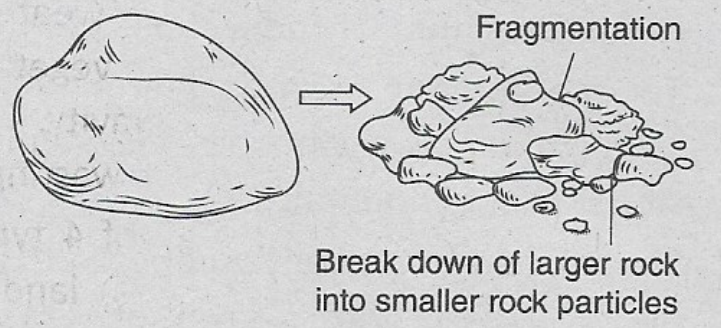
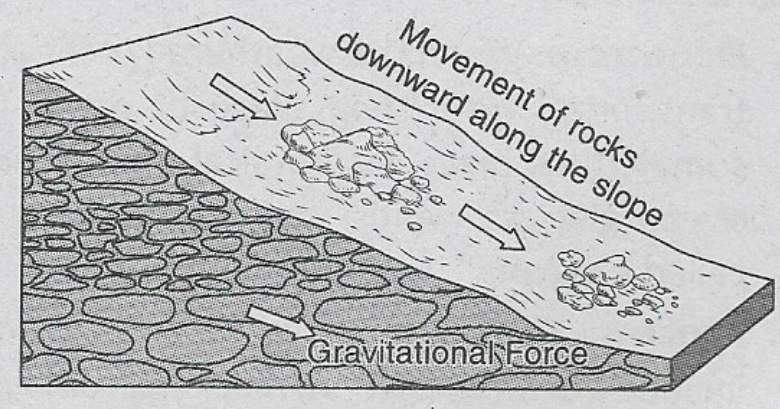
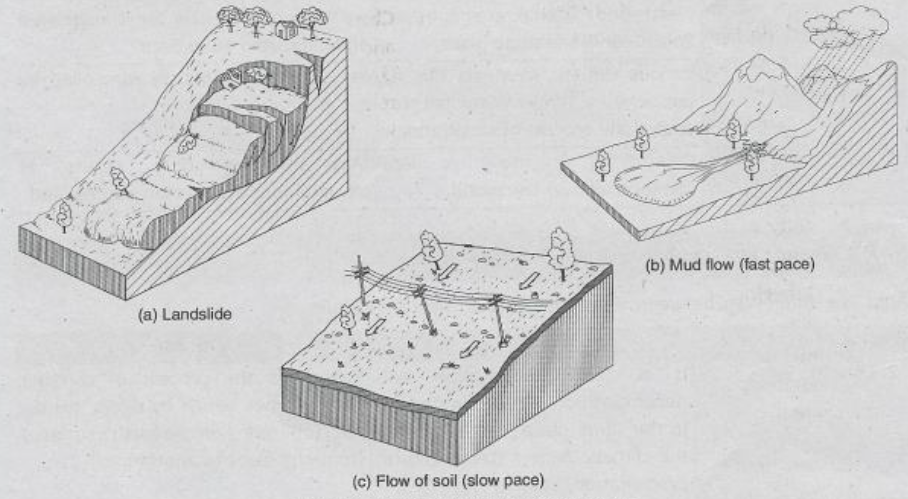
Without the effect of external or internal forces, the weathered debris of rocks moves downward along the slope due to the gravitational force and is transported and deposited elsewhere. This process is known as mass wasting.

Read and Learn Also WBBSE Class 9 Geography And Environment Notes

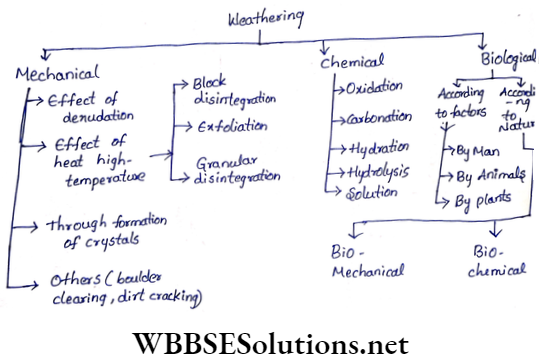
Mechanical weathering occurs in hot desert areas, polar regions, and high mountain regions.

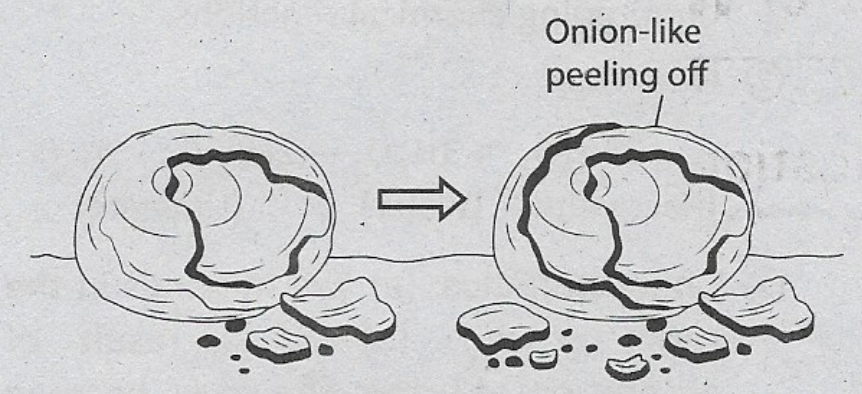
Exfoliation occurs in homogeneous rocks like granite.

Block disintegration is seen more in basalt.

Granular disintegration is prevalent more in heterogeneous rocks, i.e. rocks formed of various minerals.

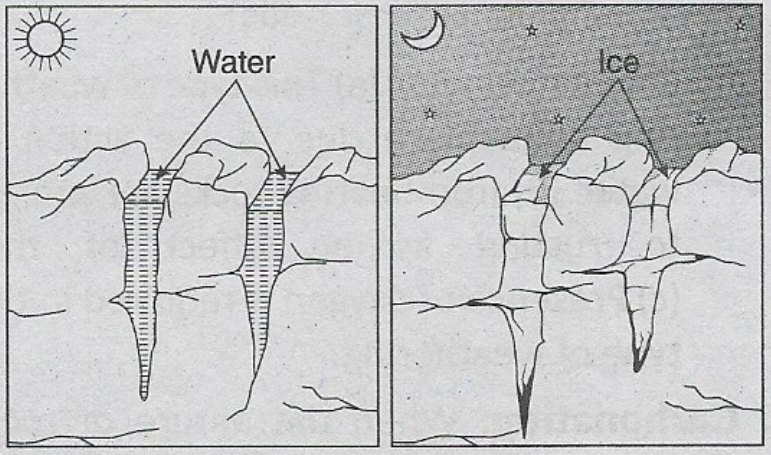
The formation of ice crystals is observed more along the foothills of the mountains in cold temperate climatic regions.

Chemical weathering is more active in equatorial and humid-tropical climatic regions.

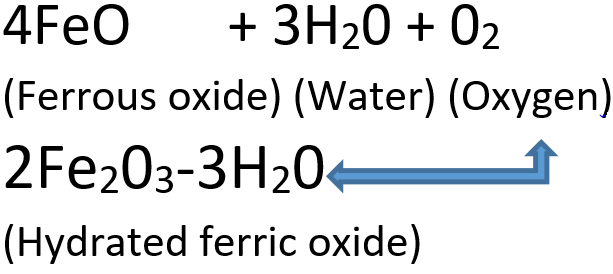
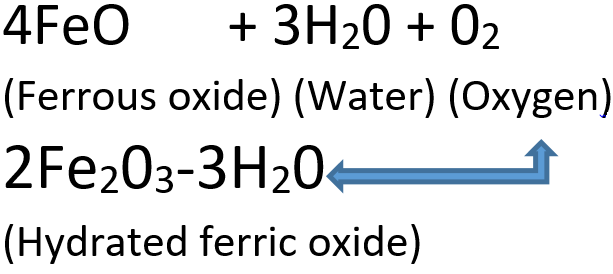
Water and atmospheric oxygen react with the iron-containing rocks and lead to the formation of rust on them. This process is known as oxidation.

Weathering Notes For Class 9 WBBSE Geography

The process of solution is more active in rocks like chalk, limestone, dolomite, etc.

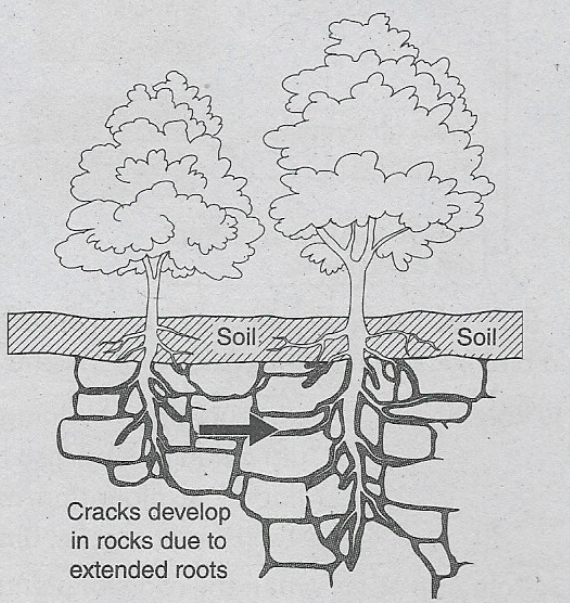
  • Biological weathering is caused by various plants and animals.
  • The fragmented rock waste creating a loose covering on the Earth’s surface due to weathering is called regolith.
  • The process of soil formation from rock debris is called pedogenesis.
  • The smallest particles in the process of soil formation are called the ped.
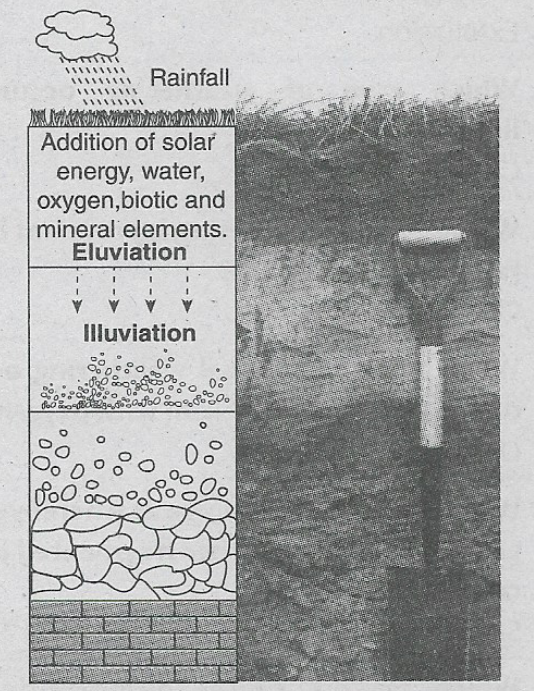
  • Minerals in the upper layers of the soil mix with rainwater and move downwards. This is called leaching and the process is called eluviation. The process of accumulation of these particles in the lower layers is called illuviation.

Humus is a deep black-colored complex matter, formed due to the decomposition of organic matter. Over a long period, soil develops as a result of the mixing of rock wastes, humus, and water.

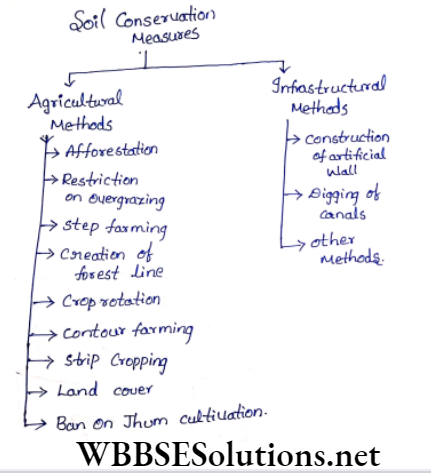
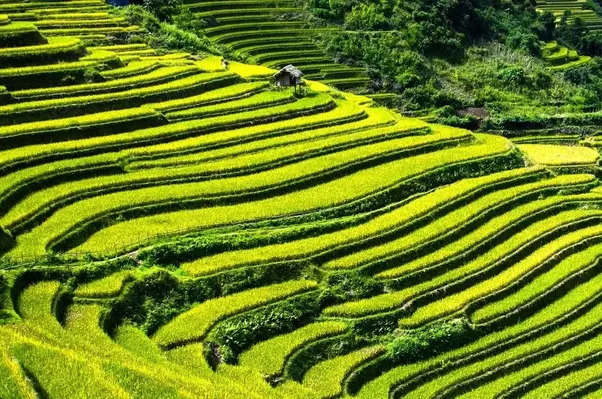
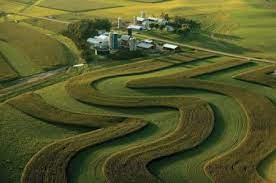
Terrace farming, contour farming, and strip cropping prevent soil erosion on the slopes of the mountains.

NEET Biology Class 9 Question And Answers WBBSE Class 9 History Notes WBBSE Solutions for Class 9 Life Science and Environment
WBBSE Class 9 Geography And Environment Notes WBBSE Class 9 History Multiple Choice Questions WBBSE Class 9 Life Science Long Answer Questions
WBBSE Solutions for Class 9 Geography And Environment WBBSE Class 9 History Long Answer Questions WBBSE Class 9 Life Science Multiple Choice Questions
WBBSE Class 9 Geography And Environment Multiple Choice Questions WBBSE Class 9 History Short Answer Questions WBBSE Solutions For Class 9 Maths
WBBSE Solutions for Class 9 History WBBSE Class 9 History Very Short Answer Questions WBBSE Solutions for Class 9 Physical Science and Environment

The process of preventing soil erosion by covering it with a layer of roots of crops, twigs, tendrils, and specks of dust is called mulching.

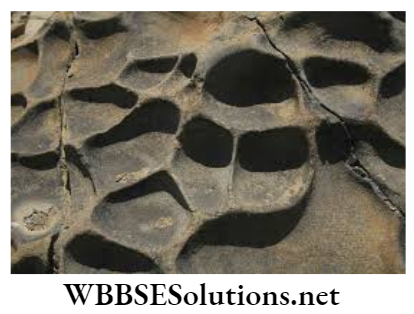
  • Due to changes in temperature and humidity, increase or decrease of pressure on rocks, etc., surface rocks get disintegrated by mechanical action. This process is called mechanical weathering.
  • Physical change or change of shape in the. rocks are seen in mechanical weathering but there is no change in the chemical composition or character of the rock-forming minerals.
  • The process of granular disintegration causes noises like gunshots.
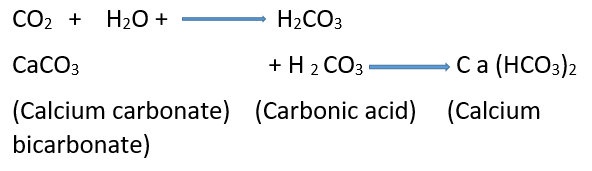
  • Carbonic acid (H2CO3) plays an important role in the carbonation process,
  • The various methods of soil conservation maintain the quality of soil and prevent soil erosion.
  • Various natural causes of soil erosion are rainfall, winds, sea waves, glaciers, etc,. and human activities responsible for soil erosion are deforestation, unplanned urbanization, the extension of the transportation network, unscientific settlement, etc.

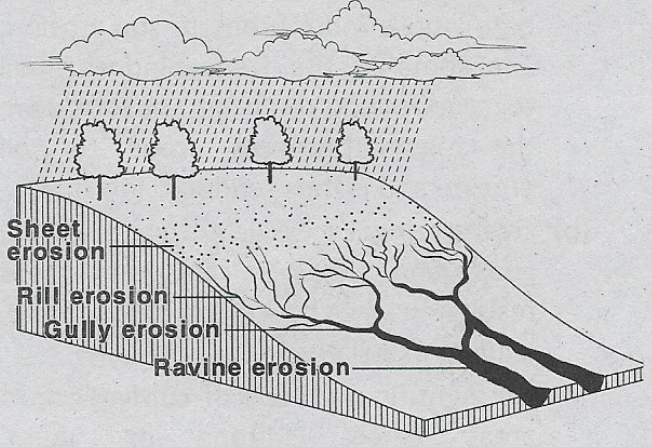
The processes of soil erosion due to stream action are sheet erosion, rill erosion, gully erosion, and ravine erosion.

WBBSE Class 9 Geography And Environment Chapter 4 Geomorphic Process And Landforms Of The Earth Notes

WBBSE Chapter 4 Geomorphic Process And Landforms Of The Earth’s Introduction

The processes that build various new landforms and deform the shapes of landforms are called geomorphic processes or land-building processes

Geomorphic processes are of two types. These are- the terrestrial process and 2 extra-terrestrial processes.

Terrestrial processes are of two types- endogenic or endogenetic processes and 2 exogenic or exogenetic processes.

Endogenic processes are further divided into two divisions- diastrophism movement and 2 sudden movements.

The diastrophic process acts slowly over a long period, It can be of three types- geotectonic movement,2 isostatic movements,s, and 3 eustatic movements.

Geotectonic movements are further subdivided into two groups- Orogenic movement: This movement works almost horizontally or tangentially with the surface. Epeirogenic movement: This movement works vertically with the surface or along the radius of the Earth.

The word ‘petrogenic’ has been derived from the Greek word ‘repairs’ meaning continent and the word ‘orogeny’ has been derived from the Greek word ‘oros’ meaning mountain.

Read and Learn Also WBBSE Class 9 Geography And Environment Notes

The process of worldwide simultaneous change of water-holding capacity of the ocean basin due to the rise or fall of the sea level is called eustatic movement.

The tectonic process that helps to maintain elevational balance among various landforms is called isostatic movement.

Sudden movements occur very rapidly due to sudden endogenic forces that originate within the Earth’s interior. Examples of sudden movements are volcanic eruptions and earthquakes.

Processes that operate on the Earth’s surface are known as exogenetic processes. These processes are divided into three divisions- degradation, aggradation, and mass wasting.

The process which is involved with the decrease of elevation of landforms by erosion is called degradation.

The process which is involved with the upliftment or increase of elevation of landforms by deposition is called aggradation.

Gradation is a process of reaching the equilibrium of altitude differences (i.e. level land) through the process of degradation and aggradation.

Without any medium of erosion disintegrated or loose rock materials move downward along the slope of any sloping land due to gravitational force. This process is known as mass wasting.

WBBSE Class 9 Geography And Environment Chapter 4 Geomorphic Process And Landforms Of The Earth Notes

Extraterrestrial materials are those which originate in outér space. When extraterrestrial materials like comets and meteors strike the Earth’s surface, it causes a change in the shape of the Earth’s surface. This process is known as the extraterrestrial process.

According to the order of relief, landforms can be divided into three types. The first order of relief continent is the ocean. O Second order of relief-mountain, plateau, plain. Third order of relief-erosional and depositional landforms.

Based on the origin, landforms are divided into three groups-mountain, 2 plateaus, and 3 plains.

Rocky regions that extend over vast areas, with an average height of more than 1000 m above sea level, and have peaks are called mountains.

Fold mountains are mainly composed of sedimentary rocks.

NEET Biology Class 9 Question And Answers WBBSE Class 9 History Notes WBBSE Solutions for Class 9 Life Science and Environment
WBBSE Class 9 Geography And Environment Notes WBBSE Class 9 History Multiple Choice Questions WBBSE Class 9 Life Science Long Answer Questions
WBBSE Solutions for Class 9 Geography And Environment WBBSE Class 9 History Long Answer Questions WBBSE Class 9 Life Science Multiple Choice Questions
WBBSE Class 9 Geography And Environment Multiple Choice Questions WBBSE Class 9 History Short Answer Questions WBBSE Solutions For Class 9 Maths
WBBSE Solutions for Class 9 History WBBSE Class 9 History Very Short Answer Questions WBBSE Solutions for Class 9 Physical Science and Environment


WBBSE Class 9 Geography Chapter 4 Geomorphic Processes Notes

The highest mountain in the Himalayas; the Longest mountain in the world; the Oldest mountain in the world of India, the Ural of Russia, the Great Dividing Range of Australia, the Appalachian mountain of the USA, the Caledonian mountain, etc.

The term ‘plate’ was first used by Canadian geophysicist J Tuzo Wilson.

French scientist Xavier Le Pichon (1968) is called the ‘Father of Plate Tectonic Theory’.

According to the plate tectonic theory, fold mountains are developed along the convergent plate boundary.

Fold mountains are formed by the collision of two plates- The formation of the Himalayan mountain by the collision of Eurasian and Indian plates, and 2 Formation of the Alps mountain by the collision of Eurasian and African plates. Formation of Rocky Mountain by the collision of the North American plate and Pacific Ocean plate. Formation of Andes mountain by the collision of Nazca plate and South American plate.

A cordillera is an extensive chain of mountains or mountain ranges. A belt or group of parallel mountain ranges is known as a cordillera. Example-Rockies, Andes.

  • Barren is the only active volcano in India and Narcondam is a dormant volcano of India.
  • The highest volcano in the world is Mauna Loa Volcano (9,750 m) on Hawaii Island.
  • The Katmai Volcano of Alaska is known as the Valley of Ten Thousand Smokes.
  • Fujiyama of Japan and Krakatoa of Indonesia are examples of dormant volcanoes.
  • Popa of Myanmar is an extinct volcano.
  • In certain places in the mantle, the temperature remains relatively higher than normal conditions due to the presence of radioactive materials and convection currents. These are called hotspots. Tibesti Mountain is located on the top of such a hotspot.
  • Due to excessive heat, an upwelling current of magma originates from the hotspots. It is known as a plume.
  • Most of the world’s active volcanoes are situated along the margin of the Pacific Oceanic Plate; thus together these volcanoes are called the Pacific Ring of Fire.
  • When a block of the landmass is uplifted along a fault as a result of epeirogenic movement, it forms a flat-topped hill called block mountain.

When a block of landmass subsides along two faults as a result of epeirogenic movements, it forms a subsided block known as a rift valley or graben.

  • The longest rift valley in the world is the Great Rift Valley (4800 km long) in East Africa.
  • Another name for the residual mountain is a relict mountain.
  • The residual mountains of India are Aravalli, Mahakal, Mahadev, etc.
  • Table like landform which lies around 300 meters above sea level and has an almost flat top with a steep slope, is called a plateau.
  • The highest plateau of India is the Ladakh plateau.
  • Largest plateau of India is Deccan plateau.
  • The continental plateau is also called the shield plateau.
  • The stable interior portion of the Earth’s surface is called a craton.

Some important continental plateaus are the Colorado Plateau of the USA, the Africa Plateau, the Canadian Shield, the Greenland Plateau, the Australian Plateau, etc.

  • The largest intermontane plateau in the world is the Tibetan Plateau.
  • The highest plateau in the world is Pamir. It is also known as the Roof of the Earth.
  • Examples of dissected plateaus of India are the Chota Nagpur, Bundelkhand, and Baghelkhand Plateau.
  • The Deccan Plateau is an example of a lava plateau. It is composed of alkaline rock like basalt.
  • A large expanse of land, having gentle undulations, at sea level or a slightly higher altitude (less than 300 m), is called a plain.
  • The largest plain of India is the North Indian Plain which has been formed by the silt of the Ganga-Brahmaputra-Indus River.
  • Turan lowland is an example of a subdued plain.
  • Siberian Plain is the largest plain in the world.
  • The delta plain between the Ganga and the Brahmaputra is the largest deltaic plain in the world.
  • The flat plains formed over the eroded uneven topography by the continental ice sheets are called glacial plains.

WBBSE Class 9 Geography And Environment Chapter 3 Determination Of Location Of A Place Of The Earth’s Surface Notes

WBBSE Chapter 3 Determination Of Location Of A Place Of The Earth’s Surface Introduction

In ancient times, by observing the position of the star in the night sky, the latitude was determined. In the northern hemisphere, latitude can be accurately determined with the help of the Pole Star.

During the daytime, the latitude of a place can be determined by the angle of inclination of the Sun,

In the night sky of the southern hemisphere, latitude can be determined by the angle of inclination of Hadley’s Octant.

Read and Learn Also WBBSE Class 9 Geography And Environment Notes

Latitude is the angular distance of a place either north or south of the Equator on the equatorial plane.

Nowadays, latitudes are determined with the help of Sextant, Transit theodolite, etc. ‘

The lowest and highest values of latitude are 0° and 90° respectively.

Parallels of latitude are the imaginary lines drawn on the maps and globes, that join all the places having the same latitudinal value.

WBBSE Class 9 Determination of Location Notes

Parallels of latitude are extended in an east-west direction. Amongst them, the circumference of the Equator is the largest. Circumference of latitudes decreases with distance from the Equator to the Poles. The total number of parallels at an interval of 1° is 179 to the north and south of the Equator.

Important parallels are the Equator (0°), Tropic of Cancer 23½ºN, Tropic of Capricorn 23½ºS, Arctic Circle 66½ºN and Antarctic Circle 66½ºS.

The distance between the 1° latitudinal interval on the Earth’s surface is about 111 km or 69 miles.

The climate on the Earth’s surface changes with the change of parallels of latitude. Based on climate change, the Earth is divided into 3 heat belts. They are the Torrid zone, the Temperate zone, and the Frigid zone.

Determination Of Location Of A Place Class 9 WBBSE Summary

The angular distance of a place east or west of the Prime Meridian, which is measured in degrees, minutes, and seconds is known as longitude.

The longitude of the Prime Meridian is 0° and the angular distance of other meridians is imagined to the east as well as to the west of the Prime Meridian upto 180°.

Places with the same longitudinal value are joined by semi-circular lines imagined from the North Pole to the South Pole. Such lines are known as Meridians.

The Prime Meridian (0°) and the 180° meridian, which is the exact opposite side of it, together make a full circle, that divides the Earth into two halves. The eastern half is known as the eastern hemisphere and the western half is the western hemisphere.

All the meridians are equal in length, but not parallel to each other. This is because all meridians meet at the Poles.

WBBSE Class 9 Geography And Environment Chapter 3 Determination Of Location Of A Place Of The Earth's Surface Notes

Understanding Geographic Coordinates for NEET

There is a 4-minute time difference for a 1° longitudinal difference.

Considering the maximum inclination of the Sun on a longitude passing through a place as noon, the time of that place throughout the day is calculated. This specific time of that place is called its local time.

More than one local time is observed in countries with great east-west extension. Therefore, to avoid multiple local times, a meridian is chosen passing through the central position of the country to calculate the standard time of the whole country.

The Indian Standard Time (IST) is calculated based on the meridian (82°30’E) that extends through Mirzapur of Allahabad.

Greenwich Mean Time (GMT) is determined according to the Prime Meridian (0°) passing through Greenwich. The time of the whole Earth is determined as per Greenwich Mean Time.

The time from midnight to noon of the next day is called ante meridian or am. The time from noon to midnight is called post meridian or pm.

NEET Biology Class 9 Question And Answers WBBSE Class 9 History Notes WBBSE Solutions for Class 9 Life Science and Environment
WBBSE Class 9 Geography And Environment Notes WBBSE Class 9 History Multiple Choice Questions WBBSE Class 9 Life Science Long Answer Questions
WBBSE Solutions for Class 9 Geography And Environment WBBSE Class 9 History Long Answer Questions WBBSE Class 9 Life Science Multiple Choice Questions
WBBSE Class 9 Geography And Environment Multiple Choice Questions WBBSE Class 9 History Short Answer Questions WBBSE Solutions For Class 9 Maths
WBBSE Solutions for Class 9 History WBBSE Class 9 History Very Short Answer Questions WBBSE Solutions for Class 9 Physical Science and Environment


Key Terms Related to Location Determination for Class 9

If the center of a circle is drawn on the surface of the Earth and the center of the Earth lies at the same point, then the circle is called the Great Circle.

Parallels of latitude and meridians of longitude intersect each other and form a network, that is called Earth’s grid.

There are two ends of any diameter of the spherical Earth, where one end is the antipode to the other.

A place and its antipode always lie in opposite hemispheres. This is why the difference in longitude and local time between these two places is 180° and 12 hours respectively.

The International Date Line has been imagined through the middle of the Pacific Ocean roughly following the 180° meridian.

The Latitudes and longitudes are measured in degrees(), minutes(‘), and seconds(“). Time is calculated in hours (hrs), minutes (mins), and seconds (secs).

For every 1° longitudinal difference, the time difference is 4 minutes. For every 1′, longitudinal difference, the time difference is 4 seconds.

Concerning the measurement of latitude and longitude: 1°= 60′ and 1′ = 60″.Concerning time calculation: 1h = 60m and 1m = 60s.

GMT refers to Greenwich Mean Time (0° meridian) and IST refers to Indian Standard Time (82½º E meridian).

We move ahead in time as we move from east to west.

While calculating total time, if the time required to deliver a message is mentioned, that time is to be added at the end. On the other hand, while calculating longitude, that extra time is to be subtracted from the total time.

Steps to calculate time based on longitudinal difference—

The first step is to find out the longitudinal difference between the two given places. If both the places are located in the same hemisphere, then the longitude with a smaller value is to be subtracted from the longitude with a larger value. If both the places are located in different hemispheres, then the value of both longitudes is to be added.

The next step is to find out the time difference referring to the fact that, for every 1° longitudinal difference, the time difference is 4 minutes.

The position of the longitude whose time is to be calculated is to be found out concerning the other longitude.

If the place, for which time needs to be determined is to the east, the difference in time is to be added. On the other hand, if the place, for which time needs to be determined, is to the west, the difference in time is to be subtracted.

Steps to calculate longitude based on the time difference—

The first step is to find out the difference in time between the two given places.

The next step is to find out the longitudinal difference by dividing the value of the time difference by 4.

If the time of the place, whose longitude is to be determined, is ahead of that of the other place, then the former is located to the east of the latter. Whereas, if the time of the place, whose longitude is to be determined, is behind that of the other place, then the former is located to the west of the latter.

If the place for which time needs to be determined is in the east, the difference in longitude is to be added and if in the west, the difference in longitude is to be subtracted.

The time difference between a place and its antipode is 12 hours and the longitudinal difference between a place and its antipode is 180°.

WBBSE Class 9 Geography And Environment Chapter 2 Movements Of The Earth Notes

WBBSE Chapter 2 Movements Of The Earth Salient Points Introduction

Every planet in the solar system rotates on its axis and revolves around the Sun.

The speed of rotation of Venus is less than the other planets of the solar system (equal to 243 Earth days).

The main statement of the Geocentric Theory is that the Sun and the planets are moving around the Earth. Although, now this concept has been proved wrong.

According to the Heliocentric Theory, the planets are moving around the Sun.

Read and Learn Also WBBSE Class 9 Geography And Environment Notes

The main proponents of Heliocentric Theory were Nicolaus Copernicus, Galileo, and Kepler.

In 1687, Sir Isaac Newton proved by his law of gravity that the Earth has two. motions-rotation and revolution, which are in action simultaneously.

The average distance of the Earth from the Sun is 150 million km.

Understanding Earth’s Rotation and Revolution

In 1851, Leon Foucault, a French physicist, demonstrated an experiment at Pantheon Church in Paris, France to prove the rotation of the Earth.

The speed of the Earth’s rotation is different at the different latitudes, 1675 km/hr at the Equator, 1533 km/hr at the Tropic of Cancer and Capricorn, 666 km/hr at both the Arctic and Antarctic Circle, and 0 km/ hr at the two Poles.

In 1835, GD Coriolis, a French mathematician first proved that the rotation of the Earth is responsible for the generation of a centrifugal force which is known as the Coriolis force.

WBBSE Class 9 Geography And Environment Chapter 2 Movements Of The Earth Notes

WBBSE Class 9 Movements of the Earth Notes

Under the influence of centrifugal force due to the rotation of the Earth, the ocean currents and planetary winds deflect from their direction in both hemispheres, which is known as Ferrel’s law.

The circumference of the Earth’s orbit is 960 million km.

The axis of the Earth is an imaginary line. that joins the North and the South Poles and passes through the center of the Earth.

The Earth’s axis remains permanently tilted at an angle of 66 to the Earth’s orbital plane.

NEET Biology Class 9 Question And Answers WBBSE Class 9 History Notes WBBSE Solutions for Class 9 Life Science and Environment
WBBSE Class 9 Geography And Environment Notes WBBSE Class 9 History Multiple Choice Questions WBBSE Class 9 Life Science Long Answer Questions
WBBSE Solutions for Class 9 Geography And Environment WBBSE Class 9 History Long Answer Questions WBBSE Class 9 Life Science Multiple Choice Questions
WBBSE Class 9 Geography And Environment Multiple Choice Questions WBBSE Class 9 History Short Answer Questions WBBSE Solutions For Class 9 Maths
WBBSE Solutions for Class 9 History WBBSE Class 9 History Very Short Answer Questions WBBSE Solutions for Class 9 Physical Science and Environment

Movements Of The Earth Class 9 WBBSE Geography Summary

The phenomenon of equal lengths of day and night all over the Earth is called equinox. The days and nights are of equal duration everywhere on Earth on 21 March and 23 September. These days are called vernal equinox in the northern hemisphere and autumnal equinox in the southern hemisphere respectively.

On 21 June, sunrays fall vertically over the Tropic of Cancer, and the day is called the summer solstice.

On 22 December, sunrays fall vertically over the Tropic of Capricorn, and the day is called the winter solstice.

The average velocity of the Earth’s revolution is 30km/sec.

Key Terms Related to Earth’s Movements for Class 9

Aurora in the north polar region and the south polar region is known as Aurora Borealis and Aurora Australis respectively.

The Earth is farthest from the Sun (approximately 152 million km) on July 4. This phenomenon is called Aphelion.

The Earth is closest to the Sun (approximately 147 million km) on January 3. This phenomenon is called Perihelion. Movements of the Earth

The apparent movements of the Sun are of two types, namely Apparent diurnal movement and 2 Apparent annual movements of the Sun.

Every day, we get to see the Sun rises in the east and set in the west. This is called the apparent diurnal movement of the Sun.

All through the year, it seems that the Sun moves between the Tropic of Cancer and the Tropic of Capricorn. This is known as the apparent annual movement of the Sun.

The apparent path of the Sun throughout the year is known as the ecliptic.

WBBSE Class 9 Geography And Environment Chapter 1 Earth As A Planet Notes

WBBSE Chapter 1 Earth As A Planet Salient Points Introduction

In ancient times, people thought that the Earth was flat and in Greek civilisation people considered that the Earth was flat and rounded as a disc.

According to Greek scholar Anaximander, the Earth was a floating disc in the ocean surrounded by a round sky.

The Portuguese globetrotter Ferdinand Magellan provided the first direct evidence in favour of the concept that ‘the Earth is round’.

Earth appears blue from space because water bodies cover 71% of the Earth’s surface.

Read and Learn Also WBBSE Class 9 Geography And Environment Notes

Greek philosopher, Aristotle stated the concept of the Earth being a sphere by observing the relative position of the stars and the shadow of the Earth that falls on the Moon during a lunar eclipse.

To prove the spherical shape of the Earth, the Bedford Level experiment was conducted in 1870.

The boundary where the sky seems to meet the ground or the sea is known as the horizon.

A spherical object flattened at the top and bottom (north-south) and bulged out at the middle or centre (east-west) is an oblate spheroid.

WBBSE Class 9 Geography And Environment Chapter 1 Earth As A Planet Notes

WBBSE Class 9 Earth as a Planet Notes

The equatorial and polar diameters of the Earth are 12757km and 12714km respectively.

On the Earth’s surface, the gravitational force is lowest at the Equator and maximum at the Poles.

Scientist Henry Cavendish first determined the Earth’s weight.

Geoid means—like the Earth or the shape of the Earth is like the Earth itself.

Key Terms Related to Earth in Geography

Johann Benedict Listing was the first person to use the word ‘geoid’.

The Science related to measuring the shape of the Earth is called Geodesy.

IAU (International Astronomical Union) listed Pluto as a dwarf planet in 2006.

In ancient days, the distance measurement unit used in Greece was called stadia. 1 stadia = 185 metres.

NEET Biology Class 9 Question And Answers WBBSE Class 9 History Notes WBBSE Solutions for Class 9 Life Science and Environment
WBBSE Class 9 Geography And Environment Notes WBBSE Class 9 History Multiple Choice Questions WBBSE Class 9 Life Science Long Answer Questions
WBBSE Solutions for Class 9 Geography And Environment WBBSE Class 9 History Long Answer Questions WBBSE Class 9 Life Science Multiple Choice Questions
WBBSE Class 9 Geography And Environment Multiple Choice Questions WBBSE Class 9 History Short Answer Questions WBBSE Solutions For Class 9 Maths
WBBSE Solutions for Class 9 History WBBSE Class 9 History Very Short Answer Questions WBBSE Solutions for Class 9 Physical Science and Environment

Earth As A Planet Class 9 WBBSE Geography Summary

The Pole Star’s angle of elevation is 90° at the North Pole and 0° at the Equator i.e. the Pole Star is visible at the horizon in the Equator.

The light of the Sun takes 8.2 minutes to reach the Earth.

The area of the Earth’s surface is about 510 million sq. km.

The actual circumference of the Earth is about 40075km.

Examples of Earth’s Habitable Conditions

The South Pole of the Earth is about 20 m flat.

The average temperature of the Earth is about 15°C.

The average density of the Earth is 5.515 grams/cubic centimetre.

The full form of GPS is the Global Positioning System. GPS helps to know the exact or correct location of any place on the Earth’s surface.

WBBSE Solutions For Class 9 Geography And Environment Chapter 3 Determination Of Location Of A Place Of The Earth’s Surface

WBBSE Chapter 3 Determination Of Location Of A Place Of The Earth’s Surface Long Answer Questions

Question 1. What is meant by parallels of latitude? Discuss their properties and their uses.
Answer: Parallels of latitude: The imaginary lines drawn around the Earth parallel to the Equator are known as the parallels of latitude. These lines join all the places with the same latitudinal value.

Read and Learn Also WBBSE Solutions for Class 9 Geography And Environment

Properties and uses of the parallels of latitude: The properties and uses of the parallels of latitude are as follows- Determination of Location of a Place on the Earth’s Surface

Properties: The properties of the parallels of latitude are-

The parallels of latitude are full circles and parallel to each other.

As the value of the latitudes increases, the circumference of the parallels of latitude gradually decreases. At the Poles, the parallels of latitude appear to be dotted.

All places on the same parallel of latitude have the same latitudinal value. Solar incidence changes with changing latitude. Accordingly, the climatic characteristics of the places also vary. The local times of various places lying on the same latitude are different based on their longitudinal value.

Uses: The uses of the parallels of latitude are- The north-south position of a place can be determined by using the Equator and the other latitudes as standards of measurement. The parallels of latitude are often used as the boundary of a country or a state. For instance, the 45° N parallel forms an approximate border between Quebec (Canada), and the states of New York and Vermont in the USA. The Earth can be divided into different heat zones (Torrid zone, Temperate zone, and Frigid zone) based on the parallels of latitude.

WBBSE Solutions For Class 9 Geography And Environment Chapter 3 Surface Parallels Of Latitude

Question 2. How can you determine the latitude of a place geometrically? How can the latitude of a place in the northern hemisphere be determined using the elevation of the Pole Star?
Answer: Geometric determination of the latitude of a place:

In the given picture, B denotes the Earth’s center, DC the Equator, A the North Pole, and P the Pole Star. N is a place in the northern hemisphere with MO as its horizon. Moreover, BQ is perpendicular to MO. As the Pole Star is located vertically above the North Pole, it will be visible at P’ position from N. Consequently, the angle of elevation of the North Star, as visible from N, would be ZMNP’ and the latitudinal degree of N would be <NBC.

WBBSE Solutions For Class 9 Geography And Environment Chapter 3 Surface Geometric Determination Of Latitude

Now <MNP’+<QNP’= a right and <PBN + < NBC= a right angle

Therefore, ZPBN + ZNBC = <MNP’ + ZQNP’

Moreover, since BP and NP’ are parallel to each other, ZPBN = ZQNP’ Hence, NBC = ZMNP’ [since 90° <PBN = 90° – <QNP’]

Therefore, the angle of elevation of the Pole Star, as visible from N = the latitudinal degree of N.

NEET Biology Class 9 Question And Answers WBBSE Class 9 History Notes WBBSE Solutions for Class 9 Life Science and Environment
WBBSE Class 9 Geography And Environment Notes WBBSE Class 9 History Multiple Choice Questions WBBSE Class 9 Life Science Long Answer Questions
WBBSE Solutions for Class 9 Geography And Environment WBBSE Class 9 History Long Answer Questions WBBSE Class 9 Life Science Multiple Choice Questions
WBBSE Class 9 Geography And Environment Multiple Choice Questions WBBSE Class 9 History Short Answer Questions WBBSE Solutions For Class 9 Maths
WBBSE Solutions for Class 9 History WBBSE Class 9 History Very Short Answer Questions WBBSE Solutions for Class 9 Physical Science and Environment


Determination Of Location Of A Place On Earth’s Surface WBBSE

1. Using the elevation of the Pole Star to determine the latitude of a place in the northern hemisphere:

In an open place poles, one taller than the other, are fixed. The smaller pole is fixed south of the taller one in such a way that the taller pole is to its north and the Pole Star as visible in the sky, are all in a straight line[Diagram (a)]. Now, after measuring the exact distance between the poles, on white paper, the poles need to be drawn to the scale.[Diagram (b)].

Therefore, YR and ZS are the two poles, with RS being the distance between them. Now, Y and Z are joined, and simultaneously, SR is extended so that these two meet at point D and form an angle <ZDS. Hence, <YDR is the angle of elevation of the Pole Star and also the latitudinal degree. So, if the,<YDR is measured with the help of a protractor, the latitude of the place can be determined.

WBBSE Solutions For Class 9 Geography And Environment Chapter 3 Elevation Of The Pole Star To Determine The Latitude Of A Place

Question 3. Why is it necessary to determine the location of a place?
Answer: Necessity of determining the location of a place: It is necessary to determine the location of a place, because-

To find the exact position: It helps us to find the exact position of a country, a state, a city, a mountain, or any other place on the Earth’s surface.

To find the distance: It helps to find the distance between any two or more objects and places.

For geographical research and study: The location of a place helps us to understand the explanation of any geographical research and study.

To know climatic character: The climatic characteristics of a place can be known more or less if the location of the place is known.

For disaster management: Determination of location is necessary for relief and rescue management in various disasters.

For transport and navigation: It is necessary to know the location of a place for water transport or navigation and to access resources of particular places.

For defense purposes: It helps to know the location of the enemy for defense or military purposes and helps to launch counter-attacks.

To demarcate boundaries: Determination of the location is necessary to demarcate political boundaries.

For development planning: The location of a place also helps us to assign proper development plans for backward regions.

Question 4. How can the Earth be divided into various heat zones?
Answer:  Heat zone: The Earth is divided into three heat zones based on the angle at which the sunrays fall. These are as follows-

1. Torrid zone: This zone extends from the Equator (0°) to the Tropic of Cancer (23½º N) in the North and to the Tropic of Capricorn (23½º S) in the South. Sunrays fall vertically on this region throughout the year. Some important countries that fall under this zone are Brazil, Venezuela, Nigeria, Kenya, Ghana, Malaysia, Indonesia, England, etc.

WBBSE Solutions For Class 9 Geography And Environment Chapter 3 Heats zones

2. Temperate zone:
This zone extends from the Tropics (231⁄2° N and S) to the Arctic and Antarctic Circles (66%1⁄2° N and S). This zone experiences moderate heat throughout the year because the sun’s rays do not fall directly on this zone. Some countries that come under this zone are- the United States of America, Chile, France, South Africa, New Zealand, England, Canada, Japan, Germany, Italy, and several others.

3. Frigid zone: This zone extends from the Arctic and Antarctic Circles (66½° N and S) to the Poles (90½° N and S). The frigid zone is the coldest region of the Earth because this region lies farthest from the Equator and receives a very low amount of sun rays. Throughout the year. Some regions that fall under this zone are Antarctica, Siberia, Alaska, Greenland, northern Canada, Norway, and the northern parts of Sweden.

Question 5. According to the local time is 4.30 pm. If it is noon at the place named P then, what is the longitude of that place?
Answer:

Determination of the longitude of the place named P:

WBBSE Solutions For Class 9 Geography And Environment Chapter 3 Longitude Placed Named By P

The time difference between Greenwich and P is

(16:30 – 12:00) hrs = 4 hrs 30 mins For a 1-hour time difference, the longitudinal difference is 15°

∴ For a 4-hour time difference, the longitudinal difference is 15 x 4 = 60°

Again for 4 minute time difference, the longitudinal difference is 1°

For a 1-minute time difference, the longitudinal difference is -¼º

For 30 30-minute time difference, the longitudinal difference is 30º/4 = 7.5° = 7°30′

Therefore Total longitudinal difference is 60° + 7°30′ = 67° 30’

As the local time of P is behind that of Greenwich, that means, the place P must lie to the west of Greenwich. So, the longitude of P is 67°30′ W.

Question 6. The local time of places A and B are 6 am and 6 pm respectively. Determine the longitude of A and B if the Greenwich Time is noon.
Answer:

Determination of the longitude of the places named A and B:
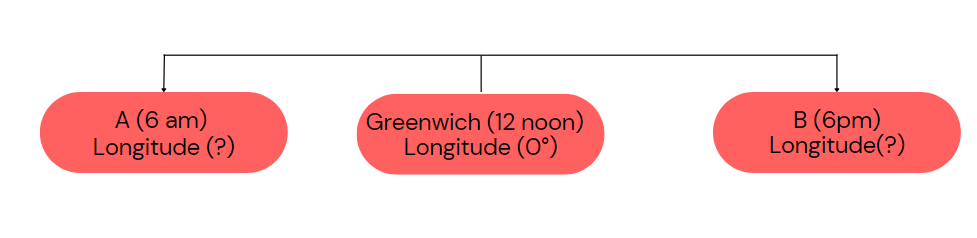
WBBSE Solutions For Class 9 Geography And Environment Chapter 3 Determination Of Location Of A Place Of The Earth's Surface longitude placed named by b

The time difference between Greenwich and place A is (12 hrs – 6 hrs) = 6 hrs.

Now, for a 1-hour time difference, the longitudinal difference is 15°

For 6hours time difference, longitudinal difference is 15° x 6 = 90°

The longitudinal difference between place A and Greenwich is 90°

As the local time of place, A is behind that of Greenwich, that means place A lies to the west of Greenwich. So, the longitude of place A is 90° W.

Again time difference between Greenwich and place B is (18 hrs or 6 pm -12 hrs) 6 hrs.
Now, for a 1-hour time difference, the longitudinal difference is 15°

For a 6-hour time difference, the longitudinal difference is 15° x 6 = 90°
The longitudinal difference between place B and Greenwich is 90°.

As the local time of place B is ahead of Greenwich local time, that means place B lies to the east Of Greenwich. So, the longitude of place B is 90° E.

The longitude of places A and B are 90° W and 90° E respectively.

Question 7. When it is midday or noon in Greenwich?
Answer:

Determination of the local time of Kolkata:
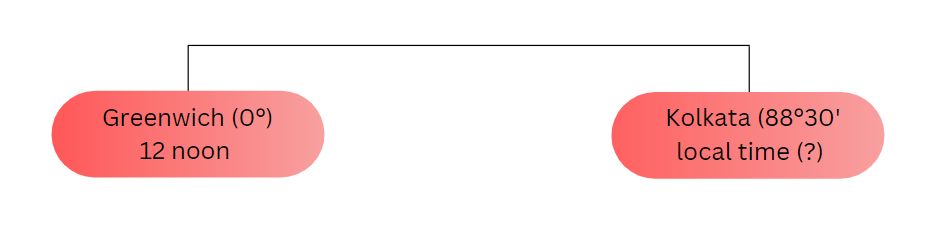
WBBSE Solutions For Class 9 Geography And Environment Chapter 3 Determination Of Location Of A Place Of The Earth's Surface local time of kolkata

The longitudinal difference between Kolkata and Greenwich is 0º and Kolkata is to the east of Greenwich.

Therefore Longitudinal difference between Kolkata and Greenwich is (88°30′-0°) = 88°30′

For a 1° longitudinal difference, the time difference is 4 min

∴ For an 88° longitudinal difference, the time

difference is 88 x 4 = 352 mins = 5 hrs 52 mins

Again, for the V longitudinal difference, the time difference is 4 seconds

Therefore For a 30′ longitudinal difference, the time difference is 30 x 4 = 120 seconds = 2 mins

The total time difference between Greenwich and Kolkata is (5 hr 52 mins + 2 mins) = 5 hrs 54 mins. As Kolkata is to the east of Greenwich, the local time of Kolkata is ahead of Greenwich’s local time.

The local time of Kolkata is (noon + 5 hrs 54 mins) = 17 hrs 54 mins = 5:54 pm.

How To Determine Location On Earth Class 9 WBBSE

Question 8. An important radio broadcast from Olympia (22°23′ East) at 9 am on Monday has to reach Los Angeles (118°17′ West) in the USA. If it takes 15 minutes to send or receive a message, then when will the message arrive in Los Angeles?
Answer:

Message arriving time in Los Angeles:
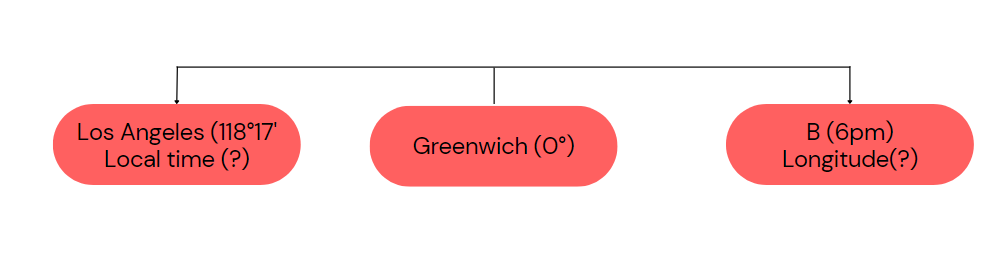
WBBSE Solutions For Class 9 Geography And Environment Chapter 3 Determination Of Location Of A Place Of The Earth's Surface message arriving time in los angeles

Longitudinal difference between Olympia and Los Angeles is(22°23′ + 118° 17′) = 140° 40′

Now, for a 1° longitudinal difference, the time difference is 4 mins

For 140° longitudinal difference, time difference is 140 x 4 mins = 560 mins = 9 hrs 20 mins

Again, for a 1′ longitudinal difference, the time difference is 4 seconds – For a 40′ longitudinal difference time difference is 40 x 4 = 160 seconds = 2 mins 40 secs,

For the 140°40′ longitudinal difference, the time difference is (9 hrs 20 mins + 2 mins 40 secs) = 9 hrs 22 mins 40 secs.

As Los Angeles is located to the west of Olympia, so local time in Los Angeles will be behind that of Olympia.

Therefore, while the local time in Olympia is 9 am, the local time in Los Angeles would be (9 am -9 hrs 22 mins 40 secs)

= (24 hrs + 9 hrs) – 9 hrs 22 mins 40 secs

= 33 hrs – 9 hrs 22 mins 40 secs

= 23 hrs 37 mins 20 secs

= Sunday night 11 hrs 37 mins 20 secs

Now, It takes 15 minutes to send or receive a message.

 The radio news will reach Los Angeles on the previous night at 11 hrs 37 mins 20 secs + 15 mins i.e., on Sunday at 11:52:20 pm.

Question 9. What would be the local time in New York {74° W) and Mumbai (73° E), when it is noon in Greenwich?
Answer:

Local time in New York and Mumbai:
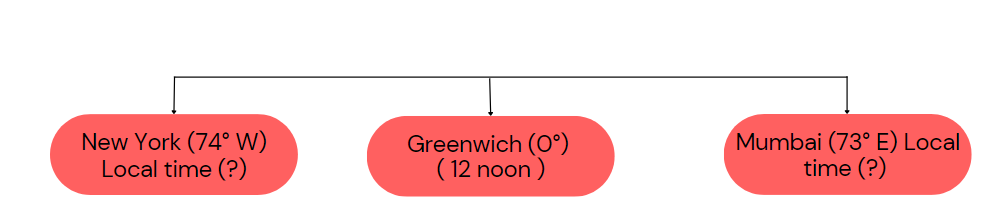
WBBSE Solutions For Class 9 Geography And Environment Chapter 3 Determination Of Location Of A Place Of The Earth's Surface Loacl time in newyork and mumbai

Mumbai and New York are located to the east and west of Greenwich respectively.

The longitudinal difference between Greenwich and New York is (74° -0°) = 74°

Now, for a 1° longitudinal difference, the time difference is 4 mins

For the 74° longitudinal difference, the time difference is (74 x 4) mins = 296 mins = 4 hrs 56 mins As New York is located to the west of Greenwich, so, the local time of New York will be behind that of Greenwich.

When the local time is noon at Greenwich, the local time of New York would be (12 noon – 4 hrs 56 mins) =7:04 am On the other hand, the longitudinal difference between Greenwich and Mumbai is (73°-0°) = 73°

Since For 1° longitudinal difference, the time difference is 4 mins
Therefore the 73° longitudinal difference time difference is 73 x 4 mins = 292 mins = 4 hrs 52 mins As Mumbai is located to the east of Greenwich, the local time at Mumbai would be ahead of Greenwich.

While local time is noon in Greenwich, the local time in Mumbai would be (noon + 4 hrs 52 mins) = 16 hrs 52 mins = 4:52 pm.

While local time is noon in Greenwich, the local time of Mumbai and New York would be 4:52 pm and 7:04 am respectively.

Question 10. The local time of places X and Y are Saturday at 9 pm and Sunday at 3 am respectively. The longitude of X is 90° W. Determine the longitude of Y. 2. What will be the time of 1ST when the Chronometer shows noon?
Answer

1. Determination of the longitude of Y:
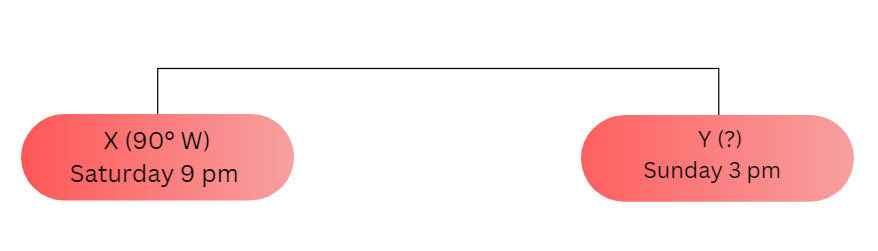
WBBSE Solutions For Class 9 Geography And Environment Chapter 3 Determination Of Location Of A Place Of The Earth's Surface longitude of Y

The local time of places X and Y are Saturday at 9 pm and Sunday at 3 am respectively. Therefore, the difference in local time between X and Y is—

(Saturday 9 pm – Sunday 3 am) i.e., [Saturday (24h – 21h = 3h) + Sunday 3h ] = 6 hrs or 360 mins.

Now, we know that for every 4-minute time difference, the longitudinal difference is 1°.

∴  For 360 the minute time difference, the longitudinal difference will be 360 4÷4 = 90°

Hence, the longitudinal difference between X and Y is 90°.

Since the local time of Y is ahead of the local time of X, this means, Y is located to the east of X.

Therefore, the longitude of Y is (90°W- 90°) = 0°.

Earth’s Surface Location Determination WBBSE Solutions

2. Determination of the time of 1ST:

The Chronometer runs based on Greenwich time. Therefore, if it is noon according to the Chronometer, then it can be said that the time at Greenwich or the Prime Meridian (0°) is also noon. On the other hand, it is also known that the Standard Meridian of India is 82° 30′ E. Hence, the longitudinal difference between the Prime Meridian i.e., the GMT and 1ST is— (82°30’E – 0°) = 82° 30′. Now the time difference. For 82° 30,’ the longitudinal difference will be—

For every 1° longitudinal difference, the time difference experienced is 4 minutes. Therefore, for an 82° longitudinal difference, the time difference will be Therefore, for a 30′ longitudinal difference, the time difference. Will be(30×4) = 120 seconds or 2 minutes.

So, the total time difference between GMT and 1ST becomes (328 + 2) = 330 minutes or 5hrs 30mins.

Since the Standard Meridian of India is located to the east of the Prime Meridian, so 1ST would be ahead of GMT.

Therefore, when it is noon according to GMT, the time according to 1ST would be (12hrs + 5hrs 30mins) =17:30 hours or 5:30 pm.

Question 11. The longitude of places A and B are 20° E and 35°E respectively. What will be the local time of B when it is Sunday at 11 pm at A? A news broadcast at 8 am from Greenwich. What will be the longitude of the place that receives that broadcast at 2:30 pm?
Answer:

1. Determination of the local time of the place B:
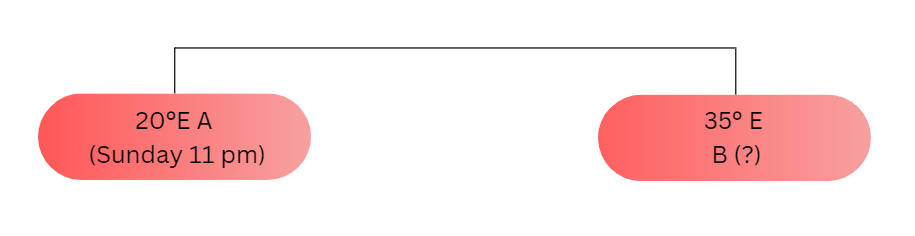
WBBSE Solutions For Class 9 Geography And Environment Chapter 3 Determination Of Location Of A Place Of The Earth's Surface Local time of the palce b

It is known that the longitudes of A and B are 20° E and 35° E respectively.
Hence, the longitudinal difference between A and Bis (35°E-20°E) = 15°.

For every 1° longitudinal difference, the time difference experienced is 4 minutes, Therefore, for a 15° longitudinal difference, the time difference will be (15 x4) = 60 minutes or 1 hour.

Since B is located to the east of A, so the time of B would be ahead of A.
(82 x 4) = 328 minutes.

Therefore, when it is Sunday 11 pm at A, the time at B would be (Sunday 11 pm + LH) i.e., (23hrs+1hrs) = 24hrs or Monday 00:00.

2. Determination of the longitude of the message receiving place:

The news broadcasts at 8 am from Greenwich (0°) and is received at the given place at 2:30 pm. Therefore, the difference in local time between Greenwich and the given place is—
(2:30 pm – 8 am), i.e., (14hrs 30mins – 8hrs) = 6hrs 30mins or 390mins.

Now, for every 4-minute time difference, the longitudinal difference is 1°. Therefore, for a 390mins time difference, the longitudinal difference will be 390÷4 = 97°30′

As per the question, the time of the unknown (message receiving) place is ahead of Greenwich, so the unknown place would be located to the east of Greenwich (0°). Therefore, the longitude of the unknown place would be (0° + 97°30′) = 97°30’E.

Question 12. The captain of a ship notices that the local time at a port, where his ship has just reached, is 7:30 pm. But the Chronometer then shows the time 11:46 pm. What is the longitude of the port where the ship has reached? 2. How can the latitude be determined concerning Hadley’s
Octant?
Answer:

1 Determination of the longitude of the port:
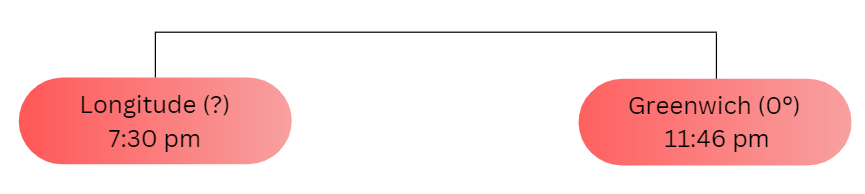
WBBSE Solutions For Class 9 Geography And Environment Chapter 3 Determination Of Location Of A Place Of The Earth's Surface Longitude of the port

The Chronometer runs based on Greenwich time. When the ship reached the port at 11:46 pm according to Greenwich time, the local time of the port was 7:30 pm.

Therefore, the time difference between these two places would be (11:46 pm – 7:30 pm) i.e./ (23hrs 46mins – 19hrs 30mins) = 4hrs 16mins or 256mins.

Now, for every 4-minute time difference, the longitudinal difference is 1°.

Therefore, for a 256 mins time difference, the longitudinal difference will be 256 4÷4 = 64° So, the longitudinal difference between Greenwich and the port is 64°

As it is known that the local time of the port is behind that of Greenwich, the port would be located to the west of Greenwich (0°). Therefore, the longitude of the port would be (64° – 0°) =64° or 64° W

2. Determination of latitude concerning Hadley’s Octant:

Hadley’s Octant is a constellation of stars in the southern sky that is noteworthy as a marking of the geographical South Pole. In ancient times, people used the Pole Star to determine the north and Hadley’s Octant to determine the south. The Hadley’s Octant is visible in the night sky from all places in the southern – hemisphere but its angle of elevation is not the same at all places.

The angle of elevation changes with varying latitudes. The angle of elevation of Hadley’s Octant near the Equator is zero and thus the Equator is measured as 0° latitude. From the Equator, if we move 111.3 km to the south, we reach the 1° S latitude, and the angle of elevation of Hadley’s Octant at 1° S is measured to be 1°. In the same sequence, the angle of elevation of Hadley’s Octant is measured to be 90° or exactly vertical at the South Pole. Therefore, concerning the angle of elevation of Hadley’s Octant from the horizon of a place, the latitude of the place can be easily determined.

Question 13. New York is located at 74° W. What would be the time in New York when it is 11 am in Greenwich? 2. Determine the difference in the local time of a place and its antipodal point.
Answer:

1. Determination of the local time of New York:
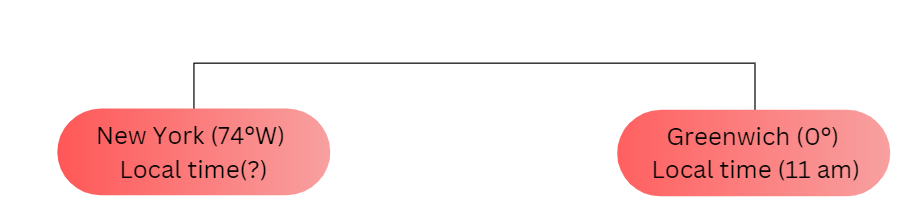
WBBSE Solutions For Class 9 Geography And Environment Chapter 3 Determination Of Location Of A Place Of The Earth's Surface Local time of new york

The longitude of Greenwich is 0°.

Therefore, the longitudinal difference between Greenwich and New York is ( 74° – 0°) = 74°

Now, for the 1° longitudinal difference, the time difference is 4mins.

So, for a 74° longitudinal difference, the time difference will be 74 x 4 = 296 mins or 4hrs 56mins.
As New York is located to the west of Greenwich, the local time of New York will be behind Greenwich time.

Therefore, while it is 11 am at Greenwich, the time in New York would be (l hrs-4hrs 56mins) = 6hrs 04mins or 6:04 am.

2. Determination of the difference in local time of a place and its antipodal point:

The anti-pod of a point is a point on the Earth’s surface that is diametrically opposite to it.

So, the longitudinal difference between these two places is always 180°.

We know, that for a 1° longitudinal difference, the time difference is 4mins.

So, for the 180° longitudinal difference, the time difference will be 180 x 4 = 720mins or 12hrs.

Therefore, the difference in the local time of a place and its antipodal point is 12 hours.

WBBSE Geography Chapter 3

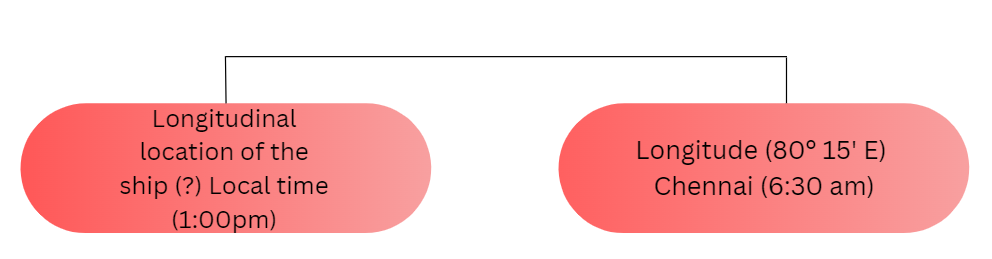
Question 14. When it is 6:30 am in Chennai, the time in New York is 8:13 pm on the previous day. What is the longitude of New York, if the longitude of Chennai is 80° 15′ E? 2. While on a voyage, a captain of a ship notices at 1:00 pm that the time being shown in the Chronometer is 6:30 pm. Which longitude is the ship passing through at that time?
Answer:

1. Determination of the longitude of New York:
WBBSE Solutions For Class 9 Geography And Environment Chapter 3 Determination Of Location Of A Place Of The Earth's Surface Longitude of the place the ship os passing through

When it is 6:30 am in Chennai, the time in New York is 8:13 pm on the previous day. Therefore, the difference in local time between Chennai and New York is (8:13 pm of the previous day 6:30 am) or [(24hrs 20hrs 13mins) + 6hrs 30mins] = 10hrs 17mins or 617mins.

Now, for every 4-minute time difference, the longitudinal difference is 1°.

∴ for a 617mins time difference, the longitudinal difference will be (617+ 4) = 154°15′.
So, the longitudinal difference between New York and Chennai is 154° 15′.

Now, since the local time of New York is behind the local time of Chennai, this implies that New York is located to the west of Chennai.

the longitude of New York is (154°15′-80°15′) = 74° or 74° W.

2. Determination of the longitude of the place, the ship is passing through

The Chronometer runs based on Greenwich time. The time difference between Greenwich time and the unknown location of the ship is (6:30 pm – 1:00 pm) or (18hrs 30mins 13hrs) = 5hrs 30mins or 330mins.

Now, for every 4mins time difference, the longitudinal difference is 1″. Therefore, for the 330mins time difference, the longitudinal difference will be 3304 82°30′.

So, the longitudinal difference between Greenwich and the unknown location of the ship is 82° 30′.

As it is known that the time of the unknown location is behind that of Greenwich, the unknown place would be located to the west of Greenwich (0°). Therefore, the longitude of the unknown place would be (82°30′ -0°) 82° 30′ W.

Question 15. When the local time of Tripoli (13° 12’E) is 5 pm, the local time of an unknown city would be 7 am. What would be the longitude of this unknown city? When the local time of Katakana  (88°30’E) is 11:30 am, the local time of Tokyo is 2:51 pm. What would be the longitude of Tokyo?
Answer:

1. Determination of the longitude of the unknown city:
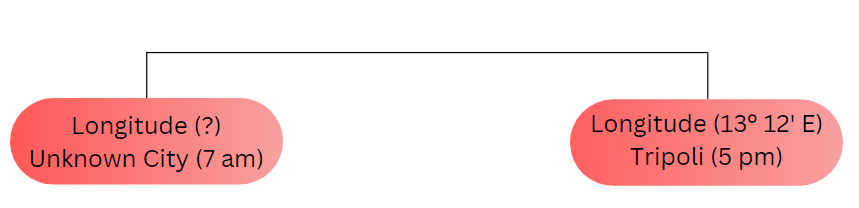
WBBSE Solutions For Class 9 Geography And Environment Chapter 3 Determination Of Location Of A Place Of The Earth's Surface long titude of unknown city

(5 pm 7 am) i.e., (17hrs 7hrs) = 10hrs or 600mins. Now, for every 4-minute time difference, the longitudinal difference is 1°.

Therefore, for a 600-minute time difference, the longitudinal difference will be 600 ÷ 4 = 150°.

As per the question, the time of the unknown city is behind that of Tripoli, so the unknown city would be located to the west of Tripoli. Therefore, the longitude of the unknown place would be
(150° 13°12′) = 136°48′ or 136° 48′ W.

2. Determination of the longitude of Tokyo:
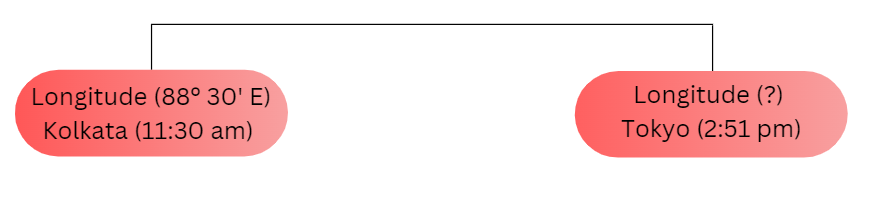
 

WBBSE Solutions For Class 9 Geography And Environment Chapter 3 Determination Of Location Of A Place Of The Earth's Surface longitude of tokyo

The difference in local time between Tokyo and Kolkata is- (2:51 pm – 11:30 am) i.e., (14hrs 51mins – 11hrs 30mins) = 3hrs or 21mins or 201mins. Now, for every 4mins time difference, the longitudinal difference is 1°

Therefore, for the 201mins time difference, the longitudinal difference will be 201÷ 4 = 50°15′.
As per the question, the time in Tokyo is ahead of Kolkata, so Tokyo would be located to the east of Kolkata (88° 30′ E). Therefore, the longitude of Tokyo would be (88° 30′ + 50° 15′) 138°45′ or 138° 45′ E.

Question 14. What would be the local time of Dhaka (90° E), when it is 6 am in Seoul (127° 06’E)?
Answer:

Determination of the local time of Dhaka:
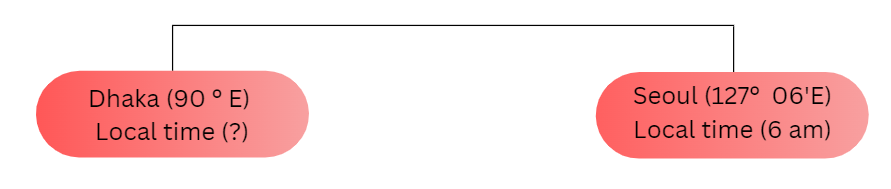
WBBSE Solutions For Class 9 Geography And Environment Chapter 3 Determination Of Location Of A Place Of The Earth's Surface LOCAL TIME OF DHAKA..

Both Seoul and Dhaka are located in the eastern hemisphere.

The longitudinal difference between Seoul and Dhaka is (127°06′-90°) = 37°06′.

So, the difference in time between Seoul and Dhaka would be

If, for every 1° longitudinal difference, the time difference experienced is 4 minutes. Therefore, for a 37° longitudinal difference, the time difference will be (37 × 4) = 148 minutes or 2hrs 28mins.

Again, for every 1′ longitudinal difference, the time difference experienced is 4 seconds. Therefore, for a 6′ longitudinal difference, the time difference will be (6 × 4) = 24 seconds.
So, the total time difference between Seoul and Dhaka becomes (2hrs 28mins + 24 seconds) = 2hrs 28mins 24 secs.

Since Dhaka is located to the west of Seoul, so the local time of Dhaka would be behind the local time of Seoul. Therefore, when it is 6 am in Seoul, the local time of Dhaka would be (6hrs – 2hrs 28mins 24 secs) = 3hrs 31mins 36 seconds or 3:31:36 am.

Question 15. Greenwich Time Signal was received by a place at 4:32 pm when it was noon at Greenwich. What is the longitude of that place, if the time taken by the signal to reach that place from Greenwich is calculated to be 2 minutes?
Answer:

Determination of the longitude of the unknown place:
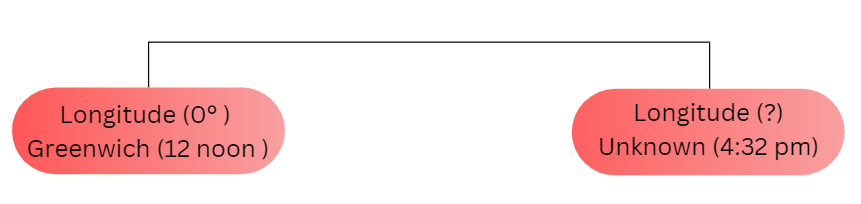
WBBSE Solutions For Class 9 Geography And Environment Chapter 3 Determination Of Location Of A Place Of The Earth's Surface longitude of the unknown palces

Greenwich Time Signal (2 minutes)Longitude (0°) Greenwich (noon)Longitude (?) Unknown place (4:32 pm)

The Greenwich Time Signal from Greenwich at noon was heard at 4:32 pm in an unknown place. The time taken by the signal to reach that place from Greenwich is 2 minutes.

Therefore, the signal should have reached that place at (4hrs 32mins – 2 mins) = 4hrs 30mins i.e., at 4:30 pm if the time lost in transmission is ignored.

So, the difference in local time between Greenwich and the unknown place is- (4:30 pm-12 noon) i.e., (16hrs 30mins – 12hrs) 4hrs 30mins or 270mins.

Now, for every 4-minute time difference, the longitudinal difference is 1°.

Therefore, for a 270-minute time difference, the longitudinal difference will be 270 ÷ 4 = 67° 30′. So, the longitudinal difference between Greenwich and the unknown place is 67° 30′.

As per the question, the time of the unknown place is ahead of Greenwich, so the unknown place would be located to the east of Greenwich (0°). Therefore, the longitude of the unknown place would be (0° + 67° 30′)= 67° 30′ or 67° 30’E

Question 16. What would be the local time, day, and date in Kolkata (88° 30′ E), while it is Wednesday at 8:30 pm on December 31, 2019, in New York (74° W)?
Answer: Determination of the local time, day, and date in Kolkata:
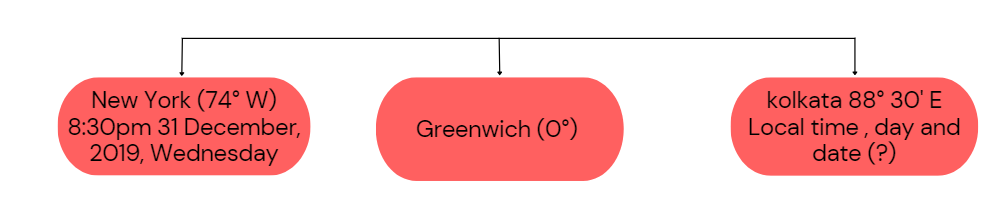
WBBSE Solutions For Class 9 Geography And Environment Chapter 3 Determination Of Location Of A Place Of The Earth's Surface Loacl time day and date in kolkata

The longitudinal difference between New York and Kolkata is- (74° + 88° 30′) = 162° 30′.

Therefore, the difference in local time between New York and Kolkata would be—

Now, for 1° longitudinal difference is 4 minutes.

So, for the 162° longitudinal difference, the time difference will be 162 x 4 = 684 mins.

Again, for every l1 longitudinal difference time difference experienced is 4secs. Therefore, for a 30′ longitudinal difference time difference will be (30 x 4) = 120secs or 2mins.

So, the total time difference between New York and Kolkata becomes (648 + 2) = 650 mins or hrs 50mins.

As Kolkata is located to the east of New York, the local time of Kolkata will be ahead of New York. Therefore, while it is Wednesday 8:30 pm on 31 December 2019 in New York, the time in Kolkata would be (Wednesday 8:30 pm on 31 December 2019 + hrs 50mins) = Thursday 7:20 am on 1 January 2020.

Question 17. What would be the longitude of an unknown place that records noon, while it is 4:30 pm at Green¬wich? 2. What would be the local time in Madrid (3° 42′ W), when it is 8 pm in Vienna (16° 20’E)?
Answer:

Determination of the longitude of the unknown places:
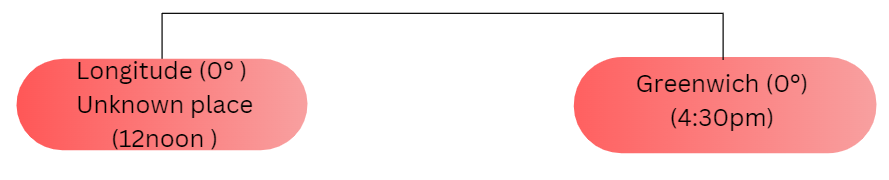
WBBSE Solutions For Class 9 Geography And Environment Chapter 3 Determination Of Location Of A Place Of The Earth's Surface Longitude of the unknown palce 2

The difference in local time between Greenwich and the unknown place is— (4:30 pm – 12 noon) i.e., (16hrs 30mins – 12hrs) = 4hrs 30mins or 270mins.

Now, for every 4-minute time difference, the longitudinal difference is 1°.

Therefore, for a 270-minute time difference, the longitudinal difference will be 270÷4 = 67°30′.

So, the longitudinal difference between Greenwich and the unknown place is 67° 30′.

As per the question, the time of the unknown place is behind Greenwich, so the unknown place would be located to the west of Greenwich (0°). Therefore, the longitude of the unknown place would be (67° 30′ – 0°) = 67° 30′ or 67° 30′ W.

2. Determination of the local time in Madrid:

WBBSE Solutions For Class 9 Geography And Environment Chapter 3 Determination Of Location Of A Place Of The Earth's Surface the local of the mardrid

The longitudinal difference between Vienna and Madrid is— (16° 20′ + 3° 42′) = 20° 02’.

Now, for the 1° longitudinal difference, the time difference is 4mins.

So, for a 20° longitudinal difference, the time difference will be 20 x 4 = 80 mins or LHR 20 mins.
Therefore, for a 30′ longitudinal difference, the time difference will be (30 x 4) = 120 seconds or 2 minutes.

Again, for every 1′ longitudinal difference, the time difference experienced is 4secs.
Therefore, for 21 longitudinal differences, the time difference will be (2 x 4) = 8 secs.

So, the total time difference between Vienna and Madrid becomes (LHR 20mins + 8secs)= LHR 20mins 8secs. As Madrid is located to the west of Vienna, the local time of Madrid will be behind Vienna time.

Therefore, while it is 8 pm in Vienna, the time in Madrid would be (8 pm – 1 hr 20mins 8secs) = (20hrs – LHR 20mins 8secs) = 18hrs 39mins 52secs or 6:39:52 pm.

Finding Location Using Earth’s Grid System Class 9

Question 18. It takes 8 hours by flight to reach London from Kolkata. At what time the flight would reach London, if it takes off for London at 8 pm on 31 December 2019 as per 1ST time?
Answer:

Determination of the time and date when the flight will reach London:
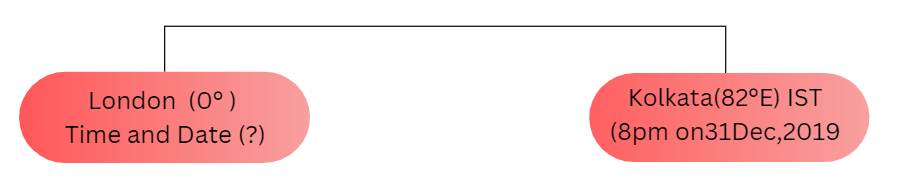
WBBSE Solutions For Class 9 Geography And Environment Chapter 3 Determination Of Location Of A Place Of The Earth's Surface time and date when the fight will reach reach london

The longitudinal difference between Kolkata and London is (82°30′-0°) = 82°30

So, the difference in time between Kolkata and Greenwich would be

For every. 1° longitudinal difference, time difference experienced is 4 minutes.

∴  for 82° longitudinal difference, time difference will be (82 x 4) = 328 minutes.

Again, for every 1′ longitudinal difference, the time difference experienced is 4 seconds.

For a 30′ longitudinal difference, the time difference will be (30 × 4) = 120 seconds or 2 minutes.

So, the total time difference between London and Kolkata becomes (328 + 2)m = 330 minutes or 5hrs 30mins.

Therefore, As London is located to the west of Kolkata, the time in London would be behind Kolkata.

When it is 8 pm on 31 December 2019 in Kolkata, the time in London would be (20hrs 5hrs 30mins) = 14:30 hours or 2:30 pm on the same day and date.

Now, it takes 8 hours by flight to reach London from Kolkata.

So, the flight will reach at (14hrs 30mins + 8hrs) 22hrs 30mins or 10:30 pm on the same date and day i.e., December 31, 2019, according to GMT.

Question 19. When it is 6:32 am in Chennai, the time in New York is 8:15 pm the previous day. As Chennai is located at 80° 15′ E, where is New York located? 2. Why is the radio broadcast time difference between Kolkata (88° 30′ E) and Dhaka (89° E) 30 minutes even if the longitudinal difference between them is 30′?
Answer:

1. Determination of the longitude of New York:
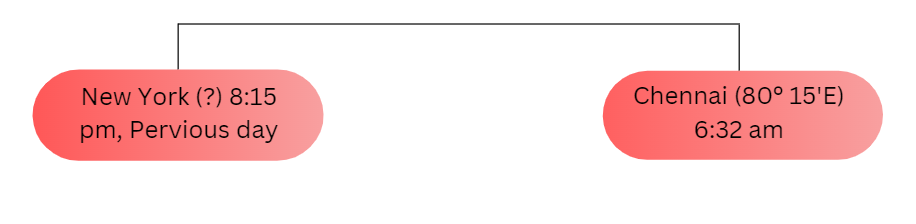
WBBSE Solutions For Class 9 Geography And Environment Chapter 3 Determination Of Location Of A Place Of The Earth's Surface longitude of new York

Now, for every 4-minute time difference, the longitudinal difference is 1°.

The local time of Chennai is 6:32 am and New York is 8:15 pm of the previous day.

So, the difference in local time between New York and Chennai is—

(Previous day 8:15 pm – 6:32 am) or [(24hrs – 20hrs 15minsj + 6hrs 32mins] = lOhrs 17mins or 617mins.

Now, for every 4-minute time difference, the longitudinal difference is 1°.

For a 617-minute time difference, the longitudinal difference will be 617÷4 = 154°15′.
As per the question, the time of New York is behind that of Chennai, so New York would be located to the west of Chennai. Therefore, the longitude of New York would be (154° 15’ – 80° 15’) = 74° or 74° W.

2. Reasons for the difference in radio broadcast time between Kolkata and Dhaka: The longitudinal difference between Kolkata and Dhaka is 301. Accordingly, the time difference between them should be 2 minutes. But the difference in radio broadcasts is 30mins. The reason behind this is, that the time that the radio broadcast follows in Kolkata is according to the 1ST (82° 30′ E), and that in Dhaka is that of their standard meridian of 90° E.

The longitudinal difference (according to the standard meridians of India and Bangladesh) between Kolkata and Dhaka is (90° – 82° 30′) – 7° 30′.

So, the difference in time between Kolkata and Dhaka would be—

For every 1° longitudinal difference, the time difference experienced is 4 minutes.

Therefore, for the 7° longitudinal difference, the time difference will be (7×4) = 28 mins.

Again, for every 1′ longitudinal difference, the time difference experienced is 4 seconds.

Therefore, for a 30′ longitudinal difference, the time difference will be (30×4) = 120 seconds or 2 minutes. Therefore, the total time difference between Kolkata and Dhaka becomes (28 + 2) = 30 minutes.

Question 20. Determine the antipodal point for Kolkata (22° 30′ N, 88° 30′ E). 1 What was the day and date of the antipodal point of Kolkata, when it was Thursday, 1 March, 2012,8 am in Kolkata?
Answer:

Determination of the antipodal point of Kolkata: It is known that the longitudinal difference between a point and its antipode is always 180°.

So, if the longitude of Kolkata is 88° 30′ E, its antipode will be located at (180° – 88° 30′) = 91° 30′ W.
The latitude of the antipode will also be located in the opposite hemisphere. The latitude of the antipode point of Kolkata would be 22° 30′ S.

Therefore, the antipodal point of Kolkata is located at 22° 30′ S, 91° 30′ W.

Determination of the day, date, and time of Kolkata’s antipodal point:

The time difference between a point and its antipode is always 12 hours. So, if it was Thursday, March 1, 2012, at 8 am in Kolkata, the day, date, and time at its antipode were (Thursday, March 1, 2012, 8 am – 12 hours) = Wednesday, February 29, 2012, 8 pm. As 2012 was a leap year, February had 29 days.

WBBSE Chapter 2 Determination Of Location Of A Place Of The Earth’s Surface Short Answer Questions

Question 1. Why the Equator is known as the ‘great circle’?
Answer: The Equator Is Known As The ‘Great Circle’:

When the center of the circle that is drawn on the Earth’s surface and the center of the Earth is the same, then the circle becomes a ‘great circle’. There are several imaginary lines of latitude drawn over the Earth’s surface and out of those lines, the Equator is known as the great circle, because-

  1. The largest circle: The Equator is the largest circle. It is not possible to draw a circle larger than the Equator over the Earth’s surface.
  2. Same center with the Earth: The center of the Earth and that of the Equator lies at the same point.
  3. Divide the Earth equally: If the Earth is divided along the Equator, we get two halves One is the northern hemisphere and the other is the southern hemisphere. Centre of the Earth Equator (great circle)

WBBSE Solutions For Class 9 Geography And Environment Chapter 3 Equator(great circle)

Question 2. Introduce the important parallels of the Earth.
Answer: The important parallels of the Earth are-

1. Equator: The value of the Equator is 0°: Characteristics- The main characteristics of the Equation are-

  1. The equator is extended along the middle of the Earth. Its circumference is the largest and it has divided the Earth into two halves, so it is called the great circle.
  2. The latitude of a place is determined by the Equator.

2. Tropic of Cancer: Value of the Tropic of Characteristics- The main characteristics of the Tropic of Cancer are. It is the last limit of the northward movement of the Sun and delimits the northern boundary of Torrid Zone 2. Vertical sunrays fall on this latitude on 21 June.

3. Tropic of Capricorn: Value of the Tropic of Capricorn is Characteristics-The main characteristics of the Tropic of Capricorn are-

  1. It is the last limit of the southward movement of the Sun and delimits the southern limit of the Torrid Zone.
  2. On 22 December, vertical sunrays fall on this latitude.

4. Arctic Circle: The value of the Arctic Circle is 10 66 N. Characteristics- The main characteristics of the Arctic Circle are-

  1. The region between the Arctic Circle and the North Pole experiences 24 hours of the day from 21 June for 6 months at a stretch.
  2. It is the northern limit of the Temperate Zone. After this circle, the Frigid Zone begins.

5. Antarctic Circle: The value of the Antarctic 10 Circle is 66½º S. Characteristics-The main characteristics of the Antarctic Circle are-

  1. From 22 December the region between the Antarctic Circle and the South Pole experiences 24 hours of the day for 6 months at a stretch.
  2. It is the southern limit of the Temperate Zone. 3. After this circle, the Frigid Zone begins.

Question 3. What are the differences between latitude and parallels of latitude?
Answer: The differences between latitude and parallels of latitude are

WBBSE Solutions For Class 9 Geography And Environment Chapter 3 Differences Between Latitude And Parallels Of Latitude

Question 4. What are the differences between the axis and parallels of latitude?
Answer: The differences between the axis and parallels of latitude are- 

WBBSE Solutions For Class 9 Geography And Environment Chapter 3 Differences Between The Axis And Parallels Of Latitude

Question 5. ‘The Equator is the most important latitude of the Earth. Why?
Answer: The Equator is the most important latitude of the Earth, because-

  1. Demarcation of hemispheres: The Equator is an east-west extended imaginary line passing through the middle of the Earth. It divides the Earth into two halves as northern hemisphere and the southern hemisphere.
  2. Calculation of latitude: The angular distance or latitude of a place on the Earth is measured from the Equator.
  3. Drawing of the parallels: All lines of latitude are drawn parallel to the Equator.
  4. Formation of the Torrid Zone: The sun’s rays fall vertically over the Equator and adjacent areas throughout the year. Thus, these regions form the Torrid Zone.
  5. Balance of the day and night: Length days and nights are of equal duration (12hrs) at the Equator, throughout the year. This is because the Equator lies in the middle of the Earth.

Question 6. Why does high temperature prevail in the torrid zone throughout the year?
Answer: High Temperature Prevails in The Torrid Zone Throughout The Year:-

The torrid zone extends between the Tropic of Cancer (232½°N) and the Tropic of Capricorn (23½º S). The apparent motion of the Sun is also restricted between these tropics. Starting from 22 December to 21 June, the Sun moves from the Tropic of Capricorn to the Tropic of Cancer, which is known as the apparent northward movement of the Sun.

Similarly from 21 June to 22 December, the Sun moves in the opposite direction which is known as the apparent southward movement of the Sun. Therefore, this region receives vertical rays of the Sun throughout the year, and this is why high temperature (25°C-35°C) prevails in this zone.

Question 7. What is meant by meridians of longitude? Discuss their properties and their uses.
Answer: Meridians Of Longitude:

Meridians of longitude: In geography, a meridian is the half of an imaginary great circle on the surface of the Earth, that ends at the geographical poles-the North Pole and the South Pole. It connects all the points of equal longitude. Each meridian is of equal length and is perpendicular to all the circles of latitude.

WBBSE Solutions For Class 9 Geography And Environment Chapter 3 Meridians Of Longitude

Properties and uses of meridians of longitude: The Properties and the uses of meridians of longitude are as follows-

  1. All the meridians of longitude are half circles.
  2. They are not parallel to each other.
  3. The distance between two consecutive meridians is the highest at the Equator and reduces gradually towards the Poles.
  4. All the meridians are of equal length.
  5. All places on the same meridian have the same longitudinal degree.
  6. The climatic characteristics of the places on the same meridian are not the same.
  7. The local time of various places lying on the same longitude is always the same.

Uses: The uses of the meridians of longitude are-

  1. The east-west position of a place can be determined concerning the Prime Meridian and the other longitudes as the standard of measure.
  2. The local time of any place on the surface of the Earth can be calculated based on which longitude it is positioned.
  3. Sometimes the boundary of any country or state is demarcated by the meridians. For example, some state boundaries of the USA.

Question 8. Explain with examples how the location of a place can be determined using the lines of latitude and longitude. How does the local time change with changing lines of longitude?
Answer: Determination of the location of a place with the help of parallels of latitude and meridians of longitude:

The location of any place on the Earth’s surface can be determined by using the lines of latitude and longitude. The parallels of latitude are full circles and run in an east-west direction. On the other hand, the meridians of longitude are half circles and run in a north-south direction. The combination of these two components forms a graticule that specifies the position of any place on the Earth.

This is why both parallels of latitude and meridians of longitude are shown on the map. To determine the exact location of a place, both are essential. For example, the location of Kolkata is 22° 30′ N and 88° 30′ E.

WBBSE Solutions For Class 9 Geography And Environment Chapter 3 The Loaction Of A Palce With The Help Of Latitudes And Longitudes

This statement explains the fact that Kolkata is located at the intersection point of 22°30′ N latitude and 88°30’E longitude.

Change of the local time with the changing lines of longitude: The lines of longitude of the Earth are half-circular lines that extend from north to south. Since the Earth rotates on its axis once every 24 hours, each longitude faces the Sun directly once every 24 hours. When the Sun is directly overhead any longitude, it is noon at that longitude.

The local time of that longitude is calculated concerning noon time at that longitude. Therefore, each line of longitude experiences noon only once every 24 hours and each longitude experiences it at different points in time. That is why local time changes with changes in the longitude.

Question 9. What is the International Date Line? Explain the significance of the line.
Answer:
Internation Date Line:

The International Date Line is an imaginary line that follows the 180° longitude. However, it deviates from its original position near the Aleutian, Fiji, and the Chatham Islands. The International Date Line acts as a divider between the dates of the eastern and the western hemispheres. It is according to this line that the calendar date changes.

Significance of International Date Line: The Earth takes 24 hours or 1440 minutes to complete one rotation of 360°. Therefore, for every 1° difference in longitude, we experience a time difference of 4 minutes. Moreover, since the Earth rotates from west to east, the local time in the east is ahead of the local time in the west.

So, if the local time is followed on a world For example, both the 180° E and the 180° W are tour, a lot of discrepancies can arise regarding the date and time of the places. This creates a lot of confusion and inconvenience for business purposes.

WBBSE Solutions For Class 9 Geography And Environment Chapter 3 International Date Line

Question 10. What do you mean by the Greenwich Mean Time?
Answer: Greenwich Mean Time:-

Greenwich Mean Time or GMT is the local time of the 0° Meridian passing through Greenwich near London. As different countries have different standard times, it becomes difficult to carry out international communications. To avoid this problem, Greenwich Mean Time is followed across the globe. Therefore, GMT is also known as Universal Time. Countries located to the east of the Prime

Question 11. How can we determine the longitude of a place?
Answer:

Determination Of Longitude Of A Place:-

The longitude of a place can easily be determined with the following references-

1. Concerning the time of any other longitude: We experience a time difference of 4 minutes, for a 1° longitudinal difference. So, if 4 minutes are added to the local time of a place, we get the next longitude, at an interval of 1°, towards the east of that place.

Similarly, if 4 minutes are subtracted from the local time of a place, we get the next longitude, at an interval of 1°, towards the west of that place. Therefore, if the local times of any two places are known along with the longitude of any one place, the longitude of the other place can be easily calculated.

2. Concerning GMT: GMT is the local time of the 0″ meridian passing through Greenwich near London. This is also known as Universal Time. So, if the time difference of a place from the GMT is known, the longitude can be easily calculated. Local time is ahead for places to the east and behind for the places to the west of Prime Meridian.

Example: The Indian Standard Time is ahead by 5 hours 30 minutes of GMT Therefore, the longitude of the Standard Meridian of India will be 82° 30’E.

Question 12. How was the International Date Line determined?
Answer: International Date Line:-

To use a global time zone system with an International Date Line, the day and date have to be separated at some point on the Earth by marking a terminal point. The suitable solution was provided in 1884 by the International Meridian Conference (IMC), held in Washington D.C., that representatives of 25 nations attended.

The IMC selected the 180° meridian as this terminal point. The imaginary line of the International Date Line was thus drawn that follows the 180° longitude mostly but deviates from its original position near the Aleutian Islands, Fiji, and Chatham Islands. The International Date Line acts as a dividing line between the dates of the eastern and western hemispheres. It is according to this line, that calendar dates are changed.

Question 13. Write a brief note on Prime Meridian and International Date Line.
Answer: Prime Meridian: The Prime Meridian is the imaginary line of longitude, considered to have a value of 0°, which passes through the Greenwich Observatory in London.

Characteristics: Special The special characteristics of Prime Meridian are-

  1. This line is directly opposite the 180° line of longitude or the International Date Line.
  2. This line divides the Earth into the eastern and western hemispheres.
  3. As this line passes through the Royal Observatory in Greenwich, London, it is called the Greenwich Line.
  4. The location and local time of any place is determined with reference. To this line.
  5. The line is important to know the distance of a place from the Prime Meridian in an east-west direction.

International Date Line:  The International Date Line is an imaginary line that follows the 180° longitude mostly but deviates from its original position over the landmasses.

WBBSE Solutions For Class 9 Geography And Environment Chapter 3 Antipedal position

Special characteristics: The special characteristics of the International Date Line are-

  1. A calendar date starts and ends at this line.
  2. When anyone crosses the International Date Line from east to west, he subtracts one day from his calendar.
  3. Similarly, he has to add one day when he crosses the line from west to east.

Question 14. Why do some countries have more than one standard time?
Answer: Some Countries Have More Than One Standard Time:-

Places situated on different meridians have different local times. Several meridians pass through every country. If all their local times are considered then the proper functioning of the administration and business gets hindered.

So, to avoid such a situation, the local time of the central meridian is taken as the standard time for the entire country. However, countries with a vast east-west extension face problems regarding the time difference between their eastern and western parts.

Too great a time difference between the extreme east and the extreme west causes inconvenience and confusion. Therefore, these countries are divided into several time zones, each having its own standard time. For example, Russia is divided into 11 time zones.

Question 15. What do you mean by Daylight Saving Time or DST?
Answer: Daylight Saving Time Or DST:-

In countries of high latitudes, the difference between the duration of day and night is quite huge with the changing seasons. Therefore, many countries started using Daylight Saving Time or DST (first proposed by Benjamin Franklin in 1784) to make better use of natural daylight in the evenings. Many use it to reduce the amount of energy needed for artificial lighting during the evening hours.

Many countries in the northern hemisphere, like the USA, Canada, Central America, Europe, Asia, and North Africa use DST. Similarly, many countries in the southern hemisphere, like Australia, New Zealand, countries of South America, and South Africa also use DST. In the northern hemisphere, from 21 March the countries advance the clock timing by 1-2 hours. Likewise from 23 September, the clock is set back by 2 hours to make the best use of the daylight.

Question 16. Differentiate between parallels of latitude and meridians of longitude.
Answer: The differences between parallels of latitude and meridians of longitude are Points of difference-

WBBSE Solutions For Class 9 Geography And Environment Chapter 3 Differences between parallels of latitude and meridians of longitude


Question 17. What are the differences between longitude and meridians of longitude?
Answer: The differences between longitude and meridians of longitude are-

WBBSE Solutions For Class 9 Geography And Environment Chapter 3 Differences between longitude and meridians of longitude


Question 18. What are the differences between local time and standard time?
Answer: The differences between local time and standard time are

WBBSE Solutions For Class 9 Geography And Environment Chapter 3 Differences between local time and standard time

Question 18. How Local time Practical usage of this is not that This is used primarily for convenience significance of administration and governance are longitude and time interrelated.
Answer: Longitude and time are interrelated in the following ways-

Determination of midday and local time: Longitude helps in determining the time of midday in any area. The time of midday helps in determining the rest of the time of the day because every longitude of the Earth faces the Sun at least once in 24 hours.

The difference between each 1° longitude and time is 4 minutes: The Earth takes 24 hours to complete a rotation. So, the Earth rotates 360° in 24 hours. That means, to complete a 1° rotation, Earth takes 4 minutes.

The regions of the East are always ahead in time of those of the West: The Earth rotates from west to east, so the places in the East experience sunrise and sunset earlier than the places in the West. So, the places located in the east are ahead in time of the places located in the west.

Question 19. Write three characteristics of antipodes
Answer: Diametrically opposite places on the Earth’s surface are antipodes to each other. Three characteristics of antipodes are-

  1. The latitudinal value of a place and its antipodes always remain the same, but the hemispheres are different.
  2. The longitudinal difference between any place on the Earth and its antipodes is always 180°.
  3. If a place lies on the Equator, its antipodes will always lie on the Equator, and antipodes of a place that lies at 180° longitude, will always lie at 0° longitude.

WBBSE Solutions For Class 9 Geography And Environment Chapter 3 Antipedal position

Question 20. How will you reckon the antipodes of a place based on longitude?
Answer: Reckon The Antipodes Of A Place based on Longitude:-

Two ends of any diameter of the Earth are antipodes to one another. So, the reckoning of the antipodes is possible if the longitude of a place is known. As a place and its antipodes lie on diametrically opposite sides of the Earth, the longitudinal difference between a place and its antipodes will always be 180°.

As an example, the longitude of Katakana is 88°30′ East. So, the longitude of its antipodes will be (180° – 88°30′ E) it’s = 91°30′ West (Refer to Figure ‘Antipodal position’ of question number 11 of this section).

Question 21. ‘The difference of time between a place and its antipodes is 12 hours.” Explain.
Answer: Refer to the second part of question number 9 from the ‘Numerical Problems’ section.

Question 22. Determine the difference between a place and its antipodes.
Answer: Difference Between A Place And Its Antipodes:-

The differences between a place and its antipodes are that a place and its antipodes are always situated at opposite longitudes. The longitudinal difference between a place and its antipodes is always 180°.

The time difference between a place and its antipodes is always 12 hours. A place and its antipodal place always lie in opposite hemispheres. A place and its antipodes always lie at the opposite points of the diameter that passes through the center of the Earth.

Question 23. Why is the 180° longitude known as the International Date Line?
Answer: 180° Longitude Is Known As The International Date Line:-

180° longitude is known as the International Date Line, because- 180° longitude is considered the starting and ending point of the dates and times on the Earth. Since 180° longitude passes mostly over the water bodies, the time zones of the continents are not affected. When the 180° longitudinal line is crossed from the western side of the Greenwich, the international date is added by a day. Again, when the 180° longitudinal line is crossed from the eastern side of Greenwich, the international date is subtracted by a day.

Question 24. Why does the International Date Line not follow the 180° line of longitude throughout?
Answer: The International Date Line almost together also forms a great circle. Coincides with the 180° longitude but is not completely the same line. It zigzags to avoid crossing over any landmass. In the northern hemisphere, the International Date Line is displaced eastwards to avoid the Wrangell Island as well as the Chukchi Peninsula on the Russian mainland and then deviates west to avoid the Bering Sea and also deviates almost 7° to avoid the Aleutian Islands.

In the southern hemisphere, the International Date Line deviates almost 11° to avoid Fiji, Chatham, and other islands. This makes it convenient for all the people of Siberia to follow the standard time of Siberia, the people of the Aleutian Islands to follow the Pacific Standard Time of the USA and Fiji, and the people of Tonga and Chatham to follow the standard time of New Zealand and avoid any kind of confusion.

Question 25. What is meant by a great circle?
Answer: Great Circle:-

When the center of a circle is drawn on the surface of a sphere and the center of the sphere is the same then the circle is known as a great circle.

Characteristics: The main characteristics of the Great Circle are-

  1. It is not possible to draw a circle on the surface of a sphere greater than the great circle.
  2. The center of the great circle coincides with the center of the sphere.
  3. The great circle divides the Earth into two equal hemispheres.

Example: Amongst the parallels, the Equator is the only great circle. The two opposite longitudes

Question 26. Write the differences between the Equator and the Prime Meridian.
Answer: The differences between the Equator and the Prime Meridian are

WBBSE Solutions For Class 9 Geography And Environment Chapter 3 Differences Between The Equator And The Prime Meridian


Question 27. ‘A tourist experiences a change of time as he goes round the Earth along the Equator and observes a change of climate as he goes from the Equator to the Poles along the meridian’-Briefly explain the reason.
Answer: Keeping the Sun in front, the Earth is rotating on its axis from west to east direction, and the time taken by the Earth to complete one rotation is about 24 hours or 1 day. When a tourist goes around the Earth along the Equator, On the other hand, the intensity of effective solar radiation gradually decreases from the Equator to the Poles. So, the climate gets colder towards the Poles. That is why the change of climate is observed from the Equator to the Poles along the meridian.

WBBSE Chapter 2 Determination Of Location Of A Place on the Earth’s Surface Short Answer Questions

Question 1. What is meant by parallels of latitude?
Answer: Parallels Of Latitude:

The imaginary lines drawn over the Earth, which run parallel to the Equator are known as parallels of latitude. They are also called lines of latitude. These lines join all places having the same latitudinal value or angular distance from the Equator. For example, the Tropic of Cancer (23½º N).

Question 2. What are the properties of the lines of latitude?
Answer: The properties of the lines of latitudes are-

  1. All the lines of latitude are full circles and run parallel to each other.
  2. They all run in an east-west direction. As the latitudinal value increases, the circumference of the circles of latitudes decreases. The local time of the places lying on the same latitude is always different.

Question 3. What is the Equator?
Answer: Equator:

The Equator is an imaginary east-west line encircling the Earth midway between the North and South Poles. The Equator is the 0° latitude. It divides the Earth into two halves called the Northern Hemisphere and the Southern Hemisphere. The average circumference of the Equator is 40,000km.

Question 4. What is meant by equatorial plane?
Answer: Equatorial Plane:

The imaginary plane that passes through the Equator and cuts the Earth into two halves is called the equatorial plane. The center of the Earth lies on this plane and so, the angular value of this plane is 0°. It is perpendicular to the Earth’s axis.

Question 5. What are the Arctic Circle and Antarctic Circle?
Answer: Arctic Circle And Antarctic Circle:

Arctic Circle is the parallel of latitude that runs along 66½º north of the Equator, whereas, Antarctic Circle is the parallel of latitude that runs along 66½º south of the Equator. The region beyond the Arctic and the Antarctic Circles experiences 6 months of complete daylight and 6 months of complete darkness throughout the year.

Question 6. What is meant by latitude?
Answer: Latitude:

The angular distance of a place, north or south of the Equator, usually measured in degrees is known as latitude. All the places having the same latitudinal value, joined by a single line, form the parallel. For example, the latitude of Kolkata is 22° 30′ N.

Question 7. What is meant by angular distance?
Answer: Angular Distance:

An angle whose apex is at the center of the spherical Earth and whose legs are radii intersecting the circle in two distinct points, thereby subtending an arc between those two points is known as the angular distance. The unit used to measure the angular distance is degrees, minutes, and seconds as it is conceptually identical to an angle.

Question 8. What is a Sextant?
Answer: Sextant:

A Sextant is an instrument used to determine the angle between a celestial object and the horizon (this angle is also known as the object’s altitude). The instrument has an in-built telescope and helps in determining the latitude of a place.

Question 9. What is meant by the northern and the southern latitudes?
Answer: Northern And The Southern Latitudes:

The latitudes can be delineated into two types based on which hemisphere it is located in. They are-

Northern latitudes: Latitudes located to the north of the Equator are known as northern latitudes. So, all the latitudes from 1° to 90° in the northern hemisphere will be marked as northern latitudes. These are denoted by the letter ‘N’.

Southern latitudes: Latitudes located to the south of the Equator are known as southern latitudes. So, all the latitudes from 1° to 90° in the southern hemisphere are the southern latitudes. These are denoted by the letter ‘S’.

Question 10. What is meant by 22°30′ N latitude of Kolkata?
Answer: 22°30′ N Latitude Of Kolkata:

Latitude is the angular distance of a place from the center of the Earth either north or south of the Equator on the equatorial plane. Latitudes at the north and south of the equatorial plane are known as northern and southern latitudes respectively. Now, the latitude of Kolkata is 22°30’N, which means Kolkata is located at an angular distance of 22°30′ north of the Equator.

Question 11. What is the difference between a great circle and a small circle?
Answer: Difference Between A Great Circle And A Small Circle:

When the center of a circle is drawn on the surface of a sphere and the center of the Determination of Location of a Place on the Earth’s Surface sphere are the same, then the circle is called a great circle.

The other circles that can be drawn on the surface of a sphere are called small circles. A great circle is different from small circles because small circles do not share the same center as the sphere. For example, the Equator(0°) is a great circle whereas, both the Tropics (23½º) are small circles.

Question 12. What is meant by meridian?
Answer: Meridian:

In geography, a meridian is the half of an imaginary great circle on the surface of the Earth, that ends at the geographical poles- the North Pole and the South Pole. It. Connects all the points of equal longitude. Each meridian is of equal length and is perpendicular to all the circles of latitude.

Question 13. What are the properties of lines of longitude?
Answer: Properties Of Lines Of Longitude:

The properties of lines of longitude are- All the longitudes are half circles. The longitudes are of equal length. The longitudes run in a north-south direction. The local time of the places lying on the same longitude is always the same.

Question 14. What is the Prime Meridian?
Answer: Prime Meridian:

Prime Meridian is the imaginary line drawn from the North Pole to the South Pole that passes and through Greenwich and is designated as the 0° longitude. All other longitudes are measured from this line. The Greenwich Meridian divides the Earth into two equal halves-the eastern and western hemispheres.

Question 15. What is meant by longitude?
Answer: Longitude:

The angular distance of a place, east or west of the Greenwich Meridian, usually measured in degrees is known as longitude. All the places having the same longitudinal value, if joined by a single line, form the meridian. For example, the longitude of Kolkata is 88° 30′ E.

Question 16. What is local time?
Answer: Local Time:

The time of a place that is determined according to noon time or when the Sun is directly overhead the meridian passing through that place, is called the local time of that place. Local time is also determined using the angle of elevation of the Sun at that place.

Question 17. What is standard time?
Answer: Standard Time:

The time of any country that is standardized according to the local time at its Standard Meridian or the longitude passing through the middle of that country, is called standard time. The time of a country can be determined from this.

Question 18. What is meant by antipode?
Answer: Antipode:

The antipode of a point is the point on the Earth’s surface that is diametrically opposite to it. The two points which are antipodal to one another can be connected by a straight line running through the center of the Earth.

Question 19. What is the International Date Line?
Answer: International Date Line:

The International Date Line is an imaginary line that mostly follows the 180° longitude but deviates from its position near the Aleutian Islands, Fiji, and the Chatham Islands. The International Date Line acts as a dividing line between the dates of the eastern and western hemispheres. According to this line, the calendar dates are changed.

Question 20. What is a Chronometer?
Answer: Chronometer:

Chronometer is a precise and accurate time-keeping device, used to determine the longitude at sea. In 1735, John Harrison built the first Chronometer, which he improved with many innovations, over the next thirty years before submitting it for examination. The most complete international collection of Chronometers, including the Harrison’s, is at the Royal Observatory, in London, England.

Question 21. At which places does the International Date Line deviate from the 180° longitude?
Answer: The International Date Line is not straight. It moves in a zigzag manner to avoid crossing through any landmass. In the northern hemisphere, the International Date Line is displaced eastwards to avoid Wrangel Island and then deviates almost 7° west near the Bering Sea to avoid the Aleutian Islands. In the southern hemisphere, the International Date Line deviates almost 11° to avoid Fiji, Chatham, and other islands.

Question 22. What is meant by graticule?
Answer: Graticule:

A graticule is a network or web of lines representing the Earth’s parallels of latitude and meridians of longitude, on which maps are drawn. The combination of these two components specifies the position of any place on Earth. However, it does not consider the altitude or depth of a place.

Question 23. What is the Standard Meridian for India?
Answer: Standard Meridian For India:

India, lying in the eastern hemisphere, has a vast longitudinal extension i.e., from 68°07′ E to 97°25′ E. The 82½ E longitude is taken as the Standard Meridian for the country and the local time of this meridian is considered the standard time for the entire India. It is known as the Indian Standard Time (IST). The Indian Standard Meridian (ISM) passes through the city of Allahabad. Therefore, the local time of Allahabad is taken as the standard time for India.

Question 24. What is a sundial?
Answer: Sundial:

Sundial is the earliest timekeeping device, that indicates the time of a day by the position of the shadow of some object that changes due to the apparent movement of the Sun. As the day advances, the Sun moves across the sky. As a result, the shadow of the object also moves accordingly and indicates the passage of time. The flat surface of the sundial is called the dial plate, which is generally made out of materials like wood, stone, metal, and others.

Question 25. Why is standard time more useful for a country than local time?
Answer: Standard Time More Useful For A Country Than Local Time:

Several meridians pass through every country. If their local times are considered then the proper functioning of the national services like railways, airways, and postal departments in the country gets hindered. So, a country considers the time of its central meridian or the standard meridian to calculate the standard time for the entire country. This is why standard time is more useful for a country than local time.

Question 26. Why does the local time change with the change of meridian?
Answer: Local Time Change With The Change Of Meridian:

The local time changes with the change of meridian, because because-The Earth takes 24 hours to complete one rotation on its axis. So, each meridian of the Earth faces the Sun once every 24 hours.

Midday occurs on a meridian when sunrays fall vertically on that meridian. The local time of that meridian is determined according to this time. So, midday occurs once every 24 hours in each meridian. So, the local time changes with the change of the meridian.

Question 27. What are am and pm?
Answer: Am And PM: The local time of any place between midnight or midnight and midday or noon is called ante meridian or am, while the local time of any place from midday or noon to midnight or midnight is called post meridian or pm.

Question 28. What are GMT and IST?
Answer: GMT And IST: GMT or Greenwich Mean Time is the local time of the Prime Meridian (0°) that passes through the Greenwich Royal Astronomical Observatory. In the year 1884, by an international agreement, the local time of the Prime Meridian was selected as the standard time for the whole world. So, it is also called World Standard Time.

IST is Indian Standard Time. The central meridian of India is 82°30′ East that passes through Mirzapur of Allahabad in Uttar Pradesh. The local time of 82°30′ East meridian is granted as the local time of all the places in India.

Question 29. What is the time zone?
Answer: Time Zone: Countries with great east-west longitudinal extensions have several time zones. Each zone has its own standard time. Thus Russia has been divided into 11 time zones.

WBBSE Chapter 2 Determination Of Location Of A Place Of The Earth’s Surface Fill In The Blanks

1. The lines of  Latitude run in an east-west direction. 

2. The latitudinal value of the Tropic of Cancer is  23½º

3. The only great circle among the parallels of latitude is the Equator.

4. The lines of latitude are also known as the parallels

5. The expanse between the 90° and the 6634° latitudes in both hemispheres is known as the Frigid Zone

6. The heavenly body that helps to determine latitude at the North Pole is the  Pole star

7. As the angular distance of a place, north or south of the Equator increases, the circumference of the latitude decreases

8. The equator divides the Earth into two halves.

9. The latitudes are in shape Circular.

10. The latitudes between the Equator and 30° in both hemispheres are known as Low latitudes.

11. The instrument used to calculate the latitude of any place is the Latitude of the Antarctic Circle Sextant

12. The latitude of the Antarctic Circle is 66½º S

13. The International Date Line coincides with the 180º Longitude

14. The location of any place on the surface of the Earth can be determined by the intersection point of the longitude and the latitude of that place.

15. With every 15° longitudinal difference, there is a time difference of 60º minutes.

16. The prime meridian is also referred to as the International Meridian.

17. The lines of longitude run in a north-south direction.

18. The number of time zones that Russia is divided into is 11

19. 82º is referred to as the standard meridian of India.

20. The longitudes are semi-circular in shape.

21. The standard time at any place in the world is determined concerning the green which meantime

22. All the longitudes are equal in length.

23. A time difference of 4 minutes is observed for a longitudinal difference of 1 º.

24. The angular value of the Prime Meridian is

25. The longitudinal difference between 90° W and 5° E is 95º

26. The standard meridian of the westernmost time zone of the USA is 120ºW

27. The antipode of the 180° longitude lies on 0º(prime meridian)

28. The line from which a new date starts in both the eastern and western hemispheres is the International Date Line

29. Each meridian cuts all parallels at Right angles

30. Before and after the time of midday is known as am and pm respectively.

31. According to the various positions of the Sun in the sky, the calculation of local time is called runtime.

32. The time difference between a place and its antipode is 12 hours.

WBBSE Chapter 2 Determination Of Location Of A Place On The Earth’s Surface Write True Or False

1. The Equator is an example of a great circle. True

2. The angle of elevation of the Pole Star in the southern hemisphere is 90°. False

3. The local time of a place is calculated with the help of its latitude. False

4. A chronometer is used to measure the latitude of a place. False

5. The 66½º N latitude is also known as the Antarctic Circle. False

6. All the lines of latitude intersect the lines of longitude horizontally. False

7. The angular distance of a place north or south of the Equator is the same for all the places located on the same latitude.  True

8. On 21 March, all the places on Earth experience 12 hours of the day and 12 hours of night. True

9. The angle of elevation of the Pole Star is measured to be 90° from any place in the northern hemisphere. False

10. Hadley’s Octant is used to determine the direction in the southern hemisphere.  True

11. The Equator passes through Brazil. True

12. 6°45’S is the southernmost latitude of India. True

13. The climatic characteristics of various places lying on the same latitude are alike. True

14. The latitudes between 30°-60° are called low latitude. False

15. Time is determined with the help of Sextant. False

16. Latitudinal values of all the places lying on a parallel are the same. True

17. All parallels are full circles. True

18. India lies in the southern hemisphere. False

19. The angle of elevation of the Pole Star in the southern hemisphere is measured by the Transit Theodolite. False

20. The Pole Star can be seen above the head at the North Pole. True

21. When it is 7 am in Kolkata, it is midnight at its antipode. False

22. The International Date Line is not straight. True

23. The 0° longitude is known as the Prime Meridian. True

24. A time difference of 24 hours is experienced with 180° of longitudinal difference. False

25. When it is daytime at a place, its antipode experiences night. True

26. The antipodal position of a place located on the Prime Meridian will be at 180° longitude True

27. The International Date Line is drawn on the waterbodies only. True

28. In the eastern hemisphere, units of time are added, with an increase in longitudinal value. True

29. Local time is calculated based on the highest position of the Sun on a particular meridian. True

30. The climatic characteristics change with a change in longitude. False

31. The Prime Meridian is also known as the Greenwich Meridian. True

32. Canada has 5 standard meridians. False

33. When the Sun is at its highest elevation on a particular meridian, it is considered to be noon at that place. True

34. The longitudinal difference between two places in the same hemisphere is calculated by adding up their longitudinal values. False

35. In the western hemisphere, time decreases with an increase in longitudinal value. True

36. Time in India is behind that of Greenwich Mean Time. False

37. The local time of Delhi is considered the standard time of India. False

38. The International Date Line passes through the Strait of Malacca. True

39. Longitudes are also known as meridians. True

40. Each meridian cuts each parallel at a right angle. True

41. All the meridians are of equal length. True

42. Calculation of Greenwich Mean Time is determined by Chronometer. True

43. Greenwich Time is called local time. False

44. Prime Meridian is a half circle. True

45. Meridians are parallel to each other. False

46. Another name for Prime Meridian is the International Date Line. False

47. All places on the same meridian have the same local time. True

48. Climate will change if you move along the Prime Meridian. True

49. Both 180° E and 180° W meridian the same line. True

Chapter 2 Determination Of Location Of A Place Of The Earth’s Surface Match The Left Column With The Right Column

1.

WBBSE Solutions For Class 9 Geography And Environment Chapter 3 Match The Column 1

Answer 1-D ,2-B, 3-A, 4-C

2.

WBBSE Solutions For Class 9 Geography And Environment Chapter 3 Match The Column 2

Answer 1-C ,2-A, 3-D, 4-B

1.

WBBSE Solutions For Class 9 Geography And Environment Chapter 3 Match The Column 3

Answer 1-B ,2-C, 3-D, 4-A

2.

WBBSE Solutions For Class 9 Geography And Environment Chapter 3 Match The Column 4


Answer 1-A ,2-C, 3-D, 4-B

Chapter 2 Determination Of Location Of A Place Of The Earth’s  Surface Answer In One Or Two Words

Question 1. What is the latitudinal value of the Arctic Circle?
Answer: 66½º N.

Question 2. What is the latitudinal value of the Tropic of Capricorn?
Answer: 232° S.

Question 3. What is the other name of lines of latitude?
Answer: Parallels of latitude.

Question 4. What is 90° N also known as?
Answer: North Pole.

Question 5. What is 90° S also known as?
Answer: South Pole.

Question 6. Name the latitude that is located at an equal distance from either of the poles.
Answer: The Equator.

Question 7. Name the imaginary plane that passes through the Equator and is perpendicular to the Earth’s axis.
Answer: Equatorial plane.

Question 8. Which line is the reference line to determine the latitude of a place?
Answer: The Equator.

Question 9. What is the other name of the North Pole?
Answer: Arctic.

Question 10. What is the other name of the South Pole?
Answer: Antarctic.

Question 11. What is the meaning of sextant?
Answer: 1/6 of a circle (60°).

Question 12. How many lines of latitude are there in the north of the Equator at an interval of 1° including the Equator?
Answer: 90.

Question 13. Which line does not form an angle with the equatorial plane or center of the Earth?
Answer: The Equator.

Question 14. What is Transit Theodolite?
Answer: An instrument to measure the angular distance.

Question 15. What are lines of longitude also known as?
Answer: Meridians of longitude.

Question 16. What is the Prime Meridian also known as?
Answer: Greenwich Meridian.

Question 17. What is the angular distance of a place, east or west of the Prime Meridian known as?
Answer: Longitude.

Question 18. Which natural object can be used to calculate time?
Answer: Sun.

Question 19. What is the other name of Local Mean Time?
Answer: Solar time.

Question 20. Who invented the Chronometer?
Answer: John Harrison.

Question 21. What is the linear distance between two lines of longitude, at an interval of 1°, along the Equator?
Answer: 111.3 km.

Question 22. What is located at the antipode of the Prime Meridian?
Answer: 180° longitude or the International Date Line.

Question 23. What is the time difference between 1ST and GMT?
Answer: 5 hours and 30 minutes.

Question 24. What is the time difference between a place and its antipode?
Answer: 12 hours.

Question 25. What is the longitudinal difference between a place and its antipode?
Answer: 180º.

Question 26. How much time is gained while crossing the International Date Line from the Western Hemisphere?
Answer: 24 hours or 1 day.

Question 27. When and where was the International Meridian Conference held?
Answer: October 1884 in Washington DC.

Question 28. Which state of India experiences sunrise first?
Answer: Arunachal Pradesh.

Question 29. Which meridian follows the International Date Line?
Answer: 180° meridian.

Question 30. What is the antipodal latitude of 30° N latitude?
Answer: 30° S.

Question 31. What is the time difference for the 15° meridian difference?
Answer: 60 minutes or 1 hour

Question 32. What is the satellite system for the determination of elevation and location on the Earth’s surface called?
Answer: Global Positioning System (GPS).

Question 33. Which country has the maximum number of standard meridians?
Answer: Russia (11).

WBBSE Solutions For Class 9 Geography And Environment Chapter 5 Weathering

Chapter 5 Weathering Topic A Weathering And Related Processes Of Weathering Long Answer Questions

Question 1. Briefly explain the concepts of erosion and denudation.
Answer:

Erosion: The concept of erosion is discussed below-

1. Definition: When the weathered rocks are transported from their place of origin to some other place by physical agents like rivers, glaciers, winds, etc., the process is called erosion.

Read and Learn Also WBBSE Solutions for Class 9 Geography And Environment

2. Process: The main processes of erosion include attrition, friction, plucking, removal of weathered debris, etc.

3. Agent: Agents like flowing water, winds, moving glaciers, etc., transport the weathered material from one place to another.

4. Characteristics:

1. Rocks are removed,
2. underlying layers of rocks are exposed after the upper layers are removed, and
3. erosion is dependent on weathering, it is a fast process.

Example: High-velocity winds in desert areas remove large quantities of sand and small rock fragments (by the process of erosion) to faraway places.

Denudation: The concept of denudation is discussed below-

1. Definition:

When the lower or underlying layers of the rocks are exposed after the upper layers are removed by weathering and erosion, the process is known as denudation. The term ‘denude’ means ‘to lay bare’.

2. Process: The main processes of denudation are weathering mass wasting and erosion.

3. Characteristics:

  1. Weathering and erosion are dependent on mass wasting.
  2. This is a slow process.
  3. New rocks are exposed to the earth’s surface.
  4. Elevation of the land is gradually decreased by the denudation processes and the uneven surface is gradually smoothened and flattened.
  5. The nature of rocks, the elevation of land, climate, etc., affect denudation.

4. Regional differences: The rate of denudation is lower in hot desert areas than in the high mountainous regions. In humid regions, the rate of denudation is again higher.

5. Importance: Soil is formed as a result of this process and it also plays an important role in the evolution of landforms.

WBBSE Solutions For Class 9 Geography And Environment Chapter 5 Weathering

Question 2. Briefly describe the concepts of weathering and mass wasting.
Answer:

Weathering: The concept of weathering Mass Wasting: The process of mass wasting is as follows-

Definition: The climatic agents (e.g., temperature, rainfall, etc.) disintegrate and decompose the rocks in their places (‘in situ’) and this process is called weathering.

Nomenclature: As this is an alteration of the physical or chemical characteristics of rocks by various factors of weather/climate, the term weathering is pertinent.

Factors: The factors responsible for weathering are temperature and rainfall, plants, man, and other animals, nature of landforms, nature of rocks (lithological characteristics), time, etc.

Types: Weathering can mainly be of 3 types-

  1. Mechanical (rocks are disintegrated or broken into fragments
  2. Chemical (rocks . undergo alteration in chemical composition),
  3. Biological (rocks are altered by the action of plants and animals).

WBBSE Solutions For Class 9 Geography And Environment Chapter 5 Weathering Process of weathering

5. Process: Exfoliation, granular disintegration, hydration, oxidation, hydrolysis, etc., are the various processes of weathering.

6. Characteristics:

  1. Rocks are disintegrated and decomposed.
  2. This is a static process.
  3. The weathered materials are not removed or transported. The intensity of weathering depends on the structure and nature of the rocks, climatic factors, etc.

7. Effect: Landforms like rounded or dome-shaped hills, inselbergs, tors, caves, etc., are formed. Weathering also plays a significant role in soil formation.

Mass wasting: The process of mass wasting is discussed below-

1. Definition: When weathered materials like pebbles, boulders, etc., slide down the slopes of mountains due to gravitational pull, the process is known as mass wasting.

WBBSE Solutions For Class 9 Geography And Environment Chapter 5 Weathering mass wasting

2. Nomenclature: As the weathered rock debris is dumped at the lower slopes of the mountains after being carried there, following the natural slope or gradient (by gravitational pull), the term ‘mass’ is thus relevant.

3. Factors: Slope of the land, altitude, shape, size and amount of the weathered materials, presence of vegetation, precipitation, the force of gravity, etc., determine the process of mass wasting.

4. Types: Mass wasting can be of 4 types-

  1. Slow flow
  2. Rapid flow
  3. Landslide
  4. Subsidence.

5.  Process: Mudflow, soil flow, solifluction, slump, rock slide, etc., are the various processes of mass wasting.

6. Characteristics:

  1. This process is rampant in sloping lands.
  2. The debris is removed as a result of gravitational force. It can occur as a slow or rapid process.
  3. Physical agents of weathering and erosion (rivers, glaciers, etc.) do not have any role to play in the process of mass wasting.

7. Effect:

  1. Landslides occur in mountainous areas as a result of mass wasting.
  2. These cause loss of life and property.
  3. Steep slopes, erosion on slopes, talus cones, etc., are formed due to mass wasting.

WBBSE Solutions For Class 9 Geography And Environment Chapter 5 Weathering Different types of mass writing


Question 3. What is meant by mechanical weathering? Describe the main processes involved.
Answer:

Mechanical Weathering:

The process of fragmentation or disintegration of rocks in their places (‘in situ’) by various agents of climate like temperature, rainfall, snowfall, etc., is called mechanical or physical weathering. The rocks are broken down into smaller fragments, but the chemical compositions are unaltered.

NEET Biology Class 9 Question And Answers WBBSE Class 9 History Notes WBBSE Solutions for Class 9 Life Science and Environment
WBBSE Class 9 Geography And Environment Notes WBBSE Class 9 History Multiple Choice Questions WBBSE Class 9 Life Science Long Answer Questions
WBBSE Solutions for Class 9 Geography And Environment WBBSE Class 9 History Long Answer Questions WBBSE Class 9 Life Science Multiple Choice Questions
WBBSE Class 9 Geography And Environment Multiple Choice Questions WBBSE Class 9 History Short Answer Questions WBBSE Solutions For Class 9 Maths
WBBSE Solutions for Class 9 History WBBSE Class 9 History Very Short Answer Questions WBBSE Solutions for Class 9 Physical Science and Environment


Different processes of mechanical weathering: The various processes of mechanical weathering are-

Block disintegration: When the rocks are broken into blocks or boulders, as a result of temperature difference, the process is called block disintegration.

Process: When there is differential heating of the outer and inner parts of rocks (the outer parts are more heated than the inner parts), there is a difference in the expansion of the components of those rocks. It is then that the vertical and horizontal cracks are formed within these rocks and they break apart along these cracks into several blocks.

WBBSE Solutions For Class 9 Geography And Environment Chapter 5 Weathering Block disintegration

2. Characteristics:

  1. Mostly seen in basaltic rocks,
  2. Several cracks are formed within the rocks both horizontally and vertically
  3. The rocks get broken into square or rectangular shapes,
  4. The rocks disintegrate as big chunks or blocks.

3. Occurrence: This process mostly occurs in high-temperature regions.

2. Exfoliation: When the layers of rocks peel off like an onion, this process is called exfoliation.

1. Process: Due to differential heating and cooling of the outer and inner parts of the rocks, the upper layers come off like onion peels and are prone to further weathering.

2. Characteristics:

  1. Mostly seen in granitic rocks,
  2. Tops of highlands become rounded in shape as a result of this type of weathering,
  3. This weathering occurs in homogeneous rocks.

3. Occurrence: Exfoliation is most common in hot desert regions like the Sahara and Thar deserts.

WBBSE Solutions For Class 9 Geography And Environment Chapter 5 Weathering Exfoliation


3. Granular disintegration:
When the rocks expand and contract alternately as a result of differences (hot and cold) in temperature, they break into smaller fragments. This process is called granular disintegration.

1. Process: Rocks composed of different types of minerals absorb and release heat at varying rates and thereby do not have a uniform rate of expansion and contraction. This results in the granular disintegration of these rocks.

WBBSE Solutions For Class 9 Geography And Environment Chapter 5 Weathering granular disintegration

2. Characteristics:

  1. This type of weathering is more common in heterogeneous rocks.
  2. When the rocks burst, sounds similar to gunshots are heard.
  3. The formation of sand is the ultimate result of such a weathering process.

3. Occurrence: This type of weathering is more commonly seen in hot desert regions.

4. Work of ice: In cold climatic regions, rocks are broken apart by ice crystals.

1. Process: In the cold Arctic region and other cold mountainous areas, the cracks in the rocks are filled up with ice-melt water in the daytime. This water freezes again at night due to condensation (low temperature) and exerts pressure on either side of the cracks, ultimately breaking them apart.

2. Characteristics:

1. Weathering occurs as a result of the formation of ice crystals.
2. Talus cones are formed on the lower slopes of mountains.

WBBSE Solutions For Class 9 Geography And Environment Chapter 5 Weathering Formation of ice crystals

3. Occurrence: This type of weathering occurs mostly in cold climatic regions.

5. Other processes: Other processes of mechanical weathering include the formation of salt crystals, dirt cracking, boulder clearing, hitting by raindrops, etc.

Question 2. What is meant by chemical weathering? Explain the main processes involved in it.
Answer: Chemical weathering:

The chemical composition of rocks is altered when they react with oxygen, carbon dioxide, water vapor, etc., in their own places. This process is called chemical weathering.

Different processes of chemical weathering: Different processes of chemical weathering are as follows-

Oxidation: When the nature of minerals within a rock alters under the influence of atmospheric oxygen and water, the process is called oxidation.

1. Process: In iron-bearing rocks, new minerals are formed and chemical decomposition takes place as a result of the chemical reactions in the presence of oxygen and water.

2. Reaction:

WBBSE Solutions For Class 9 Geography And Environment Chapter 5 Weathering formula 1

3. Characteristics:

1. This type of weathering takes place due to the action of water.
2. Iron-bearing rocks are subject to rusting as an effect of this.
3. Presence of oxygen is required in this type of weathering.

2. Carbonation: When the nature of rocks is altered as a result of the chemical reaction of water mixed with carbon dioxide, this process is called carbonation.

1. Process: When rainfall mixes with carbon dioxide (C02) in the atmosphere, carbonic acid is formed (CO2 + H2O→H2CO3). This dissolves limestone (calcium carbonate) by altering it into calcium bicarbonate (due to a chemical reaction).

2 Reaction:

WBBSE Solutions For Class 9 Geography And Environment Chapter 5 Weathering formula 3..

3. Characteristics:

1. This type of weathering occurs mostly due to the action of rainwater.
2. It is more active in limestone rocks.

3. Hydration: When water reacts with the minerals present in the rocks and alters their chemical composition, this process is called hydration.

1. Process: Some minerals present in the rocks have more capacity to absorb water and they expand while undergoing chemical reactions.

2. Reaction:

WBBSE Solutions For Class 9 Geography And Environment Chapter 5 Weathering formula 3

3 Characteristics:

1. The minerals in the rocks expand.
2. As a result of the absorption of water, the rocks become softer/weaker.
3. This usually occurs in homogeneous rocks.

4. Hydrolysis: When the minerals present in the rocks react with ionized water, and chemical decomposition takes place, the process is known as hydrolysis.

1. Process: When water reacts with the minerals in a rock, new minerals are formed, and the rock is decomposed.

2. Reaction:

WBBSE Solutions For Class 9 Geography And Environment Chapter 5 Weathering formula 4

3 Characteristics:

  1. It occurs in the presence of ionized or charged water.
  2. New minerals are formed by this process.
  3. A specific temperature is needed for reactions to occur.

Besides, due to the process of solution, gypsum, rock salt, etc., are dissolved in water and the rocks get decomposed.

Question 3. Classify weathering. Explain the role played by man, plants, and other animals in biological weathering.
Answer:

Classification of weathering: 

WBBSE Solutions For Class 9 Geography And Environment Chapter 5 Weathering ,weathering

Role of man, plants, and other animals in biological weathering: Man, plants, and animals aid biological weathering both directly and indirectly. The roles played by them are as follows-

1. Role of man: Construction of buildings, roads, etc., leads to the disintegration of rocks. Cultivation of land also leads to mechanical weathering. Mineral exploitation/mining, digging up of ponds and tanks, industrial establishments, etc., directly or indirectly cause weathering.

2. Role of plants: When the roots of plants and trees penetrate cracks and joints of rocks and soil, the pressure exerted upon them causes the rocks to break apart. Parts of plants (leaves, flowers, fruits, branches, etc.) shed from trees decay and decompose, which aids in the chemical weathering of rocks.

3. Role of other animals: Burrowing animals like rabbits, rats, etc., dig holes in the ground for their survival and at the same time, fragment the rocks. Remains of dead animals react chemically and decompose the rocks.

Question 4. What is biological weathering? State the various processes of biological weathering.
Answer: Biological Weathering:-

When rocks are disintegrated and decomposed by plants and animals, either directly or indirectly, the process is known as biological weathering. Such type of weathering occurs in almost all climatic regions.

Various processes of biological weathering: The factors of biological weathering (man, animals, and plants) are responsible for the two main processes of biological weathering.

1. Bio-mechanical weathering: By animals: Burrowing animals like rats, earthworms, prairie dogs, mice, etc., dig holes in the ground to live and thereby aid in bio-mechanical Termites also help in weathering by bringing the lower layers of the soil to the upper part.

Moreover, the CO2 released by the animals living underground brings about changes in the chemical composition of rocks and soil and aids in their weathering. The man also has a vital role in inducing weathering. For example, carrying out mining activities, construction of roads, cultivation of lands, and other unplanned activities.

2. By plants: When the roots of trees and plants penetrate beneath the soil into the underlying rocks, they break the rocks into fragments. Roots can reach up to about 175 feet below the ground and thus aid in mechanical weathering. This is more prominent in areas with dense vegetation. Respiration by the roots of plants, humus, soil moisture carbon dioxide, mild temperature, etc., aids in bio-mechanical weathering of the soil.

2. Bio-chemical weathering: Lichens growing on rocks rot and form humus, which, in turn, is converted to humic acid after mixing with water. This aids in the rapid chemical weathering of rocks. The organisms living in limestone rocks release CO2 with their exhalation, which combines with water to form carbonic acid.

This dissolves the limestone rocks. The acid formed by the rotting of parts of plants like leaves, flowers, fruits, branches, etc., accelerates chemical weathering. During respiration, the tree roots release CO2 which, after combining with water present in the soil, changes into carbonic acid. This eventually dissolves and disintegrates the rocks.

WBBSE Solutions For Class 9 Geography And Environment Chapter 5 Weathering Bio mechanical by plants

Question 5. Write the differences between mechanical and chemical weathering.
Answer:

Differences between mechanical and chemical weathering: The differences between mechanical and chemical weathering are as follows-

Points of difference  Mechanical weathering  Chemical weathering 
1. Place of occurrence Rocks disintegrate in their places in this type of weathering. Rocks get decomposed in their places in this type of weathering.
2. Alteration of minerals It does not lead to the formation of new minerals. It leads to the formation of new minerals.
3. Main factors Temperature, precipitation, etc. are the main factors causing mechanical weathering. Oj, CO? water, minerals, etc. are the main elements causing chemical weathering.
4. Process Block disintegration, exfoliation, granular disintegration, etc. are the processes involved in mechanical weathering. Oxidation, carbonation, hydration, hydrolysis, etc. are the processes involved In chemical weathering.
5. Climate This process is more predominant in the desert and cold mountainous regions. This process is more predominant in hot and humid climatic regions.
6. Landforms Tors, inselbergs. etc., are formed due to mechanical weathering. Caves, holes, pillars, etc. are formed due to chemical weathering.
7. Identification of rocks This type of weathering can be identified by the disintegrated rocks. This type of weathering is Identified by the chemical analysis of rocks.
8. Nature of change In the rocks Physical changes occur in the rocks in this type of weathering. Chemical changes occur in the rocks in this type of weathering.
9. Colour The color of rocks remains unchanged after the effect of mechanical weathering. The color of rocks may change after the effect of chemical weathering.
10. Sound Fragmentation of rocks causes sounds. Chemical changes and reactions in rocks occur silently.


Question 6. Write the differences between mechanical weathering and biological weathering.
Answer: Differences between mechanical weathering and biological weathering:

The differences between mechanical weathering and biological weathering are as follows-

Point of difference Mechanical weathering Biological weathering 
1. Concept The disintegration of rocks by various climatic factors is called mechanical weathering. The disintegration of rocks by various plants and animals (man, bacteria, virus) is called biological weathering.
2. Processes involved Rocks disintegrate only by mechanical action. Rocks disintegrate by both mechanical as well as chemical action.
3. Areas of occurrence This type of weathering is commonly seen in hot desert areas, cold mountainous areas, and cold polar regions. It is commonly seen in areas where lifeforms are abundant.
4. Identification The parent rocks in this case can be identified by analyzing the weathered rocks. It is not easy to identify the original rocks by identifying the weathered rocks.
5. Rate of weathering This is a slower process than biological weathering. All animals including man accelerate the weathering process.


Question 7. Write a comparison between chemical weathering and biological weathering.
Answer:

Comparison between chemical weathering and biological weathering:

The differences between chemical and biological weathering are as follows-

Point of difference Chemical weathering Biological weathering
1. Concept The process of decomposition and disintegration of rocks by the action of acids, C02,02, and water is called chemical weathering. The process of disintegration of rocks by plants and animals is called biological weathering.
2. Characteristics of rocks Characteristics of rocks change as a result of changes in their chemical composition in this process. The physical and chemical characteristics of rocks change in this process.
3. Areas of occurrence This type of weathering is common in equatorial, tropical, and humid climatic regions. This type of weathering is common in regions characterized by abundant lifeforms.
4. Identification If the chemical analysis is not done, the main rocks can not be identified. It is not easy to identify the main rocks by observing weathered rocks.
5. Rate of weathering This is a silent weathering process and thus it is not easily perceptible. It is carried out at a slow rate by life forms, including man.

Question 8. State the effects of weathering. Explain how soil is formed as a result of weathering.
Answer: Effects of weathering:

The effects of weathering are-

  1. Formation of landforms: Landforms like tors and rounded hills in the humid tropical regions, inselbergs in the hot desert regions, caves, stalactites, and stalagmites in limestone areas, etc., are all formed as a result of weathering.
  2. Formation of minerals: New minerals are formed as a result of chemical reactions. For example, bauxite is formed in humid tropical countries.
  3. Facilitates agriculture: Due to the disintegration of rocks by weathering, the porosity of soil increases, which facilitates air and water circulation and hence aid in agricultural practices.
  4. Formation of regolith: Due to the disintegration and decomposition of rocks, regolith is formed, which plays a major role in soil formation later on.

Soil Formation: The soil-forming process, as a result of weathering, may be explained by the following stages-

1. First stage: Various processes of mechanical, chemical, and biological weathering, break down rocks into smaller fragments and decompose them further. This loose layer of fragmented rocks on the top is called regolith, which is the first step of soil formation.

2. Second stage: Rainwater and air seep through the various layers of the rocks through this regolith layer which facilitates chemical weathering of the fragmented rocks. Biological weathering is also initiated by the microorganisms and the dead remains of plants and animals present in the top layer. As a result a black-colored substance called humus forms through the process of humification.

WBBSE Solutions For Class 9 Geography And Environment Chapter 5 Weathering steps of soil erorions

3. Third stage: Humus and other weathered particles oxidize in the presence of oxygen and form new minerals. This process is called mineralization. During the process of soil formation iron, aluminum, and other minerals are transported from the top layer to the lower layers of the soil. This process is called eluviation. These minerals get accumulated in the lower layers and this process is called illuviation.

Thus, with time, the components in the soil-forming process change their physical and chemical characteristics to form a soft layer called soil on the surface of the Earth, with organic matter and minerals as their constituents.

Question 9. Briefly explain the concept of soil erosion.
Answer: Concept of soil erosion:

The concept of soil erosion is-

Definition: The process in which soil particles are removed from the top layer by natural or man-made factors, is called soil erosion.

Factors: The following equation explains the process- e = g(cl, v, t, s, h)

Where, e = soil erosion, g = effectiveness, cl= climate, v = vegetative cover, t = landform or relief, s = type of soil, and h = role of man or human interference.

Causes of soil erosion: They may be classified as natural and man-made causes.

Natural causes:

1. Rainfall: In regions with high rainfall, the raindrops loosen the soil particles from the rock layer and wash them away.

Wind: Winds blow with high velocity in open desert areas and coastal tracts (receiving no obstacles) and lead to soil erosion.

Flowing water: Currents of river water and sea waves over the adjacent land areas cause soil erosion.

2. Man-made causes:

Deforestation: In deforested areas, the bare land is more prone to soil erosion. The roots of the trees bind the soil together. When the trees are cut down, the region becomes prone to soil erosion and is thus rendered infertile.

Overgrazing: Excessive grazing by cattle, goats, and sheep in grassland areas results in the baring of the ground, leading to soil erosion.

Unscientific methods of cultivation: In areas where shifting or ‘jhum’ cultivation is practiced, the forest is cleared by burning it down (which is unscientific), and this leads to soil erosion.

Process of soil erosion: Soil erosion is mainly caused by flowing water and wind.

By work of flowing water:

  1. Sheet erosion: When rainfall or flowing water removes the soil layer by layer, it is known as sheet erosion.
  2. Rill erosion: When rainwater or a river (in its youth stage), flows along the slopes of a mountain as narrow channels or rills, soil erosion occurs.
  3. Gully erosion: These rills become wider and deeper due to more soil erosion, and this is known as gully erosion.

4. Ravine erosion: When the gullies become further deepened and widened, the topography is converted to a ‘badland’, where cultivation is not possible and the area becomes inaccessible too.

WBBSE Solutions For Class 9 Geography And Environment Chapter 5 Weathering Different types of soil erorision

2. By work of wind: In desert areas, winds carry sand from one area to other distant areas, leading to erosion of the top layer.

Effects of soil erosion:

1. Effects on the physical environment:

  1. As a result of soil erosion, the groundwater level decreases,
  2. The hydrological cycle is affected,
  3. The food chain is disturbed as habitats of the decomposers (like bacteria, fungi, etc.) present in the soil are destroyed,
  4. The navigability of rivers and other waterbodies decreases (due to aggradation by soil deposits or siltation), and the areas become more prone to floods.

2. Effects on the human environment:

  1. The fertility of soil decreases, crop productivity gets reduced,
  2. A decrease in the navigability of rivers hampers trade and water transport,
  3. The ecosystem of wetlands is damaged as they get filled up with soil deposits.

Areas prone to soil erosion: Continuous flat areas, plateaus devoid of vegetation, desert areas, coastal areas, riverine tracts, etc., are more prone to soil erosion.

Question 10. Briefly discuss the methods of soil conservation. Or, Discuss the preventive measures for soil erosion.
Answer: Different methods of soil conservation:

The various measures adopted for preventing soil erosion and increasing the fertility of the soil are known as soil conservation measures.

WBBSE Solutions For Class 9 Geography And Environment Chapter 5 Weathering Soil coveration measures

1. Agricultural methods

Afforestation: If trees are planted along the slopes of mountains, on infertile and barren lands, soil erosion can be prevented. This is because the roots of the trees bind the soil together.

Restriction on overgrazing: If overgrazing can be controlled in grassland areas, soil erosion can be prevented.

Ban on shifting or ‘jhum’ cultivation: When the forests are burnt down for clear land, the trees are destroyed and soil erosion also increases. This can only be prevented by banning such a practice.

Step/Terrace farming: The slopes of the mountains are carved into steps or terraces to retain rainwater on each step (to be used by the cultivated crops). Soil erosion can be prevented by practicing such type of farming.

WBBSE Solutions For Class 9 Geography And Environment Chapter 5 Weathering terrace farming

Creation of forest line/boundary: If forest boundaries are created (by planting trees) on all sides of agricultural fields, coastal regions (especially in the direction of the winds), etc., then soil erosion can be reduced.

WBBSE Solutions For Class 9 Geography And Environment Chapter 5 Weathering Contour farming

Crop rotation: If any land is cultivated throughout the year with different types of crops (not allowing it to lay bare), then the land is not exposed to soil erosion.

Contour farming: Bunds are constructed along the contour of the land (horizontally along the slopes of mountains), to prevent water from washing down and hence it prevent soil erosion.

Strip cropping: When crops are cultivated in long strips prepared along the slopes, they prevent soil from being carried away by flowing water along the slopes.

Land cover: If the unused parts of the crops like stems, hay, etc., are spread over any bare land, soil erosion can be prevented, especially in muddy areas.

Infrastructural methods:

Construction of artificial walls: If walls are constructed on seashores and along river banks, soil erosion by flowing water can be prevented.

Digging of canals: If canals are dug to facilitate drainage and several waterbodies are constructed especially in desert areas, soil erosion can be prevented.

Other methods: More advanced research on preventing soil erosion and increasing soil fertility, spreading awareness among the people, can help in soil conservation.

Chapter 5 Weathering Short Answer Questions

Question 1. What are the controlling factors of weathering?
Answer: The controlling factors of weathering are as follows-

  1. Structure of rocks: The process of weathering is accelerated in soft and jointed (with cracks and fissures) rocks.
  2. Relief or topography: The weathering process is more active on steep slopes of hills and plateaus.
  3. Climate: The different factors of climate (moisture in the air or humidity, rainfall, temperature) influence weathering to a great extent.
  4. Biotic factors: Roots of plants and trees, flowers, fruits, man, and other animals (namely, burrowing animals), are important controlling factors of the weathering process.

Question 2. Write the differences between weathering and mass wasting.
Answer: The differences between weathering and mass wasting are as follows-

points of difference  Weathering  Mass wasting 
1. Concept When climatic elements are responsible for the disintegration and decomposition of rocks in their place, it is called weathering. When the weathered debris of rocks is carried down slopes due to gravity and is transported and deposited elsewhere, it is known as mass wasting.
2. Characteristics This is a static process, i.e., the weathered materials are deposited ‘in situ’ or the same place. This is a dynamic process, where the weathered materials are transported and deposited elsewhere.
4. Controlling factors Various climatic elements like air temperature, humidity, rainfall, etc., control the process of weathering. Mass wasting is mainly controlled by gravitational force.
5. Area of occurrence Weathering is more or less common all over the world. Mass wasting only occurs in mountainous areas or on sloping land.


Question 3. Write the differences between weathering and erosion.
Answer: The differences between weathering and erosion are as follows-

points of difference  weathering   Erosion 
1. Concept It is the disintegration and decomposition of rocks ‘in situ’ i.e. in the same place, carried out by climatic factors (temperature, precipitation, etc.). Erosion is the process of carrying away rock debris by rivers, winds, etc., (operating on the earth’s surface) from one place to another.
2. Interdependency It does not depend on erosion. It depends on weathering.
3. Rate / Pace It is a very slow process. It is a relatively faster process.
4. State of weathered materials Weathered materials lie near or on their parent rocks. Weathered materials are transported far away from their parent rocks.
5. Elements Temperature, rainfall, and humidity play an active role in this process. Rivers, winds, glaciers, sea waves, etc. take a main role in this process.
6. Subsequent process Erosion occurs rapidly in weathered rocks. Weathering occurs again on the underlying rocks after the removal of disintegrated materials through erosion.


Question 4. Write the differences between weathering and denudation.
Answer: The differences between weathering and denudation are as follows-


Points of difference  weathering   Denudation
1. Concept Weathering is the disintegration and decomposition of rocks due to climatic factors (temperature, precipitation, etc.). Denudation is the process in which the lower layers of the rocks are exposed when the upper layers are removed by weathering and erosion.
2. Interdependency It does not depend on denudation. It depends on weathering.
3. Evolution of landforms It is not directly related to the evolution of landforms. It has a vital role in the evolution of landforms, which is a long-term process.


Question 5. Write the differences between erosion and mass wasting.
Answer:

The differences between erosion and mass wasting are as follows-

Points of difference  Erosion  Mass wasting 
1. Concept It is the process of carrying away of weathered rocks by natural agents from one place to another. Mass wasting is the movement of rock debris downhill slopes due to gravity.
2. Process Abrasion, attrition, solution, etc. are the various processes of erosion. The various processes of mass wasting a/e mudflow, soil flow, slump, etc.
3. Predominance It is predominant everywhere. It is predominant in high-relief or sloping areas.
4. Effect of slope The effect of the slope is less profound in the erosion process. The effect of the slope is more profound in the mass wasting process because it occurs along a sloping land.
5. Effect of gravitational force There is no direct relation between erosion and gravitational force. Mass wasting occurs under the effect of gravity.


Question 6. ‘Weathering and climate are interrelated.’ Explain.
Answer: Weathering And Climate Are Interrelated:-

The interrelation between weathering and climate can be discussed if we study the following climatic regions

  1. Equatorial climatic region: Temperature and rainfall are intense throughout the year in this region. Along with chemical weathering, mechanical weathering is also rampant here due to excessive heat.
  2. Hot and dry desert climatic region: Due to long periods of intense heat and almost negligible rainfall, mechanical weathering is predominant here. For example, exfoliation, granular disintegration, etc. are the prevalent processes.
  3. Cold mountainous climatic region /Arctic region: Due to excessive cold, the formation of ice crystals along the cracks of rocks causes mechanical weathering.
  4. Tropical monsoon climatic region: Due to the hot and wet climate of tropical monsoon climatic regions, both mechanical and chemical weathering are active here as a result of both heat and rain.
  5. Wet-temperate climatic region: In wet-temperate climatic regions, both mechanical and chemical weathering is active, mainly due to the excessive availability of moisture.

Question 7. Why is mechanical weathering pre-dominant in desert areas?
Answer: Mechanical Weathering Is Pre-Dominant In Desert Areas:-

The factors responsible for the predominance of mechanical weathering in desert areas are as follows-

Range or difference of temperature is high: The daily or diurnal range of temperature (difference of temperature between day and night) is high in desert areas. Rocks expand due to heating during the daytime while they contract due to cooling at night. This results in the fragmentation and mechanical disintegration of rocks.

Scarcity of rainfall: Chemical weathering rarely takes place due to the scarcity of rainfall in desert areas. Vegetation is also scarce due to lack of water thus, biological weathering is absent. So, only mechanical weathering plays an active part.

Excessive denudation: In Desert areas, being more prone to denudation, the upper layers of the rocks are removed by wind action, and the rocks underneath are relieved from pressure. The underlying rocks expand consequently and crack form. Subsequently, the rocks disintegrate along these cracks.

Question 8. Rainfall has an impact on mechanical weathering.’ Explain.
Answer: Rainfall Has An Impact On Mechanical Weathering:-

Rainfall influences mechanical weathering for the following reasons-

1. Formation of ice: Rainfall is responsible for the formation of ice crystals within the cracks of rocks in colder climatic regions. These crystals subsequently disintegrate the rocks.

2. Raindrops hitting rocks: Raindrops hitting the rock surface over long periods ultimately lead to the fragmentation of the rocks.

3. Expansion of rocks: Rainwater seeping through the rock pores and layers expands the volume of the mineral constituents within them, which, in turn, leads to the breaking apart of the rocks (by mechanical weathering).

Question 9. ‘Exfoliation is predominant in granite. Give reasons.
Answer: Exfoliation Is Predominant In Granite:-

When the upper layers of the rocks come off from the underlying layers due to differential heating in homogeneous granitic areas, the process is known as exfoliation. Since the upper layers of the rock are more heated than the underlying layers, a thermal gradient is created. The heat-affected upper layers of the rocks expand and come off like the layers of an onion. Exfoliation is thus a common occurrence in granite.

Question 10. The hills formed of granite have rounded or dome-shaped tops. Explain.
Answer: The Hills Formed Of Granite Have Rounded Or Dome-Shaped Tops:-

The regions having granite rocks that have a high temperature or a dry, and desert type of climate, are found to have hills with rounded tops.

WBBSE Solutions For Class 9 Geography And Environment Chapter 5 Weathering hills formed of granite have rounded or dome shaped top

This is because the rocks expand due to heat during the day while they contract at night when the temperature drops. This alternate heating and cooling process affects the upper layers of the rocks. Due to the alternate tension and compression, the upper layers come off from the underlying rock layers like the layers of an onion. This process is called exfoliation. The hills here are thus rendered round in shape.

Question 11. ‘Hot and humid climatic regions are more prone to chemical weathering.’ Why?
Answer: Hot And Humid Climatic Regions Are More Prone To Chemical Weathering:-

Chemical weathering is predominant in the hot and humid climate of the equatorial and tropical regions, because of the following specific reasons-

  1. All the processes of chemical weathering- carbonation, oxidation, hydration, and hydrolysis require high temperatures and rainfall. Both of which are abundant in hot and humid climatic regions. In addition to this, there is also adequate water vapor in the atmosphere of these regions. All of these activities help in the process of chemical weathering.
  2. When rainwater falls on the earth’s surface, it mixes with the CO2 present in the atmosphere and forms a mild carbonic acid. When this acid water comes in contact with limestone (calcium carbonate), it changes into calcium bicarbonate, and thus chemical weathering is initiated in the karst topography regions of the equator and tropics.
  3. In humid areas, the leaves, flowers, fruits, etc., shed from trees, which, on decaying, form humus and subsequently humic acid. This acid facilitates the chemical decomposition of the rocks.

Question 12. Why is chemical weathering prominent in regions having limestone rocks?
Answer: Chemical Weathering Prominent In Regions Having Limestone Rocks Because:-

Carbonation is a process that occurs when calcium carbonate (present in limestone) reacts with CO2 in the atmosphere. When rain falls, the CO, in the atmosphere reacts with it and turns it into mild carbonic acid. This carbonic acid reacts with calcium carbonate (limestone) to form calcium bicarbonate and ultimately dissolves the limestone.

WBBSE Solutions For Class 9 Geography And Environment Chapter 5 Weathering formula 5

In limestone regions, limestone is dissolved by the process of carbonation and creates a host of landform features like stalactites, stalagmites, pillars, etc.


WBBSE Solutions For Class 9 Geography And Environment Chapter 5 Weathering land form in lime stone region


Question 13. Write the differences between exfoliation and frost action.

Answer: The differences between exfoliation and frost action are as follows-

Point of Difference Exfoliation Frost action
1. Concept The rock layers peel off and come out like onion peels as a result of the high temperature, in this process. In cold climatic regions, ice crystals formed within the rock layers aid in disintegrating the rocks.
2. Process Due to temperature differences, there is expansion and contraction of the rocks/resulting in their weathering. The ice crystals formed within the cracks of the rocks exert pressure and thereby break the rocks.
3. Occurrence It usually occurs in deserts or arid climatic regions. It usually occurs in cold mountainous regions or polar regions.


Question 14. Write the differences between exfoliation and granular disintegration.
Answer: The differences between exfoliation and granular disintegration are as follows-

Point of difference Exfoliation Granular disintegration
1. Nature of rocks This occurs in homogeneous rocks. This occurs in heterogeneous rocks.
2. Type of weathering In this type of weathering, the rock layers come off like onion peels. Rocks are disintegrated into smaller and minute particles or grains.
3. Shape of relief features The Landforms formed as a result of this type of weathering are rounded or dome-shaped. The tops of the hills and mountains become conical as a result of this type of weathering.
4. Sound The process of exfoliation does not cause any sound. Gunshot-like noises can be heard in this type of weathering.


Question 15. Write the differences between oxidation and carbonation.
Answer: The differences between oxidation and carbonation are as follows-

Point of difference      Oxidation Carbonation
1. Concept Water and oxygen react with the iron content of the rocks and they thus get decomposed. 4FeO + 3H20 + 02 – (Ferrous    (Water) (Oxygen) oxide)  2Fe203-3H20 (Hydrated ferric oxide) Water and C02 react with -the carbonates present in the rocks, and they thus get decomposed. CaC03 + H20 + C02- (Calcium    (Water) (Carbon carbonate)    dioxide) Ca(HC03)2 (Calcium bicarbonate)
2. Landform does not lead to the formation of landforms. It leads to the formation of different features of karst topography (dolines, caves, etc.).
3. Influence It leads to the formation of rust in iron-containing rocks. Carbonates are formed in this process.


Question 16. Write the differences between hydration and hydrolysis.
Answer: The differences between hydration and hydrolysis are as follows-

Point of difference  Hydration Hydrolysis
1. Concept Hydration is the process of decomposition of rocks when water reacts with the minerals present in them. 4FeO + 3H20— (Ferrous (Water)    . oxide)    ‘ 1    2Fe203-3H20 (Hydrated ferric oxide) Hydrolysis is the process of minerals    in the rocks reaching ionized water molecules and eventually decomposing the ro KAISI308 + (H+OH-)- (Orthoclase    (Ionised feldspar)    water) ‘ HAISi308 + K( (Alumino    (Po1 silicic acid)    hyc
2. Volume It increases the volume of minerals present in the rocks. It does not increase the volume of the rocks.
3. New minerals New minerals are not formed. New minerals are formed.

Question 17. What is the role of man in soil erosion?
Answer: Role Of Man In Soil Erosion:-

The activities carried out by human beings that lead to soil erosion, are as follows-

  1. Deforestation: Due to the cutting down of trees, the soil is exposed to weathering. Thus rainwater washes away the fertile topsoil.
  2. Unscientific methods of cultivation: Shifting cultivation, intensive cultivation, etc., reduce soil fertility and increase soil erosion.
  3. Increased grazing: Excessive grazing practiced on the thin soil along the mountain slopes, leads to exposure of the soil to weathering and erosion.

WBBSE Solutions For Class 9 Geography And Environment Chapter 5 Weathering Deforestation

WBBSE Solutions For Class 9 Geography And Environment Chapter 5 Weathering increased grazing

WBBSE Solutions For Class 9 Geography And Environment Chapter 5 Weathering unscientific methods of cultivation

Question 18. How does terrace farming help in conserving soil?
Answer: Terrace Farming Help In Conserving Soil As Follows:-

The rate of flow of water along the slopes of hills and mountains can be controlled. In such areas, farming is done on steps cut along the slopes at different heights. Each step or terrace is bordered by slightly elevated mud bunds which prevent the washing away of water down the slope and thus store water on these terraces. Thus, runoff is reduced and infiltration of water underground is increased. These terraces are of three types-

  1. Bench-like steps: The lower part of these steps is flat and on the outer sides, low bunds are constructed.
  2. Successive steps: A series of steps or terraces at different altitudes (like a staircase), prevents water from washing down and thus conserves soil.
  3. Plain or flat steps: The lower part of these steps are flat and different crops are cultivated here. Thus, water seeps underground and soil erosion is prevented because run-off is controlled.

Question 19. How does weathering help in increasing soil fertility?
Answer:

Weathering Helps In Increasing The Soil Fertility:-

The role of weathering in increasing soil fertility is discussed as follows-

  1. A soft layer called regolith is formed on the upper surface of the Earth as a result of weathering. The minerals present in this regolith seep underground (in solution with water) and supply essential nutrients to the plants.
  2. The roots of trees cause the rocks to break apart (biotic or biological weathering). Besides, burrowing animals like rabbits, rats, etc., loosen up the soil by digging into it thereby allowing air circulation in the soil, which is beneficial to the plants.
  3. Humus is formed as a result of the decaying of leaves, flowers, etc., that are shed from the trees. When humus mixes with the oxygen present in the atmosphere, it enriches the various minerals found in the soil, which, in turn, increases the fertility of the soil.

Question 20. What are the landforms developed due to weathering?
Answer: Landforms Developed Due To Weathering Process:-

Weathering is a process in which surface rocks are disintegrated or decomposed and remain in their original place or ‘in situ’. Weathered materials are transported through the process of erosion.

So, the process of weathering and erosion together develop various types of landforms, namely- Round shaped topography develops over granite by the process of exfoliation; flattened topography develops on basalt by the process of block disintegration; residual hills like inselbergs forms in the hot deserts

Sometimes, these are transformed in mesas, and buttes due to excessive weathering and erosion; in humid tropical climates, tors develop; in limestone regions, caves, stalactites, stalagmites, etc. form due to carbonation and solution processes.

Sometimes, rivers that flow over a karst region may disappear and enter underground through shallow holes or sink holes which develop blind or dry valleys on the surface. Felsenmeer forms through the deposition of talus or scree along the foothills.

Question 21. Write the differences between regolith and humus.
Answer: The differences between regolith and humus are as follows-

Point of difference       Regolith     Humus
1. Concept The layer formed of disintegrated and decomposed rock particles lying on the top layer of the Earth’s surface is called regolith. Humus is a black or deep brown colored material that is formed by the decomposition of various organic materials.
2. Nature Regolith is formed by the disintegration of rocks, so, these are solid materials. Humus is a semi-solid matter that is formed through the decomposition of organic matter.
3. Origin Regolith is formed from fragmented rocks. Humus is formed through the decomposition of plant, animal, and organic matter.


Question 22. What are the differences between eluviation and illuviation?
Answer: The differences between eluviation and illuviation are as follows-

points of difference  eluviation  illuviation 
1. Work process It is a process of transportation. It is a process of deposition
2. Place This process occurs on the upper layer of the soil i.e, surface This process occurs beneath the soil surface
3. Presence of minerals Minerals are removed from the upper layer of soil. Minerals are deposited below the soil surface.
4. Dependency The process of eluviation depends on the amount of rainfall received. The process of illuviation depends on the nature of the eluviation process.
5. Colour of the soil layer The upper layer of soil is light in color due to the removal of minerals. Sub-surface soil is deep in color due to the deposition of minerals.


Chapter 5 Weathering Very Short Answer Questions

Question 1. What is weathering?
Answer: Weathering:

When rocks are broken down in their places (‘in situ’) either mechanically or chemically due to the action of various elements of weather (namely temperature, rainfall, etc.) the process is known as weathering.

Question 2. What is erosion?
Answer: Erosion:

When fragmented rocks are transported from their original place of weathering to some other place by various agents like rivers, glaciers, winds, etc., the process is called erosion.

Question 3. What is denudation?
Answer: Denudation:

When the underlying rock layer of the earth’s surface is exposed as a result of the upper layer of rock being weathered and transported to some other place (erosion) by various agents, the process is called denudation (‘denude’ means to ‘lay bare’).

Question 4. What is mass wasting?
Answer: Mass Wasting:

When fragmented rocks, pebbles, mud, etc., slide down the slope or gradient of a mountain or a highland (as a result of gravitational force), as a mass of weathered matter, the process is called mass wasting.

Question 5. How can mass wasting be classified?
Answer: Classification Of Mass Wasting:

The two main types of mass wasting are- slow movement and rapid movement.

Question 6. Why is weathering also known as the process of disintegration?
Answer: Weathering Is Also Known As The Process Of Disintegration: 

The rocks on the Earth’s surface are either disintegrated or decomposed as a result of the process of weathering and that is why it is also called a process of disintegration.

Question 7. What are the various types of weathering?
Answer: Various Types Of Weathering:-

Weathering can be of three types-

  1. Mechanical,
  2. Chemicals,
  3. Biological weathering.

Question 8. What is mechanical weathering?
Answer: Mechanical Weathering:-

When different elements of weather (like temperature, rainfall, etc.) break down the rocks in their places, this process of rock fragmentation is known as mechanical weathering.

Question 9. Where is mechanical weathering more prevalent on the earth’s surface?
Answer: Mechanical Weathering More Prevalent On The Earth’s Surface In Mostly Below Areas:-

Mechanical weathering takes place mostly in high mountainous areas and in hot and dry desert regions. For example, the rocks get fragmented as a result of exfoliation, block disintegration, and granular disintegration- in hot and dry desert regions.

Question 10. Which type of landforms result from mechanical weathering?
Answer: Types Of Landforms Result From Mechanical Weathering:-

  1. A soft layer of soil called regolith is formed due to mechanical weathering.
  2. Due to exfoliation, rounded hills (especially in granite-gneiss rocks) are formed. For example, the Ranchi dome near Ranchi Lake in Jharkhand.
  3. In cold climatic regions, angular rock fragments are formed as a result of weathering by ice and these accumulate in a cone-shaped manner in the foothill zones and are called talus or scree.

Question 11. Where does mechanical weathering occur due to frost or ice?
Answer: Mechanical Weathering Occurs Due To Frost Or Ice:-

In the high mountainous areas and Arctic regions, frost or ice plays a major role in mechanical weathering. The ice in the cracks of the rocks exerts pressure on either side and eventually breaks the rocks

Question 12. What is block disintegration?
Answer: Block Disintegration:-

Block disintegration is a type of mechanical weathering. When the cracks in the rocks expand and contract due to differential heating (i.e., hot during the daytime and cool at night), they get weakened and eventually break apart in the form of blocks. This is called block disintegration.

Question 13. Why is granular disintegration more prevalent in hot desert areas?
Answer: Granular Disintegration More Prevalent In Hot Desert Areas:-

Granular disintegration is a type of mechanical weathering found in hot and arid desert regions. Due to differential heating, the various minerals present in the rocks expand and contract alternately and these rates of expansion and contraction differ in the case of different minerals. As a result, the rocks get broken down into small fragments.

Question 14. What is exfoliation?
Answer: Exfoliation:-

When the intensity of temperature is high, there is a difference in temperature in the outer and inner layers of the rocks. As a result, the outer layers of the rocks come off from the underlying layers (like onion peels).

This is called exfoliation. The surface of the rock assumes a rounded shape as a result of this. Exfoliation is a common occurrence in the granite-gneiss rocks of the Chota Nagpur Plateau (near Ranchi) in India.

Question 15. Why people residing in desert areas can hear sounds similar to gunshots?
Answer: People Residing In Desert Areas Can Hear Sounds Similar To Gunshots:-

The temperature is very high in desert areas and the rocks are heated over a long period during the day. However, since different minerals in the rocks have different capacities of absorbing and releasing heat, this unequal expansion and compression within the rocks exert great pressure on them, and subsequently, they burst, making a loud noise, that is similar to the sound of gunshots.

Question 16. What is chemical weathering?
Answer: Chemical Weathering:-

When rocks are subject to decomposition due to a reaction with oxygen, carbon dioxide, water vapor, etc., present in the atmosphere or water, the process is known as chemical weathering.

Question 17. In which climatic region is chemical weathering prevalent?
Answer: Due to high temperatures and heavy rainfall, the equatorial regions are more prone to chemical weathering (as a result of hydrolysis, hydration, etc.).

Question 18. Why is chemical weathering more common in equatorial regions?
Answer: Chemical Weathering More Common In Equatorial Regions:-

The equatorial regions experience chemical weathering because- equatorial regions have high temperatures and receive rainfall throughout the year, the leaves of the forests in this region fall on the ground and form humic acid, which facilitates the chemical decomposition of the rocks.

Question 19. What is oxidation?
Answer: Oxidation:-

A chemical reaction occurs in the rocks as a result of water (in the presence of oxygen) reacting especially with iron present in the rocks. It forms oxides and hydroxides and eventually weakens and dissolves the rocks. Brownish/yellowish stains are seen on the rocks as a result of rust formation.

Reaction:

WBBSE Solutions For Class 9 Geography And Environment Chapter 5 Weathering formula 1

Question 20. What is carbonation?
Answer: Carbonation:

When water mixes with carbon dioxide, carbonic acid forms and it chemically reacts with calcium carbonate present in the rocks and then dissolves the rocks. This process is known as carbonation. This is how limestones are dissolved and karst landforms are formed. For example, Borra caves near Vishakhapatnam in Andhra Pradesh.

Example:
WBBSE Solutions For Class 9 Geography And Environment Chapter 5 Weathering formula 7Question 21. What is hydration?
Answer: Hydration:-

When the minerals present in the rocks mix with water and alter their chemical process composition. This is called hydration. This is an important process of chemical weathering. Hydration causes granular disintegration and makes the rocks further susceptible to chemical weathering, especially by oxidation and carbonation. For example, the process of hydration changes feldspar into kaolinite clay, and the process is known as kaolinization.

Question 22. What is hydrolysis?
Answer: Hydrolysis:-

The chemical combination of minerals with ionized water to form new minerals, decomposing the rock is called hydrolysis. For example, clay and silicon are by-products of such a chemical reaction of granite.

Question 23. Why is carbonation more predominant in limestone regions?
Answer:

Carbonation More Predominant In Limestone Regions:-

The process of carbonation is predominant in limestone regions because when carbon dioxide mixes with water it forms carbonic acid, and when this reacts with limestone (calcium carbonate), it forms calcium bicarbonate and dissolves the limestone.

Question 24. What is biological weathering?
Answer: Biological Weathering:-

Rocks are sometimes broken down by plants and animals. Again, humic acid from decaying plants and animals results in the breaking down of rocks. When the rocks are subject to change as a result of the decaying of plants and animals, the process is known as biological weathering.

Question 25. What are the different types of biological weathering?
Answer: Different Types Of Biological Weathering:-

Biological weathering is of two types- bio-mechanical weathering, and bio-chemical weathering.

Question 26. What is the role of plants in biological weathering?
Answer: Role Of Plants In Biological Weathering:-

When the roots of plants grow and exert pressure on the cracks in the rocks, the rocks disintegrate. The rotten plant remains (namely, leaves, stems/trunks, etc.) result in the formation of humic acid, which eventually dissolves the rocks.

Question 27. What is the role of human beings in biological weathering?
Answer: Role Of Human Beings In Biological Weathering:-

Rocks are broken down into fragments as a result of agricultural practices, mining activities, etc. 2 Rocks are disintegrated and dissolved as a result of the construction of houses, roads, excavation of canals, etc.

Question 28. What is colloid plucking?
Answer: Colloid Plucking:-

The wet soil particles or colloids that form on the rocks, dry up eventually and exert pressure on the minerals present in the rocks. This results in the weathering of rocks and this process is called colloid plucking.

Question 29. Why does rust form on rocks?
Answer: Rust Form On Rocks Because:-

The iron-bearing minerals present in certain rocks are prone to the formation of rust. The process of oxidation converts the ferrous oxide present in the rocks into ferric acid, which results in the formation of light brown and yellow colored rust.

Question 30. What is desert varnish?
Answer: Desert Varnish

In desert areas, the orangish-yellow-colored coating that forms on the rock layers is called desert varnish. It is composed of clay, iron, and manganese oxide. They are found mostly in basalt and quartzite rocks.

Question 31. What is slaking?
Answer: Slaking:-

Slaking is the process of alternate wetting and drying of rocks. In coastal regions, rocks gradually get wet and dry twice a day due to tide action. Consequent expansion and contraction of rock shells disintegrate rocks. Slaking is common in clayey alluvial soil.

Question 32. What is chelation?
Answer: Chelation:-

Chelation is the process where organic acid reacts with an insoluble mineral and transforms it into a soluble mineral. Podsol soil is formed by the chelation process in the coniferous forest regions.

Question 33. What is sheeting?
Answer: Sheeting:-

Sheeting is a process in which cracks and fractures develop parallel to the ground surface in massive rocks such as granites, quartzites, etc. The main cause of sheeting is the removal of superincumbent load that results in a reduction of pressure off the rock layers.

Question 34. What is spalling?
Answer: Spalling:-

Spalling is a common mechanism of rock weathering. In this process cracks and fractures develop and lozenge or irregular platy rock fragments form. The main causes of spalling are the unloading of superincumbent load, freezing and thawing, and thermal expansion.

Question 35. What is soil erosion?
Answer: Soil Erosion:-

When soil particles from the top layer are separated and transported elsewhere due to natural or man-made factors, it is called soil erosion. For example, soil erosion occurs as a result of surface run-off due to heavy rainfall (the topsoil is washed off and transported elsewhere).

Question 36. Where is terrace farming practiced?
Answer: Terrace Farming:-

Terrace farming (or step farming) is usually practiced along the slopes of mountains. For example, it is common in the hill slopes of Darjeeling.

Question 37. What is talus?
Answer: Talus:-

The action of ice and snow in the cold mountainous regions widens the cracks in the rocks and eventually breaks the rocks into angular fragments. These fragments are deposited at the foothill zones in a cone-like formation known as a talus or scree. These features are commonly seen in the Ladakh region. They are also known as Blackspade or Felsenmeer.

Question 38. What is humification?
Answer: Humification:-

The process by which the organic matter present in the soil is decomposed by micro-organisms and turned into a black-colored semi-solid substance, is called humification.

Question 39. What is eluviation and illuviation?
Answer: Eluviation And Illuviation:-

The process by which the dissolved minerals in the upper layers of the soil are transferred to the lower layers is called eluviation. The process in which the minerals present in the soil are deposited in the lower layers of the soil/rocks is known as illuviation.

Question 40. What is terra rosa?
Answer: Terra Rosa: In the karst region, the dissolved limestone gets removed and accumulates in the upper layers of the soil as a result of the process of carbonation. This red-colored layer of soil deposited on the earth’s surface is called terra rosa (‘terra’ meaning soil and ‘rosa’ meaning red).

Question 41. What is regolith?
Answer: Regolith:

The layer formed of disintegrated and decomposed rock particles lying on the upper layers of the earth’s surface is called regolith. The soil-forming process starts from the formation of regolith (a slow process).

Question 42. What is solum?
Answer: Solum: The humus-rich layer formed in the process of soil formation lying on the parent rock is called solum. The term ‘soil’ is derived from the Latin word ‘solum’.

Question 43. What are tors?
Answer: Tors: Due to differential weathering, the hard inner layers of the rocks are exposed to the surface when the surrounding soft regolith gets removed. Sometimes the rocks that have broken apart along the points or cracks may tumble down the slope of hills. The remaining upright hard rocks situated on the slopes or in the foothills of gently sloping hills are called tors.

Question 44. What is humus?
Answer: Humus:-

Dead plants, animal remains, fallen leaves, flowers, fruits, etc. get deposited on the regolith layer as raw organic matter. The organic matter is decomposed by micro-organisms and turned into deep brown or black-colored complex matter.

This complex matter is known as humus. The soil that is rich in humus is fertile. The water-holding capacity of humus-rich soil is greater. The dead remains of plants and animals decompose in rainwater to form humic acid (C187H186 Og NGS,) which accelerates the process of chemical weathering in rocks containing magnesium, feldspar, and sulfur.

Chapter 5 Weathering Fill In The Blanks

1. When the underlying rock layer is exposed to the surface, the process is called denudation

2. Biological weathering is caused by plants.

3. Weathering occurs before the erosion of the rock bed.

4. Weathering and erosion together are called denudation

5. Gravitational force is the cause of mass wasting.

6. Weathering is a Static process.

7. Rock disintegration takes place in Mechanical type of weathering.

8. Oxidation is a type of Chemical weathering.

9. Decomposition occurs in Chemical weathering.

10. Exfoliation is commonly found in desert areas.

11. Limestone gets dissolved as a result of carbonation

12. Rocks containing iron form rust as a result of oxidation

13. In areas of snowfall, mechanical weathering largely occurs.

14. In tropical regions, chemical weathering is largely seen.

15. Carbon dioxide mixed with water forms carbonic acid.

16. The constituents of rocks are not altered in case of mechanical weathering.

17. In cold climatic regions, the first action is the process of mechanical weathering.

18. In heterogeneous rocks, granular disintegration takes place.

19. Rocks change only in shape in case of mechanical weathering.

20. Weathering does not occur in permafrost areas.

21. In limestone regions, the process of solution creates permafrost topography.

22. Mechanical weathering due to salt crystals occurs largely in sandstone

23. Humans cause biotic weathering through agriculture.

24. Granular disintegration occurs in Heterogeneous rocks.

25. When water changes into ice, Increases its volume

25. Weathering is a slow process.

26. Due to the process of hydration hematite transforms into Limonite

27. Granular disintegration is an example of mechanical weathering.

28. The chemical weathering that occurs due to the reaction of carbon dioxide is called Carbonation

29. The layer of loose and unconsolidated materials lying over the bedrock is called Regolith

30. The most important effect of weathering is the formation of soil

31. Step cultivation should be practiced on hill slopes to prevent soil erosion.

32. The deposition of groundwater helps in the weathering of rock beds.

33. The erosion of soil by raindrops is a Natural cause

Chapter 5 Weathering Write True Or False

1. Disintegration of rocks by weathering is called erosion. False

2. Denudation is a result of weathering and erosion. True

3. The rock bed is rendered bare due to the process of denudation. True

4. The other name weathering is rock disintegration. False

5. Climate has a great influence on the process of erosion. True

6. Climate plays an important role in accelerating the process of weathering. True

7. Weathering is a dynamic process. False

8. Mechanical weathering is dominant in a tropical climate. False

9. Carbonic acid helps in oxidation. False

10. Chelation is a type of biochemical weathering. True

11. Solution is a process of mechanical weathering. False

12. Rocks become smooth and circular as a result of exfoliation. False

13. Rusting of rocks occurs due to the process of carbonation. False

14. The characteristics of rock remain unchanged in chemical weathering. False

15. Atmosphere is the main component of weathering. False

16. Rainfall during monsoon helps in mechanical weathering. True

17. Granular disintegration occurs silently. False

18. Chemical weathering is dominant in desert climates. False

19. Mechanical weathering changes the mineral composition of the original rocks. False

20. Burrowing animals like rats, rabbits, earthworms, etc. cause mechanical weathering. False

21. Weathering helps in the storage of groundwater in the rock beds. True 

22. The disintegrated layer of the rocks as a result of weathering is called regolith. True 

23. Rock particles formed by the disintegration due to ice crystals are called boulders. False

24. Regolith is formed in the last stage of soil formation. False

25. An important influence of weathering is the formation of soil. True 

26. Afforestation controls soil erosion. True 

27. Weathering helps in increasing soil fertility. True 

28. Soil erosion increases due to excessive grazing. True

Chapter 5 Weathering Match The Left Column With The Right Column

1. 

Left column  Right column 
1. Exfoliation A. Cold mountain region
2. Frost  action B. Tropical region
3. Hydrolysis C. Limestone region
4. carbonation D. Hot desert area


Answer: 1-D,2-A,3-B,4-C

2.

Left column  Right column 
1. Mineral of the tropical region A. Oxidation
2. Rusting of rocks B. Bauxite
3. Plants and minerals C. Mass wasting
4. Gravitational force D. Biological weathering


Answer: 1-B,2-A,3-D,4-C

3.

Left column  Right column
1. Primary stage for the formation of soil A.Eluviation
2. Minerals removal process B.illuviation
3. Mineral dispositional process C. Mulching
4. Soil conversation process D.Regolith


Answer: 1-D,2-A,3-B,4-C

4.

Left column  Right column 
1. Disintegration of rocks A. Erosion
2. Decomposition of rocks B. Mechanical weathering
3. Exposure to rocks C. Chemical weathering
4. Transportation of rocks D. Denudation


Answer: 1-D,2-A,3-B,4-C

5.

Left column  Right column 
1. Disintegration and decomposition of rocks A. Mass writing
2. Process occurring along slopes B. Denudation
3. Removal of rocks C. Weathering
4. Exposition  of rocks D. Erosion


Answer: 1-B,2-A,3-D,4-C

Chapter 5 Weathering Answer In One Or Two Words

Question 1. Where does granular disintegration take place?
Answer: Desert area.

Question 2. Which gaseous component is needed in oxidation?
Answer: Oxygen.

Question 3. What is the process of combination of rock minerals with water called?
Answer: Hydration.

Question 4. Which type of weathering results in the rusting of rocks?
Answer: Oxidation.

Question 5. Name a burrowing animal.
Answer: Rat.

Question 6. Exfoliation occurs in which rock?
Answer: Granite.

Question 7. Which type of weathering occurs due to the construction of houses and roads?
Answer: Mechanical weathering.

Question 8. Ice disintegration occurs in which climatic region?
Answer: Tundra.

Question 9. Which type of weathering causes changes in the structural composition of rocks?
Answer: Chemical weathering.

Question 10. Which type of weathering is hydrolysis?
Answer: Chemical weathering.

Question 11. Name the cone-shaped depositional feature formed as a result of mechanical weathe¬ring on hill slopes.
Answer: Screen or Talus.

Question 12. Which acid is formed due to the decomposition of organic matter?
Answer: Humic acid.

Question 13. Give an example of an easily soluble rock.
Answer: Limestone.

Question 14. In which climatic regions is mechanical weathering predominant?
Answer: Arid and semi-arid regions.

Question 15. Which type of weathering is prevalent in homogeneous rocks?
Answer: Exfoliation.

Question 16. Which type of weathering occurs in limestone areas?
Answer: Carbonation.

Question 17. Which type of weathering is prevalent in rainy tropical regions?
Answer: Chemical weathering.

Question 18. What type of chemical weathering occurs due to the reaction of iron with oxygen?
Answer: Oxidation.

Question 19. What is the process known whereby small-grained rocks are further fragmented in the coastal areas?
Answer: Slaking.

Question 20. Which process causes the disintegration of rocks as a result of a decrease in the pressure of the superincumbent rock layers (due to mechanical weathering)?
Answer: Spalling.

Question 21. What is formed as a result of the decomposition of branches, leaves, flowers, and fruits of trees after they fall to the ground?
Answer: Humus.

Question 22. The process whereby rocks are broken apart is an example of which type of weathering?
Answer: Mechanical weathering.

Question 23. What happens when rocks get heated during the daytime?
Answer: They increase in volume.

Question 24. Which type of weathering causes rocks to get fragmented in a square shape?
Answer: Block disintegration.

Question 25. Which type of weathering causes rock layers to come off like the peels of an onion?
Answer: Exfoliation.

Question 26. Which type of weathering is predominant in the Thar Desert?
Answer: Granular disintegration.

Question 27. In which type of weathering does gunshot-like noises occur?
Answer: Granular disintegration.

Question 28. In which type of weathering do both physical and chemical changes occur in rocks?
Answer: Chemical weathering.

Question 29. Which type of weathering helps to form laterite soil in the tropical climate?
Answer: Oxidation.

Question 30. In which rock is exfoliation maximum?
Answer: On the granites in the warm desert climate.

Question 31. Which regions are prone to mechanical weathering?
Answer: Hot deserts, tundra region, polar region, and high mountainous region.

Question 32. What is the loose and thin layer of finely fragmented rocks due to weathering known as?
Answer: Regolith.

Question 33. In the process of soil formation, when the minerals present in the regolith are removed from the upper to lower layers, what is this process known as?
Answer: Eluviation.

Question 34. What is the process by which the humus is formed?
Answer: Humification.

Question 35. When weathering occurs as a natural process, what is it called?
Answer: Geomorphic weathering.

Question 36. What is the process by which the depth of gullies increases due to erosion?
Answer: Gully erosion.

Question 37. How can the soil on the slopes of mountains be conserved?
Answer: By terrace farming.

Question 38. What is the process of conserving soil by covering it with a layer of organic material called?
Answer: Mulching.

Question 39. Where does mass wasting occur?
Answer: Mountainous area.

Question 40. List two climatic factors responsible for weathering.
Answer: Temperature and rainfall.

Question 41. Who was the first to use the term ‘weathering’?
Answer: G. K. Gilbert.

Question 42. What are weathering and erosion together called?
Answer: Denudation.

Question 43. What is the combined process of disintegration, decomposition, and removal called?
Answer: Denudation.

Question 44. What is erosion?
Answer: The removal of weathered and decomposed rock wastes by natural agents is called erosion.