WBCHSE Class 12 Physics Capacitance And Capacitor Short Answer Questions

WBCHSE Class 12 Physics Capacitance

WBCHSE Class 12 Physics Capacitance And Capacitor Short Question And Answers

Question 1. In a parallel plate capacitor with air between the plates, each plate has an area of 6 x 10⁻³ m2 and the distance between the plates is 3mm. Calculate the capacitance of the capacitor. If this capacitor is connected to a 100 V supply, what is the charge on each plate of the capacitor?
Answer:

α = 6 x 10⁻³ m2, d = 3 mm = 3 x 10⁻³ m, V = 100 V

⇒ \(C_0=\frac{\epsilon_0 \alpha}{d}=\frac{\left(8.85 \times 10^{-12}\right)\left(6 \times 10^{-3}\right)}{3 \times 10^{-3}}\)

= 177 x 10-11 F

q = 10 V

= 1.77 x 10-11 x 100

= 1.77 x 10⁻⁹ C

Read And Learn More WBCHSE Class 12 Physics Short Question And Answers

Question 2. Explain what would happen if the capacitor in Q.1, a 3 mm thick mica sheet (dielectric constant= 6) were inserted between the plates while the voltage supply remained connected.
Answer:

While the voltage supply remained connected, the voltage remained constant.

Capacity increases to

C’ = kC0

= 6 x 1.77 x 10-11F

= 1.062 x 10⁻¹⁰ F

Charge increases to

q’ = C’V

= 1.062 x 10-10 x 102C

= 1.062 x 10⁻⁸C

Class 12 Physics Capacitor Questions 

Question 3. A 600 pF capacitor is charged by a 200 V supply.It is then disconnected from the supply and is connected to another uncharged 600 pF capacitor. How much electrostatic energy is lost in the process?
Answer:

Here, C = 600 pF and V = 200 V.

∴ E = \(\frac{1}{2}\) CV²

= \(\frac{1}{2}\) x 600 x 10-12 x (200)²

= 12 X 10-6 J

When this capacitor is connected with another capacitor of the same capacity, the potential will be shared equally and the capacitance will be added.

∴ V’ = \(\frac{V}{2}\) 100 V and C’ = 2C = 1200 x 10-12F

∴ \(E^{\prime}=\frac{1}{2} C^{\prime} V^{\prime 2}\)

= \(\frac{1}{2} \times 1200 \times 10^{-12} \times(100)^2\)

= 6 x 10⁻⁶ J

Loss of electrostatic energy

= E- Ef

= (12-6) x 10-6 J

= 6 x 10⁻⁶ J

Class 12 Physics Capacitor Questions 

Question 4. An electric technician requires a capacitance of 2μF in a circuit across a potential difference of 1 kV. A large number of 1μF capacitors are available to him each of which can withstand a potential difference of not more than 400 V. Suggest a possible arrangement that requires the minimum number of capacitors.
Answer:

Let a combination of capacitors be arranged in which m rows with n capacitors each are connected in parallel.

∴ 400n = 1000 [∴ lkV = 1000 V]

or, n = \(\frac{1000}{400}=2.5 \approx 3\)

The equivalent capacity of each row

⇒ \(C=\frac{1}{\frac{1}{1}+\frac{1}{1}+\frac{1}{1}} \mu \mathrm{F}=\frac{1}{3} \mu \mathrm{F}\)

The equivalent capacitance of m such connected in parallel should be 2μF.

But Ceq= mC

∴ \(m=\frac{C_{\mathrm{eq}}}{C}=\frac{2}{1 / 3}=6\)

Total number of capacitors

= 3 x 6

= 18

They should be arranged in 6 rows having 3in each row and connected in parallel.

Question 5. The plates of a parallel plate capacitor have an area of 90 cm2 each and are separated by 2.5 mm. The capacitor is charged by connecting it to a 400 V supply.

  1. How much electrostatic energy is stored by the capacitor?
  2. View this energy as stored in the electrostatic field between the plates and obtain the energy per unit volume(u).
  3. Arrive at a relation between u and the magnitude of the electric field between the two plates.

Answer:

Capacitance,

⇒ \(C=\frac{\epsilon_0 \alpha}{d}\)

= \(\frac{8.854 \times 10^{-12} 90 \times 10^{-4}}{2.5 \times 10^{-3}}\)

= \(3.187 \times 10^{-11} \mathrm{~F}\)

1. Stored energy = \(\frac{1}{2} C V^2=\frac{1}{2} \times 3.187 \times 10^{-11} \times 400^2\)

= 2.55 X 10⁻⁶ J

2. Energy per unit volume,

⇒ \(u=\frac{2.55 \times 10^{-6}}{90 \times 10^{-4} \times 2.5 \times 10^{-3}}=0.113 \mathrm{~J} \cdot \mathrm{m}^{-3}\)

3. \(=\frac{\frac{1}{2} C V^2}{\alpha d}=\frac{1}{2} \frac{C}{\alpha d} \cdot(E d)^2\left[∵ E=\frac{V}{d}\right]\)

⇒ \(\frac{1}{2} \cdot \frac{\epsilon_0 \alpha}{d} \cdot \frac{E^2 d^2}{\alpha d}=\frac{1}{2} \epsilon_0 E^2\)

WBCHSE Class 12 Physics Capacitance And Capacitor Short Answer Questions

Class 12 Physics Capacitor Questions 

Key Concepts in Capacitors Short Answers

Question 6. Show that the force on each plate of a parallel plate capacitor has a magnitude equal to \(\frac{1}{2}\)QE, where Q is the charge on the capacitor and E is the magnitude of the electric field between the plates. Explain the origin of the factor\(\frac{1}{2}\).
Answer:

Let the application of force F increase the distance between the plates by Δx.

∴ Work done by the external force =F.Δx

This increases the energy.

∵ Energy density = u

So, increase in energy = u(αΔx) [α = area of the plate]

F- Δx = uα Δx

or, F = uα

∴ \(F=\frac{1}{2} \epsilon_0 E^2 \cdot \alpha \quad\left[∵ u=\frac{1}{2} \epsilon_0 E^2\right]\)

∴ \(F=\frac{1}{2} \epsilon_0 \alpha E \cdot E=\frac{1}{2} Q E\)

The factor \(\frac{1}{2}\) arises in this relation due to the fact that average \(\frac{E}{2}\) of 0 (field inside the conductor) and E (field outside the conductor) is taken.

Question 7.

1. What meaning would you give to the capacitance of a single conductor?

2. Guess a possible reason why water has a much greater dielectric constant (= 80) than say, mica (= 6).

Answer:

1. A single conductor may be considered as a capacitor whose second plate is situated at infinity.

2. Water molecules are polar molecules. Hence these molecules have their own dipole moments which contributes to the high value of its dielectric constant. But the molecules of mica are not polar

Question 8. In a Van de Graaff generator a spherical metal shellin to be a 15 x 106 V electrode. The dielectric strength of the gas surrounding the electrode is 5 x 10⁷ V.m-1. What is the minimum radius of the spherical shell required?
Answer:

Minimum radius of the shell,

⇒ \(=\frac{V}{E} \doteq \frac{15 \times 10^6}{5 \times 10^7}\)

= 3 x 10⁻¹ m

=30 cm

This result shows why an electrostatic generator which requires a small charge to acquire a high potential cannot be built with a very small shell.

Question 9. One evening a man fixes a two-metre high insulating slab carrying on its top a large aluminium sheet of area 1 m2 outside his house. Will he get an electric shock if he touches the metal sheet the next morning?
Answer:

Yes, the earth, the aluminum sheet with the dielectric slab in between will form a capacitor. The potential of the aluminum sheet will rise due to the downpour of atmospheric charge during the night. When a person touches the sheet, the accumulated charge will flow through his body to Earth. This will constitute an electric current and the person will experience an electric shock.

Short Answer Questions on Capacitor Functions

Question 10. Two capacitors of capacitances 5μF and 10 juF are charged to 16 V and 10 V respectively. Find what will be the common potential when they are connected in parallel to each other.
Answer:

Initially, the charge on the first capacitor,

Q1 = C1V1

= (5 x 10-6) x 16

= 80 x 10-6 C

and charge on the second capacitor,

Q2 = C2V2

= (10 x 10-6) x 10

= 100 x 10-6 C

∴ Net charge, Q = Q1 + Q2

= 180 x 10-6 C

Equivalent capacitance of the parallel combination,

C = C1 + C2

= (5 + 10)μF

= 15 x 10-6 F

∴ The common potential of the combination,

⇒ \(V=\frac{Q}{C}=\frac{180 \times 10^{-6}}{15 \times 10^{-6}}=12 \mathrm{~V}\)

Capacitance and Capacitor Class 12 Notes 

Question 11. What is understood by the capacitance of a capacitor? A 900 pF capacitor is charged to 100 V by a battery. How much energy is storedin the capacitor?
Answer:

C = 900 pF

=900 x 10-12F

=9 X 10⁻¹⁰F

∴ Stored energy \(\frac{1}{2} C V^2=\frac{1}{2} \times\left(9 \times 10^{-10}\right) \times 100^2\)

= 4.5 x 10⁻⁶J

Question 12. A glass slab is introduced between the plates of a parallel plate capacitor. Does the capacitance of the capacitor increase, decrease, or remain unchanged? Two capacitors of capacitance 5μF and 10μF are charged to 16 V and 10 V respectively. Find the common potential when they are connected in parallel.
Answer:

Due to the insertion of a glass slab between the plates of a parallel plate capacitor, the capacitance will increase. If K is the dielectric constant of a glass slab, its capacitance will be K times its previous value.

Question 13. 64 identical water drops coalesce to form a larger drop. If the nature and amount of charge are the same for all the drops, calculate the potential, capacitance, and stored energy of the larger drop.
Answer:

Let the radii of small and large drops be r and R respectively and the charge of each small drop be Q.

According to the question,

⇒ \(\frac{4}{3} \pi R^3=64 \times \frac{4}{3} \pi r^3\)

or, R = 4r

Potential ofsmall drop, V = \(\frac{Q}{r}\)

or, Q = Vr

Potential of large drop, \(V^{\prime}=\frac{64 Q}{R}=\frac{64 V r}{4 r}\)

= 16V

i.e., the potential of a large drop will be 16 times the potential of a small drop.

As the radius of the large drop is 4r, its capacitance, C = 4r.

The energy storedin the large drop,

⇒ \(E=\frac{1}{2} C V^{\prime 2}=\frac{1}{2} \times 4 r \times(16 V)^2\)

= 512rV²

Common Questions on Capacitance Explained

Question 14. Deduce the expression for the electrostatic energy storedin a capacitor of capacitance C and having charge Q. How will the electric field inside the capacitor be affected when it is completely filled with a dielectric material of dielectric constant K?
Answer:

When the capacitor is filled completely with a dielectric material of dielectric constant K, then capacitance becomes, C’ = kC.

∴ Changed potential difference,

⇒ \(V^{\prime}=\frac{Q}{C^{\prime}} \quad[… Q=\text { constant }]\)

⇒ \(\frac{Q}{K C}=\frac{V}{K}\)

∴ Changed electric field,

⇒ \(E^{\prime}=\frac{V^{\prime}}{d}=\frac{V}{\kappa d}=\frac{E}{K}\)

∴ The final electric field will be \(\frac{1}{k}\) times of its previous value.

Class 11 Physics Class 12 Maths Class 11 Chemistry
NEET Foundation Class 12 Physics NEET Physics

Capacitance and Capacitor Class 12 Notes 

Question 15. A slab of material of dielectric constant K has the same area as that of the plates of a parallel plate capacitor but has the thickness d/2, where d is the separation between the plates. Find out the expression for its capacitance when the slab is inserted between the plates of the capacitor
Answer:

Before insertion of the dielectric slab,

⇒ \(C_1=\frac{\epsilon_0 \alpha}{d}[\alpha=\text { area of each plate }]\)

After insertion of a dielectric slab of thickness t,

⇒ \(C_2=\frac{\epsilon_0 \alpha}{d-t\left(1-\frac{1}{k}\right)}\)

= \(\frac{\epsilon_0 \alpha}{d-\frac{d}{2}\left(1-\frac{1}{k}\right)}\left[∵ t=\frac{d}{2}\right]\)

⇒ \(=\frac{\epsilon_0 \alpha}{d\left(\frac{1}{2}+\frac{1}{k}\right)}\)

= \(\frac{C_1}{(\frac{1}{2}+\frac{1}{k})}[∵ C_1]\)

= \(\frac{\epsilon_0 \alpha}{d}\)

Question 16. A parallel plate capacitor of capacitance C is charged to a potential V. It is then connected to another uncharged capacitor having the same capacitance. Find out the ratio of the energy stored in the combined system to that stored initially in the single capacitor.
Answer:

Let the charge on the charged capacitor be Q.

∴ Energy stored,

⇒ \(U_1=\frac{Q^2}{2 C}\)

when another uncharged similar is connected with the first capacitor, the charge on the system remains

constant and the capacitance becomes C1 = 2C.

∴ The energy stored in the system

⇒ \(U_2=\frac{Q^2}{4 C}\)

∴ \(U_2: U_1=\frac{Q^2}{4 C}: \frac{Q^2}{2 C}=1: 2\)

WBCHSE Physics Chapter 2 Solutions 

Question 17. Two capacitors of capacitance 10μF and 20μF are connected in series with a 6 V battery. After the capacitors are fully charged, a slab of dielectric constant (AT) is inserted between the plates of the two capacitors. How will the following be affected after the slab is introduced?

  1. The potential difference between the plates of the capacitors
  2. The charges on the two capacitors
  3. The electric field energy storedin the capacitors

Answer:

Here, equivalent capacitance,

⇒ \(C_{\text {eq }}=\frac{C_1 C_2}{C_1+C_2}\)

= \(\frac{10 \times 10^{-6} \times 20 \times 10^{-6}}{(10+20) \times 10^{-6}}\)

= 6.67 x 10⁻⁶F

Hence, the charge becomes

∴ Q = CeqV

= 6.67 x 10-6 x 6

= 4 x 10⁻⁵C

Now, \(V_1=\frac{Q}{C_1}=\frac{4 \times 10^{-5}}{10 \times 10^{-6}}=4 \mathrm{~V}\)

⇒ \(V_2=\frac{Q}{C_2}=\frac{4 \times 10^{-5}}{10 \times 10^{-6}}=2 \mathrm{~V}\)

1. The potential difference between the plates of the capacitors would not change since the plates would attain the same potential as long as the battery is connected.

∴ V’1 = 4V and V’2 = 2V

2. After the dielectric slab is introduced, the capacitance becomes,

C’ = kC

Now, Q = CV

∴ Q’ = C’V = kCV = KQ

Hence, Q’1 = QkC

= (4 x 10⁻⁵)k C

Q’2 = (4 x 10⁻⁵)kC

3. The electric field energy stored in the capacitors,

⇒ \(U=\frac{1}{2} C V^2\)

∴ \(U_1=\frac{1}{2} C_1 V_1^2=\frac{1}{2} \times\left(10 \times 10^{-6}\right) \times(4)^2\)

= 8 x 10⁻⁵J

⇒ \(U_2=\frac{1}{2} C_2 V_2^2=\frac{1}{2} \times\left(20 \times 10^{-6}\right) \times(2)^2\)

= 4 x 10⁻⁵J

After the introduction of the dielectric slab,

⇒ \(U_1^{\prime}=\kappa U_1=\left(8 \times 10^{-5}\right) \kappa \mathrm{J}

and U_2^{\prime}=\kappa U_2=\left(4 \times 10^{-5}\right) \kappa \mathrm{J}\)

WBCHSE Physics Chapter 2 Solutions 

Practice Short Questions on Energy Stored in Capacitors

Question 18. A capacitor of capacitance C is charged fully by connecting it to a battery of emf E. It is then disconnected from the battery. If the separation between the plates of the capacitor is now doubled, how will the following change?

  1. Charge stored by the capacitor
  2. Field strength between the plates
  3. Energy stored by the capacitor

Answer:

For the capacitor:

1. The charge stored on the capacitor does not change because of the law of conservation of charges.

2. The field strength between the plates is,

⇒ \(E=\frac{\sigma}{\epsilon_0}=\frac{Q}{A \epsilon_0}\)

Hence, we see that the field strength is independent of the distance between the plates. So, the field strength also remains the same.

3. The energy storedin the capacitor is,

⇒ \(U=\frac{Q^2}{2 C}\)

Now, when the distance between the plates is doubled, the capacitance becomes half. Hence, the energy stored will also double.

Question 19. 

1. Find the equivalent capacitance between A and the combination given below. Each capacitor is of 2μF capacitance.

Class 12 Physics Unit 1 Electrostatics Chapter 4 Capacitance and Capacitor equivalent capacitance

Capacitance and Capacitor Short Questions 

2. If a source of 7 V is connected across AB, how much charge is drawn from the source and what is the energy storedin the network?

Answer:

1. In the circuit C2, C3 and C4 are in parallel combination.

Cp = C2 + C3 + C4

= 2 + 2 + 2

= 6μF

Class 12 Physics Unit 1 Electrostatics Chapter 4 Capacitance and Capacitor equivalent capacitance.

∴ Equivalent capacitance between A and B,

\(\frac{1}{C_{\text {eq }}}=\frac{1}{C_1}+\frac{1}{C_P}+\frac{1}{C_5}=\frac{1}{2}+\frac{1}{6}+\frac{1}{2}=\frac{7}{6}\)

or, \(C_{\mathrm{eq}}=\frac{6}{7}=0.86 \mu \mathrm{F}\)

2. \(Q=C_{\mathrm{eq}} V=0.86 \times 7=6 \mu \mathrm{C}\)

Energy \(E=\frac{1}{2} Q V=\frac{1}{2} \times 6 \times 7=21 \mu \mathrm{J}\)

Conceptual Questions on Dielectrics and Capacitance

Question 20. A 12 pF capacitor is connected to a 50 V battery. How much electrostatic energy is stored in the capacitor? If another capacitor of 6 pF is connected in series with it with the same battery connected across the combination, find the charge stored and the potential difference across each capacitor.
Answer:

Electrostatic energy storedin the capacitor,

⇒ \(U=\frac{1}{2} C V^2=\frac{1}{2} \times 12 \times 10^{-12} \times(50)^2=1.5 \times 10^{-8} \mathrm{~J}\)

When 6 pF is connected in series with 12 pF, the charge is stored across each capacitor,

⇒ \(Q=\frac{C_1 C_2}{C_1+C_2} V=\frac{12 \times 6 \times 10^{-24}}{(12+6) \times 10^{-12}} \times 50=200 \mathrm{pC}\)

The potential difference across 12 pF is,

⇒ \(\frac{Q}{C_1}=\frac{200 \times 10^{-12}}{12 \times 10^{-12}}=16.67 \mathrm{~V}\)

The potential difference across 6 pF is,

⇒ \(\frac{Q}{C_2}=\frac{200 \times 10^{-12}}{6 \times 10^{-12}}=33.33 \mathrm{~V}\)

Capacitance and Capacitor Short Questions 

Question 21. Two identical capacitors of 12 pF each are connected in series across a battery of 50 V. How much electrostatic energy is stored in the combination? If these were connected in parallel across the same battery, how much energy would be stored in the combination now? Also, find the charge drawn from the battery in each case.
Answer:

For two identical capacitors connected in series, electrostatic energy is stored,

⇒ \(U_s=\frac{1}{2} C_s V^2\)

⇒ \(C_s=\frac{C_1 C_2}{C_1+C_2}=\frac{12 \times 12}{12+12}=6 \mathrm{pF} ; V=50 \mathrm{~V}\)

∴ \(U_s=\frac{1}{2} \times 6 \times 10^{-12} \times(50)^2=7.5 \mathrm{~nJ}\)

For two identical capacitors connected in parallel, electrostatic energy stored,

⇒ \(U_p=\frac{1}{2} C_p V^2\)

∴ \(U_p=\frac{1}{2} \times 24 \times 10^{-12} \times(50)^2=30 \mathrm{~nJ}\)

Charge drawn from the battery for a series combination of two identical capacitors,

Qs = CsV

= 6 x 10-12 x 50

= 300 pc

Charge drawn from the battery for a parallel combination of two capacitors,

Qp = CpV

= 24 X 10-12 x 50

= 1200 pC

Capacitance and Capacitor Short Questions 

Question 22. Two identical parallel plate capacitors A and B are connected to a battery of V volt with switch S closed. The switch is now opened and the free space between the plates of the capacitors is filled with a dielectric of dielectric constant K. Find the ratio of the total electrostatic energy stored in both capacitors before and after the introduction of the dielectric


Capacitance and Capacitor Two identical parallel plate capacitors

Answer:

Initially, when the switch is closed, both the capacitors A and B are in parallel, and the energy storedin the capacitors is,

⇒ \(U_i=2 \times \frac{1}{2} C V^2=C V^2\)…(1)

When switch S is opened, B gets disconnected from the battery. Then capacitor B is isolated, and the charge on an isolated capacitor remains constant.

On the other hand, A remains connected to the battery and so the potential V remains constant.

When the capacitors are filled with dielectric, their capacitance increases to KC. Therefore, energy storedin B changes to \(\frac{Q^2}{2 \kappa C}\), where Q = CV is the charge on B. Energy storedin A changes to \(\frac{1}{2} \kappa C V^2\). Thus, the final total energy storedin the capacitor is,

⇒ \(U_f=\frac{1}{2} \frac{(C V)^2}{\kappa C}+\frac{1}{2} \kappa C V^2=\frac{1}{2} C V^2\left(\kappa+\frac{1}{k}\right)\)….(2)

From equations (1) and (2), we find

⇒ \(\frac{U_i}{U_f}=\frac{2 \kappa}{\kappa^2+1}\)

WBCHSE Class 12 Physics Capacitance And Capacitor Question and Answers

Class 12 Physics Capacitance And Capacitor  Long Questions and Answers

Question 1. What is meant by the 1μF capacitance of a capacitor?
Answer:

By the statement, we mean that, to build up a potential difference of 1 volt between the two plates of the capacitor, 1μC = 10-6 coulomb of charge is to be given to its insulated plate.

Question 2. What is meant by the statement that the dielectric constant of water is 80?
Answer:

By this statement, we mean that the capacitance of a capacitor will become 80 times if water is used as a dielectric instead of air between its plates.

Question 3. Two conductors have equal amounts of the same type
of charge. Can there be a difference of potential between them?
Answer:

Potential of a conductor \(=\frac{\text { charge }}{\text { capacitance }}\)

So, in spite of the fact that the two conductors have equal charge, their potentials may not be equal if they have different capacitances. There may exist a potential difference between them.

Question 4. Two copper spheres have the same radius. One of them is hollow and the other is solid. If they are charged to same potential, which sphere will hold a greater amount of charge?
Answer:

The capacitance of a hollow or of a solid sphere placed in air is proportional to its radius. In this example, the capacitances of both spheres are equal. Again amount of charge = capacitance x potential. So, if the two spheres are charged to the same potential, they will hold the same amount of charge.

WBCHSE Class 12 Physics Capacitance And Capacitor Question and Answers

WBBSE Class 12 Capacitor Q&A

Question 5. What are the advantages of using a solid insulator as a dielectric of a capacitor?
Answer:

1. The value of the dielectric constant (x) of a solid dielectric is large. So, the capacitance increases many times.

2. The two plates of the capacitor cannot come in contact with each other.

3. The capacitor can be charged to a higher potential.

Question 6. Is it possible to charge a capacitor to any high potential at will?
Answer:

It is not possible to charge a capacitor to any high potential at will. Because, as the potential applied to it becomes high enough, the insulation of the intervening medium breaks down. So, the electric discharge takes place between the capacitor and the intervening medium and also between the two plates.

Question 7. The potential of plate A of a parallel plate capacitor is zero and its other plate B is maintained at a potential +V. How does the potential vary from point to point between these plates? Neglect the end effect.
Answer:

Let the potential of a point at a distance x from the plate A be V’ and the intensity of the electric field be E, then

⇒ \(E=\frac{V^{\prime}}{x} \quad \text { or, } V^{\prime}=E x\)

The intensity of the electric field (E) in the space between the two plates is a constant.

∴ \(V^{\prime} \propto x\)

i.e., the potential V’ increases uniformly with x. So, the graph of variation of potential with distance from A to B is a straight line passing through the origin.

Class 12 Physics Unit 1 Electrostatics Chapter 4 Capacitance and Capacitor Question 7 parallel plate capacitor

Question 8. The dielectric constant of water is very high. Yet why is water not used as a dielectric in a capacitor?
Answer:

Only pure water is a good insulator. But, impure water acts as an electrolytic conductor. So, water is not suitable as a dielectric in a capacitor. Also, water is a liquid and so it is inconvenient to use it as a dielectric in a capacitor as it can spill.

Question 9. Two protons A and B are placed in between the two plates of a parallel plate capacitor charged to a potential difference V. Are the forces on the two protons equal?

Class 12 Physics Unit 1 Electrostatics Chapter 4 Capacitance and Capacitor Question 9 two plates of a parallel
Answer:

The electric field in between the two plates of a parallel plate capacitor charged to a potential difference V is uniform everywhere. So equal forces will act on the two protons.

Short Answer Questions on Capacitance

Question 10. If a soap bubble is electrified, will its shape be changed? If so, how will the potential of the bubble change?
Answer:

A soap bubble is considered a spherical conductor. When it is electrified, the charge distribution on its surface will have a repelling effect. Hence, the radius of the bubble increases. The capacitance of a spherical conductor varies with its radius, but it still remains spherical. So, the capacitance of the charged bubble increases.

The potential, \(V=\frac{\text { charge }}{\text { capacitance }}\); if the charge remains constant, the potential of the bubble will decrease the potential of the bubble will decrease.

Question 11. A capacitor is charged with a battery and then disconnected. A dielectric slab Is then inserted between the plates. How are the

  1. Charge
  2. Capacitance
  3. Potential difference
  4. The stored energy related to the capacitor affected?

Answer:

1. Since the capacitor remains disconnected from the battery, t the amount of charge on the capacitor will not change.

2. Due to the insertion of the dielectric slab between the plates, the capacitance will Increase. If K be the dielectric constant of the slab, its capacitance will be K times its previous value.

3. As V = \(\frac{Q}{C}\) and Q = constant,

we have \(V \propto \frac{1}{C}\).

So the potential difference is reduced.

The final potential difference will be \(\frac{1}{k}\) times of its previous value.

4. Energy stored in the capacitor,

⇒ \(U=\frac{1}{2} \frac{Q^2}{C} ; \text { so, } U \propto \frac{1}{C} \text { as } Q=\text { constant. }\)

Due to the insertion of the dielectric slab, the amount of energy stored is reduced. The final energy stored in the capacitor will be \(\frac{1}{k}\) times of its previous value.

Common Questions on Capacitance with Answers

Question 12. A capacitor is charged by a battery and then disconnected. How are the capacitance, potential difference and stored energy related to the capacitor affected if

  1. The distance between the plates is decreased or
  2. The plates are connected by a metallic wire.

Answer:

The capacitance of a parallel plate capacitor,

⇒ \(C=\frac{\kappa \epsilon_0 \alpha}{d}\)

1. If the distance between the plates is decreased, the capacitance C of the capacitor will increase. Since the charge remains constant, due to the increase of capacitance, the potential difference between the plates ( V = \(\frac{Q}{C}\)) and the energy stored in the capacitor \(\left(U=\frac{1}{2} \frac{Q^2}{C}\right)\) will decrease.

2. If the plates of the charged capacitor are connected by a metallic wire, the capacitor will be discharged immediately. It will not act as a capacitor any more. The potential difference between the plates of the capacitor as well as the energy stored will be zero.

Question 13. A mica slab of thickness equal to the distance between the two plates of a parallel plate air capacitor is Inserted in the space between the plates. Explain the changes in capacitance in the following cases:

  1. When the mica slab is Inserted partially;
  2. When the space between the plates of the capacitor is totally filled by the mica slab.

Answer:

1. The partial insertion of the mica slab in the space between the plates of the parallel plate air capacitor. Let the area of the plates of the capacitor be a; the area of the mica slab inside the capacitor be < a); the distance between the plates of the capacitor be d and the dielectric constant of mica be K.

Class 12 Physics Unit 1 Electrostatics Chapter 4 Capacitance and Capacitor Question 13 A mica slab of thickness equal

Therefore, total capacitance of the capacitor, C = capacitance of parallel plate capacitor of area α1 with mica as dielectric + capacitance of parallel plate air capacitor of area (α – α1)

⇒ \(\frac{\epsilon_0 \kappa \alpha_1}{d}+\frac{\epsilon_0\left(\alpha-\alpha_1\right)}{d}=\frac{\epsilon_0 \alpha}{d}+\frac{\epsilon_0 \alpha_1(\kappa-1)}{d}\)

So due to the partial insertion of the mica slab, the capacitance increases by

⇒ \(\frac{\epsilon_0 \alpha_1(k-1)}{d}\)

2. The capacitance will be \(\frac{\epsilon_0 \kappa \alpha}{d}\)

Class 11 Physics Class 12 Maths Class 11 Chemistry
NEET Foundation Class 12 Physics NEET Physics

Question 14. A parallel plate air capacitor is connected to a battery. Its charge, potential difference, electric field and the stored energy between the plates are Q0, V0, E0 and U0 respectively. Keeping the battery connection unchanged, the capacitor is completely filled with a dielectric material. The charge, potential difference, electric field and energy stored become Q, V, E and U respectively. Which of the following is correct?

  1. Q > Q0
  2. V> V0,
  3. E > E0
  4. U > U0

Answer:

1. When the dielectric material is inserted in the capacitor, its capacitance increases. As the capacitor is still connected to the battery, so its voltage will remain constant.

Since, charge = capacitance x voltage, so Q > Q0.

2. Since the capacitor remains connected to the battery its voltage remains constant.

Hence, V > V0 is not correct.

3. Since voltage and distance between the plates remain consistent, so electric field remains constant.

Hence, E > E0 is not correct.

4. Energy stored in a capacitor

= \(\frac{1}{2}\) x capacitance x (voltage)²

Since the voltage of the capacitor remains constant but its capacitance increases, so the energy storedin the capacitor will increase.

Hence, U > U0 is correct.

Question 15. If an uncharged capacitor is connected to a battery, then show that half of the energy supplied by the battery to charge the capacitor is dissipated as heat.
Answer:

Let a capacitor of capacitance C be connected to a battery of emf V.

The final charge on the capacitor, Q = CV

The work done by the battery to fully charge the capacitor, W = VQ

So energy supplied by the battery = VQ

The energy storedin the fully charged capacitor = \(\frac{1}{2} C V^2=\frac{1}{2} Q V\)

∴ The remaining amount of energy dissipated as heat

⇒ \(V Q-\frac{1}{2} Q V=\frac{1}{2} Q V\)

Hence half of the energy supplied by the battery is dissipated as heat.

Question 16. What is the force of attraction between the two plates of a parallel plate capacitor? Assume that, the area of each plate of the capacitor is A and one plate is charged with +Q and the other with -Q.
Answer:

The intensity of the electric field at a point near a charged plate having a surface density of charge cr is,

⇒ \(E=\frac{\sigma}{2 \epsilon_0}\)

Now, \(\sigma=\frac{Q}{A}\)

∴ \(E=\frac{Q}{2 A \epsilon_0}\)

The magnitude of the charge on the other plate of the capacitor = Q.

So, the force experienced by the other plate is,

⇒ \(F=Q E=Q \cdot \frac{Q}{2 A \epsilon_0}=\frac{Q^2}{2 A \epsilon_0}\)

Practice Questions on Capacitor Circuits

Question 17. What will be the change in the capacitance of a parallel plate air capacitor if

  1. A dielectric slab
  2. A conducting slab fills the space between the plates of the capacitor.

Answer:

1. If the dielectric constant of the slab be K, the capacitance will be K times the capacitance of an air capacitor.

2. Due to the insertion of the conducting slab, the capacitor will be totally discharged and it will no more act as a capacitor.

Question 18. Can a single conductor be treated as a capacitor? Which is the second plate in that case?
Answer:

A single conductor can be treated as a capacitor. Earth is taken to be its second plate in that case.

Question 19. In the circuit, the ammeter shows a deflection as soon as the circuit is closed. But after a while, the pointer returns to zero. Explain it.

Class 12 Physics Unit 1 Electrostatics Chapter 4 Capacitance and Capacitor Question 19 the ammeter

Answer:

As soon as the circuit is closed, the capacitor begins to accumulate charge. The initial current through the circuit is high as the battery transports charge from one plate to the other of the capacitor. The charging current asymptotically approaches to zero with time.

Finally the sum of potential differences across R and that between the plates of the capacitor becomes equal to the voltage source. Hence current ceases to flow through the ciiÿ cuit and so the pointer of the ammeter returns to zero.

Question 20. Why is the spherical surface of a Van de Graaff generation made very smooth?
Answer:

Electric discharge takes place from rough edges if the spherical surface of V a de Graaff generator is even slightly rough and the potential of the sphere diminishes. To avoid discharge, the outside surface of the sphere is made very smooth.

Question 21. Why is the case of a Van de Graaff generator filled with some gas at a high pressure?
Answer:

At a high potential difference between the two spheres of a Van de Graaff generator, electric discharge may start in the neighboring air medium, because air cannot bear high potential difference under normal pressure. The case of the Van de Graaff generator is thus filled with nitrogen or freon at high pressure. Even under high potential difference, nitrogen or freon molecules hardly ionize. The gas under high pressure, hence, decreases the amount of discharge.

Question 22. Why is It difficult to construct a conductor of capacitance 1F?
Answer:

If the conductor is assumed to be spherical, then its capacitance is C = 4π∈0r

∴ \(r=\frac{C}{4 \pi \epsilon_0}\)

= \(\frac{1}{\frac{1}{9 \times 10^9}}\)

= \(9 \times 10^9 \mathrm{~m}\)

So the radius of the spherical conductor of capacitance 1 F is very large and even greater than the radius of the earth (6.4 x 10⁶ m). Hence it is difficult to construct a conductor of capacitance 1 F.

Question 23. The graph shown here shows the variation of the total energy (E) stored in a capacitor against the value of the capacitance(C) itself. Which of the two—the charge on the capacitor or the potential used to charge it is kept constant for this graph?
Answer:

Energy stored in a capacitor,

⇒ \(E=\frac{Q^2}{2 C}=\frac{1}{2} C V^2\)

The nature of the graph suggests that it is a plot of the equation,

⇒ \(E=\frac{Q^2}{2 C}\)

Class 12 Physics Unit 1 Electrostatics Chapter 4 Capacitance and Capacitor Question 23 the variation of the total energy

Hence in this graph, the charge on the capacitor (Q) is kept consistent.

Important Definitions in Capacitance

Question 24. A, B, C, and D arc four similar metallic parallel plates, equally separated by distance d and connected to cell of emf V.

1. Write the potentials of the plates A, B, C and D.

2.

  1. If plates B and C are connected by a wire then what will be the potential of the plates?
  2. How will the electric field change in the spacing between the plates?
  3. Will the charges on the plates A and D change?

Class 12 Physics Unit 1 Electrostatics Chapter 4 Capacitance and Capacitor Question 24 four similar metallic parallel plates

Answer:

1. The potential of plate A is V and the potential of plate D (earthed) is zero. Since the plates are equidistant, the potentials of B and C are \(\frac{2V}{3}\) and \(\frac{V}{3}\) respectively.

2.

1. On connecting plates B and C with a wire, they will come to the same potential. Plates B and C will each have a potential = \(\frac{1}{2}\left(\frac{2 V}{3}+\frac{V}{3}\right)=\frac{V}{2}\)

Plates A and D will still remain at V and zero potential tial respectively.

2. The electric field between plates A and B will increase from \(\frac{2V}{3d}\) to \(\frac{V}{2d}\) and become zero between plates B and C. It will increase from to between plates C and D.

3. Initially the capacitance of the system was \(\frac{\epsilon_0 \alpha}{3 d}\), where α = area of each plate.

Now it has increased to \(\frac{\epsilon_0 \alpha}{2 d}\). Hence charges on plates A and D will increase.

Question 25. The plate A of a parallel plate capacitor is connected to a spring of force constant k and can move, while the plate B is fixed. The arrangement is held between two rigid supports. If a charge +q is placed on plate A and -q on plate B, how much does the spring elongate?

Class 12 Physics Unit 1 Electrostatics Chapter 4 Capacitance and Capacitor Question 25 The plate A of a parallel plate capacitor

Answer:

The force of attraction between the two plates of the capacitor,

F = -kl (l = elongation of the Spring, k = force constant)…..(1)

If a is the area of the two plates and the distance between the plates is x, then the capacitance of the capacitor,

⇒ \(C=\frac{\epsilon_0 \alpha}{x}\)….(2)

We know energy stored in the capacitor

⇒ \(U=\frac{1}{2} \frac{q^2}{C}\)

From equation (2) we may write,

⇒ \(U=\frac{1}{2} \frac{q^2}{C}\)

As the electrostatic force (F) is a conservative force, it is equal to the negative gradient of the corresponding potential.

∴ \(F=-\frac{d U}{d x}=-\frac{d}{d x}\left(\frac{q^2 x}{2 \epsilon_0 \dot{\alpha}}\right)\)

or, \(F=-\frac{q^2}{2 \epsilon_0 \alpha}\) [negative sign implies that the force is attractive in nature] ….(3)

So from equations (1) and (3) we have,

⇒ \(-k l=-\frac{q^2}{2 \epsilon_0 \alpha}\)

∴ \(l=\frac{q^2}{2 \epsilon_0 \alpha k}\)

Examples of Capacitor Calculation Questions

Question 26. A parallel plate capacitor of area A, plate separation d and capacitance C is filled with three different dielectric materials having dielectric constants, k2 and k3. If a single dielectric material is to be used to have the same capacitance C in this capacitor, then what will be its dielectric constant?

Answer:

Capacitance due to first dielectric,

⇒ \(C_1=\frac{\kappa_1 \epsilon_0\left(\frac{A}{2}\right)}{\left(\frac{d}{2}\right)}=\frac{\kappa_1 \epsilon_0 A}{d}\)

Capacitance due to the second dielectric,

⇒ \(C_2=\frac{\kappa_2 \epsilon_0\left(\frac{A}{2}\right)}{\left(\frac{d}{2}\right)}\)

= \(\frac{\kappa_2 \epsilon_0 A}{d}\)

Capacitance due to the third dielectric,

⇒ \(C_3=\frac{\kappa_3 \epsilon_0 A}{\left(\frac{d}{2}\right)}\)

= \(\frac{2 \kappa_3 \epsilon_0 A}{d}\)

The capacitors C1 and C2 are in parallel and their equivalent capacitance is,

⇒ \(C^{\prime}=C_1+C_2=\frac{\epsilon_0 A}{d}\left(\kappa_1+\kappa_2\right)\)

This combination is in series with C3. Hence the equivalent capacitance is,

⇒ \(\frac{1}{C^{\prime \prime}}=\frac{1}{C^{\prime}}+\frac{1}{C_3}\)

= \(\frac{d}{\epsilon_0 A\left(\kappa_1+\kappa_2\right)}+\frac{d}{2 \kappa_3 \epsilon_0 A}\)

⇒ \(\frac{d}{\epsilon_0 A}\left[\frac{1}{\left(\kappa_1+\kappa_2\right)}+\frac{1}{2 \kappa_3}\right]\)….(1)

When a single dielectric of dielectric constant K is used

⇒ \(\frac{1}{C^{\prime \prime}}=\frac{d}{\epsilon_0 K A}\)….(2)

Comparing equations (1) and (2) we get,

⇒ \(\frac{1}{K}=\frac{1}{\left(K_1+K_2\right)}+\frac{1}{2 \kappa_3}\)

∴ \(\kappa=\frac{2 \kappa_3\left(\kappa_1+\kappa_2\right)}{\kappa_1+\kappa_2+2 \kappa_3}\)

Question 27. Two identical metal plates are positively charged to Q1 and Q2 (Q2 < Q1). If they are brought near each other to form a parallel plate capacitor of capacitance C, then what will be the potential difference between the plates?
Answer:

Let the area of the metal plates be A and the intensity of the electric fields at any point between the plates due to the first and second metal plates being E1 and E2 respectively.

The electric field at any point between the plates due to the first plate,

⇒ \(E_1=\frac{Q_1}{2 A \epsilon_0}\)

The electric field at any point between the plates due to the second plate,

⇒ \(E_2=\frac{Q_2}{2 A \epsilon_0}\)

So-net electric field,

⇒ \(E=E_1-E_2\)

= \(\left(\frac{Q_1-Q_2}{2 A \epsilon_0}\right)\) [where ∈0 = permittivity of free space]

Again capacitance of parallel plate capacitor

⇒ \(C=\frac{\epsilon_0 A}{d}\) [d = distance between the two plates]

We know, that potential difference = net electric field x distance

∴ \(V=\left(E_1-E_2\right) d\)

= \(\left(\frac{Q_1-Q_2}{2 A \epsilon_0}\right) d\)

= \(\left(\frac{Q_1-Q_2}{2}\right) \frac{d}{A \epsilon_0}\)

Hence potential differences,

⇒ \(V=\frac{Q_1-Q_2}{2 C}\left[∵ C=\frac{\epsilon_0 A}{d}\right]\)

WBCHSE Class 12 Physics Atom Notes

WBCHSE class 12 physics atom notes

Constituents Of An Atom

Early nineteenth century, John Dalton proposed that all matter is made up of tiny, indivisible particles called ‘atoms! This statement along with other similar statements was later proved to be wrong and discarded

Towards the end of the nineteenth century, William Crookes, Joseph John Thomson, Philipp Lenard, and others, while studying the silent electric discharge in gases at low pressure paved the way for the discovery ofelectrons. Among them, J J Thomson is credited with the discovery of the electron, a subatomic particle. After the discovery of electrons, the myth of the indivisibility of ‘atom’ was dispelled

Electron:

It has been possible to show the emission of electrons from almost all matters through suitable experimental arrangements. Electrons are negatively charged particles carrying a charge which is denoted by e or e-1

Millikan determined the amount of charge of an electron, e = 1.6 × 10⁻¹⁹ coulomb = 4.8 × 10⁻¹⁰ esu J. J Thomson determined the specific charge of an electron, i.e., charge to mass ratio for an electron 1.76 × 10¹¹ C . kg-1.

Therefore, the mass of the electron

Read and Learn More Class 12 Physics Notes

me = \(\frac{\text { amount of charge of an electron }(e)}{\text { specific charge of an electron }\left(\frac{e}{m_e}\right)}\)

9.1 × 10⁻³¹ kg-1

= 9.1×10⁻²⁸ g

Positive charge:

Most materials are electrically neutral.  From various electron emission experiments, it was proved that (since matter is neutral) there must be some positive charge also in the atom. Later experiments confirmed the presence of a positive charge on an atom.

WBCHSE Class 12 Physics Atom Notes

WBCHSE class 12 physics atom notes Rutherford’s Atomic Model

Alpha parties scattering experiment:

Rutherford and his co-workers performed the famous alpha par¬ ticle scattering experiment. Alpha particles are emitted from a radioactive source with considerable energy. These a -particles were collimated into a narrow parallel beam which was made incident on a thin foil of a heavy metal like gold (Z = 79), silver (Z = 47), etc.

These metals being ductile, can be easily drawn into a thin foil of width about 107 m. The thinness ensured that eadi a -particle could interact with a single atom in each collision.

Due to collision with the foil, die a -particles were scattered in different directions which were detected by a fluorescent detection screen. Very few a -particles were scattered in a backward direction without penetrating the foil, but being deflected through angles greater than 90°.
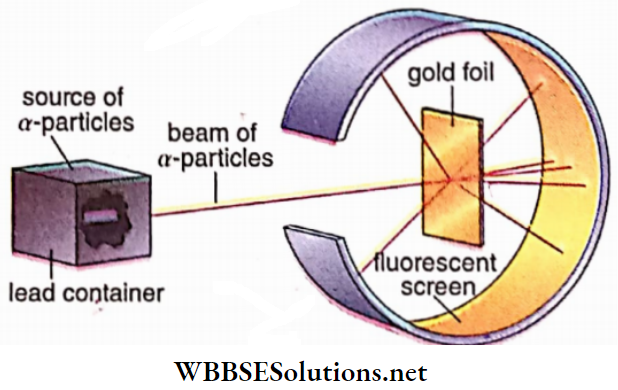
Atom Alpha Particles Scattering

Observation and inference:

  • Most of the a -particles passed straight through the metal foil without suffering any deflection. This observa¬ tion leads to the conclusion that most of the space inside the atom is empty.
  • Low angle scattering: Some of the alpha particles were scattered through small angles i.e., the scattering angle Here, it is assumed that this scattering
  • This takes place due to coulomb attraction between an alpha particle of charge +2e and an electron of charge -e. The deflections of α -particles are so small that an α -particle is about 7000 times heavier than an electron. From this, it is concluded that electrons are embedded discretely inside the atom
  • Large angle scattering: Some a -particles, though very few suffered deflection by 90° or larger angles. Some of these a -particles were even deflected through 180° Rutherford quantitatively analyzed the
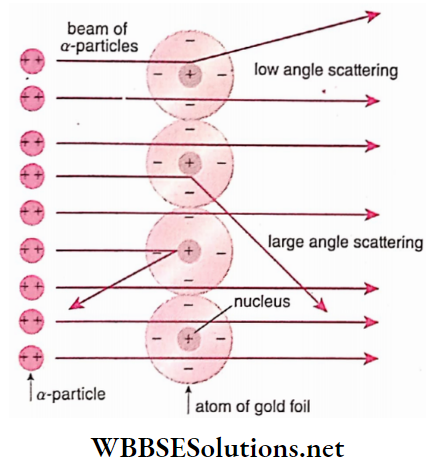
Atom Large Angle Scattering

WBBSE Class 12 Atom Notes

A number of these large angle deflections. He argued that, to deflect the a -particle backward, it must experience a large repulsive force which was possible if the entire positive charge and almost total mass of the atom were concentrated in a small space. This confirmed the presence of the nucleus.

Thus the strong electrostatic repulsion between an a -particle of charge +2e and a nucleus of charge +Ze was the cause of these large deflections.

By quantitative analysis, it was also concluded that the diameter ofthe nucleus is about 10-14 m which is about \(\frac{1}{1000}\) times the atomic diameter of 10-10 m. Hence the volume of the nucleus is only about 1 in 1012 parts of the atom

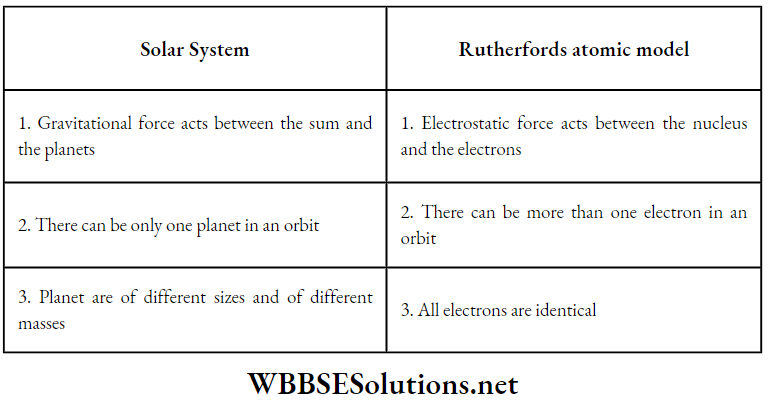
Rutherford’s atomic model is often compared with the solar system, but there are more dissimilarities than resemblances. Similarities are only marginal.

Similarities:
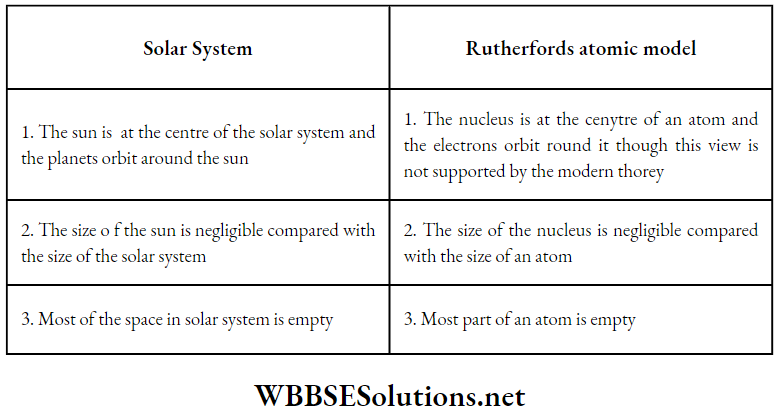
Atom Similarities Of Solar And Rutherfords Atomic Model

Dissimilarities:

Atom Dissimilarities Of Solar And Rutherfords Atomic Model

From the observations, Rutherford proposed his atomic model.

The salient features of the model are:

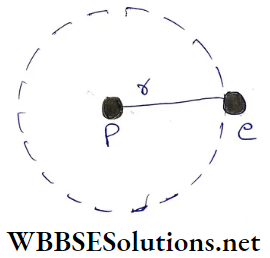
  • The nucleus exists at the center of an atom and electrons orbit around the nucleus in circular paths.
  • The necessary centripetal force for the orbital motion is provided by the electrostatic attraction between the opposite charges of the nucleus and the electron
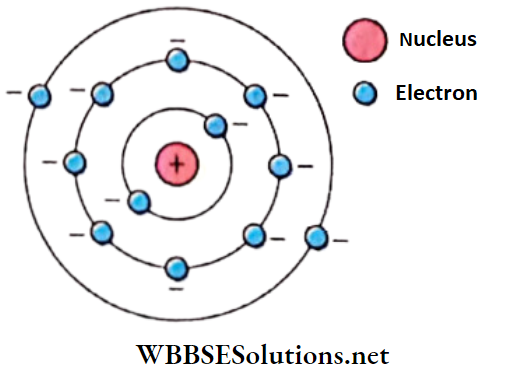
Atom Centrepetal Force

Atoms class 12 notes Drawbacks of the Rutherford model:

InstabilHy of the atom: An orbiting electron in an atom is subjected to centripetal acceleration. According to Max¬ Well’s classical electromagnetic theory, any accelerated charged particle emits electromagnetic radiation.

Since orbiting electrons are accelerated, they should also emit radiation. If this were to happen, the energy of the orbiting electron would keep on decreasing. It would follow a spiral path and ultimately collide with the nucleus.

Theoretical calculations show that under this condition no atom would survive for more than 10-8 s. However, matter is stable implying that atoms too cannot be unstable.
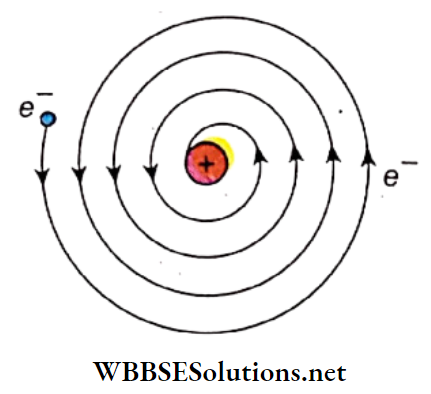
Atom Alpha Instability Of The Atom

Continuous atomic spectrum: If electron energy in an atom had converted into radiant energy, we would get a con¬ continuous spectrum. Interestingly, atoms of hydrogen, helium, etc. produce a line spectrum instead of a continuous spectrum

Atoms Class 12 Notes 

WBCHSE Class 12 Physics Atom Bohr’s Atomic Model

Rutherford’s atomic model was modified by Niels Bohr. The postulates Rutherford model which has no technical difficulties remain intact in the Bohr model of the atom. They are  ISM Positively charged nucleus occupies a negligible space at the center of the atom.

Negatively charged electrons revolve around the nucleus in circular orbits. If the mass, speed, and radius of the orbit of an electron are m, v, and r, respectively, the Centripetal force necessary to revolve electrons in a circular orbit,

F = \(\frac{m v^2}{r}\) ……………..(1)

The electrostatic force of attraction acts between the nucleus and electrons. Now, if the atomic number of an atom is Z and the charge of an electron is, the total charge of the nucleus is Ze. So, the electrostatic force of attraction between the nucleus and an electron

F2 = \(\frac{1}{4 \pi \epsilon_0} \cdot \frac{Z e \cdot e}{r^2}=\frac{1}{4 \pi \epsilon_0} \cdot \frac{Z e^2}{r^2}\)

On the other hand, resolving the drawbacks of Rutherford’s model related to the

  • Stability of atoms and
  • Atomic line spectrum, Bohr introduced some revolutionary ideas that are not consistent with classical physics.

From this, Bohr’s theory of the atom was  established and the consequent structure of the atom “is called Bohr’s atomic model

Understanding Atomic Structure for Class 12

Postulates of Bohr’s Theory

Bohr’s model is based on three postulates. These are a[so known as Bohr’s quantum postulates.

  • Electrons inside an atom can only revolve in some allowed orbits. When an electron revolves in an allowed orbit, it does not radiate energy.
  • Note that, according to classical electromagnetic theory, a rotating (i.e., accelerated) charge radiates energy.
  • According to this postulate, the energy of an electron in any allowed orbit remains constant; hence these orbits are called stationary orbits or stable orbits.
  • Transition of electrons from one stable orbit to another is possible.
  • During the transition, an emission or an absorp¬ tion of radiation occurs.

Its frequency f is determined from the relation, hf = E1~ E2 where h is Planck’s constant and (E1 ~E2) is the energy difference of the electron in the two stable orbits.

When the energy (E1) of an electron in its initial orbit is more than its energy (E2) in its final orbit, i.e., when E1> E2, the difference in energy is converted into the energy of an emitted photon. As a result, the atom radiates energy. In this case,

E1– E2 = hf ……………………………..(1)

Again, if E1 < E2, an external photon should supply the difference in energy. So, in this case, the atom absorbs energy.

E2– E2 = hf ……………………………..(2)

Equations (1) and (2) are called Bohr’s frequency conditions

The orbit. where the angular momentum of the electron Is an integral multiple of \(\frac{k}{2 \pi}\) , is known as a stationary or stable orbit

Now, if the radius of any stable orbit is rn, the speed of
electron in drat orbit be vn, angular momentum,

Ln = momentum x radius of the circular path

So, according to this postulate,

⇒ \(m v_n r_n=\frac{n h}{2 \pi}\)

where, n = 1.2.3,…… This equation is called Bohr’s quantum condition, n is called the principal quantum number of an electron or its orbit. These stable orbits are called Bohr orbits.

It is dear that, none of Bohr’s postulates is consistent with classical physics.

  • Yet, the success of Bohr’s theory is borne out by die analysis of the atomic spectrum of hydrogen and some other elements.
  • Moreover, a dear qualitative picture related to the atomic structure of any element can be obtained from Bohr’s theory.
  • Hence, in spite, of some inconsistency relating to some classical experiments, the Bohr model is considered the basis of the atomic structure of all elements.

Atoms class 12 notes Bohr’s Quantum Condition from de Broglie’s Hypothesis

  • According to de Broglie’s hypothesis, a stream of any parties can be considered to be matter waves
  • If the stream of particles advances freely, the corresponding matter wave behaves as a progressive wave
  • On the other hand, if the stream of particles is confined within a definite region, then naturally the corresponding matter wave behaves as a stationary wave
  • From these considerations, de Broglie assumed that,
  • A matter wave of electrons confined within an atom is a stationary wave.
  • The electronic orbits in an atom should be such that, an integral number of electron waves is present in a complete orbit.
  • Otherwise, after a complete revolution, the
  • Wave will reach n different point mul It once a Stationary wave will not be formed.
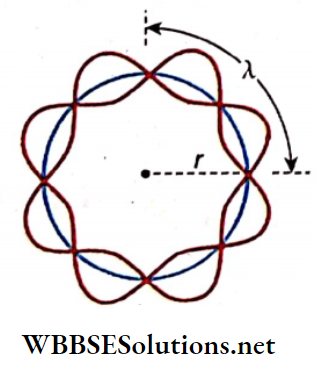
Atom Broglies Hypothesis

If the radius of the die circular path is r, circumference = 2πr. So, if the wavelength of the electron wave is λ, then

2πr = nλ [n = 1,2,3, ……… ]

Here,  four complete waves arc shown In n complete
orbit i.e., n = 4.

Again, according to de Broglie’s hypothesis, if the mass of electron = m and its speed = vn, then

= \(\lambda=\frac{h}{m v}\)

h = planks constant

So, 2πr = \(n \frac{h}{m v}\)

Where n = 1,2,3…….

Or mvr = \(n \frac{h}{2 \pi}\)

For different values of n, the values of r and v will be different; if these values are taken as rn and vn for the definite value of n, then

⇒ \(m v_n r_n=n \frac{h}{2 \pi}\)

Where n = 1,2,3 ……………

This is Bohr’s quantum condition. So the quantum condition is consistent with the idea of de Broglie’s matter wave. But it should be kept in mind that, as an explanation of unstable orbits of an atom, the above-mentioned discussion is a kind of oversimplification. A true explanation can only be made with quantum mechanics.

Common Questions on Atomic Structure

Application of Bohr’s Theory

According to this condition, the radii of different Bohr orbits and orbital speeds of electrons are different. In the case of n -th orbit

⇒ \(m v_n r_n=\frac{n h}{2 \pi} ; \text { where } n=1,2,3 \ldots\)

Accroding \(v_n^2=\frac{n^2 h^2}{4 \pi^2 m^2 r_n^2}\) …………………….(1)

The radius of the n-th Bohr orbit (r„): Electrostatic force of attraction between electron and nucleus of nth orbit

⇒ \(\frac{1}{4 \pi \epsilon_0} \cdot \frac{Z e^2}{r_n^2}\)

This force of attraction supplies the necessary centripetal force \(\frac{m v_n^2}{r_n}\)

So, \(\frac{m v_n^2}{r_n}=\frac{1}{4 \pi \epsilon_0} \cdot \frac{Z e^2}{r_n^2}\)

Or, \(v_n^2=\frac{1}{4 \pi \epsilon_0} \cdot \frac{Z e^2}{m r_n}\) …………………….(2)

Comparing equation (1) and (2), we get

⇒ \(\frac{n^2 h^2}{4 \pi^2 m^2 r_n^2}=\frac{1}{4 \pi \epsilon_0} \cdot \frac{Z e^2}{m r_n}\)

Or, \(r_n=\frac{\epsilon_0 n^2 h^2}{\pi m Z e^2}\) ……………………………… (3)

This is the expression of the radius of n -th Bohr orbit

Total energy of the electron in n-th orbit (En):

The kinetic energy of the electron in n -th orbit,

⇒ \(E_k=\frac{1}{2} m \nu_n^2=\frac{1}{2} \cdot \frac{1}{4 \pi \epsilon_0} \cdot \frac{Z e^2}{r_n}=\frac{1}{4 \pi \epsilon_0} \cdot \frac{Z e^2}{2 r_n}\)

Now, we know that the potential energy of an electron in n -th orbit due to the electrostatic force of attraction

⇒ \(E_p=-\frac{1}{4 \pi \epsilon_0} \cdot \frac{Z e^2}{r_n}\)

So, the total energy of the electron in n -th orbit

⇒ \(E_n=E_k+E_p=\frac{1}{4 \pi \epsilon_0} \cdot \frac{Z e^2}{r_n}\left(\frac{1}{2}-1\right)\)

⇒ \(-\frac{1}{4 \pi \epsilon_0} \cdot \frac{Z e^2}{2 r_n}\) ………………………. (4)

Hence, En= -En and Ep = 2En

Substituting the value of rn from equation (3) into equation (4), we get

⇒ \(-\frac{1}{4 \pi \epsilon_0} \cdot \frac{Z e^2 \cdot \pi m Z e^2}{2 \cdot \epsilon_0 n^2 h^2}=-\frac{m e^4 Z^2}{8 \epsilon_0^2 n^2 h^2}\) …………………….(5)

Hydrogen atom:

The structure of the hydrogen atom is the simplest of all. For hydrogen Z = 1, i.e., the electric charge of its nucleus is +e, and only one electron having charge -e revolves around it.

All the information obtained from Bohr’s theory for this atom is given below

The radius of n – th Bhor orbit:

Substituting Z = 1 in the equation (3) we get,

rn = \(\frac{\epsilon_0 n^2 h^2}{\pi m e^2}\) ……………………………… (6)

Here, ∈0 = permittivity of vacuum

= 8.854 × 10⁻¹²C2 . N-1 . m-2

h = Planck’s constant = 6.63 × 10⁻³⁴ J.s

m = mass of electron = 9.1 × 10⁻³¹ kg

e = charge of an electron = 1.6 × 10⁻¹⁹ C

Hence, rn α n²

The information obtained about Bohr orbits from equation (6) is:

1. For n = 1, r becomes minimum, i.e., the orbit lies closest to the nucleus. This is known as the first Bohr orbit or K – shell of the atom. The radius of this orbit is called the first

Bohr radius is denoted by the sign a0, i.e., r1 = a0.

Putting n = 1 in equation (6), we get,

a0 = \(\frac{\epsilon_0 h^2}{\pi m e^2}\)………………..(7)

Substituting the values of the constants in this expression we get

a0 = 0.53 × 10⁻¹⁰ m

= 0.53Å

= 0.053 nm

Angstrom and nanometre units:

1 angstrom (Å) = 10-10m; 1 nanometre (nm) = 10-9m

So, 1nm = 10Å  or, 1Å = 0.1 nm. Nowadays nm unit Is more commonly used instead of Å in SI.

2. Using the value of aQ in equation (6), we get, rn = n²a0

Substituting n = 2, 3, 4, in this equation, the radii of the orbits, L, M, N,….. are obtained, respectively.

Since rn the ratio of the radii of the orbits K, L, M, N…. is 1: 4:9:16………………………….

For example,

The radius of the L -orbit, rn = 2². a0 = 4 × 0.53 = 2.12Å;

The radius of the M -orbit, r3 = 3² . a0 = 9 × 0.53 = 4.77Å ; etc.

3. The orbits having radii a0, 4a0, 9a0, ……………………….are permissible and no orbit exists in between them.

For example, the radii of the first and the second Bohr orbits are 0.53 Å and 2.12 Å, respectively. So, no electron can revolve along any circular path having a radius >0.53 A but <2.12 Å. So, the Bohr orbits are discrete, due to integral values of n. Thus n is called the principal quantum number

The energy of the electron to the n-th orbit (En):

Substituting the value of rn from equation (8) in equation (4), we get for hydrogen Z = 1

(En) = \(E_n=-\frac{1}{4 \pi \epsilon_0} \frac{e^2}{2 n^2 a_0}\) ………………. (9)

This is the expression for the total energy of the electron revolving in the n-th orbit of a hydrogen atom.

The inferences made from equation (9) are:

The value of En is negative; hence higher the value of n, i.e., the greater the distance greater the energy of the electron. So in the first Bohr orbit or the K-orbit, the energy of the electron is the least This is called the ground state of the hydrogen atom. Putting n = 1 in equation (9), we get

⇒ \(E_1=-\frac{1}{4 \pi \epsilon_0} \cdot \frac{e^2}{2 a_0}\) ………………………(10)

Using the values of the constants we get, E1 = -13.6eV; hence, the ground state energy of the hydrogen atom = -13.6eV.

Again, putting the value of a0 from equation (7) into equation (10), we get,

E1 = \(-\frac{1}{4 \pi \epsilon_0} \cdot \frac{e^2 \pi m e^2}{2 \epsilon_0 h^2}\)

= \(-\frac{m e^4}{8 \epsilon_0^2 h^2}\)

Where c is the speed of light in a vacuum

Where, r = \(\frac{m e^4}{8 \epsilon_0^2 c h^3}\) = constant

Here, R is a constant called the Rydberg constant Substituting the accepted values of the physical constants, the value of

R comes out to be 1.09737 × 10⁷m

From equations (9) (10) and (11), we get

⇒ \(E_n=-\frac{R c h}{n^2}=-\frac{13.6 \mathrm{eV}}{n^2}\)

Or, \(E_n \propto \frac{1}{n^2}\)

Thus the energies in the orbits K, L, M, N.. are as \(1: \frac{1}{4}: \frac{1}{9}: \frac{1}{16}\)

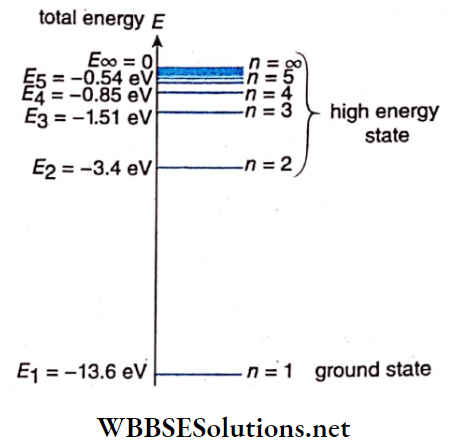
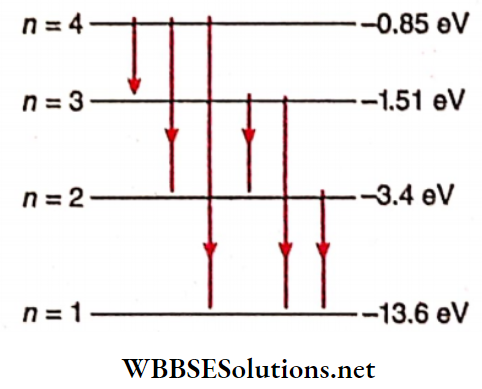
So, in the orbits, of hydrogen atoms, the energies are E1 = -13.6eV, E2 = -3.4eV, E3 = -1.51eV, and E4 = -0.85eV, respectively.

Hence, these energy levels are discrete, i.e., the electron cannot exist in any intermediate energy state.

Clearly, as n increases, En becomes less negative i.e., the energy increases. The energy levels of the hydrogen atoms are represented in the energy level diagram the highest energy state corresponds to n = and has energy

⇒ \(E_{\infty}=\frac{13.6}{\infty^2}=0 \mathrm{eV}\)

Note that an electron can have any total energy above QeV. In such a situation, the electron is free and there is a continuum of energy state above

E = \(\frac{13.6}{\infty^2}\)

= 0eV

Atom Energy Of The Electron In nth Orbit

Class 12 Physics Atoms Chapter Notes

Speed of the electron in n th orbit (v):

In the case of the hydrogen atom, putting Z = 1, we get from equation (2)

⇒ \(v_n^2 \propto \frac{1}{r_n} \text { or, } v_n \propto \frac{1}{\sqrt{r_n}}\)

Again from equation (3), we get

⇒  \(r_n \propto n^2 \text { so, } v_n \propto \frac{1}{n}\)

Hence, the ratio of the speeds of electrons in K, L, M, N … orbit is

rn  ∝ n²

So, rn  ∝ 1/ n

Hence speed of the electron is highest in the first Bohr orbit

In the case of the hydrogen atom, putting Z = 1 in equation (2), we get

⇒ \(v_n^2=\frac{1}{4 \pi \epsilon_0} \cdot \frac{e^2}{m r_n}\)

Or, \(\frac{1}{4 \pi \epsilon_0} \cdot \frac{e^2}{m v_n r_n}=\frac{1}{4 \pi \epsilon_0} \cdot \frac{e^2}{n \cdot\left(\frac{h}{2 \pi}\right)}\)

= \(=\frac{c}{n}\left[\frac{e^2}{4 \pi \epsilon_0 c\left(\frac{h}{2 \pi}\right)}\right]=\frac{c}{n} \alpha\)

c is the speed of light in a vacuum

Where = \(\alpha\left(=\frac{e^2}{4 \pi \epsilon_0 c\left(\frac{h}{2 \pi}\right)}\right)\) is a dimensionless constant

a is called Sommerfeld’s fine structure constant. Substituting the accepted values of the physical constants, the value of a comes out to be a

⇒ \(\frac{1}{137}\) approximately.

For the first Bohr orbit n = 1, the speed of an electron,

⇒  \(v_1=\frac{c}{137}\) = 2.18 × 10⁶ m.s-1

This speed is approximately part of the speed of light (c) in a vacuum.

So, the speed of an electron in the next orbit is:

⇒  \(v_2=\frac{1}{2} v_1=\frac{c}{274}\)

= \(v_3=\frac{1}{3} v_1=\frac{c}{411}\)

Orbital angular momentum of the electron in n-th orbit (Ln):

From Bohr’s quantum condition, we directly obtain

Ln= nh/2π

Naturally, Ln oc n, i.e., L1: L2: L3: …………….. = 1: 2: 3: ………………….

So, the greater the distance of the orbits, the greater will be the value of

For example,

L1= \(\frac{h}{2 \pi}=\frac{6.63 \times 10^{-34}}{2 \pi}\)

= 1.06 × 10⁻³⁴m. s-1

L1= 2 L1= 2.12 ×10⁻³⁴ J.s :  etc

Hydrogen Spectrum

1. Atomic spectrum:

Line spectrum:

If electric discharge occurs inside any elementary gas or vapor kept in a discharge tube at a few mm of mercury pressure, the tube acts as a bright source of light. It is generally called a discharge lamp. Discharge lamps of neon, sodium, mercury, and halogen gases are used in our daily lives.

With the help of a prism or other instruments, different fundamental colors of different wavelengths are obtained in the dispersion of light emitted from a discharge lamp. This is known as the atomic spectrum. In this spectrum, there are ultraviolet rays and infrared rays along with visible light.

With the help of a special experimental arrangement, the wavelength of each fundamental ray can be determined. Atomic spectra for different elements are different

The characteristics of the atomic spectra are that these are usually a combination of some thin, bright and discrete lines; i.e., in between two bright lines there is a dark space. This spectrum is known as line spectrum
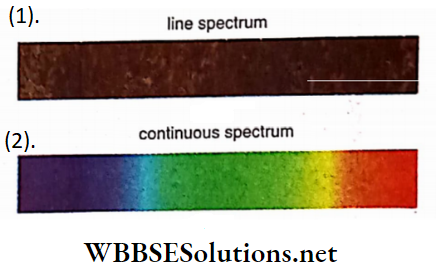
Atom Line Spectrum

On the other hand, the spectrum obtained from a heated solid (e.g., an incandescent tungsten lamp) is a continuous spectrum; the different colored lights present in it form continuous illumination on the screen and there is no dark space in between them

Again, the molecular spectrum is usually a band spectrum. Instead of discrete lines, closely spaced groups of lines are so formed that each group appears to be a band. Between two consecutive bands, there is a dark space

2. Balmer series of hydrogen spectrum:

In the visible region of the atomic spectrum of hydrogen, there are four bright lines. The experimental values of their wavelengths are 6563A, 4861 Å, 4341 Å, and 4102 Å. These four lines constitute the Balmer series of the hydrogen spectrum. A Swiss mathematics teacher, Balmer tried to express these wavelengths by a simple relation in 1884, many years before the proposal of the Bohr model, which is

⇒ \(\frac{1}{\lambda}=A\left(\frac{1}{2^2}-\frac{1}{n^2}\right)\) …………………… (1)

Here, λ = wavelength of spectral line,

A = constant and n = 3, 4, 5, …………………………..

The number of complete waves present in unit length is denoted by the reciprocal of wavelength, I; hence j is called the number and is sometimes expressed by the symbol.

Substituting A = 1.09678 × 10⁷ m-1 in equation (1), the experimental values of the wavelength of the spectral lines can be found.

For example,

For n = 3 , λ = 6563 Å; for n = 4,  λ = 4861 Å

For n = 5, λ = 4341 Å ; for n = 6, λ = 4102 Å

Moreover, substituting n = 7, 8, 9, different values of /I are obtained and these also belong to the Balmer series. But these wavelengths lie in the ultraviolet region, not in the visible region

Balmer could arrange the spectral lines of hydrogen in a definite pattern, but could not determine relation (1) theoretically

Important Formulas in Atomic Physics

3. Other series of hydrogen spectrum:

Lyman series:

The relation denoting this series is

⇒ \(\frac{1}{\lambda}=A\left(\frac{1}{1^2}-\frac{1}{n^2}\right) ; n=2,3,4, \cdot \cdot\)

Using the same value of A, the values of A obtained from this relation, resemble that of the lines obtained in the ultraviolet region of the hydrogen spectrum. For example, if n

If n = 2, then λ = 1216 Å; if n = 3, then  λ = 1026Å

Paschen series:

The relation denoting this series is

⇒ \(\frac{1}{\lambda}=A\left(\frac{1}{3^2}-\frac{1}{n^2}\right) ; n=4,5,6, \cdots\)

From this relation, the wavelength of some spectral lines of the infrared region of the hydrogen spectrum is obtained. For example,

If n = 4 then λ = then 18751 Å

Class 12 physics atoms chapter notes

Brackett series and Pfund series:

In the infrared region of the hydrogen spectrum, some more series are present except the Paschen series; these are the Brackett series and the Pfund series. But in this case, the brightness (or intensity) ofthe corresponding spectral lines is negligibly small.

The relation denoting the Brackett series is,

⇒ \(\frac{1}{\lambda}=A\left(\frac{1}{4^2}-\frac{1}{n^2}\right)\) : n = 5,6,7 ………………..

The relation denoting the Pfund series is

⇒ \(\frac{1}{\lambda}=A\left(\frac{1}{5^2}-\frac{1}{n^2}\right)\) : n = 6,7,8 ………………..

4. Rydberg formula:

Just after the discovery of the Balmer series, Rydberg expressed the following general equation related to the series of spectrums. This is known as the Rydberg formula

⇒ \(\frac{1}{\lambda}=\frac{R}{(m+a)^2}-\frac{R}{(n+b)^2}\) …………………… (2)

Where, R is constant (Rydberg constant) for a particular element, a and b are the characteristic constants for a particular series, m is a whole number that is constant for a given series and n is a varying whole number whose different values indicate the different lines of the series. With the help of equation (2), the series of spectra of most of the elements can be expressed accurately.

Explanation of Hydrogen Spectrum from Bohr’s Theory

Rydberg constant:

The discrete energy levels of the hydrogen atom

En = \(-\frac{R c h}{n^2}\) ……………………. (1)

Here, R = \(\frac{m e^4}{8 \epsilon_0^2 c h^3}\) ……………………. (2)

Where, c = speed of light in vacuum = 3 × 10⁸ m .s-1 and
n = 1,2,3………………..

∴ Ground state energy, E1 = -Rch

Substituting the values of different constants in equation (2), we get, R ≈ 1.09737 × 10⁷m-1

Note that, in the analysis of the Balmer series of the hydrogen spectrum, the value of the constant A obtained (1.09678 × 10⁷ m -1 ) is slightly less than the above value of R.

This difference becomes negligible if the mass of the hydrogen nucleus is corrected. So, we can say that, the constant A is the Rydberg constant, and equation (2) denotes its expression

Calculation of Rydberg constant in the CGS system:

The expression for the Rydberg constant in the CGS system can be obtained by substituting in place of e0 in equation (2). Using the CGS values of the constants, we get

R = \(\frac{2 \pi^2 m e^4}{c h^3}\)

= 109737 cm -1

The wavelength of the emitted radiation:

Let the electron in a hydrogen atom make a transition from a higher energy state Eni to a lower energy state Eni According to Bohr’s postulate, a photon will be emitted from the hydrogen atom due to this transition.

If the frequency of this photon is f (wavelength \(\) ) then

⇒ \(E_{n_i}-E_{n_f}=h f=\frac{h c}{\lambda}\) …………….(3)

Substituting n = ni and n = nf respectively in equation (1), we get

⇒ \(E_{n_i}=-\frac{R c h}{n_i^2} \text { and } E_{n_f}=-\frac{R c h}{n_f^2}\)

So, from equation (3), we get,

⇒ \(\frac{h c}{\lambda}=-\frac{R c h}{n_i^2}+\frac{R c h}{n_f^2}\)

= \({Rch}\left(\frac{1}{n_f^2}-\frac{1}{n_i^2}\right)\)

Or \(\frac{1}{\lambda}=R\left(\frac{1}{n_f^2}-\frac{1}{n_i^2}\right)\) ……………………….. (4)
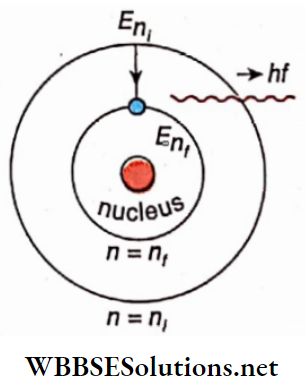
Atom Wavelength Of The Emitted Radiation

1. Balmer series:

If the electron in a hydrogen atom jumps from any one of the energy states E3, E4, E5,……………. etc. to the energy state ,E2 then putting ni = 3,4, 5, …………… and nf= 2 in equation (4), we get

⇒ \(\frac{1}{\lambda}=R\left(\frac{1}{2^2}-\frac{1}{n^2}\right) ; n=3,4,5, \cdots\) …………. (5)

This relation indicates the Balmer series of the atomic spectrum of hydrogen

2. Other series:

Similarly, substituting ni = 2, 3, 4, and nf = 1 in equation (4), we get the Lyman series :

⇒\(\frac{1}{\lambda}=R\left(\frac{1}{1^2}-\frac{1}{n^2}\right)\): n =2,3,4 ………………. (6)

Again, substituting nt = 4, 5, 6— and nÿ= 3 , we get Paschen series

⇒\(\frac{1}{\lambda}=R\left(\frac{1}{3^2}-\frac{1}{n^2}\right)\): n = 4,5,6 ………………. (7)

Substituting ni = 5, 6, 7, ………..  and nf= 4, we get Brackett series

⇒\(\frac{1}{\lambda}=R\left(\frac{1}{4^2}-\frac{1}{n^2}\right)\): n = 5,6,7  ………………. (8)

Substituting ni = 6,7,8,……..  and nf= 5, Pfund series is obtained:

⇒\(\frac{1}{\lambda}=R\left(\frac{1}{5^2}-\frac{1}{n^2}\right)\): n = 6,7,8 ……………… (9)
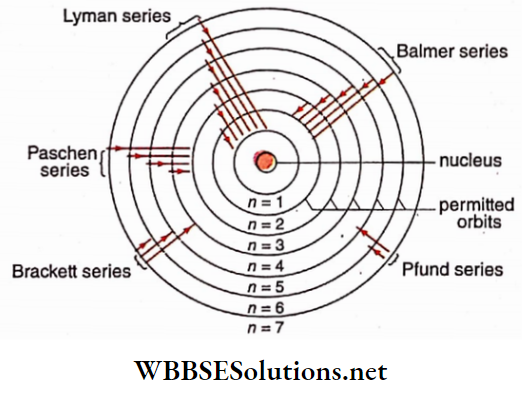
Atom Balmer And Other Series

So the relations, shown by Balmer and other scientists for different wavelengths of the atomic spectrum of hydrogen, can be established accurately from Bohr’s theory. The basis of the success of Bohr’s theory lies in the accurate explanation of the hydrogen spectrum, although it has deviations from classical physics Different series of the atomic spectrum of hydrogen are

Class 11 Physics Class 12 Maths Class 11 Chemistry
NEET Foundation Class 12 Physics NEET Physics

Absorption and emission spectrum of hydrogen:

We have seen that if an electron jumps from a higher energy state to a lower one, energy equal to the difference between the states is emitted where AE = hc/ λ. So the reverse process, if the atom absorbs a photon of wavelength A, the electron will jump from the lower energy state to the higher energy state. Since the difference in energy states is fixed, the wavelength of the absorbed photon and that of the emitted photon are exactly equal.

Thus, if the light coming from a source (e.g., an incandes¬ cent tungsten lamp) passes through hydrogen gas, due to absorption, some dark lines are formed in its spectrum. These dark or black lines form an absorption spectrum The bright lines present in the emission spectrum obtained from the hydrogen gas discharge tube, become dark in the continuous spectrum of other sources while absorbed by hydrogen
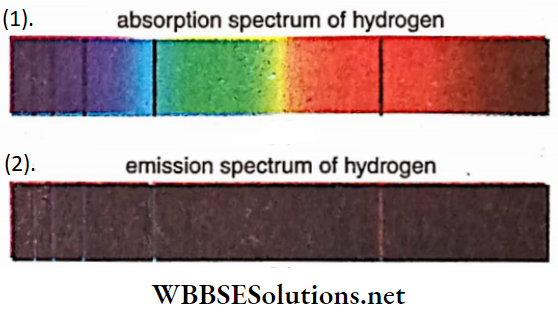
Atom Absorption And Emission Spectrum Of Hydrogen

Class 12 physics atoms chapter notes 

WBCHSE Class 12 Physics Atom Bohr’s Atomic Model Numerical Examples

Example 1.  If the value of the Rydberg constant of hydrogen is 109737 cm-1, determine the longest and the shortest Paschen wavelength of the Balmer series.
Solution:

If the wavelength of the Balmer series is λ, then

⇒ \(\frac{1}{\lambda}=R\left(\frac{1}{2^2}-\frac{1}{n^2}\right)\) n = 3,4,5 ………….

R = Rydberg constant

Substituting the minimum value of n, i.e., n = 3, we get

⇒  \(\frac{1}{\lambda}=R\left(\frac{1}{2^2}-\frac{1}{3^2}\right)=R \times \frac{5}{36}\)

Or, \(\lambda=\frac{36}{5 R}=\frac{36}{5 \times 109737}\)

= \(\frac{36 \times 10^8}{5 \times 109737}\)

= 6561 Å

This is the longest wavelength.

Again, by substituting the maximum value of n, i.e n = we get

⇒  \(\frac{1}{\lambda}=R\left(\frac{1}{2^2}-\frac{1}{\infty}\right)=R \times \frac{1}{4}\)

Or, \(\) cm-1

= \(\lambda=\frac{4}{R}=\frac{4}{109737} \mathrm{~cm}\)

= \(\frac{4 \times 10^8}{109737}\)

= 3645 Å

This is the shortest wavelength

Example 2. As a result of a collision with a 20 eV energy, a hydrogen atom is excited to the higher energy state, and the electron is scattered with a reduced velocity. Subsequently, a photon with a length of 1216 Å is emitted from the hydrogen wave atom Determine the velocity of the electron after collision
Solution:

The wavelength of the emitted photon,

λ = 1216 Å = 121 6 × 10⁻⁸ cm

∴ The amount of energy gained by the hydrogen atom from the electron

E1 – E2 = hf

= \(\frac{h c}{\lambda}=\frac{6.625 \times 10^{-27} \times 3 \times 10^{10}}{1216 \times 10^{-8}}\)

= 1.634 × 10⁻¹¹  erg

According to the questions, the initial kinetic energy of the electron

= 20 eV = 20 × 1.6  × 10-12  erg

= 3.2 × 10⁻¹¹erg.

∴ The remaining kinetic energy of the electron after its collision with a hydrogen atom

⇒ \(\frac{1}{2} m v^2=(3.2-1.634) \times 10^{-11}\) = (3.2 – 1.634)

= 1.566  × 10-11  erg

Or, v = \(\sqrt{\frac{2 \times 1.566 \times 10^{-11}}{9.1 \times 10^{-28}}}\)

= 1.855 × 10 cm .s-1

Real-Life Applications of Atomic Models

Example 3. Light from a discharge tube containing hydrogen atoms is incident on the surface of a piece of sodium. The maximum kinetic energy of the photoelectrons emitted from sodium is 0.73 eV. The work function of sodium is 1.82 eV. Find

  1. The energy of photons responsible for the photoelectric emission 
  2. The quantum numbers of the two orbits in the hydrogen atom involved in the emission of photons and
  3. The change in angular momentum ofthe electron of a hydrogen atom in the two orbits

Solution:

1. According to the photoelectric equation, energy of the photon, hf = Emax + W0 = 0.73 + 1.82 = 2.55 eV

2. The energy difference between the two orbits is 2. 55 eV. Now in case of the hydrogen atom

Energy in the ground state (n= 1) , E1 = -13.6 eV

Energy in n = 2 state E2 = \(\frac{E_1}{2^2}=-\frac{13.6}{4}\)

= -3.4 eV

Energy in n = 3 state  E3 = \(\frac{E_1}{3^2}=-\frac{13.6}{9}\)

= 1.51 eV

Energy in n = 4 state E3 = \(\frac{E_1}{2^2}=-\frac{13.6}{16}\)

E4– E2 = 2.55 eV

So, the quantum numbers of the two orbits are 4 and 2.

3. According to Bohr’s postulate, change in angular momentum

= \(4 \cdot \frac{h}{2 \pi}-2 \cdot \frac{h}{2 \pi}=\frac{h}{\pi}\)

= \(\frac{6.625 \times 10^{-27}}{\pi}\)

= 2.11 × 10⁻²⁷ erg. s

Atomic Structure Class 12 Notes

Example 4. When ultraviolet light of wavelengths 800Å and 700Å are incident on the hydrogen atom at ground state, electrons are emitted with energies 1.8 eV and 4 eV, respectively. Determine the value of Planck’s constant
Solution:

Let the ground state energy of the hydrogen atom = -E0. Hence, the minimum amount of energy E0 is required to liberate its electron, i.e., the work function of the hydrogen atom, W0 = E0.

So, if the incident photon can provide E amount of kinetic energy to the electron, then

hf = E + E or, hc/λ = E + E0

In the first case,

λ1 = 800 Å = 800 × 10-8  cm ,

E1 = 1.8 eV = 1.8 × 1.6 × 10-12 erg

In the second case,

λ2  = 700 A = 700 × 10-8   cm ,

E2 = 4.0 eV = 4.0 × 1.6 × 10-12   erg

From equation (1), we get,

⇒ \(\frac{h c}{\lambda_1}-\frac{h c}{\lambda_2}=E_1-E_2\)

Or, \(h c\left(\frac{1}{\lambda_1}-\frac{1}{\lambda_2}\right)=E_1-E_2\)

= E1 – E2

Or, \(h=\frac{E_2-E_1}{c} \cdot \frac{\lambda_1 \lambda_2}{\lambda_1-\lambda_2}\)

∴ h = \(\frac{(4.0-1.8) \times 1.6 \times 10^{-12}}{3 \times 10^{10}} \times \frac{800 \times 700 \times 10^{-16}}{(800-700) \times 10^{-8}}\)

= 6.57 × 10⁻²⁷  erg.s

Examples of Electron Configuration

Example 5. In absorbing 10.2 eV energy, the electron of a hydrogen atom Jumps from Its Initial orbit to the next higher energy orbit. As the electron returns to the former orbit, a photon Is emitted. What Is the wavelength of this photon?
Solution:

According to Bohr’s postulate,

hν = Ei – Ef

Or, \(\frac{h c}{\lambda}=E_l-B_f\)

Or,\(\lambda=\frac{h c}{E_l-E_f}\)

The difference between the two energy levels,

Ei – Ef = 10.2 eV = 10.2 ×  1.6 × 10-12 erg

λ = \(\frac{6.55 \times 10^{-27} \times 3 \times 10^{10}}{102 \times 16 \times 10^{-12}}\)

= 1204 × 108cm

= 1204 Å

Atomic structure class 12 notes 

WBCHSE Class 12 Physics Atom Ionisation Energy And Ionisation Potential

Ionization energy:

The minimum amount of energy required to ionize an atom of an element at its ground state is called the ionization energy of that element.

Example:

The ground state energy of hydrogen atoms = -13.6 eV. In a H+ ion, the only electron of the corresponding hydrogen atom has been removed. In this state, the electron is no longer attracted by the atom, i.e., its potential energy becomes zero.

Again, the condition for minimum energy to be possessed by the electron is that its kinetic energy is zero; as a result its total energy = kinetic energy + potential energy = 0. Naturally, if the electron is brought from a -13.6 eV energy state to a zero energy state, the atom can be converted into an ion. So, the minimum amount of energy supplied = 0- (-13.6) = 13.6 eV

Hence, the ionization energy of hydrogen = 13.6 eV.

Ionization potential:

The minimum potential to be applied to an atom of an element in its ground state to convert it into a positive ion is called the ionization potential of that element.

Example:

According to the definition, if 1 V potential is applied to an electron having charge -e, the gain in energy of the elec¬ tron = 1 eV.

Ionization energy of hydrogen = 13.6 eV; so, to supply this 13.6 eV energy to the electron of the hydrogen atom, a minimum 13.6V potential should be applied to it.

Hence, the ionization potential of hydrogen = 13.6 V

Atomic Structure Class 12 Notes 

Atom Ionisation Energy And Ionisation Potential Numerical Examples

Example 1. A hydrogen atom in its ground state, is excited using monochromatic radiation of wavelength 975 Å. How many different lines are possible in the resulting spectrum? Calculate the longest wavelength amongst them. Given, ionization energy of the hydrogen atom is 13.6 eV
Solution:

Wavelength of incident radiation,

A = 975 Å = 975 × 10-8cm

∴ Energy of this photon

hf = \(\frac{6.625 \times 10^{-27} \times 3 \times 10^{10}}{975 \times 10^{-8}}\)

= \(\frac{6.625 \times 10^{-27} \times 3 \times 10^{10}}{975 \times 10^{-8}} \mathrm{erg}\)

= \(\frac{6.625 \times 10^{-27} \times 3 \times 10^{10}}{975 \times 10^{-8} \times 1.6 \times 10^{-12}} \mathrm{eV}\)

= 12.47 eV

The ionization energy of the hydrogen atom = 13.6 eV, i.e., the ground state energy of this atom = -13.6 eV. So, the energy ofthe excited state in which the atom is raised under the influence of incident radiation = – 13.6 + 12.74 = -0.86 eV.

The quantum number in the ground state = 1. So, if the quantum number in the excited state be n, then

– 0.86 = \(-\frac{13.6}{n^2}\)

Or = \(\frac{13.6}{0.86}\)

= 16 (approx)

So, n = 4, i.e., the excited state is the fourth Bohr orbit. During the transition from the fourth Bohr orbit to the ground state, the decrease in energy ofthe atom may occur in 6 different ways. As a result, 6 lines will be obtained in the spectrum
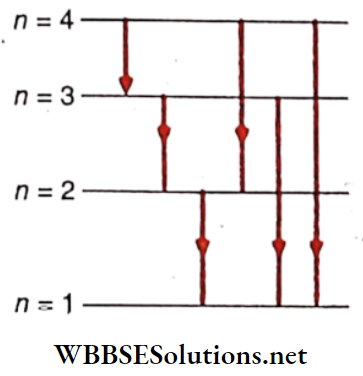
Atom Bohr Orbit To The Ground State The Decrease In Energy

Of them, during the transition from n = 4 to n = 3, the energy difference is the least and hence in this case, the wavelength of the emitted spectral line will be the maximum

Energy of the third Bohr orbit = – \(\frac{13.6}{3^2}\)

= -1.51 eV

∴ Decrease in energy due to transition from n = 4 to n = 3

=-0.86 -(-1.51) = 0.65 eV

Hence, the relation hf = hc/ λ

= E4 – E3 gives

= \(\frac{h c}{E_4-E_3}\)

= \(\frac{6.625 \times 10^{-27} \times 3 \times 10^{10}}{0.65 \times 1.6 \times 10^{-12}}\)

= 19110 × 10-8  cm

= 19110 Å

The relation between the energy of photon E and wavelength A after substituting the values of different constants is E

eV =12400/λ (in Å)

In any calculation, this relation can be used directly.

Success and Failure of the Bohr’s Theory

1. With the help of Bohr’s theory, the spectrum of hydrogen or a hydrogen-like atom can be explained almost accurately. QQ With the help of Bohr’s theory, the main characteristics of the atomic spectrum of alkali metals can be explained.

2. Bohr’s theory cannot analyze the energy of atoms having more than one electron, nor can it explain the wavelengths of spectral lines of such atoms quantitatively. Still Bohr model is the most suitable model supporting the electronic configuration of any atom.

3. Actually, every spectral line of the spectrum of hydrogen or other atoms consists of several spectral lines; they remain so close to each other that with the help of an ordinary prism disperser, they cannot be identified separately.

4. This fine structure of every primary spectral line cannot be explained with the help of Bohr’s theory. This can be called the limitation of Bohr’s theory instead of its failure.

5. If a charged particle possesses acceleration, it radiates electromagnetic radiation. This theory of classical physics has been proved by different experiments. However, Bohr’s theory fails to explain why no electromagnetic radiation is emitted from the electron having centripetal acceleration while revolving in a Bohr orbit.

WBCHSE Class 12 Physics Atom X-rays

Roentgen’s discovery:

In 1895, German physicist Wil helm Roentgen observed that, when high-velocity cathode rays were obstructed by any solid target, an invisible ray came out from that target.

The characteristics of this ray that he observed are. The rays:

  • Can produce fluorescence,
  • Can affect photographic plates,
  • Can penetrate thin sheets of light materials like paper, glass, wood, aluminum, etc.
  • Cannot penetrate heavy metals like iron, lead, etc. Rather. it casts a shadow behind them

At that time, the nature of this ray was unknown, and hence eV = hfx Amin Roentgen called this ray X-ray

Nature of X-rays

X-rays are not deflected by electric or magnetic fields; from this, we can conclude that X-rays are not streams of charged particles.

So, an X-ray is either a stream of high-velocity uncharged particles or a kind of wave

If an X-ray is considered to be a kind of wave, it should show properties like interference, diffraction, etc. But in any traditional experimental setup, these properties were not observed, until finally Max von Laue and others after him observed the diffraction of X-ray by passing it through three-dimensional crystals: Thus it was proved that X-ray is a kind of wave. The wavelength of this ray is so small that its diffraction is possible only by crystals of regular intermolecular space (10-8 cm approximately).

Later on, it was possible to observe the wave properties of X-rays like reflection, refraction, interference, and polarisation.

So, it has been observed, that an X-ray is not a stream of any high-velocity uncharged particles, but an electromagnetic wave like visible light. Though compared to visible light, the wavelength of X-ray is very small, almost \(\frac{1}{1000}\) parts or even less than that of the former. It was not until 1923 when A. H. Compton, using his X-ray scattering experiment, established the particle nature of photons, and hence of X-rays

Frequency and Wavelength of X-ray

According to quantum theory, electromagnetic radiation is a stream of massless and chargeless photons which travels

With the speed of light (c = 3 × 10⁸ m . s-1). The energy of each photon,

E = hf = hc/λ ………………(1)

Here, h = Planck’s constant =6.63 × 10⁻³⁴J . s;

f = frequency and λ = wavelength of the electromagnetic wave

When an electron (charge = e ) overcomes a potential difference V, energy gained by it = eV. If this energy is spent entirely to eject an X-ray photon, the energy and frequency of the photon become maximum. If the corresponding wavelength is taken as λmin, then

eV = \(h f_{\max }\) = \(h \frac{c^{\circ}}{\lambda_{\min }}\)

Or, \(\lambda_{\min }=\frac{h c}{e V}\) ………………(2)

In Sl, e = 1.6 × 10⁻¹⁹ C, c = 3 × 10⁻⁸ m.s-1 and

h = 6.63 × 10⁻³⁴J . s

If the potential difference between the anode and the cathode is V, putting these values in equation (2) we get

= \(\frac{1.243 \times 10^{-6}}{V} \mathrm{~m}\)

= \(\frac{12430}{V}\) Å

= \(\frac{1243}{V}\) ……………(3)

For example,

If V = 50 kV = 50000V, then λmin = 0.2486 Å

If V = 10 kV = 10000 V, then λmin = 1.243 Å

Discussions:

1. When the whole energy of an electron (eV) belonging to cathode rays is utilized to bombard the target to produce a photon, only then the wavelength of the X-ray becomes equal to λmin as given in equation (2). Generally, the whole energy is not converted into the energy of an X-ray photon; hence the wavelength becomes more than λminin For this, is called the minimum wavelength of X-ray.

2. The higher the value of the potential difference Vi smaller the wavelength of X-rays and hence greater its penetrating power. From equation (3), we see that V should be more than 106 volts to produce hard X-rays equivalent to the wavelength 0.01 Å

3. The wavelength of X-ray \(\frac{1}{1000}\) Is part of the wavelength of visible light. Hence, from the equation, E = \(\frac{h c}{\lambda}\), we can say that, the energy of an X-ray photon is about 1000 times greater.

4. Soft and hard X-rays:

The wavelength range of X-rays is from 0.01 Å to 10Å. If λ ≈ 10 A, according to the relation E = hc/λ, the energy of the X-ray photon becomes 1240 eV or 1.24 keV (approx.); this kind of X-ray has less penetrating power and is called soft X-ray. On the other hand, if λ  =; 0.01 Å, the energy of the X-ray photon becomes 1.24 MeV (approx.). Due to this high energy, the penetrating power of X-ray becomes very high. It is known as a hard X-ray

Uses of X-rays:

  1. Important uses of X-rays in medical science:
    • Radiography: X-rays are used for the detection of fractured bones and kidney stones.
    • Radiotherapy: Hard X-rays are used in radiotherapy to destroy the cancer-affected cells.
    • Fluoroscopy: Fluoroscopy is an imaging technique in which X-rays are used to take real-time moving images of the internal structures of a living body.

Important uses of x rays in other fields:

  • X-rays are used to analyze the structures of different crystals.
  • In metallurgy, X-rays are used to determine the defects in metallic castings

WBCHSE Class 12 Physics X-rays And Atomic Numbers

When a solid target (made of solid copper or tungsten) is bombarded with a stream of high-velocity electrons having a kinetic energy of some keV or higher X-rays are emitted from the target. Sometimes, this kind of material absorbs X-rays. Analyzing the emitted or absorbed X-rays, we come to know many aspects of the atomic structure of these elements
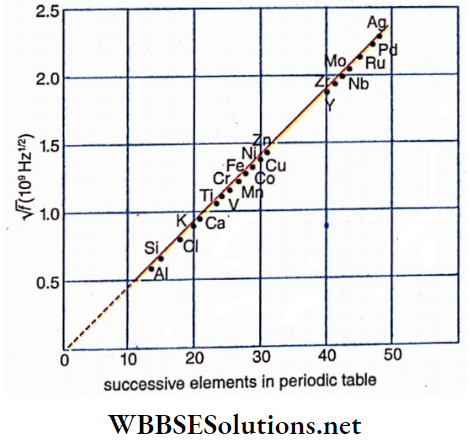
Atom Moseleys Law

Consider a molybdenum (Mo) target being bombarded by a stream of electrons having a kinetic energy of 35 keV. The spectrum of the wavelengths of X-rays is thus produced.

This spectrum is formed due to the superposition of two kinds of spectra: O continuous spectrum, characteristic or line spectrum. A continuous X-ray spectrum superimposed with some brighter lines is formed on the photographic plate. The origins of the two spectra are different and explained in the next article.

Continuous X-ray Spectrum

During the discussion of continuous spectrum, the characteristic spectrum consisting of two sharp peaks will be overlooked.

Suppose an electron traveling with kinetic energy K0 undergoes collision with an atom of molybdenum  Assume that the electron loses Δk amount of energy by this collision. This energy is converted into the energy of an X-ray photon. It should be mentioned here that, the atom being much heavier than an electron, the amount of energy transferred to the atom is neglected.

The electron may collide again with another atom after its colli¬ sion with the first atom. In this case, the electron collides with (K0-ΔK) amount of energy. The X-ray photon thus emitted, generally possesses less energy than that of the previous photon.

In this way, the electron may suffer successive collisions with different atoms until it comes to rest. The photons thus emitted during these collisions having different energies, form a part of the continuous spectrum of X-rays. But in actual practice, a tar

Get is hit with innumerable electrons. Hence, the entire X-ray spectrum looks like that. This kind of spectrum has an important characteristic. It has a definite cut-off wavelength (say, λmin). Below this cut-off
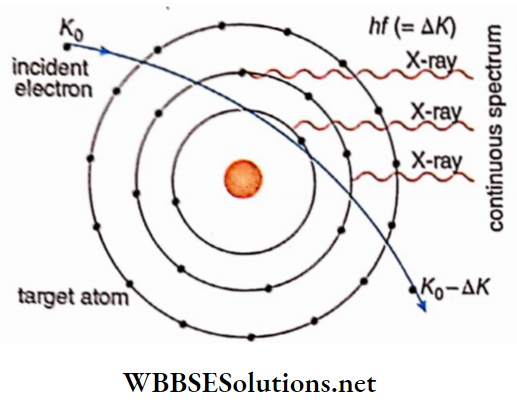
Atom Cut Off Wavelength

Wavelength, there is no existence ofthe spectrum. If the electron loses its whole kinetic energy (XQ) in the first impact, an X-ray of wavelength is emitted. If/ be the frequency ofthe emitted X-ray photon, then

⇒ \(K_0=h f=\frac{h c}{\lambda_{\min }}\)

⇒  \(\lambda_{\min }=\frac{h c}{K_0}\)………………(1)

So, the die value does not depend on the nature ofthe solid used as the target. So, if copper is used instead of molybdenum as the die target material, the continuous X-ray spectrum changes but the die value of Am;n remains the same

WBCHSE Class 12 Physics Atom X-rays And Atomic Numbers Numerical Examples

Example 1. If a stream of electrons of kinetic energy 36 keV is bombarded on a molybdenum target, what will be the cut-off wavelength of the emitted X-ray? nucleus
Solution:

We know that,  \(\lambda_{\min }=\frac{h c}{K_0}\)

Where h = 4.14 × 10⁻¹⁵ eV. s, c = 3 ×  108 m .s1

Given. K0 = 36 keV= 3.6 × 10⁻⁴ eV

∴  λmin  = \(\frac{4.14 \times 10^{-15} \times 3 \times 10^8}{3.6 \times 10^4}\)

= 3.45  × 10-11  m

= 0.0345 nm

Example 2. What minimi terminal potential difference of a Coolidge tube should be maintained to produce an X-ray of wavelength 0.8 Å? [h = 6.62 × 10⁻³⁴ J.s, e = 1.60 × 10⁻¹⁹  r= C = 3 × 10⁸ m. s -1]
Solution:

The energy of X-ray photons,

E = hc/λ

[here,  λ = 0.8 Å = 0.8 × 10⁻¹⁰ m]

If electrons are accelerated in an X-ray tube by a potential difference V, the energy of an electron = eV; if this energy is completely converted into the energy of an X-ray photon, the value of V will be the minimum

So, eVmin = \(\frac{h c}{\lambda}\)

Vmin = \(\frac{h c}{e \lambda}=\frac{6.62 \times 10^{-34} \times 3 \times 10^8}{1.60 \times 10^{-19} \times 0.8 \times 10^{-10}}\)

= 15516 V

WBCHSE physics class 12 atomic notes Characteristic X-ray Spectrum

The two sharp peaks in the spectrum of characteristic X-rays are named as Kα and Kβ  These two peaks mainly form the spectrum of the characteristic X-rays of molybdenum.

In an X-ray tube (Coolidge tube), the target is bombarded by high-energy cathode rays. The electrons present in the rays are of very high energy, their effect is not limited to the outer electron levels; the levels adjacent to the nucleus are also affected.

If an electron from any of these levels comes out of the atom, a deficit of electrons occurs in that orbit. If this deficit occurs in the X-orbit (the orbit closest to the nucleus), an elec¬ tron from a higher energy state will transit to this X-orbit.
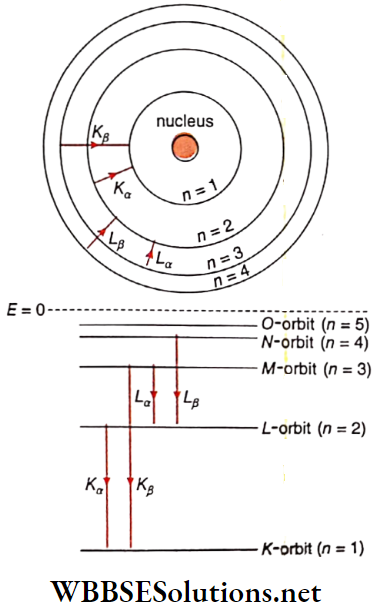
Atom X Ray Spectrum

Now, during the transition of an electron from L -orbit to Korbit, it radiates energy as a photon. This radiation forms the Kα -peak of the characteristic X-ray spectrum of molybdenum. The energy level diagram of molybdenum is  How different peaks of the spectrum are formed has been shown in this diagram. Again, during the transition of the electron from M orbit to K-orbit, the radiation thus emitted forms the Kβ-peak of the spectrum.

This spectrum contains several smaller peaks and the brightness of these lines in the spectrum is very low. Formation of Lα and Lβ peaks among the small peaks is als

Moseley’s Law

In 1913, British physicist H. G. I. Moseley analyzed the spectrum of characteristic X-rays of all the elements he knew as targets. He observed that the spectra of different elements, particularly the Kα -peaks follow a particular rule. According to the position of different elements in the periodic table, he drew a graph of the square root of the frequency of Kα and obtained a straight line.

A part of the graph based on which, Moseley concluded that “there was a fundamental quantity which increases by regular steps as we pass from one element to the next”. In 1920 Rutherford identified this quantity as the atomic number Z of the element which denotes the number of positive charges present in the nucleus. So, only from the atomic number of an element can its identity be known, not from its atomic weight.
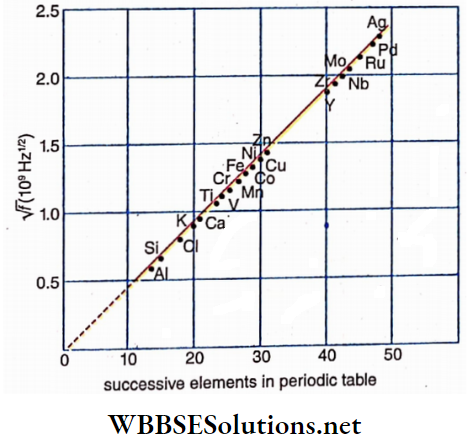
Atom Moseleys Law

Statement of Moseley’s law:

The square root of the frequency of a peak of the characteristic X-ray spectrum of

Any element is directly proportional to the atomic number of that element.

If the frequency of Kα -line of any element having atomic num¬ ber Z be f. Then according to Moseley’s law,

√f ∝ Z

Explanation of Moseley’s plot from Bohr’s theory:

With the help of the equation of the n-th energy state of an atom obtained from Bohr’s theory, this plot can be explained.

Equation (13)

⇒ \(E_n=-\frac{R c h}{n^2}=-\frac{13.6}{n^2} \mathrm{eV}\)………………(1)

Where, n = 1,2,3,

We know that in an atom containing two or more electrons, only two are in the K-orbit Let any of these come out of the atom. Then the electrons present in other orbits like L, and M, would experience not only the effect of the positive charge of the nucleus but also the influence of the negative charges of the remaining electron in the kT-orbit.

This is because the radius of the kT-orbit in an atom is the least compared to that of other orbits. So, we can assume that, relative to the surface of the sphere on which the electron of the K-orbit lies, the other electrons lie outside.

So, the effective amount of positive charge that attracts an electron of L, M, orbits is (Z- 1)e, where Z is the atomic number. The above equation (1) is applicable for hydrogen atoms. In the case of an atom having atomic number Z, its changed form is applicable. The equation for the n-th energy of the atom is

En = \(E_n=-\frac{13.6(Z-1)^2}{n^2}(\text { in } \mathrm{eV})\) ……………. (2)

The earlier discussion shows that Ka of the spectrum is produced due to the transition of an electron from the L(n =2) orbit to the K(n = 1) orbit. Due to this transition, if the frequency of the emitted X-ray is f, then

⇒ \(h f=\left(E_n\right)_{n=2}-\left(E_n\right)_{n=1}=E_2-E_1\)

= \(-\frac{13.6(Z-1)^2}{2^2}+\frac{13.6(Z-1)^2}{1^2}\) (in eV)

∴ hf = 10.2(Z- 1)²

√f ∝  (Z – 1)…………………………………. (3)

Equation (3) is the equation of a straight line. Hence, the graph of the square root of the frequency of the peak Kα concerning the atomic number of the atom is a straight line. In this way, the theoretical basis of Moseley’s plot is established in the light of Bohr’s theory.

Importance of Moseley’s work:

1. According to Moseley’s law, the characteristic X-ray spectrum is regarded as the identifying character of an element.

2. Before 1913, the elements were arranged in the periodic table according to the increasing order of their atomic weights.

3. Despite that, according to the basis of chemical tests, some elements were placed before the elements hav¬ ing comparatively lower atomic weights in the periodic table. The reason for this exception was not understood before Moseley’s analysis.

4. Moseley showed that there would not be any exception to the arrangements of the periodic table if we arranged the elements according to their increasing atomic numbers.

5. There were many vacant places in the periodic table in 1913. After the discovery of Mosley’s law, it has been possible to fill those gaps accurately.

6. Lanthanide elements are more or less identical in respect of their chemical properties. Thus, it was difficult to identify

WBCHSE Class 12 Physics Atom Conclusion

Bhor model of an atom is based on three postulates

1. For the revolutions of electrons inside an atom, there are some allowed orbits. When an electron revolves in an allowed orbit, it does not radiate energy. Since the energy of an electron in any allowed orbit is constant, die orbits are called stable orbits.

2. An electron can transit from one stable orbit to another. During this transition, homogeneous absorp¬ tion or emission of radiation occurs whose frequency is determined from the relation, hf = E1~ E2. [h = Planck’s constant, E1~ E2 energy difference of the electron in the two stable orbits]

3. The orbits, where the angular momentum of the electron is an integral multiple of h/2λ are the only allowed orbits and are called Bohr orbits.

4. In the visible region of the atomic spectrum of hydrogen, four bright lines can be observed. Their wavelengths, as obtained from the experiment are 6563 Å, 4861 Å, 4341 Å, and 4102 Å. These four lines are known to form the Balmer series of hydrogen spectra.

5. The number of complete waves of radiation present in unit length is 1/λ, and hence 1/λ (=f) is called wave number.

6. In the first Bohr orbit, Le., in K-orbit, the energy electron becomes minimum. This is known as the ground state energy or the lowest energy level of the atom.

7. The minimum amount of energy required to ionize an atom of an element in its ground state, is called the ionization energy of that element.

The ionization energy of hydrogen = 13.6 eV

8. The minimum potential applied to an atom of an element at its ground state to convert it into a positive ion, is called the ionization potential of that element Ionisation potential of hydrogen = 13.6 V

9. X-ray is not a stream of fast-moving charged or uncharged particles, rather it is an electromagnetic wave like light

10. The energy of X-ray is more than that oflight Spectrum of X-rays is formed due to die superposition of two spectra

  1. Continuous spectrum and
  2. Characteristic tic spectrum.

A continuous X-ray spectrum has a definite cut-off wavelength below which no radiation exists.

Applications of Atomic Concepts in Real Life

11. Moseley’s law: The square root of the frequency of a peak of the characteristic X-ray spectrum of an element is directly proportional to the atomic number of that element

12. Energy difference of an electron in two stable orbits,

E1~ E2 = hf

13. According to Bohr’s quantum condition, if rn = radius of n -th orbit and vn = velocity of the electron in n -th orbit, then
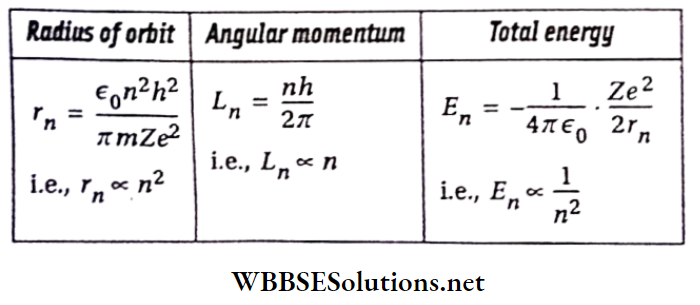
Atom Radius Of Orbit

Here, the principal quantum number, n = 1, 2, 3,…………

14. First Bohr radius of ground state (rt = 1)

⇒ \(a_0=\frac{\epsilon_0 h^2}{\pi m e^2}\)

= 0.53 Å

= 0.053 nm

And \(E_1=\frac{m e^4}{8 \epsilon_0^2 c h^3}\) . ch = -Rch

Where , R = \(\frac{m e^4}{8 \epsilon_0^2 c h^3}\)

Rydberg constant = 1.09737 × 10⁷ m-1

15. Ground state energy of hydrogen atom =-13.6 eV

16. For the hydrogen spectrum, if A is the wavelength of the spectral line then

⇒ \(\frac{1}{\lambda}=R\left[\frac{1}{\left(n^{\prime}\right)^2}-\frac{1}{n^2}\right]\)
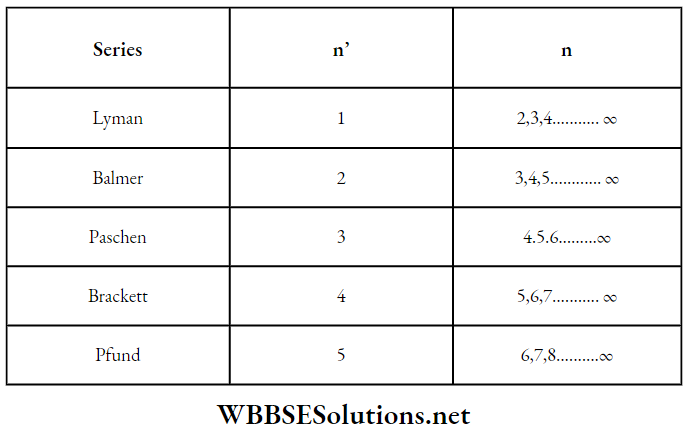
Atom Series

17. According to Bohr’s postulate, when the electron in a hydrogen atom transits from a higher energy state lower energy state Enÿ, a photon is emitted from the hydrogen atom. If the frequency of this photon is (wavelength, λ = then

⇒ \(E_{n_i}-E_{n_f}=h f=\frac{h c}{\lambda}\)

The minimum wavelength of X-ray

⇒ \(\lambda_{\min }=\frac{h c}{e V} .\)

In SI, e = 1.6C, c = 3× 10⁸m. s-1 , and

h = 6.63 × 10⁻³⁴  J.s-1

⇒ \(\frac{1.243 \times 10^{-6}}{V} \mathrm{~m}\)

= 12340/v Å

18. If h, f, and c are Planck’s constant, the frequency of the emitted X-ray photon, and the speed of the X-ray respectively, then the kinetic energy of the incident electron

⇒ \(K_0=h f=\frac{h c}{\lambda_{\min }}\)

Or,\(\lambda_{\min }=\frac{h c}{K_0}\)

λmin = cut-off wavelength

19. If the electron in a hydrogen atom is excited to the n -th state, then the number of possible spectral lines it can emit in transition to the ground state is

⇒  \({ }^n C_2=\frac{1}{2} n(n-1)\)

20. Speed of electron in the n -th orbit of the hydrogen atom

⇒  \(v_n=\frac{c}{137 n}\)

WBCHSE physics class 12 atomic notes 

WBCHSE Class 12 Physics Atom Very Short Question And Answers

Question 1. In the Bohr model of the hydrogen atom, what Is the ratio of the kinetic energy to the total energy of the electron in any quantum state
Answer:

According to the Bohr model, if the kinetic energy of the electron in any quantum state is E, total energy becomes -II. So, the ratio of these two energies is

Question 2. How are X-rays produced?
Answer:

When a stream ofelectrons, having a kinetic energy of a few keV or more, hits a solid target (like copper, tungsten, molybdenum, etc.), X-rays are emitted from that target

Question 3. In which part of the electromagnetic do the spectral lines of a hydrogen atom given by the Balmer series occur?
Answer: Visible range.

Question 4. What is Bohr’s quantum condition for the angular momentum of an electron in a hydrogen atom?
Answer:

Angular momentum = nh/ 2: n = 1,2,3,……………..

Question 5. Name the different types of X-ray spectrum
Answer:  Continuous spectrum and characteristics spectrum

Question 6. The nucleus contains the entire ____________ charge and nearly the entire
_______ of an atom
Answer: Positive And Mass

Question 7. In Rutherford’s experiment, which particle is responsible for the low-angle scattering of a -particles?
Answer: Electron

Question 8. The total energy of the electron in the first Bohr orbit of a hydrogen atom is -13.6 eV. What are the kinetic and potential energies of the electron?
Answer: 13.6 eV, -27.2 eV

Question 9. The wavelength of a spectral line found in the atomic spectrum of hydrogen is 4861 Å. Between which two quantum states does the transition of electrons occur to generate this line? Rydberg constant = 1.097 × 10⁸. m-1
Answer: From the fourth to the second

Question 10. What is the order of magnitude of the ratio between the volume of? an atom and that of its nucleus?
Answer: 
1012: 1

Question 11. The energy of an electron in the first excited state of a hydrogen atom is -3.4 eV what is the kinetic energy of this electron
Answer: + 3.4 eV

Question 12. What is the ratio of the areas of the first and the second orbits of a hydrogen atom?
Answer: 1:16

Question 13. What is the approximate diameter of a hydrogen atom
Answer: 1.06A

Question 14. If the radius of the first Bohr orbit is r, what would be the radius of the second?
Answer: 4r

Question 15. The radius of the first electron orbit of a hydrogen atom is 5.3 × 10⁻¹¹m. What is the radius of its second orbit?
Answer: 21.2 m

Question 16. An electron beam hits a target to produce a continuous X-ray spectrum. If E is the kinetic energy of each electron in the beam, what would be the lowest wavelength of the emitted X-rays?
Answer: hc/E

WBCHSE Class 12 Physics Atom Assertion Type

Direction: These questions have statement 1 and statement 2 Of the four choices given below, choose the one that best describes the two statements.

  1. Statement 1 is true, statement 2 is true, and statement II is a correct explanation for statement 1.
  2. Statement 1 is true, and statement 2 is true; statement 2 is not a correct explanation for statement 1.
  3. Statement 1 is true, and statement 2 is false.
  4. Statement 1 is false, and statement 2 is true.

Question 1.

Statement 1: The total positive charge and almost all the mass of an atom are confined in the nucleus.

Statement 2: In Rutherford’s a -particle scattering experiment, the majority of the a -particles penetrate the target without any deflection.

Answer:   2. Statement 1 is true, and statement 2 is true; statement 2 is not a correct explanation for statement 1.

Question 2.

Statement 1: The circular orbit of the electron as stated in Rutherford’s atomic model can never be a stable orbit

Statement 2: Any accelerated charged particle radiates energy

Answer: 1. Statement 1 is true, statement 2 is true, and statement II is a correct explanation for statement 1.

Question 3. 

Statement 1: The distance of the electron from the nucleus is minimal when a hydrogen atom is in the ground state.

Statement 2: According to Bohr’s theory the radius of circular motion of an electron in n -th energy state, rn oc n.

Answer: 3. Statement 1 is true, and statement 2 is false.

Question 4.

Statement 1: The kinetic energy of an electron in the first excited state of a hydrogen atom is 6.8 eV.

Statement 2: The total energy of the first excited state of a hydrogen atom is -3.4 eV.

Answer:  4. Statement 1 is false, and statement 2 is true.

Question 5.

Statement 1: All lines in the Balmer series of the hydrogen spectrum are in the visible region.

Statement 2: Balmer series is formed due to the transition of electrons from 2, 3, 4- – permitted energy levels to the ground level.

Answer: 3. Statement 1 is true, and statement 2 is false.

Question 6.

Statement 1: The ionization potential of a hydrogen atom is 13.6 eV.

Statement 2: The Ground state energy of the hydrogen atom is 13.6 eV.

Answer: 3. Statement 1 is true, and statement 2 is false.

Question 7.

Statement 1: Magnetic moment of election In the n-th orbit of the hydrogen atom

Statement 2: The magnetic moment of a particle of charge  rotating in an orbit of radius r with velocity v is given by \(\mu=\frac{1}{2} e v r\)

Answer: 1. Statement 1 is true, statement 2 is true, and statement II is a correct explanation for statement 1.

WBCHSE Class 12 Physics Atom Match The Columns

Question 1. Match the columns for the hydrogen atom.
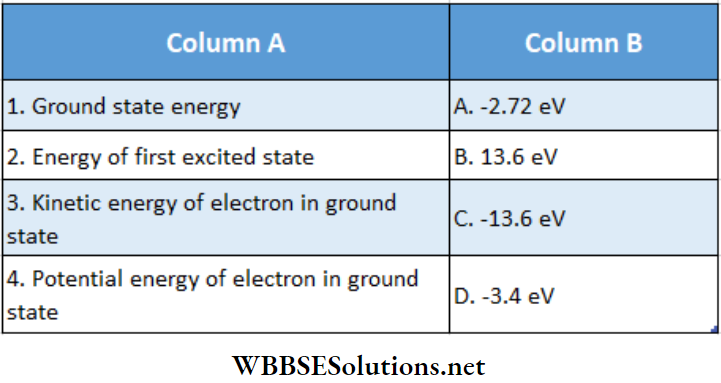
Atom Hydrogen Atom

Answer: 1- C, 2-D, 3- C, 4- A

Question 2. Match the columns for an electron rotating in the n-th orbit of an atom
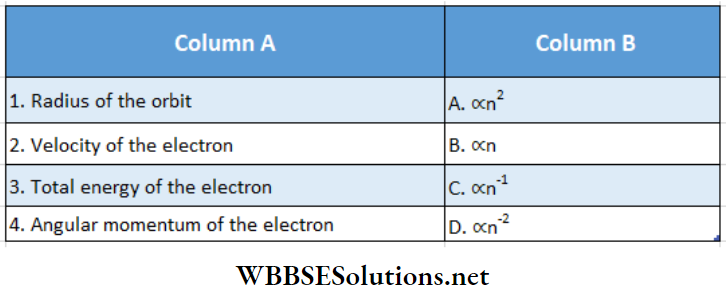
Atom N th Orbit Of An Atom

Answer: 1- A, 2 – C, 3 – D, 4 – B

Question 3. 
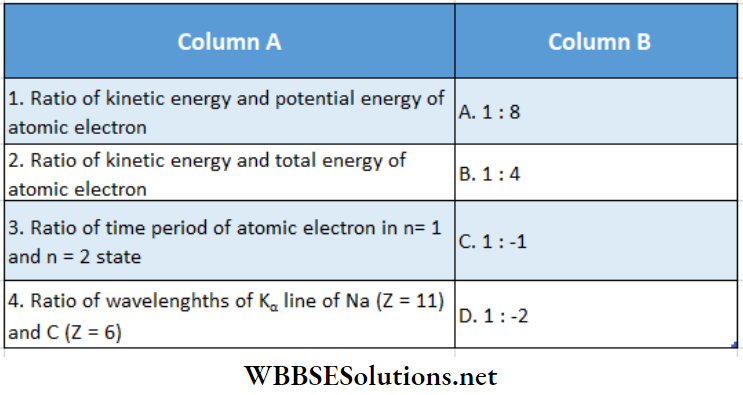
Atom Ratio Of Kinetic Energy

Answer: 1- D, 2 – C, 3 – A, 4- B

Question 4. Match Column A (fundamental experiment) with Column B (its 1 conclusion) and select the correct option from the choices given below the list:
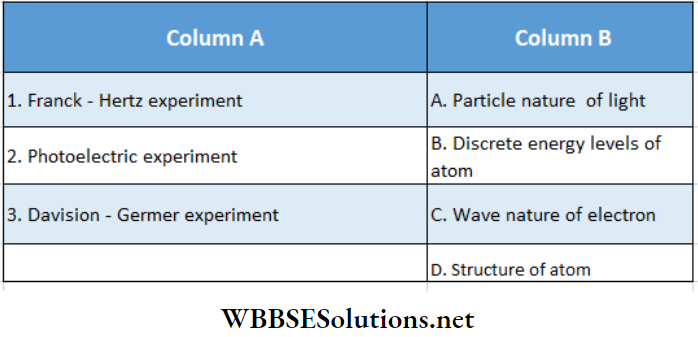
Atom Fundamental Experiments

  1. 1- A, 2- D, 3 – C
  2. 1- B, 2- D, 3 – C
  3. 1- B, 2- A, 3 – C
  4. 1- D, 2- C, 3 – B

Answer: 3. 1- B, 2- A, 3 – C

WBCHSE Class 12 Physics Atom Short Question And Answers

Atom Short Question And Answers

Question 1. The Electron of a hydrogen atom revolves In the 3rd Bohr orbit. Find the angular momentum of the electron. (h = 6.6 × 10 -27 erg .s)
Answer:

Principal quantum number of 3rd Bohr orbit, n = 3. So according to Bohr’s postulate, the angular momentum of an electron in that orbit,

L3 = \(3 \times \frac{h}{2 \pi}=\frac{3 \times 6.6 \times 10^{-27}}{2 \times \pi}\)

3.15 × 10 -27erg . s

Question 2. In a hydrogen atom, how many times is the radius of the fourth orbit compared to that in the second orbit?

If the principal quantum number of an orbit is n, then radius rn ∝= n²

∴  \(\frac{\text { radius of fourth orbit }}{\text { radius of second orbit }}=\frac{(4)^2}{(2)^2}\)

= \(\frac{16}{4}\)

= 4

Therefore, the radius of the fourth orbit is 4 times the radius of the second orbit

Read And Learn More WBCHSE Class 12 Physics Short Question And Answers

Question 3. In a hydrogen atom, how many times is the speed of the electron in the fourth orbit compared to that in the second orbit?
Answer:

If the principal quantum number of an orbit is n, then the speed ν ∝ 1/n

So \(\frac{\text { speed of electron in the fourth orbit }}{\text { speed of electron in the second orbit }}=\frac{1 / 4}{1 / 2}\)

= \(\frac{1}{2}\)

Therefore, the speed of an electron in the fourth orbit is half of that in the second orbit

Question 4. The electron in a hydrogen atom is excited to the n-th © excited state. How many possible spectral lines can it emit In transition to the ground state?
Answer:

There are n number of states from the n-th quantum

State to the ground state (n = 1 ). The transition may occur between any pair of these states.

Since for each transition, a spectral line is formed, the number of possible spectral lines = \({ }^n C_2=\frac{n(n-1)}{1 \times 2}=\frac{1}{2} n(n-1)\)

Question 5. explain why the spectrum of hydrogen contains several lines although a hydrogen atom has only one electron
Answer:

In hydrogen gas, there are innumerable hydrogen atoms, i.e., in a hydrogen discharge tube, there are innumerable electrons. Different electrons absorb different amounts of energy and get excited In different states. As a result, when they radiate energy, transitions occur between different pairs of states; for each transition, a spectral line Is obtained. Thus, the spectrum of hydrogen contains several lines

WBCHSE Class 12 Physics Atoms Short Questions And Answers

WBBSE Class 12 Atom Short Q&A

Question 6. Write two important limitations of Rutherford’s nuclear
Answer:

Two important limitations of Rutherford’s nuclear model of the atom are

  1. This model cannot explain the stability of matter.
  2. It cannot explain the characteristic line spectra of atoms of different elements
Class 11 Physics Class 12 Maths Class 11 Chemistry
NEET Foundation Class 12 Physics NEET Physics

Question 7. What is the significance of the negative energy of an electron in its orbit?
Answer:

The energy of an electron in its atomic orbit is negative. Due to the nuclear attraction on it. It may come out of an the atom to become a zero-energy free electron only if an equal amount of = -13.6 eV positive energy is supplied to it from outside

Question 8. What is meant by excitation potential and ionization Potential
Answer:

The excitation potential is the potential to be applied to an electron in the outermost shell of an atom to lift it to an excited energy state. On the other hand, the ionization potential is the minimum potential to be applied to that electron to bring it outside the atom so that the atom is ionized. For example, the excitation potential of the ground state electron of a hydrogen atom is 10.2 V for transition to the first excited state, whereas the ionization potential of that electron is 13.6 V

Question 9. Find the wavelength of electromagnetic waves of frequency 5 × 10-19Hz in free space. Where is this type of wave used?
Answer:

λ = \(\left(\frac{c}{v}=\frac{3 \times 10^8}{5 \times 10^{19}}=6 \times 10^{-12} \mathrm{~m}\right)\)

= 6 ×10 -12× 10-10

= 0.06 Å

It is hard X-ray-used in the treatment of cancer-affected cells, or the detection of internal defects of metals.

Question 10. Show that the energy of the first excited state of He+ is equal to the speed of the electron In the first orbit of the hydrogen atom
Answer:

En = \(-\frac{m Z^2 e^4}{2 n^2 \hbar^2}\)

∴ \(\left(\frac{Z_1}{Z_2}\right)^2 \cdot\left(\frac{n_2}{n_1}\right)^2\)

= \(\left(\frac{2}{1}\right)^2 \times\left(\frac{1}{2}\right)^2\)

Or , E1 = E2

Short Answer Questions on Hydrogen Atom

Question 11. Show that the speed of an electron in the second orbit of the He+ atom is equal to the speed of an electron in the first orbit of the hydrogen atom.
Answer:

We have \(\frac{1}{4 \pi \epsilon_0} \frac{Z e^2}{n \hbar}\)

⇒ \(\frac{v_1}{v_2}=\frac{Z_1}{Z_2} \cdot \frac{n_2}{n_1}\)

= \(\frac{2}{1} \times \frac{1}{2}\)

= 1

Or, v1 = v2

Question 12. A 12.5 eV electron beam is used to bombard gaseous hydrogen at room temperature. What series of wavelengths will be emitted?
Answer: 

Ground state energy of hydrogen at room temperature = 13.66 eV. The energy obtained after bombardment by the 12.5 eV electron beam is (-13.6+12.5) =-1.1 eV which lies between the third (-1.51 eV) and fourth (-0.85 eV) energy levels of the hydrogen atom. Thus the wavelength ofthe emitted radiations may lie in the Lyman ( 103 nm and 122 nm) or Balmer (656 nm ) series.

Question 13. Obtain an expression for the frequency of radiation emitted when a hydrogen atom de-excites from level n to level (n- 1 ). For large n, show that this frequency equals the classical frequency of revolution ofthe electron in the orbit.

The energy of an electron in the n-th energy level of the hydrogen atom

⇒ \(E_n=\frac{-2 \pi^2 m e^4}{\left(4 \pi \epsilon_0\right)^2 \cdot n^2 h^2}\)

⇒  \(E_n-E_{n-1}=\frac{2 \pi^2 m e^4}{\left(4 \pi \epsilon_0\right)^2 \cdot h^2} \cdot \frac{2 n-1}{n^2(n-1)^2}\)

⇒  \(f=\frac{E_n-E_{n-1}}{h}\)

= \(\frac{2 \pi^2 m e^4}{\left(4 \pi \epsilon_0\right)^2 h^3} \cdot \frac{2 n-1}{n^2(n-1)^2}\)

Common Questions on Atomic Structure with Answers

Question 14. The total energy of an electron in the first excited state ofthe hydrogen atom is about -3.4 eV. In this state

  1. What is the kinetic energy ofthe electron?
  2. What is the potential energy of the electron?

Answer: 

According to Bohr’s theory

1. The kinetic energy of the electron

= – Total energy ofthe electron

= 3.4 eV

2. Potential energy = -2K.E.

= -6.8 eV

Question 15. If Bohr’s quantization postulate (angular momentum = nh/2π ) is a basic law of nature, it should be equally valid for the case of planetary motion also. Why then do we never speak ofquantisation of planets around the sun?

In the case of planetary motion, the value of angular momentum is much larger than the value of h (In the case of Earth its value is 1070h ). As a result, the value of n becomes nearly 1070h, making the difference between the successive energy levels infinitesimally small and the levels may be considered continuous.

WBCHSE Class 12 Physics Atom Question And Answers

Atom Long Question And Answers

Question 1. How many times does the electron— revolve in the first Bohr orbit of a hydrogen atom per second?
Answer:

The radius of the first Bohr orbit,

r1 = 0.53 Å = 0.53 × 10⁻⁸ cm

Again, the velocity of the electron in the first Bohr orbit

ν = \(\frac{c}{137}=\frac{3 \times 10^{10}}{137} \mathrm{~cm} \cdot \mathrm{s}^{-1}\)

c = velocity of light in vacuum

So the electron revolutions of the electron in the first Bohr orbit in 1 second i.e the orbital frequency of the electron

f 1 = \(\frac{{v}_1}{2 \pi r_1}=\frac{3 \times 10^{10}}{1.37 \times 2 \times \pi \times 0.53 \times 10^{-13}}\)

= 6.67 × 10 -27 s -1

Question 2. In a hydrogen atom, how many limes Is the energy of the electron In the fourth orbit compared to that In the second orbit?
Answer:

If the principal quantum of an orbit is n, the total energy

Hence, the ratio of light energies of electrons In the orbits is \(1: \frac{1}{4}: \frac{1}{9}: \frac{1}{16}\)

So, \(\frac{\text { energy of electron In the fourth orbit }}{\text { energy of electron In the second orbit }}=\frac{\frac{1}{16}}{\frac{1}{4}}\)

= \(\frac{1}{4}\)

Therefore, the energy of the electron In the fourth orbit is part of the energy of the electron In the second orbit

Question 3. The electron In a hydrogen atom makes a transition n1 →n2 -, where n1 and n2 are the principal quantum numbers of the two states. According to the Bohr model, the period of the electron In the initial stale Is eight times that In the final state. Which are possible values of n1 and n2?

  1. 4,2
  2. 8,2
  3. 8,1
  4. 6,3

Answer:

If the orbital frequency of the electron in the n-th orbit is fn, then

fn ∝ 1/n³

So, time period is (1/f) = \(T_n \propto n^3 \quad \text { or, } n \propto\left(T_n\right)^{1 / 3}\)

In the given question,

T1  =  8T2 = T1 / T2

= 8

∴ \(\frac{n_1}{n_2}=\left(\frac{T_1}{T_2}\right)^{1 / 3}\)

= (8)1/3

= 2

n1 = 2n2

So, for the given values of n1 and n2, either (1) Or (4) are (4,2) Or ( 6,3)  is possible.

WBCHSE Class 12 Physics Atom Question And Answers

WBBSE Class 12 Atom Q&A

Question 4. An electron, in a hydrogen-like atom, is in an excited state. It has a total energy of -3.4 eV. Calculate the kinetic energy of the electron
Answer:

According to the Bohr model of the atom, when the total energy of an electron is -E, its kinetic energy = +E. So, in this case, the kinetic energy of the electron = 3.4 eV.

Question 4. As per the Bohr model, the minimum energy (In eV) required to remove an electron from the ground state of Li2+ Ion (Z = 3) Is:

  1. 1.51
  2. 13.6
  3. 40.8
  4. 122.4 which one is correct?

Answer:

In a hydrogen atom, the force of attraction (in CGS sys¬ tem) between the nucleus having charge +e and electron of charge -e at a distance r is e²/r²

Again, the ground state energy of the hydrogen atom,

E1 = \(-\frac{2 \pi^2 m e^4}{h^2}\)

= -13.6 eV

In Li2+ ion, there is also one electron; the force of attraction between the nucleus having charge +Ze and the electron having charge’-e is  \(\frac{Z e^2}{r^2}\)

So, by putting Ze² in place of e² in the expression for the ground-state energy of the hydrogen atom, the ground-state energy of Li2+ can be obtained. This energy is

⇒ \(E_1^{\prime}=-\frac{2 \pi^2 m\left(Z e^2\right)^2}{h^2}=-\frac{2 \pi^2 m e^4}{h^2} \cdot Z^2\)

– 136 × 3² = -1224 eV

Question 5. The spectrum of sodium atoms resembles the spectrum of hydrogen atoms. In which way is this statement correct?
Answer:

The charge of sodium (Z = 11) nucleus =+lle. There are 2 and 8 electrons, respectively in its K and L shells and there is only one electron in the outermost M shell. The nucleus, the K-orbit, and the L -orbit in this atom, all together form an effective core, and the electron in the Af-orbit revolves around this core. Moreover, the charge of the core = lie- (2 + 8)e = +e = charge of H-nucleus

So, this electron in the M-orbit resembles the electron revolving around the nucleus in a hydrogen atom. Thus, the spectrum of sodium atoms resembles the spectrum of hydrogen atoms.

Atom Hydrogen Atom

Question 6. Determine the ratios of

  1.  Time Periods and
  2. Orbital frequencies of an electron in Bohr orbits of a hydrogen atom

Answer:

1.  Time Period:

Tn = \(=\frac{\text { circumference of the orbit }}{\text { velocity of electron }}\)

= \(\frac{2 \pi r_n}{v_n}\)

If the principal quantum number be n(- 1, 2, 3, ……………….. ) then

= \(r_n \propto n^2 \text { and } v_n \propto \frac{1}{n}\)

So, \(T_n \propto n^3 \text {, i.e., } T_1: T_2: T_3: \cdots=1: 8: 27\)

2. Orbital frequency, \(f_n=\frac{1}{T_n}\)

So, \(f_1: f_2: f_3: \cdots=1: \frac{1}{8}: \frac{1}{27}\)

Question 7. The wavelength of the Kα line of the X-ray of an element having atomic number Z = 11 is λ. For which atomic number will the wavelength of that line be 4 λ?
Answer:

Frequency f = \(\frac{c}{\lambda}\)

Or, \(\frac{f_1}{f_2}=\frac{\lambda_2}{\lambda_1}=\frac{4 \lambda}{\lambda}\)

= 4

According to Moseley’s law, (Z- 1)

∴ \(\frac{f_1}{f_2}=\left(\frac{Z_1-1}{Z_2-1}\right)^2\)

Or, \(\left(\frac{Z_1-1}{Z_2-1}\right)^2\) = 4

Here Z = 11

So, \(\left(Z_2-1\right)^2=\frac{1}{4} \times(11-1)^2=\frac{1}{4} \times 100\)

= 25

Z2-1 = 5

Or, Z2 = 6

Long Answer Questions on Atoms

Question 8. On which power of the principal quantum number (n) of the orbit, will the magnetic moment (μ) of an electron revolving in the Bohr orbit of an atom be directly proportional
Answer:

Due to the rotation of electrons in the n-th orbit, effective current, \(I_n=\frac{e}{T_n}\)

Now, time period, Tn∝ n³ ; hence \(I_n \propto \frac{1}{n^3}\)

Again, the area of the n-th orbit, An = π

Since, rn ∝ n²  , An « ∝ n4

The magnetic moment of an electron in the n-th orbit,

So, \(\mu_n=I_n A_n\)

⇒ \(\mu_n \propto \frac{1}{n^3} \cdot n^4\)

Question 9. The three ascending energy states of an atom are A, B, and C. The wavelengths of emitted radiations due to transitions from C to B and from B to λ1 are λ2, respectively. What will be the wavelength of emitted radiation due to the transition from C to A?
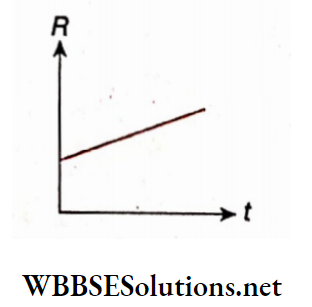
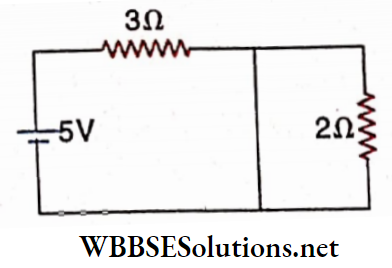
Answer:

⇒ \(E_C-E_B=\frac{h c}{\lambda_1}\)

⇒ \(E_B-E_A=\frac{h c}{\lambda_2}\)

Now, if the wavelength of the radiation due to transition from C to A is λ, then

⇒ \(E_C-E_A=\frac{h c}{\lambda}\)

Or, \(\left(E_C-E_B\right)+\left(E_B-E_A\right)=\frac{h c}{\lambda}\)

⇒  \(\frac{h c}{\lambda} \text { or, } \frac{h c}{\lambda_1}+\frac{h c}{\lambda_2}=\frac{h c}{\lambda}\)

⇒  \(\frac{1}{\lambda}=\frac{1}{\lambda_1}+\frac{1}{\lambda_2}\)

Or, \(\frac{\lambda_1 \lambda_2}{\lambda_1+\lambda_2}\)

Question 10. Obtain the first Bohr radius and the ground state energy of a muonic hydrogen atom (i.e., an atom in which negatively charged muon (μ) of mass about 207me orbits around a proton).
Answer:

According to the question, the mass of muon.

mm = 207 me

When all other quantities remain unchanged

⇒ \(r \propto \frac{n^2}{m} \text { and } E \propto \frac{m}{n^2}\)

⇒ \(r_m=\frac{r_e m_e}{m_m}=\frac{0.53 \times 10^3}{207}\)

= 2.56 × 10⁻¹³ m

And \(E_m=\frac{E_e m_m}{m_e}\)

= -(13.6 ×  207)

= -3.8 keV

Question 11. The energy of a hydrogen atom In n given orbit In -3.4 cV. bind the radius of the orbit. (Given,e =  -1.610-19 C, me = 9.1110-31 kg , \(\frac{h}{2 \pi}=1.055 \times 10^{-34}\), \(\frac{1}{4 \pi c_0}=9 \times 10^9 \mathrm{~N} \cdot \mathrm{m}^2 \cdot \mathrm{C}^{-2} \mathrm{~J}\)
Answer:

We know, \(E_n \propto \frac{1}{n^2}\)

⇒ \(\frac{E_1}{E_2}=\frac{n_2^2}{n_1^2}\)

⇒  \(\frac{-13.6}{-3.4}=\frac{n_2^2}{1}\)

n2 = 2

Again ,  \(r_n=\frac{\epsilon_0 n^2 h^2}{\pi m e^2}\)

= \(\frac{8.85 \times 10^{-12} \times 4 \times\left(6.63 \times 10^{-34}\right)^2}{\pi \times 9.11 \times 10^{-31} \times\left(1.6 \times 10^{-19}\right)^2}\)

= \(\frac{1.56 \times 10^{-77}}{7.33 \times 10^{-68}}\)

= 2.13

Class 11 Physics Class 12 Maths Class 11 Chemistry
NEET Foundation Class 12 Physics NEET Physics

Question 12. The energy of an excited hydrogen atom is -1.51 eV. Determine the angular momentum of the electron according to Bohr’s hypothesis.
Answer: 

Energy In n = 1 state, E1 = -13.6 eV

Let the required energy state be n and energy in that state

En = -1.51 eV

∴ \(E_n=\frac{E_1}{n^2}\)

Or, -1.51 = \(-\frac{13.6}{n^2}\)

or , n = 3

Now angular momentum according to postulates of Bohr’s theory,

⇒ \(\frac{n h}{2 \pi}=\frac{3 \times 6.63 \times 10^{-34}}{2 \times 3.14}\)

= 3.17 × 10⁻³⁴ J.s

Question 13. The voltage applied across the cathode and anode of an X-ray generating machine is 50000V. Determine the shortest wavelength of the X-ray emitted. Given h = 6.62 × 10⁻³⁴ J.s 
Answer:

ev = \(h \nu_{\max }=\frac{h c}{\lambda_{\min }}\)

νmax  and νmin  are respectively maximum frequency and minimum wavelength of X-ray photon]

∴ \(\frac{h c}{e V}=\frac{\left(6.62 \times 10^{-34}\right) \times\left(3 \times 10^8\right)}{\left(1.6 \times 10^{-19}\right) \times 50000}\)

= 2.48 × 10⁻¹¹ m

= 0.248 Å

Common Questions on Atomic Structure

Question 14. What will be the wavelength of die light emitted due to a transition of election from n = 3 orbit to n = 2 orbit in a hydrogen atom? Given: the Rydberg constant for the hydrogen atom is Rn = 1.09 × 10⁷ m-1
Answer:

⇒ \(\frac{1}{\lambda}=R\left(\frac{1}{2^2}-\frac{1}{3^2}\right)\)

⇒  \(1.09 \times 10^7 \times \frac{5}{36}\)

λ =  \(\frac{36 \times 10^{-7}}{1.09 \times 5}\)

= 6.606 m × 107 m

= 6606 Å

Question 15. The ground state energy of the hydrogen atom is -13.6 eV. What are the kinetic and potential energies of the electron in this state?
Answer:

If Ek and Ep are the kinetic and potential energies respectively, total energy, E = Ek + Ep

For any state of a hydrogen atom,

Ep = -2Ek and E =  Ek-2Ek = -Ek

or, Ek = -E

∴ For the ground state

Ek = -E = +13.6 eV

Ep = -2Ek

= -2 × 13.6

= 27.2 ev

Question 16. The ground state energy of the hydrogen atom is -13.6 eV. If an electron makes a transition from an energy level -0.85 eV to -3.4 eV, calculate the wavelength of the spectral line emitted. To which series of hydrogen spectrum does this wavelength belong?
Answer:

Given, E1= -13.6 eV

Now \(\frac{-13.6}{-0.85}\)

And \(\frac{-13.6}{-3.4}\)

= 4

As , \(E \propto \frac{1}{n^2}\) the two given levels correspond to n = 4 and n = 2 , respectively.

The spectral line emitted due to 4 → 2 transition belongs to the Balmer series.

Photon energy due to this transition is,

hf = hc/λ = -0.85 – (-3.4)

= 2.55 eV

λ = \(\frac{h c}{2.55 \mathrm{eV}}=\frac{\left(6.626 \times 10^{-34}\right) \times\left(3 \times 10^8\right)}{2.55 \times 1.6 \times 10^{-9}} \mathrm{n}\)

= \(\frac{\left(6.626 \times 10^{-34}\right) \times\left(3 \times 10^8\right)}{2.55 \times 1.6 \times 10^{-19}} \times 10^{10}\) Å

= 4872 Å

Question 17. Using Bohr’s postulates, derive the expression for the frequency of radiation emitted when an electron in a hydrogen atom undergoes a transition from a higher energy state (quantum number ni) to a lower state (nf). When an electron in a hydrogen atom jumps from energy state ni = 4 to nf =  3, 2,1, identify the spectral series to which the emission lines belong.
Answer:

4 → 1 transition: The emission line belongs to the Lyman series.

4 → 2 transition: The emission line belongs to the Balmer series.

4 → 3 transition: The emission line belongs to the Paschen series.

Question 18. Using Rutherford’s model of the atom, derive the expression for the total energy of the electron in the hydrogen atom. What is the significance of total negative energy possessed by the
Answer:

Coulomb attractive force between the nucleus (proton) of charge +e and the electron of charge -e is

⇒ \(\frac{1}{4 \pi \epsilon_0} \cdot \frac{e^2}{r^2}=\frac{k}{r^2}\)

We assume the proton to be too heavy compared to the electron. Then the proton remains stationary when the electron revolves in a circular orbit of radius r with velocity v

Atom Coulomb Attractive Force

The force F provides the centripetal force \(\frac{m v^2}{r}\) for this revolution (m = electron mass)

∴ \(\frac{m v^2}{r}=\frac{k}{r^2}\)

The kinetic energy

⇒ \(E_k=\frac{1}{2} m v^2=\frac{k}{2 r}\)

The potential energy = work done to bring the electron from an infinite distance, L

⇒  \(E_p=\int_{\infty}^r \frac{k}{r^2} d r=k\left[-\frac{1}{r}\right]_{\infty}^r=-\frac{k}{r}\)

Total Energy

E = Ek + Ep

= \(=\frac{k}{2 r}-\frac{k}{r}=-\frac{k}{2 r}\)

= \(-\frac{1}{4 \pi \epsilon_0} \cdot \frac{e^2}{2 r}\)

This negative value of E suggests that the electron is bound in the hydrogen atom. An equal amount of positive energy is to be supplied from outside to make the total energy of the electron to be zero. Then the electron will be free from the atom.

Practice Questions on Atomic Models

Question 19. Given the value ofthe groundstate energy of hydrogen atom as -13.6 eV, find out its kinetic and potential energy in the ground and second excited states
Answer:

We know , energy E = \(\frac{k e^2}{2 r}\)

Now , kinetic energy Ek = \(\frac{k e^2}{2 r}\)

And potential energy, \(E_p=-\frac{k e^2}{r}\)

Ek = -E and Ep = 2E

Given that E = -13.6 eV

Ek = -(-13.6) eV = 13.6 eV

Ep = 2(-13.6) eV = -27.2 eV

Question 20. When is Hα line in the emission spectrum of hydrogen atoms obtained? Calculate the frequency of the photon
Answer:

The Hα line in the emission spectrum ofthe hydrogen atom is obtained when the electron transition takes place between n = 2 to n = 1.

We know that the energy in the nth level is

= \(E_n=\frac{-13.6}{n^2}\)

= \(E_2-E_1=\frac{-13.6}{2^2}-\frac{-13.6}{1^2}\)

= \(\frac{-13.6}{2^2}+13.6=10.2 \mathrm{eV}\)

= \(10.2 \times 1.6 \times 10^{-19} \mathrm{~J}=16.32 \times 10^{-19} \mathrm{~J}\)

Now, this difference in energy gives the energy of the photon emitted

∴ E2 – E1 = hν

∴ \(\frac{E_2-E_1}{h}=\frac{16.32 \times 10^{-19}}{6.63 \times 10^{-34}}\)

= 2.46 10 15 Hz

Question 21. Calculate the wavelength of radiation emitted when an electron in a hydrogen atom jumps from n = co to n = 1
Answer:

⇒ \(\frac{1}{\lambda}=R\left(\frac{1}{n_1^2}-\frac{1}{n_2^2}\right)\)

Or, \(\frac{1}{\lambda}=1.097 \times 10^7\left(\frac{1}{1}-\frac{1}{\infty}\right)\)

= 1.097 ×107

= \(\lambda=\frac{1}{1.097 \times 10^7}\)

= 911.6 Å

Question 22. Define the distance of the closest approach. An a -particle of kinetic energy K is bombarded on a thin gold foil. The distance of the closest approach is r. What will be the die distance of the closed approach for an a -particle of double the kinetic energy?
Answer:

The distance of the closest approach is the distance from the nucleus where the total kinetic energy of a -particles is completely converted into potential energy.

The distance approach , r = \(\frac{2 Z e^2}{4 \pi \epsilon_0 K}\)

= \(r \propto \frac{1}{K}\)

If the kinetic energy of the α -particle is doubled, then the distance of the closest approach becomes half

Question 23. Find out the wavelength of the electron orbiting in the ground state of the hydrogen atom.
Answer:

The wavelength ofthe electron orbiting in the ground state of the hydrogen atom

= \(\frac{h c}{E}=\frac{6.62 \times 10^{-34} \times 3 \times 10^8}{13.6 \mathrm{eV}}\)

Ground state energy of hydrogen atom = 13.6 eV

= \(=\frac{6.62 \times 10^{-34} \times 3 \times 10^8}{13.6 \times 1.6 \times 10^{-19}}\)

= \(9.126 \times 10^{-8} \mathrm{~m}\)

= 912.6 Å

Question 24. A 12.75 eV electron beam Is used to excite a gaseous hydrogen atom at room temperature. Determine the wavelengths and the corresponding series of the lines emitted.
Answer:

We know that energy in the n-th orbit of the hydrogen atom,

= \(-\frac{13.6}{n^2} \mathrm{eV}\)

The energy of an electron in the excited state after absorbing energy 12.75 eV becomes- 13.6 + 12.75 = -0.85 eV

⇒ \(n^2=-\frac{13.6}{E_n}=\frac{-13.6}{-0.85}\)

= 16

Or, n = 4

Therefore, the electron gets excited to the ti = 4 state.

Total number of wavelengths in the spectrum

= \(\frac{n(n-1)}{2}=\frac{4 \times 3}{2}\)

= 6

During the transition from the fourth Bohr orbit to the ground state, the decrease in energy of the atom may occur in 6 different ways.

The possible emission lines are:

Atom Transition From The Fourth Bohr Orbit

The emitted wavelength, for the jump from initial energy level Ei to final energy level Ef

⇒ \(\lambda_{i f}=\frac{h c}{E_i-E_f}\)

= \(\frac{6.6 \times 10^{-34} \times 3 \times 10^8}{E_i-E_f}\)

= \(\frac{19.8 \times 10^{-26}}{E_i-E_f} \mathrm{~m}\)

= \(\frac{19.8 \times 10^{-26}}{\left(E_i-E_f\right) \times 10^{-10}}\) Å

Wavelength emitted for the transition from n = 3 to n = 2, λ32 = 6547.6 Å

Wavelength emitted for the transition from n = 3 to n = 1 , λ31 = 1023.6 Å

Wavelength emitted for the transition from n = 2 to For energy -3.4 eV,

n = 1, λ21 = 1213.2 Å

Wavelength emitted for the transition from n = 4 to

n = 3, λ43 = 19110 Å

Lyman series → λ21 (1213 A) and A)

Balmer series →  λ32 (6548 A)

Paschen series →   λ43(19110 A)

Examples of Atomic Theory Questions

Question 25. The short wavelength limit for the Lyman series of the hydrogen spectrum is 913.4 A. Calculate the short wavelength limit for the Balmer series of the hydrogen
Answer:

Short wavelength limit for the Lyman series ofthe hydrogen atom,

⇒ \(\frac{1}{\lambda_L}=R\left(\frac{1}{1^2}-\frac{1}{\infty^2}\right)\)

∴ R = \(\frac{1}{\lambda_L}=\frac{1}{913.4 \times 10^{-10}}\)

Now, short wavelength limit for the Balmer series of the hydrogen atom,

⇒ \(\frac{1}{\lambda_B}=R\left(\frac{1}{2^2}-\frac{1}{\infty^2}\right)=\frac{1}{913.4 \times 10^{-10}}\left(\frac{1}{4}\right)\)

= \(\lambda_B=4 \times 913.4 \times 10^{-10}\)

= 3653.6

Question 26. The ground state energy of the hydrogen atom is -13.6 eV. If an electron makes a transition from an energy level of -1.51 eV to -3.4 eV, calculate the wavelength of the spectral line emitted and name the series of hydrogen spectrum to which it belongs. The energy in the n-th level of the hydrogen atom
Answer:

= \(-\frac{13.6}{n^2}\)

For energy -1.51 eV,

⇒ \(-1.51=-\frac{13.6}{n^2}\)

Or, \(n^2=\frac{13.6}{1.51} \approx 9\)

Or, n = 3

For energy -3.4 eV

⇒ \(-3.4=-\frac{13.6}{n^2}\)

Or, \(n^2=-\frac{13.6}{-3.4} \approx 4\)

Or n = 2

Thus, an electron makes a transition from energy level n = 3 to n = 2

⇒ \(\frac{h c}{\lambda_{32}}=\frac{m e^4}{8 \epsilon_0^2 h^2}\left(\frac{1}{n_2^2}-\frac{1}{n_3^2}\right)\)

Or, \(\frac{h c}{\lambda_{32}}=21.76 \times 10^{-19}\left(\frac{1}{2^2}-\frac{1}{3^2}\right)\)

Or, \(\lambda_{32}=\frac{h c}{21.76 \times 10^{-19}\left(\frac{1}{4}-\frac{1}{9}\right)}\)

= \(\frac{6.62 \times 10^{-34} \times 3 \times 10^8}{21.76 \times 10^{-19}} \times \frac{36}{5}\)

= 6.57 m-1

This wavelength belongs to the Balmer series.

Question 27. A hydrogen atom initially in the ground state absorbs a photon which excites it to the n = 4 level. Estimate the frequency ofthe photon
Answer:

Energy of hydrogen atom in n -th state, \(E_n=\frac{-13.6 \mathrm{eV}}{n^2}\)

According to the question, E4– E1 = hν

Or, \(-13.6\left(\frac{1}{4^2}-1\right) \mathrm{eV}=13.6 \times \frac{15}{16} \mathrm{eV}\)

Or, \(=13.6 \times \frac{15}{16} \times \frac{1.6 \times 10^{-19}}{6.62 \times 10^{-34}}\)

= 3 × 10¹⁵ Hz

WBCHSE Class 12 Physics Electric Current and Ohm’s Law Notes

Ohm’s Law Introduction

An electric current is a flow of charges—which is often carried by electrons through a wire. It can also be carried by ions. Electric current is a physical quantity that can be measured and expressed numerically. The principal function of any source of electricity is to send current in an external circuit. In this chapter, we shall discuss the electric current following Ohm’s law

Ohm’s Law Electromotive Force Or Emf

To maintain the flow of water in a pipe external force is to be applied. Similarly, to maintain the flow of current in a conductor some sort of force is required. The physical quantity supplied by the source of electricity is known as the electromotive force. Force and electromotive force are two different physical quantities. i.e., an electromotive force is really not a force, as understood in mechanics.

In the sources of electricity like electric cell, dynamo etc. when even an external energy is converted to electrical energy, an electromotive force is said to have developed.

Electric Current Notes for WBCHSE

Definition: The amount of electrical energy produced for transferring a unit positive charge from the lower to the higher potential inside an electric source is called the electromotive force or emf of the source i.e.,

electromotive force = \(\frac{amotmt ofelectrical energy}{quantity ofcharge transferred}\)

Unit: According to the above definition the unit of electromotive force is J.C-1. Also, joule/coulomb is known to be equal to volt [see Chapter ‘Electric Potential’]. So the unit of electromotive force is volt (V) which is also the unit of electric potential and potential difference.

The usual definition of electromotive force: When a source of electricity does not send current in an external circuit i.e., when the circuit is open, the potential difference between the two ends of the source is called its electromotive force.

WBCHSE Class 12 Physics Electric Current And Ohms Law Notes

Ohm’s Law Classification Of The Sources Of Electricity

Electric cell: The source of electricity which does not contain any moving machinery inside it is generally called an electric cell. For Example—chemical cells, solar cells, photoelectric cells, and nuclear cells.

Dynamo: The source of electricity which has a moving machinery is called a dynamo. In this chapter, we shall discuss only the chemical cell.

Different Types of Chemical Cells:

1. Primary cell: In this type of cell chemical energy is converted into electrical energy. Since we get electrical energy without the help of any electrical source, it is called a primary cell.

Examples: Voltaic cell, Leclanche cell, dry cell, Daniell cell. The active components of this cell gradually decay if it sends current in the external circuit for some time and ultimately the cell becomes inactive. The electrochemical reactions taking place inside this cell are irreversible. This implies that the inactive components cannot be made active by a reversible process. The cell is to be abandoned unless the components are replaced.

2. Secondary cell: In this type of cell too, chemical energy is converted into electrical energy. But unlike a primary cell, it can be reused several times. For this, the external current source is needed to recharge it.

Example: Lead-acid accumulator, Alkali accumulator.

The active components of this cell gradually decay as the cell sends current in the external circuit. But here the electro-chemical reactions are reversible. With the help of reverse reactions, the inactive components of the cell can be made active again. To start reverse reactions, current from an external source of electricity, having an electromotive force greater than that of the cell, is allowed to pass through the cell.

This cell acts in two steps:

1. Discharging:

The act of sending current in the external circuit by this cell is called discharging of the cell. During discharging chemical energy is converted into electrical energy.

2. Charging:

The act of activating the practically inactive cell by sending a current in it from an external source in the reverse direction is called charging of the cell. During charging, electrical energy is converted into chemical energy.

During charging, electrical energy is converted into energy which is stored in the cell and conveniently can be converted into electrical energy. Hence this cell is also called a storage cell or accumulator.

3. Standard cell:

As long as this cell is active its electromotive force does not change. So compared with the constant value of the emf of this cell, emfs of other cells can be determined or different electrical instruments can be calibrated. This cell is almost never used as a source of electricity. At present the internationally recognized standard cell is the Weston cadmium cell. Emf of this cell at 20°C is 1.01830 V.

Symbol Of a cell: All cells are shown by drawing two parallel lines of unequal lengths. The long line represents the positive pole and the short line represents the negative pole of the cell.

Electric Current and Ohm's Law Symbol Of a cell

Ohm’s Law Study Guide WBCHSE

Ohm’s Law Ohm’s Law

In the year 1826 German scientist Georg Simon Ohm established the relationship between the potential difference across a conductor and the current through it.

The law states:

With that temperature and other physical conditions remaining constant, the current flowing through a conductor is directly proportional to the potential difference between its two ends. Let AB be the part of a current-carrying conductor. Also let the potential at A and B be VA and VB respectively, VA being greater than VB. Naturally, current will flow from the point A to the point B. Let the current beI. Then according to Ohm’s law,

Class 12 Physics Unit 2 Current Electricity Chapter 1 Electric Current and Ohm's Law Symbol Of a cell

The constant of proportionality R is called the resistance of the conductor.

Let VA – VB = V

∴ \(\frac{V}{I}\) = R

or, V = IR

or, I = \(\frac{V}{R}\)

Each of the Equations (1), (2), and (3) is the mathematical form of Ohm’s law.

Usually, any conductor that offers resistance to the flow of charge carriers in an electric circuit is called a resistor. A resistor is of ten simply called ‘a resistance’.

Ohm’s Law Explained for Class 12

Electrical Resistance:

It is obvious from equation (3) that the potential difference ( V) being constant, the current (l) will decrease with the increase of resistance (R) and vice versa. So, physically it means that resistance is the capacity to change the current in the circuit.

Definition: The resistance of a conductor may be defined as the property of the conductor by virtue of which it opposeÿhe current flowing through it.

Resistances are measured by the ratio of the potential difference between the two ends of a conductor and the current flowing through it.

Unit Of resistance: The unit of resistance is ohm (Ω). So, according to Ohm’s law,

⇒ \(1 \Omega=\frac{1 \mathrm{~V}}{1 \mathrm{~A}}\)

i.e., if 1-ampere current flows through a conductor when subjected to a potential difference of 1 volt then the resistance of that conductor is said to be 1 ohm.

Current-voltage graph (linear and nonlinear):

The change of current (l) due to the change in potential difference (V) across a conductor. Here V is taken in the x-axis and I is taken in the y-axis. The graph OA, clearly a straight line one, is known as a current-voltage graph.

Note that, to change the potential difference across the conductor we practically proceed with the change in applied voltage.

The nature of the graph supports Ohm’s law i.e.,\(I=\frac{1}{R} \cdot V\).

Clearly, \(\frac{1}{R}\) is the slope of the graph. It means the reciprocal of the slope of the I-V graph is the resistance of the conductor. It is an experimental graph from which Ohm’s law can be justified. Hence the conductors that obey Ohm’s law are called ohmic conductors.

Class 12 Physics Unit 2 Current Electricity Chapter 1 Electric Current and Ohm's Law Current-voltage graph

On the other hand, the conductors which do not obey Ohm’s law are known as non-ohmic conductors. The 1-V graphs for these conductors will not be straight lines showing that the relation between current and voltage is non-linear. Some Examples of non-ohmic conduct are electrolytes, semiconductors, vacuum tubes etc.

Some non-linear relations between current and voltage. I-V curve for the good conductor. It is seen that up to a certain range of electric current, the curve is linear (OA), but the curve becomes non-linear at high electric current (AB). An I-V curve was drawn for a semiconductor diode. In this case, the current depends on the sign of the potential difference. On the other hand, the variation of current through gallium arsenide (GaAs) due to the varying potential difference between its ends as shown by the graph in shows that different values of V are possible for the same current

Ohm’s Law Effect Of Different Factors On Resistance

Dimension of the conductor: The resistance offered by a conductor to the flow of current though it is more if the conductor is thin, and if the conductor is long.

Material of the conductor: Resistance depends on the nature of the material of the conductor. Current flows easily through the metals like silver, copper, aluminum, etc. i.e., the cost of these metals is very low. These are called good conduct tors.

Almost all the metals are good conductors. Carbon, although a nonmetal, is a good conductor of electricity. Graphite, gas-carbon, and charcoal (under high pressure) which are the allotropes of carbon are also good conductors.

Air, wood, rubber, plastic, ebonite, cloth etc all nonmetallic substances are bad conductors of electricity and are called insulators, which allow almost no current to pass through them.

It is to be noted that there are a few types of substances other than metals which may be called good conductors of electricity; Examples—are electrolytes, gas under low pressure, semiconductors, etc. Ordinary water is an electrolyte and so it conducts electricity, but pure water is not.

Temperature of the conductor: The resistance of the metallic conductors increases with the rise of temperature. The platinum resistance thermometer is constructed depending on this principle.

On the other hand, when the temperature reaches close to 0K, the resistance of some metallic conductors vanishes. This phenomenon is called superconductivity.

For Example, the resistivity’ of mercury absolutely disappears below about 4.2 K. Currents created in a superconducting ting persist for several years without diminution. The phenomenon is of vast potential importance in technology. The explanation is given by the so-called BCS theory offered in 1957.

It is to be noted that the resistance of electrolytes, carbon, glass, gas maintained at low pressure, semiconductors etc. decreases with the increase in temp

Other factors: The following incidents happen in some special types of conductors.

1. If light is incident on selenium, its resistance decreases. Its resistance decreases further with the increase of the intensity of the incident light

2. If bismuth is placed in a magnetic field, its resistance increases. Its resistance increases further with the increase – of the intensity of the magnetic field.

3. Air bubbles exist in the pores of charcoal. As air is an insulator, the resistance of charcoal is high. If pressure is applied to charcoal, the bubbles within its pores will evaporate and the particles of charcoal will come in close contact with each other. So, the resistance of carbon decreases.

These effects have been utilized in many important practical applications.

WBCHSE Physics Notes on Electric Current

Superconductors: There are some metals or compounds whose resistance becomes zero at certain low temperatures. These substances are called superconductors and that very temperature is called critical temperature.

Above critical temperature, the resistance-temperature graph of any superconductor is just like that of other common metals. But at critical temperature, the resistance of the superconductor suddenly comes to zero.

Dutch physicist Heike Kamerlingli Onnes (1911 AD) has discovered this phenomenon. He showed that below 4.2 K temperature, mercury is a superconductor.

Superconductivity can be found in different substances, e.g., tin, aluminum, various metallic alloys, highly doped semiconductors etc

Resistivity or Specific Resistance:

The resistance of a conductor (R) under constant temperature depends on the length (l), cross-sectional area (A) and material of the conductor

1. Rule of length:

The resistance of a conductor is directly proportional to its length if the area of the cross-section remains same, i.e.,

R oc l, when A is constant

2. Rule of cross-section: The resistance of a conductor is inversely proportional to its area of cross-section if the length of the conductor remains unchanged, i.e.,

R oc \(\frac{1}{A}\), whenl is constant

⇒ \(R \propto \frac{l}{A} \text { or, } R=\rho \cdot \frac{l}{A}\)….(1)

Here, p is the constant of proportionality, called resistivity or specific resistance of the material of the conductor. Its value depends on the material of the conductor.

If l = 1 and A = 1 then from equation (1) it is obtained

R = p.

i.e., the resistance of the conductor becomes numerically equal to its resistivity when both l and A are in unity. This leads to the definition of resistivity

Definition: The electrical resistance of a conductor of unit cross-sectional area and unit length is defined as the resistivity of the material of the conductor.

Unit of resistivity:

As \(\rho=\frac{R A}{l}\)

⇒ \(\text { unit of } \rho=\frac{\mathrm{ohm} \cdot \mathrm{cm}^2}{\mathrm{~cm}}=\mathrm{ohm} \cdot \mathrm{cm}(\Omega \cdot \mathrm{cm})\)

If length is expressed in meters, the SIunitis ohm-meter (Ωm).

1 Ω m = 1Ω.100 cm

= 100Ω.cm

For Example, the resistivity of copper at 20°C is 1.76 x 10⁻⁶ Ω.cm means that resistance across a copper conductor of cross-sectional area 1cm2 and length 1cm at 20°C is 1.76 x 10⁻⁶ Ω.

The resistivity of different substances: The resistivity of a few conductors and insulators at 20°C is given below.

Class 12 Physics Unit 2 Current Electricity Chapter 1 Electric Current and Ohm's Law Resistivity of different substances

From the above, it appears that the resistivity of silver is the lowest. This means silver is the best-conducting substance. However, since silver os costly, good conductors are mostly made of copper.

Resistivity and conductivity: If an amount of charge Q passes through a conductor In time t, then-current l \(\frac{Q}{t}\). If the length of the conductor Is l, the cross-sectional area is A, and, the potential difference between Us two ends is VA – VB, then

⇒ \(V_A-V_B=I R=\frac{Q}{t} \cdot \frac{\rho l}{A}\)

or; \(Q=\frac{1}{\rho} \cdot \frac{A\left(V_A-V_B\right) t}{l}\)

This relation is Identical to that of the conduction of heal,

⇒ \(Q=\frac{K A\left(T_2-T_1\right) t}{l}\)

So, If \(\frac{1}{\rho}\) is taken as \(\rho\) then \(\rho\)  may be analogically called electrical conductivity.

It Is obvious that the two physical quantities, conductivity and resistivity are the reverse of each other.

Hence another way of saying that silver is the best conductor is to say that silver has the least resistivity.

An analogous term conductance has been Introduced as a counter to resistance. The concepts obviously bear reciprocal relation.

The SI unit of conductance is Siemens (S) which was formerly called reciprocal ohm or mho (y). If Y is the conductance, then V = \(\frac{1}{R}\).

As conductance is opposite to resistance, the conductance of a body decreases for the factors for which its resistance increases.

Like resistance, tire conductance of a body depends on its temperature and other physical conditions.

An important comment regarding the magnitude of resistance: Consider a copper wire of length 1 m, cross-sectional area 1 mm² or 0.01 cm². The magnitude of its resistance is

⇒ \(R=\rho \frac{l}{A}=1.76 \times 10^{-6} \times \frac{100}{0.01}=0.0176 \Omega\)

So the resistance of the wire is negligible. If a wire of about 57 m in length having the same cross-section is taken, its resistance will be only 1Ω. So this type of wire cannot be regarded as a resistor. Such wires are used for connecting purposes in an electrical circuit. So it can be taken for granted that the wires that connect different electrical instruments in an electrical circuit have almost no resistance.

Short circuit: The circuit obtained by connecting the two electrodes of a source of electricity directly with the help of a wire having almost no resistance is called a short circuit.

For example, if the positive and the negative terminals of a battery are connected by a copper wire, the wire becomes very hot. As the resistance of such a wire U is very small, the current passing through It is high.

So, there Is a chance of damage to both the connecting wire and the source of electricity. To avoid short circuits, fuse wire Is used In domestic electrical lines.

Ohm’s Law Effect Of Different Factors On Resistance Numerical Examples

Example 1. The length, radius, and resistivity of two wires are each in the ratio 1:3. The resistance of the comparatively thin wire Is . 20 fi. Determine the. resistance of the other wire.
solution:

⇒ \(R=\rho \frac{l}{A}=\frac{\rho l}{\frac{\pi d^2}{4}}=\frac{4 \rho l}{\pi d^2}[d=\text { diameter of the wire }]\)

For the first wire, \(R_1=\frac{4 \rho_1 l_1}{\pi d_{1^{\prime}}^2}\)

For the second wire, \(R_2=\frac{4 \rho_2 l_2}{\pi d_2^2}\)

∴ \(\frac{R_1}{R_2}=\frac{\rho_1}{\rho_2} \times \frac{l_1}{l_2} \times\left(\frac{d_2}{d_1}\right)^2\)

= \(\frac{1}{3} \times \frac{1}{3} \times\left(\frac{3}{1}\right)^2\)

= 1

or R1 = R2

The diameter of the first wire is less. So it is thin

∴ \(R_1=20 \Omega \text {; so } R_2=20 \Omega\)

Example 2. If the length of a copper wire is increased by 0.1%, show that the resistance of the copper wire will increase by 0.2%.
Solution:

If the initial length be, then the final length will be

l2 = l1 x (100.1%)

= \(l_1 \times \frac{100.1}{100}\) = 1.001l1

If the temperature of the wire remains constant, its volume will remain constant.

Now, volume = length x cross-sectional area

So if the length increases from l1 to 1.001 l1 cross-sectional area

A1 decreases to A2, where \(A_2=\frac{A_1}{1.001}\)

Now, \(R_1=\rho \frac{l_1}{A_1} \text { and } R_2=\rho \cdot \frac{l_2}{A_2}\)

∴ \(\frac{R_2}{R_1}=\frac{l_2}{l_1} \times \frac{A_1}{A_2}\)

= 1.001 X 1.001

= 1.002

= 100.2%

i.e., increase of resistance = 0.2%

Alternative Method:

⇒ \(R=\rho \frac{l}{A}\)

By logarithmic differentiation, \(\frac{d R}{R}=\frac{d l}{l}-\frac{d A}{A} \quad(\rho=\text { constant })\)

Now, V = lA = constant

By logarithmic differentiation, \(\frac{d l}{l}=-\frac{d A}{A}\)

Hence, \(\frac{d R}{R}=\frac{2 d l}{l}=2 \times 0.1 \%=0.2 \%\)

Example 3. A lump of copper of mass 10 g and of density 9 g.cm-3 is given. What should be the length and cross-section of the wire made from it so that its resistance is 2cm ohm. (Given, specific resistance of copper 1.8 x 10⁻⁶ Ω.cm)
Solution:

⇒ \(\frac{mass}{density}\) = volume

= length x cross-sectional area

⇒ \(\frac{10}{9}=l A \text { or, } l A=\frac{10}{9}\)…(1)

Again, resistance, \(R=\rho \frac{l}{A} \text { or, } \cdot 2=1.8 \times 10^{-6} \times \frac{l}{A}\)

or, \(\frac{l}{A}=\frac{2}{1.8} \times 10^6=\frac{10}{9} \times 10^6\)…(2)

Now, by multiplying (1) and (2) we get,

⇒ \(l^2=\frac{10}{9} \times \frac{10}{9} \times 10^6 \quad \text { or, } l=\frac{10}{9} \times 10^3 \mathrm{~cm}=11.1 \mathrm{~m}\)

Again dividing (1) by (2) we get, A2 = 10-6

or, A = 10-3 cm2

= 10-1 mm2

= 0.1 mm2

Example 4. A wire of resistance 5Ω is stretched 20%. If the volume remains constant, find the new resistance.
Solution:

The volume of the wire = V = constant. Let the initial length of the wire = l

∴ Initial cross-sectional area, \(A_1=\frac{V}{l}\)

If the length of the wire is increased by 20%

⇒ \(\text { final length }=l \times \frac{120}{100}=1.2 l\)

∴ Final cross-sectional area, \(A_2=\frac{V}{1.2 l}\)

Now, \(R_1=\rho \cdot \frac{l_1}{A_1} \quad \text { and } R_2=\rho \cdot \frac{l_2}{A_2}\)

∴ \(\frac{R_2}{R_1}=\frac{l_2}{l_1} \times \frac{A_1}{A_2}\)

or, \(R_2=R_1 \times \frac{l_2}{l_1} \times \frac{A_1}{A_2}=5 \times \frac{1.2 l}{l} \times \frac{\frac{V}{l}}{\frac{V}{1.2 l}}\)

= 5 X 1.2 X 1.2

= 7.2 Ω

Example 5. A lump of copper Is stretched into a wire 5mm in diameter. Another wire of 1 cm diameter is made from another lump of copper of the same mass. Find the ratio of the resistances of the two wires.
Solution:

5mm = 0.5 cm.

Resistance, \(R=\rho \frac{l}{A}=\rho \frac{V}{A^2}=\frac{\rho m}{D\left(\pi \frac{d^2}{4}\right)^2}=\frac{16 \rho m}{\pi D d^4}\)

Here, \(\rho\) = resistivity, l = length, d = diameter

⇒ \(A=\frac{\pi d^2}{4}\) V = lA = volume,

m = mass, D = \(\frac{m}{V}\) = density

Both the lumps have the same D and p and according to the question, mass m is equal.

∴ \(\frac{R_1}{R_2}=\left(\frac{d_2}{d_1}\right)^4=\left(\frac{1}{0.5}\right)^4=(2)^4=16 \text { or, } R_1: R_2=16: 1\)

Example 6. The length of a wire of cylindrical cross-section is increased by 100%. Find out the percentage change in the resistance, taking into account the consequent decrease in the diameter of the wire.
Solution:

Initial length = l; final length, \(l^{\prime}=l+l \times \frac{100}{100}=2 l\)

If V be the volume, area of cross-section, A = \(\frac{V}{l}\)

∴ Final area of cross-section, \(A=\frac{V}{l}\)

From the formula \(R=\rho \frac{l}{A}\) we get

⇒ \(\frac{R}{R^{\prime}}=\frac{l}{l^{\prime}} \cdot \frac{A^{\prime}}{A}=\frac{l}{2 l} \cdot \frac{V / 2 l}{V / l}=\frac{1}{4}\)

∴ \(R^{\prime}=4 R=R+3 R=R+\frac{300}{100} R\)

i.e., the percentage change in resistance = 300%.

Class 11 Physics Class 12 Maths Class 11 Chemistry
NEET Foundation Class 12 Physics NEET Physics

Example 7. What will be the distance of a semicircle between points A and B? Given that radial thickness = 3 cm, axial thickness = 4 cm, Inner radius = 6 cm, and resistivity = 4 x 10⁻⁶ Ωcm.

Electric Current and Ohm's Law the resistance of a semicircle

Solution:

Cross-sectional area, A = 4 cm  x 3cm = 12 cm2

Linear length,l = πr = π(6 + \(\frac{3}{2}\) = 7.5 7T cm .

∴ Resistance = \(\rho \frac{l}{A} \quad\left(\rho=\text { resistivity }=4 \times 10^{-6} \Omega \cdot \mathrm{m}\right)\)

⇒ \(\frac{4 \times 10^{-6} \times \pi \times 7.5}{12} \Omega\)

= \(7.85 \times 10^{-6} \Omega\)

Ohm’s Law Carbon Resistors

In electrical experiments, resistances starting from about 0.1 A to 1000 A are widely used. To manufacture these types of resistances, generally, copper or any other conducting metal or alloy are used.

On the other hand in the experiments of electronics, resistances less than 1000 A are seldom used. For these high resistances graphite and gas carbon are widely used nowadays. These are called carbon resistors.

If we observe the table of specific resistance of the conductors, it will be found that the specific resistances of the allotropes of carbon are over a thousand times greater than those of metals.

So carbon is very effective as an element of high resistance. Another advantage is that carbon resistors are cheaper than metal resistors.

Class 12 Physics Unit 2 Current Electricity Chapter 1 Electric Current and Ohm's Law carbon resistors

Electric Current Basics for WBCHSE Class 12

To manufacture a carbon resistor, a cylindrical shell made of bad conductors was taken. Its length is more or less 1 cm and its diameter is between 2 mm to 5 mm.

Conducting carbon power is introduced in a controlled manner into the shell. The value of the resistance depends on the length and the diameter of the shell and also on the amount of carbon powder.

Two conducting metal wires are taken out from either side of the shell along its axis through which the resistor is connected to the external circuit.

The shell has four different colored rings or bands 4, B, C, and D on its surface. The fourth band D is painted further off with respect to the bands A, B, and C. The resistance of the resistor is obtained from the color of these four bands according to an acknowledged code.

Colour Code of Carbon Resistors:

According to this code, ten single digits from 0 (zero) to 9 correspond to ten colors. The code is as follows:

The first two bands (A and B) represent the first two digits to ascertain their values in ohms. The third band (C) represents the multiplier and the fourth band (D) tolerance.

If A is absent, it will indicate that the tolerance of the resistor is 20%

In some resistors, a 5-band or 6-band coding is used. In these cases, the third band represents the third digit. In that case, the fourth and fifth builds represent the multiplier and tolerance respectively. For a six-banded resistor, the sixth band denotes the temperature coefficient.

The determining digits are shown against color codes in the following table:

Class 12 Physics Unit 2 Current Electricity Chapter 1 Electric Current and Ohm's Law The determining dibits are shown against colour codes

Mnemonics: The sequence of the colour code given above can be remembered by the following sentence, B B ROY of Great Britain has a Very Good Wife wearing.Gold Silver necklace.

Example: Suppose the color bands on a carbon resistor are in the sequence yellow, violet, red and silver.

A: Colouryellow; so from the table, the digit is 4,

B: Colourviolet; so from the table, the digit is 7.

C: Colour red; so from the table, the digit is 2 i.e., the multiplier is 10.

So, the value of the resistance is 47 x 102 or 4700 A.

D: Colour silver; so tolerance is 10%

Hence, the value of the resistance is 4700A± 10% i.e., lies between 4230 A and 5170 A. However in electronics no special importance is given on band D.

Ohm’s Law Carbon Resistors Numerical Examples

Example 1. The equivalent resistance of two cells connected in series and in parallel are \(12 \Omega \text { and } \frac{5}{3} \Omega\) respectively. Calculate the value of each resistance.
Solution:

If R1 and R2 be the two resistances, then equivalent resistance in series combination

R1 +R2 = 12 …..(1)

Equivalent resistance of parallel combination,

⇒ \(\frac{R_1 R_2}{R_1+R_2}=\frac{5}{3} \quad \text { or, } \frac{R_1 R_2}{12}=\frac{5}{3} \quad \text { or, } R_1 R_2=20\)

Now, \(\left(R_1-R_2\right)^2=\left(R_1+R_2\right)^2-4 R_1 R_2\)

= 122 – 4 X 20

= 144 – 80

= 64

or, R1 – R2 = 8 [Here we asuume R1 > R2]…(2)

Adding equations (1) and (2) we have,

2R1 = 20

or, R, = 10Ω

From equation (1) we have,

R2 = I2– R1

= 12- 10

= 2Ω

Example 2. A 5-ampere current Is distributed In branches. The ratio of the lengths of the wires in the three branches is 1: 2: 3. Determine the tire magnitude of current in each branch. The material and the cross-sectional area of each wire are the same.
Solution:

Resistance of the wire is proportional to Its length as the material and the cross-sectional area are the same. So we take the resistances as 2a and 3. v and the equivalent resistance as R.

We have

⇒ \(\frac{1}{R}=\frac{1}{x}+\frac{1}{2 x}+\frac{1}{3 x}=\frac{6+3+2}{6 x}=\frac{11}{6 x} \quad \text { or, } R=\frac{6 x}{11}\)

So, the potential difference between the two terminals,

⇒ \(V=I R=I \cdot \frac{6 x}{11}\)

As die potential difference across each wire is the same, the currentin the first branch

= \(\frac{V}{x}=I \cdot \frac{6}{11}=5 \times \frac{6}{11}=\frac{30}{11} \mathrm{~A}\)

current in the second branch

⇒ \(\frac{V}{2 x}=I \cdot \frac{3}{11}=5 \times \frac{3}{11}=\frac{15}{11} \mathrm{~A}\)

Currently the third branch

⇒ \(\frac{V}{3 x}=I \cdot \frac{2}{11}=5 \times \frac{2}{11}=\frac{10}{11} \mathrm{~A}\)

Example 3. Current is allowed to pass in a circuit formed by two wires of the same material connected In a parallel combination. The ratio of the lengths and the radii of the two wires are 4: 3 and 2: 3 respectively. Determine is the ratio of the currents flowing through the two wires.
Solution:

⇒ \(R=\rho \frac{l}{A}=\rho \frac{l}{\pi r^2}\)

So, \(\frac{R_1}{R_2}=\frac{l_1}{l_2} \cdot (\frac{r_1}{r_2})^2\)

= \(\frac{4}{3}\) x \((\frac{3}{2})^2\)

= 3

In a parallel combination, the current through a branch is inversely proportional to the resistance of the branch.

⇒ \(\frac{l_1}{l_2}\) = \(\frac{R_2}{R_1}\)

= \(\frac{1}{3}\)

∴ The ratio of current flowing through the wires

= l1: l2 = 1: 3.

Mixed Combination of Resistances:

Tho complicated circuits of radio, television, etc. Involve mixed combinations of resistances.

Let us discuss the mixed combination with three resistances as a simple Example.

Three resistances R1, R2, and R3, fig are to be connected between two points A and It In a circuit In mixed combination. The resistance can be connected In the following ways.

1. The parallel combination of R1, and R2 Is connected with
in series. The equivalent resistance of this combination,

⇒ \(R=\frac{R_1 R_2}{R_1+R_2}+R_3\)

Changing the relative positions of R1 and R3 and again of R2 and R3, two more similar mixed combinations are obtained. Equivalent resistance changes accordingly.

2. The series combination of it R1 and R2, Is connected in parallel. The equivalent resistance of the series combination of R1 and R2 is R’ = R1 + R2. Since R3 Is connected In parallel with R’, the equivalent resistance of this mixed combination Is

⇒ \({R}=\frac{R^{\prime} R_3}{R^{\prime}+R_3}=\frac{\left(R_1+R_2\right) R_3}{R_1+R_2+R_3}\)

Electric Current and Ohm's Law The series combination

In this case also, by changing the relative positions of R1 and R3 and again of R2 and R3, two more similar mixed combinations are obtained. Equivalent resistance will change accordingly.

Connection Of Electric Cell In A Circuit Internal Resistance Of A Cell And Lost Volt

An arrangement in which a resistance R is joined between points A and B of a conducting wire that terminates at the two poles of a cell of emf E.

The resistance of the connecting wire is negligible. A current passes through R and completes the circuit from the negative pole to the positive pole inside the cell.

When the current flows through the cell the elements of the cell oppose it to some extent indicating that inside the cell a resistance is developed. This is the internal resistance of the cell (r).

Electric Current and Ohm's Law connection of electric cell in a circute

The equivalent resistance of the circuit = external resistance + internal resistance of the cell = R +r.

Current, \(I=\frac{E}{R+r} \quad \text { or, } E=I R+I r\)

Now, the potential difference of the external circuit i.e., the potential difference across the resistance, R is V = IR.

∴ E = V + Ir

or, V = E – Ir …(1)

V is the potential difference of the cell. Obviously, the value of V is less than E.

It indicates that the whole emf of the cell is not obtained as a potential difference in the external circuit.

A potential of magnitude Ir is lost inside the cell for the internal resistance (r).

This is called an internal potential drop or lost volt of the cell. This is so called because this portion of the emf of the cell does not contribute to the current through the external resistance.

Discussion:

Connection Of voltmeter: If the two ends of a voltmeter are connected to the two poles of a cell, the reading it indicates is not the value of E (emf of the cell) but the value of V (potential difference of the cell) because the voltmeter acts here as the external circuit.

Negligible internal resistance: if the internal resistance of the cell is very small in comparison to the external resistance then r may be taken as zero. Then Ir = 0 and no potential is lost inside the cell. So, emf of the cell and potential differences are equal.

For Example: In a lead-acid accumulator the magnitude of the internal resistance ranges from 0.01 fl to 0.1 fl. So, this resistance may be neglected in most of the electrical circuits.

Definition of electromotive force:

In an open circuit, no current flows in the external circuit i.e., 1=0. Then lost volt, Ir = 0 and V = E. From this relation emf of the tire cell may be defined as follows.

The potential difference between the two poles of a cell In an open circuit (when it does not deliver current in an external circuit) is called the emf of the cell.

Limit of current: In the equation V = E-Ir if the magnitude of l or r is very high then the magnitude of V becomes very small.IfIr becomes equal to E, then V = 0.

Thus the cell cannot produce any potential difference in the external circuit. So, for every cell has a maximum limit.

For Example, the emf of a dry cell is 1.5 V and if its internal resistance is 3Ω, the maximum current it delivers in the external circuit is \(I=\frac{E}{r}=\frac{1.5}{3}=0.5 \mathrm{~A}\). Hence primary cells are not used where high currents are required.

Voltage source and current source: Consider a battery of emf E with an internal resistance r, to which a variable resistor (R) is connected. The current in the circuit will be

⇒ \(I=\frac{E}{R+r}\)….(1)

Class 12 Physics Unit 2 Current Electricity Chapter 1 Electric Current and Ohm's Law Voltage source and current source

The potential differences between the two poles of the battery i.e., the term potential differences of the resistance R is

⇒ \(V^{\prime}=I R=\frac{E R}{R+r}\)….(2)

1. When r << R; we get from equation (2) \(V=\frac{E}{1+\frac{r}{R}} \approx E=\text { constant }\) Hence, whatever be the value of R, we get a constant potential difference (or voltage) from the battery. Under this condition, the battery is taken as a voltage source. 2. When r >> R, we get from equation (1),

⇒ \(I=\frac{E}{r\left(1+\frac{R}{r}\right)} \approx \frac{E}{r}=\text { constant }\)

Therefore, whatever the value of R, we get a constant current in the external circuit Under this, condition, the battery acts as a current source.

Understanding Ohm’s Law for Students

Connection Of Electric Cell In A Circuit Internal Resistance Of A Cell And Lost Volt Numerical Examples

Example 1. A resistor is fabricated by connecting two wires of the same material. The radii of the two wires are 1 mm and 3 mm respectively and their lengths are 3 cm and 5 cm respectively. If the two ends of the resistor are connected to the two terminals of a battery of emf 16 V and of negligible internal resistance, what will be the potential difference between the two ends of the wire of shorter length?
Solution:

Resistance of wire, \(R=\rho \frac{l}{A}=\rho \cdot \frac{l}{\pi r^2}\)

So, for the two wires of the same material,

⇒ \(\frac{R_1}{R_2}=\frac{l_1}{l_2} \times \frac{r_2^2}{r_1^2}\)

= \(\frac{3}{5} \times\left(\frac{3}{1}\right)^2\)

= \(\frac{27}{5}\)

The two wires are connected in series. So, the ratio of the potential difference across their ends is

⇒ \(\frac{V_1}{V_2}=\frac{I R_1}{I R_2}\)

= \(\frac{R_1}{R_2}=\frac{27}{5}\)

or, \(\frac{V_1}{V_1+V_2}=\frac{27}{27+5}\)

= \(\frac{27}{32}\)

or, \(V_1=\frac{27}{32}\left(V_1+V_2\right)\)

In the circuit, there are only two resistances. So the electromotive force,

⇒ ⇒\(E=V_1+V_2=16 \quad ∴ V_1=\frac{27}{32} \times 16=13.5 \mathrm{~V}\)

So, the potential difference across the resistance of length 3 cm

V1 = 13.5 V

Example 2. A heater of resistance 140Ω capable of carrying a current of 1.2 A Rasputin a dc mains of 210 V. Find out the minimum value of an additional resistance to be added to run the heater
Solution:

Let the value of the minimum additional resistance to be added be x Ω

We know, that V = IR

or, 210 = 1.2(140 + x) [Here R = 140 + x]

or, 140 + x = \(\frac{210}{1.2}\)

or, x = 175-140

or, x = 35Ω

So, a minimum additional resistance of 35Ω is to be added to run the heater

Example 3. To the parallel combination of two resistances 3Ω and 1Ω, a series combination of resistances 2.15Ω and 1Ω and a battery are connected. The internal resistance of the battery is 0.1Ω and the emf is 2 V. Determine the values of currents flowing through the resistances. Draw the diagram of the circuit
Solution:

The equivalent resistance of the parallel combination of 3Ω and 1Ω is

⇒ \(R=\frac{3 \times 1}{3+1}=\frac{3}{4}=0.75 \Omega\)

Class 12 Physics Unit 2 Current Electricity Chapter 1 Electric Current and Ohm's Law Example 3 the parallel combination of two resistances

This equivalent resistance is in series with the other resistances.

So, the main current of the circuit is

⇒ \(I=\frac{2}{0.75+2.15+1+0.1}=\frac{2}{4}=0.5 \mathrm{~A}\)

This main current flows through the resistances 2.15Ω and 1Ω connected in series.

Now, current through 3Ω

⇒ \(I_1=I \times \frac{1}{3+1}=0.5 \times \frac{1}{4}=0.125 \mathrm{~A}\)

and current through 1Ω,

I2 = I – I1

= 0.5 – 0.125

= 0.375 A

Example 4. The electromotive force of a cell is 2 V. The potential difference becomes 1.5 V when a resistance of 15Ω is added to the two ends of the cell. Determine the internal resistance of the cell and the lost volt
Solution:

Lost volt = E – V

= 2-1.5

= 0.5 V

The current of the external circuit

⇒ \(=\frac{\text { potential difference of the external circuit }}{\text { resistance of the external circuit }}\)

⇒ \(\frac{1.5}{15}=0.1 \mathrm{~A}\)

This is the current flowing through the cell.

So, the internal resistance of the cell,

⇒ \(r=\frac{\text { lost volt }(I r)}{\text { current }(I)}=\frac{0.5}{0.1}=5 \Omega\)

Example 5. In the given circuit diagram, what is the current sent by the battery?

Electric Current and Ohm's Law current sent by the battery

Solution:

The equivalent circuit.

The equivalent resistance of the middle branch

⇒ \(1.5+\frac{2 \times 6}{2+6}\)

= \(3 \Omega\)

With this 3Ω resistance, the outer 3Ω resistance on the right side is in parallel combination. So the equivalent resistance of the circuit

⇒ \(\frac{3 \times 3}{3+3}=\frac{3}{2} \Omega\)

∴ The main current of the circuit,

⇒ \(I=\frac{6}{\frac{3}{2}}=4 \mathrm{~A}\)

Class 12 Physics Unit 2 Current Electricity Chapter 1 Electric Current and Ohm's Law Example 5 current sent by the battery.

Comparison of Electromotive Force and Potential Difference:

In a source of electricity, chemical or some other form of energy is converted into electrical energy. This produces the electromotive force. Again when a source of electricity is connected to an external circuit, then a potential difference is developed at the two ends of the circuit. As a result, the electrical energy of the source is converted into another form of energy in the external circuit.

1. Due to the existence of electromotive force in the source of electricity, potential difference develops in the external circuit i.e., if the electromotive force is called the cause the potential difference may be called the ‘effect’.

2. The unit of electromotive force and potential difference is the same and this unit is volt.

3. An amount of potential is lost inside the source of electricity due to its internal resistance. So, the entire electromotive force cannot be obtained as the potential difference in the external circuit i.e., potential difference can never be greater than the electromotive force.

4. When the source of electricity does not send current in the external circuit i.e., when the circuit is open, then no potential is lost due to the internal resistance of the source. In that case, the potential difference between the two ends of the source becomes equal to its electromotive force.

5. The electromotive force of an electric cell without any defect is a constant quantity. But from the equation V = E-Ir it can be said that if the current flowing through the circuit increases or decreases, the potential difference at the two ends of the circuit decreases or increases accordingly.

Electric Current and Ohm’s Law Conclusion

  • The amount of electric charge flowing through any cross-section of a conductor per second is called electric current strength.
  • Coulomb = ampere x second (coulomb—a unit of electric charge, ampere—a unit of electric strength)
  • In the external circuit electric current flows from the higher potential to the lower potential. In the internal circuit electric current flows from the lower potential to the higher potential.
  • During electric discharge for a long time, the electromotive force of a lead-acid accumulator remains at 2.0 V.
  • The total amount of charge that a secondary cell delivers to the external circuit while being discharged from the initial fully charged condition to the Anal fully discharged condition is called the capacity of that cell.
  • The unit of capacity of an accumulator is ampere-hour (Ah).
  • Energy efficiency of a cell or watt-hour efficiency

\(\eta=\frac{\text { average emf during discharging }}{\text { average emf during charging }}\) x ampere-hour efficiency

Electric Current and Resistance Notes WBCHSE

Ohm’s law: If temperature and other physical conditions remain the same, then die electric current flowing through a conductor is directly proportional to the potential difference between the two ends of the conductor.

  • The property by virtue of which a conductor opposes the flow of current through it is called the resistance of the conductor.
  • The electrical resistance of a conductor of unit cross-sectional area and unit length is defined as the resistivity of the material of the conductor,
  • If the two electrodes of a source of electricity are connected with a conducting wire having almost no resistance, then the thus obtained is known as a short circuit.
  • With the increase in temperature, the resistance of metals generally increases but that of electrolytes, carbon, glass, gas at low pressure, and semiconductors decreases.
  • If a single resistance can replace a combination of resistances so that the circuit current and the terminal potential difference remain the same then that single resistance is called the equivalent resistance of that combination.
  • In the case of a series combination of resistances, the value of the equivalent resistance is always greater than each of the component resistances.
  • In the case of a parallel combination of resistances, the value of the equivalent resistance is always less than each of the component resistances.
  • The entire electromotive force of a cell is not obtained as the potential difference in the external circuit. Due to the internal resistance of the cell some potential is used up by the interior of the cell. This is known as the internal potential drop or lost volt.
  • The potential difference across the two electrodes of a cell in an open circuit is called the electromotive force of a cell.
  • An ammeter is a current measuring device connected in series with the circuit and has very low resistance.
  • A voltmeter is a potential-difference measuring device connected in parallel with the circuit and has very high resistance.
  • In the case of the series combination of a number of cells: When the resistance of the external circuit is very much greater than the total internal resistance of the cells, then for n number of cells in series, the current Is n times that when a single cell is used.
  • In the case of the parallel combination of a number of cells: When the resistance of the external circuit is 4 much less than the total Internal resistance of the cells,- then for n number of cells in parallel, the current is n times of that when a single cell is used.

In the case of a mixed combination of a number of cells:

  • To get maximum current through the external circuit the cells should be arranged in series as well as in parallel in such a way that the equivalent resistance of the internal resistances of the cells becomes equal to the external resistance.
  • During the passage of electric current through a metallic conductor, the average velocity with which the free electrons move through the conductor is known as the drift velocity of the free electrons.
  • The amount of electric current flowing through the unit cross-sectional area of the conductor is called the current dencity through the conductor.
  • The velocity with which an electric field propagates through a conductor is called the velocity of electric current.
  • The mobility (μ) of a free electricity conductor is defined as the value of the drift velocity developed in it when the applied electric field is unit v
  • V = IR
    • [where, V= potential difference between the two ends of the conductor, I = electric current strength through any cross-section of the conductor, R = resistance]
  • \(R=\rho \frac{l}{A}\)
    • [p = specific resistance, l = length of the conductor, A = area of cross section of the conductor]
  • Rt = R0(l + aaat)
    • [R0 = resistance of the conductor at 0°C, Rt = resistance of the conductor at t°C, a = temperature coefficient of resistance, t = change in temperature]

The formula for the determination of equivalent resistance in series combination:

\(R=R_1+R_2+R_3+\cdots+R_n=\sum_{i=1}^n R_i\)

The formula for the determination of equivalent resistance In parallel combination:

\(\frac{1}{R}=\frac{1}{R_1}+\frac{1}{R_2}+\frac{1}{R_3}+\cdots+\frac{1}{R_n}=\sum_{i=1}^n \frac{1}{R_i}\)
  • E = Ir+V
    • [E = emf of the cell,I = current strength, r = internal resistance of the cell, V= potential difference]
  • \(\frac{I_G}{I_S}=\frac{S}{G}\)
    • [IG = current through the galvanometer, S = resistance of the shunt; Is current through the shunt, G = resistance of the galvanometer]
  • \(S=\frac{G}{n-1}[n=\text { power of the shunt }]\)
  • Current through the external resistance for a circuit containing n number of cells in series,
  • \(I=\frac{n e}{R+n r}\)
  • Current through the external resistance for a circuit containing n number of cells in parallel,
  • \(I=\frac{n e}{n R+r}\)
    • [e = emfof each cell, R = resistance ofexternal circuit, r = internal resistance of each cell]
  • The condition for maximum current in the circuit for a mixed combination of cells is mR = nr.
    • [where, m = number of rows connected in parallel combination, n =numberofcellsin eachrowconnectedIn series.]
  • Drift velocity of free electrons
  • \(v_d=\frac{I}{n e A}\)
    • [where I = current strength, n – number of free electrons in unit volume, e = charge of each electron, A – area of cross-section of the conductor]
  • Current density, \(j=\frac{I}{A}=n e v_d\)
  • If Rs and Rp, respectively be the equivalent resistances of n number of resistances connected in series and parallel then
  • \(\frac{R_s}{R_p}=n^2\)
  • If a wire of resistance R is divided into n number of equal parts and they are connected in parallel, then the equivalent resistance of the combination will be \(\frac{R}{n^2}[/ltaex]
  • If equivalent r∈ sistance of R1 and R2 in series and parallel be Rs and Rp respectively, then
  • [latex]R_1=\frac{1}{2}\left[R_s+\sqrt{R_s^2-4 R_s R_p}\right]\)
  • \(R_2= \frac{1}{2}\left[R_s-\sqrt{R_s^2-4 R_s R_p}\right]\)
  • In the given diagram, the equivalent resistance between the points A and B is
  • \(R_{A B}=\frac{1}{2}\left(R_1+R_2\right)+\frac{1}{2}\left[\left(R_1+R_2\right)^2+4 R_3\left(R_1+R_2\right)\right]^{\frac{1}{2}}\)

Class 12 Physics Unit 2 Current Electricity Chapter 1 Electric Current and Ohm's Law the equivalent resistance

  • If n number of identical cells are connected in a loop in order, then the terminal potential difference of any one cell is zero.
  • In a parallel combination of two resistances, the current gets divided into two branches.
  • Branch current = main current x \(\frac{\text { resistance of other branch }}{\text { sum of the two resistances }}\)
  • n cells each of emf E and internal resistance r are connected in series and by mistake, m cells are wrongly connected.If this series combination of cells is connected to an external resistance R, then
    • Effective emf of the combination, E’ = (n-2m)E,
    • Total internal resistance = nr
    • The total resistance of the circuit = nr+ R
    • Current through the circuit, \(I=\frac{(n-2 m) E}{n r+R}\)
  • If two cells of emf Ej and E2 and internal resistances Tj and r2 respectively are connected in parallel to an external resistance R, then

Electric Current and Ohm's Law connected in parallel to an external resistance

  • Effective emf = \(\frac{E_1 r_2+E_2 r_1}{r_1+r_2}\)
  • Effective internal resistance = \(\frac{r_1 r_2}{r_1+r_2}\)
  • Current through the circuit, \(I=\frac{E_1 r_2+E_2 r_1}{r_1 r_2+R\left(r_1+r_2\right)}\)
  • Percentage change in resistance due to change in size of wire:
  • \(\frac{\Delta R}{R} \times 100 \%=2 \frac{\Delta l}{l} \times 100 \%\)
  • \(\frac{\Delta R}{R} \times 100 \%=-2 \frac{\Delta A}{A} \times 100 \%\)
  • \(\frac{\Delta R}{R} \times 100 \%=-4 \frac{\Delta r}{r} \times 100 \%\)
  • [where l = length of the conductor, r = radius of the conductor and A = cross-sectional area of the conductor.]
  • \(\frac{R_1}{R_2}=\frac{l_1 A_2}{l_2 A_1}=\frac{l_1 \pi r_2^2}{l_2 \pi r_1^2}=\frac{l_1 r_2^2}{l_2 r_1^2} \text { and } \frac{A_1}{A_2}=\frac{l_2}{l_1}\)
  • When different cells are connected in different patterns:

Class 12 Physics Unit 2 Current Electricity Chapter 1 Electric Current and Ohm's Law different cells are connectedin different patterns

Class 12 Physics Unit 2 Current Electricity Chapter 1 Electric Current and Ohm's Law different cells are connectedin different patterns..

Ohm’s Law Very Short Questions And Answers

Question 1. For what property of conductors, current will flow through a wire connecting them?
Answer: Potential Difference

Question 2. Does the emf of a standard electric cell depend on the volume of the cell?
Answer: No

Question 3. What kind of cell should be preferred to get a high current?
Answer: Secondary cell

Question 4. Which active electrolyte is used in a lead-acid accumulator
Answer: Sulphuric acid

Question 5. If a current of 1 mA flows through a conductor having a potential difference of 1 V between its two ends, what will be the resistance of the conductor?
Answer: 1000Ω

Question 6. For a metallic conductor, what is the nature of the graph of current strength vs. potential difference?
Answer: Straight line

Question 7. The resistance of a conductor is 200Ω and the current through it is 10 mA. What is the potential difference across the two ends of the conductor?
Answer: 2V

Question 8. The resistivity of copper is 1.76 x 10⁻⁶ Ω. cm. Express it in
Answer: 1.76 x 10⁻⁸Ω.m

Question 9. The resistivity of copper is 1.76 x 10⁻⁶Ω.cm. Determine the resistance of a copper rod having a length of 10 cm and cross
Answer: 1.76 x 10⁻⁵

Question 10. Two conducting wires of lengths l and 2l have the same cross-sectional area. Compare their resistances.
Answer: Ratio = 1:2

Question 11. Two wires A and B are of the same metal and of the same length. Their areas of cross section are in the ratio of 2: 1. If the same potential difference is applied across each wire in turn, what will be the ratio of the currents flowing in A and B?
Answer: 2: 1

Question 12. What will be the change in the resistance of a Eureka wire, when its radius is halved and length is reduced to one-fourth of its original length?
Answer: Resistance Is Unchanged

Question 13. Two wires A and B of the same metal have the same cross-sectional area and have their lengths in the ratio 2:1. What will be the ratio of currents flowing through them respectively, when the same potential difference is applied across each of them?
Answer: 2:1

Question 14. Name a substance whose resistance decreases with the
Answer: Semiconductor

Question 15. What is the unit of temperature coefficient of resistance?
Answer: ºC-1

Question 16. The temperature coefficient of resistance for the material of a conductor is 38 x 10-4 ºC-1. What will be its value in ºF-1? The range of rise in temperature can be assumed small.
Answer: 21.1 x 10⁻⁴ºF-1

Question 17. A carbon resistor is coloured with four different bands brown, black, orange, and silver respectively. Find the range of its probable resistance.
Answer: 9000-11000Ω

Question 18. The resistance of a carbon resistor is 6.8kfl. What is the first
Answer: Blue, Grey, Red

Question 19. Of metals and alloys, which has a greater value of temperature coefficient of resistance?
Answer: Metals

Question 20. How are different electrical appliances connected in domestic electric connection?
Answer: In parallel

Question 21. Two resistances 1Ω and 2Ω are connected in series and a potential difference of 6Ω is applied across the ends of this combination. What will be the terminal potential difference across the second resistance?
Answer: 4V

Question 22. Two resistances 1Ω and 2Ω are connected in parallel and a potential difference of 6 V is applied across the ends of this combination. Calculate the current through the second conductor.
Answer: 3A

Question 23. In the circuit given, what is the potential difference between the two points A and B?

Class 12 Physics Unit 2 Current Electricity Chapter 1 Electric Current and Ohm's Law Question 26 the potential difference

Answer: 6V

Question 24. What is the value of I in the circuit?
Answer: 3A

Question 25. Two resistances of 6Ω and 3Ω are connected in parallel. When current is sent through this combination, compare the currents through the resistances.
Answer: Ratio = 1:2

Question 26. A metallic wire of resistance R is folded into two equal parts and then wound well. What will be new resistance then?
Answer: \(\frac{R}{4}\)

Question 27. The resistance of an electrical appliance is 200Ω and it can withstand a maximum current of 1 A. To operate the appliance on a dc source of 220 V what minimum resistance should be connected in series with it?
Answer: 20Ω

Question 28. The equivalent resistance of two resistances in a series is four times the equivalent resistance when they are in parallel. If one of the resistances is R, then what would be the resistance of the other?
Answer: R

Question 29. Three resistances, each of 4Ω, are connected in the form of an equilateral triangle. Find the effective resistance between its two corners.
Answer: 2.67Ω

Question 30. Name the quantity for which the potential difference of a cell becomes less than its emf due to its internal resistance.
Answer: Lost Volt

Question 31. Emf of a cell is 1.5 V and its internal resistance is 1Ω. When the cell sends current in an external circuit having resistance 2Ω, then what will be the value of the lost volt?
Answer: 0.5 V

Question 32. When a shunt of 1Ω is connected in parallel with a galvanometer, 1% of the main current flows through the galvanometer. Determine the resistance of the galvanometer.
Answer: 99Ω

Question 33. If the current through a galvanometer of resistance G is to be reduced n times, what should be the shunt resistance?
Answer: \(\frac{G}{n-1}\)

Question 34. A shunt of 1Ω is connected in parallel with a galvanometer of resistance 99Ω. If the main current of the circuit be 1 A, then what will be the galvanometer current?
Answer: 0.01 A

Question 35. n electric cells having emf e and internal resistance r each are connected in parallel. What is the emf of this combination?
Answer: e

Question 36. n electric cells of emf e and internal resistance r each are connected in series. What is the emf of this combination?
Answer: ne

Question 37. The potential difference across a given copper wire is increased. What happens to the drift velocity of the charge carriers?
Answer: It Increases

Ohm’s Law Fill in The Blanks

Question 1. Lead oxide is used as a positive electrode in a lead-acid accumulator as an active component

Question 2. Spongy lead is used as a negative electrode in a lead-acid accumulator as an active component

Question 3. The internal resistance of a secondary cell is less than that of a primary cell

Question 4. Equivalent resistance in a parallel combination is less than each of the component resistances

Question 5. If the current through a circuit or the internal resistance of a cell is zero, then the value of the lost volt becomes zero

Question 6. In metallic conductor, the direction of conventional current is opposite to the direction of the flow of free electrons

Question 7. The velocity of electric current is much greater than the drift velocity of free electrons in a metallic conductor

Ohm’s Law Assertion Reason Type

Direction: These questions have Statement 1 and Statement n. Of the four choices given below, choose the one that best describes the two statements.

  1. Statement 1 is true, Statement 2 is true; Statement 2 is a correct explanation for Statement 1.
  2. Statement 1 is true, Statement 2 is true; Statement 2 is not a correct explanation for Statement 1.
  3. Statement 1 is true, Statement 2 is false.
  4. Statement 1 is false, and Statement 2 is true.

Question 1.

Statement 1: If a conducting wire is stretched to twice its length, the resistance becomes twice.

Statement 2: For a fixed wire, the resistance is proportional to its length.

Answer: 4. Statement 1 is false, Statement 2 is true.

Question 2.

Statement 1: The temperature (t) dependence of the resistance (R) of a metallic conductor.

Class 12 Physics Unit 2 Current Electricity Chapter 1 Electric Current and Ohm's Law Question 2 temperature dependence of the resistance

Ohm’s Law Formulas and Applications WBCHSE

Statement 2: The resistance R of a metallic conductor is related to its temperature t as R = R0(1 + αt).

Answer: 1. Statement 1 is true, Statement 2 is true; Statement 2 is a correct explanation for Statement 1.

Question 3.

Statement 1: The drift velocity of free electrons is vd when a current passes through a copper wire. The drift velocity is halved when the same current passes through another copper wire of double the diameter.

Statement 2: For the same current, the drift velocity of free electrons in a metal wire is inversely proportional to the area of the cross-section of the wire.

Answer: 4. Statement 1 is false, Statement 2 is true.

Question 4.

Statement 1: In the circuit of no current passes through the 2Ω resistor.

Statement 2: The current through a resistor is proportional to its terminal potential difference.

Class 12 Physics Unit 2 Current Electricity Chapter 1 Electric Current and Ohm's Law The current through a resistor is proportinal to its teminal potential difference

Answer: 1. Statement 1 is true, Statement 2 is true, and Statement 2 is a correct explanation for Statement 1.

Question 5.

Statement 1: In the circuit of IG = 10 mA.

Class 12 Physics Unit 2 Current Electricity Chapter 1 Electric Current and Ohm's Law In the circuit

Statement 2: If a shunt of resistance \(\frac{G}{n}\) is connected parallel to a galvanometer, \(\frac{1}{n}\) times the main circuit current passes through the galvanometer.

Answer: 3. Statement 1 is true, Statement 2 is false.

Question 6.

Statement 1: The voltmeter reading does not denote the correct emf of an electric cell when the terminals of the cell are directly connected to the voltmeter.

Statement 2: As every electric cell has some internal resistance, the current in the external circuit is reduced to some extent.

Answer: 2. Statement 1 is true, Statement 2 is true; Statement 2 is not a correct explanation for Statement 1.

Question 7.

Statement 1: In the circuit of the internal potential drop of the cell decreases with the increase of the external resistance R

Class 12 Physics Unit 2 Current Electricity Chapter 1 Electric Current and Ohm's Law the internal potential

Statement 2: The potential difference available from an electric cell in the external circuit is proportional to the resistance of that external circuit.

Answer: 3. Statement 1 is true, Statement 2 is false.

Question 8.

Statement 1: If a current flows through a wire of a non-uniform cross-section, the potential difference per unit length of the wire in the direction of the current is the same at different points.

Statement 2: V = IR and the current in the wire is the same throughout.

Answer: 4. Statement 1 is false, Statement 2 is true.

Question 9.

Statement 1: Out of the galvanometer, ammeter, and voltmeter, the resistance of the ammeter is the lowest and the resistance of the voltmeter is the highest.

Statement 2: An ammeter is connected in series and a voltmeter is connected in parallel, in a circuit.

Answer: 2. Statement 1 is true, Statement 2 is true; Statement 2 is not a correct explanation for Statement 1.

Question 10.

Statement 1: A current flows in a conductor only when there is an electric field within the conductor.

Statement 2: The drift velocity of electrons decreases in the presence of the electric field.

Answer: 3. Statement 1 is true, and Statement 2 is false.

Ohm’s Law Match The Columns

Question 1. Three uniform conducting wires of the same material have lengths in the ratio 2:2:1 and radii in the ratio 2:1:1. The resistance of the first wire is R.

Class 12 Physics Unit 2 Current Electricity Chapter 1 Electric Current and Ohm's Law Match the columns 1

Answer: 1-D, 2-B, 3-A, 4-C

Question 2. Silver has the highest electrical conductivity among different metals. Some materials are given in Column A and their resistivities (in Ω.cm) are in Column B.

Class 12 Physics Unit 2 Current Electricity Chapter 1 Electric Current and Ohm's Law Match the columns 2

Answer: 1-B, 2-C, 3-D, 4-A

Question 3. Match the following two columns in the context of an electric current passing through a metal conductor.

Class 12 Physics Unit 2 Current Electricity Chapter 1 Electric Current and Ohm's Law Match the columns 3

Answer: 1-D, 2-A, 3-B, 4-C

Question 4. In the circuit, the ammeter A and the voltmeter V are both ideal. Each of the cells E1 and E2 has an emf of 2 V and an internal resistance of 2Ω

Class 12 Physics Unit 2 Current Electricity Chapter 1 Electric Current and Ohm's Law Match the columns 4.

Class 12 Physics Unit 2 Current Electricity Chapter 1 Electric Current and Ohm's Law Match the columns 4

Answer: 1-B, 2-D, 3-A, 4-C

Question 5. In the circuit of the galvanometer resistance is G = 100Ω.

Class 12 Physics Unit 2 Current Electricity Chapter 1 Electric Current and Ohm's Law Match the columns 5.

Class 12 Physics Unit 2 Current Electricity Chapter 1 Electric Current and Ohm's Law Match the columns 5

Answer: 1-C, 2-A, 3-D, 4-B

Question 6. The first three characteristic colors of carbon resistors are given in column A and their resistances in column B.

Class 12 Physics Unit 2 Current Electricity Chapter 1 Electric Current and Ohm's Law Match the columns 6

Answer: 1-B, 2-D, 3-A, 4-C

Question 7. Match the columns from the circuit.

Class 12 Physics Unit 2 Current Electricity Chapter 1 Electric Current and Ohm's Law Match the columns 7

Class 12 Physics Unit 2 Current Electricity Chapter 1 Electric Current and Ohm's Law Match the columns 7.

Answer: 1-B, 2-C, 3-A, 4-D

WBCHSE Class 12 Physics Ohm’s Law Flow Of Free Electrons In Metallic Conductors Notes

Class 12 Physics Ohm’s Law Ohm’s Law Flow Of Free Electrons In Metallic Conductors

Celestron: The attractive force of the nucleus on the electrons of the outermost orbit is negligibly small in atoms of metals like silver, copper, aluminum etc.

So, these electrons can be detached very easily from the atom. For Example, at room temperature, these electrons can be detached very easily from the atoms.

These electrons are called free electrons. They are called ‘free’ because they can move freely within the lattice sites of the metals. Of course, they cannot move out of the atom on their own.

Drift: If a potential difference is applied between the two ends of a piece of metal, the free electrons of die metal are attracted towards die positive potential. So the motion is unidirectional.

This unidirectional motion from lower potential to higher potential is called die drift of the free electrons. Due to this drift, a current flows through die metal; diese-free electrons are then called die charge carriers.

Metals contain a large number of free electrons. So, current flows through them. Hence, metals are generally good conductors of electricity.

On the other hand, at ordinary temperatures, there are no free electrons in wood, paper, rubber, etc.; so they are insulators.

Origin of resistance:

The conductivity of metals is due to the drift of free electrons but no such drift occurs to atoms or ions which are comparatively heavy.

They vibrate about their equilibrium positions. Free electrons, in the course of their motion, collide with the vibrating atoms and ions and are retarded.

Read and Learn More Class 12 Physics Notes

So their drift is hindered. This gives rise to the resistance. Widi increase of temperature vibrations of the ions increases. So the free electrons encounter greater resistance during their drift i.e., the resistance of the conductors increases.

WBBSE Class 12 Ohm’s Law and Electron Flow Notes

On the other hand, when the temperature reaches absolute zero, the ions come almost to a standstill.

Then the free electrons can move through the empty space surrounding the ions almost without any resistance. Under this condition, some metals exhibit the property of superconductivity.

Other than metals, gas under low pressure, electrolytes, and semiconductors also conduct current. The charge carriers in these cases are different in nature. So electric conductivity for these substances cannot be explained with the free electron theory

Drift Velocity of Free Electrons and Electric Current Density:

Drift velocity of free electrons: The average velocity with which the free electrons move in a current-carrying metallic wire is called the drift velocity of the free electrons.

Calculation: Consider a metallic wire,

n = number of electrons per unit volume = number density of free electrons

e = charge of an electron = 1.6 x 10⁻¹⁹C = 4.8 x 10⁻¹ esu of charge

A = cross-sectional area of the wire

I = electric current through the wire

vd = drift velocity of the free electrons

The number of free electrons passing through a definite cross-section of die wire per second is confined within a cylinder of length vd.

The volume of that cylinder = Avd

Number of electrons in die cylinder = nAvd

So, the amount of electric charge in die cylinder = neAvd i.e., neAvd is the amount of charge diat crosses any section of the wire per second. By definition, electric current is the die rate of flow of electric charge across any section of a wire.

Class 12 Physics Unit 2 Current Electricity Chapter 1 Electric Current and Ohm's Law Drift velocity of free electrons

∴ \(I=n e A v_d \quad \text { or, } v_d=\frac{I}{n e A}\)…(1)

Again, the electric current flowing through unit cross-sectional area is called electric current density, expressed as

⇒ \(j=\frac{I}{A}=n e v_d\)…(2)

It is a vector quantity.

Class 12 Physics Ohm’s Law notes Short Notes on Free Electron Theory

Definition: The electric current per cross-sectional area at a given point in space is termed as electric current density. It is directed along the motion of the charges.

The velocity of electric current: The velocity with which an electric field propagates through a conductor is called the velocity of electric current. This is also the velocity of propagation of electrical energy.

We intuitively know that this velocity is very high. If a switch is on in a power generating station, almost instantaneously a large area is flooded with light. Actually, the die velocity of electric current is equal to the velocity of light i.e., 186000 m.s-1 or 300000 km s-1.

Comparison Of the two velocities: Remember that electric current flows due to the drift of die-free electrons.

But drift velocity and the velocity of electric current are vastly different ideas. Suppose, for a wire, A = 1 mm2 = 10-6 m2, n = 5 x 1028 m-3 and I = 1 A.

So from equation (1), die drift velocity \(v_d=\frac{1}{8000} \mathrm{~m} \cdot \mathrm{s}^{-1}=\frac{1}{80} \cdot \mathrm{cm} \cdot \mathrm{s}^{-1}\) i.e.,- the electrons move through a distance of only 1cm 80 s.

This shows, how negligibly small the drift velocity is compared with the velocity of electric current.

WBCHSE Class 12 Physics Ohm’s Law Flow Of Free Electrons In Metallic Conductors Notes

Important Definitions Related to Electron Flow

Mobility of Free Electrons:

Equilibrium of drift velocity: Suppose a potential difference of V is applied at the two ends of a homogeneous conductor of length,l. The magnitude of the uniform electric field produced inside the conductor is,

E = \(\frac{V}{l}\)….(1)

So, the force acting on a free electron inside the conductor,

⇒ \(e E=\frac{e V}{l}\)….(3)

Acceleration of a free electron = \(\frac{eV}{ml}\); (where m is the mass of the electron = 9.1 x 10⁻³¹ kg)

Due to this acceleration, the velocity of the electron will continuously increase. But practically does not happen. The motion of ‘ the electron is thwarted by its collision with the atoms and the ions inside the conductor.

If this opposing force is considered to be equivalent to viscous force then the force acting against the. motion of the electron inside the metallic conductor is proportional to the velocity of the electron i.e., opposing force =kv [v = velocity of the electron; k = constant].

Class 11 Physics Class 12 Maths Class 11 Chemistry
NEET Foundation Class 12 Physics NEET Physics

This opposing force increases with the increase of the velocity of the electron. At one time this force will be equal to the force due ‘ to the electric field. Since these two forces are- opposite to each other the resultant force becomes zero. Then the electron has no acceleration and it moves with uniform velofcitÿ inside the ’metallic conductor. This uniform velocity of the electron is the drift velocity vd of the free electrons. So the condition of equilibrium is

eE = kvd

or, \(v_d=\frac{e E}{k}=\mu E\)…..(3)

This constant \(\mu\left(=\frac{e}{k} \text { or } \frac{v_d}{E}\right)\) is called the mobility of the free electron. Clearly, if E = 1 then μ = vd.

Definition: Mobility of a free electron is the uniform drift velocity attained by it due to the application of a unit uniform electric field inside the metallic conductor.

Unit of μ: \(\text { As } \mu=\frac{v_d}{E}\)

So, unit of \(\mu=\frac{\text { unit of } v_d}{\text { unit of } E}=\frac{\mathrm{m} \cdot \mathrm{s}^{-1}}{\mathrm{~V} \cdot \mathrm{m}^{-1}}=\mathrm{m}^2 \cdot \mathrm{V}^{-1} \cdot \mathrm{s}^{-1}\)

Flow Of Free Electrons In Metallic Conductors Drift of Free Electrons and Ohm’s Law:

We have, \(v_d=\frac{I}{n e A}\)

But according to equations (1) and (3)

⇒ \(v_d=\frac{e E}{k}=\frac{e V}{k l}\)

So, \(\frac{e V}{k l}=\frac{I}{n e A}\)

So, \(∵ =\frac{k}{n e^2} \cdot \frac{l}{A} \cdot I\)…(1)

For a fixed conductor l sand A are constants. So V ∝ I; this is Ohm’s law.

If p is the resistivity of a metal, its resistance \(R=\rho \frac{l}{A}\)

So, \(V=R I=\rho \frac{l}{A} \cdot I\)….(2)

Comparing equations (1) and (2) we get,

resistivity, \(\rho=\frac{k}{n e^2}\)

i.e., conductivity of the metal, \(\sigma=\frac{1}{\rho}=\frac{n e^2}{k}\)

So, the conductivity of a metal depends on the number density of free electrons. Since the value of n differs from metal to metal, conductivity (i.e., resistivity) also differs from metal to metal.

Vector form Of Ohm’s low:

Let us consider a conductor of length =l, cross-sectional area =A, resistivity of the material = \(\rho\)

Then the resistance of the conductor,

⇒ \(R=\rho \cdot \frac{l}{A}=\frac{l}{\sigma A}\left[\sigma=\text { conductivity }=\frac{1}{\rho}\right]\)

If the potential difference between the two ends of the conductor be V, then the electric field generated,

⇒ \(E=\frac{V}{l} \text { i.e., } V=E l\)

On the other hand, if the current in the conductor is I, then current density, \(j=\frac{I}{A} \text { i.e., } I=j A\)

Following Ohm’s law,

V = IR

or, \(E l=j A \cdot \frac{l}{\sigma A}\)

or, E = \(E=\frac{1}{\sigma} \cdot j\)

or, j = \(\rho\)E

Here j and E are vectors.

So, \(\vec{j}=\sigma \vec{E}\) – this equation is the vector form of Ohm’s law.

Ohm’s Law In metallic Conductors Class 12

Electric Current and Ohm’s Law Flow Of Free Electrons In Metallic Conductors Numerical Examples

Example 1. A 100 V battery has an internal resistance 3Ω. What is the reading of a voltmeter having resistance 20011, when placed across the terminals of the battery? What should be the minimum value of the voltmeter resistance so that the error in finding the emf of the battery may not be more than 1%?
Solution:

Main current, \(I=\frac{E}{R+r}=\frac{100}{200+3}\)

= \(\frac{100}{203} \mathrm{~A}\)

So, lost volt = \(I r=\frac{100}{203} \times 3\)

= \(\frac{300}{203}=1.48 \mathrm{~V}\)

Therefore, the reading of the voltmeter

V = E-Ir

= 100 – 1.48

= 98.52 V

In the second case, error = 1% = \(\frac{1}{100}\)

Reading of the voltmeter,

V = E – \(\frac{E}{100}\)

= 100-1

= 99V

So, lost volt =100-99 = IV

i.e.,\(I r=1 \quad \text { or, } I=\frac{1}{r}=\frac{1}{3} \mathrm{~A}\)

This current passes through the voltmeter. So resistance of the
voltmeter

⇒ \(\frac{V}{I}=\frac{99}{\frac{1}{3}}=297 \Omega\)

Practice Problems on Current and Resistance

Example 2. A wire of resistance 10Ω is used to form a circular ring of circumference 10 cm. If two current-carrying conductors are connected at any two points, the subcircuit so formed has a resistance of 1Ω. Find the positions of the two points.
Solution:

Current carrying conductors are connected at the two points A and B of the circular ring. According to the question,

R1 + R2 = 10Ω….(1)

The two parts having resistances Rx and R2 form a parallel

combination at A and B whose equivalent resistance is 1Ω.

Class 12 Physics Unit 2 Current Electricity Chapter 1 Electric Current and Ohm's Law Example 2 a wire of resistance

So, \(\frac{R_1 R_2}{R_1+R_2}=1 \text { or, } \frac{R_1 R_2}{10}=1 \text { or, } R_2=\frac{10}{R_1}\)

Substituting this value of R2 in equation (1) we have,

⇒ \(R_1+\frac{10}{R_1}=10\)

or, \(R_1^2-10 R_1+10=0\)

or, \(R_1=\frac{10 \pm \sqrt{10^2-4 \cdot 1 \cdot 10}}{2}=5 \pm \sqrt{15}=5 \pm 3.873\)

So, R1 = 8.873Ω (or 1.127Ω)

and R2 = (10 – R1)

= 1.127Ω (or 8.873Ω)

Since the resistance of the wire of length, 10 cm is 10Ω, the resistance of the wire of length 1 cm is 1Ω.

Therefore, the lengths of the two portions of the wire having resistances R1 and R2 are 8.873 cm and 1.127 cm.

Ohm’s Law In Metallic Conductors Class 12

Example 3. 12 cells each having the same emf are connected in series and are kept in a closed box. Some of the cells Reading of the voltmeter, are wrongly connected. This battery is connected in series with an ammeter and two other similar cells. The current is 3 A when the two cells aid the battery and is 2 A when the cells and the battery oppose each other. How many cells in the battery are wrong-connected?
Solution:

If n number of cells are wrongly connected, then the number of cells correctly connected in the battery =12-n; emf of each cell = E.

∴ Emf of the battery =(12-n)E-nE

= (12-2n)E

Again, the emf of the additional two cells = 2E.

Let R be the resistance of the whole circuit.

In the first case,

⇒ \(3=\frac{(12-2 n) E+2 E}{R}\)

or, \(\frac{3}{14-2 n}=\frac{E}{R}\)

In the second case,

⇒ \(2=\frac{(12-2 n) E-2 E}{R} \quad\)

or, \(\frac{2}{10-2 n}=\frac{E}{R}\)

∴ \(\frac{3}{14-2 n}=\frac{2}{10-2 n}\)

or, 28-4n = 30-6n

or, 2n = 2

or, n = 1

So, only one cell was wrongly connected.

Examples of Applications of Ohm’s Law in Circuits

Example 4. A cell of emf 1,4 V mid Internal resistance 2Ω Is connected In scries with a resistance of 100Ω and an ammeter. The resistance of the ammeter Is \(\frac{4}{3}\)Ω. To measure the potential difference between the two ends of the resistance a voltmeter is connected.

  1. Draw the circuit
  2. If the reading of the ammeter is 0.02 A, what Is the resistance of the voltmeter?
  3. If the reading of the voltmeter is 1.10 V, what will be its error?

Solution:

1. the circuit diagram

2. Lost volt of the cell = Ir = 0.02 x 2

= 0.04V

The potential difference between the two ends of the ammeter

⇒ \(0.02 \times \frac{4}{3}=\frac{0.08}{3} \mathrm{~V}\)

So, \(V_{C D}=1.4-0.04-\frac{0.08}{3}\)

= \(\frac{4.2-0.12-0.08}{3}\)

= \(\frac{4}{3} V\)

Class 12 Physics Unit 2 Current Electricity Chapter 1 Electric Current and Ohm's Law example 4 a cell of emf

Therefore, current through 100Ω resistance

⇒ \(\frac{V_{C D}}{100}=\frac{4}{300} \mathrm{~A}\)

So, current through the voltmeter

⇒ \(0.02-\frac{4}{300}=\frac{2}{300} \mathrm{~A}\)

Therefore, the resistance of the voltmeter

⇒ \(\frac{V_{C D}}{\frac{2}{300}}=\frac{4}{3} \times \frac{300}{2}=200 \Omega\)

3. Voltmeter should record \(V_{C D}=\frac{4}{3}=1.33 \mathrm{~V}\)

∴ Error in the reading of the voltmeter

= 1.33 – 1.10

= 0.23 V

Example 5. What is the equivalent resistance between the two points A and B?

Class 12 Physics Unit 2 Current Electricity Chapter 1 Electric Current and Ohm's Law example 5 equivalent resistance

Solution:

The two points A and C are connected by connecting wires having no resistance. So their potentials are equal, i.e., the two points A and C are identical. Similarly, the two points B and D are Identical. So the circuit is the equivalent circuit.

Therefore, If r be the equivalent resistance between the two points A and B, then

Class 12 Physics Unit 2 Current Electricity Chapter 1 Electric Current and Ohm's Law example 5 equivalent resistance.

⇒ \(\frac{1}{r}=\frac{1}{R}+\frac{1}{2 R}+\frac{1}{R}=\frac{5}{2 R}\)

or, r = \(\frac{2R}{5}\)

= 0.4R

Example 6. The cmf of battery 1 is 1.8 V and internal resistance is \(\frac{2}{3}\)Ω. Calculate the current through the 3Ω resistance. What is the amount of dissipated energy in the whole circuit?

Class 12 Physics Unit 2 Current Electricity Chapter 1 Electric Current and Ohm's Law example 6 the emf of the battery

Solution:

The potentials of the two points C and D are equal to that of the point A. Again, the potential of the two points C’ and D’ are equal to that of the point B. So the circuit is the equivalent circuit of the resistance of the middle branch between A and B is

Class 12 Physics Unit 2 Current Electricity Chapter 1 Electric Current and Ohm's Law example 6 the emf of the battery.

⇒ \(R_1=\frac{8 \times 2}{8+2}+\frac{4 \times 6}{4+6}=\frac{16}{10}+\frac{24}{10}=4 \Omega\)

Now if the equivalent resistance of 3Ω, R1 and 6Ω be R, then,

⇒ \(\frac{1}{R}=\frac{1}{3}+\frac{1}{R_1}+\frac{1}{6}\)

= \(\frac{1}{3}+\frac{1}{4}+\frac{1}{6}\)

= \(\frac{9}{12}\)

= \(\frac{3}{4}\)

or, R = \(\frac{4}{3}\)Ω

∴ Main current,

⇒ \(I=\frac{1.8}{\frac{4}{3}+\frac{2}{3}}=\frac{1.8}{2}=0.9 \mathrm{~A}\)

∴ \(V_{A B}=I R=0.9 \times \frac{4}{3}=1.2 \mathrm{~V}\)

So the current through the resistance of 3Ω

⇒ \(\frac{V_{A B}}{3}=\frac{1.2}{3}=0.4 \mathrm{~A}\)

The amount of dissipated energy in the whole circuit = emf of the battery x main current

[See the chapter ‘Electrical Energy and Power’]

= 1.8 x 0.9

= 1.62 W

Conceptual Questions on Ohm’s Law and Conductive Materials

Example 7. An infinite ladder network of resistances is constructed with 1Ω and 2Ω resistances as shown. 1.36. The 6V battery’ between A and B has a negligible internal resistance,

  1. Show that the effective resistance between A and B is 2Ω.
  2. What is the current that passes through the 2Ω resistance nearest to the battery?

Class 12 Physics Unit 2 Current Electricity Chapter 1 Electric Current and Ohm's Law example 7 An infinite ladder network

Solution:

Suppose, effective resistance between A and B = R. From this it is clear that on the right side of CD, the infinite network is equivalent to that on the right side of AB, because deleting one chain does not affect the equivalent resistance R. So, the circuit is the equivalent circuit.

Class 12 Physics Unit 2 Current Electricity Chapter 1 Electric Current and Ohm's Law example 7 An infinite ladder network.

1. Effective resistance between A and B is

⇒ \(R=1+\frac{2 R}{2+R} \text { or, } R=\frac{2+3 R}{2+R}\)

or, R²-R-2 = 0

or, (R + 1)(R – 2) = 0

Obviously, R ≠ -1

Hence, R = 2Ω

2. Main current, \(I=\frac{6}{R}=\frac{6}{2}=3 \mathrm{~A}\)

∴ VAC = I x 1

= 3 x l

= 3V

∴ VCD = 6-3

= 3V

So, current through the 2Ω resistance nearest to the battery

⇒ \(\frac{V_{C D}}{2}=\frac{3}{2}=1.5 \mathrm{~A}\)

Example 8. ln the circle shown in the calculate the direct current (dc) through the 2Ω resistance. The Internal resistance of the battery is negligible and C = 0.2μF

Class 12 Physics Unit 2 Current Electricity Chapter 1 Electric Current and Ohm's Law example 8 the internal resistance

Solution:

Direct current cannot pass through any capacitor.

So, no current flows through the 4Ω resistance.

Now, equivalent resistance between A and B

⇒ \(=\frac{2 \times 3}{2+3}=\frac{6}{5}=1.2 \mathrm{~A}\)

So, main current, \(I=\frac{6}{1.2+2.8} \cdot=\frac{6}{4}=1.5\)A

Since no current passes through a capacitor In the steady state, tire branch containing C and 4Ω has been treated as deleted.

∴ VAB = I x 1.2

= 1.5 x 1.2

= l.8 V

∴ Current through 2Ω resistance = \(\frac{V_{A B}}{2}=\frac{1.8}{2}=0.9 \mathrm{~A}\)

WBCHSE Class 12 Physics Ohm’s Law

Example 9. Three resistances A, B, and C are connected in such a way that their combined equivalent resistance is equal to that of B. If A and B arc 10Ω and 30Ω respectively, find the three possible values of C and draw the corresponding circuits.
Solution:

In this case, there are only three possible arrangements. If the three resistances are arranged in any other alternative way the equivalent resistance will be greater than B or less than B.

Class 12 Physics Unit 2 Current Electricity Chapter 1 Electric Current and Ohm's Law example 9 three resistances

In each arrangement, the equivalent resistance is equal to B (given).

So, in ±e arrangement (a),

⇒ \(A+\frac{B C}{B+C}=B \quad \text { or, } 10+\frac{30 C}{30+C}=30\)

or, 30C = 600 + 20C

or, 10C = 600

or, C = 60 11

In the arrangement (b),

⇒ \(\frac{A B}{A+B}+C=B \quad \text { or, } \frac{10 \times 30}{10+30}+C=30\)

or, \(C=30-\frac{30}{4}=30-7.5=22.5 \Omega\)

In the arrangement (c),

⇒ \(\frac{(A+B) C}{(A+B)+C}=B \quad \text { or, } \frac{(10+30) \times C}{(10+30)+C}=30\)

or, \(\frac{40 C}{40+C}=30\)

or, 40C = 1200 + 30C

or, 10C = 1200

or, C = 120Ω

Example 10. Two cells, one of emf 1.4 V and internal resistance 0.6Ω, the other of emf 2.5 V and internal resistance 0.3Ω are connected in parallel and the combination is connected in series with an external resistance of 4Ω. What is the current through this resistance?
Solution:

Suppose the potential difference between

A and B, VA-VB = V

Class 12 Physics Unit 2 Current Electricity Chapter 1 Electric Current and Ohm's Law example 10 internal resistance and external resistance

So, for the first cell \(V=E_1-I_1 r_1 \text { or, } I_1=\frac{E_1-V}{r_1}\)

Similarly, for the second cell \(I_2=\frac{E_2-V}{r_2}\)

For the resistance R of the external circuit I = \(\frac{V}{R}\)

Clearly, \(I=I_1+I_2 \quad \text { or, } \frac{V}{R}=\frac{E_1-V}{r_1}+\frac{E_2-V}{r_2}\)

or, \(V\left(\frac{1}{R}+\frac{1}{r_1}+\frac{1}{r_2}\right)=\frac{E_1}{r_1}+\frac{E_2}{r_2}\)

or, \(V\left(\frac{1}{4}+\frac{1}{0.6}+\frac{1}{0.3}\right)=\frac{1.4}{0.6}+\frac{2.5}{0.3}\)

or,V (0.25 + 1.66 + 3.33) = 2.33 + 8.33

or, \(V \cdot=\frac{10.66}{5.24} \mathrm{~V}\)

∴ Current through R,

⇒ \(I=\frac{V}{R}=\frac{10.66}{5.24 \times 4}=0.508 \mathrm{~A}\)

WBCHSE Class 12 Physics Ohm’s Law

Example 11. In the circuit, each battery is 5 V and has an internal resistance of 0.2Ω the voltmeter is an ideal one, what is its reading?

Class 12 Physics Unit 2 Current Electricity Chapter 1 Electric Current and Ohm's Law example 11 the circuit each battery has an internal resistance

Solution:

The resistance of an ideal voltmeter is infinite. So the magnitude of current passing through it is negligible. It only gives the reading of the potential difference between A and B. Herein the circuit of 8 batteries there is no external resistance, only internal resistances of the batteries exist.

So current in the circuit, \(I=\frac{8 E}{8 r}=\frac{E}{r}\)

∴ Lost volts the battery connected between A and B

⇒ \(=I r=\frac{E}{r} \cdot r=E\)

∴ The potential difference between A and B,

V = E-Ir

= E-E

= 0

So the voltmeter gives zero reading.

Example 12. A few storage cells in series are to be charged from a 200 V dc supply. The emf of each cell is 2.5 V, internal resistance 0.1Ω and the charging current is 8 A. In this arrangement how many cells can be charged and what extra resistance is required to be connected in the circuit?
Solution:

Suppose, the maximum no. of cells =x and extra resistance = R.

Here, E = 2.5 V, r = 0.1Ω, I = 8 A

∴ By the condition, Ex + Ir . x + IR = 200

or, (2.5 + 8 x 0.1)x + 8R = 200

or, 3.3x + 8R = 200

Now, if we divide 200 by 3.3 the quotient is 60 and the remainder is 2.

So, the required number of cells = 60, and 2 V is the potential difference across the extra resistance R.

i.e., 8R = 2 or, R = \(\frac{2}{8}\) = 0.25Ω

Ohm’s Law Derivation Class 12

Example 13. A copper wire of crow sectional area 1 mm2 carries a current of 0.21 A. Find the drift velocity of free electrons. Given: density of free electrons in copper = 8.4 x 1028 m-3 and electronic charge e = 1.6 x 10⁻¹⁹ C.
Solution:

Current in copper wire I = 0.21 A, electronic charge

e = 1.6 x 10⁻¹⁹C, density of free electrons in copper

n = 8.4 x 1028 m-3, cross-sectional area of copper wire

A = 1 mm2 = 10-6 m2

∴ Drift velocity

⇒ \(v_d=\frac{I}{n e A}=\frac{0.21}{\left(8.4 \times 10^{28}\right) \times\left(1.6 \times 10^{-19}\right) \times 10^{-6}}\)

= 1.56 m.s-1

Real-Life Scenarios Involving Free Electrons in Metals

Example 14. A copper wire of diameter \(\frac{2}{3 \sqrt{\pi}} \mathrm{mm}\) is carrying a current of 1 amp. Calculate the number of free electrons that flow past any cross-section of the wire peT sec. Also, find the average speed with which free electrons are flowing in the copper wire assuming that there Is one free electron per atom of copper. Number of atoms per cm3 of copper = 9 x 10²², electronic charge = 1.6 x 10⁻¹⁹ coulomb.
Solution:

Diameter, \(d=\frac{2}{3 \sqrt{\pi}} \mathrm{mm}=\frac{2}{3 \sqrt{\pi}} \times 10^{-3} \mathrm{~m}\)

Area of cross-section

⇒ \(A=\frac{1}{4} \pi d^2=\frac{1}{4} \times \pi \times \frac{4}{9 \pi} \times 10^{-6} \mathrm{~m}^2=\frac{1}{9} \times 10^{-6} \mathrm{~m}\)

The number density of free electrons (n)

= number of copper atoms in unit volume

= 9 x 1022 cm-3

= 9 x 1028 m-3

The average speed of free electrons through the copper wire,

⇒ \(v=\frac{I}{n e A}=\frac{1}{\left(9 \times 10^{28}\right) \times\left(1.6 \times 10^{-19}\right) \times\left(\frac{1}{9} \times 10^{-6}\right)}\)

= 6.25 x 10⁻⁴ m.s-1

Number of free electrons flowing past any cross-section of the wire per unit time

⇒ \(n A v=\frac{I}{e}=\frac{1}{1.6 \times 10^{-19}}=6.25 \times 10^{18} \mathrm{~s}^{-1}\)

Example 15.

  1. Estimate the average drift speed of conduction electrons in a copper wire of cross-sectional area 1 x 10⁻⁷ m2 carrying a current of 1.5 A. Assume that each copper atom contributes one conduction electron. The density of copper is 9 x 10³ kg.m3, and its atomic mass Is 63.5 u.
  2. Compare the drift speed obtained above With
    1. Thermal speed of electrons carrying the current at room temperature
    2. Speed of propagation of electricity Held along the conductor which causes the drift motion. Avogadro’s number =6.0 x 1025 per kg atom. Boltzmann constant, k = 1.38 X 10⁻²³ J.K’1, mass of electron =9.1 x 1031 kg,

Solution:

1. We know drift velocity,

⇒ \(v_d=\frac{I}{n e A}\)…(1)

Here, 7= 1.5A,e = 1.6 x 10⁻¹⁹ C, A = 1 x 10⁻⁷m2, and n = number of electrons per unit volume.

Now, the number of atoms per unit volume of copper,

⇒ \(n^{\prime}=\frac{N}{M} \rho=\frac{6 \times 10^{26} \times 9 \times 10^3}{63.5}=8.5 \times 10^{28} \mathrm{~m}^{-3}\)

∴ One atom of copper contributes one conduction electron, therefore number density of electrons

n = n’ = 8.5 x 1028 m-3

Using the values of n, e, and A in equation (1), we get

⇒ \(v_d=\frac{1.5}{8.5 \times 10^{28} \times 1.6 \times 10^{-19} \times 1 \times 10^{-7}}\)

=1.1 x 10⁻³ m.s-1

2.

1. Thermal kinetic energy of electrons at room temperature T is given by,

⇒ \(\frac{1}{2} m v^2=\frac{3}{2} k T\)

∴ Thermal speed of electrons,

⇒ \(v=\sqrt{\frac{3 k T}{m}}\)

Here, k = 1.38 x 10⁻²³ J.K-1; T = 273 + 27 = 300 K;

m = 9.1 x 10⁻³¹ kg.

∴ \(v=\sqrt{\frac{3 \times 1.38 \times 10^{-23} \times 300}{9.1 \times 10^{-31}}}=1.17 \times 10^5 \mathrm{~m} \cdot \mathrm{s}^{-1}\)

⇒ \(\frac{v_d}{v}=\frac{1.1 \times 10^{-3}}{1.17 \times 10^5}=0.9 \times 10^{-8} \approx 10^{-8}\)

2. The electric field propagates with the speed of the electromagnetic wave (c = 3 x 10⁸ m.s_1) through the conductor.

∴ \(\frac{v_d}{c}=\frac{1.1 \times 10^{-3}}{3 \times 10^8}=3.6 \times 10^{-12}\)

Ohm’s Law Derivation Class 12

Example 16. When an Iron wire of diameter 1 cm is copper plated uniformly, the resistance of iron reduces to \(\frac{1}{3}\) of its original value. Calculate the thickness of copper plating. The resistivities of copper and iron are 1.8 x 10⁻⁶Ω. cm and 1.98 x 10-1.cm respectively.
Solution:

Let the resistance of iron wire be r and that of copper plating x.

As they are in parallel, so equivalent resistance,

⇒ \(R_{\mathrm{eq}}=\frac{r x}{r+x}\)

∴ \(\frac{r x}{r+x}=\frac{r}{3} \quad \text { or, } 3 r x=r^2+r x \quad \text { or, } 2 r x=r^2\)

∴ x = \(\frac{r}{2}\)

Now, \(r=\rho \frac{l}{A}=\frac{1.98 \times 10^{-5} \times l}{\pi(0.5)^2}\)

Similarly, \(x=\frac{1.8 \times 10^{-6} \times l}{2 \pi(0.5) d}\)

Solving for r and x, it is observed that d = 0.045 cm (approx.)

Example 17. In an aluminum (Al) bar of square cross-section, a J square hole is drilled and is filled with iron (Fe). The electrical resistivities of Al and Fe are 2.7 x 10⁻⁸Ω.m and 10 x 10-8Ω.m respectively. Calculate the electrical resistance between the two faces P and Q of the composite bar

Class 12 Physics Unit 2 Current Electricity Chapter 1 Electric Current and Ohm's Law example 17 aluminium bar

Solution:

The barswill bein parallel’.

∴ \(\frac{1}{R}=\frac{1}{R_{\mathrm{Al}}}+\frac{1}{R_{\mathrm{Fe}}}\)

We know, \(R=\rho \frac{l}{A}\)

∴ \(\frac{1}{R}=\left[\frac{A_{\mathrm{Al}}}{\rho_{\mathrm{Al}}}+\frac{A_{\mathrm{Fe}}}{\rho_{\mathrm{Fe}}}\right] \frac{1}{l}\)

= \(\left[\frac{7^2-2^2}{2.7}+\frac{2^2}{10}\right] \times \frac{10^{-6}}{10^{-8}} \times \frac{1}{50 \times 10^{-3}}\)

= \(\frac{4608}{270 \times 5} \times 10^4\)

∴ \(R=\frac{1350}{4608} \times \frac{1}{10^4}=0.29 \times 10^{-4} \Omega=29.29 \mu \Omega\)

∴ The required resistance is 29.29 μΩ.

Class 12 Physics Electron Flow In Conductors

Example 18. A conductor of resistance 20Ω having a uniform cross-sectional area is bent in the form of a closed ring. A cell of emf 1.5V and of negligible internal resistance is joined to the ring between two points dividing the circumference of the ring in the ratio 3:1. Find the currents flowing through the two parts of the ring.
Solution:

Resistance of the part ACB = 20 x \(\frac{3}{4}\)Ω

Resistance of the part ADB = 20 x \(\frac{3}{4}\) = 5Ω

∴ Equivalent resistance of the circuit,

⇒ \(R=\frac{15 \times 5}{15+5}=\frac{75}{20}=3.75 \Omega\)

Class 12 Physics Unit 2 Current Electricity Chapter 1 Electric Current and Ohm's Law example 18 negligible internal resistance

Emf of the cell (E) = 1.5V

Main current in the circuit (l) = \(\frac{1.5}{3.75}\) = 0.4 A

∴ Current through ACB (I1) = \(\frac{5}{20}\) x 0.4

= 0.1 A

Current through ADB(I2) = \(\frac{15}{20}\) x 0.4

= 0.3A

WBCHSE Class 12 Physics Ohm’s Law Units Of Different Electrical Quantities Notes

Class 12 Physics Ohm’s Law Notes

Electric Current And Ohm’s Law Units Of Different Electrical Quantities

Unit of electric charge: The si unit of charge is coulomb (C). The amount of charge that deposits 0.001118 g of silver on the cathode by electrolyzing silver nitrate solution is called 1 coulomb.

CGS or Gaussian unit of electric charge is esu of charge or statcoulomb (statC).

1 C = 3 x 10⁹ esu charge or simply, esu

By the way, the charge of an electron,

e = 1.6 X 10⁻¹⁹ C = 4.8 x 10⁻¹⁰ esu

Units of electrical quantities Class 12 notes

Short Notes on SI Units in Ohm’s Law

Unit of current: The unit of current in SI is ampere (A).

A current of 1 A is fairly large. So smaller units are generally used milliampere (1 mA = 10-3 A) and microampere (1ΩA = 10-6A).

CGS unit of current is esu of current or statampere (stat A).

1 A = 3 X 10⁹ esu current or simply, esu

Read and Learn More Class 12 Physics Notes

Another unit of current is emu of current or abamp.

1 abamp = 1 emu current = c x 1 esu current

= 3 x 10¹⁰ esu current = 10 A

Here, velocity of light in vacuum = c = 3 x 1010 cm.s-1

WBBSE Class 12 Ohm’s Law Units Notes

Unit of potential difference:

The unit of electrical potential or potential difference in SI is volt (V). For very low and very high potential differences millivolt (1 mV = 10-3V) and kilovolt (lkV = 103V) are used respectively.

CGS unit ofpotential is esu ofpotential or statvolt (statV).

1 V = \(\frac{1}{300}\) esupotential

Another unit of potential difference is the emu of potential or a bvolt.

1 abvolt = 1 emu potential = \(\frac{1}{3 \times 10^{10}}\) potential

= 10-8V

WBCHSE Class 12 Physics Ohms Law Units

Ohm’s Law And Electrical Units Class 12 Important Definitions of Electrical Quantities and Units

Unit Of resistance: The unit of resistance in SI is ohm (Ω). As 1 n resistance is considerably low, comparatively bigger units are often required. The units commonly used are kiloohm (\(1 \mathrm{k} \Omega=10^3 \Omega\)) and megaohm (\(1 \mathrm{M} \Omega=10^6 \Omega\)).

The CGS or Gaussian unit of resistance is esu of resistance or statohm (statΩ).

⇒ \(1 \Omega=\frac{1 \mathrm{~V}}{1 \mathrm{~A}}=\frac{\frac{1}{300}}{3 \times 10^9} \text { esu resistance }\)

⇒ \(\frac{1}{9} \times 10^{-11} \text { esu resistance }\)

= 1.1 x 10⁻¹² esuresistance

Another unit of resistance is emu of resistance or abohm.

1 abohm = 1 emu resistance = \(\frac{ 1 emu potential}{1 emu current}\)

⇒ \(\frac{10^{-8} \mathrm{~V}}{10 \mathrm{~A}}\)

= \(10^{-9} \Omega\)

or, 1 Ω = 109 emu resistance

Class 11 Physics Class 12 Maths Class 11 Chemistry
NEET Foundation Class 12 Physics NEET Physics

WBCHSE Class 12 Physics Ohm’s Law International Definitions of Coulomb, Ampere, Volt and Ohm:

International coulomb: The coulomb is the quantity of electricity carried in 1 s by a current of 1 A.

International ampere: 1 A is defined as the constant current that will produce an attractive force of 2 x 10⁻⁷ N per meter of length between two straight, parallel conductors of infinite length and negligible circular cross-section placed 1 m apart in a vacuum.

International volt: 1 V is \(\frac{1}{1.01830}\) of the emf of a standard Weston cadmium cell at 20°C.

International ohm: It is the resistance of a column of mercury of length 106.3 cm, cross-sectional area 1 mm2, and mass 14.4521 g kept at the melting point of ice (0°C).

In SI, an ampere Is a fundamental unit. All other units of electricity are derived units. Other units can be derived if the definition of ampere is known.

For Example,

coulomb = ampere x second volt = \(\frac{\text { Joule }}{\text { coulomb }}\)

ohm = \(\frac{\text { volt }}{\text { ampere }}\)

WBCHSE Class 12 Physics Ohm’s Law Electric Current Notes

Class 12 Physics Ohm’s Law Electric Current And Ohm’s Law Electric Current

Electric current can be compared with the flow of water or the flow of heat. If there is a difference in the level of water in two vessels connected by a pipe, water moves from the higher level to the lower one. Similarly, if there is a difference in temperature between two bodies connected by a thermal conductor, heat flows from the body having a higher temperature to the body having a lower temperature. Similarly, if there is a potential difference between two charged bodies and if they are connected by an electrical conductor, positive charge moves from the body at higher potential to the body at lower potential until equilibrium is reached

Class 12 Physics Unit 2 Current Electricity Chapter 1 Electric Current and Ohm's Law Electric current

The two vessels A and B are connected by pipe C. If there is a difference in water levels in the two vessels, water flows through the pipe C. The two bodies A and B are connected by tire rod C. If there is any difference in temperature between the two bodies, heat flows through rod C, until the temperature difference is reduced to zero.

Similarly, two charged bodies A and B are connected by a conducting wire C. If there is a difference of potential between the two bodies, electric charge flows through the connecting wire C, until a common potential is attained.

Read and Learn More Class 12 Physics Notes

Definition: The flow of electric charge through a conductor is called electric current. Current strength or simply current in a conductor is defined as the net flow of charge in unit time through any cross-section of the conductor

Therefore, current (I) = \(\frac{{charge}(Q)}{\text { time }(t)}\)

∴ I = \(frac{Q}{t}\)

or, Q = It

When the rate of flow of charges through any cross-section of a conductor is not uniform then the current varies with time. In this case, current will be a function of time, i.e., I The instantaneous current (i) is defined as,

i = \(\frac{dQ}{dt}\)

WBBSE Class 12 Ohm’s Law Notes

We can find the net charge that passes through a cross-section in a time interval extending from 0 to t, by integration. Thus,

⇒ \(Q=\int d Q=\int_0^t i d t\)

Unit of electric current: According to the above definition of current,

unit of current = \(\frac{unit of charge}{unit of time}\)

i.e., \(1 \text { ampere }=\frac{1 \text { coulomb }}{1 \text { second }}\)

or, coulomb = ampere x second

So, the current flowing through a conductor is said to be 1 ampere (A) if 1 coulomb (C) of charge flows through its cross section 1 second (s).

Class 12 Physics Ohm’s Law notes

Electric Current and Ohm’s Law Electric Current Numerical Examples

Example 1. Current flows through a wire depend on time as follows: I = 3t²+ 2t+5. How much charge flows through the cross-section of the wire from t = 0 to t = 2 s?
Solution:

The charge flowing through the cross-section of the wire is

⇒ \(Q=\int_0^2 I d t=3 \int_0^2 t^2 d t+2 \int_0^2 t d t+5 \int_0^2 d t\)

⇒ \(3\left[\frac{t^3}{3}\right]_0^2+2\left[\frac{t^2}{2}\right]_0^2+5[t]_0^2\)

= 22C

Example 2. If a current I = 4πsinπt ampere flows through a wire, then find the amount of charge that flows through the wire in

  1. t = 0 to t = Is
  2. t = 1s to t = 2s.

Solution:

⇒ \(Q=\int_{t_1}^{t_2} I d t=4 \pi \int_{t_1}^{t_2} \sin \pi t d t=4 \pi\left[-\frac{\cos \pi t}{\pi}\right]_{t_1}^{t_2}\)

= 4(cosπt1– cosπt2)

1. In this case, t1 = 0 and t2 = 1s

Therefore, Q1 = 4(cos0- cosπ)

= 4[1 – (-1)]

= 8C

2. In this case, t1 = 1s and t2 = 2s

Therefore, Q2 = 4(cos1π- cosπ)

= 4(-1- 1)

= -8 C

Here the current I- Ansinnt denotes an alternating current (see chapter ‘Alternating Current7 for details). Its time period is 2 seconds. The above example indicates that in the first half cycle i.e., in the first 1 second, the amount of charge flowing through any cross-section is equal to the charge flowing in the second half cycle i.e., in the next 1 second but in the opposite direction. So, that net charge flowing through any particular cross-section inside a conductor in a total cycle is zero. It is a property of an ac.

WBCHSE Class 12 Physics Ohm’s Law Electric Current Notes

Short Notes on Electric Current and Resistance

Conventional Direction of Electric Current:

Of two bodies, the body at a higher potential is called a positively charged body and the body at a lower potential is called a negatively charged body. Similar is the die case for Two points on a conductor.

Now, from the properties of electric potential we know that ‘See Chapter ‘Electric Potential’]

If free positive charges are in a conductor the flow from the highs- to the lower parentis] and

If free negative charges exist in a conductor, the Sow from the lower to the higher potential La, the directions of Sow of positive and negative charges are opposite to each other We take, the direction of flow of free positive charge as the direction of flow of electric current La, conventionally, the direction of flow of current is from higher potential to lower potential

It is to be noted that water flows from a higher level to a lower level. Similarly, heat flows from a higher temperature to a lower temperature. So conventional direction of current from higher potential to lower potential is analogous to the flow of water or flow of heat.

In a metallic conductor current flows due to the movement of free electrons. Since the electrons are negatively charged, they flow from lower potential to higher potential. So this direction is obviously opposite to the conventional direction of current.

Class 12 Physics Unit 2 Current Electricity Chapter 1 Electric Current and Ohm's Law Conventional Direction of Electric Current

Direct current or dc: If a current flows continuously in the same direction through a conductor, it is called direct current or dc.

Alternating current or ac: if a current flowing through a conductor periodically reverses its direction, it is called an alternating current or ac.

Source of Electric Current:

The flow of water and electric current are two similar phenomena. It is easily understood that the flow of water through pipe C will not continue for a long period because the levels of water in vessels A and B will become equal within a short time.

But if the difference of water level is maintained with the help of the pump ‘By sending water continuously from vessel B to vessel A, water will continue to flow through pipe C.

It is to be noted that to operate the pump P energy must be supplied by an external source. This external energy acts as the source of the flow of water in the pipe C.

Class 12 Physics Unit 2 Current Electricity Chapter 1 Electric Current and Ohm's Law Source of Electric Current

Class 12 Physics Ohm’s Law notes Important Definitions in Electric Current and Resistance

Similarly to get a continuous flow of currentin the conductor C by maintaining constant potential difference between the bodies A and B, an arrangement similar to the pump P is required. This arrangement continuously sends positive charges from body B to body A.

To do this work the arrangement takes the help of some external source of energy. As a result, a constant potential difference is maintained between the two bodies.

So this arrangement P is the source of continuous flow of current in the conducting wire C. This is called the source of electricity in short.

On observing and considering the similarity between flow of water and electric current some relevant information is are obtained

1. Electric circuit: The path ACBPA is a continuous path i.e., there is no break in the path of flow of free charges. This type of continuous path is called an electric circuit.

2. Closed circuit and open circuit: By using a stopcock in a pipe through which water flows we can maintain the flow or stop it according to our will. Similarly by using a switch in an electrical circuit, current may be allowed to flow or it may be stopped. If the switch is on, there is no break in the circuit. This is called a closed circuit. Againif the switch is off, the circuit becomes discontinuous. It is called an open circuit. The current does not flow in an open circuit.

3. Uniformity of electric current: Obviously the rate of flow of free charges through every point of a closed circuit is the same i.e., current flow uniformly in every part of a closed circuit. It fol]pws an important principle, which states that charges do not accumulate at any point in a conductor carrying a current, In other words, there is no source or sink for electric charges, in a conductor.

4. Internal circuit: In the part BPA of the circuit, any form of external energy is converted to electrical energy. This part of the circuit is included in the source of electricity and is called the internal circuit.

5. External circuit: In the part ACB of the circuit, electrical energy is converted to any other form of energy; e.g., by lighting an electric lamp, heat energy and light energy are obtained, and from an electrical fan mechanical energy is obtained. This part ACB of the circuit is called an external circuit.

6. Direction of electric current: The potential of the body A (VA) is higher than that of the body B ( VB). So in the external circuit i.e., in the part ACB current flows from higher potential to lower potential. But in the source of electricity i.e., in the internal circuit (in the part BPA) current flows from lower potential to higher potential.

WBCHSE Class 12 Physics Ohm’s Law Short Question And Answers

Current Electricity Electric Current and Ohm’s Law Short Question And Answers

Question 1. A heating element using nichrome connected to a 230 V supply draws an initial current of 3.2 A which settles after a few seconds to a steady value of 2.8 A. What is the steady temperature of the heating element if the room temperature is 27 °C? The temperature coefficient of resistance of nichrome averages over the temperature range involved is 1.70 x 10⁻⁴ºCT1.
Answer:

The temperature coefficient of resistance is given by

⇒ \(\alpha=\frac{R_2-R_1}{R_1\left(t_2-t_1\right)}\)

∴ \(t_2-t_1=\frac{R_2-R_1}{R_1 \alpha}=\frac{\frac{230}{2.8}-\frac{230}{\angle 3.2}}{\frac{230}{3.2} \times 1.8^{\top} \times 10^{-4}}\)

= 840

∴ t2 = (840 + 27) °C

= 867 ºC

Read And Learn More WBCHSE Class 12 Physics Short Question And Answers

Question 2. A storage battery of emf 8.0 V and internal resistance 0.5 XI is being charged by a 120 V dc supply using a series resistor of 15.5Ω. What is the terminal voltage of the battery during charging? What is the purpose of using the series resistor in the charging circuit?
Answer:

During charging,

V =E-I(R+ r)

⇒ \(I=\frac{E-V}{R+r}\)

= \(\frac{120-8}{15.5+0.5}\)

= 7A

∴ Terminal voltage of the battery

= V + Ir

= 8 + 7 x 0.5

= 11.5 V

The series resistor prevents the charging current from attaining a very value

Class 12 Physics Unit 2 Current Electricity Chapter 1 Electric Current and Ohm's Law A storage battery ofemf

WBBSE Class 12 Ohm’s Law Short Q&A

WBCHSE Class 12 Physics Ohm’s Law saqs

Question 3. The earth’s surface has a negative surface.qhafge density of 10-9 C.m-2. The potential difference of 400kV between the top of the atmosphere and the surface results (due to the low conductivity of the lower atmosphere) in only 1800 A over the entire globe. If ‘there were no mechanism for sustaining an atmospheric electric field, how much time (roughly) would be required to neutralize the earth’s surface? [Radius of earth = 6.37 x 10⁶ m]
Answer:

Surface area of earth = 47T x (6.37 x 106)2 m2

The total charge on the surface of the earth

= area x surface density of charge

= 4π x (6.37 x 10-6)2 x 10⁻⁹ C

∴ Time taken for discharge, t = \(\frac{Q}{I}\)

∴ \(t=\frac{4 \pi \times 6.37 \times 6.37 \times 10^3}{1800}\)

= 283 s

Question 4. Two wires of equal length, one of aluminum and the other of copper have the same resistance. Which of the two wires is lighter? Hence explain why aluminium wires are preferred for overhead power cables. [\(\rho_{\mathrm{Al}}=2.63 \times 1 \mathrm{Q}^{-8} \Omega \cdot \mathrm{m}, \quad \rho_{\mathrm{Cu}}=1.72 \times 10^{-8} \Omega \cdot \mathrm{m}\) relative density of A1 = 2.7, of Cu = 8.9 ]
Answer:

Mass of the wire, M = A.l.d

[where A = area of cross-section of the wire, l = length of the
wire, d = density of the material of the wire]

∴ A = \(\frac{M}{ld}\)

Resistance of the wire, \(R=\rho \cdot \frac{l}{A}=\rho \cdot \frac{l^2}{M} d\)

∵ \(R_{\mathrm{Al}}=R_{\mathrm{Cu}}\) and l is same for both the wires,

⇒ \(\frac{\rho_{\mathrm{Al}} \cdot d_{\mathrm{Al}}}{M_{\mathrm{Al}}}=\frac{\rho_{\mathrm{Cu}} \cdot d_{\mathrm{Cu}}}{M_{\mathrm{Al}}}\)

∴ \(\frac{M_{\mathrm{Cu}}}{M_{\mathrm{Al}}}=\frac{\rho_{\mathrm{Cu}}}{\rho_{\mathrm{Al}}} \times \frac{d_{\mathrm{Cu}}}{d_{\mathrm{Al}}}=\frac{1.72 \times 10^{-8}}{2.63 \times 10^{-8}} \times \frac{8.9}{2.7}\)

∴ The copper wire is 2.16 times heavier than the aluminum wire i.e., aluminium wire is lighter. This is the reason for using aluminum wire in overhead power cables.

WBCHSE Class 12 Physics Ohm’s Law Short Question And Answers

Short Answer Questions on Electric Current

Question 5. The length, diameter, and specific resistance of two wires of different materials are each in the ratio 2:1. One of the wires has a resistance of 10 ohms. Find the resistance of the other wire
Answer:

⇒ \(R=\rho \frac{l}{A}=\rho \frac{l}{\pi d^2 / 4}\)

Now, for the two wires

⇒ \(\frac{R_1}{R_2}=\frac{\rho_1}{\rho_2} \cdot \frac{l_1}{l_2}\left(\frac{d_2}{d_1}\right)^2=\frac{2}{1} \times \frac{2}{1} \times\left(\frac{1}{2}\right)^2\)

= 1

Hence, if one of the wires has a resistance of 10Ω, the resistance of the other wire must be 10Ω.

Class 11 Physics Class 12 Maths Class 11 Chemistry
NEET Foundation Class 12 Physics NEET Physics

Question 6. Draw a graph representing the change in specific resistance with temperature.
Answer:

Let a’ be the coefficient of linear expansion and a be the temperature coefficient of resistance of the material of the conductor.

If the resistivity of the material of the conductor at 0°C and t°C are ρ0 and p respectively then,

ρ = ρ0[1 + (α + α’)f]

or, ρ = ρ0(α + α’)t + ρ0

It is similar to the general equation of a straight line i.e.,

y = mx + c

Class 12 Physics Unit 2 Current Electricity Chapter 1 Electric Current and Ohm's Law the change in specific resistance with temperature

Question 7. Find the equivalent resistance between the two ends A and B of the following circuit

Class 12 Physics Unit 2 Current Electricity Chapter 1 Electric Current and Ohm's Law the equivalent resistance between the two ends A and B

The equivalent circuit of the given circuit.

The resistance of each resistor = R

Equivalent resistance between A and C = \(\frac{R}{3}\)

Equivalent resistance between C and B = \(\frac{R}{3}\)

Class 12 Physics Unit 2 Current Electricity Chapter 1 Electric Current and Ohm's Law the equivalent resistance between the two ends A and B.

∴ The equivalent resistance between A and B \(=\frac{R}{3}+\frac{R}{3}=\frac{2 R}{3}\)

Common Short Questions on Resistance and Voltage

Question 8. Define lost volt. State the factors on which the internal resistance of a cell depends
Answer:

If E is the emf of a given cell and V is the potential difference across a given circuit then, V = E-Ir, i.e., the whole emf of the cell is not obtained as a potential difference in the external circuit.

A potential of magnitude IT is lost inside the cell for an internal resistance of r. Thisis called thelostvoltofthe cell.

The internal resistance of a cell depends on the size of two electrodes, the distance between two electrodes, and the nature of the electrolyte.

Question 9. Of ammeter and voltmeter whose resistance is greater and why?
Answer:

The resistance of the voltmeter is greater than that of the ammeter. A voltmeter is connected in parallel with the main circuit and has higher resistance so that it does not change the current in the main circuit.

Question 10. 

1. What will be the charge on the capacitor in the circuit given below?

Class 12 Physics Unit 2 Current Electricity Chapter 1 Electric Current and Ohm's Law the charge on the capacitorin the circuit

2. Find the energy storedin the capacitor

Answer:

1. In a dc circuit, the current through a capacitor is zero. The voltage across the capacitor= voltage across the 5Ω

resistor = \(3 \times \frac{5}{5+10}=1 \mathrm{~V}\)

∴ Charge of the capacitor,

Q = CV

= 10μF X 1V

= 10μC

= 1 X 10⁻⁵C

2. Energy storedin the capacitor

⇒ \(\frac{1}{2} C V^2=\frac{1}{2} \times 10 \mu \mathrm{F} \times(1 \mathrm{~V})^2\)

= 5μJ

= 5 X 10⁻⁶ J

Question 11. Two cells of emf E1, E2, and internal resistances r1, r2 respectively are connected in parallel combination. Determine the equivalent of the combination.
Answer:

If the equivalent emf of the combination is E0 and its equivalent internal resistance is r0, then

⇒ \(r_0=\frac{r_1 r_2}{r_1+r_2}, i_1=\frac{E_1}{r_1}, i_2=\frac{E_2}{r_2} \text { and } i=\frac{E_0}{r_0}\)

Class 12 Physics Unit 2 Current Electricity Chapter 1 Electric Current and Ohm's Law connected in parallel combination

∵ \(i=i_1+i_2, \frac{E_0}{r_0}=\frac{E_1}{r_1}+\frac{E_2}{r_2}\)

or, \(E_0=E_1 \frac{r_0}{r_1}+E_2 \frac{r_0}{r_2}=E_1 \frac{r_2}{r_1+r_2}+E_2 \frac{r_1}{r_1+r_2}\)

⇒ \(\frac{1}{r_1+r_2}\left(E_1 r_2+E_2 r_1\right)\)

Practice Short Questions on Voltage and Current Relationships

Question 12. Estimate the average drift velocity of conduction electrons in a copper wire of cross section 2.0 x 10⁻³cm2 carrying a current of 2.0A. Assume the density of conduction electrons to be 9 x 1028m-3
Answer:

⇒ \(v_d=\frac{I}{n e A}\)

= \(\frac{2.0}{\left(9 \times 10^{28}\right) \times\left(1.6 \times 10^{-19}\right) \times\left(2.0 \times 10^{-7}\right)}\)

= 6.94 X 10⁻⁴m.s-1 (approx.)

Question 13. Under what condition will the terminal potential difference be more than the emf of a cell?
Answer:

V = E-Ir, if I is negative, then V > E, i.e., the terminal potential difference of the cell is more than its emf. This occurs if other cells in the circuit cause current to flow through the given cell from its positive electrode to the negative electrode, which is opposite to the direction in which current flows in a cell.

Question 14. Two wires of equal length, one of copper and the other of manganin have the same resistance. Which wire is thicker?
Answer:

⇒ \(R=\rho \frac{l}{A}\)

Here, R and l are both equal for the copper and manganin wires.

∴ \(R=\rho_1 \frac{l}{A_1}\)

= \(\rho_2 \frac{l}{A_2} \quad\)

or, \(\frac{A_1}{A_2}=\frac{\rho_1}{\rho_2}\)

The resistivity of copper (Pj) is less than that (p2) of manganin.

∴ A1 < A2 i.e., the area of cross section of the manganin wire (A2) is greater. So the manganin wire is thicker.

Question 15. Define the relaxation time of the free electrons drifting in the conductor. How is it related to the drift velocity of free electrons? Use tills relation to deduce the expression for the electrical resistivity of the material.
Answer:

The relaxation time or mean free time (t0) of a free electron Inside a conductor is defined as the average time spent by the electron between two successive collisions.

It is assumed that just after a collision, the electron velocity is reduced to zero. Then the force on it due to the applied electric field E is eE.

So the acceleration of the electron is \(\frac{eE}{m}\) and the velocity attained by it just before the next collision = \(\frac{eE}{m}\)t0. Therefore, the average or drift velocity of free electrons inside a conductor is

⇒ \(v=\frac{0+\frac{e E}{m} t_0}{2} \quad \text { or, } v=\frac{e E}{2 m} t_0\)

or, \(t_0=\frac{2 m}{e E} v\)…..(1)

We also know, \(v=\frac{I}{n e A}\)

So, \(\frac{I}{n e A}=\frac{e E}{2 m} t_0 \quad \text { or, } E=\frac{2 m}{n e^2 A t_0} I\)

Now, if the potential difference is applied between the ends of a conductor of length 1, then E = \(\frac{V}{l}\)

Then, its resistance, \(\mathrm{R}=\frac{V}{I}=\frac{E l}{I}=\frac{2 m l}{n e^2 A t_0}=\rho \frac{l}{A}\)

So, the electrical resistivity of the material is

⇒ \(\rho=\frac{2 m}{n e^2 t_0}\)…..(2)

Also, by substituting t0 from (1), we have

⇒ \(\rho=\frac{e E}{n e^2 v}=\frac{E}{n e v}\)….(3)

Important Definitions Related to Ohm’s Law Q&A

Question 16. A cell of emf E and internal resistance r is connected across a variable resistor R. Plot a graph showing variation terminal voltage V of the of the cell versus the current. Using the plot, show how the emf of the cell and its internal resistance can be determined.
Answer:

Here,emf= terminal voltage + internal potential drop

So, E = V + Ir,

or, V = -Ir + E

This equation is of the form y = mx + c.

So the I-V graph is a straight line of slope -r and of intercept E on the V-axis

The emf E is known from this intercept and the internal resistance r from the slope i.e., r = – \(\frac{AB}{BC}\).

Class 12 Physics Unit 2 Current Electricity Chapter 1 Electric Current and Ohm's Law the emf of the cell and its internal resistance

Question 17. Estimate the average drift speed of conduction electrons in a copper wire of cross-sectional area 1.0 x 10⁻⁷ m2 carrying a current of 1.5 A. Assume the density of conduction electrons to be 9 x 1028 m-3.
Answer:

Average drift speed,

⇒ \(\nu=\frac{I}{n e A}=\frac{1.5}{\left(9 \times 10^{28}\right) \times\left(1.6 \times 10^{-19}\right) \times\left(1.0 \times 10^{-7}\right)}\)

= 1.04 X 10³ m.s-1

Question 18. Two metallic resistors are connected first in series and then in parallel across a dc supply. The plot of I – V graph is shown for the two cases. Which one represents a parallel combination of the resistors and why?

Class 12 Physics Unit 2 Current Electricity Chapter 1 Electric Current and Ohm's Law Two metallic resistors

Graph A represents a parallel combination of resistors since

⇒ \(\frac{d V}{d I}=R \quad \text { or, } \frac{d I}{d V}=\frac{1}{R}\)

A parallel combination has low resistance, and hence the
graph will have a greater slope.

Question 19. Two identical cells of emf 1.5 Veach joined in parallel supply energy to an external circuit consisting of two resistances of 7Ω each joined in parallel. A very high resistance voltmeter reads the terminal voltage of cells to be 1.4 V. Calculate the internal resistance of each cell.
Answer:

The two cells are connected in parallel. So, the equivalent emf is 1.5 V.

Now, the two resistors are connected in parallel. So, the equivalent resistance is

⇒ \(\frac{1}{R_{\mathrm{eq}}}=\frac{1}{R}+\frac{1}{R}=\frac{2}{R}\)

∴ \(R_{\mathrm{eq}}=\frac{R}{2}=\frac{7}{2}=3.5 \Omega\)

The terminal voltage of the cells measured by the voltmeter is 1.4 V.

The equivalent internal resistance of the combination of cells is,

⇒ \(r_{\mathrm{eq}}=\left(\frac{E-V}{V}\right) R\)

∴ \(r_{\text {eq }}=\frac{1.5-1.4}{1.4} \times 3.5=\frac{0.1}{1.4} \times 3.5=0.25 \Omega\)

As the cells are connected in parallel,

So, \(r_{\text {eq }}=\frac{r^{\prime}}{2} \quad\left[r^{\prime}=\text { internal resistance of each cell }\right]\)

∴ r’ = 2req

= 2 x 0.25

= 0.50

Question 20. A wire whose cross-sectional area is increasing linearly from one end to the other, is connected across a battery of V volts. Which of the following quantities remain constant in the wire?

  1. Drift speed
  2. Current density
  3. Electric current
  4. Electric field

Answer:

The electric current remains constant in the wire so that no charge accumulates in the wire. The drift speed and current density depend on the area of cross, section and hence they do not remain constant. From the relation, j = σE, it can be deduced that the electric field does not remain constant.

Question 21. An ammeter A and a resistor of 4Ω are connected to the terminals of the source. The emf of the source is 12V having an internal resistance of 2Ω. Calculate the voltmeter and ammeter readings.
Answer:

Class 12 Physics Unit 2 Current Electricity Chapter 1 Electric Current and Ohm's Law voltmeter and ammeter readings

The ammeter reading is, \(I=\frac{E}{R+r}\)

= \(\frac{12}{4+2}\)

= \(2 \mathrm{~A}\)

= 2A

The voltmeter reading is V = E-Ir

= 12 – 2 x 2

= 8V

Examples of Short Answer Questions on Circuit Applications

Question 22. 

1. Define the term ‘conductivity’ of an electric wire. Write its SI unit.

2. Using the concept of free electrons In A conductor, derive thcrmAnpislon for the conductivity of a wire in terms of number density timer. Ifence obtains the ratio between current density and the applied electric field E.

Answer:

1. The conductivity of a mental wins lu the ratio of the electrical current density to the applied electric field,

Electrical conductivity, \(\sigma=\frac{l}{D}\)

The unit of conductivity is Ω-1.m-1

2. The electric field E exerts an electric force on an electron, \(\vec{F}\) = – \(\vec{E}\)e

Class 12 Physics Unit 2 Current Electricity Chapter 1 Electric Current and Ohm's Law the electric field E exerts an electric force

Acceleration of each electron, \(\vec{a}=\frac{-e \vec{E}}{m}\)…(1)

where m = mass of an electron and e = charge on an electron.

Drift velocity,

⇒ \(\vec{v}_d=\frac{\vec{v}_1+\vec{v}_2+\cdots+\vec{v}_n^{\prime}}{n}\)

⇒ \(\frac{\left(\vec{u}_1+\vec{a} \tau_1\right)+\left(\vec{u}_2^{\prime}+\vec{a} \tau_2\right)+\cdots \cdot+\left(\vec{u}_n+\vec{a} \tau_n\right)}{n}\)

Now, \(\vec{u}_1, \vec{u}_2, \cdots, \vec{u}_n\) are the thermal Velocities of the
electrons,

⇒ \(\vec{a} \tau_1, \vec{a} \tau_2, \cdots, \vec{a} \tau_n\) are the velocities acquired by electrons,

⇒ \(\tau_1, \tau_2, \cdots, \tau_n\) are the time elapsed after the collision

∴ \(v_d=\frac{\left(\vec{u}_1+\vec{u}_2+\cdots+\vec{u}_n\right)}{n}+\frac{\vec{a}\left(\tau_1+\tau_2+\cdots+\tau_n\right)}{n}\)

Since \(\frac{\vec{u}_1+\vec{u}_2+\cdots+\vec{u}_n}{n}\) average thermal velocity = 0, we get

⇒ \(\vec{v}_d=\vec{a} \tau\)….(2)

where \(\tau=\frac{\tau_1+\tau_2+\tau_3+\cdots+\tau_n}{n}\) is the average time elapsed between two successive collisions of electrons which is known as relaxation time of electron

From equations (1) and (2), we have

⇒ \(\vec{v}_a=\frac{-e \vec{E}}{m} \tau\)….(3)

Let N number of free electrons pass through the cross-section (A) of the wire In time t, Is confined within a cylinder of length l. Then electric current flows through the conductor,

⇒ \(I=\frac{-N e}{t}=\frac{-n A l e}{\frac{l}{v_d}}\) [n = number density of free electrons)

or, \(I=-n e A v_d=\frac{n e^2 A \tau}{m} E\)

or, \(J=\frac{I}{A}=\left(\frac{n e^2 \tau}{m}\right) E=\sigma R\)

Conceptual Short Questions on Conductivity and Resistance

Question 23. A 10 V cell of negligible internal resistance Is connected In parallel across a battery of emf 200 V and internal resistance 38Ω and the value of current In the circuit.

Class 12 Physics Unit 2 Current Electricity Chapter 1 Electric Current and Ohm's Law negligible internal resistance

Answer:

The current in the circuit,

⇒ \(I=\frac{\text { effective emf }}{\text { resistance }}=\frac{200-10}{38}=5 \mathrm{~A}\)