WBBSE Solutions For Class 6 Geography Chapter 3 Where You Are Topic B Meridians Of Longitude

WBBSE Chapter 3 Where You Are Topic B Meridians Of Longitude Analytical Long Answer Type Questions

Question 1. What will you say if someone asks you —”Where do you stand on the Earth?” Or, How will you determine your location on the surface of the Earth? Or, Where exactly is the location of your city? How can we ascertain it?
Answer:

Our location on the surface of the Earth:

There are two methods by which we can determine our location on the surface of the Earth.

Read And Learn More WBBSE Solutions For Class 6 Geography

These are—

Location on a plane: In this case, we can determine the location with the help of two perpendicular lines. For instance, say we have to determine the location of point ‘P’ on a rectangular field ABCD.

Two perpendicularly intersecting lines QR and ST are drawn parallel to AB and BC respectively, that intersect each other at the point P.

By measuring the length of AT and AQ, we can determine the location of point P. The location of P is (AT, AQ).

WBBSE Solutions For Class 6 Geography Chapter 3 Meridians of longitude Determining the location of a point on a plane

Location on the spherical surface of the Earth: To locate a place on the spherical surface of the Earth, we need to know the angular distance of the place from the point of reference.

The intersection point between the latitudes and the longitudes is the best possible way to determine a point on the Earth’s surface. For example, Kolkata has located the North Pole on 22 34 north.

WBBSE Solutions For Class 6 Geography WBBSE Solutions For Class 6 History WBBSE Solutions For Class 6 Maths
WBBSE Class 6 Geography Notes WBBSE Class 6 History Notes
WBBSE Class 6 Geography Multiple Choice Questions WBBSE Class 6 History MCQs WBBSE Notes For Class 6 School Science


This means that Kolkata is located on the latitude 22° 34′ away from towards the north, in the northern hemisphere. Similarly, Kolkata is located 88°30′ east.

This means that Kolkata is located on the longitude 88°30′ away from the Prime Meridian Towards the east, in the eastern hemisphere.

WBBSE Class 6 Meridians of Longitude Notes


WBBSE Solutions For Class 6 Geography Chapter 3 Meridians of longitude Determining the location Of kolakata

Question 2. What are the characteristics of longitude?
Answer:

The characteristics of longitudes are as follows—

Shape and size: All the longitudes are half circles and are of the same length, which is half the circumference of the Earth.

They are not parallel to each other and they join the North Pole to the South Pole.

Longitudinal value: The lowest possible longitudinal value is 0° and the highest possible longitudinal value is 180°. The angular value of longitude is 180°.

WB Class 6 Geography Question Answer

WBBSE Solutions For Class 6 Geography Chapter 3 Where You Are Topic B Meridians Of Longitude

Local time: Places on the same longitude have the same local time. All of them experience sunrise, midday and sunset at the same time. Places on different longitudes have different local times.

Climatic difference: Places located on the same longitude do not have the same climatic conditions.

Value towards east or west: As we move away from the Prime Meridian towards the east or the west, the angular value of the longitudes increases.

Inter-longitudinal distance: The distance between two consecutive longitude decreases as we move from the Equator towards the poles.

Question 3. Write the differences between parallels and meridians.
Answer:

The difference between parallels and meridians are as follows-

WBBSE Solutions For Class 6 Geography Chapter 3 Meridians of longitude points of difference parelles meridians

WBBSE Chapter 2 Where You Are Topic B Meridians Of Longitude Short Analytical Type Question

Question 1. What do you mean by lines of longitude?
Answer:

Lines of longitude:

The imaginary, semicircular lines running from the North Pole to the South Pole and intersecting the Equator at right angles are called the Line of longitudes of meridians.

WBBSE Solutions For Class 6 Geography Chapter 3 Meridians of longitude Lines of longitude

Question 2. Write a short note on Prime Meridian.
Answer:

Prime Meridian:

An International Meridian Conference was held in October 1884, in Washington DC to determine a Prime Meridian for international uses.

In this conference, it was decided that the meridian passing through the Royal Observatory of Greenwich near London would be taken as the Prime Meridian. Its value would be 0°.

Common Questions About Longitude Lines

WBBSE Solutions For Class 6 Geography Chapter 3 Meridians of longitude prime meridian

Special characteristics: Some special characteristics of the Prime Meridian are—

  1. The value of the Prime Meridian is 0°.
  2. Directly opposite to it is the 180° line of longitude or the International Date Line.
  3. This line divides the Earth into two equal hemispheres—east and west.
  4. This line passes over the Royal Observatory in Greenwich, London, so it’s also called the Greenwich Line.

Question 3. What is a great circle?
Answer:

Great circle:

Any circle that is drawn on the Earth’s surface that shares the same centre with that of the Earth itself, is called a Great Circle.

Characteristics: The characteristics of a Great Circle are—

  1. Great Circle is the largest possible circle drawn on the surface of the Earth.
  2. The centre of any Great Circle and the centre of the Earth will always coincide.

Example: Equator is the largest circulation among all the latitudes. Moreover, the centre of the Equator coincides with the centre of the Earth.

Hence, the Equator is a perfect example of a Great Circle. Also, any two diametrically opposite longitudes can be joined together to form a Great Circle.

Class 6 Geography WBBSE

Question 4. Which is the shortest path when you are travelling from X to X7 the straight path or the curved path?
Answer:

The shortest distance between two points on the surface of spherical Earth is the route along the arc of a great circle that connects those two points.

This route is called the geodesic or great circle route. But this route can be confusing when we are looking at a 2-dimensional map like in the question.

Apparently, the straight-line route is shorter. However, a straight line on a 2-dimensional map is not the same as a straight line on a 3-dimensional globe.

This is why flights take an arcing route between an origin and a destination. This is also common in navigation and sailing.

Therefore, the curved path along the great circle route is the shortest path from X to X’.WBBSE Solutions For Class 6 Geography Chapter 3 Meridians of longitude Determination of the shoretest path

Question 5. What is meant by longitude?
Answer:

Longitude:

The angular distance of a place, east or west from the Prime Meridian, measured in degrees from the centre of the Earth is known as longitude.

In the given, the angular distance of ‘Q’ from the Prime Meridian ‘P’ is 88o30′ when measured at the centre of the Earth. Thus, the longitudinal value of ‘Q’ is 88°30′. Similarly, Kolkata is at 88°24’E longitude.

Class 6 Geography WBBSE

WBBSE Solutions For Class 6 Geography Chapter 3 Meridians of longitude longitude

Characteristics: Some characteristics of longitudes are as follows—

All places to the east of the Prime Meridian up to 180° are part of the eastern hemisphere and all places lying west of the Prime Meridian till 180° longitude are part of the western hemisphere.

The highest value of longitude is 180° and the lowest is 0° (Prime Meridian).

Question 6. Why does Sunrise earlier in the countries situated east of the Prime Meridian?
Answer:

Sunrise earlier in the countries situated east of the Prime Meridian:

The Earth revolves around the Sun while rotating on its own axis from west to east. As a result, in any place on Earth, the Sun rises in the east and sets in the west.

That is why, if you take any two points on the Earth, the one that is further east will experience sunrise, noon and sunset before the other place.

Thus that the further east the longitude is from the Prime Meridian, the earlier will be the sunrise, noon and sunset.

Question 7. The local time of places is different even at two consecutive places meridians/—Explain why?
Answer:

The local time of places is different even at two consecutive places meridians:

The meridians of the Earth are semicircular and extend from north to south. Since the Earth rotates on its axis once every 24 hours, each meridian faces the Sun directly once every 24 hours.

When the Sun is directly overhead on any line of longitude, it is noon at places on that longitude. The local time of a place on this longitude is measured with reference to noon at this place.

Therefore, places on each line of longitude experience noon only once every 24 hours and each longitude experiences it at different points in time.

That is why even places on consecutive lines of longitude have different local times.

Question 8. Why are lines of latitude also called parallels?
Answer:

Lines of latitude also called parallels:

Lines of latitude are imaginary circular lines running along the surface of the Earth from east to west.

Unlike the meridians of longitude that meet at the poles, the latitudes are parallel lines that never meet each other. Thus, they are also called parallels.

Question 9. Why are lines of Longitudinal called meridians?
Answer:

Lines of Longitudinal called meridians:

The line connecting all points on the surface of the Earth that are equidistant from the Prime Meridian are called meridians or lines of longitude.

This word originates from the Latin word ‘meridian’, which means ‘noon’. This is because the Sun is directly overhead a meridian at noon.

It is also with respect to the time of noon at that meridian, that local time at places on the meridian is determined.

WBBSE Solutions For Class 6 Geography Chapter 3 Meridians of longitude Suns ray on different latitudes

Question 10. ‘All places on a line of latitude have similar climate/—Why?
Answer:

All places on a line of latitude have similar climate:

The imaginary lines joining all points on the Earth’s surface which are at an equal angular distance from the centre of the Earth are called lines of latitude.

Sunrays fall on each particular latitude on the Earth at a specific angle. The Sun’s rays fall straight on the low latitudes (0°-231/2° N and S) and that is why all the places on these latitude experience the hottest temperatures.

In the middle latitudes (23/4°-66>20 N and S), the Sun’s rays fall obliquely and so, the places are cooler.

In the high latitudes (661/2°-90o N and S), the Sun’s rays fall at even greater angles and so the places experience the coldest climate.

So, we see that the places on a line of latitude experience similar types of climate and a difference in latitude causes a difference in prevailing temperature.

Question 11. Look At The Globe And Fill Up The Table.

WBBSE Solutions For Class 6 Geography Chapter 3 Meridians of longitude Globe

Answer:

WBBSE Solutions For Class 6 Geography Chapter 3 Meridians of longitude longitude 

Interpretation and Application: This segment will test whether the students have understood topics or whether they are just memorising them.

Question 12. Tick out the significant parallels of latitude that you would find passing through the following countries. Which of the parallels is/are found to be passing through none of these countries? Look for satisfactory explanations for this.
Answer:

The significant parallels passing through the countries are

WBBSE Solutions For Class 6 Geography Chapter 3 Meridians of longitude name of the country

No country is found on the Antarctic Circle (66½º South). The reason is that the presence of landmass around this region is very less.

The Antarctic Circle majorly passes through the Southern Ocean. The Antarctic Circle also passes through some parts of the coast of Antarctica.

Question 13. Latitude helps us understand how far north or south a place is located on the surface of the Earth. But how would you get to know how far east or west a place is located on the Earth’s surface? A little confused, are you? Let’s make it a bit more lucid.
Answer:

With the help of parallels of latitude, it is possible to know how far north or how far south the location of a place is. But, it is not possible to know how far east or west the location is.

Since parallels are full circles, the position of a place cannot be known with the help of the parallels alone.

So semi-circular meridians of longitude from the North Pole to the South Pole are imagined, which intersect the parallels at a 90° angle. These meridians determine how far east or west the place is located.

With the help of the intersection points between parallels and meridians, it is possible to locate the position of any place on the Earth’s surface.

Questioning and Experimentation: This segment will investigate the student’s understanding of the subject, questioning capacity, ability to explain and apply and urge for experimentation.

Look at the globe and write it down …..

Question 14. Fill in the knowledge hive with information on the important lines of latitude.

WBBSE Solutions For Class 6 Geography Chapter 3 Meridians of longitude Knowledge hive

Answer:

1. Equator (0°) is a Great Circle.

2. 2334° North and 2334° South are called Topic of Cancer and Tropic of Capricorn, respectively.

3. 6634° North and 6634° South are called Arctic Circle and Antarctic Circle, respectively.

WBBSE Chapter 2 Where You Are Topic B Meridians Of Longitude Short Answer Type Questions

Question 1. What do you understand by the lines of longitude?
Answer:

Lines of longitude:

The semicircular, imaginary lines running from the North Pole to the South Pole and intersecting the Equator at right angles are called lines of longitude.

They are equal in length but not parallel to each other. They are also called meridians.

Question 2. What is the Prime Meridian?
Answer:

Prime Meridian:

The line of longitude that is imagined to pass through the Greenwich Observatory in London, is called the Prime Meridian. It is considered to have a value of 0°.

Practice Questions on Longitude and Time Zones

Question 3. What is meant by the eastern and western hemispheres?
Answer:

Eastern and western hemispheres:

Eastern hemisphere: The area on the right side of the Prime Meridian is called the eastern hemisphere.

Western hemisphere: The area on the left side of the Prime Meridian is called the western hemisphere.

WBBSE Solutions For Class 6 Geography Chapter 3 Meridians of longitude Eartern and western hemisphere

Question 4. What is meant by the geographic grid?
Answer:

Geographic grid:

The grid pattern that results because of the intersection of the imaginary lines of latitude and longitude on the surface of the Earth is known as the geographic grid or coordinate system.

Class 6 Geography WBBSE

This allows us to assign a mathematical value to the location of any place on the planet.

WBBSE Solutions For Class 6 Geography Chapter 3 Meridians of longitude Geographic grid

Question 5. In the illustration below, one example is given of how you identify the location. In that way, identify the locations of the marked points.
Answer:

WBBSE Solutions For Class 6 Geography Chapter 3 Meridians of longitude Determination of the shoretest path

Question 6. Identify and write down the important parallels of latitude.

WBBSE Solutions For Class 6 Geography Chapter 3 Meridians of longitude parelles of latituide
Answer:

  1. The Equator,
  2. Tropic of Cancer
  3. Tropic of Capricorn,
  4. Arctic Circle,
  5. Antarctic Circle.

Question 7. Through which continents and which countries does the equator pass?
Answer:

The names of the countries belonging to the continents through which the equator passes are-

WBBSE Solutions For Class 6 Geography Chapter 3 Meridians of longitude Continent and name of countries

Question 8. Find at least five countries each from the northern and southern hemispheres and note down their names.
Answer:

Countries from the northern hemisphere-

  1. India,
  2. China,
  3. Japan,
  4. Sri Lanka,
  5. Canada
  6. Germany
  7. Sweden, etc.

Countries from the southern hemisphere:

  1. Australia,
  2. New Zealand,
  3. Argentina,
  4. Uruguay,
  5. Peru,
  6. Namibia,
  7. Zimbabwe, etc.

WBBSE Chapter 2 Where You Are Topic B Meridians Of Longitude Miscellaneous Very Short Answer Type Questions

Question 1. What is the most important line of longitude?
Answer: Prime Meridian (0°).

Question 2. Where do we start counting the meridians?
Answer: Prime Meridian (0°).

Question 3. What is the name of the imaginary line extending from north to south and passing through Greenwich, London?
Answer: Prime Meridian.

Question 4. How many lines of longitude have been imagined at 10° intervals from the Prime Meridian in easterly and westerly directions?
Answer: 36.

Question 5. Apart from the Prime Meridian, how many lines of longitude are there?
Answer: 359.

Question 6. With reference to which lines do we calculate time?
Answer: Lines of longitude.

Question 7. Which line mostly follows the 180° longitude?
Answer: International Date Line.

Question 8. Which line of latitude is called the Great Circle?
Answer: The Equator.

Question 9. Equator: Tropics of Cancer and Capricorn: Longitude: Arctic and Antarctic Circles
Answer: Longitude (not a parallel of latitude)

Question 10. Kenya: Saudi Arabia: Sumatra: Colombia
Answer: Saudi Arabia (the equator does not pass through this country)

Question 11. Football: Playground: Globe: Earth
Answer: Playground (not spherical in shape)

Question 12. London: Greenwich: Royal Observatory: Nile
Answer: Nile (not related to the Prime Meridian)

Question 13. Mao is a small model of the Earth.
Answer: Globe

Question 14. Indians were the first to make accurate maps.
Answer: Europeans

Question 15. The plane containing the Equator is known as the orbital plane.
Answer: Equatorial plane

Question 16. The Tropic of cancer is the great circle.
Answer: Equator

Question 17. I am an imaginary line running from the North Pole to the South Pole through the centre of the Earth. Who am I?
Answer: Axis

Question 18. I am the longest circular line running along the surface of the Earth, around its centre, from east to west. Who am I?
Answer: Equator

Question 19. I am a country in the Earth’s eastern hemisphere; my capital is New Delhi. Who am I?
Answer: India

Question 20. am a country and am also called ‘the coffee cup of the world’. The Tropic of Capricorn runs through me. Who am I?
Answer: Brazil

Question 21. When people of the eastern hemisphere cross me, they go one day behind in time and when people of the western hemisphere cross me, they go one day ahead in time. Who am I?
Answer: International

Question 22. I am the hemisphere-defining line that defines the boundary of the eastern and western hemispheres. Who am I?
Answer: Prime meridian

Question 23. In which hemisphere is your country situated?
Answer: Our country is situated in the northeastern hemisphere.

WBBSE Class 6 Geography Chapter 2 Where You Are Topic B Meridians Of Longitude Fill In The Blanks

Question 1. Lines of longitude intersect the lines of ___________ one after the other.
Answer: Latitudes

Question 2. Lines of latitude are full circles but lines of longitude are ___________
Answer: Half circles

Question 3. Lines of longitude extend ___________
Answer: North-South

Question 4. Lines of longitude are also called ___________
Answer: Meridians

Question 5. The 0° longitude is called the ___________
Answer: Prime Meridian

Question 6. The reference point for each longitude is the___________
Answer: Prime Meridian

Question 7. The line of longitude directly opposite the Prime Meridian is also called the ___________ east and west meridian is actually the same meridian.
Answer: International Dateline

Question 8. ___________ east and west meridian is actually the same meridian
Answer: 180°

Question 9. The Prime Meridian is imagined to run through the ___________ Observatory in London.
Answer: Royal

Real-Life Applications of Meridians in Navigation

Question 10. The total number of meridians is ___________
Answer: 360

Question 11. The other name for the 180° line of longitude is ___________
Answer: International dateline

Question 12. If you walk east or west of the Prime Meridian, the will ___________ change.
Answer: Time

Question 13. Lines of longitude help to determine the ___________ of a place.
Answer: Time

Question 14. The intersection point of a line of latitude and a line of longitude are together the ___________ of a place.
Answer: Coordinates

WBBSE Chapter 2 Where You Are Topic B Meridians Of Longitude Write True Or False

Question 1. When we move from one longitude to another, we can see changes in the climate.
Answer: False

Question 2. Directly opposite to the 0° longitude, is the 180° longitude.
Answer: True

Question 3. The lines of longitude are parallel to each other.
Answer: False

Question 4. Local time is decided according to the lines of latitude.
Answer: False

Question 5. The Prime Meridian is a Great Circle.
Answer: True

Question 6. The coordinates of any place are the intersection of the line of latitude and the line of longitude at that point.
Answer: True

WBBSE Chapter 2 Where You Are Topic B Meridians Of Longitude Crossword

WBBSE Solutions For Class 6 Geography Chapter 3 Meridians of longitude Crossword

Clues:_______________

Across:

1. Royal Observatory located around which imaginary line

2. Earth The central states.

Up-down:

3. Path of revolution of Earth.

4. Imaginary circle equidistant from poles.

Across: 1. Greenwich, 2. Axis Up-Down: 3. Orbit, 4. Equator

WBBSE Chapter 2 Where You Are Topic B Meridians Of Longitude Scrambled Words

  1. LERNOPOTH
  2. TORUAEQ
  3. TUNGLOIDE
  4. PICOCAPCORIRNTROF
  5. NEPLAEQJOUARIAL
  6. CIREATCLEGR
  7. SERTOOBVARY

Answer:

  1. NORTH POLE
  2. EQUATOR
  3. LONGITUDE
  4. TROPIC OF CAPRICORN
  5. EQUATORIAL PLANE
  6. GREAT CIRCLE
  7. OBSERVATORY

WBBSE Chapter 2 Where You Are Topic B Meridians Of Longitude Match The Columns

Question 1.

WBBSE Solutions For Class 6 Geography Chapter 3 Meridians of longitude match the following
Answer: 1-B,2-D,3-E,4-A,5-C

WBBSE Solutions For Class 6 Geography Chapter 2 Is the Earth Round Topic B Geoid

WBBSE Class 6 Geography WBBSE Chapter 2 Is the Earth Round Topic B Geoid Analytical Type Questions

Question 1. The shape of the Earth is unlike any object found on Earth. That is why the shape of the Earth is like the Earth itself. Prove the truth of this statement.
Answer:

The shape of the Earth is unlike any object found on Earth. That is why the shape of the Earth is like the Earth itself.

Scientists believe that the Earth was a perfect sphere at the time of its origin.

But in the process of becoming solid and cold from a hot mass of swirling gases and vapors, there was a tendency of matter in the middle to fly outwards while it was spinning.

At this point, the Earth became compressed at the Poles and bulged out slightly in the middle.

As time passed, this idea also changed. Space research has shown that the Earth is shaped like the Earth itself. This unique shape of the Earth has been given a new name—geoid.

The Greek word ‘Geo’ means ‘the Earth’ and ‘Eidos’ means ‘to see’. So, geoid means—looking like the Earth.

WBBSE Solutions For Class 6 Geography Chapter 2 Is The Earth Round Geoid geoid shape of the earth

WBBSE Class 6 Geoid Explanation

Uneven surface: As proof, it can be said that on the Earth, there is a mountain peak named Mount Everest, which is 8,848 metres high above sea level and there is also a trench known as the Mariana Trench,

which is 10,915metres deep from the Pacific Ocean Plane. The difference in elevation between the highest & the lowest parts of the Earth’s surface is about 20,000m or 20km.

Satellite imagery: The images received from the artificial satellite has proven the Earth’s unique shape. It is flat at the Poles and bulges out in the middle.

Thus, the difference between the equatorial diameter and polar diameter is 42km. So, the unique shape of the Earth is called Geoid.

Read And Learn More  WBBSE Solutions For Class 6 Geography

Class 6 Geography WBBSE

WBBSE Solutions For Class 6 Geography Chapter 2 Is the Earth Round Topic B Geoid

Question 2. Give proof of the oblate spheroid shape of the earth
Answer:

Proof of the oblate spheroid shape of the earth:

The Earth is not a perfect sphere—it is categorised as an oblate spheroid. Some facts that give proof of the oblate spheroid shape of the Earth are as follows:

The Earth’s equatorial diameter is less than its polar diameter: The Earth’s equatorial diameter is 12,756km while its polar diameter is 12,714 km. This shows that the Earth is not a perfect sphere.

The difference in weight: We know that the closer an object is to the centre of the Earth, the greater the gravitational force acting on it and the greater its weight.

Any object weighs more at the Poles than at the Equator. If the Earth were perfectly spherical, all objects would weigh the same at all points on the Earth.

Jean Richard’s experiment: In 1671, Jean Richard, a French astronomer of South America, while living at Cayenne Island in Guyana (5°N latitude) noticed that every day his clock was losing two and a half minutes.

Yet his clock used to run perfectly on time in Paris (56°N latitude). To keep the time intact, Richard cut off 1/2 inch of his pendulum.

This difference in time was because of the effect of differential gravitational force on the pendulum. The places nearer to the Equator experience higher gravity and so the speed of the pendulum is higher.

The Earth’s rotation: When an object revolves on its axis, the middle tends to bulge out and the two Poles become flattened. As the Earth has been revolving since its origin, it is an oblate spheroid.

Class 6 Geography WBBSE

WBBSE Solutions For Class 6 Geography WBBSE Solutions For Class 6 History WBBSE Solutions For Class 6 Maths
WBBSE Class 6 Geography Notes WBBSE Class 6 History Notes
WBBSE Class 6 Geography Multiple Choice Questions WBBSE Class 6 History MCQs WBBSE Notes For Class 6 School Science


Question 3. Is the earth a perfect sphere? Answer with proof.
Answer:

Ancient Indian scientist, Aryabhatta, believed that the Earth was a sphere.

English mathematician and physicist, Sir Isaac Newton, thought that the Earth was not a perfect sphere; rather it was shaped like an orange.

When Yuri Gagarin, the first man in space, looked at the Earth from his spacecraft (12 April 1961 AD), the Earth looked like a sphere to him.

Some experiments prove that the Earth is not an exact sphere.

Experiment 1: Let us suppose we have taken a lump of soft clay and then inserted a stick through its centre. Then this lump of clay is spun from west to east.

After some time, when the lump comes to rest, we will see that it has bulged out at the middle and become flattened at the top and bottom.

Thus, the Earth is not perfectly round as it is in constant motion.

WBBSE Solutions For Class 6 Geography Chapter 2 Is The Earth Round Geoid Change in shape as a result of motion

Experiment 2: If we take a laddu, we notice that it is well-rounded. But when we keep it on the ground and spin it, its top portion becomes flattened and its middle bulges out, which means its spherical shape gets distorted.

Some other proofs show that the Earth is not a perfect sphere. These are:

  1. The Earth has high mountains and plateaus as well as deep ravines and gorges. Thus the Earth is not a perfect sphere.
  2. Photographs taken from outer space by artificial satellites show that the Earth’s surface is irregular.
    Thus, the Earth is not perfectly round as it is in constant motion.

Question 4. What is meant by the terms ‘polar diameter’ and ‘equatorial diameter’?
Answer:

‘Polar diameter’ and ‘equatorial diameter’:

The imaginary line joining the North and South Poles is called the polar diameter. The length of the polar diameter is 12,714 kilometres.

The imaginary line extending through the centre of the Earth in the east-west direction is called the equatorial diameter.

The length of the equatorial diameter is 12,756 kilometres. The difference between the Earth’s equatorial diameter and its polar diameter is almost 42 kilometres (12,756 km-12,714 km).

WBBSE Solutions For Class 6 Geography Chapter 2 Is The Earth Round Geoid geoid The earths polar diameter and equatorial diameter

Question 5. Why is the Earth called an oblate spheroid instead of a sphere?
Answer:

Earth called an oblate spheroid instead of a sphere:

An oblate spheroid is an object that is flattened at the top and bottom and bulging out in the middle—not quite a sphere.

Since the Earth is flattened at the Poles, it is an oblate spheroid in shape and not a sphere.

WBBSE Solutions For Class 6 Geography Chapter 2 Is The Earth Round Geoid geoid the earth is shaped like an oblate spheroid

The shape of the Earth is also often compared to the shape of an orange. Both, have a spherical shape with a flattened top and bottom. However, they bulge around their centre.

Conceptual Questions on Earth’s Shape and Geoid

Question 6. Why the Earth Is flattened at the Poles and bulged at the middle?
Answer:

The Earth Is flattened at the Poles and bulged at the middle:

When a top spins, its north and south portions appear flat and the middle portion appears to bulge out.

If an iron rod is inserted into a sphere of clay or earth and spun, we will be able to understand this phenomenon better.

The Earth’s rotation produces centrifugal force and as a result, particles of matter show a tendency to fly out from the centre.

Because of this, there is more matter near the equatorial region. On the other hand, the centripetal force produced at the Poles causes them to be compressed towards the centre.

That is why, the Earth is flattened at the Poles and bulged in the middle.

Question 7. The weight of an object is more at the Poles than at the Equator on the surface of the Earth. Why does this happen? Has this got anything to do with the shape of the Earth?
Answer:

The weight of an object is more at the Poles than at the Equator on the surface of the Earth:

The Earth is not perfectly spherical in shape—

it is actually an oblate spheroid. It is flat at the Poles and bulging out in the middle.

While the Earth’s polar diameter is 12,714km, the equatorial diameter is 12,756km—meaning there is a difference of almost 42km.

The Earth’s gravitational force and its density affect each other. The surface at the equator is further away from the centre of the Earth than that of the Poles.

According to Newton’s laws, gravitational force decreases with the distance from the centre of the Earth and density increases.

That’s why objects weigh more at the Poles than at the Equator.

Practical Examples of Geoid Applications

Question 8. Why don’t we fall off the spherical earth?
Answer:

We Dontfall off the spherical earth:

The Earth is spherical and in constant motion as well. The Earth revolves around the Sun while rotating on its own axis.

This means we are standing on an object that is rotating as well as revolving continuously.

But still, we don’t fall off because of the gravitational force of the Earth. The Earth pulls all objects on its surface towards its centre.

That is why even though the Earth is a sphere that is in constant motion and we are on its surface, we remain stable.

Question 9. What is the altitudinal difference between the highest point and the lowest point on the Earth?
Answer:

The altitudinal difference between the highest point and the lowest point on the Earth:

The highest point on the Earth’s surface is MountEverestwhichis8,848m above sea level and the lowest point on the Earth’s surface is Mariana Trench which is 10,915m deep.

So the difference between the two points is 8,848m + 10,915m = 19,763m or 20,000m (approx) or 20km.

WBBSE Solutions For Class 6 Geography Chapter 2 Is The Earth Round Geoid geoid Altitudinal difference between the highest and lowest point on earth

Question 10. Look at the four arcs. Arc 1 has the smallest radius and arc 4 has the largest. Observe the highlighted parts of each arc. Can you say which one has the maximum curvature? Which one is the most straightened?
Answer:

Observing the arcs it is evident that arc 1 has the smallest radius and the radius of arc 4 is the largest. The greater the length of the radius of a circle, the lesser its curvature.

The Earth is round-shaped and has an average radius of 6400 km. Standing on a circle of such a large radius, only a very small part of it catches our eyes.

So the surface of the Earth seems to be flat, as in the case of arc 4. Therefore, arc 4 is the most straightened and arc 1 has the maximum curvature.

WBBSE Solutions For Class 6 Geography Chapter 2 Is The Earth Round Geoid geoid Four arcs

Aesthetics and Creativity: This segment will check the aesthetic and creativity of the students.

Importance of Geoid in Geography

Question 11. Tie one end of a string to a pencil. Measure 5cm, 15cm and 30cm intercepts with the string and draw arcs with each as radius. You will get to know why we do not perceive the curvature of the Earth.
Answer:

After drawing arcs of 5 cm, 15 cm and 30 cm radius respectively, it is found that the curvature of the 5 cm radius arc is the highest and the curvature of the 30 cm radius arc is the lowest.

This proves that the curvature of the arc with a radius of a large length is less than the arc with a radius of a smaller length.

That is why we do not generally understand the curvature of the spherical earth with a radius of about 6400 km. So the surface of the Earth seems to be flat.

WBBSE Solutions For Class 6 Geography Chapter 2 Is The Earth Round Geoid geoid drawing of arc

Question 12. Fill in the knowledge hive with information on the Earth’s oblate spheroid shape

WBBSE Solutions For Class 6 Geography Chapter 2 Is The Earth Round Geoid geoid Earth oblate spheroid shape

Answer:

1. Polar diameter is 12;714km and equatorial diameter is 12,756km.

2. Objects weigh more at the Poles than at the Equator.

3. The pressure varies with the varying circumference of the Earth.

Question 13. Crossword
WBBSE Solutions For Class 6 Geography Chapter 2 Is The Earth Round Geoid geoid Crossword

Clues:__________
Down:

1. A part of the circumference of a circle.

2. The boundary between the Earth’s surface and the sky.

4. This word means Earthlike or Earth-shaped.

5. This Portuguese explorer set off in 1519 with a fleet of 5 ships to circumnavigate the Earth.

Across: 3. At this time, the Sun is always overhead.

6. This is the shape of the Earth’s orbit.

7. This level experiment was done to prove that The Earth is round.

8. He was the first Indian scientist to say that The Earth is round and that it is in constant motion.

Answer: Down 1. Arc, 2. Horizon, 4. Geoid, 5.Magellan

Across: 3. Noon, 6. Elliptical, 7.Bedford, 8. Aryabhatta

WBBSE Chapter 2 Is the Earth Round Topic B Geoid Short Answer Type Questions

Question 1. What do you understand by a geoid?
Answer:

Geoid:

Geoid is a Greek word derived from ‘Geo’ meaning earth and ‘eidos’ meaning ‘to see’. The combination of these words means earth shaped. The most accurate word to describe the shape of the Earth is ‘geoid’.

Question 2. What is the actual shape of the Earth?
Answer:

Actual shape of the Earth:

The actual shape of the Earth is like the Earth itself (geoid or earth-shaped) because the Earth’s shape is not similar to any object found on Earth.

Geoid vs. Ellipsoid Explained

Question 3. Why is the Earth’s shape compared to that of an orange?
Answer:

Earth’s shape compared to that of an orange:

The Earth is not a perfect sphere, it is slightly flattened at the Poles. This gives it a similarity to the shape of an orange.

Question 4. What is an oblate spheroid?
Answer:

Oblate spheroid:

The spherical objects that are a little flattened at the top and the bottom i.e. North and South Poles and a little bulge in the middle are called an oblate spheroid.

For example, the shape of the Earth is closely comparable to an oblate spheroid.

Question 5. What is meant by the Earth’s radius?
Answer:

Earth’s radius:

Half the length of the Earth’s diameter with which if we draw an arc, we can measure the circumference of the Earth. This half-length of the Earth’s diameter is called the earth’s radius.

Question 6. What is meant by equatorial diameter?
Answer:

Equatorial diameter:

The diameter of the Earth which is calculated along with the Equator, is called the equatorial diameter. The length of the equatorial diameter is 12,756km.

Question 7. What is meant by the axis of the Earth?
Answer:

Axis of the Earth:

The imaginary spine of the Earth which passes through its centre and reaches the Poles and around which the Earth spins from west to east is called the axis of the Earth.

Question 8. What is the average diameter of the Earth?
Answer:

The average diameter of the Earth:

The average diameter of the Earth is— Equatorial diameter 12,756 km Polar diameter +12,714 km 25,470 km + 2 The average diameter of the Earth 12,735 km

Question 9. Why is the same object heavier at the Poles than at the Equator?
Answer:

The same object heavier at the Poles than at the Equator:

As the Earth is a little flattened at the Poles, the distance from the centre of the Earth to the Poles is less than that to the Equator.

Class 6 Geography Question Answer WBBSE

Thus, the gravitational force exerted at the Poles is more and so, the same object is heavier at the Poles.

Question 10. What is Mount Everest?
Answer:

Mount Everest:

Mount Everest is the highest peak in the Himalayan mountain range. It is 8,848 metres high above sea level and is the highest point on the Earth.

Question 11. What is the Mariana Trench?
Answer:

Mariana Trench:

The Mariana Trench is a long, narrow, deep depression in the Pacific Ocean bed which contains the Challenger Deep—

  1. The deepest known point on the Earth.
  2. The Mariana Trench is about 10,915m deep.

Question 12. The Earth’s surface has its highest point at Mount Everest (8,848 m up from sea level) and its lowest point at Mariana Trench (10,915 m down from sea level). Is the shape of the Earth affected by such massive undulations?
Answer:

Yes, the shape of the Earth is affected by such massive undulations. That is why, the shape of the Earth is like its own—that is called ‘geoid’.

WBBSE Class 6 Geography Chapter 2 Is The Earth Round Topic B Geoid Very Short Answer Type Questions

Question 1. What is the meaning of the word ‘geoid’?
Answer: ‘Earth-shaped’ or ‘like the Earth’.

Question 2. What is the length of the circumference of the Earth?
Answer: 40,000km (approx).

Question 3. What is the surface area of the Earth?
Answer: 515.4 million square km.

Question 4. How much greater is the Earth’s size than India’s?
Answer: 160 times.

Question 5. Is the weight of an object heavier or lighter at the Poles than it is at the Equator?
Answer: Heavier.

Question 6. Spherical: Oblate spheroid: Geoid: Orange
Answer: Orange (not a geographical term used to describe the shape of the Earth)

Question 7. Newton: Aryabhatta: Eratosthenes: Magellan
Answer: Newton (didn’t give any information about the Earth’s shape)

Question 8. Pole Star: Rohini: Venus: Evening St
Answer: Rohini (not a celestial body)

Question 9. In 200 BC, Magellan first said that the Earth is round.
Answer: Eratosthenes

Question 10. The horizon always appears as plane.
Answer: 42km

Question 11. Aryabhatta first deduced that the Earth was round after observing the Earth’s shadow on the Moon during an eclipse.
Answer: Spherical

Question 12. The difference between the earth’s equatorial diameter and its Polar diameter is about 67km.
Answer: 42km

WB Class 6 Geography Question Answer

Question 13. The deepest known point on earth is Challenger Deep in the Mariana Trench in the Indian Ocean.
Answer: pacific ocean

Question 14. I am the Portuguese explorer who set sail with a fleet of 5 ships to circumnavigate the Earth in 1519. Who am I?
Answer: Magellan

Question 15. I look like a bright, blue ball to astronauts. Who am I?
Answer: Earth

Question 16. During an eclipse, the Earth’s circular shadow falls on me. Who am I?
Answer: Moon

Question 17. I am 6,400km long and with my length, you can draw the shape of the Earth. Who am I?
Answer: Earth’s radius

Question 18. I am the vertical distance of 12,714km between the Earth’s Poles. Who am I?
Answer: Polar Diameter

Question 19. I am the highest point on Earth and the highest peak in the Himalayas. Who am I?
Answer: Mount Everest

Question 20. I am the deepest point in the Pacific Ocean and also on Earth. Who am I?
Answer: Mariana Trench

WBBSE Chapter 2 Is The Earth Round Topic B Geoid Fill In The Blanks

Question 1. The Earth is actually____________shaped.
Answer: Earth

Question 2. The outer surface of the Earth is made of solid ____________ materials.
Answer: Rocky

Question 3. The Earth is bulging out at the centre, but at the Poles, it is ____________
Answer: Flattened

Question 4. The imaginary line drawn around the middle of the Earth is called the ____________
Answer: Equator

Question 5. The Earth’s equatorial diameter is ____________ km.
Answer: 12,756

Question 6. The difference between the Earth’s equatorial diameter and its polar diameter is ____________ km.
Answer: 42

Question 7. Any object’s weight is at the Equator ____________
Answer: Least

Question 8. The deepest point on the Earth is ____________
Answer: Mariana trench

Question 9. The Mariana Trench is in the ____________ Ocean.
Answer: Pacific

Question 10. The altitude of the highest point on Earth is ____________ metres.
Answer: 8,848

Question 11. Mount Everest is the highest peak in the ____________ mountain range.
Answer: Himalayan

WBBSE Chapter 2 Is The Earth Round Topic B Geoid Write True Or False

Question 1. The mean diameter of the Earth is 12,756 km.
Answer: False

Question 2. The Earth’s equatorial diameter is less than its polar diameter.
Answer: False

Question 3. Mount Everest is in India.
Answer: False

Question 4. The height of Mount Everest is 10,915m.
Answer: False

Question 5. Mariana Tr.ench is in the Atlantic Ocean.
Answer: False

WBBSE Chapter 2 Is The Earth Round Topic B Geoid Match The Columns

Question 1.

WBBSE Solutions For Class 6 Geography Chapter 2 Is The Earth Round Geoid geoid match the following

Answer: 1-E,2-A,3-D,4-B,5-C

WBBSE Solutions For Class 6 Geography Chapter 2 Is the Earth Round Topic A The Spherical Earth

WBBSE Class 6 Geography WBBSE Chapter 2 Is the Earth Round Topic A The Spherical Earth Analytical Type Questions

Question 1. Give Proof of the spherical shape of the earth.
Answer:

Some facts that give proof of the spherical shape of the Earth are as follows:

1. Photographs received from outer space: Photographs sent by artificial satellites that orbit the Earth show that the Earth is indeed spherical in shape.

2. Observation of the Earth’s shadow: When the Earth’s shadow falls on the Moon during a lunar eclipse, it is observed to be spherical. It implies that the object casting the shadow is also spherical.

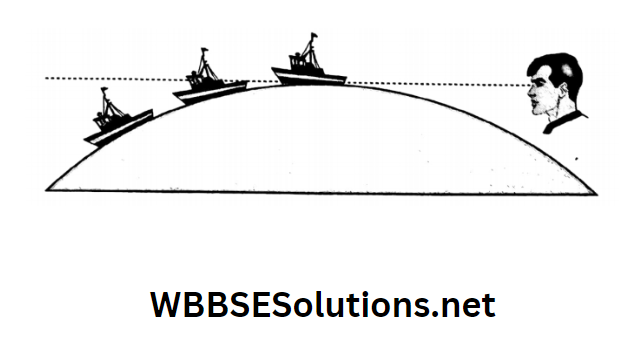
3. Observation of a ship leaving shore: When a ship sails away from shore, first its hull, then its deck, and finally the entire ship disappears from view. This happens because the Earth is spherical.

WBBSE Solutions For Class 6 Geography Chapter 2 Is The Earth Round The Spherical earth Observation of ship

WBBSE Class 6 Spherical Earth Notes

4. Observation of the horizon: As we climb up a mountain or we ascend in an aeroplane, the circumference of the horizon seems to expand and the shape seems to be circular.

WBBSE Solutions For Class 6 Geography Chapter 2 Is The Earth Round The Spherical earth Expansion of the circumference of the horizon with increase in altitude

5. Bedford Level Experiment: In 1870 AD, renowned naturalist and surveyor A.R Wallace put in 3 equal stakes in a straight line at equal intervals in the Bedford Canal of the United Kingdom.

Through a telescope, he observed that the second stake seemed to be higher than the first and the third stake.

This proved that the Earth is round. If the Earth were a flat disc, the tops of the stakes would be in a straight line.

Class 6 Geography WBBSE

WBBSE Solutions For Class 6 Geography Chapter 2 Is The Earth Round The Spherical earth bedford level experiment

Question 2. Who was the first to have the idea of a round Earth?
Answer:

People who believed that the Earth is round shaped are-

Aristotle: Aristotle, a Greek philosopher, observed the falling shadow of the Earth on the Moon during a lunar eclipse and he concluded that the Earth must be having a round shape.

Eratosthenes: Greek philosopher cum geographer Eratosthenes, standing on the seashore in 200 BCE, saw the disappearance of a sailing ship and concluded that the Earth is round.

3. Aryabhatta: Indian scientist Aryabhatta (in 476 CE) supported the idea of the round Earth.

Magellan: Magellan, a Portuguese explorer, sailed continuously westwards, circumnavigating the Earth, and finally returned to the same port. This voyage made him sure that the Earth has a circular shape.

WBBSE Solutions For Class 6 Geography Chapter 2 Is the Earth Round Topic A The Spherical Earth

Question 3. Give a few practical proofs of the Earth’s spherical shape.
Answer:

A few practical proofs of the Earth’s spherical shape are—

Instance 1: When one observes a ship leaving shore, first it’s the hull, then it’s a deck, and finally the entire ship seems to disappear from view.

Instance 2: when one looks down from a mountaintop, it seems as if the Earth is a spherical object and the sky covers it like a dome. It seems as if the Earth and the sky are meeting at a distant, arc-shaped line.

Instance 3: During a lunar eclipse, the shadow of the Earth falls on the Moon. This shadow is round and it proves that the Earth is spherical in shape.

Common Questions About Earth’s Roundness

WBBSE Solutions For Class 6 Geography WBBSE Solutions For Class 6 History WBBSE Solutions For Class 6 Maths
WBBSE Class 6 Geography Notes WBBSE Class 6 History Notes
WBBSE Class 6 Geography Multiple Choice Questions WBBSE Class 6 History MCQs WBBSE Notes For Class 6 School Science


Question 4. How did Magellan’s expedition of 1519 prove that the Earth is round?
Answer:

Magellan’s expedition of 1519 prove that the Earth is round:

The famous Portuguese explorer, Magellan, set out in 1519 to circumnavigate the globe with a fleet of five ships.

They always went westwards and after three years, they ended up at that port where they had set sail from. This circumnavigation clearly proves that the Earth is not a flat disc.

If we consider the Earth as a flat disk, then just by travelling to the west continuously, the ships would not have returned where they had started from. This proved beyond doubt that the Earth is round.

WBBSE Solutions For Class 6 Geography Chapter 2 Is The Earth Round The Spherical earth Proof of the earths spherical shape

Question 5. What is Lunar Eclipse? How does the Phenomenon of lunar Eclipse Prove that the Earth is round?
Answer:

Lunar Eclipse:

All heavenly bodies revolve in space in their own unique orbits. The Earth revolves around the Sun and the Moon revolves around the Earth in their own orbits.

If at any point during their revolutions, the Earth comes between the Sun and the Moon in a straight line.

Class 6 Geography Question Answer WBBSE

The Sun’s light is unable to reach the Moon because the Earth’s shadow falls on the Moon. This is called a lunar eclipse.

WBBSE Solutions For Class 6 Geography Chapter 2 Is The Earth Round The Spherical earth Magellans expedition route across the globe

During a lunar eclipse, the Earth’s shadow that falls on the Moon is seen to be circular in shape. This shows that the shape of the Earth is round.

Greek philosopher Aristotle was the first person to observe that the Earth is round in shape by noticing the circular shadow of the Earth during the lunar eclipse.

Only a circular or spherical object can have a circular shadow. Even when we see through a telescope, all other planets are seen to be spheres. So, it is natural to deduce that the Earth is also spherical in shape.

Practice Questions on Earth’s Spherical Nature

Question 6. Write a short note on the horizon.
Answer:

Horizon:

The line where the surface of the Earth and the sky meet is the horizon. The imaginary line that traces the horizon is called the line of the horizon.

When we stand on a flat stretch of land, our line of sight ends at a distant point where the sky and the surface of the Earth meet.

This is the horizon. This seems to be a straight line. When we stand on a mountain peak, the line of the horizon appears to be an arc.

When our line of sight is obstructed by trees or buildings, the skyline is called the visible horizon.

Class 6 Geography Question Answer WBBSE

Question 7. What does the Earth’s shape seem like from space?
Answer:

Earth’s shape seem like from space:

As seen from outer space, the Earth looks like a bright, blue sphere suspended in space.

The photographs sent by astronauts from space and from the Moon and also those taken by artificial satellites show that the Earth is spherical.

But, calculations have shown that the Earth is actually an oblate spheroid—not quite a sphere. Geographers think that there is no object existing on earth which is similar in shape to that of the Earth.

So the Earth should be described to have a unique shape like that of itself.

Question 8. Why the Earth apparently seems to be flat?
Answer:

Earth apparently seems to be flat:

The Earth apparently seems to be flat to those who live on earth, because—

1. The radius of the Earth is about 6,400 km. As a result, the curvature of the circumference of the Earth is huge, which is normally not visible to the human eye.

2. The visible limit of surroundings to the naked human eye from any point on the Earth’s surface is very low. As a result, the farthest a person can see from any location appears merely flat.

Important Definitions Related to Earth’s Shape

Question 9. Why the Sun Rises at different times at Different places on earth?
Answer:

Sun Rises at different times at Different places on earth:

The Earth apparently seems to be flat to those who live on earth, because—

The radius of the Earth is about 6,400 km. As a result, the curvature of the circumference of the Earth is huge, which is normally not visible to the human eye.

The visible limit of surroundings to the naked human eye from any point on the Earth’s surface is very low. As a result, the farthest a person can see from any location appears merely flat.

WBBSE Chapter 2 Is The Earth Round Topic A The Spherical Earth Short Answer Type Questions

Question 1. From where can we get photographs of the Earth?
Answer:

We can get photographs of the Earth from man-made satellites orbiting in space.

Question 2. What do you understand by the horizon?
Answer:

Horizon:

When we stand on a vast, open ground or in a wide open space and look around us, the Earth and the sky seem to meet at an arc-shaped line. This line is called the horizon. The horizon always remains circular.

Examples of Evidence for Earth’s Roundness

Question 3. How did people use to determine direction before the compass was invented?
Answer:

In ancient times before the compass was invented, people used the Pole Star to determine north, Hadley’s Octant to determine south, the Morning Star to determine east in the morning and Evening Star to determine west in the evening.

WBBSE Chapter 2 Is The Earth Round Topic A The Spherical Earth Very Short Answer Type Questions

Question 1. The Earth is round”—who was the first person to say this?
Answer: Pythagoras.

Question 2. The Earth is round” – who was the first Indian scientist to think this?
Answer: Aryabhatta.

Question 3. Who was the first person to deduce that the Earth is round by observing the shadow of a lunar eclipse?
Answer: Greek philosopher Aristotle.

Question 4. What is the average radius of the Earth?
Answer: 6,400km.

WBBSE Class 6 Geography Question Answer

Question 5. During a lunar eclipse, whose shadow falls on the Moon?
Answer: The Earth’s shadow.

Question 6. What shape is the line of the horizon?
Answer: Circular.

Question 7. Which heavenly body helped ancient people to determine the southern direction?
Answer: Hadley’s Octant.

Question 8. Which instrument was used by the navigators to determine the direction of navigation in ancient times?
Answer: Compass.

WBBSE Chapter 2 Is The Earth Round Topic A The Spherical Earth Fill in the blanks

Question 1. In 1519, Portuguese explorer___________set out to travel around the world with a fleet of five ships.
Answer: Magellan

Question 2. The greater the radius of an arc,___________ the curvature is going to be.
Answer: Lesser

Question 3. The horizon always remains ___________
Answer: Circular or arc Shaped

Question 4. If you imagine the Earth to be a flat stretch of land, the sky is like a huge___________ upturned on it.
Answer: Saucer

Question 5. Images showing the Earth’s spherical shape have been taken from artificial ___________.
Answer: Satellites

Question 6. Greek philosophers concluded that the Earth is round by observing the circular shadow of the Earth on the ___________ Moon during the lunar eclipse.
Answer: Aristotle

Question 7. The ancient Indian scientist ___________ endorsed the idea of a round Earth.
Answer: Arya Bhatta

Question 8. The Earth’s spherical shape was first scientifically proven by mathematician ___________.
Answer: Aristotle

WBBSE Chapter 2 Is The Earth Round Topic A The Spherical Earth Write True Or False

Question 1. Almost 500 years before the birth of Christ, Greek mathematician and philosopher Eratosthenes said that the Earth is round.
Answer: False

Question 2. The mean radius of the Earth is 6,400 km.
Answer: True

Question 3. In photographs taken from space, the Earth appears like a flat disc.
Answer: False

Question 4. During a lunar eclipse, the Earth casts a round shadow on the Moon.
Answer: False

Question 5. Greek philosopher Aristotle stated that the Earth’s shape is earth-shaped or geoid.
Answer: False

Question 6. The Earth rotates on its own axis.
Answer: True

Question 7. When a ship sails away from shore, first its mast, then its deck, and finally the entire ship disappears from view.
Answer: False

Question 8. The ocean looks like a sphere when viewed from the deck of a ship.
Answer: True

WBBSE Chapter 2 Is The Earth Round Topic A The Spherical Earth Match The Columns

Questions 1.

WBBSE Solutions For Class 6 Geography Chapter 2 Is The Earth Round The Spherical earth Macth the following

Answer: 1-D,2-A,3-E,4-B,5-C

WBBSE Solutions For Class 6 Geography Chapter 1 The Sun The Stars In The Sky Topic C Space Explorations

WBBSE Class 6 Geography WBBSE Chapter 1 The Sun The Stars In The Sky Topic C Space Explorations Analytical Type Questions

Question 1. Collect the information regarding expeditions to space to know about life on Mars.
Answer:

The information regarding expeditions to space to know about life on Mars:

Earth, the only planet in the solar system has life. But scientists are trying to find out if there was life on Mars, whether there is life now, and whether there could be life in the future.

According to the latest information, methane gas has been found on Mars. As a result, scientists and researchers are hopeful that the existence of life could be found on Mars.

There have been several expeditions to space to learn about life on Mars. Among them, the Mars Orbit Mission (MOM) is an important expedition. The information about this expedition is as follows:

Name of the spacecraft: Mars Orbit Mission (MOM)

Launch Center: From the Sriharikota Rocket Launch Center on November 5, 2013, at 2.38 pm by PSLV-C-25

Weight of the MOM: About 1337 kg

WBBSE Solutions For Class 6 Geography Chapter 1 The Sun The Stars In The Sky Topic C Space Explorations

Class 6 Geography WBBSE

Leaving the Earth’s orbit: December 1, 2013, at 12:48 pm

Entering the orbit of Mars: On September 24, 2014

Work: As a result of the tireless effort of ISRO scientists and technologists, MOM is sending a lot of unknown information about the weather and surface features of Mars. By sending MOM, India is assuring a new era in space research.

Finding: According to the latest data, methane gas has been found on Mars.

Some other expeditions on Mars are—

WBBSE Solutions For Class 6 Geography Chapter 1 The Sun The Stars In The Sky space explorations Some other expeditions on mars are-

Question 2. Write about man’s first expedition to the Moon.
Answer:

The milestones of man’s first expedition to the Moon are as follows—

Start of the journey: On July 16 of the year 1969, with astronauts Neil Armstrong, Edwin Aldrin, and Michael Collins on board, the spacecraft Apollo-11 set off from Kennedy Space Centre in Florida.

Read And Learn More  WBBSE Solutions For Class 6 Geography

Expedition: The spacecraft reached lunar orbit and started orbiting the Moon. At this point, the lunar module—Eagle, separated from the main craft-Columbia and landed on the Moon.

First steps on the Moon: On 20 July, Neil Armstrong became the first man to set foot on the Moon. Twenty minutes later, Edwin Aldrin joined him.

WBBSE Class 6 Space Exploration Notes

Mission: The astronauts then took pictures of the Moon’s surface, and collected samples of the Moondust as well as Moon rocks. They also carried out various other mission-related activities.

Return journey: The lunar module then lifted off from the Moon’s surface and rejoined Columbia. The astronauts reached Earth safely on July 24.

WBBSE Solutions For Class 6 Geography WBBSE Solutions For Class 6 History WBBSE Solutions For Class 6 Maths
WBBSE Class 6 Geography Notes WBBSE Class 6 History Notes
WBBSE Class 6 Geography Multiple Choice Questions WBBSE Class 6 History MCQs WBBSE Notes For Class 6 School Science


Question 3. What do astronauts report about the environment of the Moon?
Answer:

Some of the experiences that astronauts have reported about the environment of the Moon are as follows—

1. Less gravitational force: The gravitational force of the Moon is about 1/6 of the gravitational force of the Earth.

As a result, anyone on the Moon can easily jump about 6-7 times higher off the ground than he can do on Earth. Also, because of this low gravitational force, the Moon has no atmosphere.

2. No atmosphere: As the Moon does not have an atmosphere, the sky is always dark on the Moon. It is a place of perpetual night, with no dawn or dusk. Apart from temperature, there is no other element of weather.

3. No sound: Since there is no air on the Moon, there is no sound. Wireless transmitters are needed here for communication.

4. Uneven topography: The topography of the Moon is full of craters, potholes, hillocks, and hills. The craters are what we call Moon spots. There are many hills as well as over 0.2 million volcanic craters. There is a layer of dust all over the surface.

Class 6 Geography WBBSE

5. No life: There is no life on the Moon, as the Moon has neither air nor water

Question 4. What is a Space shuttle?
Answer:

Space shuttle: A space shuttle is a kind of spacecraft that helps objects to return to the Earth. As rockets work as launchers for objects, space shuttles serve as return vehicles.

Space shuttles are used to transport materials for the construction of space stations, transport instruments and devices as well as food and supplies for astronauts. For example, the space shuttle Columbia is operated by NASA.

Question 5. What is an Artificial satellite?
Answer:

Artificial satellites: The man-made satellites that orbit the Earth at a specific distance from the Earth’s surface are called Artificial satellites.

These satellites are extensively used for space research, weather forecasting, and mineralogy as well as monitoring land, air, and water on Earth. For instance, INSAT is an Indian satellite.

Question 6. What do you mean by ISRO?
Answer:

ISRO: ISRO or the Indian Space Research Organization is the Indian government’s space research agency.

Under ISRO, there are now 18 space research centers and launching stations in India. It was because of the efforts of ISRO that the Aryabhatta, Bhaskar, Rohini, and INSAT series of satellites have been launched into space.

Its latest pride is the successful injection of Mangalyaan into Mars orbit. It is headquartered in Bengaluru.

Question 7. What is a solar eclipse? Explain within a diagram.
Answer:

Solar eclipse: A Solar eclipse occurs when the Moon’s shadow falls on the Sun, blocking it from our view, partially or fully. This happens only when the Moon is directly in a straight line between the Sun and the Earth and always happens during the new Moon phase.

WBBSE Solutions For Class 6 Geography Chapter 1 The Sun The Stars In The Sky space explorations Solar eclipse

A total solar eclipse occurs when the Sun is completely blocked out by the Sun and a partial solar eclipse occurs when a part of the Sun is blocked out.

Question 8. What is a lunar eclipse? Explain with a diagram.
Answer:

Lunar eclipse: A Lunar eclipse occurs when the Earth’s shadow falls on the Moon, blocking it from our view, partially or fully. This happens when the Earth is between the Moon and the Sun in a straight line and on a full Moon night.

WBBSE Solutions For Class 6 Geography Chapter 1 The Sun The Stars In The Sky space explorations lunar eclipse

Question 9. Write about man’s expeditions to the Moon.
Answer:

The history of man’s expeditions to the Moon is as follows—

  1. On 20 July 1969, Neil Armstrong, an American astronaut, became the first man to set foot on the Moon.
  2. On 14 November 1969, the Moon saw the second set of visitors from the Earth.
  3. On 31 January 1971 astronauts from Earth started another mission and landed for the third time on the Moon.

Question 10. What are the dark spots on the Moon?
Answer:

Dark spots on the Moon: The dark spots on the Moon are actually huge depressions caused by volcanic activity and meteor impacts. Since the light from the Sun does not reach into their depths, they appear as dark patches.

As they were earlier thought to be seas and oceans, they were collectively called Maria (‘mare’ meaning sea in Latin). Some names of the lunar mares are the Sea of Tranquility, Sea of Crises, and so on.

Class 6 Geography Question Answer WBBSE

Question 11. Name some famous space travelers.
Answer:

Some famous space travelers are—

  1. ln 1957, a dog named Laika was sent to space by the then U.S.S.R. Laika was the first living creature from Earth to travel to space.
  2. In 1961, Yuri Gagarin traveled to space in a spacecraft named Vostok. He was the first human being to travel to space. G In 1963, Valentina Tereskova became the first woman in space.
  3. Vostok – 6 was the spacecraft.
  4. On 1 February 1997, Kalpana Chawla became the first woman of Indian origin to travel to space.
  5. Sunita Williams is the second woman of Indian origin to travel to space.
  6. She is also the woman astronaut who holds the record for clocking the most number of hours in space to date.

Question 12. After how many planets are the Earth situated when we move away from the Sun?
Answer:

The sun And all the innumerable heavenly bodies that travel around it make up the solar system. These include the planets, their satellites, minor planets, comets as well as asteroids.

WBBSE Solutions For Class 6 Geography Chapter 1 The Sun The Stars In The Sky The Solar System the solar system

Other members: Other members of the solar system are—

Eight planets: Mercury, Venus, Earth, Mars, Jupiter, Saturn, Uranus, and Neptune.

Five dwarf planets: Pluto, Eris, Ceres, Haumea, and Makemake.

Various satellites: Moon of the Earth, Deimos of Mars, Jupiter’s Ganymede, and Titan of Saturn, etc.

Comets: Halley’s, Hale-Bopp, Hyakutake, etc.

Asteroids: Ceres, Eros, etc. 0 Meteors: Leonid (meteor shower), etc.

Question 13. Make a model of the solar system with your friends.
Answer:

Project name: Making of solar system model

Name of the Students: Subhodip Jadab, Dip Pal, Sourav Karmakar, Sayan Pal

Name of the School: Chandernagore Banga Vidyalaya

Class: VI

Sec: A

Date: 05.12.2020

Required Materials: A large-size thermocol sheet, a few thermocol pieces, plastic balls of different sizes, rings of different sizes, tissue paper, glue, paint, brush, scissors, pens, pencils, pencil compass, scale, sketch pens, fine bamboo sticks, etc.

Model Construction Method: The red sun is drawn on the left side of the thermocouple.

  • Multiple partial orbits for planets and satellites have been drawn with a pencil compass.
  • Glue is applied to a certain part of the orbit with a brush.
  • Plastic balls of different sizes according to the planets and satellites are pasted on those parts.
  • Names of the planets, dwarf planets, and satellites are written with a sketch pen.
  • Rings of different sizes have been attached around Saturn. These indicate the seven bright rings of Saturn.
  • Again, in between Mars and Jupiter, glue is applied with a brush, and small pieces of thermocouple are pasted, which point to the asteroids.
  • Finally, glue with a brush on the upper right side of the thermocouple sheet is applied and fine bamboo sticks are stuck to indicate the comets.
  • At last, the heading, border, and names of the other members of the solar system are marked with a sketch pen.

WBBSE Solutions For Class 6 Geography Chapter 1 The Sun The Stars In The Sky space explorations model of solar system

Question 14. Draw a diagram of the solar system and mark it.
Answer:

WBBSE Solutions For Class 6 Geography Chapter 1 The Sun The Stars In The Sky space explorations solar system.

Answer:

  1. Mercury
  2. Venus
  3. Earth
  4. Mars
  5. Jupiter
  6. Saturn
  7. Uranus
  8. Neptune

Question 15. Make a collage from news clips collected from the dailies about space, solar storms, expeditions to Mars, solar eclipses, and lunar eclipses.
Answer:

Project name: Preparation of a collage of news about space-related information.

Name of the Students: Anshu Pramanik

Name of the School: KamalpurJ K High School

WBBSE Class 6 Geography Question Answer

Class: VI

Sec: B

Roll: 7

Date 21.12.2020

WBBSE Solutions For Class 6 Geography Chapter 1 The Sun The Stars In The Sky space explorations Collage of news about space realted informations

Question 16. Prepare cards with the characteristics of each planet written on them. Jumble them up and form small groups. Ask each group to pick up a card at random and see if you can identify the planet.
Answer: Procedure: It is divided into small groups as per the instructions of our teacher Mrs. Arpita Das Samanta. Then we write the characteristics of the planets on the cards and shuffle them.

Card 1: My features

Brightest and Warmest planet in the solar system.

I am almost equal to the Earth in size. That’s why I am also known as the ‘sister planet’ of the Earth.

I am also known as the evening star and the morning star.

Tell me who am I?

Answer: Venus

Card 2: My features

I have seven bright rings.

I take minimum time for one rotation.

I have a density less than that of water.

Tell me who am I?

Answer: Saturn

Card 3: My features

I am the fastest planet in the solar system.

I have no Satellite.

I am the nearest to the Sun.

Tell me who am I?

Answer: Mercury

Aesthetics and Creativity: This segment will check the aesthetic sense and creativity of the students.

Question 17. Spread some gum on a black chart paper and sprinkle some glitter on it to make galaxies of various shapes.
Answer:

  1. Project name: Making of Galaxies
  2. Name of the Student: Arnab Das
  3. Name of the School: Balagarh High School
  4. Class: VI
  5. Sec: B
  6. Roll: 9
  7. Date: 28.12.2020

Required Materials: A large-size black art paper, glue, paint, brush, scissors, pen, pencil, sketch pen, and mica dust of different colors etc.

Method of Work: A rough sketch of the galaxy has been drawn with a pencil on black art paper. Then the glue is applied with a brush to this rough sketch.

Now, the mica dust of different colors is scattered on the glue-laden sketch. Mica dust is sprinkled in such a way that they seem spiral or elliptical in shape.

WBBSE Solutions For Class 6 Geography Chapter 1 The Sun The Stars In The Sky space explorations Galaxy on art paper

Question 18. Draw all the constellations you find in the night sky. Make sure not to leave Polaris ou
Answer:

WBBSE Solutions For Class 6 Geography Chapter 1 The Sun The Stars In The Sky space explorations Constellations and the polaris

Question 19. You are a citizen of the Universe. Write down your complete address.
Answer: I am Sandipan Dutta. My complete address as a citizen of the Universe is as follows:

  1. Name: Sandipan Dutta
  2. Town/Village: Chinsurah
  3. State: West Bengal
  4. Country: India
  5. Continent: Asia
  6. Planet: Earth
  7. Galaxy: Milky Way

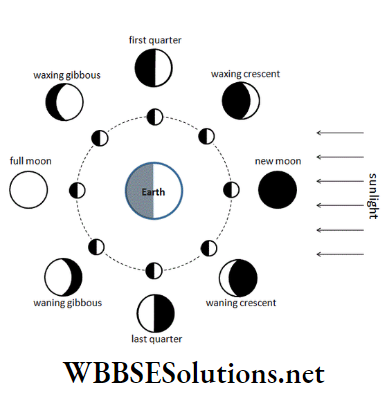
Question 20. Observe the phases of the moon from one full moon to the next when the night sky is mostly clear. Note the changes and draw them in your exercise book.
Answer:

Project name: Observation and recording of phases of the moon

Name of the Students: Sahyadri Ghosal

Name of the School: Vivekananda Vidyamandir

Class: VI

Sec: A

Roll: 1

Date: 17.11.2019 to 16.12.2019

Time: 8 pm

Observation and recording:

On the night of the first full moon, I saw a full moon like a big round plate because then the Sun rays fall completely on the moon.

From the day after the full moon, the moon became gradually thinner and thinner. Exactly 15 days later, on the night of the new moon, the moon was no longer seen.

From the day after the new moon, the moon started to grow in size again from the thin slice. Exactly 15 days later, on the night of the full moon, the moon was seen again like a big round plate.

In this way, I have observed the changes in the shape of the moon in a clear night sky from one full moon (17/11/2019) to the new moon (02/12/2019) and again from the new moon (02/12/2019) to the next full moon (16/12/2019).

Question 21. Mark the property

WBBSE Solutions For Class 6 Geography Chapter 1 The Sun The Stars In The Sky space explorations Moon ,Earth,Sun

Answer: 1. Moon, 2. Earth, 3. Sun

Question 22.

WBBSE Solutions For Class 6 Geography Chapter 1 The Sun The Stars In The Sky space explorations crossword

Clues:

Down: 3. The outermost region of the Sun’s atmosphere. 6. Satellite of Saturn. 7. Small extra-terrestrial body. 8. The first animal to visit space. 9. Eighth planet in respect of distance from the Sun. 10. Celestial body orbiting around planets.

Across: 1. Small celestial bodies move around the Sun found between Mars and Jupiter. 2. Dwarf planet. 3. An arrangement of Stars as seen from the Earth. 4. Location used for observing terrestrial and celestial events. 5. Instrument for observing celestial events.

Answer: Down 3. Corona, 6. Titan, 7. Meteor, 8. Laika, 9. Neptune, 10. Satellite Across: 1. Asteroids, 2. Pluto, 3. Constellation, 4. Planetarium, 5. Telescope

Question 23. What is the significance of artificial satellites?
Answer:

The significance of artificial satellites:

  • Satellites are small, heavenly bodies that orbit around planets. Satellites made by human beings that are sent to space for various purposes are known as artificial satellites.
  • These satellites are mostly used to forecast the weather, and ocean currents, predict natural disasters, and for defense purposes.
  • They also enable radio and mobile networks to operate. Space research is another function. Many countries have sent artificial satellites to space over the years.
  • Aryabhatta was the first artificial satellite to be launched by India, On 19 April 1975, from the former Soviet Union.
  • Aryabhatta was designed to revolve around the Earth once every 1 hour and 36 minutes and was equipped with the technology to send back a lot of information and data.
  • But a power failure halted experiments after just 4 days and 60 orbits and all signals from the satellite were lost. Aryabhatta re-entered the Earth’s atmosphere in February 1992.
  • In 1983, the Indian Space Research Organisation launched a satellite named INSAT. The main aim of launching INSAT was to enable telecommunications, and radio transmissions as well as for weather forecasting and analysis.

Question 24. Why do comets appear after intervals of time?
Answer:

Comets are heavenly bodies with a broomstick-like tail of gases and dust. Their heads are very bright and their tails extend for thousands of kilometers.

They also orbit around the Sun in a hyperbolic, elliptical orbit. But at some points during their orbits, their tails extend in a direction opposite to the Sun and are hence, not visible.

They revolve in the opposite direction to the planets and their orbits are so huge that it takes them a long time to reach a specific point in their orbit again.

That is why they are only visible from Earth at long intervals of time. Example: Halley’s comet is only visible every 76 years. It was visible in 1910 and 1986 and will again be seen in 2061.

WBBSE Chapter 1 The Sun The Stars In The Sky Topic C Space Explorations Short Answer Type Questions

Question 1. What are rockets and what are space shuttles?
Answer:

Rockets: Rockets and space shuttles are different kinds of spacecraft. Rocket technology allows us to send objects to outer space.

Their immensely powerful engines help them escape the Earth’s gravitational force and enter space. At this time, the technology to make rockets reusable is not available.

A space shuttle, on the other hand, is a spacecraft that is needed to return to Earth safely from space.

Question 2. ‘Rockets help to launch objects Into outer space/—how?
Answer:

Rockets help to launch objects Into outer space: If one wants to reach outer space, the first obstacle would be to counter is the Earth’s gravitational force. Doing this requires the object to achieve a minimum velocity of 11.2 km/sec—this velocity is known as ‘escape velocity’.

Rockets can do this with ease and so they are used to also put objects like artificial satellites into space.

Question 3. What is a spacesuit?
Answer:

Spacesuit: A spacesuit is a protective garment that is designed to help astronauts survive in space. Spacesuits are actually one-person spacecraft— pressurized, human-being-shaped chambers in which the atmospheric pressure is maintained as that on Earth.

Class 6 Geography Question Answer WBBSE

They protect astronauts from extreme temperatures in space; they supply oxygen to astronauts and also contain water. They protect astronauts from harmful radiation in space and from space matter and space debris hurtling around.

Question 4. What is Curiosity?
Answer:

Curiosity: Curiosity is an advanced Mars orbiter, launched by NASA. This is engaged in gathering data about the surface and atmosphere of Mars. Curiosity Rover is also looking for signs of life on Mars.

WBBSE Solutions For Class 6 Geography Chapter 1 The Sun The Stars In The Sky space explorations curiosity rover

Question 5. What is NASA?
Answer:

NASA: NASA (National Aeronautics and Space Administration) is an organization set up to manage issues of space research. It was inaugurated in 1958 by the then-American president, Dwight. D Eisenhower. It was under NASA that in 1967, Apollo 1 was launched.

Practice Questions on Satellites and Spacecraft

Question 6. What is INSAT?
Answer:

INSAT: The satellite launched by ISRO was named INSAT. There was an attempted launch of the INSAT-1A in the year 1982, which eventually failed the following year.

Then in the year 1983, INSAT-1B was launched successfully. The main aim of launching INSAT was to enable telecommunications, radio transmissions as well as weather forecasting and analysis.

Question 7. What is Aryabhatta?
Answer:

Aryabhatta: Aryabhatta was India’s first artificial satellite. On 19 April 1975, Aryabhatta was launched from the former Soviet Union.

Aryabhatta was designed to revolve around the Earth once every 1 hour and 36 minutes and was equipped with the technology to send back a lot of information and data.

But a power failure halted experiments after just 4 days and 60 orbits and all signals from the satellite were lost. Aryabhatta re-entered the Earth’s atmosphere in February 1992.

Question 8. Fill In The Knowledge Hive With Information On A Planetarium.

WBBSE Solutions For Class 6 Geography Chapter 1 The Sun The Stars In The Sky space explorations Planetarium

Answer:

  1. Various phenomena related to astronomy are shown here.
  2. This is dome-shaped in order to replicate the way we actually see different planets, stars, and other heavenly bodies in the sky.
  3. Lights are switched off during the show in order to present a clear view of the night sky.
  4. Here, the apparent motion of the Sun, Orion, Big Dipper, etc. is presented very beautifully.

Question 9. Mark the names of the planets in the solar system.

WBBSE Solutions For Class 6 Geography Chapter 1 The Sun The Stars In The Sky space explorations solar system.

Answer:

  1. Mercury
  2. Venus
  3. Earth
  4. Mars
  5. Jupiter
  6. Saturn
  7. Uranus
  8. Neptune

Question 10. Connect The numbered stars in the correct order and name the constellations

WBBSE Solutions For Class 6 Geography Chapter 1 The Sun The Stars In The Sky space explorations poler stars

Answer:

WBBSE Solutions For Class 6 Geography Chapter 1 The Sun The Stars In The Sky space explorations poler stars.2


Question 11. Why does the sky appear blue to the naked eye?
Answer:

In between the surface of the Earth and outer space, there is the atmosphere. This is made up of floating particles of dust and air.

This blanket of air absorbs all the colors of the spectrum in the Sun’s light, that is—violet, indigo, green, yellow, orange, and red – except blue. As a result, it reflects the blue and so, the sky appears blue to the naked eye.

Question 12. When it is a lunar eclipse on the Earth, it is a solar eclipse on the moon.—Why?
Answer:

When it is a lunar eclipse on the Earth, it is a solar eclipse on the moon: When during some full Moons, the Earth, Sun, and Moon are in a straight line, then the Earth’s shadow falls on the Moon, making it invisible.

That’s why we on Earth experience a lunar eclipse. At this time, the Sun is invisible from the Moon, so it is a solar eclipse on the Moon.

Question 13. Name the constellations with the help of the clues given below:

WBBSE Solutions For Class 6 Geography Chapter 1 The Sun The Stars In The Sky space explorations shape and direction

Answer:

WBBSE Solutions For Class 6 Geography Chapter 1 The Sun The Stars In The Sky space explorations shape and direction.2

WBBSE Chapter 1 The Sun The Stars In The Sky Topic C Space Explorations Very Short Answer Type Questions

Question 1. What is the total population of the world?
Answer: More than 7 billion.

Question 2. What is the dress worn by the astronauts while traveling to space known as?
Answer: Spacesuit.

Question 3. What are the main uses of artificial satellites?
Answer: Weather forecasting, navigation, and communication.

Conceptual Questions on the Universe and Beyond

Question 4. Write the expanded form of NASA.
Answer: National Aeronautics and Administration.

Question 5. Write the expanded form of ISRO.
Answer: Indian Space Research Organisation

Question 6. Where is the ISRO’s headquarters situated?
Answer: Bengaluru.

Question 7. What is India’s first lunar vehicle named?
Answer: Chandrayaan

Question 8. What is the mutual position of the Sun, Earth, and Moon in the case of a solar eclipse?
Answer: The Moon is in between the Sun and the Earth.

Question 9. In which year Laika had traveled to space?
Answer: 1957.

Question 10. What were the main constituent parts of the spaceflight, Apollo-ll?
Answer: Columbia, Eagle.

Question 11. Who were the crew members of the spaceflight, Apollo-ll?
Answer: Neil Armstrong, Michael Collins, Edwin Aldrin.

Question 12. What are the daytime and nighttime temperatures of the Moon?
Answer: Almost 117°C and -150°C respectively.

Question 13. Nebula: Galaxy: Star: Atmosphere
Answer: Atmosphere (not a heavenly body)

Question 14. Galaxy: Milky Way: Constellation: Earth
Answer: Earth (A planet)

WBBSE Class 6 Geography Question Answer

Question 15. A Moon: Sun: Proxima Centauri: Star
Answer: Moon ( A Satellite)

Question 16. Observatory: Temple: Telescope: Space
Answer: Temple (Not related to space research)

Question 17. Mercury: Venus: Earth: Moon
Answer: Moon ( A Satellite)

Question 18. I am the Earth’s only natural satellite. Who am I?
Answer: Moon

Question 19. I am the only planet in the solar system with life. Who am I?
Answer: Earth

Question 20. I am a celestial phenomenon who is seen after every 75/76 years. Who am I?
Answer: Halley’s comment

Question 21. I am the second woman of Indian origin who has spent the most amount of time in space. Who am I?
Answer: Sunita Williams

Question 22. I am the largest satellite in the solar system. I am a satellite of Saturn. Who am I?
Answer: Titan

Question 23. How many planets are there in the solar system?
Answer: Eight

Question 24. Which planet is the closest to the Sun and which is the farthest?
Answer: Mercury (the closest) and Neptune (the farthest)

Question 25. Which planet seems to be the largest?
Answer: Jupiter

WBBSE Chapter 1 The Sun The Stars In The Sky Topic C Space Explorations Fill In The Blanks

Question 1. ISRO is the space research centre of___________
Answer: India

Question 2. India’s first artificial satellite is called___________
Answer: Aryabhatta

Question 3. The first lunar vehicle from the Earth to land successfully on the Moon is___________
Answer: Chandrayan

Question 4. A lunar eclipse always occurs on ___________ night.
Answer: Full moon night

Question 5. The first space traveller from Earth is the Russian dog___________
Answer: Laika

Question 6. The first man to travel in space is___________
Answer: Yuri Gagarin

Question 7. The world’s first female astronaut is___________
Answer: Valentina tereskova

Question 8. India’s first astronaut is___________
Answer: Rakesh Sharma

Question 9. ___________ Spent the most time in space
Answer: Sunita Williams

Question 10. At night on Moon temperature drops up to___________
Answer: -150ºC

WBBSE Chapter 1 The Sun The Stars In The Sky Topic C Space Explorations Write True Or False

Question 1. An American satellite is named Aryabhatta.
Answer: False

Question 2. The Russian name of a man-made satellite is Sputnik.
Answer: True

Question 3. The central agency concerned with space research in India is ISRO.
Answer: True

Question 4. The first woman astronaut of Indian origin is Sunita Williams.
Answer: False

Question 5. Aryabhatta was launched on 19 April 1975.
Answer: True

Question 6. Thumba in Kerala is an important rocket launch site in India.
Answer: True

Question 7. The main obstacle to the launch of spacecraft is the Earth’s gravitational pull.
Answer: True

Question 8. Curiosity landed on Mars in 2014.
Answer: False

Question 9. Spacesuits are designed for astronauts.
Answer: True

Question 10. Laika was sent by Russia
Answer: True

WBBSE Chapter 1 The Sun The Stars In The Sky Topic C Space Explorations Match The Columns

Question 1.

WBBSE Solutions For Class 6 Geography Chapter 1 The Sun The Stars In The Sky space explorations match the following

Answer: 1-D,2-F,3-E,4-G,5-B,6-C,7-A,8-1,9-H

WBBSE Solutions For Class 6 Geography Chapter 1 The Sun The Stars In The Sky Topic B The Solar System

WBBSE Class 6 Geography WBBSE Chapter 1 The Sun The Stars In The Sky Topic B The Solar System Long Answer Type Questions

Question 1. How was the solar system formed?
Answer:

Formation solar system:

There are many theories about how the solar system was formed.

Some of these are as follows—

1. Most scientists believe that the solar system was born from a massive explosion of a gigantic, whirling mass of particles of space matter and gases.

2. Slowly, particles of dust, hydrogen, and helium compressed together to form a dense mass-the Sun.

3. The extreme gravitational force exerted by the center of this mass caused the collision of atoms and resulted in the generation of energy.

As time went on, this mass attracted even more space matter and started growing in volume. This swirling ball of fire started radiating heat and light.

5. Finally, clouds made up of dust particles and gaseous compounds, started revolving around the Sun as a result of the Sun’s gravitational force.

It is from these clouds that the planets formed over time.

Read And Learn More WBBSE Solutions For Class 6 Geography

WBBSE Solutions For Class 6 Geography Chapter 1 The Sun The Stars In The Sky The Solar System stages of formation of the solar system

Question 2. What do you know about the structure of the Sun? What is the solar atmosphere?
Answer:

The structure of the Sun:

The Sun is a medium-sized, yellow star that is about 4.6 billion years old.

It is a swirling mass of hydrogen, helium, nitrogen, oxygen, and other gaseous matter.

Apart from this, solid metal elements like gold, silver, nickel, and iron are also present but in gaseous form due to incredibly high temperatures.

WBBSE Solutions For Class 6 Geography WBBSE Solutions For Class 6 History WBBSE Solutions For Class 6 Maths
WBBSE Class 6 Geography Notes WBBSE Class 6 History Notes
WBBSE Class 6 Geography Multiple Choice Questions WBBSE Class 6 History MCQs WBBSE Notes For Class 6 School Science


Class 6 Geography WBBSE

The region of the Sun, categorized on differences in light and heat is given below—

1. Core: The innermost part of the Sun, where hydrogen is compressed to produce helium and release energy through nuclear fusion.

The temperature at the core is estimated to be 15 million degrees Celsius.

2. Radiative zone: This is the intermediate zone between the super-dense core and the outer layer.

This is the part that is visible to the naked eye as a red, luminous mass. Solar storms flare up in this part of the Sun.

WBBSE Solutions For Class 6 Geography Chapter 1 The Sun The Stars In The Sky The Solar System parts of the sun

Convective zone: This is the outermost layer of the interior of the Sun. In this zone, energy is transported by convection. This is actually the surface of the sun where light is created. So the outer part of this layer is called Photosphere.

WBBSE Class 6 Solar System Notes

WBBSE Solutions For Class 6 Geography Chapter 1 The Sun The Stars In The Sky Topic B The Solar System

Solar atmosphere: The solar atmosphere is made up of three parts—

1. The Photosphere,

2. The Chromosphere and

3. The Corona.

The Photosphere is the first region of the Sun that is visible to us. As the temperature decreases, the part of the solar atmosphere visible as red flashes is the Chromosphere.

The Corona is the outermost part of the Sun’s atmosphere. This is visible to the naked eye only during the total solar eclipse at moments of totality.

Question 3. What are the special features of the Sun?
Answer:

Special features of the Sun:

The Sun is the only star in our solar system. This huge, swirling ball of gas is also the brightest heavenly body in our solar system. The special features of the Sun are:

WBBSE Solutions For Class 6 Geography Chapter 1 The Sun The Stars In The Sky The Solar System Feature and uniqueness

Question 4. Describe the smallest planet in the solar system.
Answer:

The smallest planet in the solar system:

The smallest planet in the solar system is Mercury. This is also the planet nearest to the Sun. Some important facts about Mercury:

WBBSE Solutions For Class 6 Geography Chapter 1 The Sun The Stars In The Sky The Solar System Smallest planet in the solar system

Question 5. Describe the planet venus
Answer:

The planet venus:

The planet that lies second to the Sun is Venus. This is the closest planet to our Earth and also the sixth-largest in volume. Some important facts about Venus:

WBBSE Solutions For Class 6 Geography Chapter 1 The Sun The Stars In The Sky The Solar System the planet venus

Question 6. Describe Our earth and Its characteristics as a member of the solar system.
Answer:

Our earth and Its characteristics as a member of the solar system:

The earth is the only planet in the solar system which has life. Some Important facts about earth:

WBBSE Solutions For Class 6 Geography Chapter 1 The Sun The Stars In The Sky The Solar System Smallest planet in the solar system

Practice Questions on The Sun and Planets

Question 7. Describe the planet mars.
Answer:

Planet mars:

The fourth planet from the Sun is called Mars. It is the seventh-largest planet. Some important facts about Mars:

WBBSE Solutions For Class 6 Geography Chapter 1 The Sun The Stars In The Sky The Solar System planet mars

Question 8. Describe and discuss the largest planet in our solar system.
Answer:

The largest planet in our solar system:

The fifth planet from the Sun and the largest in terms of volume is Jupiter. That is why it is also called the King of Planets. This is named after the king of Gods in Roman mythology. Some important facts about Jupiter:

WBBSE Solutions For Class 6 Geography Chapter 1 The Sun The Stars In The Sky The Solar System the largest planet in our solar system

Important Definitions Related to The Solar System

Question 9. Describe the planet Saturn.
Answer:

The planet Saturn:

Saturn is the second-largest planet in terms of volume and the sixth planet from the Sun in our solar system. Some important facts about Saturn:

WBBSE Solutions For Class 6 Geography Chapter 1 The Sun The Stars In The Sky The Solar System Planet saturn

Question 10. Discuss the planet Uranus.
Answer:

Planet Uranus:

Uranus is the seventh planet from the Sun and the third-largest in terms of volume. This planet was discovered by the British astronomer William Herschel, in the year 1781. Some important facts about Uranus:

WBBSE Solutions For Class 6 Geography Chapter 1 The Sun The Stars In The Sky The Solar System Planet uranus

Question 11. Give a brief description of the planet Neptune.
Answer:

Planet Neptune:

Neptune is the eighth planet from the Sun and the fourth-largest in terms of volume. This planet was discovered by German astronomer Johann Galle, in the year 1846. Some important facts about Neptune:

Class 6 Geography Question Answer WBBSE

WBBSE Solutions For Class 6 Geography Chapter 1 The Sun The Stars In The Sky The Solar System Planet Neptune

Question 12. What are the differences between planets and stars? Or, Distinguish between stars and planets.
Answer:

The differences between planets and stars are—

Class 6 Geography Question Answer WBBSE

WBBSE Solutions For Class 6 Geography Chapter 1 The Sun The Stars In The Sky The Solar System planet and stars

Question 13. Write the differences between the inner and outer planets.
Answer:

The differences between inner and outer planets are—

WBBSE Solutions For Class 6 Geography Chapter 1 The Sun The Stars In The Sky The Solar System Point of difference inner and outer planets

Question 14. Write the differences between planets and satellites.
Answer:

The differences between planets and satellites are—

WBBSE Solutions For Class 6 Geography Chapter 1 The Sun The Stars In The Sky The Solar System Point of difference Planet and satellite

Question 15. What are different planets different in colors?
Answer:

When we look at the different planets through a telescope, they all appear to be of different colors. The reasons for this are as follows—

Class 6 Geography Question Answer WBBSE

WBBSE Solutions For Class 6 Geography Chapter 1 The Sun The Stars In The Sky The Solar System Planet Colour and cause

Question 16. Write the difference between planets and dwarf planets.
Answer:

The differences between planets and dwarf planets are—

WBBSE Solutions For Class 6 Geography Chapter 1 The Sun The Stars In The Sky The Solar System Point of difference Palnets and dwarf planets

Class 6 Geography Question Answer WBBSE

Question 17. What are the special features of mentors?
Answer:

Meteors are small, heavenly bodies – rock or metal – that travel through space and burn up when they enter the Earth’s atmosphere.

They appear suddenly in the night sky and disappear suddenly. They are also called Shooting stars. The special features of the meteors are—

Meteors look like peas from the Earth.

They burn up when they enter the Earth’s atmosphere.

Before burning up completely, they flare brightly and then rush toward the surface of the Earth at tremendous speed.

They fall on the Earth as cold, rocky pieces of matter.

The average speed of a meteor once It enters the earth’s atmosphere is about 75km/second.

Generally, mentors start burning at an altitude of about 130 km above the Earth’s surface and burn out around 95 km above the surface i.e in the Mesosphere.

Meteors can vary in weight from about a few grams to more than a thousand kilograms.

When many meteors enter the Earth’s atmosphere at the same time, it is called a Meteor shower.

When meteors are large in size, they are called Meteorites.

Sometimes, crater-like holes are formed when a meteor hits the Earth. For instance, the hole named Meteor Crater, with a diameter of 1180 meters and a depth of 175 meters in Arizona, USA.

WBBSE Class 6 Geography Chapter 6 Question Answer

Question 18. What is the solar system? Who are the members of the solar system?
Answer:

Solar system:

The sun And all the innumerable heavenly bodies that travel around it make up the solar system. These include the planets, their satellites, minor planets, comets as well as asteroids.

WBBSE Class 6 Geography Chapter 6 Question Answer

WBBSE Solutions For Class 6 Geography Chapter 1 The Sun The Stars In The Sky The Solar System the solar system

Other members: Other members of the solar system are—

Eight planets: Mercury, Venus, Earth, Mars, Jupiter, Saturn, Uranus, and Neptune.

Five dwarf planets: Pluto, Eris, Ceres, Haumea, and Makemake.

Various satellites: Moon of the Earth, Deimos of Mars, Jupiter’s Ganymede, and Titan of Saturn, etc.

Comets: Halley’s, Hale-Bopp, Hyakutake, etc.

Asteroids: Ceres, Eros, etc. 0 Meteors: Leonid (meteor shower), etc.

Question 19. Why we cannot draw the diagram of the solar system accurately?
Answer:

We cannot draw the diagram of the solar system accurately:

We cannot draw the diagram of the solar system accurately. Any diagram that we draw of the solar system is just a rough idea about it, because—

  1. The Sun is 1.3 million times larger than the Earth.
  2. About 1300 Earth can fit into Jupiter.
  3. Mercury is about half of the volume of the Earth.
  4. That is why, it is not possible to show the Sun, Jupiter, and Earth in the same diagram maintaining the proportion of their volume and size.

WBBSE Class 6 Geography Chapter 6 Question Answer

Question 20. Write a short note on planets.
Answer:

Planets:

Planets, as defined by the International Astronomical Union (IAU) in 2006, are heavenly bodies that fulfill all the following criteria:

  1. They do not generate their own light or heat.
  2. A planet is illuminated by light from a star.
  3. Each of them has its own defined and unique orbit and they revolve around a star.
  4. They are spherical in shape.
  5. They have cleared the area around their orbits of other heavenly bodies.

Planets are classified into Inner and Outer planets or the Terrestrial planets and the Gas giants.

  1. Inner (Terrestrial) planets: Mercury, Venus, Earth, and Mars
  2. Outer (Gas giants) planets: Jupiter, Saturn, Uranus, and Neptune.

Question 21. Mention the names of the inner and outer planets along with their distances from the sun.
Answer:

Names of the inner and outer planets along with their distances from the sun are—

WBBSE Solutions For Class 6 Geography Chapter 1 The Sun The Stars In The Sky The Solar System Planet and distance from the sun

Question 22. Mention those planets named after greek or roman gods and goddesses.
Answer:

With the exception of earth, all of the planets in our solar system have been named from greek or roman mythology

WBBSE Solutions For Class 6 Geography Chapter 1 The Sun The Stars In The Sky The Solar System Planet name and deity know for

Question 23. Give a description of the dwarf planet Pluto.
Answer:

Dwarf planet Pluto:

Pluto was discovered by American scientist Clive Tombach on 28 February 1930 and was considered the ninth planet in our solar system till 24 August 2006, when the International Astronomical Union decided to change its classification to that of a dwarf planet.

Pluto is located almost on the edge of the solar system in the Kuiper Belt. Pluto is about 5.9 billion kilometers away from the Sun.

Its diameter is about 2376.6 km and its temperature is about -230°C. This dwarf planet takes 248 years to complete one revolution around the Sun and about 6.4 days to complete one rotation on its axis.

Examples of Celestial Bodies in The Solar System

Question 24. Prepare a table mentioning the names of the planets in the solar system and their main gaseous components.
Answer:

Names of the planets in the solar system and their main gaseous components are—

WBBSE Solutions For Class 6 Geography Chapter 1 The Sun The Stars In The Sky The Solar System Planet main geseous componets

Question 25. mention The duration of rotation and revolution of each planet in the solar system.
Answer:

The duration of rotation and revolution of each planet in the solar system are—

WBBSE Solutions For Class 6 Geography Chapter 1 The Sun The Stars In The Sky The Solar System Planet planet duration of one rotation

Question 26. Write a short note on the moon
Answer:

Moon:

The Earth’s nearest neighbor in space is the Moon. The Moon is the Earth’s only natural satellite.

It is at a distance of 384 thousand km from the Earth. Moon’s diameter is about 3475 km. Its surface area is about 37.9 million square km and its average density is about 3.34 gm/cm.

Origin story: The Moon was born about 4.52 billion years ago. American scientists William Hartman and Donald Davis first said that while the Earth was being formed, the ball of gas collided with a huge asteroid, and a part of it broke off.

This broken-off part was the Moon. The Earth’s gravitational force caused the Moon to start revolving around the Earth. This theory is known as ‘The Giant Impact’.

Question 27. Prepare a table of planets, the number of satellites they have, and the names of their important satellites
Answer:

Planets, the number of satellites they have, and the names of their important satellites are-

WBBSE Solutions For Class 6 Geography Chapter 1 The Sun The Stars In The Sky The Solar System Number of satellities and important of satellites

Question 28. What do you mean by the phases of the moon?
Answer:

Phases of the moon:

The phenomenon of the change in size and shape of the Moon as seen from Earth over the period of a month is called the Phases of the Moon.

From the new moon to the full Moon, the part of the Moon’s lit half that is visible from the Earth slowly increases. Then again, from the full Moon to the new Moon, it decreases. This phenomenon is called the Phases of the Moon.

The 14 days taken to go from a new Moon to a full Moon is called the Waxing of the Moon. During this time, the Moon sets in the sky 48 minutes after the time it set on the previous night.

WBBSE Class 6 Geography Chapter 6 Question Answer

The 14 days taken to go from the full Moon to the new Moon is called the Waning. During this time, the Moon rises 48 minutes later than the previous day. On the new Moon day, the Moon is not visible at all.

WBBSE Solutions For Class 6 Geography Chapter 1 The Sun The Stars In The Sky The Solar System phases of moon..

Question 29. Describe comets briefly.
Answer:

Comets :

A heavenly body with a bright head and a broomstick-like long tail of gases and dust is called a comet.

It appears suddenly and is usually visible for a short span of time. The word ‘comet’ is derived from the Greek word ‘Komets’ and the Latin word ‘Cometa’ for ‘long hair’.

Structure: A comet has three distinct parts—

  1. the head,
  2. dust tail
  3. gas tail.

The gaseous tail has carbon dioxide, carbon monoxide, ammonia, methane, solid oxygen, hydrogen, nitrogen, and so on.

Origin: After the Big Bang, the mixture of dust particles and gases that remained after the stars and planets were formed, came together to form comets.

Special features: Some special features of comets are—

  1. These have hyperbolic and elliptical orbits.
  2. They can be periodic or non-periodic.
  3. Like planets, they too have orbits around the Sun. As they approach the Sun, the length of their tails increases.
  4. They are seen clearly at dawn and dusk.

WBBSE Solutions For Class 6 Geography Chapter 1 The Sun The Stars In The Sky The Solar System coment

Question 30. ‘Earth is the only planet with life/ —Explain why.
Answer:

Earth is the only planet with life:

In terms of distance, the Earth is the third planet from the Sun. The Earth receives just 1/2 billion of the energy generated by the Sun.

This energy from the Sun reaches the Earth every 8 minutes and 20 seconds – this gives us the heat, light, and conditions required to sustain life.

WBBSE Class 6 Geography Question Answer

The average temperature of the Earth is about 15°C and about 71.4% of its volume is water. This water is the other means of sustaining life on Earth.

Because the Earth revolves around its axis once every 24 hours, we have the cycles of day and night. The envelope of air that surrounds the Earth up to a distance of 10,000 km contains oxygen.

Due to the presence of all these conditions, life can exist on Earth.

Question 31. Sometimes mentor showers take place on earth why?
Answer:

Sometimes mentor showers take place on earth:

Meteors are small, rocky pieces of space matter that orbit around the Sun but are not visible because of their size.

When they come too close to the Earth and the Earth’s gravitational force pulls them into the Earth’s atmosphere, then these meteors experience friction with the particles of the Earth’s atmosphere.

This causes them to catch fire and eventually, burn up. Within the atmosphere, they hurtle around at a velocity of almost 10 – 100 km/hour depending on the size.

At around 130 km above the Earth’s surface, they catch fire and by the time they reach the mesosphere – around 95 km above the Earth’s surface, they burn to ash. When dozens of meteors are visible at once, this is called a meteor shower.

Question 32. Though all planets revolve around the Sun at the same time, they do not collide with each other/—why?
Answer:

The Sun is at the exact center of the solar system. Though eight planets and five dwarf planets are in constant revolution around the Sun, they do not collide with each other.

This is because—

1. Different orbit: Each planet revolves around the Sun in its own unique, elliptical orbit and each planet is at a different distance from the Sun.

2. Different revolutionary periods: The revolutionary period of each planet is different and unique.

3. Specific distance: While the massive size of the Sun results in it exerting its centrifugal force on the planets and drawing them towards it, its centripetal force also remains in action.

Thus keeping the planets at specific distances and maintaining their movement in their individual orbits.

WBBSE Chapter 1 The Sun The Stars In The Sky Topic B The Solar System Short Answer Type Questions

Question 1. What Is the solar system?
Answer:

Solar system:

The solar system is our Sun and all the innumerable heavenly bodies that travel around it. These include the planets, their satellites, dwarf planets, comets as well as asteroids.

Question 2. Write the difference between comets and meteors.
Answer:

The Difference between comets and meteors

WBBSE Solutions For Class 6 Geography Chapter 1 The Sun The Stars In The Sky The Solar System Point of difference Comets and meteors

Question 3. How was the Sun formed?
Answer:

Sun formed As Follows:

Scientists believe that the Sun was formed when particles of space, like dust, hydrogen, and helium gas started to compress around a nucleus.

The great gravitational force in this nucleus resulted in a nuclear fusion—which again generated great energy. This energy started radiating as a huge ball of fire—that we know today as the Sun.

Scientists estimate that this happened about 4600 million years ago.

Question 4. What are sunspots?
Answer:

sunspots:

The dark spots visible in the interior of the Sun, when seen with a powerful telescope, are called sunspots. These are actually huge holes that are the result of the nuclear fusion continuously occurring in the interior of the Sun.

As these holes are cooler than the rest of the Sun, they appear darker.

Question 5. Why should we not look at the Sun with our naked eyes?
Answer:

Along with heat and light, the Sun also emits radiation that is harmful to human beings.

WBBSE Class 6 Geography Question Answer

These rays can cause considerable damage to the retina of the eye. It can cause partial or even complete blindness. So, we must never look at the Sun with the naked eye.

Question 6. Which are the terrestrial planets?
Answer:

Terrestrial planets:

Mercury, Venus, and Mars are smaller and much like the Earth in size. That is why, these plants are called terrestrial planets.

Question 7. Three more planets in the solar system, besides Saturn, have rings. Can you name them?
Answer:

Three more planets in the solar system, besides Saturn, have rings

In the solar system, besides Saturn Jupiter, Uranus, and Neptune have rings.

Question 8. What exactly are the rings of Saturn?
Answer:

Rings of Saturn:

In 1655, the scientist Huygens first saw a revolving, disc-shaped system encircling Saturn.

These were later observed to be ring-like formations of ice, dust particles, asteroids, meteors, and other space materials. The rings of Saturn remain one of the mysteries of our universe.

The spacecraft Cassini is at work collecting and sending more information about these rings to Earth. Almost 7 major and 320 minor rings are encircling Saturn.

Question 9. Mercury is the planet closest to the Sun, Venus is brighter/—why?
Answer:

Mercury is the planet closest to the Sun, Venus is brighter:

According to the principles of reflection of light, the larger the object, the higher its reflection power. Venus is three times the size of Mercury, so the amount of the Sun’s light it reflects is greater.

Venus is covered in clouds and has a smooth surface while Mercury is rough. As a result, following the principles of reflection of light, it reflects more light. Also, Venus is closer to the Earth and so, it appears brighter to us.

Question 10. Why is Venus called the Earth’s twin?
Answer:

Venus called the Earth’s twin:

As Venus is almost equal to the Earth in both volume and density, it is called Earth’s twin planet or sister planet.

Question 11. Name the nearest and the farthest planets
Answer:

The nearest and the farthest planets

The planet nearest to the Sun is Mercury and the farthest is Neptune.

Question 12. What is a dwarf planet?
Answer:

Dwarf planet:

A dwarf planet is a heavenly body that has a defined orbit around the Sun, and has enough gravity to be nearly spherical but unlike planets, has not yet cleared its orbit of other celestial objects.

As an example, Pluto has been declared to be a dwarf planet by astronomers in 2006.

Question 13. What is a satellite?
Answer:

Satellite:

A satellite is a small, heavenly body that orbits around a planet. It does not produce any heat or energy on its own. A satellite is illuminated and heated by the Sun.

Conceptual Questions on Planetary Orbits

Example: The moon is the satellite of the Earth; Deimos and Phobos are satellites of Mars.

Question 14. What are moonshots?
Answer:

Moonshots:

The dark patches visible on the Moon are called moonshots. In reality, these are small mountains, extensive depressions, mouths, and craters of ancient volcanoes, and so on.

Since the moon does not generate its own light and the Sun’s light does not reach these parts, they look like black patches on the Moon’s surface.

Question 15. What is a lunar month?
Answer:

Lunar month:

The length of time from one full moon to the next or one new moon to the next is called a lunar month. The moon takes 27 days 7 hours 43 minutes and 11.47 seconds to complete one revolution around the Earth.

Due to minor orbital variations, sometimes, it takes the moon a little more time to come back to the same position (29 days 12 hours 44 minutes 38.4 seconds).

Question 16. There would be no life on Earth without the Sun/—Explain why.
Answer:

There would be no life on Earth without the Sun:

The Sun is the only source of heat and light for our Earth. The Sun is at a distance of 150 million kilometers from the Earth.

As a result, the Sun’s light is not so blinding here. The Earth receives just 1 part of the 2 billion parts of heat that the Sun generates.

As a result of this heat, the Earth has living organisms like plants, animals, and human beings. If the Sun stops producing energy, all life on Earth as we know will die.

Question 17. What are asteroids?
Answer:

Asteroids:

Small, airless, rocky bodies that revolve around the Sun in their own specific orbits but are too small to be called planets are called asteroids.

A large number of these, ranging in size from as small as a grain of sand to as big as half of the moon, are found orbiting between Mars and Jupiter. Example: The asteroid belt between Mars and Jupiter, Trojans, etc.

Question 18. By the definition of earth day and earth year which planet has a longer day than a year?
Answer:

Venus takes 243 Earth days to complete one rotation on its axis—so, one day on Venus is equal to 243 Earth days. Venus takes 225 days to complete one revolution around the Sun – that is, a year on Venus is 225 days.

Thus, on Venus, a ‘day’ is longer than a ‘year’.

WB Class 6 Geography Question Answer

Question 19. Stars twinkle but planets do not/—Why?
Answer:

Stars twinkle but planets do not:

The stars are at a great distance from the Earth. Their light travels a great distance to reach us. While traveling through space, particles of light collide with the particles of space and get deflected.

Question 20. ‘We Always see only one face of the moon from earth.’-Explain this statement.
Answer:

We Always see only one face of the moon from earth:

As a result, their light seems to blink or twinkle. On the other hand, planets never emit their own light.

They receive their light from Sun and this light has to travel a much lesser distance to reach us. As a result, the planets do not twinkle.

The Earth is much larger than the Moon (the Earth’s volume is 5,101 million cubic km, while that of the Moon is 379 million cubic km) The Moon not only revolves around the Earth, it also rotates around its axis.

The Moon takes 27 days 7 hours 43 minutes to rotate on its own axis and takes the same time to complete one revolution around the Earth. Since both of these are equal, we always get to see just one face of the Moon.

WBBSE Chapter 1 The Sun The Stars In The Sky Topic B The Solar System Very Short Answer Type Questions

Question 1. What Is the name of the outer surface of the Sun?
Answer: Corona.

Question 2. Which gas is the predominant constituent of the Sun?
Answer: Hydrogen.

Question 3. What is the name of the main heavenly object in the solar system?
Answer: The Sun.

Question 4. How does the Sun’s light appear from Earth?
Answer: Steady.

Question 5. By what other names is Venus called?
Answer: The Morning Star and the Evening Star (though Venus is not a star).

Question 6. What is the color of the Earth when it is seen from space?
Answer: Blue.

Question 7. Which is the largest inner planet in the solar system?
Answer: Earth.

Question 8. What would happen to the Earth if the Sun was not there?
Answer: There would be no day or night and there would be no life on Earth.

Question 9. What is another name for Mars?
Answer: The Red Planet.

Question 10. Which planet has the most satellites?
Answer: Jupiter.

Question 11. Which planet is called the ‘king of planets’?
Answer: Jupiter.

Question 12. Which planet is called ‘the green planet’?
Answer: Uranus.

Question 13. Which is the smallest outer planet in the solar system?
Answer: Neptune.

Question 14. Which is the largest dwarf planet in the solar system?
Answer: Pluto.

Question 15. How much bigger is the Earth than the moon?
Answer: 50 times by volume and 4 times by area.

Question 16. What is Jupiter’s largest satellite named?
Answer: Ganymede.

Question 17. When will Halley’s Comet be sighted from the Earth again?
Answer: In 2061 (according to the information given by solarsystem.nasa.gov).

Question 18. Which instrument is used to measure the Sun’s angle of elevation?
Answer: Sextant.

WBBSE Chapter 1 The Sun The Stars In The Sky Topic B The Solar System Fill In The Blanks

Question 1. The Sun is _________ million times heavier than the Earth.
Answer: 0.3

Question 2. Jupiter, Saturn, Uranus, and Neptune are _________ planets.
Answer: Gaseous

Question 3. The nearest planet to the Sun which does_________ not have any satellite is
Answer: Mercury

Question 4. The fastest-revolving planet in the solar system is _________
Answer: Mercury

Question 5. The brightest planet in the solar system is _________
Answer: Venus

Question 6. The planet nearest to the Earth is_________
Answer: Venus

Question 7. A year on Venus is equal to_________ days
Answer: 225

Question 8. Mars takes _________ days to complete one for light from the Moon to revolution around the Sun.
Answer: 687

Question 9. _________ is the planet with the largest number of satellites.
Answer: Jupiter

Question 10. It takes each the Earth.
Answer: 1.3 Seconds

Question 11. The Moon was formed about_________ billion years ago.
Answer: 4.52

Question 12. Change in the Moon’s size and shape from full moon to new moon is called _________
Answer: Phases of the moon

Question 13. Miranda and Titania are satellites of _________
Answer: Uranus

Question 14. The largest satellite in the solar system is _________
Answer: Titan

Question 15. Ceres and vesta are _________
Answer: Asteroids

Question 16. There are about_________ asteroids Between mars and Jupiter.
Answer: 40,000

Question 17. _________ is the largest planetoid in the solar system.
Answer: Ceres

Question 18. Halley’s Comet is visible from the Earth at an interval of _________ years.
Answer: 76

WBBSE Chapter 1 The Sun The Stars In The Sky Topic B The Solar System True Or False

Question 1. The planet nearest to the Sun is Venus.
Answer: False

Question 2. The part of the solar system around Pluto is called the ‘Kuiper Belt’.
Answer: True

Question 3. The moon is the source of heat for planets.
Answer: False

Question 4. Venus does not have any satellites.
Answer: True

Question 5. Venus is called the twin planet of the Earth.
Answer: True

Question 6. Halley’s Comet was last seen in 1996.
Answer: False

Question 7. The gravitational force of the moon is much less than that of the Earth.
Answer: True

Question 8. Pluto is a planet.
Answer: False

Question 9. The moon has its own light.
Answer: False

Question 10. A lunar eclipse always occurs at a full moon.
Answer: True

Question 11. A person will weigh 6 times more on the moon than on the Earth.
Answer: False

Question 12. A lunar eclipse does not occur on every new moon as the Sun, the moon and the Earth are not in a straight line every time.
Answer: True

Question 13. A celestial body with a long, bright tail is called a comet.
Answer: True

WBBSE Chapter 1 The Sun The Stars In The Sky Topic B The Solar System Match The Columns

WBBSE Solutions For Class 6 Geography Chapter 1 The Sun The Stars In The Sky The Solar System match the following

Answer: 1-E,2-F,3-D,4-B,5-C,6-A

WBBSE Class 8 School Science Chapter 11 Plant Kingdom and The Environment Around Us LAQs

WBBSE Chapter 11 Plant Kingdom And The Environment Around Us Long Answer Questions

Question 1. Describe the general uses of Bamboo. What are the components of Tabashir?
Answer:

Bamboo:

Bamboo is a tribe of flowering perennial evergreen plants in the grass family with solid nodes and hollow internodes. In bamboo, the vascular bundles in the cross section are scattered throughout the stem instead of in a cylindrical arrangement.
WBBSE Solutions For Class 8 School Science Chapter 11 Plant Kingdom and The Environment Around Us Bamboo

Bamboos are some of the fastest-growing plants in the world, due to a unique rhizome-dependent system. Bamboos are of notable economic and cultural significance in South Asia, Southeast Asia, and East Asia, being used for building materials, as a food source, and as a versatile raw product.

Read And Learn More WBBSE Solutions For Class 8 School Science Long Answer Type Questions
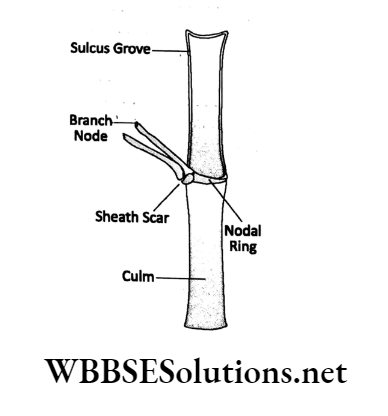
WBBSE Solutions For Class 8 School Science Chapter 11 Plant Kingdom and The Environment Around Us Bamboo grove

Bamboo has a higher compressive strength than wood, brick, or concrete and a tensile strength that rivals steel. The word bamboo comes from the Kannada term bambu, which was introduced to English.

Ecology: Bamboo is one of the fastest-growing plants on Earth, with reported growth rates of 250 cm (98 in) in 24 hours.

However, the growth rate is dependent on local soil and climatic conditions, as well as species and a more typical growth rate for many commonly cultivated bamboos in temperate climates is in the range of 3—10 centimeters (1.2—3.9 in) per day during the growing period.

Primarily growing in regions of warmer climates during the late Cretaceous period, vast fields existed in what is now Asia.

Some of the largest timber bamboos can grow over 30 m (98 ft) tall and be as large as 1520 cm (5.9-7.9 in) in diameter.

However, the size range for mature bamboo is species-dependent, with the smallest bamboo reaching only several inches high at maturity.

Unlike all trees, individual bamboo stems, or culms, emerge from the ground at their full diameter and grow to their full height in a single growing season of three to four months.

Over the next 2-5 years (depending on species), the fungus begins to form on the outside of the culm, which eventually penetrates and overcomes the culm.

Around 5-8 years later (species and climate dependent), the fungal growths cause the culm to collapse and decay.

Mass flowering: Most bamboo species flower infrequently. In fact, many bamboos only flower at intervals as long as 65 or 120 years.

These taxa exhibit mass flowering (or gregarious flowering), with all plants in a particular cohort flowering over a several-year period.

The lack of environmental impact on the time of flowering indicates the presence of some sort of “alarm clock” in each cell of the plant which signals the diversion of all energy to flower production and the cessation of vegetative growth.

This mechanism, as well as the evolutionary cause behind it, is still largely a mystery.

Mass fruiting also has direct economic and ecological consequences, however. The huge increase in available fruit in the forests often causes a boom in rodent populations, leading to increases in disease and famine in nearby human populations.

WBBSE Class 8 Plant Kingdom long answer questions

For example, devastating consequences occur when the Melocanna bambusoides population flowers and fruits once every 30-35 years around the Bay of Bengal.

The death of the bamboo plants following their fruiting means the local people lose their building material, and the large increase in bamboo fruit leads to a rapid increase in rodent populations.

As the number of rodents increases, they consume all available food, including grain fields and stored food, sometimes leading to famine.

These rats can also carry dangerous diseases, such as typhus, typhoid, and bubonic plague, which can reach epidemic proportions as the rodents increase in number.

In any case, flowering produces masses of seeds, typically suspended from the ends of the branches. These seeds will give rise to a new generation of plants that may be identical in appearance to those that preceded the flowering,

or they may produce new cultivars with different characteristics, such as the presence or absence of striping or other changes in the coloration of the culms.

WBBSE Solutions For Class 8 School Science Chapter 11 Plant Kingdom and The Environment Around Us laqs

General Uses for Bamboo: Bamboo has been used for many applications, from a food source to a building material.

1. Decorations: From picture frames to room dividing screens, bamboo can make some elegant and exotic decorations for the home,

2. Building materials: More and more furniture, flooring, and even homes are being built with bamboo. Bamboo is a popular building material in South and East Asia and in South Pacific Islands.

Bamboo stems have also been extensively used to construct numerous footbridges over canals and streams.

3. Fabrics and clothing: a fabulous trend right now is bamboo fibers being used in fabrics and clothing since the diameter of bamboo fibers measures less than 3 mm.

Bedding made of bamboo fibers is as soft as or softer than most cotton beddings and drapes with the look of silk without the expense.

Food items and Cooking:

The young stem, basal part of the stem, and leaves of bamboo are chief food items of the Giant panda of China, the Red panda of Nepal and India, and the Lemur of Madagascar. Gorillas primarily eat bamboo. It is also the food of elephants and chimpanzees.

After extracting toxic substances, various delicious dishes have been prepared in different Asian countries by using the soft young stems of bamboo.

Certain beverages are also prepared from these young stems. A type of insect grows at the base of bamboo plants growing in the Yunan provinces of China and in countries like Laos, Myanmar, and Thailand. They feed on the young stems of bamboo. The local people use the larva of these insects as their food.

Cooking with bamboo is nothing new in Asian culture. Hollow stems of bamboo have been used in different places in South Africa for warming soups and as pots for cooking rice.

Bamboo-made utensils are also used extensively for cooking purposes. Bamboo cutting boards are notoriously good for not dulling blades or knives as quickly, while bamboo utensils like wooden spoons are excellent for not scratching the bottoms of expensive nonstick cookware.

Medicine: Tabashir, a medicine for asthma, colds and cough, and other infectious diseases, is made from silicon dioxide and silicic acid derived from the internodes of a bamboo species called Bambusa arundinacea.

Agriculture: Bamboo started out as a natural plant in most places, but has become a large part of agriculture. From being the main crop of a farm to be harvested for other uses, or as the channel linings for irrigation systems, bamboo fits naturally into agriculture.

Weapons: While this is rarely seen anymore, bamboo was once used to make many different types of weapons. From blow guns to archery bows and arrows, bamboo was used to make light but strong weapons for many centuries.

Instruments: Hollow tubes make excellent instruments, whether it is a flute or a drum, and bamboo is one of the best bases for instruments.

Need and strategies for conservation: With the increasing population pressure, natural stands of bamboo are being indiscriminately cut for fuel wood, and furniture.

The common practice of ‘jhum’ (a form of shifting cultivation) cultivation in the northeastern states has resulted in the genetic erosion of several bamboo species; overexploitation of some species for fuel wood and for the cottage industry has endangered others.

Large areas where bamboo occurs have been declared as National Bamboo Reserve areas and provenances in the natural habitats are being maintained.

Considering the limitation in seed supply, vegetative methods for ex-situ conservation and tissue culture work have been started in Asian countries.

Long answer type questions on biodiversity for Class 8

Question 2. What is water hyacinth? Why are they considered invasive species?
Answer:

Invasive species: Water hyacinth has been widely introduced in North America, Asia, Australia, Africa, and New Zealand. In many areas, it has become an important and pernicious invasive species.

In New Zealand, it is listed on the National Pest Plant Accord which prevents it from being propagated, distributed, or sold. In large water areas such as Louisiana, the Kerala Backwaters in India, Tonle Sap in Cambodia, and Lake Victoria it has become a serious pest.

When not controlled, water hyacinth will cover lakes and ponds entirely; this dramatically impacts water flow, blocks sunlight from reaching native aquatic plants, and starves the water of oxygen, often killing fish (or turtles).

The plants also create a prime habitat for mosquitos, the classic vectors of disease, and a species of snail known to host a parasitic flatworm that causes schistosomiasis (snail fever).
WBBSE Solutions For Class 8 School Science Chapter 11 Plant Kingdom and The Environment Around Us Water hyacinth

Uses

Phytoremediation, wastewater treatment: The roots of Eichhornia crassipes naturally absorb pollutants, including lead, mercury, and strontium-90, as well as some organic compounds believed to be carcinogenic, in concentrations 10,000 times that in the surrounding water Water hyacinths can be cultivated for wastewater treatment.

Water hyacinth is reported for its efficiency to remove about 60-80 % nitrogen and about 69% of potassium from water. The roots of water hyacinth were found to remove particulate matter and nitrogen in a natural shallow eutrophicated wetland.

Polluted water from gold mine areas can be treated by vegetables in Taiwan. Javanese sometimes cook and eat the green parts and inflorescence.

Medicinal use: In Kedah (Java), the flowers are used for medicating the skin of horses. The species is a “tonic.”

In the Philippines, Thailand, and Vietnam stems of water hyacinth are used for the purpose of embroidery and as fiber for the garment industry.

  1. The dry stem is used to manufacture baskets and furniture. Fibers of the plant are also used to make paper.
  2. Water hyacinth is a good source of biogas as it contains appreciable amounts of nitrogen.
  3. Since water hyacinth contains a high amount of protein and nitrogen, it is also used as fodder. But excess use can lead to toxicity.

Control: Water hyacinth control is difficult. The most effective method of control depends on prevention. Make sure to control the nutrient levels in your pond or lake to prevent rapid and explosive growth.

Do not introduce water hyacinths to new ponds unless you are willing to monitor them and take action if their growth gets out of control.

It is advised that you only introduce water hyacinth to your own personal ornamental water gardens. Introducing it into natural water bodies invites trouble.

When harvesting or otherwise removing water hyacinth, do not discard it in the natural waterway, instead put it into a compost pile.

WBBSE Solutions For Class 8 School Science Long Answer Type Questions WBBSE Solutions For Class 8 School Science Short Answer Type Questions
WBBSE Solutions For Class 8 School Science Very Short Answer Type Questions WBBSE Solutions For Class 8 School Science Review Questions
WBBSE Solutions For Class 8 School Science Solved Numerical Problems WBBSE Solutions For Class 8 School Science Experiments Questions
WBBSE Solutions For Class 8 Maths WBBSE Class 8 History Notes
WBBSE Class 8 History Multiple Choice Questions WBBSE Solutions For Class 8 History
WBBSE Solutions For Class 8 Geography


Question 3. What are the uses of Sal?
Answer:

Uses of sal 

Wood: Sal is one of the most important sources of hardwood timber in India, with hard, coarse-grained wood that is light in color when freshly cut, but becomes dark brown with exposure.

The wood is resinous and durable, and is sought-after for construction, although not well suited to planning and polishing.

The wood is especially suitable for constructing frames for doors and windows, floors of boats, jetties of ships,s, and footbridges over streams.

Leaves: The dry leaves of sal are a major source for the production of leaf plates called paravail and leaf bowls in northern and eastern India.

The leaves are also used fresh to serve ready-made paan (betelnut preparations) and small snacks such as boiled black grams, golgappa, etc.

The used leaves/plates are readily eaten by goats and cattle that roam the streets freely. The tree has therefore protected northern India from a flood of styrofoam and plastic plates that would have caused tremendous pollution. The leaves are also used in rural areas as fuel.

Resin: Sal tree resin is used as an astringent in Ayurvedic medicine, and to make spirit and varnish.

Seeds: Sal seeds and fruit are a source of lamp oil and vegetable fat. Shorea robusta seed oil is extracted from the seeds and used as cooking oil after refining.

Tannin: Tannin derived from sal bark finds application in the leather industry.

Sal tree is worshipped among the Buddhists and Hindus in India. It is mentioned in many scriptures that the Buddha was born and died under the Sal tree.

The Sal tree has special significance in the festivals and marriages of Adivasi. A pole of the Sal tree is considered very important and unless the bridegroom sits on the altar made of the tree of Sal, the marriage has no meaning.

It also holds great value in the lives of the indigenous populace of the Chotanagpur plateau. It is the main attraction of the festival of Sarhul, which means the Sal Blossoms Festival. The whole festival revolves around the Sal tree.

Question 4. What are spices? How do they differ from herbs? Give a few examples of spices.
Answer:

Spices:

A spice is a dried seed, fruit, root, bark, or vegetable substance primarily used for flavoring, coloring, or preserving food.

Many spices have antimicrobial properties. This may explain why spices are more commonly used in warmer climates, which have a more infectious disease, and why the use of spices is prominent in meat, which is particularly susceptible to spoiling.

A spice may have other uses, including medicinal, religious ritual, cosmetics or perfume production, or as a vegetable. For example, turmeric roots are consumed as a vegetable, and garlic as an antibiotic.

The spice trade developed throughout South Asia and the Middle East in around 2000 BCE with cinnamon and pepper, and in East Asia with herbs and pepper.

Indian spices include a variety of spices grown across the Indian subcontinent (a sub-region of South Asia). With different climates in different parts of the country, India produces a variety of spices, many of which are native to the Subcontinent, while others were imported from similar climates and have since been cultivated locally for centuries.

We often use the words herb and spice interchangeably. Herbs and spices are obtained from plants. Herbs and spices are used primarily for adding flavor and aroma to food.

And both are best used fresh but can be saved by drying. While there are similarities, there also are subtle differences between herbs and spices.

Herbs are obtained from the leaves of herbaceous (non-woody) plants. They are used for savory purposes in cooking and some have medicinal value. Herbs often are used in larger amounts than spices.

Spices are obtained from roots, flowers, fruits, seeds, or bark. Spices are native to warm tropical climates and can be woody or herbaceous plants.

Spices often are more potent and stronger flavored than herbs; as a result, they typically are used in smaller amounts. Some spices are used not only to add taste but also as a preservative.

Examples of Spices:

  1. Cinnamon – the bark of the cinnamon tree
  2. Ginger-root
  3. Cloves – flower bud
  4. Saffron – stigma (female reproductive part) of Saffron crocus
  5. Nutmeg – seed
  6. Vanilla – undeveloped fruit of an orchid
  7. Cumin – seed

Black pepper: Black pepper (Piper nigrum) is a flowering vine cultivated for its fruit, which is usually dried and used as a spice and seasoning.

The fruit, known as a peppercorn when dried, is approximately 5 millimeters (0.20 in) in diameter, dark red when fully mature, and, like all drupes, contains a single seed.

Peppercorns, and the ground pepper derived from them, may be described simply as pepper, or more precisely as black pepper (cooked and dried unripe fruit), green pepper (dried unripe fruit), and white pepper (ripe fruit seeds).

Black pepper is native to south India and is extensively cultivated there and elsewhere in tropical regions. Currently, Vietnam is the world’s largest producer and exporter of pepper.

WBBSE Solutions For Class 8 School Science Chapter 11 Plant Kingdom and The Environment Around Us black pepper


Uses:

Dried ground pepper has been used since antiquity for both its flavor and as a traditional medicine. Black pepper is the world’s most traded spice.

It is one of the most common spices added to European cuisine and its descendants. The spiciness of black pepper is due to the chemical piperine. It is ubiquitous in the modern world as a seasoning and is often paired with salt.

Apart from spicy value, black pepper is also used as a preservative for meat and other perishable food items.
The health benefits of black pepper include relief from respiratory disorders, coughs, the common cold, constipation, indigestion, anemia, impotency, muscular strains, dental disease, pyorrhea, diarrhea, and heart disease.

Black pepper (Piper nigrum)stimulates the taste buds in such a way that an alert is sent to the stomach to increase hydrochloric acid secretion, thereby improving digestion.

Hydrochloric acid is necessary for the digestion of proteins and other food components in the stomach. Black pepper has long been recognized as a carminative,

(a substance that helps prevent the formation of intestinal gas), a property likely due to its beneficial effect of stimulating hydrochloric acid production.

In addition, black pepper has diaphoretic (promotes sweating), and diuretic (promotes urination) properties.

Cinnamon: Cinnamon is a spice obtained from the inner bark of several trees from the genus Cinnamomum that is used in both sweet and savory foods.

The inner bark of a tropical evergreen tree, harvested during the rainy season when pliable and then dried into curls sold as sticks or ground into a powder. With its warm, sweet flavor, cinnamon is one of the biggest workhorses on the spice shelf.

WBBSE Solutions For Class 8 School Science Chapter 11 Plant Kingdom and The Environment Around Us Cinnamon

Conservation of endangered animals long answers for Class 8

Uses:

Cinnamon bark is widely used as a spice. It is principally employed in cookery as a condiment and flavoring material.
It is used in the preparation of chocolate, especially in Mexico, which is the main importer of cinnamon.

It is also used in many dessert recipes, such as apple pie, doughnuts, and cinnamon buns as well as spicy candies, coffee, tea, hot cocoa, and liqueurs.
 

WBBSE Solutions For Class 8 School Science Chapter 11 Plant Kingdom and The Environment Around Us Cinnamon Bark

In the Middle East, cinnamon is often used in savory dishes of chicken and lamb. In the United States, cinnamon and sugar are often used to flavor cereals, and bread-based dishes, such as toast, and fruits, especially apples; a cinnamon-sugar mixture is even sold separately for such purposes.

It is also used in Turkish cuisine for both sweet and savory dishes. It can also be used in pickling. Cinnamon powder has long been an important spice in enhancing the flavor of Persian cuisine, used in a variety of thick soups, drinks, and sweets.

It has been prized for its medicinal properties for thousands of years. Besides using it in cooking, cinnamon is also thought to have health benefits.

The naturally sweet taste may help some people reduce their sugar intake. In Ayurveda, cinnamon is used as a remedy for diabetes, indigestion, and colds. Volatile oil prepared from cinnamon provides relief for arthritic pain.

Turmeric: Turmeric (Curcuma longa) is a rhizomatous herbaceous perennial plant of the ginger family. It is native to southwest India and needs temperatures between 20 and 30°C (68 and 86’F) and a considerable amount of annual rainfall to thrive.

Plants are gathered annually for their rhizomes and propagated from some of those rhizomes in the following season. India, a significant producer of turmeric, has regional names based on language and country.

WBBSE Solutions For Class 8 School Science Chapter 11 Plant Kingdom and The Environment Around Us Tumeric

When not used fresh, the rhizomes are boiled for about 30-45 minutes and then dried in hot ovens, after which they are ground into a deep-orange-yellow powder commonly used as a spice in Indian cuisine and curries, for dyeing, and to impart color to mustard condiments.

One active ingredient is curcumin, which has a distinctly earthy, slightly bitter, slightly hot peppery flavor and a mustardy smell.

Turmeric plants reach up to 1 m tall. Highly branched, yellow to orange, cylindrical, aromatic rhizomes are found. The leaves are alternate and arranged in two rows.

They are divided into leaf sheath, petiole, and leaf blade. From the leaf sheaths, a false stem is formed. The petiole is 50 to 115 cm long.

The simple leaf blades are usually 76 to 115 cm long and rarely up to 230 cm. They have a width of 38 to 45 cm and are oblong to an elliptic narrowing at the tip.

Uses:

We probably know turmeric as the main spice in curry. It has a warm, bitter taste and is frequently used to flavor or color curry powders, mustards, butter, and cheeses.

But the root of turmeric is also used widely to make medicine. In food and manufacturing, the essential oil of turmeric is used in perfumes, and its resin is used as a flavor and color component in foods.

It has been known as poor man’s saffron because it offers a less expensive alternative yellow coloring. Turmeric is mostly used in flavored milk drinks, cultured milk, and desserts to obtain lemon and banana colors in dairy.

ln turmeric, curcumin is the primary pigment and is generally used in various food industries as a food color. Turmeric is added at higher levels to sausages, pickles, relishes, sauces, dry mixes, and fish due to its original usage as a spice.

Due to the presence of a compound called curcumin in turmeric, it has the ability to kill microbes. Turmeric keeps the liver healthy. It is effective in controlling anemia due to the presence of a good amount of iron in it. Turmeric also controls blood cholesterol levels.

Turmeric is used for arthritis, heartburn (dyspepsia), stomach pain, diarrhea, intestinal gas, stomach bloating, loss of appetite, jaundice, liver problems, and gallbladder disorders.

It is also used for headaches, bronchitis, colds, lung infections, fibromyalgia, leprosy, fever, menstrual problems, and cancer. Other uses include depression. Alzheimer’s disease, water retention, worms, and kidney problems.

Some people apply turmeric to the skin for pain, ringworm, bruising, leech bites, eye infections, inflammatory skin conditions, soreness inside of the mouth, and infected wounds.

Women in India apply turmeric before taking bath as its antibacterial property protects the skin from infects and protects it from harsh sunlight.
WBBSE Solutions For Class 8 School Science Chapter 11 Plant Kingdom and The Environment Around Us turmeric plant

Key long answer questions about plant kingdom for Class 8

Cardamom: Cardamom is a spice made from the seeds of several plants in the genera Elettaria and Amomum. Both genera are native to India, Pakistan, Nepal, and Bhutan; they are recognized by their small seed pods, triangular in cross-section and spindle-shaped, with a thin, papery outer shell and small black seeds.

There are two main types of cardamom:

True or green cardamom (or, when bleached, white cardamom comes from the species Elettaria cardamomum and is distributed from India to Malaysia.

Black cardamom, also known as brown, greater, longer, or Nepal cardamom, comes from two species, Amomumcostatum and Amomum subulatum, which are distributed mainly in Asia and Australia.

Uses: Both forms of cardamom are used as flavorings and cooking spices in both food and drink and as medicine.

Besides being used as flavoring and spice in foods, cardamom-flavored tea, also flavored with cinnamon, is consumed as a hot beverage in Bangladesh, India, and Pakistan.

Cardamom has a strong, unique taste, with an intensely aromatic, resinous fragrance. Black cardamom has a distinctly smokey, though not bitter, aroma, with a coolness some consider similar to mint.
WBBSE Solutions For Class 8 School Science Chapter 11 Plant Kingdom and The Environment Around Us elachi

Green cardamom is one of the most expensive spices by weight but little is needed to impart flavor. It is best stored in pod form because once the seeds are exposed or ground, they quickly lose their flavor.

It is a common ingredient in Indian cooking and is often used in baking in Nordic countries, in particular Sweden and Finland.

In the Middle East, green cardamom powder is used as a spice for sweet dishes, as well as a traditional flavoring in coffee and tea. Cardamom is used to a wide extent in savory dishes.

‘In Asia, both types of cardamom are widely used in both sweet and savory dishes, particularly in the south. Both are frequent components in spice mixes, such as Indian and Nepali masalas and Thai curry pastes.

Green cardamom is often used in traditional Indian sweets and in masala chai (spiced tea). Both are also often used as a garnish in basmati rice and other dishes. Individual seeds are sometimes chewed and used in much the same way as chewing gum.

Green cardamom is broadly used in South Asia to treat infections in teeth and gums, to prevent and treat throat troubles, congestion of the lungs and pulmonary tuberculosis, inflammation of eyelids, and digestive disorders.

It also is used to break up kidney and gall stones and was reportedly used as an antidote for both snake and scorpion venoms.

Amomum is used as a spice and as an ingredient in traditional medicine systems of the traditional Chinese medicine in China, in Ayurveda in India, Pakistan, Japan, Korea, Nepal, and Vietnam.

Among other species, varieties, and cultivars, Amomum villosum cultivated in China, Laos, and Vietnam is used in traditional Chinese medicine to treat stomach problems, constipation, dysentery, and other digestion problems.

Garam masala, which literally means hot (garam) spice (masala), is a popular spice blend used throughout India and neighboring countries too.

It is a powder made of several types of spices and is added in small quantities at the end of the cooking process, or along with the tempering.

A typical Indian version of garam masala contains- black and white peppercorns, cloves, cinnamon or cassia bark, nutmeg and mace, black and green cardamom pods, Bay leaf, caraway, etc. Garam masala can be used alone or along with other seasonings and spice powders.

Ginger: Ginger [Zingiber officinale) is a flowering plant whose rhizome, ginger root, or simply ginger, is widely used as a spice or a medicine.

It is a herbaceous perennial that grows annual stems about a meter tall bearing narrow green leaves and yellow flowers.

Ginger is indigenous to southern China and was spread eventually to other parts of Asia and subsequently to West Africa and the Caribbean. India is now the largest producer of ginger.
 

WBBSE Solutions For Class 8 School Science Chapter 11 Plant Kingdom and The Environment Around Us ginger

WBBSE Chapter 10 exercises long answer solutions

Uses:

Ginger produces a hot, fragrant kitchen spice, vinegar, or sherry as a snack or cooked as young ginger rhizomes are juicy and fleshy with ingredients in many dishes.

They can be steen-ea very mild taste. They are often pickled in boiling water to make ginger tea, to which honey is often added; sliced orange or lemon fruit may be added.

Ginger can be made into candy or ginger wine. Mature ginger rhizomes are fibrous and nearly dry. The juice from ginger roots is often used as a spice.

In Indian recipes and is a common ingredient in Chinese, Korean, Japanese, Vietnamese, and many South Asian cuisines for flavoring dishes such as seafood, meat, and vegetarian dishes. The rhizome (underground stem) is used as a spice and also as a medicine.

It can be used fresh, dried, and powdered, or as a juice or oil. Ginger is commonly used to treat various types of stomach problems, including motion sickness, morning sickness, colic, upset stomach, gas, diarrhea, nausea caused by cancer treatment, nausea, and vomiting after surgery, as well as loss of appetite.

Other uses include pain relief from arthritis or muscle soreness, upper respiratory tract infections, cough, and bronchitis.

Ginger is also sometimes used for chest pain, low back pain, and stomach pain. Some people pour fresh juice on their skin to treat burns. The oil made from ginger is sometimes applied to the skin to relieve pain.

Garlic: Allium sativum, commonly known as garlic, is a species in the onion genus. With a history of human use of over 7,000 years, garlic is native to central Asia and has long been a staple in the Mediterranean region, as well as a frequent seasoning in Asia, Africa, and Europe.

It was known to Ancient Egyptians and has been used for both culinary and medicinal purposes. Allium sativum is a bulbous plant.

It grows up to 1.2 m (4 ft) in height. It produces hermaphrodite flowers. Pollination occurs by bees and other insects.
The garlic plant’s bulb is the most commonly used part of the plant.

With the exception of the single clove types, garlic bulbs are normally divided into numerous fleshy sections called cloves.

Garlic cloves are used for consumption (raw or cooked) or for medicinal purposes. They have a characteristic pungent, spicy flavor that mellows and sweetens considerably with cooking.

Other parts of the garlic plant are also edible. The leaves and flowers (bulbils) on the head (spathe) are sometimes eaten.
 

WBBSE Solutions For Class 8 School Science Chapter 11 Plant Kingdom and The Environment Around Us garlic


Uses:

Garlic is widely used around the world for its pungent flavor as a seasoning or condiment. Garlic may be applied to different kinds of bread, usually in a medium of butter or oil, to create a variety of classic dishes, such as garlic bread, garlic toast, etc.

Garlic is a herb. It is best known as a flavoring for food. But over the years, garlic has been used as a medicine to prevent or treat a wide range of diseases and conditions.

Fresh cloves or supplements made from the clove are used for medicine. Garlic contains a compound called Allicin. It has antimicrobial properties.

Garlic is used for many conditions related to the heart and blood system. These conditions include high blood pressure, high cholesterol, coronary heart disease, heart attack, and hardening of the arteries (atherosclerosis).

Some of these uses are supported by science. Garlic actually may be effective in slowing the development of atherosclerosis and seems to be able to modestly reduce blood pressure.

Some people use garlic to prevent colon cancer, rectal cancer, stomach cancer, breast cancer, prostate cancer, and lung cancer. It is also used to treat prostate cancer and bladder cancer.

Garlic has been tried for treating an enlarged prostate (benign prostatic hyperplasia; BPH), diabetes, osteoarthritis, hayfever (allergic rhinitis), traveler’s diarrhea, high blood pressure late in pregnancy (pre-eclampsia), cold, and flu.

It is also used for building the immune system, preventing tick bites, and preventing and treating bacterial and fungal infections.

Other uses include the treatment of fever, coughs, headache, stomach ache, sinus congestion, gout, rheumatism, hemorrhoids, asthma, bronchitis, shortness of breath, low blood pressure, Jow blood sugar, high blood sugar, and snakebites.

It is also used for fighting stress and fatigue and maintaining healthy liver function. Some people apply garlic oil to their skin to treat fungal infections, warts, and corn.

There is some evidence supporting the topical use of garlic for fungal infections like ringworm, jock itch, and athlete’s foot; but the effectiveness of garlic against warts and corn is still uncertain.

Some people apply garlic oil to their skin to treat fungal infections, warts, and corn. There is some evidence supporting the topical use of garlic for fungal infections like ringworm, jock itch, and athlete’s foot; but the effectiveness of garlic against warts and corn is still uncertain.

Question 5. Write about the uses of black pepper and cinnamon.
Answer:

Black pepper:

Black pepper (Piper nigrum) is a flowering vine cultivated for its fruit, which is usually dried and used as a spice and seasoning.

The fruit, known as a peppercorn when dried, is approximately 5 millimeters (0.20 in) in diameter, dark red when fully mature, and, like all drupes, contains a single seed.

Peppercorns, and the ground pepper derived from them, may be described simply as pepper, or more precisely as black pepper (cooked and dried unripe fruit), green pepper (dried unripe fruit), and white pepper (ripe fruit seeds).

Black pepper is native to south India and is extensively cultivated there and elsewhere in tropical regions. Currently, Vietnam is the world’s largest producer and exporter of pepper.

WBBSE Solutions For Class 8 School Science Chapter 11 Plant Kingdom and The Environment Around Us black pepper

Examples of long answer questions on environmental conservation for Class 8

Uses:

Dried ground pepper has been used since antiquity for both its flavor and as a traditional medicine. Black pepper is the world’s most traded spice.

It is one of the most common spices added to European cuisine and its descendants. The spiciness of black pepper is due to the chemical piperine. It is ubiquitous in the modern world as a seasoning and is often paired with salt.

Apart from spicy value, black pepper is also used as a preservative for meat and other perishable food items.
The health benefits of black pepper include relief from respiratory disorders, coughs, the common cold, constipation, indigestion, anemia, impotency, muscular strains, dental disease, pyorrhea, diarrhea, and heart disease.

Black pepper (Piper nigrum)stimulates the taste buds in such a way that an alert is sent to the stomach to increase hydrochloric acid secretion, thereby improving digestion.

Hydrochloric acid is necessary for the digestion of proteins and other food components in the stomach. Black pepper has long been recognized as a carminative,

(a substance that helps prevent the formation of intestinal gas), a property likely due to its beneficial effect of stimulating hydrochloric acid production.

In addition, black pepper has diaphoretic (promotes sweating), and diuretic (promotes urination) properties.

Cinnamon: Cinnamon is a spice obtained from the inner bark of several trees from the genus Cinnamomum that is used in both sweet and savory foods.

The inner bark of a tropical evergreen tree, harvested during the rainy season when pliable and then dried into curls sold as sticks or ground into a powder. With its warm, sweet flavor, cinnamon is one of the biggest workhorses on the spice shelf.

WBBSE Solutions For Class 8 School Science Chapter 11 Plant Kingdom and The Environment Around Us Cinnamon


Uses:

Cinnamon bark is widely used as a spice. It is principally employed in cookery as a condiment and flavoring material.
It is used in the preparation of chocolate, especially in Mexico, which is the main importer of cinnamon.

It is also used in many dessert recipes, such as apple pie, doughnuts, and cinnamon buns as well as spicy candies, coffee, tea, hot cocoa, and liqueurs.

Question 6. Write about the types and uses of cardamom.
Answer:

Cardamom:

Cardamom is a spice made from the seeds of several plants in the genera Elettaria and Amomum. Both genera are native to India, Pakistan, Nepal, and Bhutan; they are recognized by their small seed pods, triangular in cross-section and spindle-shaped, with a thin, papery outer shell and small black seeds.

There are two main types of cardamom:

True or green cardamom (or, when bleached, white cardamom comes from the species Elettaria cardamomum and is distributed from India to Malaysia.

Black cardamom, also known as brown, greater, longer, or Nepal cardamom, comes from two species, Amomumcostatum and Amomum subulatum, which are distributed mainly in Asia and Australia.

Uses: Both forms of cardamom are used as flavorings and cooking spices in both food and drink and as medicine.

Besides being used as flavourant and spice in foods, cardamom-flavored tea, also flavored with cinnamon, is consumed as a hot beverage in Bangladesh, India, and Pakistan.

Cardamom has a strong, unique taste, with an intensely aromatic, resinous fragrance. Black cardamom has a distinctly smokey, though not bitter, aroma, with a coolness some consider similar to mint.

WBBSE Solutions For Class 8 School Science Chapter 11 Plant Kingdom and The Environment Around Us elachi

Green cardamom is one of the most expensive spices by weight but little is needed to impart flavor. It is best stored in pod form because once the seeds are exposed or ground, they quickly lose their flavor.

It is a common ingredient in Indian cooking and is often used in baking in Nordic countries, in particular Sweden and Finland.

In the Middle East, green cardamom powder is used as a spice for sweet dishes, as well as a traditional flavoring in coffee and tea. Cardamom is used to a wide extent in savory dishes.

‘In Asia, both types of cardamom are widely used in both sweet and savory dishes, particularly in the south. Both are frequent components in spice mixes, such as Indian and Nepali masalas and Thai curry pastes.

Green cardamom is often used in traditional Indian sweets and in masala chai (spiced tea). Both are also often used as a garnish in basmati rice and other dishes. Individual seeds are sometimes chewed and used in much the same way as chewing gum.

Green cardamom is broadly used in South Asia to treat infections in teeth and gums, to prevent and treat throat troubles, congestion of the lungs and pulmonary tuberculosis, inflammation of eyelids, and digestive disorders.

It also is used to break up kidney and gall stones and was reportedly used as an antidote for both snake and scorpion venoms.

Amomum is used as a spice and as an ingredient in traditional medicine systems of the traditional Chinese medicine in China, in Ayurveda in India, Pakistan, Japan, Korea, Nepal, and Vietnam.

Among other species, varieties, and cultivars, Amomum villosum cultivated in China, Laos, and Vietnam is used in traditional Chinese medicine to treat stomach problems, constipation, dysentery, and other digestion problems.

Garam masala, which literally means hot (garam) spice (masala), is a popular spice blend used throughout India and neighboring countries too.

It is a powder made of several types of spices and is added in small quantities at the end of the cooking process, or along with the tempering.

A typical Indian version of garam masala contains- black and white peppercorns, cloves, cinnamon or cassia bark, nutmeg and mace, black and green cardamom pods, Bay leaf, caraway, etc. Garam masala can be used alone or along with other seasonings and spice powders.

Question 7. Describe the uses of garlic.
Answer:

Garlic:

Allium sativum, commonly known as garlic, is a species in the onion genus. With a history of human use of over 7,000 years, garlic is native to central Asia and has long been a staple in the Mediterranean region, as well as a frequent seasoning in Asia, Africa, and Europe.

It was known to Ancient Egyptians and has been used for both culinary and medicinal purposes. Allium sativum is a bulbous plant.

It grows up to 1.2 m (4 ft) in height. It produces hermaphrodite flowers. Pollination occurs by bees and other insects.
The garlic plant’s bulb is the most commonly used part of the plant.

With the exception of the single clove types, garlic bulbs are normally divided into numerous fleshy sections called cloves.

Garlic cloves are used for consumption (raw or cooked) or for medicinal purposes. They have a characteristic pungent, spicy flavor that mellows and sweetens considerably with cooking.

Other parts of the garlic plant are also edible. The leaves and flowers (bulbils) on the head (spathe) are sometimes eaten.


WBBSE Solutions For Class 8 School Science Chapter 11 Plant Kingdom and The Environment Around Us garlic


Uses:

Garlic is widely used around the world for its pungent flavor as a seasoning or condiment. Garlic may be applied to different kinds of bread, usually in a medium of butter or oil, to create a variety of classic dishes, such as garlic bread, garlic toast, etc.

Garlic is a herb. It is best known as a flavoring for food. But over the years, garlic has been used as a medicine to prevent or treat a wide range of diseases and conditions.

Fresh cloves or supplements made from the clove are used for medicine. Garlic contains a compound called Allicin. It has antimicrobial properties.

Garlic is used for many conditions related to the heart and blood system. These conditions include high blood pressure, high cholesterol, coronary heart disease, heart attack, and hardening of the arteries (atherosclerosis).

Some of these uses are supported by science. Garlic actually may be effective in slowing the development of atherosclerosis and seems to be able to modestly reduce blood pressure.

Some people use garlic to prevent colon cancer, rectal cancer, stomach cancer, breast cancer, prostate cancer, and lung cancer. It is also used to treat prostate cancer and bladder cancer.

Garlic has been tried for treating an enlarged prostate (benign prostatic hyperplasia; BPH), diabetes, osteoarthritis, hayfever (allergic rhinitis), traveler’s diarrhea, high blood pressure late in pregnancy (pre-eclampsia), cold, and flu.

It is also used for building the immune system, preventing tick bites, and preventing and treating bacterial and fungal infections.

Other uses include the treatment of fever, coughs, headache, stomach ache, sinus congestion, gout, rheumatism, hemorrhoids, asthma, bronchitis, shortness of breath, low blood pressure, Jow blood sugar, high blood sugar, and snakebites.

It is also used for fighting stress and fatigue and maintaining healthy liver function. Some people apply garlic oil to their skin to treat fungal infections, warts, and corn.

There is some evidence supporting the topical use of garlic for fungal infections like ringworm, jock itch, and athlete’s foot; but the effectiveness of garlic against warts and corn is still uncertain.

Some people apply garlic oil to their skin to treat fungal infections, warts, and corn. There is some evidence supporting the topical use of garlic for fungal infections like ringworm, jock itch, and athlete’s foot; but the effectiveness of garlic against warts and corn is still uncertain.

Question 8. What are medicinal plants? Give some examples.
Answer:

Medicinal Plants:

Medicinal plants have been identified and used throughout human history. Plants have the ability to synthesize a wide variety of chemical compounds.

They are used to perform important biological functions to defend against attack from infectious and disease-causing microorganisms and also detoxification and well-being of the body.

At least 12,000 such compounds have been isolated so far; a number estimated to be less than 10% of the total. Chemical compounds in plants.

Mediate their effect on the human body through processes identical to those already well understood for the chemical compounds in conventional drugs; thus herbal medicines do not differ greatly from conventional drugs in terms of how they work.

The use of plants as medicines predates written human history. Ethnobotany(the study of traditional human uses of plants) is recognized as an effective way to discover future medicines.

The use of herbs to treat disease is almost universal among non-industrialized societies and is often more affordable than purchasing expensive modern pharmaceuticals.

The World Health Organization (WHO) estimates that 80 percent of the population of some Asian and African countries presently uses herbal medicine for some aspect of primary health care.

In India, Ayurveda medicine has used many herbs such as turmeric possibly as early as 1900 BC.

Earliest Sanskrit writings such as the Rig Veda, and Atharva Veda are some of the earliest available documents detailing the medical knowledge that formed the basis of the Ayurveda system.

Many other herbs and minerals used in Ayurveda were later described by ancient Indian herbalists such as Charaka and Sushruta during the 1st millennium BC.

The Sushruta Samhita attributed to Sushruta in the 6th century BC describes 700 medicinal plants, 64 preparations from mineral sources, and 57 preparations based on animal sources.

A brief account of Indian medicinal plants is mentioned below.

Neem

Neem (Azadirachta indica), is a tree in the mahogany family. It is one of two species in the genus Azadirachta and is native to India and the Indian subcontinent including Nepal, Pakistan, Bangladesh, and Sri Lanka.
WBBSE Solutions For Class 8 School Science Chapter 11 Plant Kingdom and The Environment Around Us neem tree

Neem is a fast-growing tree that can reach a height of 15-20 meters (49-66 ft), rarely 35-40 meters (115— 131 ft). It is evergreen, but in severe drought, it may shed most or nearly all of its leaves.

The branches are wide and spreading. The fairly dense crown is roundish and may reach a diameter of 15-20 meters (49-66 ft) in old, freestanding specimens.

General uses:

  1. Neem leaves are dried in India and placed in cupboards to prevent insects from eating the clothes and also while storing rice in tins.
  2. Neem leaves are dried and burnt in tropical regions to keep away mosquitoes as Ayurveda herb. Neem is also used in baths.
  3. Neem contains chemicals that might help reduce blood sugar levels, heal ulcers in the digestive tract, prevent conception, kill bacteria, and prevent plaque formation in the mouth.
  4. The tender shoots and flowers of the neem tree are eaten as a vegetable in India. In West Bengal, young neem leaves are fried in oil with tiny pieces of eggplant (brinjal).
  5. The dish is called nim begun and is the first item during a Bengali meal that acts as an appetizer. It is eaten with rice


Medicinal property: Neem products are believed to be anthelmintic, antifungal, antidiabetic, antibacterial, antiviral, contraceptive, and sedative.

Neem oil Is used for pain in the ear, gum, and tooth. Neem seed is used in viral epidemics and arthritis. The bitter tasted tonic made from the bark of the root and stem is useful in breaking periodic sequences of fevers (like malaria).

Neem oil is used for healthy hair, to improve liver function, detoxify the blood, and balance blood sugar levels. Neem leaves have been used to treat skin diseases like eczema, psoriasis, etc. The juice of neem leaves is useful for diabetes.

Other uses

Toiletries: Neem oil is used for preparing cosmetics such as soap, shampoo, balms, and creams as well as toothpaste.

Toothbrush: Traditionally, slender neem twigs (called datum are first chewed as a toothbrush and then split as a tongue cleaner.

Tree: Besides its use in traditional Indian medicine, the neem tree is of great importance for its anti-desertification properties and possibly as a good carbon dioxide sink.

Cosmetics: Neem is perceived in India as a beauty aid. Powdered leaves are a major component of at least one widely used facial cream. Purified neem oil is also used in nail polish and other cosmetics.

Bird repellent: Neem leaf boiled in water can be used as a very cost-effective bird repellent, especially for sparrows.

Lubricant: Neem oil is non-drying and it resists degradation better than most vegetable oils. In rural India, it is commonly used to grease cart wheels.

Fertilizer: Neem has demonstrated considerable potential as a fertilizer. Neem cake is widely used to fertilize cash crops, particularly sugarcane and vegetables.

Honey: In parts of Asia neem honey commands premium prices, and people promote apiculture by planting neem trees.

Soap: 80% of India’s supply of neem oil is now used by neem oil soap manufacturers. Additionally, it is antibacterial and antifungal, soothing, and moisturizing. It can be made with up to 40% neem oil.

Against pox viruses: In Tamilnadu, people who are affected by pox viruses are generally made to lie in a bed made of neem leaves and branches. This prevents the spreading of pox virus to others and has been in practice since the early centuries.

Bael

Aegle marmelos, commonly known as bael, Bengal quince, golden apple, stone apple, and wood apple, is a species of tree native to India.

It is present throughout Southeast Asia as a naturalized species. The tree is considered to be sacred by Hindus. Its fruits are used in traditional medicine and as a food throughout its range.

The bael fruit has a smooth, woody shell with a green, gray, or yellow peel. It takes about 11 months to ripen on the tree and can reach the size of a large grapefruit or pomelo, and some are even larger.

The shell is so hard it must be cracked with a hammer or machete. The fibrous yellow pulp is very aromatic. It has been described as tasting of marmalade and smelling of roses. Numerous hairy seeds are encapsulated in slimy mucilage.
WBBSE Solutions For Class 8 School Science Chapter 11 Plant Kingdom and The Environment Around Us bael

Medicinal use:

Bael fruit contains pectin and mucilage. The fruit is usually sliced and sun-dried. The hard leathery slices are then immersed in water.

They are prescribed for a number of diseases such as gastrointestinal diseases, piles, edema, jaundice, vomiting, obesity, pediatric disorders, gynecological disorders, urinary complaints, and as a rejuvenation.

Juice of Bael fruit is good for diarrhea patients. Unripe or partly ripe fruit increases appetite and digestive power. Bael leaves, fruit, and roots have antibiotic power.

Other Uses;

The fruit is eaten fresh or dried. If fresh, the juice is strained and sweetened to make a drink similar to lemonade. It can be made into sharbat (Hindi) or belpana, a refreshing drink made of pulp with water, sugar, and lime juice, mixed, left to stand for a few hours, strained, and put on ice.

One large bael fruit may yield five or six liters of sharbat.

The plant and its certain parts (leaves and fruits) are of religious importance since the tree is regarded as one of the sacred trees of Indian heritage.

Emblica (Amlaki)

Phyllanthus emblica, also known as emblic, amlaki, or amla from Sanskrit Amalia, is a deciduous tree. It is known for its edible fruit of the same name.

The tree is small to medium in size, reaching 8 to 18 m in height, with a crooked trunk and spreading branches. The branchlets are glabrous or finely pubescent, 10-20 cm long, and usually deciduous;

the leaves are simple, subsessile, and closely set along branchlets, light green, resembling pinnate leaves. The flowers are greenish-yellow.

The fruit is nearly spherical, light greenish yellow, quite smooth, and hard on appearance, with six vertical stripes or furrows.

Ripening in autumn, the berries are harvested by hand after climbing to the upper branches bearing the fruits. The taste of Indian gooseberry (amla) is sour, bitter, and astringent, and it is quite fibrous.

In India, it is common to eat gooseberries steeped in salt water and turmeric to make sour fruits palatable.
WBBSE Solutions For Class 8 School Science Chapter 11 Plant Kingdom and The Environment Around Us emblica

Medicinal use:

The nutritional facts of Amlaki include bioflavonoids, flavones, polyphenols, and carotenoids. It is the richest natural source of vitamin C available on this planet.

The unique thing about amlaki fruit is the ascorbic acid found is nearly indestructible even by burning or drying it. This makes the richest bio-availability of Vitamin C in this fruit which plays a significant role in the synthesis of neurotransmitters.

It is also required for collagen and carnitine synthesis, important molecules that produce energy from the fat cells whenever required.

  1. Health Benefits of Amlaki
  2. Amlaki inhibits the aging process and prevents the common cold.
  3. Amlaki is a nutritional powerhouse and is hence used to boost immunity and restore the body’s vitality.
  4. Amlaki provides energy to vital organs and is hence used in chronic illness recovery.
  5. Amlaki helps in regulating blood glucose levels in diabetic patients.
  6. Amlaki facilitates the absorption of iron in the body and improves hemoglobin levels. Amlaki possesses potent anti-inflammatory action and is hence used in various gastrointestinal tract inflammation such as gastritis.
  7. Amlaki contains natural digestive enzymes and is hence used in indigestion.
  8. Amlaki promotes spermatogenesis.
  9. Amlaki reduces serum cholesterol and high blood pressure.
  10. In Chinese traditional therapy, this fruit is used to treat throat inflammation.

Other use:

Popularly used in inks, shampoos, and hair oils, the high tannin content of Indian gooseberry fruit serves as a mordant for fixing dyes in fabrics.

Amla shampoos and hair oil are traditionally believed to nourish the hair and scalp and prevent premature grey hair.

Triphala: Literally meaning “three fruits”, Triphala is a traditional Ayurvedic herbal formulation consisting of three fruits native to the Indian subcontinent Amlaki (Emblica officinalis), Bibhitaki or Bahera (Terminalia bellirica) and Haritaki (Terminalia chebula).

Triphala is most commonly known for its use as a gentle bowel tonic, helpful in digestion and supporting regular bowel movements.

The combination of the three fruits has a synergistic effect to bolster many other systems as well. In addition to the Gl tract, Ayurveda uses Triphala to support healthy respiratory, cardiovascular, urinary, reproductive, and nervous systems.

Triphala has also been shown to be a powerful antioxidant, protecting cells from the damaging effects of free radicals

Nayantara

Nayantara (Catharanthus) Nayantara or Sadabahar or Periwinkle or Madagascar rosy periwinkle is an evergreen subshrub or herbaceous plant. This plant grows 1 m tall.

The leaves are oval to oblong, 2.5-9 cm long and 1-3.5 cm broad, glossy green, hairless, with a pale midrib and a short petiole 1-1.8 cm long; they are arranged in opposite pairs.

The flowers are white to dark pink with a darker red center, with a basal tube 2.5-3 cm long and a corolla 2-5 cm diameter with five petal-like lobes.

The fruit is a pair of follicles 2-4 cm long and 3 mm broad. In the wild, it is an endangered plant; the main cause of decline is habitat destruction by slash-and-burn agriculture.

It is also however widely cultivated and is naturalized in subtropical and tropical areas of the world.
WBBSE Solutions For Class 8 School Science Chapter 11 Plant Kingdom and The Environment Around Us nayantara catharanthus

Medicinal Uses:

In traditional Chinese medicine, extracts from it have been used against numerous diseases, including diabetes, malaria, and Hodgkin’s lymphoma.

The leaf of Catharanthus is a good medicine for diabetes. The plant has dysentery and hemorrhage-resistant properties. The alkaloid Raubasine found in the root of the plant helps to remove obstacles in blood circulation.

Two other alkaloids called Vincristine and Vinblastine are found in the plant and are used to treat blood cancer and other types of cancers.

Its alkaloids are hypotensive, sedative and have tranquilizing properties, and are anti-cancerous. It helps in relieving muscle pain, depression of the central nervous system, and wasps stings.

Other Uses:

As an ornamental plant, it is appreciated for its hardiness in dry and nutritionally deficient conditions, popular in subtropical gardens where temperatures never fall below 5°C to 7°C, and as a warm-season bedding plant in temperate gardens.

It is noted for its long flowering period, throughout the year in tropical conditions, and from spring to late autumn, in warm temperate climates. Full sun and well-drained soil are preferred.

Mint (Pudina)

Mentha (also known as mint) is a genus of plants in the mint family. The species are not clearly distinct and estimates of the number of species vary from 13 to 18.

Hybridization between some of the species occurs naturally. Many other hybrids, as well as numerous cultivars, are known in cultivation.

While the species that make up the Mentha genus are widely distributed and can be found in many environments, most grow best in wet environments and moist soils.
WBBSE Solutions For Class 8 School Science Chapter 11 Plant Kingdom and The Environment Around Us Mint

Mints will grow 10-120 cm tall and can spread over an indeterminate area. Due to their tendency to spread unchecked, some mints are considered invasive.

Mints are aromatic, almost exclusively perennial, rarely annual, herbs. They have wide-spreading underground and overground stolons and erect, square, branched stems.

The leaves are arranged in opposite pairs, from oblong to lanceolate, often downy, and with a serrated margin. Leaf colors range from dark green and gray-green to purple, blue, and sometimes pale yellow when dry they are usually dark green or green.

The flowers are white to purple and produced in false whorls called verticillasters. The corolla is two-lipped with four subequal lobes, the upper lobe usually the largest. The fruit is a nutlet, containing one to four seeds.]

Medicinal Uses:

  1. Pudina is used as a carminative and an expectorant.
  2. The plant is highly effective in treating headaches, rhinitis, cough sore throat, colic, and vomiting.
  3. It serves as a good blood cleanser since it is antiseptic and anti-bacterial.
  4. Pudina plays a significant role in alleviating swollen gums, mouth ulcers, and toothaches.
  5. Crushed and bruised pudina leaves are used in treating insect bites.
  6. The decoction and infusion of its leaves and stems help in fever, stomach aches, dysmenorrheal, and diuresis.
  7. Fresh leaves of pudina are crushed and sniffed for dizziness. Crushed leaves are also applied on the forehead and temple, to cure headaches.
  8. The menthol extracted from the plant is used in preparing balms.

Aloe Vera

Aloe vera (Ghritakumari) is a succulent plant species. The species is frequently cited as being used in herbal medicine since the beginning of the first century AD.

Extracts from Aloe vera are widely used in the cosmetics and alternative medicine industries, being marketed as variously having rejuvenating, healing, or soothing properties.

Aloe is one of the great healing agents among herbs. Indian aloe or Ghritkumari is a form of cactus. Aloes have long been in use for a host of diseases, particularly those connected with the digestive system and skin disorders.

it contains enzymes, polysaccharides, and nutrients that exhibit antibacterial and antifungal action. Aloe vera is useful in liver and spleen disorders, skin problems (scars, pimples, dermatitis, minor wounds or burns, etc.), external sores, hair problems, and eye troubles.

It is used as a flavoring agent in many culinary preparations.

Other Uses:

The leaf, fresh or dried, is the culinary source of mint. Fresh mint is usually preferred over dried mint when storage of the mint is not a problem.

The leaves have a warm, fresh, aromatic, sweet flavor with a cool aftertaste, and are used in teas, beverages, jellies, syrups, candies, and ice creams.

Mint essential oil and menthol are extensively used as flavorings in breath fresheners, drinks, antiseptic mouth rinses, toothpaste, chewing gum, desserts, and candies, such as mint (candy) and mint chocolate.

The substances that give the mints their characteristic aromas and flavors are menthol and pulegone. Mint was originally used as a medicinal herb to treat stomach aches and chest pains.

There are several uses in traditional medicine and preliminary research for possible use in treating irritable bowel syndrome.

Menthol from the mint essential oil (40-90%) is an ingredient of many cosmetics and some perfumes. Menthol and mint essential oil are also used in aromatherapy which may have clinical use to alleviate post-surgery nausea.

Mint oil is also used as an environmentally friendly insecticide for its ability to kill some common pests such as wasps, hornets, ants, and cockroaches, and has small white teeth.

The flowers are produced in summer on a spike up to 90 cm (35 in) tall, each flower being pendulous, with a yellow tubular corolla 2-3 cm (0.8-1.2 in) long.

Medicinal Uses:

Aloe vera is used in traditional medicine as a multipurpose skin treatment. Aloe vera is used on facial tissues where it is promoted as a moisturizer and anti-irritant to reduce chafing of the nose.

Cosmetic companies commonly add sap or other derivatives from Aloe vera to products such as makeup, tissues, moisturizers, soaps, sunscreens, incense, shaving cream, or shampoos.

Aloe vera gel is effective in treating psoriasis, seborrhea, dandruff, minor burns, and skin abrasions, as well as radiation-induced skin injuries.

Aloe vera juice (also called latex) taken by mouth is a powerful laxative. Aloe vera gel taken orally (by mouth) seems to help people with diabetes by lowering blood sugar levels.

It may also help to lower cholesterol. Extracts of aloe vera leave contain vitamins, minerals, amino acids, and fatty acids.

It is used to reduce acidity, and inflammation of bone joints, and to reduce fever (antipyretic to reduce mental stress and tension.
WBBSE Solutions For Class 8 School Science Chapter 11 Plant Kingdom and The Environment Around Us Alovera

In-depth explanations of environmental issues for Class 8

Question 9. Write the uses of Neem.
Answer:

Neem:

Neem (Azadirachta indica), is a tree in the mahogany family. It is one of two species in the genus Azadirachta and is native to India and the Indian subcontinent including Nepal, Pakistan, Bangladesh, and Sri Lanka.

WBBSE Solutions For Class 8 School Science Chapter 11 Plant Kingdom and The Environment Around Us neem tree

Neem is a fast-growing tree that can reach a height of 15-20 meters (49-66 ft), rarely 35-40 meters (115— 131 ft). It is evergreen, but in severe drought, it may shed most or nearly all of its leaves.

The branches are wide and spreading. The fairly dense crown is roundish and may reach a diameter of 15-20 meters (49-66 ft) in old, freestanding specimens.

General uses:

  1. Neem leaves are dried in India and placed in cupboards to prevent insects from eating the clothes and also while storing rice in tins.
  2. Neem leaves are dried and burnt in tropical regions to keep away mosquitoes as Ayurveda herb. Neem is also used in baths.
  3. Neem contains chemicals that might help reduce blood sugar levels, heal ulcers in the digestive tract, prevent conception, kill bacteria, and prevent plaque formation in the mouth.
  4. The tender shoots and flowers of the neem tree are eaten as a vegetable in India. In West Bengal, young neem leaves are fried in oil with tiny pieces of eggplant (brinjal).
  5. The dish is called nim begun and is the first item during a Bengali meal that acts as an appetizer. It is eaten with rice


Medicinal property: Neem products are believed to be anthelmintic, antifungal, antidiabetic, antibacterial, antiviral, contraceptive, and sedative.

Neem oil Is used for pain in the ear, gum, and tooth. Neem seed is used in viral epidemics and arthritis. The bitter tasted tonic made from the bark of the root and stem is useful in breaking periodic sequences of fevers (like malaria).

Neem oil is used for healthy hair, to improve liver function, detoxify the blood, and balance blood sugar levels. Neem leaves have been used to treat skin diseases like eczema, psoriasis, etc. The juice of neem leaves is useful for diabetes.

Other uses

Toiletries: Neem oil is used for preparing cosmetics such as soap, shampoo, balms, and creams as well as toothpaste.

Toothbrush: Traditionally, slender neem twigs (called datum are first chewed as a toothbrush and then split as a tongue cleaner.

Tree: Besides its use in traditional Indian medicine, the neem tree is of great importance for its anti-desertification properties and possibly as a good carbon dioxide sink.

Cosmetics: Neem is perceived in India as a beauty aid. Powdered leaves are a major component of at least one widely used facial cream. Purified neem oil is also used in nail polish and other cosmetics.

Bird repellent: Neem leaf boiled in water can be used as a very cost-effective bird repellent, especially for sparrows.

Lubricant: Neem oil is non-drying and it resists degradation better than most vegetable oils. In rural India, it is commonly used to grease cart wheels.

Fertilizer: Neem has demonstrated considerable potential as a fertilizer. Neem cake is widely used to fertilize cash crops, particularly sugarcane and vegetables.

Honey: In parts of Asia neem honey commands premium prices, and people promote apiculture by planting neem trees.

Soap: 80% of India’s supply of neem oil is now used by neem oil soap manufacturers. Additionally, it is antibacterial and antifungal, soothing, and moisturizing. It can be made with up to 40% neem oil.

Against pox viruses: In Tamilnadu, people who are affected by pox viruses are generally made to lie in a bed made of neem leaves and branches. This prevents the spreading of pox virus to others and has been in practice since the early centuries.

WBBSE Class 8 Science practice long answer questions on biodiversity

Question 10. Describe the uses of Bael and Amlaki.
Answer:

Bael:

Aegle marmelos, commonly known as bael, Bengal quince, golden apple, stone apple, and wood apple, is a species of tree native to India.

It is present throughout Southeast Asia as a naturalized species. The tree is considered to be sacred by Hindus. Its fruits are used in traditional medicine and as a food throughout its range.

The bael fruit has a smooth, woody shell with a green, gray, or yellow peel. It takes about 11 months to ripen on the tree and can reach the size of a large grapefruit or pomelo, and some are even larger.

The shell is so hard it must be cracked with a hammer or machete. The fibrous yellow pulp is very aromatic. It has been described as tasting of marmalade and smelling of roses. Numerous hairy seeds are encapsulated in slimy mucilage.

WBBSE Solutions For Class 8 School Science Chapter 11 Plant Kingdom and The Environment Around Us bael

Medicinal use:

Bael fruit contains pectin and mucilage. The fruit is usually sliced and sun-dried. The hard leathery slices are then immersed in water.

They are prescribed for a number of diseases such as gastrointestinal diseases, piles, edema, jaundice, vomiting, obesity, pediatric disorders, gynecological disorders, urinary complaints, and as a rejuvenation.

Juice of Bael fruit is good for diarrhea patients. Unripe or partly ripe fruit increases appetite and digestive power. Bael leaves, fruit, and roots have antibiotic power.

Other Uses;

The fruit is eaten fresh or dried. If fresh, the juice is strained and sweetened to make a drink similar to lemonade. It can be made into sharbat (Hindi) or belpana, a refreshing drink made of pulp with water, sugar, and lime juice, mixed, left to stand for a few hours, strained, and put on ice.

One large bael fruit may yield five or six liters of sharbat.

The plant and its certain parts (leaves and fruits) are of religious importance since the tree is regarded as one of the sacred trees of Indian heritage.

Emblica (Amlaki)

Phyllanthus emblica, also known as emblic, amlaki, or amla from Sanskrit Amalia, is a deciduous tree. It is known for its edible fruit of the same name.

The tree is small to medium in size, reaching 8 to 18 m in height, with a crooked trunk and spreading branches. The branchlets are glabrous or finely pubescent, 10-20 cm long, and usually deciduous;

the leaves are simple, subsessile, and closely set along branchlets, light green, resembling pinnate leaves. The flowers are greenish-yellow.

The fruit is nearly spherical, light greenish yellow, quite smooth, and hard on appearance, with six vertical stripes or furrows.

Ripening in autumn, the berries are harvested by hand after climbing to the upper branches bearing the fruits. The taste of Indian gooseberry (amla) is sour, bitter, and astringent, and it is quite fibrous.

In India, it is common to eat gooseberries steeped in salt water and turmeric to make sour fruits palatable.

WBBSE Solutions For Class 8 School Science Chapter 11 Plant Kingdom and The Environment Around Us emblica

Medicinal use:

The nutritional facts of Amlaki include bioflavonoids, flavones, polyphenols, and carotenoids. It is the richest natural source of vitamin C available on this planet.

The unique thing about amlaki fruit is the ascorbic acid found is nearly indestructible even by burning or drying it. This makes the richest bio-availability of Vitamin C in this fruit which plays a significant role in the synthesis of neurotransmitters.

It is also required for collagen and carnitine synthesis, important molecules that produce energy from the fat cells whenever required.

  1. Health Benefits of Amlaki
  2. Amlaki inhibits the aging process and prevents the common cold.
  3. Amlaki is a nutritional powerhouse and is hence used to boost immunity and restore the body’s vitality.
  4. Amlaki provides energy to vital organs and is hence used in chronic illness recovery.
  5. Amlaki helps in regulating blood glucose levels in diabetic patients.
  6. Amlaki facilitates the absorption of iron in the body and improves hemoglobin levels. Amlaki possesses potent anti-inflammatory action and is hence used in various gastrointestinal tract inflammation such as gastritis.
  7. Amlaki contains natural digestive enzymes and is hence used in indigestion.
  8. Amlaki promotes spermatogenesis.
  9. Amlaki reduces serum cholesterol and high blood pressure.
  10. In Chinese traditional therapy, this fruit is used to treat throat inflammation.

Other use:

Popularly used in inks, shampoos, and hair oils, the high tannin content of Indian gooseberry fruit serves as a mordant for fixing dyes in fabrics.

Amla shampoos and hair oil are traditionally believed to nourish the hair and scalp and prevent premature grey hair.

Question 11. Write about one medicinal use of Triphala. What is piperine?
Answer:

Triphala:

Literally meaning “three fruits”, Triphala is a traditional Ayurvedic herbal formulation consisting of three fruits native to the Indian subcontinent Amlaki (Emblica officinalis), Bibhitaki or Bahera (Terminalia bellirica) and Haritaki (Terminalia chebula).

Triphala is most commonly known for its use as a gentle bowel tonic, helpful in digestion and supporting regular bowel movements.

The combination of the three fruits has a synergistic effect to bolster many other systems as well. In addition to the Gl tract, Ayurveda uses Triphala to support healthy respiratory, cardiovascular, urinary, reproductive, and nervous systems.

Triphala has also been shown to be a powerful antioxidant, protecting cells from the damaging effects of free radicals

ried ground pepper has been used since antiquity for both its flavor and as a traditional medicine. Black pepper is the world’s most traded spice.

It is one of the most common spices added to European cuisine and its descendants. The spiciness of black pepper is due to the chemical piperine. It is ubiquitous in the modern world as a seasoning and is often paired with salt.

Apart from spicy value, black pepper is also used as a preservative for meat and other perishable food items.
The health benefits of black pepper include relief from respiratory disorders, coughs, the common cold, constipation, indigestion, anemia, impotency, muscular strains, dental disease, pyorrhea, diarrhea, and heart disease.

Black pepper (Piper nigrum)stimulates the taste buds in such a way that an alert is sent to the stomach to increase hydrochloric acid secretion, thereby improving digestion.

Hydrochloric acid is necessary for the digestion of proteins and other food components in the stomach. Black pepper has long been recognized as a carminative,

(a substance that helps prevent the formation of intestinal gas), a property likely due to its beneficial effect of stimulating hydrochloric acid production.

In addition, black pepper has diaphoretic (promotes sweating), and diuretic (promotes urination) properties.

Question 12. Name the plants from which the following compounds are obtained :

  1. piperine
  2. curcumin
  3. allicin
  4. Raubasine
  5. antipyretic compound
  6. Vinblastine

Answer:

  1. Black pepper
  2. Turmeric
  3. Garlic
  4. Catharanthus
  5. Aloe vera
  6. Catharanthus

WBBSE Solutions For Class 6 Geography Chapter 1 The Sun The Stars In The Sky Topic A The Universe

WBBSE Class 6 Geography Chapter 1 The Sun The Stars In The Sky Topic A The Universe Long Answer Type Questions

Question 1. Write some of the astonishing facts about the stars.
Answer:

Some of the astonishing facts about the stars:

The heavenly bodies that produce their own light and energy are called Stars. They are usually huge spheres of glowing gas held together by their own gravity.

The following are some of the astonishing facts about the stars.

Stars twinkle: The stars are at a great distance from the Earth.

  1. Their light travels a great distance to reach us.
  2. While traveling through space, particles of light collide with the particles of space and get diverted.
  3. As a result, their light seems to blink or twinkle.

2. We cannot see the stars in the daytime: Stars are the thousands of bright, twinkling dots of light which we can see in the night sky.

  1. With the aid of a powerful telescope, we can see about 1800 million stars, and with the naked eye, about 6000.
  2. But during the day they are not visible. This is because of the overwhelming brightness of the Sun since it is near to us.

3. Sun is the only star in our solar system: The Sun is the only star in our solar system whose existence has been proven.

This huge, swirling ball of gas is also the brightest heavenly body in our solar system.

4. Stars that flock together: When we look up at the sky, it often seems as if some stars form a natural group—these collections of stars are called Constellations.

Early astronomers joined the brightest stars in each constellation with imaginary lines and then gave names to them based on the shape formed by these imaginary lines.

These were mostly mythological characters, people, or animals.

For instance, Orion is named after the Greek god of hunting as the lines joining the brightest stars seem to form the shape of a hunter holding a bow in one hand and a sword in the other.

WBBSE Solutions For Class 6 Geography Chapter 1 The Sun The Stars In The Sky Topic A The Universe

Question 2. How was the universe formed?
Answer:

Formation Of universe:

Scientists are not unanimous about the origin of the universe.

They have different theories. Some of them are—

Some scientists believe that a huge star came near the Sun and its gravitational force caused parts of the Sun to break away. These broken-off bits of matter then formed the planets.

Other scientists believe that the universe was once smaller than a grain of sand.

About 14000 million years ago, there was a big explosion, out of which many stars were born.

A further series of explosions on these stars caused smaller stars, planets, satellites, galaxies, nebulae, and other heavenly bodies to be formed.

Common Questions About Stars and Planets

WBBSE Solutions For Class 6 Geography WBBSE Solutions For Class 6 History WBBSE Solutions For Class 6 Maths
WBBSE Class 6 Geography Notes WBBSE Class 6 History Notes
WBBSE Class 6 Geography Multiple Choice Questions WBBSE Class 6 History MCQs WBBSE Notes For Class 6 School Science


Question 3. How did the expansion of the universe occur?
Answer:

The expansion of the universe occur:

There are different opinions on how the universe expanded.

Some believe that the universe at first was a whirling nebula made up of sand-like particles of space matter.

At some point, these particles of space matter started moving inward, increasing the central density of the nebula.

The planets were formed when this space matter started concentrating towards different nuclei and then formed dense, individual spheres.

The other opinion is the Big Bang Theory, which says that as a result of a huge explosion, the universe—which in the beginning was just a pinhead—started expanding outwards and is still expanding.

Question 4. What is Astronomy?
Answer:

Astronomy:

One of the oldest subjects of scientific study is the study of space.

From ancient times man has been fascinated by the planets, stars, constellations, asteroids, galaxies, and other heavenly bodies that light up our sky.

The branch of scientific study that concentrates on space is known as Astronomy. One of the first uses of this study of space was to determine the direction of the Sun, moon, and stars.

Defining and dividing time into years, months, and days based on the repetition of patterns in the sky was also important in this study.

Devices like compasses and watches were all invented based on astronomy.

Practice Questions on The Sun and Stars

Question 5. What is Milky Way?
Answer:

Milky Way:

Millions of stars together form a galaxy.

The galaxy in which our solar system is situated is called the Milky Way.

The Milky Way is a huge, spiral galaxy made up of almost 100 billion stars along with gas and dust particles.

All the stars that we see in the night sky are part of this galaxy.

Question 6. Write the differences between nebula and galaxy
Answer:

The differences between nebula and galaxy are:

WBBSE Solutions For Class 6 Geography Chapter 1 The Sun The Stars In The Sky The Universe Nebula and galaxy

Class 6 Geography Question Answer WBBSE

Question 7. What does the color of a star tell us?
Answer:

The color of a star tell us:

The color of a star indicates its temperature.

For instance—

  1. Red stars have the lowest temperature.
  2. Yellow stars are a little hotter.
  3. Blue stars are very hot and bright.
  4. White stars are the hottest and also the largest in size. So we can see all these white stars with our naked eyes.

Question 8. What do you mean by constellation?
Answer:

Constellation:

When we look up at the sky, it often seems as if some stars form natural group-these collections of stars called constellations.

Early astronomers joined the brightest stars in each constellation with imaginary lines and then gave names to them based on the shape formed by these imaginary lines.

These were mostly mythological characters, people, or animals.

For instance, Orion is named after the Greek God of hunting as the lines joining the brightest stars seem to form the shape of a hunter holding a bow and an arrow in his hands.

Some other examples are Cassiopeia, Ursa Minor, etc.

Important Definitions Related to The Universe

In such a way that from the Earth it appears as a hunter with a bow and an arrow in his hands and is wearing a belt.

It also seems that there is a sword hanging from his belt.

This constellation has seven bright stars forming a distinctive hourglass-shaped pattern in the night sky.

Question 9. What is Ursa Major?
Answer:

Ursa Major:

Ursa Major is a constellation of seven stars.

WBBSE Solutions For Class 6 Geography Chapter 1 The Sun The Stars In The Sky The Universe ursa major

This constellation is visible in the north sky usually from February to October.

When the seven stars of this constellation are joined with an imaginary line, it takes the shape of a question mark (?).

As there are seven major stars in this constellation, it is also called Saptarshi Mandal.

Class 6 Geography Question Answer WBBSE

The main stars of this constellation are Dubhe, Merak, Phecda, Megrez, Alioth, Mizar, and Alkaid.

Question 10. Write a short note on Orion.
Answer:

Orion:

The constellation that is imagined to form the shape of a hunter-warrior is called Orion.

In January-February, it is seen in the southeast part of the night sky.

If the brightest stars are joined with an imaginary line, this constellation takes the shape of a hunter.

The stars are aligned In such a way that from the Earth it appears as a hunter with a bow and an arrow in his hands and is wearing a belt.

It also seems that there is a sword hanging from his belt. This constellation has seven bright stars forming a distinctive hourglass-shaped pattern in the night sky.

Another constellation near Orion is Canis Major. The bright bluish star visible in this is called Sirius. It is assumed as the pet dog of the hunter as per common belief.

WBBSE Solutions For Class 6 Geography Chapter 1 The Sun The Stars In The Sky The Universe Orion

Question 11. Write a note on the telescope.
Answer:

Telescope:

A telescope is a tube-shaped instrument fitted with lenses to make distant objects appear bigger and nearer when we look through it.

Huge telescopes are used to study the heavenly bodies. The word is derived from the Greek word ‘Tele1 meaning ‘distant’ and ‘Skopein’ meaning ‘to see’.

So, the literal meaning of a telescope is the instrument used to study distant objects. For each telescope, a giant-dome-shaped structure has to be built which is called an observatory.

Class 6 Geography Question Answer WBBSE

Today’s telescopes allow astronomers to study heavenly bodies that are 2 billion light years away. Galileo Galilei was the first known person to use a telescope to study the stars and other celestial objects.

WBBSE Chapter 1 The Sun The Stars In The Sky Topic A The Universe Short Answer Type Questions

Question 1. What is the universe?
Answer:

Universe:

All of space and everything in it, including stars, planets, and galaxies, is called the Universe. It is thought to be at least 10 billion light years in diameter and about 13 billion years old.

Question 2. What is space?
Answer:

Space:

The billions of galaxies, nebulae, stars, planets, satellites, dust, and gases exist in the infinite vacant called space.

Question 3. What is the sky?
Answer:

Sky:

The sky is part of the atmosphere and outer space that we can see from our Earth. The Sun during the day, and the moon, the stars, and constellations like Orion and Cassiopeia in the night make up our sky.

Question 4. What are luminaries?
Answer:

Luminaries:

The many heavenly bodies that light up the night sky are called luminaries.

Question 5. What is a nebula?
Answer:

Nebula:

A cloud of gas and dust in outer space, seen in the night sky as an indistinct bright patch, is called a nebula. A nebula is mainly composed of hydrogen, helium, and grains of sand. Example: Cat’s Eye.

Question 6. What is a star?
Answer:

Star:

The heavenly bodies that produce their own light and energy are called Stars. They are usually huge spheres of glowing gas held together by their own gravity. Sun, Proxima Centauri, Betelgeus etc. are some stars.

Examples of Celestial Bodies in The Universe

Question 7. What is a light year?
Answer:

Light year:

A light year is a unit used to measure distances in space that are too large to be measured by our ordinary earthly units. This is the distance light travels in one year. 1 light year = 9.46 trillion kilometers.
For instance, Proxima Centauri is 4.2 light years away from the Earth.

Question 8. What is Cassiopeia?
Answer:

Cassiopeia:

The constellation formed by five stars in an ‘M’ or ‘W’ shape, located opposite Ursa Major, is called Cassiopeia.

Question 9. Why are the stars not seen in the daytime?
Answer:

Stars are the thousands of bright, twinkling dots of light which we can see in the night sky. With the aid of a powerful telescope, we can see about 1800 million stars, and with the naked eye, about 6000.

But during the day they are not visible. This is because of the overwhelming brightness of the Sun since it is near to us. When it is day and one part of the Earth faces the Sun, the brightness of the Sun makes other distant stars invisible.

Question 10. What is an Observatory?
Answer:

Observatory:

Observatory is a dome-shaped space research center. A huge telescope is used in the observatory to examine the stars and other heavenly bodies in space. Example: Hanle in Ladakh is the highest observatory in the world.

WBBSE Chapter 1 The Sun The Stars In The Sky Topic A The Universe Answer In One Or Two Words

Question 1. What is a nebula?
Answer: A gigantic celestial cloud of Hydrogen, Helium, and dust particles.

Question 2. From which celestial body stars are born?
Answer: Nebulae.

Question 3. What is the name of our galaxy?
Answer: Milky way.

Question 4. Which is the brightest star in the night sky?
Answer: Sirius.

WB Class 6 Geography Question Answer

Question 5. Write the name of the star closest to the Earth.
Answer: Sun.

Question 6. What is the speed of light?
Answer: 3,000,000 km/s.

Question 7. What is the name of the hunter-shaped constellation?
Answer: Orion.

Question 8. Which constellation is visible in the winter night sky?
Answer: Orion.

Question 9. What is the name of the dome-shaped space research center?
Answer: Observatory.

WBBSE Chapter 1 The Sun The Stars In The Sky Topic A The Universe Fill In The Blanks

Question 1. The universe was formed about __________ billion years ago.
Answer: 14

Question 2. Stars are born from __________
Answer: Nebula

Question 3. Millions of stars together make up a __________
Answer: Galaxy

Question 4. The Milky Way is a huge, spiral __________
Answer: Galaxy

Question 5. Small red stars have the __________ temperature.
Answer: Least

Question 6. __________stars are the brightest and hottest.
Answer: White

Question 7. The star closest to the Earth is the __________
Answer: Sun

Question 8. The star nearest to the Sun is __________
Answer: Proxima Centauri

Question 9. Light travels at almost __________ km/s.
Answer: 3000,000

Question 10. Proxima Centauri is at a distance of __________ light years from the Earth.
Answer: 4.2

Question 11. Cassiopeia is a __________
Answer: Constellation

Question 12. The bright star visible in the northern sky is called __________
Answer: Pole Star

WBBSE Chapter 1 The Sun The Stars In The Sky Topic A The Universe Write True or False

Question 1. After the Sun, the star nearest to the Earth is Proxima Centauri.
Answer: True

Question 2. Another name for the Pole Star is the Evening Star.
Answer: False

Question 3. A Galaxy includes thousands of millions of Planets.
Answer: False

WBBSE Class 6 Geography Question Answer

Question 4. We can find the direction with the help of Pole Star.
Answer: True

Question 5. We can measure huge distances in space by the unit called Light Year.
Answer: True

Question 6. Oil Ursa Major is also known as Saptarshimandal.
Answer: True

Question 7. The ‘M’-shaped constellation is called Cygnus.
Answer: False

Question 8. The Earth is enveloped by the atmosphere.
Answer: True

Question 9. The distance of Proxima Centauri from the Earth is about 4.2 light years.
Answer: True

WBBSE Chapter 1 The Sun The Stars In The Sky Topic A The Universe Match The Columns

WBBSE Solutions For Class 6 Geography Chapter 1 The Sun The Stars In The Sky The Universe match the following

Answer: A-2,B-3,C-5,C-1,E-4

WBBSE Class 8 School Science Chapter 10 Biodiversity Environmental Crisis and Conservation of Endangered Animals LAQs

WBBSE Chapter 10 Biodiversity, Environmental Animals Long Answer Questions

Question 1. Forests can grow and regenerate on their own for reasons. Mention the anthropogenic factors that are threatening wildlife.
Answer:

Forests can grow and regenerate on their own:-

The dead part of trees, dead animals, and animal wastes keep on collecting on the forest floor. The decomposers act on the dead plant and animal matter and animal wastes and convert them into humus.

  1. The hummus mixes with the forest soil and makes it fertile. The animals and birds of the forest, wind, and water disperse the seeds of trees on the forest soil.
  2. The seeds obtain nutrients and water from the forest soil and germinate to form seedlings. The seedlings grow to form trees.
  3. The growing of new trees regenerates the forest naturally. The animals help the forests to grow and regenerate in two ways:
  4. The dead animals and animal wastes decay to provide nutrients to the forest soil and make it fertile.
  5. The animals carry out pollination and dispersal of seeds throughout the forest. Thus the forest can grow and regenerate on its own.
  6. The anthropogenic factors responsible for threatening wildlife are-
  7. indiscriminate use of natural resources belonging to forests.
  8. Mass-scale deforestation for urbanization, road expansion, expansion of cultivable land, etc.
  9. Habitat destruction of wildlife.
  10. Pollution, global warming, and climate change
  11. Introduction of exotic species
  12. Poaching and overhunting to fuel the illegal trade of animal parts

WBBSE Solutions For Class 8 School Science Chapter 10 Biodiversity Environmental Crisis and Conservation of Endangered Animals Long Answer Type Questions

Read And Learn More WBBSE Solutions For Class 8 School Science Long Answer Type Questions

Question 2. Write about the vertical stratification of forests. Mention some importance of forests.
Answer:

The Vertical stratification of a forest:-

Evergreen forests, such as the Amazon Rainforest and the tropical rain forests have a peculiar structure, in terms of the layers in which the trees are organized.

This organization is shaped mainly by abiotic factors such as humidity, sunlight, wind, etc. There are six basic layers namely the emergent, canopy, understory, shrub layer, herb layer, and forest floor.

The Emergent layer: The Emergent layer is made up of the tallest trees, spaced out, usually with straight branch-free trunks (large trees are about 16ft in diameter), with a crown on the tops.

They are about 100 ft – 200 ft tall with supporting buttress roots spreading up to about 20-30ft. The trees have small pointed leaves, which are adapted to withstand wind action over tree tops.

Trees here are in constant sunlight. Birds such as hummingbirds and parrots are common. Animals here tend to be lightweight and include the Sloth and the Spider, Monkey. The Brazil Nut tree and Kapok Tree are common trees in this emergent layer.


WBBSE Solutions For Class 8 School Science Chapter 10 Biodiversity, Environmental Crisis and Conservation of Endangered Animals The vertical stratification of a forest

WBBSE Class 8 Biodiversity long answer questions

The Canopy: The Canopy is the layer that stops sunlight and rainwater from getting to the layers below it.

The trees grow up to about 130 ft and have broader leaves and drip spouts. This leaf feature makes rainwater drip down quickly rather than staying on the leaves.

There are millions of insects and animals in this layer as they have enough food to keep them there. Common animals include squirrels, monkeys, reptiles, bats, and a variety of birds.

Visibility is low from the thickness of leaves and the network of branches. As a result, animal sounds are loudest in this layer because they communicate with sounds.

The Understory: The Understory has fewer trees, but lots of shrubs and small trees growing up to about 12 ft high – The area is made up of carnivores, many of which have climbing abilities.

Animals are also larger in size and heavier than animals in the other layers. They include scorpions, armadillos, wild cats, mongooses, lizards, snakes, and a variety of insects.

The Shrub layer: The shrub layer consists of mature shrubs and bushes and lies just below the understory. It has a smaller vegetation which is between 3 ft to 6 ft in height from the forest floor.

The animals such as deer and bears obtain a lot of food from the shrub layer of vegetation. Many of the shrubs depend on animals for the dispersal of their seeds. There is not much sunlight in the shrub layer.

The Herb layer: The herb layer is the lowest layer of vegetation in the forest having leafy plants belonging to herbs, ferns, and grasses.

This layer ranges from the forest floor to about 3ft in height. Very little sunlight remains for the plants in the herb layer.

The plants grow and flower early in the season so as to get sufficient sunlight before the canopy leaves open and obstructs sunlight. Most of the plants in the herb layer have short life cycles.

The Forest Floor: The forest floor is the ground level of the structure. It has shallow soils of poor quality, with microorganisms and life- forms feeding on decaying matter on the floor.

The moist, dark conditions aid decomposition of organic matter, and nutrients are quickly absorbed by the trees and other plants on them. There is very little light here. Animals that are found here are herbivores and

Importance of Forests

Forests and biodiversity are key to all life forms. Forests have always had great importance to people. Prehistoric people got their food mainly by hunting and gathering wild plants.

Many of these people lived in the forest and were a natural part of it. With the development of civilization, people settled in cities. But they still went to the forest to get timber and hunt. Below is some more importance of forests:

Watershed: Forests serve as a watershed. This is because almost all water ultimately comes from rivers and lakes and from forest-derived water tables. Some rivers running through forests are also kept cool and prevented from drying out.

Habitat and Ecosystems: Forests serve as a home (habitat) to millions of animals. Think . of the many types of reptiles (snakes and lizards) wild animals, butterflies and insects, birds, and tree-top animals as well as all those that live in the forest streams and rivers.

Animals form part of the food chain in the forests. All these different animals and plants are called biodiversity, and the interaction with one another and with their physical environment is what we call an ecosystem.

Healthy ecosystems can better withstand and recover from a variety of disasters such as floods and wildfires.

Economic benefits: Forests are of immense economic importance to us. For example, plantation forests provide humans with timber and wood, which are exported and used in all parts of the world.

They also provide tourism income to inhabitants (people living in or close to forests) when people visit to see the best of nature.

Climate control: Climate control and atmosphere purification are key for human existence. Trees and soils help regulate atmospheric temperatures through a process called evapotranspiration. This helps to stabilize and cool the climate.

Additionally, they enrich the atmosphere by absorbing bad gases (for example C02 and .other greenhouse gases) and producing oxygen. Trees also help to remove air pollutants.

Control of soil erosion and flood: The roots of trees and plants growing in the forest bind the topsoil particles and hold the soil together. Due to this, strong winds and flowing rainwater are not able to carry away the topsoil. Hence soil erosion is prevented.

The cover of trees and many layers of vegetation in the forest softens the effect of heavy rain on the soil due to which the soil does not become loose. Thus, forest help in the conservation of soil.

The forest floor is covered with a lot of decaying material and small vegetation which absorbs most of the rainwater which falls down during heavy rain.

The roots of trees help the rainwater to seep into the forest ground and raise the water table. The forest releases this absorbed water slowly and steadily into rivers through the soil.

By holding back rainwater and then releasing it slowly into rivers, the forests prevent the occurrence of floods in the rivers.

Long answer type questions on environmental crisis for Class 8

Question 3. what is a forest fire? Write about its causes and effects.
Answer:

Forest fires

Forest fire causes imbalances in nature and endangers biodiversity by reducing faunal and floral wealth.

Causes of a forest fire: Traditionally Indian forests have been affected by fires. The menace has been aggravated by the rising human and cattle populations and the consequent increase in demand for forest products by individuals and communities.

Causes of forest fires can be divided into two broad categories: environmental (which is beyond control) and human-related (which is controllable).

WBBSE Solutions For Class 8 School Science Chapter 10 Biodiversity, Environmental Crisis and Conservation of Endangered Animals Forest fires


1. Environmental causes

These are largely related to climatic conditions such as temperature, wind speed, and direction, level of moisture in soil and atmosphere, and duration of dry spells.

Other natural causes are the friction of bamboo swaying due to high wind velocity, rolling stones that result in sparks setting off fires in highly inflammable leaf litter on the forest floor, volcanic eruption, lightning, etc.

2. Human-related cause

These result from human activity as well as methods of forest management. These can be intentional or unintentional, for example-

fire set by grazers and gatherers of various forest products to facilitate the gathering of minor forest produce like flowers of Madhuca indica and leaves of Diospyros melanoxylon.

  1. The centuries-old practice of shifting cultivated land by firing forest.
  2. The use of fires by villagers to ward off wild animals.

WBBSE Chapter 10 conservation of endangered animals long answers

Question 4. How do mangroves excrete excess salt from their body? Mention the names of two endangered animals present in the mangrove forest. Do desert travelers take the help of which is plants to quench their thirst?
Answer:

Terrestrial mangrove vegetation cannot tolerate salts measuring more than 33-38g in one thousand grams of marine water. Excess salt causes toxicity in the plant tissues.

They eliminate the excess salt partially through the glands present in their roots and leaves. Besides these, the plants also eliminate salt by shedding off leaves.

Estuarine crocodiles and River Terrapin (River turtles) are some of the endangered animals of mangrove forest.
The desert travelers quench their thirst with the help of Saguaro cactus. They collect water by cutting their expanded trunk.

Question 5. What is the full form of IUCN? What is Red Data Book? What do you mean by ex-situ conservation?
Answer:

IUCN:-

The world’s most comprehensive inventory of the global conservation status of biological status is published by IUCN as the Red Data Book.

Species are classified by IUCN Red Book into nine groups, specified through criteria such as rate of decline, population size, geographic distribution, and distribution fragmentation. The IUCN aims to re-evaluate the data of species every five years if possible or at least every ten years.

Question 6. What is Agenda 21? Mention the crisis factors that the Gangetic dolphins are facing due to human activities. Name the world’s first Dolphin sanctuary.
Answer:

Agenda 21:-

The Earth Summit 1992 produced the Rio Declaration on Environment and Development and Agenda 21. Agenda 21 is a comprehensive plan to work together to protect the environment through sustainable development.

Crisis of Gangetic dolphins:

Excessive water pollution is a serious threat to the lives of dolphins. The number of fish is dwindling due to water pollution. Hence the dolphins are endangered due to lack of food.

The depth of water in the river is decreasing due to the construction of dams and silting. The emergence of sandbars are dividing the river into small parts.

This is hindering the movement of the dolphins. As a result, the communication between the different groups of dolphins is lost. The small and segregated dolphins are facing breeding problems.

Dolphins are sometimes dead due to entrapment in fishing nets. The world’s first dolphin sanctuary, Vikramshila Gangetic Dolphin Sanctuary has been set up in 1991 between Sultanganj and Kahalgao of Bihar.

Question 7. When do Arctic animals lay eggs? Briefly describe some adaptive features of penguins.
Answer:

Most Arctic animals avoid giving birth to their young ones in the intense cold period.

  1. The scarcity of food compels them to adopt such behavior. Animals start establishing their territory at the end of spring.
  2. They lay eggs or give birth to young ones during the short summer days. However, female Polar bears give birth in winter.
  3. Some of the adaptive features of penguins are:
  4. Penguin is black and white in color but still, it merges well with the white background of ice and snow.
  5. They have thick skin and a layer of fat below the skin to protect them from excessive cold.
  6. They live together in large numbers. Penguins huddle together to keep themselves warm.
  7. Penguins have streamlined bodies, flipper-like wings, and webbed feet which make them good swimmers.

In-depth explanations of environmental issues for Class 8

Question 8. How many types of camels are there? Describe the lifestyles of people living in the desert.
Answer:

The camels are of two types: 1. humped (Arabian camel) and 2. two-humped (Bactrian Camel).

Though life in the desert is hard, people have been living in the desert since prehistoric days.

1. People living in the Namib desert are known as Bushmen. They dig holes in the sand and live there. They hunt animals using bow and arrow. They eat the animals by roasting them.

2. San Bushmen are the people living in the Kalahari desert. They make holes in wet sand and then suck the water by inserting a strong hollow grass stem.

WBBSE Solutions For Class 8 School Science Long Answer Type Questions WBBSE Solutions For Class 8 School Science Short Answer Type Questions
WBBSE Solutions For Class 8 School Science Very Short Answer Type Questions WBBSE Solutions For Class 8 School Science Review Questions
WBBSE Solutions For Class 8 School Science Solved Numerical Problems WBBSE Solutions For Class 8 School Science Experiments Questions
WBBSE Solutions For Class 8 Maths WBBSE Class 8 History Notes
WBBSE Class 8 History Multiple Choice Questions WBBSE Solutions For Class 8 History
WBBSE Solutions For Class 8 Geography


They use empty Ostrich eggs as water pots. They can easily understand that water is present in the sand by seeing the texture of the sand.

3. Tuareg, the tribes living in the Sahara desert, make huts with grasses found in the desert. They also make sand tunnels and live within them.

4. The Red Indians of the American desert live together. Every house has quite a number of rooms. These stone-made houses are called Pueblo.

5. The nomadic people who live in the Thar desert are Wardha, Bhil, Gadi-Lohar, etc.

6. The Beduins of the Sahara and Arabian desert wear long loose dresses which cover their whole body. They travel miles together at a stretch on camels and take rest in tents for a few intermediate days.

Question 9. What are the functions of the rhino horn? What role does a rhino play in the grassland ecosystem?
Answer:

Functions of the rhino horn:-

Name two vulture rehabilitation centers in India. The rhinoceros uses its horn to search for food by digging in the soil to find out roots of trees. It also uses the horn to fight other male rhinos in the breeding season.

The one-horned rhino exerts various influences on the grassland ecosystem:

1. It digs up the soil with the horn. This opens up the possibility of new seed germination. This in turn enriches and expands the grassland. As a result, the prey population of the predators, ie. the number of herbivores, increases.

2. The rhino defecates in the same place. When the dunghill rises to a certain height, the rhino levels it with its horn.

The excreta contains nutrients in high proportion. When seeds are egested out after 3-7 days of ingestion and they fall on the excreta, germination occurs.

Thus dispersal of seeds takes place. Sometimes birds also take away some of these seeds to other places to carry out the dispersal.

Two significant vulture rehabilitation centers are Pinjar of Haryana and Rajabhatkhawa of North Bengal.

WBBSE Class 8 Science practice long answer questions on conservation

Question 10. Describe the methods of biodiversity conservation using a line diagram. Name three endangered animals of India. How is the conservation of fishing cats being carried out?
Answer:

Conservations of Biodiversity

Conservation is the protection, preservation, management, or restoration of wildlife and natural resources such as forests and water.

Through the conservation of biodiversity and the survival of many species and habitats which are threatened due to human activities can be ensured. There is an urgent need, not only to manage and conserve biotic wealth but also to restore degraded ecosystems.

Types of Conservation

Conservation can broadly be divided into two types: In-situ conservation and Ex-situ conservation. Biodiversity Conservation

in-situ Conservation: In-situ conservation is on-site conservation or the conservation of genetic resources in natural populations of plant or animal species, such as forest genetic resources in natural populations of tree species.

It is the process of protecting an endangered plant or animal species in its natural habitat, either by protecting or cleaning up the habitat itself or by defending the species from predators.

It is applied to the conservation of agricultural biodiversity in agro-forestry by farmers, especially those using unconventional farming practices.

In-situ conservation is being done by declaring the area as a protected area. In India following types of natural habitats are being maintained:

  1. National parks
  2. Wildlife sanctuaries
  3. Biosphere reserves

India has over 600 protected areas, which include over 90 national parks, over 500 animal sanctuaries, and 15 biosphere reserves.

Ex-Situ Conservation; Ex-situ conservation is the preservation of components of biological diversity outside their natural habitats.

This involves the conservation of genetic resources, as well as wild and cultivated species, and draws on a diverse body of techniques and facilities.

Such strategies include the establishment of botanical gardens, zoos, conservation strands and genes, pollen seeds, seedlings, tissue cultures, and DNA banks.

Some endangered animals in India

The world is filled with endangered species of animals, many of which can be found in India. While some of these species are critically endangered, some are near threatened and some are even extinct.

There are some species that are left in such few numbers that the next generation may not be able to ever see them if nothing is done for their conservation.

While we hope that more efforts are taken to conserve these species, here’s a list of some endangered animals that you can find in different parts of India.

1. Bengal Tiger

The Bengal Tiger is the national animal of both, India and Bangladesh. The tiger’s coat is yellow to light orange, with stripes ranging from dark brown to black. The number of tigers has reduced dramatically in the past few years, due to poaching and human-tiger conflict.

Can be spotted at Tadoba National Park, Ranthambore National Park, Sundarbans National Park, Sariska Tiger Reserve, Jim Corbett National Park, and Bandhavgarh National Park. [Snow Leopard The snow leopard is a large cat native to the mountain ranges in Central and South Asia.

Snow leopards have long, thick fur, and their base color varies from smoky gray to yellowish tan, with whitish underparts.

Can be spotted: at Hemis National Park, Ladakh, Nanda Devi National Park, Uttarakhand, Dibang Wildlife Sanctuary, Arunachal Pradesh,]

WBBSE Solutions For Class 8 School Science Chapter 10 Biodiversity, Environmental Crisis and Conservation of Endangered Animals Bengal tiger

2. Asiatic Lion

Asiatic Lion aka the Indian Lion or Persian Lion is a lion subspecies that is endangered. It differs from the African lion by less inflated auditory bullae, a larger tail tuft, and a less developed mane.

Can be spotted: at Gir Forest National Park, Gujarat.

WBBSE Solutions For Class 8 School Science Chapter 10 Biodiversity, Environmental Crisis and Conservation of Endangered Animals Asiatic lion


3. Snow Leopard

The snow leopard is a large cat native to the mountain ranges in Central and South Asia. Snow leopards have long, thick fur, and their base color varies from smoky gray to yellowish tan, with whitish underparts.

Can be spotted at: Hemis National Park, Ladakh, Nanda Devi National Park, Uttarakhand, Dibang Wildlife Sanctuary, Arunachal Pradesh, Kibber Wildlife Sanctuary, Lahaul Spiti, Himachal Pradesh, Pin Valley National Park, Great Himalayan National Park, Kullu, Himachal Pradesh.

WBBSE Solutions For Class 8 School Science Chapter 10 Biodiversity, Environmental Crisis and Conservation of Endangered Animals Snow leopeard

4. Blackbuck

The Blackbuck is an ungulate species of antelope and it is near threatened. The main threat to this species is poaching, predation, habitat destruction, overgrazing, inbreeding, and sanctuary visitors.

Can be spotted: at Guindy National park, Tamil Nadu, Rollapadu, Andhra Pradesh, Chilka, Odisha.


WBBSE Solutions For Class 8 School Science Chapter 10 Biodiversity, Environmental Crisis and Conservation of Endangered Animals black buck

5. Red Panda

Red Panda is also known as a lesser panda or red cat-bear. It is an arboreal mammal native to the eastern Himalayas. Red Panda’s population is on a decrease given to habitat loss and fragmentation, poaching, and inbreeding depression.

Can be spotted: at Sikkim, Arunachal Pradesh, and West Bengal’s Khangchendzonga and Namdapha National Park.


WBBSE Solutions For Class 8 School Science Chapter 10 Biodiversity, Environmental Crisis and Conservation of Endangered Animals red panda

Understanding biodiversity long answers for Class 8

6. The Nilgiri Tahr:

The Nilgiri Tahr is an ungulate, endemic to the Nilgiri Hills. Nilgiri tahrs are stocky goats with short, coarse fur and a bristly mane.

Can be spotted: at Eravikulam National Park, Nilgiri Hills, Anaimalai Hills, Periyar National Park, and Palni Hills.


WBBSE Solutions For Class 8 School Science Chapter 10 Biodiversity, Environmental Crisis and Conservation of Endangered Animals the nilgiri tahr


7. Kashmir Red Stag (Hangul)

The Kashmir stag also known as Hangul is a critically endangered species. This deer has a light rump patch without including the tail. Each of its antlers consists of 5 tines.

Wildlife Sanctuary, OveraAru, Sind Valley, and in the forests of Kishtwar and Bhaderwah, all of which are a part of Jammu and Kashmir.

WBBSE Solutions For Class 8 School Science Chapter 10 Biodiversity, Environmental Crisis and Conservation of Endangered Animals Kashmir red stag

8. Lion-Tailed Macaque

The Lion-tailed macaque is an Old World Monkey, endemic to the Western Ghats of South India. Its outstanding characteristic is the silver-white mane that surrounds the head from the cheeks down to the chin.

Can be spotted: at Silent Valley National Park, Kerala, Papanasam part of the KalakkadMundanthurai Tiger Reserve, Tamil Nadu, and Sirsi-Honnavara rainforests of NorthWestern Ghats in Karnataka.


WBBSE Solutions For Class 8 School Science Chapter 10 Biodiversity, Environmental Crisis and Conservation of Endangered Animals lion tailed macaque

Key long answer questions about environmental conservation for Class 8

9. Indian Bison (Gaur)

Indian Bison is the largest extant bovine, native to South Asia and South-East Asia. The bison are highly threatened by poaching for trade to supply international markets.

Can be spotted: at Arignar Anna Zoological Park, Chennai, and Chinnar Wildlife Sanctuary, Kerala.

WBBSE Solutions For Class 8 School Science Chapter 10 Biodiversity, Environmental Crisis and Conservation of Endangered Animals indian bison gaur

10. Vultures

Vultures were once the most abundant large birds of prey and nature’s scavengers across the world, including the Indian subcontinent.

But today they are one of the most endangered bird species. This has not only resulted in the near-total disappearance of a magnificent bird from our skies but also jeopardized health and cleanliness in the countryside and caused unnatural changes in the natural food chain.

The species breeds mainly on cliffs but is known to use trees to nest in Rajasthan. Like other vultures it is a scavenger, feeding mostly on carcasses of dead animals which it finds by soaring over the savannah and around human habitation.

They often move in flocks. For centuries, vultures have been silently performing a very important task in the cycle of nature.  They are Nature’s Custodians of Cleanliness. They have been revered in most ancient cultures for the role they play in the ecosystem.

For instance, in India, they appear as Jatayu and Sampati in the great epic Ramayan. They have been playing a lion’s share in disposing of the carcasses of dead animals, both wild and domestic, along with other lesser scavengers such as jackals, hyenas, dogs, crows, and kites.

Between 2000-2007 annual decline rates of this species and the slender-billed vulture averaged over sixteen percent. The cause of this has been identified as poisoning caused by the veterinary drug diclofenac.

Diclofenac is a nonsteroidal anti-inflammatory drug (NSAID) and when given to working animals it can reduce joint pain and so keep them working for longer.

The drug is believed to be swallowed by vultures with the flesh of dead cattle who were given diclofenac in the last days of life.

Diclofenac causes kidney failure in several species of vultures. In March 2006 the Indian Government announced its support for a ban on the veterinary use of diclofenac.

Another NSAID, meloxicam, has been found to be harmless to vultures and should prove to be an acceptable substitute for diclofenac.

When meloxicam production is increased it is hoped that it will be as cheap as diclofenac. As of August 2011, the ban for veterinary use for approximately a year did not prevent diclofenac use across India.

Small numbers of birds have bred across peninsular India, in Karnataka and Tamil Nadu. Captive breeding programs for several species of Indian vulture have been started.

The vultures are long-lived and slow in breeding, so the programs are expected to take decades. Vultures reach breeding age at about five years old.

It is hoped that captive-bred birds will be released to the wild when the environment is clear of diclofenac.


WBBSE Solutions For Class 8 School Science Chapter 10 Biodiversity, Environmental Crisis and Conservation of Endangered Animals vulture


11. Gangetic Dolphins

The Ganges River dolphin (or susu, blind dolphin, Gangetic dolphin, South Asian River Dolphin) inhabits the Ganges-Brahmaputra- Meghna and Karnaphuli-Sangu river systems of Nepal, India, and Bangladesh.

This vast area has been altered by the construction of more than 50 dams and other irrigation-related projects, with dire consequences for the river dolphins. The scientific name is – Platanista gangetica.

Physical Description: A long thin snout, rounded belly, stocky body, and large flippers are characteristics of the Ganges River dolphin.

Although its eye lacks a lens (this species is also referred to as the “blind dolphin”), the dolphin still uses its eye to locate itself.

The species has a slit similar to a blowhole on the top of the head, which acts as a nostril. The dolphin has the peculiarity of swimming on one side so that its flipper trails the muddy bottom.

Females are larger than males and attain a maximum size of 2.67 m. Males are about 2.12 m. The color of the dolphin is grayish brown. The calves and young ones are dark in color but as the animal grows in size, the color lightens.

WBBSE Solutions For Class 8 School Science Chapter 10 Biodiversity, Environmental Crisis and Conservation of Endangered Animals gaint dolphin

Examples of long answer questions on biodiversity for Class 8

Ecology and Habitat:

The species is found exclusively in freshwater habitats. In Nepal, it inhabits Clearwater and rapids. In Bangladesh and India, individuals live in rivers that flow slowly through the plains.

The Ganges River dolphin favors deep pools, eddy counter-currents located downstream of the convergence of rivers and of sharp meanders, and upstream and downstream of mid-channel islands/

Susu shares its habitat with crocodiles, freshwater turtles, and wetland birds, many of which are fish eaters and potential competitors. with dolphins.

Why is this species important? The presence of dolphins in a river system signals a healthy ecosystem. Since the river dolphin is at the apex of the aquatic food chain,

Its presence in adequate numbers symbolizes greater biodiversity in the river system and helps keep the ecosystem in balance.

What are the main threats to the Ganges River dolphin? Dolphins are in danger because of less habitat area due to the construction of dams, fishing, and pesticide.

They are also killed for meat and oil. Dolphins in India come under extinct animals due to polluted rivers and poaching.

Every year nearly 100 Dolphins are getting killed by humans. If anyone kills the Dolphin, or if anyone has the body parts of the Dolphin, will be treated as a crime they will be punished.

Conservation: India has declared Ganga Dolphin as the National Aquatic Animal of India. The Ganges River Dolphin is a rare species of dolphin found only in India and neighboring countries.

There are various conservation works going on in the Sanctuary Areas to protect the National Aquatic Animal of India. Vikramshila Gangetic dolphin sanctuary is the only protected area for the endangered Gangetic dolphins in Asia.

It is located in the Bhagalpur District of Bihar, India. Only a few hundred dolphins remain in India, of which half are found here.

WWF-India and Aaranyak an NGO have been working closely with various government departments to protect these blind river Dolphins of India.

One horned rhinoceros

The Indian rhinoceros (Rhinoceros unicornis), also called the greater one-horned rhinoceros and Indian one-horned rhinoceros.

Listed as a vulnerable species, the large mammal is primarily found in India’s Assam, West Bengal, and in protected areas in the Terai of Nepal, where populations are confined to the riverine grasslands in the foothills of the Himalayas.

The Indian rhinoceros once ranged throughout the entire stretch of the Indo-Gangetic Plain, but excessive hunting reduced their range drastically. Today, more than 3,000 rhinos live in the wild.

WBBSE Solutions For Class 8 School Science Chapter 10 Biodiversity, Environmental Crisis and Conservation of Endangered Animals one horned rhinoceros.jpg


Physical description: The Indian rhinoceros has thick grey-brown skin with pinkish skin folds and a black horn. Its upper legs and shoulders are covered in wart-like bumps.

It has very little body hair, aside from eyelashes, ear fringes, and tail brushes. Males have huge neck folds. Its skull is heavy with a basal length above 60 cm (24 in) and an occiput above 19 cm (7.5 in).

Its nasal horn is slightly back-curved with a base of about 18.5 cm (7.3 in) by 12 cm (4.7 in) that rapidly narrows until a smooth, even stem part begins about 55 mm (2.2 in) above the base. In captive animals, the horn is frequently worn down to a thick knob.

The rhino’s single horn is present in both males and females but not in newborns young. The black horn is our keratin, like human fingernails, and starts to show after about six years.

In most adults, the caches have a length of about 25 cm (9.8 in), but has been recorded up to 57.2 cm (22.5 in) in length.

Distribution and habitat: One-homed rhinos once ranged across the entire northern part of the infant Subcontinent along the Indus, Ganges, and Brahmaputra River basins, from Pakistan to the Indian-Burmese border, including Bangladesh and the southern parts of Nepal and Bhutan.

They may have also occurred in Myanmar, southern China, and Indochina. Today, their range has further shrunk to a few pockets in southern Nepal, northern Bengal, and the Brahmaputra Valley.

Ecology and behavior: Rhinos are mostly solitary creatures, with the exception of mothers and calves and breeding pairs, although they sometimes congregate in bathing areas.

Dominant males tolerate males passing through their territories except when they are in mating season when dangerous fights break out. They are active at night and early morning.

They are very good swimmers. Indian rhinos bathe -regularly. The folds in their skin trap water and hold it even when they come back on land.

Indian rhinos have few natural enemies, except for tigers, which sometimes kill unguarded calves, but adult rhinos are less vulnerable due to their size.

They have excellent senses of hearing and smell, but relatively poor eyesight. The Indian rhinoceros makes a wide variety of vocalizations.

Diet: Indian rhinoceros are grazers. Their diets consist almost entirely of grasses, but they also eat leaves, branches of shrubs and trees, fruits, and submerged and floating aquatic plants. They feed in the mornings and evenings.

Reproduction: Captive males breed at five years of age, but wild males attain dominance much later when they are larger.

In one five-year field study, only one rhino estimated to be younger than 15 years mated successfully. Captive females breed as young as four years of age but in the wild,

They usually start breeding only when six years old, which likely indicates they need to be large enough to avoid being killed by aggressive males. Their gestation period is around 15.7 months, and their birth interval ranges from 3451 months.

Threats: Sport hunting became common in the late 1800s and early 1900s. Indian rhinos were hunted relentlessly and persistently.

Poaching for rhinoceros horn became the single most important reason for the decline of the Indian rhino after conservation measures were put in place from the beginning of the 20th century when legal hunting ended. From 1980 to 1993,692 rhinos were poached in India.

Poaching, mainly for the use of the horn in traditional Chinese medicine, has remained a constant and has led to decreases in several important populations.

The enormous reduction in the range of rhinos was mainly caused by the disappearance of alluvial plain grasslands. Today, the need for land by the growing human population is a threat to the species.

Many of the protected areas with rhinos have now reached the limit of the number of individuals they can support. This leads to human-rhino conflict as rhinos leave the boundaries of the protected areas to forage in the surrounding villages.

Conservation: The Indian and Nepalese governments have taken major steps towards Indian rhinoceros conservation, especially with the help of the World Wide Fund for Nature (WWF) and other non-governmental organizations. In 1910, all rhino hunting in India became prohibited.

In 1984, five rhinos were relocated to Dudhwa National Park — four from the fields outside the Pabitora Wildlife Sanctuary and one from Goalpara.

Thanks to rigorous conservation efforts, their numbers have increased dramatically since 1975. By 2012, conservation efforts saw the population grow to over 3,000 in the Terai Arc Landscape of India and Nepal and the grasslands of Assam and north Bengal in northeast India.

Fishing Cat

Larger than a domestic cat, the Fishing Cat Prionailurus vibe minus is well adapted to catching fish, its primary prey.
One remarkable feature is the layered structure of their fur, a crucial adaptation to life in the water. Next to the skin lies a layer of short hair so dense that water cannot penetrate it.

  1. Like snug-fitting thermal underwear, this coat helps keep the animal warm and dry even during chilly fishing expeditions.
  2. Sprouting up through the first coat is another layer of long guard hairs which gives the cat its pattern and glossy sheen.

Distribution: Fishing Cats have a discontinuous distribution in South East Asia, northern India, and Sri Lanka. On the island of Java, it has become scarce and apparently restricted to a few coastal wetlands.

Threats: Expansion of roads, housing, shopping malls, and human habitation is reducing bushy jungles or wetlands. Factories and brick kilns are also being constructed here and there. As a result, the habitat and source of natural food for fishing cats are decreasing day by day.

They are also being killed by humans when they are compelled to intrude upon human habitat in search of ducks and hens. Hence their number is endangered.

Conservation: Locally common in some areas of eastern India and Bangladesh, they have become increasingly difficult to locate throughout the remainder of their range.

The scarcity of recent records suggests that over the past decade, they have undergone a serious and significant population decline.

Even in protected wetlands and former Fishing Cat study areas, researchers have been unable to document their presence. Fishing cats are listed as endangered on the lUCN’s Red List of Threatened Species.

They are threatened by habitat loss and hunting for food and fur. People have drained many wetland areas to make room for farmland and roads.

Pollution from industries has poisoned rivers and streams where fishing cats once fed. However, fishing cats appear to do well in suburban habitats, so they may prove more adaptable to human activities than some other species.

The fishing cat is the state animal of West Bengal. In the Bengali language, the fishing cat is known as ‘mach-baghrol’.’ mach means fish, and ‘bagha’ means tiger. The name is due to their tiger-like appearance and fish-eating habit.


WBBSE Solutions For Class 8 School Science Chapter 10 Biodiversity, Environmental Crisis and Conservation of Endangered Animals fishing cat


WBBSE Class 8 School Science Chapter 9 Endocrine System and Adolescence LAQs

WBBSE Chapter 9 Endocrine System And Adolescence Long Answer Questions

Question 1. What is chemical coordination? Why are hormones called chemical messengers? Name the hormone secreted by the human heart.
Answer:

Chemical Coordination:-

The animal body has two levels of coordination: nervous coordination and chemical coordination.

Chemical coordination occurs through the endocrine system by secreting hormones that stimulate or inhibit one or more physiological processes for the welfare of the body.

Chemical coordination aims to maintain the balance of the internal chemical environment of the body. Hormones are informational molecules that carry the message of metabolic changes from the endocrine glands to the target cells or organs.

Hormones play a major role in maintaining the balance of the internal chemical environment through their integrated action throughout the body.

These are secreted at one part of the body and then transported by the blood to another part for stimulating or inhibiting one or more physiological processes.

WBBSE Solutions For Class 8 School Science Chapter 9 Endocrine System and Adolescence Long Answer Type Questions

Since the function of the hormone is chemically at sites far away from their places of origin, they are known as chemical messengers.

The atria of the heart secrete the hormone called Atrial natriuretic peptide (ANP).

Read And Learn More WBBSE Solutions For Class 8 School Science Long Answer Type Questions

Question 2. How many lobes are there in the Pituitary gland? Name the hormones secreted by it.
Answer:

Pituitary Gland:

Although it is no bigger than a pea, the pituitary gland, located at the base of the brain just beneath the hypothalamus, is considered the most important part of the endocrine system.

It’s often called the “master gland” because it makes hormones that control several other endocrine glands.
The production and secretion of pituitary hormones can be influenced by factors such as emotions and seasonal changes.

To accomplish this, the hypothalamus relays information sensed by the brain (such as environmental temperature, light exposure patterns, and feelings) to the pituitary.

The tiny pituitary gland is divided into two lobes: the anterior lobe and the posterior lobe.
The anterior lobe regulates the activity of the thyroid, adrenals, and reproductive glands. Among the hormones it produces are:

  1. Growth hormone,
  2. Prolactin
  3. Adrenocorticotropic hormone (ACTH),
  4. Thyroid-stimulating hormone (TSH),
  5. Luteinizing hormone (LH),
  6. Follicle-stimulating hormone (FSH).

The other lobe of the pituitary gland is called the posterior pituitary which controls different physiological functions of the body, it produces the following two hormones:

  1. Oxytocin,
  2. Antidiuretic hormone (ADH) or vasopressin.

The pituitary also secretes endorphins, chemicals that act on the nervous system to reduce sensitivity to pain. In addition, the pituitary secretes hormones that signal the ovaries and testes to make sex hormones. The pituitary gland also controls ovulation and the menstrual cycle in women.

The posterior lobe of the pituitary releases antidiuretic hormone, which helps control body water balance through its effect on the kidneys and urine output; and oxytocin, which triggers the contractions of the uterus that occur during labor.

WBBSE Class 8 Endocrine System Long Answer Questions

Question 3. In a tabular form mention the hormones of the anterior pituitary, adrenal gland, and ovary and- state their functions.
Answer:


WBBSE Solutions For Class 8 School Science Chapter 9 Endocrine System and Adolescence endocrine glands ,Their hormones and the action of hormone

WBBSE Chapter 9 Endocrine System Study Guide

Question 4. Write notes on gigantism and dwarfism.
Answer:

Problems with The Endocrine System:

Too much (hyperfunction) or too little (hypofunction) of any hormone can be harmful to the body. For example, if the pituitary gland produces too much growth hormone, a child may grow excessively tall. If it produces too little, a child may be abnormally short.

Endocrine disorders are typically grouped into two categories:

An endocrine disease that results when a gland produces too much or too little of an endocrine hormone, is called a hormone imbalance.

Endocrine disease is due to the development of lesions (such as nodules or tumors) in the endocrine system, which may or may not affect hormone levels.

The following are just a few of the many disorders that can result from an improperly functioning endocrine system.

1. Gigantism (acromegaly) and other growth hormone problem: Acromegaly is a disorder in which the anterior pituitary produces too much growth hormone (GH).


WBBSE Solutions For Class 8 School Science Chapter 9 Endocrine System and Adolescence gigantism.jpg

This causes an increased growth in bone and soft tissue, especially in the extremities—nose, jaw, fingers, and toes. If the disorder occurs in children who have not yet fully developed, the increased levels of GH also result in the exceptional growth of the long bones. This condition, a variation of acromegaly, is known as gigantism.

2. Pituitary dwarfism: Pituitary dwarfism or growth hormone deficiency is a condition in which the pituitary gland does not make enough growth hormone. This results in a child’s slow growth pattern and unusually small stature (below average height).

3. Hyperthyroidism: Hyperthyroidism is a condition in which the levels of thyroid hormones in the blood are excessively high.
Symptoms may include weight loss, nervousness, tremors, excessive sweating, increased heart rate and blood pressure, protruding eyes, and swelling in the neck from an enlarged thyroid gland (goiter).


WBBSE Solutions For Class 8 School Science Chapter 9 Endocrine System and Adolescence Hyperthyrodism.jpg

Chapter 9 Endocrine System and Adolescence Detailed Answers

4. Hypothyroidism: Hypothyroidism is when the levels of thyroid hormones in the blood are abnormally low. Thyroid hormone deficiency slows body processes and may lead to fatigue, a slow heart rate, dry skin, weight gain, constipation, and, in kids, slowing growth and delayed puberty.


WBBSE Solutions For Class 8 School Science Chapter 9 Endocrine System and Adolescence hypothyroidism.jpg


5. Diabetes mellitus: Disorder in which the body’s cells cannot absorb glucose, either because the pancreas does not produce enough insulin or the cells do not respond to the effects of insulin that are produced. It has two types.

Type-1 Diabetes:

When the pancreas fails to produce enough insulin, type 1 diabetes (previously known as juvenile diabetes) occurs. Type 1 diabetes can cause long-term complications, including kidney problems, nerve damage, blindness, early coronary heart disease, and stroke.

To control their blood sugar levels and reduce the risk of developing diabetes complications, kids need regular injections of insulin.

Type-2 Diabetes :

Unlike type 1 diabetes, in which the body can’t produce normal amounts of insulin, in type 2 diabetes the body is unable to respond to insulin normally.

Children and teens with this condition tend to be overweight, and it is believed that excess body fat plays a role in the insulin resistance that characterizes the disease.


WBBSE Solutions For Class 8 School Science Chapter 9 Endocrine System and Adolescence diabetes

Endocrine System and Adolescence WBBSE Comprehensive Answers

6. Adrenal insufficiency: This condition is characterized by decreased function of the adrenal cortex and the consequent underproduction of adrenal corticosteroid hormones.

The symptoms of adrenal insufficiency may include weakness, fatigue, abdominal pain, nausea, dehydration, and skin changes.

7. Addison’s disease: Disorder in which the adrenal cortex underproduces cortisol and aldosterone, resulting in the disruption of numerous bodily functions.

8. Cushing syndrome: If the condition is due to a tumor in the pituitary gland that produces excessive amounts of corticotropin and stimulates the adrenals to overproduce corticosteroids, it’s known as Cushing’s disease.

Symptoms may take years to develop and include obesity, growth failure, muscle weakness, easy bruising of the skin, acne, high blood pressure, and psychological changes. Moon face- a rounded shape of the face that develops from a specific pattern of fat distribution.

9. Precocious puberty: Body changes associated with puberty may occur at an abnormally young age in some kids if the pituitary hormones that stimulate the gonads to produce sex hormones rise prematurely.

WBBSE Solutions For Class 8 School Science Long Answer Type Questions WBBSE Solutions For Class 8 School Science Short Answer Type Questions
WBBSE Solutions For Class 8 School Science Very Short Answer Type Questions WBBSE Solutions For Class 8 School Science Review Questions
WBBSE Solutions For Class 8 School Science Solved Numerical Problems WBBSE Solutions For Class 8 School Science Experiments Questions
WBBSE Solutions For Class 8 Maths WBBSE Class 8 History Notes
WBBSE Class 8 History Multiple Choice Questions WBBSE Solutions For Class 8 History
WBBSE Solutions For Class 8 Geography


10. Polycystic ovary syndrome: Overproduction of androgens interferes with the development of eggs and their release from the female ovaries. PCOS is a leading cause of infertility.

WBBSE Class 8 Science Long Answer Solutions

Question 5. Mention the characteristic features of hormones. What do you mean by calorigenic hormones?
Answer:

The general characteristics of hormones are as follows:

Hormones are secreted by ductless endocrine glands directly into the blood. These are never stored in any other place of the animal or human body for future use except the secreting glands.

  1. Chemically hormones are either proteins or nan proteinous in nature.
  2. The secretion of 6f hormones Is regulated by the nervous system through a feedback mechanism.

Most hormones are highly soluble ‘in water ’and are conducted freely in the bloodstream. soluble hormones are conducted In a bound state with transport protein.

Hormones can not act on the secretory cells ‘from where these are secreted. They generally act at a Site remote from their place of production after being transported through the circulatory system.

Hormones are destroyed and excreted immediately after their functions are over. Thyroid hormones (Thyroxine and Triiodothyronine) are known as calorigenic hormones because they increase oxygen uptake and tissue metabolism of the human body.

Question 6. What are the types of diabetes mellitus? Describe them.
Answer:

Question 7. What is an anti-diabetic hormone? What happens due to the hyposecretion of the hormone? What is the full form of ADH?
Answer:

Anti-diabetic hormone:

Insulin secreted from the pancreas is known as an antidiabetic hormone. Hyposecretion of insulin leads to Diabetes mellitus type I.

It used to be called juvenile-onset diabetes because it often begins in childhood. As a result movement of glucose from the blood to the cell is hampered.

The person becomes weak. The functional power of the kidney, heart, and eye is reduced. ADH stands for Antidiurectic hormone.

Question 8. Write about some of the normal changes going on for teens.
Answer:

Some of the normal changes going on for teens:

  1. With the onset of puberty, preteens and teenagers experience rapid growth and changes in their bodies, develop sexually, and become increasingly aware of their body image.
  2. Teens develop their own morals, values, and self-direction; they test limits and try on different points of view; they develop a conscience.
  3. Social skills continue to develop and include romantic relationships.
  4. Teens have an increased awareness of self, which can include feeling self-conscious and fluctuating high or low self-esteem,
  5. Teens continue to develop cognitively, with an increased capacity for problem-solving, decision-making, and abstract thinking;
  6. however, their thinking is still more impulsive than adults; for example, the mere presence of peers can encourage them to engage in risky behavior.

WBBSE Class 8 Science Important Long Answer Questions

Question 9. Describe the psychological and cognitive changes occurring during adolescence.
Answer:

Changes during Adolescence:

Physical

  1. Physical changes (e.g., growth spurt and skeletal and structural changes) are rapid and visually apparent.
  2. Considerable diversity in physical developmental rates occurs due to genetics, environmental factors, and health issues.
  3. Distinct gender differences are evident in size, strength, and age of growth spurt (e.g., girls around age 12 and boys around age 14).
  4. Self-esteem changes due to adolescents’ home and school lives.
  5. Preoccupations with the self lead to critical self-examination and subsequently to the formation of self-perceptions.
  6. Argumentative and aggressive behaviors become evident and often disturb parents and teachers.

Psychosocial

  1. Friendships form and social interactions increase, which have the potential for boosting self-esteem and reducing anxiety.
  2. Distinct gender differences occur in socialization patterns (e.g., females tend to have smaller numbers of close friends and males tend to have larger “social networks”).
  3. Allegiance and affiliation shift from parents and teachers to friends and peers.
  4. Social tasks and situations are handled without adult supervision and advice.

Cognitive

  1. Higher levels of cognitive functioning (e.g., reasoning and higher-level thought processes) develop.
  2. Moral and ethical choices are now possible and often guide behavior.
  3. Development diversity leads to varying abilities to think and reason.
  4. Cognitive ability is often affected by overall socialization.
  5. Perspectives about past, present and future developments that allow enhanced perspectives of time.
  6. Language and overall verbalization skills increase, allowing improved communication in both school and home situations.

WBBSE Class 8 Science Chapter 9 Descriptive Questions

Question 10. Write briefly about the problems of the adolescence stage.
Answer:

Problems of Adolescence Stage:

The problems of adolescence may be summarized in the following manner:

1. Sex Problems

We have read that all the aspects of adolescent development are basically conditioned by physical changes. The onset of puberty gives the physical excitement never experienced before.

The adolescent reacting to these experiences is excited, often without realizing what is happening to him. Some react with pleasure or excitement and some others experience shame, disgust, confusion, anxiety, and guilt. They may lead to sexual maladjustment.

2. Emotional Problem

Heightened emotionality is a major problem of adolescence. Adolescents experience excessive emotion and they do not have sufficient control over violence.

Excitability and anger may find expression in their destructive form and may lead to law and order problems. The emotion of love, suspicion, jealousy, frustration, and revengefulness is very common among adolescents. Thus emotional immaturity is a major problem in adolescence.

3. Social Problem

Every society has its own customs and traditions, which it wants to maintain. Every individual has to follow these social values but often adolescents think all these are outdated and they are not willing to obey

This leads to conflicts. Physical development has many social implications. Sexual development necessarily includes heterosexual orientation and they want to take part in social activities with the opposite sex.

The denial of this desire often makes them discontented and restless. Drug addiction is a major social problem during adolescence.

Drugs are powerful chemicals that when taken into the body change the functions of the body, influence the mind, and therefore, sometimes even change the behavior of the person.

Adolescent boys and girls should avoid drugs to maintain physical, mental and social well-being which are necessary to live a purposeful, fruitful, and satisfying life in this world. Thus, a number of social problems disturb adolescents.

Long Answer Format for Class 8 Endocrine System

Question 11. Describe the various aspects of life skill education.
Answer:

Various aspects of life skill education:

The various aspects of life skill education are as follows:

  1. “Self-awareness c A person needs to identify his/her likes, dislikes, successes, and failures and learn to control them, effectively.
  2. Critical thinking involves proper analysis of problems and behavior.
  3. Decision Making decision needs to be taken by overcoming the confused thinking pattern.

Creative thinking: A person should participate in various creative arts like drama, painting, song, or other cultural activities to gain gradual control over emotions.

Problem-solving: It encompasses quick identification of the root cause of the problem and its solution.

Interpersonal communication: A person has to be a patient listener. Simultaneously a person should also learn to speak and communicate properly.

Interpersonal relationship: It is important to make good and healthy relationships with family members and friends to balance personal and working life.

Empathy: It is important to treat others’ problems as own one after a proper .. understanding of others’ feelings.

Stress management: Areas of mental pressure need to be identified and suitable measures …. should be practiced to reduce them.

Emotion management: It is necessary to control the uncontrolled expressions of happiness, anger, or sorrow that would otherwise affect somebody’s health and increase unnecessary mental stress.

WBBSE Class 8 School Science Chapter 8 Human Food And Food Production LAQs

WBBSE Chapter 8 Human Food And Food Production Long Answer Questions

Question 1. What are kharif and rabi crops? Write their differences.
Answer:

Crop Production and Management

We know that the energy from food is utilized by organisms for carrying out their various bodily functions, such as digestion, respiration, and excretion.

We get our food from plants, animals, or both. Since we all need food, how can we provide food to a large number of people in our country? To provide food for a large population— regular production, proper management, and distribution of food are necessary.

Till 10,000 B.C. people were nomadic. They were wandering in groups from place to place in search of food and shelter. They ate raw fruits and vegetables and started hunting for animals for food.

WBBSE Class 8 School Science Chapter 8 Human Food And Food Production LAQs

Later, they could cultivate the land and produce rice, wheat, and other food crops. Thus, was born ‘Agriculture’. When plants of the same kind are grown and cultivated in one place on a large scale, they are collectively called a crop.

For example, a crop of wheat means that all the plants grown in a field are of wheat. We already know that crops are of different types like cereals, vegetables, and fruits.

These can be classified on the basis of the season in which they grow. India is a vast country. The climatic conditions like temperature, humidity, and rainfall vary from one region to another.

Accordingly, there is a rich variety of crops grown in different parts of the country. Despite this diversity, two broad cropping patterns can be identified. These are:

Read And Learn More WBBSE Solutions For Class 8 School Science Long Answer Type Questions

Kharif Crops: The crops which are sown in the rainy season are called Kharif crops. The rainy season in India is generally from June to September. Paddy, maize, soybean, groundnut, cotton, etc., are Kharif crops.

Rabi Crops: The crops grown in the winter season are called rabi crops. Their time period is generally from October to March. Examples of rabi crops are wheat, gram, pea, mustard, and linseed.

Besides these, pulses and vegetables are grown during summer in many places. Basic Practices of Crop Production Cultivation of crops involves several activities undertaken by farmers over a period of time.


Kharif Rabi
Season of sowing Rainy season Winter season
Cultivation period June to September October to March
Examples of such crops Paddy, maize and soybeans, pulses, and vegetables are grown during summer Wheat, gram, pea, and mustard


You may find that these activities are similar to those carried out by a gardener or even by you when you grow ornamental plants in your house. These activities or tasks are referred to as agricultural practices. These activities are listed below-

  1. Preparation of soil
  2. Sowing
  3. Adding manure and fertilizers
  4. Irrigation
  5. Protection from weeds, pests, etc
  6. Harvesting
  7. Storage.

WBBSE Class 8 Human Food Production Long Answer Questions

Question 2. Write about the preparation of soil for crop production.
Answer:

Preparation of soil:

The preparation of the soil is the first step before growing a crop. This involves turning the soil and loosening it so that roots can penetrate deep into the soil and also allows the roots to breathe easily.

Loosening of soil helps in the growth of earthworms and microbes which further loosens the soil and also adds humus to it. Need for the soil to be loosened – Soil is rich in minerals, water, air & some living organisms.

The dead plants and animals when decomposed, release nutrients back into the soil making it nutrient-rich. Loosening of soil brings the nutrient, rich soil to the top for the plants to use for their growth.

The process of loosening and turning the soil is called Tilling or Ploughing. Tilling / Ploughing is done by using Ploughs made of wood & iron.

Big pieces of soil or crumbs left in the plowed field are broken with the help of a plank. Leveling of soil is done with the help of a leveler which is important for the purpose of Sowing and Irrigation.

Tilling also ensures proper mixing of manure with soil. A home is also sometimes used for removing weeds and for plowing.


WBBSE Solutions For Class 8 School Science Chapter 8 Human Food And Food Production Preparation of soil


Agricultural Implements: Before sowing the seeds, it is necessary to break the soil to the size of grains to get a better yield. This is done with the help of various tools. The main tools used for this purpose are the plow, hoe, and cultivator.

Plough: This is being used since ancient times for tilling the soil, adding fertilizers to the crop, removing the weeds, scraping of soil, etc. This implement is made of wood and is drawn by a pair of bulls or other animals (horses, camels, etc.).

It contains a strong triangular iron strip called plowshare. The main part of the plow is a long log of wood which is called a plow shaft.

WBBSE Solutions For Class 8 School Science Chapter 8 Human Food And Food Production Plough

Chapter 8 Human Food and Food Production Detailed Answers

Removing the weeds, scraping off the soil, etc. This implement is made of wood and is drawn by a pair of bulls or other animals (horses, camels, etc.).

It contains a strong triangular iron strip called plowshare. The main part of the plow is a long log of wood which is called a plow shaft.

There is a handle at one end of the shaft. The other end is attached to a beam that is placed on the bulls’ necks. One pair of bulls and a man can easily operate the plow.

The indigenous wooden plow is increasingly being replaced by iron plows nowadays.

Hoe: It is a simple tool that is used for removing weeds and for loosening the soil. It has a long rod of wood or iron. A strong, broad, and bent plate of iron is fixed to one of its ends and works like a blade. It is pulled by animals.

Cultivator: Nowadays plowing is done by tractor-driven cultivators. The use of cultivators saves labor and time. For plowing small agricultural land or flower garden nowadays power tiller is used.

WBBSE Solutions For Class 8 School Science Long Answer Type Questions WBBSE Solutions For Class 8 School Science Short Answer Type Questions
WBBSE Solutions For Class 8 School Science Very Short Answer Type Questions WBBSE Solutions For Class 8 School Science Review Questions
WBBSE Solutions For Class 8 School Science Solved Numerical Problems WBBSE Solutions For Class 8 School Science Experiments Questions
WBBSE Solutions For Class 8 Maths WBBSE Class 8 History Notes
WBBSE Class 8 History Multiple Choice Questions WBBSE Solutions For Class 8 History
WBBSE Solutions For Class 8 Geography


Question 3. What are manures and fertilizers? Write their difference.
Answer:

Adding manure and fertilizers:

The substances which are added to the soil in the form of nutrients for the healthy growth of plants are called manure and fertilizers.

Soil supplies mineral nutrients to the crop. These nutrients are essential for the growth of plants. Continuous growing of crops makes the soil poorer in certain nutrients.

Therefore, farmers have to add manure to the fields to replenish the soil with nutrients. This process is called manuring. Improper or insufficient manuring results in weak plants.

Manure is an organic substance obtained from the decomposition of plant or animal wastes. Farmers dump plant and animal waste in pits in open places and allow it to decompose. The decomposition is caused by some microorganisms. The decomposed matter is used as organic manure.

Fertilizers are chemical substances that are rich in a particular nutrient. How are these different from manure? Fertilizers are produced in factories.

Some examples of fertilizers are- urea, ammonium sulfate, superphosphate, potash, and NPK (Nitrogen, Phosphorus, and Potassium). The use of fertilizers has helped farmers to get a better yield of crops such as wheat, paddy, and maize.

But excessive use of fertilizers has made the soil less fertile. Fertilizers have also become a source of water pollution. Therefore, in order to maintain the fertility of the soil,

we have to substitute fertilizers with organic manure or leave the field uncultivated (fallow) in between two crops.


WBBSE Solutions For Class 8 School Science Chapter 8 Human Food And Food Production Adding manure and fertilisers


The use of manure improves soil texture as well as its water-retaining capacity. It replenishes the soil with all the nutrients.

Another method of replenishing the soil with nutrients is through crop rotation. This can be done by growing different crops alternately.

Farmers sometimes grow legumes as fodder in one season and wheat in the next season. This helps in the replenishment of the soil with nitrogen.

In the previous chapter, you learned about Rhizobium bacteria. These are present in the nodules of the roots of leguminous plants. They fix atmospheric nitrogen.

Differences between Fertiliser and Manure


Fertiliser Manure
(1) A fertilizer is an inorganic salt. (1) Manure is a natural substance obtained by the decomposition of cattle dung, human waste, and plant residues.
(2) A fertilizer is prepared in factories. (2) Manure can be prepared in the fields.
(3) A fertilizer does not provide any humus to the soil. (3) Manure provides a lot of humus to the soil.
(4) Fertilisers are very rich in plant nutrients like nitrogen, phosphorus, and potassium. (4) Manure is relatively less rich in plant nutrients.


WBBSE Class 8 Science Long Answer Solutions

Advantages of Manure: Organic manure is considered better than fertilizers. This is because It enhances the water-holding capacity of the soil. It makes the soil porous which exchange of gases becomes easy.

Question 4. What is irrigation? Describe the modern methods of irrigation of crop fields.
Answer:

Irrigation:

All living beings need water to live. Water is important for the proper growth and development of flowers, fruits, and seeds of plants. Water is absorbed by the plant roots.

Along with water, minerals, and fertilizers are also absorbed. Plants contain nearly 90% water. Water is essential because the germination of seeds does not take place under dry conditions.

Nutrients dissolved in the water get transported to each part of the plant. Water also protects the crop from both frost and hot air currents. To maintain the moisture of the soil for healthy crop growth, fields have to be watered regularly.

The supply of water to crops at different intervals is called irrigation. The time and frequency of irrigation vary from crop to crop, soil to soil, and season to season.

In summer, the frequency of watering is higher due to the increased rate of evaporation of water from the soil and the leaves.

Sources of irrigation: The sources of irrigation are— wells, tube wells, ponds, lakes, rivers, dams, and canals.

Traditional Methods of Irrigation

The water available in wells, lakes, and canals is lifted up by different methods in different regions, for taking it to the fields.


WBBSE Solutions For Class 8 School Science Chapter 8 Human Food And Food Production Taditional methods o0f irrigation

Protection from Weeds

In a field, many other undesirable plants may be Cattle or human labor is used in these methods. So these methods are cheaper but less efficient. The various traditional ways are:

  1. Moat (pulley system)
  2. Chain pump
  3. Dhekli, and
  4. Rahat (Lever system)

Pumps are commonly used for lifting water. Diesel, biogas, electricity, and solar energy are used to run these pumps.
Modern Methods of Irrigation Modern methods of irrigation help us to use water economically. The main methods used are as follows:

Sprinkler System: This system is more useful on uneven land where sufficient water is not available. The perpendicular pipes, having rotating nozzles on top, are joined to the main pipeline at regular intervals.

When water is allowed to flow through the main pipe under pressure with the help of a pump, it escapes from the rotating nozzles. It gets sprinkled on the crop as if it is raining. The sprinkler is very useful for sandy soil.


WBBSE Solutions For Class 8 School Science Chapter 8 Human Food And Food Production drip system

WBBSE Class 8 Science Important Long Answer Questions

Drip system: In this system, the water falls drop by drop just at the position of the roots. So it is called a drip system. It is the best technique for watering fruit plants, gardens, and trees.

The system provides water to plants drop by drop. Water is not wasted at all. It is a boon in regions where the availability of water is poor and grows naturally along with the crop. These undesirable plants are called weeds.

The removal of weeds is called weeding. Weeding is necessary since weeds compete with crop plants for water, nutrients, space, and light.

Thus, they affect the growth of the crop. Some weeds interfere even in harvesting and may be poisonous for animals and human beings.

Question 5. Write about the process of propagation, planting, and storage of mango.
Answer: 

Mango:

Mango (Mangifera indica) belonging to Family Anacardiaceae is the most important commercially grown fruit crop in the country. Mango is the leading fruit crop of India and is considered to be the king of fruits.

Besides the delicious taste, excellent flavor, and attractive fragrance, it is rich in vitamins A and C. The tree is hardy in nature and requires comparatively low maintenance costs.

Mango occupies 22% of the total under fruits comprising 1.2 million hectares, with a total production of 11 million tones. b

Uttar Pradesh and Andhra Pradesh are having the largest area under mango each with around 25% of the total area followed by Bihar, Karnataka, Kerala, and Tamil Nadu.

Mango fruit is utilized at all stages of its development both in its immature and mature state. Raw fruits are used for making chutney, pickles, and juices.

The ripe fruits besides being used for dessert are also utilized for preparing several products like squashes, syrups, nectars, jams, and jellies.

India is the largest mango-producing country, accounting for about 60% of world production, the export of fresh fruit is Limited to Alphonso and Dashehari varieties.

India’s share in the world mango market is about 15 percent. Mango accounts for 40 percent of the total fruit exports from the country. There is good scope for increasing the area and productivity of mango in the country.


Climate: Mango can be grown under both tropical and sub-tropical climates from sea level to 1400 m altitude, provided there is no high humidity, rain, or frost during the flowering period.

Places with good rainfall and dry summer are ideal for mango cultivation. It is better to avoid areas with winds and cyclones which may cause flower and fruit shedding and breaking of branches.

Soil: Mango comes up on a wide range of soils from alluvial to laterite provided they are deep (minimum 6′) and well drained. It prefers slightly acidic soils.

Varieties: Though there are nearly 1000 varieties of mango in India, only the following varieties are grown in different states: Alphonso,

the simplest way is by pouring the paddy down from a height on a windy day to a large square mat on open Bangalore, Banganpalli, Bombai, Bombay Green, Dashehari, Fazli, Fernandin, Himsagar, Kesar, KishenBhog, Langra, Mankhurd, Mulgoa, Neelam, Samarbehist, Chausa, Suvarnarekha, Vanaraj, and Zardalu.

Recently some mango hybrids have been released for cultivation by different institutes/ universities. These are – mallika, amrapali, mangeera, ratna, arkaanmol, etc.

Propagation:

Farmers should always get vegetatively propagated, true-to-type plants from recognized nurseries. Inarching, veneer grafting, side grafting, and epicotyl grafting are the popular methods of propagation in mango.

Planting:

Land should be prepared by deep plowing followed by harrowing and leveling with a gentle slope for good drainage.
Planting is usually done in the month of July- August in rainfed areas and during February- March in irrigated areas. In case of heavy rainfall zones, planting is taken up at the end of the rainy season.

One-year-old healthy, straight-growing grafts from reliable sources can be planted at the center of pits along with the ball of the earth intact during the rainy season in such a way that the roots are not expanded and the graft union is above the ground level. Plants should be irrigated immediately after planting.

Fertiliser Application: Fertilizers may be applied in two split doses, one half immediately after the harvesting of fruits in June/July and the other half in October, in both young and old orchards followed by irrigation if there are no rains. Foliar application of 3% urea in sandy soils is recommended before flowering.

Question 6. Write the geographical conditions necessary for tea plantations.
Answer:

Tea:

Tea is the dried leaf of a bush. It contains theine and when added to boiling water along with sugar and milk, it gives a very cheap and stimulating drink.

Thus it is the most important beverage crop in India. Tea bush is supposed to be indigenous to China but it was reported by Major Robert Bruce in 1823 that indigenous tea bushes grew wild on the hill slopes of upper Assam. In the year 1840, tea seeds were.

Irrigation: Young plants are watered frequently for proper establishment. In the case of grown-up trees, irrigation at 10 to 15 days intervals from fruit set to maturity is beneficial for improving yield.

Harvesting and yield: The yield of mango varies greatly, depending upon the variety and agro-climatic conditions prevailing in a region. Grafted mango trees start bearing from the fifth year onward. However, seedling trees may take 8-10 years.

Economic Importance: Raw fruits of local varieties of mango trees are used for preparing various traditional products like raw slices in brine, amchur, pickle, murabba, chutney, pane (sharbat), etc.

Presently, the raw fruit of local varieties of mango is used for preparing pickles and raw slices in brine on the commercial scale while fruits of the Alphonso variety are used for squash in the coastal western zone.

The wood is used as timber, and dried twigs are used for religious purposes. The mango kernel also contains about 8-10% good-quality fat which can be used for saponification. Its starch is used in the confectionery industry.

Weed control and Plant protection: The mango orchard should be completely free from weeds. In order to control weeds, shallow hoeing at quarterly intervals should be done. Black plastic mulch should be used to restrict the germination of weed seeds and suppression of weed growth.

Mango crop suffers seriously from pests: hopper, mealy bug, fruit fly, shoot and stem borer, and stone weevil. The Hoppers are most divesting during the flowering period as they suck the sap from tender shoots, leaves, and panicles.

Proper pesticides are recommended for the protection of trees imported from China and commercial tea plantations were set up in the Brahmaputra valley.

There are four main types of tea: green tea, black tea, oolong tea, and white tea. There are even more varieties, including flavored, scented, and “herbal infusions,” but for the sake of simplicity, we’ll focus on the big four right now.

What many people don’t know is that these four types of tea come from one plant, not four different species of plant.

All tea begins with the plant known as Camellia sinensis, it’s the way the tea leaves are processed that gives us the different teas and their specific taste, color, and scent.

Conditions of Growth

Tea bush is a tropical and sub-tropical plant and thrives well in a hot and humid climate. There is a very close relationship between climate, yield, and quality of tea. The ideal temperature for its growth is 208-30°C and temperatures above 35°C and below 10°C are harmful to the bush.

It requires 150-300 cm of annual rainfall which should be well distributed throughout the year. While the prolonged dry spell is harmful to tea, high humidity, and heavy demand morning fog favor the rapid development of young leaves.

Alternate waves of warm and cool winds are very helpful for tea leaves. Tea is a shade-loving plant and develops more vigorously when planted along with shady trees.

In order to increase the yield, the proper dose of nitrogenous fertilizers such; as ammonium sulfate should be given to the soil.
Although tea requires heavy rainfall for its growth, stagnant water is injurious to its roots.

It is, therefore, grown on hill slopes where water drains away easily and water-logging does not take place. However, it grows equally well in the valley if the drainage is good. Most of the tea plantations in India are found at elevations varying from 600 to 1,800 meters above sea level.

Tea is a labor-intensive crop and requires an abundant supply of cheap and skilled labor, especially at the time of plucking the tea leaves.

This is a tedious process that requires skilled manipulation of fingers for plucking two leaves and a bud at a time. For this purpose, women laborers are employed in large numbers.

Distribution

Tea cultivation in India is highly concentrated in a few selected pockets. The following three areas of tea cultivation are identified according to their importance as tea producers and their location.

North-Eastern India: It is more or less a triangular area mainly in Assam and West Bengal. Assam is the largest producer of tea accounting for over 51 percent of the production and over 53 percent of the area under tea cultivation in India.

West Bengal is the second largest producer contributing over 22 percent of India’s tea from about one-fourth of the country’s total area under tea cultivation.

The entire tea of West Bengal is produced in three northern districts of Darjeeling, Jalpaiguri, and Coochbehar.
South India: In South India tea is produced in Nilgiri, Cardamom, Palni, and Anaimalai hills in Tamil Nadu, Kerala, and Karnataka states.

Northwest India: Some of the tea is produced in the Dehra Dun, Almora, and Garhwal districts of Uttaranchal and in Kangra Valley and Mandi district of Himachal Pradesh. Green tea is produced in the Kangra valley of Himachal Pradesh.

Plantations

Planting: Planting is a crucial operation as it basically determines the development and productive level of tea throughout its economic life.

Wrong planting of good planting materials is doubly unproductive as an investment is lost both on account of producing the plants and in the failure to put them up for productivity. Therefore, care, planning, and refinement of techniques are essential for long-term benefits.

Pruning: It basically helps in maintaining the plant as a low bush in a phase of continuous vegetative growth. Pruning both stimulates and controls growth.

It removes dead, diseased, and overage wood, and thus helps rejuvenate bushes that have crossed the period of maximum productivity.

Fertilizer: The nutrients that are removed from the plant as yield and from the soil by the plant for its growth, should be replenished.

ideally, nutrient requirements should be related to local soil conditions in addition to yield and they must be monitored continuously to ensure an optimum balance of nutrients.

Weed control: Weeds affect tea by competing with it for moisture, nutrients, and sunlight. The ultimate effect is a considerable reduction in yield.

Thus, the timing of weed emergence relative to the growth stages of tea is an important parameter in weed management. Apart from directly causing crop losses, weeds in tea areas also act as secondary hosts for some important pests of tea.

Pest Management: The simultaneous presence of different species of mites and insects, each with their characteristic mode of feeding, diverse habitat, and seasonal cycles, call for optimal management of the pests which should be both ecologically and economically sound.

Crop duration and harvest: Plucking commences when the tea bush is 3 years old. The plucking of the extreme tip of the growing branch consists of an unopened bud together with two leaves popularly known as “Two leaves and a bud”, while fine plucking is anything less than this.

In South India, plucking continues throughout the year at weekly intervals during March-May and at intervals of 10 -14 days during the other months.

Processing of tea

Once workers gather enough quantities of tea leaves, their stash is quickly carried over to a tea factory located right on the plantation.

The factory is placed close to the source of the leaves because once the tea is plucked, oxidation immediately begins. The oxidation process is important in understanding tea — it must be closely monitored during production and is essential in determining the type and quality of the tea.

Oxidation is what happens when you cut up a piece of fruit and leave it out for too long — the color of the fruit changes, usually turning brown or black. Depending on the type of tea you want, oxidation can be a necessary part of processing tea leaves.

Tea tasting is the process in which a trained taster determines the quality of a particular tea. Due to climatic conditions, topography, manufacturing process, and different clones of the Camellia sinensis plant (tea), the final product may have vastly different flavors and appearances.

These differences can be tasted by a trained taster in order to ascertain the quality prior to the sale of possibly blended tea.

Long Answer Format for Class 8 Human Food

Question 7. What are the advantages of poultry farming? Describe in brief, the deep litter system of poultry farming.
Answer:

Poultry farming:

Poultry farming is the raising of domesticated birds such as chickens, ducks, turkeys, and geese, for the purpose of farming meat or eggs for food. Poultry is farmed in great numbers with chickens being the most numerous.


WBBSE Solutions For Class 8 School Science Chapter 8 Human Food And Food Production polutry farming


Advantages of Chicken farming

  1. The initial investment is a little lower than layer farming.
  2. The rearing period is 6-7 weeks only.
  3. More flocks can be taken in the same shed.
  4. Broilers have high feed conversion efficiency i.e. least amount of feed is required for unit body weight gain in comparison to other livestock.
  5. Faster return from the investment.
  6. Demand for poultry meat is more compared to sheep/goat meat.
  7. Important terminologies associated with poultry

Breed: Birds with a common origin, having specific characteristics, such as body shape, that distinguish them from other groups within the same species.

Strain: Chicks having specific characteristics, produced in specific farms by breeding.

Variety: The subdivisions of breeds based on specific characteristics, for example- white Leghorn, brown Leghorn, etc.

Chick: Young chicken of either sex from day 1 to about 5-6 weeks of age.

Grower: Chicken of either sex from 6 weeks to 6 months of age.

Cock: A mature male chicken.

Cockerel: A male chicken from day 1 to about 1 year of age.

Hen: A mature female chicken.

Pullet: A female chicken less than one year of age.

Fowl: Generally refers to larger birds.

Broiler/ Fryer: A young bird of either sex, usually of meat-type breeds up to 8-10 weeks of age and weighing 1.5-2.5 kg. The term broiler is applied to chicks that have especially been bred for rapid growth.

  1. Broiler strains are based on hybrid crosses between Cornish White, New Hampshire, and White Plymouth Rock.
  2. In broiler production there are two main production phases:
  3. keeping of parent stock and production of day-old-chicken and
  4. Growing and finishing of broilers.

Layers: Layers are efficient egg producers, breeds used for egg production in the industrial production system are almost entirely based on the White Leghorn and Rhode Island Red.

  1. Selection and crossbreeding techniques have resulted in productive laying hens producing 15 – 19 kg of eggs per year. In layer production,
  2. sometimes two phases of production are recognized:
  3. growing phase up to approximately 140 days; and
  4. productive phase from 140 – 560 days.


WBBSE Solutions For Class 8 School Science Chapter 8 Human Food And Food Production eggs


Culling: The process of eliminating undesirable or non-reproductive animals.

Litter: The accumulation of materials, such as hay, sawdust, etc., to form the bed or floor of an animal farm.

Rooster: A young chick of meat type, weighing more than 1.5 kg.

Mash: A form of completely balanced feed that is finely ground and mixed so that birds can easily consume them and got proper nourishment.

Different Breeds Of Chicken

Different breeds are classified in different ways-

1. According to a place of origin

Mediterranean breeds: They originated in Europe, by the side of the Mediterranean Sea. They are small birds with lightweight but mature early and start egg laying. Examples- leghorn, Minorca, etc.

American breeds: The breeds originated in North America, due to hybridization with different Asiatic and Mediterranean breeds. They yield a considerable good amount of flesh and egg. Examples- are Rhode Island Red, New Hampshire, Plymouth Rock, etc.

English breeds: They are popular for their meat. Example- Sussex, Australia, etc.

Asiatic breeds: These breeds originated in Asia. A few important ones are – Brahma, Cochin, etc. Indian indigenous breeds are – Aseel, Chittagong, Ghagus, etc.

2. According To Utility

Laying breed: They lay about 220 or more eggs per year. Example- Leghorn.

Table breed or Meat breed: They produce a good amount of flesh. Examples- Aseel, Cochin, etc.

Dual breed: They produce both egg and flesh in moderately good amounts. Examples- Rhode Island Red, New Hampshire, etc.

3. According To Weight

Light breed: These breeds have body weights of about 2-3 kg. Example- Leghorn.

Heavy breed: These breeds have body weights of more than 3 kg. Example- Aseel, Brahma, etc

According to broodiness

Sitter: They sit on their eggs i.e., the mother incubates the eggs. Examples- Brahma, Aseel, etc.

1. According to a place of origin

Mediterranean breeds: They originated in Europe, by the side of the Mediterranean Sea. They are small birds with lightweight but mature early and start egg laying. Examples- leghorn, Minorca, etc.

American breeds: The breeds originated in North America, due to hybridization with different Asiatic and Mediterranean breeds. They yield a considerable good amount of flesh and egg. Examples- are Rhode Island Red, New Hampshire, Plymouth Rock, etc.

English breeds: They are popular for their meat. Examples- Sussex, Australia, etc.

Asiatic breeds: These breeds originated in Asia. A few important ones are – Brahma, Cochin, etc. Indian indigenous breeds are – Aseel, Chittagong, Ghagus, etc.

2. According to the utility

Laying breed: They lay about 220 or more eggs per year. Example- Leghorn.

Table breed or Meat breed: They produce a good amount of flesh. Examples- Aseel, Cochin, etc.

Dual breed: They produce both egg and flesh in moderately good amounts. Examples- Rhode Island Red, New Hampshire, etc.

According to weight

Light breed: These breeds have a body weight of about 2-3 kg. Example- Leghorn.

Heavy breed: These breeds have a body weight of more than 3 kg. Example- Aseel, Brahma, etc

4. According to broodiness

Sitter: They sit on their eggs i.e., the mother incubates the eggs. Examples- Brahma, Aseel, etc.

Non-sitter: The mothers do not sit on their eggs. Eggs are generally incubated in artificial incubator machines. Examples- Leghorn, Minorca, etc.

Different systems of fowl or chicken farming Generally different systems of farming are followed by poultry keepers. These may be-

  1. Free range or extensive system
  2. Semi-intensive system
  3. Intensive system:
  4. Battery cage system,
  5. Deep litter system.

1. Free range system

Free-range poultry farming consists of poultry permitted to roam freely instead of being contained in any manner. A free-range chicken must have daytime access to open-air runs for at least half of their life.

Free-range chickens grow slowly. Free-range poultry production requires that the poultry have access to the outside. The birds are to be protected from predatory animals and intruders. At present, due to several disadvantages and a shortage of space, this method is almost obsolete.

2. Semi-intensive system

This system is adopted where the amount of free space available is limited. It is necessary to allow 20-30 square yards per bird of outside run.

The birds are kept in a large enclosed area during the day time and are kept in adjacent farmhouses during the night and in unfavorable weather conditions.

3. Intensive system

This system is usually adopted where land is limited. In this system, the birds are confined to the house entirely with no access to the land outside.

The intensive system may be of the following types-

Battery cage system: Battery cages are a housing system used for various animal production methods, but primarily for egglaying hens.

The name arises from the arrangement of rows and columns of identical cages connected together, sharing common divider walls, as in the cells of a battery.

In a battery cage, the rate of food and water, and the duration and intensity of light are tightly controlled. There is no access to the natural environment, nor any opportunity to conduct natural behaviors such as perching, dust bathing, wing flapping or nesting.

Environmental conditions are automatically controlled, including light duration, which mimics summer day length. This stimulates the birds to continue to lay eggs all year round.

Advantages

  1. A greater number of birds is reared per unit of area
  2. Facilitates correct maintenance of record
  3. Helps in identifying poor producers and prompt culling
  4. It helps in the production of clean eggs
  5. Easy control of parasitic disease
  6. Prompt steps to control feed wastage.

The cage method of housing is ideal for the area with moderate climate conditions where the day temperature in summer does not high and the temperature does not fall too low.

Egg production of the caged layer was reported to be more than those kept in a deep litter system.

Deep litter system: Deep litter system is commonly used all over the world. Litter is the substance that is used for farm animals to sleep on.

In the deep litter system, the poultry birds are kept in large pens of up to 250 birds each, on the floor covered with litter like straw, sawdust, or dried leaves up to a depth of 6-8 inches.

Deep litter is a method of chicken waste management that calls for droppings and bedding material to compost inside the chicken coop instead of being cleaned out and replaced regularly.

With the deep litter method, a carbon-based litter absorbs nitrogen from chicken droppings, which ferments in an odor-free process to produce rich, valuable humus just as in a traditional compost pile.

WBBSE Solutions For Class 8 School Science Chapter 8 Human Food And Food Production different system of fowl or chicken farming..

Advantages

  1. It is economical, hygienic, comfortable, and safe for birds
  2. Controls diseases and vices
  3. It increases the efficiency of production
  4. Materials such as paddy husks, sawdust, dried leaves, chopped straw, and groundnut kernels depending upon the availability can be used as litter materials.
  5. Nutritional value of chicken
  6. Naturally low in sodium.
  7. 100 grams of skinless boneless chicken has 31 grams of protein, or more than half the recommended daily allowance.

A good source of niacin, which aids in metabolism; vitamin B6, important to the immune system and blood sugar; biotin, which aids in cell growth; vitamin Bu, involved in nerve and red blood cell maintenance.

  1. Nutritional value of egg
  2. Contain one of the highest quality proteins of any food.
  3. A large egg contains about 70 calories and 6 grams of protein.
  4. A single egg contains 13 essential nutrients.
  5. Egg proteins contain time-release energy which helps maintain blood glucose levels and makes people feel full and energized longer.

WBBSE Chapter 8 Food Production Study Guide

Question 8. Mention the benefits of plowing. What is sowing? What are the factors that affect the irrigation requirements of crops?
Answer:

Benefits of plowing:

Ploughing is beneficial because of the following reasons:

  1. The loose soil allows the plant roots to penetrate freely deeper into the soil and to breathe easily since loose soil can hold a lot of dirt in its spaces.
  2. The loose soil helps in the growth of worms and microbes which in turn adds humus to the soil.
  3. Plowing uproots the weeds and brings the nutrient-rich soil to the top so that the plants can use the nutrients easily.
  4. The process of scattering seeds in the ground soil for growing the crop plants is called sowing.

Factors affecting Irrigation requirements are-

  1. Nature of crop
  2. Nature of soil
  3. Season

Question 9. The figure shows yields of two crop fields (Plot A and Plot B) that have been treated with manure and chemical fertilizers :
Answer:

WBBSE Solutions For Class 8 School Science Chapter 8 Human Food And Food Production plot a and b


Question 10. What is the reason for the different patterns of the two graphs? What is a wedding? Name two harvest festivals.
Answer:

Reason for the different patterns of the two graphs:

Plot B shows a sudden increase in yield due to the quick absorption of chemical fertilizers. Further gradual decline happens due to the nonreplenishment of organic matter in the soil, due to the death of microbes, etc.

Thus chemical fertilizers may be beneficial for a short time but it quickly turns fertile soil into infertile one. Manures maintain the sustainability of soil fertility.

It is beneficial for the long run and maintains durable crop yielding as is reflected in plot A.

Wedding:

The process of removing unwanted plants or weeds from a crop field is called weeding.

Harvest Festivals :Baisakhi and Pongal are two harvest festivals.

Human Food and Food Production WBBSE Comprehensive Answers

Question 10. How is honey prepared? Why is the honey bee called a social insect?
Answer:

Preparation Of Honey:

Worker bees gather nectar from flowers and carry nectar within their honey sac, where it undergoes mixing with a specialized enzyme.

After returning to the hive, the worker bee vomits the nectar in the honey chamber and moves its wings very rapidly. Then the liquid from the nectar gets evaporated by the flowing air and the stuff becomes honey.

A highly organized division of labor is found in the colony of honey bees. A good and well-developed colony of bees has 40 to 50 thousand individuals consisting of 3 casts: queen, drone, and worker.

The queen, after fertilization, lays both fertilized and unfertilized eggs. From unfertilized eggs, males emerge which are called drones whereas from % the fertilized eggs worker bees are produced.

The workers when fed on royal jelly, develop into queens. The total indoor and outdoor duties of the colony are performed by the workers only. The sole duty of the drone is to fertilize the virgin queen. This is why honey bees are known as social insects.

Question 11. Mention the nutritional values of fish. How is induced breeding of carp carried out?
Answer:

Fish Culture or Pisciculture

Fish is one of the most delicious and widely eaten aquatic animals and it is enriched with omega-3- fatty acid, a necessary constituent of a balanced diet.

As fish is a beloved food item all over the world, so its cultivation and harvesting are done on a larger scale in different parts of the globe.

Some branches of cultivation and harvesting fish are known as Fisheries, Pisciculture, Aquaculture, and Mariculture. Let us see the difference between these different ways of producing fish a larger scale.

Terminology

Fisheries- It deals with all the aspects of harvesting or raising economically important

Weight Loss: Though honey has more calories than sugar, when honey is consumed with warm water, it helps in digesting the fat stored in your body. Similarly, honey and lemon juice as well as honey and cinnamon help in reducing weight.

Energy Source: Honey contains about 64 calories per tablespoon. Therefore, honey is used by many people as a source of energy. On the other hand, aquatic (freshwater and marine) organisms like fish, prawns, crabs, pearls, etc.

Pisciculture- This is the method of fish farming in which fishes are raised in artificial way for breeding and transportation.

Aquaculture- Aquaculture though simply means fish farming, in a broader sense, it is farming of aquatic organisms like fish, prawns, etc., and plants for breeding and rearing.

Mariculture- Mariculture involves the cultivation of only marine organisms, unlike any aquatic organism. This is the method of fish farming which is done usually on a very broader scale means by forming an enclosed section of the ocean.

Type of fisheries

Depending on the type of resources, it may be of the following types-
Capture fisheries: The process of obtaining fish from natural resources like lakes, rivers, ponds, etc. is called capture fishing. Capture fisheries are the exploitation of aquatic organisms without stocking the seed.

Recruitment of the species occurs naturally. This is carried out in the sea, rivers, reservoirs, etc. Fish yield decreases gradually in capture fisheries due to indiscriminate catching of fish including brooders and juveniles.


WBBSE Solutions For Class 8 School Science Chapter 8 Human Food And Food Production winnowing type of fisheers


Culture fisheries: It is the production of fish in a given body of water such as ponds, lakes, or reservoirs using scientific methods of feeding, breeding, etc.

so as to enhance the output is called culture fishing-A culture fishery is the cultivation of selected fishes in confined areas with utmost care to get maximum yield.

The seed is stocked, nursed, and reared in confined waters, and then the crop is harvested. Culture takes place in ponds, which are fertilized, and supplementary feeds are provided to fish to get maximum yield.

In order to overcome the problems found in capture fisheries to increase production, considerable attention is being given to the culture fisheries.

Fishing in India: Fishing in India is a major industry in its coastal states, employing over 14 million people. Fish production in India has increased more than tenfold since its independence in 1947.

According to the Food and Agriculture Organization (FAO) of the United Nations, fish output in India doubled between 1990 and 2010.

India is endowed with vast and varied aquatic resources (Marine and Inland) amenable for capture fisheries. India is the third-largest producer of fish and the second-largest producer of inland fish in the world.

The fisheries sector provides employment to over 11 million people engaged fully, partially, or in subsidiary activities pertaining to the sector, with an equally impressive segment of the population engaged in ancillary activities.

The potential of fish production from marine and inland sources has been estimated at 3.9 million tonnes and 4.5 million tonnes, respectively.

Inland Fisheries: Inland waters are aquatic-influenced environments located within land boundaries. This includes those located in coastal areas, even where adjacent to marine environments.

Inland water systems can be fresh, saline, or a mix of the two (brackish water). Inland resources comprise of rivers and canals, estuaries, floodplains, wetlands, lagoons, and reservoirs.

While the marine water bodies are used mainly for capturing fisheries resources, the inland water bodies are widely used both for culture and capture fisheries.

Inland capture fisheries of India have an important place; it contributes to about 30% of the total fish production.


WBBSE Solutions For Class 8 School Science Chapter 8 Human Food And Food Production winnowing marine fisheers


Marine Fisheries: The captured marine fishery resource of India comprises a long coastline (8118 km.) and an Exclusive Economic Zone (EEZ) (2.025 sq. km).

Marine capture fisheries play a vital role in India’s economy, providing employment and income to nearly two million people. Out of the total fish production in India, about 70% is obtained from the sea.

This gives the idea that how important is the marine fishery with its great economic and commercial values.

There are two main coastlines in India i.e., the East coast and the West coast. Out of these two the west coast is more productive because of better circulation and more oceanic character of its water.

Several exploratory surveys of fish wealth in the deep water on both coasts have been done which indicates that like coastal fisheries, deep sea fisheries can also be of much commercial and economic value.

Carp Culture

Carp are various species of oily freshwater fish of the family Cyprinidae, a very large group of fish native to Europe and Asia. Carp is a large freshwater fish native to central Asia.

Introductions in many countries have helped to make carp the most widely distributed freshwater fish in the world. They are highly cultured and domesticated in aquaculture for food and ornamental purpose.

Freshwater fishes cultured in India are mainly major carp, minor carp, exotic carp, and other fishes. Fishes like Katla, mrigal, and rohu (rui) are 3 major carps of India. A lot of research, hybridization, reduce breeding have been carried out with carps distressfully.

Indian major carp grow fast and can reproduce even in artificial ponds. v. Minor carps are smaller in size than major carp. They do not produce as many eggs as major carp.

Kalbasu, bata,punti, etc., are minor carps. minor carp fishes grow to a size of 30- 100 2cm. with an average weight of 1 to 1.5 kg. The rate of egg production is very low in these fishes.

When the indigenous fishes are not favored for culture due to economic viability, exotic breeds are selected and cultured. These fishes yield nutritious food and earn foreign exchange.

Examples of exotic carp are silver carp, grass carp, and common carp. Other common freshwater fishes are – lata, maguro, single, koi, Tangra, Boal, tilapia, panda, bhetki, etc. However, these fishes are not carp.


WBBSE Solutions For Class 8 School Science Chapter 8 Human Food And Food Production crap fish

WBBSE Class 8 Science Chapter 8 Descriptive Questions

Indian Carp culture: Indian aquaculture has been,n growing at a fast pace over the last two d^cpdes, with freshwater aquaculture contributing over 95% of the production.

The three major carps cultured in India, namely, Katla (Catla catla), rohu (Labeo rohita), and mrigal (Cirrhinus mrigala), contribute as much as 87 percent of the total Indian aquaculture production.

Three exotic carp were also introduced, namely, silver carp (Hypophthalmichthys molitrix); grass carp (Ctenopharyngodon idyllic), and common carp (Cyprinus carpio).

There are also several other medium and minor carp species, namely kalbos(Labeo calabash) bata (L. bata), and Puntif Puntius sarana), which are important in aquaculture.

Among catfishes, major (Ciarias batrachus) is the only species that is widely cultured, while the catfish, Singh (Heteropneustes fossilis) is cultured to some extent in the eastern states.

The finfish species of importance include climbing perch koi (Anabas testudineus), lata (Channa striata), and tilapia (Oreochromis mossambicus).

Preparation of pond

Pond preparation involves making the ponds weed and predator-free and generating adequate natural food for the survival and growth of fish.

Spawning: Because of constant temperature and favorable weather conditions, carps spawn all year round in India. Spawning takes place early in the morning when the water surface cools down to about 18 degrees.

The female carp swims near the water’s surface followed by the male carp in nuptial swimming and rubbing each other’s bodies. The female lays an egg and the male releases its milt and the eggs are fertilized.

Three days after fertilization, the eggs begin to hatch. The newly hatched larva (seedling) is about 5.5 mm long, delicate, and transparent, with a yolk sac attached to the belly.

It rarely swims but settles on the bottom or on some floating object. On the second day, the larva starts swimming, and on the third-day swims actively from surface to bottom.

During these stages, the larva or fry gets its nourishment from the yolk sac, which disappears on the third day and the fry now must search for food and eat.

Supplementary fry- feed in the form of hard-boiled egg yolk or powdered milk can be applied on the water surface at this time. When the fry grows slightly larger, about the size of a finger, it is called a fingerling.

Nursery ponds are constructed to rear carp fry or larvae. A normal-sized nursery pond measures 5 x 10 m, with a depth of 0.5 m. Before filling up the water the pond should be cleaned thoroughly to get rid of predators and parasites that may be destructive to the larvae. About 1,500 to 3,000 fries can be stocked in the nursery pond.


WBBSE Solutions For Class 8 School Science Chapter 8 Human Food And Food Production winnowing prepation of pond


Rearing ponds where adult carp are cultured until they reach marketable size, are needed, which have dimensions of 15 x 50 m and depth of 1.5 to 2 m.

Rearing ponds should also be thoroughly cleaned before filling them with water. This is done by exposing the bottom and letting it dry thoroughly.

The next step involves the application of fertilizers, which encourages the growth of aquatic plants, moss, and algae, which are important natural food and also lead to the growth of microfauna.

Manure in the form of chicken dropping is the most commonly used being cheaper and more readily available in large quantities. When carp fry reaches a length of about 5 to 7 cm, they are transferred from the nursery pond to the rearing pond and allowed to grow to the adult stage.

Stocking ponds: Ponds are stocked with fish fries of the appropriate size. Fingerlings over 10 cm in size are recommended for stocking in culture ponds.

In composite fish farming, a combination of six species is cultured, namely, Katla, rohu, mrigal, and exotic carp like silver carp, grass carp, and common carp.

Supplementary feeds like groundnut oil cake and rice bran are fed to fishes during culture. At the end of the culture period of say 12 months, the fish will reach the marketable size and fetch attractive prices.

Aeration may be done mechanically to increase the concentration of dissolved oxygen in ponds, by paddle wheel aerators, aspirator aerators, and submersible pond aerators. It is also necessary to replace a certain amount of water at regular intervals.

Harvesting

Harvesting of fish is usually done after a culture period of 10 months to one year. However, fish attaining the marketable size can be harvested periodically depending on several factors,

which also reduces the pressure of density in the ponds and thereby provides sufficient space for the growth of fish.

Induced breeding of carps: Induced fish farming has allowed farmers to breed and raise species that do not naturally reproduce in captivity,

manipulate the timing of reproduction to suit production cycles, get fish to spawn on a predetermined date, and fertilize and incubate eggs under hatchery conditions.

The strategy is to inject the fish with one or more naturally occurring reproductive hormones or synthetic analogs to manipulate the maturation of gonads and ovulation.

Sewage-fed fishery: Increasing population, industrialization, and urbanization have created problems in the form of waste disposal.

Wastes arise from virtually all forms of human activities. The common means of disposal of these materials is to dump them outside the village or city limits, to burn them, or to discharge them into ponds and rivers.

But in recent times things have changed. The use of waste for productive purposes has generated a new idea of waste management. Sewage is a rich nutrient resource, cheaply available around big towns and cities.

It can be well-utilized: for fertilizing paddies, fishponds, and horticulture crops. Waste recycling also helps in maintaining a clean environment.

For fish cult urn sewage water from stabilizing tank well as the water after dilution can be utilized. Air-breathing fishes are more suitable to be cultured In sewage treatment ponds as they can survive In water with lesser dissolved oxygen content.

Fish like maguro, single, lata, tilapia, grass carp, etc., are the species of choice to be considered for culture in sewage-treated ponds.

Numerous species of fish are farmed in the sewage-fed ponds called burls In the East Kolkata wetlands.


WBBSE Solutions For Class 8 School Science Chapter 8 Human Food And Food Production induced breeding of craps


Nutritional value of fish

Fish Is a food of excellent nutritional value, providing high-quality protein and a wide variety of vitamins and minerals, including vitamins A and D, phosphorus, magnesium, selenium, and Iodine in marine fish.

Its protein – like that of meat – is easily digestible and favorably complements dietary protein provided by cereals and legumes that are typically consumed in many developing countries.

Fishes may be classed as either whitefish or oily fish. Whlteflsh, such as rohu, Katla, mrigal, etc, contain very little fat (usually less than 1%) whereas oily fish, such as English, panda, etc, contain between 10-25%.

The latter, as a result of Its high-fat content, contains a range of fat-soluble vitamins (A, D, E, and K) and essential fatty acids, all of which are vital for the healthy functioning of the body.

Experts agree that, even in small quantities, fish can have a significant positive impact on improving the quality of dietary protein by complementing the essential amino acids that are often present in low quantities in vegetable-based diets.

But recent research shows that fish is much more than just an alternative source of animal protein. Fish oils in fatty fish are the richest source of a type of fat that is vital to normal brain development in unborn babies and infants. Without adequate amounts of these fatty acids, normal brain development does not take place.

Question 12. Mention the types of fisheries. Name two exotic carp.
Answer:

Types of fisheries:

On the basis of location, fisheries are classified as:

WBBSE Solutions For Class 8 School Science Chapter 8 Human Food And Food Production location fishers