NEET Foundation Notes For Physics Chapter 5 Sound

Physics Chapter 5 Sound

Sound

Sound is something we hear all the time around us, be it honking of cars on a busy road or chirping of birds in a serene landscape. It plays a major role in our lives where we receive and transmit sound for various purposes in our day-to-day life. Sound is a form of energy which propagates from one place to another through a medium. It is produced by bodies which vibrate. Consider a tuning fork ‘F’ which is excited by hitting on a rubber hammer.

When such a tuning fork is kept near our ears, we hear the sound but are unable to detect the vibrations of the tuning fork. When we speak, sound is produced by the vibration of vocal chords present in a cavity called larynx, in our throat. Sound is transmitted in the form of mechanical waves.

Thus, sound needs a medium to travel, since mechanical waves can propagate only through material medium.

In this chapter, we will learn more about sound and its propagation, its uses and its various forms in detail.
NEET Foundation Physics Sound

Sound

Chapter 5 Sound

Sound is a form of energy like heat energy, light energy, potential energy and kinetic energy. It causes a sensation of hearing in our ears. Sound cannot be created nor destroyed but can be changed from one form to another. For example, when we clap, a sound is produced.

Here, muscular energy is converted into sound energy. This is in accordance with the law of conservation of energy.

Read and Learn More: NEET Foundation Notes

Sound of various varieties is heard around us. We cannot see the sound but it travels in the form of waves and reaches our ears. These waves are formed due to vibrations of particles of the medium. Waves carry energy with them in the form of mechanical energy and produce a sensation of hearing in our ear.

Similarly, in an electric bell, when connected to electricity starts producing sound. Here, again electrical energy is converted into sound energy. Examples of sound discussed below.

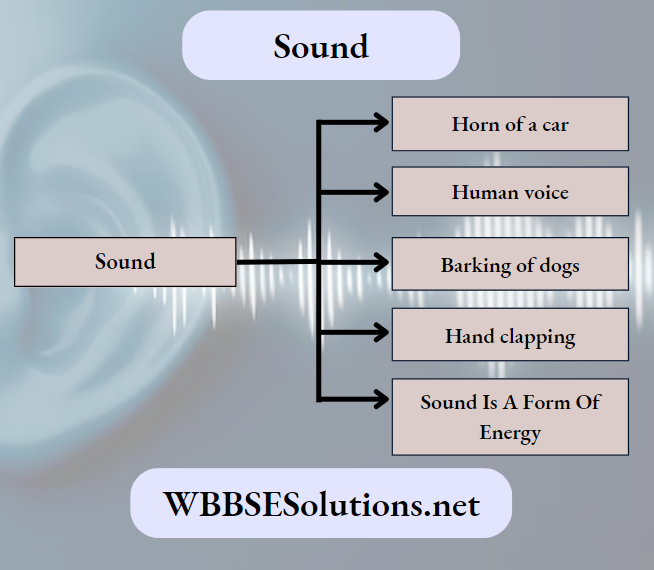
NEET Foundation Physics Sound Sound Wave

  1. Horn of a car
  2. Alarm clock
  3. Music
  4. Human voice
  5. Barking of dogs
  6. Hand clapping

Sound can be described in two different ways.

  1. Subjective or psychological sound, which refers to hearing sensation which ceases when the sound sensing organ is withdrawn from the scene.
  2. Objective or physical meaning refers to the energy reaching the ear from outside. The energy continues to propagate even if no ear is present to detect it.

Chapter 5 Sound Production of Sound

Physics of sound

Sound is produced when an object vibrates. Now, what is vibration? Vibration is the rapid to and fro motion of an object. The motion of materials or objects causes vibration. To understand it better let us illustrate some examples.

Example 1: Take a guitar and pluck its string at the centre . Now pluck it at the centre. It will start vibrating and you can hear a sound. After few minutes, string will stop vibrating and sound will also stop as well.

Class 11 Physics Class 12 Maths Class 11 Chemistry
NEET Foundation Class 12 Physics NEET Physics

Example 2: Take a U shaped fork. Hang a ball with a thread. Now strike the ball and bring the vibrating tuning fork near the ball. You will hear the sound of the vibrating tuning fork. As soon as the arm of the fork stops vibrating, the ball will also stop oscillating and there will be no sound.

NEET Foundation Physics Sound Production of sound

These examples show that sound is produced when an object vibrates and it stops when the object stops vibrating.

As we said abovem sound is a form of energy. Let us elaborate it further. Mechanical energy is required to start vibrations in an object producing sound. The vibrations of object are transmitted in a medium in waveforms from one point to the next and so on.

These waves on reaching our ears produced vibrations in the eardrum which are perceived as sound by us. Thus, sound is a form of energy.

Chapter 5 Sound Propagation of Sound

The vibrating object produces sound thattravels through a medium to reach the ­listener. The medium through which sound travels can either be solid, liquid or a gas. When an object vibrates, it creates a periodic disturbance in the nearby medium.

The particles around the medium also start vibrating. As a result of it, the particles in contact with the vibrating object is first displaced from its equilibrium position. It then exerts a force on the adjacent particle and the adjacent particle is displaced from its position of rest.

After displacing the adjacent particle the first particle comes back to its original ­position. This process gets repeated in the medium till the sound reaches the listener.

Therefore, the disturbance moves forward in the form of compression. The particles of the medium do not move with the compression.

Sound Wavelength
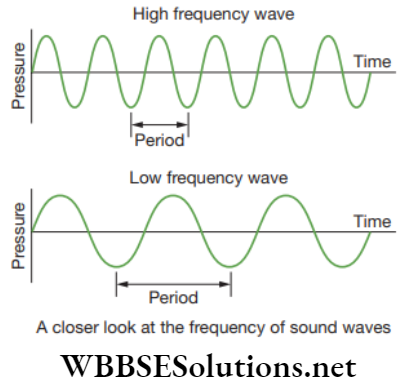
NEET Foundation Physics Sound Propagation of sound

Sound Needs Medium to Travel

Amedium is necessary forthe propagation of sound from one place to another. The matter or substance through which sound is transmitted is called a medium. The medium can be solid, liquid, or gas. Sound cannot travel in vaccum. A true vaccum refers to the complete absence of matter.

Sound waves can travel only through matter. So, sound needs a physical medium in order to travel anywhere. A vibrating object travels from one place to another through the mechanical vibrations of medium particles in the form of waves.

Activity to Show that Sound Needs a Material Medium for its Propagation

Take an electric bell and suspend it inside an air tight glass bell jar. Connect the bell jar to a vacuum pump. When the key is pressed, the circuit of electric belt is complete. The hammer of the electric bell begins to strike the gong repeatedly due to which sound is heard. Now keeping the key pressed, air is gradually with drawn from the jar by starting the vacuum pump.

It is noticed that the loudness of sound goes on decreasing as the air is removed from the bell jar and finally no sound is heard when all the air from the jar has been drawn out. The hammer of the electric bell is still seen striking the gong repeatedly which means that sound is still produced, but it is not heard.
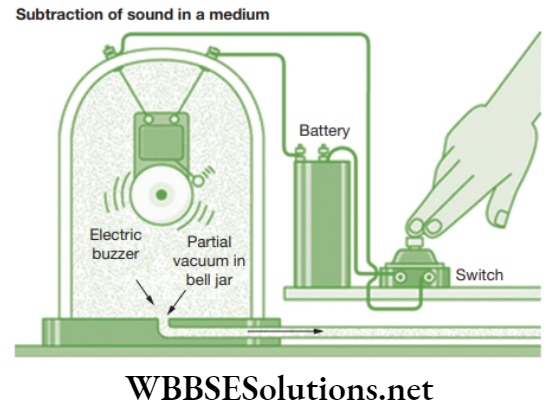
NEET Foundation Physics Sound Bell jar experiment

Illustration

When hammer of the bell hits the gong, sound is produced due to vibrations of gong which travels through air to the wall of jar. This causes the wall of jar to vibrate and the air outside the jar is also set in vibration. Therefore, we can hear the sound.

But when hair has been removed from the jar, sound produced due to vibration of gong could not travel to the wall of jar, so wall could not vibrate, hence no sound is heard. This clearly demonstrates that sound requires a material medium for transmission and it cannot travel through vacuum.

Requisites of the Medium

The medium required for propagation of sound must have the following properties:

  1. The medium must be elastic so that its particles may come back to their initial positions after displacement on either side.
  2. The medium must have inertia so that its particles may store mechanical energy.
  3. The medium should be frictionless so that there is no loss of energy in propagation of sound through it.

We know sound can propagate in all states, i.e., solid, liquid and gas. Some materials like water, air, etc., can easily transmit sound from one place to another while on the other hand materials like blanket, thick curtains, etc., transmit only a small fraction of it because it absorbs most of the sound incident on them.

Sound Propagates as Waves

Sound propagates from one place to another in the form of waves, i.e. because of the disturbances of particle of the medium. Wave is a phenomenon or disturbance in which energy is transferred from one point to another without any direct contact between the points. So, sound is considered as a wave. Particle of medium only vibrate. They do not move from one point to another.

On the basis of direction of propagation, waves can be divided into two types – (a) longitudinal waves and (b) transverse waves

Longitudinal Waves

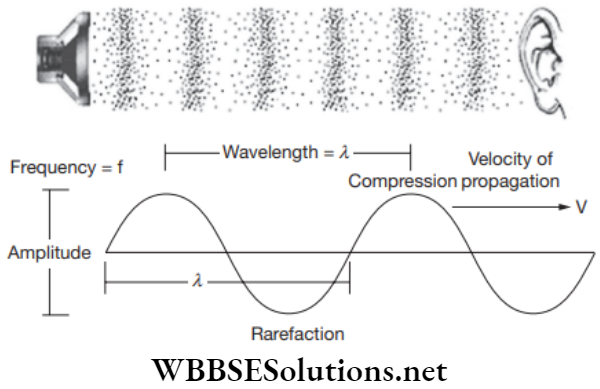
A wave in which particles of the medium vibrate about their mean positions, in the direction of propagation of the wave is called longitudinal wave (Fig. 5.5). Sound travels in air in the form of longitudinal waves. Longitudinal waves can be produced in all forms, i.e., solid, liquid and gas. At compressions, the density and pressure of the medium are maximum, while at rarefaction the density and pressure of the medium are minimum.
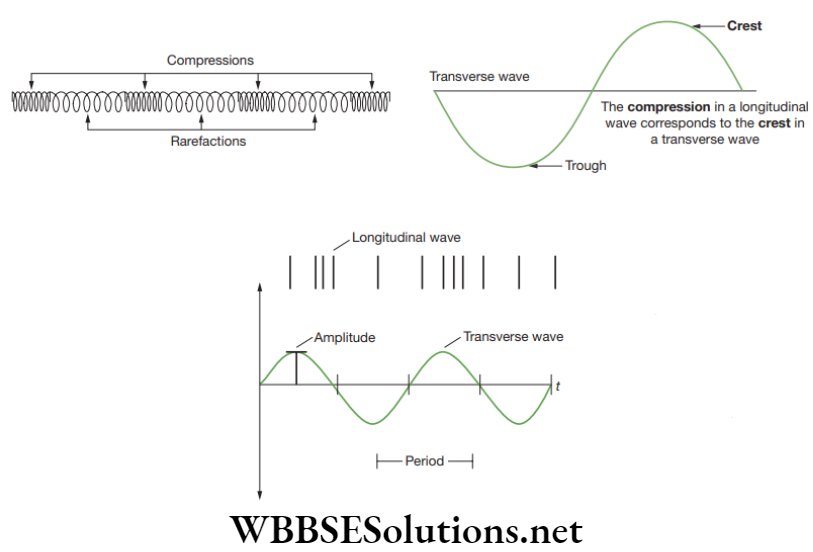
NEET Foundation Physics Sound Longitudinal wave

Compression and Rarefaction

Air is the most common medium through which sound travels. When a vibrating object moves forward, it pushes and compresses the air in front of it creating a region of high pressure. This region is called compression. It is represented by the symbol C.

When the vibrating object moves backwards, it creates a region of low pressure called rarefaction. It is represented by the symbol R.

In the we see that waves are formed when a stone is dropped on the still water surface. Along with waves we also hear sound of stone as the stone strikes the water surface. This is due to the disturbance produced in water. The disturbance spreads in all directions rapidly outwards in the form of circular waves on the surface of water.

NEET Foundation Physics Sound Waves formed on the surface of water on dropping a piece of stone

Now keep a small paper boat on the water surface at some distance away from the point where the stone strikes, we notice that the ball doesn’t move ahead, instead it will vibrate in the up and down direction as the wave moves ahead. The reason behind this is that the particles of water start vibrating up and down at the point where the stone strikes.

These particles then transfer their energy to other neighbouring particles and they themselves come back to their mean positions. This process continues and thus the disturbance moves ahead on the water surface in the form of waves. The waves die out as soon as the energy imparted by the stone gets dissipated.

Transverse Wave

A wave in which the particles of the medium vibrate about their mean positions, in a direction perpendicular to the direction of propagation of the wave is called a transverse wave.

Transverse wave is composed of:

  1. Crest: The position of maximum upward displacement is called crest.
  2. Trough: The position of maximum downward displacement is called trough.

Comparison between transverse and longitudinal waves
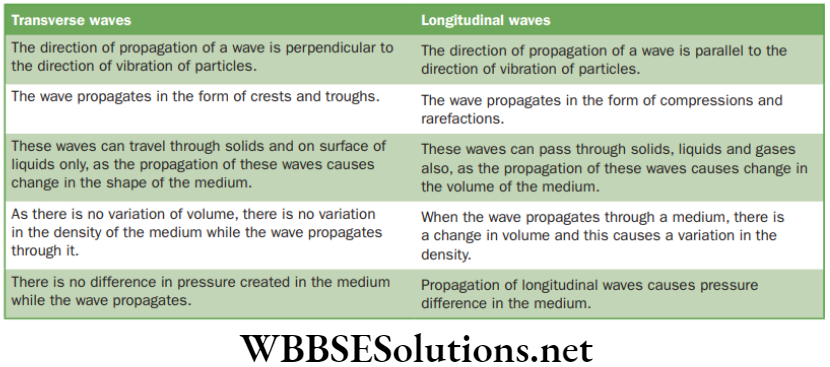
NEET Foundation Physics Sound Comparison between transverse and longitudinal waves

Progressive and Stationary Waves

There are some waves that start at the point of origin of the waves and progress endlessly into other parts of the medium. Such waves are known as progressive waves.

Consider a progressive transverse water wave moving from left (point P) to right and striking a hard surface at ‘Q’and is called an ‘incident wave’. It then gets reflected at ‘Q’, and travels towards ‘P’. Thus the two waves, one going from ‘P’ to ‘Q’ and the other going from ‘Q’ to ‘P’ called the ‘reflected wave’ overlap resulting in the formation of ‘nodes’ and ‘antinodes’.

Points, where the displacement of a vibrating particle of the medium is zero or minimum are called ‘nodes’ and points, where the displacement of the vibrating particles is maximum are called ‘antinodes’. The closed ­figures so formed are called ‘Loops’.

These loops are On the whole, the wave appears to be stationary or standing, contained between two positions ‘P’ and ‘Q’ and so called as ‘stationary waves’ or ‘standing’. Thus a ‘progressive wave is a wave which is generated at a point in a medium and travels to all parts of the medium infinitely carrying the energy’ and a ‘stationary wave is a wave which is formed by a superposition of two identical progressive waves traveling in opposite directions’.
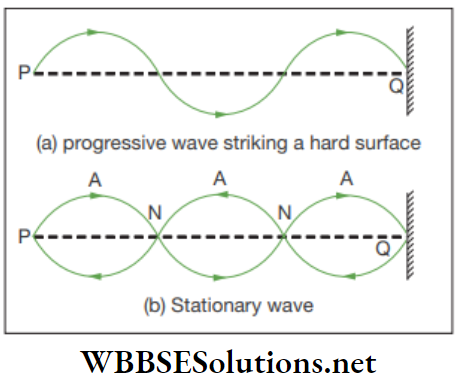
NEET Foundation Physics Sound Progressive and stationary waves

Comparative study of progressive and stationary waves
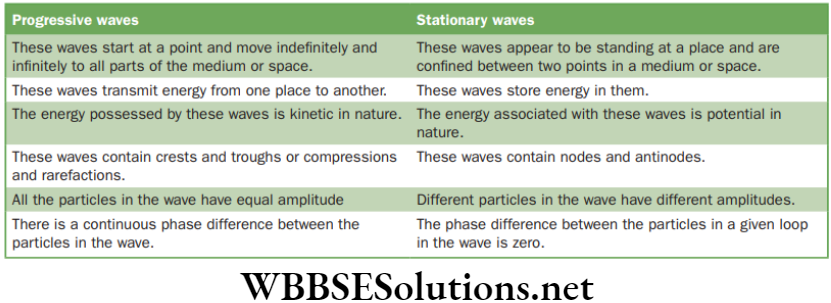
NEET Foundation Physics Sound Comparative study of progressive and stationary waves

Characteristics of Wave Motion

  1. A wave is produced by the periodic disturbance at a point in the medium.
  2. Due to propagation of a wave in a medium, the particles of the medium vibrate about their mean positions and energy is transferred with a constant speed from one place of medium to the other.

Characteristics of Sound Wave

Sound can be described in terms of the following physical quantities:

1. Amplitude: The maximum displacement of the particle of a medium on either side of its mean position is called amplitude of the wave. It is denoted by the symbol ‘A’. S.I. Its unit is metre (m).

2. Time period: The time taken by a particle of the medium to complete its one ­vibration is called time period of the wave. It is denoted by the letter T. Its S.I. unit is second (s).

3. Frequency: The number of vibrations made by a particle of the medium in one second is called frequency of wave.

Another definition is number of waves passing through a point in one second.

It is denoted by the symbol n, f, neu (υ)

Its S.I. unit is hertz (Hz) or s-1.

Relation:

υ = 1/T

where υ = frequency, T = time period.

The frequency of a wave is equal to the frequency of vibrations of its source. It is the characteristic of its source which produces the disturbance. It does not depend on the amplitude of vibration or on the nature of medium in which the wave propagates.

4. Wavelength: The distance travelled by the wave in the time period of vibration of particles in the medium is called its wavelength. It is denoted by the letter λ (lambda). Its S.I. unit is metre (m). It depends on the medium in which the wave travels.

In a longitudinal wave, the distance between two consecutive compressions or two consecutive rarefactions is equal to one wavelength.

In a transverse wave, the distance between two consecutive crests or between two consecutive troughs is equal to one wavelength.

5. Wave velocity: The distance travelled by a wave in one second is called its wave velocity. It is the velocity with which energy is transferred from one place to another by wave motion. It is not the velocity of an individual particle vibrating about its mean position.

Wave velocity is constant for a given medium. It depends on the elasticity and the density of the medium. It changes when same wave passes from one medium to the other medium. It is denoted by the letter v. Its S.I. unit is m/s.

Displacement–Time Graph
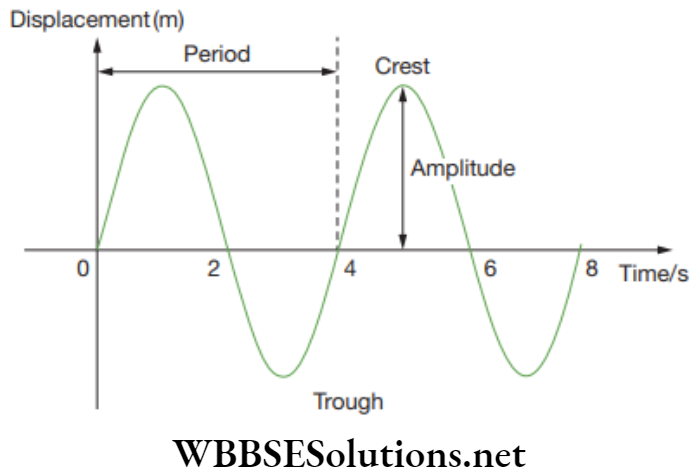
NEET Foundation Physics Sound Displacement - time graph of a particle in a wave

The above graph shows the variation of displacement of a certain particle of the medium with time, when a wave propagates through it. It is called displacement–time graph.

Displacement–Distance Graph
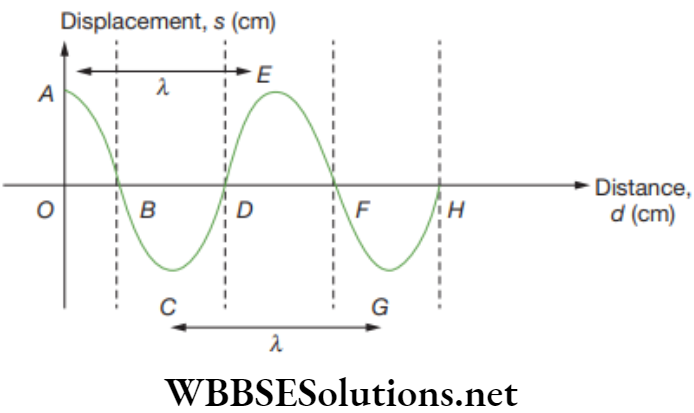
NEET Foundation Physics Sound Displacement - distance graph

The above figure shows the displacement–distance graph of a transverse wave at an instant. It is a snapshot of a wave. Distance AE or CG gives us the wavelength (λ) of the wave.

Relationship between Wavelength, Wave Velocity and Frequency

Let velocity of wave = v

Time period = T

Frequency = υ

Wavelength = λ

As per the definition of wavelength,

λ = Distance travelled by wave in one time period

= Wave velocity × Time period

= v × T

vT = λ

T = 1/υ

v × (1/υ) = λ

Therefore,

v = λυ

Hence,

Wave Velocity = Frequency × Wavelength.

Speed of Sound in Different Media

Sound travels in a medium with a finite speed and it takes some time to reach a destination from the source.

The speed of sound in a medium depends on the following factors:

  1. Elasticity of (E) of the medium
  2. Density (r) of the medium

The speed of sound in a medium is given by the formula

v = \(\sqrt{\frac{E}{\rho}}\)

where E is the modules of elasticity and ρ is the density of medium.

Sir Isaac Newton assumed, when sound travels in a gas, temperature of the gas does not change. In other words, the propagation of sound is an isothermal change. For isothermal change, modulus of elasticity is equal to the pressure of the gas, i.e. E = P.

Therefore, velocity of sound in gas was given by

v = \(\sqrt{\frac{P}{\rho}}\)

The expression given by Newton for the velocity of sound in a gas medium, later was modified by Laplace, where he introduced ‘γ ’, as a constant for a given gas. It is defined as the ratio of the specific heat capacity of the gas at constant pressure to its specific heat capacity at constant volume.

Types of sound

Therefore, v = \(\sqrt{\left(\frac{\gamma P}{d}\right)}\), where, ‘γ ’(gamma) is a constant.

The speed of sound is different in different media. It is more in solids, less in liquid and least in gas. This is because solids are much more elastic than the liquids and gases. The speed of sound is nearly 5100 m/s in steel, 1450 m/s in water and 330 m/s in air at 0 °C. Table 5.3 below gives the speed of sound in different media at 0 °C.

Speed of sound in different media
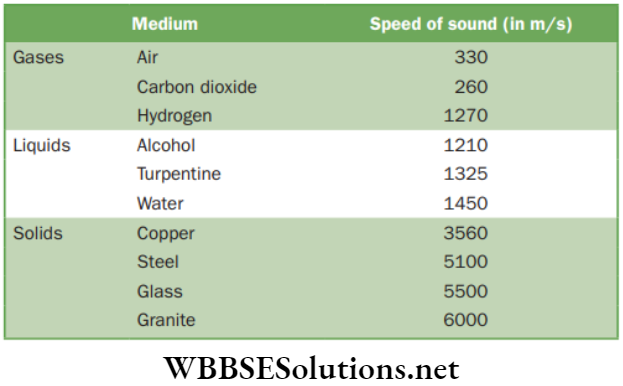
NEET Foundation Physics Sound Speed of sound in different media

Example: If sound is produced at one end of a very long steel bar, two sounds are heard at the other end. One which reaches first is propagated through steel and the other which is heard later is through air.

Factors Affecting the Velocity of Sound in a Air

The speed of sound in a gas is affected by

1. Effect of density: As we know v = \(\sqrt{\frac{\gamma P}{\rho}}\), it shows that \(v \propto \frac{1}{\sqrt{\rho}}\)

The speed of sound is inversely proportional to the square root of density of the gas.

The density of oxygen is 16 times the density of hydrogen; therefore the speed of sound in hydrogen is four times the speed of sound in oxygen other factor being same.

2. Effect of temperature: The speed of sound in a gas increases with the increase in the temperature of the gas. This is because with the increase of temperature, density of gas decreases and consequently the speed of sound increases.

Speed of sound is directly proportional to the square root of temperature of medium.

\(V \propto \sqrt{T}\) , where T is the temperature of the gas on the Kelvin scale.

The speed of sound in air increases by about 0.61 m/s for each degree celsius rise in its temperature.

Vt = V0 + 0.61 t

where ‘t’ is temperature of air in °C.

3. Effect of humidity: The speed of sound in air increases with the increase in humidity in air.

The density of water vapour is about 5/8th times the density of dry air at ordinary temperatures, therefore the increase of moisture in air tends to decrease the density of air. This is the reason why the speed of sound in the humid air is greater than the speed of sound in the dry air.

4. Effect of direction of wind: The speed of sound increases or decreases according to the direction of wind. If wind is blowing in the direction of propagation of sound, the speed of sound increases but if it is flowing in the direction opposite to that of sound, then speed of sound will decrease.

If v is the speed of sound in still air and W is the speed of wind, the speed of sound becomes v + W when wind blows in the direction in which sound travels and the speed of sound becomes v – W when wind blows in direction opposite to the direction in which sound travels.

Factors not Affecting the Velocity of Sound in a Air

The velocity of sound in air is not affected by the change in

  1. Wavelength (λ): The velocity of sound in air or any other medium does not depend on its wavelength (λ).
  2. Frequency (n): The velocity of sound in air or any other medium does not depend on its frequency.
    We know that v = nλ. As the frequency (n) increases, its wavelength (λ) decreases but does not affect the velocity of the wave.
  3. Amplitude: Velocity of sound does not depend on the amplitude of the vibrations.
  4. Pressure: The velocity of sound in air or any gas in given by v = \(\sqrt{\frac{\gamma P}{d}}\); where ‘γ ’ is a constant, ‘P’ is the pressure and ‘d’ is the density.
    When the pressure of a gas is changed, its density also changes such that the ratio ‘P’/d is always a constant. Therefore, the variation of pressure of a gas does not affect the velocity of sound in it.

Comparison of Speed of Sound with Speed of Light

  • The light can travel in vacuum but sound cannot.
  • The speed of light in air is 3 × 10⁸ m/s which is about a million times greater than the speed of sound in air. (i.e. 330 m/s at 0 °C).
  • The speed of light decreases in an optically denser medium while the speed of sound is more in solids, less in liquids and least in gases.
  • In thunder, light is seen much earlier than sound of thunder is heard, even though they are produced simultaneously.
  • In an athletic event, when the starter fires a gun, the sound of fire is heard a little later while the smoke is instantaneously seen. The reason is that vlight > Vsound .

Characteristics of Sound as we Hear It

1. Loudness: Loudness of sound is the measure of sound energy reaching the ear per second. Loudness or softness of a sound wave is the sensation that depends upon its amplitude.

E.g. When we strike the top of a table with more force, it vibrates and produces a loud sound. But, when we strike the top of table with lesser force, the vibrating table top produces soft sound waves. Louder sound has more amplitude.

2. Pitch: When a guitar n flute are played together then the sound emitted by the two musical instruments are different. The difference is due to one more characteristic of sound namely pitch.

Pitch is the sensation (brain’s interpretation) of the frequency of an emitter sound. The pitch of sound (Shrillness or flatness) depends on the frequency of vibration.

Faster the vibration of the source, higher is the frequency and higher the pitch and vice versa, Similarly, low pitch sound corresponds to low pitch.

3. Quality or Timbre: Quality or timbre of sound wave is that characteristic which helps us in distinguishing between two sounds of same loudness and same pitch.
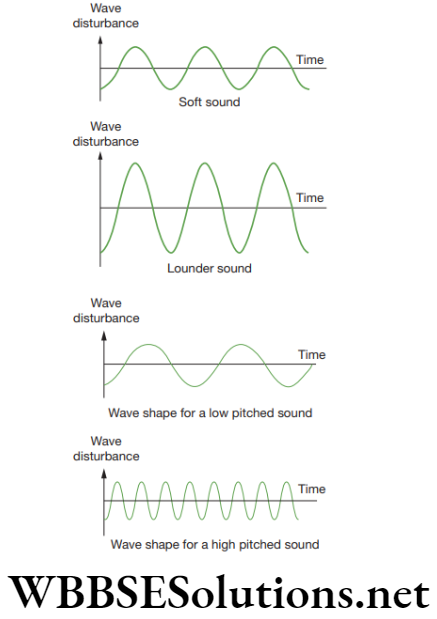
NEET Foundation Physics Sound Characteristics of sound

Music and Noise

  1. Music is the sound that is pleasant to hear/to the ears (e.g, sound coming out of musical instruments)
  2. Noise is the sound that is unpleasant to hear/the ears (E.g., Sound produces by vehicles)

Tone and Note

  1. A pure sound of single frequency is called tone.
  2. An impure sound produced by mixture of many frequencies is called a note. It is pleasant to hear.

Sonic Boom: Speed of sound in air is 333 m/s, speed of faster runner = 12.5 m/s. Many objects such as aircrafts, bullets, and rocket planes travel at speed greater than the speed of sound in air. Such objects are said to be travelling with supersonic speed.

  1. Objects moving with speed greater than speed of sound is said to have supersonic speed.
  2. Supersonic aircraft produces shock waves in air due to its very high speed. The air pressure variation associated with shock waves produces a very sharp and loud sound called “Sonic boom”.

Chapter 5 Sound Reflection of Sound

Sound waves and music

Sound gets reflected at the surface of solid and liquid in the same way as light does. It follows the law of reflection. Bouncing back of sound wave from the surface of a solid or a liquid is called reflection of sound.

  1. The laws of reflection are as follows:
  2. The angle of incidence is equal to the angle of reflection.

The incident ray, reflected ray and normal at the point of incidence, they all lie in the same plane.

we have taken two identical cardboard tubes and arrange them as shown in the figure near the hard plywood. At one end of the cardboard, put in an alarm clock. Now try to listen to the clock tick-tock from the other by adjusting the position of the cardboard. Now measure the angles of incidence and reflection. Now lift the second pipe and try to hear the sound.

In this experiment you will notice that the angle of incidence is equal to the angle of reflection. Incident ray, reflected ray and normal all lie in the same plane.

Instead of hard plywood we can use any obstacle of big size which is either polished or rough. This is used for the reflection of sound waves.
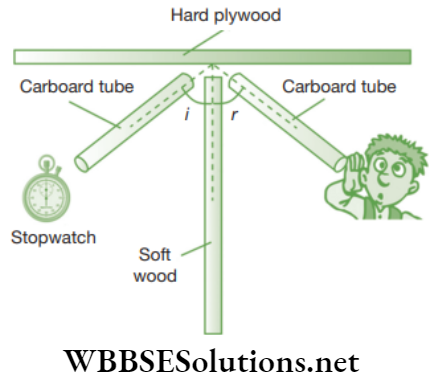
NEET Foundation Physics Sound Reflection of sound from a plain surface

Echo

The sound that comes to our ear after reflection is called echo or echo of sound.

Examples

  1. Sound we hear after clap is an echo.
  2. Sound heard after shouting in a big empty hall is also an echo.
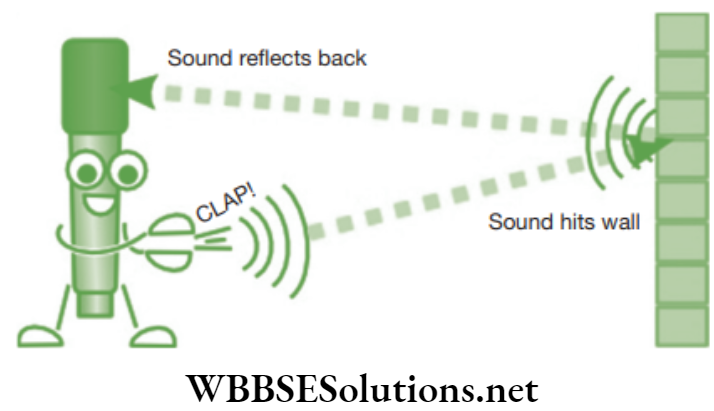
NEET Foundation Physics Sound Echo on clapping hands

The sensation of sound remains in human brain for about 0.1 s. It means the time interval between the original sound and echo must be at least 0.1 s. At times echo is heard multiple times. This happens when there is successive or multiple reflections. For example, thunderstorm.

As we know the speed of sound in air is 344 m/s. The distance travelled by sound in 0.1 s will be

D = v × T

= 344 × 0.1

= 34.4 m

It means to hear the echo properly, the minimum distance of the reflecting surface should be half of this distance, i.e. 34.4/2 = 17.2 m.

Temperature has impact on echo. So when temperature changes, distance will also change.

Reverberation

When echo is heard multiple times due to repeated and multiple reflections of sound from different reflecting surfaces, it causes persistence of sound. This is called reverberation.

Example: Sound echoes multiple times, when a man shouts at a top of the mountain cliff.

At places like auditorium, big halls sound echoes multiple times. To reduce ­reverberation, roofs and walls are covered by sound absorbing materials. These can be rough plaster, draperies or compressed fibre board. Reverberation can be prevented by stopping the reflection of sound. This could be done by:

  • Using soft sound absorbent material, such as curtains, plant fibres, compressed fireboard, carpets are used in big halls.
  • These materials absorb undesired reflected sound and reduce reverberation.

Uses of Multiple Reflection of Sound

On one hand reflection of sound can be irritating but on the other side it proves to be helpful. Let us see some examples where reflection of sound is useful.

1. Loudspeaker, Megaphone, Bulb horn: Devices like loudspeaker, megaphones are designed in such a way that they send the sound in a particular direction by multiple reflections without deviating it into various directions.

2. Soundboard: Soundboard is used in big halls or auditoriums where sound is sent towards auditorium. It works on the basis of law of reflection of sound waves.


NEET Foundation Physics Sound Loudspeaker

NEET Foundation Physics Sound Soundboard

Soundboard is a big concave board and it is placed behind the stage in such a manner that it focuses the speaker. Sound that is coming from the speaker falls on the soundboard which in turn gets reflected towards the audience. The result of this is that the audience who are sitting far from the speaker can ­easily hear the sound that is coming out from the speaker.

The walls of auditorium are also constructed in the form of curve. Hence, ceiling acts like a soundboard.

3. Stethoscope: Stethoscope is an instrument used by doctors for listening human breath. In stethoscope, human body’s sound is received by chest piece which is sent to ear by multiple reflections done inside the long tube.

Use of Multiple Reflection of Sound

  • Measuring the depth of sea or ocean.
  • Used for the detection of the position of objects. For example, sea rocks, hidden ice-berg in the sea and ocean shipwrecks.
  • Investigating problem inside the human body.

 

NEET Foundation Physics Sound Stethoscope

Chapter 5 Sound Range of Hearing

The human ear is able to hear sound in a frequency range of about 20 Hz to 20,000 Hz. In other words the audible range of frequency is 20 Hz to 20 kHz. Any sound out of this range is called not audible.

The audible range of frequency varies from person to person and it also varies with age of the person. As the person grows older, his hearing power decreases.

Children can hear higher frequencies of up to 30 kHz while an old person can hear up to 12 kHz. Therefore, on an average the audible range is from 20 Hz to 20 kHz.

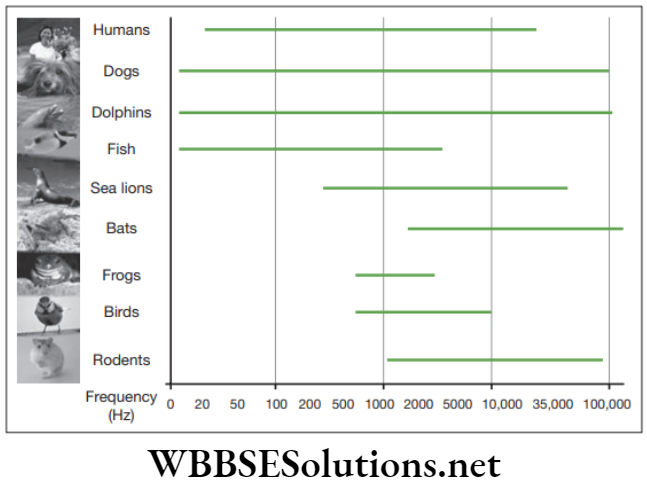
The human ear is most sensitive in the range 2 kHz to 3 kHz, where it can hear even a very feeble sound. Unlike human, animals can hear sounds of frequency below 20 Hz and above 20 kHz. Different animals have different range of frequency. Frequency ranges for hearing and speaking by humans and animals.
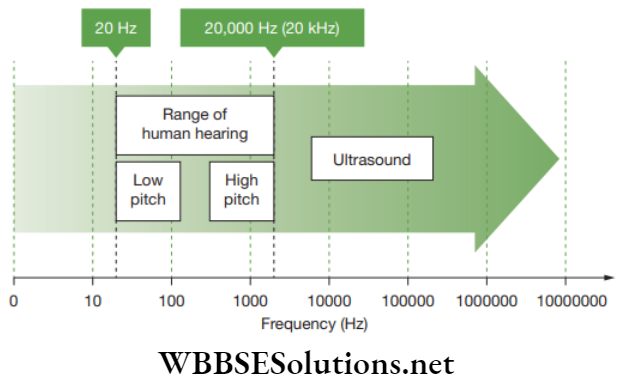
NEET Foundation Physics Sound Range of hearing

NEET Foundation Physics Sound Hearing ranges of various species

Let us see the frequency ranges for hearing and speaking of various animals and human.
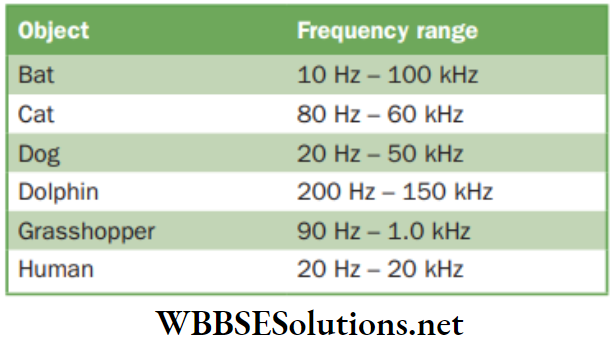
NEET Foundation Physics Sound Animals and human

Chapter 5 Sound Ultrasound and Its Applications

As studied in the last topic, the frequency of sound above 20 kHz is called ultrasound. Ultrasound can travel freely in solids and liquids. In case of gases, its intensity falls. In the medium, the speed of ultrasound is same as that of audible sound. In air, the speed of ultrasound is 330 m/s.

Properties of Ultrasound

Ultrasound has all the properties that an ordinary sound has. But because of its high frequency it has two additional properties.

  • The energy carried by ultrasound is very high.
  • The ultrasound can travel along a well-defined straight path. It does not bend appreciably at the edges of an obstacle because of its small wavelength.
    The above properties of ultrasound make it very useful for different purposes. It is extensively used in industries and for medical purposes.

Applications of Ultrasound

Some applications of ultrasound are given below:

  • Bats avoid obstacles in their path by producing and hearing the ultrasound. They emit ultrasound which returns after striking an obstacle in their way. By hearing the reflected sound and from the time interval, they can judge the direction and the distance of the obstacle in their way.
  • Ultrasound is used for drilling holes or making cuts of desired shape in materials like glass.
  • It is used for cleaning very small objects like cleaning parts of watches or other electronic items. The objects are placed in the cleaning solution and ultrasonic waves are passed in the solution. This causes high frequency vibrations in the solution and makes the cleaning easier.
  • Ultrasound is used for detection of defects in metals. Ultrasound will pass through the object if there is no defect but if there is some defect, ultrasound will get reflected back.
  • Ultrasound is widely used for imaging the human organs. Ultrasonography is used to obtain the images of patient’s organs such as liver, gall bladder, uterus, etc. It helps to detect stone, tumour, etc. Echo cardiology is used to obtain the image of the heart.
  • Ultrasound is used in surgery to remove cataract and in kidneys to break the stone in fine grains.
  • In SONAR (abbreviated form of sound navigation and ranging) to detect and find the distance of objects under water, ultrasound is used.

Infrasonics or Infrasound

Infrasonic waves are the waves which has frequency less than 20 Hz. These waves are produced by large vibrating bodies. For example they are produced by the vibration of the earth’s surface during the earthquake.

These waves are also produced by some animals like elephants, rhinoceroses, whales, etc. These waves are not audible to human ears.

It has been observed that the animal’s behaviour becomes unusual just before tremor is felt. This is because the animals have the ability to detect infrasonic waves produced at the time of tremor.

Sound Navigation and Ranging (SONAR)

SONAR is a device which is used in the ships to locate rocks, icebergs, and submarines, old sank in seas etc.

Ultrasonic waves of high frequency are sent from a ship on the surface. The waves travel in straight line till they hit somebody like shipwreck or submarine. On hitting the body these waves are reflected back as shown in figure.

The transmitter sending the wave notes the time t between sending the signal and receiving it back. Let if d is the distance of the submarine from the ship, than the total distance travelled by the wave in time interval t is 2d.
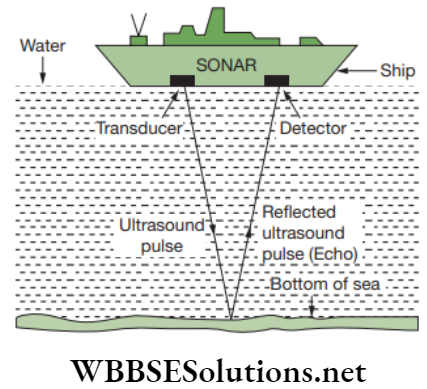
NEET Foundation Physics Sound Sound navigation and ranging

\(\text { Using speed }=\frac{\text { Distance }}{\text { Time }}\)

v = \(\frac{2 d}{t}\)

Therefore d = \(\frac{1}{2}(v \times t)\)

The velocity v of the ultrasonic wave in water is same as that of audible range of water.

Chapter 5 Sound Structure of Human Ear

Ear acts as a receiver or detector of sound. The sound that is received in the form of pressure variations in air are converted into electrical signals within the ear. This sound on reaching our brain produces a sense of hearing. The human ear consists of three parts:

1. Outer ear: The outer ear looks complicated but it is functionally the simplest part of the ear. It consists of the ‘pinna’ or auricle (the visible projecting portion of the ear), the external acoustic meatus (the outside opening to the ear canal), and the external ear canal that leads to the ear drum. In sum, there is the pinna, the meatus and the canal. That’s all. The outer ear concentrates air vibrations on the ear drum and makes the drum vibrate. The outer ear is also called external ear.
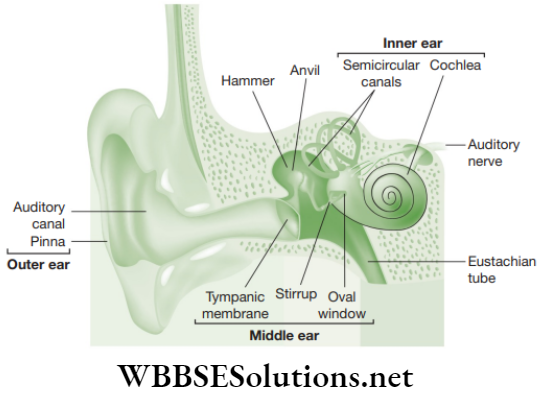
NEET Foundation Physics Sound Structure of human ear

2. Middle ear: The middle ear consists of an eardrum or tympanic membrane connected at the end of the auditory canal. The eardrum is a thin, tightly stretched membrane, also known as sheet (‘kaan ka parda’ in Hindi). The eardrum vibrates when compressions and rarefactions of sound wave hit it. A compression exerts an inward pressure on the outer surface of the eardrum. This forces the eardrum to move inward. However, a rarefaction does the opposite and moves the eardrum outwards.

Hence, the eardrum is made to vibrate by the successive compressions and rarefactions. The vibration of eardrum produces pressure variations within the middle ear. The three bones (hammer, anvil and stirrup) present in the middle ear amplify these pressure variations several times. The middle ear then transmits the sound wave’s amplified pressure variations to the inner ear.

3. Inner ear: The inner ear has a job to convert the sound wave’s amplified pressure variations into electrical signals. This work is done in the inner ear by cochlea, a snail-shaped organ. The cochlea is filled with water like fluid and its inner surface has large number of hair-like nerve cells.

The amplified pressure variations produce vibrations in the nerve cells and they in turn release electrical impulses. The electrical impulses are transmitted to the brain along the auditory nerve. The brain interprets the electrical impulses through a complex process, as sounds.

Chapter 5 Sound Fill in the Blanks

Question 1. Sound shows______variation with temperature.
Answer. Speed

Question 2. Infrasonic sound has less ______.
Answer. Frequency

Question 3. 1 kHz = ______Hz
Answer. 1000

Question 4. The maximum displacement of a wave from its mean position is known as ______.
Answer. Amplitude

Question 5. Wavelength is denoted by the symbol ______.
Answer. λ

Question 6. _____ is the unit of loudness of sound.
Answer. Decibel

Question 7. Echo is observed usually in ______ rooms.
Answer. Large

Question 8. In SONAR, ‘S’ stands for ______.
Answer. Sound

Question 9. In order to distinguish between two different sounds, they must be heard after an interval of ______.
Answer. 0.1 s

Question 10. If the time period is 0.05 second, then the frequency is ______ Hz.
Answer. 20

Question 11. _______________ is required to start vibrations in an object producing sound.
Answer. Mechanical energy

Question 12. Sound is a form of _________________.
Answer. Energy

Question 13. ______ acts as a receiver or detector of sound.
Answer. Ear

Question 14. The ______ vibrates when compressions and rarefactions of sound wave hit it.
Answer. Eardrum

Question 15. The ______ has a job of converting the sound wave’s amplified pressure variations into electrical signals.
Answer. Inner ear

Chapter 5 Sound Match the Columns

Question 1. Choose the correct speed (m/s) of substance at temperature 25 °C.
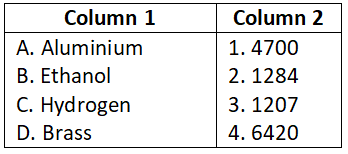
NEET Foundation Physics Sound Correct Option 1

Select the correct option:

  1. A-1, B-2, C-3, D-4
  2. A-4, B-3, C-2, D-1
  3. A-2, B-1, C-3, D-4
  4. A-1, B-2, C-4, D-3

Answer. 2. A-4, B-3, C-2, D-1

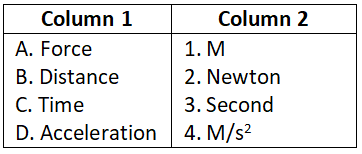
Question 2. Choose the correct S.I. unit.
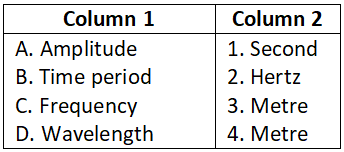
NEET Foundation Physics Sound Correct Option 2

Select the correct option:

  1. A-1, B-2, C-3, D-4
  2. A-4, B-3, C-2, D-1
  3. A-2, B-1, C-3, D-4
  4. A-4, B-1, C-2, D-3

Answer. 4. A-4, B-1, C-2, D-3

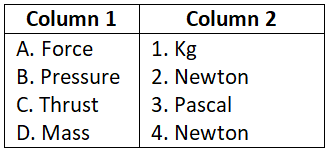
Question 3. Choose the correct symbol.
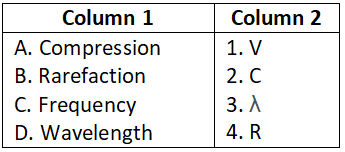
NEET Foundation Physics Sound Correct Option 3

Select the correct option:

  1. A-1, B-2, C-3, D-4
  2. A-2, B-4, C-1, D-3
  3. A-2, B-1, C-3, D-4
  4. A-4, B-1, C-2, D-3

Answer. 2. A-2, B-4, C-1, D-3

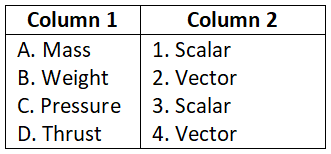
Question 4. Choose the correct code.
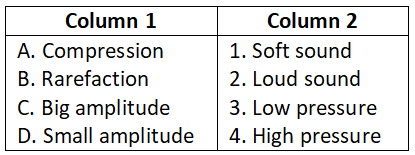
NEET Foundation Physics Sound Correct Option 4

Select the correct option:

  1. A-1, B-2, C-3, D-4
  2. A-2, B-4, C-1, D-3
  3. A-2, B-1, C-3, D-4
  4. A-4, B-1, C-2, D-3

Answer. 2. A-2, B-4, C-1, D-3

Chapter 5 Sound Assertion Reasoning

Direction: For the following questions the options will remain the following:

  1. Both A and R are correct and R is correct explanation of A.
  2. Both A and R are correct but R is not a logical explanation of A.
  3. A is correct but R is incorrect.
  4. R is correct but A is incorrect.

Question 1. Assertion: A boy shouts near mountain, he hears his sound again.
Reason: This is because of the reflection of sound.
Answer. 1. 1. Both A and R are correct and R is correct explanation of A.

Question 2. Assertion: Ultrasonic sound is used to clean electronic components.
Reason: Due to low frequency, dirt particles get detached from the components.
Answer. 2. Both A and R are correct but R is not a logical explanation of A.

Question 3.Assertion: The ceilings of concert halls and conference halls are made curved.
Reason: This way sound wave reaches all thepart after reflection from the curved surface.
Answer. 1. Both A and R are correct and R is correct explanation of A.

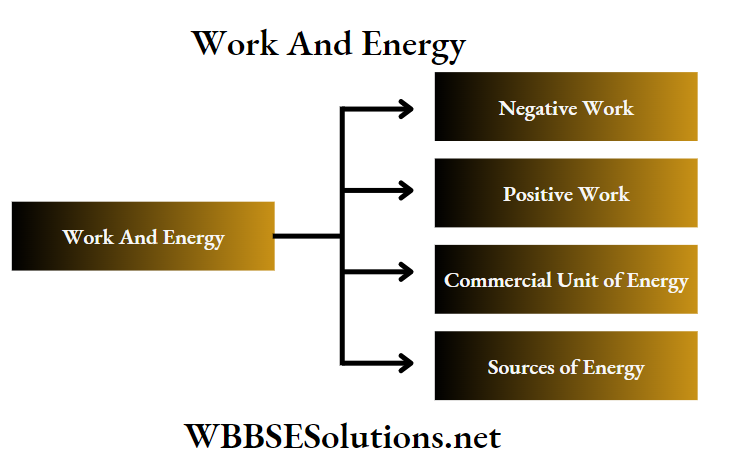
NEET Foundation For Physics Chapter 4 Work And Energy

Physics Chapter 4 Work And Energy

In previous chapter we have discussed about fundamental concepts of physics, which deal with the laws of nature like motion, forces, and Newtons laws of motion and gravitation, etc. Work and energy are the other two basic principles of nature which we come across knowingly or unknowingly in our day to day life.

In this chapter, we will discuss about some of the basic concepts on which work and energy are co-related. Also, energy and power are closely related to work.

All living beings need food to survive. Complex food molecules are broken down by our body and converted into simple soluble form, which in turn is absorbed by the body to get ‘Energy’. Thus, energy can be defined as the element which allows us to perform any function.

For our day to day activities like singing, dancing, running, etc., we need energy. Without energy we cannot perform any work.

For machines, cars, etc., the energy is provided by electricity or the fuel which we provide. Thus, any object whether living or non-living requires energy to do any work.

NEET Foundation Physics Work And Energy Work and energy

Work And Energy

Chapter 4 Work And Energy

Work

In the language of science, work is said to be done only if the force applied in a specific direction produces motion in the body. In other words, if the body displaces from its original position, work is said to be done otherwise it is not done irrespective of all your efforts. In our everyday life, we consider any useful mental or physical labour as work.

Certain activities like playing in a field, chit chatting with friends, singing a song, watching television, attending a party are sometimes not counted as work. What defines ‘work’ depends on how we use it in science.

NEET Foundation Physics Work And Energy Work

From the above mentioned examples, it is clear that how work we usually do is different from the scientific definition of work. To understand the concept better, we would study the concept of work done by a constant force.

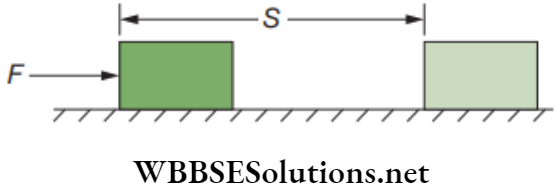
We will consider a constant force ’F’ acting on the body and body being displaced in the direction of the force by a distance ’S’ as shown.

NEET Foundation Physics Work And Energy Work done by a constant force

Let ’W’ be the work done.

According to the definition,

Work done = force × displacement

Mathematically,

W = F × S

Elaborating the above equation, the work done by a body is equal to the magnitude of the force applied on the body multiplied by the displacement carried in the direction of force. Work has only magnitude and no direction. If either force or displacement in the above equation is zero then the work becomes zero.

Class 11 Physics Class 12 Maths Class 11 Chemistry
NEET Foundation Class 12 Physics NEET Physics

If in the above equation, 1 newton of force is applied on the body producing a ­displacement of 1 metre in the body in the direction of motion, then the work done is said to be 1 Nm or 1 Joule. (1 Nm = 1 Joule).

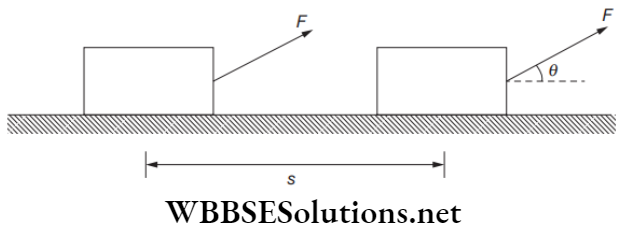
If force F acts in the direction of displacement at an angle θ, then in the direction of displacement the rectangular component will be represented by F cos θ.

Work done = Force(rectangular component) × displacement

W = F cos θ × S

Therefore, depending on the value of θ (i.e., cos θ) work done can be positive, negative or zero.

NEET Foundation Physics Work And Energy The work W done by the force F

Concept of Positive and Negative Work

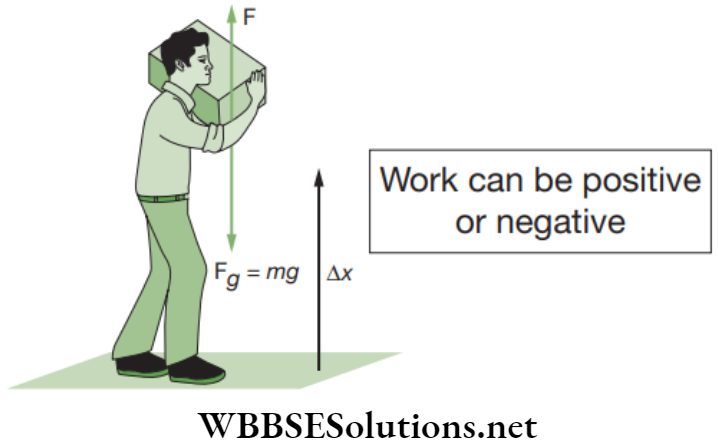
Work can be positive or negative depending upon the direction of force applied. If the force applied is along the direction of the displacement, work done is positive. Example of such situation is pulling of a toy by a kid (parallel to the ground), pushing the door, etc. In these examples, work done is equal to the product of force and displacement.

On the other hand, when the force applied and displacement act in the opposite directions, the work done is said to be negative. Example of this type of work is, when a body is moving with a uniform velocity and suddenly a retarding force is exerted on the body to halt its motion.

The retarding force is opposite to the direction of motion. The angle between the force applied and the displacement is 180°. The work done in this case is said to be negative. Work done is represented by F × (–S) or (–F) × S. Negative work done is indicated by the minus sign.

NEET Foundation Physics Work And Energy Cases for positive and negative work


Chapter 4 Work And Energy Track Your Learning Question And Answers

Question 1. The angle between the force & displacement is_________ in case of negative work.

  1. 45°
  2. 90°
  3. 180°

Answer. 3. 0°

Question 2. Which of the above quantity does not depend upon work done on an object?

  1. displacement
  2. angle between force and displacement
  3. force applied
  4. initial velocity of the object

Answer. 4. initial velocity of the object

Question 3. If the force applied is along the direction of the displacement, work done is said to be ______.

  1. Negative
  2. Positive
  3. Neutral
  4. Cannot be determined

Answer. 2. Positive

Question 4. Nm is a SI unit of

  1. Work
  2. Power
  3. Acceleration
  4. Force

Answer. 1. Work

Question 5. kWh is the unit of

  1. Work
  2. Power
  3. Acceleration
  4. energy

Answer. 4. energy

Chapter 4 Work And Energy

Every process on this earth requires energy. Our earth has evolved because of energy. The life processes that keep us alive require energy. Every single process needs energy. Just like work, let us understand what energy is, from where do we get energy in the language of science.

In simple language, energy is defined as the capacity of doing work. It is the property possessed by objects which allows them to do work or can exert force on another object. Which means energy is transferred from one object to the other.

The latter may move in the direction of force experienced and hence receives the energy and therefore do some work. Thus, the first object has a capacity to do work. This means that any object that can do work, possesses energy.

Commercial Unit of Energy

When we have to express large quantities of energy, joule is not used. We use a bigger unit of energy called kilowatt hour (kWh). Let us understand with the help of an example, suppose we have a machine that uses 1000  J of energy every second. If this machine is used continuously for one hour, it will consume 1 kWh of energy. Thus, 1 kWh is the energy used in one hour at the rate of 1000 J s-1 (or 1 kW).

1 kW h = 1 kW × 1 h

1000 W × 3600 s = 3600000 J

1 kW h = 3.6 × 10⁶ J

The energy used in households, industries and commercial establishments is usually expressed in kilowatthour. For example, electrical energy used during a month is expressed in terms of ‘units’. Here, 1 ‘unit’ means 1 kilowatt hour.

Classification of Resources

Natural resources are valuable and easily available to us. They are classified on the basis of their ability to replenish or recover. They are broadly classified into:

1. Renewable resources
2. Non Renewable resources

  1. Renewable resources: When the energy source used is easily replenished in a short period and there are practically limitless reserves (inexhaustible). An example is the solar energy that is the source of energy from the sun, or the wind used as an energy resource. Other renewable energies are original solar, natural wind (atmospheric flows), natural ­geothermal, oceanic tidal, natural waterfall (hydraulic flows), etc.
  2. Non Renewable resources: They are limited sources of energy on earth (exhaustible) in quantity and therefore are ­non-replenishable. The non-renewable energy sources include, ­non-exclusively, fossil source like petroleum, natural gas, coal, etc.

Different Sources of Energy

There are various sources of energy that are used across the world by human beings to generate power and do the work. Over the years, there are other sources being discovered however, none of them has reached the stage where they can fulfill the power requirements of the modern era.

Human beings rely majorly on natural resources, unfortunately some of them are combustible. For this reason, we should look for artificial and alternate sources.

The reason why we are looking for alternate sources of energy is to produce electricity and run machines on a massive scale.

Solar Energy

Solar energy is the chief source of energy generated from the sun in the form of electric or thermal energy. Solar energy is captured in large solar panels made up of silicon and arsenic which convert the sun’s rays into usable electricity. Besides generating electricity, solar energy is also used in thermal applications.

NEET Foundation Physics Work And Energy Solar panel

Wind Energy

In wind energy, wind is used to generate electricity with the help of kinetic energy created by moving air. Wind energy is transformed into electrical energy with the help of wind turbines or wind energy conversion systems. The kinetic energy is then changed to rotational energy, by moving a shaft which is further connected to a ­generator which later produces electrical energy.

NEET Foundation Physics Work And Energy Wind turbine

Geothermal Energy

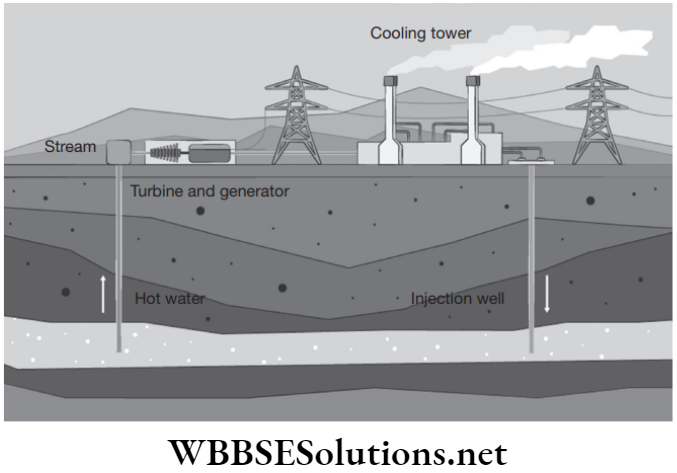
Geo means ‘earth’ and thermal means ‘energy’;It is the produced from within the earth. Geothermal energy can be used for heating and cooling purposes or to generate clean electricity. However, for the generation of electricity, high or medium temperature resources are required.

NEET Foundation Physics Work And Energy Geothermal energy

Hydrogen Energy

Hydrogen has the ability to power fuel cells in zero-emission electric vehicles and the fuel cell’s potential for high efficiency. Hydrogen is a tremendous source of energy and can be used as a source of fuel to power ships, vehicles, homes, industries and rockets. It is renewable source of energy. It is environment friendly.

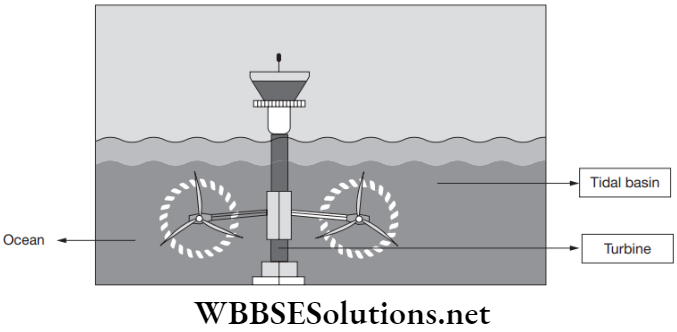
Tidal Energy

Tidal energy converts the energy obtained from tides into other forms of energy mainly electricity. Although because of its complications, it is not yet widely used. Tidal energy has potential for future electricity generation. Tidal power is a eco-friendly energy source.

NEET Foundation Physics Work And Energy Tidal energy

Hydroelectric Energy

Hydroelectric energy involves water flowing through a pipe before pushing against and turning turbine blades connected to an electric generator. Hydropower provides 16 percent of the world’s electricity.

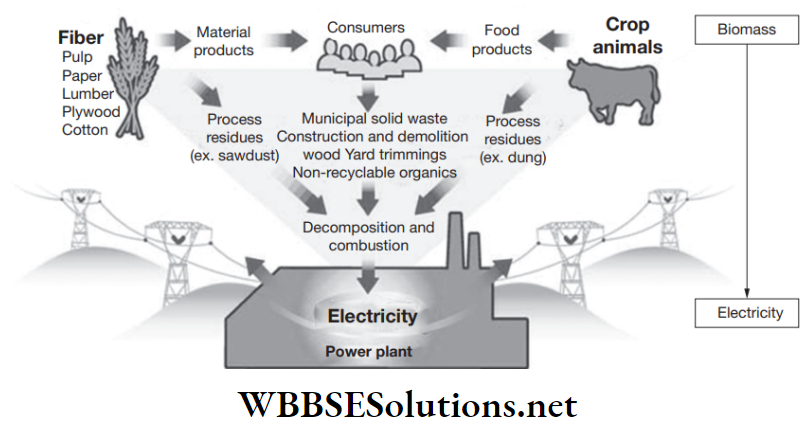
Biomass Energy

Biomass energy is produced from organic material and is commonly used throughout the world. Chlorophyll present in plants captures the sun’s energy by converting ­carbon dioxide present in the air and water from the ground into carbohydrates through the process of photosynthesis. When the plants are burned, the water and carbon dioxide is again released back into the atmosphere.

Biomass energy is used for heating and cooking in homes and also as a fuel in industrial production. This type of energy produces large amount of carbon dioxide into the atmosphere which is a greenhouse gas, thus it is not very efficient.

NEET Foundation Physics Work And Energy Biomass energy

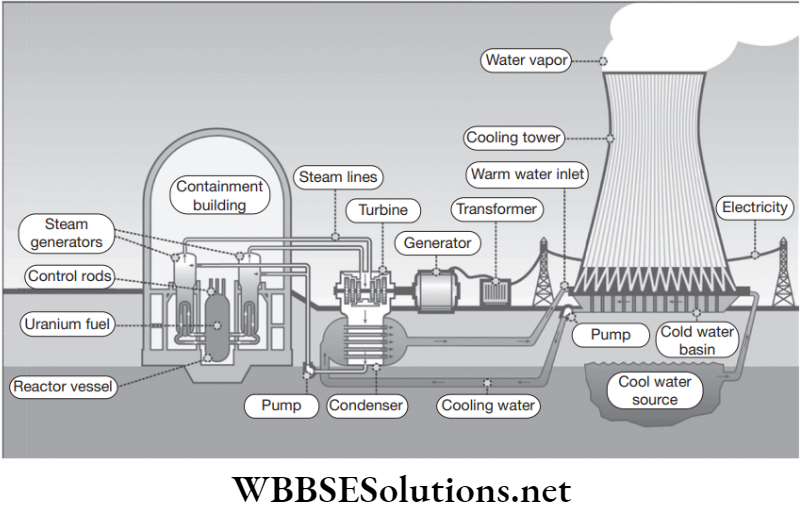
Nuclear Power

It is the most novel way of getting energy and quantitatively the most important renewable source of energy. Nuclear energy originates from the fission or fusion of uranium atoms. This produces massive heat to generate steam, which is then used by a turbine generator to generate electricity. Since, nuclear power plants do not burn fuel, they are environment friendly.

NEET Foundation Physics Work And Energy Nuclear energy

Fossil Fuels (Coal, Oil and Natural Gas)

Fossil fuels are the world’s dominant source of energy. Oil is converted into many products, the most used of which is gasoline. Natural gas is starting to become more common, vehicles are seen running on it. To get to the fossil fuel and convert it to use there has to be a heavy destruction and pollution of the ­environment.

The fossil fuel reserves are also limited, expecting to last only another 100 years given are the basic rate of consumption. It is estimated by 2040 that maximum of the fossil fuel deposits would get exhausted.

Understanding Energy Better

We come across different forms of energy in our daily lives. The biggest source of energy is the sun and also the tiniest source comes from nuclei of the atoms. Every action that we do involves energy from hitting a cricket ball, cycling, hitting a nail with the hammer, etc. The body which does work loses energy and the one on which work is done gains energy.

The demand for energy is increasing day by day and the pressure of extracting energy possesses a threat to our planet. We will discuss about energy demands and other threats later in the chapter.

A body which has energy has the capability of doing work. A body which has energy can exert a force on other bodies. Due to this, energy is transferred from one body to the other. The body which received energy may move/does work. The units of work are same as that of energy (Joule). Thus, 1 joule of energy is required to do 1 J of work.

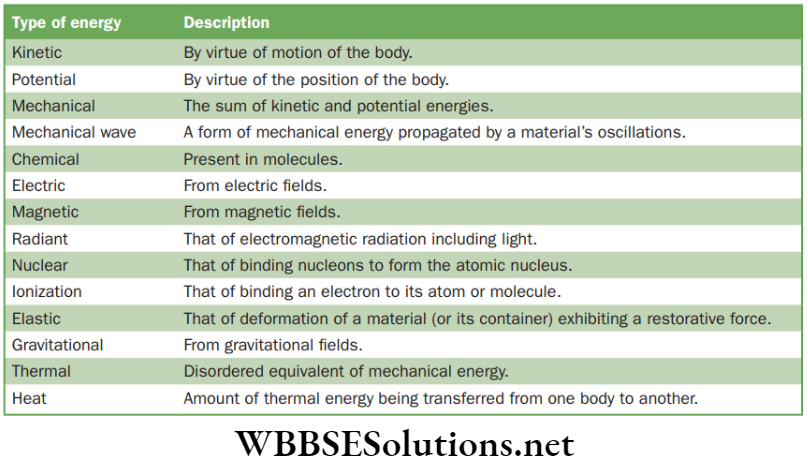
Forms of Energy

The energy present around us is available in different forms like heat energy, sound energy, light energy, electricity, chemical, mechanical (kinetic + potential), etc. They can be interchanged from one form to another. When work done on an object is known, upon which energy is acquired then it is called mechanical energy. They are of two types:

Forms of energy

NEET Foundation Physics Work And Energy Forms of energy

Kinetic Energy

The energy possessed by a body by virtue of its motion is called as kinetic energy. A body moving can do more work than a stable one. A rotating wheel, moving windmill, bullet fired from a gun, speeding car, etc. Greater the speed of the object, greater is the kinetic energy. Thus, objects in motion possess energy called as kinetic energy.

NEET Foundation Physics Work And Energy Examples of kinetic energy

Now, student may ask how much energy (kinetic) does a moving body possess? We will try to devise a ­formula for that.

NEET Foundation Physics Work And Energy Long Answer Question 5

Consider the above figure:

Consider a body of mass ’m’ starts moving from rest, with uniform velocity ’u’. After a time interval ’t’ its velocity becomes v.

If initial velocity of the body is u or vi = 0, final velocity vf = v and the displacement of body is ’S’. Then

First of all we will find the acceleration of body.

Using the equation of motion

2aS = vf2 – vi2

Putting the above mentioned values

2aS = v2 – 0

a = \(\frac{v^2}{2 S}\)

Now force is given by

F = ma

Putting the value of acceleration

F = \(m\left(\frac{v^2}{2 S}\right)\)

As we know that

Work done = F⋅S

Putting the value of F

Work done = \(\left(\frac{m v^2}{2 S}\right)(S)\)

Work done = \(\frac{m v^2}{2}\)

or

Work done = \(\frac{1}{2} m V^2\)

Since the work done in motion is called ‘kinetic energy’

i.e. K.E. = Work done

or

K.E. = \(\frac{1}{2} m V^2\)

Potential Energy

The energy possessed by the body by virtue of its height or position is called as potential energy. The energy gets stored in the body because of the work done on the object. The energy while doing work is stored in the body as potential energy.

It does not cause any alterations in its speed or velocity. Some of the examples where we come across with potential energy are that of pulling of rubber band, winding the key of a toy car, water in the water tank at the top of the house, etc.

NEET Foundation Physics Work And Energy Potential energy in a body

Potential Energy in a Body at Some Height

An object has energy known as potential energy when raised at a certain height. Greater the potential energy, greater is the height. Work is done on the object, against the gravity in bringing an object to a height. The energy gets stored in the object.

NEET Foundation Physics Work And Energy Potential energy

Gravitational potential energy of an object above the ground at a certain point is defined as raising the body to that point against the gravity.

Let us try to devise a formula to calculate the potential energy.

Consider an object of mass, m. Let it be raised through a height h from the ground. A force is required to do this. The minimum force required to raise the object is equal to the weight of the object mg. The object gains energy equal to the work done on it. Let the work done on the object against gravity be W. That is, work done,

W = force × displacement

= mg × h

= mgh

Since work done on the object is equal to mgh, energy equal to mgh units is gained by the object. This is the potential energy (EP) of the object.

Ep = mgh

The potential energy of an object at a height depends on the ground level or the zero level. An object in a given position can have a certain potential energy with respect to one level and a different value of potential energy with respect to another level. At ground potential energy is zero and at some height it is equal to mgh.

The potential attained by the body is independent of the path followed. The potential energy depends only on the initial and final positions. Energy is independent of the path followed.

Conservative and Non-Conservative Forces

Work done by gravity in moving object from one place to another depends only on the initial and final positions and doesn’t depend on the path taken. The work done by gravity from A to B is same by path 1, 2 and 3.

Hence the work done by such forces depends only on initial and final position and not on the path taken. Hence such forces are called conservative forces. Examples of conservative forces are Gravitational forces, spring force, etc.

On the other hand non conservative forces are those in which work done depends on path taken. For example fiction force is non conservative force.

NEET Foundation Physics Work And Energy Conservatie and non-conservative forces

Law of Conservation of Energy

This law states that energy can neither be created nor destroyed. It can only be changed from one form to the other. The total energy of the system remains constant.

According to the law of conservation of energy, energy can only be converted from one form to another; it can neither be created nor destroyed. The total energy before and after the transformation remains the same.

The law of conservation of energy is valid in all situations and for all kinds of transformations.

NEET Foundation Physics Work And Energy Law of conservation of energy

Consider a simple example. Let an object of mass m be made to fall freely from a height h. At the start, the potential energy is mgh and kinetic energy is zero. Why is the kinetic energy zero? It is zero because its velocity is zero. The total energy of the object is thus mgh.

As it falls, its potential energy will change into kinetic energy. If v is the velocity of the object at a given instant, the kinetic energy would be \(\frac{1}{2} m V^2\). As the fall of the object continues, the potential energy would decrease while the kinetic energy would increase.

When the object is about to reach the ground, h = 0 and v will be the highest. Therefore, the kinetic energy would be the largest and potential energy will be the least. However, the sum of the potential energy and kinetic energy of the object would be the same at all points. That is,

Potential energy + kinetic energy = constant

\(m g h+\frac{1}{2} m v^2=\mathrm{constant}\)

The sum of kinetic and potential energies gives the total mechanical energy of the system.

Efficient use of Energy

Energy is very important to us. We need energy in every form or the other to sustain or to carry out any work. From the naturally gifted resources, we get energy in one form or the other, for example, coal, petroleum, sunlight, etc. It is our duty to preserve and protect these resources. Judicious use of energy is very important to keep the resources available for future generations.


Chapter 4 Work And Energy Track Your Learning Question And Answers

Question 1. ______ is defined as the capacity of doing work.

  1. Work
  2. Energy
  3. Power
  4. None

Answer. 2. Energy

Question 2. The main source of energy is ______, which gives energy to all the entities of the universe either directly or indirectly.

  1. Sun
  2. Sea
  3. Ocean
  4. Coal

Answer. 1. Sun

Question 3. The energy used in households, industries and commercial establishments is usually expressed in:

  1. Joules
  2. Watt
  3. Kilowatt hour
  4. None of the options

Answer. 3. Kilowatt hour

Question 4. The largest group of geothermal power plants in the world are located in ______.

  1. Germany
  2. India
  3. United States
  4. UK

Answer. 3. United States

Question 5. Tidal energy uses rise and fall of tides to convert ______ energy of incoming and outgoing tides into electrical energy.

  1. Potential
  2. Mechanical
  3. Electrical
  4. Kinetic

Answer. 4. Kinetic

Question 6. When the speed of a bike increases by 120%, then its kinetic energy increases by:

  1. 4.84 times
  2. 3 times
  3. 1.44 times
  4. By 240 %

Answer. 1. 4.84 times

Question 7. How fast should a man of 50 kg run so that his kinetic energy reaches 500 J?

  1. 5 m/s
  2. 10 m/s
  3. 20 m/s
  4. 2(5)1/2 m/s

Answer. 4. 2(5)1/2 m/s

Chapter 4 Work And Energy Rate of Doing Work

We all consume energy at some rate. Therefore, rate of consuming energy is called power. Power measures the speed of work done, that is, how fast or slow the work is done. Power is defined as the rate of doing work or the rate of transfer of energy. If an agent does a work W in time t, then power is given by:

\(\text { Power }=\frac{\text { work }}{\text { time }} \text { or } P=\frac{W}{t}\)

The unit of power is watt having the symbol W. 1 watt is the power of an agent, which does work at the rate of 1 joule per second. We can also say that power is 1 W when the rate of consumption of energy is 1 J s-1. 1 watt = 1 joule/second or 1 W = 1 J s-1. We express larger rates of energy transfer in kilowatts (kW).

1 kilowatt = 1000 watts

1 kW = 1000 W

1 kW = 1000 J s-1

Key Points to Remember

  1. Work done on an object is defined as the magnitude of the force multiplied by the distance moved by the object in the direction of the applied force. The unit of work is joule: 1 joule = 1 newton × 1 metre.
  2. Work done on an object by a force would be zero if the displacement of the object is zero.
  3. An object having capability to do work is said to possess energy. Energy has the same unit as that of work.
  4. An object in motion possesses what is known as the kinetic energy of the object. An object of mass, m moving with velocity v has a kinetic energy of \(\frac{1}{2} m V^2\).
  5. The energy possessed by a body due to its position called the potential energy. The gravitational potential energy of an object of mass, m raised through a height, h from the earth’s surface is given by mgh.
  6. According to the law of conservation of energy, energy can only be transformed from one form to another; it can neither be created nor destroyed. The total energy before and after the transformation always remains constant.
  7. Energy exists in nature in several forms such as kinetic energy, potential energy, heat energy, chemical energy etc. The sum of the kinetic and potential energies of an object is called its mechanical energy.
  8. Power is defined as the rate of doing work. The SI unit of power is watt. 1 W = 1 J/s.
  9. The energy used in one hour at the rate of 1kW is called 1 kW h.

Chapter 4 Work And Energy Very Short Question and Answers

Question 1. Define power. What is the SI unit of power?
Answer:

Power:

Power is defined as total work done divided by total time taken. The SI unit of power is Watt.

Question 2. What is the commercial unit of energy? Convert it into Js-1
Answer:

Commercial unit of energy:

The commercial unit of energy is kilowatt-hour (kWh).

Question 3. A boy of mass 60 kg runs up a staircase of 50 steps in 10 s. If the height of each step is 10 cm, find his power. Take g = 10 m s-2.
Answer:

Given

A boy of mass 60 kg runs up a staircase of 50 steps in 10 s. If the height of each step is 10 cm

Weight of the boy = mg = 60 × 10 ms-2

= 600 N

Height of the staircase,

h = 50 × 10/100 m

= 5 m

Time taken to climb = 10 s

P = work done/time

P = mgh/t

P = 600 × 5/10 s

P = 300 W

Thus, power is 300 W.

Question 4. An electric bulb of 60 W is used for 6 h per day. Calculate the ‘units’ of energy consumed in one day by the bulb.
Answer:

Given

Power of electric bulb = 60 W

= 0.06 kW.

Time used,

t = 6 h

Energy = power × time taken

= 0.06 kW × 6 h

= 0.36 kWh

= 0.36 ‘units’.

The energy consumed by the bulb is 0.36 ‘units’.

Chapter 4 Work And Energy

Question 1. A pump transfers 500 L of water to the overhead tank of a building of height 12 m in 15 minutes. Calculate the power of motor pump.
(Take g = 10 ms-2) (Mass of 1 L of water = 1 kg)

  1. P = 66.7 W
  2. P = 68 W
  3. P = 72 W
  4. P = 83 W

Answer. 1. P = 66.7 W

Question 2. A machine does 192 J of work in 12 Sec. What is the power of the machine?

  1. 8 W
  2. 2 W
  3. 16 W
  4. 10 W

Answer. 3. 16 W

Question 3. A weighting 500 kg runs up a hill rising himself vertically 10 m in 40 Sec. Calculate power. given g = 9.8 m-1

  1. 1220 W
  2. 2000 W
  3. 1623 W
  4. 1225 W

Answer. 2. 2000 W

Question 4. A rickshaw puller pulls the rickshaw by applying a force of 200 N. If the rickshaw moves with constant velocity of 10 ms-1. Find the power of rickshaw puller.

  1. 2220 W
  2. 2000 W
  3. 2623 W
  4. 1005 W

Answer. 2. 2000 W

Question 5. Calculate the time taken 60 W bulb to consume 3600 J of energy.

  1. 3 min
  2. 60 min
  3. 6 min
  4. 1 min

Answer. 4. 1 min

Chapter 4 Work And Energy Practice Exercises

Question 1. When a body falls freely towards the earth, then its total energy

  1. increases
  2. decreases
  3. remains constant
  4. first increases and then decreases

Answer. 3. remains constant

Question 2. A car is accelerated on a levelled road and attains a velocity 4 times of its initial velocity. In this process the potential energy of the car

  1. does not change
  2. becomes twice to that of initial
  3. becomes 4 times that of initial
  4. becomes 16 times that of initial

Answer. 1. does not change

Question 3. In case of negative work the angle between the force and displacement is

  1. 45°
  2. 90°
  3. 180°

Answer. 4. 180°

Question 4. An iron sphere of mass 10 kg has the same diameter as an aluminium sphere of mass is 3.5  kg. Both spheres are dropped simultaneously from a tower. When they are 10m above the ground, they have the same

  1. acceleration
  2. momenta
  3. potential energy
  4. kinetic energy

Answer. 1. acceleration

Question 5. A girl is carrying a school bag of 3 kg mass on her back and moves 200 m on a levelled road. The work done against the gravitational force will be (g = 10 m s-2)

  1. 6 × 10³ J
  2. 6 J
  3. 0.6 J
  4. zero

Answer. 4. zero

Question 6. Which one of the following is not the unit of energy?

  1. joule
  2. newton metre
  3. kilowatt
  4. kilowatt hour

Answer. 3. kilowatt

Question 7. The work done on an object does not depend upon the

  1. displacement
  2. force applied
  3. angle between force and displacement
  4. initial velocity of the object

Answer. 4. initial velocity of the object

Question 8. Water stored in a dam possesses

  1. no energy
  2. electrical energy
  3. kinetic energy
  4. potential energy

Answer. 4. potential energy

Question 9. A body is falling from a height h. After it has fallen a height h/2 it will possess

  1. only potential energy
  2. only kinetic energy
  3. half potential and half kinetic energy
  4. more kinetic and less potential energy

Answer. 3. half potential and half kinetic energy

Chapter 4 Work And Energy Fill in the Blanks

Question 1. If force and displacement are in the same direction, the work would be ______.
Answer. Positive

Question 2. The work done on a 5 kg body to displace it by ______ is 5 J, given that force applied is 1 N.
Answer. 5 m

Question 3. Work done on a body get stored as ______.
Answer. Potential energy

Question 4. A bird sitting at a height has only ______ energy.
Answer. Potential

Question 5. Kinetic energy is a ______ quantity.
Answer. Scalar

Question 6. If the speed of a body is doubled, its kinetic energy must become ______.
Answer. Four times

Question 7. The sum of potential energy and kinetic energy is called ______ energy.
Answer. Mechanical

Question 8. When a ball is thrown up, ______ energy is converted into potential energy.
Answer. Kinetic

Question 9. Electricity is measured by electric meters installed in our homes that measure electric energy in units of ______.
Answer. Kilowatt-hour (kWh)

Question 10. Energy is a ______ quantity.
Answer. Scalar


Chapter 4 Work And Energy Match the Columns

Question 1. Match the column 1 with 2.

NEET Foundation Physics Work And Energy Correct Option 1

Select the correct option:

  1. A-3, B-1, C-4, D-2
  2. A-4, B-3, C-2, D-1
  3. A-3, B-4, C-1, D-2
  4. A-1, B-3, C-2, D-4

Answer. 2. A-4, B-3, C-2, D-1

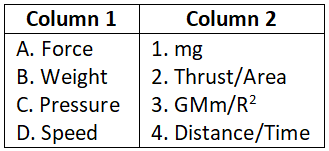
Question 2. Match the column 1 with 2.

NEET Foundation Physics Work And Energy Correct Option 2

Select the correct option:

  1. A-2, B-3, C-4, D-1
  2. A-4, B-3, C-2, D-1
  3. A-3, B-4, C-1, D-2
  4. A-1, B-3, C-2, D-4

Answer. 1. A-2, B-3, C-4, D-1

Chapter 4 Work And Energy Assertion Reasoning

Direction: Choose the correct answer from the following choices:

  1. Assertion and reason are both correct statements and reason is explanation for assertion.
  2. Assertion and reason are both correct statements but reason is not the correct explanation for assertion.
  3. Assertion is correct statement but reason is incorrect statement.
  4. Assertion is incorrect statement but reason is correct.

Question 1. Assertion (A): Humans are machines, they can do lot of work.
Reason (R): People are able to do work because of energy.
Answer. 1. Assertion and reason are both correct statements and reason is explanation for assertion.

Question 2. Assertion (A): Thus, work done by force acting on an object is equal to the magnitude of the force multiplied by the distance moved in the direction of the force.
Reason (R): Work has both magnitude and direction.
Answer. 3. Assertion is correct statement but reason is incorrect statement.

Question 3. Assertion (A): Work done is negative when the force acts opposite to the direction of displacement.
Reason (R): Work done is positive when the force is in the direction of displacement.
Answer. 2. Assertion and reason are both correct statements but reason is not the correct explanation for assertion.

Question 4. Assertion (A): The energy possessed by an object is measured in terms of its capacity of doing work.
Reason (R): The unit of energy is, therefore, the same as that of work, that is, joule (J).
Answer. 1. Assertion and reason are both correct statements and reason is explanation for assertion.

Question 5. Assertion (A): Flowing water, ­blowing wind, a running athlete, etc., possess kinetic energy.
Reason (R): Kinetic energy is the energy possessed by an object due to its motion.
Answer. 1. Assertion and reason are both correct statements and reason is explanation for assertion.

Chapter 4 Work And Energy Comprehension Passage

An object at a certain height possess potential energy. Now, work is done on it, against the gravity by bringing the object to some other point.

Gravitational potential energy of an object above the ground at a certain point is defined as raising the body to that point against the gravity.

Let us try to devise a formula to calculate the potential energy.

Consider an object of mass m. Let it be raised through a height h from the ground. A force is required to do this. The minimum force required to raise the object is equal to the weight of the object mg.

The object gains energy equal to the work done on it. Let the work done on the object against gravity be W. That is, work done.

W = force × displacement

= mg × h

= mgh

Since work done on the object is equal to mgh, energy equal to mgh units is gained by the object. This is the potential energy (EP) of the object.

Ep = mgh

Question 1. When a body is raised above the ground against gravity, which energy is used?

  1. Potential energy
  2. Kinetic energy
  3. Gravitational potential energy
  4. Gravitational kinetic energy

Answer. 3. Gravitational potential energy

Question 2. ‘Mgh’ is the formula for

  1. Kinetic energy
  2. Potential energy
  3. Both (a) and (b)
  4. None of the above

Answer. 2. Potential energy

Chapter 4 Work And Energy Integer Type Question And Answers

Question 1. Calculate the kinetic energy of the body of mass 4 kg moving with the velocity of 0.1 metre per second.
Answer. 0.02 J

Question 2. How much work is done by a force 20 N in moving an object through a distance of 2 m in direction of the force?
Answer. 40 J

Question 3. What is the work to be done to increase the velocity of a car from 20 km h-1 to 40 km h-1 if the mass of the car is 1200 kg?
Answer. 2.22 x 10⁵ J

Question 4. 10 tube lights each of 50 W are operated for 15 hours. Calculate electrical energy consumed in ‘units’.
Answer. 7.5 kWh

Question 5. Rahul, having her own mass 50 kg, climbs 20 m height along with 30 kg mass in 40 s. Calculate her power and work done. (take g = 10 m/s2)
Answer. W = 16 kJ P = 400 W

NEET Foundation Notes For Physics Chapter 3 Gravitation

Chapter 3 Gravitation

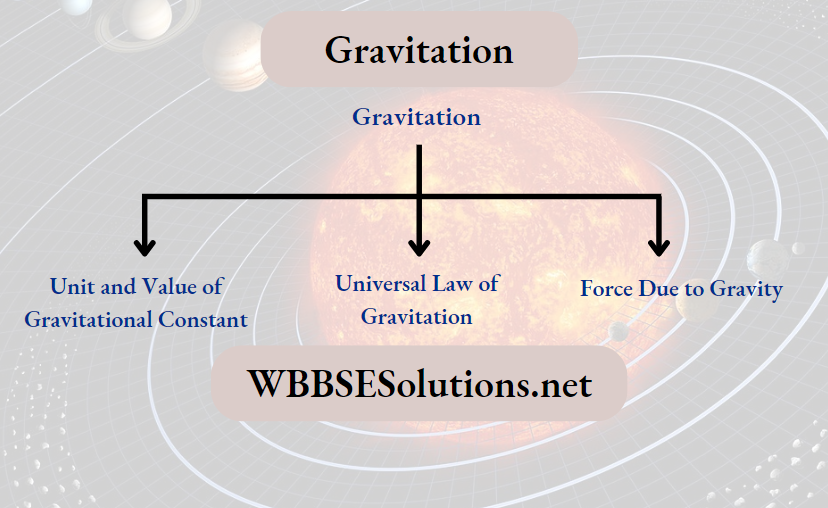
Gravitation

In our day to day life, we see that objects get attracted towards earth. When we throw a ball up in the air, it comes back towards earth. It means there is some force that compels objects to return back towards earth. This force is known as gravitational force. Gravitational force is a natural phenomenon where all objects having energy attract towards each other.

For example, stars, planet, sun, etc. Gravity is considered as the weakest among the four fundamental interactions of nature. The four fundamental interactions (fundamental forces) are gravitational, electromagnetic, strong nuclear and weak nuclear.

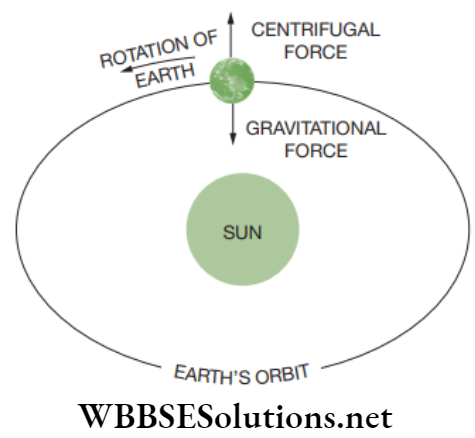
Due to gravitational force, earth and other planets are revolving around the sun in different orbit. In this chapter, we will understand about the gravitational force and its details.

NEET Foundation Physics Gravitation Gravitation

Gravitation

Chapter 3 Gravitation

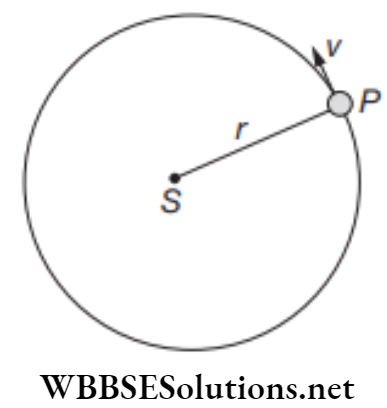
Gravitation is a natural phenomenon in which two objects having masses attract each other. We have studied that the moon revolves around the earth and the earth revolves around the sun. There are also other planets other than earth that rotate around the sun. The reason why planets revolve around the sun and why does not it go straight towards the sun is due to gravitational force.

Read and Learn More: NEET Foundation Notes

In 628, Brahmagupta, an Indian astronomer recognised gravity as a force of attraction. In 1600’s, Galileo Galilei, Robert Hooke and Johannes Kepler formulated the laws of gravity near the earth.

Class 11 Physics Class 12 Maths Class 11 Chemistry
NEET Foundation Class 12 Physics NEET Physics

While studying about the orbits of planets around the sun, Kepler determined that gravitational attraction varied with the separation and thus formulated his laws of planetary motion.

In 1687, Isaac Newton worked on planetary motion and its empirical measurements. His study established the law of universal gravitation.

NEET Foundation Physics Gravitation Effect of gravitational force on planet

Universal Law of Gravitation

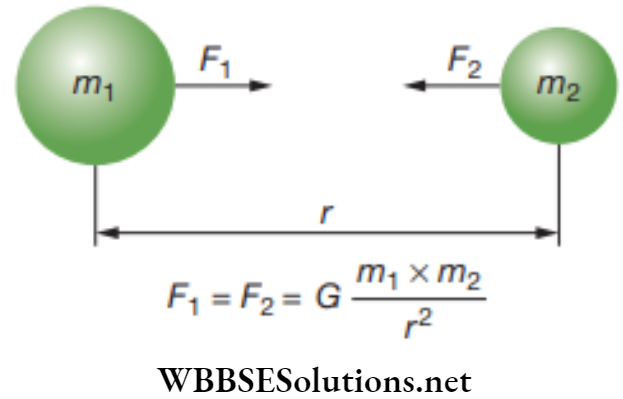
As we know, each particle of universe attracts the other particle. The force of attraction between two particles due to their masses is called gravitational force of attraction. Sir Issac Newton gave the law ‘Newton’s universal law of gravitation’ for its magnitude.

According to Newton, gravitational force of attraction (F) between two particles is:

  1. Directly proportional to the product of their masses
    i.e., F ∝ m1m2
  2. Inversely proportional to square of the distance between them
    i.e.,  \(F \propto \frac{1}{r^2}\)

Combining both the equations,

\(F \propto \frac{m_1 m_2}{r^2}\)

NEET Foundation Physics Gravitation Universal law of gravitation

\(F=G \frac{m_1 m_2}{r^2}\)

where G = constant of proportionality known as gravitational constant.

The value of G is same at all places and is not dependent on the nature of particles, temperature, medium and so on. Therefore, it is a universal constant and is therefore known as “universal gravitational constant”.

Unit and Value of Gravitational Constant

G = \(\frac{F \times r^2}{m_1 \times m_2}\)

\(\text { S.I. unit of } G=\frac{\text { Newton } \times \text { metre }^2}{\text { kilogram } \times \text { kilogram }}\)

= Nm2/kg2

Value of G = 6.67 × 10⁻¹¹ N m2/kg2

If m1 = 1 kg, m2 = 1 kg, r = 1 m, then G = F

Therefore, G can be defined as:

Gravitational constant ‘G’ is numerically equal to the gravitational force of attraction ­between two masses, each of mass 1 kg placed at a distance of 1 m.

Gravitational force between two masses is:

  1. Always attractive.
  2. Directly proportional to the product of the masses.
  3. Inversely proportional to the square of separation between them.
  4. Significant between heavenly bodies but is insignificant between ordinary bodies because of small magnitude of G.

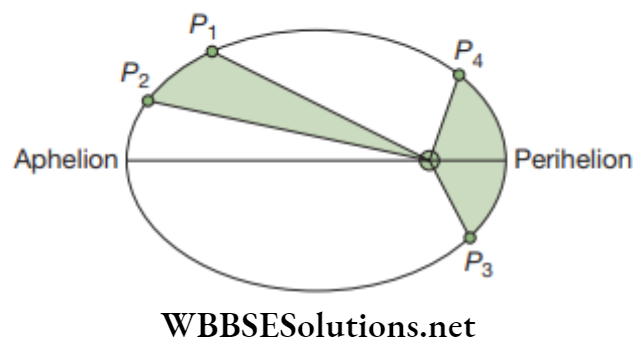
Kepler’s Law of Planetary Motion

Newton’s law of motion which state’s that the gravitational force between two masses varies inversely proportional to the square of the distance between them was proved by him on the basis of Kepler’s law of planetary motion.

There are three laws which explain the motion of planets. These laws are called Kepler’s law. They are:

1. Law of orbit: This is the 1st law of planetary motion which states that each planet moves around sun in an elliptical orbit with the sun at one of the foci of the orbit. This can be shown by the below image.

NEET Foundation Physics Gravitation Law of orbit

2. Law of areas: This is the 2nd law of Kepler which states that the line joining the sun and planet sweep out equal areas in equal interval of time. It means velocity of the planet around the sun is not constant. In the figure below the sun is at S, which is one of the foci of the elliptical orbit. If the time of travel of planet from P1 to P2 is same as that of P3 to P4, than according to this law, Area of OP1P2 = Area of OP3P4

NEET Foundation Physics Gravitation Law of areas

Therefore arc P1P2 is smaller than arc P3P4. This means that the speed of the planet is greater when it is closer to the sun, than its speed when it is farther away from the sun.

3. Law of periods: The square of the time taken by a planet to complete a revolution around the sun is directly proportional to the cube of semi major axis of the elliptical orbit. This is the third law of Kepler’s planetary motion.

i.e., T2 ∝ r3

Or T2 = constant × r3

i.e., T2/r3 = constant

Importance of Universal Law of Gravitation

The universal law of gravitation is important because it is:

  1. The force that binds us to the earth
  2. The motion of the moon around the earth
  3. The motion of planets around the Sun
  4. The tides due to the moon and the Sun

Characteristics of Gravitational Force

  1. Gravitational force acts at distance. It means it does not need any contact between the two objects or bodies.
  2. Gravitational force between the two bodies varies inversely proportional to the square of the distance between them
  3. Gravitational force between two bodies forms action reaction pair.

Chapter 3 Gravitation Free Fall

Any object that falls towards the earth is said to be in free fall. This happens due to gravitational force. On falling there is no change in the direction of motion of the objects but because of the earth’s attraction, there will be a change in magnitude of the velocity. Change in velocity causes acceleration.

NEET Foundation Physics Gravitation A small toy car falling down towards the earth

Motion of Objects Under the Influence of Gravitational Force of the Earth

The acceleration of a vertically falling object (a) = +g

The acceleration of an object vertically thrown up (a) = –g

If an object falls from rest freely under gravity from a height h, u = 0 and acceleration a is replaced by g then

v = gt

s = \(\frac{1}{2} g t^2\)

v2 = 2gh

If a body is thrown vertically downwards with an initial velocity u, then

v = u + gt

s = \(u t+\frac{1}{2} g t^2\)

v2 = u2 + 2gh

If an object is thrown vertically up with an initial velocity u, there will be retardation i.e. a = –g. Then, equations will be

v = u – gt

s = \(u t-\frac{1}{2} g t^2\)

v2 = u2 – 2gh

When the thrown object reaches its highest point, its final velocity v = 0, therefore

Maximum height hmax = \(\frac{u^2}{2 g}\)

Time taken to reach the highest point t = \(\frac{u}{g}\)

Object comes back to the earth in the same time t, therefore total journey time t’ = 2t = \(\frac{2 u}{g}\)

Total distance travelled by the object, h’ = 2 hmax = \(\frac{u^2}{g}\)

Force Due to Gravity

The force with which the earth attracts an object is called force due to gravity on the object. It always acts vertically downwards at the centre of gravity of the object. In vertical motion near the earth surface, the force of gravity of an object is assumed to be same throughout, assuming that the change in height of the object is much smaller than the radius of earth.

The force due to gravity on an object (with mass m) kept on the surface of the earth (mass is M and radius is R) is equal to the force of attraction between the earth and the object.

Equation

F = \(\frac{G M m}{R^2}\)

Let us assume M = 5.96 × 1024 kg

R = 6.37 × 10⁶ m

m = 1 kg

F = \(\frac{\left(6.67 \times 10^{-11}\right) \times\left(5.96 \times 10^{24}\right) \times 1}{\left(6.37 \times 10^6\right)^2}\)

= 9.8 N

This shows that earth attracts an object of mass 1 kg by a force of 9.8 N towards its centre.

Gravitational Force between Earth and the Sun

Mass of earth, m1 = 6 × 1024 kg

Mass of sun, m2 = 2 × 1030 kg

Distance between sun and earth, R = 1.5 × 10¹¹ m

Gravitational force between the sun and the earth,

F = \(G \frac{m_1 m_2}{r^2}\)

F = (6.67 × 10⁻¹¹ Nm2 kg-2 × 6 × 1024 kg × 2 × 1030 kg)/(1.5 × 1011 m)2

F = 3.6 × 10²² N

Gravitational Force between the Moon and the Earth

Mass of earth, m1 = 6 × 1024 kg

Mass of moon, m2 = 7.4 × 10²² kg

Gravitational force between earth and the moon is

F = \(G \frac{m_1 m_2}{r^2}\)

F = (6.67 × 10⁻¹¹ Nm2 kg-2 × 6 × 1024 kg × 7.4 × 1022 kg)/(3.8 × 108 m)2

F = 2.05 × 10²⁰ N

As an object gets attracted towards the earth, similarly the earth too gets attracted ­towards the object. An object is free to move so it starts moving towards the earth but the earth has higher inertia therefore it does not move towards the object.

For example, when a ball is thrown from a top of a building, due to gravitational force it falls on the ground. Earth has higher inertia than the ball therefore the earth doesn’t move from its location.

Centre of Mass and Centre of Gravity

Centre of Mass is the point in body where its whole mass is assumed to be concentrated. The centre of mass of a homogeneous sphere or cube must lie at its geometrical centre. Each particle or portion of the body experiences the force of gravity. The net effect of all these forces is equivalent to the effect of a single force, mg acting through a point called centre of gravity of a body.

On the surface of the earth, or near it, where the force of gravity is constant, the centre of mass also becomes the centre of gravity.

Application of Newton’s Law of Gravitation

1. Determination of masses of planets and stars: Knowing the values of g, R and G, it is possible to determine accurately the mass of any planet or star by using relationship,

\(M=\frac{g R^2}{G}\)

2. Estimating the masses of double stars: A double star is a system consisting of two stars orbiting around their common centre of masses. From the extent of irregularity in the motion of star due to gravitational pull by some other star bound to it is used for estimating the masses of star. Such irregularity in motion is called wobble.

Acceleration due to Gravity

The scientist Galileo did analysis on the motion of different objects under the force of attraction of the earth. From his experiments, he concluded that if objects of different sizes, masses fall at the same time and from the same height in vacuum, then they will reach the earth together. It shows that objects travel the same distance in same interval of time.

He also concluded that the velocity of a freely falling object does not remain constant instead it increases at a constant rate. In other words, the motion of a freely falling object is a uniformly accelerated motion. This acceleration is same for all objects.

The acceleration of a freely falling object does not depend on the mass, size and shape of the object. This acceleration is known as acceleration due to gravity.

The rate at which the velocity ofthe freely falling objectincreases is called acceleration due to gravity. It is a vector quantity.

It is represented by g.

NEET Foundation Physics Gravitation Two objects of different mass thrown at the same time

Unit

The S.I. unit of acceleration due to gravity is m/s2.

The value of g changes from place to place. On equator, it is slightly less as compared to that at poles. At altitudes above the earth’s surface or at depth below the earth surface value of g decreases. The value of g is zero at the centre of the earth. The mean value of g on the earth surface is taken to be 9.8 m/s2. The value of acceleration due to gravity of the earth is 9.8 m/s2

Relationship between g and G

Let g = acceleration due to gravity at a planet

M = mass

R = radius

m = mass of object

By Newton’s law of motion, force on a body due to gravity on its surface

F = mass × acceleration due to gravity

= m g

By Newton’s gravitational law, force is

F = \(\frac{G M m}{R^2}\)

Therefore,

\(\frac{G M m}{R^2}=m g\)

∴ Acceleration due to gravity

g = \(\frac{G M}{R^2}\)

i.e. acceleration due to gravity on the surface of a planet depends on its mass (M) and its radius (R).

Variation in the Value of g with Depth below the Surface of the Earth

Let us consider a body of mass m at a depth h below the surface of earth. Than radius of the inner solid sphere of the earth = R – h

Volume of the inner solid sphere of the earth = \(\frac{4}{3} \pi(R-h)^3\)

If d is the average density of the earth, then

Mass of inner solid sphere of earth = \(\frac{4}{3} \pi(R-h)^3 d\)

According to the law of gravitation,

\(m g_d=G \times \frac{4}{3} \pi(R-h)^5 d \times \frac{m}{(R-h)^2}\)

This gives

\(g_{\mathrm{d}}=G \times \frac{4}{3} \pi(R-h) d\)

On the surface of earth,

g = \(\frac{G M}{R^2}\)

= \(G \times \frac{4}{3} \pi R^3 \frac{d}{R^2}\)

= \(G \times \frac{4}{3} \pi R d\)

From equation (1) and (2)

\(\frac{g_d}{g}=\frac{\left(G \times \frac{4}{3} \pi(R-h) d\right)}{\left(G \times \frac{4}{3} \pi R d\right)}\)

= \(\frac{(R-h)}{R}\)

\(g_{\mathrm{d}}=g\left(\frac{1-h}{R}\right) \quad \text { or } \quad \frac{(R-h)}{R}<1\)

So, gd < g

Thus, the value of g at a depth inside the earth is less than that on the surface of the earth.

The value \(\frac{(R-h)}{R}\) decreases with the value of h, i.e., depth below the surface of earth. So the value of g decreases as we go down below the surface of earth.

NEET Foundation Physics Gravitation Difference between accleration due to gravity and gravitational constant

Chapter 3 Gravitation Mass

The mass of an object is the quantity of matter it contains. In other words, it is the measure of its inertia. It is a scalar quantity. The S.I. unit of mass is kilogram (kg). The mass of an object is constant, no matter if it is on earth or any other planet. If mass of a body is more, then its inertia will be more (Fig. 3.5).

NEET Foundation Physics Gravitation Mass kept in weighing machine

Chapter 3 Gravitation Weight

The weight of an object is the force with which the earth attracts it towards its centre. Weight is a vector quantity. The S.I. unit of weight is Newton (N) and its C.G.S. unit is dyne 1 N = 105 dyne The weight of an object is also known as the force of gravity on that object.

Weight of an Object on the Moon

Weight of an object on the earth is the force with which the earth attracts the object. Similarly, the weight of an object on the moon is the force with which the moon attracts the object. Moon exerts less force of attraction than the earth because the mass of moon is lesser than the earth.

Mass of object = m

Weight of mass on moon = Wm

Mass of moon = Mm

Radius = Rm

As per universal law of gravitation, the weight of the object on the moon

Wm = \(G \frac{M_m m}{R_m{ }^2}\) (1)

Let the weight of same object on earth = We

Mass of earth = M

Radius of earth = R

Then We = \(G \frac{M m}{R^2}\) (2)

On substituting the known value in Eq (1) and (2), and comparing them, we find that

Weight of object on moon = 1/6 Weight of object on earth

Relationship between Weight and Mass

Weight = mass × Acceleration due to gravity

W = m × g

The gravitational unit of weight in M.K.S. system = Kilogram force (kgf)

C.G.S. unit is gramme force (gf)

1 kgf = 9.8 N

980 Dyne = 9.8 × 10⁻³ N

Chapter 3 Gravitation Thrust and Pressure

Thrust

A force can be applied on a surface in any direction. If a force is applied on a surface in a direction normal or perpendicular to the surface, it is called thrust. The effect of thrust depends on the area of surface on which it acts. The effect of a thrust is less on a large area and vice versa.

NEET Foundation Physics Gravitation Thrust and pressure

Thrust exerted by an object on a surface is the force that object exerts on the surface which is equal to the weight of that object. Thrust is a vector quantity.

Unit

The S.I. unit of thrust = Newton (N)

C.G.S. unit of thrust = Dyne

Gravitational unit of thrust in M.K.S. system = kgf

Gravitational unit of thrust in C.G.S. system = gf

1 kgf = 9.8 N

1 gf = 980 dyne

Pressure

Pressure is the thrust per unit area of the surface. Pressure is a scalar quantity.

Pressure = \(\frac{\text { thrust }}{\text { Area }}\)

\(P=\frac{F}{A}\)

Factors Affecting the Pressure

The pressure exerted on a surface depends on two factors

  1. Thrust
  2. Area on which the thrust is applied

Unit

The S.I. unit of pressure = \(\frac{\text { Newton }}{\text { metre }^2}=\frac{\mathrm{N}}{\mathrm{m}^2}=\text { pascal }\)

Symbol of pascal = Pa

C.G.S. unit = dyne/cm2

1 dyne/cm2 = 0.1 N/m2

1 N/m2 = 10 dyne/cm2

1 bar = 105 N/m2

1 millibar = 10-3 bar = 102 N/m2

Pressure in Fluids

Any substance that can flow is called a fluid. Therefore, all liquids and gases are fluids. As we know solid exerts pressure on a surface due to its weight. Similarly, a fluid exerts pressure due to its weight.

We have studied that a solid exerts pressure on the surface but liquid exerts pressure at all points and in all directions. It exerts pressure at the bottom and also on the sides of the container.

Factors Affecting the Pressure at a Point in a Liquid

The pressure at a point inside the liquid depends directly on the following factors:

  1. Depth of the point below the free surface (h)
  2. Density of liquid (d)
  3. Acceleration due to gravity (g) at that place.

So, pressure at a point due to a fluid is given by

P = h × d × g

Laws of Liquid Pressure

  1. Pressure at a point inside liquid increases with the depth from its free surface.
  2. In a stationary liquid, pressure is same at all the points on a horizontal plane.
  3. Pressure is same in all the directions about a point in liquid.
  4. Pressure at same depth is different in different liquids. It increases with the increase in density of liquid.
  5. A liquid seeks its own level.

Buoyancy

When an object is partially or completely immersed in water, an upward force acts on it. This upward force is known as buoyancy. Another name of this force is buoyant force or upthrust. It is denoted by the symbol FB.

The property of a fluid to exert an upward force on a body immersed in it is called buoyancy.

Why Objects Float or Sink when Placed on the Surface of Water?

To understand it let us take an example. Take an empty closed bottle and dip it in a vessel filled with water. You will notice that most of the part of the bottle is floating above the water level. Now push the bottle, an upwardforce will be felt. As we try to push the bottle inside water, we need to apply more and more force to dip it completely inside the water.

Even after it is completely dipped in water, force is required to let it remain there. As soon as we remove the force, the bottle will come up again and starts floating. This is due to upthrust of water.

Characteristic Properties of Upthrust

  1. Larger the volume of an object submerged in fluid, greater is the upthrust.
  2. For same volume inside the fluid, more the density of fluid, greater is the upthrust.
  3. The upthrust acts on an object in upward direction at the centre of buoyancy.

Factors Affecting the Upthrust

The magnitude of upthrust on an object due to liquid depends on the following factors

  1. Volume of object submerged in the liquid (V).
  2. Density of the liquid in which the object is submerged (dl) and
  3. Acceleration due to gravity (g) at that place.

Chapter 3 Gravitation Archimedes’ Principle

When an object is immersed in a liquid, it occupies the space that was earlier occupied by the liquid. Volume of liquid displaced by the object = Volume of submerged part of object

Therefore, the object experiences an upthrust which is equal to the weight of the liquid displaced.

NEET Foundation Physics Gravitation Archimedes principle

Archimedes’s Principle States

When an object is immersed in a liquid partially or completely, it experiences an upthrust, which is equal to the weight of liquid displaced by it.

Illustration

In the a metallic piece is suspended with the help of a thread, from the hook of a spring balance. Note its weight. Now, take a vessel and fill it with water. Keep a measuring cylinder next to the vessel. Now dip the metallic piece inside the water.

Some water will get collected in the measuring cylinder. Now note the weight of the solid and also measure the volume of water in the measuring cylinder.

The density of water is 1 g/cm3, the volume of collected water in the measuring ­cylinder is equal to the mass in g or weight in gf of the water displaced by the solid when solid is completely dipped inside water.

It is found that the weight of water displaced by the solid is equal to the loss in weight of the solid in water. Loss in weight of the body is due to upthrust. So, upthrust is equal to weight of water displaced by the body. This verifies Archimedes’ Principle.

Chapter 3 Gravitation Relative Density

We have already studied that density of a substance is its mass per unit volume.

\(\text { Density }=\frac{\text { mass of the substance }}{\text { volume of the substance }}\)

Relative Density (R.D.) of a substance is the ratio of the density of that substance to the density of water at 4 °C.

\(\text { Relative Density }=\frac{\text { density of substance }}{\text { density of water at } 4^{\circ} \mathrm{C}}\)

= \(\frac{\text { mass of unit volume of substance }}{\text { mass of unit volume of water at } 4^{\circ} \mathrm{C}}\)

= \(\frac{\text { mass of substance }}{\text { mass of equal volume of water at } 4^{\circ} \mathrm{C}}\)

Relative density of a substance is defined as the ratio of mass of the substance to the mass of an equal volume of water at 4°C.

Unit

As it is a pure ratio it has no unit.

Chapter 3 Gravitation Fill In The Blanks

Question 1. The upward force acting onthe object immersed in liquid is known as ________.
Answer. Buoyancy

Question 2. ___________ is the force acting on a body normal to the surface.
Answer. Thrust

Question 3. A fluid contained in a vessel exerts a pressure at all points and in all directions. (True/False)
Answer. True

Question 4. The pressure experienced by a large surface area will be _________.
Answer. Less

Question 5. The Earth’s speed is ______ when it is closer to the Sun.
Answer. More

Question 6. The orbit of Earth around the Sun is ______.
Answer. Elliptical

Question 7. The acceleration due to gravity depends on mass and ______ of the planet.
Answer. Radius

Question 8. The weight of object in water is called its ______.
Answer. Apparent weight

Question 9. Weight of a body on Earth = ______ times the weight of a body on Moon.
Answer. Six

Question 10. To increase the gravitational force between two bodies, the distance between them must be ______.
Answer. Decreased

Question 11. A stone goes up in the air due to ______.
Answer. Kinetic energy

Question 12. ‘G’ is the ______ gravitational constant.
Answer. Universal

Question 13. Water exerts force on a submerged stone in the ______ direction.
Answer. Upward

Question 14. Weight of a body is ______ when measured underwater.
Answer. Less

Question 15. The value of acceleration due to gravity __________ if we go down below the surface of earth.
Answer. Decreases

Question 16. The acceleration due to gravity depends on the mass of the object. (True/False)
Answer. False

Question 17. _____________ is the point in body where its whole mass is assumed to be concentrated.
Answer. Centre of Mass

Question 18. The value of acceleration due to gravity of the earth is ____________.
Answer. 9.8 m/s2

Chapter 3 Gravitation Match the Columns

Question 1. Choose the correct unit.

NEET Foundation Physics Gravitation Correct Option 1

Select the correct option:

  1. A-1, B-2, C-3, D-4
  2. A-4, B-3, C-2, D-1
  3. A-2, B-1, C-3, D-4
  4. A-2, B-3, C-1, D-4

Answer. 3. A-2, B-1, C-3, D-4

Question 2. Choose the correct unit.

NEET Foundation Physics Gravitation Correct Option 2

Select the correct option:

  1. A-1, B-2, C-3, D-4
  2. A-4, B-3, C-2, D-1
  3. A-2, B-1, C-3, D-4
  4. A-2, B-3, C-1, D-4

Answer. 2. A-4, B-3, C-2, D-1

Question 3. Choose the correct nature of the physical quantities.

NEET Foundation Physics Gravitation Correct Option 3

Select the correct option:

  1. A-1, B-2, C-3, D-4
  2. A-4, B-3, C-2, D-1
  3. A-2, B-1, C-3, D-4
  4. A-2, B-3, C-1, D-4

Answer. 1. A-1, B-2, C-3, D-4

Question 4. Choose the correct equation.

NEET Foundation Physics Gravitation Correct Option 4

Select the correct option:

  1. A-1, B-2, C-3, D-4
  2. A-4, B-3, C-2, D-1
  3. A-2, B-1, C-3, D-4
  4. A-3, B-1, C-2, D-4

Answer. 4. A-3, B-1, C-2, D-4

Chapter 3 Gravitation Assertion Reasoning

Direction: For the following questions the options will remain the following:

  • Both A and R are correct and R is correct explanation of A.
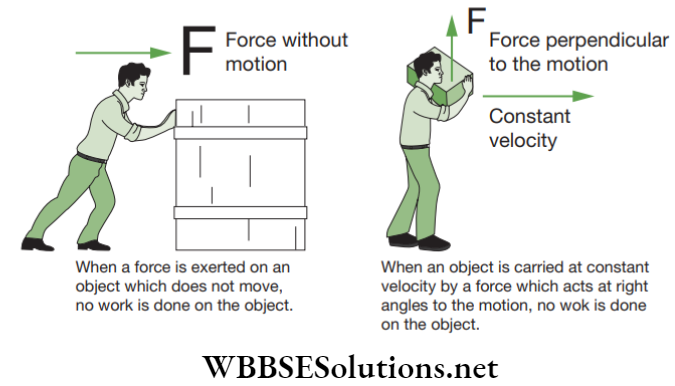
  • Both A and R are correct but R is not a logical explanation of A.
  • A is correct but R is incorrect.
  • R is correct but A is incorrect.
  1. Assertion: Relative Density has no unit.
    Reason: It is a unit.
  2. Assertion: The liquid will flow out from the holes of the vessel.
    Reason: This is because liquid exerts pressure on the wall of the vessel.
  3. Assertion: Weight is a scalar quantity.
    Reason: Force can be applied towards earth and in opposite direction.

Chapter 3 Gravitation Comprehension Passage

Sir Issac Newton was born in 1642 in Woolsthorpe near Grantham, England. He belonged to a poor family. His interest was not into farming, Instead, he went for studies to Cambridge University in the year 1661.

In the year 1665, the incident of falling apple happened. This incident made him think about the gravity of force which intact moon in its orbit. This gave birth to the invention of universal law of gravitation. He was the first person to discover about gravity.

Newton gave laws of motion. Along with it he worked on light and colour. To do observations on astrology, he designed an astronomical telescope. He was good in mathematics so and invented calculus.

Question 1. In which year Issac Newton was born?

  1. 1662
  2. 1642
  3. 1622
  4. 1602

Answer. 2. 1642

Question 2. In which year did apple fall on Newton’s head?

  1. 1642
  2. 1662
  3. 1665
  4. 1675

Answer. 3. 1665

Question 3. Who invented universal law of gravitation?

  1. Issac
  2. Newton
  3. Issac Newton
  4. Alberto

Answer. 3. Issac Newton

Question 4. In which country was Issac newton born?

  1. England
  2. Germany
  3. London
  4. India

Answer. 1. England

Question 5. Which branch of mathematics was invented by Issac Newton?

  1. Integer
  2. Algebra
  3. Boolean
  4. Calculus

Answer. 4. Calculus

Question 6. Centre of mass becomes the centre of gravity

  1. At the core of the earth
  2. On the surface of the earth
  3. Force of gravity varies
  4. Never happens

Answer. 1. At the core of the earth

NEET Biology Class 9Diversity In Living Organisms Question And Answers

Chapter 3 Diversity In Living Organisms Question And Answers

Introduction Of Living Organisms

Have you ever thought of the multitude of life-forms that surround us?

Each organism is different from all others to a lesser or greater extent. For instance, consider yourself and a friend. Clearly, the movement to be made depends on the event that is triggering it.

Are you both of the same height? Does your nose look exactly like your friend’s nose? Is your hand-span the same as your friend’s?

Read And Learn More NEET Biology Class 9 Question And Answers

However, if we were to compare ourselves and our friends with a monkey, what would we say? Obviously, we and our friends have a lot in common when we compare ourselves with a monkey. But suppose we were to add a cow to the comparison? We would then think that the monkey has a lot more in common with us than with the cow. But suppose we were to add a cow to the comparison?

We would then think that the monkey has a lot more in common with us than with the cow.

NEET Foundation Class 9 Biology Diversity In Living Organisms Introduction

Activity

We have heard of desi cows and Jersey cows.

Does a desi cow look like a Jersey cow? Do all desi cows look alike? Will we be able to identify a Jersey cow in a crowd of desi cows that don’t look like each other? What is the basis of our identification?

In this activity, we had to decide which characteristics were more important in forming the desired category. Hence, we were also deciding which characteristics could be ignored. Now, think of all the different forms in which life occurs on earth. On one hand we have microscopic bacteria of a few micrometre in size.

While on the other hand we have blue whale and red wood trees of california of approximate sizes of 30 metres and 100 metres repectively. Some pine trees live for thousands of years while insects like mosquitoes die within a few days.

Life also ranges from colourless or even transparent worms to brightly coloured birds and flowers. This bewildering variety of life around us has evolved on the earth over millions of years. However, we do not have more than a tiny fraction of this time to try and understand all these living organisms, so we cannot look at them one by one.

Instead, we look for similarities among the organisms, which will allow us to put them into different classes and then study different classes or groups as a whole.

In order to make relevant groups to study the variety of life forms, we need to decide which characteristics decide more fundamental differences among organisms. This would create the main broad groups of organisms. Within these groups, smaller sub­groups will be decided by less important characteristics.

NEET Biology Class 9 Diversity In Living Organisms Question And Answers

Chapter 3 Diversity In Living Organisms Basis of Classification

Aristotle Classification

Attempts at classifying living things into groups have been made since time immemorial. Greek thinker Aristotle classified animals according to whether they lived on land, in water or in the air. This is a very simple way of looking at life, but misleading too.

For example, animals that live in the sea include corals, whales, octopuses, starfish and sharks. We can immediately see that these are very different from each other in numerous ways. In fact, their habitat is the only point they share in common. This is no good as a way of making groups of organisms to study and think about.

Requirements for Classification

We therefore need to decide which characteristics to be used as the basis for making the broadest divisions. Then we will have to pick the next set of characteristics for making sub-groups within these divisions.

This process of classification within each group can then continue using new characteristics each time. Before we go on, we need to think about what is meant by ‘characteristics’.

NEET Biology Class 9 Question And Answers WBBSE Class 9 History Notes WBBSE Solutions for Class 9 Life Science and Environment
WBBSE Class 9 Geography And Environment Notes WBBSE Class 9 History Multiple Choice Questions WBBSE Class 9 Life Science Long Answer Questions
WBBSE Solutions for Class 9 Geography And Environment WBBSE Class 9 History Long Answer Questions WBBSE Class 9 Life Science Multiple Choice Questions
WBBSE Class 9 Geography And Environment Multiple Choice Questions WBBSE Class 9 History Short Answer Questions WBBSE Solutions For Class 9 Maths
WBBSE Solutions for Class 9 History WBBSE Class 9 History Very Short Answer Questions WBBSE Solutions for Class 9 Physical Science and Environment


Characteristics – Its Meaning

When we are trying to classify a diverse group of organisms, we need to find ways in which some of them are similar enough to be thought of together. These ‘ways’, in fact, are details of appearance or behaviour, in other words, form and function.

What we mean by a characteristic is a particular form or a particular function. Most of us have five fingers on each hand is thus a characteristic. We can run, but the banyan tree cannot, is also a characteristic.

To understand how some characteristics are decided as being more fundamental than others, let us consider how a stone wall is built. The stones used will have different shapes and sizes. The stones at the top of the wall would not influence the choice of stones that come below them.

On the other hand, the shapes and sizes of stones in the lowermost layer will decide the shape and size of the next layer and so on. The stones in the lowermost layer are like the characteristics that decide the broadest divisions among living organisms. They are independent of any other characteristics in their effects on the form and function of the organism.

The characteristics in the next level would be dependent on the previous one and would decide the variety in the next level. In Diversity in Living Organisms this way, we can build up a whole hierarchy of mutually related characteristics to be used for classification. Now-a-days, we look at many inter-related characteristics starting from the nature of the cell in order to classify all living organisms.

What are some concrete examples of such characteristics used for a hierarchical classification?

Characteristics – Some Examples

  • A eukaryotic cell has membrane-bound organelles, including a nucleus, which allow cellular processes to be carried out efficiently in isolation from each other. Therefore, organisms which do not have a clearly demarcated nucleus and other organelles would need to have their biochemical pathways organised in very different ways. This would have an effect on every aspect of cell design. Further, nucleated cells would have the capacity to participate in making a multicellular organism because they can take up specialised functions. Therefore, this is a basic characteristic of classification.
  • Do the cells occur singly or are they grouped together and do they live as an indivisible group? Cells that group together to form a single organism use the principle of division of labour. In such a body design, all cells would not be identical. Instead, groups of cells will carry out specialised functions. This makes a very basic distinction in the body designs of organisms. As a result, an Amoeba and a worm are very different in their body design.
  • Do organisms produce their own food through the process of photosynthesis?Being able to produce one’s own food versus having to get food from outside would make very different body designs necessary.
  • Of the organisms that perform photosynthesis (plants), what is the level of organisation of their body?

We can see that, even in these few questions that we have asked, a hierarchy is developing. The characteristics of body design used for classification of plants will be very different from those important for classifying animals. This is because the basic designs are different, based on the need to make their own food (plants), or acquire it (animals).

Therefore, these design features (having a skeleton, for example) are to be used to make sub-groups, rather than making broad groups.

Chapter 3 Diversity In Living Organisms Classification & Evolution

Basis for Classification

All living things are identified and categorised on the basis of their body design in form and function. Some characteristics are likely to make more wide-ranging changes in body design than others. So, once a certain body design comes into existence, it will shape the effects of all other subsequent design changes, simply because it already exists.

In other words, characteristics that came into existence earlier are likely to be more basic than characteristics that have come into existence later. This means that the classification of life forms will be closely related to their evolution.

What is Evolution?

Most life forms that we see today have arisen by an accumulation of changes in body design that allow the organism possessing them to survive better.

Charles Darwin first described this idea of evolution in 1859 in his book, The Origin of Species. When we connect this idea of evolution to classification, we will find some groups of organisms which have ancient body designs that have not changed very much.

We will also find other groups of organisms that have acquired their particular body designs relatively recently.

Those in the first group are frequently referred to as primitive or lower organisms, while those in the second group are called advanced or higher organisms.

In reality, these terms are not quite correct since they do not properly relate to the differences. All that we can say is that some are Older organisms, while some are Younger organisms.

Chapter 3 Diversity In Living Organisms The Hierarchy of Classification-Groups

Biologists, such as Ernst Haeckel (1894), Robert Whittaker (1959) and Carl Woese (1977) have tried to classify all living organisms into broad categories, called kingdoms.

Whittaker’s Classification

The classification Whittaker proposed has five kingdoms: Monera, Protista, Fungi, Plantae and Animalia, and is widely used.

These groups are formed on the basis of their cell structure, mode and source of nutrition and body organisation.

Woese Classfication

The modification Woese introduced by dividing the Monera into Archaebacteria (or Archaea) and Eubacteria (or Bacteria) is also in use.

NEET Foundation Class 9 Biology Diversity In Living Organisms Hirearchy

Understanding Biodiversity for NEET

Naming of Subgroups

Further classification is done by naming the sub-groups at various levels as given in the following scheme:

KingdomPhylum (for animals) / Division (for plants)  Class orderFamilyGenusspecies

By separating organisms on the basis of a hierarchy of characteristics into smaller and smaller groups, we arrive at the basic unit of classification, which is a ‘species’.

So what organisms can be said to belong to the same species? Broadly, a species includes all organisms that are similar enough to breed and perpetuate.

Monera

Organisms of this class do not have a defined nucleus or organelles, nor do any of them show multi-cellular body designs. Some of them have cell walls while some do not. The mode of nutrition of organisms in this group can be either by synthesising their own food (autotrophic) or getting it from the environment (heterotrophic).

Examples

NEET Foundation Class 9 Biology Diversity In Living Organisms Monera

Protista

This group includes many kinds of unicellular eukaryotic organisms.Some of these organisms use appendages, such as hair-like cilia or whip-like flagella for moving around. Their mode of nutrition can be autotrophic or heterotrophic.

Examples

NEET Foundation Class 9 Biology Diversity In Living Organisms Paramecium

NEET Foundation Class 9 Biology Diversity In Living Organisms Amoeba

NEET Foundation Class 9 Biology Diversity In Living Organisms Euglena

Fungi

These are heterotrophic eukaryotic organisms. They use decaying organic material as food and are therefore called Saprophytes. Many of them have the capacity to become multicellular organisms at certain stages in their lives.They have cell-walls made of a tough complex sugar called chitin.

Examples

NEET Foundation Class 9 Biology Diversity In Living Organisms Fungi

Some fungal species live in permanent mutually dependent relationships with blue-green algae (or cyanobacteria). Such relationships are called Symbiotic. These symbiobic life forms are called Lichens.We have all seen lichens as the slow-growing large coloured patches on the bark of trees.

Plantae

These are multicellular eukaryotes with cell walls. They are autotrophs and use chlorophyll for photosynthesis. Thus, all plants are included in this group. Since plants and animals are most visible forms of the diversity of life around us, we will look at the subgroups in this category later.

Animalia

These include all organisms which are multicellular eukaryotes without cell walls. They are heterotrophs. Again, we will look at their subgroups a little later in upcoming slides.

Chapter 3 Diversity In Living Organisms Worksheet 1

Question 1. The five kingdom classification includes Kingdoms Monera, Protista, Fungi, Planate, and Animalia. Bacteria are classified under Kingdom

  1. Fungi
  2. Protista
  3. Monera
  4. Animalia

Answer. 3. Monera

Question 2. In micro-organisms, locomotion occurs through different methods. Cilia are body structures that help them in movement. They also move with the help of pseudopodia. Which of the following organisms moves with the help of pseudopodia?

  1. Euglena
  2. Bacteria
  3. Amoeba
  4. Paramecium

Answer. 3. Amoeba

WBBSE Class 9 Diversity in Living Organisms Q&A

Question 3. Which locomotive structure is exhibited by amoeba?

  1. Pseudopodia
  2. Flagella
  3. Cilia
  4. Fins

Answer. 1. Pseudopodia

Chapter 3 Diversity In Living Organisms Plantae

The first level of classification among plants depends on whether the plant body has well differentiated, distinct components. The next level of classification is based on whether the differentiated plant body has special tissues for the transport of water and other substances within it. Further classification looks at the ability to bear seeds and whether the seeds are enclosed within fruits.

Thallophyta

Plants that do not have well-differentiated body design fall in this group. The plants in this group are commonly called algae. These plants are predominantly Aquatic.

Examples

NEET Foundation Class 9 Biology Diversity In Living Organisms Thallophyta

Bryophyta

These are called the amphibians of the plant kingdom. The plant body is commonly differentiated to form stem and leaf-like structures. However, there is no specialised tissue for the conduction of water and other substances from one part of the plant body to another.

Examples

NEET Foundation Class 9 Biology Diversity In Living Organisms Bryophyta

Pteridophyta

In this group, the plant body is differentiated into roots, stem and leaves and has specialised tissue for the conduction of water and other substances from one part of the plant body to another. Some examples are Marsilea, ferns and horse-tails.

NEET Foundation Class 9 Biology Diversity In Living Organisms Pteridophyta

The thallophytes, the bryophytes and the pteridophytes have naked embryos that are called Spores. The reproductive organs of plants in all these three groups are very inconspicuous, and they are therefore called ‘cryptogamae’, or ‘those with hidden reproductive organs’. On the other hand, plants with well-differentiated reproductive tissues that ultimately make seeds are called Phanerogams.

Seeds are the result of the reproductive process. They consist of the embryo along with stored food, which serves for the initial growth of the embryo during germination. This group is further classified, based on whether the seeds are naked or enclosed in fruits, giving us two groups: gymnosperms and angiosperms.

Gymnosperms

This term is made from two Greek words: gymno- means naked and sperma- means seed. The plants of this group bear naked seeds and are usually perennial, evergreen and woody. Examples are pines, such as deodar.

Angiosperms

This word is made from two Greek words: angio means covered and sperma- means seed. The seeds develop inside an organ which is modified to become a fruit. Cotyledons are called ‘seed leaves’ because in many instances they emerge and become green when the seed germinates. These are also called flowering plants. Plant embryos in seeds have structures called cotyledons.

Thus, cotyledons represent a bit of pre-designed plant in the seed. The angiosperms are divided into two groups on the basis of the number of cotyledons present in the seed. Plants with seeds having a single cotyledon are called monocotyledonous or monocots. Plants with seeds having two cotyledons are called Dicots.

Chapter 3 Diversity In Living Organisms Animalia

These are organisms which are eukaryotic, multicellular and heterotrophic. Their cells do not have cell-walls. Most animals are mobile. They are further classified based on the extent and type of the body design differentiation found.

Porifera

Porifera means organisms with holes. These are non-motile animals attached to some solid support. There are hole s or pores, all over the body. Some of these species live in colonies (corals), while others have a solitary like-span (Hydra). These lead to a canal system that helps in circulating water throughout the body to bring in food and oxygen.

These animals are covered with a hard outside layer or skeleton. The body design involves very minimal differentiation and division into tissues. They are commonly called sponges, and are mainly found in marine habitats.

Jellyfish and sea anemones are common examples.

NEET Foundation Class 9 Biology Diversity In Living Organisms Porifera

Coelenterata

These are animals living in water. They show more body design differentiation. There is a cavity in the body. The body is made of two layers of cells: one makes up cells on the outside of the body, and the other makes the inner lining of the body. Some of these species live in colonies (corals), while others have a solitary like-span (Hydra). Jellyfish and sea anemones are common examples.

NEET Foundation Class 9 Biology Diversity In Living Organisms Hydra

NEET Foundation Class 9 Biology Diversity In Living Organisms Sea anemone

Platyhelminthes

The body of animals in this group is far more complexly designed than in the two other groups we have considered so far. The body is bilaterally symmetrical, meaning that the left and the right halves of the body have the same design. There are three layers of cells from which differentiated tissues can be made, which is why such animals are called triploblastic.

This allows outside and inside body linings as well as some organs to be made. There is thus some degree of tissue formation. However, there is no true internal body mcavity or coelom, in which well-developed organs can be accommodated. The body is flattened dorsiventrally, meaning from top to bottom, which is why these animals are called flatworms.

They are either free-living or parasitic. Some examples are free-living animals like planarians, or parasitic animals like liverflukes.

NEET Foundation Class 9 Biology Diversity In Living Organisms Liver fulke

NEET Foundation Class 9 Biology Diversity In Living Organisms Tape worn

Annelida

Annelid animals are also bilaterally symmetrical and triploblastic, but in addition they have a true body cavity. This allows true organs to be packaged in the body structure. There is, thus, extensive organ differentiation This differentiation occurs in a segmental fashion, with the segments lined up one after the other from head to tail. These animals are found in a variety of habitats- fresh water, marine water as well as land.

Earthworms and leeches are familiar examples.

NEET Foundation Class 9 Biology Diversity In Living Organisms Annelida

Nematoda

The nematode body is also bilaterally symmetrical and triploblastic. However, the body is cylindrical rather than flattened. There are tissues, but no real organs, although a sort of body cavity or a pseudo-coelom, is present. These are very familiar as parasitic worms causing diseases, such as the worms causing elephantiasis (filarial worms) or the worms in the intestines (roundworm or pinworms).

NEET Foundation Class 9 Biology Diversity In Living Organisms Nematoda

Arthropoda

This is probably the largest group of animals. These animals are bilaterally symmetrical and segmented. There is an open circulatory system, and so the blood does not flow in well-defined blood vessels. The coelomic cavity is blood-filled. They have jointed legs (the word ‘arthropod’ means ‘jointed legs’).

Examples : Prawns, Butterflies, houseflies, spiders, scorpions and crabs.

NEET Foundation Class 9 Biology Diversity In Living Organisms Arthropoda

Mollusca

In the animals of this group, there is bilateral symmetry. The coelomic cavity is reduced. There is little segmentation. There is a foot that is used for moving around.

Examples are snails and mussels.

NEET Foundation Class 9 Biology Diversity In Living Organisms Mollusca

Echinodermata

In Greek, echinos means hedgehog, and derma means skin.Thus, these are spiny skinned organisms. These are exclusively free-living marine animals. They are triploblastic and have a coelomic cavity. They also have a peculiar water-driven tube system that they use for moving around. They have hard calcium carbonate structures that they use as a skeleton.

Examples: Starfish and sea urchins

NEET Foundation Class 9 Biology Diversity In Living Organisms Echinodermata

Chapter 3 Diversity In Living Organisms Worksheet 2

Question 1. Which type of plant produces flowers and seeds but not fruits?

  1. Bryophyte
  2. Pteridophyte
  3. Angiosperm
  4. Gymnosperm

Answer. 4. Gymnosperm

Question 2. A particular plant produces flowers, seeds, and fruits. Its body is divided into stem, roots, and leaves. The plant described here is a

  1. bryophyte
  2. Angiosperm
  3. pteridophyte
  4. gymnosperm

Answer. 2. Angiosperm

Question 3. Which table correctly matches the organisms with their respective phyla?

  1. Organism    Phylum
    Cockroach   Cnidaria
    Earthworm  Mollusca
    Hydra          Annelida
    Snail            Arthropoda
  2. Organism    Phylum
    Cockroach   Arthropoda
    Earthworm  Annelida
    Hydra          Cnidaria
    Snail            Mollusca
  3. Organism    Phylum
    Cockroach   Arthropoda
    Earthworm  Cnidaria
    Hydra         Mollusca
    Snail           Annelida
  4. Organism    Phylum
    Cockroach  Mollusca
    Earthworm  Annelida
    Hydra         Arthropoda
    Snail           Cnidaria

Answer.

2.  Organism     Phylum
Cockroach    Arthropoda
Earthworm   Annelida
Hydra          Cnidaria
Snail             Mollusca

Question 4. The presence of body pores is a unique feature of

  1. worms
  2. sponges
  3. molluscs
  4. arthropods

Answer. 2. sponges

Question 5. Invertebrates can be either symmetrical (i.e. their bodies can be divided into equal parts) or asymmetrical (i.e. their bodies cannot be divided into equal parts). Symmetrical body structures are of two types: bilateral (i.e. the body can be divided into two equal halves in one plane) and radial (i.e. the body can be divided into equal parts in more than one plane). Which of the following invertebrates exhibits radial symmetry?

  1. Sponge
  2. Annelid
  3. Echinoderm
  4. Roundworm

Answer. 3. Echinoderm

Question 6. Annelids are segmented worms. Their bodies can be divided into two equal halves. Which of the following organisms is an annelid?

  1. Liver fluke
  2. Tape worm
  3. Earth worm
  4. Round worm

Answer. 3. Earth worm

Question 7. Phyla have been named according to the characteristic features of the organisms that belong to it. For example, phylum Porifera is so named because of the presence of pores on the body structures of the animals that belong to this phylum. Organisms that have jointed legs are classified as

  1. Annelids
  2. Nematodes
  3. Arthropods
  4. Echinoderms

Answer. 3. Arthropodas

Question 8. Animals have been divided into two groups: vertebrates and invertebrates. Animals that have backbones are called vertebrates, whereas animals that do not have backbones are called invertebrates. Which of the following characteristic features is not found in vertebrates?

  1. Gill slits
  2. Notochord
  3. Nervecord
  4. Jointed legs

Answer. 4. Jointed legs

Question 9. Arthropods are one of the largest phyla of the animal kingdom. The presence of which of the following features is characteristic of arthropods?

  1. Jointed appendages
  2. Bilateral symmetry
  3. Circulatory system
  4. Excretory organs

Answer. 1. Jointed appendages

Question 10. Use the following information to answer the next question. Apple snail is a soft bodied invertebrate. Its body is divisible into a head, foot, and a hard shell. With which group of organisms are apple snails associated?

  1. Molluscans
  2. Arthropods
  3. Sponges
  4. Worms

Answer. 1. Molluscans

Question 11. Which of the following organisms does not have an exoskeleton?

  1. Snail
  2. Oyster
  3. Crabs
  4. Starfish

Answer. 1. Snail

Question 12. Plants cannot move from one place to another. However, they can produce food for themselves. Animals depend on plants and other animals for their food and move from once place to another in search of food. Sponges are an exception to the animal category since they cannot move. Sponges obtain nutrition by

  1. depending on other plants
  2. producing their own food
  3. filter-feeding from the water
  4. catching and stinging their prey

Answer. 3. filter-feeding from the water

Question 13. Which of the following animals belong to the arthropod group?

  1. Hummingbird
  2. Butterfly
  3. Starfish
  4. Whale

Answer. 2. Butterfly

Question 14. Scorpions are commonly present in deserts. Which of the following groups of animals does the scorpion belong to?

NEET Foundation Class 9 Biology Diversity In Living Organisms Scorpions

  1. Echinoderms
  2. Arachnids
  3. Molluscs
  4. Reptiles

Answer. 2. Arachnids

Protochordata

These animals are bilaterally symmetrical, triploblastic and have a coelom. In addition, they show a new feature of body design, namely a notochord, at least at some stages during their lives. The notochord is a long rod-like support structure (chord=string) that runs along the back of the animal separating the nervous tissue from the gut.

It provides a place for muscles to attach for ease of movement. Protochordates may not have a proper notochord present at all stages in their lives or for the entire length of the animal. Protochordates are marine animals.

NEET Foundation Class 9 Biology Diversity In Living ORganisms Protochordata

Examples: Balanoglossus, Herdemania Amphioxus

Vertebrata

These animals have a true vertebral column and internal skeleton, allowing a completely different distribution of muscle attachment points to be used for movement.

Vertebrates are bilaterally symmetrical, triploblastic, coelomic and segmented, with complex differentiation of body tissues and organs.

All chordates possess the following features:

  • have a notochord
  • have a dorsal nerve cord
  • are triploblastic
  • have paired gill pouches
  • are coelomate.

Vertebrates are grouped into five classes.

  • Pisces
  • Amphibia
  • Reptilia
  • Aves
  • Mammals

Pisces

These are fishes. They are exclusively water-living animals. Their skin is covered with scales/ plates.

They obtain oxygen dissolved in water by using gills. The body is streamlined, and a muscular tail is used for movement. They are cold-blooded and their hearts have only two chambers, unlike the four that humans have. They lay eggs.

We can think of many kinds of fish, some with skeletons made entirely of cartilage, such as sharks, and some with a skeleton made of both bone and cartilage, such as tuna or rohu.

Examples

NEET Foundation Class 9 Biology Diversity In Living Organisms Pisces

Amphibia

These animals differ from the fish in the lack of scales, in having mucus glands in the skin, and a three-chambered heart. Respiration is through either gills or lungs. They lay eggs. These animals are found both in water and on land.

Frogs, toads and salamanders are some examples

NEET Foundation Class 9 Biology Diversity In Living Organisms Amphibia

Reptilia

These animals are cold-blooded, have scales and breathe through lungs. While most of them have a three-chambered heart, crocodiles have four heart chambers. They lay eggs with tough coverings and do not need to lay their eggs in water, unlike amphibians. Snakes, turtles, lizards and crocodiles fall in this category

NEET Foundation Class 9 Biology Diversity In Living Organisms Repitilia

Aves

These are warm-blooded animals and have a four-chambered heart. They lay eggs. There is an outside covering of feathers, and two forelimbs are modified for flight. They breathe through lungs. All birds fall in this category.

NEET Foundation Class 9 Biology Diversity In Living Organisms Aves

Mammals

Mammals are warm-blooded animals with four-chambered hearts. They have mammary glands for the production of milk to nourish their young. Their skin has hairs as well as sweat and oil glands. Most mammals familiar to us produce live young ones.

However, a few of them, like the platypus and the echidna lay eggs, and some, like kangaroos give birth to very poorly developed young ones. Some examples are shown below.

NEET Foundation Class 9 Biology Diversity In Living Organisms Mammals

Chapter 3 Diversity In Living Organisms Worksheet 3

Question 1. Which of the following features is present only in vertebrates?

  1. Gill slits
  2. Body fur
  3. Bodysymmetry
  4. Circulatory system

Answer. 1. Gill slits

Question 2. Fishes are adapted to live in water. They can swim because of the presence of ___(i)____, while their___(2)____help them breathe in water. The niches in the second statement are completed by the information in row.

  1. 1 – Scales, 2-Nose
  2. 1 – Scales , 2-Gills
  3. 1 – Scales , 2-Nose
  4. 1 – Scales, 2-Gills

Answer. 3. 1 – Scales , 2-Nose

Question 3. All fishes have gills, fins, and a back bone. Which of the following organisms is a fish?

  1. Cat fish
  2. Shell fish
  3. Jelly fish
  4. Silver fish

Answer. 1. Cat fish

Step-by-Step Guide to Diversity Questions

Question 4. Amphibians are organisms that can live both on land and in water. Although they can live on land, they have to return to water in order to reproduce. Which of the following organisms is an amphibian?

  1. Crocodile
  2. Penguin
  3. Frog
  4. Seal

Answer. 3. Frog

Question 5. Amphibians can live in water as well as on land. They use different structures for breathing on land and in water. The respiratory structures that they use for breathing on land and in water are _____1____ and _____2_____ respectively. Which row completes the two niches in the last statement?

  1. 1 – Skin, 2-Trachea
  2. 1 – Skin , 2-Gills
  3. 1 – Lungs, 2-Gills
  4. 1 – Lungs, 2-Trachea

Answer. 3. 1 – Lungs, 2-Gills

Question 6. Light hollow bones are a characteristic feature of

  1. birds
  2. fishes
  3. reptiles
  4. mammals

Answer. 1. birds

Question 7. Which of the following features is characteristic of vertebrates?

  1. Presence of fins
  2. Presence of eyes
  3. Presence of back bone
  4. Presence of exoskeleton

Answer. 3. Presence ofbackbone

Question 8. Warm blooded organisms can maintain a constant body temperature throughout the year. Which of the following animals is warm blooded?

  1. Frog
  2. Lion
  3. Shark
  4. Snake

Answer. 2. Lion

Practice Questions on Living Organisms Diversity

Question 9. Cold blooded organisms are organisms that cannot maintain their body temperature. Which of the following organisms is cold blooded?

  1. Penguin
  2. Frog
  3. Bear
  4. Rat

Answer. 2. Frog

Question 10. Warm blooded animals are able to maintain their body temperature in a wide range of temperatures in the environment. Which of the following mammals is not warm blooded?

  1. Bats
  2. Dogs
  3. Humans
  4. Dolphins

Answer. 1. Bats

Question 11. Which of the following sets of features is common to all birds?

  1. Teeth, beaks and wings
  2. Feathers, wings and beaks
  3. Backbone, teeth and wings
  4. Backbone, beaks and scales

Answer. 2. Feathers, wings and beaks

Question 12. Organisms which do not have a backbone are known as invertebrates. Invertebrates are the most biodiverse group of animals on earth All animals except fish, amphibians, reptiles, birds and mammals are invertebrates.Which of the following statements about invertebrates is true?

  1. Echinoderms have more than ten feeding arms
  2. Arthropods do not have jointed appendages
  3. Molluscs do not have an advanced nervous system
  4. Annelids have segmented body without appendages

Answer. 1. Echinoderms have more than ten feeding arms

Question 13. Ammonia is toxic to the body and is excreted directly in an aquatic environment. Terrestrial animals tend to conserve water and ammonia is converted to urea, since it is less toxic than ammonia. However, the excretion of urea requires large amounts of energy. Therefore, to conserve this energy, birds excrete uric acid. Which of the following animals excretes the most dilute urine?

  1. Birds
  2. Fish
  3. Lizards
  4. Monkeys

Answer. 2. Fish

Examples of Classification in Living Organisms

Question 15. Mammals are one of the most evolved groups of Kingdom Animalia. The characteristic feature common to all mammals is the

  1. presence of mammary glands
  2. presence of clawed digits
  3. absence of parental care
  4. absence of body hair

Answer. 1. presence of mammary glands

Chapter 3 Diversity In Living Organisms Competitive Worksheet

Question 1. Earthworms have a true cavity. They are characterized by a segmented body and organised organ systems. Which of the following phylum categories do earthworms belong to?

  1. Molluska
  2. Annelida
  3. Arthropida
  4. Coelenterata

Answer. 2. Annelida

Question 2. Annelids were the first organisms to exhibit a segmented body in which segments were lined one after another. Annelids are also characterized by the presence of a true body cavity and an orderly arrangement of organ systems.Which of the following animals belong to the phylum annelida class?

  1. Pin worm
  2. Tape worm
  3. Earth worm
  4. Round worm

Answer. 3. Earth worm

Question 3. Poriferans are organisms with a simple body organisation. Glass sponges, bath sponges, and sycons are classified as poriferans.Which of the following features of the phylum porifera is true?

  1. They are unicellular
  2. They are active predators
  3. They show bilateral symmetry
  4. They cannot reproduce sexually

Answer. 3. They show bilateral symmetry

Question 4. Sponges are primitive, marine and sedentary organisms. The three classes of sponges include calcarea, hexactinellida and demospongiae.Which of the following organisms belongs to the phylum porifera class?

  1. Corals
  2. Hydra
  3. Jellyfish
  4. Euplectella

Answer. Euplectella

Conceptual Questions on Applications of Biodiversity

Question 5. Amphibians evolved from fishes. Which of the following distinguishes amphibians from fishes?

  1. Amphibians can reproduce on both land and water
  2. Amphibians can live on both land and water
  3. Amphibians metamorphose into adults
  4. Amphibians exhibit bilateral symmetry

Answer. 2. Amphibians can live on both land and water

Question 6. A closed circulatory system consists of the heart, arteries and veins. In an open circulatory system, blood does not flow through the arteries and veins. Which of the following organisms does not have an open circulatory system?

  1. Ant
  2. Leech
  3. Spider
  4. Octopus

Answer. 4. Octopus

Question 7. In some animals, the mouth acts as the organ of ingestion as well as egestion. This type of digestive system is called incomplete digestive system.Which of the following animals has a complete digestive system?

  1. Coral
  2. Jelly fish
  3. Lobster
  4. Portuguese man of war

Answer. 3. Lobster

Question 8. The space between the body wall and the wall of the digestive tract is known as the coelom. Animals are divided into different groups based on the nature of the coelom. For example, coelomates have a true coelom, pseudocoelomates have a false body cavity, and acoelomates do not have a body cavity. Which of the following organisms is classified as an acoelomate?

  1. Frog
  2. Bird
  3. Earthworm
  4. Flatworm

Answer. 4. Flatworm

Question 9. Which three organisms are classified as vertebrates?

  1. Scorpions, crocodiles, and mice
  2. Crocodiles, frogs, and rabbits
  3. Rabbits, mice, and scorpions
  4. Frogs, prawns, and spiders

Answer. 2. Crocodiles, frogs, and rabbits

Question 10. Although, bats can fly, they are not classified as birds. Bats differ from birds because they

  1. have light and hollow bones
  2. have fur-covered bodies
  3. are warm-blooded
  4. feed on insects

Answer. 2. have fur-covered bodies

Question 11. A certain warm blooded chordate has hair on its body and a layer of fat under the skin for insulation. The animal has mammary glands and a four chambered heart. The described animal belongs to the class

  1. Aves
  2. Pisces
  3. Reptilia
  4. Mammalia

Answer. 4. Mammalia

Key Terms Related to Biodiversity for Class 9

Question 12. Sting ray is a chordate with dorsoventrally flattened body. It has fins for locomotion and a tail. It has well developed organ systems, with a two chambered heart. Sting ray belongs to the class

  1. Pisces
  2. Reptilia
  3. Amphibia
  4. Mammalia

Answer. 1. Pisces

Question 13. An organism has a star-like appearance. It has a water vascular system that helps it in movement. The digestive system is present but excretory organs are absent in it.The described organism belongs to the phylum

  1. echinodermata
  2. coelenterata
  3. arthropoda
  4. molluska

Answer. 1. echinodermata

Question 14. Mollusks are soft bodied animals that lack appendages. Their body is divided into a head, foot, and visceral mass. Which of the following animals is a mollusk?

  1. Pila
  2. Prawn
  3. Ascaris
  4. Scypha

Answer. 1. Pila

Question 15. Leeches are worms that have segmented bodies without exoskeletons. They have a tube-like alimentary canal and they reproduce sexually. Leeches belong to Phylum

  1. Annelida
  2. Nematoda
  3. Molluska
  4. Arthropoda

Answer. 1. Annelida

Question 16. Michael saw the picture of an invertebrate in his Life Science book. It had tentacles around its mouth. It also had stinging cells called nematocysts. However, the major organ systems were not present in its body. The organism described here is

  1. a coelenterate
  2. an arthropod
  3. a mollusk
  4. an annelid

Answer. 1. a coelenterate

Question 17. Which type of plant produces flowers and seeds but not fruits?

  1. Bryophyte
  2. Pteridophyte
  3. Angiosperm
  4. Gymnosperm

Answer. 4. Gymnosperm

Question 18. A particular plant produces flowers, seeds, and fruits. Its body is divided into stem, roots, and leaves. The plant described here is a

  1. bryophyte
  2. angiosperm
  3. pteridophyte
  4. gymnosperm

Answer. 2. angiosperm

Question 19. Reptiles are a group of vertebrates. Lizards, snakes, crocodiles etc are examples of reptiles. Which of the following characteristics cannot be attributed to reptiles?

  1. They are cold-blooded
  2. They have clawed digits
  3. They breathe through lungs
  4. They have smooth and slimy skin

Answer. 4. They have smooth and slimy skin

Question 20. Arthropods are the largest group of organisms on Earth. Which characteristic feature is common to all arthropods?

  1. Soft body
  2. Segmented body plan
  3. Lack of digestive system
  4. Lack of circulatory system

Answer. 2. Segmented body plan

NEET Biology Class 9 Improvement In Food Resources Question And Answers

Introduction Of Improvement In Food Resources

You must have heard people discussing about the requirement to improve ways of crop production. Do you know why we require devising methods to improve production of crops to obtain a better yield? This is because our country is over-populated and supports around one billion people.

Therefore, in order to feed such a large population, we have to improve the methods of crop production to obtain a better crop yield.

Types of crops

Crops are plants which are cultivated by humans for food, folder, fiber, flowers, timber, etc. There are about 2000 plant species which are cultivated for eating purposes. Following parts of the plants are eaten as food.

Seeds. Not all seeds of plants are edible. For example, large seeds such as those from a lemon pose a choking hazard, whereas seeds from apple and cherries contain poison cyanide. Edible seeds include cereals, pulses, oil seeds and nuts (dry fruits).

Read And Learn More NEET Biology Class 9 Question And Answers

  • Cereals. They include crops such as wheat, rice, maize, barley, sorghum, etc. They are a rich source of carbohydrates.
  • Pulses. They include legumes such as a chicken pea gram, (chana), pea (matar), black gram (urad), green gram (moong), pigeon pea (arhar), cow pea (lobia) and lentil (masoor). They are excellent source of proteins.
  • Oil seed crops. They include cotton seed, niger (Ramtil), safflower, soybean, flax (linseed oil), rapeseed, groundnut, sesame, mustard, sunflower, olive, etc. They are source of oil, fats and fatty acids. These seeds are typically high in unsaturated fats and when consumed in moderation is regarded as healthy foods. Coconut oil and palm oil are cheap sources of cooking medium.
    Note: Castor oil is not edible oil. It is mainly used as a lubricant or purgative, in the manufacturing of transparent soaps, inks, paints, phenyls, hair fixers, etc.,
  • Nuts dry fruits. Nuts are rich in proteins and fatty acids, so are considered energetic food items. Examples include almond, walnut, cashew nut, pistachio, fig, raisin (or currant), dried apricot, coconut, peanut, date etc.,

NEET Biology Class 9 Improvement In Food Resources Question And Answers

Fruits. They include apple, orange, mango, banana, pineapple, guava, papaya, watermelon, muskmelon, pomegranate, pear, peach, apricot, grapes, dates, custard apple, etc., Essentially fruits are ripened ovaries of plants and are a good source of vitamins, minerals, roughage, proteins, carbohydrates and fats.

Vegetables. They are the edible parts of the herbaceous plants. They are eaten in raw or cooked form vegetables are of following types:

  • Roots. Roots of some plants such as carrot, radish, turnip, sweet potato and beet root are eaten as vegetables.
  • Stems. Stems of some plants such as mustard, bamboo, banana, asparagus, etc., are used as vegetables. Certain plants have modified underground stems that are eaten, eg., potato, onion, garlic, ginger, etc., Stems of sugarcane are used for making of cane juice and jaggery.
  • Leafy vegetables. They include leaves of spinach, lettuce, cabbage, turnip, radish, mustard, methi, bathua (pigweed) and curry-leaf tree.
  • Inflorescence vegetables. They include broccoli, cauliflower, etc., of vegetables. Flowers of banana, fennel, gourd and saffron are also good examples of vegetables.
  • Fruit vegetables. They include tomato, pumpkin, brinjal (egg plant) jack fruit, bitter gourd, bottle gourd, ridged gourd, cluster bean, cucumber, lady’s finger, pumpkin (sitaphal), capsicum, lablab bean, vegetable sponge (ghia torai), faraz bean, tamarind, carmbola (kamrakh) etc.

Species. Certain parts of some plants (eg., leaves, stems, flowers, fruits and seeds) are used to enhance the palatability of food. They include chilly, turmeric, black pepper, cumin, fenugreek, cardamom, fennel, nutmeg, lovage, sesame, cinnamon, dried ginger (sounth), etc.,

Fodder crops. They provide green fodder to the cattle, e.g., berseem, oat, sudan grass, sorghum etc.

Other crops. Crops plants also yield fibres (e.g., cotton) tobacco, tea, coffee, chocolate, peppermint, etc.,

Classification of crops based on seasons of cultivation

Kharif crops: The crops which are grown in the rainy season (or kharif season) are known as Kharif crops. These crops are cultivated between the months of June and October. Examples of kharif crops include paddy, soya bean, pigeon pea, maize, cotton, green gram, and black gram.

Rabi crops: The crops which are grown in the winter season (or Rabi season) are known as Rabi crops. These crops are cultivated between the months of November and April. Examples of Rabi crops include wheat, gram, peas, mustard, and linseed.

Seasonal cultivation of crops assures a maximum yield. Do you know any other methods of cultivation by which the crop yield can improve? Let us explore.

NEET Biology Class 9 Question And Answers WBBSE Class 9 History Notes WBBSE Solutions for Class 9 Life Science and Environment
WBBSE Class 9 Geography And Environment Notes WBBSE Class 9 History Multiple Choice Questions WBBSE Class 9 Life Science Long Answer Questions
WBBSE Solutions for Class 9 Geography And Environment WBBSE Class 9 History Long Answer Questions WBBSE Class 9 Life Science Multiple Choice Questions
WBBSE Class 9 Geography And Environment Multiple Choice Questions WBBSE Class 9 History Short Answer Questions WBBSE Solutions For Class 9 Maths
WBBSE Solutions for Class 9 History WBBSE Class 9 History Very Short Answer Questions WBBSE Solutions for Class 9 Physical Science and Environment

Chapter 6 Improvement In Food Resources Improvement in Crop yields

The following activities can lead to an improvement in crop production:

  • Crop variety improvement
  • Crop production improvement
  • Crop protection management

These activities can be understood by following practices involved in farming. The practices involved in farming can be divided into the following three stages:

  • Choosing appropriate seeds for planting
  • Nurturing the crop plant
  • Protecting the growing crops and minimizing the loss of harvested plants

Chapter 6 Improvement In Food Resources Crop variety improvement methods

A farmer grows two varieties of rice, one which produces nutritionally-rich grains during the monsoon season and the other which produces nutritionally-poor grains in all seasons.

He begins to wonder if he could grow nutritionally-rich grains in all seasons. Do you think it is possible?

Hybridization is the method by which two characteristics present in different organisms can be brought together into one organism.

Therefore, a hybrid plant produced from two varieties will have characteristics from both the parent plants. Therefore, it will be able to produce nutritionally-rich grains, which can be cultivated throughout the year.

Genes are responsible for the features present in an organism. Therefore, another method to grow plants with the desired characteristics is to incorporate genes responsible for that character into plants. This method will result in the production of genetically modified plants.

Can you tell what other characteristics are desired in plants?

India is a country with varied regions. Certain regions are very fertile while others are dry with very low rainfall. Hence, all crop plants cannot grow in all regions. Therefore, crop plants that produce high yields in all regions with different conditions have to be produced.

Take a handful of beans and sow them in soil. Water the soil regularly and allow the beans to grow. You will observe that all plants do not grow together. Some grow faster while others grow much later. Imagine this problem in a vast farm land. If a farmer sows seeds and they do not grow uniformly, then they would not mature uniformly and he would not be able to harvest the yield at the same time. Therefore, seeds that germinate under similar conditions have to be produced.

Factors that affect the growth of crop plants

Rainfall: The amount of rainfall affects the crop plants i.e., flood and drought conditions affect the growth of crop plants.

Soil condition: In coastal regions (sometimes in other regions too), soil has a high salt content. Therefore, producing plants, which can resist a high salt content in soil, is beneficial. The problems caused by non-living factors are termed as abiotic stress. The produced plants, which can resist them, are called abiotic stress resistant plants. Some abiotic stress resistant plants produced are

  • drought resistant
  • salinity resistant
  • flood (water-logging) resistant
  • heat/cold/frost resistant

Disease: Plants are attacked by insects, nematodes, and other disease-causing microbes, which can decrease the yield. Therefore, producing plants, which can resist the attack by pathogens, is beneficial.

The problems caused by living factors are termed as biotic stress. The produced plants, which can resist them, are called biotic stress resistant plants.

Biotic stress-resistant plants that are produced are called disease resistant plants.

Factors that improve the yield of crop plants.

Improvements are aimed to maintain the quality of crop plants (nutritional factors).

Improving crop quality is done in the following plants.

  • Protein quality in pulses
  • Oil quality in seeds
  • Preserving quality in fruits to reduce loss by spoilage

Changing maturity time

By growing a plant that grows and yields faster, the crop cycle is reduced to increase profits. This reduces the cost that a farmer incurs during crop production. Uniform maturity allows the farmer to harvest crops together.

Other agronomical factors

Tall branching plants are beneficial for plants whose leaves are to be utilized (for example, fodder crops that are grown to feed farm animals). Short plants are beneficial in cereals so that nutrition is not consumed by plants to grow taller.

Chapter 6 Improvement In Food Resources Crop Production Management

In India, as in many other agriculture-based countries, farming ranges from small to very large farms. Different farmers thus have more or less land, money and access to information and technologies. In short, it is the money or financial conditions that allow farmers to take up different farming practices and agricultural technologies.

There is a correlation between higher inputs and yields. Thus, the farmer’s purchasing capacity for inputs decides cropping system and production practices. Therefore, production practices can be at different levels. They include ‘no cost’ production, ‘low cost’ production and ‘high cost’ production practices.

Chapter 6 Improvement In Food Resources Nutrient Management

Observe a plant growing in your garden. What are the sources from which a plant obtains nutrition? A plant is exposed to air. Its roots are present in soil. Water is obtained from soil or provided by us. Therefore, the sources of nutrients for plants are as follows.

  • Air
  • Soil
  • Water

Nutrients required by plants

In total, there are sixteen nutrients required by plants. Some nutrients are required in small quantities and are called micronutrients. Nutrients required in larger quantities are called macronutrients. Nutrients are essential elements, which are used by plants in large quantities.

The table lists the various nutrients required by plants.

NEET Foundation Class 9 Biology Improvement In Food Resources Nutrients

“Class 9 food resources NCERT solutions”

The table below separates the nutrients obtained from different sources.

NEET Foundation Class 9 Biology Improvement In Food Resources Different sources

When nutrients are not available to plants, physiological activity (such as growth, reproduction, and vulnerability to diseases) increases. Providing proper quantity of nutrients to plants ensures proper growth.

But what are the ways by which nutrients can be added to soil? Soil can be replenished and the lost nutrients can be retrieved by adding manures and fertilizers. Let us learn about them.

Manure

Collect kitchen waste, plant waste, ash, newspaper, food scraps, etc. Mix them with soil and add some water. Stir and mix the contents regularly. Allow the materials to decompose. This mixture is rich in organic matter, renders soil fertile, and promotes luscious growth of plants.

This mixture is called manure. Therefore, manure is decomposed animal and plant waste. It increases the water-holding capacity of soil.

Composition of manure

Manure is a source of many plant nutrients. It is composed of organic matter and minerals. Ammonia, nitrate, organic substances, etc. are predominant organic matters found in manures. Manures are mostly composed of micronutrients such as zinc (Zn), manganese (Mn), copper (Cu), magnesium (Mg), sodium (Na), etc.

Advantages of manures

Manures affect the soil in following three ways:

  • Manures enrich the soil with nutrients. They replenish the general deficiency of nutrients in the soil. Since manures contain fewer nutrients they need to be used in large quantities.
  • Manures add organic matter (called humus) to the soil which restores the soil texture, for better retention of water and aeration of soil. For example, organic matter present in the manures increases the water holding capacity in sandy and drainage in clayey soil. They also prevent water logging in clay soils.
  • The organic matter in manures provided food for the soil organisms, (decomposes such as bacteria, fungi, etc.) which help in providing nutrients to plants. Thus, organic manures help to improve the physical properties of soil, reduce soil erosion, increase the moisture holding capacity of soil and are low cost nutrient carries. Using biological waste material is a way of re-cycling the farm waste. Manures protect our environment from synthetic chemicals (i.e., fertilizers).

Disadvantages of manures

Manures are bulky with low nutrient content. The nutrients get released slowly, unable to fulfill the high and rapid demand of nutrients required by improved high-yielding hybrid varieties of crops. Being bulky and voluminous, they are inconvenient to handle, store and transport. Moreover, manures are not nutrient specific and hence, are not much useful when a particular nutrient is required in the soil for a particular crop.

Types of manures

Farmyard manure (FYM). FYM is the decomposed mixture of cattle excreta, (dung), urine, litter (i.e., bedding material used in night under cattle) and left over organic matter such as roughage, or fodder. These waste materials are collected daily from the cattle shed and stored in pit for decomposition by the microorganisms (bacteria, fungi, etc).

FYM contains nitrogen, phosphorus and potassium. A well decomposed farmyard manure contains about 0.5 per cent nitrogen (N), 0.2 per cent phosphorus pentaoxide (P2O5) and 0.5 per cent potassium monoxide (K2O).

Compost. Compost is prepared from farm and town refuge such as vegetable and animal refuse (e.g., excreta of domestic animals such as cattle, goat, sheep, horse, donkey, camel, dogs, cats, etc.,) faecal matter of human beings, sewage waste, weeds, crop, stubble, straw, rice hulls, forest litter, etc. Compositing is a biological process in which both aerobic (organisms requiring the presence of oxygen for the respiration) and anaerobic (organisms, in which respiration takes place in the absence of oxygen) microorganisms decompose the organic matter.

It takes about 3 to 6 months for decomposition of organic refuse. The nutrient contents of town compost are about 1.4 per cent nitrogen (N), 1.0 per cent phosphorus pentaoxide (P2O5) and 1.4 per cent potassium monoxide (K2O).

Fertilizers

Fertilizers provide plant nutrients, commercially manufactured using chemicals. Fertilizers supply nitrogen, phosphorus and potassium (NPK). They are used for good vegetative growth (i.e., growth of leaves, branches and flowers), giving rise to healthy plants. Fertilizers are one of the major components for obtaining higher yields especially in expensive farming practices.

Fertilizers contain much higher amount of nutrients in comparison to the manures and are, therefore, used in very small quantities. A complete fertilizer is one which contains all the three critical elements or minerals, nitrogen, phosphorus and (e.g., ammonium sulphate) or organic compounds (e.g., urea). On the basis of the availability of nutrients from them, fertilizers are divided into following four groups:

  • Nitrogen fertilizers. These fertilizers supply the macronutrient. Examples of nitrogenous fertilizers are: (i) Urea, CO(NH2)2; (ii) Ammonium sulphate, (NH4)2SO4; (iii) Calcium ammonium nitrate; (iv) Sodium nitrate, NaNO3; (v) Ammonium nitrate, NH4NO3.
  • Phosphatic fertilizers. They are the source of the macronutrient phosphorus. Examples of phosphatic fertilizers are: (i) Singe superphosphate; (ii) Triple super phosphate; (iii) Dicalcium phosphate.
  • Potassic fertilizers. These fertilizers supply potassium which is one of the essential macronutrient of the plants. Examples of potassic fertilizers are: (i) Muriate of potash or potassium chloride, KCl; (ii) Potassium sulphate, K2SO4; (iii) Potassium nitrate KNO3.
  • Complex fertilizers. When a fertilizer contains at least two or more nutrients (N, P2O5) and K2O), it is called complex fertilizer. Examples of complex fertilizers are: (i) Nitrophosphate; (ii) Ammonium phosphate, (iii) Use ammonium phosphate.

Fertilizers should be applied scientifically, in terms of proper dose, time pre-and post application precautions for their complete utilization. For example, sometimes due to excessive water, fertilizer gets washed away and do not get fully absorbed by the plants. Fertilizers generally get washed off through irrigation, rainfall as drainage, and pollute rivers, lakes, streams (causing toxicity, algal bloom and eutrophication) and disturbing the ecosystem.

The water of these water bodies becomes unfit for human consumption and even kills the aquatic such as fishes. So, chemical fertilizers must be used carefully and judiciously.

Differences between manure and fertilizer

NEET Foundation Class 9 Biology Improvement In Food Resources Differences between manure and fertilizer

“Improvement in food resources extra questions”

Biofertilizers. Organisms which enrich the soil with nutrients are called biofertilizers. Biofertilizers are used for the specific crop plants such as pulses, legumes, oil seeds and rice. Biofertilizers are renewable and non-pollutant sources of plant nutrients such as nitrogen.

They are not alternatives to chemical fertilizers but can play a supplementary role is supplying nitrogen to specific crop under specific soil conditions. Nitrogen fixing microorganisms, i.e., non-symbolic and symbiotic cyanobacteria and phosphate- solubilising microorganism are the main type of biofertilizers that are being in India.

Recently, two biofertilizers, namely Rhizobium cultures and blue green algae (such as Anabaena and Nostoc) have gained popularity amongst farmers cultivating pulses, legumes, oil seeds and wet land rice.

Mycorrhiza. Mycorrhiza is a symbiotic (mutualistic) association of certain fungi with roots of higher plants). Mycorrhiza increases water and nutrient uptake by plants and increase growth, vigour and yield of the plants.

Advantages of fertilizers

  • They are mostly inorganic compounds, which can readily dissolve in water. They are easily available for plants.
  • They are a good source of nitrogen, phosphorus, and potassium. However, they are good only for a short term use.

Disadvantages of fertilizers

  • They get washed away because of irrigation. Hence, they are a cause of water pollution. Continuous use of fertilizers causes harm to useful or symbiotic microorganisms living in soil.
  • They can also result in the reduction of soil fertility.
  • They cannot replenish the organic matter of soil.

Therefore, to get an optimum yield, it is necessary to use a balanced combination of manures and fertilizers.

Organic Farming

This method of farming involves a limited use of chemicals such as fertilizers, pesticides, herbicides, genetically-modified organisms, etc. Sometimes they are not used at all. This system of farming is called organic farming. This method utilizes farm-wastes such as excreta, healthy cropping system (mixed cropping, intercropping, and crop rotation), the use of bio-pesticides (such as neem and turmeric leaves mixed with stored gains etc.).

This method is effective for providing nutrition in plants, managing pests, and producing a good yield.

Chapter 6 Improvement In Food Resources Irrigation System

Rainfall in India is seasonal, but farming is practised throughout the year. During summers and winters, how do farmers supply water to their agricultural lands?

Farmers supply water to their agricultural lands by using ground water or from a nearby reservoir. The method of providing water is known as irrigation.

Irrigation is the process in which water requirement, usually for agricultural activities, is met from sources other than rain water.

Earlier, rain water was the only source for meeting the water requirements of the growing crops. But, scarcity of rain resulted in low crop yielding. Thus, more methods were developed in order to improve water availability for crop production. This helped in better irrigation management, which led to a higher yield of crops.

Types of irrigation systems

  • Dug wells and tube wells are used to supply water in crop fields. Tube wells are used to pump up the ground water and to release it in fields as per the requirement.
  • Canals are man-made water channel systems, which are used to deliver adequate water to the fields. Canals are connected with water reservoirs, or rivers to distribute water in the fields.
  • In a river lift system, river water is directly drawn from the river and is supplied to irrigate fields closer to the river. This is because in some regions, canals are irregular and insufficient because of low water levels in the river.
  • Tanks are small, water storage reservoirs. These are helpful in delivering water in smaller areas.

Advantages of Irrigation

In agriculture irrigation fulfill the following goals:

  • Crop plants are irrigated with freshwater to supply two essential elements to them, hydrogen and oxygen. Both of these elements are present in water molecules and are necessary for growth and development of crop plants.
  • Irrigation of crop fields is necessary to provide sufficient moisture for the germination of seeds, as seeds do no germinate in dry soils.
  • Irrigation of crop plants is essential for the growth and elongation of the roots of the crop plants. This is because roots of crop plants fail to develop and elongate in dry soil.
  • Irrigation is necessary to increase the number of aerial branches (called tillers) in crop plants so as to get a good crop yield.
  • Irrigation is essential for the absorption of nutrient elements by the crop plants from the soil. The irrigation water tends to dissolve the nutrients present in the soil of a crop field to form a solution. The solution of nutrients is then absorbed by the roots of crops for the development of the plants.

Some other Advantages of Irrigation

Irrigation has many other advantages compared to natural rain water supplies.

  • The supply of water by irrigation is regular and reliable, where as rainfall is often seasonal or unpredictable.
  • Irrigation water supplied by rivers in flood often carries silt which adds to soil of the fields, enhancing fertility and crop yield.
  • With irrigation, cultivation can be done round the year and not during the rainy season only.
  • In desert area, the constant flow of irrigation water through the soil helps to reduce the salinity of the soil. However, if the water is allowed to evaporate in the fields, salt content of soil will increase.
  • Modern multipurpose dams not only provide water for irrigation but also help to control floods, generate hydroelectric power and improve the navigability of the rivers.

Factors controlling irrigation

The irrigation of water requirements of crop plants depends on the following two factors:

Irrigation dependent on the nature of the crop plants (i.e., crop-based irrigation)

Irrigation dependent on the nature of soil of the crop fields (i.e., soil-based irrigation).

  • Crop based irrigation. Water requirements of different crops are different during the various stages of their growth and maturation (ripening). Some crop plants require more water, while others need less water. For example, paddy crop (rice crop) is transplanted in standing water (wet lands) and requires continuous water supply, whereas, other crops such as wheat, gram and cotton requires less water. For cereals such as wheat, irrigation is required before ploughing the field (i.e., before tilling), at the time of flowering and at the time of development of the grain.
  • Soil based irrigation. Irrigation also depends on the nature of the soil in which crop is grown. The crops grown in a sandy soil need irrigation more frequently, whereas the frequency of irrigation is comparatively less for crops grown in a clayey soil. Let us find out why this occurs! Sandy soil is highly porous, and has high permeability. When the crop plants standing in a sandy soil are irrigated, water quickly percolates down the soil and the crop plants are not able to absorb adequate amounts of water. So, due to the poor water retaining capacity of the sandy soil, the crops cultivated in sandy soil need more frequent irrigation, In contrast to sandy soil, clayey soil is much less permeable, so it can retain water for a much longer time. So, when the crops grown in a clayey soil are irrigated, the water persists in the soil for a longer time and as a consequence plants grown in clayey soil can absorb this water in adequate amount. Thus, due to good water retaining capacity of the clayey soil, the crops cultivated in clayey soil need irrigation less frequently.

Sources of water for irrigation

  • River is the most commonly used water resource in the irrigation system.
  • Ground water is also used as a source of water in the irrigation system.
  • Rain water and flood water are often harvested to be used in irrigation.
  • Waste water from cities is treated and used as a source of water in agricultural lands.

Chapter 6 Improvement In Food Resources Cropping Techniques

Have you noticed different crops growing together in the same field? Do you know the reason for this? Farmers often grow different crops together without any definite pattern. You will also see that different crops are grown in a definite pattern i.e. in a sequence (like alternating each crop with the other etc.). These methods increase the yield.

How does growing of different crops in a definite pattern in a field increase the yield? Three different cropping patterns, namely mixed cropping, intercropping, and crop rotation are generally practised.

Mixed Cropping

Mixed cropping allows two or more crops to be sowed simultaneously in the same land. Wheat and gram, wheat and mustard, ground nut and sunflower etc. are some common examples of mixed cropping.

In mixed cropping, crops are chosen in such a way that they require different amounts of minerals.

Advantages of Mixed Cropping

  • The risk of total crop failure due to uncertain monsoon in reduced.
  • Farmers tend to harvest a variety of produce such as cereal, pulses or vegetables or fodder to meet the various requirements of family or of an agricultural farm.
  • Due to complementary effect of component crops, yield of both crops is increased, e.g., wheat and gram.
  • Fertility of the soil is improved by growing two crops simultaneously.
  • Changes of pest infestation are greatly reduced.

Intercropping

Intercropping allows farmers to grow two or more crops simultaneously in the same field in a definite pattern.

For example, cauliflower and chilli plants are grown together in alternating rows. To ensure the maximum utilization of nutrients applied, crops are selected in such a way that their nutrient requirements are different. Other examples include soya bean and maize, finger miller (bajra) and cowpea (lobia) etc.

Advantages of Intercropping

  • It makes better use of the natural resources of sunlight, land and water.
  • Soil erosion is effectively arrested.
  • Since the seeds of the two crops are not mixed before sowing, fertilizers can be added as per the need of the crops.
  • Since the seed maturity period of these crops varies, the different crops can be harvested and threshed separately.
  • The produce of each crop can be marketed and consumed separately.

Comparison between mixed cropping and intercropping

NEET Foundation Class 9 Biology Improvement In Food Resources Comparison between mixed cropping and intercropping

Crop rotation

Crop rotation is the practice of growing two or more varieties of crops in the same region in sequential seasons. A common example of crop rotation is to cultivate maize followed by soya bean. This system also helps in preventing crops from pests and diseases. The crops selected, vary in nutrient requirements. This ensures complete and uniform utilization of nutrients. Mixed cropping also increases soil fertility by maintaining microbial diversity.

Types of Crop protection

NEET Foundation Class 9 Biology Improvement In Food Resources Types of Crop Protection

Chapter 6 Improvement In Food Resources Crop Protection Management

Crops are affected by pests and a large number of weeds in fields. Uncontrolled growth of weeds and pests reduce productivity. Also, after harvesting, the produce is still at danger of getting spoilt by various biotic and abiotic factors. Therefore, these factors must be controlled to prevent loss. Let us first learn about the factors that affect crop plants and measures used to control them.

Weeds

Weeds are plants that grow in cultivated fields along with the crop plant. They compete with the crop plant for nutrients, light, and space. As a result, the crop plant gets lesser nutrient, light, and space. This reduces the productivity of crop plants. Xanthium (gokhroo), Parthenium (gajar ghas), Cyperinus rotundus(motha) are some examples of weeds.

Pests

These are generally insects. They destroy crops by the following methods:

  • Sucking the cellular sap from various plant parts
  • Cutting the roots, stem, and leaves of plants
  • Boring into stems and fruits

Micro-organisms or pathogens

These cause diseases in crop plants. Pathogens can be bacteria, fungi, or virus. These pathogens are generally transmitted through soil, water, and air.

Protect crops from pests, weeds, and infectious agents

Using pesticides is the most common method used to eradicate weeds, pests, and infectious diseases. Herbicides are used to eradicate weeds. Fungicides are used to destroy fungus. Insecticides are used against insects. These chemicals are generally sprayed on crops. Weeds can also be eradicated by the following methods:

  • mechanical removal
  • proper soil and seed preparation
  • timely sowing of crops, intercropping ,and crop rotation
  • use of resistance variety of crops, which resist the attack of pathogens
  • summer ploughing, which includes deep ploughing to destroy weeds and pests

Chemicals should be used in limited amounts. An excessive use of chemicals can lead to several environmental problems. Moreover, these chemicals are poisonous for plants and animals.

Do you know that Bacillus thuringiensis is an insect pathogen, used as a bio-pesticide. It kills a wide range of insect larvae.

After harvesting, the grains are stored in store houses. There are certain factors that affect the produce after harvesting.

Factors affection the production

Different biotic and abiotic factors can affect the storage of grains. The biotic factors are insects, rodents, fungi, mutes, bacteria. The abiotic factors are moisture, temperature. These factors result in:

  • Weight loss,
  • Poor seed quality
  • Poor germination rate
  • Discolouration of grains

These factors bring down the cost and profits. Therefore, proper management of stored grains is important. The methods listed below help in the proper maintenance of stored grains.

  • Cleaning of floors before storing the grains.
  • Frequent chemical fumigation (to kill pests, fungi etc.).
  • Proper aeration and ventilation to control moisture and temperature levels.

Chapter 6 Improvement In Food Resources Worksheet 1

Question 1. The crops that are grown in the rainy season are known as crops. The example includes and paddy. The information in which alternative completes the given statement?

  1. 1. Kharif 2. wheat
  2. 1. Rabi 2. wheat
  3. 1. Kharif 2. maize
  4. 1. Rabi 2. maize

Answer. 3. 1. Kharif 2. maize

Question 2. Fodder crops are used for providing food to livestock. Which of the following agronomic characteristics is a desirable characteristic in fodder crops?

  1. Tallness and scarce branching
  2. Tallness and profuse branching
  3. Dwarfness and scarce branching
  4. Dwarfness and profuse branching

Answer. 2. Tallness and profuse branching

Question 3. Variety improvement of plants is carried out to obtain desirable characteristics in crop plants. Which of the following agronomic characteristics is desired in cereal crops?

  1. Dwarfness
  2. Tallness
  3. Large leaves
  4. Small leaves

Answer. 1. Dwarfness

Question 4. Which of the following factors can lead to a decrease in crop yield?

  1. Favourable weather conditions
  2. Adequate water supply
  3. Low soil salinity
  4. Low soil quality

Answer. 4. Low soil quality

Question 5. Intergeneric hybridisation is the process of crossing between plants of

  1. same genera
  2. different genera
  3. two different divisions of same kingdom
  4. two different divisions of different kingdoms

Answer. 2. different genera

Question 6. Variety improvement of plants is carried out to produce plants that

  1. have lower yield
  2. have longer life cycle
  3. can tolerate environmental stress
  4. are less adaptable to different environments

Answer. can tolerate environmental stress

Question 7. Various factors can affect the yield of crops. Which of the following factors favours higher crop yield?

  1. Poor soil quality
  2. High soil salinity
  3. High quality seeds
  4. Poor water availability

Answer. 3. High quality seeds

Question 8. The process of hybridization involves the

  1. crossing between genetically similar plants
  2. crossing between genetically dissimilar plants
  3. transfer of desirable genes from bacteria to plants
  4. transfer of desirable genes from plants to bacteria

Answer. 2. crossing between genetically dissimilar plants

Question 9. It is a common observation that tallness is dominant over dwarfness, and the ability to get infected is recessive over resistance. Most crop plants are preferred to be short for easy harvesting. A cross is made between two parent crop plants to produce an offspring of an improved variety.

  1. Disease susceptible dwarf plant and disease susceptible dwarf plant
  2. Disease resistant dwarf plant and disease susceptible dwarf plant
  3. Disease susceptible tall plant and disease susceptible tall plant
  4. Disease resistant tall plant and disease susceptible tall plant

Answer. 2. Disease resistant dwarf plant and disease susceptible dwarf plant

“Animal husbandry practices Class 9”

Question 10. The given list represents some of the factors that influence the crop yield.

  1. Soil quality
  2. High quality seeds
  3. Water availability
  4. High soil salinity
  5. Duration of maturation

Which of the following factors contributes the maximum to increase the yield of crops?

  1. 1, 3, and 5
  2. 2, 4, and 5
  3. 2, 3, and 4
  4. 1, 2, and 3

Answer. 4. 1, 2, and 3

Question 11. Plants obtain some nutrients from air. Which of the following nutrients is taken up by plants from air?

  1. Carbon
  2. Hydrogen
  3. Sulphur
  4. Copper

Answer. 1. Carbon

Question 12. The absorption of which of the following nutrients is not enabled by the xylem tissue present in plants?

  1. Carbon
  2. Sulphur
  3. Hydrogen
  4. Nitrogen

Answer. 1. Carbon

Question 13. Plants obtain some nutrients from water. Which of the following nutrients is obtained by plants from water?

  1. Carbon
  2. Hydrogen
  3. Nitrogen
  4. Chlorine

Answer. 2. Hydrogen

Question 14. Iron is a plant as it is required in amounts by plants. The information in which alternative completes the given statement?

  1. 1. macronutrient 2. small
  2. 1. micronutrient 2. large
  3. 1. macronutrient 2. large
  4. 1. micronutrient 2. small

Answer. 4. 1. micronutrient 2. small

Question 15. Which of the following agricultural practices has no harmful effect on soil?

  1. Use of chemical pesticides
  2. Use of synthetic fertilizers
  3. Use of weedicides
  4. Use of manure

Answer. 4. Use of manure

Question 16. Manure differs from fertilizers because it

  1. contains a large amount of inorganic matter
  2. contains a large amount of organic matter
  3. reduces the fertility of soil
  4. causes water pollution

Answer. 2. contains a large amount of organic matter

Question 17. Which of the following statements about manure is incorrect?

  1. It increases the fertility of soil
  2. It promotes water-logging in fields
  3. It improves the soil structure of fields
  4. It increases the water-holding capacity of soil

Answer. 2. It promotes water-logging in fields

“Green revolution impact on food production”

Question 18. Green manures help in increasing the fertility of soil. Which of the following statements about green manure is correct?

  1. Plants such as guar and sun hemp are used as green manure.
  2. Green manure enriches the soil with hydrogen and oxygen.
  3. Plants such as rose and lantana are used as green manure.
  4. Green manure enriches the soil with zinc and copper.

Answer. 2. Green manure enriches the soil with hydrogen and oxygen.

Question 19. Vermicompost is an example of manure. Which organism is used in the preparation of vermicompost?

  1. Earthworm
  2. Pila
  3. Leech
  4. Unio

Answer. 1. Earthworm

Question 20. Manure is prepared by decomposing animal excreta and plant waste. Which of the following statements about manure is correct?

  1. Manure enriches the soil with inorganic matter
  2. Excessive use of manure can lead to water pollution
  3. Manure increases the water-holding capacity of soil
  4. Excessive use of manure can decrease the fertility of soil

Answer. 3. Manure increases the water-holding capacity of soil

Question 21. Which of the following statements about fertilizers is incorrect?

  1. They provide nutrients such as nitrogen and phosphorus to plants
  2. They promote good vegetative growth in plants
  3. They are manufactured commercially
  4. They can be applied at any time

Answer. 4. They can be applied at any time

Question 22. Excessive use of fertilizers leads to a decrease in the natural microflora of soil. This decrease leads to

  1. an increase in the pest population
  2. an increase in the crop productivity
  3. a decrease in the water content of soil
  4. a decrease in the nutrient content of soil

Answer. 4. a decrease in the nutrient content of soil

Question 23. Which of the following practices can decrease soil fertility?

  1. Crop rotation
  2. Organic farming
  3. Use of chemical fertilizers
  4. Periodic and controlled irrigation

Answer. 3. Use of chemical fertilizers

Question 24. Fertilizers are used by farmers to increase crop production. The continuous use of chemical fertilizers can lead to

  1. a decrease in the bacterial population of soil
  2. an increase in the moisture content of soil
  3. an increase in soil fertility
  4. a decrease in soil salinity

Answer. 1. a decrease in the bacterial population of soil

Question 25. Which of the following statements about the difference between fertilizers and manures is correct?

  1. Fertilizers decrease soil fertility in the long run, whereas long term use of manures does not affect soil fertility.
  2. Fertilizers are made of organic matter, while manures are chemical in nature.
  3. Fertilizers are poor in plant nutrients, while manures contain higher amount of plant nutrients.
  4. Fertilizers increase the water-holding capacity of soil in the long run, whereas long term use of manures does not affect the water-holding capacity of soil.

Answer. 1. Fertilizers decrease soil fertility in the long run, whereas long term use of manures does not affect soil fertility.

Question 26. The primary disadvantage of using fertilizers over manure is that

  1. their long term use can reduce the oxygen content of soil
  2. they add nitrogen, phosphorus, and potassium to soil
  3. their long term use can reduce the fertility of soil
  4. they increase the microbial population in soil

Answer. 3. their long term use can reduce the fertility of soil

Question 27. Which macronutrients is supplied by fertilizers?

  1. Phosphorus
  2. Boron
  3. Zinc
  4. Chlorine

Answer. 1. Phosphorus

Question 28. Small reservoirs that store the run-off from small catchment areas are known as

  1. dug wells
  2. canals
  3. tube wells
  4. tanks

Answer. 4. tanks

Question 29. The given figure illustrates the depth of water table in a farmer’s field.

NEET Foundation Class 9 Biology Improvement Of Food Resources Depth of water

Which of the following irrigation methods would be the best suited for the farmer’s field?

  1. Dug well
  2. Tube well
  3. Pulley system
  4. Lever system

Answer. 2. Tube well

“Types of crops grown in India Class 9”

Question 30. There are different kinds of irrigation systems such as canals, wells, rivers, and tanks. Which irrigation system taps water from the water-bearing strata of soil?

  1. Canals
  2. Tanks
  3. Dug wells
  4. Tube wells

Answer. 3. Dug wells

Question 31. Irrigation is an important part of crop production. Irrigation increases crop yield by

  1. increasing the dependence of crops on monsoons
  2. reducing the dependence of crops on monsoons
  3. increasing pest attacks on crops
  4. reducing pest attacks on crops

Answer. 2. reducing the dependence of crops on monsoons

Question 32. There are different kinds of irrigation systems such as canals, wells, rivers and tanks. Which irrigation system taps water from the deeper strata of soil?

  1. Tube wells
  2. Dug wells
  3. Tanks
  4. Canals

Answer. 1. Tube wells

Question 33. Irrigation is an important part of crop production. Which of the following statements about irrigation is correct?

  1. It increases the dependence of crops on monsoons
  2. It reduces the dependence of crops on monsoons
  3. It increases pest attacks on crops
  4. It reduces pest attacks on crops.

Answer. 2. It reduces the dependence of crops on monsoons

Question 34. Which of the following statements about mixed cropping is correct?

  1. It increases the nutrient requirement of crops
  2. It reduces the irrigation requirements of fields
  3. It gives insurance to farmers against the failure of one crop
  4. It involves the planting of crops in a definite pattern on a field

Answer. 3. It gives insurance to farmers against the failure of one crop

Question 35. Different methods of growing crops can be used for obtaining higher crop yield. The process of mixed cropping involves growing

  1. different crops on a piece of land in pre-planned succession
  2. two or more crops simultaneously on the same piece of land
  3. two or more crops simultaneously on different pieces of land
  4. same crop on different pieces of land in pre-planned succession

Answer. 2. two or more crops simultaneously on the same piece of land

Question 36. A farmer wants to practice intercropping to increase the yield of his crop. He wants to grow leguminous crops along with non-leguminous crops so that he could reduce the use of chemical fertilisers. Which of the following patterns will be the most beneficial for the farmer to achieve his motive?

  1. Bajra + Maize
  2. Rice + Wheat
  3. Soyabean + Bajra
  4. Soyabean + Cowpea

Answer. 3. Soyabean + Bajra

“Importance of fertilizers in agriculture Class 9”

Question 37. Which of the following statements about inter-cropping is incorrect?

  1. It increases the utilization of nutrients by the field
  2. It decreases the irrigation requirements of fields
  3. It decreases the risk of crop failure
  4. It increases crop yield

Answer. 2. It decreases the irrigation requirements of fields

Question 38. A farmer grows wheat for four successive years in a field. This will lead to

  1. depletion of plant pests from soil
  2. depletion of certain nutrients from soil
  3. an increase in the nitrogen content of soil
  4. an increase in the moisture content of soil

Answer. 2. depletion of certain nutrients from soil

Question 39. Crop rotation helps increase crop harvest. In crop rotation

  1. same crop is grown on different pieces of land
  2. different crops are grown on different pieces of land
  3. same crop is grown on the same piece of land within a year
  4. different crops are grown on the same piece of land within a year

Answer. 4. different crops are grown on the same piece of land within a year

Question 40. Scientists conducted a research for finding the effect of factor X on an annual crop. They conducted the experiment in a greenhouse to ensure that all the climatic factors remain the same during the research period. The other factors such as seed quality, pesticides, manure, and irrigation methods were also kept the same. The given figure represents the effect of factor X on the crop yield in the farmer’s field over a period of 5 years from 2003 − 2007. The factor ‘X’ is

NEET Foundation Class 9 Biology Improvement In Food Resources Bar Graph

  1. manure
  2. pesticides
  3. seed quality
  4. irrigation methods

Answer. 2. pesticides

Question 41. Which of the following methods does not control the growth of weeds on crop field?

  1. Crop rotation
  2. Timely sowing of crops
  3. Application of pesticides
  4. Mechanical removal of weeds

Answer. 3. Application of pesticides

Question 42. Proper storage of grains helps in reducing the loss of agricultural produce. Which of the following methods prevent the spoilage of produce while in storage?

  1. Soaking of grains in alcohol
  2. Drying of grains in the sun
  3. Soaking of grains in water
  4. Drying of grains in shade

Answer. 2. Drying of grains in the sun

Question 43. Proper storage of food grains helps in reducing the loss of agricultural produce. Which of the following measures is not a preventive measure for reducing the damage to grains while in storage?

  1. Proper cleaning of grains before storage
  2. Spraying of herbicides in the storage area
  3. Proper drying of grains in sun before storage
  4. Fumigating the storage area using insecticides

Answer. 2. Spraying of herbicides in the storage area

Chapter 6 Improvement In Food Resources Animal Husbandry

Animal husbandry is the science of managing animal livestock. It involves feeding, breeding, and controlling diseases in farm animals. Animal husbandry involves the rearing of animals like cattle, poultry, and fish to obtain desired products from them.

Cattle farming

You can visit a dairy in order to have a better idea of cattle farming. Many products like curd, cheese, butter etc. are produced in a dairy. Can you think of some more milk products? A dairy farm rears cows and buffaloes, which provide milk, the primary material for all these products.

Methods of farming cattle.

In India, two different species of cattle are widely reared, Bos indicus (cow) and Bos bubalis (buffalo). The purpose of cattle farming is usually for the production of milk and labour in agricultural fields. Female dairy animals used to obtain milk are known as milch animals. The production of milk depends upon the lactation period. Male animals are engaged in agricultural fields for labour work like carting, irrigation, tilling etc. Cattle used for labour is called draught animal.

Cattle management involves maintaining proper shelter facilities and regular cleaning. Animals require a regular bath and brushing to control the spread of diseases. They should be kept under a well-ventilated roof, which will prevent them from the heat, cold, and rain.

Breeding cattle

Choosing improved breed is another element of cattle management. Hybrid cattle breeds are produced for improved productivity. For example, two breeds with required qualities are cross-bred.

Exotic or foreign breeds like Jersey, Brown Swiss etc. are selected for increased milk production.

Local breeds like Red Sindhi, Sahiwal etc. are highly resistant to diseases.

These two breeds are crossed to produce a hybrid breed, in which both the characteristics are available.

Therefore, the offspring not only produces more milk, but is also more resistant to diseases.

Feeding cattle

The cattle should be provided with healthy and nutritious food. Their food requirements can be classified into two types based on:

  • General/maintenance requirement: It provides nutrition to support a healthy life.
  • Milk producing requirement: It provides nutrition for lactation.

Cattle should be provided with a well balanced diet which contains:

  • Roughage which largely consists of fibre
  • Concentrates, which have high levels of protein and other nutrients but also contains low-fibre
  • Additives which promote their health and milk production

Diseases affecting cattle

A variety of diseases affect cattle. Parasites are the common cause for these diseases. Parasites present on the body surface (called external parasites) of an animal cause skin diseases. The internal parasites include worms (in the stomach and intestine) and flukes (in the liver). Cattle are also affected by viral and bacterial diseases. However, vaccination can be given to prevent viral and bacterial diseases.

Poultry farming

Poultry farming involves large-scale rearing of poultry birds. Why is poultry farming required? Poultry farming is undertaken to meet an increased demand of eggs and chicken. It deals with the management of domestic fowl in order to improve the quality and productivity of egg and chicken.

Improvement in poultry variety is achieved through the process of hybridization or cross breeding. Hybridization between an Indian breed like Aseel and a foreign breed like Leghorn has been done to bring about desirable traits in the improved variety.

Some beneficial varieties are:

  • Quality and size of eggs
  • Low maintenance breeds
  • High resistance to diseases
  • Tolerance to high temperature
  • Quality and quantity of chicks
  • Ability to utilize cheaper diets produced from agricultural wastes
  • Dwarf boilers for egg production( so that they consume lesser nutrition for body growth)

Poultry birds are bred for eggs and meat

Boilers are reared for meat. They are fed with protein and vitamin-rich supplements (mainly vitamin A and vitamin K), with adequate amounts of fat. This helps in maintaining their feather and carcass quality. It also reduces mortality rate. Nutritional requirements are different for egg and meat production. Food supplemented with respective nutritional needs is provided. Housing of the two types also varies.

For good production of poultry, proper management techniques should be followed. Regular cleaning of the farm is of utmost importance. Maintenance of temperature is also required.

Diseases of poultry

Poultry birds suffer from a variety of diseases which are caused by bacteria, virus, fungi, or parasites. They also suffer from nutritional deficiencies. These diseases in the poultry birds can result in economic losses.

Preventive measures include providing a clean housing area, with regular sanitation, and spraying of disinfectants. Vaccination also prevents the spread of infectious diseases. You now know about poultry farms and dairy farms. However, have you ever heard about a fish farm? What do you think is done in fish farms? Let us explore.

“Kharif and Rabi crops explanation”

Fish farming

Fish farming is the practice of raising fish population commercially. It involves the production of aquatic animals, which are of high economic value like prawns, fishes, lobsters, crabs, shrimps, mussels, oysters etc.

There are two ways of obtaining fishes:

  • Capture fishing is the process of obtaining fishes from natural resources
  • Culture fishery is the practice of farming fishes

Farming can be done in both fresh water (such as rivers, ponds etc.) and marine ecosystems.

Marine fisheries

In India, marine fishery is carried out along the 7,500 km coastline and the deep seas beyond it. Fishing is done using fishing nets and boats. The amount of fishes caught can be increased by locating schools of fishes using satellites or echo sounders. Some examples of marine fishes include mackerel, tuna, sardine, pomfret, and bombay duck.

Some varieties of marine fish are of high economic value and include finned fishes (like pearl spot, bhetki, mullet etc.) and shelled fishes (like prawns, mussels, oysters etc.). The cultivation of marine organisms for a commercial purpose is known as mariculture.

Inland fisheries

Canals, ponds, and rivers are some freshwater resources. Brackish water resources are generally found where seawater and fresh water occur together. It includes estuaries and lagoons. Fresh water fisheries and brackish water fisheries are called inland fisheries.

An intensive way of farming fishes is the composite fish culture system. In such a system, five or six different species of fishes are grown together in a single fishpond. Fishes with different food habitats are chosen, so that they do not compete for food among themselves. For example, catla feed on the surface of water,rohu are middle zone feeders, mrigal and common carp are bottom feeders, and grass carp feed on weeds. This ensures complete utilization of food resources in the pond. Such a system increases the fish yield.

A major problem with this system is that many of these fishes breed only during monsoon. However, the use of hormonal stimulations has provided a solution for this problem.

Some Interesting Facts

  • Do you know that a person who studies fishes is called an ichthyologist?
  • The largest fish is the whale shark. It can grow to more than 15 m in length. The smallest fish is the freshwater goby, and it is less than 1 cm in length. It is found in the Philippine islands.

Apiculture

We know that the honey we use is produced by bees, but how is this honey obtained commercially? Are there any bee farms like cattle and poultry farms? Let us find out.

Bee keeping

Bee keeping is practiced all over the world. Its products are honey, bees wax etc. Honey has many uses. It has medicinal value and is useful in the treatment of many disorders like cold, cough, flu, dysentery etc. Therefore, bee keeping has become a popular agricultural enterprise for the production of honey.

Apiculture

The practice of bee keeping is known as apiculture, and the bee farms are known as apiaries. Bee keeping industry has become an additional income generating activity among farmers as it requires low investment. Moreover, beehives can also be used as a source of wax. Bees wax is used in several medicinal preparations.

Varieties of Bees

In India, both local and foreign breeds are used for commercial honey production. Local breeds include Apis cerana indica (Indian bee), Apis dorsata (rock bee), andApis florae (little bee). Commercially, the Italian breed Apis mellifera is used for honey production. This is because of the following reasons:

  • They yield large quantities of honey
  • Since they do not sting much, the collection of honey becomes easier
  • They stay in their beehives for long durations
  • They breed very well

Quality of honey produced

The quality of honey produced does not depend upon the variety of bees used. The quality of honey is greatly affected by both the quantity and quality of the available flowers, from which bees collect nectar and pollen.

Chapter 6 Improvement In Food Resources Worksheet 2

Question 1. The production of milk by milch animals can be increased by increasing the lactation period of the females. In cattle farming, which two breeds of cattle are selected for their longer lactation periods?

  1. Jersey and Brown Swiss
  2. Brown Swiss and Red Sindhi
  3. Red Sindhi and Sahiwal
  4. Sahiwal and Jersey

Answer. 1. Jersey and Brown Swiss

Question 2. Exotic breeds of cattle are sometimes crossed with local breeds of cattle to obtain animals possessing the characteristics of both the breeds. Local breeds of cattle are selected because of their

  1. long lactation periods
  2. resistance to diseases
  3. resistance to draught
  4. large body size

Answer. 2. resistance to diseases

Question 3. Exotic breeds of cattle are selected because of their

  1. longer lactation period
  2. shorter lactation period
  3. shorter life cycle
  4. longer life cycle

Answer. 1. longer lactation period

Question 4. Production of eggs and meat are essential factors in chicken breeding. Which of the following sets of parents will be used for selective breeding in poultry?

  1. Muscular body and high egg laying capacity
  2. Muscular body and low egg laying capacity
  3. Weak body and high egg laying capacity
  4. Weak body and low egg laying capacity

Answer. 1. Muscular body and high egg laying capacity

Question 5. Which of the following characteristics is not desirable in the commercial production of broiler chicken?

  1. Low maintenance requirement
  2. Tolerance to high temperature
  3. Production of large feathers
  4. Reduced size of the bird

Answer. 3. Production of large feathers

“Food security factors Class 9 biology”

Question 6. Which of the following traits is desirable for variety improvement in poultry?

  1. High maintenance requirements
  2. Low tolerance for high temperature
  3. Dwarf broiler parents for commercial production of chicks
  4. Large size of the egg-laying bird with the ability to feed on cheap diet

Answer. 3. Dwarf broiler parents for commercial production of chicks

Question 7. Some desirable traits are considered while developing improved varieties of breeds. Which of the following traits is not desirable for variety improvement in poultry?

  1. Large feathers of the egg-laying bird
  2. Small size of the egg-laying bird
  3. Tolerance for high temperature
  4. Low maintenance requirement

Answer. 1. Large feathers of the egg-laying bird

Question 8. Modern fish culture techniques include composite fish culture system. In this system, different species of fish having different food habits are cultivated inside a pond. Which of the following species of fish used in composite fish culture acts as a bottom feeder?

  1. Catla
  2. Silver carp
  3. Rohu
  4. Common carp

Answer. 4. Common carp

Question 9. The lack of availability of good quality seeds in fish farming can be overcome by

  1. stimulating desired variety of fishes with mild electric currents
  2. stimulating desired variety of fishes with hormones
  3. breeding desired variety of fishes in monsoons
  4. breeding desired variety of fishes in winters

Answer. 2. stimulating desired variety of fishes with hormones

Question 10. Anand set up a combination fish pond. He selected the fish species that do not compete with each other for food. Which of the following combinations of fishes could be available in Anand’s fish pond?

  1. Catla, Rohu, and carp
  2. Rohu, tuna, and sardines
  3. Catla, pomphret, and carp
  4. Mackerel, tuna, and sardines

Answer. 1. Catla, Rohu, and carp

Question 11. Composite fish culture system includes culturing a combination of five or six fishes in a single fish pond. Which of the following statements about composite fish culture system is correct?

  1. The fishes used in composite fish culture system have the same food requirements.
  2. The fishes used in composite fish culture system have different food requirements.
  3. Only imported fish species are used in composite fish culture.
  4. Only local fish species are used in composite fish culture.

Answer. 2. The fishes used in composite fish culture system have different food requirements.

Question 12. Which of the following statements about the Italian variety of bees is incorrect?

  1. They stay in their hives for very short period of time.
  2. They have high honey collection capacity.
  3. They breed well.
  4. They sting less.

Answer. 1. They stay in their hives for very short period of time.

Question 13. Which of the following statements about Apis mellifera is incorrect?

  1. They have high honey collection capacity
  2. They produce honey of inferior quality
  3. They are less aggressive
  4. They breed very well

Answer. 2. They produce honey of inferior quality

Question 14. Which bee species is most preferred for honey production?

  1. Apis cerana
  2. Apis dorsata
  3. Apis florae
  4. Apis mellifera

Answer. 4. Apis mellifera

Chapter 6 Improvement In Food Resources Competative Worksheet

Question 1. Which of the following agricultural practices has no harmful effect on soil?

  1. Use of chemical pesticides
  2. Use of synthetic fertilizers
  3. Use of weedicides
  4. Use of manure

Answer. 4. Use of chemical pesticides

Question 2. Excessive use of fertilizers leads to a decrease in the natural microflora of soil. This decrease leads to

  1. an increase in the pest population
  2. an increase in the crop productivity
  3. a decrease in the water content of soil
  4. a decrease in the nutrient content of soil

Answer. 4. a decrease in the nutrient content of soil

Question 3. Which of the following practices can decrease soil fertility?

  1. Crop rotation
  2. Organic farming
  3. Use of chemical fertilizers
  4. Periodic and controlled irrigation

Answer. 3. Use of chemical fertilizers

“Sustainable agriculture practices for Class 9”

Question 4. Fertilizers are used by farmers to increase crop production. The continuous use of chemical fertilizers can lead to

  1. a decrease in the bacterial population of soil
  2. an increase in the moisture content of soil
  3. an increase in soil fertility
  4. a decrease in soil salinity

Answer. 1. a decrease in the bacterial population of soil

Question 5. A farmer grows wheat for four successive years in a field. This will lead to

  1. depletion of plant pests from soil
  2. depletion of certain nutrients from soil
  3. an increase in the nitrogen content of soil
  4. an increase in the moisture content of soil

Answer. 3. an increase in the nitrogen content of soil

Question 6. Production of eggs and meat are essential factors in chicken breeding. Which of the following sets of parents will be used for selective breeding in poultry?

  1. Muscular body and high egg laying capacity
  2. Muscular body and low egg laying capacity
  3. Weak body and high egg laying capacity
  4. Weak body and low egg laying capacity

Answer. 1. Muscular body and high egg laying capacity

Question 7. It is a common observation that tallness is dominant over dwarfness, and the ability to get infected is recessive over resistance. Most crop plants are preferred to be short for easy harvesting. A cross is made between two parent crop plants to produce an offspring of an improved variety. Which of the following sets of parent crop plants will produce an improved crop variety?

  1. Disease susceptible dwarf plant and disease susceptible dwarf plant
  2. Disease resistant dwarf plant and disease susceptible dwarf plant
  3. Disease susceptible tall plant and disease susceptible tall plant
  4. Disease resistant tall plant and disease susceptible tall plant

Answer. 2. Disease resistant dwarf plant and disease susceptible dwarf plant

Question 8. The nutrients that are required in large quantity for the growth and development of plants are known as. Potassium and are examples of such nutrients. The information in which alternative completes the given statements?

  1. 1- micronutrients 2- calcium
  2. 1- macronutrients 2- chlorine
  3. 1- micronutrients 2- chlorine
  4. 1- macronutrients 2- calcium

Answer. 4. 1- macronutrients 2- calcium

Question 9. The crops that are grown in the rainy season are known as crops. The example includes and paddy. The information in which alternative completes the given statement?

  1. 1- Kharif 2- Wheat
  2. 1- Rabi 2- Wheat
  3. 1- Kharif 2- maize
  4. 1- Rabi 2- Maize

Answer. 3. 1- Kharif 2- maize

“Composite fish culture advantages Class 9”

Question 10. Which of the following characteristics is not desirable in the commercial production of broiler chicken?

  1. Low maintenance requirement
  2. Tolerance to high temperature
  3. Production of large feathers
  4. Reduced size of the bird

Answer. 3. Production of large feathers

Question 11. Modern fish culture techniques include composite fish culture system. In this system, different species of fish having different food habits are cultivated inside a pond. Which of the following species of fish used in composite fish culture acts as a bottom feeder?

  1. Catla
  2. Silver carp
  3. Rohu
  4. Common carp

Answer. 4. Common carp

Question 12. Which of the following statements about the Italian variety of bees is incorrect?

  1. They stay in their hives for very short period of time.
  2. They have high honey collection capacity.
  3. They breed well.
  4. They sting less.

Answer. 1. They stay in their hives for very short period of time.

Question 13. and are used in mariculture practices. The information in which alternative completes the given statement?

  1. 1- Oyster 2- prawn
  2. 1- Prawn 2- mrigal
  3. 1- Mrigal 2- rohu
  4. 1- Rohu 2 – Oyster

Answer. 1. 1- Oyster 2- Prawn

Question 14. Concentrate is a part of animal fodder that is high in content and low in content. The information in which alternative completes the given statement?

  1. 1- fibre 2- protein
  2. 1- protein 2- Fibre
  3. 1- mineral 2- water
  4. 1- water 2- fibre

Answer. 2. 1- protein 2- Fibre

Question 15. The production of milk by milch animals can be increased by increasing the lactation period of the females. In cattle farming, which two breeds of cattle are selected for their longer lactation periods?

  1. Jersey and Brown Swiss
  2. Brown Swiss and Red Sindhi
  3. Red Sindhi and Sahiwal
  4. Sahiwal and Jersey

Answer. 1. Jersey and Brown Swiss

NEET Biology Class 9 Why Do We Fall Ill Question And Answers

Chapter 4 Why Do We Fall Ill Introduction

In our lower classes, we have observed that cells are the fundamental units of living organisms. They are made of a variety of chemical substances such as proteins, carbohydrates, fats or lipids and so on. We have also seen that each living cell is a dynamic place.

Things are always happening there. For instance, cells move from place to place. Even if a cell is not moving, in it repairing may go on. New cells are being made. In our body organs, too, various specialised activities are going on, e.g., the heart is beating to pump blood to all body parts, the lungs are breathing to exchange gases, the kidneys are filtering the blood and making the urine and brain is thinking.

All these activities of various body organs are interconnected. If kidneys, for example, stop filtering the blood, poisonous substances will accumulate in the body. Under such conditions, the brain will not be able to think properly. For all these interconnected activities, energy and raw materials are needed from outside the body. In other words, food is necessary for cell and tissue functions.

Anything that prevents proper functioning of the cells and tissues will lead to a lack of proper activities of the body.

Read And Learn More NEET Biology Class 9 Question And Answers

Chapter 4 Why Do We Fall Ill Health and its Failure

  • Significance of Health
    • Health has been described as the state of complete physical, mental and social well being.
    • For keeping a healthy life cycle, a person needs to have a balanced and varied diet, has to take exercise, lives in a proper shelter and takes enough sleep.
    • In addition, good hygiene tend to reduce the chances of infection.
    • A disease is usually due to malfunction of the body.
    • A doctor is able to diagnose what a disease is by looking at the symptoms. Symptoms of a disease may be physical, mental or both.
    • Our health is affected not only by unbalanced diet but also by diseases, which may be water-borne, air­borne or food­borne.
    • Some diseases are caused by infection through microorganisms, insects and parasites.
    • Infection develops when germs/microbes (i.e., viruses) or some-pathogenic (disease-producing) organisms such as bacteria, fungi, protozoans, helminthes, nematodes, etc., enter human body.
    • Personal hygiene and community hygiene help in the prevention and spreading of the causes of diseases.
    • Diseases of humans are due to their wrong food habits. Large families, overcrowded houses and poverty also result in poor health.
  • Overlap of Personal and Community Issues for Health
    • Our social environment therefore is an important factor in our individual health.
    • If there are heaps of garbage and trash is littered here and there, or if there is open drain water lying stagnant around where we live, the possibility of poor health increases.
    • Public cleanliness is also important for individual health.
    • Differences between Healthy and Disease free

NEET Foundation Class 9 Biology Diversity In Living Organisms Healthy and disease free

    • Good economic conditions are also required for good health.
    • We require to be happy in order to be truly healthy.
    • Social equality and harmonious relationships among our population are necessary for the individual health.
    • Thus, we see that there is a overlap of personal and community issues for health.
  • Essential conditions for good health
    • Steps to ensure sanitation, i.e., clean surroundings by providing good sewage and rain water disposal systems and proper garbage disposals.
    • Availability of clean drinking water.
    • Availability of adequate, nutritious food.
    • Social equality and harmony.

NEET Biology Class 9 Why Do We Fall Ill Question And Answers

Chapter 4 Why Do We Fall Ill Disease And Its Causes

  • Human health is negatively affected due to physiological malfunctioning, psychological reasons or pathogenic (disease-causing) organisms.
  • Sickness, illness, ailment or disease is a disorder that affects an organism.
  • Disease can be defined as an impairment (malfunctioning) of the normal state of the living organism that disturbs or modifies the performance of the vital functions and is a response to environmental factors (as malnutrition, industrial hazards or climate), to specific infective agents (as worms, protozoans, fungi, bacteria or viruses), to inherent defects of the organism (as genetic anomalies) or to combination of these factors.
NEET Biology Class 9 Question And Answers WBBSE Class 9 History Notes WBBSE Solutions for Class 9 Life Science and Environment
WBBSE Class 9 Geography And Environment Notes WBBSE Class 9 History Multiple Choice Questions WBBSE Class 9 Life Science Long Answer Questions
WBBSE Solutions for Class 9 Geography And Environment WBBSE Class 9 History Long Answer Questions WBBSE Class 9 Life Science Multiple Choice Questions
WBBSE Class 9 Geography And Environment Multiple Choice Questions WBBSE Class 9 History Short Answer Questions WBBSE Solutions For Class 9 Maths
WBBSE Solutions for Class 9 History WBBSE Class 9 History Very Short Answer Questions WBBSE Solutions for Class 9 Physical Science and Environment


Sources Of Disease

Human health is effected by various factors, causes or sources These factors are of following types:

  • Intrinsic or Internal Factors
    • The disease causing factors which exist within the human body are called intrinsic factors.
    • The important intrinsic factors which affect human health are the following :
      • Malfunctioning or improper functioning of various body parts such as heart, kidney, liver, etc.;
      • Genetic disorder
      • Hormonal imbalances
      • Malfunctioning of immune system of body, e.g., allergy.

NEET Foundation Class 9 Biology Diversity In Living Organisms Sources of Disease

    • The diseases caused by intrinsic sources are called organic or metabolic diseases.
    • Some of the diseases caused by intrinsic sources or factors are :
      • Cardiac failure (Heart attack);
      • Kidney failure;
      • Osteoporosis;
      • Myopia;
      • Cataract;
      • Sickle cell anaemia;
      • Haemophilia;
      • Dwarfism;
      • Gigantism;
      • Cretinism;
      • Diabetes;
      • Allergies (e.g.,asthma);
      • Arthritis;
      • Cancer.
    • Classification of some common human diseases

NEET Foundation Class 9 Biology Diversity In Living Organisms Common human diseases

WBBSE Class 9 Why Do We Fall Ill Q&A

  • Extrinsic or External Factors
    The disease causing (pathogenic) factors which enter the human body from outside are called extrinsic factors. The important extrinsic factors which upset human health are the following :

    • Unbalanced diet or inadequate diet.
    • Disease causing microorganisms such as viruses, bacteria, fungi, protozoans, helminthes, worms, etc.;
    • Environmental pollutants;
    • Tobacco, alcohol and narcotic drugs.
  • Some of the important diseases caused by extrinsic factors are :
    • Kwashiorkar;
    • Marasmus;
    • Obesity;
    • Night-blindness;
    • Beri-beri;
    • Pellagra;
    • Scurvy;
    • Anaemia;
    • Goitre;
    • Rickets;
    • Fluorosis;
    • Food poisoning;
    • Diarrhoea;
    • Malaria;
    • AIDS;
    • Influenza;
    • Cholera;
    • Measles;
    • Chickenpox;
    • Tuberculosis;
    • Pneumonia;
    • Tetanus;
    • Leprosy;
    • Poliomyelitis;
    • Conjunctivitis;
    • Rabies;
    • Dengu;
    • Hepatitis (Jaundice);
    • Kala-azar ;
    • Amoebic dysentary;
    • Giardiasis; and
    • Skin disease (Ring worm).

Disease-causing microorganisms or pathogens.

  • The pathogens include viruses, bacteria, fungi, protozoans, helminths and worms, etc.
  • These pathogens are transferred to the human body through air, contaminated water, food, soil, physical contact, sexual contact and animals.

Inadequate diet.

  • Absence of nutritional diet makes a person unhealthy.
  • Unhealthy persons are more susceptible to diseases or infections.
  • Deficiency of nutrients in the diet results in number of deficiency diseases in human beings, e.g., night-blindness, beriberi, scurvy, pellagra, rickets, anaemia, goitre, rickets, osteomalacia, bleeding disease, marasmus, kwashiorkor, etc. . Unbalanced diet may cause obesity.

NEET Foundation Class 9 Biology Diversity In Living Organisms Unbalanced diet

Environment pollutants. Various environmental pollutants such as gases (e.g., oxides of carbon, oxides of nitrogen and oxides of sulphur), particulate matter, industrial chemicals, heavy metals, (e.g., mercury, lead, cadmium and arsenic), pesticides, etc., also are causes of diseases.

Tobacco, alcohol and narcotic drugs. Continuous use of tobacco, alcohol and narcotic drugs result in harmful effects leading to chronic diseases.

  • Levels of Immediate Causes
    • If few babies are suffering from loose motions, we can say that the immediate cause of infection or disease is a virus. Such immediate causes of diseases are called first-level causes.
    • Lack of good nourishment becomes second level cause of the disease the babies suffering from. These babies are not properly fed because they belong to poor house hold.
    • Poor public services providing unclean drinking water in the region where such babies are living in society, and poverty becomes the third level cause of the disease.
    • Possibly, some genetic difference in these few babies might be the reason that makes them more likely to suffer from loose motions when exposed to unclean water containing such a virus. Genetic difference or poor nourishment are contributory causes of the diseases. Contributory causes themselves do not lead to a disease.

Chapter 4 Why Do We Fall Ill Worksheet 1

Question 1. Statement – 1: Personal hygiene and community hygiene help in the prevention and spreading of the causes of diseases.
Statement – 2: Social equality and harmonious relationships are not necessary for the individual health.

  1. Statement – 1 is true, Statement – 2 is false.
  2. Statement – 1 is false, Statement – 2 is true.
  3. Both statements are true.
  4. Both statements are false.

Answer. 1. Statement – I is true, Statement – 2 is false.

Question 2. Spot the errors in the given statements and correct them.

  1. Disease free is a state of complete physical, mental and social well being.
  2. Healthy is a state of absence of discomfort or derangement in any part of body.

Answer. Both statements are incorrect.

Question 3. Which of the following are the essential conditions for good health.

  1. Availability of clean drinking water.
  2. Availability of adequate, nutritious food.
  3. Social equality and harmony.
  4. All the above

Answer. 4. All the above

Question 4. Statement – 1: The disease causing factors which exist within the human body are called extrinsic factors.
Statement – 2: The disease causing (pathogenic) factors which enter the human body from outside are called intrinsic factors.

  1. Statement – 1 is true, Statement – 2 is false.
  2. Statement – 1 is false, Statement – 2 is true.
  3. Both statements are true.
  4. Both statements are false.

Answer. 4. Both statements are false.

Question 5. Match the following:

A Graves disease     P Hypo secretion of Aldosterone
B Cretinism             Q Hyper secretion of thyroid hormone
C Myxoderma         R Hypo secretion of Insulin
D Addison’s disease
E Diabetes millitus

Answer. A, B, C – Q ; D – P; E – R

Understanding Causes of Diseases for NEET

Question 6. Match the following:

Type of disease     Example
A Physical             P Typhoid
B Infectious          Q Haemophilia
C Deficiency         R Bone fracture
D Inherited           S Kwashiorkor

Answer. ABCD/RPSQ

Question 7. Match the following:

Type of disease       Example
A Inherited              P Alcoholism
B Degnerative         Q Paronia
C Mental                 R Arthritis
D Social                   S Sickle Cell anaemia

Answer. ABCD/SRQP

Question 8. Match the following:

Type of disease        Cause
A Infectious             P Inadequate diet
B Deficiency            Q Organs and tissues wear away and do not work so well with age.
C Inherited             R Invasion of the body by other organisms
D Degenerative     S Defective genes passed on from parents to off spring.

Answer. ABCD/RPSQ

Question 9. Match the following:

Column –1             Column–2
A Cardiac failure    P Extrinsic
B Marasmus          Q Intrisinic
C Kidney failure
D Night-blindness

Answer. ABCD/QPQP

Question 10. Match the following:

Column –1      Column–2
A Gigantism    P Extrinsic
B Diabetes      Q Intrisinic
C Diarrhoea
D Pneumonia

Answer. ABCD/QQPP

Question 11. Which of the following are intrinsic factors causing diseases?

P) Malfunctioning or improper functioning of various body parts

Q) Unbalanced diet or inadequate diet.

R) Hormonal imbalances

S) Environmental pollutants

  1. P, Q
  2. Q, R
  3. P, R
  4. Q, S

Answer. 3. P, R

Question 12. Which of the following are extrinsic factors causing diseases?

P) Malfunctioning or improper functioning of various body parts

Q) Unbalanced diet or inadequate diet.

R) Hormonal imbalances

S) Environmental pollutants

  1. P, Q
  2. Q, R
  3. P, R
  4. Q, S

Answer. 4. Q, S

Step-by-Step Guide to Disease Questions

Question 13. Which of the following are organic diseases?

P) Haemophilia

Q) Pneumonia

R) Cancer

S) Amoebic dysentary

  1. P, Q
  2. Q, R
  3. P, R
  4. Q, S

Answer. 3. P, R

Question 14. Which of the following are organic diseases?

P) Dwarfism

Q) Tuberculosis

R) Arthritis

S) Conjunctivitis

  1. P, Q
  2. Q, R
  3. P, R
  4. Q, S

Answer. 3. P, R

Question 15. Fill in the following blanks.

1) Kala – azar and Cholera are the diseases caused by ________ factors ( extrinsic / intrisinsic)

2) Sickle cell anaemia and Allergies are the diseases caused by ________ factors ( extrinsic / intrisinsic)

Answer. (a) Extrinsic factors, (b) Intrinsic factors

Question 16. Match the following:

Deficiency        nutrient Disease
A Protein          P Cheilosis
B Vitamin A      Q Beri–Beri
C Vitamin B1    R Night blindness
D Vitamin B2   S Kwashiorkor

Answer. ABCD/SRQP

Question 17. Match the following:

Deficiency          nutrient Disease
A Niacin             P Scurvy
B Vitamin B12    Q Pellagra
C Vitamin C       R Rickets
D Vitamin D      S Pernicious anemia

Answer. ABCD/QSPR

Question 18. Statement – 1: Bleeding disease is caused due to the deficiency of fluorine.
Statement – 2: Deficiency of iodine causes goitre

  1. Statement – 1 is true, Statement – 2 is false.
  2. Statement – 1 is false, Statement – 2 is true.
  3. Both statements are true.
  4. Both statements are false.

Answer. 2. Statement – 1 is false, Statement – 2 is true.

Question 19. Fill in the following blanks.

1) Microcytic anameia is caused due to deficiency of _________.

2) Xeropthalmia is caused due to deficiency of _________.

Answer. (1) Iron (2) Vitamin A

Question 20. 1) Give five examples of healthy habits.
2) What is the meaning of word “homeostasis” ?

Answer. Conceptual

Chapter 4 Why Do Fall Ill Types of Diseases

NEET Foundation Class 9 Biology Diversity In Living Organisms Types of diseases

NEET Foundation Class 9 Biology Diversity In Living Organisms Infectious or communicable diseases

  • Acute diseases: Diseases such as influenza are described as acute, because their effects come on suddenly and affect the body quickly, e.g., common cold.
  • Chronic diseases: Other diseases are more long-term, with the symptoms lasting for months or years. Such diseases are called chronic diseases, e.g., elephantiasis, tuberculosis.

NEET Foundation Class 9 Biology Diversity In Living Organisms Acute disease

  • Congenital diseases.
    • The diseases that are present since birth are called Congenital disease.
    • These are caused due to genetic. abnormality or due to metabolic disorders or malfunctioning of any organ.
    • They are permanent, generally not easily curable and may be inherited to the children.
  • Acquired diseases.
    • Acquired diseases can be broadly classified into two types :
      • communicable or infectious diseases;
      • non-communicable or non-infectious diseases.
    • Infectious diseases
      • The diseases that are communicated from diseased person to healthy person they are known as infectious diseases.
      • These diseases are caused by some biological agents or pathogens such asviruses, bacteria, protozoans, helminthes, nematodes and fungi.
      • Infectious diseases can rapidly spread from one person to another by various means such as by physical contact, water, air, food, and insects (vectors).
    • Non-infectious diseases
      • The non­infectious diseases are restricted only to those persons who are suffering from them.
      • These are not spread from infected person to healthy person.
      • Non-infectious diseases may be caused from :
        • The lack of certain essential substances in our diet, e.g., proteins, vitamins, minerals (deficiency diseases);
        • General wearing out or degeneration of tissues as in old age (degenerative diseases);
        • Uncontrolled growth of tissues in any part of body (cancer);
        • Defects in the metabolic reactions (metabolic disorders); and
        • injury and damage to any part of the body by accidents.

Chapter 4 Why Do We Fall Ill Worksheet 2

Question 1. Statement – 1: Non communicable diseases are are caused by attack of pathogen.
Statement – 2: Infectious or Communicable Diseases are caused by factors other than living pathogen.

  1. Statement – 1 is true, Statement – 2 is false.
  2. Statement – 1 is false, Statement – 2 is true.
  3. Both statements are true.
  4. Both statements are false.

Answer. 4. Both statements are false.

Question 2. Fill in the following blanks.

  1. Infectious diseases are brought about by __________factors.
  2. Non-Infectious or Non-Communicable Diseases are brought about by __________factors.

Answer. (1) Extrinsic factors (2) Intrinsic factors.

Question 3. Pick the odd one out.

  1. Cold, Cholera, Diabetes, Tuberculosis
  2. Diabetes, Cholera, Hypertension, Goitre.

Answer. (1) Diabetes (2) Cholera

Question 4. Statement – 1: Influenza is an acute disease.
Statement – 2: Elephantiasis and tuberculosis are chronic diseases.

  1. Statement – 1 is true, Statement – 2 is false.
  2. Statement – 1 is false, Statement – 2 is true.
  3. Both statements are true.
  4. Both statements are false.

Answer. 3. Both statements are true.

Practice Questions on Causes of Illness

Question 5. Statement – 1: The diseases that are present since birth are called Congenital disease
Statement – 2: These are caused due to genetic abnormality or due to metabolic disorders or malfunctioning of any organ.

  1. Statement – 1 is true, Statement – 2 is false.
  2. Statement – 1 is false, Statement – 2 is true.
  3. Both statements are true.
  4. Both statements are false.

Answer. 3. Both statements are true.

Question 6. Assertion (A): The diseases are caused by some biological agents or pathogens such as viruses, bacteria, protozoans, helminthes, nematodes and fungi are infectious in nature.
Reason (R): These diseases can be communicated from diseased person to healthy person.

  1. A is correct and R is the correct explanation of A.
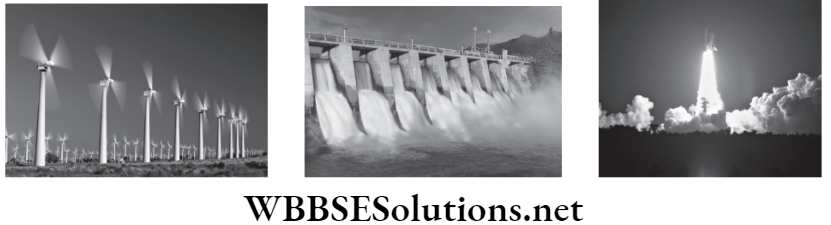
  2. A is correct and R is not the correct explanation of
  3. A is correct and R is wrong.
  4. A is wrong and R is correct.

Answer. 1. A is correct and R is the correct explanation of A.
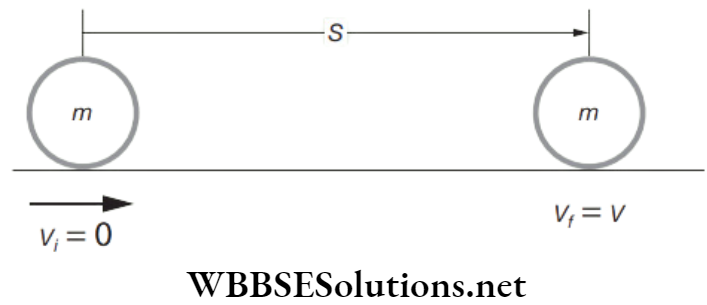
Question 7. Which of the following are the causes of infectious disease?

  1. The lack of certain essential substances in our diet,
  2. General wearing out or degeneration of tissues as in old age
  3. Defects in the metabolic reactions
  4. All the above

Answer. 4. All the above

Chapter 4 Why Do We Fall Ill Infectious Diseases

  • Infection Agents
    • Organisms that can cause disease are called infection agents.
    • It includes viruses, some are bacteria, some are fungi and some are unicellular animals, the protozoans. Some diseases are also caused by multicellular organisms such as different kinds of worms.
    • Common examples of diseases caused by viruses are the common cold, influenza, dengue, fever and AIDS.
    • Diseases like tyhpoid fever, cholera, tuberculosis and anthrax are caused by bacteria.
    • Many common skin infections are caused by different kinds of fungi.
    • Protozoans cause many familiar diseases such as malaria and kala-azar.
    • Worms tend to cause a variety of intestinal infections and elephatiasis.
    • All viruses live inside host cells, whereas bacteria very rarely do.
    • Viruses, bacteria and fungi multiply very quickly, but worms multiply very slowly in comparison.
    • Antibiotics commonly block biochemical pathways important for bacteria
    • Therefore, most broad spectrum antibiotics work against many species of bacteria, rather than simply working against one.
    • Viruses do not use these pathways at all, that is why antibiotics do not work against viral infection. For example, if we have a common cold, taking of antibiotics does not reduce the severity or duration of disease. Instead our body secrete an antiviral protein, celled interferon to combat the virus of cold.
    • If we get a bacterial infection along with the viral cold, then taking antibiotics will help. In that case, too, the antibiotic will work against the bacterial part of infection, not the viral infection.

Common human disease caused by infectious agents.

  • Viruses
    • Common cold
    • Influenza
    • Dengue fever
    • Poliomyelitis
    • Hepatitis –B
    • AIDS (Acquire Immuno Deficiency Syndrome)
    • Chicken pox
    • Measles
    • Mumps
    • SARS (= Severe Acute Respiratory Syndrome)
    • Small pox
    • Swine flu (HINI)
  • Bacteria
    • Typhoid fever
    • Cholera
    • Tuberculosis
    • Anthrax
    • Acne (Fig)
    • Tetanus
    • Food poisoning
  • Fungi
    • Athlete’s foot, Ringworm and many other skin infections
  • Protozoa
    • Malaria
    • Kala-azar
    • Amoebic dysentry
    • Sleeping sickness
  • Worm
    • Intestinal worm infection
    • Elephantiasis
  • Means of Spread of Infectious Diseases
    Infectious diseases spread from one infected person to other normal persons by a variety of method.

    • Air-borne diseases
      • These diseases are caused due microbes that are spread through air
      • This occurs through the little droplets thrown out by an infected person who sneezes or coughs.
      • Someone standing close by can breathe in these droplets, and the microbes get chance to start a new infection
      • Examples: common cold, pneumonia and tuberculosis.
    • Water-borne diseases,
      • The diseases that spread through water are called Water – borne diseases.
      • This occurs if the stool from someone suffering from an infectious gut disease, such as cholera or amoebiasis, gets mixed with the drinking water used by people living nearby.
      • The cholera-infested bacteria will enter new hosts through the weater they drink and cause disease in them.
    • Sexually-transmitted diseases.
      • These diseases are caused by the pathogens that are transmitted by sexual contact from one partner to the other.
      • Sexually transmitted diseases are not spread by casual physical contact.
      • Casual physical contacts include handshakes, hugs, sports such as wrestling or by any of the other ways in which we touch each other socially.
      • Examples: Syphilis and AIDS
    • Formite borne diseases.
      • Articles coming in contact with patients are a source of infection.
      • Examples: Door handles, taps, garments, currency, utensils, crockery, etc.
    • Spread of disease through vectors.
      • Vectors are carrier of a disease or infection.
      • Many animals which live with us may carry diseases.
      • Thus, these animals act as intermediaries or vectors.
      • Mosquitoes (Anopheles) are vector of a disease, called malaria.
      • In many species of mosquitoes, the females need highly nutritious food in the form of blood in order to be able to lay mature eggs.
      • They feed on many warm-blooded animals including us.

Common Human Diseases transmitted by insects

Common Human Diseases transmitted by insects

Thus, means of transmission (spread) of infectious diseases may be of two main types:

Direct transmission :

  • Contact with infected person (e.g., AIDS).
  • Contact with soil (e.g., Tetanus).
  • Animal bites (e.g., Rabies).
  • Transplacental (e.g., AIDS, German measels and Syphilis).

Indirect transmission:

  • Through vectors (e.g., Malaria).
  • Through contaminated food and water (e.g., Amoebiasis, Hepatitis, etc.).
  • Air transmitted disease (e.g., common cold, T.B., preumonia).
  • Formite borne.

Symptoms of Disease

  • Point of entry and place of infection of microbe inside human body.
    • If the microbes enter from the air via the nose, they are likely to go to the lungs.
    • This happens in case of bacteria which cause tuberculosis (T.B.) of lungs.
    • If the microbes enter through the mouth, they can stay in the lining of the gut as do typhoid causing bacteria.
    • These microbes, can also go to the liver, like the viruses that cause jaundice (Hepatitis B). However, this pattern is not followed by all microbes.
    • Infection of HIV takes place via the sexual organs but it tends to spread to lymph nodes all over the body.
    • Malaria-causing protozoan enters through a mosquito bite but it first goes to liver cells and then to red blood corpuscles (RBCs).
    • The virus causing Japanese encephalitis, or brain fever, enter through a mosquito bite. But it goes to infect the brain.
  • Symptoms and signs.
    • Symptoms are evidences of the presence of diseases.
    • They are in the form of structural and functional changes in the body or body parts.
    • They indicate that there is something wrong in the body.
    • On the basis of symptoms of a disease physicians search for definite clues or signs of the disease.
    • For this, they use certain instruments and even go for laboratory tests (e.g., tests in pathologist’s labs) to pinpoint the cause of the disease.

NEET Foundation Class 9 Biology Diversity In Living Organisms Symptoms and signs

    • Most of these common effects of a disease depend on the fact that the immune system of the patient’s body becomes activated in response to an infection.
    • An active immune system recruits many cells to the affected tissue to destroy the disease-causing (i.e., pathogenic) microbes. Such a recruitment process is called inflammation.
    • Local effects of an inflammation is shown in the form of swelling and pain. General effect of an inflammation is depicted in the form of fever.
    • Infection of HIV is found to have multiple dimensional effect. In case of HIV infection, the virus goes to immune system and ultimately damages its function.
    • Many symptoms of HIV-AIDS infection are due to the fact that patients body can no longer fight off many minor infections that he faces every day.
    • Minor gut infection can produce major diarrhoea with blood loss. Thus, it is these secondary infections that kill people suffering from the HIV-AIDS.

Principle of Treatment

  • There are two ways to treat an infectious disease. One is to reduce the effects of the disease and the other is to kill the cause of the disease. For the first requirement, we can provide treatment that will reduce the symptoms. The symptoms are usually because of inflammation.
  • Pathogenic microbes can be killed by two common methods. One way is to use medicines that kill microbes and the other way to affect antibiotics.

Chapter 4 Why Do We Fall Ill Antibiotics

  • Antibiotics are chemicals produced by mirco organisms (mainly bacteria and fungi) which at low concentrations have the ability to inhibit or destroy pathogens. The first antibiotic was penicillin, which was developed in the 1940’s in response to the need to treat soldiers in the Second World War. There are now about 50 to 100 commercially available antibiotics.
  • Antibiotics are characterised by their range of effectiveness and their mode of action against the pathogens:
    • Broad spectrum antibiotics kill a wide range of bacteria.
    • Narrow spectrum antibiotics are effective against only a few types of bacteria.
      To kill a specific pathogen, you have to use a narrow spectrum antibiotics which is specific for the disease.
  • All antibiotics must have selective toxicity. This means they should kill or inhibit the growth of bacteria or fungi, but cause little or no damage to the host.
    Antibiotics tend to interfere with the growth or metabolism of the pathogen in a variety of ways.

    • Penicillin inhibits the enzymes that are involved in the formation of the bacterial cell wall. Bacteria with weak cell walls die due to leakage of the cell contents.
    • Streptomycin binds to bacterial ribosomes, so preventing protein synthesis, including synthesis of the enzymes. The lack of protein affects bacteria metabolism and results in its death. Fortunately, bacterial ribosomes are different from human ones. So streptomycin does not interfere with the synthesis of proteins in the cells of the patient (= host) taking the drug.
    • Tetracyclines also work by interfereing with bacterial ribosomes.
    • Polymixines damage bacterial cell (plasma) membranes even in resting cells (spores). Penicillin. Antibiotics tend to be used against bacterial infections more than the fungal infections. This is because fungal cells work in a similar manner to human cells. As a result, many antifungal agents are highly toxic to humans.

Principles of Prevention of Disease

Following three limitations are normally confronted while treating an infectious disease :

  • Once someone has a disease, its body functions are damaged and may never recover completely.
  • Treatment of a disease takes time. This means that if someone suffering from a disease, he is like to bedridden for sometime, even if we give him proper treatment.
  • The person suffering from an infectious disease can serve as the source from where the infection may spread to other people.
    Visualizing these difficulties, prevention of diseases is far better than their cure. There are following two ways of prevention of diseases, one is general another is specific one.

General ways of prevention of infectious diseases.

Public hygiene is one basic key to the prevention of infectious diseases. Thus, in this method of prevention of diseases, following practices are adopted :

  • For air-borne microbes, we can prevent exposure by providing living conditions that are not overcrowded.
  • For water-borne microbes, we can prevent exposure by providing safe drinking water.
  • For vector-borne infections, we can provide clean environments. Such a clean environment, for example, would not allow mosquito breeding.

Specific ways of prevention of infectious diseases.

Immune system and immunisation: Children escape infection of cold and cough because the immune system of their bodies is normally fighting off the microbes (pathogenic microorganisms). These cells go into action each time infecting microbes enter the body. If these cells are successful.

  • The immune cells (WBCs) manage to kill off the infection long before it assumes major proportions.
  • Becoming exposed to infection or be infected with an infectious microbe does not necessarily mean developing noticeable disease.
  • One way of looking at severe infectious disease is that it represents failure of the immune system. The functioning of the immune system, like any other system in the body, will not be good enough if proper and sufficient nourishment and food is not available.
  • Therefore, second basic principle of prevention of infectious disease is the availability of proper and sufficient food for everyone.

Chapter 4 Why Do We Fall Ill Immune Response

  • An immune response is the way in which the body responds to invasion by a specific pathogen or antigen.
  • This response involves the production of cells (lymphocytes) and chemicals (antibodies) designed to defend the body against the pathogen.
  • Antigens are substances that can produce an immune response. Antigens trigger the production of antibodies (glycoproteins or immunoglobulins) by the immune system. Each type of antibodies is specific to a particular antigen and reacts with it to make it harmless.
    • Cell-mediated immunity.
    • Cell-mediated immunity involves T-lymphocytes and macrophages.
    • Macrophages are phagocytic, i.e., they engulf and digest all types of foreign cells and viruses.
    • Lymphocytes are white blood cells that recognise and react with antigens.
    • They are of two types : T- lymphocytes and B-lymphocytes.
    • T-lymphocytes become activated in thymus gland and may be of four types :
      • Cytotoxic T-cells or killer cells
      • Helper T-cells
      • Memory T-cells
      • Suppressor T-cells.
  • Antibody-mediated immunity.
    This involves the production of B-lymphocytes which are activated by antigens attached to the macrophage membrane.

    • B-lymphocytes are of three types :
      • Plasma B-cells : They secrete antibodies into the blood circulation.
      • Memory B-cells : They do not produce antibodies, but become programmed to remember a specific antigen and respond very rapidly to any subsequent infection.
      • Dividing B-cells: They produce more B-lymphocyte cells.
  • Reaction between antibody and antigen.
    It involves following three steps

    • The antibody becomes attached to the antigen at the antigen-binding site like a key in a lock.
    • This causes the antibody to change from a T-shape to a Y-shape.
    • Antibody cause the antigen to stick together, a process called agglutination which stimulates phagocytosis by neutrophils.
  • Active immunity.
    • The pathogen invades the body, which responds by stimulating the production of T-lymphocytes and B-lymphocytes and, both of which are involved in the immune response.
    • Memory cells are formed which provide long-term immunity to the antigen.
    • This type of immunity if termed as active immunity because the lymphocytes are activated by antigens present on the surface of the pathogen. Since this activation takes place during the natural course of an infection, this is called natural active immunity.
    • But the immune response can also be triggered artificially. This involves the injection of antigens into the body. We call this artificial active immunity, although it is more commonly referred to as vaccination.

Passive immunity.

It occurs when an individual becomes temporarily immune to an antigen by receiving ready-made antibodies from someone else. Passive immunity is also of two types :

  • Natural passive immunity.
    • It occurs when preformed antibodies pass naturally from mother to baby across the placenta and in breast milk.
    • Immunity is only temporary since the baby’s body does not ‘know’ how to make more antibodies. But it provides the baby with protection until it develops its own immune system.
  • Artificial passive immunity.
    • It occurs when pre-formed antibodies extracted from one individual are injected into another as serum.
    • This sort of immunity can provide a “quick-fix” and is given to people who have been bitten by poisonous snakes or rabid dog.

Chapter 4 Why Do We Fall Ill Vaccination

Vaccination is the administration of antigenic material (a vaccine) to stimulate the immune system of an individual to develop adaptive immunity to a disease. Vaccines can prevent or ameliorate the effects of infection by many pathogens.

Many such vaccines have infectious diseases, and provide a disease-specific means of prevention. These are vaccines against

  1. Tetanus
  2. Diphtheria;
  3. Whooping cough ;
  4. Measles ;
  5. Polio;
  6. Hepatitis-B;
  7. Cholera;
  8. Tuberculosis;
  9. Plague;
  10. Mumps; etc. etc.

All these vaccines form the public health programme of childhood immunisation for preventing infectious diseases.

1. Derivation of term vaccination

Three centuries ago, an English physician Edward Jenner (1749-1823) realised that milkmaids had cowpox did not catch smallpox even during epidemics. He tried deliberately giving cowpox to people, and found that they were now resistant to the smallpox virus.

This was because the smallpox virus is closely related to the cowpox virus. ‘Cow’ is ‘vacca’ in Latin, and a cowpox is ‘vaccinia’. From these roots, the word vaccination has come into our

Examples of Infectious and Non-Infectious Diseases

2. How are vaccines made ?

A vaccine is an antigen that is injected or swallowed. It causes the development of active immunity in the patient. The small quantities of antigen introduced into the person’s body stimulate the production of antibodies as if infected by the disease. This type of immunity is long term since the body is able to produce memory cells in the natural pathway.

Antigens are treated before being introduced to the body of the person, in order to make them relatively harmless. Most vaccines are made in one of the following ways :

  • Killed virulent organisms
    • In this case, the bacteria is killed by heat or use by chemicals, which denature its enzymes.
    • So the dead pathogen will not cause the disease, but it will possess antigenic sites on its surface that will be recognised by T- and B- lymphocytes, and result in the production of antibodies in the recipient.
    • There is no chance of the pathogen replicating and causing infection.
    • Example: Vaccine for whooping cough-bacteria.
  • Live non-virulent strains
    • Vaccines made in this way are often called attenuated (= weaken) vaccines.
    • In such vaccines, the pathogen is deliberately weakened to ensure that it does not cause severe infection.
    • Examples: Rubella, BCG vaccine used against tuberculosis and the Sabin vaccine used against poliomyelitis, which is taken orally.
  • Modified toxins
    • In this type of vaccine, the toxoids (toxic substances) produced by the bacteria are made harmless.
    • Toxoids are used to stimulate antibody production, but there is no risk of infection by the pathogen.
    • Example: Vaccines used against diphtheria and tetanus.
  • Isolated antigen
    • Sometime important antigens are separated from the microorganism, in this case by breaking up the pathogen’s structure and obtaining glycoproteins.
    • The “flu vaccine” contains a mixture of antigens from various strains of influenza virus, in an attempt to combat the great variations that exists.
    • This antigenic variation occurs in microorganisms that have a high mutation rate.
    • Example: Influenza.
  • Genetically engineered antigens
    • In this most modern type of vaccine, restriction endonuclease enzymes are used to extract from the pathogen the genes that code for a particular antigen.
    • Such genes are inserted in a harmless plasmid vector using a ligase enzyme.
    • The bacterial cells then replicate to produce large amounts of antigen.

NEET Foundation Class 9 Biology Diversity In Living Organisms Geneticallly engineered antigens

Chapter 4 Why Do We Fall Ill Worksheet 3

Question 1. Statement – 1: Infection agents viruses, some are bacteria, some are fungi and some are unicellular animals, the protozoans.
Statement – 2: Infectious diseases are caused only by unicellular organisms.

  • Statement – 1 is true, Statement – 2 is false.
  • Statement – 1 is false, Statement – 2 is true.
  • Both statements are true.
  • Both statements are false.

Answer. 1. Statement – 1 is true, Statement – 2 is false.

Question 2. Statement – 1: Common cold, influenza, dengue, fever and AIDS are bacterial diseases.
Statement – 2: Diseases like typhoid fever, cholera, tuberculosis and anthrax are caused by virus.

  • Statement – 1 is true, Statement – 2 is false.
  • Statement – 1 is false, Statement – 2 is true.
  • Both statements are true.
  • Both statements are false.

Answer. 1. Statement – 1 is true, Statement – 2 is false.

Question 3. Which of the following statements are false.

P) Malaria and kala-azar are caused by fungi.

Q) Most of the skin diseases are caused by protozoans.

R) Worms tend to cause a variety of intestinal infections and elephatiasis.

S) Antibiotics commonly block biochemical pathways important for bacteria

  1. P, Q
  2. R, S
  3. P, R
  4. Q, S

Answer. 1. P, Q

Question 4. Match the following:

Disease                  Caused by
A Dengue fever     P Protozoa
B Typhoid fever    Q Fungi
C Malaria fever     R Bacteria
D Athlete’s foot    S Virus

Answer. ABCD/SRPQ

Question 5. Match the following:

Disease                 Caused by
A Poliomyletis       P Protozoa
B Tuberculosis      Q Fungi
C Ring worm        R Bacteria
D Kala-azar           S Virus

Answer. ABCD/SRQP

Question 6. Spot the errors in the given statements and correct them.

  1. Mumps are caused due to bacteria.
  2. Measles are caused by protozoans.

Answer. Both are incorrect

Question 7. Fill up the blanks

  1. Chicken pox is caused by ( bacteria / virus/ fungi /protozoan)
  2. Anthrax is caused by ( bacteria / virus/ fungi /protozoan)
  3. SARS is caused by ( bacteria / virus/ fungi /protozoan)
  4. Ring worm is caused by ( bacteria / virus/ fungi /protozoan)

Answer. 1) virus

2) bacteria

3) virus

4) fungi

Question 8. Say True or false.

  1. Elephantiasis is caused by a worm.
  2. Swine flu is a bacterial disease.
  3. Tetanu is caused by a virus
  4. Amoebic dysentry is a protozoan disease.

Answer. 1) True

2) False

3) False

4) True

Question 9. Match the following:

Disease                   Caused by
A Common Cold     P Vector
B Cholera                Q Sex
C AIDS                    R Air borne
D Malaria                S Water borne

Answer. ABCD/RSQP

Question 10. Assertion (A): Filariasis is a vector transmitted disease.
Reason (R): It is transmitted by a vector named culex mosquito.

  1. A is correct and R is the correct explanation of A.
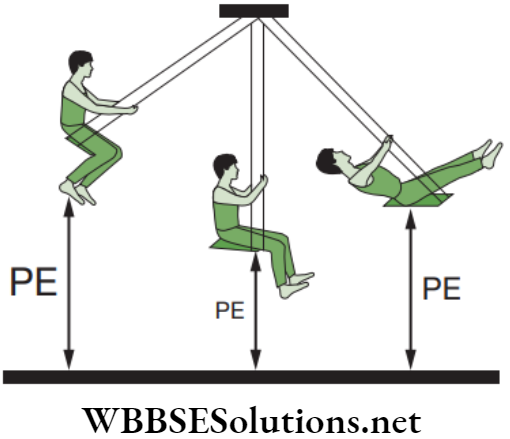
  2. A is correct and R is not the correct explanation of
  3. A is correct and R is wrong.
  4. A is wrong and R is correct.

Answer. 1. A is correct and R is the correct explanation of A.
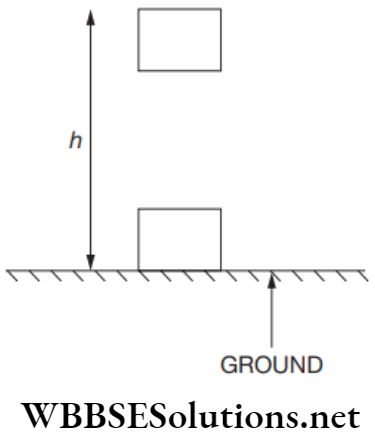
Conceptual Questions on Health and Illness

Question 11. Assertion (A): Syphilis is a sexually transmitted disease.
Reason (R): Epidemic typus is a vector transmitted disease.

  1. A is correct and R is the correct explanation of A.
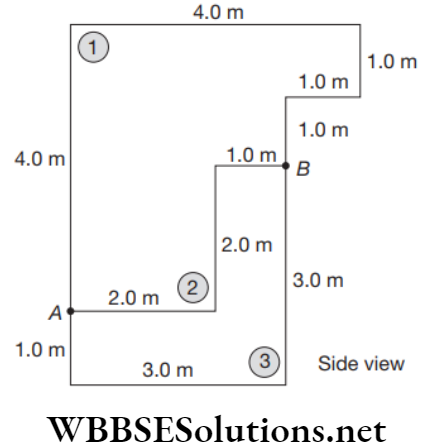
  2. A is correct and R is not the correct explanation of
  3. A is correct and R is wrong.
  4. A is wrong and R is correct.

Answer. 2. A is correct and R is not the correct explanation of

Question 12. Match the following:

Disease                     Caused by
A AIDS                      P Trans placental
B Tetanus                 Q Animal bites
C Rabies                   R Contact with infected person
D German measles   S Contact with soil

Answer. ABCD/RSQP

Question 13. Match the following:

Disease                      Causative agent enters through

A Tuberculosis           P Mosquito bit
B Typhoid                  Q Nose
C AIDS                       R Mouth
D Japanese                S Sexual organs encephalitis

Answer. ABCD/QRSP

Question 14. P indicates the presence of a disease. Q provides the information about the presence of a particular disease. Local effects of an inflammation is shown in the form of R and S. General effect of an inflammation is depicted in the form of T. Identify P, Q, R, S, T.

Answer. P = Symptoms, Q = Signs, R /S=Swelling/Pain, T= Fever

Question 15. Fill up the blanks

1) ___________are chemicals produced by mircro organisms (mainly bacteria and fungi) which at low concentrations have the ability to inhibit or destroy pathogens.

2) __________ antibiotics kill a wide range of bacteria.

Answer. 1) Antibiotics 2) Broad spectrum

Question 16. Match the following:

Column – 1          Column – 2
A Pencillin            P Preventing protein synthesis
B Streptomycin    Q Damage bacterial cell (plasma) membranes
C Tetracyclines     R Interferes with bacterial ribosomes
D Polymixines      S Inhibits the enzymes

Answer. ABCD/SPRQ

Question 17. Which of the following are the limitations that are normally confronted while treating an infectious disease?

  1. Once someone has a disease, its body functions are damaged and may never recover completely.
  2. Treatment of a disease takes time.
  3. The person suffering from an infectious disease can serve as the source from where the infection may spread to other people.
  4. All the above

Answer. 4. All the above

Question 18. Match the following:

Disease               Prevention method
A Air borne         P Safe drinking water
B Water borne    Q Clean environments
C Vector borne   R Living conditions that are not overcrowded.

Answer. ABCD/QPR

Question 19. Fill up the blanks

1) An _________is the way in which the body responds to invasion by a specific pathogen or antigen.

2) __________ are substances that can produce an immune response.

Answer. 1) Immune response

2) Antigens

Question 20. Spot the errors in the given statements and correct them.

  1. Cell-mediated immunity involves B-lymphocytes
  2. Antibody-mediated immunity involves the production of T – lymphocytes and macrophages.

Answer. Both are incorrect.

Question 21. Identify the following type of B– lymphocytes.

P) They produce more B-lymphocyte cells.

Q) They secrete antibodies into the blood circulation.

R) They do not produce antibodies, but become programmed to remember a specific antigen and respond very rapidly to any subsequent infection.

Answer. P) Dividing – B cells

Q) Plasma – B cells

R) Memory – B cells

Question 22. 1) _________occurs when preformed antibodies pass naturally from mother to baby across the placenta and in breast milk. ( Natural passive immunity / Artificial passive immunity)

2) ___________occurs when pre-formed antibodies extracted from one individual are injected into another as serum. ( Natural passive immunity / Artificial passive immunity)

Answer. 1) Natural passive immunity

2) Artificial passive immunity)

Question 23. Statement – 1: A vaccine is an antigen that is generally applied on the skin.
Statement – 2: Vaccine for whooping cough-bacteria is made by killing virulent organisms.

  1. Statement – 1 is true, Statement – 2 is false.
  2. Statement – 1 is false, Statement – 2 is true.
  3. Both statements are true.
  4. Both statements are false.

Answer. 2. Statement – 1 is false, Statement – 2 is true.

Question 24. Statement – 1: Vaccines made Live non-virulent strains are often called attenuated vaccines.
Statement – 2: The “flu vaccine” contains a mixture of antigens from various strains of influenza virus, in an attempt to combat the great variations that exists.

  1. Statement – 1 is true, Statement – 2 is false.
  2. Statement – 1 is false, Statement – 2 is true.
  3. Both statements are true.
  4. Both statements are false.

Answer. 3. Both statements are true.

Question 25. Name the vaccines used for the following diseases.

P) Diphtheria

Q) Poliomyelitiss

R) Tuberculosis

S) Heptatitis

T) Heamophilus influenzae type B

Answer. P) DPT-Hib

Q) Polio

R) BCG

S) Hepatitis – B

T) DPT-Hib

Question 26 The age group for different vaccines is mentioned below. Name the vaccine for each of the following.

P) All infants up to 5 years of age; minimum of three doses at one month interval.

Q) All infant, children and even adult.

R) To all infants of l 1/2, 2 1/2 and 3 1/2 month age.

S) All children between 10 to 14 years.

Answer. P) Polio

Q) Hepatitis-B

R) DPT-Hib

S) BCG

Question 27. (1) What do you mean by symptoms of a disease ?

(2) What are signs of disease ?

(3) Give one example of each of diseases caused by bacteria and virus.

Answer. Conceptual

Question 28. (1) Name the causal organism of ringworm and elephantitis.

Answer. Fungi and worm

(2) Name a sexually transmitted disease caused by bacteria.

Answer. Syphilis

(3) What is full form of HIV ?

Answer. Human Immunodeficiency Virus

Question 29. (1) Name the disease transmitted by dog bite.

Answer. Rabies

(2) Name the causal organism of kala-azar.

Answer. Protozoan

(3) Why female Anopheles mosquito feeds on human blood ?

Answer. Conceptual

Question 30. (1) Name two diseases transmitted by the contaminated food and water.

Answer. Typhoid & cholera

(2) Name the causal organism of measles and anthrax respectively.

Answer. Virus & Bacteria

Diseases Caused Due To Infection By Microorganisms

Chapter 4 Why Do We Fall Ill Malaria (caused by protozoan)

  • Malaria is a fatal disease of human beings.
  • There are about 300 million people around the world which are infected with malaria every year.
  • More than 2 millions persons die annually due to malaria disease.
  • Malaria is caused by a protozoan parasite Plasmodium.
  • This disease spreads through the bite of an insect vector—the female Anopheles mosquito which feeds on human blood.

Symptoms

  • Main symptoms of malaria include headache, nausea, muscular pain and high fever.
  • Each malarial attack is of 6 to 10 hours duration and consists of the three stages :
    • Cold stage, i.e., feeling very cold and shivering;
    • Hot stage, i.e., high fever, faster respiration and heart beat; and
    • Sweating stage, i.e., due to profuse sweating temperature goes down to normal.

Note:

  • Even after the patient is cured of malaria, the patient feels weak and becomes anaemic.
  • Malaria may also secondarily cause enlargement of spleen and liver.
  • Presence of malarial parasite can be checked by blood test.

Some Facts About Malaria

  • The name Malaria was proposed by Macculoch (1827).
  • C.L.A. Laveran (1880), a French physician, discovered the Malarial parasite-Plasmodium in the blood of malaria patient. He received Nobel Prize for this discovery in 1907.
  • Sir Ronald Ross (1897), a British physician, confirmed that malaria is caused by malarial parasite and mosquito is the vector. He received Nobel Prize for this discovery in 1902.
  • Recently Allan Porter and his coworkers produced a genetically engineered aquatic bacteria at National Institute of Singapore. When mosquito larvae feed on these bacteria, they are killed by the toxic substance produced by these bacteria. This can prove to be an effective biological control method.
  • Central Drug Research Institute (CDRI), Lucknow has developed an anti-cerebral malarial drug called-Arteether. This drug is extracted from a herbaceous plant Artemisia annua belonging to family Asteraceae.

Prevention

  • Malaria is an infectious disease. It spreads from infected person to healthy person (hosts) by the bite of female Anopheles mosquitoes (vectors).
  • The only way to prevent malaria is to prevent mosquitoes from biting.
    We can protect us from the bite of mosquitoes by following methods :
  • Wire-gauze should be used on doors and windows of our houses to prevent entry of mosquitoes.
  • Insect-repellents (e.g., Odomas) should be used to prevent mosquito-bite.
  • We should sleep under mosquito net.
  • Mosquito larvae should be killed by sprinkling kerosene oil on large-sized water bodies. Some larvivorous fishes such as Gambusia, minnows or trouts or birds (e.g., ducks) can be introduced in water bodies. These animals feed on mosquito larvae and hence larvae get killed and population of mosquitoes is checked. This is called biological control of mosquito.
  • Adult mosquitoes can be killed by spraying insecticides (e.g., BHC, malathion) on the walls of human dwellings. Insecticides are chemical poisons (toxicants), hence, regulation of mosquito population by them is called chemical control. Now another insecticide DDT is not used in the chemical control of mosquitoes, since, it persists in the environment for much longer time and cause toxicity by accumulation in the body of fishes, birds and humans through food chains.
  • The breeding grounds should be destroyed. Thus, the ditches, puddles or swamps around human dwellings should be drained or filled. We should not allow the collection of water in any uncovered container such as water tank, pot, cooler, flower pot, discarded tyres (tires) etc.

Control

  • A drug named quinine, which is extracted from the bark of Cinchona tree, is used to treat a person suffering from malaria.
  • This drug kills most of the stages of malarial parasite.
  • There are certain other drugs (medicines) which should be taken on the advice of doctor.

Chapter 4 Why Do We Fall Ill Influenza

  • Influenza is commonly called flu.
  • It is an international disease and is caused by influenza virus (Myxovirus influenza).
  • There exist three types of influenza viruses- A, B and C.
  • A and B types of influenza viruses are important because these are responsible for epidemics of disease throughout the world.
  • The inhaled virus attacks the epithelial cells in the mucous membrane of nose, throat and upper respiratory tract.
  • Influenza is spread mainly from person to person contact and by droplet infection via sneezing, coughing or talking.

Symptoms

  • The common symptoms of influenza disease are sudden onset of chills, discharge from the nose, sneezing, fever, headache, muscular pains, coughing, inflammation of respiratory mucosa and general weakness. Fever lasts three days in adults.

Prevention

  • We should try to keep away from flu patients.

Control

  • There is no effective control for influenza. However, vaccines are used for the control of infection and antiviral drugs are used for cure.
  • Amantadine and Rimantidine are recommended for the treatment of influenza. Rest speeds up the recovery.

Chapter 4 Why Do We Fall Ill Jaundice or hepatitis

  • Jaundice or hepatitis is the disease of liver.
  • Since liver is a very important organ in body, so its inflammation due to jaundice affects digestion adversely.
  • Jaundice is caused by viral infection.
  • The types are : Hepatitis A, Hepatitis B, Hepatitis C, Hepatitis D, Hepatitis E or Hepatitis G.
  • Except for type B which is a DNA virus, all the other are RNA viruses.
  • Hepatitis is spread mostly by food and water contaminated with hepatitis virus.

Hepatitis A

  • Hepatitis A or infectious hepatitis by a RNA-containing virus is an acute infectious disease of liver which affects mainly children and young adults.
  • Transmission of hepatitis A virus (HAV) takes place by faecal-oral route, i.e., infection of HAV takes place by ingestion of contaminated water, food or milk.

Symptoms

  • High temperature, headache, fatigue, general weakness, and joint pains.
  • Loss of appetite (called anorexia) with a feeling of nausea and vomiting.
  • Appearance of irritating rashes on body.
  • Dark yellow urine.
  • Light coloured stool after 3 to 10 days of infection.

Prevention

For avoiding infection of hepatitis A following preventive measures should be taken.

  • Use chlorinated, boiled and ozonised water.
  • Proper cleaning of hands after handling bed and vessels of the patient.
  • Hepatitis-A vaccine should be taken to prevent the disease.

Control

  • Application of interferon injection on the advice of the doctor will control the disease.
  • For an early cure, it is essential that patient of jaundice should take adequate rest.
  • Patient of jaundice should take high calorie diet such as juice of sugarcane, radish with gur (jaggery).
  • Consumption of protein and fat should be limited.

Hepatitis B

  • Hepatitis B is also known as serum hepatitis or transfusion hepatitis (by a double-stranded DNA virus).
  • This is most dangerous and widespread type of viral hepatitis. (Hepatitis B is regarded more dangerous than AIDS).
  • It occurs due to infection of Hepatitis B virus (HBV).
  • HBV is a blood borne DNA virus.
  • The infection of HBV is transmitted by infected blood, inoculation (Inoculation means the introduction of a vaccine into a living being to give immunity), from mothers to their babies and by sexual route (through the semen, saliva, etc.).

Symptoms

  • Main symptoms of Hepatitis B include progressive liver disease, chronic active hepatitis and hepatocellular carcinoma (i.e., malignant cancer of liver cells).

Prevention

  • Infection of HBV can be prevented by avoiding risky practices such as free or promiscuous sex (Promiscuous means sexual contact which is not restricted to one sexual partner), injectable drug abuse and direct or indirect contact with blood, semen and other body fluids of patients of Hepatitis B.
  • Hepatitis B vaccine should be taken to prevent disease.

Chapter 4 Why Do We Fall Ill Rabies (Hydrophobia)

  • The bite of a rabid dog (mad dog) and some other rabid mammals such as monkeys, cats or rabbits may cause rabies, which is fatal viral disease caused by a rabies virus or lyssa virus which is present in the saliva of the infected animals.
  • The viruses are injected into human blood by the bite of the rabid animal.
  • Disease is not expressed after infection even up to 1 to 3 months.
  • The long period of incubation makes it possible for a rabies vaccination, after a bite, to develop immunity and prevent the appearance of disease.

Symptoms.

  • Rabies is characterised by severe headache, high fever, painful contraction of muscles of throat and chest (due to which there is difficulty in swallowing).
  • The patient feels restless, does excessive salivation, has a chocking feeling and finds difficulty in taking in even liquid food. Since patient develops fear of water, the disease is also called hydrophobia.

Prevention

  • Cleaning the wound with carbolic soap and clear water immediately after the dog bite is an important preventive measure.
  • Any antiseptic medicine (e.g., Savalon, Dettol) should be applied to the wound caused by dog bite. A doctor should be immediately consulted for application of anti-rabies vaccine to the patient.
  • Compulsory immunization of stray dogs and cats should be done. Pet dogs should be vaccinated with anti-rabies vaccine.
  • A rabid animal shows excessive salivation and tries to seek isolation after bite. Such mad animals should be killed.

Control

  • Rabies can be treated with Pasteur’s treatment (discovered by Louis Pasteur), in which a course of 14 vaccines was given.
  • Currently 5 anti-rabies vaccines are prescribed at an interval of 0-3-7-14-30 day of dog bite.

Chapter 4 Why Do We Fall Ill AIDS

  • AIDS stands for Acquired Immuno Deficiency Syndrome.
  • It is a fatal disease.
  • The disease of AIDS is caused by retrovirus (a RNA virus) known as Human Immunodeficiency Virus (HIV) AIDS virus attacks white blood cells (WBCs) or lymphocytes (T4 helper cells) of human beings and weakens the human body’s immunity or self- defence mechanism.
  • Since AIDS virus reduces the natural immunity of the human body, therefore, the patients suffering from AIDS becomes prone to many other infections or diseases.
  • The patients suffering from AIDS die from other infections (called secondary infections).
  • Death occurs because the patient’s body cannot resist the attack of pathogens of secondary infections since patient’s natural defence mechanism has been destroyed by AIDS virus.
  • Transmission. AIDS disease spreads among human beings by the following ways
  • The AIDS disease usually spreads through unprotected (i.e., without the use of condom; condom is a membranous penile sheath of rubber having an anti-veneral or contraceptive function) sexual contact with an infected person carrying AIDS virus. Thus, AIDS is a sexually transmitted viral disease.
  • The AIDS disease also spreads through the transfusion of blood contaminated with AIDS virus.
  • The AIDS disease also spreads through the use of infected needles for injections (i.e., sharing of infected injection needles which have not been sterilised).
  • An AIDS infected mother can transmit the virus to her child during pregnancy or during birth (i.e., by mother’s blood). This is called vertical transmission.

Note:

  • AIDS was first detected in USA in 1981 and in India, first confirmed evidence of AIDS infection came in April 1986 from Tamil Nadu.
  • The AIDS disease has spread in epidemic form in Africa and western countries. This is because of the undesirable sexual practices, polygamy and polyandry.
  • Recently alarmingly increasing cases of AIDS have been reported from different parts of India.

Symptoms.

  • Swollen lymph nodes; regular fever; sweating at night and weight loss.
  • AIDS virus causes severe damage to brain and may lead to loss of memory, ability to speak and of clear thinking.

Prevention and control.

So far no medicine or vaccine has been developed to cure AIDS, so, once a person gets AIDS, he is sure to die in a short span of time. The following steps may help in controlling infection of this dreaded disease :

  • People should be educated about AIDS transmission.
  • Disposable syringes and needles should be used for injection.
  • Sexual contact with unknown people should be avoided.
  • High risk groups should refrain from donating blood.
  • Sterilised needles may be provided to drug addicts.
  • Before receiving blood for transfusion, one should ensure that it has been screened for HIV.
  • The common razor at the barber’s shop should not be used.

NEET Foundation Class 9 Biology Diversity In Living Organisms Structure of HIV Viruses

Chapter 4 Why Do We Fall Ill Polio

  • Poliomyelitis or polio is a disease of the nervous system caused by one of the smallest known virus, called polio virus.
  • The virus enters the body through the food and water and reaches the intestine and from there it enters the CNS or central nervous system (brain and spinal cord) via blood stream and lymphatic systems.
  • In CNS, the virus destroys the motor nerve cells of spinal cord that are responsible for the muscular control. Therefore, the muscles of polio-infected person become unable to carry out the normal functions.
  • Polio is a kind of paralysis and it affects more to the legs.
  • Children between the age of 6 months and 3 years are most prone to polio infection.
  • Polio is transmitted among children by the faeco-oral route and through the direct contact, dirty hands, contaminated food or milk and flies.
  • Faeco-oral route of infection of a disease includes transmission of an infection via food/water that is contaminated by stool of the patient.

Symptoms

  • The early symptoms of the polio disease are sore throat and headache.
  • If the infection persists, the patient suffers from fever, vomiting, muscular pain, stiffness in the neck, tingling sensation in limbs and ultimately occurrence of paralysis.
  • Sooner or later polio results in atrophy of skeletal muscles and deformity of affected limb.

Prevention.

  • Complete rest and physiotherapy is helpful in the beginning of attack of polio virus.
  • Exercising of legs is done to reduce the paralytic effect.
  • Maintenance of hygiene by proper sanitary disposal of waste is an essential step for prevention of polio.
  • Oral Polio Vaccine (OPV) is given orally to the children as per National Immunisation Schedule in our country.
  • OPV is a live attenuated (diluted or weakend) viral strain taken by mouth and colonises the gut and induces immunity.

Pulse polio immunisation programme (PPIP).

  • Pulse polio immunisation programme forms the largest single day public health project.
  • Pulse means a dose of a substance (here polio vaccine) especially when applied over a short period of time.
  • It was conducted for the first time in December 1995, in an attempt to eradicate polio from our country.
  • This programme uses oral polio vaccine or OPV.
  • As per the National Immunisation Schedule (NIS), a dose of 3 drops (0.5 ml) is given orally to the child, i.e., one dose each at 1.5, 2.5 and 3.5 month’s age.
  • Finally, a booster dose is given at the age of 1.5 years.
  • The vaccine consists of milder forms of polio viral particles.
  • After oral administration, virus particles in the vaccine begin to live in the intestine of the human body and multiply.
  • It leads to production of protective molecules (antibodies) in the intestine and the blood.
  • The prefixed days, on which pulse polio immunisation is to be carried out throughout the country, are called National Immunisation Days (NIDS).
  • The pulse polio immunization campaign seems to be a successful programme.
  • Since the incidence of poliomyelits in Inda has decreased dramatically, India recorded 4,791 cases of polio in 1994; 2,489 in 1997; 1600 in 2002; 225 in 2003 and 135 in 2004 (Renu Verma 2011).
    Aims of Pulse Polio Immunisation Programme (PPIP)

    • To immunise those children who are not earlier immunised or are partially immunised.
    • To replace the disease-causing wild virus by harmless vaccine virus in the environment.

Chapter 4 Why Do We Fall Ill Tuberculosis (T.B.)

  • Tuberculosis was first discovered by German scientist Robert Koch in 1882. He was awarded Nobel Prize for this discovery in 1905.
  • T.B. is an infectious disease which is communicated from one person to another directly or indirectly.
  • Tuberculosis is also contracted from animals (e.g., cattle).
  • Tuberculosis is caused by a bacterium-called Mycobacterium tuberculosis. The bacterium releases a toxin called tuberculin.
  • T.B. can affect all parts of body such as lungs, lymph glands, bones, intestine, etc.
  • In human beings, the infection of T.B. spreads by inhaling infected droplets released through coughing, sneezing, talking and spitting by the patient.
  • The incubation period of T.B. includes a few weeks to a few years.

Symptoms.

  • The patient of tuberculosis feels sick and weak.
  • There is a loss of appetite and weight.
  • Typical fever pattern and night sweats are also common.
  • The symptoms of T.B. vary depending on the site of the infection (disease) in the body.
  • There are following two specific sites of tuberculosis infection.
    • Lung or pulmonary T.B.
      • The person suffered with pulmonary T.B. has continuous fever, persistent cough and produces blood stained sputum.
      • There is loss of weight and weakness.
      • The chest-pain and breathlessness are common features of patients of lung T.B.
      • When the tuberculosis bacteria get into the lungs, they set up a local inflammation and produce an abscess.
      • This usually heals up and leaves a small patch of scar tissue which shows up in X-rays photographs.
      • In advanced stages of tuberculosis large areas of the lungs are destroyed.
    • Lymph gland T.B.
      Symptoms of T.B. of lymph gland include swelling and tenderness of lymph glands, often in the leg which may discharge secretion through the skin.

Prevention.

  • Vigorous public health measures are the best method of prevention. Other preventive measures include isolation and proper rehabilitation of the patient. Avoidance of over-crowding, provision of good ventilation and better nutrition help to reduce the incidence of the disease.
  • Immunisation with BCG or Bacillus-Calmette-Guerin vaccination prevents tuberculosis. BCG vaccine contains weakened Tuberculosis bacillus and it is injected into the skin of a person to give immunity for 3 to 5 years.

Control.

The tuberculosis can be cured by the following six essential drugs.

  • Rifampicin (RMP);
  • INH;
  • Streptomycin;
  • Pyrazinamide;
  • Ethambutol; and
  • Thioacetozone.

Thus, T.B. can be controlled by the use of antitubercular therapy (ATT)

NOTE:

  • The diagnosis of tuberculosis is made on the basis of positive tuberculin test, chest X-rays, positive sputum, gastric analysis, etc
  • Tuberculosis is not a hereditary disease.
  • The modern treatment of tuberculosis is based on the six main factors : namely rest, diet, drugs, surgery, rehabilitation and health education.
  • BCG vaccine is injected into the skin for providing considerable protection against the tuberculosis disease.

Chapter 4 Why Do We Fall Ill Cholera

  • Cholera is an acute infectious, fatal disease and is more common during overcrowded fairs, festivals and after floods.
  • Sometimes cholera occurs in epidemic form (epidemic means wide and destructive in occurrence) spread over large population.
  • Cholera is caused by the bacterium Vibrio cholerae.
  • It is transmitted by flies, contaminated water and food.
  • When sanitation is poor, it spreads rapidly.
  • The incubation period of cholera is generally from a few hours to two or three days.
  • When the bacteria of cholera are ingested, they multiply in the small intestine and invade its epithelial cells.
  • When the bacteria die, they release toxins which irritate the intestinal lining and lead to the secretion of large amounts of water and salts.

Symptoms

  • Watery diarrhoea (i.e., rice-water like stools) which is generally painless.
  • Effortless vomiting without nausea.
  • Loss of several litres of fluid from patient’s body takes place within hours. This results in dehydration, muscle cramps and weight loss.
  • Great loss of mineral salts and body fluid leads to kidney failure.
  • Eyes of patient become shrunken.

Prevention

  • Persons should be immunised by standard cholera vaccine. One dose of immunisation lasts for about six months.
  • In cholera-prone areas, boiled water and cooked food should be taken.
  • Careful personal hygiene and good sanitation in the community are the only certain protection against cholera.

Control

  • For preventing dehydration therapy with Oral Rehydration Solution(ORS) should be done immediately. ORS solution contains 3.5 g sodium chloride, 2.5 g sodium bicarbonate, 1.5 g potassium chloride, 20 g glucose, 40 g sucrose in one litre water. Taking small sips of ORS solution at intervals prevents dehydration of the patient.
  • Immediate medical advice should be taken.
    Antibiotics such as tetracycline kill the bacteria of cholera.

Chapter 4 Why Do We Fall Ill Typhoid

  • Typhoid is most common infectious or communicable disease of India.
  • Typhoid fever is common in humans of the 1 to 15 years age group.
  • Typhoid is caused by a rod-shaped and motile bacterium, called Salmonella typhi which is commonly found in the intestine of human beings. Human infection is direct.
  • Infection takes place by the oral route through ingestion of food, milk or water contaminated by contact with faecal matter of the typhoid patient.
  • The bacteria spread through faecal matter by house flies.
  • The symptoms of typhoid often appear 10 to 14 days after the infection.

Symptoms

  • Headache and typhoid fever which rises maximum in the afternoon. The temperature increases each day in the first week.
  • High fever in the second week. Fever gradually declines during 3rd and 4th day.
  • In nutshell symptoms of typhoid include continuous fever often with delirium (disorder of the mind), slow pulse, tender and distended abdomen, diarrhoea with water-green stools and eruption of rosy spots (rash) on the body of the patient.

Prevention

  • Proper sanitation and disposal of faecal matter prevents infection.
  • TAB-vaccination provides immunity for 3 years. (TAB vaccine contains killed typhoid bacilli and paratyphoid organisms-Salmonella paratyphi A and B).
  • Typhoral oral vaccine also prevents typhoid.

Control

There are standard drugs (e.g., Chloromycetin) which cure typhoid.

Diarrhea

  • Diarrhoeal disease form a group of intestinal infections, including food poisoning. The main symptom of all such infections is diarrhoea.
  • Diarrhoea is an abnormally frequent discharge of semisolid or fluid faeces.
  • Other symptoms of diarrhoeal disease include decreased appetite, nausea, vomiting, borborygmus (i.e., gurgling noise produced by movement of gas in the alimentary canal) and abdominal cramps.
  • There may be blood and mucus in the stools.
  • Persistent vomiting and loose stools cause dehydration and shock. Blood pressure may fall, pulse rate increases and temperature rise.
  • Diarrhoea is one of the major causes of infant mortality in India.
  • Infection of diarrhoea spread through contaminated food, water, drinks, hands, clothes, bed sheets and utensils.
  • The causative agents of diarrhoea are mainly bacteria such as Escherichia coli, Clostridium botulinum, Shigella dysentiriae, Campylobacter jejuri and Salmonella .
  • The protozoans (Entamoeba histolytica, Giardia intestinalis and Balantidium coli), some viruses (Rotavirus, Enterovirus, Adenovirus and Norwalk) and nematodes (Ascaris) also act as causative agents of diarrhoea.

Symptoms

  • Frequent loose motions and vomiting lead to dehydration.
  • Dehydration (loss of water from body tissues) which makes the patient dangerously ill in a very short time.
  • Most of the infant deaths due to diarrhoea can be prevented by making sure that dehydration does not take place due to excessive loss of body fluids through stools and vomiting.
  • In cases of dehydration, the patient becomes irritable, eyes appear sunken, nose is pinched and the tongue and the inner side of cheeks appear dry.
  • There is sudden weight loss, weak pulse, deep breathing and fever or fits.

Prevention

  • Eatables should be covered to prevent their contamination.
  • Fruits and vegetables should be properly washed before use.
  • Proper personal hygiene is important. Hands should be washed with soap and water before eating any food.
  • Stale food should not be consumed.
  • Community hygiene is also important.

Control

  • Complete bed rest should be ensured till the illness is fully controlled.
  • For treating diarrhoea anti-microbial drugs and anti-diarrhoel agents should be used.
  • If there is frequent vomiting, liberal amount of fluids with electrolytes should be provided orally.
  • Pulp of boiled unripe banana along with required amount of salt, turmeric powder and lime is helpful in controlling the diarrhoea.
  • Husk of isabgol seed (Plantago ovata) with water or curd provides relief.
  • Saline drip may be given intravenously to maintain fluid and electrolytes in the body. Alternatively oral rehydration solution (ORS) may be given to the patient periodically.
  • Dilute soups and dais, rice-water and butter-milk can also be given to the child to compensate the loss of water. Meanwhile, a doctor should be called in who will give some antibiotic treatment. In children, diarrhoea can be prevented by keeping clean surroundings, clean milk and feeding bottles and by following proper feeding habits. There is no vaccine for preventing diarrhoea.

Chapter 4 Why Do We Fall Ill Peptic Ulcers

  • Peptic ulcers are painful bleeding areas in stomach and duodenum.
  • Robin Warren a Perth based Australian pathologist observed in 1984 that areas of peptic ulcers contained many small curved gram negative bacterium, named Helicobacter pylori
  • Barry Marshall , a young clinical fellow of Warren succeeded in culturing the bacteria (1985).
  • Marshall and Warren (1985) found that amoxicillin, an antibiotic effective in killing the bacteria could also cure the peptic ulcers.
  • The finding helped in changing once painful chronic and disabling condition into short duration treatable disease. For this breakthrough Marshall and Warren were awarded Nobel Prize for Physiology and Medicine in 2005.

Chapter 4 Why Do We Fall Ill Anthrax

  • Anthrax is an acute infectious disease caused by a rod-shaped non-motile bacterium called Bacillus anthracis.
  • This disease commonly occurs in wild and domesticated animals such as cattle, sheep, goat, horses and pigs.
  • Anthrax can spread by eating under-cooked meat of infected animals.
  • Human beings can also contract infection from animal products such as bones, wool, hide and bristles. B. anthracis produces an extra-cellular toxin.
  • Fowls are resistant to anthrax.

Symptoms.

Infection of anthrax can occur in following three forms:

  • Cutaneous (skin);
  • Inhalation; and
  • Gastrointestinal.
    • Cutaneous anthrax
      About 20 per cent of untreated cases of cutaneous anthrax will result in death. Cutaneous cases are rare.
    • Intestinal anthrax.
      Its symptoms are nausea, loss of appetite, vomiting, pain and vomiting blood. It results in death of 25 per cent to 60 per cent cases.
    • Infection by inhalation.
      Its initial symptoms may resemble a common cold leading to severe breathing problems. It ultimately results in death of patient.

Prevention

  • Vaccine of anthrax is found to provide 93 per cent protection against anthrax.
  • Course of four subcutaneous injections of anthrax vaccine is recommended. Mild adverse reaction to the vaccine of anthrax is reported.

Control

  • Treatment should be started early to get good result. At this stage food infection should be distinguished from food poisoning.
  • In food infection, food merely transfers bacteria into the body.
  • In food poisoning, bacteria grow in food and release toxins.
  • When such a food is taken, toxins are absorbed into the blood from the digestive tract.
  • They affect the body quickly, causing gastrointestinal trouble and other effects.

Some Vital Facts About Diseases

  • Dengue fever is a viral disease whose vector is Aedes aegypti. It is a daytime biting mosquito.
  • World T.B. Day : 24th March.
  • National T.B. Control Programme was started in 1962.
  • The WHO has announced a new treatment, and management regimen-Directly Observed Treatment, Short-course (DOTS) for the control of tuberculosis (TB), also called “White plague” and for reducing the threat of multi drug resistant strains in the next decade. (Regimen = A systematized course of living, as to food, clothing, etc.).
  • The incidence of tetanus in India is about 30 to 50 per one lakh. Neonatal tetanus carries a mortality type of 90 percent.
  • Bubonic plague is commonest type of plague. It is caused by a bacterium of the genus Yersinia {Y.pestis).
  • Incidence of diarrhoel diseases is highest in Andhra and Orissa states of India.
  • Hepatitis B is more dangerous than AIDS.
  • Malaria Day. August 20.
  • The Integrated Child Development Scheme (ICDS) offers a series of services to control nutritional problems. Health centres distribute tablets of iron and folic acid among women and children to prevent anaemia. Vitamin A is also given to children orally under various schemes.
  • WHO (World Health Organisation, 1978) has defined health to be “A state of complete physical, mental and social well being (and not merely the absence of disease or infirmity) that enables one to lead a socially and economically productive life”.
  • World AIDS day is December 1.
  • Because of weight loss of AIDS patient, this disease is also called slim disease.

Chapter 4 Why Do We Fall Ill Worksheet 4

Question 1. Name the causative agent for the following diseases.

  1. Malaria
  2. Influenza
  3. Hepatitis A
  4. Rabies
  5. AIDS

Answer. 1) Plasmodium

2) Myxovirus influenza

3) RNA containing virus

4) lyssa virus

5) Human Immunodeficiency Virus (HIV)

Question 2. Name the causative agent for the following diseases.

  1. Polio
  2. TB
  3. Cholera
  4. Typhoid
  5. Diarrhoea
  6. Peptic ulcer

Answer. 1) Polio virus

2) Mycobacterium tuberculosis

3) Vibrio cholerae.

4) Salmonella typhi

5) Escherichia coli, Clostridium botulinum, Shigella dysentiriae, Campylobacter jejuri and Salmonella

6) Helicobacter pylori

Question 3. Vijay’s friend Raj was not attending the classes due to ill health. The tensed Vijay went to Raj’s house and could find he is having following symtoms.

  1. feeling very cold and shivering
  2. high fever, faster respiration and heart beat
  3. Profuse sweating and low temperature. Based on the above symptoms, interpret the disease with Raj is suffering. Also suggest some preventive methods of that disease.

Answer. Malaria

Question 4. Statement – I: Malaria disease spreads through the bite of an insect vector, the female Anopheles mosquito.
Statement – 2: Malaria may also secondarily cause enlargement of spleen and liver.

  1. Statement – 1 is true, Statement – 2 is false.
  2. Statement – 1 is false, Statement – 2 is true.
  3. Both statements are true.
  4. Both statements are false.

Answer. 3. Both statements are true.

Question 5. Fill up the blanks.

1) A drug named __________, which is extracted from the bark of Cinchona tree, is used to treat a person suffering from malaria.

2) Influenza is caused by _________ virus.

Answer. 1) Quinine

2) Myxovirus influenza

Question 6. Say True or False

  1. Influenza is spread mainly from person to person through female anopheles mosquito.
  2. Jaundice or hepatitis is the disease of liver.
  3. The drug named qunine is recommended for the treatment of influenza.
  4. Infection of HAV takes place by ingestion of contaminated water, food or milk.

Answer.

1) False

2) True

3) False

4) True

Question 7. Assume that your friend is ill. If the following symptoms are seen, identify the disease. Sudden onset of chills, discharge from the nose, sneezing, fever, headache, muscular pains, coughing, inflammation of respiratory mucosa and general weakness.

Answer. Influeza

Question 8. Which of the following are the symptoms of Heptatitis A?

P) High temperature, headache, fatigue, general weakness, and joint pains.

Q) Loss of appetite (called anorexia) with a feeling of nausea and vomiting.

R) Dark yellow urine.

S) Painful contraction of muscles of throat and chest

T) The patient feels restless, does excessive salivation, has a chocking feeling and finds difficulty in taking in even liquid food.

Answer. P, Q, R

Key Terms Related to Diseases for Class 9

Question 9. Fill up the blanks.

P) Hepatitis B is also known as ___________or __________.

Q) HBV is a __________virus.

R) Rabies is caused by a ______________which is present in the saliva of the infected animals.

S) Rabies can be treated with __________, in which a course of 14 vaccines was given.

T) AIDS stands for _________________________.

Answer. P) Serum hepatitis or Transfusion hepatitis

Q) Blood borne DNA virus

R) Lyssa virus

S) Pasteur’s treatment

T) Acquired Immuno Deficiency Syndrome.

Question 10. Statement – 1: The disease of AIDS is caused by retrovirus (a DNA virus) known as Human Immunodeficiency Virus (HIV)
Statement – 2:The AIDS disease also spreads through the transfusion of blood contaminated with AIDS virus.

  1. Statement – 1 is true, Statement – 2 is false.
  2. Statement – 1 is false, Statement – 2 is true.
  3. Both statements are true.
  4. Both statements are false.

Answer. 3. Both statements are true.

Question 11. Assertion (A): The patients suffering from AIDS becomes prone to many other infections or diseases. Reason (R): AIDS virus reduces the natural immunity of the human body.

  1. A is correct and R is the correct explanation of A.
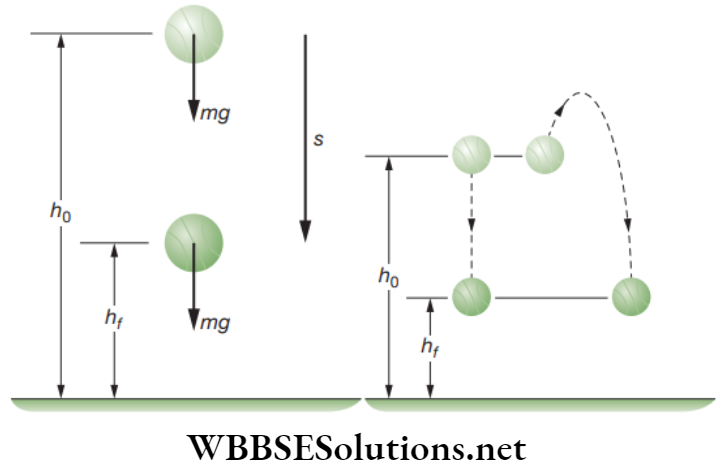
  2. A is correct and R is not the correct explanation of
  3. A is correct and R is wrong.
  4. A is wrong and R is correct.

Answer. 1. A is correct and R is the correct explanation of A.
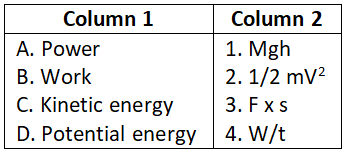
Question 12. Through which of the following, AIDS is NOT spread through.

P) Unprotected sexual contact with an infected person carrying AIDS virus

Q) Hugging the infected person carrying AIDS virus.

R) Transfusion of blood contaminated with AIDS virus

S) Touching the infected person with AIDS virus.

  1. P, Q
  2. R, S
  3. Q, S
  4. P, R

Answer. 3. Q, S

Question 13. Which of the following symptoms are seen in AIDS patient.

P) Swollen lymph nodes

Q) Regular fever

R) Sweating at night and weight loss

S) Damage to brain and may lead to loss of memory

  1. P, Q, R
  2. Q, R, S
  3. P, R, S
  4. P, Q, R, S

Answer. 4. P, Q, R, S

Question 14. Assertion (A): The muscles of polio-infected person become unable to carry out the normal functions. Reason (R): The polio virus destroys the motor nerve cells of spinal cord that are responsible for the muscular control.

  1. A is correct and R is the correct explanation of A.
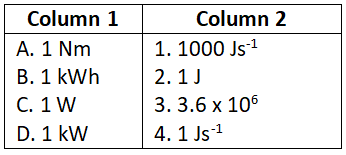
  2. A is correct and R is not the correct explanation of
  3. A is correct and R is wrong.
  4. A is wrong and R is correct.

Answer. 1. A is correct and R is the correct explanation of A.
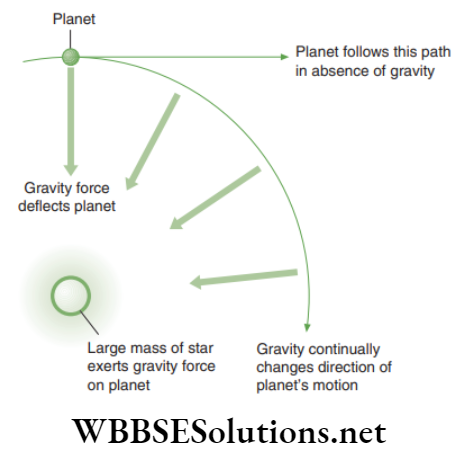
Question 15. Identify the following disease.

Children between the age of 6 months and 3 years are most prone to this disease. The early symptoms of this disease are sore throat and headache. If the infection persists, the patient suffers from fever, vomiting, muscular pain, stiffness in the neck, tingling sensation in limbs and ultimately occurrence of paralysis.

Answer. Polio

Question 16. Write the expanded forms of the following related to diseases.

1) AIDS = Acquired Immuno Deficiency Syndrome.

2) HIV = Human Immunodeficiency Virus

3) HBV = Hepatitis B virus

4) DPT = Diphtheria Pertussis Tetanus

5) BCG = Bacillus-Calmette-Guerin

6) OPV = Oral Polio Vaccine

7) PPIP = Pulse Polio immunisation programme

8)NIDS = National Immunisation Days

9) ATT = Antitubercular therapy

10) ORS = Oral Rehydration Solution

Question 17. Identify the following scientists.

  1. The French physician who discovered the Malarial parasite.
  2. The British physician who confirmed that malaria is caused by malarial parasite and mosquito is the vector.
  3. The German scientist who discovered Tuberculosis.
  4. A Perth based Australian pathologist who observed that areas of peptic ulcers contained many small curved gram negative bacterium, named Helicobacter pylori.

Answer. 1) C.L.A. Laveran (1880)

2) Sir Ronald Ross

3) Robert Koch

4) Robin Warren

Question 18. Fill in the blanks

  1. Tuberculosis is caused by a bacterium-called __________. The bacterium releases a toxin called _________.
  2. Cholera is caused by the bacterium __________.
  3. Typhoid is caused by a rod-shaped and motile bacterium called _________.

Answer. 1) Mycobacterium tuberculosis, tuberculin

2) Vibrio cholerae.

3) Salmonella typhi

Question 19. Spot the errors in the given statements and correct them.

  1. Symptoms of pulmonary TB include swelling and tenderness of lymph glands, often in the leg which may discharge secretion through the skin.
  2. The person suffering with Lymph T.B. has continuous fever, persistent cough and produces blood stained sputum.

Answer. Both are incorrect.

Question 20. Say True or False

  1. Chloromycetin cure typhoid.
  2. Diarrhoea is an abnormally frequent discharge of semisolid or fluid faeces.

Answer. 1) True 2) True

Question 21. Statement – I: The causative agents of diarrhoea are mainly bacteria such as Escherichia coli, Clostridium botulinum, Shigella dysentiriae, Campylobacter jejuri and Salmonella .
Statement – 2:Anthrax is an acute infectious disease caused by a rod-shaped non-motile bacterium called Bacillus anthracis.

  1. Statement – 1 is true, Statement – 2 is false.
  2. Statement – 1 is false, Statement – 2 is true.
  3. Both statements are true.
  4. Both statements are false.

Answer. Both statements are true.

Question 22. (1) Give two examples of viral diseases.

Answer. Common cold, Influenza , Dengue fever Poliomyelitis

(2) Give two examples of bacterial diseases.

Answer. Typhoid fever, Cholera, Tuberculosis Anthrax

(3) Give one examples of protozoan diseases.

Answer. Malaria, Kala-azar, Amoebic dysentry, Sleeping sickness

Question 23. (1) What is infective agent of peptic ulcers ?

Answer. Helicobacter pylori

(2) Who were awarded Nobel Prize for discovery of treatment for peptic ulcers ?

Answer. Marshall and Warren

Question 24. Name the disease in which

(a) Patient fears from water; (b) Yellowing of skin takes place.

Answer. Hydrophobia

Question 25. (1) Name one sexually transmitted viral disease.

Answer. AIDS

(2) What is full form of ORS ?

Answer. Oral Rehydration Solution

(3) Name the causal organism and vector of malaria respectively.

Answer. Plasmodium, Female Anopheles mosquito

Question 26. (1) Name the causal organism of (a) Tuberculosis; (b) Typhoid.

Answer. Mycobacterium tuberculosis, Salmonella typhi

(2) Name two diseases against which vaccines are available.

Answer. Diphtheria, Tetanus, Hepatatis

(3) Write full form of AIDS.

Answer. Acquired Immuno Deficiency Syndrome

Question 27. (1) Name two domestic animals which transmit rabies to human beings.

Answer. Dogs, rabbits or cats

(2) Name two modes of transmission of AIDS.

Answer. Unprotected sexual contact, Tranfusion of blood from infected person.

(3) Mention two preventive measures against rabies.

Answer. Cleaning the wound with carbolic soap, Any antiseptic medicine (e.g., Savalon, Dettol) should be applied to the wound

Question 28. (1) Name the toxin released by tuberculosis bacteria.

Answer. Ttuberculin

(2) Write down the modes of transmission of tuberculosis.

Answer. Conceptual

(3) Name the disease in which legs become paralysed.

Answer. Polio

Question 29. (1) When was the Pulse Polio Immunization Programme launched in India ?

Answer. December, 1995

(2) What is full form of BCG ?

Answer. Bacillus-Calmette-Guerin

(3) Name the causal organism of diarrhoea.

Answer. Escherichia coli, Clostridium botulinum

Question 30. (1) Name the disease the child will not suffer from if BCG vaccine is given.

Answer. Tuberculosis

(2) Name any three diseases of human beings caused by bacteria and three diseases caused by virus.

Answer. Common cold, Influenza ,Dengue fever are viral diseases.Cholera, Tuberculosis, Anthrax are bacterial diseases.

(3) How does dehydration set in during diarrhoea ?

Answer. Conceptual

Chapter 4 Why Do We Fall Ill Competitive Worksheet

Question 1. is an example of a bacterial disease that spreads through . The information in which alternative completes the given statement?

  1. 1- Cholera 2- air
  2. 1- Common cold 2- water
  3. 1- Common cold 2- air
  4. 1- Cholera 2- water

Answer. 4. 1- Cholera 2- water

Question 2. AIDS virus affects the body’s immune system. Which of the following acts does not lead to the transmission of AIDS?

  1. Transfusion of blood from an infected person to a healthy person
  2. Sexual act between an infected person and a healthy person
  3. Breast feeding of baby by an infected mother
  4. Handshake with an infected person

Answer. 4. Handshake with an infected person

Question 3. and are examples of diseases caused by protozoans. The information in which alternative completes the given statement?

  1. 1- Dengue 2- influenza
  2. 1- Influenza 2- Malaria
  3. 1- Malaria 2- kala-azar
  4. 1- Kala-azar 2- dengue

Answer. 3. 1- Malaria 2- kala-azar

Question 4. Viruses cause a number of diseases in humans. Which of the following diseases is caused by viruses?

  1. Anthrax
  2. Influenza
  3. Cholera
  4. Malaria

Answer. 2. Influenza

Question 5. Infectious diseases are diseases that spread through microbes, whereas non- infectious disease are diseases that are caused due to abnormalities in the internal structure of the body or its functioning. Which of the following diseases is non-infectious?

  1. Cancer
  2. Typhoid
  3. Cholera
  4. Malaria

Answer. 1. Cancer

Question 6. is a chronic disease as it affects the body for a duration of time. The information in which alternative completes the given statement?

  1. 1- Tuberculosis 2- long
  2. 1- Cough 2- short
  3. 1- Tuberculosis 2- short
  4. 1- Cough 2- long

Answer. 1. 1- Tuberculosis 2- long

Question 7. Tuberculosis is a disease, which affects the .The information in which alternative completes the given statement?

  1. 1- acute 2- digestive system
  2. 1- chronic 2- respiratory system
  3. 1- chronic 2- digestive system
  4. 1- acute 2- respiratory system

Answer. 2. 1- chronic 2- respiratory system

Question 8. Vaccines are small doses of a particular disease-causing microbe injected into the body of an individual. They act by fooling our immune system. Which of the following statements is incorrect regarding the given information?

  1. Vaccines prevent the occurrence of the disease.
  2. Vaccines induce memory for the particular infection.
  3. Vaccines block the entry of disease-causing microbes.
  4. Vaccines mimic the action of the disease-causing microbe.

Answer. 3. Vaccines block the entry of disease-causing microbes.

Question 9. Penicillin was the first antibiotic to be discovered. It is effective against most bacterial disease, but is ineffective against fungal diseases. Which of the following reasons correctly explains the given observation?

  1. Fungal cells do not have a cell wall.
  2. Bacteria are smaller in size when compared to fungi.
  3. Fungal cells produce chemicals, which destroy penicillin.
  4. Bacterial cells and fungi have dissimilar biochemical pathways.

Answer. 4. Bacterial cells and fungi have dissimilar biochemical pathways.

Question 10. Japanese Encephalitis is a vector-borne disease that transmits through the bite of mosquitoes. Which of the following organs is mainly affected by this disease?

  1. Lungs
  2. Liver
  3. Brain
  4. Stomach

Answer. 3. Brain

Question 11. Diseases can be transmitted from one person to another by many means. A particular disease is transmitted through direct contact, but cannot be transmitted by hugging or shaking hand. Which of the following diseases best suits the given mode of transmission?

  1. Cholera
  2. Syphilis
  3. Kala-azar
  4. Common cold

Answer. 2. Syphilis

Question 12. Helicobacter pylori is a . It causes peptic ulcers, which is a disease. The information in which alternative completes the given statement?

  1. 1- bacteria 2- chronic
  2. 1- protozoan 2- Acute
  3. 1- bacteria 2- Acute
  4. 1- protozoan 2- chronic

Answer. 1. 1- bacteria 2- chronic

Question 13. Which type of diseases can be prevented by controlling the breeding of mosquitoes?

  1. Air-borne
  2. Food-borne
  3. Water-borne
  4. Vector-borne

Answer. 4. Vector-borne

Question 14. Vaccines are available for which of the following diseases?

  1. Polio
  2. Malaria
  3. Diabetes
  4. Dengue

Answer. 1. Polio

Question 15. Antibiotic penicillin is ____1______ against common cold, which is caused by a ____2______. The information in which alternative completes the given statement?

  1. 1- ineffective 2- protozoan
  2. 1- ineffective 2- virus
  3. 1- effective 2- protozoan
  4. 1- effective 2- virus

Answer. 2. 1- ineffective 2- virus

Question 16. Supply of safe drinking water helps prevent ____1_____ diseases, while a clean environment helps prevent ____2_____ diseases. The information in which alternative completes the given statement?

  1. 1- vector-borne 2- sexually transmitted
  2. 1- sexually transmitted 2- air-borne
  3. 1- air-borne 2- water-borne
  4. 1- water-borne 2- vector-borne

Answer. 4. 1- water-borne 2- vector-borne

Question 17. Which of the following diseases cannot be prevented by vaccination?

  1. Tetanus
  2. Diphtheria
  3. Common cold
  4. Whooping cough

Answer. 3. Common cold

Question 18. Penicillin is an antibiotic that blocks the formation of ____1______. Hence, it is effective against ____2______. The information in which alternative completes the given statements?

  1. 1- cell membrane 2- virus
  2. 1- cell membrane 2- bacteria
  3. 1- cell wall 2- virus
  4. 1- cell wall 2- bacteria

Answer. 3. 1- cell wall 2- virus

Question 19. Malaria-causing microbes enter the body through mosquito bites. They first infect the _____1______ and then the _____2______. The information in which alternative completes the given statements?

  1. 1- stomach 2- white blood cells
  2. 1- stomach 2- red blood cells
  3. 1- liver 2- white blood cells
  4. 1- liver 2- red blood cells

Answer. 4. 1- liver 2- red blood cells

Question 20. Which of the following statements about sexually transmitted diseases is incorrect?

  1. AIDS is a sexually transmitted disease
  2. Syphilis is a sexually transmitted disease
  3. Sexually transmitted diseases spread through handshakes
  4. Sexually transmitted diseases spread through sexual contact

Answer. 4. Sexually transmitted diseases spread through sexual contact

Question 21. A water-borne disease such as _____1______ is more likely to spread in the ____2______ of safe supplies of drinking water. The information in which alternative completes the given statement?

  1. 1- pneumonia 2- presence
  2. 1- pneumonia 2- absence
  3. 1- cholera 2- presence
  4. 1- cholera 2- absence

Answer. 3. 1- cholera 2- presence

Question 22. Which of the following statements about air-borne diseases is correct?

  1. Air-borne disease cannot spread through dust particles
  2. Air-borne diseases spread easily in crowded areas
  3. Pneumonia is not an air-borne disease
  4. Typhoid is an air-borne disease

Answer. 2. Air-borne diseases spread easily in crowded areas

Question 23. Tuberculosis-causing bacteria enter the body through

  1. nose
  2. mouth
  3. mosquito bite
  4. sexual contact

Answer. 1. nose

Question 24. Diseases such as _____1______ and AIDS are _____2______ diseases. The information in which alternative completes the given statement?

  1. 1- cholera 2- water-borne
  2. 1- cholera 2- sexually transmitted
  3. 1- syphilis 2- water-borne
  4. 1- syphilis 2- sexually transmitted

Answer. 4. 1- syphilis 2- sexually transmitted

Question 25. Which of the following statements about water-borne diseases is incorrect?

  1. Water-borne diseases spread through physical contact with the person infected by the disease
  2. Water-borne diseases spread through the consumption of contaminated water
  3. Typhoid is a water-borne disease
  4. Cholera is a water-borne disease

Answer. 1. Water-borne diseases spread through physical contact with the person infected by the disease

Question 26. Which of the following statements is incorrect?

  1. Air-borne diseases can spread through dust particles
  2. Air-borne diseases spread easily in crowded areas
  3. Pneumonia is an air-borne disease
  4. Hepatitis A is an air-borne disease

Answer. 4. Hepatitis A is an air-borne disease

NEET Biology Class 9 Natural Resources Question And Answers

Chapter 5 Natural Resources Atmosphere and Climate

The major components of the planet Earth can be divided into water, land, and air. The land surface is known as lithosphere. Water covers about 75% of the Earth’s surface and is called hydrosphere. Air, which covers the water and land, is known as atmosphere. These are the abiotic (non-living) components. The abiotic components interact with the biotic (living) components in the biosphere.

Effect of atmosphere on life on Earth

We know that the position of the Earth in the solar system and its distance from sun helps in maintaining the temperature of the Earth and thus supporting life. Moon too is located at the same distance from sun as the Earth. Yet, life does not exist on moon. The moon has extreme temperatures, which ranges from about “190 ºC to 110 ºC, although it is located at a similar distance from sun as the Earth. However, the

Read And Learn More NEET Biology Class 9 Question And Answers

Earth maintains a moderate range of temperature. This is because the Earth has an atmosphere and moon does not. Atmosphere is a mixture of gases. It is basically a mixture of nitrogen, oxygen, carbon dioxide, water vapour, and hydrogen.

How does atmosphere maintain the temperature?

Air is a bad conductor of heat. During the day, it resists the heat from entering the Earth and at night, it does not allow the heat to escape from the Earth.

Thus, the atmosphere does not allow a sudden increase in temperatures during the day and a sudden decrease in temperatures at night. This helps to maintain a moderate temperature, which is essential for life.

NEET Biology Class 9 Natural Resources Question And Answers

Chapter 5 Natural Resources Formation of Wind and Rain

We can feel the presence of air although we cannot see it. We are able to see the trees and plants move due to the moving air. This movement of air is called wind.

Wind can be defined as the air which moves horizontally over the surface of the Earth.

Formation of Wind

Wind is formed as a result of the differential heating of the atmosphere. A portion of the solar radiation that reaches the Earth’s surface is radiated back into the atmosphere. This heats up the atmosphere. The extent of this heating varies across land and water.

NEET Foundation Class 9 Biology Natural Resources Formation of Wind 1

How does differential heating lead to the formation of wind?

During the day, solar radiations heat up the land surface. This causes the air over land surface to heat up.

The hot air expands and rises upwards. This vertical movement of air is known as convection current.

A low pressure area is thus created over land surface.

The solar radiations do not heat up water as fast as they heat up land. This is because water takes a longer time to heat up as compared to land.

Therefore, during the day, when the air over the land surface is heated up, the air over the water surface is relatively cooler. This creates a high pressure area over the water surface.

When the hot air over the land surface rises up, it creates a vacant space. This vacant space in the low pressure area (over the land) is occupied by the air present in the high pressure area (over the water).

Thus, the air over the water surface starts blowing towards the land surface during the day.

NEET Foundation Class 9 Biology Natural Resources Formation of Wind 2

WBBSE Class 9 Natural Resources Q&A

During the night, this situation gets reversed.

The land surface cools down much faster as compared to the water surface. Therefore, the air over land is cooler in comparison to the air over water. A high pressure area is thus created over the land surface and a low pressure area prevails over the water surface.

This causes wind to blow from the land surface towards the water surface during the night.

The given animation explains the process of land breeze and sea breeze.

NEET Biology Class 9 Question And Answers WBBSE Class 9 History Notes WBBSE Solutions for Class 9 Life Science and Environment
WBBSE Class 9 Geography And Environment Notes WBBSE Class 9 History Multiple Choice Questions WBBSE Class 9 Life Science Long Answer Questions
WBBSE Solutions for Class 9 Geography And Environment WBBSE Class 9 History Long Answer Questions WBBSE Class 9 Life Science Multiple Choice Questions
WBBSE Class 9 Geography And Environment Multiple Choice Questions WBBSE Class 9 History Short Answer Questions WBBSE Solutions For Class 9 Maths
WBBSE Solutions for Class 9 History WBBSE Class 9 History Very Short Answer Questions WBBSE Solutions for Class 9 Physical Science and Environment


Did you know that hot air always moves upwards?

Smoke is always seen rising upwards! This is because fire heats the air around it. The heated air moves upwards, carrying along burnt carbon particles that we observe as smoke.

Important Characteristics of Wind

  • Wind blows from a high pressure area to a low pressure area.
  • A region with a high temperature has low pressure as hot air moves up, thereby creating a vacant space in that area.
  • During the day, wind blows from sea to land. This is known as sea breeze.
  • During the night, wind blows from land to sea. This is known as land breeze. The other factors that influence the formation of winds are the rotation of the Earth and the presence of mountain ranges.

Formation of rain

When the air over the land and water body heats up, water gets converted into water vapour and rises along with the air. Water vapour cools down at lower temperatures and starts condensing. This leads to the formation of clouds. Millions of tiny water droplets in the clouds keep growing in size.

When these drops become so large that they can no longer be held in the clouds, they fall down as rain. Thus, during precipitation, water vapour forms rain drops. At lower temperatures, rain freezes and precipitates as snow, hail, or sleet.

NEET Foundation Class 9 Biology Natural Resources Formation of Rain

Chapter 5 Natural Resources Worksheet 1

Question 1. During photosynthesis plants make use of the light from the

  1. clouds
  2. moon
  3. stars
  4. sun

Answer. 4. sun

Question 2. Moon is a natural satellite of the Earth. Although it is situated at a similar distance from the Sun as the Earth, the variations in its temperature is very large. The primary reason behind this is the fact that

  1. moon lacks atmosphere
  2. moon revolves around the Earth.
  3. the surface of the moon is rocky in nature
  4. the revolution and rotation period of the moon are equal

Answer. 1. moon lacks atmosphere

Question 3. When air is heated it rises up leaving a vacant space. The surrounding cool air rushes in to fill this vacant space. The process described above is known as

  1. conduction
  2. convection
  3. induction
  4. radiation

Answer. 2. convection

Understanding Natural Resources for NEET Preparation

Question 4. In atmosphere, water droplets that are too heavy to float in air form

  1. fog
  2. clouds
  3. lightning
  4. precipitation

Answer. 4. precipitation

Question 5. Tiny droplets of water get formed on the outer surface of an ice box, as shown in the given figure. These droplets appear because of X. The ‘X’ referred to in the preamble is

  1. deposition
  2. evaporation
  3. precipitation
  4. condensation

Answer. 4. condensation

Question 6. During the process of cloud formation, the role of dust particles suspended in the air is to

  1. reduce the rate of condensation
  2. create pressure differences in air
  3. create conventional currents in air
  4. facilitate the process of condensation

Answer. 4. facilitate the process of condensation

Question 7. The water present on Earth evaporates regularly because of solar energy. This causes the occurrence of a phenomenon called water cycle. The evaporated water comes back to Earth through the process of

  1. sedimentation
  2. precipitation
  3. transpiration
  4. coagulation

Answer. 2. precipitation

Question 8. Precipitation is the process of the water cycle in which water

  1. falls from clouds as rain
  2. vapor changes into clouds
  3. is converted to water vapor
  4. moves across the surface of Earth

Answer. 1. falls from clouds as rain

Question 9. Which process occurs after the evaporation of water in the water cycle?

  1. Runoff
  2. Infiltration
  3. Precipitation
  4. Condensation

Answer. 4. Condensation

Question 10. The process that transports water from the surface of Earth to the atmosphere is known as

  1. condensation
  2. precipitation
  3. evaporation
  4. runoff

Answer. 3. evaporation

Step-by-Step Guide to Natural Resources Questions

Question 11. Water droplets that are too heavy to float in air give rise to

  1. clouds
  2. rainfall
  3. snowfall
  4. lightning

Answer. 2. rainfall

Question 12. Which process of water cycle takes place because of the saturation of water vapour in the atmosphere?

  1. Collection
  2. Evaporation
  3. Precipitation
  4. Condensation

Answer. 3. Precipitation

Chapter 5 Natural Resources Importance of water

Water is a colourless, odourless and tasteless liquid that covers over 70% of the Earth’s surface. It is present in rain, clouds and the seas. Water is not only all around us, but it is inside us as well. On an average, the human body contains almost 65% of water. Some foods are almost all water. For example, a ripe tomato consists of nearly 95% water.

Role of Water in the Human Body

  • Water is a medium of transport of chemicals to and from cells.
  • Metabolic reactions occur in water.
  • Water regulates the temperature of the body by the process of sweating and evaporation.
  • Blood is a colloidal solution of many compounds such as salts, proteins, enzymes, glucose etc, in water.

Role of water in plants

  • Germination of seeds: Water helps in the germination of seeds.
  • Photosynthesis: Along with carbon dioxide, plants use water for manufacturing food.
  • Transport of minerals: Minerals present in the soil dissolve in the water and form a solution. This solution is then absorbed by the roots and conducted upwards through the plant tissues.

Importance of sea water

Extraction of Common Salt from Sea water:

  • In warm climate, seawater is evaporated in large shallow ponds called sea pans or meadows by the heat of the sun. Sea water is pumped into these pans. On evaporation, salt is left behind. This salt is called solar salt.
    The slower the evaporation takes place, the larger are the crystals obtained in the pan. The mother liquor obtained after the removal of common salt crystals is called bitter and it contains magnesium salts and bromides of the sea water.
  • Sea provides the biggest habitat for living organisms. The majority of Earth’s producers and consumers live in sea water. Phytoplankton comprising sea algae and sea plants are the major producers while zooplanktons, protozoans, crabs, fishes, sea snakes, sea turtles, crocodiles and sea birds are the primary consumers in sea water.

Reasons for life in sea water

  • Sunlight can easily pass through sea water, helping water plants to carry on photosynthesis.
  • Temperature variation in the sea is mild. Thus, there is no threat to the life of these life forms when the weather changes.
  • Sea water contains dissolved oxygen, which is utilized by animals and plants for respiration.
  • Sea water contains dissolved carbon dioxide, a vital substance to carry out photosynthesis to produce food for sea plants.
  • Sea plants and animals require traces of salts and minerals containing nitrogen, phosphorus, potassium etc, for their growth. These minerals are provided by sea water.

The mystery of dead sea

The dead sea is a terminal lake with no outlet, meaning water can only leave through evaporation. Water from its surrounding tributaries flow in to the dead sea. Bringing with them all sorts of minerals, including salts. Since, there is no outlet, the water evaporates depositing minerals and salts. This is the basic reason why dead sea has such high concentration and thus life cannot sustain in it.

Occurrence of Water

Water is widely distributed in nature in all the physical states. It is found in the combined states in certain minerals and crystalline substances.

In solid state

It occurs as ice, snow and hails stones in Polar regions and mountainous areas of the Earth.

As the temperature rises during summer, some amount of these forms melt down.

In liquid state

Water in the liquid state covers about three-fourth of the surface of the Earth. The volume of water in ocean is estimated to be 3 × 10¹⁸ cubic metres.

In gaseous state

A large amount of water is present in the form of vapours in the atmosphere. This water plays a vital role in sustaining life in plants and animals. A dry weather (without moisture) is injurious to plant and animal tissues.

Note: Water is the only substance that can exist in all three states (solid, liquid, gas), at ordinary temperature and pressure.

Chapter 5 Natural Resources Formation and Importance of soil

Soil is formed by the process of weathering during which rocks break down to form soil particles. This breaking down of rock occurs over a period of millions of years. Weathering can be physical, chemical, and biological.

Role of sun in soil formation

During the day, sunlight heats up the rocks on the Earth’s surface and during the night, it cools them down. Rocks expand when heated and contract when cooled down. This repeated heating and cooling of rocks causes them to break down into smaller particles.

Role of water in soil formation

Water too aids in the process of soil formation. It enters the rocks through the cracks in them and freezes at low temperatures. This expands and contracts the rocks, which results in the breaking down of the rocks. Another way in which water helps in the formation of soil is when running water flows along rocks.

The flow of water along the rocks creates a friction between water and rocks, which results in the weathering of rocks. This leads to the formation of soil. The soil thus formed may flow along with the water and get deposited elsewhere.

Role of winds in soil formation

Strong winds wear down or erode rocks. They carry soil particles thus formed and deposit them at places where the winds slow down.

Role of living organisms in soil formation

Living organisms also help in the formation of soil. Mosses and lichen break down the surface of rocks due to the action of the chemicals that they release. The roots of plants also help in the breaking down of rocks. These roots enter the rocks through the cracks in them. In course of time, as they expand and grow, they cause the break down of rocks into smaller pieces.

Thus, soil is formed from rocks. In other words, soil contains rock particles.

Components of Soil

One important component of soil is the organic component comprising the dead and decaying leaves, parts of plants, and animals. This organic material decomposes to form humus, which determines the fertility of the soil. It is porous in nature and allows water to pass through it. The parent rock of the soil determines its mineral component.

Humus and the nutrient content of the soil are important factors in determining the type of plant that the soil can support. Since these factors are present in the topmost layer of the soil, it is this topsoil that essentially decides the type of plant or animal life that it can support.

Can we alter the nutrient and humus content of the soil to support plant life?

It is possible to increase the nutrient and humus content of the soil by using manures and fertilizers. Manures are naturally decomposed organic materials that increase soil fertility. Fertilizers are either natural or chemical in nature and add essential nutrients to the soil. The use of fertilizers is a common practice in agriculture.

Threat to Soil

Most fertilizers and pesticides are made of chemicals. Excessive use of fertilizers and chemicals can kill the natural microorganisms present in soil. It also affects earthworms, which help in the conversion of organic matter into humus. If the use of fertilizers and pesticides is not controlled, then soil may lose its fertility and no longer be able to sustain life. This change in soil fertility, brought about by the addition of harmful substances that affect the useful components present in the soil, is called soil pollution.

Loss of the valuable topsoil during rains is another threat to soil. This process is called soil erosion. Soil takes millions of years to form and it can be washed away by wind or water in no time. Plants do not grow in eroded regions because of the absence of nutrients and humus. Soil erosion thus results in a loss of plant life and converts previously fertile land into barren land.

Prevention of Soil erosion

Plant roots help in holding the soil and preventing erosion. Therefore, plants play a very important role in maintaining the quality of topsoil. Since topsoil is difficult to recover, planting trees should be encouraged and deforestation should be avoided.

Chapter 5 Natural Resources Biogeochemical Cycles

We know that plants absorb nitrogen from the soil. Assuming that all plants do so, the nitrogen in the soil should have been completely exhausted by now. However, this is not the case.

Similarly, organisms breathe-in oxygen and breathe-out carbon dioxide. If all organisms inhale oxygen from the atmosphere and exhale carbon dioxide, then the atmosphere should be left with only carbon dioxide, as all the oxygen should have been exhausted. However, once again, this is not true!

To maintain the concentrations of substances in the environment, there should be a mechanism to constantly recycle these substances. These recycle mechanisms are called biogeochemical cycles.

Some important biogeochemical cycles are as follows.

  • Water cycle
  • Nitrogen cycle
  • Carbon cycle
  • Oxygen cycle

The water cycle

To understand the water cycle, we should know

  • how water is lost from the environment
  • the processes of change and the different states of water
  • the method by which it is returned to the environment

NEET Foundation Class 9 Biology Natural Resources The Water Cycle

Practice Questions on Natural Resources for Class 9

Water molecules change into water vapour and move into the atmosphere by the process of evaporation.

The excess water absorbed by plant roots is released through the pores on the surface of leaves by the process of transpiration.

The process by which water vapour rises up, cools down in the higher atmosphere, and forms clouds is called condensation.

As condensation proceeds, water vapour changes into water droplets. When enough water droplets accumulate, they fall down as rain. This process is called precipitation. The rain replenishes the water in the lakes, ponds, oceans, and other water bodies. The process of rain water thus entering the soil is known as infiltration. When rain water flows over the surface of land before entering the water bodies, it is called surface runoff.

At very low temperatures, water freezes and falls down as hail, snow, or sleet.

The process of water cycle is depicted in the given animation.

The nitrogen cycle

To understand the nitrogen cycle, we should know

  • where nitrogen is present in the environment
  • which organisms utilize nitrogen and how they do so
  • how the utilized nitrogen returns to the environment

In the atmosphere, the concentration of nitrogen is about 78%. It is essential for plants. Nitrogen forms a structural component of many important molecules such as DNA, RNA, and other vitamins.

Plants cannot absorb nitrogen from the atmosphere. So, how is atmospheric nitrogen utilized by plants?

There are methods that change atmospheric nitrogen into usable forms through the process of nitrogen fixation. Two such methods are given below.

  • During lightning and thunder, the high temperature and pressure in the air convert atmospheric nitrogen into oxides of nitrogen that can dissolve in water to produce nitric and nitrous acids. These fall along with rain.
  • Certain forms of bacteria are able to convert atmospheric nitrogen into usable forms such as nitrates and nitrites. Such nitrogen fixing bacteria are commonly found in the roots of legumes (plants of pulses) inside special structures called root nodules.

These usable forms of nitrogen are absorbed by plants to produce many compounds such as amino acids, which in turn form proteins.

When an animal feeds on plants, nitrogen enters its body.

NEET Foundation Class 9 Biology Natural Resources The Nitrogen Cycle

How does nitrogen return to the environment?

When plants and animals die, they start decomposing after some time. During this process, proteins are converted into nitrates and nitrites by the action of decomposing bacteria. Certain other forms of bacteria convert nitrates and nitrites into elemental nitrogen. Thus, nitrogen flows between the various components of the biosphere in a cyclical manner.

The carbon cycle

To understand the carbon cycle, we should know

  • where carbon is present in the environment
  • how carbon is utilized
  • how the utilized carbon returns to the environment

Carbon is present in the environment in many forms. Graphite and diamond are the elemental forms of carbon. In the atmosphere, carbon is present as carbon dioxide. Mineral forms of carbon include carbonates or hydrogen carbonates.

All organic substances are made up of carbon. Fats, vitamins, nucleic acids, carbohydrates, and proteins contain carbon as a structural component. Carbonate salts form endoskeletons and exoskeletons of many animals.

Carbon enters life forms through the process of photosynthesis. Photosynthesis is the process by which plants prepare food in the presence of sunlight and chlorophyll. During photosynthesis, carbon dioxide and water combine to produce glucose and oxygen. This changes the atmospheric carbon into glucose molecules.

NEET Foundation Class 9 Biology Natural Resources The Carbon Cycle

Glucose, which is a source of food, is utilized by organisms to produce energy during respiration. During this process, glucose is broken down in the presence of oxygen to produce carbon dioxide.

Thus, through the processes of photosynthesis and respiration, carbon is utilized and then returned to the environment.

All organisms do not require oxygen to break down glucose and produce energy. The organisms which survive in the absence of oxygen are called anaerobes.

Another process that releases carbon dioxide is called combustion. It is the process of burning. Many substances release carbon dioxide on burning. Vehicular emissions, industrial fumes, and the gases released during the process of cooking are some instances during which carbon dioxide is released.

The oxygen cycle

NEET Foundation Class 9 Biology Natural Resources The Oxygen Cycle

Oxygen is an important component of everyday life. We cannot survive without oxygen. It comprises about 21% of atmospheric air. It is a component of several biological molecules such as carbohydrates, proteins, nucleic acids, and fats.

Similar to carbon dioxide, oxygen too is cycled through the process of photosynthesis and respiration. Oxygen is also utilized during combustion or burning.

Chapter 5 Natural Resources Worksheet 2

Question 1. A schematic diagram of the water cycle is shown in the given figure. In the given figure, the energy that runs the water cycle is represented as

NEET Foundation Class 9 Biology Natural Resources Water Cycle Diagram

  1. M
  2. N
  3. P
  4. T

Answer. 2. N

Question 2. In the given figure, the process of precipitation is represented by

  1. M
  2. N
  3. P
  4. Q

Answer. 4. Q

Examples of Natural Resources Questions for NEET

Question 3. The given figure represents the cycle of fixation of oxygen in the atmosphere. If stage 1 represents atmospheric oxygen, then stage 4 is represented by

  1. CO2
  2. H2O
  3. respiration
  4. photosynthesis

Answer. 4. photosynthesis

Question 4. The nitrogen cycle is shown in the given figure.

NEET Foundation Class 9 Biology Natural Resources The Nitrogen Cycle

  1. NEET Foundation Class 9 Biology Natural Resources Nitrogen Cycle 1
  2. NEET Foundation Class 9 Biology Natural Resources Nitrogen Cycle 2
  3. NEET Foundation Class 9 Biology Natural Resources Nitrogen Cycle 3
  4. NEET Foundation Class 9 Biology Natural Resources Nitrogen Cycle 4

Answer.

3. NEET Foundation Class 9 Biology Natural Resources Nitrogen Cycle 3

Question 5. Consider the following biogeochemical cycle. X, Y, and Z represent

NEET Foundation Class 9 Biology Natural Resources Biogeochemical cycle

  1. nitration, lightning, and denitration respectively
  2. nitration, decomposers, and denitration respectively
  3. nitrification, lightning, and denitrification respectively
  4. nitrification, decomposers, and denitrification respectively

Answer. 4. nitrification, decomposers, and denitrification respectively

Chapter 5 Natural Resources Air Pollution

Sources of Air Pollution

Air is everywhere around us and we all need clean air for breathing. But did you know that as a result of the addition of some substances to air, it is increasingly becoming toxic for living organisms?

The contamination of air with unwanted substances, which have harmful effects on both plants and animals, is known as air pollution.

The substances that cause the contamination of air are called air pollutants.

There are two source of air pollution are: (i) Natural sources and (2) Man-made sources

Natural sources

You may have seen on television that during the summer season some forests catch fire. These fires are caused when, as a result of high temperatures, dead plant materials such as barks, twigs, and leaves, which are lying on the forest floor, start burning. These fires emit large amounts of smoke into the atmosphere, thereby polluting the air.

The other natural source of air pollution is volcanoes. Volcanoes emit large amounts of harmful gases and dust particles into the atmosphere, thus contributing to air pollution.

Man-made sources

Although natural sources contribute to air pollution, did you know that human activities contribute the most toward air pollution?

Human activities that cause air pollution include emissions from power plants, automobile exhausts, and factories; burning of fossil fuels and firewood, etc.

Let us now explore various air pollutants and their sources.

Carbon monoxide

Carbon monoxide is a toxic, colourless gas. It is produced by the incomplete burning of fossil fuels. It is mainly produced by vehicles.

Smog

Smog is formed by the combination of smoke and fog. It is a highly noxious mixture of pollutants that affects the health of living organisms. Smog is a common winter phenomenon in a large number of modern day cities such as Delhi.

Oxides of sulphur and Nitrogen

Sulphur dioxide and nitrogen dioxide are major oxides of sulphur and nitrogen that act as pollutants. These are released from petroleum refineries and also from power plants that use coal as a fuel.

Chlorofluorocarbons

Chlorofluorocarbons are also known as CFCs. They are used in refrigerators, air conditioners, and aerosol sprays. They cause damage to the ozone layer in the atmosphere.

Suspended Particulate Matter (SPM)

These are tiny particles that are produced on the burning of coal and petroleum. They are also released during industrial processes such as mining and making of steel.

Effects of Air Pollution On Living Organisms

Air pollution has significant health effects on all living organisms including human beings. Various air pollutants cause diseases that range from skin cancers to respiratory disorders. Let us examine in detail the effect that each pollutant has on living organisms.

Carbon monoxide

Carbon monoxide is a pollutant that is released as a result of the incomplete burning of fuels such as diesel and petrol. What effect does carbon monoxide have on the health of humans?

Carbon monoxide combines with haemoglobin, which is present in the red blood cells, and decreases the oxygen-carrying capacity of blood.

NEET Foundation Class 9 Biology Natural Resources Carbon Monoxide

Sulphur dioxide

Sulphur dioxide is a pollutant that is produced during the combustion of fuels such as coal. It causes many respiratory problems such as cough and throat irritation when inhaled in small amounts. Continuous exposure to sulphur dioxide may cause permanent damage to the lungs.

Nitrogen dioxide

Exposure to nitrogen dioxide causes damage to the lungs apart from other respiratory disorders.

Smog

Some of you may have seen a thick fog-like layer in the atmosphere during the winter months. This is smog. Smog is formed when smoke mixes with fog.

Smog is made up of many air pollutants such as the oxides of nitrogen. It causes breathing difficulties such as asthma, cough, and wheezing among children.

Chlorofluorocarbons (CFCs)

Chlorofluorocarbons are responsible for damaging the ozone layer and have led to the formation of the ozone hole in the atmosphere. A rapidly depleting ozone layer allows the harmful UV radiations of the sun to reach the Earth, which is responsible for an increase in the cases of skin cancers.

Suspended particles

Suspended particles are tiny particles that are produced because of the burning of fossil fuels. They trigger many respiratory diseases such as asthma and sneezing when inhaled. The hair present in the nostrils prevents the suspended dust particles from entering our lungs. However, some dust particles are so small that they cannot be trapped in the nostrils and they enter the respiratory system.

Effect of Air Pollution on Non-Living Objects

All of us have seen the Taj Mahal, either in reality or in pictures. Did you know that the Taj Mahal is in danger because of rising air pollution levels? Taking the Taj Mahal as a case study, let us explore how air pollution affects non-living objects such as buildings and monuments. The industries present around the

Taj Mahal, especially the Mathura oil refinery, are primarily responsible for the damage caused to the monument.

Acid rains are very harmful. These rains cause widespread damage to several materials and property, especially to monuments, which undergo heavy corrosion as a result of these rains. Acid rains have corroded the marble of the Taj Mahal, a phenomenon also known as Marble-cancer.

This particulate matter released from Mathura oil refinery is responsible for the yellowing of the marble of the Taj Mahal.

NEET Foundation Class 9 Biology Natural Resources Taj Mahal

What are we doing to protect the Taj Mahal or other monuments from the harmful effects of air pollution? Let us find out.

The Supreme Court of India has taken many steps in the direction of protecting the Taj Mahal from pollution. It has directed the industries around the Taj Mahal to use cleaner fuels such as LPG (Liquefied Petroleum Gas) and CNG (Compressed Natural Gas). In addition, all vehicles have been ordered to switch-over to unleaded petrol. CNG and LPG are clean fuels. Hence, they do not produce soot on burning.

Chapter 5 Natural Resources Water Pollution

The addition of harmful substances to water which causes its physical, chemical and biological properties to change is called water pollution.

The substances that pollute water are called water pollutants. Sewage, toxic chemicals, silt etc. are examples of water pollutants.

Sources of water pollution

All of you are aware that Ganga is one of the most important holy rivers of India. It supports the lives of millions of people living in the northern plains. According to a study by the WWF, Ganga is one of the ten most endangered rivers.

The river Ganga is practically dead at many places. This is because the pollution levels in the river are so high that it cannot support any life form. The portion of the river that flows through the city of Kanpur is a stretch that is completely dead.

The factors that have contributed to the increase in the pollution levels of the river are

  • Dumping of large quantities of garbage into the river
  • Releasing of untreated sewage water into the river
  • Throwing of dead bodies into the river
  • Washing, bathing, and defecating near the shores of the river
  • Throwing flowers and idols of gods and goddesses into the river
  • Dumping non-biodegradable substances such as polythene bags into the river

These are common factors that are responsible for polluting the rivers of our country. In addition, factories manufacturing fertilizers, detergents, leather goods, and paints that are located near a river, throw their industrial wastes and toxic chemicals into the river. This makes the water of the river unfit for use by living organisms.

In order to address all the above mentioned problems, the Ganga Action Plan was launched in the year 1985 with the purpose of reviving the river. However, unplanned urbanisation and industrialization has taken its toll on the river and it has been damaged beyond repair.

Effects of Water Pollution on Living Organisms

Industrial waste:

In the absence of proper treatment facilities for industrial wastes, most of these wastes are directly dumped into the rivers. The industrial wastes from oil refineries, chemical factories, sugar mills, and fertilizer plants carry toxic substance such as arsenic, lead, mercury, and fluoride. These substances cause toxicity in plants and animals.

They also pollute the soil by increasing its acidity, decreasing its fertility, and affecting the growth of worms which are beneficial for the soil.

Pesticides and fertilizers

We know that fertilizers and pesticides are a farmer’s friends as these help in killing the pests and weeds and increasing the fertility of the soil.The chemicals that are contained in these pesticides and fertilizers get dissolved in the water and eventually get washed away to the water bodies. They also seep into the ground and pollute the ground water.

On entering the water bodies, these pesticides and fertilizers increase the nutrient content of the soil as they contain various nutrients. This accelerates the growth of algae in the water bodies. You may have observed that some water bodies appear green in colour. This is because of the excessive growth of algae in water.

When these algae die, they are decomposed by the action of micro-organisms that are present in water. Consequently, the number of these micro-organisms in water bodies increases. Since they consume a large quantity of oxygen that is present in the water, it leads to a decrease in the levels of oxygen. The absence of oxygen eventually leads to the death of the living organisms.

Sewage

Sewage is waste water that contains faecal matter, urine, food wastes, detergents, and other solid substances. Sewage contains many disease-causing pathogens such as bacteria, fungi, viruses, and parasites. When drinking water gets contaminated with sewage water, these harmful organisms enter the bodies of the living organisms and cause several diseases. Some of the diseases caused by the drinking of contaminated water and the names of the respective causal organisms are listed in the table.

NEET Foundation Class 9 Biology Natural Resources Sewage

Several bacteria are present in the faeces of mammals. If the water is contaminated with faeces, then these bacteria function as indicator organisms for the quality of water i.e., the number of these faecal bacteria indicates the extent to which the water is contaminated by faecal matter.

Conservation and Purification Of Water

Water is a precious resource and we need to conserve it. Water can be conserved by following the simple principle of reduce, reuse, and recycle. This can be practiced easily at homes. Some examples are

  • Reusing the waste water from the kitchen (water that has been used to wash vegetables etc.) to water the plants in the garden
  • Reusing the water after washing clothes to wipe the floor or to clean the car
  • Turning the tap off while brushing or shaving
  • Checking for leaky taps and fixing them up

Thus, we can reduce the total amount of water consumed by us by recycling and reusing most of the waste water for other purposes.

The waste water from industries first needs to be treated in sewage treatment plants. This water can then be used for growing plants and other industrial purposes.

Purification of water

Potable water is the water that is safe for drinking. Although the water may look clean on mere observation, it may contain disease-carrying micro-organisms. In order to prevent the occurrence of diseases, this water has to be cleaned and only then can it be used safely for drinking.

Methods to purify water

Physical methods

  • Filtration: It is one of the common methods used for removing impurities from water. A simple filter paper can be used to obtain clean water. Candle-type filters that are commonly used in households are also based on the principle of filtration.
  • Boiling: Boiling the water helps in killing the germs present in water.

Chemical Methods

  • Chlorination
    Adding chlorine to water is one of the most commonly used methods of purifying water. Chlorine, when used in the prescribed amount, kills the germs present in water and makes it safe for consumption. You may have observed that tap water sometimes appears milky. This is because it contains chlorine.
  • Adding bleaching powder helps in purifying water.

Chapter 5 Natural Resources Worksheet 3

Question 1. Which of the following sources of energy causes environmental pollution?

  1. Hydal energy
  2. Solar energy
  3. Wind power
  4. Fossil fuels

Answer. 4. Fossil fuels

Question 2. Atmosphere does not get polluted by

  1. mining
  2. farming
  3. transportation
  4. manufacturing

Answer. 2. farming

Question 3. The oxides of which of the following pairs of elements cause acid rain?

  1. Sulphur and nitrogen
  2. Sodium and nitrogen
  3. Magnesium and sulphur
  4. Carbon and phosphorus

Answer. 1. Sulphur and nitrogen

Question 4. Which of the following air pollutants is produced from the incomplete burning of vehicle fuels?

  1. Carbon monoxide
  2. Carbon dioxide
  3. Sulphur trioxide
  4. Sulphur dioxide

Answer. 1. Carbon monoxide

Question 5. The discharge of excessive chemicals from industries, households, etc., into ponds is responsible for which of the following effects?

  1. It makes the pond water toxic for algae
  2. It increases the level of oxygen in the pond
  3. It reduces the temperature of water in the pond
  4. It decreases the population of aquatic organisms

Answer. 4. It decreases the population of aquatic organisms

Question 6. Gases produced from vehicles, power plants, cooling devices, etc. cause diseases such as respiratory problems, breathing difficulties and skin diseases. Which table correctly matches the pollutant gases with the diseases caused by them?

  1. NEET Foundation Class 9 Biology Natural Resources Gases 1
  2. NEET Foundation Class 9 Biology Natural Resources Gases 2
  3. NEET Foundation Class 9 Biology Natural Resources Gases 3
  4. NEET Foundation Class 9 Biology Natural Resources Gases 4

Answer.

2. NEET Foundation Class 9 Biology Natural Resources Gases 2

Question 7. Air pollutants cause serious damage to health. Which gas is paired correctly with the disease caused by it?

  1. Gas-smog, disease – Asthama
  2. Gas-carbon monoxide, disease – lung damage
  3. Gas – SO2, disease – skin damage
  4. Gas-CCF, disease – reduce the O2 carrying capacity of blood

Answer. 1. Gas-smog, disease – Asthama

Question 8. Consider the following statements regarding the case study of Taj Mahal.I. Corroding of the marble of the monument is caused by carbon dioxide and sulphur dioxide.2. Suspended soot particles emitted by Mathura oil refinery cause the yellowing of the marble.3. One of the steps to save the Taj is to use CNG and LPG in the automobiles in the Taj zone. Among the given statements,

  1. only 1 is correct
  2. only 3 is correct
  3. 1 and 2 are correct
  4. 2 and 3 are correct

Answer. 4. 2 and 3 are correct

Conceptual Questions on Applications of Natural Resources

Question 9. Chlorofluorocarbon (CFC) is another kind of pollutant that causes damage to the environment. Which of the following statements is correct regarding the environmental problem caused by CFCs?

  1. It causes acid rain.
  2. It reduces the visibility.
  3. It causes global warming.
  4. It damages the ozone layer.

Answer. 4. It damages the ozone layer.

Question 10. Taj Mahal is one of the Seven Wonders of the world. It is situated on the banks of river Yamuna. Environmental pollution has damaged the marble of the monument. The Taj Mahal is threatened by which type of pollution?

  1. Air
  2. Soil
  3. Water
  4. Noise

Answer. 1. Air

Question 11. Human activities play a major role in water pollution. Which of the following human activities does not cause water pollution?

  1. Discharge of human waste into water
  2. Leaching of pesticides into water
  3. Exhaust from automobiles
  4. Mining of heavy metals

Answer. 3. Exhaust from automobiles

Question 12. Which of the following chemical elements does not make water toxic?

  1. Chlorine
  2. Fluorine
  3. Arsenic
  4. Lead

Answer. 1. Chlorine

Question 13. Environment has been negatively affected by an increase in industrialization. Waste material from various industries is dumped into rivers or lakes. As a result, rivers and lakes get polluted.Which of the following occurrences is not a result of water pollution?

  1. Water borne diseases
  2. Breeding of mosquitoes
  3. Reduction in potable water
  4. Decrease in fish population

Answer. 2. Breeding of mosquitoes

Question 14. Which of the following diseases is caused by the consumption of polluted water?

  1. Jaundice
  2. Malaria
  3. Dengue
  4. Filaria

Answer. 1. Jaundice

Question 15. The given graph shows the number of fishes that died in a certain lake as a result of industrial pollution, between the years 2001-2006.

The number of fishes that died as a result of industrial pollution over the years has

NEET Foundation Class 9 Biology Natural Resources Bar Graph Between the years

  1. increased continuously
  2. decreased continuously
  3. first increased and then decreased
  4. first decreased and then increased

Answer. 1. increased continuously

Question 16. In a certain town, a factory discharges its chemical waste directly into a small lake. The water in this lake is then used by farmers for irrigation purpose. Which of the following changes will not be noted in this town?

  1. The quality of the water in the lake will decrease.
  2. The marine life in the lake will get seriously affected.
  3. The people living nearby will suffer from water borne diseases.
  4. The fertility of the lands irrigated by the lake water will increase.

Answer. 4. The fertility of the lands irrigated by the lake water will increase.

Question 17. The excessive use of fertilizers increases the nutrient content of soil. If these nutrients find their way to a nearby lake, then it would result in the

  1. immediate death of all aquatic life
  2. immediate increase in fish population
  3. increase in the growth of aquatic vegetation
  4. increase in the amount of dissolved oxygen in water

Answer. 3. increase in the growth of aquatic vegetation

Question 18. Which of the following consequences can be caused by an oil spill?

  1. Increase in fish population
  2. Increase in aquatic vegetation
  3. Increase in the amount of toxins
  4. Increase in the amount of dissolved oxygen

Answer. 3. Increase in the amount of toxins

Question 19. Which of the following changes is not a result of an increase in water pollution?

  1. Increase in the cases of jaundice and cholera
  2. Increase in the amount of rainfall and floods
  3. Increase in the chemical content of water bodies
  4. Increase in the biological activity in water bodies

Answer. 2. Increase in the amount of rainfall and floods

Question 20. Water pollution is a phenomenon in which unwanted substances enter into a water body and thus into the water cycle.Which of the following is a consequence of water pollution?

  1. Eutrophication
  2. Greenhouse effect
  3. Increase in aquatic life forms
  4. Increase in the oxygen content of water

Answer. 1. Eutrophication

Chapter 5 Natural Resources Greenhouse Effect

Have you seen a greenhouse in a nursery where plants are kept? A greenhouse is a structure that traps the sun’s heat and does not allow it to escape. This provides a warm atmosphere for the plants to grow.

We know that the sun’s rays keep the Earth’s surface warm.

Some of the solar radiation is absorbed by the Earth, while a part of it is reflected back into space. This reflected radiation is trapped by the atmosphere of the Earth. This phenomenon, which imitates the greenhouse of a nursery, is known as the greenhouse effect.

NEET Foundation Class 9 Biology Natural Resources Green House Effect

How does the greenhouse effect affect our environment?

There are a few gases in the atmosphere that aggravate the greenhouse effect. These gases are called greenhouse gases. The levels of these gases in the atmosphere have increased as a result of increasing pollution levels. Carbon dioxide is one of the gases that cause the greenhouse effect.

Carbon dioxide (CO2) is a natural component of the atmosphere. How can a natural part of the

Earth pose a threat to life?

All of us know that plants absorb carbon dioxide from the atmosphere to synthesize their own food through the process of photosynthesis. However, as a result of deforestation, the number of trees has gone down drastically.

This has reduced the uptake of carbon dioxide by trees, which in turn has led to an increase in its concentration in the atmosphere. The burning of fossil fuels further adds to the carbon dioxide levels in the atmosphere. As a result, more and more solar radiation is being trapped in the atmosphere, thereby leading to an increase in the Earth’s temperature. This warming-up of the Earth is termed as global warming. Other gases such as methane, nitrous oxide, and water vapour also contribute to the greenhouse effect.

What are the likely consequences of global warming?

Global warming will result in extreme temperature conditions. There will be changes in the precipitation patterns that may lead to floods and droughts. The water trapped in the ice caps of the Polar Regions will start melting at a rapid rate, which will cause the sea levels to rise.

Even a marginal increase in the temperature of the Earth (i.e., +0.5°C) may lead to serious disasters.

Importance Of Ozone Layer

Did you know that there is an increase in the incidence of skin cancer? Did you know that one of the main causes of skin cancer is an increased exposure to the ultraviolet radiations from the sun?

Sun is very important for life on the Earth. It has been in existence from the very time life started on the planet Earth. Sun provides the optimum temperatures for the existence of life on our planet. Why then is there an increase in the occurrence of skin cancer cases now?

To answer this question, let us understand the importance of the ozone layer.

Ozone (O3) is a form of oxygen and is more stable than the two-atom oxygen (O2). O3 is a tri-atomic molecule of oxygen. The ozone layer is found in the atmosphere at a height of about 15 to 30 km from the surface of the Earth.

Ozone is a poisonous gas that has harmful effects on the respiratory system of animals. However, this gas protects us from the harmful ultraviolet radiations of sun.

The ozone layer protects and prevents these ultraviolet radiations from reaching the Earth’s surface. Some of the harmful effects of ultraviolet radiations are given below.

  • Skin cancer
  • Cataract (clouding of the natural lens of the eye, thereby causing impairment of vision or blindness)
  • Reduction in plant growth
  • Decrease in productivity of crops
  • Reduced phytoplankton
  • Weakening of the immune system
  • Eye cancer etc.

This useful ozone layer is getting depleted as a result of pollution. The pollutants that are responsible for depleting the ozone layer are gases such as chlorine and fluorine.

NEET Foundation Class 9 Biology Natural Resources Ozone Layer

These gases are stable and are not broken down by any biological process. When these gases reach the ozone layer, they break the bonds between the three atoms of oxygen in ozone, thereby leading to the destruction of the ozone molecule. This process gradually results in ozone depletion.

As a result of ozone depletion, a hole has developed in the ozone layer over Antarctica and its size has been steadily increasing over the years.

Initiatives to Reduce Air Pollution and Global Warming

Air pollution and global warming pose a serious threat to the Earth.

What initiatives can we take to reduce these problems?

The government of Delhi has taken several initiatives to reduce the levels of air pollution in the city. Delhi was ranked among the most polluted cities of the world till a few years ago. The air in the city was heavily laden with fumes and poisonous gases from automobiles. On the intervention of the Supreme Court, a decision was taken to introduce CNG (Compressed Natural Gas) as a fuel to run the public transport system of Delhi. In addition, the use of unleaded petrol was made compulsory. The results of these initiatives reflected in the quality of air. The air in Delhi now is much cleaner as compared to the past. Thus, the use of CNG and unleaded petrol are a few of the measures that can be taken to reduce air pollution.

Measures to help combat air pollution

One measure of preventing air pollution and global warming involves the switching over from traditional fuels to alternative, cleaner fuels such as solar energy, wind energy, and hydropower energy. Unlike fossil fuels, these alternative sources of energy do not cause pollution and can be tapped from nature, where these are available in abundance.

The burning of dry leaves causes a lot of pollution. Therefore, instead of burning them, one can bury these leaves in a compost pit. The leaf compost thus obtained can be used as manure for plants.

Planting of trees is another measure that can be taken to reduce air pollution. Plants use carbon dioxide during photosynthesis. Thus, planting more trees will increase the utilization of carbon dioxide from the atmosphere. This will reduce the carbon dioxide concentration in the atmosphere and will help in reducing the growing effects of global warming. In India, Van Mahotsav is celebrated every year during the rainy season in the months of July and August. During this period, large scale plantation of trees is carried out.

Chapter 5 Natural Resources Worksheet 4

Question 1. Fossil fuels such as coal and petroleum are found deep inside Earth’s surface. They are extracted from Earth by mining. Mining does not result in

  1. soil erosion
  2. global warming
  3. the lowering of water table
  4. the contamination of water

Answer. 2. global warming

Question 2. Which of the following human activities does not contribute to global warming?

  1. Deforestation
  2. Transportation
  3. Communication
  4. Industrialization

Answer. 3. Communication

Question 3. Human activities contribute to global warming by increasing the concentration of carbon dioxide,

  1. methane, and ozone in atmosphere
  2. methane, and sulfur dioxide in atmosphere
  3. nitrogen dioxide, and methane in atmosphere
  4. sulfur dioxide, and nitrogen dioxide in atmosphere

Answer. 1. methane, and ozone in atmosphere

Question 4. The global average temperature change is shown in the given graph. Earth’s global average temperature has been increasing gradually since 1860. The change in Earth’s global average temperature has been recorded by investigating

NEET Foundation Class 9 Biology Natural Resources Global Average Temperature

  1. soil
  2. clouds
  3. fossils
  4. rainfall

Answer. 3. fossils

Question 5. Which of the following human activities results in global warming?

  1. Fishing
  2. Mining
  3. Cultivation
  4. Afforestation

Answer. 2. Mining

Question 6. The weather change that can be attributed to global warming is

  1. an increase in extreme weather activities
  2. a decrease in humidity and rainfall
  3. a decrease in global temperature
  4. an increase in acid precipitation

Answer. 1. an increase in extreme weather activities

Question 7. Air pollution leads to global warming, acid rain, ozone depletion and a wide variety of respiratory diseases. Which of the following activities does not contribute to air pollution?

  1. Mining of heavy metals
  2. Exhaust from motor vehicles
  3. Application of fertilizers to soil
  4. Emission of CFC’s in the atmosphere

Answer. 3. Application of fertilizers to soil

Question 8. Four events that result in the greenhouse effect are resulted below:I. Earth reflects a part of sunlight2. Trapped radiation heats up the atmosphere3. The Earth’s atmosphere traps the reflected sunlight.4. Sunlight falls on the surface of the Earth. Which arrow diagram correctly represents the sequence of events that result in the greenhouse effect?

  1. 1  2  3  4
  2. 1  4  3  2
  3. 4  3  2  1
  4. 4  1  3  2

Answer. 4. 4  1  3  2

Key Terms Related to Natural Resources for Class 9

Question 9. Which of the following gases is not a greenhouse gas?

  1. Carbon dioxide
  2. Nitrous oxide
  3. Ammonia
  4. Methane

Answer. 3. Ammonia

Question 10. Anand burns crackers on all occasions. Every year Sameer plants a tree on his birthday. Mehar cleans up her house and dumps the wastes in an open area in her colony. Basheer collects dry leaves and twigs from the garden and burns them.Who contributes to reducing environmental pollution?

  1. Anand
  2. Sameer
  3. Mehar
  4. Basheer

Answer. 2. Sameer

Question 11. Consider the following statements regarding air pollution.1. Use of mass transit system reduces air pollution.2. Fuels such as CNG should be encouraged to reduce air pollution.3. Burning crackers reduces the CO2 content of air. Among the given statements,

  1. only st- 1 is true
  2. only st-3 is true
  3. st- 1 and 2 are true
  4. st- 2 and 3 are true

Answer. 3. st- 1 and 2 are true

Chapter 5 Natural Resources Competitive Worksheet

Question 1. Global warming is the rise in the average temperatures of the Earth. This is caused due to the presence of greenhouse gases. Which greenhouse gas contributes the most to global warming?

  1. Ozone
  2. Oxygen
  3. Carbon dioxide
  4. Sulphur dioxide

Answer. 3. Carbon dioxide

Question 2. Nitrogen fixing bacteria have the ability to convert inert nitrogen into nitrates and nitrites that is essential k,for the growth of all life forms. In plants this bacteria is found in

  1. root hairs
  2. stemnodes
  3. stem tissues
  4. root nodules

Answer. 4. root nodules

Question 3. The picture of the water cycles is shown in the given figure. The process of condensation is labelled as

NEET Foundation class 9 Biology Natural Resources Water Cycles

  1. 1
  2. 2
  3. 3
  4. 4

Answer. 4

Question 4. The process that involves the seeping of water into the ground is known as

  1. evaporation
  2. condensation
  3. precipitation
  4. infiltration

Answer. 4. infiltration

Question 5. The term ‘water pollution ‘does not involve

  1. a change in the temperature of water
  2. a change in the direction of flow of water
  3. the addition of inessential substances to water
  4. the removal of essential substances from water

Answer. 2. a change in the direction of flow of water

Question 6. John took a beaker and placed a lighted candle in it. He lighted an incense stick and took it to the mouth of the beaker.Which of the following observations will be made by John?

NEET Foundation class 9 Biology Natural Resources Lighted Candle

  1. Smoke moves in all directions both outside the beaker and above the candle.
  2. Smoke moves in all directions outside the beaker but only in upward direction above the candle.
  3. Smoke moves only in upward direction both outside the beaker and above the candle.
  4. Smoke moves in upward direction outside the beaker and in all directions above the candle.

Answer. 2. Smoke moves in all directions outside the beaker but only in upward direction above the candle.

Question 7. On the surface of the moon, the difference in temperature during day and night is very large. However, this is not the case on earth. Which of the following reasons holds correct for the above observation?

  1. There is no atmosphere on the moon.
  2. The size of moon is much less than the size of earth.
  3. A large amount of carbon dioxide is present on the earth.
  4. The surface of the moon consists of a large number of minerals.

Answer. 1. There is no atmosphere on the moon.

Question 8. Consider the given biogeochemical cycle. What do W, X, Y, and Z in the given figure respectively represent?

NEET Foundation Class 9 Biology Natural Resources Biogeochemical cycle diagram

  1. Evaporation, condensation, precipitation, and transpiration
  2. Evaporation, precipitation, condensation, and transpiration
  3. Precipitation, condensation, evaporation, and transpiration
  4. Precipitation, evaporation, transpiration, and condensation

Answer. 1. Evaporation, condensation, precipitation, and transpiration

Question 9. Chetan studied about biogeochemical cycles in his class. He made a list of the processes which take place in carbon cycle. His list includes the given points.I. Both plants and animals release carbon dioxide in the atmosphere.2. Decomposition of organic wastes takes place with the help of carbondioxide.3. Burning of fossil fuels releases carbon dioxide.IV. During photosynthesis, plants break down glucose to produce carbon dioxide. Which of the following pairs of processes listed by Chetan is correct?

  1. 1 and 2
  2. 1 and 3
  3. 2 and 3
  4. 2 and 4

Answer. 2. 1 and 3

Question 10. Sunita studied about ozone layer in her class. She went back home and listed out a few points regarding ozone.I. The chemical formula of ozone is O3.2. It protects the earth from harmful ultraviolet radiation of the sun.3. It is not harmful to humans.IV. The ozone layer is being depleted by chemicals such as CFCs.However, when she showed this list to her brother, he pointed out a few mistakes in the list. Which of following pairs of statements is incorrectly written by Sunita?

  1. 1 and 2
  2. 1 and 3
  3. 2 and 3
  4. 2 and 4

Answer. 2. 1 and 3

Question 11. Reena was making notes of the chapter ‘Soil’. She wrote down the given points from the chapter.1. The formation of soil is independent of climate of an area.2. Water helps in the formation of soil.3. Soil contains small particles of rocks.IV. The top soil and the sub-soil contain humus.However, she later realised that she had made some mistakes in her notes. Which of the following pairs of statements is incorrectly written by Reena?

  1. 1 and 2
  2. 2 and 3
  3. 2 and 4
  4. 1 and 4

Answer. 4. 1 and 4

Question 12. Diksha studied about biogeochemical cycles in her class. Then at home, she listed the various processes that are part of these cycles as shown.I. Water cycle: Evaporation and Condensation2. Nitrogen cycle: Nitrification and Denitrification3. Oxygen cycle: Respiration and photosynthesis 4. Carbon cycle: Ammonification and respirationHowever, when she took this list to her teacher, the teacher pointed out some errors in the table. In the list prepared by Diksha,

  1. both 1 and 2 are incorrectly listed
  2. both 2 and 3 are incorrectly listed
  3. only 2 is incorrectly listed
  4. only 4 is incorrectly listed

Answer. 4. only 4 is incorrectly listed

Question 13. Plant X grows in saline water. Plant Y grows in fresh water. Under certain conditions both plants X and Y become dry.Plants X and Y become dry when

  1. plant X is grown in pond water and plant Y is grown in sea water
  2. plant Y is grown in pond water and plant X is grown in sea water
  3. both plants X and Y are grown in sea water
  4. both plants X and Y are grown in pond water

Answer. 1. plant X is grown in pond water and plant Y is grown in sea water

Question 14. A certain area has four different regions, W, X, Y, Z. The air from region Z flows toward region W. The air from region Y flows toward region W. The air from region W flows toward region X. Which region has the maximum temperature?

  1. W
  2. X
  3. Y
  4. Z
  5. Answer. 2. X

Question 15. If a wind moves from region X to region Y, then the air is

  1. equally hot in both regions X and Y
  2. equally cool in both regions X and Y
  3. hot in region X and cool in region Y
  4. hot in region Y and cool in region X

Answer. 4. hot in region Y and cool in region X

Question 16. Which of the following statements about air is incorrect?

  1. The temperature variations in air influence air pressure.
  2. Air moves from a region of lower concentration to a region of higher concentration.
  3. Air has low pressure in hot regions.
  4. Air moves from a region of higher pressure to a region of lower pressure.

Answer. 2. Air moves from a region of lower concentration to a region of higher concentration.

Question 17. Deforestation will increase the occurrence of which of the following events?

  1. Snowfall
  2. Soil erosion
  3. Heavy rainfall
  4. Depletion of ozone layer

Answer. 2. Soil erosion

Question 18. Which of the following sets of processes result in a decrease in oxygen level?

  1. Combustion and photosynthesis
  2. Combustion, respiration and photosynthesis
  3. Photosynthesis and formation of oxides of nitrogen
  4. Combustion, respiration and formation of oxides of nitrogen

Answer. 4. Combustion, respiration and formation of oxides of nitrogen

Question 19. In the early eighties, an ozone hole over the continent of Antarctica was discovered. The surface area of this hole is increasing with time. An increase in which of the following compounds in the atmosphere has resulted in the above situation?

  1. Methane
  2. Nitrogen
  3. Carbon dioxide
  4. Chlorofluorocarbons

Answer. 4. Chlorofluorocarbons

Question 20. Consider the following statements. I Ozone gas is poisonous in nature.2 Ozone layer is depleted by the presence of excess CO2.3 Ozone layer allows harmful solar radiations to enter the Earth’s atmosphere. Among the given statements,

  1. only statement 1 is incorrect
  2. only statement 2 is incorrect
  3. both statements 1 and 3 are incorrect
  4. both statements 2 and 3 are incorrect

Answer. 4. both statements 2 and 3 are incorrect ,,,,,,,,,,,,,,,kl

NEET Biology Class 9 The Fundamental Unit of Life Question And Answers

Chapter 1 The Fundamental Unit Of Life

Cell

Have you ever seen a cell?

Take an onion bulb. Peel off the skin from its inner side using forceps. Then, place individual layers in a watch glass containing water. Carefully transfer each layer on a clean glass slide using a paint brush. Add one-two drops of iodine solution on the material to stain the cell for visualization. Place a cover slip on the material in such a way that no bubbles are formed. Observe the slide under the microscope.

NEET Foundation Class 9 Biology Cell

What do you observe?

You will observe a number of rectangular chambers under the microscope (as shown in the given figure). Each chamber is a cell here. You will find a similar pattern and structure in each slide.

Read And Learn More NEET Biology Class 9 Question And Answers

What are cells? Who named them so?

All living organisms are made up of cells. The Cell is the structural and functional unit of life. It is the smallest living entity found in living organisms.

The term cell was introduced by Robert Hooke in 1665, while examining a slice of cork through his microscope. Cork is obtained from the bark of a tree. Under a compound microscope, he observed many small compartments resembling a honeycomb. He termed these as cells. The given table lists some properties of cells.

NEET Biology Class 9 The Fundamental Unit of Life Question And Answers

WBBSE Class 9 Fundamental Unit of Life Q&A

Properties of cell

  • The Cell is the smallest living unit of life.
  • It is so small that it is not visible to the naked eye.
  • The shape of the cell varies in different organisms and within an organism.
  • Size of cells also differs.
  • All living cells exhibit certain basic properties like respiration, growth, metabolism etc.
  • Cells originate from a pre-existing cell. A mother cell divides to produce daughter cells. Hence, cells exhibit cell division.

Cell is the basic unit of life. All cells vary in their shape, size, and activity they perform. In fact, the shape and size of the cell is related to the specific functions they perform.

The table given below lists the shape and size of certain cells.

NEET Foundation Class 9 Biology Shape and size of certain cells

Amoeba is a simple, unicellular organism. Larger animals are more evolved than unicellular Amoeba. Do you know the reason for this?

Have you ever tried to know how multicellular organisms evolve?

Multicellular organisms have several advantages over unicellular organisms.

  • As division of labour exists in multicellular organisms, a variety of tasks can be performed efficiently. This gives the organism a wide range of adaptability to survive.
  • In multicellular organisms, dead cells play an important role. For example, dead epidermal cells in the skin of animals protect the underlying cells.

Do you know what division of labour is?

Division of labour suggests the specialized functions of organs. All organs, tissues, or cells cannot carry out all the functions. They are evolved to carry out a specific set of functions. Each organ system coordinates with the other to carry out functions required for life. Therefore, by dividing the work or function, they minimize the load of carrying out all functions and therefore, they work or function efficiently.

NEET Biology Class 9 Question And Answers WBBSE Class 9 History Notes WBBSE Solutions for Class 9 Life Science and Environment
WBBSE Class 9 Geography And Environment Notes WBBSE Class 9 History Multiple Choice Questions WBBSE Class 9 Life Science Long Answer Questions
WBBSE Solutions for Class 9 Geography And Environment WBBSE Class 9 History Long Answer Questions WBBSE Class 9 Life Science Multiple Choice Questions
WBBSE Class 9 Geography And Environment Multiple Choice Questions WBBSE Class 9 History Short Answer Questions WBBSE Solutions For Class 9 Maths
WBBSE Solutions for Class 9 History WBBSE Class 9 History Very Short Answer Questions WBBSE Solutions for Class 9 Physical Science and Environment


Let us learn more about unicellular and multicellular cells.

Organisms are often grouped as unicellular or multicellular organisms. Unicellular organisms represent a single cell, while multicellular organisms are made up of numerous cells.

Some Interesting Facts:

  • The smallest cell in the universe is the Mycoplasma, a type of bacteria. Its diameter is 0.1 µm.
  • The smallest cell in the human body, in terms of volume, is the sperm cell.

The table given below lists the characteristics of some unicellular and multicellular organisms with a few examples.

NEET Foundation Class 9 Biology Characteristics of unicellular and multicellular organisms

Understanding Cell Structure and Function

Cells can also be classified on the basis of their cellular complexity.

Based on their sub-cellular organization and cellular complexity, cells can be classified as prokaryotes and eukaryotes. Animals, plants, fungi, protozoans, and algae, all are composed of eukaryotic type of cells, while bacteria are prokaryotes in nature. Prokaryotes are unicellular organisms, while eukaryotes are usually multicellular organisms. Yeast is exceptionally a unicellular eukaryote. The table given below lists the characteristic features of both prokaryotes and eukaryotes.

NEET Foundation Class 9 Biology Characteristics of prokaryote and eukaryote

Chapter 1 The Fundamental Unit Of Life Worksheet 1

Question 1. Robert Hooke was the first scientist who coined the term ‘cell’. Which cell did he observe under the microscope?

  1. Fiber
  2. Cork
  3. Root
  4. Leaf

Answer. 2. Cork

Question 2. Which of the following organisms is multi-cellular?

  1. Hydra
  2. Amoeba
  3. Paramecium
  4. Dinoflagellate

Answer. 1. Hydra

Question 3. All living organisms are made up of cells. Cells are often referred to as the ‘building blocks’ of life. Which of the following organisms is not a unicellular organism?

  1. Bacteria
  2. Coral
  3. Yeast
  4. Archaea

Answer. 2. Coral

Question 4. Organisms that are made up of many cells are called multi-cellular organisms; whereas organisms that are made up of only a single cell that performs all functions are called unicellular organisms. Which of the following organisms is unicellular?

  1. Pine
  2. Algae
  3. Sundew
  4. Amoebae

Answer. 4. Amoebae

Step-by-Step Guide to Cell Biology Questions

Question 5. Multicellular organisms are made of a large number of cells, wherein each cell performs a specific function. Which of the following organisms is not multicellular?

  1. Plants
  2. Protists
  3. Monkey
  4. Mushrooms

Answer. 2. Protists

Question 6. Which of the following organisms is not multicellular?

  1. Banyan tree
  2. Pea plant
  3. Diatom
  4. Leech

Answer. 3. Diatom

Question 7. An organism made up of a single cell is known as a unicellular organism. Which of the following organisms is not unicellular?

  1. Bacterium
  2. Mushroom
  3. Paramecium
  4. Dinoflagellate

Answer. 2. Mushroom

Question 8. In a multicellular organism, different cells are specialized to perform different functions. Which of the following organisms is multicellular?

  1. Diatom
  2. Bacteria
  3. Euglena
  4. Hydra

Answer. 4. Hydra

Question 9. In a unicellular organism, the single cell performs all the functions necessary for its survival. Which of the following organisms is unicellular?

  1. Pine
  2. Moss
  3. Amoeba
  4. Earthworm

Answer. 3. Amoeba

Question 10. Prokaryotes are distinguished from eukaryotes by the

  1. presence of cell wall
  2. absence of nucleus
  3. presence of ribosomes
  4. absence of chloroplasts

Answer. 2. absence of nucleus

Question 11. Which of the following statements about prokaryotes is true?

  1. All prokaryotes have a cell wall
  2. Nucleus is absent in all prokaryotes
  3. Prokaryotes are larger than eukaryotes
  4. Ribosomes are larger in prokaryotes as compared to eukaryotes

Answer. 2. Nucleus is absent in all prokaryotes

Practice Questions on The Fundamental Unit of Life

Question 12. Which arrow diagram correctly illustrates the arrangement of cell organelles starting from the outermost layer of plant cells?

  1. Plasma membrane  cell wall  cytoplasm  nucleus
  2. Cell wall  plasma membrane  cytoplasm  nucleus
  3. Cell wall  cytoplasm  plasma membrane  nucleus
  4. Plasma membrane  cytoplasm  cell wall  nucleus

Answer. 2. Cell wall  plasma membrane  cytoplasm  nucleus

Question 13. Living organisms are grouped into eukaryotes and prokaryotes on the basis of

  1. ribosomes
  2. nucleus
  3. plasma membrane
  4. chloroplast

Answer. 2. nucleus

Question 14. In multi-cellular organisms, cells are usually

  1. independent of each other
  2. dependent upon each other
  3. incapable of transporting substances
  4. incapable of multiplication

Answer. 2. dependent upon each other

Question 15. Plant cells can perform certain functions which animal cells cannot perform. The function unique to a plant cell is the

  1. exchange of gases
  2. absorption of water
  3. production of starch
  4. transport of nutrients

Answer. 3. production of starch

Question 16. Cells perform the essential life functions in an animal body. Which of the following functions is not performed by animal cells?

  1. Digestion
  2. Respiration
  3. Protein synthesis
  4. Carbohydrate synthesis

Answer. 4. Carbohydrate synthesis

Question 17. As compared to plant cells, animal cells are found in a variety of shapes. Animal cells are found in a verity of shapes because of the presence of a flexible

  1. vacuole
  2. nucleus
  3. cell wall
  4. cell membrane

Answer. 4. cell membrane

Question 18. Vacuole is cell structure present in both plant and animal cells. Which of the following statements about plant and the animal cell vacuoles is true?

  1. The plant cell has many small vacuoles, but the animal cell has one large vacuole.
  2. The plant cell has one large vacuole, but the animal cell has many small vacuoles.
  3. The plant as well as the animal cell has many small vacuoles.
  4. The plant as well as the animal cell has one large vacuole.

Answer. 2. The plant cell has one large vacuole, but the animal cell has many small vacuoles.

Question 19. Which of the following processes does not occur in animal cells?

  1. Photosynthesis
  2. Respiration
  3. Excretion
  4. Osmosis

Answer. 1. Photosynthesis

Question 20. Animal cells are found in a verity of shapes because of the presence of a flexible

  1. Vacuole
  2. Nucleus
  3. Cell wall
  4. Cell membrane

Answer. 4. Cell membrane

Chapter 1 The Fundamental Unit Of Life Cell Wall, Plasma Membrane, And Cytoplasm

We know that a cell contains a cell wall, a plasma membrane, and a cytoplasm.

Can you identify the plasma membrane and the cytoplasm in a cell?

Collect a small piece of onion. Peel off the skin (also called epidermis) from the concave side of the onion using forceps. Place this thin layer of onion skin in a watch glass containing water. Transfer it on a clean glass slide using a paint brush and add a drop of iodine solution to it. Mount a cover slip on the material in such a way that no bubbles are formed inside. Observe it under the microscope.

NEET Foundation Class 9 Biology Cell

What do you observe?

You will observe cells. There is a clear boundary around cells, which is the plasma membrane. A small, dark coloured, round-shaped structure can be seen inside the cell. This is the nucleus of cells. The entire space (apart from the nucleus) is enclosed by the plasma membrane.

The basic component of cells is the protoplasm and plasma membrane. Protoplasm consists of the cytoplasm and the nucleus. Cytoplasm is the cellular matrix in which the nucleus is suspended. However, in bacteria, cellular materials are surrounded by the bacterial cell wall.

In plant cells, the outermost covering also constitutes the cell wall, beneath which the plasma membrane lies.

Let us study the plasma membrane, the cell wall, and the cytoplasm in detail.

The plasma membrane is the outermost covering in animal cells. However, in plant cells and in certain unicellular organisms, the outermost covering is the cell wall. The plasma membrane is a selectively permeable lipid bilayer.

Lipids and proteins are major components of the cell membrane. However, a small amount of carbohydrates can also be found in the plasma membrane. The plasma membrane is flexible in nature.

The table given below lists the various functions of the plasma membrane.

NEET Foundation Class 9 Biology Functions of plasma membrane

Let us explore the process of diffusion and osmosis in detail.

Diffusion

Do you know how nutrients are absorbed in the digestive tract?

In the digestive tract, food is broken down into simpler products such as glucose. Nutrients are then absorbed by the intestinal cells through a process known as diffusion.

Do you know how oxygen reaches the cells in the human body?

The inhaled air contains oxygen. In the lungs, oxygen diffuses through the blood capillaries and reaches the red blood cells. There, it binds with haemoglobin to form oxy-haemoglobin. Oxy-haemoglobin is then circulated throughout the body. In tissues, where oxygen concentration is lesser than blood or the red blood cells, oxygen diffuses out of it and enters into tissues and then into cells.

Osmosis

Osmosis is the movement of water molecules across a semi-permeable membrane from a higher to a lower concentration.

Plasma membrane acts as a semi-permeable membrane. Water moves in and out of cells through osmosis to maintain the amount of water in cells and in the outside environment.

How does water move from one region to another?

Solutions can be of three types: isotonic, hypotonic, and hypertonic. Let us explore the differences between these solutions.

Let us perform an experiment to understand osmosis using raisins or apricots.

Take raisins in three breakers. Pour pure water in the first beaker, isotonic solution in the second, and a high concentrated salt solution in the third beaker.

What do you observe?

After five minutes, you will observe that the raisins swell up in the first beaker. Pure water does not contain salt. Thus, to maintain equilibrium, water enters into the raisins. This swells up the raisins. In the second beaker, you will see no change in the raisins. An isotonic solution contains similar salt concentration as that of raisins. This produces osmotic balance. Hence, no change can be observed. In the third beaker, you will observe that the raisins shrink. This beaker contains a hypertonic solution. To maintain equilibrium, water moves out of the raisins. This shrinks the raisins. Excessive shrinkage results in the breakdown of the membrane. This phenomenon is called plasmolysis.

NEET Foundation Class 9 Biology Hypertonic solution

Artificial kidney dialysis!

An artificial dialysis must be performed when the kidneys stop functioning. Artificial kidney dialysis uses the cellulose membrane, which acts as a semi-permeable membrane. Such a system filters blood through osmosis and diffusion (as the kidneys do). This keeps the body activity normal.

NEET Foundation Class 9 Biology Artificial Kidney dialysis

Differences between osmosis and diffusion Can you distinguish between diffusion and osmosis?

The table given below lists some distinguishing characteristics of diffusion and osmosis.

NEET Foundation Class 9 Biology Characteristics of diffusion and osmosis

Plasma membrane of cells acts as semi-permeable membrane. It allows the movement of water and gaseous molecules freely (diffusion). However, it does not allow the movement of other larger molecules such as sugar, amino acids, etc. All such molecules are transported across the membrane by facilitated diffusion (with the help of other carrier proteins) and active transport (with the expenditure of energy).

Do you know why brine is used to preserve food?

Brine is a high salt concentration solution. Perishable food items such as fish, meat, etc. are preserved for a longer period of time in such solutions. Brine is hypertonic for bacteria. Therefore, water comes out of bacterial cells, causing dehydration. This kills the bacteria. Thus, bacterial contamination is prevented.

Cell wall

The cell wall is the outermost rigid structure in plant cells. The main component providing structural strength to the cell wall is cellulose. However, the bacterial cell wall is mainly composed of peptideglycan. The table given below lists the various functions of the cell wall.

Functions of cell wall:

  • It protects intracellular organelles from the outside environment.
  • It can withstand dilute hypotonic media and prevents bursting of cells. Therefore, plant cells withstand changes in environmental concentration better than animal cells.
  • Plasma membrane establishes communication between cells.

Cytoplasm

The cytoplasm is the inner content of the cell membrane, which is separated from the nucleus. It includes cytosol, organelles, and inclusions. Cytosol is a soft and sticky, semi-transparent fluid in which various cell organelles are suspended. Inclusions are stored nutrients.

The table given below lists various functions of the cytoplasm.

Functions of Cytoplasm:

  • It is the region where many cellular activities take place.
  • It mostly consists of water and it balances the water content in the cell.
  • It contains cytoskeleton, which maintains the shape and movement of cells.
  • Cytoplasmic streaming or circulation of the cytoplasm helps in the proper distribution of cellular organelles during cell division, growth, etc.

Do you know what cybrid is?

Cybrids are cytoplasmic hybrids. Plasma membrane of cells (of different origins) is broken down to obtain cytoplasm. These naked cells are then fused to obtain hybrid cells called cybrids. Cybrids are often known as heterokaryon as they contain the nucleus from different origins. Cybrids are important for research purposes.

Chapter 1 The Fundamental Unit Of Life Worksheet 2

Question 1. Which of the following functions holds true for plasma membrane?

  1. It protects and gives structural support to cells
  2. It contains the genetic material
  3. It regulates substances moving in and out of cells
  4. It maintains the shape of cells

Answer. 3. It regulates substances moving in and out of cells

Question 2. The nucleus of a cell is a membrane-bound organelle that contains the genetic material i.e., DN(A) The cellular material present outside the nucleus is called cytoplasm. Which membrane separates the components of nucleus and cytoplasm?

The Fundamental Unit Of Life Nuclear envelope

  1. Protoplasm
  2. Nucleolus
  3. Plasma membrane
  4. Nuclear envelope

Answer. 4. Nuclear envelope

Question 3. Which organelle forms the outermost layer in animal cells?

  1. Mitochondria
  2. Plasma membrane
  3. Cell wall
  4. Nuclear membrane

Answer. 2. Plasma membrane

Question 4. The flow of molecules in and out of a cell is regulated by

  1. cell membrane
  2. mitochondria
  3. golgi body
  4. nucleus

Answer. 1. cell membrane

Question 5. Emily reads about a cell structure made up of proteins and lipids. This structure holds the constituents of the cell together. Which cell structure is described here?

  1. Golgi apparatus
  2. Cell membrane
  3. Cytoplasm
  4. Lysosome

Answer. 2. Cell membrane

Question 6. Osmosis is the movement of molecules from a region of higher concentration to a region of lower concentration. Which of the following processes does not involve osmosis?

  1. Turgidity of living cells
  2. Exchange of gases through stomata
  3. Absorption of water by roots
  4. Opening and closing of stomata

Answer. 2. Exchange of gases through stomata

Question 7. A hypotonic solution is one that contains a low concentration of the solute relative to the comparative solution. A hypertonic solution is one that contains a high concentration of the solute relative to the comparative solution. Isotonic solution is a solution whose solute concentration is equal for both the solutions under comparison. Osmosis occurs when a cell is placed in a solution hypertonic to it. Which of the following observations would be recorded if an animal cell is placed in a solution hypotonic to it?

  1. There would be a drop in the intercellular pressure
  2. There would be a gain in the extra cellular pressure
  3. There would be a movement of contents from the solution to the cell
  4. There would be a movement of contents from the cell to the solution

Answer. 3. There would be a movement of contents from the solution to the cell

Question 8. Cell bursting occurs when cell is immersed in a solution.(x is isotonic to cells) Which alternative completes the given sentence?

  1. The Fundamental Unit Of Life Cell bursting 1
  2. The Fundamental Unit Of Life Cell bursting 2
  3. The Fundamental Unit Of Life Cell bursting 3
  4. The Fundamental Unit Of Life Cell bursting 4

Answer.

3. The Fundamental Unit Of Life Cell bursting 3

Question 9. Human cells are observed to be spherical when placed in an isotonic solution that has 0.9% salt concentration.

The Fundamental Unit Of Life Spherical

What will be the effect of the solution on the cells?

  1. They will shrink in size
  2. They will increase in size
  3. They will burst because of pressure
  4. They will neither increase nor decrease in size

Answer. 4. They will neither increase nor decrease in size

Question 10. A red blood cell is placed in a hypotonic solution. It is observed that

  1. water enters the cell
  2. oxygen enters the cell
  3. water moves out of the cell
  4. oxygen moves out of the cell

Answer. 1. water enters the cell

Question 11. Which of the following biomolecules is not a component of animal cells?

  1. Lipid
  2. Protein
  3. Glucose
  4. Cellulose

Answer. 4. Cellulose

Question 12. A cell structure in the plant cell is made up of cellulose and protects the cell from physical injury. The described cell structure is the

  1. cell wall
  2. chloroplast
  3. mitochondrion
  4. cell membrane

Answer. 1. cell wall

Question 13. In the given figure, label X represents the

The Fundamental Unit Of Life Cell wall

  1. cell membrane
  2. cytoplasm
  3. cell wall
  4. nucleus

Answer. 3. cell wall

Question 14. Cell wall is the outermost covering of the plant cell. Its main function is to

  1. provide support to the cell
  2. provide energy for the cell
  3. take part in lipid synthesis
  4. take part in protein synthesis

Answer. 1. provide support to the cell

Examples of Questions on Cell Organelles

Question 15. The presence of a thick cell wall is one of the important factors that differentiate plant cells from animal cells. The cell wall surrounds the cell or plasma membrane. The presence of cell wall allows plant cells to


  1. exhibit mobility
  2. synthesize their own food
  3. separate internal contents of the cell
  4. withstand changes in their surroundings

Answer. 4. withstand changes in their surroundings

Question 16. The given figure shows a labeled plant cell. In the given figure, the cytoplasm is labeled as

The Fundamental Unit Of Life Cell wall 2

  1. 1
  2. 2
  3. 3
  4. 4

Answer. 4. 4

Question 17. Cell wall is the most distinguishing feature of plant cells. Which of the following functions is not performed by plant cell wall?

  1. Manufacturing proteins
  2. Giving support to the cell
  3. Providing shape to the cell
  4. Protecting cellular contents

Answer. 4. Protecting cellular contents

Question 18. The cells of which of the following organisms have a cell wall, chloroplast, and a prominent vacuole?

  1. Sea kelp
  2. Sting ray
  3. Star fish
  4. Sea urchin

Answer. 1. Sea kelp

Question 19. Cytoplasm is composed of all cell organelles except nucleus. The contents of nucleus are separated from cytoplasm by the nuclear membrane. Nucleus and nuclear membrane together form nucleoplasm. Cytoplasm and nucleoplasm are together referred to as

  1. protoplast
  2. cytonucleus
  3. protoplasm
  4. nucleolus

Answer. 3. protoplasm

Question 20. Cytoplasm is a water-like substance that is present outside the nucleus and contains all cellular organelles. In animal cells, it occupies nearly half of a cell’s volume. It occupies less space in plant cells. Cytoplasm occupies less space in plant cells because of the

  1. presence of cell wall
  2. presence of vacuoles
  3. absence of cell wall
  4. absence of vacuoles

Answer. 2. presence of vacuoles

Chapter 1 The Fundamental Unit Of Life Nucleus: Structure And Function

We often hear of scientists producing clones.

Do you know what clones are? Do you know how clones are created?

Cloning refers to an identical copy of something. In biology, clones signify genetically identical organisms. The nucleus holds the genetic material. Therefore, if the nucleus is similar in two cells, then they would be similar. Hence, clones are produced by obtaining the nucleus from the cells of donor organisms.

The nucleus, thus obtained, is reintroduced inside the cell whose nucleus is removed. These cells are allowed to grow by providing all the required conditions. Some of these cells divide, producing a zygote. This zygote is then placed inside the uterus of a female recipient to give birth to a baby. Thus, the baby born is identical to the donor organism (whose nucleus is used) and is said to be a clone of the donor.

Have you ever seen a nucleus?

Nucleus is visible under a light microscope. It is acidic in nature. Any basic stain can be used to see the nucleus. Take a toothpick and spool out the materials gently from the inner surface of your cheek. Spread the materials on a clean glass slide and dry it. Add a few drops of methylene-blue solution to the material for staining. After staining, place a cover slip on the material and observe under the microscope.

What do you observe?

You will observe numerous round-shaped cells, which are light blue in colour. Inside each cell, a nucleus can be observed as a dark blue coloured structure.

The nucleus is the largest organelle present in the eukaryotic cells. In mammalian cells, the size of the nucleus typically varies from 11 to 22 µm in diameter. It is spherical in shape.

NEET Foundation Class 9 Biology Structural components and features

How are chromosomes and genetic material present in cells?

Thus, the nucleus controls all life activities. The entire segment of the DNA present is not always functional. The functional regions are calledgenes.

Role of the nucleus in cellular reproduction and heredity

Genetic material is present inside the nucleus. The nucleus plays an important role in cellular reproduction as it divides and passes the genetic material to the offspring. The genetic material decides both the appearance and the function of cells. Therefore, heredity depends upon the division of nucleus.

Chapter 1 The Fundamental Unit Of Life Vacuoles

Do you know what vacuoles are?

Vacuoles are membrane-bound structures, which are believed to store ergastic substances of cells. In plant cells, vacuoles are large in size, while in animal cells vacuoles are small. The table given below lists some functions of vacuoles.

Functions of vacuoles:

  • They help in the removal of unwanted structural debris.
  • They store all the waste products of cells.
  • They maintain the turgor pressure within cells.
  • In Amoeba, food vacuoles store food.

Chapter 1 The Fundamental Unit Of Life Endoplasmic Reticulum

Endoplasmic reticulum, or ER, is an interconnected network of membranous structureslike tubules, vesicles, and cisternae. Cisternae are the flattened disk-like membranous structures. Tubules are tubular in shape, while vesicles are sac-like structures.

There are two types of endoplasmic reticulum, namely smooth endoplasmic reticulum (SER) and rough endoplasmic reticulum (RER). When ribosomes get attached to the surface of smooth endoplasmic reticulum, it becomes rough endoplasmic reticulum.

NEET Foundation Class 9 Biology Endoplasmic reticulum

Functions of smooth endoplasmic reticulum

  • Smooth ER synthesizes fats and lipids.
  • It also takes part in the metabolism of carbohydrates.
  • It actively participates in drug detoxification.
  • It maintains the calcium ion concentration in the cytosol.

Functions of rough endoplasmic reticulum

  • Most of the lysosomal proteins are produced in the rough ER.
  • It transports proteins to various destinations like the plasma membrane.
  • This is the major site of glycosylation (addition of carbohydrates in proteins).

Chapter 1 The Fundamental Unit Of Life Worksheet 3

Question 1. Endoplasmic reticulum forms a tubular network throughout the cell. The main function of the endoplasmic reticulum is to

  1. synthesize glucose in the cell
  2. synthesize lipids in the cell
  3. store water in the cell
  4. store food in the cell

Answer. 2. synthesize lipids in the cell

Question 2. Lysosomes are involved in the autolysis of cells and cell organelles. They also digest themselves when worn out. They disintegrate or fuse with other vacuoles to release lytic enzymes at the site of action. Lysosomes are also known as

  1. power generators
  2. recycling centres
  3. suicidal bags
  4. dictyosomes

Answer. 3. suicidal bags

Question 3. A certain cell organelle controls various activities of the cell such as protein synthesis. It also contains the hereditary information of an organism. The described cell organelle is the

  1. nucleus
  2. ribosome
  3. chloroplast
  4. mitochondrion

Answer. 1. nucleus

Question 4. Which cell organelle does the highlighted region represent?

The Fundamental Unit Of Life Golgi apparatus

  1. Endoplasmic reticulum
  2. Golgi apparatus
  3. Lysosome
  4. Centriole

Answer. 1. Endoplasmic reticulum

Question 5. Nucleus is one of the most important cell organelles in the cell. It performs the function of

  1. controlling the activities of the cell
  2. protecting the cell from physical injury
  3. forming spindle fibers during cell division
  4. removing old cell organelles from the cell

Answer. 1. controlling the activities of the cell

Question 6. The vacuoles present in animal cells are

  1. small, centrally located, and a few in number
  2. large, centrally located, and a few in number
  3. small, scattered, and more in number
  4. large, scattered, and more in number

Answer. 3. small, scattered, and more in number

Question 7. Joshua draws the diagram of a cell organelle. The function of this organelle is to carry out the transport of substances within the cell. Which cell organelle is drawn by Joshua?

  1. Endoplasmic reticulum
  2. Cell membrane
  3. Ribosome
  4. Vacuole

Answer. 1. Endoplasmic reticulum

Question 8. Michael reads about a cell structure in his science book. This structure stores the waste material of the cell. This cell structure is the

  1. vacuole
  2. lysosome
  3. chloroplast
  4. mitochondrion

Answer. 1. vacuole

Question 9. Lysosomes are responsible for the destruction of foreign bodies and dead and worn-out cell organelles. They also digest themselves when worn out.Which of the following substances is present in lysosomes?

  1. Proteins
  2. Fatty acids
  3. Hydrolyses
  4. Nucleic acids

Answer. 3. Hydrolyses

Question 10. Which cell structures are present on the surface of the endoplasmic reticulum as well as scattered throughout the cytoplasm?

  1. Centrioles
  2. Ribosomes
  3. Lysosomes
  4. Mitochondria

Answer. 2. Ribosomes

Conceptual Questions on Applications of Cell Biology

Question 11. The old and worn out cell organelles are removed by the

  1. lysosome
  2. ribosome
  3. nucleus
  4. vacuole

Answer. 1. lysosome

Question 12. A certain cell organelle is surrounded by a single membrane and contains enzymes. This organelle is the

  1. nucleus
  2. lysosome
  3. chloroplast
  4. mitochondria

Answer. 2. lysosome

Question 13. Vacuoles are cell structures present in both plant and animal cells. Vacuoles perform the function of

  1. storing genetic information of the organism
  2. storing water, food, and waste
  3. producing proteins
  4. producing lipids

Answer. 2. storing water, food, and waste

Question 14. The membranous system which helps in the synthesis of fat and proteins and forms vacuoles and vesicles is considered to be the extension of infolded plasmalemma. The given membrane system is known as

  1. endoplasmic reticulum
  2. Golgi apparatus
  3. mitochondria
  4. microtubules

Answer. 1. endoplasmic reticulum

Question 15. The intracellular digestion of macromolecules in a cell is performed by a membranous bag which contains hydrolases. This bag is known as a

  1. chromosome
  2. nucleosome
  3. phagosome
  4. lysosome

Answer. 4. lysosome

Chapter 1 The Fundamental Unit Of Life Golgi apparatus

Golgi apparatus are the membrane-bound, sac-like structures called cisternae. They are arranged parallel to each other in stacks. They were discovered by Camillo Golgi in 1898. Golgi body is usually composed of five-eight cisternae in stacks. Vesicles leave the Golgi body from one end known as the cis face. The other end is known as the trans face. The table given below lists some functions of the Golgi apparatus.

NEET Foundation Class 9 Biology Golgi apparatus 1

Functions of Golgi apparatus:

  • It involves the transport of lipids in cells.
  • It involves the formation of lysosomes.
  • It also takes part in glycosylation and phosphorylation of certain proteins.
  • It plays an important role in the production of proteoglycans. Proteoglycans are the molecules present in the extra cellular matrix of animal cells.

Chapter 1 The Fundamental Unit Of Life Mitochondria And Lysosomes

Mitochondrion is a membrane-enclosed organelle found in eukaryotic cells.

Mitochondria are responsible for the production of most of the energy (or ATP) in cells. Therefore, mitochondria are also known as the power house of cells. A mitochondrion is composed of two lipid membranes, enclosing the matrix. The inner membrane gets folded to form numerouscristae. Cristae are the main site for ATP production. Mitochondrial matrix contains mitochondrial DNA and ribosomes.

NEET Foundation Class 9 Biology mithochondria and lysosomes

Functions of mitochondria:

  • They produce energy required for cells in the form of ATP.
  • They also regulate the free calcium ion concentration in the cytosol.
  • They participate in apoptosis or programmed cell death.

Lysosomes are the membrane-bound vesicles, which contain digestive (hydrolytic) enzymes like acid hydrolase. They digest a variety of substances including worn out organelles, food particles, viruses, and bacteria. They are also known as ‘suicide-bags’ of cells as they burst out and release hydrolytic enzymes in the cytosol, where cells are heavily injured.

Functions of lysosomes:

  • They digest macromolecules by phagocytosis, endocytosis, or autophagy
  • They also take part in auto-cell lysis.

Chapter 1 The Fundamental Unit Of Life Plastids

Do you know what plastids are?

Plastids are major organelles found in plant cells and algae. There are two major types of plastids, namely chromoplasts and leucoplasts.

Chromoplasts are coloured plastids, while leucoplasts are white or colourless plastids. Chromoplasts contain coloured pigments like carotene (orange), xanthophylls (yellow) etc. These pigments are responsible for the colour of plants. Unlike chromoplasts, leucoplasts lack pigments.

Chloroplasts are plastids containing the pigment called chlorophyll. A chloroplast is enclosed by two lipid membranes.

The inner matrix is called the stroma. Thylakoids are the sub-organelles arranged in stacks within the stroma to form grana. The thylakoids are believed to be the main site for photosynthesis. Plastids also contain their own DNA and ribosomes.

NEET Foundation Class 9 Biology Plastids

Functions of plastids:

  • They carry out the process of photosynthesis.
  • They contribute to the colour of leaves, flowers etc.

Chapter 1 The Fundamental Unit Of Life Worksheet 4

Question 1. 

The Fundamental Unit Of Life Cell organelle 1 The Fundamental Unit Of Life Cell organelle 2 The Fundamental Unit Of Life Cell organelle 3 The Fundamental Unit Of Life Cell organelle 4

The cell organelle that is the site for cellular respiration is labeled

  1. 1
  2. 2
  3. 3
  4. 4

Answer. 2. 2

Question 2. Which cell organelle does the highlighted region represent?

  1. Plasma membrane
  2. Golgi apparatus
  3. Ribosome
  4. Nucleus

Answer. 2. Golgi apparatus

Question 3. Mitochondria contain their own genetic material for replication. They are also known as semi-autonomous organelles. Which other cell organelle is semi-autonomous?

The Fundamental Unit Of Life Golgi apparatus

  1. Plastids
  2. Ribosomes
  3. Golgi complex
  4. Endoplasmic reticulum

Answer. 1. Plastids

Question 4. Golgi apparatus is made up of stacks of flattened sacs that resemble the endoplasmic reticulum in structure. The main function of the Golgi apparatus is to

  1. package materials for transport outside the cell
  2. produce lipids and proteins in the cell
  3. perform cellular respiration
  4. perform photosynthesis

Answer. 1. package materials for transport outside the cell

Question 5. A certain cell organelle stores and modifies the substances produced by the cell. The change makes the produced substances active. Which cell organelle is described here?

  1. Endoplasmic reticulum
  2. Golgi apparatus
  3. Mitochondrion
  4. Ribosome

Answer. 2. Golgi apparatus

Question 6. Chloroplast is the cell organelle present only in the plant cell. Chloroplast is involved in the production of

  1. glucose
  2. proteins
  3. lipids
  4. water

Answer. 1. glucose

Question 7. Which of the following functions is performed by the mitochondria?

  1. Synthesizes proteins
  2. Cellular respiration
  3. Cellular transport
  4. Stores genes

Answer. 2. Cellular respiration

Question 8. Which of the following structures is not found in animal cells?

  1. Lysosome
  2. Ribosome
  3. Vacuole
  4. Plastid

Answer. 4. Plastid

Question 9. Which of the following statements about mitochondrial respiration is false?

  1. Energy is produced by the mitochondria.
  2. Glucose is utilized by the mitochondria.
  3. CO2 is released by the mitochondria.
  4. O2 is released by the mitochondria.

Answer. 4. O2 is released by the mitochondria.

Question 10. Annie sees a plant which has green leaves as well as leaves with white patches. Annie analyses that photosynthesis is affected in the white patches of the leaves. The white patches appear as a result of the damage to the

  1. mitochondria
  2. chloroplast
  3. ribosome
  4. vacuole

Answer. 2. chloroplast

Question 11. Mitochondria are double membrane bound cell organelles. Mitochondria are involved in the production of

  1. glucose
  2. oxygen
  3. energy
  4. proteins

Answer. 3. energy

Question 12. Semi-autonomous organelles are those which can replicate on their own. These organelles contain the genetic information to carry out protein synthesis required for replication. Which of the following organelles is semi-autonomous?

  1. Ribosomes
  2. Golgi bodies
  3. Mitochondria
  4. Endoplasmic Reticulum

Answer. 3. Mitochondria

Question 13.

The Fundamental Unit Of Life Cell organelle 1 The Fundamental Unit Of Life Cell organelle 2 The Fundamental Unit Of Life Cell organelle 3 The Fundamental Unit Of Life Cell organelle 4

The cell organelle that performs photosynthesis is labeled

  1. 1
  2. 2
  3. 3
  4. 4

Answer. 3. 3

Question 14. Chloroplasts perform the function of

  1. osmosis
  2. respiration
  3. transpiration
  4. photosynthesis

Answer. 4. photosynthesis

Key Terms Related to Cell Biology for Class 9

Question 15. Which of the following processes does not occur in animal cells?

  1. Photosynthesis
  2. Respiration
  3. Excretion
  4. Osmosis

Answer. 1. Photosynthesis

Question 16. Which of the following statements about mitochondria is true?

  1. Glucose is prepared by the mitochondria.
  2. Glucose is utilized by the mitochondria.
  3. CO2 is utilized by the mitochondria.
  4. O2 is produced by the mitochondria.

Answer. 2. Glucose is utilized by the mitochondria.

Chapter 1 The Fundamental Unit Of Life Competitive Worksheet

Question 1. The first person to observe a cell under microscope was

  1. M. Schleiden
  2. T. Schwann
  3. Robert Hook
  4. A.V.Leeuwenhoek

Answer. 3. Robert Hook

Question 2. Cell theory was propounded by

  1. Morgan
  2. Halden
  3. Schleiden and Schwann
  4. Robert Hooke

Answer. 3. Schleiden and Schwann

Question 3. The word cell was coined by

  1. Robert hooke
  2. Weismann
  3. Cuvier
  4. Darwin

Answer. 1. Robert hooke

Question 4. Nucleus discovered by

  1. Robert Hooke
  2. Robert Brown
  3. Dujardin
  4. Purkinje

Answer. 2. Robert Brown

Question 5. Smallest cells so far known are

  1. Bacteria
  2. blue green algae
  3. PPLOs
  4. human egg

Answer. 3. PPLOs

Question 6. Which of the following is the longest cell of animal kingdom?

  1. Bacteria
  2. Nerve cell
  3. Virus
  4. Muscle cell

Answer. 2. Nerve cell

Question 7. Which one of the following is an example of prokaryotic cell?

  1. Typical plant cell
  2. Typical animal cell
  3. Bacteria
  4. None of these

Answer. 3. Bacteria

Question 8. What is cytology?

  1. Study of cytoplasm
  2. Study of structure and composition of cell
  3. Study of animal cell only
  4. Study of cell only

Answer. 2. Study of structure and composition of cell

Question 9. Who coined term protoplasm?

  1. Leeuwenhoek
  2. Purkinje
  3. Robert hooke
  4. Robert Brown

Answer. 2. Purkinje

Question 10. Cell is

  1. Functional unit of life
  2. Structural unit of life
  3. Hereditary unit of life
  4. all of the above

Answer. 4. all of the above

Question 11. Plasma membrane is made up of

  1. Proteins and carbohydrates
  2. Proteins and lipids
  3. Proteins and nucleic acids
  4. Proteins, some nucleic acids and lipids

Answer. 2. Proteins and lipids

Question 12. Plant cell wall is mainly composed of

  1. Sugars
  2. Cellulose
  3. Proteins
  4. lipids

Answer. 2. Cellulose

Question 13. Nucleus was discovered of

  1. Robert Brown
  2. Robert Hooke
  3. A.V. Leeuwenhoek
  4. Schwann

Answer. 1. Robert Brown

Question 14. A solution is said to be hypotonic when

  1. Concentration of medium is higher than that of the cell
  2. Concentration of medium is equal to that of the cell
  3. Concentration of medium is lower than that of the cell
  4. None of the above are correct.

Answer. 3. Concentration of medium is lower than that of the cell

Question 15. Cell wall shows

  1. Complete permeability
  2. semipermeability
  3. Differential permeability
  4. impermeability

Answer. 1. Complete permeability

Question 16. Plasma membrane is

  1. Impermeable
  2. formed of cellulose
  3. selectively permeable
  4. nonselective

Answer. 3. selectively permeable

Question 17. Ribosome was named by

  1. Palade
  2. Porter
  3. de Duve
  4. Koliker

Answer. 1. Palade

Question 18. Ribosome consist of

  1. DNA and protein
  2. RNA and protein
  3. RNA and amino acids
  4. RNA and DNA

Answer. 2. RNA and protein

Question 19. The solution having concentration equal to the concentration of solution of inside the cell is called as

  1. Isotonic solution
  2. hypotonic solution
  3. Hypertonic solution
  4. all of the above

Answer. 1. Isotonic solution

Question 20. If a cell will be placed in hypotonic solution what will happen to it ?

  1. The cell will swell and burst
  2. The cell will become flaccid
  3. It will remain unchanged
  4. None of the above

Answer. 1. The cell will swell and burst

Question 21. What is more abundant in smooth endoplasmic reticulum?

  1. Cistemae and vesicle
  2. Tubules
  3. Tubules and vesicles
  4. Cistemae

Answer. 2. Cistemae and vesicle

Question 22. Mitochondria are concerned with

  1. Kreb cycle
  2. C, cycle
  3. glycolysis
  4. none of the above

Answer. 1. Kreb cycle

Question 23. Which of the following organelle is the site of Kreb cycle?

  1. Ribosome’s
  2. Lysosomes
  3. eukaryotic cells
  4. Nucleus

Answer. 3. eukaryotic cells

Question 24. Mitochondria are absent in

  1. Prokaryotic cells
  2. RBC of mammals
  3. eukaryotic cells
  4. (A) and (B) Both

Answer. 4. (1) and (2) Both

Question 25. Mitochondria stores energy in from of

  1. Heat energy
  2. ATP
  3. light energy
  4. none of the above

Answer. 2. ATP

Question 26. The ATP synthesizing units of Mitochondria are

  1. Oxysomes
  2. peroxysomes
  3. glyoxysomes
  4. lysosomes

Answer. 1. Oxysomes

Question 27. Lipid synthesis is performed by

  1. Rough ER
  2. smooth ER
  3. both of above
  4. none of the above

Answer. 3. both of above

Question 28. Who observed Mitochondria at first?

  1. Porter
  2. Palade
  3. Koliker
  4. Camilo Golgi

Answer. 3. Koliker

Question 29. Detoxification of body is done by?

  1. Mitochondria
  2. lysosomes
  3. Smooth endoplasmic reticulum
  4. rough endoplasmic reticulum

Answer. 3. Smooth endoplasmic reticulum

Question 30. Golgi apparatus is made of

  1. Cisternae
  2. vesicles
  3. golgian vacuoles
  4. all of the above

Answer. 4. all of the above

Question 31. Which of the following is called as ‘Suicidal bags’ ?

  1. Centrosome
  2. Lysosome
  3. Microsome
  4. Mesosomes

Answer. 2. Lysosome

Question 32. Eukaryotic ribosomes are

  1. 30s
  2. 50s
  3. 80s
  4. 70s

Answer. 3. 80s

Question 33. Plastids that are white in colour (Pigment free)

  1. chloroplast
  2. lysosome
  3. leucoplast
  4. Chromoplast

Answer. 3. leucoplast

Question 34. Striking difference between a plant cell and an animal cell is due to the presence

  1. mitochondria
  2. plasma membrane
  3. cell wall
  4. ribosome

Answer. 3. cell wall

Question 35. Tonoplast is the membrane surrounding the

  1. cytoplasm
  2. vacuole
  3. nucleus
  4. mitochondria

Answer. 2. vacuole

Question 36. Lysosomes are responsible for

  1. protein synthesis
  2. digestion of organic molecules
  3. fat synthesis
  4. fat emulsification

Answer. 2. digestion of organic molecules

Question 37. In prokaryotic cell

  1. nucleus is developed
  2. membrane bounded organelles are present
  3. double membrane bounded organelles are absent
  4. none of these

Answer. 3. double membrane bounded organelles are absent

Question 38. A typical plant cell contains

  1. cell well
  2. plastids
  3. large vacuole
  4. all of the above

Answer. 4. all of the above

Question 39. The waste disposal system of cell is formed by

  1. lysosomes
  2. peroxysomes
  3. mitochondria
  4. glyoxysomes

Answer. 1. lysosomes

Question 40. In which cell Centriole is absent?

  1. plant cell
  2. Animal cell
  3. Both of above
  4. None of above

Answer. 1. plant cell

Area Of Bounded Regions

Area Of Bounded Regions Class 12 Solutions

Area Of Bounded Regions

1. Area Of A Curve Between Two Ordinates Let y = f(x) be a continuous and finite function in [a,b].

Case 1 When the curve y = f(x) lies about the x-axis

Class 12 Maths Area Of Bounded Regions Area Of A Curve Between Two Ordinates 1

The area bounded by the curve y = f(x), the x-axis, and the ordinates x = a and x = b is given by

area = \(\int_a^b y d x\)

Case 2 When the curve y = f(x) lies below the x-axis

Class 12 Maths Area Of Bounded Regions Area Of A Curve Between Two Ordinates 2

The area between the curve y = f(x), the x-axis, and the ordinates x = a and x = b is given by

area = \(\int_a^b(-y) d x\).

Area of Bounded Regions Class 12 Solutions 

2. Area Of A Curve Between Two Abscissae

Case 1 When the curve x = f(y) lies to the right of the y-axis

Class 12 Maths Area Of Bounded Regions Area Of A Curve Between Two Abscissae 1

The area bounded by the curve x = f(y), the y-axis, and the abscissae y = c and y = d is given by

area = \(\int_c^d x d y .\)

Read and Learn More  Class 12 Math Solutions

Case 2 When the curve x = f(y) lies to the left of the y-axis

Class 12 Maths Area Of Bounded Regions Area Of A Curve Between Two Abscissae 2

The area bounded by the curve x = f(y), the y-axis, and the abscissae y = c and y = d is given by

area = \(\int_c^d(-x) d y .\)

Area Of Bounded Regions

3. Area Between Two Curves The area bounded by two curves y = f(x) and y = g(x), which are intersected by the ordinates x = a and x = b, is given by

Class 12 Maths Area Of Bounded Regions Area Between Two Curves

area = \(\int_a^b\{f(x)-g(x)\} d x\)

Area of Bounded Regions Class 12 Solutions 

Solved Examples

Example 1 Using integration, find the area of the region bounded by the line 2y + x = 8, the x-axis and the lines x = 2 and x = 4.

Solution

The given line AB is

2y + x = 8 ⇒ y = 4 – \(\frac{1}{2}\)x. …(1)

Required area = area PLMQP

Class 12 Maths Area Of Bounded Regions Example 1

= area between the line y = 4 – \(\frac{1}{2}\)x, and the x-axis between x = 2 and x = 4

= \(\int_2^4 y_{A B} d x=\int_2^4\left(4-\frac{1}{2} x\right) d x\)

= \(\left[4 x-\frac{1}{4} x^2\right]_2^4\) = (12-7)sq units

= 5 sq units.

Hence, the required area is 5 sq units

Example 2 Using integration, find the area of △ABC whose vertices are A(2,3), B(4,7) and C(6,2).

Solution

The equation of AB is

\(\frac{y-3}{x-2}=\frac{7-3}{4-2}\) ⇒ y = 2x – 1.

The equation of BC is

\(\frac{y-7}{x-4}=\frac{2-7}{6-4}\) ⇒ y = \(-\frac{5}{2}\)x + 17.

The equation of AC is

\(\frac{y-3}{x-2}=\frac{2-3}{6-2}\) ⇒ y = \(\frac{-1}{4} x+\frac{7}{2}\).

Class 12 Maths Area Of Bounded Regions Example 2

Draw AL ⊥ OX, BM ⊥ OX and CN ⊥ OX.

Area of △ABC = (area ALMBA + area BMNCB) – (area ALNCA)

= \(\int_2^4 y_{A B} d x+\int_4^6 y_{B C} d x-\int_2^6 y_{A C} d x\)

= \(\int_2^4(2 x-1) d x+\int_4^6\left(-\frac{5}{2} x+17\right) d x-\int_2^6\left(-\frac{1}{4} x+\frac{7}{2}\right) d x\)

= \(\left[x^2-x\right]_2^4+\left[-\frac{5}{4} x^2+17 x\right]_4^6-\left[-\frac{1}{8} x^2+\frac{7}{2} x\right]_2^6\)

= \(\left[(12-2)+(57-48)-\left(\frac{33}{2}-\frac{13}{2}\right)\right]\) sq units

= 9 sq units.

Hence, the required area is 9 sq units.

Class 11 Physics Class 12 Maths Class 11 Chemistry
NEET Foundation Class 12 Physics NEET Physics

“Examples Of Bounded Regions In Geometry”

Class 12 Maths Area of Bounded Regions Notes 

Example 3 Calculate the area bounded by the parabola y2 = 4ax and its latus rectum.

Solution

Let S(a,0) be the focus of the parabola y2 = 4ax. Then, its latus rectum LSL’ is the line parallel to the y-axis at a distance a from it.

So, its equation is x = a.

Since the equation of the parabola contains only even powers of y, it is symmetrical about the x-axis.

Class 12 Maths Area Of Bounded Regions Example 3

∴ required area

= area LOL’L

= (area LOSL) + (area SOL’S)

= 2 x (area LOSL)

= \(2 \int_0^a y d x=2 \cdot \int_0^a 2 \sqrt{a x} d x\)

= \(4 \sqrt{a} \cdot \frac{2}{3}\left[x^{3 / 2}\right]_0^a=\frac{8}{3} a^2\) sq units.

The area bounded by the parabola = \(4 \sqrt{a} \cdot \frac{2}{3}\left[x^{3 / 2}\right]_0^a=\frac{8}{3} a^2\) sq units.

Example 4 Using integration, find the area of the region bounded by the parabola y2 = 16x and the line x = 4.

Solution

y2 = 16x is a right-handed parabola with its vertex at the origin. And, x = 4 is the line parabola to the y-axis at a distance of 4 units from it.

Class 12 Maths Area Of Bounded Regions Example 4

Also, y2 = 16x contains only even powers of y.

So, it is symmetrical about the x-axis.

∴ required area = area AOCA + area BOCB

= 2(area AOCA)

= \(2 \int_0^4 y d x=2 \int_0^4 \sqrt{16 x} d x\)

= \(8 \int_0^4 \sqrt{x} d x=8 \times \frac{2}{3} \times\left[x^{3 / 2}\right]_0^4\)

= \(\frac{16}{3} \times(4)^{3 / 2}=\left(\frac{16}{3} \times 8\right)=\frac{128}{3}\) sq units.

Hence, the required area is \(\frac{128}{3}\) sq units.

Class 12 Maths Area of Bounded Regions Notes 

Example 5 Using integration, find the area enclosed by the parabola y2 = 4ax and the chord y = mx.

Solution

The given equations are

y2 = 4ax …(1)

and y = mx …(2)

Clearly, y2 = 4ax is a right-handed parabola, passing through the origin.

Class 12 Maths Area Of Bounded Regions Example 5

And y = mx is a line passing through the origin.

In order to find the points of intersection of the given parabola and the given line, we solve (1) and (2) simultaneously.

Putting y = mx from (2) into (1), we get

m2x2 = 4ax ⇒ x(m2x – 4a) = 0

⇒ x = 0 or x = \(\frac{4 a}{m^2}\).

Now, (x = 0 ⇒ y = 0) and (x = \(\frac{4 a}{m^2}\) ⇒ y = \(\frac{4 a}{m}\)).

So, the points of intersection of the given parabola and the chord are

O(0,0) and A(\(\frac{4 a}{m^2}\), \(\frac{4 a}{m}\)).

Draw AM ⊥ OX.

Required area = (area OBAMO) – (area OAMO)

= \(\int_0^{4 a / m^2}\left(y \text { for the parabola) } d x-\int_0^{4 a / m^2}(y \text { for the line }) d x\right.\)

= \(\int_0^{4 a / m^2} 2 \sqrt{a x} d x-\int_0^{4 a / m^2} m x d x\)

= \(2 \sqrt{a} \cdot \frac{2}{3}\left[x^{3 / 2}\right]_0^{4 a / m^2}-\left[\frac{m x^2}{2}\right]_0^{4 a / m^2}\)

= \(\left[\frac{4 \sqrt{a}}{3} \cdot \frac{8}{m^3} a^{3 / 2}-\frac{m}{2} \cdot \frac{16 a^2}{m^4}\right]\)

= \(\left(\frac{32 a^2}{3 m^3}-\frac{8 a^2}{m^3}\right)=\left(\frac{8 a^2}{3 m^3}\right)\)[/latex] sq units.

Hence, the required area is \(\left(\frac{8 a^2}{3 m^3}\right)\) sq units.

“Bounded Regions Applications In Real Life”

Example 6 Find the area of the region {(x,y) : x2 ≤ y ≤ x].

Solution

Consider the equations

y = x2 …(1)

and y = x …(2)

Clearly, y = x2 is an upward parabola and y = x is a line passing through (0,0).

Solving (1) and (2) simultaneously, we get

Class 12 Maths Area Of Bounded Regions Example 6

x2 = x ⇒ x2 – x = 0 ⇒ x(x-1) = 0

⇒ x = 0 or x = 1.

From (2), (x = 0 ⇒ y = 0) and (x = 1 ⇒ y = 1).

So, the points of intersection of (1) and (2) are O(0,0) and A(1,1).

Draw AM ⊥ OX.

Required area = shaded area

= (area OMAO) – (area OMACO)

= \(\int_0^1(y \text { for line }) d x-\int_0^1(y \text { for parabola }) d x\)

= \(\int_0^1 x d x-\int_0^1 x^2 d x=\left[\frac{x^2}{2}\right]_0^1-\left[\frac{x^3}{3}\right]_0^1=\left[\frac{1}{2}-\frac{1}{3}\right]=\frac{1}{6}\) sq unit.

Hence, the required area is \(\frac{1}{6}\) sq unit.

Example 7 Find the area of the region bonded by the curve x2 = 4y and the line x = 4y – 2.

Solution

The given curve is x2 = 4y. …(1)

The given line is x = 4y – 2 …(2)

Class 12 Maths Area Of Bounded Regions Example 7

Putting 4y = (x+2) from (2) into (1), we get

x2 = (x+2) ⇔ (x2-x-2) = 0

⇔ (x-2)(x+1) = 0

⇔ x = 2 or x = -1.

Putting x = 2 in (1), we get y = 1.

Putting x = -1 in (1), we get y = \(\frac{1}{4}\).

Thus, the points of intersection of the given curve (1) and the line (2) are A(-1, \(\frac{1}{4}\)) and B(2,1).

Draw AL and BM as perpendicular on the x-axis.

∴ required area = area AOBA

= (area ALMBA) – (area AOBMLA)

= \(\int_{-1}^2\left(\frac{x+2}{4}\right) d x-\int_{-1}^2 \frac{x^2}{4} d x\)

= \(\int_{-1}^2\left\{\frac{(x+2)}{4}-\frac{x^2}{4}\right\} d x=\frac{1}{4}\left[\frac{x^2}{2}+2 x-\frac{x^3}{3}\right]_{-1}^2\)

= \(\frac{1}{4}\left[\left(2+4-\frac{8}{3}\right)-\left(\frac{1}{2}-2+\frac{1}{3}\right)\right]=\frac{9}{8}\) sq units.

Hence, the required area is \(\frac{9}{8}\) sq units.

Area of Bounded Regions RD Sharma Solutions 

Example 8 Find the area bounded by the circle x2 + y2 = 16 and the line y = x in the first quadrant.

Solution

The given circle is x2 + y2 = 16 …(1)

The given line is y = x

Class 12 Maths Area Of Bounded Regions Example 8

Putting y = x from (2) into (1), we get

2x2 = 16 ⇔ x2 = 8 ⇔ x = 2√2 [∵ x is +ve in the first quad.].

Thus, the point of intersection of (1) and (2) in the first quadrant is A(2√2, 2√2).

Draw AL perpendicular on the x-axis.

∴ required area = (area OLA) + (area LBAL)

= \(\int_0^{2 \sqrt{2}} x d x+\int_{2 \sqrt{2}}^4 \sqrt{16-x^2} d x\)

= \(\left[\frac{x^2}{2}\right]_0^{2 \sqrt{2}}+\left[\frac{x \sqrt{16-x^2}}{2}+\frac{16}{2} \sin ^{-1} \frac{x}{4}\right]_{2 \sqrt{2}}^4\)

= \(\frac{1}{2}\left[(2 \sqrt{2})^2-0\right]+\left[\left(0+8 \sin ^{-1} 1\right)-\left(4+8 \sin ^{-1} \frac{1}{\sqrt{2}}\right]\right.\)

= \(\left[4+\left(8 \times \frac{\pi}{2}\right)-4-\left(8 \times \frac{\pi}{4}\right)\right]=(2 \pi) sq units.\)

The area bounded by the circle = \(\left[4+\left(8 \times \frac{\pi}{2}\right)-4-\left(8 \times \frac{\pi}{4}\right)\right]=(2 \pi) sq units.\)

“Calculating Area Of Bounded Regions Step By Step”

Example 9 Using integration, find the area of △ABC, whose vertices are A(2,0), B(4,5) and C(6,3).

Solution

The equation of side AB is

\(\frac{y-0}{x-2}=\frac{(5-0)}{(4-2)}\) ⇒ y = \(\frac{5}{2}\)(x-2) …(1)

Class 12 Maths Area Of Bounded Regions Example 9

The equation of side BC is

\(\frac{y-0}{x-2}=\frac{(3-0)}{(6-4)}\) ⇒ y = -x + 9 …(2)

The equation of side AC is

\(\frac{y-0}{x-2}=\frac{(3-0)}{(6-2)}\) ⇒ y = \(\frac{3}{4}\) (x-2) …(3)

Draw perpendiculars BL and CM on the x-axis.

∴ area of △ABC

= ar(△ ALB) + ar(trap. BLMC) – ar(△ AMC)

= \(\int_2^4 y_{A B} d x+\int_4^6 y_{B C} d x-\int_2^6 y_{A C} d x\)

= \(\frac{5}{2} \int_2^4(x-2) d x+\int_4^6(9-x) d x-\frac{3}{4} \int_2^6(x-2) d x\)

= \(\frac{5}{2}\left[\frac{x^2}{2}-2 x\right]_2^4+\left[9 x-\frac{x^2}{2}\right]_4^6-\frac{3}{4} \cdot\left[\frac{x^2}{2}-2 x\right]_2^6\)

= \(\frac{5}{2}[0-(-2)]+(36-28)-\frac{3}{4}[6-(-2)]\)

= (5+8-6) sq units = 7 sq units.

The area of △ABC = 7 sq units.

Example 10 Find the area cut off from the parabola 4y = 3x2 by the straight line 3x – 2y + 12 = 0.

Solution

Clearly, 4y = 3x2 is an upward parabola with its vertex at (0,0).

And, 3x – 2y + 12 = 0 is a line.

The given equations are

4y = 3x2 …(1)

and 3x – 2y + 12 = 0 …(2)

The points of intersection of the given parabola and the given line will be obtained by solving (1) and (2) simultaneously.

Class 12 Maths Area Of Bounded Regions Example 10

Putting y = \(\frac{3}{4}\)x2 from (1) in (2),

we get

\(3 x-\frac{3}{2} x^2+12=0\) ⇒ x2 – 2x – 8 = 0

⇒ x2 – 4x + 2x – 8 = 0

⇒ x(x-4) + 2(x-4) = 0

⇒ (x-4)(x+2) = 0

⇒ x = -2 or x = 4.

Now, (x = -2 ⇒ y = 3) and (x = 4 ⇒ y = 12).

So, the points of intersection of (1) and (2) are A(-2,3) and B(4,12).

Draw AL ⊥ OX’ and BM ⊥ OX.

Required area = (area ALMBA) – (area ALOMBOA)

= \(\int_{-2}^4(y \text { of the line }) d x-\int_{-2}^4(y \text { of the parabola }) d x\)

= \(\int_{-2}^4 \frac{(3 x+12)}{2} d x-\int_{-2}^4 \frac{3 x^2}{4} d x=\left[\frac{3 x^2}{4}+6 x\right]_{-2}^4-\left[\frac{x^3}{4}\right]_{-2}^4\)

= (45 – 18) = 27 sq units.

Hence, the requires area is 27 sq units.

Example 11 Find the area bounded by the line y = x, the x-axis and the ordinates x = -1, x = 2.

Solution

We know that y = x is the line passing through the origin and making an angle of 45° with x-axis, as shown in the given figure.

Now, we have to find the area of the shaded region.

Class 12 Maths Area Of Bounded Regions Example 11

Required area

= (area ODBO) + (area OACO)

= \(\int_0^2 y d x+\int_{-1}^0(-y) d x\) [∵ area OACO is below the x-axis]

= \(\int_0^2 x d x+\int_{-1}^0(-x) d x\)

= \(\left[\frac{x^2}{2}\right]_0^2+\left[\frac{-x^2}{2}\right]_{-1}^0=\left[2+\frac{1}{2}\right]=\frac{5}{2}\) sq units.

Hence, the required area is \(\frac{5}{2}\) sq units.

Area of Bounded Regions RD Sharma Solutions 

Example 12 Find by integration, the area of the region bounded by the curve y = 2x – x2 and the x-axis.

Solution

The given curve is y = 2x-x …(1)

Now, y = 2x – x2 ⇒ (x2-x2+1) = (-y+1)

⇒ (x-1)2 = -1(y-1)

⇒ x2 = -y,

where (x-1) = X and (y-1) = Y.

Clearly, x2 = -Y is a downward parabola with its vertex at (X=0, Y=0).

Class 12 Maths Area Of Bounded Regions Example 12

Now,

X = 0, Y = 0 ⇒ x – 1 = 0 and y – 1 = 0

⇒ x = 1 and y = 1.

Thus, the vertex of the parabola is A(1,1).

Also, y = 0 ⇒ 2x-x2 = 0 ⇒ x(2-x) = 0 ⇒ x = 0 or x = 2.

Thus, the curve cuts the x-axis at O(0,0) and B(2,0).

The rough sketch of the curve can now be drawn, as shown in the given figure.

∴ required area = \(\int_0^2 y d x\)

= \(\int_0^2\left(2 x-x^2\right) d x=\left[x^2-\frac{x^3}{3}\right]_0^2\)

= \(\left(4-\frac{8}{3}\right)=\frac{4}{3}\)

Hence, the required area is \(\frac{4}{3}\) sq units.

“Bounded Regions Educational Resources “

Class 12 Integration Area Between Curves 

Example 13 Using integration, find the area of the region bounded by the ellipse \(\frac{x^2}{a^2}+\frac{y^2}{b^2}=1\)

Solution

The given equation contains only even powers of y.

So, the curve is symmetrical about the x-axis.

Also, the given equation contains only even powers of x.

So, the curve is symmetrical about the y-axis.

A rough sketch of the ellipse can be drawn, as shown in the figure.

Now, \(\frac{x^2}{a^2}+\frac{y^2}{b^2}=1 ⇒ y = \frac{b}{a} \cdot \sqrt{a^2-x^2} .\)

Class 12 Maths Area Of Bounded Regions Example 13

Area of the given ellipse

= 4 x (area OBCO)

= \(4 \times \int_0^a y d x=4 \times \int_0^\pi \frac{b}{a} \cdot \sqrt{a^2-x^2} d x\)

= \(\frac{4 b}{a} \cdot \int_0^{\pi / 2} a^2 \cos ^2 \theta d \theta\) [putting x = a sin θ so that dx = a cos θ dθ]

= \((4 a b) \cdot \int_0^{\pi / 2} \frac{(1+\cos 2 \theta)}{2} d \theta=(2 a b) \cdot\left[\theta+\frac{\sin 2 \theta}{2}\right]_0^{\pi / 2}\)

= (πab) sq units.

Hence, the area of the ellipse \(\frac{x^2}{a^2}+\frac{y^2}{b^2}=1\) is (πab) sq units.

Example 14 By using integration, prove that the area of a circle of radius r units is πr2 square units.

Solution

The equation of a circle of radius r units with its centre at the origin is

x2 + y2 = r2 …(1)

This equation contains only even powers of y.

So, the curve is symmetrical about the x-axis.

Also, the above equation contains only even powers of x.

So, the curve is symmetrical about the y-axis.

Class 12 Maths Area Of Bounded Regions Example 14

Now, x2 + y2 = r2 ⇒ y = \(\sqrt{r^2-x^2}\).

Area of the circle = 4 x (area OABO)

= \(4 \times \int_0^r y d x=4 \times \int_0^r \sqrt{r^2-x^2} d x\)

= \(4 \times \int_0^{\pi / 2} r^2 \cos ^2 \theta d \theta\) [putting x = r sin θ]

= \(4 r^2 \cdot \int_0^{\pi / 2} \frac{(1+\cos 2 \theta)}{2} d \theta=2 r^2 \cdot\left[\theta+\frac{\sin 2 \theta}{2}\right]_0^{\pi / 2}\)

= (πr2) sq units.

Hence, the required area is (πr2) sq units.

Example 15 Find the area of the smaller region bounded by the ellipse \(\frac{x^2}{a^2}+\frac{y^2}{b^2}=1\) and the straight line \(\frac{x}{a}+\frac{y}{b}=1 .\)

Solution

The ellipse \(\frac{x^2}{a^2}+\frac{y^2}{b^2}=1\) and the line \(\frac{x}{a}+\frac{y}{b}=1\) can be drawn, as shown in the given figure.

Class 12 Maths Area Of Bounded Regions Example 15

Then, we have to find the area of the shaded region.

Required area = {area between \(\frac{x^2}{a^2}+\frac{y^2}{b^2}=1\) and the x-axis from x = 0 to x = a} – {area between the line \(\frac{x}{a}+\frac{y}{b}=1\) and the x-axis from x = 0 to x = a}

= \(\int_0^a(y \text { of the ellipse }) d x-\int_0^a(y \text { of the line }) d x\)

= \(\int_0^a \frac{b}{a} \cdot \sqrt{a^2-x^2} d x-\int_0^a \frac{b(a-x)}{a} d x\)

= \(\frac{b}{a} \cdot\left[\frac{x \sqrt{a^2-x^2}}{2}+\frac{a^2}{2} \sin ^{-1} \frac{x}{a}\right]_0^a-\frac{b}{a} \cdot\left[a x-\frac{x^2}{2}\right]_0^a\)

= \(\frac{a b}{2}\left(\sin ^{-1} 1-\sin ^{-1} 0\right)-\left(a b-\frac{a b}{2}\right)=\left(\frac{\pi a b}{4}-\frac{a b}{2}\right)\) sq units.

Hence, the required area is \(\left(\frac{\pi a b}{4}-\frac{a b}{2}\right)\) sq units.

Class 12 Integration Area Between Curves 

Example 16 Find the area of the region bounded by the parabola x2 = y and y2 = x.

Solution

Clearly, x2 = y is an upward parabola with its vertex at (0,0) and y2 = x is a right-handed parabola with its vertex also at (0,0).

The shaded region shows the area bounded by these parabolas.

Class 12 Maths Area Of Bounded Regions Example 16

The given equations are

x2 = y …(1)

and y2 = x …(2)

Using (1) in (2), we get

x4 = x ⇒ x(x3-1) = 0 ⇒ x = 0 or x = 1.

Also, (x = 0 ⇒ y = 0) and (x = 1 ⇒ y = 1).

So, the given curves intersect at O(0,0) and A(1,1).

Draw AL ⊥ OX.

Required area = (area OLABO) – (area OLACO)

= {area bounded by y2 = x from x = 0 to x = 1} – {area bounded by x2 = y from x = 0 to x = 1}

= \(\int_0^1 \sqrt{x} d x-\int_0^1 x^2 d x\)

= \(\left[\frac{2}{3} x^{3 / 2}\right]_0^1-\left[\frac{x^3}{3}\right]_0^1=\left(\frac{2}{3}-\frac{1}{3}\right)=\frac{1}{3}\) unit.

Hence, the required area is \(\frac{1}{3}\) unit.

Example 17 Find the area of the region included between the parabolas y2 = 4ax and x2 = 4ay, where a > 0.

Solution

The given parabolas are

y2 = 4ax …(1)

and x2 = 4ay …(2)

In order to find the points of intersection of the given curves, we solve (1) and (2) simultaneously.

Class 12 Maths Area Of Bounded Regions Example 17

Putting x = \(\frac{y^2}{4 a}\) from (1) in (2), we get

\(\frac{y^4}{16 a^2}=4 a y\) ⇒ y4 – 64a3y = 0

⇒ y(y3 – 64a3) = 0

⇒ y = 0 or y = 4a.

Now, (y = 0 ⇒ x = 0) and (y = 4a ⇒ x = \(\frac{16 a^2}{4 a}\) = 4a).

Thus, the points of intersection of the two parabolas are O(0,0) and A(4a, 4a).

Draw AD ⊥ OX. Then, point D is (4a,0).

Required area = area OCABO

= (area OBADO) – (area OCADO)

= \(\int_0^{4 \pi} y d x \text { for }\left(y^2=4 a x\right)-\int_0^{4 a} y d x \text { for }\left(x^2=4 a y\right)\)

= \(\int_0^{4 a} 2 \sqrt{a x} d x-\int_0^{4 a} \frac{x^2}{4 a} d x\)

= \(\left[2 \sqrt{a} \cdot \frac{2}{3} \cdot x^{3 / 2}\right]_0^{4 t}-\frac{1}{4 a}\left[\frac{x^3}{3}\right]_0^{4 \pi}\)

= \(\left[\frac{4 \sqrt{a}}{3} \cdot(4 a)^{3 / 2}-\frac{1}{12 a} \times 64 a^3\right]\)

= \(\left(\frac{32 a^2}{3}-\frac{16 a^2}{3}\right)=\left(\frac{16 a^2}{3}\right)\) sq units.

Hence, the required area is \(\left(\frac{16 a^2}{3}\right)\) sq units.

Class 12 Integration Area Between Curves 

Example 18. Using integration, find the area of the region common to the circle x2 + y2 = 16 and the parabola y2 = 6x.

Solution

x2 + y2 = 16 is a circle with its centre at (0,0) and radius = 4 units. And, y2 = 6x is a right-handed parabola with its vertex at (0,0).

Now, we have to find the area of the shaded region.

Class 12 Maths Area Of Bounded Regions Example 18

The given equations are

x2 + y2 = 16 …(1)

and y2 = 6x …(2)

Using (2) in (1), we get

x2 + 6x – 16 = 0 ⇒ (x+8)(x-2) = 0

⇒ x = -8 or x = 2.

Now, x = -8 ⇒ y2 = -48

⇒ y is imaginary.

And, x = 2 ⇒ y2 = (6 x 2) = 12

⇒ y = ±2√3.

Thus, the points of intersection of the given curves are A(2, 2√3) and B(2, -2√3).

Since each of the given equations contains only even powers of y, each one is symmetrical about the x-axis.

∴ required area = 2(area OCDAO)

= 2(area OCAO + area CDAC)

= \(2\left[\int_0^2 y d x \text { for curve (ii) }+\int_2^4 y d x \text { for curve (i) }\right]\)

= \(2\left[\int_0^2 \sqrt{6 x} d x+\int_2^4 \sqrt{16-x^2} d x\right]\)

= \(2\left\{\left[\frac{2 \sqrt{6}}{3} x^{3 / 2}\right]_0^2+\left[x \sqrt{\frac{16-x^2}{2}}+\frac{16}{2} \sin ^{-1} \frac{x}{4}\right]_2^4\right\}\)

= \(\left\{\left(\frac{2 \sqrt{6}}{3} \cdot 2^{3 / 2}-0\right)+8 \sin ^{-1} 1-\left(2 \sqrt{3}+8 \sin ^{-1} \frac{1}{2}\right)\right\}\)

= \(2\left(\frac{8 \sqrt{3}}{3}+4 \pi-2 \sqrt{3}-\frac{4 \pi}{3}\right)=2\left(\frac{2 \sqrt{3}}{3}+\frac{8 \pi}{3}\right)\)

= \(\frac{4}{3}(\sqrt{3}+4 \pi)\) sq units.

Hence, the required area is \(\frac{4}{3}(\sqrt{3}+4 \pi)\) sq units.

Example 19 Using integration, find the area of the region enclosed between the circles x2 + y2 = 4 and (x-2)2 + y2 = 4.

Solution

x2 + y2 = 4 is a circle with its centre at O(0,0) and radius = 2 units.

And, (x-2)2 + y2 = 4 is a circle with its centre at C(2,0) and radius = 2 units.

The given circles are

x2 + y2 = 4 …(1)

and (x-2)2 + y2 = 4 …(2)

Class 12 Maths Area Of Bounded Regions Example 19

Eliminating y from (1) and (2), we get

4 – x2 = 4 – (x-2)2 ⇒ 4x = 4 ⇒ x = 1.

Putting x = 1 in (1), we get y2 = 3 ⇒ y = ±√3.

Thus, the points of intersection of the two circles are A(1, √3) and B(1, -√3).

Both the circles are symmetrical about the x-axis.

Required area = 2(area AOCA)

= 2(area AODA + area CADC)

= \(2 \int_0^1 y d x \text { for circle (ii) }+2 \int_1^2 y d x \text { for circle (i) }\)

= \(2 \int_0^1 \sqrt{4-(x-2)^2} d x+2 \int_1^2 \sqrt{4-x^2} d x\)

= \(\left[\frac{(x-2) \sqrt{4-(x-2)^2}}{2}+\frac{4}{2} \cdot \sin ^{-1} \frac{(x-2)}{2}\right]_0^1+\left[\frac{x \sqrt{4-x^2}}{2}+\frac{4}{2} \cdot \sin ^{-1} \frac{x}{2}\right]_1^2\)

= \(2\left[\left\{\frac{-\sqrt{3}}{2}+2 \sin ^{-1}\left(\frac{-1}{2}\right)\right\}-\left\{0+2 \sin ^{-1}(-1)\right\}\right.\left.+\left\{2 \sin ^{-1}(1)-\frac{\sqrt{3}}{2}-2 \sin ^{-1}\left(\frac{1}{2}\right)\right\}\right]\)

= \(2\left\{\frac{-\sqrt{3}}{2}+2\left(-\frac{\pi}{6}\right)-2\left(-\frac{\pi}{2}\right)+\left(2 \cdot \frac{\pi}{2}-\frac{\sqrt{3}}{2}-2 \times \frac{\pi}{6}\right)\right\}\)

= \(2\left(\frac{4 \pi}{3}-\sqrt{3}\right)\) sq units.

Hence, the required area is \(2\left(\frac{4 \pi}{3}-\sqrt{3}\right)\) sq units.

Area of Bounded Regions Examples and Solutions 

Example 20 Using integration, find the area of the region {(x,y) : y2 ≤ 4x, 4x2 + 4y2 ≤ 9}.

Solution

Clearly, we have to find the area enclosed between the curves y2 = 4x and 4x2 + 4y2 = 9.

The curve y2 = 4x is a right-handed parabola with its vertex at (0,0).

4x2 + 4y2 = 9 ⇒ x2 + y2 = \(\left(\frac{3}{2}\right)^2\), which represents a circle with its centre at O(0,0) and radius equal to (3/2) units.

Class 12 Maths Area Of Bounded Regions Example 20

The shaded region shows the required area.

Now, y2 = 4x …(1)

and 4x2 + 4y2 = 9 …(2)

Putting the value of y2 from (1) into (2), we get

4x2 + 16x – 9 = 0

⇒ 4x2 + 18x – 2x – 9 = 0

⇒ 2x(2x+9) – (2x+9) = 0

⇒ (2x+9)(2x-1) = 0

⇒ x = \(-\frac{9}{2}\) or x = \(\frac{1}{2}\).

Putting x = \(-\frac{9}{2}\) in (1), we get

y2 = -18 ⇒ y is imaginary.

Putting x = \(\frac{1}{2}\) in (1), we get y2 = 2 ⇒ y = ±√2.

So, the given curves intersect at the points A(\(\frac{1}{2}\), √2) and B(\(\frac{1}{2}\), -√2).

Since the equation of each of the given curves contains only even powers of y, each curve is symmetrical about the x-axis.

Required area = 2(area ODCAO)

= 2(area ODAO + area DCAD)

= \(2\left\{\int_0^{1 / 2}(y \text { of the parabola }) d x+\int_{1 / 2}^{3 / 2}(y \text { of the circle }) d x\right\}\)

= \(2\left\{\int_0^{1 / 2} 2 \sqrt{x} d x+\int_{1 / 2}^{3 / 2} \sqrt{\frac{9}{4}-x^2} d x\right\}\)

= \(2\left[\left[\frac{4}{3} x^{3 / 2}\right]_0^{1 / 2}+\left[\frac{x \sqrt{\frac{9}{4}-x^2}}{2}+\frac{9}{8} \sin ^{-1}\left(\frac{x}{3 / 2}\right)\right]_{1 / 2}^{3 / 2}\right\}\)

= \(\frac{4}{3 \sqrt{2}}+\left(\frac{9}{4} \sin ^{-1} 1\right)-\left(\frac{\sqrt{2}}{2}+\frac{9}{4} \sin ^{-1} \frac{1}{3}\right)\)

= \(\left(\frac{2 \sqrt{2}}{3}-\frac{\sqrt{2}}{2}\right)+\frac{9}{4}\left(\sin ^{-1} 1-\sin ^{-1} \frac{1}{3}\right)\)

= \(\left\{\frac{\sqrt{2}}{6}+\frac{9}{4}\left(\frac{\pi}{2}-\sin ^{-1} \frac{1}{3}\right)\right\}\) sq units

= \(\left\{\frac{\sqrt{2}}{6}+\frac{9}{4} \cos ^{-1}\left(\frac{1}{3}\right)\right\}\) sq units.

Hence, the required area is \(\left\{\frac{\sqrt{2}}{6}+\frac{9}{4} \cos ^{-1}\left(\frac{1}{3}\right)\right\}\) sq units.

Example 21 Find the area of the region {(x,y): x2 + y2 ≤ 1 ≤ x + y}.

Solution

Let R = {(x,y) : x2 + y2 ≤ 1 ≤ x+y}

= {(x,y) : x2 + y2 ≤ 1} ∩ {(x,y) : x + y ≥ 1}

= R1 ∩ R2.

Class 12 Maths Area Of Bounded Regions Example 21

Clearly, R1 is the interior of the circle x2 + y2 = 1 with its centre at O(0,0) and radius = 1 unit.

And, R2 is the region lying above the line

Consider the equations

x2 + y2 = 1 …(1)

and x + y = 1 …(2)

Putting y = (1-x) from (2) in (1), we get

x2 + (1-x)2 = 1 ⇒ 2x2 – 2x = 0

⇒ 2x(x-1) = 0

⇒ x = 0 or x = 1.

Now, (x = 0 ⇒ y = 1) and (x = 1 ⇒ y = 0).

Thus, the points of intersection of (1) and (2) are A(0,1) and B(1,0).

So, the required area is the shaded region.

Required area = area BCAB

= (area AOBCA) – (area OBAO)

= \(\int_0^1 \sqrt{1-x^2} d x-\int_0^1(1-x) d x\)

= \(\left[\frac{1}{2} \sin ^{-1} x+\frac{x}{2} \sqrt{1-x^2}\right]_0^1-\left[x-\frac{x^2}{2}\right]_0^1\)

= \(\left(\frac{1}{2} \sin ^{-1} 1\right)-\frac{1}{2}=\left(\frac{1}{2} \times \frac{\pi}{2}\right)-\frac{1}{2}=\left(\frac{\pi}{4}-\frac{1}{2}\right)\) sq units.

Hence, the required area is \(\left(\frac{\pi}{4}-\frac{1}{2}\right)\) sq units.

“Bounded Regions In Mathematical Modeling”

Area of Bounded Regions Examples and Solutions 

Example 22 Find the area of the region {(x,y) : x2 + y2 ≤ 2ax, y2 ≥ ax, x ≥ 0, y ≥ 0}.

Solution

Clearly, we have to find the area of the region lying in the first quadrant (x ≥ 0, y ≥ 0), included between the circle x2 + y2 = 2ax and the parabola y2 = ax.

Class 12 Maths Area Of Bounded Regions Example 22

Thus, the equations of the curves are

x2 + y2 = 2ax …(1)

and y2 = ax …(2)

Now, clearly x2 + y2 = 2ax is a circle with its centre B(a,0) and radius = a units.

And, y2 = ax is a parabola with O(0,0) as its vertex and the x-axis as its axis.

We can draw the figure, as shown.

Their points of intersection may be obtained by solving (1) and (2) and keeping in view that x ≥ 0 and y ≥ 0.

Using (2) in (1), we get

x2 – ax = 0 ⇒ x(x-a) = 0

⇒ x = 0 or x = a.

Now, (x = 0 ⇒ y = 0) and (x = a ⇒ y = a).

Thus, the two curves intersect at O(0,0) and A(a,a).

∴ required area = \(\int_0^a \sqrt{2 a x-x^2} d x-\int_0^a \sqrt{a x} d x\)

= \(\int_0^a \sqrt{a^2-(x-a)^2} d x-\sqrt{a} \cdot \int_0^a \sqrt{x} d x\)

= \(\left[\frac{(x-a) \sqrt{a^2-(x-a)^2}}{2}+\frac{a^2}{2} \sin ^{-1}\left(\frac{x-a}{a}\right)\right]_0^a-\sqrt{a}\left[\frac{2}{3} x^{3 / 2}\right]_0^a\)

= \(\left\{\frac{a^2}{2} \sin ^{-1}(0)-\frac{a^2}{2} \sin ^{-1}(-1)-\frac{2}{3} a^2\right\}\)

= \(\left(\frac{\pi a^2}{4}-\frac{2}{3} a^2\right)\) sq units.

Hence, the required area is \(\left(\frac{\pi a^2}{4}-\frac{2}{3} a^2\right)\) sq units.

Area of Bounded Regions Examples and Solutions 

Example 23 Find the area of the region {(x,y) : x2 ≤ y ≤ |x|}.

Solution

Consider the equations

x2 = y …(1)

and y = |x| …(2)

Clearly, x2 = y represents an upward parabola with its vertex at O(0,0). All the points inside this parabola represent x2 ≤ y.

Also, y = |x| = \(\left\{\begin{array}{r}
x, \text { when } x \geq 0 \\
-x, \text { when } x<0
\end{array}\right.\)

The lines OA and OB, each equally inclined to the axes, represent y = |x|. All the points below the lines OA and OB, and above the x-axis represent y ≤ |x|.

Class 12 Maths Area Of Bounded Regions Example 23

Thus, the shaded portion is the required region.

In each of the given equations, the equation remains unchanged when x is replaced by -x.

So, each of the given curves is symmetrical about the y-axis.

∴ required area = 2(area OEAO).

In this region, we have

x2 = y …(3)

and y = x …(4)

Using (4) in (3), we get x2 = x ⇒ x(x-1) = 0 ⇒ x = 0 or x = 1.

Now, (x = 0 ⇒ y = 0) and (x = 1 ⇒ y = 1).

Thus, the line y = x and the curve x2 = y intersect at O(0,0) and A(1,1). Draw AD ⊥ OX and BC ⊥ OX’.

∴ required area = 2(area OEAO) = 2[(area ODAO) – (area ODAEO)]

= 2[(area between y = x and the x-axis from x = 0 to x = 1) – (area between x2 = y and the x-axis from x = 0 to x = 1)]

= \(2\left(\int_0^1 y d x \text { for the line } O A-\int_0^1 y d x \text { for the curve } O E A\right)\)

= \(2\left[\int_0^1 x d x-\int_0^1 x^2 d x\right]=2\left\{\left[\frac{x^2}{2}\right]_0^1-\left[\frac{x^3}{3}\right]_0^1\right\}=2\left[\frac{1}{2}-\frac{1}{3}\right]\)

= \(\left(2 \times \frac{1}{6}\right)=\frac{1}{3}\) sq unit.

Hence, the required area is \(\frac{1}{3}\) sq unit.

Example 24 Find the area bounded by the line y = x and the curve y = x3.

Solution

The given equations are

y = x …(1)

and y = x3 …(2)

Using (1) in (2), we get

x – x3 = 0 ⇒ x(1-x2) = 0 ⇒ x(1-x)(1+x) = 0

⇒ x = 0 or x = 1 or x = -1.

Also, (x = 0 ⇒ y = 0), (x = 1 ⇒ y = 1) and (x = -1 ⇒ y = -1).

So, the given curve and the line intersect at the points O(0.0), A(1,1) and B(-1, -1).

Now, y = x is a line passing through the origin and making an angle of 45° with the x-axis. Thus, the line y = x can be drawn.

For the curve y = x3 some values for x and the corresponding values of y are given below:

Class 12 Maths Area Of Bounded Regions Example 24 1

Class 12 Maths Area Of Bounded Regions Example 24 2

Plotting the points (1,-1), (\(-\frac{1}{2}\), \(-\frac{1}{8}\)), (0,0), (\(\frac{1}{2}\), \(\frac{1}{8}\)) and (1,1) and joining them, we get a rough sketch of y = x3, as shown in the given figure.

Required area = (area ACOA) + (area ODBO)

= (area OALO) – (area OCALO) + (area OBMO) – (area ODBMO)

= \(\int_0^1\{y \text { for (i) }\} d x-\int_0^1\{y \text { for (ii) }\} d x+\int_{-1}^0\{(-y) \text { for (i) }\} d x-\int_{-1}^0\{(-y) \text { for (ii) }\} d x\)

= \(\int_0^1 x d x-\int_0^1 x^3 d x+\int_{-1}^0-x d x-\int_{-1}^0-x^3 d x\)

= \(\left[\frac{x^2}{2}\right]_0^1-\left[\frac{x^4}{4}\right]_0^1+\left[\frac{-x^2}{2}\right]_{-1}^0+\left[\frac{x^4}{4}\right]_{-1}^0\)

= \(\left(\frac{1}{2}-\frac{1}{4}+\frac{1}{2}-\frac{1}{4}\right)=\frac{1}{2}\) sq unit.

Hence, the required area is 0.5 sq unit.

“Bounded Regions And Their Significance In Physics”

Area of Bounded Regions Examples and Solutions 

Example 25 Find the area bounded by the curve y = sin x between x = 0 and x = 2π.

Solution

The given curve is y = sin x.

Some values of x and the corresponding values of y are given below.

Class 12 Maths Area Of Bounded Regions Example 25 1

Taking a fixed unit (distance) for π along the x-axis, we can plot the points (0,0), (\(\frac{\pi}{6}\), \(\frac{1}{2}\)), (\(\frac{\pi}{2}\), 1), (π, 0), (\(\frac{3 \pi}{2}\), -1) and (2π, 0).

Join these points freehand to obtain a rough sketch of the given curve.

Class 12 Maths Area Of Bounded Regions Example 25 2

Required area = (area OABO) + (area BCDB)

= \(\int_0^\pi y d x+\int_\pi^{2 \pi}(-y) d x\) [∵ area BCDB is below the x-axis]

= \(\int_0^\pi \sin x d x-\int_\pi^{2 \pi} \sin x d x\)

= \([-\cos x]_0^\pi-[-\cos x]_\pi^{2 \pi}=(2+2)=4\) sq units.

Hence, the required area is 4 sq units.

Example 26 Find the area of the region bounded by the curve y = x2+2, and the lines y = x, x = 0 and x = 3.

Solution

y = x2 + 2 ⇒ x2 = (y-2).

Clearly, x2 = (y-2) represents an upward parabola with its vertex at A(0,2).

Class 12 Maths Area Of Bounded Regions Example 26

Also, y = x represents the straight line, making an angle of 45° with the positive direction of the x-axis.

And, x = 0 is the y-axis, while x = 3 represents a line parallel to the y-axis at a distance of 3 units from it.

Thus, the shaded region in the given figure is the required area.

∴ required area = (area ODCAO) – (area ODBO)

= \(\int_0^3\left(x^2+2\right) d x-\int_0^3 x d x\)

= \(\left[\frac{x^3}{3}+2 x\right]_0^3-\left[\frac{x^2}{2}\right]_0^3=\left(15-\frac{9}{2}\right)=\frac{21}{2}\) sq units.

Hence, the required area is \(\frac{21}{2}\) sq units.

Area of Bounded Regions Examples and Solutions 

Example 27 Find the area of the region {(x,y) : 0 ≤ y ≤ (x2+1), 0 ≤ y ≤ (x+1), 0 ≤ x ≤ 2}.

Solution

Let R = {(x,y) : 0 ≤ y ≤ (x2+1), 0 ≤ y ≤ (x+1), 0 ≤ x ≤ 2}

= {(x,y) : 0 ≤ y ≤ (x2+1)} ∩ {(x,y) : 0 ≤ y ≤ (x+1)} ∩ {(x,y) : 0 ≤ x ≤ 2}

= R1 ∩ R2 ∩ R3.

Clearly, R1 is the region consisting of the right-hand side of the y-axis, lying below the parabola y = x2 + 1.

Also, R2 is the region consisting of the right-hand side of the y-axis, lying below the line y = (x+1).

And, R3 is the region above the x-axis, lying between the ordinates x = 0 and x = 2.

Class 12 Maths Area Of Bounded Regions Example 27

Thus, R1 ∩ R2 ∩ R3 is the shaded region.

We have, y = x2 + 1 and y = x + 1

⇒ x2 + 1 = x + 1 ⇒ x(x-1) = 0 ⇒ x = 0 or x = 1.

Now, (x = 0 ⇒ y = 1) and (x = 1 ⇒ y = 2).

Thus, the parabola y = (x2+1) and the line y = x + 1 intersect at the points A(0,1) and C(1,2).

∴ required area = area of the shaded region

= (area ODCBA) + (area CDFEC)

= \(\int_0^1(y \text { of the parabola }) d x+\int_1^2(y \text { of the line }) d x\)

= \(\int_0^1\left(x^2+1\right) d x+\int_1^2(x+1) d x\)

= \(\left[\frac{x^3}{3}+x\right]_0^1+\left[\frac{x^2}{2}+x\right]_1^2\)

= \(\left(\frac{1}{3}+1\right)+\left(4-\frac{3}{2}\right)=\frac{23}{6}\) sq units.

Hence, the required area is \(\frac{23}{6}\) sq units.

Example 28 Find the area of the region bounded by the curve y2 = 2y – x and the y-axis.

Solution

y2 = 2y – x ⇒ y2 – 2y = -x

⇒ y2 – 2y + 1 = -x + 1

⇒ (y-1)2 = -(x-1)

⇒ y2 = -X,

Where y – 1 = Y and (x-1) = X.

Class 12 Maths Area Of Bounded Regions Example 28

This is a left-handed parabola with vertex at (X = 0, Y = 0).

X = 0, Y = 0 ⇒ -x + 1 = 0 and y – 1 = 0

⇒ x = 1 and y = 1.

Thus, the vertex of the given parabola is A(1,1).

Also, x = 0 ⇒ y2 – 2y = 0 ⇒ y(y-2) = 0 ⇒ y = 0 or y = 2.

Thus, the curve meets the y-axis at O(0,0) and B(0,2).

A rough sketch of the curve can be drawn, as shown in the figure.

∴ required area = \(\int_0^2 x d y=\int_0^2\left(2 y-y^2\right) d y\)

= \(\left[y^2-\frac{y^3}{3}\right]_0^2=\left(4-\frac{8}{3}\right)=\frac{4}{3}\) sq units.

Hence, the required area is \(\frac{4}{3}\) sq units.

Definite Integral – Definition, Formulas, Properties

Definite Integrals

Fundamental Theorem Of Integral Calculus

Let f(x) be a continuous function defined as a noninterval [a,b], and let the antiderivative of f(x) be F(x). Then, the definite integral of f(x) over [a,b], denoted by \(\int_a^b f(x) d x\), is given by

\(\int_a^b f(x) d x=[F(x)]_a^b=F(b)-F(a)\)

Note Here, a and b are respectively known as the lower limit and the upper limit of the integral.

The value of a definite integral is unique, for if \(\int f(x) d x=F(x)+C\) then

⇒ \(\int_a^b f(x) d x=[F(x)+C]_a^b=\{F(b)+C\}-\{F(a)+C\}=F(b)-F(a) .\)

Definite Integral Definition, Formulas, Properties

Read and Learn More  Class 12 Math Solutions

Solved Examples

Example 1 Evaluate:

  1. \(\int_2^4 \frac{d x}{x}\)
  2. \(\int_4^9 \sqrt{x} d x\)
  3. \(\int_0^2 \sqrt{6 x+4} d x\)
  4. \(\int_0^1 \frac{d x}{\sqrt{5 x+3}}\)
  5. \(\int_1^{\sqrt{2}} \frac{d x}{x\left(\sqrt{x^2-1}\right)}\)
  6. \(\int_0^\pi \sin 5 x d x\)
  7. \(\int_0^{\pi / 2} \cos ^2 x d x\)
  8. \(\int_0^{\pi / 4} \tan ^2 x d x\)
  9. \(\int_0^{\pi / 4} \sin 2 x \sin 3 x d x\)

Solution

(1) \(\int_2^4 \frac{d x}{x}=[\log x]_2^4=(\log 4-\log 2)=(2 \log 2-\log 2)=\log 2\)

(2) \(\int_4^9 \sqrt{x} d x=\left[\frac{2}{3} x^{3 / 2}\right]_4^9=\frac{2}{3} \cdot\left[(9)^{3 / 2}-(4)^{3 / 2}\right]=\frac{38}{3} .\)

(3) \(\int_0^2 \sqrt{6 x+4} d x=\left[\frac{2}{3} \cdot \frac{(6 x+4)^{3 / 2}}{6}\right]_0^2=\frac{1}{9} \cdot\left[(16)^{3 / 2}-(4)^{3 / 2}\right]=\frac{56}{9}\)

(4) \(\int_0^1 \frac{1}{\sqrt{5 x+3}} d x=\int_0^1(5 x+3)^{-1 / 2} d x=\left[2 \cdot \frac{(5 x+3)^{1 / 2}}{5}\right]_0^1=\frac{2}{5}(\sqrt{8}-\sqrt{3}) .\)

(5) \(\int_1^{\sqrt{2}} \frac{d x}{x\left(\sqrt{x^2-1}\right)}=\left[\sec ^{-1} x\right]_1^{\sqrt{2}}=\left[\sec ^{-1}(\sqrt{2})-\sec ^{-1}(1)\right]=\left(\frac{\pi}{4}-0\right)=\frac{\pi}{4}\)

(6) \(\int_0^\pi \sin 5 x d x=\left[\frac{-\cos 5 x}{5}\right]_0^\pi=-\frac{1}{5}[\cos 5 \pi-\cos 0]=\frac{2}{5}\)

(7) \(\int_0^{\pi / 2} \cos ^2 x d x=\frac{1}{2} \int_0^{\pi / 2}(1+\cos 2 x) d x=\frac{1}{2}\left[x+\frac{\sin 2 x}{2}\right]_0^{\pi / 2}=\frac{\pi}{4}\)

(8) \(\int_0^{\pi / 4} \tan ^2 x d x=\int_0^{\pi / 4}\left(\sec ^2 x-1\right) d x=[\tan x-x]_0^{\pi / 4}=\left(1-\frac{\pi}{4}\right)\)

(9) \(\int_0^{\pi / 4} \sin 2 x \sin 3 x d x=\frac{1}{2} \int_0^{\pi / 4}(2 \sin 2 x \sin 3 x) d x\)

= \(\frac{1}{2} \int_0^{\pi / 4}(\cos x-\cos 5 x) d x=\frac{1}{2}\left[\sin x-\frac{\sin 5 x}{5}\right]_0^{\pi / 4}\)

= \(\frac{1}{2}\left[\left(\sin \frac{\pi}{4}-\frac{\sin (5 \pi / 4)}{5}\right)\right]=\frac{3 \sqrt{2}}{10}\)

Class 11 Physics Class 12 Maths Class 11 Chemistry
NEET Foundation Class 12 Physics NEET Physics

Example 2 Evaluate:

  1. \(\int_0^{\pi / 4} \sqrt{1+\sin 2 x} d x\)
  2. \(\int_0^{\pi / 2} \sqrt{1+\cos 2 x} d x\)

Solution

(1) \(\int_0^{\pi / 4} \sqrt{1+\sin 2 x} d x=\int_0^{\pi / 4} \sqrt{\cos ^2 x+\sin ^2 x+2 \sin x \cos x} d x\)

= \(\int_0^{\pi / 4}(\cos x+\sin x) d x=[\sin x-\cos x]_0^{\pi / 4}=1 .\)

(2) \(\int_0^{\pi / 2} \sqrt{1+\cos 2 x} d x=\int_0^{\pi / 2} \sqrt{2 \cos ^2 x} d x\)

= \(\sqrt{2} \int_0^{\pi / 2} \cos x d x=\sqrt{2}[\sin x]_0^{\pi / 2}=\sqrt{2}\)

Example 3 Evaluate:

  1. \(\int_0^{\pi / 2} \cos ^3 x d x\)
  2. \(\int_0^{\pi / 2} \sin ^4 x d x\)

Solution

(1) \(\int_0^{\pi / 2} \cos ^3 x d x=\int_0^{\pi / 2}\left(\frac{3 \cos x+\cos 3 x}{4}\right) d x\) [∵ cos 3x = 4 cos3x – 3 cos x]

= \(\frac{3}{4} \cdot \int_0^{\pi / 2} \cos x d x+\frac{1}{4} \cdot \int_0^{\pi / 2} \cos 3 x d x\)

= \(\frac{3}{4} \cdot[\sin x]_0^{\pi / 2}+\frac{1}{4} \cdot\left[\frac{\sin 3 x}{3}\right]_0^{\pi / 2}=\left(\frac{3}{4}-\frac{1}{12}\right)=\frac{8}{12}=\frac{2}{3}\).

(2) \(\int_0^{\pi / 2} \sin ^4 x d x=\frac{1}{4} \int_0^{\pi / 2}\left(2 \sin ^2 x\right)^2 d x\)

= \(\frac{1}{4} \cdot \int_0^{\pi / 2}(1-\cos 2 x)^2 d x=\frac{1}{4} \cdot \int_0^{\pi / 2}\left(1-2 \cos 2 x+\cos ^2 2 x\right) d x\)

= \(\frac{1}{4} \cdot \int_0^{\pi / 2}\left[1-2 \cos 2 x+\frac{(1+\cos 4 x)}{2}\right] d x\)

= \(\frac{1}{4} \cdot \int_0^{\pi / 2}\left(\frac{3}{2}-2 \cos 2 x+\frac{1}{2} \cos 4 x\right) d x\)

= \(\frac{3}{8} \cdot \int_0^{\pi / 2} d x-\frac{1}{2} \int_0^{\pi / 2} \cos 2 x d x+\frac{1}{8} \int_0^{\pi / 2} \cos 4 x d x\)

= \(\frac{3}{8} \cdot[x]_0^{\pi / 2}-\frac{1}{2} \cdot\left[\frac{\sin 2 x}{2}\right]_0^{\pi / 2}+\frac{1}{8} \cdot\left[\frac{\sin 4 x}{4}\right]_0^{\pi / 2}\)

= \(\left(\frac{3 \pi}{16}-0+0\right)=\frac{3 \pi}{16} .\)

Example 4 Evaluate:

  1. \(\int_0^4 \frac{d x}{\sqrt{x^2+2 x+3}}\)
  2. \(\int_0^1 \frac{d x}{\left(1+x+x^2\right)}\)

Solution

(1) \(\int_0^4 \frac{d x}{\sqrt{x^2+2 x+3}}=\int_0^4 \frac{d x}{\sqrt{(x+1)^2+(\sqrt{2})^2}}\)

= \(\left[\log \left|(x+1)+\sqrt{x^2+2 x+3}\right|\right]_0^4\)

= {log |5 + √27| – log |1 + √3|}.

(2) \(\int_0^1 \frac{d x}{\left(1+x+x^2\right)}=\int_0^1 \frac{d x}{\left[\left(x^2+x+\frac{1}{4}\right)+\frac{3}{4}\right]}=\int_0^1 \frac{d x}{\left[\left(x+\frac{1}{2}\right)^2+\left(\frac{\sqrt{3}}{2}\right)^2\right]}\)

= \(\left[\frac{2}{\sqrt{3}} \tan ^{-1} \frac{\left(x+\frac{1}{2}\right)}{(\sqrt{3} / 2)}\right]_0^1=\frac{2}{\sqrt{3}}\left[\tan ^{-1}\left(\frac{2 x+1}{\sqrt{3}}\right)\right]_0^1\)

= \(\frac{2}{\sqrt{3}}\left[\tan ^{-1}(\sqrt{3})-\tan ^{-1}\left(\frac{1}{\sqrt{3}}\right)\right]=\frac{2}{\sqrt{3}} \cdot\left[\frac{\pi}{3}-\frac{\pi}{6}\right]=\frac{\pi}{3 \sqrt{3}} .\)

“Definite Integral Properties Explained Simply”

Example 5 Evaluate:

  1. \(\int_0^a \frac{d x}{\sqrt{a x-x^2}}\)
  2. \(\int_0^{\sqrt{2}} \sqrt{2-x^2} d x\)

Solution

(1) \(\int_0^a \frac{d x}{\sqrt{a x-x^2}}=\int_0^a \frac{d x}{\sqrt{-\left(x^2-a x+\frac{a^2}{4}\right)+\frac{a^2}{4}}}\)

= \(\int_0^a \frac{d x}{\sqrt{\left(\frac{a}{2}\right)^2-\left(x-\frac{a}{2}\right)^2}}\)

= \(\left[\sin ^{-1} \frac{\left(x-\frac{a}{2}\right)}{\left(\frac{a}{2}\right)}\right]_0^a=\left[\sin ^{-1}\left(\frac{2 x-a}{a}\right)\right]_0^a\)

= [sin-1 (1) – sin-1 (-1)]

= \(2 \sin ^{-1}(1)=\left(2 \times \frac{\pi}{2}\right)=\pi\)

(2) \(\int_0^{\sqrt{2}} \sqrt{2-x^2} d x=\int_0^{\sqrt{2}} \sqrt{(\sqrt{2})^2-x^2} d x\)

= \(\left[\frac{x}{2} \sqrt{2-x^2}+\frac{(\sqrt{2})^2}{2} \cdot \sin ^{-1} \frac{x}{\sqrt{2}}\right]_0^{\sqrt{2}}\)

= \(\left[0+\sin ^{-1}(1)\right]-\left[0+\sin ^{-1} 0\right]=\frac{\pi}{2}\).

Example 6 Evaluate:

  1. \(\int_0^{\pi / 2} x \cos x d x\)
  2. \(\int_0^\pi \cos 2 x \log \sin x d x\)
  3. \(\int_1^2 \frac{\log x}{x^2} d x\)
  4. \(\int_0^{\pi / 6}\left(2+3 x^2\right) \cos 3 x d x\)

Solution

(1) Integrating by parts, we get

\(\int_0^{\pi / 2} x \cos x d x=[x \sin x]_0^{\pi / 2}-\int_0^{\pi / 2} 1 \cdot \sin x d x\)

= \(\frac{\pi}{2}+[\cos x]_0^{\pi / 2}=\left(\frac{\pi}{2}-1\right) .\)

(2) Integrating by parts, taking log(sin x) as the first function, we get

\(\int_0^\pi \cos 2 x \log \sin x d x = \left[(\log \sin x) \cdot \frac{\sin 2 x}{2}\right]_0^\pi-\int_0^\pi\left(\cot x \cdot \frac{\sin 2 x}{2}\right) d x\)

= \(0-\int_0^\pi \frac{\cos x}{\sin x} \cdot \frac{2 \sin x \cos x}{2} d x=-\int_0^\pi \cos ^2 x d x\)

= \(-\frac{1}{2} \int_0^\pi 2 \cos ^2 x d x=-\frac{1}{2} \int_0^\pi(1+\cos 2 x) d x\)

= \(-\frac{1}{2} \cdot\left[x+\frac{\sin 2 x}{2}\right]_0^\pi=-\frac{\pi}{2}\).

(3) Integrating by parts, taking (log x) as the first function, we get

\(\int_1^2 \frac{\log x}{x^2} d x=\int_1^2(\log x) \cdot x^{-2} d x\)

= \(\left[(\log x)\left(-\frac{1}{x}\right)\right]_1^2-\int_1^2 \frac{1}{x} \cdot\left(-\frac{1}{x}\right) d x\)

= \(\left[-\frac{\log 2}{2}+\frac{\log 1}{1}\right]+\int_1^2 \frac{d x}{x^2}\)

= \(\frac{-\log 2}{2}-\left[\frac{1}{x}\right]_1^2=\frac{-\log 2}{2}-\left\{\frac{1}{2}-1\right\}=\left(\frac{1-\log 2}{2}\right)\).

(4) \(\int_0^{\pi / 6}\left(2+3 x^2\right) \cos 3 x d x\)

= \(2 \int_0^{\pi / 6} \cos 3 x d x+3 \int_0^{\pi / 6} x^2 \cos 3 x d x\)

= \(\left.2\left[\frac{\sin 3 x}{3}\right]_0^{\pi / 6}+3 \cdot\left[x^2\left(\frac{\sin 3 x}{3}\right)\right]_0^{\pi / 6}-\int_0^{\pi / 6} 2 x\left(\frac{\sin 3 x}{3}\right) d x\right\}\) [integrating by parts]

= \(\frac{2}{3}+\frac{\pi^2}{36}-2 \int_0^{\pi / 6} x \sin 3 x d x\)

= \(\frac{2}{3}+\frac{\pi^2}{36}-2\left\{\left[x\left(\frac{-\cos 3 x}{3}\right)\right]_0^{\pi / 6}-\int_0^{\pi / 6} 1 \cdot\left(\frac{-\cos 3 x}{3}\right) d x\right\}\) [integrating by parts]

= \(\frac{2}{3}+\frac{\pi^2}{36}+\frac{2}{3}[x \cos 3 x]_0^{\pi / 6}-\frac{2}{3} \cdot\left[\frac{\sin 3 x}{3}\right]_0^{\pi / 6}\)

= \(\frac{2}{3}+\frac{\pi^2}{36}-\frac{2}{9}=\left(\frac{\pi^2}{36}+\frac{4}{9}\right)=\frac{1}{36}\left(\pi^2+16\right)\).

Example 7 Evaluate \(\int_1^2 \frac{d x}{x\left(1+x^2\right)}\)

Solution

Given:

⇒ \(\int_1^2 \frac{d x}{x\left(1+x^2\right)}\)

Let \(\frac{1}{x\left(1+x^2\right)}=\frac{A}{x}+\frac{B x+C}{\left(1+x^2\right)} .\)

Then, 1 ≡ A(1+x2)+(Bx+C)x. Putting x = 0, we get A = 1.

Comparing the coefficients of x2, we get A + B = 0 or B = -1.

Comparing coefficients of x, we get C = 0.

∴ \(\frac{1}{x\left(1+x^2\right)}=\left[\frac{1}{x}-\frac{x}{1+x^2}\right]\)

So, \(\int_1^2 \frac{d x}{x\left(1+x^2\right)}=\int_1^2 \frac{d x}{x}-\frac{1}{2} \int_1^2 \frac{2 x}{1+x^2} d x\)

⇒ \([\log x]_1^2-\frac{1}{2}\left[\log \left(1+x^2\right)\right]_1^2\)

⇒ \(\left[\frac{3}{2}(\log 2)-\frac{1}{2}(\log 5)\right]\)

⇒ \(\int_1^2 \frac{d x}{x\left(1+x^2\right)}\) = \(\left[\frac{3}{2}(\log 2)-\frac{1}{2}(\log 5)\right]\)

Example 8 Evaluate \(\int_2^4 \frac{\left(x^2+x\right)}{\sqrt{2 x+1}} d x\)

Solution

Given:

⇒ \(\int_2^4 \frac{\left(x^2+x\right)}{\sqrt{2 x+1}} d x\)

Integrating by parts, taking (x2+x) as the first function and \(\frac{1}{\sqrt{2 x+1}}\) as the second function, we get

⇒ \(\int_2^4 \frac{\left(x^2+x\right)}{\sqrt{2 x+1}} d x=\left[\left(x^2+x\right) \cdot \sqrt{2 x+1}\right]_2^4-\int_2^4(2 x+1) \cdot \sqrt{2 x+1} d x\)

⇒ \((60-6 \sqrt{5})-\int_2^4(2 x+1)^{3 / 2} d x\)

⇒ \((60-6 \sqrt{5})-\frac{1}{5} \cdot\left[(2 x+1)^{5 / 2}\right]_2^4\)

⇒ \((60-6 \sqrt{5})-\left(\frac{243}{5}-5 \sqrt{5}\right)\)

⇒ \(\left(\frac{57}{5}-\sqrt{5}\right)=\left(\frac{57-5 \sqrt{5}}{5}\right)\).

⇒ \(\int_2^4 \frac{\left(x^2+x\right)}{\sqrt{2 x+1}} d x\) = \(\left(\frac{57}{5}-\sqrt{5}\right)=\left(\frac{57-5 \sqrt{5}}{5}\right)\).

“Definite Integrals In Physics Applications”

Example 9 Evaluate:

  1. \(\int_0^{1 / 2} \frac{d x}{\sqrt{1-x}}\)
  2. \(\int_0^1\left(\frac{1-x}{1+x}\right) d x\)

Solution

  1. \(\int_0^{1 / 2} \frac{d x}{\sqrt{1-x}}=\int_0^{1 / 2}(1-x)^{-1 / 2} d x=\left[\frac{2 \sqrt{1-x}}{-1}\right]_0^{1 / 2}=(2-\sqrt{2}) .\)
  2. \(\int_0^1\left(\frac{1-x}{1+x}\right) d x=\int_0^1\left(-1+\frac{2}{x+1}\right) d x\) [on dividing (-x+1) by (x+1)]

= \([-x+2 \log |x+1|]_0^1=[(2 \log 2)-1] .\)

To Evaluate a Definite Integral by Substitution

In \(\int_a^b f(x) d x\), when the variable x is converted into a new variable t by some relation then we put x = a and x = b in that relation to btain the corresponding values of t, giving the lower limit and the upper limit respectively of the new integrand in t.

Solved Examples

Example 1 Evaluate:

  1. \(\int_0^2 e^{x / 2} d x\)
  2. \(\int_2^4 \frac{x}{\left(x^2+1\right)} d x\)
  3. \(\int_0^1 \cos ^{-1} x d x\)
  4. \(\int_0^1 \frac{(2 x+3)}{\left(5 x^2+1\right)} d x\)

Solution

(1) Put \(\frac{x}{2}\) = t so that dx = 2 dt.

Also, (x = 0 ⇒ t = 0) and (x = 2 ⇒ t = 1).

∴ \(\int_0^2 e^{x / 2} d x=2 \int_0^1 e^t d t=2\left[e^t\right]_0^1=2(e-1) .\)

(2) Put (x2+1) = t so that x dx = \(\frac{1}{2}\) dt.

Also, (x = 2 ⇒ t = 5) and (x = 4 ⇒ t = 17).

∴ \(\int_2^4 \frac{x}{\left(x^2+1\right)} d x=\frac{1}{2} \int_5^{17} \frac{d t}{t}=\frac{1}{2}[\log |t|]_5^{17}=\frac{1}{2}(\log 17-\log 5)\)

(3) Put x = cos t so that dx = -sin t dt.

Also, (x = 0 ⇒ t = \(\frac{\pi}{2}\)) and (x = 1 ⇒ t = 0).

∴ \(\int_0^1 \cos ^{-1} x d x=-\int_{\pi / 2}^0 \cos ^{-1}(\cos t) \sin t d t=\int_0^{\pi / 2} t \sin t d t\)

= \([t(-\cos t)]_0^{\pi / 2}-\int_0^{\pi / 2} 1 \cdot(-\cos t) d t\) [integrating by parts]

= \([\sin t]_0^{\pi / 2}=1\)

(4) Let (2x+3) ≡ A \(\cdot \frac{d}{d x}\left(5 x^2+1\right)\)+B

Then, (2x+3) ≡ (10x)A + B.

Comparing the coefficients of like powers of x, we get

10 A = 2 or A = \(\frac{1}{5}\) and B = 3.

∴ (2x+3) = \(\frac{1}{5}\) (10x) + 3.

So, \(\int_0^1 \frac{(2 x+3)}{\left(5 x^2+1\right)} d x=\int_0^1 \frac{\frac{1}{5}(10 x)+3}{\left(5 x^2+1\right)} d x\)

= \(\frac{1}{5} \int_0^1 \frac{10 x}{\left(5 x^2+1\right)} d x+3 \int_0^1 \frac{d x}{\left(5 x^2+1\right)}\)

= \(\frac{1}{5}\left[\log \left|5 x^2+1\right|\right]_0^1+\frac{3}{5} \int_0^1 \frac{d x}{x^2+\left(\frac{1}{\sqrt{5}}\right)^2}\)

= \(\frac{1}{5} \log 6+\frac{3}{\sqrt{5}}\left(\tan ^{-1} \sqrt{5}\right)\).

Example 2 Evaluate:

  1. \(\int_1^3 \frac{\cos (\log x)}{x} d x\)
  2. \(\int_0^{\pi / 2} \sqrt{\cos \theta} \sin ^3 \theta d \theta\)
  3. \(\int_0^{\pi / 2} \frac{\cos x}{(1+\sin x)(2+\sin x)} d x\)
  4. \(\int_0^{\pi / 2} \frac{d x}{(1-2 \sin x)}\)
  5. \(\int_0^{\pi / 2} \frac{d x}{(3+2 \cos x)}\)
  6. \(\int_0^{\pi / 2} \frac{d x}{\left(4 \sin ^2 x+5 \cos ^2 x\right)}\)

Solution

(1) Put log x = t so that \(\frac{1}{x}\) dx = dt.

Also, (x = 1 ⇒ t = log 1 = 0) and (x = 3 ⇒ t = log 3).

∴ \(\int_1^3 \frac{\cos (\log x)}{x} d x=\int_0^{\log 3} \cos t d t=[\sin t]_0^{\log 3}=\sin (\log 3) .\)

(2) Put cos θ = t so that sin θ dθ = -dt.

Also, (θ = 0 ⇒ t = 1) and (θ = \(\frac{\pi}{2}\) ⇒ t = 0).

∴ \(\int_0^{\pi / 2} \sqrt{\cos \theta} \sin ^3 \theta d \theta=\int_0^{\pi / 2} \sqrt{\cos \theta} \cdot\left(1-\cos ^2 \theta\right) \sin \theta d \theta\)

= \(-\int_1^0 \sqrt{t}\left(1-t^2\right) d t=\int_0^1\left(t^{1 / 2}-t^{5 / 2}\right) d t\)

= \(\left[\frac{2}{3} t^{3 / 2}-\frac{2}{7} t^{7 / 2}\right]_0^1=\left(\frac{2}{3}-\frac{2}{7}\right)=\frac{8}{21} \text {. }\)

(3) Put sin x = t so that cos x dx = dt.

Also, (x = 0 ⇒ t = 0) and (x = \(\frac{\pi}{2}\) ⇒ t = 1).

∴ \(\int_0^{\pi / 2} \frac{\cos x}{(1+\sin x)(2+\sin x)} d x\)

= \(\int_0^1 \frac{d t}{(1+t)(2+t)}\)

= \(\int_0^1\left[\frac{1}{(1+t)}-\frac{1}{(2+t)}\right] d t\) [by partial fractions]

= \(\int_0^1 \frac{d t}{(1+t)}-\int_0^1 \frac{d t}{(2+t)}\)

= \([\log |1+t|]_0^1-[\log |2+t|]_0^1\)

= \([(log 2 – log 1) – (log 3 – log 2)] = (2 log 2) – (log 3)\).

(4) \(\int_0^{\pi / 2} \frac{d x}{(1-2 \sin x)}=\int_0^{\pi / 2} \frac{d x}{1-2\left\{\frac{2 \tan (x / 2)}{1+\tan ^2(x / 2)}\right\}}\)

= \(\int_0^{\pi / 2} \frac{\sec ^2(x / 2)}{\left[1+\tan ^2(x / 2)-4 \tan (x / 2)\right]} d x\)

= \(2 \int_0^1 \frac{d t}{\left(1+t^2-4 t\right)}\), where tan \(\frac{x}{2}\) = t

[x = 0 ⇒ t = 0 and x = \(\frac{\pi}{2}\) ⇒ t = 1]

= \(2 \int_0^1 \frac{d t}{(t-2)^2-(\sqrt{3})^2}=2 \cdot \frac{1}{2 \sqrt{3}}\left[\log \left|\frac{t-2-\sqrt{3}}{t-2+\sqrt{3}}\right|\right]_0^1\)

= \(\frac{1}{\sqrt{3}}\left[\log \left(\frac{\sqrt{3}+1}{\sqrt{3}-1}\right)-\log \left(\frac{\sqrt{3}+2}{\sqrt{3}-2}\right)\right]\)

(5) \(\int_0^{\pi / 2} \frac{d x}{(3+2 \cos x)}=\int_0^{\pi / 2} \frac{d x}{3+2 \cdot\left[\frac{1-\tan ^2(x / 2)}{1+\tan ^2(x / 2)}\right]}\)

= \(\int_0^{\pi / 2} \frac{\sec ^2(x / 2)}{\tan ^2(x / 2)+5} d x\)

= \(2 \int_0^1 \frac{d t}{t^2+(\sqrt{5})^2}\), where tan \(\frac{x}{2}\) = t

[x = 0 ⇒ t = 0 and x = \(\frac{\pi}{2}\) ⇒ t = 1]

= \(2 \cdot \frac{1}{\sqrt{5}}\left[\tan ^{-1} \frac{t}{\sqrt{5}}\right]_0^1=\frac{2}{\sqrt{5}} \tan ^{-1} \frac{1}{\sqrt{5}} \text {. }\)

(6) \(\int_0^{\pi / 2} \frac{d x}{\left(4 \sin ^2 x+5 \cos ^2 x\right)}=\int_0^{\pi / 2} \frac{\sec ^2 x}{\left(4 \tan ^2 x+5\right)} d x\)

[dividing num. and denom. by cos2x]

= \(\int_0^{\infty} \frac{d t}{\left(4 t^2+5\right)}\), where tan x = t

[x = 0 ⇒ t = 0 and x = \(\frac{\pi}{2}\) ⇒ t = ∞]

= \(\frac{1}{4} \int_0^{\infty} \frac{d t}{t^2+\left(\frac{\sqrt{5}}{2}\right)^2}=\frac{1}{4} \cdot \frac{2}{\sqrt{5}}\left[\tan ^{-1} \frac{2 t}{\sqrt{5}}\right]_0^{\infty}\)

= \(\frac{1}{2 \sqrt{5}}\left[\tan ^{-1}(\infty)-\tan ^{-1}(0)\right]\)

= \(\frac{1}{2 \sqrt{5}}\left(\frac{\pi}{2}-0\right)=\frac{\pi}{4 \sqrt{5}}\).

“Fundamental Theorem Of Calculus And Definite Integrals”

Example 3 Evaluate:

  1. \(\int_0^1 \frac{x \tan ^{-1} x}{\left(1+x^2\right)^{3 / 2}} d x\)
  2. \(\int_0^{1 / \sqrt{2}} \frac{\sin ^{-1} x}{\left(1-x^2\right)^{3 / 2}} d x\)

Solution

(1) Put x = tan θ so that dx = sec2θ dθ.

Clearly, x = 0 ⇒ θ = 0 and x = 1 ⇒ θ = (π/4).

∴ \(\int_0^1 \frac{x \tan ^{-1} x}{\left(1+x^2\right)^{3 / 2}} d x=\int_0^{\pi / 4} \frac{\theta \tan \theta}{\sec ^3 \theta} \cdot \sec ^2 \theta d \theta=\int_0^{\pi / 4} \theta \sin \theta d \theta\)

⇒ \([-\theta \cos \theta]_0^{\pi / 4}-\int_0^{\pi / 4}(-\cos \theta) d \theta\) [integrating by parts]

⇒ \([-\theta \cos \theta]_0^{\pi / 4}+[\sin \theta]_0^{\pi / 4}=-\frac{\pi}{4} \cos \frac{\pi}{4}+\sin \frac{\pi}{4}\)

⇒ \(\left(\frac{-\pi}{4 \sqrt{2}}+\frac{1}{\sqrt{2}}\right)=\frac{(4-\pi)}{4 \sqrt{2}}=\frac{\sqrt{2}(4-\pi)}{8} .\)

(2) Put x = sin θ so that dx = cos θ dθ.

Clearly, (x = 0 ⇒ θ = 0) and (x = \(\frac{1}{\sqrt{2}}\) ⇒ θ = \(\frac{\pi}{4}\)).

∴ \(\int_0^1 \frac{x \tan ^{-1} x}{\left(1+x^2\right)^{3 / 2}} d x=\int_0^{\pi / 4} \frac{\theta \tan \theta}{\sec ^3 \theta} \cdot \sec ^2 \theta d \theta=\int_0^{\pi / 4} \theta \sin \theta d \theta\)

⇒ \([-\theta \cos \theta]_0^{\pi / 4}-\int_0^{\pi / 4}(-\cos \theta) d \theta\) [integrating by parts]

⇒ \([-\theta \cos \theta]_0^{\pi / 4}+[\sin \theta]_0^{\pi / 4}=-\frac{\pi}{4} \cos \frac{\pi}{4}+\sin \frac{\pi}{4}\)

⇒ \(\frac{\pi}{4}+\log \left(\frac{1}{\sqrt{2}}\right)=\left(\frac{\pi}{4}-\frac{1}{2} \log 2\right) .\)

Example 4 Evaluate:

  1. \(\int_0^{\pi / 2} \frac{\cos x}{\left(\cos \frac{x}{2}+\sin \frac{x}{2}\right)^3} d x\)
  2. \(\int_0^{\pi / 2} \frac{\cos x}{(1+\cos x+\sin x)} d x\)

Solution

(1) \(\int_0^{\pi / 2} \frac{\cos x}{\left(\cos \frac{x}{2}+\sin \frac{x}{2}\right)^3} d x=\int_0^{\pi / 2} \frac{\left(\cos ^2 \frac{x}{2}-\sin ^2 \frac{x}{2}\right)}{\left(\cos \frac{x}{2}+\sin \frac{x}{2}\right)^3} d x\)

= \(\int_0^{\pi / 2} \frac{2\left(\cos \frac{x}{2}-\sin \frac{x}{2}\right)}{\left(\cos \frac{x}{2}+\sin \frac{x}{2}\right)^2} d x=2 \cdot \int_1^{\sqrt{2}} \frac{d t}{t^2}=\left[\frac{-2}{t}\right]_1^{\sqrt{2}}=\sqrt{2}(\sqrt{2}-1) .\)

[putting cos \(\frac{x}{2}\) + sin \(\frac{x}{2}\) = t and \(\frac{1}{2}\)(cos \(\frac{x}{2}\) – sin \(\frac{x}{2}\))dx = dt; also, x = 0 ⇒ t = 1 and x = (π/2) ⇒ t = √2]

(2) \(\int_0^{\pi / 2} \frac{\cos x}{(1+\cos x+\sin x)} d x=\int_0^{\pi / 2} \frac{\cos x}{(1+\cos x)+\sin x} d x\)

= \(\int_0^{\pi / 2} \frac{\cos ^2(x / 2)-\sin ^2(x / 2)}{\left[2 \cos ^2(x / 2)+2 \sin (x / 2) \cos (x / 2)\right]} d x\)

= \(\frac{1}{2} \int_0^{\pi / 2} \frac{1-\tan ^2(x / 2)}{1+\tan (x / 2)} d x\)

[dividing num. and denom. by cos2(x/2)]

= \(\frac{1}{2} \int_0^{\pi / 2}[1-\tan (x / 2)] d x=\frac{1}{2} \int_0^{\pi / 2} d x-\frac{1}{2} \int_0^{\pi / 2} \frac{\sin (x / 2)}{\cos (x / 2)} d x\)

= \(\frac{1}{2} \cdot[x]_0^{\pi / 2}+[\log \cos (x / 2)]_0^{\pi / 2}\)

= \(\frac{\pi}{4}+\log \cos \frac{\pi}{4}=\frac{\pi}{4}+\log \left(\frac{1}{\sqrt{2}}\right)=\left(\frac{\pi}{4}-\frac{1}{2} \log 2\right) .\)

Example 5 Evaluate \(\int_{-a}^a \sqrt{\frac{a-x}{a+x}} d x\)

Solution

Given:

⇒ \(\int_{-a}^a \sqrt{\frac{a-x}{a+x}} d x\)

Put x = a cos θ so that dx = – a sin θ dθ.

Also, (x = -a ⇒ θ = π) and (x = a ⇒ θ = 0).

∴ \(\int_{-a}^a \sqrt{\frac{a-x}{a+x}} d x=\int_\pi^0 \sqrt{\frac{1-\cos \theta}{1+\cos \theta}} \cdot(-a \sin \theta) d \theta\)

= \(a \int_0^\pi \sqrt{\frac{2 \sin ^2(\theta / 2)}{2 \cos ^2(\theta / 2)}} \cdot 2 \sin (\theta / 2) \cos (\theta / 2) d \theta\)

= \(a \int_0^\pi 2 \sin ^2(\theta / 2) d \theta=a \int_0^\pi(1-\cos \theta) d \theta\)

= \(a \int_0^\pi d \theta-a \int_0^\pi \cos \theta d \theta\)

= \(a \cdot[\theta]_0^\pi-a[\sin \theta]_0^\pi=a \pi .\)

⇒ \(\int_{-a}^a \sqrt{\frac{a-x}{a+x}} d x\) = \(a \cdot[\theta]_0^\pi-a[\sin \theta]_0^\pi=a \pi .\)

Example 6 Evaluate \(\int_0^1 x \cdot \sqrt{\frac{1-x^2}{1+x^2}} d x\)

Solution

Given:

⇒ \(\int_0^1 x \cdot \sqrt{\frac{1-x^2}{1+x^2}} d x\)

Put x2 = t and x dx = \(\frac{1}{2}\) dt. Then,

[x = 0 ⇒ t = 0] and [x = 1 ⇒ t = 1].

∴ I = \(\frac{1}{2} \cdot \int_0^1 \sqrt{\frac{1-t}{1+t}} d t\)

= \(\frac{1}{2} \cdot \int_0^1\left\{\frac{\sqrt{1-t}}{\sqrt{1+t}} \times \frac{\sqrt{1-t}}{\sqrt{1-t}}\right\} d t=\frac{1}{2} \cdot \int_0^1 \frac{(1-t)}{\sqrt{1-t^2}} d t\)

= \(\frac{1}{2} \cdot \int_0^1 \frac{d t}{\sqrt{1-t^2}}-\frac{1}{2} \cdot \int_0^1 \frac{t}{\sqrt{1-t^2}} d t\)

= \(\frac{1}{2} \cdot\left[\sin ^{-1} t\right]_0^1+\frac{1}{4} \cdot \int_0^1 \frac{(-2 t)}{\sqrt{1-t^2}} d t\)

= \(\frac{1}{2} \cdot\left[\sin ^{-1} 1-\sin ^{-1} 0\right]+\frac{1}{4} \cdot \int_1^0 \frac{1}{\sqrt{u}} d u\), where (1-t2) = u

= \(\frac{1}{2}\left(\frac{\pi}{2}-0\right)-\frac{1}{4} \cdot \int_0^1 \frac{d u}{\sqrt{u}}=\frac{\pi}{4}-\frac{1}{4}[2 \sqrt{u}]_0^1\)

= \(\frac{\pi}{4}-\frac{1}{2}[\sqrt{1}-\sqrt{0}]=\left(\frac{\pi}{4}-\frac{1}{2}\right)\)

⇒ \(\int_0^1 x \cdot \sqrt{\frac{1-x^2}{1+x^2}} d x\) = \(\frac{\pi}{4}-\frac{1}{2}[\sqrt{1}-\sqrt{0}]=\left(\frac{\pi}{4}-\frac{1}{2}\right)\)

Example 7 Evaluate \(\int_0^{\pi / 2} \frac{\cos x}{(3 \cos x+\sin x)} d x \text {. }\)

Solution

Given:

⇒ \(\int_0^{\pi / 2} \frac{\cos x}{(3 \cos x+\sin x)} d x \text {. }\)

Let cos x = \(A(3 \cos x+\sin x)+B \cdot \frac{d}{d x}(3 \cos x+\sin x)\)

Then, cos x = A(3 cos x + sin x) + B.(-3 sin x + cos x)

Comparing the coefficients of cos x, we get 3A + B = 1.

Comparing the coefficients of sin x, we get A – 3B = 0.

Solving 3A + B = 1 and A – 3B = 0, we get A = \(\frac{3}{10}\) and B = \(\frac{1}{10}\).

∴ cos x = \(\frac{3}{10}\)(3 cos x + sin x) + \(\frac{1}{10}\) (-3 sin x + cos x).

So, \(\int_0^{\pi / 2} \frac{\cos x}{(3 \cos x+\sin x)} d x\)

= \(\frac{3}{10} \int_0^{\pi / 2} \frac{(3 \cos x+\sin x)}{(3 \cos x+\sin x)} d x+\frac{1}{10} \int_0^{\pi / 2} \frac{(-3 \sin x+\cos x)}{(3 \cos x+\sin x)} d x\)

= \(\frac{3}{10} \int_0^{\pi / 2} d x+\frac{1}{10} \int_0^{\pi / 2} \frac{(-3 \sin x+\cos x)}{(3 \cos x+\sin x)} d x\)

= \(\frac{3}{10} \cdot[x]_0^{\pi / 2}+\frac{1}{10} \cdot[\log |3 \cos x+\sin x|]_0^{\pi / 2}=\left(\frac{3 \pi}{20}-\frac{\log 3}{10}\right)\)

⇒ \(\int_0^{\pi / 2} \frac{\cos x}{(3 \cos x+\sin x)} d x \text {. }\) = \(\frac{3}{10} \cdot[x]_0^{\pi / 2}+\frac{1}{10} \cdot[\log |3 \cos x+\sin x|]_0^{\pi / 2}=\left(\frac{3 \pi}{20}-\frac{\log 3}{10}\right)\)

“Numerical Methods For Definite Integrals”

Example 8 Evaluate \(\int_0^{\pi / 2}\{\sqrt{\tan x}+\sqrt{\cot x}\} d x\)

Solution

Given:

⇒ \(\int_0^{\pi / 2}\{\sqrt{\tan x}+\sqrt{\cot x}\} d x\)

We have

I = \(\int_0^{\pi / 2}\left\{\frac{\sqrt{\sin x}}{\sqrt{\cos x}}+\frac{\sqrt{\cos x}}{\sqrt{\sin x}}\right\} d x=\int_0^{\pi / 2} \frac{(\sin x+\cos x)}{\sqrt{\sin x \cos x}} d x\)

= \(\sqrt{2} \cdot \int_0^{\pi / 2} \frac{(\sin x+\cos x)}{\sqrt{2 \sin x \cos x}} d x=\sqrt{2} \cdot \int_0^{\pi / 2} \frac{(\sin x+\cos x)}{\sqrt{1-(\sin x-\cos x)^2}} d x\)

Put (sin x – cos x) = t and (cos x + sin x)dx = dt.

Also, [x = 0 ⇒ t = -1] and [x = \(\frac{\pi}{2}\) ⇒ t = 1].

∴ I = \(\sqrt{2} \cdot \int_{-1}^1 \frac{d t}{\sqrt{1-t^2}}=\sqrt{2}\left[\sin ^{-1} t\right]_{-1}^1\)

= \(\sqrt{2}\left\{\sin ^{-1}(1)-\sin ^{-1}(-1)\right\}=\sqrt{2}\left\{2 \sin ^{-1}(1)\right\}\)

= \(\left(\sqrt{2} \times 2 \times \frac{\pi}{2}\right)=\sqrt{2} \pi\)

⇒ \(\int_0^{\pi / 2}\{\sqrt{\tan x}+\sqrt{\cot x}\} d x\) = \(\left(\sqrt{2} \times 2 \times \frac{\pi}{2}\right)=\sqrt{2} \pi\)

Properties of Definite Integrals

Theorem 1 \(\int_a^b f(x) d x=\int_a^b f(t) d t\)

Proof

Let \(\int f(x) d x=F(x) .\) Then, \(\int f(t) d t=F(t)\)

∴ \(\int_a^b f(x) d x=[F(x)]_a^b=F(b)-F(a) .\)

And, \(\int_a^b f(t) d t=[F(t)]_a^b=F(b)-F(a)\)

Hence, \(\int_a^b f(x) d x=\int_a^b f(t) d t\)

Theorem 2 \(\int_a^b f(x) d x=-\int_b^a f(x) d x .\)

Proof

Let \(\int f(x) d x=F(x) .\)

Then, \(\int_a^b f(x) d x=[F(x)]_a^b=F(b)-F(a) .\)

And, \(-\int_b^a f(x) d x=-[F(x)]_b^a=-[F(a)-F(b)]=F(b)-F(a) .\)

Hence, \(\int_a^b f(x) d x=-\int_b^a f(x) d x .\)

Theorem 3 \(\int^b f(x) d x=\int^c f(x) d x+\int^b f(x) d x\), where a < c < b.

Proof

Let \(\int f(x) d x=F(x) .\) Then, \(\int_a f(x) d x=[F(x)]_a^b=F(b)-F(a)\)

⇒ \(\int^c f(x) d x+\int^b f(x) d x=[F(x)]_a^c+[F(x)]_c^b=\{F(c)-F(a)\}+\{F(b)-F(c)\}\)

= \(F(b)-F(a)=[F(x)]_a^b=\int_a^b f(x) d x\).

Hence, \(\int_a^c f(x) d x+\int_c^b f(x) d x=\int_a^b f(x) d x .\)

Remark If a < c1 < c2 < …. < cn < b then

⇒ \(\int_a^b f(x) d x=\int_a^{c_1} f(x) d x+\int_{c_1}^{c_2} f(x) d x+\ldots+\int_{c_n}^b f(x) d x .\)

Theorem 4 \(\int_0^a f(x) d x=\int_0^a f(a-x) d x .\)

Proof

In the RHS integral, put (a-x) = t so that dx = -dt.

Now, when x = 0 we have t = a.

And, when x = a we have t = 0.

∴ \(\int_0^a f(a-x) d x=-\int_a^0 f(t) d t=\int_0^a f(t) d t=\int_0^a f(x) d x .\)

Hence, \(\int_0^a f(x) d x=\int_0^a f(a-x) d x .\)

Theorem 5 \(\int_a^b f(a+b-x) d x=\int_a^b f(x) d x .\)

Proof

Putting a + b – x =t, we get dx = -dt.

Now, x = a ⇒ t = b.

And, x = b ⇒ t = a.

∴ \(\int_a^b f(a+b-x) d x=-\int_b^a f(t) d t=\int_a^b f(t) d t=\int_a^b f(x) d x .\)

Hence, \(\int_a^b f(a+b-x) d x=\int_a^b f(x) d x\)

Theorem 6 \(\int_a^b\{f(x)+g(x)\} d x=\int_a^b f(x) d x+\int_a^b g(x) d x .\)

Proof

Let \(\int f(x) d x=F(x) \text { and } \int g(x) d x=G(x) \text {. }\)

Then, \(\int[f(x)+g(x)] d x=\int f(x) d x+\int g(x) d x=F(x)+G(x) .\)

∴ \(\int_a^b[f(x)+g(x)] d x=[F(x)+G(x)]_a^b\)

= [F(b) + G(b)] – [F(a) + G(a)]

= [F(b) – F(a)] + [G(b) – G(a)]

= \(\int_a^b f(x) d x+\int_a^b g(x) d x\)

Hence, \(\int_a^b\{f(x)+g(x)\} d x=\int_a^b f(x) d x+\int_a^b g(x) d x\)

“Difference Between Definite And Indefinite Integrals”

Theorem 7 \(\int_{-a}^a f(x) d x=\left\{\begin{array}{l}
0, \text { when } f(x) \text { is an odd function } \\
2 \int_0^a f(x) d x \text {, when } f(x) \text { is an even function. }
\end{array}\right.\)

Proof

We have \(\int_{-a}^a f(x) d x=\int_{-a}^0 f(x) d x+\int_0^a f(x) d x\) …(1)

In the first integral on the RHS of (1), put x = -t so that dx = -dt.

When x = -a, we have t = a. And, when x = 0, we have t = 0.

∴ \(\int_{-a}^0 f(x) d x=-\int_a^0 f(-t) d t=\int_0^a f(-t) d t=\int_0^a f(-x) d x\)

Thus, \(\int_{-a}^0 f(x) d x=\int_0^a f(-x) d x\) …(2)

Using (2) in (1), we have

⇒ \(\int_{-a}^a f(x) d x=\int_0^a f(-x) d x+\int_0^a f(x) d x=\int_0^a[f(-x)+f(x)] d x\)

= \(\left\{\begin{array}{l}
0, \text { when } f(x) \text { is odd } \\
2 \int_0^a f(x) d x \text {, when } f(x) \text { is even. }
\end{array}\right.\)

[∵ f(x) is odd ⇒ f(-x) = -f(x) and f(x) is even ⇒ f(-x) = f(x)]

Theorem 8 \(\int_0^{2 a} f(x) d x=\left\{\begin{array}{l}
0, \text { if } f(2 a-x)=-f(x) \\
2 \int_0^a f(x) d x, \text { if } f(2 a-x)=f(x)
\end{array}\right.\)

Proof

We have \(\int_0^{2 a} f(x) d x=\int_0^a f(x) d x+\int_a^{2 \pi} f(x) d x\) …(1)

Now, in the second integral on the RHS of (1), put x = 2a – t so that dx = -dt.

When x = a, we have t = a. When x = 2a, we have t = 0.

∴ \(\int_a^{2 a} f(x) d x=-\int_a^0 f(2 a-t) d t=\int_a^a f(2 a-t) d t\)

= \(\int_0^a f(2 a-x) d x .\)

Thus, \(\int_a^{2 \pi} f(x) d x=\int_0^a f(2 a-x) d x\) …(2)

Using (2) in (1), we get

⇒ \(\int_0^{2 a} f(x) d x=\int_0^a f(x) d x+\int_0^a f(2 a-x) d x\)

= \(\int_0^a\{f(x)+f(2 a-x)\} d x\)

= \(\left\{\begin{array}{l}
0, \text { when } f(2 a-x)=-f(x) \\
2 \int^a f(x) d x \text {, when } f(2 a-x)=f(x) .
\end{array}\right.\)

Hence, \(\int_0^{2 a} f(x) d x=\left\{\begin{array}{l}
0, \text { when } f(2 a-x)=-f(x) \\
2 \int_0^a f(x) d x, \text { when } f(2 a-x)=f(x) .
\end{array}\right.\)

Solved Examples

Example 1 Prove that \(\int_0^{\pi / 2} \frac{\sin x}{(\sin x+\cos x)} d x=\frac{\pi}{4} .\)

Solution

Given:

⇒ \(\int_0^{\pi / 2} \frac{\sin x}{(\sin x+\cos x)} d x=\frac{\pi}{4} .\)

Let I = \(\int_0^{\pi / 2} \frac{\sin x}{(\sin x+\cos x)} d x\) …(1)

Using the result \(\int_0^a f(x) d x=\int_0^a f(a-x) d x\) in (1), we get

I = \(\int_0^{\pi / 2} \frac{\sin [(\pi / 2)-x]}{\sin [(\pi / 2)-x]+\cos [(\pi / 2)-x]} d x\)

or I = \(\int_0^{\pi / 2} \frac{\cos x}{(\cos x+\sin x)} d x=\int_0^{\pi / 2} \frac{\cos x}{(\sin x+\cos x)} d x\) …(2)

Adding (1) and (2), we get

2I = \(\int_0^{\pi / 2} \frac{\sin x}{(\sin x+\cos x)} d x+\int_0^{\pi / 2} \frac{\cos x}{(\sin x+\cos x)} d x\)

= \(\int_0^{\pi / 2} \frac{(\sin x+\cos x)}{(\sin x+\cos x)} d x=\int_0^{\pi / 2} d x=[x]_0^{\pi / 2}=\frac{\pi}{2}\)

∴ I = \(\frac{\pi}{4}, i.e., \int_0^{\pi / 2} \frac{\sin x}{(\sin x+\cos x)} d x=\frac{\pi}{4} \text {. }\)

Example 2 Prove that \(\int_0^{\pi / 2} \frac{\sqrt{\cos x}}{(\sqrt{\sin x}+\sqrt{\cos x})} d x=\frac{\pi}{4} \text {. }\)

Solution

Given:

⇒ \(\int_0^{\pi / 2} \frac{\sqrt{\cos x}}{(\sqrt{\sin x}+\sqrt{\cos x})} d x=\frac{\pi}{4} \text {. }\)

Let I = \(\int_0^{\pi / 2} \frac{\sqrt{\cos x}}{(\sqrt{\sin x}+\sqrt{\cos x})} d x\) …(1)

Using the result \(\int_0^a f(x) d x=\int_0^a f(a-x) d x\) in (1), we get

I = \(\int_0^{\pi / 2} \frac{\sqrt{\cos [(\pi / 2)-x]}}{\sqrt{\sin [(\pi / 2)-x]}+\sqrt{\cos [(\pi / 2)-x]}} d x\)

or I = \(\int_0^{\pi / 2} \frac{\sqrt{\sin x}}{\sqrt{\cos x}+\sqrt{\sin x}} d x=\int_0^{\pi / 2} \frac{\sqrt{\sin x}}{\sqrt{\sin x}+\sqrt{\cos x}} d x\) …(2)

Adding (1) and (2), we get

2I = \(\int_0^{\pi / 2} \frac{\sqrt{\cos x}}{(\sqrt{\sin x}+\sqrt{\cos x})} d x+\int_0^{\pi / 2} \frac{\sqrt{\sin x}}{(\sqrt{\sin x}+\sqrt{\cos x})} d x\)

= \(\int_0^{\pi / 2} \frac{(\sqrt{\sin x}+\sqrt{\cos x})}{(\sqrt{\sin x}+\sqrt{\cos x})} d x=\int_0^{\pi / 2} d x=[x]_0^{\pi / 2}=\frac{\pi}{2} .\)

∴ I = \(\frac{\pi}{4}, i.e., \int_0^{\pi / 2} \frac{\sqrt{\cos x}}{(\sqrt{\sin x}+\sqrt{\cos x})} d x=\frac{\pi}{4} .\)

Example 3 Evaluate

  1. \(\int_0^1 x(1-x)^n d x\)
  2. \(\int_0^1 x(1-x)^{3 / 2} d x\)

Solution

(1) We have

\(\int^1 x(1-x)^n d x=\int^1(1-x)[1-(1-x)]^n d x\)

[∵ \(\int_0^a f(x) d x=\int_0^a f(a-x) d x\)]

= \(\int_0^1(1-x) x^n d x=\int_0^1 x^n d x-\int_0^1 x^{n+1} d x\)

= \(\left[\frac{x^{n+1}}{(n+1)}\right]_0^1-\left[\frac{x^{n+2}}{n+2}\right]_0^1=\left(\frac{1}{n+1}-\frac{1}{n+2}\right)\)

= \(\frac{1}{(n+1)(n+2)}\).

(2) We have \(\int_0^1 x(1-x)^{3 / 2} d x=\int_0^1(1-x)[1-(1-x)]^{3 / 2} d x\)

[∵ \(\int_0^a f(x) d x=\int_0^a f(a-x) d x\)]

= \(\int_0^1(1-x) x^{3 / 2} d x=\int_0^1 x^{3 / 2} d x-\int_0^1 x^{5 / 2} d x\)

= \(\left[\frac{2}{5} x^{5 / 2}\right]_0^1-\left[\frac{2}{7} x^{7 / 2}\right]_0^1=\left(\frac{2}{5}-\frac{2}{7}\right)=\frac{4}{35} .\)

“Definite Integral Vs Area Under Curve”

Example 4 Show that \(\int_0^{\pi / 2} \log (\tan x) d x=0 .\)

Solution

Given:

⇒ \(\int_0^{\pi / 2} \log (\tan x) d x=0 .\)

Let I = \(\int_0^{\pi / 2} \log (\tan x) d x\)

Then, I = \(\int_0^{\pi / 2} \log \left[\tan \left(\frac{\pi}{2}-x\right)\right] d x\) [∵ \(\int_0^a f(x) d x=\int_0^a f(a-x) d x\)]

or I = \(\int_0^{\pi / 2} \log (\cot x) d x=\int_0^{\pi / 2} \log \left(\frac{1}{\tan x}\right) d x=-\int_0^{\pi / 2} \log \tan x d x=-I\)

∴ I = -I or 2I = 0 or I = 0.

Hence, \(\int_0^{\pi / 2} \log (\tan x) d x=0\)

Example 5 Prove that \(\int_0^{\pi / 4} \log (1+\tan x) d x=\frac{\pi}{8}(\log 2)\)

Solution

Given:

⇒ \(\int_0^{\pi / 4} \log (1+\tan x) d x=\frac{\pi}{8}(\log 2)\)

Let I = \(\int_0^{\pi / 4} \log (1+\tan x) d x\) …(1)

Then, I = \(\int_0^{\pi / 4} \log \left[1+\tan \left(\frac{\pi}{4}-x\right)\right] d x\) [∵ \(\int_0^a f(x) d x=\int_0^a f(a-x) d x\)]

or I = \(\int_0^{\pi / 4} \log \left[1+\frac{1-\tan x}{1+\tan x}\right] d x\)

or I = \(\int_0^{\pi / 4} \log \left(\frac{2}{1+\tan x}\right) d x\)

or I = \(\int_0^{\pi / 4}[\log 2-\log (1+\tan x)] d x\)

or I = \((\log 2) \cdot \int_0^{\pi / 4} d x-\int_0^{\pi / 4} \log (1+\tan x) d x\) …(2)

Adding (1) and (2), we get

2I = \((\log 2) \int_0^{\pi / 4} d x=(\log 2) \cdot[x]=\frac{\pi}{4}(\log 2)\)

∴ I = \(\frac{\pi}{8}(\log 2), i.e., \int_0^{\pi / 4} \log (1+\tan x) d x=\frac{\pi}{8}(\log 2)\).

Example 6 Prove that \(\int_0^{\pi / 2} \log (\sin x) d x=\int_0^{\pi / 2} \log (\cos x) d x=-\frac{\pi}{2}(\log 2) .\)

Solution

Given:

⇒ \(\int_0^{\pi / 2} \log (\sin x) d x=\int_0^{\pi / 2} \log (\cos x) d x=-\frac{\pi}{2}(\log 2) .\)

Let I = \(\int_0^{\pi / 2} \log (\sin x) d x\) …(1)

Then, I = \(\int_0^{\pi / 2} \log \left[\sin \left(\frac{\pi}{2}-x\right)\right] d x\) [∵ \(\int_0^a f(x) d x=\int_0^a f(a-x) d x\)]

or I = \(\int_0^{\pi / 2} \log (\cos x) d x\) …(2)

Adding (1) and (2), we get

2I = \(\int_0^{\pi / 2}[\log (\sin x)+\log (\cos x)] d x\)

= \(\int_0^{\pi / 2} \log (\sin x \cos x) d x=\int_0^{\pi / 2} \log \left(\frac{\sin 2 x}{2}\right) d x\)

= \(\int_0^{\pi / 2} \log (\sin 2 x) d x-\int_0^{\pi / 2}(\log 2) d x=\frac{1}{2} \int_0^\pi \log \sin t d t-(\log 2) \cdot \int_0^{\pi / 2} d x\)

[putting 2x = t in the 1st integral]

= \(\frac{1}{2} \int_0^\pi \log \sin t d t-(\log 2) \cdot[x]_0^{\pi / 2}\)

= \(\left(\frac{1}{2} \times 2\right) \cdot \int_0^{\pi / 2} \log \sin t d t-\frac{\pi}{2}(\log 2)\)

= \(\int_0^{\pi / 2} \log (\sin x) d x-\frac{\pi}{2}(\log 2) .\)

∴ 2I = \(I-\frac{\pi}{2}(\log 2) \text { or } I=-\frac{\pi}{2}(\log 2)\)

∴ \(\int_0^{\pi / 2} \log (\sin x) d x=\int_0^{\pi / 2} \log (\cos x) d x=-\frac{\pi}{2}(\log 2) .\)

Example 7 Prove that:

  1. \(\int_0^{\pi / 2} \sin 2 x \log (\tan x) d x=0\)
  2. \(\int_0^1 \log \left(\frac{1}{x}-1\right) d x=0\)

Solution

(1) Let I = \(\int_0^{\pi / 2} \sin 2 x \log (\tan x) d x\) …(1)

Then, I = \(\int_0^{\pi / 2} \sin 2\left(\frac{\pi}{2}-x\right) \log \tan \left(\frac{\pi}{2}-x\right) d x\)

[∵ \(\int_0^a f(x) d x=\int_0^a f(a-x) d x\)]

or I = \(\int_0^{\pi / 2} \sin 2 x \log (\cot x) d x\) …(2)

Adding (1) and (2), we get

2I = \(\int_0^{\pi / 2}[\sin 2 x \log (\tan x)+\sin 2 x \log (\cot x)] d x\)

= \(\int_0^{\pi / 2} \sin 2 x\{\log (\tan x)+\log (\cot x)\} d x\)

= \(\int_0^{\pi / 2} \sin 2 x \cdot \log (\tan x \cdot \cot x) d x=\int_0^{\pi / 2} \sin 2 x \cdot \log (1) d x=0\)

[∴ log 1 = 0]

∴ I = 0 ⇒ \(\int_0^{\pi / 2} \sin 2 x \log (\tan x) d x=0 .\)

(b) Put x = cos2t so that dx = -sin 2t dt

= \(\int_0^{\pi / 2} \sin 2 t \cdot \log (\tan t) d t=0\) [from (a)].

Example 8 Evaluate:

  1. \(\int_0^{\pi / 2} \frac{\sin ^2 x}{(\sin x+\cos x)} d x\)
  2. \(\int_0^{\pi / 2} \frac{\sin ^2 x}{(1+\sin x \cos x)} d x\)

Solution

(1) Let I = \(\int_0^{\pi / 2} \frac{\sin ^2 x}{(\sin x+\cos x)} d x\) …(1)

Then, I = \(\int_0^{\pi / 2} \frac{\sin ^2\left(\frac{\pi}{2}-x\right)}{\left[\sin \left(\frac{\pi}{2}-x\right)+\cos \left(\frac{\pi}{2}-x\right)\right]} d x\)

or I = \(\int_0^{\pi / 2} \frac{\cos ^2 x}{(\cos x+\sin x)} d x=\int_0^{\pi / 2} \frac{\cos ^2 x}{(\sin x+\cos x)} d x\) …(2)

Adding (1) and (2), we get

2I = \(\int_0^{\pi / 2} \frac{\left(\sin ^2 x+\cos ^2 x\right)}{(\sin x+\cos x)} d x=\int_0^{\pi / 2} \frac{d x}{(\sin x+\cos x)}\)

= \(\int_0^{\pi / 2} \frac{d x}{\left[\frac{2 \tan (x / 2)}{1+\tan ^2(x / 2)}+\frac{1-\tan ^2(x / 2)}{1+\tan ^2(x / 2)}\right]}\)

= \(\int_0^{\pi / 2} \frac{\sec ^2(x / 2)}{\left[1-\tan ^2(x / 2)+2 \tan (x / 2)\right]} d x\)

= \(2 \int_0^1 \frac{d t}{\left(1-t^2+2 t\right)}\), where tan \(\frac{x}{2}\) = t

[x = 0 ⇒ t = 0 and x = \(\frac{\pi}{2}\) ⇒ t = 1]

= \(2 \int_0^1 \frac{d t}{2-(t-1)^2}=2 \int_0^1 \frac{d t}{(\sqrt{2})^2-(t-1)^2}\)

= \(2 \cdot \frac{1}{2 \sqrt{2}}\left\{\log \left|\frac{\sqrt{2}+t-1}{\sqrt{2}-t+1}\right|\right\}_0^1=\frac{1}{\sqrt{2}}\left[0-\log \left(\frac{\sqrt{2}-1}{\sqrt{2}+1}\right)\right]\)

= \(-\frac{1}{\sqrt{2}} \log \left[\frac{(\sqrt{2}-1)}{(\sqrt{2}+1)} \times \frac{(\sqrt{2}-1)}{(\sqrt{2}-1)}\right]=-\frac{1}{\sqrt{2}} \log (\sqrt{2}-1)^2\)

= -√2 log (√2 – 1).

(2) Let I = \(\int_0^{\pi / 2} \frac{\sin ^2 x}{(1+\sin x \cos x)} d x\) …(1)

Then, I = \(\int_0^{\pi / 2} \frac{\sin ^2[(\pi / 2)-x]}{1+\sin [(\pi / 2)-x] \cos [(\pi / 2)-x]} d x\)

or I = \(\int_0^{\pi / 2} \frac{\cos ^2 x}{(1+\sin x \cos x)} d x\) …(2)

Adding (1) and (2), we get

2I = \(\int_0^{\pi / 2} \frac{\left(\sin ^2 x+\cos ^2 x\right)}{(1+\sin x \cos x)} d x=\int_0^{\pi / 2} \frac{d x}{(1+\sin x \cos x)}\)

[∵ \(\int_0^a f(x) d x=\int_0^a f(a-x) d x\)]

= \(\int_0^{\pi / 2} \frac{\sec ^2 x}{\left(\sec ^2 x+\tan x\right)} d x\) [dividing num. and denom. by cos2x]

= \(\int_0^{\pi / 2} \frac{\sec ^2 x}{\left(1+\tan ^2 x+\tan x\right)} d x=\int_0^\pi \frac{d t}{\left(t^2+t+1\right)}\), where tan x = t

[x = 0 ⇒ t = 0 and x = \(\frac{\pi}{2}\) ⇒ t = ∞]

= \(\int_0^{\infty} \frac{d t}{\left(t+\frac{1}{2}\right)^2+\left(\frac{\sqrt{3}}{2}\right)^2}=\left[\frac{2}{\sqrt{3}} \tan ^{-1}\left(\frac{2 t+1}{\sqrt{3}}\right)\right]_0^{\infty}\)

= \(\frac{2}{\sqrt{3}}\left[\tan ^{-1}(\infty)-\tan ^{-1}\left(\frac{1}{\sqrt{3}}\right)\right]=\frac{2}{\sqrt{3}} \cdot\left(\frac{\pi}{2}-\frac{\pi}{6}\right)=\frac{2 \pi}{3 \sqrt{3}} .\)

“Practice Problems For Definite Integrals With Answers”

Example 9 Prove that \(\int_0^\pi \frac{x \tan x}{(\sec x+\tan x)} d x=\pi\left(\frac{\pi}{2}-1\right) .\)

Solution

Given:

⇒ \(\int_0^\pi \frac{x \tan x}{(\sec x+\tan x)} d x=\pi\left(\frac{\pi}{2}-1\right) .\)

Let I = \(\int_0^\pi \frac{x \tan x}{(\sec x+\tan x)} d x\) …(1)

Then, I = \(\int_0^\pi \frac{(\pi-x) \tan (\pi-x)}{[\sec (\pi-x)+\tan (\pi-x)]} d x\) [∵ \(\int_0^a f(x) d x=\int_0^a f(a-x) d x\)]

or I = \(\int_0^\pi \frac{(\pi-x) \tan x}{(\sec x+\tan x)} d x\) …(2)

Adding (1) and (2), we get

2I = \(\pi \int_0^\pi \frac{\tan x}{(\sec x+\tan x)} d x=\pi \int_0^\pi \frac{\tan x(\sec x-\tan x)}{\left(\sec ^2 x-\tan ^2 x\right)} d x\)

= \(\pi \cdot\left[\int_0^\pi \sec x \tan x d x-\int_0^\pi \tan ^2 x d x\right]\)

= \(\pi \cdot\left\{[\sec x]_0^\pi-\int_0^\pi\left(\sec ^2 x-1\right) d x\right\}\)

= \(\pi \cdot\left\{-2-[\tan x]_0^\pi+[x]_0^\pi\right\}=\pi(\pi-2)\)

∴ I = \(\pi\left(\frac{\pi}{2}-1\right), i.e., \int_0^\pi \frac{x \tan x}{\sec x+\tan x} d x=\pi\left(\frac{\pi}{2}-1\right) .\)

Example 10 Evaluate \(\int_0^\pi \frac{x}{(1+\sin x)} d x\)

Solution

Given:

⇒ \(\int_0^\pi \frac{x}{(1+\sin x)} d x\)

Let I = \(\int_0^\pi \frac{x}{(1+\sin x)} d x\) …(1)

Then, I = \(\int_0^\pi \frac{(\pi-x)}{1+\sin (\pi-x)} d x=\int_0^\pi \frac{(\pi-x)}{(1+\sin x)} d x\) …(2)

Adding (1) and (2), we get

2I = \(\pi \int_0^\pi \frac{d x}{(1+\sin x)}=\pi \cdot \int_0^\pi \frac{1}{(1+\sin x)} \times \frac{(1-\sin x)}{(1-\sin x)} d x\)

or 2I = \(\int_0^\pi\left(\frac{1-\sin x}{\cos ^2 x}\right) d x=\pi \cdot\left[\int_0^\pi \sec ^2 x d x-\int_0^\pi \sec x \tan x d x\right]\)

= \(\pi \cdot\left\{[\tan x]_0^\pi-[\sec x]_0^\pi\right\}=2 \pi\)

∴ I = π, i.e., \(\int_0^\pi \frac{x}{(1+\sin x)} d x=\pi .\)

Example 11 Evaluate \(\int_0^\pi \frac{x \sin x}{\left(1+\cos ^2 x\right)} d x\)

Solution

Given:

⇒ \(\int_0^\pi \frac{x \sin x}{\left(1+\cos ^2 x\right)} d x\)

Let I = \(\int_0^\pi \frac{x \sin x}{\left(1+\cos ^2 x\right)} d x\) …(1)

Then, I = \(\int_0^\pi \frac{(\pi-x) \sin (\pi-x)}{1+\cos ^2(\pi-x)} d x\)

or I = \(\int_0^\pi \frac{(\pi-x) \sin x}{\left(1+\cos ^2 x\right)} d x\) …(2)

Adding (1) and (2), we get

2I = \(\pi \int_0^\pi \frac{\sin x}{\left(1+\cos ^2 x\right)} d x=-\pi \int_1^{-1} \frac{d t}{\left(1+t^2\right)}\), where cos x = t

[x = 0 ⇒ t = 1 and x = π ⇒ t = -1]

= \(\pi \int_{-1}^1 \frac{d t}{\left(1+t^2\right)}=\pi\left[\tan ^{-1} t\right]_{-1}^1\)

= \(\pi\left[\tan ^{-1} 1-\tan ^{-1}(-1)\right]=\pi\left[\frac{\pi}{4}-\left(-\frac{\pi}{4}\right)\right]=\frac{\pi^2}{2} .\)

∴ I = \(\frac{\pi^2}{4} .\)

Example 12 Evaluate \(\int_0^{\pi / 2} \frac{x}{(\sin x+\cos x)} d x\)

Solution

Given 

⇒ \(\int_0^{\pi / 2} \frac{x}{(\sin x+\cos x)} d x\)

Let I = \(\int_0^{\pi / 2} \frac{x}{(\sin x+\cos x)} d x\) …(1)

Then, I = \(\int_0^{\pi / 2} \frac{\left(\frac{\pi}{2}-x\right)}{\sin [(\pi / 2)-x]+\cos [(\pi / 2)-x]} d x\)

or I = \(\int_0^{\pi / 2} \frac{\left(\frac{\pi}{2}-x\right)}{(\cos x+\sin x)} d x=\int_0^{\pi / 2} \frac{\left(\frac{\pi}{2}-x\right)}{(\sin x+\cos x)} d x\) …(2)

Adding (1) and (2), we get

2I = \(\frac{\pi}{2} \int_0^{\pi / 2} \frac{d x}{(\sin x+\cos x)}\)

∴ I = \(\frac{\pi}{4} \int_0^{\pi / 2} \frac{d x}{(\sin x+\cos x)}=\frac{\pi}{4} \int_0^{\pi / 2} \frac{d x}{\left[\frac{2 \tan (x / 2)}{1+\tan ^2(x / 2)}+\frac{1-\tan ^2(x / 2)}{1+\tan ^2(x / 2)}\right]}\)

= \(\frac{\pi}{4} \int_0^{\pi / 2} \frac{\sec ^2(x / 2)}{1-\tan ^2(x / 2)+2 \tan (x / 2)} d x\)

= \(\frac{\pi}{4} \int_0^1 \frac{2 d t}{\left(1-t^2+2 t\right)}\), where t = tan \(\frac{x}{2}\)

[x = 0 ⇒ t = 0 and x = \(\frac{\pi}{2}\) ⇒ t = 1]

= \(\frac{\pi}{2} \int_0^1 \frac{d t}{\left[(\sqrt{2})^2-(t-1)^2\right]} d t\)

= \(\frac{\pi}{2} \cdot \frac{1}{2 \sqrt{2}} \log \left|\frac{\sqrt{2}+(t-1)}{\sqrt{2}-(t-1)}\right|_0^1=\frac{\pi}{4 \sqrt{2}} \log \left|\frac{\sqrt{2}+1}{\sqrt{2}-1}\right| .\)

⇒ \(\int_0^{\pi / 2} \frac{x}{(\sin x+\cos x)} d x\) = \(\frac{\pi}{2} \cdot \frac{1}{2 \sqrt{2}} \log \left|\frac{\sqrt{2}+(t-1)}{\sqrt{2}-(t-1)}\right|_0^1=\frac{\pi}{4 \sqrt{2}} \log \left|\frac{\sqrt{2}+1}{\sqrt{2}-1}\right| .\)

Example 13 Prove that \(\int_0^{\pi / 2}(2 \log \sin x-\log \sin 2 x) d x=-\frac{\pi}{2}(\log 2)\)

Solution

Given:

⇒ \(\int_0^{\pi / 2}(2 \log \sin x-\log \sin 2 x) d x=-\frac{\pi}{2}(\log 2)\)

Let I = \(\int_0^{\pi / 2}(2 \log \sin x-\log \sin 2 x) d x\) …(1)

Then, I = \(\int_0^{\pi / 2}\left[2 \log \sin \left(\frac{\pi}{2}-x\right)-\log \sin 2\left(\frac{\pi}{2}-x\right)\right] d x\)

or I = \(\int_0^{\pi / 2}(2 \log \cos x-\log \sin 2 x) d x\) …(2)

Adding (1) and (2), we get

2I = \(\int_0^{\pi / 2}[2(\log \sin x+\log \cos x)-2 \log \sin 2 x] d x\)

or I = \(\int_0^{\pi / 2}[\log (\sin x \cos x)-\log \sin 2 x] d x\)

= \(\int_0^{\pi / 2}\left[\log \left(\frac{\sin 2 x}{2}\right)-\log \sin 2 x\right] d x\)

= \(\int_0^{\pi / 2}(\log \sin 2 x-\log 2-\log \sin 2 x) d x\)

= \(-\log 2 \cdot \int_0^{\pi / 2} d x=(-\log 2) \cdot[x]_0^{\pi / 2}=-\frac{\pi}{2}(\log 2)\)

⇒ \(\int_0^{\pi / 2}(2 \log \sin x-\log \sin 2 x) d x=-\frac{\pi}{2}(\log 2)\) = \(-\log 2 \cdot \int_0^{\pi / 2} d x=(-\log 2) \cdot[x]_0^{\pi / 2}=-\frac{\pi}{2}(\log 2)\)

Example 14 Evaluate \(\int_0^\pi \frac{x}{\left(a^2 \cos ^2 x+b^2 \sin ^2 x\right)} d x\)

Solution

Given

⇒ \(\int_0^\pi \frac{x}{\left(a^2 \cos ^2 x+b^2 \sin ^2 x\right)} d x\)

Let I = \(\int_0^\pi \frac{x}{\left(a^2 \cos ^2 x+b^2 \sin ^2 x\right)} d x\) …(1)

Then, I = \(\int_0^\pi \frac{(\pi-x)}{\left(a^2 \cos ^2(\pi-x)+b^2 \sin ^2(\pi-x)\right]} d x\)

or I = \(\int_0^\pi \frac{(\pi-x)}{\left(a^2 \cos ^2 x+b^2 \sin ^2 x\right)} d x\) …(2)

Adding (1) and (2), we get

2I = \(\int_0^\pi \frac{(x+\pi-x)}{\left(a^2 \cos ^2 x+b^2 \sin ^2 x\right)} d x=\pi \int_0^\pi \frac{d x}{\left(a^2 \cos ^2 x+b^2 \sin ^2 x\right)}\)

= \(2 \pi \int_0^{\pi / 2} \frac{d x}{\left(a^2 \cos ^2 x+b^2 \sin ^2 x\right)}=2 \pi \int_0^{\pi / 2} \frac{\sec ^2 x}{\left(a^2+b^2 \tan ^2 x\right)} d x\)

[dividing num. and denim. by cos2x]

= \(2 \pi \int_0^{\infty} \frac{d t}{\left(a^2+b^2 t^2\right)}\), where tan x = t

= \(\frac{2 \pi}{b^2} \int_0^{\infty} \frac{d t}{\left(\frac{a^2}{b^2}+t^2\right)}=\left[\frac{2 \pi}{b^2} \cdot \frac{b}{a} \tan ^{-1}\left(\frac{b t}{a}\right)\right]_0^{\infty}\)

= \(\frac{2 \pi}{a b}\left[\tan ^{-1}(\infty)-\tan ^{-1}(0)\right]=\frac{2 \pi}{a b}\left(\frac{\pi}{2}-0\right)=\left(\frac{2 \pi}{a b} \times \frac{\pi}{2}\right)=\frac{\pi^2}{a b} .\)

∴ I = \(\frac{\pi^2}{2 a b}\) ⇒ \(\int_0^\pi \frac{x}{\left(a^2 \cos ^2 x+b^2 \sin ^2 x\right)} d x=\frac{\pi^2}{2 a b} \text {. }\)

Example 15 Prove that \(\int_0^\pi x \sin ^3 x d x=\frac{2 \pi}{3} .\)

Solution

Given:

⇒ \(\int_0^\pi x \sin ^3 x d x=\frac{2 \pi}{3} .\)

Let I = \(\int_0^\pi x \sin ^3 x d x\) …(1)

Then, I = \(\int_0^\pi(\pi-x) \sin ^3(\pi-x) d x\)

or I = \(\int_0^\pi(\pi-x) \sin ^3 x d x\) …(2)

Adding (1) and (2), we get

2I = \(\int_0^\pi \pi \sin ^3 x d x=\pi \int_0^\pi \sin ^2 x \cdot \sin x d x\)

= \(\pi \int_0^\pi\left(1-\cos ^2 x\right) \sin x d x\)

= \(-\pi \int_1^{-1}\left(1-t^2\right) d t\), where cos x = t

[x = 0 ⇒ t = 1 and x = π ⇒ t = -1]

= \(\pi \int_{-1}^1\left(1-t^2\right) d t=\pi\left[t-\frac{t^3}{3}\right]_{-1}^1=\frac{4 \pi}{3}\)

Hence, I = \(\frac{2 \pi}{3} ⇒ \int_0^\pi x \sin ^3 x d x=\frac{2 \pi}{3}\)

Example 16 Evaluate \(\int_0^1 \cot ^{-1}\left(1-x+x^2\right) d x .\)

Solution

Given 

⇒ \(\int_0^1 \cot ^{-1}\left(1-x+x^2\right) d x .\)

We have

I = \(\int_0^1 \cot ^{-1}\left\{1-x+x^2\right\} d x\)

= \(\int_0^1 \tan ^{-1}\left(\frac{1}{1-x+x^2}\right) d x=\int_0^1 \tan ^{-1}\left\{\frac{x+(1-x)}{1-x+x^2}\right\} d x\)

= \(\int_0^1\left\{\tan ^{-1} x+\tan ^{-1}(1-x)\right\} d x\)

= \(\int_0^1 \tan ^{-1} x d x+\int_0^1 \tan ^{-1}(1-x) d x\)

= \(\int_0^1 \tan ^{-1} x d x+\int_0^1 \tan ^{-1}\{1-(1-x)\} d x\)

[∵ \(\int_0^a f(x) d x=\int_0^a f(a-x) d x\)]

= \(\int_0^1 \tan ^{-1} x d x+\int_0^1 \tan ^{-1} x d x=2 \int_0^1 \tan ^{-1} x d x\)

= \(2 \int_0^1\left(\tan ^{-1} x \cdot 1\right) d x\)

= \(2\left[\left(\tan ^{-1} x\right) x-\int_0^1 \frac{1}{\left(1+x^2\right)} \cdot x d x\right]_0^1\)

= \(2\left[\left(\tan ^{-1} x\right) \cdot x\right]_0^1-2 \int_0^1 \frac{x}{\left(1+x^2\right)} d x\)

= \(2\left\{\left(\tan ^{-1} 1\right) \cdot 1-0\right\}-\left[\log \left(1+x^2\right)\right]_0^1\)

= \(\left(2 \times \frac{\pi}{4}\right)-(\log 2-\log 1)=\left(\frac{\pi}{2}-\log 2\right)\)

⇒ \(\int_0^1 \cot ^{-1}\left(1-x+x^2\right) d x .\) = \(\left(2 \times \frac{\pi}{4}\right)-(\log 2-\log 1)=\left(\frac{\pi}{2}-\log 2\right)\)

Example 17 Evaluate \(\int_{\pi / 5}^{3 \pi / 10} \frac{\sin x}{(\sin x+\cos x)} d x .\)

Solution

Given

⇒ \(\int_{\pi / 5}^{3 \pi / 10} \frac{\sin x}{(\sin x+\cos x)} d x .\)

Let I = \(\int_{\pi / 5}^{3 \pi / 10} \frac{\sin x}{(\sin x+\cos x)} d x .\) …(1)

Here, a = \(\frac{\pi}{5}\) and b = \(\frac{3 \pi}{10}\) ⇒ (a+b) = \(\left(\frac{\pi}{5}+\frac{3 \pi}{10}\right)=\frac{\pi}{2}\).

Using \(\int_a^b f(x) d x=\int_a^b f(a+b-x) d x\), we have

I = \(\int_{\pi / 5}^{3 \pi / 10} \frac{\sin \left(\frac{\pi}{2}-x\right) d x}{\sin \left(\frac{\pi}{2}-x\right)+\cos \left(\frac{\pi}{2}-x\right)} d x\)

⇒ I = \(\int_{\pi / 5}^{3 \pi / 10} \frac{\cos x}{(\sin x+\cos x)} d x\) …(2)

Adding (1) and (2), we get

2I = \(\int_{\pi / 5}^{3 \pi / 10} d x=[x]_{\pi / 5}^{3 \pi / 10}=\left(\frac{3 \pi}{10}-\frac{\pi}{5}\right)=\frac{\pi}{10}\)

⇒ I = \(\frac{\pi}{20}\).

Integrals of the form \(\int_{-a}^a f(x) d x\), where f(x) is even or odd

We know that

  1. f(x) is odd, if f(-x) = -f(x);
  2. f(x) is even, if f(-x) = f(x);
  3. \(\int_{-\pi}^a f(x) d x=0\), when f(x) is odd;
  4. \(\int_{-a}^a f(x) d x=2 \int_0^a f(x) d x\), when f(x) is even.

Example 18 Show that \(\int_{-\pi / 2}^{\pi / 2} \sin ^7 x d x=0\)

Solution

⇒ \(\int_{-\pi / 2}^{\pi / 2} \sin ^7 x d x=0\)

Let f(x) = sin7x. Then,

f(-x) = [sin (-x)]7 = -sin7x = -f(x).

∴ f(x) is an odd function of x.

But, \(\int_{-a}^a f(x) d x\) = 0, when f(x) is odd.

∴ \(\int_{-\pi / 2}^{\pi / 2} \sin ^7 x d x=0\)

Example 19 Evaluate \(\int_{-\pi / 2}^{\pi / 2} \sin ^2 x d x\)

Solution

Given

⇒ \(\int_{-\pi / 2}^{\pi / 2} \sin ^2 x d x\)

Let f(x) = sin2x.

Then, f(-x) = [sin(-x)]2 = (-sin x)2 = sin2x = f(x).

∴ f(x) is an even function.

So, \(\int_{-\pi / 2}^{\pi / 2} \sin ^2 x d x=2 \int_0^{\pi / 2} \sin ^2 x d x=2 \int_0^{\pi / 2}\left(\frac{1-\cos 2 x}{2}\right) d x\)

= \(\int_0^{\pi / 2}(1-\cos 2 x) d x=\left[x-\frac{\sin 2 x}{2}\right]_0^{\pi / 2}=\frac{\pi}{2}\)

⇒ \(\int_{-\pi / 2}^{\pi / 2} \sin ^2 x d x\) = \(\int_0^{\pi / 2}(1-\cos 2 x) d x=\left[x-\frac{\sin 2 x}{2}\right]_0^{\pi / 2}=\frac{\pi}{2}\)

Example 20 Prove that \(\int_{-1}^1 \log \left(\frac{2-x}{2+x}\right) d x=0 .\)

Solution

Given

⇒ \(\int_{-1}^1 \log \left(\frac{2-x}{2+x}\right) d x=0 .\)

Let f(x) = \(\log \left(\frac{2-x}{2+x}\right)\)

Then, f(-x) = \(\log \left(\frac{2-x}{2+x}\right)\) = \(\log \left(\frac{2-x}{2+x}\right)^{-1}=-\log \left(\frac{2-x}{2+x}\right)=-f(x)\)

∴ f(x) is an odd function of x.

But, we know that \(\int_{-a}^a f(x) d x=0\), when f(x) is an odd function of x.

∴ \(\int_{-1}^1 \log \left(\frac{2-x}{2+x}\right) d x=0\)

Example 21 Evaluate \(\int_1^4 f(x) d x \text {, where } f(x)= \begin{cases}4 x+3, & \text { if } 1 \leq x \leq 2 \\ 3 x+5, & \text { if } 2 \leq x \leq 4 .\end{cases}\)

Solution

Given

⇒ \(\int_1^4 f(x) d x \text {, where } f(x)= \begin{cases}4 x+3, & \text { if } 1 \leq x \leq 2 \\ 3 x+5, & \text { if } 2 \leq x \leq 4 .\end{cases}\)

⇒ \(\int_1^4 f(x) d x=\int_1^2 f(x) d x+\int_2^4 f(x) d x\)

= \(\int_1^2(4 x+3) d x+\int_2^4(3 x+5) d x\)

= \(\left[2 x^2+3 x\right]_1^2+\left[\frac{3 x^2}{2}+5 x\right]_2^4=(9+28)=37\)

Integrals of Modulus Functions

Example 22 Evaluate:

  1. \(\int_{-1}^2|x| d x\)
  2. \(\int_0^1|5 x-3| d x\)
  3. \(\int_0^\pi|\cos x| d x\)

Solution

(1) Clearly, |x| = \(\left\{\begin{array}{r}
-x \text { when }-1 \leq x \leq 0 \\
x \text { when } 0 \leq x \leq 2
\end{array}\right.\)

∴ \(\int_{-1}^2|x| d x=\int_{-1}^0|x| d x+\int_0^2|x| d x\)

= \(\int_{-1}^0(-x) d x+\int_0^2 x d x=\left[\frac{-x^2}{2}\right]_{-1}^0+\left[\frac{x^2}{2}\right]_0^2=\left(\frac{1}{2}+2\right)=\frac{5}{2} .\)

(2) Clearly, |5x-3| = \(\left\{\begin{array}{r}
-(5 x-3) \text { when } 0 \leq x \leq \frac{3}{5} \\
(5 x-3) \text { when } \frac{3}{5} \leq x \leq 1 .
\end{array}\right.\)

∴ \(\int_0^1|5 x-3| d x=\int_0^{3 / 5}|5 x-3| d x+\int_{3 / 5}^1|5 x-3| d x\)

= \(\int_0^{3 / 5}-(5 x-3) d x+\int_{3 / 5}^1(5 x-3) d x\)

= \(\left[3 x-\frac{5 x^2}{2}\right]_0^{3 / 5}+\left[\frac{5 x^2}{2}-3 x\right]_{3 / 5}^1\)

= \(\left(\frac{9}{5}-\frac{9}{10}\right)+\left(-\frac{1}{2}+\frac{9}{10}\right)=\frac{13}{10}\)

(3) Clearly, |cos x| = \(\left\{\begin{array}{r}
\cos x \text { when } 0 \leq x \leq \frac{\pi}{2} \\
-\cos x \text { when } \frac{\pi}{2} \leq x \leq \pi
\end{array}\right.\)

∴ \(\int_0^\pi|\cos x| d x=\int_0^{\pi / 2}|\cos x| d x+\int_{\pi / 2}^\pi|\cos x| d x\)

= \(\int_0^{\pi / 2} \cos x d x+\int_{\pi / 2}^\pi-\cos x d x\)

= \([\sin x]_0^{\pi / 2}-[\sin x]_{\pi / 2}^\pi=(1+1)=2 .\)

Example 23 Evaluate \(\int_1^4 f(x) d x \text {, where } f(x)=|x-1|+|x-2|+|x-3|\)

Solution

Given:

⇒ \(\int_1^4 f(x) d x \text {, where } f(x)=|x-1|+|x-2|+|x-3|\)

⇒ \(\int_1^4 f(x) d x=\int_1^2 f(x) d x+\int_2^3 f(x) d x+\int_3^4 f(x) d x\)

= \(\int_1^2\{(x-1)-(x-2)-(x-3)\} d x+\int_2^3\{(x-1)+(x-2)-(x-3)\} d x\)+

⇒ \(\int_3^4\{(x-1)+(x-2)+(x-3)\} d x\)

= \(\int_1^2(-x+4) d x+\int_2^3 x d x+\int_3^4(3 x-6) d x\)

= \(\left[\frac{-x^2}{2}+4 x\right]_1^2+\left[\frac{x^2}{2}\right]_2^3+\left[\frac{3 x^2}{2}-6 x\right]_3^4=\left(\frac{5}{2}+\frac{5}{2}+\frac{9}{2}\right)=\frac{19}{2}\)

“Step-By-Step Guide To Definite Integrals”

Example 24 Evaluate:

  1. \(\int_{-\pi / 2}^{\pi / 2}|\sin x| d x\)
  2. \(\int_{-1}^1 e^{|x|} d x\)
  3. \(\int_{-2}^1|2 x+1| d x\)

Solution

(1) Clearly, |sin x| is an even function of x.

∴ \(\int_{-\pi / 2}^{\pi / 2}|\sin x| d x=2 \int_0^{\pi / 2}|\sin x| d x\)

= \(2 \int_0^{\pi / 2} \sin x d x\) [∵ sin x ≥ 0, when 0 ≤ x ≤ \(\frac{\pi}{2}\)

= \([-2 \cos x]_0^{\pi / 2}=2\)

(2) Clearly, \(e^{|x|}\) is an even function of x.

∴ \(\int_{-1}^1 e^{|x|} d x=2 \int_0^1 e^{|x|} d x\)

= \(2 \int_0^1 e^x d x\) [∵ |x| = x, when 0 ≤ x ≤ 1]

= \(\left[2 e^x\right]_0^1=(2 e-2)=2(e-1)\)

(3) \(\left[-2 \leq x<-\frac{1}{2} \Rightarrow 2 x+1<0\right] \text { and }\left[-\frac{1}{2} \leq x \leq 1 \Rightarrow 2 x+1 \geq 0\right]\)

∴ \(\int_{-2}^1|2 x+1| d x=\int_{-2}^{-1 / 2}|2 x+1| d x+\int_{-1 / 2}^1|2 x+1| d x\)

= \(\int_{-2}^{-1 / 2}-(2 x+1) d x+\int_{-1 / 2}^1(2 x+1) d x\)

= \(\left[-x^2-x\right]_{-2}^{-1 / 2}+\left[x^2+x\right]_{-1 / 2}^1\)

= \(\left(-\frac{1}{4}+\frac{1}{2}\right)-(-4+2)+\left[2-\left(\frac{1}{4}-\frac{1}{2}\right)\right]\)

= \(\frac{1}{4}+2+\frac{9}{4}=\frac{9}{2}\)

Example 25 Evaluate \(\int_0^{2 \pi}|\sin x| d x\)

Solution

Given

⇒ \(\int_0^{2 \pi}|\sin x| d x\)

We know that sin x is positive, when 0 ≤ x ≤ π and sin x is negative when π ≤ x ≤ 2π.

∴ \(|\sin x|=\left\{\begin{aligned}
\sin x, & \text { when } 0 \leq x \leq \pi \\
-\sin x, & \text { when } \pi \leq x \leq 2 \pi
\end{aligned}\right.\)

∴ \(\int_0^{2 \pi}|\sin x| d x=\int_0^\pi|\sin x| d x+\int_\pi^{2 \pi}|\sin x| d x\)

= \(\int_0^\pi \sin x d x+\int_\pi^{2 \pi}(-\sin x) d x\)

= \([-\cos x]_0^\pi+[\cos x]_\pi^{2 \pi}=(2+2)=4\)

⇒ \(\int_0^{2 \pi}|\sin x| d x\) = \([-\cos x]_0^\pi+[\cos x]_\pi^{2 \pi}=(2+2)=4\)

Example 26 Evaluate \(\int_{-\pi / 2}^{\pi / 2} f(x) d x, \text { where } f(x)=\sin |x|+\cos |x| \text {. }\)

Solution

Given

\(\int_{-\pi / 2}^{\pi / 2} f(x) d x, \text { where } f(x)=\sin |x|+\cos |x| \text {. }\)

f(x) = sin|x| + cos|x|

⇒ f(-x) = sin |-x| + cos|-x| = sin|x| + cos|x| = f(x)

⇒ f(x) is an even function.

∴ I = \(\int_{-\pi / 2}^{\pi / 2} f(x) d x\)

= \(2 \int_0^{\pi / 2} f(x) d x=2 \int_0^{\pi / 2}\{\sin |x|+\cos |x|] d x\)

= \(2 \int_0^{\pi / 2}(\sin x+\cos x) d x [∵ |x| = x in 0 < x < \frac{\pi}{2}]\)

= \(2 \cdot[-\cos x+\sin x]_0^{\pi / 2}=2\left[\left(-\cos \frac{\pi}{2}+\sin \frac{\pi}{2}\right)-(-\cos 0+\sin 0)\right]\)

Definite Integral as the Limit of a Sum

Let f(x)be a continuous real-valued function, defined in the closed interval [a,b]. Then we define

\(\int_a^b f(x) d x=\lim _{h \rightarrow 0} h[f(a)+f(a+h)+f(a+2 h)+\ldots+f[a+(n-1) h)]\) where nh = (b-a).

The method of evaluating \(\int_a^b f(x) d x\) by using the above definition is called integration from first principles.

Some Useful Results for Direct Applications

(1) \(1+2+3+\ldots+(n-1)=\frac{1}{2} n(n-1) .\)

(2) \(1^2+2^2+3^2+\ldots+(n-1)^2=\frac{1}{6}(n-1) n(2 n-1)\)

(3) \(1^3+2^3+3^3+\ldots+(n-1)^3=\left\{\frac{n(n-1)}{2}\right\}^2 .\)

(4) \(a+a r+a r^2+\ldots+a r^{n-1}=\frac{a\left(r^n-1\right)}{(r-1)}\)

(5) \(\begin{aligned}
\sin a+\sin (a+h)+ & \sin (a+2 h)+\ldots+\sin [a+(n-1) h] \\
& =\frac{\sin \left\{a+\left(\frac{n-1}{2}\right) h\right\} \sin \left(\frac{n h}{2}\right)}{\sin (h / 2)}
\end{aligned}\)

(6) \(\begin{aligned}
\cos a+\cos (a+h)+ & \cos (a+2 h)+\ldots+\cos [a+(n-1) h] \\
& =\frac{\cos \left\{a+\frac{(n-1)}{2} h\right\} \sin \left(\frac{n h}{2}\right)}{\sin (h / 2)} .
\end{aligned}\)

Solved Examples

Example 1 Evaluate the following integrals as a limit of sums:

  1. \(\int_0^5(x+1) d x\)
  2. \(\int_1^3(2 x+3) d x\)

Solution

(1) Let f(x) = (x+1); a = 0; b = 5 and nh = (5-0) = 5. Then,

\(\int_0^5(x+1) d x=\lim _{h \rightarrow 0} h[f(0)+f(0+h)+f(0+2 h)+\ldots+f\{0+(n-1) h\}]\)

= \(\lim _{h \rightarrow 0} h[1+(h+1)+(2 h+1)+\ldots+\{(n-1) h+1\}]\)

= \(\lim _{h \rightarrow 0} h[n+\{h+2 h+3 h+\ldots+(n-1) h\}]\)

= \(\lim _{h \rightarrow 0} h[n+\{1+2+3+\ldots+(n-1)\} h]\)

= \(\lim _{h \rightarrow 0} h\left[n+\frac{n(n-1)}{2} h\right]=\lim _{h \rightarrow 0}\left[n h+\frac{n h(n h-h)}{2}\right]\)

= \(\lim _{h \rightarrow 0}\left[5+\frac{5(5-h)}{2}\right]\) [∵ nh = 5]

= \(\frac{35}{2}\).

(2) Let f(x) = (2x+3)’ a = 1; b = 3 and nh = (3-1) = 2.

Then, \(\int_1^3(2 x+3) d x=\lim _{h \rightarrow 0} h[f(1)+f(1+h)+\ldots+f\{1+(n-1) h\}]\)

= \(\lim _{h \rightarrow 0} h[5+(5+2 h)+(5+4 h)+\ldots+\{5+2(n-1) h\}]\)

[∵ f(1) = 5, f(1+h) = 5+2h, etc.]

= \(\lim _{h \rightarrow 0} h[5 n+(2 h+4 h+\ldots+2(n-1) h\}]\)

= \(\lim _{h \rightarrow 0} h[5 n+2\{1+2+3+\ldots+(n-1)\} h]\)

= \(\lim _{h \rightarrow 0} h\left[5 n+2 \cdot \frac{n(n-1)}{2} h\right]\)

= \(\lim _{h \rightarrow 0}[5 n h+n h(n h-h)]\)

= \(\lim _{h \rightarrow 0}[10+2(2-h)]\) [∵ nh = 2]

= 14.

Example 2 Evaluate the following integrals as limit of sums:

  1. \(\int_0^2\left(x^2+1\right) d x\)
  2. \(\int_1^3\left(x^2+x\right) d x\)

Solution

(1) Let f(x) = (x2+1); a = 0; b = 2 and nh = (2-0) =2.

∴ \(\int_0^2\left(x^2+1\right) d x=\lim _{h \rightarrow 0} h[f(0)+f(0+h)+\ldots+f\{0+(n-1) h\}]\)

= lim h [1 + (h2+1) + (4h2+1) + (9h2+1) + … + {(n-1)2h2 + 1}]

[∵ f(0) = 1, f(0+h) = (h2+1), f(0+2h) = (4h2+1), etc.]

= \(\lim _{h \rightarrow 0} h\left[n+\left\{1^2+2^2+3^2+\ldots+(n-1)^2\right\} h^2\right]\)

= \(\lim _{h \rightarrow 0} h\left[n+\frac{(n-1) n(2 n-1)}{6} \cdot h^2\right]\)

= \(\lim _{h \rightarrow 0}\left[n h+\frac{(n h-h) n h(2 n h-h)}{6}\right]\)

= \(\lim _{h \rightarrow 0}\left[2+\frac{(2-h) 2(4-h)}{6}\right]\) [∵ nh = 2]

= \(\frac{14}{3}\).

(2) Let f(x) = (x2+x); a = 1; b = 3 and nh = (3-1) = 2.

∴ \(\begin{aligned}
\int_1^3\left(x^2+x\right) d x=\lim _{h \rightarrow 0} h[f(1)+f(1+h)+f(1+2 h) & +\ldots \\
& +f[1+(n-1) h]]
\end{aligned}\)

= \(\begin{aligned}
& \lim _{h \rightarrow 0} h\left[\left(1^2+1\right)+\left\{(1+h)^2+(1+h)\right\}+\left\{(1+2 h)^2\right.\right. \\
& \left.+(1+2 h)\}+\ldots+(1+(n-1) h\}^2+\{1+(n-1) h\}\right]
\end{aligned}\)

= \(\begin{aligned}
\lim _{h \rightarrow 0} h\left[2 n+h^2\left\{1^2+2^2\right.\right. & \left.+\ldots+(n-1)^2\right\} \\
& +3 h\{1+2+\ldots+(n-1)\}]
\end{aligned}\)

= \(\lim _{h \rightarrow 0} h\left[2 n+h^2 \cdot \frac{(n-1) n(2 n-1)}{6}+3 h \cdot \frac{n(n-1)}{2}\right]\)

= \(\lim _{h \rightarrow 0}\left[2 n h+\frac{(n h-h) n h(2 n h-h)}{6}+\frac{3}{2} \cdot n h(n h-h)\right]\)

= \(\lim _{h \rightarrow 0}\left[4+\frac{(2-h) 2(4-h)}{6}+\frac{3}{2} \cdot 2(2-h)\right]\) [∵ nh = 2]

= \(\frac{38}{3}\).

Example 3 Evaluate \(\int_0^1\left(3 x^2+2 x+1\right) d x\) as limit of sums.

Solution

Given

⇒ \(\int_0^1\left(3 x^2+2 x+1\right) d x\)

Let f(x) = (3x2 + 2x +1); a = 0, b = 1 and nh = (1-0) = 1.

Then, \(\int_0^1\left(3 x^2+2 x+1\right) d x\)

= \(\lim _{h \rightarrow 0} h[f(0)+f(0+h)+f(0+2 h)+\ldots+f\{0+(n-1) h\}]\)

= \(\begin{aligned}
\lim _{h \rightarrow 0} h\left[1+\left(3 h^2+2 h+1\right)\right. & +\left(3 \cdot 2^2 h^2+2 \cdot 2 h+1\right)+\ldots \\
& \left.+\left(3 \cdot(n-1)^2 h^2+2 \cdot(n-1) h+1\right)\right]
\end{aligned}\)

= \(\begin{aligned}
\lim _{h \rightarrow 0} h\left[n+3 h^2\left[1^2+2^2+3^2\right.\right. & \left.+\ldots+(n-1)^2\right] \\
& +2 h(1+2+3+\ldots+(n-1)]]
\end{aligned}\)

= \(\lim _{h \rightarrow 0} h\left[n+3 h^2 \cdot \frac{(n-1) n(2 n-1)}{6}+2 h \cdot \frac{n(n-1)}{2}\right]\)

= \(\lim _{h \rightarrow 0}\left[n h+\frac{1}{2}(n h-h)(n h)(2 n h-h)+(n h)(n h-h)\right]\)

= \(\lim _{h \rightarrow 0}\left[1+\frac{1}{2}(1-h) \cdot 1 \cdot(2-h)+1 \cdot(1-h)\right]\) [∵ nh =1]

= 3.

⇒\(\int_0^1\left(3 x^2+2 x+1\right) d x\) = 3.

Example 4 Evaluate \(\int_{-1}^1 e^x d x\) as limit of sums.

Solution

Given

⇒ \(\int_{-1}^1 e^x d x\)

Let f(x) = ex and nh = {1-(-1)} = 2. Then,

⇒ \(\int_{-1}^1 e^x d x=\lim _{h \rightarrow 0} h[f(-1)+f(-1+h)+\ldots+f[-1+(n-1) h]]\)

= \(\lim _{h \rightarrow 0} h\left[e^{-1}+e^{(-1+h)}+e^{(-1+2 h)}+\ldots+e^{(-1+(x-1) h)}\right]\)

[∵ f(-1) = e-1 , f(-1+h) = e(-1+h) , etc.]

= \(\frac{1}{e} \cdot \lim _{h \rightarrow 0} h\left[\frac{\left(e^h\right)^n-1}{\left(e^h-1\right)}\right]=\frac{1}{e} \cdot \lim _{h \rightarrow 0} \frac{h\left[e^{n h}-1\right]}{\left(e^h-1\right)}\)

= \(\frac{1}{e} \cdot \lim _{h \rightarrow 0} \frac{h\left(e^2-1\right)}{\left(e^h-1\right)}\) [∵ nh =2]

= \(\frac{1}{e} \cdot \lim _{h \rightarrow 0} \frac{h\left(e^2-1\right)}{\left\{1+h+\frac{h^2}{\lfloor 2}+\frac{h^3}{\lfloor 3}+\ldots\right\}-1}\)

= \(\frac{1}{e} \cdot \lim _{h \rightarrow 0} \frac{e^2-1}{\left(1+\frac{h}{[2}+\frac{h^2}{[3}+\ldots\right)}=\frac{1}{e}\left(e^2-1\right)=\left(e-\frac{1}{e}\right) .\)

Example 5 Evaluate \(\int_a^b \sin x d x\) from first principles.

Solution

Given 

⇒ \(\int_a^b \sin x d x\)

Let f(x) = sin x and let nh = (b-a). Then,

⇒ \(\int_a^b \sin x d x=\lim _{h \rightarrow 0} h[f(a)+f(a+h)+\ldots+f(a+(n-1) h\}]\)

= \(\lim _{h \rightarrow 0} h[\sin a+\sin (a+h)+\ldots+\sin \{a+(n-1) h\}]\)

= \(\lim _{h \rightarrow 0} h \cdot \frac{\sin \left\{a+\left(\frac{n-1}{2}\right) h\right\} \sin \left(\frac{n h}{2}\right)}{\sin (h / 2)}\)

= \(\lim _{h \rightarrow 0}\left[2 \sin \left\{a+\frac{1}{2} n h-\frac{1}{2} h\right\} \sin \left(\frac{n h}{2}\right) \times \frac{(h / 2)}{\sin (h / 2)}\right]\)

= \(\lim _{h \rightarrow 0}\left[2 \sin \left\{a+\frac{1}{2}(b-a)-\frac{1}{2} h\right\} \sin \left(\frac{b-a}{2}\right) \times \frac{(h / 2)}{\sin (h / 2)}\right]\)

[∵ nh = (b-a)]

= \(\lim _{h \rightarrow 0} 2 \sin \left\{\left(\frac{b+a}{2}\right)-\frac{1}{2} h\right\} \sin \left(\frac{b-a}{2}\right) \cdot \lim _{h \rightarrow 0} \frac{(h / 2)}{\sin (h / 2)}\)

= \(2 \sin \left(\frac{b+a}{2}\right) \sin \left(\frac{b-a}{2}\right)\)

= (cos a – cos b)

[∵ 2sin A sin B = cos(A-B)-cos(A+B)].