WBBSE Solutions For Class 9 History Chapter 3 Europe In The 19th Century: Conflict Of Monarchical And Nationalist Ideas

WBBSE Chapter 3 Europe In The 19th Century: Conflict Of Monarchical And Nationalist Ideas Analytical Answer Questions

Question 1. Why was there a conflict between Molnar-chemical and nationalist ideals after 1815?
Answer: The defeat of Napoleon, the French emperor, in the Battle of Waterloo (1815) meant the overthrow of the vast empire he had built.

It was necessary to decide the fate of the territories which Napoleon had conquered. So the leaders who played the most important part in defeating Napoleon met at Vienna (1815) which completely ignored the will of the people.

The people did not forget the lessons of the French Revolution and demanded that the government should be formed to derive its rights from the will of the governed.

Moreover, in some countries like Italy and Germany, people who spoke the same language and were members of the same nationality were compelled to live in separate states into which these countries were artificially divided.

WBBSE Solutions For Class 9 History Chapter 3 Europe In The 19th Century Conflict Of Monarchical And Nationalist Ideas

WBBSE Class 9 Europe in the 19th Century Solutions

Thus the aspirations of the people were twofold:

Democratic or liberal which aimed at winning the people the right to participate in the government and nationalist which was the outcome of the people’s desire to form themselves into a unified state. As a result, there was a conflict between monarchical and nationalist ideals after 1815.

Read and Learn Also WBBSE Solutions for Class 9 History

Question 2. “The Vienna Treaty was a reasonable and statesmanlike settlement.”-Write in support of the Vienna settlement. Or, In what ways was the Vienna Congress successful?
Answer: It is generally said that “The Congress of Vienna made mistakes both of omission and commission”. Despite the mistakes, this conference proved very useful in the following ways.

It was the first occasion when the representatives of almost all the countries of Europe gathered to solve international problems.

It saved Europe from the continental wars for about forty years. No war was fought for about 40 years i.e. 1815-1856. It abolished the inhuman system of slavery. The diplomats passed a resolution and appealed to abolish slavery.

Thus it may be concluded that although the Vienna Congress committed many mistakes yet it is true that it was “an honest attempt to prevent future war and the best that could have been derived in 1815.”

Representatives Who Took Part in the Vienna Congress

Representatives Countries to which they belonged
Metternich Austria
Czar Alexander 1 Russia
Hardenberg Prussia
Castlereagh Great Britain
Talleyrand France
Francis I Austria
Frederick William 3 Prussia


Key Concepts of Nationalism in 19th Century Europe

Question 3. What decisions were taken regarding France at the Vienna Congress (1815)?
Answer:

The following decisions were taken regarding France at the Vienna Congress (1815).

The Bourbon dynasty was restored in France according to the Principle of Legitimacy. Louis XVIII of the Bourbon dynasty was placed on the throne of France.

France was asked to pay the war expenses amounting to seventy million countries would stay in France till the full francs. 150,000 soldiers of the allied countries would stay in France till the full payment of the war expenses had been made.

France was to go back to her boundaries as payment of the war expenses had been made. in 1789 and sacrifice all lands conquered by Napoleon.

States like Holland, and Piedmont, strengthened so that France would not be able Prussia, Austria bordering France were strengthened so that France would not be able to disturb the European order in future Years.

France was required to restore all the historical artifacts and works of art which Napoleon had brought to France from different parts of Europe.

WBBSE Solutions For Class 9 History Chapter 3 Europe In The 19th Century Conflict Of Monarchical And Nationalist Ideas

Monarchical Ideas vs. Nationalism Notes

Question 4. Which period is known as the ‘Age of Conferences’? What were the conferences held during this period?
Answer: The period between 1815-1825 is called the ‘Age of Conferences’ in the history of Europe. Five Conferences were held during this period.

These were-

  1. Aix-la-Chapelle (1818).
  2. Troppau (1820).
  3. Laibach (1822).
  4. Verona (1822).
  5. St. Petersburg (1825).

Question 5. What were the main objectives of the Quadruple Alliance?
Answer: Quadruple Alliance:-

The Allied powers- Great Britain, Russia, Austria, and Prussia- signed a document in 1815 which was called the ‘Quadruple Alliance’.

Their main objectives were:

  1. To unitedly oppose the attempts of Napoleon and his descendants to grab the throne of France.
  2. To take united action, if necessary, to prevent the growth of the spirit of revolution in the European countries.
  3. To strictly implement the decisions of the Congress of Vienna in all countries of Europe
  4. To make united attempts to maintain peace and order in Europe.
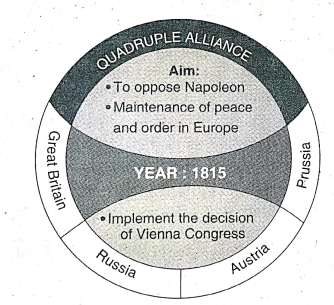
WBBSE Solutions For Class 9 History Chapter 3 Europe In The 19th Century Conflict Of Monarchical And Nationalist Ideas Quadruple Alliance

Question 6. What was the Concert of Europe? What were its objectives?
Answer:

Concert Of Europe:-

The Concert of Europe was the system to designate an agreement by the major European powers to act together on European questions of common interest. Metternich wanted to make the Concert of Europe between Great Britain, Russia, Prussia, and Austria which was signed in 1815 into an instrument for preventing any future revolution in Europe.

Objectives: The main objectives were

  1. Preservation of peace all over Europe by suppressing any move or development that might cause wars.
  2. Promotion of friendly relations among the four big powers- Great Britain, Russia, Prussia, and Austria.
  3. Preservation of political stability in Europe.
  4. To suppress nationalist and democratic forces.
  5. To prevent the rise of any powerful personality like Napoleon.
NEET Biology Class 9 Question And Answers WBBSE Class 9 History Notes WBBSE Solutions for Class 9 Life Science and Environment
WBBSE Class 9 Geography And Environment Notes WBBSE Class 9 History Multiple Choice Questions WBBSE Class 9 Life Science Long Answer Questions
WBBSE Solutions for Class 9 Geography And Environment WBBSE Class 9 History Long Answer Questions WBBSE Class 9 Life Science Multiple Choice Questions
WBBSE Class 9 Geography And Environment Multiple Choice Questions WBBSE Class 9 History Short Answer Questions WBBSE Solutions For Class 9 Maths
WBBSE Solutions for Class 9 History WBBSE Class 9 History Very Short Answer Questions WBBSE Solutions for Class 9 Physical Science and Environment


Question 7. What were the merits and demerits of the Metternich system?
Answer:

Merits And Demerits Of The Metternich System:-

Metternich was the most influential politician in Europe from 1815 to 1848. Owing to his unlimited influence, the period of 34 years (1815-1844) is called the ‘Age of Metternich’ in the history of Europe.

Merits: Metternich was the architect of a diplomatic system that gave Europe over 30 years of relative stability.

He negotiated the victory of all states who assembled at Vienna and established a system that, to a certain extent, allowed the ruling classes of Europe to cooperate rather than make war.

In the field of domestic policy, he was no doubt repressive and tolerant, but he provided a strong central government.

Demerits: Metternich resented liberalism, nationalism, and revolution. He suppressed nationalistic and democratic trends.

However, his policy was not in keeping with the trends of the prevalent situation of the time. His strict conservative policy gradually led to severe revolts in the Austrian empire.

In the early and mid-19th century, several parts of the Austrian empire witnessed revolutionary activity.

Question 8. What is the importance of the July monarchy of the Bourbons, the Constitutional Revolution of 1830?
Answer: The July Revolution of 1830 is one of the most important events in the history of France. From the following facts, it can be proved that the July Revolution was an event of the utmost.

Importance:

After the July Revolution, a constitutional monarchy was established in France under Louis Philippe in place of the absolute monarchy of the Bourbons.

Before the July Revolution, the aristocracy and the clergy of France used to enjoy unlimited rights and privileges. However, after the July Revolution, all these classes were deprived of their privileges.

It affected not only France but almost all the countries of Europe. England, Germany, Spain, Portugal, Poland, Belgium, Switzerland, and some other countries were affected by this revolution. The July Revolution of 1830 was a death. warrant for the autocratic monarchs.
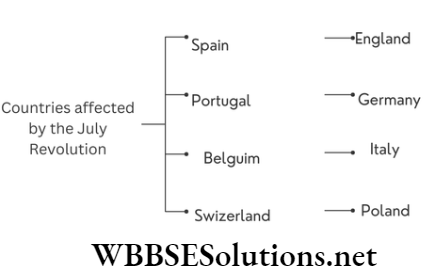
WBBSE Solutions For Class 9 History Chapter 3 Europe In The 19th Century Conflict Of Monarchical And Nationalist Ideas Countries affected by the July Revolution

Important Questions from Chapter 3 on European Nationalism

Question 9. What was the impact of the July Revolution on France?
Answer:

Impact Of The July Revolution On France:-

The July Revolution is regarded as one of the most important events in the history of France and its impact on France was undoubtedly significant.

The July Revolution succeeded in securing revolutionary feelings i.e., liberty, equality, and fraternity.

Although the July Revolution failed to remove the autocratic monarchy in France, the revolutionaries challenged the principle of legitimacy and it was replaced by the legitimacy of the nation.

In place of absolute monarchy was established under Louis monarchy was Philippe.

The nobles, lords, and clergy who enjoyed unlimited rights and privileges were deprived of these privileges.

Question 10. How was Rammohan Roy influenced by the July Revolution?
Answer: Rammohan Roy Influenced By The July Revolution As Follows:-

The July Revolution of 1830 in France bore a rich legacy for the people of the world during the 19th and 20th centuries. This was because the ideals of liberty, equality, liberalism, and democracy became popular among the people. These ideals spread rapidly from France to other countries of the world. Rammohan Roy, the ‘first modern man of India’ was greatly influenced by the July Revolution.

He took an intense interest in the July Revolution which he viewed as a triumph of liberty. He celebrated the success of the July Revolution in France. He was an internationalist and supported the cause of freedom everywhere. Deeply influenced by the ideals of the Revolution Rammohan Roy thought of monarchy and its absolutism as great evils.
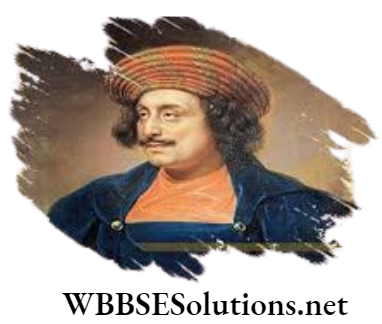
WBBSE Solutions For Class 9 History Chapter 3 Europe In The 19th Century Conflict Of Monarchical And Nationalist Ideas Raja Ram Mohan Roy

Question 11. Give an account of the February Revolution in France (1848).
Answer: Louis Philippe came to the throne of France on 30th July 1830. After coming to the throne of France, Louis Philippe introduced some liberal reforms.

He introduced freedom of the press and declared France to be a secular state. He could not satisfy the different political parties of France and failed to keep pace with their ideals and aspirations.

Popular discontent gradually increased and a movement under the leadership of Thiers started. People demanded the end of the monarchy in France.

Guizot, the Prime Minister, was not in favor of any administrative reforms. As the popular agitation took a serious turn Guizot was dismissed from office.
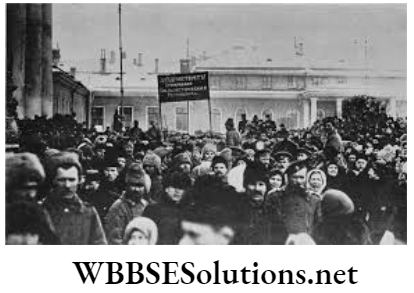
WBBSE Solutions For Class 9 History Chapter 3 Europe In The 19th Century Conflict Of Monarchical And Nationalist Ideas February Revolution

An armed clash took place on 23 February in front of the house of the deposed Minister Guizot in which many agitators were killed. This happened in February and came to be known as the February Revolution. Louis Philippe abdicated and France was declared a ‘Republic’.

Impact of Nationalism on European Politics

Question 12. Why is the year 1848 called the ‘Year of Advice of Guizot imposed restrictions on the Revolution’?
Answer: After the outbreak of the February Revolution of 1848 against the autocratic rule of Louis Philippe, a revolt broke out in Vienna in March. This revolt ultimately led to the downfall of Metternich. Later on, revolts broke out in Austria, Germany, and Italy.

Crete and Hungary also followed the same example. The people of Rome raised their voices against the Pope and he had to provide a constitution to his people. The rulers of Holland and Denmark also had to provide new constitutions to their people.

The Revolution of 1848 also motivated the Chartist Movement of England. Thus the year 1848 is rightly called the ‘Year of Revolution’.

Question 13. Who was Guizot? Write about his repressive policy.
Answer: Louis Philippe, the ruler of France, appointed Guizot as his prime minister. Guizot was a reactionary and supported the autocracy of the king. His main aim was to maintain the policy of the ‘status quo’ in France. When the people of France placed their demands on Louis Philippe, through newspapers, meetings, etc., the monarch on the meetings, speeches, and newspapers.

This was a direct attack on the freedom of speech of the people. Due to the repressive policy of Guizot, there was anarchy and discontent everywhere in France. In this way, Guizot and his repressive policy added fuel to the fire of discontent of the people and the February Revolution broke out.

Question 14. What were the impediments to the unification of Italy?
Answer: After the fall of Napoleon, Italy was divided into five principal political divisions in the Congress of Vienna, and Austria became a dominant power in Italy. Italy was just reduced to a mere ‘geographical expression’. There were certain impediments to the unification of Italy.

  1. The main impediment to the unification of Italy was the domination of Austria over Italian provinces.
  2. The whole of Italy except Piedmont- Sardinia was under foreign rule and was not interested in Italian unification.
  3. The leader of the Vienna Congress, Metternich followed an autocratic policy and destroyed the spirit of nationalism.
  4. There was no organization or Party at that time in Italy that could unite the patriots of Italy.

Question 15. What was the contribution of Mazzini to the Italian unification movement?
Answer: Mazzini was considered as the prophet of the Italian movement for unification. He was the founder of the Young Italy movement.

He founded a party known as Young Italy in 1832. He had immense faith in the power and strength of the Italian youths. Young men up to the age of forty could be its members.

The objectives of Young Italy were as follows:

  1. Italy should be unified as one nation.
  2. Austria should be driven out of Italy.
  3. The republic should be established in Italy.
  4. In the war against Austria, foreign help was not necessary.
  5. Italian unification movement should be carried on by the Italians only.
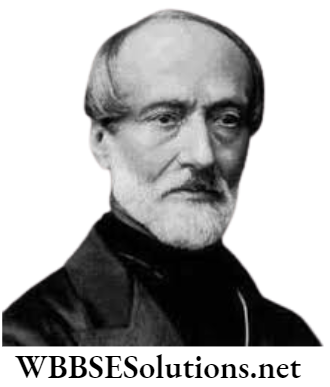
WBBSE Solutions For Class 9 History Chapter 3 Europe In The 19th Century Conflict Of Monarchical And Nationalist Ideas Mazzini

The mass uprising organized by the Young Italians for the unification and liberation of Italy failed due to a lack of organization and a plan of action among the rebels.

His greatest contribution was that he could make the Italians realize that it was possible to have the dream of the unification of Italy materialized.

Question 16. What was the Confederation of the Rhine?
Answer: The first step to unify, Germany was taken by Napoleon Bonaparte. During the French Revolution Germany was divided into 300 states under Austrian domination. Napoleon used the German states as an instrument of crushing the political power of Austria and Prussia.

Napoleon realized that the invasion of France by Austria and Prussia could be easily removed by the reorganization of the German states. Napoleon formed 39 states out of the 300 states and inaugurated a federal administrative system known as the Confederation of the Rhine.

Question 17. What was the Frankfurt Parliament?
Answer: The national leaders of Germany established a Parliament whose members were elected based on a universal adult franchise. The main function of this Parliament was to frame a constitution for Germany to achieve political unity and liberty and establish a popular government in place of the government of absolute monarchy.

According to the decisions of the Frankfurt Parliament, the crown of a united Germany was offered to Frederick William. But he refused this offer. His view was that he should not receive the crown as a gift from the representatives of the people. He believed in the unification of Germany through sheer force.

Question 18. Bismarck fought three wars to achieve the complete unification of Germany- Discuss.
Answer: Germany was divided into many small kingdoms for a long time. Bismarck, the leader of Germany, was determined to unite all the kingdoms of Germany. He fought three wars to achieve the complete unification of Germany.

War on Denmark (1864): Bismarck waged war against Denmark in 1864. Denmark surrendered the two provinces- Schleswig and Holstein to Austria and Prussia. The Treaty, of Gastin (1865) was signed between Austria and Prussia. But Bismarck wanted Austria to teach a lesson.

Austro-Prussian War (1866): Next, the Prussian army defeated Austria in the battle of Sadowa (1866). It ended Austria’s leadership in Germany.

Franco-Prussian War (1870-71): Next Germany defeated France in the Battle of Sedan in 1870. France was compelled to sign the humiliating Treaty of Frankfurt (1871). Thus emerged a unified Germany.

Question 19. What were the similar and dissimilar traits between the July Revolution of 1830 and the February Revolution of 1848?
Answer:

Similar traits between the July Revolution of 1830 and the February Revolution of 1848:

  1. Both the July and February Revolutions originated in France.
  2. The impact of both revolutions was felt all over Europe-Italy, Austria, Germany, Switzerland, and England and there were revolutionary uprisings.
  3. There was a demand for the abolition of the monarchy during both revolutions.
  4. Both revolutions witnessed a lack of effective leadership and the strong emergence of liberal forces.

Dissimilar traits between the July Revolution of 1830 and the February Revolution of 1848:

The Revolution of 1830 broke out as a protest against the reactionary policies of Charles X, the ruler of France.

  1. The demand of the liberals was a constitutional government. On the other hand, the revolution of 1848 was purely a Republican movement influenced by
    socialist ideas.
  2. The July Revolution was peaceful and democratic in character. But the February Revolution was violent and nationalist in character.
  3. In the July Revolution of 1830, the people who participated belonged to the middle class whereas in the 1848 Revolution, people devoted to socialism participated.

Question 20. Was the Crimean War justified?
Answer: Declaration of war: The war declared against Russia by England and France in support of Turkey in 1854 is known as the Crimean War. It was an important event in the history of Europe.

View of Robert Morier:

Many modern politicians and historians have criticized the nature of this war. They have regarded the Crimean War as a useless modern war of Europe. Robert Morier writes. “The Crimean War was the only perfectly useless war that has been waged.”

Useless War:

  1. The Crimean War could not give a permanent solution to the Eastern Question. The war ended with the Treaty of Paris.
  2. The provisions of this treaty could not remain permanent. According to the Treaty of Paris, the Sultan of Turkey was supposed to improve the condition of the Christian population living in Turkey. But the Sultan never carried out his promise which he had given at Paris for improving the condition of the Christian population living in Turkey.
  3. The war aimed to weaken Russia forever. In the Treaty of Paris, she was insulted and several restrictions were imposed upon Russia. Russia could never forget her humiliation.
  4. England and France could not get any advantage from this war. The Crimean War proved disastrous for the Allies. Therefore, it may be said that the Crimean War was quite useless and it might have been avoided.

Question 22. What led to the rise of Balkan nationalism?
Answer: The Balkan nations like Greece, Egypt Romania, Serbia, Albania, and others were white-skinned Europeans and Christian by religion.

The causes of the rise of Balkan nationalism are as follows:

  1. The Balkan nationalities were ruled by the Asiatic and Islamic powers Turkey. Turkey followed a policy of Turkofication. The French Revolution inspired the Balkan nationalities to agitate against Turkish rule.
  2. The Turkish Sultanate ruled the Balkan people through military ‘force and the people of the Turkish empire owed no allegiance to the Sultan.
  3. The Christians of the Balkan peninsula were oppressed by the ruling Sultans of Turkey.
  4. During the later seventeenth century, Turkey’s power was gradually declining. The civil administration and the army became weak and failed to keep the Balkan people under their control.

Question 23. What is the significance of the Greek War of Independence?
Answer:

Significance Of The Greek War Of Independence:-

  1. The Greek War of Independence is a landmark in the history of Europe.
  2. It showed that the resolutions of the Congress of Vienna were impractical and that national forces could not be checked by reactionary guiding principles.
  3. The Greek War of Independence was a great blow to the Metternich system.
  4. The European powers were attracted to the Near East for the first time.
  5. They felt that each had a common interest in the region. They also felt the need to free the Christian states from the oppressive Turkish rule.
  6. The weakness of Turkey was also exposed.
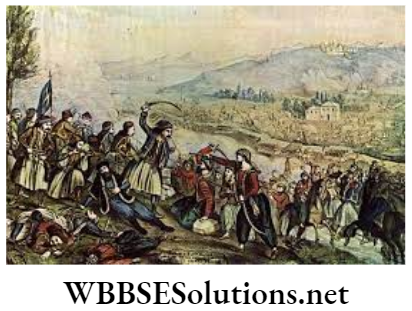
WBBSE Solutions For Class 9 History Chapter 3 Europe In The 19th Century Conflict Of Monarchical And Nationalist Ideas Greek War Of Independence

Study Guide for Class 9 History: Conflict of Ideas in Europe

Question 3. What is the significance of the Crimean War?
Answer:

Crimean War:-

The war declared against Russia by England and France in support of Turkey in 1854 is known as the Crimean War. In this war, Russia was defeated. The war is of great significance.

Significance Of The Crimean War:-

  1. The Crimean War laid the foundation for the unification of Italy and Germany.
  2. As a consequence of the Crimean War, the internal political situation of Russia was greatly affected. It exposed the weakness of Russia and the people put their demands before this government to introduce reform in the administration.
  3. The Crimean War had a great impact on international politics too. When Russia saw no chance to extend its empire in the Balkan States, it decided to increase its influence in East Asia.

Question 4. Which treaty was concluded after the Crimean War? What were the provisions of the treaty?

The Treaty of Paris (1856) was concluded after the Crimean War (1854).

According to the provisions of the treaty-

  1. England, France, and Austria admitted Turkey to the European family of states.
  2. The Sultan of Turkey promised to improve the condition of the Christians living in Turkey.
  3. Russia and Turkey returned the conquered provinces to each other.
  4. Russia promised not to interfere in the internal affairs of Turkey.
  5. Russia gave up the right to protect the Christians of Turkey.

Practice Questions for Class 9 History: Monarchical and Nationalist Ideas

Question 5. How would you criticize the ‘Emancipation Statute’ of 1861?
Answer:

The Emancipation Statute of 1861 passed by Alexander II, the Czar of Russia, was criticized on the following grounds:

  1. The nobles resented the loss of land. The Act also deprived them of the services of the serfs.
  2. The edict did not fulfill the expectations of the serfs. The ownership of land was denied to them and was vested in the hands of ‘mirs’.
  3. The serfs were subjected to the village mirs instead of the lords.
  4. The annual installment of redemption money payable to the government by the serfs in addition to other taxes put a heavy burden on them.

Chapter 3 Europe In The 19th Century: Conflict Of Monarchical And Nationalist Ideas True Or False

Question 1. The Vienna Congress dismantled the Napoleonic Empire.
Answer: True

Question 2. The Vienna Congress marks the beginning of an era.
Answer: True

Question 3. According to the Principle of Reward and Punishment, Poland was punished.
Answer: True

Question 4. Metternich prided himself as the ‘vanquisher of Napoleon’.
Answer: True

Question 5. Metternich was the Chancellor of Austria.
Answer: True

Question 6. The period between the Vienna Settlement and the Revolution of 1848 is often dubbed the Metternich Era in European politics.
Answer: True

Question 7. The period between 1815 and 1848 is known as the ‘period of peace’.
Answer: False

Question 8. After 1815 there was a conflict between monarchical and nationalist ideals.
Answer: True

Question 9. Czar Alexander, I was the leader of the Vienna Congress.
Answer: False

Question 10. The Four Big Powers in the Vienna Congress were Russia, Austria, England, and France.
Answer: False

Question 11. After the fall of Napoleon Bonaparte, Louis XVIII of the Bourbon dynasty ascended the throne of France.
Answer: True

Question 12. Under the Principle of Balance of power, France was encircled by powerful states all around.
Answer: True

Question 13. Metternich was the leader of the concert of Europe.
Answer: True

Question 14. The July Revolution of 1848 paved the way for the destruction of the Metternich system.
Answer: False

Question 15. The July Revolution of 1830 in France brought an end to the Divine Right of Kingship in France.
Answer: True

Question 16. The king of France at the time of the July Revolution was Louis XIV.
Answer: False

Question 17. Inspired by the July Revolution the Polish people began their fight for freedom. against the Germans.
Answer: False

Question 18. The July Ordinance was issued by the French emperor Charles X in 1830.
Answer: True

Question 19. Lafayette was a leader of the July Revolution.
Answer: True

Question 20. The foundation of the Second French Republic was laid in 1840.
Answer: False

Question 21. Louis Napoleon in 1852 ended the Second French Republic in France and established the Second Empire.
Answer: True

Question 22. The book ‘Organisation of Labour’ was written by Louis Blanc.
Answer: True

Question 23. The socialists under the leadership of Louis Philippe were eager to end the French Monarchy.
Answer: False

Question 24. Guizot was the prime minister of King Louis Philippe.
Answer: True

Question 25. The Battle of Sadowa was fought in 1860.
Answer: False

Question 26. The Battle of Sadowa was fought between Austria and Russia.
Answer: False

Question 27. The Battle of Sedan was fought between France and Austria.
Answer: False

Question 28. Carbonari was a secret society that was established during the German unification movement.
Answer: False

Question 29. By the Peace of Villafranca (1859) Austria. ceded Lombardy to Piedmont.
Answer: True

Question 30. Cavour was the Prime Minister of Austria.
Answer: False

Question 31. In the Battles of Magenta and Solferino, the Austrians were defeated.
Answer: True

Question 32. Mazzini believed that in the war against Austria, foreign help was necessary.
Answer: False

Question 33. The Carbonari were so-called because they used to burn charcoal.
Answer: True

Question 34. Austria was merely a ‘geographical expression’.
Answer: False

Question 35. Before the rule of Napoleon, Germany was divided into several small kingdoms.
Answer: True

Question 36. The foundation of the Frankfurt Parliament was an important step towards German unification.
Answer: True

Question 37. Bismarck planned for the unification of Germany under the leadership of Prussia.
Answer: True

Question 38. Mutternich followed the policy of ‘Blood and Iron’.
Answer: False

Question 39. Count Benedetti was sent by Apollon bo the Prussian king to get assurance that none of the Prussian dynasties would ever lay any claim on the Spanish throne.
Answer: True

Question 40. The Treaty of Berlin (1878) under the leadership of Bismarck tried to solve the Balkan question.
Answer: True

Question 41. The Treaty of Zurich was signed in 1869 between Austria and Piedmont-Sardinia.
Answer: False

Question 42. After the battle of Sadowa Germany was united.
Answer: False

Question 43. The absolute rule of the French monarchs was known as Czardom.
Answer: False

Question 44. The Russian serfs were emancipated in 1721.
Answer: False

Question 45. The Balkan means the hilly areas between the Aegean Sea and the Danube.
Answer: True

Question 46. In the Crimean War, England and France fought against Austria.
Answer: False

Question 47. The treaty that brought an end to the Crimean War was the Treaty of Paris (1856).
Answer: True

Question 48. The Treaty of San Stephano was concluded after the Crimean War.
Answer: False

Question 49. In Russia, the serfs were subjected to the village mirs.
Answer: True

Question 50. According to the ‘Emancipation Statute’ of 1871 the Russian serfs were declared free.
Answer: False

Question 51. Greece was conquered by Russia and lost its independence.
Answer: False

Question 52. In the famous Vienna Note, Russian Guardianship over the Orthodox Greek Church in Turkey was admitted.
Answer: True

Question 53. According to the Emancipation Statute, the serfs were to pay back the advance money to the government in 49 installments.
Answer: True

Question 54. Louis Kossuth was known as the ‘Mazzini of Hungary’.
Answer: True

Chapter 3 Europe In The 19th Century: Conflict Of Monarchical And Nationalist Ideas Fill In The Blanks

1. After the fall of Napoleon, European statesmen assembled at a conference at the Austrian capital Vienna (Berlin/Vienna/Naples).

2. At the Congress of Vienna, Prussia was represented by Hardenberg (Castlereagh/Frederick William/Hardenberg).

3. By the principle of legitimacy, the Bourbon (Hohenzollern/ Bourbon/Stuart) dynasty was reestablished in France.

4. According to the Principle of Legitimacy the dominance of Austria (France/Austria/Italy)over Germany was revived.

5. Per the Principle of Legitimacy the House of Orange was restored in Holland (France/Germany/Holland).

6. The conference at Carlsbad in 1819 was convened and dominated by Metternich (Castlereagh/Metternich/Louis XVIII).

7. The period from 1815 to 1848 (1830/1848/1850) is known as the age of Metternich.

8. The Carlsbad Decrees were a set of reactionary restrictions in the states of the German (French/Italian/German) confederation.

9. The President of the German Confederation was Austria (Russia/Italy/Austria).

10. The Protocol of Troppeau was drafted in the year 1820 (1810/1820/1830) in the Concert of Europe.

11. The July Revolution of 1830 (1820/1830/1848) gave a death blow to the Metternich system.

12. Under the Principle of Balance of Power France (Italy/France/Germany) was encircled with powerful states all around.

13. except for Alexander I (Frederich William III/Alexander I/Francis 1) all the diplomats of the Congress of Vienna were devoted to the ‘ancient regime’.

14. The leader of the July Revolution was Thiers (Guizot/Polignac/Thiers).

15. Polignac(Thiers/Polignac/Guizot) was appointed by Charles X as his minister.

16. Louis Philippe came to the throne of France in 1830 (1830/1836/1840).

17. Thiers (Guizot/Polignac/Thiers) gave a call to the people of France to resist the illegal activities of the French government.

18. The Second French Empire was founded by Louis Napoleon (Louis Napoleon/Napoleon Bonaparte/Louis XVI).

19. The Second French Empire was founded in 1852 (1851/1852/1853).

20. The foundation of the Second French Republic was laid in 1848 (1830/1848/ 1858).

21. The year 1848 (1848/1856/1864) is known as the ‘Year of Revolution’.

22. Louis Philippe, the ruler of France, abdicated to England (France/England/Russia).

23. Before the unification of Italy, Naples, and Sicily in South Italy were ruled by the Bourbon (Savoy/ Hapsburg/Bourbon) dynasty.

24. Cavour(Cavour/Garibaldi/Emmanuel) was the editor of the Italian periodical ‘Risorgimento’.

25. In 1860 some states of Central Italy like Perma, Modena, and Tuscany expressed their desire to join Piedmont-Sardinia (France/Piedmont-Sardinia/Westphalia).

26. Italy (Italy/France/Germany) after the Vienna Congress was reduced to a mere geographical expression.

27. A united and independent Italy was born in 1870 (1860/1865/1870).

28. The pact of Plombieres was signed in 1858 (1848/1858/1862).

29. The Young Italians were disarmed by the Austrian (French/British/Austrian) army.

30. In 1852 King Victor Emmanuel of Piedmont-Sardinia (Piedmont-Sardinia/Lombardy/Milan) appointed Cavour as his Prime Minister.

31. Mazzini believed that war with Austria (France Germany/Austria) was the only means to liberate Italy.

32. Mazzini favored a republican (democratic/republican/monarchical) form of government in a free Italy.

33. The Pact of Plombieres was signed between Napoleon III and Count Cavour (Garibaldi/Count Cavour/Mazzini).

34. The first stage in the unification of Germany was the creation of Zollverein (Zollverein/Philiki Hetaira/Carbonari).

35. In 1848 (1848/1849/1850) the German nationalists convened a parliament called Frankfurt Parliament.

36. Under the rule of Napoleon (Metternich/Napoleon/Bismarck) the Germans became acquainted with democratic and nationalist ideas.

37. The Confederation of the Rhine was inaugurated by Napoleon (Louis Philippe/ Napoleon/Mazzini).

38. During the French Revolution Germany was divided into 300 (300/400/500) large and small states.

39. The leadership in the unification of Germany was given by Prussia(Russia/Prussia/Lombardy).

40. The Danish (Danish/Spanish/ Prussian) war was the first step towards German unification.

41. After a crushing defeat at Sedan (Sadowa/Sedan/Waterloo) France was compelled to sign the treaty of Frankfurt.

42. The German states formed a tariff organization based on commercial cooperation known as Zollverein(Carbonari/Kulak/Zollverein).

43. The German unification was completed with the declaration of the Prussian (Russian/Prussian/Italian) king as the ‘Emperor of Germany’.

44. The Emancipation Statute was passed by Alexander II (Alexander I/Alexander II/Nicholas I) of Russia.

45. England and France participated directly in the Crimean War in support of Turkey (Egypt/Greece/Turkey).

46. The Crimean War came to an end with the signing of the Treaty of Paris(Adrianople/Versailles/Paris).

47. The Balkan means the hilly area between the Aegean Sea and the Danube (Danube/Adriatic/Mediterranean Sea).

48. Turkey(Greece/Turkey/Austria) included vast areas of Africa and Europe and was known as the Ottoman Empire.

49. In 1821, the people of Greece revolted against Turkey (Russia/Turkey/France).

50. The Treaty of Adrianople was signed in 1829 (1829/1830/1840).

51. The Treaty of Prague was signed in 1866 (1865/1866/1867).

52. The Greek people, under the Turkish (British/Spanish/Turkish) rule, began their national liberation movement.

Chapter 3 Europe In The 19th Century: Conflict Of Monarchical And Nationalist Ideas Match The Columns

Question 1. 

1. Column 1 Column 2
1. Crimean War (A)  Secret Society of Italy
2.  Carbonari (B) Austria
3.  1870 (C) 1854-56
4. Congress of Vienna held (D) Italy united


Answer: 1.-C,2.-A, 3.-D, 4.-B

Question 2. 

2. Column 1 Column 2
1. Leading person at Congress of Vienna (A) France
2. Mazzini (B) Bismarck
3. Talleyrand (C) Metternich
4.  Blood and Iron policy (D) Leader of Italy


Answer: 1.-C,2.-D, 3.-A, 4.-B

Question 3. 

3. Column 1 Column 2
1. February Revolution 1. 1830
2. July Revolution 2. 1848
3. Defeat of Austria by Prussia 3. 1870
4. Unification of Germany completed 4. 1866


Answer: 1.-B,2.-A, 3.-D, 4.-C

Question 4. 

4. Column 1 Column 2
1. Philke Hetaira (A) Italy
2. Carbonari (B) Odessa
3. Ems Telegram (C) Ambassador
4. Count Benedetti (D) Bismarck


Answer: 1.-B,2.-A, 3.-D, 4.-C

Question 5. 

5. Column 1 Column 2
1. Foundation of Second French Republic (A) 1830
2. Loins Philippe becomes  the king of France (B) 1848
3. William II became the first German emperor (C) 1870
4. United Italy born (D) 1866


Answer: 1.-B,2.-A, 3.-D, 4.-C

Question 6. 

6. Column 1 Column 2
1. Pact of Plombieres (A) 1856
2. Treaty of Villafranca (B) 1878
3. Treaty of Paris (C) 1858
4. Treaty of San Stephano (D) 1859


Answer: 1.-C,2.-D, 3.-A, 4.-B

Question 7. 

7. Column 1 Column 2
1. Nicholas I (A) Central figure in European politics
2. Cavour (B) Czar of Russia
3. Charles (C) Prime Minister of Piedmont
4. Metternich (D) Ruler of France


Answer: 1.-B, 2.-C, 3.-D, 4.-A

Question 8. 

8. Column 1 Column 2
1. Bourbon (A) Holland
2. Orange (B) Piedmont
3. Savoy (C) France
4. Hapsburg (D) Austria


Answer: 1.-C, 2.-A, 3.-B, 4.-D

Question 9. 

9. Column 1 Column 2
1. 1848 (A) Battle of Sadowa
2. 1854 (B) Battle of Sedan
3. 1866 (C) Crimean War
4. 1870 (D) Year of Revolution


Answer: 1.-D,2.-C, 3.-A, 4.-B

Question 10. 

10. Column 1 Column 2
1. Emancipation Statute, 1861 (A) Germany
2. Zollverein (B) Austria
3. Philke Hetaira (C) Russia
4. Vienna Congress (D) Greece


Answer: 1.-C,2.-A, 3.-D, 4.-B

WBBSE Solutions For Class 9 History Chapter 6 The Second World War And Its Aftermath

WBBSE Chapter 6 The Second World War And Its Aftermath Analytical Answer Questions

Question 1. What was the immediate cause of the Second World War?
Answer: Immediate Cause Of The Second World War:-

In the Second World War (1939-1945) Germany, Italy and Japan were on one side and Britain, France, the USSR, the USA and China were on the other.

The immediate cause of the Second World War is to be found in a series of acts of aggression by the ‘German leader Hitler. Germany annexed Austria and then demanded Sudetenland from Czechoslovakia.

WBBSE Solutions For Class 9 History Chapter 6 The Second World War And Its Aftermath

WBBSE Class 9 Second World War Solutions

By the Munich Pact of 1939, the Allies admitted the German claim. Soon after, Germany swallowed up the remaining portion of Czechoslovakia and demanded Danzig from Poland. Britain, France and Poland allied against German aggression.

Great Britain and France were engaged in negotiations with Russia. In the meantime, Germany and Russia concluded a Non-Aggression Pact for 10 years (1939).

Hitler thus emboldened and invaded Poland without any formal declaration of war. Great Britain and France declared war against Germany in September 1939 and the Second World War started.

Read and Learn Also WBBSE Solutions for Class 9 History

Question 2. How far was Hitler responsible for the outbreak of the Second World War?
Answer:

Hitler Responsible For The Outbreak Of The Second World War:-

The main cause of the Second World War according to many historians was the aggressive policy of the German dictator Adolf Hitler. He treated the Treaty of Versailles (1919) as a scrap of paper.

After making Germany economically and politically strong he began to disobey the conditions of the Versailles Treaty.

He began to reorganise the German army with the motive of aggressively violating the Versailles Treaty. He followed an aggressive policy towards the neighbouring countries, violating treaties and promises.

WBBSE Solutions For Class 9 History Chapter 6 The Second World War And Its Aftermath Hitler

He annexed Austria violating the Treaty of Versailles. He violated the Munich Pact and annexed Czechoslovakia. To wreck the Balance of Power, he concluded the Rome-Berlin Axis. Finally, in 1939 he invaded Poland disregarding the warning given by England and France. Thus the aggressive policy of Hitler made the Second World War inevitable.

WBBSE Solutions For Class 9 History Chapter 6 The Second World War And Its Aftermath Hitler's Agencies to suppress opposition

Key Events of the Second World War Notes

Question 3. How was the Rome-Berlin-Tokyo Axis formed?
Answer:

Rome-Berlin-Tokyo Axis Formed As Follows:-

Adolf Hitler, the Nazi dictator of Germany, repudiated the Locarno Pact in 1936. He militarized the left bank of the river Rhine. In the same year, Germany and Japan concluded the Anti-Commintern Pact which was aimed against Russia. Hitler also established friendly contact with Mussolini, the Fascist dictator of Italy and formed the Rome-Berlin Axis.

Italy occupied Abyssinia in 1936 in defiance of the League of Nations and found it necessary to secure friends in Europe. In 1937 Italy left the League of Nations and joined the Anti-Comintern Pact. Thus the Rome-Berlin Axis was converted into the Rome-Berlin-Tokyo Axis.

WBBSE Solutions For Class 9 History Chapter 6 The Second World War And Its Aftermath Mussolini with Hitler

Question 4. When and between whom was the Munich pact signed? What is the importance of the Munich Pact (1938)?
Answer: The Munich Pact was signed in 1938 between Chamberlain (The British Prime Minister), Daladier (Prime Minister of France), Hitler (the Nazi dictator of Germany) and Mussolini (the Fascist dictator of Italy).

England and France followed a policy of appeasement towards Hitler and signed the Munich Pact in 1938 in which the unjust demands of Hitler were accepted.

  1. Germany was authorised to occupy four border provinces of Czechoslovakia within ten days.
  2. The government of Czechoslovakia was forced to release all the political prisoners of Sudetenland. Sudetenland was also given to Germany. This emboldened Hitler and encouraged him to make more and more territorial demands. At last, when Hitler invaded Poland, Britain and France could not tolerate it and declared war against Germany. Thus the Second World War started.

Nazi German’s foreign policy of Imperialism and militarism.

WBBSE Solutions For Class 9 History Chapter 6 The Second World War And Its Aftermath Nazi German's foreign policy of iImperialism and militarism

The progression of events shown above suggests that Nazi Germany confidently pursued and applied foreign policies of imperialism and militarism.

NEET Biology Class 9 Question And Answers WBBSE Class 9 History Notes WBBSE Solutions for Class 9 Life Science and Environment
WBBSE Class 9 Geography And Environment Notes WBBSE Class 9 History Multiple Choice Questions WBBSE Class 9 Life Science Long Answer Questions
WBBSE Solutions for Class 9 Geography And Environment WBBSE Class 9 History Long Answer Questions WBBSE Class 9 Life Science Multiple Choice Questions
WBBSE Class 9 Geography And Environment Multiple Choice Questions WBBSE Class 9 History Short Answer Questions WBBSE Solutions For Class 9 Maths
WBBSE Solutions for Class 9 History WBBSE Class 9 History Very Short Answer Questions WBBSE Solutions for Class 9 Physical Science and Environment


Question 5. What is meant by the policy of appeasement? Who followed the policy of appeasement and why?
Answer: Policy Of Appeasement:-

The policy of appeasement means giving a person or party whatever they want. By 1939 aggressive militarism of Italy and Germany in Europe and Japan in East Asia created alarm. However, throughout the aggression, the great powers like England and France remained inactive and timid. Their policy of doing nothing or little when facing militarism is known as the policy of appeasement.

The Prime Minister of Britain, Neville Chamberlain and Edward Daladier, the Premier of France, followed the policy of appeasement. Neville Chamberlain believed that some of the territorial clauses of the Treaty of Versailles (1919) were unnecessarily harsh to Germany and that an appeasement policy towards Hitler would prevent another war.

He believed that if Germany became strong and if she was satisfied by the amendment of the Treaty of Versailles, she would stand as a bulwark against the communist influence of Russia.

Impact of WWII on Global Politics

Question 6. What is the  ‘Cash and Carry’ policy?
Answer: Cash And Carry Policy:-

The USA followed a policy of neutrality towards international politics after the First World War. She did not join the Second World War and kept herself aloof from the war but was sympathetic towards the Allied powers. In 1939 the American legislature allowed the USA to help the Western democratic states and sell arms and ammunition to them.

This policy was known as the ‘Cash and Carry’ policy. It was a policy to preserve neutrality while aiding the Allies. It allowed the sale of arms, ammunition and war materials to belligerents (countries engaged in war) as long as the recipients arranged for transportation using their ships and paid immediately in cash, assuming all risk in transportation.

Question 7. What was the ‘D-Day’?
Answer: D-Day:-

‘D-Day’ was the Deliverance Day, (June 6, 1944). On that day vast Anglo-American force landed at the Normandy coast of northern France by crossing the English Channel. The operation was gigantic. The Military General of the USA Eisenhower took the leadership. One thousand Anglo-American air crafts conducted a massive dropping of Allied air-troopers behind the German lines by parachute.

Nearly 11 thousand warplanes were ready for their defence. Four thousand Allied naval ships and thousands of land forces joined. Caught between the Allied army in the front and at the back, the Germans became bewildered. The superior Allied forces captured Toulon, Marseilles, Nice, Lyons and the German airfields in France. They liberated Paris from foreign occupation on April 25, 1944. The Allied army then proceeded towards Germany.

Question 8. When was the Potsdam Conference held? Name the countries which took part in the Potsdam Conference. What was decided in the Potsdam Conference?
Answer: The Potsdam Conference was held in 1945. The countries which took part in the Potsdam Conference were Russia, America and Britain.

At the Potsdam Conference, it was decided:

  1. Germany was to be divided into four zones namely American, Soviet, French and British.
  2. Like Germany, its capital Berlin was also to be divided into four zones.
  3. Berlin would be placed under a council named ‘Allied Kommandatura’.
  4. Though Germany was divided into four zones she was to be treated as a single economic unit.
  5. The Allied Control Council would be formed to supervise the working of Germany as a single economic unit.
  6. Germany would undergo ‘Five. Ds’ (demilitarization, deindustrialisation, decentralisation, democratization and denazification).

Question 9. What were the main theatres of the Second World War?
Answer: Main Theatres Of The Second World War:-

The Second World War began in 1939 and ended in 1945 after lasting for six years. Around 60 countries were involved in this violent war. The war was fought on the Mediterranean, the Atlantic and the Pacific, and in four major land campaigns the Soviet Union, North Africa and the Mediterranean, western Europe, and the Far East.

WBBSE Solutions For Class 9 History Chapter 6 The Second World War And Its Aftermath Theatres Of The Second World War

The main theatres of the war were:

  1. The Russian Theatre or Eastern Theatre
  2. The Mediterranean Theatre
  3. The African Theatre
  4. The Pacific Theatre
  5. The Asian Theatre
  6. Arctic and Atlantic Theatre.

Important Questions from Chapter 6 on WWII

Question 10. What is the Truman Doctrine?
Answer: On March 11, 1947, President Truman of the USA, in a lecture in the American Congress, gave a call to frustrate the onslaught of communism on the free world.

He declared:

  1. The USA seeks to protect the independence and territorial integrity of free democratic nations from communist aggression.
  2. Whenever a free lawful government was threatened by an armed minority and the lawful government tried to resist the aggression, the USA would render help to the lawful government.
  3. The USA would help Greece and Turkey with 400 million dollars to free these countries from Soviet influence.
    This declaration of Truman is known as the Truman Doctrine.

Question 11. What was the Cold War?
Answer: The tension of war without an actual shooting of war has been termed the Cold War. Cold War is a state of tension between countries in which each side adopts policies designed to strengthen itself and weaken the other by falling short of actual war. It is a kind of verbal war and even more terrible than the ‘Warm War’. It is an atmosphere of artificial tension and distrust either due to virtual utterances or war-like preparation which may at any moment degenerate into a ‘Warm War’ or a shooting war.

Question 12. What was ‘NATO’ and ‘Warsaw Pact’?
Answer: After the Second World War USA and Soviet Russia who had helped each other in the Second World War became rivals and a competition arose between them to assume leadership of the world. In 1949 USA formed a military alliance called 16 nations as its members.

It was strong NATO (North Atlantic Treaty Organisation) with enough to repulse any invasion of West Europe by the Red Army. The Soviet Union, on the other hand, apprehended- led an invasion of East Europe and Russia by the NATO army. She entered into the Warsaw Pact with East European countries in 1955.

Question 13. Write a note on the evolution of internationalism after the Second World War.
Answer: The destructive effect of the Second World War (1939-45) opened the eyes of different countries of the world. They realised that peace and cooperation could not be established without cooperation and trust. They also realised that war was not the ultimate means to solve problems.

The international peace organisation League of Nations which was established after the First World War collapsed before the selfish motives of different nations. International cooperation failed in the field of politics and the Second World War broke out in 1939. After the Second World War, different nations again realised the importance and necessity of mutual cooperation.

They decided to solve their problems through peaceful meetings so that the damage of war might be removed forever and peace might be established among different nations of the world. The United Nations Organisation (UNO) was established in 1945 the sole aim of which was to maintain international peace and security, to develop friendly relations and international cooperation.

Aftermath of the Second World War Study Guide

Question 14. State the differences between ultranationalism and internationalism.
Answer: Differences between ultranationalism and internationalism

Ultranationalism Internationalism
1. Ultranationalism leads to war among different nations.  1. Internationalism advocates world peace and is against wars among different nations.
2. Ultranationalism involves contempt for other nations. 2. Internationalism advocates cooperation among different nations for the benefit of all.
3. Transnationalism is the most destructive force in the world which might create international anarchy. 3. Internationalism replaces international anarchy with international order.


Question 15. Was the Second World War truly a global war?
Answer: Second World War Truly A Global War:-

In the Second World War (1939-1945) the Allied powers were England, France, the USSR, the USA and China. Three Axis powers were Italy, Germany and Japan.

World War II was truly a global war. This extensive war was fought on all major seas and in Africa, Asia and Europe. It involved almost 60 nations, seven of them on the side of the Axis. The war in the Mediterranean took military conflict beyond these seas in Europe.

The war against Japan was fought over two-thirds of the world’s surface with the USA and her allies taking part in air, land and sea battles. It turned World War II into a global conflict. To plan global strategy, top Allied leaders held a series of conferences such as the ones in Tehran, Yalta and Potsdam.

WBBSE Solutions For Class 9 History Chapter 6 The Second World War And Its Aftermath Second World war Truly a Global War

Practice Questions for Class 9 History: WWII and Aftermath

Question 16. What are the major differences between democracy and Fascism?
Answer:

The major differences between democracy and Fascism are:

  1. Democracy allows and encourages different political parties and political views to function in the political system to turn the wheels of the political machinery. On the other hand, Fascism does not tolerate any political party or political views other than the view sponsored by the Fascist dictator.
  2. Democracy develops balanced, healthy and creative nationalism. This appears to be a source of strength and progress in the life of a nation. But Fascism generates hatred and preaches aggressive nationalism. Such perverted nationalism is the cause of conflict among different nations.

Question 17. Discuss the nature of the Second World War, collecting rubber, newspapers and scrap War.
Answer: Nature Of The Second World War, Collecting Rubber, Newspapers And Scrap War:-

Within twenty years of the First World air raid wardens. War (1914-18) The Second World War broke out on 13 September 1939. The nature of the Second World War is discussed below.

  1. The Second World War was more destructive and extensive than the First World War.
  2. This was for the first time that the war was extended to three fronts-land, air and water. It was fought on all major seas in Asia, Africa and Europe. Sixty nations were involved in the war, seven of them on the side of the Axis.
  3. Deadly weapons and dreadful atom bombs were used in the war. Aeroplanes played a major role. Fleets of aeroplanes attacked troops and naval. units destroyed railroads and prepared the way for invasion.
  4. The war was fought not only by armed forces on the battlefield but also by civilians in the factories and at home. School children also took part in the metal, assisting in War Bond drives and helping

Study Guide for Class 9 History: The Second World War and Its Aftermath

Question 18. What role did technology play in the Second World War?
Answer: Technology played an important role in World War II. Major advances in weaponry by both the Allied and the Axis powers impacted the way the war was fought and eventually the outcome of the war.

Tanks: It was during World War II that tanks became a major military force. Some of the most famous tanks from World War II include Germany’s Tiger Tank, the Soviet Union’s T-34 tank, and the United States, Sherman Tank.

Aircraft: The Air Force became one of the most important parts of the military during World War II. There were small, fast fighter planes designed for air-to-air combat and large bombers that could drop huge bombs. enemy targets, military helicopters and jet-powered fighter planes.

Radar: Radar, a new technology, developed right before the war. It used radio waves to detect enemy aircraft which helped the British to fight off the Germans in the Battle of Britain.

Aircraft Carrier: One of the biggest changes in naval technology in World War II  was the use of aircraft carriers which were able to launch air attacks from anywhere in the ocean.

Bombs: World War II saw the invention of many new types of bombs. The Germans invented the long-range flying bomb called the V-I as well as a rocket bomb called the V-2. Other specialized bombs included bouncing bombs, bunker busters and cluster bombs.

The Atom bomb: Perhaps the largest leap in technology during World War II was the atom bomb which caused a massive explosion by using a nuclear reaction. It was used by the United States to bomb the Japanese cities of Hiroshima and Nagasaki.

Secret Codes: To keep communications secret, both sides developed their own secret codes. The Germans used a machine called the Enigma Machine to code and decode their messages.

Propaganda: New technology like motion pictures, the radio and the microphone. were all used by governments to broadcast their message to the people.

Question 19. Make a comparative study related to the expansion and impact of the two World Wars.
Answer: Comparative study related to the expansion and impact of the two World Wars.

Subject of comparison First World War 1914-1918 Second World War   1932-1945
Expansion The war touched all parts of Europe. Fighting initially developed on three major European fronts: Eastern, Western and Serbian. As the war progressed, two new fronts emerged: Turkish and Italian. It also touched the Far-Eastern and Central Asian countries. Around 60 countries were involved in a war which extended in three fronts—land, air: and water. The war was fought on the Mediterranean, the Atlantic and the Pacific and in four major land campaigns in the Soviet Union, North Africa and the Mediterranean, Western Europe and the Far East.
Methods of warfare Fought from lines of trenches and supported by machine guns, artillery and rifles, use of tanks, aeroplanes and poisonous gas. In the war tanks, fast fighter planes, large bombers, military helicopters, jet-powered fighter planes, bouncing bombs,  bunker blasters, duster bombs, submarines and nuclear bombs were used.
Casualties Death of about 10 million militaries and seven million civilians, 22 million wounded and about 8 million imprisoned or missing. Many people took shelter in refugee camps. About 60 million people died and millions, of people in different countries, became homeless. As a result of the war 13-20 million people died due to famine and different kinds of diseases.


Key Figures in the Second World War for Class 9

Question 20. Prepare a comparison chart of the First and Second World Wars.
Answer: Comparison Chart of the First and Second World Wars

Subject of comparison First World War Second World War
Period First World War 1914 to 1918 Duration 4 years 3 months 14 days Second World War 1939-1945 Duration 6 years 1 day
Nature of war The war between countries to acquire colonies or territories War of ideologies
Causes The murder of Archduke Francis Ferdinand, the heir to the Austrian throne, in June 1914 The humiliating and shameful conditions of the Treaty of Versailles Hitler’s ambition to become master of Europe. Hitler’s invasion of Poland in 1939
Contending parties Central Powers:
Germany, Austria-Hungary, Turkey  Allied Powers:
France, Britain, Russia, Italy, Japan and USA.
Allied Powers: France, Britain, Soviet Union, US. China              Axis Powers: Germany, Italy, Japan
Casualties Estimated to be: Death of 10 million militaries; death of 7 million civilians, 22 million wounded and about 8 million imprisoned or missing Estimated to be: Death of 60 million people. Death of 40-55 civilians.
Genocide The Ottoman Empire committed genocide against the Armenians Nazi Germany carried out the genocide of Jews
Methods of  warfare Fought from lines of trenches and supported by machine guns and Use of nuclear power and missiles, submarines artillery, use of tanks, aeroplanes and poisonous gas. Use of nuclear power and missiles, submarines and tanks; encryption codes for secret communication; Blitzkrieg fighting method used by Germany.
Results The Central Powers were defeated. A world peace organisation, the League of Nations was established. The Axis Powers were defeated.  A world peace organisation, the United Nations Organisation was established. The Soviet Union and the USA emerged as rival superpowers
Post world war Politics Germany could not accept the humiliating Treaty of Versailles. The seeds of the Second World War lay in the Treaty of Versailles. A cold war broke out between the USA and the Soviet Union.


Chapter 6 The Second World War And Its Aftermath True Or False

Question 1. The Treaty of Versailles (1919) was humiliating for France.
Answer: False

Question 2. One of the main points in Hitler’s foreign- policy was Pan-Germanism.
Answer: True

Question 3. Germany invaded Poland on September 1, 1939.
Answer: True

Question 4. Germany attacked France in 1939.
Answer: False

Question 5. The Red Army of the Soviet Union followed the ‘Scorched Earth Policy’.
Answer: True

Question 6. With the Japanese attack on Pearl Harbour, there was an extension of the Second World War in Asia.
Answer: True

Question 7. Russia was attacked by the German Nazis in 1942.
Answer: False

Question 8. Leningrad was besieged by the German army.
Answer: True

Question 9. Hitler committed suicide in 1945.
Answer: True

Question 10. Germany abandoned her membership of the League of Nations in 1944,
Answer: False

Question 11. After the Second World War, two great powers the United States of America and the Union of the Soviet Socialist Republic emerged.
Answer: True

Question 12. Two ‘superpowers’ which emerged after the Second World War were Great Britain and the United States of America.
Answer: False

Question 13. During 1946-47 the government of Poland, Romania, and Albania were converted into communist dictatorships.
Answer: True

Question 14. To counteract communism, the Western responses were the Truman Doctrine and the Marshall Plan.
Answer: True

Question 15. The Non-aligned nations emerged after the First World War.
Answer: False

Question 16. The United Nations Organisation was established in 1940.
Answer: False

Question 17. Due to the German attack during the Second World War, vast areas of Russia including Leningrad and Stalingrad were destroyed.
Answer: True

Question 18. The USA entered into the Warsaw Pact with East European countries in 1955.
Answer: False

Question 19. President Truman of America declared that the USA would help Greece and Turkey with the aim of freeing these countries from Soviet influence.
Answer: True

Question 20. After the Potsdam Conference France was divided into four occupied zones.
Answer: False

Question 21. The ‘Third World’ countries launched the USA joined the Potsdam Conference.
Answer: True

Question 22. Harry Truman of Britain and Clement Attlee Non-Alignment Movement.
Answer: False

Question 23. The decision that Germany would be de-Nazified was taken at the Potsdam conference.
Answer: True

Question 24. Scorched earth policy means the policy of destroying everything that might be of use to an invading enemy.
Answer: True

Chapter 6 The Second World War And Its Aftermath Topic A The Causes and Course of the Second World War Fill In The Blanks

Question 1. The Treaty of Versailles was imposed on __________ (Italy/France/Germany).
Answer: Germany

Question 2. Japan attacked Manchuria in _________(1930/1931/1932).
Answer: 1931

Question 3. In 1935 Mussolini attacked ___________ (Abyssinia/Danzig/Rhineland).
Answer: Abyssinia

Question 4. Haile Selassie was the emperor of ____________(Ethiopia/Poland/Syria).
Answer: Ethiopia

Question 5. After the Second World War __________ (England/France/Czechoslovakia) was converted into a Communist dictatorship.
Answer: Czechoslovakia

Question 6. General Eisenhower was appointed the Supreme Commander of the Allied invasion in _______ (Asia/Europe/Africa).
Answer: Europe

Question 7. The Nazi-Soviet Non-Aggression pact was signed in _____________(1938/1939/1990).
Answer: 1939

Question 8. The dictator of Italy who installed a fascist regime was__________ (Adolf Hitler/Benito Mussolini/Joseph Stalin).
Answer: Benito Mussolini

Question 9. The title Adolf Hitler took in 1934 that meant leader was__________ (Fuhrer/Dictator/ Minister).
Answer: Fuhrer

Question 10. Hitler invaded Poland on _________1939. (1 September/4 September/15 October)
Answer: 1 September

Question 11. Pearl Harbour was attacked by Japan in___________ (1941/1942/1943).
Answer: 1941

Question 12. In 1941 Pearl Harbour was attacked by _____________(Belgium/USA/Japan).
Answer: Japan

Question 13. ___________ (Belgium/Austria/Germany) suffered a setback at Stalingrad.
Answer: Germany

Question 14. Atomic bombs were dropped on Hiroshima and Nagasaki in ___________ (1939/1941/1945).
Answer: 1945

Question 15. ___________(USA/Britain/Austria) dropped atomic bombs on Hiroshima and Nagasaki.
Answer: USA

Question 16. USA entered into Second World War in _________(1939/1941/1943).
Answer: 1941

Question 17. Admiral Hideki Tojo was the Prime Minister of __________(Britain/USA/Japan).
Answer: Japan

Question 18. The Japanese launched a surprise attack on the _______(British/German/US) naval base at Pearl Harbour.
Answer: US

Question 19. Perhaps the largest leap in technology during World War II was the_________ (bouncing/atom/cluster) bomb.
Answer: Atom

Question 20. Japan was worried about ___________ (US/French/ British) navy in Hawaii.
Answer: US

Question 21. On the ‘D-Day’ Anglo-American force landed at ____________(Lyons/Normandy/Marseilles) coast.
Answer: Normandy

Question 22. Francisco Franco was the Fascist dictator of ___________ (Italy/Germany/Spain).
Answer: Spain

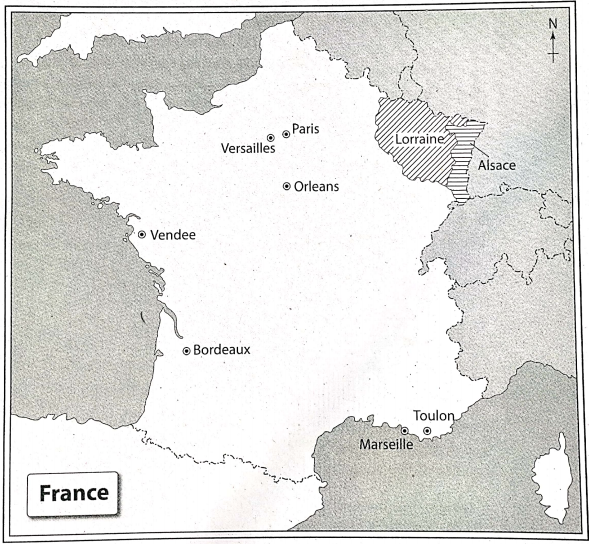
Question 23. The provinces of Alsace and Lorraine were taken away from ________ (France/England/ Germany).
Answer: Germany

Question 24. _____________(Britain/Japan/France) had built a strong underground line of fortresses and gave it the name Maginot Line.
Answer: France

Question 25. Daladier was the Prime Minister of_______ (Britain/USA/France).
Answer: France

Question 26. Hideki Tojo was the Prime Minister of _________(USA/Ethiopia/Japan).
Answer: Japan

Question 27. ‘The Crisis in Civilisation’ was written by ___________(Rabindranath/Marx/Lenin).
Answer: Rabindranath

Question 28. The term ‘Cold War’ was popularised by_____________ (George Kennan/Walter Lippmann/ Bernard Baruch).
Answer: Walter Lippmann

Question 29. The USA joined the Second World War in__________ (1930/c/1950).
Answer: Walter Lippmann

Question 30. Germany surrendered unconditionally in ____________(1940/1942/1945).
Answer: 1945

Question 31. Truman Doctrine and Marshall Plan was declared by___________ (USA/Britain/Italy).
Answer: USA

Question 32. The ___________(SEATO/CENTO/Warsaw Pact) was a military alliance formed by the Soviet Union as a counterbalance to the North Atlantic Treaty Organisation.
Answer: Warsaw Pact

Chapter 6 The Second World War And Its Aftermath Match The Columns

Question 1. 

1. Column 1 Column 2
1. KD Hitler (A)  Japanese emperor
2. General Eisenhower (B) Hitler’s mistress
3. Hirohito (C) Mein Kampf
4. Eva Braun (D) Supreme Allied Commander


Answer: 1.-C, 2.-D, 3.-A, 4.-B

Question 2. 

  2.  Column 1 Column 2
1. Neville Chamberlain (A) Italy
2. Mussolini (B) Spain
3. General Tojo (C) Britain
4. General Franco (D) Japan


Answer: 1.-C, 2.-A, 3.-D, 4.-B

Question 3. 

3. Column 1 Column 2
1. Czechoslovakia was occupied by Germany (A) 1933
2. D-Day (B) 1945
3. Disarmament Conference (C) 1944
4. Atom bomb dropped in Japan (D) 1939


Answer: 1.-D, 2.-C, 3.-A, 4.-B

Question 4. 

4. Column 1 Column 2
1. Germany used (A) 81 mm Mortar
2. British used (B) M-10 Wolverine
3. US Tank Destroyer (C) Typhoon fighter bomber
4. French artillery possessed (D) Light armoury (Pz-ll, Pz-lll)


Answer: 1.-D, 2.-C, 3.-B, 4.-A

5. Column 1 Column 2
1. General army (A) 1933
2. Peace of Paris (B) International peace organisation
3. Disarmament Conference (C) Overran Yugoslavia
4. UNO (D) 1919


Answer: 1.-C, 2.-D, 3.-A, 4.-B

Question 5. 

6. Column 1 Column 2
1. September 1939 (A) Pearl Harbour bombed
2.  3 July 1942 (B) The battle of Britain began
3. 7 December 1941 (C) Poland attacked by Germany
4. 10 July 1940 (D) Germany took Sebastopol


Answer: 1.-C, 2.-D, 3.-A, 4.-B

Question 6. 

7. Column  1 Column 2
1. 13 September 1942 (A) Deliverance Day
2. 17 July 1945 (B) Yalta Conference begins
3. February 1945 (C) Battle of Stalingrad
4. 6 June 1944 (D) Potsdam Conference


Answer: 1.-C, 2.-D, 3.-B, 4.-A

Question 7. 

8. Column 1 Column 2
1. Truman Doctrine (A)  King of Italy
2. Nicholas II (B) Walter Lipmann
3. Cold War (C) 1947
4. Victor Emmanuel (D) Czar of Russia


Answer: 1.-C, 2.-D, 3.-B, 4.-A

Question 8. 

9. Column  1 Column 2
1. 2 September 1945 (A) Rome was occupied by the Allied army
2. 4 June 1944 (B) Japan surrenders unconditionally
3. Pearl Harbour (C) Soviet Union
4. T-34 tank (D) Island of O’ahu


Answer: 1.-B, 2.-A, 3.-D, 4.-C

Question 9. 

10. Column 1 Column 2
1. Germany (A) President of America
2. Roosevelt (B) 1943
3. Mehmed V (C) Annexation of Sudetenland
4. Battle of Tunisia (D) Sultan of Turkey


Answer: 1.-C, 2.-A, 3.-D, 4.-B

Question 10. 

11. Column  1 Column 2
1. Twenty years armistice (A) French surrender to Germany
2. French government signed (B) Treaty at Champagne
3. Dictated Peace (C) 1919-1939
4. Fall of Third French Republic (D) Treaty of Versailles


Answer: 1.-C, 2.-B, 3.-D, 4.-A

Question 11. 

12. Column  1 Column 2
1. Red Army (A) 7 December 1941
2. Pearl Harbour Incident (B) 1942
3. Potsdam Conference (C) 1945
4. Battle of Midway (D) Russia


Answer: 1.-D, 2.-A, 3.-C, 4.-B

Question 12. 

13. Column  1 Column 2
1. Mass murder of Jewish people (A) Cold War began
2. Largest battle of World War II (B) Hitler
3. Nazi flag was designed by (C)  Holocaust
4. The outcome of World War II (D) Battle of the Atlantic


Answer: 1.-C, 2.-D, 3.-B, 4.-A

Question 13. 

14. Column  1 Column 2
1. Kamikaze (A)  America
2. Battle of Britain (B) Germany
3. Paris was occupied in 1940 (C) Japanese aircraft
4. Cash and Carry Policy (D) Germany defeated


Answer: 1.-C, 2.-D, 3.-B, 4.-A

Question 14. 

15. Column  1 Column 2
1. Goebbels (A) Lieutenant of Hitler
2. Battle of Normandy (B) 1941
3. Goering (C) 1944
4. Battle of Crete (D) Hitler’s propaganda minister


Answer: 1.-D, 2.-C, 3.-A, 4.-B

WBBSE Solutions For Class 9 History Chapter 2 Revolutionary Ideals, Napoleonic Empire And Nationalism

WBBSE Chapter 2 Revolutionary Ideals, Napoleonic Empire, And Nationalism Analytical Answer Questions

Question 1. What is known in history as the 18th Brumaire?
Answer: History As The 18th Brumaire:-

When the popularity of the Directors of France was at its lowest ebb, Napoleon took. advantage of the unpopularity of the Directory administration.

He joined hands with a few Directors to overthrow it. It was a bloodless coup d’etat. Napoleon by a military coup seized the administrative power of France on 9-10 November 1799. This incident is known in history as the 18th Brumaire.

The ‘Eighteenth Brumaire’ refers to November 9, 1799, in the French calendar. It was the day when Napoleon Bonaparte had made himself dictator by a coup d’etat. Napoleon was proclaimed the first Consul. The event is often viewed as the effective end of the French Revolution.

Impact of Revolutionary Ideals on Europe

Question 2. When and between whom was the treaty of Campo Formio signed? What were the provisions of the treaty? What was the importance of the treaty?
Answer: The Treaty of Campo Formio was signed in 1797 between Napoleon Bonaparte and Count Philip von Cobenzi as representatives of France and Austria respectively. Austria being defeated by France was forced to sign the treaty.

Provisions: The provisions of the treaty were:

  1. Austria gave up the Netherlands and Lombardy to France.
  2. The province of Rhine situated between Austria and Germany was also handed over to France.
  3. Italy accepted the supremacy of France over Lombardy.
  4. In return, France gave Austria most of the old Venetian republic.

Read and Learn Also WBBSE Solutions for Class 9 History

Importance:

By this treaty, Napoleon for the first time tried to change the map of European states. Later on , this continued till his downfall.

Question 3. Write a note on the Concordat of 1801.
Answer:

Concordat Of 1801:-

Napoleon made a compromise with the Papacy. He entered into an agreement with the Pope in 1801 which is known as the ‘Concordat’ in the history of Europe.

Terms: The terms of the agreement were

  1. All the Bishops would be appointed by the pope from a list proposed by the state, and all the officials would receive their salary and take an oath of loyalty to the government.
  2. The Pope agreed to the decision taken during the revolutionary period that the property of the church which was confiscated during the revolution would not be given back.
  3. Toleration was given to the Protestants, Lutherans, and Jews.

Importance:

Catholicism was declared to be the religion of the great majority of the French but not the official state religion. The Concordat solved the question of conflict between the Pope and the French government.

WBBSE Solutions For Class 9 History Chapter 2 Revolutionary Ideals, Napoleonic Empire And Nationalism

Question 4. What was Code Napoleon?
Answer:

Code Napoleon:-

The most important of Napoleon’s contributions was the Code Napoleon-the French civil code established by him in the year 1804.

France was plagued by numerous conflicting codes of law. These codes obstructed Administrative efficiency as well as national unity. Napoleon, therefore, instituted the codification of the laws of France and gave it a new name Napoleon.

It incorporated the great principles of the French Revolution of 1789- equality before the Law, the job in the administration based on merit, freedom of thought and religion, individual liberty, abolition of serfdom, protection of private property, and secularisation of the states.

WBBSE Solutions For Class 9 History Chapter 2 Revolutionary Ideals, Napoleonic Empire And Nationalism Code Napoleon

Napoleonic Empire Study Notes for Class 9

The code had its less liberal side as well. Women were declared to be inferior to men by law. Workers were denied collective bargaining and trade unions were outlawed. The Code was simple in form but was the work of a genius as it touched upon all aspects of French life.

Question 5. Did Code Napoleon aim to protect the basic principles of the French Revolution?
Answer: The Civil Code of Napoleon aimed to protect some of the basic principles of the French Revolution.

It provided:

  1. Legal and social equality, and equal rights of property among the children of a father.
  2. It assured freedom of thought, religion individual liberty, and freedom of work.
  3. It made laws secular.
  4. Everybody was taxed without distinction of caste and creed and equal justice was awarded to all.
  5. All persons were allowed to seek a job in the administration based on merit.
NEET Biology Class 9 Question And Answers WBBSE Class 9 History Notes WBBSE Solutions for Class 9 Life Science and Environment
WBBSE Class 9 Geography And Environment Notes WBBSE Class 9 History Multiple Choice Questions WBBSE Class 9 Life Science Long Answer Questions
WBBSE Solutions for Class 9 Geography And Environment WBBSE Class 9 History Long Answer Questions WBBSE Class 9 Life Science Multiple Choice Questions
WBBSE Class 9 Geography And Environment Multiple Choice Questions WBBSE Class 9 History Short Answer Questions WBBSE Solutions For Class 9 Maths
WBBSE Solutions for Class 9 History WBBSE Class 9 History Very Short Answer Questions WBBSE Solutions for Class 9 Physical Science and Environment


Question 6. What were the defects of Code Napoleon?
Answer: The most important of Napoleon’s contributions was the Code Napoleon.

The defects of Code Napoleon were:

  1. Women. were declared to be inferior to men by law. Complete freedom was not granted to women. They were supposed to be the subordinates of their husbands. Napoleon did not allow women to receive education or to take part in public meetings.
  2. Workers were denied collective bargaining and trade unions were outlawed.
  3. The civil code was incomplete and full of inconsistencies.

Chapter 2 Revolutionary Ideals, Napoleonic Empire, And Nationalism

Question 7. Write a note on the Battle of Trafalgar (1805).
Answer: Battle Of Trafalgar (1805):-

Napoleon chalked out a plan to attack England and mustered a large army. Het gathered a large army at Boulogne. Villeneuve, the French naval commander, proceeded to Spain. The Spanish fleet tried to join Villeneuve, but could not unite with them due to the presence of the British fleet under the command of Admiral Nelson.

A fierce naval battle was fought by both commanders on the island of Trafalgar (1805). The French and Spanish fleets were destroyed. The supremacy of the English naval fleet was established.

WBBSE Solutions For Class 9 History Chapter 2 Revolutionary Ideals, Napoleonic Empire And Nationalism Battle Of Trafalgar

After this fateful battle, Napoleon realized that England could not be defeated in a direct war and abandoned the idea of defeating England on the sea.

Question 8. What were the terms of the Treaty of Tilsit? Or, The Treaty of Tilsit marked the highest watermark of Napoleon’s glory-explain.
Answer: Terms Of The Treaty Of Tilsit:-

The terms of the Treaty of Tilsit (1807) signed between Czar Alexander of Russia and Napoleon Bonaparte were as follows:

  1. Czar Alexander of Russia recognized the Napoleonic settlement in Germany, Italy, and Poland.
  2. Napoleon and Alexander were free to interfere according to their will in Western and Eastern Europe.
  3. A new state named Westphalia was created by taking the provinces of Rhine from Prussia.
  4. Russia was to act as a mediator between England and France.

It was decided that England should give up its rights on the sea. If England did not agree to it, Russia and France would jointly declare war against England. Thus, the Treaty of Tilsit marked the highest watermark of Napoleon’s glory.

WBBSE Solutions For Class 9 History Chapter 2 Revolutionary Ideals, Napoleonic Empire And Nationalism Treaty Of Tilsit

Key Events of the Napoleonic Era

Question 9. Why did Napoleon invade Russia?
Answer: Napoleon and the Czar of Russia became allies after the Treaty of Tilsit (1807) but this relationship did not last long.

Very soon, differences arose between the two due to the following reasons:

  1. Napoleon was annoyed with the Czar because he felt that the Czar had not helped him in the battle of 1809 between Austria and France.
  2. Napoleon turned against the Czar as he was not following the Continental System rigidly.
  3. The Czar had a fear that Napoleon would help and instigate the Poles against him.
  4. The Czar doubted that Napoleon wanted to establish his sway over the whole of Europe including Russia. So he became suspicious of Napoleon.
  5. Thus the Russian Czar became an unreliable ally and so Napoleon decided to attack Russia.

WBBSE Solutions For Class 9 History Chapter 2 Revolutionary Ideals, Napoleonic Empire And Nationalism Czar Alexander Of Russia

Question 10. What are the Decrees through which Napoleon declared the Continental System?
Answer: Napoleon, the ruler of France, issued several decrees which taken together formed the so-called Continental System.

WBBSE Solutions For Class 9 History Chapter 2 Revolutionary Ideals, Napoleonic Empire And Nationalism Napoleon Declared The Continental System

  1. In 1806 the Berlin Decree was issued by Napoleon which declared a naval blockade against England i.e., the countries allied to Napoleon would have to stop trade with England.
  2. The Milan Decree issued by Napoleon in 1807 was that any ship of any country trying to reach England would by caught and confiscated.
  3. The Warsaw and Fontainebleau Decree issued by Napoleon was that all goods seized from England or neutral vessels would be treated as enemy goods and were to be burnt. England and her allies and colonial ports were henceforth under French blockade.

Nationalism in Europe Notes for Class 9

Question 11. What do you mean by ‘Orders in Council’?
Answer: In 1807 Napoleon issued the Milan Decree by which the whole of the British Isles and her colonies were put under blockades.

Neutral countries were warned not to enter any British or her colonial or allied port. All goods seized from England or neutral vessels were to be treated as enemy goods and were to be burnt.

England strongly reacted and in 1870 issued the Orders in Council which it was said:

  1. The French and her allies and colonial ports were henceforth under British blockade.
  2. No country not even neutral countries could import goods from France or her colonies or any allied port. Violation of this order would be punished by seizure and confiscation.
  3. Any neutral country willing to send goods to France, must visit at first any British port and take a license for going to France or to any allied port of France by payment of heavy fees.

WBBSE Solutions For Class 9 History Chapter 2 Revolutionary Ideals, Napoleonic Empire And Nationalism Orders In Council

Question 12. What were the causes of Napoleon’s defeat in Russia?
Answer: Napoleon made the most daring adventure in his life by launching the invasion of Russia in 1812 with 600,000 French soldiers.

The causes of his defeat were as follows:

  1. As a General and Commander Napoleon committed certain mistakes which resulted in his defeat.
  2. Napoleon had not made proper arrangements to fight against Russia. Disaster hit the French army in the form of severe cold; and a lack of food, clothing, and war materials.
  3. The French army was shattered due to the guerrilla tactics of the Russian soldiers.
  4. The superior military tactics of the Russian commanders made Napoleon’s defeat inevitable.
  5. The Russians followed the ‘scorched earth policy’. Napoleon’s road to return was destroyed by the Russians. Bridges were demolished, food supplies were cut off and towns were destroyed by the ‘scorched earth policy’. His grand army was decimated due to starvation.

Question 13. What were the consequences of Napoleon’s defeat in Russia?
Answer: Napoleon made the most daring adventure in his life by launching the invasion of Russia in 1812. His invasion of Russia not only failed but proved contrary to his expectations.

  1. His Russian campaign destroyed his military strength.
  2. The enemies of Napoleon, being inspired by his defeats, raised their heads against him. The countries of central Europe were inspired and tried to achieve their independence. They united themselves for the war of liberation.
  3. The joint army of Prussia and Russia began a war of independence against France and created havoc in the French army. It adversely affected the power and glory of Napoleon.

WBBSE Solutions For Class 9 History Chapter 2 Revolutionary Ideals, Napoleonic Empire And Nationalism Grand Army Of Napoleon

Important Questions from Chapter 2 on Nationalism

Question 14. Write a note on the Battle of Waterloo.
Answer: In 1815 Napoleon came to France from Elba and his faithful soldiers and officers joined him. The allies forgot all their differences and prepared themselves to crush him. They accused Napoleon of disturbing the peace of Europe.

WBBSE Solutions For Class 9 History Chapter 2 Revolutionary Ideals, Napoleonic Empire And Nationalism Bottle Of Waterloo

Napoleon had a firm faith that he would defeat the joint army of the Allies. The Allies also organized two armies under the Chief Commander Duke of Wellington and Marshall Blucher. Blucher was defeated at Ligny. The Duke of Wellington gathered a huge army on the plains of Waterloo. In June 1815 a fierce battle was fought for seven hours on the plains of Waterloo. Napoleon and his soldiers fought gallantly but were defeated in the Battle of Waterloo (1815). This battle sealed the fate of Napoleon forever.

Question 15. “The French blockade was a paper blockade”-Explain.
Answer: Napoleon Bonaparte, the Emperor of France, made several attempts to defeat England in direct wars, but he was unsuccessful due to a lack of naval force. So, Napoleon introduced the Continental System to defeat England in an indirect war. By this system of economic warfare, he wanted to destroy the trade and commerce of England.

The Continental System introduced by Napoleon failed. British goods were smuggled to different parts of Europe and Napoleon could not check it due to his weak navy. France couldn’t control the vast sea without a powerful fleet. So it has been remarked, “the French blockade was a paper blockade.”

Question 16. Why did Napoleon Bonaparte introduce the Continental system?
Answer: Napoleon Bonaparte introduced the Continental System in 1806 which was an economic strategy in Europe intended to cripple Great Britain.

The reasons for the introduction of the Continental System were:

  1. If England’s trade and commerce were destroyed it would ruin her economically.
  2. If the British-made goods were not exported, she would become bankrupt and she could neither wage war nor help her allies.
  3. If the manufactured goods were not exported, the factories of England would be ruined. The businessmen and capitalists would suffer.
  4. The condition of England deteriorated and thus England would have to sue for a treaty.

Practice Questions for Class 9 History: Napoleonic Empire

Question 17. What were the noble ideas that spread national interests? The deep sense of nationalism
through the Napoleonic Empire?
Answer: Different noble ideas spread to different -parts of Europe through the Napoleonic Empire. These were nationalism, religious toleration, and secularism.

  1. Ideas of nationalism and patriotism spread to Europe through the Napoleonic Empire. Before the outbreak of the French Revolution people of Europe were loyal to monarchy.
  2. However, the French Revolution taught the people to give top priority to the spread to different parts of Europe through the Napoleonic Empire. The concept of a national flag, national song, and national school inspired the people and spread throughout the Napoleonic Empire.
  3. Napoleon showed religious tolerance to the Jews. This put to shame many European countries even in the nineteenth and twentieth centuries. The idea of religious toleration was adopted by almost all modern states.
  4. Through the Napoleonic empire secularism i.e., the idea that religion was separate from politics came to be established in Europe. Henceforth, in any matter of the state, the church was not involved.

Chapter 2 Revolutionary Ideals, Napoleonic Empire, And Nationalism True Or False

Question 1. Religious tolerance was one of the chief features of the Napoleonic Empire.
Answer: True

Question 2. Napoleon’s legal code is still the basis of French laws.
Answer: True

Question 3. Code Napoleon guaranteed civil liberties.
Answer: True

Question 4. Napoleon was called the ‘Child of the Revolution’.
Answer: True

Question 5. Napoleon laid great stress on liberty but destroyed equality.
Answer: False

Question 6. Napoleon believed in an absolute monarchy.
Answer: True

Question 7. Napoleon was a supporter of the principles of the French Revolution, viz, liberty, equality, and socialism
Answer: False

Question 8. Napoleon used to live in the Palace of Tuileries like the Bourbon kings.
Answer: True

Question 9. Napoleon became the consul of France in 1798.
Answer: False

Question 10. The Bank of France was established in 1799.
Answer: False

Question 11. Napoleon introduced the Legion of Honour in 1804.
Answer: False

Question 12. Napoleon removed the English from the port of Toulon in 1794.
Answer: False

Question 13. The British admiral Nelson defeated Napoleón.
Answer: True

Question 14. In the Battle of Pyramid France was defeated.
Answer: False

Question 15. After the Treaty of Campo, Formio Napoleon dropped his plan of invasion of England.
Answer: False

Question 16. In 1804 a royalist insurrection broke out in France and Napoleon declared himself as the ‘Emperor of France’.
Answer: True

Question 17. The supremacy of the English naval fleet was established after the Battle of Trafalgar.
Answer: True

Question 18.  After the Battle of Trafalgar Napoleon realized that England could not be defeated in direct war and abandoned the idea of defeating England on the sea.
Answer: True

Revolutionary Ideals Napoleonic Empire And The Idea Of Nationalism

Question 19. Napoleon routed the English navy in the – historic Battle of Trafalgar.
Answer: False

Question 20. Nelson forced Austria to sign the Treaty of Pressburg.
Answer: False

Question 21. According to the Treaty of Tilsit Napoleon recognized the Russian settlement in Germany, Italy, and Poland.
Answer: False

Question 22. According to the terms of the Treaty of Tilsit a new state named Westphalia was created.
Answer: True

Question 23. After the Treaty of Tilsit Napoleon was virtually the lord of Europe.
Answer: True

Question 24. The Third Coalition was formed by England, Austria, and Britain against France.
Answer: False

Question 25. Alexander, I was the ruler of Russia.
Answer: True

Question 26. Napoleon appointed his stepson Prince Engine as the governor of North Italy.
Answer: True

Question 27. Napoleon appointed his brother Leopold III as the king of Naples.
Answer: False

Question 28. The Berlin Decree was issued by Napoleon in 1806.
Answer: True

Question 29. The Milan Decree was issued by Napoleon in 1808.
Answer: False

Question 30. The Continental System was introduced by Napoleon in 1806.
Answer: True

Question 31. The Continental System was declared by Napoleon against Prussia.
Answer: False

Question 32. Napoleon introduced the Continental System to defeat Austria in an indirect war.
Answer: False

Question 33. France did not have the naval power required to successfully enforce the Continental System.
Answer: True

Question 34. The ‘Spanish Ulcer’ ruined Napoleon.
Answer: True

Question 35. Napoleon was defeated in the ‘Battle of Nations’.
Answer: True

Question 36. Napoleon won the Battle of Waterloo.
Answer: False

Question 37. Louis XVI ascended the throne of France after Napoleon’s departure to Elba.
Answer: False

Question 38. The Italian provinces rose in revolt against Napoleon.
Answer: True

Question 39. Napoleon ruled in France for only 200 days
Answer: False

Question 40. Russia was invaded by France in 1815.
Answer: False

Question 41. The Russians smarting from their humiliation of Tilsit decided to withdraw from the Continental System.
Answer: True

Question 42. The Kingdom of Westphalia was carved out of Russian territory and entrusted to Napoleon’s brother Jerome.
Answer: True

Question 43. Napoleon won the Battle of Waterloo in 1815.
Answer: False

Question 44. Napoleon died in 1840.
Answer: False

Chapter 2 Revolutionary Ideals, Napoleonic Empire, And Nationalism Fill In The Blanks

1. Napoleon was influenced by contemporary philosophers like Rousseau (Karl Marx/ Rousseau/Thomas Paine).

2. Napoleon denied liberty (fundamental rights/liberty/fraternity) one of the major ideals of the French Revolution.

3. Napoleon(Louis XVI/Louis XVIII/Napoleon/ Pope) introduced the doctrine of career open to talent.

4. The Bank of France was established in 1800(1800/1899/1799).

5. Concordat means agreement, especially between the Church (King/Church/Bishop) and the state.

6. The Legion of Honour was introduced by Napoleon (Louis XIV/Napoleon/James I).

7. Napoleon provided equality to his people but took away liberty (personality/fraternity/liberty).

8. The Treaty of Campo Formio was signed in 1797 (1792/1793/1797).

9. Napoleon’s greatest enemy was England (Austria/Germany/England).

10. The Battle of Pyramid was fought in the year 1798 (1793/1798/1799).

11. In 1799 (1799/1796/1899) Napoleon seized the political power of France.

12. In 1799 Napoleon took away the powers of the Directory (National Convention/Directory/ States General).

13. By the treaty of Campo Formio Italy accepted the supremacy of France (Germany/Britain/France) over Lombardy.

14. Napoleon was defeated by Nelson in the Battle of the Nile (Leipzig/Waterloo/Nile).

15. The Egyptian army was defeated by Napoleon (Louis XVI/Leopold/Napoleon).

1. Napoleon became the emperor of France in 1804 (1803/1804/1805).

2. The Battle of Trafalgar was fought in the year 1805 (1804/1805/1806).

3. The naval chief of England in the Battle of Trafalgar was Nelson (Talleyrand/Metternich/ Nelson).

4. The Treaty of Pressburg was signed after the Battle of Austerlitz (Ulm/Waterloo/Austerlitz).

5. In the Battle of Austerlitz the joint army of Austria and Russia was defeated (Italy/Germany/Russia).

6. In the Battle of Jena, Prussia (Russia/Prussia/England)

7. The Treaty of Tilsit was signed in 1807 (1806/1807/1804).

1. England (Germany/Russia/England) declared a counter-blockade against the Berlin Decree known as Orders-in-Council.

2. The ‘Spanish Ulcer’ ruined Napoleon (Arthur Wellesley/Napoleon/Duke of Wellington).

3. The Moscow Expedition of the French (British/Italian/French) soldiers failed.

4. Charles IV was the ruler of Spain (Italy/ Germany/Spain).

5. Arthur Wellesley was the army general of Britain (Russia/Britain/France)

6. Spain and Portugal jointly declared war against Napoleon which is known as the Peninsular (Peninsular/Cold/Cudgel) war.

7. Napoleon (Pope/Calonne/Napoleon) lost his Grand army in Russia.

8. Napoleon was defeated in the Battle of Waterloo by the Duke of Wellington (Duke of Wellington/ Arthur Wellesley/Kutuzov).

9. Through the Milan Decree, Napoleon proclaimed that any ship of any country trying to reach England (Spain/Portugal/England) would be confiscated.

10. Napoleon drove out the Spanish king Ferdinand and appointed his brother Joseph (Nelson/Kutuzov/Joseph) as the king of Spain.

11. The Fontainebleau Decree was issued by Napoleon in 1810 (1807/1810/1812).

Chapter 2 Revolutionary Ideals, Napoleonic Empire, And Nationalism Match The Columns

Question 1. 

1.       Column 1 Column 2
1.  Napoleon (A) Czar of Russia
2.  Alexander (B) Concordat of 1801
3.  Milan Decree (C)  Napoleon
4.  One Hundred Days Rule (D)  1806


Answer: 1.-B, 2.-A, 3.-D, 4.-C

Question 2. 

2.   Column 1 Column 2
1.  Louvre Museum (A)  Naval Chief of England
2. Rule of Consulate (B)  Ruler of France
3.  Nelson (C) 1799-1804
4.  Louis XVIII (D) Napoleon


Answer: 1.-D, 2.-C, 3.-A, 4.-B

Question 3. 

3.     Column 1 Column 2
1.  Nation of Shopkeepers (A)  1808
2.  University of France (B)  Mother of Napoleon
3.  Letizia Remolinio (C)  Toulon
4.  Napoleon attacked (D) Britain


Answer: 1.-D, 2.-A, 3.-B, 4.-C

Question 4. 

4.        Column 1 Column 2
1.  Battle of Trafalgar (A)  1807
2.  Battle of Jena (B)  1805
3.  Battle of Nations (C)  1815
4.  Battle of Waterloo (D) 1813


Answer: 1.-B, 2.-A, 3.-D, 4.-C

Question 5. 

5.    Column 1  Column 2
1.  1807 (A) Treaty of Pressburg
2.  1805 (B) 1806
3.  Milan Decree (C) Treaty of Tilsit
4.  Napoleon died (D) 1821


Answer: 1.-C, 2.-A, 3.-B, 4.-D

Chapter 2 Revolutionary Ideals, Napoleonic Empire, And Nationalism Reforms Of Napoleon Bonaparte

  1. Divided France into 83 Departments, Officers of each department were called Prefect, Sub-Prefect, Judge, Mayor, etc.
  2. Established Bank of France (1800)
  3. Introduced Code Napoleon (1804)
  4. Established University of France (1808)
  5. Conferring Legion of Honour
  6. Solved the problem of conflict between the French government and the Pope by the Concordat of 1801
  7. Established the famous Louvre Museum
  8. Established high schools, grammar schools, and vocational schools
  9. Conversion of Hotel Soubise into the ‘Archives Nationales’
  10. Established Lyces or residential semi-military schools
  11. Opened the institute of France for research and higher studies
  12. Built 229 military roads and two Alpine roads

WBBSE Solutions For Class 9 History Chapter 7 The League Of Nations And The United Nations Organisation

Chapter 7 The League Of Nations And The United Nations Organisation True Or False

Question 1. The Allied Powers in the First World War who signed the different peace treaties were called the ‘original members’ of the League of Nations.
Answer: True

Question 2. The League of Nations aimed to maintain peace, order, and security among the countries of the world.
Answer: True

Question 3. The headquarters of the League of Nations was in Rome.
Answer: False

Question 4. The main duty of the Council of the League of Nations was to resolve internal disputes of different countries.
Answer: False

WBBSE Solutions For Class 9 History Chapter 7 The League Of Nations And The United Nations Organisation

WBBSE Class 9 League of Nations Solutions

Question 5. France did not join the League of Nations.
Answer: False

Question 6. The judges of the Permanent Court of International Justice were appointed by the Secretariat.
Answer: False

Read and Learn Also WBBSE Solutions for Class 9 History

Question 7. The League of Nations was established after the Spanish Civil War.
Answer: False

Question 8. An important objective of the League of Nations was to promote international disarmament to reduce tension.
Answer: True

Question 9. The League of Nations had several committees for cultural and economic relations between different nations.
Answer: True

Question 10. The League of Nations secretariat was located in New York.
Answer: False

United Nations Organisation Study Notes for Class 9

Question 11. The League of Nations still exists and settles international disputes.
Answer: False

Question 12. The general body or Assembly of the League of Nations was composed of the representatives of the signatories to the Covenant of the League.
Answer: True

Question 13. The League of Nations lacked an armed. a force of its own to enforce any action to achieve its aims.
Answer: True

Chapter 7 The League Of Nations And The United Nations Organisation True Or False

Question 1. The UNO was established after the Second World War.
Answer: True

Question 2. The headquarters of UNO is located in London.
Answer: False

Question 3. The name of the executive authority of the UNO is the Security Council.
Answer: True

Question 4. 24 October is celebrated as the ‘United Nations Day’.
Answer: True

Question 5. The Economic and Social Council of the UN specifically works on economic, social, cultural, and humanitarian problems.
Answer: True

Question 6. Veto power is given only to 4 countries.
Answer: False

Question 7. General Assembly of the UNO meets twice a year.
Answer: False

Question 8. The normal term of office of the UN Secretary-General is 5 years.
Answer: True

Question 9. The Secretary-General is required to submit an annual report on the work of the UN to the Security Council.
Answer: False

Impact of the League of Nations on Global Peace

Question 10. The headquarters of the International Court of Justice is located in the Netherlands.
Answer: True

Question 11. The term for the judges of the International Court of Justice is 9 years.
Answer: True

Question 12. The headquarters of the World Health Organisation is in Washington.
Answer: False

Question 13. Ramaswami Mudaliar signed the UN Charter for India.
Answer: True

Question 14. Seven languages are recognized by the UN.
Answer: False

NEET Biology Class 9 Question And Answers WBBSE Class 9 History Notes WBBSE Solutions for Class 9 Life Science and Environment
WBBSE Class 9 Geography And Environment Notes WBBSE Class 9 History Multiple Choice Questions WBBSE Class 9 Life Science Long Answer Questions
WBBSE Solutions for Class 9 Geography And Environment WBBSE Class 9 History Long Answer Questions WBBSE Class 9 Life Science Multiple Choice Questions
WBBSE Class 9 Geography And Environment Multiple Choice Questions WBBSE Class 9 History Short Answer Questions WBBSE Solutions For Class 9 Maths
WBBSE Solutions for Class 9 History WBBSE Class 9 History Very Short Answer Questions WBBSE Solutions for Class 9 Physical Science and Environment

Chapter 7 The League Of Nations And The United Nations Organisation Topic A Foundation and Organisation of the League of Nations Fill In The Blanks

Question 1. After the end of the First World War, a peace conference was convened in ___________ (Poland/Russia/Paris).
Answer: Paris

Question 2. The first session of the League of Nations was convened in ___________ (1920/1921/1922).
Answer: 1920

Question 3. The Headquarters of the League of Nations was at ____________ (Versailles/Geneva/Berlin).
Answer: Geneva

Question 4. US President Woodrow Wilson made the Covenant of the League of Nations as an integral part of the Treaty of ____________ (San Stephano/Sevres/Versailles).
Answer: Versailles

Question 5. The Second World War began in ____________(1937/1938/1939).
Answer: 1939

Question 6. The League of Nations was officially dissolved in __________(1945/1946/1947).
Answer: 1946

Question 7. The League of Nations aimed to maintain world __________(war/peace/ authority).
Answer: Peace

Question 8. Despite being the main architect of the League of Nations ___________ (France/Britain/ USA) did not join the League of Nations.
Answer: USA

Question 9. The Treaty of __________(Brussch/Versailles/ Amsterdam) included the planned formation of the League of Nations.
Answer: Versailles

Question 10. The Permanent Court of International Justice was set up in the City of __________ (Rome/New York/Hague).
Answer: Hague

Question 11.__________(Woodrow Wilson/Hindenburg/ Kaprivi) for the first time enunciated the idea of the League of Nations in his Fourteen Points.
Answer: Woodrow Wilson

Question 12. The Second World War began in _________ (1937/1938/1939).
Answer: 1939

Question 13. The UNO was founded in __________ (1945/1946/1947).
Answer: 1945

Important Questions from Chapter 7 on UN and League of Nations

Question 14. The UNO was established in _________ (NewYork, USA/London, Britain/Paris, France).
Answer: NewYork, USA

Question 15. The International Court of Justice was established in __________(the Hague/London/New York).
Answer: The Hague

Question 16. The headquarters of UNICEF is in ______ (New York/London/Paris).
Answer: New York

Question 17. UN Secretary-General heads the __________(General Assembly/Security Council/ Secretariat) of the United Nations Organisation.
Answer: Secretariat

Question 18. The General Assembly of the United Nations meets in a regular session __________ (once/twice/once in two years) in a year.
Answer: Once

Question 19. _________(USA/UK/Spain) is not a permanent member of the UN Security Council.
Answer: Spain

Question 20. __________(General Assembly/Security Council/ UNESCO) is not the main organ of the UNO.
Answer: UNESCO

Question 21. World Disarmament Conference convened in __________ (1929-30/1932-33/1933-34).
Answer: 1932-33

Question 22. In the Yalta Conference Russia was represented by _______(Lenin/Trotsky/Stalin).
Answer: Stalin

Question 23. The UN Charter was amended in _______ (1949/1950/1951) during the Korean War.
Answer: 1950

Question 24. The _________ (Security Council/the General Assembly/the Economic and Social Council) is the heart and perhaps the brain of the UNO.
Answer: Security Council

Chapter 7 The League Of Nations And The United Nations Organisation Topic C Miscellaneous  Match The Columns

Match the columns

Question 1.

1. Column 1 Column 2
1. Paris Peace Conference * (A) 1945
2. Atlantic Charter signed (B) 1939
4. UNO established (C) 1919
5. The Second World War began (D) 1941


Answer: 1.-C, 2.-D, 3.-A, 4.-B

Question 2.

2. Column 1 Column 2
1. Woodrow Wilson (A) Trygve Lie
2. First Secretary General of UNO (B) President of USA
3. Roosevelt (C) Prime Minister of Great Britain
4. Winston Churchill (D) Author of ‘Fourteen Points’


Answer: 1.-D, 2.-A, 3.-B, 4.-C

Question 3.

3. Column 1 Column 2
1. International Court of Justice (A)  The executive body of UNO
2. Security Council (B)  An autonomous body of the League of Nations
3. International Labour Organisation (C)  Constitution of the League of Nations
4. Covenant (D)  Judicial organ of UNO


Answer: 1.-D, 2.-A, 3.-B, 4.-C

Question 4.

4. Column 1 Column 2
1. Veto (A) Administrative body
2. Counci’ (B) I Agreement
3. Covenant (C) Right to reject the measure
4. Secretariat (D) Administrative office


Answer: 1.-C, 2.-A, 3.-B, 4.-D

Question 5.

5. Column 1 Column 2
1. The Assembly (A) Hague
2. Headquarters of WHO (B) An organ of UNO
3. The International Court of Justice established (C) Organ of the League of Nations
4. Trusteeship Council (D) Geneva


Answer: 1.-D, 2.-A, 3.-B, 4.-C

Question 6. 

6. Column 1 Column 2
1. Yalta Conference (A) 1926
2. Germany joined the League of Nations (B) 1943
3. Last session of the League of Nations (C) 1945
4. Moscow conference (D) 1939


Answer: 1.-C, 2.-A, 3.-D, 4.-B

Question 7.

7. Column 1 Column 2
1. DumbertonOaks Conference (A) 15 members
2. USA (B) Childe Harold’s Pilgrimage
3. Lord Byron (C) 1944
4. Secretary Council of UNO (D) Permanent member of the Security Council


Answer: 1.-C, 2.-D, 3.-B, 4.-A

Question 8. 

8. Column 1 Column 2
1. 51 states (A) Four permanent members
2. ILO headquarter (B) Secretary-General of League
3. League Council (C) signed UN Charter
4. Eric Drummond (D) Geneva


Answer: 1.-C, 2.-D, 3.-A, 4.-B

Question 9.

9. Column 1 Column 2
1. General Assembly (A)  Make efforts to  stop the war
2. Cordell Hall (B) debating body
3. Yalta Conference (C) US Secretary of State
4.  League Council (D) Russia took part .


Answer: 1.-B, 2.-C, 3.-D, 4.-A

Question 10. 

10. Column 1 Column 2
1. Tehran Declaration (A) 24th October 1945
2.  Washington Conference (B) 1943
3. UN Charter became effective (C) 1942
4. 51 nations (D) Charter members


Answer: 1.-B, 2.-DC, 3.-A, 4.-D

Question 11. 

11. Column 1 Column 2
1. Communist China (A) Report on the Manchurian invasion
2. League Covenant (B) Official command
3.  Mandate (C) Permanent member of the Security Council
4. Lytton Commission (D)  A document


Answer: 1.-C, 2.-D, 3.-B, 4.-A

Question 12. 

12. Column 1 Column 2
1. League Covenant drafted in (A) A specialized agency of UNO
2. Veto (B) 15 judges
3. UNRRA (C) Right to reject the measure
4. International Court of Justice (D) Paris Peace Conference


Answer: 1.-D, 2.-C, 3.-A, 4.-B

WBBSE Solutions For Class 9 History Map Pointing

WBBSE Solutions For Class 9 History Map Pointing

Question 1. Locate and label the following places on the given outline map of France.

Answer:

[1] Paris
[2] Versailles
[3] Vendee
[4] Bordeaux
[5] Alsace
[6] Lorraine
[7] Orleans
[8] Toulon
[9] Marseille

WBBSE Solutions For Class 9 History Map Pointing Outline map of France


WBBSE Class 9 History Map Pointing Solutions

Question 2. Locate and label the following places on the given outline map of Germany.

Answer:

[1] Schleswig-Holstein
[2] Saarland
[3] Ruhr Region
[4] Baden-Wurttemberg
[5] Hamburg
[6] Bavaria
[7] Saxony


WBBSE Solutions For Class 9 History Map Pointing Outline map of Germany

Map Pointing Practice for Class 9 History

Question 3. Locate and label the following places on the given outline map of Europe.

Answer:

[1] Moscow
[2] Bosnia-Herzegovina
[3] Corfu Island
[4] Romania
[5] Poland
[7] Leeds
[8] Birmingham
[9] Montenegro
[10] Ukraine
[11] Austria-Hungary
[12] Corsica


WBBSE Solutions For Class 9 History Map Pointing Out line Of Europe


Map Pointing Questions for Class 9 History

Question 4. Location and label the following places on the given outline map of Europe.

Answer:

[1] Newcastle
[2] London
[3] St. Petersburg
[4] Sarajevo
[5] Serbia
[6] Geneva
[7] Rome
[8] Berlin
[9] Turkey
[10] Manchester
[11] Sicily
[12] Tuscany
[13] Bulgaria
[14] Munich
[15] Naples
[16] The Hague
[17] Vienna
[18] Greece


WBBSE Solutions For Class 9 History Map Pointing Out line Map Of Europe

WBBSE Solutions For Class 9 Physical Science And Environment Chapter 1 Measurement Topic A Measurement And Units

Chapter 1 Measurement Synopsis

A Physical Quantity is one which is related to a material body or an event that can be measured directly or indirectly.

Example: mass, length, time, velocity, force etc. are examples of some physical quantities.

Physical Quantities Are Of Two Types-

  1. scalar quantity and
  2. vector quantity.”

1. The physical quantities which have only magnitude but no direction are called scalar quantities.

Example: length, mass, time, temperature, density, volume, work, energy etc.

Read and Learn More WBBSE Solutions for Class 9 Physical Science and Environment

2. The physical quantities which have both magnitude and direction are called vector quantities.

Examples: displacement, velocity acceleration, linear momentum, force, electric field etc.

Electric current intensity have both magnitude and direction but it does not obey ‘vector rules’ and hence it is not a vector quantity.

The Fundamental Units are the units of the physical quantities, which are not dependent on any other units, and all other units are derived from them.

In the international system of units (SI system) the Seven Fundamental Units Are-

WBBSE Solutions For Class 9 Physical Science And Environment Chapter 1Topic A Measurement And Units Fundamental units

Units which are derived from one or more, than one fundamental unit are called derived units.

For Example area, volume, speed, velocity, acceleration, force, momentum, etc. are derived units.

Unitless physical quantities are defined as the ratio of the same units of two different physical quantities.

Examples: atomic weight, molecular weight, relative density, refractive index, relative humidity etc.

A dimensionless physical quantity may have a unit but a unitless physical quantity is always dimensionless. (example plane angle = \(\frac{length of arc}{radius}\)  i.e, dimensionless but have a unit (radian in SI)

SI Unit of length is metre-The metre is the distance travelled by light in second in \(\frac{1}{299792458}\) vacuum.

Unit Of Time is second in SI-the second is the duration of 9192631770 periods of the radiation corresponding to the transition between two hyperfine levels of the ground states of the cesium-133 atom.

The amount of space occupied by a body is its volume.

WBBSE Class 9 Measurement Solutions

Unit Of Volume In CGS System: cm³ and in Sl: m³, 1m³ 106 cm³ another unit: litre. The volume of 1 kilogram of pure water at 4°C is called 1 litre.
1L = 1000 cm³ and 1m³ 1000 L

The density of a substance is its mass per unit volume.

M The formula for density is d = \(\frac{m}{v}\) where d is V’ density, M is mass and V is the volume of a substance.

Units Of Density: In CGS system: g/cm³ and in Sl: kg/m³

Units For Measurement Of Very Small Distances Are:

  1. Micron (u): 1 micron = 10-6 metres. The size of microscopic objects is expressed in micron units.
  2. Angstrom (Å): 1 angstrom 10-10 metre. The wavelength of light and distance between atoms in a crystal are expressed in angstrom unit.
  3. X-unit: 1 X-unit 10-13 metre. The diameter of an atom is expressed in X-unit.
  4. Fermi: 1 Fermi 10-15 metre. The diameter of the nucleus of an atom is expressed in fermi.

Units For Measurement Of Very Large Distances Are:

1. Astronomical Unit (AU): The average distance between the sun and the earth is called 1 AU. 1AU 1.496 x 10¹¹ metre.

2. Light Year: The distance that is traversed by light in a vacuum in one year is called one light year. One light year = 9.46 x 10¹²km. The unit light year is used to express the distance between stars, the size of a galaxy etc.

3. Parsec: One parsec is the distance of an astronomical object from the sun that has a parallax angle of one arc second (1 degree = 60 minutes, 1 minute = 60 seconds).

1 parsec 3.26 light year = 3.08 x 10¹³ km. Parsec is the largest unit of length.

WBBSE Solutions For Class 9 Physical Science And Environment Chapter 1Topic A Measurement And Units Parsec

Some Very Small And Very Large Units For The Measurement Of Masses Are

1. Atomic mass unit (amu or u): 1 amu or u = 1 Da = 1.66054 x 10⁻²⁷kg.

The atomic mass unit is used for the measurement of masses of molecules or atoms.

2. Carat: 1 carat = 200 mg = 0.2 g. Carat is used as the unit of measurement for masses of gold, diamond etc.

3. Quintal: 1 quintal (q)= 100 kilogram.

4. Metric Ton: metric ton = 1000 kilogram.

5. Chandrasekhar Limit (CSL)-1 Chandrasekhar limit = 1.39 x mass of the sun = 2.765 x 1030kg.

Measurement Of Small Area:

Barn (b) is used to measure a very small area. It is approximately equal to the area of the cross-section of the nucleus.

1 b = 10-28m2

WBBSE Solutions For Class 9 Physical Science And Environment Chapter 1 Measurement Topic A Measurement And Units

Chapter 1 Topic A Measurement And Units Short And Long Answer Type Questions

Question 1. What is a physical quantity? Give some examples.
Answer: Any natural event or phenomenon that can be measured directly or indirectly is called a physical quantity.

Example: Length, mass, temperature, work, acceleration, velocity, force, displacement etc. are physical quantities.

Question 2. Can all natural phenomena be termed as physical quantities? Explain with examples.
Answer: We observe different natural phenomena in our day-to-day life and feel them. But all of them cannot be quantified by measurement.

Examples: Anger, affection, charity etc.

“measurement questions “

Since all these natural phenomena cannot be measured, they are not called physical quantities.

Question 3. What is a scalar quantity? Give some examples of scalar quantities.
Answer: Those physical quantities which have only magnitude but no direction are called scalar quantities.

Example: Length, mass, work, temperature etc. are scalar quantities.

Question 4. What is a vector quantity? Give some examples of vector quantities.
Answer: Those physical quantities which have both magnitude and direction and whose addition follows the rules of vector addition are called vector quantities.

Example: Displacement, velocity, acceleration, force etc. are vector quantities.

Key Questions on Measurement and Units for Class 9

Question 5. Write the differences between scalar and vector quantities in a tabular form.
Answer: The differences between scalar and vector quantities:

WBBSE Solutions For Class 9 Physical Science And Environment Chapter 1Topic A Measurement And Units Differences between scalar and vector Quantities

Question 6. If any physical quantity has both magnitude and direction, can it be called a vector quantity? Or, Electric current has both magnitude and direction. Then why is it called a scalar quantity?
Answer: Any physical quantity having magnitude and direction cannot necessarily be called a vector quantity. For example, electric current.

Electric current has both magnitude and direction, but the addition of electric current does not follow the rules of vector addition. Hence, electric current is not a vector quantity but a scalar quantity.

NEET Biology Class 9 Question And Answers WBBSE Class 9 History Notes WBBSE Solutions for Class 9 Life Science and Environment
WBBSE Class 9 Geography And Environment Notes WBBSE Class 9 History Multiple Choice Questions WBBSE Class 9 Life Science Long Answer Questions
WBBSE Solutions for Class 9 Geography And Environment WBBSE Class 9 History Long Answer Questions WBBSE Class 9 Life Science Multiple Choice Questions
WBBSE Class 9 Geography And Environment Multiple Choice Questions WBBSE Class 9 History Short Answer Questions WBBSE Solutions For Class 9 Maths
WBBSE Solutions for Class 9 History WBBSE Class 9 History Very Short Answer Questions


Question 7. Mention which one is scalar and which one is vector among the following quantities: length, time, mass, weight, force, speed, velocity, acceleration, momentum, work, power, pressure, displacement, frequency, and density.
Answer:

Scalar Quantity:

Length, time, mass, speed, work, power, pressure, frequency, density.

Vector Quantity:

Weight, velocity, acceleration, force, momentum, displacement.

Question 8. What is unit?
Answer: While measuring any physical quantity, some convenient and definite quantity of it is taken as a standard and then the whole physical quantity is measured in terms of the standard. This standard is called one unit.

Question 9. What is the necessity of a unit?
Answer: In a scientific experiment, it is necessary to mention measurements accurately. So, a unit is essential while measuring any physical quantity. Any physical quantity is expressed in terms of a numerical number and its unit.

Measurement is not possible without a unit. Unit is also necessary for establishing relationships among different physical quantities and verifying the correctness of the equations involving physical quantities.

Question 10. What is the primary or fundamental or base unit? What are the primary units in SI?
Answer: Fundamental or primary unit is a set of units used in the measurement of physical quantities from which other units can be derived. Primary units or base units are independent of each other.

In SI, length, mass, time, temperature, electric current, luminous intensity and amount of substance are represented by metre, kilogram, second, kelvin, ampere, candela and mole, respectively.

Practice Questions for Chapter 1 Measurement

Question 11. Why are the units of length, mass and time called fundamental units?
Answer: Units of length, mass and time are called fundamental units because

  1. Units of length, mass and time are independent of each other;
  2. One cannot reduce them further into more simple units;
  3. With the help of these three units, one can fundamental units. form units of other physical quantities.

Question 12 What is a derived unit? Explain with examples.
Answer: A unit of measurement that is formed by combining one or more fundamental units is called a derived unit.

Example: Units of velocity, acceleration, momentum, force, work etc. are derived units. displacement time

WBBSE Solutions For Class 9 Physical Science And Environment Chapter 1Topic A Measurement And Units Velocity and Unit of velocity


Therefore, a unit of velocity is made up of a unit of length and a unit of time. So, it is a derived unit.

Question 13. Distinguish the units of the following quantities into fundamental and derived units: area, volume, displacement, velocity, acceleration, force, work, energy, power, momentum, mass, weight, height, density, wavelength, and time period.
Answer:

1. Quantities With The Fundamental Unit: Displacement, mass, height, wavelength, and time period.

2. Quantities With The Derived Unit: Area, volume, velocity, acceleration, force, work, energy, power, momentum, weight, and density.

Question 14. Give an example of a derived unit formed by two fundamental units.
Answer: A unit of speed is a derived unit formed by two fundamental units.

Unit of speed =

WBBSE Solutions For Class 9 Physical Science And Environment Chapter 1Topic A Measurement And Units unit of speed .


∴ unit of speed is a derived unit formed by the two fundamental units of length and time.

Question 15. Give an example of a derived unit which is formed by three fundamental units.
Answer: A unit of force is a derived unit formed by three fundamental units

WBBSE Solutions For Class 9 Physical Science And Environment Chapter 1Topic A Measurement And Units force and unit of force


unit of measurement practice problems

∴ unit of force is a derived unit formed by three fundamental units of length, mass and time.

Important Concepts in Measurement for Class 9

Question 16. What is a system of units? What are the advantages of a system of units?
Answer: A system of units is a set of all the fundamental and derived units that constitute the units of all physical quantities.

WBBSE Solutions For Class 9 Physical Science And Environment Chapter 1Topic A Measurement And Units System of unit

The introduction of a system of units has not only helped the scientific community but also removed the difficulties of maintenance of accounts in our daily lives.

Saying that a table has a length approximately equal to four cubits does not signify its correct length. But if it is said that its length is 1.5 m, we get a correct idea about its length.

Question 17. Why CGS system or SI is called a metric system?
Answer: CGS system or SI is called a metric system because to convert any physical quantity from any definite unit to another smaller or larger unit in these systems, one has to only shift the decimal point.

Example: 500 cm = 5m = 5000 mm = 0.005 km. No multiplication or division is necessary for this conversion.

Question 18. What are the advantages of the metric system? 
Answer:

The Advantages Of The Metric System Are:

  1. The metric system is based on powers of 10. So, it is easier to convert units of any physical quantity simply by moving the decimal points.
  2. Once the meaning of the prefixes is remembered, one can easily convert mass, distance, and volume measurements. No further conversion factors are to be memorised except the power of 10.
  3. There is a convenient relationship between mass and volume in this system. For example, the mass of 1 cm3 of water is 1 g or the mass of 1 L of water is 1 kg (at 4°C).

Question 19. What is a unitless quantity? Give example.
Answer: If a physical quantity is the ratio of two physical quantities with the same unit, then that physical quantity has no unit. This type of physical quantity is called unitless quantity.

Example: Atomic weight, specific gravity, molecular weight, strain etc. are unitless quantities.

WBBSE Solutions For Class 9 Physical Science And Environment Chapter 1Topic A Measurement And Units Atomic weigth of any element and specific gravity


Hence, atomic weight and specific gravity are both the ratios of two quantities of the same nature (here, mass). Hence, these physical quantities are unitless.

Question 20. Define the unit of length in Sl.
Answer; The Unit of length in SI is metre (m). One metre (m) is the distance which is traversed by light in \(\frac{1}{299792458}\) vacuum in a second.

Question 21. Define the unit of time in SI.
Answer: The unit of time in SI is second (s). One second is the duration of 9192631770 periods of radiation corresponding to the transition between the two hyperfine levels of the ground state of the 133Cs atom.

Question 22. Names of some ‘lengths’ and some ‘units’ are given below. You have to write which unit is used generally for the measurement of a particular length. Lengths: Wavelength of light, the diameter of an atomic nucleus, size of a galaxy, the diameter of an atom, the average distance of the earth from the sun, size of a microscopic object. Units: Astronomical unit (AU), angstrom (A), light year, fermi, X-unit, micron.
Answer: The given lengths and their units are written in the following tabular form.

WBBSE Solutions For Class 9 Physical Science And Environment Chapter 1Topic A Measurement And Units length and units

Question 23. What do you mean by 1 solar mass?
Answer: Solar mass is a large unit of mass used in astronomy. Masses of galaxies, nebulae and stars are expressed with the help of this unit.

WBBSE Solutions For Class 9 Physical Science And Environment Chapter 1Topic A Measurement And Units 1 solar mass


Question 24. What is the difficulty of expressing the mass of an elephant (6000 kg approximately) in terms of atomic mass units?
Answer: Atomic mass unit is generally used to measure the masses of very small particles like molecules and atoms because 1 atomic mass unit (amu or u) = 1.66054 x 10⁻²⁷kg.

In this case, the mass of the elephant is 6000 kg. If this is expressed in u, its value becomes

WBBSE Solutions For Class 9 Physical Science And Environment Chapter 1Topic A Measurement And Units values


=  6/166054 x 10 25
 = 0.000036133 x 1025
= 3.5 x 10²⁰ u (approx)

As this figure is a very large amount, it is impractical to work with it. For this reason, the mass of an elephant is not expressed in terms of u.

Question 25. What do you mean by the volume of a body? Is there any difference between this volume and the volume of the material of the body?
Answer: The volume of a body is the amount of space occupied by it.

The volume of the material of the body

If a solid body is made up of a single material, then its volume is the same as the volume of its material. But the volume of a hollow body made up of only one material is greater than the volume of its material.

Question 26. What are the units of volume in the CGS system and SI? Write the relationship between these two units. 
Answer: The unit of volume in CGS system and Sl are cm3 and m3, respectively.

The relationship between them is 1m3 (100 cm)3 = 106 cm3.

Understanding SI Units for Solutions

Question 27. Define litre. 1 litre = how many cm3 ?
Answer: One litre (1 L) is defined as the volume of 1 kilogram of pure water at 4°C or 277 K.

1L = 1 dm3 = (10 cm)3 = 1000 cm3.

Question 28. Why is 4°C or 277K mentioned in the definition of a litre? Establish a mathematical relationship between the density of a body and its mass and volume.
Answer: The temperature of 4°C or 277 K is mentioned in the definition of litre because in general, the volume of a liquid increases and its density decreases with the rise of temperature. But in case of water, there is an exception to this rule for 4°C.

If the temperature between 0°C and the temperature of water is increased from 0°C, its volume decreases and density increases. This process goes on up to a temperature of 4°C. At 4°C, the density of water is 1g/cm3 and is maximum.

After 4°C, if the temperature is increased, the volume of water increases and its density decreases. So at 4°C, volume of 1000 g or 1 kg of water is 1000 cm3 or 1 L.

Let the mass and volume of any body be m and V, respectively.

∴  mass of unit volume = \(\frac{m}{v}\)

∴ density of the body, d = \(\frac{m}{v}\)

This is the required relationship.

Question 29. What is density? What are the units of density in CGS system and SI? Establish a relationship between these two units.
Answer:

The density of a material is defined as its mass per unit volume.

Units of density in CGS system and Si are g/cm3 and kg/m3, respectively.

The relationship between them is

WBBSE Solutions For Class 9 Physical Science And Environment Chapter 1Topic A Measurement And Units CGS system and SI


or, 1 g/cm3 = 1000 kg/m3

Question 30. How does the density of a material change with the increase of temperature?
Answer: The density of a material decreases with an increase of temperature. However, the density of water increases when the temperature is increased from 0°C to 4°C.

Question 31. What is the mean solar day? Write its value in seconds.
Answer: The average of solar days for one year is a mean solar day.

Mean Solar Day

WBBSE Solutions For Class 9 Physical Science And Environment Chapter 1Topic A Measurement And Units mean solar day


Value of 1 mean solar day = 86400 seconds.

Chapter 1 Topic A Measurement And Units Very Short Answer Type Questions Choose The Correct Answer

Question 1. Which of the following is the largest unit for measurement of length?

  1. Light Year
  2. Kilometre
  3. Parsec
  4. Metre

Answer: 3. Parsec

Question 2. Which of the following is not a physical quantity?

  1. Velocity
  2. Mass
  3. Displacement
  4. Anger

Answer: 4. Anger

Question 3. Which of the following is a physical quantity?

  1. Anger
  2. Affection
  3. Speed
  4. Frustration

Answer: 3. Speed

Question 4. Unit of which of the following quantities is different from the others?

  1. Pressure
  2. Stress
  3. Coefficient Of Elasticity
  4. Force

Answer: 4. Force

Question 5. Which of the following is a scalar quantity?

  1. Momentum
  2. Work
  3. Weight
  4. Force

Answer: 2. Work

Question 6. Unit of which of the following quantities is made up of three fundamental units?

  1. Velocity
  2. Acceleration
  3. Speed
  4. Momentum

Answer: 2. Acceleration

Question 7. Unit of which of the following quantities is made up of four fundamental units?

  1. Force
  2. Specific Heat
  3. Power
  4. Heat Capacity

Answer: 4. Heat Capacity

Question 8. The wavelength of a light ray is 6000Å. What is the value of this wavelength in ‘m’ unit?

  1. 6 x 10⁻⁷
  2. 6 x 10⁻⁶
  3. 6 x 10⁻⁸
  4. 6 x 10⁻¹⁰

Answer: 1. 6 x 10⁻⁷

Question 9. The distance from a point at which a length of 1 AU forms an angle of one second at that point is

  1. 4.26 light year
  2. 3.26 light year
  3. 2.26 light year
  4. 5.26 light year

Answer: 2. 3.26 light year

Question 10. The length, breadth and height of a water tank are 3m, 2m and 1 m, respectively and the tank is half-filled with water. What is the volume of water contained in the tank?

  1. 6000 L
  2. 3000 L
  3. 30000 L
  4. 60000 L

Answer: 3. 30000 L

Question 11. What is the temperature at which the density of water is maximum?

  1. 0°C
  2. 4°C
  3. 8°C
  4. 10°C

Answer: 2. 4°C

Question 12. The density of iron is 7.8 g/cm3. What is the mass of 100 cm3 of iron?

  1. 0.78 kg
  2. 7.8 kg
  3. 0.078 kg
  4. 78 kg

Answer: 1. 0.78 kg

Question 13. Select one scalar quantity and one vector quantity from the following whose units are derived from three fundamental units

  1. Speed, velocity
  2. Work, acceleration
  3. Work, force
  4. Power, acceleration

Answer: 3. Work, force

Question 14. Steradian is the unit of

  1. Angle
  2. Solid angle
  3. Arc of a circle
  4. Circumference

Answer: 2. Solid angle

Question 15. Which of the following quantities is not a physical quantity?

  1. Length
  2. Water
  3. Force
  4. Time

Answer: 2. Water

Question 16. Which of the following units is a derived unit?

  1. Mole
  2. Cubic metre
  3. Ampere
  4. Light year

Answer: 2. Cubic metre

Question 17. Unit of volume is

  1. Mole
  2. Kilogram
  3. Litre
  4. Square Metre

Answer: 3. Litre

Question 18. The temperature at which the volume of 1 kg of water is considered to be 1L is

  1. 0°C
  2. 10°C
  3. 4°C
  4. 100°C

Answer: 3. 4°C

Concepts Related to Measuring Instruments for Class 9 Solutions

Question 19. The unit which is convenient for the measurement of the diameter of molecules and atoms is

  1. Micron
  2. Metre
  3. Parsec
  4. Light Year

Answer: 1. Micron

Question 20. One nanosecond is equal to how many seconds?

  1. 10-3
  2. 10-5
  3. 10-9
  4. 10-12

Answer: 3. 10-9

Question 21. One part of how many parts of an average solar day is considered to be one solar second?

  1. 84600
  2. 86400
  3. 8640
  4. 365

Answer: 2. 86400

Question 22. Which of the following is a larger unit used for the measurement of mass?

  1. Kilogram
  2. Quintal
  3. Carat
  4. Gram

Answer: 2. Quintal

Question 23. 1 nm = how many metres?

  1. 100
  2. 1000
  3. 10
  4. 10-9

Answer: 4. 10-9

Question 24. Unit of temperature in SI

  1. Degree Celsius
  2. Candela
  3. Kelvin
  4. Mol

Answer: 3. Kelvin

Question 25. Mass of 5 cm3 of water at 4°C is

  1. 5g
  2. 5 kg
  3. 0.5 g
  4. 50 kg

Answer: 1. 5g

Question 26. The unit which is used to measure the distance between stars is

  1. Angstrom
  2. AU
  3. X-unit
  4. Fermi

Answer: 2. AU

Question 27. What is the relationship between the mass m, the density d and the volume V of an object?

  1. mdV = 1
  2. md = V
  3. \(\frac{m}{v}\) = d
  4. \(\frac{v}{m}\) = d

Answer: 3. \(\frac{m}{v}\) = d

Question 28. The cross-sectional area of the nucleus of an atom is x barn. Its value in m2 units is

  1. X x 10-24
  2. X x 10-28
  3. X x 10-26
  4. X x 10-30

Answer: 2. X x 10-28

Question 29. One ring is made up of 10-carat gold. What is the mass of gold in g unit?

  1. 4
  2. 2
  3. 20
  4. 0.2

Answer: 2. 2

Question 30. The length of a bacteria is 3 microns. The length of the bacteria in m unit is

  1. 3 x 10-13
  2. 3 x 10⁻⁶
  3. 3 x 10⁻⁵
  4. 3 x 10⁻⁷

Answer: 2. 3 x 10⁻⁶

Question 31. The wavelength of the yellow light of Na has a wavelength of 592 nm. In Å unit the wavelength is

  1. 59.2 Å
  2. 5920 Å
  3. 59200 Å
  4. 5.92 Å

Answer: 2. 5920 Å

Chapter 1 Topic A Measurement And Units Answer In Brief

Question 1. What are the types of physical quantities?
Answer:

Physical Quantities Are Of Two Types:

  1. scalar and
  2. vector.

Question 2. State whether the barn is a fundamental unit or a derived unit.
Answer: Barn is a derived unit.

Question 3. What is a barn?
Answer: 1 barn is equal to 10-28 m2 and this unit is used to measure nuclear cross-section.

Question 4. What type of physical quantity is electric current?
Answer: Electric current is a scalar quantity.

Question 5. What type of physical quantity is area?
Answer: Area is a vector quantity.

Question 6. Give an example of the unit of a scalar quantity which is formed by two different fundamental units.
Answer: A unit of speed is a scalar quantity which is formed by two different fundamental units.

Question 7. Give an example of the unit of a vector quantity which is formed by two different fundamental units.
Answer: A unit of velocity is a vector quantity which is formed by two different fundamental units.

Question 8. What are the two present systems of the unit?
Answer: Two present systems of the unit are:

  1. CGS system and
  2.  SI.

Question 9. Give an example of one scalar quantity and one vector quantity with the same unit.
Answer: Speed and velocity are the two physical quantities with the same unit, speed being a scalar quantity and velocity being a vector quantity.

Question 10. What are the fundamental units in CGS system?
Answer: In CGS system, unit of length is a centimetre (cm), unit of mass is a gram (g) and a unit of time is a second (s).

Question 11. In SI, how many basic units are there?
Answer: There are seven basic units in Sl.

Question 12. How much distance is meant by 1 AU?
Answer: 1 AU (astronomical unit) is the average distance between the sun and the Earth.

Question 13. Is a light year a fundamental or a derived unit?
Answer: Light Year is a fundamental unit.

Question 14. Which unit is used for measuring the mass of molecules and atoms?
Answer: The unit u (unified atomic mass unit) is used for measuring the mass of molecules and atoms.

Question 15. Which unit is used for measuring the mass of different precious stones?
Answer: Carat is used for measuring the mass of different precious stones. 1 carat = 0.200 g.

Question 16. What is the relationship between the Chandrasekhar limit (CSL) and the mass of the sun?
Answer: 1 Chandrasekhar limit = 1.39 x mass of the sun.

Question 17. Which temperature is mentioned in the definition of a litre?
Answer: 4°C or 277 K is mentioned in the definition of a litre.

Question 18. What is the temperature at which the density of water is maximum?
Answer: At 4°C or 277 K, the density of water is maximum.

Question 19. What is the density of water at 4°C?
Answer: The density of water at 4°C is 1 g/cm3.

Question 20. Which element is mentioned in the definition of second?
Answer: 133Cs is mentioned in the definition of second.

Question 21. Which unit is used to measure interstellar distance?
Answer: AU (astronomical unit) is used to measure interstellar distance.

Question 22. Is it possible to measure 0.4 mm by an ordinary scale?
Answer: With the help of an ordinary scale, a measurement of 0.4 mm is not possible since the smallest constant in an ordinary scale is 1mm.

Question 23. 1 gallon how many litres?
Answer: 1 gallon 4.536 litres.

Question 24. What is the largest unit for measurement of length?
Answer: Parsec is the largest unit for measurement of length.

Chapter 1 Topic A Measurement And Units Fill In The Blanks

Question 1. Specific gravity is the ratio between two quantities having the same unit. So it has ______ unit.
Answer: No

Question 2. At 4°C temperature, a volume of 1 ______of pure water is called a litre.
Answer: Kilogram, 1

Question 3. The unit of the area is a ______ unit.
Answer: Derived

Question 4. The mass of unit ______ of any material is known as the ______ of that material.
Answer: Volume, density

Question 5. The number of fundamental units in SI is ______.
Answer: 7

Question 6. The number of fundamental units in CGS system is ______.
Answer: 3

Question 7. ______ quantities have only magnitude but no direction.
Answer: Scalar

Question 8. ______ quantities have both magnitude and direction.
Answer: Vector

Question 9. ______ K temperature is mentioned in the definition of litre.
Answer: 277

Question 10. ______ of water is minimum at 277 K.
Answer: Volume

Question 11. ______ is the unit of density in CGS system.
Answer: g/cm3

Question 12. Parsec is a unit for measurement of ______.
Answer: Length

Question 13. Light Year is a ______ unit.
Answer: Fundamental

Question 14. ______ is the unit used for the measurement of diameters of atoms and molecules.
Answer: x-unit

Question 15. Micron is used as a unit to express dimension of ______ objects.
Answer: Microscopic

Question 16. It is convenient to express the mass of a star in terms of ______ which is a large unit of mass.
Answer: Solar mass

Question 17. 1 AU is the average distance between the ______ and the Earth.
Answer: Sun

Question 18. 1 light year is equal to ______ kilometre.
Answer: 9.46 X 10¹²

Question 19. 133Cs is mentioned in the definition of ______.
Answer: Second

Chapter 1 Topic A Measurement And Units State Whether True Or False

Question 1. Physical quantities are those natural events or phenomena which can be measured directly.
Answer: False

Question 2. Atomic mass is a unitless physical quantity.
Answer: True

Question 3. Acceleration is a vector quantity.
Answer: True

Question 4. According to CGPM, one metre is that distance which is traversed by light in air in \(\frac{1}{299702458}\)s.
Answer: False

Question 5. The unit of force is a fundamental unit.
Answer: False

Question 6. The unit of momentum is a derived unit.
Answer: True

Question 7. The density of water at 4°C is minimum.
Answer: False

Question 8. Pressure is a scalar quantity.
Answer: True

Question 9. The thickness of a plastic carry bag is measured in micron units.
Answer: True

Question 10. The fundamental units depend on each other.
Answer: False

Chapter 1 Topic A Measurement And Units Numerical Examples

Useful Formula

If V be the volume of a body of mass m, the density of the body will be

WBBSE Solutions For Class 9 Physical Science And Environment Chapter 1Topic A Measurement And Units density of body


If V be the volume of a sphere of radius r, then V = 4/3πr3

If two liquids of density D1 and D2 are mixed in the same proportion of mass, then the density of the mixture,

WBBSE Solutions For Class 9 Physical Science And Environment Chapter 1Topic A Measurement And Units Density of mixture


Question 1. if the density of mercury is 13.6g/cm3 In CGS, what is the density of mercury in SI?

Answer:

The density of mercury in CGS, d= 13.6g/cm3

Again, 1g/cm3 100kg/m3

∴ The density of mercury in SI

= 13.6 x 100kg/m3 = 13600 kg/m3

unit of measurement practice problems

Question 2. If the density of iron in St is 7800 kg/m3, what is its density in CGS?

Answer:

The density of iron in Sl, d= 7800 kg/m3

Again, 1 kg/m3 = \(\frac{1}{1000}\) g/cm3

∴ The density of iron in CGS

= 7800 ×\(\frac{1}{1000}\) g/cm3 = 7.8 g/cm3 1000

Question 3. The length, breadth and height of a water tank are 1.2 m, 1 m and 0.8 m, respectively. What is the volume of water contained in the tank?

Answer:

Volume of water in the tank

= 1.2 m x 1m x 0.8 m

= 0.96 m3 = 0.96 x 1000 L = 960 L

Question 4. If the density of a liquid is 0.8 g/cm3, what is the mass of 200 cm3 of the liquid?

Answer:

Density of liquid, d=0.8 g/cm3

= Volume, V = 200 cm3

∴ If m is the mass of the liquid,  d=m/v

or, m = d x V = 0.8 g/cm3 x 200 cm3 = 160 g

Study Guide for Class 9 Measurement Questions

Question 5. The diameter of a solid sphere of iron is 21 cm. If the density of iron is 7.8 g/cm3, what is its mass?

Answer:

According to the question, the diameter of the sphere = 21 cm

∴ The radius of the sphere, r = 21/2 cm

Density of iron, d = 7.8 g/cm3

∴ The volume of the sphere,

WBBSE Solutions For Class 9 Physical Science And Environment Chapter 1Topic A Measurement And Units volume of the iron sphere


∴ Mass of the iron sphere,

m = dxV = 7.8 g/cm3 x 4851 cm3

= 37837.8 g = 37.84 kg (approx.)

Question 6. The densities of two liquids are 1.2 g/cm3 and 1.5 g/cm3, respectively. If the liquids are mixed in the same proportion of volume, what is the density of this mixture?

Answer:

Let the mixture be prepared by taking V cm3 of each liquid.

Mass Of The First Liquid

= Density of first liquid x volume of the liquid

= 1.2 V g

Mass Of The Second Liquid

= Density of second liquid x volume of the liquid

= 1.5Vg

∴ Mass of the mixture (m) = (1.2 V+1.5 V)g = 2.7 Vg;

Volume of the mixture (V1) =(V+V)cm3 = 2V cm3

unit of measurement practice problems

∴ Density of the mixture,


Question 7. Densities of two liquids are 1.2 g/cm3 and 0.8 g/cm3, respectively. If the liquids are mixed in the same proportion of mass, what is the density of this mixture?

Answer:

Suppose the mixture is prepared by taking mg of both the liquids.

∴ Volume of the first liquid = m/1.2 cm3

Volume of the second liquid= m/0.8 cm3

WBBSE Solutions For Class 9 Physical Science And Environment Chapter 1Topic A Measurement And Units Volume, Mass and density of mixture


Question 8. it is known that light travels in a vacuum at a fixed velocity of 9.46 x 10¹²km/year (approx.). The distance of a star alpha cen- tauri from the Earth is nearly 4.24 light years. When did the light emanate from the star which we see today? What is the distance of the earth from that star in a kilometre?

Answer:

As per the definition of a light year, light emanated 4.24 years back from alpha centauri.

Distance of the Earth from this star

= 4.24 light year

= 4.24 years x velocity of light in vacuum

= 4.24 x 9.46 x 1012 km

= 40.1104 x 10¹² km (approx.)

Sample Solutions from WBBSE Class 9 Physical Science Chapter 1

Question 9. The largest diameter of the Milky Way galaxy is nearly 9.5 x 10¹⁵ m. The average diameter of the earth is 12800 km. The average minimum diameter of all the viruses that have been discovered so far is 20 nanometres. Then, which one is smaller- the Milky Way galaxy as compared to the Earth. or the earth as compared to a virus?

Answer:

Comparison Of The Diameters Of The Milky Way Galaxy And The Earth:

WBBSE Solutions For Class 9 Physical Science And Environment Chapter 1Topic A Measurement And Units Milkyway galaxy and the earth


WBBSE Solutions For Class 9 Physical Science And Environment Chapter 1Topic A Measurement And Units Milkyway galaxy

Comparison Of The Diameters Of The Earth And A Virus:

WBBSE Solutions For Class 9 Physical Science And Environment Chapter 1Topic A Measurement And Units diameters of the earth and a virus


unit of measurement practice problems

Clearly, a virus is much smaller as compared to the earth than the Earth as compared to the Milky Way galaxy.

Question 10. Light takes 8 min 20 s to come from the sun to the earth. Find the distance of the earth from the sun in light year unit.

Answer:

1 light year 9.46 x 10¹² km

speed of light in vacuum

(c) = 3 x 10⁸ m/s = 3 x 10⁵ km/s

time (t) = 8 min 20 s = (8 x 60+20) s = 500 s .

The distance of the Earth from the sun is

d = cxt=3x 103 x 500 km

WBBSE Solutions For Class 9 Physical Science And Environment Chapter 1Topic A Measurement And Units The distance of the earth from the sun


=1.586 x 10⁻⁵ lightyear

WBBSE Solutions For Class 7 Geography Map Pointing

Map Pointing

Question 1. On an outline map of the world point the following-

  1. India
  2. River Hwang Ho
  3. Suez Canal
  4. Bay of Bengal
  5. Sahara Desert
  6. Drakensberg Mountains
  7. Atlantic Ocean
  8. English Channel
  9. Baltic Sea
  10. Ruhr Industrial Region

Answer:

WBBSE Solutions For Class 7 Geography Map Pointing Outline map of the World

WBBSE Solutions For Class 7 Geography Map Pointing

Question 2. On an outline map of the world point the following-

  1. Tundra Forest
  2. Tokyo-Yokohama Industrial Region
  3. Atlas Mountains
  4. Red Sea
  5. Strait of Gibraltar
  6. River Nile
  7. River
  8. Volga
  9. Amsterdam
  10. Black sea
  11. Hindu Kush Mountain

Answer:

WBBSE Solutions For Class 7 Geography Map Pointing Outline map of the World.

WBBSE Class 7 Geography Notes WBBSE Solutions For Class 7 History
WBBSE Solutions For Class 7 Geography WBBSE Class 7 History Multiple Choice Questions
WBBSE Class 7 Geography Multiple Choice Questions WBBSE Solutions For Class 7 Maths


Question 3. On an outline map of the world point the following

  1. Armenian Knot
  2. The Alps
  3. Ural Mountains
  4. The Himalayas
  5. Equatorial evergreen forest
  6. Equator
  7. Kalahari Desert
  8. Tibesti Plateau
  9. River Congo
  10. Caucasus Range

Answer:

WBBSE Solutions For Class 7 Geography Map Pointing Outline map of the World,.


WBBSE Solutions For Class 7 Geography Chapter 11 Map Pointing

WBBSE Chapter 11 Map Pointing

Question 1. On an outline map of Europe point the following-

  1. Mt. Black Forest,
  2. Adriatic Sea,
  3. River Danube,
  4. Strait of Gibraltar,
  5. Mt. Blanc,
  6. London,
  7. Vosges Mountain,
  8. Lake Onega,
  9. Scandinavian Mountain,
  10. Apennines,
  11. Bay of Biscay,
  12. Spain,
  13. France,
  14. The Hagen,
  15. Sweden

Read And Learn Also WBBSE Solutions For Class 7 Geography

Answer:


WBBSE Solutions For Class 7 Geography Chapter 11 Map Pointing outline map of Europe


WBBSE Solutions For Class 7 Geography Chapter 11 Map Pointing

Question 2. On an outline map of Europe point the following-

  1. River Volga,
  2. Baltic Sea,
  3. English Channel,
  4. Ural Mountain,
  5. Amsterdam,
  6. Black Sea
  7. Elburz,
  8. Lake Ladoga,
  9. The Alps Mountain,
  10. Mt. Matterhorn,
  11. Caucasus Range,
  12. Tundra vegetation,
  13. Iceland,
  14. The mediterranean climatic region,
  15. River Thames

Answer:


WBBSE Solutions For Class 7 Geography Chapter 11 Map Pointing outline map of Europe.

WBBSE Class 7 Geography Notes WBBSE Solutions For Class 7 History
WBBSE Solutions For Class 7 Geography WBBSE Class 7 History Multiple Choice Questions
WBBSE Class 7 Geography Multiple Choice Questions WBBSE Solutions For Class 7 Maths


WBBSE Chapter 11 Map Pointing At A Glance


WBBSE Solutions For Class 7 Geography Chapter 11 Map Pointing Europe


WBBSE Solutions For Class 7 Geography Chapter 11 Map Pointing Nations and capitals of Europe

WBBSE Solutions For Class 7 Geography Chapter 11 Continent Of Europe Topic D Polderland

WBBSE  Chapter 11 Continent Of Europe Topic D Polderland Long Question And Answers

Question 1. How is a Polderland formed? Discuss with diagram.
Answer:

Formation of Polderland:

The mechanism of reclaiming the shallow part of the sea or creating a Polderland is completed in five stages, such as-

1. Land consolidation with concrete dams:

In the first stage, the shallow part of the sea is bounded by reinforced and wide concrete dams. A ring canal is cut inside the dam in such a way that water from the enclosed area can be pumped into the canal and finally can be emptied into the sea.

2. Filling by mud-water:

This wetland is then filled with mud water with the help of a pump (formerly done by a windmill).

WBBSE Solutions For Class 7 Geography Chapter 11 Continent Of Europe Topic D Polderland Formation Of Polderland

3. Drainage with the help of a pump:

In the third stage, when the mud stagnates at the bottom of the wetland, the water is pumped out into the sea through ring canals.

Read And Learn Also WBBSE Solutions For Class 7 Geography

4. Cultivation of grass-like fodder:

In the fourth stage, the land is left for several years to reduce the salinity of the soil. Alfalfa, hay, clover, etc. grasses which are used as fodder, are cultivated to make the land suitable for agriculture.

5. Cultivation of crops and flowers:

Finally, different types of crops like wheat, barley, beet, oat, etc., and different types of flowers like sunflower, tulip, cosmos, gladioli, etc. are cultivated when the land is suitable for agriculture.

Thus the land recovered from the sea becomes usable in a few years.

WBBSE Solutions For Class 7 Geography Chapter 11 Continent Of Europe Topic D Polderland

Question 2.  Where are the polders concentrated in the continent of Europe?
Answer:

Polders concentrated in the continent of Europe:

  • Most of the polders in Europe are within the political boundary of the Netherlands. Almost 40 per cent of the total land area of the Netherlands is polders.
  • The team ‘Polderland’ means land reclaimed from the sea.
  • In the northwest of the Netherlands, in the shallow part of the Gulf of Zuider Zee, the vast lowlands that have been recovered by removing seawater with concrete dams are called ‘polder land’.
  • To the north and west of the polders lie the North Sea and Belgium. Its area is variable.

Question 3. What are the special characteristics of the topography of the Polderland?
Answer:

The special characteristics of the topography of the Polderland are as follows-

  1. Though the Polderland are extensive plain lands, because of their average elevation being below sea level, they are classified as lowlands.
  2. The Polderland are protected by concrete dykes-in case these dykes collapse, the polders will be reclaimed by the sea. So, during times of rainfall, the water that accumulates in the polder land are constantly pumped out and carried away by canals.
  3. About 90 percent of the Polderland is about 2 to 3 metres below sea level.
  4. The polders are plains with a lot of swamps, marshes, and primarily clayey soil.
  5. The northeastern part of the Polderland is known as Groningen, the south and south-eastern parts are called Zeeland and the portion between Groningen and Zeeland is known as Middleland.


WBBSE Solutions For Class 7 Geography Chapter 11 Continent Of Europe Topic D Polderland Physical Features and rivers of the Polderland


Question 4. Classify the polders into physical regions.
Answer:

According to the topography, the polders can be classified into three regions-

  1. Groningen,
  2. Middleland and
  3. Zuid Holland.

1. Groningen:

  • The northern and northeastern parts of the polders are called Groningen Friesland and Overijssel.
  • This region is below the sea level.

2. Middleland:

  • The west and central part of the polders of the Netherlands covering Noord Holland and Dordrecht is known as Middleland.
  • The elevation of this region is slightly lower than the sea level.

3. Zuid Holland:

  • This is the southern part of the polders.
  • The elevation of this region is the same as the sea level.

Question 5. Write about the climate of the Polderland.
Answer:

The features of the climate of the Polderlands are as follows-

  • Effect of warm ocean current: Though the polder land are located in the cold temperate zone but the influence of the warm North Atlantic current makes the climate moderate.
  •  Temperature: Winters are moderately cold with an average temperature of 3°C. Summers are also moderate, with an average temperature of about 16°C.
  • Rainfall: The moisture-laden southwest westerly winds bring rainfall to this region throughout the year. The average annual rainfall is about 70 cm.
  • Type: This climate type is characterised as the Western Coastal Marine Climate Type or the British Isles Climate Type.

Understanding Polderland in the Netherlands

Question 6. Mention the economic environment of the Polderland.
Answer:

The economic environment of the Polderland is as follows-

1. Agriculture and animal husbandry:

  • Vegetables like wheat, oat, barley, beet, potato etc. and flowers like tulips, cosmos, sunflower, gladioli etc. are cultivated in the salt-free agricultural land of Polderland.
  • Grasslands are used for extensive animal husbandry. Cultivation in greenhouses in cool and less-lit areas is also done here.

2. Mineral resources:

  • Polderland is not rich in mineral resources.
  • The Groningen region and The Hague are rich in natural gas and petroleum respectively.

3. Transportation system:

  • The transportation system of Polderland is well-developed.
  • Ring canals are also used for transportation.

4. Industry:

  • Polderland is very advanced in the industry. Different industries have been developed in the cities of Amsterdam, Rotterdam, Groningen, The Hague, Flushing etc.
  • In addition, Amsterdam is world-famous for the diamond cutting and polishing industry.

Question 7. What are the special features of the agriculture of the Polderland? Or, Mention two main farming practices of the Polderland.
Answer:

Agriculture in the Polderland is carried out in two main ways-

1. Mixed-type farming:

This type of agricultural practice requires skilled farmers, the use of advanced technology and certain other factors-all of which are available in the Netherlands. As a result, this type of farming is prevalent and is also commercially viable.

2. Greenhouse farming:

Vegetables and greens are grown in greenhouses in areas where the temperatures are low and the sun rays always fall obliquely.

Question 8. What are the agricultural products of the Polderland?
Answer:

The main agricultural products of the Polderland are as follows-

1. Animal fodder:

To reduce the salinity of the soil, crops such as hay, clover and alfalfa are grown on newly reclaimed soil.

2. Food crops:

Once the salinity of the soil has been reduced, the soil becomes very fertile and yields high-quality food crops like wheat, oat, barley, potato, mustard and so on. Animal rearing is also done here.

3. Flowers:

Flowers such as tulips, cosmos, gladiolus, and daffodils are cultivated on huge tracts of land here. These are sold in other parts of the world. So, flowers are an important cash crop for the farmers of this region.

Question 9. Explain why agriculture is done with the help of greenhouses in polderland.
Answer:

Agriculture is done with the help of greenhouses in polder land:

  • The polders of the Netherlands lie in the cold temperate region that comes under the British Isles climatic type. As the summer temperature of the region is 16°C and the winter temperature is an average of 3°C, the region is always cool.
  • In this type of climate, nothing grows well apart from wheat, beet, cabbage and a few other crops. So, greenhouses are used to regulate the temperature and grow grapes, cucumbers, melons and such other fruits.

Question 10. What are the mineral resources and industries in the Polderland?
Answer:

Mineral resources and industries in the Polderland:

  • The main mineral resource of the Polderland is natural gas. Groningen, situated in the northeast of the polder land, is the main area from where large quantities of natural gas is extracted.
  • The region near the Hague is rich in mineral oil. Several industries have also grown and developed in this region.

These are-

  1. Electronics and electrical (the world-famous Philips company is from this area)
  2. Petro-chemicals,
  3. ship-building,
  4. Dairy,
  5. Food processing,
  6. Weaving,
  7. paper,
  8. Leather,
  9. Cosmetics,
  10. Iron and steel.

Amsterdam, Rotterdam and The Hague are the main centres of industry.

Question 11. Explain why dairy farming is highly developed in the polders of the Netherlands.
Answer:

Dairy farming is highly developed in the polders of the Netherlands. The Netherlands holds the third position in the production of milk powder and the fifth position in producing cheese in the world.

The reasons for the development of dairy farming in the Netherlands are as follows-

  1. Large production of fodder (hay, clover, and alfalfa) and mixed farming,
  2. Temperate climate,
  3. Technological development,
  4. Highly-developed transport facility,
  5. Developed species of cows (Holstein and Fregean) are reared,
  6. Proper investment for animal rearing. Adam of Alkmaar is a popular city of dairy farming in the polders of the Netherlands.

Question 12. Explain why the leather and textile industry is highly developed in the Netherlands.
Answer:

The reasons for the development of the leather industry in the Netherlands are as follows-

  1. Large production of fodder (hay, clover, and alfalfa) and mixed farming,
  2. Temperate climate,
  3. Rearing of cattle such as sheep, buffalo, pigs, and cow in large numbers,
  4. Proper investment for animal rearing,
  5. Highly-developed transport facility,
  6. Technological development,
  7. Skilled labors.

On the other hand, the reasons for the development of the textile industry in the Netherlands are as follows-

  1. The large demand for wool because of the cool climate,
  2. Improved technology,
  3. A large stretch of grazing land,
  4. Proper investment,
  5. Skilled laborers etc.

Question 13. What are the reasons for the high rate of industrial development of the polders of the Netherlands?
Answer:

The main reasons for the high rate of industrial development in the polders of the Netherlands are as follows-

  1. The plentiful supply of raw materials for agro-based industries,
  2. Supply of natural gas mineral oil and animal-based products,
  3. Well-developed transport systems,
  4. Highly developed logistic systems,
  5. Skilled labors,
  6. Superior administrative capacity,
  7. The ease of import-export through ports such as Amsterdam and Rotterdam,
  8. Active initiatives and support from the government.

Question 1.4 Create a collage with various sightseeing spots of Europe.
Answer:

WBBSE Solutions For Class 7 Geography Chapter 11 Continent Of Europe Topic D Polderland Various sightseeling sports of Europe


WBBSE  Chapter 11 Continent Of Europe Topic D Polderland  Short Question And Answers

Question 1. What is Polderland?
Answer:

Polderland:

The term ‘Polder’ means low plains recovered from the sea. The low-lying plains created through filling and making dams in the shallow seas of the Netherlands in north-western Europe to give rise to usable lands are known as Polderlands.

For example-Zuider Zee polder, Zeeland polder, Anna Paulowna polder, Prince Alexander polder etc.

Question 2. What is Zuider Zee Project in Holland?
Answer:

Zuider Zee Project in Holland:

  • The Zuider Zee project in the largest Polderland in Holland or the Netherlands.
  • Under this project, hundreds of square kilometers have been reclaimed at various stages from a lake called the Ijsselmeer, which was created behind the dam at the mouth of Zuider Zee Bay.

Question 3. Write about the rivers of the Borderlands.
Answer:

The rivers of the Borderlands:

  • The main river of the Polderlands is the Rhine
  • Apart from this, some distributaries such as Lake and Waal also contribute to the riverine network.
  • Another river by the name of Maas flows through this region.

Question 4. What is the nature of the soil in the Borderlands?
Answer:

Nature of the soil in the Borderlands:

  • Soils of the polders consist mainly of sea clay and bog peat. This has high sand content. On the banks of the rivers Rhine, Waal and Lake, we can also find some clayey soil.
  • Though the soil of the polders is saline at first, with rainfall and the cultivation of animal fodder, it is desalinated and made highly fertile.

Question 5. Explain why Amsterdam is famous.
Answer:

Amsterdam is famous:

Amsterdam is the capital of the Netherlands and one of the most important ports and industrial centres.

  • Apart from its industrial and administrative importance, Amsterdam is also famous for its natural beauty.
  • It is called the ‘Venice of the North’. Its canals, the Van Gogh Museum, and Anne Frank House are all special attractions for tourists.
  • Amsterdam is famous worldwide for its engineering industry, electronics, petrochemical and diamond-cutting and polishing factories.

Question 6. Write a short note on the Netherlands.
Answer:

Netherlands:

  • The country of the Netherlands is situated in the northwest of Europe and is very small in size. In the Netherlands, land availability was inadequate for agriculture or even to carry out basic trade and commerce.
  • So, as part of a reclamation initiative, huge chunks of concrete were used to build a dyke and keep away the sea at the Zuider Zee Gulf which lies to the north-largest city in the Netherlands. Maritime and West.
  • The plain land that was reclaimed from the sea is known as polder land and the Polderland constitutes about 40 percent of the land area of the Netherlands. The Netherlands is famous worldwide for its flowers and dairy products.

Question 7. Write a brief note on The Hague.
Answer:

The Hague:

  • The Hague came into prominence as the administrative centre for the nation of Holland in about the year 1580. This is a cosmopolitan city and the Supreme Court of the Netherlands, and the International Court of Justice have their offices here.
  • Organizations involved in the chemical, glass, printing, metallurgy, and food-processing industries have a strong presence here.

Question 8. Write a short note on the Port of Rotterdam.
Answer:

Port of Rotterdam:

  • The port of Rotterdam, situated on the estuary of the river Lake, is the largest in Europe and the busiest in the world. Apart from the Netherlands, goods for the rest of Europe are also imported and exported from here.
  • So, it is also called Europort. Rotterdam is the second largest city in the Netherlands. Maritime and Volkenkunde Museums, Erasmus Bridge, and Euromast are some tourist spots in the city.
  • Consumer goods giant, Unilever, and Steel giant, Aarcelormittal are among the global enterprises to have a significant presence in the city.

Question 9. Write the names of the main industrial centres of the Polderland.
Answer:

Most of the industries have their centers of the Polderland in the following regions-

  1. Leiden
  2. Rotter-dam,
  3. Groningen,
  4. Haarlem,
  5. Amsterdam,
  6. UJmuiden,
  7. Utrecht,
  8. Delft,
  9. The Hague,
  10. Flushing,
  11. Den Helder.

Question 10. Name the main bays and the main peninsulas which are situated at the boundaries of Europe.
Answer:

  • The main bays which lie on the boundaries of the continent of Europe are the Gulf of Lion, the Gulf of Finland, the Bay of Riga, Genoa Bay, the Bay of Biscay, the Gulf of Bothnia.
  • The main peninsulas are- the Balkan peninsula, the Crimean Peninsula, the Italian Peninsula, Scandinavian Peninsula.

Question 11. What are the features of the distribution of population in Europe?
Answer:

Europe is the third most populous continent in Europe. According to 2018 statistics, the total population of Europe is about 746.42 million – about 11% of the world’s total population.

The mention-worthy characteristics of the distribution of the population of this continent are as follows-

  1. There are about 56 sovereign nations within the continent of Europe but more than half of the total population lives across just seven countries. These countries are Germany (84 million), France (65 million), the U.K. (68 million), Italy (61 million), Ukraine (44 million), Spain (47 million), and Poland (38 million).
  2. The western and southern parts of the continent are more populated.
  3. Russia is the largest country in the world in terms of area and is home to about 146 million people but most of this population is concentrated in the part of Russia that is in the continent of Asia.

Question 12. What is the contribution of the River Thames to the development of the port of London?
Answer:

The ways in which the River Thames has contributed to the development of the Port of London are as follows-

  • Wide river mouth: This river has formed several estuaries and creeks at its mouth before discharging into the North Sea. Since a delta has not formed, the creeks are wide and large ships can easily sail into the port of London.
  •  Deep river bed: The river Thames is quite deep. As a result, medium-sized ships face no difficulty in reaching the port of London which is at a distance of 49 kilometers from the mouth of the river.
  • Easy navigable: The water of the river Thames does not freeze even in winter. As a result, the river remains accessible and navigable throughout the year.

Question 13. Write what you know about animal rearing in the polders.
Answer:

  • Just as with agriculture, animal rearing in the Netherlands is also very well-developed and uses the latest technology. Animal fodders like hay, clover, and alfalfa are cultivated extensively in this region and cattle are reared.
  • The advanced agricultural and animal-rearing processes and practices lead to the production of high amounts of premium-quality milk and dairy products such as butter, evaporated milk, cheese, cottage cheese, and yogurt which are quite famous.
  • Apart from dairy, poultry and pig farming is also carried out in this region for commercial purposes. Groningen is famous for animal rearing.

Question 14. Why is the coastline of Europe so long though it is such a small continent in the area?
Answer:

  • Europe is bounded on the north by the Arctic Ocean, on the south by the Mediterranean Sea and the Black Sea, and on the west by the Atlantic Ocean and the North Sea.
  • Since it is bounded by the sea on three sides, it has a long coastline irrespective of its small land area. The length of the coastline of Europe is about 38000 kilometers.

Question 15. How were the British Isles formed?
Answer:

  • According to geologists, at one point the British Isles were attached to the mainland of Europe. When a part of the land subsided, the sea rushed over the submerged land that was then created.
  • The parts that were isolated yet visible above sea level by this body of water- formed the islands. The depositional activity of the oceans has also resulted in the formation of several islands.

Question 16. Write a short note on Baltic Shield.
Answer:

Baltic Shield:

  • According to geologic time, the North-West Highlands of Europe are very ancient and most of it have been formed from ancient igneous and metamorphic rocks.
  • The ancient, low plateau region that extends across parts of Sweden and Finland along the coast of the Baltic Sea, is known as the Baltic Shield.
  • This is actually a separated plateau and is made of rock that is quite immune to the forces of erosion.

Real-Life Scenarios Involving Flood Control in Polderland

Question 17. What is a fjord?
Answer:

Fjord:

  • The numerous, long, narrow inlets of water with steep sides that are seen in Norway and Sweden are known as fjords. These formed in the Ice Age due to glacial erosion.
  • At first narrow valleys were formed and when the glaciers melted, they were filled with water from the sea.

Question 18. Briefly describe the lakes of Europe.
Answer:

Europe has numerous lakes – both big and small. These are-

1. Alpine lakes:

In the Swiss Alps, lakes like Geneva, Zurich, and Lucerne, the Garda, Como, and Magyar lakes in northern Italy, in England, the Ullswater and Windermere lakes and Loch Lomond in Scotland are other famous alpine lakes.

2. Lakes of the plains:

  • Ladoga and Onega lakes in north-west Russia are lakes which are situated in the plains. Lake Ladoga, with an area of 17,700 sq. km., is the largest lake in Europe.
  • Lake Saimaa in Finland, Vanern and Vattern Lakes in Sweden, and Balaton Lake in Hungary are other lakes which are situated in the plains in Europe.

WBBSE  Chapter 11 Continent Of Europe Topic D Polderland Very Short Question And Answers

Question 1. What is the name given to the land recovered from the sea in Europe?
Answer: Polderland.

Question 2. What is the name given to the initiative that set out to reclaim land from the sea?
Answer: Zuider Zee project.

Question 3. Which is the main river of the Polderland?
Answer: Rhine.

Question 4. What is the name of the center in the Polderland from where natural gas is extracted?
Answer: Groningen.

Question 5. Which is the main city of the Polderland?
Answer: Amsterdam.

Question 6. Which city is called the Venice of the North?
Answer: Amsterdam.

Question 7. I am a continent. I constitute of 6.8% of the Earth’s land mass. Who am I?
Answer: Europe

Question 8. I am a massive land area formed by Asia and Europe. Who am I?
Answer: Eurasia

Question 9. I separate Europe from Africa. Who am I?
Answer: Strait of Gibraltar

Question 10. I am a mountain range, situated at the southern mountainous region of Europe. Who am I?
Answer: Alps

Question 11. form the natural boundary between France and Spain. Who am I?
Answer: Pyrenees

Question 12. I am the highest peak in Europe. Who am I?
Answer: Elburz

Question 13. I am the largest lake in Europe. Who am I?
Answer: Lake Ladoga

Question 14. The rivers of Volga, Don, Dnieper, and such others originate from me. Who am I?
Answer: Valdai Mountains

Question 15. I am a land reclaimed from the sea. Who am I?
Answer: Polderland Region

Question 16. I am the best industrial region of the world and the Sayerland Highland is located to my east. Who am I?
Answer: Ruhr Industrial

Question 17. I am a city situated to the east of London, through which the Prime Meridian passes. Who am I?
Answer: Greenwich

Question 18. I flow through the rift valley region of the Vosges and the Black Forest. Who am I?
Answer: River Rhine

WBBSE  Chapter 11 Continent Of Europe Topic D Polderland Find The Odd One Out

Question 1. England: Portugal: Canada: Spain
Answer: Canada (not in Europe)

Question 2. Kolkata: London : Rome: Madrid
Answer: Kolkata (not a city of Europe)

Question 3. Pyrenees: Atlas: Appenine: Caucasus
Answer: Atlas (not a mountain in Europe)

Question 4. Vesuvius: Hekla: Elburz: Stromboli
Answer: Elburz (not a volcano)

Question 5. Seine: Rhine: Vistula: Danube
Answer: Danube (not a west-flowing river)

Question 6. Italy Norway: Sweden: Finland
Answer: Italy (not situated in the northern part of Europe)

Question 7. Danube Rhine: Lippe: Ruhr
Answer: Danube (not a river of the Ruhr Industrial Region)

Question 8. Duisburg: Essen: Dortmund: Chatham
Answer: Chatham (not located in Ruhr Industrial Region)

Question 9. London: Amsterdam Rotterdam: The Hague
Answer: London (not in Netherlands).

Question 10. Zuider Zee: Zeeland: Zuid Plus: Chiltern
Answer: Chiltern (not a polderland)

WBBSE  Chapter 11 Continent Of Europe Topic D Polderland Correct The Following

Question 1. Eiffel Tower is a famous monument in London.
Answer: Paris

Question 2. The Caspian Sea is the largest lake in Asia.
Answer: The Earth

Question 3. The Atlas mountain range is in southern Europe.
Answer: Alps

Question 4. Greenland is known as the ‘Country of Thousand Lakes’.
Answer: Finland

Question 5. The Volga, the longest river in Europe, discharges into the English Channel.
Answer: Caspian Sea

Question 6. Grasslands have developed in the Tundra climatic zone.
Answer: Steppe

Question 7. The main river of the Ruhr Industrial Region is the Ruhr.
Answer: Rhine

Question 8. The London Basin has developed on the banks of the river London.
Answer: Thame

WBBSE  Chapter 11 Continent Of Europe Topic D Polderland Fill In The Blanks

Question 1. For the conservation of polders, long ________ have been created.
Answer: Dykes

Question 2. The rivers of the polders are connected to each other by ________.
Answer: Distributaries

Question 3. Polders are constituted of ________ soil.
Answer: Clayey

Question 4. ________ is a shallow gulf in the Netherlands.
Answer: Zuider Zee

Question 5. The lake created by the Zuider Zee initiative is known as ________.
Answer: Ijsselmeer

Question 6. Amsterdam is the main city of the ________ region as well as the capital of the Netherlands.
Answer: Polder

Question 7. ________ is the main river of the Netherlands.
Answer: Rhine

Question 8. From the ________ region of the polders in the Netherlands, a huge amount of natural gas can be procured.
Answer: Groningen

Question 9. The city of ________ in the Netherlands is known for its diamond-cutting and diamond-polishing industry.
Answer: Amsterdam

WBBSE  Chapter 11 Continent Of Europe Topic D Polderland True Or False

Question 1. The main industry in the Netherlands is the dairy industry.
Answer: True

Question 2. The port of Rotterdam is also known as Europort.
Answer: True

Question 3. The main river of the polders is Maas.
Answer: False

Question 4. The capital of Netherlands is Holland.
Answer: False

Question 5. The meaning of the word ‘Netherlands’ is lowland.
Answer: True

Question 6. A polder region was reclaimed from Zuider Zee Bay.
Answer: True

Question 7. Amsterdam has a marine climate with prevailing westerly winds.
Answer: True

Question 8. Natural gas is the main mineral resource of the Polderland.
Answer: True

Question 9. The country in Europe whose elevation is lower than sea level is the Netherlands.
Answer: Tru

WBBSE  Chapter 11 Continent Of Europe Topic D Polderland Scrambled Words

1. RALGIBTAR
2. NEPIAL
3. NETLANHERDS
4. BEIUMLG
5. ANRATHTECI
6. DUBUISRG
7. COWOTSLDS
8. LDPOER
9. WIEENGRCH
10. DAMSTAMER

Answers:

1. GIBRALTAR
2. ALPINE
3. NETHERLANDS
4. BELGIUM
5. ANTHRACITE
6. DUISBURG
7. COTSWOLDS
8. POLDER
9. GREENWICH
10. AMSTERDAM

WBBSE  Chapter 11 Continent Of Europe Topic D Polderland Match The Columns

Question 1.WBBSE Solutions For Class 7 Geography Chapter 11 Continent Of Europe Topic D Polderland Match the columns

Answer: 1. c, 2. e, 3. D, 4. A, 5. B


WBBSE Solutions For Class 7 Geography Chapter 11 Continent Of Europe Topic C London Basin

WBBSE Chapter 11 Continent Of Europe Topic C London Basin Long Question And Answers

Question 1. Briefly describe the physiography of the London Basin. Or, Describe the physical environment of the London Basin.
Answer:

Physiography of London Basin:

The physiography of the London Basin can be described as below-

1. Formation:

The London Basin is a low-lying basin. In ancient times, because of the tectonic movements, the region between the Chiltern Mountain in the north and the White Horse and North Downs Highlands in the south was subducted.

The river Thames and its tributaries like the Kennet and the Mole, have developed a rolling plain in this region by the deposition of silt, gravel and sand.

Read And Learn Also WBBSE Solutions For Class 7 Geography

2. Nature of soil:

A tough layer of chalk lies under the London Basin. On this lies a layer of Woolwich sand. The topmost layer is a spread of sand, gravel and fertile alluvium known as London clay.

3. Topography and river:

The London Basin is located in the lowlands between the Chiltern and the North Downs on the banks of the river Thames. This region is bounded on the north by the Chiltern Hills, on the south by the North Downs Hills and on the west by the White Horse Hills.

The major river Thames flows from west to east through this low land. The major tributaries of the Thames are Lee, Roading, Wey, Mode etc.

WBBSE Solutions For Class 7 Geography Chapter 11 Continent Of Europe Topic C London Basin Funnel shaped London Basin

4. Slope:

The London Basin slopes gradually from the west to the east. The western part of the plain is narrow than the eastern part.

5. Climate:

The climate of the London Basin is cold and humid. Skies remain overcast and drizzle occurs throughout the year. Due to the influence of Westerlies, it rains here throughout the year.

The amount of annual rainfall is 60-75 cm. Due to the warm North Atlantic Drift, the winter temperature is not very low here.

6. Vegetation:

Vegetation is very low due to urbanization, industrialization and dense settlements. But some coniferous trees like oak, birch, beech, pine, ash, etc. grow in the higher altitudes of the hilly slopes.


WBBSE Solutions For Class 7 Geography Chapter 11 Continent Of Europe Topic C London Basin

Question 2. Describe the economic environment of the London Basin.
Answer:

The economic environment of London Basin:

The economic environment of the London basin can be described as below-

1. Agriculture:

  • Most of the land is used for settlement and industry in the London Basin. But, due to the dense population, the demand of agricultural and livestock products is very high.
  • Fruits and vegetables are produced on small farms.
  • Mixed farming and truck farming are practised in this basin.
  • Wheat, barley, and maize in the fertile lands around the river valley, hay, clover as fodder and oat, and potato in the highlands of Chiltern and North Down are grown.

2. Industry:

  • This basin is well-developed in terms of industry. After the industrial revolution, there has been a huge development of industries here.
  • Various industries such as automobile, ship repairing, engineering, chemical, bakery, printing, aircraft, dairy etc. have been developed in the cities of Oxford, Chatham, Gilford, London, Reading, Luton and many more.

3. Transport system:

  • Rail and road networks are well-developed here. The area is also connected through the river Thames, its tributaries and interconnecting canals. London is a famous river port and international airport.
  • In fact, one of the main reasons for the economic prosperity of this region is the well-connected transportation system.

Question 3. Describe the rivers of the London Basin.
Answer:

Rivers of the London Basin:

Rivers flowing through the London Basin are as follows-

The major rivers:

  • The main river of the London Basin is the Thames.
  • The Thames River originates from the Cotswold Hills lying in the west of the London Basin and then enters this region through the Roaring gap.
  • It then flows eastward and discharges into the Northern Ocean. The River Thames is quite deep and forms a wide estuary.

The minor rivers:

  • Several small tributaries join the Thames at various points on its course – the Lea and the Roading flow from the north, and from the west come the Wey and the Mole.
  • The main tributary, Kennet, joins the Thames near the city of Reading.
  • Chapter 11 Topic C London Basin Short Analytical Type Questions

Question 4. Write what you know about the location and area of the London Basin.
Answer:

Location of the London Basin:

  • The London Basin is situated on the banks of the river Thames.
  • London, which is the main city as well as the commercial centre of the United Kingdom is situated in this basin region.

The boundary of the London Basin:

To the north of the London Basin is Chiltern Highlands, to the east is the North Sea, to the south is the North Downs Highlands and to the west is the city of Reading.

Area of the London Basin:

The total area of the London Basin is approximately 7,760 sq. km.

WBBSE Solutions For Class 7 Geography Chapter 11 Continent Of Europe Topic C London Basin The location of the London Basin

Question 5. Write what you know about the course of the river Thames.
Answer:

Course of the river Thames:

  • The main river of the London Basin is the Thames. The river Thames originates from the Cotswold Hills lying in the west of this region and enters this region through the Goaring Gap.
  • Then the river flows eastward and discharges into the North Sea. The river Thames is quite deep and forms a wide estuary.
  • Several small tributaries join the Thames at various points on its course – the Lee and the Roading flow from the north, and from the west comes the Wey and the Mole. The main tributary, Kennett, joins the Thames near the city of Reading.
WBBSE Class 7 Geography Notes WBBSE Solutions For Class 7 History
WBBSE Solutions For Class 7 Geography WBBSE Class 7 History Multiple Choice Questions
WBBSE Class 7 Geography Multiple Choice Questions WBBSE Solutions For Class 7 Maths


Question 6. Give an account of the climate of the London Basin.
Answer:

Climate of the London Basin:

  • In the London Basin, the temperature does not rise very much in summer nor does the temperature fall very much in winter.
  • Drizzles, overcast sky along with cold and humid weather for almost every day of the year is the defining characteristic of the climate and weather of the London Basin.
  • In summer, the temperature ranges from 18°C to 20°C and in winter, it ranges from 3°C to 5°C. Snowfall sometimes occurs in winter. The average annual rainfall in this region is about 60 cm-78 cm. Most of the rainfall occurs in winter due to westerlies.
  • This type of cold and wet climate is known as the Western Coastal Marine climate or the British Isles climate.

Question 7. What is the contribution of the River Thames to the development of the London Basin?
Answer:

Contribution of the River Thames to the development of the London Basin:

The river Thames plays an important role in the development of the London Basin. The ways in which the river has influenced the development are as follows-

  1. Water i.e. necessary for both agriculture and industry is available in plenty in this region because of the presence of the river Thames.
  2. The city of London which has grown and developed on the banks of the river Thames.
  3. London is the capital of the United Kingdom and an important trade centre not only for the country but also for the continent of Europe. This area has always received an easy supply of raw materials required for various industries via the Thames riverway.
  4. The river Thames is very deep and so, large ships can easily reach the different parts of this region.
  5. Fishes that are caught from the river Thames is sold in fish markets around the world.
  6. Thames River is known as the ‘industrial river’ of Europe. The London Basin is the most developed industrial region in the continent of Europe.

Question 8. Write about the agriculture of the London Basin.
Answer:

Agriculture of the London Basin:

  • Vegetables, fruits and greens are grown in various small farms and stored in granaries in the London Basin and sent by trucks to the nearby cities. This is known as the practice of truck farming.
  • Wheat and corn are grown in the podzol soil of the Thames and Kennet River valleys. Oats and potatoes are grown in the North Downs Highlands and the Chiltern Hills. Mixed farming is also practised in this region.
  • Since the soil of the North Downs and Chiltern Highlands are relatively less fertile, hay, clover and other kinds of animal fodder are also cultivated here. Reading and Essex are famous for wheat production.

Question 9. Write about the transport system of the London Basin.
Answer:

The transport system of the London Basin are well developed. As in-

1. Railways and roadways:

An extensive and high-quality network of railways and roads crisscrosses the entire area. The subway rail system in London is also very well developed.

2. Waterways:

London is also a famous and busy port since ancient times because it is situated on the bank of the river Thames. As the river Thames has a high volume of water throughout the year, large ships can travel to and from London all year around.

3. Airways:

London is one of the main hubs for international travel along air routes. Heathrow Airport in London is one of the main hubs for international travel.

Conceptual Questions on Environmental Issues in the London Basin

Question 10. What are the main industries and the main centres of these industries in the London Basin?
Answer:

The main industries and the main centres of these industries in the London Basin are tabulated below-

WBBSE Solutions For Class 7 Geography Chapter 11 Continent Of Europe Topic C London Basin Industries and Centres in the london basin


WBBSE Solutions For Class 7 Geography Chapter 11 Continent Of Europe Topic C London Basin Industrial centres of the London Basin

Question 11. What are the reasons for the industrial development of the London Basin region?
Answer:

The reasons for the industrial development of the London Basin region:

London is one of the main industrial centres of the British Isles. The reasons for the high development of industry and trade in this area are as follows-

  1. The proximity of the port of London i.e. Capital city of the united kingdom,
  2. Easy access to transport by waterways because of the river Thames and its tributaries,
  3. Well-developed transport and communication,
  4. The advanced banking industry,
  5. Proximity to north-eastern parts of Europe,
  6. Availability of skilled labour,
  7. Use of latest technology etc.

Apart from these, other factors which generally lead to the growth of centres of trade and industry are also present in this area.

WBBSE Chapter 11 Continent Of Europe Topic C London Basin Short Question And Answers

Question 1. What do you mean by the London Basin?
Answer:

London Basin:

  • Thames River flows through the south-east of the United Kingdom. The river basin of the Thames is surrounded by Chiltern and North Downs Mountains. This area is known as the London Basin.
  • London, the capital city of the United Kingdom is situated in this basin. Thus this region is named London Basin. The total area of this region is approximately 7,760 sq. km.

Question 2. Describe the boundary of the London Basin.
Answer:

The boundary of the London Basin:

London Basin is surrounded by Chiltern Mountain to the north, North Downs Mountain to the south, White Horse Mountain and Reading City to the west and North Sea to the east.

Real-Life Scenarios Involving Urban Development in the London Basin

Question 3. Why is the Thames known as the ‘Industrial River of Britain’?
Answer:

  • On the bank of the River Thames in the London Basin, several industrial centres have developed. For example-London, Reading, Enfield, Harlow, Newbury, Luton and others.
  • The Thames plays a major role in the supply of water as well as in facilitating export and import in the region. So, the Thames is known as the ‘Industrial River of Britain’.

Question 4. What is the natural vegetation of the London Basin?
Answer:

The natural vegetation of the London Basin:

  • The London Basin is a highly industrialized area with several industries and factories and supports a large population. So, there is not much forestland or green coverage in this area.
  • However, on the slopes of the highlands in this region, one can see some oak, pine, birch, ash, lock, pine and beech woods. Apart from this, some meadows and grasslands can also be seen on the slopes of the highlands.

Question 5. Write a short note on the city of London.
Answer:

City of London:

  • The city of London, on the banks of the river Thames, is the capital of the United Kingdom as well as the main city and main port. London is the world’s largest re-export port.
  • In the city of London, engineering, wool and chemical industries have flourished. The main tourist spots in London are Buckingham Palace, 10 Downing Street, Hyde Park, Parliament House, British Museum and so on.

Question 6. Why is the city of Greenwich famous?
Answer:

  • The city of Greenwich is situated a little to the east of the city of London.
  • The Prime Meridian or 0° longitude is imagined to pass over this city from north to south. The Royal Observatory in Greenwich is also world-famous.

Question 7. Write a short note on the city of Reading.
Answer:

City of Reading:

  • Reading is a famous city situated at the confluence of the rivers Thames and Kennett in southern England.
  • Industries like engineering, bakery, information technology and weaving have developed and flourished here.

Question 8. Why is London known as the Entrepot port? Why is London called a re-export port?
Answer:

  • Entrepot port is the port where products imported from a foreign country are then exported from the same port to some other country.
  • The port of London imports tea, coffee, spices, tobacco and other products from Asia, Africa and South America. Here, these products are processed and exported to other European countries.
  • That is why London is known as the Entrepot port.

WBBSE Chapter 11 Continent Of Europe Topic C London Basin Very Short Question And Answers

Question 1. What is the shape of the London Basin?
Answer: Elongated triangle like a clay saucer.

Question 2. In which direction does the London Basin generally slope?
Answer: From west to east.

Question 3. Which is the highest peak in the British Isles?
Answer: Ben Nevis.

Question 4. Which is the main river of the London Basin?
Answer: The Thames.

Question 5. Where is the mouth of the Thames River?
Answer: North Sea.

Question 6. What is the capital of the British Isles?
Answer: London.

Question 7. Name one of the most significant industrial regions in the British Isles.
Answer: London.

Question 8. Name a re-export port in Europe.
Answer: London.

Question 9. Name an airport in London which is one of the busiest in Europe.
Answer: Heathrow.

WBBSE Chapter 11 Continent Of Europe Topic C London Basin Fill In The Blanks

Question 1. ________ river is called the heart of the London Basin.
Answer: Thomas

Question 2. The river Thames has its source in the ________ Hill.
Answer: Cotswold

Question 3. Two tributaries of the river Thames are ________ and ________.
Answer: Lee, Roading

Question 4. One farming practice that is commonly seen in London is called ________.
Answer: Truck-farming

Question 5. ________ is the main airport of London Basin.
Answer: Heathrow

Question 6. The city of Newbury is on the banks of the river ________.
Answer: Thames

Question 7. Europe’s busiest airport is ________.
Answer: Heathrow

WBBSE Chapter 11 Continent Of Europe Topic C London Basin True Or False

Question 1. The main agricultural product of Europe is barley.
Answer: False

Question 2. The Chiltern Hills and the North Downs are situated in the London Basin.
Answer: True

Question 3. The London Basin is primarily composed of granite rock.
Answer: False

Question 4. The Greenwich Observatory is in the city of Greenwich.
Answer: True

Question 5. The climate of the London Basin exhibits all the features of the climate of the British Isles.
Answer: True

Question 6. Ben Nevis in the Grampian range is the highest peak in the British Isles.
Answer: True

Question 7. One of the main tributaries of the river Thames is Lee.
Answer: True

Question 8. The busiest airport in the British Isles is Heathrow in London.
Answer: True

Question 9. The local time at the city of Reading in the London Basin is considered the universal time for the world.
Answer: False

WBBSE Chapter 11 Continent Of Europe Topic C London Basin Match The Columns

Question 1.WBBSE Solutions For Class 7 Geography Chapter 11 Continent Of Europe Topic C London Basin Match the columns

Answer: 1. E, 2. A, 3. B, 4. C, 5. D